
Software Test Project Management - Tools & Techniques
|
|
|
- Colleen York
- 10 years ago
- Views:
Transcription
1 Software Test Project Management - Tools & Techniques A software development project typically has 5-0% effort spent on testing the system. This article talks about nine different phases of a testing project and a few of the possible tools and techniques which could be used in each of these phases. These tools and techniques are being encouraged in a testing project in order to achieve the following objectives.. The testing process is carried out in a systematic way. The system under test (SUT) will have minimum possible residual defects when it is ready for release. Testing effort is minimum Table- summarizes the different phases in a testing project and the tools used in each of these phases. Sl. No. Test Phase Techniques / Tools Test Requirement Gathering Voice of Customer (VoC) System Study and Effort Estimation System Complexity Estimator (SCE) Analytical Hierarchical Program (AHP) Test Sequencing Dependency Structure Matrix (DSM)) Test Suite Optimization and Creation Orthogonal Array (OA) 5 Resource Leveling and Scheduling Resource Leveling 6 Test Execution Testing by Suite Testing by Exploration Testing by Pairs Test Execution Tracker Defect Flow Analysis (DFA) 7 Defect Tracking and Closure Defect Tracker 8 Reliability Estimation and Release Reliability Estimation 9 Maintenance Testing System Change Impact Matrix (SCIM) WHITE PAPER AJIKUMAR TN, Wipro Technologies

2 Introduction Testing is one of the key phases in software development life cycle (SDLC). Experience shows that around 5-0% of the total SDLC effort is goes towards the testing phase. There are certain tools and techniques developed to help testing managers and teams with the testing process. This article explains nine different phases in a testing cycle and describes possible tools and techniques which can be used across these nine phases. These tools and techniques make sure that each phase has got a structured approach, which minimizes the effort required during the subsequent phases. The minimization of effort comes through doing things right first time in each of the phases and thus minimizes rework. The nine phases of the testing cycle are:. Test Requirement Gathering. System Study and Effort Estimation. Test Sequencing. Test Suite Optimization and Creation 5. Resource Leveling and Scheduling 6. Test Execution 7. Defect Tracking and Closure 8. Reliability Estimation and Release 9. Maintenance Testing Let us discuss the objectives of these phases in detail along with the tools and techniques that can be applied in each one of them. Wipro Technologies Page

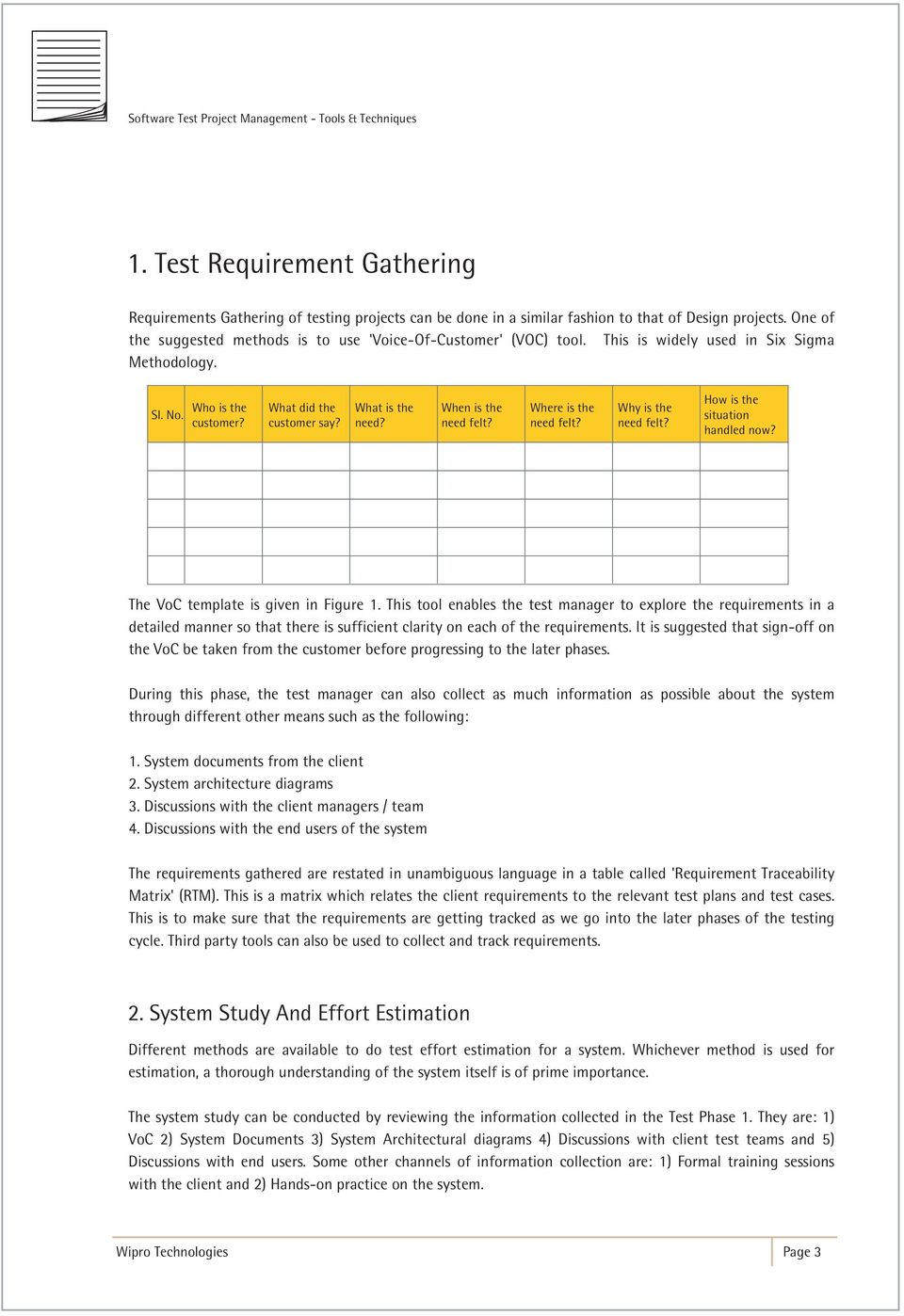
3 . Test Requirement Gathering Requirements Gathering of testing projects can be done in a similar fashion to that of Design projects. One of the suggested methods is to use 'Voice-Of-Customer' (VOC) tool. This is widely used in Six Sigma Methodology. Sl. No. Who is the customer? What did the customer say? What is the need? When is the need felt? Where is the need felt? Why is the need felt? How is the situation handled now? The VoC template is given in Figure. This tool enables the test manager to explore the requirements in a detailed manner so that there is sufficient clarity on each of the requirements. It is suggested that sign-off on the VoC be taken from the customer before progressing to the later phases. During this phase, the test manager can also collect as much information as possible about the system through different other means such as the following:. System documents from the client. System architecture diagrams. Discussions with the client managers / team. Discussions with the end users of the system The requirements gathered are restated in unambiguous language in a table called 'Requirement Traceability Matrix' (RTM). This is a matrix which relates the client requirements to the relevant test plans and test cases. This is to make sure that the requirements are getting tracked as we go into the later phases of the testing cycle. Third party tools can also be used to collect and track requirements.. System Study And Effort Estimation Different methods are available to do test effort estimation for a system. Whichever method is used for estimation, a thorough understanding of the system itself is of prime importance. The system study can be conducted by reviewing the information collected in the Test Phase. They are: ) VoC ) System Documents ) System Architectural diagrams ) Discussions with client test teams and 5) Discussions with end users. Some other channels of information collection are: ) Formal training sessions with the client and ) Hands-on practice on the system. Wipro Technologies Page
4 Towards the purpose of estimation, one has to understand the following facts about the SUT before moving ahead. The information collected through the above mentioned channels can be used to derive the following:. No. of modules in the system. Strength of interdependency between modules. No. of factors indicating module complexity within each of the modules. This is also known as cohesion. The above three types of information together with any of the estimation techniques can be used to determine the effort required for testing the system. The other inputs include but are not limited to:. Experience of the organization with similar test projects 5. Tacit knowledge of the estimators Two tools, System Complexity Estimator (SCE) and Analytical Hierarchy Program (AHP) which are described below can also be used for effort estimation. These methods complement other estimation techniques and also help determine the effort distribution across different modules of the system. System Complexity Estimator SCE helps us determine the relative architectural complexity of each of the modules in the system. The relative complexity information can be used to decide which module is more important and needs more attention from a testing perspective. This information can be used to determine the effort distribution across different modules on a % basis w.r.t the total system. The inputs required for SCE tool are:. The strength of interdependency between different modules. The no. of factors affecting the complexity within each of the modules Typical examples of an SCE input and output are given in Figures and. Cohesion Module Name Module No. 5 Aa LO Bb ME Cc LO ME EX Dd ME Ee 5 EX HI EX Figure : Typical SCE Input Wipro Technologies Page

5 System Complexity 5.0 Module Names Module Nos. ACSC(%) AC Aa 6.9%.57 Bb Cc Dd Ee 5.%..%.7 9.%.9 0.6%. Figure : Typical SCE Output In Figure, the column ACSC(%) i.e. Application Contribution to System Complexity (%) is very important for test effort estimation purposes. This helps determine the distribution of effort across different modules. In the example shown, ACSC column suggests that we need 6.9 PDays to test the Module 'Aa' if the total test effort is 00 PDays. While the SCE tool does not give a direct answer to the total effort required for testing, it gives a clear answer for distribution of effort among different modules. But, the 'System Complexity' information shown in Figure can be used to estimate the total effort as well, provided we have the required inputs mentioned below. Scenario : If we have the following information about a system which is similar to the SUT, we can arrive at an estimation of total effort required: ) The system complexity of a second system (SC) ) The effort used for testing that system (EFF) Then the effort required for testing SUT, EFF = EFF * SC/SC ; where SC is the system complexity of SUT. Scenario : In the event that we have several data points (System Complexity and Efforts) for a group of systems which are similar to SUT, we can derive a trend line using the following information. The effort required for testing SUT, EFF = k * SC ;where k is the proportionate ratio of 'Effort Vs Complexity' derived from the past data Analytical Hierarchy Program: Another technique which can be used on similar lines is Analytical Hierarchy Program (AHP). This can be used in two circumstances: ) As a second method for Effort Distribution Estimation along with SCE to reduce risk ) When we do not have the complete system architecture knowledge; but only tacit knowledge which is sufficient enough to judge relative importance between modules taken two at a time Wipro Technologies Page 5

6 The input needed to apply this technique is only the relative importance of different modules of the system taken two at a time. AHP derives the relative importance of different modules from this pair-wise information. Typical AHP input and output are given in Figures. Category Name Ff Category No. 5 RE RV EQ RV Category Weights.0% Gg CM CE CM.5% Hh CV EQ 7.% Ii RV.0% Jj 5 7.% Figure : Typical AHP Input and Typical AHP Output Figure 5 suggests that if the total system required 00 PDays of testing effort, module 'Hh' needs 7. PDays.. Test Sequencing We have used module interdependency information in Phase to derive system complexity. The same information, processed in a different manner can be used to determine the sequence between modules. This sequencing of information can be useful to schedule the testing activities in the Test Execution phase. The tool used here is Dependency Structure Matrix (DSM). The input to the DSM is the Module interdependency information and the output is Module sequence for test execution. A typical input and output of the DSM tool is shown in Figures 6 and 7. Module Nos. 5 Levels Modules -->> 5 5 Figure 7: DSM Output Figure 6: DSM Input {Dependency is marked as: Row Depends on Column} Wipro Technologies Page 6

7 As we can see in Figure 7, Modules and 5 are at level. This means both these modules are to be tested first, before proceeding to the other modules. Module is at level. This module has to be tested next before testing modules and. This is good information to have since it helps us to prioritize between modules. Also, it avoids unnecessary wastage of effort during test execution getting into re-testing mode because of dependencies. In the above example, Module depends on Module. In the OUTPUT table, Module is in level and Module is in level. This suggests that we have to test Module before moving to Module. There is no meaning in testing Module if we test and failed Module. Thus we save the effort of unnecessarily testing Module in case Module itself is not functioning rightly.. Test Suite Optimization This phase is concerned with designing of test suite. The objective is to design a test suite which will maximize the test coverage and optimize the no. of test cases and the effort required. Orthogonal Array (OA) is a technique to achieve this objective. This exercise starts with identifying the factors and levels of the system from the perspective of testing. Factors are defined as components of the system which work together to make the system itself. It can also be an attribute of the system. Levels are defined with respect to a factor. Levels are those values a factor can take at different points of time. For e.g. in the case of a telephone network, the factors can be the originating party phone, line card, terminating party phone etc. The level of the originating party phone can be on-hook, off-hook etc. In the case of a GUI, a tab for entering SEX can be a factor. The levels are MALE and FEMALE for this factor. With respect to the factors and levels defined above, using OA method, we can arrive at a particular set of combinations which together will satisfy the following two conditions:. All levels of all factors will have a presence in the set. All levels of a factor will appear against all levels of other factors at least Factor Name-> Sl. No FACA FACB FACC a m x a n y a o z a p w a q v b m y b n z Factor Name-> Sl. No FACA FACB FACC b q x c m z c n w c o v c p x c q y d m w Factor Name-> Sl. No FACA d d a a a a a FACB p q m n o p q FACC y z v x y z w 8 b o w 7 d n x Figure 8: OA Combinations 9 b p v 8 d o v Wipro Technologies Page 7

8 If we form test cases using the combinations suggested by OA, we will make sure of the following:. All states (values) of all components of the system are tested. All states of a component are tested against all states of other components at least once This will make sure that we completely cover the system from a testing perceptive. This is achieved through a very minimum set of test cases. Let us take the following example. A system has three factors. Each of the three factors has got levels as follows: Factor: FACA and Levels: a, b, c, d (Total levels = ) Factor: FACB and Levels: m, n, o, p, q (Total levels = 5) Factor: FACC and Levels: v, w, x, y, z (Total levels = 5) The combinations given by OA are shown in Figure 8. As we can see in Figure 8, OA gives 5 combinations which satisfy the rules described above. All the levels (i.e. a, b, p, x etc) of all factors are appearing at lease once. The level 'a' of FACA appears against the levels m, n, o, p and q of FACB at least once. The level 'a' appears against the levels v, w, x, y and z of FACC at least once. Similar is the case with other levels as well. The full set of combinations possible in this example is *5*5 = 00. The no. of OA combinations is only 5. Here a saving of 75% can be seen in terms of no. of test cases. OA can be described as the best sample from the whole set of combinations from a testing perspective. A practical example shows the following results:. Full set of combinations possible = 00. No. of test cases used prior to OA implementation = 800. No. of test cases in OA Test Suite = 7 Here we can see a practical saving of 8% (reduction from 800 to 7) and a theoretical saving of 9% (reduction from 00 to 7). Also, the testing can be at risk if the OA test cases are not a subset of the 800 test cases used earlier. This is because of test coverage issues. In practice, practitioners are encouraged to add some more test cases to the OA test suite based on their experience. This is to avoid missing any important combinations to be tested from the experience they have. These test cases are called OA Complementary Coverage (OACC) test cases. Wipro Technologies Page 8

9 5. Resource Leveling And Scheduling By now, we have test effort estimation and the test suite in place. The next thing is to arrive at a test execution schedule which can be used in the test execution phase. To determine the schedule, we should have the following inputs also:. Resource Vs. Module Matrix: This matrix gives the information on which resource can be used for testing which module. Resource Availability: This gives the information on which date a resource is available for testing activities. Modules Vs. Levels : This gives the information on which module is in which level (as detailed in the 'Test Sequence' phase above). Resource Weightage Matrix: This gives the information on the testing capability of each of the resource w.r.t. each of the modules 5. Maximum Resource: This gives the information on the maximum number of resources that can be used for a module at a time 6. Effort Vs. Module: Effort required for completing testing on each of the modules Once these inputs are in place, we can do a resource leveling exercise and arrive at a possible schedule. A Resource Leveling Tool (RLT) can also be devised to generate a test schedule given the above inputs. If the schedule length (i.e. the total duration of test execution) we arrive at using Resource Leveling technique is more than the target duration, it means that more resources need to be added against some of the modules, which can be shortened. If the schedule is less than the target, we may examine the chance of pulling out some resources so that they can be used in other projects. A typical RLT output is shown in Figure 9. Here M,M etc are Modules and R, R etc. are resources who will work on these modules. R shown in the cell (M, ) means that she works on Module M on the second day. There is no work assigned for R6 on the seventh day. This means that he can be released from the project after the sixth day. Days--> Modules M 5 6 R, R, R5 R, R, R5 7 M M R, R6 R, R6 R, R6 R R, R6 R R, R R, R R, R M R, R5 R, R5 R, R5, R6 R, R5, R6 R, R5 Figure 9: RLT Output Wipro Technologies Page 9

10 6. Test Execution There are three modes of testing which can be used in the test execution phase: ) Testing by Suite ) Testing by Exploration and ) Testing by Pairs. Testing by Suite This is a straight forward method of testing as per the test cases decided by OA test suite. Test cases have to be divided between resources as per the output from the resource leveling phase. Testing by Exploration This is creative testing. A tester comes out of the conventional test suite scenarios and creates certain situations for the system and observes its behavior. This is a good way of forcing the system to break. In combination with OA test suite, this type of testing will ensure that the system is thoroughly tested. In projects where OA is used, the team gets a lot of time to do this type of testing and thus complements each other's effectiveness. This is because the OA test suite contains less no. of test cases than the conventional test pack. Testing by Pairs Testing by Suite is systematic method; Testing by Exploration is individual creativity. Testing by Pairs brings synergy among two testers and offers a chance for different ideas to complement each other and thus benefiting the final outcome. Testing by Pair Testing by Suite Testing By Exploration Testing By Suite Weeks - Week Week 5 Week 6 Figure 0: Test Execution Figure 0 demonstrated how these testing modes can be used. In the example shown, during the first three weeks the team completes the Testing By Suite once. This way, the team can discover most of the defects early in the test cycle. In the next three weeks, team split their work between the three modes of testing. It is important to note that they repeat the Testing By Suite (partially or fully as required) to make sure that any bug fixes coming in is tested using the respective test cases. Whichever testing method is used, we should have a Test Execution tracker. Wipro Technologies Page 0

11 This will act as a log for testing. Ideally, a good test execution tracker will have the following fields among other things:. Version of system getting tested. Date of testing. Time stamp. Test case (Name / ID) 5. Tester 6. Status of test case (Pass, Fail, Hold, Abandoned) Also important is how we analyze the defect trends and other metrics collected from the test bed / lab. Normally, we collect the following metrics from test bed. (Ref Figure ). No. of Test cases Executed. No. of Test Cases Passed. No. of Test Cases Failed. Test Effort 5. No. of Defects Reported 6. No. of Defects Rejected We can have a tool called 'Defect Flow Analysis' (DFA), which comprehensively analyzes all these metrics and gives outputs. The advantages of having the same tool across different projects are:. Standard metrics analysis reports. Comparison between projects becomes easy. Reports come together with required graphs at once; thus comprehensive reports with less time The expected analysis reports from DFA are:. Defect Trend Report. Cumulative Defect Trend. Test Execution Productivity Trend. Test Case Efficiency Trend 5. Test Case Pass / Fail Rate 6. Defect Rejection Rate / Trend 7. Defect Severity Analysis etc. All these reports are supported by required graphs for a better understanding by the manager. Refer Figure for an example. The tool can also give a statistical summary of the trends in different individual reports. Week Testing Effort(PDay) TCs executed TCs Passed No. of Defects Rejected Defects Figure : Defect Report / Example Wipro Technologies Page

12 Figure : D.F.A. Charts / Example 7. Defect Tracking And Closure Defects will get reported once the test team begins the testing activity. These defects are to be tracked from the moment they are discovered till such time that they are fixed by the design team and retested by the test team. An ideal Defect Tracking tool should have among other things the following field entries:. Version of system. Date of testing. Test case (Name / ID). Tester 5. Module impacted 6. Comments 7. Design contact 8. Status of defect (Raised, In Analysis, In Bug Fix, In Clarification, In Testing, Closed) This defect tracking mechanism will be used by both testing and design teams. Ideally all the defects recorded in this system will have to be fixed and retested before a system can be released to field. Wipro Technologies Page

13 8. Reliability Estimation And Release There are several factors which help us decide when we can release a product to field. One of the important factors is Residual Defect Estimation. Residual defects are those defects which have not been discovered yet, even after a certain amount of testing activity. We can have a Residual Defect Estimator which analyses the trend of the defects detected over a period of time through out the testing cycle. The input to this estimator is the Defect Report which is mentioned in the phase 'Test Execution'. The outputs from this trend analysis are:. The estimated count of residual defects; and. The estimated time for testing to discover the residual defects Suppose in as typical project, after analyzing the defect trends, the tool estimates that there are still 5 defects in the system out of 600 estimated total defects, tt suggests that % defects are still in the system which are yet to be discovered. There are two questions asked at this point:. With % residual defects (5 nos), can we stop testing and release the product to the field?. If the answer is No, how much more effort do we need to spend further on testing to discover these defects (an estimation)? If this estimation is found to be reasonable, the manager can continue testing. If the effort is huge, the manager may decide against further testing after considering parameters in SLA (Service Level Agreement) and other criteria. Figure shows an output from a typical Reliability Estimation exercise. In the example shown, total estimated defects in the system are 85 and residual defects are 7. It also estimates that 5 test cases (or equivalent effort) are required to discover the residual defects. Total Estimated Defects Total Defects Detected Total TCs Executed Residual Defects Additional TCs Required Figure : Typical Reliability Estimation Output 9. Maintenance Testing During the maintenance phase of a system, there will be defects reported from the field and Change Requests (CRs) will be raised. This leads to further enhancement of the system and the system needs to be tested again. Here, there is a need to find out how much time one needs to spend testing a particular module or a CR relatively. This is to make sure that the valuable test effort is distributed appropriately across different modules and CRs. A technique called System Change Impact Matrix (SCIM) can be used to determine this distribution of effort. Wipro Technologies Page

14 The inputs needed are:. The system complexity of the system. The relative complexity of each of the modules. The impact of each of the CRs on each of the modules on a one-on-one basis (if any) The first two inputs come directly from Test Phase : System Study and Estimation. The third information is to be determined after analyzing each of the CRs. The outputs of System Change Impact analysis will be:. Change impact index. Relative impact on each of the modules. Relative impact of each of the CRs The output can be used to determine in what way the total test effort has to be distributed across different modules. The output can be used to determine how much of the test effort has to be spent on each of the CRs. This leads to proper selection of test cases covering all modules and CRs appropriately. A typical analysis output of a SCIM is shown in Figure. This example suggests that the team has to spend 9% of the test effort on CR no. and 7% on Module and so on. This also suggests that Module is not impacted at all and the test manager can decide whether he can avoid testing this module based on priorities. Change Impact Analysis Change Impact Index.9 CR Nos.. CR Impact Analysis %FII % 5% 9% % FII Mdl Nos Module Impact Analysis %MII 0% 0% 8% 7% % % 7% % MII Wipro Technologies Page

15 Conclusion The test phases, techniques and tools described in this article together draw a systematic picture of the whole test cycle.. VoC helps to capture requirements correctly and without ambiguity so that we can have the information on what to look for while doing testing. RTM is used to track the requirements till the testing cycle is completed.. Effort estimation and distribution techniques help to know the relative complexity between modules so that the testing team can split their effort between modules accordingly.. DSM helps to sequence the testing of different modules so that the execution plan is proper, thus avoiding any unnecessary and avoidable delays.. OA technique helps to maximize the test coverage and optimize the test suite. 5. Resource leveling techniques ensure that we have the optimum schedule as per the resource availability and capability. It also plans for resource movement across modules as per their expertise. 6. The modes of test execution are ) Testing by Suite ) Testing by Exploration and ) Testing by Pairs. This ensures that the system is tested on 60 degrees basis. DFA is used to analyze all the metrics which are collected from Test Bed. 7. Defect Tracking Mechanism ensures that the bugs are tracked properly till they get fixed and retested. 8. Reliability estimation predicts the residual defects in the system so that the test manager can take the decision to continue or to stop testing accordingly. 9. System Change Impact Matrix helps us to determine the relative effort distribution between modules and CRs during maintenance testing. Gaining knowledge of these tools and techniques is important for a test manager. The latter also has to apply there tools religiously in the project to achieve the objective of better testing with minimum or optimized effort. References. Six Sigma DMAIC Training documents, Wipro Technologies, Internal Publication, 005. Bhushan Navneet and Rai K., Strategic Decision Making - Applying the Analytic Hierarchy Process, Decision Engineering Series, Springer, UK, Jan 00.. Bhushan Navneet, System Complexity Estimator, Productivity Office, Wipro Technologies, Internal publication, Dec 00. Bhushan Navneet, System Change Impact Model, Productivity Office, Wipro Technologies, Internal publication, Aug Bhushan Navneet, Deploying Paired Programming, Productivity Office, Wipro Technologies, Internal Publication, Arunachalam Ganesh, Varma Pramod, TN Ajikumar, Robust Testing Methodologies, Wipro Technologies, Internal Publication, Arunachalam Ganesh, Varma Pramod, TN Ajikumar, Guidelines to Reliability Measurement, Wipro Technologies, Internal Publication, TN Ajikumar, Effort Estimation Methods, Dec 00 Wipro Technologies Page 5

16 About The Author Ajikumar TN is at present 'Head-Testing Competency Team' in the Testing Services Division of Wipro Technologies, Bangalore. He holds an MBA in Software Enterprises Management from Indian Institute of Management, Bangalore and a B Tech Degree in Electronics & Communication Engineering. He has got about years of experience in the software industry and has worked for enterprises like BPL Telecom earlier. He can be reached at [email protected]. Wipro Technologies Page 6

An Introduction to. Metrics. used during. Software Development
 An Introduction to Metrics used during Software Development Life Cycle www.softwaretestinggenius.com Page 1 of 10 Define the Metric Objectives You can t control what you can t measure. This is a quote
1. Introduction. Annex 7 Software Project Audit Process
 Annex 7 Software Project Audit Process 1. Introduction 1.1 Purpose Purpose of this document is to describe the Software Project Audit Process which capable of capturing different different activities take
Software Project Audit Process
 Software Project Audit Process Version 1.2 Information and Communication Technology Agency of Sri Lanka July 2013 Copyright 2011 ICTA Software Project Audit Process-v-1.2 Revision History Date Version
Testing Metrics. Introduction
 Introduction Why Measure? What to Measure? It is often said that if something cannot be measured, it cannot be managed or improved. There is immense value in measurement, but you should always make sure
Chapter 4 SUPPLY CHAIN PERFORMANCE MEASUREMENT USING ANALYTIC HIERARCHY PROCESS METHODOLOGY
 Chapter 4 SUPPLY CHAIN PERFORMANCE MEASUREMENT USING ANALYTIC HIERARCHY PROCESS METHODOLOGY This chapter highlights on supply chain performance measurement using one of the renowned modelling technique
I Have...Who Has... Multiplication Game
 How to play the game: Distribute the cards randomly to your students. Some students may get more than one card. Select a student to begin by reading their card aloud. (example: 35. who has 4x4?) 35 4 x
SECTION 4 TESTING & QUALITY CONTROL
 Page 1 SECTION 4 TESTING & QUALITY CONTROL TESTING METHODOLOGY & THE TESTING LIFECYCLE The stages of the Testing Life Cycle are: Requirements Analysis, Planning, Test Case Development, Test Environment
Reduce QA Cost by Improving Productivity & Test Optimization
 Reduce QA Cost by Improving Productivity & Test Optimization Author(s) Rajesh Kumar ([email protected]) and Ajay K Chhokra ([email protected]) UnitedHealth Group Information Systems, Unitech
WHITE PAPER. Effectively managing project performance reporting.
 WHITE PAPER Effectively managing project performance reporting. Summary This white paper helps project teams identify performance measures for Information Technology (IT) support and maintenance projects,
TEST METRICS AND KPI S
 WHITE PAPER TEST METRICS AND KPI S Abstract This document serves as a guideline for understanding metrics and the Key performance indicators for a testing project. Metrics are parameters or measures of
AUTOMATED TESTING and SPI. Brian Lynch
 AUTOMATED TESTING and SPI Brian Lynch 1 Introduction The following document explains the purpose and benefits for having an Automation Test Team, the strategy/approach taken by an Automation Test Team
B2B Software Technologies Ltd. Service Level Agreement (SLA)
 Service Level Agreement (SLA) Overview This document describes a Service Level Agreement (SLA) between Customer and B2B Software Technologies. It outlines the services offered by B2B for NAVISION ADDON
FSW QA Testing Levels Definitions
 FSW QA Testing Levels Definitions 1. Overview This document is used to help determine the amount and quality of testing (or its scope) that is planned for or has been performed on a project. This analysis
STC - 2013 Test Report Dashboard Art of Showcasing data graphically, dynamically
 STC - 2013 Test Report Dashboard Art of Showcasing data graphically, dynamically Prepared by: Indium Software India Ltd. Name : Poornima Gopalan & Vishnupriya B Email : [email protected] [email protected]
ájoƒ ùdg á«hô dg áµلªÿg Yesser Overall SDLC Process Definition
 ájoƒ ùdg á«hô dg áµلªÿg Yesser Overall SDLC Process Definition Version 0.6 - Page 3 / 43 Table of Contents 1. Process Introduction... 5 1.1. Process Scope... 5 1.2. Process Objectives and Benefits... 5
3-Step Competency Prioritization Sequence
 3-Step Competency Prioritization Sequence The Core Competencies for Public Health Professionals (Core Competencies), a consensus set of competencies developed by the Council on Linkages Between Academia
The Customer. Manual and Automation Testing for a leading Enterprise Information Management (EIM) Solution provider. Business Challenges
 CASE STUDY a t t e n t i o n. a l w a y s. The Customer Manual and Automation for a leading Enterprise Information Management (EIM) Solution provider Our Customer is one of the global leaders in Enterprise
Benefits of Test Automation for Agile Testing
 Benefits of Test Automation for Agile Testing Manu GV 1, Namratha M 2, Pradeep 3 1 Technical Lead-Testing Calsoft Labs, Bangalore, India 2 Assistant Professor, BMSCE, Bangalore, India 3 Software Engineer,
What makes a good process?
 Rob Davis Everyone wants a good process. Our businesses would be more profitable if we had them. But do we know what a good process is? Would we recognized one if we saw it? And how do we ensure we can
Agile Projects 7. Agile Project Management 21
 Contents Contents 1 2 3 Agile Projects 7 Introduction 8 About the Book 9 The Problems 10 The Agile Manifesto 12 Agile Approach 14 The Benefits 16 Project Components 18 Summary 20 Agile Project Management
Latest Trends in Testing. Ajay K Chhokra
 Latest Trends in Testing Ajay K Chhokra Introduction Software Testing is the last phase in software development lifecycle which has high impact on the quality of the final product delivered to the customer.
VALUE STREAM MAPPING FOR SOFTWARE DEVELOPMENT PROCESS. Ganesh S Thummala. A Research Paper. Submitted in Partial Fulfillment of the
 VALUE STREAM MAPPING FOR SOFTWARE DEVELOPMENT PROCESS by Ganesh S Thummala A Research Paper Submitted in Partial Fulfillment of the Requirements for the Master of Science Degree In Management Technology
Performance Testing Uncovered
 Performance Testing Uncovered First Presented at: NobleStar Systems Corp. London, UK 26 Sept. 2003 Scott Barber Chief Technology Officer PerfTestPlus, Inc. Performance Testing Uncovered Page 1 Performance
Customer Interaction Analytics Speech Analytics The Next Frontier
 Customer Interaction Analytics Speech Analytics The Next Frontier www.wipro.com RAJESH SEHGAL & SHALABH SRIVASTAVA PROCESS LAB, MISSION QUALITY & OPERATIONAL EXCELLENCE, WIPRO BPO Table of Contents Customer
Essential QA Metrics for Determining Solution Quality
 1.0 Introduction In today s fast-paced lifestyle with programmers churning out code in order to make impending deadlines, it is imperative that management receives the appropriate information to make project
Description of Services for A Quality Assurance Engineer for SQA Assignment for eservices Development Projects ICTA/CON/IC/P5/411B
 Description of Services for A Quality Assurance Engineer for SQA Assignment for eservices Development Projects ICTA/CON/IC/P5/411B 1. Introduction The Information and Communication Technology Agency of
Model-based Testing: Next Generation Functional Software Testing
 Model-based Testing: Next Generation Functional Software Testing By Dr. Bruno Legeard Model-based testing (MBT) is an increasingly widely-used technique for automating the generation and execution of tests.
Integrating A3 Reports and the House of Quality: Improving Workflow in the Recovery Room Using Information Technology
 416 Medical Informatics in a United and Healthy Europe K.-P. Adlassnig et al. (Eds.) IOS Press, 2009 2009 European Federation for Medical Informatics. All rights reserved. doi:10.3233/978-1-60750-044-5-416
Change Request Process Overview
 Industry Best Practices Process Overview by Garth Wilcox This white paper outlines a process for requesting and managing changes to an application during the product development cycle. It also discusses
Certified Software Quality Assurance Professional VS-1085
 Certified Software Quality Assurance Professional VS-1085 Certified Software Quality Assurance Professional Certified Software Quality Assurance Professional Certification Code VS-1085 Vskills certification
Data Warehouse Testing
 Data Warehouse Testing Manoj Philip Mathen Abstract Exhaustive testing of a Data warehouse during its design and on an ongoing basis (for the incremental activities) comprises Data warehouse testing. This
RFP Attachment C Classifications
 RFP 1. Applications IT Architect Analyzes and designs the architecture for software applications and enhancements, including the appropriate application of frameworks and design patterns and the interrelationships
Unit 1: Introduction to Quality Management
 Unit 1: Introduction to Quality Management Definition & Dimensions of Quality Quality Control vs Quality Assurance Small-Q vs Big-Q & Evolution of Quality Movement Total Quality Management (TQM) & its
Module: Sharepoint Administrator
 Module: Sharepoint Administrator Mode: Classroom Duration: 40 hours This course teaches IT Professionals to design and deploy Microsoft SharePoint 2010. Course Outline: Module 1: Designing a Logical Architecture
PHASE 6: DEVELOPMENT PHASE
 PHASE 6: DEVELOPMENT PHASE The Phase features a key step in the project: system construction. The previous phases lay the foundation for system development; the following phases ensure that the product
Test Plan (a Real Sample) SoftwareTestingHelp.com Live Project Training - OrangeHRM
 www.softwaretestinghelp.com Test Plan (a Real Sample) SoftwareTestingHelp.com Live Project Training - OrangeHRM 2/1/2014 SoftwareTestingHelp.com Name of the tester Note: This is a sample test plan created
Custom Software Development Approach
 Custom Software Development Approach Our approach to custom software development combines benefits from several standard development process models. We tend to have a well-defined, predictable and highly
Project Lifecycle Management (PLM)
 Project Lifecycle Management (PLM) Process or Tool? Why PLM? Project Definition Project Management NEW REQUEST/ INITIATIVES SUPPORT (Quick fixes) PROJECT (Start Finish) ONGOING WORK (Continuous) ENHANCEMENTS
Advanced Software Test Design Techniques Use Cases
 Advanced Software Test Design Techniques Use Cases Introduction The following is an excerpt from my recently-published book, Advanced Software Testing: Volume 1. This is a book for test analysts and test
MANUAL TESTING. (Complete Package) We are ready to serve Latest Testing Trends, Are you ready to learn.?? New Batches Info
 MANUAL TESTING (Complete Package) WEB APP TESTING DB TESTING MOBILE APP TESTING We are ready to serve Latest Testing Trends, Are you ready to learn.?? New Batches Info START DATE : TIMINGS : DURATION :
RegoXchange Content List by RegoXchange www.regoxchange.com/
 ID Title Assignment Type Description EX0003 EX0003 EX0006 EX0006 EX0007 EX0007 % Time by Type and Timescale - Column Graph - % Time by Type and Timescale - Column Graph - SQL % Time by Type and Timescale
Smarter Balanced Assessment Consortium. Recommendation
 Smarter Balanced Assessment Consortium Recommendation Smarter Balanced Quality Assurance Approach Recommendation for the Smarter Balanced Assessment Consortium 20 July 2012 Summary When this document was
Project Type Platform Number of Phases Development Java, Win NT, DB2 Four Phases.
 Given below is a Project Management Plan for a real life project executed by a commercial company. This example is from my book Software Project Management in Practice (2002, Addison Wesley).The project
- ATTACHMENT - PROGRAM MANAGER DUTIES & RESPONSIBILITIES MARYLAND STATE POLICE W00B0400021
 - ATTACHMENT - PROGRAM MANAGER DUTIES & RESPONSIBILITIES MARYLAND STATE POLICE W00B0400021 About this document this is a detailed description of typical Project Manager (PM) duties, responsibilities, and
Analysing timetable clashes : the Conflict Matrix
 Analysing timetable clashes : the Conflict Matrix Scenario Timetabling is the art of the possible based on the skill of compromise. Detecting possible areas of compromise in order to achieve a working
4.13 System Testing. Section 4 Bidder's Products, Methodology, and Approach to the Project. 4.14 System Training
 Section 4 Bidder's Products, Methodology, and Approach to the Project 4.1 FACTS II Requirements Summary 4.11 Interfaces 4.2 Functional Requirements 4.12 System Development 4.3 Technical Requirements 4.13
Roles: Scrum Master & Project Manager
 Roles: Scrum Master & Project Manager Scrum Master: Facilitate collaborative meetings Track team performance Remove impediments (Risk, Issue) Validate team alignment to Agile framework and scope Drive
(Refer Slide Time: 01:52)
 Software Engineering Prof. N. L. Sarda Computer Science & Engineering Indian Institute of Technology, Bombay Lecture - 2 Introduction to Software Engineering Challenges, Process Models etc (Part 2) This
Keywords document, agile documentation, documentation, Techno functional expert, Team Collaboration, document selection;
 Volume 4, Issue 4, April 2014 ISSN: 2277 128X International Journal of Advanced Research in Computer Science and Software Engineering Research Paper Available online at: www.ijarcsse.com A Document Driven
Ensuring Reliability in Lean New Product Development. John J. Paschkewitz, P.E., CRE
 Ensuring Reliability in Lean New Product Development John J. Paschkewitz, P.E., CRE Overview Introduction and Definitions Part 1: Lean Product Development Lean vs. Traditional Product Development Key Elements
Quality Analysis with Metrics
 Rational software Quality Analysis with Metrics Ameeta Roy Tech Lead IBM, India/South Asia Why do we care about Quality? Software may start small and simple, but it quickly becomes complex as more features
ATTACHMENT 3 SPS PROJECT SENIOR PROGRAM MANAGER (SPM) DUTIES & RESPONSIBILITIES
 1. ROLE DEFINITIONS ATTACHMENT 3 SPS PROJECT SENIOR PROGRAM MANAGER (SPM) DUTIES & RESPONSIBILITIES The purpose of this section is to distinguish among the roles interacting with the SPM obtained through
SLIM Estimate and Microsoft Project Best Practices
 SLIM Estimate and Microsoft Project Best Practices There are many activities to perform during the life of a software development project. No single tool provides all of the functionality or data that
PMO Metrics Recommendations
 Introduction The purpose of this document is to recommend metrics to be used by the Project Management Office (PMO) to measure and analyze their project and PMO success. The metrics are divided into Project
Software Testing Lifecycle
 STLC-Software Testing Life Cycle SDLC Software Testing Lifecycle Software Testing Life Cycle (STLC) defines the steps/ stages/ phases in testing of software. However, there is no fixed standard STLC in
Effective Software Security Management
 Effective Software Security Management choosing the right drivers for applying application security Author: Dharmesh M Mehta [email protected] / [email protected] Table of Contents Abstract... 1
Project Management Process
 Project Management Process Description... 1 STAGE/STEP/TASK SUMMARY LIST... 2 Project Initiation 2 Project Control 4 Project Closure 5 Project Initiation... 7 Step 01: Project Kick Off 10 Step 02: Project
Scrum Methodology in Product Testing : A Practical Approach
 Scrum Methodology in Product Testing : A Practical Approach Suman Kumar Kanth [email protected] Mobile: +91 9937285725 Infosys Technologies Limited Proceedings for the session 1. Challenges
Sun Bear Marketing Automation Software
 Sun Bear Marketing Automation Software Provide your marketing and sales groups with a single, integrated, web based platform that allows them to easily automate and manage marketing database, campaign,
Test Management Tools
 Test White Management Paper Tools Test Management Tools Table of Contents Executive Summary 3 Why Test Management Tools are required 4 What is QMetry? 5 QMetry Features 6 The Tools of QMetry 7 Conclusion
We are live on KFS Now What? Sameer Arora Director Strategic Initiatives, Syntel
 We are live on KFS Now What? Sameer Arora Director Strategic Initiatives, Syntel Agenda Introduction Application Management Testing Kuali Financial System (KFS) using itap Syntel Fast Facts 2 Agenda Introduction
101-301 Guide to Mobile Testing
 101-301 Guide to Mobile Testing Perfecto Mobile & Toronto Association of System and Software Eran Kinsbruner & Joe Larizza 2014 What To Do? Great News Your first Mobile Project has arrived! You have been
Metrics in Software Test Planning and Test Design Processes
 Master Thesis Software Engineering Thesis no: MSE-2007:02 January 2007 Metrics in Software Test Planning and Test Design Processes Wasif Afzal School of Engineering Blekinge Institute of Technology Box
Defect Tracking Best Practices
 Defect Tracking Best Practices Abstract: Whether an organization is developing a new system or maintaining an existing system, implementing best practices in the defect tracking and management processes
Analytical Hierarchy Process (AHP)
 SIX SIG NTGE,Inc for Software evelopment nalytical Hierarchy Process (HP) Simple Excel HP Tool Expert Choice T Tool Overview 2003 Six Sigma dvantage, Inc ll rights reserved FSS: easure 44 FSS: easure 44
An Agile Methodology Based Model for Change- Oriented Software Engineering
 An Agile Methodology Based Model for Change- Oriented Software Engineering Naresh Kumar Nagwani, Pradeep Singh Department of Computer Sc. & Engg. National Institute of Technology, Raipur [email protected],
Chris Hurst & Matt Huddleson, Comcast
 Chris Hurst & Matt Huddleson, Comcast Copyright 2012 Hewlett-Packard Development Company, L.P. The information contained herein is subject to change without notice. Session ID: BB2007 Speaker Chris Hurst
Chromosome Mapping Assignment INSTRUCTIONS
 INSTRUCTIONS PROCEDURE A: 1) Examine the diagram of perch chromosomes supplied. They have been removed from the nucleus of the white blood cell after replication. 2) Cut out each chromosome map of these
Identifying, Ranking and Sensitivity Analysis for financing. Methods of deteriorated areas renovation projects
 Identifying, Ranking and Sensitivity Analysis for financing Methods of deteriorated areas renovation projects VahidrezaYousefi a,*1, Aida Rahimi Golkhandan b, Sarmad Kiani c a.phd candidate of Construction
http://www.test-institute.org International Software Test Institute
 THE ONLY BOOK CAN SIMPLY LEARN SOFTWARE TESTING! Page 1 Contents ABOUT THE AUTHOR... 3 1. Introduction To Software Testing... 4 2. What is Software Quality Assurance?... 7 3. What Is Software Testing?...
Business Process Management. Prof. Corrado Cerruti General Management Course
 Business Process Management General Management Course Summary Business Process Management definition Business Process Management Life Cycle ARIS approach to BPM Business Process Identification; Designing
ZAP Business Intelligence Application for Microsoft Dynamics
 Buy vs Build ZAP Business Intelligence Application for Microsoft Dynamics One Embarcadero Center, Suite 1560, San Francisco, CA 94111 +1 415 889 5740 www.zapbi.com Table of Contents OVERVIEW 3 BUY OR BUILD?
MULTIPLE-OBJECTIVE DECISION MAKING TECHNIQUE Analytical Hierarchy Process
 MULTIPLE-OBJECTIVE DECISION MAKING TECHNIQUE Analytical Hierarchy Process Business Intelligence and Decision Making Professor Jason Chen The analytical hierarchy process (AHP) is a systematic procedure
PROJECT MANAGEMENT PLAN <PROJECT NAME>
 PROJECT MANAGEMENT PLAN TEMPLATE This Project Management Plan Template is free for you to copy and use on your project and within your organization. We hope that you find this template useful and welcome
TPI a model for Test Process Improvement
 TPI a model for Test Process Improvement Jari Andersin Helsinki, 5th October 2004 Seminar on Quality Models for Software Engineering Department of Computer Science UNIVERSITY OF HELSINKI ii TPI a model
A Six Sigma Approach for Software Process Improvements and its Implementation
 A Six Sigma Approach for Software Process Improvements and its Implementation Punitha Jayaraman, Kamalanathan Kannabiran, and S.A.Vasantha Kumar. Abstract Six Sigma is a data-driven leadership approach
Design principles in Test Suite Architecture
 Design principles in Test Suite Architecture InSTA 2015 (International workshop on Software Test Architecture) Graz, Austria 2015/4/13(Mon) Nishi, Yasuharu The University of Electro-Communications, Japan
Practical Metrics for Managing and Improving Software Testing
 Practical Metrics for Managing and Improving Software Testing Presented By: Shaun Bradshaw [email protected] Slide 1 Part 1 Test Metrics Ten key metrics testers should track One bonus
OPERATIONAL BENCHMARKING DRIVING BUSINESS EFFICIENCY
 WWW.WIPRO.COM OPERATIONAL BENCHMARKING DRIVING BUSINESS EFFICIENCY Delivering best in class performance by targeting world class benchmarks and making processes more efficient and effective. Wipro BPO
ID Task Name Time Pred
 0 UC Modernization Project Plan 1115 d 1 1 Phase I - Business Case Development and Competitive Procurement 205 d 2 1.1 Complete Initial Feasibility Study 55 d 3 1.2 Prepare and Issue LBR 30 d 2 4 1.3 Competitive
Software Testing. Knowledge Base. Rajat Kumar Bal. Introduction
 Software Testing Rajat Kumar Bal Introduction In India itself, Software industry growth has been phenomenal. IT field has enormously grown in the past 50 years. IT industry in India is expected to touch
ISTQB Certified Tester. Foundation Level. Sample Exam 1
 ISTQB Certified Tester Foundation Level Version 2015 American Copyright Notice This document may be copied in its entirety, or extracts made, if the source is acknowledged. #1 When test cases are designed
Presentation: 1.1 Introduction to Software Testing
 Software Testing M1: Introduction to Software Testing 1.1 What is Software Testing? 1.2 Need for Software Testing 1.3 Testing Fundamentals M2: Introduction to Testing Techniques 2.1 Static Testing 2.2
Copyrighted www.eh1infotech.com +919780265007, 0172-5098107 Address :- EH1-Infotech, SCF 69, Top Floor, Phase 3B-2, Sector 60, Mohali (Chandigarh),
 Content of 6 Months Software Testing Training at EH1-Infotech Module 1: Introduction to Software Testing Basics of S/W testing Module 2: SQA Basics Testing introduction and terminology Verification and
Bradley University College of Liberal Arts and Sciences Department of Computer Sciences and Information Systems
 Bradley University College of Liberal Arts and Sciences Department of Computer Sciences and Information Systems Computer Lab # 1 Time Management (with Microsoft Project 2007) Lab Manual (with master s
Expense Reports. University of Kansas 2/12/2014
 2014 Expense Reports University of Kansas 2/12/2014 Table of Contents Create Expense Report... 2 Approval via Module... 28 Send Back via Module... 32 Approval via Email... 36 Send Back via Email... 39
Brillig Systems Making Projects Successful
 Metrics for Successful Automation Project Management Most automation engineers spend their days controlling manufacturing processes, but spend little or no time controlling their project schedule and budget.
NCSS Statistical Software Principal Components Regression. In ordinary least squares, the regression coefficients are estimated using the formula ( )
 Chapter 340 Principal Components Regression Introduction is a technique for analyzing multiple regression data that suffer from multicollinearity. When multicollinearity occurs, least squares estimates
Systems Thinking in DoD Program Management
 Systems Thinking in DoD Program Management Bipin Chadha and John Welsh Lockheed Martin Advanced Technology Laboratories Amelia Ruzzo Placer Dome, Inc. Problem Major programs often encounter major cost
Integrity 10. Curriculum Guide
 Integrity 10 Curriculum Guide Live Classroom Curriculum Guide Integrity 10 Workflows and Documents Administration Training Integrity 10 SCM Administration Training Integrity 10 SCM Basic User Training
Recovery Management. Release Data: March 18, 2012. Prepared by: Thomas Bronack
 Recovery Management Release Data: March 18, 2012 Prepared by: Thomas Bronack Section Table of Contents 8. RECOVERY MANAGEMENT... 4 8.1. INTRODUCTION TO RECOVERY MANAGEMENT... 4 8.1.1. DEFINITION... 4 8.1.2.
Efficient Management of Tests and Defects in Variant-Rich Systems with pure::variants and IBM Rational ClearQuest
 Efficient Management of Tests and Defects in Variant-Rich Systems with pure::variants and IBM Rational ClearQuest Publisher pure-systems GmbH Agnetenstrasse 14 39106 Magdeburg http://www.pure-systems.com