
VoIP Switch NEW HARDWARE SUPPORT
|
|
|
- Justin Watts
- 10 years ago
- Views:
Transcription
1 Tenor AF VoIP Switch Product Guide P/N NEW HARDWARE SUPPORT This unit contains new hardware, which requires newer software. This software was installed on the unit prior to leaving the factory. If you must downgrade the software in this unit, please visit rohs/ for a list of latest software patches that support this new hardware. Loading unsupported software will render this unit inoperable and will require physical access to this unit for recovery. NOTE: The current release of the Tenor Monitor does not support the Tenor AF Series. Tenor and Quintum are registered trademarks. Quintum Technologies, Inc., PacketSaver, Risk Free VoIP, The Perfect Fit, are trademarks of Quintum Technologies, Inc.

2 Table of Contents About this Guide What s included? Typographical Conventions Product Guide Conventions Finding Help Chapter 1: Overview What is the Tenor AF? Features Unique Design State-of-the-Art GUI Configuration and Network Management Easy Connect to Console Powerful System Monitoring Capabilities PacketSaver reduces bandwidth consumption Virtual Tie Trunk SNMP Support Call Detail Recording IVR/RADIUS Support NATAccess Dynamic Call Routing Tenor AF Call Paths Tenor VoIP Switch (AFG200, AFG400, AFG800) Configuration Tenor VoIP Switch (AFT200, AFT400, AFT800) Configuration Tenor VoIP Switch (Tenor AFM200, AFM400) Tenor VoIP Switch (Tenor AFE400, AFE600) Advanced Features/Capabilities Call Management Dial Plan Options H.323 Gatekeeper Services SIP User Agent Chapter 2: Hardware Components Hardware Description Front Panel LEDs Back Panel P/N TOC-1

3 Online/Offline Mode - AFE400/AFE600 only Cables RJ-11 Cables RJ-45 Ethernet Cable (10/100) DB-9 Serial RS-232 Cable Specifications Voice/Fax PSTN/PBX Connections LAN Connection Physical Electrical Environmental Chapter 3: Installation Installation Pre-Installation Guidelines Inspect Package Contents Connect to Phone/FXS Interface Connect to Line/FXO Interface Connect to Ethernet LAN Connect to PC Console (if required, see Note) Power up the System Login without the PC s COM port/obtain IP Address from Ethernet Login through the PC s COM port (if required, see note) Chapter 4: Diagnostics/Maintenance Common Symptoms/Problems Monitor LEDs Monitor Alarms How to Read Alarms Valid Alarms Display all Alarms Display Active Alarms Display Alarm History Verify Unit Provisioning Perform Maintenance Restore Factory Defaults (including password) Reset System Change Password Change Unit Date and Time If you need Additional Help GLOSSARY P/N TOC-2

4 INDEX Warranty/Approvals Quintum Limited Warranty Documentation Notice Agency Approvals FCC WARNINGS Canadian Notice P/N TOC-3

5 About this Guide P/N Preface-1

6 About this Guide What s included? This product guide is divided into chapters; each chapter describes a specific topic. The following chapters are included: About this Guide: Describes what is included in the Product Guide, including typographical conventions. Chapter 1: Overview. Includes a general overview of the product, including a description of the Tenor AF features and capabilities. Chapter 2: Hardware Components. Hardware description, including the front and rear panels, as well as LEDs and required cables. Chapter 3: Installation. Describes how to install the Tenor AF unit, including how to connect and power up the system. Chapter 4: Diagnostic/Maintenance. Describes how to troubleshoot and monitor the health of the system. Glossary Index Warranty/Approvals P/N Preface-2

7 About this Guide Typographical Conventions Product Guide Conventions Certain typographical conventions are used throughout this product guide. See below. All commands you enter via keystrokes appear in bold (e.g., Press Enter or Press Ctrl-I). All text commands you enter via Telnet session or command line typing appear in italics (e.g., type active). There are three types of special text that are designed to reveal supplemental information: Note, Warning, and Caution. See below. A NOTE provides additional, helpful information. This information may tell you how to do a certain task or just be a reminder for how-to s given in previous sections. (i.e., For a list of valid commands at any time, type?) A WARNING provides information about how to avoid harming your VoIP equipment or other equipment (i.e., Do not stack more than 4 units together.) A CAUTION provides information about how to avoid injury to yourself or to others (e.g., Do not install the equipment during a lightning storm). P/N Preface-3

8 About this Guide Finding Help Refer to the Product Guide for help. The Table of Contents and Index tells you where to find information easily. Extensive configuration help is available from the Tenor Configuration Manager User Guide or the Command Line Interface User Guide. Both documents are on the CDR ROM you received with unit, or you can download the latest documentation from P/N Preface-4
9 Chapter 1: Overview This chapter gives you a general overview of the Tenor AF, including feature descriptions and capabilities. Specifically, the following topics are covered:! A description of Tenor AF! Features! Capabilities! Call Paths! Advanced Features/Capabilities P/N
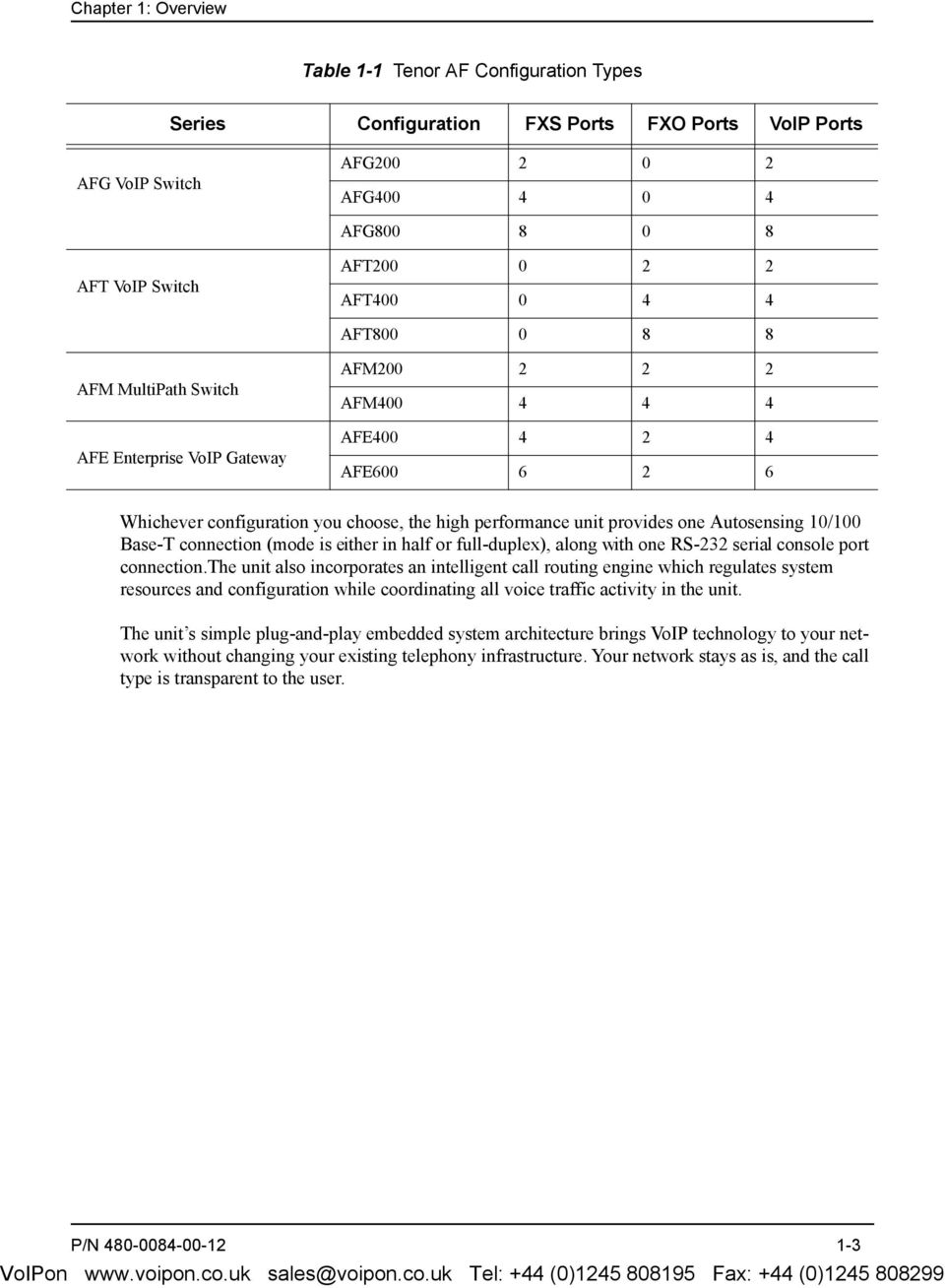
10 Chapter 1: Overview What is the Tenor AF? The Tenor AF is a VoIP (Voice over Internet Protocol) H.323/SIP switch that digitizes voice, fax, and modem data, and transmits it over the IP network. Designed as a SOHO product, the Tenor AF gives small to medium sized businesses with analog voice infrastructure an easy, cost-effective way to capitalize on the power of Voice over IP (VoIP). The Tenor AF integrates a gateway, gatekeeper, border element, intelligent call routing, and supports H.323/SIP all in one solution. The gateway converts regular phone calls to VoIP calls, the gatekeeper performs IP call routing functions, and the border element distributes the call routing directories throughout the network. Through the FXS port, you can connect to a telephone, key system or PBX; through the FXO port, you can connect to the PSTN (through direct connection to the Central Office). Figure 1-1 Tenor AF VoIP Switch The Tenor AF is available in several configuration types: AFG VoIP Switch. The AFG VoIP Switch is mainly intended for applications interfacing between the PBX and the VoIP network. The number of VoIP ports equals the number of FXS ports. AFT VoIP Switch. The AFT VoIP Switch is mainly intended for trunk side connections between the PSTN and the VoIP network. The number of VoIP ports is equal to the number of FXO ports. AFM Multipath Switch. The AFM MultiPath Switch is mainly intended for symmetrical multipath applications, with an equal number of FXO and FXS ports. The number of VoIP channels is equal to half the number of telephony (i.e. PSTN) channels. With its MultiPath architecture, the Tenor AF can intelligently route calls between the FXS, FXO, and the VoIP network to achieve the best combination of cost and quality. The Tenor AF also routes calls over IP to reduce costs, and then transparently hops off to the PSTN, to reach off-net locations. Calls can be routed in any direction between any of the ports. AFE Enterprise VoIP Gateway. The AFE VoIP Gateway is mainly intended for applications interfacing between the PBX and the VoIP network. P/N

11 Chapter 1: Overview Table 1-1 Tenor AF Configuration Types Series Configuration FXS Ports FXO Ports VoIP Ports AFG VoIP Switch AFG AFG AFG AFT VoIP Switch AFT AFT AFT AFM MultiPath Switch AFE Enterprise VoIP Gateway AFM AFM AFE AFE Whichever configuration you choose, the high performance unit provides one Autosensing 10/100 Base-T connection (mode is either in half or full-duplex), along with one RS-232 serial console port connection.the unit also incorporates an intelligent call routing engine which regulates system resources and configuration while coordinating all voice traffic activity in the unit. The unit s simple plug-and-play embedded system architecture brings VoIP technology to your network without changing your existing telephony infrastructure. Your network stays as is, and the call type is transparent to the user. P/N
12 Chapter 1: Overview Features The Tenor AF s specific features are explained below. Unique Design The Tenor AF packs powerful VoIP features into one compact unit. The Tenor can be installed without upgrades to the existing voice or data network. You can install the unit in a home or office environment, without affecting the network infrastructure you already have in place. As with all Tenor products, the Tenor AF provides the power of VoIP in an easy-to-use product that takes just minutes to get up and running. State-of-the-Art GUI Configuration and Network Management The Tenor AF is managed/monitored by the Tenor Configuration Manager and Tenor Monitor. Through the Tenor Configuration Manager, you can configure all options, such as dial plans, call routing numbers, etc. An easy-to-use Java-based installation process enables you to an install the manager and start configuring within minutes. Through the Tenor Monitor, you can monitor the health of the system, including alarms, call detail records, etc. Both the Tenor Configuration Manager and Tenor Monitor provide comprehensive on-line help systems. In addition, you can configure the unit via Command Line Interface (CLI). Through a telnet session, you can access all configuration options, including an online help system built into the CLI, which provides help for all features and functions. Just type help at any prompt, and data about that field will be displayed. Easy Connect to Console Plugging a serial cable between the unit s RS-232 port and your PC s console port will allow local unit management. Through the console connection, you are able to assign a static IP address. In addition, through the RS-232 port, you are able to configure the unit via the Command Line Interface (CLI). Powerful System Monitoring There are many different ways to monitor the health of the unit, including LEDs and alarms. LEDs appear on the front of the unit.the LEDs light up according to operations and alarms it is experiencing. Alarms indicate the unit s operational status. P/N

13 Chapter 1: Overview Capabilities PacketSaver reduces bandwidth consumption PacketSaver packet multiplexing technology reduces the amount of IP bandwidth required to support multiple calls flowing between two endpoints. PacketSaver minimizes bandwidth usage by aggregating packet samples from multiple VoIP conversations, and packing them into a larger IP packet with a single IP header. The process removes the need to send a bulky IP header with individual voice packets. This also eliminates the transmission of redundant information. Figure 1-2 PacketSaver Conventional VoIP Transmission Sends Many Redundant Packet Headers Tenor AF Tenor using PacketSaver to Minimize Bandwidth Usage Tenor AF Virtual Tie Trunk The Tenor unit can emulate a tie trunk by means of the IP Extension feature. It provides all of the functionality of a tie trunk, including the considerable cost savings, but eliminates the need for a PBX trunk to be configured, or marked as a tie trunk. (A traditional tie trunk is a PBX-configured direct PSTN connection between two PBXs in separate locations. The virtual tie trunk bypasses the PSTN network, which results in considerable savings.) Your PBX does not need any additional configuration. For example, the IP extension feature allows you to map and statically route on a one-to-one basis, each of the ports on a local Tenor to each of the ports on a remote Tenor. When the user at the remote location picks up the phone, they hear dial tone from the PBX. They get all the available PBX features, but over VoIP instead of directly. Likewise, an incoming call that would terminate otherwise onto eight telephones at the local Tenor, are instead routed via VoIP to the remote Tenor. SNMP Support The Tenor AF supports Simple Network Management Protocol (SNMP), the standard protocol used to exchange network information between different types of networks. P/N

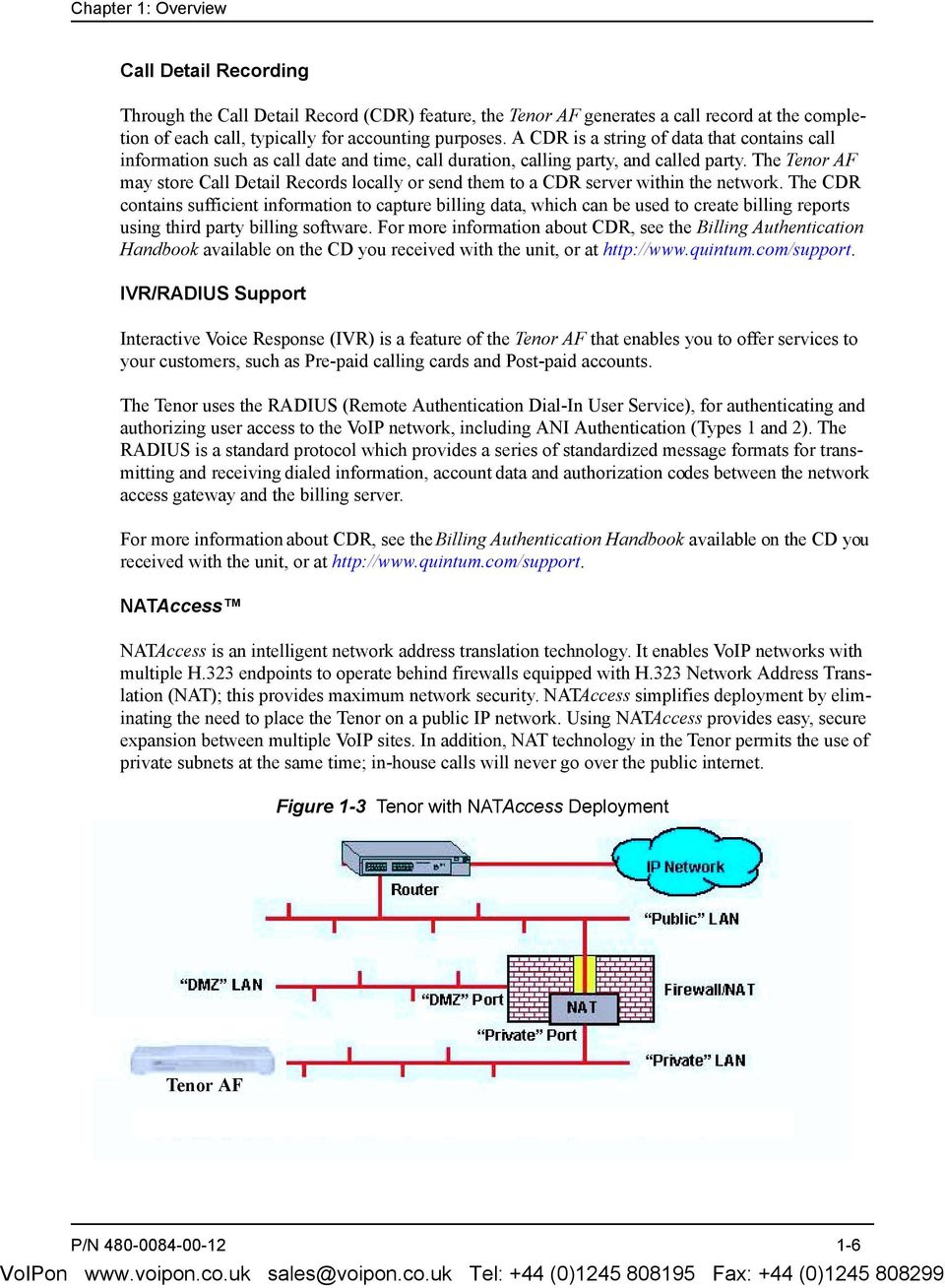
14 Chapter 1: Overview Call Detail Recording Through the Call Detail Record (CDR) feature, the Tenor AF generates a call record at the completion of each call, typically for accounting purposes. A CDR is a string of data that contains call information such as call date and time, call duration, calling party, and called party. The Tenor AF may store Call Detail Records locally or send them to a CDR server within the network. The CDR contains sufficient information to capture billing data, which can be used to create billing reports using third party billing software. For more information about CDR, see the Billing Authentication Handbook available on the CD you received with the unit, or at IVR/RADIUS Support Interactive Voice Response (IVR) is a feature of the Tenor AF that enables you to offer services to your customers, such as Pre-paid calling cards and Post-paid accounts. The Tenor uses the RADIUS (Remote Authentication Dial-In User Service), for authenticating and authorizing user access to the VoIP network, including ANI Authentication (Types 1 and 2). The RADIUS is a standard protocol which provides a series of standardized message formats for transmitting and receiving dialed information, account data and authorization codes between the network access gateway and the billing server. For more information about CDR, see the Billing Authentication Handbook available on the CD you received with the unit, or at NATAccess NATAccess is an intelligent network address translation technology. It enables VoIP networks with multiple H.323 endpoints to operate behind firewalls equipped with H.323 Network Address Translation (NAT); this provides maximum network security. NATAccess simplifies deployment by eliminating the need to place the Tenor on a public IP network. Using NATAccess provides easy, secure expansion between multiple VoIP sites. In addition, NAT technology in the Tenor permits the use of private subnets at the same time; in-house calls will never go over the public internet. Figure 1-3 Tenor with NATAccess Deployment Tenor AF P/N
15 Chapter 1: Overview Dynamic Call Routing The Tenor AF s intelligent call routing capabilities are state-of-the-art. The unit automatically detects and supports three call types: voice, fax, and modem. The Tenor will first identify the call origination site Line/FXO or Phone/FXS and then route the call according to the parameters you have configured in the routing database. P/N

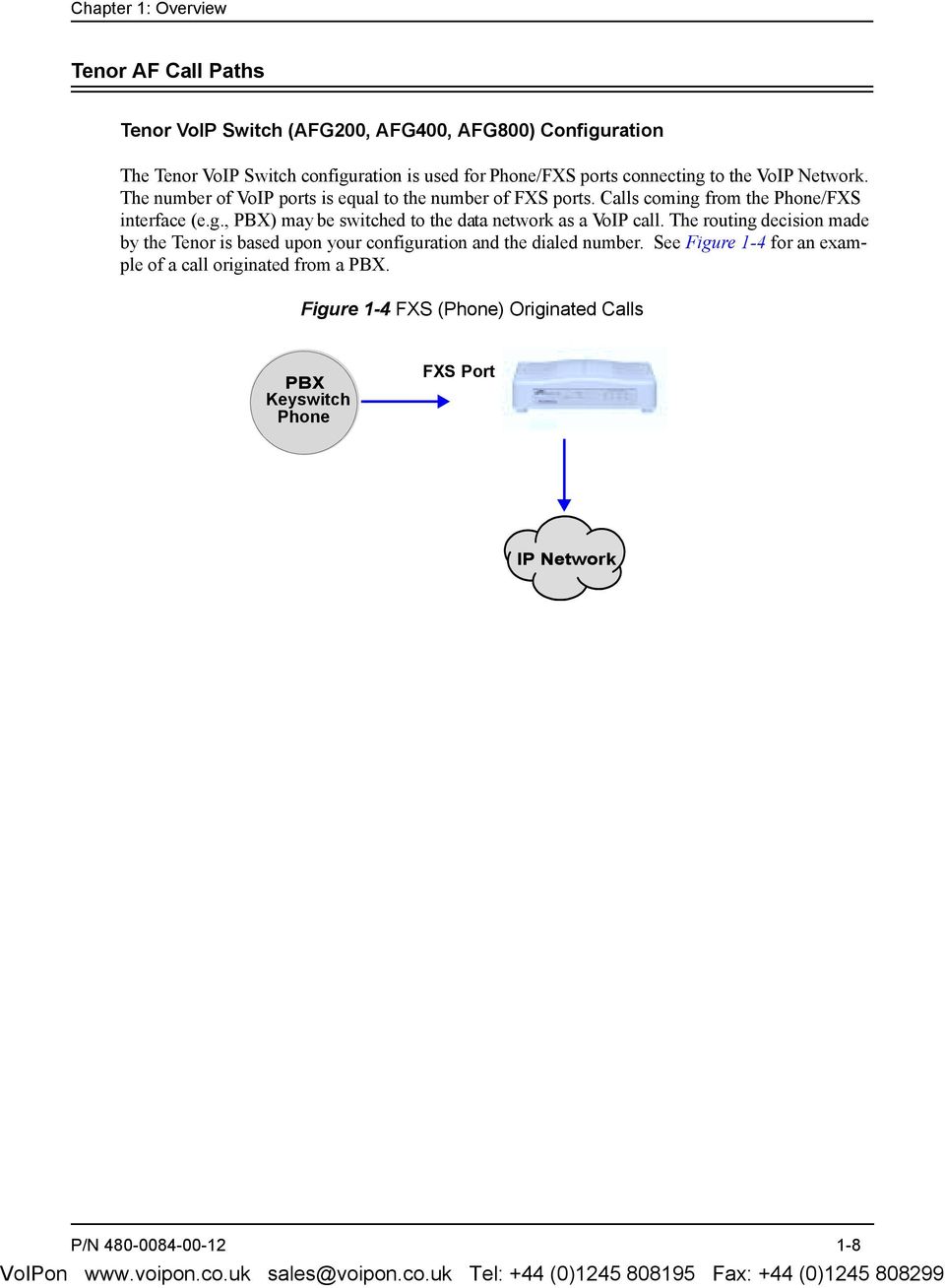
16 Chapter 1: Overview Tenor AF Call Paths Tenor VoIP Switch (AFG200, AFG400, AFG800) Configuration The Tenor VoIP Switch configuration is used for Phone/FXS ports connecting to the VoIP Network. The number of VoIP ports is equal to the number of FXS ports. Calls coming from the Phone/FXS interface (e.g., PBX) may be switched to the data network as a VoIP call. The routing decision made by the Tenor is based upon your configuration and the dialed number. See Figure 1-4 for an example of a call originated from a PBX. Figure 1-4 FXS (Phone) Originated Calls PBX Keyswitch Phone FXS Port IP Network P/N
17 Chapter 1: Overview Tenor VoIP Switch (AFT200, AFT400, AFT800) Configuration The Tenor VoIP Switch configuration is used for trunk side PSTN (Line/FXO port) to VoIP connections. Calls coming from the Line/FXO interface (i.e., PSTN) may be switched to the data network as a VoIP call. See Figure 1-5 for an example of a call originating from the PSTN. Figure 1-5 FXO (Line) Originated Calls FXO Port PSTN IP Network Tenor VoIP Switch (Tenor AFM200, AFM400) The Tenor MultiPath Switch Configuration is symmetrical with an equal number of Phone/FXS and Line/FXO ports. Calls are routed from the Phone/FXS, Line/FXO, or IP Network. Calls can be routed in any direction between any of the ports. FXS (Phone) Originated Calls. Calls coming from the Phone/FXS interface (i.e. PBX) may be switched to either the data network as a VoIP call or to the FXO interface, typically for connection to another circuit switched network such as the PSTN. The routing decision made by the Tenor is based upon your configuration and the dialed number. See Figure 1-6 for an example of a call originated from a PBX. Figure 1-6 FXS (Phone) Originated Calls PBX Keyswitch Phone FXS Port FXO Port PSTN OR IP Network P/N

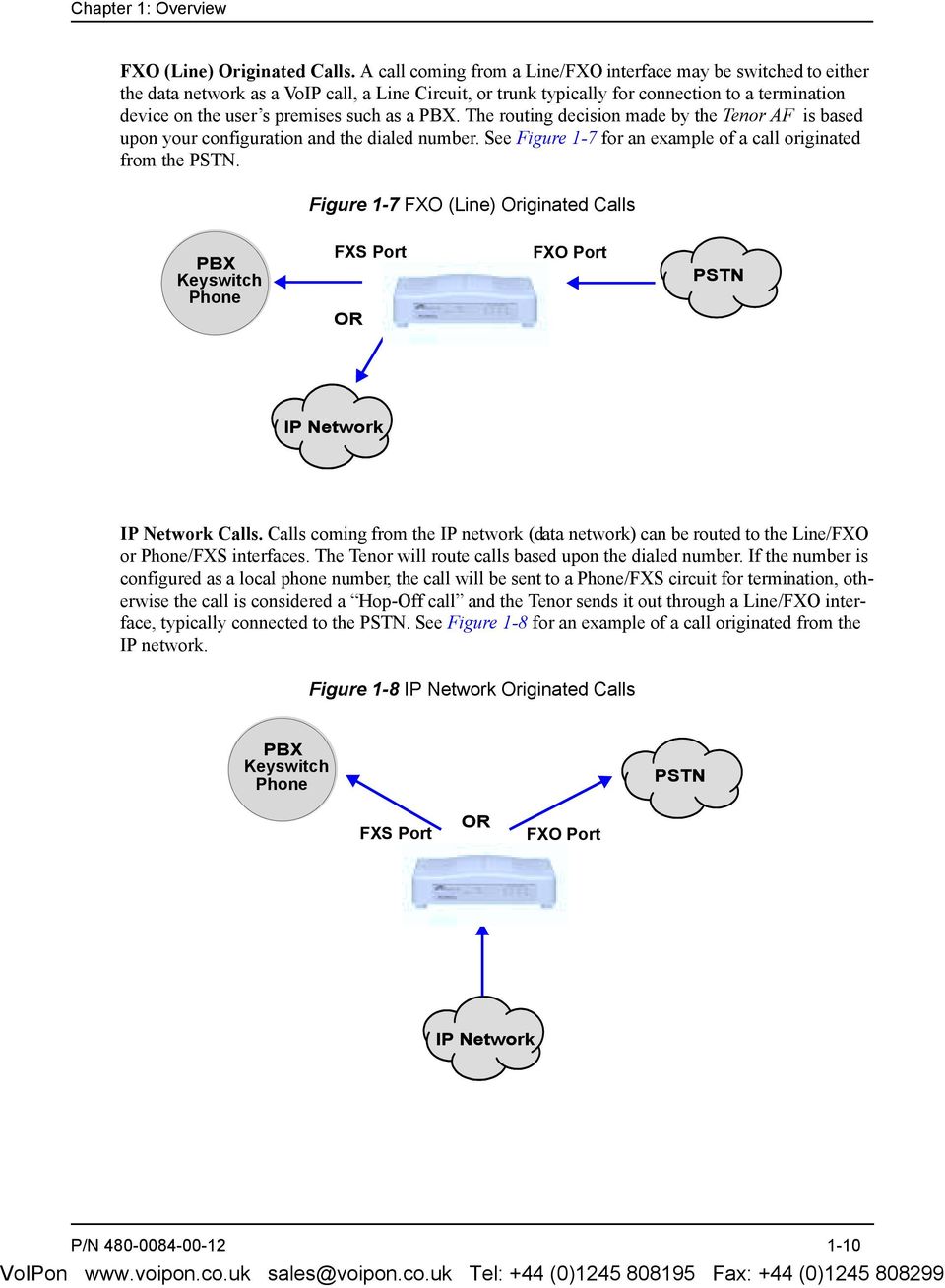
18 Chapter 1: Overview FXO (Line) Originated Calls. A call coming from a Line/FXO interface may be switched to either the data network as a VoIP call, a Line Circuit, or trunk typically for connection to a termination device on the user s premises such as a PBX. The routing decision made by the Tenor AF is based upon your configuration and the dialed number. See Figure 1-7 for an example of a call originated from the PSTN. Figure 1-7 FXO (Line) Originated Calls PBX Keyswitch Phone FXS Port OR FXO Port PSTN IP Network IP Network Calls. Calls coming from the IP network (data network) can be routed to the Line/FXO or Phone/FXS interfaces. The Tenor will route calls based upon the dialed number. If the number is configured as a local phone number, the call will be sent to a Phone/FXS circuit for termination, otherwise the call is considered a Hop-Off call and the Tenor sends it out through a Line/FXO interface, typically connected to the PSTN. See Figure 1-8 for an example of a call originated from the IP network. Figure 1-8 IP Network Originated Calls PBX Keyswitch Phone PSTN FXS Port OR FXO Port IP Network P/N
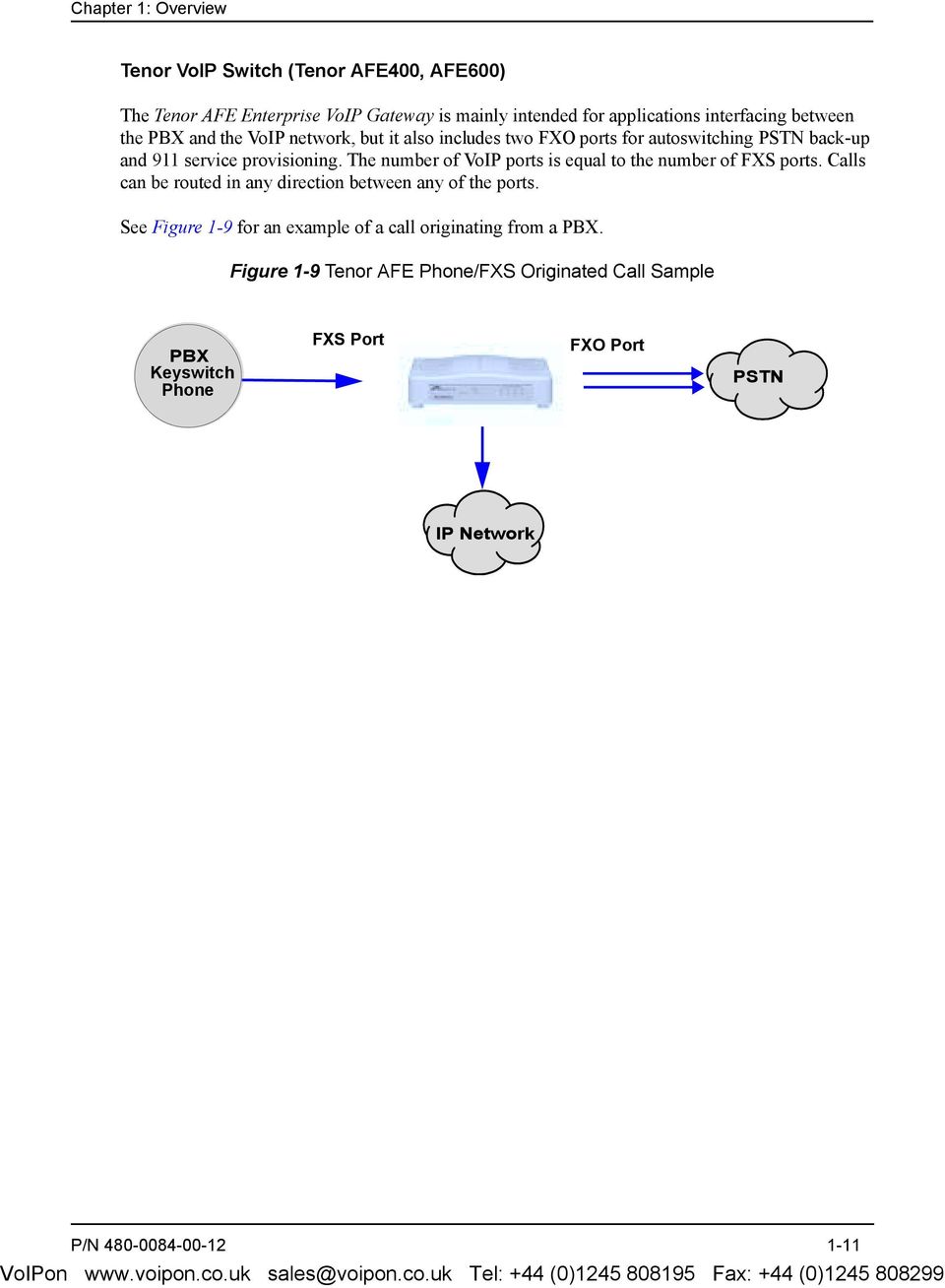
19 Chapter 1: Overview Tenor VoIP Switch (Tenor AFE400, AFE600) The Tenor AFE Enterprise VoIP Gateway is mainly intended for applications interfacing between the PBX and the VoIP network, but it also includes two FXO ports for autoswitching PSTN back-up and 911 service provisioning. The number of VoIP ports is equal to the number of FXS ports. Calls can be routed in any direction between any of the ports. See Figure 1-9 for an example of a call originating from a PBX. Figure 1-9 Tenor AFE Phone/FXS Originated Call Sample PBX Keyswitch Phone FXS Port FXO Port PSTN IP Network P/N
20 Chapter 1: Overview Advanced Features/Capabilities Call Management There are four types of routing databases you can configure: Bypass Directory Numbers (BPN), Hunt Local Directory Numbers (Hunt LDN), Hop-Off Directory Numbers (HDN) and Static Routes. Hunt Local Directory Numbers. A Hunt group is a group of configured phone numbers (Hunt Local Directory Numbers, or HLDNs) assigned to a group of ports. An incoming call with a matching destination DN causes the Tenor to hunt for a port that is not in use. Hop-Off Directory Number. A Hop-off PBX call travels over IP, and then hops off into the public network (PSTN) on the destination side to reduce or eliminate public toll charges (also known as Leaky Area Map call). A Hop-Off Directory Number is routed over the IP to another Tenor location and then out to the Trunk circuit, possibly to the PSTN as a local call (although it does not have to be local). Static Routes. Static Routes are used between networks and other H.323 devices that are not registered to the network through the Border Element (such as non-quintum gateways). A static route associates endpoints (as represented by their IP address) with Directory Number patterns. Dial Plan Options Public/Private Dial Plan Support.The Tenor AF supports public and private dial plans. A public dial plan includes numbers which conform to the international dialing plan (E.164) of a country code + city/area code + local number. For a public dial plan, you can define the numbering plan structure for the Tenor AF to use for outgoing calls. A private dial plan does not conform to a public dialing plan (e.g., 3 digit dialing plan); through the Tenor AF you are able to configure the unique pattern/dialing plan structure, including number length. You are able to configure which dial plan to use for incoming and outgoing calls, including whether other options such as hop-off calls, will use a public or private dial plan. User Programmable Dial Plan Support. The User Programmable Dial Plan Support (UPDP) enables the Tenor to route calls based on the UPDP rules, which are completely customizable sets of digit sequences, such as Local, National, International, or Private Numbers. PassThrough support for certain call types. Certain call types can be directly routed to a trunk circuit, without using the IP. There are several routing tables you can configure via the Tenor Configuration Manager to determine how the Tenor AF unit routes these types of pass through numbers. For example, you may want to configure 911 as a bypass number, which means that all 911 calls coming into Tenor AF from a telephone or PBX will be routed directly to a Trunk circuit presumably connected to a PSTN. Bypass calls are never routed over IP. Hop-off PBX Calls. Hop-off numbers are phone number patterns for calls to be routed out to the PSTN. (A hop-off PBX call is usually a toll call which passes through a network to reduce or elimi- P/N

21 Chapter 1: Overview nate the toll charge.) They are entered in a Hop-off Number Directory and associated with trunks where matching calls should be sent. Tenor AF supports those hop-off PBX calls where the destination Tenor AF is programmed to route the call to the PSTN. The destination Tenor AF unit is configured with the phone numbers to be supported for this feature. H.323 Gatekeeper Services The Tenor AF unit s built-in H.323 gatekeeper performs IP call routing functions, such as call control and administrative services to another Tenor AF unit, or another H.323 endpoint. The gatekeeper s functionality complies with the H.323 industry specifications for voice control and management. Gatekeeper. A Gatekeeper in an H.323 network provides call control services and other services to H.323 endpoints (i.e., gateways, terminals, and MCUs). The Tenor AF has a built-in H.323 gatekeeper which complies to the H.323 industry specifications for voice control and management. The gatekeeper performs call routing functions for calls entering and exiting a site. The Gatekeeper performs IP call routing functions, such as Call Control Signaling and Call Authorization for Gateways, IP phones, and H.323 terminals. The Gatekeeper communicates with other Gatekeepers through a Border Element. When using a group of Tenor AF units, you can assign one unit as the Gatekeeper for the network. We recommend you configure each as its own gatekeeper. Tenor AF supports gatekeeper to gatekeeper communication using the standard LRQ (Location Request)/LCF (Location Confirm) messaging scheme. Zone Management. A zone is a group of H.323 defined endpoints controlled by a Gatekeeper. Endpoints can be gateways (i.e., Tenor AF), terminals, and/or multipoint conferencing units (MCUs). Endpoints establish control channels with a gatekeeper for registration, admission, and security. Call routing information about the endpoint is sent to the gatekeeper, including: IP address, unit type (gateway, terminal, or MCU) and routing information (such as phone numbers, number patterns, etc.). A collection of zones is an administrative domain. An administrative domain provides call routing services for its zones through gatekeeper to gatekeeper messages or gatekeeper to border element messages (see below for more information). Call Registration. When registration from an H.323 endpoint is complete and a call is originated, the call request is sent to the gatekeeper. The call request provides the Gatekeeper with the dialed number and requests the routing information. The gatekeeper confirms the dialed number and supplies the endpoint with the destination IP address. For example, a Tenor AF s gatekeeper will act as the gatekeeper for that zone and all of the other endpoints will register with it. Border Element. The Tenor AF s gatekeeper uses a border element to gain access to the routing database of the administrative domain for the purpose of call completion or any other services that involve communications with other endpoints out of the administrative domain. The border element functionality is built into the Tenor AF unit, along with the gateway and gatekeeper. P/N
22 Chapter 1: Overview The primary function of the border element is to collect, manage, and distribute call routing information. A gatekeeper will establish a service relationship with a border element; through the border element, gatekeepers from multiple zones will be able to communicate. A border element also establishes relationships with other border elements to route between administrative domains. If a gatekeeper cannot resolve an address, it contacts the border element. In addition, if you are using more than one Tenor unit, you can configure one of the border elements for that zone. The Tenor AF unit can use two border elements: primary and secondary. These work together to provide redundancy and fault tolerance. Call Services. Gatekeepers provide services such as addressing, authorization and authentication of terminals and gateways, bandwidth management, accounting, billing, and charging. Gatekeepers also provide call-routing services. Specifically, the Tenor AF Gatekeeper provides the functions which follow: Address Translation. The gatekeeper translates telephone numbers into IP addresses and vice versa. It performs Alias Address (phone number) to Transport Address (IP address) translation when an endpoint requests service. The Gatekeeper uses a translation table to translate an Alias Address (an address such as an H.323 identifier that a user may not understand) to a transport address. The translation table is updated using Registration messages. Autodiscovery. The gatekeeper is discovered in one of the following ways: An endpoint sends an IP broadcast called a Gatekeeper Request message (GRQ) message (which includes that correct gatekeeper name) to discover a Gatekeeper OR the endpoint will discover a gatekeeper by its IP address. Routing. The gatekeeper identifies the IP address of endpoints in its administrative domain. The gatekeeper builds a routing database from information obtained from the border element and also from gateways and H.323 endpoints. Admissions Control. All H.323 endpoints must register and request permission to enter the gatekeeper s zone; the gatekeeper will confirm or deny access to the network. The gatekeeper authorizes network access and protects the integrity of the network using Admission Request (ARQ), Admission Confirmation (ACF) and Admission Reject (ARJ) messages. SIP User Agent SIP (Session Initiation Protocol) is a signaling protocol used to establish a session on an IP network for voice control and management; it is a request-response protocol that closely resembles Hypertext Transfer Protocol (HTTP), which forms the basis of the World Wide Web. SIP re-uses many of the constructs and concepts of Internet protocols such as HTTP and Simple Mail Transfer Protocol (SMTP). The purpose of SIP is only to establish/change/terminate sessions. SIP is not concerned with the content or details of the session. SIP is Transport layer-independent, which means it can be used with any transport protocol: UDP, TCP, ATM, etc. It is text-based, so it requires no encoding/decoding like H.323. SIP also supports user mobility, using proxies and redirecting requests to your current location. When configured for SIP, the Tenor will act as a SIP User Agent (Endpoint) as defined in IETF RFC3261. Multiple user agents allow for separate agents to be allocated to each SIP call. It will be P/N
23 Chapter 1: Overview able to gateway calls to and from the IP network, and Customer Premise Equipment (CPE) such as phones, PBX's, and FAX machines, or the Public Switched Telephone Network (PSTN). The Tenor SIP User Agent will work in conjunction with an external SIP proxy or redirect server to route and connect calls over SIP based networks. P/N
24 Chapter 2: Hardware Components This chapter tells you what is contained in your hardware package. A description of each component is also included. Specifically, the following topics are covered:! Hardware Description! Cables! Specifications P/N
25 Chapter 2: Hardware Components Hardware Description The Tenor AF is a stackable device which provides Phone/FXS and Line/FXO connections as well as connections to the Ethernet LAN and a PC. The unit s front panel includes LEDs; the back panel includes connection jacks, a diagnostics button, and a power adapter jack. Front Panel LEDs Figure 2-1 Tenor AF Front Panel Status LED LAN LED Analog Ports LED The LEDs display the health of the system. There are different types of LEDs: Status, LAN and Analog Port. A description of each is listed in Table 2-1. Table 2-1 Front Panel LEDs Definitions LED Label LED Color Description Status Status Green O perational Status. On: Unit is powered up. Off: No power. Link Green On: Ethernet link is up. Off: Ethernet link is down. LAN Activity Green Flashing: Activity (i.e, transmit, receive) on the line. Off: No activity on the line. P/N
26 Chapter 2: Hardware Components LED Label LED Color Description Analog Ports 1, 2 3, Green On: Indicates the Line/FXO or Phone/FXS port is in use. Off: Indicates the Line/FXO or Phone/FXS port is not in use. Back Panel Figure 2-2 Tenor AF Back Panel DIAG Power Adapter jack CONSOLE port LAN port Power Adapter jack. Connection port to external power supply. DIAG. Enables you to perform software diagnostic procedures. Port Label (varies by product according to product configuration) CONSOLE port. This RS-232 connector is used for connection to a PC s serial port via a DB- 9 serial cable at bps 8 N 1, no flow control. The input/output signals are listed in Table 2-2. Figure 2-3 DB-9 Female Connector Pin Order P/N
27 Chapter 2: Hardware Components Table 2-2 Serial RS232 DB-9 Connector Pinouts Pin # Function Description 1 DTR Data Terminal Ready 2 TXD Transmit Data 3 RXD Receive Data 4 CD Carrier Detect 5 GND Signal Ground 6 N.C. No Connect 7 N.C. No Connect 8 N.C. No Connect 9 N.C. No Connect LAN port. 10/100 Base-T Ethernet port. This port provides an RJ-45 jack for an individual connection to a 10/100 Ethernet LAN switch or hub via RJ-45 cable; the interface is individually configured with a unique IP and MAC address. Figure /100 BASE-T Ethernet Port Pin Order Table 2-3 Input/Output 10/100 Ethernet port Pin # Signal Definition Color 1 TX + Transmit Data White w/orange 2 TX - Transmit Data Orange 3 RX + Receive Data White w/green 4 RSVD Reserved Blue 5 RSVD Reserved White w/blue 6 RX - Receive Data Green 7 RSVD Reserved White w/brown 8 RSVD Reserved Brown P/N
28 Chapter 2: Hardware Components Port Label (Phone/FXS or Line/FXO ports). For Phone/FXS, provides an RJ-11 jack for connection to a PBX, Keyphone or analog phone. For Line/FXO, enables connection to another piece of equipment that houses your telephone lines running to the PSTN, such as the patch panel. Figure 2-5 RJ-11 Phone/FXS or Line/FXO Port Pin Order Table 2-4 Input/Output RJ-11 Phone Pin # Definition 1 No Connect 2 No Connect 3 Tip 4 Ring 5 No Connect 6 No Connect Port Labels. Each Phone/FXS or Line/FXO port is labeled according to the product configuration. Label example shown for AFT800. See below for label information according to product configuration. Figure 2-6 Label according to Product configuration Product Label Text Label Color Position on Unit AFG200 Phone/FXS Silver with Blue Text Beneath ports 1-2 AFG400 Phone/FXS Silver with Blue Text Beneath ports 1-2 & 3-4 AFG800 Phone/FXS Silver with Blue Text Beneath all ports AFT200 Line/FXO Silver with Blue Text Beneath ports 1-2 P/N
29 Chapter 2: Hardware Components Product Label Text Label Color Position on Unit AFT400 Line/FXO Silver with Blue Text Beneath ports 1-2 & 3-4 AFT800 Line/FXO Silver with Blue Text Beneath all ports AFM200 AFM400 AFE400 Phone/FXS Silver with Blue Text Beneath ports 1-2 Line/FXO Silver with Blue Text Beneath ports 5-6 Phone/FXS Silver with Blue Text Beneath ports 1-2 & 3-4 Line/FXO Silver with Blue Text Beneath ports 5-6 & 7-8 Phone/FXS Silver with Blue Text Beneath ports 3-4 Line/FXO Silver with Red Text Beneath ports 1-2 & 5-6 AFE600 Phone/FXS Silver with Red Text Beneath ports 1-2 Silver with Blue Text Beneath ports 3-4 Silver with Blue Text Beneath ports 7-8 Line/FXO Silver with Red Text Beneath ports 5-6 Online/Offline Mode - AFE400/AFE600 only If the FXS has a matching FXO port, the FXS will have online/offline capability. If the FXS goes offline, it will automatically connect to the corresponding port shown in Figure 2-7. For detailed information about online/offline capability, see the Command Reference Guide available at Figure 2-7 Online/Offline Capability AFE400 Ports FXS FXS FXO AFE600 Ports FXS FXS FXO FXS P/N
30 Chapter 2: Hardware Components Cables The cables listed in Table 2-5 are required to connect a Tenor AF to various interfaces. Contact Quintum for ordering information, if necessary. Table 2-5 Cables Supported Cable Usage RJ-11 to RJ-11 Cable RJ-11 to RJ-11 Cable Connection to FXO/Line. Connection to FXS/Phone. RJ-45 Ethernet cable Connection to Ethernet LAN 10/100 DB-9 Serial RS-232 Connection to PC s asynchronous console port. RJ-11 Cables An RJ-11 to RJ-11 cable is used to connect the Tenor AF to an FXO or FXS external device. The RJ- 11 cable connector pinouts are given in this section to help you identify the proper connector to accommodate your specific networking requirements. The pin order is shown in Figure 2-8. Figure 2-8 RJ-11 Pin Order 6 Top View Figure 2-9 RJ-11 Connector Pinouts Pin # Connects to Pin # No Connect No Connect No Connect No Connect P/N
31 Chapter 2: Hardware Components RJ-45 Ethernet Cable (10/100) RJ-45 cable connector pinouts are given in this section to help you identify the proper connector to accommodate your specific networking requirements. The RJ-45 (ISO 8877) connector is the EIA/ TIA standard for Unshielded Twisted Pair (UTP) cable; the wiring color codes are UTP Standard Coloring. The pin order is shown in Figure An RJ-45 (10/100 Base-T) straight through shielded cable is used to connect Tenor AF to an Ethernet LAN. Cable pinouts are listed in Table 2-6. Color specifications are applicable to the RJ-45 cable provided. Figure 2-10 RJ-45 Pin Order Side View 8 1 Top View 1 8 Figure 2-11 RJ-45 (10/100BT) Connector Pinouts Pin # Connects to Pin # Table 2-6 RJ-45 (10/100BT) Connector Pinouts Pin # Signal Definition Color 1 TX + Transmit Data White w/orange 2 TX - Transmit Data Orange 3 RX + Receive Data White w/green 4 Unused Unused Blue 5 Unused Unused White w/blue 6 RX - Receive Data Green 7 Unused Unused White w/brown 8 Unused Unused Brown P/N
32 Chapter 2: Hardware Components DB-9 Serial RS-232 Cable The Serial RS pin cable with a DB-9 male connector (with RS-232 interface) is used to connect the Tenor AF to your PC s asynchronous serial port. The pin order for DB-9 male and female connectors are shown in Figure 2-12 and Figure Figure 2-12 DB-9 Male Connector Pin Order Figure 2-13 DB-9 Female Connector Pin Order Figure 2-14 DB-9 Connector Pinouts Pin # Connects to Pin # Table 2-7 DB-9 Connector Pinouts Pin # Function Description Pin # 1 DTR Data Terminal Ready 1 2 TXD Transmit Data 2 3 RXD Receive Data 3 4 CD Carrier Detect 4 5 GND Signal Ground 5 6 N.C. No Connect 6 7 N.C. No Connect 7 8 N.C. No Connect 8 9 N.C. No Connect 9 P/N
33 Chapter 2: Hardware Components Specifications Voice/Fax Call Routing: FXO/FXS Coding: A-law, mu-law Voice Algorithms: G.723.1A (5.3, 6.3 Kbps), G.726 (16, 24, 32, 40 Kbps), G.729A, G711 Fax Support: Group III at 2.4, 4.8, 7.2, 9.6, 12, 14.4 Kbps Automatic Call Detection:Voice/Modem/Fax PSTN/PBX Connections Interface: Analog, FXO Interface (PSTN side), FXS Interface (PBX side) Connector: RJ-11 Ringing Cadence: Adjustable, country-dependent Maximum Loop Current: 24 ma Ringer Equivalence Number:0-3 REN (FXO port) Ringing Frequency: Adjustable, country-dependent Ringing Voltage: 52v RMS (1000 feet of 24 AWG wire with 3 REN LOAD) LAN Connection LAN Support: Connection Type: Physical Depth: 7 Height: Width Weight: 10/100 Mbps Ethernet Autosensing of speed and mode (18.73 cm) 2 (5.1 cm) 8 1/4 (21 cm) 1.3 lbs (0.6 kg) Electrical Ethernet: S tandard 10/100 Base-T RJ-45 interface (IEEE 802.3) FXO/FXS: S tandard RJ-11 connectors Console Port: RS-232/DB-9 Female AC Power: Volts AC, 50/60 Hz, 22 Watts Environmental Operating Temperature: 40 to 104 F (5-40 C) Operating Humidity: 20% to 80% non-condensing Altitude: -200 to 10,000 feet, or -60 to 3,000 meters Storage Temperature: 14 to 140 F, or -10 to 60 C P/N
34 Chapter 3: Installation This chapter gives you installation instructions, as well as how to position the Tenor AF successfully within your network. Specifically, the following topics are covered:! Installation! Power up the System! Login Without PC s COM Port/Obtain IP Address from Ethernet! Login Through PC s COM Port P/N
35 Chapter 3: Installation Installation Before you begin the actual installation, review the pre-installation guidelines which follow and inspect the package contents. Pre-Installation Guidelines Do not make connections from the Tenor to your public phone lines during any kind of electrical storm. It is possible to receive a serious injury. Always use an anti-static wrist strap when handling the unit. Do not open the unit cover. Inside parts have hazardous voltages and are extremely sensitive to static. If the unit has been opened, your warranty is void. Do not connect equipment in wet locations and keep away from dusty areas. The area must not exceed the temperature and humidity guidelines outlined in Chapter 2: Hardware Components. Avoid exposing the unit to excessive vibrations. Inspect Package Contents Before you install the hardware, ensure the following components are included in your shipment: Tenor AF 1 - AC Power adapter/cord 1 - DB-9 RS-232 Serial Cable 1 - RJ-45 to RJ45 Cable RJ11 to RJ11 Cables (Qty depends on model ordered) Product Guide in CD format If a listed component is not included in your package, contact your customer service representative. Wall Mount (Optional) Pre-installation Guidelines Ensure the wall is level and stable. Do not attach the unit to a temporary wall. Ensure the wall mounting area is within cord distance of the power outlet. Required Materials 2 screws, #4 (diameter measure of inches, mm). Drill Measuring tape or ruler P/N
36 Chapter 3: Installation The Tenor AF has two wall-mount slots, which are located on the bottom of the unit. Attach the unit to the wall as follows: 1. Determine the wall area to mount the unit. With chalk or a soft pencil, mark the install area according to Figure 3-1. Figure 3-1 Wall Mounting Dimensions 4.6 ( mm) NOTE: Ensure the unit is level. 2. Drill two holes in the wall. Ensure the holes are 4.6 inches ( mm) apart. See Figure Insert a screw in each hole, leaving 0.25 inches (6.35 mm) out. (The screws are not included with the unit.) 4. Line up the wall-mount slots (located on the bottom of the unit) with the 2 screws. 5. Engage the wall-mount slots over the screws and slide the unit down until the screws fit snugly onto the slots. See Figure 3-2. P/N
37 Chapter 3: Installation Figure 3-2 Engage Wall Mount Slots over Screws in Wall 4.6 ( mm) Engage the wall mount slot over the screws inserted in the wall. Unit Bottom P/N
38 1 2 3 ABC DEF GHI JKL MNO PQRS TUV WXYZ 0 # OPER CISCO I P PHONE 7910 messages directories i services settings Chapter 3: Installation Connect to Phone/FXS Interface Since there are many different PBX devices, key systems, fax machines and phones you can connect to the Tenor AF, the instructions which follow explain the general procedure for connecting an RJ- 11 cable (included in your package) between the Phone/FXS port and an external device. Use the phone/fxs ports for on-premise wiring only. See Chapter 2: Hardware Components for the RJ-11 cable pinouts you can use to acquire another cable or adapter that may be required to connect to the specific external device. NOTE: This step is not applicable if you have a configuration of all Line/FXO ports. Figure 3-3 Connect to Phone/FXS Interface NOTE: For pictorial purposes, the Phone/FXS connection is made in Port 1 and Port 2. Connection to the remainder of the ports will look identical. RJ-11 RJ-11 * PBX Connect to Phone/FXS port as follows: CAUTION: Connect the Phone/FXS ports to a telephone, fax machine, PBX, or key system only. Connecting to other devices/networks (i.e., telephone wall jack) will cause damage to the unit. 1. Plug one end of the RJ-11 cable into one of the ports on the rear of the unit labeled Phone/FXS. See Chapter 2: Hardware Components for cable pinouts. 2. Insert the other end of the RJ-11 cable into the appropriate analog port on the PBX or key system, or into the jack on the back or underside of a phone or fax machine. For a PBX connection, see the PBX documentation port requirements for connection specifics. 3. Repeat for each RJ-11 port labeled Phone/FXS. P/N
39 Chapter 3: Installation Connect to Line/FXO Interface To connect to the Line/FXO port, you can first connect the analog phone lines to another piece of equipment that houses your telephone lines running to the PSTN, such as the patch panel. If you are unsure of the installation procedures, contact the network administrator or review the documentation you received with the PBX. See Chapter 2: Hardware Components for the RJ-11 cable pinouts you can use to acquire another cable or adapter that may be required to connect to the specific external device. Figure 3-4 Connect to Line/FXO Interface RJ-11 NOTE: For pictorial purposes, the Line/FXO connection is made in Port 1. Connection to the remainder of the ports will look identical. Patch Panel NOTE: If you are connecting to a punchdown block, we recommend you use solid conductor between size 22 AWG and 26 AWG, twisted pair cables. 1. Plug one end of the RJ-11 cable into one of the ports on the rear of the unit labeled Line/FXO. See Chapter 2: Hardware Components for cable pinouts if you are making your own cable. 2. Insert the other end of the RJ-11 cable to the patch panel (or other external device) which houses your telephone lines. 3. Repeat for each RJ-11 port labeled Line/FXO. P/N
40 Chapter 3: Installation Connect to Ethernet LAN You can use these instructions for general connection purposes only. The Ethernet hub/switch manufacturer s documentation should provide specific instructions for connection to another device, such as the Tenor AF. Figure 3-5 Connect to Ethernet Hub/Switch RJ-45 Ethernet Hub/Switch Data Network 1. Plug one end of the RJ-45 ethernet cable into the port labeled LAN. 2. Plug the other end of the cable into one of the Ethernet hub/switch ports. If a custom cable or adapter is required, see Chapter 2: Hardware Components for the Ethernet RJ-45 10/100 cable specifications. P/N
41 Chapter 3: Installation Connect to PC Console (if required, see Note) NOTE: This step is not required for installation unless you would like to connect to the PC s COM port to configure a Static IP address. You will need to connect the Tenor AF to your workstation s serial port through the RS-232 connection (This connection will be used when you assign an IP address to the unit). For the following instructions, it is assumed you are connecting to a Windows PC. Figure 3-6 Connect to PC Console (if required, see note) DB-9 Computer PC Workstation 1. Insert the male end of the DB-9 cable into the port labeled Console. 2. Insert the female end of the DB-9 cable into your workstation s serial port (see your PC documentation for more information about this port). P/N
42 Chapter 3: Installation Power up the System Once you have all cables connected properly, you are ready to turn the system on as follows: 1. Plug the Power adapter end into the port on the Tenor AF labeled 12VDC 1.8 A. 2. Connect the other end of the Power adapter to the Power cord. 3. Plug the Power cord into the wall outlet. Figure 3-7 Connect Power adapter Power adapter Power cord Wall Outlet The unit will power up and the Status LED will light up and remain lit. For information about the LEDs, see Chapter 2: Hardware Components. Login without the PC s COM port/obtain IP Address from Ethernet Factory defaults are the configuration elements set on the unit new from the factory. By default, when the Tenor is shipped from the factory, the ability to support DHCP (Dynamic Host Configuration Protocol) is enabled. That way, you can obtain an IP address upon bootup and log into the system, without needing the COM port. Through the LAN port on the Tenor AF, you can connect to a port on a router that is capable of providing DHCP. You can then look at the active lease table of the firewall to get an IP address. If there is no DHCP service available when you turn the unit on, the Tenor gets an IP address of xx.xx, where xx and yy are the last two bytes of the serial number (in decimal), which allows it to be connected to a PC with an IP on the same subnet. P/N
43 Chapter 3: Installation Login through the PC s COM port (if required, see note) NOTE: This step is only necessary if you wish to set a static IP address. If you do have a COM port on your PC, when you log into a unit through the COM port at bootup, you have the option either to restore factory defaults or to configure the static IP address in the Tenor. The instructions which follow are for configuring a static IP address. Connect through the COM port as follows: 1. Click on Start > Programs > Accessories > Communications > HyperTerminal. The Connection Description window is displayed. 2. Enter a connection name (i.e., name for the unit such as Tenor AF NJ). Click OK. 3. Choose the serial port on your PC from the Connect Using drop down list box (i.e., Direct to Com 1). Click OK. The COM1 Properties window is displayed. See Figure 3-8. Figure 3-8 COM1 Properties Window 4. Select the following information: Bits per Second: Data Bits: 8 Parity: None Stop bits: 1 P/N
44 Chapter 3: Installation Flow control: None 5. Click OK. 6. Power up the unit via Power up the System. A connection to the Tenor will establish. Information about the unit will scroll on the screen, followed by a message, "WITHIN 4 SECONDS, PRESS 'r' FOR FACTORY DEFAULTS or 'i' to SET STATIC IP". 7. Select 'i' - Set Static IP. The login prompt is displayed. The default user name/password is admin. The current IP address, Subnet Mask, and Default Gateway are displayed. A message asks you whether you would like to change these. 8. Type y. Follow the prompts to change the ethernet information. A message is displayed to tell you the Ethernet interface has been successfully configured and the unit will be restarted. (If you type n, the procedure will be cancelled). You have completed login configuration. P/N
45 Chapter 4: Diagnostics/Maintenance This chapter explains the advanced topics for diagnosing problems with the unit, viewing system alarms, and performing maintenance procedures, such as upgrading the software.! Common Symptoms/Problems! Monitor LEDs! Monitor Alarms! Verify Unit Provisioning! Perform Maintenance! Find Additional Help P/N
46 Chapter 4: Diagnostics/Maintenance Common Symptoms/Problems Before you begin troubleshooting a potential malfunction, it is a good idea to check your basic hardware connections. See below. Ensure the AC external power adapter is firmly installed in the back panel s power adapter port and the AC power cord is plugged into the power source. Verify that all RJ-45 to RJ-45, RJ-11 to RJ-11, and DB-9 cables fit snugly in each back panel jack. Faulty connections may cause a number of network interfacing or connection issues. If you suspect the problem to be on the network end, contact your Central Office to verify proper operation. Below is a list of common symptoms and problems you may encounter. Use this list as a guideline; if your problem is not listed, use the diagnostic procedure explained in the beginning of this chapter. Table 4-1 Common Symptoms/Problems Common Symptom/Problem Unit will not turn on. Communication between Tenor AF and the FXO or FXS cannot be established. Check AC power source. Description/Solution There are several reasons why communication may not be successful. A few of the most common are listed below. Verify correct RJ-11, RJ-45 and DB-9 cables are installed in the correct ports. Ensure the unit is on. Network issues may cause a number of problems. Contact the Central Office to perform test procedures. Verify that the unit is online. Communication with Command Line Interface (CLI) cannot be established using Telnet. The IP address of the Tenor AF unit may be incorrect. Check Ethernet Cable. Verify the IP address of Tenor AF. Check the Default Gateway Subnet Mask. These can be verified using an RS-232 connection via Console connection. Verify network connectivity using ping from another network host. P/N
47 Chapter 4: Diagnostics/Maintenance Common Symptom/Problem Communication with Ethernet Hub, or switch cannot be established. Communication between the computer s COM port and Tenor AF serial port cannot be established. Tenor AF cannot receive or transmit calls. Description/Solution Verify RJ-45 cable is firmly installed in the LAN port. Check MDI/MDIX configuration. Verify the mode setting on the Tenor AF matches the mode setting on the hub/switch. Check duplex setting on the switch in which they were connected and the speed of 10 Mb/ sec or 100 Mb/sec. Verify DB-9 cable is firmly placed in the unit s console port and your PC s serial port. Verify Terminal port settings are BPS 8N1 No Flow Control. Ensure FXO/FXS ports are working correctly. Generate alarm list for more information. Verify that your Ethernet connection is working. Use pin to verify. Verify that your VoIP configuration is set correctly. Use the Tenor Configuration Manager to view settings. Verify the settings under Analog-Interface Phone and Line are correct and associated correctly. Contact Central Office for interface issues. Tenor AF does not have dial tone. Verify the online command is enabled through either Command Line Interface (CLI) or the Configuration Manager. For specific information about this command, see the Command Reference Guide at or on the Documentation CD you received with the unit. P/N
48 Chapter 4: Diagnostics/Maintenance Monitor LEDs LEDs monitor the health of the system; they are the first signal that the unit is not working properly or that an internal or external error has occurred. LEDs appear on the front of the unit. See Chapter 2: Hardware Components to ensure the correct lighting of each LED. If the LEDs are not lighting at all, check the AC power source to ensure power is being supplied to the unit. Monitor Alarms Alarms are brief text messages that appear on your workstation when the Tenor AF unit encounters a problem, such as a failed interface, disconnected call, etc. Alarms help you identify where a specific problem is occurring with the Tenor AF unit. There are two ways to view alarms for the Tenor AF unit: through the Command Line Interface (CLI) or through the Tenor Monitor. The instructions in this section are for obtaining alarms through the CLI; see the Tenor Monitor Product Guide for information about obtaining alarms through the Tenor Monitor. How to Read Alarms The Alarm Manager reports alarms according to criteria such as the alarm s severity level, line number the alarm occurred on, channel number, etc. There are two alarm types displayed: Active Alarms and Alarm History. An Active Alarm list displays all the alarms still active on the system; these alarms have not been cleared or deleted. An Alarm History is a list of the last 100 alarms stored in the system since the last time you performed a delete operation. Definitions for generated alarm fields appear in Table 4-2. Table 4-2 Alarm Fields and Definitions Field Definition Valid Entry IP # Sequence # The unit s IP address (32 bit address). Internal number used to identify alarms. Example: , 02, 03, etc. P/N
49 Chapter 4: Diagnostics/Maintenance Field Definition Valid Entry Type (displays only if you generate an Alarm History) The type of alarm generated. ALR = Alarm. Exceptional condition which may be a critical, major, or minor condition which impacts the ability to make calls. An ALR is cleared when the abnormal condition is remedied. CLR = Clear. This indicates an alarm that has been cleared from the system. RPT = Report. Exceptional event which indicates a problem, but which is never cleared (i.e., it is a transitory event). Severity Level or alarm severity. 1 = Critical (complete system is affected). 2 = Major (major problem is detected). 3 = Minor (minor problem is detected). 4 = Info (Information about a minor problem). Description Slot # Device # Analog Interface Channel # A text description of the alarm; see Table 4-3 for detailed description. Defines which slot the alarm occurred on. Defines which device the alarm occurred on. Defines which interface (line) the alarm occurred on. Specifies which channel the alarm occurred on. Varies. Slot 1 or 2. Slot 1 refers to the system controller functions. Slot 2 refers to DSP functions. Always device 0. 1 = PBX 2 = PSTN Channel the alarm occurred on. P/N
50 Chapter 4: Diagnostics/Maintenance Field Definition Valid Entry Date/Time Date/time the event occurred on. Day of week: name of day. Month: Jan, Feb, March, etc. Day of month: 1 or 2 digits. Time: 6 digits (hour minutes seconds based on a 24-hour clock). Year: 4 digits. P/N
51 Chapter 4: Diagnostics/Maintenance Valid Alarms The following is a list of all alarm descriptions (text that appears in the Alarm Description field) for all possible alarms the system can generate. In the generated alarm list, the alarm description appears as part of the Description field. Table 4-3 List of Valid Alarms Severity (appears as part of severity field) Alarm Description (text appears in desc field) Definition Critical Loss of signal A loss of signal (32 consecutive zeros) at least once during a one second period. Critical Ethernet Disconnected Ethernet cable has been disconnected from the unit, or Ethernet connectivity has been lost. No new VoIP calls will be made and existing calls will be switched to the PSTN. Critical Call Handler not registered with Gatekeeper The Call Handler process cannot be registered with the Gatekeeper. Critical Critical Software Error A software error has occurred that affects the operability of the complete system. Critical Tenor AF Chassis reset The chassis has reset. Critical Configuration Data Missing Configuration is missing. Check the configuration data and add the necessary information. Critical IVR Configuration Missing Appears if an attempt to make an IVR call has been made when a valid IP address is not configured. Occurs if an IVR call has been passed through accidently, without a real intention to use IVR for subsequent calls, while both of the servers were disabled. In order to clear the alarm, you will have to change one of the IP addresses to some value, and then disable it again. Critical RADIUS Configuration Missing Appears when a RADIUS request is made, and one or more required configuration parameters are missing. This alarm is cleared when the required RADIUS parameters are configured via CLI. P/N
52 Chapter 4: Diagnostics/Maintenance Severity (appears as part of severity field) Alarm Description (text appears in desc field) Definition Critical RADIUS Server Not Responding Appears when none of the configured RADIUS servers respond. This alarm is cleared when any of the RADIUS servers responds or the RADIUS server is disabled via CLI. Major Major Software Error A software error has occurred that affects system signaling, interfaces, or other major operation. Major File Missing in the File Server This alarm will be reported to the system when a particular voice prompt file is not found in the IVR Prompt Server. This alarm applies only to the system with enabled IVR functionality. Major Switch to other RADIUS server Appears when the current RADIUS server stops responding after three consecutive calls end in timeouts and another RADIUS server is configured. The Tenor will then switch to the next RADIUS server. Major Border Element connection lost. Indicates that the Gatekeeper lost connection with the Border Element. This is cleared if the connection is re-established. Minor Call Event(s) Lost A call has failed. Minor Missing or Incorrect Profile The configuration profile has caused a problem. Minor Minor Software Error A software error has occurred but will not affect the operation of the complete system. Minor Remote end did not back off in a glare situation An incoming and outgoing call went through at the same time, and the remote end call did not back off. Minor Unit resource constrained A shared resource in the unit loads the system. Minor Hardware component failed A hardware component has failed. Check all components, hardware connections, etc. P/N
53 Chapter 4: Diagnostics/Maintenance Severity (appears as part of severity field) Alarm Description (text appears in desc field) Definition Minor Log RADIUS server error Displayed when the RADIUS server fails to send required data or the data sent by the RADIUS server has improper values. Incorrect information may contain the following: Display all Alarms You are able to display both active alarms and an alarm history as follows: 1. Through CLI, access the Monitor prompt. 2. Type alarm. Both active alarms and the alarm history will be displayed. See section How to Read Alarms for field definitions. Figure 4-1 Alarm sample RADIUS Server: Credit amount (-1) RADIUS Server: Credit minus amount RADIUS Server: Not supported currency RADIUS Server: Credit time (-1) RADIUS Server: Credit time < 6 sec RADIUS Server: Invalid error code Informational Gatekeeper status Reports the status of the Gatekeeper. Informational Miscellaneous information Miscellaneous information about the unit is reported. The contents of this alarm will vary. Informational Info Software Error Indicates information about a miscellaneous software error. This does not affect system operation. Informational Glare occurred An incoming and outgoing call went through at the same time, and the remote end call did not back off, but the situation was corrected. IP# Sequence#Type#Severity# Desc# Slot# Device# Analog Interface# Channel# Date/Time :944:ALR:3:Border Element connection lost:0:0:0:0:tue OCT 14 14:05: :946:RPT:4:Gatekeeper status (Gatekeeper( ) removed):0:0:0:0:tue OCT 14 14:05: P/N
54 Chapter 4: Diagnostics/Maintenance Display Active Alarms You are able to display all active alarms as follows: 1. Through CLI, access the Monitor prompt. 2. Type alarm a. The active alarms will be listed. See section How to Read Alarms for field definitions. If you enter alarm without a command following it, both active alarms and the alarm history will be displayed. Figure 4-2 Active Alarm Sample IP# Sequence#Type#Severity# Desc# Slot# Device#Analog Interface# Channel# Date/Time :944:ALR:3:Border Element connection lost:0:0:0:0:tue OCT 14 14:05: Display Alarm History 1. Through CLI, access the Monitor prompt. 2. Type alarm h. An alarm history will be displayed. See section How to Read Alarms for field definitions. If you enter alarm without a command following it, both active alarms and the alarm history will be displayed. Figure 4-3 Alarm History Sample IP# Sequence#Type#Severity# Desc# Slot# Device# Analog Interface# Channel# Date/Time :944:ALR:3:Border Element connection lost:0:0:0:0:tue OCT 14 14:05: :945:RPT:4:Gatekeeper status (Gatekeeper( ) removed):0:0:0:0:tue OCT 14 14:05: :946:RPT:4:Gatekeeper status (Gatekeeper( ) removed):0:0:0:0:tue OCT 14 14:05: P/N
55 Chapter 4: Diagnostics/Maintenance Verify Unit Provisioning An error with provisioning the Tenor AF may cause a number of problems. It may be a simple error, such as an incorrect IP address or telephone number. See the Command Line Interface (CLI) guide or the Tenor Configuration Manager Product Guide for configuration information. Perform Maintenance The following are advanced maintenance procedures you can do through the Command Line Interface (CLI) or through the Tenor Configuration Manager. See the applicable user documentation you received with the unit for detailed information. Restore Factory Defaults (including password) Before the unit is shipped, it is set to a default factory configuration. There are several ways to restore factory defaults to the system: through the Command Line Interface (CLI), through the Configuration Manager, or through the COM port. Command Line Interface 1. Access config and type setfactory. A message will display asking whether you are sure you want to set to factory defaults. 2. Type yes. The unit is set back to factory defaults, including the password (the default password is admin). Configuration Manager 1. Access and log into the Tenor Configuration Manager. For more information on this step, see the Tenor Configuration Manager Product Guide, available on the CD ROM you received with the unit or from 2. From the main tool bar menu, select Tools > Set Factory. The Confirm Set Factory dialog box is displayed. 3. Click Yes. Your unit s configuration, including the password, is reset to factory defaults. A message appears when the unit has finished being set to defaults. A dialog box tells you the unit must be reset. 4. Click OK to reset the unit. P/N
56 Chapter 4: Diagnostics/Maintenance PC s COM port You are able to change the unit back to factory defaults, including the password, after initial configuration. 1. Click on Start> Programs> Accessories> Communications> HyperTerminal. The Connection Description window is displayed. 2. Enter a connection name (i.e., name for the unit such as Tenor AF NJ). Click OK. 3. Choose the serial port on your PC from the Connect Using drop down list box (i.e., Direct to COM 1). Click OK. The COM1 Properties window is displayed. 4. Select the following information: Bits per Second: Data Bits: 8 Parity: None Stop bits: 1 Flow control: None 5. Reset the unit. Information about the unit will scroll on the screen, followed by a message, WITHIN 4 SECONDS, PRESS r FOR FACTORY DEFAULTS or i to SET STATIC IP. 6. Type r. A message asks you to confirm the factory default. 7. Type y. The configuration sets to factory defaults and the IP address related information will remain unchanged. The login prompt is displayed. The default user name and password is admin. Reset System The Reset system feature enables you to reset the system, including hardware and software. You can reset through the Command Line Interface (CLI) as follows: 1. Access the CLI through a Telnet session. See the Command Line Interface (CLI) guide for more information. 2. Access the Maintain-MasterChassis-1# prompt. 3. Type reset. You will be asked if you want to set the unit back to factory defaults. 4. Type yes to confirm (type no to cancel the restore). The system resets. P/N
57 Chapter 4: Diagnostics/Maintenance Change Password For security purposes, you may want to change the password. You can change the password through the Command Line Interface (CLI) as follows: 1. Access the CLI through a Telnet session. See the Command Line Interface (CLI) guide for more information. 2. Access the Maintain# module. 3. Type password. A prompt will ask you for the old password. 4. Type the old password and press Enter. A prompt will ask you for the new password. Type the new password and press Enter. A confirmation will ask you to confirm the new password. 5. Re-type the new password and press Enter. A message will tell you the password was changed successfully. Change Unit Date and Time If the Tenor is reset, the time will be set back to default. You can change the unit s date and time via Command Line Interface (CLI) as follows: 1. Access the CLI through a Telnet session. See the Command Line Interface (CLI) guide for more information. 2. Access the Config# module. 3. Type date followed by mm/dd/yy/hh:mm:ss and press Enter. 4. For example, type config# date 06/14/05/22:14:00. This command will set the current time to June 14, 2005 at 10:14 p.m. P/N
58 Chapter 4: Diagnostics/Maintenance If you need Additional Help If you suspect the problem to be on the network end, contact your Central Office to verify proper operation. After completing all troubleshooting/maintenance procedures and reviewing the Common Symptoms/Problems section, you can contact the Technical Support Department at the following: Quintum Technologies, Inc. 71 James Way Eatontown, NJ For domestic calls: (877) For international calls: (732) P/N
59 GLOSSARY A Alarm. A brief message that appears on your screen when the Tenor AF encounters a problem (i.e., failed interface). Alarms can be viewed through CLI (see Command Line Interface), a Telnet connection, or Tenor Monitor. Auto Switching. If a network packet delay for an IP call becomes unacceptable, the Tenor AF will automatically switch the call to the PSTN. B Border Element. Provides access into or out of an administrative domain. The Tenor AF has two types of Border Elements: Primary and Secondary. Bypass Number. A telephone number that is automatically sent to the PSTN, without ever going over IP. C CDR. Call Detail Recording. A string of data which contains call information such as call date and time, call length, calling party and called party. CDRs can be viewed through the Tenor Monitor. CDR Server. The server (or workstation) responsible for receiving and processing CDRs as they are generated. Command Line Interface: Used to configure and monitor the Tenor AF unit via telnet connection. Configuration Manager. A GUI interface which enables you to configure all functions in the Tenor AF. Console port. RS-232 connector on the rear of the unit which is used for connection to a PC s serial port via serial modem cable. D DSP. Digital Signal which provides the required signal processing for the Tenor AF. E ESD. Electrostatic Discharge (ESD). The rapid discharge of static electricity from one conductor to another. An ESD Antistatic Strap must be used to prevent damage to sensitive components. Ethernet. A Local Area Network (LAN) data network design that connects devices like computers, printers, and terminals. It transmits data over twisted pair or coaxial cable at speeds of 10 to 100 Mbps. Ethernet port. A port on the Tenor AF which provides RJ-45 jacks for connection to a 10/100 Ethernet LAN switch or hub via RJ-45 cable. Extranet. Provides communications with a source outside your company. F FXO port. Foreign Exchange Office. Provides an RJ-11 jack for connection to the Central Office to provide direct connection to the PSTN. FXS port. Foreign Exchange Station. Provides an RJ-11 jack for connection to a PBX, Keyphone or phone. G Gatekeeper. See H.323 Gatekeeper. H H.323. A protocol standard for sending multimedia communications (i.e., voice/data) simultaneously over packet-based networks, such as IP. H.323 Gatekeeper. An H.323 built in gatekeeper which performs IP call routing functions such as call control and administrative services to another Tenor AF unit or another H.323 endpoint. Hop-off PBX Call. A toll call which is leaked out of a PBX into a private network in order to eliminate toll charges. P/N Glossary-1
60 I Internet. A global packet based network which transports voice/video/data using TCP/IP. Intranet communication. Web-based communication within the same company, using TCP/IP and a web browser. IP Address. A unique 32 bit address that identifies a TCP/IP node on an IP network. IVR. Interactive Voice Response enables you offer services, such as Pre-paid calling cards and Post-paid accounts to your customers. L LAN. Local Area Network. A local area network that carries data between workstations in the same location. Workstations in a LAN are connected together typically by an Ethernet hub to share information. LEDs. Light indicators on the Tenor AF which indicates the unit status. LEDs are mounted on the front of the unit. P PacketSaver. A packet multiplexing technology which reduces the amount of IP bandwidth required to support multiple calls flowing between two networks. PBX. Private Branch Exchange. Telephone switch located on a customer s premises that establishes circuits between users and the PSTN (public network). PSTN. Public Switched Telephone Network (also known as Central Office). Telephone Company Switching facility. R RJ-11. A cable used to connect the Tenor AF to an FXO or FXS interface. S SelectNet. Monitors your data network for jitter, latency, and packet loss, and transparently switches customer calls to the PSTN when required. SIP. Session Initiation Protocol. A signaling protocol used to establish a session on an IP network. SNMP. Simple Network Management Protocol (SNMP) is the standard protocol made up of agents and requestors used to manage complex networks. Subnet Mask. An IP address that determines how an IP address is divided into network and host portions according to the bits. T TCP. Transmission Control Protocol. Used in conjunction with IP, TCP is used to connect hosts on the Internet and transfer data. Tenor Monitor. A GUI interface which provides a set of utilities to monitor the network and all system components. W WAN. Wide Area Network. Any number of LANs connected together through a long distance communications medium. For example, your company may have a LAN in New York, a LAN in Tokyo, and a LAN in Los Angeles. When these sites connect together over the data network or the public network, it is considered a WAN. As a result, intra-corporate information is passed through the data network from one LAN to another LAN site in a remote location. Zone. A group of endpoints (e.g, gateways, terminals, etc.) in one corporate site. RADIUS. When using IVR, the RADIUS (Remote Authentication Dial-In User Service) is used for authenticating and authorizing user access to the VoIP network. P/N Glossary-2
61 INDEX A About this guide 1-1 Alarms 4-4 active 4-10 display 4-9 display via CLI 4-9 field definitions 4-4 history 4-10 list of 4-7 monitor 4-4 B Back panel ground screw 2-3 C Cables 2-7 DB RJ , 2-8 Call 1-7 Call management public/private dial plan 1-12 trunk group support 1-7 Capabilities CDR 1-6 IVR/Radius 1-6 NATAccess 1-6 routing table options 1-12 Connection line interface (PBX) 3-5 D Date/Time 4-13 DB dial plan 1-12 F factory defaults restore 4-11 FCC warnings 1-8 Features 1-4 advanced 1-12 easy connect 1-4 GUI and network management 1-4 IVR/RADIUS 1-6 PacketSaver 1-5 system monitoring 1-4 unique design 1-4 Front panel ports reset 2-2 FXO Calls 1-10 FXS Calls 1-9 H H border element 1-13 call registration 1-13 call services 1-14 gatekeeper 1-13 zone management 1-13 Hardware console port 2-3 description 2-2 front panel 2-2 Help 1-4 finding 1-4 Hop Off Calls 1-12 Hopoff Local DN 1-12 Hunt LDN 1-12 I Installation 3-2 connect to Ethernet 3-7 connect to line/fxo 3-6 connect to PC 3-8 connect to phone/fxs 3-5 guidelines 3-2 package contents 3-2 wall mount 3-2 IP Network Calls 1-10 IVR 1-6 L LEDs monitor 4-4 M Maintenance 4-11 change date/time 4-13 change password 4-13 reset system 4-12 restore factory defaults 4-11 Monitor Index-1
62 LEDs 4-4 N NATAccess 1-6 install dimensions 3-3 installation 3-2 required materials 3-2 P PacketSaver 1-5 Passthrough Calls 1-12 Password change 4-13 Public/Private Dial Plan 1-12 R RADIUS 1-6 Reset 4-12 RJ S SIP 1-14 Specifications electrical 2-10 environmental 2-10 LAN 2-10 physical 2-10 PSTN/PBX 2-10 voice/fax 2-10 Static Routes 1-12 System AC power up 3-9 reset 4-12 T Tenor AF AFE 1-2 AFG 1-2 AFM 1-2 AFT 1-2 Tenor AS description 1-2 What is Tenor AS? 1-2 Troubleshoot unit provisioning 4-11 verify unit provisioning 4-11 typographical conventions 1-3 U UPDP 1-12 W Wall mount Index-2
63 Warranty/Approvals QUINTUM TECHNOLOGIES, INC. LIMITED WARRANTY AGREEMENT Quintum Limited Warranty QUINTUM WARRANTY: Quintum warrants that under normal use and conditions (i) the Quintum hardware products covered by this warranty, for a period of one year, and (ii) all software media, also for a period of one year, will be free from significant defects in materials and workmanship from the date of purchase from Quintum or Quintum s authorized reseller or distributor (the Warranty Period ). SERVICES: In the event that you believe that you have discovered any such defect during one of the Warranty Periods listed above, you must call the Technical Assistance Center (TAC) at within the United States or Internationally, 9:00 AM to 5:30 PM, Eastern Standard Time, for initial problem diagnosis. Quintum Technologies will perform warranty service at Quintum Technologies designated facility, provided the customer returns the Quintum T echnologies Product in acc ordance with Quintum T echnologies' shipping instructio ns. Quintum T echnologies' sole responsibility under this warranty shall be, at Quintum Technologies' option, to either repair or replace the Quintum Technologies Product within 10 days. All defective Quintum Technologies Products, or defective components thereof, returned under this warranty shall become Quintum Technologies' property. If Quintum Technologies determines that the original Quintum Technologies Product did not contain a Material Defect, Purchaser shall pay Quintum Technologies all costs of handling, transportation, and repairs at Quintum Technologies' prevailing rates, including all costs of providing an interim Quintum Technologies Product. The customer will also be given shipping instructions and a Return Material Authorization (RMA) number. This number is to be prominently displayed on the shipping container and referenced on all correspondence pertaining to the returned product. Customers are responsible for shipping and insurance charges to return the defective product. Quintum shall pay for shipping and insurance charges for the part being sent to the customer. Please return any hardware together with the accompanying software media to Quintum following the RMA Procedure set out below (you may also be asked to provide written documentation of your purchase). CUSTOMER REMEDIES: Quintum and its suppliers entire liability and your exclusive remedy shall be, at Quintum s option (i) repair or replacement of the software media or hardware that does not meet Quintum s Limited Warranty with new or like-new software media or hardware or (ii) return of the price paid for software media or hardware that does not meet Quintum s Limited Warranty. Quintum shall have no responsibility, warranty or other obligations whatsoever as a result of (i) the use of the hardware and/or software in a manner inconsis tent with the accompanying manuals, license and limited wa rranty terms or this Agreement, or (ii) any modifications made to the hardware or software, or (iii) failure of the hardware or software as a re sult of accident, abnor mal physical or electrical stress, including abuse, negligence, or misuse or (iv) any act of God such as, but not limited to, floods, earthquakes, lighting or (iv) acts of terrorism or war, declared or not. NO OTHER WARRANTIES: THE WARRANTIES SET FORTH ABOVE ARE EXCLUSIVE AND IN LIEU OF ALL OTHER WARRANTIES. QUINTUM MAKES NO OTHER WARRANTIES, EXPRESS OR IMPLIED, AND QUINTUM EXPRESSLY DISCLAIMS ALL OTHER WAR- RANTIES, INCLUDING, BUT NOT LIMITED TO, IMPLIED WARRANTIES OF ME RCHANTABILITY AND FI TNESS FOR A PARTICU- LAR PURPOSE. M OREOVER, THE PROVISIONS SET FORTH ABOVE STATE QUINTUM S ENTIRE RESPONSIBILITY AND YOUR SOLE AND EXCLUSIVE REMEDY WITH RESPECT TO ANY BREACH OF ANY WARRANTY. LIMITATION ON LIABILITY: NO LIABILITY FOR CONSEQUENTIAL DAMAGES: UNDER NO CIRCUMSTANCES AND UNDER NO THEORY OF LI ABILITY SHALL QUINTUM OR QU INTUM S SUPPLIERS BE L IABLE FOR CO STS OF PROCURE MENT OF SUBST I- TUTE PRODUCTS OR SE RVICES, LOST PROFITS, LOST SAVINGS, LOSS OF IN FORMTION OR DATA, OR AN Y OTHER SPECIAL, INDIRECT, CONSEQUENTIAL OR INCI DENTAL DAMAGES, ARISING IN A NY WAY OUT OF THE SALE, LICENSE OR USE O F, OR INABILITY T O USE, ANY QUINTUM PRODUCT (HARDWARE OR SOFTWARE) OR SERVICE, EVE N IF QUINTUM HAS BEEN ADVISED OF THE POSS IBILITY OF SUCH D AMAGES, AND NOT WITHSTANDING AN Y FAILURE O R ESSE NTIAL PURPOS E O F ANY LIMITED WARRANTY. PRODUCT RELOCATION: THE WARRANTIES SET FORTH ABOVE SHALL BE NULL AND VOID AND OF NO FURTHER EFFECT IN THE EVENT THAT EI THER: (A) TH E PRODUCT S ARE RELOCATED, MOV ED, SHIPPED OR EX PORTED (EI THER DIRECTLY OR INDIRECTLY) TO, OR TECHNOLOGY WITH REGARD TO THE PRODUCTS IS DISCLOSED TO, ANY DESTINATION THAT IS PRO- SCRIBED UNDER PART 740 OF THE U.S. DEPARTMENT OF COMMERCE EXPORT ADMINISTRATION REGULATIONS OR TO ANY NATIONAL OF ANY ONE OF THOSE COUNTRIES UNLESS PRIOR WRITTEN AUTHORIZATION HAS BEEN OBTAINED FROM THE U.S. DEPARTMENT OF COM MERCE OR SUCH ACTI ONS ARE OTHE RWISE PERM ITTED BY THE U.S. DE PARTMENT OF COM-
64 MERCE EXPORT ADMINISTRATION REGULATIONS, EXPORT OR OTHERWISE (B) T HE PRODUCTS ARE RELOCATED, MOVED, SHIPPED OR EXPORTED TO ANY LOCATION WHICH WOULD RESULT IN (WHETHER AS A RE SULT OF THE USE OF T HE PROD- UCTS OR FOR ANY OTHER REASON) A VIOLATION OF ANY INTERNATIONAL, NATIONAL OR LOCAL LAW, STATUTE, REGULA- TION, ORDER OR SIMILAR AUTHORITY. Quintum RMA Procedure 1. Notify Quintum Technical Assistance Center on Telephone: within the United States, Internationally, Monday through Friday from 8:30am till 5:30pm U.S. Eastern time. 2. Provide Customer Services Department the following information: Customer Name and Contact Name Product Part number(s) Product serial numbers Quantity to be returned Type of return (i.e., warranty return) Reason for return Proof of purchase (invoice or PO) 3. An RMA number will be assigned for each shipment and that number must be quoted in all correspondence relating to the RMA in question 4. Shipment Instructions: Customer must follow any instructions supplied by the Customer Service Representative concerning where the Product is to be returned, how the Product is to be packaged, which carrier is to be used, what should be included, and who should pay for the shipment and any labels to be put on the package. Unless otherwise directred by Quintum s Customer Services Representative, please return product to Quintum at: REF RMA Number Quintum Technologies, Inc. 71 James Way Eatontown, NJ USA 5. Following all directions given by Customer Services Representative return the Product to the address given by the Customer Services Representative quoting the RMA number. 6. Any product that is deemed failing under this Warranty and a replacement product has been shipped to the customer, the failing product must be returned and delivered to the address given by the Customer Services Representative within 30 days of the replacement being shipped. PLEASE NOTE: All shipments require an authorized RMA number. If the Customer does not comply with this procedure as set out above, Qui ntum reserves the right to charge Customer for the cos t of the replacement Product and/or freight (including duties and taxes) from Quintum regardless of the reason for the return. Quintum also reserves the right to invoice the Customer for a r eplacement Product at the same time as the replacement is cross-shipped. This invoice will, of course, be canceled if the original Product is returned within 30 days of cross-shipment and if found to be a valid warranty return.
65 Documentation Notice Information in this document is subject to change without notice and does not represent a commitment on the part of Quintum Technologies, Inc. The recipient of this document has a personal, non-exclusive and non-transferable license to use the information contained within solely with Quintum Technologies, Inc. products for the purpose intended by the agreement. No part of this document may be reproduced or transmitted in any form or by any means without the express written permission of Quintum Technologies, Inc. Quintum Technologies, Inc. disclaims liability for any and all damages that may result from publication or use of this document and/or its contents except for infringement of third party copyright or misappropriation of third party trade secrets. US GOVERNMENT RESTRICTED AND LIMITED RIGHTS All documentation supplied by Quintum Technologies, Inc. to the United States Government is provided with Restricted Rights. Use, duplication, or disclosure by the Government is subject to restrictions as set forth in subparagraph (c) (2) of the Commercial Computer Software-Restricted Rights clause at FAR or subparagraph (c) (1) (ii) of the Rights in Technical Data and Computer Software clause at DFARS , as appropriate. All documentation, other than the documentation which is provided with Restricted Rights, is provided with Limited Rights. U.S. Government rights to use, duplicate, or disclose documentation other than software documentation, is governed by the restrictions defined in paragraph (a) (15) of the Rights in Technical Data and computer software clause at DFARS , Manufacturer/Owner: Quintum Technologies, Inc. 71 James Way, Eatontown, NJ ACKNOWLEDGEMENTS Quintum Technologies, Inc., the Quintum Technologies logo, Tenor MultiPath VoIP Gateway, are trademarks, and in some jurisdictions may be registered trademarks of Quintum Technologies, Inc. Other trademarks appearing in this packaging are the property of their respective owners. Copyright 2006 Quintum Technologies, Inc. All Rights Reserved.
66 Agency Approvals EMI/EMC Standards FCC Part 15 Class B ICES-003 EN55022:98 Class B EN55024:98 EN :95 EN :95 AS/NZS 3548:1995 Safety Standards UL CSA C22.2 No EN60950:99 TS001:1970 Telecom Standards FCC Part 68 CS-03 AS/NZ 3260:1997 AS/ACIFS002:2001 AS/ACIF S003:2001 European Directives EMC Directive, 89/336/EEC Low Voltage Directive, 73/23/EEC R&TTE Directive, 99/5/EC
67 FCC WARNINGS This equipment has been tested and found to comply with the limits for Class B digital device, pursuant to Part 15 of the FCC Rules. These limits are designed to provide reasonable protection against harmful interference in a residential installation. This equipment generates, uses and can radiate radio frequency energy, and, if not installed and used in accordance with the instructions, may cause harmful interference to radio communications. However, there is no guarantee that interface will not occur in a particular installations. If this equipment does cause harmful interference to radio or television reception, which can be determined by turning the equipment off and on, the user is encouraged to try to correct the interference by one or more of the following measures: Reorient or relocate the receiving antenna. Increase the separation between the equipment and receiver. Connect the equipment into an outlet on a circuit different from that to which the receiver is connected. Consult the dealer or an experienced radio/tv technician for help. CAUTION: Changes or modifications not expressly approved by the party responsible for compliance could void the user s authority to operate the equipment. This device complies with Part 68 of the FCC Rules and the requirements adopted by ACTA. On the back of this equipment is a label that contains, among their information, a product identifier in the format US:6LCPF01AAF-SERIES. If requested, this information must be provided by the Telephone Company. The REN (Ringer Equivalence Number) is used to determine the number of devices that may be connected to a telephone line. Excessive RENs on a telephone line may result in the devices not ringing in response to an incoming call. In most but not all areas, the sum of RENs should not exceed five (5.0). To be certain of the number of devices that may be connected to a line, as determined by the total RENs, contact the local telephone company. For products approved after July 23, 2001, the REN for this product is part of the product identifier that has the format US:AAAEQ##TXXXX. The digits represented by ## are the REN without a decimal point (e.g., 03 is a REN of 0.3). For earlier products, the REN is separately shown on the label. Facility Interface Codes For Analog Services supported: 02LS2 Service Order Codes For Analog Services supported: 9.0F Full protection to the network from systems using live voice. Only approved terminal equipment can be connected to station ports An FCC compliant telephone cord with a modular plug is provided with this equipment. This device connects to the telephone network via an RJ-11 plug and jack. The plug and jack also comply with FCC part 68 rules. If this device causes harm to the telephone network, the telephone company will notify you in advance that temporary discontinuance of service may be required. But, if advance notice is not practical, the Telephone Company will notify the customer as soon as possible. Also, you will be advised of your right to file a complaint with the FCC if you believe it is necessary. The Telephone Company may make changes in its facilities, equipment, operations, or procedures that could effect the operation of the equipment. If this happens, the Telephone Company will provide advance notice in order for you to make necessary modifications to maintain uninterrupted service.
68 If trouble is experienced with this device, for repair and warranty information, please refer to the Technical Support insert for repair information and the warranty section of this Getting Started Guide for warranty information. In the event of device malfunction, all repairs should be performed by Quintum Technologies, Inc. or an authorized agent. It is the responsibility of users requiring service to report the need for service to Quintum Technologies or to one of our authorized agents. In the event service is required, refer to the Technical Support insert for information. If the device is causing harm to the telephone network, the telephone company may request that you disconnect the equipment until the problem is resolved. This registered device is capable of providing users access to interstate providers of operator services through those of equal access codes. U.S. Service Center Information:
69 Canadian Notice The Industry Canada label identifies certified equipment. This certification means that the equipment meets certain telecommunications network protective, operation, and safety requirements. The Department does not guarantee the equipment will operate to the users' satisfaction. Before installing this equipment, users should ensure that it is permissible to be connected to the facilities of the local Telecommunications Company. The equipment must also be installed using an acceptable method of connection. In some cases, the inside wiring associated with a single-line individual service may be extended by means of a certified connector assembly. The customer should be aware that compliance with the above conditions may not prevent degradation of service in some situations. Repairs to certified equipment should be made by an authorized Canadian maintenance facility designated by the supplier. Any repairs or alterations made by the user to this equipment, or equipment malfunctions, may give the telecommunications company cause to request the user to disconnect the equipment. Users should ensure for their own protection that the electrical ground connections of the power utility, telephone lines, and internal metallic water pipe system, if present, are connected together. This precaution may be particularly important in rural areas. CAUTION: Users should not attempt to make electrical ground connections by themselves, but should contact the appropriate inspection authority or an electrician, as appropriate.
70 EU Directive on Disposal of Waste Electrical and Electronic Equipment (WEEE) This equipment is classified as Type 3 IT and Telecommunications Equipment under the terms of EU Directives 2002/96/EC and 2003/108/EC. These directives are now being transposed into law by the individual EU member states. At the end of life of this equipment it must be disposed of in an approved manner according to the laws of the EU member state in which the equipment is located. The equipment should be returned to the registered producer, from which it was obtained, for disposal. RoHS Compliance EU Directive on Restriction of Hazardous Substances (RoHS) All Quintum products with Part Numbers in the series 501-1XXX-XX are fully compliant with the requirements set forth in the European Union (EU) Directive 2002/95/EC on the Restriction of use of certain Hazardous Substances in electrical and electronic equipment (RoHS). Compliance with the RoHS Directive is clearly indicated by labels bearing the symbol shown above.
VoIP MultiPath/Gateway Switch
 Tenor AX VoIP MultiPath/Gateway Switch Product Guide P/N 480-0062-00-13 NEW HARDWARE SUPPORT This unit contains new hardware, which requires newer software. This software was installed on the unit prior
VoIP MultiPath/Gateway Switch
 Tenor DX VoIP MultiPath/Gateway Switch Product Guide P/N 480-0049-00-13 Tenor and Quintum are registered trademarks. PacketSaver, Quintum Technologies, Inc., Risk Free VoP, VoIP Made Easy, TASQ, SelectNet,
Carrier MultiPath Switch (CMS)
 Tenor Carrier MultiPath Switch (CMS) Product Guide P/N 80-0005-00-8 Tenor and Quintum are registered trademarks. Tenor Carrier MultiPath Switch (CMS), PacketSaver, Quintum Technologies, Inc., VoIP Made
SIP Proxy Server. Administrator Installation and Configuration Guide. V2.31b. 09SIPXM.SY2.31b.EN3
 SIP Proxy Server Administrator Installation and Configuration Guide V2.31b 09SIPXM.SY2.31b.EN3 DSG, DSG logo, InterPBX, InterServer, Blaze Series, VG5000, VG7000, IP590, IP580, IP500, IP510, InterConsole,
Welcome. Unleash Your Phone
 User Manual Welcome Unleash Your Phone For assistance with installation or troubleshooting common problems, please refer to this User Manual or Quick Installation Guide. Please visit www.vonage.com/vta
Version 1 / Issue 3 Date: 6/3/10
 Network Equipment Technologies (NET) Quintum Tenor Configuration Guide For use with AT&T s IP Toll Free Service Version 1 / Issue 3 Date: 6/3/10 TABLE OF CONTENTS 1 Introduction... 3 2 Special Notes...
NeoGate TA Series Quick Installation Guide
 NeoGate TA Series Quick Installation Guide Version: V1.1 Yeastar Technology Co., Ltd. Date: November 18, 2014 http://www.yeastar.com 1/15 Contents NeoGate TA Series Quick Installation Guide 1. Preparation
Wireless Router Setup Manual
 Wireless Router Setup Manual NETGEAR, Inc. 4500 Great America Parkway Santa Clara, CA 95054 USA 208-10082-02 2006-04 2006 by NETGEAR, Inc. All rights reserved. Trademarks NETGEAR is a trademark of Netgear,
T3 Mux M13 Multiplexer
 T3 Mux M13 Multiplexer User Manual [Type the abstract of the document here. The abstract is typically a short summary of the contents of the document. Type the abstract of the document here. The abstract
5-port / 8-port 10/100BaseTX Industrial Ethernet Switch User Manual
 5-port / 8-port 10/100BaseTX Industrial Ethernet Switch User Manual Content Overview... 1 Introduction... 1 Features... 3 Packing List... 4 Safety Precaution... 4 Hardware Description... 5 Front Panel...
H.323 / SIP VoIP Gateway VIP GW. Quick Installation Guide
 H.323 / SIP VoIP Gateway VIP GW Quick Installation Guide Overview This quick installation guide describes the objectives; organization and basic installation of the PLANET VIP-281/VIP-480/VIP-880/VIP-1680/VIP-2480
Quick Start Guide. Cisco Small Business. 300 Series Managed Switches
 Quick Start Guide Cisco Small Business 300 Series Managed Switches Welcome Thank you for choosing the Cisco 300 Series Managed Switch, a Cisco Small Business network communications device. This device
Broadband Router ESG-103. User s Guide
 Broadband Router ESG-103 User s Guide FCC Warning This equipment has been tested and found to comply with the limits for Class A & Class B digital device, pursuant to Part 15 of the FCC rules. These limits
VOICE RECORDING SYSTEM ISDN PRI / BRI
 Sense Box VOICE RECORDING SYSTEM ISDN PRI / BRI / Analog SUB-SYSTEM ISDN2, ISDN30 Sense Box USER MANUAL TABLE OF CONTENTS 1. STATUTORY INFORMATION... 3 1.1 SAFETY WARNING... 3 1.2 SAFETY EXTRA LOW VOLTAGE
Getting Started KX-TDA5480
 4-Channel VoIP Gateway Card Getting Started KX-TDA5480 Model KX-TDA0484 Thank you for purchasing the Panasonic 4-Channel VoIP Gateway Card, KX-TDA5480/KX-TDA0484. Please read this manual carefully before
MyPBX U510 Installation Guide
 MyPBX U510 Installation Guide Version 1.1 Date: 9th, Aug, 2013 Yeastar Information Technology Co. Ltd Contents 1. PREPARATION BEFORE INSTALLATION... 4 2. HARDWARE SPECIFICATIONS... 5 2.1 Overview... 5
NeoGate TA Series Installation Guide
 NeoGate TA Series Installation Guide Version 1.2 Date: April 1, 2015 Yeastar Information Technology Co. Ltd Contents 1. Preparation before Installation... 3 2. Hardware Specifications... 5 2.1 Overview...
Phone Adapter. with 2 Ports for Voice-over-IP. Installation and Troubleshooting Guide. Model No. PAP2 Ver. 2. Voice
 Phone Adapter with 2 Ports for Voice-over-IP Voice Installation and Troubleshooting Guide Model No. PAP2 Ver. 2 Copyright and Trademarks Specifications are subject to change without notice. Linksys is
IP DSLAM IDL-2402. Quick Installation Guide
 IP DSLAM IDL-2402 Quick Installation Guide Table of Contents Package Contents... 3 Overview... 4 Setup the IDL series IP DSLAM... 5 Safety Instruction... 5 Hardware Installation... 6 WEB Configuration...
Cisco Unified IP Conference Phone 8831 Installation
 Cisco Unified IP Conference Phone 8831 Installation Cisco Unified IP Conference Phone 8831 Installation Overview, page 1 Before You Begin, page 1 Cisco Unified IP Conference Phone 8831 Components, page
CISCO SPA3102 PHONE ADAPTER WITH ROUTER
 CISCO SMALL BUSINESS VOICE GATEWAYS AND ATAS Intelligent Call-Routing Gateway for VoIP HIGHLIGHTS Enables high-quality, feature-rich voice-over-ip service through your broadband Internet connection Two
MyPBX U100 & U200 Installation Guide
 MyPBX U100 & U200 Installation Guide Version: V1.0 Yeastar Technology Co., Ltd Date: 25 th February, 2013 http://www.yeastar.com 1/14 Contents MyPBX U100 & U200 Installation Guide 1. PREPARATION BEFORE
P-2024. Quick Start Guide. VoIP Analog Telephone Adaptor DEFAULT LOGIN. IP Address http://192.168.5.1 Password 1234. Version 3.60 7/2007 Edition 1
 P-2024 VoIP Analog Telephone Adaptor Quick Start Guide Version 3.60 7/2007 Edition 1 DEFAULT LOGIN IP Address http://192.168.5.1 Password 1234 Copyright 2007. All rights reserved. Overview Use your P-2024
Quick Start Guide. Cisco SPA232D Mobility Enhanced ATA
 Quick Start Guide Cisco SPA232D Mobility Enhanced ATA Package Contents Analog Telephone Adapter Ethernet Cable Phone Cable Power Adapter Quick Start Guide Product CD-ROM Welcome Thank you for choosing
GW400 VoIP Gateway. User s Guide
 GW400 VoIP Gateway User s Guide P/N: 956YD30001 Copyright 2006. All Rights Reserved. Document Version: 1.0 All trademarks and trade names are the properties of their respective owners. i Table of Contents
Broadband Phone Gateway BPG510 Technical Users Guide
 Broadband Phone Gateway BPG510 Technical Users Guide (Firmware version 0.14.1 and later) Revision 1.0 2006, 8x8 Inc. Table of Contents About your Broadband Phone Gateway (BPG510)... 4 Opening the BPG510's
LevelOne IFE-0500 4-Port PoE + 1-Port TP Industrial Fast Ethernet Switch User Manual
 LevelOne IFE-0500 4-Port PoE + 1-Port TP Industrial Fast Ethernet Switch User Manual Ver. 1.0.0-0711 1 FCC Warning This Equipment has been tested and found to comply with the limits for a Class-A digital
Quick Start Guide. Cisco SPA100 Series Analog Telephone Adapters. SPA112 Two Port Phone Adapter SPA122 ATA with Router
 Quick Start Guide Cisco SPA100 Series Analog Telephone Adapters SPA112 Two Port Phone Adapter SPA122 ATA with Router Package Contents Analog Telephone Adapter Ethernet Cable Power Adapter Quick Start Guide
IPG/7700 Hardware Manual SYSTECH. Document number 80-001099-7 Revision A
 IPG/7700 Hardware Manual SYSTECH C O R P O R A T I O N Document number 80-001099-7 Revision A Created 2010, and Protected Under the U.S. Copyright Act of 1976. Copyright 2010, SYSTECH Corporation All Rights
Getting Started. 16-Channel VoIP Gateway Card. Model No. KX-TDA0490
 16-Channel VoIP Gateway Card Getting Started Model No. KX-TDA0490 Thank you for purchasing a Panasonic 16-Channel VoIP Gateway Card. Please read this manual carefully before using this product and save
InnoMedia ESBC 9380-4B. Quick Install Guide. www.innomedia.com 1
 InnoMedia ESBC 9380-4B Quick Install Guide www.innomedia.com 1 Table of Contents Introduction 2 Package Contents 2 CAUTION 2 Installation 3 Wall-Mounting Instructions 5 Troubleshooting 6 Appendix A. LED
Quick Start Guide. RV0xx Series Routers
 Quick Start Guide RV0xx Series Routers RV042 Dual WAN VPN Router RV042G Gigabit Dual WAN VPN Router RV082 Dual WAN VPN Router RV016 Multi-WAN VPN Router Package Contents VPN Router Power Adapter (Cisco
Installation Guide. Wireless N Access Point EAP110/EAP120/EAP220
 Installation Guide Wireless N Access Point EAP110/EAP120/EAP220 CONTENTS Network Topology 01 Hardware Overview 02 Hardware Installation 05 1. Installation Requirements... 05 2. Mounting Bracket... 05
Prestige 202H Plus. Quick Start Guide. ISDN Internet Access Router. Version 3.40 12/2004
 Prestige 202H Plus ISDN Internet Access Router Quick Start Guide Version 3.40 12/2004 Table of Contents 1 Introducing the Prestige...3 2 Hardware Installation...4 2.1 Rear Panel...4 2.2 The Front Panel
Configuration Notes 0217
 PBX Remote Line Extension using Mediatrix 1104 and 1204 Introduction... 2 Application Scenario... 2 Running the Unit Manager Network (UMN) Software... 3 Configuring the Mediatrix 1104... 6 Configuring
BIT COMMANDER. Serial RS232 / RS485 to Ethernet Converter
 BIT COMMANDER Serial RS232 / RS485 to Ethernet Converter (Part US2000A) Copyrights U.S. Converters 1 Contents Overview and Features... 3 Functions..5 TCP Server Mode... 5 Httpd Client Mode.5 TCP Auto mode....6
Setting Up the Cisco Unified IP Phone
 CHAPTER 3 This chapter includes the following topics, which help you install the Cisco Unified IP Phone on an IP telephony network: Before You Begin, page 3-1 Understanding the Cisco Unified IP Phone 7962G
MAX T1/E1. Quick Start Guide. VoIP Gateway. Version 1.0
 MAX T1/E1 TM VoIP Gateway Quick Start Guide Version 1.0 Contents INTRODUCTION 1 Hardware Needed Software Needed 1 1 NET2PHONE MAX SET UP Hardware Set Up Software Set Up Set Up Internet Protocol (IP) Address
Application Note - IP Trunking
 Application Note - IP Trunking End-to-End Configuration for IP Trunking This document gives you a detailed description of how to configure IP Trunking in a Tenor VoIP system. The following topics are included
Tenor AF MultiPath Switch
 Tenor AF MultiPath Switch Answer and Disconnect Supervision Forced IP routing and IP port mapping Pass-through support for calls to Toll-free, local and special service numbers (ie. emergency services,
TCP/IP MODULE CA-ETHR-A INSTALLATION MANUAL
 TCP/IP MODULE CA-ETHR-A INSTALLATION MANUAL w w w. c d v g r o u p. c o m CA-ETHR-A: TCP/IP Module Installation Manual Page Table of Contents Introduction...5 Hardware Components... 6 Technical Specifications...
User Manual 821121-ATA-PAK
 User Manual 821121-ATA-PAK IMPORTANT SAFETY INSTRUCTIONS When using your telephone equipment, basic safety precautions should always be followed to reduce the risk of fire, electric shock and injury to
VoIP 110R/200R/422R/404R/440R. User s Guide
 VoIP 110R/200R/422R/404R/440R User s Guide Trademarks Contents are subject to revise without prior notice. All trademarks belong to their respective owners. FCC Warning This equipment has been tested and
How To Set Up An Andsl Modem Router For Internet Access
 ADSL Modem Router Setup Manual NETGEAR, Inc. 4500 Great America Parkway Santa Clara, CA 95054 USA 208-10026-01 2006-2 2006 by NETGEAR, Inc. All rights reserved. Trademarks NETGEAR is a trademark of Netgear,
IP PBX. SD Card Slot. FXO Ports. PBX WAN port. FXO Ports LED, RED means online
 1 IP PBX SD Card Slot FXO Ports PBX LAN port PBX WAN port FXO Ports LED, RED means online 2 Connect the IP PBX to Your LAN Internet PSTN Router Ethernet Switch FXO Ports 3 Access the PBX s WEB GUI The
Unpacking the Product. Rack Installation. Then, use the screws provided with the equipment rack to mount the firewall in the rack.
 About This Guide This guide contains step-by-step instructions for setting up the D-Link DFL-260E/860E Firewall. Please note that the model you have purchased may appear slightly different from those shown
CRA 210 Analog Telephone Adapter 3 Ethernet Port + 2 VoIP Line + 1 PSTN Line
 CRA 210 Analog Telephone Adapter 3 Ethernet Port + 2 VoIP Line + 1 PSTN Line Getting Started Guide Page: 1 of 30 Table of Contents 1. WELCOME - - - - - - - - - - - - - - - - - - - - - - - - - - - - - -
ENET-710. ENET-710 - Ethernet Module ENET-710 JAN / 06 FOUNDATION
 ENET-710 ENET-710 - Ethernet Module JAN / 06 ENET-710 FOUNDATION E N E T 7 1 0 ME smar www.smar.com Specifications and information are subject to change without notice. Up-to-date address information is
Chapter 4 Connecting to the Internet through an ISP
 Chapter 4 Connecting to the Internet through an ISP 1. According to Cisco what two things are essential to gaining access to the internet? a. ISPs are essential to gaining access to the Internet. b. No
InnoMedia ESBC 9580-4B. Quick Install Guide. www.innomedia.com 1
 InnoMedia ESBC 9580-4B Quick Install Guide www.innomedia.com 1 Table of Contents Introduction 2 Package Contents 2 CAUTION 2 Installation 3 Wall-Mounting Instructions 5 Troubleshooting 6 Appendix A. LED
Industrial RS-232/ RS-422/ RS-485 over Ethernet Media Converter
 ICS-2 S15 Industrial RS-232/ RS-422/ RS-485 over Ethernet Media Converter Cost Effective Solution for RS-232 / RS-422 / RS-485 to Industrial Ethernet Application PLANET ICS-210x series Smart Media Converter
Vantage RADIUS 50. Quick Start Guide Version 1.0 3/2005
 Vantage RADIUS 50 Quick Start Guide Version 1.0 3/2005 1 Introducing Vantage RADIUS 50 The Vantage RADIUS (Remote Authentication Dial-In User Service) 50 (referred to in this guide as Vantage RADIUS)
GEU-0822 8-Port Gigabit Switch
 GEU-0822 8-Port Gigabit Switch 1 V1. 1_20150622 1. INTRODUCTION... 3 1.1 Product Briefs... 3 1.2 Product Features... 3 1.3 Hardware Introduction... 4 2. CONNECTING THE SWITCH... 5 2.1 Package Contents...
CPEi 800/825 Series. User Manual. * Please see the Introduction Section
 CPEi 800/825 Series User Manual * Please see the Introduction Section Contents Introduction...iii Chapter 1: CPEi 800/825 User Guide Overview... 1-1 Powerful Features in a Single Unit... 1-2 Front of the
NeoGate TG Series Installation Guide
 NeoGate TG Series Installation Guide Version: V1.1 Yeastar Technology Co., Ltd. Date: Sept. 2, 2014 http://www.yeastar.com 1/14 Contents NeoGate TG Series Installation Guide 1. Preparation before Installation...
Cable Connection Procedures for Cisco 1900 Series Routers
 CHAPTER 5 Cable Connection Procedures for Cisco 1900 Series Routers This document describes how to connect your Cisco 1941 integrated services router to a power source and to networks and external devices.
3.1 RS-232/422/485 Pinout:PORT1-4(RJ-45) RJ-45 RS-232 RS-422 RS-485 PIN1 TXD PIN2 RXD PIN3 GND PIN4 PIN5 T+ 485+ PIN6 T- 485- PIN7 R+ PIN8 R-
 MODEL ATC-2004 TCP/IP TO RS-232/422/485 CONVERTER User s Manual 1.1 Introduction The ATC-2004 is a 4 Port RS232/RS485 to TCP/IP converter integrated with a robust system and network management features
MDI/MDIX) FEP-32008T-3
 TM Mico-Switch/8 8 Port 10/100Base-TX Switch (Auto MDI/MDIX) FEP-32008T-3 U SER S M ANUAL (Auto MDI/MDIX) FEP-32008T-3 TM TM Package Contents Package contents include the following: Micro-Switch/8; 8 Port
User s Manual TCP/IP TO RS-232/422/485 CONVERTER. 1.1 Introduction. 1.2 Main features. Dynamic DNS
 MODEL ATC-2000 TCP/IP TO RS-232/422/485 CONVERTER User s Manual 1.1 Introduction The ATC-2000 is a RS232/RS485 to TCP/IP converter integrated with a robust system and network management features designed
1. Installation Requirements
 1. Installation Requirements 1.1. Package Contents Analog Telephone Adapter (CRA-210) Standard Telephone Cable (RJ11) Ethernet Cable (RJ45) Power Adapter 1.2. You will also need the following: 1.2.1. A
In addition to our VoiceDirector hardware products, the following SIP broadband devices are also compatible with VoiceDirector:
 Device Compatibility Along with the full range of VoiceDirector devices we offer, a number of other SIP telephony products are compatible with the VoiceDirector corporate calling solution In addition to
Internet Telephony PBX system IPX-1980
 Internet Telephony PBX system IPX-1980 Quick Installation Guide Table of Contents 1. Package Contents... 3 2. Hardware Installation... 4 2.1 Safety Instruction... 4 2.2 Front panel... 4 2.3 LED & Button
Quick Start Guide. Cisco Small Business. 200E Series Advanced Smart Switches
 Quick Start Guide Cisco Small Business 200E Series Advanced Smart Switches Welcome Thank you for choosing the Cisco 200E series Advanced Smart Switch, a Cisco Small Business network communications device.
SNMP Web card. User s Manual. Management Software for Uninterruptible Power Supply Systems
 SNMP Web card User s Manual Management Software for Uninterruptible Power Supply Systems Table of Contents 1. Overview... 3 1.1 Introduction... 3 1.2 Features... 3 1.3 Overlook... 3 1.4 Installation and
Barracuda Link Balancer Administrator s Guide
 Barracuda Link Balancer Administrator s Guide Version 1.0 Barracuda Networks Inc. 3175 S. Winchester Blvd. Campbell, CA 95008 http://www.barracuda.com Copyright Notice Copyright 2008, Barracuda Networks
DEX28-VR3P Quick Installation Guide
 DEX28-VR3P Quick Installation Guide DEX28-VR3P PBX DTSs 1 3 5 2 4 6 Procedure to start recording: 1. Connect ODD ports (1, 3 or 5) to PBX (MD110 ELU28 or MX-ONE ELU33 board) 2. Connect EVEN ports (2, 4
Getting Started. 16-Channel VoIP Gateway Card. Model No. KX-TDA0490
 16-Channel VoIP Gateway Card Getting Started Model No. KX-TDA0490 Thank you for purchasing a Panasonic 16-Channel VoIP Gateway Card. Please read this manual carefully before using this product and save
Acano solution. Acano Solution Installation Guide. Acano. January 2014 76-1002-03-B
 Acano solution Acano Solution Installation Guide Acano January 2014 76-1002-03-B Contents Contents 1 Introduction... 3 1.1 Before You Start... 3 1.1.1 Safety information... 3 1.1.2 You will need the following
Voice / Fax over IP Networks. Voice/Fax Over IP Networks Model MVP200. Proprietary Mode. User Guide
 Voice / Fax over IP Networks Voice/Fax Over IP Networks Model MVP200 Proprietary Mode User Guide User Guide S000208B Revision B MultiVOIP 200 (Model MVP200) This publication may not be reproduced, in whole
LBNP16312. RS-232/485/422 serial device server. User manual
 Tu Sitio de Automatización! LBNP16312 RS-232/485/422 serial device server User manual Summarize-----------------------------------------------------------------------------14-3 Package checklist---------------------------------------------------------------------14-3
2100 Series VoIP Phone
 2100 Series VoIP Phone Installation and Operations Manual Made in the USA 3 Year Warranty N56 W24720 N. Corporate Circle Sussex, WI 53089 RP8500SIP 800-451-1460 262-246-4828 (fax) Ver. 4 www.rathmicrotech.com
3.5 EXTERNAL NETWORK HDD. User s Manual
 3.5 EXTERNAL NETWORK HDD User s Manual Table of Content Before You Use Key Features H/W Installation Illustration of Product LED Definition NETWORK HDD Assembly Setup the Network HDD Home Disk Utility
LifeSize Phone User Guide
 LifeSize Phone User Guide April 2008 Copyright Notice 2005-2008 LifeSize Communications Inc, and its licensors. All rights reserved. LifeSize Communications has made every effort to ensure that the information
Barracuda Link Balancer
 Barracuda Networks Technical Documentation Barracuda Link Balancer Administrator s Guide Version 2.2 RECLAIM YOUR NETWORK Copyright Notice Copyright 2004-2011, Barracuda Networks www.barracuda.com v2.2-110503-01-0503
DVG-2101SP VoIP Telephone Adapter
 This product can be set up using any current web browser, i.e., Internet Explorer 6 or Netscape Navigator 6.2.3. DVG-2101SP VoIP Telephone Adapter Before You Begin 1. If you purchased this VoIP Telephone
Internet Telephony PBX System. IPX-300 Series. Quick Installation Guide
 Internet Telephony PBX System IPX-300 Series Quick Installation Guide Overview PLANET IPX-300/IPX-300W IP PBX telephony systems ( IP PBX in the following term) are designed and optimized for the small
BridgeWay Fixed Base Radio Telecom VoIP Gateway
 BridgeWay Fixed Base Radio Telecom VoIP Gateway PRODUCT OVERVIEW The BridgeWay Fixed Base system provides SIP and H.323 voice over IP (VoIP) communications interoperability between mobile radio, SATCOM,
2-Pair. Managed SHDSL Ethernet Extender. User s Manual
 2-Pair User s Manual 1. Quick Start Guide This quick start guide describes how to install and use the Managed SHDSL Ethernet Extender. This is the Ethernet Extender of choice to extend 10/100 Ethernet
1 Serial RS232 to Ethernet Adapter Installation Guide
 Installation Guide 10/100 Mbps LED (amber color ) Link/Activity LED (green color ) 1. Introduction Thank you for purchasing this 1-port RS232 to Ethernet Adapter (hereinafter referred to as Adapter ).
Link Link sys E3000 sys RE1000
 User Guide High Performance Extender Wireless-N Router Linksys Linksys RE1000 E3000Wireless-N Table of Contents Contents Chapter 1: Product Overview 1 Front 1 Top 1 Bottom 1 Back 2 Chapter 2: Advanced
Voice Gateway with Router
 Voice User Guide Model No. SPA3102 Copyright and Trademarks Specifications are subject to change without notice. Linksys is a registered trademark or trademark of Cisco Systems, Inc. and/or its affiliates
Front LEDs... 2 Rear Ports... 3 BASIC INSTALLATION... 4 Connecting Your Router... 5 Network Configuration... 6
 0 P a g e Table of contents Front LEDs... 2 Rear Ports... 3 BASIC INSTALLATION... 4 Connecting Your Router... 5 Network Configuration... 6 Gateway Configuration... 11 Accessing your gateway... 11 Displaying
Cisco 831 Router and Cisco SOHO 91 Router Cabling and Setup Quick Start Guide
 English CHAPTER 1 Cisco 831 Router and Cisco SOHO 91 Router Cabling and Setup Quick Start Guide Cisco One-Year Limited Hardware Warranty Terms Easy Installation: Try These Steps First! (CRWS Users) Overview
LifeSize Networker Installation Guide
 LifeSize Networker Installation Guide November 2008 Copyright Notice 2006-2008 LifeSize Communications Inc, and its licensors. All rights reserved. LifeSize Communications has made every effort to ensure
6.40A AudioCodes Mediant 800 MSBG
 AudioCodes Mediant 800 MSBG Page 1 of 66 6.40A AudioCodes Mediant 800 MSBG 1. Important Notes Check the SIP 3 rd Party Validation Website for current validation status. The SIP 3 rd party Validation Website
LevelOne VOI-9000. H.323 VoIP Gatekeeper. User Manual
 LevelOne VOI-9000 H.323 VoIP Gatekeeper User Manual Quick Guide Step 1: Broadband (ADSL/Cable Modem) Connections For VOI-9000 A. Connect VOI-9000 RJ45 LAN port to Router/ADSL as one of the following connections.
PLANET is a registered trademark of PLANET Technology Corp. All other trademarks belong to their respective owners.
 Trademarks Copyright PLANET Technology Corp. 2004 Contents subject to revise without prior notice. PLANET is a registered trademark of PLANET Technology Corp. All other trademarks belong to their respective
Cisco TelePresence VCR MSE 8220
 Cisco TelePresence VCR MSE 8220 Getting started 61-0008-05 Contents General information... 3 About the Cisco TelePresence VCR MSE 8220... 3 Port and LED location... 3 LED behavior... 4 Installing the VCR
Router Setup Manual. NETGEAR, Inc. 4500 Great America Parkway Santa Clara, CA 95054 USA 208-10060-01 2006-03-17
 NETGEAR, Inc. 4500 Great America Parkway Santa Clara, CA 95054 USA 208-10060-01 2006-03-17 2006 by NETGEAR, Inc. All rights reserved. Trademarks NETGEAR is a trademark of Netgear, Inc. Microsoft, Windows,
Wireless VoIP Phone User s Manual
 Wireless VoIP Phone User s Manual Table of Contents Chapter 1 Overview of the WiFi phone... 5 1.1 Front Panel and Keypad...5 1.2 Removing and Installing the Battery...7 1.3 Charging the WIFI PHONE...8
EdgeMarc 4508T4/4508T4W Converged Networking Router
 Introduction The EdgeMarc 4508T4W combines multiple voice and data features into a single, easy to use converged networking router. It includes models that have up to 4 T1 WAN interfaces or a single Ethernet
BiPAC 7404V series. VoIP/(802.11g) ADSL2+ (VPN) Firewall Router. Quick Start Guide
 BiPAC 7404V series VoIP/(802.11g) ADSL2+ (VPN) Firewall Router Quick Start Guide VoIP/(802.11g) ADSL2+ (VPN) Firewall Router For more detailed instructions on configuring and using the Billion VoIP/(802.11g)
In the following installation procedures, do not disconnect the Mediatrix 3000 Series while the LEDs are flashing.
 Discover the Power of Mediatrix 000 Series Installation Warning: In the following installation procedures, do not disconnect the Mediatrix 000 Series while the LEDs are flashing. Thank you for choosing
Application Note - Using Tenor behind a Firewall/NAT
 Application Note - Using Tenor behind a Firewall/NAT Introduction This document has been created to assist Quintum Technology customers who wish to install equipment behind a firewall and NAT (Network
USER MANUAL. PingBrother EPIW104 managed passive poe switch & IP watchdog
 USER MANUAL PingBrother EPIW104 managed passive poe switch & IP watchdog CONTENT Content... 2 Chapter 1... 3 1.1 Preface... 3 1.2 CE mark warning... 3 1.3 FCC warning... 4 Chapter 2... 5 2.1 Physical description...
1. OVERVIEW...4. 1.1 SPECIFICATIONS...4 1.2 HARDWARE OVERVIEW...6 1.2.1 Front Panel and LED Indication...6 1.2.2 Back Panel...7
 epbx-100 User s Manual V.1.1 1. OVERVIEW...4 1.1 SPECIFICATIONS...4 1.2 HARDWARE OVERVIEW...6 1.2.1 Front Panel and LED Indication...6 1.2.2 Back Panel...7 2. START TO CONFIGURE EPBX-100...8 2.1 STEP 1...8
ON HOLD ANNOUNCER. Once you receive your audio announcer, check the packaging to ensure that all of the following items are enclosed:
 ON HOLD ANNOUNCER The is a high quality digital on-hold announcer. It is designed to be attached to a 100BASE-T Ethernet network to receive audio production updates via the Internet. These instructions
your Gateway Windows network installationguide 802.11b wireless series Router model WBR-100 Configuring Installing
 your Gateway Windows network installationguide 802.11b wireless series Router model WBR-100 Installing Configuring Contents 1 Introduction...................................................... 1 Features...........................................................
BRIDGEWAY MOBILE VOIP RADIO-INTERCOM GATEWAY
 BRIDGEWAY MOBILE VOIP RADIO-INTERCOM GATEWAY BRIDGEWAY 8M The 8M system provides Radio over IP (RoIP) communications interoperability between radio base stations, SATCOM, wireless and wire line telephone,
One Port Serial Server Users Manual Model ESP901, ESP901E
 One Port Serial Server Users Manual Model ESP901, ESP901E Documentation Number: ESP901-2303 International Headquarters B&B Electronics Mfg. Co. Inc. 707 Dayton Road -- P.O. Box 1040 -- Ottawa, IL 61350