
OFFICE OF INSPECTOR GENERAL
|
|
|
- Allen James
- 10 years ago
- Views:
Transcription
1 Department of Health and Human Services OFFICE OF INSPECTOR GENERAL Medicare Coverage of Non-Physician Practitioner Services June 2001 OEI
2 OFFICE OF INSPECTOR GENERAL The mission of the Office of Inspector General (OIG), as mandated by Public Law , is to protect the integrity of the Department of Health and Human Services programs as well as the health and welfare of beneficiaries served by them. This statutory mission is carried out through a nationwide program of audits, investigations, inspections, sanctions, and fraud alerts. The Inspector General informs the Secretary of program and management problems and recommends legislative, regulatory, and operational approaches to correct them. Office of Evaluation and Inspections The Office of Evaluation and Inspections (OEI) is one of several components of the Office of Inspector General. It conducts short-term management and program evaluations (called inspections) that focus on issues of concern to the Department, the Congress, and the public. The inspection reports provide findings and recommendations on the efficiency, vulnerability, and effectiveness of departmental programs. OEI's New York Regional Office prepared this report under the direction of John I. Molnar, Regional Inspector General and Renee C. Dunn, Deputy Regional Inspector General. Principal OEI staff included: REGION Nancy Harrison, Project Leader Natasha Besch Vincent Greiber Christi Macrina HEADQUARTERS Jennifer Antico, Program Specialist Tricia Davis, Program Specialist Brian Ritchie, Technical Support Staff To obtain copies of this report, please call the New York Regional Office at Reports are also available on the World Wide Web at our home pate address:

3 Department of Health and Human Services OFFICE OF INSPECTOR GENERAL Medicare Coverage of Non-Physician Practitioner Services June 2001 OEI
4 EXECUTIVE SUMMARY PURPOSE To describe the scope of services nurse practitioners, clinical nurse specialists, and physician assistants provide to Medicare beneficiaries, and to identify any potential vulnerabilities that may have emerged since the Balanced Budget Act of BACKGROUND FINDINGS Nurse practitioners, clinical nurse specialists, and physician assistants are health care providers who practice either in collaboration with or under the supervision of a physician. We refer to them as non-physician practitioners. States are responsible for licensing and for setting the scopes of practice for all three specialties. Services provided by them can be reimbursed by Medicare Part B. The Balanced Budget Act of 1997 (BBA97) modified the way the Medicare program pays for their services. Prior to January 1, 1998, their services were reimbursed by Medicare only in rural areas and certain health care settings. Payments are now allowed in all geographic areas and health care settings permitted under State licensing laws. Furthermore, nurse practitioners and clinical nurse specialists are now allowed to bill Medicare directly. The services of a physician assistant, however, must continue to be billed by an employer. Our study is based on: a review of the State scopes of practice; an analysis of Medicare billing data from the years 1997, 1998, and 1999; and information obtained from Medicare Part B carrier medical directors. Because this inspection s intent is to be a first look at the effect of the new coverage rules under BBA97, the findings are descriptive in nature. The inspection presents what the billing data show. It also describes the State scopes of practice that are used to control billing. It is not the purpose of this inspection to evaluate the benefits or disadvantages of non-physician practitioner services. Non-Physician Practitioner Billings Are Rising Rapidly It appears that the Balanced Budget Act of 1997 is having a substantial effect on nonphysician practitioner billing. In 1999, Medicare paid for 5.2 million services, compared to 1.2 million services in Because some of these services had been billed as incident to prior to 1997, we were unable to determine how much of the increase in Medicare Coverage of Non-Physician Practitioner Services i OEI

5 billings was due to real growth in services and how much was due to simple changes in billing practices. The top services billed were for office or outpatient visits in office settings. State Scopes of Practice Provide Little Guidance to Carriers Our analysis found that the State scopes of practice are broad and as a result provide little guidance that carriers can use to process claims. Most scopes of practice contain only a general statement about the responsibilities, education requirements, and a non-specific list of allowed duties and do not explicitly identify services that are complex or beyond their scope. Carriers voice concerns over non-physician practitioners performing services such as surgery and endoscopies. Furthermore, when a service is not addressed in a scope, it cannot be assumed that a non-physician practitioner cannot provide that service. Scopes, as well as Medicare, call for collaboration with a physician. This may have the effect of either limiting or expanding the services that are allowed. If a nurse practitioner is directed by a cardiologist to make a complex diagnosis, there is nothing in the scopes preventing such a practice. In fact, States generally have a vague definition for acts such as diagnosis. Carrier Monitoring of Non-Physician Practitioner Claims is Limited Although all but one Medicare carrier acknowledges that non-physician practitioners are included in post-payment reviews, most carriers confirm that no pre-payment edits exist to monitor their claims. Several carriers state that monitoring is limited by the broad language in their scope of practice. Sixteen carriers do not verify that the non-physician practitioners are working within their scope, and at least 22 carriers do not check the collaborative or supervisory agreements. Most information given to carriers from HCFA include basic Balanced Budget Act language, and directives to treat non-physician practitioners as a physician when monitoring their claims. CONCLUSION The Balanced Budget Act successfully opened up the medical practice to non-physician practitioners, regardless of care settings. Non-physician practitioner billings are rising rapidly, but controls, which are based on scopes of practice, are limited. State scopes of practice are vague and broad. As such, carriers do not have sufficient guidance to distinguish which non-physician practitioner services should be reimbursed by the program and which should not. This creates potential vulnerabilities, both from payment and quality of care standpoints. Therefore it may be appropriate to consider other additional controls for Medicare payments to non-physician practitioners. We plan to monitor non-physician practitioner services for both overall trends and for complex services. Medicare Coverage of Non-Physician Practitioner Services ii OEI

6 Agency Comments We received comments on the draft report from the Health Care Financing Administration. They concur with our conclusion regarding vulnerabilities when nonphysician practitioners bill Medicare. They are, however, sensitive to increasing the monitoring burden on contractors. The HCFA expressed a willingness to work with the OIG to monitor vulnerabilities in non-physician practitioner billings. We plan to do additional work to identify specific vulnerabilities by examining the billing practices of non-physician practitioners. The full text of HCFA s comments are contained in Appendix F. Medicare Coverage of Non-Physician Practitioner Services iii OEI

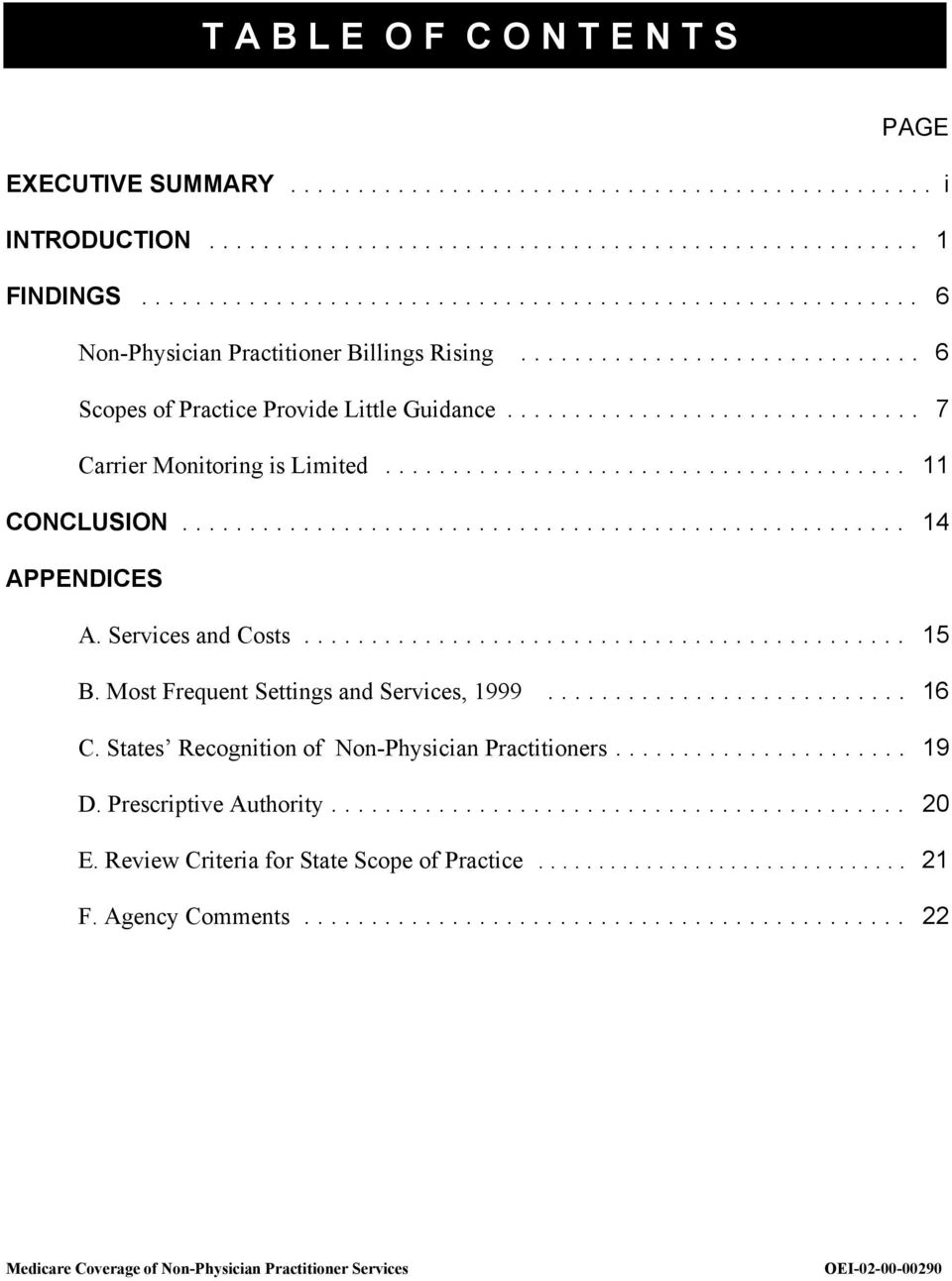
7 TABLE OF CONTENTS PAGE EXECUTIVE SUMMARY... i INTRODUCTION... 1 FINDINGS... 6 Non-Physician Practitioner Billings Rising... 6 Scopes of Practice Provide Little Guidance... 7 Carrier Monitoring is Limited CONCLUSION APPENDICES A. Services and Costs B. Most Frequent Settings and Services, C. States Recognition of Non-Physician Practitioners D. Prescriptive Authority E. Review Criteria for State Scope of Practice F. Agency Comments Medicare Coverage of Non-Physician Practitioner Services OEI
8 INTRODUCTION PURPOSE To describe the scope of services nurse practitioners, clinical nurse specialists, and physician assistants provide to Medicare beneficiaries, and to identify any potential vulnerabilities that may have emerged since the Balanced Budget Act of BACKGROUND Nurse practitioners, clinical nurse specialists, and physician assistants are health care providers who practice either in collaboration with or under the supervision of a physician. States are responsible for licensing and for setting the scopes of practice for all three specialties. Nurse practitioners and clinical nurse specialists are licensed advanced practice registered nurses who have specialty training in primary care or acute care of patients. Both of these nurse specialties must practice in collaboration with a physician. In contrast, a physician assistant is a licensed health care professional who practices under the supervision of an immediately available physician responsible for delegating medical services to the physician assistant. All States limit the number of physician assistants a physician is allowed to supervise. Although there are other types of non-physician practitioners, such as clinical nurse midwives and nurse anesthetists, for the purposes of this inspection we will refer to nurse practitioners, clinical nurse specialists, and physician assistants collectively as non-physician practitioners. Medicare Payment Medicare provides health insurance to people who are 65 years and older, people who are disabled, and, people with permanent kidney failure. Medicare consists of two primary parts: Hospital Insurance, also known as Part A, and Supplementary Medical Insurance, also known as Part B. Medicare Part A provides coverage of institutional care such as inpatient hospital care, skilled nursing facility care, home health services, and hospice care. Medicare Part B pays for the cost of non-institutional care such as physician services, outpatient hospital services, medical equipment and supplies, as well as services provided by non-physician practitioners. Medicare uses entities called contractors to process claims. Fiscal intermediaries process Part A claims and carriers process Part B claims. Each Medicare Part B carrier must employ a medical director whose duties include: assisting in the review of claims; providing clinical judgment in medical review of claims; directing carrier personnel on the correct application of policy during claim adjudication; and providing advice to the Health Care Financing Administration (HCFA) on national coverage and payment policy. Medicare Coverage of Non-Physician Practitioner Services 1 OEI
9 To be reimbursed by Medicare, the non-physician practitioner must practice in accordance with State law. This law is embodied in the State nurse practice acts, which are also known as the State scopes of practice. The scope of practice typically defines the practitioner s practice, qualifications, board representation, and fee/ renewal schedule. The scopes may also list specific examples of responsibilities such as taking histories, patient care, education and training. The Balanced Budget Act of 1997 Allowed Expanded Billing. The Balanced Budget Act of 1997 modified the way the Medicare program pays for non-physician practitioner services. Prior to January 1, 1998, these services were reimbursed by Medicare Part B only in certain geographical areas and health care settings. Nurse practitioner and clinical nurse specialist services were covered when provided in collaboration with a physician in nursing facilities in urban areas and in all settings in rural areas. They could also bill Medicare directly for services provided in rural areas. Physician assistant services were covered when provided under the supervision of a physician in hospitals and nursing facilities, as an assistant to surgery, in physician offices and patient homes in rural areas, and in a rural area designated as a health professional shortage area. The Act also removed the restrictions on settings. Effective January 1998, payment is now allowed for non-physician practitioner services in all geographic areas and health care settings permitted under State licensing laws, but only if no facility or other provider charges are paid in connection with the service. Nurse practitioners and clinical nurse specialists are now allowed to bill directly in all settings in both rural and urban areas. The services of a physician assistant, however, must continue to be billed through an employer. Clarified Education/Certification. The 1997 legislation clarifies the educational and/or certification requirements for certain non-physician practitioners to receive Medicare reimbursement. The regulations spell out the requirements as follows: Nurse practitioners must: be a registered professional nurse; be authorized to perform services in the State where they practice; be certified by the American Nurses Credentialing Center (ANCC) or comparable certifying agency; and hold a Master s degree in Nursing, as of January 1, Clinical nurse specialists must: be a registered nurse; be licensed in the State where they practice; be certified by the ANCC; and Medicare Coverage of Non-Physician Practitioner Services 2 OEI
10 hold a Master s degree in a defined clinical area of nursing from an accredited educational institution. Physician assistants must: be licensed and authorized in the State where they practice and either have graduated from an accredited educational program, or passed the National Certification Examination. Modified Reimbursement. The Act also set new reimbursement levels. It allows payment of 80 percent of the lesser of either (1) the actual charge or (2) 85 percent of the scheduled physician fee. Prior to the Act payment for nurse practitioner or clinical nurse specialist services, when furnished in all settings in a rural area, could have been made either directly to the nurse practitioner or clinical nurse specialist, or to the employer or contractor of the nurse practitioner or clinical nurse specialist at 75 percent of the physician fee schedule for services furnished in a hospital, 85 percent of the physician fee schedule for services furnished in other settings, and at 65 percent for assistant at surgery services. Payment for nurse practitioner services when furnished in skilled nursing facilities and nursing facilities in an urban area was made to the employer of the nurse practitioner at 85 percent of the physician fee schedule. Before the Act, payment for physician assistant services was made to the employer at 85 percent of the scheduled physician fee and at 65 percent of physician fee schedule for assistant to surgery services. Because the Act removed the restrictions on settings, interest has increased in the services non-physician practitioners are providing. The General Accounting Office s January 2000 report, Lessons Learned From HCFA s Implementation of Changes to Benefits, recommended that HCFA implement a recommendation made by an internal HCFA group that studied potential vulnerabilities brought about by the Act s changes. This group suggested that HCFA (1) survey the States to establish a national database of allowable practices for possible use in forming policies, (2) work with national accreditation bodies to establish standard minimum scopes of practice, and (3) that HCFA conduct a baseline study to determine the volume and type of services billed by clinical nurse specialists and nurse practitioners. At the present time, HCFA s Program Safeguard Contractor is conducting a baseline study in three States to determine the volume and type of services clinical nurse specialists and nurse practitioners are providing. The American Medical Association (AMA) is also interested in non-physician practitioner services. The AMA is leading a coalition of medical organizations that is concerned HCFA is not ensuring that advanced practice nurses are working in collaboration with a physician and within their scope of practice. Incident to services. The Act did not affect any services provided incident to physicians services. Incident to services are provided by employees of the physician under the physician s direct on-site supervision. Incident to services may be provided by nurse Medicare Coverage of Non-Physician Practitioner Services 3 OEI
11 practitioners, clinical nurse specialists, physician assistants, medical assistants, technicians, nurses, and others employed by the physician. These services continue to be paid at 100 percent of the physician fee schedule amount as though the physician personally performed the services. The physician does not have to indicate on the claim that a non-physician practitioner performed the service. This inspection did not set out to examine incident to services. It focuses on services that the non-physician practitioner bills directly and services that are billed, as is always the case for physician assistants, through the employer with the non-physician practitioner specialty indicated. Carriers have complained that incident to services are difficult to track. SCOPE This inspection is intended to be a first look at the effect of the Balanced Budget Act of 1997 which enables non-physician practitioners to bill Medicare for all allowable services in all settings. The findings of this inspection are descriptive in nature. The inspection presents what the billing data show about the services provided to Medicare beneficiaries. It also describes the States scopes of practice that govern these practitioners. Any agreements between the physician and the practitioner, however, are not the focus of this inspection. These agreements are unique to each physician and practitioner. In order to effectively evaluate these agreements as a control mechanism, they would have to be reviewed on a case by case basis. That level of scrutiny was beyond the scope of this inspection. It is also not the purpose of this inspection to evaluate the benefits or disadvantages of services performed by non-physician practitioners. METHODOLOGY Data were collected from three sources: the State scope of practice; Medicare billing data from the years 1997, 1998, and 1999; and interviews with carrier medical directors. Scopes of practice. We collected scopes of practice for physician assistants in 50 States and Washington, D.C., and both the advanced practice scope and the registered nursing scope for clinical nurse specialists and nurse practitioners in 50 States. First, we reviewed a sample of State scopes to determine common characteristics of responsibilities. From these common characteristics we developed a review document for all scopes. This document included educational requirements, written collaborative agreements, Board oversight, physician supervision, a statement of scope, and particular services such as taking histories, diagnosis, therapy, and treatment/ care plan development. We reviewed each scope of practice and noted the services allowed in each State for each specialty. We also reviewed the requirements for both the supervisory and Medicare Coverage of Non-Physician Practitioner Services 4 OEI
12 collaborative agreements between the physician and the non-physician practitioner as well as the prescriptive authority addressed in each State s scope of practice. See Appendix E for more details. Billing Data. We analyzed Medicare Part B services data for each of the three specialties from the Medicare Part B Extract and Summary System (BESS) for 1997, 1998, and All service and charge data mentioned in this report reflect data for allowed services and allowed charges. We also examined settings and procedure codes. We concentrated on billing changes that have occurred since BBA97 and analyzed procedures with high increases in allowed services and/ or allowed charges. We also looked at procedures considered vulnerable by carrier medical directors. Medical Director Practices. We interviewed the 41 carrier medical directors from all the Medicare Part B carrier contractors. Our interviews focused on the process of reviewing non-physician practitioner claims and any changes in that process since BBA97. We asked about carrier screens and edits, use of State scopes of practice, and any concerns or potential vulnerabilities. The carriers also forwarded any of their nonphysician practitioner medical review policies and any instructions sent to them by HCFA. This inspection was conducted in accordance with the Quality Standards for Inspections issued by the President s Council on Integrity and Efficiency. Medicare Coverage of Non-Physician Practitioner Services 5 OEI
13 FINDINGS Non-Physician Practitioner Billings Are Rising Rapidly It appears that the Balanced Budget Act is having a substantial effect on non-physician practitioner billings to the Medicare program. In 1999, BESS data show that Medicare paid for 5.2 million non-physician practitioner services (See Chart 1). This is a fourfold increase since 1997, the year BBA97 expanded settings and allowed nurse practitioners and clinical nurse specialists to bill Medicare directly in additional settings. During this same period, allowed charges also increased nearly fourfold from $55 million to $202 million (See Appendix A). Because some of these services had been billed as incident to prior to 1997, we were unable to determine how much of the increase in billings was due to real growth in services and how much was due to simple changes in billing practices. Chart 1: Non-Physician Practitioner Allowed Services (in millions) Source: Medicare BESS data In 1999, non-physician practitioners billed about half of their services in an office setting and another quarter of services were billed from skilled nursing or nursing facilities. The top three services billed in 1999 were office or outpatient visit for the evaluation and management of an established patient, subsequent nursing facility care for the evaluation and management of the new or established patient (25 minutes), and subsequent nursing facility care for the evaluation and management of the new or established patient (15 Medicare Coverage of Non-Physician Practitioner Services 6 OEI

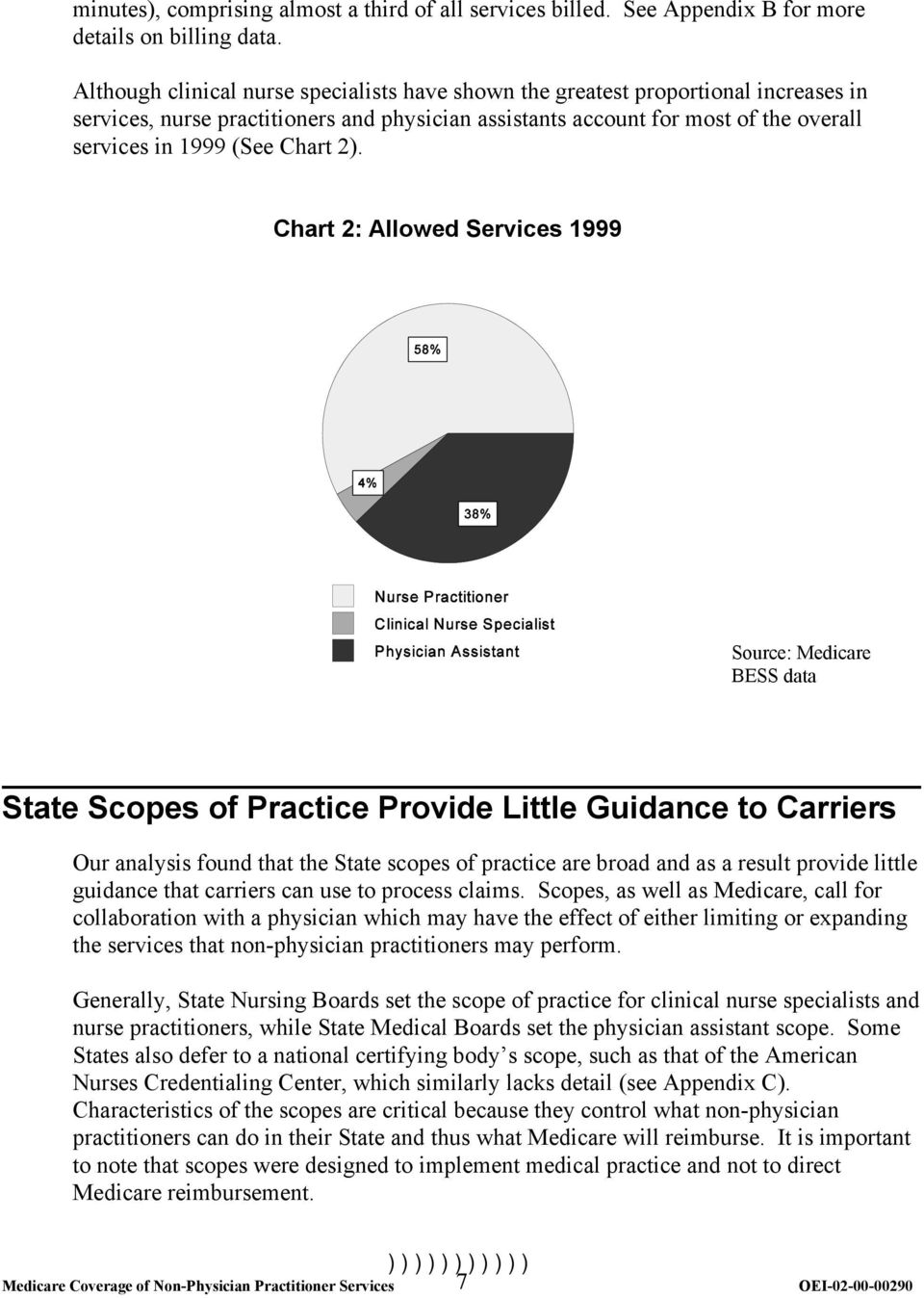
14 minutes), comprising almost a third of all services billed. details on billing data. See Appendix B for more Although clinical nurse specialists have shown the greatest proportional increases in services, nurse practitioners and physician assistants account for most of the overall services in 1999 (See Chart 2). Chart 2: Allowed Services 1999 Source: Medicare BESS data State Scopes of Practice Provide Little Guidance to Carriers Our analysis found that the State scopes of practice are broad and as a result provide little guidance that carriers can use to process claims. Scopes, as well as Medicare, call for collaboration with a physician which may have the effect of either limiting or expanding the services that non-physician practitioners may perform. Generally, State Nursing Boards set the scope of practice for clinical nurse specialists and nurse practitioners, while State Medical Boards set the physician assistant scope. Some States also defer to a national certifying body s scope, such as that of the American Nurses Credentialing Center, which similarly lacks detail (see Appendix C). Characteristics of the scopes are critical because they control what non-physician practitioners can do in their State and thus what Medicare will reimburse. It is important to note that scopes were designed to implement medical practice and not to direct Medicare reimbursement. Medicare Coverage of Non-Physician Practitioner Services 7 OEI
15 Most scopes contain a statement about the responsibilities, a list of allowed duties, education requirements, supervisory/collaborative agreement requirements, and prescriptive authority. The scopes differ in the amount of detail given to each element. Additionally, with the exception of few physician assistant scopes, we found that no scope explicitly identifies services that these practitioners are not allowed to perform. Using just the scopes, it is difficult to determine if non-physician practitioner could provide highly complex services and be reimbursed by the Medicare program. Several carrier medical directors note that relying on the scopes to determine services that can be billed to the program may be problematic. One medical director comments that the scopes are so vast and vague. [Non-physician practitioners] can do anything that is assigned to them. A few medical directors suggest that more clarifications of duties are needed to improve the way their claims are reviewed. Also, non-physician practitioners may provide services if they are delegated by the collaborating or supervising physician (as mentioned, the nurse practitioner and the clinical nurse specialist must collaborate with a physician, and a physician assistant must be supervised by a physician). For example, if a nurse practitioner working in collaboration with a cardiologist is directed to make a complex diagnosis, there is nothing in the scopes of practice preventing such a practice. In fact, States generally have a vague definition for acts such as diagnosis. Scopes in 11 States provide guidance for an agreement between the clinical nurse specialist and/or the nurse practitioner and the collaborating physician. In some cases the guidance for the collaborative agreements merely contains a definition of collaboration. More State scopes provide requirements of what the physician s supervisory role is in relation to a physician assistant. For example, some physician assistant scopes may require a supervisory agreement to provide specific information about the availability of the supervising physician, type of supervision required (physical, electronic, or continuous), or whether the agreement must be in writing. However, in the case of either the collaborative or the supervisory agreement, details that are not addressed within the State scope are left to the discretion of the physician and the non-physician practitioner. Scopes do not fully describe non-physician practitioner responsibilities The scopes typically contain a broad statement of responsibilities. In these statements, 25 States allow nurse practitioners to provide health care according to their own area of specialization; and in 19 States, physician s assistants may provide health care as approved by State Nursing Board. In addition to the broad statement, State scopes usually give a general list of duties allowed to be performed which most often include the following: treatment/care plan development; diagnosis; assessments; dispensing medication; counseling; referrals; and education/teaching. Medicare Coverage of Non-Physician Practitioner Services 8 OEI
16 Table 1: Selected Non-physician Practitioner Responsibilities Responsibilities Number of State Scopes Allowing Specific Service Clinical Nurse Specialist (N=44*) Nurse Practitioner (N=50) Physician Assistant (N=50) Treatment plan development and implementation Diagnosis Assessment/history/exam Dispensing medication Counseling Referrals Education/teaching *44 States recognize CNSs. Within the list of duties, scopes offer few specific guidelines. For example, diagnosis is allowed by many States, but few States define what diagnosis actually means or entails. Also, in the States where the scope is silent, such as the 19 States that do not address counseling by nurse practitioners, it cannot be assumed that the practitioner cannot perform these services. Even when a service is addressed, it is done in a very general manner. One State defines a treatment plan as [The nurse practitioner] coordinates the health care plans to enhance the quality of health care and diminish both fragmentation and duplication of service. Another State defines education/teaching as develop individualized teaching plans with the client based on overt and covert health needs. Other examples of services allowed but not fully outlined are counseling, referrals, and emergency expansion of role. State scopes generally have a clear definition of the education requirements for nonphysician practitioners. Although BBA97 currently requires only clinical nurse specialists to have a Master s degree to receive reimbursement, most States education requirements stipulate that both the clinical nurse specialist and the nurse practitioner must have a graduate degree. There appears to be a difference between Federal and State requirements in that 11 States do not require clinical nurse specialists to have a master s degree whereas Federal reimbursement requirements described in 42 CFR do. The remainder of the States do not stipulate whether a Master s degree is required. Medicare Coverage of Non-Physician Practitioner Services 9 OEI

17 As of January 1, 2003, nurse practitioners will also be required to have a Master s degree for Part B reimbursement. Physician assistants are not required to have a degree for Part B reimbursement. Every State addresses the prescriptive authority for at least one specialty. Forty-eight States provide guidance for the prescriptive authority of physician assistants and 41 States do so for nurse practitioners. However, only 23 of the 44 States that recognize clinical nurse specialists provide any guidance for prescriptive authority in their scopes. See Appendix D for details of prescriptive authority. Some practices raise concerns Thirty-seven carrier medical directors cite at least one concern about non-physician practitioner services and/or payments. Common concerns include settings, procedures, and training and supervision. Settings. Our analysis of 1999 billing data indicates that 81 percent of all non-physician practitioner services were performed in three settings: offices, inpatient hospitals, and skilled nursing facilities/nursing facilities. Twenty-five carrier medical directors cite nursing facilities and skilled nursing facilities as problematic settings. Most think that these settings are problematic for at least one of the following reasons: medically unnecessary procedures performed; excessive billing; and lack of oversight. As one carrier medical director notes, There s not a lot of oversight in nursing homes and there is a great potential for abuse where there is not much oversight. The carrier medical directors also discuss concerns about home health, hospitals, rural clinics, and both inpatient and outpatient mental health facilities, and give similar reasons for these concerns. Procedures. Nineteen carrier medical directors cite specific procedures that are problematic. Of these, most mention evaluation and management codes. Fifty-eight percent of all non-physician practitioner allowed services are for evaluation and management codes, and 8 of the top 10 procedures in 1999 are evaluation and management codes. Evaluation and management services and charges have increased by four times their 1997 levels. Several carrier medical directors express that it is problematic for non-physician practitioners to bill evaluation and management codes, especially those of a complex nature. Our data show that most evaluation and management services provided by them are of low-complexity. However, in 1999, eight percent of non-physician practitioner evaluation and management services were of high complexity. In order to merit high complexity, two of three key components (history, examination, or medical decision making) must meet the following criteria: the number of diagnoses or medical options must be extensive; the amount and/or complexity of the data to be reviewed must be extensive; and the risk of complications and/or morbidity or mortality must be high. Medicare Coverage of Non-Physician Practitioner Services 10 OEI
18 Within evaluation and management codes, complex consultations is one area of particular concern. A consultation is a type of service provided by a physician whose opinion or advice regarding evaluation and/or management of a specific problem is requested by another physician or other appropriate source. Other procedures that carriers find problematic due to their complexity are surgery, psychiatry, endoscopies, colonoscopies, and sigmoidoscopies. Training and Supervision. Eleven carrier medical directors express concerns about non-physician practitioners lack of training. Some carrier medical directors believe that too many complex procedures are being performed by these practitioners. One medical director recalls fighting efforts to allow complex procedures performed by non-physician practitioners, believing that some procedures are too close to physician work and are more complex than their training allows. Five carrier medical directors note that the lack of supervision of non-physician practitioners could be problematic. One mentions that their background and education is not parallel with physicians; they were originally created as physician extenders but now they are operating independently. Another worries that the non-physician practitioners ability to practice independently could exacerbate medical problems. Three carrier medical directors express concerns that the practitioners and their collaborating physician(s) share too many responsibilities. One of these directors adds that he can t address his concerns because there are no guidelines for non-physician practitioners. Carrier Monitoring of Non-Physician Practitioner Claims is Limited Carrier medical directors may monitor non-physician practitioner claims through prepayment or post-payment reviews. Pre-payment reviews are automated edits in the claims payment system that occur before the claim is paid, and either involve requesting additional documentation or denying the claim outright. When asked if any specific prepayment screens or edits exist for non-physician practitioners, 30 of the 41 carrier medical directors confirm that no edits exist specifically to monitor these claims. Some of the specific edits include surgery, assistant at surgery, anesthesia, nursing home procedures, and particular evaluation and management codes. One carrier plans to implement edits that will disallow complex-level services provided by non-physician practitioners. This carrier is awaiting feedback from HCFA about these edits. All carriers but one include non-physician practitioners in their post-payment reviews. These are conducted manually after the claim is paid, and are triggered by such things as aberrant billing or outliers. One type of post-payment review is a comprehensive medical review, which looks at one specific provider s billing over a period of time. In the last 2 years, 11 carrier medical directors report conducting comprehensive medical reviews on non-physician practitioners. In one example, nurse practitioners were visiting nursing Medicare Coverage of Non-Physician Practitioner Services 11 OEI
19 homes and changing patients bandages but billing for debridement, a surgery code which is both more complex and more expensive. Another carrier medical director reports conducting three comprehensive medical reviews. All three involved nurse practitioners, and resulted in overpayments totaling over $900,000. The cases involved duplicate billings, upcoded claims, and self-referrals. Several medical directors mention that monitoring is limited by the broad language in their scopes of practice. Because the scopes offer little detail, carrier medical directors may not use them. One medical director says, Unfortunately, in [this State] it is impossible for [non-physician practitioners] not to be within their scope of practice. There is no way we can deny [the claim] based on the scope of practice. Sixteen carrier medical directors state that they do not verify that non-physician practitioners are performing services within their State scope of practice in pre-pay or post-pay activities. Only seven carrier medical directors check with the State nursing board or the scope of practice to verify services. At least 22 carriers do not check the collaborative or supervisory agreement. Additionally, the carriers acknowledge that they do not have specific settings or procedures which prompt them to refer to the agreements consistently. Carrier medical directors report receiving memoranda or other guidelines from HCFA regarding non-physician practitioner claims when the 1997 legislation went into effect. Some report receiving the BBA97 guidelines. Others report receiving information from the carrier manual or program memoranda, and some say they were told to treat nonphysician practitioners like medical doctors. Six carrier medical directors report receiving no instructions from HCFA regarding these claims. Most carriers say they have not changed the way they review claims as a result of the Act. Some carriers, however, say they now pay more attention to non-physician practitioner claims. In addition to the general guidance given by HCFA, a few carriers have implemented their own medical review policies affecting non-physician practitioners. One example is a policy that offers specific instructions for the amount of supervision needed for myocardial perfusion imaging, a diagnostic procedure that is performed in order to evaluate how well blood is flowing to the heart. Moreover, some carrier medical directors would like to have additional pre-payment review or edits. Examples of the desired edits include specific evaluation and management codes, incident to services, and setting-specific edits. Some carrier medical directors would also like to have additional post-payment reviews, including levelspecific reviews, specialty-specific reviews, psychiatric service reviews, and spot checks of collaborative agreements. Other medical directors suggest modifying State laws or having further clarification of non-physician practitioner duties as a means of improving the way these claims are reviewed. Some carrier medical directors state that although they want to monitor more closely, they are limited in their ability to do so. Five carrier medical directors mention the need Medicare Coverage of Non-Physician Practitioner Services 12 OEI

20 for national guidelines on how to use the scopes to review claims. One carrier explains, We d like some instructions- to have a list from HCFA on codes that are inappropriate. Another carrier medical director comments that the carrier is hindered: [We] can t develop every claim [we] have no way of monitoring if they overstep their bounds our hands are tied. Medicare Coverage of Non-Physician Practitioner Services 13 OEI
![Another carrier medical director comments that the carrier is hindered: [We] can t develop every claim [we]](/docs-images/41/502937/images/page_20.jpg "have no way of monitoring if they overstep their bounds our hands are tied.")
21 We are able to draw several conclusions based on our analysis. We can conclude that the CONCLUSION The Balanced Budget Act successfully opened up Medicare billing for non-physician practitioners, regardless of care settings. Non-physician practitioner billings are rising rapidly, but controls, which are based on scopes of practice, are limited. State scopes of practice are vague and broad. As such, carriers do not have sufficient guidance to distinguish which non-physician practitioner services should be reimbursed by the program and which should not. This creates potential vulnerabilities, both from payment and quality of care standpoints. Therefore it may be appropriate to consider other additional controls for Medicare payments to non-physician practitioners. Until such controls are developed, the situation deserves careful monitoring. We plan to do so for both overall trends and for complex services. Agency Comments We received comments on the draft report from the Health Care Financing Administration. They concur with our conclusion regarding vulnerabilities when nonphysician practitioners bill Medicare. They are, however, sensitive to increasing the monitoring burden on contractors. The HCFA expressed a willingness to work with the OIG to monitor vulnerabilities in non-physician practitioner billings. We plan to do additional work to identify specific vulnerabilities by examining the billing practices of non-physician practitioners. The full text of HCFA s comments are contained in Appendix F. Medicare Coverage of Non-Physician Practitioner Services 14 OEI
22 APPENDIX A Services and Costs 1999, by Category Nurse Practitioner Clinical Nurse Specialist Physician Assistant All Non-Physician Practitioners Services Charges Services Charges Services Charges Services Charges Anesthesia 137 $14,397 3 $ $21, $36,511 Integumentary $1,623, $262, $2,683, $4,570,013 Musculoskeletal $732, $88, $12,734, $13,556,102 Respiratory 595 $53, $2, $844, $901,662 Cardiovascular 3455 $430, $49, $21,424, $21,903,944 Lymphatic 14 $1, $2, $37, $40,657 Mediastinum 27 $4,328 0 $0 364 $39, $44,253 Digestive System 1655 $151, $32, $1,050, $1,234,817 Urinary 6274 $365, $14, $163, $542,889 Male Genital 69 $9,033 2 $ $110, $119,857 Laparoscopy (Elim) 435 $62, $8, $393, $463,677 Female Genital 2358 $126, $6, $120, $253,394 Maternity 62 $7,503 0 $0 9 $3, $10,673 Endocrine/ Nerves 2349 $209, $28, $2,426, $2,664,604 Eye 73 $4,116 0 $0 693 $91, $95,160 Ear $325, $1, $246, $573,177 Radiology $1,174, $31, $1,245, $2,451,006 Pathology/ Lab $1,935, $12, $1,118, $3,066,688 Medicine $9,906, $6,115, $2,455, $18,477,435 Evaluation & Mgmt $73,999, $3,622, $46,597, $124,220,222 Temp $4,210, $74, $2,635, $6,921,078 Total $95,349, $10,354, $96,444, $202,147,819 These categories are in order of their Current Procedural Terminology (CPT) number Source: Medicare BESS data Medicare Coverage of Non-Physician Practitioner Services 15 OEI
23 APPENDIX B Most Frequent Settings and Services, 1999 Office 1. Most Frequent Settings, 1999 Health Care Setting Skilled Nursing Facility (SNF) Nursing Facility (NF) Inpatient Hospital Other - unlisted facility ER - hospital Outpatient Hospital Home Custodial Care Number of Services 2,598, , , , , , ,994 85,837 49,616 Community Mental Health 35,234 Center Proportion of all Services 98.8% Source: Medicare BESS Data, 1999 Medicare Coverage of Non-Physician Practitioner Services 16 OEI
24 APPENDIX B (cont.) 2. Most Frequent Services, 1999 CPT Code Service Description Number of Services Percent of total Office or outpatient visit for the evaluation and management of an established patient which requires at least two of these components: C an expanded problem focused history; C an expanded problem focused examination; C medical decision making of low complexity. 645, % The presenting problem(s) are of low to moderate severity. Physicians typically spend 15 minutes face-to-face with the patient and/or family Subsequent nursing facility care, per day, for the evaluation and management of the new or established patient, which requires at least two of these components: C an expanded problem focused interval history; C an expanded problem focused examination; C medical decision making of moderate complexity. 508, % Usually, the patient is stable, recovering or improving. Physicians typically spend 25 minutes as the bedside and on the patient s facility floor or unit Subsequent nursing facility care, per day, for the evaluation and management of the new or established patient, which requires at least two of these components: C a problem focused interval history; C C a problem focused examination; medical decision making that is straightforward or of low complexity. 420, % Usually, the patient is stable, recovering or improving. Physicians typically spend 15 minutes as the bedside and on the patient s facility floor or unit Office or outpatient visit for the evaluation and management of an established patient which requires at least two of these components: C a problem focused history; C a problem focused examination; C straightforward medical decision making 353, % The presenting problem(s) are of low to moderate severity. Physicians typically spend 15 minutes face-to-face with the patient and/or family G0001 Routine venipuncture for collection of specimen(s). 206, % Medicare Coverage of Non-Physician Practitioner Services 17 OEI
25 CPT Code Service Description Number of Services Percent of total Office or outpatient visit for the evaluation and management of an established patient which requires at least two of these components: C a detailed history; C a detailed examination; C medical decision making of moderate complexity. 148, % The presenting problem(s) are of low to moderate severity. Physicians typically spend 15 minutes face-to-face with the patient and/or family Subsequent nursing facility care, per day, for the evaluation and management of the new or established patient, which requires at least two of these components: C a detailed interval history; C a detailed examination; C medical decision making of moderate to high complexity. 100, % Usually, the patient is stable, recovering or improving. Physicians typically spend 35 minutes as the bedside and on the patient s facility floor or unit Emergency department visit for the evaluation and management of a patient, which requires these components: C an expanded problem focused history; C an expanded problem focused examination; and C medical decision making of moderate complexity. Usually, the presenting problem(s) are of moderate severity Pharmacologic management, including prescription, use, and review of medication with no more than minimal medical psychotherapy Subsequent hospital care, per day, for the evaluation and management of a patient, which requires at least three of the following components: C a problem focused interval history; C a problem focused examination; C medical decision making that is straightforward or of low complexity. Usually, the patient is stable, recovering or improving. Physicians typically spend 15 minutes at the bedside and on the patient s hospital floor or unit. 98, % 94, % 79, % Total 2,657, % Source: Current Procedural Technology 1999, Standard Edition and Medicare s National Level II Codes-- HCPCS 1997, American Medical Association Medicare Coverage of Non-Physician Practitioner Services 18 OEI
26 States Recognition of Non-Physician Practitioners APPENDIX C State NP CNS PA AL T T T AK N, T V T AZ T T T State NP CNS PA MT T T T NE T T T NV T T T AR T T T NH T V T CA T T T CO T T T CT T T T DE T T T DC NR NR T FL T V T GA T MH T HA T T T ID T T T IL T T T NJ T T T NM T T T NY T MH T NC T T T ND T T T OH T T T OK T T T OR T D T PA T T T RI T MH T IN T T T SC N, T N, T T IA T T T KS T T T SD T T T TN i i T KY N, T N, T T TX T T T LA T T T UT N, T N, T T ME T T T MD T T T MA T V T MI N, T V T MN T T T MS T T V VT T MH, N T VA T T T WA T V T WV T T T WI T T T WY T T T MO N, T N, T T T- Recognized to practice in State NR- Not Recognized MH- Mental health clinical nurse specialists only. i - Not board certified. Recognizes only RNs. However, NP may obtain a certificate of fitness to prescribe drugs. N- Defers to national certifying body. D - Drafting Scope V - Non-respondent Medicare Coverage of Non-Physician Practitioner Services 19 OEI
27 APPENDIX D Prescriptive Authority Prescriptive Authority Number of States allowing service Clinical Nurse Specialist (N = 44) Nurse Practition er (N = 50) Physicia n Assistan t (N = 50) Medical devices Legend drugs Starter dosages/samples Schedule I * Schedule II* Schedule III* Schedule IV* Schedule V* * Controlled substances Source: State Scopes of Practice The prescriptive authority usually contains specific information about dispensing samples, prescribing prescriptive or legend drugs (the legend of the prescription must contain the dosage amount and the frequency with which to take the drug), controlled substances (any narcotic or barbiturate drug ranging from simple cough medicine to heroin), and medical devices. Medicare Coverage of Non-Physician Practitioner Services 20 OEI
28 APPENDIX E Review Criteria for State Scope of Practice In reviewing the State scopes of practice, our review instrument focused on the following responsibilities: C C C C C C C C C C C C Assessments, histories, and physical exams, including screening and interpretation of lab data; Therapy, including physical, occupational, and respiratory, as well as therapeutic diets and therapeutic interventions; we did not review drug therapy; Treatment plan/ care plan development, including formulating, implementing, reviewing, and evaluating plans; Patient care and management, including hospital rounds, accessing catheters and tubes, and care of sprains and fractures; Surgery, including first assistant, minor surgery and suturing; Supervision; Education and teaching; Counseling; Emergency services, including EMT; Expansion of scope in the event of an emergency; Collaboration with Physician/ Supervision of non-physician practitioner, and; Other relevant services such as anesthesia, diagnostic problems, and subspecialization in fields like optometry or obstetrics. 21
29 APPENDIX F Agency Comments 22
OFFICE OF INSPECTOR GENERAL SPECIAL FRAUD ALERT FRAUD AND ABUSE IN NURSING HOME ARRANGEMENTS WITH HOSPICES
 OFFICE OF INSPECTOR GENERAL SPECIAL FRAUD ALERT FRAUD AND ABUSE IN NURSING HOME ARRANGEMENTS WITH HOSPICES March 1998 The Office of Inspector General was established at the Department of Health and Human
Federation of State Boards of Physical Therapy Jurisdiction Licensure Reference Guide Topic: Continuing Competence
 This document reports CEU requirements for renewal. It describes: Number of required for renewal Who approves continuing education Required courses for renewal Which jurisdictions require active practice
Standardized Pharmacy Technician Education and Training
 Standardized Pharmacy Technician Education and Training Kevin N. Nicholson, RPh, JD Vice President, Pharmacy Regulatory Affairs National Association of Chain Drug Stores May 19, 2009 Overview of how technicians
Federation of State Boards of Physical Therapy Jurisdiction Licensure Reference Guide Topic: Continuing Competence
 This document reports CEU (continuing education units) and CCU (continuing competence units) requirements for renewal. It describes: Number of CEUs/CCUs required for renewal Who approves continuing education
U.S. Department of Housing and Urban Development: Weekly Progress Report on Recovery Act Spending
 U.S. Department of Housing and Urban Development: Weekly Progress Report on Recovery Act Spending by State and Program Report as of 3/7/2011 5:40:51 PM HUD's Weekly Recovery Act Progress Report: AK Grants
How To Rate Plan On A Credit Card With A Credit Union
 Rate History Contact: 1 (800) 331-1538 Form * ** Date Date Name 1 NH94 I D 9/14/1998 N/A N/A N/A 35.00% 20.00% 1/25/2006 3/27/2006 8/20/2006 2 LTC94P I F 9/14/1998 N/A N/A N/A 35.00% 20.00% 1/25/2006 3/27/2006
Dashboard. Campaign for Action. Welcome to the Future of Nursing:
 Welcome to the Future of Nursing: Campaign for Action Dashboard About this Dashboard: These are graphic representations of measurable goals that the Campaign has selected to evaluate our efforts in support
Federation of State Boards of Physical Therapy Jurisdiction Licensure Reference Guide Topic: PTA Supervision Requirements
 These tables provide information on what type of supervision is required for PTAs in various practice settings. Definitions Onsite Supervision General Supervision Indirect Supervision The supervisor is
Larry R. Kaiser, MD. President The University of Texas Health Science Center at Houston
 Larry R. Kaiser, MD President The University of Texas Health Science Center at Houston HealthCare Workforce: UTHealth Experience CHALLENGE To train the Healthcare Workforce of the 21 st Century SOLUTIONS:
NHIS State Health insurance data
 State Estimates of Health Insurance Coverage Data from the National Health Interview Survey Eve Powell-Griner SHADAC State Survey Workshop Washington, DC, January 13, 2009 U.S. DEPARTMENT OF HEALTH AND
Health Workforce Data Collection: Findings from a Survey of States
 Health Workforce Data Collection: Findings from a Survey of States Jean Moore, DrPH David Armstrong, PhD Health Workforce Technical Assistance Center School of Public Health University at Albany, SUNY
Physical Therapy Self-Referral ( Direct Access )
 Physical Therapy Self-Referral ( Direct Access ) Summary of Statutes and Regulations by State December 2007 The American Association of Orthopaedic Surgeons (AAOS) supports a patient-centered approach
Social Security, SSI, and Medicaid Basics
 Social Security, SSI, and Medicaid Basics T.J. Sutcliffe, The Arc Julie Ward, The Arc Basics Basics Income Maintenance Health Insurance Means Tested Supplemental Security Income (SSI) Title XVI Medicaid
Federation of State Boards of Physical Therapy Jurisdiction Licensure Reference Guide Topic: License Renewal Who approves courses?
 Federation of State s of Physical The table below provides information on approval of continuing education/competence courses and for each jurisdiction. Summary Number of jurisdictions requiring approval
1. What is your name? Last name First name Middle Initial Degree(s)
 Version: 6122008 Rhode Island Health Care Quality Performance (HCQP) Program This survey asks about physicians' use of health information technology (HIT) and should take less than 10 minutes to complete.
NAAUSA Security Survey
 NAAUSA Security Survey 1. How would you rate the importance of each of the following AUSA security improvements. Very important Somewhat important Not too important Not at all important Secure parking
Funding for Accreditation of Medicolegal Death Investigation Offices and Certification of Medicolegal Death Investigation Personnel
 1 2 3 4 5 6 7 8 9 10 11 12 13 14 15 16 17 18 19 20 21 22 23 24 25 26 27 28 29 30 31 32 33 34 35 36 37 38 39 40 41 42 43 44 45 46 Funding for Accreditation of Medicolegal Death Investigation Offices and
Enrollment Snapshot of Radiography, Radiation Therapy and Nuclear Medicine Technology Programs 2014
 Enrollment Snapshot of, Radiation Therapy and Nuclear Medicine Technology Programs 2014 January 2015 2015 ASRT. All rights reserved. Reproduction in any form is forbidden without written permission from
Dental Therapist Initiatives, Access, and Changing State Practice Acts The ADHA Perspective: An Update
 Dental Therapist Initiatives, Access, and Changing State Practice Acts The ADHA Perspective: An Update Pam Quinones, RDH, BS President, ADHA April 29, 2012 I. The Dental Hygiene Workforce as a Partner
State Corporate Income Tax-Calculation
 State Corporate Income Tax-Calculation 1 Because it takes all elements (a*b*c) to calculate the personal or corporate income tax, no one element of the corporate income tax can be analyzed separately from
Rural Psychiatry. Mohamed Ramadan MD MS Board Certified Psychiatrist Mohave Mental Health Clinic Bullhead City Arizona
 Rural Psychiatry Mohamed Ramadan MD MS Board Certified Psychiatrist Mohave Mental Health Clinic Bullhead City Arizona National Context Recognition of potential shortage by national groups: American Association
ehealth Price Index Trends and Costs in the Short-Term Health Insurance Market, 2013 and 2014
 ehealth Price Index Trends and Costs in the Short-Term Health Insurance Market, 2013 and 2014 June 2015 1 INTRODUCTION In this report, ehealth provides an analysis of consumer shopping trends and premium
Enrollment Snapshot of Radiography, Radiation Therapy and Nuclear Medicine Technology Programs 2013
 Enrollment Snapshot of Radiography, Radiation Therapy and Nuclear Medicine Technology Programs 2013 A Nationwide Survey of Program Directors Conducted by the American Society of Radiologic Technologists
The Survey of Undergraduate and Graduate Programs in Communication. Sciences and Disorders has been conducted since 1982-83. Surveys were conducted in
 Introduction The Survey of Undergraduate and Graduate Programs in Communication Sciences and Disorders has been conducted since 1982-83. Surveys were conducted in 1982-83, 1983-84, 1984-85, 1985-86, 1986-87,
TITLE POLICY ENDORSEMENTS BY STATE
 TITLE POLICY ENDORSEMENTS BY STATE State Endorsement ID Endorsement Description AK ARM ALTA 6 Adjustable (Variable) Rate AK BALLOON FNMA Balloon Endorsement AK CONDO ALTA 4 Condominium AK COPY FEE Copies
Who provides this training? Are there any requirements? The parents/guardians and the doctor go through the medication curriculum with the student.
 AL AK AZ AR Student, if they have a chronic condition school nurse or school administrators The student, if their parent/guardian authorizes them to. Trained school personnel can also administer Students
State Annual Report Due Dates for Business Entities page 1 of 10
 State Annual Report Due Dates for Business Entities page 1 of 10 If you form a formal business entity with the state, you may be required to file periodic reports on the status of your entity to preserve
New York Public School Spending In Perspec7ve
 New York Public School Spending In Perspec7ve School District Fiscal Stress Conference Nelson A. Rockefeller Ins0tute of Government New York State Associa0on of School Business Officials October 4, 2013
The Leukemia & Lymphoma Society
 The Leukemia & Lymphoma Society The Leukemia & Lymphoma Society (LLS) exists to find cures and ensure access to treatments for blood cancer patients. LLS is the voice for all blood cancer patients. We
State Survey Results MULTI-LEVEL LICENSURE TITLE PROTECTION
 MULTI-LEVEL LICENSURE TITLE PROTECTION Prior AK MN TN MO AL MO KY VA AZ MS MO DC NYC NE HI ME OR IA RI PA IL TX VA KS WA LA WI MA WV Prior AK ME OR TN AL MI PA HI CO MS FL DC NC MN IA NE UT IL NV WA IN
Appendix: Data Supplement. This appendix contains supplementary information about the data and exhibits.
 Editor s Note: This online data supplement contains supplemental material that was not included with the published article by Denise A. Davis and Melanie D. Napier, Strategically Addressing the Nurse Shortage:
Alaska (AK) Arizona (AZ) Arkansas (AR) California-RN (CA-RN) Colorado (CO)
 Beth Radtke 50 Included in the report: 7/22/2015 11:15:28 AM Alaska (AK) Arizona (AZ) Arkansas (AR) California-RN (CA-RN) Colorado (CO) Connecticut (CT) Delaware (DE) District Columbia (DC) Florida (FL)
American Equity Investment Life Insurance Company Bonus Gold (Index 1-07) PFG Marketing Group, Inc.
 A Fixed Indexed Annuity with a 16-year surrender period. This product is not available in AK AL CT DE MN NJ NV NY OH OK OR PR TX UT VI WA Ratings A.M. Best : A- Standard & Poor's: BBB+ 1 Year S&P 500 Annual
Update on Pharmacy Technician Issues and ASHP Pharmacy Technician Initiative
 Update on Pharmacy Technician Issues and ASHP Pharmacy Technician Initiative Current state of Pharmacy Technicians Estimated to be 450,000 or more Training varies greatly Certification requirements vary
The Collaborative Models of Mental Health Care for Older Iowans. Model Administration. Collaborative Models of Mental Health Care for Older Iowans 97
 6 The Collaborative Models of Mental Health Care for Older Iowans Model Administration Collaborative Models of Mental Health Care for Older Iowans 97 Collaborative Models of Mental Health Care for Older
Workers Compensation Experience Mod In Your Control or Out of Your Control?
 Workers Compensation Experience Mod In Your Control or Out of Your Control? Bill Daly Risk Manager National Accounts Federated Mutual Insurance Company WC Managed Care: More than Managing Care A Simple
The Future of Nursing Report
 The Future of Nursing Report Illinois Healthcare Action Coalition Strategic Planning Meeting June 16, 2011 Susan B. Hassmiller, PhD, RN, FAAN Campaign for Action Campaign Vision All Americans have access
Regional Electricity Forecasting
 Regional Electricity Forecasting presented to Michigan Forum on Economic Regulatory Policy January 29, 2010 presented by Doug Gotham State Utility Forecasting Group State Utility Forecasting Group Began
Trends in Medigap Enrollment and Coverage Options, 2013
 November 2014 Trends in Medigap Enrollment and Coverage Options, 2013 www.ahipresearch.org LIST OF TABLES AND FIGURES TABLE 1. TABLE 2. TABLE 3. TABLE 4. Distribution of Medigap Companies with Standardized
THE U.S. HEALTH WORKFORCE CHARTBOOK. Part III: Technologists & Technicians and Aides & Assistants
 THE U.S. HEALTH WORKFORCE CHARTBOOK Part III: Technologists & Technicians and Aides & Assistants U.S. Department of Health and Human Services Health Resources and Services Administration National Center
Florida Workers Comp Market
 Florida Workers Comp Market 10/5/10 Lori Lovgren 561-893-3337 [email protected] Florida Workers Compensation Rates 10-1-03 1-1-11 to 1-1-11* Manufacturing + 9.9% 57.8% Contracting + 7.3% 64.4 % Office
Trends in Medigap Coverage and Enrollment, 2011
 Trends in Medigap Coverage and Enrollment, 2011 May 2012 SUMMARY This report presents trends in enrollment in Medicare Supplement (Medigap) insurance coverage, using data on the number of policies in force
Ambulance Industry Receives Financial Relief Through the MMA
 Ambulance Industry Receives Financial Relief Through the MMA On June 25, 2004, the Centers for Medicare and Medicaid Services (CMS) issued Transmittal 220 to Medicare Contractors outlining changes to the
Enrollment Snapshot of Radiography, Radiation Therapy and Nuclear Medicine Technology Programs 2015
 Enrollment Snapshot of, Radiation Therapy and Nuclear Medicine Technology Programs 2015 December 2015 2015 ASRT. All rights reserved. Reproduction in any form is forbidden without written permission from
Final Expense Life Insurance
 Dignified Choice - Classic Series Final Expense Life Insurance Columbian Mutual Life Insurance Company Home Office: Binghamton, NY Administrative Service Office: Norcross, GA Columbian Life Insurance Company
State Policy Report #34. Health Center Reimbursement for Behavioral Health Services in Medicaid
 State Policy Report #34 Health Center Reimbursement for Behavioral Health Services in Medicaid November 2010 COPYRIGHT NOVEMBER 2010 National Association of Community Health Centers, 2010 State Policy
THE PRIVATE INSURANCE MARKET: THE INFLUENCE OF NEW PAYMENT AND DELIVERY MODELS. Carmella Bocchino Executive Vice President May 13, 2015
 THE PRIVATE INSURANCE MARKET: THE INFLUENCE OF NEW PAYMENT AND DELIVERY MODELS Carmella Bocchino Executive Vice President May 13, 2015 1 Plans Driving a Move Toward Value Value Based Benefit Design Innovative
Aetna Health and Life Insurance Company (AHLIC) American Continental Insurance Company (ACI) Continental Life Insurance Company of Brentwood,
 Aetna Health and Life Insurance Company (AHLIC) American Continental Insurance Company (ACI) Continental Life Insurance Company of Brentwood, Tennessee (CLI) Aetna Inc. For Agent Use Only. Not to be shared
Ending Veteran and Veteran Family Homelessness: The Homeless Veteran Supported Employment Program (HVSEP)
 Ending Veteran and Veteran Family Homelessness: The Homeless Veteran Supported Employment Program (HVSEP) Carma A. Heitzmann, Ph.D. National Program Manager HVSEP VHA Homeless Program Office [email protected]
Nurse Practitioners and Physician Assistants in the United States: Current Patterns of Distribution and Recent Trends. Preliminary Tables and Figures
 Nurse Practitioners and Physician Assistants in the United States: Current Patterns of Distribution and Recent Trends Preliminary Tables and Figures Kevin M. Stange, PhD Assistant Professor Gerald R. Ford
AMFMM Benchmarking Data, 2010 11
 C APPENDIX AMFMM Benchmarking Data, 2010 11 Brian Iriye, MD, Chairman, AMFMM The data presented in this appendix are the results of the largest survey ever conducted to acquire facts that are specifically
Successes and Challenges in the Affordable Care Act: Beyond Access
 Successes and Challenges in the Affordable Care Act: Beyond Access Robert Greenwald Clinical Professor of Law, Harvard Law School Director, Center for Health Law and Policy Innovation/Treatment Access
In Utilization and Trend In Quality
 AHA Taskforce on Variation in Health Care Spending O Hare Hilton, Chicago February 10, 2010 Allan M. Korn, M.D., FACP Senior Vice President, Clinical Affairs and Chief Medical Officer Variation In Utilization
COUNCIL OF GRADUATE PROGRAMS IN COMMUNICATION SCIENCES AND DISORDERS 1996-97 NATIONAL SURVEY OF UNDERGRADUATE AND GRADUATE PROGRAMS
 COUNCIL OF GRADUATE PROGRAMS IN COMMUNICATION SCIENCES AND DISORDERS 1996-97 NATIONAL SURVEY OF UNDERGRADUATE AND GRADUATE PROGRAMS Conducted by the Information Exchange Committee Linda Petrosino Bowling
The Lincoln National Life Insurance Company Variable Life Portfolio
 The Lincoln National Life Insurance Company Variable Life Portfolio State Availability as of 12/14/2015 PRODUCTS AL AK AZ AR CA CO CT DE DC FL GA GU HI ID IL IN IA KS KY LA ME MP MD MA MI MN MS MO MT NE
Aetna Companies: - American Continental Insurance (ACI) - Continental Life Insurance Company of Brentwood, Tennessee (CLI) Genworth Companies
 Aetna Companies: - American Continental Insurance (ACI) - Continental Life Insurance Company of Brentwood, Tennessee (CLI) Genworth Companies (administered by Aetna Life Insurance Company): - Genworth
AmGUARD Insurance Company EastGUARD Insurance Company NorGUARD Insurance Company WestGUARD Insurance Company GUARD
 About Us For over 30 years, we have protected the interests of the small- to mid-sized businesses that insure with us. At Berkshire Hathaway Insurance Companies, we dedicate our efforts in the areas that
Return-to-Work Outcomes Among Social Security Disability Insurance (DI) Beneficiaries
 Return-to-Work Outcomes Among Social Security Disability Insurance (DI) Beneficiaries Yonatan Ben-Shalom Arif Mamun Presented at the CSDP Forum Washington, DC September 17, 2014 Acknowledgments The research
ANTHONY P. CARNEVALE NICOLE SMITH JEFF STROHL
 State-Level Analysis HELP WANTED PROJECTIONS of JOBS and EDUCATION REQUIREMENTS Through 2018 JUNE 2010 ANTHONY P. CARNEVALE NICOLE SMITH JEFF STROHL Contents 1 Introduction 3 U.S. Maps: Educational concentrations
How To Know The Nursing Workforce
 FAST FACTS The Nursing Workforce 2014: Growth, Salaries, Education, Demographics & Trends RN Job Growth Rate (new and replacement) By State/Region, 2012-2022) 14 states project an annual growth rate of
Enrollment Snapshot of Radiography, Radiation Therapy and Nuclear Medicine Technology Programs 2012
 Enrollment Snapshot of, and Nuclear Medicine Programs 2012 A Nationwide Survey of Program Directors Conducted by the American Society of Radiologic Technologists January 2013 2012 ASRT. All rights reserved.
Health Insurance Mandates in the States 2011. Executive Summary
 Health Insurance Mandates in the States 2011 Executive Summary Health Insurance Mandates in the States 2011 Executive Summary By Victoria Craig Bunce Director of Research and Policy The Council for Affordable
Table 12: Availability Of Workers Compensation Insurance Through Homeowner s Insurance By Jurisdiction
 AL No 2 Yes No See footnote 2. AK No Yes No N/A AZ Yes Yes Yes No specific coverage or rate information available. AR No Yes No N/A CA Yes No No Section 11590 of the CA State Insurance Code mandates the
History of Prescription Drug Monitoring Programs. PDMP Training and Technical Assistance Center Brandeis University
 History of Prescription Drug Monitoring Programs PDMP Training and Technical Assistance Center Brandeis University History of Prescription Drug Monitoring Programs First PDMP Early PDMP Characteristics
THE NATIONAL PROGRESS REPORT ON E-PRESCRIBING AND INTEROPERABLE HEALTH CARE
 THE NATIONAL PROGRESS REPORT ON E-PRESCRIBING AND INTEROPERABLE HEALTH CARE YEAR 2011 neutrality transparency physician and patient choice open standards collaboration privacy 1 2001 2006 2007 2008 2009
Standardization of Technician Education Want it? Need it? Janet Teeters, M.S., R.Ph. Director of Accreditation Services ASHP
 Standardization of Technician Education Want it? Need it? Janet Teeters, M.S., R.Ph. Director of Accreditation Services ASHP Disclosure Director of Accreditation Services Standardized Technician Education
Sage Term. 10/15/20 Year Term Life Insurance CONSUMER BROCHURE. Wise Financial Thinking for Life
 Sage Term 10/15/20 Year Term Life Insurance CONSUMER BROCHURE Wise Financial Thinking for Life We don t always know what the future brings. Sage TERM Consumer Brochure Wise Financial Thinking for Life
Part C Technical Assistance: State Approaches
 Brief Policy Analysis May 2007 Part C Technical Assistance: State Approaches An analysis of a critical issue in special education inforum Policymakers and early childhood experts have long recognized the
Billing an NP's Service Under a Physician's Provider Number
 660 N Central Expressway, Ste 240 Plano, TX 75074 469-246-4500 (Local) 800-880-7900 (Toll-free) FAX: 972-233-1215 [email protected] Selection from: Billing For Nurse Practitioner Services -- Update
Prescription Drug Marketing Act (PDMA): Understanding the Regulations
 Prescription Drug Marketing Act (PDMA): Understanding the Regulations Ron Greenbaum, RPh Director of Compliance and QA Dendrite Interactive Marketing BuzzeoPDMA, Totowa, NJ Agenda - PDMA Introduction Purpose
UnitedHealth Premium Designation Program. Driving informed choices and quality, efficient care
 UnitedHealth Premium Designation Program Driving informed choices and quality, efficient care Today s health care system is fraught with wide variation in medical practices that often result in inconsistent
Broadband Technology Opportunities Program: Sustainable Broadband Adoption and Public Computer Centers
 Broadband Technology Opportunities Program: Sustainable Broadband Adoption and Public Computer Centers National Telecommunications and Information Agency (NTIA) U. S. Department of Commerce Funded by the
Workers Compensation Research
 Workers Compensation Research About WCRI Independent, not-for-profit research organization Founded in Cambridge MA in 1983 Diverse membership support Studies are peer-reviewed Resource for public officials
Health Insurance Mandates in the States 2012
 Health Insurance Mandates in the States 2012 For more information on this topic and other reform issues, please visit. About the Council for Affordable Health Insurance Since 1992, the Council for Affordable
National Telehealth Resource Centers (NTRCs): National Telehealth Policy Resource Center www.telehealthpolicy.us
 National Telehealth Resource Centers (NTRCs): National Telehealth Policy Resource Center www.telehealthpolicy.us National Telehealth Technology Assessment Resource Center www.telehealthtechnology.org Regional
A descriptive analysis of state-supported formative assessment initiatives in New York and Vermont
 ISSUES& ANSWERS REL 2012 No. 112 At Education Development Center, Inc. A descriptive analysis of state-supported formative assessment initiatives in New York and Vermont ISSUES& ANSWERS REL 2012 No. 112
Understanding Payroll Recordkeeping Requirements
 Understanding Payroll Recordkeeping Requirements 1 Presented by Sally Thomson, CPP Directory of Payroll Training American Payroll Association [email protected] 2 Agenda Recordkeeping Requirements
Alaska (AK) Arizona (AZ) Arkansas (AR) California-RN (CA-RN) Colorado (CO)
 Beth Radtke 49 Included in the report: 7/22/2015 11:24:12 AM Alaska (AK) Arizona (AZ) Arkansas (AR) California-RN (CA-RN) Colorado (CO) Connecticut (CT) Delaware (DE) District Columbia (DC) Florida (FL)
ANALYSIS OF US AND STATE-BY-STATE CARBON DIOXIDE EMISSIONS AND POTENTIAL SAVINGS IN FUTURE GLOBAL TEMPERATURE AND GLOBAL SEA LEVEL RISE
 ANALYSIS OF US AND STATE-BY-STATE CARBON DIOXIDE EMISSIONS AND POTENTIAL SAVINGS IN FUTURE GLOBAL TEMPERATURE AND GLOBAL SEA LEVEL RISE by Paul Knappenberger SPPI ORIGINAL PAPER Updated April 2013 ANALYSIS
CINCINNATI HILLS CHRISTIAN ACADEMY COLLEGE QUESTIONNAIRE FOR STUDENTS
 CINCINNATI HILLS CHRISTIAN ACADEMY COLLEGE QUESTIONNAIRE FOR STUDENTS Complete & bring with you to your Junior College Planning Meeting. NAME: ADDRESS: EMAIL: BIRTHDATE: PHONE #: DATE: PLEASE READ BEFORE
Life Settlements Source List
 BROKERS Ashar Group LLC - Life Settlement Specialists 407-772-1818 www.ashargroup.com Except AK NH VT Except AK NH VT Varies based on current market opportunities and groups that pass Ashar s due diligence
ADEA Survey of Dental School Seniors, 2014 Graduating Class Tables Report
 ADEA Survey of Dental School Seniors, 2014 Graduating Class Tables Report Published February 2015 Suggested Citation American Dental Education Association. (February 2015). ADEA Survey of Dental School
U.S. Department of Education NCES 2011-460 NAEP. Tools on the Web
 U.S. Department of Education NCES 2011-460 NAEP Tools on the Web Whether you re an educator, a member of the media, a parent, a student, a policymaker, or a researcher, there are many resources available
Preapproval Inspections for Manufacturing. Christy Foreman Deputy Director Division of Enforcement B Office of Compliance/CDRH
 Preapproval Inspections for Manufacturing Christy Foreman Deputy Director Division of Enforcement B Office of Compliance/CDRH Major Steps Review of the Quality System information Inspection requests generated
2014 Year in Review State Policies Impacting CTE. Catherine Imperatore, ACTE Andrea Zimmermann, NASDCTEc February 5, 2015
 2014 Year in Review State Policies Impacting CTE Catherine Imperatore, ACTE Andrea Zimmermann, NASDCTEc February 5, 2015 Background and Context Federal policies Perkins WIOA HEA Senate and Congressional
LIMITED LIABILITY COMPANY ORGANIZATION CHART
 LIMITED LIABILITY COMPANY ORGANIZATION CHART The following Chart has been designed to allow you in a summary format, determine the minimum requirements to form a limited liability company in all 50 states
100.1 - Payment for Physician Services in Teaching Settings Under the MPFS. 100.1.1 - Evaluation and Management (E/M) Services
 MEDICARE CLAIMS PROCESSING MANUAL Accessed September 25, 2005 100.1 - Payment for Physician Services in Teaching Settings Under the MPFS Payment is made for physician services furnished in teaching settings
Surety Bond Requirements for Mortgage Brokers and Mortgage Bankers As of July 15, 2011
 Surety Bond Requirements for Mortgage Brokers and Mortgage Bankers As of July 15, 2011 State Mortgage Broker Bond Cancellation Mortgage Banker Bond Cancellation Notes & Citations AK $75,000 minimum for
Admitting Foreign Trained Lawyers. National Conference of Bar Examiners Chicago, May 2, 2015
 Admitting Foreign Trained Lawyers National Conference of Bar Examiners Chicago, May 2, 2015 Professor Laurel S. Terry Penn State s Dickinson Law Carlisle, Pennsylvania [email protected] Overview of Remarks
Aetna Senior Supplemental Insurance 1 Home Office Directory Medicare Supplement
 1 Medicare Supplement New Business Make all checks payable to the appropriate Underwriting Phone: (800) 264.4000 option 3, 2 Fax: (877) 380.2777 (only for applications using EFT) Email: [email protected]