
TouchTest TM Android Tutorial
|
|
|
- Mark Brown
- 10 years ago
- Views:
Transcription
1 TouchTest TM Android Tutorial
2 SOASTA TouchTest Android Tutorial 2015, SOASTA, Inc. All rights reserved. The names of actual companies and products mentioned herein may be the trademarks of their respective companies. This document is for informational purposes only. SOASTA makes no warranties, express or implied, as to the information contained within this document

3 Table of Contents Why Mobile App Testing?... 1 CloudTest Basics... 1 What Does Touch Test Record?... 1 TouchTest for Android... 2 TouchTest Hybrid... 2 Getting Started... 3 Prerequisites... 4 Configuring the Android Device... 4 Prerequisites for Android using Eclipse (Developer Only)... 5 Installing the ADT for Mac OS X... 5 Installing the ADT for Windows... 5 CloudTest Utility Software (Developer Only)... 7 Setting Up the Droidfish Project (Native App Developer)... 8 Importing the DroidFish Project... 9 Configuring the NDK Builder (Droidfish Only) Setting Up the Zirco Browser Project (Hybrid App Developer) Importing the Zirco Browser Project Using the MakeAppTouchTestable Utility (Developer Only) Static vs. Dynamic Instrumentation Making the DroidFish APK TouchTestable (Native Developer Only) Making the DroidFish Project TouchTestable (Native Developer Only) Making the Zirco Browser APK TouchTestable (Hybrid Developer Only) Making the Zirco Browser Project TouchTestable (Hybrid Developer Only) Inspecting a TouchTestable Project (Native or Hybrid using project method) Inspecting the Mobile App in CloudTest (Native or Hybrid) Install the Android APK to the Device Install using Eclipse Install from the Command Line using adb Installing the TouchTest Agent on a Device (All Users) Approving a Mobile Device (Device Admin or CloudTest Lite user) Associating Mobile Apps with a Device i
4 Recording a TouchTest Scenario (All Users) Create a TouchTest Clip Recording a Droidfish Scenario (Native) Recording a Zirco Browser Scenario (Hybrid) Adding an Interval Delay between Each Action (All Users) Create a Composition (All Users) Playing a Composition Result Details (Droidfish) Result Details (Zirco Browser) Identifying and Analyzing Common Errors Network or Communication Errors App Action and Other Errors (All Users) Advanced Clip Editing (Droidfish) Inspecting App Action Details (Droidfish) App Action Properties (Droidfish) Adding Outputs (Droidfish) Inspecting Outputs (Droidfish) Add an Image Validation (Droidfish) Add a Text Validation (Droidfish) Analyzing Validations in Results (Droidfish) Advanced Clip Editing (Zirco Browser) Inspecting App Action Details (Zirco Browser) App Action Properties (Zirco Browser) Adding Outputs (Zirco Browser) Inspecting Outputs (Zirco Browser) Add an Image Validation (Zirco Browser) Adding an HTML Validation (Zirco Browser) Analyzing Validations in Results (Zirco Browser) Appendix I: Using TouchTestIDs in Your Project Source Code... 1 Adding TouchTestIDs to an Android (Native) App... 1 Adding TouchTestIDs to an Android (Hybrid) App... 2 Appendix II: Adding a Mobile App Manually (Mobile Administrator)... 3 ii

5 iii

6 Why Mobile App Testing? CloudTest Mobile, featuring TouchTest technology, delivers for the first time, complete functional test automation for continuous multi-touch, gesture-based mobile applications. TouchTest technology delivers fast, precision functional testing while increasing the stability of automated tests across releases. CloudTest Mobile controls mobile devices through a lightweight web service called TouchTest Agent. Devices can be dedicated to testing in the lab, used as part of an external test, or crowd-sourced as part of a high volume, globally distributed test. CloudTest Mobile support is provided for recording user actions within any Android SDK version or greater. CloudTest Basics SOASTA CloudTest provides fast, effective performance, load and functional test automation of any modern Web application, Web service, or mobile application in a lab, staging or production environment using unique visual programming and multi-track user interfaces. The CloudTest platform can utilize both public and private cloud resources to assure any web or mobile application won t fail under peak user traffic. Central is the primary user interface in which CloudTest runs, and contains CloudTest's primary features, organized by sections. Central's first section highlighted in light blue contains the Welcome page, and the primary test building tools. The Composition is the test itself as presented in the Composition Editor, and contains one or more Clips arranged on Tracks and governed by user-specified sequence and tempo. The Composition Editor is a player, debugger, and the dashboard where results are analyzed. The Clip is the basic building block of a test as built in the Clip Editor and has a Target such as a web site, or in the case of TouchTest, a mobile app. A clip can be thought of as a visual script that is composed of a series of timed or sequenced events, which correspond to gestures performed on the mobile device. It can contain messages, browser or app actions, and scripts, as well as delays and checkpoints all of which can be organized into containers (i.e. groups, chains, transactions, etc.) and parameterized as required. CloudTest Mobile clips are recorded directly from the mobile app and added to the Clip as you perform them on the mobile device. What Does Touch Test Record? TouchTest records the details of actual gestures and events that invoked on the app that is tested. These gestures and events are represented within the Clip Editor as App Actions. Precision recording captures and plays back all continuous touch gestures including pan, pinch, zoom and scroll. 1

7 Each gesture you perform on a TouchTest-enabled device is precisely, and automatically, added to the test clip as an App Action. Like any clip element within CloudTest, App Actions have inputs and outputs, as well as properties, waits, and validations that can be parameterized. Additionally, an App Action can be added to any containers (e.g. transactions, groups, etc.). TouchTest for Android TouchTest for Android brings the innovative functional test automation capabilities of CloudTest Mobile to Android mobile apps on your Android device or emulator. When combined with Android, TouchTest technology delivers precision functional testing that increases the stability of automated tests across releases. CloudTest can launch Android mobile apps that are under test using the Android mobile app, TouchTest Agent. Devices can be dedicated to testing in the lab, used as part of an external test, or crowd-sourced as part of a high volume, globally distributed test. Using SOASTA TouchTest Driver, which is compiled into the app under test, support is provided for recording, playback and validations of user actions within any Android device. There is no need to jailbreak the Android device and the device can be untethered. TouchTest Hybrid TouchTest Hybrid extends TouchTest mobile app support to include the recording and playback of Android hybrid apps. Hybrid mobile apps in Android are those mobile apps that render a web page as a portion of its content. TouchTest Hybrid extends the TouchTest native mobile app support to every Android mobile app on your device. When you record a TouchTest clip in a hybrid mobile app, the new App Action type, webclick appears in the test clip. 2
8 Getting Started The tutorial is written for CloudTest or CloudTest Lite users who are either Android developers and/or testers, and who want to learn to use TouchTest and TouchTest Hybrid techniques to test their own mobile apps. Two examples are presented in this tutorial in parallel, the first for native apps and the other for hybrid apps. To learn how to test a native Android mobile app, follow the DroidFish examples in this tutorial. For native Android apps, we'll set up the DroidFish sample app to use with a TouchTest test clip. We will use git to retrieve the necessary DroidFish source code. If you will not be using hybrid apps, skip all the sections pertaining to Zirco Browser. To learn how to test a hybrid Android mobile app, follow the Zirco Browser example. For hybrid Android apps, we'll set up the Zirco Browser sample app to use with a TouchTest Hybrid test clip. If you will not be using native apps, skip all the sections pertaining to DroidFish. If you'd like to test both types, simply follow all of the instructions in this tutorial. Note: Sections intended for developers only are marked so, although in some cases testers may also wish to follow them. Other sections are for general use (but may require assistance from someone else on your team, for example, when a developer or other tester is in charge of getting the app to test onto your mobile device so that you can focus on creating tests). To use TouchTest techniques for test creation on a ready-to-test, proceed with Recording a TouchTest Scenario below. For test creation examples, we'll first record a basic CloudTest Mobile test clip using each mobile app, then add that test clip to a test composition and play it to see initial results; after which we'll refine each test clip by adding outputs and validations, and then finally, we'll analyze the results of a fully articulated test composition. If you are a tester with a device where the mobile app is installed, but you still need to register a TouchTest Agent on it, begin with the Preparing an Android Device section. 3

9 Prerequisites TouchTest recording is performed by any CloudTest user by accessing or deploying the following CloudTest components on the desktop and on a Android device running or later: Note: The CloudTest (or CloudTest Lite instance) where the user has rights and will login to start recording. The TouchTest Agent; a per mobile device agent pointed at the same CloudTest /Lite instance installed on the Android device. The TouchTest Agent app will be installed from the CloudTest, Welcome page onto the given Android device. Download and registration instructions are included in the following sections. If you re using the Appcelerator Titanium Studio refer to the TouchTest for Appcelerator Android Tutorial instead of this tutorial. The mobile app to test. For this tutorial, two sample apps are presented, but you can also use your Android native or hybrid mobile app. The deployed mobile app and its corresponding entry in CloudTest's Central > Mobile Apps list must share the same launch URL in order for testing to succeed as discussed in the MakeAppTouchTestable sections below. Configuring the Android Device The Android Device must first be in Developer mode. Note that the Developer Options section is not shown by default in Android device Settings. A secret handshake is required. Use the following steps to enable Developer mode on the device: 1. Tap Settings 2. Tap About phone. 3. In the About phone section. Tap the list item labeled Build Number seven distinct times. 4. After 3 taps, each tap shows a new toast message encouraging you to keep going. After the last tap, the message You are now a developer appears. Subsequently, your Android device should also have the following Settings: In the device settings, tap Developer Options and check the USB Debugging box. In the device settings, tap "Security" and then tap to check the Unknown sources box. Optionally, you can also enable Android's built-in equivalent of TouchTest's (ios only) Head's Up Display by using the following device steps: 1. On the mobile device or simulator, go to Settings, Developer options. 4
10 2. Enable Show touches. 3. Enable Pointer location. Refer to TouchTest Head's Up Display for ideas about how to use this optional feature using Android's own built-in HUD-like display. Note: TouchTest Agent must be installed on the device. Instructions to install it are included below. Prerequisites for Android using Eclipse (Developer Only) This guide presumes that the Android developer has a basic familiarity with the Eclipse development environment and has the following configuration: Eclipse (version 3.6 or later) with Android SDK version 10 or later installed along with the Eclipse plugin. Java 6 is installed. Installing the ADT for Mac OS X o o To download Eclipse for Mac OS X, click here. Most users download Eclipse Classic. For SDK install and instructions, click here. Installing the ADT for Windows o o o! Note that an SDK must be downloaded and enabled via the SDK Manager. For SDK Manager help, click here. Download the ADT Bundle, which includes the Eclipse Android IDE, here. Once the page is loaded, click "Download for Other Platforms" at the bottom of the page and select the appropriate Windows version of the ADT Bundle to download (e.g. you'll need to know if your Windows system is 32-bit of 64-bit).! Also note, that if you don't already have a Java Development Kit installed on your Windows instance, you'll need to install it before you start the ADT Bundle install. Click here to get the JDK and then select either the Windows x86 or x64 version. With the JDK already installed, Windows users can proceed using the installation instructions here. For help setting up a virtual device, click here. The Minimum Android Version supported for use with TouchTest is (Gingerbread). Install the ADT Plugin for Eclipse here (or do so via the Eclipse user interface). 5

11 The git executable file, for either Mac OS X or Windows, is used to retrieve the Android example projects used in this tutorial. GitHub can also be used. Windows git users should note that MakeAppTouchTestable will run from the Windows command prompt while Windows git versions (such as this one) offer both a Git Bash or a Windows Command Prompt The native app example, DroidFish, uses the Android NDK and so instructions are provided for installing it, although this is not a requirement of TouchTest itself, and users following only the Zirco Browser example can ignore NDK entirely. Unless you have a different Android native mobile app you d like to use with this tutorial, install the Android NDK toolset into your Mac OS X or Windows Eclipse environment before proceeding. Additional configuration instructions are provided below at the appropriate time. 6
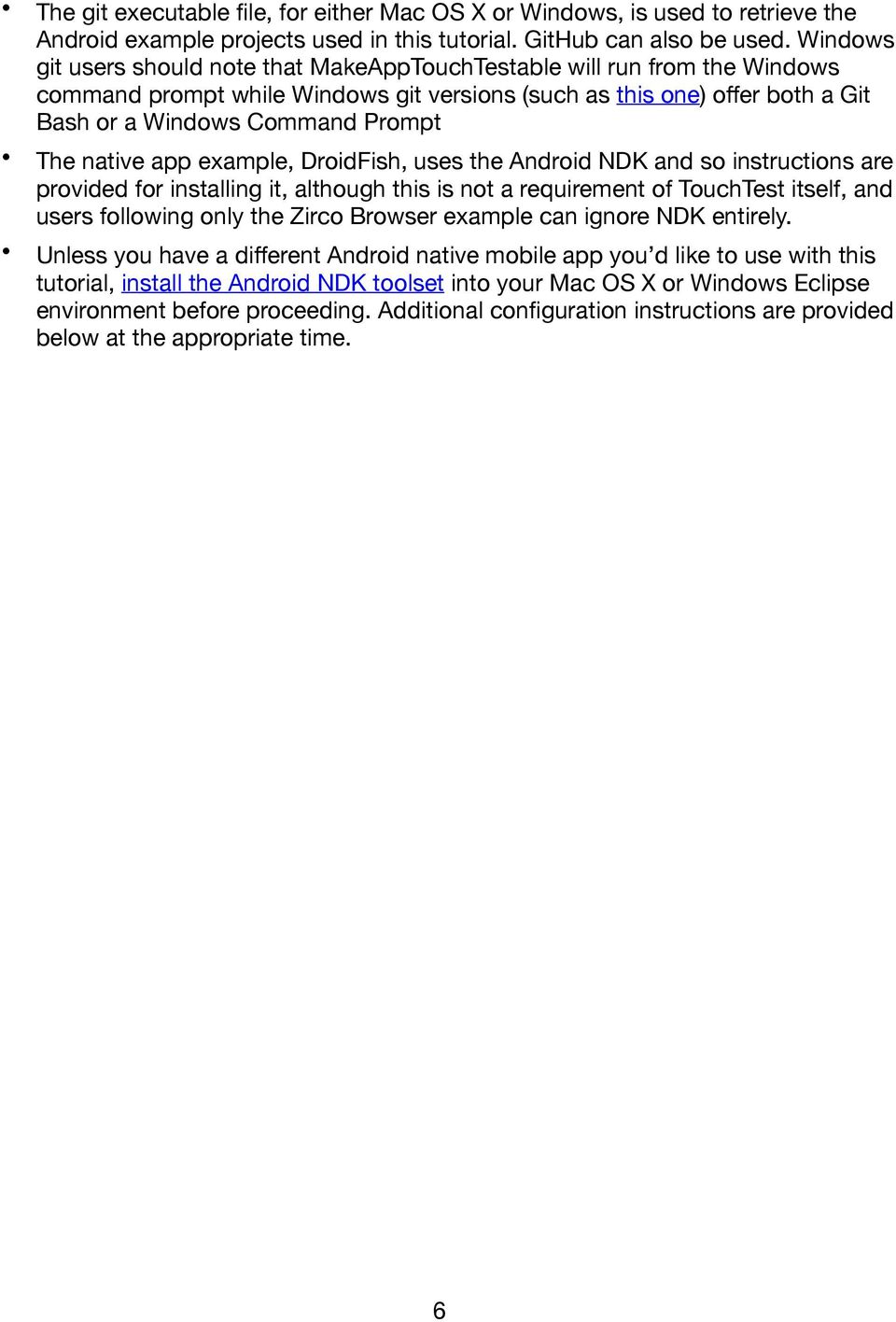
12 CloudTest Utility Software (Developer Only) Developers who would also like to add TouchTest to an existing mobile app can find basic instructions for using the MakeAppTouchTestable utility in this guide. 1. Download and unarchive the MakeAppTouchTestable Utility from the CloudTest Welcome page. Note: This archive contains the necessary drivers for both the manual and automatic methods described below. 7
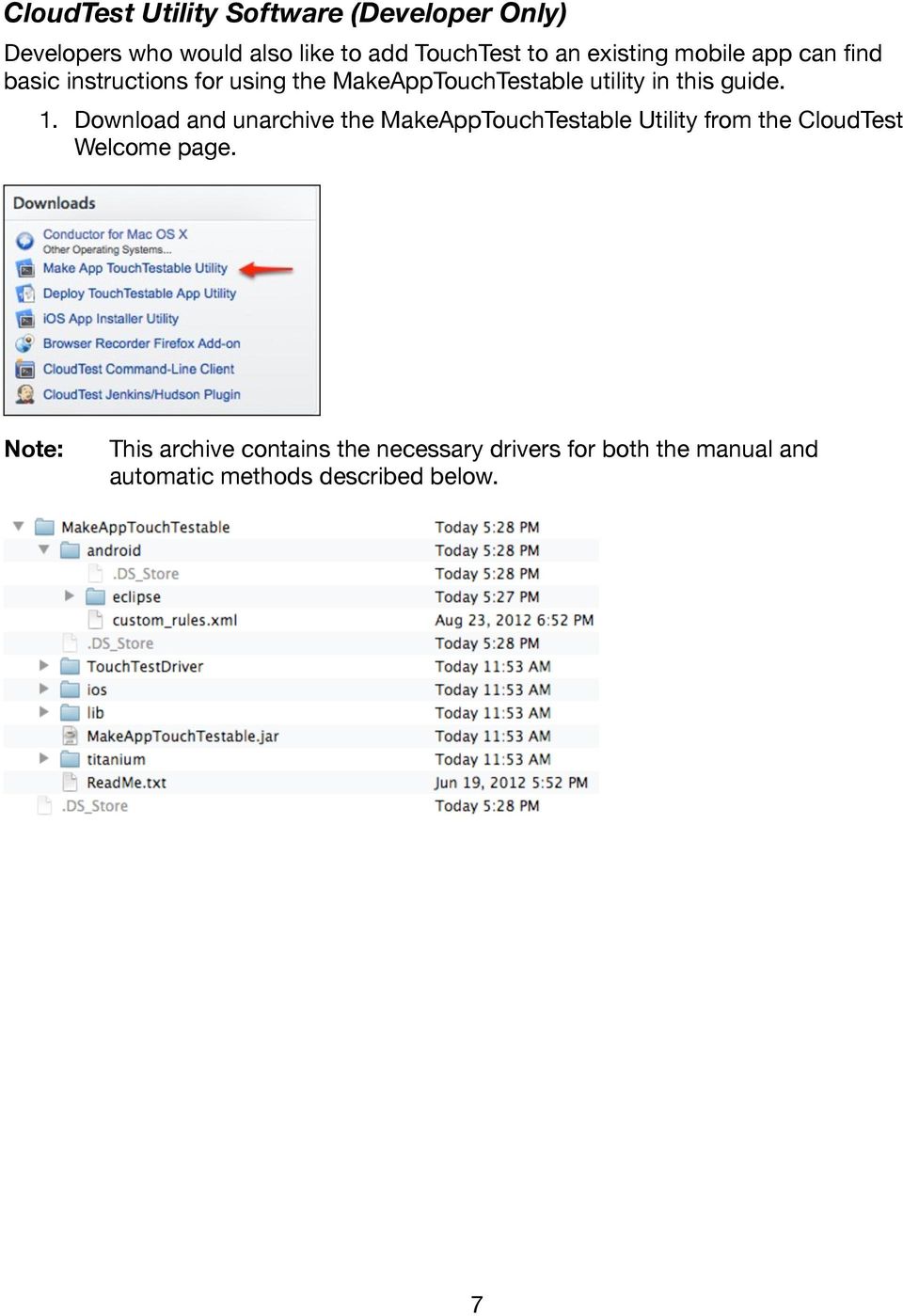
13 Setting Up the Droidfish Project (Native App Developer) Next, we will retrieve the native app, Droidfish, for use as an example app. After it is downloaded, we will then add TouchTest capabilities to it via the MakeAppTouchTestable utility. You can use GitHub to download the DroidFish app s source code here, or use the git command from within either Terminal or the Windows Command Prompt using the following syntax (and presuming that git is in the path): git clone 1. Once downloaded, inspect the DroidFish project s components prior to running the utility. The unarchived project folders are shown below. In our Mac OS X example, shown above, the DroidFish project is located in ~/ Documents/Demo/droidfishchess_android. 8
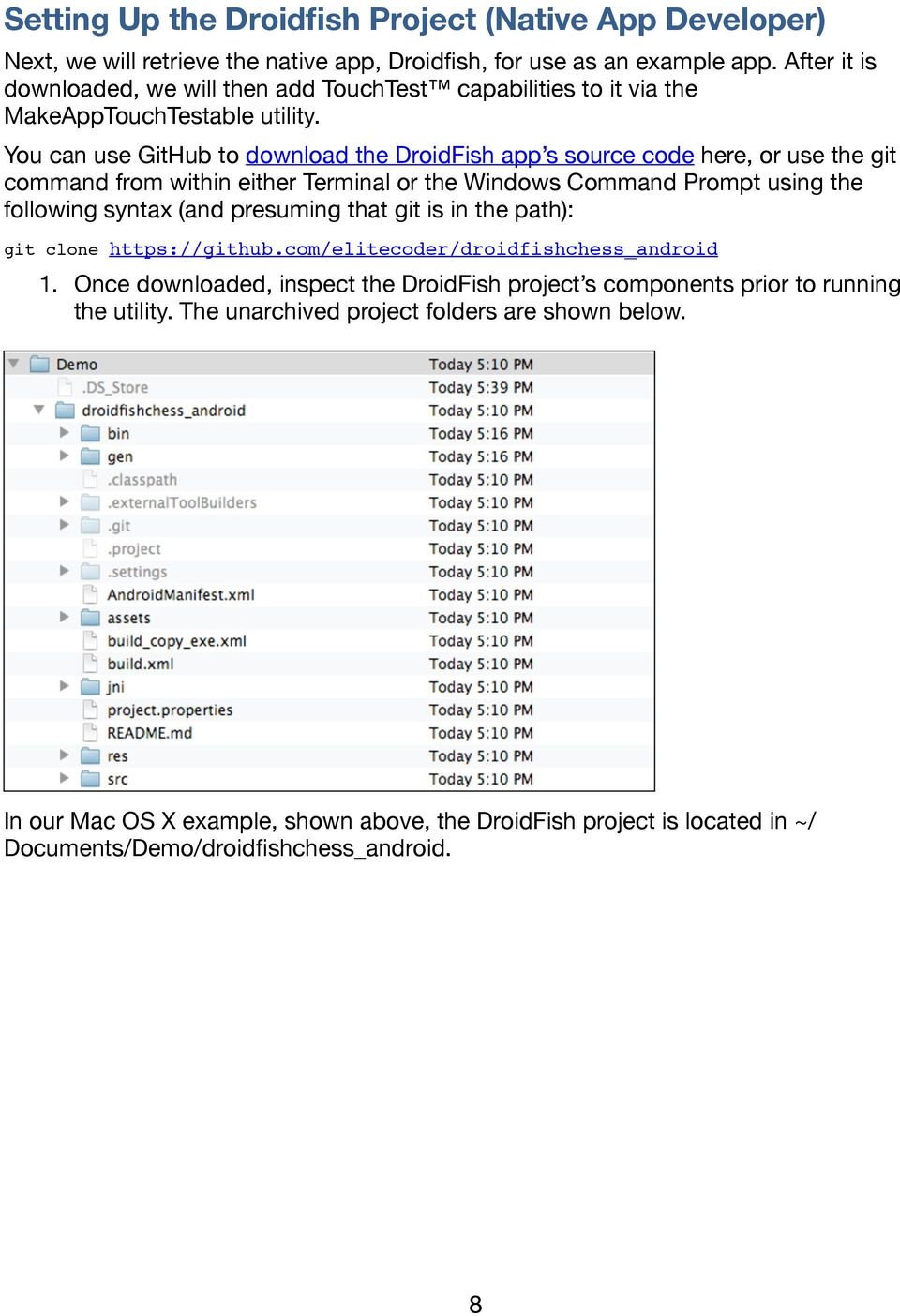
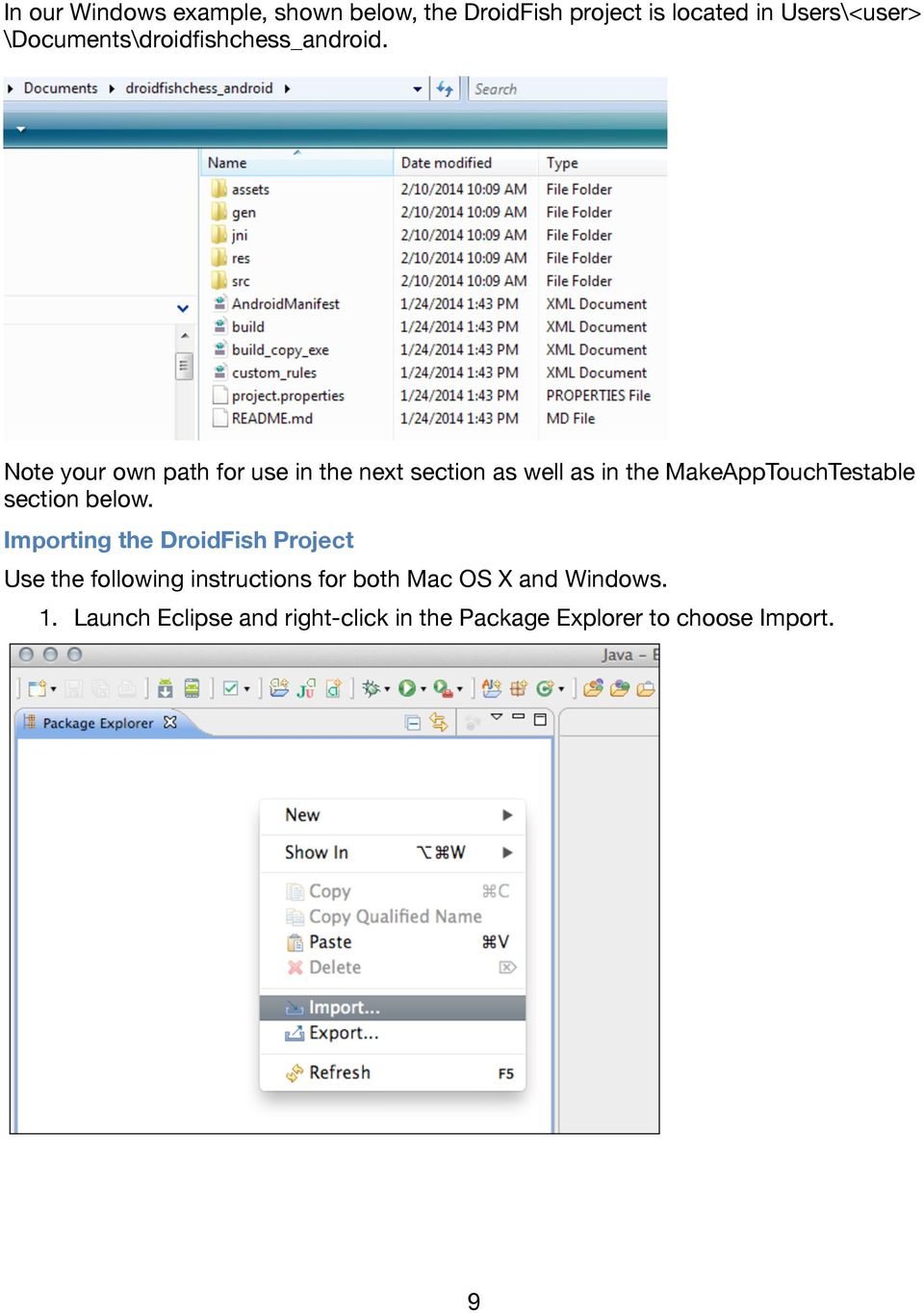
14 In our Windows example, shown below, the DroidFish project is located in Users\<user> \Documents\droidfishchess_android. Note your own path for use in the next section as well as in the MakeAppTouchTestable section below. Importing the DroidFish Project Use the following instructions for both Mac OS X and Windows. 1. Launch Eclipse and right-click in the Package Explorer to choose Import. 9
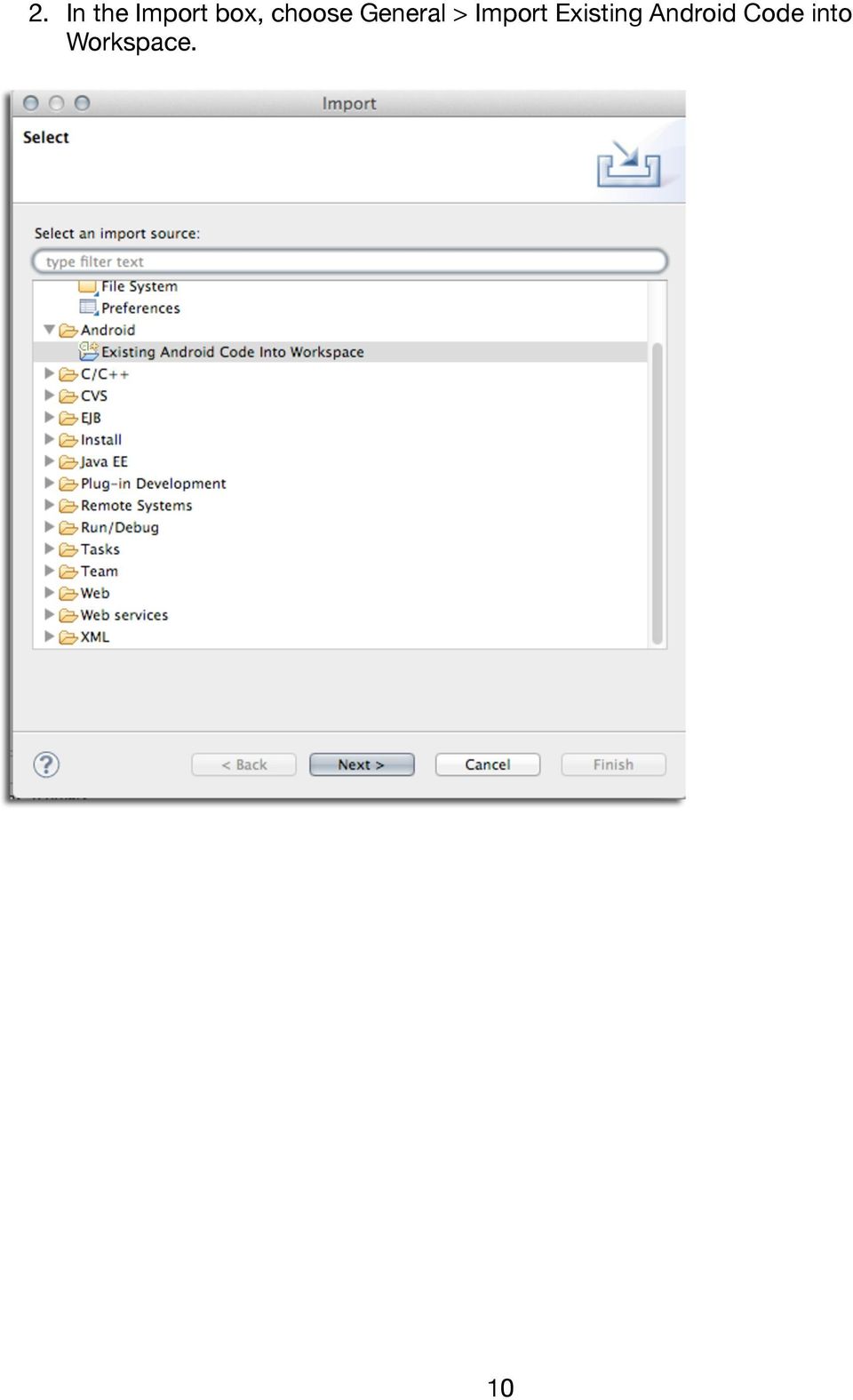
15 2. In the Import box, choose General > Import Existing Android Code into Workspace. 10
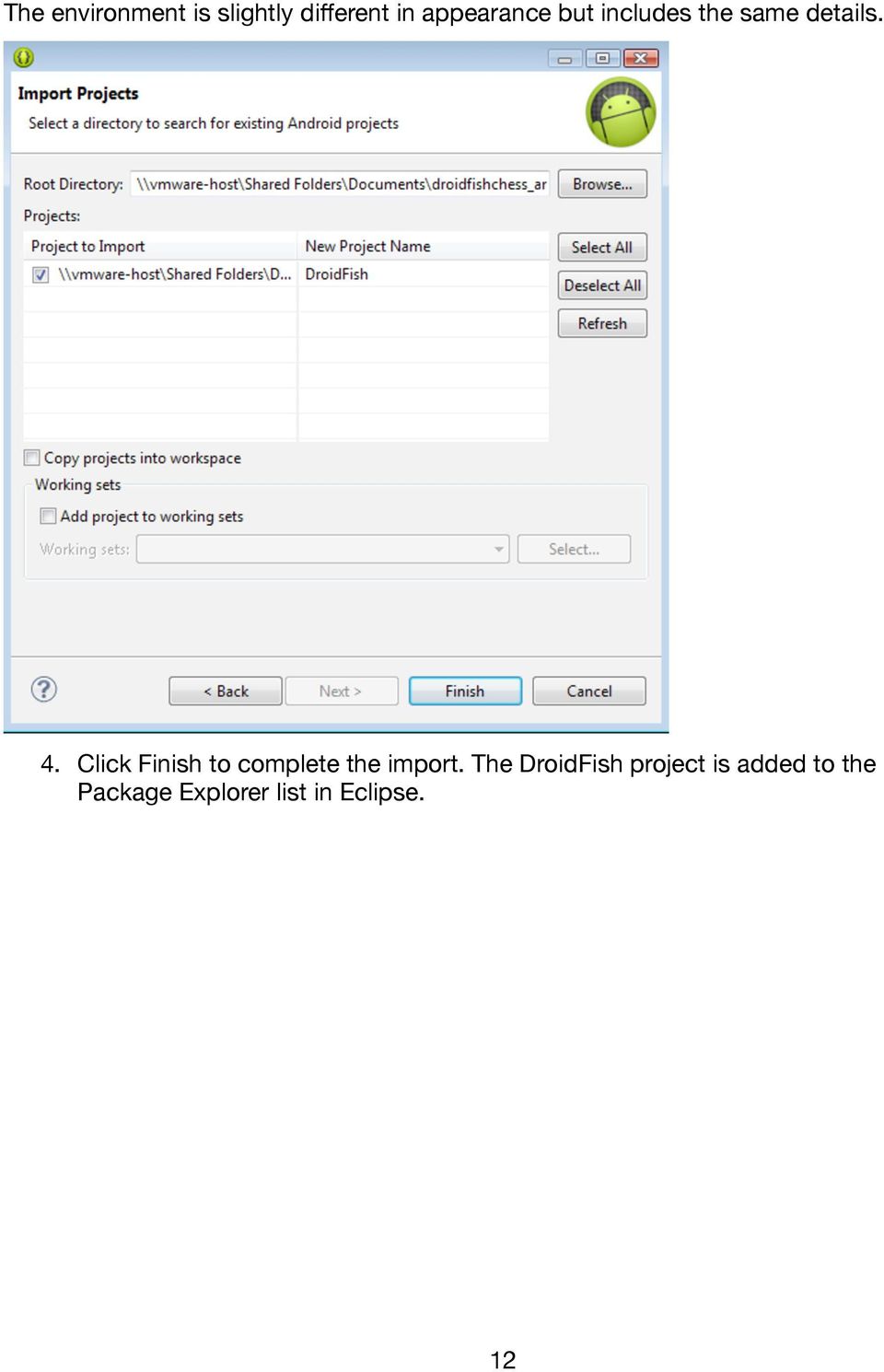
16 3. Select the root directory for the DroidFish (or other project). The Mac OS X example is shown above, while the Windows example is shown below. 11

17 The environment is slightly different in appearance but includes the same details. 4. Click Finish to complete the import. The DroidFish project is added to the Package Explorer list in Eclipse. 12
18 Configuring the NDK Builder (Droidfish Only) As noted above, Droidfish requires the NDK toolset in order to facilitate its use of nativecode components. As a result, after our import we have a project that will not yet compile. Use the following steps to employ the NDK toolset. 1. Select the Droidfish project in the Package Explorer and then right-click to choose Properties. 13

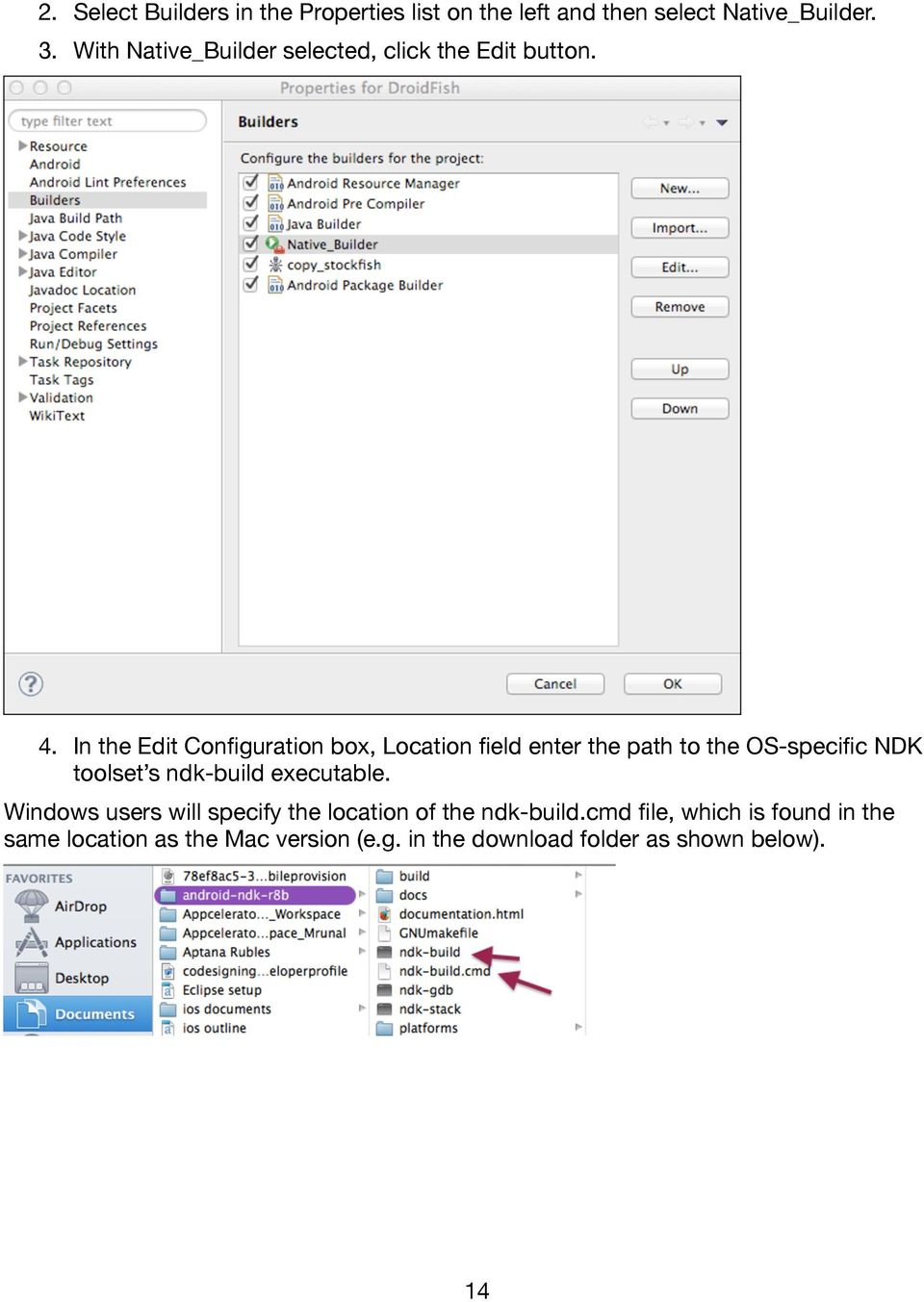
19 2. Select Builders in the Properties list on the left and then select Native_Builder. 3. With Native_Builder selected, click the Edit button. 4. In the Edit Configuration box, Location field enter the path to the OS-specific NDK toolset s ndk-build executable. Windows users will specify the location of the ndk-build.cmd file, which is found in the same location as the Mac version (e.g. in the download folder as shown below). 14
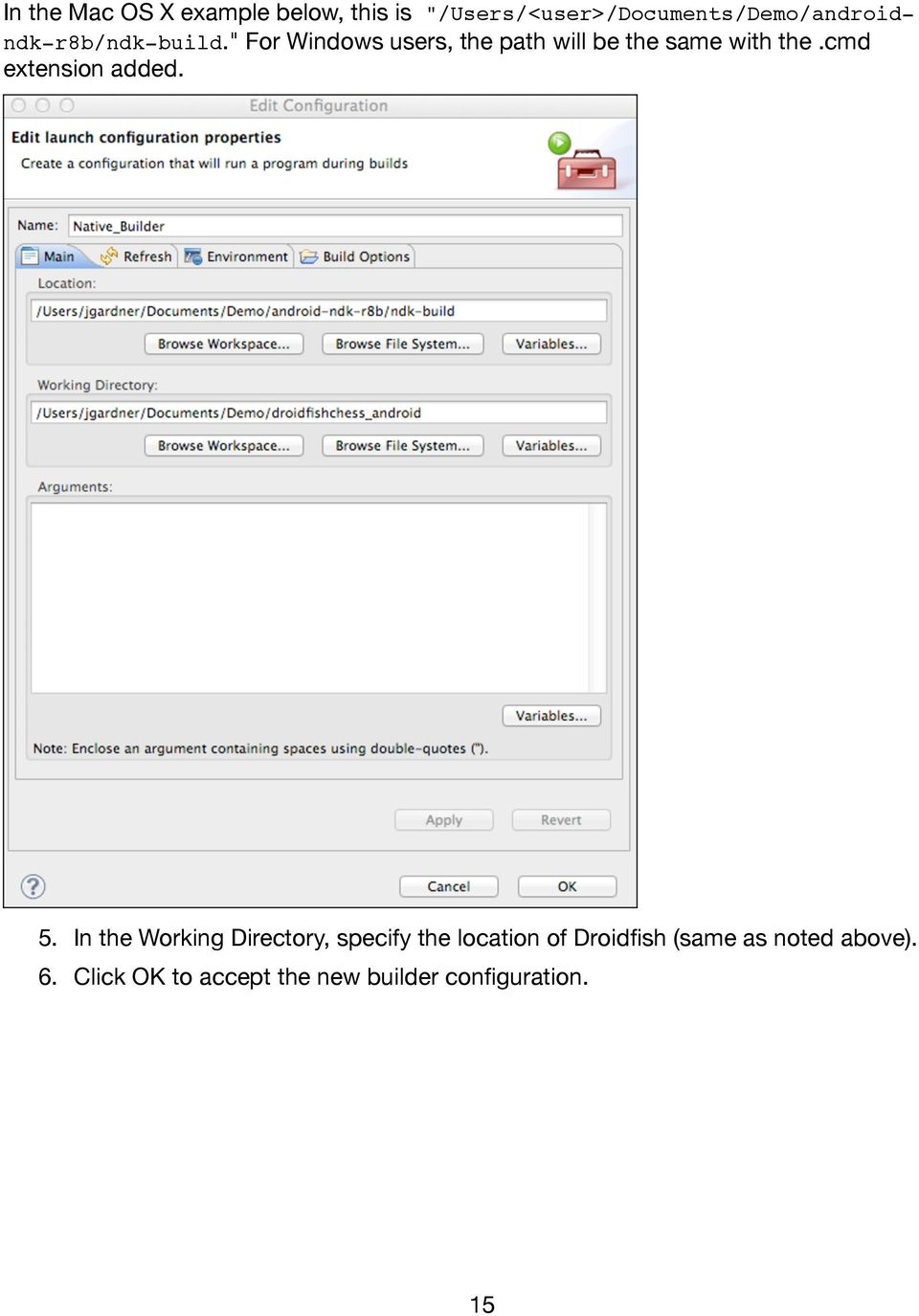
20 In the Mac OS X example below, this is "/Users/<user>/Documents/Demo/androidndk-r8b/ndk-build." For Windows users, the path will be the same with the.cmd extension added. 5. In the Working Directory, specify the location of Droidfish (same as noted above). 6. Click OK to accept the new builder configuration. 15
21 Setting Up the Zirco Browser Project (Hybrid App Developer) The Zirco Browser is presented here as an example of TouchTest Hybrid testing. In the following steps, we will retrieve the hybrid app example app, Zirco Browser, and then use the MakeAppTouchTestable utility to add TouchTest Hybrid capabilities to it. After which, the app will be deployed to an Android device. 1. On the command line, change to the folder where you'd like the source code to live. Use git (or GitHub) to download the Zirco Browser app s source: git clone 2. Once downloaded, inspect the project s components prior to running the MATT utility on it (if you are going to use MATT's apk parameter to instrument the APK file you can still do this inspection although the project itself will not be modified using that method). The unarchived project folders are shown below. In our Mac OS X example, shown above, the Zirco Browser project is located in ~/ Documents/Demo/zircobrowser_android. If your project is in Windows, use the syntax appropriate for the context. In either case, note your path for use in the next section as well as in the MakeAppTouchTestable section below. 16
22 Importing the Zirco Browser Project 1. Launch Eclipse and right-click in the Package Explorer to choose Import. 17
23 3. In the Import box, choose General > Import Existing Android Code into Workspace. 4. Click Next. 18
24 5. Select the root directory for the Zirco Browser (or other project). 6. Click Finish to complete the import. The zirco-browser project is added to the Package Explorer list in Eclipse. The project begins to compile. You can use "Run As " to install the application to your Android device. 19
25 2. Locate and open the AndroidManifest.xml file with the Android Common XML Editor and find the following line: <uses-sdk android:minsdkversion="7" android:targetsdkversion="8" /> Change both values to 10 as shown below. If it is already "10" leave it as is. 3. Close the project and exit Eclipse. 20
26 Using the MakeAppTouchTestable Utility (Developer Only) As noted in the prerequisites above, TouchTest uses the MakeAppTouchTestable Utility, which is downloaded from the CloudTest, Welcome page, to modify the Android project or the compiled APK. Note: The CloudTest user specified to run the MakeAppTouchTestable utility must be a user with Mobile Device Administrator rights. CloudTest Lite users have admin rights for the given device on their own instance. Static vs. Dynamic Instrumentation The MATT utility supports two instrumentation methods: static and dynamic. Dynamic instrumentation occurs when MATT instruments a compiled file (i.e. an APK file). This method requires that you compile your Android project first to create an APK, after which it can be instrumented using SOASTA or later (TouchTest ). Dynamic instrumentation is available for all supported Android versions. Static instrumentation occurs when MATT instruments an Android project. Static instrumentation is available in all TouchTest releases and for all supported Android versions. Making the DroidFish APK TouchTestable (Native Developer Only) This section presumes that the APK file has already been compiled. Do so at this time (without applying the MATT command) to proceed using the following steps. The Java memory parameter is used prior to MATT. 1. On the command line, navigate to the MakeAppTouchTestable folder you created above. For example, in Windows Command Prompt, cd C:\Documents\MakeAppTouchTestable For example in Mac OS X Terminal, cd ~/Documents/Demo/MakeAppTouchTestable 2. Next, run the utility on the DroidFish APK using your own modified version of the MakeAppTouchTestable command below For Mac OS X: java -Xmx1g -jar MakeAppTouchTestable.jar -apk <Android APK> -androidsdk <Android SDK Path> -url <CloudTest URL> -username <CloudTest user name> -password <CloudTest password> 21
27 For Windows: C:\Users\<user>\MakeAppTouchTestable>java -Xmx1g -jar MakeAppTouchTestable.jar -apk <Android APK> -androidsdk <Android SDK Path> -url <CloudTest URL> -username <CloudTest user name> -password <CloudTest password> TIP: Copy the above command into a text file to build your own command. Where: <Android APK> is the path to the APK file. As we noted above, our example path under Mac OS X was: ~/Documents/Demo/droidfishchess_android <Android SDK Path> is the path to the Android SDK used to compile the APK file. <CloudTest URL> is the CloudTest Lite or CloudTest instance in use. Using the Java parameter -Xmx1g prior to jar allocates the necessary memory to complete the operation. Otherwise, the MATT command may throw an exception. Here is a complete Mac OS X example: java -Xmx1g -jar MakeAppTouchTestable.jar -apk ~/Documents/Demo/ droidfishchess_android/bin/droidfish.apk -androidsdk ~/Development/android-sdkmacosx -url -username SOASTA_DOC -password secret Here is a complete Windows example: C:\Users\<user>\MakeAppTouchTestable>java -Xmx1g -jar MakeAppTouchTestable.jar - apk C:\Documents\Demo\droidfishchess_android\bin\Droidfish.apk -androidsdk C: \Development\android-sdk-macosx -url -username SOASTA_DOC -password secret -Xmx1g Optionally, you can manually specify an additional launchurl flag, being sure to specify the correct URL syntax (shown below). This argument is used in the CloudTest repository to represent your mobile app and in the compiled app. For Eclipse projects, this setting originates in the AndroidManifest.xml. Whether you create the TouchTestable Android app using the project or apk MATT parameter this launchurl must match for testing to succeed. For example, -launchurl Droidfish://key1=value1&key2=value2&key3=value3 MakeAppTouchTestable will configure your project, and create a new Mobile App object in the CloudTest server repository. The Mobile App object created will have the autocreated URL Scheme in its Launch URL field. The following text output appears in Terminal: 22
28 Mobile App Object "Droidfish" representing your Application "Droidfish" has been created in CloudTest Repository. The Mobile App object created will have the auto-created scheme found in tiapp.xml unless otherwise specified. You will see a message similar to the following: Will create the launch url: touchtest-e4eedd67-4ea9-495a-be57-2d34eaafc510:// Making the DroidFish Project TouchTestable (Native Developer Only) 1. On the command line, navigate to the MakeAppTouchTestable folder you created above. For example, in Windows Command Prompt, cd C:\Documents\MakeAppTouchTestable For example in Mac OS X Terminal, cd ~/Documents/Demo/MakeAppTouchTestable 2. Next, run the utility on the DroidFish project using your own modified version of the MakeAppTouchTestable command below For Mac OS X: sh MakeAppTouchTestable/bin/MakeAppTouchTestable -project <Android project directory> -url <CloudTest URL> -username <CloudTest user name> -password <CloudTest password> For Windows: C:\Users\<user>\MakeAppTouchTestable>sh MakeAppTouchTestable/bin/ MakeAppTouchTestable -project <Android project directory> -url <CloudTest URL> -username <CloudTest user name> -password <CloudTest password> TIP: Copy the above command into a text file to build your own command. Where: <Android project file> is the path to the root folder of your project. As we noted above, our example path under Mac OS X was: ~/Documents/Demo/droidfishchess_android <CloudTest URL> is the CloudTest Lite or CloudTest instance in use. In the example below, we show a CloudTest Lite instance on a LAN with an Apple router, , but your CloudTest server may have a domain or IP address prior to /concerto. 23
29 Here is a complete Mac OS X example: sh MakeAppTouchTestable/bin/MakeAppTouchTestable -project ~/Documents/ Demo/droidfishchess_android -url -username SOASTA_DOC -password secret Here is a complete Windows example: C:\Users\<user>\MakeAppTouchTestable>sh MakeAppTouchTestable/bin/ MakeAppTouchTestable -project C:\Documents\Demo\droidfishchess_android -url concerto -username SOASTA_DOC -password secret Optionally, you can manually specify an additional launchurl flag, being sure to specify the correct URL syntax (shown below). This argument is used in the CloudTest repository to represent your mobile app and in the compiled app. For Eclipse projects, this setting originates in the AndroidManifest.xml. The launch URL in the compiled app and in the CloudTest, Mobile App, launch URL field must match for testing to occur. For example, -launchurl Droidfish://key1=value1&key2=value2&key3=value3 MakeAppTouchTestable will configure your project, and create a new Mobile App object in the CloudTest server repository. The Mobile App object created will have the autocreated URL Scheme in its Launch URL field. The following text output appears in Terminal: Mobile App Object "Droidfish" representing your Application "Droidfish" has been created in CloudTest Repository. The Mobile App object created will have the auto-created scheme found in tiapp.xml unless otherwise specified. You will see a message similar to the following: Will create the launch url: touchtest-e4eedd67-4ea9-495a-be57-2d34eaafc510:// IMPORTANT: In the next section, we inspect the project changes and then re-run the sample app using the steps in Install to the Device. Minimally, you must re-run the app after using the MakeAppTouchTestable utility. 24
30 Making the Zirco Browser APK TouchTestable (Hybrid Developer Only) This section presumes that the APK file has already been compiled. Do so at this time (without applying the MATT command) to proceed using the following steps. 1. On the command line, navigate to the MakeAppTouchTestable folder you created above. For example, in Windows Command Prompt, cd C:\Documents\MakeAppTouchTestable For example, in Mac OS X Terminal, cd ~/Documents/Demo/MakeAppTouchTestable 2. Next, run the utility on the Zirco Browser APK using your own modified version of the MakeAppTouchTestable command below: For Mac OS X: sh MakeAppTouchTestable/bin/MakeAppTouchTestable -apk <Android APK> - androidsdk <Android SDK Path> -url <CloudTest URL> -username <CloudTest user name> -password <CloudTest password> For Windows: C:\Users\<user>\MakeAppTouchTestable>sh MakeAppTouchTestable/bin/ MakeAppTouchTestable -apk <Android APK> -androidsdk <Android SDK Path> -url <CloudTest URL> -username <CloudTest user name> -password <CloudTest password> TIP: Copy the above command into a text or other scratch file to begin making your own command. where: <Android APK> is the path to the APK. For example: ~/Documents/Demo/zircobrowser_android/bin/zirco-browser.apk <Android SDK Path> is the path to the Android SDK used to compile the APK file. <CloudTest URL> is the CloudTest Lite or CloudTest server that you use. So, the domain or IP address prior to the "/concerto/touchtest" string is what we mean by CloudTest URL. Here is a complete Mac OS X example: sh MakeAppTouchTestable/bin/MakeAppTouchTestable -apk ~/Documents/ Demo/zircobrowser_android/bin/zirco-browser.apk -url /concerto -username SOASTA_DOC -password secret Here is a complete Windows example: C:\Users\<user>\MakeAppTouchTestable>sh MakeAppTouchTestable/bin/ MakeAppTouchTestable -apk C:\Documents\Demo\zircobrowser_android\bin\zirco-browser.apk -androidsdk C: \Development\android-sdk-macosx -url -username SOASTA_DOC -password secret 25
31 Advanced users can also manually specify an additional launchurl flag, using the URL syntax shown below. For example, you can impose the following convention, including optional arguments: -launchurl ZircoBrowser://key1=value1&key2=value2&key3=value3 The launch URL is used by CloudTest to open your mobile app via the corresponding device agent. The launch URL in the compiled app and in CloudTest's Central > Mobile App, Launch URL field must match for testing to succeed. 3. Once ready, run the modified command in Terminal from the MakeAppTouchTestable folder. When you do so, MakeAppTouchTestable will configure your APK, and create a new Mobile App object in the CloudTest server repository. The Mobile App object created will have the auto-created URL Scheme in its Launch URL field. The following text output appears in Terminal: Mobile App Object representing your Application "Zirco Browser" has been created in CloudTest Repository. The Mobile App object created will have the auto-created scheme found in tiapp.xml unless otherwise specified. You will see a message similar to the following: Will create the launch url: touchtest-e4eedd67-4ea9-495abe57-2d34eaafc510:// MakeAppTouchTestable will configure your project, and create a new Mobile App object in the CloudTest server repository. The Mobile App object created will have the auto-created URL Scheme in its Launch URL field. You will see a message similar to the following: Mobile App Object "Zirco Browser" representing your Application "Zirco Browser" has been created in CloudTest Repository. 26
32 Making the Zirco Browser Project TouchTestable (Hybrid Developer Only) 1. On the command line, navigate to the MakeAppTouchTestable folder you created above. For example, in Windows Command Prompt, cd C:\Documents\MakeAppTouchTestable For example, in Mac OS X Terminal, cd ~/Documents/Demo/MakeAppTouchTestable 2. Next, run the utility on the Zirco Browser project using your own modified version of the MakeAppTouchTestable command below: For Mac OS X: sh MakeAppTouchTestable/bin/MakeAppTouchTestable -project <Android project directory> -url <CloudTest URL> -username <CloudTest user name> -password <CloudTest password> For Windows: C:\Users\<user>\MakeAppTouchTestable>sh MakeAppTouchTestable/bin/ MakeAppTouchTestable -project <Android project directory> -url <CloudTest URL> -username <CloudTest user name> -password <CloudTest password> TIP: Copy the above command into a text or other scratch file to begin making your own command. where: <Android project file> is the path to the root folder of your project. As we noted above, our example path was: ~/Documents/Demo/zircobrowser_android <CloudTest URL> is the CloudTest Lite or CloudTest server that you use. So, the domain or IP address prior to the "/concerto/touchtest" string is what we mean by CloudTest URL. In the example below, we show an IP address that was assigned for a given CloudTest Lite instance but it could be any other CloudTest URL where you have rights. Here is a complete Mac OS X example: sh MakeAppTouchTestable/bin/MakeAppTouchTestable -project ~/Documents/ Demo/zircobrowser_android -url -username SOASTA_DOC -password secret 27
33 Here is a complete Windows example: C:\Users\<user>\MakeAppTouchTestable>java jar MakeAppTouchTestable.jar - project C:\Documents\Demo\zircobrowser_android -url concerto -username SOASTA_DOC -password secret Advanced users can also manually specify an additional launchurl flag, using the URL syntax shown below. For example, you can impose the following convention, including optional arguments: -launchurl ZircoBrowser://key1=value1&key2=value2&key3=value3 The launch URL is used by CloudTest to open your mobile app via the corresponding device agent. For Eclipse projects, this setting originates in the AndroidManifest.xml. The launch URL in the compiled app and in CloudTest's Central > Mobile App, Launch URL field must match for testing to occur. 3. Once ready, run the modified command in Terminal from the MakeAppTouchTestable folder. When you do so, MakeAppTouchTestable will configure your project, and create a new Mobile App object in the CloudTest server repository. The Mobile App object created will have the auto-created URL Scheme in its Launch URL field. The following text output appears in Terminal: Mobile App Object representing your Application "Zirco Browser" has been created in CloudTest Repository. The Mobile App object created will have the auto-created scheme found in tiapp.xml unless otherwise specified. You will see a message similar to the following: Will create the launch url: touchtest-e4eedd67-4ea9-495abe57-2d34eaafc510:// MakeAppTouchTestable will configure your project, and create a new Mobile App object in the CloudTest server repository. The Mobile App object created will have the auto-created URL Scheme in its Launch URL field. You will see a message similar to the following: Mobile App Object "Zirco Browser" representing your Application "Zirco Browser" has been created in CloudTest Repository. IMPORTANT: In the next section, we will inspect the project changes and then re-run the sample app using the steps in Install to the Device. Minimally, you must re-compile the APK after using the MakeAppTouchTestable utility. 28
34 Inspecting a TouchTestable Project (Native or Hybrid using project method) If we are using the MATT project parameter, we can visually inspect changes to the project in order to satisfy our curiosity, although this is not strictly necessary. If you used the MATT apk parameter skip ahead to the next section. 1. For either project, inspect the original source folder via Finder. The contents of the folder where the droidfishchess_android project was retrieved using git clone are shown below. 29
35 The contents of the folder where the zircobrowser_android project was retrieved using git are shown below. Note that in either project, the TouchTest Driver folder has been added. 2. In Eclipse, select the top-level project folder and choose Refresh. Note that the project includes the TouchTestDriver folder. 3. In Eclipse, select the Project menu, Build Project command. 30
36 4. Expand the TouchTestDriver folder and its subfolder (JarsForWeaving). 5. Open the AndroidManifest.xml file in XML mode (by clicking the AndroidManifest.xml tab in the workspace). Note that the manifest now includes a new intent-filter section that includes the launchurl data value in android:scheme. 31
37 6. Scroll down to the end of the AndroidManifest.xml. Note the new service statement referencing TouchTest in android:exported. 32
38 7. In Eclipse's Project Explorer, right-click the ZircoBrowser folder, and then in the Properties box, select Builders. Ensure that the TouchTest Post-Compile box is checked. 8. Now that the project is verified TouchTestable, send it to the device or simulator a second time using Run. 33
39 Inspecting the Mobile App in CloudTest (Native or Hybrid) In the steps above at the end of each run of the MakeAppTouchTestable.jar we were notified that the Mobile App Object had been created in the CloudTest Repository. TIP: This mobile app will appear in the Choose Device Agent and Mobile App box whenever end-users start a mobile app recording. Selecting which mobile app to launch, on which test devices, is a crucial end-user step. 1. Verify that the Mobile App has been added by logging into CloudTest and looking for its entry in the Central > Mobile Apps list. For example, in the screenshot below both DroidFish and Zirco Browser apps appear as expected. 34
40 Double-click the Mobile App you created to inspect its details. The Mobile App detail form appears. All of the fields shown were populated from the project, with the exception of Supported Device Type and Minimum OS Version. The DroidFish mobile app detail is shown below Note: The Minimum Android Version supported in TouchTest is (Gingerbread). 35
41 The Zirco Browser mobile app detail is shown below 36
42 Install the Android APK to the Device Create the TouchTestable APK whether using dynamic or static instrumentation techniques before using adb to install it to the device or simulator using the following steps. Install using Eclipse 1. Connect the Android Device to the desktop client running Eclipse via USB. You can also use a simulator. A physical device must have the following set: o o o The stock browser on the device should support launch of native apps The Developer Options, USB Debugging box should be enabled The Security, Unknown sources box should be enabled 2. Click the Run Droidfish button on the toolbar to build the project and push it to the Android Device. If the Android device is connected, and no Android Virtual Device (AVD) is running, the app is installed to the device. If more than one device or emulator combination is available, then a selection box appears for you to choose If no device is connected, the Android Virtual Device (AVD) will run and the Droidfish app will be installed to it instead. The AVD must be using SDK or later. When all of the conditions and steps above are completed, the app is pushed onto the Android Device. The Eclipse Console will indicate success and the app will launch on the device. [ :05:21 - DroidFish] [ :05:21 - DroidFish] Android Launch! [ :05:21 - DroidFish] adb is running normally. [ :05:21 - DroidFish] Performing org.petero.droidfish.droidfish activity launch [ :05:21 - DroidFish] Automatic Target Mode: using device '015d15b4da23f411' [ :05:21 - DroidFish] Uploading DroidFish.apk onto device '015d15b4da23f411' [ :05:23 - DroidFish] Installing DroidFish.apk... [ :05:26 - DroidFish] Success! [ :05:26 - DroidFish] Starting activity org.petero.droidfish.droidfish on device 015d15b4da23f411 37
43 [ :05:26 - DroidFish] ActivityManager: Starting: Intent { act=android.intent.action.main cat=[android.intent.category.launcher] cmp=org.petero.droidfish/.droidfish } Install from the Command Line using adb 1. Connect the Android Device to the desktop client or start the Simulator(s) before using adb. A physical device must have the following set: o o The Developer Options, USB Debugging box should be enabled The Security, Unknown sources box should be enabled 2. From the command line, execute the adb command using your own paths: ~/android-sdks/platform-tools/adb install -r ~/Shared/Jenkins/Home/jobs/ DroidfishFunctionalTests/bin/DroidFish-debug_TouchTest.apk When all of the conditions and steps above are completed, the app is pushed onto the Android Device. The command line will indicate success and the app will launch on the device: 873 KB/s ( bytes in 2.330s)! pkg: /data/local/tmp/droidfish-debug_touchtest.apk Success 38
44 Installing the TouchTest Agent on a Device (All Users) The TouchTest Agent is responsible for launching the apps that are being tested on a given device. This Android app runs in Android devices running or later. If these steps have already been performed on a given device, proceed to Recording a TouchTest Scenario below. To get started, download the TouchTest Agent onto the mobile device and then perform the one-time registration steps that will enable your device for use with TouchTest. 1. On your Android device, download the TouchTest Agent from the Welcome page. Note: Tap on the downloaded TouchTestAgent.apk file (usually found in the device's notification tray) to start Install. 2. When the installer appears, tap Install to proceed. You can also download the TouchTest Agent on the /touchtest URL of the CloudTest Environment. 39
45 3. Once install completes, tap Open to launch the TouchTest Agent app on the Android device. When you do so, the app launches and the TouchTest Agent splash screen displays. 4. Enter the CloudTest URL for TouchTest, which is your own server with /concerto/ touchtest appended: server>/concerto/touchtest. For example, a user with an Apple router running CloudTest Lite might connect to: 5. Tap Go. The TouchTest Agent opens the provided URL and a spinner appears as the app auto-registers itself. 40
46 Note: 6. Once the spinner disappears, enter your CloudTest user name and password and tap Login. If the spinner hangs, tap the screen to clear it. 7. When prompted, give the TouchTest Agent a name. For example Soasta Demo Nexus. Note that this name will be used throughout the product to refer to this device. Once entered the device name can only be changed by an Administrator. 8. Click Submit for administrator approval. If you re a CloudTest Lite user you are already a Mobile Device Admin and you must approve this device yourself using the instructions in the next section. 41
47 Once the request for Administrator approval has been made, the TouchTest Agent will continue to poll CloudTest for approval. Note: It is not necessary to keep the TouchTest Agent running while this approval is pending. The TouchTest Agent will resume polling for its approval once restarted. 42
48 If the Mobile Device Administrator approves your device, the TouchTest Agent page will appear with the status Connected for the first time. On subsequent launches click Login to Connect and Logout to Disconnect. If the Administrator rejects your device, that status will display. 43
49 Approving a Mobile Device (Device Admin or CloudTest Lite user) The TouchTest Mobile Device Administrator has the responsibility to approve or reject the devices attempting to join testing. Administrators will use the following steps to approve/reject the devices attempting to join. 1. Login as the user with mobile device administrative rights. 2. Click Central > Device Clouds When you do so, the Device Clouds list displays devices in the queue by name. Those devices that have the status Pending Approval need administrative attention. Note: 3. Click Approve to complete adding a device and Reject to deny its access. CloudTest Lite/TouchTest Lite users may approve a single device only and that device cannot be removed. Approval should only be performed on the intended single device. 44
50 Associating Mobile Apps with a Device Once a device is approved, use the following steps to assign one or more mobile apps to that device. 1. In Central > Device Clouds, select the mobile device. For example, Soasta Demo Nexus as shown below. 2. In the lower panel, click the Mobile Apps tab. If necessary, use the Maximize button to increase the workspace. 3. Check the Mobile App(s) that you want to authorize this device to access. For example, DroidFish and/or Zirco Browser. 4. Click Save on the lower panel toolbar before proceeding. 45
51 Recording a TouchTest Scenario (All Users) Once the TouchTest Agent profile is installed and device access approved you are ready to record and playback your TouchTest. Create a new test clip within CloudTest for your native or hybrid app. Click Record within the Clip Editor and then choose Mobile App Recording, specify the Device Agent, and then the native or hybrid mobile app whose actions you want to record. Perform the app actions on the mobile device to capture them in the new test clip. These steps are described in the remainder of this tutorial. Create a TouchTest Clip Prepare your device for recording and create a new clip that will be used to perform mobile app recording and serve as the basis for your TouchTest. 1. Open the TouchTest Agent on your mobile device, and click Login (your previously entered username and password should be auto-populated). Once successfully logged on, the device Status will be Connected. Login to CloudTest on your desktop computer and select Central > Clips, and then click New on the Central toolbar. 46
52 A new Untitled Test Clip opens in a Clip Editor tab. A Record pop-up identifies the Record drop-down. Once ready, click the Record button and then select Record Mobile App. 47
53 The Choose a Device Agent and Mobile App box appears. 2. Select the TouchTest Agent that you created above and also select the mobile app you d like to test. Note that in the shot below both mobile apps are listed for the select device agent (i.e. Soasta Demo Nexus and Zirco Browser). Or, alternately, Soasta Demo Nexus and Droidfish. 3. Click the Record button in the wizard once your selection is made. TouchTest Agent will launch the selected app on the selected device. Note: If the Mobile Device Administrator (or CloudTest Lite user) has completed the steps above to associate one or more mobile apps with the device, those apps will appear in the Mobile App list whenever that device is selected. If no mobile app has been defined for the selected device agent, the Mobile App list will be empty (shown below). 48
54 TIP: For developers and admins both, ensure that the Make App TouchTestable steps have been applied to your app and that the device agent is associated with a mobile app. You can also click the help link in the box to access documentation on this topic. 49
55 Recording a Droidfish Scenario (Native) DroidFish is a typical chess application with menu options, the board pieces and settings, a clock for each player, and so forth. There are a number of verification possibilities: Verify that buttons are present Verify start of game that 32 pieces are visible Verify move list updates Verify clock Verify check mate position 50
56 1. Perform some or all of the following menu actions on your mobile device to get to the beginning of a game. Select and long press Game (3 rd button from left at bottom of the chess board), Goto Start of Game. Enter Game Mode, Select Two Players. 51
57 2. Perform the following initial moves known as Fool s Mate: White pawn to F4 Black pawn to E6 52
58 White pawn to G4 Black Queen to H4 53
59 5. After reaching the checkmate position shown above, Select Game, Goto Start of Game (e.g. using the 3 rd button from the left below the chess board). 54
60 While you perform the mobile app actions, the Clip Editor adds an app action to the clip. The Info Window streams with the latest app action s General tab shown as actions are added. 6. In the desktop browser, click the Record button to stop recording. The recorded clip displays the recorded actions. Recording a Zirco Browser Scenario (Hybrid) Zirco Browser is an Android hybrid app, meaning that it renders a web page as all or part of its functionality. With Zirco Browser running on the device as a result of launching it from the Clip Editor, we will now navigate to the URL for the SOASTA web site: Perform the planned mobile app user interactions on your mobile device. For each action you perform in the browser, TouchTest Web adds an action to the clip. For example, in our demo clip, which is used in the remainder of this hybrid example, we tapped the following sequence: 55
61 a. Long press the Location field in Zirco Browser until the about:text is selected b. With the previous text selected, enter c. Hit the space bar so that the shortcut menu goes away d. Tap the Go Button (the right arrow at the end of the Location field). e. On SOASTA home, tap the Menu link. f. Tap Solutions and then Mobile Performance testing on the sub-menu. g. Click the SOASTA logo to return to home. h. On the home page, tap Web performance testing. i. Click the SOASTA logo to return to home a second time. In the screenshot below, the Clip Editor is in Icon view and is also in Record mode while connected to Zirco Browser. 2. Once the relevant interactions have been recorded, click the Record button again to stop the recording. 56
62 Adding an Interval Delay between Each Action (All Users) In the following optional steps, we will add an interval delay to the test clip. This type of delay will stretch out the time between all the recorded app actions. Imposing delays, either using the Interval Delay setting or by inserting Delay clip elements, can make the test more viewable during the editing phase, as well as during test playback (when viewing the test as it plays is most desirable). 1. Click the Properties tab in the minimized sub-panel and then select the Clip tab at the top of the pane (the Clip tab may already be visible if properties are already open from the prior exercise). 2. In the Property Type list, click Clip Properties. 3. In the Clip Properties panel on the right, enter an Interval Delay in the given field. For example, 2000 ms. Entering 2000 adds a two second gap between each app action in the given test clip. Click Save on the Clip Editor toolbar. When the Save Test Clip box appears, accept the default name, which takes the form Clip for <Device Name> <Mobile App Name>. 57
63 Create a Composition (All Users) With any test clip open in the Clip Editor, you are ready to create and play a simple, new test composition using this test clip. These steps are applicable to both DroidFish and Zirco Browser examples. TIP: 1. To create a new composition from your test clip, click the Use in Test Composition drop-down in the upper-right corner of the Clip Editor toolbar, and select Play in Test Composition (as shown below). Take note of the Use in Test Composition commands and their purposes. The Droidfish clip is shown above; however, these steps apply equally to Zirco Browser. Open in Test Composition Choose Open in Test Composition to add this clip to a new draft composition where additional composition parameters can be set in the Composition Editor, Edit tab before proceeding to play. Play in Test Composition Choose Play in Test Composition to add this clip to a new draft composition where it will immediately be played in the Composition, Play tab before proceeding to edit parameters or play. Debug in Test Composition Choose Debug in Test Composition to add this clip to a new draft composition where it can be debugged in the Composition, Debugging tab before proceeding to edit parameters or play based on debug actions. 58
64 Playing a Composition If you used Play in Test Composition as suggested above, then your test clip is added to a new draft test composition, which opens in a new Composition Editor tab and immediately begins to play. If you clicked Open in Test Composition, you have a few more clicks to go. Ensure that the TouchTest Agent status is still Connected on the mobile device. In the Composition Editor, click Play to run the test composition a second time. The Composition Editor s Status Indicator changes to Playing, and the mobile app is launched on the specified mobile device(s) precisely as it was recorded. While the test runs, the Composition Editor automatically switches to the Play tab, and by default, the Result Details dashboard displays. 59
65 Result Details (Droidfish) The Result Details dashboard helps to discover the cause of errors in your test, if any. While play continues results are posted in the Composition Editor, Play tab, Result Details widget. In the show below, a DroidFish test plays in the Composition Editor, Play tab, Result Details dashboard. 60
66 Once play completes, the final results are displayed in the Results tab (also in the Result Details widget). If the test passed on all points, the status Completed With No Errors is clearly posted in the Result Details dashboard. The mobile app actions performed when the clip was created are played back on the device. Click to expand the nodes in the Navigation Tree on the left as they appear. Result Details uses a Cover Flow (top panel to the right) to display the test composition s stream as it occurs. This stream is also shown in the Navigation Tree (on the left) as elements are executed. As play continues, the focus is set to the last executed element unless user interaction prevents it. The current container is expanded while the prior containers are closed. 61
67 Clicking an element during play will halt this auto-focus-to-the-last-executed behavior. To resume auto-focus once interrupted, click Jump to Now in the upper right of the dashboard. o Click any object in the Cover Flow at the top to center it and display its details and play statistics in the panes below. o Use the scrollbar to browse the flow. Select any item to show its low-level details. 62
68 Result Details (Zirco Browser) The Result Details dashboard helps to discover the cause of errors in your test, if any. While play continues results are posted in the Composition Editor, Play tab, Result Details widget. In the shot below, a Zirco Browser test plays in the Composition Editor, Play tab, Result Details dashboard. 63
69 Once play completes, the final results are displayed in the Results tab (also in the Result Details widget). If the test passed on all points, the status Completed With No Errors is clearly posted in the Result Details dashboard. The mobile app actions performed when the clip was created are played back on the device. Click to expand the nodes in the Navigation Tree on the left as they appear. Result Details uses a Cover Flow (top panel to the right) to display the test composition s stream as it occurs. This stream is also shown in the Navigation Tree (on the left) as elements are executed. As play continues, the focus is set to the last executed element unless user interaction prevents it. The current container is expanded while the prior containers are closed. Clicking an element during play will halt this auto-focus-to-the-last-executed behavior. To resume auto-focus once interrupted, click Jump to Now in the upper right of the dashboard. 64
70 o Click any object in the Cover Flow at the top to center it and display its details and play statistics in the panes below. For example, in the shot below, App Action11 is selected in the Cover Flow and its details are in display in the lower panels. o Use the scrollbar to browse the flow. Select any item to show its low-level details. 65
71 Identifying and Analyzing Common Errors Despite the successful results above, in some cases your test may not succeed initially. As test advocates, we are often more interested in such failures. The way we approach them is first to identify where they occurred and then to analyze what occurred. Network or Communication Errors Initial errors in a simple test like the one above are most often only simple network or configuration errors having to do with test staging. For example, if the Device Agent is not connected or is not responding the Composition Editor s Status Indicator will indicate Test Composition failed (shown below). Click Details to display additional information in a dialog box. Composition-wide errors such as these are clearly indicated in the General section in the initial view of Result Details. They frequently are related the state of the Device Agent (e.g. if the device agent is not connected when you click Play). In some cases, the TouchTest Agent may have been started but is no longer responding (or the device auto-lock may have been invoked). In such cases Logout and re-login, or wake up the device if it is in auto-lock mode. App Action and Other Errors (All Users) CloudTest reports all failures and marks test successful or unsuccessful by the Failure Actions set within it. Failure Actions are set stringently by default to fail the test for any error and to show that failure in red. Result Details clearly indicates the type of test failure that has occurred in a given case. The red "X" in the Result Details dashboard easily distinguishes failures on specific app actions you recorded. In the remainder of this tutorial advanced editing and test analysis is shown separately for Droidfish (Native) and Zirco Browser (Hybrid), we will add outputs, and then verify, or validate, that an app action s value matches what we expect to find. This validation becomes the basis of creating real-world functional tests. 66
72 Advanced Clip Editing (Droidfish) Now that we've played this simple Droidfish test composition successfully, and learned how CloudTest will check the success or failure of a given composition, let s return to the test clip to inspect the clip elements and do some additional parameterization.! Click the Clip Editor tab if it s still open, or right-click the test clip in the Composition Editor and choose Open in New Tab.! Once the Clip Editor tab is in view, click the drop down Icon/List button on the toolbar and then select List. The List view is useful while clip editing, because it shows all the parameters and their corresponding inputs in one tabular view. When additional parameters are present they are displayed to the right of the Parameter 1 column. 67
73 Inspecting App Action Details (Droidfish) Examine elements and properties for any App Action by selecting it in the workspace above and then click its Gear icon to Show Info. When you do so, the Info Window appears. In the test clip below the recorded AppAction2 is open in the lower panel. The type of app action, type, represents the user name entered on the SOASTA Demo app login page. Locate App Action5 and expand it by clicking the arrow. Note that when you hover the mouse over the expanded app action the Add toolbar appears on the expanded row. This toolbar shows icons for Pre-Action Waits, Post-Action Waits, Outputs, Validations, and Property Sets. Any click on one of these will add the relevant form to the given app action. 68
74 4. Expand the tap action (if not already expanded) to inspect the Inputs of this action. Because all the moves in DroidFish use the id-chessboard in this example, this means that although the test plays successfully (even though the tapoffset values distinguish one from another) this doesn't result in a very helpful test in terms of human readability. App Action Properties (Droidfish) Additional parameters, such as Custom Properties, can be set by double-clicking an app action to open it in the Clip Editor lower panel. Action level properties are shown in the tree on the left. 1. Select the top-level node in the tree (as shown below) General, Repeat, and Custom Properties (for the action only; not for the entire clip) tabs appear on the right. 69
75 Note that Error Handling here is set to Errors should fail the parent by default. Other settings, including Waits, Inputs, Outputs, Validations, and Property Sets that were seen in the expanded list view steps above can also be set in the lower panel by clicking that node in the tree and then performing the desired action on the right. 1.In the Selected: App Action5 tab (or for any selected app action), familiarize yourself with the available elements and properties. Inputs (Locator, Scale, Precision, Content Offset) Locators are unique characteristics that identify a specific element or object on a mobile device. Locators come in many forms, including links, IDs such as those defined within CSS, and XPath expressions. Waits (Pre-Action Waits, Post-Action Waits ) Waits are commands that tell CloudTest not to execute an Action until a condition is met (pre-action waits), or to not continue processing the outputs, validations and property sets of the Action until a condition is met (post-action waits). Outputs Outputs specify what is to be shown in the Result Viewer for a given Action. Typical outputs include capturescreenshot, outputelementtext, and outputinnerhtml. A single Action can have an unlimited number of outputs, however, as a general rule they are used sparingly. 70
76 Validations Validations verify some event occurred as expected and have a corresponding Failure Action. App Action validations can range from simple true/false conditions to more complex conditions. A single App Action can have an unlimited number of validations. Any validation failures will be exposed in the Results Dashboard. Property Sets Property Sets give you the ability to take text or data from the app you are testing and store it in a custom property for use in a subsequent action or message. SOASTA CloudTest includes three property sets, all of which have relevance for refining and editing a selected App Action. o o Custom Properties Custom Properties are user-defined properties that are available to all clip elements, including Actions. Custom properties can be thought of as backdoors that allow access to portions of the object model more easily. System Properties System Properties are available to all clip elements, including Actions. SOASTA CloudTest defines system properties. For example, a test clip has system properties such as name, repeat timing, label, and more. oglobal Properties Global properties are defined within the Central > Global Properties List and are global within the entire SOASTA CloudTest environment and can be used across compositions. 71
77 Adding Outputs (Droidfish) In the following steps, we will add an output to an App Action in the test clip we created above. This output will capture a screenshot of the test clip element as it is executed during runtime and this screenshot will be integrated into the test results. Additionally, we will add an output of the View Hierarchy in order to learn more about interesting things to validate. If you re a developer, you may already know many such things, however, if you re a tester who is not as familiar with an app s code base, this output is very useful. 1. Expand App Action5 in the Clip Editor, List view. 2. While hovering over this action, click the Outputs icon (fourth icon from the left) on the Add toolbar. An Output form is added to the action with the default output, capturescreenshot shown. Leave the default capturescreenshot selected. Leave Only if there is an error unchecked to get a screenshot in every eventuality. 3. Click the Output icon on the Add toolbar a second time. A second form is added to the panel. 72
78 4. In the second output, click the Command drop down and select outputviewhierarchy. Leave the Locator field blank to get the entire view. 5. Click Save on the Clip Editor toolbar. 6. Return to the Composition Editor tab once again and click Play a second time. 73
79 Inspecting Outputs (Droidfish) 1. In the Result Details dashboard, select the App Action5 in the navigation tree or in the cover flow, locate the Outputs panel, and click its Maximize icon. 2. Scroll down in the Output panel to view the result for outputviewhierarchy. Look for interesting things to validate. 3. Optionally, copy the content of outputviewhierarchy for DroidFish and paste it into a separate text file. 74
80 This output can provide many text elements for validations that are of great use to a tester unfamiliar with an app's code base. 75
81 Add an Image Validation (Droidfish) 1. Click the Validation button beneath the captured screenshot in the Output panel. 2. When you do so, focus returns to the Clip Editor and a verifyscreenshot is added to the given action (in this case, App Action5). 3. Specify a tolerance of 90 (as a percentage of image variation). If this fails when you play the test composition, try setting it to 80, and so forth. In this case, accept the default Failure action for this validation. 4. Save the test clip. 5. In the Composition Editor, click Play once again. 76
82 Add a Text Validation (Droidfish) Since the test clip is already open, let's also add a text validation to the same action (App Action5). This time we will use the lower panel to do so. Ensure that your mobile device is connected and running TouchTest Agent before proceeding with the following steps. TIP: 1. Double click App Action5 to open it in the lower panel. 2. Locate Validations in the tree on the left. 3. Click the green Plus (+) icon on the previously added form (the verifyscreenshot we added above). 4. Change the Command drop-down on the new validation form to verifyelementtext. 5. Click the Record button (since Droidfish text mainly appears in the console area, we need to get the console locator). 6. Invoke Touch Locator mode by clicking the first icon to the right of the Locator field (shown below). For more about the Touch Locator feature, see Touch Locator for Mobile Apps. 7. On the Android device, long press the text "1. White's move" until the blue border is constrained to that field. 77
83 8. When you do so, the Touch Locator box appears with the available locators. 9. Click the Up Arrow icon to accept these locators and then click Record in the Clip Editor to stop the session. Before proceeding, delete any out-of-sequence app actions that you inadvertently recorded while in Touch Locator mode (e.g. since App Action5 was selected here, delete anything between it and App Action6). 10. In the Clip Editor, inspect the verifyelementtext form in App Action5. The locator field is now populated with the locator of the field whose text we want to verify. Optionally, click the Locator drop-down and note that all of the locators that appeared on the device for the given field have been populated but only the first is used. Should the validation fail, you can try one of the other locators. Also, note that we didn't change the locator for the app action itself but rather added a locator to verifyelementtext solely. 11. In the Match field, leave Exact Match set and enter 1. White's move. 78
84 TIP: You can also verify on partial strings using regex or glob. Refer to Validations for Browser or App Actions for more about matching. 12.Save the test clip. 13.In the Composition Editor, click Play once again. 79
85 Analyzing Validations in Results (Droidfish) Now that we ve added validations on an image and text, we will learn how to examine those validations on their merits. In the best-case scenario, the parameters added in Advanced Clip Editing work without a hitch. We can easily verify the status of our parameters in Result Details. 1. In Result Details, select the clip element that had the validation. For example, App Action5 (as shown above and below). 80
86 2. Inspect the information on the Summary tab for the selection. In the result above, the validation on App Action5 passed in the result shown. 3. Click verifyscreenshot in the Waits and Validations section to bring it into focus in the Output section. Note: Since we didn t check Only if there is an error in the Output form a shot of the success is included in this result for the given app action. 4. Click the Events list tab for the given selection to view action-related events, including validations. Click the Details arrow to inspect any event s details. 81
87 5. Click the Output section's Maximize icon to view the results for the verifyscreenshot and verifyelementtext on this action in full. Click between the Expected and Observed tabs to see the comparison images. In this case the verifyscreenshot passed. If yours didn't pass, try lowering the tolerance (from 90 to 80 and beyond). In this case, the verifyelementtext also passed. 6. Click the Events List tab in the middle panel of Result Details to view the complete text stream of events for the given selection. Note the validation relevant headings. 82
88 83
89 Advanced Clip Editing (Zirco Browser) Now that we've played this simple Zirco Browser test composition successfully, and learned how CloudTest will check the success or failure of a given composition, let s return to the test clip to inspect the clip elements and do some additional parameterization.! Click the Clip Editor tab if it s still open, or right-click the test clip in the Composition Editor and choose Open in New Tab.! Once the Clip Editor tab is in view, click the drop down Icon/List button on the toolbar and then select List. The List view is useful while clip editing, because it shows all the parameters and their corresponding inputs in one tabular view. 84
90 Collapse and expand the App Action to access or hide its details; hover the mouse over a row to display the Add toolbar, which is used to add Pre- and Post-Action Waits, Outputs, Validations, and Property Sets. The expanded action consists of the action inputs, built-in waits associated with the action, and any accessors manually added by the user via the Add toolbar (or, via the lower panel Action Editor). For a collapsed row, additional information is also displayed to the right of the Parameter 1 column. 85
91 Inspecting App Action Details (Zirco Browser) Examine elements and properties for any App Action in the workspace by expanding. When you do so, the Info Window appears. In the test clip below the recorded App Action4 is expanded to show its details. The type of app action, webclick, represents the first action in the clip that renders a web page. This is the archetypal "hybrid" app action. In some cases, its parameter is an Xpath (just as it would be for a browser action in a desktop functional test). In other cases, a classname or even a TouchTestID will appear here. Locate App Action7 and click its Gear icon to pop out the Info Window. 5. Expand the webclick under App Action4. Its locator is an Xpath representing the SOASTA Logo. App Action Properties (Zirco Browser) Additional parameters, such as Custom Properties, can be set by double-clicking an app action to open it in the Clip Editor lower panel. Action level properties are shown in the tree on the left. 2. Select the top-level node in the tree (as shown below) 86
92 General, Repeat, and Custom Properties (for the action only; not for the entire clip) tabs appear on the right. Note that Error Handling here is set to Errors should fail the parent by default. Other settings, including Waits, Inputs, Outputs, Validations, and Property Sets that were seen in the expanded list view steps above can also be set in the lower panel by clicking that node in the tree and then performing the desired action on the right. Adding Outputs (Zirco Browser) In the following steps, we will add an output to an App Action in the test clip we created above. This output will capture a screenshot of the test clip element as it is executed during runtime and this screenshot will be integrated into the test results. Additionally, we will add an output of the View Hierarchy in order to learn more about interesting things to validate. If you re a developer, you may already know many such things, however, if you re a tester who is not as familiar with an app s code base, this output is very useful. 1. Click the Add toolbar, Outputs icon for App Action1 to add the new output. 2. Select outputviewhierarchy in the Command drop down. 3. Leave the Locator field blank. This will return the entire hierarchy. 87
93 4. Optionally, also add an outputxmlhierarchy on App Action1. 5. Click the Add toolbar, Outputs icon for App Action4 to add an output. 6. Leave the default, capturescreenshot, set on App Action4. Leave Only if there is an error unchecked to get a screenshot in every eventuality. 7. Optionally, also add an outputwebhtmlsource on App Action4. This will provide a resource for interesting text to validate. 8. Click Save on the Clip Editor toolbar. 9. Return to the Composition Editor tab once again and click Play a second time. 88
94 Inspecting Outputs (Zirco Browser) Now that we've added outputs to our Zirco Browser clip, let's check the Result Details dashboard for them. 4. In the Result Details dashboard, select the App Action1 in the navigation tree or in the cover flow, locate the Outputs panel, and click its Maximize icon. 5. In the Output panel, locate the outputviewhierarchy. Look for interesting things to validate in the text that you find. Optionally, copy the text from this output into a separate text file to use as a source for interesting things to validate in the Zirco Browser app (as opposed to its web content). The View Hierarchy can provide many text elements for validation and property set creation that are of great use to a tester unfamiliar with an app's code base. 89
95 6. If you also added outputxmlhierarchy, locate it as well. 10.Finally, select App Action4 in the Result Details dashboard, and once again locate the Outputs section. 90
96 Expand it to view the screenshot set on this action. 91
97 7. If you added outputwebhtmlsource, locate it in the Outputs section as well. Add an Image Validation (Zirco Browser) 1. Click the Add Validation button beneath the captured screenshot in the Output panel. 2. When you do so, focus returns to the Clip Editor and a verifyscreenshot is added to the action (in this case, App Action4). 3. Leave Locator blank. 4. Specify a tolerance of 90 (as a percentage of image variation). If this fails when you play the test composition, try setting it to 80, and so forth. 5. In this case, accept the default Failure action for this validation. 6. Save the test clip. 7. In the Composition Editor, click Play once again. 92
98 Adding an HTML Validation (Zirco Browser) Since the test clip is already open, let's also add a validation on text from an HTML page to the same action (App Action4). This time we will use the lower panel to do so. Ensure that your mobile device is connected and running TouchTest Agent before proceeding with the following steps. 1. Double click App Action4 to open it in the lower panel. 2. Locate Validations in the tree on the left. 3. Click the green Plus (+) icon on the previously added form (the verifyscreenshot we added above). 4. Change the Command drop-down on the new validation form to verifywebhtmlsource. 5. Change the Match field to Glob and then enter *Web performance testing*. 1. In this case, accept the default Failure action for this validation Be recorded only. 2. Save the test clip. 3. In the Composition Editor, click Play once again. 93
99 Analyzing Validations in Results (Zirco Browser) Now that we ve added validations on an image, and on text in an HTML page, we will learn how to examine those validations on their merits. In the best-case scenario, the parameters added in Advanced Clip Editing work without a hitch. We can easily verify the status of our parameters in Result Details. 94
100 7. In Result Details, select the clip element that had the validation. For example, App Action4 (as shown below). 8. Inspect the information on the Summary tab for the selection. In the result above, both validations on App Action4 passed in the result shown. 9. Click verifyscreenshot in the Waits and Validations section to bring it into focus in the Output section. Note: Since we didn t check Only if there is an error in the Output form a shot of the success is included in this result for the given app action. 95
101 1. Click verifywebhtmlsource in the Waits and Validations section to bring it into focus in the Output section. 2. Click the Events list tab for the given selection to view action-related events, including validations. Click the Details arrow to inspect any event s details. 3. Click the Output section's Maximize icon to view the verifyscreenshot in full. Click between the Expected and Observed tabs to see the comparison images. 4. Click the Events List tab in the middle panel of Result Details to view the complete text stream of events for the given selection. Note the validation relevant headings. 96
102 97
103 Appendix I: Using TouchTestIDs in Your Project Source Code TouchTestIDs (TTIDs) are provided as a means to make your tests more user-friendly and readable. For developers, SOASTA TouchTest also provides the ability to define explicit mobile app locators, known as TouchTestIDs (TTIDs) as an integral part of touch-testing. Once implemented, TouchTest gives preference to recording the TouchTestID as the default locator. Minimally, using TouchTestIDs requires the following source code modifications for both ios and Android projects: 1) An import statement in the view where TTIDs will be used (e.g. using the OS-specific syntax required). 2) In any given view, call settouchtestid and assign a string parameter to each view that needs one. Once TTIDs are added TouchTest gives preference to recording the TouchTestID as the default locator. The use of touchtestid in Locators is described below. Adding TouchTestIDs to an Android (Native) App For Android developers, implementing TTIDs is a straightforward two-step process for each view where a TTID is desired. The use of touchtestid in Locators is described below. 1. Identify the source file where the view is initialized. 2. For each view that will include TouchTestIDs, initialize the view using: Import com.soasta.android.touchtest.touchtestdriver; 3. Next, call the settouchtestid method on each view that will be located. For example, TouchTestDriver.getInstance().setTouchTestId(aView, "atouchtestid"); The string parameter provided here (e.g. atouchtestid) will be used to locate the element. Note: There is no built in support for Conditional Compilation in Java. Users of Ant, maven, and other tools should still use the TouchTestId conditionally, in such a manner that guarantees it is not part of code that gets submitted to any store. For example, you could write an Ant build.xml that runs a preprocessor before compile. A good Ant trick along similar lines can be found here. I
104 Adding TouchTestIDs to an Android (Hybrid) App For HTML-based hybrid apps, as well as for web sites recorded with TouchTest Web for Android, TouchTest and TouchTest Web utilize the HTML id attribute as the TouchTest ID. In the following HTML code, the id="hello" will be recorded as the TouchTestID: <input type="submit" value="hello!" onclick="buttonclicked() id= hello"> II
105 Appendix II: Adding a Mobile App Manually (Mobile Administrator) In cases where manual project integration has been used, it will be necessary to manually add a mobile app to CloudTest. These instructions apply equally to native and hybrid apps. As noted elsewhere, each CloudTest Lite user is also a Mobile Administrator for that Lite instance. 1. Select Central > Mobile Apps and then click New. The Mobile App form appears. 2. Enter the app name as it will appear in the drop-down for user selection. Generally, this will also be the Project name. 3. Optionally, enter a description and an app version number. Version number will generally match Project details. 4. Select Android as the OS. For this release, CloudTest Mobile supports Android version or later. 5. Provide the launch URL. Users must add this application ID to their mobile app AndroidManifest.xml file. Without doing that, testing will not happen. 6. Optionally, import an app image for your mobile app to visually represent the correlation of TouchTest Agent with your app. Supported image types include JPEG, PNG, and GIF. Images can be pre-edited to the requisite 57 pixels wide by 57 pixels tall. Images that are not cropped will be shrunk to fit within the requisite dimensions. 7. Click Save to create this mobile app object in CloudTest III
106 SOASTA, Inc. 444 Castro St. Mountain View, CA
TouchTest TM ios Tutorial
 TouchTest TM ios Tutorial SOASTA TouchTest ios Tutorial 2015, SOASTA, Inc. All rights reserved. The names of actual companies and products mentioned herein may be the trademarks of their respective companies.
Download and Installation Instructions. Android SDK and Android Development Tools (ADT)
 Download and Installation Instructions for Android SDK and Android Development Tools (ADT) on Mac OS X Updated October, 2012 This document will describe how to download and install the Android SDK and
CloudTest WebUI Tes0ng Tutorial
 CloudTest WebUI Tes0ng Tutorial SOASTA CloudTest WebUI Testing Tutorial 2014, SOASTA, Inc. All rights reserved. The names of actual companies and products mentioned herein may be the trademarks of their
Tutorial: Android Object API Application Development. SAP Mobile Platform 2.3
 Tutorial: Android Object API Application Development SAP Mobile Platform 2.3 DOCUMENT ID: DC01939-01-0230-01 LAST REVISED: March 2013 Copyright 2013 by Sybase, Inc. All rights reserved. This publication
Tutorial: Android Object API Application Development. Sybase Unwired Platform 2.2 SP02
 Tutorial: Android Object API Application Development Sybase Unwired Platform 2.2 SP02 DOCUMENT ID: DC01734-01-0222-01 LAST REVISED: January 2013 Copyright 2013 by Sybase, Inc. All rights reserved. This
UP L18 Enhanced MDM and Updated Email Protection Hands-On Lab
 UP L18 Enhanced MDM and Updated Email Protection Hands-On Lab Description The Symantec App Center platform continues to expand it s offering with new enhanced support for native agent based device management
Tutorial: Android Object API Application Development. SAP Mobile Platform 2.3 SP02
 Tutorial: Android Object API Application Development SAP Mobile Platform 2.3 SP02 DOCUMENT ID: DC01939-01-0232-01 LAST REVISED: May 2013 Copyright 2013 by Sybase, Inc. All rights reserved. This publication
Download and Installation Instructions. Android SDK and Android Development Tools (ADT) Microsoft Windows
 Download and Installation Instructions for Android SDK and Android Development Tools (ADT) on Microsoft Windows Updated May, 2012 This document will describe how to download and install the Android SDK
Getting Started with Android Development
 Getting Started with Android Development By Steven Castellucci (v1.1, January 2015) You don't always need to be in the PRISM lab to work on your 4443 assignments. Working on your own computer is convenient
Android Environment SDK
 Part 2-a Android Environment SDK Victor Matos Cleveland State University Notes are based on: Android Developers http://developer.android.com/index.html 1 2A. Android Environment: Eclipse & ADT The Android
Android Environment SDK
 Part 2-a Android Environment SDK Victor Matos Cleveland State University Notes are based on: Android Developers http://developer.android.com/index.html 1 Android Environment: Eclipse & ADT The Android
How To Run A Hello World On Android 4.3.3 (Jdk) On A Microsoft Ds.Io (Windows) Or Android 2.7.3 Or Android 3.5.3 On A Pc Or Android 4 (
 Developing Android applications in Windows Below you will find information about the components needed for developing Android applications and other (optional) software needed to connect to the institution
Lab 0 (Setting up your Development Environment) Week 1
 ECE155: Engineering Design with Embedded Systems Winter 2013 Lab 0 (Setting up your Development Environment) Week 1 Prepared by Kirill Morozov version 1.2 1 Objectives In this lab, you ll familiarize yourself
Running a Program on an AVD
 Running a Program on an AVD Now that you have a project that builds an application, and an AVD with a system image compatible with the application s build target and API level requirements, you can run
Tutorial: BlackBerry Object API Application Development. Sybase Unwired Platform 2.2 SP04
 Tutorial: BlackBerry Object API Application Development Sybase Unwired Platform 2.2 SP04 DOCUMENT ID: DC01214-01-0224-01 LAST REVISED: May 2013 Copyright 2013 by Sybase, Inc. All rights reserved. This
Installing the Android SDK
 Installing the Android SDK To get started with development, we first need to set up and configure our PCs for working with Java, and the Android SDK. We ll be installing and configuring four packages today
Adobe Summit 2015 Lab 718: Managing Mobile Apps: A PhoneGap Enterprise Introduction for Marketers
 Adobe Summit 2015 Lab 718: Managing Mobile Apps: A PhoneGap Enterprise Introduction for Marketers 1 INTRODUCTION GOAL OBJECTIVES MODULE 1 AEM & PHONEGAP ENTERPRISE INTRODUCTION LESSON 1- AEM BASICS OVERVIEW
VMware/Hyper-V Backup Plug-in User Guide
 VMware/Hyper-V Backup Plug-in User Guide COPYRIGHT No part of this publication may be reproduced, stored in a retrieval system, or transmitted in any form or by any means, electronic, mechanical, photocopying,
How To Use Senior Systems Cloud Services
 Senior Systems Cloud Services In this guide... Senior Systems Cloud Services 1 Cloud Services User Guide 2 Working In Your Cloud Environment 3 Cloud Profile Management Tool 6 How To Save Files 8 How To
Desktop, Web and Mobile Testing Tutorials
 Desktop, Web and Mobile Testing Tutorials * Windows and the Windows logo are trademarks of the Microsoft group of companies. 2 About the Tutorial With TestComplete, you can test applications of three major
Setting Up Your FTP Server
 Requirements:! A computer dedicated to FTP server only! Linksys router! TCP/IP internet connection Steps: Getting Started Configure Static IP on the FTP Server Computer: Setting Up Your FTP Server 1. This
WS_FTP Professional 12
 WS_FTP Professional 12 Tools Guide Contents CHAPTER 1 Introduction Ways to Automate Regular File Transfers...5 Check Transfer Status and Logs...6 Building a List of Files for Transfer...6 Transfer Files
WA1826 Designing Cloud Computing Solutions. Classroom Setup Guide. Web Age Solutions Inc. Copyright Web Age Solutions Inc. 1
 WA1826 Designing Cloud Computing Solutions Classroom Setup Guide Web Age Solutions Inc. Copyright Web Age Solutions Inc. 1 Table of Contents Part 1 - Minimum Hardware Requirements...3 Part 2 - Minimum
Getting Started with the Ed-Fi ODS and Ed-Fi ODS API
 Getting Started with the Ed-Fi ODS and Ed-Fi ODS API Ed-Fi ODS and Ed-Fi ODS API Version 2.0 - Technical Preview October 2014 2014 Ed-Fi Alliance, LLC. All rights reserved. Ed-Fi is a registered trademark
How to Install Applications (APK Files) on Your Android Phone
 How to Install Applications (APK Files) on Your Android Phone Overview An Android application is stored in an APK file (i.e., a file named by {Application Name}.apk). You must install the APK on your Android
Download and Installation Instructions. Android SDK and Android Development Tools (ADT) Microsoft Windows
 Download and Installation Instructions for Android SDK and Android Development Tools (ADT) on Microsoft Windows Updated September, 2013 This document will describe how to download and install the Android
Generate Android App
 Generate Android App This paper describes how someone with no programming experience can generate an Android application in minutes without writing any code. The application, also called an APK file can
AVG Business SSO Partner Getting Started Guide
 AVG Business SSO Partner Getting Started Guide Table of Contents Overview... 2 Getting Started... 3 Web and OS requirements... 3 Supported web and device browsers... 3 Initial Login... 4 Navigation in
ReadyNAS Remote. User Manual. June 2013 202-11078-03. 350 East Plumeria Drive San Jose, CA 95134 USA
 User Manual June 2013 202-11078-03 350 East Plumeria Drive San Jose, CA 95134 USA Support Thank you for selecting this NETGEAR product. After installing your device, locate the serial number on the label
The "Eclipse Classic" version is recommended. Otherwise, a Java or RCP version of Eclipse is recommended.
 Installing the SDK This page describes how to install the Android SDK and set up your development environment for the first time. If you encounter any problems during installation, see the Troubleshooting
Developing In Eclipse, with ADT
 Developing In Eclipse, with ADT Android Developers file://v:\android-sdk-windows\docs\guide\developing\eclipse-adt.html Page 1 of 12 Developing In Eclipse, with ADT The Android Development Tools (ADT)
Oracle FLEXCUBE Direct Banking Android Tab Client Installation Guide Release 12.0.3.0.0
 Oracle FLEXCUBE Direct Banking Android Tab Client Installation Guide Release 12.0.3.0.0 Part No. E52543-01 April 2014 Oracle Financial Services Software Limited Oracle Park Off Western Express Highway
EVALUATION ONLY. WA2088 WebSphere Application Server 8.5 Administration on Windows. Student Labs. Web Age Solutions Inc.
 WA2088 WebSphere Application Server 8.5 Administration on Windows Student Labs Web Age Solutions Inc. Copyright 2013 Web Age Solutions Inc. 1 Table of Contents Directory Paths Used in Labs...3 Lab Notes...4
Contents First Time Setup... 2 Setting up the Legal Vault Client (KiteDrive)... 3 Setting up the KiteDrive Outlook Plugin... 10 Using the Legal Vault
 Contents First Time Setup... 2 Setting up the Legal Vault Client (KiteDrive)... 3 Setting up the KiteDrive Outlook Plugin... 10 Using the Legal Vault Outlook Plugin... 13 Using KiteDrive to Send Large
WatchDox for Mac User Guide
 WatchDox for Mac User Guide Version 2.3.0 Confidentiality This document contains confidential material that is proprietary to WatchDox. The information and ideas herein may not be disclosed to any unauthorized
Adobe Summit 2015 Lab 712: Building Mobile Apps: A PhoneGap Enterprise Introduction for Developers
 Adobe Summit 2015 Lab 712: Building Mobile Apps: A PhoneGap Enterprise Introduction for Developers 1 Table of Contents INTRODUCTION MODULE 1 AEM & PHONEGAP ENTERPRISE INTRODUCTION LESSON 1- AEM BASICS
Your First App Store Submission
 Your First App Store Submission Contents About Your First App Store Submission 4 At a Glance 5 Enroll in the Program 5 Provision Devices 5 Create an App Record in itunes Connect 5 Submit the App 6 Solve
Oracle Managed File Getting Started - Transfer FTP Server to File Table of Contents
 Oracle Managed File Getting Started - Transfer FTP Server to File Table of Contents Goals... 3 High- Level Steps... 4 Basic FTP to File with Compression... 4 Steps in Detail... 4 MFT Console: Login and
Personal Call Manager User Guide. BCM Business Communications Manager
 Personal Call Manager User Guide BCM Business Communications Manager Document Status: Standard Document Version: 04.01 Document Number: NN40010-104 Date: August 2008 Copyright Nortel Networks 2005 2008
Citrix Virtual Classroom. Deliver file sharing and synchronization services using Citrix ShareFile. Self-paced exercise guide
 Deliver file sharing and synchronization services using Citrix ShareFile Self-paced exercise guide Table of Contents Table of Contents... 2 Overview... 3 Exercise 1: Setting up a ShareFile Account... 6
Sage 200 Web Time & Expenses Guide
 Sage 200 Web Time & Expenses Guide Sage (UK) Limited Copyright Statement Sage (UK) Limited, 2006. All rights reserved If this documentation includes advice or information relating to any matter other than
MiraCosta College now offers two ways to access your student virtual desktop.
 MiraCosta College now offers two ways to access your student virtual desktop. We now feature the new VMware Horizon View HTML access option available from https://view.miracosta.edu. MiraCosta recommends
IBM Operational Decision Manager Version 8 Release 5. Getting Started with Business Rules
 IBM Operational Decision Manager Version 8 Release 5 Getting Started with Business Rules Note Before using this information and the product it supports, read the information in Notices on page 43. This
Application. 1.1 About This Tutorial. 1.1.1 Tutorial Requirements. 1.1.2 Provided Files
 About This Tutorial 1Creating an End-to-End HL7 Over MLLP Application 1.1 About This Tutorial 1.1.1 Tutorial Requirements 1.1.2 Provided Files This tutorial takes you through the steps of creating an end-to-end
XenMobile Logs Collection Guide
 XenMobile Logs Collection Guide 1 Contents Summary... 3 Background... 3 How to Collect Logs from Server Components... 4 Support Bundle Contents... 4 Operations Supported for Server Components... 5 Configurations
NETGEAR genie Apps. User Manual. 350 East Plumeria Drive San Jose, CA 95134 USA. August 2012 202-10933-04 v1.0
 User Manual 350 East Plumeria Drive San Jose, CA 95134 USA August 2012 202-10933-04 v1.0 Support Thank you for choosing NETGEAR. To register your product, get the latest product updates, get support online,
TIBCO Slingshot User Guide
 TIBCO Slingshot User Guide v1.8.1 Copyright 2008-2010 TIBCO Software Inc. ALL RIGHTS RESERVED. Page 1 September 2, 2011 Documentation Information Slingshot Outlook Plug-in Important Information SOME TIBCO
FileMaker Server 11. FileMaker Server Help
 FileMaker Server 11 FileMaker Server Help 2010 FileMaker, Inc. All Rights Reserved. FileMaker, Inc. 5201 Patrick Henry Drive Santa Clara, California 95054 FileMaker is a trademark of FileMaker, Inc. registered
Introduction: The Xcode templates are not available in Cordova-2.0.0 or above, so we'll use the previous version, 1.9.0 for this recipe.
 Tutorial Learning Objectives: After completing this lab, you should be able to learn about: Learn how to use Xcode with PhoneGap and jquery mobile to develop iphone Cordova applications. Learn how to use
How To Use Titanium Studio
 Crossplatform Programming Lecture 3 Introduction to Titanium http://dsg.ce.unipr.it/ http://dsg.ce.unipr.it/?q=node/37 [email protected] 2015 Parma Outline Introduction Installation and Configuration
Setting up Sudoku example on Android Studio
 Installing Android Studio 1 Setting up Sudoku example on Android Studio Installing Android Studio Android Studio provides everything you need to start developing apps for Android, including the Android
NAS 242 Using AiMaster on Your Mobile Devices
 NAS 242 Using AiMaster on Your Mobile Devices Learn to use AiMaster on your mobile devices A S U S T O R C O L L E G E COURSE OBJECTIVES Upon completion of this course you should be able to: 1. Use AiMaster
Installation Guide. Research Computing Team V1.9 RESTRICTED
 Installation Guide Research Computing Team V1.9 RESTRICTED Document History This document relates to the BEAR DataShare service which is based on the product Power Folder, version 10.3.232 ( some screenshots
Parallels Panel. Parallels Small Business Panel 10.2: User's Guide. Revision 1.0
 Parallels Panel Parallels Small Business Panel 10.2: User's Guide Revision 1.0 Copyright Notice ISBN: N/A Parallels 660 SW 39 th Street Suite 205 Renton, Washington 98057 USA Phone: +1 (425) 282 6400 Fax:
026-1010 Rev 7 06-OCT-2011. Site Manager Installation Guide
 026-1010 Rev 7 06-OCT-2011 Site Manager Installation Guide Retail Solutions 3240 Town Point Drive NW, Suite 100 Kennesaw, GA 30144, USA Phone: 770-425-2724 Fax: 770-425-9319 Table of Contents 1 SERVER
Using Microsoft Visual Studio 2010. API Reference
 2010 API Reference Published: 2014-02-19 SWD-20140219103929387 Contents 1... 4 Key features of the Visual Studio plug-in... 4 Get started...5 Request a vendor account... 5 Get code signing and debug token
Table of Contents. Welcome... 2. Login... 3. Password Assistance... 4. Self Registration... 5. Secure Mail... 7. Compose... 8. Drafts...
 Table of Contents Welcome... 2 Login... 3 Password Assistance... 4 Self Registration... 5 Secure Mail... 7 Compose... 8 Drafts... 10 Outbox... 11 Sent Items... 12 View Package Details... 12 File Manager...
Getting Started with Vision 6
 Getting Started with Vision 6 Version 6.9 Notice Copyright 1981-2009 Netop Business Solutions A/S. All Rights Reserved. Portions used under license from third parties. Please send any comments to: Netop
Tutorial: Mobile Business Object Development. SAP Mobile Platform 2.3 SP02
 Tutorial: Mobile Business Object Development SAP Mobile Platform 2.3 SP02 DOCUMENT ID: DC01927-01-0232-01 LAST REVISED: May 2013 Copyright 2013 by Sybase, Inc. All rights reserved. This publication pertains
Intel Integrated Native Developer Experience (INDE): IDE Integration for Android*
 Intel Integrated Native Developer Experience (INDE): IDE Integration for Android* 1.5.8 Overview IDE Integration for Android provides productivity-oriented design, coding, and debugging tools for applications
Managing Existing Mobile Apps
 Adobe Summit 2016 Lab 324: Managing Existing Mobile Apps Adobe Experience Manager Mobile 1 Table of Contents INTRODUCTION 4 GOAL 4 OBJECTIVES 4 MODULE 1 AEM INTRODUCTION 5 LESSON 1 - AEM BASICS 5 OVERVIEW
PTC Integrity Eclipse and IBM Rational Development Platform Guide
 PTC Integrity Eclipse and IBM Rational Development Platform Guide The PTC Integrity integration with Eclipse Platform and the IBM Rational Software Development Platform series allows you to access Integrity
FileMaker Server 10 Help
 FileMaker Server 10 Help 2007-2009 FileMaker, Inc. All Rights Reserved. FileMaker, Inc. 5201 Patrick Henry Drive Santa Clara, California 95054 FileMaker, the file folder logo, Bento and the Bento logo
unisys ClearPath eportal Developer 6.1 Unisys Multi-Device App Developer s Guide March 2015 8230 0898 001
 unisys ClearPath eportal Developer 6.1 Unisys Multi-Device App Developer s Guide March 2015 8230 0898 001 NO WARRANTIES OF ANY NATURE ARE EXTENDED BY THIS DOCUMENT. Any product or related information described
To install Multifront you need to have familiarity with Internet Information Services (IIS), Microsoft.NET Framework and SQL Server 2008.
 Znode Multifront - Installation Guide Version 6.2 1 System Requirements To install Multifront you need to have familiarity with Internet Information Services (IIS), Microsoft.NET Framework and SQL Server
GO!Enterprise MDM Device Application User Guide Installation and Configuration for ios with TouchDown
 GO!Enterprise MDM Device Application User Guide Installation and Configuration for ios with TouchDown GO!Enterprise MDM for ios Devices, Version 3.x GO!Enterprise MDM for ios with TouchDown 1 Table of
Tutorial: BlackBerry Application Development. Sybase Unwired Platform 2.0
 Tutorial: BlackBerry Application Development Sybase Unwired Platform 2.0 DOCUMENT ID: DC01214-01-0200-02 LAST REVISED: May 2011 Copyright 2011 by Sybase, Inc. All rights reserved. This publication pertains
Kony MobileFabric Messaging. Demo App QuickStart Guide. (Building a Sample Application
 Kony MobileFabric Kony MobileFabric Messaging Demo App QuickStart Guide (Building a Sample Application Apple ios) Release 6.5 Document Relevance and Accuracy This document is considered relevant to the
Citrix Systems, Inc.
 Citrix Password Manager Quick Deployment Guide Install and Use Password Manager on Presentation Server in Under Two Hours Citrix Systems, Inc. Notice The information in this publication is subject to change
SonicWALL SSL VPN 3.5: Virtual Assist
 SonicWALL SSL VPN 3.5: Virtual Assist Document Scope This document describes how to use the SonicWALL Virtual Assist add-on for SonicWALL SSL VPN security appliances. This document contains the following
IBM Bluemix Tutorial Connecting Eclipse to Bluemix v2.0
 IBM Bluemix http://ibm.biz/bluemixph A platform where developers can act like kids in a sandbox except this box is enterprise-grade. This laboratory exercise demonstrates how to connect Eclipse to Bluemix
Software Development Environment. Installation Guide
 Software Development Environment Installation Guide Software Installation Guide This step-by-step guide is meant to help teachers and students set up the necessary software development environment. By
Trend Micro Incorporated reserves the right to make changes to this document and to the products described herein without notice.
 Trend Micro Incorporated reserves the right to make changes to this document and to the products described herein without notice. Before installing and using the software, please review the readme files,
Crystal Reports Installation Guide
 Crystal Reports Installation Guide Version XI Infor Global Solutions, Inc. Copyright 2006 Infor IP Holdings C.V. and/or its affiliates or licensors. All rights reserved. The Infor word and design marks
POOSL IDE Installation Manual
 Embedded Systems Innovation by TNO POOSL IDE Installation Manual Tool version 3.4.1 16-7-2015 1 POOSL IDE Installation Manual 1 Installation... 4 1.1 Minimal system requirements... 4 1.2 Installing Eclipse...
Installation Guide for Pulse on Windows Server 2012
 MadCap Software Installation Guide for Pulse on Windows Server 2012 Pulse Copyright 2014 MadCap Software. All rights reserved. Information in this document is subject to change without notice. The software
Central Management Software CV3-M1024
 Table of Contents Chapter 1. User Interface Overview...5 Chapter 2. Installation...6 2.1 Beginning Installation...6 2.2 Starting the CMS software...10 2.3 Starting it from the Start menu...10 2.4 Starting
Desktop Surveillance Help
 Desktop Surveillance Help Table of Contents About... 9 What s New... 10 System Requirements... 11 Updating from Desktop Surveillance 2.6 to Desktop Surveillance 3.2... 13 Program Structure... 14 Getting
Installing and Configuring Login PI
 Installing and Configuring Login PI Login PI Hands-on lab In this lab, you will configure Login PI to provide performance insights for a Windows Server 2012 R2 Remote Desktop Services installation. To
Aspera Connect User Guide
 Aspera Connect User Guide Windows XP/2003/Vista/2008/7 Browser: Firefox 2+, IE 6+ Version 2.3.1 Chapter 1 Chapter 2 Introduction Setting Up 2.1 Installation 2.2 Configure the Network Environment 2.3 Connect
Sophos SafeGuard Native Device Encryption for Mac Administrator help. Product version: 7
 Sophos SafeGuard Native Device Encryption for Mac Administrator help Product version: 7 Document date: December 2014 Contents 1 About SafeGuard Native Device Encryption for Mac...3 1.1 About this document...3
BUILDER 3.0 Installation Guide with Microsoft SQL Server 2005 Express Edition January 2008
 BUILDER 3.0 Installation Guide with Microsoft SQL Server 2005 Express Edition January 2008 BUILDER 3.0 1 Table of Contents Chapter 1: Installation Overview... 3 Introduction... 3 Minimum Requirements...
Setting Up Your Android Development Environment. For Mac OS X (10.6.8) v1.0. By GoNorthWest. 3 April 2012
 Setting Up Your Android Development Environment For Mac OS X (10.6.8) v1.0 By GoNorthWest 3 April 2012 Setting up the Android development environment can be a bit well challenging if you don t have all
Table of Contents. 1. Content Approval...1 EVALUATION COPY
 Table of Contents Table of Contents 1. Content Approval...1 Enabling Content Approval...1 Content Approval Workflows...4 Exercise 1: Enabling and Using SharePoint Content Approval...9 Exercise 2: Enabling
Getting Started with Microsoft Office Live Meeting. Published October 2007 Last Update: August 2009
 Getting Started with Microsoft Office Live Meeting Published October 2007 Last Update: August 2009 Information in this document, including URL and other Internet Web site references, is subject to change
Load testing with. WAPT Cloud. Quick Start Guide
 Load testing with WAPT Cloud Quick Start Guide This document describes step by step how to create a simple typical test for a web application, execute it and interpret the results. 2007-2015 SoftLogica
Site Maintenance Using Dreamweaver
 Site Maintenance Using Dreamweaver As you know, it is possible to transfer the files that make up your web site from your local computer to the remote server using FTP (file transfer protocol) or some
App Distribution Guide
 App Distribution Guide Contents About App Distribution 10 At a Glance 11 Enroll in an Apple Developer Program to Distribute Your App 11 Generate Certificates and Register Your Devices 11 Add Store Capabilities
Addonics T E C H N O L O G I E S. NAS Adapter. Model: NASU2. 1.0 Key Features
 1.0 Key Features Addonics T E C H N O L O G I E S NAS Adapter Model: NASU2 User Manual Convert any USB 2.0 / 1.1 mass storage device into a Network Attached Storage device Great for adding Addonics Storage
Tutorial: Mobile Business Object Development. SAP Mobile Platform 2.3
 Tutorial: Mobile Business Object Development SAP Mobile Platform 2.3 DOCUMENT ID: DC01927-01-0230-01 LAST REVISED: March 2013 Copyright 2013 by Sybase, Inc. All rights reserved. This publication pertains
Introduction to Android Development
 2013 Introduction to Android Development Keshav Bahadoor An basic guide to setting up and building native Android applications Science Technology Workshop & Exposition University of Nigeria, Nsukka Keshav
Titanium Mobile: How-To
 Titanium Mobile: How-To Getting Started With Appcelerator Titanium For Windows Release GSW August 17, 2010 Copyright 2010 Appcelerator, Inc. All rights reserved. Appcelerator, Inc. 444 Castro Street, Suite
Load Test Creation Tutorial
 Load Test Creation Tutorial Copyright Notice COPYRIGHT 2015 SOASTA Inc. This document is unpublished and the foregoing notice is affixed to protect SOASTA Inc. in the event of inadvertent publication.
Getting Started with Microsoft Office Live Meeting. Published October 2007
 Getting Started with Microsoft Office Live Meeting Published October 2007 Information in this document, including URL and other Internet Web site references, is subject to change without notice. Unless
How To Test Your Web Site On Wapt On A Pc Or Mac Or Mac (Or Mac) On A Mac Or Ipad Or Ipa (Or Ipa) On Pc Or Ipam (Or Pc Or Pc) On An Ip
 Load testing with WAPT: Quick Start Guide This document describes step by step how to create a simple typical test for a web application, execute it and interpret the results. A brief insight is provided
Android Setup Phase 2
 Android Setup Phase 2 Instructor: Trish Cornez CS260 Fall 2012 Phase 2: Install the Android Components In this phase you will add the Android components to the existing Java setup. This phase must be completed
Colligo Email Manager 6.0. Offline Mode - User Guide
 6.0 Offline Mode - User Guide Contents Colligo Email Manager 1 Key Features 1 Benefits 1 Installing and Activating Colligo Email Manager 2 Checking for Updates 3 Updating Your License Key 3 Managing SharePoint
MATLAB Distributed Computing Server with HPC Cluster in Microsoft Azure
 MATLAB Distributed Computing Server with HPC Cluster in Microsoft Azure Introduction This article shows you how to deploy the MATLAB Distributed Computing Server (hereinafter referred to as MDCS) with
FileMaker Server 12. FileMaker Server Help
 FileMaker Server 12 FileMaker Server Help 2010-2012 FileMaker, Inc. All Rights Reserved. FileMaker, Inc. 5201 Patrick Henry Drive Santa Clara, California 95054 FileMaker is a trademark of FileMaker, Inc.
Remote Viewer Recording Backup
 Remote Viewer Recording Backup Introduction: In this tutorial we will explain how to retrieve your recordings using the Web Service online. Using this method you can backup videos onto your computer using