
Online College Students 2014: Comprehensive Data on Demands and Preferences
|
|
|
- Emerald Cook
- 10 years ago
- Views:
Transcription
1 2014 Online College Students Comprehensive Data on Demands and Preferences

2 Online College Students 2014: Comprehensive Data on Demands and Preferences A joint project of The Learning House, Inc. and Aslanian Market Research David L. Clinefelter Carol B. Aslanian A number of individuals contributed to the project. David L. Clinefelter led the Learning House team, which included Wendy Parrish and Andrew Magda. Carol B. Aslanian led the Aslanian Market Research team, which included Scott Jeffe and Steven Fischer. Suggested citation: Clinefelter, D. L. & Aslanian, C. B., (2014). Online college students 2014: Comprehensive data on demands and preferences. Louisville, KY: The Learning House, Inc. June 2014 Copyright 2014 by The Learning House, Inc. and EducationDynamics All rights reserved. page 2

3 Table of Contents Introduction... 4 Key Findings and Observations Level and Field of Study Type of Credential....7 Field of Study...7 Top 15 Majors...8 Undergraduate Fields of Study/Specializations...9 Graduate Fields of Study/Specializations...10 Online Versus Other Modalities Previous Enrollment in Online Study...11 Comparing Online to Classroom...11 Consideration of Classroom or Hybrid/Low Residency Programs...12 Challenges of Classroom-Based Programs...12 Location of Institution Proximity to Institution of Enrollment...13 Selecting an Institution Selection Factors...14 Institutional Reputation...15 Transfer Credit...16 Acceptance of Transfer Credits Importance of Transfer Credits to Enrollment Decision...17 Perceived Value of Online Study Primary Motivation for Enrollment...18 Financial Investment...19 Time Investment...19 Employment Status Change...20 Income and Employment Changes...20 Marketing to and Enrollment of Online Students Length of Time From Search to Enrollment...21 Appeal of Marketing Messages...22 Questions for Enrollment Advisor...23 Application Process...23 Paying for Online Programs Funding Sources...24 Cost as Enrollment Criterion...25 Methodology Demographic Profile of Online Learners References Partners page 3

4 Introduction What began 20 years ago as a disruptive innovation pioneered by for-profit universities and a handful of entrepreneurial private and public, adult-focused institutions has now become mainstream; more than 80% of public universities and half of private colleges offer at least one fully online program (Clinefelter, Madga, & Aldridge, 2013). With the advent of new questions in the 2012 Department of Education s Integrated Postsecondary Education Data System (IPEDS) survey, official data are now available regarding the number of U.S. college students studying online. These data show that in 2012, 5.5 million students (26% of all college students) took at least one online course and 2.6 million students (13%) studied fully online. According to the National Center for Education Statistics (NCES) IPEDS, approximately 2 million of the students who studied fully online were undergraduates and 600,000 were graduate students (U.S. Department of Education, 2014). Clearly, online teaching and learning exert a strong influence on higher education in the United States. Although the percentage of students studying online continues to grow rapidly, the rate of growth is slowing. This is a logical outcome as the size of the online population gets larger and, thus, does not reflect any lessening of interest or demand. As the growth rate slows, there will come a point of balance where the growth rate of online enrollments matches that of the total student population. Roughly one-third of online students report that they probably wouldn t consider an on-campus program even if it were available. To complement this percentage, there is undoubtedly a significant number of oncampus students who probably wouldn t consider an online program even if it were available. We estimate that eventually, about one-third of college students will study fully online, one-third will study only on campus, and one-third will do both. In addition to providing an alternative path to a degree, online learning technology provides opportunities within the classroom. Even institutions that do not offer online programs still provide a learning management system for on-campus students. And as faculty members teach more and more online courses, they incorporate online teaching methods into their on-campus courses. As online programs have matured, two trends have emerged that forecast increasing competition among service providers. First, students are enrolling in institutions further from home. Second, the range of program offerings is expanding. Professional fields such as business, information technology, nursing and criminal justice have the largest online enrollments, but online degrees are now available in specializations such as interior design, game design, museum studies, sign language, real estate, substance abuse prevention, radiology, aeronautics, veterinary assistance and bioinformatics. As competition intensifies, the convenience of online study is less compelling to students. Outcomes such as placement rates and features such as price and credit transfer are gaining importance as attractive points of difference. Institutions need to articulate clearly what makes their online programs distinct and track student outcomes to provide quantifiable data to prospective students. page 4
5 Key Findings and Observations In spring of 2014, Learning House and Aslanian Market Research conducted online surveys with 1,500 individuals nationwide who were at least 18 years of age; who had a minimum of a high school degree or equivalent; and who were recently enrolled, currently enrolled, or planned to enroll in the next 12 months in either a fully online undergraduate or graduate degree program, or a fully online certificate or licensure program. This is the third annual survey of online students conducted jointly by Learning House and Aslanian Market Research. The 2014 survey repeats the sampling procedures of the 2012 and 2013 studies. Some questions have been repeated each year, and emerging trends are noted in this report. In other cases, responses have been consistent across years. Some topics are new in this year s report. To gain a more complete understanding of the characteristics and preferences of college students in fully online programs, we recommend reading both previous annual reports. The 2012 report may be accessed at and the 2013 report at The patterns and preferences of the sample of individuals interviewed is reflective of online students as a whole, and the data reflect a national template of the behavior and preferences of these students. College and university leaders can use this information to attract and serve this growing population. Individual institutions should also consider regional data and their positioning in the local marketplace. Throughout this report, the trends noted reflect aggregated data, comprised of both undergraduate and graduate online student responses. If noteworthy differences between undergraduate and graduate students exist, the report calls attention to these differences. Within the report, there are many recommendations for online programs based on survey findings and our collective experience. These recommendations are presented in green italicized text at the end of selected sections. Key findings of the 2014 study include the following: Online students are enrolling at institutions further away from their residence. A slight majority of undergraduates report enrolling in a campus or center within 100 miles of where they live but less than half of graduate students do the same. Three-year trends show students are increasingly willing to attend an institution farther from home. (In 2012, 80% reported attending an institution within 100 miles of where they lived. This declined to 69% in 2013 and 54% in 2014.) Although cost and financial aid are important to online students, these are not deciding factors in their selection of an online program. Although cost remained a top selection factor and the most-often-asked question of enrollment advisors, students demonstrated that they are balancing quality and cost. Sixty-six percent of undergraduate online students and 79% of graduate online students who had already enrolled report that they did not select the least expensive program available. Financial aid was critical for about half of those surveyed, yet only 20% say they would not attend an institution if their financial aid needs had not been met. page 5

6 Online students are looking to improve their employment situation and are satisfied with their investment in an online degree. A large majority of students pursuing online degrees and certificates are doing so for employment-related reasons. They want full-time jobs, new jobs, better jobs, or need more training for their current jobs. Within a year of graduation, about 40% report improvement in their employment status, typically a raise or promotion. About 60% of undergraduates and 70% of graduate students report being completely satisfied with their investment of time and money. High job placement rate is the most appealing marketing message. Given a choice of 18 different marketing messages, the overwhelming favorite was 90% job placement. Three messages were runners-ups: Earn your degree in one year, study at your own pace, and free textbooks. Although many universities prefer to price by credit hour, most students prefer to think of the total degree cost. In general, students appear to be confused about the price they pay. Most students, both undergraduate and graduate, prefer to think about cost in terms of the entire degree with percourse pricing their second choice at 33%. Per credit is the least favored way to think about price. About 80% of online undergraduates have earned credit elsewhere and transfer credit is important to them. As in 2013, a large majority of online undergraduate students bring credits with them. About half report having most or all of their transfer credits accepted. Almost 80% report it is very important that they can easily find information about transfer credits, have their questions answered quickly, and receive prompt decisions about transfer credit from institutions of interest. Business continues to be the most common field of study. Business and related fields continue to enroll the most online students with more than 25% of the total. Professional fields such as IT, criminal justice, and nursing are also popular. Although there are a handful of disciplines that attract large enrollments, students report more than 140 different fields or specializations of interest. Within the business discipline, for example, undergraduate students select a wide variety of specializations with accounting, business communications, and business administration being the most popular, while graduate business students are more likely to specialize in a functional area such as accounting, marketing, IT and leadership. Reputation and price continue to be key selection criteria. Although a number of factors influence the choice of a college, reputation and price continue to be most important. The primary driver of reputation is accreditation followed by recognition, rankings, and recommendations. Some students have a clear preference for online study. Almost 90% of online students surveyed report that online study was equal to or better than classroom study. About one-third report they were not likely to have considered classroom or hybrid programs. Among those who started on campus but didn t complete their degree in that format, most report issues such as personal events, a new job or relocation as the reason. A higher percentage of online students are unemployed. The number of individuals working full time declined from 60% in 2012 to 55% in 2013 and 46% in The number working part time has been constant, while the number of those who are unemployed rose from 16% to 24% to 30% over the past three consecutive studies. A higher percentage of online students rely only on financial aid to pay for school. Since 2012, there has been an increasing trend of students paying for school with student loans and other financial aid only, selected by 31% of respondents in 2012, 37% in 2013 and 40% in page 6

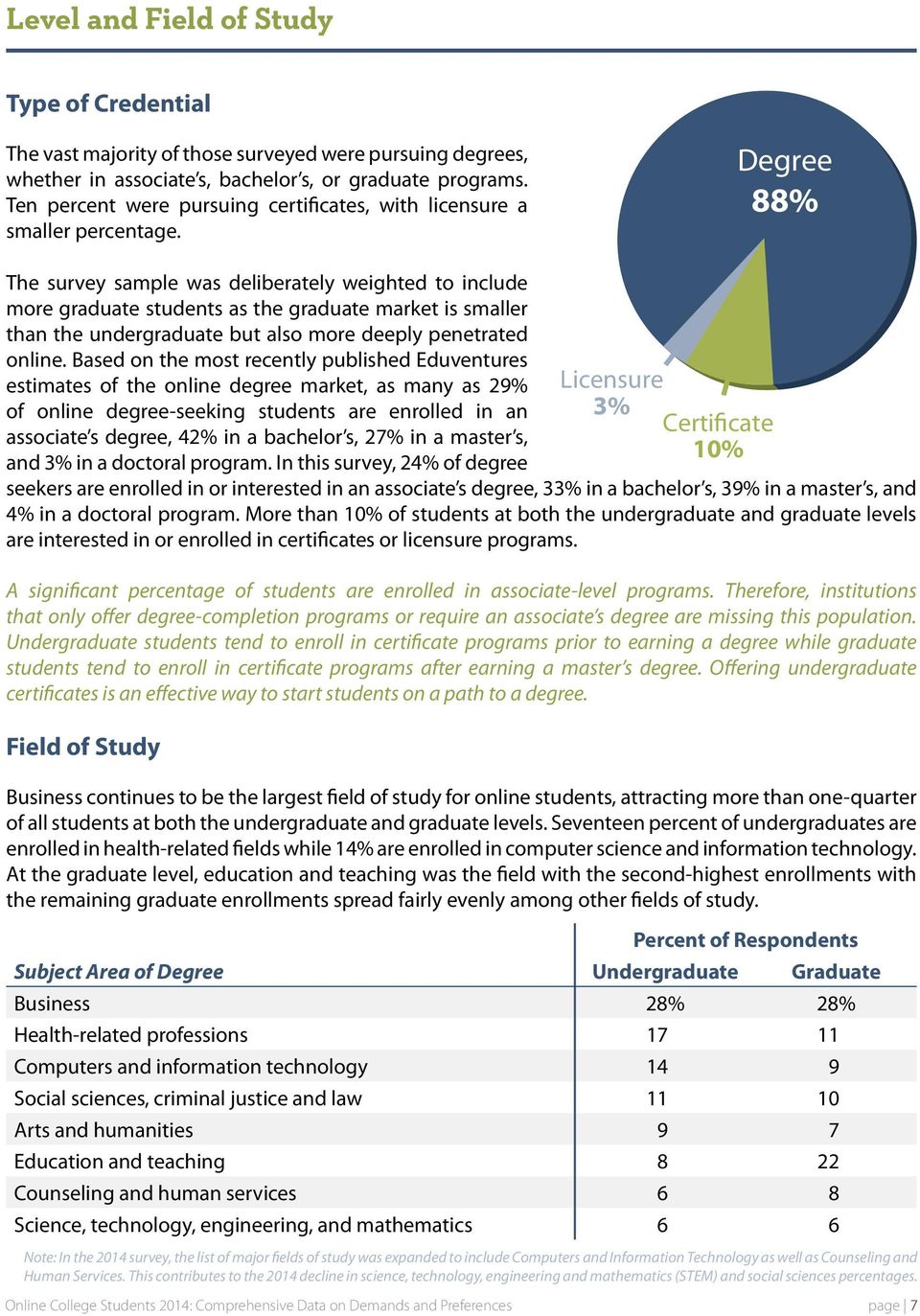
7 Level and Field of Study Type of Credential The vast majority of those surveyed were pursuing degrees, whether in associate s, bachelor s, or graduate programs. Ten percent were pursuing certificates, with licensure a smaller percentage. Type of Degree Earned Degree 88% The survey sample was deliberately weighted to include more graduate students as the graduate market is smaller than the undergraduate but also more deeply penetrated online. Based on the most recently published Eduventures estimates of the online degree market, as many as 29% of online degree-seeking students are enrolled in an associate s degree, 42% in a bachelor s, 27% in a master s, and 3% in a doctoral program. In this survey, 24% of degree seekers are enrolled in or interested in an associate s degree, 33% in a bachelor s, 39% in a master s, and 4% in a doctoral program. More than 10% of students at both the undergraduate and graduate levels are interested in or enrolled in certificates or licensure programs. A significant percentage of students are enrolled in associate-level programs. Therefore, institutions that only offer degree-completion programs or require an associate s degree are missing this population. Undergraduate students tend to enroll in certificate programs prior to earning a degree while graduate students tend to enroll in certificate programs after earning a master s degree. Offering undergraduate certificates is an effective way to start students on a path to a degree. Field of Study Business continues to be the largest field of study for online students, attracting more than one-quarter of all students at both the undergraduate and graduate levels. Seventeen percent of undergraduates are enrolled in health-related fields while 14% are enrolled in computer science and information technology. At the graduate level, education and teaching was the field with the second-highest enrollments with the remaining graduate enrollments spread fairly evenly among other fields of study. Percent of Respondents Subject Area of Degree Undergraduate Graduate Business 28% 28% Health-related professions Computers and information technology 14 9 Social sciences, criminal justice and law Arts and humanities 9 7 Education and teaching 8 22 Counseling and human services 6 8 Science, technology, engineering, and mathematics 6 6 Licensure 3% Certificate 10% Note: In the 2014 survey, the list of major fields of study was expanded to include Computers and Information Technology as well as Counseling and Human Services. This contributes to the 2014 decline in science, technology, engineering and mathematics (STEM) and social sciences percentages. page 7
8 Top 15 Majors Undergraduate Graduate Business administration 1 1 Nursing 2 2 Information technology 3 15 Criminal justice 4 6 Early childhood education 5 -- Psychology 6 6 Medical billing 7 -- Accounting 8 12 Computer science and engineering 8 -- Social work Health information technology Web development Health administration 13 5 Networks/computer networking Elementary education 13 3 Educational administration, K-12 4 Library science 6 General mental health counseling 9 Special education 10 Educational technology 12 Secondary education 12 Counseling/psychology/psychotherapy 15 Curriculum and instruction 15 Respondents were asked to identify a concentration or sub-field within their field of study. The largest concentrations are reported in the next chart. The number of individuals in these concentrations is typically small. Therefore, there are not significant differences in most cases. At the undergraduate level, concentrations with at least 0.007% of the sample (6 students) are included. At the graduate level, concentrations with 0.01% of the sample (6 students) are included. Business concentration areas are divided into Business Administration and Business Degree. Business Administration includes respondents majoring in business administration. Business Degree includes students majoring in related fields such as accounting, finance, human resources, etc. Fifty-eight percent of online business students indicate that programmatic accreditation, such as from AACSB or ACBSP, was very important for their business program although half did not know whether or not their program was accredited. About half of Information Technology respondents indicate their Computers and IT program led to certification, with about 30% indicating Microsoft certification. Note: Because these specializations are self-reported, some specializations appear in multiple fields of study. page 8

9 Undergraduate Fields of Study/Specializations 17% 14% 28% 6% 6% 8% 9% 11% Business Business Administration Accounting, Business Communications, Business Administration, Business Leadership, Human Resources Business Degree Accounting Health & Medicine Nursing, Medical Billing, Health Administration, Health Information Technology; Pharmacy Computers & IT Information Technology, Computer Science & Engineering, Web Development, Networks/Computer Networking, Programming/Coding Social Science & Criminal Justice Criminal Justice, Psychology, Social Work, Paralegal Studies Arts & Humanities Graphic/Web Design, Liberal Arts, History, General Arts, Music Education & Training Early Childhood Education, Elementary Education Counseling & Human Services Human Services Administration, Counseling/Psychology/Psychotherapy, Social Work, Marriage & Family Therapy, Substance Abuse Prevention & Treatment STEM Engineering, Forensic Science, Information Technology, Biology page 9

10 Graduate Fields of Study/Specializations 22% 11% 28% 6% 7% 8% 10% 9% Business Business Administration Accounting, Marketing, Business Leadership, Business Information Systems, Human Resources Business Degree Accounting, Human Resources, Public Administration, Health Administration Education & Training Elementary Education, Educational Administration K-12, Library Science, Special Education, Secondary Education Health & Medicine Nursing, Health Administration, Doctor of Medicine Social Science & Criminal Justice Criminal Justice, Psychology, Social Work, Homeland Security, Law Computers & IT Information Technology, Computer Science & Engineering, Computer Security/Cybersecurity, Software Engineering, Technology Management Counseling & Human Services General Mental Health Counseling, Counseling/Psychology/Psychotherapy, Social Work, Marriage & Family Therapy, School Guidance Counseling Arts & Humanities Religious Studies, History, Communications STEM Engineering, Environmental Sciences, Biology, Engineering Management, Information Technology A critical decision for college and university leaders relates to the selection of programs to offer online. Mission, history, and current offerings factor into the decision, as well as market research. The data above indicate the most popular fields of study that should be considered. These data also suggest topics for further investigation. For example, history made this list as a humanities sub-field at the undergraduate level. Institutions with a strong selection of faculty members specializing in history may consider offering a history degree with concentrations in museum management, archiving and curatorship. Computers and IT is a growing field in regard to the employment market. It may be difficult for an institution to offer a variety of online degrees in computer science, but certificates or a degree in specific programming languages may be feasible and meet a regional need. Offering the most popular degrees and offering niche programs are both viable strategies. page 10

11 Online Versus Other Modalities Previous Enrollment in Online Study Prior to enrollment in their current online program of study, a nearly identical percentage of students had not enrolled in any online study (43%) compared to those students that had taken individual online courses (45%). Less than 20% of students had completed a fully online program prior to current enrollment. Percent of Respondents Previous Enrollment in Online Study All Undergraduate Graduate Yes, I took individual online courses 45% 41% 45% No Yes, I completed another fully online program Comparing Online to Classroom Students were asked to compare the online learning experience to the traditional classroom experience. Ninety percent of students sampled indicate that the online experience was the same or better than classroom instruction. Undergraduates were more likely (50%) than graduate students (43%) to respond that online was better than classroom. Percent of Respondents Compare Online to Classroom All Undergraduate Graduate Better 47% 50% 43% About the same Not as good These students made the decision to enroll in a fully online program, so they were already favorably disposed to online study. Even with that caveat, satisfaction is extremely high with the online medium. These data can be useful to leaders with faculty who are reluctant to offer online courses and programs. page 11

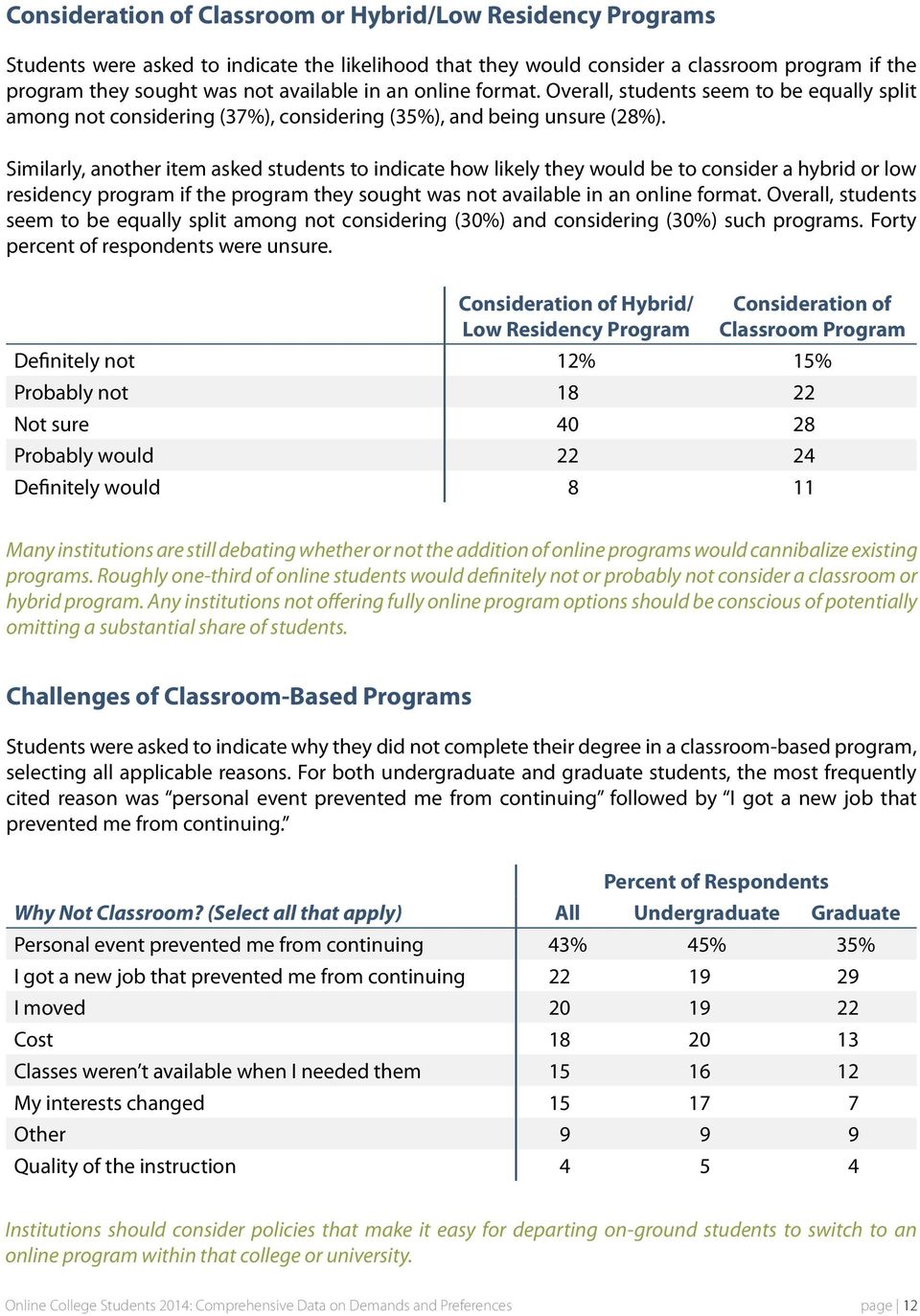
12 Consideration of Classroom or Hybrid/Low Residency Programs Students were asked to indicate the likelihood that they would consider a classroom program if the program they sought was not available in an online format. Overall, students seem to be equally split among not considering (37%), considering (35%), and being unsure (28%). Similarly, another item asked students to indicate how likely they would be to consider a hybrid or low residency program if the program they sought was not available in an online format. Overall, students seem to be equally split among not considering (30%) and considering (30%) such programs. Forty percent of respondents were unsure. Consideration of Hybrid/ Low Residency Program Consideration of Classroom Program Definitely not 12% 15% Probably not Not sure Probably would Definitely would 8 11 Many institutions are still debating whether or not the addition of online programs would cannibalize existing programs. Roughly one-third of online students would definitely not or probably not consider a classroom or hybrid program. Any institutions not offering fully online program options should be conscious of potentially omitting a substantial share of students. Challenges of Classroom-Based Programs Students were asked to indicate why they did not complete their degree in a classroom-based program, selecting all applicable reasons. For both undergraduate and graduate students, the most frequently cited reason was personal event prevented me from continuing followed by I got a new job that prevented me from continuing. Percent of Respondents Why Not Classroom? (Select all that apply) All Undergraduate Graduate Personal event prevented me from continuing 43% 45% 35% I got a new job that prevented me from continuing I moved Cost Classes weren t available when I needed them My interests changed Other Quality of the instruction Institutions should consider policies that make it easy for departing on-ground students to switch to an online program within that college or university. page 12
13 Location of Institution Proximity to Institution of Enrollment With regard to proximity between the student s current residence and the nearest campus or center of the institution in which they are enrolled or are planning to enroll in an online program, fewer students live close to campus. This trend is more pronounced for graduate students than undergraduates. Among undergraduates, about half live within 50 miles of the campus or center and this has held constant over the past three years. However, there has been a shift from 25% to 31% living more than 100 miles away. Among graduate students, there has been a downward shift from 40% to 34% of students living within 50 miles while the percentage of those living more than 100 miles away has risen from 35% to 48%. Undergraduate Graduate Less than 50 miles 47% 48% 48% Less than 50 miles 35% 34% 40% 50 to 100 miles 13% 11% 16% 50 to 100 miles 12% 16% 28% More than 100 miles 25% 27% 31% More than 100 miles 29% 35% 48% Not Sure 12% 12% Not Sure 9% 8% 10% 7% 0% 10% 20% 30% 40% 50% 0% 10% 20% 30% 40% 50% Online students, particularly online graduate students, are considering institutions farther from their home. Marketing professionals should consider or test expanding the geographic region for reaching prospective online graduate students. page 13

14 Selecting an Institution Selection Factors Students were asked to select the top three most important criteria in their selection of an online institution. As in previous years, the most important factors are reputation, tuition and fees, and no set class meeting times. Graduate students were somewhat more likely to indicate that overall reputation of the college or university and recognized in your field as a high-quality college or university as more important than were undergraduate students. Four items have been ranked among the most important factors each year. They are reputation, price, no set meeting times and recognition as a high-quality institution. Two other items simplicity of the admissions process and the amount of transfer credits accepted have also been among the top 10 items each year. Importance to Selection of Program (choose up to 3) Percent *^Overall reputation of the college or university 25% *^Tuition and fees 24 *^No set class meeting times 19 *^Recognized in your field as a high-quality college or university 14 *Students never have to visit campus during their study 13 Recommendation of a friend/family member 12 *A personal academic advisor who contacts me regularly 11 Positive interactions with financial aid personnel 10 *Availability of courses that teach workplace skills such as problem solving, critical thinking, and teamwork 10 *^Simplicity of admissions process 10 ^Historically successful career placement 9 *^Amount of transfer credits accepted 9 Documented student learning outcomes 8 Classes are not demanding/classes are easy 8 *Class sessions with set times providing facilitated group interaction 7 Faculty that teach full time and hold a doctorate 7 ^Faculty that teach part time and are practitioners in their field 7 Graduation rates 7 Availability of credit earned by examination or professional life experience 6 Employee tuition discounts/benefits 5 Known to be a rigorous program 5 Availability of brush up basic writing, math, and reading courses 4 * Among top 10 selection factors in the 2013 survey ^ Among top 10 selection factors in the 2012 survey page 14

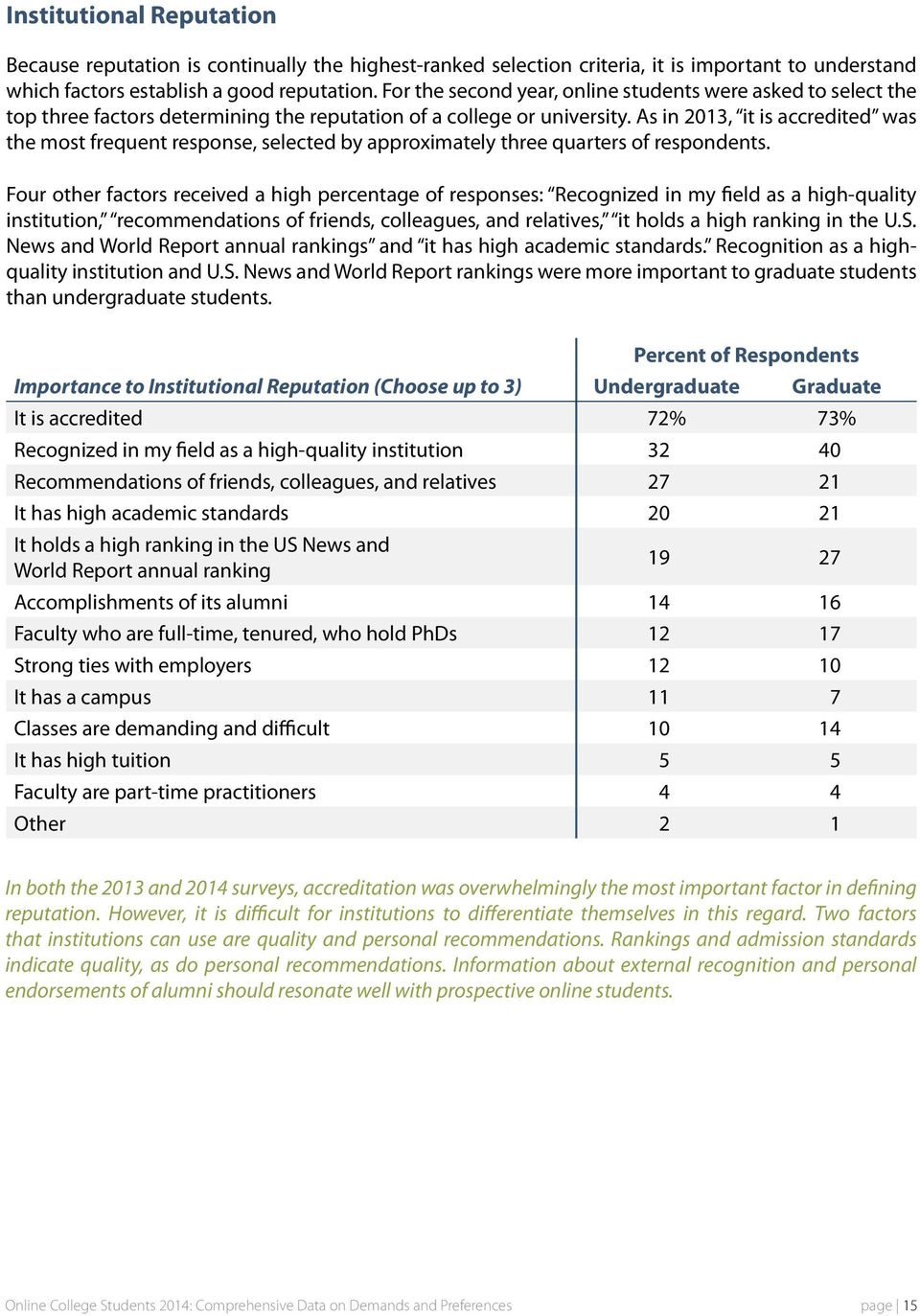
15 Institutional Reputation Because reputation is continually the highest-ranked selection criteria, it is important to understand which factors establish a good reputation. For the second year, online students were asked to select the top three factors determining the reputation of a college or university. As in 2013, it is accredited was the most frequent response, selected by approximately three quarters of respondents. Four other factors received a high percentage of responses: Recognized in my field as a high-quality institution, recommendations of friends, colleagues, and relatives, it holds a high ranking in the U.S. News and World Report annual rankings and it has high academic standards. Recognition as a highquality institution and U.S. News and World Report rankings were more important to graduate students than undergraduate students. Percent of Respondents Importance to Institutional Reputation (Choose up to 3) Undergraduate Graduate It is accredited 72% 73% Recognized in my field as a high-quality institution Recommendations of friends, colleagues, and relatives It has high academic standards It holds a high ranking in the US News and World Report annual ranking Accomplishments of its alumni Faculty who are full-time, tenured, who hold PhDs Strong ties with employers It has a campus 11 7 Classes are demanding and difficult It has high tuition 5 5 Faculty are part-time practitioners 4 4 Other 2 1 In both the 2013 and 2014 surveys, accreditation was overwhelmingly the most important factor in defining reputation. However, it is difficult for institutions to differentiate themselves in this regard. Two factors that institutions can use are quality and personal recommendations. Rankings and admission standards indicate quality, as do personal recommendations. Information about external recognition and personal endorsements of alumni should resonate well with prospective online students. page 15
16 Transfer Credit Because transfer credit is important to online students as a way to reduce time and cost to obtain a degree, the 2014 survey included a series of questions about transfer credits. Because most institutions restrict the number of transfer credits in graduate programs, the data and comments in this section refer to undergraduate programs only. As in the previous surveys, about 80% of undergraduate students report having credits to transfer with the typical number being in the range of credits. The modality in which these credits were earned were primarily classroom (39%) and online delivery (31%). Completed Credits Prior to Enrollment 19% 17% 9% 17% 15% 13% 11% None 1 15 credits credits credits credits More than 90 credits I don t recall How Existing Credits Were Earned undergraduate 31% 39% 22% 6% 2% undergraduate Classroom-based courses Online courses Partially online (hybrid/blended) courses A mix of these course types Other page 16

17 Acceptance of Transfer Credits Slightly more than half of students (52%) indicate that most or all of their credits were transferable into their current online program of study while about 20% report few or no credits transferred. These statistics may serve as a good benchmark for understanding where an institution falls on credit acceptance. Transferable Credits 20% 13% 8% 7% 26% 26% None Few Some Most All I don t know yet Importance of Transfer Credits to Enrollment Decision We asked questions about transfer credit, including the amount of credit accepted, how quickly questions were answered and how long it took to learn the number of credits accepted. Each question about transfer credit was important to respondents. When analyzing responses by student s institution type (for-profit, private not-for-profit and public not-for-profit), no significant difference in response was found. Amount of Credit Accepted Question Found to Be Important 82% Quickly Answered Transfer Questions 81% Total Time to Learn Number of Transfer Credits 78% Easy to Find Information on Website 77% 0% 20% 40% 60% 80% 100% Transfer credit is very important to online students. A high percentage have credits and they want to know how many will transfer. Speedy answers to questions about transfer credit and credit reviews are also very important to the enrollment process. Although there are many factors that affect credit transfer, colleges and universities that want to serve this market should review their policies and procedures to ensure they don t have institutional barriers limiting credit transfer. About 40% reported some, few or no credits transferred. Each credit not accepted for transfer represents additional time and money students need to spend on their degree. Institutional leaders should review credit approval policies to ensure they are reasonable and appropriate. page 17

18 Perceived Value of Online Study Primary Motivation for Enrollment Among the entire sample of students, the most commonly cited primary motivation for enrolling in an online program was the desire to enter a new field of work (24%). The satisfaction of completing a degree was the second-most commonly cited reason (19%), followed by being unemployed or underemployed and needing further education to find a new job (14%). Undergraduate students had similarly distributed responses. At the graduate level, the most frequent response was seeking a promotion or new position (23%), followed by the satisfaction of completing an education (22%), and wanting a career in a new field (19%). Percent of Respondents Primary Motivation for Enrollment Undergraduate Graduate I wanted a career in a new field 26% 19% The satisfaction of completing my education I was unemployed/underemployed and needed more education to get a new job 17 9 I wanted to keep up to date with the skills and requirements of my current job I was re-entering the job market and needed more education 7 7 I was seeking a promotion/new position in my field 6 23 It was a requirement by my employer/profession 6 6 I had just finished high school/ged 6 < 1 Other personal reasons not related to career 3 1 Although job placement and satisfaction are obviously important, students feel an emotional attachment to earning a degree. Institutions who appeal to that pride may be able to keep a more engaged, invested online student body. page 18

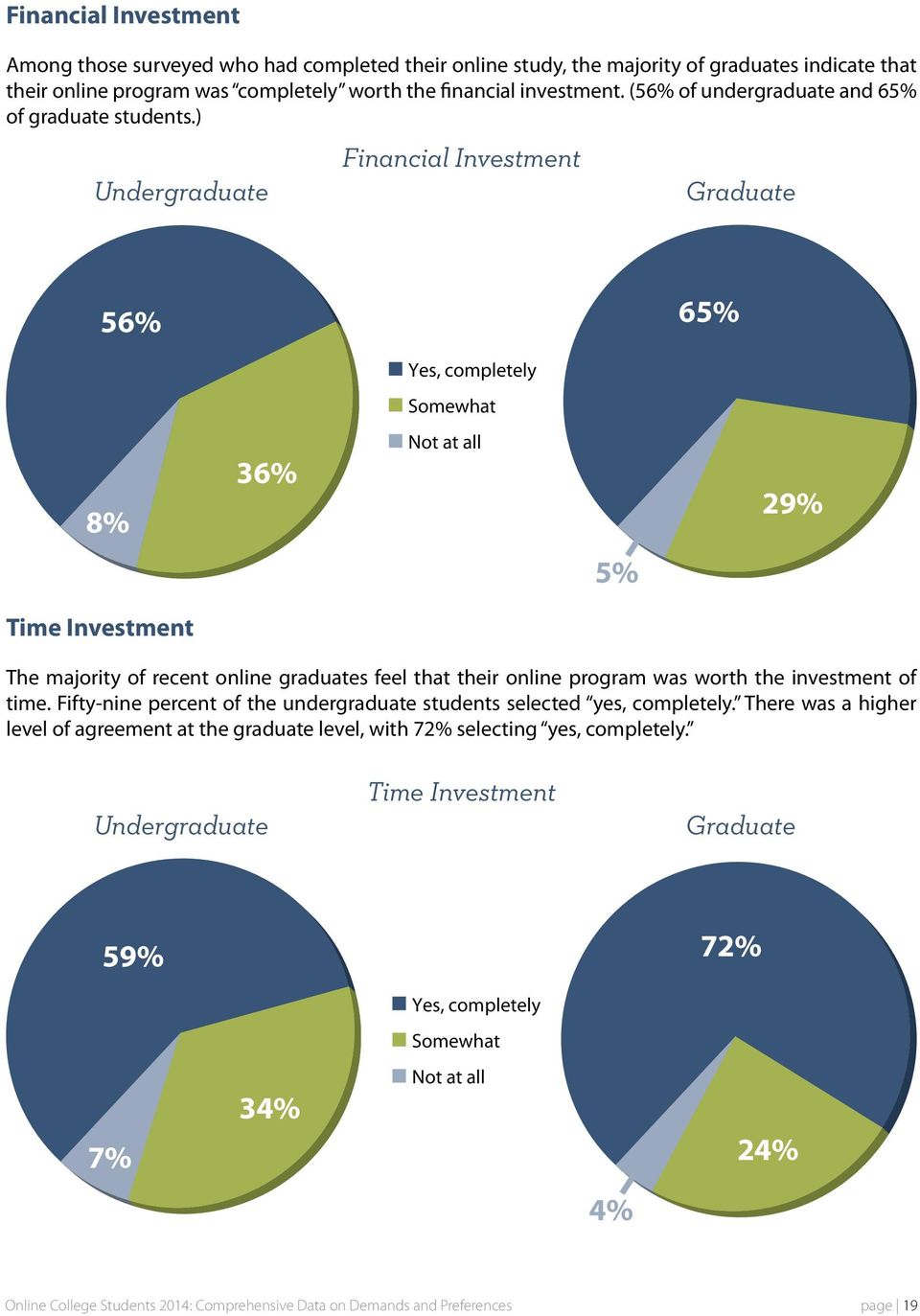
19 Financial Investment Among those surveyed who had completed their online study, the majority of graduates indicate that their online program was completely worth the financial investment. (56% of undergraduate and 65% of graduate students.) Undergraduate Financial Investment Graduate 56% 65% Yes, completely Somewhat 8% 36% Not at all 29% undergraduate Time Investment 5% graduate The majority of recent online graduates feel that their online program was worth the investment of time. Fifty-nine percent of the undergraduate students selected yes, completely. There was a higher level of agreement at the graduate level, with 72% selecting yes, completely. Undergraduate Time Investment Graduate 59% 72% Yes, completely Somewhat 7% 34% Not at all 24% undergraduate 4% graduate page 19
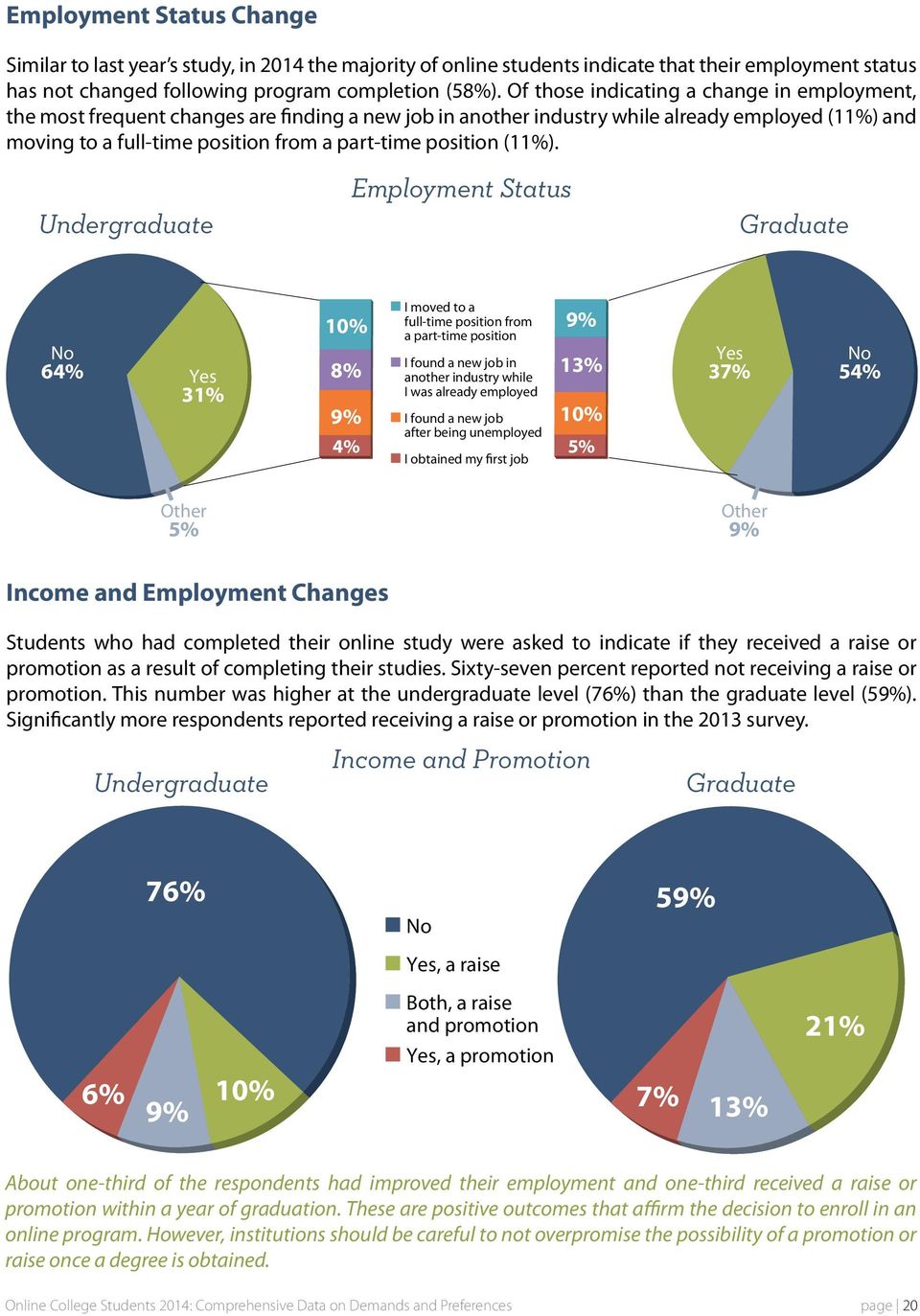
20 Employment Status Change Similar to last year s study, in 2014 the majority of online students indicate that their employment status has not changed following program completion (58%). Of those indicating a change in employment, the most frequent changes are finding a new job in another industry while already employed (11%) and moving to a full-time position from a part-time position (11%). Undergraduate undergrad Employment Status Graduate grad No 64% Yes 31% 10% 8% 9% 4% I moved to a full-time position from a part-time position I found a new job in another industry while I was already employed I found a new job after being unemployed I obtained my first job 9% 13% 10% 5% Yes 37% No 54% Other 5% Other 9% Income and Employment Changes Students who had completed their online study were asked to indicate if they received a raise or promotion as a result of completing their studies. Sixty-seven percent reported not receiving a raise or promotion. This number was higher at the undergraduate level (76%) than the graduate level (59%). Significantly more respondents reported receiving a raise or promotion in the 2013 survey. Undergraduate Income and Promotion Graduate 76% No 59% Yes, a raise 6% 9% 10% Both, a raise and promotion Yes, a promotion 7% 13% 21% About one-third of the respondents had improved their employment and one-third received a raise or promotion within undergrad a year of graduation. These are positive outcomes that affirm grad the decision to enroll in an online program. However, institutions should be careful to not overpromise the possibility of a promotion or raise once a degree is obtained. page 20
21 Marketing to and Enrollment of Online Students Length of Time From Search to Enrollment Online students are very quick to select and enroll in an online program. Forty-two percent of online students report that the time it took from the start of their search for a program to enrolling was less than four weeks, with 65% reporting that the search process took less than eight weeks. Graduate students appear to have taken slightly longer, with only 57% of graduate students reporting that the search process took eight weeks or less. It is important to note, however, that these data are self-reported and prospective students may not be cognizant of the actual time spent, including both on their side and the institution s side. When these data were analyzed by institutional type, 46% of for-profit students made a decision within four weeks or less, followed by 42% of the public not-for-profit students and 31% of the private not-forprofit students. This may indicate that not-for-profit institutions take more time to respond to students or that they enroll a higher percentage of graduate students. Although this question was asked differently in 2013, it does appear online students are shortening their time to enroll. Last year, 51% of students enrolled within three months, compared to 77% this year. Less than 4 weeks Length of Time from Search to Enrollment Undergraduate Graduate 47% Less than 4 weeks 34% 5 8 weeks 23% 5 8 weeks 23% 9 12 weeks 11% 9 12 weeks 13% 3 6 months 10% 3 6 months 16% 7 9 months 1% 7 9 months 5% months 2% months 3% More than 12 months 2% More than 12 months 6% 0% 10% 20% 30% 40% 50% 0% 10% 20% 30% 40% 50% Online students are making decisions very quickly. To gain the majority of these students and to compete with other institutions, the enrollment process should be completed within eight weeks. Also, having frequent term starts is helpful so that prospective students don t have to wait long to start classes once they have made a selection. page 21
22 Appeal of Marketing Messages With increased competition, developing successful marketing messaging is crucial. To better understand what messages resonate best with online students, respondents were presented with three marketing messages that fell within a specific category and asked to select the most appealing. For example, regarding cost, students were asked whether a $400 scholarship, a free ipad or free textbooks resonated most. In some categories, there were definitive favorites. In the above cost category, 50% of students selected free textbooks. In others, no messaging was an overall winner. In the quality category, all three selections ( Faculty have real-world experience, ranked among the best by U.S. News and programs developed in collaboration with industry leaders ) resonated with about onethird of respondents. Looking across all the given marketing messages, there were some clear winners. The most appealing message across all categories was 90 percent job placement with 25% of respondents selecting it across all of their favorite messages. Three messages each accounted for about 10%: Earn your degree in one year, study at your own pace, and free textbooks. Interestingly, there was little to no difference between graduate and undergraduate students in the selection of which marketing messages were most appealing. All Marketing Messages Percent 90 percent job placement 25% Earn your degree in one year 10 Study at your own pace 10 Free text books 9 Study only what you need to learn 6 Qualify for a $400 scholarship 5 Year-round class offerings 4 Career assistance for life 4 Faculty have real world experience 4 Ranked among the best by U.S. News 4 Free ipad 3 Easily transfer your credits 3 Personalized learning 3 Tutors available to online students 3 Programs developed in collaboration with industry leaders 3 Internships available 2 Personalized academic adviser 2 Extensive alumni network 1 Certain marketing messages resonate better with online students. Marketers only have a short amount of time and limited words to gain the interest of a prospective online student. Although it is natural to think that a personalized academic advisor and internship opportunities are valued, from these data there are many other assets that appear to be more appealing. page 22
23 Questions for Enrollment Advisor By understanding the types of questions online students have, institutions can be more prepared with the necessary information and training of enrollment advisors. As expected, the most frequently asked question was: How much does it cost? Undergraduate students were more likely to select how much financial aid can I get? with 61% of undergraduates and 45% of graduates posing this question to an enrollment advisor. Enrollment Advisor Questions (select all that apply) Percent How much does it cost? 64% How long will it take to complete? 60 How much financial aid can I get? 54 How many hours will it likely take each week to complete my work? 43 How much transfer credit can I bring in? 34 I never spoke with an enrollment advisor. 5 Other 2 Although the financial aid staff can answer detailed questions, consider ensuring all enrollment advisors can talk knowledgably about cost and financial aid possibilities. Consider adding a tuition planner to the enrollment staff to serve as a liaison between the enrollment and financial aid departments. Application Process To better understand what is commonly included in an online program application, students were asked about the required elements. A large majority (77%) indicate transcripts needed to be submitted and about 40% were required to submit standardized test scores. About twice as many graduate students (48%) as undergraduates (27%) were required to submit essays as part of the application process. 80% Application Process 70% 60% 50% 40% 30% 20% 10% 0% 77% 28% 60% 51% Transcripts Standardized 40% Test Scores Essay 27% 11% 16% 8% 12% 10% 7% Yes No I don t know The majority of schools do not appear to require standardized tests or essays as part of the application process. Institutions that do should re-evaluate if this is a necessity. If it is, take the time to explain to the prospective students what these items mean to your institution and why they are important for your institution. Consider performing transcript collection services for prospective students to help streamline the application process. page 23
24 Paying for Online Programs Funding Sources For the third year, the survey asked online students how they plan to pay for their online studies. Since 2012, there has been a trend of an increasing percentage of students paying for school with student loans and other financial aid only (31% in 2012, 37% in 2013 and 40% in 2014). Graduate students are less likely to use only loans and financial aid and more likely to use other sources such as personal funds and employer assistance. There was a question about the importance of financial aid and one about sources of funding if financial aid didn t cover the cost. About half of respondents report that financial aid was essential for their enrollment but only 17% report they would not attend if financial aid did not cover the cost. Undergraduate Funding Sources Graduate 2% 49% 2% 2% 3% 20% 20% undergraduate Student loans and other financial aid only Personal funds only Personal funds & loans Personal funds, loans, & scholarships Personal funds & employer tuition assistance Employer tuition assistance only Other 21% 32% 6% 9% 21% 8% 2% graduate page 24
25 Cost as Enrollment Criterion Cost has been among the top three selection criteria for the past three years. To better understand how online students think about the cost of their program, this year s survey delved a little deeper. Students were asked how they thought about cost when making an enrollment decision. Although the majority of online students think of cost as the total cost of obtaining the degree or certificate, a substantial percentage also think about cost per course. Only about one quarter think of cost per credit. Thinking About Cost 38% 6% 24% 33% Total degree cost Per course Per credit Total certificate/license cost Develop tools to help prospective students understand the cost of studying at your institution in a variety of ways. Students were asked to indicate how much they paid per credit, per course and per degree. These findings should be interpreted with caution because they are self-reported and the numbers may not accurately represent the actual cost of tuition. Scholarships and previously earned credit made it difficult to ascertain actual cost per degree across the entire student population, so we have not reported the per degree number here. Graduate students report paying higher costs whether per credit, course or degree. Percent of Respondents Mean Cost Undergraduate Graduate Per credit $ $ Per course $ $ page 25
26 In an attempt to understand how price influences enrollment choices, online students were asked if they selected the most inexpensive option. The vast majority (70%) of students sampled do not select the most inexpensive degree or program. This number was even higher at the graduate level, with nearly 80% reporting that they did not select the most inexpensive program. Undergraduate Select Least Expensive Graduate 34% 66% Yes No 21% 79% undergraduate graduate page 26
27 Methodology In spring 2014, Aslanian Market Research and Learning House conducted surveys with 1,500 individuals nationwide. Respondents were at least 18 years of age, had a minimum of a high school degree or equivalent, and were recently enrolled, currently enrolled, or planned to enroll in the next twelve months in a fully online undergraduate or graduate degree, certificate, or licensure program. According to the U.S. Department of Education, graduate students represent 16% of the total college population but 23% of online population. The sample for this survey was weighted to include approximately 40% graduate students to ensure a large enough sample for meaningful conclusions. The data are presented for both undergraduate and graduate students combined unless there were noteworthy differences. Resolution Research of Denver, Co., identified the sample of 1,500 respondents. The organization drew the sample from its actively managed, 100% market-research-only panel that represents the U.S. Census Bureau, which enables the selection of groups that prove difficult to source. Resolution Research has collected up to 250 behavioral and demographic data points on each consumer panelist, which allows it to target respondents for specific research objectives. To recruit for this study, Resolution Research invited its panel of consumers from across the nation to participate in an online survey through custom invitations. Invitations were sent randomly across the U.S. to reflect the basic population distribution targeting persons 18 years of age or older. Panelists were then allowed to participate in the study if they had participated in or were planning to enroll in online in a fully online degree, certificate or licensing program. Respondents hailed from 49 states and the District of Columbia. The states that represent 52% of the nation s population (according to the 2009 U.S. Census) represented 47% of the study s respondents. These states included California, New York, Florida, Colorado, Illinois, Texas, Georgia, New Jersey, Pennsylvania and Ohio. The National Center for Education Statistics IPEDS data shows that in 2012, 2.6 million higher education students were enrolled in courses that were exclusively delivered via distance education. Eduventures (2014) estimated the size of the wholly or majority online program market for the fall of 2013 to be 3.2 million students. Based upon these findings, a sample of 1,500 represents approximate sampling error of +/-3% at a 95% confidence level. A similarly small margin of error was achieved in the 2012 and 2013 survey; therefore, differences between these survey results over six percentage points may be significant. Given that the Department of Education has only recently begun tracking online enrollments and only has reported data for 2012 and this survey sample was drawn based upon estimates for more present day enrollments, we only address differences between the surveys that are at least 10 percentage points to err on the side of caution. The margin of sampling error is greater for subgroups. page 27
28 Demographic Profile of Online Learners Based on the 2014 study, online students nationwide most often fit the following general profile: Online students are typically Caucasian females between the ages of 25 and 29 who are not the first in their family to attend college. They typically have a total family income of less than $40,000, live in a suburban community and work full time. English is their first language and they have not served in the military. The following tables present findings from the 2014 survey regarding the demographic profile of online learners nationwide. There are several instances where the data are significantly different from the 2012 or 2013 survey and are noted below. (A difference of 10% or greater is considered significant. For a detailed explanation of how the significance was determined, see the Methodology section above.) Gender The majority (68%) of students sampled identify themselves as female, with a slightly higher percentage of females at the undergraduate level (71%) than the graduate level (66%). In 2013, there was an increase in male graduate students but that appears to have shifted back in Undergraduate Graduate Gender Female 74% 67% 71% 66% 53% 66% Male Prefer not to say -- 1 < < 1 Age The most frequently occurring age ranges for students sampled were (18%), (16%), (13%), and (13%). Sixty percent of the students sampled are between the ages of Graduate students tend to be slightly older than undergraduates. Twenty-one percent of the undergraduates were ages 24 and lower, which was a 10% decline from However, the three year trend is 25%, 31%, and 21%. Percent of Respondents Age All Undergraduate Graduate % 6% 1% page 28
29 Environment of Residence Nearly half (48%) of respondents indicated that they live in a suburban environment. There was a near even split between rural (27%) and urban (23%) environments. Percent of Respondents Rural, Suburban, Urban All Undergraduate Graduate Rural 27% 28% 25% Suburban Urban Prefer not to say 2 3 < 1 Marital Status Fifty-five percent of respondents are married or partnered. This number was lower at the undergraduate level (48%) in comparison to the graduate level (63%). Percent of Respondents Marital Status All Undergraduate Graduate Married/partnered 55% 48% 63% Single Prefer not to say Number of Children Under Age 18 The majority (51%) of respondents do not have any children. Twenty percent have one child, 18% have two children, and 11% have three or more children under the age of 18. Percent of Respondents Number of Children (Under 18) All Undergraduate Graduate None 51% 51% 51% or more Prefer not to say page 29
30 Total Household Income The most frequently selected income levels are under $25,000 (19%), and $25,000 39,999 (19%). Sixtyfive percent of respondents have a total household income of less than $70,000. Six percent preferred not to report their total household income. At the undergraduate level nearly half (48%) of respondents had a household income of less than $39,999. Percent of Respondents Total Household Income All Undergraduate Graduate Under $25,000 19% 26% 12% $25,000 $39, $40,000 54, $55,000 69, $70,000 84, $85,000 99, $100, , $115, , $130, , $150,000 or more Prefer not to say English as Second Language Seventeen percent of students sampled speak English as a second language. Percent of Respondents English as a Second Language All Undergraduate Graduate Yes 17% 17% 16% No Employment Status The percentage of students employed full time has decreased each year from 2012 to A significant decline occurred from 2012 to 2013 among undergraduates and between 2013 and 2014 among graduate students. Undergraduate Graduate Employment Status Employed full time 48% 38% 38% 73% 76% 59% Employed part time Not employed Retired Prefer not to say page 30
31 Military Service Students were asked to indicate their level of military service. The very large majority had no military service experience. Percent of Respondents Military Service All Undergraduate Graduate Veteran 7% 6% 8% Spouse or dependent of veteran Spouse or dependent of active duty Active duty military None of the above Ethnicity Ethnicity demographics were similar in the student samples from 2012 to Across all three years, the vast majority of the sample is Caucasian, with a higher percentage of white students in 2013 and 2014 than Undergraduate Graduate Ethnicity White 65% 71% 69% 58% 77% 70% African American Hispanic Asian or Pacific Islander Native American Other Prefer not to say Institution Type The student institution type has become more for-profit between 2012 (35%) and 2014 (47%). Due to the well-publicized reduction in the number of students enrolling in for-profit universities in recent years, this trend was unexpected. To ensure that potential over-representation of students enrolled in for-profit institutions did not influence or create bias within the results, several of the survey questions were cross tabulated. These included questions regarding the field of study, ratings of online versus oncampus experience, appeal of marketing messages, importance of information about transfer credit, and the effect of expense on choice of institution. Differences by type of institution in age, gender, and ethnicity were also calculated. There were very few significant differences indicating students enrolled in for-profit universities don t appear to behave or have different preferences than their counterparts at public not-for-profit and private not-for-profit institutions. Is That College or University a: Undergraduate Graduate (self-identified) For-profit 35% 39% 50% 34% 38% 43% Public not-for-profit Private not-for-profit Undecided page 31
32 References Aldridge, S. C., Clinefelter, D. L., and Magda, A. J. (2013). Online learning at public universities: Building a new path to a college degree. Louisville, KY: The Learning House, Inc. Allen, I. E., & Seaman, J. (2014). Grade change: Tracking online education in the United States. Babson Park, MA: Babson Survey Research Group. Retrieved from com/ reports/ gradechange.pdf Aslanian, C. B., & Clinefelter, D. L. (2012). Online college students 2012: Comprehensive data on demands and preferences. Louisville, KY: The Learning House, Inc. Aslanian, C. B., & Clinefelter, D. L. (2013). Online college students 2013: Comprehensive data on demands and preferences. Louisville, KY: The Learning House, Inc. Eduventures, Inc. (2012). Online higher education market update 2012/13: Executive summary. Retrieved from Eduventures, Inc. (2014, April 3). The online market is slowing down [webinar]? Retrevied from: Eduventures, Inc. (2014, June 2). New data, same story: College enrollment numbers released for 2014 [blog post]. Retrieved from U.S. Department of Education. National Center for Education Statistics. (2014). Integrated Postsecondary Education Data System (IPEDS). Technical Notes All percentages in this report have been rounded; therefore, the total percent figure in a table may not add up to exactly 100. Further, if the total percentage is substantially more than 100, it is because the question allowed respondents to choose more than one option. page 32
33 Partners The Learning House, Inc. helps colleges and universities create, manage and grow high-quality online degree programs and courses. Partnering with more than 100 schools, Learning House enables institutions to efficiently and affordably achieve their online education goals. Services include product development and market research, marketing and lead generation, admissions and enrollment management, student retention, curriculum development and management, faculty training and professional development, learning management systems and 24/7 technical support. As a thought leader in the industry, Learning House publishes an annual report on online college student preferences and demographics and presents an annual online higher education conference. Education Dynamics is a proven leader in helping higher education institutions find, enroll, and retain students. The organization maintains its industry leadership through a deeply rooted philosophy of serving our schools best by serving students first. This commitment has been at the heart of its success since it began more than a decade ago, and it continues today as we proudly serve more than 1,200 colleges and universities of all types and sizes. Aslanian Market Research (Education Dynamics market research unit) conducts market demand studies, institutional audits, program and marketing reviews, and professional development seminars and workshops for colleges and universities seeking information and data on how to expand adult and online student enrollments. Throughout the last 25 years, our staff has worked with more than 200 colleges and universities of all types public, private, large, small, rural, suburban, and urban in every region of the U.S. Its seminars have provided thousands of college administrators with practical, hands-on tactics that they can implement at their institutions at minimal cost for maximum impact. Authors David L. Clinefelter is Chief Academic Officer of The Learning House, Inc. Prior to joining Learning House, he served as Chief Academic Officer of for-profit, online universities Walden and Kaplan, and as President of Graceland University, an early innovator in online education. Carol B. Aslanian is Senior Vice President of Aslanian Market Research. She is a national authority on the characteristics and learning patterns of adult students, and she has made hundreds of presentations on the topic and led market research projects for more than 300 colleges, universities, and educational agencies. For additional information, contact: Aslanian Market Research The Learning House, Inc. (201) (502) [email protected] [email protected] page 33
34 A joint project of The Learning House, Inc. and Aslanian Market Research David L. Clinefelter Carol B. Aslanian LearningHouse.com 427 South Fourth Street Louisville, KY EducationDynamics.com 5 Marine View Plaza, Suite 212 Hoboken, NJ
Online College Students 2015: Comprehensive Data on Demands and Preferences
 Online College Students 2015: Comprehensive Data on Demands and Preferences Dr. David Clinefelter and Carol Aslanian Thursday, July 9, 2015 LearningHouse.com (502) 589-9878 Online College Students 2015
Online College Students. Comprehensive Data on Demands and Preferences
 2013 Online College Students Comprehensive Data on Demands and Preferences Online College Students 2013: Comprehensive Data on Demands and Preferences A joint project of The Learning House, Inc. and Aslanian
Online College Students. Comprehensive Data on Demands and Preferences
 2015 Online College Students Comprehensive Data on Demands and Preferences Online College Students 2015: Comprehensive Data on Demands and Preferences A joint project of The Learning House, Inc. and Aslanian
ONLINE STUDENT NEEDS, PREFERENCES AND EXPECTATIONS
 BEST COLLEGES 2015 ONLINE LEARNING SURVEY: ONLINE STUDENT NEEDS, PREFERENCES AND EXPECTATIONS EMAIL US: [email protected] Online Student Needs, Preferences and Expectations Online learning is still
Graduates of UTeach STEM Teacher Preparation Programs Nationwide
 Graduates of UTeach STEM Teacher Preparation Programs Nationwide OCTOBER MAY 2015 2014 Executive Summary Since 2008, 44 universities have followed The University of Texas at Austin and adopted the UTeach
The Adult Learner: An Eduventures Perspective
 white PapeR The Adult Learner: An Eduventures Perspective Who They Are, What They Want, and How to Reach Them Eduventures, a higher education research and consulting firm, has been closely tracking the
Is an Executive MBA right for you?
 Is an Executive MBA right for you? A GUIDE TO THE EXECUTIVE MBA achieve goals busy schedule support classroom contribution cost peer network the new MBA What is an Executive MBA? The Executive MBA is a
Survey of Nursing Education Programs: 2005 2006 School Year
 Survey of Nursing Education Programs: EXECUTIVE SUMMARY In the fall of 2006, the Michigan Center for Nursing conducted a survey of nursing education programs in Michigan to collect information on the types
Online Degree Programs Comparison Guide
 Use this guide to help you evaluate another school according to the criteria listed -- and then compare it to Saint Leo University. #1 Accreditation Many employers want students who have graduated from
GRADUATE SCHOOL A GUIDE FOR UNDERGRADS
 GRADUATE SCHOOL at A GUIDE FOR UNDERGRADS TABLE OF CONTENTS PART I: Is Graduate School Right For You?...5 Facts about Emporia State University...6 FAQs...6 Why should I go to graduate school?...8 When
Building a Successful Adult Education Program
 Building a Successful Adult Education Program Beginning with the End in Mind Three Critical Factors to Examine First By Brad Gibbs, Chief Growth Officer, PlattForm Part 1 of 3 Key Takeaways Who We Are
An Introduction to Online Learning. Is Online Learning Right for You? Learn how to be successful in an online degree program.
 An Introduction to Online Learning Is Online Learning Right for You? Learn how to be successful in an online degree program. Table of Contents Pursue Your Passion & Advance Your Career Why Should I Earn
APPENDIX 3 Organizational Profile
 APPENDIX 3 Organizational Profile Organizational Description Northwestern Oklahoma State University is the smallest university in the Regional State Universities of Oklahoma System (RUSO). The other institutions
Survey of Nursing Education Programs: 2005 2006 School Year
 Survey of Nursing Education Programs: 2005 2006 School Year EXECUTIVE SUMMARY In the fall of 2006, the Michigan Center for Nursing conducted a survey of nursing education programs in Michigan to collect
Colorado Technical University Colorado Springs, CO
 C O L L E G E P R O F I L E - O V E R V I E W Colorado Technical University Colorado Springs, CO Colorado Tech, founded in 1965, is a private institution offering career-oriented engineering, computer,
Argosy University, Atlanta Atlanta, GA
 C O L L E G E P R O F I L E - O V E R V I E W Argosy University, Atlanta Atlanta, GA Argosy University is a private university offering bachelor's, master's, and doctoral degrees in psychology and counseling,
Quick Start Guide to Becoming a Student. 2008 University of Phoenix, Inc. All rights reserved. AK6011
 Quick Start Guide to Becoming a Student 2008 University of Phoenix, Inc. All rights reserved. AK6011 Table of Contents Welcome to University of Phoenix...1 Overview of University of Phoenix...2 Learning
NATIONAL UNIVERSITY www. NU. edu
 Founded in 1971, National University is the second largest private, nonprofit institution of higher education in California. National has built a rich history of preparing tomorrow s leaders by making
Argosy University, Hawaii Honolulu, HI
 C O L L E G E P R O F I L E - O V E R V I E W Argosy University, Hawaii Honolulu, HI Argosy University is a private university offering bachelor's, master's, and doctoral degrees in psychology and counseling,
Resurrection University Chicago, IL
 C O L L E G E P R O F I L E - O V E R V I E W Resurrection University Chicago, IL Resurrection University (formerly West Suburban College of Nursing), is a fully accredited, not-for-profit, Roman Catholic
WORKING THEIR WAY THROUGH COLLEGE: STUDENT EMPLOYMENT AND ITS IMPACT ON THE COLLEGE EXPERIENCE
 Issue Brief May 2006 WORKING THEIR WAY THROUGH COLLEGE: STUDENT EMPLOYMENT AND ITS IMPACT ON THE COLLEGE EXPERIENCE During the 2003 04 academic year, 78 percent of undergraduates worked while they were
How To Place A Student At A College
 DISCLOSURES (April 21, 2014) CONTENTS REPORTED PLACEMENT RATES... 1 Florence, KY Campus Career Placement Rate, July 1, 2012 to October 31, 2013... 2 Tri-County Cincinnati, OH Campus Career Placement Rate
Education Administrator, Director and Principal Careers, Jobs, and Employment Information
 Education Administrator, Director and Principal Careers, Jobs, and Employment Information Career and Job Highlights for Education Administrators Qualifications such a master s or doctoral degree and experience
Denver School of Nursing Denver, CO
 C O L L E G E P R O F I L E - O V E R V I E W Denver School of Nursing Denver, CO Web Site www.denverschoolofnursing.edu/ Institution Type Private for-profit Coeducational Yes Undergraduate Students Women
Guide for IB students applying to US institutions
 Guide for IB students applying to US institutions This guide provides a brief introduction to the US higher education system and its application process, as well as information specifically relevant to
UNH Graduate Education Department. Quarterly Assessment Report
 First Quarter Assessment Report UNH Graduate Education Department Quarterly Assessment Report First Quarter i First Quarter Assessment Report Table of Contents Introduction... Section - Purpose of the
Chamberlain College of Nursing Houston, TX
 C O L L E G E P R O F I L E - O V E R V I E W Chamberlain College of Nursing Houston, TX Web Site www.chamberlain.edu/ Institution Type Private for-profit Coeducational Yes Undergraduate Students 258 Women
KEEP MOVING FORWARD NATIONAL UNIVERSITY ASSOCIATE S, BACHELOR S, & MASTER S DEGREES CERTIFICATES CREDENTIALS 800.NAT.UNIV GETINFO.NU.
 NATIONAL UNIVERSITY KEEP MOVING FORWARD ASSOCIATE S, BACHELOR S, & MASTER S DEGREES CERTIFICATES CREDENTIALS TM THE UNIVERSITY OF VALUES 800.NAT.UNIV GETINFO.NU.EDU/TRANSFER YOUR #1 CHOICE National University
Northern New Mexico College DRAFT
 Northern New Mexico College DRAFT NOEL-LEVITZ STUDENT SATISFACTION INVENTORY (FORM B) Four-Year College and University Version Following are the results from the STUDENT SATISFACTION INVENTORY Form B (or
California State University, Los Angeles College Portrait. The Cal State LA Community. Carnegie Classification of Institutional Characteristics
 Page 1 of 8 College Cal State L.A. has been a dynamic force in the education of students, setting a record of outstanding academic achievement for more than 60 years within the California State University
The College of Saint Elizabeth Report Narrative
 Program Overview and Mission The College of Saint Elizabeth Report Narrative The College of Saint Elizabeth has been recognized as a leader in teacher education since its founding over 100 years ago. In
Fall 2014 LACCD District-wide Student Survey Results - Los Angeles Mission College
 Fall 2014 LACCD District-wide Student Survey Results - Los Angeles Mission College ***For data interpretation purposes, please use the column as it excludes respondents who skipped the question.*** Gender
Trends in Online and Adult Education
 Trends in Online and Adult Education August 2012 In the following report, Hanover Research examines literature related to trends in online courses and degrees at institutions of higher education both in
2006 PERFORMANCE REPORT St. Augustine College
 SECTION I: INSTITUTIONAL CONTEXT Mission Statement is an independent, bilingual (dual language) institution of higher education created under the auspices of the Episcopal Diocese. goals are: To make the
Graduate and Professional Programs
 Graduate and Professional Programs Graduate and Professional Programs at CSU Achieve your career goals with a graduate or professional degree from Chicago State University (CSU). Since 1867, CSU has provided
THE UNIVERSITY OF VALUES THE UNIVERSITY OF VALUES. www.nu.edu
 THE UNIVERSITY OF VALUES THE UNIVERSITY OF VALUES www.nu.edu National University National University has become the secondlargest private, nonprofit institution of higher education in California by continually
Which college is right for you? A WORKBOOK TO HELP YOU FIND COLLEGES THAT ARE INVESTING IN STUDENT SUCCESS
 Which college is right for you? A WORKBOOK TO HELP YOU FIND COLLEGES THAT ARE INVESTING IN STUDENT SUCCESS W H I C H C O L L E G E I S R I G H T F O R Y O U? I Higher education is more important than ever
Review of the B.A., B.S. in Political Science 45.1001
 Review of the B.A., B.S. in Political Science 45.1001 Context and overview. The B.A., B.S. in Political Science program is housed in the Department of Politics and Government within the College of Arts
THE EDUCATIONAL PROGRESS OF BLACK STUDENTS
 NATIONAL CENTER FOR EDUCATION STATISTICS Findings from THE CONDITION OF EDUCATION 1994 NO. 2 THE EDUCATIONAL PROGRESS OF BLACK STUDENTS U.S. Department of Education Office of Educational Research and Improvement
Practices Worthy of Attention High Tech High San Diego Unified School District San Diego, California
 San Diego Unified School District San Diego, California Summary of the Practice. is a charter school set up with the mission of giving students an interdisciplinary and hands-on education so they can be
The MetLife Survey of
 The MetLife Survey of Challenges for School Leadership Challenges for School Leadership A Survey of Teachers and Principals Conducted for: MetLife, Inc. Survey Field Dates: Teachers: October 5 November
Living in the Red Hawks Community
 http://www.collegeportraits.org/nj/msu 1 of 1 7/23/2014 9:58 AM Founded in 1908, is New Jersey s second largest university. It offers all the advantages of a large university a comprehensive undergraduate
Chamberlain College of Nursing Chicago, IL
 C O L L E G E P R O F I L E - O V E R V I E W Chamberlain College of Nursing Chicago, IL Web Site www.chamberlain.edu/ Institution Type Private for-profit Coeducational Yes Undergraduate Students 892 Women
Transfer Intelligence: How Community College Transfer Students Work toward a Bachelor s in Criminal Justice
 Transfer Intelligence: How Community College Transfer Students Work toward a Bachelor s in Criminal Justice Lisel Blash, Darla Cooper, Kelley Karandjeff, Nathan Pellegrin, Diane Rodriguez-Kiino, Eva Schiorring
Preparing students from around the world for a better and prospreous future
 Preparing students from around the world for a better and prospreous future President s Message I welcome you to Hill University. Here we strive to embark the very best in education using state of art
Is an Executive MBA right for you? A GUIDE TO THE EXECUTIVE MBA
 Is an Executive MBA right for you? A GUIDE TO THE EXECUTIVE MBA Table of Contents What is an Executive MBA?....2 Do I need to be an executive before I enter an Executive MBA program?....2 What are the
3 Texas Community Colleges to Grant Bachelor s Degrees
 An International Organization for the Community College Baccalaureate Degree Vol. 4 No. 2 Fall 2003 Laurie McDowell, Editor IN THIS ISSUE Baccalaureate Teacher Education Program... 2 Essay Contest... 4
INSTITUTIONAL REPORT FOR CONTINUING ACCREDITATION: CONTINUOUS IMPROVEMENT PATHWAY. Name of Institution Dates/Year of the Onsite Visit
 INSTITUTIONAL REPORT FOR CONTINUING ACCREDITATION: CONTINUOUS IMPROVEMENT PATHWAY Name of Institution Dates/Year of the Onsite Visit Insert Name(s) of Unit Head/Author(s) NCATE IR Template for Continuing
BOARD OF REGENTS EDUCATION AND STUDENT AFFAIRS COMMITTEE 7 STATE OF IOWA DECEMBER 3, 2014
 STATE OF IOWA DECEMBER 3, 2014 REQUEST FOR NEW PROGRAM AT THE UNIVERSITY OF IOWA: MASTER OF STUDIES IN LAW Contact: Diana Gonzalez Action Requested: Consider approval of the request by the University of
Argosy University, Nashville Nashville, TN
 C O L L E G E P R O F I L E - O V E R V I E W Argosy University, Nashville Nashville, TN Argosy University is a private university offering bachelor's, master's, and doctoral degrees in psychology and
Highlights from State Reports to the National Youth in Transition Database, Federal Fiscal Year 2011
 Data Brief #1 Highlights from State Reports to the National Youth in Transition Database, Federal Fiscal Year 2011 September 2012 Background In 1999, Public Law 106-169 established the John H. Chafee Foster
The Role of Community Colleges in Teacher Education and Standards-Based Reform
 The Role of Community Colleges in Teacher Education and Standards-Based Reform Virginia McMillan Over the past several years, most educators in the nation have become involved, in one way or another, in
Adventist University of Health Sciences Orlando, FL
 Adventist University of Health Sciences Orlando, FL C O L L E G E P R O F I L E - O V E R V I E W Adventist University of Health Sciences (formerly Florida Hospital College of Health Sciences) is regionally
South University - Savannah Savannah, GA
 C O L L E G E P R O F I L E - O V E R V I E W South University - Savannah Savannah, GA South University, founded in 1899, is a private college specializing in career education. Its Savannah campus is one
Student Motivations for Choosing Online Classes
 International Journal for the Scholarship of Teaching and Learning Volume 6 Number 2 Article 11 7-2012 Student Motivations for Choosing Online Classes Heidi S. Harris Eastern Oregon University, [email protected]
Before I launch into a presentation of the data, I need to mention a few caveats and things to keep in mind as we go through the slides.
 Presentation of data from the 2005 NCSPP Self Study, and complimentary data from the 2006 Graduate Study in Psychology and 2004-05 Faculty Salary Survey. January 2006, Las Vegas Presenter: Wendy Paszkiewicz,
800.NAT.UNIV getinfo.nu.edu/transfer
 800.NAT.UNIV getinfo.nu.edu/transfer NATIONAL the next degree of you is a top choice for community college students seeking to achieve their next educational goal. As an accredited nonprofit institution,
New York School of Interior Design New York, NY
 New York School of Interior Design New York, NY C O L L E G E P R O F I L E - O V E R V I E W The New York School of Interior Design, founded in 1916, is a private, primarily specialized institute. Its
Intent to Plan Master of Arts in Clinical Psychology. West Liberty University
 Intent to Plan Master of Arts in Clinical Psychology West Liberty University Prepared: April 2016 1 NOTIFICATION OF INTENT TO DEVELOP A NEW MASTER S PROGRAM WHEN A MAJOR EXISTS UNIVERSITY: West Liberty
College of Business Strategic Plan 2014-2018
 Vision Statement College of Business Strategic Plan 2014-2018 The COB s vision is to accelerate student success through applied business knowledge and to contribute to a better and brighter future for
Carls, Smith, Lorenzini. GUIDE TO JOBS AND GRADUATE SCHOOL in HISTORY (8e) PART FOUR : GRADUATE SCHOOL
 1 Your Options Carls, Smith, Lorenzini GUIDE TO JOBS AND GRADUATE SCHOOL in HISTORY (8e) PART FOUR : GRADUATE SCHOOL You may decide to embark upon graduate study right away, or to pursue graduate school
Georgia Gwinnett College Lawrenceville, GA
 C O L L E G E P R O F I L E - O V E R V I E W Georgia Gwinnett College Lawrenceville, GA Web Site www.ggc.edu/ Institution Type Public Coeducational Yes Undergraduate Students 9,719 Women 5,232 (53.8%)
Community College of Aurora. graduate report 2015. Data collected from 2014 graduates.
 Community College of Aurora graduate report 2015 Data collected from 2014 graduates. A letter FroM the president August 2015 I am pleased to introduce you to the Community College of Aurora s first Graduate
Florida A&M University Revised New Degree Programs for Strategic Plan (Revision approved June 2013) 2010-2020
 Florida A&M University Revised New Degree Programs for Strategic Plan (Revision approved June 2013) 2010-2020 Appendix B CIP Code School of Business and Industry 52.0801 BS Finance 52.1401 BS Marketing
NATIONAL. www.nu.edu 800.nat.univ
 NATIONAL www.nu.edu 800.nat.univ CLASSES START EVERY MONTH, ENROLL ANYTIME 800.NAT.UNIV www.nu.edu About National University ABOUT National University Reputation Founded in 1971, National University has
bachelor s degree-granting institutions were located.
 WEB Profile of 2007 08 2007-08 First-Time Bachelor s TABLES Degree Recipients U.S. DEPARTMENT OF EDUCATION in 2009 OCTOBER 2012 NCES 2013-150 These Web Tables provide wideranging information on the demographic
California Board of Registered Nursing
 California Board of Registered Nursing 2006 Survey of Registered Nurses Conducted for the California Board of Registered Nursing by the University of California, San Francisco School of Nursing and Center
LICENSED SOCIAL WORKERS IN THE UNITED STATES, 2004 SUPPLEMENT. Chapter 2 of 5. Who Are Licensed Social Workers?
 LICENSED SOCIAL WORKERS IN THE UNITED STATES, 2004 SUPPLEMENT Chapter 2 of 5 Who Are Licensed Social Workers? Prepared by Center for Health Workforce Studies School of Public Health, University at Albany
BOARD OF GOVERNORS STATE UNIVERSITY SYSTEM OF FLORIDA NEW DOCTORAL DEGREE PROPOSAL STAFF ANALYSIS
 BOARD OF GOVERRS STATE UNIVERSITY SYSTEM OF FLORIDA NEW DOCTORAL DEGREE PROPOSAL STAFF ANALYSIS Program: Doctor of Social Work CIP Code: 51.1503 Institution: Florida Atlantic University Proposed Implementation
Student Credit Hours in FIU Online
 FIU Online Student Credit Hours in FIU Online 300,000 250,000 212,400 232,722 260,475 200,000 186,342 150,000 135,684 148,872 100,000 82,827 103,413 116,262 62,013 50,000 32,340 6,012 13,131 0 2002 2003
Passing When It Counts Math courses present barriers to student success in California Community Colleges
 Engaging Californians on Key Education Challenges I S S U E B R I E F F E B U A R Y 2 0 1 2 Passing When It Counts Math courses present barriers to student success in California Community Colleges Overview
GRADUATE and DOCTORAL PROGRAM ADMISSION
 A P P L I C A T I O N GRADUATE and DOCTORAL PROGRAM ADMISSION University of the Incarnate Word Office of Admissions 4301 Broadway San Antonio, Texas 78209 210-829-6005 1-800-749-9673 Fax: 210-829-3921
kaplan University to help you Succeed
 kaplan University Real-World Knowledge and Skills to help you Succeed LETTER FROM THE PRESIDENT CELEBRATING 75 YEARS: A LEGACY OF INNOVATION IN HIGHER EDUCATION In 1937, the founding campus of Kaplan University
Nature of the Program
 Nature of the Program The University of West Florida has had an accredited social work undergraduate program since 1974, the first year that the Council on Social Work Education recognized undergraduate
2. [ONLY ASKED IF HAVE CHILDREN, NATL N=704, 18-30 N=130] How many children do you have?
![2. [ONLY ASKED IF HAVE CHILDREN, NATL N=704, 18-30 N=130] How many children do you have?](/thumbs/22/1693995.jpg "2. [ONLY ASKED IF HAVE CHILDREN, NATL N=704, 18-30 N=130] How many children do you have?") NORTHEASTERN UNIVERSITY - INNOVATION IN HIGHER EDUCATION SURVEY TOPLINES National Phone Sample of American Adultss Ages 18+ (N=1,001) Online Oversample of American Adults Ages 18-30 (N=250) (Margin of
NORTHEASTERN UNIVERSITY - INNOVATION IN HIGHER EDUCATION SURVEY TOPLINES National Phone Sample of American Adultss Ages 18+ (N=1,001) Online Oversample of American Adults Ages 18-30 (N=250) (Margin of
2012 SURVEY OF REGISTERED NURSES AMN HEALTHCARE, INC., 2012 JOB SATISFACTION, CAREER PATTERNS AND TRAJECTORIES
 We ve earned The Joint Commission s Gold Seal of Approval 2012 SURVEY OF REGISTERED NURSES AMN HEALTHCARE, INC., 2012 12400 High Bluff Drive, San Diego, CA 92130 JOB SATISFACTION, CAREER PATTERNS AND TRAJECTORIES