
Online College Students. Comprehensive Data on Demands and Preferences
|
|
|
- Isaac Jefferson
- 10 years ago
- Views:
Transcription
1 2015 Online College Students Comprehensive Data on Demands and Preferences

2 Online College Students 2015: Comprehensive Data on Demands and Preferences A joint project of The Learning House, Inc. and Aslanian Market Research Dr. David L. Clinefelter Carol B. Aslanian A number of individuals contributed to the project. Dr. David L. Clinefelter led the Learning House team, which included Wendy Parrish and Andrew Magda. Carol B. Aslanian led the Aslanian Market Research team, which included Scott Jeffe and Steven Fischer. Suggested citation: Clinefelter, D. L., & Aslanian, C. B. (2015). Online college students 2015: Comprehensive data on demands and preferences. Louisville, KY: The Learning House, Inc. July 2015 Copyright 2015 by The Learning House, Inc. and EducationDynamics. All rights reserved. page 2

3 Table of Contents Introduction... 5 Key Findings and Observations Student Learning Preferences Primary Motivation...10 Fields of Study...10 Top 15 Majors...11 Past Online Experience Comparing Online Experience to Classroom Experience Consideration of Classroom Programs...14 Consideration of Hybrid or Low-Residency Programs...14 Concerns With Online Learning...15 Full- and Part-Time Enrollment...15 College and University Attributes Student Proximity to Institution...16 Important Factors in Selecting a Program...17 Importance of College Reputation...18 Preference of Not-For-Profit or For-Profit...19 Recruiting Online Students Most Effective Marketing Messages: Category...20 Most Effective Marketing Messages: Overall...23 Choosing Program or Institution First...24 Number of Institutions Contacted...24 Top Reason for Selecting First-Choice School...25 Effectiveness of Marketing Channels...26 Content Sources for Program Awareness...27 Process After Identifying Institutions of Interest...28 Most Important Information from Institution...29 Format of Information...29 Devices Used During the Search Process...30 Method of First Contact...30 Importance of First Contact...31 Speed of Contact...31 Frequency of Contact...32 Least Effective Time to Contact Students...32 Communication After Application...33 Length of Time from Search to Enrollment...34 page 3

4 The Online Classroom Preferred Instruction...36 Number of Hours of Study per Week...37 Synchronous Discussions...37 Engagement Tools...38 Academic Advisement...38 Electronic Course Materials...39 Online Program Features...39 Financing Online Classes Presenting Cost Information...40 Total Cost...41 Cost Conscious...41 Select an Institution by Cost...42 Paying for Online Program...42 Debt Incurred...42 Time to Repay Debt...43 Influence of Scholarships...44 Methodology Demographics Gender...46 Age...46 Marital Status...47 Number of Children (Under 18)...47 Total Household Income...48 Ethnicity...48 English as a Second Language...49 Employment Status...49 Military Service...49 Highest Completed Level of Education...50 Level of Study...50 References Partners page 4

5 Introduction This report presents findings from the fourth annual survey of online college students, conducted jointly by The Learning House, Inc. and Aslanian Market Research. Every year, these organizations conduct a survey of students who are considering a fully online program, those who are currently enrolled in a fully online college program, and those who have graduated within the past year. It is our goal to profile who is studying online, and why, as well as provide institutions with key takeaways to help them better serve this unique population. Some of the questions are repeated each year; for those questions, any emerging trends are noted. Some questions, however, are new to this year s survey. To access the 2012, 2013 and 2014 reports, visit learninghouse.com/resources/research or aslanianmarketresearch.com/resources/white-papers. These data reveal both bad news and good news about the current state of online higher education. The bad news is that the overall college population has shrunk in recent years. Given the declining national unemployment rate and the rebounding economy, more people are choosing to remain at their jobs than to pursue further education. Data from the National Student Clearinghouse Research Center (2015) show that college enrollments declined by close to 2%, yielding 18.6 million college students today. About 5.5 million of these students are studying partially or fully online. At the same time, competition for these online students is increasing. Between 2012 and 2013, 421 institutions launched online programs for the first time, an increase of 23% to 2,250 institutions. The good news is that online degrees continue to gain acceptance among prospective students because these degrees provide flexibility and access to highly valued credentials. Online enrollment is expanding by about 1% per year. Several factors point to increased potential for online providers. 1. Nearly 60% of the jobs available require some postsecondary education (National Student Clearinghouse Research Center, 2015). 2. Frequent career changes over a lifetime make continuing education a necessity (National Student Clearinghouse Research Center, 2015). 3. Over the past 20 years, more than 31 million students have enrolled in college but left without receiving a degree or certificate (Shapiro et al., 2014). 4. There are about 111 million adults in the United States with no college degree, and most people aspire to earn a postsecondary credential but view cost as the biggest barrier (Kelly, 2015). This report summarizes trends in the online student experience, from recruitment to graduation, and provides insights on how to attract and serve these students. For example, students express a strong preference for selfpaced programs, but few are offered. Reputation is important in selecting a college, but students don t have a good way to assess it aside from accreditation. Online students believe the value of their experience is equal to or better than that of on-campus classes, but they have a number of concerns that can and should be addressed. We hope this information is useful to online leaders in expanding access to and improving the quality of their programs. page 5

6 Key Findings and Observations In the spring of 2015, Learning House and Aslanian Market Research conducted a survey of 1,500 individuals nationwide who were: at least 18 years of age; had a minimum of a high school degree or equivalent; and were recently enrolled, currently enrolled or planning to enroll in the next 12 months in either a fully online undergraduate or graduate degree program or a fully online certificate or licensure program. The patterns and preferences of the sample of individuals interviewed are reflective of online students as a whole, and the data reflect a national template of the behavior and preferences of these students. College and university leaders can use this information to attract and serve this growing population. Individual institutions should also consider regional data and their positioning in the local marketplace. Throughout this report, the trends noted reflect aggregated data, comprising both undergraduate and graduate online student responses. If noteworthy differences between undergraduate and graduate students exist, the report calls attention to these differences. Within the report, there are many recommendations for online programs based on survey findings and our collective experience. These recommendations are presented in red, italicized text at the end of selected sections. Below are the key findings and observations of this report. 1. Nothing surpasses career preparation as a motivator in attracting students to higher education, and online learning is no exception. Roughly 75% of online students seek further education to change careers, get a job, earn a promotion or keep up to date with their skills. The third most appealing marketing message among the group sampled was a high job placement rate. Colleges that want to excel in attracting prospective online students must prepare them for and connect them to the world of work. 2. Online students are diverse in their preferences, so there is no one-size-fitsall strategy to serve them. The preferences of online college students are often contradictory, so decision-makers need to consider and pursue a variety of strategies to reach the maximum amount of this population. For example, consider the response to this question: How often would you be willing to log in at a specific time to join a required discussion or virtual lecture with your instructor and classmates? Twenty-one percent responded never, but 15% responded more than five times per course. When asked if they preferred paper or electronic textbooks, 43% preferred electronic, 33% preferred paper and 23% didn t have a preference. page 6

7 3. As competition for students stiffens, online students expect policies and processes tailored to their needs. These include shorter academic terms (five to eight weeks); generous credit transfer policies; informative websites; and speedy response times on admission decisions, transfer credit reviews and financial aid packaging. These online student-friendly practices are becoming minimum requirements for institutions that want to thrive in this arena. For example, the amount of transfer credit accepted has consistently been ranked one of the top 10 factors in selecting an institution in our surveys, and onequarter of students reported receiving that information prior to submitting their application. 4. In online education, everything is local. Half of online students live within 50 miles of their campus, and 65% live within 100 miles. Even though these students rarely, if ever, visit the campus, it is nearby. Thirty-four percent of respondents reported that the recommendation of friends, colleagues and relatives was an important factor in deciding if a college had a good reputation. Online students were asked, After identifying institutions of interest, what were your primary methods of gathering detailed information? Twentyfour percent reported attending an open house, 31% had conversations with friends and family, and 21% had conversations with their employers or colleagues. Online students typically attend a local institution and rely on local sources for information. 5. The college or university website is a critical source of information. It is likely that a significant percentage of students base their decision solely on information from the website, without ever speaking with someone from the institution. Sixteen percent of respondents reported having no contact with personnel at the institution prior to applying. The website is prospective students top method of gathering information about a program. Forty-nine percent reported turning directly to the college website when they were asked, What were your primary methods of gathering detailed information? Similarly, 43% of students reported using the website to request more information about their program of interest. Twenty-nine percent sent an for more information, and 28% called the institution. Additionally, respondents reported that they selected an institution based on a variety of information such as tuition, admission requirements and available programs, all of which should be available on a college s website. 6. Affordability is a critical variable. Forty-five percent of respondents to the 2015 survey reported that they selected the most inexpensive institution. In 2014, 30% reported selecting the most inexpensive institution. Thus, it is not surprising that among 23 potential marketing messages, the most appealing were Affordable tuition and Free textbooks. page 7

8 7. Although a good number of students are committed to online education, they see room for improvement. Only 10% of respondents thought online instruction was not as good as their in-class instruction. But when asked about their concerns with online instruction, 21% reported Inconsistent/poor contact and communication with instructors, and 17% reported Inconsistent/poor quality of instruction. When respondents were asked if they would prefer online tutorials, independent study or instructor-led classes, only about one-third favored instructor-led online classes, which is far and away the predominant format offered currently. One-third would like a faculty member as their advisor, which is currently not a common practice. About half would find optional internships and oncampus courses attractive, but they are not typically offered. 8. A large segment of college graduates will never set foot in a college classroom. When asked if they would attend on-campus classes if their program was not available online, about 30% said they probably or definitely would not. About one-quarter said they probably or definitely would not attend a hybrid or low-residency program. Just like some people no longer go to theaters, banks or grocery stores, some people prefer to get their education via the Internet. Advances in technology, such as mobile apps and adaptive learning systems, will continue to make it easier for these people and others to go to college online. 9. Blended programs hold promise. Although some students prefer never going to campus and never participating in synchronous online learning activities, a significant percentage is interested in on-campus activities, classes and internships. About half of the respondents indicated they would attend a hybrid or low-residency option if their program was not available fully online. Twenty-two percent indicated One or more optional on-campus courses was very attractive. A small number of colleges and universities have integrated their online and campus programs so that most programs are offered in both formats, most faculty teach in both formats, and most students enroll in both formats. These institutions are in a strong position to meet student needs and preferences. 10. Much of online higher education is highly commoditized. There are several popular degrees offered by many institutions. Thirty percent of online students are enrolled in three majors: business administration, nursing and computer science. Most universities use one of three or four learning management systems that have similar features. The same marketing messages of convenience and flexibility are used throughout the industry. Many institutions even use the same adjunct faculty members to teach their courses. The data in this report indicate that substantial numbers of students are interested in features that institutions could use to distinguish themselves, such as price, self-study options, faculty advisors or job placement rates. 11. Online study leads to online study. The majority of current online students have past experience with studying online. They know what it is, and they choose it among many other alternatives. They are savvy buyers. In fact, one indication of students increased familiarity and comfort with online education is the increased use of the modality at the high school level. page 8

9 12. The program or major drives the selection process. Sixty percent of respondents indicated they selected their program of study first and then considered institutions. Onethird responded that the critical factor was The program was the best match, which was significantly more important than price or reputation. 13. Online students pre-select their preferred institution of study. One-third contacted only one institution when deciding to pursue their education online. Colleges and universities must pay careful attention to these students in order to cultivate them successfully to enrollment. It is critical that institutions have a strong local brand so that they are at the top of students minds when they begin to search for a program of study. 14. Age no longer predicts learning behavior in online higher education. While online education has traditionally been marketed toward adult learners, more and more students under 25 years of age are choosing to study online for their undergraduate degrees. page 9
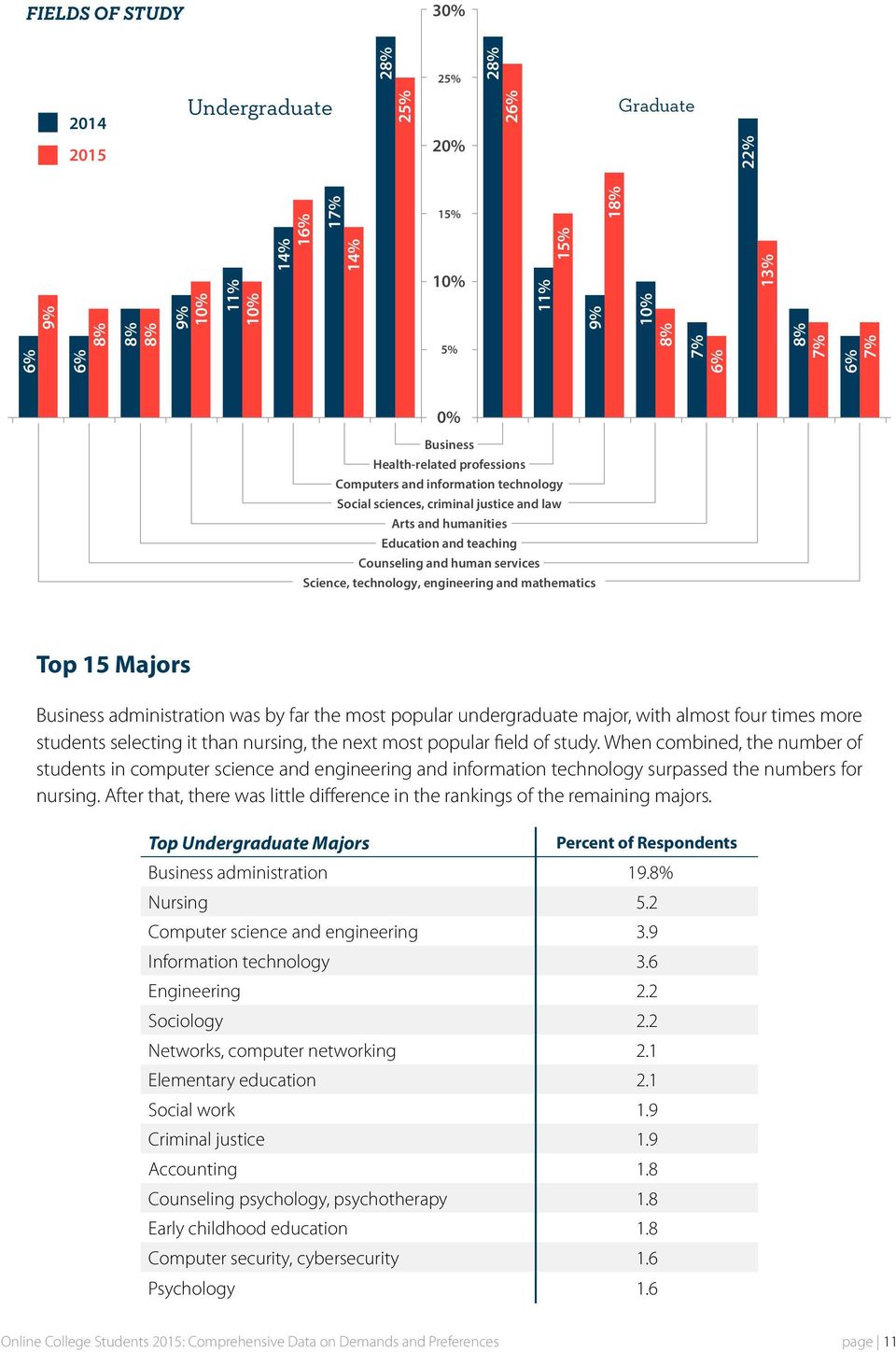
10 Student Learning Preferences Primary Motivation Most of the respondents reported that they were motivated to pursue further education because they desired to change their professional status either by starting a new career or getting a new job or promotion. Over one in five were motivated by the prospect of gaining a sense of self-satisfaction by completing their degree. Graduate students were more motivated than undergraduate students by the ability to seek a promotion and keep their skills up to date. What was your primary motivation for Percent of Respondents enrolling in further education? All Undergraduate Graduate I wanted a career in a new field 22% 23% 22% The satisfaction of completing my undergraduate/ graduate education I was unemployed/underemployed and needed more education to get a new job I was seeking a promotion/new position in my field I wanted to keep up to date with the skills and requirements of my current job It was a requirement by my employer/profession I was reentering the job market and needed more education I had just finished high school/ged Other personal reasons not related to career Fields of Study Business continues to be the most popular online education vertical for both undergraduate and graduate students. The majority of online business students were in business administration programs. At the graduate level, nearly nine in 10 business students were in MBA programs. Almost half of online business students were not sure if their program holds special accreditation from organizations such as AACSB. However, for those who knew that their program did hold such accreditation, this was a strong, driving factor in their selection of a program. Undergraduate fields of study preferences remained consistent with previous years responses. The fields of study among graduate students shifted, with education experiencing a nine-percentage-point decline, and computers and information technology (CIT) witnessing a nine-percentage-point increase. Health-related professions grew by four percentage points. A shift of approximately 10% is statistically significant. page 10

11 FIELDS OF STUDY 30% 28% 25% 28% Undergraduate 25% 20% 26% Graduate 22% 6% 9% 6% 8% 8% 8% 9% 10% 11% 10% 14% 16% 17% 14% 15% 10% 5% 11% 15% 9% 18% 10% 8% 7% 6% 13% 8% 7% 6% 7% 0% Business Health-related professions Computers and information technology Social sciences, criminal justice and law Arts and humanities Education and teaching Counseling and human services Science, technology, engineering and mathematics Top 15 Majors Business administration was by far the most popular undergraduate major, with almost four times more students selecting it than nursing, the next most popular field of study. When combined, the number of students in computer science and engineering and information technology surpassed the numbers for nursing. After that, there was little difference in the rankings of the remaining majors. Top Undergraduate Majors Percent of Respondents Business administration 19.8% Nursing 5.2 Computer science and engineering 3.9 Information technology 3.6 Engineering 2.2 Sociology 2.2 Networks, computer networking 2.1 Elementary education 2.1 Social work 1.9 Criminal justice 1.9 Accounting 1.8 Counseling psychology, psychotherapy 1.8 Early childhood education 1.8 Computer security, cybersecurity 1.6 Psychology 1.6 page 11
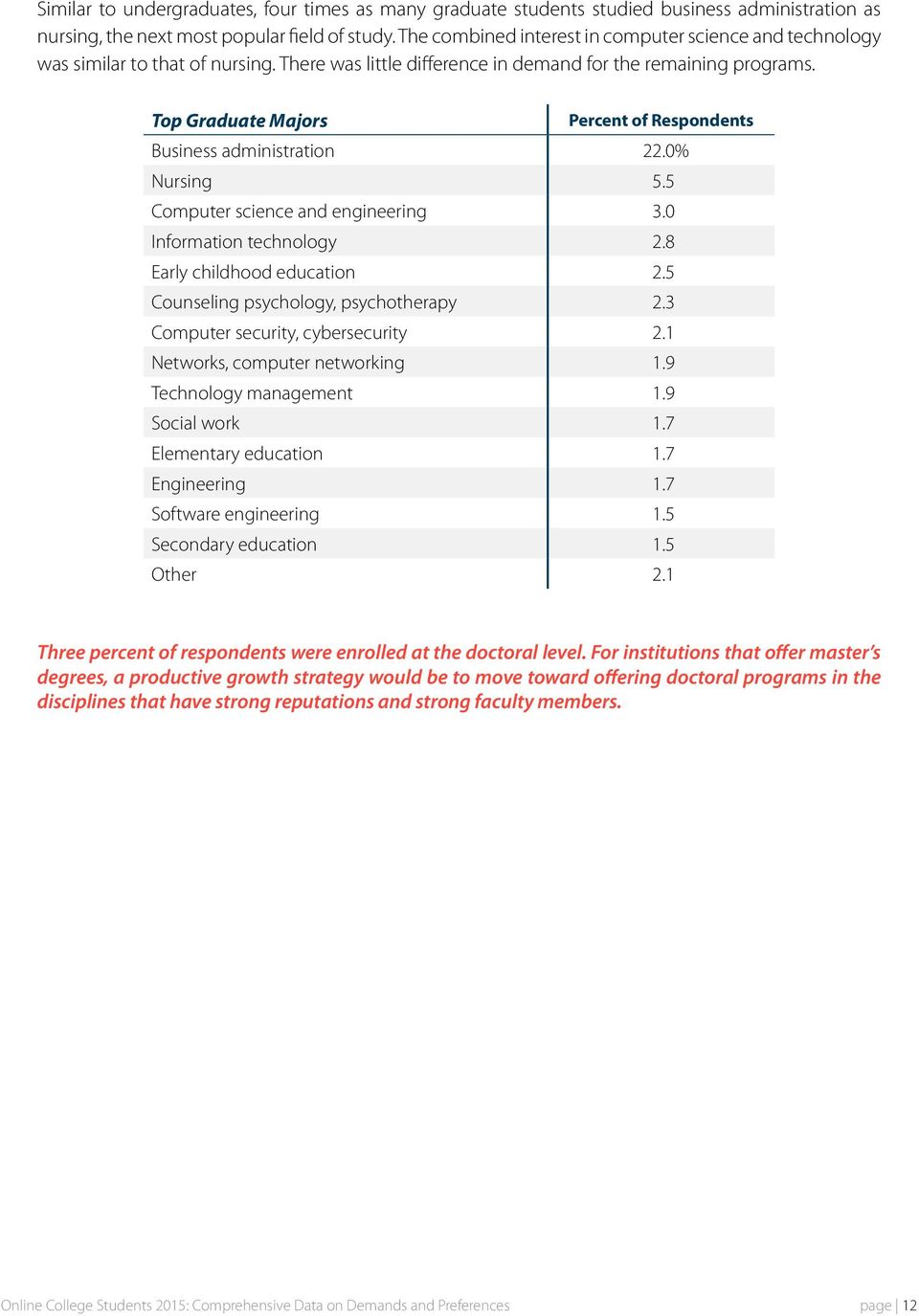
12 Similar to undergraduates, four times as many graduate students studied business administration as nursing, the next most popular field of study. The combined interest in computer science and technology was similar to that of nursing. There was little difference in demand for the remaining programs. Top Graduate Majors Percent of Respondents Business administration 22.0% Nursing 5.5 Computer science and engineering 3.0 Information technology 2.8 Early childhood education 2.5 Counseling psychology, psychotherapy 2.3 Computer security, cybersecurity 2.1 Networks, computer networking 1.9 Technology management 1.9 Social work 1.7 Elementary education 1.7 Engineering 1.7 Software engineering 1.5 Secondary education 1.5 Other 2.1 Three percent of respondents were enrolled at the doctoral level. For institutions that offer master s degrees, a productive growth strategy would be to move toward offering doctoral programs in the disciplines that have strong reputations and strong faculty members. page 12
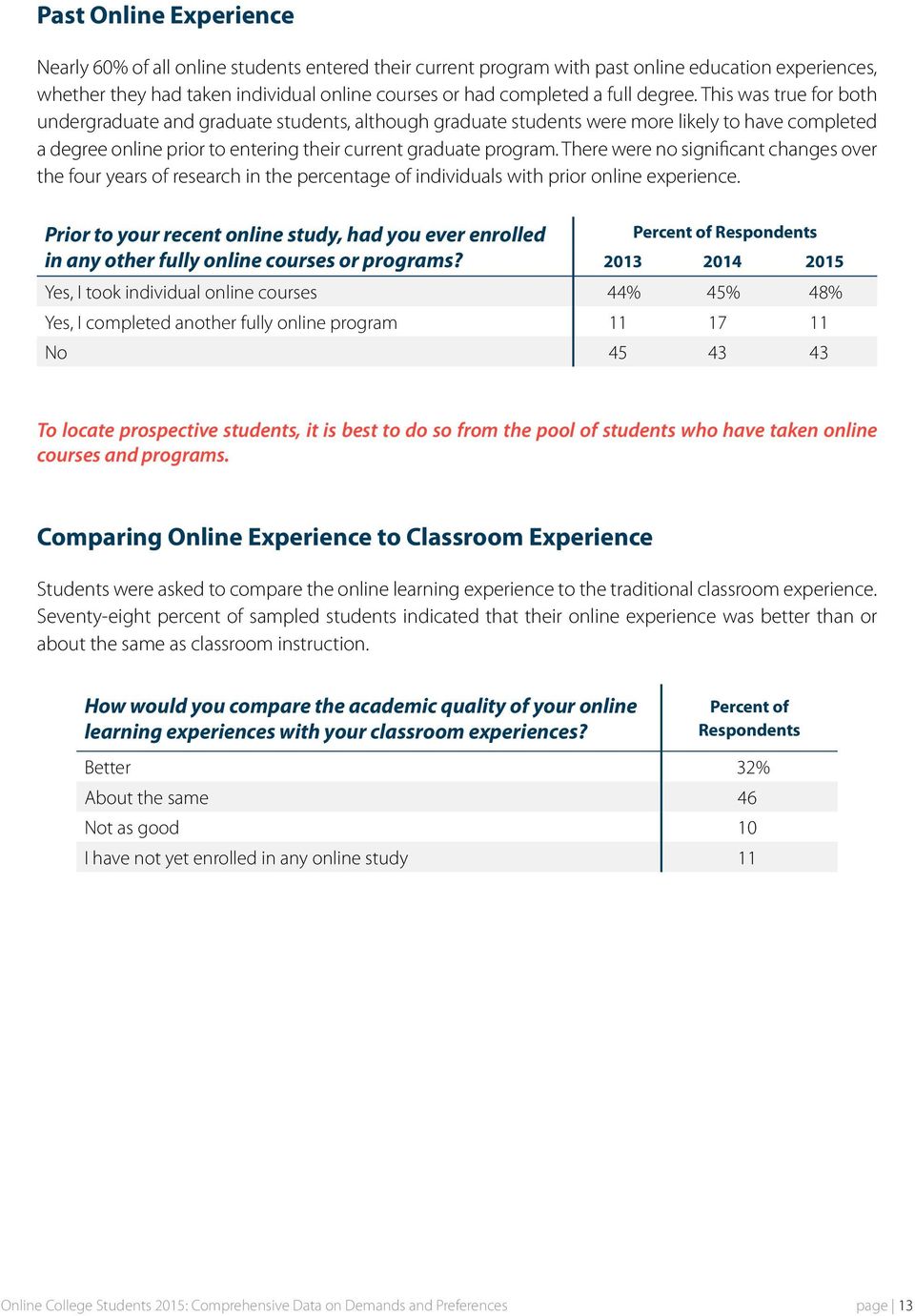
13 Past Online Experience Nearly 60% of all online students entered their current program with past online education experiences, whether they had taken individual online courses or had completed a full degree. This was true for both undergraduate and graduate students, although graduate students were more likely to have completed a degree online prior to entering their current graduate program. There were no significant changes over the four years of research in the percentage of individuals with prior online experience. Prior to your recent online study, had you ever enrolled Percent of Respondents in any other fully online courses or programs? Yes, I took individual online courses 44% 45% 48% Yes, I completed another fully online program No To locate prospective students, it is best to do so from the pool of students who have taken online courses and programs. Comparing Online Experience to Classroom Experience Students were asked to compare the online learning experience to the traditional classroom experience. Seventy-eight percent of sampled students indicated that their online experience was better than or about the same as classroom instruction. How would you compare the academic quality of your online learning experiences with your classroom experiences? Percent of Respondents Better 32% About the same 46 Not as good 10 I have not yet enrolled in any online study 11 page 13
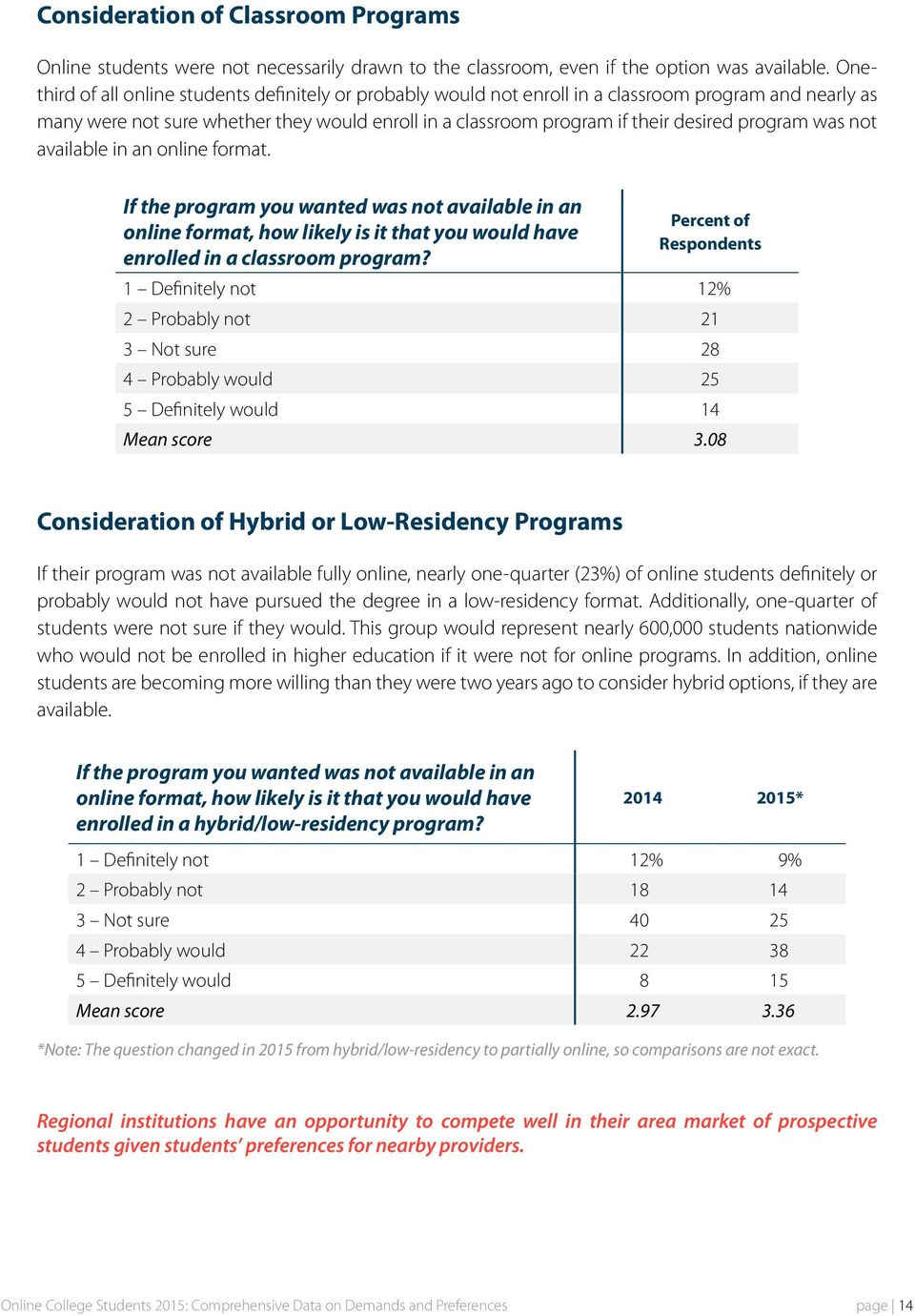
14 Consideration of Classroom Programs Online students were not necessarily drawn to the classroom, even if the option was available. Onethird of all online students definitely or probably would not enroll in a classroom program and nearly as many were not sure whether they would enroll in a classroom program if their desired program was not available in an online format. If the program you wanted was not available in an online format, how likely is it that you would have enrolled in a classroom program? Percent of Respondents 1 Definitely not 12% 2 Probably not 21 3 Not sure 28 4 Probably would 25 5 Definitely would 14 Mean score 3.08 Consideration of Hybrid or Low-Residency Programs If their program was not available fully online, nearly one-quarter (23%) of online students definitely or probably would not have pursued the degree in a low-residency format. Additionally, one-quarter of students were not sure if they would. This group would represent nearly 600,000 students nationwide who would not be enrolled in higher education if it were not for online programs. In addition, online students are becoming more willing than they were two years ago to consider hybrid options, if they are available. If the program you wanted was not available in an online format, how likely is it that you would have enrolled in a hybrid/low-residency program? * 1 Definitely not 12% 9% 2 Probably not Not sure Probably would Definitely would 8 15 Mean score *Note: The question changed in 2015 from hybrid/low-residency to partially online, so comparisons are not exact. Regional institutions have an opportunity to compete well in their area market of prospective students given students preferences for nearby providers. page 14
15 Concerns With Online Learning A near equal number of online students were concerned with their ability to self-motivate during their online studies (27%), perceptions about the quality of online study (27%), and the cost of online study (26%). What are your continuing concerns with online learning? Percent of Respondents Motivation/attention/focus challenges 27% Perceptions of quality of online study 27 Cost 26 Inconsistent/poor contact and communication with instructors 21 Lack of direct contact with other students 17 Inconsistent/poor quality of instruction 17 The need for costly technology (high-speed Internet, computers, etc.) 16 More difficult than classroom 13 Takes longer to complete 12 Other 2 Colleges can address a number of student concerns, such as inconsistent communication with instructors, lack of direct contact with other students and inconsistent quality of instruction, through faculty training as well as course design standards and processes. Full- and Part-Time Enrollment After years of a strong trend toward online students being enrolled full-time, the number declined slightly in Were you enrolled full-time or part-time? Percent of Respondents Full-time 50% 56% 65% 61% Part-time page 15

16 College and University Attributes Student Proximity to Institution At the undergraduate level, about half of the students selected an institution within 50 miles of their residence. There was a three-year trend of graduate-level students enrolling farther from home, but that was reversed in the data this year. Undergraduate Graduate Less than 50 miles away 47% 48% 48% 52% Less than 50 miles away 40% 35% 34% 52% 50 to 100 miles away 16% 13% 11% 14% 50 to 100 miles away 16% 12% 17% 29% More than 100 miles away 25% 27% 31% 27% More than 100 miles away 35% 29% 27% 48% Not sure 12% 13% 10% 8% Not sure 9% 8% 7% 7% 0% 10% 20% 30% 40% 50% 60% 0% 10% 20% 30% 40% 50% 60% page 16

17 Important Factors in Selecting a Program Tuition and fees was the most cited reason for selecting an online program. But a number of other factors were identified almost as frequently, such as reputation, the institution being recognized as high quality, the number of hours required for study each week and no set class meeting time. These combined factors show that cost (both time and money) was weighed almost as heavily as the perceived reputation and quality of the institution. After two years of being the top factor when selecting a program, reputation slipped to the second most important factor. Which of the following factors specifically related to your field of study were important in your selection of an online program? (Select up to three) Percent of Respondents Tuition and fees 35% 24% 23% Overall reputation of the college or university Recognized in your field as a high-quality college or university Number of hours of study required each week NA NA 16 No set class meeting times Amount of transfer credits accepted Availability of courses that teach workplace skills such as problemsolving, critical thinking and teamwork Successful career placement of graduates NA NA 12 Students never have to visit campus during their study Availability of credit earned by examination or professional/life experience NA 6 12 Simplicity of admissions process Positive interactions with admissions/enrollment personnel NA NA 10 Documented student learning outcomes NA 8 9 Graduation rates NA 7 9 Having a personal academic advisor who contacts me regularly Faculty that teach part-time and are practitioners in their field Free books and materials NA NA 8 Recommendation of a friend/family member Class sessions with set login times providing facilitated group interaction Faculty that teach full-time and hold a doctorate Positive interactions with financial aid personnel Strong ties with employers NA NA 6 Known to be a rigorous program Availability of "brush up" basic writing, math and reading courses Note: The answer choices available across the years varied. Choices not available in 2013 and 2014 are notated with NA in the table above. page 17

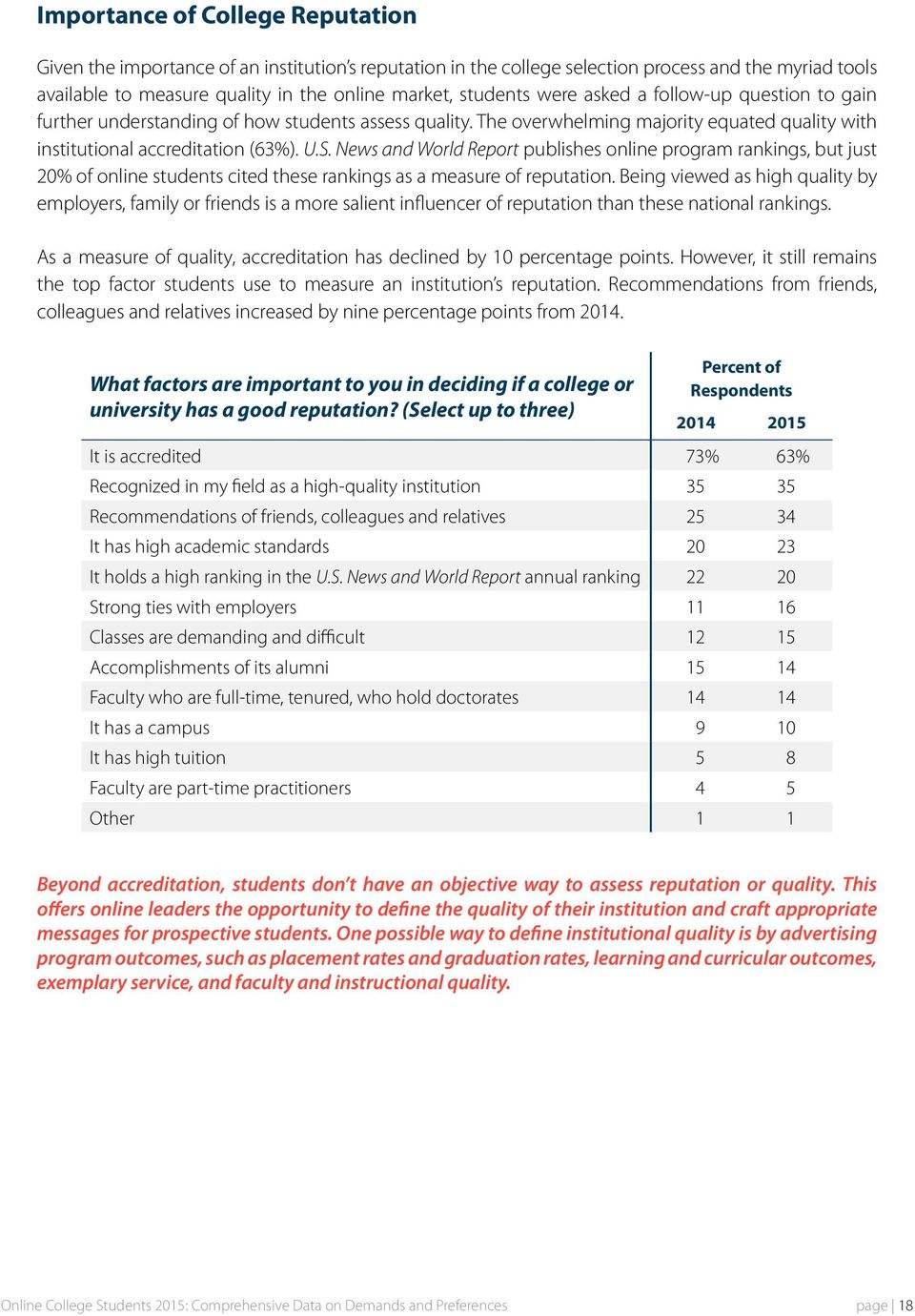
18 Importance of College Reputation Given the importance of an institution s reputation in the college selection process and the myriad tools available to measure quality in the online market, students were asked a follow-up question to gain further understanding of how students assess quality. The overwhelming majority equated quality with institutional accreditation (63%). U.S. News and World Report publishes online program rankings, but just 20% of online students cited these rankings as a measure of reputation. Being viewed as high quality by employers, family or friends is a more salient influencer of reputation than these national rankings. As a measure of quality, accreditation has declined by 10 percentage points. However, it still remains the top factor students use to measure an institution s reputation. Recommendations from friends, colleagues and relatives increased by nine percentage points from What factors are important to you in deciding if a college or university has a good reputation? (Select up to three) Percent of Respondents It is accredited 73% 63% Recognized in my field as a high-quality institution Recommendations of friends, colleagues and relatives It has high academic standards It holds a high ranking in the U.S. News and World Report annual ranking Strong ties with employers Classes are demanding and difficult Accomplishments of its alumni Faculty who are full-time, tenured, who hold doctorates It has a campus 9 10 It has high tuition 5 8 Faculty are part-time practitioners 4 5 Other 1 1 Beyond accreditation, students don t have an objective way to assess reputation or quality. This offers online leaders the opportunity to define the quality of their institution and craft appropriate messages for prospective students. One possible way to define institutional quality is by advertising program outcomes, such as placement rates and graduation rates, learning and curricular outcomes, exemplary service, and faculty and instructional quality. page 18
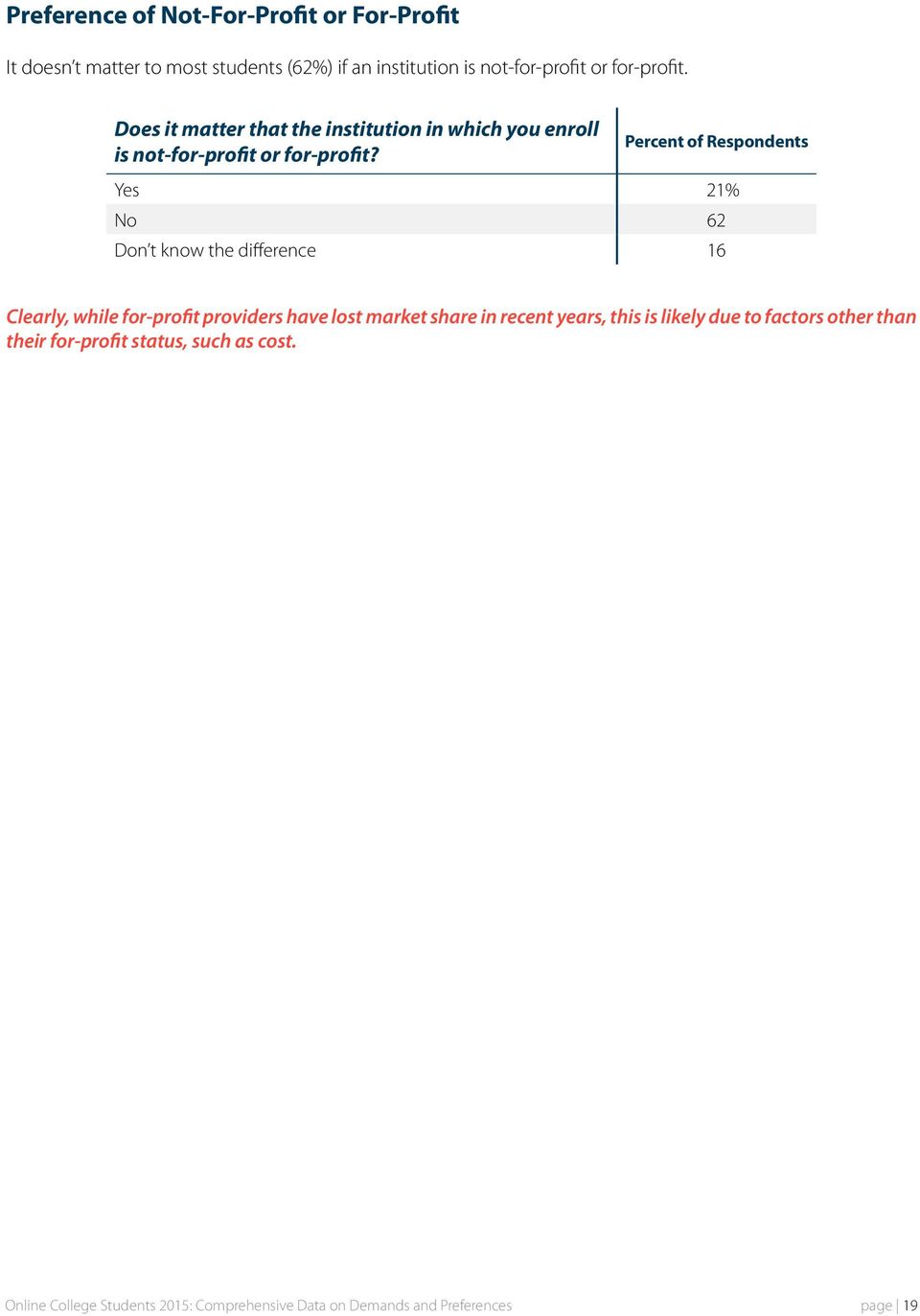
19 Preference of Not-For-Profit or For-Profit It doesn t matter to most students (62%) if an institution is not-for-profit or for-profit. Does it matter that the institution in which you enroll is not-for-profit or for-profit? Percent of Respondents Yes 21% No 62 Don t know the difference 16 Clearly, while for-profit providers have lost market share in recent years, this is likely due to factors other than their for-profit status, such as cost. page 19
20 Recruiting Online Students Most Effective Marketing Messages: Category Respondents were presented with marketing messages that had been broken down into seven topical categories and asked to choose which message among each of the categories they found most appealing. The categories were designed to allow leaders to identify effective messaging that corresponds to the specific strengths of their institutions. Career Improvement In the area of career improvement, High job placement rate was the most appealing message of the four listed. A distant second was offering Career-focused programs (28%), followed by Internships available (16%) and Career guidance available (13%). Unsurprisingly, job placement is a highly attractive feature for any institution to advertise, given online students motivation to enroll at both the undergraduate and graduate levels in programs that will help them move forward in their careers. As much as possible, colleges that want to attract online students must demonstrate how they connect their graduates to the world of employment. Internships available CAREER IMPROVEMENT reer guidance Ca available 13% 16% 28% Career-focused programs 43% High job placement rate Enrollment Incentives ENROLLMENT INCENTIVES While messages of scholarships, first courses free or even free ipads are often seen in today s marketing as a financial incentive for students to enroll, students know that it s the textbook cost that often presents the biggest up-front financial burden and the one about which they are most concerned. Colleges should begin to make efforts for highly discounted or free course materials whether in electronic or print format and then use those advancements in marketing efforts. Qualify for a $400 scholarship 23% Free ipad 12% 26% First course free 39% Free textbooks page 20

21 Affordability Students were given four marketing messages regarding affordability. The straightforward message of Affordable tuition was seen as the most appealing, with 45% of students choosing this message, compared to 24% choosing Scholarships available. Cost is extremely important to potential college students. The more an institution can do to describe its current tuition as both affordable and competitive, the greater its appeal to prospective students. Advertising must emphasize financial factors, and specify why financing an online education will not be a burden. Lowest tuition in the region AFFORDABILITY 23% Private school at public school cost 9% 24% Scholarships available 45% Affordable tuition Finish Faster Students were less decisive when asked about marketing messages that focused on completing their degree faster. Among graduate students, Earn your degree in one year was slightly more appealing than Year-round class offerings (34%) and Accepts more transfer credits (25%). 31% Accepts most transfer credits FINISH FASTER Earn your degree in one year 37% Completion time has always been, and continues to be, an important factor among online students. They need to see the light at the end of the tunnel. Thus, transfer credits and year-round instruction resonate well with prospective online students who hope to earn their degree as quickly as possible. 33% Year-round class offerings High Touch Students were more likely to respond to marketing messages that discussed small class size (40%) and personal relationships with faculty members (33%) than those about a high-touch community (15%) or developing relationships with fellow students (12%). High-touch community HIGH TOUCH Develop relationships with fellow students 12% 15% 40% Small class size These responses should guide colleges to emphasize (when appropriate) that online classes can be intimate and do indeed allow students to foster ties with faculty members. 33% Personal relationships with your faculty page 21
22 Alumni Success Online students were much more interested in hearing about successful alumni (52%) than about celebrity alumni (5%) at an institution. Active and supportive alumni (43%) were also seen as being more appealing compared to celebrity alumni. Graduate students found messages about successful alumni more appealing than those about supportive alumni. While some for-profit institutions have aligned with celebrity alumni, it does not seem to resonate well with prospective online students. Active and supportive alumni 43% ALUMNI Celebrity alumni of the school 5% Successful alumni of the school 52% Success of Students When institutions want to demonstrate the success of their students, prospects find satisfaction scores slightly more appealing than other messages. Not far behind, however, were messages on high retention rates (32%) and timely student completion (30%). Given similar ratings across all three factors, colleges would be wise to describe their performance in all three areas. If your institution regularly conducts student satisfaction surveys and the results are favorable, consider adding this information in marketing materials. SUCCESS OF STUDENTS/ DEGREE COMPLETION 30% Most students graduate on time 32% Very high retention rate High student satisfaction scores 38% page 22
23 Most Effective Marketing Messages: Overall After ranking marketing messages across categories, respondents were then given the entire list of potential marketing messages and asked to select the three most appealing. Online students rated Affordable tuition (36%) as the top overall message of the 25 messages they viewed, followed by Free textbooks (31%) and High job placement rates (27%). Responses showed that, of the seven categories, messages about affordability, enrollment incentives and career improvement were the areas with the most appeal. Which three of these marketing messages are the most appealing to you? Percent of Respondents Affordable tuition 36% Free textbooks 31 High job placement rate 27 Earn your degree in one year 21 First course free 19 Lowest tuition in the region 17 Accepts most transfer credits 17 Scholarships available 16 Qualify for a $400 scholarship 15 Career-focused programs 13 Year-round class offerings 12 Internships available 10 Free ipad 9 Small class size 9 Personal relationships with your faculty 8 High student satisfaction scores 8 Successful alumni at the school 7 Private school at public school cost 5 Career guidance available 5 Very high retention rate 5 Active and supportive alumni 4 Most students graduate on time 4 High-touch community 3 Develop relationships with fellow students 2 Celebrity alumni at the school 1 Institutions that have low tuition rates and high job placement rates have powerful messages to communicate to prospective students. Institutions that are relatively expensive or that have low job placement rates need to clearly communicate their value propositions, such as successful alumni, high-touch communities and speed to degree. page 23
24 Choosing Program or Institution First More than 60% of online students began by selecting the program they were interested in studying, such as nursing, followed by choosing which institution they wanted to attend. One-quarter of students reported selecting both a program and institution at the same time. If an institution doesn t offer the program an online student is looking for, many will not even consider enrolling in that institution. To appeal to the largest audience, schools need to offer the specific programs and degrees that are most in demand. At the same time, niche programs (specializations that typically attract small numbers of online students) can still be marketed but to a larger population base and by institutions that have credibility and history in such areas. The institution you wanted to attend WHICH DID YOU DECIDE FIRST? Both 25% 13% The program/degree you wanted to study 62% Number of Institutions Contacted One-third of students considered only the institution in which they enrolled when deciding to pursue their education online. On average, between two and three schools were considered by online students. Graduate students were slightly more likely to consider more than one institution. Besides the school in which you enrolled, Percent of Respondents how many other schools did you contact or request information from? All Undergraduate Graduate Zero/no other schools considered 33% 36% 29% One Two Three Four Five More than five Mean number of schools contacted These data indicate that online students don t shop around very much. If the institution offers the desired program, students may enroll at the first institution that responds to their inquiry, or they may predetermine the desired institution and only apply there. Therefore, it is important for leaders to promote awareness of the online programs available at their institution and respond promptly to inquiries with close follow-up. It appears that a substantial number of students will attend the institution of interest unless something happens to derail the process. page 24
25 Top Reason for Selecting First-Choice School Students were asked to identify the most important single reason for selecting an institution. The strongest driver for their selection was the online program being the best match for them. For 20% of respondents, being less expensive than others was the most important reason for their choice, slightly more than the school s reputation. What was the most important reason you selected your top choice school, relative to the others you contacted or requested information? Percent of Respondents The program was the best match 36% It was less expensive 20 It has a better reputation 13 It was the institution that was recommended to me by someone I respect 10 It was the institution I knew best 8 I didn t contact any other institutions 8 It had a faculty member I knew/respected 2 Other 4 page 25
26 Effectiveness of Marketing Channels Students were asked to rate 10 separate marketing channels in terms of how effective they were in making them aware of online programs. Listings on college search sites and commercials on TV were the two most effective channels, with a mean score of 3.78 out of 5.00 for listings on college search sites and a score of 3.22 for TV commercials. Billboards (2.73) and pop-up ads (2.56) were seen as the least effective marketing messages for raising awareness of an online program. HOW EFFECTIVE WERE EACH OF THE FOLLOWING ADVERTISING METHODS IN MAKING YOU AWARE OF POTENTIAL ONLINE PROGRAMS? Listings on college search sites mean=3.78 Commercial on TV mean=3.23 Direct mail to my home mean=3.16 Ads on social media sites mean=2.99 Other event I attended mean=2.99 Conference / tradeshow I attended mean=2.94 Ads in magazines / newspapers mean=2.93 Commercials on radio mean=2.82 Billboard mean=2.72 Pop-up ads on website mean=2.55 7% 6% 17% 25% 31% 14% 16% 8% 17% 20% 19% 19% 16% 9% 18% 18% 18% 21% 18% 10% 16% 17% 14% 24% 19% 7% 13% 14% 14% 32% 19% 7% 14% 13% 14% 33% 17% 10% 18% 17% 11% 27% 22% 10% 17% 13% 14% 25% 22% 12% 17% 13% 11% 24% 27% 11% 13% 12% 10% 27% 0% 20% 40% 60% 80% 100% Not Effective Very Effective Never Saw or Received As mentioned above, if a student is not aware that your institution offers the online program they are looking for, it will be difficult to be included in the two to three with which they make contact. A portion of your marketing budget should be dedicated to program awareness. Students indicate that these funds should be prioritized to college search sites, commercials and direct mail. While these channels may be seen as raising awareness, they were not included in the methods students used to request information, so do not expect a direct response to these channels. page 26
27 Content Sources for Program Awareness Students were asked about the effectiveness of content types in raising awareness of available online programs based on a 5-point effectiveness scale. The types of content that was most commonly found effective were search engines and social media posts, with an average score of 4.0 and 3.06 respectively. Online podcasts (2.71) and online quizzes (2.69) were seen as the least effective types of content. HOW EFFECTIVE WERE EACH OF THE FOLLOWING SOURCES IN MAKING YOU AWARE OF POTENTIAL ONLINE PROGRAMS? Search Engines mean=4.02 Social Media mean=3.06 Other event I attended mean=3.04 Blog Posts mean=2.99 Online Video Commercial mean=2.93 Infographics mean=2.89 Podcasts mean=2.71 Online Quizzes mean=2.69 6% 5% 13% 22% 43% 10% 16% 10% 17% 17% 15% 24% 17% 7% 11% 14% 15% 35% 16% 11% 19% 10% 15% 15% 14% 27% 17% 10% 18% 14% 11% 29% 21% 10% 18% 16% 13% 27% 13% 11% 11% 34% 22% 10% 13% 11% 11% 31% 0% 20% 40% 60% 80% 100% Not Effective Very Effective Never Saw or Received Content development and promotion is a strategic tactic to raise program awareness by increasing referred website traffic and rankings on search engine results pages. However, in order to be effective, the content needs to be appealing to prospective students and it needs to be targeted at the right channels. When developing content, listings on search engines and social media presence should be prioritized. page 27
28 Process After Identifying Institutions of Interest Almost half of students (49%) turned directly to the college s website to gather further information about their institution of interest. College websites were followed closely by internet search engines (44%), while approximately one-third of students called the institution directly. After identifying institutions of interest, what were your primary methods of gathering detailed information? (Select all that apply) Percent of Respondents Direct visits to the websites of the colleges of interest 49% Internet search engines (Google, Bing, etc.) 44 Phone calls to the institutions 34 Printed college guides and other materials 32 Conversations with friends, family 31 Attend an open house/other event 24 Conversations with employer or colleagues 21 College search sites like elearners.com, ClassesUSA, elearnportal.com 18 Attend a virtual open house 18 Live chat on the college website 15 Social media sites (Facebook, LinkedIn, Google+, etc.) 15 Other 1 I don't remember 2 The channels that were identified as effective at raising program awareness are not necessarily the channels students turn to for detailed information about a school. While institutions should maintain a presence on the channels that raise program awareness as well as those that serve as a source for more detailed information, it is important to realize how each channel is being used and to tailor the messaging appropriately. page 28
29 Most Important Information from Institution Tuition and fees were the most important information for 74% of prospective online students when deciding which institution to select. Admission requirements (59%) and the degrees offered (50%) were also highly sought information for more than half of online students. Financial aid information was significantly more important to undergraduate students, but it only ranked seventh for all students. Which of the following were the most important types of information you looked for in helping to select an institution? (Select all that apply) Percent of Respondents Tuition and fees 74% Admission requirements 59 Available degree majors and programs 50 Course schedules 47 Courses included in program curriculum 46 Career options for each degree area 42 Specific course descriptions 37 Financial aid information 36 Application form/instructions 34 Career placement of graduates 30 Faculty profiles 12 Open house details 9 The college or university website should clearly present information about tuition and fees. Students prefer total degree and course costs over per-credit cost. Information about average transfer credits accepted can also be useful to students to put total degree cost in perspective. Format of Information Online students ranked four common formats for receiving information about the online program they researched, with 1 being highest and 5 being lowest. Written text was the most appealing format for receiving information. The second most appealing format was video, followed by infographics. Audio was seen as least appealing of the options. What is your preferred format for the information you gather online? Mean Rank of Respondents Written text 1.55 Video 2.25 Infographics and other charts and tables 3.11 Audio 3.27 Other 4.82 Students demonstrated a preference for the traditional written text. Ensure written copy is of the highest quality and inclusive of all information prior to expanding to other types of content. page 29
30 Devices Used During the Search Process The majority of online students consistently used their computers throughout the enrollment funnel, from the initial search to the eventual application. Smartphones and tablets were used by slightly more than one-quarter of students during the initial search and information gathering, but smartphone and tablet use decreased significantly during the application phase. Phone calls to the institution occurred most often during the information gathering process (27%). Please select what device(s) you used (will use) during the different stages of the search process for your online program. (Select all that apply) Smartphone (Web browser) Phone (Called) Tablet (Web browser) Computer (Web browser) Initial search for program/school 29% 18% 23% 72% Gathering information about a specific program/school Completing applications to schools Method of First Contact Online students heavily favored the use of a college s website, with 43% of respondents using it to request more information about their program of interest. Twenty-nine percent sent an for more information, and 28% called the institution. Newer technology, such as social media and live chat functions, were far less utilized. 2% Other HOW DID YOU FIRST CONTACT THE COLLEGES THAT INTERESTED YOU? 4% Live chat (SELECT ALL THAT APPLY) Social media I visited the college I didn t make any contact prior to submitting my application It s important for college websites to have an easy way for prospective students to request additional information as it s their preferred method of first contact. Also clearly call out an appropriate phone number and for 28% 29% Phone contact. Do not bury the request form or online I requested more information directly on their website program contact information in web pages, 43% but rather make it clearly visible. 0% 10% 20% 30% 40% 50% 5% 16% 16% page 30
31 Importance of First Contact Half of graduate students and 40% of undergraduates enrolled at the institution that responded to them first with the information they requested. Factoring in those students who only contacted one institution, these numbers rise to 69% and 65% respectively. Did you enroll in the college that got back to Percent of Respondents you first with the information you requested? All Undergraduate Graduate Yes 43% 40% 49% No I only contacted one college Speed of Contact Online students would like to hear back from colleges rapidly but not instantaneously. Online students would like responsive service. While a relatively minor portion (9%) expect to hear back within the hour, a majority (66%) prefer a response within a day. Very few find a response time over two days acceptable. How soon after making your initial inquiry to a college Percent of Respondents would you like to hear back from the college? Within an hour 13% 9% Within 24 hours regardless of the day By the next business day NA 27 Within two days More than two days 21 8 The more quickly your college admissions department responds to prospective online students, the more likely these students are to enroll in your program. As the response time lengthens past one hour, fewer students are satisfied, and the possibility of another institution responding first increases. Only a small percentage of students are satisfied with response times that extend beyond two days. page 31
32 Frequency of Contact Seventy percent of online students would like to hear periodically from colleges after submitting an inquiry. Within those wanting routine contact, the preferred frequency varies greatly and thus is consumer-specific. How frequently would you like to periodically hear from colleges that you have inquired to? Percent of Respondents More than once per week 10% Once per week 23 Once every other week 16 Once every three weeks 7 Once a month 11 Less than once a month 4 I only want to hear from a college in response to an inquiry 30 Because preferences vary greatly across online students, colleges and universities would benefit from asking each prospective student their expectations and preferences on how often they would like to be contacted and then follow suit. Least Effective Time to Contact Students Sundays (47%), Saturdays (37%) and weekday mornings (34%) were the least attractive times to contact prospective online students. By contrast, weekday afternoons were the most attractive time to contact prospects, and 22% of prospects noted that colleges could contact them at any time. Are there times of the day/week that you do NOT want to be contacted? (Select all that apply) Percent of Respondents Sundays 47% Saturdays 37 Weekday mornings 34 Weekday evenings 26 I can be contacted anytime 22 Weekday afternoons 18 page 32
33 Communication After Application After students submit their application to a college, 71% would like to receive more information on their program as well as information about financial aid (59%). Close to half of online students would also like to receive more information about enrollment logistics (53%) and information about student and academic services (46%). The following were less popular: welcome messages from the head of the program (38%), current students (24%) or alumni (21%). In general, undergraduate students were significantly more interested in financial aid information. What types of communications would you like to get from a college after you submitted an application? (Select all that apply) Percent of Respondents Detailed information about your program 71% Information on financial aid 59 Information about program/enrollment logistics 53 Information about student and academic services 46 A personal welcome from the head of the program you are interested in 38 A welcome message from a student currently enrolled in your program 24 A welcome message from alumni of the program 21 Something else 1 Even though the period of time between selecting an institution and beginning classes is relatively short, this period can be effectively used to maintain student interest by supplying students with information about their program. Online prospective students show a desire for practical information such as financial aid and process guidance. Ensure this type of information is accurately prioritized and communicated prior to less substantive communications. page 33
34 Length of Time from Search to Enrollment In breaking down the enrollment funnel, it appeared that online students both at the undergraduate and graduate level followed similar timelines. Two-thirds (66%) of online students spent eight weeks or less searching for a program and completing their applications. Forty percent spent less than four weeks. From the time they submitted their application, 67% spent eight weeks or less waiting for their first class to start, with 36% waiting less than four weeks. HOW LONG DID IT TAKE YOU FROM THE TIME YOU FIRST STARTED YOUR SEARCH FOR AN ONLINE PROGRAM TO COMPLETE YOUR APPLICATION? 4 weeks or less 40% 5 8 weeks 26% 9 12 weeks 14% 3 6 months 12% 7 9 months 2% months 2% More than 12 months 3% 0% 5% 10% 15% 20% 25% 30% 35% 40% AFTER SUBMITTING YOUR APPLICATION, HOW LONG DID IT TAKE TO ACTUALLY START CLASSES? 4 weeks or less 36% 5 8 weeks 31% 9 12 weeks 15% 3 6 months 13% 7 9 months 3% months 1% More than 12 months 1% 0% 5% 10% 15% 20% 25% 30% 35% 40% Prospective online students continue to act quickly, thus time is of the essence. The application process should be easily completed within four weeks and classes would optimally start every eight weeks. page 34
35 Forty-two percent learned about their financial aid package within two weeks of submitting their application, and 40% spent two weeks or less waiting to see how many credits would transfer. Onequarter (24%) found out about their transfer credits before they submitted their application. WHEN DID YOU FIND OUT HOW MUCH FINANCIAL AID YOU WOULD GET? Before I submitted my application WHEN DID YOU FIND OUT HOW MUCH OF YOUR PREVIOUSLY EARNED CREDIT WOULD TRANSFER INTO YOUR ONLINE PROGRAM? 16% 19% 10% 19% 13% 23% Less than one week after submitting my application 1-2 weeks after submitting my application 3-4 weeks after submitting my application More than one month after submitting my application 20% 6% 10% 20% 24% 20% N/A Affordability is very important to online students. As such, they want to know their financial aid package and receive their transfer credit review early in the process. Competitive institutions will develop the processes to supply this information to prospective students within a few days. page 35
36 The Online Classroom Preferred Instruction Online students were split on the type of instruction they most preferred. Thirty-seven percent preferred a tutorial style with students completing tasks at their own pace and contacting an instructor with questions. Not far behind, 34% preferred an independent study model, with students studying at their own pace and not interacting with an instructor. Twenty-nine percent preferred the instructor-led model, where an instructor takes students through their learning activities. Which of the following models for studying online would you most prefer? Tutorial: Students complete a series of learning activities at their own pace, with an instructor available to answer questions and then complete assignments/exams. Independent Study: Students study independently at their own pace, with books and other resources provided by the university and then complete assignments/exams. Instructor-Led: Students complete a series of instructor-led learning activities and discussion forums with a class of other students and then complete assignments/exams as scheduled. Percent of Respondents % 37% Online students have a clear and growing preference for self-paced learning. Two-thirds do not prefer the traditional, instructor-led online class. A handful of colleges and universities are implementing competency-based education models, which often include self-pacing. If online courses are designed following best practices, they typically have clear assessments in place and could be converted to self-paced programs fairly easily. page 36
37 Number of Hours of Study per Week Online students reported varying amounts of study time per week for each course in which they were enrolled. However, 42% reported spending between six and 10 hours per week per course a total of 59% reported 10 hours or less per week. HOW MANY HOURS DID YOU SPEND ON SCHOOL WORK EACH WEEK ON EACH ONLINE COURSE IN WHICH YOU ENROLLED (including required assignments and studying)? Undergraduate 6% Graduate 7% 10% 19% 5 or fewer hours per week 15% 6-10 hours per week 13% 21% 43% hours per week hours per week More than 20 hours per week 25% 41% Institutions that use terms of eight weeks or less with three-semester credit courses should be careful that their courses are creditworthy. A three-semester course should require about 140 hours of student work regardless of term length. For an eight-week term, this translates to 17.5 hours per week. Synchronous Discussions Seventy-five percent of undergraduates and 86% of graduate students were willing to log in for a synchronous discussion during their online coursework. The number of times per course they were willing to do so varies, but one-third were willing to log in two to three times per course for a virtual lecture or discussion. Undergraduates were significantly less willing to participate in synchronous activities than graduate students, by a margin of 25% of undergraduates to 15% of graduate students. HOW OFTEN WOULD YOU BE WILLING TO LOG IN AT A SPECIFIC TIME TO JOIN A REQUIRED DISCUSSION OR VIRTUAL LECTURE WITH YOUR INSTRUCTOR AND CLASSMATES? Never I don t want to ever have to log in at a set time Undergraduate Never I don t want to ever have to log in at a set time Graduate 10% 25% 13% 11% More than five times per course Four or five times per course 10%15% 17% 14% More than five times per course Four or five times per course 75% Yes 33% 18% Two to three times per course Once per course 86% Yes 36% 19% Two to three times per course Once per course page 37
38 Engagement Tools Forty percent of online students felt that posting to message boards was the most effective way to encourage students to engage with one another. One-quarter (25%) felt group projects would be the most effective technique. Which of the following do you think is the most effective in encouraging online students to engage with each other? Percent of Respondents Posting to online message boards 40% Doing group projects 25 Being assigned a "partner" in your class 16 Simulations 11 Blogging 7 Something else 1 Student engagement is correlated with student persistence and satisfaction. Virtually all online classes incorporate message board discussions. Over one-third of students listed group projects, working with a partner or simulations as the single effective method for encouraging engagement. Institutional leaders should consider this fact when designing courses to increase student engagement. Academic Advisement Online students were equally split between supporting a 24/7 on-demand system of advisement and being advised by a faculty member in their chosen field of study. Which of the following types of academic advisement would be most helpful to you? Percent of Respondents A faculty member from your field of study who you regularly 36% meet (virtually) to discuss your courses and your schedule An "on-demand" system, where you can contact an advisor 24/7 and get someone who can help you plan your schedule, 36 answer basic questions, etc. A professional advisor who is not a faculty member that you work with throughout your program and is there to answer 27 your questions Something else 0 A sub-theme among these respondents is that online students would like more interaction with faculty members. In the question above, about one-third would prefer a faculty member as an advisor. A previous question revealed that 21% listed Inconsistent/poor contact and communication with instructors as a concern with online classes. Setting expectations for faculty interaction and using faculty members as advisors in some capacity would improve student satisfaction and, most likely, retention. page 38
39 Paper Electronic Course Materials Online students preferred electronic course materials (e.g., textbooks) to those delivered on paper (43% compared to 33%). Just less than a quarter (23%) did not have a specific preference. Providing students a choice in electronic vs. paper course materials is a best practice. DO YOU HAVE A PREFERENCE FOR THE FORMAT OF YOUR COURSE MATERIALS? No Preference 23% 43% Electronic 33% Online Program Features Online students were asked to rate the attractiveness of certain programmatic features found in some online programs. In reviewing the mean scores of the responses given, optional internships were seen as the most attractive option, with a 3.72 score out of a 5.00 rating. This was followed by optional oncampus courses (3.33), face-to-face orientation (2.97), required internships (2.79) and required oncampus courses (2.58). HOW WOULD YOU RATE THE ATTRACTIVENESS OF THE FOLLOWING FEATURES OF SOME ONLINE PROGRAMS? Optional internships mean= 3.72 On-campus face-to-face orientation mean = 2.97 Required internships mean= 2.79 One or more required on-campus courses mean=2.58 One or more optional on-campus courses mean= % 9% 28% 30% 29% 21% 15% 26% 22% 26% 15% 25% 32% 16% 22% 17% 17% 12% 12% 28% 26% 22% 16% 16% 12% 0% 20% 40% 60% 80% 100% Not At All Attractive Very Attractive Internships are valued by online students and are effective stepping-stones to a first or new job. Designing flexible internship programs would be an effective way to engage students and help them meet their employment objectives. page 39
40 Financing Online Classes Presenting Cost Information The students surveyed were equally likely to consider the cost of their program in terms of the cost per course (35%) or the total degree cost (38%). One-fifth (20%) considered the cost per credit. When considering cost as part of your enrollment decision, do you think in terms of cost: Percent of Respondents Total degree cost 38% Per course 35 Per credit 20 Total certificate/license cost 7 Cost is a major concern for online students, and one of the top information items they look for on the institution s website. It is a challenge to present total degree cost because most online students receive some transfer credit. Presenting historical averages of the amount students actually paid by program would be a good way to communicate cost. page 40
41 Total Cost Students were asked what they paid per credit, course, or degree or certificate (not including fees). The data were cleaned for extreme outliers such as $1 per credit or $20,000 per course. Undergraduates reported paying $345 per credit, and graduate students reported paying $615 per credit, on average. The data below are reasonably consistent. If the graduate tuition per credit was $615, as reported here, and the total tuition was $23,800, the required credits for the degree would be Most online master s degrees are between 30 and 36 credits, thus there is a small inconsistency between the reported percredit cost and degree cost. For the undergraduates, a per-credit cost of $345, as reported here, divided into the total cost of $24,880, yields 72 credits. Undergraduate degrees typically require 120 credits. Therefore, if the data are accurate, students on average had 48 transfer credits. Previous surveys in this series reported that approximately 80% of online students received transfer credit, with a typical range of 30 to 60 credits. These estimates are within that range. Mean cost per: Mean Undergraduate Price Mean Graduate Price Credit $345 $615 Course $1,120 $1,170 Degree $24,880 $23,800 Certificate/license $4,070 $4,760 High school graduates without a college credential tend to overestimate the cost of college attendance (Kelly, 2015). Providing accurate information about per credit cost, per course cost and total cost per credential would encourage these students to make the decision to enroll. When presenting cost information, online leaders need to account for the undergraduate transfer credit issue. Most students don t pay the full cost of the degree because they bring transfer credit. Presenting historical data about the average number of transfer credits and the average cost paid at the institution would be helpful. Cost Conscious Two-thirds of the respondents were aware of the total cost of the colleges they were considering. When evaluating online programs, did you know the total cost of each of the colleges you seriously considered? Percent of Respondents Yes 68% No 32 page 41
42 Select an Institution by Cost Online students were split, but 55% report they did not select the least expensive institution despite how much cost weighs on their final decision. This was a significant decrease from 2014, when 70% reported they did not select the most inexpensive option. 100% DID YOU SELECT THE MOST INEXPENSIVE INSTITUTION/PROGRAM? Undergraduate Graduate 100% 80% 60% 66% 56% No Yes 80% 60% 79% 55% 40% 40% 20% 34% 44% 20% 21% 45% 0% 0% Regardless of the trend, a significant minority of students select the least expensive program. When accreditation, as reported earlier, is the primary method of determining institutional reputation, it is logical for students to select the least expensive option because virtually all providers are accredited. If an institution is not the lowest-cost provider in the region, leaders need to justify the price differential with factors such as student outcomes or service levels. Paying for Online Program Personal funds (44%) and student loans (42%) were the two most common methods for students to pay for their online education. One-third of online students overall and 40% of undergraduates relied on government grants, such as Pell Grants. Graduate students were significantly less likely to use government grants and more likely to use employer tuition reimbursement benefits. How did you pay for your online program? Percent of Respondents (Select all that apply) All Undergraduate Graduate Personal funds (This includes your own cash, check or credit card, gifts and loans from family/friends) 44% 43% 46% Student loans (government, Stafford, etc.) Government grants (Pell, etc.) Employer tuition support benefits Private scholarships Private loans page 42
43 Debt Incurred Cost is always a concern for any degree, either online or on campus. Therefore, students who had completed their program were asked about the debt they incurred during their online study. The debt reported by both undergraduate and graduate students was similar. Over one-quarter of the respondents reported debt of $5,000 or less. One-fifth incurred debt between $5,001 and $15,000, with one-third incurring debt of over $15,000. HOW MUCH DEBT DID YOU INCUR FROM EARNING YOUR ONLINE DEGREE/CERTIFICATE? I did not incur any debt $5,000 or less $5,001 to $15,000 $15,001 to $30,000 $30,001 + Prefer not to answer 16% 27% 21% 14% 20% 3% 0% 10% 20% 30% 40% 50% 60% 70% 80% 90% 100% A college graduate earns about $900,000 more than a high school graduate over a lifetime. Over a 45-year working career, this equates to $20,000 per year. Newly minted graduates don t make average salaries, but there is a substantial difference in earning power. Previous reports in this series showed that one-third of students improved their employment status (first job, new job, full-time job) within a year of graduation, and about 20% of undergraduates and one-third of graduate students received a raise within one year of graduation. If online program graduates used their increased earnings to retire their debt, the majority could do so within a few years. This calculation doesn t take into account the time and effort invested in earning a college credential. But on the basis of cost, the value proposition is strong. This would be a good message for online leaders to incorporate into their marketing strategy using institutional data. Time to Repay Debt Thirty percent of students felt they could pay off their student debt in two years or less, but 20% thought it would take 10 years or more to repay all the debt they incurred from their degree. From the time you complete your program, how long do you think it will take you to pay off the debt you incurred? Percent of Respondents Less than 1 year 11% 1 to 2 years 20 3 to 4 years 13 5 to 7 years 8 8 to 10 years to 15 years 5 16 to 20 years 5 More than 20 years 10 I did not incur any debt 16 page 43
44 Influence of Scholarships Two-thirds of students did not receive a scholarship when they enrolled in their online program. Eightynine percent of online students felt an annual $2,500 scholarship would have swayed them at least somewhat to enroll in one institution over another. Of those who said they would not have been swayed by a $2,500 scholarship (11%), 64% felt an annual $5,000 scholarship would have swayed them at least somewhat. Did you receive any scholarships or awards from your college as a part of your enrollment package? Percent of Respondents Yes 34% No 66 To what extent would a $2,500 annual scholarship have swayed you to enroll in one online institution over another? Percent of Respondents Not at all 11% Somewhat 38 Definitely 19 Very much 32 To what extent would a $5,000 annual scholarship have swayed you to enroll in one online institution over another? (Asked of those who responded Not at all to the question above.) Percent of Respondents Not at all 36% Somewhat 43 Definitely 5 Very much 16 page 44
45 Methodology In spring 2015, Aslanian Market Research and Learning House conducted surveys with more than 1,500 individuals nationwide and this report highlights our findings. Respondents were at least 18 years of age, had a minimum of a high school diploma or equivalent, and were recently enrolled, currently enrolled, or planning to enroll in the next 12 months in a fully online undergraduate or graduate degree, certificate or licensure program. According to the U.S. Department of Education, graduate students represent 16% of the total college population but 25% of the online population. The sample for this survey was weighted to include approximately 40% graduate students to ensure a large enough sample for meaningful conclusions. The data are presented for both undergraduate and graduate students combined unless there were noteworthy differences. Resolution Research of Denver, Colorado, identified the sample of respondents. The organization drew the sample from its actively managed, 100% market-research-only panel that represents the U.S. Census Bureau, which enables the selection of groups that prove difficult to source. Resolution Research has collected up to 250 behavioral and demographic data points on each consumer panelist, which allows it to target respondents for specific research objectives. To recruit for this study, Resolution Research invited its panel of consumers from across the nation to participate in an online survey through custom invitations. Invitations were sent randomly across the United States to reflect the basic population distribution targeting persons 18 years of age or older. Panelists were then allowed to participate in the study if they were currently enrolled in, had firm plans to enroll in, or had within the past twelve months participated in a fully online degree, certificate or licensing program. Respondents hailed from 49 states and the District of Columbia. The states that represent 51% of the nation s population (according to the 2012 U.S. Census Bureau) represented 51% of the study s respondents. These states included California, New York, Florida, Illinois, Texas, Georgia, Pennsylvania and Ohio. The National Center for Education Statistics IPEDS data show that in 2013, 2.6 million higher education students were enrolled in courses that were exclusively delivered via distance education. Eduventures (2015) estimated the size of the wholly or majority online program market for the fall of 2013 to be 3.2 million students. Based upon these findings, a sample of 1,499 represents approximate sampling error of +/-3% at a 95% confidence level. page 45
46 Demographics Gender The significant majority of online students are consistently female at both the undergraduate and graduate levels. This ratio has been steady over the last four years of surveys with a slight up-tick in males at the graduate level in Percent of Respondents Gender Undergraduate Graduate Male 26% 31% 29% 29% 34% 46% 34% 27% Female Prefer not to say 0 1 < < 1 0 Age Thirty-four percent of undergraduate online students were under the age of 25 and 36% of graduate students were under the age of 30, showing the online market skewing closer to traditional academic age ranges. Mean undergraduate age was 32.3 years and mean graduate age was 35.0 years. There appeared to be a trend emerging for younger students (18 to 24 years of age) enrolling in online programs. Percent of Respondents Age Undergraduate Graduate to 24 25% 34% 13% 19% 25 to to to to to to or older page 46
47 Marital Status From 2013 to 2015, there was a significant decline in the percentage of married and partnered individuals enrolled in online programs. Percent of Respondents Marital Status Undergraduate Graduate Married/partnered 51% 45% 72% 56% Single Prefer not to say Note that marital status was not asked in the Online College Students 2012 survey. Number of Children (Under 18) The percentage of online students with no children trended upward, with 59% of undergraduates and 50% of graduate students reporting no children. This follows suit with the prevalence of unmarried/not partnered online students. Percent of Respondents Number of Children Undergraduate Graduate None 50% 59% 36% 50% or more Prefer not to say Note that number of children was not asked in the Online College Students 2012 survey. page 47
48 Total Household Income The mean household income among all online students was close to $55,000. Among undergraduate students, the mean household income was close to $50,000, while the mean among graduate students was close to $70,000. Percent of Respondents Total Household Income Undergraduate Graduate Less than $25,000 18% 20% 4% 13% $25,000 to $39, $40,000 to $54, $55,000 to $69, $70,000 to $84, $85,000 to $99, $100,000 to $114, $115,000 to $129, $130,000 to $149, $150,000 or more Prefer not to say Ethnicity There has been a significant increase in the number of white graduate students since Percent of Respondents Ethnicity Undergraduate Graduate African American 18% 11% 18% 11% Asian or Pacific Islander Hispanic Native American White Other Prefer not to say page 48
49 English as a Second Language About one in five online students spoke English as a second language. This percentage is consistent across undergraduate and graduate students and has been relatively consistent since first asking the question in Percent of Respondents English as a Second Language Undergraduate Graduate Yes 82% 17% 78% 16% No Prefer not to say Note that English as a second language was not asked in the Online College Students 2012 survey. Employment Status Undergraduate employment status remained consistent over time. On the graduate side, from 2012 to 2015, more respondents are unemployed and fewer are employed full-time. Percent of Respondents Employment Status Undergraduate Graduate Employed full-time 48% 44% 73% 63% Employed part-time Not employed Retired Prefer not to say NA 3 NA 1 Military Service Few respondents to the survey were activity-duty military. A larger percentage (7%) were a spouse or dependent of someone with military service. Military service background was consistent across undergraduate and graduate respondents. Military Service Percent of Respondents Active-duty military 1% 2% Veteran 4 5 Reserve 1 NA Spouse or dependent of active duty NA 3 Spouse or dependent of veteran NA 4 None of the above page 49
50 Highest Completed Level of Education Prior to enrollment in their current online program, the majority of students (57%) had completed less than a bachelor s degree. For those pursuing an undergraduate degree, the majority come with prior college experience (59%). Interestingly, nearly one in three students pursuing a graduate degree did not enter the program with a bachelor s degree. Level of Education Percent of Respondents All Undergraduate Graduate High school diploma/ged 14% 18% 9% One or two years college, no degree Associate degree Three of four years college, no degree Bachelor s degree Some graduate courses, no degree Master s degree Some doctoral courses, no doctorate Doctorate Level of Study Interview quotas were set to ensure 60% of the sample consisted of undergraduate students and 40% consisted of graduate students. Were you enrolled in: Percent of Respondents Associate degree program 23% Bachelor's degree program 35 Master's degree program 22 Doctoral degree program 3 Certificate program 13 Licensure program 3 page 50
51 References Clinefelter, D.L., & Aslanian, C.B. (2012). Online college students 2012: Comprehensive data on demands and preferences. Louisville, KY: The Learning House, Inc. Clinefelter, D.L., & Aslanian, C.B. (2013). Online college students 2013: Comprehensive data on demands and preferences. Louisville, KY: The Learning House, Inc. Clinefelter, D.L., & Aslanian, C.B. (2014). Online college students 2014: Comprehensive data on demands and preferences. Louisville, KY: The Learning House, Inc. Kelly, A. P. (2015). High costs, uncertain benefits: What do Americans without a college degree think about postsecondary education? Washington, DC: Center on Higher Education Reform American Enterprise Institute. National Student Clearinghouse Research Center. (2015, May 13). Current term enrollment report Spring Retrieved from Shapiro, D., Dundar, A., Yuan, X., Harrell, A., Wild, J., & Ziskin, M. (2014). Some college, no degree: A national view of students with some college enrollment, but no completion (Signature Report No. 7). Herndon, VA: National Student Clearinghouse Research Center U.S. Department of Education. Institute of Education Sciences, National Center for Education Statistics. Technical Notes All percentages in this report have been rounded; therefore, the total percent figure in a table may not add up to exactly 100. Further, if the total percentage is substantially more than 100, it is because the question allowed respondents to choose more than one option. page 51
52 Partners The Learning House, Inc. through its proprietary cloud-based technology platform helps colleges and universities create, manage and grow high-quality online degree programs and courses. Partnering with more than 75 schools, Learning House enables institutions to efficiently and affordably achieve their online education goals. Services include product development and market research, marketing and lead generation, enrollment management, student retention, curriculum development and management, faculty training and professional development, learning management systems and 24/7 technical support. EducationDynamics is a proven leader in helping higher education institutions find, enroll, and retain students. The organization maintains its industry leadership through a deeply rooted philosophy of serving our schools best by serving students first. This commitment has been at the heart of its success since it began more than a decade ago, and it continues today as we proudly serve more than 1,200 colleges and universities of all types and sizes. Aslanian Market Research (EducationDynamics market research unit) conducts market demand studies, institutional audits, program and marketing reviews, and professional development seminars and workshops for colleges and universities seeking information and data on how to expand adult and online student enrollments. Throughout the last 25 years, our staff has worked with more than 350 colleges and universities of all types public, private, large, small, rural, suburban, and urban in every region of the U.S. Its seminars have provided thousands of college administrators with practical, handson tactics that they can implement at their institutions at minimal cost for maximum impact. Authors Dr. David L. Clinefelter is Chief Academic Officer of The Learning House, Inc. Prior to joining Learning House, he served as Chief Academic Officer of for-profit, online universities Walden and Kaplan, and as President of Graceland University, an early innovator in online education. Carol B. Aslanian is Senior Vice President of Aslanian Market Research. She is a national authority on the characteristics and learning patterns of adult students, and she has made hundreds of presentations on the topic and led market research projects for more than 300 colleges, universities, and educational agencies. For additional information, contact: Aslanian Market Research The Learning House, Inc. (201) (502) [email protected] [email protected] page 52
53 A joint project of The Learning House, Inc. and Aslanian Market Research Dr. David L. Clinefelter Carol B. Aslanian 427 South Fourth Street, Suite 300 Louisville, KY Marine View Plaza, Suite 212 Hoboken, NJ
Online College Students 2015: Comprehensive Data on Demands and Preferences
 Online College Students 2015: Comprehensive Data on Demands and Preferences Dr. David Clinefelter and Carol Aslanian Thursday, July 9, 2015 LearningHouse.com (502) 589-9878 Online College Students 2015
Online College Students 2014: Comprehensive Data on Demands and Preferences
 2014 Online College Students Comprehensive Data on Demands and Preferences Online College Students 2014: Comprehensive Data on Demands and Preferences A joint project of The Learning House, Inc. and Aslanian
Online College Students. Comprehensive Data on Demands and Preferences
 2013 Online College Students Comprehensive Data on Demands and Preferences Online College Students 2013: Comprehensive Data on Demands and Preferences A joint project of The Learning House, Inc. and Aslanian
An Introduction to Online Learning. Is Online Learning Right for You? Learn how to be successful in an online degree program.
 An Introduction to Online Learning Is Online Learning Right for You? Learn how to be successful in an online degree program. Table of Contents Pursue Your Passion & Advance Your Career Why Should I Earn
ONLINE STUDENT NEEDS, PREFERENCES AND EXPECTATIONS
 BEST COLLEGES 2015 ONLINE LEARNING SURVEY: ONLINE STUDENT NEEDS, PREFERENCES AND EXPECTATIONS EMAIL US: [email protected] Online Student Needs, Preferences and Expectations Online learning is still
NATIONAL. www.nu.edu 800.nat.univ
 NATIONAL www.nu.edu 800.nat.univ CLASSES START EVERY MONTH, ENROLL ANYTIME 800.NAT.UNIV www.nu.edu About National University ABOUT National University Reputation Founded in 1971, National University has
Is an Executive MBA right for you? A GUIDE TO THE EXECUTIVE MBA
 Is an Executive MBA right for you? A GUIDE TO THE EXECUTIVE MBA Table of Contents What is an Executive MBA?....2 Do I need to be an executive before I enter an Executive MBA program?....2 What are the
APPENDIX 3 Organizational Profile
 APPENDIX 3 Organizational Profile Organizational Description Northwestern Oklahoma State University is the smallest university in the Regional State Universities of Oklahoma System (RUSO). The other institutions
for Undergraduate and Graduate Programs
 Trends in Enrollment Management 2015 Adult Learner Marketing and Recruitment Practices Benchmark Report for Undergraduate and Graduate Programs What s working in adult learner recruitment and marketing
Is an Executive MBA right for you?
 Is an Executive MBA right for you? A GUIDE TO THE EXECUTIVE MBA achieve goals busy schedule support classroom contribution cost peer network the new MBA What is an Executive MBA? The Executive MBA is a
Quick Start Guide to Becoming a Student. 2008 University of Phoenix, Inc. All rights reserved. AK6011
 Quick Start Guide to Becoming a Student 2008 University of Phoenix, Inc. All rights reserved. AK6011 Table of Contents Welcome to University of Phoenix...1 Overview of University of Phoenix...2 Learning
Peirce College. Summary of 2015-2018 Strategic Plan
 Peirce College Summary of 2015-2018 Strategic Plan Contents Strategic Planning Process Vision and Mission Target Market Value Proposition Summary of Strategic Initiatives Timeline and Implementation Strategic
CONTENTS. About the report 3. Methodology & survey demographics. Key findings. SECTION 1: Most-used online resources and devices
 Published July 2014 Published July 2014 Contents CONTENTS About the report 3 Methodology & survey demographics 4 Key findings 5 SECTION 1: Most-used online resources and devices Online versus offline resources
How are your business programs adapting admissions content to meet today s mobile demands?
 How are your business programs adapting admissions content to meet today s mobile demands? Surveying the Mobile Habits of MBA Applicants Introduction: Mobile Is Even More Important Than You Think Although
BOARD OF REGENTS EDUCATION AND STUDENT AFFAIRS COMMITTEE 7 STATE OF IOWA DECEMBER 3, 2014
 STATE OF IOWA DECEMBER 3, 2014 REQUEST FOR NEW PROGRAM AT THE UNIVERSITY OF IOWA: MASTER OF STUDIES IN LAW Contact: Diana Gonzalez Action Requested: Consider approval of the request by the University of
Developing a Recruitment Plan & Strategy
 Developing a Recruitment Plan & Strategy NursingCAS is the centralized application service for nursing administered by the American Association of Colleges of Nursing and Liaison International 1 Developing
Trends in Online and Adult Education
 Trends in Online and Adult Education August 2012 In the following report, Hanover Research examines literature related to trends in online courses and degrees at institutions of higher education both in
Agenda Items I.1.a.(1) and I.1.a.(2)
 June, 2015 Agenda Items I.1.a.(1) and I.1.a.(2) REQUEST FOR AUTHORIZATION TO IMPLEMENT A DOCTORATE OF EDUCATION DEGREE IN STUDENT AFFAIRS ADMINISTRATION AND LEADERSHIP AT UW-LA CROSSE PREAPARED BY UW-LA
The Adult Learner: An Eduventures Perspective
 white PapeR The Adult Learner: An Eduventures Perspective Who They Are, What They Want, and How to Reach Them Eduventures, a higher education research and consulting firm, has been closely tracking the
Guidelines for Massachusetts Early Educator Preparation Programs Participating in the Early Childhood Educator Scholarships Program.
 Guidelines for Massachusetts Early Educator Preparation Programs Participating in the Early Childhood Educator Scholarships Program Background The Departments of Higher Education and Early Education and
Roundpeg 2014 All Rights Reserved. Page 1
 Page 1 Page 2 CONTENTS SMALL BUSINESS FOCUS... 2 INTRODUCTION... 3 IT IS ALL ABOUT TIME... 4 TIME SPENT DECLINING... 4 B2B VS B2C... 4 EMPLOYEES IN LARGER COMPANIES SPEND MORE TIME... 4 FEELS LIKE MORE
2012 Marketing and Student Recruitment Practices for
 Trends in Enrollment Management 2012 Marketing and Student Recruitment Practices for Master s-level Graduate Programs What s working in the area of marketing and recruiting for master s-level graduate
What is an Executive MBA?
 What is an Executive MBA? a guide to the EXECUTIVE MBA Is an Executive MBA right for me? What is an Executive MBA? These two questions are asked of me on a daily basis. Most people I speak with know about
How To Get A Law Degree In Alabama
 THE UNIVERSITY OF ALABAMA SCHOOL OF LAW GRADUATE PROGRAMS Is the LL.M. Right for You? Information Guide A L A B A M A S L L. M. P R O G R A M S Why get an LL.M.? T he LL.M. Concentrations in Tax and Business
THE APPLICATION PROCESS
 NEW AMERICA EDUCATION POLICY RACHEL FISHMAN 2015 COLLEGE DECISIONS SURVEY: PART II THE APPLICATION PROCESS @NEWAMERICAED REPORT JUNE 2015 #COLLEGEDECISIONS EDCENTR.AL/COLLEGEDECISIONS2 About the Author
kaplan University to help you Succeed
 kaplan University Real-World Knowledge and Skills to help you Succeed LETTER FROM THE PRESIDENT CELEBRATING 75 YEARS: A LEGACY OF INNOVATION IN HIGHER EDUCATION In 1937, the founding campus of Kaplan University
Master of Healthcare Administration Frequently Asked Questions
 Master of Healthcare Administration Frequently Asked Questions Is your program CAHME accredited? Yes, the Seton Hall MHA program received initial CAHME accreditation effective May 20, 2014. This extends
SPECIAL REPORT. VIDEO, SOCIAL MEDIA, and MOBILE. How Businesses Are Leveraging New Internet Marketing Platforms Like
 SPECIAL REPORT How Businesses Are Leveraging New Internet Marketing Platforms Like VIDEO, SOCIAL MEDIA, and MOBILE to Acquire New Customers and Dominate Their Markets Introduction Businesses of all types
case study #001 Revamping marketing and communications for independent schools: A boarding school case study
 case study #001 Revamping marketing and communications for independent schools: A boarding school case study Abstract An independent school, a grades 9-12 boarding/day school located in a nontraditional
The Game Changers in Online Learning Series
 The Game Changers in Online Learning Series The Western Governors University Online. Accelerated.Competency-Based. Affordable. Accredited. Twelve key features of the Western Governors University (WGU)
Student FAQ LEARNING WITH CHAMPLAIN COLLEGE ONLINE
 LEARNING WITH CHAMPLAIN COLLEGE ONLINE Student FAQ What is trued? Champlain College s trued is an innovative approach to providing high-quality online education in mission-critical subject areas at a fraction
Outcomes Assessment Research with Adult Education Alumni: What is the Impact of the Degree on our Graduates?
 1 Outcomes Assessment Research with Adult Education Alumni: What is the Impact of the Degree on our Graduates? Henry S. Merrill, Ed. D. This paper presents the results of a survey focused on the topic:
RESEARCHING AND CHOOSING A SCHOOL
 RESEARCHING AND CHOOSING A SCHOOL This section is to help you determine what school best suits your learning style and training needs. It is your responsibility to investigate all of the available courses
LEARNING WITH CHAMPLAIN COLLEGE ONLINE
 LEARNING WITH CHAMPLAIN COLLEGE ONLINE Is Champlain College accredited? Yes. Champlain College is regionally accredited by the New England Association of Schools & Colleges (NEASC). For more information,
Transfer Intelligence: How Community College Transfer Students Work toward a Bachelor s in Criminal Justice
 Transfer Intelligence: How Community College Transfer Students Work toward a Bachelor s in Criminal Justice Lisel Blash, Darla Cooper, Kelley Karandjeff, Nathan Pellegrin, Diane Rodriguez-Kiino, Eva Schiorring
THE 2014 B2B BUYER BEHAVIOR SURVEY
 THE 2014 B2B BUYER BEHAVIOR SURVEY How content and social media are impacting the buyer journey 1 The RESEARCH SURVEY 2014 B2B Buyer Landscape: How content and social media are impacting the buyer journey
Higher Performing High Schools
 COLLEGE READINESS A First Look at Higher Performing High Schools School Qualities that Educators Believe Contribute Most to College and Career Readiness 2012 by ACT, Inc. All rights reserved. A First Look
Marketing Plan. Achieving NECC Enrollment and Image Enhancement Goals. Supporting Existing College and Presidential Priorities Priorities 7/1/10
 Marketing Plan 7/1/10 Achieving NECC Enrollment and Image Enhancement Goals Supporting Existing College and Presidential Priorities Priorities TABLE OF CONTENTS I. INTRODUCTION Page 3 II. ASSESSMENT: A.
SCHOOL OF BUSINESS STATE UNIVERSITY OF NEW YORK AT NEW PALTZ
 SCHOOL OF BUSINESS STATE UNIVERSITY OF NEW YORK AT NEW PALTZ Five-Year Strategic Plan Revised June 1, 2008 by Chih-Yang Tsai, Associate Dean This strategic plan for the School of Business is the result
How Businesses Are Leveraging New Internet Marketing Platforms Like to Acquire Customers and Build a Supportive Community
 WHITE PAPER: How Businesses Are Leveraging New Internet Marketing Platforms Like Video, Social Media and Mobile to Acquire Customers and Build a Supportive Community Introduction: Businesses of all types
Take Online Lead Generation to the Next Level
 Take Online Lead Generation to the Next Level 5 Ways to Capture New Market Niches By: Deven Pravin Shah WSI Internet Marketing Consultant Overview Many business owners ask the same questions about capturing
THE ASSESSMENT OF GRADUATE PROGRAMS IN ART AND DESIGN. National Association of Schools of Art and Design
 THE ASSESSMENT OF GRADUATE PROGRAMS IN ART AND DESIGN National Association of Schools of Art and Design Copyright 2009, 1992, 1990 by the National Association of Schools of Art and Design Reston, Virginia
FOUR LEADING STRATEGIES TO IDENTIFY, ATTRACT, ENGAGE, AND ENROLL THE RIGHT STUDENTS
 FOUR LEADING STRATEGIES TO IDENTIFY, ATTRACT, ENGAGE, AND ENROLL THE RIGHT STUDENTS Introduction Students today are dramatically different than they were ten years ago. They re not attending college just
Repayment Resource Guide. Planning for Student Success
 Repayment Resource Guide Planning for Student Success 2013 Table of Contents Table of Contents... 1 Introduction... 3 Purpose of Document... 3 Role of Post Secondary Institutions... 3 Consequences of Student
Indiana University Purdue University Columbus CONTENT STRATEGY
 Indiana University Purdue University Columbus CONTENTS Brand Voice/Tone Story Messaging Guide 2 INTRODUCTION WHAT IS A CONTENT STRATEGY? A content strategy answers this important question: What content
Developing Communication-Related Master s Degree Programs
 ACADEMIC AFFAIRS FORUM Developing Communication-Related Master s Degree Programs Custom Research Brief Research Associate Amanda Michael Research Manager Nalika Vasudevan December 2012 2 of 13 3 of 13
Brenda Foster. Judy Phair. Partner, GCF. President, Phair Advantage
 Brenda Foster Partner, GCF Judy Phair President, Phair Advantage Introduction Overview Becoming the Business School of Tomorrow Overview Becoming the Business School of Tomorrow A story of diversity Overview
College of Education GUIDE TO GRADUATE PROGRAMS
 College of Education GUIDE TO GRADUATE PROGRAMS http://education.msu.edu/academics/ Graduate Programs OVERVIEW Graduate programs in the Michigan State University College of Education both on-campus and
HIGHER EDUCATION PRACTICE RESEARCH ABSTRACTS
 1750 H Street NW, Suite 200, Washington, DC 20006 P 202.756.2971 F 866.808.6585 www.hanoverresearch.com HIGHER EDUCATION PRACTICE RESEARCH ABSTRACTS January 2012 The following abstracts describe a sampling
Strategic Plan 2013-2016
 Strategic Plan 2013-2016 Strategic Plan 2013 2016 Mission Statement Kutztown University s mission is to provide a high quality education at the undergraduate and graduate level in order to prepare students
Danville Area Community College Marketing & Recruitment Plan 2009-2012
 Danville Area Community College Marketing & Recruitment Plan 2009-2012 Mission: Danville Area Community College is committed to providing quality, innovative and accessible learning experiences which meet
Academy Administration Practice Research Project Abstracts January 2013
 Academy Administration Practice Research Project Abstracts January 2013 The following abstracts describe a sampling of projects completed by Hanover Research on behalf of various higher education institutions
Top 5. Digital Marketing Services for Local Businesses
 Top 5 Digital Marketing Services for Local Businesses Lead generation, search engine optimization and transparent analytics - trying to understand these things is enough to make your head spin.? into How
Review of the Master of Business Administration (M.B.A.) 52.0201
 Review of the Master of Business Administration (M.B.A.) 52.0201 Overview of the program. The Master of Business Administration (M.B.A.) program within the College of Business is an interdisciplinary graduate
Post-Degree Programs ADVANCED OPPORTUNITIES FOR STUDENTS WITH BACHELOR S DEGREES
 Post-Degree Programs ADVANCED OPPORTUNITIES FOR STUDENTS WITH BACHELOR S DEGREES Langara College, located in Vancouver, BC, Canada, provides University, Career, and Continuing Studies programs and courses
NORTHERN ILLINOIS UNIVERSITY. College: College of Business. Department: Inter-Departmental. Program: Master of Business Administration
 NORTHERN ILLINOIS UNIVERSITY College: College of Business Department: Inter-Departmental Program: Master of Business Administration CIP Code: 52.0201 Northern Illinois University s M.B.A. program follows
MBA Program. Master of Business Administration
 MBA Program Master of Business Administration Overview The goal of the Montclair State University MBA program is to ensure that our graduates have the skills and knowledge needed to be effective managers
Abstract. Introduction
 Enrollment Management Dynamics of Adult Undergraduate Degree-Completion Business Programs at Private Universities Dr. CJ Kalin University of San Francisco 2130 Fulton Street, San Francisco, CA 94117 (415)
GRADUATE PROGRAM REVIEW POLICY. Texas Southern University
 GRADUATE PROGRAM REVIEW POLICY Texas Southern University The Purposes of Graduate Program Review Graduate program review at Texas Southern University exists to ensure that programs are functioning at the
76% 110 million. 58 million 24% How Today s Consumers Really Search for an Attorney. Introduction
 How Today s Consumers Really Search for an Attorney Introduction 110 million consumers in the U.S. have sought legal counsel at least once in their lives. 58 million consumers in the U.S. sought an attorney
students to complete their degree online. During the preliminary stage of included Art, Business, Computer Science, English, Government, History, and
 Texas Woman s University College of Arts and Sciences Bachelor of General Studies Program Undergraduate Program Review May 2012 I. PROGRAM REVIEW AND MISSION A. History Texas Woman s University has a proud
Discover DeVry University a Guide for Adult Learners
 Discover DeVry University a Guide for Adult Learners Begin with the end in mind your career Now s an exciting time. You ve made the decision to go back to school to complete your college degree program
Preparing public leaders for positive change.
 Preparing public leaders for positive change. Master of PUBLIC Administration PROGRAM ChangeYourWorld @ CSUDH Shape the future. Starting with your own. You re looking to make a difference in your organization,
College of Business Strategic Plan 2014-2018
 Vision Statement College of Business Strategic Plan 2014-2018 The COB s vision is to accelerate student success through applied business knowledge and to contribute to a better and brighter future for
Undergraduate Resource Series
 OCS APPLYING TO BUSINESS SCHOOL Undergraduate Resource Series Office of Career Services 54 Dunster Street Harvard University Faculty of Arts and Sciences 617.495.2595 www.ocs.fas.harvard.edu Photo: Harvard
Liberal Arts programs
 Liberal Arts programs Founded in 1949, Grand Canyon University is Arizona s private university. For more than 60 years, GCU has been preparing learners to become global citizens, critical thinkers, effective
Prof,Sanjay Hanji Associate Professor Department of Management Studies Basaveshwar Engineering College, Bagalkot Karnataka, India
 Study On Recruitment through Social Media Networking Sites Prof,Brijmohan Vyas Assistant Professor Department of Management Studies [email protected] Miss, Rohini Mirji Final year Student Department
Langara College 2009 Current Student Survey Report
 Langara College 2009 Current Student Survey Report Office of Institutional Research Langara College May 3, 2010 TABLE OF CONTENTS SURVEY SAMPLE AND METHODOLOGY... 1 Table 1: Characteristics of Student
LAW DEAN LEADERSHIP PROFILE
 LAW DEAN LEADERSHIP PROFILE THE OPPORTUNITY Suffolk University seeks an entrepreneurial Law School dean who is able to capitalize on the University s urban location and build on its strengths in ways that
Online Programs in Enterprise Architecture
 Online Programs in Programs...3 Why Penn State...4 Graduate Certificate in...6 : Strategy, Business, Planning...7 TABLE OF CONTENTS In today s challenging and rapidly changing economic and competitive
RESEARCHING AND CHOOSING A SCHOOL
 RESEARCHING AND CHOOSING A SCHOOL This section is to help you determine what school best suits your learning style and training needs. It is your responsibility to investigate all of the available courses
Academic Program Review Handbook
 Handbook Continuously Improving Programs and Student Learning Revised July 2014 Original Issue: December 6, 2010 Approved: Derry Connolly, President Current Issue: July 3, 2014 Effective: July 3, 2014
An Inside Look into the U.S. News and other Media MBA Rankings. Robert J. Morse, Director of Data Research, U.S. News rmorse@usnews.
 An Inside Look into the U.S. News and other Media MBA Rankings Robert J. Morse, Director of Data Research, U.S. News [email protected] Presented at: IREG-5 Berlin, Germany October 7, 2010 The Editorial
ent, I m learning new career skills, leader I knew I had the potential to become.
 At Re ent, I m learning new career skills, making new friends and developing into the leader I knew I had the potential to become. I m ready to change the world. -Scott Berry 09 Discover the Regent Difference
G L O B A L O N L I N E S H A P I N G L E A D E R S
 S H A P I N G G L O B A L L E A D E R S O N L I N E mba@unc U N C K E N A N - F L A G L E R M B A @ U N C 01 A history of innovation and leadership. A steadfast commitment to expanding access to quality
How To Find Out If Distance Education Is A Good Thing For A Hispanic Student
 Spring 2010 Students Perceptions and Opinions of Online Courses: A Qualitative Inquiry A Report by South Texas College s Office of Research & Analytical Services South Texas College Spring 2010 Inquiries
Attracting and Retaining Adult Learners
 Attracting and Retaining Adult Learners An assessment on the state of postsecondary education opportunities for adult learners in the United States Tracy Zaiss Zaiss & Company 2012 Customer-Based Planning
Charting the Future Bachelor of Applied Science in Public Service. I. The Past: Reflecting on our Heritage
 Charting the Future Bachelor of Applied Science in Public Service I. The Past: Reflecting on our Heritage A. History and Development of Program/Services The University of Northern Colorado (UNC), in concert