
Chapter 14. Oligopoly
|
|
|
- Marsha Floyd
- 10 years ago
- Views:
Transcription
1 Chapter 14. Oligopoly Instructor: JINKOOK LEE Department of Economics / Texas A&M University ECON Principles of Microeconomics

2 Oligopoly Market Oligopoly: A market structure in which a small number of interdependent firms compete. In analyzing oligopoly, we cannot rely on the same types of graphs we used before for two reasons. We need to use the more complex business strategies of large oligopoly firms. demand curves and cost curves are not useful. To analyze competition among oligopolists, we use game theory. game theory is the study of how people make decisions in situations in which attaining their goals depends on their interactions with others.

3 Barriers to Entry Barrier to entry: Anything that keeps new firms from entering an industry in which firms are earning economic profits. A. Economies of Scale: the situation when a firm long-run average costs fall as the firm increases output. The industry will be an oligopoly if the minimum point comes at a level of output that is a large fraction of industry sales, such as Q2.

4 Barriers to Entry B. Ownership of a Key Input: If production of a good requires a particular input, then control of that input can be a barrier to entry. De Beers controlled most of the world s diamond mines. Major airlines in U.S. are controlling most of arriving/departing gates at their hub airports. C. Government-Imposed Barriers Patent: the exclusive right to a product (for 20 years). Occupational licensing: doctors and dentists in every state need licenses to practice. Tariff: a tax on imports Quota: limit on the quantity of a good that can be imported into a country.

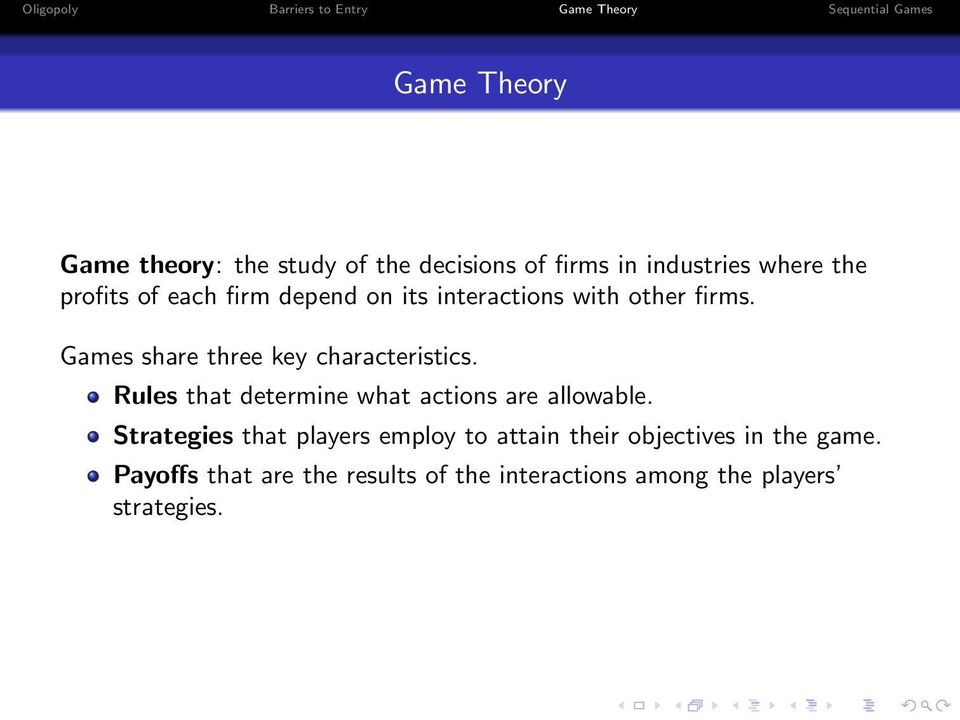
5 Game Theory Game theory: the study of the decisions of firms in industries where the profits of each firm depend on its interactions with other firms. Games share three key characteristics. Rules that determine what actions are allowable. Strategies that players employ to attain their objectives in the game. Payoffs that are the results of the interactions among the players strategies.
6 A Duopoly Game: Price Competition between Two Firms Game theory can be used to analyze price competition in a duopoly (an oligopoly with two firms). if they both charged $1,200, they would each make profits of $10 million. however, each firm has an incentive to undercut the other by charging a lower price. if both firms charged $1,000, they would each make a profit of only $7.5 million.
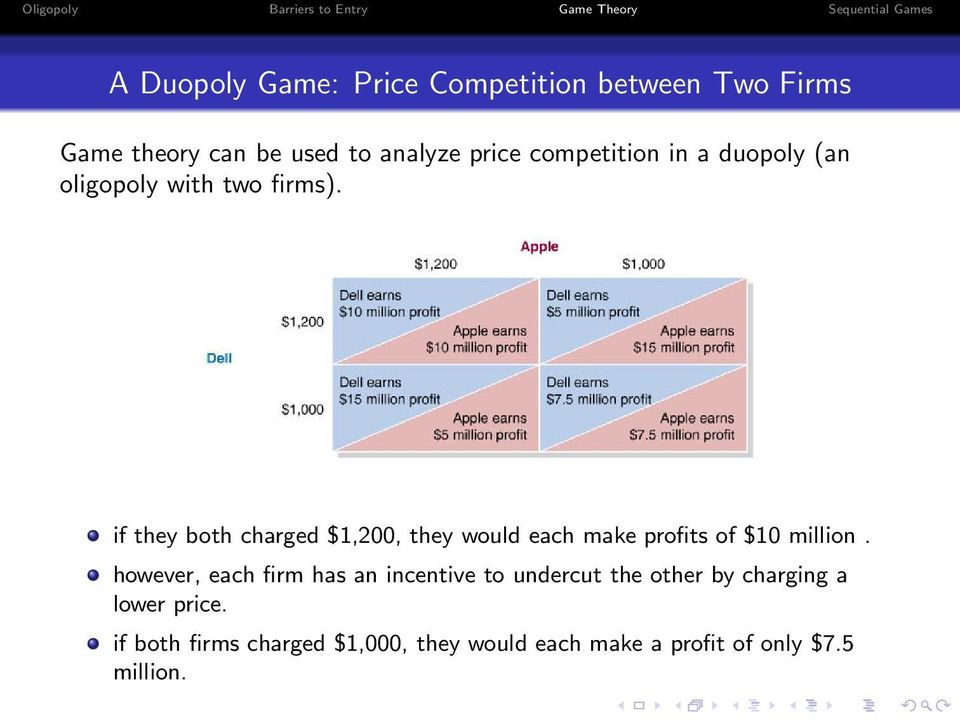
7 A Duopoly Game: Price Competition between Two Firms Payoff matrix: A table that shows the payoffs that each firm earns from every combination of strategies by the firms. Collusion: An agreement among firms to charge the same price or otherwise not to compete. Dominant strategy: A strategy that is the best for a firm, no matter what strategies other firms use. The result of a dominant strategy is an equilibrium in which each firm is maximizing profits, given the price chosen by the other firm. Nash equilibrium: A situation in which each firm chooses the best strategy, given the strategies chosen by other firms.

8 Firm Behavior and the Prisoner s Dilemma Cooperative equilibrium: An equilibrium in a game in which players cooperate to increase their mutual payoff. Noncooperative equilibrium: An equilibrium in a game in which players do not cooperate but pursue their own self-interest. Prisoner s dilemma: A game in which pursuing dominant strategies results in noncooperation that leaves everyone worse off.

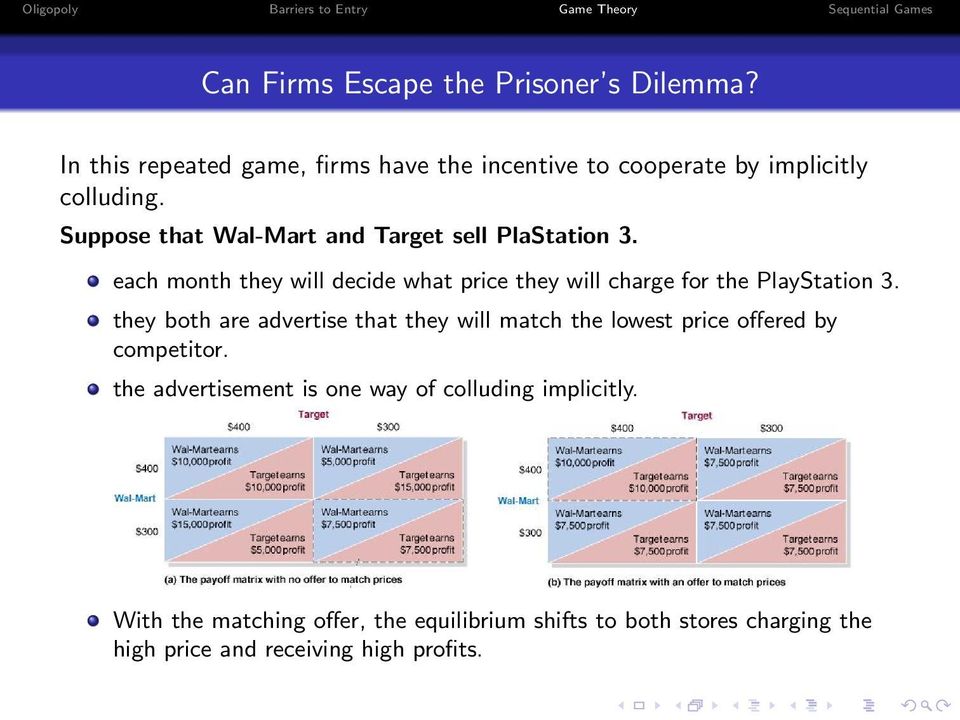
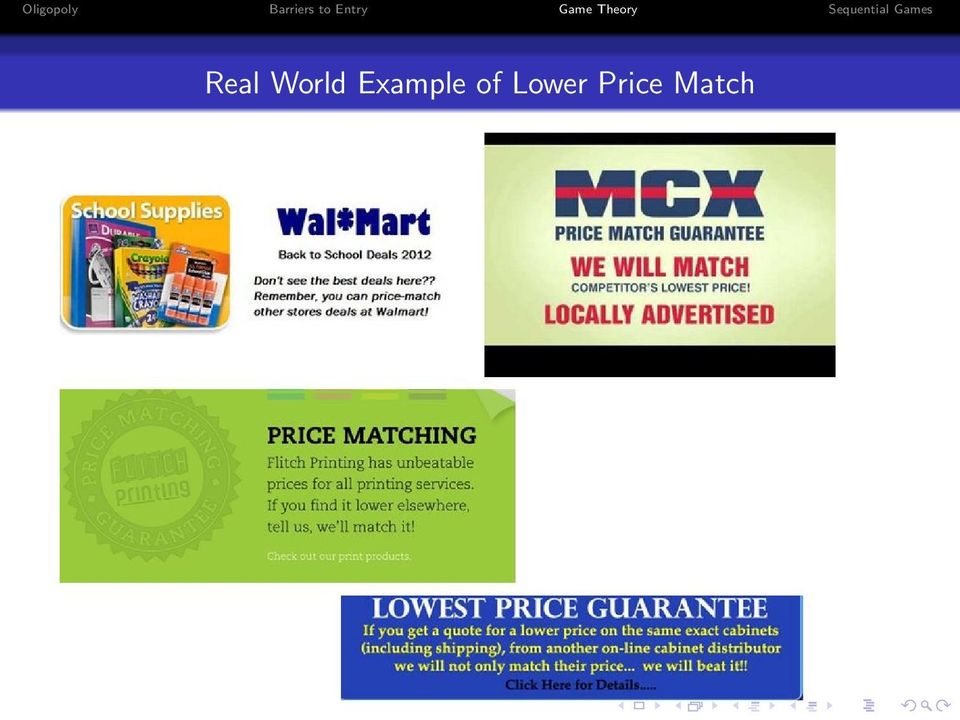
9 Can Firms Escape the Prisoner s Dilemma? In this repeated game, firms have the incentive to cooperate by implicitly colluding. Suppose that Wal-Mart and Target sell PlaStation 3. each month they will decide what price they will charge for the PlayStation 3. they both are advertise that they will match the lowest price offered by competitor. the advertisement is one way of colluding implicitly. With the matching offer, the equilibrium shifts to both stores charging the high price and receiving high profits.
10 Real World Example of Lower Price Match
11 A Real World Example: OPEC Cartels Cartel: A group of firms that collude by agreeing to restrict output to increase prices and profits. OPEC (Organization of the Petroleum Exporting Countries) It has 12 members including Saudi Arabia, Kuwait, Nigeria, and others. They own 75% of the world s proven oil reserves. Cooperation: By reducing oil production, OPEC was able to raise the world price of oil in the mid-1970s and early 1980s. Noncooperation: Sustaining high prices has been difficult over the long run, because OPEC members often exceed their output quotas.
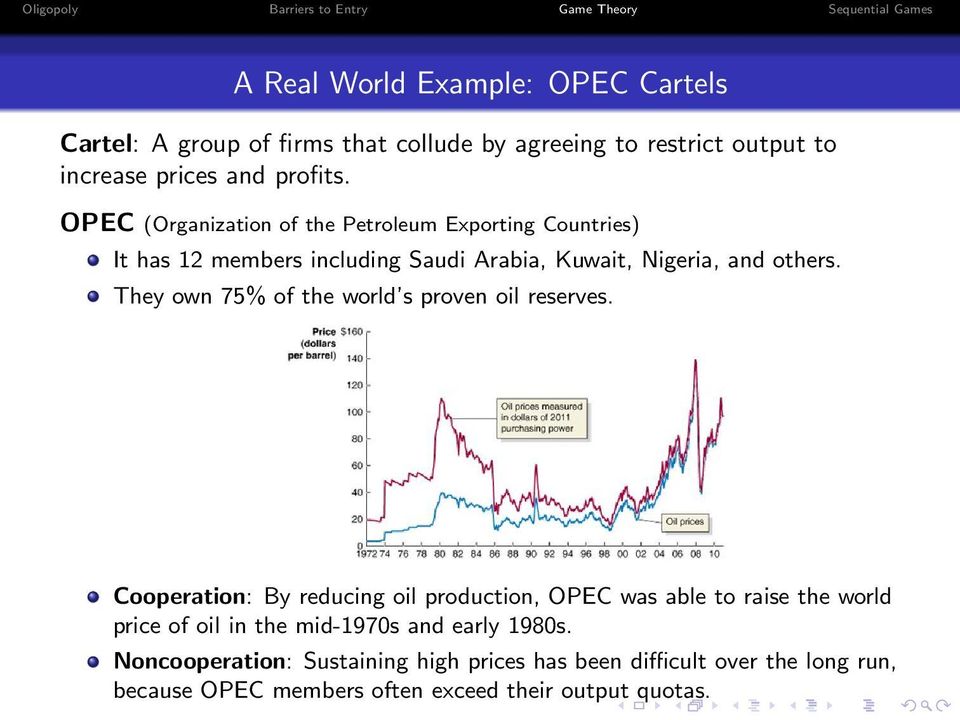
12 A Real World Example: OPEC Cartels Saudi Arabia can produce much more oil than Nigeria, its output decisions have a much larger effect on the price of oil. Low Output corresponds to cooperating with the OPEC-assigned quota. High Output corresponds to producing at maximum capacity. Saudi Arabia has a dominant strategy to cooperate (low output). Nigeria has a dominant strategy not to cooperate (high output). Equilibrium will occur with Saudi Arabia producing a low output and Nigeria producing a high output.

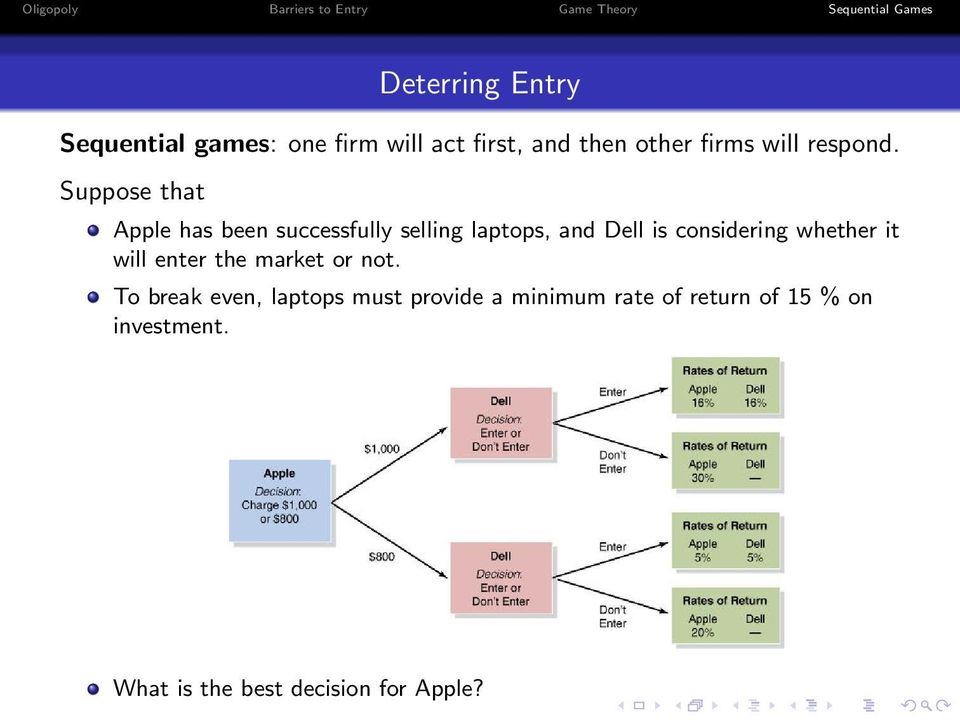
13 Deterring Entry Sequential games: one firm will act first, and then other firms will respond. Suppose that Apple has been successfully selling laptops, and Dell is considering whether it will enter the market or not. To break even, laptops must provide a minimum rate of return of 15 % on investment. What is the best decision for Apple?
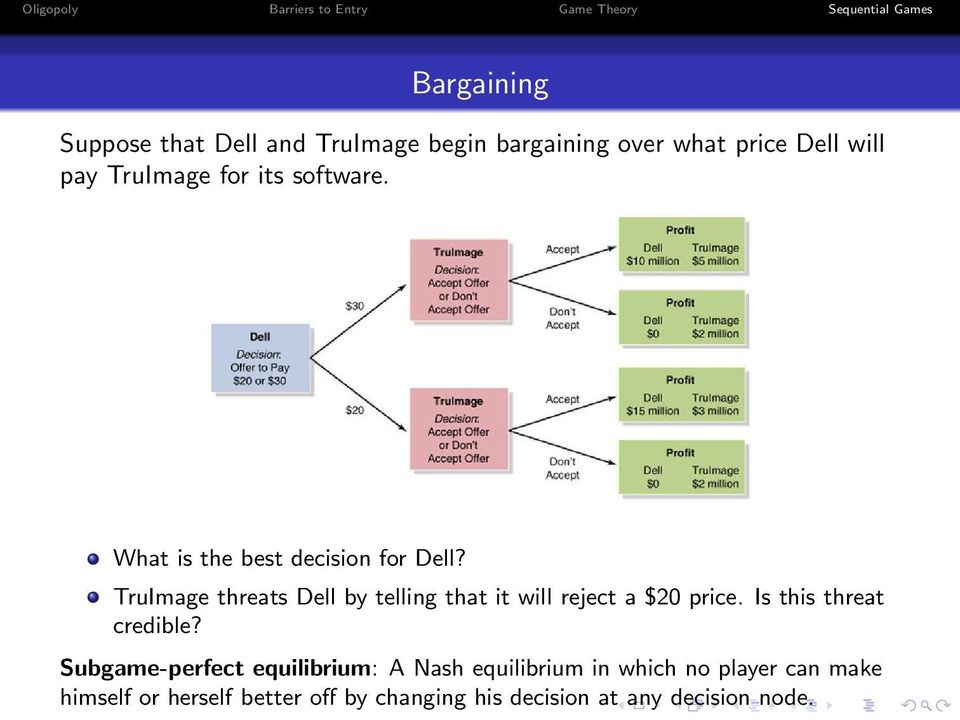
14 Bargaining Suppose that Dell and TruImage begin bargaining over what price Dell will pay TruImage for its software. What is the best decision for Dell? TruImage threats Dell by telling that it will reject a $20 price. Is this threat credible? Subgame-perfect equilibrium: A Nash equilibrium in which no player can make himself or herself better off by changing his decision at any decision node.
Oligopoly: Firms in Less Competitive Markets
 Chapter 13 Oligopoly: Firms in Less Competitive Markets Prepared by: Fernando & Yvonn Quijano 2008 Prentice Hall Business Publishing Economics R. Glenn Hubbard, Anthony Patrick O Brien, 2e. Competing with
ECON 202: Principles of Microeconomics. Chapter 13 Oligopoly
 ECON 202: Principles of Microeconomics Chapter 13 Oligopoly Oligopoly 1. Oligopoly and Barriers to Entry. 2. Using Game Theory to Analyze Oligopoly. 3. Sequential Games and Business Strategy. 4. The Five
Economics Instructor Miller Oligopoly Practice Problems
 Economics Instructor Miller Oligopoly Practice Problems 1. An oligopolistic industry is characterized by all of the following except A) existence of entry barriers. B) the possibility of reaping long run
ECON101 STUDY GUIDE 7 CHAPTER 14
 ECON101 STUDY GUIDE 7 CHAPTER 14 MULTIPLE CHOICE. Choose the one alternative that best completes the statement or answers the question. 1) An oligopoly firm is similar to a monopolistically competitive
Oligopoly: Firms in Less Competitive Markets
 Chapter 13 Oligopoly: Firms in Less Competitive Markets Chapter Summary In Chapters 11 and 12, you studied perfectly competitive and monopolistically competitive markets. You learned that firms maximize
Oligopoly. Models of Oligopoly Behavior No single general model of oligopoly behavior exists. Oligopoly. Interdependence.
 Oligopoly Chapter 16-2 Models of Oligopoly Behavior No single general model of oligopoly behavior exists. Oligopoly An oligopoly is a market structure characterized by: Few firms Either standardized or
Chapter 16 Oligopoly. 16.1 What Is Oligopoly? 1) Describe the characteristics of an oligopoly.
 Chapter 16 Oligopoly 16.1 What Is Oligopoly? 1) Describe the characteristics of an oligopoly. Answer: There are a small number of firms that act interdependently. They are tempted to form a cartel and
Oligopoly. Oligopoly. Offer similar or identical products Interdependent. How people behave in strategic situations
 Oligopoly PowerPoint Slides prepared by: Andreea CHIRITESCU Eastern Illinois University 1 Oligopoly Only a few sellers Oligopoly Offer similar or identical products Interdependent Game theory How people
chapter: Oligopoly Krugman/Wells Economics 2009 Worth Publishers 1 of 35
 chapter: 15 >> Oligopoly Krugman/Wells Economics 2009 Worth Publishers 1 of 35 WHAT YOU WILL LEARN IN THIS CHAPTER The meaning of oligopoly, and why it occurs Why oligopolists have an incentive to act
13 MONOPOLISTIC COMPETITION AND OLIGOPOLY. Chapter. Key Concepts
 Chapter 13 MONOPOLISTIC COMPETITION AND OLIGOPOLY Key Concepts Monopolistic Competition The market structure of most industries lies between the extremes of perfect competition and monopoly. Monopolistic
Econ 101: Principles of Microeconomics
 Econ 101: Principles of Microeconomics Chapter 15 - Oligopoly Fall 2010 Herriges (ISU) Ch. 15 Oligopoly Fall 2010 1 / 25 Outline 1 Understanding Oligopolies 2 Game Theory Overcoming the Prisoner s Dilemma
T28 OLIGOPOLY 3/1/15
 T28 OLIGOPOLY 3/1/15 1. Oligopoly is a market structure in which there are a small number of firms that engage in strategic interactions. If there are only two firms then we refer to the situation as a
Extreme cases. In between cases
 CHAPTER 16 OLIGOPOLY FOUR TYPES OF MARKET STRUCTURE Extreme cases PERFECTLY COMPETITION Many firms No barriers to entry Identical products MONOPOLY One firm Huge barriers to entry Unique product In between
Oligopoly: How do firms behave when there are only a few competitors? These firms produce all or most of their industry s output.
 Topic 8 Chapter 13 Oligopoly and Monopolistic Competition Econ 203 Topic 8 page 1 Oligopoly: How do firms behave when there are only a few competitors? These firms produce all or most of their industry
Oligopoly and Game Theory
 Chapter 15 MODERN PRINCIPLES OF ECONOMICS Third Edition Oligopoly and Game Theory Outline Cartels The Prisoner s Dilemma Oligopolies When Are Cartels and Oligopolies Most Successful? Government Policy
Oligopoly. Oligopoly is a market structure in which the number of sellers is small.
 Oligopoly Oligopoly is a market structure in which the number of sellers is small. Oligopoly requires strategic thinking, unlike perfect competition, monopoly, and monopolistic competition. Under perfect
Price competition with homogenous products: The Bertrand duopoly model [Simultaneous move price setting duopoly]
![Price competition with homogenous products: The Bertrand duopoly model [Simultaneous move price setting duopoly]](/thumbs/24/4353364.jpg "Price competition with homogenous products: The Bertrand duopoly model [Simultaneous move price setting duopoly]") ECON9 (Spring 0) & 350 (Tutorial ) Chapter Monopolistic Competition and Oligopoly (Part ) Price competition with homogenous products: The Bertrand duopoly model [Simultaneous move price setting duopoly]
ECON9 (Spring 0) & 350 (Tutorial ) Chapter Monopolistic Competition and Oligopoly (Part ) Price competition with homogenous products: The Bertrand duopoly model [Simultaneous move price setting duopoly]
LECTURE #15: MICROECONOMICS CHAPTER 17
 LECTURE #15: MICROECONOMICS CHAPTER 17 I. IMPORTANT DEFINITIONS A. Oligopoly: a market structure with a few sellers offering similar or identical products. B. Game Theory: the study of how people behave
12 Monopolistic Competition and Oligopoly
 12 Monopolistic Competition and Oligopoly Read Pindyck and Rubinfeld (2012), Chapter 12 09/04/2015 CHAPTER 12 OUTLINE 12.1 Monopolistic Competition 12.2 Oligopoly 12.3 Price Competition 12.4 Competition
Market structures. 18. Oligopoly Gene Chang Univ. of Toledo. Examples. Oligopoly Market. Behavior of Oligopoly. Behavior of Oligopoly
 Market structures 18. Oligopoly Gene Chang Univ. of Toledo We distinguish the market structure by examining the following characteristics in the industry: Number of firms in the industry Nature of the
CHAPTER 12 MARKETS WITH MARKET POWER Microeconomics in Context (Goodwin, et al.), 2 nd Edition
 CHAPTER 12 MARKETS WITH MARKET POWER Microeconomics in Context (Goodwin, et al.), 2 nd Edition Chapter Summary Now that you understand the model of a perfectly competitive market, this chapter complicates
Oligopoly. Unit 4: Imperfect Competition. Unit 4: Imperfect Competition 4-4. Oligopolies FOUR MARKET MODELS
 1 Unit 4: Imperfect Competition FOUR MARKET MODELS Perfect Competition Monopolistic Competition Pure Characteristics of Oligopolies: A Few Large Producers (Less than 10) Identical or Differentiated Products
Microeconomics. Lecture Outline. Claudia Vogel. Winter Term 2009/2010. Part III Market Structure and Competitive Strategy
 Microeconomics Claudia Vogel EUV Winter Term 2009/2010 Claudia Vogel (EUV) Microeconomics Winter Term 2009/2010 1 / 25 Lecture Outline Part III Market Structure and Competitive Strategy 12 Monopolistic
MODULE 64: INTRODUCTION TO OLIGOPOLY Schmidty School of Economics. Wednesday, December 4, 2013 9:20:15 PM Central Standard Time
 MODULE 64: INTRODUCTION TO OLIGOPOLY Schmidty School of Economics Learning Targets I Can Understand why oligopolists have an incentive to act in ways that reduce their combined profit. Explain why oligopolies
Oligopoly and Strategic Pricing
 R.E.Marks 1998 Oligopoly 1 R.E.Marks 1998 Oligopoly Oligopoly and Strategic Pricing In this section we consider how firms compete when there are few sellers an oligopolistic market (from the Greek). Small
Imperfect Competition. Oligopoly. Types of Imperfectly Competitive Markets. Imperfect Competition. Markets With Only a Few Sellers
 Imperfect Competition Oligopoly Chapter 16 Imperfect competition refers to those market structures that fall between perfect competition and pure monopoly. Copyright 2001 by Harcourt, Inc. All rights reserved.
chapter: Solution Oligopoly 1. The accompanying table presents market share data for the U.S. breakfast cereal market
 S209-S220_Krugman2e_PS_Ch15.qxp 9/16/08 9:23 PM Page S-209 Oligopoly chapter: 15 1. The accompanying table presents market share data for the U.S. breakfast cereal market in 2006. Company a. Use the data
Market Structure: Duopoly and Oligopoly
 WSG10 7/7/03 4:24 PM Page 145 10 Market Structure: Duopoly and Oligopoly OVERVIEW An oligopoly is an industry comprising a few firms. A duopoly, which is a special case of oligopoly, is an industry consisting
Oligopoly and Strategic Behavior
 Oligopoly and Strategic Behavior MULTIPLE-CHOICE QUESTIONS Like a pure monopoly, an oligopoly is characterized by: a. free entry and exit in the long run. b. free entry and exit in the short run. c. significant
Market Structure: Oligopoly (Imperfect Competition)
 Market Structure: Oligopoly (Imperfect Competition) I. Characteristics of Imperfectly Competitive Industries A. Monopolistic Competition large number of potential buyers and sellers differentiated product
Figure: Computing Monopoly Profit
 Name: Date: 1. Most electric, gas, and water companies are examples of: A) unregulated monopolies. B) natural monopolies. C) restricted-input monopolies. D) sunk-cost monopolies. Use the following to answer
Oligopoly. Chapter 25
 Chapter 25 Oligopoly We have thus far covered two extreme market structures perfect competition where a large number of small firms produce identical products, and monopoly where a single firm is isolated
OLIGOPOLY. Nature of Oligopoly. What Causes Oligopoly?
 CH 11: OLIGOPOLY 1 OLIGOPOLY When a few big firms dominate the market, the situation is called oligopoly. Any action of one firm will affect the performance of other firms. If one of the firms reduces
4. Market Structures. Learning Objectives 4-63. Market Structures
 1. Supply and Demand: Introduction 3 2. Supply and Demand: Consumer Demand 33 3. Supply and Demand: Company Analysis 43 4. Market Structures 63 5. Key Formulas 81 2014 Allen Resources, Inc. All rights
a. Retail market for water and sewerage services Answer: Monopolistic competition, many firms each selling differentiated products.
 Chapter 16 1. In which market structure would you place each of the following products: monopoly, oligopoly, monopolistic competition, or perfect competition? Why? a. Retail market for water and sewerage
Models of Imperfect Competition
 Models of Imperfect Competition Monopolistic Competition Oligopoly Models of Imperfect Competition So far, we have discussed two forms of market competition that are difficult to observe in practice Perfect
CHAPTER 11: MONOPOLISTIC COMPETITION AND OLIGOPOLY
 CHAPTER 11: MONOPOLISTIC COMPETITION AND OLIGOPOLY Introduction While perfect competition and monopoly represent the extremes of market structures, most American firms are found in the two market structures
When other firms see these potential profits they will enter the industry, causing a downward shift in the demand for a given firm s product.
 Characteristics of Monopolistic Competition large number of firms differentiated products (ie. substitutes) freedom of entry and exit Examples Upholstered furniture: firms; HHI* = 395 Jewelry and Silverware:
CHAPTER 18 MARKETS WITH MARKET POWER Principles of Economics in Context (Goodwin et al.)
 CHAPTER 18 MARKETS WITH MARKET POWER Principles of Economics in Context (Goodwin et al.) Chapter Summary Now that you understand the model of a perfectly competitive market, this chapter complicates the
MULTIPLE CHOICE. Choose the one alternative that best completes the statement or answers the question.
 Chap 13 Monopolistic Competition and Oligopoly These questions may include topics that were not covered in class and may not be on the exam. MULTIPLE CHOICE. Choose the one alternative that best completes
Week 7 - Game Theory and Industrial Organisation
 Week 7 - Game Theory and Industrial Organisation The Cournot and Bertrand models are the two basic templates for models of oligopoly; industry structures with a small number of firms. There are a number
Chapter 12 Monopolistic Competition and Oligopoly
 Chapter Monopolistic Competition and Oligopoly Review Questions. What are the characteristics of a monopolistically competitive market? What happens to the equilibrium price and quantity in such a market
Chapter 13: Strategic Decision Making in Oligopoly Markets
 Learning Objectives After reading Chapter 13 and working the problems for Chapter 13 in the textbook and in this Workbook, you should be able to do the following things For simultaneous decisions: Explain
b. Cost of Any Action is measure in foregone opportunities c.,marginal costs and benefits in decision making
 1 Economics 130-Windward Community College Review Sheet for the Final Exam This final exam is comprehensive in nature and in scope. The test will be divided into two parts: a multiple-choice section and
L10. Chapter 13 Oligopoly: Firms in Less Competitive Markets
 L10 Chapter 13 Oligopoly: Firms in Less Competitive Markets The Four Types of Market Structure Number of Firms? Many firms One firm Few firms Differentiated products Type of Products? Identical products
Pre-Test Chapter 23 ed17
 Pre-Test Chapter 23 ed17 Multiple Choice Questions 1. The kinked-demand curve model of oligopoly: A. assumes a firm's rivals will ignore a price cut but match a price increase. B. embodies the possibility
Variable Cost. Marginal Cost. Average Variable Cost 0 $50 $50 $0 -- -- -- -- 1 $150 A B C D E F 2 G H I $120 J K L 3 M N O P Q $120 R
 Class: Date: ID: A Principles Fall 2013 Midterm 3 Multiple Choice Identify the choice that best completes the statement or answers the question. 1. Trevor s Tire Company produced and sold 500 tires. The
Aggressive Advertisement. Normal Advertisement Aggressive Advertisement. Normal Advertisement
 Professor Scholz Posted: 11/10/2009 Economics 101, Problem Set #9, brief answers Due: 11/17/2009 Oligopoly and Monopolistic Competition Please SHOW your work and, if you have room, do the assignment on
Rutgers University Economics 102: Introductory Microeconomics Professor Altshuler Fall 2003
 Rutgers University Economics 102: Introductory Microeconomics Professor Altshuler Fall 2003 Answers to Problem Set 11 Chapter 16 2. a. If there were many suppliers of diamonds, price would equal marginal
Chapter 16 Monopolistic Competition and Oligopoly
 Chapter 16 Monopolistic Competition and Oligopoly Market Structure Market structure refers to the physical characteristics of the market within which firms interact It is determined by the number of firms
CHAPTER 6 MARKET STRUCTURE
 CHAPTER 6 MARKET STRUCTURE CHAPTER SUMMARY This chapter presents an economic analysis of market structure. It starts with perfect competition as a benchmark. Potential barriers to entry, that might limit
Games and Strategic Behavior. Chapter 9. Learning Objectives
 Games and Strategic Behavior Chapter 9 McGraw-Hill/Irwin Copyright 2013 by The McGraw-Hill Companies, Inc. All rights reserved. Learning Objectives 1. List the three basic elements of a game. Recognize
5. Suppose demand is perfectly elastic, and the supply of the good in question
 ECON 1620 Basic Economics Principles 2010 2011 2 nd Semester Mid term test (1) : 40 multiple choice questions Time allowed : 60 minutes 1. When demand is inelastic the price elasticity of demand is (A)
MULTIPLE CHOICE. Choose the one alternative that best completes the statement or answers the question.
 Economics 103 Spring 2012: Multiple choice review questions for final exam. Exam will cover chapters on perfect competition, monopoly, monopolistic competition and oligopoly up to the Nash equilibrium
Chapter 8 Production Technology and Costs 8.1 Economic Costs and Economic Profit
 Chapter 8 Production Technology and Costs 8.1 Economic Costs and Economic Profit 1) Accountants include costs as part of a firm's costs, while economists include costs. A) explicit; no explicit B) implicit;
Chapter 7: Market Structures Section 3
 Chapter 7: Market Structures Section 3 Objectives 1. Describe characteristics and give examples of monopolistic competition. 2. Explain how firms compete without lowering prices. 3. Understand how firms
MULTIPLE CHOICE. Choose the one alternative that best completes the statement or answers the question.
 MULTIPLE CHOICE. Choose the one alternative that best completes the statement or answers the question. 1) The four-firm concentration ratio equals the percentage of the value of accounted for by the four
Industry profit in an oligopoly (sum of all firms profits) < monopoly profit.
 Collusion. Industry profit in an oligopoly (sum of all firms profits) < monopoly profit. Price lower and industry output higher than in a monopoly. Firms lose because of non-cooperative behavior : Each
OpenStax-CNX module: m48660 1. Oligopoly. OpenStax College. Abstract. By the end of this section, you will be able to:
 OpenStax-CNX module: m48660 1 Oligopoly OpenStax College This work is produced by OpenStax-CNX and licensed under the Creative Commons Attribution License 4.0 By the end of this section, you will be able
Chapter 7 Monopoly, Oligopoly and Strategy
 Chapter 7 Monopoly, Oligopoly and Strategy After reading Chapter 7, MONOPOLY, OLIGOPOLY AND STRATEGY, you should be able to: Define the characteristics of Monopoly and Oligopoly, and explain why the are
Managerial Economics & Business Strategy Chapter 9. Basic Oligopoly Models
 Managerial Economics & Business Strategy Chapter 9 Basic Oligopoly Models Overview I. Conditions for Oligopoly? II. Role of Strategic Interdependence III. Profit Maximization in Four Oligopoly Settings
Chapter 11: Price-Searcher Markets with High Entry Barriers
 Chapter 11: Price-Searcher Markets with High Entry Barriers I. Why are entry barriers sometimes high? A. Economies of Scale in some markets average total costs fall over the full range of output. Therefore
Mikroekonomia B by Mikolaj Czajkowski. MULTIPLE CHOICE. Choose the one alternative that best completes the statement or answers the question.
 Mikroekonomia B by Mikolaj Czajkowski Test 12 - Oligopoly Name Group MULTIPLE CHOICE. Choose the one alternative that best completes the statement or answers the question. 1) The market structure in which
Study Guide Exam 3 Fall 2011
 Study Guide Exam 3 Fall 2011 Student: Suppose that there are just two firms in a small market. Acme Manufacturing's Total Costs equal $100 + $3 Qty. Generic Industries' Total Costs equal $500 + $3 Qty.
Chapter 9 Basic Oligopoly Models
 Managerial Economics & Business Strategy Chapter 9 Basic Oligopoly Models McGraw-Hill/Irwin Copyright 2010 by the McGraw-Hill Companies, Inc. All rights reserved. Overview I. Conditions for Oligopoly?
Cooleconomics.com Monopolistic Competition and Oligopoly. Contents:
 Cooleconomics.com Monopolistic Competition and Oligopoly Contents: Monopolistic Competition Attributes Short Run performance Long run performance Excess capacity Importance of Advertising Socialist Critique
AGEC 105 Spring 2016 Homework 7. 1. Consider a monopolist that faces the demand curve given in the following table.
 AGEC 105 Spring 2016 Homework 7 1. Consider a monopolist that faces the demand curve given in the following table. a. Fill in the table by calculating total revenue and marginal revenue at each price.
Write down the names of three companies: competition. major competitors.
 Write down the names of three companies: 1. Company with very little competition. 2. Company with two to three major competitors. 3. Company with many competitors. Which situation do you think describes
Economics 203: Intermediate Microeconomics I Lab Exercise #11. Buy Building Lease F1 = 500 F1 = 750 Firm 2 F2 = 500 F2 = 400
 Page 1 March 19, 2012 Section 1: Test Your Understanding Economics 203: Intermediate Microeconomics I Lab Exercise #11 The following payoff matrix represents the long-run payoffs for two duopolists faced
The Basics of Game Theory
 Sloan School of Management 15.010/15.011 Massachusetts Institute of Technology RECITATION NOTES #7 The Basics of Game Theory Friday - November 5, 2004 OUTLINE OF TODAY S RECITATION 1. Game theory definitions:
Do not open this exam until told to do so.
 Do not open this exam until told to do so. Department of Economics College of Social and Applied Human Sciences K. Annen, Winter 004 Final (Version ): Intermediate Microeconomics (ECON30) Solutions Final
Chapter 7: Market Structures Section 1
 Chapter 7: Market Structures Section 1 Key Terms perfect competition: a market structure in which a large number of firms all produce the same product and no single seller controls supply or prices commodity:
MULTIPLE CHOICE. Choose the one alternative that best completes the statement or answers the question.
 Test 2 Review Econ 201, V. Tremblay MULTIPLE CHOICE. Choose the one alternative that best completes the statement or answers the question. 1) Barbara left a $25,000 job as an architect to run a catering
This hand-out gives an overview of the main market structures including perfect competition, monopoly, monopolistic competition, and oligopoly.
 Market Structures This hand-out gives an overview of the main market structures including perfect competition, monopoly, monopolistic competition, and oligopoly. Summary Chart Perfect Competition Monopoly
Econ 201 Final Exam. Douglas, Fall 2007 Version A Special Codes 00000. PLEDGE: I have neither given nor received unauthorized help on this exam.
 , Fall 2007 Version A Special Codes 00000 PLEDGE: I have neither given nor received unauthorized help on this exam. SIGNED: PRINT NAME: Econ 201 Final Exam 1. For a profit-maximizing monopolist, a. MR
INTRODUCTION OLIGOPOLY CHARACTERISTICS OF MARKET STRUCTURES DEGREES OF POWER DETERMINANTS OF MARKET POWER
 INTRODUCTION Questions examined in this chapter include: What determines how much market power a firm has? How do firms in an oligopoly set prices and output? What problems does an oligopoly have in maintaining
Northern University Bangladesh
 Northern University Bangladesh Managerial Economics ( MBA 5208) Session # 09 Oligopoly & Monopolistic Competition Prof. Mahmudul Alam (PMA) 23 September, 2011 (Friday) 1 1. Monopolistic Competition & Oligopoly
OLIGOPOLY IN THIS CHAPTER YOU WILL...
 IN THIS CHAPTER YOU WILL... See what market structures lie between monopoly and competition Examine what outcomes are possible when a market is an oligopoly OLIGOPOLY If you go to a store to buy tennis
ECON 312: Oligopolisitic Competition 1. Industrial Organization Oligopolistic Competition
 ECON 312: Oligopolisitic Competition 1 Industrial Organization Oligopolistic Competition Both the monopoly and the perfectly competitive market structure has in common is that neither has to concern itself
Chapter 13 Oligopoly 1
 Chapter 13 Oligopoly 1 4. Oligopoly A market structure with a small number of firms (usually big) Oligopolists know each other: Strategic interaction: actions of one firm will trigger re-actions of others
Lecture 28 Economics 181 International Trade
 Lecture 28 Economics 181 International Trade I. Introduction to Strategic Trade Policy If much of world trade is in differentiated products (ie manufactures) characterized by increasing returns to scale,
Common in European countries government runs telephone, water, electric companies.
 Public ownership Common in European countries government runs telephone, water, electric companies. US: Postal service. Because delivery of mail seems to be natural monopoly. Private ownership incentive
Robert S. Pindyck. Massachusetts Institute of Technology
 MICROECONOMICS Robert S. Pindyck Massachusetts Institute of Technology Daniel L. Rubinfeld University of California, Berkeley Prentice Hall Interna ional, Inc. London New York Toronto Sydney Tokyo Singapore
Chapter 7. Comparative Advantage and the Gains from International Trade
 Chapter 7. Comparative Advantage and the Gains from International Trade Instructor: JINKOOK LEE Department of Economics / Texas A&M University ECON 203 502 Principles of Macroeconomics International Trade
Economics Chapter 7 Market Structures. Perfect competition is a in which a large number of all produce.
 Economics Chapter 7 Market Structures Perfect competition is a in which a large number of all produce. There are Four Conditions for Perfect Competition: 1. 2. 3. 4. Barriers to Entry Factors that make
BPE_MIC1 Microeconomics 1 Fall Semester 2011
 Masaryk University - Brno Department of Economics Faculty of Economics and Administration BPE_MIC1 Microeconomics 1 Fall Semester 2011 Final Exam - 05.12.2011, 9:00-10:30 a.m. Test A Guidelines and Rules:
Homework 3, Solutions Managerial Economics: Eco 685
 Homework 3, Solutions Managerial Economics: Eco 685 Question 1 a. Second degree since we have a quantity discount. For 2 GB the cost is $15 per GB, for 5 GB the cost is $10 per GB, and for 10 GB the cost
Econ 101, section 3, F06 Schroeter Exam #4, Red. Choose the single best answer for each question.
 Econ 101, section 3, F06 Schroeter Exam #4, Red Choose the single best answer for each question. 1. Profit is defined as a. net revenue minus depreciation. *. total revenue minus total cost. c. average
As you move your cart down the grocery isle, stop in front of the canned soups. You see before maybe four or five different brands of soup.
 1Oligopoly 19 As you move your cart down the grocery isle, stop in front of the canned soups. You see before maybe four or five different brands of soup. If you stop in front of the frozen pizzas you might
If you go to a store to buy tennis balls, you will probably come home with. Oligopoly
 Oligopoly 17 If you go to a store to buy tennis balls, you will probably come home with one of four brands: Wilson, Penn, Dunlop, or Spalding. These four companies make almost all the tennis balls sold
I. Noncooperative Oligopoly
 I. Noncooperative Oligopoly Oligopoly: interaction among small number of firms Conflict of interest: Each firm maximizes its own profits, but... Firm j s actions affect firm i s profits Example: price
Eco 340 Industrial Economics Market Structures: Cartels / Cooperative Oligopoly. Prof Dr. Murat Yulek
 Eco 340 Industrial Economics Market Structures: Cartels / Cooperative Oligopoly Prof Dr. Murat Yulek Oligopolistic Markets and the Cartel Competitive market: firms operate independently In other markets,
Competition and Regulation. Lecture 2: Background on imperfect competition
 Competition and Regulation Lecture 2: Background on imperfect competition Monopoly A monopolist maximizes its profits, choosing simultaneously quantity and prices, taking the Demand as a contraint; The
0.0.2 Pareto Efficiency (Sec. 4, Ch. 1 of text)
 September 2 Exercises: Problem 2 (p. 21) Efficiency: p. 28-29: 1, 4, 5, 6 0.0.2 Pareto Efficiency (Sec. 4, Ch. 1 of text) We discuss here a notion of efficiency that is rooted in the individual preferences
The Economics of E-commerce and Technology. Industry Analysis
 The Economics of E-commerce and Technology Industry Analysis 1 10/1/2013 Industry Profits In Econ 11, Economic Profits = 0 In reality, many industries have much higher profits: 2 10/1/2013 Industry Analysis
MobLab Game Catalog For Business Schools Fall, 2015
 MobLab Game Catalog For Business Schools Fall, 2015 CORE COURSE COVERAGE Economics For Business Principles of Business Microeconomic Analysis Decisions Game Theory Negotiation Strategy Managerial Economics
Cournot s model of oligopoly
 Cournot s model of oligopoly Single good produced by n firms Cost to firm i of producing q i units: C i (q i ), where C i is nonnegative and increasing If firms total output is Q then market price is P(Q),
5 Market Games For Teaching Economics
 5 Market Games For Teaching Economics Progression 5 Market Games from website economics-games.com To be played separately or as a sequence: Market Game 1: Sunk costs, monopoly, and introduction to the