
Conservation Services Programme Project MIT : Protected species bycatch newsletter. Annual Progress Report
|
|
|
- Madison Newman
- 10 years ago
- Views:
Transcription
1 Conservation Services Programme Project MIT : Protected species bycatch newsletter Annual Progress Report June 2015 Johanna Pierre

2 Executive summary The objective of Conservation Services Programme project MIT is to produce a bimonthly newsletter to communicate protected species-related information to commercial fishermen. This project is now halfway through its term, with six issues of the newsletter Bycatch Bylines produced to date. Articles cover best practice mitigation methods, new and emerging mitigation measures, work underway to develop bycatch reduction approaches, current events of relevance to fishers, and other protected species information relevant to commercial fishing. Key references are also provided, to facilitate reader access to additional information. The target audience for the newsletter comprises commercial fishers and others involved in the fishing industry. Recipients include holders of fishing quota and annual catch entitlement, seafood company representatives, Seafood New Zealand s Sector Representative Entities and Commercial Stakeholder Organisations, Ministry for Primary Industries regional office staff, the New Zealand Federation of Commercial Fishermen, and individuals working in the fishing industry or on fisheries bycatch issues. Currently, the newsletter is circulated to around 1,500 recipients. It is distributed in three forms, as an html newsletter delivered via , an A4 2-page pdf file distributed electronically, or a hard copy newsletter mailed to recipients who have indicated a preference for this medium, or who do not have an electronic point of contact. The second year of the project provides for the development and circulation of another 6 newsletters. At the end of the project, a final report will be produced. 2

3 Contents Progress update: Objective... 4 Scope of newsletter 4 Recipients and distribution.. 5 Feedback 6 Next steps.. 6 Acknowledgements References.. 7 3

4 Progress update Objective: The objective of project MIT , funded through DOC s Conservation Services Programme, is to produce a bimonthly newsletter to communicate protected species-related information to commercial fishermen. Scope of newsletter: The focus of the newsletter is interactions between protected species and New Zealand commercial fisheries, with emphasis on methods for reducing those interactions. Articles cover best practice mitigation methods, new and emerging mitigation measures, work underway to develop bycatch reduction approaches, current events of relevance to fishers, and other protected species information relevant to commercial fishing. The newsletter is two sides of A4 in length. The sections appearing in the newsletter are: Headline: This is the leading story of the issue. This section comprises around half to two-thirds of the front page of the newsletter. It includes a relevant photo. The Headline section focuses on any aspect of the newsletter s scope. What s Up?: This section features short bullet points of current issues and news relating to protected species and commercial fishing, new ideas for mitigation measures, work done by fishers to address bycatch issues, meetings and forums. In short, the section covers news items or events relating to the newsletter s scope. Best Practice Baselines: This is a short section highlighting recognised best practice mitigation measures applicable to New Zealand commercial fishing methods. While fishers are aware of a variety of mitigation measures, it is often less well known what best practice measures actually comprise. Material is presented concisely in bullet point form with an image illustrating the measure discussed. The Big Picture: This section highlights the broader context of New Zealand protected species and bycatch mitigation issues. It also includes issues that are relevant to fishers, but that they may be less directly connected with. Examples of article content include government policy developments (e.g., progressing the National Plan of Action - Seabirds), updates from regional fisheries management organisations that encompass New Zealand fisheries, and broader protected species management initiatives (e.g., seabird translocations). Word on the Street: This section presents different views on controversial topics relating to protected species interactions with commercial fisheries. It is intended to stimulate discussion amongst fishers, and present views (with rationale) which fishers may not otherwise encounter. Opinions are presented 4

5 alongside factual information and with key references. This section was initiated in the previous version of Bycatch Bylines, implementing a recommendation presented in Pierre (2012). Who s who?: Fishers sometimes comment that they don t know who does what and why, in government and amongst stakeholders. This section is included to help address that issue, by profiling a practitioner working in the bycatch arena. It follows an informal interview-style question and answer format, with both professional and personal interest questions. The interviewee s photo is also included, ideally showing them in a marine or fisheries-related context. What the FAQ?!: This section includes a collection of short and quirky facts on a protected species, or species group, and a relevant image. It is intended to highlight the diversity amongst New Zealand protected species and thereby support the development of increased knowledge and understanding of the value of resolving bycatch issues. Want to Know More?: This section links readers to key sources of additional information relevant to the articles in the newsletter. This section was initiated following a recommendation made in Pierre (2012). Reader feedback received in 2013 and 2014 demonstrates that some fishers have accessed the reference material provided (Pierre 2014). An overview of the topics covered during this first year of project MIT is provided in Appendix 1. Recipients and distribution: The target audience for the newsletter comprises fishers and others involved in the fishing industry. Fishers were identified in two ways. First, the contact details of quota holders undertaking more than one trip per year and landing > 1,000 kg of catch were requested from the Ministry for Primary Industries (MPI) for the two most recent fishing years for which data are available. Fishers using the trawl, longline, setnet, purse seine, troll, trotline, pot and trap, and minor net (inshore drift net, Danish seine, beach seine, ring net) methods were included in this request. Second, the contact details of all holders of Annual Catch Entitlement (ACE) in all Quota Management Areas (QMAs) (i.e., for all fishstocks) were requested from MPI. While some ACE holders were also included in the list of quota holders, additional recipients were also identified. Others included in the distribution list are seafood company representatives, Seafood New Zealand s Sector Representative Entities and Commercial Stakeholder Organisations representing members using the above fishing methods, MPI regional offices, the New Zealand Federation of Commercial Fishermen, and others working in the fishing industry or on fisheries bycatch issues. Recipients are added to the list on request on an ongoing basis. Currently, the circulation list numbers around 1,500. The newsletter is distributed to the majority of recipients (approximately 1,240) by , using an html-format newsletter. Other recipients are sent a hard copy of the newsletter by mail. 5

6 Feedback: Feedback from recipients on newsletter content has not been received during the current project term. However, more general feedback includes tracking subscriptions to the electronic newsletter through time. The electronic version includes an unsubscribe option. To date, three recipients have unsubscribed, while one additional subscribe request has been received. In addition, some recipients have reported a preference for a pdf version of the newsletter, given issues accessing the html version (e.g., due to company or office system security settings) or the relative ease of archiving and referring to the A4 pdf version. To date, 11 recipients have requested the newsletter in pdf instead of html format. Next steps To date, six issues of the newsletter have been produced and circulated. In the second year of this project s term, a further six issues will be produced. Feedback on the newsletter is welcomed from readers on an ongoing basis. At the end of the project, a final report will be produced. 6

7 Acknowledgements Thanks to DOC s Conservation Services Programme and Publishing teams, the Ministry for Primary Industries, Who s who interviewees, and those who have contributed photographs, for their assistance with producing the newsletter. References Pierre, J.P The Ocean Guardian: Report on MIT Protected Species Bycatch Newsletter. Final project report held by the Department of Conservation, Wellington. Pierre, J.P MIT Protected Species Bycatch Newsletter: Bycatch Bylines. Final project report held by the Department of Conservation, Wellington. 7

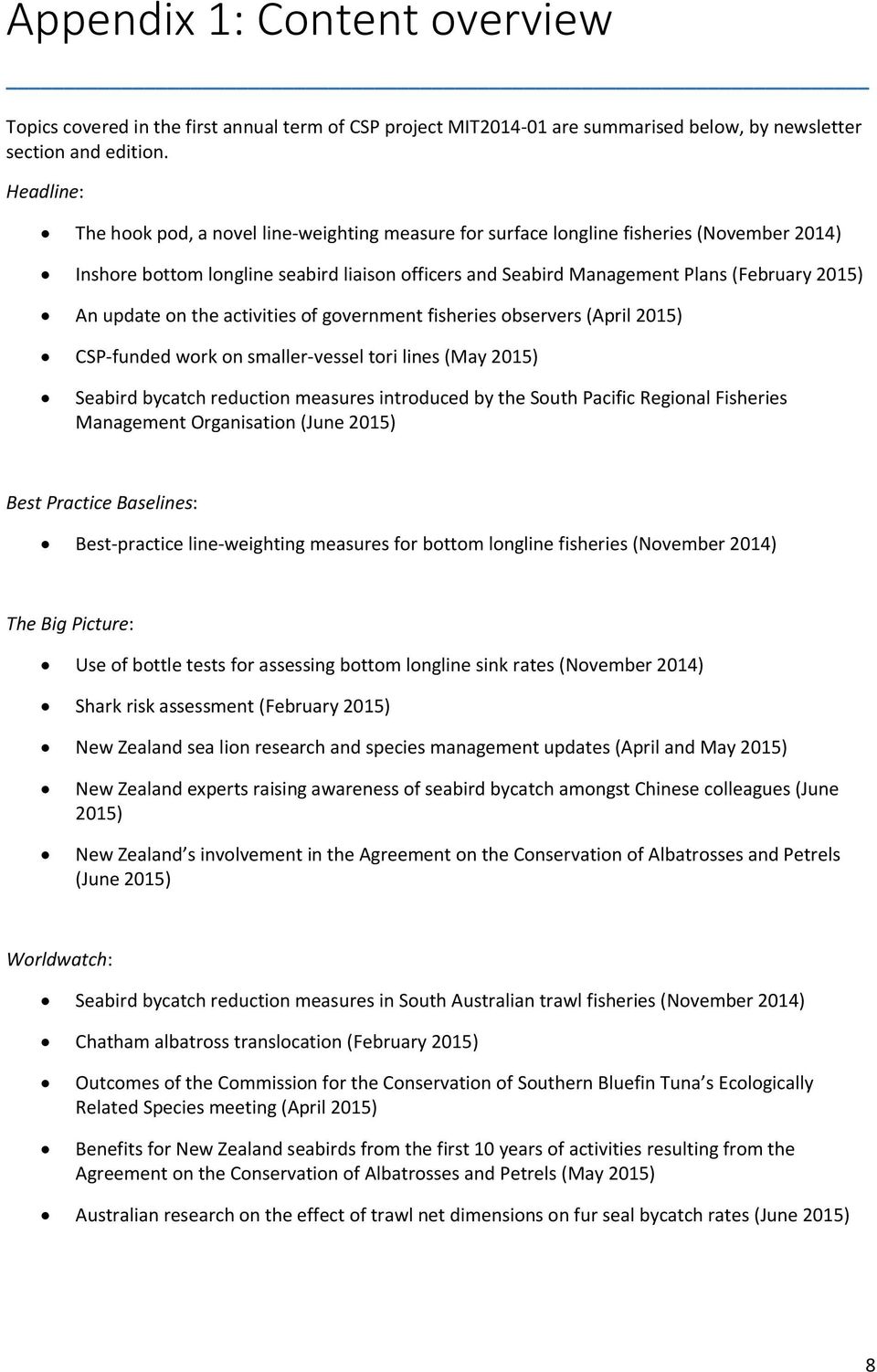
8 Appendix 1: Content overview Topics covered in the first annual term of CSP project MIT are summarised below, by newsletter section and edition. Headline: The hook pod, a novel line-weighting measure for surface longline fisheries (November 2014) Inshore bottom longline seabird liaison officers and Seabird Management Plans (February 2015) An update on the activities of government fisheries observers (April 2015) CSP-funded work on smaller-vessel tori lines (May 2015) Seabird bycatch reduction measures introduced by the South Pacific Regional Fisheries Management Organisation (June 2015) Best Practice Baselines: Best-practice line-weighting measures for bottom longline fisheries (November 2014) The Big Picture: Use of bottle tests for assessing bottom longline sink rates (November 2014) Shark risk assessment (February 2015) New Zealand sea lion research and species management updates (April and May 2015) New Zealand experts raising awareness of seabird bycatch amongst Chinese colleagues (June 2015) New Zealand s involvement in the Agreement on the Conservation of Albatrosses and Petrels (June 2015) Worldwatch: Seabird bycatch reduction measures in South Australian trawl fisheries (November 2014) Chatham albatross translocation (February 2015) Outcomes of the Commission for the Conservation of Southern Bluefin Tuna s Ecologically Related Species meeting (April 2015) Benefits for New Zealand seabirds from the first 10 years of activities resulting from the Agreement on the Conservation of Albatrosses and Petrels (May 2015) Australian research on the effect of trawl net dimensions on fur seal bycatch rates (June 2015) 8
9 What s up?: A new freely available handling guide for sharks and rays (February 2015) Seabird catch in recreational fisheries (April 2015) The New Zealand Federation of Commercial Fishermen s annual conference (May 2015) Update on Māui dolphin research (June 2015) What the FAQ?: Flesh-footed shearwater (November 2014) Giant petrels (February 2015) New Zealand storm petrel (April 2015) Humpback whale (May 2015) Black corals (June 2015) 9
AP ENVIRONMENTAL SCIENCE 2006 SCORING GUIDELINES. Question 4
 AP ENVIRONMENTAL SCIENCE 2006 SCORING GUIDELINES Question 4 (a) Identify the five-year period during which the greatest rate of decline in the fish harvest took place. For that five-year period, calculate
Kermadec. Ocean Sanctuary
 Kermadec Ocean Sanctuary Kermadec Ocean Sanctuary, New Zealand Coral Sea Marine Reserve, Australia Pacific Remote Islands National Marine Monument, United States Proposed Pitcairn Marine Reserve, United
SOUTH GEORGIA AND SOUTH SANDWICH ISLANDS MARINE PROTECTED AREAS: EXISTING PROTECTION AND PROPOSALS FOR FURTHER PROTECTION
 SOUTH GEORGIA AND SOUTH SANDWICH ISLANDS MARINE PROTECTED AREAS: EXISTING PROTECTION AND PROPOSALS FOR FURTHER PROTECTION CONSULTATION DOCUMENT OCTOBER 2012 1 1. Background 1.1 What is a marine protected
Transforming wasted resources. for a sustainable future. The sustainable management of bycatch in Latin America and Caribbean trawl fisheries
 Transforming wasted resources for a sustainable future The sustainable management of bycatch in Latin America and Caribbean trawl fisheries REBYC-II LAC Shrimp trawling and other types of bottom trawling
Research Advice on the Proposed Shark Mitigation Strategy using drum lines for January to April 2014. Research Division - January 2014
 Research Advice on the Proposed Shark Mitigation Strategy using drum lines for January to April 2014 File No 2475/13 Background Research Division - January 2014 In direct response to the unprecedented
The Marine Stewardship Council Fisheries Certification Program: Progress and Challenges
 The Marine Stewardship Council Fisheries Certification Program: Progress and Challenges Jonathan Peacey: Marine Stewardship Council, 119 Altenburg Gardens, London SW11 1JQ, UK Abstract: Fish is an increasingly
SUBSIDIARY LEGISLATION WILDLIFE & PROTECTED AREAS. Marine Protected Areas Order 2012. S. R. & O. No: 1 of 2012
 SUBSIDIARY LEGISLATION WILDLIFE & PROTECTED AREAS Marine Protected Areas Order 2012 S. R. & O. No: 1 of 2012 Made: 23 February 2012 Published: 29 February 2012 Coming into force: on publication IN EXERCISE
INTERIM MEASURES ADOPTED BY PARTICIPANTS IN NEGOTIATIONS TO ESTABLISH SOUTH PACIFIC REGIONAL FISHERIES MANAGEMENT ORGANISATION
 INTERIM MEASURES ADOPTED BY PARTICIPANTS IN NEGOTIATIONS TO ESTABLISH SOUTH PACIFIC REGIONAL FISHERIES MANAGEMENT ORGANISATION Participants in the negotiations to establish a South Pacific Regional Fisheries
Self governance in New Zealand s developmental fisheries: deep-sea crabs
 269 Self governance in New Zealand s developmental fisheries: deep-sea crabs M. L. Soboil and A. Craig Aotearoa Fisheries Ltd PO Box 2831 Wellington, New Zealand [email protected]; [email protected]
Northern Territory Fisheries Resource Sharing Framework
 Northern Territory Fisheries Resource Sharing Framework Page 1 of 11 Introduction Fishing is important in the Northern Territory (Territory). Coastal Aboriginal people recognise sea country out to the
LIFE UNDER THE SEA. (Lesson Plans) Salvador Rodríguez Almendros
 (Lesson Plans) January - March 2009 (Types of marine life: real facts on sea flora and fauna ) 1 1 and 2 - To express opinions and give account of experiences Methodological skills: (Information handling)
COMMERCIAL LANDINGS STATISTICS RED SNAPPER IN THE GULF OF MEXICO. John Poffenberger 1
 SEDAR 7-DW-23 COMMERCIAL LANDINGS STATISTICS RED SNAPPER IN THE GULF OF MEXICO John Poffenberger 1 I. Introduction Data on the quantity and value of seafood products have been collected in varying forms
SMART FISHING INITIATIVE RESULTS 2010 - JUNE 2016 RESULTS 2010-2016. WWF s 2020 VISION Our oceans are wellmanaged,
 Brent Stirtion/Getty Images RESULTS 2010-2016 WWF s 2020 VISION Our oceans are wellmanaged, healthy, robust and full of life, providing valuable services for the well-being of humanity. SMART FISHING INITIATIVE

National Observer Program Communications and Outreach Strategy
 National Observer Program Communications and Outreach Strategy October 2006 U.S. DEPARTMENT OF COMMERCE National Oceanic and Atmospheric Administration National Marine Fisheries Service Office of Science
Maria Espinosa Romero John Driscoll
 Maria Espinosa Romero John Driscoll Fisheries management in Canada a. Traditionally done on a stock-by-stock basis; b. Canada s commitments to ecosystem approach will change this; c. Two interrelated pathways
GREAT BARRIER REEF. Climate Change Action Plan
 GREAT BARRIER REEF Climate Change Action Plan 2007 2011 Climate change is now recognised as the greatest long-term threat to the Great Barrier Reef. The Great Barrier Reef is internationally renowned as
Demonstration Site Concept
 The Sustainable Financing and Management of Eastern Caribbean Marine Ecosystems Project Demonstration Site Concept Woburn Clarkes Court Bay Marine Protected Area Improving Water Quality in Marine Protected
Experiencing Marine Reserves Manual Section 2 Programme Breakdown
 Experiencing Marine Reserves Manual Section 2 Programme Breakdown The aim of EMR is to raise awareness, understanding and involvement in marine conservation through provision of dynamic experiential environmental
Shark, Skate and Ray Conservation Plan
 Shark, Skate and Ray Conservation Plan Introduction Sharks, skates and rays, collectively known as elasmobranchs are caught in fisheries worldwide, including in EU and UK waters. Many have been depleted
NEW YORK SEASCAPE PROGRAM A COMMITMENT TO OCEAN CONSERVATION
 NEW YORK SEASCAPE PROGRAM A COMMITMENT TO OCEAN CONSERVATION JULY 2012 1 Wildlife Conservation Society The Wildlife Conservation Society (WCS) saves wildlife and wild places worldwide. We do so through
PR & Journalism Jargon Glossary
 PR & Journalism Jargon Glossary This glossary should provide a detailed overview of PR terms and tools for ADHA members involved in PR activities on behalf of their constituents or components. Since PR
Symbiosis: Responding to Coral Bleaching in the Two Samoas
 Symbiosis: Responding to Coral Bleaching in the Two Samoas Coral reefs get their structure from calcium carbonate skeletons built by individual corals (animals) which take many shapes and their colors
New Zealand Fisheries
 New Zealand Fisheries Results Through Collaboration Shaun Driscoll National Manager Investigation Services New Zealand s Location Position perspective West Island Isolation perspective (water,water everywhere)
National Saltwater Recreational Fisheries Policy
 National Saltwater Recreational Fisheries Policy Alaska Regional Implementation Plan 2016-2017 Photo Credit: Richard Yamada Contents Foreward 5 Alaska Regional Overview 6 Setting the Stage 8 Guiding Principles
BANGLADESH. CURRENT LIMITATIONS National waters
 BANGLADESH Source: FAO Fishstat dataset: Global Capture Production Bangladesh reports to FAO data on "Sharks, rays, skates, etc. nei" production starting from 2008 with an average of about 4,000 tonnes/year.
SERVICES NATIONAL MARINE FISHERIES SERVICE FISHERIES MARKET NEWS HOME PAGES
 HOME PAGES The National Marine Fisheries Service provides information on programs and data available to the public and fishing industry via home page. Please use the following address for NMFS home page
REGIONAL ELECTRONIC TECHNOLOGIES IMPLEMENTATION PLAN FOR WEST COAST MARINE FISHERIES DRAFT JANUARY 27, 2015
 REGIONAL ELECTRONIC TECHNOLOGIES IMPLEMENTATION PLAN FOR WEST COAST MARINE FISHERIES DRAFT JANUARY 27, 2015 Introduction In recent years, the National Marine Fisheries Service (NMFS) and the Pacific Fishery
Job Description: Communications Manager (Maternity cover) Program Director, Germany, Austria, Switzerland, Poland
 Job Description: Communications Manager (Maternity cover) Location: Responsible to: Responsible for: Salary: Working Hours: Contract: Holiday: Equal opportunities: MSC office in Berlin, Germany Program
National Marine Fisheries Service Electronic Monitoring Cooperative Research and Implementation Program
 National Marine Fisheries Service Electronic Monitoring Cooperative Research and Implementation Program Introduction This cooperative research program has been developed to be responsive both to the implementation
Northeast Fisheries Science Center Fisheries Sampling Branch Observer Programs OBSERVER TRAINING CERTIFICATIONS
 Northeast Fisheries Science Center Fisheries Sampling Branch Observer Programs OBSERVER TRAINING CERTIFICATIONS I. Process for All FSB Observer Programs... 1 II. Northeast Fisheries Observer Program (NEFOP)
FISHERIES (CORAL REEF FIN FISH) MANAGEMENT PLAN 2003
 Queensland Subordinate Legislation 2003 No. 212 Fisheries Act 1994 FISHERIES (CORAL REEF FIN FISH) MANAGEMENT PLAN 2003 TABLE OF PROVISIONS Section Page CHAPTER 1 PRELIMINARY PART 1 INTRODUCTION 1 Short
RIR for Hagfish Collection of Information
 RIR for Hagfish Collection of Information A description of the management objectives This collection of information for the hagfish fishery is being proposed under the provisions of section 402(a) of the
Effects of acoustic alarms on coastal dolphins
 Effects of acoustic alarms on coastal dolphins Supervisors: Alvaro Berg - PhD Student (JCU) Professor Helene Marsh, Dr. Ivan Lawler (JCU) Dr. Michael Noad, Dr. Guido Parra (UQ) Presentation outline The
Introduction to working with the media
 Introduction to working with the media Introduction to working with the media Five reasons to work with the media 3 The secret to working with journalists 4 PR tactics 5 Photo stories 5 Media gift 5 Partnership
Good Practice Guidelines for Indicator Development and Reporting
 Good Practice Guidelines for Indicator Development and Reporting A contributed paper Third World Forum on Statistics, Knowledge and Policy Charting Progress, Building Visions, Improving Life 27-30 October
BESTTuna. Paul A.M. van Zwieten, Simon R. Bush
 BESTTuna Benefiting from Innovations in Sustainable and Equitable Management of Fisheries on Trans boundary Tuna s in the Coral Triangle and Western Pacific Paul A.M. van Zwieten, Simon R. Bush WWFs broken
5 Year Strategic Plan
 Mid Atlantic Fishery Management Council 5 Year Strategic Plan 2014 2018 DRAFT 5/31/2013 Table of Contents Table of Contents... 1 Introduction... 2 The Mid Atlantic Fishery Management Council... 2 Rationale
Smart Fishing Initiative COMPARISON OF WILD-CAPTURE FISHERIES CERTIFICATION SCHEMES
 UPDATE SEPTEMBER 2012 Smart Fishing Initiative COMPARISON OF WILD-CAPTURE FISHERIES CERTIFICATION SCHEMES Prepared by James Sullivan Consulting OUR SMART FISHING VISION AND GOALS Vision: The world s oceans
THE FISHERIES REQUIREMENTS FOR AREA IN RELATION TO SEISMIC ACTIVITIES THE FISHERIES
 THE FISHERIES REQUIREMENTS FOR AREA IN RELATION TO SEISMIC ACTIVITIES THE FISHERIES The fish stocks in the Norwegian sector can be divided into two separate categories: The pelagic species comprise herring,
South Atlantic. - East Florida - Georgia - North Carolina - South Carolina
 South Atlantic - East Florida - Georgia - North Carolina - South Carolina Regional Summary South Atlantic Management Context The South Atlantic Region is comprised of North Carolina, South Carolina, Georgia
The need to ban fish aggregating devices (FADs) to save juvenile baby tunas. Greenpeace uncovers trade in juvenile tuna in General Santos Fish Port
 The need to ban fish aggregating devices (FADs) to save juvenile baby tunas 2 December 2014 Quezon City, Philippines Greenpeace uncovers trade in juvenile tuna in General Santos Fish Port Introduction
Strategy and Strategic Planning: Learning from Commercial Fisher Small Businesses Eric Perez MBusResearch, USC, BCom, GU, BBehSc, GU
 Strategy and Strategic Planning: Learning from Commercial Fisher Small Businesses Eric Perez MBusResearch, USC, BCom, GU, BBehSc, GU Executive Officer Queensland Seafood Industry Association Good strategy
ICCAT Newsletter No. 21
 ICCAT Newsletter No. 21 February 2015 MESSAGE FROM THE ICCAT EXECUTIVE SECRETARY The ICCAT Secretariat has the pleasure to present its readers with ICCAT Newsletter No. 21, informing about the latest events
Training and education framework for fertility nursing
 Training and education framework for fertility nursing Carmel Bagness November 2013 A training and education framework for fertility nursing: grant usage feedback report Contents Introduction 3 Background
How Gaspé lobster fishermen produce reliable, timely and accessible data. Presented by Jean Côté, Scientific director Donald Walker, former president
 How Gaspé lobster fishermen produce reliable, timely and accessible data Presented by Jean Côté, Scientific director Donald Walker, former president Conservation Marketing Special projects Licence buyback
PIRSA Fisheries & Aquaculture Charter Fishery Compliance Plan 2014-2015
 Fishery Management Plan Goals: 1. Charter Boat Fishery resources harvested within ecologically sustainable limits 2. Optimum utilisation and equitable distribution of the Charter Boat Fishery resources
Cambridge Judge Business School Further particulars
 Cambridge Judge Business School Further particulars JOB TITLE: REPORTS TO: INTERIM MARKETING ASSISTANT (FIXED TERM) MARKETING & COMMUNICATIONS MANAGER Background The Marketing Assistant role is part of
Newsletters NEWSLETTERS 125
 Newsletters N ewsletters are regular communications from an organization aimed at a specific audience using a mailing list. You probably receive traditional print newsletters in the mail as well as through
Cost Recovery in Fisheries Management: The Australian Experience
 Cost Recovery in Fisheries Management: The Australian Experience Anthony Cox Australian Bureau of Agricultural and Resource Economics GPO Box 1563, Canberra, ACT, 2601, Australia Abstract. Cost recovery
4-H Marine Biology and Oceanography Proficiency Program A Member s Guide
 4-H Marine Biology and Oceanography Proficiency Program A Member s Guide OVERVIEW The 4 H Marine Biology and Oceanography Proficiency program helps you learn what you need to know about your 4 H project.
1. Executive Summary: an overview of MSC s focus for 2009-10 and can be read as a stand-alone document.
 Business Plan 2009/10 Introduction The 2009-10 business year for the New Zealand Mountain Safety Council (MSC) will be interesting i.e. challenging but rewarding. The number of recent high profile incidents
Strategic Framework for Fishery Monitoring and Catch Reporting in the Pacific Fisheries
 Strategic Framework for Fishery Monitoring and Catch Reporting in the Pacific Fisheries Fisheries and Oceans Canada Pacific Region Fisheries and Aquaculture Management Final March 2012 Table of Contents
22. Assessment of the Octopus Stock Complex in the Bering Sea and Aleutian Islands
 22. Assessment of the Octopus Stock Complex in the Bering Sea and Aleutian Islands M. Elizabeth Conners, Christina Conrath, and Kerim Aydin Alaska Fisheries Science Center November 2015 Executive Summary
Pacific Islands Region Marine Mammal Response Network Activity Update. Monk Seals
 Pacific Islands Region Marine Mammal Response Network Activity Update September December 2009 #13 Monk Seals noaa fisheries service Inside This Issue Monk Seals...1-4 Cetaceans...4-5 Images From the Field...
Project Title: Fishing Technology and Conservation Engineering to Reduce Bycatch Contact: Carwyn F. Hammond and Scott McEntire
 Project Title: Fishing Technology and Conservation Engineering to Reduce Bycatch Contact: Carwyn F. Hammond and Scott McEntire Overview: The Conservation Engineering project of the AFSC conducts an ongoing
The Instructional Series
 The Instructional Series 1 Instructional Series Overview The English-medium literacy instructional series supports teaching and learning through years 1 8. It includes: reading materials designed to support
Certificate of School Business Management
 Inspiring leaders to improve children s lives Schools and academies Certificate of School Business Management Programme handbook Professional development Certificate of School Business Management Programme
Lesson 6: Fisheries Management in the Open Ocean. Open Ocean
 !!! Open Ocean Concepts How does fishing equipment affect the amount of fish and bycatch caught in a fishery? How can we change the way we fish to use the ocean better? Standards Addressed HCPS 5. & 5.2
WHAT IS WORLD FISH MIGRATION DAY (WFMD)?
 WHAT IS WORLD FISH MIGRATION DAY (WFMD)? WFMD 2016 is a one day event to create worldwide awareness of the importance of freshwater migratory fish and open rivers for the general public, especially students
Fish Monetary Stock Account: 1996 2008
 Fish Monetary Stock Account: 1996 28 Reproduction of material Material in this report may be reproduced and published, provided that it does not purport to be published under government authority and that
Appendix A. The Marine Life Protection Act (MLPA)
 Appendix A. The Marine Life Protection Act (MLPA) THE PEOPLE OF THE STATE OF CALIFORNIA DO ENACT AS FOLLOWS: SECTION 1. Chapter 10.5 (commencing with Section 2850) is added to Division 3 of the Fish and
World Oceans Day at ZSL Whipsnade Zoo
 World Oceans Day at ZSL Whipsnade Zoo Teachers notes KS 1 & KS 2 This booklet will help you to focus your self guided trail on ocean animals, looking at the adaptations of the species and focusing in on
E-fish: Regulating quantity or promoting e-quality? Foundations of a new paradigm
 CFP Reform: Resource conservation and Fleet management European Parliament Hearing 2010 E-fish Regulating quantity or promoting e-quality? Foundations of a new paradigm The value of a scarce resource:
Ten Strategies for Business To Business Email Marketing
 Ten Strategies for Business To Business Email Marketing Done right, email can be the most highly effective medium for communicating with your customers, clients, or prospects. Measurable and inexpensive,