
ir6 INSTRUCTION MANUAL COMMUNICATIONS RECEIVER
|
|
|
- Lilian Ellis
- 10 years ago
- Views:
Transcription
1 INSTRUCTION MANUAL COMMUNICATIONS RECEIVER ir6 This device complies with Part 15 of the FCC Rules. Operation is subject to the following two conditions: (1) this device may not cause harmful interference, and (2) this device must accept any interference received, including interference that may cause undesired operation. WARNING: MODIFICATION OF THIS DEVICE TO RECEIVE CELLULAR RADIOTELEPHONE SERVICE SIGNALS IS PROHIBITED UNDER FCC RULES AND FEDERAL LAW.

2 i FOREWORD Thank you for purchasing this Icom product. The IC-R6 communications receiver is designed and built with Icom s superior technology and craftsmanship. With proper care, this product should provide you with years of trouble-free operation. We want to take a moment of your time to thank you for making your IC-R6 your radio of choice, and hope you agree with Icom s philosophy of technology first. Many hours of research and development went into the design of your IC-R6. D FEATURES m Covers MHz* wide frequency range * Some frequency bands are prohibited, depending on the receiver version m External power supply operation m 1300 memory channels with 22 banks available m 150 mw* AF power with BTL (bridge-tied load) amplifier *At 10% distortion with a 16 Ω load (internal speaker) IMPORTANT READ ALL INSTRUCTIONS carefully and completely before using the receiver. SAVE THIS INSTRUCTION MANUAL This instruction manual contains important operating instructions for the IC-R6. EXPLICIT DEFINITIONS WORD R DANGER! R WARNING! CAUTION NOTE DEFINITION Personal death, serious injury or an explosion may occur. Personal injury, fire hazard or electric shock may occur. Equipment damage may occur. Recommended for optimum use. No risk of personal injury, fire or electric shock. Icom, Icom Inc. and the Icom logo are registered trademarks of Icom Incorporated (Japan) in Japan, the United States, the United Kingdom, Germany, France, Spain, Russia and/or other countries. Microsoft, Windows and Windows Vista are registered trademarks of Microsoft Corporation in the United States and/or other countries.

3 PRECAUTIONS RWARNING! NEVER operate the receiver with a earphone, headphones or other audio accessories at high volume levels. Hearing experts advise against continuous high volume operation. If you experience a ringing in your ears, reduce the volume level or discontinue use. RWARNING! NEVER operate the receiver while driving a vehicle. Safe driving requires your full attention anything less may result in an accident. RWARNING! NEVER connect the receiver to an AC outlet. This may pose a fire hazard or result in an electric shock. RWARNING! NEVER throw a battery cell into a fire since as internal battery gas can cause explosion. RWARNING! NEVER disassemble the battery cell. If the battery cell s internal material (electrolyte liquid) gets into your eyes, wash your eyes with water and obtain treatment from an eye doctor immediately. NEVER connect the receiver to a power source of more than 6.3 V DC directly. This will damage the receiver. NEVER expose the receiver to rain, snow or any liquids. The receiver may be damaged. NEVER operate or touch the receiver with wet hands. This may result in an electric shock or damage the receiver. NEVER solder the battery cell. This may damage the battery. DO NOT use or place the receiver in direct sunlight or in areas with temperatures below 10 C (+14 F) or above +60 C (+140 F). DO NOT use harsh solvents such as benzine or alcohol to clean the receiver, because they can damage the receiver s surfaces. Even when the receiver power is OFF, a slight current still flows in the circuits. Remove batteries from the receiver when not using it for a long time. Otherwise, the installed batteries will become exhausted, and will need to be recharged. NEVER connect the receiver to a power source using reverse polarity. This will damage the receiver. ii
4 FCC INFORMATION FOR CLASS B UNINTENTIONAL RADIATORS: This equipment has been tested and found to comply with the limits for a Class B digital device, pursuant to part 15 of the FCC Rules. These limits are designed to provide reasonable protection against harmful interference in a residential installation. This equipment generates, uses and can radiate radio frequency energy and, if not installed and used in accordance with the instructions, may cause harmful interference to radio communications. However, there is no guarantee that interference will not occur in a particular installation. If this equipment does cause harmful interference to radio or television reception, which can be determined by turning the equipment off and on, the user is encouraged to try to correct the interference by one or more of the following measures: Reorient or relocate the receiving antenna. Increase the separation between the equipment and receiver. Connect the equipment into an outlet on a circuit different from that to which the receiver is connected. Consult the dealer or an experienced radio/tv technician for help. OPERATING THEORY Electromagnetic radiation, which has frequencies of 20,000 Hz (20 khz*) and above, is called radio frequency (RF) energy because, it is useful in radio transmissions. The IC-R6 receives RF energy from MHz* to MHz and converts it into audio frequency (AF) energy which in turn actuates a loudspeaker to create sound waves. AF energy is in the range of 20 to 20,000 Hz. * khz is an abbreviation of kilohertz or 1000 hertz, MHz is abbreviation of megahertz or 1,000,000 hertz, where hertz is a unit of frequency. OPERATING NOTES The IC-R6 may receive its own oscillated frequency, resulting in no reception or only noise reception, on some frequencies. The IC-R6 may receive interference from extremely strong signals on different frequencies or when using an external high-gain antenna. CAUTION: Changes or modifications to this device, not expressly approved by Icom Inc., could void your authority to operate this device under FCC regulations. iii

5 TABLE OF CONTENTS FOREWORD i IMPORTANT i EXPLICIT DEFINITIONS i PRECAUTIONS ii FCC INFORMATION iii OPERATING THEORY iii OPERATING NOTES iii TABLE OF CONTENTS iv v SUPPLIED ACCESSORIES v QUICK REFERENCE GUIDE I VII Preparation I Your first scanning experience III Memory programming IV Programmed scan operation V 1 PANEL DESCRIPTION 1 4 Front, top and side panels 1 Function display 3 2 BATTERY CHARGING 5 8 Battery installation 5 Caution 5 Battery charging 7 3 FREQUENCY AND CHANNEL SETTING 9 12 VFO and memory channels 9 Frequency band selection 9 Setting a frequency 11 Setting a tuning step 11 Selecting a memory channel 12 Lock function 12 4 BASIC OPERATION Receiving 13 Setting audio volume 13 Squelch level setting 14 Receive mode selection 14 Monitor function 15 Attenuator function 15 Duplex operation 16 Dial select step 17 5 MEMORY CHANNELS General description 18 Selecting a memory channel 18 Memory channel programming 19 Memory bank setting 20 Memory bank selection 21 Programming memory/bank name 22 Selecting display type 23 Copying memory contents 24 Memory clearing 25 Transferring memory contents 26 Erasing/transferring bank contents 27 6 SCAN OPERATION Scan types 28 Full/band/programmed link/programmed scan 29 Scan edges programming 30 Programming scan name 31 Programming other contents 32 Memory/all bank/bank link/bank scan 33 Auto memory write scan iv

6 v TABLE OF CONTENTS Skip channel/frequency setting 35 Scan resume setting 37 7 PRIORITY WATCH Priority watch types 38 Priority watch operation 39 8 TONE SQUELCH AND POCKET BEEP Tone squelch frequency/dtcs code setting 41 Tone/DTCS squelch operation 43 Tone scan 44 9 Set mode General 45 Set mode items OTHER FUNCTIONS Antenna selection 57 [DIAL] function assignment 58 Auto power-off function 58 Weather channel operation 59 Data cloning 61 Partial reset 63 All reset CONTROL COMMAND General 64 Data format 64 Command table FREQUENCY TABLE TV channels 67 VHF marine channels 70 Weather channels 70 Other communications in the USA 72 Other communications other countries MAINTENANCE Troubleshooting 75 CP-18A/E fuse replacement SPECIFICATIONS OPTIONS POCKET GUIDE CE SUPPLIED ACCESSORIES q Antenna 1 w Hand strap 1 e Belt clip 1 r Ni-MH batteries* 2 t AC adapter* 1 * Not supplied, or the shape is different, depending on the receiver version. q w e r t

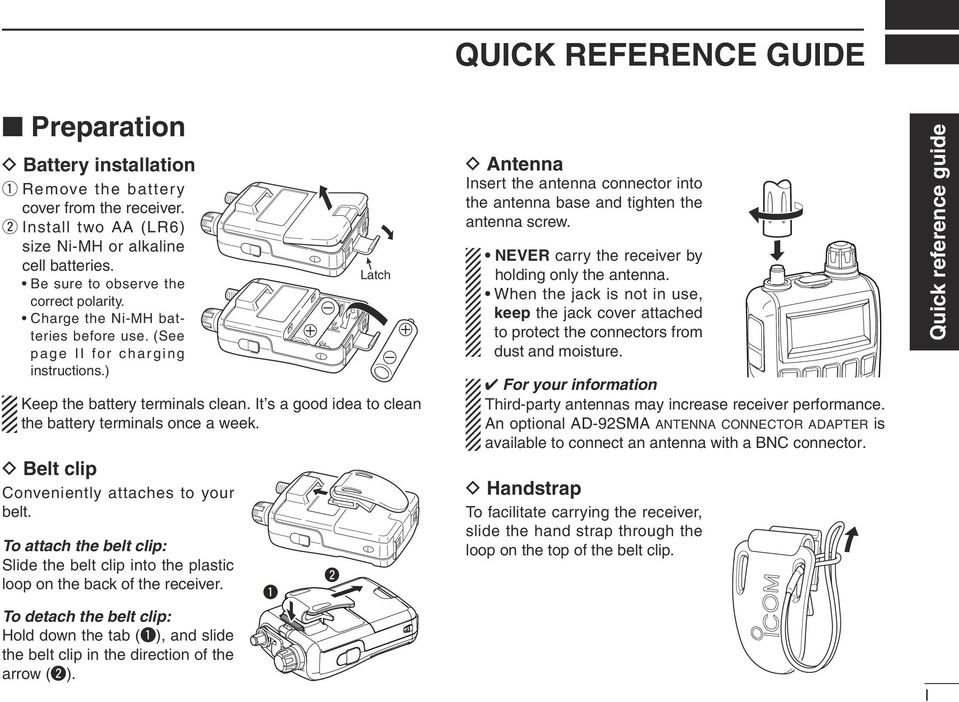
7 Preparation D Battery installation q Remove the battery cover from the receiver. w Install two AA (LR6) size Ni-MH or alkaline cell batteries. Be sure to observe the correct polarity. Charge the Ni-MH batteries before use. (See page II for charging instructions.) Keep the battery terminals clean. It s a good idea to clean the battery terminals once a week. D Belt clip Conveniently attaches to your belt. To attach the belt clip: Slide the belt clip into the plastic loop on the back of the receiver. To detach the belt clip: Hold down the tab (q), and slide the belt clip in the direction of the arrow (w). q w Latch QUICK REFERENCE GUIDE D Antenna Insert the antenna connector into the antenna base and tighten the antenna screw. NEVER carry the receiver by holding only the antenna. When the jack is not in use, keep the jack cover attached to protect the connectors from dust and moisture. For your information Third-party antennas may increase receiver performance. An optional AD-92SMA antenna connector adapter is available to connect an antenna with a BNC connector. D Handstrap To facilitate carrying the receiver, slide the hand strap through the loop on the top of the belt clip. Quick reference guide I
8 QUICK REFERENCE GUIDE D Charging the battery BC-196SA/SD/BC-153SC to an AC outlet r Rotate [DIAL] to select Y, then push [BAND]. [DIAL] Receiver to the [DC4.5V] jack The shape may differ, depending on the version. CP-18A/E Cigarette lighter cable with DC-DC converter to a cigarette lighter socket The charging confirmation is displayed. q Install the Ni-MH batteries. w Plug the AC adapter into an AC outlet. e Insert the adapter plug into the [DC4.5V] of the receiver. The battery confirmation is displayed. t Rotate [DIAL] to select Y, then push [BAND] to start the battery charging. RWARNING!: NEVER attempt to charge the alkaline batteries. Rotate Then, push II NOTE: When no operation is performed for 10 seconds, the receiver automatically skips these settings, and the receiver cannot charge the batteries. In that case, remove the batteries for more than 2 seconds and retry these setting from step q. The battery icon scrolls during charge. Both segments blink when completely charged.
![q Install the Ni-MH batteries. w Plug the AC adapter into an AC outlet. e Insert the adapter plug into the [DC4.5V] of the receiver. The battery confirmation is displayed.](/docs-images/41/3647005/images/page_8.jpg "t Rotate [DIAL] to select Y, then push [BAND] to start the battery charging. RWARNING!: NEVER attempt to charge the alkaline batteries.")
9 QUICK REFERENCE GUIDE Your first scanning experience Now that you have your IC-R6 ready, you are probably excited to start listening. We would like to take you through a few basic operation steps to make your first Listennig Experience enjoyable. D About the default settings The [DIAL] control function can be traded with the [p]/[q] keys function. However, in this QUICK REFERENCE GUIDE, the factory default setting ([DIAL] selects the operating frequency) is used for simple instruction. 2. Adjusting audio level Push [p]/[q] to set a desired audio level. 3. Adjusting squelch level While holding down [SQL], rotate [DIAL] to set the squelch level. [DIAL] Quick reference guide D Basic operation 1. Turning ON the receiver Hold down [ ] for 1 second to turn the power ON. 4. Setting a desired frequency The tuning dial will allow you to dial in the frequency you want to listen to. Pages 11 and 17 will instruct you on how to set the tuning speed. q Push [BAND] repeatedly to select a frequency band. While holding down [BAND], then rotating [DIAL] will also select a frequency band. w Rotate [DIAL] to set the receive frequency. While holding down [FUNC], rotate [DIAL] to select frequencies in MHz steps. [DIAL] III
![D About the default settings The [DIAL] control function can be traded with the [p]/[q] keys function.](/docs-images/41/3647005/images/page_9.jpg "However, in this QUICK REFERENCE GUIDE, the factory default setting ([DIAL] selects the operating frequency) is used for simple instruction. 2.")
10 QUICK REFERENCE GUIDE Your first scanning experience (continued) 5. Receive mode selection Push [MODE] repeatedly to select a desired receive mode. The FM, WFM or AM is selectable. Memory programming The IC-R6 has 1300 memory channels for storing often used receive frequency, mode, etc. 1. Setting frequency In the VFO mode, set a desired receive frequency and receive mode. When the icon is displayed, push [V/M] to select the VFO mode. 2. Selecting a memory channel Hold down [S.MW](V/M) for 1 second, then rotate [DIAL] to select a desired memory channel. The icon and memory channel number blink. [DIAL] 3. Writing a memory channel Hold down [S.MW](V/M) for 1 second until 3 beeps sound. The memory channel number automatically increases if you continue to hold down [S.MW](V/M) after programming. IV
![When the icon is displayed, push [V/M] to select the VFO mode. 2. Selecting a memory channel Hold down [S.MW](V/M) for 1 second, then rotate [DIAL] to select a desired memory channel.](/docs-images/41/3647005/images/page_10.jpg "The icon and memory channel number blink. [DIAL] 3. Writing a memory channel Hold down [S.MW](V/M) for 1 second until 3 beeps sound.")
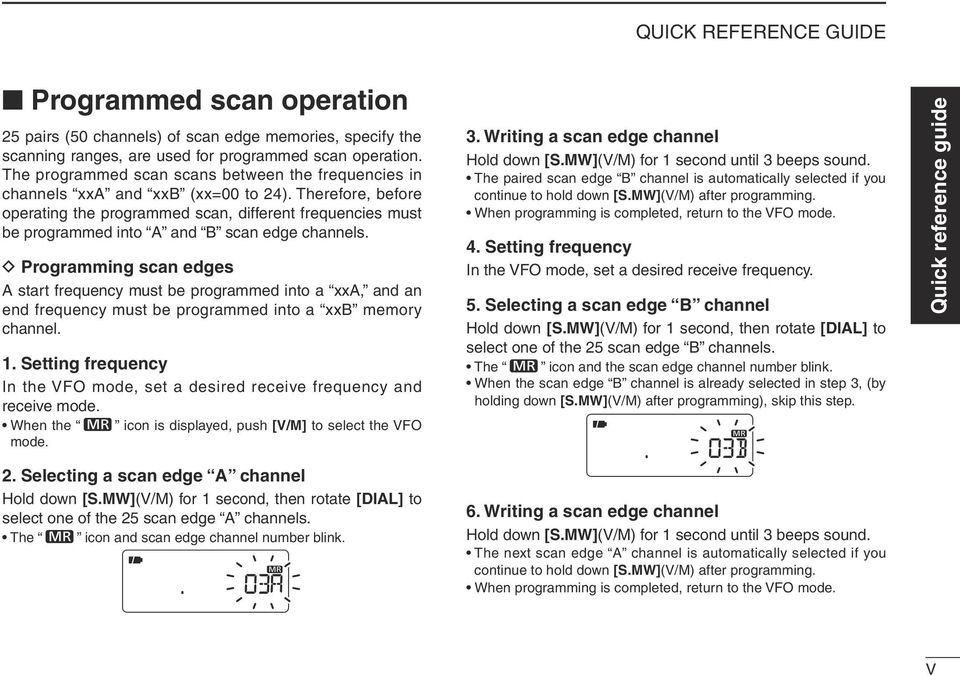
11 QUICK REFERENCE GUIDE Programmed scan operation 25 pairs (50 channels) of scan edge memories, specify the scanning ranges, are used for programmed scan operation. The programmed scan scans between the frequencies in channels xxa and xxb (xx=00 to 24). Therefore, before operating the programmed scan, different frequencies must be programmed into A and B scan edge channels. D Programming scan edges A start frequency must be programmed into a xxa, and an end frequency must be programmed into a xxb memory channel. 1. Setting frequency In the VFO mode, set a desired receive frequency and receive mode. When the icon is displayed, push [V/M] to select the VFO mode. 2. Selecting a scan edge A channel Hold down [S.MW](V/M) for 1 second, then rotate [DIAL] to select one of the 25 scan edge A channels. The icon and scan edge channel number blink. 3. Writing a scan edge channel Hold down [S.MW](V/M) for 1 second until 3 beeps sound. The paired scan edge B channel is automatically selected if you continue to hold down [S.MW](V/M) after programming. When programming is completed, return to the VFO mode. 4. Setting frequency In the VFO mode, set a desired receive frequency. 5. Selecting a scan edge B channel Hold down [S.MW](V/M) for 1 second, then rotate [DIAL] to select one of the 25 scan edge B channels. The icon and the scan edge channel number blink. When the scan edge B channel is already selected in step 3, (by holding down [S.MW](V/M) after programming), skip this step. 6. Writing a scan edge channel Hold down [S.MW](V/M) for 1 second until 3 beeps sound. The next scan edge A channel is automatically selected if you continue to hold down [S.MW](V/M) after programming. When programming is completed, return to the VFO mode. Quick reference guide V
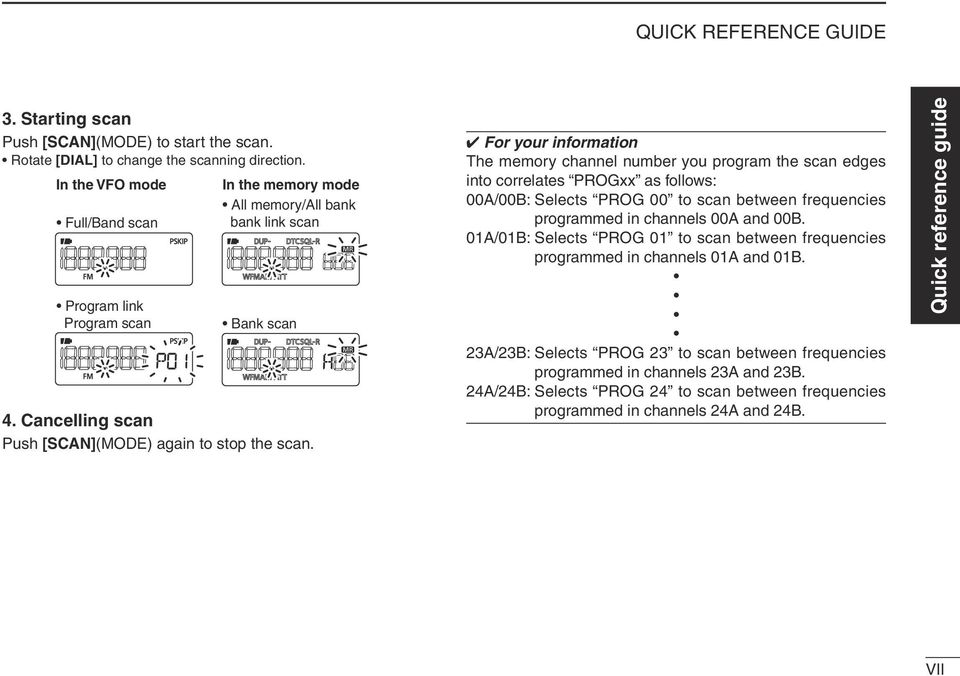
12 QUICK REFERENCE GUIDE D Starting scan 1. Select the VFO mode. Push [V/M] to select the VFO mode for a VFO scan operation, such as full scan, band scan and programmed scan. Select the memory mode by pushing [V/M] again for a memory scan operation, such as all memory scan, bank link scan or bank scan. 2. Selecting a scan type Hold down [SCAN](MODE) for 1 second, and then rotate [DIAL] to select one of the desired scanning types. Select ALL for full scan, BAND for band scan, P-LINK x for programmed link scan (x= 0 to 9), PROGxx for programmed scan (xx= 0 to 24; only programmed scan edge numbers are displayed). Select M-ALL for all memory scan, B-ALL for all bank scan, B-LINK for bank link scan or BANK-x for bank scan (x= A to R, T, U, W, Y; only programmed bank groups are displayed). Scan type display examples In the VFO mode In the memory mode Full scan All memory scan Band scan All bank scan Program link scan Bank link scan Program scan Bank scan VI
 for 1 second, and then rotate [DIAL] to select one of the desired scanning types.](/docs-images/41/3647005/images/page_12.jpg "Select ALL for full scan, BAND for band scan, P-LINK x for programmed link scan (x= 0 to 9), PROGxx for programmed scan (xx= 0 to 24; only programmed scan edge numbers are displayed).")
13 QUICK REFERENCE GUIDE 3. Starting scan Push [SCAN](MODE) to start the scan. Rotate [DIAL] to change the scanning direction. In the VFO mode Full/Band scan Program link Program scan In the memory mode All memory/all bank bank link scan Bank scan 4. Cancelling scan Push [SCAN](MODE) again to stop the scan. For your information The memory channel number you program the scan edges into correlates PROGxx as follows: 00A/00B: Selects PROG 00 to scan between frequencies programmed in channels 00A and 00B. 01A/01B: Selects PROG 01 to scan between frequencies programmed in channels 01A and 01B. 23A/23B: Selects PROG 23 to scan between frequencies programmed in channels 23A and 23B. 24A/24B: Selects PROG 24 to scan between frequencies programmed in channels 24A and 24B. Quick reference guide VII
14 1 PANEL DESCRIPTION 1 Front, top and side panels q w e r t!2!1 Function display (pp 3, 4)!0 o i u y Speaker q ANTENNA CONNECTOR (p. I) Connect the supplied antenna. An optional AD-92SMA is available for connecting an antenna with a BNC connector. w FUNCTION KEY [FUNC] While holding down this switch, access a key s secondary or third function. * The functions of [DIAL] and [p]/[q] can be exchanged. See page 58 for details. e SQUELCH ATTENUATOR KEY [SQL] [ATT](SQL) Hold down to temporarily open the squelch and monitor the operating frequency. (p. 15) While holding down this switch, rotate [DIAL]* to adjust the squelch level. (p. 14) While holding down [FUNC], push to toggle the attenuator function ON or OFF. (p. 15) r UP/DOWN KEYS [p]/[q]* Adjusts the audio volume level. (p. 13) t BAND LOCK MEMORY NAME KEY [BAND] [ ](BAND) [ ](BAND) Push to select the operating frequency band. (p. 9) While holding down [FUNC], push and hold for 1 second to toggle the lock function ON or OFF. (p. 12) During memory mode operation, hold down [FUNC], then push this key to select the display type. The display shows the memory bank name, memory name and channel number in sequence, and then returns to the frequency display. ( The memory bank name or memory name must have preprogrammed.) y TUNING STEP SET DIAL EXCHANGE KEY [TS] [SET](TS) [ ](TS) Push to enter the tuning step selecting mode. (p. 11) Hold down for 1 second to enter the Set mode. (p. 45) While holding down [FUNC], push to exchange the [DIAL] and [p]/[q] keys functions. (p. 58)
![* The functions of [DIAL] and [p]/[q] can be exchanged. See page 58 for details.](/docs-images/41/3647005/images/page_14.jpg "e SQUELCH ATTENUATOR KEY [SQL] [ATT](SQL) Hold down to temporarily open the squelch and monitor the operating frequency. (p.")
15 PANEL DESCRIPTION 1 u POWER KEY [ ] Hold down for 1 second to turn the receiver power ON or OFF. i MODE SCAN TONE SCAN KEY [MODE] [SCAN](MODE) [ ](MODE) Push to select the receive mode. (p. 14) Hold down for 1 second to enter the scan type selection mode. (pp. 29, 33) Push again to start the scan. While holding down [FUNC], push to start a tone scan. (p. 44) o VFO/MEMORY MEMORY WRITE SKIP KEY [V/M] [S.MW](V/M) [ ](V/M) Toggles between the VFO and the memory mode. (p. 9) Hold down for 1 second to enter the memory edit mode. (p. 19) m While in the VFO mode (p. 29) Hold down [FUNC], then push this key to set the VFO skip scan setting ON or OFF. m While in the memory mode (p. 35) Hold down [FUNC], then push this key to select the scan skip setting for the selected channel. * The functions of [DIAL] and [p]/[q] can be exchanged. See page 58 for details.!0 EXTERNAL DC-IN CONNECTOR [DC4.5V] (p. 7) Connect an AC adapter or an optional cigarette lighter cable for both charging the installed rechargeable battery and operating. Connectable voltage is from 4.5 V DC to 6.3 V DC.!1 EXTERNAL SPEAKER CONNECTOR [SP] Connect an optional earphone or headphones. The internal speaker will not function when any external equipment is connected. (See page 79 for a list of available options.)!2 CONTROL DIAL [DIAL]* Rotate to select the operating frequency. (p. 11) While scanning, changes the scanning direction. (pp. 29, 33) While holding down [SQL], sets the squelch level. (p. 14) While holding down [FUNC], sets the operating frequency in 100 khz, 1 MHz or 10 MHz in the VFO mode. (pp. 11, 17) While holding down [FUNC], selects the memory channel in 10 channels steps in the memory mode. (pp. 12, 18) While holding down [BAND], selects the frequency band in the VFO mode. (p. 9)
 [ ](V/M) Toggles between the VFO and the memory mode. (p. 9) Hold down for 1 second to enter the memory edit mode. (p. 19) m While in the VFO mode (p.](/docs-images/41/3647005/images/page_15.jpg "29) Hold down [FUNC], then push this key to set the VFO skip scan setting ON or OFF. m While in the memory mode (p.")
16 1 PANEL DESCRIPTION Function display q w e r t y u!5 i o!0 3 q BATTERY ICON Both segments appear when the batteries have ample capacity. They do not appear when operating with an external power source. Only the right segment appears when the batteries have less than half capacity. Scrolls while charging the rechargeable batteries. (p. 8)!4 Both segments disappear when completely charged. w LOCK ICON (p. 12) Appears when the lock function is activated.!3!2!1 e DUPLEX ICONS (p. 16) DUP appears when plus duplex, and DUP appears when minus duplex operation is selected. r TONE ICONS (p. 43) T SQL appears while the tone squelch function is in use. T SQL-R appears while the reverse tone squelch function is in use. DTCS appears while the DTCS squelch function is in use. DTCS appears while the reverse DTCS squelch function is in use. S appears with the T SQL or DTCS icon while the pocket beep function (with Tone squelch or DTCS squelch) is in use.
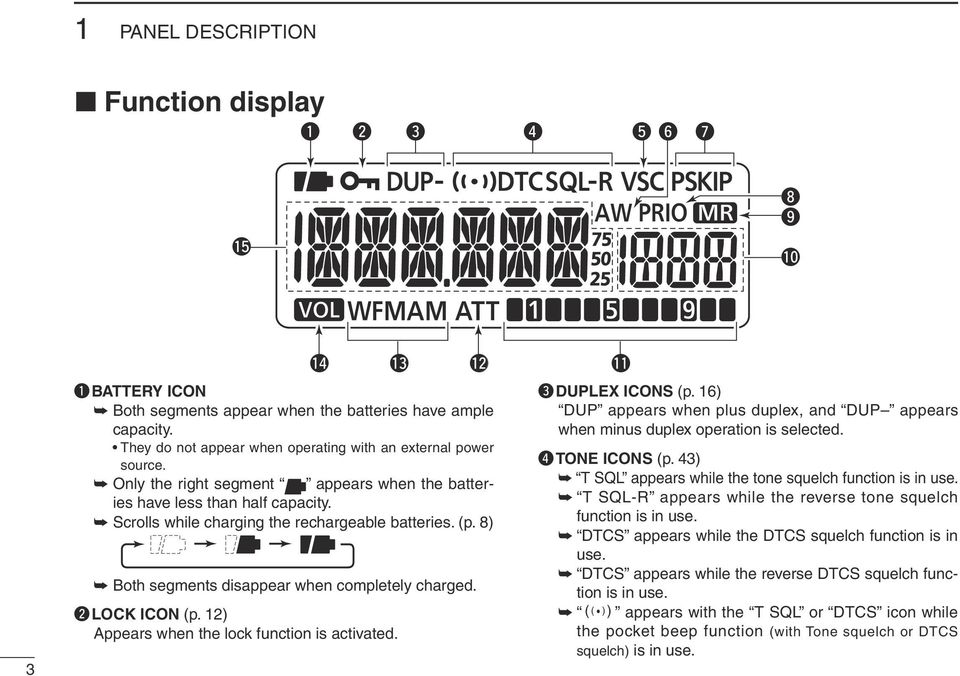
17 PANEL DESCRIPTION 1 t VSC ICON (p. 52) Appears while the VSC (Voice Squelch Control) function is in use. y AUTO WRITE CHANNEL ICON (p. 34) Appears when an auto write channel is selected. u SKIP ICONS m While in the VFO mode (p. 29) PSKIP appears when the VFO skip scan setting is ON. m While in memory mode (p. 35) SKIP appears when the selected memory channel is specified as a skip channel. PSKIP appears when the displayed frequency is specified as a skip channel for the memory scan or skip frequency for the VFO scan. i PRIORITY WATCH ICON (pp. 39, 40) Appears while priority watch is in use. o MEMORY ICON (pp. 9, 18) Appears when the memory mode is selected.!0 MEMORY CHANNEL NUMBER Shows the selected memory channel number. (pp. 9, 18)!1 SIGNAL STRENGTH INDICATOR (p. 13) Shows the relative signal strength while receiving signals.!2 ATTENUATOR ICON (p. 15) Appears while the RF attenuator is in use.!3 RECEIVE MODE ICONS (p. 14) Shows the selected receive mode. FM, WFM and AM modes are selectable.!4 VOLUME EXCHANGE ICON (p. 58) Appears when the function of [DIAL] and [p]/[q] are exchanged.!5 FREQUENCY READOUT Shows a variety of information, such as the operating frequency, Set mode contents, memory names. The smaller 75, 50 or 25 to the right of the frequency readout shows the 0.75, 0.5 or 0.25 khz, respectively. The decimal point blinks during a scan. 1 4

18 2 BATTERY CHARGING Battery installation Before installing, or replacing the batteries, hold down [ ] for 1 second to turn the power OFF. q Remove the battery cover from the receiver. Latch w Install two AA (LR6) size Ni-MH batteries. Be sure to observe the correct polarity. Caution R DANGER! NEVER short the battery terminals (or charging terminals on the bottom of the receiver). Also, current may flow into nearby metal objects such as a necklace, so be careful when placing batteries (or the receiver) in handbags, etc. Simply carrying with or placing near metal objects such as a necklace, etc. may cause shorting. This may damage not only the batteries, but also the receiver. R DANGER! NEVER incinerate used batteries. Internal battery gas may cause an explosion. R DANGER! NEVER immerse the batteries in water. If the batteries become wet, be sure to wipe them dry BEFORE installing them to the receiver. When installing batteries, make sure they are all the same brand, type and capacity. Also, do not mix new and old batteries together. Never use batteries whose insulated covering is damaged. Keep battery terminals clean to avoid rust or misscontact. It s a good idea to clean battery terminals once a week. D Caution for the Ni-MH batteries CAUTION: Always use the batteries within the specified temperature range, 5 C to +60 C (+23 F to +140 F). Using the batteries out of their specified temperature range will reduce the battery s performance and battery life. 5

19 BATTERY CHARGING 2 CAUTION: Shorter battery life could occur if the batteries are left completely discharged, or in an excessive temperature environment (above +55 C; +131 F) for an extended period of time. If the batteries must be left unused for a long time, they must be detached from the receiver after charging. Keep them safely in a cool dry place at the following temperature range: 20 C to +45 C ( 4 F to +113 F) (up to a month) 20 C to +35 C ( 4 F to +95 F) (up to six months) 20 C to +25 C ( 4 F to +77 F) (up to a year*) * We recommend charging the batteries every 6 months. If your Ni-MH batteries seem to have no capacity, even after being charged, completely discharge them by leaving the power ON overnight. Then, fully charge the batteries again. If the batteries still do not retain a charge (or only very little charge), a new batteries must be purchased. Prior to using the receiver for the first time, the batteries must be fully charged for optimum life and operation. The supplied batteries are rechargeable batteries. Charge the batteries before first operating the receiver, or when the batteries become exhausted. If you want to prolong the battery life, the following points should be observed: - Avoid over charging. - Use the batteries until it becomes almost completely exhausted, under normal conditions. D Charging caution R WARNING! NEVER charge alkaline batteries. The receiver can charge only the Ni-MH batteries (1.2 V, 1400 mah typical). Other types of rechargeable battery, such as Ni-Cd or Li-Ion cannot be charged. AVOID over charging The installed rechargeable batteries can be charged during operation when the AC adapter or the cigarette lighter cable is connected. To prevent over charging, the IC-R6 has charging timer that automatically disconnecting* the charging line electronically after 15 hours from charging. However, the charging timer will reset and start charging again when disconnect then reconnecting the AC adapter or CP-18A/E more than 1 minute interval. * When the CHARGE setting in the Set mode is set to CHG2 (default), the receiver continues to trickle charge after 15 hours have past. Recommended temperature range for charging: between 0 C (+32 F) and +40 C (+104 F) by the receiver. Use the BC-196SA/SD/BC-153SC AC adapter or CP-18A/ E cigarette liter cable only. NEVER use other manufacturers chargers. The external DC power supply voltage must be between V to charge the batteries and for operation when using an optional CP-18A/E. If the battery icons ( and ) disappear only 1 minute after connecting to the DC power supply, the batteries may have problem. In this case, contact your Icom dealer/distributor, or purchase new batteries. 2 6

20 2 BATTERY CHARGING 7 Battery charging D Charging connections RWARNING!: NEVER attempt to charge alkaline batteries. Receiver to the [DC4.5V] jack BC-196SA/SD/BC-153SC to an AC outlet The shape may differ, depending on the version. CP-18A/E Cigarette lighter cable with DC-DC converter to a cigarette lighter socket Charging period: Approx. 15 hours* * Charging pauses when the receiver s temperature is out of its specified temperature range (at that time both battery icons blink), then resumes when it returns to the specified range. In that case, the charging time will be longer than 15 hours. External DC power operation becomes possible when using an AC adapter or cigarette lighter cable. The installed Ni-MH batteries can also be charged simultaneously. CAUTION: BE SURE to disconnect the CP-18A/E from the cigarette lighter socket when charging is finished, because, a slight current still flows in the CP-18A/E and will drain the vehicle s battery. D Charging description When charging the installed batteries at the first time, or once the batteries are removed for more than 2 seconds, the following operations are necessary. q Install Ni-MH batteries. (See page 5.) w Plug the AC adapter into an AC outlet; or the CP-18A/E into a cigarette lighter socket. e Insert the adapter plug into [DC4.5V] of the receiver. The battery confirmation is displayed. If the confirmation does not appear, following operation is necessary. q Disconnect the adapter plug from [DC4.5V]. w Holding down [FUNC], insert the adapter plug again. e Release [FUNC]. NOTE: When no operation is performed for 10 seconds, the receiver automatically skips these settings, and the receiver cannot charge the batteries. In that case, remove the batteries for more than 2 seconds and retry these setting from step q.
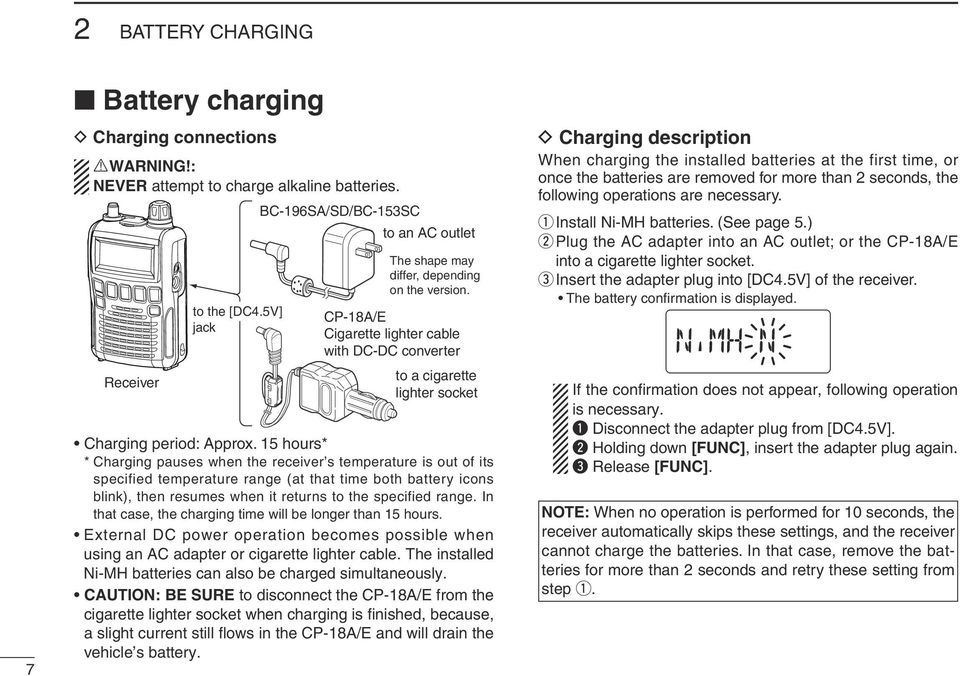
21 BATTERY CHARGING 2 r Rotate [DIAL] to select Y, then push [BAND]. [DIAL] The charging confirmation is displayed. t Rotate [DIAL] to select Y, then push [BAND] to start the battery charging. Rotate Then, push While charging, the icons show, and (disappears) in sequence, and CHARGE appears when the receiver s power is OFF. The icons and CHARGE disappear when the battery pack is completely charged. It takes approximately 13 hours to fully charge the Ni-MH batteries. D Charger stand BC-194 The BC-194 can be used as a convenient stand for the receiver, as well as a charger when used the BC-196SA/SD, BC-153SC or CP-18A/E as it s power source. CP-18A/E cigarette lighter cable Ground screw and flat washer spplied with BC-194 AC adapter (supplied with receiver) Receiver BC-194 Cushion sheet (supplied with BC-194) Double-sided tape* (supplied with BC-194) *One sheet supplied. You can cut the desired size. The BC-194 contains a line filter. If the ground screw is connected to earth ground, the BC-194 will reduce some noises from the power source
22 3 FREQUENCY AND CHANNEL SETTING VFO and memory channels The IC-R6 has two normal operating modes: the VFO mode and the memory mode. The VFO mode is used for a desired frequency setting within the frequency coverage. Push [V/M] to select the VFO mode. The memory mode is used for quick recall of the preprogrammed memory channels. Push [V/M] to select the memory mode. See page 19 for memory programming details. [DIAL] VFO mode display Memory mode display Frequency band selection The receiver can receive the AM broadcast, HF band, 50 MHz, FM broadcast, VHF air, 144 MHz, 300 MHz, 400 MHz, 800 MHz,* 1200 MHz or Weather channels. Available frequency bands differ, depending on the version. See the specifications for details. * Some frequency ranges are prohibited in the USA version by regulation. Available in only the USA version. Push [BAND] repeatedly to select a desired frequency band. When the memory mode is selected, push [V/M] to select the VFO mode first, then push [BAND] to select a desired band. While holding down [BAND], rotating [DIAL] also selects the frequency band. [DIAL] and memory channel number appear. What is VFO? VFO is an abbreviation of Variable Frequency Oscillator. Operating frequencies are generated and controlled by the VFO. 9
23 FREQUENCY AND CHANNEL SETTING 3 Available frequency bands 3 AM broadcast band HF band 50 MHz band FM broadcast band : Push : While holding down, rotate VHF air band Weather channels* The actual frequencies may differ, depending on your receiver version. *Available in only the USA version 144 MHz band 1200 MHz band 800 MHz band 400 MHz band 300 MHz band 10
24 3 FREQUENCY AND CHANNEL SETTING Setting a frequency q Push [V/M] to select the VFO mode, if necessary. w Select a desired frequency band with [BAND]. Or, while holding down [BAND], rotate [DIAL] to select a desired frequency band. e Rotate [DIAL] to select a desired frequency. The frequency changes according to the preset tuning step. See the section to the right for setting the tuning step. While holding down [FUNC], rotate [DIAL] to change the frequency in 1 MHz steps (default). [DIAL] [DIAL] changes the frequency according to the selected tuning step. While holding down [FUNC], rotating [DIAL] changes the frequency in 1 MHz steps (default). The MHz tuning step (dial select step) can be set to 100 khz, 1 MHz or 10 MHz tuning steps in the Set mode. See page 17 for details. Setting a tuning step The tuning step can be selected for each frequency band. However, additional steps become selectable in only the VHF Air band (8.33 khz) and in the AM broadcast band (9 khz). The following tuning steps are available for the IC-R khz 6.25 khz 8.33 khz 9.0 khz 10.0 khz 12.5 khz 15.0 khz 20.0 khz 25.0 khz 30.0 khz 50.0 khz khz khz khz D Tuning step selection q Push [V/M] to select the VFO mode, if necessary. w Push [BAND] to select a desired frequency band. Or, while holding down [BAND], rotate [DIAL] to select a desired frequency band. e Push [TS] to enter the tuning step selecting mode. r Rotate [DIAL] to select a desired tuning step. t Push [TS] to return to the VFO mode. [DIAL] 5 khz tuning step 11
25 FREQUENCY AND CHANNEL SETTING 3 Selecting a memory channel q Push [V/M] to select the memory mode. appears when the memory mode is selected. w Rotate [DIAL] to select a desired memory channel. Only programmed memory channels can be selected. While holding down [FUNC], rotate [DIAL] to select a memory channel in 10 channel steps. [DIAL] Appears [DIAL] changes the memory channel. Lock function To prevent accidental frequency changes and unnecessary function access, use the lock function. While holding down [FUNC], push and hold [ ](BAND) for 1 second to turn the lock function ON or OFF. appears while the lock function is activated. [SQL] and [p]/[q] can be used while the lock function is in use with default setting. Either or both [SQL] and [p]/[q] keys can also be locked in the Set mode. (p. 49) appears while the lock function is in use. 3 12
26 4 BASIC OPERATION Receiving Make sure charged Ni-MH or brand new alkaline batteries are installed. (p. 7) q Hold down [ ] for 1 second to turn power ON. w Push [p] or [q] to set a desired audio level. The function display shows the volume level while setting. See the section to the right for details. e Set the receive frequency. (p. 11) r Set the squelch level. (p. 14) While holding down [SQL], rotate [DIAL]. The first click of [DIAL] indicates the current squelch level. LEVEL 1 is loose squelch and LEVEL 9 is tight squelch. AUTO indicates automatic level adjustment using a noise pulse count system. Hold down [SQL] to open the squelch manually. t When a signal is received: The squelch opens and audio is heard. The S-meter shows the relative signal strength. Setting audio volume The audio level can be adjusted through 40 levels. Push [p] or [q] to adjust the audio level. A beep tone sounds while adjusting. The tone sound lets you know the approximate sound level. Holding down either key will continuously change the audio level. Holding down [p] or [q], then rotating [DIAL] will also adjust the audio level. The display shows the volume level while setting. DISPLAY AUDIO LEVEL Minimum level (no audio) Initial setting r Push for setting the squelch (Push to monitor) e Set frequency r Set squelch level w Set audio level e Select band q Power ON [ ] Maximum level 13
27 BASIC OPERATION 4 Squelch level setting The squelch circuit mutes the received audio signal, depending on the signal strength. The receiver has 9 squelch levels, a continuously open setting and an automatic setting. While holding down [SQL], rotate [DIAL] to select the squelch level. LEVEL 1 is loose squelch (for weak signals) and LEVEL 9 is tight squelch (for strong signals). AUTO indicates the automatic level adjustment using a noise pulse count system. OPEN indicates the continuously open setting. [DIAL] Receive mode selection The receiver has three receive modes, FM, AM and WFM. The mode selection is independently stored in each band and memory channels. Typically, the AM mode is used for the AM broadcast stations ( MHz) and air band ( MHz), and WFM is used for FM broadcast stations ( MHz). Push [MODE] repeatedly to select a desired receive mode. 4 Automatic squelch FM mode Maximum level AM mode WFM mode 14
28 4 BASIC OPERATION Monitor function This function is used to listen to weak signals, without disturbing the squelch setting. It can also be used to open the squelch manually, even when mute functions such as the tone squelch are in use. Hold down [SQL] to monitor the receive frequency. Attenuator function The attenuator prevents a received signal from distorting when very strong signals are near a desired frequency, or when very strong electric fields, such as from a broadcasting station, are near your location. While holding down [FUNC], push [ATT](SQL) to turn the attenuator function ON or OFF. The 1st/2nd segments blink ATT appears while the attenuator functions is in use. The [SQL] switch can be set to a sticky operation in the Expand set mode. See page 49 for details. When the signal is received by the bar antenna, this function is not effective. 15
29 BASIC OPERATION 4 Duplex operation Duplex communication uses two different frequencies for transmitting and receiving. Generally, duplex is used in communication through a repeater, some utility communications, etc. During duplex operation, the transmit station frequency is shifted from the receive station frequency by the frequency offset. Repeater information (frequency offset and shift direction) can be programmed into memory channels. (p. 19) D Setting q Set the station s receive frequency (repeater output frequency). w Hold down [SET](TS) for 1 second to enter the Set mode. e Rotate [DIAL] to select the EXPAND item. EXPAND disappears after 1 second and OFF (default) and EX appear. [DIAL] Expand set mode item After 1 sec. Setting display r While holding down [FUNC], rotate [DIAL] to select ON. t Rotate [DIAL] to select the OFFSET item. OFFSET disappears after 1 second and (default) and OW appear. (Default offset differs depending on the frequency band or receiver version.) Frequency offset item After 1 sec. Setting display y While holding down [FUNC], rotate [DIAL] to set a desired frequency offset within MHz range. The tuning step, selected in the VFO mode, is used for setting. u Rotate [DIAL] to select the DUP item. DUP disappears after 1 second and OFF (default) and DP appear. Duplex item using EXPAND SET MODE After 1 sec. Setting display i While holding down [FUNC], rotate [DIAL] to select DUP or +DUP. o Push [SET](TS) to exit the Set mode.!0 Hold down [SQL] to directly monitor the station s transmit frequency (repeater input frequency). 4 16
30 4 BASIC OPERATION Dial select step [ This receiver has a MHz tuning step for quick frequency setting. You can select 100 khz, 1 MHz or 10 MHz steps, as desired. D Setting dial select step q Push [V/M] to select the VFO mode. w Hold down [SET](TS) for 1 second to enter the Set mode. e Rotate [DIAL] to select the D SEL item. D SEL disappears after 1 second and 1M (default) and DS appear. r While holding down [FUNC], rotate [DIAL] to select a desired dial select step. 100 khz, 1 MHz and 10 MHz can be selected. t Push [SET](TS) to exit the Set mode. [DIAL] 1 MHz step 10 MHz step 100 khz step 17
31 MEMORY CHANNELS 5 General description The receiver has 1300 memory channels for storage of often-used frequencies. A total of 22 memory banks, A to R, T, U, W and Y can be selected. Up to 100 channels can be assigned to each bank. D Memory channel contents The following information can be programmed into memory channels: Receive frequency (p. 11) Receive mode (p. 14) Duplex direction (+DUP or DUP) with a frequency offset (p. 16) Tone squelch or DTCS squelch ON/OFF (p. 43) Tone squelch frequency or DTCS code with polarity (pp. 41, 42) Tuning step (p. 11) Attenuator function ON/OFF (p. 15) Voice squelch control ON/OFF (p. 52) AF filter ON/OFF (p. 55) Scan skip setting (p. 35) Memory bank (p. 20) Memory name (p. 22) Selecting a memory channel q Push [V/M] to select the memory mode. Push [V/M] to toggle between the VFO mode and the memory channel mode. w Rotate [DIAL] to select a desired memory channel. Only programmed channels are displayed. While holding down [FUNC], rotate [DIAL] to select the memory channel in 10 channel steps. Appears Rotate [DIAL] to select the memory channel. NOTE: Memory data can be erased by static electricity, electric transients, etc. In addition, it can be erased by a malfunction and during repairs. Therefore, we recommend that memory data be written down or saved to a PC using the CS-R6 cloning software
32 5 MEMORY CHANNELS Memory channel programming q Push [V/M] to select the VFO mode. w Set a desired frequency: Select a desired band with [BAND]. Set a desired frequency with [DIAL]. Set other data (e.g. frequency offset, duplex direction, tone squelch, etc.), if desired. e Hold down [S.MW](V/M) for 1 second to enter the select memory write mode. 1 short and 1 long beep sounds. The icon and memory channel number blink. r Rotate [DIAL] to select a desired channel. Scan edge channels 00A/B to 24A/B can also be selected. While holding down [FUNC], rotate [DIAL] to select memory channels in 10 channel steps. t Hold down [S.MW](V/M) for 1 second. 3 beeps sound. The memory channel number automatically increases if you continue to hold down [S.MW](V/M) after programming. NOTE: Push [V/M] to cancel programming and exit the select memory write mode, before memory programming is finished. [EXAMPLE]: Programming MHz into memory channel 20 (a blank channel). Hold down for 1 sec. Rotate to select channel 20. The VFO mode Enter the select memory write mode. Hold down for 1 sec. to program. Return to the VFO mode. 19
33 MEMORY CHANNELS 5 Memory bank setting The IC-R6 has a total of 22 banks (A to R, T, U, W and Y). Regular memory channels 000 to 1299 can be assigned to any desired bank, for easy memory management. q Hold down [S.MW](V/M) for 1 second to enter the select memory write mode. 1 short and 1 long beep sounds. The icon and memory channel number blink. w Rotate [DIAL] to select a desired memory channel. e While holding down [MODE], rotate [DIAL] to select the BANK item. The bank group and channel number are displayed if the selected memory channel has already been assigned to a bank. The BANK item can also be selected by pushing [MODE] repeatedly. [DIAL] After released. After releasing [MODE], is displayed instead of the frequency display, and only the icon blinks. r While holding down [BAND], rotate [DIAL] to select a desired bank group. Bank groups A to R, T, U, W and Y are selectable. The bank groups can also be selected by repeatedly pushing [BAND]. [DIAL] Bank group t Rotate [DIAL] to select a desired bank channel number. Only vacant bank channel numbers are displayed. [DIAL] Bank channel y Hold down [S.MW](V/M) for 1 second to assign the channel to the bank. Return to the previous screen before entering the select memory write mode
34 5 MEMORY CHANNELS Memory bank selection q Push [V/M] to select the memory mode. w While holding down [BAND], rotate [DIAL] to select a desired bank. The bank can also be selected by pushing [BAND] repeatedly. Only banks with entries are displayed. [DIAL] e Rotate [DIAL] to select the bank channel. Only programmed channels are displayed. [DIAL] Bank initial Regular memory channels Only banks with entries are displayed Bank channel number r To return to a regular memory channel, while holding down [BAND] then rotate [DIAL], or repeatedly push [BAND]. Auto write channels 21
35 MEMORY CHANNELS 5 Programming memory/bank name Each memory channel can be programmed with an alphanumeric channel name for easy recognition, and can be displayed independently by channel. Names can be a maximum of 6 characters. q Push [V/M] to select the memory mode. w Rotate [DIAL] to select a desired memory channel. e Hold down [S.MW](V/M) for 1 second to enter the select memory write mode. 1 short and 1 long beep sounds. The icon and memory channel number blink. t While holding down [FUNC], rotate [DIAL] to select a desired character. The selected character blinks. y Rotate [DIAL] to move the cursor to the right or to the left. Memory name Bank name u Repeat steps t and y until a desired 6-character channel name is displayed. i Hold down [S.MW](V/M) for 1 second to program the name and exit the programming mode. 3 beeps sound. 5 r While holding down [MODE], rotate [DIAL] to select the M NAME or B NAME item when programming the memory name or the bank name, respectively. The item can also be selected by pushing [MODE] repeatedly. Memory name selection Bank name selection Available characters A to Z, 0 to 9, (, ), *, +,,,, /,, = and space. NOTE: Only one bank name can be programmed into each bank. Therefore, the previously programmed bank name will be displayed when bank name is selected. Also, the programmed bank name is automatically assigned to another bank channel. After releasing [MODE], a line blinks under the first digit, and the icon blinks. 22
36 5 MEMORY CHANNELS Selecting display type During memory mode operation, either the programmed bank name, memory name or the channel number can be displayed, instead of the frequency display. q Push [V/M] to select the memory mode. If desired, push [BAND] repeatedly to select a desired bank group. w While holding down [FUNC], push [M.N](BAND) repeatedly to select the display type from frequency, bank name, memory name or the channel number. [DIAL] D Selecting bank channel display During bank channel operation, the bank channel number can also be displayed, instead of the memory channel number. q Select the channel number display as described to the left. w While holding down [BAND], rotate [DIAL] to select a desired bank. The bank can also be selected by pushing [BAND] repeatedly. Memory channel number display Bank channel number display Frequency display Bank name display Push W h e n t h e s e l e c t e d memory channel has not been programmed with the bank name or memory name, the frequency is displayed. Memory name display Auto write channel number display Bank channel number display Channel number display 23
37 MEMORY CHANNELS 5 Copying memory contents This function copies a memory channel s contents to the VFO (or another memory channel). This is useful when searching for signals around a memory channel frequency and for recalling the frequency offset, subaudible tone frequency etc. D Memory VFO q Select the memory channel to be copied. Push [V/M] to select the memory mode, then rotate [DIAL] to select a desired channel. If desired, push [BAND] repeatedly to select a desired bank group, then rotate [DIAL] to select a desired bank channel. w Hold down [S.MW](V/M) for 1 second to enter the select memory write mode. 1 short and 1 long beep sounds. The icon and memory channel number blink. e Rotate [DIAL] to select VF. r Hold down [S.MW](V/M) for 1 second to write the selected channel contents into the VFO. The VFO mode is automatically selected. [EXAMPLE]: Copying channel 20 to 51. Select the memory channel Holding down [S.MW](V/M) for 2 seconds in step w will also copy the memory contents to the VFO. In that case, steps e and r are not necessary. D Memory memory q Select the memory channel to be copied. Push [V/M] to select the memory mode, then rotate [DIAL] to select a desired channel. w Hold down [S.MW](V/M) for 1 second to enter the select memory write mode. 1 short and 1 long beep sounds. The icon and memory channel number blink. Do not hold down [S.MW](V/M) for more than 2 seconds. Otherwise the memory contents will be copied to the VFO. e Rotate [DIAL] to select the target memory channel. r Hold down [S.MW](V/M) for 1 second again to copy. 5 Hold down for 1 sec. Rotate. Hold down for 1 sec. to program. 24
38 5 MEMORY CHANNELS Memory clearing Contents of programmed memories can be cleared (erased), if desired. q Hold down [S.MW](V/M) for 1 second to enter the select memory write mode. 1 short and 1 long beep sounds. The icon and memory channel number blink. Do not hold down [S.MW](V/M) for more than 2 seconds. Otherwise the memory contents will be copied to the VFO. w Rotate [DIAL] to select a desired memory channel to be cleared. e While holding down [MODE], rotate [DIAL] to select the CLEAR item. The CLEAR item can also be selected by pushing [MODE] repeatedly. [DIAL] After released. r Hold down [S.MW](V/M) for 1 second to clear the contents. 3 beeps sound. The cleared channel changes to a blank channel. Return to the select memory write mode. The icon and memory channel number blink. Push and hold for 1 sec. t Push [V/M] to return to the screen displayed before you entered the select memory write mode in step q. CONVENIENT!: Instead of doing steps e and r, while holding down [FUNC], pushing and holding [S.MW](V/M) for 1 second also clears the contents. BE CAREFUL! The contents of cleared memories CANNOT be recalled, even in the bank channel mode. After releasing [MODE], CLR is displayed and the blinks. icon 25
39 MEMORY CHANNELS 5 Transferring memory contents The contents of programmed memory channels can be transferred to other memory channels. q Hold down [S.MW](V/M) for 1 second to enter the select memory write mode. 1 short and 1 long beep sounds. The icon and memory channel number blink. Do not hold down [S.MW](V/M) for more than 2 seconds. Otherwise the memory contents will be copied to the VFO. w Rotate [DIAL] to select a desired memory channel to be transferred. e While holding down [MODE], rotate [DIAL] to select the CLEAR item, then release [MODE]. Pushing [MODE] repeatedly also selects the CLEAR item. r Hold down [S.MW](V/M) for 1 second. The displayed contents are cleared. CONVENIENT!: Instead of doing steps e and r, while holding down [FUNC], pushing and holding [S.MW](V/M) for 1 second also clears the contents. t Rotate [DIAL] to select a desired target memory channel. y Hold down [S.MW](V/M) for 1 second to transfer the contents. [DIAL] Example Transferring the contents of memory channel 51 to channel 33. Steps q and w Step e Step r Step t Step y 5 26
40 5 MEMORY CHANNELS Erasing/transferring bank contents The contents of programmed memory channels can be erased or transferred to other memory channels. INFORMATION: Even if the memory bank contents are erased, the memory channel contents still remain programmed. q Select a desired bank contents to be transferred or erased from the bank. Push [V/M] to select the memory mode. While holding down [BAND], rotate [DIAL] to select a desired memory bank group. Rotate [DIAL] to select the bank channel. w Hold down [S.MW](V/M) for 1 second to enter the select memory write mode. 1 short and 1 long beep sounds. Do not hold down [S.MW](V/M) for more than 2 seconds. Otherwise the bank contents will be copied to the VFO. Hold down for 1 sec. e While holding down [MODE], rotate [DIAL] to select the BANK item. Pushing [MODE] repeatedly also selects the BANK item. r While holding down [BAND], rotate [DIAL] to select a desired bank group to transfer. Or, select the display when erasing the contents from the bank. If is selected in this step, skip step t, and go to step y. [DIAL] To transfer the bank contents in bank E. To erase t Rotate [DIAL] to select a desired bank channel. y Hold down [S.MW](V/M) for 1 second to erase or transfer the bank contents. The original memory channel number is automatically displayed, then the icon and the memory channel number blink. 27
41 SCAN OPERATION 6 Scan types Scanning automatically searches for signals and makes it easier to locate new stations. FULL SCAN (p. 29) 100 khz Scan Jump MHz PROGRAMMED SCAN (p. 29) Band Scan edges Band edge xxa xxb edge ALL/SELECTED BANK SCAN (p. 33) A99 SKIP A00 A01 A02 A98 Scan Jump A05 A04 A03 SKIP Repeatedly scans all frequencies over the entire band. Some frequency ranges are not scanned, depending on the frequency coverage of the receiver version. Repeatedly scans between two user-programmed frequencies. Used to check for frequencies within a specified range, such as repeater output frequencies, etc. Repeatedly scans all bank channels or selected bank channels. The skip scan is also selectable. SELECTED BAND SCAN (p. 29) Band edge Scan Jump Band edge MEMORY (SKIP) SCAN (p. 33) FREQUENCY/MEMORY SKIP FUNCTION (p. 35) Band edge SKIP SKIP M 1 M 2 M 3 M 0 M 4 M 199 M 6 Scan Jump M 5 SKIP SKIP Band edge Repeatedly scans all frequencies over the entire selected band. Repeatedly scans memory channels, except those set as skip channels. Skip channels can be turned ON or OFF by pushing [FUNC] + [ ](V/M) in the memory mode. Skips unwanted frequencies or channels that inconveniently stop scanning. This function can be turned ON or OFF by pushing [FUNC] + [ ](V/M) in either the VFO or the memory mode
42 6 SCAN OPERATION Full/band/programmed link/programmed scan q Push [V/M] to select the VFO mode. Push [BAND] to select a desired frequency band. w Set the squelch level. e Hold down [SCAN](MODE) for 1 second to enter the scan type selection mode. r Rotate [DIAL] to select a desired scanning type. Select ALL for full scan, BAND for band scan, P-LINK x for programmed link scan (x= 0 to 9), PROGxx for programmed scan (xx= 0 to 24; only programmed scan edge numbers are displayed). t To start the scan, push [SCAN](MODE). The scan pauses when a signal is received. Rotate [DIAL] to change the scanning direction. This also resumes scanning. Push [SCAN](MODE) again to stop the scan. During full/band scan During programmed/ link program scan [DIAL] Full scan Band scan Hold down for 1 sec. Rotate Program link scan Selectable between 0 to 9 if programmed (p. 53) Program scan NOTE: Instead of doing steps e to t, while holding down [SCAN](MODE), rotate [DIAL] to select a desired scan type. In this case, the scan starts after releasing [SCAN](MODE). CONVENIENT! The memorised skip frequencies can be skipped or scanned during a VFO scan. In the VFO mode, hold down [FUNC], then push [ ](V/M) to set the skip scan setting ON or OFF. (default: ON) 29 Selectable between 0 to 24 if programmed (p. 30) The scan link name or scan name can be displayed instead of P-LINK x for program link scan (x= 0 to 9), PROGxx for programmed scan (xx= 0 to 24) when scan link name or scan name is programmed. Scan link name or scan name is not displayed during scan.
43 SCAN OPERATION 6 Scan edges programming Scan edges can be programmed in the same manner as memory channels. Scan edges are programmed into scan edge memory channels, 00A/00B to 24A/24B. q Push [V/M] to select the VFO mode. w Set a desired frequency: Push [BAND] to select a desired band. Rotate [DIAL] to set a desired frequency. Set other data (e.g. frequency offset, duplex direction, tone squelch, etc.), if desired. e Hold down [S.MW](V/M) for 1 second to enter the select memory write mode. 1 short and 1 long beep sounds. The icon and memory channel number blink. r Rotate [DIAL] to select a desired programmed scan edge channel from 00A to 24A. t Hold down [S.MW](V/M) for 1 second. 3 beeps sound The matched B channel is automatically selected if you continue to hold down [S.MW](V/M) after programming. y To program a frequency for the other pair of scan edges, 00B or 24B, repeat steps w and t. If the same frequency is programmed into a pair of scan edges, the programmed scan will not function. [EXAMPLE]: Programming MHz into scan edge channel 03A (a blank channel). Hold down for 1 sec. Rotate to select channel 03A. The VFO mode Enter the select memory write mode. Hold down for 1 sec. to program Return to the VFO mode. 30
44 6 SCAN OPERATION Programming scan name Each pair of scan edge channels can be programmed with an alphanumeric scan name for easy recognition, and can be displayed during scan selection. Names can be a maximum of 6 characters. q Push [V/M] to select the memory mode. w Rotate [DIAL] to select a desired scan edge channel. e Hold down [S.MW](V/M) for 1 second to enter the select memory write mode. 1 short and 1 long beep sounds. The icon and memory channel number blink. r While holding down [MODE], rotate [DIAL] to select the S NAME item. The item can also be selected by repeatedly pushing [MODE]. Scan name selection After released. t While holding down [FUNC], rotate [DIAL] to select a desired character. The selected character blinks. y Rotate [DIAL] to move the cursor to the left or to the right. u Repeat steps t and y until a desired 6-character scan name is displayed. i Hold down [S.MW](V/M) for 1 second to program the name and exit the programming mode. 3 beeps sound. Available characters A to Z, 0 to 9, (, ), *, +,,,, /,, = and space. NOTE: Only one scan name can be programmed into each pair. Therefore, the programmed scan name is automatically assigned to another edge channel. After releasing [MODE], a line blinks under the first digit, and the icon blinks. 31
45 SCAN OPERATION 6 Programming other contents The programmed scan can store the scanning step, receive mode and attenuator settings. q Push [V/M] to select the memory mode. w Rotate [DIAL] to select a desired scan edge channel. e Hold down [S.MW](V/M) for 1 second to enter the select memory write mode. 1 short and 1 long beep sounds. The icon and memory channel number blink. r While holding down [MODE], rotate [DIAL] to select the TS, MODE or ATT item when programming the tuning step, the receive mode or the attenuator setting. The item can also be selected by repeatedly pushing [MODE]. Scan step selection After released. Receive mode selection After released. t Rotate [DIAL] to select a desired option. Or, select the display when erasing the contents from the option. If is selected in this step, the program scan uses the VFO settings. y Hold down [S.MW](V/M) for 1 second to program the name and exit the programming mode. 3 beeps sound. During the full/band scan: The selected tuning step, received mode and attenuator settings in each frequency band are used. During the programmed/programmed link scan: The programmed tuning step, received mode and attenuator settings in each programmed scan edge are used Attenuator setting After released. 32
46 6 SCAN OPERATION Memory/all bank/bank link/bank scan q Push [V/M] to select the memory mode. w Set the squelch level. e Hold down [SCAN](MODE) for 1 second to enter the scan type selection mode. r Rotate [DIAL] to select a desired scanning type. Select M-ALL for all memory scan, B-ALL for all bank scan, B-LINK for bank link scan or BANK-x for bank scan (x= A to R, T, U, W, Y; only programmed bank groups are displayed). t To start the scan, push [SCAN](MODE). The scan pauses when a signal is received. Rotate [DIAL] to change the scanning direction. This also resumes scanning. Push [SCAN](MODE) again to stop the scan. During memory/ all bank/bank link scan During bank scan [DIAL] All memory scan Hold down for 1 sec. Rotate Bank link scan IMPORTANT: To perform a memory or bank scan, two or more memory/bank channels MUST be programmed, otherwise the scan will not start. All bank scan Bank scan Selectable between A to R, T, U, W or Y, if programmed (p. 20) See page 53 for details of the bank link programming. 33
47 SCAN OPERATION 6 Auto memory write scan This scan is useful for searching a specified frequency range, and automatically storing busy frequencies into memory channels. The same frequency ranges used for a program scan are also used for an auto memory write scan. q Start a VFO scan. Push [V/M] to select the VFO mode. Set the squelch level. Hold down [SCAN](MODE) for 1 second to enter the scan type selection mode. Rotate [DIAL] to select a desired scanning type. Select ALL for full scan, BAND for band scan, P-LINK x for programmed link scan (x= 0 to 9), PROGxx for programmed scan (xx= 0 to 24; only programmed scan edge numbers are displayed). Push [SCAN](MODE) to start the scan. w Push [V/M] to turn the auto memory write function ON or OFF. The icon blinks. Push [SCAN](MODE) to stop the scan. [DIAL] During auto memory write scan The icon blinks during auto memory write scan. D During auto memory write scanning: When a signal is received, the scan pauses for approximately 5 seconds and the frequency is stored into an auto memory write channel group ( AW 000 AW 199). - 2 short beeps sound when stored. The scan resumes after frequency storing. When all channels are stored, the scan automatically stops and 1 long beep sounds. D Re-calling the stored frequencies: q Push [V/M] to select the memory mode. w Push [BAND] repeatedly, or while holding down [BAND], rotate [DIAL], to select the auto memory write channel group. AW appears. e Rotate [DIAL] to select a desired channel. AW appears when the auto memory write channel group is selected. D Clearing the stored frequencies: q Select the auto memory write channel group. w While holding down [FUNC], push and hold [S.MW](V/M) for 1 second to clear all the channels contents. 1 short and 1 long beep sounds. NOTE: The auto memory write channel contents CANNOT be cleared by an independent channel. Thus it is a good idea to copy the contents into a regular memory channel. 6 34
48 6 SCAN OPERATION Skip channel/frequency setting Memory channels can be set to be skipped for a memory skip scan. In addition, memory channels can be set to be skipped for both a memory skip scan and a frequency skip scan. These are useful to speed up the scan time. q Select a memory channel: Push [V/M] to select the memory mode. Rotate [DIAL] to select a desired channel to be a skip channel/frequency. w Hold down [S.MW](V/M) for 1 second to enter the select memory write mode. e Push [MODE] repeatedly to select the SKIP item. While holding down [MODE], rotating [DIAL] can also select the SKIP item. [DIAL] Skip setting r While holding down [FUNC], rotate [DIAL] to select the skip option from SKIP, PSKIP or OFF, for the selected channel. SKIP : The channel is skipped during a memory or bank scan. PSKIP : The channel is skipped during a memory/bank scan. The programmed frequency is skipped during a VFO scan, such as a programmed scan. OFF : The channel or programmed frequency is scanned during any scan. t Hold down [S.MW](V/M) for 1 second to store the skip status. The SKIP or PSKIP icon appears, according to the skip selection in step r. Skip channel setting Program skip setting SKIP appears PSKIP appears CONVENIENT! The skip setting can also be set using the following steps, for easy setting. q Select a desired memory channel to be set as a skip channel/frequency. w While holding down [FUNC], push [ ](V/M) to select the skip status from SKIP, PSKIP or OFF (no indication). 35
49 SCAN OPERATION 6 D Storing the skip frequencies during a VFO scan During a VFO scan, the skip frequencies can be stored into the highest blank memory channel which is automatically selected with the following operation. q Start a VFO scan. Push [V/M] to select the VFO mode. Set the squelch level. Hold down [SCAN](MODE) for 1 second to enter the scan type selection mode. Rotate [DIAL] to select a desired scanning type. Select ALL for full scan, BAND for band scan, P-LINK x for programmed link scan (x= 0 to 9), PROGxx for programmed scan (xx= 0 to 24; only programmed scan edge numbers are displayed). Push [SCAN](MODE) to start the scan. w When the scan pauses and you want to set the paused frequency as a skip frequency. Hold down [FUNC], then push and hold [S.MW](V/M) for 1 second to store the paused frequency into the highest blank memory channel. While holding down [FUNC], the scan pauses; and after writing the frequency, the scan resumes. 6 36
50 6 SCAN OPERATION Scan resume setting D Scan pause timer The scan pauses when receiving signals, according to the scan pause time. It can be set from 2 20 seconds, or unlimited. q Hold down [SET](TS) for 1 second to enter the Set mode. w Rotate [DIAL] to select the EXPAND item. e While holding down [FUNC], rotate [DIAL] to turn the Expand set mode selection ON. r Rotate [DIAL] to select the PAUSE item. t While holding down [FUNC], rotate [DIAL] to set a desired scan pausing time from 2 20 seconds (2 seconds steps) or HOLD. 2SEC 20SEC : The scan pauses 2 20 seconds while receiving a signal. HOLD : The scan pauses on a received signal until it disappears. y Push [SET](TS) to exit the Set mode. [DIAL] using EXPAND SET MODE D Scan resume timer The scan resumes after a signal disappears, according to the resume time. It can be set from 0 5 seconds, or unlimited. q Hold down [SET](TS) for 1 second to enter the Set mode. w Rotate [DIAL] to select the EXPAND item. e While holding down [FUNC], rotate [DIAL] to turn the Expand set mode selection ON. r Rotate [DIAL] to select the RESUME item. t While holding down [FUNC], rotate [DIAL] to set a desired scan pausing time from 0 5 seconds (1 second steps) or HOLD. 0SEC : The scan resumes immediately after the signal disappears. 1SEC 5SEC : The scan resumes 1 5 seconds after the signal disappears. HOLD : The scan resumes only by rotating [DIAL]. y Push [SET](TS) to exit the Set mode. After 1 sec. After 1 sec. The scan resume timer must be set shorter than the scan pause timer, otherwise this timer will not be activated. 37
51 PRIORITY WATCH 7 Priority watch types Priority watch checks for signals on a frequency every 5 seconds, while operating on a VFO frequency or scanning. The receiver has four priority watch types to suit your needs. The watch resumes according to the selected scan resume setting. See page 37 for details. NOTE: If the pocket beep function is activated, the receiver automatically selects the tone squelch or DTCS squelch function, when priority watch starts. D About the priority beep function When receiving a signal on the priority frequency, you can be alerted with beeps and a blinking S. This function is activated when setting the priority watch function ON. MEMORY SCAN WATCH While operating on a VFO frequency, priority watch sequentially checks for signals on each memory channel. The memory skip function and/or memory bank scan is useful to speed up the scan. VFO SCAN WATCH While scanning in the VFO mode, priority watch checks for signals on the selected memory channel every 5 seconds. 5 seconds VFO frequency 5 seconds VFO scan SKIP Mch 000 Mch 001 Mch 002 Mch 1299 Memory channel 6 7 MEMORY CHANNEL WATCH While operating on a VFO frequency, priority watch checks for a signal on the selected memory channel every 5 seconds. A memory channel with skip information can be watched. 5 seconds VFO frequency Memory channel VFO/MEMORY SCAN WATCH While scanning in the VFO 5 seconds mode, priority watch sequentalliy checks for signals on VFO each memory channel every 5 scan seconds. The memory skip function and/or memory bank scan is useful to speed up the scan. SKIP Mch 000 Mch 001 Mch 002 Mch
52 7 PRIORITY WATCH Priority watch operation D Memory channel/memory scan watch q Select the VFO mode; then, set an operating frequency. w Select the channel(s) to be watched. For a memory channel watch: Select a desired memory channel. For a memory scan watch: Push [V/M] to select the memory mode. Hold down [SCAN](MODE) for 1 second to enter the scan type selection mode. Rotate [DIAL] to select a desired scan type, then push [SCAN](MODE) again to start the memory/bank scan. e Hold down [SET](TS) for 1 second to enter the Set mode. r Rotate [DIAL] to select the priority watch set item. t While holding down [FUNC], rotate [DIAL] to select ON. Select BELL if the priority beep function is desired. [DIAL] y Push [SET](TS) to exit the Set mode and start the watch. The PRIO icon appears. The receiver checks the memory/bank channel(s) every 5 seconds. The watch resumes according to the selected scan resume setting. (p. 37) During priority watch Monitors the VFO frequency for 5 seconds. During priority watch with the priority beep Pauses on a memory channel when a signal is received. After 1 sec. A beep tone sounds and the S icon blinks when a signal is received on a memory channel. u Push [SET](TS) to cancel the watch. Priority ON 39
53 PRIORITY WATCH 7 D VFO scan watch q Select the channel(s) to be watched. For a memory channel watch: Select a desired memory channel. For a memory scan watch: Push [V/M] to select the memory mode. Hold down [SCAN](MODE) for 1 second to enter the scan type selection mode. Rotate [DIAL] to select a desired scan type, then push [SCAN](MODE) again to start the memory/bank scan. w Hold down [SET](TS) for 1 second to enter the Set mode. e Rotate [DIAL] to select the priority watch set item. r While holding down [FUNC], rotate [DIAL] to select ON. Select BELL if the priority beep function is desired. i Push [SCAN](MODE) to start the VFO scan watch. The receiver checks the memory channel(s) every 5 seconds. The watch resumes according to the selected scan resume setting. (p. 37) During a VFO scan watch Searches the VFO frequencies for 5 seconds. Pauses on a memory channel when a signal is received. During a VFO scan watch with the priority beep 7 After 1 sec. t Push [SET](TS) to exit the Set mode and start the watch. The PRIO icon appears. y Hold down [SCAN](MODE) for 1 second to enter the scan type selection mode. u Rotate [DIAL] to select a desired scan type from ALL, BAND, P-LINK x (x= 0 to 9) or PROGxx (xx= 0 24). A beep tone sounds and the S icon blinks when a signal is received on a memory channel. o Push [SET](TS) to cancel the watch and scan. 40
54 8 TONE SQUELCH AND POCKET BEEP Tone squelch frequency/dtcs code setting D Tone and DTCS squelches The tone squelch (CTCSS) or DTCS squelch opens only when receiving a signal containing a matching subaudible tone or DTCS code, respectively. You can silently wait for a specified signal using the same tone or code. D Reverse tone/dtcs squelch The reverse tone/dtcs squelch is convenient if you want to ignore a specific signal. The receiver mutes the squelch when a signal with the matched tone or code is received. T SQL-R / DTCS -R is displayed when the reverse tone squelch/reverse DTCS squelch is set. D Setting subaudible tones for tone squelch 88.5 Hz and 023 are set as the defaults for the tone squelch frequency and the DTCS code, respectively. Other frequencies and codes can be selected as desired. q Hold down [SET](TS) for 1 second to enter the Set mode. w Rotate [DIAL] to select the EXPAND item. e While holding down [FUNC], rotate [DIAL] to turn the Expand set mode ON. r Rotate [DIAL] to select the TONE item when selecting the tone squelch frequency; select the CODE item when selecting the DTCS code. Tone squelch frequency selection D Pocket beep These functions use subaudible tones or DTCS codes for calling and can be used as a common pager to inform you that someone has called while you were away from the receiver. DTCS code selection After 1 sec. After 1 sec. t While holding down [FUNC], rotate [DIAL] to select a desired subaudible tone frequency or DTCS code. See the next page for details of available tone frequencies or DTCS codes. y Push [SET](TS) to exit the Set mode. 41
55 TONE SQUELCH AND POCKET BEEP 8 Available tone frequencies (unit: Hz) NOTE: The receiver has 50 tone frequencies and consequently their spacing is narrow compared to units having 38 tones. Therefore, some tone frequencies may receive interference from adjacent tone frequencies. Available DTCS codes D DTCS polarity setting As well as the code setting, the polarity setting is also available for DTCS operation. When a different polarity is set, the DTCS never releases the audio mute, even if a signal with matched code number is received. q Hold down [SET](TS) for 1 second to enter the Set mode. w Rotate [DIAL] to select the EXPAND item. e While holding down [FUNC], rotate [DIAL] to turn the Expand set mode ON. r Rotate [DIAL] to select the DTCS P item. [DIAL] After 1 sec. t While holding down [FUNC], rotate [DIAL] to select either normal (NORMAL) and reverse (REV) polarity. 8 Normal polarity y Push [SET](TS) to exit the Set mode. Reverse polarity 42
56 8 TONE SQUELCH AND POCKET BEEP Tone/DTCS squelch operation q Set a desired frequency in the FM mode. w Hold down [SET](TS) for 1 second to enter the Set mode. e Rotate [DIAL] to select the EXPAND item. r While holding down [FUNC], rotate [DIAL] to turn the Expand set mode ON. t Rotate [DIAL] to select the TSQL item. y While holding down [FUNC], rotate [DIAL] to select a desired subaudible tone setting from TSQLS, TSQL, DTCSS, DTCS, T SQL-R, DTCS-R or OFF. u Push [SET](TS) to exit the Set mode. Either S T SQL, T SQL, SDTCS, DTCS, T SQL-R or DTCS -R appears, according to the tone selection in step y. Tone squelch with pocket beep DTCS squelch Tone squelch with pocket beep DTCS squelch Tone squelch Tone squelch (reverse) Tone squelch DTCS squelch with pocket beep Tone squelch (reverse) DTCS squelch (reverse) DTCS squelch with pocket beep DTCS squelch (reverse) i When a signal with the matched tone is received, the squelch opens and audio is heard. When the pocket beep function is activated, the receiver also emits beep tones and blinks S. Beep tones sound and S blinks for 30 seconds. o Push [FUNC] to manually stop the beeps and blinking. S disappears and the pocket beep function is deactivated.!0 To cancel the tone squelch or DTCS, set the TSQL item to OFF in the Expand set mode, as described in step y. 43
57 TONE SQUELCH AND POCKET BEEP 8 Tone scan By monitoring a signal that is being operated with pocket beep, tone or DTCS squelch function, you can determine the tone frequency or DTCS code necessary to open a squelch. q Set the frequency to be checked for a tone frequency or code. w Turn a desired tone type, tone squelch or DTCS ON in the Expand set mode. One of TSQL or DTCS appears. Even the pocket beep function is activated, the function is cancelled when starts the tone scan. e While holding down [FUNC], push [ ](MODE) to start the tone scan. To change the scanning direction, rotate [DIAL]. [DIAL] Tone squelch scan DTCS squelch scan r When the CTCSS tone frequency or 3-digit DTCS code is matched, the squelch opens and the tone frequency or code is temporarily programmed into the selected condition, such as memory channel. The tone scan pauses when a CTCSS tone frequency or 3-digit DTCS code is detected. NOTE: The decoded tone frequency or code is programmed temporarily when a memory channel is selected. However, this will be cleared when the other memory channel is selected. For your convenient! Even no tone type is selected, either tone squelch or DTCS, pushing [ ](MODE) while holding down [FUNC] also start tone scan. In this case, the tone scan searching for tone squelch frequency only. 8 44
58 9 SET MODE General The Set mode is used for programming infrequently changed values or options of the receiver s functions. In addition, the IC-R6 has the Expand set mode which is used for programming even more infrequently changed values or options of the functions. When turning the Expand set mode OFF, only half of the Set mode items are displayed, for simple operation. D Set mode entering and operation q Hold down [SET](TS) for 1 second to enter the Set mode. w Rotate [DIAL] to select a desired item. e While holding down [FUNC], rotate [DIAL] to select a desired value or option. r Push [SET](TS) to exit the Set mode, or repeat steps w and e to set other items. [DIAL] D Expand set mode ON/OFF and operation q Hold down [SET](TS) for 1 second to enter the Set mode. w Rotate [DIAL] to select the EXPAND item. e While holding down [FUNC], rotate [DIAL] to turn the Expand set mode ON or OFF. Expand set mode OFF Expand set mode ON r Rotate [DIAL] to select a desired item. t While holding down [FUNC], rotate [DIAL] to select a desired value or option. y Push [SET](TS) to exit the Set mode, or repeat steps r and t to set other items. 45
59 SET MODE 9 Set mode items The following items are available in the Set mode and the Expand set mode. D General Set mode items Guide Item name Ref. D SEL Dial select step p. 47 PRIO Priority watch p. 47 BEEP Key-touch beep p. 47 BEEPLV Beep output level p. 47 LIGHT Display backlighting p. 48 P SAVE Power save p. 48 ANT Antenna selection p. 48 EXPAND Expand set mode p. 49 D Expand set mode items Guide Item name Ref. LOCK Key lock effect p. 49 SPEED Dial speed acceleration p. 49 MONI Monitor switch action p. 49 AP OFF Auto power OFF p. 50 PAUSE Scan pause timer p. 50 RESUME Scan resume timer p. 50 STOP B Scan stop beep p. 50 OFFSET Frequency offset p. 51 DUP Duplex direction p. 51 TSQL Tone squelch p. 51 TONE Tone frequency p. 52 CODE DTCS code p. 52 DTCS P DTCS polarity p. 52 VSC Voice squelch control p. 52 B-LINK Memory bank link function p. 53 P-LINK Program scan link fuction p. 53 CONT LCD contrast p. 55 WX ALT Weather alert function p. 55 AF FIL AF filter p. 55 CHARGE Charge p. 55 CIVADR CI-V address p. 56 CIVBAU CI-V baud rate p. 56 CIVTRN CI-V transceive p. 56 Available in only the USA version. 9 46
60 9 SET MODE D Dial select step (D SEL) Select the tuning step between 100 khz, 1 MHz and 10 MHz for a temporary faster frequency setting. To set a frequency with the increased tuning step, hold down [FUNC], and then rotate [DIAL]. (default: 1M) D Key-touch beep (BEEP) The key-touch beep can be turned OFF for silent operation. (default: ON) D Priority watch (PRIO) Set the priority watch or priority beep (priority watch with beep sounds) to ON. (default: OFF) OFF : Turns the function OFF. ON : Starts priority watch after exiting the Set mode. BELL : When a signal is received on the priority frequency, beeps sound and the S icon blinks. D Beep output level (BEEPLV) Adjust the key-touch beep tone level to one of 40 set levels, or set it to follow the volume control level. (default: VOLUME) VOLUME : The beep tone level is linked to the volume set level. o o o o o o : The beep tone level is independently adjustable to one of 40 levels. The key-touch beep (previous item) must be set to ON in order to have a beep tone. 47
61 SET MODE 9 D Display backlighting (LIGHT) The receiver has a backlit display with a 5 second timer, for dim light operation. The backlighting can be turned ON continuously, or turned OFF, if desired. (default: AUTO1) OFF : Never lights. ON : Lights continuously while receiver power is ON. AUTO1 : Lights when an operation is performed, goes out after 5 seconds. AUTO2 : Lights when an operation is performed, goes out after 5 seconds. However, while operating with an external DC power source, the backlight stays ON. D Power save (P SAVE) The power save function reduces the current drain to conserve battery power. This power save function can be turned OFF, if desired. In the default setting AUTO, the power save function is activated in an approximately 50 msec.: 500 msec. ratio when no signal is received for 5 seconds. The ratio becomes 50 msec.: 1 sec. when no signal is received for another 60 seconds. D Antenna selection (ANT) The earphone antenna is active for all band (except for AM broadcast band) and all receive mode, but it is mostly effective only for the strong signal, such as FM broadcast band, MHz (actual frequency range differs according to the receiver version). When using an earphone, the FM antenna setting may cause interference on other bands, and should be turned OFF. The internal bar antenna is active only for the AM broadcast band reception, MHz (actual frequency range differs according to the receiver version). EXT : Uses the antenna connected to the antenna connector. (default) BAR : Uses the internal bar antenna for the AM broadcast band reception. (This selection appears only when accessing the Set mode in the AM broadcast band in the AM mode.) EAR : Uses the connected earphone cable as the antenna for a strong signal reception. (This selection will not appear when accessing the Set mode in the AM broadcast band.) 9 48
62 9 SET MODE D Expand set mode (EXPAND) Turn the Expand set mode ON or OFF. (default: OFF) OFF : Displays only the regular Set mode. ON : Displays the regular set mode and the Expand set mode. D Dial speed acceleration (SPEED) The dial speed acceleration automatically speeds up the tuning dial speed, when rotating [DIAL] rapidly. (default: ON) OFF : The dial speed acceleration is turned OFF. ON : The dial speed acceleration is tuned ON. D Key lock effect (LOCK) Even while the key lock function is ON, the volume control, squelch adjustment and monitor key ([SQL]) is still usable. Usable keys can be set to one of four groups. [ ] and [FUNC]+[ ](BAND) are also usable during the locked state. However, these switches are not effected by this setting. (default: NORMAL) NORMAL : Volume control, squelch adjustment and monitor key are accessible. NO SQL : The squelch adjustment and monitor key are accessible. (The function of [SQL] is not locked.)* NO VOL : Volume control is accessible. (The function of volume control is not locked.)* ALL : No key function is usable, except [ ] and [FUNC]+[ ](BAND). * NO indicates the function is not locked. D Monitor switch action (MONI) The monitor switch, [SQL], can be set as a sticky switch. When set to the sticky condition, each push of [SQL] toggles the monitor function ON or OFF. (default: PUSH) PUSH : Hold down [SQL] to monitor the frequency. HOLD : Push [SQL] momentarily to monitor the frequency and push momentarily again to cancel it. 49
63 SET MODE 9 D Auto power OFF (AP OFF) The receiver can be set to automatically turn OFF, and sound a beep, after a specified period when no key operations are performed. OFF (default), times of 30, 60, 90, 120 minutes and BUSY can be specified. The (repetitive) period is retained even when the receiver is turned OFF, even by the auto power OFF function. To cancel the function, select OFF. When BUSY is selected, the receiver will automatically turn OFF when no key operations are performed and no signal is received for 3 minutes. D Scan resume timer (RESUME) Selects the scan resume time. The scan resumes after the specified period after the received signal disappears. (default: 2SEC) 0SEC : The scan resumes immediately after the received signal disappears. 1 5SEC : The scan pauses 1 5 seconds after the received signal disappears. HOLD : The scan pauses on the received frequency, even if the signal disappears. Rotate [DIAL] to manually resume the scan. 9 D Scan pause timer (PAUSE) Selects the scan pause time. When receiving signals, the scan pauses according to the scan pause time. (default: 10SEC) 2 20SEC : The scan pauses for 2 20 seconds on a received signal, and is selected in 2 seconds steps. HOLD : The scan pauses on a received signal until it disappears. Rotate [DIAL] to resume manually. The scan resume timer must be set shorter than the scan pause timer, otherwise this timer will not be activated. D Scan stop beep (STOP B) Turns the scan stop beep function ON or OFF (default). When the function is activated ( ON is selected), a long beep will sound each time a signal is received during a scan. 50
64 9 SET MODE D Frequency offset (OFFSET) Sets the frequency offset for each frequency band independently within the range of 0 to MHz. While [SQL] is held down, the monitoring frequency shifts up or down from the set operating frequency, according to the duplex setting (+DUP or -DUP). The default value may differ depending on the selected frequency band before accessing the Set mode, and the receiver version. The selected tuning step in the VFO mode is used when setting the frequency offset. D Duplex direction (DUP) Selects the duplex direction. The displaying frequency shifts the programmed frequency in frequency offset above when monitor function is in use (while holding down [SQL]). OFF : Simplex operation. (default) DUP : The displayed frequency shifts down during monitor. +DUP : The displayed frequency shifts up during monitor. D Tone squelch (TSQL) Selects the tone or DTCS squelch operation and pocket beep, so you can wait for a desired signal. (default: OFF) OFF : Regular noise squelch operation. TSQLS : In addition to the TSQL setting, alert beeps will sound when a signal with the matched subaudible tone is received. TSQL : Selects tone squelch. The squelch opens only when a signal with a matched subaudible tone is received. DTCSS : In addition to the DTCS setting, alert beeps will sound when a signal with a matched DTCS code is received. DTCS : Selects DTCS squelch. The squelch opens only when a signal with a matched DTCS code is received. TSQL-R : Selects reverse tone squelch. The squelch mutes only when a signal with a matched subaudible tone is received. DTCS-R : Selects reverse DTCS squelch. The squelch mutes only when a signal with a matched DTCS code is received. 51 The subaudible tone frequency is programmed in the tone frequency option and DTCS code is programmed into the DTCS code option.
65 SET MODE 9 D Tone frequency (TONE) Selects a subaudible tone frequency for tone squelch operation. A total of 50 tone frequencies ( Hz) are selectable. (default: 88.5 Hz) D DTCS polarity (DTCS P) Selects the DTCS polarity between normal and reverse. (default: NORMAL) Available tone frequencies (unit: Hz) D DTCS code (CODE) Selects a DTCS code for DTCS squelch operation. A total of 104 codes ( ) are selectable. (default: 023) D Voice squelch control (VSC) This function is useful when you don t want unmodulated signals pausing a scan. When the voice squelch control function is activated, the receiver checks received signals for voice components. If a received signal includes voice components, and the tone of the voice components changes within 1 second, the scan pauses (or stops). If the received signal includes no voice components, or the tone of the voice components does not change within 1 second, the scan resumes. (default: OFF) 9 Available DTCS codes
66 9 SET MODE D Memory bank link function (B-LINK) Turns the memory bank link function ON (default) or OFF. The link function provides continuous bank scan, scanning all channels in the selected banks during bank scan. D Program scan link function (P-LINK) Sets the program scan link function. During a program scan, the link function performs a continuous program scan in the selected program scan number. Default settings for LINK0 to LINK9; PROG 1 to PROG 24 are linked, but PROG 0 is not linked. Bank link setting q Push [MODE] to enter the bank link setting mode. w Rotate [DIAL] to select a bank that you want to change the link setting. Confirming a program scan link q Push [MODE] to enter the program scan link setting. e While holding down [FUNC], rotate [DIAL] to set the link setting ON or OFF. w Rotate [DIAL] to select the program scan link number that you want to confirm, then push [MODE]. LINK appears. Setting is ON Setting is OFF r Repeat steps w and e until the bank link setting is finished. t Push [TS] to exit the bank link setting mode. e Push [MODE], then rotate [DIAL] to confirm the linked program scans. r Push [TS] three times to exit the program scan link setting. 53
67 SET MODE 9 Changing a program scan link q Push [MODE] to enter the program scan link setting. w Rotate [DIAL] to select the program scan link number that you want to change. e Push [MODE], then rotate [DIAL] to select the option, ADD or CLEAR. r Rotate [DIAL] to select the desired program scan. When ADD is selected in step e, only non-linked program scans are displayed. When CLEAR is selected in step e, only linked program scans are displayed. t Push [MODE] to set the program scan link setting. y Repeat steps r and t to add or clear the program scan to or from the link, or push [TS] twice to exit the program scan link setting. Changing a program scan link name q Push [MODE] to enter the program scan link setting. w Rotate [DIAL] to select the program scan link number that you want to change. e Push [MODE], then rotate [DIAL] to select NAME. r Push [MODE] to enter the name programming. t While holding down [FUNC], rotate [DIAL] to select the desired character, number, symbol or space. Rotate [DIAL] right or left to move the cursor right or left, respectively. y When you are finished entering a name, push [MODE] to save the name and then exit the name programming. u Push [TS] twice to exit the program scan link setting. i Push [TS] to exit the Set mode
68 9 SET MODE D LCD contrast (CONT) Selects the LCD contrast level between 1 (light) and 5 (dark), as desired. (default: 2) D AF filter (AF FIL) The AF filter suppresses high-pitch tones when this setting is ON. (default: OFF) D Weather alert function (WX ALT) U.S.A. versions only Turns the weather alert function ON or OFF. (default: OFF) D Charge (CHARGE) Select the CHG1 or CHG2 charge, which will be activated after the charge timer ends. (default: CHG2) CHG1 CHG2 : Stops charging after 15 hours have passed. : Continues to trickle charge the battery, even after 15 hours have passed. 55
69 SET MODE 9 D CI-V address (CIVADR) To distinguish individual equipment, each CI-V transceiver/ receiver has its own Icom standard address as a hexadecimal number. The IC-R6 s address is 7E. When 2 or more IC-R6 receivers are connected with an optional CT-17 ci-v level converter, set a different address for each of them in the range 01 to DF. (default: 7E) See page 64 for more details. D CI-V baud rate (CIVBAU) Sets the baud rate from 300, 1200, 4800, 9600, bps or AUTO. When AUTO is selected, the baud rate is automatically set according to the connected controller setting or other Icom CI-V radio setting. (default: AUTO) D CI-V transceive (CIVTRN) CI-V transceive operation is possible even if the IC-R6 receiver is connected to an Icom CI-V radio. When set to ON, the frequency and the operating mode of the IC-R6 automatically change to those of the connected radios, and vice versa. (default: ON)
70 10 OTHER FUNCTIONS Antenna selection The IC-R6 has an internal bar antenna installed for receiving AM broadcast band ( MHz; varies depending on version) signals. In addition, the connected earphone cable can be used as an antenna for receiving strong signals. D Selecting antenna q Push [V/M] to select the VFO mode. w Push [BAND] repeatedly, or while holding down [BAND] rotate [DIAL] to select a desired band. e Push [SET](TS) for 1 second to enter the Set mode. r Rotate [DIAL] to select the ANT item. ANT disappears after 1 second and EXT (default) and An appear. [DIAL] After 1 sec. t While holding down [FUNC], rotate [DIAL] to select BAR when the Set mode has accessed from the AM broadcast band in AM mode; select EAR when the ANT item is selected for the strong signals. Bar antenna selection for MHz band y Push [SET](TS) to exit the Set mode. Earphone cable selection for strong signals NOTES: Some noise or spurious may be received when the internal bar or earphone cable is used as an antenna. The supplied or third party s antenna MUST BE connected to the antenna connector to receive signals other than strong signals, such as AM broadcast band or near by stations. When receiving an AM broadcast signal with internal bar antenna, aim the receiver to better audio direction. When the internal bar is used as an antenna, the attenuator function cannot be used. 57
71 OTHER FUNCTIONS 10 [DIAL] function assignment The [DIAL] control can be used as an audio volume control, instead of the [Y]/[Z] keys. However, while [DIAL] functions as an audio volume control, the [Y]/[Z] keys function as tuning controls. While holding down [FUNC], push [ ](TS) to toggle the [DIAL] function between tuning dial and audio volume. The icon appears when [DIAL] functions as the volume control. [DIAL] and [Y]/[Z] functions [DIAL] [Y]/[Z] VOL appears when [DIAL] functions as the audio volume control. No VOL icon VOL appears Frequency, Memory channel, Audio volume Squelch level, Scanning direction, Set mode item and option setting Audio volume set Frequency, Memory channel, Squelch level, Scanning direction, Set mode item and option setting Auto power-off function using EXPAND SET MODE The IC-R6 can be set to automatically turn OFF after a specified period in which no operation is performed. OFF (default), times of 30, 60, 90, 120 minutes and BUSY* can be specified. The specified period is retained even when the receiver is turned OFF by the auto power-off function. To cancel the function, select OFF in step e below. * When BUSY is selected, the receiver will automatically turn OFF when no key operations are performed and no signal is received for 3 minutes. q Hold down [SET](TS) for 1 second to enter the Set mode. w Rotate [DIAL] to select the AP OFF item. Turn the Expand set mode ON for selection. (p. 45) [DIAL] After 1 sec. e While holding down [FUNC], rotate [DIAL] to select a desired time or to turn the function OFF. r Push [SET](TS) to exit the Set mode
72 10 OTHER FUNCTIONS Weather channel operation D Weather channel selection q Push [V/M] to select the VFO mode, if the receiver is in another mode is selected. w While holding down [BAND], rotate [DIAL] to select the weather channel group. The weather channel group can also be selected by pushing [BAND] repeatedly. e Rotate [DIAL] to select a desired weather channel. [DIAL] Weather channel display r Push [BAND] to change frequency bands, or push [V/M] to select the memory mode. U.S.A. versions only D Weather alert function using EXPAND SET MODE NOAA broadcast stations transmit weather alert tones before important weather announcements. When the weather alert function is turned ON, the selected weather channel is monitored every 5 seconds for the announcement. When the alert signal is detected, the ALT and the WX channel are displayed alternately, and a beep tone sounds until the receiver is operated. The previously selected (used) weather channel is checked periodically during standby, or while scanning. q Select a desired weather channel. w Turn the weather alert function ON in the Set mode. Hold down [SET](TS) for 1 second to enter the Set mode. Rotate [DIAL] to select the weather alert option. Then, while holding down [FUNC], rotate [DIAL] to set ON. Push [SET](TS) to exit the Set mode. e Set a desired stand-by condition. Select the VFO or a memory channel. Scan or priority watch operation can also be selected. r When an alert is detected, a beep sounds and the following indicator will be displayed. 59 The above icons are alternately displayed. t Turn the weather alert function OFF in the Set mode.
73 OTHER FUNCTIONS 10 NOTE: While receiving a signal (on a frequency other than the weather alert ON frequency), the received signal or audio will be interrupted momentarily approximately every 5 seconds when the alert function is turned ON. This is caused by the WX alert function. To eliminate the interruption, set the weather alert item OFF in the Set mode
74 10 OTHER FUNCTIONS Data cloning Cloning allows you to quickly and easily transfer the programmed contents from one receiver to another; or data from a personal computer to a receiver, using the optional CS-R6 cloning software and the appropriate cloning cable. D Cloning between receivers q Connect the OPC-474 cloning cable to the [SP] jack of the master and sub-receivers. The master receiver is used to send data to the sub-receiver. w Hold down [V/M] of only the master receiver, and then turn it ON. For the sub-receiver, simply turn it ON. (See below for more information.) CLONE and m appear when entered the cloning mode. Master receiver to [SP] Master receiver Sub receiver to [SP] CLONING MODE ENTRY (except Master receiver): When the CI-V baud rate (p. 56) is selected any other than 9600 or AUTO, the following operations are required. ] for 1 sec- q Turn the receiver s power OFF. w While holding down [MODE], push and hold [ ond to enter the cloning mode. NOTE: DO NOT push any key on the sub-receiver during cloning. This will cause a cloning error. 61
75 OTHER FUNCTIONS 10 e Push [SQL] on the master receiver. The receiver displays the following. Master receiver display During cloning After cloning Sub-receiver display r When cloning is finished, turn power OFF, then ON to exit the cloning mode. D Cloning using a personal computer Data can be cloned to and from a personal computer (Microsoft Windows 2000/XP/Windows Vista or Windows 7) using the optional CS-R6 cloning software and the optional OPC-478/OPC-478UC cloning cable. Consult the CS-R6 cloning software HELP file for details. D Cloning error NOTE: DO NOT push any key on the receiver during cloning. This will cause a cloning error. When the display appears as shown below, a cloning error has occurred. In such a case, receiver automatically returns to the clone standby condition and cloning must be repeated Microsoft, Windows and Windows Vista are registered trademarks of Microsoft Corporation in the U.S.A. and other countries. 62
76 10 OTHER FUNCTIONS Partial reset If you want to initialize the operating settings (VFO frequency, VFO settings, Set mode contents) without clearing the memory contents, a partial reset of the receiver can be done. While holding down [FUNC] and [TS], turn the power ON to partially reset the receiver. All reset The function display may occasionally display erroneous information (e.g. when first applying power). This may be caused externally by static electricity or by other factors. If this problem occurs, turn power OFF. After waiting a few seconds, turn power ON again. If the problem persists, perform the following procedure. Partial resetting is also available. See the details to the left. IMPORTANT: Resetting the receiver CLEARS all memory information and initializes all values in the receiver. The preprogrammed (depending on the receiver version) memory information is also cleared. While holding down [FUNC] and [V/M], turn the power ON to reset the CPU. *The displayed frequency differs, depending on the receiver version. 63
77 CONTROL COMMAND 11 General The IC-R6 can be connected to a PC via the PC s RS-232C port using an optional CT-17 CI-V LEVEL CONVERTER. This allows you to control the receiver from the PC and/or transfer data from the receiver to the PC. Control is provided via Icom s CI-V Communication Interface. An appropriate application for CI-V command is not supplied from Icom. CI-V connections example CI-V compatible transceiver CI-V compatible transceiver IC-R6 to [SP] DC 9 15 V 3-conductor 3.5(d) mm plug must be used. CT-17 GND 3.5(d) mm SP I/O RS-232C cable PC 2-conductor 3.5(d) mm plug External speaker GND SP I/O Data format The CI-V system can be operated using the following data formats. Data formats differ according to command numbers. A data area is added for some commands. Controller IC-R6 FE FE 7E E0 Cn Sc Data area FD q w e r t y u IC-R6 Controller FE FE E0 7E Cn Sc Data area FD q e w r t y u q Preamble code (fixed) w Receiver s default address e Controller s default address r Command number (see page 65) t Sub command number (see page 65) y BCD code data for frequency/mode/squelch condition entry u End of message code (fixed)
78 11 CONTROL COMMAND 65 Command table Cmd. Sub Cmd. Data Description 00 see the right Send frequency data for transceive 01 02, 05, 06 Send mode data for transceive 02=AM, 05=FM, 06=WFM 03 see the right Read operating frequency 04 02, 05, 06 Read operating mode 02=AM, 05=FM, 06=WFM 05 see the right Set operating frequency 06 02, 05, 06 Operating mode selection 02=AM, 05=FM, 06=WFM 11 00/10 Send/read the attenuator function setting 00=OFF, 10=ON (approx. 10dB) 12 00/01 Send/read ANT selection to MHz band: 00=EXT, 01=BAR* * BAR can only be selected in AM mode. Other frequency band: 00=EXT, 01=EAR see p. 66 Send/read the volume level 03 see p. 66 Send/read the squelch level /01 Read the squelch status 00=Squelch close, 01=Squelch open 02 see p.66 Read the S-meter level , 01, 02 Send/read the tone squelch setting 00=OFF, 01=TSQL, 02=TSQL-R 4B 00, 01, 02 Send/read the DTCS squelch setting 00=OFF, 01=DTCS, 02=DTCS-R Cmd. Sub Cmd. Data Description 16 4C 00/01 Send/read the VSC function setting 00=OFF, 01=ON Read the receiver ID 1A 00 00/01 Send/read the AF filter setting 00=Filter OFF, 01=Filter ON 1B 01 see p. 66 Set/read TSQL tone frequency 02 see p. 66 Set/read DTCS code with polality D Data content description Receive frequency (Command: 00, 03, 05) q w e X X X X X X 10 Hz digit: 0, 5* (depending on 100 Hz) 1 Hz digit: 0 (Fixed) 1 khz digit: Hz digit: 0, 2, 5, khz digit: khz digit: 0 9 X 10 MHz digit: 0 9 r X 1 MHz digit: 0 9 When the tuning step is selected 8.33 khz (Air band), 100 Hz digit, 10 Hz digit and 1 Hz digit can be set 3 or 6. X 1000 MHz digit: 0, 1 * 0: When 100 Hz digit is 0 or 5, 5: When100 Hz digit is 2 or 7 t X 100 MHz digit: 0 9
79 CONTROL COMMAND 11 Audio volume level (Command: 14 01) VR level Data VR level Data VR level Data 0 (min) Squelch level (Command: 14 03) SQL level Data SQL level Data OPEN LEVEL AUTO LEVEL LEVEL LEVEL LEVEL LEVEL LEVEL LEVEL LEVEL S-meter level (Command: 15 02) S-meter Data S-meter Data S-meter Data Full Tone squelch frequency setting (Command: 1B 01) See page 52 for available tone frequencies for details. q* w e 0 0 X X X X Fixed digit: 0* Fixed digit: 0* 100Hz digit: Hz digit: Hz digit: 0 9 *Not necessary when setting a frequency. DTCS code with polarity setting (Command: 1B 02) See page 52 for available DTCS codes for details. Fixed digit: 0 q RX polarity digit: 0, 1* Fixed digit: 0 w 100 digit: digit: Hz digit: X 0 X X X 1 digit: 1 7 * 0=Normal, 1=Reverse Not necessary when the normal polarity is set e
80 12 FREQUENCY TABLE 67 TV channels The following tables show the channels versus video and audio frequencies, depending on each version. D U.S.A. channels (unit: MHz) CH Freq CH Freq CH Freq D CCIR channels CH Freq (unit: MHz) CH Freq D Australian channels (unit: MHz) CH Freq. CH Freq A
81 FREQUENCY TABLE 12 D China channels CH Freq CH Freq (unit: MHz) CH Freq D New Zealand channels (unit: MHz) CH Freq D UK channels CH Freq (unit: MHz) CH Freq D French channels (unit: MHz) CH Freq CH Freq
82 12 FREQUENCY TABLE 69 D Indonesian channels (unit: MHz) CH Freq. 1A CH Freq D Italian channels (unit: MHz) CH Freq. A B C D E F G H H H CH Freq D Taiwan channels (unit: MHz) CH Freq D FOT channels (unit: MHz) CH Freq NOTE: TV channel reception is available for only analog TV broadcasting. It is not available for digital TV broadcasting.
83 FREQUENCY TABLE 12 VHF marine channels CH Ship Ship No. Transmit Receive A A A A A A A A CH Ship Ship No. Transmit Receive 21A b A A b b A A A A A A (unit: MHz) CH Ship Ship No. Transmit Receive A A A A A A b A A A A A Weather channels (unit: MHz) WX CH Frequency
84 12 FREQUENCY TABLE 71 Other communications in the USA D HF CB (Citizens Band) channels CH Frequency MHz MHz MHz MHz MHz MHz MHz MHz MHz MHz MHz MHz MHz MHz MHz MHz MHz MHz MHz MHz D MURS channels CH Frequency MHz MHz MHz MHz MHz CH Frequency MHz MHz MHz MHz MHz MHz MHz MHz MHz MHz MHz MHz MHz MHz MHz MHz MHz MHz MHz MHz D GMRS (General Mobile Radio Service) channels Transceiver Transceiver Receive transmit MHz MHz MHz MHz MHz MHz MHz MHz MHz MHz MHz MHz MHz MHz MHz MHz MHz MHz MHz MHz MHz MHz MHz D FRS (Family Radio Service) channels CH Frequency MHz MHz MHz MHz MHz MHz MHz D BRS (Business Radio Service) channels Dot color Frequency Red MHz Purple MHz Blue MHz Green MHz White MHz Black MHz Orange MHz Brown MHz Yellow MHz J Dot MHz K Dot MHz Silver Star MHz Gold Star MHz Red Star MHz Blue Star MHz CH Frequency MHz MHz MHz MHz MHz MHz MHz
85 FREQUENCY TABLE 12 D General aviation frequencies Frequency Description Emergencies Flight Advisory Service Flight Service Stations Unicom Uncontrolled airports Unicom Private airports Unicom Air-to-air communications Unicom Uncontrolled airports Search & rescue training, & uncontrolled airports Unicom Controlled airports Unicom Uncontrolled airports Helicopters Air-to-air communications Unicom Heliports Unicom Heliports Search & Rescue Flight Schools Air-to-air communications (unofficial) Flight Schools Flight Service Stations Uncontrolled airports Civil Air Patrol Repeaters Secondary Civil Air Patrol Repeaters Primary Aircraft-to-ship safety Aircraft-to-ship commercial Aircraft-to-ship non-commercial Aircraft-to-ship commercial Aircraft-to-ship non-commercial Aircraft-to-ship commercial Military Emergency Guard Flight Advisory Service Civilian Towers SAC Primary SAC Secondary USCG Primary (unit: MHz) D Cable TV (IRC) CH Frequency range Remarks (same as broadcast VHF) Mid band Ch. A I Super band J W Hyper band AA QQ (Ultra band) Low band A5 A (Ultra band) (unit: MHz) D Wireless Microphones MHz MHz MHz MHz MHz MHz MHz MHz * Power limited to 1/20 watt. These frequencies are also used at the drive-in windows at some fast-food restaurants
86 12 FREQUENCY TABLE 73 Other communications other countries D LPD (Low Power Device) channels CH Frequency CH Frequency (unit: MHz) CH Frequency D PMR446 channels (unit: MHz) CH Frequency
87 FREQUENCY TABLE 12 D UHF C.R.S (Citizen Radio Service) channels CH Frequency MHz MHz MHz MHz MHz MHz MHz MHz MHz MHz MHz MHz MHz MHz MHz MHz MHz MHz MHz MHz CH Frequency MHz MHz MHz MHz MHz MHz MHz MHz MHz MHz MHz MHz MHz MHz MHz MHz MHz MHz MHz MHz 12 74
88 13 MAINTENANCE Troubleshooting If your receiver seems to be malfunctioning, please check the following points before sending it to a service center. PROBLEM POSSIBLE CAUSE SOLUTION REF. No power comes on. No sound comes from the speaker. Sensitivity is low and only strong signals are audible. The batteries are exhausted. The battery polarity is reversed. Volume level is too low. Squelch level is set too tight. A different tone squelch tone is selected. The attenuator function is activated. Replace or charge the batteries. Check the battery polarity. pp. 5, 7 p. 5 Push [Y] to obtain a suitable level. p. 13 While holding down [SQL], rotate [DIAL] to set the p. 14 squelch level. Turn the appropriate function OFF. p. 41 While holding down [FUNC], push [SQL] to turn the attenuator function OFF. Frequency cannot be set. The lock function is activated. While holding down [FUNC], push [ ](BAND) for 1 second to turn the function OFF. No beep sounds. The beep tones are turned OFF or the beep tone level is too low. Turn the beep tone ON, or set the beep tone level to appropriate level in the Set mode. Audio is distorted. The operating mode is not selected correctly. Push [MODE] repeatedly to select a suitable operating mode. Desired Set mode item cannot be selected. Programmed scan does not start. Memory or bank scan does not start. Installed batteries cannot be charged. The EXPAND item is set to OFF. Turn the EXPAND item ON. p. 45 Program scan edges are not programmed. Program a pair of scan edge channels. p. 30 No or only one memory or bank channel is programmed. The batteries are over discharged. p. 15 p. 12 p. 47 p. 14 Program at least 2 memory or bank channels pp. 19, 20 Re-install the batteries (wait at least for 2 second), p. 7 then plug the AC adapter or CP-18A/E while holding down [FUNC]. 75
89 MAINTENANCE 13 CP-18A/E fuse replacement If the fuse blows, or the receiver stops functioning while operating with the optional CP-18A/E, find the source of the problem if possible, solve it and only then replace the damaged fuse with a new rated one (FGB 5 A) as shown. Fuse 5 A
90 14 SPECIFICATIONS D GENERAL Frequency coverage : (Unit: MHz) USA , , France , , , , , Other than above Number of memory channels : 1300 Frequency resolution : 5, 6.25, 8.33*, 9*, 10, 12.5, 15, 20, 25, 30, 50, 100, 125, 200 khz * Selectable depending on the operating frequency band. Current drain (backlight OFF at 3.0 V DC): rated audio 130 ma typical receive stanby 65 ma typical power save 30 ma typical charging 140 ma typical Antenna connector : SMA (50 Ω) Dimensions (projections not included) Weight (approximately) : 58(W) 86(H) 29.8(D) mm (W) 3 3 8(H) (D) in : 200 g; 7.1 oz (with supplied antenna and batteries) Receive modes : FM, WFM, AM Operating temperature range : 10 C to +60 C; +14 F to +140 F Reference frequency stability : ±1.0 ppm (+25 C) Power supply requirement : 2 AA (R6) alkaline cells 2 AA (R6) Ni-MH cells 4.5 to 6.3 V DC (with AC adapter or CP-18A/E) 77 All stated specifications are subject to change without notice or obligation.
91 SPECIFICATIONS 14 D RECEIVER Receive system : Triple-conversion superheterodyne Intermediate frequencies : 1st MHz 2nd MHz (FM/AM) MHz (WFM) 3rd 450 khz (FM/AM) 750 khz (WFM) Sensitivity (except spurious points): FM (1 khz/±3.5 khz Dev.; 12 db SINAD) MHz 0.32 µv typical MHz 0.25 µv typical MHz 0.18 µv typical MHz 0.32 µv typical MHz 0.28 µv typical MHz 0.35 µv typical WFM (1 khz/±52.5 khz Dev.; 12 db SINAD) MHz 1.1 µv typical MHz 1.1 µv typical MHz 1.8 µv typical AM (1 khz/30% MOD.; 10 db S/N) MHz 1.3 µv typical MHz 0.89 µv typical MHz 0.63 µv typical MHz 0.63 µv typical MHz 0.79 µv typical Selectivity : AM/FM WFM Audio output power Internal speaker External speaker Ext. speaker connector More than 12 khz/ 9 db Less than 30 khz/ 60 db More than 150 khz/ 6 db : (at 10% distortion/3.0 V DC) More than 150 mw with a 16 W load 80 mw typical with an 8 W load : 3-conductor 3.5 (d) mm ( 1 8 )/8 Ω
92 15 OPTIONS BC-196SA/SD ac adapter BC-153SC ac adapter For regular charging of the installed Ni-MH batteries. Same as supplied one. (Not supplied with some receiver version.) BC-196SA/SD : 4.5 V DC/400 ma output BC-153SC : 6.0 V DC/1 A output CP-18A/E cigarette lighter cable with dc-dc converter Allows you to operate the receiver through a 12 V cigarette lighter socket. You can also charge the installed Ni-MH batteries. BC-194 charger stand Allows you to charge the receiver on the desktop. Requires an AC adapter or cigarette lighter cable. OPC-474 cloning cable For receiver-to-receiver cloning. OPC-478/OPC-478UC cloning cable Used for data cloning between receiver and a PC with CS-R6 (cloning software). CS-R6 cloning software Provides quick and easy programming of such settings as memory channels and Set modes contents via your PC s RS-232C terminal (using OPC-478), or USB port (OPC- 478UC). Either OPC-478 or OPC-478UC is required. AD-92SMA antenna connector adapter Allows you to connect an external antenna with a BNC connector. SP-13 earphone Provides clear audio in noisy environments. HP-4 headphone Light weight monaural headphone. LC-146A carrying case Helps protect the receiver from scratches, etc. CT-17 ci-v level converter For receiver remote control using a PC. Approved Icom optional equipment is designed for optimal performance when used with an Icom receiver. Icom is not responsible for the destruction or damage to an Icom receiver in the event the Icom receiver is used with equipment that is not manufactured or approved by Icom. 79
93 POCKET GUIDE 16 Important operating instructions are summed up on this and the following page for your simple reference. By cutting along the line and folding on the dotted line, it will become a card sized operating guide which can easily be carried in a card case or wallet, etc. Frequency setting q Push [V/M] to select the VFO mode. w Rotate [DIAL] to set a desired receive frequency. Memory channel selection q Push [V/M] to select the memory mode. w Rotate [DIAL] to set a desired memory channel. While holding down [FUNC], rotate [DIAL] changes the memory channel in 10 channel steps. Memory bank channel selection q Push [V/M] to select the memory mode. w Push [BAND] repeatedly, or while holding down [BAND], rotate [DIAL] selects a desired bank. e Rotate [DIAL] to select a desired bank channel. q Cut w Fold e Complete <CUT HERE> Frequency band selection Push [BAND] repeatedly, or hold down [BAND], rotate [DIAL] to select a desired frequency band. Tuning step selection Push [TS], then rotate [DIAL] to select a desired tuning step. Push [TS] again to return to the previous screen. Key lock function While holding down [FUNC], push [ ](BAND) for 1 sec. to toggle the key lock function ON or OFF. appears when the lock function is in use. Attenuator function While holding down [FUNC], push [ ](SQL) to toggle the attenuator ON or OFF. ATT appears when the attenuator function is in use. 80 POCKET GUIDE ir6 VFO and memory mode selection Push [V/M] to toggle between the VFO and the memory mode. Receive mode selection Push [MODE] repeatedly to select a desired mode. Audio level setting Push [Y] to increase the audio level, push [Z] to decrease it. Squelch level setting While holding down [SQL], rotate [DIAL] to set the squelch level.
94 Scan skip setting q Push [V/M] to select the memory mode. w Rotate [DIAL] to select a desired memory channel. e While holding down [FUNC], push [ ](V/M) to set the skip setting (skip channel or skip frequency) ON or OFF. Memory channel programming q Set a desired frequency and other functions in the VFO mode. w Hold down [S.MW](V/M) for 1 second to enter the select memory write mode. 1 short and 1 long beep sounds. e Rotate [DIAL] to select a desired memory channel. r Hold down [S.MW](V/M) for 1 second to program the contents into the selected channel. 3 beeps sound. 17 CE CE Versions of the IC-R6 which display the CE symbol on the serial number label, comply with the essential requirements of the European Radio and Telecommunication Terminal Directive 1999/5/EC e Rotate [DIAL] to select a desired scan type. r Push [SCAN](MODE) to start the scan. Rotate [DIAL] to change the scanning direction. During scan, push [V/M] to start the auto memory write scan. t Push [SCAN](MODE) again to stop the scan. e Rotate [DIAL] to select a desired scan type. r Push [SCAN](MODE) to start the scan. Rotate [DIAL] to change the scanning direction. t Push [SCAN](MODE) again to stop scan. VFO scans q Push [V/M] to select the VFO mode. w Hold down [SCAN](MODE) for 1 second. A scan type appears. Memory scans q Push [V/M] to select the memory mode. w Hold down [SCAN](MODE) for 1 second. A scan type appears. 81 List of Country codes (ISO ) Country Codes Country Codes 1 Austria AT 18 Liechtenstein LI 2 Belgium BE 19 Lithuania LT 3 Bulgaria BG 20 Luxembourg LU 4 Croatia HR 21 Malta MT 5 Czech Republic CZ 22 Netherlands NL 6 Cyprus CY 23 Norway NO 7 Denmark DK 24 Poland PL 8 Estonia EE 25 Portugal PT 9 Finland FI 26 Romania RO 10 France FR 27 Slovakia SK 11 Germany DE 28 Slovenia SI 12 Greece GR 29 Spain ES 13 Hungary HU 30 Sweden SE 14 Iceland IS 31 Switzerland CH 15 Ireland IE 32 Turkey TR 16 Italy IT 33 United Kingdom GB 17 Latvia LV
95 CE 17 We Icom Inc. Japan , Kamiminami, Hirano-ku Osaka , Japan Declare on our sole responsibility that this equipment complies with the essential requirements of the Radio and Telecommunications Terminal Equipment Directive, 1999/5/EC, and that any applicable Essential Test Suite measurements have been performed. Kind of equipment: Type-designation: Version (where applicable): COMMUNICATIONS RECEIVER ic- r6 This compliance is based on conformity with the following harmonised standards, specifications or documents: i) EN v1.6.1 (September 2005) ii) EN v1.2.1 (August 2002) iii) EN v1.1.1 (September 2000) iv) EN (2001): A11: 2004 DECLARATION OF CONFORMITY Bad Soden Place and date of issue Icom (Europe) GmbH Communication Equipment Auf der Krautweide 24, Bad Soden am Taunus, Germany Authorized representative name Y. Furukawa General Manager Signature 24th Dec
96 #02 Europe #12 Europe-1 #03 U.K. #05 Italy #15 Italy-1 #07 France #17 France-1 #08 Spain #18 Spain-1 <Intended Country of Use> AT BE CY CZ DK EE FI FR DE GR HU IE IT LV LT LU MT NL PL PT SK SI ES SE GB IS LI NO CH BG RO TR HR <Intended Country of Use> AT BE CY CZ DK EE FI FR DE GR HU IE IT LV LT LU MT NL PL PT SK SI ES SE GB IS LI NO CH BG RO TR HR <Intended Country of Use> AT BE CY CZ DK EE FI FR DE GR HU IE IT LV LT LU MT NL PL PT SK SI ES SE GB IS LI NO CH BG RO TR HR <Intended Country of Use> AT BE CY CZ DK EE FI FR DE GR HU IE IT LV LT LU MT NL PL PT SK SI ES SE GB IS LI NO CH BG RO TR HR <Intended Country of Use> AT BE CY CZ DK EE FI FR DE GR HU IE IT LV LT LU MT NL PL PT SK SI ES SE GB IS LI NO CH BG RO TR HR A-6810H-1EX-0a Printed in Japan 2010 Icom Inc. Printed on recycled paper with soy ink Kamiminami, Hirano-ku, Osaka , Japan
it90a INSTRUCTION MANUAL MULTIBAND FM TRANSCEIVER
 INSTRUCTION MANUAL MULTIBAND TRANSCEIVER it90a This device complies with Part 15 of the FCC Rules. Operation is subject to the following two conditions: (1) This device may not cause harmful interference,
Portable Multiband Radio (120-0456A) Features Faxback Doc. # 56400
 (120-0456A) Features Faxback Doc. # 56400 Your RadioShack Portable Multiband Radio is an all-in-one radio system designed to provide high-quality sound. the multi-band tuner lets you listen to the radio,
THE NEW GENERATION IN TECHNOLOGY. NI-3103A Alarm Clock w/fm Radio ipod & iphone Docking. Operating Instructions
 THE NEW GENERATION IN TECHNOLOGY NI-3103A Alarm Clock w/fm Radio ipod & iphone Docking Operating Instructions Table of Contents Important Safeguards... 3 Parts... 6 Controls... 6 To Set Up... 7 ipod/iphone
2013 VTech Printed in China 91-009656-000 US
 Rechargeable Power Pack User s Manual 2013 VTech Printed in China 91-009656-000 US INTRODUCTION The Rechargeable Power Pack makes it easier than ever to keep the InnoTab 3 or InnoTab 3S charged and ready
Operation Manual for Users
 Operation Manual for Users Model No.: FLTAMFMRCD!!!!!!!!!! ATTENTION!!!!!!!!!! THE RESET BUTTON MUST BE PRESSED TO ENSURE PROPER OPERATION. SEE INSTRUCTION MANUAL Table of Contents Table of Contents ---------------------------------------------------------------------------------------------
ATS-505. GB Version 1
 ATS-505 GB Version 1 Control Locations Power/Sleep Power On/off/Alarm off/sleep function Display Switch between radio frequency and time while radio is power on Mode Mode set up (please see below mode
Important Safety Instructions
 PR-D7 GB Revision 1 Important Safety Instructions 1. Read these instructions. 2. Keep these instructions. 3. Heed all warnings. 4. Follow all instructions. 5. Do not use this apparatus near water. 6. Clean
if11/s if21/s INSTRUCTION MANUAL VHF TRANSCEIVER UHF TRANSCEIVER
 INSTRUCTION MANUAL VHF TRANSCEIVER if11/s UHF TRANSCEIVER if21/s This device complies with Part 15 of the FCC rules. Operation is subject to the following two conditions: (1) This device may not cause
AE 82 H / AE 82 H BT Scanning Receiver
 AE 8 H / AE 8 H BT Scanning Receiver CONTENTS.... 5. 6. 7. 8. 9. CAUTIONS... ABOUT MODELS... SUPPLIED EQUIPMENT... 5 INSTALLING THE BATTERIES... 5 INSTALLING THE ANTENNA... 5 CONTROLS... 6 Power On/Off
INSTRUCTION MANUAL PLEASE READ ALL THE INSTRUCTIONS COMPLETELY BEFORE USE AND SAVE THIS MANUAL FOR FUTURE REFERENCE
 INSTRUCTION MANUAL PLEASE READ ALL THE INSTRUCTIONS COMPLETELY BEFORE USE AND SAVE THIS MANUAL FOR FUTURE REFERENCE m Before Use Please read IMPORTANT SAFETY INSTRUCTIONS on page 10 before use. It is important
Jarv Nmotion BTHL-201 Bluetooth Stereo Earbuds Users Guide
 Jarv Nmotion BTHL-201 Bluetooth Stereo Earbuds Users Guide Features: Bluetooth wireless technology Comfortable lightweight in-ear design with detachable sports ear hooks for added support High Definition
Contents. Product Code -------------------------------------------------------15. Page 1
 Contents Important Safety Instructions -------------------------------------2 BT HP01 --------------------------------------------------------------4 BT HP01 Anatomy ---------------------------------------------------5
DX-395. FM/AM/SW1/SW2 PLL Synthesized Receiver OWNER S MANUAL. Cat. No. 20-225. Please read before using this equipment.
 20-225.fm Page 1 Wednesday, August 4, 1999 10:07 AM Cat. No. 20-225 OWNER S MANUAL Please read before using this equipment. DX-395 FM/AM/SW1/SW2 PLL Synthesized Receiver 20-225.fm Page 2 Wednesday, August
WIRELESS EARPHONES with ACTIVE NOISE CANCELLING Thank you for purchasing PHIATON BT 100 NC
 WIRELESS EARPHONES with ACTIVE NOISE CANCELLING Thank you for purchasing PHIATON BT 100 NC - Please follow the directions, and read the guidelines carefully before use. Please keep the owner s guide for
Weather Radio Alarm Clock
 1200093 User s Guide Weather Radio Alarm Clock Thank you for purchasing your Weather Radio Alarm Clock from RadioShack. Please read this user s guide before installing, setting up, and using your new weather
Business Audio System: Music & Messaging MP3 Player. by Grace Digital Audio. User Guide. Model No. GDI-USBM10
 Business Audio System: Music & Messaging MP3 Player by Grace Digital Audio User Guide Model No. GDI-USBM10 User Guide Contents Introduction 2 Safety & General Use Information 2 Features 3 Set Up & Operation
Wireless Alarm System. Alarm Siren. User s Manual. Choice ALERT. Control all Sensors & accessories from one location
 45136 Wireless Alarm System Alarm Siren User s Manual Low Batt On Armed ON/OFF LEARN Choice ALERT Control all Sensors & accessories from one location Table of Contents Important Safeguards 4 Introduction
Single Day Alarm Clock with. Bluetooth and USB Play-through
 Single Day Alarm Clock with Bluetooth and USB Play-through MODEL : BSC 200 READ THIS INSTRUCTION MANUAL BEFORE OPERATING THE APPLIANCE. SAVE THIS MANUAL FOR FUTURE REFERENCE. TABLE OF CONTENTS IMPORTANT
IMPORTANT SAFETY INSTRUCTIONS
 IMPORTANT SAFETY INSTRUCTIONS Before you install or use the apparatus, you must read and understand these Important Safety Instructions. At all times when using the apparatus you must follow these Important
Bluetooth Stereo Headphone. User Guide. Hive
 Bluetooth Stereo Headphone User Guide Hive 1. Product Description Avantree Hive is a Bluetooth stereo headphone with MIC from the Avantree family. It delivers clear voice transmission and high quality
Model 70A00-1. GSM Cellular Communications Center
 Home Automation, Inc. Model 70A00-1 GSM Cellular Communications Center Operation Manual Document Number 70I00-1 Rev A August, 2009 Contents Description... 1 Use with security systems...1 Everyday use...2
OPERATIONS MANUAL BC80 XLT SCANNER
 OPERATIONS MANUAL BC80 XLT SCANNER 34 Somerset Avenue Pleasantville, NJ 08232 (609) 272-0022 Fax (609) 272-0846 www.racingelectronics.com 2 3 Precautions Before you use this scanner, please read and observe
Evolution Digital HD Set-Top Box Important Safety Instructions
 Evolution Digital HD Set-Top Box Important Safety Instructions 1. Read these instructions. 2. Keep these instructions. 3. Heed all warnings. 4. Follow all instructions. 5. Do not use this apparatus near
CAUTION RISK OF ELECTRIC SHOCK NO NOT OPEN
 Evolution Digital HD Set-Top Box Important Safety Instructions 1. Read these instructions. 2. Keep these instructions. 3. Heed all warnings. 4. Follow all instructions. 5. Do not use this apparatus near
SP1790JK 900MHz Wireless Indoor/Outdoor Speakers. User Manual INTRODUCTION FEATURES IMPORTANT SAFETY INFORMATION
 SP1790JK 900MHz Wireless Indoor/Outdoor Speakers INTRODUCTION This 900 MHz digital hybrid wireless speaker system uses the latest wireless technology that enables you to enjoy music and TV sound anywhere
INSTRUCTION MANUAL RM-5750. AM/FM Digital Alarm Clock Radio
 INSTRUCTION MANUAL RM-5750 AM/FM Digital Alarm Clock Radio Fig. 1 CAUTION: THE APPARATUS SHALL NOT BE EX- POSED TO DRIPPING OR SPLASHING. NO OBJECTS FILLED WITH LIQUIDS, SUCH AS VASES, SHALL BE PLACED
3. Enter the first five digits of desired frequency (2 2 5 0 0 for 225.000 MHz).
 Simplified Directions 1. Install the batteries. 2. Turn the unit on (rotate volume knob clockwise). 3. Enter the first five digits of desired frequency (2 2 5 0 0 for 225.000 MHz). 4. Listen. Table of
INSTRUCTION MANUAL PLEASE READ ALL THE INSTRUCTIONS COMPLETELY BEFORE USE AND SAVE THIS MANUAL FOR FUTURE REFERENCE
 INSTRUCTION MANUAL PLEASE READ ALL THE INSTRUCTIONS COMPLETELY BEFORE USE Ver. 2.0 AND SAVE THIS MANUAL FOR FUTURE REFERENCE Table of Contents Unpacking... 3 About the CCRadio-EP... 4 Quick Start Guide...
ID-880H INSTRUCTION MANUAL VHF/UHF DIGITAL TRANSCEIVER
 INSTRUCTION MANUAL VHF/UHF DIGITAL TRANSCEIVER ID-880H This device complies with Part 1 of the FCC Rules. Operation is subject to the following two conditions: (1) this device may not cause harmful interference,
H203D 中文 GB Version 1
 H203D 中 GB文 Version 1 Contents Installing batteries... 4 Using the AC adapter (not supplied)... 5 Setting the clock... 6-7 Updating your radio - DAB... 8 Selecting a station - DAB... 9 Secondary services
Video Cassette Player
 3-862-516-11 (1) Video Cassette Player Operating Instructions Owner s record The model and serial numbers are located at the rear of the unit. Record these numbers in the spaces provided below. Refer to
PR-D9W. GB Version 1
 PR-D9W Version 1 Table of contents Important safety instructions... 2-3 Introduction... 4 Controls... 5-8 Using your weather alert radio for the first time... 9 Operating your radio Search tuning AM/FM...
Radio BMR100 INSTRUCTION MANUAL. ENGLISH (Original instructions)
 ENGLISH (Original instructions) INSTRUCTION MANUAL Radio BMR00 WARNING: For your personal safety, READ and UNDERSTAND before using. SAVE THESE INSTRUCTIONS FOR FUTURE REFERENCE. Symbols The following show
Fit Clip Plus Portable Media Player
 Fit Clip Plus Portable Media Player User Guide BL 8GB Thank you for purchasing a Fit Clip Plus Portable Media Player! To get the most out of your Fit Clip Plus, please read this entire user guide carefully.
DAB1001. Wireless Digital Radio Interface. Installation & User Guide
 DAB1001 Wireless Digital Radio Interface Installation & User Guide Contents Contents... 2 Introduction... 3 Contents of Package... 4 Installation... 5 Product Overview... 5 Installation Procedure... 5
AM/FM Emergency Weather Radio/Light With Hand Crank Back-Up Power
 VEC173 ONE YEAR LIMITED WARRANTY PROGRAM This limited warranty program is the only one that applies to this product, and it sets forth all the responsibilities of Vector Manufacturing, regarding this product.
Mercury Helios 2 ASSEMBLY MANUAL & USER GUIDE
 Mercury Helios 2 ASSEMBLY MANUAL & USER GUIDE TABLE OF CONTENTS INTRODUCTION...1 1.1 MINIMUM SYSTEM REQUIREMENTS 1.1.1 Apple Mac Requirements 1.1.2 PC Requirements 1.1.3 Supported PCIe Cards 1.2 PACKAGE
CAUTION RISK OF ELECTRIC SHOCK DO NOT OPEN
 BeoLab 4 Guide CAUTION RISK OF ELECTRIC SHOCK DO NOT OPEN CAUTION: To reduce the risk of electric shock, do not remove cover (or back). No User-serviceable parts inside. Refer servicing to qualified service
Conference Phone UserÕs Manual. Part No. 54-2070-01R1 Printed in Korea. 2002 Bogen Communications, Inc.
 Part No. 54-2070-01R1 Printed in Korea. 2002 Bogen Communications, Inc. UserÕs Manual Notice Every effort was made to ensure that the information in this guide was complete and accurate at the time of
Comfort Contego User Manual
 Comfort Contego User Manual Please read the User Manual before using this product. Comfort Contego T900 Transmitter English Comfort Contego R900 Receiver DO NOT USE the COMFORT CONTEGO if you have a PACEMAKER
PORTABLE ALARM CLOCK. Dual Alarm. FM Radio. Wake-up Sounds. USB Phone Charger G-1CR
 G-BUZZ PORTABLE ALARM CLOCK Dual Alarm FM Radio Wake-up Sounds USB Phone Charger G-1CR Welcome Alarm clocks can be boring. Get ready to shake things up with your new G-BUZZ. Slap the snooze for more ZZZ
RCR-22 AM/MW 2 bands Digital Clock Radio instruction manual
 RCR-22 AM/MW 2 bands Digital Clock Radio instruction manual Important safety instructions 1. Read and understand all safety and operating instructions before the radio is operated. 2. Retain instruction:
ipcr1000 INSTRUCTION MANUAL COMMUNICATIONS RECEIVER FOR COMPUTER
 INSTRUCTION MANUAL COMMUNICATIONS RECEIVER FOR COMPUTER ipcr1000 This device complies with Part 15 of the FCC Rules. Operation is subject to the following two conditions: (1) This device may not cause
AM/FM Aircraft Radio (120-0615) Features Faxback Doc. # 17253
 (120-0615) Features Faxback Doc. # 17253 The Radio Shack AM/FM Aircraft Radio is ideal for aviation enthusiasts - you can monitor transmissions between pilots and other planes or air traffic control facilities.
USB Dual Handset Adapter for Nortel 1100-Series IP Phones
 1021 USB Dual Handset Adapter for Nortel 1100-Series IP Phones User Guide Document#: 90-00039 [email protected] [email protected] www.algosolutions.com Table of Contents Algo 1021 USB Dual
Jarv Joggerz BT-301 Bluetooth Stereo Headphones Users Guide
 Jarv Joggerz BT-301 Bluetooth Stereo Headphones Users Guide Features: Bluetooth Wireless technology Compact design fits in the palm of your hand and weighs less than 2 oz. Comfortable Behind the Neck design
900 MHz Lightweight Wireless Stereo Headphones
 33-1165.fm Page 1 Tuesday, August 10, 1999 10:50 AM Cat. No. 33-1165 OWNER S MANUAL Please read before using this equipment. 900 MHz Lightweight Wireless Stereo Headphones 33-1165.fm Page 2 Tuesday, August
PT2508/3508 VHF/UHF HANDHELD TRANSCEIVER INSTRUCTION MANUAL
 PT2508/3508 VHF/UHF HANDHELD TRANSCEIVER INSTRUCTION MANUAL 0681 0681 TO THE USER THANK YOU! We are grateful you have chosen application. for your land mobile We believe this easy to use transceiver will
AE 55 H 50-Channel Portable Scanner
 AE 55 H 50-Channel Portable Scanner TEIL 3 SCAN MANUAL BAND LIGHT MON 1 2 3 4 5 6 7 8 9 CLEAR PGM DELAY L/OUT 0 E AE55H 50 KANAL SCANNER OWNER S MANUAL OWNER S MANUAL AE55H 50-Channel Portable Scanner
User Guide for the Wireless Headset (HS-11W) 9235346 Issue 1
 User Guide for the Wireless Headset (HS-11W) 9235346 Issue 1 DECLARATION OF CONFORMITY We, NOKIA CORPORATION declare under our sole responsibility that the product HS-11W is in conformity with the provisions
Daily use. Never use alcohol or other solvents to clean any part of the loudspeakers!
 BeoLab 6002 Guide WARNING: To reduce the risk of fire or electric shock, do not expose this appliance to rain or moisture. Do not expose this equip ment to dripping or splashing and ensure that no objects
INSTRUCTION MANUAL VHF AIR BAND TRANSCEIVER. ia24e ia6e
 INSTRUCTION MANUAL VHF AIR BAND TRANSCEIVER ia24e ia6e IC-A24E IC-A6E FOREWORD Thank you for purchasing this Icom product. The IC-A24E/A6E VHF AIR BAND TRANSCEIVER is designed and built with Icom s state
Portavision-50 AM/FM/TV1/TV2 Portable Radio (120-0687) Features Faxback Doc. #
 (120-0687) Features Faxback Doc. # Your Portavision-50 AM/FM/TV1/TV2 Portable Radio lets you hear your favorite television shows wherever you go. Set it on your desk, or take it with you in your car to
Controls. LCD Display. Tuning Up Time Set and Station Scan
 PR-D8 GB Revision 3 1 1 2 4 5 7 9 10 12 14 16 18 20 22 24 25 26 27 29 31 33 35 36 37 38 Controls Stereo Built-in Microphone (Left Channel) LCD Display Stereo Built-in Microphone (Right channel) Power/Auto
Table of Contents Function Keys of Your RF Remote Control Quick Setup Guide Advanced Features Setup Troubleshooting
 Congratulations on your purchase of the AT&T U-verse TV Point Anywhere RF Remote Control. This product has been designed to provide many unique and convenient features to enhance your AT&T U-verse experience.
User s Manual. 2014 VTech Printed in China 91-009683-001 US
 User s Manual TM Fire Command Rescue Center 2014 VTech Printed in China 91-009683-001 US INTRODUCTION Thank you for purchasing the VTech Go! Go! Smart Wheels Fire Command Rescue Center playset learning
How To Use A U.S. Cell Phone At Home
 U.S. Cellular Home Phone 1 Contents Getting to Know Your Device...5 Appearance... 5 LED Indicators... 6 Device Installation...7 Before You Begin... 7 Installing the Battery... 7 Installing the Power Adapter...
User Manual CABLE TESTER CT100. Professional 6-in-1 Cable Tester
 User Manual CABLE TESTER CT100 Professional 6-in-1 Cable Tester 2 CABLE TESTER CT100 User Manual 1. Introduction Congratulations! With the CT100, you have purchased an indispensable tool that enables you
DSB-100 Portable Premium Bluetooth Speaker Owner s Manual
 . DSB-100 Portable Premium Bluetooth Speaker Owner s Manual You can print more than one page of a PDF onto a single sheet of paper. 1 Index Preparation Unpacking 3 Overview 4 Sound Quality 4 Design 4 Operation
CR9971 2 Band Auto Set Dual Alarm Clock Radio ROBERTS. Sound for Generations. Please read this manual before use
 ROBERTS Sound for Generations CR9971 2 Band Auto Set Dual Alarm Clock Radio Please read this manual before use Contents Contents... 1 Controls...2-5 Switching on... 6 Setting the time manually... 6 Setting
7 High-Resolution Digital Photo Frame
 TM 16-1003 User s Guide 7 High-Resolution Digital Photo Frame One demo photo included, as illustrated Please read this user s guide before using your new photo frame. Package contents Photo Frame AC Adapter
Alarm Clock USER GUIDE
 Alarm Clock USER GUIDE Jazwares, Inc. 2012 CONTENTS Please read the instructions along with the Alarm Clock carefully before you use it, so that you can operate it conveniently. WELCOME & Warnings Page
CR9986 ROBERTS. Dual Alarm CD Clock Radio. Sound for Generations. Please read this manual before use
 ROBERTS Sound for Generations CR9986 Dual Alarm CD Clock Radio Please read this manual before use Contents Contents... Controls... - Switching on and setting the time... 4 Listening to the radio... 5 Compact
Indoor/Outdoor Color Camera with Built-in 2.4 GHz Wireless Transmitter, plus X10 controlled power supply, and Video Receiver.
 Indoor/Outdoor Color Camera with Built-in 2.4 GHz Wireless Transmitter, plus X10 controlled power supply, and Video Receiver. OWNER'S MANUAL VR36A XC18A XM13A MODEL VK69A (INCLUDES XC18A CAMERA, XM13A
User Guide Nokia Portable Wireless Charging Plate DC-50
 User Guide Nokia Portable Wireless Charging Plate DC-50 Issue 1.1 EN User Guide Nokia Portable Wireless Charging Plate DC-50 Contents For your safety 3 About your accessory 4 Keys and parts 5 Top up your
Operating Instructions
 Panasonic DECT Digital Cordless Telephone System Operating Instructions Before operating this system, please read these instructions completely. THIS EQUIPMENT IS NOT DESIGNED FOR MAKING EMERGENCY TELEPHONY
4.3-inch Back-Up Camera
 TM 4.-inch Back-Up Camera Model No.: PKC0BU4 Owner s Manual and Warranty Information Read these instructions completely before using this product. Retain this Owner s Manual for future reference. INTRODUCTION
CS55H HOME EDITION... WIRELESS HEADSET SYSTEM
 CS55_HO_606.qxd /6/06 : PM Page ii WARRANTY Limited Warranty This warranty covers defects in materials and workmanship of products manufactured, sold or certified by Plantronics which were purchased and
466-1936 Rev E October 2004 ZZZ*(6HFXULW\FRP. Part No: 60-883-95R. CareGard. User Guide
 ) *(6HFXULW\ 466-1936 Rev E October 2004 ZZZ*(6HFXULW\FRP Part No: 60-883-95R CareGard User Guide FCC Notices FCC Part 15 Information to the User Changes or modifications not expressly approved by GE Security
2GB MP3 Player USER GUIDE
 DO NOT FORMAT UNIT under FAT. 2GB MP3 Player USER GUIDE Jazwares, Inc. 2010 CONTENTS Please read the instructions along with the MP3 Player carefully before you use it, so that you can operate it conveniently.
When you switch off your system, or mute the sound, the red indicator light appears immediately, indicating that the subwoofer is not in use.
 BeoLab 11 Guide WARNING: To reduce the risk of fire or electric shock, do not expose this appliance to rain or moisture. Do not expose this equip ment to dripping or splashing and ensure that no objects
CINEMATE 1 SR DIGITAL HOME THEATER SPEAKER SYSTEM. Operating Guide Guía del usuario Guide d utilisation
 CINEMATE 1 SR DIGITAL HOME THEATER SPEAKER SYSTEM Operating Guide Guía del usuario Guide d utilisation Notice This equipment has been tested and found to comply with the limits for a Class B digital device,
Hear The Future...Now! SIEM-2T/SIEM-2R
 Hear The Future...Now! SIEM-2T/SIEM-2R UHF PLL Mono In Ear Monitoring System 856 59508-03 ATTENTION Please pay high attention to the following information. The guideline published by Occupational Safety
ER102. Emergency Crank Weather Radio Owner s Manual. www.midlandradio.com
 ER102 Emergency Crank Weather Radio Owner s Manual Table of Contents Welcome to the World of Midland Electronics Major ER102 Features ER102 Controls and Functions ER102 Power Sources - Built-in Rechargeble
Operating Instructions
 PLEASE READ BEFORE USE AND SAVE. Integrated Telephone System Model No. KX-T7FXW Pulse-or-tone dialing capability Operating Instructions Preparation Basic Operation Advanced Operation Useful Information
Owner s Manual. Not suitable for mobile applications. Important Safety Instructions 2. Quick Installation 3. Basic Operation 4. Storage & Service 7
 Register online today for a chance to win a FREE Tripp Lite product! www.tripplite.com/warranty Owner s Manual Internet Office & BC Personal UPS Systems Not suitable for mobile applications. Important
DAB Radio. Instruction Manual L55DAB10
 DAB Radio Instruction Manual L55DAB10 L55DAB10_IB_110810_Zell.indd 1 L55DAB10_IB_110810_Zell.indd 2 Contents Unpacking...5 Product Overview...6 Top View... 6 Rear View... 6 Power Source...7 Battery Power...
TM Advanced Tracking Technologies, Inc. 2003 ATTI All rights reserved
 TM Advanced Tracking Technologies, Inc. 2003 ATTI All rights reserved Copyright 2003, Advanced Tracking Technologies, Inc. All rights reserved. No part of this publication may be reproduced or transmitted
A. FEDERAL COMMUNICATIONS COMMISSION (FCC) STATEMENT
 A. FEDERAL COMMUNICATIONS COMMISSION (FCC) STATEMENT This equipment has been tested and found to comply with the limits for a Class B digital device, Pursuant to Part 15 the FCC rules. These limits are
Compaq ipaq Personal Mini-CD Player PM-1. User Guide
 Compaq ipaq Personal Mini-CD Player PM-1 User Guide Notice 2001 Compaq Computer Corporation COMPAQ and the Compaq logo registered in U.S. Patent and Trademark Office. ipaq is a trademark of Compaq Information
User Manual AUDIO OUT OFF 9V DC USB POWER. Digital On-Hold Audio System with analog line capability
 MP On-Hold Audio System User Manual memory card IMPEDANCE PHONE LINES on speaker off ON OFF 9V DC USB AUDIO OUT 8Ω 6Ω // /4 POWER Digital On-Hold Audio System with analog line capability al /06 Before
Personal Assistance System Owner's Guide
 Owner's Guide PSC07 READ THIS FIRST This equipment generates and uses radio frequency energy, and if not installed and used properly, that is, in strict accordance with the manufacturers instructions,
USER GUIDE. BLUETOOTH HEADSET system
 USER GUIDE Plantronics VOYAGER 510-USB BLUETOOTH HEADSET system 0 0 0 TABLE OF CONTENTS PACKAGE CONTENTS Package Contents 3 Features 4 Charging 5 Powering 6 Pairing 7 Installing PerSono Suite Software
Register your product and get support at. www.philips.com/welcome AS111. User manual
 Register your product and get support at www.philips.com/welcome AS111 User manual Contents 1 Important 4 Safety 4 English 2 Your docking speaker for AndroidTM 5 Introduction 5 What's in the box 5 Overview
VOIP Business Phone User Guide
 VOIP Business Phone User Guide Model 25630/25600 MGCP Please read this manual before operating the product for the first time. Interference Information This device complies with Part 15 of the FCC Rules.
Controls. Opening the cover
 BTS-102 GB 2013 CSR plc and its group companies. The aptx mark and the aptx logo are trademarks of CSR plc or one of its group companies and may be registered in one or more jurisdictions. The Bluetooth
For the US-market only! CAUTION: To reduce the risk of electric shock, do not remove cover (or back). No User-serviceable parts
 BeoLab 6000 Guide CAUTION: To reduce the risk of electric shock, do not remove cover (or back). No User-serviceable parts inside. Refer servicing to qualified service personnel. WARNING: To prevent fire
Wireless Alarm System. Window/Door Sensor. User s Manual. Choice ALERT. Control all Sensors & accessories from one location
 45131 Wireless Alarm System Window/Door Sensor User s Manual Choice ALERT Control all Sensors & accessories from one location Table of Contents Important Safeguards 4 Introduction 5 Installation 6 Assigning
BeoLab 7-1 BeoLab 7-2. Guide
 BeoLab 7-1 BeoLab 7-2 Guide CAUTION: To reduce the risk of electric shock, do not remove cover (or back). No User-serviceable parts inside. Refer servicing to qualified service personnel. WARNING: To prevent
Digital Radio/DAB+/FM RDS digital clock radio with dual alarm Operating instruction
 381SE1D-A Digital Radio/DAB+/FM RDS digital clock radio with dual alarm Operating instruction GB Contents Controls... 2-3 Using the clock radio for the first time... 4 Operating your clock radio... 5 Selecting
Hands-free phone system features (for cellular phone)
 Hands-free phone system features (for cellular phone) This system supports Bluetooth, which allows you to make or receive calls without using cables to connect a cellular phone and the system, and without
WLAN600 Wireless IP Phone Administrator s Guide
 WLAN600 Wireless IP Phone Administrator s Guide Trademark Acknowledgement All brand names are trademarks or registered trademarks of their respective companies. Disclaimer This document is supplied by
BSCAN DW VOX SAVE BEEP CHANNEL CALL VOX
 The World in Communication Content 2 ALAN 441 transceivers 2 1 user instructions 8 CHANNELS PMR446 TRANSCEIVER Congratulations on your purchase! ALAN 441 is a new generation PMR 446 transceiver which may
TV hearing aid BL-8008A BL-8008B. Manual
 TV hearing aid BL-8008A BL-8008B Manual A. Product instruction 1. What is TV hearing aid 2. Theory 3. Features 4. Functions 4.1 TV hearing aid function 4.2 Normal hearing aid function 4.3 Wired hearing
Panasonic. Proprietary Telephone for Electronic Modular Switching System MODEL NO. KX-17030. Illustrated Model: White 1
 Panasonic Proprietary Telephone for Electronic Modular Switching System MODEL NO. KX-17030 Illustrated Model: White 1 KX-T7030 is compatible with all of the Panasonic Electronic Modular Switching Systems
DAB+ / FM Tuner Model: TU-201
 DAB+ / FM Tuner Model: TU-201 Instruction Manual www.pulse-audio.co.uk 1 Safety Information The lightning bolt within a triangle is intended to alert the user to the presence of dangerous voltage levels
INSTRUCTION MANUAL VHF AIR BAND TRANSCEIVER. ia24e ia6e
 INSTRUCTION MANUAL VHF AIR BAND TRANSCEIVER ia24e ia6e IC-A24E IC-A6E FOREWORD Thank you for purchasing this Icom product. The IC-A24E/ A6E VHF AIR BAND TRANSCEIVER is designed and built with Icom s state
High Power Receiver CR-W400U Operating Instructions
 High Power Receiver CR-W400U Operating Instructions Please read these instructions carefully before using this product and save this manual for future use. Panasonic welcomes you to our ever growing family