
it90a INSTRUCTION MANUAL MULTIBAND FM TRANSCEIVER
|
|
|
- Jocelin Weaver
- 10 years ago
- Views:
Transcription
1 INSTRUCTION MANUAL MULTIBAND TRANSCEIVER it90a This device complies with Part 15 of the FCC Rules. Operation is subject to the following two conditions: (1) This device may not cause harmful interference, and (2) this device must accept any interference received, including interference that may cause undesired operation. WARNING: MODIFICATION OF THIS DEVICE TO RECEIVE CEL- LULAR RADIO TELEPHONE SERVICE SIGNALS IS PROHIBITED UNDER FCC RULES AND FEDERAL LAW.

2 i FOREWORD Thank you for purchasing this Icom product. The IC-T90A MULTIBAND TRANSCEIVER is designed and built with Icom s superior technology and craftsmanship. With proper care, this product should provide you with years of troublefree operation. The IC-T90A is a tri-band, 50 MHz, 144 MHz, 430 (440) MHz transceiver that offers a wide-band AM, and W scanning receiver. Not only you can hear your favorite TV programs with the pre-programmed TV memories, but you can also listen to short wave, AM and broadcast radio stations, police, fire, military, aircraft, various amateur bands and more. New DMS(Dynamic Memory Scan) bank scanning provides 555 alphanumeric memory channels, including 50 band edges, with a maximum of 18 banks or 100 channels per bank. You can pick and choose any desired channel for scanning from the 500 memories. The supplied BP-217 LITHIUM-ION BATTERY PACK provides full 5 W output. Along with the energy conserving settings, the BP-217 provides up to 5 to 6 hours of operating time. The supplied MB-83 swivel type belt clip performs a quick draw like action for attaching/detaching the transceiver from the belt clip. And newly designed antenna also provides a stable signal strength. We want to thank you for making your IC-T90A your radio of choice, and hope you agree with Icom s philosophy of technology first. Many hours of research and development went into the design of your IC-T90A. ïfeatures Tri-band transceiver Wide-band receiver Covers 495 KHz to MHz New DMS (Dynamic Memory Scan) bank scan Lithium-Ion technology Rugged palm sized, weather-resistant construction DTCS and CTCSS tone squelch Simple operation

3 IMPORTANT READ ALL INSTRUCTIONS carefully and completely before using the transceiver. SAVE THIS INSTRUCTION MANUAL This instruction manual contains important operating instructions for the IC-T90A. SUPPLIED ACCESSORIES Accessories included with the transceiver: Qty. q Li-Ion battery pack (BP-217)... 1 w Wall charger* (BC-110AR/D/DR)... 1 e MB-83 swivel belt clip... 1 set r Handstrap... 1 t Antenna (FA-S6270D; with 50 MHz band adapter).. 1 set * Not supplied with some versions. EXPLICIT DEFINITIONS The explicit definitions below apply to this instruction manual. q e r t WORD WARNING CAUTION NOTE DEFINITION Personal injury, fire hazard or electric shock may occur. Equipment damage may occur. If disregarded, inconvenience only. No risk of personal injury, fire or electric shock. w Icom, Icom Inc. and the logo are registered trademarks of Icom Incorporated (Japan) in the United States, the United Kingdom, Germany, France, Spain, Russia and/or other countries. ii

4 iii CAUTIONS WARNING RF EXPOSURE! This device emits Radio Frequency (RF) energy. Extreme caution should be observed when operating this device. If you have any questions regarding RF exposure and safety standards please refer to the Federal Communications Commission Office of Engineering and Technology s report on Evaluating Compliance with FCC Guidelines for Human Radio Frequency Electromagnetic Fields (OET Bulletin 65) WARNING! NEVER hold the transceiver so that the antenna is very close to, or touching exposed parts of the body, especially the face or eyes, while transmitting. The transceiver will perform best if the microphone is 1 to 2 in (2 to 5 cm) away from the lips and the transceiver is vertical. WARNING! NEVER operate the transceiver with a headset or other audio accessories at high volume levels. Hearing experts advise against continuous high volume operation. If you experience a ringing in your ears, reduce the volume level or discontinue use. NEVER CONNECT a power supply of more than 11.5 V DC to the DC jack. The supply voltage must be between 5.5 V and 11.5 V to prevent damaging the transceiver. NEVER connect the transceiver to an AC outlet. Such a connection will damage the transceiver. NEVER connect the transceiver to a power source that is DC fused at more than 5 A. Accidental reverse connection will be protected by this fuse, but higher fuse values will not give proper protection against such accidents and the transceiver will be ruined. DO NOT operate the transceiver near unshielded electrical blasting caps or in an explosive atmosphere. AVOID using or placing the transceiver in direct sunlight or in areas with temperatures below +14 F ( 10 C) or above +140 F (+60 C). RF output power is automatically reduced to 0.5 W (Low) in cold environments (below 0 C) while operating with the BP-217 Li-Ion battery pack, to protect the battery pack. Keep the battery pack warm, then select high power again. (p. 28) The use of non-icom battery packs/chargers may impair transceiver performance and invalidate the warranty. Even when the transceiver power is OFF, a slight current still flows in the circuits. Remove the battery pack or case from the transceiver when not using it for a long time. Otherwise, the battery pack or installed batteries will become exhausted. For U.S.A. only CAUTION: Changes or modifications to this device, not expressly approved by Icom Inc., could void your authority to operate this device under FCC regulations.

5 TABLE OF CONTENTS q w FOREWORD... i IMPORTANT... ii EXPLICIT DEFINITIONS... ii SUPPLIED ACCESSORIES... ii CAUTIONS... iii TABLE OF CONTENTS... iv q QUICK REFERENCE GUIDE w PANEL DESCRIPTION Panel description... 7 Function display e BATTERY CHARGING Battery attachment Battery cautions Regular charging Rapid charging Battery case External power operation r BASIC OPERATION Turning power ON Tuning step Setting a frequency Mode selection Operating band and receive mode selection Setting the squelch level Receiving RIT function Attenuator function Transmitting Repeater operation Duplex operation Split operation Auto repeater function Hz tone t MEMORY/CALL CHANNELS General Calling up memory channels Programming memory channels Transferring memory contents to VFO Copying memory contents Memory names Memory bank Memory clear Call channel y SCAN OPERATION Scan types VFO scan Frequency skip function Skip channel setting Memory scan Scan notes u PRIORITY WATCH Priority watch types Priority alert Priority watch operation i SET MODE Set mode Set mode items o OTHER FUNCTIONS Programming a DTMF code Transmitting a DTMF code Clearing a DTMF memory Confirming a DTMF memory Tone frequency and DTCS code Tone/DTCS squelch Pocket beep function Available tone frequencies Available DTCS codes Tone scan Beep tones Dial speed acceleration Lock function Morse code synthesizer Power save Time-out timer PTT lock Auto power OFF Auto power ON Weather channel operation Cloning function [SP/MIC] jacks Resetting... 80!0 HM-75A REMOTE CONTROL MICROPHONE... 81!1 TROUBLESHOOTING... 82!2 TV FREQUENCY TABLE !3 SPECIFICATIONS !4 OPTIONS POCKET GUIDE e r t y u i o!0!1!2!3!4 iv
6 1 QUICK REFERENCE GUIDE Installing the battery pack q Open the latch. Then, attach the BP-217 Li-Ion battery pack or BP-216 optional battery case. Be sure to observe the correct direction. Charge Li-Ion battery pack before use. w Lock the latch. q Battery pack or battery case Accessory attachment DAttaching the swivel belt clip The supplied swivel belt clip is useful for easy attaching/ detaching the transceiver to/from the belt. qattach the stopper to the transceiver with the supplied screw. supplied screw stopper w Latch NOTE: The battery pack is provided uncharged. BE SURE to charge the battery before using it with the transceiver. wclip the belt clip to your belt. D Installing the alkaline batteries Install 2 R6 (AA) size alkaline batteries into BP-216. Be sure to observe the correct polarity. Keep battery contacts clean. It s a good idea to clean battery terminals once a week. 1

7 e Insert the transceiver into the end of the clip as shown at right. Once the transceiver is locked in place, it will swivel 360 degrees as shown at right. QUICK REFERENCE GUIDE CAUTION! HOLD THE TRANSCEIVER TIGHTLY, WHEN ATTACHING OR REMOVING THE TRANSCEIVER TO/FROM THE BELT CLIP. If the transceiver accidentally dropped and the swivel belt clip s stopper is scratched, the swivel belt clip may not work properly. 1 q QUICK REFERENCE GUIDE ic-t90a To remove: r Turn the transceiver upside down, and then lift to release the transceiver from the belt clip as shown at upper right. DHandstrap Slide the handstrap through the loop on the top of the belt clip as shown at right. 2

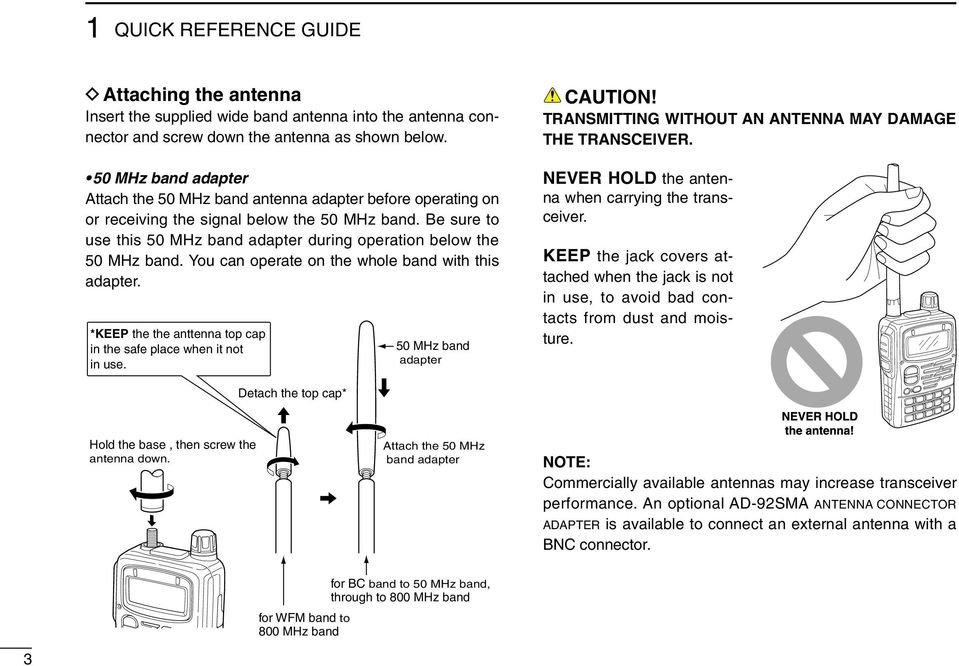
8 1 QUICK REFERENCE GUIDE D Attaching the antenna Insert the supplied wide band antenna into the antenna connector and screw down the antenna as shown below. 50 MHz band adapter Attach the 50 MHz band antenna adapter before operating on or receiving the signal below the 50 MHz band. Be sure to use this 50 MHz band adapter during operation below the 50 MHz band. You can operate on the whole band with this adapter. *KEEP the the anttenna top cap in the safe place when it not in use. 50 MHz band adapter CAUTION! TRANSMITTING WITHOUT AN ANTENNA MAY DAMAGE THE TRANSCEIVER. NEVER HOLD the antenna when carrying the transceiver. KEEP the jack covers attached when the jack is not in use, to avoid bad contacts from dust and moisture. Detach the top cap* Hold the base, then screw the antenna down. Attach the 50 MHz band adapter NOTE: Commercially available antennas may increase transceiver performance. An optional AD-92SMA ANTENNA CONNECTOR ADAPTER is available to connect an external antenna with a BNC connector. 3 for BC band to 50 MHz band, through to 800 MHz band for W band to 800 MHz band
9 Charging the Li-Ion battery pack D Charging with the wall charger IC-T90A with BP-217 to DC power jack BC-110AR/D/DR to AC outlet q Push and hold [PWR] to turn the transceiver power OFF. w Insert the charger plug into the DC power jack of the transceiver. e Plug the charger into an AC wall outlet. r Charging starts and the battery indicator on the display blinks. t It takes approximately 15 hours to charge an empty BP-217 Li-Ion battery pack. y Unplug the charger from the AC wall outlet when charging is completed. QUICK REFERENCE GUIDE D Charging with the CP-19 Cigarette Lighter cable (optional) to DC power jack CP-19 (optional) to a 12 V cigarette lighter socket q Insert the cigarette lighter adapter cable into the DC power jack of the transceiver. w Connect the CP-19 cigarette lighter adapter cable to the cigarette lighter socket. e Charging starts and the battery indicator on the display blinks. NOTE: The BP-217 can be charged while you are operating the transceiver. (p. 5). Charging will be suspended during transmitting of the transceiver. CHG_F appears when the charging is completed with the power turned OFF. NEVER connect the cigarette lighter socket or external regulated DC power supply directly to the transceiver. Such a connection will damage the transceiver. Remove CP-19 from the transceiver when not using it. Otherwise, the vehicle battery will become exhausted. 1 q QUICK REFERENCE GUIDE 4

10 1 QUICK REFERENCE GUIDE Rapid charging The optional BC-139 provides rapid charging of the battery pack. CAUTION: To avoid damage to the transceiver, turn the transceiver OFF while charging. External power operation An optional CP-19 cigarette lighter cable can be used for external power operation from a 12 V DC cigarette lighter socket. Charging period: 2.5 hours (w/bp-217) BP-217 Li-Ion battery pack to DC power jack CP-19 (optional) to a 12 V cigarette lighter socket 5 to AC outlet BC-123 (supplied with BC-139) Turn power OFF. A to [AC ADAPTER] jack BC-139 (optional) desktop charger Check the orientation. Adapter (supplied with BC-139) Charging terminal LED Charging: Orange Finished: Green Power supply range is between V DC. NEVER CONNECT OVER 11.5 V DC directly into the DC power jack of the transceiver. BE SURE to use the CP-19 when connecting a regulated 12 V DC power supply. If a battery pack is attached, the voltage of the external power supply must be within V DC, otherwise, the battery power may be used for operation. The maximum output power is 5.0 W regardless of the power supply voltage. Remove the cables from the transceiver when not using it. Otherwise, the vehicle battery will become exhausted.

11 Your first contact Now that you have your IC-T90A ready to operate, you are probably excited to get on the air. We would like to take you through a few basic operation steps to make your first On The Air an enjoyable experience. [PTT] yu [UP/DOWN] e [BAND] w [PWR] q r[dial] [Mic] QUICK REFERENCE GUIDE DFirst contact q Push and hold [PWR] for 1 sec. to turn the transceiver power ON. The function display shows ICOM, current voltage then the operating frequency. w Push [BAND] several times until the desired operating band (VHF; , or UHF; as default) appears on the display. e Push [Y](or [Z]) several times to adjust to the desired audio level. r Rotate [DIAL] to select the receive frequency. [EXAMPLE] Setting the receive frequency to MHz DUP T PSKIP Direct frequency input via the keypad also available. (p. 19) t Hold the transceiver approximately 2 in. (5 cm) from your mouth. y Push and hold [PTT], then speak at your normal voice level. u Release [PTT] switch to receive. Repeat steps, t, y and u to continue communication. 1 q QUICK REFERENCE GUIDE 6
![[PTT] yu [UP/DOWN] e [BAND] w [PWR] q r[dial] [Mic] QUICK REFERENCE GUIDE DFirst contact q Push and hold [PWR] for 1 sec. to turn the transceiver power ON.](/docs-images/50/15274646/images/page_11.jpg "The function display shows ICOM, current voltage then the operating frequency. w Push [BAND] several times until the desired operating band (VHF; 51.000, 146.010 or UHF; 440.")
12 2 PANEL DESCRIPTION Panel description q POWER SWITCH [PWR] Push for 1 sec. to turn the transceiver power ON and OFF. u y t r e w q i o Function display!0 Microphone Speaker!1!2!3!4!5 w BAND SWITCH [BAND] Push to select the operating band (5 MHz, Air, VHF, UHF, etc.). (p. 21) Push to select the memory bank or push to proceed the memory name cursor while programming the memory option. (pgs. 39, 41) Push for 1 sec. for morse code synthesizer announcement. (p. 75) While pushing [PTT], this key sends a DTMF D. e UP/DOWN SWITCHES [Y]/[Z] Push to adjust the audio level by default. (p. 17) Push to adjust the frequency when [Y]/[Z] and [DIAL] are exchanged by pushing [1 V D] for 1 sec. (p. 23) r MONITOR SWITCH [SQL] (p. 22) Push and hold to temporarily open the squelch and monitor the operating frequency. While pushing, rotate the tuning dial to set the squelch threshold level. t TRANSMIT/RECEIVE INDICATOR Lights green while receiving a signal or when the squelch is open; lights red while transmitting. Blinks green for 5 sec. when the scan stop LED function is in use and a scan is stopped. (pgs. 46, 62) 7
![21) Push to select the memory bank or push to proceed the memory name cursor while programming the memory option. (pgs. 39, 41) Push for 1 sec. for morse code synthesizer announcement. (p. 75) While pushing [PTT], this key sends a DTMF D.](/docs-images/50/15274646/images/page_12.jpg "e UP/DOWN SWITCHES [Y]/[Z] Push to adjust the audio level by default. (p. 17) Push to adjust the frequency when [Y]/[Z] and [DIAL] are exchanged by pushing [1 V D] for 1 sec. (p. 23) r MONITOR SWITCH [SQL] (p.")
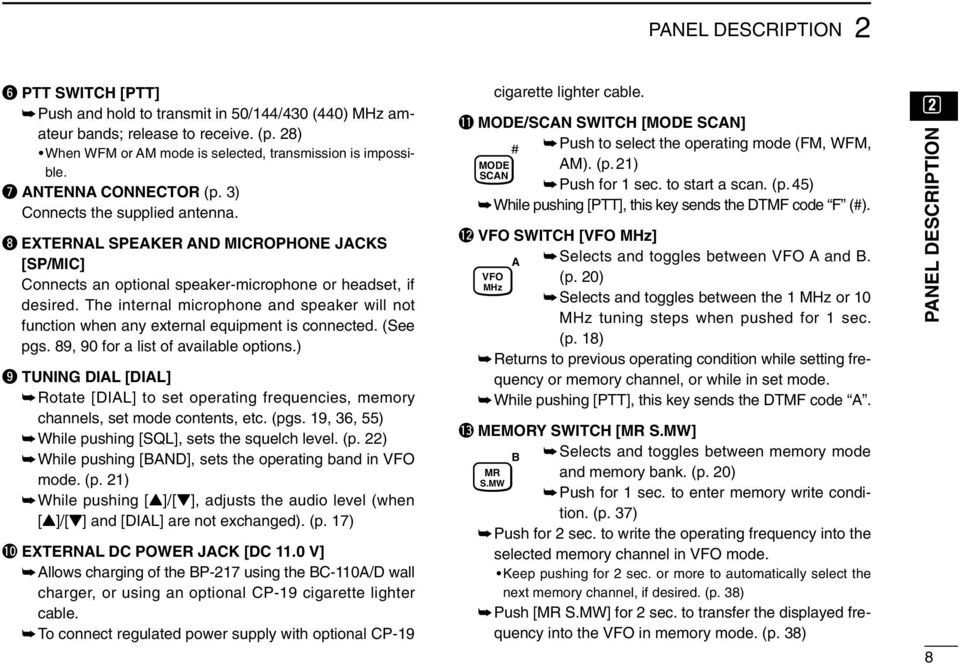
13 PANEL DESCRIPTION 2 y PTT SWITCH [PTT] Push and hold to transmit in 50/144/430 (440) MHz amateur bands; release to receive. (p. 28) When W or AM mode is selected, transmission is impossible. u ANTENNA CONNECTOR (p. 3) Connects the supplied antenna. i EXTERNAL SPEAKER AND MICROPHONE JACKS [SP/MIC] Connects an optional speaker-microphone or headset, if desired. The internal microphone and speaker will not function when any external equipment is connected. (See pgs. 89, 90 for a list of available options.) o TUNING DIAL [DIAL] Rotate [DIAL] to set operating frequencies, memory channels, set mode contents, etc. (pgs. 19, 36, 55) While pushing [SQL], sets the squelch level. (p. 22) While pushing [BAND], sets the operating band in VFO mode. (p. 21) While pushing [Y]/[Z], adjusts the audio level (when [Y]/[Z] and [DIAL] are not exchanged). (p. 17)!0 EXTERNAL DC POWER JACK [DC 11.0 V] Allows charging of the BP-217 using the BC-110A/D wall charger, or using an optional CP-19 cigarette lighter cable. To connect regulated power supply with optional CP-19 cigarette lighter cable.!1 MODE/SCAN SWITCH [MODE SCAN] Push to select the operating mode (, W, MODE AM). (p. 21) SCAN Push for 1 sec. to start a scan. (p. 45) While pushing [PTT], this key sends the DTMF code F (#).!2 VFO SWITCH [VFO MHz] VFO MHz A Selects and toggles between VFO A and B. (p. 20) Selects and toggles between the 1 MHz or 10 MHz tuning steps when pushed for 1 sec. (p. 18) Returns to previous operating condition while setting frequency or memory channel, or while in set mode. While pushing [PTT], this key sends the DTMF code A.!3 MEMORY SWITCH [MR S.MW] B MR S.MW Selects and toggles between memory mode and memory bank. (p. 20) Push for 1 sec. to enter memory write condition. (p. 37) Push for 2 sec. to write the operating frequency into the selected memory channel in VFO mode. Keep pushing for 2 sec. or more to automatically select the next memory channel, if desired. (p. 38) Push [MR S.MW] for 2 sec. to transfer the displayed frequency into the VFO in memory mode. (p. 38) w PANEL DESCRIPTION 8
14 2 PANEL DESCRIPTION 9 While pushing [PTT], this key sends a DTMF B.!4 CALL/LOCK SWITCH [CALL/TV LOCK] C CALL/TV LOCK Toggles between call channel, TV channel, weather channel (U.S.A. version only) and VFO mode in sequence. (p. 20) Push for 1 sec. to toggle the lock function ON and OFF. (p. 74) é appears while the key lock function is in use. While pushing [PTT], this key sends the DTMF code C.!5 DTMF MEMORY SWITCH [ DTMF.M]. DTMF.M Push for 1 sec. to enter the DTMF memory channel. (p. 67) Inputs MHz digit for frequency input. (p. 19) While pushing [PTT], this key sends the DTMF code E (M).!6 VOLUME/DIAL SWITCH [1 V D] 1 V D Push for 1 sec. to exchange [Y]/[Z] and [DIAL] functions. (p. 23) VOL appears when the tuning dial functions as a volume control. Inputs digit 1 for frequency input, memory channel selection, etc. While pushing [PTT], this key sends the DTMF code 1.!7 TONE SWITCH [2 TONE] (p. 70) Push for 1 sec. to activate the following tone functions in order. Subaudible tone encoder T appears. (p. 29) Tone squelch T SQL appears. (p. 71) Pocket beep T SQLS appears. (p. 71) DTCS squelch DTCS appears. (p. 71) DTCS beep SDTCS appears. (p. 71) No tone operation no tone indicator appears. 2 TONE Inputs digit 2 for frequency input, memory channel selection, etc. While pushing [PTT], this key sends the DTMF code 2.!8 OUTPUT POWER SWITCH [3 H/L] (p. 28) 3 H/L Push for 1 sec. to toggle output power between high and low. LOW appears when low output power is selected. Inputs digit 3 for frequency input, memory channel selection, etc. While pushing [PTT], this key sends the DTMF code 3.!9 DUPLEX SWITCH [4 DUP] (pgs. 29, 31) 4 DUP Push for 1 sec. to activate the following duplex functions in order. Minus duplex operation DUP appears. Plus duplex operation DUP appears. Simplex operation no duplex indicator appears. Inputs digit 4 for frequency input, memory channel selection, etc. While pushing [PTT], this key sends the DTMF code 4.
![!5 DTMF MEMORY SWITCH [ DTMF.M]. DTMF.M Push for 1 sec. to enter the DTMF memory channel. (p. 67) Inputs MHz digit for frequency input. (p. 19) While pushing [PTT], this key sends the DTMF code E (M).](/docs-images/50/15274646/images/page_14.jpg "!6 VOLUME/DIAL SWITCH [1 V D] 1 V D Push for 1 sec. to exchange [Y]/[Z] and [DIAL] functions. (p. 23) VOL appears when the tuning dial functions as a volume control.")
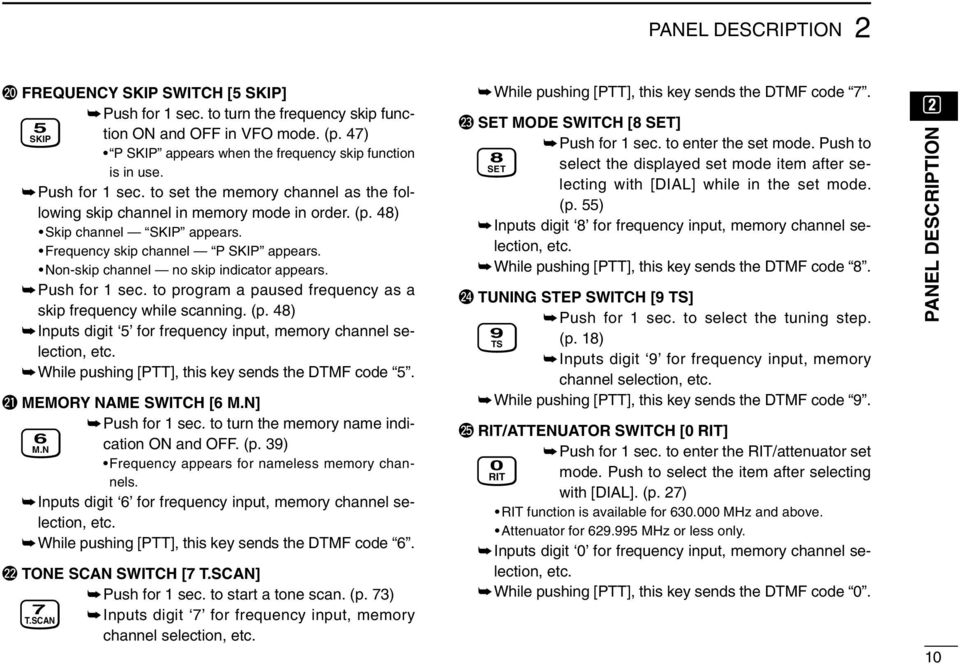
15 PANEL DESCRIPTION FREQUENCY SKIP SWITCH [5 SKIP] 5 SKIP Push for 1 sec. to turn the frequency skip function ON and OFF in VFO mode. (p. 47) appears when the frequency skip function is in use. Push for 1 sec. to set the memory channel as the following skip channel in memory mode in order. (p. 48) Skip channel SKIP appears. Frequency skip channel appears. Non-skip channel no skip indicator appears. Push for 1 sec. to program a paused frequency as a skip frequency while scanning. (p. 48) Inputs digit 5 for frequency input, memory channel selection, etc. While pushing [PTT], this key sends the DTMF code MEMORY NAME SWITCH [6 M.N] 6 M.N Push for 1 sec. to turn the memory name indication ON and OFF. (p. 39) Frequency appears for nameless memory channels. Inputs digit 6 for frequency input, memory channel selection, etc. While pushing [PTT], this key sends the DTMF code TONE SCAN SWITCH [7 T.SCAN] 7 T.SCAN Push for 1 sec. to start a tone scan. (p. 73) Inputs digit 7 for frequency input, memory channel selection, etc. While pushing [PTT], this key sends the DTMF code SET MODE SWITCH [8 SET] 8 SET Push for 1 sec. to enter the set mode. Push to select the displayed set mode item after selecting with [DIAL] while in the set mode. (p. 55) Inputs digit 8 for frequency input, memory channel selection, etc. While pushing [PTT], this key sends the DTMF code TUNING STEP SWITCH [9 TS] Push for 1 sec. to select the tuning step. 9 TS (p. 18) Inputs digit 9 for frequency input, memory channel selection, etc. While pushing [PTT], this key sends the DTMF code RIT/ATTENUATOR SWITCH [0 RIT] Push for 1 sec. to enter the RIT/attenuator set 0 RIT mode. Push to select the item after selecting with [DIAL]. (p. 27) RIT function is available for MHz and above. Attenuator for MHz or less only. Inputs digit 0 for frequency input, memory channel selection, etc. While pushing [PTT], this key sends the DTMF code 0. w PANEL DESCRIPTION 10
16 2 PANEL DESCRIPTION Function display w e r t y u q i o!0!5!4!3!2!1 11 q FREQUENCY READOUT Shows the operating frequency, set mode contents, etc. The smaller 75, 50 and 25 to the right of the readout indicate 0.75, 0.5 and 0.25 khz, respectively. The decimal point of the frequency blinks during scan. w LOCK INDICATOR (p. 74) Indicates that the lock function is in use. e RECEIVE MODE INDICATORS (p. 21) Shows the receive mode. AM, and W are available. r DUPLEX INDICATORS (pgs. 29, 31) Appears when semi-duplex operation (repeater operation) is in use. DUP appears when minus duplex is selected; DUP only, appears when plus duplex is selected.

17 PANEL DESCRIPTION 2 t TONE INDICATORS (p. 70) Appears when the following tone functions are activated. Subaudible tone encoder T appears. (p. 29) Tone squelch T SQL appears. (p. 71) Pocket beep T SQLS appears. (p. 71) DTCS squelch DTCS appears. (p. 71) DTCS beep SDTCS appears. (p. 71) S blinks when the correct tone or code is received during pocket/dtcs beep operation. (p. 71) y RIT INDICATOR (p. 27) Appears when the RIT (Receive Incremental Tuning) function for MHz and above is in use. u SKIP SCAN INDICATOR (p. 47) SKIP appears when a selected memory channel is set as a skip channel. appears when the memory channel frequency is set as a skip frequency in memory mode. appears when the frequency skip function is turned ON in VFO mode. i PRIORITY WATCH INDICATOR (p. 50) Appears when priority watch is in use. o MEMORY MODE INDICATOR (p. 20) Appears when a memory channel is selected.!0 MEMORY CHANNEL NUMBER READOUT (p. 20) Shows the memory or call channel number, etc.!1 S/RF INDICATORS (p. 28) Shows the relative signal strength while receiving. Shows the relative output power while transmitting.!2 LOW POWER INDICATOR (p. 28) Appears when low output power is selected.!3 VOLUME EXCHANGE INDICATOR (p. 23) Appears when the functions of tuning dial and [Y]/[Z] switches are exchanged.!4 BATTERY INDICATORS Both segments appear when the batteries have ample capacity. They do not appear when operating with an external power source. Only the right segment appears when the batteries are nearing exhaustion. Blinks while charging the attached Li-Ion battery pack.!5 ATTENUATOR INDICATOR (p. 27) Appears when the attenuator is in use. w PANEL DESCRIPTION 12
18 3 BATTERY CHARGING Battery attachment q Attach the Li-Ion battery pack (BP-217) or battery case (BP-216). Be sure to observe the correct direction. Charge Li-Ion battery pack before use. w Lock the latch. D Operating periods The operating periods with BP-217 are: 50 MHz Approx. 6 hr. 144 MHz Approx. 5 hr. 440 MHz Approx. 5 hr. at high power, Tx : Rx : Standby = 1:1:8 q Latch Battery pack or battery case w Battery cautions NEVER incinerate used battery packs. Internal battery gas may cause an explosion. NEVER immerse the battery pack in water. If the battery pack becomes wet, be sure to wipe it dry BEFORE attaching it to the transceiver. NEVER short terminals of the battery pack. Also, current may flow into nearby metal objects so be careful when placing battery packs in handbags, etc. If your battery pack seems to have no capacity even after being charged, completely discharge it by leaving the power ON overnight. Then, fully charge the battery pack again. If the battery pack still does not retain a charge (or very little), a new battery pack must be purchased. Use Icom battery packs, chargers and cables only. The use of non-icom products may impair transceiver performance and invalidate the warranty. Even when the transceiver power is OFF, a slight current still flows in the circuits. Remove the battery pack or case from the transceiver when not using it for a long time. Otherwise, the battery pack or installed batteries will become exhausted. 13

19 BATTERY CHARGING 3 Regular charging Prior to using the transceiver for the first time, the battery pack must be fully charged for optimum life and operation. CAUTION: To avoid damage to the transceiver, turn the transceiver OFF while charging. Recommended temperature range for charging: +32 F to +95 F; 0 C to +35 C Use the wall charger* (BC-110AR/D/DR) only. NEVER use another manufactures charger. * Not supplied with some versions. An optional cable CP-19 (for 12 V cigarette lighter socket) can be used instead of the AC adapters of the above chargers. q Attach the battery pack to the transceiver. w Be sure to turn the transceiver power OFF. e Connect the AC adapter* (BC-110AR/D/DR) as shown below. * Not supplied with some versions. r Remove any cables from the [DC11V] jack. Charging period: 15 hours (w/bp-217) IC-T90A with BP-217 BC-110AR/D/DR to AC outlet e BATTERY CHARGING D Battery indicators The battery indicators blink while charging but do not indicate the power condition. CHG_F appears when the charging is completed. Disconnect the wall charger in this case. to DC power jack CP-19 (optional) to a 12 V cigarette lighter socket 14

20 3 BATTERY CHARGING Rapid charging The optional BC-139 provides rapid charging of the battery pack. Charging period: 2.5 hours (w/bp-217) CAUTION: To avoid damage to the transceiver, turn it OFF while charging. Recommended temperature range for charging: +32 F to +95 F; 0 C to +35 C NEVER connect 2 chargers to the [AC ADAPTER] and [DC13.5V] jacks of the BC-139. Use the supplied BC-123 for the BC-139 desktop charger. Connect BC-123 to the [AC ADAPTER] jack. NEVER use another manufactures charger. An optional cable CP-19 (for 12 V cigarette lighter socket) can be used instead of the supplied AC adapter. Connect one of these to the [DC11V] jack in this case. to AC outlet BC-123 (supplied with BC-139) Turn power OFF. A to [AC ADAPTER] jack BP-217 Li-Ion battery pack BC-139 (optional) desktop charger Check the orientation. Adapter (supplied with BC-139) Charging terminal LED Charging: Orange Finished: Green If the charge indicator blinks orange, there may be a problem with the battery pack (or charger). Re-insert the battery pack or contact your dealer. 15
![Recommended temperature range for charging: +32 F to +95 F; 0 C to +35 C NEVER connect 2 chargers to the [AC ADAPTER] and [DC13.5V] jacks of the BC-139.](/docs-images/50/15274646/images/page_20.jpg "Use the supplied BC-123 for the BC-139 desktop charger. Connect BC-123 to the [AC ADAPTER] jack. NEVER use another manufactures charger.")
21 BATTERY CHARGING 3 Battery case (Option) q Install 2 R6 (AA) size alkaline batteries into the optional BP-216 BATTERY CASE. Be sure to observe the correct polarity. w Install the battery case as shown at right. A build in step-up convertor in the BP-216 increases the voltage up to 5 V DC. Keep battery contacts clean. It s a good idea to clean battery terminals once a week. Voltage indication External power operation An optional cable CP-19 (for 12 V cigarette lighter socket) can be used for external power operation.. Power supply range is between V DC. NEVER CONNECT OVER 11.5 V DC directly into the DC power jack of the transceiver. BE SURE to use CP-19 when connecting regulated 12 V DC power supply. If a battery pack is attached, the voltage of the external power must be within V DC, otherwise, the battery power may be used for operation. The maximum output power is 5.0 W regardless of the power supply voltage. Remove the cables from the transceiver when not using it. Otherwise, the vehicle battery will become exhausted. e BATTERY CHARGING D Battery information The batteries may seem to have low capacity when used in low temperatures such as +14 F ( 10 C) or below. Please keep the battery case or pack warm in this case. D Battery replacement When the batteries become exhausted, the function display may blink or have a lower contrast. In these cases, replace all batteries with new, same brand, alkaline batteries. to DC power jack CP-19 (optional) to a 12 V cigarette lighter socket 16
22 4 BASIC OPERATION Turning power ON D Turning power ON q Make sure alkaline batteries are installed in the battery case or the battery pack is charged, and attach them. (p. 13) w Push [PWR] for 1 sec. to turn the power ON. The function display shows ICOM, current voltage then the operating frequency. Repeat this step to turn power OFF. The opening message can be turned ON or OFF in the expanded set mode 1. (p. 64) D Setting volume level The audio level can be adjusted through 32 levels. Push [Y] or [Z] to set the desired audio level. Rotating the tuning dial while pushing [Y] or [Z] also sets the audio level. [Y]/[Z] and [DIAL] can be exchanged by [1 V D]. (p. 23) [ ] [ ] Shows volume level. Opening message ICOM 17 [PWR] Voltage indication Frequency indication D Volume level indication The frequency display shows the volume level during setting as shown below. Indication Audio level 0 (no sound) (default) (Maximum)
23 BASIC OPERATION 4 Tuning step When using the tuning dial to change the frequency, or when a scan function is activated, the frequency changes in increments determined by the set tuning step. Tuning steps can be selected for each band. This transceiver has 13 tuning steps as follows: 5 khz 6.25 khz 8.33 khz 9 khz 10 khz 12.5 khz 15 khz 20 khz 25 khz 30 khz 50 khz 100 khz 200 khz D Setting the tuning step q Push [9 TS] for 1 sec. to enter tuning step set mode. TS appears. w Rotate [DIAL] to select the desired tuning step. Rotating the tuning dial while pushing [9 TS] also selects the tuning step. Tuning step can be set in VFO and memory modes. e Push [9 TS] or [VFO] to exit. 5 khz tuning step DMHz tuning step This is useful to change the frequency rapidly. q Select VFO mode with [VFO]. w Push [VFO MHz] for 1 sec. to select 1 MHz tuning step. e Push [VFO MHz] for 1 sec. again to select 10 MHz tuning step, if required. r Rotate [DIAL] to select the desired MHz frequency. t Push [VFO] to exit MHz tuning step. 1 MHz tuning step r BASIC OPERATION [DIAL] 20 khz tuning step 10 MHz tuning step [VFO MHz] [9 TS] 18
24 4 BASIC OPERATION Setting a frequency Push numeral keys and [ ] to input the desired frequency. Frequency can be set irrelevant of the selected band. When inputting a frequency outside of the frequency range, the previously selected frequency is automatically selected after inputting 1 khz digit. D Setting the frequency with keypad q Select VFO mode with [VFO]. w Push the desired numeral buttons until inputting 1 khz digit to set the frequency. When you want to change the 100 khz digit and below, push [ ] first, then the numeral buttons. Acceptable digits for the 1 khz digit depend on the 10 khz digit. Setting to MHz Setting to MHz Changing 100 khz and 0 4 below. RIT DUP Setting MHz to MHz.. DTMF.M 3 H/L 6 M.N 3 H/L. DTMF.M [VFO] 8 SET. DTMF.M 2 TONE 4 DUP 5 SKIP 4 DUP 1 V D 2 TONE 3 H/L 4 DUP 5 SKIP 6 M.N 0 RIT 8 SET 0 RIT 7 T.SCAN 8 SET 9 TS. DTMF.M 0 RIT 19
25 BASIC OPERATION 4 Mode selection D VFO mode VFO mode is used for setting a desired frequency within the band range. Push [VFO] to select VFO mode. Pushing [VFO] in VFO mode toggles VFO A and B. What is VFO? VFO is an abbreviation of Variable Frequency Oscillator. Frequencies for transmitting and receiving are generated and controlled by the VFO. D Memory mode Memory mode is used for operation of memory channels which have programmed frequencies. Push [MR] to select memory mode. Pushing [MR] in memory mode toggles memory channel and memory bank indications. To program a memory Ch, refer to p. 37. D Call/TV/weather channels Call channels are used for most-oftenused frequencies for quick recall. TV and weather (U.S.A. version only) channels can be selected with [CALL/TV]. Push [CALL/TV] to select a call, TV and weather channel in sequence. [CALL/TV] r BASIC OPERATION [VFO] [MR] Call channel Memory channel VFO A TV channel W Memory bank VFO B Weather channel (U.S.A. only) A00 Y99 appear when a memory bank is programmed. 20
26 4 BASIC OPERATION Operating band and receive mode selection D Selecting the operating band The transceiver can receive the BC (broadcast) bands, 5 MHz band, 50 MHz band, broadcast band, Air band, VHF (144 MHz) band, 220 MHz band, 300 MHz band, UHF (430MHz) band or 800 MHz band. * Frequency coverage depends on versions. q Select VFO mode with [VFO]. w Push [BAND] several times to select the desired band. Rotating the tuning dial while pushing [BAND] also selects the operating band. [BAND] [VFO] BC (broadcast) bands 5MHz band 50MHz band W bands AM AM SKIP P SKIP P W D Selecting the receive mode Receive modes are determined by the physical properties of the radio signals. The transceiver has 3 receive modes:, AM and W modes. Typically, AM mode is used for the avionics band ( MHz) and W is used for broadcast stations ( MHz). When pushing [PTT], a beep tone sounds indicating the mode is not mode. The transceiver cannot transmit in AM or W mode. mode MHz MHz MHz* MHz* 800MHz band MHz UHF (430 MHz) band BAND 300MHz band Push [BAND] several times to select the desired band. 220MHz band SKIP P Air bands AM MHz VHF (144 MHz) band SKIP P W mode W AM mode AM MODE SCAN MODE SCAN MODE Push SCAN to toggle the operating mode MHz MHz MHz MHz
27 BASIC OPERATION 4 Setting the squelch level The squelch circuit mutes the received audio signal depending on the signal strength. The transceiver has 9 squelch levels, a continuously open setting and an automatic squelch setting. D Setting the squelch level q While pushing and holding [SQL], rotate [DIAL] one-click to display the current squelch level. w Rotate [DIAL] successively to adjust the squelch level. LEVEL1 is loose squelch and LEVEL9 is tight squelch. AUTO indicates automatic level adjustment with a noise pulse count system. e Release [SQL] to return to the previous indication. [Squelch level indication] Indication Squelch level Open Automatic (default) Level 1 (loose) Level 2 Level 3 Level 4 Level 5 D Monitor function This function is used to listen to weak signals or to open the tone squelch manually. Push and hold [SQL] to monitor the operating frequency. [SQL] r BASIC OPERATION Level 6 [DIAL] Level 7 Level 8 Level 9 (tight) Blinks while monitoring. [SQL] The [SQL] switch can be set as a monitor ON/OFF switch in set mode. (p. 60) 22
28 4 BASIC OPERATION Receiving D Setting volume level Push [Y] or [Z] to set the desired audio level. Rotating the tuning dial while pushing [Y] or [Z] also sets the audio level. D Setting squelch level q While pushing [SQL], rotate [DIAL] to select the squelch level. LEVEL1 is loose squelch and LEVEL9 is tight squelch. w Release [SQL] to return to the previous indication. D Exchange [DIAL] and [Y]/[Z] functions The functions of tuning dial and [Y]/[Z] switches can be exchanged, if desired. Push [1 V D] for 1 sec. to exchange the functions of the tuning dial and [Y]/[Z] switches. VOL appears when the functions are exchanged. [DIAL] [DIAL] [ ] [ ] [1 V D] VOL Appears when the functions are exchanged. [SQL] [ ] [ ] [DIAL] [Y]/[Z] Default setting Frequency setting Memory channel setting Scan direction setting Set mode setting Volume setting Exchanged setting Volume setting Frequency setting Memory channel setting Scan direction setting Set mode setting 23
29 BASIC OPERATION 4 D Receiving broadcast [EXAMPLE]: Receiving MHz. q Select VFO mode with [VFO]. w For direct frequency input, push [8], [8], [ ], [2], [0], [0]. Skip e and t in this case. e Push [BAND] several times to select the broadcast band. Default frequency ( broadcast band): or MHz r Push [MODE] several times to select W mode if required. t Rotate [DIAL] to set MHz. y When a signal is received: The TX/RX indicator lights green. Squelch opens and audio is emitted from the speaker. The S/RF indicator shows the relative signal strength. D Receiving amateur bands [EXAMPLE]: Receiving MHz. q Select VFO mode with [VFO]. w For direct frequency input, push [1], [4], [5], [ ], [6], [0], [0]. Skip e and t in this case. e Push [BAND] several times to select the 144 MHz band. Default frequency (144 MHz band): MHz r Push [MODE] several times to select mode if required. t Rotate [DIAL] to set MHz. y When a signal is received: The TX/RX indicator lights green. Squelch opens and audio is emitted from the speaker. The S/RF indicator shows the relative signal strength. [DIAL] r BASIC OPERATION [DIAL] W [BAND] [VFO] S meter [BAND] [VFO] [MODE] S meter [MODE] 24
30 4 BASIC OPERATION D Receiving TV channels Available TV channels depends on the version. Refer to the TV frequency table (p. 83) for details. Some channels are set as skip channels. Refer to the skip channel setting (p. 26) for details. TV channel frequency and skip setting can be re-programmed via the CS-T90A cloning software, ask your dealer for details. [DIAL] q Select TV mode with [CALL/TV]. Pushing [CALL/TV] toggles a call, TV and weather channel (p. 77; U.S.A. version only) in sequence. w Rotate [DIAL] to select the desired TV channel. Rotate [DIAL] while pushing [BAND] to select all TV channels. e When a signal is received: The TX/RX indicator lights green. Squelch opens and audio is emitted from the speaker. The S/RF indicator shows the relative signal strength. Pushing [CALL/TV] selects the call channel and does not return to the previous TV channel even if the previous mode (VFO or memory) is selected from TV channel. W TV channel indication [BAND] [CALL/TV] TV mode indication 25
31 BASIC OPERATION 4 D TV skip scan The transceiver automatically programs the receivable TV channels as non-skip channels and others as skip channels. q Select TV mode with [CALL/TV]. Pushing [CALL/TV] selects a call, TV and weather channel (U.S.A. version only) in sequence. w Push [MODE SCAN] for 1 sec. to start TV skip scan. The transceiver automatically scans all TV channels. e When the scan is finished: The receivable TV channels have been programmed as nonskip channels and others as skip channels. Rotate [DIAL] to select the receivable TV channel. Rotate [DIAL] while pushing [BAND] to select all TV channels. [DIAL] DTV skip channel setting The skip channel setting can be set manually. q Select TV mode with [CALL/TV]. Pushing [CALL/TV] selects a call, TV and weather channel (U.S.A. version only) in sequence. w Rotate [DIAL] while pushing [BAND] to select the desired TV channel. e Push [5 SKIP] for 1 sec. to toggle the skip setting. SKIP appears when the channel is set as a skip channel. [DIAL] r BASIC OPERATION [BAND] [BAND] [5 SKIP] [MODE SCAN] [CALL/TV] W SKIP Skip indication W SKIP 26
32 4 BASIC OPERATION RIT function To compensate for the off frequency of a transmitting station, the transceiver has receive incremental tuning for receiving frequencies above MHz. The RIT function cannot be used in TV mode and is automatically cancelled below MHz. The receive incremental tuning (RIT) shifts only the receive frequency within approx. ±5 khz. q Set an operating frequency above MHz. w Push [0 RIT] for 1 sec. to select the RIT set mode item. If ATT appears, rotate [DIAL] to select RIT. e Push [0 RIT] again to select the RIT set mode. RIT set mode RIT function OFF Attenuator function The attenuator prevents a desired signal from distorting when very strong signals are near the desired frequency or when very strong electric fields, such as from a broadcasting station, are near your location. The attenuation level is approx. 10 db. q Push [0 RIT] for 1 sec. to select the ATT set mode item. RIT or ATT appears. If RIT appears, rotate [DIAL] to select ATT. When the operating frequency is MHz or below, ATT set mode is automatically selected. w Push [0 RIT] again to select the ATT set mode. RIT/ATT selection menu Attenuator set mode r Rotate [DIAL] to adjust the shift frequency. 5 to +5 appears while setting the shift frequency. t Push [VFO] to exit the RIT set mode. RIT frequency adjustment RIT function example R If the operating frequency is MHz or below, this menu does not appear. e Push [VFO] to exit the ATT set mode. Attenuator is in use ATT 27 Approx. +3 khz shift RIT indication ATT appears
33 BASIC OPERATION 4 Transmitting D Amateur band operation CAUTION: Transmitting without an antenna may damage the transceiver. Make sure a charged battery pack or alkaline batteries are installed. (p. 1) [PTT] Lights red while transmitting [DIAL] Microphone [BAND] [3 H/L] D Operating band and frequency setting q Select VFO mode with [VFO]. w Push [BAND] several times to select the desired amateur band. Rotating the tuning dial while pushing [BAND] also selects the operating band. e Set an operating frequency with the tuning dial. (p. 19) To input the frequency directly, push [4], [3], [5], [ ], [6], [8] and [0] for the example below. w Push and hold [PTT] to transmit, then speak into the microphone. TX/RX indicator lights red. The S/RF indicator shows the output power selection. Approx. output power: 4.5 W/0.5 W with 11 V DC (w/cp-19) 5.0 W/0.5 W with BP W with BP-216 (fixed to low power) The output power is fixed to low while operating with battery case. e Release [PTT] to receive. When LOW power is selected. r BASIC OPERATION LOW IMPORTANT: To maximize the readability of your transmitted signal, pause a few sec. after pushing [PTT], hold the microphone 1 to 2 inches (2.5 to 5 cm) from your mouth and speak at a normal voice level. The protect circuit interrupts the output power when more than 11.5 V DC is connected. D Selecting output power and transmitting q Push [3 H/L] for 1 sec. to select the output power. Rotating the tuning dial while pushing [3 H/L] also toggles the output power. LOW appears when low output power is selected. If LOW does not appear, high output power is selected. When HIGH power is selected. D narrow mode (transmit only) The transceiver has narrow deviation (±2.5 khz) mode. Set narrow mode in expanded set mode 2, if desired. (p. 66) 28
34 4 BASIC OPERATION Repeater operation When using a repeater, the transmit frequency is shifted from the receive frequency by the offset frequency. (p. 31) It is convenient to program repeater information into memory channels. (p. 37) Station A Repeater MHz MHz MHz MHz Uplink (transmitting freq.) Downlink (receiving freq.) Station B r Push and hold [PTT] to transmit. The displayed frequency automatically changes to the transmit frequency (repeater input frequency). If OFF appears, check the [PTT] offset frequency or shift direction. (p. 31) Lights red while transmitting. 29 q Set the receive frequency (repeater output frequency). w Set the shift direction of the transmit frequency. ( DUP or DUP; see p. 31 for details.) When the auto repeater function is in use (U.S.A. and Korea versions only), this selection and step e are not necessary. (p. 33) DUP appears. DUP T PSKIP e Push [2 TONE] for 1 sec. to activate the subaudible tone encoder, according to repeater requirements. T appears. Refer to p. 70 for tone frequency settings. While receiving DUP T PSKIP While transmitting DUP T PSKIP t Release [PTT] to receive. y Push and hold [SQL] to check whether the other station s transmit signal can be directly received or not. U.S.A. and Korea versions: Auto repeater function uses the settings of the repeater tone frequency and offset frequency.
35 BASIC OPERATION 4 D Checking the repeater input signal The transceiver can check whether the other station s transmit signal can be received directly or not. Push and hold [SQL] to check whether the other station s transmit signal can be directly received or not. When the other station s signal can be directly received, move to a non-repeater frequency with simplex. (duplex OFF) Indication while receiving DUP T PSKIP D Off band indication If the transmit frequency is out of the amateur band, the off band indication OFF appears on the display when [PTT] is pushed. Check the offset frequency or duplex direction in this case. (p. 31) U.S.A. and Korea versions: Auto repeater function uses the setting of the offset frequency. DUP T r BASIC OPERATION [SQL] SQL Receives 5 MHz shift frequency DUP T PSKIP CONVENIENT Tone scan function: When you don t know the subaudible tone used for a repeater, the tone scan is convenient for detecting the tone frequency. Push [7 T.SCAN] for 1 sec. to activate. See p. 73 for more information. 30
36 4 BASIC OPERATION Duplex operation D Setting offset frequency When communicating through a repeater, the transmit frequency is shifted from the receive frequency by an amount determined by the offset frequency. q Select VFO mode or desired memory channel to be programmed. w Push [8 SET] for 1 sec. to enter set mode. e Rotate [DIAL] until OFFSET appears. r Push [8 SET] again to select offset frequency. t Rotate [DIAL] to set the desired offset frequency. The tuning step becomes the selected tuning step. Push [VFO MHz] for 1 sec. to use the MHz tuning step, if desired. y Push [VFO] to exit set mode. No offset frequency 5.0 MHz offset D Setting duplex direction Push [4 DUP] for 1 sec. to select DUP or DUP. DUP or DUP indicates the transmit frequency for minus shift or plus shift, respectively. When offset frequency is 500 khz. [SQL] [4 DUP] [DIAL] [VFO MHz] [8 SET] Duplex example Receiving DUP T PSKIP Transmitting DUP T PSKIP +Duplex example Receiving DUP T PSKIP 20.0 MHz offset Transmitting DUP T PSKIP 31 U.S.A. and Korea versions: Auto repeater function uses the setting of the offset frequency. Take care the offset frequency. (p. 33) U.S.A. and Korea versions: Auto repeater function has priority over the manual duplex setting. If the frequency changes after setting, the auto repeater function may have changed the duplex setting.
37 BASIC OPERATION 4 Split operation Split frequency operation allows you to transmit and receive on two different frequencies in the same band. The split frequency operation is performed using 2 frequencies, one in VFO A and one in B. D Setting split frequency operation q Push [8 SET] for 1 sec. to enter set mode. w Rotate [DIAL] until EXP2 appears. e Push [8 SET] to select expanded set mode 2. r Rotate [DIAL] to turn the expanded set mode 2 ON. t Push [8 SET] to exit expanded set mode 2. y Rotate [DIAL] until SPLIT appears. u Push [8 SET] to select split function. i Rotate [DIAL] to select split function ON or OFF. D Split frequency operation example [EXAMPLE]: VFO A MHz VFO B MHz q Push [VFO] several times to select VFO A. Pushing [VFO] toggles VFO A and B. w Push [BAND] several times to select the 144 MHz band. e Push [MODE] several times to select mode. r Set the operating frequency to MHz with the tuning dial. t Push [VFO] to select VFO B. y Push [BAND] several times to select the 144 MHz band. u Push [MODE] several times to select mode. i Set the operating frequency to MHz. o Push [PTT] to start the split frequency operation. [DIAL] VFO A r BASIC OPERATION [PTT] o Push [VFO] to exit set mode. SPA or SPB appears and the split frequency operation is activated. [BAND] [VFO] [MODE] [8 SET] VFO B 32
38 4 BASIC OPERATION Auto repeater function (U.S.A. and Korea versions only) The U.S.A. and Korea versions automatically activate the repeater settings (duplex ON/OFF, duplex direction, tone encoder ON/OFF) when the operating frequency falls within or outside of the general repeater output frequency range. The offset and repeater tone frequencies are not changed by the auto repeater function, reset these frequencies, if necessary. D Frequency range and offset direction U.S.A. version FREQUENCY RANGE MHz MHz MHz MHz MHz SHIFT DIRECTION DUP appears DUP appears MHz DUP appears MHz DUP appears MHz DUP appears Korea version FREQUENCY RANGE q Select VFO mode with [VFO]. w Push [8 SET] for 1 sec. to enter set mode. e Rotate [DIAL] until AUTO RP appears. r Push [8 SET] to select auto repeater set mode. t Rotate [DIAL] to turn the auto repeater function ON (DUP ONLY or DUP TONE) or OFF. U.S.A. version: DUP ONLY Activates duplex only. DUP TONE Activates duplex and tone. OFF Auto repeater function is turned OFF. Korea version: ON Activates duplex and tone. OFF Auto repeater function is turned OFF. y Push [VFO] to exit set mode. Auto repeater function is turned OFF. DUP SHIFT DIRECTION MHz DUP appears Duplex and tone activated. DUP 33 Duplex activated only. Duplex and tone activated.
39 BASIC OPERATION Hz tone Some European repeaters require a 1750 Hz tone to be accessed. For such European repeaters, perform the following. This tone can be use as a Call signal in countries out of Europe. q Push [ DTMF.M] for 1 sec. to select DTMF memory. w Rotate [DIAL] counter-clockwise until T-CALL appears. u Push and hold [PTT] to transmit. i Release [PTT] to receive. o Push and hold [SQL] to check whether the other station s transmit signal can be received directly or not. r BASIC OPERATION e Push [VFO] to exit DTMF memory. r Set the receive frequency (repeater output frequency). t Set the shift direction of the transmit frequency. ( DUP or DUP; see p. 31 for details.) y While pushing [PTT], push [SQL] for 1 to 2 sec. to transmit a 1750 Hz tone burst signal. If OFF appears, check the offset frequency or shift direction. (p. 31) The displayed frequency automatically changes to the transmit frequency (repeater input frequency). 34
40 5 MEMORY/CALL CHANNELS General The transceiver has 500 memory channels, 50 scan edge channels and 5 call channels for storage of often-used frequencies. Memory channels can be named with 6 characters and assigned to 18 banks. D Memory/call channel contents The following information can be programmed into memory or call channels: Operating frequency (p. 19) Receive mode (p. 21) Tuning step (p. 18) Duplex direction (DUP or DUP) with an offset frequency (p. 31) Subaudible tone encoder, tone squelch or DTCS squelch ON/OFF (pgs. 29, 71) Subaudible tone and tone squelch frequencies (p. 70) DTCS code with code phase mode (pgs. 65, 70) Memory bank (p. 41) Memory name (p. 39) Scan skip setting (p. 48) D Default memory contents example CHANNEL (Memory channel; Mch) 0A/0B 24A/24B (Scan edge channel) C0 C4 (Call channel) DESCRIPTION Regular memory channel Default memory channel example Mch MHz Mch MHz Mch MHz *Mch are blank channels. Program scan edge channel 25 pairs (50 channels) Default scan edge example 0A: MHz 0B: MHz 1A: MHz 1B: MHz 2A: MHz 2B: MHz 3A: MHz 3B: MHz 1 1 *4A/4B 24A/24B are blank channels. Calling channel for amateur bands Can be used as regular memory channel Default call channel example C MHz C MHz C MHz *C3 and 4 are blank channels. 35
41 MEMORY/CALL CHANNELS 5 Calling up memory channels Memory channels can be selected with the [DIAL] and keypad. Blank channels cannot be selected via [DIAL]. Blank channels can be selected via keypad. Previously selected channels appear when the wrong memory channel number is entered. 1 V D 4 DUP 7 T.SCAN 2 TONE 5 SKIP 8 SET 3 H/L 6 M.N 9 TS 0 RIT [DIAL] [MR S.MW] keypad D Selecting with tuning dial q Push [MR] to select memory mode. w Rotate [DIAL] to select the desired memory channel. Memory mode indication Appears Memory channel number D Selecting with keypad q Push [MR] to select memory mode. w Push the desired numeral keys to select the desired memory channel. Selecting memory channel 001. Push [0], [0] and [1]. Selecting memory channel 056. Push [0], [5] and [6]. Selecting memory channel 499. Push [4], [9] and [9]. CONVENIENT The memory channels ( ) can be selected with 1 or 2 digits plus [MR]. Selecting memory channel 005. Push [5] and [MR]. Selecting memory channel 024. Push [2], [4] and [MR]. DCheck contents of all memory channels q Push [MR S.MW] for 1 sec. to enter memory write condition. Memory channel readout blinks. w Rotate [DIAL] to check the desired memory channel. Rotating [DIAL] while pushing [BAND] also selects all memory channels. t MEMORY/CALL CHANNELS 36
42 5 MEMORY/CALL CHANNELS Programming memory channels Program the desired frequency into a memory channel, call channel or scan edge channel as follows. The memory channels are shared with all bands. Memory channels are blank (non-programmed) channels as a factory setting. [DIAL] [BAND] [VFO] [MR S.MW] D Programming a memory channel [EXAMPLE]: MHz into Mch 11 q Select VFO mode with [VFO]. w Set the desired frequency: Select the desired band with [BAND]. Set the frequency using [DIAL]. Set other data (e.g. offset frequency, duplex direction, subaudible tone frequency, etc.), if required. e Push [MR S.MW] for 1 sec. to indicate memory channels. Memory channel indicator and channel readout blinks. Do not hold [MR S.MW] for more than 2 sec., otherwise the previously selected memory channel contents will be overwritten. r Rotate [DIAL] to select the desired channel. Call channels (C0 C4), VFO (VF) and scan edge channels (0A/0B 24A/24B), as well as regular memory channels, can be programmed in this way. t Push [MR S.MW] for 1 sec. to program. q, w Set the frequency. e Push [MR S.MW] for 1 sec. r Select the desired channel. t Push [MR S.MW] for 1 sec. and memory channel readout blinks. VFO mode is selected after writing. 37
43 MEMORY/CALL CHANNELS 5 D Auto memory channel increment While programming a memory channel, the next memory channel can be selected automatically. This is convenient when programming memory channels one after another. Keep pushing [MR S.MW] for 2 sec. or more, at step t of the left section, to select the next memory channel automatically. Push [MR S.MW] for 1 sec. Keep pushing [MR S.MW]. Next memory channel is automatically selected. VFO is selected. Transferring memory contents to VFO This is convenient when operating around a memory or call channel. q Push [VFO] several times to select VFO A or B to be transferred. w Push [MR] to select memory mode. e Set the desired memory channel with [DIAL]. Call or scan edge channel contents can be transferred in the same manner. Select a call channel in this case. r Push [MR S.MW] for 2 sec. to transfer. [EXAMPLE]: Transferring memory channel 26 to VFO A. [DIAL] Select the desired Mch. DUP T t MEMORY/CALL CHANNELS MR S.MW Transfer to VFO. DUP T for 2 sec. [MR] 38
44 5 MEMORY/CALL CHANNELS Copying memory contents This is convenient when programming memory contents into a scan edge channel or call channel. Call or scan edge channel contents can be copied in the same manner. q Push [MR S.MW] to select memory mode. w Select the memory channel to be copied with [DIAL]. e Push [MR S.MW] for 1 sec. Memory channel indicator and number blinks. Do not hold [MR S.MW] for more than 2 sec., otherwise the previously selected VFO will be overwritten. r Rotate [DIAL] to select the target memory channel. t Push [MR S.MW] for 2 sec. to copy. Memory names Each memory, scan edge and call channels can be programmed with an alphanumeric name such as a repeater name, club name, etc., for easy recognition. Names can be a maximum of 6 characters see the table at right for available characters. D Memory name input q Push [MR] to select memory mode. w Set the desired memory channel with [DIAL]. DUP T [DIAL] [MR] Select a channel to copy. DUP T Select desired channel. e Push [MR S.MW] for 1 sec. to indicate the memory channel. Memory channel indicator blinks. Do not hold [MR S.MW] for more than 2 sec., otherwise the previously selected VFO will be overwritten. r Push [CALL/TV] several times to select NAME. Memory name screen appears. The 1st character of the name and X blinks. Previously programmed name appears, if programmed. Write into the channel. DUP T 39
45 MEMORY/CALL CHANNELS 5 t Rotate the tuning dial to select the desired character. See the following list for available characters. y Push [BAND] to advance the cursor. Rotating the tuning dial while pushing [BAND] also selects the cursor. u Repeat t and y until the desired name is input. i Push [VFO] to program the name. o If you want to set other channels, repeat w through i to set the desired name. DUP T DUP T Available characters The memory names are automatically programmed into the memory channels. D Memory name indication Turn the memory name indication ON and OFF as follows. Push [6 M.N] for 1 sec. to toggle the memory name indication ON and OFF. Frequencies are displayed for the memory channels which do not have memory names. You cannot display both. To change the memory name, program a new memory name again. [DIAL] Memory name ON [BAND] Memory name indication [VFO] DUP T [MR] [CALL/TV] [8 SET] t MEMORY/CALL CHANNELS Space 40
46 5 MEMORY/CALL CHANNELS Memory bank The transceiver has 500 memory channels that can be assigned to 18 banks for faster memory access, memory arrangement, etc. Each bank (A H, J, L, N R, T, U and Y) can be assigned up to 100 memory channels. Mch contents MHz MHz MHz MHz MHz MHz MHz MHz MHz MHz MHz MHz MHz MHz MHz MHz MHz MHz MHz MHz MHz MHz MHz Memory bank A00 B00 A01 B01 C00 C01 A02 B02 C02 A03 C03 Memory bank contents A MHz Repeater* B MHz Repeater* C VHF air frequencies D E F G H J L N O P Q R T U Y *Above sample is collected 144 MHz Repeater channels to bank A and 440 MHz Repeater channels to bank B. Memory banks are used for arrangement of a memory channel. When you edit the original memory channel contents, the memory bank contents are updated automatically. DSetting a memory bank q Push [MR] to select memory mode. w Set the desired memory channel with [DIAL]. e Push [MR S.MW] for 1 sec. to indicate a memory channel. Memory channel indicator blinks. Do not hold [MR S.MW] for more than 2 sec., otherwise the previously selected VFO will be overwritten. r Push [CALL/TV] several times to select BANK. Memory bank screen appears. Previously programmed memory bank appears, if programmed. t Push [BAND] to select a memory bank. Rotating the tuning dial while pushing [BAND] also selects the memory bank. Select to clear the memory bank information. y Rotate the tuning dial to select the desired channel. Previously used memory bank channel cannot be selected. u Push [VFO] to program the memory bank channel. 41
47 MEMORY/CALL CHANNELS 5 VFO mode Release [CALL/TV]. [DIAL] q Push [MR] to select memory mode. w Select Mch with [DIAL]. e Push [MR S.MW] for 1 sec. to indicate Mch. Memory channel indicator flashes. r Push [CALL/TV]. t Push [BAND] to select memory bank. y Rotate [DIAL] to select memory bank channel. Memory bank and channel. u Push [VFO]. Memory bank is programmed and memory mode is selected. Selected memory channel. Push [BAND] to select the memory bank in sequence. Pushing [MR] toggles the memory channel indication and memory bank indication. Memory channel indication Memory bank indication [BAND] [MR S.MW] [CALL/TV] t MEMORY/CALL CHANNELS Each push selects BANK, NAME, SKIP, CLEAR and S.MW in sequence. 42
48 5 MEMORY/CALL CHANNELS Memory clear Unwanted memory channels can be cleared (erased). Before clearing a memory channel make sure it is no longer needed as cleared memories cannot be recalled. Scan edges (0A/0B) cannot be cleared. q Push [MR S.MW] for 1 sec. to indicate a memory channel. Memory channel indicator blinks. Do not hold [MR S.MW] for more than 2 sec., otherwise the previously selected VFO or memory channel will be overwritten. w Select the memory channel to be cleared with [DIAL]. Scan edges (0A/0B) cannot be cleared. r Push [MR S.MW] for 1 sec. to clear the selected memory channel. 3 beeps sound, then the frequency is cleared. t Push [VFO] to return to the previous mode. VFO mode AM Memory mode DUP T e Push [CALL/TV] several times to select CLEAR. [DIAL] [VFO] [MR S.MW] [CALL/TV] 43
49 MEMORY/CALL CHANNELS 5 Call channel 5 call channels are available to store the most-often-used frequencies for quick recall. The call channels can be programmed in a similar manner to memory channel programming. Select C0 C4 for programming call channels 0 4 in step r in Programming memory channels. (p. 37) D Selecting a call channel q Push [CALL/TV] to select a call channel. Pushing [CALL/TV] selects a call, TV and weather (U.S.A. version only) channel in sequence. w Rotate [DIAL] counterclockwise or clockwise to select a programmed call channel. Rotating [DIAL] while pushing [BAND] selects all call channels. e Push [VFO] or [MR] to return to the previously selected mode. Call channel example (depends on version) 50MHz band call channel VHF band call channel UHF band call channel [DIAL] [BAND] [MR] [CALL/TV] t MEMORY/CALL CHANNELS 44
50 6 SCAN OPERATION Scan types D VFO scans Up to 25 programmed scan ranges (0A/0B to 24A/24B), full memory scan, select band scan and memory bank scan provide scanning versatility. Each scan can have skip channels programmed. D Memory scans FULL SCAN (p. 46) FULL MEMORY SCAN (p. 48) Lower edge Scan Jump Upper edge Repeatedly scans all frequencies over the entire receive range. Some frequency ranges are restricted depending on versions. CH-001 CH-002 CH-003 SKIP CH-000 CH-004 CH-499 CH-006 CH-005 Repeatedly scans all memory channels except skip channels. BAND SCAN (p. 46) Lower band edge Start Scan Jump Upper band edge Repeatedly scans all frequencies over the entire selected band. SELECT BAND SCAN (p. 48) SKIP (Unit: MHz) Repeatedly scans memory channels except skip channels within a selected memory band. (e.g. W, 144 MHz or 440 MHz memory band, etc.) PROGRAMMED SCAN (p. 46) 45 Lower scan edge (0A 24A) Jump Scan Jump Upper scan edge (0B 24B) Repeatedly scans between two user-programmed frequencies. Used for checking for frequencies within a specified range such as repeater output frequencies, etc. BANK SCAN (p. 48) CH-A01 CH-A03 CH-A04 SKIP CH-A00 CH-A12 CH-A99 CH-A35 CH-A13 Repeatedly scans memory channels except skip channels within a specified memory bank (i.e. memory Bank, A00 A99).
51 SCAN OPERATION 6 VFO scan The following scans are available for the VFO scan. FULL SCAN Repeatedly scans all frequencies over the entire receive range. Some frequency ranges are restricted depending on versions. BAND SCAN Repeatedly scans all frequencies over the entire selected band. PROGRAMMED SCAN Repeatedly scans between two user-programmed frequencies. Used for checking for frequencies within a specified range such as repeater output frequencies, etc. Skip frequencies are not scanned when the frequency skip function is in use. ( appears) q Select VFO mode with [VFO]. w Push [5 SKIP] for 1 sec. to toggle the frequency skip function ON or OFF. appears when the frequency skip function is turned ON. e Set the squelch level, if desired. r While pushing [MODE SCAN], rotate [DIAL] to select the desired scan range. ALL for full scan, BAND for band scan or PROG 0 24 for programmed scan. t Release [MODE SCAN] to start the scan. Decimal point blinks while scanning. blinks when the frequency skip function is turned ON. To change the scanning direction, rotate [DIAL]. If the pocket beep or DTCS beep function is activated, the transceiver automatically selects the tone squelch or DTCS squelch function when a scan starts. y To stop the scan, push [VFO]. Full scan Band scan y SCAN OPERATION If the same frequencies are programmed into a pair of scan edges, programmed scan does not start. For programmed scan, scan edges must be programmed in advance. Program scan edges in the same manner as programming a memory channel. (p. 37) Programmed scan Scanning example Flashes while scanning. 46
52 6 SCAN OPERATION Frequency skip function Unwanted frequencies can be skipped and programmed as skip channels when full scan, band scan or programmed scan is pausing. q Start a VFO scan. (p. 46) w While receiving an unwanted signal and scan pauses, push [5 SKIP] for 1 sec. to program the received frequency as a skip frequency. The transceiver emits 3 beeps and the scan resumes. Non-programmed memory channels (blank channels) are used for skip frequency programming in reverse sequence. Do not release [5 SKIP] before 1 sec., otherwise the scan stops and the transceiver enters frequency setting condition. When scan pauses. Push [5 SKIP] for 1 sec. to program the frequency as a skip frequency. Skip channel setting Memory channels can be set to be skipped for memory skip scan. In addition, memory channels can be set to be skipped for both memory skip scan and frequency skip scan. These are useful to speed up the scan interval. q Select memory mode with [MR]. w Rotate [DIAL] to select memory channel to set the skip information. e Push [5 SKIP] for 1 sec. one or more times to select the condition. OFF for no skipping of channels, SKIP for memory skip scan or for frequency skip scan and memory skip scan. Skip indication Flashes while scanning. Blank channels are used in reverse sequence. To scan the skip frequency after programming, cancel the skip information or clear the memory channel. (p. 43) P SCAN setting is effective when the frequency skip function is turned ON. (p. 46) 47
53 SCAN OPERATION 6 Memory scan Memory scan repeatedly scans all memory channels except skip channels. There are 3 types of memory scan, select band scan, full bank scan and bank scan are available. D Full memory scan/select band scan q Push [MR] to enter memory mode. w While pushing and holding [MODE SCAN], rotate [DIAL] to select from scan-guidance, [ALL], [SEL BC], [SEL 5], [SEL 50], [SEL W], [SEL AIR], [SEL 144], [ SEL 220], [SEL 300], [SEL 440] or [SEL 800]. [ALL] scans full programmed memories except skip channels. Scan-guidance appear(s) for programmed band(s) only. Scan repeatedly scans memory channels except skip channels within a selected memory band. e Release [MODE SCAN] to start the memory scan. Decimal point blinks while scanning. To change the scanning direction, rotate [DIAL]. While receiving an unwanted signal and scan pauses, push [5 SKIP] for 1 sec. to set the received channel as a skip channel. r Push [VFO] to stop the scan. D Full bank scan/bank scan Bank scan repeatedly scans memory channels except skip channels within a selected memory bank. q Push [MR] to enter the memory bank mode. Pushing [MR] toggles the memory channel and memory bank modes. Program 2 or more memory channels to a memory bank in advance. w Push [BAND] several times to select the desired memory bank if desired. e While pushing [MODE SCAN], rotate [DIAL] to select [ALL] or [BANK]. ALL scans for full bank or BANK scans for within a specified memory bank only. r Release [MODE SCAN] to start the memory scan. Decimal point blinks while scanning. To change the scanning direction, rotate [DIAL]. t Push [VFO] to stop the scan. Full bank scan Select band scan Bank scan Release [MODE SCAN] * * * ** *Flashes while scanning. **Bank name appears. y SCAN OPERATION 48
54 6 SCAN OPERATION 49 Scan notes D Squelch setting Scanning stops when the squelch opens. Make sure the squelch is set to the threshold point or desired squelch level. Rotate the tuning dial while pushing [SQL] to select automatic squelch (AUTO) or a level (1 9) where the noise is muted. (p. 22) D Tuning dial operation while scanning Scan starts in the upward direction. To change the scanning direction, rotate [DIAL] clockwise or counterclockwise. Rotating [DIAL] while a scan is posed, resumes the scan manually. D Tuning step setting while scanning The tuning step set while scanning becomes the selected tuning step. Reset the tuning step before scanning, if necessary. (p. 18) D Skip function Memory channels can be set to be skipped for memory skip scan. In addition, memory channels can be set to be skipped for both memory skip scan and frequency skip scan. These are useful to speed up the scan interval. (p. 47) D When receiving a signal The scan pauses according to the scan pause time (default: 10 sec.). It can be selected as a pause or timer scan (2 20 sec.) in set mode. (p. 58) The scan restarts after a signal disappears according to the resume time (default: 2 sec.). It can be selected from 0 5 sec. or hold (indefinitely) in set mode. (p. 58) DScan stop beep A beep sounds when a scan stops to confirm the scan has detected a signal. This function can be turned ON or OFF in expanded set mode 1. (p. 62) DScan stop LED The keypad backlighting blinks when a scan stops to confirm the scan has detected a signal. This function can be turned ON or OFF in expanded set mode 1. (p. 62) DBusy LED ON/OFF The receive indicator can be turned ON or OFF in set mode. (p. 59)
55 PRIORITY WATCH 7 Priority watch types Priority watch checks for signals on a frequency every 5 sec. while operating on a VFO frequency or scan. The transceiver has 6 priority watch types to suit your needs. The watch resumes according to the selected scan resume condition. See p. 58 for details. MEMORY or CALL CHANNEL WATCH While operating on a VFO frequency, priority watch checks for a signal in the selected memory or call channel every 5 sec. A memory channel with skip information can be watched. MEMORY SCAN WATCH While operating on a VFO frequency, priority watch checks for signals in each memory channel in sequence. The memory skip function is useful to speed up the scan. If the pocket beep function is activated, the transceiver automatically selects the tone squelch function when priority watch starts. Priority alert You can be alerted with beeps and a blinking S, when a priority watch detects a signal on the watching frequency. q Push [8 SET] for 1 sec. to enter set mode. w Rotate [DIAL] until PRIO appears. e Push [8 SET] to select the priority watch item. r Rotate [DIAL] to select the priority alert item. ( BELL ) u PRIORITY WATCH VFO SCAN with MEMORY or CALL CHANNEL WATCH While scanning in VFO mode, priority watch checks for signals in the selected memory or call channel every 5 sec. VFO SCAN with MEMORY SCAN WATCH While scanning in VFO mode, priority watch checks for signals in memory channels every 5 sec. t Push [VFO] to exit set mode and start the priority watch. 50
56 7 PRIORITY WATCH Priority watch operation D Memory channel watch While operating on a VFO frequency, priority watch checks for a signal in the selected memory channel every 5 sec. A memory channel with skip information can be watched. q Select VFO mode; then, set an operating frequency. w Select the desired memory channel. e Push [8 SET] for 1 sec. to enter set mode. r Rotate [DIAL] until PRIO appears. t Push [8 SET] to select the priority watch item. y Rotate [DIAL] to select the priority watch ( ON ) or priority watch with alert ( BELL ). u Push [VFO] to exit set mode and start the priority watch. The transceiver checks the memory channel frequency every 5 sec. The watch resumes according to the selected scan resume condition. (p. 58) While operating on a VFO frequency PRIO Checks for a signal in the selected memory channel every 5 sec. The watch stops on the selected channel when a signal is received. PRIO [DIAL] Priority watch item i Push [VFO] while the display shows the VFO frequency to stop the watch. Priority watch with alert [VFO] [8 SET] Push [VFO] to start. PRIO 51
57 PRIORITY WATCH 7 D VFO scan with memory channel watch While scanning in VFO mode, priority watch checks for signals in the selected memory channel every 5 sec. A memory channel with skip information can be watched. q Select the desired memory channel to be watched. w Select VFO mode. e Push [MODE SCAN] for 1 sec. to start a VFO scan. (full scan, band scan or programmed scan) r Push [8 SET] for 1 sec. to enter set mode. t Rotate [DIAL] until PRIO appears. y Push [8 SET] to select the priority watch item. u Rotate [DIAL] to select the priority watch ( ON ) or priority watch with alert ( BELL ). i Push [VFO] to exit set mode and start the priority watch. o Push [VFO] while the display shows the VFO frequency to stop the VFO scan and priority watch VFO scan Memory channel PRIO Watches Mch while VFO scanning. Pauses when a signal is received in Mch sec D Memory scan watch While operating on a VFO frequency, priority watch checks for a signal in memory channels every 5 sec. q Select VFO mode; then, set an operating frequency. w Select memory mode. e Push [MODE SCAN] for 1 sec. to start a memory scan. r Push [8 SET] for 1 sec. to enter set mode. t Rotate [DIAL] until PRIO appears. y Push [8 SET] to select the priority watch item. u Rotate [DIAL] to select the priority watch ( ON ) or priority watch with alert ( BELL ). i Push [VFO] to exit set mode and start the priority watch. o Push [VFO] while the display shows the VFO frequency to stop the watch. CH-200 CH-300 CH-100 CH-400 CH-006 CH-499 Memory scan VFO frequency Watches Mch while operating on VFO. CH-005 PRIO CH-000 CH sec. CH-001 CH-003 CH-002 Pauses when a signal is received in Mch. u PRIORITY WATCH
58 7 PRIORITY WATCH D VFO scan with memory scan watch While scanning in VFO mode, priority watch checks for signals in memory channels every 5 sec. q Select memory mode. w Push [MODE SCAN] for 1 sec. to start a memory scan. Start the memory scan first, otherwise, memory scan watch does not start. e Push [8 SET] for 1 sec. to enter set mode. r Rotate [DIAL] until PRIO appears. t Push [8 SET] to select the priority watch item. y Rotate [DIAL] to select the priority watch ( ON ) or priority watch with alert ( BELL ). u Push [VFO] to exit set mode and start the memory scan watch. i Push [MODE SCAN] for 1 sec. to start a VFO scan. (full scan, band scan or programmed scan) VFO scan with memory scan watch is now activated. The scan or watch pauses when a signal is received on a VFO frequency or memory channels select for watch. o Push [VFO] while the display shows the VFO frequency to stop the VFO scan and priority watch. D Call channel watch While operating on a VFO frequency, priority watch checks for a signal in the selected call channel every 5 sec. q Select VFO mode; then, set an operating frequency. w Push [CALL/TV] to select call channel mode. e Rotate [DIAL] to select the desired call channel. r Push [8 SET] for 1 sec. to enter set mode. t Rotate [DIAL] until PRIO appears. y Push [8 SET] to select the priority watch item. u Rotate [DIAL] to select the priority watch ( ON ) or priority watch with alert ( BELL ). i Push [VFO] to exit set mode and start the priority watch. o Push [VFO] while the display shows the VFO frequency to stop the watch. While operating on a VFO frequency PSKIP PRIO Checks for a signal in the selected call channel every 5 sec. The watch stops on the selected channel when a signal is received. PRIO 53
59 PRIORITY WATCH 7 D VFO scan with call channel watch While scanning in VFO mode, priority watch checks for signals in the selected call channel every 5 sec. q Select VFO mode. w Push [CALL/TV] to select call channel mode. e Rotate [DIAL] to select the desired call channel. r Push [8 SET] for 1 sec. to enter set mode. t Rotate [DIAL] until PRIO appears. y Push [8 SET] to select the priority watch item. u Rotate [DIAL] to select the priority watch ( ON ) or priority watch with alert ( BELL ). i Push [VFO] to exit set mode and start the priority watch. o Push [MODE SCAN] for 1 sec. to start a VFO scan. (full scan, band scan or programmed scan)!0push [VFO] while the display shows the VFO frequency to stop the VFO scan and priority watch VFO scan Call channel PRIO Watches call Ch while VFO scanning. Pauses when a signal is received in call Ch sec u PRIORITY WATCH
60 8 SET MODE Set mode Set mode is used for programming infrequently changed values or conditions of functions. In addition, this transceiver has 2 expanded set modes which are used for programming even more infrequently changed values or conditions of functions. When turning the expanded set modes OFF, only half of the set mode items are displayed for simple operation. [DIAL] [VFO] [8 SET] D Entering set mode q Push [8 SET] for 1 sec. to enter set mode. w Rotate [DIAL] until the desired item appears. e Push [8 SET] to select the set mode item. r Rotate [DIAL] to select a set mode item. t Push [VFO] to exit set mode or push [8 SET] then rotate [DIAL] to select another set mode item. DExpanded set mode ON/OFF q Push [8 SET] for 1 sec. to enter set mode. w Rotate [DIAL] until EXP1 or EXP2 appears. e Push [8 SET] to select one of the expanded set modes. r Rotate [DIAL] to turn the expanded set mode ON or OFF. t Push [8 SET] then rotate [DIAL] to select a set mode item in the selected expanded set mode, or push [VFO] to exit set mode. 55
61 SET MODE 8 Set mode items Set mode is used for programming infrequently changed values or conditions of functions. General set mode R TONE Repeater tone (p. 57) C TONE Tone squelch/pocket beep frequency (p. 57) CODE DTCS squelch code (p. 57) OFFSET Offset frequency (p. 57) RESUME Scan resume time (p. 58) PAUSE Scan pause timer (p. 58) PRIO Priority watch (p. 58) BEEP LV Beep tone level (p. 58) BEEP Beep tone (p. 59) LIGHT Display backlighting (p. 59) BUSY Busy LED (p. 59) AP OFF Auto power OFF (p. 59) P SAVE Power save (p. 60) MONI Monitor switch action (p. 60) SPEED Dial speed acceleration (p. 60) AUTORP Auto repeater (p. 61) DTMF DTMF speed (p. 61) MIC Optional HM-75A functions (p. 61) WX ALT Weather Alert (p. 62) EXP1 Expanded set mode 1 (upper right) EXP2 Expanded set mode 2 (lower right) EXP1 (Expanded set mode 1) STOP B Scan stop beep (p. 62) STOP L Scan stop LED (p. 62) LIGHT P Backlighting position (p. 62) COLOR Backlighting color (p. 63) EDGE B Band edge beep (p. 63) AP ON Auto power ON (p. 63) LOCK Key lock effect (p. 63) PTT LK PTT lock (p. 64) CONT LCD Contrast (p. 64) OPN.MSG Opening message (p. 64) Appears when expanded set mode 1 is ON. EXP2 (Expanded set mode 2) DTCS P DTCS phase mode (p. 65) LK OUT Busy lockout (p. 65) TOT Time-out timer (p. 65) ACTIVE Active band (p. 65) SPLIT Split operation (p. 66) NARROW narrow deviation (p. 66) MC SYN Morse code synthesizer (p. 66) KY SPD Morse code keying speed (p. 66) Appears when expanded set mode 2 is ON. i SET MODE 56
62 8 SET MODE Repeater tone (R TONE) Selects the tone encoder frequency for accessing a repeater, etc. from one of 50 available tone frequencies Hz (50 tones): 88.5 Hz (default) DTCS squelch code (CODE) Selects the DTCS squelch code from one of 104 available codes (104 codes): 023 (default) Tone squelch/pocket beep frequency (C TONE) Selects the tone squelch or pocket beep frequency from one of 50 available tone frequencies Hz (50 tones): 88.5 Hz (default) [DTCS code table] [Repeater/Tone squelch tone table] Offset frequency (OFFSET) Sets the offset frequency for duplex (repeater) operation within MHz range. 57
63 SET MODE 8 Scan resume time (RESUME) Selects the scan resume time of a paused frequency after the received signal disappears. 0 Scan resumes when a received signal disappears. 1 5 Scan pauses 1 5 sec. after a received signal disappears. (default: 2 sec.) Hold Scan pauses on a received signal even if it disappears. Rotate the tuning dial to resume manually. Scan pause timer (PAUSE) Selects the scan pause time. When receiving signals, the scan pauses according to the scan pause time Hold Scan pauses for 2 20 sec. on a received signal in 2 sec. steps. (default: 10 sec.) Scan pauses on a received signal until it disappears. Rotate the tuning dial to resume manually. Priority watch (PRIO) Activates priority watch or priority watch with alert (BELL). OFF The priority watch is turned OFF. (default) ON The transceiver checks the memory channel frequency every 5 sec. BELL The transceiver checks the memory channel frequency every 5 sec. You can be alerted with beeps and a blinking S. Beep tone level (BEEP LV) Adjusts the confirmation beep output level to the desired level within 32 levels or to the related level with volume. The confirmation beep (next item) must be turned on to have a beep tone. VOLUME The beep tone volume level is linked with the receive volume level. (default) The beep tone volume ooo ooo level can be set in 32 steps. i SET MODE 58
64 8 SET MODE Beep tone Turns the confirmation beep ON or OFF. ON The confirmation beep is turned ON. (default) OFF The confirmation beep is turned OFF. (BEEP) Display backlighting (LIGHT) The transceiver has display backlighting with a 5 sec. timer for nighttime operation. The display backlighting can be turned ON continuously or turned OFF, if desired. AUTO setting turns the backlighting ON while operating with an external DC power source. ( V DC) AUTO The display backlighting is ON with a 5 sec. timer. (default) ON The display backlighting is turned ON. OFF The display backlighting is turned OFF. Busy LED (BUSY) The TX/RX indicator lights green while receiving a signal or when the squelch is open. This indication can be turned OFF to conserve the battery power, if desired. ON The indicator lights green while receiving a signal or when the squelch is open. (default) OFF The indicator does not function even if a signal is received. Auto power OFF (AP OFF) The transceiver can be set to automatically turn OFF after a specified period with a beep, when no switch is pushed. 120 min., 90 min., 60 min., 30 min. and OFF can be specified. The specified period is retained even when the transceiver is turned OFF by the auto power-off function. To cancel the function, select OFF in this set mode. 59
65 SET MODE 8 Power save (P SAVE) The power save function reduces the current drain to conserve battery power. This item sets the power save duty cycle the ratio of receive circuit on to receive circuit off while standing by. The duty cycle can be set to automatic (default), 1:1, 1:4, 1:8, 1:16 or OFF. AUTO selects 1:4 duty ratio when receiving no signal for 5 sec., then 1:8 60 sec. after that. When AUTO is selected, the power save automatically turns OFF while operating with an external DC power source ( V DC) For packet operation, the power save should be turned OFF to receive reliable packet data. Monitor switch action (MONI) The monitor switch can be set as a sticky switch. When set to the sticky condition, each push of [SQL] toggles the monitor function on and off. PUSH Set the monitor switch to normal. (default) HOLD Set the monitor switch to sticky switch. Dial speed acceleration (SPEED) The dial speed acceleration automatically speeds up the tuning dial speed when rotating the [DIAL] rapidly. ON The dial speed acceleration is turned ON. (default) OFF The dial speed acceleration is turned OFF. i SET MODE 60
66 8 SET MODE Auto repeater (AUTO RP) The auto repeater function automatically turns ON or OFF the duplex operation with specified shift direction and tone encoder, when the operating frequency falls within or outside of the general repeater output frequency range. U.S.A. version: ONLY Activates duplex only. (default) TONE Activates duplex and tone. OFF Deactivates the function. Korea version: ON Activates duplex and tone. (default) OFF Deactivates the function. DTMF speed (DTMF) The rate at which DTMF memories send individual DTMF characters can be set to accommodate operating needs. DISPLAY INTERVAL SPEED msec. 5.0 cps msec. 2.5 cps msec. 1.6 cps msec. 1.0 cps cps=characters/sec. Optional HM-75A function (MIC) Microphone simple mode is used to change the function assignments for switches on the optional HM-75A REMOTE CON- TROL MICROPHONE. NORM-1: (default) [A] Selects band. [B] Toggles VFO and memory. [Y] [UP] [Z] [DOWN] NORM-2: [A] Toggles monitor function. [B] Toggles VFO and memory. [Y] [UP] [Z] [DOWN] SIMPLE: [A] Toggles monitor function. [B] Selects call channel C0. [Y] Selects memory Ch 000. [Z] Selects memory Ch 001. VFO mode cannot be selected via the microphone when SIMPLE mode is selected. 61
67 SET MODE 8 Weather Alert (USA version only) Turns the weather alert function ON or OFF. ON The WX alert beep sounds when an alert signal is received. OFF The WX alert beep does not sound. (default) (WX ALT) Scan stop LED (STOP L) Turns the scan stop LED ON or OFF. Turn the expanded set mode 1 ON in advance. ON The keypad backlighting blinks in green and orange when a scan is stopped. OFF The keypad backlighting does not blink even when a scan is stopped. (default) Scan stop beep (STOP B) Turns the scan stop beep ON or OFF. Turn the expanded set mode 1 ON in advance. ON The scan stop beep sounds when a scan is stopped. OFF The scan stop beep does not sound even when a scan is stopped. (default) Backlighting position (LIGHT P) Selects the lighted area from keypad only, function display only and both keypad and function display. Turn the expanded set mode 1 ON in advance. ALL Lighted area is both keypad and function display. (default) KEY Lighted area is keypad only. LCD Lighted area is function display only. i SET MODE 62
68 8 SET MODE Backlighting color (COLOR) Selects the backlighting color between green, orange or red. Turn the expanded set mode 1 ON in advance. GREEN Green backlighting color. (default) ORANGE Orange backlighting color. RED Red backlighting color. Auto power ON (AP ON) Turns the transceiver power ON after 30 min. to 24 hrs. in 30 min. steps. Turn the expanded set mode 1 ON in advance. When operating with battery pack or case and the battery is exhausted, auto power-on does not function. Band edge beep (EDGE B) Turns the band edge beep ON or OFF. The band edge beep sounds when the operating frequency changes across the band edge. Turn the expanded set mode 1 ON in advance. ON The band edge beep is turned ON. OFF The band edge beep is turned OFF. (default) Key lock effect (LOCK) While the lock function is ON, [PWR], [PTT], [SQL], [Y]/[Z] and [CALL/TV LOCK] can still be accessed. Accessible switches can be set to 1 of 4 groups. Turn the expanded set mode 1 ON in advance. NORMAL [PWR], [PTT], [SQL] and [Y]/[Z] are accessible. NO SQL [PWR], [PTT] and [SQL] are accessible. NO VOL [PWR], [PTT] and [Y]/[Z] are accessible. ALL [PWR] and [PTT] are accessible. 63
69 SET MODE 8 PTT lock Turns the PTT lock ON or OFF. Turn the expanded set mode 1 ON in advance. (PTT LK) Opening message Turns the opening message ON or OFF. Turn the expanded set mode 1 ON in advance. (OPN.MSG) ON The PTT lock is turned ON. OFF The PTT lock is turned OFF. (default) ON Displays the opening message at power ON. (default) OFF Does not display the opening message at power ON. i LCD contrast (CONT) The contrast of the LCD can be adjusted from 4 levels. Turn the expanded set mode 1 ON in advance. SET MODE 1 (low contrast) 4 (high contrast) 3 (default) 64
70 8 SET MODE DTCS phase mode (DTCS P) Selects the DTCS phase mode. Turn the expanded set mode 2 ON in advance. BOTH N Normal phases are used for both Tx and Rx. (default) TN-RR Normal phase is used for Tx; Reverse phase for Rx. TR-RN Reverse phase is used for Tx; Normal phase for Rx. BOTH R Reverse phases are used for both Tx and Rx. Busy lockout (LK OUT) Turns the busy lockout function ON and OFF. This function inhibits transmission while receiving a signal or when the squelch is open. Turn the expanded set mode 2 ON in advance. ON The busy lockout is turned ON. OFF The busy lockout is turned OFF. (default) Time-out timer (TOT) To prevent accidental prolonged transmission, etc., the transceiver has a time-out timer. This timer cuts a transmission OFF after 1, 3, 5 or 10 min. of continuous transmission. This timer can be cancelled. Turn the expanded set mode 2 ON in advance. Approx. 10 sec. before the time-out timer is activated, the transceiver emits a beep tone as a warning. OFF The time-out timer is turned OFF. (default) 1 10 The transmission is cut OFF after the set period elapses. Active band (ACTIVE) Allows continuous frequency selection of the operating frequency across all bands. ALL The operating frequency can be selected continuously. (default) SINGLE The operating frequency can be selected within the current band. Push [BAND] for band selection in this case. 65
71 SET MODE 8 Split operation (SPLIT) Turns the split operation ON or OFF. Split frequency operation allows you to transmit and receive on two different frequencies. Split frequency operation uses 2 frequencies, one in VFO A and the other in VFO B. Turn the expanded set mode 2 ON in advance. ON The split operation is turned ON. SPA appears for VFO A; SPB appears for VFO B. OFF The split operation is turned OFF. (default) narrow deviation (NARROW) Selects the maximum deviation for normal or narrow on transmit mode. ON Selects the narrow deviation for mode. OFF Selects the normal deviation for mode. (default) Morse code synthesizer (MC SYN) The transceiver announces the operating frequency or TV channel number in Morse code. Turn the expanded set mode 2 ON in advance. ON The Morse code synthesizer is turned ON. OFF The Morse code synthesizer is turned OFF. (default) Turning power ON while pushing [CALL/TV] also toggles the Morse code synthesizer ON or OFF. Morse code keying speed (KY SPD) The keying speed of the Morse code synthesizer can be adjusted within 10 to 25 WPM for your convenience. Turn the expanded set mode 2 ON in advance WPM in 5 WPM steps 20 WPM (default) i SET MODE 66
72 9 OTHER FUNCTIONS Programming a DTMF code DTMF codes are used for autopatching, accessing repeaters, controlling other equipment, etc. The transceiver has 10 DTMF memory channels (D0 D9) for storage of often-used DTMF codes of up to 16 digits. q Push [ DTMF.M] for 1 sec. to enter DTMF memory. w Rotate [DIAL] to select the desired DTMF memory channel. T-CALL appears when a 1750 Hz tone burst signal is selected. (p. 34) r Push the desired keys to input the characters. [VFO] inputs A, [MR] inputs B, [CALL/TV] inputs C, [BAND] inputs D, [ ] inputs M (E) and [MODE] inputs F (#). Up to 16 digits can be programmed. t Repeat r until the desired code is input. Next display appears when 7th digit is input. Blank channel indication DTMF memory channel e Push [ DTMF.M] for 1 sec. to enter programming mode. Previously programmed DTMF code is cleared. The display returns to 1st display when 16th digit is input. y Push [SQL] or [PTT] to program the DTMF code and exit programming mode. Entering 16th digit automatically exits the programming mode. Programming mode 67
73 OTHER FUNCTIONS 9 Transmitting a DTMF code D Transmitting from DTMF memory The selected DTMF code is transmitted at each push of the [SQL] switch while transmitting. The rate at which DTMF memories send individual DTMF characters can be set in set mode. (p. 61) q Set the desired frequency. w Push [ DTMF.M] for 1 sec. to enter DTMF memory. e Rotate [DIAL] to select the desired DTMF memory channel. r Push [VFO] to exit DTMF memory. t While pushing [PTT], push [SQL] to transmit the selected DTMF code. [PTT] [SQL] [DIAL] [VFO] [ DTMF.M] DTMF code is displayed 6 digits at a time. D Transmitting a DTMF code directly DTMF code can be transmitted via keypad directly while transmitting. q Set the desired frequency. w While pushing [PTT], push the desired keys to transmit the DTMF code. [VFO] transmits A, [MR] transmits B, [CALL/TV] transmits C, [BAND] transmits D, [ ] transmits E (M) and [MODE] transmits F (#). [PTT] DTMF code is not displayed. o OTHER FUNCTIONS 68
74 9 OTHER FUNCTIONS Clearing a DTMF memory An unwanted DTMF memory can be cleared (erased). q Push [ DTMF.M] for 1 sec. to enter DTMF memory mode. w Rotate [DIAL] to select the desired DTMF memory channel to be cleared. e Push [ DTMF.M] for 1 sec. to enter programming mode and clear the selected DTMF memory channel. The DTMF memory channel is cleared. r Push [SQL] or [PTT] to exit programming mode. [PTT] [SQL] [DIAL] Select DTMF memory to be cleared. DTMF programming mode Confirming a DTMF memory The DTMF memory can be confirmed with a DTMF tone. q Push [ DTMF.M] for 1 sec. to enter DTMF memory mode. w Rotate [DIAL] to select the desired DTMF memory channel. e Push [SQL] to confirm the DTMF memory contents. The display returns to frequency indication after confirmation. [SQL] [DIAL] DTMF code is displayed 6 digits at a time. The display returns to frequency indication. [ DTMF.M] [VFO] The DTMF memory becomes blank. [ DTMF.M] 69
75 OTHER FUNCTIONS 9 Tone frequency and DTCS code Subaudible (repeater) tone Some repeaters require subaudible tones to be accessed. Subaudible tones are superimposed over your normal signal and must be set in advance. Tone and DTCS squelches The tone squelch (CTCSS) or DTCS squelch opens only when receiving a signal containing a matching subaudible tone or DTCS code, respectively. You can silently wait for calls from group members using the same tone or code. Separate tone frequencies can be set for repeater and tone squelch/pocket beep operation. Pocket and DTCS beep These functions use subaudible tones or DTCS codes for calling and can be used as a common pager to inform you that someone has called while you were away from the transceiver. The same code is used for DTCS squelch and beep. D Setting subaudible tones for repeater or tone squelch q Push [8 SET] for 1 sec. to enter set mode. w Rotate [DIAL] until R TONE (repeater tone) or C TONE (CTCSS tone) appears. e Push [8 SET]. r Rotate [DIAL] to select the desired repeater or CTCSS tone. Each operating band and each memory channel have independent settings. t Push [VFO] to exit set mode. DSetting DTCS code for DTCS squelch or beep q Push [8 SET] for 1 sec. to enter set mode. w Rotate [DIAL] until CODE appears. e Push [8 SET]. r Rotate [DIAL] to select the desired DTCS code. Each operating band and each memory channel have independent settings. t Push [VFO] to exit set mode. DTCS phase mode can be selected in expanded set mode 2. (p. 65) o OTHER FUNCTIONS 70
76 9 OTHER FUNCTIONS Tone/DTCS squelch q Set the desired operating frequency, CTCSS tone and DTCS code. w Push [2 TONE] for 1 sec. one or more times to activate the tone or DTCS squelch. (T SQL or DTCS) Subaudible tone encoder T, tone squelch T SQL, pocket beep T SQLS, DTCS squelch DTCS, DTCS beep SDTCS and no tone operation are activated in order. Rotating [DIAL] while pushing [2 TONE] also selects the tone functions. e Operate the transceiver in the normal way. r When the received signal includes a matching tone, the squelch opens and the signal can be heard. When the received signal s tone does not match, tone squelch does not open, however, the S-indicator shows signal strength. To open the squelch manually, push and hold [SQL]. No tone operation Pocket beep TSQL PSKIP Pocket beep function q Set the desired operating frequency. w Set the desired CTCSS tone or DTCS code. e Push [2 TONE] for 1 sec. one or more times to activate the pocket beep or DTCS beep. (T SQLS or SDTCS) Rotating [DIAL] while pushing [2 TONE] also selects the tone functions. TSQL PSKIP DTCS Pocket beep by CTCSS dode Pocket beep by DTCS code r When a signal with the correct tone or code is received, the transceiver emits beep tones for 30 sec. and blinks S. t Push [PTT] to answer or push [SQL] to stop the beeps and blinking. Subaudible tone encoder T Tone squelch PSKIP TSQL PSKIP DTCS squelch DTCS DTCS beep DTCS CONVENIENT Store subaudible tone frequencies, DTCS code, DTCS phase mode and tone/dtcs squelch ON/OFF settings in memories (call) for easy recall. 71
77 OTHER FUNCTIONS 9 Available tone frequencies The transceiver has 50 tone frequencies for repeater and tone squelch (CTCSS)/pocket beep operation. Separate tone frequencies can be set for repeater and tone squelch/pocket beep operation. (unit: Hz) The transceiver has 50 tone frequencies and consequently their spacing is narrow compared with units having 38 tones. Therefore, some tone frequencies may receive interference from adjacent tone frequencies. Available DTCS codes The transceiver has 104 DTCS codes for DTCS squelch and DTCS beep o OTHER FUNCTIONS 72
78 9 OTHER FUNCTIONS Tone scan The transceiver can detect the subaudible tone frequency and DTCS code in a received signal. By monitoring a signal that is being transmitted on a repeater input frequency, you can determine the tone frequency required to access the repeater. [DIAL] Tone scan for tone squelch q Set the desired frequency or memory channel to be checked for a tone frequency or DTCS code. w Push [2 TONE] for 1 sec. one or more times to activate the repeater tone, tone squelch or DTCS squelch. (T, T SQL or DTCS) Rotating [DIAL] while pushing [2 TONE] also selects the tone functions. e Push [7 T.SCAN] for 1 sec. to start the tone scan. To change the scanning direction, rotate [DIAL]. r When the tone frequency or DTCS code is decoded, the set mode contents are programmed with the frequency or code. The tone scan pauses approx. 10 sec. when a tone frequency or DTCS code is detected. The decoded tone frequency is used for the repeater tone frequency when the tone squelch or DTCS squelch is OFF. The decoded tone frequency is used for the tone squelch frequency when the tone squelch is ON. The decoded DTCS code is used for the DTCS code when the DTCS squelch is ON. CT, rt or CD appears according to the tone setting. [VFO] [2 TONE] [7 T.SCAN] Flashes while scanning. Tone scan for repeater tone Flashes while scanning. Tone scan for DTCS squelch t Push [VFO] to stop the scan. If the scan is cancelled before the transceiver detects the tone or code, the set mode contents are not changed. 73
79 OTHER FUNCTIONS 9 Beep tones You can select to have confirmation beeps sound at the push of a switch. The output level can be adjusted within 32 levels or to the related level of the volume. (p. 58) You can select silent operation by turning beep tones OFF. (p. 59) These can be selected in set mode. Dial speed acceleration The dial speed acceleration automatically speeds up the tuning dial speed when rotating the [DIAL] rapidly. This function can be turned ON and OFF in set mode. (p. 60) Lock function The lock function prevents accidental frequency changes and accidental function access. Push [CALL/TV LOCK] for 1 sec. to toggle the lock function ON and OFF. [PWR], [VOL], [SQL] and [PTT] can still be accessed while the lock function is ON. (default) Lock indication DKey lock effect While the lock function is ON, [PWR], [VOL], [SQL] and [PTT] can still be accessed. Accessible switches can be set to 1 of 4 groups in expanded set mode 1. (p. 63) NORMAL : [PWR], [VOL], [SQL] and [PTT] are accessible. NO SQL : [PWR], [SQL] and [PTT] are accessible. NO VOL : [PWR], [VOL] and [PTT] are accessible. ALL : [PWR] and [PTT] are accessible. o OTHER FUNCTIONS 74
80 9 OTHER FUNCTIONS Morse code synthesizer The transceiver announces the operating frequency or TV channel number in Morse code. The keying speed can be adjusted within 10 to 25 WPM in 5 WPM steps for your convenience. This can be selected in expanded set mode 2. (p. 66) [PWR] [BAND] [CALL/TV] Push [BAND] for 1 sec. for frequency announcement when the Morse code synthesizer is turned ON. Turning power ON while pushing [CALL/TV] also toggles the Morse code synthesizer ON or OFF. Power save The power save function reduces the current drain to conserve battery power. The power save duty cycle, the ratio of receive circuit on to receive circuit off while standing by, can be set to automatic (default), 1:1, 1:4, 1:8, 1:16 or OFF in set mode. (p. 60) AUTO selects 1:4 duty ratio when receiving no signal for 5 sec., then 1:8 60 sec. after that. When automatic is selected, the power save automatically turns OFF while operating with an external DC power supply. (11.0 V DC ±5%) Circuit on No signal 5 sec. 600 msec msec. Circuit off 150 msec. 60 sec. 75
81 OTHER FUNCTIONS 9 Time-out timer To prevent accidental prolonged transmission, etc., the transceiver has a time-out timer. This timer cuts a transmission OFF after 1, 3, 5 or 10 min. of continuous transmission. This timer can be cancelled (default). Approx. 10 sec. before the time-out timer is activated, the transceiver emits a beep tone as a warning. This can be selected in expanded set mode 2. (p. 65) PTT lock To prevent accidental transmission, etc., the transceiver has a PTT lock function. This can be selected in expanded set mode 1. (p. 64) Auto power OFF The transceiver can be set to automatically turn OFF after a specified period with a beep when no switch is pushed. 120 min., 90 min., 60 min., 30 min. and OFF can be specified. The specified period is retained even when the transceiver is turned OFF by the auto power-off function. To cancel the function, select OFF in the auto power-off item in set mode. This can be selected in set mode. (p. 59) Auto power ON The transceiver can be set to automatically turn ON after a specified period. The timer can be selected within 30 min. to 24 hrs. in 30 min. steps. This can be selected in expanded set mode 1. (p. 63) When operating with battery pack or case and the battery is exhausted, auto power-on does not function. o OTHER FUNCTIONS 76
82 9 OTHER FUNCTIONS Weather channel operation (USA version only) There are 10 weather channels for monitoring weather channels from the NOAA (National Oceanographic and Atmospheric Administration) broadcasts. D Weather channel selection q Push [CALL/TV LOCK] one or two times to select weather channel mode. WX and the weather channel number appear. w Rotate [DIAL] to select the desired weather channel. q Push [VFO] or [MR] to return to the previous frequency. [DIAL] D Weather alert function NOAA broadcast stations transmit weather alert tones before important weather announcements. When the weather alert function is turned ON, the selected weather channel is monitored every 5 sec. for the announcement. When the alert signal is detected, the AL.T and the WX channel are displayed alternately and sounds a beep tone until the transceiver is operated. The previously selected (used) weather channel is checked periodically during standby or while scanning. q Select the desired weather channel. w Turn the weather alert function ON in set mode. Push [8 SET] for 1 sec. to enter set mode. Rotate [DIAL] to select the [WX ALT] (weather alert function), then push [8 SET]. Rotate the [DIAL] to set ON. Push [VFO] to exit set mode. e Set the desired stand-by condition. Select VFO, memory or call channel. Scan or priority watch operation can also be selected. r When the alert is detected, a beep sounds and the following indication will be displayed. [CALL/TV LOCK] Shows above indications alternately. t Turn the weather alert function OFF in set mode. 77
83 OTHER FUNCTIONS 9 NOTE:While receiving a signal (on a frequency other than the weather alert ON frequency), the receiving signal or audio will be interrupted momentarily every 5 sec. (approx.) in the case that the alert function is turned ON. This symptom is caused by the WX alert function. To cancel these symptoms, set the weather alert item OFF in set mode. o OTHER FUNCTIONS 78
84 9 OTHER FUNCTIONS Cloning function The IC-T90A has transceiver-to-transceiver data cloning capability. This function is useful when you want to copy all of the programmed contents from one IC-T90A to another. An optional OPC-474 CLONING CABLE is required. q Connect an optional OPC-474 between both [SP] jacks. w While pushing [8 SET] and [MR], push [PWR] for 1 sec. to enter cloning mode. CLONE appears. e Push [PTT] on the master transceiver. CL OUT appears and the signal indicator shows that cloning is taking place. r Push [PWR] for 1 sec. to turn power OFF. to [SP] OPC-474 to [SP] Cloning mode The optional CS-T90A CLONING SOFTWARE and the optional OPC-478 CLONING CABLE are available to clone and edit contents with a PC (for Microsoft Windows 95/98/ME). Microsoft and Windows are registered trademarks of Microsoft Corporation in the U.S.A. and other countries. [SP/MIC] jacks To connect external equipment such as speaker, microphone, TNC, etc. refer to the diagram below. SP (AF OUT) REMOTE SP GND [SP] jack ø3.5 mm plug SP External speaker SP GND Impedance 8 Cloning period Signal indicator shows that cloning is taking place. MIC 3.2V MIC GND [MIC] jack 3.2 V (See below) ø2.5 mm plug PTT 33 k External microphone MIC MIC GND Impedance 2 k 79 The center terminal of [MIC] outputs 3.2 V DC via 330 register.
85 OTHER FUNCTIONS 9 Resetting The function display may occasionally display erroneous information (e.g. when first applying power). This may be caused externally by static electricity or by other factors. If this problem occurs, turn power OFF. After waiting a few seconds, turn power ON again. If the problem persists, perform either or both procedures below. D All reset q Push [POWER] for 2 sec. to turn power OFF. w While pushing [BAND], [VFO] and [MR], turn power ON to reset the CPU. CLEAR appears when resetting the CPU. D Partial reset q Push [POWER] for 2 sec. to turn power OFF. w While pushing [VFO], turn power ON to partially reset the transceiver. All resetting All reset Reset the CPU before operating the transceiver for the first time, or when the internal CPU malfunctions to clear and return all programmed contents to their default settings. Partial reset If you want to initialize the operating conditions (VFO frequency, VFO settings, set mode contents) without clearing the memory contents, a partial resetting function is available for the transceiver. [PWR] [BAND] [VFO] [MR] CAUTION: Resetting the CPU returns all programmed contents to their default settings. o OTHER FUNCTIONS 80
86 10 HM-75A REMOTE CONTROL MICROPHONE OPTIONAL The optional HM-75A allows you to remotely select operating frequencies, memory channels, etc. Remote control functions can be selected from 3 settings. These can be selected in set mode. (p. 61) Transmit LED PTT switch OFF LOCK ON The HM-75A has a lock switch on the backside to prevent accidental frequency changes, etc. Be sure to turn power OFF when plugging the HM-75A in the [SP/MIC] jacks. A B Microphone Speaker Earphone jack NORM-1: (default) [A] Selects band. [B] Toggles VFO and memory. [Y] [UP] [Z] [DOWN] NORM-2: [A] Toggles monitor function. [B] Toggles VFO and memory. [Y] [UP] [Z] [DOWN] SIMPLE: [A] Toggles monitor function. [B] Selects call channel C0. [Y] Selects memory Ch 000. [Z] Selects memory Ch 001. VFO mode cannot be selected via the microphone when SIMPLE mode is selected. SIMPLE mode can select only 3 channels and is useful for group operations during touring, etc. 81
87 TROUBLESHOOTING 11 If your transceiver seems to be malfunctioning, please check the following points before sending it to a service center. PROBLEM POSSIBLE CAUSE SOLUTION REF. No power comes ON. No sound comes from the speaker. Transmitting is impossible. No contact possible with another station. Tuning dial or [Z]/[Y] function is strange. Frequency cannot be set. No beeps sound. Receive audio is distorted. Desired set mode item cannot be selected. The batteries are exhausted. The battery polarity is reversed. Volume level is too low. Different tone is selected with tone/dtcs squelch. The batteries are exhausted. A frequency outside of the 50/144/440 MHz amateur bands is set. Different tone is selected with tone/dtcs squelch. Tuning dial and [Z]/[Y] functions are exchanged. The lock function is activated. Memory or call channel is selected. Beep tones are turned OFF or the beep tone level is low. The operating mode is not selected correctly. The desired set mode item is in expanded set mode 1 or 2. Some set mode items can be selected from VFO or memory mode only. Replace the batteries or charge the battery pack. Check the battery polarity. Push [Y] to a suitable level. Check the tone using tone/dtcs scan. Replace the batteries or charge the battery pack. Reset the frequency within the 50/144/440 MHz amateur bands. pgs. 1, 14 p. 1 p. 17 p. 70 Check the tone using tone scan. p. 70 Push [1 V D] for 1 sec. to cancel the function. p. 23 Push [CALL/TV LOCK] for 1 sec. to cancel the function. Push [VFO] to select VFO mode. Turn beep tones ON or set the beep tone level to appropriate level in set mode. pgs. 13, 14 p. 19 pgs. 58, 59 Select a suitable operating mode in set mode. p. 21 Turn the expanded set mode 1 or 2 ON. Enter set mode from appropriate operating mode. p. 74 p. 20 p. 55 pgs. 17, 18 22, 27 HM-75 REMOTE CONTROL MICROPHONE!0!1 TROUBLESHOOTING 82
88 12 TV FREQUENCY TABLE The following tables show the channels versus video and audio frequencies depending on each version. U.S.A. channels CCIR channels CH Video Audio CH Video Audio CH Video Audio CH Video Audio CH Video Audio
89 TV FREQUENCY TABLE 12 Australian channels Taiwan channels CH Video Audio CH Video Audio A CH Video Audio CH Video Audio CH Video Audio New Zealand channels CH Video Audio TV FREQUENCY TABLE!2 84
90 12 TV FREQUENCY TABLE China channels Indonesian channels CH Video Audio CH Video Audio CH Video Audio CH Video Audio CH Video Audio
91 TV FREQUENCY TABLE 12 Italian channels FOT channels CH Video Audio CH Video Audio A B C D E F G H H H CH Video Audio CH Video Audio CH Video Audio TV FREQUENCY TABLE!2 86
92 13 SPECIFICATIONS D General Frequency coverage : (unit: MHz) U.S.A Canada Asia Australia Korea Taiwan General Transmit , , * , , , , * , , , , , , * 1 Guaranteed MHz only * 2 Guaranteed MHz only Receive , , , , , , , , , , , , Usable temp. range : +14 F to +140 F; 10 C to +60 C Tuning steps : 5, 6.25, 8.33, 9, 10, 12.5, 15, 20, 25, 30, 50, 100 and 200 khz Frequency stability : ±6 ppm (+14 F to +140 F) Power supply : 5.5 to 11.5 V DC or specified battery pack Current drain (at 8.0 V DC): Tx High 50 MHz 2.0 A (typical) 144, 430 MHz 2.0 A (typical) Tx Low 50, 144 MHz 0.8 A (typical) 430 MHz 1.2 A (typical) Rx rated audio 220 ma (typical) standby 100 ma (typical) power save 65 ma (typical) Antenna connector : SMA (50 ) Dimensions : (W) (H) (D) in; (projections not included) 58(W) 87(H) 29(D) mm Weight (approx.) : oz; 280 g (with antenna and BP-217) 87 Mode :, AM (Rx only), W (Rx only) No. of memory channels : 555 (500 regular, 50 scan edges, 5 call)
93 SPECIFICATIONS 13 D Receiver Receive system : Double-conversion superheterodyne Intermediate frequencies : 1st MHz (/AM) MHz (W) 2nd 450 khz Sensitivity (except spurious points; typical values): MHz 0.4 µv (at 12 db SINAD) MHz 0.18 µv MHz 0.16 µv MHz 0.18 µv MHz 0.16 µv MHz 0.4 µv MHz 0.32 µv MHz 0.4 µv MHz 0.32 µv MHz 0.16 µv MHz 0.32 µv MHz 1 µv W MHz 1 µv (at 12 db SINAD) MHz 1.8 µv MHz 3.2 µv AM MHz 1.3 µv (at 10 db S/N) MHz 0.56 µv MHz 0.5 µv MHz 0.79 µv MHz 1 µv Selectivity (except W): Less than 15 khz/ 9 db More than 30 khz/ 60 db Spurious and image rejection ratio: 50, 144 MHz Less than 60dB 430 (440) MHz Less than 50dB (except half IF, 2nd image, 50 MHz band IF and W) Audio output power : 0.2 W typical at 10% (at 8.0 V DC) distortion with an 8 load Ext. speaker connector : 2-conductor 3.5(d) mm; 1 8 /8 D Transmitter Modulation system : Variable reactance frequency modulation Output power : High 5 W (at 8.0 V DC) Low 0.5 W Spurious emissions : Less than 60 db Max. frequency deviation: ±5.0 khz Ext. MIC connector : 3-conductor 2.5(d) mm; 1 10 /2 k All stated specifications are subject to change without notice or obligation. SPECIFICATIONS!3 88
94 14 OPTIONS AD-92SMA ANTENNA CONNECTOR ADAPTER Allows you to connect an antenna with a BNC connector. (SMA to BNC adapter) BC-110AR/D/DR WALL CHARGER Regularly charges BP-217 Li-ion battery pack in 15 hrs. BC-139 DESKTOP CHARGER Rapidly charges BP-217 Li-ion battery pack in 2 hrs. and 30 min. BC-123 (supplied with BC-139) Charger adapter Desktop charger BP-217 Li-Ion BATTERY PACK 7.4 V/1300 mah Lithium Ion battery pack. Approx. 6 hrs. and 20 min. operating time in 50MHz band with high power, Tx : Rx : Standby = 1:1:8. HM-54 SPEAKER-MICRO- PHONE Slim dimensions. Equipped with an earphone jack and a transmit indicator. HM-75A REMOTE CONTROL MICROPHONE Allows you to remotely select operating channels, etc. HM-131 SPEAKER-MICRO- PHONE For operation while conveniently hanging the transceiver from your belt, etc. HM-54 HM-75A HM BP-216 BATTERY CASE Battery case for R6 (AA) 2 alkaline batteries. HM-128 EARPHONE-MICROPHONE Ideal for hands-free operation by clipping the microphone with PTT switch to your lapel or breast pocket. HS-94 EARHOOK HEADSET + VS-1 VOX/PTT UNIT
95 OPTIONS 14 Flexible boom microphone and rotating earpiece with a spring earhook. SP-13 EARPHONE Provides clear receive audio in noisy environments. VOX PTT VS-1 HS-94 Allows you to transfer data from memories, etc. and quickly and easily edit and store data via a PC for Microsoft Windows 95/98 and ME. 1 RS-232C (COM) port is required. OPC-474 CLONING CABLE Used for handheld-to-handheld cloning. LC-152A CARRYING CASE Helps protect the transceiver from scratches, etc. CP-19 CIGARETTE LIGHTER CABLE WITH NOISE FILTER Used for operation and charging a battery pack connected to the transceiver via a DC power source. ( V DC) OPTIONS!4 CP-19 CS-T90A CLONING SOFTWARE + OPC-478 CLONING CABLE Microsoft and Windows are registered trademarks of Microsoft Corporation in the U.S.A. and other countries. 90
96 Blank page
97 POCKET GUIDE Important operating instructions are summed up in this and the following page for your simple reference. By cutting along the line and folding on the dotted line, it will become a card sized operating guide which can easily be carried in a card case or wallet, etc. q Cut w Fold e Complete <CUT HERE> Key lock function Push and hold [CALL/TV] for 1 sec. to turn the lock function ON and OFF. SET mode operation q Push and hold [8 SET] for 1 sec. w Rotate [DIAL] to select SET mode item. e Push [8 SET] momentarily, then rotate [DIAL] to change the setting. r Push [8 SET] momentarily to return to the condition of step w. t Push [VFO] to exit the SET mode. CPU reset operation ALL reset q Turn power OFF. w While pushing and holding [BAND], [VFO] and [MR], turn power ON. Partial reset q Turn power OFF. w While pushing and holding [VFO], turn power ON. TV channel mode selection Push [CALL/TV] several times. TV channel selection Rotate [DIAL]. TV channel skip setting q Select TV channel mode. w Rotate [DIAL] to select desired channel. e Push and hold [5 SKIP] for 1 sec. Cancelling skip setting q Select TV channel mode. w While pushing [BAND], rotate [DIAL] to select desired skip channel. e Push and hold [SKIP] for 1 sec. Exchange [DIAL] and [ ]/[ ] assignment Push and hold [1 V D] for 1 sec. POCKET GUIDE 1 V D 4 DUP 7 T.SCAN MULTIBAND TRANSCEIVER D BAND 2 TONE 5 SKIP 8 SET 3 H/L 6 M.N 9 TS ic-t90a MODE SCAN 0 RIT. DTMF.M VFO MHz MR S.MW CALL/TV LOCK A B C
98 VFO/MEMORY MODE selection VFO mode : Push [VFO]. MEMORY mode : Push [MR]. Changing frequency band Push [BAND]. Frequency setting q Select VFO mode. w Rotate [DIAL], or enter the desired frequency from the keypad. [e.g. 1] MHz [4], [4], [5], [ ], [6], [0], [0] [e.g. 2] MHz [0], [ ], [6], [8], [4] Changing receiving mode Push [MODE]. Adjusting audio output level Push [ ]/[ ] (continuously changes while holding). Adjusting squelch level While pushing [SQL] rotate [DIAL]. MEMORY channel selection q Select MEMORY mode. w Rotate [DIAL], or use keypad. MEMORY channel programming [e.g.] Program MHz into MR CH 2 q Select VFO mode. w Rotate [DIAL], or use keypad to set MHz. e Push and hold [MR S.MW] for 1 sec. to indicate memory channels. r Rotate [DIAL] to select MR CH 2. t Push and hold [MR S.MW] for 1 sec. (VFO mode is selected after programming.) MEMORY channel clearing q Select the desired memory channel. w Push and hold [MR S.MW] for 1 sec. w Push [CALL/TV] several times to select CLR. e Push and hold [MR S.MW] for 1 sec. to clear the information. Scanning in VFO mode q Select VFO mode. w While pushing and holding [MODE SCAN], rotate [DIAL] to select scan edge from full (ALL), band (BAND) and program (PROG 0 24) scans. e Release [MODE SCAN] to start the scan. r Push [VFO] to stop the scan. Scanning in MEMORY mode q Select MEMORY mode. w For the memory bank scan, push [MR] to select memory bank mode and push [BAND] to select the desired memory bank. e While pushing and holding [MODE SCAN], rotate [DIAL] to select scan mode from memory (ALL) and bank (BANK) scans. r Release [MODE SCAN] to start the scan. t Push [VFO] to stop the scan. QUICK REFERENCE
99
100 Count on us! A-6134H-1EX Printed in Japan 2002 Icom Inc Kamiminami, Hirano-ku, Osaka Japan
ir6 INSTRUCTION MANUAL COMMUNICATIONS RECEIVER
 INSTRUCTION MANUAL COMMUNICATIONS RECEIVER ir6 This device complies with Part 15 of the FCC Rules. Operation is subject to the following two conditions: (1) this device may not cause harmful interference,
if11/s if21/s INSTRUCTION MANUAL VHF TRANSCEIVER UHF TRANSCEIVER
 INSTRUCTION MANUAL VHF TRANSCEIVER if11/s UHF TRANSCEIVER if21/s This device complies with Part 15 of the FCC rules. Operation is subject to the following two conditions: (1) This device may not cause
ID-880H INSTRUCTION MANUAL VHF/UHF DIGITAL TRANSCEIVER
 INSTRUCTION MANUAL VHF/UHF DIGITAL TRANSCEIVER ID-880H This device complies with Part 1 of the FCC Rules. Operation is subject to the following two conditions: (1) this device may not cause harmful interference,
Content. Maintenance. Features ENGLISH. 1 transceiver 1 antenna 1 battery pack 1 belt clip 1 fast desktop charger User manual
 Contents Maintenance... 2 Features... 2 Main indicators/controls... 3 LCD display... 5 Basic operations... 6 Advanced operations... 15 Menu operations Self-Programming mode... 17 Self-programming chart...
ic- 2730a (USA, EXP) ic- 2730e (Europe)
 November 2014 VHF/UHF DUAL BAND TRANSCEIVERS ic- 2730a (USA, EXP) ic- 2730e (Europe) Icom proudly announces the debut of the new VHF/UHF dual band transceiver, IC-2730A/2730E. It is the successor of the
INSTRUCTION MANUAL VHF AIR BAND TRANSCEIVER. ia24e ia6e
 INSTRUCTION MANUAL VHF AIR BAND TRANSCEIVER ia24e ia6e IC-A24E IC-A6E FOREWORD Thank you for purchasing this Icom product. The IC-A24E/A6E VHF AIR BAND TRANSCEIVER is designed and built with Icom s state
PT2508/3508 VHF/UHF HANDHELD TRANSCEIVER INSTRUCTION MANUAL
 PT2508/3508 VHF/UHF HANDHELD TRANSCEIVER INSTRUCTION MANUAL 0681 0681 TO THE USER THANK YOU! We are grateful you have chosen application. for your land mobile We believe this easy to use transceiver will
Portable Multiband Radio (120-0456A) Features Faxback Doc. # 56400
 (120-0456A) Features Faxback Doc. # 56400 Your RadioShack Portable Multiband Radio is an all-in-one radio system designed to provide high-quality sound. the multi-band tuner lets you listen to the radio,
TH-F6A TH-F7E INSTRUCTION MANUAL MULTI-BAND PORTABLE TRANSCEIVER DUAL-BAND PORTABLE TRANSCEIVER
 INSTRUCTION MANUAL MULTI-BAND PORTABLE TRANSCEIVER TH-F6A DUAL-BAND PORTABLE TRANSCEIVER TH-F7E KENWOOD CORPORATION B62-1441-00 (K) 09 08 07 06 05 04 03 02 01 00 MODELS COVERED BY THIS MANUAL The models
NAUTICO VHF MARINE RADIO OWNER'S MANUAL. www.midlandradio.com
 NAUTICO TM 3 VHF MARINE RADIO OWNER'S MANUAL TABLE OF CONTENTS 2 Introduction 3 Important Notice, FCC Licensing 4 LCD Display 5 Controls 5 Battery Installation 6 Installing the Belt Clip 6 Charging the
Hear The Future...Now! SIEM-2T/SIEM-2R
 Hear The Future...Now! SIEM-2T/SIEM-2R UHF PLL Mono In Ear Monitoring System 856 59508-03 ATTENTION Please pay high attention to the following information. The guideline published by Occupational Safety
Dealer s Manual VHF FM MOBILE TRANSCEIVER
 VHF FM MOBILE TRANSCEIVER Dealer s Manual Alinco s DR-135 transceivers support the Channel Indication mode (User s mode), which protects dealer-defined parameter settings from being changed by the user.
BSCAN DW VOX SAVE BEEP CHANNEL CALL VOX
 The World in Communication Content 2 ALAN 441 transceivers 2 1 user instructions 8 CHANNELS PMR446 TRANSCEIVER Congratulations on your purchase! ALAN 441 is a new generation PMR 446 transceiver which may
DX-395. FM/AM/SW1/SW2 PLL Synthesized Receiver OWNER S MANUAL. Cat. No. 20-225. Please read before using this equipment.
 20-225.fm Page 1 Wednesday, August 4, 1999 10:07 AM Cat. No. 20-225 OWNER S MANUAL Please read before using this equipment. DX-395 FM/AM/SW1/SW2 PLL Synthesized Receiver 20-225.fm Page 2 Wednesday, August
SP1790JK 900MHz Wireless Indoor/Outdoor Speakers. User Manual INTRODUCTION FEATURES IMPORTANT SAFETY INFORMATION
 SP1790JK 900MHz Wireless Indoor/Outdoor Speakers INTRODUCTION This 900 MHz digital hybrid wireless speaker system uses the latest wireless technology that enables you to enjoy music and TV sound anywhere
INSTRUCTION MANUAL VHF AIR BAND TRANSCEIVER. ia24e ia6e
 INSTRUCTION MANUAL VHF AIR BAND TRANSCEIVER ia24e ia6e IC-A24E IC-A6E FOREWORD Thank you for purchasing this Icom product. The IC-A24E/ A6E VHF AIR BAND TRANSCEIVER is designed and built with Icom s state
2.4 GHz Dual Handset Cordless Telephone Answering System 2255 with Caller ID/Call Waiting
 USER S MANUAL Part 2 2.4 GHz Dual Handset Cordless Telephone Answering System 2255 with Caller ID/Call Waiting Please also read Part 1 Important Product Information AT&T and the globe symbol are registered
TABLE OF CONTENTS 2. Model GXT600/635/650/656 Series
 X-TRA TALK GXT600/635/650/656 Series GMRS/FRS Radio OWNER'S MANUAL TABLE OF CONTENTS 2 Introduction 3 Important Notice, FCC Licensing 4 LCD Display 5 Controls 5 Battery Installation 6 Installing the Belt
INSTRUCTION MANUAL UHF C.R.S.TRANSCEIVER. i41s
 INSTRUCTION MANUAL UHF C.R.S.TRANSCEIVER i41s i IMPORTANT READ ALL INSTRUCTIONS carefully and completely before using the transceiver. SAVE THIS INSTRUCTION MANUAL This instruction manual contains important
AE 82 H / AE 82 H BT Scanning Receiver
 AE 8 H / AE 8 H BT Scanning Receiver CONTENTS.... 5. 6. 7. 8. 9. CAUTIONS... ABOUT MODELS... SUPPLIED EQUIPMENT... 5 INSTALLING THE BATTERIES... 5 INSTALLING THE ANTENNA... 5 CONTROLS... 6 Power On/Off
INSTRUCTION MANUAL. Version: 1.05. 144/440 MHz FM DUAL BANDER TH-D72A. 144/430 MHz FM DUAL BANDER TH-D72E
 INSTRUCTION MANUAL 144/440 MHz FM DUAL BANDER TH-D72A 144/430 MHz FM DUAL BANDER TH-D72E Version: 1.05 CONTENTS Operation File name (TH-D72_) OPERATING THROUGH REPEATERS... REPEATER REPEATER ACCESS...
OPERATIONS MANUAL BC80 XLT SCANNER
 OPERATIONS MANUAL BC80 XLT SCANNER 34 Somerset Avenue Pleasantville, NJ 08232 (609) 272-0022 Fax (609) 272-0846 www.racingelectronics.com 2 3 Precautions Before you use this scanner, please read and observe
ATS-505. GB Version 1
 ATS-505 GB Version 1 Control Locations Power/Sleep Power On/off/Alarm off/sleep function Display Switch between radio frequency and time while radio is power on Mode Mode set up (please see below mode
Operation Manual for Users
 Operation Manual for Users Model No.: FLTAMFMRCD!!!!!!!!!! ATTENTION!!!!!!!!!! THE RESET BUTTON MUST BE PRESSED TO ENSURE PROPER OPERATION. SEE INSTRUCTION MANUAL Table of Contents Table of Contents ---------------------------------------------------------------------------------------------
INSTRUCTION MANUAL VHF FM TRANSCEIVER TK-2400 UHF FM TRANSCEIVER TK-3400 B62-2478-00 (K) 09 08 07 06 05 04 03 02 01 00
 INSTRUCTION MANUAL VHF FM TRANSCEIVER TK-2400 UHF FM TRANSCEIVER TK-3400 B62-2478-00 (K) 09 08 07 06 05 04 03 02 01 00 THANK YOU We are grateful for your purchase of this KENWOOD product and welcome you
1. TRANSMIT (TX) ICON LCD DISPLAY
 www.midlandusa.com Welcome to the world of Midland electronics Congratulations on your purchase of a high quality MIDLAND product. Your 2-way radio represents state-of-the-art high-tech engineering. Designed
User Guide. Oricom UHF080 40 Channel UHF CB Radio Downloaded from www.cbradio.nl
 User Guide Oricom UHF080 40 Channel UHF CB Radio Downloaded from www.cbradio.nl Table of contents Important Information 4 Please read before installing or operating your Oricom Radio 4 Safety Warning 5
How To Use A U.S. Cell Phone At Home
 U.S. Cellular Home Phone 1 Contents Getting to Know Your Device...5 Appearance... 5 LED Indicators... 6 Device Installation...7 Before You Begin... 7 Installing the Battery... 7 Installing the Power Adapter...
THE NEW GENERATION IN TECHNOLOGY. NI-3103A Alarm Clock w/fm Radio ipod & iphone Docking. Operating Instructions
 THE NEW GENERATION IN TECHNOLOGY NI-3103A Alarm Clock w/fm Radio ipod & iphone Docking Operating Instructions Table of Contents Important Safeguards... 3 Parts... 6 Controls... 6 To Set Up... 7 ipod/iphone
Weather Radio Alarm Clock
 1200093 User s Guide Weather Radio Alarm Clock Thank you for purchasing your Weather Radio Alarm Clock from RadioShack. Please read this user s guide before installing, setting up, and using your new weather
900 MHz Lightweight Wireless Stereo Headphones
 33-1165.fm Page 1 Tuesday, August 10, 1999 10:50 AM Cat. No. 33-1165 OWNER S MANUAL Please read before using this equipment. 900 MHz Lightweight Wireless Stereo Headphones 33-1165.fm Page 2 Tuesday, August
AE 55 H 50-Channel Portable Scanner
 AE 55 H 50-Channel Portable Scanner TEIL 3 SCAN MANUAL BAND LIGHT MON 1 2 3 4 5 6 7 8 9 CLEAR PGM DELAY L/OUT 0 E AE55H 50 KANAL SCANNER OWNER S MANUAL OWNER S MANUAL AE55H 50-Channel Portable Scanner
Jarv Nmotion BTHL-201 Bluetooth Stereo Earbuds Users Guide
 Jarv Nmotion BTHL-201 Bluetooth Stereo Earbuds Users Guide Features: Bluetooth wireless technology Comfortable lightweight in-ear design with detachable sports ear hooks for added support High Definition
Single Day Alarm Clock with. Bluetooth and USB Play-through
 Single Day Alarm Clock with Bluetooth and USB Play-through MODEL : BSC 200 READ THIS INSTRUCTION MANUAL BEFORE OPERATING THE APPLIANCE. SAVE THIS MANUAL FOR FUTURE REFERENCE. TABLE OF CONTENTS IMPORTANT
INSTRUCTION MANUAL VHF TRANSCEIVER. if1610 UHF TRANSCEIVER. if2610
 INSTRUCTION MANUAL VHF TRANSCEIVER if1610 UHF TRANSCEIVER if2610 IMPORTANT READ ALL INSTRUCTIONS carefully and completely before using the transceiver. SAVE THIS INSTRUCTION MANUAL This instruction manual
Table of Contents Function Keys of Your RF Remote Control Quick Setup Guide Advanced Features Setup Troubleshooting
 Congratulations on your purchase of the AT&T U-verse TV Point Anywhere RF Remote Control. This product has been designed to provide many unique and convenient features to enhance your AT&T U-verse experience.
3. Enter the first five digits of desired frequency (2 2 5 0 0 for 225.000 MHz).
 Simplified Directions 1. Install the batteries. 2. Turn the unit on (rotate volume knob clockwise). 3. Enter the first five digits of desired frequency (2 2 5 0 0 for 225.000 MHz). 4. Listen. Table of
INSTRUCTION MANUAL PLEASE READ ALL THE INSTRUCTIONS COMPLETELY BEFORE USE AND SAVE THIS MANUAL FOR FUTURE REFERENCE
 INSTRUCTION MANUAL PLEASE READ ALL THE INSTRUCTIONS COMPLETELY BEFORE USE AND SAVE THIS MANUAL FOR FUTURE REFERENCE m Before Use Please read IMPORTANT SAFETY INSTRUCTIONS on page 10 before use. It is important
Security Auto Dialer. Owner s Manual. Please read before using this equipment.
 Security Auto Dialer Owner s Manual Please read before using this equipment. ˆ Contents Features... 2 FCC Statement... 3 Lightning... 3 A Quick Look at Your Auto Dialer... 4 Installation... 5 Selecting
PR-D9W. GB Version 1
 PR-D9W Version 1 Table of contents Important safety instructions... 2-3 Introduction... 4 Controls... 5-8 Using your weather alert radio for the first time... 9 Operating your radio Search tuning AM/FM...
Important Safety Instructions
 PR-D7 GB Revision 1 Important Safety Instructions 1. Read these instructions. 2. Keep these instructions. 3. Heed all warnings. 4. Follow all instructions. 5. Do not use this apparatus near water. 6. Clean
Contents. Product Code -------------------------------------------------------15. Page 1
 Contents Important Safety Instructions -------------------------------------2 BT HP01 --------------------------------------------------------------4 BT HP01 Anatomy ---------------------------------------------------5
INSTRUCTION MANUAL PLEASE READ ALL THE INSTRUCTIONS COMPLETELY BEFORE USE AND SAVE THIS MANUAL FOR FUTURE REFERENCE
 INSTRUCTION MANUAL PLEASE READ ALL THE INSTRUCTIONS COMPLETELY BEFORE USE Ver. 2.0 AND SAVE THIS MANUAL FOR FUTURE REFERENCE Table of Contents Unpacking... 3 About the CCRadio-EP... 4 Quick Start Guide...
Nokia Bluetooth Headset BH-604 User Guide
 Nokia Bluetooth Headset BH-604 User Guide Issue 1 EN DECLARATION OF CONFORMITY Hereby, NOKIA CORPORATION declares that this HS-96W product is in compliance with the essential requirements and other relevant
CINEMATE 1 SR DIGITAL HOME THEATER SPEAKER SYSTEM. Operating Guide Guía del usuario Guide d utilisation
 CINEMATE 1 SR DIGITAL HOME THEATER SPEAKER SYSTEM Operating Guide Guía del usuario Guide d utilisation Notice This equipment has been tested and found to comply with the limits for a Class B digital device,
DSB-100 Portable Premium Bluetooth Speaker Owner s Manual
 . DSB-100 Portable Premium Bluetooth Speaker Owner s Manual You can print more than one page of a PDF onto a single sheet of paper. 1 Index Preparation Unpacking 3 Overview 4 Sound Quality 4 Design 4 Operation
DAB1001. Wireless Digital Radio Interface. Installation & User Guide
 DAB1001 Wireless Digital Radio Interface Installation & User Guide Contents Contents... 2 Introduction... 3 Contents of Package... 4 Installation... 5 Product Overview... 5 Installation Procedure... 5
TABLE OF CONTENTS. TABLE OF CONTENTS... 1 Package content... 1. INTRODUCTION Dear customer... 2 Features... 2 Caution... 2
 Headset Englisch 19.07.2001 14:26 Uhr Seite 1 TABLE OF CONTENTS 1 TABLE OF CONTENTS............................................................... 1 Package content..................................................................
2013 VTech Printed in China 91-009656-000 US
 Rechargeable Power Pack User s Manual 2013 VTech Printed in China 91-009656-000 US INTRODUCTION The Rechargeable Power Pack makes it easier than ever to keep the InnoTab 3 or InnoTab 3S charged and ready
VHF COMMUNICATION TRANSCEIVER
 ATR-500 VHF COMMUNICATION TRANSCEIVER ON OFF OPERATION MANUAL Manual Number 01.125.010.08 REVISION 1.3, Jan 20. 2005 from S/N 00301 04 Contents 1 SECTION 1 GENERAL INFORMATION...3 1.1 INTRODUCTION...3
RCR-22 AM/MW 2 bands Digital Clock Radio instruction manual
 RCR-22 AM/MW 2 bands Digital Clock Radio instruction manual Important safety instructions 1. Read and understand all safety and operating instructions before the radio is operated. 2. Retain instruction:
Plantronics Inc 345 Encinal Street Santa Cruz, CA 95060 USA Tel: (800) 544-4660. www.plantronics.com
 Plantronics Inc 345 Encinal Street Santa Cruz, CA 95060 USA Tel: (800) 544-4660 www.plantronics.com 2005 Plantronics, Inc. All rights reserved. Plantronics, the logo design, Plantronics and the logo design
Thank you for choosing our mobile phone! Please read this manual before use.
 Thank you for choosing our mobile phone! Please read this manual before use. We reserve the right to upgrade the software and product and/or to make changes to this user manual without prior notice. from
InnoMedia ESBC 9580-4B. Quick Install Guide. www.innomedia.com 1
 InnoMedia ESBC 9580-4B Quick Install Guide www.innomedia.com 1 Table of Contents Introduction 2 Package Contents 2 CAUTION 2 Installation 3 Wall-Mounting Instructions 5 Troubleshooting 6 Appendix A. LED
KX 155A and KX 165A VHF Communication/Navigation Transceivers
 KX 155A and KX 165A VHF Communication/Navigation Transceivers KX 155A and KX 165A Operation (25 khz Versions) KX 155A/165A All controls required to operate the KX 155A and KX 165A are located on the unit
User Guide for the Wireless Headset (HS-11W) 9235346 Issue 1
 User Guide for the Wireless Headset (HS-11W) 9235346 Issue 1 DECLARATION OF CONFORMITY We, NOKIA CORPORATION declare under our sole responsibility that the product HS-11W is in conformity with the provisions
FMT600BT Transmitter
 Technaxx FMT600BT Transmitter User Manual Transfer of music and calls directly from your Bluetooth device to your car radio This device complies with the requirements of the standards referred to the Directive
AM/FM Aircraft Radio (120-0615) Features Faxback Doc. # 17253
 (120-0615) Features Faxback Doc. # 17253 The Radio Shack AM/FM Aircraft Radio is ideal for aviation enthusiasts - you can monitor transmissions between pilots and other planes or air traffic control facilities.
IMPORTANT SAFETY INSTRUCTIONS
 IMPORTANT SAFETY INSTRUCTIONS Before you install or use the apparatus, you must read and understand these Important Safety Instructions. At all times when using the apparatus you must follow these Important
AIR BAND TRANSCEIVER FTA-750 FTA-550
 AIR BAND TRANSCEIVER FTA-750 FTA-550 Operating Manual Contents Important Notice!... 1 Introduction... 2 Models, Accessories and Options... 3 Models... 3 Supplied Accessories... 3 Available Options... 3
WIRELESS EARPHONES with ACTIVE NOISE CANCELLING Thank you for purchasing PHIATON BT 100 NC
 WIRELESS EARPHONES with ACTIVE NOISE CANCELLING Thank you for purchasing PHIATON BT 100 NC - Please follow the directions, and read the guidelines carefully before use. Please keep the owner s guide for
Automatic Phone-Out Home Monitoring Systems
 Automatic Phone-Out Home Monitoring Systems Power Outage and Freeze Alarm Model Number: THP202 Power Outage, Freeze and Flood Alarm Product Description Model Number: THP201 These monitoring systems are
Evolution Digital HD Set-Top Box Important Safety Instructions
 Evolution Digital HD Set-Top Box Important Safety Instructions 1. Read these instructions. 2. Keep these instructions. 3. Heed all warnings. 4. Follow all instructions. 5. Do not use this apparatus near
CAUTION RISK OF ELECTRIC SHOCK NO NOT OPEN
 Evolution Digital HD Set-Top Box Important Safety Instructions 1. Read these instructions. 2. Keep these instructions. 3. Heed all warnings. 4. Follow all instructions. 5. Do not use this apparatus near
Radio BMR100 INSTRUCTION MANUAL. ENGLISH (Original instructions)
 ENGLISH (Original instructions) INSTRUCTION MANUAL Radio BMR00 WARNING: For your personal safety, READ and UNDERSTAND before using. SAVE THESE INSTRUCTIONS FOR FUTURE REFERENCE. Symbols The following show
Portavision-50 AM/FM/TV1/TV2 Portable Radio (120-0687) Features Faxback Doc. #
 (120-0687) Features Faxback Doc. # Your Portavision-50 AM/FM/TV1/TV2 Portable Radio lets you hear your favorite television shows wherever you go. Set it on your desk, or take it with you in your car to
Youkits TJ2B 2016 SSB CW HF TRANSCEIVER OPERATION GUIDE
 Youkits TJ2B 2016 SSB CW HF TRANSCEIVER OPERATION GUIDE TJ2B is a high-performance QRP portable multi-band SSB/CW transceiver, used with DDS as LO, offering wide frequency coverage and fine tuning rate.
(2012 10 24) manual_tocomsat duo LITE.indd 20-1 2012-10-24 7:44:57
 (2012 10 24) manual_tocomsat duo LITE.indd 20-1 2012-10-24 7:44:57 TABLE OF CONTENTS Table of Contents Table of Contents Safety Warning General Information Package Contents & Features Front Panel Rear
PORTABLE ALARM CLOCK. Dual Alarm. FM Radio. Wake-up Sounds. USB Phone Charger G-1CR
 G-BUZZ PORTABLE ALARM CLOCK Dual Alarm FM Radio Wake-up Sounds USB Phone Charger G-1CR Welcome Alarm clocks can be boring. Get ready to shake things up with your new G-BUZZ. Slap the snooze for more ZZZ
Model 70A00-1. GSM Cellular Communications Center
 Home Automation, Inc. Model 70A00-1 GSM Cellular Communications Center Operation Manual Document Number 70I00-1 Rev A August, 2009 Contents Description... 1 Use with security systems...1 Everyday use...2
User Manual CABLE TESTER CT100. Professional 6-in-1 Cable Tester
 User Manual CABLE TESTER CT100 Professional 6-in-1 Cable Tester 2 CABLE TESTER CT100 User Manual 1. Introduction Congratulations! With the CT100, you have purchased an indispensable tool that enables you
ER102. Emergency Crank Weather Radio Owner s Manual. www.midlandradio.com
 ER102 Emergency Crank Weather Radio Owner s Manual Table of Contents Welcome to the World of Midland Electronics Major ER102 Features ER102 Controls and Functions ER102 Power Sources - Built-in Rechargeble
Nokia Bluetooth Headset BH-800 User Guide. 9246974 Issue 2
 Nokia Bluetooth Headset BH-800 User Guide 9246974 Issue 2 DECLARATION OF CONFORMITY We, NOKIA CORPORATION declare under our sole responsibility that the product HS-24W is in conformity with the provisions
All Hazards Weather Alert Radio WR-100
 All Hazards Weather Alert Radio WR-100 Owner s Manual Quick Start Instructions: Please see pg. 5 for important buttons and controls 1. Place 3 AAA alkaline batteries (not supplied) into the compartment
INSTRUCTION MANUAL RM-5750. AM/FM Digital Alarm Clock Radio
 INSTRUCTION MANUAL RM-5750 AM/FM Digital Alarm Clock Radio Fig. 1 CAUTION: THE APPARATUS SHALL NOT BE EX- POSED TO DRIPPING OR SPLASHING. NO OBJECTS FILLED WITH LIQUIDS, SUCH AS VASES, SHALL BE PLACED
GSM Door Phone System
 GSM Door Phone System System Installation, Setting and Operation Manual User Manual (263-S V1) Please read this user manual completely before operating this system and keep it in a safe place for future
Indoor/Outdoor Color Camera with Built-in 2.4 GHz Wireless Transmitter, plus X10 controlled power supply, and Video Receiver.
 Indoor/Outdoor Color Camera with Built-in 2.4 GHz Wireless Transmitter, plus X10 controlled power supply, and Video Receiver. OWNER'S MANUAL VR36A XC18A XM13A MODEL VK69A (INCLUDES XC18A CAMERA, XM13A
X-TRA TALK. GXT900/950 Series GMRS/FRS Radio OWNER'S MANUAL. www.midlandradio.com
 X-TRA TALK GXT900/950 Series GMRS/FRS Radio OWNER'S MANUAL TABLE OF CONTENTS 3 Introduction 4 Important Notice, FCC Licensing 5 LCD Display 6 Controls 6 Battery Installation 7 Installing the Belt Clip
Movie Cube N150H. User s Manual
 Movie Cube N150H User s Manual (v1.0) TABLE OF CONTENTS 1. Main Features... 4 1.1 Front panel... 4 1.2 Back panel... 4 2. Remote Control... 5 3. Welcome Page... 6 4. Installation Guide... 6 5. Program...
Personal Assistance System Owner's Guide
 Owner's Guide PSC07 READ THIS FIRST This equipment generates and uses radio frequency energy, and if not installed and used properly, that is, in strict accordance with the manufacturers instructions,
focus TOuCh P10 FOR DISPLAYS: 55, 70 AND 82 ENgliSh V01.3-2014-7
 focus TOuCh P10 FOR DISPLAYS: 55, 70 AND 82 ENgliSh V01.3-2014-7 Thank you for purchasing our product. Please read this manual carefully before operation your set and retain it for future reference. FT55-P10
TV hearing aid BL-8008A BL-8008B. Manual
 TV hearing aid BL-8008A BL-8008B Manual A. Product instruction 1. What is TV hearing aid 2. Theory 3. Features 4. Functions 4.1 TV hearing aid function 4.2 Normal hearing aid function 4.3 Wired hearing
CS55H HOME EDITION... WIRELESS HEADSET SYSTEM
 CS55_HO_606.qxd /6/06 : PM Page ii WARRANTY Limited Warranty This warranty covers defects in materials and workmanship of products manufactured, sold or certified by Plantronics which were purchased and
Jarv Joggerz BT-301 Bluetooth Stereo Headphones Users Guide
 Jarv Joggerz BT-301 Bluetooth Stereo Headphones Users Guide Features: Bluetooth Wireless technology Compact design fits in the palm of your hand and weighs less than 2 oz. Comfortable Behind the Neck design
AM/FM Emergency Weather Radio/Light With Hand Crank Back-Up Power
 VEC173 ONE YEAR LIMITED WARRANTY PROGRAM This limited warranty program is the only one that applies to this product, and it sets forth all the responsibilities of Vector Manufacturing, regarding this product.
InnoMedia ESBC 9380-4B. Quick Install Guide. www.innomedia.com 1
 InnoMedia ESBC 9380-4B Quick Install Guide www.innomedia.com 1 Table of Contents Introduction 2 Package Contents 2 CAUTION 2 Installation 3 Wall-Mounting Instructions 5 Troubleshooting 6 Appendix A. LED
TM Advanced Tracking Technologies, Inc. 2003 ATTI All rights reserved
 TM Advanced Tracking Technologies, Inc. 2003 ATTI All rights reserved Copyright 2003, Advanced Tracking Technologies, Inc. All rights reserved. No part of this publication may be reproduced or transmitted
466-1936 Rev E October 2004 ZZZ*(6HFXULW\FRP. Part No: 60-883-95R. CareGard. User Guide
 ) *(6HFXULW\ 466-1936 Rev E October 2004 ZZZ*(6HFXULW\FRP Part No: 60-883-95R CareGard User Guide FCC Notices FCC Part 15 Information to the User Changes or modifications not expressly approved by GE Security
Compaq ipaq Personal Mini-CD Player PM-1. User Guide
 Compaq ipaq Personal Mini-CD Player PM-1 User Guide Notice 2001 Compaq Computer Corporation COMPAQ and the Compaq logo registered in U.S. Patent and Trademark Office. ipaq is a trademark of Compaq Information
Visit our Website at. www.bc780xlt.com BC780XLT. 500-Channel Trunk Tracking Scanner TRUNK TRACKER III
 Visit our Website at www.bc780xlt.com BC780XLT TRUNK TRACKER III 500-Channel Trunk Tracking Scanner Introduction The BC780XLT is a state-of-the-art radio with TrunkTracking and automatic scanning capabilities.
Nucleus CP810 Sound Processor and Nucleus CR110 Remote Assistant Troubleshooting Guide
 Nucleus CP810 Sound Processor and Nucleus CR110 Remote Assistant Troubleshooting Guide Symbols Contents Note Important information or advice. Can save inconvenience. Tip Time saving hint or saves inconvenience.
DECT Cordless Telephone. User Guide
 This manual is provided to you by ElectSys; a certified dealer that installs and supports the Vertical SBX IP 320 system. Call us at 717-665-2141 or visit www.electsys.biz DECT Cordless Telephone User
Comfort Contego User Manual
 Comfort Contego User Manual Please read the User Manual before using this product. Comfort Contego T900 Transmitter English Comfort Contego R900 Receiver DO NOT USE the COMFORT CONTEGO if you have a PACEMAKER
BTH360-S Bluetooth Stereo Headset Specifications & User's Guide
 BTH360-S Bluetooth Stereo Headset Specifications & User's Guide www.kinivo.com Email: [email protected] Warranty BTH360-S is covered under 1 year limited hardware warranty. Please contact Kinivo technical
Jabra CRUISER2. User manual. www.jabra.com MUTE VOL - VOL + jabra
 Jabra CRUISER2 VOL - VOL + MUTE jabra User manual www.jabra.com Contents THANK YOU...2 ABOUT YOUR JABRA CRUISER2...2 WHAT YOUR SPEAKERPHONE CAN DO...3 GETTING STARTED...4 CHARGE YOUR SPEAKERPHONE...4 TURNING
WF720 Wireless Home Phone User Manual
 WF720 Wireless Home Phone User Manual Content Getting to Know Your Device... 3 Appearance...3 LED Indicator...4 Device Installation... 5 Before You Begin...5 Installing the SIM Card and the Battery...5
ipcr1000 INSTRUCTION MANUAL COMMUNICATIONS RECEIVER FOR COMPUTER
 INSTRUCTION MANUAL COMMUNICATIONS RECEIVER FOR COMPUTER ipcr1000 This device complies with Part 15 of the FCC Rules. Operation is subject to the following two conditions: (1) This device may not cause
USB Dual Handset Adapter for Nortel 1100-Series IP Phones
 1021 USB Dual Handset Adapter for Nortel 1100-Series IP Phones User Guide Document#: 90-00039 [email protected] [email protected] www.algosolutions.com Table of Contents Algo 1021 USB Dual