
Digital Key Telephone Systems DK8 & DK16
|
|
|
- Scot Gilbert
- 10 years ago
- Views:
Transcription
1 Digital Key Telephone Systems DK8 & DK6 INSTALLATION AND MAINTENANCE MANUAL COPYRIGHT 99 TOSHIBA AMERICA INFORMATION SYSTEMS, INC. Telecommunication Systems Division All rights reserved. No part of this manual, covered by the copyrights hereon, may be reproduced in any form or by any means graphic, electronic, or mechanical, including photocopying, recording, taping, or information retrieval systems with the exception of the System Record forms, without written permission of the publisher of this material. SERIAL NO. DK8 & DK6 DK8-MA-IN/MT-R 050
2

3 TOSHIBA SYSTEM PRACTICES DIGITAL KEY TELEPHONE SYSTEMS INSTALLATION-INTRODUCTION SECTION INSTALLATION Chapter One Introduction Section Chapter Two Site Requirements Section Chapter Three System Configuration Section Chapter Four DK8 KSU and PCB Installation Section Chapter Five DK6 KSU and PCB Installation Section Chapter Six Station Apparatus Installation Section Chapter Seven Peripheral Installation Section Chapter Eight Wiring Diagrams Section

4 INSTALLATION-INTRODUCTION SECTION NOVEMBER 99

5 TOSHIBA SYSTEM PRACTICES DIGITAL KEY TELEPHONE SYSTEMS INSTALLATION-INTRODUCTION SECTION INSTALLATION CHAPTER ONE INTRODUCTION

6 TABLE OF CONTENTS INSTALLATION-INTRODUCTION SECTION PARAGRAPH SUBJECT PAGE PURPOSE... - ORGANIZATION... - REFERENCE DOCUMENTATION General Description Programming User Guides Fault Finding Procedures Remote Maintenance and Administration... - SYSTEM MNEMONICS/TERMS Use of Notes, Important Notes, Cautions, and Warnings i
7 INSTALLATION-INTRODUCTION SECTION PURPOSE.00 The purpose of this section is to provide detailed step-by-step instructions for installing the STRATA DK8 and STRATA DK6 systems..0 This chapter provides an overview of the entire installation section, and includes a list of reference documentation that supports the installed system; a list of system mnemonics is also provided. ORGANIZATION.00 This manual is organized in modular chapters for easy removal and replacement of updated materials. The chapters are as follows: Chapter One - Introduction Chapter Two - Site Requirements Chapter Three - System Configuration Chapter Four - STRATA DK8 KSU and PCB Installation Chapter Five - STRATA DK6 KSU and PCB Installation Chapter Six - Station Apparatus Installation Chapter Seven - Peripherals Installation Chapter Eight - System Wiring and Main Distribution Frame Arrangements REFERENCE DOCUMENTATION.00 The STRATA DK8 and DK6 digital key systems are supported by the following complement of reference documentation:.0 General Description: An overview of the STRATA DK8 and DK6 systems and their features..0 Programming: Detailed step-by-step instructions on how to enter data in the System Record sheets, and how to program the system from the completed System Record Sheets. LCD responses are included to provide clear guidance for the programmer..0 User Guides: Detailed step-by-step guides on how to operate digital telephones, electronic telephones, standard telephones, direct station selection consoles, add-on modules and data interface units..0 Fault Finding Procedures: Hardware troubleshooting and diagnostic information presented in flowchart form..50 Remote Maintenance and Administration: Programming and maintenance procedures specially adapted for remote maintenance and administration terminal use. Detailed, step-by-step instructions are provided, complete with the terminal responses. SYSTEM MNEMONICS/TERMS.00 Mnemonics are used to identify the system s hardware, operation, and features. The following alphabetical listing describes the mnemonics used in this manual. ADM: Add-on Module A telephone upgrade that provides 0 Direct Station Selection (DSS) buttons with busy LED indication on STRATA DK6 and 0 DSS buttons plus 8 speed dial buttons (one for every station), one night transfer and one all call page button on STRATA DK8. Can be installed on any or all 000-series Digital Telephones in the system. Attaches to the telephone and uses the same port assigned to the telephone. ADM buttons are fixed and cannot be changed in system programming. BPS: Bits Per Second Unit of measure that refers to the transmission speed (baud rate) of electronic signals. It is used when describing data interface unit and modem operation. CO: Central Office The facility which houses switching equipment that provides telephone service (CO lines, Centrex lines, etc.) for the immediate geographical area. CO Line: A term used to define the STRATA hardware circuit that connects to the Central Office network line pair. Each CO line is assigned a CO line number in system software. -

8 INSTALLATION-INTRODUCTION SECTION CODECs: Coder/Decoders Semiconductors that allow the system to process analog-to-digital and digital-to-analog conversions. DDCB: Digital Door Phone/Lock Control Unit A peripheral hardware unit that can be connected to designated digital telephone circuits/ports. The DDCB has three interfaces, two of which are dedicated to door phones (MDFB), and one that can be connected to a MDFB or a door lock. DISA: Direct Inward System Access A feature available for CO lines that allows an outside party to access a STRATA system s internal stations or outgoing CO lines without going through an operator or automated attendant. An optional security code and/or account codes may be set to prevent unauthorized access to outgoing CO lines for through system calling. DK: Digital Key. DKSU8: Key Service Unit (STRATA DK8 only) The standard key service unit which includes the system's motherboard, power supply, two CO line circuits, four digital telephone circuits, relay service, and interface for Music-on-hold (MOH)/Background Music (BGM) and External Page. DKSUB6: Base Key Service Unit (STRATA DK6 only) The standard key service unit which includes the system's motherboard, power supply, four CO line circuits, eight digital telephone circuits, relay service, and interface for Musicon-hold (MOH)/Background Music (BGM) and External Page. DKSUE6: Expansion Key Service Unit (STRATA DK6 only) The optional key service unit which has four universal slots that can support CO line, station, and external option printed circuit boards that are compatible with the larger STRATA DK systems (DK/DK56/DK96). DSS: Direct Station Selection Console (STRATA DK6 only) A console designed to facilitate the processing of a heavy load of incoming calls. There are two types of DSS consoles: the DDSS console and the HDSS console. The chief difference between them is that the DDSS console can be connected to designated digital telephone circuits, while the HDSS console can only be connected to designated electronic telephone circuits. DTMF: Dual-tone Multi-frequency Push-button dialing. DVSU: Off-hook Call Announce Upgrade A subassembly that allows a digital telephone to receive Off-hook Call Announce. EOCU: Off-hook Call Announce Upgrade (STRATA DK6 only) An optional subassembly to the Electronic Telephone Interface Unit PCB (PEKU) or Standard/Electronic Telephone Interface Unit (PESU) that provides support for electronic telephones that must receive Off-hook Call Announce. Electronic telephones that must receive Off-hook Call Announce must also have an HVSU subassembly or the combined HVSU/ HVSI subassemblies. FCC: Federal Communication Commission The telecommunication industry s federal regulatory agency. All Toshiba hardware is FCC listed or approved. HESB: External Speaker Box A speaker/amplifier that can be configured with the system and telephones to provide a variety of functions. HESC-65A: A cable that connects an HHEUequipped digital telephone or electronic telephone to an HESB for a Loud Ringing Bell. HHEU: Loud Ringing Bell/Headset Jack Interface Upgrade A small subassembly for use inside a digital telephone or a 6500-series electronic telephone that allows a speaker (HESB) and/or a headset to be installed with the station. HVSU: Off-hook Call Announce Upgrade A subassembly that enables an electronic telephone to receive Off-hook Call Announce. -

9 INSTALLATION-INTRODUCTION SECTION IMDU: Remote Maintenance Modem Interface Unit (STRATA DK6 only) A subassembly installed on a PIOU or PIOUS PCB in the optional DK6 Expansion Key Service Unit that allows the system to be connected with a remote maintenance/administration terminal. KCDU: CO Line/Digital Telephone Interface Unit (STRATA DK6 only) Optional printed circuit board providing two loop start CO line circuits and four digital telephone circuits that can be installed in the Expansion Unit. The digital telephone circuits support the same devices as the PDKU except for the DDSS console. KCOU: CO Line Interface Unit (STRATA DK6 only) Factory-installed printed circuit board that comes standard with the Base Key Service Unit to provide four loop start CO line circuits. Available as a spare unit for field replacements. KFCU: (STRATA DK6 only) Option feature cartridge that plugs into the Base Unit to provide feature upgrades to DK6. KPSU6: (STRATA DK6 only) Power supply that comes factory-installed in the Base Key Service Unit. This power supply provides power to the entire system, in its standard and expanded configurations. Available as a spare unit for field replacements. KRCU: (STRATA DK6 only) Optional unit that can be installed in the Base Key Service Unit to provide a -circuit Dual-tone Multi-frequency receiver for CO lines and standard telephones. It also provides busy tone detection for Auto Busy Redial. KSTU: Standard Telephone Interface Unit (STRATA DK6 only) Optional printed circuit board that can be installed in the Base Key Service Unit to provide four standard telephone circuits. LCD: Liquid Crystal Display Display used for messaging, identification, and status that appears on some digital and electronic telephones. LED: Light Emitting Diode Status indicators located on printed circuit boards, digital telephones, and electronic telephones. LSI: Large Scale Integration Related to circuit design technology. STRATA DK8 and STRATA DK6 printed circuit boards use LSI circuit design. MDF: Main Distribution Frame The wiring frame usually located in a phone closet. MDFB: Door Phone Box A peripheral two-way speaker box option. Each MDFB connects to a DDCB. A DDCB can support as many as three MDFBs. OCA: Off-hook Call Announce. PBX: Private Branch Exchange Industry-standard term which refers to a telephone switch, usually on-premises, which serves an individual company, and is connected to a public telephone exchange through the CO. PCB: Printed Circuit Board. PCM: Pulse Code Modulation A widely used form of digital telephone switching. PCOU: CO Line Interface Unit (STRATA DK6 only) A printed circuit board that can be installed in the optional Expansion Key Service Unit to provide the system with four loop start CO lines circuits. PCOU: (STRATA DK6 only) The PCOU is a direct replacement for the PCOU. Their fit/ form/function is identical; however, for manufacturing reasons, the PCOU was phased out in favor of the PCOU. PDIU-DI/PDIU-DI: Integrated Data Interface Unit Replaces the normal digital telephone base to enable the telephone to transmit and receive data between a terminal/personal computer connected to the telephone and data devices connected to other PDIU-DIs, or to modems, printers, and computers connected to -

10 INSTALLATION-INTRODUCTION SECTION Stand-alone Data Interface Units (PDIU-DSs). The PDIU-DI is also used to provide personal computer access to outside dial-up data services and/or bulletin boards. NOTE: The PDIU-DI and the PDIU-DI are identical, except that the PDIU-DI attaches to 000- series Digital Telephones, while the PDIU- DI attaches to 000-series Digital Telephones. PDIU-DS : Stand-alone Data Interface Unit Used for modem pooling, printer sharing, and access to a host/mainframe computer. PDKU: Digital Telephone Interface Unit (STRATA DK6 only) A printed board that can be installed in the optional Expansion Key Service Unit to provide the system with eight digital telephone circuits. In addition to digital telephones, the PDKU can support data interface units (Stand-alone and Integrated), a digital DSS console (DDSS), and a digital door phone/ lock control unit (DDCB). PDKU: Digital Telephone Interface Unit (STRATA DK6 only) Provides same function as the PDKU, except that the PDKU can only support data interface units on Circuits ~ 7, while the PDKU can support data interface units on Circuits ~ 8. PEKU: Electronic Telephone Interface Unit (STRATA DK6 only) An optional PCB that provides the system with eight electronic telephone circuits, which can support electronic telephones, a Background Music source, an electronic DSS console (HDSS), and an amplifier for two CO line conference calls. PESU: Standard/Electronic Interface Unit (STRATA DK6 only) A printed circuit board with two standard telephone circuits and four electronic telephone circuits that can be installed in the optional Expansion Key Service Unit. The electronic telephone circuits can support the same devices as the PEKU, except for the HDSS console. The standard telephone circuits can support the same single-line devices as the KSTU and the PSTU. PFT: Power Failure Transfer Interface Dedicated standard telephone interface located on the motherboard in the DKSUB6 (STRATA DK6) or DKSU8 (STRATA DK8) to provide emergency service during a system power failure. PIOU: Option Interface Unit (STRATA DK6 only) A printed circuit board that can be installed in the optional Expansion Key Service Unit to provide support and/or circuit interface for optional hardware peripherals and upgrades. PIOUS: (STRATA DK6 only) The same as the PIOU, except the PIOUS has one external paging interface zone, while the PIOU has four. NOTE: The system cannot support the PIOU and PIOUS simultaneously. Only one or the other can be installed. PORT: There are two types of ports: physical and logical. A physical port is an actual station circuit location; a logical port is the set of characteristics features, station intercom number, etc. assigned to the physical port. Logical ports are mobile. They can be moved from one physical port to another. PBTC: A Toshiba-supplied cable used to connect customer-supplied batteries to the power supply in the DKSUB for emergency reserve power. PPTC: (STRATA DK6 only) A Toshiba-supplied adapter that is used to connect the modular SMDR and/or maintenance ports to the DB-5 connector of a printer, terminal, modem or call accounting machine. The SMDR/Maintenance (TTY) port is located on the optional QSMU PCB (STRATA DK8), or PIOU or PIOUS PCB (STRATA DK6). PSTU: Standard Telephone Interface Unit (STRATA DK6 only) A printed circuit board with a built-in ring generator that can be installed in the optional Expansion Key Service Unit to -

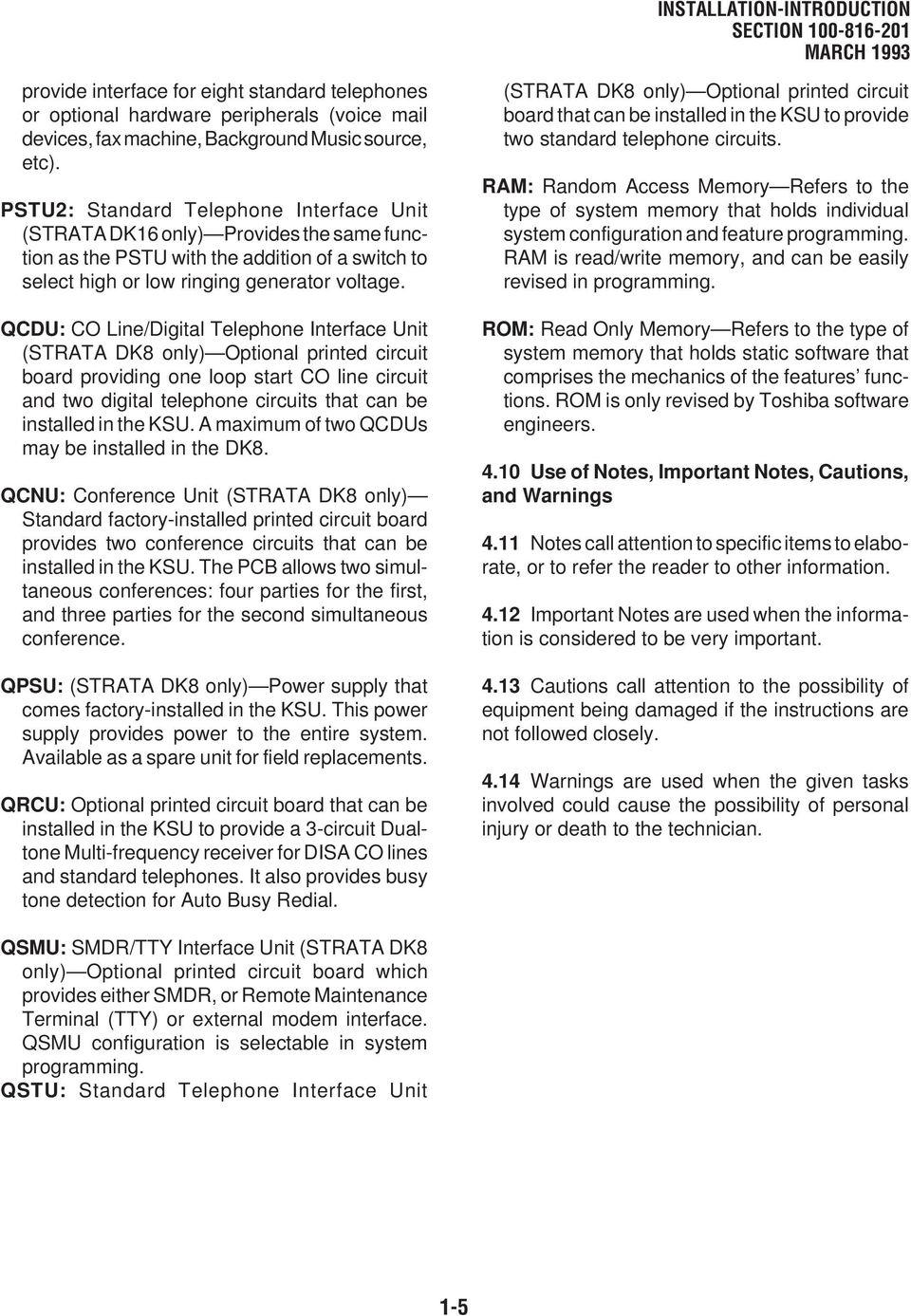
11 INSTALLATION-INTRODUCTION SECTION provide interface for eight standard telephones or optional hardware peripherals (voice mail devices, fax machine, Background Music source, etc). PSTU: Standard Telephone Interface Unit (STRATA DK6 only) Provides the same function as the PSTU with the addition of a switch to select high or low ringing generator voltage. QCDU: CO Line/Digital Telephone Interface Unit (STRATA DK8 only) Optional printed circuit board providing one loop start CO line circuit and two digital telephone circuits that can be installed in the KSU. A maximum of two QCDUs may be installed in the DK8. QCNU: Conference Unit (STRATA DK8 only) Standard factory-installed printed circuit board provides two conference circuits that can be installed in the KSU. The PCB allows two simultaneous conferences: four parties for the first, and three parties for the second simultaneous conference. QPSU: (STRATA DK8 only) Power supply that comes factory-installed in the KSU. This power supply provides power to the entire system. Available as a spare unit for field replacements. QRCU: Optional printed circuit board that can be installed in the KSU to provide a -circuit Dualtone Multi-frequency receiver for DISA CO lines and standard telephones. It also provides busy tone detection for Auto Busy Redial. (STRATA DK8 only) Optional printed circuit board that can be installed in the KSU to provide two standard telephone circuits. RAM: Random Access Memory Refers to the type of system memory that holds individual system configuration and feature programming. RAM is read/write memory, and can be easily revised in programming. ROM: Read Only Memory Refers to the type of system memory that holds static software that comprises the mechanics of the features functions. ROM is only revised by Toshiba software engineers..0 Use of Notes, Important Notes, Cautions, and Warnings. Notes call attention to specific items to elaborate, or to refer the reader to other information.. Important Notes are used when the information is considered to be very important.. Cautions call attention to the possibility of equipment being damaged if the instructions are not followed closely.. Warnings are used when the given tasks involved could cause the possibility of personal injury or death to the technician. QSMU: SMDR/TTY Interface Unit (STRATA DK8 only) Optional printed circuit board which provides either SMDR, or Remote Maintenance Terminal (TTY) or external modem interface. QSMU configuration is selectable in system programming. QSTU: Standard Telephone Interface Unit -5
12

13 TOSHIBA SYSTEM PRACTICES DIGITAL KEY TELEPHONE SYSTEMS INSTALLATION-SITE REQUIREMENTS SECTION INSTALLATION CHAPTER TWO SITE REQUIREMENTS
14 INSTALLATION-SITE REQUIREMENTS SECTION TABLE OF CONTENTS PARAGRAPH SUBJECT PAGE GENERAL... - INPUT POWER REQUIREMENTS... - SITE CONSIDERATIONS Clearance and Location Requirements Electrical/Environmental Requirements and Characteristics... - GROUNDING REQUIREMENTS Third Wire Ground Test Alternate or Additional Ground... - TABLE LIST TABLE TITLE PAGE -A SUMMARY OF ELECTRICAL/ENVIRONMENTAL CHARACTERISTICS... - FIGURE LIST FIGURE TITLE PAGE - DK8 BASE KEY SERVICE UNIT AND HPFB MINIMUM CLEARANCE REQUIREMENTS BASE KEY SERVICE UNIT MINIMUM CLEARANCE REQUIREMENTS DK6 COMBINED BASE AND EXPANSION KEY SERVICE UNIT MINIMUM CLEARANCE REQUIREMENTS KSU GROUNDING DIAGRAM i

15 INSTALLATION-SITE REQUIREMENTS SECTION GENERAL.00 This chapter defines the installation site requirements necessary to ensure a proper operating environment for the STRATA DK8 and DK6. Also included are grounding requirements. INPUT POWER REQUIREMENTS.00 The system requires an input power source of 7VAC nominal (85VAC ~ 5VAC), 50/60 Hz, 5 amps. The AC outlet is recommended to be dedicated and unswitched, with a solid third wire ground (refer to Paragraph ). This is to eliminate interference from branch circuit motor noise or the like, and to prevent accidental power-off..0 To avoid accidental power turn-off, it is recommended that an ON/OFF wall switch not be used on this dedicated AC circuit..0 An option Reserve Power Battery and Charger (HPFB) is available for use with the STRATA DK8 to serve as a power failure backup. For the STRATA DK6, a reserve power source (two customer-supplied -volt batteries) may be connected to the system to serve as a power failure backup. SITE CONSIDERATIONS.00 Clearance and Location Requirements.0 The key service units must be wall mounted. Figure - shows the minimum clearance requirements for the STRATA DK8 system, and includes the recommended mounting location and clearance requirements for the optional HPFB. Figures - (Base Key Service Unit) and - (Base and Expansion Key Service Unit together) show the minimum clearance requirements for the standard FRONT VIEW DK8 KEY SERVICE UNIT AND HPFB CLEARANCE DK6 BASE KEY SERVICE UNIT CLEARANCE FRONT VIEW " HPFB " ".5" " " DK 8 KSU DK 6 BASE KSU 6." 8" " 0" " " " TOP VIEW TOP VIEW " WALL.5" WALL FEET FEET FIGURE - DK8 KEY SERVICE UNIT AND HPFB MINIMUM CLEARANCE REQUIREMENTS FIGURE - DK6 BASE KEY SERVICE UNIT MINIMUM CLEARANCE REQUIREMENTS -

16 INSTALLATION-SITE REQUIREMENTS SECTION DK6 BASE AND EXPANSION UNIT CLEARANCE FRONT VIEW " 0" " ".0 If reserve power is to be installed for the STRATA DK6, the batteries will require a wellventilated location close (within nine feet) to the DKSUB6 (the optional Toshiba-supplied battery cable is 9 feet in length). The STRATA DK8 reserve battery (HPFB) should be mounted directly above the DKSU8 as shown in Figure -. EXP BASE 8".0 Electrical/Environmental Requirements and Characteristics TOP VIEW ". The electrical/environmental requirements and characteristics for each system are provided in Table -A. EXP BASE.5" WALL GROUNDING REQUIREMENTS FIGURE - DK6 COMBINED BASE AND EXPANSION KEY SERVICE UNIT MINIMUM CLEARANCE REQUIREMENTS and optioned STRATA DK6 system. Refer to Chapter for DK6 key service unit wall mounting instructions..0 The following conditions must be considered when selecting a location for the key service unit(s): The location MUST BE: Dry and clean Well ventilated Well illuminated Easily accessible The location MUST NOT BE: Subject to extreme heat or cold Subject to corrosive fumes, dust, or other airborne contaminants Subject to excessive vibration Next to television, radio, office automation, or high frequency equipment FEET.00 The systems require a solid earth ground for proper operation. Failure to provide ground may lead to confusing trouble symptoms and, in extreme cases, system failure. The AC power cord contains a conductor for the "third wire ground" provided by the commercial power outlet. The third-wire ground should be the only ground necessary for the DK8/DK6; this ground must originate at the buildings main power distribution panel and have a solid connection to earth ground. (Figure -).0 Third Wire Ground Test. Test the "third wire ground" for continuity by either measuring the resistance between the third prong terminal (earth ground) and a metal cold water pipe (maximum: ohm), or by using a commercially available earth ground indicator. If neither procedure is possible, perform the following earth ground test procedure: WARNING! Hazardous voltages that may cause death or injury are exposed during the following test. Use great care when working with AC power line voltage. ) Obtain a suitable voltmeter, and set it for a possible reading of up to 50 VAC. -

17 TABLE -A SUMMARY OF ELECTRICAL/ENVIRONMENTAL CHARACTERISTICS INSTALLATION-SITE REQUIREMENTS SECTION GENERAL Primary power Input AC AC frequency Power Environmental specifications Operating temperature Operating humidity Storage temperature Power supply DC voltage output specification Battery charger characteristics (DK6 only) QSTU, KSTU, PSTU or PESU (circuits & ) Ring voltage Ringing capability 85 ~ 5VAC 50/60 Hz DK8-6 watts maximum, DK6-75 watts maximum ~ 0 F (0 ~ 0 C) 0 ~ 80% relative humidity without condensation - ~ 58 F (-0 ~ 70 C) DK6 VDC: ( 6. ~ 7.8VDC) +5VDC: ( +.5 ~ +5.5VDC) 5VDC: (.5 ~ 5.5VDC) DK8 +VDC: (+6. ~ +7.8VDC) +5VDC: ( +.5 ~ +5.5VDC) Note: +5V converter on KSU PCB Charger: current limiting Nominal float voltage:.75 volts/cell Charge current: 0.7 amps maximum Battery discharge cut-off voltage: 0.5 ± 0.5VDC Square wave output with high/low option jumper: Low position, 0 ± 0VDC peak to peak (no-load) High position, 90 ± 5VDC peak to peak (no-load) Two ringers maximum per circuit, high or low position THIRD WIRE AC GROUND GROUND A ELECTRICAL SYSTEM GROUND THIRD WIRE GROUND TO AC POWER CORD DK8 OR DK6 KSU POWER SUPPLY ) Connect the meter probes between the two main AC voltage terminals (white and black wires) on the wall outlet. The reading obtained should be between 00 ~ 0 VAC. ) Move one of the meter probes to the third terminal (green wire ground). Either the same reading or a reading of zero volts should be obtained. ) If the reading is zero volts, leave one probe on the ground terminal and move the other probe to the second voltage terminal. FIGURE - KSU GROUNDING DIAGRAM FG CAUTION! If a reading of zero volts is obtained on both voltage terminals (white wire to green wire, black wire to green wire), the outlet is not properly grounded. Omit steps 5 and 6, and proceed directly to step 7. -

18 INSTALLATION-SITE REQUIREMENTS SECTION ) If a reading of zero volts on one terminal, and a reading of 00 ~ 0 VAC on the other terminal is obtained, remove both probes from the outlet. 6) Set the meter to the OHMS/Rx scale. Place one probe on the ground terminal, and the other probe on the terminal that produced a reading of zero volts. The reading should be less than ohm. CAUTION! If the reading is more than one ohm, then the outlet is not adequately grounded..0 Alternate or Additional Ground. If the third wire AC ground can not practically be improved or if extreme motor noise or other disturbance causes system malfunction, or if local area lightning storms exist, a separate direct ground may be warranted.. Connect a separate earth ground from a cold water pipe or earth grounding rod directly to the FG screw terminal on the DK8/DK6 power supply. See Figure -5 of Section (for STRATA DK8) or Figure 5-8 of Section (for STRATA DK6). 7) If the above tests show the outlet is not properly grounded, the condition should be corrected (per Article 50 of the National Electrical Code) by a qualified electrician before the system is connected. -

19 TOSHIBA SYSTEM PRACTICES DIGITAL KEY TELEPHONE SYSTEMS INSTALLATION-CONFIGURATION SECTION INSTALLATION CHAPTER THREE SYSTEM CONFIGURATION
20

21 INSTALLATION-CONFIGURATION SECTION TABLE OF CONTENTS PARAGRAPH SUBJECT PAGE INTRODUCTION... - SYSTEM CAPACITY Total System Capacity The DK8 Key Service Unit The DK6 Base Key Service Unit The DK6 Expansion Key Service Unit... - STATION CONSIDERATIONS Telephone Circuit (Port) Types Digital Telephone Circuit Connections Electronic Telephone Circuit Connections (STRATA DK6 Only) Standard Telephone Circuit Options TELEPHONE UPGRADES Digital Telephone Upgrades Electronic Telephone Upgrades CONFIGURATION EXAMPLES Strata DK8 - Example (Small Retail Store) Strata DK8 - Example (Home Office) Strata DK6 - Example (Bank) Strata DK6 - Example (Office/Warehouse) CONFIGURATION WORKSHEET TABLE LIST TABLE TITLE PAGE -A DK8 CO LINE/STATION CONFIGURATION GUIDE B DK6 CO LINE/STATION CONFIGURATION GUIDE (BASE AND EXPANSION UNIT) C DK8 KEY SERVICE UNIT COMPONENTS D DK6 BASE KEY SERVICE UNIT COMPONENTS E DK6 EXPANSION KEY SERVICE UNIT PCBs F INTERFACE OPTION G STRATA DK8 STATION APPARATUS OVERVIEW H STRATA DK6 STATION APPARATUS OVERVIEW WORKSHEETS NUMBER TITLE PAGE DK8 STATION AND CO LINE TOTALS... - DK8 KEY SERVICE UNIT AND PCBs... - DK8 PERIPHERALS AND UPGRADES... - DK6 STATION AND CO LINE TOTALS DK6 KEY SERVICE UNIT AND PCBs DK6 PERIPHERALS AND UPGRADES DK6 SYSTEM POWER CHECK i
22 INSTALLATION-CONFIGURATION SECTION ii
23 INSTALLATION-CONFIGURATION SECTION INTRODUCTION.00 This chapter offers guidelines and considerations on how to configure a STRATA DK8/DK6 system, which can support a wide variety of stations and peripherals. SYSTEM CAPACITY.00 Total System Capacity.0 The STRATA DK8/DK6 systems have a modular design which allows them to support a number of station and CO line configurations. The main component of each system is the Key Service Unit. The DK8 KSU can have up to 0 stations and four CO lines. The DK6 Base Key Service Unit can have up to stations and four CO lines. An Expansion Key Service Unit can be added to the DK6 to increase the station capacity to 0 and the CO line capacity to eight. Station and CO line configurations are shown in Table -A (for DK8) and Table -B (for DK6)..0 The DK8 Key Service Unit. Station and CO Lines. The DK8 Key Service Unit comes standard with four digital telephone circuits (ports) and two CO line circuits (Table -C). An optional printed circuit board called the QCDU can be added to the KSU to provide one CO line circuit and two digital telephone circuits. A maximum of two QCDUs may be added to provide a total of four additional digital telephone circuits and two additional CO line circuits. Another optional printed circuit board called the QSTU can be added to the DK8 KSU to provide two standard telephone circuits.. Peripherals. The DK8 Key Service Unit can support a number of peripherals, which are not considered as stations and do not affect the maximum station and CO line capacities. A customersupplied Music-on-hold source, optional reserve power battery and charger, a customer-supplied emergency standard telephone for system power failure occurrences and an amplifier with speaker for paging and night ringing can all be connected to the Key Service Unit (Table -C). A relay contact is also provided to control one of the following peripherals: Music-on-hold source, night bell, or page amplifier mute control..0 The DK6 Base Key Service Unit. Station and CO Lines. The DK6 Base Key Service Unit comes standard with eight digital telephone circuits (ports) and four CO line circuits (Table -D). An optional printed circuit board called the KSTU can be added to the unit to provide four standard telephone circuits (ports).. Peripherals. The DK6 Base Key Service Unit can support a number of peripherals, which are not considered as stations and do not affect the maximum station and CO line capacities. A customer-supplied Music-on-hold source, customer-supplied separate background music source, customer-supplied reserve power batteries, a customer-supplied emergency standard telephone for system power failure occurrences and an amplifier with speaker for paging and night ringing can all be connected to the Base Key Service Unit (Table -D). A relay contact is also provided to control one of the following peripherals: Music-on-hold source, night bell, or Page Amplifier mute control..0 The DK6 Expansion Key Service Unit. Station and CO Lines. The optional DK6 Expansion Key Service Unit has four universal slots which can support a maximum of four CO lines and eight stations. Printed circuit boards (PCBs) that support CO lines and can be installed in the Expansion Unit are the PCOU and KCDU (Table -E). PCBs that can support stations and be installed in the Expansion Unit are the PDKU, PEKU, PSTU, PESU, and KCDU.. Peripherals. The Expansion Unit can support either a PIOU or PIOUS PCB, which both provide, among other features, Station Message Detail Recording (SMDR), an interface for a local programming terminal, and connectors for an internal modem (IMDU) for remote maintenance and administration (Table -F). Any device that connects to the PIOU or PIOUS should not be considered a station and does not affect the system's station capacity. -
24 INSTALLATION-CONFIGURATION SECTION TABLE -A DK8 CO LINE/STATION CONFIGURATION GUIDE EQUIPMENT KSU = Key Service Unit CO Lines/ digital circuits) CO = Central Office QCDU = Optional PCB ( CO line/ digital circuits) QSTU = Optional PCB ( standard circuits) DKT SLT = Digital Telephone = Standard Telephone CONFIGURATION CO LINES BY STATION COs DKTs SLTs EQUIPMENT by by 6 by 6 by 8 by 8 by KSU KSU + QSTU KSU + QCDU KSU + QCDU + QSTU KSU + QCDU + QCDU KSU + QCDU + QCDU + QSTU TABLE -B DK6 CO LINE/STATION CONFIGURATION GUIDE (BASE AND EXPANSION UNIT) EQUIPMENT BU KSTU EU PDKU KCDU PEKU PESU = = = = = = = Base Unit ( CO lines/8 digital circuits) Base Unit Option ( standard circuits) Expansion Unit EU option (8 digital circuits) EU option ( CO lines/ digital circuits) EU option (8 electronic circuits) EU option ( standard/ electronic circuits) PSTU PCOU CO DKT EKT SLT = = = = = = EU option (8 standard circuits) EU option ( CO lines) Central Office line Digital telephone Electronic telephone Standard telephone CONFIGURATION CO LINES BY STATION COs DKTs EKTs SLTs EQUIPMENT by 8 by by by 6 by 6 by 6 by 8 by 0 by 0 by 0 6 by 6 by 6 8 by 8 8 by 8 by 8 by 6 8 by 6 8 by 6 8 by 8 8 by 0 8 by 0 8 by 0 8 by BU BU + KSTU BU + EU + PESU BU + EU + PSTU BU + EU + PEKU BU + EU + PDKU BU + KSTU + PESU BU + KSTU + EU + PEKU BU + KSTU + EU + PDKU BU + KSTU + EU + PSTU BU + EU + KCDU BU + KSTU + EU + KCDU BU + EU + PCOU BU + KSTU + EU + PCOU BU + EU + PCOU + PESU BU + EU + PCOU + PEKU BU + EU + PDKU + PCOU BU + EU + KCDU + KCDU BU + KSTU + EU + PCOU + PESU BU + KSTU + EU + KCDU + KCDU BU + KSTU + EU + PCOU + PEKU BU + KSTU + EU + PCOU + PDKU BU + KSTU + EU + PCOU + PSTU -
25 INSTALLATION-CONFIGURATION SECTION TABLE -C DK8 KEY SERVICE UNIT COMPONENTS Item Digital Telephone Circuits () CO Line Circuits () Power Failure Transfer Interface Battery Backup Interface Music-On-Hold/BGM Interface 600 Ohm page Interface CO line CKT ()/ Digital Telephone CKT () (QCDU) (max. QCDU per system) Standard Telephone Interface Unit (QSTU) standard telephone circuits ( max.) QSTU per system DTMF/ABR Tone Receiver (-Receiver CKT per QRCU ) Control Relay Conference Circuit Interface Unit (QCNU) SMDR/TTY Interface Unit (QSMU) (Requires PPTC) Supports Connector Type Standard Optional Digital Telephones (with or without PDIU DI or ADM) Stand-alone Data Interface Units (PDIU-DS) Door Phone Lock/Control Unit (DDCB) Loop Start CO Lines Standard Telephone (one)* Optional HPFB Battery (one or two per system) Music-on-hold/BGM Source* Amplifier/Speaker Digital Telephones (with or without PDIU DI or ADM) Stand-alone Data Interface Units (PDIU-DS) Loop Start CO Line Standard Telephones* Other Single-line Devices* Fax Machine* Voice Mail Devices Alternate BGM source* Automatic Busy Redial Standard telephone ports DISA One of the following: Night Relay External Page Mute MOH Control Relay Simultaneous Conferences SMDR Printer*, or Maintenance Terminal* or Modem* 5-pair Amphenol RJ Modular RJ Modular Proprietary Cable/Connector RCA Jack RCA Jack 5-pair Amphenol RJ Modular 5-pair Amphenol Internal 5-pair Amphenol Internal 6-pin Modular (PPTC adaptor) Interface HPFB with cable *Customer supplied equipment not offered by Toshiba Telecommunication Systems Division. -
26 INSTALLATION-CONFIGURATION SECTION TABLE -D DK6 BASE KEY SERVICE UNIT COMPONENTS Item Supports Connector Type Standard Optional Digital Telephone Circuits (8) Digital Telephones (with or without PDIU DI or ADM) 5-pair Amphenol Stand-alone Data Interface Units (PDIU-DS) Door Phone Lock/Control Unit (DDCB) Digital Direct Station Selection Console (DDSS) CO Line Circuits () Loop Start CO Lines RJ Modular Power Failure Transfer Interface Standard Telephone (one)* RJ Modular Battery Backup Interface with built-in charger Two -volt Batteries* Proprietary Connector/Cable Cable and Batteries Music-On-Hold/BGM Interface Music-on-Hold/BGM source* RCA Jack 600 Ohm page Interface Amplifier/Speaker RCA Jack Standard Telephone* Interface Unit (-Circuit) (KSTU) Standard Telephones* Other Single-line Devices* Alternate BGM Source* 5-pair Amphenol Fax machine* Voice mail devices DTMF/ABR Receiver (KRCU) Automatic Busy Redial Standard Telephone Ports Internal Interprets DTMF Tones DISA Feature Cartridge Future Feature Upgrades Internal Control Relay Choice of one: 5-pair Amphenol MOH Source Control Night Bell Control BGM Mute Control *Customer supplied equipment not offered by Toshiba Telecommunication Systems Division. -
27 TABLE -E DK6 EXPANSION KEY SERVICE UNIT PCBs INSTALLATION-CONFIGURATION SECTION PCB PDKU PEKU PSTU PESU Circuits per PCB 8 digital telephone circuits 8 electronic telephone circuits 8 standard telephone circuits standard telephone/ electronic telephone circuits (standard/electronic telephone ports) Interfaces Digital telephones with or without PDIU-DI or ADM DDSS console PDIU-DSs DDCB Electronic telephones HDSS console BGM source EOCU PCB for OCA Standard telephones Voice mail ports Background music source Off-premises stations Other similar devices Standard: same as PSTU Electronic: same as PEKU except PESU does not support HDSS console Connector 5-pair amphenol 5-pair amphenol 5-pair amphenol 5-pair amphenol PCOU CO line circuits (lines) Central Office loop start lines RJC modular KCDU CO line circuits/ digital telephone circuits Central Office loop start lines DKT circuits same as PDKU, except no DDSS RJC Modular (CO Line circuits) 5-pair amphenol (digital telephone circuits) PIOU, PIOUS See Table -D See Table -D 5-pair amphenol (PIOU) Spring clip terminal (PIOUS) STATION CONSIDERATIONS.00 For configuration purposes, a station can be considered as any device which is connected to a dedicated telephone circuit. Although the words "telephone" and "station" are often used synonymously and interchangeably in STRATA DK8/ DK6 documentation, devices other than telephones such as Stand-alone Data Interface units (PDIU-DSs) should also be considered as stations when configuring a system, because they require a dedicated telephone circuit. A station apparatus overview is shown in Table -G (for STRATA DK8) and Table -H (for STRATA DK6)..0 Telephone Circuit (Port) Types. There are three types of telephone circuits to which stations can be connected: digital telephone circuits, electronic telephone circuits, and standard telephone circuits. All three types of circuits are available with the STRATA DK6. The STRATA DK8 does not support electronic telephone circuits..0 Digital Telephone Circuit Connections. The STRATA DK8 Key Service Unit provides four digital telephone circuits. The QCDU PCB provides two. -5
28 INSTALLATION-CONFIGURATION SECTION NOTE: X = the option is provided TABLE -F PIOU/PIOUS INTERFACE OPTION (DK6 ONLY) Expansion Unit Interface Options PIOU PIOUS Zone Page Interface (unamplified, zones) Night Transfer or Music-on-Hold Control Relay Door Lock or External Amplifier Control Relay Alarm Sensor SMDR output (RS-/6-wire modular connector) Maintenance Port for a Local ASCII Terminal or External Modem (RS-/6-wire modular connector) Remote Maintenance Modem (IMDU subassembly, no external connector) X X X X X X X X X X X X X TABLE -G STRATA DK8 STATION APPARATUS OVERVIEW Station Digital Telephone DKT with or without ADM or PDIUDI Stand-alone Data Interface Unit (PDIU- DS) Digital Door Phone/Lock Control Unit (DDCB) Single-wire pair devices: Standard Telephone Voice Mail Device Facsimile Machine Modem Dictation Equipment Alternate Background Music Source* Type and Number of Circuits Required Digital, one for each DKT Digital, one for each PDIU-DS Digital, one for each DDCB Standard, one for each device (voice mail devices may require more than one circuit) Standard port for the source PCB or Interface KSU (Circuits ~ ) QCDU (Circuits ~ ) KSU (Circiuts ~ ) QCDU (Circuits ~ ) KSU Port 0 Port 0 QSTU (Circuits ~ ) QSTU (Circuit ) Port 9 KSU Capacity KSU and Optional PCB Combined Capacity 8 8 *May require interface transformer, see Section
29 TABLE -H STRATA DK6 STATION APPARATUS OVERVIEW INSTALLATION-CONFIGURATION SECTION Station Digital Telephone (DKT with or without ADM or PDIU-DI) Stand-alone Data Interface Unit (PDIU-DS) Digital Direct Station Selection Console (DDSS) Digital Door Phone/Lock Control Unit (DDCB) Electronic Telephone (EKT) Electronic Direct Station Selection Console (HDSS) Conference Amplifier Single-wire-pair Devices: Standard Telephone Voice Mail Device Facsimile Machine Modem Dictation Equipment Alternate Background Music Source Type and Number of Circuits Required Digital, one for each DKT Digital, one for each PDIU-DS Digital, one for each DDSS Digital, one for each DDCB Electronic, one for each EKT Electronic, two for the HDSS Electronic, two for the amplifier Standard, one for each device (voice mail devices may require more than one circuit) Standard or Electronic, one for the source PCB or Interface Base Unit (Circuits ~8) PDKU (Circuits ~8) KCDU (Circuits ~) Base Unit (Circuits ~8) PDKU (Circuits ~8) KCDU (Circuits ~) Base Unit (Circuit 8) PDKU (Circuit 8) Base Unit (Circuit 5) PDKU (Circuit ) or first KCDU (Circuit ) PEKU (Circuits ~8) PESU (Circuit 5~8) PEKU (Circuits 7 and 8) PEKU (Circuits 6 and 7) PESU (Circuits 6 and 7) KSTU (Circuits ~) PSTU (Circuits ~8) PESU (Circuits ~) KSTU (Circuit ) PEKU (Circuit ) PESU (Circuit 8) PSTU (Circuit ) *May require interface transformer, see Section Base Unit Capacity Base and Expansion Unit Combined Capacity
30 INSTALLATION-CONFIGURATION SECTION NOTE: A maximum of two QCDU PCBs may be installed in the STRATA DK8.. The STRATA DK6 Base Key Service Unit and the PDKU PCB each provide eight digital telephone circuits. The KCDU PCB provides four. NOTE: A maximum of two KCDU PCBs may be installed in the STRATA DK6. If a KCDU is installed, no other type of station PCB can be installed in the STRATA DK6.. The following devices can be connected to digital telephone circuits: Digital Telephones (000- and 000-series): Each digital telephone requires one circuit, and each digital telephone circuit can support a digital telephone. Stand-alone Data Interface Units (PDIU-DS): Each PDIU-DS requires one circuit. Any digital telephone circuit, except for Circuit 8 on a PDKU (STRATA DK6), can support a PDIU-DS (see Note ). NOTES:. There are two versions of the PDKU: PDKU and PDKU. The versions are identical, except that Circuits ~ 8 on the PDKU can each support PDIU-DSs/ PDIU-DI, while only Circuits ~ 7 on a PDKU can support PDIU-DSs or PDIU- DIs. Also, PDIU does not support 000- series digital telephone continuous DTMF tones.. The Integrated Data Interface Unit (PDIU- DI/PDIU-DI) and the Add-on Module (ADM) do not require a dedicated circuit. They share a circuit with the telephone.. Only one option (PDIU-DI or ADM) can be installed on a 000-series digital telephone. Digital Direct Station Selection Console (DDSS): (available with STRATA DK6 only) Each DDSS Console requires one circuit. DDSS Consoles can connect only to Circuit 8 in the Base Key Service Unit and Circuit 8 on a PDKU. The KCDU cannot support a DDSS console. Digital Door Phone/Lock Control Box (DDCB): Each DDCB requires one circuit. DDCBs can only connect to Circuits and (Ports 0 and 0) in the STRATA DK8 Key Service Unit or Circuit 5 (Port 0) in the STRATA DK6 Base Key Service Unit, and Circuit (Port ) on either the PDKU or KCDU (STRATA DK6)..0 Electronic Telephone Circuit Connections (STRATA DK6 Only). There are no electronic telephone circuits in the Base Key Service Unit, and none can be added to it. However, either the PEKU PCB, which has eight electronic telephone circuits, or the PESU, which has four electronic telephone circuits, can be installed in the Expansion Key Service Unit. The following devices can be connected to electronic telephone circuits. Electronic Telephones (6500-, 6000-, 000-, 000-series): An electronic telephone can be connected to any electronic telephone circuit. One electronic telephone circuit is required per electronic telephone. Electronic Direct Station Selection Console (HDSS): The system will support only one HDSS console. The console must be connected to both Circuits 7 and 8 on the PEKU. The PESU will not support an HDSS Console. Alternate Background Music Source: The system will support an alternate Background Music source which can be heard over digital and electronic telephone speakers and external page speakers. This source can be connected to either Circuit on a PEKU, Circuit 8 on a PESU, or Circuit on a KSTU or PSTU PCB. Conference Amplifier: An amplifier for two CO line conferencing can be connected to Circuits 6 and 7 (Ports 7 and 8) on a PEKU or PESU..0 Standard Telephone Circuit Options. In addition to supporting standard telephones, each of the standard telephone circuits can support any one of a number of single-wire-pair devices, including voice mail/auto Attendant devices and modems. The QSTU, which can be installed in the STRATA DK8 Key Service Unit, has two -8
31 INSTALLATION-CONFIGURATION SECTION standard telephone circuits. The KSTU, which can be installed in the STRATA DK6 Base Key Service Unit, has four standard telephone circuits; the PSTU, which can be installed in the DK6 Expansion Key Service Unit, has eight; and the PESU, which can also be installed in the DK6 Expansion Unit, has two (Circuits and ). TELEPHONE UPGRADES.00 Digital and Electronic telephones can be upgraded for a number of features; there are no upgrades for standard telephones. Each of these upgrades shares a circuit with the telephone that it is connected to and is not considered a station..0 Digital Telephone Upgrades. Digital telephones can be upgraded with the following subassemblies: Integrated Data Interface Unit (PDIU-DI/PDIU- DI): A Digital telephone can be upgraded with a PDIU-DI/PDIU-DI to provide the telephone with data switching capabilities. 000-series Digital Telephones use the PDIU-DI, and 000- series Digital Telephones use the PDIU-DI. PDIU-DI cannot be installed on a telephone if ADM is installed. Add-on Module (ADM): A 000-series Digital Telephone can be upgraded with an ADM to provide 0 Direct Station Selection buttons on STRATA DK6, or 0 DSS buttons, 8 speed dial buttons, one night transfer button and one all call page button on STRATA DK8. The 000- series Digital Telephone models cannot support ADMs. ADM cannot be installed on a telephone if PDIU-DI is installed. Off-hook Call Announce Upgrade (DVSU): A Digital telephone that must receive Off-hook Call Announce must be upgraded with a DVSU. Loud Ringing Bell/Headset Upgrade (HHEU): A digital telephone can be upgraded with an HHEU to provide a dual interface for the Loud Ringing Bell feature and/or a headset. (Simultaneously with PDIU-DI or ADM)..0 Electronic Telephone Upgrades. On STRATA DK6, electronic telephones can be upgraded with the following subassemblies: Off-hook Call Announce Upgrade (HVSU or HVSU/HVSI): An electronic telephone must be upgraded with the HVSU subassembly or the combined HVSU/HVSI subassemblies to receive Off-hook Call Announce. NOTE: A PEKU or PESU PCB that supports electronic telephones that must receive Off-hook Call Announce must be equipped with an EOCU. Loud Ringing Bell/Headset Upgrade (HHEU): An electronic telephone can be upgraded with an HHEU to provide a dual interface for the Loud Ringing Bell feature and a headset simultaneously. 5 CONFIGURATION EXAMPLES 5.00 The following provides an examples of how to configure a STRATA DK Strata DK8 - Example (Smalll Retail Store) 5. Customer Requirements. A store needs two CO lines and four digital telephones. 5. Analysis. The store's system hardware requirements are as follows: Two CO line circuits for the CO lines. Four digital telephone circuits for the digital telephones. 5. Conclusion. A standard Key Service Unit would be adequate in this case. The unit's standard four digital telephone circuits and two CO line circuits could easily accommodate the store's needs and allow for future expansion. 5.0 Strata DK8 - Example (Home/Office) 5. Customer Requirements. In addition to three CO lines, a home/office needs five digital telephones (three of which will have PDIU-DIs), a modem, a door phone, one facsimilie machine, Music-on-hold and Telephone Set Background Music. 5. Analysis. The customer's requirements could be broken down as follows: -9
32 INSTALLATION-CONFIGURATION SECTION CO line circuits for the three CO lines 7 digital telephone circuits one for each of the five digital telephones; the PDIU-DIs do not require dedicated circuits. one for a digital door phone/lock control unit to support a door phone one for the PDIU-DS connected to the modem standard telephone circuits one for the modem one for the facsimilie machine A music source for Music-on-hold and Background music can be connected to the Key Service Unit MOH RCA jacks. 5. Conclusion. Several optional PCBs in addition to the Key Service unit would be needed for the application. Two CO line circuits and four digital telephone circuits would be provided by the KSU. The third CO line circuit, as well as two digital telephone circuits would be provided by an optional QCDU. A second QCDU would be necessary to provide the seventh digital telephone circuit. An optional QSTU would provide the two standard telephone circuits. An optional QRCU would be needed for the Dual-tone Multi-frequency (DTMF) tones generated by the devices (modem and facsimilie machine) connected to the standard telephone lines. 5.0 The following provides an examples of how to configure a STRATA DK Strata DK6 - Example (Bank) 5. Customer Requirements. A bank needs two CO lines and six digital telephones (three of which must be equipped with a PDIU-DI). It also wants to connect a printer to a PDIU-DS. 5. Analysis. The bank's system hardware requirements are as follows: Two CO line circuits for the two CO lines. Seven digital telephone circuits. Six for telephones and one for the PDIU-DS. (The PDIU-DIs do not require a dedicated circuit.) 5. Conclusion. A standard Base Key Service Unit would be adequate in this case. The unit's standard eight digital telephone circuits and four CO line circuits could easily accommodate the bank's needs Strata DK6 - Example (Office/Warehouse) 5.5 Customer Requirements. In addition to five CO lines, a small office-warehouse facility needs digital telephones (three of which will have PDIU-DIs), two PDIU-DSs, a modem, a facsimile machine, conference capability, a door phone, one standard telephone, Music-on-hold, and an amplifier/speaker for paging. 5.5 Analysis. The customer's requirements could be broken down as follows: digital telephone circuits one for each of the digital telephones; the PDIU-DIs do not require dedicated circuits. one for each of the two PDIU-DSs one for a digital door phone/lock control unit to support a door phone standard telephone circuits one for the modem one for the facsimile machine one for the standard telephone A music source for Music-on-hold and an amplifier/speaker for paging could both be connected to the Key Service Unit RCA jacks. A KRCU would be needed for the Dual-tone Multi-frequency (DTMF) tones generated by the devices connected to the standard telephone circuits. A PCOU would be needed for the fifth CO line. 5.5 Conclusion. An Expansion Key Service Unit in addition to the Base Key Service Unit would be needed for this application. The three standard telephone circuits could be contained on the optional KSTU PCB in the Base Unit. However, a PDKU installed in the Expansion Unit would be required for six of the digital telephone circuits. The Expansion Unit would also be needed for the PCOU. The optional KRCU, along with the music source and the page/amplifier, as noted earlier, could be connected to the Base Unit. 6 CONFIGURATION WORKSHEETS 6.00 Worksheets are provided in this chapter to help configure the system.
33 . DIGITAL PORTS (CIRCUITS) DK8 WORKSHEET, STATION AND CO LINE TOTALS Device Quantity x Ports/Per = Ports Used DDCBs ( max.) X = PDIU-DSs (8 max.) X = Digital Telephones (with or X = without PDIU-DIs or ADMs) (8 max.) Total Digital Ports = (8 max.). STANDARD PORTS (CIRCUITS) Device Quantity x Ports/Per = Ports Used Maximum of items total, including Standard Telephones: Standard Telephones X = or Other Devices: Voice Mail Auto Attendant BGM Source Fax Modem X =. CO LINES Number of CO lines required? (Maximum of ) Total Standard Ports = ( maximum) INSTALLATION-CONFIGURATION SECTION
34 INSTALLATION-CONFIGURATION SECTION DK8 WORKSHEET, KEY SERVICE UNIT AND PCBs. From Worksheet enter the number of required ports (circuits) and lines. Digital Ports: (8 max) Standard Ports: ( max) CO Lines: ( max) NOTE: The maximum number of digital ports is 8, and standard ports is. The maximum number of CO lines is four.. Cross off the printed circuit boards (PCBs) in addition to the standard Base Key Service Unit lines and ports needed to support the ports and lines entered in Step of this worksheet. KSU Interfaces (built-in) CO lines, digital ports KSU Optional Unit Station and Line PCBs QCDU ( CO line and digital ports): two max. QSTU ( standard ports): one max.. Refer to Worksheet to determine option and peripheral requirements. -
35 . BASE UNIT PERIPHERALS DK8 WORKSHEET, PERIPHERALS AND UPGRADES INSTALLATION-CONFIGURATION SECTION Battery Backup Interface: Yes or No One or two HPFB batteries can be connected to a backup battery interface (Standard on DK8) to provide backup battery backup if there is a power failure. (Connecting cable is included. -HPFB for.5 ~ hour backup; -HPFBs for.5 ~ hours backup.) QRCU: Yes or No The QRCU is required to interpret Dual-tone Multi-frequency (DTMF) tones from standard telephones, Voice Mail, Auto Attendant, and DISA CO circuits, or if the Auto Busy Redial (ABR) feature is required. Music-on-hold/Background Music Source Interface: Yes or No A music source can be connected to this interface (Standard on DK8) to provide Music-on-hold to CO lines and stations on hold, and to provide Background Music to station speakers and external page speakers. Power Failure Transfer Interface: Yes or No A standard telephone can be connected to this interface to provide connection to a CO line if there is a power failure. PFT interface is standard on DK8; one customer-supplied standard telephone is required. 600 ohm page Interface (Standard on DK8): Yes or No This interface connects with customer-supplied speakers and amplifiers for paging (or Toshiba HESB) and Background Music applications. QSMU: Yes or No A customer-supplied Station Message Detail Recording (SMDR) printer, or Remote Maintenance Terminal (TTY) or modem. PPTC: Yes or No Modular adaptor required for interface to SMDR device or Maintenance Terminal or Modem.. TELEPHONE UPGRADES (All upgrades share the telephone port and do not require separate ports.) Add-on Module (ADM): Total 000-series digital telephones can be equipped with an Add-on Module to provide 0 Direct Station Selection buttons, autodial buttons, all call page, and night transfer (if PDIU-DI is installed, ADM cannot be installed). DVSU: Total One DVSU is required for each digital telephone that must receive Off-hook Call Announce. HESC-65A: Total One HESC-65A modular connecting cable is required to connect the HESB to the HHEU in each telephone requiring the Loud Ringing Bell feature. See HHEU and HESB. HHEU: Total One HHEU must be installed in each digital telephone that supports a headset or connects to an HESB for the Loud Ringing Bell feature. See HESC-65A. PDIU-DI: Total for 000-series Digital Telephones; (If ADM is installed, PDIU-DI cannot be installed). PDIU-D: Total for 000-series Digital Telephones Digital telephones must be equipped with a PDIU-DI or a PDIU-DI to transmit and receive voice and data calls. -
36 INSTALLATION-CONFIGURATION SECTION DK8 WORKSHEET, PERIPHERALS AND UPGRADES (continued) Miscellaneous Peripherals HESB (Amplifier/Speaker): Total. One HESB and HHEU is required for each digital telephone with the Loud Ringing Bell feature.. One HESB is optional to provide single-zone external page connected to the KSU's 600 ohm external page output. (Customer-supplied amplifiers/speakers may be used in place of the HESB.). One HESB is optional to provide a talkback amplifier/page speaker connected to the KSU's 600 ohm external page output. (Customer-supplied amplifiers/speakers may be used in place of the HESB.) Talkback requires MDFB also. DDCB/MDFB (Door Phone): Total DDCBs Total MDFBs The MDFB plugs into the DDCB to provide a door phone. Each DDCB can support up to three MDFBs; a maximum of two DDCBs and 6 MDFBs can be connected to the system. Each DDCB requires a digital telephone circuit. The MDFB may also be connected to the HESB amplifier/speaker to provide page talkback. NOTE: Worksheet, System Power Check, is not required for DK8. The DK8 power supply will support any DK8 maximum configuration. -
37 . DIGITAL PORTS (CIRCUITS) DK6 WORKSHEET, STATION AND CO LINE TOTALS Device Quantity x Ports/Per = Ports Used DDSS Consoles ( max.) X = DDCBs ( max.) X = PDIU-DSs (6 max.) X = Digital Telephones (with or X = without PDIU-DIs or ADMs) (6 max. Total Digital Ports = (6 max.). ELECTRONIC PORTS (CIRCUITS) Device Quantity x Ports/Per = Ports Used HDSS Console ( max.) X = Alternate BGM Source ( max.) X = Conference Amplifier ( max.) X = Electronic Telephones X = (8 max.). STANDARD PORTS (CIRCUITS) Total Electronic Ports = (8 max.) Device Quantity x Ports/Per = Ports Used Maximum of items total, including Standard Telephones: Standard Telephones X = or Other Devices: Voice Mail X = Auto Attendant X = Fax X = Modem X = Alternate Background Music (BGM) Source X = INSTALLATION-CONFIGURATION SECTION CO LINES Total Standard Ports = ( maximum) Number of CO lines required? (8 maximum) -5
38 INSTALLATION-CONFIGURATION SECTION DK6 WORKSHEET, KEY SERVICE UNIT AND PCBs. From Worksheet enter the number of required ports (circuits) and lines. Digital Ports: Electronic Ports: Standard Ports: CO Lines: NOTE: The maximum number of combined digital, electronic, and standard ports is 0. The maximum number of CO lines is eight.. Cross off the printed circuit boards (PCBs) in addition to the standard Base Key Service Unit lines and ports needed to support the ports and lines entered in Step of this worksheet. Base Unit Interfaces/PCBs Base Unit ( CO lines, 8 digital ports): X built-in KSTU ( standard ports): one max. Expansion Unit Station and line PCBs KCDU ( CO lines and digital ports): two max. (KCDU cannot be installed with any other type of - or - station PCB or PCOU PCB) PDKU (8 digital ports): one max. - or - PEKU (8 electronic ports): one max. - or - PSTU (8 standard ports): one max. - or - PESU ( standard ports and ( electronic ports): one max. PCOU ( CO lines): one max. (PCOU can be installed with PDKU, PEKU, PESU, or PSTU, but not with KCDU) NOTES:. The Base Unit by can only support up to stations (8 digital and standard) and four CO lines.. The Expansion Unit can support up to eight stations and four CO lines.. If installing two DDCBs, a PDKU or a KCDU is required to support the second DDCB no matter what the total number of digital ports.. If installing two DDSS Consoles, a PDKU is required to support the second DDSS Console no matter the total number of digital ports. (KCDU does not support DDSS.). Refer to Worksheet to determine option and peripheral requirements.. Refer to Worksheet to determine the amount of power used by the system. -6
39 . BASE UNIT PERIPHERALS DK6 WORKSHEET, PERIPHERALS AND UPGRADES INSTALLATION-CONFIGURATION SECTION Battery Backup Interface: Yes or No Two -volt customer-supplied batteries can be connected to this interface to provide backup battery backup if there is a power failure. See PBTC-M. KRCU: Yes or No The KRCU is required to interpret Dual-tone Multi-frequency (DTMF) tones from standard telephones, Voice Mail, Auto Attendant, and DISA CO circuits. Music-on-hold/Background Music Source Interface: Yes or No A music source can be connected to this interface (Standard on DK6) to provide Music-on-hold to CO lines and stations on hold, and to provide Background Music to station speakers and external page speakers. Alternate Background Music Source: Yes or No (see Worksheet ) Power Failure Transfer Interface: Yes or No A standard telephone can be connected to this interface to provide connection to a CO line if there is a power failure. PFT interface is standard on DK6; one customer-supplied standard telephone is required. PBTC-M: Yes or No One PBTC-M cable is required for each system that requires battery backup. See Battery Backup Interface. 600 ohm page interface (Standard on DK6): Yes or No This interface connects with customer-supplied speakers and amplifiers (or Toshiba HESB) for paging and Background Music applications. Night Bell: Yes or No A customer supplied night ringing bell can be installed and controlled by the Base Unit relay control (Standard on DK6).. EXPANSION UNIT PERIPHERAL PCB PIOU or PIOUS: If yes, which one See Table -D. PPTC: One or Two Modular adaptor, required for PIOU/PIOUS interface to SMDR device or local maintenance terminal.. TELEPHONE UPGRADES (All upgrades share the telephone port and do not require separate ports.) Add-on Module: Total 000-series digital telephones can be equipped with an Add-on Module to provide 0 Direct Station Selection buttons. (If PDIU-DI is installed, Add-on Module cannot be installed.) DVSU: Total One DVSU is required for each digital telephone that must receive Off-hook Call Announce. HESC-65A: Total One HESC-65A modular connecting cable is required to connect the HESB to the HHEU in each telephone requiring the Loud Ringing Bell feature. See HHEU and HESB. -7
40 INSTALLATION-CONFIGURATION SECTION DK6 WORKSHEET, PERIPHERALS AND UPGRADES (continued) HHEU: Total One HHEU must be installed in each digital and electronic telephone that supports a headset or connects to an HESB for the Loud Ringing Bell feature. See HESC-65A. HVSU or Combined HVSU/HVSI: Total Electronic telephones must be equipped with either the HVSU assembly or the combined HVSU and HVSIs assemblies to receive Off-hook Call Announce. See EOCU under Miscellaneous Peripherals. PDIU-DI: Total for 000-series Digital Telephones; PDIU-D: Total for 000-series Digital Telephones Digital telephones must be equipped with a PDIU-DI or a PDIU-DI to transmit and receive voice and data calls. (If Add-on module is installed, then PDIU-DI cannot be installed.) Miscellaneous Peripherals DPFT: Yes or No The DPFT provides a means to connect eight selected CO lines to standard telephones if there is a power failure. (PSTU must be installed in Expansion Unit) EOCU: Yes or No An EOCU must be installed on a PEKU or PESU that is connected to electronic telephones which are equipped to receive Off-hook Call Announce. See HVSU and HVSU/HVSI in Telephone Upgrades. HESB (Amplifier/Speaker): Total. One HESB and HHEU is required for each digital and electronic telephone with the Loud Ringing Bell feature.. One HESB is optional to provide single-zone external page connected to the Base Unit's 600 ohm external page output. (Customer-supplied amplifiers/speakers may be used in place of the HESB.). One HESB is optional to provide a talkback amplifier/page speaker connected to the Base Unit's 600 ohm external page output. (Customer-supplied amplifiers/speakers may be used in place of the HESB.) Talkback for HESB requires an MDFB. MDFB (Door Phone): Total The MDFB plugs into the DDCB to provide a door phone. Each DDCB can support up to three MDFBs; a maximum of two DDCBs can be connected to the system. Each DDCB requires a Digital Telephone circuit. The MDFB may also be connected to the HESB amplifier/speaker to provide page talkback. -8
41 DK6 WORKSHEET, SYSTEM POWER CHECK INSTALLATION-CONFIGURATION SECTION Total Power Used: Equipment Type: Equipment Quantity X Power Used (Factor) = Ports Used 000- and 000-series digital telephone X (.0) =. 000-series electronic telephone X (.0) =. 000-series electronic telephone X (.5) = series electronic telephone X (.0) = series electronic telephone X (.0) = series electronic telephone X (.0) =. DDSS/HDSS console* X (0.8) =. PDIU-DI and PDIU-DI X (0.5) =. PDIU-DS X (0.8) =. Standard telephone X (.0) =. Add-on Module X (0.) =. Total Power Used * All series. Power Criteria: Power Supplied Total Power Used: Must be greater than zero. Configuration Power Check:.8 = Power Supplied Total Power Used Must be Greater than Zero -9
42
43 TOSHIBA SYSTEM PRACTICES DIGITAL KEY TELEPHONE SYSTEMS INSTALLATION-DK8 KSU & PCB SECTION INSTALLATION CHAPTER FOUR DK8 KSU AND PCB INSTALLATION
44
45 INSTALLATION-DK8 KSU & PCB SECTION TABLE OF CONTENTS PARAGRAPH SUBJECT PAGE PART I DK8 KSU INSTALLATION... - GENERAL... - KEY SERVICE UNIT MOUNTING Mounting Surface Considerations Mounting Preparation Mounting the Key Service Unit Installing the Reserve Power Battery and Charger (HPFB)... - POWER SUPPLY TEST REMOVAL AND REPLACEMENT Power Supply Removal Power Supply Replacement DK8 POWER FAILURE EMERGENCY TRANSFER OPTION DK8 Power Failure Emergency Transfer Installation DK8 Power Failure Emergency Transfer Test PART II DK8 PRINTED CIRCUIT BOARD INSTALLATION GENERAL PCB INSTALLATION CONSIDERATIONS KSU Option PCBs PCB Option Considerations PCB Installation/Power Supply Considerations CO LINE/DIGITAL TELEPHONE INTERFACE UNIT (QCDU) General QCDU Configuration QCDU Installation Procedure QCDU Wiring QCDU Programming Overview STANDARD TELEPHONE INTERFACE UNIT (QSTU) General QSTU Configuration QSTU Installation Procedure QSTU Wiring QSTU Programming Overview DTMF RECEIVER/ABR TONE DETECTOR UNIT (QRCU) General QRCU Configuration QRCU Installation Procedure QRCU Wiring QRCU Programming Overview CONFERENCE CIRCUITS (QCNU) General QCNU Configuration QCNU Installation Procedure QCNU Wiring i
46 INSTALLATION-DK8 KSU & PCB SECTION TABLE OF CONTENTS (CONTINUED) PARAGRAPH SUBJECT PAGE 0.0 QCNU Programming Overview OPTION INTERFACE UNIT (QSMU) General QSMU Hardware Options QSMU Configuration QSMU Installation Procedure QSMU Wiring QSMU Programming Overview Device Communication Parameters BUILT-IN CO LINE, DIGITAL TELEPHONE AND OTHER CIRCUITS General Built-in CO Line Circuits Built-In Digital Telephone Circuits KSU Motherboard CO Line/Digital Station Circuit Wiring Power Failure Telephone Installation Music-On-Hold (MOH)/Background Music (BGM) Source Connection External Page Output Connection FIGURE LIST FIGURE TITLE PAGE - DK8 KEY SERVICE UNIT WALL MOUNT METHOD DK8 DIMENSIONS AND SCREW LOCATIONS DK8 SIDE VIEW DIMENSION AND PLUG/JACK LOCATIONS DK8 CABLING DIAGRAM DK8 BASE UNIT JACKS AND CONNECTORS DK8 KEY SERVICE UNIT POWER FAILURE TRANSFER (PFT) CIRCUIT DIAGRAM DK8 PRINTED CIRCUIT BOARD INSTALLATION QCDU CONTROLS AND INTERFACE CONNECTORS MODULAR JACK COVER REMOVAL AND STORAGE QSTU CONTROLS AND INTERFACE CONNECTORS QRCU INTERFACE CONNECTORS QCNU INTERFACE CONNECTORS QSMU CONTROLS AND INTERFACE CONNECTORS ii
47 INSTALLATION-DK8 KSU & PCB SECTION PART I. KSU INSTALLATION GENERAL.00 This chapter provides the instructions necessary to mount the STRATA DK8 Key Service Unit. Instructions are also provided on how to remove and replace the power supply. KEY SERVICE UNIT MOUNTING.00 Mounting Surface Considerations.0 The Key Service Unit (KSU) is designed to be mounted on a wall or other vertical surface. It is recommended to use the method shown in Figure - (see Note). See Figure - for DK8 KSU physical dimensions. NOTE: Install screws first to the hard board, and then secure the hard board to the wall, making certain that screws are aligned with studs..0 Mounting Preparation ) Loosen the screws on the front cover of the Key Service Unit, and remove the cover (Figure -). ) Move the SW RAM Storage Battery jumper plug strap on the motherboard to the ON position (Figure -5). ) If the DK8 is less than one mile from the central office (or PBX), set the CO line PAD switches, SW0 and SW0, to the PAD position to provide a db level loss to avoid excessive loudness. ) Install all optional PCBs per Paragraph 5. STUD PLASTER BOARD HARD BOARD (/ INCH PLYWOOD) DK8 KSU FIGURE - DK8 KEY SERVICE UNIT WALL MOUNT METHOD -
48 INSTALLATION-DK8 KSU & PCB SECTION WALL MOUNT SCREW 0" 6.875" WALL MOUNT SCREW FRONT COVER SCREW FRONT COVER SCREW AC DC 6.75" FRONT COVER SCREW WALL MOUNT SCREW WALL MOUNT SCREW FRONT COVER SCREW 6.75" FIGURE - DK8 DIMENSIONS AND SCREW LOCATIONS -
49 INSTALLATION-DK8 KSU & PCB SECTION TO HPFB FG SCREW " TIE-WRAP HOLDER TIE-WRAP HOLDER RESERVE BATTERY (HPFB) CONNECTOR AC POWER CORD AND PLUG ' 7" BATT O DC ON/OFF POWER SWITCH 6-WIRE SMDR/TTY MODULAR JACK SMDR/ TTY STATION TIP/RING AMPHENOL 5-PAIR JACK (FEMALE) CO RJ CO LINE JACKS CO CO CO TIE WRAP SUPPLIED WITH DK8 TO HOLD AMPHENOL CONNECTOR PFT RJ POWER FAILURE TRANSFER JACK TIE-WRAP HOLDER LEFT SIDE VIEW RIGHT SIDE VIEW FIGURE - DK8 SIDE VIEW DIMENSION AND PLUG/JACK LOCATIONS -
50 INSTALLATION-DK8 KSU & PCB SECTION Mounting the Key Service Unit ) Make sure the power supply switch is turned OFF. ) Place the Key Service Unit on the desired location on the mounting surface and mark the location of the four screw holes (there is one on each corner). See Figures - and -. NOTE: Make sure the location of the Key Service Unit meets the minimum clearance requirements specified in Figure - in Chapter. ) Drill holes on these marks. ) Secure screws approximately two thirds of the way into the top two holes on the mounting surface. 5) Hang the unit from the top two screws and then secure the screws completely into the mounting surface. 6) Finish securing the unit to the mounting surface by completely screwing the bottom two screws into the wall. 7) Ground system according to Chapter, Paragraph. 8) Connect applicable wiring (modular CO line cords, 5-pair amphenol connector cable, etc.) to the Key Service Unit. Route the wiring as shown in Figure -, and then fasten wiring to the unit with the tie wraps that come with the Key Service Unit. (See Section , for additional wiring information.) NOTE: Figure - shows cables routed to the right; they may also be routed to the left, depending on the location of the MDF. 9) If the Reserve Power Battery and Charger (HPFB) is going to be installed, refer now to Paragraph.0. If not, proceed to Step 0. 0) Plug the AC power cable into an outlet and then turn ON the DC power supply switch. ) Reinstall the front cover onto the Key Service Unit..0 Installing the Reserve Power Battery and Charger (HPFB) (Figure -) ) Place the HPFU directly above the DK8 KSU. ) Mark the location of the two screw holes, then drill holes. ) Screw the two screws two-thirds into the mounting surface. ) Hang the HFPU on the screws then tighten the screws into the mounting surface. 5) Plug the first HPFU connector into BATT connector on the right side of the KSU. 6) Connect a ground wire from the HPFB "FG" screw to the DK8 QPSU8 screw labeled "HPFB6." The ground wire can be fed through the opening by the AC power cord (see Figure -). NOTE: The DK8 should be plugged into AC power and the DC power switch should be turned on. The HFPU will not start to operate if AC power is not available during the initial installation. 7) The V LED on the HPFU should light. If it does not light, press the battery OFF switch with a pencil point or other small-tipped object. 8) Dress and tie-wrap the HPFU cables per Figure -. 9) To mount a second HPFU, repeat steps ~, then plug the second HPFU connector in the first HPFU and connect an FG wire between each HPFB FG screw. 0) To test the HPFU, remove the DK8 AC plug from the AC outlet. The DK8 AC LED will go out but the DK8 DC LED remains on, also the system remains in normal working order and the HPFU V LED remains on. ) If it is desired to turn off the HPFU (after loss of AC power), use a pencil or other sharp object to press the Battery Off switch. CAUTION! Once the HPFU is turned off or unplugged (During AC power loss) it will not operate again until AC power is restored to the DK8 KSU. -
51 INSTALLATION-DK8 KSU & PCB SECTION POWER SUPPLY REMOVAL AND REPLACEMENT.00 The power supply comes factory-installed in the Key Service Unit (Figure -5); if necessary, it can be removed and replaced..0 Power Supply Removal (Figure -5) ) Make sure that the power supply switch is OFF and that the AC power cable is not plugged into an outlet. Confirm that green AC LED is not lit. ) Loosen the screws on the front cover of the Key Service Unit, and remove the cover. ) Unplug HPFB cable from BATT connector of power supply and disconnect the HPFB ground wire (Figure -5). ) Unplug the AC cable from the CN connector on the power supply (Figure -5). 5) Remove the FG screw, and disconnect the green third wire ground ring terminal (Figure -5). 6) Unplug the DC cable from the CN connector on the power supply (Figure -5). 7) Remove the top two, and bottom left corner screws that attach the power supply to the Key Service Unit. Remove power supply..0 Power Supply Replacement (Figure -5) ) Set the power supply in its proper place in the Key Service Unit (Figure -5). ) Secure the power supply to the Key Service Unit with the top two, and bottom left corner screws. ) Install the green third wire ground ring terminal with the FG screw. ) Plug the AC cable into the CN connector on the power supply (Figure -5). 5) Plug the DC cable into the CN connector on the power supply (Figure -5). 6) Plug the AC power cable into an outlet and turn ON the power supply switch. 7) Test QPSU8 power supply according to the DK8 Hardware Fault Isolation procedure, Section , Paragraph 6. 8) Plug HPFB cable into BATT connector of power supply and reconnect the HPFB ground wire (Figure -5). 9) Reinstall the cover on the key service unit. DK8 POWER FAILURE EMERGENCY TRANSFER OPTION.00 A dedicated standard telephone can be connected to the Power Failure Transfer Interface (PF) on the Key Service Unit to provide power failure backup. During normal operation, this telephone cannot be used it does not count as a station; so it does not reduce the system's 0 maximum station capacity. But if there is a power failure, the telephone will automatically be connected to CO line. When power is restored, the system will automatically resume with its normal station and CO line assignments, and the dedicated telephone will become inoperative again..0 DK8 Power Failure Emergency Transfer Installation. Install the dedicated emergency standard telephone as follows (see Figure -6): ) Connect a standard telephone to the PF connector in the Base Unit..0 DK8 Power Failure Emergency Transfer Test. ) Turn the system power switch off. ) Lift the emergency standard telephone handset, and verify that there is CO dial tone. -5
52 INSTALLATION-DK8 KSU & PCB SECTION TO HPFB FG SCREW " TIE-WRAP HOLDER TIE-WRAP HOLDER RESERVE BATTERY (HPFB) CONNECTOR AC POWER CORD AND PLUG ' 7" BATT O DC ON/OFF POWER SWITCH 6-WIRE SMDR/TTY MODULAR JACK SMDR/ TTY STATION TIP/RING AMPHENOL 5-PAIR JACK (FEMALE) CO RJ CO LINE JACKS CO CO CO TIE WRAP SUPPLIED WITH DK8 TO HOLD AMPHENOL CONNECTOR PFT RJ POWER FAILURE TRANSFER JACK TIE-WRAP HOLDER LEFT SIDE VIEW RIGHT SIDE VIEW FIGURE - DK8 CABLING DIAGRAM -6
53 INSTALLATION-DK8 KSU & PCB SECTION QPSU8 POWER SUPPLY RAM STORAGE BATTERY RAM STORAGE BATTERY JUMPER PLUG J0-CONNECTOR FOR QSMU PCB INSTALLATION POWER SUPPLY MOUNTING SCREW POWER SUPPLY MOUNTING SCREW CN, BATTERY CONNECTOR PLUG F.G. SCREW FOR THIRD WIRE GROUND CONNECTION TO POWER SUPPLY TO HPFB6 FG SCREW ACN POWER CORD CONNECTOR POWER SUPPLY MOUNTING SCREW J7, J8 CONNECTOR FOR QCNU INSTALLATION J5, J6 CONNECTOR FOR QSTU INSTALLATION 5-PAIR FEMALE AMPHENOL CONNECTOR (TO STATION TIP/RING AND RELAY CONTACT) J, J CONNECTORS FOR QSTU INSTALLATION HPFB GROUND WIRE J, J CONNECTOR FOR QSTU INSTALLATION J7 CONF J STU J STU J7 WARNING CN Hazardous voltage inside! If servicing required, remove A.C. cord. J8 CONF J STU J8 HPFB6 J6 J STU ON OFF SW FG J9 QMA ROM IC5 PIN SYSTEM FRAME GROUND BAR RCU J, CO LINE MODULAR JACK (RJ) J5 J0 CDU J9 CDU VR70 PAD NOR PAD NOR CN J0 SW0 SW0 CN AC DC FGA QMAUA J J FGA C0 C0 J PF BATTERY CONNECTOR FOR HPFB DC POWER ON/OFF SWITCH AC AND DC POWER INDICATOR LEDs F0, AMP FUSE NON-REPLACABLE YELLOW WIRES (+V) CN, J9 POWER SUPPLY CONNECTORS AND CABLE DK8 MAIN PRINTED CIRCUIT BOARD J, CO LINE MODULAR JACK (RJ) SW0 (CO) SW0 (CO): -db PAD SWITCHES FOR CO LINE AND J, POWER FAILURE TELEPHONE MODULAR JACK (RJ) J9, J0 CONNECTORS FOR QCDU(S) INSTALLATION (-PER QCDU) J8, EXTERNAL PAGE RCA JACK J7, MUSIC-ON-HOLD RCA JACK VR70 MOH VOLUME CONTROL SCREW ADJUSTER MODULAR JACK COVER HOLDERS (FOR STORAGE OF MODULAR JACK COVERS) FIGURE -5 DK8 BASE UNIT JACKS AND CONNECTORS -7
54 INSTALLATION-DK8 KSU & PCB SECTION MDF DK8 OR DK6 KSU MAIN PCB POWER AVAILABLE CONNECTION CO LINE T R KCOU CO LINE 5 MDF MOD JACK CO (KSU) POWER FAIL CONNECTION R T PFT STANDARD TELEPHONE MOD JACK PF (BASE UNIT) FIGURE -6 DK8 KEY SERVICE UNIT POWER FAILURE TRANSFER (PFT) CIRCUIT DIAGRAM -8
55 INSTALLATION-DK8 KSU & PCB SECTION PART II. PRINTED CIRCUIT BOARD INSTALLATION 5 GENERAL 5.0 This chapter provides procedures for installation of STRATA DK8 system optional printed circuit boards (PCBs) into the Key Service Unit. This includes installation instructions, optional configuration information, and wiring and programming considerations for each PCB. 5.0 Be sure the ground has been checked. (See Chapter for grounding.) 6 PCB INSTALLATION CONSIDERATIONS 6.0 The STRATA DK8 KSU comes standard with four digital telephone circuits (ports) and two CO line circuits. These circuits, along with the common control unit, are built into the motherboard. 6.0 KSU Option PCBs 6. The KSU can support up to five optional printed circuit boards (PCBs) (Figure -7): it can support a maximum of two QCDUs, each of which provides one CO line circuit and two digital telephone circuits; a QSTU which provides two standard telephone circuits (ports); a QRCU which provides three circuits to receive DTMF tones (required for DISA and devices connected to QSTUs), and three circuits to detect busy tone (required for the ABR feature); and a QSMU which provides a port for either a Station Message Detail Recording (SMDR) device or a maintenance terminal or modem (System Program 0-, LED 0) selects the function of the port SMDR or TTY). 6. The KSU does not come from the factory with any option PCBs installed. Each of the option PCBs listed above must be installed in specific locations as described later in this chapter. NOTE: QCNU is a standard factory installed piggyback PCB which provides conference circuits allowing two simultaneous conferences with four of these parties on the first conference call and three parties on the second simultaneous conference. 6.0 PCB Option Considerations 6. PCBs may be configured for a variety of hardware and software options. Hardware options are defined as either internal (generally related to optional PCB subassemblies) or external (related to connection of peripheral equipment such as background music, voice mail, etc). Hardware and software options for each PCB are identified in the individual PCB installation procedures in this chapter. 6. PCB Hardware Options. Each PCB must be configured for the applicable hardware options prior to installation of the PCB. Configuration instructions for internal hardware options are provided in the individual PCB installation procedures in this chapter. Configuration instructions for external hardware options are provided in Peripheral Installation, Section PCB Software Options. PCBs are configured for software options through programming, after installation of the PCBs in the KSU. A programming overview for each PCB is provided in the individual PCB installation procedures in this chapter. Refer to the Programming Procedures, Section , for detailed programming instructions. 6.0 PCB Installation/Power Supply Considerations 6. Whenever removing or installing PCBs it is recommended that the power supply be OFF. 7 CO LINE/DIGITAL TELEPHONE INTERFACE UNIT (QCDU) 7.00 General 7.0 The QCDU provides one loop start CO line circuit and two digital telephone circuits. The QCDU digital telephone circuits can support digital telephones, PDIU-DIs/PDIU-DIs or ADMs connected to the telephones and PDIU-DSs. The QCDU does not support a DDSS console or DDCB. A maximum of two QCDU PCBs may be installed in the KSU. -9
56 INSTALLATION-DK8 KSU & PCB SECTION HPFB6 WARNING Hazardous voltage inside! If servicing required, remove A.C. cord. AC DC CONF J J7 QCNUA RIGHT CONF J J8 ON OFF BATT SW QMA ROM PIN IC5 COMPONENT SIDE J J6 J0 J SMDR QSMUA SMDR/TTY -PAIR MODULAR JACK J6-5-PAIR AMPHENOL JACK FOR TELEPHONE TIP/RING AND RELAY CONTACT (FEMALE) J7 J5 J J STU J J STU QSTSA J6 J8 RCU J J5 CDU J J0 PAD NOR SW0 QCDUA F.G. CO CO CO 90 0 SW QSTUA CDU J J9 PAD NOR SW0 F.G. CO J J STU J J STU VR70 QCDUA (MOH VOLUME CONTROL) PFT, RJ MODLULAR JACK SYSTEM FRAME GROUND BAR MOH JACK 600Ω PAGE FIGURE -7 DK8 PRINTED CIRCUIT BOARD INSTALLATION -0
57 INSTALLATION-DK8 KSU & PCB SECTION J CO / TO SYSTEM FRAME GROUND BAR FG PAD NOR J FIGURE -8 QCDU CONTROLS AND INTERFACE CONNECTORS 7.0 The QCDU is shown in Figure QCDU Configuration 7. The QCDU may have to be configured to control excessive loudness if the system is close to a CO or installed behind a PBX telephone system. It does not have to be configured for anything else. The decibel (db) PAD switch, SW0 controls the loudness by providing a db signal level drop to, or from, the PBX or CO when set to the PAD position. The switch comes from the factory set at NOR (for normal) meaning no PAD loss. 7.0 QCDU Installation Procedure 7. Install the QCDU in accordance with the following steps (Figure -7): ) Remove the PCB from its protective packaging. ) If the system is located within one mile of the CO or PBX telephone system, set db PAD switch SW0 to the PAD position. ) Make sure that the power supply switch is OFF. -
58 INSTALLATION-DK8 KSU & PCB SECTION MODULAR JACK BASE C0 C0 PFT COVER KNOCK OUT JACK COVER WHEN OCDU, SMDR/TTY IS INSTALLED TAKE OUTJACK COVER WHEN PFT IS CONNECTED STORE THE JACK COVER THAT HAS BEEN TAKEN OUT IN THE JACKCOVER HOLDER REINSTALL THE JACK COVER WHEN THE PFT TELEPHONE IS UNPLUGGED FIGURE -9 MODULAR JACK COVER REMOVAL AND STORAGE ) Slide front edge and FG wire of QCDU under the "System Frame Ground Bar", align and insert QCDU connector J into the motherboard connector (J9 for CO first, J0 for CO second), and apply firm, even pressure to ensure proper mating of the connectors. Make sure the edge of the QCDU next to the connector J snaps firmly into the standoffs on the KSU motherboard. 5) Connect the Frame Ground (FG) lead from the QCDU to the screw nearest the QCDU located on the system Frame Ground bar. 6) Remove the "knock-out" from the KSU cover CO or CO access slot, and store the "knockout" in the slots provided in the KSU base (Figure -9). 7.0 QCDU Wiring 7. Refer to the DK8 MDF to CO Line Wiring Diagram in Section for wiring/interconnecting details. -
59 INSTALLATION-DK8 KSU & PCB SECTION QCDU Programming Overview 7. The following parameters may be specified, through programming, for the QCDU. Program 0- Allows/denies two-co Line Conference and Direct Inward System Access (DISA). Program 5 Auto Release detection; DISA, and other attributes to the CO line. Program 6 Assigns CO line to groups 8 ~ 8, and dial 9 group. Program 0 Assigns stations access to CO line (incoming and outgoing access) General 8 STANDARD TELEPHONE INTERFACE UNIT (QSTU) 8.0 The QSTU provides two standard telephone circuits. The QSTU supports two-wire devices such as standard telephones, Auto Attendant devices, separate BGM source connection, voice mail machines, and facsimile machines. NOTE: For the system to recognize the Dual-Tone Multi-Frequency (DTMF) tones generated by standard telephones (or any other device connected to a QSTU port), a QRCU must be installed. 8.0 The QSTU is shown in Figure -0. Note that the QSTS PCB is factory installed on the QSTU. 8.0 QSTU Configuration 8. The QSTU only has to be configured for the ring generator voltage level, nothing else. Before installing the QSTU in the KSU, set the SW ring generator to 0V P-P or 90V P-P (Figure -0). Most standard telephones and two-wire devices require 90; however, some devices may experience ring-trip at 90, and should be set at QSTU Installation Procedure 8. Install the QSTU in accordance with the following steps (Figure -7): ) Remove the PCB from its protective packaging. ) Set the ring voltage jumper plug SW to select the appropriate ring generator voltage level, either 0V P-P or 90V P-P. ) Make sure that the power supply switch is OFF. ) Align and insert QSTU connectors J, J, J, and J motherboard connectors J, J, J, and J respectively, and apply firm, even pressure to ensure proper mating of the connectors. 8.0 QSTU Wiring 8. Refer to DK8 MDF to KSU Amphenol Wiring in Section for QSTU wiring. 8. The QSTU must be connected to a OLA (or equivalent) type lines for off-premises stations. (00 ohms loop resistance max., including the telephone or other devices DC off hook resistance.) 8.0 QSTU Programming Overview 8. The following parameters may be specified for the QSTU: Program Used to configure all QSTU ports connected to voice mail (see Chapter 7 for voice mail installation). Program 0- Used to set standard telephone ringing option and separate BGM assignment. NOTE: QSTU Ports are fixed. They are assigned even if a QSTU is not installed. 9 DTMF RECEIVER/ABR TONE DETECTOR UNIT (QRCU) 9.00 General 9.0 The QRCU must be installed to recognize -
60 INSTALLATION-DK8 KSU & PCB SECTION J J J5 J6 QSTS QSTS FACTORY INSTALLED QSTU 90 0 SW J J FIGURE -0 QSTU CONTROLS AND INTERFACE CONNECTORS Dual-Tone Multi-Frequency (DTMF) tones generated by a standard telephone (or any other device connected to a standard telephone circuit (QSTU)), and it is required for Direct Inward System Access (DISA) calls. The QRCU circuits are also used to detect busy tone for the Automatic Busy Redial (ABR) feature and must be installed to allow ABR to operate. 9.0 The QRCU is shown in Figure QRCU Configuration 9. The QRCU does not have to be configured for operation. 9.0 QRCU Installation Procedure 9. Install the QRCU in accordance with the -
61 INSTALLATION-DK8 KSU & PCB SECTION DK8RCUA V. J J FIGURE - QRCU INTERFACE CONNECTORS following steps (Figure -7). ) Remove the PCB from its protective packaging. ) Make sure that the power supply switch is OFF. ) Align and insert QRCU connectors J and J into motherboard connectors J5 and J6 respectively (note the component side placement in Figure -7), and apply firm, even pressure to ensure proper mating of connectors. Push down until connectors lock together. 9.0 QRCU Wiring 9. The QRCU does not require any wiring. 9.0 QRCU Programming Overview 9. The following parameters may be specified: Program Set QRCU release time. Program 5 Sets QRCU operation after CO line flash. 0 CONFERENCE CIRCUITS (QCNU) 0.00 General 0.0 The QCNU provides two conference circuits which allow two simultaneous conferences (one four-party and one three-party). The QCNU is standard and is installed at the factory. If it is necessary to remove and replace the QCNU, turn the system off, remove the QCNU, and install another QCNU per paragraph The QCNU is shown in Figure QCNU Configuration 0. The QCNU does not have to be configured for operation. 0.0 QCNU Installation Procedure 0. Install the QCNU in accordance with the following steps (Figure -7): ) Remove the PCB from its protective packaging. ) Make sure that the power supply switch is OFF. ) Align and insert QCNU connectors J and J into motherboard connectors J7 and J8 respectively, and apply firm, even pressure to ensure proper mating of connectors. (Note the side with RIGHT silkscreened on it should be positioned as shown in Figure -7.) 0.0 QCNU Wiring 0. The QCNU does not require any wiring. -5
62 INSTALLATION-DK8 KSU & PCB SECTION J RIGHT J Maintenance Terminal (TTY) or modem; and in System Prograrm 0-: LED 0 ON TTY LED 0 OFF SMDR.0 QSMU Installation Procedure FIGURE - QCNU INTERFACE CONNECTORS 0.0 QCNU Programming Overview 0. The QCNU does not require any programming. OPTION INTERFACE UNIT (QSMU).00 General.0 The QSMU provides a circuit interface with peripheral options..0 The QSMU is shown in Figure -..0 QSMU Hardware Options. The QSMU supports the following STRATA DK8 external hardware options: SMDR output or TTY (maintenance) port twoway interface. NOTE: Refer to Peripheral Equipment Installation, Section , for installation of SMDR and the Remote Maintenance Section for TTY..0 QSMU Configuration. The QSMU must be configured for operation with the appropriate external hardware: either an SMDR printer or call accounting device; Remote. Install the QSMU in accordance with the following steps (See Figure -7): ) Remove the PCB from its protective packaging. ) Ensure the QSMU has been configured for the appropriate program options (refer to Paragraphs.0 and.0). ) Slide the QSMU under the "System Frame Ground Bar", align and insert QSMU connector J into motherboard connector J0, ensuring the side of the QSMU with the modular connector goes on the right side. (The QSMU is not silkscreened RIGHT.) Apply firm, even pressure to ensure proper mating of connectors. Make sure the edge of the QSMU opposite connector J snaps firmly into the standoffs on the KSU motherboard. 8B 8A QSMUA V. J FIGURE - QSMU CONTROLS AND INTERFACE CONNECTORS B A -6
63 INSTALLATION-DK8 KSU & PCB SECTION ) Remove the "knock-out" from the KSU cover SMDR/TTY access slot, and store the "knockout" in the slots provided in the KSU base (Figure -9)..0 QSMU Wiring. Refer to Peripheral Equipment Installation (Section , SMDR) and Remote Maintenance (Section , TTY) for QSMU wiring/interconnecting details..50 QSMU Programming Overview.5 The following parameters may be specified, through programming, for the QSMU: Program 60 Assigns SMDR options. Program 0- LED0-SMDR/TTY Select option..60 Device Communication Parameters.6 Set the communication parameters for the device connected tot he QSMU SMDR/TTY jack as follows: TTY: 7 Bits, -Stop Bit, Even Parity SMDR: 8 Bits, -Stop Bit, Odd Parity TTY/SMDR: 00 bps BUILT-IN CO LINE, DIGITAL TELE- PHONE, AND OTHER CIRCUITS.00 General.0 As mentioned in Paragraph 6, the KSU comes standard with two CO lines and four digital telephone circuits already installed..0 Built-in CO Line Circuits. The two standard loop start CO line circuits are integrated into the KSU motherboard and are identical to the QCDU CO line circuits. For wiring and programming considerations, see the QCDU instructions in Paragraph 7..0 Built-in Digital Telephone Circuits. The four digital telephone circuits that come standard with the system are integrated into the motherboard in the KSU. These circuits are identical to the digital circuits found on the QCDU. The motherboard does not have to be configured for the digital circuits to operate. For wiring and programming considerations, see the QCDU instructions in Paragraph 7..0 KSU Motherboard CO Line/Digital Station Circuit Wiring. Refer to Section for details. Station circuits: DK8 MDF to KSU Amphenol Wiring Diagram CO lines: DK8 MDF TO CO Line (KSU and QCDU) Wiring Diagram.0 Power Failure Telephone Installation ) Remove the RJ cover (Figure -9) from the PFT jack and store the jack cover. ) Connect the power failure telephone (500/ 500-type standard telephone to the PFT jack. (Refer to the DK8 MDF to CO Line Wiring Diagram in Section Music-On-Hold (MOH)/Background Music (BGM) Source Connection.5 Connect the MOH/BGM source to the MOH RCA jack (Figure -7) in accordance with Music Source Configuration A in Section External Page Output Connection.6 Connect the external page system to the 600Ω PAGE RCA output jack (Figure -7) to an external amplifier in accordance with the External Page Installation guidelines in Section
64
65 TOSHIBA SYSTEM PRACTICES DIGITAL KEY TELEPHONE SYSTEMS INSTALLATION-INTRODUCTION SECTION INSTALLATION CHAPTER FIVE DK6 KSU AND PCB INSTALLATION
66 INSTALLATION-INTRODUCTION SECTION
67 INSTALLATION-DK6 KSU & PCB SECTION TABLE OF CONTENTS PARAGRAPH SUBJECT PAGE PART I DK6 KSU INSTALLATION GENERAL DK KEY SERVICE UNIT MOUNTING Mounting Surface Considerations Mounting Preparation Mounting the Base Key Service Unit Mounting the Expansion Key Service Unit Reserve Power Failure Options POWER SUPPLY REMOVAL AND REPLACEMENT Power Supply Removal Power Supply Replacement PART II DK6 PRINTED CIRCUIT BOARD INSTALLATION GENERAL PCB INSTALLATION CONSIDERATIONS Base Unit PCBs Expansion Unit PCBs PCB Option Considerations PCB Installation/Power Supply Considerations BASE UNIT STANDARD TELEPHONE INTERFACE UNIT (KSTU) General KSTU Configuration KSTU Installation Procedure KSTU Wiring KSTU Programming Overview DIGITAL TELEPHONE INTERFACE UNIT (PDKU) General PDKU Hardware Options PDKU Installation Procedure PDKU Wiring PDKU Programming Overview ELECTRONIC TELEPHONE INTERFACE UNIT (PEKU) General PEKU Hardware Options PEKU Installation Procedure PEKU Wiring PEKU Programming Overview STANDARD TELEPHONE INTERFACE UNIT (PSTU) General PSTU ( and ) Hardware Options PSTU Installation Procedure PSTU Wiring PSTU Programming Overview i
68 INSTALLATION-DK6 KSU & PCB SECTION TABLE OF CONTENTS (continued) PARAGRAPH SUBJECT PAGE 0 STANDARD/ELECTRONIC TELEPHONE INTERFACE UNIT (PESU) General PESU Hardware Options PESU Installation Procedure PESU Wiring PESU Programming Overview CO LINE UNIT (PCOU) General PCOU Hardware Options PCOU Installation Procedure PCOU Wiring PCOU Programming Overview OPTION INTERFACE UNIT (PIOU AND PIOUS) General PIOU and PIOUS Hardware Options PIOU and PIOUS Installation Procedure PIOU and PIOUS Wiring PIOU and PIOUS Programming Overview CO LINE/DIGITAL TELEPHONE INTERFACE UNIT (KCDU) General KCDU Configuration KCDU Installation Procedure KCDU Wiring KCDU Programming Overview DTMF RECEIVER/ABR TONE DETECTOR UNIT (KRCU) General KRCU Configuration KRCU Installation Procedure KRCU Wiring KRCU Programming Overview BUILT-IN CO LINE AND DIGITAL TELEPHONE CIRCUITS General Built-in CO Line Circuits Digital Telephone Circuits Base Unit CO Line/Digital Station Circuit Wiring KCOU REMOVAL AND REPLACEMENT General KCOU Removal KCOU Replacement DK6 POWER FAILURE EMERGENCY TRANSFER OPTION DK6 Power Failure Emergency Transfer Installation ii
69 INSTALLATION-DK6 KSU & PCB SECTION FIGURE LIST FIGURE TITLE PAGE 5- DK6 BASE KEY SERVICE UNIT EXTERIOR DK6 BASE KEY SERVICE UNIT WALL MOUNTING METHODS DK6 BASE KEY SERVICE UNIT INTERIOR DK6 BASE KEY SERVICE UNIT WIRING CONNECTIONS CONNECTING THE DK6 EXPANSION UNIT TO THE DK6 BASE UNIT MOUNTING THE DK6 EXPANSION UNIT DK6 EXPANSION UNIT INTERIOR DK6 EXPANSION UNIT WIRING CONNECTIONS POWER SUPPLY (KPSU) BASE UNIT POWER FAILURE TRANSFER (PFT) CIRCUIT DIAGRAM KSTU OPTIONS AND CONNECTORS PDKU INTERFACE CONNECTION PEKU CONTROLS AND INTERFACE CONNECTORS OFF-HOOK CALL ANNOUNCE UNIT (EOCU) INTERFACE CONNECTORS PSTU AND SUBUNIT (SSTU) PESU PCB OPTION LOCATION AND IDENTIFICATION PCOU CONTROLS, INDICATORS, AND INTERFACE CONNECTORS PIOU CONTROLS, INDICATORS, AND INTERFACE CONNECTORS PIOUS PCB SWITCH/JUMPER, OPTION LOCATION REMOTE MAINTENANCE MODEM UNIT (IMDU) INTERFACE CONNECTORS KCDU INDICATORS, OPTIONS AND CONNECTORS KRCU PCB KCOU PCB EMERGENCY STANDARD TELEPHONE INSTALLATION TABLE LIST TABLE SUBJECT PAGE 5-A KSTU CONTROLS AND INTERFACE CONNECTORS B PEKU CONTROLS AND INTERFACE CONNECTORS C PSTU CONTROLS AND INTERFACE CONNECTORS D PESU CONTROLS AND INTERFACE CONNECTORS E PCOU CONTROLS, INDICATORS, AND INTERFACE CONNECTORS F PIOU CONTROLS AND INTERFACE CONNECTORS G PIOUS CONTROLS AND INTERFACE CONNECTORS H KCDU CONTROLS, INDICATORS, AND CONNECTORS iii
70 INSTALLATION-DK6 KSU & PCB SECTION IMPORTANT INITIAL INSTALLATION NOTES! These minimum installation steps must be carried out for proper system operation.. Set the SW switch in the Base Unit ON for BATTERY OPERATION; otherwise, all programmed customer data will be lost on power down.. If required, install KSTU and KRCU in the Base Unit.. If the system is configured with an Expansion Unit, follow the order prescribed below: a) Install PDKU, PEKU, PSTU, PESU, or KCDU in Slot 0. b) If installing two KCDUs, install a KCDU in Slot 05. (The other KCDU should be installed in Slot 0.) c) If the system is configured with a PCOU, install it in Slot 05. (The system cannot be configured with both a PCOU and KCDU in the Expansion Unit.) d) If the system is configured with a PIOU or PIOUS, install it in Slot 06. (Slot 07 should be reserved for future use.). Initialize Programs 00 ~ 97 by running Program Run Program Enter the hardware configuration with Program 0, exit the programming mode, turn power OFF for five seconds, then turn power back ON. WHEN LATER ADDING KSU PCBs. Install new PCBs and set the new configuration with Program 0. (Turn power OFF for five seconds after running Program 0.). Program new features, options, etc. created by new additions.
71 INSTALLATION-DK6 KSU & PCB SECTION PART I. KSU INSTALLATION GENERAL.00 This chapter provides the instructions necessary to mount both the STRATA DK6 Base Key Service Unit and the Expansion Key Service Unit. Instructions are also provided on how to test, remove, and replace the power supply and base unit CO line interface subassembly. KEY SERVICE UNIT MOUNTING.00 Mounting Surface Considerations.0 The Base Key Service Unit and the optional Expansion Key Service Unit are both designed to be mounted on a wall or other vertical surface. It is recommended to use Method or in Figure 5- (see Note). NOTE: If mounting the KSU directly to a wall, be sure to align screws with studs behind the wall; if using a hard board between the KSU and the wall, install screws first to the hard board, and then secure the hard board to the wall, making certain that screws are aligned with studs..0 Mounting Preparation ) Loosen the screws on the front cover and the side cover of the Base Key Service Unit, and remove the covers (Figure 5-). ) Move the SW Memory Battery Backup strap on the motherboard to the ON position (Figure 5-). ) If applicable, install the KRCU into the Base Key Service Unit (see Paragraph ). ) If applicable, install the KSTU into the Base Key Service Unit (see Paragraph 6). 5) Plug the AC power cable into an outlet (Figure 5-). The "AC" LED on the power supply will light green (If not, refer to the Fault Finding section later in this manual). 6) Turn the switch on the power supply to the ON position (Figure 5-). The "DC" LED on the power supply will light green. (If not, refer to the Fault Finding section later in this manual). 7) Using a voltmeter or other device which checks voltage, measure the voltages referenced to frame ground (FG) at the DC OUT connector pins (test points) located on the motherboard (Figure 5-). The voltages should fall within the ranges below. If the voltages do not fall within the ranges, unplug the DC power pins from the DC OUT connector and measure again at the same location; if the ranges remain unacceptable, replace the power supply (see Paragraph ). Yellow-Green, Black, and Green Wires: 0V Yellow Wire: -V Range: -6.V ~ -7.8V Red Wire: 5V Range:.5V ~ 5.5V Blue Wire: -5V Range: -.5V ~ -5.5V.0 Mounting the Base Key Service Unit ) Make sure the power supply switch is turned OFF. ) Place the Base Key Service Unit on the desired location on the mounting surface and mark the location of the four screw holes (there is one on each corner). See Figure 5-. NOTE: Make sure the location of the Base Key Service Unit meets the minimum clearance requirements specified in Figure - in Chapter. ) Drill holes on these marks. NOTE: If mounting the KSU directly to a wall, be sure to align screws with studs behind the wall; if using a hard board between the KSU and the wall, install screws first to the hard board, and then secure the hard board to the wall, making certain that screws are aligned with studs. 5-
72 INSTALLATION-DK6 KSU & PCB SECTION COVER SCREWS (6) AC POWER DC SIDE COVER BASE COVER = Six cover screws to be removed before mounting KSU KFCU DOOR SCREW (Do not remove to mount KSU) FIGURE 5- DK6 BASE KEY SERVICE UNIT EXTERIOR METHOD PLASTER STUD METHOD BOARD PLASTERBOARD STUD HARD BOARD (/ INCH PLYWOOD) EXPANSION UNIT EXPANSION UNIT BASE UNIT BASE UNIT FIGURE 5- DK6 BASE KEY SERVICE UNIT WALL MOUNTING METHODS 5-
73 INSTALLATION-DK6 KSU & PCB SECTION POWER SUPPLY KPSU6 MOUNTING HOLE AND SCREW AC POWER CABLE FG SCREW (LEFT SIDE) FG WIRE (GREEN/YELLOW) DC OUT CONNECTOR P9 (KPSU6 VOLTAGE TEST POINTS) PULL LOCK PUSH UNLOCK BATT ± AC DC DC POWER RESERVE POWER BATTERY CONNECTOR MOUNTING HOLE AND SCREW DC POWER SWITCH V CIRCUIT BREAKER (RIGHT SIDE) MODULAR CONNECTORS TB, FG CONNECTOR FOR EXPANSION GROUND WIRE PA KRCU PB KCOU J (CO) J (CO) RIBBON CONNECTOR (P) SW MEMORY BATTERY BACKUP STRAP OFF BATT ON BATTERY OFF BATT ON KSTU P8 SW 50 SW 75 SW 5 SW 00 J (CO) J (CO) MOH VOLUME CONTROL PFI (STANDARD TELEPHONE) P5 (AMPHENOL JACK) J6, MOH (TO MOH/BGM SOURCE) OPTIONAL KSTU SHOWN FOR REFERENCE ONLY MOUNTING HOLE AND SCREW P J7, 600Ω PAGE (TO PAGE AMP) MOUNTING HOLE AND SCREW NOR PAD SW 00 KFCU CONNECTOR TIE WRAP HOLDER PAD SWITCH ASSIGNMENTS: SW00 CO SW5 CO SW50 CO SW75 CO FIGURE 5- DK6 BASE KEY SERVICE UNIT INTERIOR 5-
74 INSTALLATION-DK6 KSU & PCB SECTION ) Secure screws approximately two thirds of the way into the top two holes on the mounting surface. 5) Hang the unit from the top two screws and then secure the screws completely into the mounting surface. 6) Finish securing the unit to the mounting surface by completley screwing the bottom two screws into the wall. 7) Ground system according to Chapter, paragraph. 8) Connect applicable wiring (modular CO line cords, 5-pair amphenol connector cable, etc.) to the Base Key Service Unit and then fasten wiring to the unit with the tie wrap that comes with the base unit (Figure 5-). Remove amphenol connector clamp from plastic bag that comes with the Base Unit. Fasten the clamp to hold the amphenol connector. 9) Connect Reserve batteries (per Paragraph.0) and plug battery cable into BATT connector of the KPSU6 power supply (Figure 5- and 5-). 0) Set the KCOU PAD switches (SW00-SW75) to the appropriate position (Figure 5-). The factory setting is NORMAL. If CO lines are connected to a PBX or are in close proximity to the central office the PAD position may be required. ) If the Expansion Key Service Unit is going to be installed, refer now to Paragraph.0. If not, proceed to Step. ) Plug the AC power cable into an outlet and then turn ON the power supply switch. ) Reinstall the front and side covers onto the Base Key Service Unit..0 Mounting the Expansion Key Service Unit ) Make sure the side cover is removed from the Base Key Service Unit. Turn Base Key Service Unit DC power switch off. ) Set the Expansion Key Service Unit on the Base Key Service Unit's hinge mounts, making sure that the Expansion Unit sets properly in place (Figure 5-5). ) Remove safety lock from plastic bag which comes with the Expansion Unit. Install safety lock to the Base Unit as shown in Figure 5-5. ) Pull out on the safety lock until it can no longer be moved, securing the Expansion Key Service Unit to the Base Key Service Unit (Figure 5-5). Do not detach the lock from the Base Key Service Unit. 5) Connect the Expansion Key Service Unit Ribbon Cable to the connector on the Base Key Service Unit (Figure 5-5). Close ribbon cable connector lock on Base Unit. 6) Connect Expansion Unit green/yellow ground wire plug (FG) to TB of the Base Unit. (Make sure the plug locks on TB.) See Figure 5- and 5-. 7) Making sure that the Expansion Key Service Unit is flush against the mounting surface, mark the location of the Expansion Unit mounting screw hole (Figure 5-6). 8) Swing the Expansion Key Service Unit away from the mounting surface, and drill a hole at the mark made in Step 7. 9) Install applicable printed circuit boards (PCBs) (see Chapter 5, Section II) after PCBs are installed, slide the slot lock to the lock position (Figure 5-7). 0) Swing the Expansion Key Service Unit back to the mounting surface and secure it to the surface with a screw. ) Connect applicable wiring (modular CO line cords, 5-pair amphenol connector, etc.) to the PCBs (Figure 5-8). ) Fasten the wiring with tie wraps (supplied) to the bottom of the Expansion and Base Key Service Units (Figure 5-8). 5-
75 KRCU INSTALLATION-DK6 KSU & PCB SECTION AC DC POWER V NOTES. SUPPLIED IN PLASTIC BAG WITH BASE UNIT.. DO NOT ROUTE POWER CORD WITH OTHER CORDS. AC POWER CORD MODULAR CONNECTOR SELF-ADHESIVE RUBBER PAD AMPHENOL CLAMP AMPHENOL CONNECTOR RCA JACK TIE WRAP TIE WRAP HOLDER MODULAR CORD (X5) AMPHENOL CORD (X) PIN JACK CORD (X) DK 6 BASE UNIT FIGURE 5- DK6 BASE KEY SERVICE UNIT WIRING CONNECTIONS 5-5
76 INSTALLATION-DK6 KSU & PCB SECTION DK6 BASE UNIT HINGE MOUNT TB (FG) GREEN/YELLOW FG WIRE AND PLUG (FROM EXPANSION UNIT PLUGS INTO TB OF BASE UNIT) P BACK OF DK6 EXPANSION UNIT PULL LOCK RIBBON CONNECTOR LOCK PUSH UNLOCK SAFETY LOCK (SUPPLIED WITH EXPANSION UNIT) RIBBON CABLE (FROM EXPANSION UNIT PLUGS INTO EXPANSION CONNECTOR (P) OF BASE UNIT) FIGURE 5-5 CONNECTING THE DK6 EXPANSION UNIT TO THE DK6 BASE UNIT 5-6
77 INSTALLATION-DK6 KSU & PCB SECTION EXPANSION UNIT EXPANSION SAFETY LOCK FG SCREW BASE UNIT PULL LOCK PUSH UNLOCK AC DC DC POWER FG WIRE FG WIRE RIBBON CABLE TO EXPANSION UNIT EXPANSION UNIT LATCH MOUNTING HOLE AND SCREW OFF BATT ON TIE WRAP HOLDER AC CORD FIGURE 5-6 MOUNTING THE DK6 EXPANSION UNIT 5-7
78 INSTALLATION-DK6 KSU & PCB SECTION EXPANSION UNIT SLOT LOCK PCB SO6 SO SO7 LOCK SO5 SIDE COVER FIGURE 5-7 DK6 EXPANSION UNIT INTERIOR 5-8
79 INSTALLATION-DK6 KSU & PCB SECTION BATT ± PULL LOCK PUSH UNLOCK AC DC DC POWER KRCU AMPHENOL CONNECTOR OFF BATT ON TO MDF TIE WRAP 9 FT AC POWER CORD TIE WRAP OPTIONAL AC GROUND WIRE FROM FG TERMINAL TO EARTH GROUND (COLD WATER PIPE) TO AC OUTLET (DO NOT ROUTE AC POWER CORD SIDE-BY-SIDE WITH OTHER CABLES) FIGURE 5-8 DK6 EXPANSION UNIT WIRING CONNECTIONS 5-9
80 INSTALLATION-DK6 KSU & PCB SECTION ) Knock out the tab on the bottom of the side cover. ) Plug the AC power cable into an outlet and then turn ON the power supply switch. 5) Install the side cover to the Expansion Key Service Unit (Figure 5-7)..0 Reserve Power/Power Failure Options. The STRATA DK systems offer two options to protect system operation in the event of a power failure; the Reserve Power option (Paragraph.-.), and the Power Failure Emergency Transfer option (Paragraph 7).. Reserve Power Option STRATA DK6 system power supply provides the capability of connecting a reserve power source (two customer supplied -volt batteries) to ensure uninterrupted system operation in the event of a power failure. A pre-assembled interface cable for installation of the Reserve Power option is available from Toshiba (PBTC-M), refer to Figure 5-9. IMPORTANT NOTE! Local ordinances may dictate battery type and installation details.. The batteries require a well-ventilated location close (within 9 feet) to the system the interface cable is 9 feet long. WARNING! To reduce the risk of fire or injury to persons, read and follow these instructions:. Use only the following type and size batteries: -volt, gelcell.. Do not dispose of the batteries in a fire. The cells may explode. Check with local codes for possible special disposal instructions.. Do not open or mutilate the batteries. Released electrolyte is corrosive and may cause damage to the eyes or skin. It may be toxic if swallowed.. Exercise care in handling batteries in order not to short the battery with conduction materials such as rings, bracelets, and keys. The battery or conductor may overheat and cause burns. 5. Charge the batteries provided with or identified for use with this product only in accordance with the instructions and limitations specified in this manual. 6. Observe proper polarity orientation between the batteries and battery charger.. Reserve Power Installation. Install the Reserve Power option in accordance with the following steps (refer to Figure 5-9): ) Connect the PBTC-M black jumper wire from the positive terminal of one VDC battery to the negative terminal of the second VDC battery. ) Ensure that a serviceable 0-ampere fuse is installed in the in-line fuse holder of the PBTC- M battery cable. ) Connect the white lead of the PBTC-M battery cable to the open positive terminal of the VDC battery. Connect the black lead to the open negative terminal of the second VDC battery. IMPORTANT NOTE! The KSU must be connected to the live operating (HOT) AC power source, and the power supply ON/OFF switch set to ON prior to the final step of connecting the reserve power batteries to the power supply via the BATT +/- receptacle. If the batteries are connected after AC power is lost, reserve power will not function. ) Connect the PBTC-M battery cable twoprong male plug to the power supply BATT +/ - receptacle. 5) To test reserve power operation, disconnect the system AC power plug with the power supply power ON/OFF switch in the ON position. The system should continue to operate without any interruption. 5-0
81 INSTALLATION-DK6 KSU & PCB SECTION KPSU6 BATT + WHITE TWO-PRONG MALE CONNECTOR (PRE-ASSEMBLED) PBTC-M BATTERY CABLE WITH RING TERMINALS AND PPSU CONNECTOR (LENGTH 9 FEET) BLACK IN-LINE FUSE HOLDER 0 A (FUSE PROVIDED) BLACK WHITE POWER SUPPLY 6AWG ACTUAL SIZE VDC BATTERY + VDC BATTERY + RING TERMINALS /8 IN. BLACK JUMPER WITH RING TERMINALS (PROVIDED) FIGURE 5-9 RESERVE POWER/BATTERY WIRING POWER SUPPLY REMOVAL AND REPLACEMENT.00 The power supply (KSPU 6) comes factoryinstalled in the Base Key Service Unit (Figure 5-0); if necessary, it can be removed and replaced..0 Power Supply Removal ) Make sure that the power supply switch is OFF and that the AC power cable is not plugged into an outlet. Confirm that green AC LED is not lit. ) Unplug reserve battery cable from BATT connector of power supply (Figure 5-0). ) Remove KRCU PCB and Expansion Unit ) Unplug the DC cable from the DC OUT connector (see Figure 5-0). 5) Remove FG screw from left side of power supply to free FG wire/terminal and building ground wire. 6) Remove the six screws that attach the power supply to the Base Key Service Unit. Remove power supply..0 Power Supply Replacement ) Route FG wire (soldered on both sides of Base Unit motherboard) so it will be under the power supply inside of standoffs (see Figure 5-0). ) Set the power supply in its proper place in the Base Key Service Unit (see Figure 5-9). ) Secure the power supply to the Base Key Service Unit with the six screws. 5-
82 INSTALLATION-DK6 KSU & PCB SECTION MOUNTING SCREWS (6) RESERVE BATTERY CONNECTOR KPSU6A POWER SUPPLY BATT ± MOUNTING HOLE AND SCREW AC POWER CABLE PULL LOCK PUSH UNLOCK AC DC DC POWER DC POWER SWITCH FG SCREW (LEFT SIDE) DC CABLE V CIRCUIT BREAKER (RIGHT SIDE) KRCU (FG) GREEN/YELLOW WIRE WITH RING TERMINAL THAT IS FASTENED TO POWER SUPPLY FG SCREW FG GREEN/YELLOW WIRE RUN UNDERNEATH POWER SUPPLY BEHIND STAND-OFFS DC OUT (P9) CONNECTOR (KPSU6 VOLTAGE TEST POINTS) GREEN/YELLOW WIRE (RIGHT-HAND SIDE) FIGURE 5-0 POWER SUPPLY (KPSU6) ) Plug the DC cable into the DC OUT connector. Green/yellow wire is on right-hand side (Figure 5-0). 5) Fasten FG green/yellow wire ring terminal and building ground wire to the left side of the power supply with the FG screw. 6) Re-install KRCU PCB (if required). 7) Plug the AC power cable into an outlet and turn ON the power supply switch. 8) Refer to Paragraph.0 to confirm that the power supply is working properly. 9) Plug reserve battery cable into BATT connector of power supply (Figure 5-0). 5-
83 INSTALLATION-DK 6 KSU & PCB SECTION PART II. DK6 PRINTED CIRCUIT BOARD INSTALLATION GENERAL.0 This chapter provides procedures for installation of STRATA DK6 system printed circuit boards (PCBs) into the Base and Expansion units. This includes installation instructions, optional configuration information, and wiring and programming considerations for each PCB..0 Be sure the power supply has been tested, and the ground has been checked. (See Chapter 5, Section I for the power supply and Chapter for grounding.).0 It is recommended to install the Base Unit option PCBs KRCU and/or KSTU before mounting the Base KSU on the wall..0 Begin Expansion PCB installation only after completion of Expansion Unit installation (see Chapter 5, Section I). 5 DK6 PCB INSTALLATION CONSIDERATIONS 5.0 The STRATA DK6 Base Unit comes standard with eight digital telephone circuits (ports) and four CO line circuits. The digital circuits are integrated into the motherboard, and the CO line circuits are on the KCOU which is attached to the P6 and P7 connectors on the motherboard. The common control unit, like the digital telephone circuits, is built into the motherboard. 5.0 DK6 Base Unit PCBs 5. The Base Unit can support an optional KSTU printed circuit board (PCB) which provides four standard telephone circuits (ports). In addition, a KRCU PCB can be installed to receive DTMF tones, and detect busy tone for Automatic Busy Redial (ABR) operation. 5.0 DK6 Expansion Unit PCBs 5. The Expansion Unit can support a number of PCBs: it can support a PCOU which provides four CO line circuits; one or two KCDUs which provide two CO line circuits and four digital telephone circuits (ports); a PDKU which provides eight digital telephone circuits (ports); a PEKU which provides eight electronic telephone circuits (ports); a PESU which provides two standard and four electronic telephone circuits (ports); a PSTU which provides eight standard telephone circuits (ports); and a PIOU or PIOUS which both provide a port for a Station Message Detail Recording (SMDR) device, an interface for remote maintenance, and relay control options. 5. The DK6 Expansion Unit does not come from the factory with any PCBs installed. Any of the PCBs listed above can fit into any of the unit's four universal slots; however, it is recommended that PCBs that support electronic or digital telephones be installed into Slots 0 and 05, because Slots 06 and 07 cannot support Off-hook Call Announce or Data Interface Units (DIUs). Recommended PCB slot assignments: KCDU Slot 0 and 05 ( maximum) PDKU, PEKU, PESU, PSTU Slot 0 ( maximum, cannot be installed with KCDU.) PCOU Slot 05 ( maximum, cannot be installed with KCDU.) PIOU/PIOUS Slot 06 ( maximum) 5.0 PCB Option Considerations 5. PCBs may be configured for a variety of hardware and software options. Hardware options are defined as either internal (generally related to optional PCB subassemblies) or external (related to connection of peripheral equipment such as background music, voice mail, etc). Hardware and software options for each PCB are identified in the individual PCB installation procedures in this chapter. 5. PCB Hardware Options. Each PCB must be configured for the applicable hardware options prior to installation of the PCB. Configuration instructions for internal hardware options are provided in the individual PCB installation procedures in this chapter. Configuration instructions for external hardware options are provided in Peripheral Installation, Section
84 INSTALLATION-DK 6 KSU & PCB SECTION PCB Software Options. PCBs are configured for software options through programming, after installation of the PCBs in the KSU. A programming overview for each PCB is provided in the individual PCB installation procedures in this chapter. Refer to the Programming Procedures, Section , for detailed programming instructions. 5.0 PCB Installation/Power Supply Considerations 5. Whenever removing or installing PCBs it is recommended that the power supply be OFF. 6 BASE UNIT STANDARD TELEPHONE INTERFACE UNIT (KSTU) 6.00 General 6.0 The optional KSTU provides four standard telephone circuits and it can only be installed in the Base Unit. The KSTU supports the two-wire devices such as standard telephones, Auto Attendant devices, voice mail machines, and facsimile machines. The KSTU can also support an alternate Background Music (BGM) source on circuit. NOTE: For the system to recognize the Dual-Tone Multi-Frequency (DTMF) tones generated by standard telephones (or any other device connected to a KSTU port), a KRCU must be installed in the Base Unit. 6.0 The KSTU is shown in Figure 5- and its connectors and controls are described in Table 5- A. 6.0 KSTU Configuration 6. The KSTU only has to be configured for the ring generator voltage level, nothing else. Before installing the KSTU in the Base Unit, set the SW50 ring generator to 0V P-P or 90V P-P. Most standard telephones and two-wire devices require 90; however, some devices may experience ringtrip at 90, and should be set at KSTU Installation Procedure 6. Install the KSTU in accordance with the following steps: ) Make sure that the power supply switch is MOUNTING SCREW PLASTIC STAND-OFF P KSTU P508 P50 RED (WIRE) P8 SW RED MOUNTING SCREW FIGURE 5- KSTU OPTIONS AND CONNECTORS 5-
85 INSTALLATION-DK 6 KSU & PCB SECTION CONTROL/INDICATOR/ CONNECTOR (Figure 5-) Ring Voltage Jumper Plug SW50 Connector P508 Connector Cable P50 TABLE 5-A KSTU CONTROLS AND INTERFACE CONNECTORS TYPE OF COMPONENT Three-terminal jumper Female Connector Cable DESCRIPTION Sets ring generator voltage level for all circuits: H = 90V P-P L = 0V P-P Mates to male connector P8 on the motherboard. Connects to P connector on the motherboard. OFF. ) Plug the KSTU cable into the P connector on the motherboard in the Base Unit. The red wire on the cable should match up with pin on the lower side of the connector. ) Plug the KSTU P508 female connector into the P8 male connector on the motherboard. ) Secure the KSTU to the standoffs with the two provided screws. 6.0 KSTU Wiring 6. Refer to Base Unit Wiring in Section for KSTU wiring. 6. The KSTU must be connected to a OLA (or equivalent) type lines for off-premises stations. (00 ohms loop resistance max., including the telephone or other devices DC off hook resistance. 6.0 KSTU Programming Overview 6. The following parameters may be specified for the KSTU: Program 0 Specify code for KSTU slot. Program Used to configure all KSTU ports connected to voice mail (see Chapter 7 for voice mail installation). Program 0- Used to set standard telephone ringing option. Not required for Background Music (BGM) connection. Program 9 Used for BGM connection to KSTU Port. NOTE: KSTU Ports (08~) are fixed. They are assigned even if a KSTU is not installed. 7 DIGITAL TELEPHONE INTERFACE UNIT (PDKU) 7.00 General 7.0 The Digital Telephone Interface Unit (PDKU) provides eight ports/circuits for digital telephones and it can only be installed in the Expansion Unit. The PDKU can also support Integrated Data Interface Units (PDIU-DIs/PDIU-DIs), Stand-alone Data Interface Units (PDIU-DSs), a Digital Door Phone/ Lock Control Unit (DDCB), a Digital Direct Station Selection Console (DDSS), and Add-on Modules (ADMs). The DDSS console, DDCB, and PDIU- DSs are wired directly to the PDKU and require no additional hardware, but do require their own dedicated ports/circuits. The PDIU-DI/PDIU-DI or the ADM shares with its accompanying digital tele- 5-5
86 INSTALLATION-DK 6 KSU & PCB SECTION phone the same wire pair and circuit on the PDKU. The PDKU (Figure 5-) has no controls. NOTE: The PDIU-DI attaches to 000-series Digital Telephones, and the PDIU-DI attaches to 000-series Digital Telephones. 7.0 PDKU Hardware Options 7. The PDKU supports the hardware options noted below. Unlike the other PCBs, there are no controls on the PDKU that need to be set for options. Internal option: none External option: DDSS console PDIU-DS PDIU-DI/PDIU-DI DDCB NOTE: There are two versions of the PDKU: PDKU, and PDKU. These versions are identical except for the number of Data Interface Units (DIUs) they can support (see Paragraphs 7. and 7.5). Also, PDKU supports continuous DTMF tones with 000-series digital telephones, but PDKU does not support continuous DTMF tones. 7. Hardware Configuration 7. DDSS Console Configuration. Refer to Station Apparatus Installation, Section , for installation procedures for the DDSS console. The DDSS console requires dedicated use of Circuit 8 of the PDKU. 7. PDIU-DS Configuration. Refer to Peripherals Installation, Section , for installation procedures for the PDIU-DS. A PDIU-DS can be connected to Circuits ~ 7 on a PDKU or 50-PIN AMPHENOL CONNECTOR (FEMALE) BACKPLANE CONNECTOR FIGURE 5- PDKU INTERFACE CONNECTION 5-6
87 INSTALLATION-DK 6 KSU & PCB SECTION Circuits ~ 8 on a PDKU; the circuit must be dedicated to the PDIU-DS. 7.5 PDIU-DI/PDIU-DI Configuration. Refer to Station Apparatus Installation, Section , and Peripherals Installation, Chapter 7, for installation procedures for the PDIU-DI/PDIU-DI. PDIU-DIs/PDIU-DIs can be equipped with any digital telephone connected to PDKU Circuits ~ 7 with PDKU or Circuits ~ 8 with PDKU. 7.6 DDCB Configuration. Refer to Peripherals Installation, Section , for installation procedures for the DDCB. The DDCB must be connected to the Circuit 8 on the PDKU. 7.7 ADM Configuration. Refer to Section , Paragraph PDKU Installation Procedure 7. Install the PDKU in accordance with the following steps: ) Remove the PCB from its protective packaging. ) Insert the PDKU into the appropriate slot (see Paragraph 5., and apply firm, even pressure to ensure proper mating of connectors. NOTE: Ensure the PDKU's component side is facing right when installing it in the KSU. ) After installing the PDKU, gently pull the PCB outward. If the connectors are properly mated, a slight resistance will be felt. 7.0 PDKU Wiring 7. Refer to PDKU Wiring Diagrams, Chapter 8, for wiring/interconnecting details. 7.0 PDKU Programming Overview 7. The following parameters may be specified, through programming, for the PDKU: Program 0 Specify code 6 if no options are installed on a PDKU. Specify code 6 to indicate a PDKU that will support stations that must receive Off-hook Call Announce (OCA). Specify code 6 to indicate a PDKU configured for a DDSS console and OCA. Programs 0,, and Use to configure PDIU-DIs/PDIU-DIs and PDIU- DSs. Programs 8 and 9 Use for DDSS assignments. Program 0 Adjusts initial off-hook volume level for digital telephone handsets. Program 9-5 Initializes initial ringing, speaker, and muted ring volume levels of digital telephones. Programs 77-, 77-, and 79 Used for DDCB and door phone assignments 8.00 General 8 ELECTRONIC TELEPHONE INTERFACE UNIT (PEKU) 8.0 The Electronic Telephone Interface Unit (PEKU) provides eight ports for electronic telephones and it must be installed in the Expansion Unit. It is recommended that the current series be used, because this series consumes the least amount of power. 8.0 The PEKU can be configured to receive Offhook Call Announce (OCA) by installing an Offhook Call Announce Unit (EOCU). It can also be configured to support an HDSS console and an external Background Music (BGM) source connector. An external amplifier for two-co line conference calls can also be connected to Circuits 6 and 7 of the PEKU. The HDSS console, the external amplifier, and the BGM source, are wired directly to the PEKU and require no additional hardware, but do require specific ports/circuits. Electronic telephones also wire directly to the PEKU, and they can be connected to any PEKU circuit. 8.0 PEKU controls and interface connectors are shown in Figure 5- and described in Table 5-B. 8.0 PEKU Hardware Options 8. The PEKU supports the following hardware options: Internal Options Off-hook Call Announce Unit (EOCU) External Options 5-7
88 INSTALLATION-DK 6 KSU & PCB SECTION PIN AMPHENOL CONNECTOR (FEMALE) SW EKT DSS W5, cut for BGM option W5 P0 P0 P0 P50 P60 BACKPLANE CONNECTOR FIGURE 5- PEKU CONTROLS AND INTERFACE CONNECTORS HDSS console BGM source connection External Amplifier 8. Off-hook Call Announce (EOCU) Installation. Install the Off-hook Call Announce Unit (EOCU) in accordance with the following steps: ) Remove the PCB from its protective packaging. NOTE: PEKU connectors P0, P0, P0, P50, and P60 are positioned to allow installation of the EOCU only in the proper position (Figure 5- ). ) Mate EOCU connectors J0, J0, J0, J50, and J60 with PEKU connectors P0, P0, P0, P50, and P60 (Figure 5-). ) Apply firm, even pressure to EOCU to ensure proper mating of connectors. ) Use a -pair cable for making connections between the PEKU and the Off-hook Call Announce (OCA) electronic telephone. Refer to Wiring Diagrams, Section , for wiring/interconnecting details. 5) Refer to Station Apparatus Installation, Section , for procedures to upgrade electronic telephones for OCA. 8. HDSS Console Configuration. Configure the PEKU to support an HDSS console in accordance with the following steps: ) Remove the PCB from its protective packaging. ) Set the SW DSS/EKT switch to DSS. ) Refer to Station Apparatus Installation, Section , for installation procedures for the HDSS console. The HDSS console requires dedicated use of Circuits 7 and 8 of the PEKU PCB. 5-8
89 INSTALLATION-DK 6 KSU & PCB SECTION TABLE 5-B PEKU CONTROLS AND INTERFACE CONNECTORS CONTROL/INDICATOR/ CONNECTOR (Figure 5-) TYPE OF COMPONENT DESCRIPTION Off-hook Call Announce P0 Off-hook Call Announce P0 Off-hook Call Announce P0 Off-hook Call Announce P50 Off-hook Call Announce P60 DSS/EKT DSS Console/ Electronic Telephone SW Switch BGM source connection W5 Jumper Wire 0-pin connector 0-pin connector 0-pin connector 0-pin connector 0-pin connector Two-position slide switch White jumper wire Interface connector for optional Off-hook Call Announce subassembly connector (used in conjunction with P0, P0, P50, and P60). Interface connector for optional Off-hook Call Announce subassembly connector (used in conjunction with P0, P0, P50, and P60). Interface connector for optional Off-hook Call Announce subassembly connector (used in conjunction with P0, P0, P50, and P60). Interface connector for optional Off-hook Call Announce subassembly connector (used in conjunction with P0, P0, P0, and P60). Interface connector for optional Off-hook Call Announce subassembly connector (used in conjunction with P0, P0, P0, and P50). Configures PEKU for operation with either an HDSS console or electronic telephones. When cut, configures PEKU for BGM source connection. 8. Background Music (BGM) Configuration. Configure the PEKU to support a BGM source in accordance with the following steps: ) Remove the PCB from its protective packaging. ) Cut the W5 (BGM) jumper wire on the PEKU PCB. ) Refer to Peripherals Installation, Section , for installation procedures for BGM connection. 8.5 External Amplifier Configuration. The PEKU does not have to be configured to support an external amplifier. However, the system must be programmed for one; see Paragraph 8.0. See Peripherals Installation, Section , for external amplifier installation instructions. 8.0 PEKU Installation Procedure 8. Install the PEKU in accordance with the following steps: ) Remove the PCB from its protective packaging. 5-9
90 INSTALLATION-DK 6 KSU & PCB SECTION J60 J50 J0 J0 J0 Specify code to indicate a PEKU configured for OCA and an HDSS console. Program 0- Used for BGM connection. Program 0- Used for external amplifier connection. Program 9 Also used for BGM connection. Programs 8 and 9 Used for HDSS assignments. 9 STANDARD TELEPHONE INTERFACE UNIT (PSTU) 9.00 General FIGURE 5- OFF-HOOK CALL ANNOUNCE UNIT (EOCU) INTERFACE CONNECTORS ) Ensure the PEKU has been configured for the appropriate hardware options (refer to Paragraph 8.0). ) Insert the PEKU into the appropriate slot (refer to Paragraph 5.), and apply firm, even pressure to ensure proper mating of connectors. ) After installing the PEKU, gently pull the PCB outward. If the connectors are properly mated, a slight resistance will be felt. 8.0 PEKU Wiring 8. Refer to PEKU Wiring Diagrams, Section , for wiring/interconnecting details. 8.0 PEKU Programming Overview 8. The following parameters may be specified, through programming, for the PEKU: Program 0 Specify code to indicate a station line PEKU. Specify code to indicate a PEKU configured for OCA. Specify code to indicate a PEKU configured for an HDSS console. 9.0 The Standard Telephone Interface Unit (PSTU) provides an interface between standard telephones or two-wire devices and the system, and it must be installed in the Expansion Unit. The PSTU PCB adds eight standard telephone lines to the system. The PSTU can also support a Background Music (BGM) source. NOTE: For the system to recognize the Dual-Tone Multi-Frequency (DTMF) tones generated by a standard telephone (or any other device connected to a PSTU port), a DTMF Receiver Unit (KRCU) must be installed in the Base Unit. 9.0 PSTU controls are shown in Figure 5-5 and described in Table 5-C. 9.0 PSTU ( and ) Hardware Options 9. There are two PSTU versions ( and ): They are identical except for the ring generator. The ring generator on the original version (V.) of PSTU is fixed at a 90V P-P level, while the ring generator on PSTU (V.) and PSTU can be set for 0V P- P or 90V P-P. The W jumper plug is used to set the voltage level. Most standard telephones and two-wire devices require the 90V P-P level; however, some devices may experience ring-trip with 90V P-P and they require the 0V P-P level. 5-0
91 INSTALLATION-DK 6 KSU & PCB SECTION PIN AMPHENOL CONNECTOR (FEMALE) SSTU SUBUNIT W H L W Ring Voltage H = 90V P-P L = 0V P-P (For PSTU (V.) and PSTU only) BACKPLANE CONNECTOR FIGURE 5-5 PSTU AND SUBUNIT (SSTU) CONTROL/INDICATOR/ CONNECTOR (Figure 5-5) Ring Voltage W Jumper Plug (PSTU ( V.) and PSTU only) TABLE 5-C PSTU CONTROLS AND INTERFACE CONNECTORS TYPE OF COMPONENT Three-terminal jumper DESCRIPTION Sets ring generator voltage level for all circuits. H = 90V P-P L = 0V P-P NOTE: PSTU (V.) became available in November 989. PSTU(V.) was discontinued. 9. Set the PSTU (V.) or PSTU ring generator level as required: W set to H (90V P-P). W set to L (0V P-P). Two ringers maximum per port (H or L). 9. Unlike the PEKU or PESU, the PSTU does not have to be configured for BGM: There is no jumper wire to cut, etc. 9.0 PSTU Installation Procedure 9. Install the PSTU in accordance with the following steps: ) Remove the PCB from its protective packaging. The protective shield on the back of the PSTU is designed to protect the installer from 5-
92 INSTALLATION-DK 6 KSU & PCB SECTION potentially hazardous ring voltage. Do not remove this shield. ) Ensure that the PSTU subunit (SSTU) is securely attached to the PSTU (refer to Figure 5-5). NOTE: W, the ring generator level option, should be set in the H position (factory) for initial installation. ) Insert the PSTU into the appropriate slot (refer to Paragraph 5.), and apply firm, even pressure to ensure proper mating of connectors. 9.0 PSTU Wiring 9. Refer to PSTU Wiring Diagram, Section , for wiring/interconnecting details. 9. The PSTU is registered for use with OLA type lines for off-premises stations. 9.0 PSTU Programming Overview 9. The following parameters may be specified, through programming, for the PSTU: Program 0 Specify code for all slots that have PSTUs installed. Program Used to configure all PSTU ports connected to voice mail (Section for more details). Program 0- Used to set standard telephone ringing option. Also used for BGM connection. Program 9 Used for BGM connection also. 0 STANDARD/ELECTRONIC TELE- PHONE INTERFACE UNIT (PESU) 0.00 General 0.0 The Standard/Electronic Telephone Interface Unit (PESU) provides two standard telephone interface circuits ( and ) identical to PSTU circuits for connection between standard telephones, or two-wire devices, and the system. It also provides four electronic telephone interface circuits (5 ~ 8) identical to PEKU circuits for connecting electronic telephones, BGM or an external amplifier. The PESU provides a ring generator for circuits and (with a ring voltage of either 90V P-P or 0V P- P), and it must be installed in the Expansion Unit. The PESU does not support an HDSS console connection. The PESU provides connectors to mount the EOCU for OCA to electronic telephones. NOTE: A KSU must be installed in the Base Unit for the system to recognize Dual-Tone Multi- Frequency (DTMF) tones sent from standard telephones or other two-wire devices that are connected to the PESU. 0.0 The PESU controls and interface connectors are shown in Figure 5-6 and described in Table 5-D. 0.0 PESU Hardware Options 0. The PESU supports the following hardware options: Internal option: Off-hook Call Announce (EOCU). NOTE: Refer to Section and Section for installation of external options. 0. Off-hook Call Announce (EOCU) Installation. Install the Off-hook Call Announce in accordance with the following steps: ) Remove the PCB from its protective packaging. NOTE: PESU connectors P0, P0, P0, P50, and P60 are positioned to allow installation of the EOCU only in the proper position (refer to Figure 5-6). ) Mate the EOCU connectors J0, J0, J0, J50, and J60 with the PESU connectors P0, P0, P0, P50, and P60 (refer to Figure 5-6). 5-
93 INSTALLATION-DK 6 KSU & PCB SECTION CUT W7 ONLY IF BGM IS CONNECTED TO CIRCUIT 8. W7 P60 PESU P0 P50 OPTIONAL EOCU, EQUIP FOR OCA FEATURE 50-PIN AMPHENOL CONNECTOR (FEMALE) ESTS P0 P0 P80 P70 BACKPLANE CONNECTOR UP L H P90 PESU RING VOLTAGE OPTION (CIRCUITS & ): L = LOW LEVEL (0V P-P) H = HIGH LEVEL (90V P-P) ESTS: STANDARD TELEPHONE INTERFACE, ALWAYS EQUIPPED FROM FACTORY NOTE: Connect two ringers maximum per port (H or L). FIGURE 5-6 PESU PCB OPTION LOCATION AND IDENTIFICATION 5-
94 INSTALLATION-DK 6 KSU & PCB SECTION TABLE 5-D PESU CONTROLS AND INTERFACE CONNECTORS CONTROL/INDICATOR/ CONNECTOR (Figure 5-6) TYPE OF COMPONENT DESCRIPTION Off-hook Call Announce P0 Off-hook Call Announce P0 Off-hook Call Announce P0 Off-hook Call Announce P50 Off-hook Call Announce P60 Ring Voltage Jumper Plug P90 0-pin connector 0-pin connector 0-pin connector 0-pin connector 0-pin connector Three-terminal jumper Interface connector for optional Off-hook Call Announce subassembly connector (used in conjunction with P0, P0, P50, and P60). Interface connector for optional Off-hook Call Announce subassembly connector (used in conjunction with P0, P0, P50, and P60). Interface connector for optional Off-hook Call Announce subassembly connector (used in conjunction with P0, P0, P50, and P60). Interface connector for optional Off-hook Call Announce subassembly connector (used in conjunction with P0, P0, P0, and P60). Interface connector for optional Off-hook Call Announce subassembly connector (used in conjunction with P0, P0, P0, and P50). Sets ring generator voltage level for circuits and. H = 90V P-P (factory setting) L = 0V P-P BGM W7 Jumper Pack White jumper wire When cut, configures PESU, circuit 8, for BGM source connection. ) Apply firm, even pressure to the EOCU to ensure proper mating of connectors. ) Use -pair cable for connecting the PESU and the OCA electronic telephone (refer to Wiring Diagrams, Section , for wiring/ interconnecting details). 5) Refer to Station Apparatus Installation, Section , for procedures to add OCA to electronic telephones. 0. Background Music (BGM) Configuration. Configure the PESU to support a BGM source in accordance with the following steps: ) Remove the PCB from its protective packaging. ) Cut the W7 (BGM) jumper wire on the PESU PCB. ) Refer to Peripherals Installation, Section , for BGM installation procedures. 0. External Amplifier Configuration. The PESU does not have to be configured to support an 5-
95 INSTALLATION-DK 6 KSU & PCB SECTION external amplifier. However, the system must be programmed for one; see Paragraph 0.0. The external amplifier requires Circuits 6 and 7 on the PESU. See Peripherals Installation, Section , for external amplifier installation instructions. 0.0 PESU Installation Procedure 0. Install the PESU in accordance with the following steps: ) Remove the PCB from its protective packaging. The protective shield on the back of the PESU is designed to protect the installer from potentially hazardous ring voltage. Do not remove this shield. ) Ensure that the PESU subunit (ESTS) is securely attached to the PESU (refer to Figure 5-5). ) If the electronic telephones connected to the PESU must receive OCA calls, install the EOCU subassembly PCB on the PESU per Paragraph 0.. ) If a BGM source is connected to the PESU, Circuit 8, cut W7. 5) Ensure that the ring voltage option, P90, is set to the H position for initial installation. The L position is used if devices connected to the PESU trip ring voltage before answer. 6) Insert the PESU into the appropriate slot, and apply firm, even pressure to ensure proper mating of connectors. 7) After installing the PESU, gently pull the PCB outward. If the connectors are properly mated, a slight resistance will be felt. 0.0 PESU Wiring 0. Refer to PESU Wiring Diagram, Section , for wiring/interconnecting details. 0.0 PESU Programming Overview 0. The following parameters may be specified, through programming, for the PESU: Program 0 Specify code 5 for all slots that have PESUs without EOCU. Specify code 6 for all slots that have PESUs equipped with EOCU. NOTE: A special code is not required to connect BGM to a PESU. Program Configures the PESU Circuits and for connection to voice mail devices. Program 0- Sets the standard telephone ring cadence for normal or distinctive ringing and BGM source connection. Program 0- Used for external amplifier connection. Program 9 Also used for BGM connection..00 General CO LINE UNIT (PCOU).0 The PCOU PCB adds four CO lines to the system and it can only be installed in the Expansion Unit. The PCOU provides Ring Detection, Dial Outpulsing and Hold; as well as Automatic Busy Redial (ABR) circuitry. Each CO line can be programmed for Dual-Tone Multi-Frequency (DTMF) or dial pulse. NOTE: There are two PCOU versions ( and ). They are identical in fit/form/function and are interchangeable in all DK system models..0 PCOU controls, indicators, and interface connectors are shown in Figure 5-7 and described in Table 5-E..0 PCOU Hardware Options. There are no hardware options supported by the PCOU..0 PCOU Installation Procedure. Install the PCOU in accordance with the following steps: 5-5
96 INSTALLATION-DK 6 KSU & PCB SECTION ) Remove the PCB from its protective packaging. NOTE: The db PAD switches SW0 through SW0 control excessive loudness resulting from close proximity to the CO or PBX telephone office by providing a decibel (db) signal level drop to, or from, the PBX or CO when set to the position. Switches are factory-set to the 0 (0 db signal level drop) position. ) If the Expansion Unit is located within one mile of the PBX or CO telephone office, set db PAD switches SW0 through SW0 to the (- db signal level drop) position. ) Insert the PCOU into the appropriate slot (refer to Paragraph.), and apply firm, even pressure to ensure proper mating of connectors. ) After installing the PCOU, gently pull the PCB outward. If the connectors are properly mated, a slight resistance will be felt. CO LINE MODULAR JACK CIRCUITS AND.0 PCOU Wiring. Refer to PCOU Wiring Diagram, Section , for wiring/interconnecting details..0 PCOU Programming Overview. The following parameters may be specified, through programming, for the PCOU: Program 0 Specify code for the slot in which the PCOU is installed. Program 0- Allows/denies two-co Line Conference and Direct Inward System Access (DISA). Program 5 Assigns DTMF/Dial Pulse (DP) Dialing, Tenant Service, DISA, and other attributes to each CO line. Program 6 Assigns CO lines to groups 8 ~ 88, and dial 9 group. Program 0 Assigns stations access to CO lines (incoming and outgoing access). CO LINE MODULAR JACK CIRCUITS AND CO LINE LED'S SW0 SW0 SW0 SW0 0 PAD 0 PAD 0 PAD 0 PAD BACKPLANE CONNECTOR FIGURE 5-7 PCOU CONTROLS, INDICATORS, AND INTERFACE CONNECTORS 5-6
97 INSTALLATION-DK 6 KSU & PCB SECTION CONTROL/INDICATOR/ CONNECTOR (Figure 5-7) CO Line Circuit Indicator CD CO Line Circuit Indicator CD CO Line Circuit Indicator CD CO Line Circuit Indicator CD TABLE 5-E PCOU CONTROLS, INDICATORS, AND INTERFACE CONNECTORS TYPE OF COMPONENT Red LED Red LED Red LED Red LED DESCRIPTION Lights to indicate CO line circuit is in operation (NOTE: CO line indicator will not light unless PCOU is connected to a CO). Lights to indicate CO line circuit is in operation (NOTE: CO line indicator will not light unless PCOU is connected to a CO). Lights to indicate CO line circuit is in operation (NOTE: CO line indicator will not light unless PCOU is connected to a CO). Lights to indicate CO line circuit is in operation (NOTE: CO line indicator will not light unless PCOU is connected to a CO). J Connector Modular connector Interface connector for CO line circuits and. J Connector Modular connector Interface connector for CO line circuits and. PAD Switch SW0 Two-position slide Enables db signal level drop for CO line circuit. PAD Switch SW0 Two-position slide Enables db signal level drop for CO line circuit. PAD Switch SW0 Two-position slide Enables db signal level drop for CO line circuit. PAD Switch SW0 Two-position slide Enables db signal level drop for CO line circuit. Program Assigns stations access to CO lines (outgoing only). Program -0, -8 Assigns behind PBX/CENTREX operation to each CO line. Programs 5 ~ 8 Defines Toll Restrictions for any CO line. Programs 50 ~ 56 Defines Least Cost Routing using CO lines. Program 78 Assigns special ringing of CO lines: Night Ring Over Page, DISA, IMDU. Programs 8 ~ 89 Assigns CO lines to ring selected stations. Assigns Delayed Ringing to any CO line. Program 9 Assigns names to CO lines. 5-7
98 INSTALLATION-DK 6 KSU & PCB SECTION OPTION INTERFACE UNIT (PIOU AND PIOUS).00 General.0 The Option Interface Unit (PIOU or PIOUS) provides a circuit interface with peripheral options. A maximum of one PIOU or PIOUS PCB can be installed in the system. The PIOU and PIOUS support the same options, except the PIOUS does not support Zone Paging (see Paragraph.)..0 PIOU controls, indicators, and interface connectors are shown in Figure 5-8 and described in Table 5-F. PIOUS information is provided in Figure 5-9 and Table 5-G..0 The internal 600 ohm or watt page amplifier of the PIOU is not supported by Strata DK6..0 PIOU and PIOUS Hardware Options. The PIOU and PIOUS support the following STRATA DK6 hardware options: Internal Options Remote Maintenance Modem Unit (IMDU) External Options Alarm Sensor Local Maintenance Terminal or Modem SMDR Printer or Call Accounting Port Remote Maintenance Port Relay control options Zone Page via relays (PIOU only) NOTE: Refer to Peripheral Equipment Installation, Section , for installation of external options.. Remote Maintenance Modem Unit (IMDU) Installation. Install the Remote Maintenance Modem Unit (IMDU) in accordance with the following steps: ) Remove the PCB from its protective packaging. 50-PIN AMPHENOL CONNECTOR (FEMALE) SW SMDR TTY P0 B P B P P M C.C.I.T.T. N.O. SPO 00 SPI 00 TTY MODEM J SW SW P P P BACKPLANE CONNECTOR FIGURE 5-8 PIOU CONTROLS, INDICATORS, AND INTERFACE CONNECTORS 5-8
99 INSTALLATION-DK 6 KSU & PCB SECTION TABLE 5-F PIOU CONTROLS AND INTERFACE CONNECTORS CONTROL/INDICATOR/ CONNECTOR (Figure 5-8) SMDR/TTY Interface Connector J IMDU Connector P IMDU Connector P IMDU Connector P M/B Make/Break Jumper Plug P0 M/B Make/Break Jumper Plug P Alarm Sensor N.O./N.C. Jumper Plug P CCITT/BELL Jumper Plug P SMDR Baud Rate Switch SW TTY Baud Rate Switch SW Modem/TTY Switch SW TYPE OF COMPONENT Dual modular connector 0-pin connector 9-pin connector -pin connector Three-terminal jumper plug Three-terminal jumper plug Three-terminal jumper plug Three-terminal jumper plug Two-position slide switch Two-position locking pushbutton switch Two-position slide switch DESCRIPTION Interface connector for SMDR printer/ call accounting device and maintenance terminal/modem. Interface connector for Remote Maintenance Modem piggy-back module. Interface connector for Remote Maintenance Modem piggy-back module. Interface connector for Remote Maintenance Modem piggy-back module. External Page/Door Lock Control Relay MAKE or BREAK jumper plug. Night/Hold Relay MAKE or BREAK jumper plug. Alarm sensor normally open or normally closed jumper plug. IMDU or external modem operating specification jumper plug. Selects baud rate (00 or 00 bps) for SMDR printer or call accounting device. Selects baud rate (00 or 00 bps) for Remote Maintenance Modem piggy-back module (IMDU) or external TTY jack. Enables PIOU for operation with IMDU modem or TTY jack. ) Set the SW baud rate switch on the front panel to 00 or 00, as appropriate, after the PIOU/PIOUS has been installed in the Expansion Unit (in-00 bps out-00 bps). ) Set SW to MODEM position for IMDU operation. ) Set the P jumper plug on the PIOU to the BELL position; or, cut the W jumper on the PIOUS for BELL operation. 5) Mate IMDU connectors J, J, and J with PIOU or PIOUS connectors P, P, and P (refer to Figure 5-0). NOTE: PIOU or PIOUS connectors P, P, and P are positioned to allow installation of the IMDU only in the proper position. 6) Apply firm, even pressure to IMDU to ensure proper mating of connectors. NOTE: The IMDU default station intercom number is 69; and IMDU communication parameters are 7-bits, even parity, -stop bit. 7) Refer to Programming Procedures, Section , Program 77-, and set LED to ON to enable IMDU operation. 5-9
100 INSTALLATION-DK 6 KSU & PCB SECTION TTY SMDR J SW SW CCITT BELL W NORMAL OPEN W NORMAL CLOSED W NOT FACTORY INSTALLED FOR BELL MODEM SPECIFICATION IMDU P TBI TERMINAL STRIP 600 DE NH ALM SW CD SPT SPR DET DER NHR ALMT NHT ALMR MAKE BREAK MAKE BREAK K K W W P P OPTIONAL IMDU PCB REMOTE MAINTENANCE MODEM BACKPLANE CONNECTOR PIOUS FIGURE 5-9 PIOUS PCB SWITCH/JUMPER, OPTION LOCATION NOTE: Refer to Remote Maintenance Procedures, Section , for information regarding the IMDU..0 PIOU and PIOUS Installation Procedure. Install the PIOU or PIOUS in accordance with the following steps: ) Remove the PCB from its protective packaging. ) Ensure the PIOU or PIOUS has been configured for the appropriate hardware options (refer to Paragraph.0 and Section ). ) Insert the PIOU or PIOUS into slot 06 in the Expansion Unit, and apply firm, even pressure to ensure proper mating of connectors. ) After installing the PIOU or PIOUS, gently pull the PCB outward. If the connectors are properly mated, a slight resistance will be felt..0 PIOU and PIOUS Wiring. Refer to Peripheral Equipment Installation (Section ) and Wiring Diagrams (Section ) for PIOU/PIOUS wiring/interconnecting details..0 PIOU and PIOUS Programming Overview. The following parameters may be specified, through programming, for the PIOU and PIOUS: Program 77- Assigns relay control and IMDU options. Program 60 Assigns SMDR options. Program 78 Enables Night Ringing over External Page. 5-0
101 INSTALLATION-DK 6 KSU & PCB SECTION TABLE 5-G PIOUS CONTROLS AND INTERFACE CONNECTORS CONTROL/INDICATOR/ CONNECTOR (Figure 5-9) SMDR/TTY Interface Connector J IMDU Connector P IMDU Connector P IMDU Connector P M/B Make/Break Jumper W M/B Make/Break Jumper W Alarm Sensor N.O./N.C. W CCITT/BELL Jumper W* SMDR Baud Rate Switch SW TTY Baud Rate Switch SW Modem/TTY Switch SW TYPE OF COMPONENT Dual modular connector 0-pin connector 9-pin connector -pin connector Wire jumper Wire jumper Wire jumper Wire jumper Two-position slide switch Two-position locking pushbutton switch Two-position slide switch DESCRIPTION Interface connector for SMDR printer/ call accounting device and maintenance terminal/modem. Interface connector for Remote Maintenance Modem piggy-back module. Interface connector for Remote Maintenance Modem piggy-back module. Interface connector for Remote Maintenance Modem piggy-back module. External Page/Door Lock Control Relay MAKE or BREAK jumper. Night/Hold Relay MAKE or BREAK jumper. Alarm sensor normally open or normally closed jumper. IMDU or external modem operating specification jumper plug. (BELL = NO W) Selects baud rate (00 or 00 bps) for SMDR printer or call accounting device. Selects baud rate (00 or 00 bps) for Remote Maintenance Modem piggy-back module (IMDU) or external TTY jack. Enables PIOUS for operation with IMDU modem or TTY jack. *Most modems in USA require BELL specification: W not factory-installed. CO LINE/DIGITAL TELEPHONE INTERFACE UNIT (KCDU).00 General.0 The KCDU, which can only be installed in the Expansion Unit of DK6 (it will not function in DK/ 56/96), has two loop start CO line circuits and four digital telephone circuits. The KCDU digital telephone circuits can support all but one of the devices supported by either the PDKU or Base Unit integrated digital telephone circuits: digital telephones, PDIU-DIs/PDIU-Ds, PDIU-DSs, ADMs, and a DDCB. The KCDU does not support a DDSS console. One or two KCDU PCBs may be installed in the Expansion Unit. No other station or CO line PCB can be installed if the KCDU is installed..0 The KCDU is shown is Figure 5-, and its controls, connectors, and indicators are described in Table 5-H..0 KCDU Configuration. The KCDU may have to be configured to control excessive loudness if the system is close to 5-
102 INSTALLATION-DK 6 KSU & PCB SECTION J J FIGURE 5-0 REMOTE MAINTENANCE MODEM UNIT (IMDU) IINTERFACE CONNECTORS J a CO or installed behind a PBX telephone system. It does not have to be configured for anything else. The decibel (db) PAD switches, SW50 (CO) and SW60 (CO), control the loudness by providing a db signal level drop to, or from, the PBX or CO when set to the PAD position. The switch comes from the factory set at NOR (for normal) meaning no PAD loss..0 KCDU Installation Procedure. Install the KCDU in accordance with the following steps: ) Remove the PCB from its protective packaging. ) If the system is located within one mile of the CO or PBX telephone system, set db PAD switches SW50 and SW60 to the PAD position. ) Insert the KCDU into the appropriate slot (0 first, 05 second) in the Expansion Unit, and apply firm, even pressure to ensure proper mating of the connectors. 5-PAIR AMPHENOL CONNECTOR (FEMALE) J7 CO CO SW60 (CO) PAD NOR SW50 (CO) PAD NOR FIGURE 5- KCDU INDICATORS, OPTIONS, AND CONNECTORS BACKPLANE CONNECTOR 5-
103 INSTALLATION-DK 6 KSU & PCB SECTION CONTROL/INDICATOR/ CONNECTOR (Figure 5-) CO line circuit Indicator CD57 TABLE 5-H KCDU CONTROLS, INDICATORS, AND CONNECTORS TYPE OF COMPONENT Red LED DESCRIPTION Lights to indicate CO line circuit is in operation. CO line circuit Indicator CD67 J7 Connectors PAD Switch SW50 PAD Switch SW60 Red LED Modular connector Two-position slide Two-position slide Lights to indicate CO line circuit is in operation. Interface connector for CO line circuits, and. Enables db signal level drop for CO line circuit (when set in PAD position). Enables db signal level drop for CO line circuit (when set in PAD position). ) After installing the KCDU, gently pull the PCB outward. If the connectors are properly mated, a slight resistance will be felt..0 KCDU Wiring. Refer to KCDU Wiring Diagram in Section for wiring/interconnecting details..0 KCDU Programming Overview. See the PCOU programming overview and the PDKU overview in this chapter for KCDU programming information. When running Program 0 for the KCDU slot(s), specify code 65 if the KCDU does not support OCA or PDIU-DI telephones or code 66 if the KCDU supports OCA or PDIU-DI telephones. Do not specify code, 6, 6, or 6. DTMF RECEIVER/ABR TONE DETECTOR UNIT (KRCU).00 General.0 The KRCU must be installed to recognize Dual-Tone Multi-Frequency (DTMF) tones generated by a standard telephone (or any other device connected to a standard telephone circuit) and it is required for Direct Inward System Access (DISA) calls. The KRCU can only be installed in the Base Unit. The KRCU circuits are also used to detect busy tone for the Automatic Busy Redial (ABR) feature and must be installed to allow ABR to operate..0 KRCU Configuration. The KRCU does not have to be configured for operation..0 KRCU Installation Procedure. Install the KRCU in accordance with the following steps (Figure 5-). ) Remove the PCB from its protective packaging. ) Make sure that the power supply switch is OFF. ) Making sure that the component side of the KRCU is facing up toward the power supply, plug the KRCU P60A and P60B female connectors into the PA and PB (KRCU) connectors on the motherboard. 5-
104 INSTALLATION-DK 6 KSU & PCB SECTION KRCU Wiring. The KRCU does not require any wiring..0 KRCU Programming Overview. The following parameters may be specified: Program 0 Enter code 9 for Slot 00 if KRCU is installed. Program Set KRCU release time. Program 5 Sets KRCU operation after CO line flash. 5 BUILT-IN CO LINE AND DIGITAL TELEPHONE CIRCUITS 5.00 General 5.0 As mentioned in Paragraph, the Base Unit comes standard with four CO lines and eight digital telephone circuits already installed. 5.0 Built-in CO Line Circuits 5. The four standard loop start CO line circuits are on a printed circuit board (PCB) called the KCOU, which is installed on the motherboard at the factory (Figure 5-). The KCOU circuits are iden- tical to the PCOU and KCDU CO line circuits. The KCOU also has four PAD ( db) switches SW00, SW5, SW50, and SW75 to reduce excessive loudness caused by a nearby CO or PBX telephone system. For wiring and programming considerations, see the PCOU instructions in Paragraph 8. The Base Unit circuits are fixed and are assigned to Base Unit virtual equipment slots as follows: 8-digital station circuit to slot 0, -CO line circuits (KCOU) to slot 0, and standard telephone circuits (KSTU) to slot. 5.0 Digital Telephone Circuits 5. The eight digital telephone circuits that come standard with the system are integrated into the motherboard in the Base Unit. These circuits are indentical to the digital circuits found on the PDKU and KCDU. The motherboard does not have to be configured for the digital circuits to operate. For wiring and programming considerations, see the PDKU instructions in Paragraph Base Unit CO Line/Digital Station Circuit Wiring 5. Refer to Section for details. PA (BASE UNIT) PB (BASE UNIT) P60A P60B VERSION CONNECTORS FIGURE 5- KRCU PCB 5-
105 INSTALLATION-DK 6 KSU & PCB SECTION KCOU REMOVAL AND REPLACEMENT 6.00 General 6.0 The KCOU comes factory-installed in the Base Key Service Unit (Figure 5-); if necessary, it can be removed and replaced. 6.0 KCOU Removal ) Make sure the Power Supply (KPSU6) DC power switch is turned off. ) Loosen and remove screws and (Figure 5-). ) Pull back plastic stand-off tab and pull up on KCOU until P7 is unplugged. ) Pull wires on P6 and remove P6 connector from Base Unit. 6.0 KCOU Replacement ) Make sure the Power Supply (KPSU6) DC power switch is off. ) Mate and connect KCOU P6 cable connector to P6 on Base Unit motherboard so that the red wire is aligned as shown in Figure 5-. ) Position KCOU as shown in Figure 5-. ) Mate and connect KCOU P7 to P7 on the Base Unit motherboard. 5) Secure plastic stand-off tab and install screws and. 6) Set SW00 ~ 75 to appropriate position. In most cases set to the normal position (NOR); if CO lines are connected to a PBX or are in close proximity to the Central Office, set to the PAD position to provide a db loss in signal level. SCREW () PA KRCU PB J (CO) P7 KCOU KCOU J (CO) SCREW () SW00 SW5 SW50 SW75 P6 RED RED J (CO) J (CO) BASE UNIT MOTHERBOARD PAD NOR SW00 SW00 FOR CO SW5 FOR CO SW50 FOR CO SW75 FOR CO PLASTIC STAND-OFF (TAB) FIGURE 5- KCOU PCB 5-5
106 INSTALLATION-DK 6 KSU & PCB SECTION DK6 POWER FAILURE EMERGENCY TRANSFER OPTION 7.00 A dedicated standard telephone can be connected to the Power Failure Transfer Interface (PF) on the DK6 Base Unit to provide power failure backup. During normal operation, this telephone cannot be used it does not count as a station; so it does not reduce the system's 0 maximum station capacity. But if there is a power failure, the telephone will automatically be connected to CO line. When power is restored, the system will automatically resume with its normal station and CO line assignments, and the dedicated telephone will become inoperative again. 7.0 DK6 Power Failure Emergency Transfer Installation. Install the dedicated emergency standard telephone as follows (see Figure 5-): ) Connect a standard telephone to the PF connector in the Base Unit. 7. DK6 Power Failure Emergency Transfer Test. ) Turn the system power switch off. ) Lift the emergency standard telephone handset, and verify that there is CO dial tone. MDF DK8 OR DK6 KSU MAIN PCB POWER AVAILABLE CONNECTION CO LINE T R KCOU CO LINE 5 MDF MOD JACK CO (BASE UNIT) POWER FAIL CONNECTION R T PFT STANDARD TELEPHONE MOD JACK PF (BASE UNIT) FIGURE 5- DK6 BASE UNIT POWER FAILURE TRANSFER (PFT) CIRCUIT DIAGRAM 5-6
107 TOSHIBA SYSTEM PRACTICES DIGITAL KEY TELEPHONE SYSTEMS INSTALLATION-STATION APPARATUS SECTION INSTALLATION CHAPTER SIX STATION APPARATUS INSTALLATION
108 INSTALLATION-STATION APPARATUS SECTION
109 INSTALLATION-STATION APPARATUS SECTION TABLE OF CONTENTS PARAGRAPH SUBJECT PAGE OVERVIEW Purpose Types of Telephones TELEPHONE INSTALLATION General Connecting Digital Telephones to the System Connecting Electronic Telephones to the System (DK6 only) Connecting Standard Telephones to the System Telephone Wall Mounting DIGITAL TELEPHONE UPGRADES Simultaneous Voice and Data Upgrade (PDIU-DI and PDIU-DI) Off-hook Call Announce Upgrade (DVSU) Loud Ringing Bell/Headset Upgrade (HHEU) Carbon Headset/Handset Straps Beep Strap Microphone/Speaker Sensitivity Adjustment (Speakerphones Only) Busy Override and Camp-on Ring Tone Over Handset/Headset Option External Power Straps DKT000 Add-On-Module Installation ELECTRONIC TELEPHONE UPGRADE OPTIONS (DK6 Only) Off-hook Call Announce Upgrade (HVSU or HVSU/HVSI) Loud Ringing Bell/Headset Upgrade (HHEU) Carbon Headset/Handset Straps Beep Strap Microphone/Speaker Threshold (Speakerphones Only) Handset Receiver Volume-Up Strap (Version 6500-Series Telephones Only) DIRECT STATION SELECTION CONSOLE/SYSTEM CONNECTION (DK6 Only) DDSS Console Connections HDSS Console Connections DOOR PHONE/LOCK CONTROL UNIT AND DOOR PHONE INSTALLATION DDCB and MDFB Cabling DDCB Wall Mounting Door Phone (MDFB) Wall Mounting Door Phone/Lock Programming Considerations ADD-ON MODULE INSTALLATION i
110 INSTALLATION-STATION APPARATUS SECTION FIGURE LIST FIGURE TITLE PAGE 6- REMOVING THE TELEPHONE BASE HANDSET HANGER WALL MOUNTING BASE ROTATION PDIU-DI INSTALLATION INTO 000-SERIES DIGITAL TELEPHONE PDIU-DI INSTALLATION INTO 000-SERIES DIGITAL TELEPHONE DVSU INSTALLATION FOR DIGITAL TELEPHONES DKT00-H STRAP AND CONNECTOR LOCATIONS DKT00-SD, DKT00-S, AND DKT00-SD STRAP AND CONNECTOR LOCATIONS SERIES DIGITAL TELEPHONE STRAP AND CONNECTION LOCATIONS HHEU INSTALLATION FOR DIGITAL TELEPHONE HESC-65A CABLING HVSU INSTALLATION FOR ELECTRONIC TELEPHONES ELECTRONIC TELEPHONE PCB CONNECTIONS HVSI/HVSU INSTALLATION FOR ELECTRONIC TELEPHONES HHEU INSTALLATION FOR ELECTRONIC TELEPHONES DOOR PHONE (DDCB) INSTALLATION DOOR PHONE (MDFB) INSTALLATION ADD-ON-MODULE INSTALLATION DK6 ADD-ON-MODULE DSS BUTTON ASSIGNMENTS DK8 ADD-ON-MODULE DSS BUTTON ASSIGNMENTS ii
111 INSTALLATION-STATION APPARATUS SECTION Purpose OVERVIEW.0 This chapter provides instructions on how to connect telephones to the STRATA DK8 and DK6 systems and how to configure and upgrade them for optional features. Procedures for installing direct station selection consoles and door phones also appear in this chapter..0 Types of Telephones. The STRATA DK8 and DK6 systems can support the following telephones. Digital Telephones: Installation instructions for digital telephones in this chapter and elsewhere in this manual apply only to the Toshiba 000- and 000-series Digital Telephones. The 000- series Digital Telephones consist of four models: the DKT00-H, the DKT00-SD, the DKT00-S, and the DKT00-SD. There are two 000-series Digital Telephone models, the DKT00-H and the DKT00-SD. Electronic Telephones: (DK6 only) The electronic telephone instructions here apply to the Toshiba 6500-series Electronic Telephones, although there are other electronic telephones (the 000-, 000-, 6000-, and 6500-series) that are compatible with the STRATA DK6. The 6500-series electronic telephones consist of four models: the EKT650-H, the EKT650-S, the EKT650-H, and the EKT650-SD. Standard Telephones: 500- and 500-type standard telephones apply whenever standard telephones are mentioned in this manual. TELEPHONE INSTALLATION.00 General.0 This section describes the wiring required to connect telephones to the system. Before installing any telephone wiring, read the following warning and caution notes: WARNING!. Never install the telephone wiring during a lightning storm.. Never install the telephone jacks in wet locations, unless the jack is specifically designed for wet locations.. Never touch uninsulated telephone wires or terminals unless the telephone line has been disconnected at the network interface.. Use caution when installing or modifying telephone lines. 5. If telephone, DSS console, Door phone control box, or Door phone wiring exits the building, external secondary protection is required. See Section CAUTION! When installing the station cable, do not run parallel to and within three feet of an AC power line. AC power lines should be crossed at right (90 ) angles only. In particular, avoid running station wire pairs near devices that generate electrical noise, such as neon or fluorescent light fixtures..0 Connecting Digital Telephones to the System. The following provides information on how to connect digital telephones to the DK8 or DK6 system. NOTE: Before proceeding, see warning and caution notes in Paragraph.0.. Digital telephones connect to the digital telephone ports via the main distribution frame (MDF) with standard twisted-pair jacketed telephone cable. Single-pair wiring is sufficient in most cases for digital telephones to operate effectively at up to 000 feet from the key service unit, if using AWG cable. But digital telephones that are equipped with Integrated Data Interface Units or ADMs should have two-pair (or external power) to function effectively at this distance. This also applies to digital telephones that are supported by systems that must operate with battery reserve power see Wiring Diagrams, Section , for loop limits (see Table 8-D). 6-
112 INSTALLATION-STATION APPARATUS SECTION To accommodate the digital telephone line cord, the cable should be terminated in a modular station connector block (RJ-) at the station location. The standard single-pair, modular digital telephone cord that is sent with the telephone is 7 feet (the maximum allowed is 5 feet). NOTES:. Digital telephone cable runs must not have the following: Cable splits (single or double) Cable bridges (of any length) High resistance or faulty cable splices. See Section for secondary protector information..0 Connecting Electronic Telephones to the System (DK6 only). The following provides information on how to connect electronic telephones to the DK6 system. NOTE: Before proceeding, see warning and caution notes in Paragraph.0.. Electronic telephones are connected to electronic telephone circuits in the DK6 Expansion Unit on the Electronic Telephone Interface Unit (PEKU) and the Standard/Electronic Telephone Interface Unit (PESU) via the main distribution frame (MDF) with standard twisted-pair jacketed telephone cable. Two-pair wiring, as a minimum, is required for telephone connection. However, threepair wiring is recommended to permit future upgrades, such as Off-hook Call Announce. To accommodate the electronic telephone line cord, the cable should be terminated in a modular station connector block (RJ-) at the station location. The standard two-pair modular electronic telephone cord length is seven feet (the maximum allowed length is 5 feet). See Wiring diagrams, Section for more details. NOTE: See Section for secondary protector information. The overall length of the station cable run from the DK6 key service unit (KSU) to the telephone must not exceed,000 feet (05 meters), if using AWG cable..0 Connecting Standard Telephones to the System. The following provides information on how to connect standard telephones to the DK8 or DK6 system. NOTE: Before proceeding, see warning and caution notes in Paragraph.0.. Standard telephones connect to standard telephone circuits in the DK8 Standard Telephone Interface Unit (QSTU), telephone circuits on the DK6 Base Unit Standard Telephone Interface Unit (KSTU), the DK6 Standard Telephone Interface Unit (PSTU), and the DK6 Standard/Electronic Telephone Interface Unit (PESU) via the main distribution frame (MDF) with standard twisted-pair jacketed telephone cable. Single-pair wiring is required. (Refer to Wiring Diagrams, Section , for more details.) NOTE: See Section for secondary protector information. The standard telephone cable's overall loop resistance, connected on- or off-premises, is 00 ohms maximum, including the telephone resistance. This also applies to all devices connected to standard telephone circuits. A standard telephone connected off-premises via the telephone network should interface with OLA lines (or equivalent) and connect to an RJX FIC jack (or equivalent)..0 Telephone Wall Mounting. This section provides instructions on how to mount digital telephones and electronic telephones (DK6 only) to a wall or other vertical surface. Instructions on mounting standard telephones are not provided here; refer to the manufacturer's documentation for those instructions. 6-
113 INSTALLATION-STATION APPARATUS SECTION HANDSET HANGER PLASTIC TAB. Mount digital and electronic telephones in accordance with the following steps: NOTES:. Digital telephones equipped with Integrated Data Interface Units (PDIU-DIs or PDIU-DIs) cannot be wall mounted.. Electronic and older digital telephones equipped with an HHEU can be wall mounted. 000-series Digital Telephones with headsets can only be wall mounted with an HHEU. ) Loosen the captive screws, and remove the telephone base (Figure 6-). FIGURE 6- REMOVING THE TELEPHONE BASE ) Using a suitable cutter, remove the handset hanger from the base (Figure 6-). Insert the handset hanger in the slot provided on the front of the telephone (Figure 6-). The hanger fits in the notch on the handset cradle. ) Rotate the telephone base 80 degrees and secure it to the telephone with its four captive screws (Figure 6-). HANDSET HANGER FIGURE 6- HANDSET HANGER FIGURE 6- WALL MOUNTING BASE ROTATION 6-
114 INSTALLATION-STATION APPARATUS SECTION ) Connect the telephone to the wall modular connector with a cord approximately four inches long (available at most telephone supply companies). Route the cord into the hollow portion of the base. 5) Mount the telephone on the wall mounting modular connector plate. DIGITAL TELEPHONE UPGRADES.00 This section describes how to upgrade and configure 000- and 000-series Digital Telephones for features and options..0 Simultaneous Voice and Data Upgrade (PDIU-DI and PDIU-DI). Both the 000- and 000-series Digital Telephones can be upgraded with an integrated data interface unit to transmit and receive simultaneous voice and data calls. There are two versions of the integrated unit: the PDIU-DI and the PDIU-DI. The 000-series telephones can only be equipped with a PDIU-DI, and the 000-series telephones can only be equipped with a PDIU-DI. Asynchronous devices, such as personal computers (PC) and terminals, can be connected to the standard RS- connector of the PDIU-DI(). Station users are able to transmit and receive RS- data over the single wire pair of the PDIU-DI()-equipped telephone.. Data calls can be manually dialed with a Data Call button and disconnected with a Data Release button on the telephone; or, data and voice calls can be dialed from the keyboard of the terminal or PC using standard "AT" commands. Digital telephones may also be assigned a Modem button to reserve a modem or monitor modem availability and status. Assign feature buttons to telephones with Program 9. NOTES: and 000-series Digital Telephones equipped with a PDIU-DI() cannot be wall-mounted or equipped with an Add- On-Module (ADM), or DVSU for OCA. A 000-series digital telephone equipped with a PDIU-DI can support an HHEU at the same time, but cannot support a DVSU. A 000-series Digital Telephone equipped with a PDIU-DI cannot support an HHEU, ADM, or a DVSU for OCA.. PDKU circuits ~ 7 only can support PDIU-DI()s, but all PDKU and base unit digital circuits, can support PDIU-DI()s.. PDIU-DI() Installation. Install the integrated data interface unit (PDIU-DI for 000-series and PDIU-DI for 000-series) in accordance with the following steps: ) Loosen the four captive screws securing the digital telephone base and remove it (Figure 6-). ) Refer to Figure 6- for 000-series telephones or Figure 6-5 for 000-series telephones, and insert the two integrated unit wire plugs into the connectors on the printed circuit board (PCB) in the telephone (observing the red wire for correct positioning). ) Attach the integrated unit to the bottom of the telephone and secure with the four captive screws. ) Remove the telephone number directory tray from the original telephone base and install it on the integrated unit telephone base. Bend the tray by squeezing its sides so it bows slightly to remove and re-install (Figure 6- or 6-5). 5) Check Table 8-D in Section ; install -pair house cable (or external power) and -pair modular cord (supplied with PDIU- DI) if required to achieve maximum distance.. Integrated Data Interface Unit Programming Overview Program 9 Assigns the Data Call, Data Release, and Modem buttons. Programs 0 and Used for data interface unit assignments. 6-
115 INSTALLATION-STATION APPARATUS SECTION DIU & VSU RS- (FEMALE) DB-5 CONNECTOR DIU & ADM TO P OF BOTTOM PCB DIGITAL TELEPHONE TOP ASSEMBLY RED WIRE TO P OF BOTTOM PCB PDIU-DI 000 DIGITAL TELEPHONE BASE FIGURE 6- PDIU-DI INSTALLATION INTO 000-SERIES DIGITAL TELEPHONE DKTO-0KD DIGITAL TELEPHONE TOP ASSEMBLY DKT0-SUB(SPF) TOSHIBA HHEU PDIU/ DVSU RED TO P OF BOTTOM PCB DVSU PDIU RED RED WIRE RED WIRE TO P OF BOTTOM PCB RS- (FEMALE) DB-5 CONNECTOR PERCEPTION STRAP (ONLY CUT IF INSTALLED ON PERCEPTION) IMPORTANT: DO NOT CONNECT DIU CABLES TO HHEU CONNECTOR PDIU-DI PCB DIRECTORY TRAY NOTE: A 000-SERIES DIGITAL TELEPHONE CANNOT SUPPORT AN HHEU AND A PDIU-DI AT THE SAME TIME. PDIU-DI 000 DIGITAL TELEPHONE BASE FIGURE 6-5 PDIU-DI INSTALLATION INTO 000-SERIES DIGITAL TELEPHONE 6-5
116 INSTALLATION-STATION APPARATUS SECTION Off-hook Call Announce Upgrade (DVSU) RED WIRE. To receive Off-hook Call Announce (OCA) calls, a digital telephone must be upgraded with a DVSU; the telephone making the call does not require a DVSU. An additional wire pair is not required for digital telephones that receive OCA calls. The DVSU is compatible with both 000- series and 000-series Digital Telephones. RED WIRE NOTE: Digital telephones cannot be equipped with a DVSU and integrated data interface unit (PDIU-DI or PDIU-DI) at the same time.. DVSU Upgrade Installation. Install the DVSU upgrade in accordance with the following steps. ) Loosen the four captive screws securing the telephone base (Figure 6-) and remove the base. ) Loosen the four captive screws securing the metal plate to the standoffs inside the base where the DVSU will be installed (Figure 6-6). Remove the plate, which can be discarded. ) Position the DVSU PCB on the standoffs (Figure 6-6), and secure with the four provided screws. A) If installing the DVSU into a 000-series digital telephone, refer to Figure 6-7 (DKT00-H) or Figure 6-8 (DKT00-SD, DKT00-S, DKT00-SD), and then connect the DVSU wire plugs to the DVSU connectors on the printed circuit board (PCB) inside the telephone. B) If installing the DVSU into a 000-series digital telephone, refer to Figure 6-9, and connect the DVSU wire plugs to the DVSU connectors on the PCBs inside the telephone. 5) Reinstall the telephone base and secure it with its four captive screws. FIGURE 6-6 DVSU INSTALLATION FOR DIGITAL TELEPHONES.0 Loud Ringing Bell/Headset Upgrade (HHEU). The loud ringing bell/headset upgrade (HHEU) enables an external speaker (HESB) for the Loud Ringing Bell feature and/or a headset to be connected to both series of digital telephones. NOTES:. There are two types of HHEU: the HHEU (which has four versions, V. ~ V.) and the HHEU.. Both 000- and 000-series Digital Telephones require either an HHEU or a V. or V. HHEU for HESB operation; earlier HHEU versions are only sufficient for headset operation only.. Only digital telephones equipped with an HHEU can be wall mounted. The HHEU is identical to the V. HHEU, except that the HHEU has longer wires to accommodate wall mounting.. A Toshiba HESC-65A cable is required to connect the HHEU in a digital telephone to the HESB series digital telephones cannot be equipped with the HHEU (any type or 6-6
117 INSTALLATION-STATION APPARATUS SECTION W0 W0 EX.POW BEEP HS-BOV W09 DIU&ADM RED P DIU&ADM RED P EX.POW W0 W0 HHEU CARBON W0 W0 W0 BEEP W0 EX.SP W0 DIU&DVSU P HHEU DVSU P RED P6 RED HHEU CARBON W0 W0 W0 EX.SP W0 HHEU DVSU DIU&DVSU P RED P6 RED P RED FIGURE 6-7 DKT00-H STRAP AND CONNECTOR LOCATIONS FIGURE 6-8 DKT00-SD, DKT00-S, AND DKT00-SD STRAP AND CONNECTOR LOCATIONS HHEU W0 W0 CARBON W0 CARBON DKT00SD DKT00H W0 HHEU W0 W0 CARBON EX: POWER W0/W0-00H BEEP W0-00H W0-00SD DKTO-0KD EX: POWER W0/W0-00SD 00SD ROOM NOISE SWITCH H N DKT0-SUB(SPF) TOSHIBA DVSU HHEU EX.SP STRAP W0-00H W05-00SD DVSU RED WIRE DVSU RED WIRE HHEU RED WIRE DVSU FIGURE SERIES DIGITAL TELEPHONE STRAP AND CONNECTION LOCATIONS 6-7
118 INSTALLATION-STATION APPARATUS SECTION version) and the integrated data interface unit (PDIU-DI) at the same time, but 000- series digital telephones can support an HHEU and a PDIU-DI at the same time.. HHEU Upgrade Installation (HHEU) Install the Loud Ringing Bell/headset upgrade (HHEU) in accordance with the following steps. ) Loosen the four captive screws securing the telephone base (Figure 6-), and remove the base. ) Using a screwdriver or other suitable tool, remove the plastic tab located on the back of the base (Figure 6-); the HHEU modular connector for the headset will be accessed through this opening. ) If installing a V. HHEU, set the SW60 switch on the HHEU to HEADSET for the headset or loud bell application (Figure 6-0). V. HHEU and HHEU do not have this switch, because both of these upgrades are automatically set for the headset/loud bell application. ) Connect the HESC-65A cable to P60 of the HHEU (both HHEUA versions and the HHEU have P60) if the Loud Ringing Bell option is required (Figure 6-). Refer to Section for HESB installation procedures. 5A) For the V. HHEU: If only the headset is connected to the HHEU, cut both sides of the R607 resistor (Figure 6-0), then remove the resistor to eliminate electrical contact. NOTE: Do not cut the R607 resistor if connecting an HESB to the HHEU for the Loud Ringing Bell even if a headset is also installed on the HHEU. 5B) For the V. HHEU and the HHEU: If only the headset is connected to the HHEU, cut the OCA strap (Figure 6-0). NOTE: Do not cut the OCA strap if connecting an HESB to the HHEU for the Loud Ringing COMPONENT SIDE OF HHEU FEED THROUGH FOR HESC-65(A) CABLE TO HESB BLOCK R607 (HHEU V. ~ V.) SW60 (HHEU V. ~ V.) OCA (HHEU V. or HHEU) P60 HHEU SW60 HESC-65 CABLE OR HESC-65A CABLE HHEU P60 FIGURE 6-0 HHEU INSTALLATION FOR DIGITAL TELEPHONE FIGURE 6- HESC-65A CABLING 6-8
119 INSTALLATION-STATION APPARATUS SECTION Bell even if a headset is also installed on the HHEU. 6) Position the HHEU PCB on the standoffs inside the base (Figure 6-0), and secure with the two provided screws. 7A) For 000-series digital telephones, refer to Figure 6-7 (DKT00-H) or Figure 6-8 (DKT00-SD, DKT00-S, DKT00-SD), and connect the wire plug of the HHEU PCB to the HHEU connector on the printed circuit board (PCB) on the telephone. 7B) For 000-series digital telephones, refer to Figure 6-9, and connect the wire plug of the HHEU to the HHEU connector on the PCB of the telephone. 8A) For 000-series digital telephones, refer to Figure 6-7 (DKT00-H) or Figure 6-8 (DKT00-SD, DKT00-S, DKT00-SD), and locate the EX.SP strap on the PCB in the telephone. Cut the strap if an HESB will be connected to the HHEU. 8B) For 000-series digital telephones, refer to Figure 6-9, and locate the EX.SP strap on the upper PCB in the telephone, and cut it if an HHEU will be connected to an HESB for the Loud Ringing Bell option. 9A) For 000-series digital telephones, refer to Figure 6-7 (DKT00-H) or Figure 6-8 (DKT00-SD, DKT00-S, DKT00-SD), and locate the HHEU strap on the PCB in the telephone. Cut the strap if a headset will be connected to the HHEU. 9B) For 000-series digital telephones, refer to Figure 6-9, and locate the HHEU strap on the upper PCB in the telephone. Cut the strap if an HHEU will be connected to a headset. NOTE: If the HHEU PCB is removed from the telephone, the HHEU strap must be replaced for proper telephone operation. 0) Reinstall the telephone base, and secure it with its four captive screws. ) To adjust the volume of the HESB Loud Ringing Bell: Call the telephone connected to the HESB, and adjust the volume control on the back of the HESB and the ring volume control on the telephone..0 Carbon Headset/Handset Straps. If a carbon-type handset or headset is connected to the handset jack on the side of the telephone, two jumper straps inside the telephone must be cut. Cut the straps in accordance with the following steps: NOTE: It is not necessary to cut these straps if the headset is connected to the HHEU. ) Loosen the four captive screws securing the telephone base (Figure 6-), and remove the base. A) For 000-series digital telephones refer to Figure 6-7 or 6-8, and cut the CARBON straps, W0 and W0. B) For 000-series digital telephones, refer to Figure 6-9, and cut the CARBON straps, (W0 and W0 on the DKT00-SD; W0 and W0 on the DKT00-H). ) Reinstall the telephone base, and secure it with its four captive screws..50 Beep Strap.5 A "beep" sounds whenever a dialpad button or feature button is pressed on a digital telephone. To eliminate this beep follow the procedure below: ) Loosen the four captive screws securing the telephone base (Figure 6-), and remove the base. A) For 000-series digital telephones, refer to Figures 6-7 or 6-8, and cut the BEEP strap. B) For 000-series digital telephones, refer to Figure 6-9, and cut the BEEP strap. ) Reinstall the telephone base, and secure it with its four captive screws. 6-9
120 INSTALLATION-STATION APPARATUS SECTION Microphone/Speaker Sensitivity Adjustment (Speakerphones Only).6 High ambient noise levels may cause the speaker on some digital telephone speakerphone models to cut off frequently. To prevent this for the 000-series digital telephone models, perform the following procedure to make the telephones less sensitive to the noise: (The 000-series Telephones are adjusted per the instructions in the Note after the procedure.) ) Loosen the four captive screws securing the 000-series Digital Telephone speakerphone base (Figure 6-), and remove the base. ) For the 000-series speakerphone model (DKT00-SD), refer to Figure 6-9, and locate the ROOM NOISE switch. Push the switch carefully to the H (high) position (for low sensitivity) when there is high background noise in the area surrounding the telephone. ) Reinstall the telephone base, and secure it with its four captive screws. NOTES:. To make the 000-series Digital Telephone speakerphone models less sensitive to loud surrounding noise, hold down Mic button, then press the up Vol button. The less-sensitive level will be set after the third flash of the Mic LED. To reset the sensitivity back to the normal level, hold down the Mic button, then press the down Vol button. The normal level will be set after the third flash of the Mic LED.. On 000-series Digital Telephone speakerphone models that are set for low sensitivity, the Mic LED will flash at the in-use rate when using the speakerphone. When set to normal sensitivity, the Mic LED will be on steady when using the speakerphone..70 Busy Override and Camp-on Ring Tone Over Handset/Headset Option.7 The Busy Override and Camp-on Ring tones can be sent over the telephone handset or headset, in addition to the speaker, with 000-series digital telephones. The tones only sound over the speaker with 000-series Digital Telephones. Perform the following procedure to have these tones sent over the handset of the DKT00-H model: (For the DKT00-SD, the DKT00-S, and the DKT00-SD models, see the Note following the procedure.) ) Loosen the four captive screws securing the telephone base (Figure 6-), and remove the base. ) Refer to Figure 6-7, and install a strap in the HS-BOV W09 location. ) Reinstall the telephone base, and secure it with its four captive screws. NOTES:. To enable Busy Override tone and Campon Ring tones over the handset or headset of a DKT00-SD, DKT00-SD, DKT00-S model, hold down the Redial button and press the up Vol button. To block the tone, hold down the Redial button and press the down Vol button.. For this to function properly with headsets, make sure the OCA strap or R607 is cut on the HHEU PCB and the HHEU strap is cut on the telephone (see Paragraph.)..80 External Power Straps.8 Digital telephones equipped with options such as Integrated Data Interface Units and ADMs require two-pair wiring or external power to operate efficiently at the maximum-allowed distance from the key service unit (KSU). Two-pair wiring or external power is also necessary for maximum cable run lengths for digital telephones that are connected to systems that must operate with reserve power. (See Table 8-D in Section for reference.) Each Digital telephone has two external power straps which must be cut for external power when the cabling of the telephone is connected to an external AC/DC power supply. Cut these straps in accordance with the following procedure: 6-0
121 INSTALLATION-STATION APPARATUS SECTION ) Loosen the four captive screws securing the telephone base (Figure 6-), and remove the base. ) Depending on the telephone, refer to Figure 6-7, 6-8, or 6-9 and locate the EX.POW straps, W0 and W0. Cut these straps. ) Reinstall the telephone base, and secure it with its four captive screws. NOTE: Refer to Section for external AC/DC power supply ordering information and installation instructions..90 DKT000 Add-On-Module Installation.9 See Paragraph 7 in this chapter. TO HVSU CONNECTOR (P) ON MAIN PCB INSIDE TELEPHONE HVSU ELECTRONIC TELEPHONE UPGRADE OPTIONS (DK6 Only).00 This section describes how to upgrade and configure electronic telephones for features and options..0 Off-hook Call Announce Upgrade (HVSU or HVSU/HVSI). Electronic telephones must be equipped with either the HVSU subassembly or the combined HVSU and HVSI subassemblies to receive Offhook Call Announce (OCA) calls. These telephones also require three-pair wiring to receive OCA, instead of the standard two-pair. Telephones making OCA calls do not require an upgrade or extra wire pair.. HVSU Upgrade Installation. Install the HVSU in accordance with the following steps: ) Loosen the four captive screws securing the telephone base (Figure 6-), and remove the base. ) Position the HVSU on the standoffs inside the base, and secure with the two provided screws (Figure 6-). FIGURE 6- HVSU INSTALLATION FOR ELECTRONIC TELEPHONES ) Connect the HVSU wire plug to the P connector on the printed circuit board (PCB) in the telephone (Figure 6-).. HVSU/HVSI Upgrade Installation. Install the HVSU/HVSI subassemblies in accordance with the following steps: ) Loosen the four captive screws securing the telephone base (Figure 6-), and remove the base. ) Align the P5 connector on the HVSI subassembly with the receptacle on the HVSU subassembly (Figure 6-). Apply firm, even pressure to the PCBs to ensure that the connectors mate properly (they should click). NOTE: Exercise care when assembling the HVSU to the HVSI to prevent damage to the connector pins; also, verify that the HVSU is aligned with the silk-screened image on the HVSI. 6-
122 INSTALLATION-STATION APPARATUS SECTION ROOM NOISE R-UP (650-H, 650-S, 650-S) TO HHEU CONNECTOR P TO P HVSU CONNECTOR ON MAIN PCB INSIDE TELEPHONE HSVI P5 HVSU HI P RED BEEP STRAP CARBON P RED R-UP (650-SD) RED TO HVSU WIRE CONNECTOR, P CARBON STRAPS W0 W0 HHEU STRAP W0 FIGURE 6- ELECTRONIC TELEPHONE PCB CONNECTIONS ) Position the HVSU/HVSI subassembly on the standoffs inside the base, and secure with the two screws provided (Figure 6-). ) Connect the HVSU/HVSI subassembly wire plug to the P connector on the electronic telephone PCB (Figure 6-). 5) Reinstall the electronic telephone base, and secure it with its four captive screws..0 Loud Ringing Bell/Headset Upgrade (HHEU). The Loud Ringing Bell/Headset upgrade (HHEU) enables an external speaker (HESB) and/ or a headset to be connected to the electronic telephone. The HESB serves as a Loud Ringing Bell when connected to a telephone. NOTES:. There are two types of HHEU: the HHEU (which has four versions, V. ~ V.) and the HHEU. FIGURE 6- HVSI/HVSU INSTALLATION FOR ELECTRONIC TELEPHONES. Only electronic telephones equipped with an HHEU can be wall mounted. The HHEU is identical to the V. HHEU, except that the HHEU has longer wires to accommodate wall mounting.. A Toshiba HESC-65 or HESC-65A cable is required to connect the HHEU in an electronic telephone to the HESB. Refer to Section for HESB installation procedures.. All HHEU versions and types, except for V. HHEU, are compatible with the Offhook Call Announce upgrades (HVSU and HVSU/HVSI).. HHEU Upgrade Installation. Install the HHEU upgrade in accordance with the following steps: ) Loosen the four captive screws securing the telephone base (Figure 6-), and remove the base. ) Using a screwdriver or other suitable tool, remove the plastic tab located on the back of 6-
123 INSTALLATION-STATION APPARATUS SECTION the base (Figure 6-). The HHEU modular connector for the headset will be accessed through this opening. ) If using a V. or earlier HHEU, set the SW60 switch to the HEADSET position for HESB and/or headset connection (Figure 6-5). This switch is not on either the V. HHEU or the HHEU, because the operation is automatic with these subassemblies. ) Connect the HESC-65 or HESC-65A cable (either one) to P60 of the HHEU if the Loud Ringing Bell option is required (Figure 6-). Refer to Section for HESB installation procedures. 5A) For the V. or earlier HHEU: If only the headset is connected to the HHEU, cut both sides of the R607 resistor on the HHEU (Figure 6-5) and then remove the resistor to eliminate electrical contact. TO P, HHEU CONNECTOR OF TELEPHONE PCB HHEU COMPONENT SIDE OF HHEU R607 (HHEU V. ~ V.) SW60 (HHEUA V. ~V.) OCA (HHEU V. or HHEU) P60 FIGURE 6-5 HHEU INSTALLATION FOR ELECTRONIC TELEPHONES NOTE: Do not cut the R607 resistor if connecting an HESB to the HHEU for the Loud Ringing Bell even if a headset is also installed on the HHEU. 5B) For the V. HHEU or the HHEU: If only the headset is connected to the HHEU, cut the OCA strap (Figure 6-5). NOTE: Do not cut the OCA strap if connecting an HESB to the HHEU for the Loud Ringing Bell even if a headset is also installed on the HHEU. 6) Position the HHEU subassembly on the standoffs inside the base (Figure 6-5), and secure with the two provided screws. 7) Connect the HHEU subassembly wire plug to the P connector on the electronic telephone PCB (Figure 6-). 8) Cut the HHEU strap on the telephone PCB (Figure 6-). NOTE: The HHEU strap must be replaced if the HHEU PCB is removed from the telephone. 9) Reinstall the telephone base, and secure it with its four captive screws. 0) To adjust the volume of the HESB Loud Ringing Bell: Call the telephone connected to the HESB, and adjust the volume control on the back of the HESB and the ring volume control on the telephone..0 Carbon Headset/Handset Straps. If a carbon-type handset or headset is connected to the handset jack on the side of the series electronic telephone, two straps inside the telephone must be cut. Cut the straps in accordance with the following steps: NOTE: It is not necessary to cut these straps if the headset is connected to the HHEU. 6-
124 INSTALLATION-STATION APPARATUS SECTION ) Loosen the four captive screws securing the telephone base (Figure 6-), and remove the base. ) Refer to Figure 6-, and locate the CAR- BON straps, W0 and W0. Cut both straps. ) Reinstall the telephone base, and secure it with its four captive screws..0 Beep Strap. A "beep" sounds whenever a dialpad button or feature button is pressed on an electronic telephone. This beep can be eliminated with the following procedure: ) Remove the four captive screws securing the telephone base to the telephone (Figure 6-), and remove the base. ) Locate and cut the BEEP strap on the telephone printed circuit board (PCB) (Figure 6- ). ) Reinstall the electronic telephone base, and secure in place using the four captive screws..50 Microphone/Speaker Threshold (Speakerphones only).5 High ambient noise levels may cause the speaker on the electronic telephone speakerphone models (the EKT650-S, the EKT650-S, and the EKT650-SD) to cut off frequently. To make these telephones less sensitive to noise and to prevent the cut-off, follow the steps below: ) Remove the four captive screws securing the base to the telephone, and remove the base (Figure 6-). ) Locate the ROOM NOISE switch on the printed circuit board (PCB) inside the telephone, and push it carefully to the HI (high) position (Figure 6-). ) Reinstall the telephone base and secure in place using the four captive screws..60 Handset Receiver Volume-up Strap (Version 6500-series Telephones Only).6 For Version (V.) 6500-series electronic telephones only, the handset receiver volume can be increased six decibels (db) by cutting a strap inside of the telephone. Cut the strap in accordance with the following steps: ) Remove the four captive screws securing the telephone base to the telephone, and remove the base (Figure 6-). ) Locate the R-UP strap on the printed circuit board (PCB) inside the telephone, and cut it (Figure 6-). ) Reinstall the telephone base, and secure in place using the four captive screws. 5 DIRECT STATION SELECTION CONSOLE/SYSTEM CONNECTION (DK6 Only) 5.0 STRATA DK6 systems configured with just a Base Unit can support one Direct Station Selection Console, and systems with the optional Expansion Unit can support two consoles. There are two types of consoles: the DDSS console and the HDSS console. The DDSS console can be connected to designated digital telephone circuits, and the HDSS console can only be connected to designated PEKU circuits. This section provides instructions on how to install both types of consoles. 5.0 DDSS Console Connections 5. The DDSS console, which can operate with a digital or electronic telephone (preferably an LCD model), can connect only to Circuit 8 of the Base Unit digital telephone circuit set or Circuit 8 of the PDKU. Standard twisted single-pair or two-pair jacketed telephone cable (maximum 000 feet, 0 meters) is used for the connection. To accommodate the DDSS console connection, the instrument end of the cable should be terminated in a modular station connector block (RJ-). Refer to Wiring Diagrams, Section , for wiring/ interconnecting details, including cable length limitations (see Table 8-D). 6-
125 INSTALLATION-STATION APPARATUS SECTION NOTE:. DDSS console cable runs must not have the following: Cable splits (single or double) Cable bridges (of any length) High resistance or faulty cable splices. See Section for secondary protection information. CAUTION! When installing the DDSS cable, do not run parallel to and within feet of an AC power line. AC power lines should be crossed at right (90 ) angles only. In particular, avoid running station wire pairs near devices that generate electrical noise, such as neon or fluorescent light fixtures. 5. DDSS Console Configuration. The following considerations should be made when installing DDSS consoles: DDSS consoles can connect only to Circuit 8 of the Base Unit digital telephone circuit set or Circuit 8 of the PDKU. A maximum of two DDSS consoles can be installed per system equipped with an Expansion Unit. DDSS consoles can operate with an attendant electronic telephone, as well as with a digital one. A KCDU will not support a DDSS. 5. DDSS Programming Overview Program 0 Code 6 identifies the slots that support DDSS consoles. Program 8 Assigns DDSS console(s) to telephones. Program 9 Assigns button functions for DDSS consoles. 5.0 HDSS Console Connections 5. The HDSS console must be connected to the data pairs of circuits 7 and 8 on a PEKU in the Expansion Unit (via the MDF) with standard twopair twisted, jacketed telephone cable. To accommodate the connection, the instrument end of the HDSS console cable should be terminated in a modular station connector block (RJ-). Refer to Wiring Diagrams, Section , for wiring/ interconnecting details. The overall length of the cable run from the Expansion Unit (KSU) to the HDSS console must not exceed 500 feet (5 meters), if using AWG cable. The HDSS console can operate with either an electronic or digital telephone (preferably an LCD model). CAUTION! When installing the HDSS console cable, do not run parallel to and within feet of an AC power line. AC power lines should be crossed at right (90 ) angles only. Avoid running HDSS console wire pairs near devices that generate electrical noise, such as neon or fluorescent light fixtures. 5. HDSS Console Configuration. The following considerations should be made when installing an HDSS console: A PEKU PCB is required in the expansion unit for an HDSS console. (The DSS switch on the PEKU must be set to DSS.) Two PEKU ports are required for the HDSS console (always Circuits 7 and 8). The PESU does not support the HDSS console. A system must be configured with the Expansion Unit to support an HDSS console. Only one HDSS console can be installed in a system. 5. HDSS Programming Overview Program 0 Codes and identify the slot that supports a PEKU that interfaces with the HDSS console. Program 8 Assigns HDSS console to a telephone. Program 9 Assigns individual button functions for the HDSS console. 6 DOOR PHONE/LOCK CONTROL UNIT AND DOOR PHONE INSTALLATION 6.0 This section provides installation instructions for the digital door phone/lock control units (DDCB). It also includes installation instructions for the door phone (MDFB). Each DDCB can support as many as three door phones (MDFBs), or two MDFBs and one door lock. 6-5
126 INSTALLATION-STATION APPARATUS SECTION NOTE: DK8 and DK6 do not support the HDCB. EXTERNAL POWER STRAPS (DDCB ONLY) 6.0 DK8 and DK6 systems can be equipped with up to six MDFBs. 6.0 For DK8, DDCBs can only connect to Circuit (Port 0) and Circuit (Port 0). 6.0 For DK6, DDCBs can only connect to Ports 0 and. DDCBs can only connect to Circuit 5 (Port 0) of the Base Unit and/or Circuit (Port ) of a PDKU or KCDU in the Expansion Unit. NOTE: DDCBs cannot connect to the QSTU, KSTU, PSTU, PESU or PEKU. 6.0 DDCB and MDFB Cabling 6. Refer to Section for DDCB and MDFB wiring/interconnecting details. For door lock control installation procedures, refer to Section The length of the cable run from the key service unit (KSU) to the MDFB (via the DDCB) must not exceed,000 feet (05 meters), if using AWG cable (see Table 8-D). NOTES:. DDCB cable runs must not have the following: Cable splits (single or double) Cable bridges (of any length) High resistance or faulty cable splices. See Section for secondary protector information. 6.0 DDCB Wall Mounting 6. The DDCB is designed to be mounted on a wall or other vertical surface. Mount the units in accordance with the following steps: ) Locate the two mounting holes on the righthand side on the DDCB (Figure 6-6). ) Remove the side cover from the DDCB to expose the two left-hand mounting holes (Figure 6-6). ) Position the DDCB adjacent to the key service unit (KSU) with regard to wiring needs. 6-6 DOOR PHONE KSU A B C MOUNTING SCREWS () NOTE See Table 8-D regarding external power requirements. FIGURE 6-6 DOOR PHONE (DDCB) INSTALLATION ) Secure the DDCB to the mounting surface with four one-inch panhead wood screws. 6.0 Door Phone (MDFB) Wall Mounting 6. Mount door phones (MDFBs) to a wall or vertical surface in accordance with the following steps: ) Remove the screw from the bottom of the cover. Detach the cover from the base and metal frame (Figure 6-7). ) Position the metal frame and base to the mounting surface and secure with two oneinch panhead wood screws (Figure 6-7). ) Attach cover to the metal frame and base and secure with the screw which was removed in Step. 6. Door Phone Volume Control. Adjust the ring and voice volume to the MDFB in accordance with the following procedure: ) Remove the screw from the bottom of the MDFB cover. Detach the cover from the base and metal frame (Figure 6-7).
127 INSTALLATION-STATION APPARATUS SECTION BASE Program 79 Assigns door phone-to-station ringing assignments..5 INCHES METAL FRAME 7 ADD-ON MODULE INSTALLATION 7.0 Install the Add-on Module (DADM 00) to a 000-series Digital Telephone (only) according to the steps that follow: TWO WALL MOUNTING HOLES ) Loosen the four captive screws securing the 000-series Digital Telephone base (Figure 6-) and remove the base. ) Remove the base handset hanger (Figure 6-). DOOR PHONE FIGURE 6-7 DOOR PHONE (MDFB) INSTALLATION ) The volume level is changed by a screw adjustment on the back of the MDFB. Turn the screw with a flat-tipped screwdriver while ringing the MDFB or while on a call with it. The volume level will change as the screw is turned. 6.0 Door Phone/Lock Programming Considerations 6. The following programs should be considered when programming the system for door phones: Program 9 Assigns door phone and door lock buttons to digital telephones. Program 77- Assigns DDCBs to ports, door phone ringing over External Page during the NIGHT mode, and door lock activation time. Program 77- Used to busy out unused MDFB positions and to identify which DDCBs support the door lock option, and to set the door phone to ring one or five times. ) Loosen two captive screws securing ADM base and remove base. ) Put on ADM cable (supplied with ADM) through telephone base and ADM base as shown in Figure ) Connect ADM cable connectors to P of ADM and P of DKT000 telephone as shown in Figure ) Install base of ADM and telephone tuck ADM cable into ADM and telephone base as necessary for proper length. 7) Secure ADM to telephone base with ADM connecting Plate (using four screws). 8) Check Table 8-D in Section ; install -pair house cable (or external power) and -pair modular cord (supplied with ADM) if required to achieve maximum distance. 7. ADM Programming. ADMs do not require programming. The ADM provides 0 DSS buttons only (Figure 6-9) for the STRATA DK6, and 0 DSS buttons, 8 speed dial buttons, one night transfer button, and one all call page button (Figure 6-0) for the STRATA DK8. One ADM can be installed on any (or all) 000-series telephone (6 max on DK6 or 8 max on DK8). 6-7
128 INSTALLATION-STATION APPARATUS SECTION SCREWS ADM CABLE (SUPPLIED WITH ADM) ADM BASE ADM CONNECTION PLATE (PROVIDED WITH ADM) REMOVE HANDSET HANGER (SEE PARAGRAPH., STEP ) TELEPHONE BASE BLACK WIRE TO PIN (SMALLER CONNECTOR) NOT USED ON DK6 P P BLACK WIRE TO PIN DADM SERIES DKT (LARGER CONNECTOR) DIU & ADM 000-SERIES DIGITAL TELEPHONE FIGURE 6-8 ADD-ON MODULE INSTALLATION P OF BOTTOM PCB VIEW OF BOTTOM Night Transfer All Call Page SD SD SD 5 SD SD SD SD SD 0 Note: This DSS button assignment is fixed and cannot be changed. FIGURE 6-9 DK6 ADD-ON MODULE DSS BUTTON ASSIGNMENTS Note: The button assignments for DSS (0-9), Speed Dial (SD0 ~ 7), All Call Page, and Night Transfer button assignments are fixed and cannot be changed. FIGURE 6-0 DK8 ADD-ON MODULE DSS BUTTON ASSIGNMENTS 6-8
129 TOSHIBA SYSTEM PRACTICES DIGITAL KEY TELEPHONE SYSTEMS INSTALLATION-PERIPHERALS SECTION INSTALLATION CHAPTER SEVEN PERIPHERAL INSTALLATION
130
131 INSTALLATION-PERIPHERALS SECTION TABLE OF CONTENTS PARAGRAPH SUBJECT PAGE GENERAL MUSIC-ON-HOLD/BACKGROUND MUSIC OPTIONS DK8 and DK6 Music-on-Hold (MOH) Option Background Music (BGM) Options RELAY CONTROL OPTIONS General DK8 KSU and DK6 Base Unit Relay DK6 Expansion Unit PIOU and PIOUS Relays DK6 Expansion Unit Night Transfer/Music-on-Hold Relay Options with PIOU or PIOUS EXTERNAL SPEAKER UNIT (HESB) OPTIONS System Hardware Requirements HESB Option Installation EXTERNAL PAGE OPTIONS System Hardware Requirements External Page Option Installation DK8 AND DK6 STATION MESSAGE DETAIL RECORDING (SMDR) PRINTER/CALL ACCOUNTING DEVICE OPTIONS SMDR Hardware Requirements SMDR Printer/Call Accounting Device Installation VOICE MAIL OPTIONS System Hardware Requirements Toshiba VP Voice Messaging System Customer-supplied Voice Mail Messaging Systems DK6 ALARM SENSOR INSTALLATION DK6 NIGHT RINGING OVER EXTERNAL ZONE PAGE DATA INTERFACE UNIT INSTALLATION General Common DIU Connections EIA Interface Leads (Signals) DIP Switch Options PDIU-DI to Personal Computer (PC) Installation PDIU-DS to Printer Installation PDIU-DS to Modem Installation PDIU-DS Disassembly and Assembly PDIU-DI/PDIU-DS Installation Tests DK6 TWO-CO LINE EXTERNAL AMPLIFIED CONFERENCE General FIGURE LIST FIGURE TITLE PAGE 7- DK8 AND DK6 MUSIC-ON-HOLD AND BACKGROUND MUSIC FUNCTIONAL DIAGRAM DK6 BGM SOURCE/STANDARD TELEPHONE CIRCUIT PRECAUTION DIAGRAM DK8 AND DK6 MUSIC SOURCE CONFIGURATION A DK8 AND DK6 MUSIC SOURCE CONFIGURATION B DK6 MUSIC SOURCE CONFIGURATION C i
132 INSTALLATION-PERIPHERALS SECTION FIGURE LIST FIGURE TITLE PAGE 7-6 DK6 PIOU RELAY CONTROL FUNCTIONAL WIRING DIAGRAM DK6 PIOUS RELAY CONTROL FUNCTIONAL WIRING DIAGRAM DK6 DOOR LOCK CONTROL OPTION (PIOU/PIOUS) DK8 AND DK6 DOOR LOCK CONTROL OPTION (DDCB) DK8 AND DK6 HESB/DIGITAL TELEPHONE WITH LOUD RINGING BELL WIRING DK6 HESB/ELECTRONIC TELEPHONE WITH LOUD RINGING BELL WIRING DK8 AND DK6 HESB/AMPLIFIED SPEAKER WIRING DK8 AND DK6 HESB/TALKBACK AMPLIFIED SPEAKER WIRING HESB WALL MOUNTING DK8 AND DK6 PAGE AND SEPARATE BGM USING SAME AMPLIFIER DK6 PIOU ZONE, PAGE/BGM/NIGHT RING (SEPARATE AMPLIFIERS) DK6 PAGING WITH MULTIPLE AMPLIFIERS DK6 NIGHT RINGING OVER ALL EXTERNAL PAGE ZONES DK8 AND DK6 SMDR PRINTOUT EXAMPLES DK8 AND DK6 PIOU/PIOUS SMDR CABLE CONNECTIONS PIOU/PIOUS SMDR PORT (PROGRAM 97) DATA DUMP EXAMPLE DK8 AND DK6 VOICE MAIL/AUTO ATTENDANT BLOCK DIAGRAM DK6 ALARM SENSOR BLOCK DIAGRAM DK8 OR DK6 DATA INSTALLATION EXAMPLE BLOCK DIAGRAM DK8 AND DK6 PDIU-DI TO IBM AT-TYPE COMPUTER RS- CONNECTOR/CABLE CONNECTIONS DK8 AND DK6 PDIU-DI TO IBM XT-TYPE COMPUTER, RS- CONNECTOR/CABLE CONNECTIONS DK8 AND DK6 PDIU-DS TO TOSHIBA PRINTER, RS- CONNECTOR/CABLE CONNECTIONS DK8 AND DK6 PDIU-DS TO HAYES-TYPE SMART MODEM, RS- CONNECTOR/CABLE CONNECTIONS DK8 AND DK6 PDIU-DI/PDIU-DS MODULAR CABLE/RJ-5 ADAPTER CONNECTIONS DK8 AND DK6 PDIU-DI/PDIU-DS MODULAR CORDS AND RJ-5/RS- ADAPTER PIN CONNECTIONS DK8 AND DK6 PDIU-DS JUMPER PLUG OPTIONS/RS- CONNECTOR INFORMATION DK8 AND DK6 PDIU-DI/PDIU-DS SW DIP SWITCH INFORMATION DK8 AND DK6 PDIU-DS DISASSEMBLY/ASSEMBLY DIAGRAM DK8 AND DK6 PC TO PC TEST CALL USING AT COMMANDS DK8 AND DK6 PC TO PRINTER TEST CALL USING MANUAL DIALING DK8 AND DK6 INTERNAL PC TO EXTERNAL PC TEST CALL USING AT COMMANDS DK8 AND DK6 EXTERNAL PC TO INTERNAL PC TEST CALL USING AT COMMANDS DK8 AND DK6 PC AUTO DIAL VOICE CALL TEST DK6 AMPLIFIED TWO-CO LINE CONFERENCE AND/OR AMPLIFIED DISA FUNCTIONAL WIRING DIAGRAM ii
133 INSTALLATION-PERIPHERALS SECTION GENERAL.00 This chapter provides procedures necessary to connect optional peripheral equipment to the STRATA DK8 or DK6. The installation instructions for each peripheral option include hardware requirements, printed circuit board (PCB) configuration, interconnection/wiring requirements, and programming considerations, as applicable..0 Peripheral equipment is connected to the Base Unit itself and PCBs located in the Base Unit and Expansion Unit on the DK6. On the DK8, peripheral equipment connects to the KSU. Refer to Section for Key Service Unit installation instructions, PCB installation instructions, and PCB configuration information for the DK8. Refer to Section for Base Unit and Expansion Unit installation instructions, PCB installation instructions, and PCB configuration information for the DK6..0 Wiring diagrams for each peripheral are located in this chapter. MUSIC-ON-HOLD/BACKGROUND MUSIC OPTIONS.00 STRATA DK8 and DK6 systems provides a Music-on-Hold option for CO lines and digital, electronic (DK6 only) and standard telephones connected to the system. A variety of Background Music options are also provided (refer to Figure 7-)..0 DK8 and DK6 Music-on-Hold (MOH) Option. An external music source such as a tape player or tuner can be connected to the RCA jack (labeled MOH) on the STRATA DK8 or DK6. The MOH source can be controlled (on/off) by a relay option set in Program 77-. The DK8 KSU and DK6 Base Unit relay can control the MOH source, or the DK6 night bell. The MOH source and MOH relay contact specifications are: MOH Source Specifications Input Impedance: 600 ohms Input Voltage (recommended levels) Minimum: 0. VRMS (-5 dbm) Maximum: 0.77 VRMS (0 dbm) 7- Relay Contact Specifications Voltage: VDC maximum Current: ampere maximum IMPORTANT NOTICE! MUSIC-ON-HOLD In accordance with U.S. Copyright Law, a license may be required from the American Society of Composers, Authors, and Publishers (ASCAP), or other similar organization, if copyrighted music is transmitted through the Music-on-Hold feature of this telecommunications system. Toshiba America Information Systems, Inc., hereby disclaims any liability arising out of the failure to obtain such a license.. Music-on-Hold Installation. Install the Music-on-Hold option in accordance with the following steps (refer to Figure 7-): ) Connect the external music source to the MOH RCA jack on the DK8 KSU or DK6 Base Unit. ) Rotate the MOH volume control (VR) on the Base Unit to adjust Music-on-Hold volume: clockwise increases volume; counterclockwise decreases volume. Listen to the CO line on-hold when setting MOH to the proper volume. A) If MOH relay control is required in DK8, the MOH relay is selected in Program 77-. Follow program instructions to make selection. This will short pins and 7 of the DK8 KSU or DK6 Base Unit amphenol connector when MOH is activated by a CO line on hold. B) If MOH relay control is required in DK6, the Base Unit or the PIOU/PIOUS relay may be selected in Program 77-. Follow Program instruction to make the selection. A) Set PIOU jumper plug P to MAKE or BREAK position as required: MAKE (M) Shorts the normally open contacts (pins 9 and ) when MOH is activated. BREAK (B) Opens the normally closed contacts (pins 9 and ) when MOH is activated.
134 INSTALLATION-PERIPHERALS SECTION TWISTED PAIR AWG. * ON/OFF CONTROL ( VOLT MAX) VR MOH RCA JACK MOH/BGM VOLUME CONTROL MUSIC MOH CONTROL-CHOOSE BASE UNIT OR PIOU/PIOUS RELAY: * DK8 KSU OR DK6 BASE KEY SERVICE UNIT MAX. PAGE/BGM CONTROL MOH SOURCE SPECIFICATIONS: INPUT IMPEDANCE: 600Ω INPUT VOLTAGE: RECOMMENDED LEVELS, MIN. = 0. VRMS (-5 dbm) MAX. = 0.77 VRMS (0 dbm) TYPICAL MOH SOURCES: TAPE PLAYER TUNER BACKPLANE MUSIC- ON-HOLD SOURCE MUSIC- ON-HOLD PAGE OR BACKGROUND MUSIC AMPHENOL PIN NO. () (7) DK8 OR DK6 RELAY PROG: 77- (NOTE) 600 OHM PAGE RCA JACK MOH TO: CO LINES AND STATIONS ON-HOLD BGM TO: DIGITAL AND ELECTRONIC TELEPHONE SPEAKERS OPTIONAL EXTERNAL PAGE/ BGM OUTPUTS HESB OR AMPLIFIER AND SPEAKER DK6 EXPANSION UNIT PIOU/PIOUS (NOTE) ( ) PIN NO.s OF PIOU AMPHENOL CONNECTOR MOH/NT RELAY CONTACT JUMPER PLUG (MAKE OR BREAK) (9) () P B M MOH OR NIGHT TRANSFER CONTROL RELAY SELECT MOH PROG. 77- NOTE: DK8 KSU relay or DK6 Base Unit relay can be programmed (77-) as the MOH control relay: or in DK6 the PIOU MOH/NT relay can be used to control MOH. W, IF USING PIOUS (SEE FIGURE 7-7) RELAY CONTACT SPECIFICATION: VDC MAX. AMPERE, MAX. FIGURE 7- DK8 AND DK6 MUSIC-ON-HOLD AND BACKGROUND MUSIC FUNCTIONAL DIAGRAM (SEE MDF WIRING DIAGRAM FOR DETAILS) 7-
135 B) Solder PIOUS jumper W to MAKE or BREAK position if required: MAKE (M) Shorts the normally open contacts (NHT and NHR) when any CO line is in the hold condition. BREAK (B) Opens the normally closed contacts (NHT and NHR) when any CO line is in the hold condition. 5) For DK8 and DK6, MOH is sent to any station or CO line that is on hold. 6) MOH is also applied through the Page/Background Music (BGM) control to provide BGM to electronic/digital telephone speakers and external page (refer to Paragraph.0)..0 Background Music (BGM) Options. The Background Music options allow music to play over optional external speakers (external page system) and/or electronic and/or telephone speakers. The system allows BGM to be configured any of the three ways described below: ) Configuration A (DK8 and DK6) one music source: This configuration allows BGM and MOH to share the same music source (see Figure 7-). With this configuration, the MOH/ BGM music source is connected to the MOH RCA jack on the DK8 KSU or DK6 Base Unit. The music source is sent to CO lines/stations on hold, to electronic/digital telephone speakers with BGM turned on (via Intercom 8 or Tel Set Music button), and to the external page system via the 600 ohm RCA jack on the DK8 KSU or DK6 Base Unit. ) Configuration B two music sources: This configuration allows the MOH source to be connected to the MOH jack on the DK8 KSU or DK6 Base Unit (as in Configuration A) and a separate BGM source to be connected to a designated circuit on either a QSTU (circuit, Port 9), PEKU (circuit ), PESU (circuit 8), PSTU, or KSTU (circuit ) see Figure 7-. With this configuration, the MOH source is sent only to CO lines/stations on hold, while the BGM source is sent directly to electronic/ digital telephone speakers and to the external page system via the 600 ohm RCA jack on the DK8 KSU or DK6 Base Unit. 7- INSTALLATION-PERIPHERALS SECTION ) Configuration C (DK6 only) three music sources: This configuration allows the MOH source to be connected to the MOH jack on the Base Unit (as in Configuration A). The digital or electronic telephone BGM source is connected to a designated circuit on the PEKU, PESU, PSTU, or KSTU (as in Configuration B), and a separate BGM source is sent to the external page speakers via the PIOU Zone relay contacts (see Figure 7-5). When a separate BGM source is connected to the PIOU, two customer-supplied amplifiers are required to drive the external speakers. One amplifier () drives the speakers for BGM when page is idle and the other amplifier () drives the speakers during page.. MOH Source as Background Music Installation (DK8 and DK6). Install the MOH/Background Music option in accordance with the following steps (refer to Figure 7-): ) Ensure that the Music-on-Hold option is installed in accordance with Paragraph.. ) The output of the MOH RCA jack is applied to the 600 ohm PAGE RCA jack output. ) When using an HESB or external amplifier for paging/bgm, adjust volume using the HESB or amplifier volume control.. Alternate BGM Source Installation A BGM source can be connected to either a QSTU, PSTU, KSTU, PEKU, or PESU. This music will be sent to all electronic/digital telephone speakers and to the external page system via the 600 ohm PAGE RCA jack on the DK8 KSU or DK6 Base Unit. This BGM source is separated from the MOH source connected to the MOH RCA jack on the DK8 KSU or DK6 Base Unit. Connect the BGM source to the QSTU, PSTU, KSTU, PEKU or PESU in accordance with the following steps (Figure 7-): NOTE: If connecting the BGM source to the KSTU, PSTU, or QSTU PCB, a telephone adaptor matching/isolation transformer should be installed between the source and the PCB to protect the source from potentially ruinous voltages generated by the PCB (see Figure 7-).
136 INSTALLATION-PERIPHERALS SECTION UNIVERSITY SOUND MODEL TM- TELEPHONE ADAPTOR (OR EQUIVALENT) RCA JACK KSTU OR PSTU CIRCUIT OR QSTU, CIRCUIT (PORT 9) RING TIP INPUT PHONE LINE HIGH LEVEL OUTPUT * BGM MUSIC SOURCE 600Ω OUTPUT OR 8Ω OUTPUT SEE PROGRAM 9 FOR SLOT KSTU OR PSTU ASSIGNMENT SEE PROGRAM 0-, LED 0 FOR QSTU, PORT 9 ASSIGNMENT NOTE:. UNIVERSITY SOUND 7 Ralston Avenue Sylmar, Ca Phone: (88) * BGM SOURCE SPECIFICATIONS: INPUT IMPEDANCE: 600Ω INPUT VOLTAGE: RECOMMENDED LEVELS, MIN. = 0. VRMS ( 5 dbm) MAX. = 0.77 VRMS (0 dbm) FIGURE 7- DK6 BGM SOURCE/STANDARD TELEPHONE CIRCUIT PRECAUTION DIAGRAM ) For DK6, enter the programming mode and identify the BGM slot number in Program 9 of the printed circuit board (KSTU, PSTU, PEKU, and PESU) which the BGM source will be connected to. ) Connect the BGM source to the tip and ring of the appropriate circuit of the BGM PCB: KSTU or PSTU (circuit ), PEKU (circuit ), and PESU (circuit 8). In Program 0-, use LED 09 or 0 to specify the circuit number PEKU or PESU. KSTU or PSTU does not require Program 0- assignment. A) For DK8, enter the programming mode and set LED 0 to on in Program 0-. This assigns QSTU circuit, Port 9 as the BGM source for the system. You must cycle system power for Program 0- to take effect. ) If BGM is connected to PEKU or PESU, cut W5 on the PEKU or W7 on the PESU PCB that BGM is connected to. ) Using the BGM source s volume control, adjust the BGM volume to the desired level while listening to BGM via an digital or electronic telephone speaker and/or the external page speakers. When BGM is sent to external speakers via the 600 ohm RCA jack PCB, use the external amplifier volume control to balance the BGM and page volume levels.. External Background Music Installation. The external background music options are closely associated with the external paging options. Refer to Paragraph 5 for external paging amplifier installation. RELAY CONTROL OPTIONS.00 General.0 The DK8 KSU and DK6 Base Unit provides one relay, and the PIOU and PIOUS each provides two relays that control peripheral options. 7-
137 INSTALLATION-PERIPHERALS SECTION DK8 KSU or DK6 BASE KEY SERVICE UNIT * MOH/BGM SOURCE (SHARED) MOH SOURCE SPECIFICATIONS: INPUT IMPEDANCE: 600Ω INPUT VOLTAGE: RECOMMENDED LEVELS, MIN. = 0. VRMS ( 5 dbm) MAX. = 0.77 VRMS (0 dbm) DK8/DK6 MOH RCA JACK VR MOH VOLUME CONTROL MOH BGM PAGE DK8/DK6 600 OHM PAGE RCA JACK CO LINES AND STATIONS ON-HOLD ELECTRONIC/DIGITAL TELEPHONE SPEAKER (BGM: 8 ON/80 OFF) TO EXTERNAL PAGE SYSTEM (BGM WHEN PAGE IS IDLE) FIGURE 7- DK8 AND DK6 MUSIC SOURCE CONFIGURATION A DK8 OR DK6 VR MOH VOLUME CONTROL * MOH SOURCE DK8 OR DK6 MOH RCA JACK MOH BGM/PAGE CO LINES AND STATIONS ON-HOLD (BGM WHEN PAGE IS IDLE) * * QSTU CIRCUIT KSTU/PSTU CIRCUIT PEKU CIRCUIT PESU CIRCUIT 8 BGM SOURCE: DIGITAL/ELECTRONIC TELEPHONES AND EXTERNAL SPEAKERS VT VR QSTU KSTU, PSTU PESU OR PEKU BGM/MOH SOURCE SPECIFICATIONS: INPUT IMPEDANCE: 600Ω INPUT VOLTAGE: RECOMMENDED LEVELS, MIN. = 0. VRMS ( 5 dbm) MAX. = 0.77 VRMS (0 dbm) SEE: PROGRAM 9 (SLOT ASSIGNMENT) SEE: PROGRAM 0- (CIRCUIT ASSIGNMENT) BGM DK8 OR DK6 600 OHM PAGE JACK TO EXTERNAL PAGE SYSTEM (BGM: 9 ON/90 OFF) (600Ω OUTPUT) ELECTRONIC/DIGITAL TELEPHONE SPEAKER (BGM: 8 ON/80 OFF) BACKPLANE WIRING INSTALLATION WIRING FIGURE 7- DK8 AND DK6 MUSIC SOURCE CONFIGURATION B 7-5
138 INSTALLATION-PERIPHERALS SECTION MOH SOURCE MOH CO LINES AND STATIONS ON-HOLD J6 MOH RCA JACK (BASE UNIT) SEE: PROGRAM 0- (CIRCUIT ASSIGNMENT) PROGRAM 9 (SLOT ASSIGNMENT) BGM/PAGE ELECTRONIC/ DIGITAL TELEPHONE BGM SOURCE KSTU/PSTU CIRCUIT PEKU CIRCUIT PESU CIRCUIT 8 VT VR KSTU,PSTU, PESU OR PEKU IN SLOT ELECTRONIC/DIGITAL TELEPHONE SPEAKER (BGM: 8 ON/80 OFF) J7, 600 OHM PAGE OUTPUT (BASE UNIT) PAGE AMPLIFIER () EXTERNAL SPEAKER BGM SOURCE PAGE BGM AMPLIFIER () P BGM PIOU ONLY DK6 EXPANSION UNIT PAGE OR BGM ZONE RELAYS ACTIVATE WITH PAGE TO EXTERNAL PAGE SPEAKER (BGM WHEN PAGE IS IDLE) BACKPLANE WIRING INSTALLATION WIRING FIGURE 7-5 DK6 MUSIC SOURCE CONFIGURATION C 7-6
139 INSTALLATION-PERIPHERALS SECTION DK8 KSU and DK6 Base Unit Relay. The DK8 KSU or DK6 Base Unit Relay can be programmed for one of three options: BGM mute Night transfer MOH source control These options are set in Program 77- (LED 0 and 0). Only one option is allowed per installation. However, in the DK6, these options can be supplemented with PIOU/PIOUS relay options. Refer to Chapter 8 for wiring/interconnecting details. Electrical specifications for the relay contacts are as follows: Voltage VDC maximum Current ampere maximum Normally open closed when activated.0 DK6 Expansion Unit PIOU and PIOUS Relays. The Expansion Unit via the PIOU or PIOUS provides two additional relays that control peripheral options (see Figures 7-6, 7-7, 8-, and 8-5). Door Lock Relay/BGM mute Night Transfer/Music-on-Hold Relay NOTE: The above relay options are available in conjunction with the Base Unit relay option.. Each relay may be configured as normally open (make) or normally closed (BREAK). Electrical specifications for the relay contacts are as follows: Voltage VDC maximum Current ampere maximum CAUTION! Do not connect relays directly to 0VAC power source.. Door Lock Control (PIOU or PIOUS). Configure the PIOU or PIOUS for the door lock control function in accordance with the following steps (refer to Figure 7-6 and 7-7): NOTE: Only one door lock control is available using an optional interface PCB (PIOU or PIOUS), because only one interface PCB is allowed. ) Access Program 77-. Set LED 07 for the door lock control function. ) Access Program 77-. Set LED 0 to OFF for a -second door lock activation time, or set LED 0 to ON for a 6-second door lock activation time. A) Set the P0 jumper plug on the PIOU to the MAKE or BREAK position, as required: MAKE Shorts the normally open contacts (pins 7 and ) when a station s door lock button is pressed. BREAK Opens the normally closed contacts (pins 7 and ) when a station s door lock button is pressed. B) Solder the W jumper plug on the PIOUS to the MAKE or BREAK position as required: MAKE Shorts the normally open contacts (DET and DER) when a station s door lock button is pressed. BREAK Opens the normally closed contacts (DET and DER) when a station s door lock button is pressed. ) Refer to Figure 7-8 for wiring/interconnecting details. Connect the PIOU or PIOUS to the MDF as required for the door lock control function.. DK8 and DK6 DDCB Door Lock Control. In addition to the door lock control provided by the PIOU or PIOUS (DK6 only), each door phone/lock control box (DDCB) installed provides one door lock control. Only two DDCBs can be installed in a system: On DK8 a DDCB can be connected to Circuit (Port 0) and/or Circuit (Port 0); on DK6 a DDCB can be connected to the circuit 5 7-7
140 INSTALLATION-PERIPHERALS SECTION PIOU PCB SELECT RELAY FUNCTION WITH PROGRAM 77- DOOR LOCK OR EXTERNAL PAGE CONTROL PIOU 5 PR. CONNECTIONS PIN NO. COLOR MDF 66M BLOCK PIN NO.s PAGE AMPLIFIER BREAK P0 MAKE DE.T DE. R 7.. R-O O-R BGM MUTE DOOR LOCK CONTROL BREAK MAKE P NH.T NH.R SELECT RELAY FUNCTION WITH PROGRAM 77-: NIGHT RELAY OR MOH CONTROL R-Br Br-R 7 8. MDF CONNECTIONS ALL WIRES SHOULD BE JACKETED AWG TWISTED PAIRS CONTROL NIGHT BELL TAPE PLAYER TO MUSIC-ON- HOLD INPUT NOTE: Dotted lines and solid lines differentiate optional connections where applicable; do not connect both options simultaneously. FIGURE 7-6 DK6 PIOU RELAY CONTROL FUNCTIONAL WIRING DIAGRAM (Logical Port 0) of the Base Unit Digital telephone circuit set and to circuit of the KCDU or PDKU (Logical Port ) in the Expansion Unit. Each DDCB door lock control installed reduces the system door phone capacity of six by one. Any electronic or digital telephone can be equipped with a button for each of the door locks. Install each DDCB door lock control as follows: DDCB Installation ) On DK8, connect applicable digital telephone circuit (Logical Port 0 or 0) to the DDCB KSU modular jack (see Figure 7-9 and Figure 8-). ) On DK6, connect the applicable digital telephone circuit (Logical Port 0 or ) to the DDCB HKSU modular jack (see Figure 7-9 and Figure 8-). 7-8 ) On the DDCB, set SW to the DOOR position, and SW to the LOCK position. ) In Program 77-, set the door unlock activation for three or six seconds, and enable the applicable port for DDCB connection, and specify if door phones should ring over external page at night. 5) In Program 77-, enable the DDCB B-jack for door lock operation, and specify or 5 rings when door button is pressed. 6) In Program 79, specify door phone ringing assignments. 7) In Program 9, assign Unlock Door buttons to the desired stations. 8) Check each Unlock Door button from each station: DDCB modular B-jack (pins and ) will momentarily close (three or six seconds) when the appropriate Unlock Door button is pressed.
141 INSTALLATION-PERIPHERALS SECTION BREAK W MAKE K DET DER TBI DE MDF DOOR LOCK CONTROL BREAK W MAKE K NORMAL OPEN NHT NHR NH NIGHT BELL MOH SOURCE UNIT ALARM SENSOR W ALMT ALMR ALM FACILITY ALARM UNIT NORMAL CLOSE PIOUS All wiring connections must be AWG twisted pairs. RELAY OPTIONS: K (DE): DOOR LOCK OR AMP MUTE CONTROL; PROGRAM 77-, LED 07 K (NH): NIGHT RELAY OR MUSIC-ON-HOLD CONTROL; PROGRAM 77-, LED 05 K & K: VDC, AMP MAXIMUM FIGURE 7-7 DK6 PIOUS RELAY CONTROL FUNCTIONAL WIRING DIAGRAM.5 Door Lock Assignments Guide Host DK6 PIOU/PIOUS Ckt 5 DK6 Base Unit DDCB Ckt DK8 KSU DDCB Ckt Expansion Unit (PDKU or KCDU) Ckt DK8 KSU DDCB Port No. N/A Door Lock No. 0 Unlock Door 0 Unlock Door Unlock Door Prog. 9 Assignments Code 7 Code 7 Code 7 Note: CKT must be used in installing DDCB on KCDU or PDKU. (Must be in Port ).0 DK6 Expansion Unit Night Transfer/ Music-on-Hold Relay Options with PIOU or PIOUS. The NHT/NHR relay may be programmed for either the night relay or the MOH relay function (refer to Figures 7-6 and 7-7). These functions can be provided in addition to the relay service provided by the Base Unit.. When configured for the night transfer function with Program 77-, the relay activates if the system is in the NIGHT mode. The relay may be 7-9
142 INSTALLATION-PERIPHERALS SECTION B PIOU DET P0 M DER 5-PAIR AMPHENOL PIN, R-BR PIN 9, BR-R MDF 7 8 SEE FIGURE 8- FOR WIRING TO DOOR LOCK NOTE: Unlock Door 0 assigned to digital and electronic telephones in Program 9 with Code 7. DOOR LOCK 0 BUTTON K/P0 (VDC,.0 AMP MAX.) K PIOUS BREAK W MAKE DET DE DER SEE PROGRAM 77-, LED 07, 0 FOR RELAY OPTIONS MDF TO DOOR LOCK TERMINAL ON FRONT EDGE OF PCB FIGURE 7-8 DK6 DOOR LOCK CONTROL OPTION (PIOU/PIOUS) programmed to activate continuously when the Night Transfer button (only) is set to NIGHT mode (for indirect answering machine control); or to pulsate at -second ON/-seconds OFF (for a night bell) when incoming CO lines night ring over external page (Program 78-) (NT = tenant CO lines; NT = tenant CO lines) per Program 5.. When configured for the Music-on-Hold function with Program 77-, the relay activates any time a CO line is on hold. In this configuration, the relay is normally used to control the Music-on-Hold source.. DK6 Night Transfer Relay Control. Configure the PIOU or PIOUS for the Night Transfer Relay function in accordance with the following steps (refer to Figures 7-6 and 7-7): ) Access Program 77-. Set LED 05 to OFF to configure the Night/Hold Relay for the Night Relay function. 7-0 ) Access Program 77-. Set LED 06 to provide continuous or pulsating relay activation as follows: OFF Programs the relay for continuous activation when NT button (only) is set. ON Programs the relay for pulsating activation when the NT or NT button is set to NIGHT mode and a tenant or tenant CO line rings. NOTE: CO lines must be enabled in Program 78- for the NT pulsating relay function. ) Access Programs 87, 88, and 89 to set the CO lines that will activate the relay (when the system is in the NIGHT mode). ) Access Program 9 to program a Night Transfer button (NT or NT) on all telephones that are to transfer the system into the NIGHT mode.
143 INSTALLATION-PERIPHERALS SECTION DK6 KDCU, CKT - OR- DK6 PDKU, CKT - OR - DK6 DIGITAL CKT5 OF BASE UNIT - OR - DK8 KSU, CKT AND NOTE RELAY CONTROL CONTACT (See Fig. 8- wiring diagrams) (DK6 Port 0, ) (DK8 Port 0, 0) DOOR LOCK CONTROL CONTACT NOTE DDCB A B C 5 RJ 5 RJ RJ TO CUSTOMER SUPPLIED DEVICE MDFB MDFB DOOR PHONE A MDFB DOOR PHONE B - or - DOOR LOCK CONTROL DOOR PHONE C PORT NO. 0 0 DDCB TO DK8 KSU WIRING CHART DK8 AMPHENOL DT (0) / DR (5) PT () / PR (6) DT () / DR (7) PT () / PR (8) TO TO TO TO TO DDCB KSU JACK PIN / PIN 5 / 6 PIN / PIN 5 / 6 NOTES. Relay control contact will close when the door phone is in the ringing, talk, or monitor state.. See Paragraph.5 for Door Lock assignments.. Relay contact specifications are -VDC at.0 amp. max. Do not connect relay contacts to 0 AC commercial power. DDCB TO DK6 BASE UNIT WIRING CHART BASE UNIT AMPHENOL TO DDCB KSU JACK DT () / DR (9) PT (5) / PR (0) TO TO PIN / PIN 5 / 6 DDCB TO DK6 EXPANSION UNIT WIRING CHART KCDU OR PDKU TO DDCB KSU JACK DT (6) / DR () TO PIN / PT (7) / PR () TO PIN 5 / 6 See Figure 8- for DK6 Base Unit, PDKU, and KCDU pin-out information FIGURE 7-9 DK8 AND DK6 DOOR LOCK CONTROL OPTION (DDCB) 5) Access Programs 9- ~ 9- to program a Night Transfer button (NT or NT) on all DSS consoles that are to transfer the system into the NIGHT mode. 6) If tenant operation is required, access Program 5 to set the CO lines for tenant (NT) or tenant (NT) operation. 7A) Set the P jumper plug on the PIOU to the MAKE or BREAK position, as required: MAKE Shorts the normally open contacts (pins 9 and ) when the night relay is activated. BREAK Opens the normally closed contacts (pins 9 and ) when the night relay is activated. 7-7B) Solder the jumper W on the PIOUS to the MAKE or BREAK position, as required: MAKE Shorts the normally open contacts (NHT and NHR) when the night relay is activated. BREAK Opens the normally closed contacts (NHT and NHR) when night relay is activated. 8) Refer to Figures 7-6 and 7-7 for wiring/interconnecting details. Connect the PIOU or PI- OUS to the MDF as required for the night relay function. NOTE: Door phones programmed to ring over external page in night mode (Program 77-) do not activate the NT relay.
144 INSTALLATION-PERIPHERALS SECTION DK6 Expansion Unit MOH Relay Control. Configure the PIOU or PIOUS for the MOH relay function in accordance with the following steps (refer to Figures 7-6 and 7-7): ) Access Program 77-. Set LED 05 to ON to configure the Night/MOH relay for the MOH relay function. A) Set the P jumper plug on the PIOU to the MAKE or BREAK position, as required: MAKE Shorts the normally open contacts (pins 9 and ) when any CO line is on hold. BREAK Opens the normally closed contacts (pins 9 and ) when any CO line is on hold. B) Solder the W jumper on the PIOUS to the MAKE or BREAK position, as required: MAKE Shorts the normally open contacts (NHT and NHR) when any CO line is on hold. BREAK Opens the normally closed contacts (NHT and NHR) when any CO line is in on hold. ) Refer to Figures 7-6 and 7-7 for wiring/interconnecting details. Connect the PIOU or PIOUS to the MDF as required for the MOH relay function. EXTERNAL SPEAKER UNIT (HESB) OPTIONS.00 STRATA DK8 and DK6 systems provide three options utilizing an HESB:.0 DK8 and DK6 Loud Ringing Bell Option. The Loud Ringing Bell option allows the voice first or ringing signal tone to be amplified without the use of other manufacturers equipment. The voice first and ringing signal tones can be amplified on all 6500-series electronic telephones and 000- and 000-series digital telephones equipped with HHEU PCBs (refer to Section ). The HESB automatically turns off once the ringing call or voice first has been manually answered from the electronic or digital telephone. This turn-off feature prevents audio feedback problems..0 Amplified Speaker Option. The Amplified Speaker option allows the HESB to be configured as a paging speaker. The HESB is connected to the 600 ohm Page RCA jack on the DK8 KSU or DK6 Base Unit to provide an amplified external speaker..0 Talkback Amplified Speaker Option. The Talkback Amplified Speaker option allows a talkback speaker to be provided in areas where a telephone is not needed. In this configuration, the HESB is connected to the 600 ohm Page RCA jack on the DK8 KSU or DK6 Base Unit and is used as the amplifier and speaker. The door phone unit (MDFB) is connected to the HESB, and serves as a microphone to provide talkback operation. (The MDFB microphone is always on in this application so the pushbutton is inoperative, and the unit serves only as a microphone for talkback.) NOTE: The 600 ohm Page RCA jack is two-way (duplex) and is compatible with most commercially available talkback amplifiers..0 System Hardware Requirements. System hardware requirements vary depending on the HESB option selected. Refer to the following installation procedures for the system hardware requirements for each option..0 HESB Option Installation. Loud Ringing Bell Installation. Install the HESB Loud Ringing Bell option in accordance with the following procedures: DK8 and DK6 HESB Installation for Digital Telephone Loud Ring Bell (Figure 7-0): ) Connect a jumper between Terminals and 0 on the HESB TB terminal block. ) Connect a jumper between Terminals and 5 on the HESB TB terminal block. NOTES:. HESB connections made in steps ~5 may be accomplished using the HESB VOICE modular jack instead of the TB terminal block. 7-
145 INSTALLATION-PERIPHERALS SECTION Install an HHEU PCB and HESC-65A cable in the telephone per Section before proceeding with Step. ) Connect Terminal of the HESB TB terminal block to the red (+) wire of the HESC-65A using a modular block. ) Connect Terminal of the HESB TB terminal block to the green ( ) wire of the HESC-65A using a modular block. 5) Connect Terminal 8 of the HESB TB terminal block to the yellow (L) wire of the HESC-65A cable using a modular block. 6) Connect the HACU-0 power supply s +V lead to Terminal of the HESB TB terminal block, and connect the power supply s 0V lead to Terminal. 7) Plug the provided power cord into the power supply and to a 7VAC, 60Hz power source. DK6 HESB Installation for Electronic Telephone Loud Ring Bell (Figure 7-): ) On the HESB TB terminal block: connect a jumper between Terminals 6 and 7, and connect another jumper between Terminals 5 and 8. ) On the HESB TB terminal block, connect a jumper between Terminals and 5. NOTES:. HESB connections made in steps ~6 may be accomplished using the HESB VOICE modular jack instead of the TB terminal block.. Install an HHEU PCB and HESC-65 (or HESC-65A) cable in the telephone per Section before proceeding with Step. ) Connect Terminal of the HESB TB terminal block to the red (+) wire of the HESC-65 cable using a modular block. ) Connect Terminal of the HESB TB terminal block to the green ( ) wire of the HESC-65 cable using a modular block. 5) Connect Terminal of the HESB TB terminal block to pin of the electronic telephone s modular block (VOICE TIP). 6) Connect Terminal of the HESB TB terminal block to Pin of the electronic telephone s modular block (VOICE RING). 7) Connect the HACU-0 power supply s +V lead to Terminal of the HESB TB terminal block, and connect the power supply s 0V lead to Terminal. 8) Plug the provided power cord into the power supply and to a 7VAC, 60Hz power source.. Loud Ringing Bell Test. Test the Loud Ringing Bell installation in accordance with the following steps: ) Make a CO or station call to the station configured for the loud ringing bell. Ringing will be heard over the HESB. ) Adjust the HESB volume control to the desired level. (Screwdriver adjustment on back of HESB and ring level control of associated telephone.) ) If ringing is heard at the station, but not over the HESB, perform the following check while the station is ringing: a) Using a suitable voltmeter, measure voltage across terminals (+) and (-) of the HESB TB terminal block. Voltage indication should be.5 ~ 5.0 VDC. NOTE: Ringing stops once the call is manually answered. There should be NO voltage potential across terminals and. b) If voltage is not as specified during ringing, check that the telephone wiring connections to the HESB have been made properly (wires to terminals and of the HESB TB terminal block may have been reversed). 7-
146 INSTALLATION-PERIPHERALS SECTION HESB (REAR VIEW) 7 VAC JUMPER WIRES: TB -0 MDF 66 BLOCK TB -5 HACU-0 7/VAC TO VDC POWER SUPPLY TIP RING PT PR TBI INTERNAL WIRING: STATION CABLING VOLUME CONTROL VOICE 6 MODULAR CONNECTORS MAY BE USED NOT USED NOT USED VOICE DOOR PHONE V 0V 5 V 0V (+) (-) TB (L) TB JUMPERS AWG JACKETED TWISTED PAIR FROM DIGITAL TELEPHONE TO HESB 5-PAIR CABLE JACKETED TWISTED PAIR AWG R BK GN Y R (+) BK GN (-) Y (L) BASE UNIT, PDKU, OR KCDU W BL W BL MODULAR CORD STATION HESC-65A CABLE NOTE: See Section for instructions to cut EXSP and HHEU jumpers on the digital telephone main PCB. (-) GREEN (L) YELLOW (+) RED + P60 HHEU (V. or.) OCA STRAP R607 INSTALL HHEU CIRCUIT (V. or.) or HHEU CARD INTO BASE OF DKT PER HHEU INSTALLATION INFORMATION IN SECTION DO NOT CUT FIGURE 7-0 DK8 AND DK6 HESB/DIGITAL TELEPHONE WITH LOUD RINGING BELL WIRING 7-
147 INSTALLATION-PERIPHERALS SECTION VAC JUMPER WIRES: TB MDF 66 BLOCK TB -5 HACU-0 7/VAC TO VDC 5-PAIR CABLE POWER SUPPLY TBI VOICE TIP VOICE RING DATA T DATA R INTERNAL WIRING: STATION CABLING MODULAR CONNECTORS MAY BE USED JACKETED TWISTED PAIR AWG VOLUME CONTROL VOICE 6 R HESB (REAR VIEW) (+) (RED) (-) (GREEN) VOICE TIP VOICE RING NOT USED VOICE DOOR PHONE BK V 0V 5 V 0V GN Y TB R (+) BK TB JUMPERS VOICE TIP VOICE RING JACKETED GN (-) Y AWG JACKETED TWISTED PAIR FROM ELECTRONIC TELEPHONE TO HESB PEKU (CKT ~8) OR PESU (CKT 5~8) OCA TIP W BL OCA RING W BL NOTE: See Section for instructions on how to cut the HHEU strap inside the telephone. MODULAR CORD ELECTRONIC TELEPHONE 6500-SERIES STATION GREEN (-) (+) RED P60 R607 HHEU INSTALL HHEU CIRCUIT CARD INTO BASE OF ELECTRONIC TELEPHONE PER INSTRUCTIONS IN SECTION HESC-65 or HESC-65A CABLE OCA STRAP DO NOT CUT OCA STRAP OR R607 FIGURE 7- DK6 HESB/ELECTRONIC TELEPHONE WITH LOUD RINGING BELL WIRING 7-5
148 INSTALLATION-PERIPHERALS SECTION Amplified Speaker Installation. Install the HESB Amplified Speaker option in accordance with the following steps (refer to Figure 7-): ) Connect a jumper between terminals and of the HESB TB terminal block. ) Connect a jumper between terminals 6 and 7 of the HESB TB terminal block. ) Connect a jumper between terminals 5 and 8 of the HESB TB terminal block. ) Connect a jumper between terminals and of the HESB TB terminal block. 5) Connect a jumper between terminals 5 and 6 of the HESB TB terminal block. 6) Connect the 600 ohm PAGE RCA jack output on the DK8 KSU or DK6 Base Unit to terminals and of the HESB TB terminal block. 7) Connect the power supply s +V lead to terminal of the HESB TB terminal block, and connect the 0V lead to terminal. 8) Plug the provided power cord into the power supply and to a 7VAC, 60Hz power source.. Amplified Speaker Test. Test the amplified speaker installation in accordance with the following steps: ) Make an external page. Page should be heard over the HESB. ) Adjust the HESB volume control to the desired level (screwdriver adjustment on back of HESB)..5 HESB/MDFB Talkback Amplified Speaker Installation. Install the HESB/MDFB Talkback Amplified Speaker option in accordance with the following steps (refer to Figure 7-): ) Connect a jumper between terminals and of the HESB TB terminal block. ) Connect a jumper between terminals and of the HESB TB terminal block. ) Connect a jumper between terminals 5 and 6 of the HESB TB terminal block. NOTE: HESB connections made in steps ~ 7 may be accomplished using the HESB VOICE and DOOR PHONE modular jack instead of the TB terminal block. ) Connect terminal 7 of the HESB TB terminal block to pin L of the MDFB. 5) Connect terminal 8 of the HESB TB terminal block to pin L of the MDFB. 6) Connect terminal 9 of the HESB TB terminal block to pin of the MDFB. 7) Connect terminal 0 of the HESB TB terminal block to pin of the MDFB. 8) Connect the 600 ohm PAGE RCA jack output from DK8 KSU or DK6 base unit to terminals and of the HESB TB terminal block. 9) Connect the HACU-0 Power Supply s +V lead to terminal of the HESB TB terminal block, and connect the 0V lead to terminal. 0) Plug the provided power cord into the power supply and to a 7 VAC, 60Hz power source..6 Talkback Amplified Speaker Test. Test the Talkback Amplified Speaker installation in accordance with the following steps: ) Make an external page. Page will be heard over the HESB. ) Verify that someone speaking into the door phone can be heard at the paging station (with this application, pressing the door phone button is not required to talkback through the door phone)..7 HESB Wall Mounting Instructions. The HESB can be mounted to a wall or other vertical surface. Use the following instruction to mount the HESB (see Figure 7-). ) Find a suitable location on the mounting surface for the HESB. 7-6
149 INSTALLATION-PERIPHERALS SECTION DK8 OR DK6 KSU 600 OHM PAGE RCA JACK R BK GN Y NOTE: PIOU/PIOUS page outputs do not operate. W BL 6 5 JACKETED TWISTED PAIR AWG VOLUME CONTROL JUMPER WIRES: TB TB INTERNAL WIRING: TBI VOICE MODULAR CONNECTOR MAY BE USED NOT USED VOICE DOOR PHONE V 0V V VDC 5 6 0V TB JUMPERS HESB (REAR VIEW) TB POWER SUPPLY 7 VAC TO VDC FIGURE 7- DK8 AND DK6 HESB/AMPLIFIED SPEAKER WIRING 7-7
150 INSTALLATION-PERIPHERALS SECTION MDFB (REAR VIEW) NOTE: PIOU/PIOUS page outputs do not operate. DK8 OR DK6 KSU 600 OHM PAGE RCA JACK JACKETED TWISTED PAIR AWG R BK W L L DOOR PHONE TALKBACK MICROPHONE GN Y BL 6 5 JACKETED TWISTED PAIR AWG VOLUME CONTROL JUMPER WIRES: TB - TB INTERNAL WIRING: TBI VOICE TBI DOOR PHONE NOTE: The 600 ohm duplex page output is compatible with most commercially available talkback amplifiers. MODULAR CONNECTOR MAY BE USED HACU VOICE POWER CONVERTER V 0V DOOR PHONE 5 6 V 0V 7 VAC TO VDC L L TB JUMPERS HESB (REAR VIEW) TB FIGURE 7- DK8 AND DK6 HESB/TALKBACK AMPLIFIED SPEAKER WIRING 7-8
151 INSTALLATION-PERIPHERALS SECTION ) Screw a.5-inch panhead wood screw into the mounting surface, use wall anchors if mounting to drywall surface. ) Hang the HESB from the screw. 5 EXTERNAL PAGE OPTIONS 5.00 System Hardware Requirements 5.0 The STRATA DK systems offer a variety of external page options. Additionally, a BGM option is available with each external page option. DK systems support: DK8 and DK6 Paging with BGM (same amplifier) DK6 Zone paging with BGM (separate amplifiers) DK6 Zone paging with BGM (multiple amplifiers) See Paragraph of this section for more Page/ BGM options 5.0 External Page Option Installation 5. All voice paging connections are made via the 600 ohm Page RCA jack on the DK8 KSU or DK6 Base Unit. The PIOU and PIOUS voice and BGM (600 ohm and watt) outputs are inoperable on the DK6 Expansion Unit. 5. DK8 and DK6 Page with Separate External BGM (same amplifier). In this configuration the MOH source or alternate BGM source provides BGM to digital/electronic telephones and a separate BGM source provides music to external speakers. Also, in this configuration Paging and external BGM are amplified by a common customer-supplied paging amplifier. When the external page access code is dialed, the external page control relay is activated, which applies a short to the amplifier mute control to mute the external BGM music. Install this option in accordance with the following steps (refer to Figure 7-5): ) Connect the input no. from the paging amplifier via an RJ jack to the 600 ohm RCA jack on the DK8 KSU or DK6 Base Unit. FIGURE 7- HESB WALL MOUNTING ONE WALL MOUNTING HOLE ) Connect the paging amplifier mute terminal via a MDF to pins and 7 of the 5-pair amphenol connector from the DK8 KSU or DK6 Base Unit. ) Connect the music source to the input no. of the paging amplifier. ) Connect the speaker to the paging amplifier output. 5. DK6 Zone Page with BGM (separate amplifiers). This configuration provides multiple-zone paging capability. The output of the paging amplifier is routed back to the PIOU, where it is switched to one of four sets of speakers by PIOU relays K through K. The relay selected is determined by the access code dialed by the station user. Default access codes are: K/zone A = 5 K/zone B = 6 K/zone C = 7 K/zone D = 8 All zones = 9 NOTE: Multi-zone page output rating is 0W/maximum at 00 ohms. 5. An all zone page code (9) is also available as an option (see Program 0-). When the all page code is dialed, all four relays are activated to permit simultaneous paging to all speaker zones and all digital and electronic telephone speakers. Install this option in accordance with the following steps (refer to Figure 7-6): 7-9
152 INSTALLATION-PERIPHERALS SECTION DK8 KSU OR DK6 BASE KEY SERVICE UNIT NOTE: BGM over external page option must be turned off: Dial Intercom + 90 from Station 0. PAGE 600 OHM RCA JACK R BK GN Y W BL 6 5 EXTERNAL PAGING AMP JACKETED TWISTED PAIR AWG INPUT SPEAKER DK8 KSU OR DK6 BASE UNIT 5-PAIR AMPHENOL CONNECTOR () (7) 66 BLOCK PIN NUMBERS MUTE OUTPUT INPUT EXTERNAL BGM MUSIC SOURCE FIGURE 7-5 DK8 AND DK6 PAGE AND SEPARATE BGM USING SAME AMPLIFIER ) Connect the input from the paging amplifier via an RJ jack to the J7 600 ohm RCA Jack on the Base Unit. Or, direct connect J7 to Amp using a standard audio cable with RCA plugs. ) Connect the BGM music source to the music amplifier input. ) Connect the paging amplifier's (+) output to each PGIN of the PIOU K ~ K relays and the amplifier's (-) output to each of the zone A ~ zone D speakers (C). ) Connect the BGM music amplifier (+) output to terminal (PG COMMON) of the PIOU, and the ( ) to the ( ) output of the page amplifier. 5) Connect the PIOU PGOUT pins to the zone A ~ zone D speakers (A). 5.5 DK6 Zone Page with BGM (multiple amplifiers). This configuration also provides multiplezone paging capability, as in Paragraph 5.. However, separate amplifiers are used for each zone. Install this option in accordance with the following steps (refer to Figure 7-7): ) Connect the inputs from the paging amplifiers via an RJ jack to the J7 600 ohm Page RCA Jack on the Base unit. Or, direct connect J7 to Amp using a standard audio cable with RCA plugs. 7-0
153 INSTALLATION-PERIPHERALS SECTION BLOCK PIN NUMBERS K PIOU B M PGOUT (5) PGIN (0) 0 9 JACKETED TWISTED PAIR AWG A C ZONE A B K M B PGOUT (7) PGIN () A C ZONE B K M PGOUT (9) PGIN () 8 7 A C ZONE C B BGM OR NIGHT RINGING AND/OR PAGE FROM BASE UNIT J7 600 OHM RCA JACK K M BASE KEY SERVICE UNIT 600Ω J7 PGOUT () PGIN (6) RJ JACK PG COMMON () 6 PAGING AMP INPUT OUTPUT (+) ( ) A C SPEAKER COMMON LINE ZONE D MUSIC AMP PIOU PIN NUMBERS ( ) 5-PAIR CABLE BGM MUSIC SOURCE (TO EXTERNAL SPEAKER ONLY) INPUT OUTPUT (+) ( ) OPTIONAL CONNECTION Program 77- Button/LED NIGHT RINGING PROGRAM ASSIGNMENTS (SEE PARAGRAPH 9 OF SECTION ) Zone/ Relay LED ON Assignment LED OFF Assignment K Tenant COs Tenant COs K Tenant COs Tenant COs K Tenant COs Tenant COs 0 K Tenant COs Tenant COs FIGURE 7-6 DK6 PIOU ZONE, PAGE/BGM/NIGHT RING (SEPARATE AMPLIFIERS) 7-
154 INSTALLATION-PERIPHERALS SECTION PIOU K MDF PGOUT (5) 0 PGIN (0) 9 66 BLOCK PIN NUMBERS JACKETED TWISTED PAIR AWG A C PAGE ACCESS CODES ( ): ZONE A (5) + INPUT AMP OUTPUT K PGOUT (7) PGIN () A C ZONE B (6) + INPUT AMP OUTPUT K PGOUT (9) PGIN () 8 7 A C ZONE C (7) + INPUT AMP OUTPUT K PGOUT () PGIN (6) A C ZONE D (8) BGM OR NIGHT RING OR PAGE FROM BASE UNIT J7 600 OHM RCA JACK BASE UNIT 600Ω J7 RJ77 JACK PG COMMON () 6 INPUT AMP BGM MUSIC SOURCE & AMPLIFIER OUTPUT + (+) OUTPUT ( ) ALL ZONES (9) PIOU PIN NUMBERS ( ) 5-PAIR CABLES FIGURE 7-7 DK6 PAGING WITH MULTIPLE AMPLIFIERS 7-
155 INSTALLATION-PERIPHERALS SECTION ) Connect the music source to the music amplifier input. ) Connect the paging amplifier outputs to PIOU (PGIN) relays K ~ K and zone A ~ zone D speakers (C). ) Connect the music amplifier (+) output to terminal (PG COMMON) of the PIOU, and the ( ) output to the C terminal of zone A ~ zone D speakers. 5) Connect zone A ~ zone D speakers A terminal to the PGOUT contact of the PIOU relays K~ K respectively. 5.6 DK6 Night Ringing over All External Page Zones (PIOU only). To allow the night ringing signal to be sent over zone paging, install the paging amplifier in accordance with the following steps (refer to Figure 7-8). (Steps ~ 6 are performed at the MDF.) IMPORTANT NOTE: To night ring over selected PAGE zone, see Paragraph 9 of this section. ) Connect the amplifier input via an RJ jack to the J7 600 ohm Page RCA jack on the Base unit. Or, direct connect J7 to Amp using a standard audio cable with RCA plugs. ) Cross-connect the amplifier output A to the PGIN ~ PGIN connector from the PIOU. ) Cross-connect the amplifier output B to the zone A ~ zone D speaker common line. ) Cross-connect the PIOU PGOUT ~ PGOUT to zone A ~ zone D speakers (A). 5) Cross-connect the amplifier output A to pin 9 (NHR) of the PIOU. 6) Cross-connect a jumper from pin (NHT) to pin (PG COMMON) from the PIOU PCB. 7) In Program 77-, set LED 05 to OFF and 06 to ON. Set LED 08 to ON if door phones are to ring over external page when the system is in NIGHT mode. 8) In Program 78, enable the CO lines that are to ring via external page when the system is set in the NIGHT mode. 9) In Program 9, assign the Night Transfer or Night Transfer buttons to digital or electronic telephones per the System Record Sheets (see Note ). 0) Press the Night Transfer or Night Transfer button on an electronic or digital telephone to set the system into the NIGHT mode. Test by calling into the system on a CO line assigned (Program 78) to night ring over external page. When ringing sounds (see Note ) over the page, press Intercom 5 5 to answer. NOTES:. All zones will ring with this option; night ringing to selected zones is not possible; see paragraph 9 for night ring over selected page zones.. The Night Transfer or Night Transfer buttons put CO lines in NIGHT ring mode per Program 5; NT-TENANT / NT-TENANT CO line assignment. 6 DK8 AND DK6 STATION MESSAGE DETAIL RECORDING (SMDR) PRINTER/ CALL ACCOUNTING DEVICE OPTIONS 6.00 An SMDR printer or call accounting device may be connected to the system to provide a hardcopy record of station activity (incoming, outgoing, and transferred calls account code entries) on CO lines or a printout of the customer data base. Call record data is printed out at the completion of each call. Program SMDR with Program 60, and use Program 97 to have the SMDR printer display the customer data base. 6.0 SMDR will send out special names for the following types of calls: MSS: Prints on DISA calls to stations (see Note). MODM: Prints on calls to the IMDU remote maintenance modem (station 69). DISA: Prints on DISA calls to CO lines when 7-
156 INSTALLATION-PERIPHERALS SECTION BLOCK PIN NUMBERS K K K PIOU B M B M B M PGOUT (5) PGIN (0) PGOUT (7) PGIN () PGOUT (9) PGIN () MDF JACKETED TWISTED PAIR AWG A C A C A C PAGE ACCESS CODES ( ): ZONE A (5) ZONE B (6) ZONE C (7) ALL ZONES (9) B PAGE AND NIGHT RING SIGNAL FROM BASE UNIT J7 600 OHM PAGE RCA JACK K M BASE UNIT 600 Ω J7 PGOUT () PGIN (6) RJ JACK PG COMMON () 6 PAGING AMP INPUT OUTPUT (A) A C SPEAKER COMMON LINE (B) ZONE D (8) BREAK P NHT () 7 (JUMPER WIRE) MAKE NHR (9) 8 NIGHT RELAY PIOU PIN NUMBERS ( ) 5-PAIR CABLE NOTES:. Page signal path.. Night ring signal path.. Background music over zone page is not possible with this configuration.. Available with PIOU only: not PIOUS. 5. Night ringing will be sent to all zones; selected zones are not possible. PROGRAMMING: 77-: LED 05, OFF. LED 06, ON. 78: ENABLE CO LINES TO NIGHT RING OVER EXTERNAL PAGE. 77-: LED 08, ON. FOR DOOR PHONE NIGHT RING OVER PAGE. FIGURE 7-8 DK6 NIGHT RINGING OVER ALL EXTERNAL PAGE ZONES 7-
157 INSTALLATION-PERIPHERALS SECTION calling through the system CO-to-CO. NOTE: MSS will print only on DISA calls that are answered 0 seconds or second (see Program 60-) after the DK dial tone is sent to the calling party. If set for 0 seconds and the call is answered before 0 seconds, the call will register as a normal incoming call and the MSS/transfer portion of the call will not print out. 6.0 Figure 7-9 shows a sample SMDR printout and describes the contents of each column of the printout. The following examples show several call record samples and describe the sequence of events which occurred to generate the call records. NOTE: SMDR printout time of day and day/month/ year (DD/MM/YY) is the same as the system clock time/date. SMDR DD/MM/YY will print out each time 50 call records are generated. SMDR PRINTOUT EXAMPLES Direct Inward System Access (DISA) CO Lines NOTE: DISA station calls print out as MSS. EXAMPLE Ring, No Answer DISA Call Call Sequence A Outside caller rings CO line 0 (CO line 0 is programmed as a DISA line). Line 0 returns intercom dial tone to caller after two ring cycles (5 ~ 6 seconds). Caller does nothing. After seconds, call is disconnected. Printout A prints after disconnect at :59. PRINTOUT A 0 MSS 0:59 00:00: 00:06 EXAMPLE DISA Internal Station Call Call Sequence B Outside caller rings CO line 0 (CO line 0 is programmed as a DISA line). Line 0 returns intercom dial tone to caller after two ring cycles (5 ~ 6 seconds). Caller dials. After 8 seconds from start of call, station answers. Printout B prints after station answers the call at :. NOTE: If Program 60- is set for 0 seconds, MSS will not print if the call is answered within 0 seconds from when the caller receives dial tone. PRINTOUT B 0 MSS 0: 00:00:8 00:05 EXAMPLE DISA Outgoing CO Line Call NOTE: DISA CO line calls print out as DISA. Call Sequence C Outside caller rings CO line 0 (line 0 is programmed as DISA). Line 0 returns intercom dial tone after two ring cycles (5 ~ 6 seconds). Caller dials 70 to access CO line 0 (outgoing). Caller dials the DISA security code and receives CO dial tone. Caller dials the telephone number and converses when the call is answered. Caller hangs up. The call releases, and Printout C prints after the call disconnects at :. NOTES:. If the CO provides the auto release (AR) signal (see Program 5), the call disconnects when either party hangs up. A * will print out following the CO line number if the call is disconnected by the AR signal.. If the auto release signal is not returned, the CO lines will remain seized until the DISA disconnect timer releases the call (approximately five minutes). PRINTOUT C Auto Release Signal: 0*DISA : 00:0;0 (outgoing) 0 DISA : 00:0;0 (incoming) 7-5
158 INSTALLATION-PERIPHERALS SECTION /06/ : 00:00; 0 MODM 08:5 00:00; :6 00:00;8 0 DISA 08:6 00:00;5 0 DISA 08:7 00:00;5 0 MSS 08:8 00:00; :9 00:00; <DD/MM/YY, EVERY FIFTY CALL RECORDS AND AT MIDNIGHT> ;00 <DISA CALL TO IMDU> 00;08 6 0* 08:9 00:00; :0 00:00; : 00:00; : 00:00;0 <OUTGOING DISA ACCESS BY INCOMING DISA 0> <INCOMING DISA AND ACCESS CO 0 OUTGOING> 00; <05 ANSWERS DISA CALL SECONDS AFTER DK DIAL TONE> First Digit (varies) Last (always this column) First Digit (varies) Last Field Column (FC: -) (FC: -7) (FC: 9-) (FC: 5-) (FC: -8) (FC: 0-) (FC: 5-60) (FC: 6-76) Account Code (~5 digits) Outgoing Telephone Number (~6 digits) * Station to which the CO Line was transferred (~ digits) Call Duration (HH:MM:SS, see Note ) Time of Day (HH:MM; hour and minute the call was released) Station Number (~ digits; see Note ) CO Line Number (0~6) NOTES: CO Line Incoming Ring Duration Before Answer (MM:SS) Call Duration (incoming, outgoing, or transfer) can be.0 or 0 seconds (minimum) to generate a call record printout (see Program 60-). MSS : designates a Direct Inward System Access (DISA) CO call to a station that is not answered; or, answered after.0 or 0 seconds (depending on Program 60-). DISA calls always register 05 ~ 06 seconds ring before answer duration time. MODM : designates a call to the IMDU, Remote Maintenance Modem. DISA : designates a DISA call thru the system via CO to CO connection. Field column information is provided for SMDR output formatting purposes. The call record data is ASCII-formatted, 8 bits; no parity, -stop bit. Special dial printout: Tone = "T" Long pause = "L" Flash = "F" Pause = "P" The " " indicates that the call was disconnected by the Central Office Calling Party Control (CPC) or Automatic * Release (AR) signal. CO lines must have Programs 5-0 and 5- enabled to be dropped by the CPC signal. FIGURE 7-9 DK8 AND DK6 SMDR PRINTOUT EXAMPLES 7-6
159 INSTALLATION-PERIPHERALS SECTION Disconnect Timer: 0 DISA : 00:0;57 (incoming) 0 DISA : 00:0;57 (outgoing) 6.0 System Program Data Printout. If a printer is connected to the SMDR port on the QSMU, PIOU, or PIOUS, customer program information stored in the system RAM may be printed out for reference by using Program 97 (see Paragraph 6.). 6.0 SMDR Hardware Requirements 6. The DK8 system must be equipped with a QSMU option PCB. QSMU Program 0-, LED 0 must be OFF. Install the QSMU PCB in accordance with Section and wire the SMDR device to the QSMU (PPTC/mocular cord) in accordance with Section The DK6 system must be equipped with a PIOU or PIOUS PCB in the Expansion Unit to support the SMDR printer/ call accounting device option. Connection of the printer or call accounting device to the PIOU or PIOUS PCB is accomplished with a -pair modular cord (7 feet maximum) and a PPTC connector adaptor (refer to Figure 7-0 for details). Call record data is ASCII-formatted, 8 bits, no parity, -stop bit. 6. The DK8 KSU and DK6 PIOU or PIOUS contains a call record buffer which stores call record data (for 0 calls on DK8 or 50 calls on DK6) when the printed or call accounting device is turned off, or when no device is connected to the SMDR port. No further call records are stored after the buffer is filled. When the printer or call accounting device is made operational, an ERROR BUFFER OVERFLOW message is printed to indicate that the buffer was full, and that some call information may have been lost. 6. SMDR Programming Considerations 6. Selectable programming options for the SMDR printer or call accounting device are: Program 60 Item Determines the length of time a call must be active before it will be registered by SMDR. Item Selects the records of outgoing calls or outgoing and incoming calls to be printed. Item Selects digit length of account code ( to 5 digits). Item 5 Allows only long distance call records to be printed. Program 97 Allows system program data to be printed via the SMDR port (refer to Figure 7- for an example printout). NOTES:. An SMDR printer must be connected to the SMDR port to use the printout option selected by Program 97.. Call record data is lost when program data is printed out using Program SMDR Printer/Call Accounting Device Installation 6. Install the SMDR printer/call accounting device option in accordance with the following steps (refer to Figures 7-0, 8-6, and 8-): ) Connect the interface cable and the PPTC adaptor from the DK8 QSMU or DK6 PIOU or PIOUS SMDR port to the SMDR printer or call accounting device DB5 connector. ) Set the DK6 PIOU or PIOUS SW switch to the appropriate baud rate (00 or 00 bps), as determined by the baud rate of the printer or call accounting device. For DK8, QSMU is always 00 bps. ) The DK8 QSMU Program 0-, LED 0 must be OFF for SMDR operation. ) Set the printer or call accounting device to 8- bits/no parity/one stop bit. 5) Program (Program 60) the system for the required SMDR printer/call accounting device options (refer to Paragraph 6. and the Programming Procedures, Section ). 7-7
160 INSTALLATION-PERIPHERALS SECTION BASIC CONNECTION DK8, QSMU* DK6, PIOU or DK6, PIOUS *QSMU, PROGRAM 0- LED 0-OFF SMDR Modular Jack -pair Modular Cord (7 ft. max) 50 ft. max AWG Wire Twisted Pair Modularized Modular Jack DB5 Plug Toshiba PPTCA-5M, RS, Modular to DB5 Adaptor Printer or Call Accounting Device DATA FORMAT: ASCII 8-bits No parity -stop bit QSMU: 00 bps PIOU/PIOUS 00 or 00 bps BASIC WIRING (see: QSMU PIOU or PIOUS TTY and SMDR Wiring in Chapter 8 for more detail) PIOU, SMDR Jack Modular Pin No. To To To To 5 To 6 To PPTCA-5M Adaptor Modular Pin No. DB5 Pin No. 6 To 5 To To 6 To 0 To 8 To 7 Jumper to 5 RS- Lead Name RD TD DSR DTR CD SG RTS to CTS FIGURE 7-0 DK8 AND DK6 PIOU/PIOUS SMDR CABLE CONNECTIONS 7 VOICE MAIL OPTIONS 7.00 System Hardware Requirements 7.0 The STRATA DK8 and DK6 may be configured to support Toshiba VP voice mail messaging system or a customer-supplier voice mail system. 7.0 The DK8 must be equipped with a QSTU, and the DK6 must be equipped with a KSTU, PSTU, or PESU to support a voice mail system. The DK8 QSTU is equipped with two standard telephone circuits; the DK6 KSTU is equipped with four standard telephone circuits, the PSTU with eight, and the PESU with two. A KRCU subassembly must be installed in the DK6 Base Unit, and a QRCU must be installed in the DK8 KSU. The voice mail system can be connected to any standard telephone circuit at the MDF block. 7.0 Toshiba VP Voice Messaging System 7. The STRATA DK8 and DK6 is designed to support the full range of features offered by the Toshiba VP provides various call routing, message handling, and information management features, including: Automated Attendant Call Forward to Voice Mailbox Message Waiting Indication 7-8
161 INSTALLATION-PERIPHERALS SECTION CO LINE NUMBERS (CO LINE) (LEDs ON) (LEDs OFF) CO LINE 08 CO LINE 0 STATION PORT NUMBERS PROGRAM NUMBER NOTES:. In this example all lines are programmed to immediately ring the station at port 00 only.. 0 = LED off, = LED on. FIGURE 7- PIOU/PIOUS SMDR PORT (PROGRAM 97) DATA DUMP EXAMPLE Voice Mail Control from digital and electronic telephone System Monitoring Feature Integration 7. A block diagram of voice mail connections is shown in Figure 7-. See Section for QSTU and Section for PSTU, KSTU, and PESU installation instructions. 7. STRATA DK8 and DK6/VP Programming Considerations. Some features of STRATA DK8 and DK6 system programming are intended for Toshiba VP, and are not necessarily available for customer-supplied voice mail messaging systems. These programming features are: Answer (A) Tone. The STRATA DK8 and DK6 stations will send an answer tone to Toshiba VP when the station answers a Toshiba VP call. Disconnect (D) Tone. The STRATA DK8 and DK6 stations will send a disconnect tone to Toshiba VP when the station hangs up while connected to Toshiba VP. (D-Tone is also sent to release the Toshiba VP auto attendant port when an outside CO line caller hangs-up and the Central Office provides a disconnect signal, per Program 5-0 and 5-.) NOTE:. Not all Central Offices provide the disconnect signal (calling party control) so this feature will not operate in all areas.. Both answer and disconnect tones provide more efficient Toshiba VP port use. Always enable these options. Both options are enabled by accessing Program and setting LED 5 to ON (LEDs 6 and 7 must also be ON to allow A and D tones), and by accessing Program 5-0 and 5- and enabling CO lines with ARVM and AROH calls.. The AR signal of some Central Offices is not reliable and may occur at times during a CO line voice connection causing the call to disconnect during a conversation. If this occurs, disable AROH and ARVM calls on all CO lines (Program 5-0 and 5-). 7-9
162 INSTALLATION-PERIPHERALS SECTION DK8 QRCU OR DK6 KRCU NOTE: The KRCU or QRCU allows VM DTMF dialing. DK8 QSTU (CKT & ) or PSTU (CKT ~8) or DK6 PESU (CKT & ) or DK6 KSTU (CKT ~ ) MDF VOICE MAIL OR AUTO ATTENDANT MACHINE 5-PIN CABLE (8 CIRCUITS PER PSTU) ( CIRCUITS PER PESU) ( CIRCUITS PER KSTU) ( CIRCUITS PER QSTU) QSTU, KSTU/PSTU/PESU CIRCUIT TIP & RING ( PAIR PER PORT) FIGURE 7- DK8 AND DK6 VOICE MAIL/AUTO ATTENDANT BLOCK DIAGRAM B Tone Signals. Stations send a recall (B) tone to VP whenever Toshiba VP answers a transfer (camp-on) recall from a station that did not answer a Toshiba VP blind transfer. (The B tone notifies Toshiba VP that the call is a recall and not a new call, allowing Toshiba VP to respond with the appropriate greeting.) For this feature to operate, the QSTU, PSTU, KSTU, or PESU voice mail ports must have LEDs 9 and 0 turned ON in Program. 7. Toshiba VP Installation. Use the preceding information in concert with Paragraphs 7. and 7. to install Toshiba VP. 7.0 Customer-supplied Voice Mail Messaging Systems 7. STRATA DK8 and DK6 systems are designed to support a wide range of customer-supplied voice mail messaging systems. Depending on the voice mail system used, some of the features available with Toshiba VP (refer to Paragraph 7.0) may be available with the customer-supplied system. 7. DK8 and DK6 Voice Mail (QSTU, PSTU, KSTU, or PESU Port) Programming Considerations 7. Voice mail (all types) QSTU, KSTU, PSTU, or PESU port programming is accomplished using Programs and 0- (refer to Programming Procedures, Section , for details). Voice mail (VM) programming features are: VM Groups This feature groups VM QSTU, KSTU, PSTU or PESU ports together so that message waiting set/cancel signals appear to originate from the lowest port in the VM group. All VM ports connected to a particular VM machine should be set in the same VM group (Program, LEDs 05 ~ 08). Message Waiting Set/Cancel If the VM machine has the ability to dial a code, plus the appropriate station numbers to set or cancel the message waiting LEDs on electronic telephones, 7-0
163 INSTALLATION-PERIPHERALS SECTION program the VM machine to dial the following sequences (In Program 0-, turn LED 0 ON): ) To set a MW LED, the VM machine must dial 6 + station number. ) To cancel a MW LED, the VM machine must dial 6 + station number. NOTE: Only dial codes 6 and 6 are set in the VM device configuration; the VM device will dial the station number automatically to set/cancel the Message Waiting indication LED. No Conference VM Prevents undesired CO line three-party connections during VM call transfers. All VM ports should be set for no conference (Program, LED 09). Privacy Override Deny Prevents stations from overriding (breaking in) in-progress VM calls (Program, LED 8). End-to-End Signaling Allows VM port DTMF operation. All VM ports should be set for end-to-end signaling (Program, LED 7). NOTE: The DK8 QRCU or DK6 KRCU must be installed to allow End-to-End Signaling. VM to VM Call Blocking Prevents VM auto attendant calls from forwarding back to VM auto attendant during supervised transfers (Program, LED 0 ON). This will prevent the problem of auto attendant to auto attendant looping connections. Receive Auto Call Forward ID Codes Provides auto digits from call forwarded stations to direct callers to stations mailboxes. All VM ports should be set to receive auto ID code (Program, LED 6). A and D tones; see Paragraph Voice Mail Program Checklist. The following items should be verified before programming voice mail: ) Set Toshiba VP Maintenance Menu system parameters to D = STRATA DK8 and DK6 (see Toshiba VP Installation and Maintenance Manual for other parameter settings). ) STRATA DK8 and DK6 programs: Program 9: Initialization clears voice mail auto dial codes. Program 0: Verify that the KRCU is programmed in the Base Unit to allow the VM/ AA to send DTMF tones (does not apply to DK8). Program 0: Assigns station numbers to VM/AA ports (initialized numbers recommended). Program 05: First digit of special codes 6 and 6 (initialized numbers recommended). Program 0-: Set the system for voice first, and program the VM/AA device to dial the suffix as after station numbers. Program 0-: Set LED 0 ON for set/cancel operation and 06 ON for the VM to detect 80 msec. tones. Program : If the VM/AA device is the message center, set the lowest VM port as the message center. Program : Turn LEDs 05, 09, and 5 ~ 0 ON for the QSTU, KSTU, PESU, or PSTU ports that are connected to the Toshiba VP VM/AA ports. Do not set these options for standard telephone, digital telephone, or electronic telephone station ports. LED 0 should be off if the auto attendant only BLIND transfers; if the AA does Supervise or Screened transfers, set LED 0 ON for auto attendant ports. NOTE: A, D, and B tones should be enabled only for VM/AA devices that respond to these tones. Program : Set the QSTU, KSTU, PESU and PSTU ports that are connected to the VM/AA ports to a hunting sequence, starting with the lowest port hunting to the next highest port, etc. The last hunt should be to an attendant. Program 5: LEDs 0 and 0 must be ON for stations to receive the message indication (Msg LED flashing) from a VM device. 7-
164 INSTALLATION-PERIPHERALS SECTION Program 5: LED 0 should be ON to assign auto attendant ports the Busy Station Transfer option. with this option the auto attendant will receive ring backtone when calling stations designated with Busy Station Ringing (Program 5, LED 9 ON). This allows the auto attendant to transfer calls to busy stations. Set LED 9 ON for answer position stations. Program 6: Set fixed call forward to VM/AA port per customer requirements. Program 7: Set the timer for the VM/AA ports to seconds minimum to allow call forward no answer to work on VM transferred calls. Program 9: Set the Message Waiting Indication, Fixed Call Forward, Redial, and Speed Dial Select buttons on the digital and electronic telephones that will be used to communicate with the VM/AA device. NOTE: Message Waiting (Msg) and Redial buttons are fixed buttons on digital telephones and it is not necessary to assign them in Program 9. Speed Dial is initialized as Button 0 on Digital telephones. Programs 8 ~ 89: Verify that the ringing assignments to the VM/AA devices are set per customer requirements. Programs 6, 0,, 5 ~ 8 and 50 ~ 56: Verify that outgoing CO line access is allowed on VM ports to allow the VM/AA beeper notification feature to operate. 7.5 Voice Mail System Installation. Install the voice mail messaging system in accordance with the following steps (See Figure 7-): ) Ensure that the QSTU, KSTU, PSTU, or PESU PCB is installed in the system per Section (DK8) or Section (DK6). ) Connect the voice mail messaging system to the selected QSTU, KSTU, PSTU, or PESU standard telephone ports (refer to Wiring Diagrams, Section , for QSTU, PSTU, KSTU, and PESU wiring/interconnecting details). ) Program the system for the required voice mail messaging features (refer to Paragraphs 7. and 7.). ) Ensure that the DK8 QRCU or DK6 KRCU is installed, and (for DK6) verify that the CTU code in Program 0 is for KRCU- operation as required (this is not required for DK8 QRCU). 5) Perform additional voice mail messaging system programming as applicable (refer to customer-supplied installation/programming manuals). NOTE: Some voice mail devices may ring trip when called; in this case, set the ring voltage jumper to L (low position) on the QSTU, KSTU, PESU, or PSTU PCB connected to the voice mail device. 8 DK6 ALARM SENSOR INSTALLATION 8.00 The PIOU or PIOUS PCB provides a circuit that can be set to detect a relay open or closed condition from a facility alarm system. When the sensor is activated, all electronic and digital telephones will sound an alarm signal. The electronic/ digital telephone alarm signal can be reset by any electronic or digital telephone with an alarm reset button (see Program 9). 8.0 Alarm Sensor Options. Jumper plug P on the PIOU is used to set the alarm sensor to detect an open or closed condition from the facility alarm system. Set P as follows (refer to Figure 7-): To detect a closed condition, set P to the N.O. position. To detect an open condition, set P to the N.C. position. 7-
165 INSTALLATION-PERIPHERALS SECTION INSTALLATION-PERIPHERALS SECTION INSTALLATION-PERIPHERALS SECTION Jumper W on the PIOUS is used to set the alarm sensor to detect an open or closed condition from the facility alarm system. Solder the W jumper wire as follows (refer to Figure 7-): To detect a closed condition, solder W to the normal open position. To detect an open condition, solder W to the normal closed position. 8.0 Alarm Sensor Wiring. Refer to Figure 7-, and connect the facility alarm system relay contacts to the PIOU/PIOUS PCB. 9 DK6 NIGHT RINGING OVER EXTERNAL ZONE PAGE 9.00 In systems shared by two tenants, each tenant s CO lines can be assigned to night ring separate PIOU external page zones (Figure 7-6). This feature can also be used in one-tenant systems. 9.0 With shared systems, for example, tenant s night ringing CO lines could be programmed to ring PIOU external page zones and, while tenant s lines could be programmed to ring zones and. In non-shared systems, night ringing CO lines can be assigned to ring all of the zones or just selected zones. 9.0 The following programs must be used to assign CO lines to ring selected PIOU page zones: Program 78-: Assigns CO lines, tenant and tenant, that will night ring over PIOU external page zones. Program 5-5: Assigns CO lines to tenant or tenant. Lines are initialized as tenant. Program 77- (LEDs 0 ~ ): Assigns tenant and tenant CO lines to night ring specific PIOU external page zones. LED 06 must also be ON in Program 77-. Program 9: Assigns appropriate Night Transfer, or Night Transfer (tenant ), and NT (tenant ) buttons to electronic and digital telephones. NOTES:. See Paragraph 5 and Figure 7-6 and 7-7 for PIOU zone paging installation instructions.. Any station can pick up CO lines that night ring over external page zones by dialing Intercom 5 9. PIOU PCB PIOU PIN NUMBERS ( ) 5-PAIR CABLE MDF 66 BLOCK PIN NUMBERS P N.C. N.O. ALARM SENSOR ALMT (6) ALMR () 5-PAIR CABLE FACILITY ALARM SYSTEM PIOUS PCB ALARM SENSOR NORMAL OPEN W ALMT ALMR TB ALM TWISTED PAIR MDF FACILITY ALARM SYSTEM NORMAL CLOSE FIGURE 7- DK6 ALARM SENSOR BLOCK DIAGRAM (PIOU/PIOUS) 7-
166 INSTALLATION-PERIPHERALS SECTION General 0 DATA INTERFACE UNIT INSTALLATION 0.0 STRATA DK8 and DK6 support two types of Data Interface Units (DIUs) that enable digital telephone users to simultaneously transmit and receive data on the same digital station port and wire pair while communicating on a voice call. One unit, called the integrated DIU (PDIU-DI/PDIU-DI), becomes part of the digital telephone, replacing the telephone s base; the other unit, is a small selfcontained unit called the stand-alone DIU (PDIU- DS). Each DIU is powered by the digital port it is connected (see Table 8-D for wiring requirements). NOTES:. Digital Ports includes the DK8 KSU, DK6 Base Unit, PDKU and KCDU digital station ports. This applies wherever the term Digital Ports is used in the text and figures in this chapter series digital telephones require PDIU-DI and 000-series telephones require PDIU-DI. 0.0 Both DIUs can be connected to standard Electronic Industries Association (EIA) RS- asynchronous serial data devices. EIA devices are divided into two categories: data communication equipment (DCE) and data terminal equipment (DTE). Common DCE devices are modems and some printers; common DTE devices are personal computers, ASCII terminals, and some printers. The PDIU-DI operates like a DCE and connects directly to DTE devices using standard RS- cables. Depending on how its internal jumper plugs are configured, the PDIU-DS can either operate like a DTE and connect to DCE devices; or operate like a DCE device and connect to a DTE device. In most applications, DTE and DCE devices exchange data between each other via the standard RS- cable connection. 0.0 DIUs can function with DCE and DTE devices at data speeds of up to 9. kbps. However, keyboard dialing using AT commands (from a PC or terminal connected to a DIU) is limited to 9600 bps. A speed of 9. kbps can be achieved when dialing from a PDIU-DI-equipped digital telephone dialpad, but many PC software programs do not yet handle 9. kbps in an error-free manner. Also for a 9. Kbps operation the computer or terminal s COM port must be specified to function at 9. Kbps. Some computer COM ports, like those used in older IBM XT type computers, will not operate at 9. without errors. DIU data transmission speed is set by the first AT command that the DIU receives once it is in the command state; if manual dialing or receiving calls in the auto answer (default) mode, the transmission speed is transparent. IMPORTANT NOTE! To use the PDIU-DI or PDIU-DS with AT commands, communications software or a PC program that performs terminal emulation must be used. AT commands cannot be issued from the computer s operating system prompt. 0.0 Common DIU Connections 0. The block diagram in Figure 7- illustrates common DIU connections. In this example, PDIU- DIs are connected to personal computers (PC and PC), and PDIU-DSs are connected to a serial printer and modems. The personal computer users can transfer files internally, print files on the same printer, and access the modem pool to send/receive data to/from an external personal computer or dial up data service. 0. To access these devices, a data call connection must be established between the DIUs. This is accomplished by dialing the destination DIU from a digital telephone dialpad or from a PC keyboard using standard AT dial commands. PDIU-DIs share the same intercom numbers/ports with the digital telephone to which they are connected, while PDIU- DSs have their own. The Intercom and Data Call LEDs on the digital telephone tell the system whether a voice or data call is being made: the Intercom LED, voice calls; and the Data Call LED initiates data calls. When dialing from a keyboard with AT commands, A T D is typed for voice calls, and A T D D for data calls. 7-
167 INSTALLATION-PERIPHERALS SECTION Installation instructions for these devices are provided in Paragraphs 0.0 thru Call paths and scenarios for five types of data test calls are provided in Paragraphs 0.8 ~ Stepby-step data calling procedures are provided in the Data Interface User Guide in the Installation & Maintenance Manual, Operating Procedures. 0.0 EIA Interface Leads (Signals) 0. Both DIUs operate with nine standard EIA RS- interface leads (signals) on which signaling data is transmitted and received. DIUs connect to serial data devices with standard RS- cables, available from telephone supply stores (see Figures 7-5 ~ 7-0). The PDIU-DI/PDIU-DS requires nine signals for some applications, but can function with eight using modular cords and connectors with RJ5/DB5 adapters for other applications. If uncertain which signals are necessary for an application, all nine should be connected. IMPORTANT NOTES!. The PDIU-DI is always a DCE device; the PDIU-DS may be a DTE or DCE, depending on how its internal jumpers ( ~ 9) are configured.. In the descriptions below, when a signal is ON, its potential is about seven volts positive relative to signal ground (pin 7); when a signal is OFF, it is about 7 volts negative relative to the signal ground (pin 7). Frame Ground (FG, Pin ): The FG signal (EIA circuit AA) is a protective or safety ground which is bonded to the PDIU-DI/PDIU-DS PCB. If required by local codes, the FG should be connected to external ground. Signal Ground (SG, Pin 7): The SG signal (EIA circuit AB) establishes the common ground reference for all other PDIU and data device signals and must be wired for all applications. Transmit Data (TD, Pin ): DTE devices transmit and DCE devices receive data on the TD lead (EIA circuit BA). Before the DTE device can transmit the TD signal, the RTS, CTS, DSR, and DTR signals (all discussed below) must be ON. The TD signal is OFF in the idle state. Receive Data (RD, Pin ): The DCE device transmits data to the DTE device on the RD lead (EIA circuit BB); the DTE receives data on the RD. Request to Send (RTS, Pin ): Some DTE devices send an RTS signal (EIA circuit CA) to the DCE device when they are ready to transmit data on the TD lead. If the DTE device does not generate the RTS signal, the DIU DIP switch SW- should be set ON to inform the DIU. Sometimes, the DTE/DCE device may use RTS/ CTS for Ready/Busy type flow control, in these cases DIP switch SW- should be OFF (see Figure 7- for DIP switch information). Clear to Send (CTS, Pin 5): The DCE device sends the CTS signal (EIA circuit CB) which indicates that it is prepared to transmit data to the line side. The DCE device sends this signal only when it receives the RTS signal from the DTE device. Sometimes, the DTE/DCE device may use RTS/CTS for Ready/Busy type flow control; in these cases, dip switch SW- should be OFF (see Figure 7- for DIP switch information). Data Set Ready (DSR, Pin 6): When connected to the communication channel and prepared to exchange control characters to initiate data transmission, the DCE device sends the DSR signal (EIA circuit CC) to the DTE device. If the PDIU DIP switch SW- is set ON, DSR will be ON continuously; if the switch is set OFF, DSR follows DTR (if DSR is ON, DTR is ON, etc.) SW- should be OFF in most cases (see Figure 7- for DIP switch information). Data Carrier Detect (DCD, Pin 8): The DCE device sends the DCD signal (DCD, Pin 8) when receiving the carrier signal on the line side. Before transmitting or receiving data, most DTE devices require that the DCD be ON. If the carrier signal is removed by the remote end or lost due to a fault condition on the line, the DCE notifies the DTE device by an OFF condition with the DCD signal; PDIU DIP switch SW- is set ON to set the DCD ON continuously; if set OFF, the DCD signal will only be ON when connection between two DIUs is established and OFF when a connection is not established. SW- is set OFF when the DTE/DCE uses the DTR/DSR signals for Ready/Busy flow control (see Figure 7- for DIP switch information). 7-5
168 INSTALLATION-PERIPHERALS SECTION Data Terminal Ready (DTR, Pin 0): The DTE device sends the DTR signal (EIA circuit CD) to the DCE device, prompting the DCE device to open the communication line. The line is closed and the call disconnected when the DTE device quits sending the DTR signal. DTR may be sent any time to indicate that the DTE is ready to transmit or receive data. DIP switch SW- should be set OFF in most cases (see Figure 7- for DIP switch information). Ring Indicator (RI, Pin ): The RI signal (EIA circuit CE) is sent by the DCE device to the DTE device. Whenever the DCE device receives a ringing signal on the line side, it turns the RI signal ON. If DIU DIP switch SW- is set ON, the RI signal will be on continuously if ringing; if the switch is set OFF, the RI signal will be one second ON/three seconds OFF when the DIU detects ringing signal. intervals. SW-: This switch is placed in the ON position if the computer does not output the RTS signal or when connected to a modem that tracks the DCD signal (modem set with AT&C). Sometimes, the DTE device may use RTS/CTS for Ready/Busy flow control, in these cases SW- should be OFF. In this case the DCD signal of the calling DTE is used as the RTS lead of the called DTE and the DCD signal of the called DTE is used as the RTS signal of the other DTE. In this case a signal which stops the DTE from transmitting data (usually the CTS lead) should be cross-connected to the DIU s DCD signal. Consult the DTE device or application software documentation to determine which type of flow control is required. If the DIU-DS is connected to a modem that tracks carrier detect (AT&C) SW- should be ON. 0.0 DIP Switch Options 0. The PDIU-DI and the PDIU-DS each have a four-control DIP switch which can be configured for signaling options. The switch is located on the bottom of the PDIU-DI, and on the back panel of the PDIU-DS (see Figure 7-). SW-: Normally this switch is set ON to disconnect devices from DIUs automatically. The connection is maintained if data is exchanged between the device and the DIU within eight to nine second intervals. If SW- is OFF on the called and calling DIU, data calls will remain connected until released manually. SW-: This switch is placed in the ON position when the PDIU-DI (or PDIU-DS configured like a DCE) must hold DCD and DSR ON continuously. If SW- is OFF, DSR follows DTR and DCD will be ON only when the DIU is connected on a data call to another DIU. SW- should be OFF on a DIU when it is connected to a personal computer that uses a communications software program to establish data calls with AT commands; and whenever PDIU-DS is connected to a modem. SW-: The PDIU-DI (or PDIU-DS configured as a DCE) sends the Ring Indicate (RI) signal to the computer to tell the computer (DTE) that the PDIU is receiving an incoming call. SW- should be ON for the DIU to send RI steady, and OFF to send at one second ON/three seconds OFF PDIU-DI to Personal Computer (PC) Installation 0. The PDIU-DI always functions as a DCE device; it transmits data on the Receive Data lead (RD) and receives data on the Transmit Data lead (TD). Most personal computers function as a DTE device; PCs transmit data on the TD lead and receive data on the RD lead. Follow the steps below to install the PDIU-DI to a DTE, PC: NOTES:. Use the steps below when installing an ASCII terminal, personal computer, or any other DTE device to a PDIU-DI.. The PDIU-DI can connect to a DCE computer or any other DCE-type device using a specially configured RS- cable or adapter; but this application is rarely required.. Change the PDIU-DI escape sequence per the guidelines in paragraph 0.6. ) Install the digital telephone that is to be equipped with PDIU-DI per the instructions in Section and the drawing in Section ) Install the PDIU-DI under the digital telephone per the instructions in Section
169 INSTALLATION-PERIPHERALS SECTION NOTE: The PDIU-DI always operates as a DCE device; therefore, unlike the PDIU-DS, it has no internal jumpers. ) Connect the appropriate RS- cable between the PDIU-DI s DB-5 female connector and the PC s appropriate asynchronous serial communications port connector (COM port). IMPORTANT NOTE! Check the PC manufacturer s serial communication port interface documentation for correct RS- pin requirements; requirements vary with each manufacturer. The number of EIA RS- signals required (8, 9, or 0 wires) depends on the application. When EIA signal requirements are not known, connect the 0 EIA signals listed in Paragraph 0.0. Figures 7-5 and 7-0 provide diagrams for connecting RS- cables between PDIU-DIs and Toshiba lap top, and IBM, XT and AT PCs. ) Set the PDIU-DI DIP switch (SW- ~ ) for the desired application. Figure 7- shows the DIP switch locations and Paragraph 0.0 describes switch functions. 5) Access Program 0 to configure the PDIU-DI for DTE-type connection and Program 9 for data button assignments of the digital telephone connected to the PDIU-DI. Program 0 The port number entered for the PDIU-DI in Program 0 is the port number of the digital telephone to which the PDIU-DI is connected. LED 0: Should always be ON for PDIU- DI ports. LED 0: Should be ON for PDIU-DI ports, unless the PC user will never use DIU AT commands (other than ATDD, ATDT, and ATD) and never require the PDIU-DI to send result codes to display on the PC display screen. Frequently, it is difficult to determine the full extent of these requirements; so it is recommended to turn LED 0 ON. See the Data Interface User Guide for information regarding DIU AT commands and result codes. LEDs 0 and 0: Should be OFF for PDIU-DI ports. LED 05: Should be ON if the system is installed behind a PBX or Centrex that uses access codes to make external calls or to insert a pause following DIU access of an outside line. LEDs 7 ~ 0: Used to establish data security groups. PDIU stations are only allowed to make calls to PDIUs in the same data group to which they are assigned. Program 9 The following data call buttons can be assigned digital telephones equipped with PDIU-DIs: Data Call, and Modem. Assign SD buttons to data devices as required. Do not assign DSS buttons to data devices; DSS buttons are used for voice calls only PDIU-DS to Printer Installation 0.5 STRATA DK8 and DK6 enables serial printers (laser, dot matrix, or other types) to be connected to stand-alone data interface units (PDIU- DSs). Digital telephones equipped with PDIU-DIs can share access to these printers. Serial printers operate as DCE or DTE devices, depending on the vendor; the PDIU-DS can be connected to either type, since it can be configured as a DTE or DCE device. (The PDIU-DS comes from the factory configured as a DCE device.) Follow the steps below to install the PDIU-DS to a serial printer. NOTES:. Only serial printers (not parallel) that conform to EIA RS- signaling requirements can be connected to PDIU-DSs.. In rare applications, it may be desired to connect printers to PDIU-DIs. Refer to the printer s installation instructions. 7-7
170 INSTALLATION-PERIPHERALS SECTION ) Consult the serial printer s documentation and determine if the printer operates as a DCE or DTE device: If the printer is a DCE device: Disassemble the PDIU-DS and configure it to operate like a DTE device by placing the jumper plugs (P ~ P9) in the B-C (MODEM) position. Reassemble the PDIU-DS, and mark B-C on the bottom identification label for future reference. (Paragraph 0.70 provides PDIU-DS disassembly/assembly instructions, and Figure 7- provides jumper plug information.) If the printer is a DTE device: It may not be necessary to disassemble the PDIU- DS, since it comes direct from the factory configured as a DCE device. However, if uncertain, disassemble the PDIU-DS and verify that jumper plugs (P ~ P9) are in the A-B (DTE) position. Reassemble the PDIU-DS and mark A-B on the bottom identification label for future reference. (Paragraph 0.70 provides PDIU-DS disassembly/assembly instructions, and Figure 7- provides jumper plug information.) ) Connect the PDIU-DS to the appropriate digital telephone circuit per wiring diagrams in Section and information provided in Section ) Connect the appropriate RS- cable between the printer and the PDIU-DS (see Figure 7-7 and 7-9 for an example printer cable connection). ) If steps and are done properly, the Power and Ready LEDs on the PDIU-DS should light when the printer is turned on and ready. 5) Set the PDIU-DS DIP switch (SW- ~ ) for the desired application. Figure 7- shows the DIP switch locations and Paragraph 0.0 describes switch functions. NOTE: If using Toshiba computers and printers with X-On/X-OFF flow control, set SW-() ON on the DIU connected to the computer and DIU connected to the printer. IMPORTANT NOTE! Check the printer s serial documentation for correct RS- pin requirements. The requirements vary with each manufacturer. 6) Use Program 0 to configure the PDIU-DS to connect to a serial printer (see Programming Section for instructions and record sheets). LED 0: Should always be ON for PDIU- DS ports. LED 0: Should be OFF for PDIU-DS ports connected to printers. LED 0: Should be OFF for PDIU-DS ports that connect to DTE- or DCE-type printers. LED 0: Should always be ON for PDIU- DS ports. LED 05: Should be OFF for PDIU-DS ports connected to printers. LEDs 7 ~ 0: Data security groups can be used to allow or deny digital telephones equipped with PDIU-DIs access to PDIU-DS ports connected to a printer. DIU stations can only make data calls to DIUs in the same data security group. 7) Program should be used to configure PDIU-DSs to hunt if more than one PDIU-DS connected to the same printer/server PDIU-DS to Modem Installation 0.6 STRATA DK6 enables asynchronous-type (not synchronous) modems to be connected to PDIU-DSs. This allows PDIU-DI equipped digital telephones that are connected to personal computers, terminals, and other devices to share access to a modem or modem pool. 7-8
171 INSTALLATION-PERIPHERALS SECTION IMPORTANT NOTE! Modems must be smart modems that respond to AT commands and return result codes. Modems are customer-supplied. 0.6 A modem(s) can be accessed internally for outgoing data calls or externally for incoming data calls. Modems operate as DCE devices; so PDIU- DSs that are connected to them must be configured to operate like a DTE device. In the example installation in Figure 7-, the line side of the two modems are connected to KSTU/PSTU/PESU ports to establish a modem pool; however, the line side of modems could be connected directly to a dedicated CO line. If modems are connected directly to telephone network CO lines, automatic transfer of CO line voice calls to system modems (data call) will not function as described in the Data Interface User Guide. For best operation and utilization of CO lines and modems, it is recommended to connect modems to QSTU, PSTU or KSTU standard station ports in a modem pool configuration. The RS- side of the modem connects to the PDIU- DS with standard RS- cables; the PDIU-DS line side (RJ- connector) always connects to its own individual digital port. Use the following instructions to install modems to PDIU-DSs. ) Configure the PDIU-DS as a DTE device: Disassemble the PDIU-DS and place jumper plugs P ~ P9 in the B-C position (MODEM). Reassemble the PDIU-DS and mark B-C on the bottom identification label for future reference. (Paragraph 0.70 provides PDIU-DS disassembly/assembly instructions and Figure 7- provides jumper plug information.) ) Connect the PDIU-DS to the appropriate Digital port circuit per the wiring diagrams in Section ) Connect the appropriate RS- cable between the modem and the PDIU-DS. Figure 7-8 shows an example PDIU-DS to smart modem RS- connection. IMPORTANT NOTE! All ten PDIU-DS EIA leads (signals) should be connected to the modem. Consult the modem s documentation for correct RS- pin requirements; the requirements may vary with each manufacturer. ) Connect the line side of the modem to a QSTU, PSTU, KSTU or PESU standard telephone circuit or a dedicated CO line (consult the modem s documentation to install the it to a CO line). Section provides QSTU, KSTU/PESU/PSTU station port wiring information. 5) Set the PDIU-DS DIP switch (SW- ~ ) for the desired application. Figure 7- shows the DIP switch location and Paragraph 0.0 describes switch functions. NOTE: If the modem tracks carrier detect (DCD, AT&C), SW() should be ON, and SW() should be OFF when PDIU-DS is connected to a modem. 6) Use the programs below to configure the PDIU-DS to connect to an asynchronous modem (see Programming Section for explanations and record sheets). Program 0 LED 0: Should always be ON for PDIU- DS ports LED 0: Should be ON for PDIU-DS ports connected to modems, enabling the use of AT commands and result codes when incoming calls are made from outside the system to modems connected to PDIU-DSs. LED 0: Should be set ON for PDIU-DS ports connected to modems. LED 0: Should always be ON for PDIU- DS ports. LED 05: Should be ON if the system is installed behind a PBX/Centrex that uses 7-9
172 INSTALLATION-PERIPHERALS SECTION access codes to place outgoing trunk calls. LED 06: Should be ON for DIUs connected to modems. With this feature turned on, the DIU will send a one-second release signal on the DTR to drop the modem when the data user presses the Data Release button on the telephone. LEDs 7 ~ 0: Data security groups can be used to allow or deny digital telephones equipped with PDIU-DIs access to the PDIU-DS ports connected to a modem. DIU stations can only make data calls to DIUs in the same data security group. Program For each PDIU-DS/modem pair, assign the digital, QSTU, KSTU, and PSTU (or PESU) ports that will be connected to the PDIU-DS and modem, respectively. Program / If more than one modem/pdiu-ds pair is configured as a system modem pool, the PDIU-DSs should be set to hunt each other in Program. The modem QSTU, PSTU, KSTU, or PESU ports should be set to hunt each other in Program. Program LED 8 should be turned on for all QSTU, KSTU, PESU or PSTU station ports that are connected to modems. This provides data security by preventing executive or privacy override of modem calls. 0.6 Modem Setup Recommendations ) Always change the escape sequence of the telephone PDIU-DI from default (+++) to some other ASCII character (ATS=XX command to PDIU-DI). This allows placing the PDIU-DI or modem into the command mode selectively. The ATS=XX command should be in the modem initialization command of the communication software of the PC connected to the PDIU-DI (XX = new ASCII Escape character). This will ensure that the new Escape sequence is restored if the telephone or PDIU-DI is unplugged. ) Set the modem to recognize the DTR signal to disconnect (AT&D command to modem). ) When the modem tracks the DCD signal, issue AT&C command to modem PDIU-DS Disassembly and Assembly 0.7 To set the jumper plugs (P ~ P9) on the PCB inside the PDIU-DS for DCE or DTE operation, the PDIU-DS must be disassembled. Disassemble the PDIU-DS in accordance with the following steps: 0.7 Disassembling the PDIU-DS ) Remove the four screws securing the bottom panel to the rest of the unit (see Figure 7-). These screws are not captive; so place together where they can be easily accessed. ) Remove the bottom panel. ) Remove the PCB inside the PDIU-DS by lifting the back panel from its side grooves. ) Turn the PCB over and set the jumper plugs (P ~ P9) as follows: If the PDIU-DS is connected to a DTE, set the plugs to the A-B position. If the PDIU-DS is connected to a DCE device, set the plugs to the B-C position. NOTE: Do not cut PDIU-DS PERCEPTION jumper wire for STRATA DK8 or DK6 installations. 0.7 Assembling the PDIU-DS ) Position the back panel to the PCB (see Figure 7-). ) Slide the back panel down into its side grooves. ) Attach the bottom panel, and secure with the four non-captive screws. 7-0
173 TOSHIBA POWER READY CONNECT POWER READY CONNECT POWER READY CONNECT TOSHIBA TOSHIBA TOSHIBA INSTALLATION-PERIPHERALS SECTION RS- LAPTOP, PC DKT/PDIU-DI (0) MDF DIGITAL (PORT 00) STRATA DK6 KSU NOTES:. RS- cable and connector information is provided in Figures 7-5 to 7-.. PDIU-DI/PDIU-DS MDF station wiring to Digital Ports, is in Section Modem MDF station wiring to QSTU, KSTU, PSTU or PESU is in Section LAPTOP, PC RS- RS- DIU DKT/PDIU-DI ( ) SERIAL PRINTER PDIU-DS () MODEM (8) MDF MDF MDF DIGITAL (PORT 0) DIGITAL (PORT 0) QSTU OR KSTU (PORT 08) CO LINE TELEPHONE LINE X MDF LINE Z DIAL-UP COMPUTER SERVICE RS- MODEM PUBLIC TELEPHONE NETWORK RS- MODEM POOL DIU PDIU-DS () MODEM (9) MDF DIGITAL (PORT 0) QSTU OR KSTU (PORT 09) TELEPHONE LINE Y MODEM STANDARD TELEPHONE RS- RS- DIU PDIU-DS (5) DIGITAL (PORT 05) LAPTOP, PC FIGURE 7- DK8 OR DK6 DATA INSTALLATION EXAMPLE BLOCK DIAGRAM 7-
174 INSTALLATION-PERIPHERALS SECTION TOSHIBA LAPTOP OR IBM AT-TYPE PERSONAL COMPUTER (DTE) PIN DESIGNATIONS PDIU-DI (FUNCTIONS LIKE A DCE) PIN DESIGNATIONS COM PORT PIN # PDIU-DI PIN # NAME DCD RD TD DTR SG DSR RTS CTS RI NAME FG TD RD RTS CTS DSR SG DCD DTR RI Rear view of asynchronous (serial) communication interface connector (DB9) of Toshiba laptop or IBM AT personal computer Rear view of PDIU-DI DB5, RS- female connector DB5 FEMALE CONNECTOR DB9 MALE CONNECTOR DB5 MALE CONNECTOR DB9 FEMALE CONNECTOR DB9 PIN # NAME DB5 PIN # DCD 8 RD TD DTR SG DSR RTS CTS RI IBM PC AT modem style (serial) DB5 to DB9, RS- cable. Pin to pin connections are confiqured as a straight cable, not as a null modem cable (50 ft max, AWG; customer-supplied). NOTES:. Some RS- EIA leads may be called by other names by some manufacturers.. The computer receives data on Pin (RD) and sends data on Pin (TD). FIGURE 7-5 DK8 AND DK6 PDIU-DI TO IBM AT-TYPE COMPUTER, RS- CONNECTOR/CABLE CONNECTIONS 7-
175 INSTALLATION-PERIPHERALS SECTION IBM XT PERSONAL COMPUTER OR ASCII TERMINAL (FUNCTIONS LIKE A DTE) DB5 PIN DESIGNATIONS PDIU-DI (FUNCTIONS LIKE A DCE) DB5 PIN DESIGNATIONS PDIU-DI PIN # PDIU-DI PIN # NAME FG TD RD RTS CTS DSR SG DCD DTR RI NAME FG TD RD RTS CTS DSR SG DCD DTR RI Rear view of personal computer or ASCII terminal DB5, RS- connector DB5 MALE CONNECTOR Rear view of PDIU-DI DB5, RS- female connector DB5 FEMALE CONNECTOR DB5 FEMALE CONNECTOR DB5 MALE CONNECTOR DB5 PIN # NAME DB5 PIN # 8 DCD 8 RD 0 TD DTR 0 RS- CABLE 7 SG 7 NOTE: The PC/ASCII terminal receives data on Pin (RD) and transmits data on Pin (TD). 6 5 DSR RTS CTS RI FG 6 5 IBM PC XT modem style (serial) DB5 to DB5 (M/F) RS- cable (50 ft max, AWG, customer-supplied). FIGURE 7-6 DK8 AND DK6 PDIU-DI TO IBM XT-TYPE COMPUTER, RS- CONNECTOR/CABLE CONNECTIONS 7-
176 INSTALLATION-PERIPHERALS SECTION TOSHIBA PSSL PRINTER (FUNCTIONS LIKE A DTE) DB5 PIN DESIGNATIONS PDIU-DS (CONFIGURED IN THE "CONNECT TO DTE" MODE: P ~ P9 = A-B SO PDIU FUNCTIONS LIKE A DCE) DB5 PIN DESIGNATIONS PRINTER PIN # PDIU-DS PIN # NAME FG TD RD RTS N/C DSR SG DCD DTR RI NAME FG TD RD RTS CTS DSR SG DCD DTR RI Rear view of printer or ASCII terminal DB5, RS- connector. DB5 FEMALE CONNECTOR Rear view of PDIU-DI DB5, RS- female connector DB5 FEMALE CONNECTOR DB5 MALE CONNECTOR DB5 MALE CONNECTOR DB5 PIN # NAME DB5 PIN # 8 DCD 8 RD TD 0 DTR 0 RS- CABLE 7 SG 7 NOTES:. The printer receives data on Pin (RD) and transmits data on Pin (TD).. The PDIU-DS should be in the connect-to-dte mode (P ~ P9 are strapped A-B), so that it transmits data on Pin (RD) and receives data on Pin (TD). 6 N/C N/C DSR RTS CTS RI FG 6 5 (50 ft max, AWG; customer supplied). FIGURE 7-7 DK8 AND DK6 PDIU-DS TO TOSHIBA PRINTER, RS- CONNECTOR/CABLE CONNECTIONS 7-
177 INSTALLATION-PERIPHERALS SECTION HAYES-TYPE SMART MODEM (FUNCTIONS LIKE A DCE) PDIU-DS (CONFIGURED IN THE "CONNECT TO MODEM" MODE, P ~ P9 = B-C, SO IT FUNCTIONS LIKE A DTE) MODEM PIN # PDIU-DS PIN # NAME FG TD RD RTS CTS DSR SG DCD DTR RI NAME FG TD RD RTS CTS DSR SG DCD DTR RI Rear view of modem DB5 connector DB5 FEMALE CONNECTOR Rear view of PDIU-DS DB5, connector DB5 FEMALE CONNECTOR DB5 MALE CONNECTOR DB5 MALE CONNECTOR DB5 PIN # NAME DB5 PIN # 8 DCD 8 RD 0 TD DTR 0 RS- CABLE 7 SG 7 6 DSR RTS 6 (50 ft max, AWG; customer supplied) 5 CTS 5 RI FG NOTES:. Modem receives data on pin (TD) and transmits data on pin (RD).. The PDIU-DS must be in the connect to modem mode (P ~ P9 strapped B-C) so that it transmits data on pin (TD) and receives data on pin (RD). FIGURE 7-8 DK8 AND DK6 PDIU-DS TO HAYES-TYPE SMART MODEM, RS- CONNECTOR/CABLE CONNECTIONS 7-5
178 INSTALLATION-PERIPHERALS SECTION CONNECTION EXAMPLE DIGITAL TELEPHONE TOSHIBA LAPTOP OR IBM AT TYPE PERSONAL COMPUTER (PC) PDIU-DI BASE TYPE MODULAR ADAPTER CONNECTION EXAMPLE TYPE B MODULAR CORD (CROSSED) (50 ft max, AWG) TYPE MODULAR ADAPTER IMPORTANT! Will not function with applications that require the RI signal to PC. DIGITAL TELEPHONE IBM PC OR XT TYPE PERSONAL COMPUTER (PC) PDIU-DI BASE TYPE MODULAR ADAPTER TYPE A MODULAR CORD (STRAIGHT) (50 ft max, AWG) TYPE MODULAR ADAPTER IMPORTANT! Will not function with applications that require the RI signal to PC. CONNECTION EXAMPLE STAND-ALONE DIU TOSHIBA PSL OR SIMILAR STANDARD TYPE SERIAL PRINTER PDIU-DS TYPE MODULAR ADAPTER TYPE A MODULAR CORD (50 ft max, AWG) TYPE MODULAR ADAPTER NOTES:. See Figure 7-0 for detailed pin out information of modular cords and adapters.. Never use modular cords and adapters when connecting a PDIU-DI/PDIU-DS to a modem.. Connection examples and work when using the PDIU-DI to make calls with personal computer applications (autodialers, printer sharing, outgoing modem calls, etc). If the PC PDIU-DI must receive calls, the RI lead is normally required; therefore, a standard RS- cable must be used (see Figures 7-5 and 7-8).. In Connection Example, PDIU-DS must be in the connect to DTE mode (P ~ P9, strapped A-B). 5. All modular cords and adapters are customer-supplied. FIGURE 7-9 DK8 AND DK6 PDIU-DI/PDIU-DS MODULAR CABLE/RJ-5 ADAPTER CONNECTIONS 7-6
179 INSTALLATION-PERIPHERALS SECTION TYPE RJ5 TO DB9 (FEMALE) ADAPTER DSR 6 7 RTS 7 6 RD 5 DCD TD GND 5 CTS 8 N/C RI 9 RJ5 LEAD NAME DB TYPE RJ5 TO DB5 (MALE) ADAPTER CTS 5 7 SG 7 6 DTR 0 5 TD DCD 8 RD RTS DSR 6 N/C RI RJ5 LEAD NAME DB TYPE RJ5 TO DB5 (FEMALE) ADAPTER CTS 5 7 SG 7 6 DTR 0 5 TD DCD 8 RD RTS DSR 6 N/C RI RJ5 LEAD NAME DB TYPE A RJ5 FLAT MODULAR CORD (STRAIGHT) FRONT RJ5 STRAIGHT THROUGH FRONT 8 TYPE B RJ5 FLAT MODULAR CORD (CROSSED) FRONT 8 Modular Cords (50 ft max, AWG; customer-supplied) RJ5 CROSS PINNING FRONT 8 FIGURE 7-0 DK8 AND DK6 PDIU-DI/PDIU-DS MODULAR CORDS AND RJ-5/RS- ADAPTER PIN CONNECTIONS 7-7
180 INSTALLATION-PERIPHERALS SECTION PDIU-DS (FRONT VIEW) PDIU-DS (REAR VIEW) DIU POWER READY CONNECT DNTA ON MODULAR JACK FOR CONNECTING - OR -PAIR TO DIGITAL CIRCUIT CONNECT LED READY LED POWER LED SW: SEE FIGURE 8-6 FOR SWITCH ( ~ ) OPTIONS INFORMATION B-C MODEM A-B DTE PERCEPTION 5 (SEE PARAGRAPH 0.7) CTS DSR SG DCD RTS RD TD FG P5 P P P7 P P P6 P8 P9 ABC P ~ P9 LOCATED ON PCB INSIDE OF PDIU-DS UNIT (SEE NOTES) RI DTR RS-, DB5 (FEMALE) CONNECTOR SIGNAL DIRECTION AND FUNCTION OF P ~ P9 PDIU-DS CONNECTED TO DTE PDIU-DS CONNECTED TO DCE SIGNAL ABBREVIATON SIGNAL NAME/ FUNCTION PDIU-DS PIN NO. SIGNAL DIRECTION FUNCTION: A-B (DTE MODE) SIGNAL DIRECTION FUNCTION: B-C (MODEM MODE) FG FRAME GROUND SG SIGNAL GROUND 7 TD TRANSMIT DATA DTE DIU P MODEM DIU P RD RECEIVE DATA DTE DIU P MODEM DIU P RTS REQUEST TO SEND DTE DIU P6 MODEM DIU P6 CTS CLEAR TO SEND 5 DTE DIU P7/P5 MODEM DIU P7/P5 DSR DATA SET READY 6 DTE DIU P MODEM DIU P DTR DATA TERMINAL READY 0 DTE DIU P MODEM DIU P DCD DATA CARRIER DETECT 8 DTE DIU P8 MODEM DIU P8 RI RING INDICATOR DTE DIU P9 MODEM DIU P9 NOTES:. Mode select (P ~ P9) A-B if PDIU-DS is connected to a terminal-type device (DTE).. Mode select (P ~ P9) B-C if PDIU-DS is connected to a modem-type device (DCE).. See Figure 7- to disassemble/assemble PDIU-DS.. Some RS- leads go by different names depending on the equipment manufacturer. 5. Do not cut the Perception strap when installing a PDIU-DS in Strata DK systems. FIGURE 7- DK8 AND DK6 PDIU-DS JUMPER PLUG OPTIONS/RS- CONNECTOR INFORMATION 7-8
181 INSTALLATION-PERIPHERALS SECTION PDIU-DI (BOTTOM VIEW) DIP SWITCH OFF ACCESS FROM BOTTOM OUTSIDE OF PDIU-DI PDIU-DS (REAR VIEW) DIP SWITCH SW BACK VIEW (ACCESS FROM BACK OUTSIDE OF PDIU-DS) DNTA ON DIRECTORY TRAY: REMOVE FROM ORIGINAL TELEPHONE BASE AND INSTALL ON PDIU-DI BASE PDIU-DI DIGITAL TELEPHONE BASE DB5 CONNECTOR (FEMALE) FOR DTE OR DCE RS- CABLE CONNECTION MODULAR CONNECTOR FOR DIGITAL PORT CONNECTION PDIU-DI AND -DS SW DIP SWITCH ( ~ ) FUNCTIONS SWITCH FUNCTION INITIAL POSITION NOTES:. DIU port must have LED 0 ON in Program 0 to enable auto disconnect.. See Paragraphs 0.0 and 0.0 for more details regarding SW option settings.. When a PDIU-DS is connected to a modem that tracks the DCD signal (AT&C) SW() must be ON.. If using Toshiba Personal Computers and Toshiba Printers using X-ON/X-OFF flow control, set SW() ON on PDIU-DIs and -DSs. 5. SW() should be off when PDIU-DS is connected to a modem. SW () SW () SW () SW () Forced hang up when DIU does not detect space signal on TD or RD for about 9 minutes ON: enable (auto-disconnect) OFF: disable DCD, DSR control ON: continuous on OFF: DSR depends on DTR (DCD is on during communication state) RI control ON: RI is on continuously during ringing state OFF: RI is sec ON/ sec OFF during ringing state RTS control ON: DTE doesn't have RTS signal OFF: DTE has RTS signal (ready/busy flow control: RTS/CTS:DCD) OFF OFF OFF OFF FIGURE 7- DK8 AND DK6 PDIU-DI/PDIU-DS SW DIP SWITCH INFORMATION 7-9
182 INSTALLATION-PERIPHERALS SECTION W PERCEPTION EX. POWER SIDE GROOVES W W DTE/MODEM JUMPER PLUGS P~P9 SW PDIU-DS PCB BOTTOM PANEL NOTES:. Do not cut the PERCEPTION jumper wire for STRATA DK8 or DK6 installations. Jumper wire is for PERCEPTION applications only.. See Table 8-D regarding external power requirements. FIGURE 7- DK8 AND DK6 PDIU-DS DISASSEMBLY/ASSEMBLY DIAGRAM 7-50
183 INSTALLATION-PERIPHERALS SECTION PDIU-DI/PDIU-DS Installation Tests 0.8 Paragraphs 0.8 ~ 0.86 provide tests for five DIU call applications. The telephone and port numbers used in these figures are provided for explanation purposes only; when actually testing, use port and telephone numbers appropriate for the system. Each of these tests can be conducted with manual dialing from a digital telephone s dialpad or AT dialing from a personal computer s keyboard; however, only the preferred method of dialing for application is presented. 0.8 PC-to-PC Test Call Using AT Commands (see Figure 7-) ) DIU Programming: Program 0: Ports 00 and 0. LEDs 0, 0, and 7 ON; all other LEDs OFF. Program 9: Ports 00 and 0. Data Call (56) and Data Release (5) buttons should be provided. Default settings for PDIU-DI S-Registers. ) Make sure PC and PC are on-line with a communications software package and that the communication parameters of each PC and communication software package are set to the same values (data transmission rate, parity, data bits, stop bits, flow control, etc.). ) From PC s keyboard, type A T D D and press ENTER (AT commands must be capital letters). The Data Call LEDs will be lit on DKT 0 and PC displays, CONNECT XXXX. PC displays, RING. PC and PC are connected as shown by the thick solid lines. PDIU-DIs are now in the communication mode. ) Typing from PC keyboard will display on PC display and vice versa. 5) To terminate the call: Press Data Release, or; a) Type XXX from either PC keyboard. The PC screen displays, OK. LAPTOP PC RS- DKT/PDIU-DI (0) MDF STRATA DK8 OR DK6 DIGITAL (PORT 00) LAPTOP PC RS- DKT/PDIU-DI ( ) MDF DIGITAL (PORT 0) FIGURE 7- DK8 AND DK6 PC TO PC TEST CALL USING AT COMMANDS 7-5
184 TOSHIBA POWER READY CONNECT TOSHIBA INSTALLATION-PERIPHERALS SECTION b) Type A T H from the PC keyboard used in step 5a. PC and PC screens both display, NO CARRIER. The Data Call LEDs on each DKT are off. XXX = PDIU-DI escape sequence (see Paragraph 0.6) 0.8 PC to Printer Test Call Using Manual Dialing (see Figure 7-5) ) DIU Programming: Program 0: Port 0. LEDs 0, 0, and 7 ON; all other LEDs OFF. Program 0: Port 0. LEDs 0, 0, and 7 ON; all other LEDs OFF. Program 9: Port 0. Data Call (56) and Data Release (5) buttons should be provided. Default settings for PDIU-DI, S-Registers. ) Make sure the PC is configured to print data from its serial COM port (the PC COM port connected to DKT/PDIU-DI port 0). This is normally accomplished using the DOS and MODE commands. ) Using the manufacturer s documentation, make sure the communication parameters (data speed, parity, data bits, stop bits, etc.) of the PC COM port match the printer s serial interface parameters. ) To connect the PC to the printer, press the DKT s Data Call button and dial. The CONNECT on the PDIU-DS will be lit. The connection between the PC and the printer is completed, as shown by the thick lines above (PDIU-DS is in the communication mode). If busy tone is sent to the DKT, the connection is not complete; press Data Release and try step again. 5) Operate the PC to print data as required. 6) To terminate the call, press the DKT s Data Release button. RS- LAPTOP PC DKT/PDIU-DI () MDF STRATA DK8 OR DK6 DIGITAL (PORT 0) RS- DIU SERIAL PRINTER PDIU-DS () MDF DIGITAL (PORT 0) FIGURE 7-5 DK8 AND DK6 PC TO PRINTER TEST CALL USING MANUAL DIALING 7-5
185 POWER READY CONNECT TOSHIBA INSTALLATION-PERIPHERALS SECTION Internal PC to External PC Test Call Using AT Commands (see Figure 7-6) ) DIU Programming: Program 0: Port 00. LEDs 0, 0, and 7 ON; all other LEDs OFF. Program 0: Port 0. LEDs 0, 0, 0, 0, 06, and 7 ON; all other LEDs OFF. Program : Digital port 0 assigned with KSTU port 08. Program 9: Port 00. Data Call (56), Data Release (5), and Modem (55) buttons should be provided. Default settings for PDIU-DI and PDIU- DS S-Registers. ) Make sure PC and PC are on-line with a communications software package and that the communication parameters of each PC and communication software package are set to the same values (data transmission rate, parity, data bits, stop bits, flow control, etc.). ) From PC s keyboard, type A T D D and press ENTER (AT commands must be capital letters). The Data Call LED on DKT will be lit. The CONNECT LED on PDIU-DS will be lit. The screen on PC displays, CON- NECT XXXX, where XXXX is the data transmission speed set by the communications software. At this time, PC and PDIU-DS are connected as shown by the thick lines above (PDIU-DS is in the communication mode); PC is now linked directly to the RS- side of the internal modem; PC can issue AT commands to the internal modem, which is now in the command mode. If Digital/PDIU-DS port 0 is the only DIU port connected to the modem (Program 0, LED 0 ON), the Modem LEDs on all DKTs will be lit. STRATA DK8 OR DK RS- DIU INTERNAL MODEM (8) PDIU-DS () LAPTOP PC MDF QSTU OR KSTU (PORT 08) DIGITAL (PORT 0) CO LINE MDF TELEPHONE LINE EXTERNAL MODEM (AUTO ANSWER) PUBLIC TELEPHONE NETWORK RS- RS- DKT/PDIU-DI (0) MDF DIGITAL (PORT 00) LAPTOP PC FIGURE 7-6 DK8 AND DK6 INTERNAL PC TO EXTERNAL PC TEST CALL USING AT COMMANDS 7-5
186 POWER READY CONNECT TOSHIBA INSTALLATION-PERIPHERALS SECTION ) From PC s keyboard, type A T D T and press ENTER. The internal modem (8) goes off-hook, dials 70 to seize the CO line, and then dials the external modem s telephone number (67-700). The external modem rings and auto answers; the modems handshake and establish communications. If the modems send result codes, the screen on PC displays, CONNECT XXXX, where XXXX is the data transmission speed set by the communication software. At this time PC and PC are connected, as shown by the thick lines above, to exchange data (file transfers, type messages, etc.). 5) To terminate the call: Press the telephone Data Release button and; a) Type from PC keyboard. The PC screen displays, OK. b) Type A T H from the PC keyboard used in step 5a. PC and PC screens both display, NO CARRIER. The Data Call LED on DKT 0 will be unlit External PC to Internal PC Test Call Using AT Commands (see Figure 7-7) ) DIU Programming: Program 0: Port 00. LEDs 0, 0, and 7 ON; all other LEDs OFF. STRATA DK8 OR DK RS- DIU INTERNAL MODEM (8) PDIU-DS () MDF QSTU OR KSTU (PORT 08) DIGITAL (PORT 0) CO LINE MDF TELEPHONE LINE EXTERNAL MODEM PUBLIC TELEPHONE NETWORK RS- LAPTOP PC RS- DKT/PDIU-DI (0) MDF DIGITAL (PORT 00) LAPTOP PC FIGURE 7-7 DK8 AND DK6 EXTERNAL PC TO INTERNAL PC TEST CALL USING AT COMMANDS 7-5
187 INSTALLATION-PERIPHERALS SECTION Program 0: Port 0. LEDs 0, 0, 0, 0, 06, and 7 ON; all other LEDs OFF. Program : Digital port 0 assigned with PSTU port 08. Program 9: Port 00. Data Call (56), Data Release (5), and Modem (55) buttons should be provided. Program 8: Port 08. LED 0 ON (CO line 0 rings QSTU/KSTU port 08). Internal modem: set to auto answer (S0=). Default settings for PDIU-DI and PDIU- DS, S-Registers. ) Make sure PC and PC are on-line with a communications software package and that the communication parameters of each PC and communication software package are set to the same values (data transmission rate, parity, data bits, stop bits, flow control, etc.). ) From PC s keyboard, type A T D T and press ENTER. The external modem originates the call to STRATA DK6 CO line 0. CO line 0 rings incoming to the internal modem (QSTU or KSTU port 08). The internal modem rings and auto answers; the modems handshake and establish communications. If the modems send result codes, the PC s screens display, CONNECT XXXX, where XXXX is the data transmission speed set by the communications software. At this time, PC is connected to PDIU- DS (), as shown by the thick lines above (PDIU-DS is in the command mode). PC can now issue AT commands to PDIU-DS. If Digital/PDIU-DS port 0 is the only PDIU port connected to a modem (Program 0, LED 0 ON), then the Modem LEDs on all DKTs will light. ) From PC s keyboard, type A T D D 0 and press ENTER (AT commands must be capital letters); this prompts PDIU-DS () to dial and connect to PDIU-DI (0). The CONNECT LED on the PDIU-DS () will be lit; the Data Call and Modem LEDs on DKT 0 will also be lit. The screens on PC and PC display, CONNECT XXXX, where XXXX is the data transmission speed set by the communication software. At this time, PC and PC are connected, as shown by the thick lines, to exchange data (file transfers, typed messages, etc.). 5) To terminate the call: Press the telephone Data Release button, and a) Type from PC keyboard. The PC screen displays, OK. b) Type A T H from the PC keyboard used in step 5a. PC s and PC s screens both display, NO CARRIER. The DATA and MODEM LEDs on DKT 0 will turn off PC Auto Dial Voice Call Test (see Figure 7-8) There are many off-the-shelf, IBM/MS-DOS compatible, desktop organizer software packages that provide an auto dialer function. One of these is the terminal resident SideKick. It is used in this section for test explanation purposes only. If you choose another auto dialer software package, the detailed response may be different than that shown here. ) DIU Programming: Program 0: Port 0. LEDs 0, 0, and 7 ON; all other LEDs OFF. Program 9: Port 0. Data Call (56) and Data Release (5) buttons are optional; if the PDIU-DI is only used for the PC auto dial application, the Data Call and Data Release buttons are unnecessary. ) Make sure that the auto dial application software is installed on the PC root directory and that the communication parameters of the PC and application software are set to the same values (in this test example, Sidekick SKINSTAL program). 7-55
188 INSTALLATION-PERIPHERALS SECTION STANDARD TELEPHONE LAPTOP PC STRATA DK8 OR DK6 DIALED LINE RS- DKT/PDIU-DI () MDF DIGITAL (PORT 0) CO LINE MDF PUBLIC TELEPHONE NETWORK FIGURE 7-8 DK8 AND DK6 PC AUTO DIAL VOICE CALL TEST ) Make sure that a dialing directory consisting of names and telephone numbers you wish to auto dial is installed within the application software (include the appropriate STRATA CO line access code prefixing each telephone number). ) To auto dial using Sidekick from the PC keyboard: a) Press the ALT and CTRL keys simultaneously. The PC screen displays the Sidekick menu window. b) Press F5 twice (Sidekick prompts search for INITials: to display on the PC s screen). c) Type the initials or name of the person or organization you wish to auto dial. d) Press ENTER. Sidekick finds and highlights the desired name/number. e) Press ENTER again. DKT/PDIU-DI seizes the appropriate CO line and auto dials the selected telephone number. The LEDs of the DKT s Data Call and CO line 0 buttons will be lit (if assigned in Program 9). Dial tone, DTMF tones, and ringback or busy tones are audible from the DKT s speaker. 5) Take the DKT s handset off-hook at any time after the telephone number is dialed (press the SPACE bar to release the Data Call button only); or, remain on-hook and use the DKT s speakerphone to talk when the called party answers (LCD model only, do not press the SPACE bar when using the speakerphone). 6) To terminate the call anytime: a) If off-hook, press the SPACE bar and place the DKT handset on-hook. b) If talking via the speakerphone, press the SPACE bar. DK6 TWO-CO LINE EXTERNAL AMPLIFIED CONFERENCE.00 General.0 A customer-supplied two-way amplifier can be installed to amplify two-co line tandem, DISA, and conference calls. The amplifier will only support one call at a time: Any conference, two CO-line tandem, or DISA calls originated while the amplifier is being used for another call will be unamplified. The amplifier is connected to two designated PEKU or PESU station ports and will automatically be switched into a two-co line connection established between any CO lines in the system. 7-56
189 INSTALLATION-PERIPHERALS SECTION OUTSIDE PARTY OUTSIDE PARTY NOTES (PROGRAMMING): Program 0-, circuit assignments PROGRAM 0- PESU/PEKU PORT CONF. ENABLE BUTTON/LED LED 0, ON PUBLIC TELEPHONE NETWORK ANY CO LINE MAY BE USED FOR CONFERENCE; SEE PROGRAMMING NOTES FOR TANDEM AND/OR DISA CO LINES PESU OR PEKU SLOT POSITION 0 CKT, X PESU OR PEKU PORT NUMBER A = 7 B = 8 PCM CONFERENCE SWITCH PESU OR PEKU CIRCUIT CKT6 CKT7 Program 0-, LED 9 and 0 ON. Program 5-5, enable appropriate CO lines for tandem connection. Program 78-, enable appropriate CO lines if amplified DISA is required. Program 0-, LED 8 and 9 ON. T CO LINE R T CO LINE R BASE UNIT CKT, Y SLOT 0 EXPANSION UNIT PESU or PEKU PORT A (CKT 6) PORT B (CKT 7) ANY STATION CALL AWG 5-PAIR MDF CABLE VT(6), P6/BK-BL T, P5 VR(6), P/BL-BK DT(6) NOT USED DR(6) VT(7), P8/BK-GN VR(7), P/GN-BK DT(7) NOT USED DR(7) SYSTEM TELEPHONE THAT SETS UP -CO LINE CONFERENCE CALL R-TEC EDGE CONNECTOR R, P AWG TWISTED PAIR T, P R, P9 P5 P7 CKTA GND AMP POWER SUPPLY R-TEC, PS6 POWER ADAPTER (NOTES) + VDC R-TEC, VFR5050 AMPLIFIER (see NOTES) CKTB DUPLEX AC-PLUG 7VAC 60HZ NOTES (Amplifier):. All amplifier equipment is customer or dealersupplied.. Use a -way, telephone CO line amplifier that is FCC Part 68 registered and provides automatic gain control; the above example is with a Reliance Electric Co., R-TEC VFR5050 (VVSG) Repeater, with 500-X or 500-X-CT mounting assembly and a PS6 power adapter.. Recommended switch settings for VFR5050 are: FLAT GAIN (,,, 8): all ON Equalizer ( ~ 5): all OFF Sensitivity: NORM S screw: down = Data DIS OFF. The above R-TEC options may be different for some installations; see R-TEC VFR5050 installation Practice before installing VFR5050. FIGURE 7-9 DK6 AMPLIFIED TWO-CO LINE CONFERENCE AND/OR AMPLIFIED DISA FUNCTIONAL WIRING DIAGRAM 7-57
190 INSTALLATION-PERIPHERALS SECTION Amplified Talk Path. Figure 7-9 provides a functional diagram of a two-co line amplified conference connection (an R-TEC VFR5050 amplifier is used here). The talk path for the connection is as follows: outside party public telephone network CO, CKTX STRATA DK6 PEKU, port A into AMP, CKTA Out AMP, CKT B PEKU, port B STRATA DK6 CO, CKTY public telephone network outside party. This path is twoway so when outside party talks, the talk level is amplified in the reverse direction. NOTE: Only the outside party talk path is amplified to/from a system telephone when it is connected into a two-co line conference..0 Amplifier Requirements. Customer-supplied. Must be FCC-registered, Part 68, and provide automatic gain control. Requires two PEKU or PESU station ports (7 and 8). Refer to the amplifier manufacturer s installation documentation for amplifier grounding instructions..0 Installation. Connect a two-way amplifier to the STRATA DK6 system in accordance with the following steps (see Figures 7-9 and 8-7). ) At the main distribution frame (MDF), connect the voice pair (VT, VR, port A) of circuit 6 on the designated PEKU or PESU PCB to one input of the customer-supplied two-way amplifier. In the example in Figure 7-9, this is CKTA (Central Office Side A) of the VFR5050. ) At the MDF, connect the voice pair (VT, VR, port B) of circuit 7 on the designated PESU or PEKU PCB to the other input of the amplifier. In the Figure 7-9 example, this is CKTB (subscriber side B) of VFR5050. ) Plug the amplifier s power cord into the 7 VAC (standard) wall outlet. ) Set the gain and other amplifier parameters options per the amplifier manufacturer s installation documentation. 5) Program the STRATA DK6 system as follows: Program 0-: Enables the appropriate PEKU or PESU PCB ports for amplifier connection. Only enable the ports that will be connected with the amplifier(s). Program 5-5: Enables appropriate CO lines for tandem connection. Program 0-: LEDs 9 and 0 must be ON. Program 0-: LED 8 and 9 must be ON. 7-58
191 TOSHIBA SYSTEM PRACTICES DIGITAL KEY TELEPHONE SYSTEMS INSTALLATION-WIRING DIAGRAMS SECTION INSTALLATION CHAPTER EIGHT WIRING DIAGRAMS 8-i
192
193 INSTALLATION-WIRING DIAGRAMS SECTION TABLE OF CONTENTS PARAGRAPH SUBJECT PAGE GENERAL WIRING DIAGRAMS Station Wiring Diagrams CO Line Wiring Diagrams PIOU and PIOUS Wiring Diagrams FIGURE LIST FIGURE TITLE PAGE 8- SECONDARY PROTECTOR DIAGRAM DK8 MDF WIRING TO KSU AMPHENOL STATION AND RELAY CONNECTIONS DK8 MDF WIRING TO CO LINES (KSU AND QCDU) DK8/DK6 MDF WIRING DDCB AND DOOR LOCK CONTROL DK8 QSTU/DK6 KSTU STATION/MDF CROSS CONNECT RECORD DK8 AND DK6 CO LINE RECORD DK8 QSMU TTY/SMDR WIRING DK6 MDF WIRING/BASE UNIT P5 AMPHENOL STATION AND RELAY CONNECTIONS DK6 MDF WIRING/CO LINES TO BASE UNIT DK6 MDF WIRING FOR DIGITAL TELEPHONES (DKTS) AND DIGITAL DSS CONSOLE (DDSS) TO PDKU DK6 MDF WIRING FOR DIGITAL TELEPHONES (DKTS) WITH PDIU-DI/PDIU-DI AND PDIU-DS TO PDKU, KCDU, OR BASE UNIT DK8 OR DK6 PDKU, KCDU, DK8 KSU, OR DK6 BASE KSU DIGITAL STATION/MDF CROSS CONNECT RECORD DK6 MDF WIRING/ELECTRONIC TELEPHONE TO PEKU DK6 MDF WIRING/HDSS CONSOLE AND ASSOCIATED ELECTRONIC TELEPHONE WIRING TO PEKU DK6 PEKU BACKGROUND MUSIC CONNECTION DK6 PEKU STATION/MDF CROSS CONNECT RECORD DK6 MDF WIRING/STANDARD TELEPHONE, VOICE MAIL TO PSTU DK6 PSTU STATION/MDF CROSS CONNECT RECORD DK6 PESU CIRCUIT CARD WIRING DIAGRAM DK6 PESU STATION/MDF CROSS CONNECT RECORD DK6 MDF WIRING/CO LINES TO PCOU DK6 MDF WIRING/CO LINES AND DIGITAL TELEPHONES TO KCDU DK6 MDF WIRING/PIOU PERIPHERALS (5-PAIR) DK6 PIOUS/TTY AND SMDR WIRING DK6 PIOUS PAGE/RELAY/ALARM CONNECTIONS DK6 PIOU SMDR/TTY OPTIONS AND WIRING DK6 MDF WIRING/AMPLIFIED TWO-CO LINE CONFERENCE DK6 EXTERNAL POWER FOR DIGITAL TELEPHONE CONNECTION i
194 INSTALLATION-WIRING DIAGRAMS SECTION TABLE LIST TABLE TITLE PAGE 8-A FCC REGISTRATION NUMBERS STRATA DK8 AND DK B STATION LOOP REQUIREMENTS C NETWORK REQUIREMENTS D DIGITAL TELEPHONE/DIU/DDSS CONSOLE/ADM/LOOP LIMITS ii
195 INSTALLATION-WIRING DIAGRAMS SECTION GENERAL.00 This chapter contains point-to-point wiring diagrams for connection of telephones, lines, peripheral equipment, and power supply to the DK systems. Wiring diagrams are divided into groups according to the PCB or unit which provides the interface for, or controls the operation of, the associated equipment. WIRING DIAGRAMS.0 The following paragraphs list and identify the wiring diagrams provided in this chapter..0 Station Wiring Diagrams Figure 8- Secondary Protector Diagram Figure 8- DK8 MDF Wiring to KSU Amphenol Station and Relay Connections Figure 8- DK8 MDF Wiring to CO Lines (KSU and QCDU) Figure 8- DK8/DK6 MDF Wiring DDCB and Door Lock Control Figure 8-6 DK8 and DK6 CO Line Record Figure 8-7 DK8 QSMU TTY/SMDR Wiring Figure 8-8 DK6 MDF Wiring/Base Unit P5 Amphenol Station and Relay Connections Figure 8-9 DK6 MDF Wiring/CO Lines to Base Unit Figure 8-0 DK6 MDF Wiring for Digital Telephones (DKTS) and Digital DSS Console (DDSS) to PDKU Figure 8- DK6 MDF Wiring for Digital Telephones (DKTS) with PDIU-DI/PDIU-DI and PDIU-DS to PDKU, KCDU, or Base Unit Figure 8- DK8 or DK6 PDKU, KCDU, DK8 KSU or DK6 Base KSU Digital Station/ MDF Cross Connect Record Figure 8- DK6 MDF Wiring/Electronic Telephone to PEKU Figure 8- DK6 MDF Wiring/HDSS Console and Associated Electronic Telephone Wiring to PEKU Figure 8-5 DK6 PEKU Background Music Connection Figure 8-6 DK6 PEKU Station/MDF Cross Connect Record Figure 8-7 DK6 MDF Wiring/Standard Telephone, Voice Mail to PSTU Figure 8-8 DK6 PSTU Station/MDF Cross Connect Record Figure 8- DK6 MDF Wiring/CO Lines to PCOU Figure 8-7 DK6 MDF Wiring/Amplified Two-CO Line Conference Figure 8-8 DK6 External Power for Digital Telephone Connection.0 CO Line Wiring Diagrams Figure 8-5 DK8 QSTU/DK6 KSTU Station/MDF Cross Connect Record Figure 8-9 DK6 PESU Circuit Card Wiring Diagram Figure 8-0 DK6 PESU Station/MDF Cross Connect Record.0 PIOU and PIOUS Wiring Diagrams Figure 8- DK6 MDF Wiring/CO Lines and Digital Telephones to KCDU Figure 8- DK6 MDF Wiring/PIOU Peripherals (5-Pair) Figure 8- DK6 PIOUS/TTY and SMDR Wiring Figure 8-5 DK6 PIOUS Page/Relay/ Alarm Connections Figure 8-6 DK6 PIOU SMDR/TTY Options and Wiring TABLE 8-A FCC REGISTRATION NUMBERS STRATA DK8 AND DK6 System Manufacture Country Key System Hybrid System DK6 Made in Singapore CJ6 SNG-767-KF-E CJ6 SNG-767-MF-E DK8 Made in Malaysia CJ6 MLA-779-KF-E CJ6 MLA-778-MF-E 8-
196 INSTALLATION-WIRING DIAGRAMS SECTION TABLE 8-B STATION LOOP REQUIREMENTS Device Description Max Loop Resistance (Including Device) Max Distance from KSU to Device Number of Wire Pairs Electronic telephone HDSS console 0 ohms 0 ohms 000 ft. (0 m) 500 ft. (5 m) -pair. EKTs which receive OCA calls need -pair. Standard telephones, voice mail, auto attendant, etc. 00 ohms Approx. 000 ft. (909 m) with 50 ohm device. See manufacturer's product specifications for exact resistance of device. -pair Digital telephone or DDCB 0 ohms 000 ft. (0 m) -pair DDSS console 0 ohms 000 ft. (0 m) -pair PDIU-DI PDIU-DI 0 ohms 000 ft. (0 m) Shares digital telephone wire-pair. PDIU-DS 0 ohms 000 ft. (0 m) -pair ADM 0 ohms 000 ft. (0 m) Shares digital telephone wire-pair. NOTES:. Use AWG twisted pairs.. PESU circuits and are not used.. DDCB can connect only to Circuit 5 of the DK6 Base Unit or Circuit of the PDKU or KCDU.. Two-pair, larger wire, or local telephone power supply is required to achieve maximum range, see Table 8-D. 8-
197 INSTALLATION-WIRING DIAGRAMS SECTION TABLE 8-C NETWORK REQUIREMENTS TOSHIBA Printed Circuit Board or Interface Facility Interface Code Network Jack Ringer Equivalence QCDU/KCDU/PCOU/PCOU (Loop Start Line) 0LS RJC 0.B DK8 KSU DK6 Base KSU (Loop Slant Line) 0LS RJC 0.B QSTU/KSTU/PESU*/PSTU/ PSTU (Off-premises Station) 0LA RJX N/A *Circuits and 8-
198 INSTALLATION-WIRING DIAGRAMS SECTION MODE DKT Ringing (Volume Max) DKT with DVSU (OCA) DKT with HHEU or Carbon Handset DKT with PDIU-DI/ PDIU-DI PDIU-DS DKT with HHEU and PDIU-DI/PDIU-DI NOTES:.... DDSS060A DDCB DKT with DVSU and HHEU DKT with ADM TABLE 8-D DIGITAL TELEPHONE/DIU/DDSS CONSOLE/ADM/LOOP LIMITS QPSU/KPSU or Battery Backup QPSU/KPSU Battery Backup QPSU/KPSU Battery Backup QPSU/KPSU Battery Backup QPSU/KPSU Battery Backup QPSU/KPSU Battery Backup QPSU/KPSU Battery Backup QPSU/KPSU Battery Backup QPSU/KPSU Battery Backup QPSU/KPSU Battery Backup QPSU/KPSU Battery Backup Pair 000 ft (0 m) 675 ft (0 m) 000 ft (0 m) 95 ft (50 m) 000 ft (0 m) 0 ft (00 m) 95 ft (50 m) 65 ft (50 m) 000 ft (0 m) 675 ft (0 m) 95 ft (50 m) Maximum line length ( AWG) ft (0 m) 000 ft (0 m) 500 ft (5 m) 000 ft (0 m) 500 ft (5 m) 000 ft (0 m) 65 ft (50 m) 675 ft (0 m) 65 ft (50 m) Pair 000 ft (0 m) 000 ft (0 m) 000 ft (0 m) 000 ft (0 m) 000 ft (0 m) 000 ft (0 m) 000 ft (0 m) 675 ft (00 m) 000 ft (0 m) 000 ft (0 m) 000 ft (0 m) 0 ft (00 m) 000 ft (0 m) 000 ft (0 m) 000 ft (0 m) 000 ft (0 m) 000 ft (0 m) 000 ft (0 m) 000 ft (0 m) 000 ft (0 m) Pair plus external power 000 ft (0 m) 000 ft (0 m) 000 ft (0 m) 000 ft (0 m) 000 ft (0 m) 000 ft (0 m) 000 ft (0 m) 000 ft (0 m) 000 ft (0 m) 000 ft (0 m) 000 ft (0 m) 000 ft (0 m) 000 ft (0 m) 000 ft (0 m) 000 ft (0 m) 000 ft (0 m) 000 ft (0 m) 000 ft (0 m) 000 ft (0 m) 000 ft (0 m) Battery backup applies to instances when the system is being powered by batteries exclusively. Digital telephones and other digital devices can operate at maximum lengths with two pair wiring or an external power source. See Figure 8-8 for external power wiring. Digital cable runs must not have the following: Cable splits (single or double) Cable bridges (of any length) High resistance or faulty cable splices 8-
199 NT AC INSTALLATION-WIRING DIAGRAMS SECTION ,,,,,,,,,,,,, BUILDING # BUILDING # QSTU PESU KSTU PSTU DK8 KSU DK6 KSU BASE UNIT QCDU PDKU PEKU PESU KCDU STANDARD TELEPHONE OR OTHER DEVICE DSS CONSOLE (DK6 only) DIGITAL OR ELECTRONIC TELEPHONE,,, DIGITAL OR ELECTRONIC TELEPHONE MDFB,,,,,, DDCB Secondary protectors DK8 KSU DK6 KSU,, BASE UNIT CO LINE KCDU PCOU QCDU,,,,, FIGURE 8- SECONDARY PROTECTOR DIAGRAM HESB IMPORTANT! To protect against transient voltages and currents, secondary protectors must be installed if there is outside wiring (Figure 8-). These protectors, which contain fast semiconductors in addition to fuses, shall comply with the requirements for secondary protectors for communication circuits, UL 97A. As of October, 990, the following manufacturers offer secondary protectors that are UL listed. 8-5
200 INSTALLATION-WIRING DIAGRAMS SECTION Certron Corp; Anaheim, California 9807 Secondary protector: Model Curtis Mfg. Co. Inc; Jaffrey, New Hampshire 05 Secondary protector: Model Diamond Chip. For indoor use on the protected side of the telephone circuit only.. Oneac Corp; Libertyville, Illinois 6008 Secondary protector: Model OnLine 6+ and OnLine DG/S. For indoor use on the protected side of primary telephone protector only.. Siemon Co.; Watertown, Connecticut Secondary protector for communication circuits: Model PM-05. Intended for use with Listed Siemon 66M Block: Models PG-0, -5, -50, or PK-0 ground kit and Listed Type enclosure. For use on the protected side of a Listed Primary Telecommunications Protector for indoor use only. 5. Simplex Time Recorder Co.; Gardner, Massachusetts 00 Isolated loop circuit protectors: Models and Intended for use between data communication equipment or signal lines of building system equipment. Install and test the secondary protectors per the installation instructions of the applicable manufacturer. 8-6
201 INSTALLATION-WIRING DIAGRAMS SECTION TO BASE UNIT (P5) W/FEMALE CONNECTOR 5-PAIR CABLE W/MALE AMP CONNECTOR W-BL BL-W W-O O-W W-GN GN-W W-BR BR-W W-S S-W R-BL BL-R R-O O-R R-GN GN-R R-BR BR-R R-S S-R BK-BL BL-BK BK-O O-BK BK-GN GN-BK BK-BR BR-BK BK-S S-BK Y-BL BL-Y Y-O O-Y Y-GN GN-Y Y-BR BR-Y Y-S S-Y V-BL BL-V V-O O-V V-GN GN-V V-BR BR-V V-S S-V BRIDGING CLIPS M50 SPLIT BLOCK (-) T (VOICE/DATA) (GND) R (VOICE/DATA) (-) PT (ADD, POWER) (GND) PR (ADD. POWER) T R PT PR T R PT PR T R PT PR T5 R5 PT5 PR5 T6 R6 PT6 PR6 T7 R7 PT7 PR7 T8 R8 PT8 PR8 R T R T STATION CABLING CIRCUIT TO DKT OR PDIU-DS CIRCUIT TO DKT OR PDIU-DS OR DDCB CIRCUIT TO DKT OR PDIU-DS OR DDCB CIRCUIT 5 TO DKT5 5 OR PDIU-DS CIRCUIT 6 TO DKT6 5 OR PDIU-DS CIRCUIT 7 TO DKT7 5 OR PDIU-DS CIRCUIT 8 TO DKT8 5 OR PDIU-DS RELAY CONTACTS NOT USED STD TEL CIRCUIT NOT USED STD TEL CIRCUIT OR BGM NOT USED R JACKETED TWISTED PAIRS AWG ( OR PAIR, SEE NOTE ) PT MODULAR CORD R BK W 6 5 GN Y BL 5 PR TR PT T PR GND PR (-) T RJ GND R DIGITAL TELEPHONE (DKT ) (WITH OR WITHOUT ADM, PDIU-DI/PDIU-DI) (-) PT NOTES:. Voltage levels: T, PT = -6. ~ 7.8 VDC R, PR = 0.0 VDC (GND) (Reference to FG Ground. T/R wires are always required; PT/PR are additional power wires required only for long station runs per Table 8-D. PT/PR may be used with normal station runs also.. Standard Telephone circuits ~ require a QSTU to be installed.. DKT circuits ( ~ ) are standard on the DK8 main PCB. 5. DKT circuits (5 ~ 6) require one optional QCDU circuit and DKT circuit (7 ~ 8) require a second QCDU to be installed. FIGURE 8- DK8 MDF WIRING TO KSU AMPHENOL STATION AND RELAY CONNECTIONS 8-7
202 INSTALLATION-WIRING DIAGRAMS SECTION TO NETWORK T R T R T R T R BRIDGING CLIPS M50 SPLIT BLOCK T R T R T R T R RJ MODULAR JACKS R GN R T R GN R T R GN R T R GN R T Y BK Y BK Y BK Y BK BL W BL W BL W BL W NOTES:. PFT, CO, and CO modular jacks are equipped on the main circuit card of the DK8.. CO requires one optional QCDU and CO requires a second QCDU to be installed. NETWORK JACK: RJ FIC: 0LS CO 5 CO 5 CO 5 CO 5 MODULAR CORDS R POWER FAILURE STANDARD TELEPHONE T R T R T R T R T CO -6 CO -6 CO -6 CO -6-6 PFT (BOTTOM) FIGURE 8- DK8 MDF WIRING TO CO LINES (KSU AND QCDU) 8-8
203 INSTALLATION-WIRING DIAGRAMS SECTION TO KCDU OR PDKU IN DK6 EXPANSION UNIT OR AMPHENOL CONNCECTOR OF DK8 OR DK6 KSU. W/FEMALE CONNECTOR 5 PAIR CABLE W/MAIL AMP CONNECTOR W-BL BL-W W-O O-W W-GN GN-W W-BR BR-W W-S S-W R-BL BL-R R-O O-R R-GN GN-R R-BR BR-R R-S S-R BK-BL BL-BK BK-O O-BK BK-GN GN-BK BK-BR BR-BK BK-S S-BK Y-BL BL-Y Y-O O-Y Y-GN GN-Y Y-BR BR-Y Y-S S-Y V-BL BL-V V-O O-V V-GN GN-V V-BR BR-V V-S S-V BRIDGINGCLIPS M50 SPLIT BLOCK T R PT PR CONNECT DDCB TO CIRCUIT OF KCDU OR PDKU CIRCUIT CIRCUIT (DK8 DDCB) CIRCUIT (DK8 DDCB) CIRCUIT 6 CIRCUIT 7 CIRCUIT 8 R BK W R BK W GN Y BL - T5 (VOICE/DATA) (GND) R5 (VOICE/DATA) PT 5 PR 5 (SEE TABLE 8-D) GN Y BL MODULAR CORD MODULAR CORD L L NOT USED DOOR PHONE A MDFB (REAR VIEW) DDCB DOOR PHONE MDFB ABC HKSU -PAIR MODULAR CORDS MDFB DOOR PHONE B OR DOOR LOCK CONTROL MDFB DOOR PHONE C See Note & MDFB (DOOR PHONE) STATION NUMBERS DK8 PORT # DK6 PORT # 0 0 A B SCREW TERMINALS C NOTES:. This figure shows DDCB connected to CKT5 of Base Unit. DDCB "B" output options: SW: SW: Always in DOOR position. DOOR position; B connects to door phone. LOCK position; B connects to door lock.. DDCB may be connected to DK8 circuit (Port 0) and/or circuit (Port 0). DDCB may be connected to circuit 5, Port, of DK6 Base Unit or circuit (Port ) of KCDU or PDKU of DK6 Expansion Unit. 5. See Table 8-D for cable lengths. FIGURE 8- DK8/DK6 MDF WIRING DDCB AND DOOR LOCK CONTROL 8-9
204 INSTALLATION-WIRING DIAGRAMS SECTION MDF BLOCK NO. KSTU/QSTU COLOR CODE Y-BR BR-Y Y-S S-Y V-BL BL-V V-O O-V V-GN GN-V V-BR BR-V V-S S-V DESIGNATION T R NOT USED NOT USED T R NOT USED NOT USED T R NOT USED NOT USED T R NOT USED NOT USED CKT NUMBER, PORT NUMBER INTERCOM NUMBER STANDARD TELEPHONE/ DEVICE LOCATION NOTE:. Circuit and are available on DK6 KSTU only.. Circuit can support a Background Music (BGM) source, KSTU or PSTU, DK6 only.. Circuit can support a Background Music (BGM) source, QSTU Port 9, DK8 only. FIGURE 8-5 DK8 QSTU/DK6 KSTU STATION/MDF CROSS CONNECT RECORD CO LINE CROSS-CONNECT RECORD MDF PAIR NUMBERS RJC/RJC RJC RJC RJC RJC RJC RJC CO LINE NUMBER BASE UNIT (KCDU/PCOU) DK8 KSU DK6 BASE UNIT, FIXED SLOT 0 KCDU/PCOU SLOT 0, 05 (DK6 ONLY) FIGURE 8-6 DK8 AND DK6 CO LINE RECORD 8-0
205 INSTALLATION-WIRING DIAGRAMS SECTION DB-5 RS- (MALE) TO: PDIU-DS, ASCII TERMINAL, EXTERNAL MODEM, SMDR PRINTER, OR ACCOUNTING DEVICE TD RD DSR SG CD DTR Y W G BL R BK (BL) 6 (W) NOTE : If connected to an external Hayes compatible modem, interchange pin and pin, and pin 0 and 8. Send AT&C ATSO = <ENTER> command to external modem to track status of carrier detect signal. NOTE : Wire colors may vary with other types of modular adaptors PIN MODULAR JACK 6-WIRE MODULAR CORD QSMU TTY/SMDR 6-PIN MODULAR JACK 6 TTY (6-PIN MODULAR JACK) PPTC PIN-OUT PIOU MODULAR PIN-OUT QSMU PCB LEAD NAME DB5 PINS MODULAR PINS WIRE COLOR TD RD 5 6 Y W NOTE: QSMU TTY/SMDR PROGRAM OPTION: PROGRAM 0- LED0 ON TTY LED0 OFF SMDR JUMPER -5 N/A BR DSR 6 G SG 7 BL CD 8 BK DTR 0 R PIN NO. 5 6 TTY TYRD TYTD TYDSR TYDTR TYCD TYSG SMDR SMRD SMTD SMDSR SMDTR SMCD SMSG COMMUNICATION PARAMETERS: OPTION TTY SMDR DATA BITS 7 8 STOP BITS PARITY EVEN NONE TTY/SMDR SPEED: 00 BPS FIGURE 8-7 DK8 QSMU TTY/SMDR WIRING 8-
206 Night All Call INSTALLATION-WIRING DIAGRAMS SECTION TO BASE UNIT (P5) W/FEMALE CONNECTOR 5-PAIR CABLE W/MALE AMP CONNECTOR W-BL BL-W W-O O-W W-GN GN-W W-BR BR-W W-S S-W R-BL BL-R R-O O-R R-GN GN-R R-BR BR-R R-S S-R BK-BL BL-BK BK-O O-BK BK-GN GN-BK BK-BR BR-BK BK-S S-BK Y-BL BL-Y Y-O O-Y Y-GN GN-Y Y-BR BR-Y Y-S S-Y V-BL BL-V V-O O-V V-GN GN-V V-BR BR-V V-S S-V BRIDGING CLIPS M50 SPLIT BLOCK (-) T (VOICE/DATA) (GND) R (VOICE/DATA) (-) PT (ADD, POWER) (GND) PR (ADD. POWER) T R PT PR T R PT PR T R PT PR T5 R5 PT5 PR5 T6 R6 PT6 PR6 T7 R7 PT7 PR7 STATION CABLING CIRCUIT TO DKT OR PDIU-DS CIRCUIT TO DKT OR PDIU-DS CIRCUIT TO DKT OR PDIU-DS CIRCUIT 5 TO DKT5 OR PDIU-DS OR DDCB CIRCUIT 6 TO DKT6 OR PDIU-DS CIRCUIT 7 TO DKT7 OR PDIU-DS (-) T8 (VOICE/DATA) (GND) R8 (VOICE/DATA) (-) PT (ADD, POWER) (GND) PR (ADD. POWER) R T R T R T R T RELAY CONTACT NOT USED STD TEL CIRCUIT NOT USED STD TEL CIRCUIT NOT USED STD TEL CIRCUIT NOT USED STD TEL CIRCUIT OR OPTIONAL BGM SOURCE NOTES:. Voltage levels: T, PT = -6. ~ 7.8 VDC R, PR = 0.0 VDC (GND) (Reference to FG ground). T/R wires are always required; PT/PR are additional power wires required only for long station runs per Table 8-D. PT/PR may be used with normal station runs also.. Standard Telephone circuits ~ require a KSTU in the base unit. R R8 JACKETED TWISTED PAIRS AWG ( OR PAIR, SEE NOTE ) PT MODULAR CORD (SEE NOTE ) PT8 MODULAR CORD R BK W R BK W GN Y BL 5 PR TR PT GN Y BL 5 PR TR PT T PR GND PR T8 PR8 (-) T RJ GND R DIGITAL TELEPHONE (DKT ) (WITH OR WITHOUT PDIU-DI/PDIU-DI) GND PR (-) T RJ GND R DDSS/BLF CONSOLE (CIRCUIT 8 0NLY) OR DIGITAL TELEPHONE (DKT 8) OR PDIU-DS (-) PT (-) PT FIGURE 8-8 DK6 MDF WIRING/BASE UNIT P5 AMPHENOL STATION AND RELAY CONNECTIONS 8-
207 INSTALLATION-WIRING DIAGRAMS SECTION TO NETWORK T R T R T R T R BRIDGING CLIPS M50 SPLIT BLOCK T R T R T R T R RJ MODULAR JACKS R GN R T R GN R T R GN R T R GN R T Y BK Y BK Y BK Y BK BL W BL W BL W BL W NETWORK JACK: RJ FIC: 0LS CO 5 CO 5 CO 5 CO 5 MODULAR CORDS R POWER FAILURE STANDARD TELEPHONE T R T R T R T R T DK6 BASE UNIT MAIN CIRCUIT BOARD MODULAR JACKS (TOP) CO -6 CO -6 CO -6 CO -6-6 PFT (BOTTOM) FIGURE 8-9 DK6 MDF WIRING/CO LINES TO BASE UNIT 8-
208 Night All Call INSTALLATION-WIRING DIAGRAMS SECTION TO PDKU W/FEMALE CONNECTOR 5-PAIR CABLE W/MALE AMP CONNECTOR W-BL BL-W W-O O-W W-GN GN-W W-BR BR-W W-S S-W R-BL BL-R R-O O-R R-GN GN-R R-BR BR-R R-S S-R BK-BL BL-BK BK-O O-BK BK-GN GN-BK BK-BR BR-BK BK-S S-BK Y-BL BL-Y Y-O O-Y Y-GN GN-Y Y-BR BR-Y Y-S S-Y V-BL BL-V V-O O-V V-GN GN-V V-BR BR-V V-S S-V BRIDGING CLIPS M50 SPLIT BLOCK (-) T (VOICE/DATA) (GND) R (VOICE/DATA) (-) PT (ADD, POWER) (GND) PR (ADD. POWER) T R PT PR T R PT PR T R PT PR T5 R5 PT5 PR5 T6 R6 PT6 PR6 T7 R7 PT7 PR7 STATION CABLING CIRCUIT TO DKT OR PDIU-DS CIRCUIT TO DKT OR PDIU-DS CIRCUIT TO DKT OR PDIU-DS CIRCUIT 5 TO DKT5 OR PDIU-DS CIRCUIT 6 TO DKT6 OR PDIU-DS CIRCUIT 7 TO DKT7 OR PDIU-DS (-) T8 (VOICE/DATA) (GND) R8 (VOICE/DATA) (-) PT (ADD, POWER) (GND) PR (ADD. POWER) NOT USED (SEE NOTE ) NOTES:. Voltage levels: T, PT = -6. ~ 7.8 VDC R, PR = 0.0 VDC (GND) (Reference to FG ground). T/R wires are always required; PT/PR are additional power wires required only for long station runs per Table 8-D. PT/PR may be used with normal station runs also. R R8 JACKETED TWISTED PAIRS AWG ( OR PAIR, SEE NOTE ) PT MODULAR CORD PT8 MODULAR CORD R BK W R BK W GN Y BL 5 PR TR PT GN Y BL 5 PR TR PT T PR GND PR T8 PR8 (-) T RJ DIGITAL TELEPHONE (DKT ) GND PR (-) T GND R RJ GND R DDSS/BLF CONSOLE (CIRCUIT 8 0NLY) OR DIGITAL TELEPHONE (DKT 8) OR PDIU-DS (WITH PDKU) (-) PT (-) PT FIGURE 8-0 DK6 MDF WIRING FOR DIGITAL TELEPHONES (DKTS) AND DIGITAL DSS CONSOLE (DDSS) TO PDKU 8-
209 INSTALLATION-WIRING DIAGRAMS SECTION TO PDKU/KCDU/BASE UNIT W/FEMALE CONNECTOR BRIDGING CLIPS W-BL 6 BL-W (GND) R (VOICE/DATA) W-O 7 (-) PT (ADD, POWER) O-W (GND) PR (ADD. POWER) W-GN 8 T 5 5 GN-W 6 6 R CIRCUIT TO DKT W-BR 9 PT R GN 7 7 OR PDIU-DS BR-W 8 8 PR R W-S 0 T BK Y 9 9 T S-W R CIRCUIT TO DKT PT PR R-BL PT OR PDIU-DS W BL BL-R 6 PR R-O T O-R 7 R 6 5 CIRCUIT TO DKT R-GN 5 5 PT OR PDIU-DS - OR -WIRE GN-R PR MODULAR CORD DB-5 R-BR 7 7 T5 TO RJ JACK FEMALE GND (-) BR-R R5 CIRCUIT 5 TO DKT5 ON BOTTOM CONNECTOR PR T R-S PT5 OF PDIU-DI/ OR PDIU-DS S-R PR5 PDIU-DI BK-BL 6 T6 BL-BK R6 RS- CIRCUIT 6 TO DKT6 BK-O 7 PT6 OR PDIU-DS O-BK PR6 (SEE NOTE ) BK-GN 8 (-) T7 (VOICE/DATA) 5 5 GN-BK (GND) R7 (VOICE/DATA) 6 6 BK-BR 9 (-) PT (ADD, POWER) 7 7 BR-BK (GND) PR (ADD. POWER) 8 8 BK-S 0 T8 9 9 S-BK 5 R8 0 0 CIRCUIT 8 TO DKT8 Y-BL PT8 OR DDSS BL-Y 6 PR8 Y-O O-Y 7 Y-GN 5 5 R GN GN-Y R8 T8 Y-BR 7 7 BK Y BR-Y PT8 PR8 S-Y Y-S W BL RJ V-BL 6 BL-V NOT USED 6 5 V-O 7 O-V V-GN GND (-) GN-V 6 6 PR T R V-BR 9 DB OR -WIRE BR-V FEMALE CONNECTOR 8 8 MODULAR CORD V-S TO RJ JACK ON S-V 5 THE BACK SIDE OF PDIU-DS TOSHIBA 66M50 SPLIT BLOCK DIU POWER READY CONNECT NOTES: RS-. Voltage levels: T, PT = -6. ~ 7.8 VDC PDIU-DS R, PR = 0.0 VDC (GND) (Reference to SG ground). T/R wires are always required; PT/PR are additional power wires required only for long station runs or when operating on reserve power per Table 8-D. PT/PR may be used with normal station runs also. RS- cable length is max 50 ft with AWG wire. DIUs can be connected to circuits ~ 7 with PDKU; all Base Unit, KCDU, and PDKU digital circuits support DIUs. Expansion Unit slots 0 and 05 only can support DIU. KCDU provides circuits ~ only. 5-PAIR CABLE W/MALE AMP CONNECTOR. 5. STATION CABLING (-) T (VOICE/DATA) 8-5 JACKETED TWISTED PAIRS AWG ( OR PAIR, SEE NOTE ) GND RJ CABLE (SEE SECTION ) DIGITAL TELEPHONE (DKT ) (WITH OR WITHOUT PDIU-DI/PDIU-DI) GND (-) R PT TO PERSONAL COMPUTER OR ASCII TERMINAL, ETC. (-) PT TO MODEM, PRINTER, OR HOST COMPUTER ETC. CABLE (SEE SECTION ) FIGURE 8- DK6 MDF WIRING FOR DIGITAL TELEPHONES (DKTS) WITH PDIU-DI/PDIU-DI AND PDIU-DS TO PDKU, KCDU, OR BASE UNIT
210 INSTALLATION-WIRING DIAGRAMS SECTION MDF BLOCK NO. SLOT NO. COLOR CODE W-Bl Bl-W W-O O-W W-G G-W W-Br Br-W W-S S-W R- Bl Bl-R R-O O-R R-G G-R R-Br Br-R R-S S-R Bk-Bl Bl-Bk Bk-O O-Bk Bk-G G-Bk Bk-Br Br-Bk Bk-S S-Bk Y-Bl Bl-Y DESIGNATION T R PWR T PWR R T R PWR T PWR R T R PWR T PWR R T R PWR T PWR R T R PWR T PWR R T R PWR T PWR R T R PWR T PWR R T R PWR T PWR R CKT NUMBER PORT NUMBER INTERCOM NUMBER DIGITAL TELEPHONE/ DEVICE LOCATION NOTES:. Indicate if PDIU-DS, digital telephone (with or without PDIU-DI/PDIU-DI or ADM) or DDSS console (number or ) is connected.. PDIU-DS and PDIU-DI/PDIU-DI can be connected to circuits ~ 7 only on PDKU; all Base Unit, KCDU, and PDKU digital circuits support DIUs.. Expansion Unit slots 0 and 05 only can support DIUs.. For KCDU, only ckt number thru apply. 5. Make copies as necessary. 6. PDKU and KCDU Circuit can support DDCB. Base Unit Circuit 5 can support DDCB. 7. DK8 circuit and or circuit can support DDCB. FIGURE 8- DK8 OR DK6 PDKU, KCDU, DK8 KSU OR DK6 BASE KSU DIGITAL STATION/MDF CROSS CONNECT RECORD 8-6
211 INSTALLATION-WIRING DIAGRAMS SECTION TO PEKU W/FEMALE CONNECTOR 5-PAIR CABLE W/MALE AMP CONNECTOR W-BL BL-W W-O O-W W-GN GN-W W-BR BR-W W-S S-W R-BL BL-R R-O O-R R-GN GN-R R-BR BR-R R-S S-R BK-BL BL-BK BK-O O-BK BK-GN GN-BK BK-BR BR-BK BK-S S-BK Y-BL BL-Y Y-O O-Y Y-GN GN-Y Y-BR BR-Y Y-S S-Y V-BL BL-V V-O O-V V-GN GN-V V-BR BR-V V-S S-V BRIDGING CLIPS M50 SPLIT BLOCK VT VR DT DR VT VR DT DR VT VR DT DR VT VR DT DR VT VR DT DR VT VR DT DR VT VR DT DR OT OR OT OR OT OR OT OR OT OR OT OR OT OR STATION CABLING VOICE T (VT) VOICE R (VR) DATA T (DT) DATA R (DR) CIRCUIT CIRCUIT CIRCUIT CIRCUIT 5 CIRCUIT 6 CIRCUIT 7 CIRCUIT 8 OCA T (OT) OCA R (OR) CIRCUIT CIRCUIT CIRCUIT CIRCUIT 5 CIRCUIT 6 CIRCUIT 7 CIRCUIT 8 NOT USED JACKETED TWISTED PAIRS AWG DT OCAT VR MODULAR CORD R BK W 6 5 GN Y 5 6 BL ELECTRONIC TELEPHONE DR OCAR STATION ONLY IF ELECTRONIC TELEPHONE RECEIVES "OFF-HOOK" CALLS NOTES:. To receive OCA, the 6500-series electronic telephone must have HVSU subassembly or combined HVSU/HVSI subassemblies installed.. Program, button/led 0 must be on for VT electronic telephone to receive OCA.. An HHEU must be installed inside 6500-series electronic telephones for headset or HESB, loud bell option.. All cable AWG, max 0 ohm loop resistance from PEKU to electronic telephone (000 ft). FIGURE 8- DK6 MDF WIRING/ELECTRONIC TELEPHONE TO PEKU 8-7
212 INSTALLATION-WIRING DIAGRAMS SECTION TO PEKU W/FEMALE BRIDGING CONNECTOR CLIPS W-BL 6 BL-W W-O O-W W-GN GN-W W-BR BR-W W-S S-W R-BL BL-R R-O O-R R-GN GN-R R-BR BR-R R-S S-R BK-BL BL-BK BK-O O-BK BK-GN GN-BK BK-BR BR-BK BK-S S-BK Y-BL BL-Y Y-O O-Y Y-GN GN-Y Y-BR BR-Y Y-S S-Y V-BL BL-V V-O O-V V-GN GN-V V-BR BR-V V-S S-V M50 SPLIT BLOCK NOTE: See Program 9 to assign DSS buttons. 5 PAIR CABLE W/MALE AMP CONNECTOR VOICE T VOICE R DATA T DATA R CIRCUIT CIRCUIT CIRCUIT CIRCUIT 5 CIRCUIT 6 OCA T OCA R CIRCUIT CIRCUIT CIRCUIT CIRCUIT 5 CIRCUIT 6 CIRCUIT 7 CIRCUIT 8 NOT USED JACKETED STATION CABLE TWISTED PAIR AWG VOICE PAIR-NOT USED CIRCUIT 7 DATA TIP 7 DATA RING 7 X Y X TO OCA T MODULAR CORD NOTE: See Program 8 for electronic telephone to DSS assignments. VOICE PAIR-NOT USED CIRCUIT 8 DATA TIP 8 DATA RING 8 ONLY IF ELECTRONIC TELEPHONE RECEIVES OFF-HOOK CALLS R8 T7 CIRCUITS 7&8 T/R PAIR ORDER MUST BE WIRED AS SHOWN R BK W NOTE: Place PEKU SW to DSS. DSS EKT SW NOTE: All cable AWG max loop resistance: 0 ohms from PEKU to DSS (500 ft). R 6 5 GN Y 5 6 BK W BL ELECTRONIC TELEPHONE ASSOCIATED WITH HDSS GN Y BL HDSS/BLF CONSOLE Y TO OCA R STATION T8 R7 MODULAR CORD FIGURE 8- DK6 MDF WIRING/HDSS CONSOLE AND ASSOCIATED ELECTRONIC TELEPHONE WIRING TO PEKU 8-8
213 INSTALLATION-WIRING DIAGRAMS SECTION TO PEKU W/FEMALE CONNECTOR 5-PAIR CABLE W/MALE AMP CONNECTOR W-BL BL-W W-O O-W W-GN GN-W W-BR BR-W W-S S-W R-BL BL-R R-O O-R R-GN GN-R R-BR BR-R R-S S-R BK-BL BL-BK BK-O O-BK BK-GN GN-BK BK-BR BR-BK BK-S S-BK Y-BL BL-Y Y-O O-Y Y-GN GN-Y Y-BR BR-Y Y-S S-Y V-BL BL-V V-O O-V V-GN GN-V V-BR BR-V V-S S-V BRIDGING CLIPS M50 SPLIT BLOCK VT VR DT DR VT VR DT DR VT VR DT DR VT VR DT DR VT VR DT DR VT VR DT DR VT VR DT DR OT OR OT OR OT OR OT OR OT OR OT OR OT OR STATION CABLING ( AWG, TWISTED PAIRS) VOICE T (VT) VOICE R (VR) DATA T (DT) DATA R (DR) CIRCUIT TO ELECTRONIC TELEPHONE NOT USED CIRCUIT TO ELECTRONIC TELEPHONE CIRCUIT 5 TO ELECTRONIC TELEPHONE CIRCUIT 6 TO ELECTRONIC TELEPHONE CIRCUIT 7 TO ELECTRONIC TELEPHONE OR HDSS NOTES:.... TO ELECTRONIC TELEPHONE Program 0-, button/led 09 "on", for BGM connection to port 0. See Program 9 for slot assignment. Cut W5 jumper on PEKU. Provide BGM to electronic telephone speakers and external page. CIRCUIT 8 TO ELECTRONIC TELEPHONE OR HDSS OCA T (OT) OCA R (OR) TO ELECTRONIC TELEPHONES THAT RECEIVE OCA CIRCUIT TO ELECTRONIC TELEPHONES THAT RECEIVE OCA CIRCUIT TO ELECTRONIC TELEPHONES THAT RECEIVE OCA CIRCUIT TO ELECTRONIC TELEPHONES THAT RECEIVE OCA CIRCUIT 5 TO ELECTRONIC TELEPHONES THAT RECEIVE OCA CIRCUIT 6 TO ELECTRONIC TELEPHONES THAT RECEIVE OCA CIRCUIT 7 TO ELECTRONIC TELEPHONES THAT RECEIVE OCA CIRCUIT 8 TO ELECTRONIC TELEPHONES THAT RECEIVE OCA NOT USED BACKGROUND MUSIC SOURCE OUTPUT (600 OHMS; V RMS MAX) Volume is adjusted at BGM source only (not at PEKU). FIGURE 8-5 DK6 PEKU BACKGROUND MUSIC CONNECTION 8-9
214 INSTALLATION-WIRING DIAGRAMS SECTION MDF BLOCK NO. SLOT NO. COLOR CODE W-Bl Bl-W W-O O-W W-G G-W W-Br Br-W W-S S-W R- Bl Bl-R R-O O-R R-G G-R R-Br Br-R R-S S-R Bk-Bl Bl-Bk Bk-O O-Bk Bk-G G-Bk Bk-Br Br-Bk Bk-S S-Bk Y-Bl Bl-Y DESIGNATION VT VR DT DR VT VR DT DR VT VR DT DR VT VR DT DR VT VR DT DR VT VR DT DR VT VR DT DR VT VR DT DR CKT NUMBER PORT NUMBER INTERCOM NUMBER ELECTRONIC TELEPHONE/ DEVICE LOCATION NOTES:. Indicate if BGM or electronic telephone is connected (see Program 0- and 9); BGM connects to VT and VR, circuit only (DT and DR not used).. Indicate if electronic telephone or HDSS console.. OCA wiring not shown, see MDF-to-electronic telephone wiring. FIGURE 8-6 DK6 PEKU STATION/MDF CROSS CONNECT RECORD 8-0
215 INSTALLATION-WIRING DIAGRAMS SECTION TO PSTU W/FEMALE CONNECTOR 5-PAIR CABLE W/MALE AMP CONNECTOR W-BL BL-W W-O O-W W-GN GN-W W-BR BR-W W-S S-W R-BL BL-R R-O O-R R-GN GN-R R-BR BR-R R-S S-R BK-BL BL-BK BK-O O-BK BK-GN GN-BK BK-BR BR-BK BK-S S-BK Y-BL BL-Y Y-O O-Y Y-GN GN-Y Y-BR BR-Y Y-S S-Y V-BL BL-V V-O O-V V-GN GN-V V-BR BR-V V-S S-V BRIDGING CLIPS M50 SPLIT BLOCK T R T R T R T5 R5 T6 R6 T7 R7 TIP RING NOT USED NOT USED NOT USED NOT USED NOT USED NOT USED NOT USED T8 (ckt 8 CAN R8 SUPPORT BGM) DG - V (ckt CAN SUPPORT BGM) NOT USED JACKETED TWISTED STATION CABLE AWG MODULAR CORD R BK W 6 5 GN Y 5 6 TIP BL RING STANDARD TELEPHONE, VOICE MAIL PORT, OR SIMILAR DEVICE NOTES:. All cable AWG; max loop resistance - 00 ohms from PSTU to standard telephone/vm port.. Standard telephones may be on- or off-premises. Off-premises connection is made via OLA FIC, and RJX jack.. Connect up to two telephone ringers to each Tip and Ring pair.. W, ring voltage option; L = 0V P-P H = 90V P-P 5. Two ringers maximum per port, "H" or "L" position. DPFT POWER FAILURE TRANSFER BOX (J) DG (J, 50) - VOLTS (J, 5) FIGURE 8-7 DK6 MDF WIRING/STANDARD TELEPHONE, VOICE MAIL TO PSTU 8-
216 INSTALLATION-WIRING DIAGRAMS SECTION MDF BLOCK NO. DKSU SLOT NO. COLOR CODE W-Bl Bl-W W-O O-W W-G G-W W-Br Br-W W-S S-W R- Bl Bl-R R-O O-R R-G G-R R-Br Br-R R-S S-R Bk-Bl Bl-Bk Bk-O O-Bk Bk-G G-Bk Bk-Br Br-Bk Bk-S S-Bk Y-Bl Bl-Y DESIGNATION T R NOT USED NOT USED T R NOT USED NOT USED T R NOT USED NOT USED T R NOT USED NOT USED T R NOT USED NOT USED T R NOT USED NOT USED T R NOT USED NOT USED T R NOT USED NOT USED CKT NUMBER PORT NUMBER INTERCOM NUMBER STANDARD TELEPHONE/ DEVICE LOCATION NOTES:. Indicate if standard telephone, voice mail port, etc.. Circuit or 8 can support a Background Music (BGM) source. FIGURE 8-8 DK6 PSTU STATION/MDF CROSS CONNECT RECORD 8-
217 INSTALLATION-WIRING DIAGRAMS SECTION TO PESU W/FEMALE CONNECTOR STATION CABLING JACKETED TWISTED PAIRS ( AWG) BRIDGING CLIPS W-BL 6 TIP BL-W RING RJ R GN W-O 7 O-W NOT USED BK Y W-GN 8 TIP 5 5 GN-W RING RJ W BL 6 6 W-BR 9 R GN BR-W NOT USED 8 8 BK Y W-S 0 TIP RING 9 9 S-W CIRCUIT W BL STANDARD TELEPHONE R-BL NOT USED VOICE MAIL PORT OR BL-R 6 65 SIMILAR DEVICE (PORTS COUNT R-O IN SOFTWARE) TIP RING O-R 7 R-GN CIRCUIT AWG STANDARD TELEPHONE 5 5 GN-R 8 NOT USED VOICE MAIL PORT OR 6 6 SIMILAR DEVICE R-BR VOICE T (VT) BR-R 9 VOICE R (VR) 5 NOTE: 8 8 R-S 5 DATA T (DT) 5 Two-ringers max may be 9 9 S-R 0 DATA R (DR) 5 connected (high or low) 0 0 to Tip/Ring. BK-BL 6 VT VR RJ VT BL-BK VR CIRCUIT 6 R GN BK-O 7 DT TO ELECTRONIC O-BK TELEPHONE DT BK Y DR DR BK-GN 8 VT 5 5 OCAT W BL OCAR GN-BK VR 6 6 CIRCUIT 7 TO OT AND OR: BK-BR 9 65 ONLY IF DT ELECTRONIC 7 7 ELECTRONIC BR-BK DR TELEPHONE 8 8 TELEPHONE BK-S 0 VT CIRCUIT 8 TO RECEIVES S-BK 5 VR 0 0 ELECTRONIC MODULAR OFF-HOOK CALL Y-BL DT TELEPHONE STATION CORD ANNOUNCE CALLS BL-Y 6 DR OR BGM (NOTE 5) Y-O ELECTRONIC TELEPHONE O-Y 7 (NOTE 5) Y-GN 5 5 GN-Y NOT USED Y-BR 7 7 BR-Y 9 STRAP OPTION: 8 8 P90 - RING VOLTAGE OPTION (CIRCUIT & ): Y-S L = LOW LEVEL (0V P-P) S-Y H = HIGH LEVEL (90V P-P) V-BL 6 OCA T (OT) 5 BL-V OCA R (OR) 5 V-O 7 OT NOTES: (Electronic telephone Circuits 5~8) O-V OR CIRCUIT 6. To receive OCA, the 6500-series electronic telephone must V-GN 8 OT have an HVSU or the combined HVSI and HVSU installed. 5 5 GN-V OR CIRCUIT 7. Program, button/led 0 must be on for electronic 6 6 V-BR 9 OT telephone to receive OCA. 7 7 BR-V OR CIRCUIT 8. An HHEU must be installed inside 6500-series electronic 8 8 telephones for headset or HESB; Loud Ringing Bell option. V-S All cable AWG, max 0 ohm loop resistance from PESU S-V 5 NOT USED to electronic telephone (000 ft). 66M50 SPLIT BLOCK 5. HDSS connection is not available with PESU. 5-PAIR CABLE W/MALE AMP CONNECTOR NOTES: (Standard telephone circuits & ). All cable AWG; max loop resistance - 00 ohms from PESU to standard telephone/vm port.. Standard telephones may be on- or off-premises. Off-premises connection is made via OLA FIC, and RJX jack.. Two ringers max per port.. Circuit 6 and 7 can provide interface for an external conference amplifier (Prog 0-). FIGURE 8-9 DK6 PESU CIRCUIT CARD WIRING DIAGRAM 8-
218 INSTALLATION-WIRING DIAGRAMS SECTION MDF BLOCK NO. COLOR CODE W-Bl Bl-W W-O O-W W-G G-W W-Br Br-W W-S S-W R- Bl Bl-R R-O O-R R-G G-R R-Br Br-R R-S S-R Bk-Bl Bl-Bk Bk-O O-Bk Bk-G G-Bk Bk-Br Br-Bk Bk-S S-Bk Y-Bl Bl-Y DESIGNATION T R NOT USED NOT USED T R NOT USED NOT USED NOT USED NOT USED NOT USED NOT USED NOT USED NOT USED NOT USED NOT USED VT VR DT DR VT VR DT DR VT VR DT DR VT VR DT DR CKT NUMBER PORT NUMBER INTERCOM NUMBER DEVICE/STANDARD TELEPHONE/ ELECTRONIC TELEPHONE LOCATION NOTES:. HDSS is not allowed.. Indicate if external amplifier is connected.. Indicate if BGM or electronic telephone is connected; BGM connects to VT and VR, circuit 8 only (DT and DR not used).. OCA wiring not shown, see MDF-to-electronic telephone wiring. FIGURE 8-0 DK6 PESU STATION/MDF CROSS CONNECT RECORD N/A N/A,, N/A N/A 8-
219 INSTALLATION-WIRING DIAGRAMS SECTION TO NETWORK T R T R BRIDGING CLIPS M50 SPLIT BLOCK T R T R R R MODULAR CORD R BK W GN Y BL SAME T T NETWORK JACK: RJC FIC: 0LS 5 5 TELCO-PROVIDED MODULAR BLOCK, 65-TYPE OR EQUIVALENT R R T T R R T T PCOU PIN-OUT PCOU -6-6 # # # # CO+ CO+ FIGURE 8- DK6 MDF WIRING/CO LINES TO PCOU 8-5
220 INSTALLATION-WIRING DIAGRAMS SECTION TO NETWORK T R T R BRIDGING CLIPS T R T R CO LINE CABLING R R R BK W GN Y BL T T KCDU CO LED CO LED TO KCDU W/FEMALE CONNECTOR 5-PAIR CABLE W/MALE AMP CONNECTOR W-BL BL-W W-O O-W W-GN GN-W W-BR BR-W W-S S-W R-BL BL-R R-O O-R R-GN GN-R R-BR BR-R R-S M50 SPLIT BLOCK BRIDGING CLIPS STATION CABLING (-) T (VOICE/DATA) (GND) R (VOICE/DATA) (-) PT (ADD, POWER) (GND) PR (ADD. POWER) T R PT PR T R PT PR T R PT PR MODULAR CORD NETWORK JACK: RJC FIC: 0LS CIRCUIT TO DKT OR PDIU-DS CIRCUIT TO DKT OR PDIU-DS 5 R R T T KCDU PIN-OUT CIRCUIT TO DKT OR PDIU-DS - OR -WIRE MODULAR CORD TO RJ JACK ON BOTTOM OF PDIU-DI JACKETED TWISTED PAIRS AWG ( OR PAIR, SEE NOTE ) 6 5 V-BR BR-V NOT USED V-S S-V DIGITAL TELEPHONE 66M50 SPLIT BLOCK (WITH OR WITHOUT NOTES: PDIU-DI/PDIU-DI) OR. Voltage levels: PDIU-DS T, PT = -6. ~ 7.8 VDC - or - R, PR = 0.0 VDC (GND) DDCB (Reference to SG ground). T/R wires are always required; PT/PR are additional power wires required only for long station runs or when operating on reserve power per Table 8-D. PT/PR may be used with normal station runs also.. ADMs and/or DIUs can be connected to circuits ~, DDCB can be connected to Circuit. R PT R BK W GN Y BL GND PR (5) CO+ MODULAR JACK T PR (-) T () RJ GND R () (-) PT () FIGURE 8- DK6 MDF WIRING/CO LINES AND DIGITAL TELEPHONES TO KCDU 8-6
221 INSTALLATION-WIRING DIAGRAMS SECTION PIOU PCB PG.OUT PG.IN PIOU 5PR. CONNECTIONS PIN COLOR S-Bk Bk-S MDF 66M BLOCK PIN 0 9 MULTI-ZONE PAGE 0W MAX./COMPOSITE IMPEDANCE 00 OHMS ZONE (5) PIOU ONLY PG.OUT PG.IN PG.OUT PG.IN O-Y Y-O Br-Y Y-Br 8 7 ZONE (6) ZONE (7) ALL ZONE PAGE (9) PG.OUT PG.IN 6.. Bl-V V-Bl ZONE (8) SELECT RELAY FUNCTION WITH PROGRAM 77- DOOR LOCK OR AMP. CONTROL BREAK MAKE PI0 7.. R-O O-R DOOR LOCK CONTROL BASE UNIT 600Ω (DUPLEX) J 7 RCA JACK MUTE AMPLIFIER MULTI-ZONE MUTE CONTROL ALSO PROVIDED BY BASE UNIT PAGE RELAY (PIN AND 7 OF P5 AMPHENOL) N.C. P N.O. BREAK MAKE ALARM SENSOR P COMMON Gn-V Bk-Bl Bl-Bk R-Br Br-R CONTROL ALARM SYSTEM TAPE PLAYER AMP. EXTERNAL BACKGROUND MUSIC SOURCE SELECT RELAY FUNCTION WITH PROGRAM 77-: NIGHT RELAY OR MOH CONTROL MDF CONNECTIONS ALL WIRES SHOULD BE JACKETED AWG. TWISTED PAIRS NOTE: This figure shows PIOU relay callouts. See Chapter 5 for PIOUS relay callouts. NIGHT BELL TO MUSIC-ON-HOLD INPUT ON P6 CONNECTOR ON BASE UNIT. FIGURE 8- DK6 MDF WIRING/PIOU PERIPHERALS (5-PAIR) 8-7
222 INSTALLATION-WIRING DIAGRAMS SECTION DB-5 RS- (MALE) PDIU-DS, TO ASCII TERMINAL, OR EXTERNAL MODEM 7 BIT EVEN PARITY STOP DB-5 RS- (MALE) TO PRINTER PDIU-DS, OR CALL ACCOUNTING DEVICE 8 BIT NO PARITY STOP BIT TD RD DSR SG CD DTR TD RD DSR SG CD DTR Y W G BL R BK Y W G BL BK R (BL) TOSHIBA RS-/MODULAR ADAPTOR PART NO. PPTC 6-6 (W) 6-PIN MODULAR JACK (BL) 6 (W) NOTE : PIOUS option settings: SW Sets the SMDR baud rate to be 00 or 00 BPS. SW Sets the PIOU programming speed to be 00 or 00 BPS (for IMDU or TTY jack). LED CO On = 00 BPS/SW set In. LED CO Off = 00 BPS/SW set Out. SW Sets the PIOUS to operate with the IMDU or an external device connected to the TTY modular jack. MODEM For IMDU operation (7, even, ) TTY For ASCII terminal (8, none, ) or external modem (8, none, ). W Sets the IMDU and TTY jack for bell or CCITT specification. BELL - "W not installed". NOTE : PDIU-DS jumpers should be set to the B-C position when connected to the PIOUS TTY or SMDR port. NOTE : If connected to external modem, interchange pin and pin, and pin 0 and 8. Send AT&C command to external modem to track status of carrier detect signal. NOTE : Wire colors may vary with other types of modular adaptors PAIR MODULAR CORD MAX. 50 FT WITH AWG 6 6-PIN MODULAR JACK PIN NO. 5 6 TYSG TYCD TYDTR TYDSR TYTD TYRD MAINTENANCE PORT SMSG SMCD SMDTR SMDSR SMTD SMRD STATION MESSAGE DETAIL RECORDING PORT NOTE: 600 ohm Page is not functional on DK6 PIOU MODULAR PIN-OUT TTY TYRD TYTD TYDSR TYDTR TYCD TYSG SMDR SMRD SMTD SMDSR SMDTR SMCD SMSG PPTC PIN-OUT PIOUS CARD TTY (IMDU) (6-PIN MODULAR JACK) SMDR (6-PIN MODULAR JACK) SW LED CD 600 OHM PAGE LEAD NAME DB5 PINS MODULAR PINS WIRE COLOR TD 5 Y RD 6 W JUMPER -5 N/A BR DSR 6 G SG 7 BL CD 8 BK DTR 0 R TB TO MDF: DOOR LOCK/ AMP, MUTE NIGHT RELAY/ MOH CONTROL ALARM FIGURE 8- DK6 PIOUS/TTY AND SMDR WIRING 8-8
223 INSTALLATION-WIRING DIAGRAMS SECTION KSU BACKPLANE PAGE AND BGM K BREAK W RCA PAGE JACK J7 MAKE BASE UNIT DET DER 600Ω DE MDF HESB OR PAGE AMPLIFIER MUTE CONTROL Amplifier mute control can also be provided by Page relay in Base Units (Pin and 7 of P5 amphenol connector). DOOR LOCK CONTROL K BREAK W NORMAL OPEN MAKE NHT NHR NH NIGHT BELL MOH SOURCE UNIT ALARM SENSOR W ALMT ALMR ALM FACILITY ALARM UNIT NORMAL CLOSE PIOUS All wiring connections must be AWG twisted pairs. Dotted lines show optional connections; only one optional connection is allowed. RELAY OPTIONS: K (DE): DOOR LOCK OR AMP MUTE CONTROL; PROGRAM 77-, LED 07 K (NH): NIGHT RELAY OR MUSIC-ON-HOLD CONTROL; PROGRAM 77-, LED 05 K & K: VDC, AMP MAXIMUM FIGURE 8-5 DK6 PIOUS PAGE/RELAY/ALARM CONNECTIONS 8-9
224 INSTALLATION-WIRING DIAGRAMS SECTION DB-5 RS- (MALE) PDIU-DS, TO ASCII TERMINAL, OR EXTERNAL MODEM 7 BIT EVEN PARITY STOP BIT DB-5 RS- (MALE) TO PRINTER PDIU-DS, OR CALL ACCOUNTING DEVICE 8 BIT NO PARITY STOP BIT TD RD DSR SG CD DTR Y W G BL R BK NOTE : (BL) 6 (W) TOSHIBA RS-/MODULAR ADAPTOR PART NO. PPTC TD RD DSR SG CD DTR Y W G BL BK R NOTE : PIOU option settings: SW Sets the SMDR baud rate to be 00 or 00 BPS. SW Sets the PIOU programming speed to be 00 or 00 BPS (for IMDU or TTY jack). LED CO On = 00 BPS/SW set In. LED CO Off = 00 BPS/SW set Out. SW Sets the PIOU to operate with the IMDU or an external device connected to the TTY modular jack. MODEM For IMDU operation (7, even, ) TTY For ASCII terminal (8, none, ) or external modem (8, none, ). P Sets the IMDU and TTY jack for bell or CCITT specification. NOTE : PDIU-DS jumpers should be set to the B-C position when connected t o the PIOU TTY or SMDR port. (BL) 6 (W) If connected to an external Hayes compatible modem, interchange pin and pin, and pin 0 and 8. Send AT&C 8DSO = 6AW <ENTER> command to external modem 6- NOTE : Wire colors may vary with other types of modular adaptors. 6-PIN MODULAR JACK 6-6 -PAIR MODULAR CORD MAX. 50 FT WITH AWG 6 6-PIN MODULAR JACK PIN NO. 5 6 TYSG TYCD TYDTR TYDSR TYTD TYRD SMSG SMCD SMDTR SMDSR SMTD SMRD STATION MESSAGE DETAIL RECORDING PORT TTY TYRD TYTD TYDSR TYDTR TYCD TYSG MAINTENANCE PORT PIOU MODULAR PIN-OUT SMDR SMRD SMTD SMDSR SMDTR SMCD SMSG PPTC PIN-OUT PIOU CARD TTY (6-PIN MODULAR JACK) SMDR (6-PIN MODULAR JACK) SW LED CD (5-PAIR FEMALE AMP. JACK) LEAD NAME DB5 PINS MODULAR PINS WIRE COLOR TD 5 Y RD 6 W JUMPER -5 N/A BR DSR 6 G SG 7 BL CD 8 BK DTR 0 R SEE PIOU/MDF DRAWING IN THIS SECTION FIGURE 8-6 DK6 PIOU SMDR/TTY OPTIONS AND WIRING 8-0
225 INSTALLATION-WIRING DIAGRAMS SECTION TO PEKU W/FEMALE CONNECTOR 5-PAIR CABLE W/MALE AMP CONNECTOR W-BL BL-W W-O O-W W-GN GN-W W-BR BR-W W-S S-W R-BL BL-R R-O O-R R-GN GN-R R-BR BR-R R-S S-R BK-BL BL-BK BK-O O-BK BK-GN GN-BK BK-BR BR-BK BK-S S-BK Y-BL BL-Y Y-O O-Y Y-GN GN-Y Y-BR BR-Y Y-S S-Y V-BL BL-V V-O O-V V-GN GN-V V-BR BR-V V-S S-V BRIDGING CLIPS M50 SPLIT BLOCK VT VR DT DR VT VR DT DR VT VR DT DR VT VR DT DR VT5 VR5 DT5 DR5 VT6 VR6 DT6 DR6 VT7 VR7 DT7 DR7 VT8 VR8 DT8 DR8 CIRCUIT TO EKT CIRCUIT TO EKT CIRCUIT TO EKT CIRCUIT TO EKT CIRCUIT 5 TO EKT PEKU (OR PESU) CIRCUIT 6 VOICE PAIR NOT USED PEKU (OR PESU) CIRCUIT 7 VOICE PAIR NOT USED CIRCUIT 8 TO EKT OCA T (OT) OCA R (OR) OT OR CIRCUIT OT OR CIRCUIT OT OR CIRCUIT OT5 OR5 CIRCUIT 5 OT6 OR6 CIRCUIT 6 OT7 OR7 CIRCUIT 7 OT8 OR8 CIRCUIT 8 NOT USED NOTES:. Amplifier or Repeater must have Automatic Gain Control and be FCC Registered from Part 68.. Refer to Manufacturer s Installation Documentation for Amplifier or Line Repeater Pin numbering.. Connect to PEKU or PESU. SYSTEM PROGRAMS Program 0-, circuit assignments: PROGRAM 0- LED LED 0, ON CUSTOMER SUPPLIED TWO-WAY AMPLIFIER OR LINE REPEATERS (SEE NOTE ) PORT A (CENTRAL OFFICE SIDE) PORT B (SUBSCRIBER SIDE) (SEE NOTE ) TO 7VAC SLOT POSITION 0 PEKU OR PESU PORT NUMBER A = 7 B = 8 Program 0-, LED 9 and 0 ON. Program 5-5, enable appropriate CO lines for tandem connection. Program 78-, enable appropriate CO lines if amplified DISA is required. Program 0-, LED 8 and 9 ON. PEKU OR PESU CIRCUIT CKT6 CKT7 FIGURE 8-7 DK6 MDF WIRING/AMPLIFIED TWO-CO LINE CONFERENCE 8-
226 INSTALLATION-WIRING DIAGRAMS SECTION PDKU CONNECTOR 5-PAIR CABLE W/MALE AMP CONNECTOR W-BL BL-W W-O O-W W-GN GN-W W-BR BR-W W-S S-W R-BL BL-R R-O O-R R-GN GN-R R-BR BR-R R-S S-R BK-BL BL-BK BK-O O-BK BK-GN GN-BK BK-BR BR-BK BK-S S-BK Y-BL BL-Y BRIDGING CLIPS (-) T (VOICE/DATA) (GND) R (VOICE/DATA) PT (NOT USED) RT T R DC OUTPUT PT CKT PR T R PT PR T R PT PR T5 R5 PT5 PR5 T6 R6 PT6 PR6 T7 R7 PT7 PR7 T8 R8 PT8 PR8 STATION CABLING CKT CKT CKT 5 CKT 6 CKT 7 CKT 8 AC/DC EXTERNAL POWER SOURCE AC INPUT TO 0 VAC COMMERCIAL POWER OUTLET (-) T RJ GND R R JACKETED TWISTED PAIRS AWG ( PAIR) R BK W 5 GN Y 6 5 TR BL T -PAIR MOD CORD REQUIRED AC/DC EXTERNAL POWER SOURCE SPECIFICATIONS: AC IN: DC OUT: 0 VDC ± 0% VDC ± 0% 60 MA (MIN.) DC CURRENT 00 MV P-P (MAX) AC RIPPLE ON DC OUTPUT AC/DC power supplies that meet the above requirements are available from most telephone equipment supply houses. DIGITAL (000 OR 000 SERIES) TELEPHONE (WITH OR WITHOUT PDIU-DI/ PDIU-DI) -OR- DDSS, DDCB, PDIU-DS EXTERNAL POWER STRAPS: If the external power is installed, cut the external power straps located inside the digital telephone, DDSS, DDCB, or PDIU- DS. See Table 8-D at the front of this section for external power requirements. FIGURE 8-8 DK6 EXTERNAL POWER FOR DIGITAL TELEPHONE CONNECTION 8-
227 TOSHIBA SYSTEM PRACTICES DIGITAL KEY TELEPHONE SYSTEMS FAULT FINDING SECTION FAULT FINDING PROCEDURES
228
229 STRATA DK FAULT FINDING SECTION TABLE OF CONTENTS PARAGRAPH SUBJECT PAGE GENERAL... FAULT CLASSIFICATION... FAULT CLEARING PROCEDURES... DEFECTIVE APPARATUS RETURNS... 5 FAULT IDENTIFICATION AND ELIMINATION PROCEDURES... 6 DK8 HARDWARE FAULT ISOLATION... 7 DK6 HARDWARE FAULT ISOLATION... 8 STATION CABLE CONTINUITY CHECK Voltmeter Test Ohmmeter Test Cable Installation FAULT ISOLATION FLOWCHARTS... 5 FLOWCHARTS... 7 CHART NO. FAULT CLASSIFICATION... 7 CHART NO. CATASTROPHIC FAULTS... 8 CHART NO. STATION DIAL TONE FAULTS... 9 CHART NO. CO DIAL TONE FAULTS... 0 CHART NO. 5 DSS CONSOLE FAULTS... CHART NO. 6 VOICE MAIL/(EXTERNAL) AUTO ATTENDANT FAULTS... CHART NO. 7 STATION MESSAGE DETAIL RECORDING FAULTS... CHART NO. 8 REMOTE MAINTENANCE FAULTS... TABLE LIST TABLE TITLE PAGE A FLOWCHARTS... B STATION CABLE CONTINUITY CHECK USING VOLTMETER... 6 C STATION CABLE CONTINUITY CHECK USING OHMMETER... 6 D STATION CABLE CONTINUITY CHECK USING VOLTMETER... 6 E STATION CABLE CONTINUITY CHECK USING OHMMETER... 6 FIGURE LIST FIGURE TITLE PAGE FLOWCHART SYMBOLS... QPSU8 DC VOLTAGE TEST... KPSU6 DC VOLTAGE TEST... -i-
230
231 FAULT FINDING SECTION GENERAL.0 This section describes the maintenance procedures used to diagnose faults in the STRATA DK8 and DK6 digital key telephone system. Faults are classified and then cleared by replacing the malfunctioning unit and performing operational tests in the sequences prescribed by the fault clearing flowcharts in Paragraph 9. FAULT CLASSIFICATION.0 A Fault Classification Flowchart is provided to ensure that fault clearing is pursued in a logical sequence (Chart No. )..0 An assumption is made in the flowcharts that the fault was discovered and reported by a digital or electronic telephone user. All faults, therefore, are classified according to the way they would appear at the digital or electronic telephone..0 Faults and associated flowcharts in Table A are organized into the following categories: Flowchart TABLE A FLOWCHARTS Title Fault Classification Catastrophic Faults Station Dial Tone Faults CO Line Dial Tone Faults DSS Console Faults Voice Mail/(External) Auto Attendant (VM/AA) Faults Station Message Detail Recording (SMDR) Faults Remote Maintenance Faults FAULT CLEARING PROCEDURES.0 Before attempting to clear any fault, ensure that it is in the system and not caused by associated external equipment, such as wiring, MOH source, etc. IMPORTANT! Many system features are assigned, enabled or disabled using software entries as described in Programming Procedures. It is very important to verify that the system programming is correct and functional before troubleshooting the hardware..0 Initialize the system (Program 90, 9, and 0) before testing new systems or when in DK6 cases,, changing the KFCU, Feature cartridge (if instructions specify)..0 Faults in the DK8 and DK6 are cleared by replacing PCBs, telephones (digital or electronic) or the power supply, as instructed in the flowcharts..0 Five symbols are used in the flowcharts, which are identified in Figure..05 The flowcharts are sequentially arranged to permit rapid fault localization within the system. All fault clearing must begin with the Fault Classification Flowchart, which is arranged in the correct Marking points of a flowchart sequence. Important notes affecting the fault clearing procedure. Question to be answered YES or NO. Progression TO or FROM another flowchart location. Letters and numbers denote the exact entrance or exit points. Statement of a required action. FIGURE FLOWCHART SYMBOLS fault locating sequence. --
232 FAULT FINDING SECTION The following precautions must be observed when handling PCBs: DO NOT: Drop a PCB. Stack one PCB on top of another. Handle a PCB without discharging any static electricity from your person by touching the grounded cabinet. Touch PCB contacts with your fingers. Important! If the fault is not cleared by substituting a PCB, the original PCB must be reinstalled in the KSU before trying another PCB. DEFECTIVE APPARATUS RETURNS.0 When a defective system apparatus is shipped for repair, the apparatus must be packed in a suitable container (the original box is highly recommended), as follows: a) Anti-static containers for all other PCBs and Feature cartridge. b) Plastic bags for digital or electronic telephones, KSU, etc..0 NEVER WRITE ON THE APPARATUS ITSELF! Describe the nature of the defect on an information tag. Attach the tag to the front of the unit with string (not wire) so the tag can remain attached during the testing and repair process. Return tags are available from Toshiba America Information Systems, Inc., TSD Division. 5 FAULT IDENTIFICATION AND ELIMINATION PROCEDURES 5.0 The DK8 or DK6, KSU common control circuits or DK6 KFCU may contain a soft fault due to an extremely high level of static electricity. If it is found defective during the fault finding procedures, attempt to clear a soft fault prior to returning the KSU or KFCU for repair. The correct procedure for this is to perform the initialization procedure, and then re-program the system as necessary to test for the fault. If the fault returns after these procedures are performed, tag the defective KSU or KFCU and return it for repair DK8 HARDWARE FAULT ISOLATION 6.0 If a DK8 hardware fault is suspected, check the hardware using the following procedure: ) Make sure the BATT jumper plug (SW on the KSU motherboard) is in the ON position to save the system s customer data base. ) Unplug HPFB battery cable from BATT connector on QPSU8 Power Supply (see Figure ). ) Remove all piggy-back PCBs from the DK8 motherboard one at a time. Retest to check if the problem is cleared each time a PCB is removed. If it is found that a particular PCB is causing the problem, replace that PCB and retest (piggy-back PCBs include QSTU, QCDU, QRCU, QCNU, and QSMU). ) Test power supply as follows (refer to Figure ): a) Plug the AC power cable into an outlet. The AC LED on the power supply should light green. b) Turn the power supply switch to the ON position. The DC LED on the power supply should light green. c) Using the voltmeter, measure the voltages referenced to frame ground (FG) at the power supply connector CN pins (test points) and pin of IC5 located on the motherboard (Figure ). The voltages should fall within the ranges below. If the voltages do not fall within the range, unplug the DC power pins from power supply connector CN and measure +V again at the same location; if the voltages remain unacceptable, replace the power supply (see Section ). J9 Green Wires: 0V J9 Yellow Wires: +V Range: +6.V ~ +7.8V IC5, Pin, +5V Range: +.5V ~ +5.5V d) If the +V tests within range but +5V is not with-in specification, the KSU must be replaced.
233 FAULT FINDING SECTION IC5, PIN, +5V TEST POINT (+.5 ~ +5.5) QPSU8 POWER SUPPLY RAM STORAGE BATTERY RAM STORAGE BATTERY JUMPER PLUG J0-CONNECTOR FOR QSMU PCB INSTALLATION POWER SUPPLY MOUNTING SCREW CN, BATTERY CONNECTOR PLUG POWER SUPPLY MOUNTING SCREW F.G. SCREW FOR THIRD WIRE GROUND CONNECTION HPFB GROUND WIRE CN, AC POWER CORD CONNECTOR POWER SUPPLY MOUNTING SCREW J7 CONF WARNING Hazardous voltage inside! If servicing required, remove A.C. cord. J8 CONF J6 ON OFF SW QMA ROM IC5 CN AC CN DC FG J9 J0 BATTERY CONNECTOR FOR HPFB DC POWER ON/OFF SWITCH AC AND DC POWER INDICATOR LEDs F0, AMP FUSE YELLOW WIRES: +6.V ~ +7,8V GREEN WIRES: (FG) OV FIGURE QPSU8 DC VOLTAGE TEST DK6 KSU KPSU 6A POWER SUPPLY PULL LOCK PUSH UNLOCK BATT ± AC DC DC POWER RESERVE BATTERY CONNECTOR FOR PBTC CABLE (FG) SCREW DK6 BASE UNIT MOTHERBOARD VOLT CIRCUIT BREAKER DC OUT (P9) CONNECTOR (VOLTAGE TEST POINTS) FIGURE KPSU6 DC VOLTAGE TEST GREEN/YELLOW: 0V BLACK: 0V YELLOW: 6.V ~ 7.8V RED: +.5 ~ +5.5 BLUE:.5 ~ 5.5 GREEN: 0V --
234 FAULT FINDING SECTION Important Note: Do not attempt to replace Fuse F0 7 DK6 HARDWARE FAULT ISOLATION 7.0 If a DK6 hardware fault is suspected, check the hardware using the following procedure: ) Make sure the BATT jumper plug (SW on the base unit motherboard) is in the ON position to save the system s customer data base. ) Unplug the PBTC battery cable from BATT connector on KPSU6 Power Supply (see Figure ). ) Lightly press the -V circuit breaker to ensure it has not opened (Figure ). If the circuit breaker has opened and will not rest, remove assemblies (KSTU, KCOU, Expansion Unit PCBs, Expansion Unit) one at a time and try to reset -V circuit breaker. If it is found lthat one of the removable assemblies causes the circuit breaker to open, replace that assembly. (See Section for PCB removal and Expansion Unit installation and removal.) a) If the -V circuit breaker cannot be reset with all removable assemblies disconnected, disconnect the DC OUT connect (P9) from the Base unit motherboard and try to reset the -V breaker. b) If the circuit breaker resets when the DC OUT connector is removed, the Base Unit or Power Supply may be defective. Replace the Power Supply first (per Section ) to avoid reprogramming the system. c) If the -V breaker continues to open ;after the power Supply is replaced, install the original Power supply onto the DK6 Key Service Unit (KSU) and replace the KSU with another KSU. ) If the V circuit breaker is not open (Step ) check the Power Supply DC voltages as follows: Using a voltmeter or other device which checks voltage, measure the voltages referenced to frame ground (FG) at the DC OUT connector pins (test points) located on the motherboard (Figure ). The voltages should fall within the ranges below. If the voltages do not fall within the ranges, unplug the DC power pins from the DC OUT connector and measure again at the same location; if the ranges remain unacceptable, replace the Power Supply. (FG) Yellow-Green Wire: 0V Yellow Wire: V Range: 6.V ~ 7.8V Red Wire: 5V Range:.5V ~ 5.5V Blue Wire: 5V Range:.5V ~ 5.5V ) Check system third wire ground per Section ) If the V circuit breaker, DC power, and third wire ground are within required limits, remove all hardware assemblies, one at a time, and test to see if the fault is cleared (remove KSTU, KCOU, KRCU and Expansion Unit PCBs and remove Expansion Unit per Section ). 6) If the above hardware check did not clear the fault, call your Technical Support Group. 8 STATION CABLE CONTINUITY CHECK 8.0 Voltmeter Test 8.0 The continuity of the cable run between the DK6 KSU and the digital or electronic telephone is checked with a voltmeter as follows: NOTE: Perform the following at the locations indicated:. Modular block: Check all stations cables.. MDF: Check cable from KSU to MDF.. These tests also apply for troubleshooting cable problems with DDCB and PDIU-DS devices.. Refer to Section for appropriate MDF wiring diagrams. --
235 FAULT FINDING SECTION ) Disconnect the digital or electronic telephone. ) Using a DC voltmeter, measure between the wires of the two pairs to verify the readings shown in Table B for electronic telephone ports (PEKU or PESU). Refer to Table D for digital telephone ports. The reading will be a plus or minus depending on meter lead placement. ) An improper reading indicates an open, crossed or shorted wire. ) For the MDF-to-telephone (digital or electronic) cable, a more precise check is made using an ohmmeter. 8.0 Ohmmeter Test 8. The continuity of the cable run between the KSU and digital or electronic telephone is checked with an ohmmeter as follows: ) Disconnect the electronic or digital telephone. ) At the MDF, remove the bridging clips. ) At the MDF, place shorting jumper wires between the T and R of pair # (green-red), the T and R of pair # (black-yellow) and the T and R of OCA pair # (blue-white), for PEKU/PESU only. (For MDF pin numbers, see Section ) eliminate all cable splits. ) Cable bridge taps Digital telephones will not operate if cable runs contain any type (short or long) of cable bridge. Test for and eliminate all cable bridges. ) When installing the station cable, do not run parallel to and within feet of an AC power line. AC power lines should be crossed at right (90 ) angles only. In particular, avoid running station wire pairs near devices that generate electrical noise, such as neon or fluorescent light fixtures. ) Check Table 8-D, in Section Verify that your telephone is wired correctly (-pair or External power) for the options it supports (ADM, PDIU-DI, HHEU, DVSU, etc.). 9 FAULT ISOLATION FLOW CHARTS 9.0 The following troubleshooting flow charts are available to aid in fault isolation. It is recommended to read paragraph ~5 of this section and then proceed to CHART, page 7, to begin fault isolation. ) At the modular block, measure the resistance between all wire combinations. The proper readings are shown in Table C for electronic telephones and HDSSs, and Table E for digital telephones, DDSSs and DDCBs. 8.0 Cable Installation 8. If cable voltmeter and ohmmeter tests are within limits, digital telephones may not operate because of the following: ) Digital telephone cable runs must be free of cable splits (single or double). Test for and -5-
236 FAULT FINDING SECTION TABLE B (ELECTRONIC TELEPHONE CABLES) STATION CABLE CONTINUITY CHECK USING VOLTMETER TABLE C (ELECTRONIC TELEPHONE CABLES) STATION CABLE CONTINUITY CHECK USING OHMMETER Pair FROM Wire Color T Green R Red T Green R Red T Green T Black T White T White R Blue T White R Blue T White R Blue T White R Blue Pair TO Wire T T R R R R R R R T T T T R R Color Black Black Yellow Yellow Red Yellow Blue Red Red Green Green Black Black Yellow Yellow VOLTAGE Pair FROM Wire Color T Green R Red T Green R Red T Green T Black T White T White R Blue T White R Blue T White R Blue T White Pair TO Wire T T R R R R R R R T T T T R Color Black Black Yellow Yellow Red Yellow Blue Red Red Green Green Black Black Yellow Resistance open open open open 0 ohms 0 ohms 0 ohms open open open open open open open TABLE D (DIGITAL TELEPHONE CABLES) STATION CABLE CONTINUITY CHECK USING VOLTMETER TABLE E (DIGITAL TELEPHONE CABLES) STATION CABLE CONTINUITY CHECK USING OHMMETER Pair FROM Wire T R T R T T Color Green Red Green Red Green Black Pair TO Wire T T R R R R Color Black Black Yellow Yellow Red Yellow VOLTAGE 0 0 Pair FROM Wire T R T R T T Color Green Red Green Red Green Black Pair TO Wire T T R R R R Color Black Black Yellow Yellow Red Yellow Resistance open open open open 0 ohms 0 ohms NOTES:. This is the maximum allowable reading for all Digital and Electronic telephone cable runs except if connecting an HDSS console to Circuits 7 and 8 of a PEKU then the maximum cable restriction is 0 ohms, not 0 ohms.. The green-red, black-yellow and white-blue measurements should be within 0% of each other.. Nominal voltage within the limits of ±6. ~ ±7.8 VDC while under AC power, polarity depending on voltmeter lead placements. -6-
237 FAULT FINDING SECTION CHART NO. FAULT CLASSIFICATION START Please read Chapters ~5 of this section before proceeding. - Is the system completely non-operational? YES Go to Chart Is it a remote maintenance fault? NO YES Go to Chart 8 NO Is it a station no dial tone fault? YES Go to Chart Is the fault classified on this page? NO YES Go to appropriate Chart ~ NO Is it a CO line no dial tone fault? YES Go to Chart Call your technical support group. NO Is a DSS console nonoperational? YES Go to Chart 5 NO Is it a voice mail/auto attd fault? YES Go to Chart 6 NO Is it an SMDR fault? YES Go to Chart 7 NO - -7-
238 FAULT FINDING SECTION CHART NO. CATASTROPHIC FAULTS START Go to Chart NO Is the system completely non-operational? - YES Check system hardware per paragraph 6.0 for DK8 or 7.0 for DK6 of this section. - Was the fault isolated by completing the system hardware check? YES - Tag the defective unit(s) and return for repair. -5 NO END - Re-initialize the system (Programs 90, 9, and 0) and re-check fault using default program data (do not enter customer data base). NOTE: Program 0 is not used for DK8. Reprogram customer data base, one program at a time, and check to see if fault re-occurs YES Was the fault cleared after re-initializing the system? Does the fault re-occur after entering customer data base? YES -8 NO END NO Call your technical support group. -8-
239 FAULT FINDING SECTION CHART NO. STATION DIAL TONE FAULTS START Check station wiring per paragraph 8 of this section. Repair if necessary. - Is the fault cleared? YES END - NO Replaceable Station PCBs DK8: QCDU and QSTU DK6 Base: KSTU DK6 Expansion: KCDU, PDKU, PEKU, PESU Is the faulty station on a replaceable station PCB? YES Replace the PCB and retest -8 NO - NO Is the fault cleared? YES - Are the faulty station(s) only in the DK6 expansion unit? YES -5 Change the expansion unit and retest. Replace the defective unit and return it to the repair center -7 NO -6 END Replace the DK8 or DK6 Base KSU and initialize the system (Prog: 90, 9, 0). Is the fault cleared? YES Go to - Retest. NO Is the fault cleared? NO Call your technical support group. YES Go to - -9-
240 FAULT FINDING SECTION START CHART NO. CO LINE DIAL TONE FAULTS.. Check CO line wiring per section Test central office line using a standard telephone or butt set at the TELCO block. Repair as necessary. - Is the fault cleared? YES END - NO YES - Change the PCB and retest. Replaceable CO Line PCBs DK8: QCDU DK6 Base: KCOU DK6 Expansion: KCDU, PCOU Are all faulty CO lines on a replaceable PCB (not including KSU Main PCB )? -7 NO NO - Is the fault cleared? -5 YES Replace the defective unit and return it to the repair center. END Are the faulty CO lines only in the DK6 expansion unit? YES -9 Change the expansion unit and retest. NO -6-0 Change the DK8 or DK6 Base KSU and initialize the system (Prog: 90, 9, 0). Is the fault cleared? YES Go to -5 Retest. NOTE: Program 0 is not used on DK8. Is the fault cleared? NO Call your technical support group. YES Go to -5-0-
241 FAULT FINDING SECTION CHART NO.5 DSS CONSOLE FAULTS (DK6 ONLY) START DSS console type? DDSS 5-0 Is the correct PCB slot code entered in Program 0? NO 5- Enter correct PCB slot code using Program 0; then turn power OFF (for 5 seconds) and then ON. HDSS On PEKU connected to HDSS, set SW to the DSS position. 5- YES 5- Go to 5-0 Refer to section and verify wiring: For DDSS, circuit 8 of the base unit or PDKU (KCDU does not support DDSS). For HDSS, circuit 7 and 8 of PEKU (PESU does not support HDSS). Is the fault cleared? YES NO Go to 5- Correct as necessary. END 5- Is the fault cleared? YES END NO Test DSS cable with cable continuity. Check in paragraph 8 of this section. Correct as necessary. 5-5 Is the fault cleared? YES END NO Call your technical support group. --
242 FAULT FINDING SECTION CHART NO.6 VOICE MAIL/(EXTERNAL) AUTO ATTENDANT (VM/AA) FAULTS START 6- This chart assumes the VM/AA device has no faults. Check that QRCU (DK8) or KRCU (DK6) is installed correctly and programmed with Code 9 in Prog. 0. (Prog. 0 is not required for DK8, QRCU). Is VM/AA integration completely non-operational? YES Is the fault cleared? YES END NO 6- NO Read Voice Mail Options in paragraph 9 of Section Also read programming instructs (in Chapter of Section ) for the following programs: 0 (Code 9, slot 00 for KRCU DK6 only), 5-0 and 5- (Auto release), and (LEDs: 0, 05, 09, 5 ~ 0). This information explains System Hardware and Programming options related to Voice Mail and external auto attendant. Correct Hardware and/or System Programming as necessary. Check that the VM/AA ports are connected to the standard telephone station ports correctly. (Refer to QSTU, KSTU, PSTU, or PESU wiring diagrams in Section ) Correct if necessary Is the fault cleared? YES END Is the fault cleared? YES END NO Using a standard DTMF telephone, check all standard telephone circuits (QSTU, KSTU, PSTU, or PESU). NO Replace defective PCB if necessary. Check that the VM I.D. codes (656 and 657) are stored correctly in users Digital or Electronic telephones. Use operating procedures in the manual for instructions. 6-5 Is the fault cleared? YES END Other VM/AA related programs: 0-, LED No DTMF tones Message center Station hunting 5 Busy station transfer/ringing 6 Fixed call forward 7 Ring transfer recall time 6-6 NO Call your technical support group. --
243 FAULT FINDING SECTION CHART NO.7 STATION MESSAGE DETAIL RECORDING (SMDR) FAULTS START Read the SMDR installation instructions in paragraph 7 of Section before proceeding with this chart. This chart assumes the SMDR device has no faults. No SMDR data or garbled data is detected at the QSMU, PIOU/PIOUS SMDR port. 7- NO YES 7- On DK8 only, verify that the QSMU is installed and programmed for SMDR: Prog. 0-, LED 0 is off for SMDR. (QSMU is 00 bps only) On DK6 only, Verify that the PIOU/PIOUS baud rate switch (SW) is in the correct position (00 bps or 00 bps) to match the SMDR device baud rate. (Refer to PIOU/PIOUS installation instructions in Section ) Change as required. 7-8 Is the fault cleared? NO Change the QSMU, PIOU or PIOUS PCB. 7-9 YES END No other faults are classified. Call your technical support group for assistance. NO SMDR data records are sent correctly but not when the customer requires. 7- YES 7-5 Is the fault cleared? YES END Is the fault cleared? NO Call your technical support group. YES END NO Set SMDR options in Program 60: Threshold time, long distance calls only, etc. 7- Verify that the SMDR device communication parameters are set for: 8-data bits, no-parity, -stop bit. 00 bps on KD8, 00 or 00 bps on DK6 Change as required. Call your technical support group. NO Is the fault cleared? 7-6 END YES Is the fault cleared? YES END NO 7-7 On DK6, the SMDR port is the bottom modular jack (TTY is on top) of PIOU/PIOUS. On DK8 & DK6, the modular cord connecting to the SMDR port must be 6-wires. Check that the SMDR device is wired correctly to the QSMU, PIOU/PIOUS SMDR port. (Refer to PIOU or PIOUS wiring in Section ) Fix as required. --
244 FAULT FINDING SECTION CHART NO.8 REMOTE MAINTENANCE FAULTS START If a Digital or Electronic telephone is in the programming mode, it is not possible to enter the Remote Maintenance mode. Read the Remote Maintenance Section , Paragraphs to 7. This chart assumes that the remote terminal and modem have no fault and that Remote Maintenance does not operate. On DK6, check that the IMDU, PIOU, or PIOUS is installed correctly per Section On DK6, check that the baud rate switch (SW, push-button switch on PIOU/PIOUS) is set to the correct position (00 bps LED ON, 00 bps LED OFF) to match the remote terminal baud rate. QSMU, TTY Port is 00 bps only. Correct as necessary. 8- External modem connected to QSMU, PIOU, PIOUS TTY port 8- Is Remote Maintenance connection via external modem on TTY port or IMDU modem? IMDU modem installed on PIOU or PIOUS (DK6 only) 8- On DK8, check that Prog. 0-, LED 0 is on for QSMU TTY operation. Check that the communication parameters of the remote terminal are set to match the TTY port (7-data bits, even-parity, -stop bit). On DK6, check that PIOU/PIOUS SW switch is in the TTY position. Correct as necessary. 8- Check that the communication parameters of the remote terminal are set to match the IMDU (7-data bits, even parity, -stop bit). Check that the PIOU/PIOUS SW switch is in the MODEM position. Enable the IMDU by turning LED ON in Program 77-. If required, assign CO lines for DISA or to ring IMDU in system Program 78, Code 5~5. When calling IMDU via DISA or ring transfer, dial 69. Correct above if necessary or replace IMDU or PIOU(S). 8-5 Is the fault cleared? NO YES END Is the fault cleared? Check that the modem or terminal connected to the TTY port is wired correctly per the Remote Maintenance Section and QSMU, PIOU/PIOUS MDF wiring in Section Correct above if necessary or replace QSMU, PIOU or PIOUS. On DK6, the TTY port is the top modular jack (SMDR is bottom) of the PIOU/PIOUS. On DK8 & DK6 the modular cord connecting the TTY port to the terminal or external modem must be 6-wires. -- Call your technical support group.
245 TOSHIBA SYSTEM PRACTICES DIGITAL KEY TELEPHONE SYSTEMS REMOTE ADMINISTRATION AND MAINTENANCE PROCEDURES SECTION REMOTE ADMINISTRATION AND MAINTENANCE PROCEDURES
246 REMOTE ADMINISTRATION AND MAINTENANCE PROCEDURES SECTION
247 REMOTE ADMINISTRATION & MAINTENANCE PROCEDURES SECTION TABLE LIST PARAGRAPH SUBJECT PAGE USING REMOTE ADMINISTRATION AND MAINTENANCE... GENERAL DESCRIPTION... HARDWARE REQUIREMENTS... TERMINAL/MODEM INSTALLATION Maintenance Terminal/External Modem Option System Hardware Requirements DK8 and DK6 Local Maintenance Terminal Installation Remote Maintenance Option Installation Programming DK6 IMDU On-site Testing LOCAL TERMINAL OPERATION Requirements Set-up Local Operation REMOTE TERMINAL OPERATION Requirements Set-up Remote Operation Operation MODE SELECTION Selecting a Mode PROGRAM MODE General System Record Sheets Program Types Multiple Station (Range) Programming Programming Procedures... 9 DATA DUMP MODE General... 0 TEST MODE General CO Line Testing... LCD MESSAGE MODE General....0 Remote Called Station Message Mode....0 Remote Calling Station Message Mode... SPEED DIAL MODE General... MODE EXIT... DISCONTINUE OPERATION Local Terminal....0 Remote Terminal... 5 EQUIPMENT COMPATIBILITY... -i-
248 REMOTE ADMINISTRATION & MAINTENANCE PROCEDURES SECTION TABLE LIST TABLE SUBJECT PAGE RM-A PPTC MODIFIED WIRING FOR EXTERNAL MODEM TO TTY CONNECTION... RM-B PPTC WIRING FOR LOCAL TERMINAL OR PERSONAL COMPUTER TO TTY CONNECTION... 5 RM-C PROGRAMMING PROMPTS... 0 RM-D PROGRAM 90: INITIALIZING PROGRAMS 00 ~ RM-E PROGRAM 9: STATION SPEED DIAL, SPEED DIAL MEMO, VM ID CODES INITIALIZATION... 6 RM-F PROGRAM 9 (CONTINUED): SYSTEM SPEED DIAL, SPEED DIAL MEMO INITIALIZATION... 7 RM-G PROGRAM 9 (CONTINUED): LCD CHARACTER MESSAGE MEMORY INITIALIZATION... 8 RM-H PROGRAM 9 (CONTINUED): TIMED REMINDERS INITIALIZATION... 9 RM-I PROGRAM 9 (CONTINUED): DIGITAL TELEPHONE VOLUME LEVEL INITIALIZATION... 0 RM-J PROGRAM 9 (CONTINUED): CALL FORWARD BACKUP RAM INITIALIZATION... RM-K PROGRAM 0: SLOT ASSIGNMENTS... RM-L PROGRAM 00: SOFTWARE CHECK/REMOTE MAINTENANCE SECURITY CODE... RM-M PROGRAM 0: LOGICAL PORT DISPLAY... RM-N PROGRAM 0: PHYSICAL PORT DISPLAY... RM-O PROGRAM 0: PORT/STATION NUMBER ASSIGNMENT... 5 RM-P PROGRAM 05: FLEXIBLE ACCESS CODE NUMBERING... 5 RM-Q TYPE PROGRAM PROCEDURE EXAMPLE (PROGRAMS: 0-, 0-, 0-, 5, 6, -0, 77-, 77-)... 6 RM-R TYPE PROGRAM PROCEDURE EXAMPLE (PROGRAMS: 0, 0,, 5, 0,,, 79, 8 ~ 89)... 7 RM-S PROGRAM : SYSTEM ASSIGNMENTS BASIC TIMING... 8 RM-T PROGRAM : DEFINING THE MESSAGE CENTER... 8 RM-U PROGRAM 9: BACKGROUND MUSIC SLOT IDENTIFICATION... 9 RM-V PROGRAM : MODEM POOLING... 9 RM-W PROGRAM : DATA STATION HUNTING (DATA CALL ONLY)... 0 RM-X PROGRAM 8: DSS CONSOLE/ATTENDANT TELEPHONE ASSIGNMENTS... 0 RM-Y PROGRAM 9: DSS CONSOLE BUTTON ASSIGNMENTS... RM-Z PROGRAM : AUTOMATIC PREFERENCE... RM-AA PROGRAM : STATION HUNTING... RM-AB PROGRAM : HOLD RECALL TIMING... RM-AC PROGRAM 6: FIXED CALL FORWARD... RM-AD PROGRAM 7: RING TRANSFER (CAMP-ON) RECALL TIME... RM-AE PROGRAM 8: DIGITAL AND ELECTRONIC TELEPHONE BUTTONSTRIP TYPE... 5 RM-AF PROGRAM 9: FLEXIBLE BUTTON ASSIGNMENT... 6 RM-AG PROGRAM -~8: PBX ACCESS CODE... 7 RM-AH PROGRAM 60: SMDR OUTPUT/ACCOUNT CODE DIGIT LENGTH... 8 RM-AI PROGRAM 69: VERIFIABLE ACCOUNT CODE ENTRY... 9 RM-AJ PROGRAM 70: VERIFY ACCOUNT CODE/TOLL RESTRICTION ASSIGNMENT ii-
249 REMOTE ADMINISTRATION & MAINTENANCE PROCEDURES SECTION TABLE LIST (Continued) TABLE SUBJECT PAGE RM-AK PROGRAM 78: CO LINE SPECIAL RINGING ASSIGNMENTS DISA/IMDU/NIGHT RINGING OVER EXTERNAL PAGE... RM-AL PROGRAM 80: DIGITAL AND ELECTRONIC TELEPHONE RINGING TONES... RM-AM PROGRAM 9: CO LINE IDENTIFICATION... RM-AN PROGRAM (A OR B): TOLL RESTRICTION TRAVELING CLASS OVERRIDE CODE ENTRY... RM-AO PROGRAM 5-: TOLL RESTRICTION DIAL PLAN... RM-AP PROGRAM 5-: TOLL RESTRICTION DISABLE... 5 RM-AQ PROGRAM 5- ~ 6: EQUAL ACCESS, SPECIAL COMMON CARRIER NUMBERS, AND AUTHORIZATION CODE DIGIT LENGTH... 5 RM-AR PROGRAM 5-8 ~ 9: TOLL RESTRICTION OVERRIDE CODE... 6 RM-AS PROGRAM 6- ~ : TOLL RESTRICTION ALLOWED/DENIED AREA CODES ASSIGNED BY CLASS... 6 RM-AT PROGRAM 6-6 ~ 8: TOLL RESTRICTION ALLOWED/DENIED OFFICE CODES ASSIGNED BY CLASS... 7 RM-AU PROGRAM 6-0 ~ 0: TOLL RESTRICTION CLASS PARAMETERS... 8 RM-AV PROGRAM 7: TOLL RESTRICTION EXCEPTION OFFICE CODES ASSIGNED BY AREA CODE... 9 RM-AW PROGRAM 8: STATION TOLL RESTRICTION CLASSIFICATION RM-AX PROGRAM 50-: LCR PARAMETERS RM-AY PROGRAM 50-: LCR HOME AREA CODE... 5 RM-AZ PROGRAM 50- ~ 5: LCR SPECIAL CODES... 5 RM-BA PROGRAM 50-: LCR LDI PLAN NUMBER... 5 RM-BB PROGRAM 50-5: LCR LOCAL CALL PLAN NUMBER... 5 RM-BC PROGRAM 50-6: LCR DIAL ZERO TIMEOUT... 5 RM-BD PROGRAM 5: LCR AREA CODES... 5 RM-BE PROGRAM 5: LCR OFFICE CODE EXCEPTIONS FOR SPECIFIED AREA CODE... 5 RM-BF PROGRAM 5: LCR SCHEDULE ASSIGNMENT RM-BG PROGRAM 5: LCR ROUTE DEFINITION RM-BH PROGRAM 55-0: LCR MODIFIED DIGITS-DELETE RM-BI PROGRAM 55-: LCR MODIFIED DIGITS-ADD RM-BJ PROGRAM 55-: LCR MODIFIED DIGITS-END RM-BK PROGRAM 56: LCR STATION GROUP ASSIGNMENT RM-BL PROGRAM DATA DUMP RM-BM SPEED DIALING DATA DUMP... 6 RM-BN LCD MESSAGING DATA DUMP... 6 RM-BO MODE 95: REMOTE CALLING STATION MESSAGING (ADD/REVIEW/CHANGE)... 6 RM-BP MODE 97: REMOTE CALLING STATION MESSAGING (ADD/CHANGE)... 6 RM-BQ MODE 9: REMOTE CALLED STATION MESSAGING (ADD/REVIEW/CHANGE)... 6 RM-BR MODE 96: REMOTE CALLED STATION MESSAGING (ADD/CHANGE) RM-BS STATION/CO LINE STATUS CHECK RM-BT GENERAL STATION ACCESS AND BUTTON ACTIVATION RM-BU CO LINE TEST RM-BV SYSTEM DATE/DAY/TIME SETTING PROCEDURE RM-BW SPEED DIAL MODE (CHANGE/REVIEW) iii-
250 REMOTE ADMINISTRATION & MAINTENANCE PROCEDURES SECTION FIGURE LIST FIGURE SUBJECT PAGE SECTION FLOWCHART... REMOTE MAINTENANCE EXTERNAL MODEM CONNECTION FOR DK8/6 (METHOD ONE OF ONE)... REMOTE MAINTENANCE EXTERNAL MODEM CONNECTION FOR DK8/6 (METHOD TWO OF TWO)... REMOTE MAINTENANCE USING IMDU MODEM (DK6 ONLY)... 5 LOCAL MAINTENANCE USING ASCII TERMINAL OR PERSONAL COMPUTER DATA DUMP PRINTOUT EXAMPLE... 7 SAMPLE PRINTOUT OF SYSTEM MESSAGES... 8 TEST MODE FUNCTION DIAGRAM... INDEX INDEX MESSAGE RECORD SHEET PAGE PAGE MESSAGE RECORD SHEET iv-
251 REMOTE ADMINISTRATION AND MAINTENANCE PROCEDURES SECTION USING REMOTE ADMINISTRATION AND MAINTENANCE.0 Figure is provided as a quick reference aid in using this section. General Description: The functions available on STRATA DK systems via a Local or Remote Terminal are explained in Paragraph. The hardware and installation requirements are explained in Paragraphs and. To set-up and operate a Local To set-up and operate a Remote Terminal, see Paragraph 5. Terminal, see Paragraph 6. To enter Operation Modes from a Local or Remote Terminal: Program Data Printout Test LCD Message Entry Speed Dial Entry See Paragraph 7. 7 Programming via a terminal; Paragraph 8. To output data to a printer via a terminal; Paragraph 9. To test via a To set messages terminal; via a terminal; Paragraph 0. Paragraph. To change or review speed dial via a terminal; Paragraph. To exit and/or change modes; Paragraph. To terminate Local and Remote Terminal operation; Paragraph. Paragraph 5 provides an equipment compatibility list. FIGURE SECTION FLOWCHART --
252 REMOTE ADMINISTRATION AND MAINTENANCE PROCEDURES SECTION GENERAL DESCRIPTION.0 With the STRATA DK8, Remote Administration and Maintenance is accomplished with a remote terminal/modem communicating over the public telephone network, but only via an external modem connected to a dedicated CO line or standard telephone port. See Figures and. With STRATA DK6 Remote Administration and Maintenance is accomplished with a remote terminal/modem communicating over the public telephone network via either an external modem (connected to a dedicated CO line or a standard telephone port); or, a modem unit (IMDU) installed on a PIOU or PIOUS PCB in the Expansion Unit. See Figures, and..0 Remote Administration and Maintenance calls with the STRATA DK6 may connect to the IMDU automatically via programmable CO line ringing assignments (Program 8 ~ 89) or Direct Inward System Access (DISA) CO lines (Program 78), or manually via the standard call transfer feature to intercom number 69. Automatic connection and DISA allow remote programming to be accomplished after business hours without on-site assistance. Remote Administration calls with the DK8 or the DK6 via an external modem connected directly to a CO line (instead of an IMDU) connect to the external modem automatically without any special station or CO line ringing assignments. When the external modem is connected to a standard telephone port, the call transfer feature, DISA, and ringing assignments can be utilized to access the Remote Administration..0 Remote Administration and Maintenance allows the following functions to be accomplished remotely: Program Mode: Provides for complete programming of all STRATA DK8 or DK6 programs. Test Mode: Provides for testing of STRATA DK8 or DK6 CO lines and stations. Data Dump Mode: Provides a complete printout of all or individual STRATA DK8 or DK6 customer data base programs, including Speed Dial numbers and LCD messages. Message Mode: Provides for sending, adding, or changing digital and electronic telephone LCD messages. Speed Dial Mode: Allows Station and System Speed Dial numbers to be programmed remotely. NOTE: All the functions in the preceding paragraphs are also available via an on-site terminal connected directly to an optional PIOU(S) PCB with DK6, or the optional QSMU PCB with DK8. These functions are also available to a terminal with a modem connected to a standard telephone port (Paragraph 5 and Figure 5)..0 There are two levels of Remote Administration and Maintenance. Level : Allows access to all programs. Level : Allows access to Programs 0 ~ 9 and 77 ~ 89, which pertain only to individual station options such as button assignments, class of service, etc..05 Each Remote Administration and Maintenance level has a different programmable password for customer data base protection. This allows a customer to make certain station moves, adds, and changes in Level ; while protecting the critical system assignments in Level (refer to Program 00). HARDWARE REQUIREMENTS.0 For Remote Administration and Maintenance operation, the STRATA DK6 system must be configured with either an IMDU-equipped PIOU(S) PCB in the optional Expansion Unit or an external modem connected to a PIOUS(S) and a dedicated CO line or standard telephone circuit. (See Figures,, and.) The STRATA DK8 must be configured with a QSMU PCB and an external modem connected to a dedicated CO line or standard telephone circuit. (See Figures and.) --
253 REMOTE ADMINISTRATION AND MAINTENANCE PROCEDURES SECTION REMOTE PERSONAL COMPUTER OR ASCII TERMINAL CO LINE REMOTE MODEM PPTC: ADAPTOR, MODIFIED FOR EXTERNAL MODEM CONNECTION AS SHOWN IN TABLE RM-A OF THIS SECTION DEDICATED CO LINE TELEPHONE NETWORK EXTERNAL MODEM RS QSMU (DK8) OR PIOU OR DK6 PIOUS ROM AND RAM RS- CABLE MODEM LINE JACK -PAIR MODULAR CORD TTY MODULAR JACK (7-BITS, EVEN PARITY, -STOP BIT) DK8 OR DK6 FIGURE REMOTE MAINTENANCE EXTERNAL MODEM CONNECTION FOR DK8 & DK6 METHOD ONE TTY MODULAR JACK (7-BITS, EVEN PARITY, -STOP BIT) PPTC: ADAPTOR, MODIFIED FOR EXTERNAL MODEM CONNECTION AS SHOWN IN TABLE RM-A OF THIS SECTION MODEM LINE JACK EXTERNAL MODEM RS QSMU (DK8) OR PIOU OR DK6 PIOUS ROM AND RAM -PAIR MODULAR CORD REMOTE PERSONAL COMPUTER OR ASCII TERMINAL CO LINE STANDARD TELEPHONE CIRCUIT QSTU OR PSTU OR PESU TIME SWITCH REMOTE MODEM TELEPHONE NETWORK DK8 OR DK6 CO LINE CIRCUIT RS- CABLE DK8 OR DK6 CO line connects to modem station port via: DISA, Ring Transfer, or ringing assignments (Programs 8 ~ 89) FIGURE REMOTE MAINTENANCE EXTERNAL MODEM CONNECTION FOR DK8 & DK6 METHOD TWO --
254 REMOTE ADMINISTRATION AND MAINTENANCE PROCEDURES SECTION TABLE RM-A PPTC MODIFIED WIRING FOR EXTERNAL MODEM TO TTY CONNECTION PPCT (Modular to DB5) ADAPTOR, MODIFIED WIRING FOR CONNECTING TTY JACK TO AN EXTERNAL MODEM: QSMU OR PIOU/PIOUS, TTY JACK MODULAR PIN NO. to RD to TD to DSR to DTR 5 to DCD 6 to SG PPTCA-5M ADAPTOR MODULAR PIN NO. DB5 PIN NO. RD, 6 to * TD, 5 to * DSR, to 6 DTR, to 0* DCD, to 8* SG, to 7 Jumper to 5 MODEM RS- LEAD NAME RD TD DSR DTR DCD SG RTS to CTS IMPORTANT: * PPTCA-5M, pins & and pins 8 & 0 must be reversed in the field, as shown, for modem connection. Set Hayes modem to track status of carrier detect signal (AT & C) and to answer (ATS0 = ). PIOU OR PIOUS ROM AND IMDU RAM REMOTE MODEM CO LINE TELEPHONE NETWORK CO LINE DK6 CO LINE CIRCUIT TIME SWITCH RS- CABLE DK6 CO line connects to IMDU port (69) via: DISA, Ring transfer, or ringing assignments in Program 78 FIGURE REMOTE MAINTENANCE USING IMDU MODEM (DK6 ONLY) --
255 REMOTE ADMINISTRATION AND MAINTENANCE PROCEDURES SECTION PPTC ADAPTER SEE WIRING GUIDE BELOW (TABLE B) TTY MODULAR JACK (7-BITS, EVEN PARITY, -STOP) -PAIR MODULAR CORD QSMU (DK8) OR PIOU OR DK6 PIOUS DK8 OR DK6 ROM AND RAM FIGURE 5 LOCAL MAINTENANCE USING ASCII TERMINAL OR PERSONAL COMPUTER TABLE RM-B PPTC WIRING FOR LOCAL TERMINAL OR PERSONAL COMPUTER TO TTY CONNECTION PPTC (MODULAR TO DB5) ADAPTOR WIRING FOR CONNECTING TTY JACK TO A LOCAL TERMINAL OR PERSONAL COMPUTER SERIAL COMMUNICATIONS PORT. QSMU OR PIOU/PIOUS, TTY JACK MODULAR PIN NO. to RD to TD to DSR to DTR 5 to DCD 6 to SG PPTCA-5M ADAPTOR MODULAR PIN NO. DB5 PIN NO. RD 6 to TD 5 to DSR to 6 DTR to 0 DCD to 8 SG to 7 Jumper to 5 DTE RS- LEAD NAME RD TD DSR DTR DCD SG RTS to CTS TERMINAL/MODEM INSTALLATION.0 DK8 and DK6 provide customers with a number of Remote Administration and Maintenance configuration options: A customer-supplied maintenance terminal can be connected to the system TTY port (DK8 QSMU, or DK6 PIOU or PIOUS) via an external modem either locally (Figure 5) or remotely (Figures and ). With the DK6, the IMDU modem (00 or 00 baud full-duplex) can be connected to the DK6 PIOU or PIOUS to allow system programming and testing to be accomplished from a remote location (Figure ). Instead of a modem or terminal, a Stand-alone Data Interface Unit (PDIU-DS) can be connected to the TTY port on the QSMU (DK8) or PIOU/PIOUS (DK6) so that maintenance and programming can be administered internally or externally from desktop personal computers or terminals connected to Integrated Data Interface Units (PDIU-DIs). NOTES:. An external modem is required for Remote Maintenance if a QSMU is installed on DK8, or if an IMDU is not installed on DK6 PIOU or PIOUS. The IMDU has a built-in maintenance channel for remote connection; however, an external modem requires a CO line or standard telephone port (Figures and ).. The DK6 PIOU or PIOUS can only be installed in the Expansion Unit. -5-
256 REMOTE ADMINISTRATION AND MAINTENANCE PROCEDURES SECTION Maintenance Terminal/External Modem Option System Hardware Requirements. The STRATA DK8 must be equipped with a QSMU PCB and the DK6 with a PIOU or PIOUS PCB to support the maintenance terminal/external modem options. Connecting the maintenance terminal or external maintenance modem to the QSMU, PIOU, or PIOUS PCB is accomplished with a standard three-pair modular cord and a PPTC adaptor connected to the PCB TTY jack..0 DK8 and DK6 Local Maintenance Terminal Installation. Install the ASCII terminal in accordance with the following steps (Figure 5): ) Connect the three-pair modular cable ( AWG twisted pairs) and the PPTC adaptor from the DK8 QSMU or DK6 PIOU or PIOUS TTY port to the remote maintenance terminal DB5 connector. ) For the DK8 QSMU, set Program 0-, LED 0 ON for TTY operation. ) For the DK6, set the PIOU or PIOUS SW switch to match the modem or terminal baud rate as follows: Push in for 00 bps (baud rate indicator CD is lit); let out (by pushing again) for 00 bps (CD is not lit). NOTE: The DK8 QSMU baud rate is always 00 bps. ) For DK6, set the PIOU or PIOUS SW switch to the TTY position. NOTE: The PIOU or PIOUS SW switch is set to MODEM position for IMDU operation only. 5) For DK6, set the P jumper plug on the PIOU to the BELL configuration, or cut the W jumper on the PIOUS (also for BELL configuration). NOTE: The P (PIOU) and W (PIOUS) CCITT configurations are not normally used in the USA. 6) For DK8 and DK6, set terminal communication parameters to seven bits, even parity, one-stop bit (00, or 00 bps. See step above). NOTE: If a digital or electronic telephone is in the program mode, programming from the maintenance terminal is not allowed..0 Remote Maintenance Option Installation. DK6 IMDU Maintenance Modem (Figure ). The IMDU mounts on the PIOU or PIOUS PCB and provides 00 or 00 bps, full-duplex communication for remote maintenance (seven bits, even parity, one-stop bit). If the IMDU is employed, a dedicated CO line or standard telephone port is not required. Connection of the remote maintenance terminal is through existing system CO lines via intercom number 69. Refer to the PIOU or PIOUS portion of Section for hardware installation and programming requirements.. DK8 and DK6 External Maintenance Modem Installation. Refer to Figure or, as applicable, and install the external modem in accordance with the following steps: NOTE: The Toshiba PPTC RS- modular-to-db5 adaptor is factory configured for ASCII terminal connection. Pins and and Pins 8 and 0 of the adaptor must be reversed for external modem connection (see Table RM-A). ) Connect the modular cord from the DK8 QSMU or DK6 PIOU or PIOUS TTY port to the PPTC adaptor and then to the external maintenance modem RS- 5-pin connector. ) Connect the external maintenance modem line-side to a dedicated CO line (tip and ring) or to a dedicated standard telephone port, tip and ring (QSTU with DK8; KSTU, PSTU, or PESU with DK6). Refer to Wiring Diagrams, Section , for wiring/interconnecting details. ) For DK6, set the PIOU or PIOUS SW switch to match the modem or terminal baud rate: Push in for 00 bps (baud rate indicator -6-
257 REMOTE ADMINISTRATION AND MAINTENANCE PROCEDURES SECTION CD is lit); let out (by pushing again) for 00 bps (CD is not lit). NOTE: The DK8 QSMU baud rate is always 00 bps. ) For DK6, set the PIOU or PIOUS SW switch to the TTY position. NOTE: The PIOU or PIOUS SW switch is set to the MODEM position for IMDU operation only. 5) For DK6, set the P jumper plug on the PIOU to the BELL configuration, or cut the W jumper on the PIOUS (also for BELL configuration). NOTE: The P (PIOU) and W (PIOUS) CCITT configurations are not normally used in the USA. 6) The communication parameters for the terminal that will be used to communicate through the external modem connected to the TTY port should be set to seven-bits, even parity, one-stop bit. (00 or 00 bps, see step above). 7) Programming and system testing, via the external maintenance modem, is described later in this section. Access to the external maintenance modem is accomplished as follows: If the modem is connected to a dedicated CO line, call the CO line number to establish modem communication. If the modem is connected to a standard telephone port, call a STRATA DK CO line that can be transferred to (or programmed to ring) the standard telephone modem port to establish modem communication. It is also possible to establish communications by calling in on a STRATA DK DISA CO line and dialing the intercom number of the modem connected to the standard telephone port..0 Programming. If an IMDU is used on DK6, enable the IMDU in Program 77- (LED ). If using an external modem with STRATA DK6 or DK8, skip LED in Program For DK8 only, turn LED 0 ON in Program 0- to activate the QSMU for external modem operation.. For DK6 only, if Remote Administration and Maintenance calls are to connect to the IMDU automatically, assign the designated CO lines to ring the IMDU intercom number (69) in Program 78 as required (use standard STRATA DK6 programming procedures).. For all cases of Remote/Local Maintenance with a PC or ASCII terminal for either STRATA DK8 or STRATA DK6 program the security codes for Levels and as in the Programming Procedures, Section Reference Program 00. NOTE: The security codes are initialized as These codes may also be changed via a local or remote terminal..50 DK6 IMDU On-site Testing.5 From any working station, test the functioning of the IMDU for DK6. ) Press the Intercom button. Receive intercom dial tone. ) Dial 6 9. Receive modem tone from the IMDU after a two-second delay. ) Press the Speaker button to release. ) Make an incoming call over each CO line that is programmed to ring the IMDU (station 69). Receive modem tone from the IMDU after a two-second delay with each call. NOTE: This test checks basic programming and IMDU operation, and should be completed before -7-
258 REMOTE ADMINISTRATION AND MAINTENANCE PROCEDURES SECTION continuing with Remote Administration and Maintenance installation. 5) If a terminal is to be utilized on-site, refer to Paragraph 5. For off-site programming refer to Paragraph 6. 5 LOCAL TERMINAL OPERATION 5.00 Requirements 5.0 For DK6, the optional Expansion Unit must have a PIOU or PIOUS PCB installed to perform on-site Remote Administration from a local terminal. For DK8, a QSMU PCB is required. Paragraph and Figure 5 provide installation details on local terminal installation. 5.0 The local terminal for either the STRATA DK6 or the DK8 must have an EIA RS- interface, communicate in ASCII code at 00 or 00 bps (00 bps only for DK8), have a standard typewriter-type keyboard, and display data via a CRT display or printer. A personal computer (PC) capable of emulating the described terminal with a communications software package (such as PROCOMM) may also be used (Figure 5). 5.0 Operating the PC or terminals, local or remote, is identical. The only difference is the physical connection and the method used to establish initial communications. 5.0 Set-up 5. Refer to Figure and verify that the local terminal is connected and set-up as follows: ) Connect the RS- cable to the terminal connector and the PIOU(S) or QSMU TTY connector. NOTE: If a personal computer is being used, connect the cable to the serial COM port. ) Set the PC or terminal baud rate to match the DK6 SW PIOU(S) setting (00 or 00 bps) or the DK8 QSMU setting (00 bps). ) Set the terminal for Full Duplex operation. ) Set the keyboard for Caps Lock on. 5) Set the parameters of the terminal (or modem) connected to the TTY to: Word length: Seven bits Stop bits: One Parity: Even 5.0 Local Operation 5. Use the procedure below to establish communications between the local terminal and the PIOU(S) or the QSMU so that programming may be accomplished via the terminal. NOTE: Hereafter, whenever the term CR is used, it means the return or enter key, depending on the keyboard being used. SPACE means the space bar. An empty square indicates one of several characters will appear in that location (either on the terminal screen or in a printout). ) Set-up the terminal as described in Paragraph 5.0. ) Set the terminal to on-line. ) Set Caps Lock on (upper case). ) Press CR key. The system responds, and the terminal displays: DK CONNECT > CODE 5) Type the four-digit security code, and press CR. (Default code = 0000.) The system responds, and the terminal displays: OK MODE NOTE: The security code can be entered any time the CODE prompt appears. 6) To continue, go to Paragraph 7. 6 REMOTE TERMINAL OPERATION 6.00 Requirements 6.0 Terminal: For the STRATA DK8 or the STRATA DK6, the terminal must interface with an -8-
259 REMOTE ADMINISTRATION AND MAINTENANCE PROCEDURES SECTION asynchronous modem, communicate in ASCII code at 00 or 00 bps (00 only for DK8), have a standard typewriter-type keyboard, and display data via a CRT display or printer. A personal computer capable of emulating the described terminal with a communications software package (such as PROCOMM) may also be used. (See Paragraph 5 for compatible personal computers). 6.0 Modem: For either system, the modem must be full-duplex asynchronous, operate at 00 or 00 bps (00 only for DK8) and have an RS- interface to connect with a terminal or PC (as described in Paragraph 6.0). It must interface with the public telephone network and be compatible with Bell 0 or modem specifications. 6.0 Set-up 6. Refer to Figures,, and, and verify that the remote terminal is connected and set-up as follows: ) Connect the terminal and modem together with the RS- cable. NOTE: If a personal computer is being used, connect the cable to the serial COM port. ) Connect the modem line input to a CO/PBX line for access to the public telephone network. ) Set the terminal and modem baud rate to match the DK6 PIOU(S) setting (00 or 00 bps) or DK8 QSMU setting (00 bps). ) Set the terminal and modem for Full Duplex operation. 5) Set the terminal parameters to: Word length: Seven bits Stop bits: One Parity: Even 6.0 Remote Operation 6. Automatic connection via ringing assignments: To establish communication between the remote terminal and the IMDU or an external modem connected to a dedicated CO line, call the number of the system CO line assigned to ring the IMDU or the external modem via the remote terminal/modem set-up: ) Observe the following: When the CO line rings-in, it will connect to the IMDU or the external modem and the IMDU or external modem will respond by returning modem answer tone to the remote modem. The remote modem will return modem tone to the IMDU or external modem and communication will be established. When communication is established, the terminal will display: CONNECTED or COMMUNICATIONS (see Note in Paragraph 6.). ) To continue, Press CR and enter the security code per Paragraph Manual connection via call transfer: ) Using a telephone (at the remote location) that can switch to the terminal/modem, dial the number of a system CO line. ) When the call is answered, request that it be transferred to station 69 if an IMDU is being used. For applications where an external modem is connected to a dedicated standard telephone port, ask to be transferred to the intercom number assigned to the modem. ) After the call is transferred and you hear modem tone from the IMDU or external modem, switch the call from the telephone to the terminal/modem. ) Observe the following: When the CO line is transferred, it will connect to the IMDU or external modem. The IMDU or the external modem and the remote modem will respond to each other with modem tone and communication is established. -9-
260 REMOTE ADMINISTRATION AND MAINTENANCE PROCEDURES SECTION When communication is established, the terminal will display: CONNECTED or COMMUNICATIONS (see Note). NOTE: If the connection is not completed or communication is unsuccessful, the remote terminal will display: NO CARRIER. If this is the case, check that the equipment is installed per Paragraph 5.0 or 6.0 of this section and try again. 6.0 Operation 6. Once communication is established between the remote terminal and the IMDU or external modem, follow the steps below to enter the security code and receive the MODE prompt. NOTE: Hereafter, whenever the term CR is used, it means the return or enter key, depending on the keyboard being used. SPACE means the space bar. An empty square indicates one of several characters will appear in that location (either on the terminal s screen or in a printout). ) Set the keyboard for Caps Lock on. ) Press the CR key. The system responds, and the terminal displays: DK CONNECT >CODE ) Enter the four-digit security code and press the CR key. (Default code is 0000.) The system responds, and the terminal displays: OK MODE 7.00 Selecting a Mode 7 MODE SELECTION 7.0 To enter an operating mode for either the DK8 or the DK6, establish communication with the terminal, enter the security code, and press the CR key to receive the MODE prompt. NOTE: Refer to Paragraphs 5.0 or 6.0 to accomplish the above. ) Set the keyboard for Caps Lock on (the mode name must be entered in capital letters). ) At the MODE prompt, enter the desired mode name (Table RM-C). TABLE RM-C PROGRAMMING PROMPTS Mode Function Mode Name Prompt Return Program Data Dump Test LCD Messages Speed Dial No. PROG DUMP TEST MESG REPT P D T (NONE) R ) Press the CR key. ) Verify the correct prompt return (Table RM-C). 8 PROGRAM MODE 8.00 General 8.0 Data governing overall system operation and feature execution for the systems are stored in read-only memory (ROM) and cannot be altered in the field. However, the data controlling operation of the various options, both system and station, are stored in random-access memory (RAM) and can easily be changed according to individual installation requirements. 8.0 All options are controlled by selections made in the System Record Sheet. An initialization process is provided for verifying predetermined system assignments. The installer can then proceed with any necessary changes. 8.0 Internal battery power is provided to prevent loss of system data memory in the event of a power failure. -0-
261 REMOTE ADMINISTRATION AND MAINTENANCE PROCEDURES SECTION System Record Sheets 8. Before system data can be programmed, the System Record Sheets which contain the customer data base must be available (see Programming, Section ). 8.0 Program Types 8. There are three types of programs: Type : All Type programs use the same procedure; however, each button/led has a different meaning, depending on the program number. The status of this data is reviewed, changed, and stored in system memory using Type program procedures. Type : All Type programs follow the same entry procedure; however, they require port number and button/led entries. Each button/led has a different meaning, depending on the program number. Type : In this type program, the information shown in the System Record Sheet indicates the data to be stored in system memory. Each program has a different meaning, and the data is reviewed, changed or stored in memory using an individual procedure for each program. 8.0 Multiple Station (Range) Programming 8. Some programs select options for individual stations (where represents the port number being programmed). To save time, it is possible to program all ports or a range of ports simultaneously. 8. Multiple station programming is accomplished by substituting a range of ports ( * ) for the port number part ( ) of the program. Example, all ports: 0 0 * 0 9 (DK8) or 0 0 * 9 (DK6) 8. When the multiple station range is entered, the terminal displays existing data as follows: Y or N: Y or N indicates if a button LED is ON or OFF; if DATA is the same for all ports in the dialed group: Y = button/led "ON"; N = button/ LED "OFF." U: If DATA is not the same for all ports, U indicates that the button/led is "ON" for at least one, but not all ports, in that group. 8.0 Programming Procedures ) Refer to a completed System Record Sheet. ) Place the terminal into the program mode per Paragraph 7. ) Program procedures are categorized and presented in the following order. Use these procedures to store System Record Sheet data in working memory. a) Initialization procedures: These procedures must be completed whenever a system is first installed (see Type programs). b) Type programs: 0-, 0-, 0-, 5, 6, -0, 77-, 77-. c) Type programs: Station Class of Service; 0, 0,, 5, 0,,, 79, 8 ~ 89. d) Type programs: Initialization; 90, 9 General; 00, 0, 0 0, 0, 05,,,,, 9, 8, 9,,,, 6, 7, 8, 9, - ~ 8,, 60, 69, 70, 78, 80, 9. Toll Restriction; 5 ~ 8. Least Cost Routing; 50 ~ General 9 DATA DUMP MODE 9.0 This mode allows three types of data to be displayed or output to a printer: Programs (Customer Data Base), Speed Dialing Numbers (Station/System), and LCD Messages (Station/System). 9.0 The three procedures for the Data Dump mode are called: Program Dump, Speed Dialing Dump, and LCD Messages Dump. 9.0 Program Dump: While in the dump mode (see Paragraph 7), enter "PRG" and up to three characters and press CR. The alphanumeric char- --
262 REMOTE ADMINISTRATION AND MAINTENANCE PROCEDURES SECTION acters represent a program group or a particular program, i.e., ALL, 0, 0, 0, 9, etc. For a printout example, see Figure 6. NOTE: Programs are output only in the groups indicated. To print out or review a program not included above, use Program Mode procedures. 9.0 Speed Dialing Dump: While in the dump mode (see Paragraph 7), enter REP and two or three characters and press CR. The characters represent the speed dialing codes for either an individual station, A L L (all stations and system data) S Y S (system data only) LCD Messages Dump: While in the dump mode (see Paragraph 7), enter MSG and two or three characters and press CR. The characters represent stored messages for either an individual station, A L L (all stations and system data) or S Y S (system data only). For a printout example, see Figure Tables provide a quick reference to the stepby-step procedures to output the appropriate data General 0 TEST MODE 0.0 The remote test mode (see paragraph 7) can be used to test STRATA DK8 or DK6 stations CO LINE 08 CO LINE NUMBERS STATION PORT NUMBER PROGRAM NUMBER FIGURE 6 DATA DUMP PRINTOUT EXAMPLE :SELECT(LED ON) CO LINE 0 and CO line circuits from an off-site location. 0.0 This testing function is accomplished by accessing stations from the remote terminal, and activating various buttons on digital and electronic telephones to make telephone calls, set function buttons, change the system time and date, etc. (see Figure 8 and Tables RM-BS ~ BV). IMPORTANT! Any digital or electronic telephone button can be activated from the remote terminal at any time while in the Test Mode (even while the end user is using the telephone). Therefore, caution must be used to prevent service interruption or interference. The Test Mode provides status tests to check whether or not a station or CO line is in use. The status checks should always be made before performing other tests (see Table RM-BS). 0.0 CO Line Testing 0. To test CO line transmission, two or three CO lines must be available at the remote site (see Figure 8 and Table RM-BU). 0. CO line testing is accomplished by using all of the following two methods: ) Establish a talk path between the two remote stations (B & C) via a CO-to-CO connection through STRATA DK8 or DK6. >MODE DUMP D MSG SYS SYS M60 OUT TO LUNCH SYS M6 IN A MEETING SYS M6 CALL SYS M6 BACK AT SYS M6 RETURN ON SYS M65 SYS M66 SYS M67 SYS M68 SYS M69 D FIGURE 7 SAMPLE PRINTOUT OF SYSTEM MESSAGES --
263 TOSHIBA REMOTE ADMINISTRATION AND MAINTENANCE PROCEDURES SECTION PC OR TERMINAL REMOTE SITE PUBLIC TELEPHONE NETWORK STRATA DK6/DK8 TS00 RS- CO LINE CO LINE A MODEM (DK6: 00 or 00 BPS) (DK8: 00 BPS) CO LINE A IMDU OR EXT. MODEM DATA BUS CPU STATION CKT REMOTE STATION B CO LINE CO LINE B CO LINE B Digital Telephone XX REMOTE STATION C CO LINE CO LINE C CO LINE C CO-to-CO CONNECTION TIME OR WEATHER FIGURE 8 TEST MODE FUNCTION DIAGRAM ) Establish a talk path between a remote station and the time or weather service via a CO-to- CO connection through STRATA DK8 or DK6. 0. The procedures in the tables provide examples of the types of tests and functions that can be accomplished with the Test Mode. These procedures do not cover all the possible tests that can be performed remotely; however, by using the principles given, other tests are possible..00 General LCD MESSAGE MODE.0 This mode allows a local or remote terminal to set Called and Calling Station LCD messages for station users (see Table RM-BO ~ BR). The messages may be system or station type and are stored in their respective memory locations when set..0 Remote Called Station Message Mode. Allows the terminal to set a Called Station Message for an originating station with the destination of the message being a station or group of stations.. When the message is set, the Msg LED(s) on the destination station(s) flash.. When a destination station calls the originating station, the message is displayed on the destination station s LCD. Mode 9: To edit and/or review a Called Station Message before setting it, use this mode. It will print out the existing message and allow additions to it (such as a time or a date) before it is set. (The message cannot be changed with this mode just added to.) Mode 96: To add or change a Called Station Message before setting it, use this mode. It does not display the existing message, but allows a completely new message to be entered before it is set..0 Remote Calling Station Message Mode. Allows the terminal to set a Calling Station Message for a station. The message will be set on --
264 REMOTE ADMINISTRATION AND MAINTENANCE PROCEDURES SECTION the station s LCD and is automatically displayed on other stations LCDs whenever they call that station. Mode 95: To edit and/or review a Calling Station Message before setting it, use this mode. It will display the existing message and allow additions to it (such as a time or a date) before it is set. (The message cannot be changed with this mode just added to.) Mode 97: To add or change a Calling Station Message before setting it, use this mode. It does not display the existing message, but allows a completely new message to be entered before it is set.. Use the procedures in the tables to set messages via Modes 9/96 and 95/ General SPEED DIAL MODE.0 The Speed Dial Mode (see Table RM-BW) can be used to add or change speed dial numbers to any of the System Speed Dial memory locations (60 ~ 99) and Station Speed Dial memory locations (0 ~ 9)..0 Chain Speed Dial numbers can also be programmed using the Speed Dial Mode. See the Digital or Electronic Telephone User Guide for more information regarding chain Speed Dialing..0 To program Speed Dial numbers, enter the REPT mode per Paragraph 7 of this section. Then use the Speed Dial Mode Procedure at the end of this section. MODE EXIT.0 Exit the current mode per Paragraph.0 and select the desired mode via Paragraph 7. At the P, D, T or R prompt, enter Q U I T CR and observe: >MODE.0 To exit the LCD Message (MESG) mode: At anytime while in the message mode, enter: m 0 q and observe: >MODE NOTE: To exit the Message Mode, the terminal keyboard must be in lower case. DISCONTINUE OPERATION.00 Local Terminal.0 Exit current operating mode via Paragraph and observe that the MODE prompt is displayed on the terminal..0 Remote Terminal. Exit current operating mode via Paragraph and observe that the MODE prompt is displayed on the terminal.. To discontinue remote operation: ) Take the terminal off-line. ) Verify that the modem drops the line. 5 EQUIPMENT COMPATIBILITY 5.0 Equipment that is known to be compatible with STRATA DK8 and DK6 Remote Administration and Maintenance is listed as follows. This list does not show all of the equipment that will work, only the equipment that has been proven compatible in the field or lab. Terminals Texas Instruments: Silent 700 Panasonic: KXD-90 Personal Computers with the PROCOMM communications software package. Modems Hayes compatible.0 To exit the Program (PROG), Data Dump (DUMP), Test (TEST) or Speed Dial (REPT) mode: --
265 REMOTE ADMINISTRATION AND MAINTENANCE PROCEDURES SECTION TABLE RM-D PROGRAM 90 INITIALIZING PROGRAMS 00 ~ 97 STEP ACTION DISPLAY/PRINTOUT Enter the Program Mode At the >MODE prompt enter P R O G CR. >MODE PROG Enter Program Number 90 Press CR. P 90 P90 To Initialize All Programs Enter 0 0 * 9 7 P90 00*97 NOTE: Single programs can be initialized by entering a single program number plus #. Group numbers are separated by an *. Enter button/led number 0. P90 00*97 0 N 5 Change 0 button/led to ON by entering Y. P90 00*97 0 N Y 6 Press SPACE. P90 00*97 0 N Y 0 N 7 Change LED 0 to ON by entering Y. P90 00*97 0 N Y 0 N Y 8 Press CR. P90 00*97 0 N Initialization complete. 0 N Y 9 0 NOTE: If program data is not entered correctly, then CR will not respond. To retry, press DELETE CR. Exit Program 90 Press # # CR. For DK6, Enter Program 77 Press 7 7 CR. Press. then: Y CR. To Exit this Program: Press # # CR. P90 P90 # P P77 P77 N P77 N Y P77 IMPORTANT NOTE: For DK6 only: If all programs are initialized, the "IMDU enabled" has also been turned off in Program 77-, LED. If using the IMDU for remote programming, go into Program 77- and turn button/led on as shown in steps 9, 0, and. If this is not completed, remote programming must be reactivated locally from the programming digital or electronic telephone. -5-
266 REMOTE ADMINISTRATION AND MAINTENANCE PROCEDURES SECTION TABLE RM-E PROGRAM 9 STATION SPEED DIAL, SPEED DIAL MEMO, VM ID CODES INITIALIZATION STEP ACTION DISPLAY/PRINTOUT Enter Program Mode At the >MODE prompt, enter P R O G CR. >MODE PROG Enter Program Number 9 P 9 Press CR. P9 Enter. P9 P9 Enter button/led number: 0. P9 P9 0 N 5 Change LED 0 to ON by entering Y. P9 P9 0 N Y 6 7 Press SPACE two times. Change LED 0 to ON by entering Y. 8 Press CR. Initialization complete. NOTE: If program data is not entered correctly, CR will not respond. To retry, press DELETE CR at the same time. 9 Clear system speed dial using the procedure on the next page. P9 P9 0 N Y 0 N 0 N P9 P9 0 N Y 0 N 0 N Y P9 P9 0 N Y 0 N 0 N Y P9-6-
267 REMOTE ADMINISTRATION AND MAINTENANCE PROCEDURES SECTION TABLE RM-F PROGRAM 9 (continued) SYSTEM SPEED DIAL, SPEED DIAL MEMO INITIALIZATION STEP ACTION DISPLAY/PRINTOUT Enter Program Mode At the >MODE prompt, enter P R O G CR. >MODE PROG Enter Program Number 9 P 9 Press CR. P9 Enter. P9 P9 Enter button/led number 0. P9 P9 0 N 5 Change LED 0 to ON by entering Y. P9 P9 0 N Y 6 7 Press SPACE three times. Change LED 0 to ON by entering Y. 8 Press CR. Initialization complete. 9 NOTE: If program data is not entered correctly, CR will not respond. To retry, press DELETE CR at the same time. Clear LCD message memory, using the procedure on the next page. P9 P9 0 N Y 0 N 0 N 0 N P9 P9 0 N Y 0 N 0 N 0 N Y P9 P9 0 N Y 0 N 0 N 0 N Y P9-7-
268 REMOTE ADMINISTRATION AND MAINTENANCE PROCEDURES SECTION TABLE RM-G PROGRAM 9 (continued) LCD CHARACTER MESSAGE MEMORY INITIALIZATION STEP ACTION DISPLAY/PRINTOUT Enter Program Mode At the >MODE prompt, enter P R O G CR. >MODE PROG Enter Program Number 9 P 9 Press CR. P9 Enter. P9 P9 Enter button/led number 0. P9 P9 0 N 5 Change LED 0 to ON by entering Y. P9 P9 0 N Y 6 7 Press SPACE. Change LED 0 to ON by entering Y. 8 Press CR. Initialization complete. NOTE: If program data is not entered correctly, CR will not respond. To retry, press DELETE CR at the same time. 9 Clear the timed reminders using the procedure on the next page. P9 P9 0 N Y 0 N P9 P9 0 N Y 0 N Y P9 P9 0 N Y 0 N Y P9-8-
269 REMOTE ADMINISTRATION AND MAINTENANCE PROCEDURES SECTION TABLE RM-H PROGRAM 9 (continued) TIMED REMINDERS INITIALIZATION STEP ACTION DISPLAY/PRINTOUT Enter Program Mode At the >MODE prompt, enter P R O G CR. >MODE PROG Enter Program Number 9 P 9 Press CR. P9 Enter. P9 P9 Enter button/led number 0. P9 P9 0 N 5 Change LED 0 to "ON" by P9 entering Y. P9 0 N Y 6 Press SPACE two times. P9 P9 0 N Y 0 N 0 N 7 Change key 0 to "ON" by entering Y. 8 Press CR. Initialization complete. NOTE: If program data is not entered correctly, CR will not respond. To retry, press DELETE CR at the same time. 9 To exit this program, press # # CR. P9 P9 0 N Y 0 N 0 N Y P9 P9 0 N Y 0 N 0 N Y P9-9-
270 REMOTE ADMINISTRATION AND MAINTENANCE PROCEDURES SECTION TABLE RM-I PROGRAM 9 (continued) DIGITAL TELEPHONE VOLUME LEVEL INITIALIZATION STEP ACTION DISPLAY/PRINTOUT Enter Program Mode At the >MODE prompt, enter P R O G CR. >MODE PROG P Enter Program Number 9 P 9 Press CR. P9 Enter 5. P9 5 Enter 0 ; change button/led 0 to "ON" by entering Y. P9 5 0 N Y 5 Press SPACE four times. P9 5 0 N Y 0 N 0 N 0 N 05 N 6 Change LED 05 to ON by entering Y. NOTE: If program data is not entered correctly, CR will not respond. To retry, press DELETE CR at the same time. P9 5 0 N Y 0 N 0 N 0 N 05 N Y 7 Press CR. Initialization complete. P9 5 0 N Y 0 N 0 N 0 N 05 N P9 8 To exit this program, press # # CR. -0-
271 REMOTE ADMINISTRATION AND MAINTENANCE PROCEDURES SECTION TABLE RM-J PROGRAM 9 (continued) CALL FORWARD BACKUP RAM INITIALIZATION STEP ACTION DISPLAY/PRINTOUT Enter Program Mode At the >MODE prompt, enter P R O G CR. >MODE PROG Enter Program Number 9 P 9 Press CR. P9 Enter 9. P9 P9 9 Enter button/led number 0. P9 P9 9 0 N 5 Change LED 0 to "ON" by P9 entering Y. P9 9 0 N Y 6 Press SPACE. P9 P9 9 0 N Y 0 N 7 Change LED 0 to "ON" by entering Y. 8 Press CR. Initialization complete. NOTE: If program data is not entered correctly, CR will not respond. To retry, press DELETE CR at the same time. 9 To exit this program, press # # CR. P9 P9 9 0 N Y 0 N Y P9 P9 9 0 N Y 0 N Y P9 IMPORTANT NOTE: This program clears Call Forward memory for all stations, but does not reset the Call Forward indication on the station (Call Forward LCD information and/or Call Forward button/led). To clear station Call Forward indications, system power must be turned OFF for five seconds, then ON. Fixed Call Forward is not cleared by this program. --
272 REMOTE ADMINISTRATION AND MAINTENANCE PROCEDURES SECTION TABLE RM-K PROGRAM 0 SLOT ASSIGNMENTS STEP ACTION DISPLAY/PRINTOUT Enter the Program Mode At the >MODE prompt, enter P R O G CR. >MODE PROG P Enter Program Number 0 P 0 Press CR. P0 Enter the Slot Number Refer to the System Record Sheet and enter the desired slot number. Example: Slot number 00, enter 0 0. P0 P Enter the PCB Code Number Refer to the System Record Sheet and enter the desired P0 P PCB code number. Example: PCB code 9, enter 9. 5 To Exit Program/Store Data P0 A) B) To store data, press CR. Continue returning to Step until all Program 0 data is entered. P P0 ## P C) To exit this program, press # #, press CR. 6 Turn system power "OFF" for 5 seconds and then turn Remote maintenance is disconnected. power "ON" to store data in working memory (see Notes). IMPORTANT NOTES:. This program only applies to DK6 and must be completed with on-site assistance (after installing PCBs, if any) because the system must be powered down momentarily after PCB code entry.. Even though PCB codes display as being changed, they are not entered into working memory until the system DC power is cycled OFF and ON.. If PCB codes are not entered into working memory by cycling DC power, PCB options will not function.. Only Program 0 requires the system power to be turned OFF and ON to store data into working memory. --
273 REMOTE ADMINISTRATION AND MAINTENANCE PROCEDURES SECTION TABLE RM-L PROGRAM 00 SOFTWARE CHECK/REMOTE MAINTENANCE SECURITY CODE STEP ACTION DISPLAY/PRINTOUT Enter Program Mode At the >MODE prompt, enter P R O G CR. >MODE PROG P Enter Program Number 00 Press CR. P 00 P00 To Check Software Version P00 0 Version = PSSA Enter Action Code 0. System will display the system's software P00 version. Press CR. or Version = QMA To Change Level Security Code Enter Action Code. The system will display the present P P00 level, four-digit code. Refer to the System Record Sheet and change if required. Press CR. 5 To Change Level Security Code Enter Action Code. The system will display the present P P00 level, four-digit code. Refer to the System Record Sheet and change if required. Press CR. 6 To Exit This Program P00 ## Press # # CR. P Software version For DK6, PSSA. For DK8, QMA --
274 REMOTE ADMINISTRATION AND MAINTENANCE PROCEDURES SECTION TABLE RM-M PROGRAM 0 LOGICAL PORT DISPLAY STEP ACTION DISPLAY/PRINTOUT Enter the Program Mode At the >MODE prompt, enter P R O G CR. >MODE PROG P Enter Program Number 0 P 0 Press CR. P0 Enter the Physical Port Number Enter the desired physical port number. P0 P0 0 Example: Port number 0, enter 0. Logical Port Displays Physical Port 5 Verify Physical Port's Associated Logical Port To Display More Ports/Exit Program A) To display more logical ports, press CR and go to Step. B) To exit this program, enter # # CR (twice). P0 0 ( = Logical Port) P0 0 ## P0 ## P (after exit) TABLE RM-N PROGRAM 0 PHYSICAL PORT DISPLAY STEP ACTION DISPLAY/PRINTOUT Enter the Program Mode At the >MODE prompt, enter P R O G CR. >MODE PROG P Enter Program Number 0 Press CR. P 0 P0 Enter the Logical Port Number Enter the desired logical port number. Example: Port number 0, enter 0. P0 P0 0 Physical Port Displays Logical Port 5 Verify Logical Ports Associated Physical Port To Display More Ports/Exit Program A) To display more physical ports, press CR and go to Step. B) To exit this program, enter # # CR (twice). P0 0 ( = Physical Port) P0 0 ## P0 ## P (after exit) --
275 REMOTE ADMINISTRATION AND MAINTENANCE PROCEDURES SECTION To Exit Program/Store Data P0 A) B) To store data; press CR. Continue returning to Step until all Program 0 data is entered. P0 0# 06 P0 ## P C) To exit this program, press # # CR. NOTE: A blank is displayed by "N". TABLE RM-O PROGRAM 0 PORT/STATION NUMBER ASSIGNMENT STEP ACTION DISPLAY/PRINTOUT Enter the Program Mode At the >MODE prompt enter P R O G CR. >MODE PROG P Enter Program Number 0 P 0 Press CR. P0 Enter the Logical Port Number Refer to the System Record Sheet and enter the desired logical port number. Example: Port number 0, enter 0. P0 P0 0 Press # button. System displays present station number. Refer to the P0 P0 0# 06 System Record Sheet and enter the desired station number. Example: Station number 6, enter 6. TABLE RM-P PROGRAM 05 FLEXIBLE ACCESS CODE NUMBERING STEP ACTION DISPLAY/PRINTOUT Enter the Program Mode At the >MODE prompt, enter P R O G CR. >MODE PROG Enter Program Number 05 P 05 Press CR. P05 Enter Access Code number that you wish to change (0 ~ 9) P05 Example: (if it was not previously changed, the system will print another. If it has been previously changed, the system will print the number to which it was changed). Change the number if required (one or two digits) Example: Change to 6, press CR. P Continue returning to Step until all required access codes have been changed. 6 To Exit this Program P Press # # CR. NOTE: Programs 0-, 0-, and 0- use Type procedure. -5-
276 REMOTE ADMINISTRATION AND MAINTENANCE PROCEDURES SECTION TABLE RM-Q TYPE PROGRAM PROCEDURE EXAMPLE STEP ACTION DISPLAY/PRINTOUT Enter Program Mode At the >MODE prompt, enter P R O G CR. >MODE PROG P Enter Program Number P 0 Refer to the record sheet and enter the desired program number. P0 Example: Program 0-, enter 0, press CR. Enter Program Code or Digit(s) Per Record Sheet or other digit required. P0 NOTE: Most programs do not require a second digit. Enter Button/LED Number Enter the desired button/led number. Example: Button/LED 0, enter 0. P0 0 N 5 To Change Button/LED Status Refer to the System Record Sheet and change the button/led status, if required (Y or N). Example: Enter Y. P0 0 N Y 6 7 To Advance to Next Button/LED Press SPACE. Repeat step 5 if necessary. (PROGRAMS: 0-, 0-, 0-, 5, 6, -0, 77-, 77-) 8 To Exit Program/Store Data A) To store data, press CR. B) To exit this program, press # #, then press CR. C) Continue returning to step until all Type programs are completed. 9 0 To Review Button/LED Status Change Enter CR. Re-enter Steps and. NOTE: This step is optional and not required to save data. To Exit the Program Mode Press # # CR. To Enter Another Mode Press D U M P CR (data dump) T E S T CR M E S G CR R E P T CR (test) (LCD messages) (speed dial) NOTE: Y = button/led "ON", N = button/led "OFF" P0 0 Y 0 N P0 0 Y- P0 P0 ## P > MODE D T (no prompt) R (see note) Button LED "ON" Button LED Number Program Code Program Number -6-
277 REMOTE ADMINISTRATION AND MAINTENANCE PROCEDURES SECTION TABLE RM-R TYPE PROGRAM PROCEDURE EXAMPLE STEP ACTION DISPLAY/PRINTOUT Enter Program Mode At the >MODE prompt, enter P R O G CR. >MODE PROG P Enter Program Number P 0 Refer to the record sheet and enter the desired program number. Example: Program 0, enter 0, press CR. Enter Port Number or Port Range * P0 Refer to the System Record Sheet and enter the desired P0 0 port number(s). Example: 0. Press # button. P0 0# 5 Enter the Desired Button/LED Number P0 0# 0 N Example: Button/LED 0, enter: To Advance to Next Button/LED Press SPACE (repeat Step 6 if necessary). (PROGRAMS: 0, 0,, 5, 0,,, 79, 8 ~ 89) 6 To Change Button/LED Status Refer to the System Record Sheet and change the button/led status, if required (Y or N). Example: Enter Y. P0 0# 0 N Y 9 To Exit Program/Store Data A) To store data, press CR. B) To exit this program, press # #, then press CR. C) Continue returning to Step until all Type programs are completed. 0 To Review Button/LED Status Change Press CR. Re-enter Steps,, and 5. To Exit the Program Mode Press # # CR. To Enter Another Mode, Press D U M P CR (data dump) T E S T CR (test) M E S G CR (LCD messages) R E P T CR (speed dial) P0 0# 0 Y- P0 P0 ## P >MODE D T (no prompt) R (Note) LED "ON" Button LED Number Port Number Program Number NOTE: Y = button/led(s) "ON", N = button/led(s) "OFF"; U = button/led(s) "ON" some ports and "OFF" other ports. -7-
278 REMOTE ADMINISTRATION AND MAINTENANCE PROCEDURES SECTION TABLE RM-S PROGRAM SYSTEM ASSIGNMENTS BASIC TIMING STEP ACTION DISPLAY/PRINTOUT Enter the Program Mode At the >MODE prompt, enter P R O G CR. >MODE PROG P Enter Program Number P Press CR. P Check the record sheet and enter the program code that is required. As an example, feature, enter. The present selection will be displayed. P Refer to the record sheet and change if required. P As an example, change it to. Enter. 5 To Exit Program/Store Data P A) B) To store data, press CR. Continue returning to Step until all Program data is entered. P ## P C) To exit this program, press # # CR. NOTES:. A blank is displayed by "N".. Programs 5 and 6 use Type procedure. TABLE RM-T PROGRAM DEFINING THE MESSAGE CENTER STEP ACTION DISPLAY/PRINTOUT Enter the Program Mode At the >MODE prompt, enter P R O G CR. >MODE PROG P Enter Program Number P Press CR. P Enter the number. The present port number will be displayed. P P NN Refer to the record sheet and enter the required port number. P NN 00 Example: Port 00, enter 0 0 CR. P 5 To Exit this Program Press # # CR. P NN 00 P ## P -8-
279 REMOTE ADMINISTRATION AND MAINTENANCE PROCEDURES SECTION TABLE RM-U PROGRAM 9 BACKGROUND MUSIC SLOT IDENTIFICATION STEP ACTION DISPLAY/PRINTOUT Enter the Program Mode At the >MODE prompt, enter P R O G CR. >MODE PROG P Enter Program Number 9 P 9 Press CR. P9 Enter the number. P9 The present slot number will be displayed. P9 NN Refer to the record sheet and enter the required slot number. P9 NN 0 Example: Slot 0, enter 0 CR. P9 5 To Exit this Program P 9 ## Press # # CR. P NOTE: Program 0 uses Type procedure. TABLE RM-V PROGRAM MODEM POOLING STEP ACTION DISPLAY/PRINTOUT Enter Program Mode At the >MODE prompt, enter P R O G CR. >MODE PROG P Enter Program Number P Press CR. P Refer to the System Record Sheet, and enter the required port P 0 number for the PDIU-DS. Example: port 0; Enter: 0. Press #. P 0 # NN The system will display the presently selected standard telephone port number. 5 Refer to the System Record Sheet, and enter the required P 0 # NN 08 standard telephone port number. Example: Port 08; Enter: To Exit Program/Store Data P 0 # NN 08 A) B) C) To store data, press CR. Continue returning to Step until all Program data is entered. To exit this program, press # # CR. P ## P -9-
280 REMOTE ADMINISTRATION AND MAINTENANCE PROCEDURES SECTION TABLE RM-W PROGRAM DATA STATION HUNTING (DATA CALL ONLY) STEP ACTION DISPLAY/PRINTOUT Enter the Program Mode >MODE PROG At the >MODE prompt, enter P R O G CR. P Enter Program Number P Press CR. P Refer to the record sheet and enter the required P 0 port number. Example: Port 0, enter 0. Enter #. The present data will be displayed. P 0# NN 5 Refer to the record sheet and enter the port number that will be the hunt point. Example: Port 00, enter 0 0. P 0# NN 00 6 To Exit Program/Store Data A) To store data, press CR. B) Continue returning to step until all Program data is entered. P 0# NN 00 P ## P C) To exit this program, press # # CR. TABLE RM-X PROGRAM 8 DSS CONSOLE/ATTENDANT TELEPHONE ASSIGNMENTS STEP ACTION DISPLAY/PRINTOUT Enter Program Mode At the >MODE prompt, enter P R O G CR. >MODE PROG P Enter Program Number 8 P 8 Press CR. P8 Refer to the System Record Sheet and enter the required DSS console number ( ~ ). The system will display the telephone to which the DSS console is assigned. Example: DSS console number is assigned to telephone number. P8 Refer to the System Record Sheet and change if required. Example: Assign DSS console to electronic telephone. Enter:. To Exit Program/Store Data P8 A) B) To store data, press CR. Continue returning to Step until all data has P8 ## P been entered for this program. C) To exit this program, press # # CR. NOTE: This program applies to digital and electronic DSS consoles and digital and electronic telephones. -0-
281 REMOTE ADMINISTRATION AND MAINTENANCE PROCEDURES SECTION TABLE RM-Y PROGRAM 9 DSS CONSOLE BUTTON ASSIGNMENTS STEP ACTION DISPLAY/PRINTOUT Enter Program Mode At the >MODE prompt, enter P R O G CR. >MODE PROG P Enter Program Number P 9 Press 9 CR. P9 Enter Console Number and Buttonstrip Group Number P9 Press Button Group Number ( ~ ) Console Number ( ~ ) Enter the -digit Button Number to be Programmed (0 ~ 0): (current feature code displays after button entry). Enter New (- or -digit) Feature Code Press or -digit code -digit code Press SPACE to go to next button. or Press CR to store data. Continue with Step until all Program 9 data is entered. To Exit this Program Press # # CR. NOTE: Programs 0 and, use Type procedure. P9 P9 Button Console No. Button group P9 Key code Old code New code --
282 REMOTE ADMINISTRATION AND MAINTENANCE PROCEDURES SECTION STEP ACTION TABLE RM-Z PROGRAM AUTOMATIC PREFERENCE Enter the Program Mode >MODE PROG At the >MODE prompt, enter P R O G CR. P Enter the Program Number P Press CR. P Refer to the record sheet and enter the required port number. P 0 Example: Port 0, enter 0. Enter #. The present status for this port will be displayed. P 0# 00 DISPLAY/PRINTOUT 5 Refer to the record sheet and enter the required P 0 # 00 0 ringing code. Example: Code 0, enter 0. 6 Refer to the record sheet and enter the required P 0# 00 0 automatic off-hook code. Example: Code, enter. 7 To Exit Program/Store Data A) To store data, press CR. B) Continue returning to step until all Program data is entered. C) To exit this program, press # # CR. P 0# 00 0 P ## P TABLE RM-AA PROGRAM STATION HUNTING STEP ACTION DISPLAY/PRINTOUT Enter the Program Mode >MODE PROG At the >MODE prompt, enter P R O G CR. P Enter Program Number P Press CR. P Refer to the record sheet and enter the required P 0 port number. Example: Port 0, enter 0. Enter #. The present data will be displayed. P 0# NN 5 Refer to the record sheet and enter the port number that will be the hunt point. Example: Port 00, enter 0 0. P 0# NN 00 6 To Exit Program/Store Data A) To store data, press CR. B) Continue returning to step until all Program data is entered. P 0# NN 00 P ## P C) To exit this program, press # # CR. --
283 REMOTE ADMINISTRATION AND MAINTENANCE PROCEDURES SECTION TABLE RM-AB PROGRAM HOLD RECALL TIMING STEP ACTION DISPLAY/PRINTOUT Enter the Program Mode At the >MODE prompt, enter P R O G CR. >MODE PROG P Enter Program Number P Press CR. P Refer to the record sheet and enter the required P 05 port number. Example: Port 05, enter 0 5. Press #. The present data will be displayed. P 05# 0 5 Refer to the record sheet and enter the required timing. P 05# 0 60 Example: 60 seconds, enter To Exit Program/Store Data A) To store data, press CR. B) Continue returning to step until all Program data has been entered. P 05# 0 60 P ## P C) To exit this program, press # # CR. NOTE: Program 5, use Type procedure. TABLE RM-AC PROGRAM 6 FIXED CALL FORWARD STEP ACTION DISPLAY/PRINTOUT Enter the Program Mode At the >MODE prompt, enter P R O G CR. >MODE PROG P Enter Program Number 6 P 6 Press CR. P6 Refer to the System Record Sheet and enter the P6 00 port number for the station that will have a Fixed Call Forward button. Example: Port 00, enter 0 0. Press #. The present data will be displayed. P6 00# NN 5 Refer to the System Record Sheet and enter the port to be forwarded to when the Fixed Call Forward button is pressed. Example: Port 0, enter 0. P6 00# NN 0 6 To Exit Program/Store Data A) To store data, press CR. B) Continue returning to step until all Program 6 data is entered. C) To exit this program, press # # CR. P6 00# NN 0 P6 ## P --
284 REMOTE ADMINISTRATION AND MAINTENANCE PROCEDURES SECTION TABLE RM-AD PROGRAM 7 RING TRANSFER (CAMP-ON) RECALL TIME STEP ACTION DISPLAY/PRINTOUT Enter the Program Mode At the >MODE prompt, enter P R O G CR. >MODE PROG P Enter the Program Number 7 P 7 Press CR. P7 Refer to the System Record Sheet and enter the P7 0 required port number. Example: Port 0, enter 0. Press #. System will display the present ring transfer recall time. 5 Refer to the System Record Sheet and enter the required ring transfer timeout. Example: 70 seconds. Enter P7 0# 06 P7 0# To Exit Program/Store Data A) To store data, press CR. B) Continue returning to step until all Program 7 data is entered. C) To exit this program, press # # CR. P7 0# P7 ## P --
285 REMOTE ADMINISTRATION AND MAINTENANCE PROCEDURES SECTION TABLE RM-AE PROGRAM 8 DIGITAL AND ELECTRONIC TELEPHONE BUTTONSTRIP TYPE STEP ACTION DISPLAY/PRINTOUT Enter the Program Mode At the >MODE prompt, enter P R O G CR. >MODE PROG P Enter the Program Number 8 P 8 Press CR. P8 Refer to the System Record Sheet and enter the P8 00 required port number. Example: Port 00, enter 0 0. Press #. The system will display the present telephone code. 5 Refer to the System Record Sheet and enter the required telephone code number. Example: Code, enter. P8 00# P8 00# 6 To Exit Program/Store Data P8 00# A) B) To store data, press CR. Continue returning to step until all Program 8 data is entered. P8 ## P C) To exit this program, press # # CR. -5-
286 REMOTE ADMINISTRATION AND MAINTENANCE PROCEDURES SECTION TABLE RM-AF PROGRAM 9 FLEXIBLE BUTTON ASSIGNMENT STEP ACTION DISPLAY/PRINTOUT Enter the Program Mode At the >MODE prompt, enter P R O G CR. >MODE PROG P Enter the Program Number 9 Press CR. P 9 P9 Refer to the System Record Sheet and enter P9 00 the required port number. Example: Port 00, enter 0 0. Press #. P9 00# 5 Refer to the System Record Sheet and enter P9 00# 0 00 the button number. Example: Button 0, enter 0. The system will display the feature code presently assigned to this button. 6 Refer to the System Record Sheet and enter the required P9 00# feature code ( or digits). Example: Code 0, enter 0. 7 To select the next button number, press SPACE. P9 00# Continue returning to step 6 until all port features are programmed. 8 Press CR to store data. P9 9 A) Continue returning to step until all Program 9 P9 00# data has been entered. 0 0 B) To exit this program and store data, press # # CR. P9 ## P NOTES:. Program 0, : use Type procedure.. Program -0: use Type procedure. -6-
287 REMOTE ADMINISTRATION AND MAINTENANCE PROCEDURES SECTION TABLE RM-AG PROGRAM - ~ 8 PBX ACCESS CODE STEP ACTION DISPLAY/PRINTOUT Enter Program Mode At the >MODE prompt, enter P R O G CR. >MODE PROG P Enter Program Number Press CR. Refer to the System Record Sheet and enter the required P NN PBX group number ( ~ 8). System will display present PBX access code. Refer to the System Record Sheet and enter the required P NN 9N access code. N = Space # = Don't care Example: 9, enter 9 N. 5 To Exit Program/Store Data P NN 9N P ## P A) B) C) To store data press CR. Return to step to continue in this program. To exit this program, press # # CR. P P -7-
288 REMOTE ADMINISTRATION AND MAINTENANCE PROCEDURES SECTION TABLE RM-AH PROGRAM 60 SMDR OUTPUT/ACCOUNT CODE DIGIT LENGTH STEP ACTION DISPLAY/PRINTOUT Enter Program Mode >MODE PROG At the >MODE prompt, enter PROGCR. P Enter Program Number 60 P 60 Press CR. P60 A SMDR Threshold Time Enter: Item code. The system will display either "0" or "". "0" indicates that the threshold time is set at 0. seconds. "" indicates 0 seconds. The default is "". Refer to the System Record Sheet, and enter the correct digit if it is not already being displayed and then CR. If you wish to change another parameter within this program, enter its associated item code. To exit this program, go to step. P60 B Allow SMDR printout. Enter: Action code. P60 P60 System will print out "" if incoming and outgoing calls will be printed on SMDR. A "0" will be printed out if only outgoing calls will be printed. Refer to the System Record Sheet and change (to or 0), if required, and press CR. If you wish to change another parameter within this program, enter its associated item code. To exit this program, go to step. C Set Account Code Digit Length Enter: Item code. The system will display the number of digits allowed in the account code. The default is 06. Refer to the System Record Sheet and enter the required number of digits (0 ~ 5) and press CR. If you wish to change another parameter within this program, enter its associated item code. To exit this program, go to step. P60 06 D SMDR Toll Calls Only P Enter: Action code 5. The system will display the presently selected feature (0 ~ 5). The default is 0. Refer to the System Record Sheet and enter the required feature code and press CR. If you wish to change another parameter within this program, enter its associated item code. To exit this program, go to step. E Enter DISA ID Code Enter: Item code 6. System will display last entered ID code number. Default = Blank. Refer to the System Record Sheets, and enter a new code if desired, and then press CR. If you wish to change another parameter within this program, enter its associated item code. To exit this program, go to step. P60 6 NNNN F Credit Card Call Digit Length Enter: Item code 7. The system will display the current digit length. Refer to the System Record Sheet, and enter the desired length, 0 ~ 0 digits, and then CR. Example: digits; enter CR. If you wish to change another parameter within this program, enter its associated item code. To exit this program, go to step. P60 7 To Exit Program/Store Data Press # # CR. P60 6 NNNN P60 ## P -8-
289 REMOTE ADMINISTRATION AND MAINTENANCE PROCEDURES SECTION TABLE RM-AI PROGRAM 69 VERIFIABLE ACCOUNT CODE ENTRY STEP ACTION DISPLAY/PRINTOUT Enter Program Mode At the >MODE prompt, enter P R O G CR. >MODE PROG P Enter Program Number 69 P 69 Press CR. P69 Refer to the System Record Sheet, and enter the required code P69 00 NNNNNNNNNNNNNNN number (000 ~ 99). Example: code number 00; Enter: 0 0. The system will display the present account code number assigned to 00. Note: The number of digits will be as defined in Program 60-. A) Refer to the System Record Sheets, and enter the required account code number. P69 00 NNNNNN Example: number 98765; Enter: B) To clear and erase all data enter (all caps) N N N N N N N N N N N N N N N. 5 To Exit Program/Store Data A) To store data, press CR. B) Continue returning to step until all Program 69 data is entered. C) To exit this program, press # # CR. P69 00 NNNNNN P69 ## P -9-
290 REMOTE ADMINISTRATION AND MAINTENANCE PROCEDURES SECTION TABLE RM-AJ PROGRAM 70 VERIFY ACCOUNT CODE/TOLL RESTRICTION ASSIGNMENT STEP ACTION DISPLAY/PRINTOUT Enter Program Mode At the >MODE prompt, enter P R O G CR. >MODE PROG P Enter Program Number 70 P 70 Press CR. P70 Refer to the System Record Sheet, and enter the required code P70 00 YZ number (000 ~ 99). Example: code number 00; Enter: 0 0. The system will display the present digit Restrict (Y) and Toll Restriction Status (Z) for entered code number. Refer to the System Record Sheet, and enter the required digit Restrict and Toll Restriction data. Example: digit Restrict () and Toll Restriction (); Enter:. 5 To Exit Program/Store Data A) To store data, press CR. B) Continue returning to step until all Program 70 data is entered. C) To exit this program, press # # CR. P70 00 YZ P70 00 YZ P70 ## P NOTE: Programs 77- and 77-, use Type procedure. -0-
291 REMOTE ADMINISTRATION AND MAINTENANCE PROCEDURES SECTION TABLE RM-AK PROGRAM 78 CO LINE SPECIAL RINGING ASSIGNMENTS-DISA/IMDU/ NIGHT RINGING OVER EXTERNAL PAGE STEP ACTION DISPLAY/PRINTOUT Enter Program Mode At the >MODE prompt, enter P R O G CR. >MODE PROG P Enter Program Number 78 P 78 Press CR. P78 Refer to the System Record Sheet and enter the feature number P78 for the feature to be programmed. Example: Feature code, enter. Refer to the System Record Sheet and enter the code number P78 for the area of the feature being programmed. Example: Code, enter. 5 Refer to the System Record Sheet and enter the CO line buttons that will be associated with this feature. Example: CO button 0, enter 0. The system will designate whether the CO button/led is on/off. Refer to the System Record Sheet and change if required. Press SPACE to display next CO button/led. P78 0 N 0 N Y 6 To Exit Program/Store Data A) To store data, press CR. B) Continue returning to step until all data has been entered for this program. C) To exit this program, press # # CR. P78 0 N 0 N Y P78 ## P NOTE: Program 79 uses Type procedure. --
292 REMOTE ADMINISTRATION AND MAINTENANCE PROCEDURES SECTION TABLE RM-AL PROGRAM 80 DIGITAL AND ELECTRONIC TELEPHONE RINGING TONES STEP ACTION DISPLAY/PRINTOUT Enter Program Mode. At the >MODE prompt, enter P R O G CR. >MODE PROG P Enter Program Number 80 P 80 Press CR. P80 Refer to the System Record Sheet and enter the required P80 0 port number. Example: Port 0, enter 0. Press # key. P80 0# The system will display or corresponding to tone or tone. 5 Refer to the System Record Sheet and change if required. Example: Tone, enter. 6 To Exit Program/Store Data A) To store data, press CR. B) Continue returning to step until all data has been entered for this program. C) To exit this program, press # # CR. P80 0# P80 0# P80 ## P NOTE: Programs 8 ~ 89 use Type procedure. --
293 REMOTE ADMINISTRATION AND MAINTENANCE PROCEDURES SECTION TABLE RM-AM PROGRAM 9 CO LINE IDENTIFICATION STEP ACTION DISPLAY/PRINTOUT Enter Program Mode At the >MODE prompt, enter P R O G CR. >MODE PROG P Enter Program Number 9 Press CR. P 9 P9 Enter Action Code P9 0 Refer to the System Record Sheet and enter the appropriate CO line number. Example: CO line, enter 0. The system will display previously entered identification characters (up to 6 characters). (up to 6) Current I.D. Refer to the System Record Sheet and change identification if required:... (6 characters maximum). Example: OVERSEAS. 5 To Exit Program/Store Data A) To store data, press CR. B) Continue returning to step until all data has been entered for this program. C) To exit this program, press # # CR. NOTE: Use SPACE to clear characters. P9 0 P9 0 P9 ## P (up to 6) OVERSEAS (up to 6) OVERSEAS --
294 REMOTE ADMINISTRATION AND MAINTENANCE PROCEDURES SECTION TABLE RM-AN PROGRAM (A OR B) TOLL RESTRICTION TRAVELING CLASS OVERRIDE CODE ENTRY STEP ACTION DISPLAY/PRINTOUT Enter Program Mode At the >MODE prompt, enter P R O G CR. >MODE PROG P Enter Program Number (Do not enter A or B) P Press CR. P Refer to the System Record Sheet and enter the required Toll P NNNN Restriction Class number ( ~ ). Example: Class ; Enter:. The system will display the present override code assigned to that class number. Refer to the System Record Sheet and enter the required override code number. Example: 56; Enter 5 6. P NNNN 56 5 To Exit Program/Store Data A) To store data, press CR. B) Continue returning to step until all Program data is entered. C) To exit this program, press # # CR. P NNNN 56 P ## P TABLE RM-AO PROGRAM 5- TOLL RESTRICTION DIAL PLAN STEP ACTION DISPLAY/PRINTOUT Enter the Program Mode At the >MODE prompt, enter P R O G CR. >MODE PROG P Enter Program Number 5 Press CR. P 5 P5 Enter the number. P5 The system will display the present dial plan code number ( ~ 5). Refer to the record sheet and enter the required code number. P5 Example: Code, enter. 5 To Exit Program/Store Data P5 A) To store data, press CR. P5 ## B) To exit this program, press # # CR. P --
295 REMOTE ADMINISTRATION AND MAINTENANCE PROCEDURES SECTION TABLE RM-AP PROGRAM 5- TOLL RESTRICTION DISABLE STEP ACTION DISPLAY/PRINTOUT Enter the Program Mode At the >MODE prompt, enter P R O G CR. >MODE PROG P Enter Program Number 5 P 5 Press CR. P5 Enter the number. P5 Refer to the record sheet and enter the required CO line number. Example: CO line 0, enter 0. The system will display N or Y to define if the LED is on or off. P5 0 N 5 Refer to the System Record Sheet and change the CO line status as required (Y or N). Press SPACE to step to next CO line number. 6 To Exit Program/Store Data A) To store data, press CR. B) To exit this program, press # # CR. P5 0 N Y 0 N P5 0 N Y 0 N P5 ## P TABLE RM-AQ PROGRAM 5- ~ 6 EQUAL ACCESS, SPECIAL COMMON CARRIER NUMBERS, and AUTHORIZATION CODE DIGIT LENGTH STEP ACTION DISPLAY/PRINTOUT Enter Program Mode At the >MODE prompt, enter P R O G CR. >MODE PROG P Enter Program Number 5 P 5 Press CR. P5 Refer to the record sheet and enter the item number ( ~ 6). P5 NNNNN Example: Item, enter. The system will display the present equal access number or EA Code. Refer to the System Record Sheet and enter the required number. Example: 5, enter 5 CR. P5 NNNNN 5 P5 5 Enter code number. The system will display present authorization code digit length. Refer to the System Record Sheet and enter the required authorization code number digit length. Example:, enter: CR. P5 00 P5 6 To exit this program, press # # CR. P5 ## P NOTE: Items 5 and 6 are entered the same way as and, respectively. -5-
296 REMOTE ADMINISTRATION AND MAINTENANCE PROCEDURES SECTION TABLE RM-AR PROGRAM 5-8 ~ 9 TOLL RESTRICTION OVERRIDE CODE STEP ACTION DISPLAY/PRINTOUT Enter the Program Mode At the >MODE prompt, enter P R O G CR. >MODE PROG P Enter the Program Number 5 P 5 Press CR. P5 Refer to the System Record Sheet and enter 8 or 9 for the P5 8 NNNN desired code number. The system will display the present override code number. Refer to the record sheet and enter a new number if required. Example:. Enter:. 5 To Exit Program/Store Data A) To store data, press CR. B) To exit this program, press # # CR. P5 8 NNNN P5 8 NNNN P5 ## P TABLE RM-AS PROGRAM 6 ~ TOLL RESTRICTION ALLOWED/DENIED AREA CODES ASSIGNED BY CLASS STEP ACTION DISPLAY/PRINTOUT Enter Program Mode At the >MODE prompt, enter P R O G CR. >MODE PROG P Enter Program Number 6 P 6 Press CR. P6 Enter class number ( ~ ). P6 Class Number Enter,, or SPACE P6 to add codes to memory (allow)., or to delete codes from memory (deny). SPACE to display codes in memory (allowed codes). ALLOW? or DENY? 5 Refer to the System Record Sheet and enter the area code or area code group. Single. Group *. Press SPACE to enter more codes. 6 Press SPACE to temporarily store data. Press CR when completed. 7 Continue returning to step until all data input is completed for this program. 8 To Exit this Program Press # # CR. P6 X Y ALLOW or DENY P6 P6 ## P -6-
297 REMOTE ADMINISTRATION AND MAINTENANCE PROCEDURES SECTION TABLE RM-AT PROGRAM 6-6 ~ 8 TOLL RESTRICTION ALLOWED/DENIED OFFICE CODES ASSIGNED BY CLASS STEP ACTION DISPLAY/PRINTOUT Enter Program Mode At the >MODE prompt, enter P R O G CR. >MODE PROG P Enter Program Number 6 P 6 Press CR. P6 Enter class number ( ~ ). P6 Enter 6, 7, or 8 SPACE. P6 6 to add codes to memory (allowed). 7 to delete codes from memory (deny). 8 SPACE to display codes in memory (allowed codes). Class Number (X) 6, 7, or 8 (Y) Refer to the System Record Sheet and enter the office code or office code group. Single. Group *. Press SPACE to enter more codes. Press SPACE to temporarily store data. Press SPACE when completed. Continue returning to step until all data input is completed for this program. To Exit this Program Press # # CR. P6 X Y ALLOW or DENY P6 P6 ## P -7-
298 REMOTE ADMINISTRATION AND MAINTENANCE PROCEDURES SECTION TABLE RM-AU PROGRAM 6-0 ~ 0 TOLL RESTRICTION CLASS PARAMETERS STEP ACTION DISPLAY/PRINTOUT Enter Program Mode At the >MODE prompt, enter P R O G CR. >MODE PROG P Enter Program Number 6 P 6 Press CR. P6 Refer to the System Record Sheet and enter the Toll Restriction P6 0 class number ( ~ ). Then enter the number 0. Example: Class, enter 0. Refer to the System Record Sheet and enter the required button/led number. Example: Button number, enter. The system will display the status of the button/led. 5 Refer to the System Record Sheet and change if required (Y or N). To access next button number, press SPACE. 6 To Exit Program/Store Data A) To store data, press CR. B) To exit this program, press # # CR. P6 0 TABLE N P6 0 TABLE N Y TABLE N P6 0 TABLE N Y P6 ## P TABLE N -8-
299 REMOTE ADMINISTRATION AND MAINTENANCE PROCEDURES SECTION TABLE RM-AV PROGRAM 7 TOLL RESTRICTION EXCEPTION OFFICE CODES ASSIGNED BY AREA CODE STEP ACTION DISPLAY/PRINTOUT Enter Program Mode At the >MODE prompt, enter P R O G CR. >MODE PROG P Enter Program Number 7 P 7 Press CR. P7 Enter exception table ( ~ 8) and press. P7 Y AREA CODE NNN Refer to the System Record Sheet and enter the required area code and press CR. Example: AC 7, enter 7 CR. 5a To Add Exception Office Codes to Table Enter exception table ( ~ 8) and press. Enter exception codes or *. Press SPACE to add more codes. Press SPACE CR to store codes. P7 Y AREA CODE NNN 7 P7 P7 Except Except 5b 5c To Delete Exception Office Codes from Table Enter exception table ( ~ 8) and press. Enter exception codes or *. Press SPACE to delete more codes. Press SPACE CR to store codes. To Display Exception Office Codes in Table Enter exception table ( ~ 8) and press SPACE. Press SPACE to display more codes. Press CR to exit display. P7 Delete Delete P7 Except 6 To Exit Program/Store Data: # # CR. P7 Y Except P7 ## P -9-
300 REMOTE ADMINISTRATION AND MAINTENANCE PROCEDURES SECTION TABLE RM-AW PROGRAM 8 STATION TOLL RESTRICTION CLASSIFICATION STEP ACTION DISPLAY/PRINTOUT Enter the Program Mode At the >MODE prompt, enter P R O G CR. >MODE PROG P Enter Program Number 8 P 8 Press CR. P8 Refer to the System Record Sheet and enter the required port P8 00 number. Example: Port 00, enter 0 0. Press # key. The system will display the present data as a two-digit code: The first digit designates digit free or digit restrict. The second digit is the station restriction code. Refer to the System Record Sheet and change if required. P8 00# 5 To Exit Program/Store Data P8 00# A) B) C) To store data, press CR. Continue returning to step until all data is recorded for this program. To exit this program, press # # CR. P8 ## P TABLE RM-AX PROGRAM 50- LCR PARAMETERS STEP ACTION DISPLAY/PRINTOUT Enter Program Mode At the >MODE prompt, enter P R O G CR. >MODE PROG P Enter Program Number 50. P 50 Press CR. P50 Enter. Refer to the System Record Sheet and enter the required P50 0 N button/led number. Example: Button 0, enter 0. Refer to the System Record Sheet and change button/led status, if required. Press SPACE to move to next button/led. P50 0 N 0 N 5 To Exit Program/Store Data P50 0 N A) To store data, press CR. 0 N B) To exit this program, press # # CR. P50 ## P -50-
301 REMOTE ADMINISTRATION AND MAINTENANCE PROCEDURES SECTION TABLE RM-AY PROGRAM 50- LCR HOME AREA CODE STEP ACTION DISPLAY/PRINTOUT Enter Program Mode At the >MODE prompt, enter P R O G CR. >MODE PROG P Enter Program Number 50 P 50 Press CR. P50 Enter the number. The system will display the last area code P50 NNN programmed. Refer to the System Record Sheet and change if required. To Exit Program/Store Data P50 NNN A) B) To store data, press CR. To exit this program, press # # CR. P50 ## P TABLE RM-AZ PROGRAM 50- ~ 5 LCR SPECIAL CODES STEP ACTION DISPLAY/PRINTOUT Enter Program Mode At the >MODE prompt, enter P R O G CR. >MODE PROG P Enter Program Number 50 P 50 Press CR. P50 Refer to the System Record Sheet and enter ~ 5 as required. Example:, enter. System will display previously programmed number. Refer to the System Record Sheet and change if required. P50 NNNN To Exit Program/Store Data P50 NNNN A) B) C) To store data, press CR. Continue returning to step until all data for this program has been entered. To exit this program, press # # CR. P50 ## P -5-
302 REMOTE ADMINISTRATION AND MAINTENANCE PROCEDURES SECTION TABLE RM-BA PROGRAM 50- LCR LDI PLAN NUMBER STEP ACTION DISPLAY/PRINTOUT Enter Program Mode At the >MODE prompt, enter P R O G CR. >MODE PROG P Enter Program Number 50 P 50 Press CR. P50 Enter the number P50 The system will display the present LDI route number. Refer to the System Record Sheet and change if required. Exit Program/Store Data P50 A) B) To store data, press CR. To exit this program, press # # CR. P50 ## P TABLE RM-BB PROGRAM 50-5 LCR LOCAL CALL PLAN NUMBER STEP ACTION DISPLAY/PRINTOUT Enter Program Mode At the >MODE prompt, enter P R O G CR. >MODE PROG P Enter Program Number 50 P 50 Press CR. P50 Enter the number 5 P50 5 The system will display the present local route plan number. Refer to the System Record Sheet and change if required. Example:, enter. Exit Program/Store Data P50 5 A) B) To store data, press CR. To exit this program, press # # CR. P50 ## P -5-
303 REMOTE ADMINISTRATION AND MAINTENANCE PROCEDURES SECTION TABLE RM-BC PROGRAM 50-6 LCR DIAL ZERO TIMEOUT STEP ACTION DISPLAY/PRINTOUT Enter Program Mode At the >MODE prompt, enter P R O G CR. >MODE PROG P Enter Program Number 50 P 50 Press CR. P50 Enter the number 6 P The system will display the present dial zero timeout. Refer to the System Record Sheet and change if required. Example: 0, enter 0. Exit Program/Store Data P A) B) To store data, press CR. To exit this program, press # # CR. P50 ## P TABLE RM-BD PROGRAM 5 LCR AREA CODES STEP ACTION DISPLAY/PRINTOUT Enter Program Mode At the >MODE prompt, enter P R O G CR. >MODE PROG P Enter Program Number 5 P 5 Press CR. P5 Refer to the System Record Sheet and enter the required P5 route plan number ( ~ 8). Example: Route plan, enter. Enter,, or SPACE P5 To add area codes to table. To delete area codes from table. SPACE to display area codes in table, continue to press SPACE to display more codes. P5 Press CR to exit display., or Plan No. < CODES 5 Enter codes or * and press SPACE after each code entry. 6 Exit Program/Store Data A) To store data, press CR. B) Continue returning to step until all data has been entered for this program. C) To exit this program, press # # CR. P5 P5 or P5 ## P -5-
304 REMOTE ADMINISTRATION AND MAINTENANCE PROCEDURES SECTION TABLE RM-BE PROGRAM 5 LCR OFFICE CODE EXCEPTIONS FOR SPECIFIED AREA CODE STEP ACTION DISPLAY/PRINTOUT Enter Program Mode At the >MODE prompt, enter P R O G CR. >MODE PROG P Enter Program Number 5 P 5 Press CR. P5 Define Route Plan Number Refer to the System Record Sheet and enter the exception table number ( ~ 8). Example: Table, enter. Enter Action code 0. P5 0 LCR Plan No. Action Code Exception Table No. The system will print out the currently defined route plan number. Refer to the System Record Sheet and enter new plan number if required. Example: Change to. Define Area Code Number P5 Press CR. P5 Area Code Enter exception table number ( ~ 8) defined in step. Action Code Enter Action code. Exception Table No. The system will print out the currently defined area code number. Refer to the System Record Sheet and enter the new area code number if required. Example: Change to, enter. Press CR. 5 Display Office Codes Enter exception table number defined in step. P5 Enter Action code. Press SPACE to display previously selected office codes. Continually press SPACE until all previously selected Office Codes codes have been displayed, then press CR. 6 To Add () or Delete () Office Codes Press CR. Enter exception table number defined in step. Refer to the System Record Sheets and enter to add office codes or to delete office codes. Example: Add office codes 00-5 Enter (or ) 0 0 * 5 CR. P P5 7 To Exit Program/Store Data P5 ## A) B) C) Data was stored when CR was pressed in step 6. Continue returning to step until all data is entered for this program. To exit this program. Press # # CR. P -5-
305 REMOTE ADMINISTRATION AND MAINTENANCE PROCEDURES SECTION TABLE RM-BF PROGRAM 5 LCR SCHEDULE ASSIGNMENT STEP ACTION DISPLAY/PRINTOUT Enter Program Mode At the >MODE prompt, enter P R O G CR. >MODE PROG P Enter Program Number 5 P 5 Press CR. P5 Define Route Plan Number P5 Refer to the System Record Sheet and enter the route plan number ( ~ 8). Example: Route Plan, enter. Define Schedule Number Refer to the System Record Sheet and enter the required schedule number ( ~ ). Example: Schedule, enter. P5 5 Enter Code Number 0 The system will display the previously selected time for the route plan number (step ) and the schedule number (step ). Refer to the System Record Sheet and change the time if required. Example: Change to Enter Press CR and repeat steps,, and 5 for all plans/schedules. NOTE: Enter time using -hour format: H H M M. P P5 6 Priority Class Assignment Enter the route plan number as defined in step. Enter the schedule number as defined in step. Refer to the System Record Sheet and enter the required station group number ( ~ ). Example: Group, enter. P5 NNNN P5 The system will display the previously entered route definition numbers (reference Program 5 ). Refer to the System Record Sheet and enter required route definition numbers ( ~ ) and press CR. Example: Enter and CR. Continue to repeat steps,, and 6 until all plans/schedules are entered. 7 To Exit Program/Store Data P5 ## A) B) C) Data was stored when pressing CR in step 6. Continue returning to step until all data is entered for this program. To exit this program. Press # # CR. P -55-
306 REMOTE ADMINISTRATION AND MAINTENANCE PROCEDURES SECTION TABLE RM-BG PROGRAM 5 LCR ROUTE DEFINITION STEP ACTION DISPLAY/PRINTOUT Enter Program Mode At the >MODE prompt, enter P R O G CR. >MODE PROG P Enter Program Number 5 P 5 Press CR. P5 Enter Route Plan Number P5 Refer to the System Record Sheet and enter the required route plan number ( ~ 8). Example: Route plan, enter. Enter Route Definition Number Refer to the System Record Sheet and enter the required route definition number ( ~ ). Example: Enter route definition number, enter. The system will display the previously entered CO line group number ( ~ 8) and the modified digits table number ( ~ 6). Refer to the System Record Sheet and enter the CO line group and modified digit numbers as required, then press CR. Example: Change the CO line group number to and the modified digits table to. Enter: CR. P5 Modified Digit Table No. CO Line Group No. Route Definition No. Plan No. 5 To Exit Program/Store Data P5 A) B) C) To store data, press CR. Continue returning to step until all data has been entered for this program. To exit this program, press # # CR. P5 ## P -56-
307 REMOTE ADMINISTRATION AND MAINTENANCE PROCEDURES SECTION TABLE RM-BH PROGRAM 55-0 LCR MODIFIED DIGITS-DELETE STEP ACTION DISPLAY/PRINTOUT Enter Program Mode At the >MODE prompt, enter P R O G CR. >MODE PROG P Enter Program Number 55 P 55 Press CR. P55 Enter Modified Digits Table Number P55 Refer to the System Record Sheet and enter the modified digits table number ( ~ 6). Example: Enter modified digits table number, enter. Enter Code 0 The system will display any previously entered number of digits to be deleted (0 ~ 0). Refer to the System Record Sheet and change number if required. Example: Change to 0, enter: 0. P To Exit Program/Store Data A) To store data, press CR. B) Continue returning to step until all data has been entered for this program. C) To exit this program, press # # CR. P P55 ## P -57-
308 REMOTE ADMINISTRATION AND MAINTENANCE PROCEDURES SECTION TABLE RM-BI PROGRAM 55- LCR MODIFIED DIGITS-ADD STEP ACTION DISPLAY/PRINTOUT Enter Program Mode At the >MODE prompt, enter P R O G CR. >MODE PROG P Enter Program Number 55 P 55 Press CR. P55 Enter Modified Digits Table Number P55 Refer to the System Record Sheet and enter the required modified digits table number ( ~ 6). Example: Enter table number, enter. Enter Code P55 The system will display any previously entered digits (up to ). Refer to the System Record Sheet and enter new numbers, if required. Example: Enter P. NOTE: Pause codes may also be entered. To enter pauses, press "P" plus the pause number ( ~ 8). Special Code Input Pause = P ~ P 8. Tone = T at beginning of digits to convert. Clear = C as first digit, then CR. 5 To Exit Program/Store Data A) To store data, press CR. B) Continue returning to step until all data has been entered for this program. C) To exit this program, press # # CR. P55 P55 ## P (up to digits) P P -58-
309 REMOTE ADMINISTRATION AND MAINTENANCE PROCEDURES SECTION TABLE RM-BJ PROGRAM 55- LCR MODIFIED DIGITS-END STEP ACTION DISPLAY/PRINTOUT Enter Program Mode At the >MODE prompt, enter P R O G CR. >MODE PROG P Enter Program Number 55 P 55 Press CR. P55 Enter Modified Digits Table Number P55 Refer to the System Record Sheet and enter the required modified digits table number ( ~ 6). Example: Enter table number, enter. Enter Code P55 The system will display any previously entered digits (up to ). Refer to the System Record Sheet and enter new numbers, if required. Example: Enter P. NOTE: Pause codes may also be entered. To enter pauses, press "P" plus the pause number ( ~ 8). Special Code Input Pause Tone Clear = = = P ~ P 8. T at beginning of digits to convert. C as first digit, then CR. (up to digits) P 5 To Exit Program/Store Data A) To store data, press CR. B) Continue returning to step until all data has been entered for this program. C) To exit this program, press # # CR. P55 P55 ## P (up to digits) P -59-
310 REMOTE ADMINISTRATION AND MAINTENANCE PROCEDURES SECTION TABLE RM-BK PROGRAM 56 LCR STATION GROUP ASSIGNMENT STEP ACTION DISPLAY/PRINTOUT Enter Program Mode At the >MODE prompt, enter P R O G CR. >MODE PROG P Enter Program Number 56 P 56 Press CR. P56 Enter Port Number P56 0 Refer to the System Record Sheet and enter the required port number, or *. Example: Port 0, enter 0. Press # Key (if single port entry in step ). P56 0# The system will display any previously entered group number ( ~ ). Refer to the System Record Sheet and change as required. Example: Change to, enter. 5 To Exit Program/Store Data A) To store data, press CR. B) Continue returning to step until all data has been entered for this program. C) To exit this program, press # # CR. P56 0# P56 ## P TABLE RM-BL PROGRAM DATA DUMP STEP ACTION DISPLAY/PRINTOUT Enter the Data Dump Mode At the >MODE prompt, enter D U M P CR. >MODE DUMP D To Output Program Data D PROG Enter P R G CR = Program number or A L L for all programs. To Stop Printout at Any Time D Enter DELETE CR at the same time. To Exit the Dump Mode >MODE Enter Q U I T CR. -60-
311 REMOTE ADMINISTRATION AND MAINTENANCE PROCEDURES SECTION TABLE RM-BM SPEED DIALING DATA DUMP STEP ACTION DISPLAY/PRINTOUT Enter the Data Dump Mode At the >MODE prompt, enter D U M P CR. >MODE DUMP D To Output Speed Dialing Data Enter R E P CR ---or--- R E P CR = A L L or S Y S = Port number for individual station speed dial. To Stop Printout at Any Time D Enter DELETE CR at the same time. To Exit the Dump Mode Enter Q U I T CR. TABLE RM-BN LCD MESSAGING DATA DUMP STEP ACTION DISPLAY/PRINTOUT Enter the Data Dump Mode At the >MODE prompt, enter D U M P CR. >MODE DUMP To Output Message Data Enter M S G CR ---or--- M S G = A L L or S Y S = Port number of individual station. To Stop Printout at Any Time D Enter DELETE CR at the same time. CR D MSG To Exit the Dump Mode >MODE Enter Q U I T CR. -6-
312 REMOTE ADMINISTRATION AND MAINTENANCE PROCEDURES SECTION TABLE RM-BO MODE 95 REMOTE CALLING STATION MESSAGING (ADD/REVIEW/CHANGE) STEP ACTION DISPLAY/PRINTOUT Enter the Message Mode At the >MODE prompt, enter M E S G CR. >MODE MESG To Add Or Review a Calling Station Message m 95 Set the terminal keyboard to the lower case (cap lock off) and enter m NOTE: Enter m anytime it is desired to start over in this procedure. Enter X X X (XXX = station number where the message will be set and stored). Enter p (p = page command and = -digit message memory location: 0 ~ 9 personal messages and 60 ~ 99 = system message). NOTES:. To store system messages permanently, DKT or EKT XXX must be the station at port 00.. After p is entered, the previously stored message is displayed. If there is no stored message, nothing is displayed. To Change Previous Message Set the terminal keyboard to upper case and change message (alphanumeric, characters max.). To Set the Message on DKT or EKT XXX s LCD Set the terminal keyboard to lower case and enter p m 0. NOTES:. To cancel a message set via Mode 95, use Mode 97 procedure.. [M] represents the message entered.. DKT = digital telephone; EKT = electronic telephone. m95 XXX m95 XXX p m95 XXX p m95 XXX p m 0 Zero To Exit the Message Mode m 0 At any time, enter m 0 q (lower case). q > MODE [M] [M+] [M+] p -6-
313 REMOTE ADMINISTRATION AND MAINTENANCE PROCEDURES SECTION TABLE RM-BP MODE 97 REMOTE CALLING STATION MESSAGING (ADD/CHANGE) STEP ACTION DISPLAY/PRINTOUT Enter the Message Mode At the >MODE prompt, enter M E S G CR. >MODE MESG To Add a Message (or change a previously stored message) m 97 Set the terminal keyboard to lower case (caps lock off) and enter m NOTE: Enter m at anytime it is desired to start over in this procedure. Enter X X X (XXX = station number for which the message will be set and stored). Enter: p (p = page command and = -digit message memory location: 0 ~ 9 personal messages and 60 ~ 99 = system messages). NOTE: To store system message change permanently, DKT or EKT XXX must be station assigned to port 00. To Add a Message Set the terminal keyboard to upper case and enter message (alphanumeric, characters max.). New message displays as it is entered. m97 XXX m97 XXX p m97 XXX p To Set the Message on the DKT/EKT LCD m97 XXX p Set the terminal keyboard to lower case and enter p m 0. m 0 Zero To Exit the Message Mode At any time, enter m 0 q (lower case). m 0 q >MODE NOTES:. To cancel a message set via Mode 95, use Mode 97 with any message number in step and skip step 5.. [M] represents the message entered.. DKT = digital telephone; EKT = electronic telephone. [M] [M] p -6-
314 REMOTE ADMINISTRATION AND MAINTENANCE PROCEDURES SECTION TABLE RM-BQ MODE 9 REMOTE CALLED STATION MESSAGING (ADD/REVIEW/CHANGE) STEP ACTION DISPLAY/PRINTOUT Enter the Message Mode At the >MODE prompt, enter M E S G CR. >MODE MESG To Add Or Review a Called Station Message m 9 Set the terminal keyboard to the lower case (cap lock off) and enter m 9. Enter X X X (XXX = Destination station number or destination group number [0 = all stations, - per system, Program ]). Enter p Y Y Y (p = page command [lower case] and Y Y Y = originating station number). 5 Enter p (p = page command [lower case] and = -digit message memory location: 0 ~ 9 personal messages and 60 ~ 99 = system messages). After p is entered, the previously stored message (M) is displayed. (If there is no stored message, nothing is displayed.) 6 To Change the Message (M+) Set the terminal keyboard to upper case and change message as required (alphanumeric, characters max. for total message). 7 To Set Message Set the terminal keyboard to lower case and enter p m 0. Destination station: Msg LED flashes, CALL YYYM is displayed. Origination station: SENT XXXM is displayed. NOTES:. Press m at any time to start over.. [M] represents the message entered. m9 XXX 8 To Exit the Message Mode m 0 At any time, enter m 0 q (lower case). q >MODE m9 XXX p YYY m9 XXX p YYY p m9 XXX p YYY p m9 XXX p YYY p m 0 Zero [M] [M+] [M+] p -6-
315 NOTES:. [M] represents the message entered.. DKT = digital telephone; EKT = electronic telephone. REMOTE ADMINISTRATION AND MAINTENANCE PROCEDURES SECTION TABLE RM-BR MODE 96 REMOTE CALLED STATION MESSAGING (ADD/CHANGE) STEP ACTION DISPLAY/PRINTOUT Enter the Message Mode At the >MODE prompt, enter M E S G CR. >MODE MESG To Change or Add a New Called Station Message m 96 Set the terminal keyboard to the lower case (cap lock off) and enter m Enter p (p = page command and = -digit message memory location: 0 ~ 9 personal messages and 60 ~ 99 = system messages). 6 8 NOTE: Enter m (lower case) anytime it is desired to start over in this procedure. Enter X X X (XXX = destination station number or destination station group number 0 = all DKTs/EKTs, ~ per system, Program ). Enter p Y Y Y (p = page command and YYY = originating station number). To Add the New Message [M] Set the terminal keyboard to upper case and enter message as required (alphanumeric, characters max.). New message displays as it is entered. m96 XXX 7 To Set the Message m96 XXX p YYY p [M] p Set the terminal keyboard to lower case and enter p m 0. m 0 Destination station: Msg LED flashes, CALL YYYM is Zero displayed on LCD. Origination station: SENT XXXM is displayed on LCD. To Exit the Message Mode m 0 At any time, enter m 0 p (lower case). q >MODE m96 XXX p YYY m96 XXX p YYY p m96 XXX p YYY p [M] -65-
316 REMOTE ADMINISTRATION AND MAINTENANCE PROCEDURES SECTION TABLE RM-BS STATION/CO LINE STATUS CHECK STEP ACTION DISPLAY/PRINTOUT Enter the Test Mode At the >MODE prompt, enter T E S T CR. >MODE TEST To Check Station Line Status Enter S E K T X X (X X = port number). T SEKT XX IDLE ON-HOOK T Possible status: Idle on-hook, idle off-hook, busy on-hook, busy off-hook. IMPORTANT! To prevent service interference, station line status must be idle on-hook before initiating a test from that station. To Check CO Line Status Enter S C O Y Y (Y Y = CO line number). Possible status: Idle, busy. To Exit the Test Mode At the T prompt, enter Q U I T CR. T SCOYY BUSY T T QUIT > MODE TABLE RM-BT GENERAL STATION ACCESS AND BUTTON ACTIVATION STEP ACTION DISPLAY/PRINTOUT Enter the Test Mode At the >MODE prompt, enter T E S T CR. >MODE TEST T To Activate A Button Enter T K X X K Y Y CR. XX = Port number and YY = button number. NOTE: Button numbers begin at 0. T TKXX KYY T To Activate A Function Button Enter T K X X F CR F = function button designator TTKXX F T SPKR S HOLD H CONF C F = S, H, C, M MIC M To Access A CO Line (via CO Access Code) and Dial Out TTKXX K0 AAA Enter T K X X K 0 A A A CR. T AAA =,, or -digit CO line access code and = telephone number. 5 To Access A CO Line (via CO Line Button) and Dial Out TTKXX KYY Enter T K X X K Y Y CR. T YY = CO line number. Telephone Number 6 To Exit the Test Mode At T prompt, enter Q U I T CR. -66-
317 REMOTE ADMINISTRATION AND MAINTENANCE PROCEDURES SECTION TABLE RM-BU CO LINE TEST STEP ACTION DISPLAY/PRINTOUT Enter the Test Mode At the >MODE prompt, enter T E S T CR. >MODE TEST To Verify Station/CO Line Status T SEKT XX IDLE ON-HOOK Station line status, enter S E K T X X ( X X = station port). T CO line status, enter S C O Y Y ( Y Y = CO line number). T SCO YY IDLE Call Remote Station B Enter T K X X K Y Y (from SEKT XX and CO line YY) CR. T TK XX KYY T ( = station B s telephone number) Answer station B. NOTE: If the system is equipped with Music-on-hold, go to step. If the line must be tested via a CO-to-CO connection, go to step 6. A) Press the Hold button on TK XX (station B on hold). Enter T K X X H CR. B) Listen at station B and check that the transmission from the music source is acceptable. C) Press the Spkr button on TKXX (to release the call). Enter T K X X S CR. 5 Continue returning to step until all CO lines are tested. 6 To Set Up A CO-to-CO Connection Press the Cnf/Trn button on T K X X. Enter T K X X C CR. NOTES:. Station B is connected via step.. Verify that Program 5-5 allows CO-to-CO connections.. The next step must be completed immediately to avoid dial tone timeout. 7 Call station C (or local time/weather) via CO line C. Enter: T K X X K Y Y CR. X X = CO line C s button number and = telephone number of station C. Answer station C (or verify time/weather connection) and go to next step. 8 Press the Cnf/Trn button on STXX to establish a conference between all parties. 9 If you wish to tie the two CO lines together and hang up: Enter T K X X C CR. Enter T K X X S CR. T TKXX H T T TKXX S T T TKXX C T T TKXX KYY T T TKXX C T T TKXX C TTKXX S T 0 Continue returning to step until all CO lines are tested. To Exit the Test Mode, At the T prompt, enter Q U I T CR. -67-
318 REMOTE ADMINISTRATION AND MAINTENANCE PROCEDURES SECTION TABLE RM-BV SYSTEM DATE/DAY/TIME SETTING PROCEDURE STEP ACTION DISPLAY/PRINTOUT Enter the Test Mode At the >MODE prompt, enter T E S T CR. >MODE TEST T To Set Date T TK00 K0 65YYMMDD# Enter T K 0 0 K Y Y M M D D # CR. T To Set Time Of Day Enter T K 0 0 K H H M M S S # CR. To Set Day Of The Week Enter T K 0 0 K D # CR. (D = day of week with Sunday = ~ Saturday = 7) 5 To Exit the Test Mode At T prompt, enter Q U I T CR. TTK00 K0 65HHMMSS# TTK00 K0 65D# T -68-
319 REMOTE ADMINISTRATION AND MAINTENANCE PROCEDURES SECTION TABLE RM-BW SPEED DIAL MODE (CHANGE/REVIEW) STEP ACTION DISPLAY/PRINTOUT Enter the Speed Dial Mode At the >MODE prompt, enter R E P T CR. >MODE REPT Enter the station port number for which the speed dial number will be programmed Press (00 ~ 9) R Station Port Number NOTE: If programming system speed dial, enter port number 0 0. Enter Speed Dial Memory Location to be Programmed R A) Press (current memory will display) 0 ~ 9 Station 60 ~ 99 System B) Press SPACE to review each memory location or go to Step. Memory location N Nothing in memory ) To enter speed dial number (0 digits max) R 0-digit number Press ) To enter chain dial number 7-digit number Press A System speed dial location (90 ~ 99) N New speed dial number (Refer to Digital or Electronic Telephone User Guide for information regarding chain dialing.) Special Entries: F=Flash; P=.5 or -sec Pause (Prog. ); L=0-sec Pause; N=Clear Memory. Special code entry: I = Intercom H = Hold C = Conference 5 To store data, press CR R NOTE: If program entry is not correct, CR will not respond. To try again, press DELETE CR at the same time. 6 To Exit the Speed Dial Mode >MODE Press Q U I T CR. -69-
320 REMOTE ADMINISTRATION AND MAINTENANCE PROCEDURES SECTION REMOTE MAINTENANCE PROCEDURES INDEX INITITAILIZATION PROGRAMS PAGE NUMBER System Programs (90) 5 Station Speed Dial, VM I.D. Codes (9) 6 System Speed Dial (9) 7 LCD Messages (9) 8 Timed Reminders (9) 9 Digital Telephone Volume Level (9) 0 Call Forward Backup (9) PCB Slot Assignments (0) PROGRAM PROGRAM TYPE PAGE NUMBER TYPE 6 TYPE (-, -, -) ~ 8 7 (A, B) ~ ~ ~ ~ 8 7 PROGRAM PROGRAM TYPE PAGE NUMBER 6-0 ~ ~ (-, -) ~ DATA DUMP PROCEDURES System Programs 60 Speed Dial Numbers 6 LCD Messages 6 REMOTE LCD MESSAGING PROCEDURES Remote Calling Station (Edit) (Mode 95) 6 Remote Calling Station (New) (Mode 97) 6 Remote Called Station (Edit) (Mode 9) 6 Remote Called Station (New) (Mode 96) 65 REMOTE TEST PROCEDURES Station/Line Status Check 66 Station Button Activation 66 CO Line Test 67 Set: Date/Day/Time 68 REMOTE Speed Dial (Change/Review)
321 REMOTE ADMINISTRATION AND MAINTENANCE PROCEDURES SECTION MESSAGE RECORD SHEET Use several sheets if necessary MESG.# MESG.# MESG.# MESG.# MESG.# MESG.# MESG.# MESG.# MESG.# MESG.# MESG.# -7-
DIGITAL KEY TELEPHONE SYSTEM GENERAL DESCRIPTION
 TOSHIBA SYSTEM PRACTICES DIGITAL KEY TELEPHONE SYSTEMS DIGITAL KEY TELEPHONE SYSTEM COPYRIGHT 1993 TOSHIBA AMERICA INFORMATION SYSTEMS, INC. All rights reserved. No part of this manual, covered by the
Digital Key Telephone System
 Aristel Digital Key Telephone System - Installation Manual INTRODUCTION:... 3 1. SYSTEM SUMMARY... 4 1.1 HARDWARE CONFIGURATION... 4 1.2 SYSTEM SOFTWARE... 4 1.3 SAFETY CONFORMITY... 4 2. HARDWARE CONFIGURATION...
DIGITAL SUPER HYBRID TELEPHONE SYSTEM KX-TD308. XDP extra Device Port. Caller ID Display. Voice Mail Integration. Toll Restriction
 DIGITAL SUPER HYBRID TELEPHONE SYSTEM KX-TD308 XDP extra Device Port Caller ID Display Voice Mail Integration Toll Restriction KX-TD308 The Adaptable Digital Solution for Your Small Business or Home Office
How To Connect A Cell Phone To A Hybrid Hybrid Phone System
 Digital Super Hybrid Telephone System Panasonic Digital Super Hybrid Systems provide the power, flexibility and expansion capability to fully accommodate your growing business. Designed with outstanding,
DIGITAL TELEPHONE USER GUIDE
 DIGITAL TELEPHONE USER GUIDE Release 3 and 4 COPYRIGHT 1992 TOSHIBA AMERICA INFORMATION SYSTEMS, INC. All rights reserved. No part of this manual may be reproduced in any form or by any means graphic,
KX-TAW848. Advanced Hybrid Wired/Wireless Telephone System
 KX-TAW848 Advanced Hybrid Wired/Wireless Telephone System System Overview The KX-TAW848, designed specifically for upscale home applications and small business environments, offers a modular design that
PagePac PAGEPAL V-5335700
 PagePac Issue 3 by PAGEPAL V-5335700 INTRODUCTION The PagePal unit interfaces most telephone systems (PBX, KTS, Centrex) to virtually any public address audio system. In addition, PagePal furnishes inputs
STANDARD TELEPHONE USER GUIDE
 STANDARD TELEPHONE USER GUIDE Release 1 COPYRIGHT 1993 TOSHIBA AMERICA INFORMATION SYSTEMS, INC. All rights reserved. No part of this manual may be reproduced in any form or by any means graphic, electronic,
CTX28, CTX100-S, CTX100 and CTX670 General Description
 TOSHIBA Digital Solutions Division Digital Business Telephone Systems CTX28, CTX100-S, CTX100 and CTX670 General Description October 2004 Strata CTX28, CTX100 and CTX670 General End User Information The
User manual Rev 1.3 Contents
 User manual Rev 1.3 Contents 1. Introduction...4 2. System specifications...5 2.1.. General overview...5 2.2. Maximum capacity...6 2.3. Electrical specifications...6 2.4. Mechanical specifications...6
How To Connect A Cell Phone To A Cell Network
 Contents CHAPTER 1 INTRODUCTION OF IPS SYSTEM PG Introduction Welcome To Your BBS Telephone System 2 Technical Support 3 CHAPTER 2 INSTALLATION GUIDE Installing Your Tools / Equipment Needed 6 Phone System
ADA COMPLIANT BOX STYLE TELEPHONE INSTALLATION, PROGRAMMING AND OPERATING INSTRUCTIONS FOR MODEL PBX
 ADA COMPLIANT BOX STYLE TELEPHONE INSTALLATION, PROGRAMMING AND OPERATING INSTRUCTIONS FOR MODEL PBX INSTALLATION INSTRUCTIONS Step 1. Determine the position for the Hands-free phone in the elevator phone
No Phone Line II-48 System
 Used in conjunction with an EntraGuard Telephone Entry System, the -48 provides No Phone Line communication and door or gate control through existing building telephone lines without the need to purchase
DORMA MODEL PS-406BB POWER SUPPLY INSTALLATION INSTRUCTIONS
 Features: INSTALLATION Install in accordance with NFPA 70. DORMA MODEL PS-406BB POWER SUPPLY INSTALLATION INSTRUCTIONS Up to 1.95 Amps Load Capacity Class 2 Rated Outputs Overload, Over Voltage, and Short
AV Series Key Telephone System
 AV Series Key Telephone System ISO9001 FCC The Modern Foreword 2004 Hook Switch Aristel's AV Series Digital Control Key Telephone System is the result of our many years of experience in telecommunication
CTX100 and CTX670 General Description
 726+,%$ Telecommunication Systems Division Digital Business Telephone Systems CTX100 and CTX670 General Description June 2003 Strata CTX100 and CTX670 General End User Information The Strata CTX100 or
KX-T7735 KX-T7730 KX-T7720 KX-T7750
 Advanced H y b r i d S y s t e m KXTEB308 The telephone is your main source of communication your link to business partners, customers, friends, and even your family members both inside and outside the
HM-W536 Install Guide
 HM-W536 Install Guide 9/13/2013 IMPORTANT SAFETY INSTRUCTIONS Warning - When using electrical devices, basic safety precautions should be followed to reduce the risk of fire, electrical shock or injury.
CONNECTING YOUR BUSINESS WITH TOMORROW KX-TD
 CONNECTING YOUR BUSINESS WITH TOMORROW KX-TD Digital business telephone system range KX-TD range Digital super hybrid systems For today The Panasonic brand has been built upon years of manufacturing top
DIALER SPECIFICATION VERBATIM MODULAR SERIES VSS
 DIALER SPECIFICATION VERBATIM MODULAR SERIES VSS 1. Description and Phone Number Dialing: The dialer shall be a solid state component capable of dialing up to 16 telephone numbers, each up to 60 digits
System Administration Guide. Model KS 832. Expandable up to 1664
 System Administration Guide Model KS 832 Expandable up to 1664 Introduction 4 Installation Hints 4 System Programming 5 - System Password 5 - Changing Password 5 Exchange Line Set up 6 - Caller Display
Digital Super Hybrid Systems KX-TD816 / KX-TD1232
 Digital Super Hybrid Systems KX-TD6 / KX-TD3 Panasonic Digital Super Hybrid Systems Deploy Digital Communication Solutions to Help Your Company Flourish A new weapon for your arsenal from Panasonic to
Installation and Maintenance Manual
 TOSHIBA Telecommunication Systems Division Strata CIX40 R5.2 Software - R1 ~ R3 Hardware Title Page Installation and Maintenance Manual May 2010 Publication Information Toshiba America Information Systems,
KX-TD816 KX-TD1232 DIGITAL SUPER HYBRID TELEPHONE SYSTEM XDP E X TRA D EVICE P ORT CALLER ID DISPLAY CTI COMPATIBLE AUTOMATIC ROUTE SELECTION
 DIGITAL SUPER HYBRID TELEPHONE SYSTEM KX-TD16 KX-TD1232 XDP E X TRA D EVICE P ORT CALLER ID DISPLAY CTI COMPATIBLE AUTOMATIC ROUTE SELECTION DIRECT INWARD DIAL (DID) Digital Systems That Adapt to Your
EncoreCX. The Ideal Communications Solution for BUSINESS and RESIDENTIAL Applications
 EncoreCX The Ideal Communications Solution for BUSINESS and RESIDENTIAL Applications The Scalable, Voice-Centric Communications Platform for BUSINESS and RESIDENTIAL Applications Whether you are at work
How To Use Panasonic Digital Super Hybrid Systems
 Digital Super Hybrid Systems KX-TD6 / KX-TD3 Panasonic Digital Super Hybrid Systems Deploy Digital Communication Solutions to Help Your Company Flourish A new weapon for your arsenal from Panasonic to
I M NSTALLATION ANUAL. Digital Super Hybrid System. Please read this manual before connecting the Digital Super Hybrid System.
 Digital Super Hybrid System I M NSTALLATION ANUAL Please read this manual before connecting the Digital Super Hybrid System. D1232 DIGITAL SUPER HYBRID SYSTEM D816 DIGITAL SUPER HYBRID SYSTEM MODEL KX-TD816AL
Daker DK 1, 2, 3 kva. Manuel d installation Installation manual. Part. LE05334AC-07/13-01 GF
 Daker DK 1, 2, 3 kva Manuel d installation Installation manual Part. LE05334AC-07/13-01 GF Daker DK 1, 2, 3 kva Index 1 Introduction 24 2 Conditions of use 24 3 LCD Panel 25 4 Installation 28 5 UPS communicator
PagePac Door Phone Controller V-5324001 Installation and Operation Manual
 PagePac by ISSUE 1 PagePac Door Phone Controller V-5324001 Installation and Operation Manual 947177 Contents 1 Introduction 1-1 Using This Manual 1-2 The PagePac Door Phone Controller 1-3 Features 1-3
Panasonic. Proprietary Telephone for Electronic Modular Switching System MODEL NO. KX-17030. Illustrated Model: White 1
 Panasonic Proprietary Telephone for Electronic Modular Switching System MODEL NO. KX-17030 Illustrated Model: White 1 KX-T7030 is compatible with all of the Panasonic Electronic Modular Switching Systems
Advanced Hybrid System KX-TES824
 Advanced Hybrid System KXTES824 The Best Cost Effective Solution For All Your Communication Needs For voice conversation your telephone system is an integral part of your establishment and is your main
Model 70A00-1. GSM Cellular Communications Center
 Home Automation, Inc. Model 70A00-1 GSM Cellular Communications Center Operation Manual Document Number 70I00-1 Rev A August, 2009 Contents Description... 1 Use with security systems...1 Everyday use...2
Intelligence in Business Communications
 Intelligence in Business Communications The ipldk-60 is an intelligent IP telephony system delivered by Ericsson-LG s customized communications technology. The ipldk-60 provides a complete communications
ELECTRONIC TELEPHONE USER GUIDE
 ELECTRONIC TELEPHONE USER GUIDE Release 1, 2, 3, and 4 COPYRIGHT 1992 TOSHIBA AMERICA INFORMATION SYSTEMS, INC. All rights reserved. No part of this manual may be reproduced in any form or by any means
How To Use A 1232 On A 1236 On A Computer Or A Cell Phone
 12-36-1000 Autodialler and Relay Telephone Interface 1.0 INTRODUCTION 12-36-1000 I/O Telephone Interface with AutoDialer The 12-36-1000 is a autodialer and telephone interface that can be used autonomously
KX-TD500. Digital Super Hybrid Telephone System
 KX-TD500 Digital Super Hybrid Telephone System The flexible telephone system for your growing business. Panasonic is leading the way in today s diverse marketplace by implementing the latest advances in
Smart Digital Hybrid PBX for SOHO
 Smart Digital Hybrid PBX for SOHO A Smart Partner for Communication New technologies in the realm of telephony bring us advancement in communications which in turn influence changes in business from large-sized
JNIOR. Overview. Get Connected. Get Results. JNIOR Model 310. JNIOR Model 312. JNIOR Model 314. JNIOR Model 410
 The INTEG is an Ethernet I/O (digital, analog) device that monitors and controls a small set of process signals. functions as both basic I/O for integration with another application or system AND as a
Advanced Hybrid System KX-TES824 KX-TEM824
 Advanced Hybrid System KXTES8 KXTEM8 The Best Solution For Your Communication Needs The telephone is your main source of communication your link to business partners, customers, friends, and even your
Glossary of Telecom Terms
 Glossary of Telecom Terms Updated February 13, 2014 DOD# 940 26 Bit Wiegand Format: The industry standard data output of access control card readers. ACD - Automatic Call Distributor: A device for distributing
Strata CTX28 Communication Solutions For Small Business
 Strata CTX28 Communication Solutions For Small Business SMALL BUSINESSES NEED BIG COMPANY PERFORMANCE When it comes to telecommunications, the Strata CTX28 business communication system delivers. Easy
KX-TAW848. Advanced Hybrid Wired/Wireless Telephone System
 KX-TAW848 Advanced Hybrid Wired/Wireless Telephone System System Overview The KX-TAW848, designed specifically for upscale residential homes, SOHO applications and small business environments, offers a
KX-TA824. Advanced Hybrid Telephone System
 KX-TA824 Advanced Hybrid Telephone System b u s i n e s s The Panasonic KX-TA824 Advanced Hybrid Telephone System is expressly designed to streamline office communications by organizing your phone lines
2100 POS System. 2100 User Guide
 2100 POS System 2100 User Guide Thank you for selecting UTC RETAIL s innovative Model 2100 Point of Sale solution! This guide is designed to acquaint you with the features and functionality of the 2100
ECR Shelf System Installation Guide Centralized Rack Mount Call Recording
 Hardware & Installation Guide Algo Communication Products Ltd. Customer Support and Sales Tel: 1.877.884.2546 Fax: 604.437.5726 Email: [email protected] [email protected] www.algosolutions.com
2.4 GHz Dual Handset Cordless Telephone Answering System 2255 with Caller ID/Call Waiting
 USER S MANUAL Part 2 2.4 GHz Dual Handset Cordless Telephone Answering System 2255 with Caller ID/Call Waiting Please also read Part 1 Important Product Information AT&T and the globe symbol are registered
HP UPS R1500 Generation 3
 HP UPS R1500 Generation 3 Installation Instructions Part Number 650952-001 NOTE: The rating label on the device provides the class (A or B) of the equipment. Class B devices have a Federal Communications
BLACK BOX. T1/E1 Link Extenders OCTOBER 2007 MT195A-T1 MT196A-E1
 BLACK BOX NETWORK SERVICES OCTOBER 2007 MT195A-T1 MT196A-E1 T1/E1 Link Extenders Important This is a Class A device and is intended for use in a light industrial environment. It is not intended nor approved
Model PBX 308 Plus System Administration Guide
 Model PBX 308 Plus System Administration Guide Introduction 4 Installation Hints 4 System Programming 5 - System Password 5 - Changing Password 5 Exchange Line Set up 6 - Caller Display 6 - Setting Date
Quick Reference Guide
 Important Information Quick Reference Guide Model No. KX-T7710 When using the KX-T7710, keep the following conditions in mind. If there is any problem, unplug the extension line and connect a known working
Model PBX 416 Plus System Administration Guide
 Model PBX 416 Plus System Administration Guide Introduction 4 Installation Hints 4 System Programming 5 - System Password 5 - Changing Password 5 - Entering password in Direct 5 Dial Mode Exchange Line
No Phone Line System. Quick Start Guide NPL II. 1.0 Installation
 Used in conjunction with EntraGuard Gold Telephone Entry Systems, the provides No Phone Line communication and door or gate control through existing building telephone lines without the need purchase phone
Customer Programming Manual
 Digital Telephone System Customer Programming Manual Rev 1.2b www.transtelcommunications.com email: [email protected] NOTIFICATION Notification is hereby given that TransTel Communications,
Standard Telephone User Guide
 Telecommunication Systems Division Digital Business Telephone Systems Standard Telephone User Guide May 1999 Publication Information Toshiba America Information Systems, Inc., Telecommunication Systems
Strata CTX28 R2.22. Installation and Maintenance Manual
 726+,%$ Digital Solutions Division Digital Business Telephone Systems Strata CTX28 R2.22 Cover Installation and Maintenance Manual March 2005 Strata CTX28 General End User Information The Strata CTX28
Advanced Hybrid Systems KX-TEA308 KX-TES824
 Advanced Hybrid Systems KXTEA308 KXTES84 For voice conversation your telephone system is an integral part of your establishment and is your main tool of communication. It is your primary link to your business
CONNECTING YOUR BUSINESS WITH TOMORROW KX-TD. Digital business telephone system range
 CONNECTING YOUR BUSINESS WITH TOMORROW KX-TD Digital business telephone system range KX-TD range Digital super hybrid systems For today The Panasonic brand has been built upon years of manufacturing top
SECTION 13850 DETECTION AND ALARM
 SECTION 13850 DETECTION AND ALARM PART 1 GENERAL 1.01 SUMMARY A. Section Includes 1. Control Panel 2 Associated Equipment B. Products Installed But Not Supplied Under This Section 1. Section 16140 - Wiring
emta (VoIP over Cable Modem)
 emta (VoIP over Cable Modem) User Manual Version 1.0 Important Rules for Safe Operation Safe Use of Equipment Read all the instructions before operating this equipment with particular emphasis to safety
Fax. Frequently Asked Questions (FAQ)
 Fax Frequently Asked Questions (FAQ) Updated: January 7, 2016 Frequently Asked Questions (FAQ)...1 Fax Problems Troubleshooting Checklist...2 Introduction... 2 I used to get my fax report without difficulty.
Smart Digital Hybrid PBX for SOHO
 Smart Digital Hybrid PBX for SOHO A Smart Partner for Communication New technologies in the realm of telephony bring us advancement in communications which in turn influence changes in business from large-sized
Model PBX 308 Plus System Administration Guide
 Model PBX 308 Plus System Administration Guide Introduction 3 Installation Hints 4 System Programming 5 IMPORTANT Exchange Lines 6 Assign Incoming calls to ring Nominated Extensions 7 Cascade Ringing Of
DX 80 Business Communications System
 DX 80 Business Communications System A World Connected Today s growing enterprises are faced with numerous business challenges: an increasingly competitive marketplace, heightened productivity demands,
INSTALLATION GUIDE. Card Reader & Controller with KIM Swipe Reader for Solitaire 850 / 950 / 850L Learnlok PK2930
 INSTALLATION GUIDE Card Reader & Controller with KIM Swipe Reader for Solitaire 850 / 950 / 850L Learnlok PK2930 Card Reader and Controller Model 3.5 with KIM Swipe Reader Table of Contents 1. Features..................................
PC Tab INSTALLATION MANUAL SECURE-IT, INC. EAST LONGMEADOW, MA 01028. 800-451-7592 / 413-525-7039 (fax) 413-525-8807 http://www.secure-it.
 PC Tab INSTALLATION MANUAL SECURE-IT, INC. EAST LONGMEADOW, MA 01028 800-451-7592 / 413-525-7039 (fax) 413-525-8807 http://www.secure-it.com IMPORTANT READ ENTIRE MANUAL BEFORE STARTING!!! System Overview
SL1100 Installation Instructions. This Installation Packet is Organized into Five Chapters:
 Thank you for choosing NEC SL1100 Distributors! This Installation Packet is Organized into Five Chapters: BLUE: Hardware Installation Overview (Block Wiring, Music On-Hold, Paging, Door Box & Relays) GREEN:
GSM Voice Auto Dialer & SMS Sender JC-999
 GSM Voice Auto Dialer & SMS Sender JC-999 Main features: () Large LCD display,integrated integrated keypad, human-friendly programming; (2) Support 2 alarm receiving numbers; (3) Triggering means: N.C
3 Slot Payphone Controller
 5A2 3 Slot Payphone Controller The 3 Slot Payphone -- Part of American History Building a Coin Relay Controller Version S1BX Instruction Manual and Safety Precautions It is very important that for your
Digital Single Line Telephone User Guide
 Telecommunication Systems Division Digital Business Telephone Systems Digital Single Line Telephone User Guide May 2000 Publication Information Toshiba America Information Systems, Inc., Telecommunication
Telephone Attributes (Characteristics) All Call Page Alphanumeric Display Attendant Positions
 User Telephone Features are features that the user must initiate and complete an action to activate or complete the feature. Examples of user actions include dialing an access code or pressing a button
PBXport. Rackmount PBX Digital Hybrid. User Guide. JK Audio
 PBXport Rackmount PBX Digital Hybrid User Guide JK Audio Introduction PBXport will allow you to send and receive audio through your multiline PBX, ISDN or analog telephone. While this may seem like a simple
Customer Service: 1-800-288-6794 (for U.S. and Canada) Customer Service E-mail: [email protected]
 Customer Service: 1-800-288-6794 (for U.S. and Canada) Customer Service E-mail: [email protected] 3 Before you begin This guide is designed to introduce you to the various installation and operational
Dialog Telephone Interface Module Installation Sheet
 Dialog Telephone Interface Module Installation Sheet Description The Dialog Telephone Module (DTIM), model number 60-879- 95R, is a battery operated communication link between the security system control
Advanced Hybrid System. Installation Manual MODEL KX-TA308. Please read this manual before connecting the Advanced Hybrid System.
 Advanced Hybrid System Installation Manual MODEL KX-TA308 Please read this manual before connecting the Advanced Hybrid System. System Highlights System Capacity Special System Points Basic System Extensions
Conference Phone UserÕs Manual. Part No. 54-2070-01R1 Printed in Korea. 2002 Bogen Communications, Inc.
 Part No. 54-2070-01R1 Printed in Korea. 2002 Bogen Communications, Inc. UserÕs Manual Notice Every effort was made to ensure that the information in this guide was complete and accurate at the time of
LOXONE 12 Channel Amplifier
 LOXONE 12 Channel Amplifier Item no.: 200110 Thank you for purchasing the Loxone Twelve Channel Amplifier. The versatility of the Amplifier makes it the perfect choice for almost every type of custom multi-room
Fire Fighter Phone System Installation Instructions
 Fire Fighter Phone System Installation Instructions Introduction This publication describes the installation procedure for the Fire Fighter s Phone on a 4100U or a 4100ES Fire Alarm Control Panel (FACP).
EQUIPMENT SPECIFICATIONS
 EQUIPMENT SPECIFICATIONS IC-1600 Intelligent Controller The IC-1600 Intelligent Controller is a fully intelligent panel that has a complete database on board. It operates in conjunction with the Access
VOICE RECORDING SYSTEM ISDN PRI / BRI
 Sense Box VOICE RECORDING SYSTEM ISDN PRI / BRI / Analog SUB-SYSTEM ISDN2, ISDN30 Sense Box USER MANUAL TABLE OF CONTENTS 1. STATUTORY INFORMATION... 3 1.1 SAFETY WARNING... 3 1.2 SAFETY EXTRA LOW VOLTAGE
KX-TD connection diagram
 KX-TD connection diagram Application Software Ask for a brochure and/or quotation PanaStat (Call Management Software) Desktop Telephony Assistant (3rd Party CTI solution) Integrated Headsets Optional Features:
AT&T MERLIN COMMUNICATIONS SYSTEM INSTALLATION GUIDE: MODELS 206 AND 410
 AT&T MERLIN COMMUNICATIONS SYSTEM INSTALLATION GUIDE: MODELS 06 AND 0 Table of Contents Introduction Getting Started Installing the Control Unit Position the Control Unit Set the Control Unit Switches
How To Use A Ppanasonic Cell Phone With A Cell Phone From A Cellphone From Alexa (Panasonic) For A Long Distance Phone From An Older Model (Panoramos) For An Extra Money (Panamontani
 INTERCOM PLEASE READ BEFORE USE AND SAVE. Integrated Telephone System Operating Instructions Model No. KX-TS8B KX-TS8W Pulse-or-tone dialing capability KX-TS8W LINE Caller ID Compatible Panasonic World
Electronic Modular Switching System
 POWER Electronic Modular Switching System Please read this manual before connecting the Electronic Modular Switching System. ELECTRONIC MODULAR SWITCHING SYSTEM MODEL KX-T206 Thank you for purchasing the
Instruction Manual. 2in1 LAN Tester & Multimeter. Model: LA-1011
 Instruction Manual 2in1 LAN Tester & Multimeter Model: LA-1011 1 Contents Introduction... Features... Safety Precautions.. Meter Description... Electrical Specification... Operation.. AutoRanging Multimeter.
VPP T1250 Emergency Telephones Installation & Operation Manual
 VPP T1250 Emergency Telephones Installation & Operation Manual T1250B T1250S T1250E Janus is a brand of Avire Avire Inc 415 Oser Avenue, Suite Q, Hauppauge, New York 11788 Phone: 631 864 3699 Toll Free:
Toshiba DP5000-Series Digital Telephones
 TOSHIBA Strata CIX Product Bulletin PBCIX-0063 Nov. 5, 2007 Product Summary Toshiba s next generation digital telephones are here. The DP5000 product line offers a sleek, low-profile design with a stylish
KX-TDA50. Digital Hybrid IP-PBX System
 KX-TDA50 Digital Hybrid IP-PBX System Making the System Work for You. Panasonic is a major worldwide innovator in business telephone system engineering, and has consistently provided state-of-the-art telephone
Quick Reference Guide
 Quick Reference Guide Model No. KX-T7710 Attention When using the KX-T7710, keep the following conditions in mind. If there is any problem, unplug the extension line and connect a known working phone.
About the HotWire 7900 10-Slot Standalone Shelf
 TM HotWire Model 7900 10-Slot Standalone Shelf Installation Instructions Document Number 7900-A2-GN10-10 About the HotWire 7900 10-Slot Standalone Shelf The HotWire 7900 10-Slot Standalone Shelf is designed
Getting Started. Table of Contents. Hybrid IP-PBX
 Hybrid IP-PBX Getting Started Model no. KX-TDA30 Table of Contents 1 Before Installation... 2 2 Installation... 4 3 Starting the Hybrid IP-PBX... 11 4 Customising the Hybrid IP-PBX... 14 5 Confirming the
G1E Series eri 40 Port P Hy H brid IP I Communication System
 G1E Series 40 Port Hybrid IP Communication System Outside Line Interfaces PSTN (Public Switch Telephone Network) Traditional and familiar loop start telephone lines. Caller ID is supported. ISDN (Integrated
466-1936 Rev E October 2004 ZZZ*(6HFXULW\FRP. Part No: 60-883-95R. CareGard. User Guide
 ) *(6HFXULW\ 466-1936 Rev E October 2004 ZZZ*(6HFXULW\FRP Part No: 60-883-95R CareGard User Guide FCC Notices FCC Part 15 Information to the User Changes or modifications not expressly approved by GE Security
SECTION 16760 - PLANT INTERCOMMUNICATION SYSTEM. City of San Diego, CWP Guidelines
 PART 1 - GENERAL SECTION 16760-1.1 WORK OF THIS SECTION City of San Diego, CWP Guidelines A. The WORK of this Section includes providing plant intercommunication systems with power supplies, signal amplifiers,
Customer Service: 1-800-288-6794 (for U.S. and Canada) Customer Service E-mail: [email protected]
 Customer Service: 1-800-288-6794 (for U.S. and Canada) Customer Service E-mail: [email protected] 3 Before you begin This guide is designed to introduce you to the various installation and operational
Personal Assistance System Owner's Guide
 Owner's Guide PSC07 READ THIS FIRST This equipment generates and uses radio frequency energy, and if not installed and used properly, that is, in strict accordance with the manufacturers instructions,
XN120 Getting Started Guide Rev 1.2 (March 2005) 991409-5
 This guide explains the installation, configuration and operation of the XN120 Telephone System including the exchange line and telephone connections. Further information will be supplied with any optional
MusicTel-60. Music on-hold SYSTEM. Installation Manual
 MusicTel-60 Music on-hold SYSTEM Installation Manual Table of Contents INTRODUCTION... 1 DESCRIPTION... 2 PHYSICAL DESCRIPTION... 2 UNPACKING... 2 INSTALLATION... 3 RECORDING INSTRUCTIONS... 3 PHYSICAL
MERLIN. Service and Maintenance Manual: Models 206, 410, and 820
 MERLIN Service and Maintenance Manual: Models 206, 410, and 820 518-600-012IS Comcode 103973152 Issue 1 February 1985 MERLINTM COMMUNICATIONS SYSTEM SERVICE AND MAINTENANCE MANUAL: MODELS 206, 410, AND