
Ken Jackson. January 31st, 2013
|
|
|
- Dorthy Fleming
- 10 years ago
- Views:
Transcription
1 Wilfrid Laurier University January 31st, 2013

2 Recap of the technology models Do the models match historical data? growth accounting Estimating technology change through history A revised model of technology change

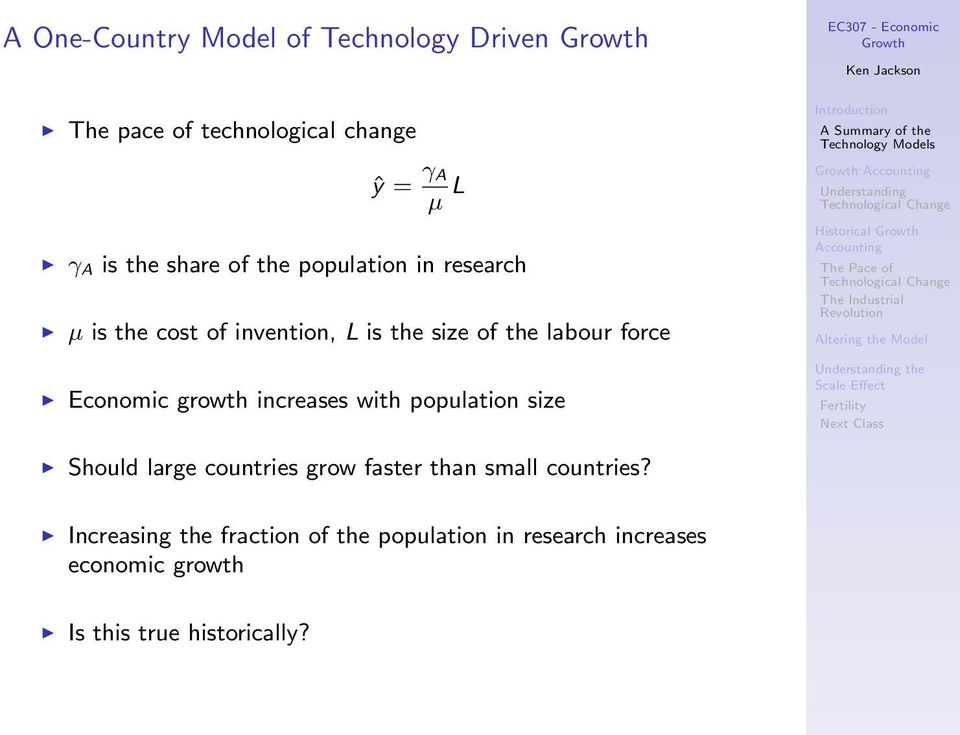
3 A One-Country Model of Technology Driven The pace of technological change ŷ = γ A µ L γ A is the share of the population in research µ is the cost of invention, L is the size of the labour force Economic growth increases with population size Should large countries grow faster than small countries? Increasing the fraction of the population in research increases economic growth Is this true historically?
4 Two-Country Model of Technology Driven Differentiate between inventors and imitators It should be cheaper to imitate - follower countries should have an easier time Very different from conditional convergence Leader and follower countries will both grow at the same pace If lead country increases research inputs - growth increases What are the key assumptions driving this result?

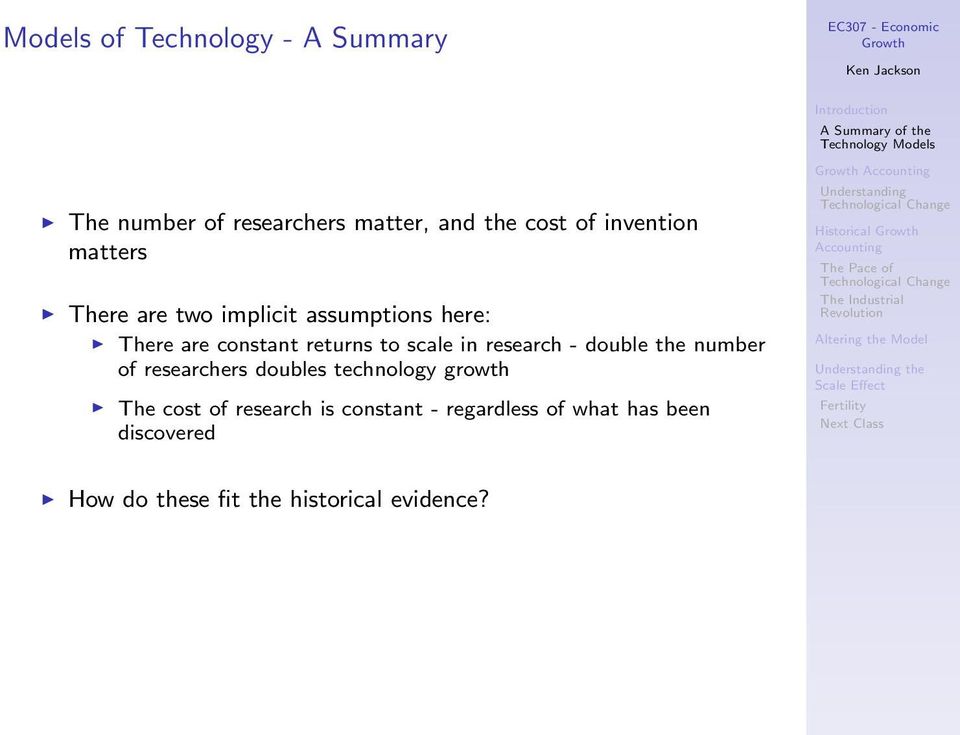
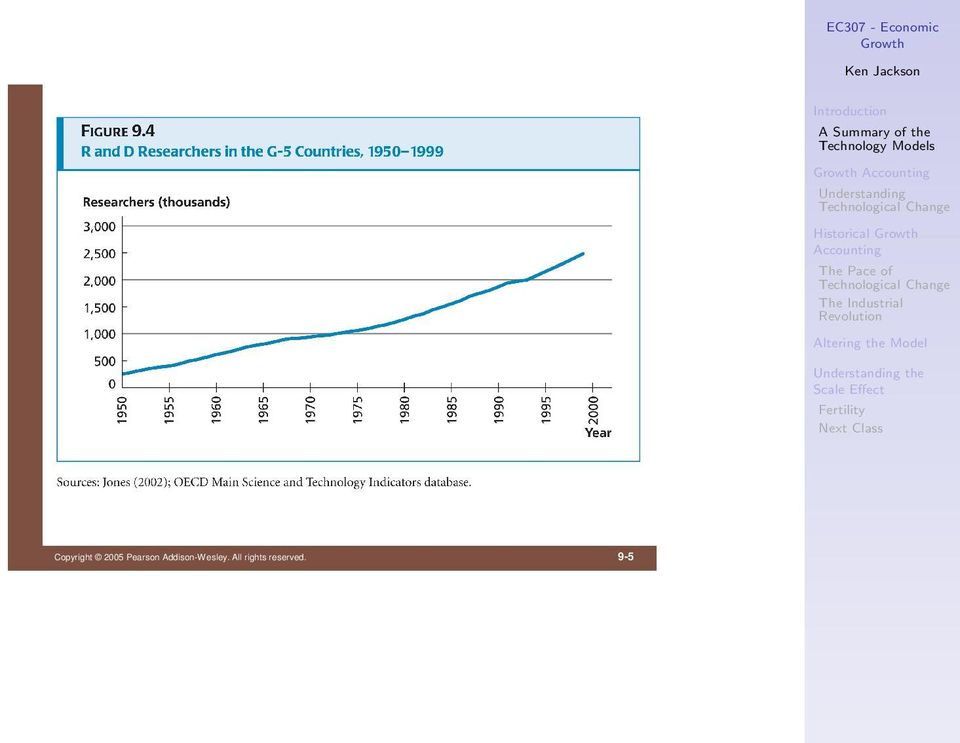
5 Models of Technology - A Summary The number of researchers matter, and the cost of invention matters There are two implicit assumptions here: There are constant returns to scale in research - double the number of researchers doubles technology growth The cost of research is constant - regardless of what has been discovered How do these fit the historical evidence?
6 Copyright 2005 Pearson Addison-Wesley. All rights reserved. 9-5
7 Review of How do we account for changes in income? accounting is introduced in chapter 7 of the textbook Start with an equation for income Y = AK α (hl) 1 α Or in per capita terms: y = Ak α h 1 α Income per capita = productivity(a) * factors of production(k,h)

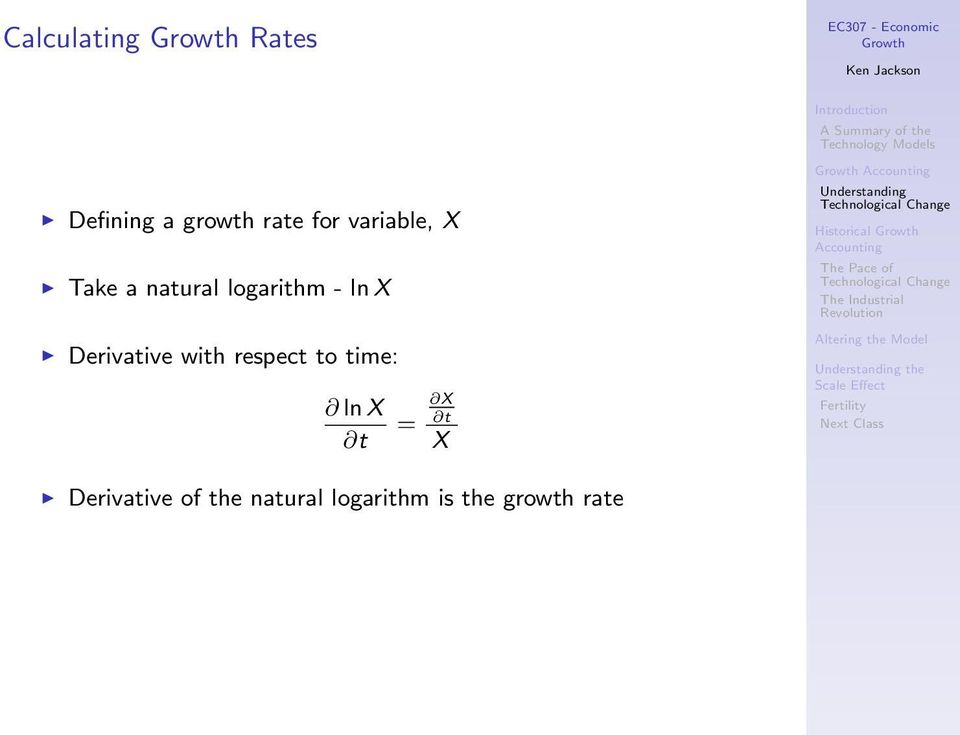
8 Calculating Rates Defining a growth rate for variable, X Take a natural logarithm - ln X Derivative with respect to time: ln X t = X t X Derivative of the natural logarithm is the growth rate
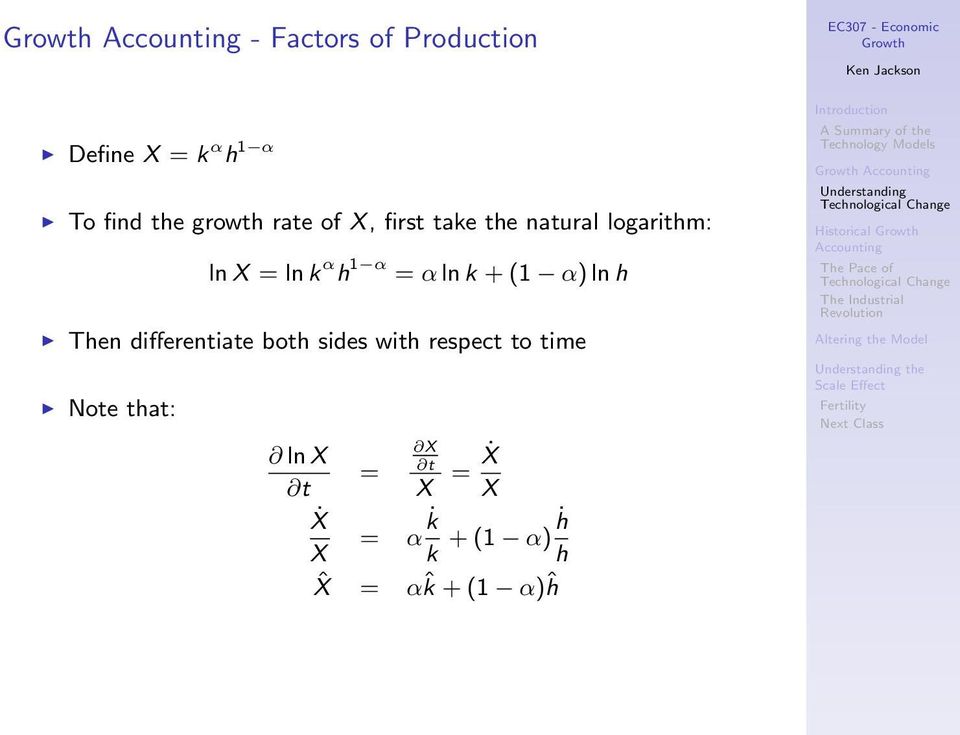
9 - Factors of Production Define X = k α h 1 α To find the growth rate of X, first take the natural logarithm: ln X = ln k α h 1 α = α ln k + (1 α) ln h Then differentiate both sides with respect to time Note that: X t X ln X = t = Ẋ X Ẋ = α k ḣ + (1 α) X k h ˆX = αˆk + (1 α)ĥ
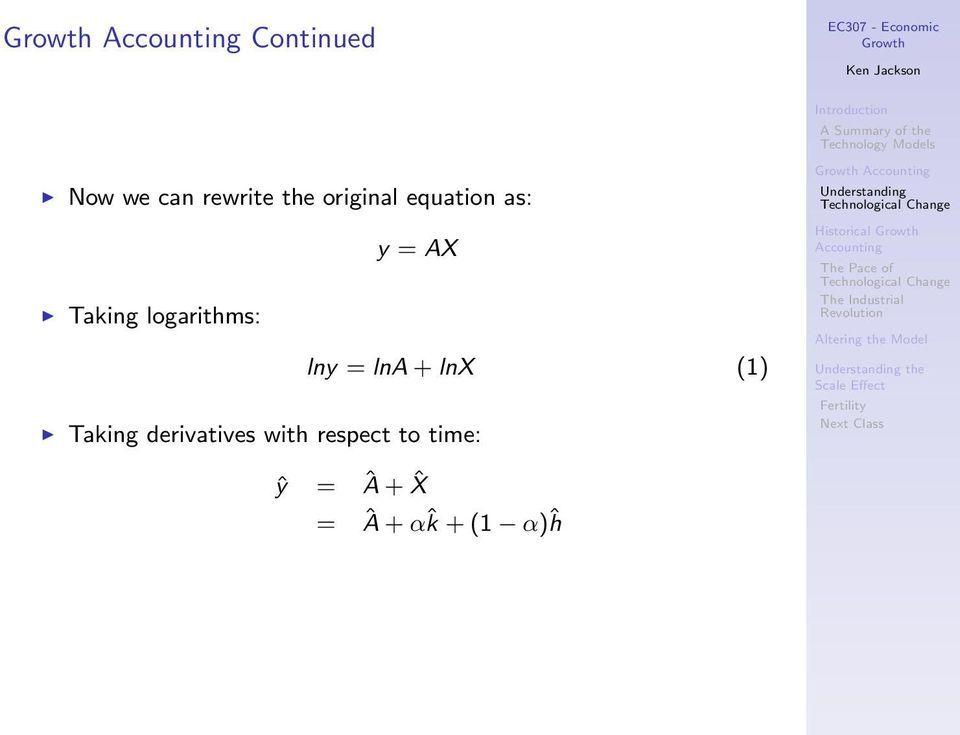
10 Continued Now we can rewrite the original equation as: y = AX Taking logarithms: lny = lna + lnx (1) Taking derivatives with respect to time: ŷ = Â + ˆX = Â + αˆk + (1 α)ĥ
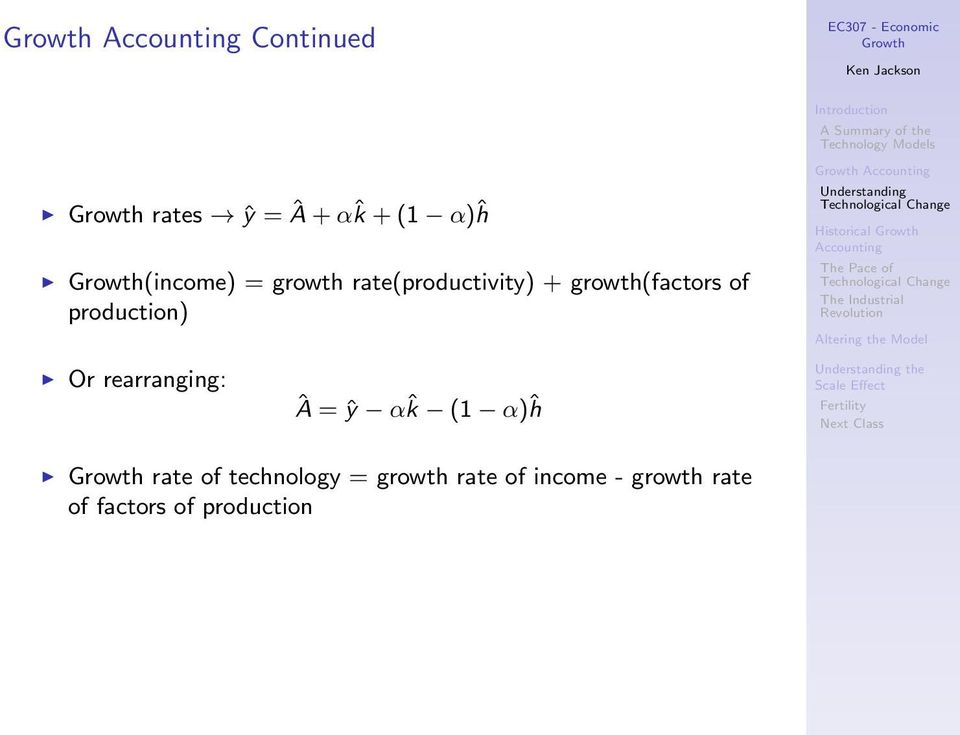
11 Continued rates ŷ = Â + αˆk + (1 α)ĥ (income) = growth rate(productivity) + growth(factors of production) Or rearranging: Â = ŷ αˆk (1 α)ĥ rate of technology = growth rate of income - growth rate of factors of production
12 Using for the Solow Model Measure growth rates of income Measure growth rates of physical and human capital Estimate the share α of income that is paid to capital The results are the growth rate of technology

13 productivity growth CAF NIC NER ZMB VEN MOZ TGO TZA ZWE JPN BEL ITA AUT ISR CHL NOR FRA ESP FIN SYR KEN GHA AUS IND DNK GRC MWI BRA USA URYGBR PAK ECU NLD SWE DOM CAN COL ZAF PAN BOL GTM DZA ARG PER PRY LKA CHE TTOUGA BGD MEX JAM SEN PHL MLI CRI CMR PNG HND NPL SLV JOR HKG IRL MUS THA MYS IDN KOR BWA rate of income,

14 How did technology change before 1800? The growth accounting based on the Solow model is difficult No measure of capital formation - can we ignore capital formation? Labour was not the only factor of production Land matters far more than capital in an agricultural society Landowners received a significant share of total income

15 A Modified Solow Model Add land to the Solow model, but remove capital Y = AX β L 1 β We have maintained the constant returns to scale idea - but not in reproducible factors As before - all income is paid to land-owners or labour (calculate marginal products) Dividing both sides by the size of the population we get: y = A ( ) β X L
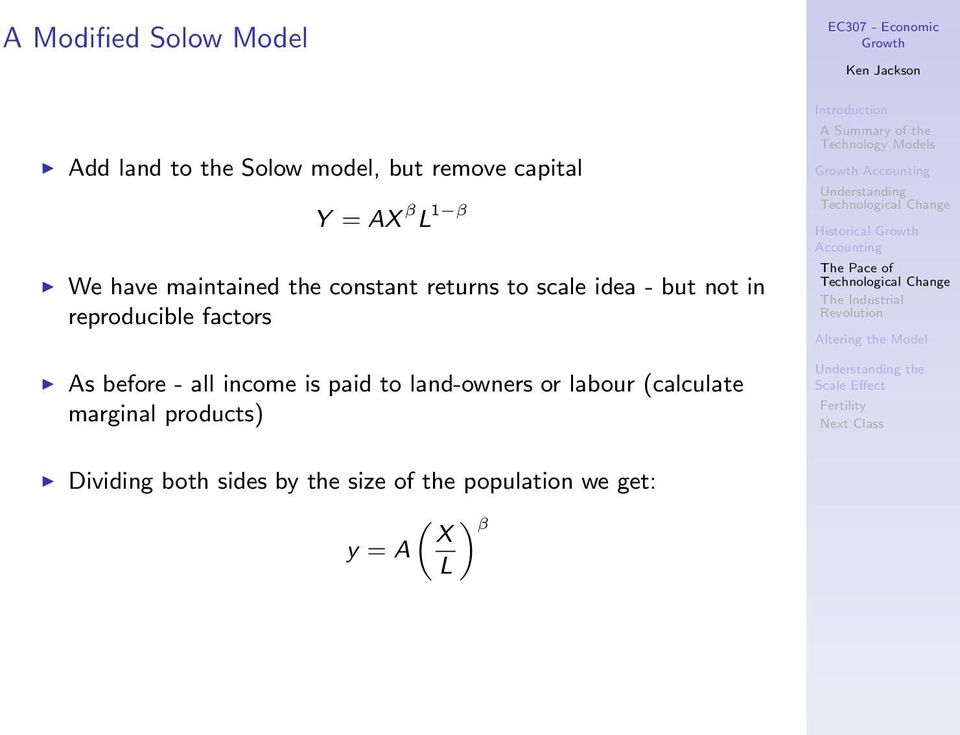
16 in the Modified Solow Model Taking logs of this equation and calculating growth rates gives us ŷ = Â + β ˆX βˆl (income) = growth(technology) + growth(land) - growth(labour) rate of labour has direct consequences on growth rate of income Alternatively: growth(land) - growth(labour) = growth(land per capita)

17 Fixed Factors Does it matter that land is in the equation Land is fixed - increases in population reduce the effectiveness of labour In the Solow model this happens, but investment in capital compensates rate of income = growth rate of productivity + growth rate of physical and human capital per person Here - no compensating factor The fixed factor implies a much stronger negative effect of fertility growth Similar effects to the Malthusian model (without the feedback effect)

18 As before: ŷ =  + β ˆX βˆl rate of land is zero Rearranging the last equation  = ŷ + βˆl (technology) = growth(income) + growth(labour force) Historical measure of β 1 3 Calculate growth rates over 2 historical time periods

19 Copyright 2005 Pearson Addison-Wesley. All rights reserved. 9-9

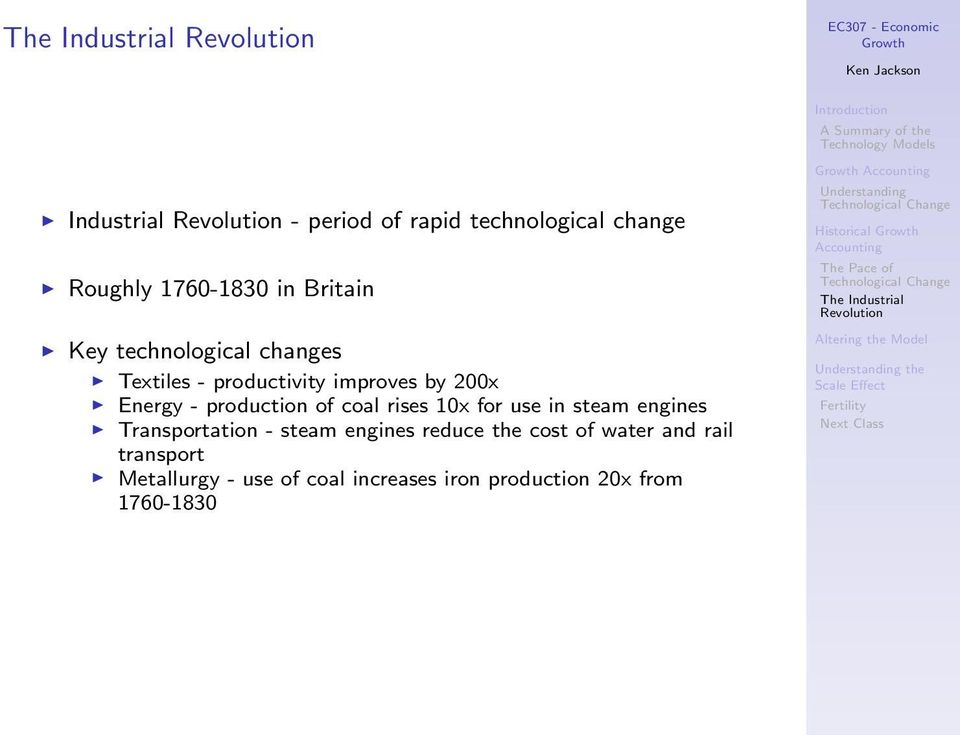
20 Industrial - period of rapid technological change Roughly in Britain Key technological changes Textiles - productivity improves by 200x Energy - production of coal rises 10x for use in steam engines Transportation - steam engines reduce the cost of water and rail transport Metallurgy - use of coal increases iron production 20x from
21 Copyright 2005 Pearson Addison-Wesley. All rights reserved. 9-2
22 Copyright 2005 Pearson Addison-Wesley. All rights reserved. 9-3
23 Industrial Up to rapid technological change Income growth driven by productivity growth model should explain why productivity started to increase After investment in factors of production is important Introduce mass production Solow growth model becomes a relevant approach
24 What Made the Industrial Special Prior to many important inventions The wheel BC Writing BC Clocks Movable type But earlier inventions didn t build on each other In the Ind.Rev. - the change in power acts as a General Purpose Technology GPT complements many additional inventions
25 Post-Industrial Productivity and capital investment both key factors - at different times Capital investment Productivity improvements through the World Wars Capital investment again in the 1970 s and 1980 s
26 Copyright 2005 Pearson Addison-Wesley. All rights reserved. 9-4
27 and the Models Productivity growth has not continued to rise with population Productivity is not only technology - might be missing something else Relationship between research effort and research output may be different
28 The Cost of Invention How do we model technology growth that becomes harder as new ideas are developed? Model the cost of each invention as µa φ Assume that 0 < φ < 1 This represents the fishing out effect
29 Decreasing Returns to Scale Difficult to assume that there are constant returns to scale in research More people in research tend to chase after the same ideas Assume that the production of technology increases with L λ A The overall technology production function is now: Â = Lλ AA φ µ How does this affect the model developed previously?
30 The Scaled Model The growth rate of technology is defined as: Can we find a steady-state?  = Lλ AA φ µ In a steady-state economy - growth rate of technology is constant  = g A Implies that L λ AA φ is constant
31 Calculating the Rate As usual - take logs and differentiate this equation with respect to time Rearranging this equation: µg A = L λ AA φ 0 = λ ˆ L A φâ Â = λ φ ˆ L A In the steady-state, the share of the population in research (γ A ) must be constant rate of researchers must equal the population growth rate (n) Rearranging this equation now results in: Â = λn φ
32 The New We have reduced the scale effect considerably Compare the new growth rate with the old growth rate: Â = λn φ Â = L A µ No longer implies that large countries should grow faster Population growth generates technological improvements - no diminishing return In the Solow model - capital is divided between people (rivalry matters)
33 So, Is Good or Bad? Population growth drives technology growth But population growth reduces the amount of capital/land available for each worker A key difference - ideas flow across countries far easier than capital does High fertility in a country may generate more technology - this benefits everyone in the world But the country with high fertility will itself be poor Particularly true in agricultural countries with a key fixed factor (land)
34 Where Does Population Occur? Where is population growth occurring? The assumption in the technology model is that increases in population increase the share of the population in research This is only true if population growth occurs in countries where people do research If technology development is limited by capital access - population growth in poor countries would have a limited effect Population growth is almost entirely in countries that have very low incomes And a significant part is in countries with an agricultural base
35 total fertility rate NER AGO BFA TCD MWI UGA MLI ZAR YEM BDI COG RWA SLE GNB ETH MRT GNQ ERI MDG BEN SAU TZA BTN NGA ZMBDJI GIN MOZ SEN TGO GMB LAO NAM CIV CMR CAFPAK SDN GTM KEN STP LSO HTI PNG SWZ NPL COM OMN GHA GAB KHM BWA HND BOL PRY ZWE JOR CPV SYR NIC PHL EGY DZA GRD TJK BGD SLV BLZ BHR INDECU MYS MAR PER ISR DOM FJI VEN ZAF MNG KGZ UZB IDN COL IRN MEX JAM CRI PAN ARG GUY TKM LBNTUR VNM ALB BRA CHL BHS LKA VCT URY KNA TUN SYC AZE LCAKAZ MUS NZL CHN THA PRI CYP MKD TTO MLT BRB ATG CUB PRT MDA HRV POL KOR ARM ROM BGR LTU BLR GRC ESTHUN SVK UKR LVA RUS CZE SVN ESP GEO KWT ISL FRA IRLNOR GBR FINLD AUSDNK SWE BEL CAN CHE SGP AUT JPN ITA MAC HKG USA LUX real gdp per capita 2000
36 total fertility rate AGO YEM COG GNQ MRT DJI GIN ZMB NGA SEN MOZ CIV PAK GTM KEN STP SWZ LSO PNG HTI GAB BWA HND PRYBOL ZWE JOR CPV SYR PHL GRD DZA EGY SLV TJK BLZ BGD ECUMYS IND ZAF VEN MAR PER DOM FJI MEX ARG CRI COL IDN IRN JAM PAN SUR LBN TUR TKM KNA URYBRA VNM SYC VCT CHL MUS TUN LKA LCAKAZ AZE FRA CHN LUX NOR THA DNK FIN ATG BRB MKD GBR TTO BEL CUB SGP PRT POL KOR HRV MDA SVK EST BGR BLR ITA LTU ROM SVN ESP ARM CZE LVA RUS UKR NER BFA TCD MWI UGA MLI RWA SLE MDG BEN BTN TZA TGO GMB CMR SDN NPL COM GHA KHM NIC MNGUZB KGZ GEO BDI ETH LAO CAF ALB GNB agriculture, value added/gdp 2000
37 total fertility rate NER AGO BFA MWI MLI UGA YEM ETH MRT BEN ERI MDG SAU TZA BTN DJI GIN NGA ZMB MOZSEN LAOGMB TGONAM CMR CIV CAF PAK SDN GTM KEN NPL COM OMN GHA GAB KHM HND PRY BOL BWA ZWE SYR JOR NIC PHL DZA EGY GRD BGD SLV BLZ BHR ARE MMR IND ECU MYS MAR PER VEN ZAF ISR FJI MNG COL IRN BRN KWT MEX QAT IDN PAN JAM ARG CRI GUYTUR LBN VNM ALB BRA CHL URY KNA LKA TUN VCT SYC MUS LCA CHN THA CYP BRB MLT YUG TTO CUB MDA POLHRV KOR ARM ROMBGR LTU GRCHUN SVK UKR RUS EST ITA CZE LVA ESP MAC NZL FRA IRL GBR BEL PRT AUT JPN SVN HKG ISL NLD FIN CAN DNK LUXAUS NOR SGP SWE CHE USA computers per 1,000 people 2000
38 Prospects for World from Technology Worldwide technology grows in response to growth in research Increasing growth rates: Increases in the labour force - population and participation Fraction of the labour force in research and development Countries advance to the cutting edge
39 Sectors of Technology Substitutes vs. complements Productivity improvements of a product with a necessary complement Pushes labour into the complementary product Productivity improvements of a product with many substitutes Creative destruction - labour is moved into the product that is developing
40 Goods vs. Services Productivity advances have been focused in goods production Consumption is shifting to services - goods and services are complements Can productivity in services develop at a similar rate?
41 Productivity is more than technology An attempt to differentiate productivity and technology What other factors affect productivity? Forms of inefficiency
The new gold standard? Empirically situating the TPP in the investment treaty universe
 Graduate Institute of International and Development Studies Center for Trade and Economic Integration Working Paper Series Working Paper N IHEIDCTEI2015-08 The new gold standard? Empirically situating
Figure 1.1 The Parade of World Income. Copyright 2005 Pearson Addison-Wesley. All rights reserved. 1-1
 Figure 1.1 The Parade of World Income Copyright 2005 Pearson Addison-Wesley. All rights reserved. 1-1 Copyright 2005 Pearson Addison-Wesley. All rights reserved. 1-2 Growth and Development: The Questions
Addressing institutional issues in the Poverty Reduction Strategy Paper process
 SESSION 1 Addressing institutional issues in the Poverty Reduction Strategy Paper process Scoping notes, detailed diagnostics, and participatory processes Public Sector Reform and Capacity Building Unit
Today s tips for the Country Buy Report
 High level outline Today s tips for the Country Buy Report Stephen Malpezzi Introduction Overview of the country and economy Basic indicators (GDP, employment, etc.) Key institutions, the setting How does
A new metrics for the Economic Complexity of countries and products
 A new metrics for the Economic Complexity of countries and products Andrea Tacchella Dept. of Physics, La Sapienza - University of Rome Istituto dei Sistemi Complessi, CNR Roma CRISISLAB ANALYTICS FOR
Building Capacity in PFM
 Building Capacity in PFM Measuring economic governance in the context of national development planning LAMIA MOUBAYED BISSAT Beirut, Lebanon, 13 June 2014 The Institut des Finances Basil Fuleihan 1996
China: How to maintain balanced growth? Ricardo Hausmann Kennedy School of Government Harvard University
 China: How to maintain balanced growth? Ricardo Hausmann Kennedy School of Government Harvard University China s growth process An unprecedented miracle China has been the fastest growing country in the
Lecture 21: Institutions II
 Lecture 21: Institutions II Dave Donaldson and Esther Duflo 14.73 Challenges of World Poverty Institutions II: Plan for the lecture Discussion of assigned reading (Acemoglu, Johnson and Robinson) Causes
Estimating Global Migration Flow Tables Using Place of Birth Data
 Estimating Global Migration Flow Tables Using Place of Birth Data Guy J. Abel Wittgenstein Centre (IIASA, VID/ÖAW, WU) Vienna Institute of Demography/Austrian Academy of Sciences 1 Introduction International
Economic Complexity and the Wealth of Nations
 Economic Complexity and the Wealth of Nations Cesar A. Hidalgo ABC Career Development Professor MIT Media Lab Faculty Associate, Center for International Development Harvard University EARTH WIND WATER
Macroeconomics II. Growth
 Macroeconomics II Growth Growth Possibilities We previously referred to the aggregate production function Y = A K α L 1- α. The growth rate of real GDP, Y, is generated by the contributions of A, K and
Economic Growth: The Neo-classical & Endogenous Story
 Density of countries Economic Growth: The Neo-classical & Endogenous Story EC307 ECONOMIC DEVELOPMENT 1960 Dr. Kumar Aniet University of Cambridge & LSE Summer School Lecture 4 1980 2000 created on July
The Fall of the Final Mercantilism
 The Fall of the Final Mercantilism Labour Mobility in the Caribbean and the World, from Arthur Lewis to the 21 st Century Eastern Caribbean Central Bank Michael Clemens November 3, 2010 1 2 Migration
Does Absolute Latitude Explain Underdevelopment?
 AREC 345: Global Poverty and Economic Development Lecture 4 Professor: Pamela Jakiela Department of Agricultural and Resource Economics University of Maryland, College Park Does Absolute Latitude Explain
Infrastructure and Economic. Norman V. Loayza, World ldbank Rei Odawara, World Bank
 Infrastructure and Economic Growth thin Egypt Norman V. Loayza, World ldbank Rei Odawara, World Bank Motivation Questions How does Egypt compare internationally regarding public infrastructure? Is Egypt
Human Resources for Health Why we need to act now
 Human Resources for Health Why we need to act now Progress towards the MDGs, particularly in Africa is slow, or even stagnating. Poor people cannot access basic services for want of doctors, nurses and
Deep Roots of Comparative Development
 Deep Roots of Comparative Development Oded Galor AEA Continuing Education Program Lecture III - AEA 2014 Oded Galor Roots of Comparative Development Lecture III - AEA 2014 1 / 41 Deep Roots of Comparative
Lecture 12 The Solow Model and Convergence. Noah Williams
 Lecture 12 The Solow Model and Convergence Noah Williams University of Wisconsin - Madison Economics 312 Spring 2010 Recall: Balanced Growth Path All per-capita variables grow at rate g. All level variables
Economic Growth: the role of institutions
 ECON 184 Economic Growth: the role of institutions ECON 184: Institutions and Growth January 26, 2010 1 Contents 1 Institutions and growth: initial analysis 3 2 How can institutions affect economic growth?
Natural Resources and Development in the Middle East and North Africa: An Alternative Perspective
 Natural Resources and Development in the Middle East and North Africa: An Alternative Perspective Daniel Lederman and Mustapha K. Nabli The World Bank Presentation at the Workshop on Natural Resources
ECON 260 Theories of Economic Development. Instructor: Jorge Agüero. Fall 2008. Lecture 1 September 29, 2008 1
 ECON 260 Theories of Economic Development. Instructor: Jorge Agüero. Fall 2008. Lecture 1 September 29, 2008 1 General information Time and location: TR 2:10-3:30 p.m. SPR 3123 Office hours: T 10am-11am,
Financial services and economic development
 GDP per capita growth 03/11/2014 Financial services and economic development Thorsten Beck Finance why do we care? 0.04 BWA 0.02 0.00-0.02 COG SLE ALB GAB IND KOR TUR SGP MUS SDN MOZ IRLLUX IDN MAR EGY
Addressing The Marketing Problem of the Social Market Economy
 Addressing The Marketing Problem of the Social Prepared for: KAS-Conference on 60 Years of Social Market Economy Sankt Augustin, November 30, 2009 Marcus Marktanner, American University of Beirut Outline
Political Economy of Growth
 1 Political Economy of Growth Daron Acemoglu Department of Economics, MIT Milan, DEFAP June 11, 2007 The Wealth of Nations Vast differences in prosperity across countries today. Income per capita in sub-saharan
Bringing Up Incentives: A Look at the Determinants of Poverty. Alice Sheehan
 Bringing Up Incentives: A Look at the Determinants of Poverty Alice Sheehan Outline presentation What s going on out there? Growth, Human Development indicators, Poverty rates, etc. A look at determinants
Does Export Concentration Cause Volatility?
 Does Export Concentration Cause Volatility? Christian Busch 14. Januar 2010 Overview Countries with undiversified export structure are plausibly more vulnerable to external shocks. But difficult to evaluate
Institute for Development Policy and Management (IDPM)
 Institute for Development Policy and Management (IDPM) Development Economics and Public Policy Working Paper Series WP No. 33/212 Published by: Development Economics and Public Policy Cluster, Institute
Subjective Well-Being, Income, Economic Development and Growth
 Subjective Well-Being, Income, Economic Development and Growth Dan Sacks, Betsey Stevenson and Justin Wolfers Wharton School, University of Pennsylvania and NBER Annual Bank Conference on Development Economics--Stockholm,
Geography and Economic Transition
 Global Spatial Analysis at the Grid Cell Level Mesbah Motamed Raymond Florax Will Masters Department of Agricultural Economics Purdue University March 2009 Urbanization at the grid cell level Growth regimes
Subjective Well Being, Income, Economic Development and Growth
 Subjective Well Being, Income, Economic Development and Growth Dan Sacks, Betsey Stevenson and Justin Wolfers Wharton School, University of Pennsylvania and NBER CSLS ICP Conference on Happiness December
Evaluation with stylized facts
 Evaluation with stylized facts AMPERE Subgroup on IAM Validation Valeria Jana Schwanitz Potsdam Institute for Climate Impact Research 27. Mai 2013 Content Fundamental laws and stylized facts Systematic
Governance, Rule of Law and Transparency Matters: BRICs in Global Perspective
 Governance, Rule of Law and Transparency Matters: BRICs in Global Perspective Daniel Kaufmann * Senior Fellow, Brookings Institution http://www.brookings.edu/experts/kaufmannd.aspx Panel on Transparency
Fertility Convergence
 Fertility Convergence Tiloka De-Silva a Silvana Tenreyro a,b a London School of Economics, CfM; b CEP, CEPR July 2015 Abstract A vast literature has sought to explain large cross-country differences in
Non-market strategy under weak institutions
 Lectures 5-6 Non-market strategy under weak institutions 1 Outline 1. Does weakness of institutions matter for business and economic performance? 2. Which institutions matter most? 3. Why institutions
Infrastructure and Economic Growth in Egypt
 Public Disclosure Authorized Policy Research Working Paper 5177 WPS5177 Public Disclosure Authorized Public Disclosure Authorized Infrastructure and Economic Growth in Egypt Norman V. Loayza Rei Odawara
The Role of Trade in Structural Transformation
 1 The Role of Trade in Structural Transformation Marc Teignier UNIVERSIDAD DE ALICANTE European Summer Symposium in International Macroeconomics 23 May 2012, Tarragona Question Contributions Road Map Motivation
Trade and International Integration: A Developing Program of Research
 Trade and International Integration: A Developing Program of Research World Bank Development Economics Research Group Geneva, June 2013 Three areas of focus I. Implications of the changing patterns of
DEPENDENT ELITES IN POST- SOCIALISM: ARE LAND-BASED POST- COLONIAL SYSTEMS SO DIFFERENT FROM THE TRANSCONTINENTAL ONES? by Pal TAMAS [Institute of
 DEPENDENT ELITES IN POST- SOCIALISM: ARE LAND-BASED POST- COLONIAL SYSTEMS SO DIFFERENT FROM THE TRANSCONTINENTAL ONES? by Pal TAMAS [Institute of Sociology, HAS Budapest] STRUCTURE OF THE PAPER 1. STATE
Growing Together with Growth Polarization and Income Inequality
 Growing Together with Growth Polarization and Income Inequality Sudip Ranjan Basu, Ph.D. Economist, United Nations ESCAP UN DESA Expert Group Meeting on the World Economy (LINK Project) United Nations
Online Appendix to The Missing Food Problem: Trade, Agriculture, and International Income Differences
 Online Appendix to The Missing Food Problem: Trade, Agriculture, and International Income Differences Trevor Tombe, Uversity of Calgary Contents 1 Proof of Propositions 2 2 Data and Sample of Countries
Trends in global income inequality and their political implications
 Trends in global income inequality and their political implications LIS Center; Graduate School City University of New York Talk at the Stockholm School of Economics, September 1, 2014 A. National inequalities
The Role of Women in Society: from Preindustrial to Modern Times
 CESifo Economic Studies Advance Access published May 22, 2014 CESifo Economic Studies, 2014, doi:10.1093/cesifo/ifu019 The Role of Women in Society: from Preindustrial to Modern Times Paola Giuliano UCLA
Informality in Latin America and the Caribbean
 WPS4888 Policy Research Working Paper 4888 Informality in Latin America and the Caribbean Norman V. Loayza Luis Servén Naotaka Sugawara The World Bank Development Research Group Macroeconomics and Growth
The contribution of trade in financial services to economic growth and development. Thorsten Beck
 The contribution of trade in financial services to economic growth and development Thorsten Beck Finance why do we care? 0.04 BWA GDP per capita growth 0.02 0.00-0.02 COG SLE ALB GAB IND KOR TUR SGP MUS
The distribution of household financial contributions to the health system: A look outside Latin America and the Caribbean
 The distribution of household financial contributions to the health system: A look outside Latin America and the Caribbean Priyanka Saksena and Ke Xu 3 November, 2008 Santiago 1 The distribution of household
Session 5x: Bonus material
 The Social Statistics Discipline Area, School of Social Sciences Session 5x: Bonus material Mitchell Centre for Network Analysis Johan Koskinen http://www.ccsr.ac.uk/staff/jk.htm! [email protected]
Life-cycle Human Capital Accumulation Across Countries: Lessons From U.S. Immigrants
 Life-cycle Human Capital Accumulation Across Countries: Lessons From U.S. Immigrants David Lagakos, UCSD and NBER Benjamin Moll, Princeton and NBER Tommaso Porzio, Yale Nancy Qian, Yale and NBER Todd Schoellman,
BUILDING A DATASET FOR BILATERAL MARITIME CONNECTIVITY. Marco Fugazza Jan Hoffmann Rado Razafinombana
 U N I T E D N AT I O N S C O N F E R E N C E O N T R A D E A N D D E V E L O P M E N T POLICY ISSUES IN INTERNATIONAL TRADE AND COMMODITIES STUDY SERIES No. BUILDING A DATASET FOR BILATERAL MARITIME CONNECTIVITY
Global Value Chains in the Current Trade Slowdown
 MARCH 14 Number 137 Global Value Chains in the Current Trade Slowdown Michael J. Ferrantino and Daria Taglioni Real growth in global trade has decelerated significantly since its sharp recovery in 1. Year-on-year
Specialization Patterns in International Trade
 Specialization Patterns in International Trade Walter Steingress November 16, 2015 Abstract The pattern of specialization is key to understanding how trade affects the production structure of an economy.
How To Increase Crop Output
 Adaptation to land constraints: Is Africa different? Derek Headey International Food Policy Research Institute (IFPRI) Thom Jayne Michigan State University (MSU) 1 1. Introduction Some 215 years ago, Malthus
The Impact of Primary and Secondary Education on Higher Education Quality 1
 The Impact of Primary and Secondary Education on Higher Education Quality 1 Katharina Michaelowa University of Zurich [email protected] 1. Introduction Undoubtedly, the overall education system
Country Risk Classifications of the Participants to the Arrangement on Officially Supported Export Credits
 Country Risk Classifications of the Participants to the Arrangement on Officially Supported Export Credits 19992013 8 9 10 11 12 13 01Jan99 22Jan99 19Mar99 1Jun99 14Oct99 24Jan00 29Jan99 26Mar99 24Jun99
Bands (considered to be) Shared on an Equal Basis Between Space and Terrestrial Services (for Region 1)
 Bands (considered to be) Shared on an Equal Basis Between Space and Terrestrial Services (for Region 1) Source: RR2012 Art 5, Art 9, Art 21, App 5, App 7; Rules of Procedure 2012 Rev. 5 Lower 137 137.025
Incen%ves The Good, the Bad and the Ugly
 Incen%ves The Good, the Bad and the Ugly Vale Columbia Center Interna%onal Investment Conference New York, Nov 13-14, 2013 Sebas%an James The World Bank Group 1 Prevalence of Tax Incen%ves around the Number
International Investment Patterns. Philip R. Lane WBI Seminar, Paris, April 2006
 International Investment Patterns Philip R. Lane WBI Seminar, Paris, April 2006 Introduction What determines aggregate capital inflows and outflows? What determines bilateral patterns in international
Technical partner paper 8
 The Rockefeller Foundation Sponsored Initiative on the Role of the Private Sector in Health Systems in Developing Countries Technical partner paper 8 Regulation of Health Service Delivery in Private Sector:
Human Rights and Governance: The Empirical Challenge. Daniel Kaufmann World Bank Institute. www.worldbank.org/wbi/governance/
 Human Rights and Governance: The Empirical Challenge Daniel Kaufmann World Bank Institute www.worldbank.org/wbi/governance/ Presentation at Human Rights and Development: Towards Mutual Reinforcement Conference,
Political Economy of Development and Underdevelopment
 Political Economy of Development and Underdevelopment Daron Acemoglu Department of Economics Massachusetts Institute of Technology October 10, 2005 The State of the World Economy Vast differences in prosperity
Tripartite Agreements for MEPC.2/Circ. Lists 1, 3, 4 received by IMO following issuance of MEPC.2/Circ.20
 The following is a list of tripartite agreements reported to IMO during the period between the issuance of the annual MEPC.2/Circular, disseminated in December of each year. Any countries wishing to join
Subjective Well Being and Income: Is There Any Evidence of Satiation? *
 Subjective Well Being and Income: Is There Any Evidence of Satiation? * Betsey Stevenson The Gerald R. Ford School of Public Policy, University of Michigan & CESifo and NBER [email protected] www.nber.org/~bstevens
Rodolfo Debenedetti Lecture
 Rodolfo Debenedetti Lecture Andrei Shleifer March 2005 Legal Origin Distribution Legal Origins = English = French = German = Scandinavian = Socialist Institution Procedural Formalism Outcomes Time to evict
Reported measles cases and incidence rates by WHO Member States 2013, 2014 as of 11 February 2015 2014 data 2013 data
 Reported and rates by WHO s 2013, 2014 as of 11 February 2015 Number of by confirmation rate AFR Algeria DZA 49 0 0.00 0.12 0 0.00 0.22 AFR Angola AGO 12301 12036 547 11173 316 54.37 1.20 6558 30.54 1.20
Department of Economics
 Department of Economics Dr. Seo-Young Cho Platz der Göttinger Sieben 3, D-37073 Göttingen Tel. +49 (0) 551 / 39-7368 Fax +49 (0) 551 / 39-7302 [email protected] Göttingen, 17.02.2012 Several Developed
Technology Choice. Francesco Caselli. Summer School 2005
 Technology Choice Francesco Caselli Summer School 2005 1 Motivation All of the evidence and all of the models we have studied so far assume that cross-country technology differences are factor-neutral.
The Effects of Infrastructure Development on Growth and Income Distribution
 The Effects of Infrastructure Development on Growth and Income Distribution César Calderón Luis Servén (Central Bank of Chile) (The World Bank) ALIDE - The World Bank - Banco BICE Reunión Latinoamericana
The Macroeconomic Implications of Financial Globalization
 The Macroeconomic Implications of Financial Globalization Eswar Prasad, IMF Research Department November 10, 2006 The views expressed in this paper are those of the author(s) ) only, and the presence of
Industrial Policy, Capabilities, and Growth: Where does the Future of Singapore lie? Jesus Felipe Asian Development Bank
 Industrial Policy, Capabilities, and Growth: Where does the Future of Singapore lie? Jesus Felipe Asian Development Bank Purpose of the talk Understand the economic challenges that Singapore faces Discuss
Tripartite Agreements for MEPC.2/Circ. Lists 1, 3, 4 received by IMO following issuance of MEPC.2/Circ.21
 The following is a list of tripartite agreements reported to IMO during the period between the issuance of the annual MEPC.2/Circular, disseminated in December of each year. Any countries wishing to join
Overview of Growth Research in the Past Two Decades
 Overview of Growth Research in the Past Two Decades by Pete Klenow Stanford University and NBER September 21, 2010 Early Growth Research 1950s Solow (1956) 1960s Nelson and Phelps (1966) 1970s Dark Ages
The geography of development within countries
 The geography of development within countries J. Vernon Henderson Brown University & NBER June 2012 GDN 13TH ANNUAL GLOBAL DEVELOPMENT CONFERENCE Urbanization and Development: Delving Deeper into the Nexus
Design of efficient redistributive fiscal policy
 Fiscal Policy and Income Inequality Sanjeev Gupta Deputy Director Fiscal Affairs Department, IMF IMF-Hitotsubashi University Workshop March 12, Tokyo Structure of the presentation Trends in inequality
EC 2725 April 2009. Law and Finance. Effi Benmelech Harvard & NBER
 EC 2725 April 2009 Law and Finance Effi Benmelech Harvard & NBER Broad Picture A market economy is not only laissez faire but it also requires a set of institutions that allow markets to work their magic.
A Survey of Securities Laws and Enforcement
 A Survey of Securities Laws and Enforcement Preliminary Draft By Florencio Lopez-de-Silanes YALE University and NBER October 2003 *I am indebted to Patricio Amador, Jose Caballero and Manuel Garcia-Huitron
Daniel Kaufmann, World Bank Institute www.worldbank.org/wbi/governance
 Afro-Pessimism vs. Irrational Exuberance or a New Dawn for Africa Governance?: A comparative empirical perspective on governance in African countries Daniel Kaufmann, World Bank Institute www.worldbank.org/wbi/governance
A Pragmatic Approach to Capital Account Liberalization. Eswar Prasad Cornell University
 A Pragmatic Approach to Capital Account Liberalization Eswar Prasad Cornell University Presentation partly based on my joint work with: Ayhan Kose, Kenneth Rogoff, Shang-Jin Wei (2003, 2006) Raghuram Rajan