
How To Promote The European Learning Programme
|
|
|
- Estella Jefferson
- 5 years ago
- Views:
Transcription
1 Lifelong Learning Programme (LLP) Guide 2013 Part I: General provisions 1
2 Table of contents 1. GENERAL OVERVIEW OF THE LIFELONG LEARNING PROGRAMME (LLP) A. WHAT IS THE STRUCTURE OF THE PROGRAMME? B. WHAT ACTION CATEGORIES ARE SUPPORTED? C. WHICH COUNTRIES PARTICIPATE IN THE PROGRAMME? D. WHO CAN PARTICIPATE? E. WHO DOES WHAT? F. SOME BASIC TERMS WHAT IS THE LIFE-CYCLE OF A PROJECT? A. ADMINISTRATIVE CYCLE B. FINANCIAL CYCLE C. APPLICABLE RULES WHAT ARE THE SUBMISSION AND SELECTION PROCEDURES? A. PROCEDURE FOR SUBMITTING GRANT APPLICATIONS B. PROCEDURE FOR THE ASSESSMENT AND SELECTION OF APPLICATIONS FINANCIAL PROVISIONS A. GENERAL FINANCIAL CONDITIONS APPLICABLE TO ALL ACTIONS B. TYPES OF FINANCING C. MOBILITY GRANTS AWARDED FOR INDIVIDUALS D. GRANTS FOR ORGANISATIONS IMPLEMENTING MOBILITY (ERASMUS, LEONARDO DA VINCI AND GRUNDTVIG) E. PARTNERSHIPS F. MULTILATERAL PROJECTS, NETWORKS, ACCOMPANYING MEASURES G. JEAN MONNET PROGRAMME KEY ACTIVITY DISSEMINATION AND EXPLOITATION OF RESULTS IN THE LIFELONG LEARNING PROGRAMME A. WHAT IS DISSEMINATION AND EXPLOITATION OF RESULTS? B. BUILDING A DISSEMINATION AND EXPLOITATION STRATEGY AND PLAN C. GENERIC TYPOLOGY OF PROJECT RESULTS D. PUBLICITY E. PROTECTION OF PERSONAL DATA

3 Introduction This Guide contains additional information complementing the annual Lifelong Learning Programme (LLP) Call for Proposals. Applicants are also invited to consult the websites of the Education, Audiovisual and Culture Executive Agency or the relevant National Agency (see section 1.E). The Guide aims to: Help applicants to apply for funds and fill in the application forms; Help applicants to prepare an appropriate budget for their proposal; Clarify matters arising from the Call for Proposals; Provide practical information to which applicants may refer to at the various stages of the application and selection process. 1. GENERAL OVERVIEW OF THE LIFELONG LEARNING PROGRAMME (LLP) The Programme for EU Action in the Field of Lifelong Learning (the Lifelong Learning Programme LLP) 1 aims to contribute through lifelong learning to the development of the EU as an advanced knowledge society, with sustainable economic development, more and better jobs and greater social cohesion. In particular, it aims to foster interchange, co-operation and mobility between education and training institutions and systems within the EU so that they may become a world quality reference. In this way, it addresses the modernisation and adaptation of education and training systems in the participating countries, particularly in the context of the goals set out in the EU 2020 Strategy 2,and brings European added value directly to individual citizens participating in its mobility and other co-operation actions. The programme's specific objectives are mentioned below. They ensure that the LLP supports and supplements action taken by the Member States and other participating countries, while fully respecting their responsibility for the content of education and training systems and their cultural and linguistic diversity. The LLP runs for seven years ( ). The total budget for this period is EUR million. 1 The programme was established by the Decision 1720/2006/EC of the European Parliament and of the Council of 15 November 2006, OJ L327 of 24/11/2006 (and amended by the Decision 1357/2008 of the European Parliament and of the Council of 16 December 2008). 2 Communication from the Commission: Europe 2020 A Strategy for Smart, Sustainable and Inclusive Growth. COM(2010)

4 GENERAL OBJECTIVE To foster interchange, cooperation and mobility between education and training systems within the EU so that they become a world quality reference SPECIFIC OBJECTIVES 1 To contribute to the development of quality Lifelong Learning, to promote high performance, innovation and a European dimension in systems and practices in the field 2 To support the realisation of a European area for Lifelong Learning 3 To help improve the quality, attractiveness and accessibility of the opportunities for Lifelong Learning available within Member States 4 To reinforce the contribution of Lifelong Learning to social cohesion, active citizenship, intercultural dialogue, gender equality and personal fulfilment 5 To promote creativity, competitiveness, employability and the growth of an entrepreneurial spirit 6 To contribute to increased participation in Lifelong Learning by people of all ages, including those with special needs and disadvantaged groups regardless of their socio-economic background 7 To promote language learning and linguistic diversity 8 To support the development of innovative ICT-based content, services, pedagogies and practices for Lifelong Learning 9 To reinforce the role of Lifelong Learning in creating a sense of European citizenship based on understanding and respect for human rights and democracy, and encouraging tolerance and respect for peoples and cultures 10 To promote cooperation in quality assurance in all sectors of VET in Europe 11 To encourage the best use of results, innovative products and processes and to exchange good practice in the field covered by the Lifelong Learning Programme, in order to improve the quality of education and training As indicated in Article 12 of the LLP decision, the programme should also contribute to furthering the horizontal policies of the EU, in particular by: (a) (b) (c) promoting an awareness of the importance of cultural and linguistic diversity within Europe, as well as of the need to combat racism, prejudice and xenophobia; making provision for learners with special needs, and in particular by helping to promote their integration into mainstream education and training; promoting equality between men and women and contributing to combating all forms of discrimination based on sex, racial or ethnic origin, religion or belief, disability, age or sexual orientation. 4

5 1.A. WHAT IS THE STRUCTURE OF THE PROGRAMME? The Lifelong Learning Programme consists of: four sectoral programmes focusing on school education (Comenius), higher education (Erasmus), vocational training (Leonardo da Vinci) and adult learning (Grundtvig) respectively; a Transversal Programme targeted on cross-sectoral areas (policy cooperation and innovation in lifelong learning, languages, development of innovative ICT, dissemination and exploitation of results); a programme to support teaching, research and reflection on European integration and key European institutions and associations (Jean Monnet Programme). LLP Programme Sectoral programmes COMENIUS Schools ERASMUS Higher Education LEONARDO DA VINCI Vocational Training GRUNDTVIG Adult Learning Transversal Programme Key Activity 1 Policy Cooperation & Innovation in LLL Key Activity 2 Languages Key Activity 3 Development of ICT-Based Content Key Activity 4 Dissemination and Exploitation of Results Jean Monnet Programme Jean Monnet Action Operating Grants supporting Specified Institutions Operating Grants to Support Other European Institutions 5
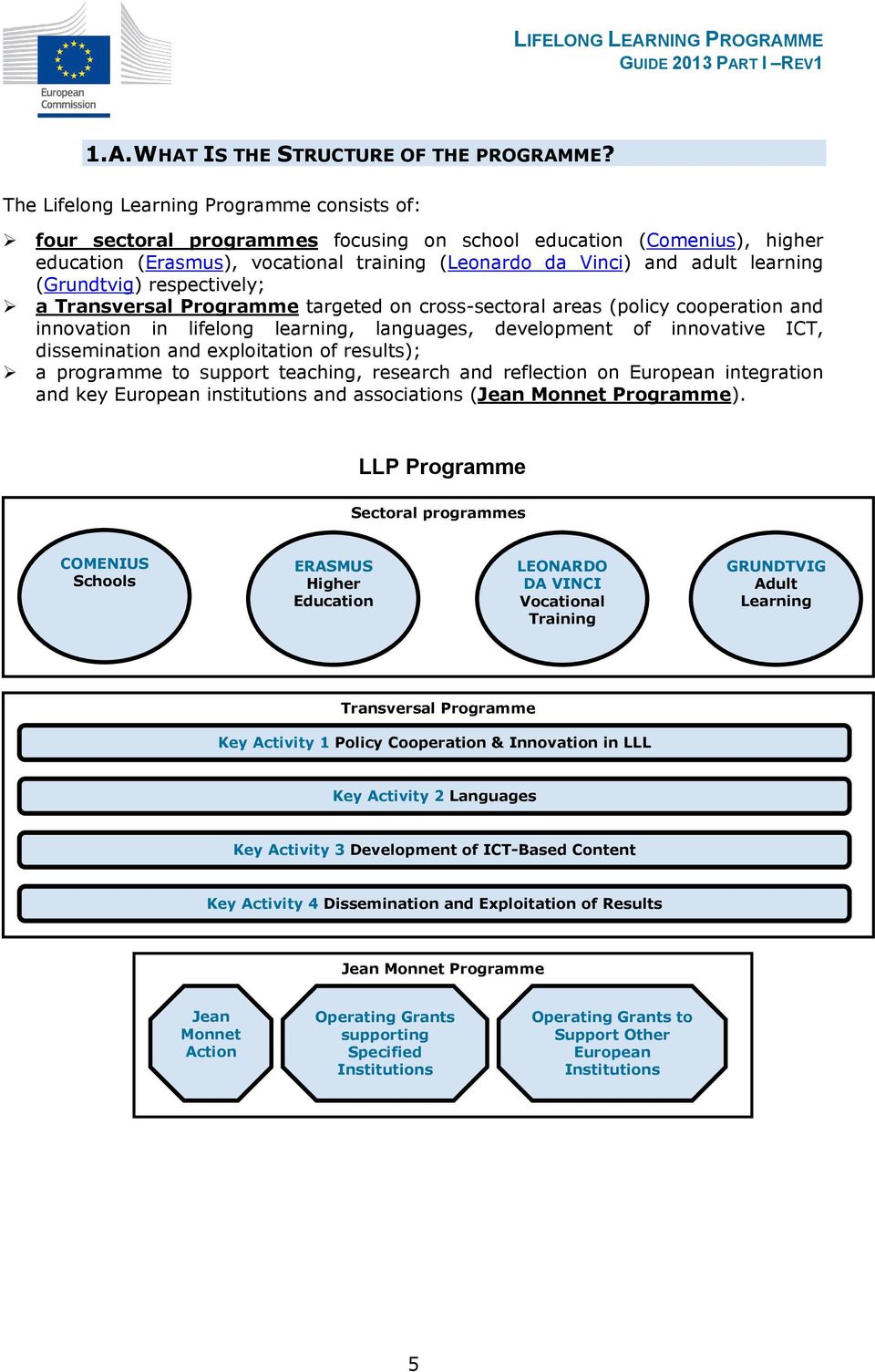
6 COMENIUS programme School Education ERASMUS programme Higher Education LEONARDO DA VINCI programme Vocational Education and Training GRUNDTVIG programme Adult Learning Key Activity 1 Policy Cooperation & Innovation in LLL Key Activity 2 Languages Key Activity 3 Development of ICT-Based Content Key Activity 4 Dissemination and Exploitation of Results The Comenius programme focuses on the first phase of education, from pre-school and primary to secondary schools. It is relevant for all members of the education community: pupils, teachers, local authorities, parents associations, non-government organisations, teacher training institutes, universities and all other educational staff. Erasmus is the EU's education and training programme for mobility and cooperation in higher education across Europe. Its different actions not only address students wishing to study and work abroad, but also higher education teachers and enterprise staff intending to teach abroad and to higher education staff seeking training abroad. In addition, Erasmus supports higher education institutions to work together through intensive programmes, networks and multilateral projects as well as to reach out to the world of business. The Leonardo da Vinci programme links policy to practice in the field of vocational education and training (VET). Projects range from those giving individuals the chance to improve their competences, knowledge and skills through a period abroad, to Europe-wide co-operation between VET stakeholders in order to enhance the attractiveness, quality and performance of VET systems and practices. Addresses the teaching and learning needs relating to all forms of adult learning which are not of a predominantly vocational nature, as well as the institutions and organisations providing or facilitating any form of such learning opportunities for adults whether of a formal, non-formal or informal nature including those involved in the initial and in-service training of staff. Policy co-operation and innovation actions: supports study visits for education and vocational training specialists, as well as networks in these fields at European level. The main objectives are to support policy development and co-operation in lifelong learning and to ensure an adequate supply of comparable data, statistics and analyses. Linguistic skills are essential for the mobility of European citizens and businesses; they enhance employability and competitiveness and strengthen intercultural dialogue and social cohesion. EU actions aim to promote language learning and the linguistic diversity in Europe. EU actions aim to harness the power of Information and Communications Technologies (ICT) to develop innovative education and training practices, improve access to lifelong learning and help develop advanced management systems. In order to maximise their impact, activities and projects funded by the Lifelong Learning Programme, or previous programmes, should be made as widely known as possible to potential users. Therefore, it is necessary that each EU-funded project disseminates and exploits its own results. 6

7 Jean Monnet action Operating Grants supporting Specified Institutions Operating Grants to Support Other European Institutions The Jean Monnet programme stimulates teaching, research and reflection on European integration at higher education institutions throughout the world. With projects across the five continents, the programme reaches up to students every year. Grants are awarded to support certain operational and administrative costs of the following named institutions pursuing an aim of European interest: - the College of Europe - the European University Institute - the European Institute of Public Administration - the Academy of European Law - the European Agency for Development in Special Needs Education - the International Centre for European Training (CIFE). Grants may be awarded to support certain operational and administrative costs of European institutions or associations active in the field of education and training. 1.B. WHAT ACTION CATEGORIES ARE SUPPORTED? The LLP supports the following action categories: Charter Certificate Mobility Bilateral multilateral partnership and A written document granted by the European Commission giving the possibility to the eligible higher education institutions to participate in Erasmus activities. The Charter outlines the fundamental principles an institution should adhere to in organising and implementing high quality mobility and cooperation and states the requisites it agrees to comply with in order to ensure high quality services and procedures as well as the provision of reliable and transparent information. A certificate in mobility is the recognition of the capacity of an institution or a consortium to implement a mobility activity of excellent quality. These quality aspects cover the strategic framework in which the mobility activity is embedded (policy, strategy, work programme) as well as the operational and financial capacity of the institution to organise mobility activities. It is used in the Erasmus programme (Erasmus Consortium Placement Certificate) and in the Leonardo da Vinci programme (Leonardo da Vinci mobility certificate). Spending a period of time in another participating country in order to undertake study, work experience, other learning, teaching or training activity or related administrative activity, supported as appropriate by preparatory or refresher courses in the host language or working language. A bilateral or multilateral agreement between institutions / organisations in different participating countries to carry out usually smaller-scale European cooperation activities in their respective area of lifelong learning (school education, vocational training or adult learning). 7

8 Multilateral project Multilateral network Unilateral national project Accompanying measures Operating grants or A European cooperation activity with a defined and exploitable outcome developed jointly by a formal or informal grouping of organisations or institutions. A formal or informal grouping of bodies active in a particular field, discipline or sector of lifelong learning, focussing on strategic reflections, needs analyses and networking activities in the field concerned. An activity with a defined and exploitable outcome developed by a single institution or in only one country. Support for various activities which, though not eligible under the main actions of the sectoral programmes, should clearly contribute to achieving the LLP's objectives. Financial support to the regular operation of institutions and associations active in the field covered by the Lifelong Learning Programme. Not all of these action types are available in every part of the programme. 1.C. WHICH COUNTRIES PARTICIPATE IN THE PROGRAMME? The programme is open to: the 27 EU Member States 3 Iceland, Liechtenstein, Norway (the "EFTA-EEA countries", i.e. those countries which are members of the European Free Trade Association and also belong to the European Economic Area) Turkey, Croatia Switzerland Albania, Bosnia and Herzegovina, Montenegro and Serbia (only for actions managed through the Commission Procedure, see section 3.A below) 4 the former Yugoslav Republic of Macedonia (only for actions managed through the Commission procedure and for a limited number of actions managed through the National Agency Procedure 1 5, see section 3.A below) "Overseas countries and territories" defined by Council Decision 2001/822/EC (amended by Council Decision 2007/249/EC): Greenland New Caledonia and Dependencies French Polynesia French Southern and Antarctic Territories Wallis and Futuna Islands Mayotte 3 Includes applicants from the following regions: Canary Islands, Guadeloupe, Martinique, French Guiana, Réunion, Azores, Madeira. Where specific financial provisions apply to the Overseas countries and Territories, these rules also apply to these regions. 4 The participation of Albania, Bosnia and Herzegovina and Montenegro in the present call for proposals is subject to the signature of a Memorandum of Understanding between the Commission and the competent authorities of each of these countries respectively. If, by the first of the month of the grant award decision, the Memorandum of Understanding has not been signed, participants from this country will not be funded and will not be taken into account with regard to the minimum size of consortia/partnerships. Please consult the website of the Commission ( for the latest information available on the matter. 5 As specified in the Official announcement of the Call for proposals in the Official Journal of the European Union ( 8

9 St Pierre and Miquelon Aruba Netherlands Antilles Anguilla Cayman Islands Falkland Islands South Georgia and the South Sandwich Islands Montserrat Pitcairn Saint Helena, Ascension Island, Tristan da Cunha British Antarctic Territory British Indian Ocean Territory Turks and Caicos Islands British Virgin Islands In compliance with Article 14(2) of the Decision establishing the LLP, multilateral projects and networks under Comenius, Erasmus, Leonardo da Vinci, Grundtvig and the key activities of the Transversal Programme may also be open to partners from countries which do not participate in the Lifelong Learning Programme (so called "third countries"). The action-specific fiches in Part II of this Guide indicate the actions to which this applies. Potential applicants are invited to visit the website of the Education, Audiovisual and Culture Executive Agency for further details of the modalities of participation. Applicants are encouraged to consider including third country partners from: - countries identified in Article 7 as being eligible to participate in the LLP in the future under certain circumstances, but for which the relevant agreements have not yet been concluded; - Kosovo 6, the countries addressed by the European Union's Neighbourhood Policy 7 and Russia; - countries identified by the EU as being of particular priority in the context of developing a strategic policy dialogue in education and training or multilingualism 8. However, projects and networks are at liberty in their applications to make a case for including partners from other countries where the organisations concerned have demonstrably important expertise to share with their European counterparts. In all instances the involvement of partners from third countries must be justified in terms of the value added to experience within the European countries participating in the programme. The Jean Monnet Action is open to higher education institutions and associations in all countries participating in the LLP as well as to any other ("third") country. Participating institutions and associations from third countries are subject to all the obligations and will fulfil all the tasks set out in the programme decision in relation to institutions and associations in the Member States. 6 This designation is without prejudice to positions on status, and is in line with UNSC 1244 and the ICJ Opinion on the Kosovo Declaration of Independence 7 The European Neighbourhood Policy applies to the EU's immediate neighbours by land or sea Algeria, Armenia, Azerbaijan, Belarus, Egypt, Georgia, Israel, Jordan, Lebanon, Libya, Moldova, Morocco, the Occupied Palestinian Territory, Syria, Tunisia and Ukraine. 8 At the time of going to press with the present Guide, these are: i.e. Australia, Brazil, Canada, China, India, Israel, Japan, Mexico, New Zealand, South Africa, South Korea, USA. 9

10 1.D. WHO CAN PARTICIPATE? The LLP is open to practically everybody who is involved in education or training: Pupils, students, trainees and adult learners Teachers, trainers and other staff involved in any aspect of lifelong learning (LLL) People in the labour market Institutions or organisations providing learning opportunities in any area of education or training The persons and bodies responsible for systems and policies concerning any specific aspect of LLL at local, regional and national level Enterprises, social partners and their organisations at all levels, including trade organisations, professional organisations and chambers of commerce and industry Bodies providing guidance, counselling and information services relating to any aspect of LLL Associations working in the field of LLL, including students, trainees, pupils, teachers, parents and adult learners associations Research centres and bodies concerned with education and training issues Not-for-profit organisations, voluntary bodies, non-governmental organisations (NGOs). The LLP National Agencies as well as their staff are not eligible for any action of the Lifelong Learning Programme unless explicitly provided for. The legal entities hosting the LLP National Agencies can participate exclusively in actions managed through the Commission procedure, see section 3.A below. Please consult the specific sections of this Guide for information on who can participate in which part of the programme. 1.E. WHO DOES WHAT? The European Commission (Directorate General for Education and Culture) is responsible for ensuring the effective and efficient implementation of the LLP as a whole. The Commission is assisted in this task by the LLP Committee which comprises representatives of the Member States and other participating countries and is chaired by the Commission. The operational management of the programme is carried out by the Commission in close co-operation with National Agencies (NA) (one or more in each of the participating countries) and the Education, Audiovisual & Culture Executive Agency (Executive Agency) in Brussels. National Agencies (NA): The national authorities of the participating countries have established National Agencies to facilitate the coordinated management of the socalled "decentralised" actions of the programme at national level. The National Authorities monitor and supervise the National Agencies and provide assurance to the Commission on the proper management by the National Agencies of the EU funds for decentralised actions of the programme. 10
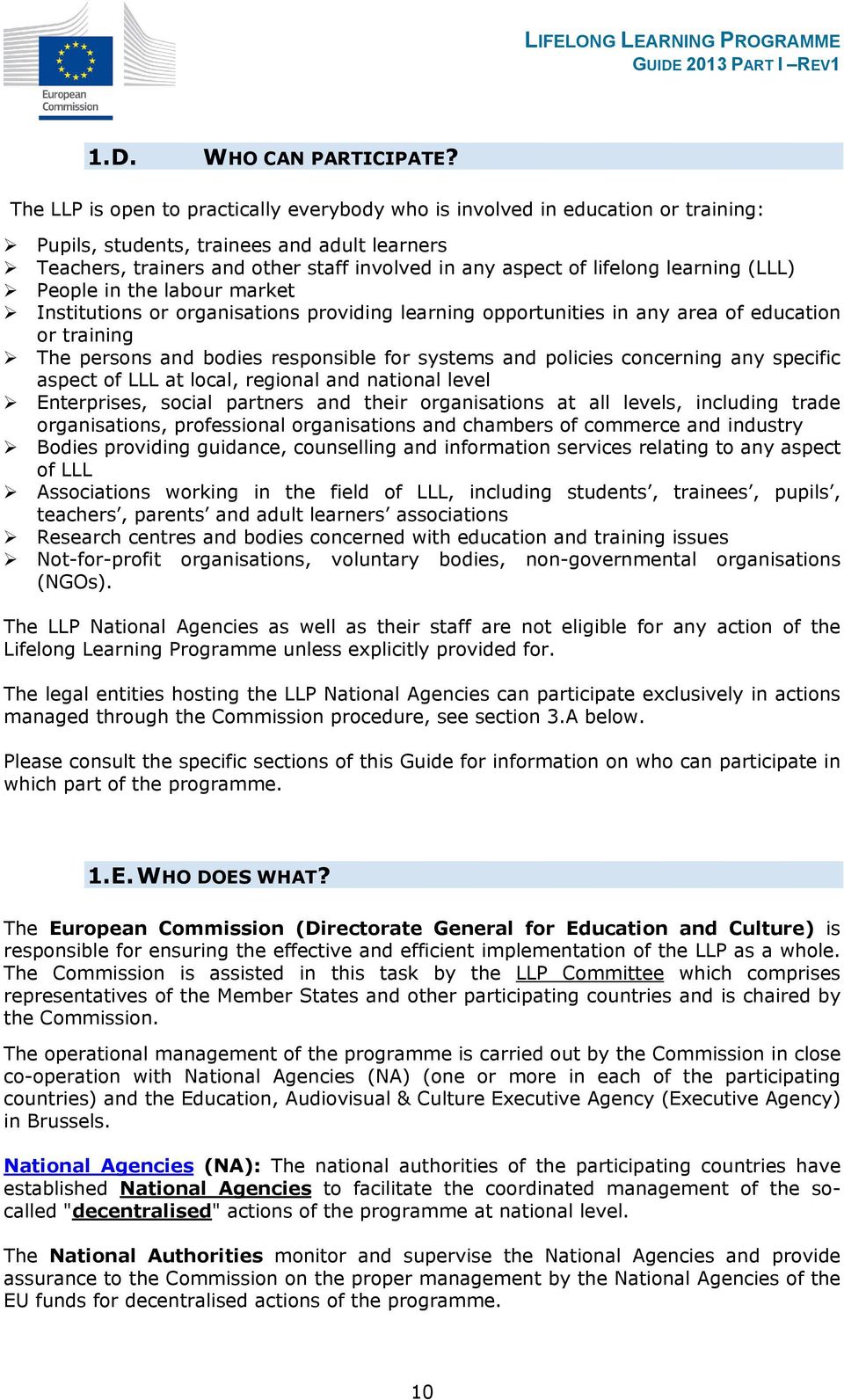
11 The National Agencies play a key role in the practical implementation of the programme, as they are responsible for publicising the programme at national level, contributing to the dissemination and exploitation of results, and in particular for the management of the whole project life-cycle of the decentralised programme actions at national level: the publication of any national calls for proposals or deadlines complementing the European Call for proposals on the LLP providing information on and promoting the programme actions, counselling potential applicants the reception, assessment and selection of grant applications taking the grant award decision for approved grant applications issuing Grant Agreements and payments to beneficiaries reception and treatment of contractual reports from beneficiaries monitoring and support to programme beneficiaries desk checks and on the spot control and audit of supported activities the dissemination and exploitation of results from supported activities analysing and providing feedback on the programme implementation and impact in their country. The "Executive Agency" in Brussels: the mission of the Education, Audiovisual and Culture Executive Agency is to implement a number of "strands" of European Commission-funded programmes and actions in the fields of education and training, active citizenship, youth, audiovisual and culture. The programme strands managed by the Executive Agency are all "centralised", in the sense that applications are submitted directly to Brussels rather than via an NA. On the basis of the reference framework established by the Commission, the Executive Agency is responsible for implementing the following tasks: publication of specific calls for proposals and calls for tender receipt of grant applications and organising the assessment and project selection taking the grant award decision after consultation with the Commission issuing project Grant Agreements and making grant payments to beneficiaries reception and treatment of contractual reports from beneficiaries monitoring and support to programme beneficiaries desk checks and on the spot control and audit of supported projects. Cedefop (the European Centre for Development of Vocational Training) in Thessaloniki/Greece: manages the study visits programme at EU level on behalf of the European Commission. The study visits programme is a part of the Key Activity 1 of the Transversal Programme, and one of the decentralised actions, in the sense that the applications are submitted to the National Agencies. 11

12 European Commission (Directorate General for Education and Culture) Executive Agency National Agencies 9 AUSTRIA BULGARIA CROATIA DENMARK FINLAND GERMANY HUNGARY IRELAND LATVIA LITHUANIA MALTA NORWAY PORTUGAL SLOVAKIA SPAIN SWITZERLAND BELGIUM CYPRUS CZECH REPUBLIC ESTONIA FRANCE GREECE ICELAND ITALY LIECHTENSTEIN LUXEMBOURG NETHERLANDS POLAND ROMANIA SLOVENIA SWEDEN TURKEY UNITED KINGDOM 9 Addresses and website links to the NAs can be found via the web address 12
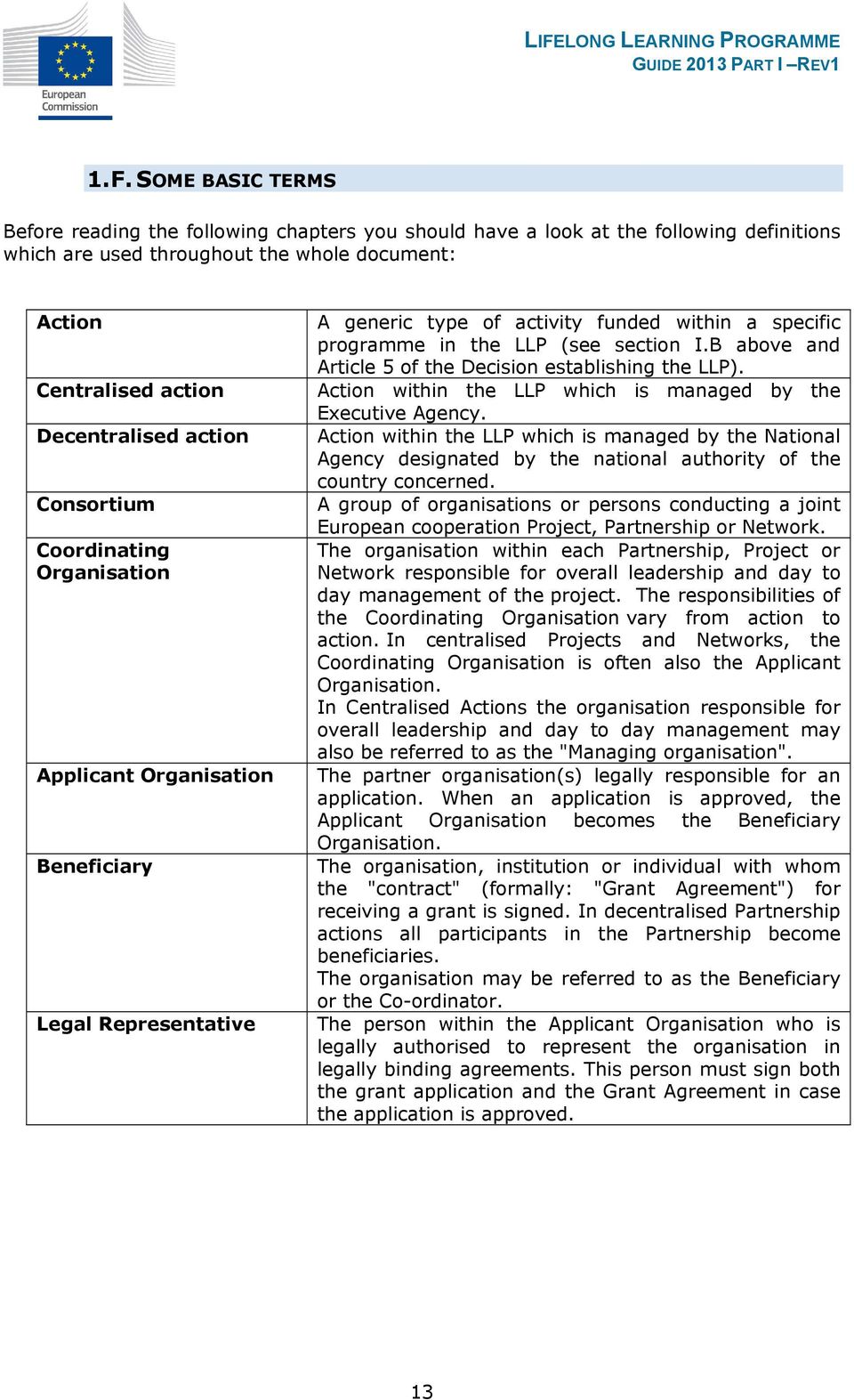
13 1.F. SOME BASIC TERMS Before reading the following chapters you should have a look at the following definitions which are used throughout the whole document: Action Centralised action Decentralised action Consortium Coordinating Organisation Applicant Organisation Beneficiary Legal Representative A generic type of activity funded within a specific programme in the LLP (see section I.B above and Article 5 of the Decision establishing the LLP). Action within the LLP which is managed by the Executive Agency. Action within the LLP which is managed by the National Agency designated by the national authority of the country concerned. A group of organisations or persons conducting a joint European cooperation Project, Partnership or Network. The organisation within each Partnership, Project or Network responsible for overall leadership and day to day management of the project. The responsibilities of the Coordinating Organisation vary from action to action. In centralised Projects and Networks, the Coordinating Organisation is often also the Applicant Organisation. In Centralised Actions the organisation responsible for overall leadership and day to day management may also be referred to as the "Managing organisation". The partner organisation(s) legally responsible for an application. When an application is approved, the Applicant Organisation becomes the Beneficiary Organisation. The organisation, institution or individual with whom the "contract" (formally: "Grant Agreement") for receiving a grant is signed. In decentralised Partnership actions all participants in the Partnership become beneficiaries. The organisation may be referred to as the Beneficiary or the Co-ordinator. The person within the Applicant Organisation who is legally authorised to represent the organisation in legally binding agreements. This person must sign both the grant application and the Grant Agreement in case the application is approved. 13
14 2. WHAT IS THE LIFE-CYCLE OF A PROJECT? 2.A. ADMINISTRATIVE CYCLE Submission of grant applications Submission of grant applications to the relevant body (National Agencies or Executive Agency) according to the chosen Action Assessment of proposals The assessment of grant applications is undertaken by experts according to criteria established within each Call for Proposals, which take into account both formal and quality aspects Selection Results Lists of successful grant applications are established. All grant applicants are notified of the outcome of their application. Unsuccessful applicants also receive feedback on the reasons for rejection Contractualisation Phase Applicants who have been successful in the selection process will receive a Grant Agreement (contract) from the Executive Agency or the appropriate National Agency, depending on the Action concerned. The Grant Agreement indicates the grant awarded and sets out the financial rules to be applied. Payments are usually made in instalments Reporting (Some Action types only, projects longer than 1 year) Submission of Progress Reports At the mid-point of the project life-cycle, applicants are required to submit a Progress Report providing information on project implementation and expenditure incurred thus far. The report is assessed and only after its acceptance can the second instalment be paid (where applicable) Ongoing Monitoring of Projects National Agencies and the European Commission / Executive Agency monitor the implementation of the project throughout its life-cycle. In situ project visits and Thematic Monitoring initiatives are undertaken in some cases Submission of Final Report At the end of the contractual period, applicants are required to submit a Final Report providing information on project implementation, results achieved and expenditure incurred. Only after the report has been approved can the final payment be made Eligibility Period for Project Activities Time during which expenses can be incurred and covered by the EU grant (the duration of the eligibility period depends on the project duration) and planned project activities have to be carried out Ex-post control and on the spot audits A sample of the supported projects will be subject to more in-depth checks to ensure proper use of European funds. 2.B. FINANCIAL CYCLE The financial cycle as outlined below applies to all actions under the Lifelong Learning Programme, although some requirements are applicable only to particular types of actions: 14

15 (1) submission of an estimated budget: please consult the chapter on financial provisions to see what type of budgetary information is requested at grant application stage; (2) assessment of the budget: this is carried out on the basis of established and transparent criteria and may lead to a revision (correction / reduction) of the budget to ensure that it is eligible and includes only elements that are considered to be "necessary for the completion" of the proposed activity. The rules which apply when revising a budget are explained in the chapter on financial provisions; (3) issuing the Grant Agreement ("contract") (4) payment procedures: these refer in chronological sequence to aspects such as providing a financial guarantee (if any required for certain Beneficiary Organisations that are not public bodies), pre-financing arrangements, payment of the balance, recovery procedures, etc.; (5) amendments to the agreement: these are possible during project implementation. The relevant instructions are included in or provided with the Grant Agreement; (6) reporting requirements: these relate to the Progress Report (if applicable) and the Final Report. Instructions are provided with the Grant Agreement; (7) financial control and audit requirements: financial controls and on-the-spot audits may take place at any time up to 5 years after the final payment to or reimbursement by the beneficiary and the relevant documents must therefore be kept by the Beneficiary during this period. 2.C. APPLICABLE RULES The rules outlined in this Guide apply to all actions for which EU funding is available under the Lifelong Learning Programme. The rules applicable to the administration and financing of the activities supported under the LLP are set out in the following documents: Decision No 1720/2006/EC of the European Parliament and of the Council of 15 November 2006 establishing an action programme in the field of lifelong learning (the Lifelong Learning Programme); Decision no 1357/2008/EC of the European Parliament and of the Council of 16 December 2008 amending Decision No 1720/2006/EC establishing an action programme in the field of lifelong learning; Council Regulation (EC, Euratom) No 1605/2002 of 25 June 2002 on the Financial Regulation applicable to the general budget of the European Communities, modified by Council Regulation (EC, Euratom) N 1995/2006 of 13 December 2006; Commission Regulation (EC, Euratom) No 2342/2002 of 23 December 2002 laying down detailed rules for the implementation of Council Regulation (EC, Euratom) No 1605/2002 on the Financial Regulation applicable to the general budget of the European Communities, modified most recently by Commission Regulation No 478/2007 of 23 April 2007; Regulation (EU, Euratom) No 966/2012 of the European Parliament and of the Council of 25 October 2012 on the financial rules applicable to the general budget of the Union and repealing Council Regulation N 1605/2002; 15

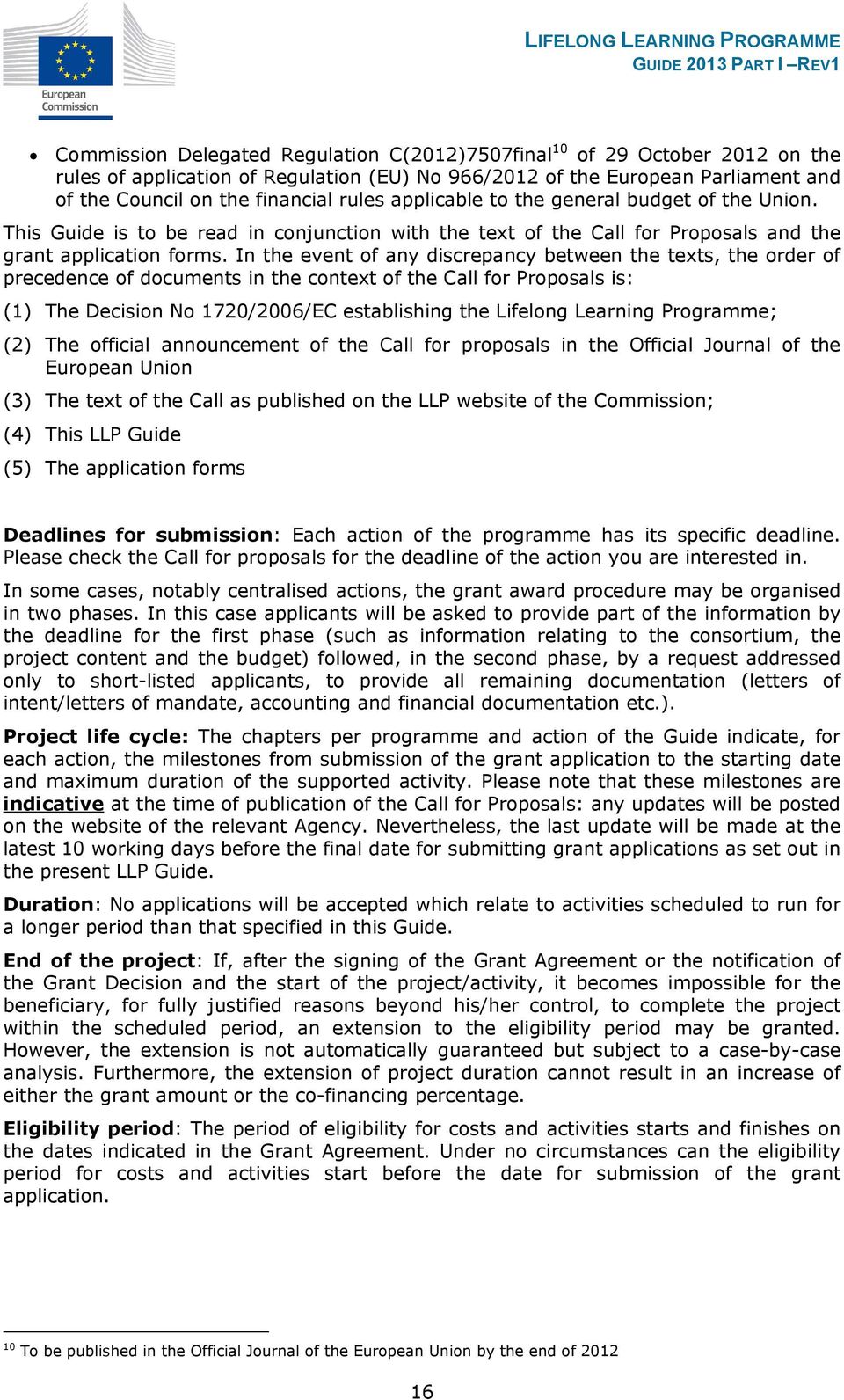
16 Commission Delegated Regulation C(2012)7507final 10 of 29 October 2012 on the rules of application of Regulation (EU) No 966/2012 of the European Parliament and of the Council on the financial rules applicable to the general budget of the Union. This Guide is to be read in conjunction with the text of the Call for Proposals and the grant application forms. In the event of any discrepancy between the texts, the order of precedence of documents in the context of the Call for Proposals is: (1) The Decision No 1720/2006/EC establishing the Lifelong Learning Programme; (2) The official announcement of the Call for proposals in the Official Journal of the European Union (3) The text of the Call as published on the LLP website of the Commission; (4) This LLP Guide (5) The application forms Deadlines for submission: Each action of the programme has its specific deadline. Please check the Call for proposals for the deadline of the action you are interested in. In some cases, notably centralised actions, the grant award procedure may be organised in two phases. In this case applicants will be asked to provide part of the information by the deadline for the first phase (such as information relating to the consortium, the project content and the budget) followed, in the second phase, by a request addressed only to short-listed applicants, to provide all remaining documentation (letters of intent/letters of mandate, accounting and financial documentation etc.). Project life cycle: The chapters per programme and action of the Guide indicate, for each action, the milestones from submission of the grant application to the starting date and maximum duration of the supported activity. Please note that these milestones are indicative at the time of publication of the Call for Proposals: any updates will be posted on the website of the relevant Agency. Nevertheless, the last update will be made at the latest 10 working days before the final date for submitting grant applications as set out in the present LLP Guide. Duration: No applications will be accepted which relate to activities scheduled to run for a longer period than that specified in this Guide. End of the project: If, after the signing of the Grant Agreement or the notification of the Grant Decision and the start of the project/activity, it becomes impossible for the beneficiary, for fully justified reasons beyond his/her control, to complete the project within the scheduled period, an extension to the eligibility period may be granted. However, the extension is not automatically guaranteed but subject to a case-by-case analysis. Furthermore, the extension of project duration cannot result in an increase of either the grant amount or the co-financing percentage. Eligibility period: The period of eligibility for costs and activities starts and finishes on the dates indicated in the Grant Agreement. Under no circumstances can the eligibility period for costs and activities start before the date for submission of the grant application. 10 To be published in the Official Journal of the European Union by the end of
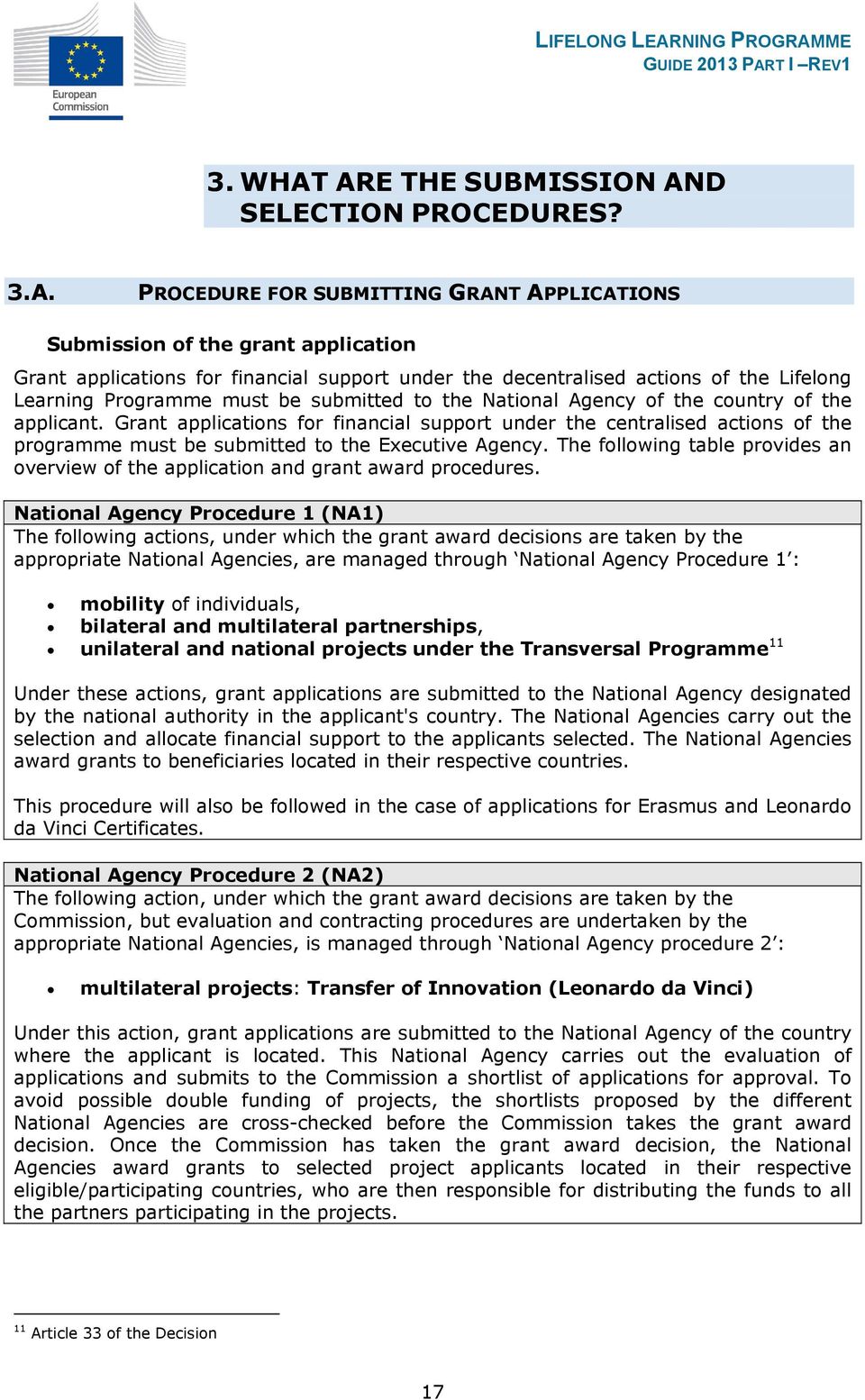
17 3. WHAT ARE THE SUBMISSION AND SELECTION PROCEDURES? 3.A. PROCEDURE FOR SUBMITTING GRANT APPLICATIONS Submission of the grant application Grant applications for financial support under the decentralised actions of the Lifelong Learning Programme must be submitted to the National Agency of the country of the applicant. Grant applications for financial support under the centralised actions of the programme must be submitted to the Executive Agency. The following table provides an overview of the application and grant award procedures. National Agency Procedure 1 (NA1) The following actions, under which the grant award decisions are taken by the appropriate National Agencies, are managed through National Agency Procedure 1 : mobility of individuals, bilateral and multilateral partnerships, unilateral and national projects under the Transversal Programme 11 Under these actions, grant applications are submitted to the National Agency designated by the national authority in the applicant's country. The National Agencies carry out the selection and allocate financial support to the applicants selected. The National Agencies award grants to beneficiaries located in their respective countries. This procedure will also be followed in the case of applications for Erasmus and Leonardo da Vinci Certificates. National Agency Procedure 2 (NA2) The following action, under which the grant award decisions are taken by the Commission, but evaluation and contracting procedures are undertaken by the appropriate National Agencies, is managed through National Agency procedure 2 : multilateral projects: Transfer of Innovation (Leonardo da Vinci) Under this action, grant applications are submitted to the National Agency of the country where the applicant is located. This National Agency carries out the evaluation of applications and submits to the Commission a shortlist of applications for approval. To avoid possible double funding of projects, the shortlists proposed by the different National Agencies are cross-checked before the Commission takes the grant award decision. Once the Commission has taken the grant award decision, the National Agencies award grants to selected project applicants located in their respective eligible/participating countries, who are then responsible for distributing the funds to all the partners participating in the projects. 11 Article 33 of the Decision 17
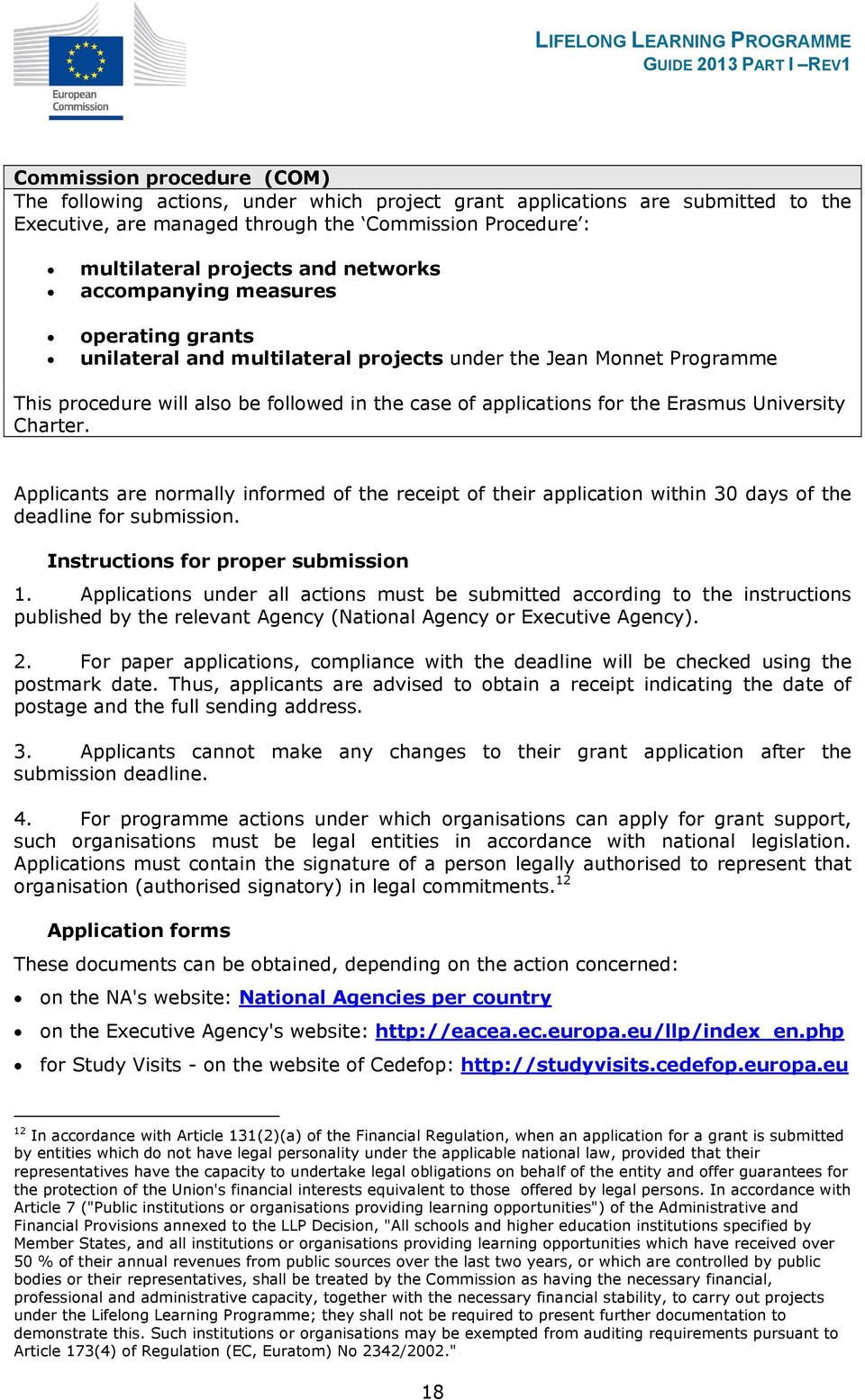
18 Commission procedure (COM) The following actions, under which project grant applications are submitted to the Executive, are managed through the Commission Procedure : multilateral projects and networks accompanying measures operating grants unilateral and multilateral projects under the Jean Monnet Programme This procedure will also be followed in the case of applications for the Erasmus University Charter. Applicants are normally informed of the receipt of their application within 30 days of the deadline for submission. Instructions for proper submission 1. Applications under all actions must be submitted according to the instructions published by the relevant Agency (National Agency or Executive Agency). 2. For paper applications, compliance with the deadline will be checked using the postmark date. Thus, applicants are advised to obtain a receipt indicating the date of postage and the full sending address. 3. Applicants cannot make any changes to their grant application after the submission deadline. 4. For programme actions under which organisations can apply for grant support, such organisations must be legal entities in accordance with national legislation. Applications must contain the signature of a person legally authorised to represent that organisation (authorised signatory) in legal commitments. 12 Application forms These documents can be obtained, depending on the action concerned: on the NA's website: National Agencies per country on the Executive Agency's website: for Study Visits - on the website of Cedefop: 12 In accordance with Article 131(2)(a) of the Financial Regulation, when an application for a grant is submitted by entities which do not have legal personality under the applicable national law, provided that their representatives have the capacity to undertake legal obligations on behalf of the entity and offer guarantees for the protection of the Union's financial interests equivalent to those offered by legal persons. In accordance with Article 7 ("Public institutions or organisations providing learning opportunities") of the Administrative and Financial Provisions annexed to the LLP Decision, "All schools and higher education institutions specified by Member States, and all institutions or organisations providing learning opportunities which have received over 50 % of their annual revenues from public sources over the last two years, or which are controlled by public bodies or their representatives, shall be treated by the Commission as having the necessary financial, professional and administrative capacity, together with the necessary financial stability, to carry out projects under the Lifelong Learning Programme; they shall not be required to present further documentation to demonstrate this. Such institutions or organisations may be exempted from auditing requirements pursuant to Article 173(4) of Regulation (EC, Euratom) No 2342/2002." 18
19 DECENTRALISED ACTIONS CENTRALISED ACTIONS National Agency Procedure 1 NA1 National Agency Procedure 2 NA2 Commission Procedure - COM Applicable to (typology of action) Transnational mobility Bilateral and multilateral partnerships Unilateral and national projects (Transversal Programme) Multilateral Projects: Transfer of Innovation (Leonardo da Vinci) Multilateral projects and networks Operating grants Unilateral and multilateral projects - Jean Monnet Accompanying Measures To whom the application has to be sent The appropriate National Agency of each applicant institution or individual The National Agency of the coordinator of the grant application The Education, Audiovisual and Culture Executive Agency Main steps of the procedure a. Assessment of proposals according to both formal (eligibility and exclusion criteria) and quality criteria (selection and award criteria which are defined within this Guide) b. Approval of the selection list by National Agency c. Allocation of financial grants to the selected beneficiaries by the National Agencies a. Assessment of proposals according to both formal criteria (eligibility and exclusion criteria) and quality criteria (selection and award criteria) by the National Agency. Establishment of shortlist of the applications which it proposes to accept. b. Approval of the selection list by the Commission c. Allocation of financial grants to the selected proposals by the National Agencies a. Assessment of proposals according to formal (eligibility and exclusion criteria) and quality criteria (selection and award criteria) b. Approval of the selection list c. Allocation of financial grants to the selected projects 3.B. PROCEDURE FOR THE ASSESSMENT AND SELECTION OF APPLICATIONS The grant award process involves a variety of actors: the Commission, the Executive Agency, the National Agencies, the Member States and participating countries and, through the relevant Programme Committee the national authorities in the Member States and other participating countries. In some cases, the European Parliament and the Council have the "right of scrutiny" 13 as regards the grant award decisions. 13 For the Right of scrutiny of the European Parliament and the Council see article 11 of Regulation (EU) N 182/

20 proposal Evaluation Committee Ensures the application of fair procedures and an equal and fair treatment of applicants The Agency, with support of experts, will check: Eligibility criteria for applicants and applications Exclusion criteria for applicants Selection criteria according to the applicant's operational and financial capacity Applications not fulfilling these criteria will not be approved expert expert Assessment against the award criteria Scores Assessment against the award criteria Scores Scores Applications obtaining a score below the predefined Quality Threshold will not be selected For most Actions at least two experts will assess the quality Final scores by consensus Ranked list (example) Scores Proposals 85 Proposal A 84 Proposal B Available Budget A ranked list is established Applications of sufficient quality in descending order are approved until the budget is fully absorbed Proposal C Proposal D Proposal E Proposal F Proposal G Proposal H Proposal I Proposal J Proposal K The diagram shows the basic procedures involved in the assessment of applications 14. If an Action includes published priorities, the Evaluation Committee may decide to fund an application with a lower score than one included within the available budget in order to achieve a balanced coverage of priorities. In the illustration above, this could mean for example that Proposal I could be funded if it addressed a priority that was not covered above, and Proposal H would not be funded. 14 The procedure for assessing applications for support relating to the additional involvement of partner organisations from "third" countries in multilateral projects and networks under certain Actions of the programme (see section 1C) is described on the website of the Education, Audiovisual and Culture Executive Agency. 20

21 THE PANEL OF EXPERTS For all programme actions, except for individual mobility actions, each grant application will normally be assessed by at least two experts. In most cases they will be external experts (that is experts external to the Agency organising the grant award procedure). They will undertake an assessment on the basis of a pre-determined scoring system, which will take into consideration the quality of the application and (where applicable) the coverage of priorities published for the given action, and standardised checklists including qualitative aspects. The final score of a grant application is reached by consensus between the experts involved in the individual assessments. Based on the expert assessment, the organising Agency establishes a ranking list of the grant applications, differentiating between applications proposed for approval, rejection and reserve list. The ranking list will include the grant amounts foreseen for those applications proposed for approval or reserve list. The reserve list of applicants may be used to award further grants in case funds become available following withdrawal of approved projects or following an increase in the programme budget (e.g. extra funds provided by the European Parliament). In the case of multilateral Partnerships (Comenius, Leonardo da Vinci and Grundtvig), the evaluation of the application is organised by the NA of the coordinating country on the basis of common quality criteria used in all participating countries. National priorities (if applicable) are also taken into account. THE EVALUATION COMMITTEE The ranked lists of grant applications resulting from the assessment procedure as set out above are submitted to a so-called "Evaluation Committee". The size and composition of the Evaluation Committee varies between programmes and actions. It can include Commission/Agency members as well as external experts and stakeholder representatives. The role of the Evaluation Committee is to supervise the overall assessment procedure, to guarantee the equal treatment of all applications through a fair and transparent application of the procedures and to make a grant award proposal to the person in charge of taking the grant award decision on the basis of the following: i. fair and transparent application of the published Eligibility, Selection, Exclusion and Award Criteria ii. coherent assessment and scoring iii. iv. correct financial analysis (if applicable) due assessment of additional information provided by external actors (such as National Agencies or European Commission Delegations in "third" countries participating in the programme) (if applicable) v. balanced coverage of the priorities within the action (if applicable) and in accordance with vi. the programme/action objectives vii. the budget available. 21
22 FINAL GRANT AWARD DECISION The formal decision process will vary depending on whether the grant award decision under the programme/action concerned is subject to European Parliament scrutiny or not. If not, the decision will be taken directly by the competent National Agency (decentralised actions) or the Commission or the Executive Agency (centralised actions) on the basis of the grant award proposal made by the Evaluation Committee. The Programme Committee and the European Parliament will be informed of such award decision. Assessment criteria Applications are assessed against four types of criteria: a. Eligibility criteria b. Exclusion criteria c. Selection criteria d. Award criteria. a. Eligibility criteria Only applications that fulfil the formal eligibility criteria set out below will be considered for a grant. GENERAL ELIGIBILITY CRITERIA Applications must fulfil the following criteria: 1. Comply with the submission procedures set out in the relevant Call for proposals and in the section 3a, part "Instructions for proper submission" of this Guide; 2. Comply with the deadlines set out in the relevant Call for proposals. Indicative dates are given for each action in Part II of this Guide, but the final published Call for proposals should be consulted; 3. Comply with the rules on the minimum and maximum duration of projects and the minimum/maximum number of partners and countries involved, as indicated in Part II of this Guide. 4. Involve, if an application is submitted by a consortium, at least one organisation established in an EU Member State. For multilateral projects, European associations with members established in several LLP participating countries who are actively participating in the project, shall be considered to fulfil the requirement regarding the minimum number of countries, without having to involve other bodies in the consortium, although this is recommended where appropriate. Unilateral projects and Jean Monnet multilateral projects do not have to comply with the condition to include at least one organisation established in an EU Member State; 22
23 Be drawn up in one of the official languages of the European Union Applications from a consortium must be submitted in the working language of the consortium 6. Be submitted exclusively using the correct official application form for the action concerned and be electronically completed in full 19 (not handwritten); 7. Grant request, where applicable, expressed in Euro. If an application is deemed ineligible, a letter indicating the reasons will be sent to the applicant. ELIGIBLE COUNTRIES Applicants must be located in a country participating in the LLP 20. ELIGIBILITY CRITERIA FOR MOBILITY Recipients of mobility grants for individuals must be either: nationals of a country participating in the Lifelong Learning Programme; nationals of other countries enrolled in regular courses in schools, institutions of higher education or vocational training, or in adult learning organisations in a participating country, or employed or living in a participating country, under the conditions fixed by each of the participating countries, taking into account the nature of the programme (please refer to relevant National Agency website). In the case of individual transnational mobility activity, either the country of origin or the country of destination must be a Member State of the EU, except where the grant is awarded for the purposes of enabling the grant-holder to participate in a learning event involving participants from several countries. This exception therefore refers to mobility carried out within multilateral partnerships and projects, as well as to actions such as Inservice training under Comenius and Grundtvig, Intensive Programmes under Erasmus, Grundtvig Workshops and the Study Visits under the Transversal Programme. Please consult the descriptions of the specific actions in Part II of this Guide to find out whether this rule applies to the particular action in which you are interested. In some exceptional cases, mobility within a single country may also be supported, notably in the case of Preparatory visit grants awarded for participation in a transnational contact seminar organised by the National Agency of the country concerned. ELIGIBILITY CRITERIA FOR APPLICANT ORGANISATIONS Where applications are to be submitted by institutions and organisations and not by individuals, the institutions / organisations concerned must be legal entities in accordance with national legislation. 15 With the exception of mobility grant applications submitted to National Agencies in the EFTA/EEA and candidate countries. These grant applications may be drafted in the national language of the applicant. 16 Applicants for the Erasmus University Charter are required to provide the Erasmus Policy statement also in English, French or German. 17 Applicants for the Jean Monnet Programme must submit their applications in English, French or German. 18 Applicants for the Study Visits in the Transversal Programme are required to provide the application form in the working language of one of the selected Study Visits. 19 Applicants in some Actions may be required to complete an on-line application form. 20 Except for the Jean Monnet programme which is open to higher education institutions worldwide. 23
24 Please consult Part II of this Guide for any additional eligibility rules relating to a specific programme and/or action. b. Exclusion criteria for applicants Exclusion from participation Applicants will be excluded from participating in the call for proposals if they are in any of the following situations: 1. they are bankrupt or being wound up, are having their affairs administered by the courts, have entered into an arrangement with creditors, have suspended business activities, are the subject of proceedings concerning those matters, or are in any analogous situation arising from a similar procedure provided for in national legislation or regulations; 2. they or persons having powers of representation, decision making or control over them have been convicted of an offence concerning their professional conduct by a judgment of a competent authority of a Member State which has the force of res judicata; 3. they have been guilty of grave professional misconduct proven by any means which the contracting authority can justify including by decisions of the EIB and international organisations; 4. they are not in compliance with their obligations relating to the payment of social security contributions or the payment of taxes in accordance with the legal provisions of the country in which they are established or with those of the country of the contracting authority or those of the country where the contract is to be performed; 5. they or persons having powers of representation, decision making or control over them have been the subject of a judgment which has the force of res judicata for fraud, corruption, involvement in a criminal organisation, money laundering or any other illegal activity, where such illegal activity is detrimental to the Union's financial interests; 6. they are subject to an administrative penalty referred to in Article 109(1) of the Financial Regulation; Exclusion from award Applicants will not be awarded a grant if, during the grant award procedure, they: 1. are subject to a conflict of interest; 2. are guilty of misrepresentation the information required by the contracting authority as a condition of participation in the procurement procedure or fail to supply that information. 3. find themselves in one of the situations of exclusion, referred to in Article 106(1) of the Financial Regulation. Administrative and financial penalties may be imposed on applicants who are guilty of misrepresentation pursuant Article 107 (1) point b of the Financial Regulation or are found to have seriously failed to meet their contractual obligations under a previous grant award procedure. 24
25 The legal entities hosting the LLP National Agencies take all appropriate measures to document the absence of any kind of possible conflict of interest and double funding. c. Selection criteria Selection criteria are those used to assess whether the applicant organisation / partnership has the operational and financial capacity necessary to undertake the proposed activity. The selection criteria below do not apply to individuals applying for a grant. Applicant organisations may be required to provide documents to attest to their operational and financial capacity (see below). If, on this basis, the Agency considers that operational and/or financial capacity has not been proved or is not satisfactory, it may reject the grant application or ask for further information. Organisations considered having sufficient financial, professional and administrative capacity and financial stability Organisations established as "public bodies" under relevant national legislation are exempt from the provisions presented under Operational Capacity and Financial Capacity below. In accordance with Article 7 of the Annex to the LLP Decision "all schools and higher education institutions specified by Member States, and all institutions or organisations providing learning opportunities which have received over 50 % of their annual revenues from public sources over the last two years, or which are controlled by public bodies or their representatives, shall be treated by the Commission as having the necessary financial, professional and administrative capacity, together with the necessary financial stability, to carry out projects under the Lifelong Learning Programme; they shall not be required to present further documentation to demonstrate this. Such institutions or organisations may be exempted from auditing requirements pursuant to Article 173(4) of Regulation (EC, Euratom) No 2342/2002." The applicants are nevertheless required to sign a declaration of honour, normally contained in the application form, stating that they comply with the conditions mentioned above, and may be required to provide documentary evidence in support of the declaration. Operational capacity Applicants will be evaluated as regards the professional competencies and qualifications necessary for carrying out the proposed activity. If required in the application forms, applicants must submit the CVs of key staff involved in the project, showing relevant professional experience. For consortia, this obligation applies to all partners. These documents must be provided in one of the official languages of the European Union, and the grant award procedure may specify that they be submitted in the language used to present the application. Financial capacity Applicants must have the stable and sufficient sources of funding necessary for maintaining their activity throughout the period during which the proposed project is to be carried out and for participating in its co-funding. Except for the organisations described in the section on Organisations considered having sufficient financial, professional and administrative capacity and financial stability above, applicants must submit, if required by the application form, the following documents attesting to their financial capacity: 25
26 For grants below or equal to EUR a declaration on their honour For grants exceeding EUR a declaration on their honour and one copy of the profit and loss account and the balance sheet for the last financial year for which the accounts were closed for newly created entities, the business plan might replace the above documents For grants exceeding EUR : an audit report produced by an approved external auditor certifying the accounts for the last financial year available. In the event of an application regrouping several co-beneficiaries (consortium), the above thresholds apply to each co-beneficiary. Subject to the outcome of the assessment of the application and the examination of the applicant's financial capacity in relation to the grant application, the applicant may be offered a Grant Agreement/decision with an obligation to provide a guarantee for prefinancing, a Grant Agreement without pre-financing or a Grant Agreement with prefinancing payments in several instalments. Such guarantee shall not be required for grants below or equal to EUR d. Award criteria Award criteria are used to assess the quality of grant applications. Eligible applications will be assessed on the basis of the published award criteria for each action, taking into account the priorities set out in the relevant Call for proposals. The description of each action in Part II of this Guide contains the award criteria which will be used in the assessment. The scoring mechanism and weighting of the award criteria will be published on the websites of the National Agencies or the Executive Agency respectively. In the case of decentralised actions, the weighting is nevertheless common for all National Agencies. Any additional national award criteria may differ in content from country to country, but their total weight will be the same for all countries. Any such additional national award criteria will be published on the relevant National Agency website. Identical or similar applications will be subject to a specific assessment in order to exclude the risk of double funding. The Commission and the NAs reserve the right not to fund identical or similar applications from the same applicant or consortium. The Decision establishing the Lifelong Learning Programme (LLP) encourages the participation in decentralised actions of individuals or organisations not having previously participated in the Lifelong Learning Programme or its predecessors (Article 1.3.f). Participation of people with special needs and disadvantaged groups is similarly encouraged. Grants are awarded on the basis of the budget available, the relative quality of grant applications and (where relevant) the coverage of priorities, taking into account the maximum contribution of the European Union (EU) and, where relevant, the maximum co-financing percentage to be provided by the EU. 26
27 All applicants will be informed in writing of the results of the assessment. The grant award results will be published on the website of the Agency concerned as soon as possible after decisions have been made, and in all instances at the latest 6 months after the grant award decision. This publication will include the name of the beneficiary, the title of the supported project and the maximum grant amount awarded (and co-funding percentage if applicable). Personal data of individual persons selected for an individual mobility grant will not, however, be published. 27
28 4. FINANCIAL PROVISIONS 4.A. GENERAL FINANCIAL CONDITIONS APPLICABLE TO ALL ACTIONS The decision to award a grant in respect of an action is formalised either through a Grant Agreement to be signed by the two parties (the Agency and the grant beneficiary) or through a unilateral Decision of the Agency, notified to the grant beneficiary. This Agreement or Decision shall contain the payment arrangements as well as the bank account or sub-account to which funds will be transferred. Each project may give rise to the award of only one grant from the EU budget. The grant may not have the purpose or effect of producing a profit for the beneficiary. Grants may not be awarded retrospectively for activities already completed at the time of the submission of the grant application. A grant may under no circumstances exceed the amount requested and may be below the amount requested by the applicant. A grant is an incentive to carry out a project or activity which would not be feasible without the financial support of the European Union and is based on the principle of cofinancing. The Grant Agreement will lay down the arrangements and time limits for modification, suspension and termination of the Agreement or the Decision. Beneficiaries found to have seriously failed to meet their contractual obligations may have their agreements cancelled and/or be subject to financial penalties. Grant Agreements or Decisions may be amended only by additional written Agreements or Decisions. Such additional Agreements or Decisions shall not have the purpose or the effect of making changes that would call into question the decision to award the grant or be contrary to the equal treatment of applicants. An additional Agreement or Decision cannot be issued after the end of the eligibility period of costs and activities specified in the initial Grant Agreement or Decision. 4.B. TYPES OF FINANCING Please note that in the context of financial support provided by the European Union (EU), and throughout this document, the term "project" is understood to mean any of the Activity Types as described in section 1.B. EU support may take the form of a lump sum 21, a flat-rate 22 grant based on a scale of unit costs, or the reimbursement of a percentage of eligible costs. Depending on the 21 "Lump sums shall cover in global terms certain costs necessary for carrying out an action, or for the annual operation of a beneficiary, in accordance with the terms of the agreement and on the basis of an estimate." (Financial Regulation, Article 108a(a), point (b) and Implementing Rules to the Financial Regulation, Article 180a, point 2. See: 22 Flat-rate financing shall cover specific categories of expenditure which are clearly identified in advance either by applying a percentage fixed in advance or by the application of a standard scale-of-unit cost." (Financial 28
29 grant type, a combination of all or some of these types of grant support is possible. The budget for a project has to be drawn up accordingly. In the case of grants awarded as a lump sum, the beneficiary has to be able to prove that the activity for which grant support is awarded has really taken place, rather than the actual amount of expenditure. If the supported activity is realised in a satisfactory manner, the full grant amount is acquired. In the case of underperformance, reimbursement of (part of) the grant awarded will be normally required on the basis of the criteria laid down for each decentralised action. In the case of flat-rate grants using scales of unit costs (for example maximum daily rates for subsistence), the beneficiary does not have to justify the costs incurred but has to be able to prove the reality of activities resulting into the entitlement to a specific grant amount (for example the number of days spent abroad determine the maximum amount to which one is entitled for the stay). In the case of (the part of) a grant awarded on the basis of real costs, the beneficiary shall keep and be able to produce upon request all proofs of expenditure related to the expense items based on real costs. Eligible costs: the type of expenditure that is considered to be eligible within a budget for a project that is co-financed with European Union funding. The rules presented in this Guide are used as the basis to review the estimated expenditure presented in an application. In the event that expenditure fails to comply with these rules, all or part will be deemed "ineligible" (i.e. not the subject of European Union co-financing). At the end of the analysis the approved project budget will include only the eligible items. Reimbursement of a percentage of eligible costs: the applicant will define his expenditure in terms of real costs (where maximum eligible rates may apply). European Union financing will be calculated by applying a percentage to real eligible expenditure. The contribution will be reduced pro rata if, at final reporting stage, the project is not fulfilled or is only partially fulfilled or funds have been spent on ineligible expense items. Where the reported costs are less than foreseen, the contribution will be reduced by applying the percentage fixed in the Grant Agreement. Details will be included in the documentation provided for managing Grant Agreements. Regulation, Article 108a(1), point (c ) and Implementing Rules to the Financial Regulation, Article 180a, point 3. 29
30 4.C. MOBILITY GRANTS AWARDED FOR INDIVIDUALS Mobility grants are based on various components of costs. The rates proposed below represent maximum amounts. The budget for mobility activities is based on (a combination of) subsistence costs, travel costs and other costs. Where costs are based on scales of unit costs or on real costs, the general criteria for eligibility (see below) apply. For short duration mobility (except Erasmus Student Mobility and Grundtvig Workshops) travel cost is based on real cost. In the case of mobility with a duration of 13 weeks or more, as well as in the case of Erasmus Student Mobility and Grundtvig Workshops, travel costs are deemed to be covered by the subsistence grant and no additional grant for travel is awarded. A. Subsistence Costs For all mobility actions, the contribution to subsistence costs will be a flat-rate grant calculated on the basis of daily, weekly 23 or monthly rates. Subsistence costs cover accommodation, meals, local travel, the cost of telecommunications, including fax and Internet, insurance and all other sundries. For mobility actions with duration of less than 13 full weeks, i.e. maximum 90 days (except Erasmus Student Mobility and Grundtvig Workshops), the awarded grants do not cover travel costs; these costs will be reimbursed on the basis of real costs. For mobility actions of a minimum duration of 13 full weeks, the awarded grants will be considered a global flat-rate contribution to cover all costs, including travel costs. Support to subsistence costs is calculated as a flat-rate on the basis of scales of unit costs of the host country. Persons with special needs may benefit from specific financing measures. For the purpose of applying for a grant under the decentralised actions of the Lifelong Learning Programme, a person with special needs is defined as a potential participant whose individual physical, mental or health-related situation is such that his/her participation in the project / mobility action would not be possible without extra financial support. The additional grant towards both subsistence and travel costs will be assessed case-bycase and based on real costs incurred. In such case, the grant may provide for the subsistence and travel costs of an accompanying person if justified. The individual situation should be described and the particular needs and extra costs attached to it should be detailed in the application. Based on these explanations, on the availability of funding, the national rules and potential national priorities, the National Agency will then judge whether extra support can be granted. In some actions, the grant level awardable under these circumstances is subject to a maximum. 23 travel. In this context, a week is equivalent to a mobility period of seven full consecutive days, including 30
31 NOTE: Applicants should note that the amounts indicated in the following tables refer to the absolute maxima allowable across all countries participating in the programme. The actual amounts awarded by specific National Agencies vary from country to country and from one action to another, and may in some cases be significantly lower than the maximum amounts indicated in them. In determining the actual amounts to be awarded, National Agencies take into account in particular the total budget available to them, the volume of demand in their respective country and the need for equal treatment of all beneficiaries in their country. Applicants are therefore strongly advised to consult the website of the relevant National Agency in their country, in order to ascertain the actual amounts which they would be likely to receive if their application is successful. Comenius Applicants for Comenius initial teacher training mobility within Comenius multilateral projects must consult the Subsistence Costs table 5b in order to ascertain the maximum eligible amounts. 31
32 Table 1a: Lifelong Learning Programme - Mobility - Subsistence - Maximum rates (in EUR) per host country and duration of stay. (For Erasmus student mobility see Table 1b) Excluding travel and visa costs Including travel and visa costs Total amount first week Total amount One week (7 days) Two weeks Additional amount per week (wks 3-12)* Total amount for 13 full weeks ** Additional amount per week (wks 14-45)* day days days days days days BE BG CZ DK DE EE EL ES FR IE IT CY LV LT LU HU MT NL AT PL PT RO SI SK FI SE UK IS LI NO CH HR TR * For weeks 3-12 and 14-45, additional full weeks are counted on the basis of the amount indicated in the columns 'Additional amount for weeks 3-12 and 14-45'. ** This includes a special amount covering travel and visa costs as they are included from 13 full weeks onwards. The calculation method for an "incomplete" week is the number of additional days multiplied with 1/7 of the amount indicated in the columns 'Additional amount per week for weeks 3-12 and An exception is made for the second incomplete week for which the basis for calculation is the number of additional days multiplied by 1/7 of the difference between the amounts for one week and two weeks. In the case of a of stay with duration between 12 and 13 weeks (i.e. an incomplete 13 th week) the basis for calculation will be the amount due for 12 weeks increased by 1/7 of the amount indicated in the columns 'Additional amount per week for each additional day. The total amount thus obtained does not include travel and visa costs. 32
33 Table 1b: Lifelong Learning Programme - Erasmus Student Mobility Subsistence - Maximum rates (in EUR) per host country including travel 24 HOST COUNTRY Monthly rate Belgique/België/Belgien BE 640 Balgarija BG 401 Česká republika CZ 539 Danemark DK 858 Deutschland DE 607 Eesti EE 484 Ellas EL 607 España ES 625 France FR 743 Eire/Ireland IE 698 Italia IT 682 Kypros CY 536 Latvija LV 476 Lietuva LT 464 Luxembourg LU 640 Magyarország HU 507 Malta MT 526 Nederland NL 666 Österreich AT 680 Polska PL 493 Portugal PT 544 Romania RO 445 Slovenija SI 573 Slovensko SK 512 Suomi/Finland FI 764 Sverige SE 759 United Kingdom UK 860 Island IS 648 Liechtenstein LI 939 Norge NO 939 Schweiz/Suisse/Svizzera CH 939 Hrvatska HR 591 Türkiye TR 525 B. Travel Costs For mobility actions with a duration of less than 13 full weeks, i.e. maximum 90 days (except Erasmus Student Mobility and Grundtvig Workshops), the NA will reimburse travel costs, on the basis of real costs incurred including any costs for entry/exit visas as required, either in total or in part only (by applying a ceiling or a maximum covering percentage). Any other costs related to the travel are ineligible. If individuals reside in one of the overseas countries and territories listed in the Decision 2001/822/EC of the Council (see Countries) or have one of these territories as destination, real incurred travel costs shall except in the case of Erasmus Student Mobility and Grundtvig Workshops be reimbursed in total, independent of the duration of the mobility activity. 24 For Erasmus Intensive Programmes, these rates do not include travel cost which can be (partially) reimbursed based on real cost. 33
34 When travel costs are allocated on the basis of real costs, the same rules apply as for travel costs for multilateral projects, networks and accompanying measures, except that travel insurance and any cancellation costs are deemed to be included in subsistence costs. C. Other costs In addition to the grants for travel and subsistence referred to above, grants to help cover other costs will be available under certain actions of the programme, as follows: COMENIUS In-service training for school education staff - Course or seminar fees: A contribution may be granted on the basis of real costs, up to a maximum fixed at European level of 150 per day (this maximum may be lower in some countries) - Linguistic preparation: A lump sum may be granted up to a maximum of 500 per participant (this maximum may be lower in some countries). (Note: a grant for linguistic preparation is not allowable where the training itself aims exclusively or predominantly at the improvement of language skills). Assistantships - Pedagogic, linguistic and cultural preparation: A lump sum may be granted up to a maximum of 500 per participant (this maximum may be lower in some countries). The eligible activities are induction meetings, linguistic preparation and preparation relating to Content and language integrated learning (CLIL) LEONARDO DA VINCI Mobility (Initial vocational training, People on the labour market, VET professionals) - Pedagogic, linguistic and cultural preparation: A lump sum may be granted up to a maximum of 500 per participant (this maximum may be lower in some countries). GRUNDTVIG In-service training for adult education staff - Course fees: A contribution may be granted on the basis of real costs, up to a maximum fixed at European level of 150 per day (this maximum may be lower in some countries) - Pedagogic, linguistic and cultural preparation: A lump sum may be granted up to a maximum of 500 per participant (this maximum may be lower in some countries). (Note: a grant for linguistic preparation is not allowable where the training itself aims exclusively or predominantly at the improvement of language skills) 34
35 Assistantships - Pedagogic, linguistic and cultural preparation: A lumps sum may be granted up to a maximum of 500 per participant (this maximum may be lower in some countries). Visits and Exchanges - Conference or seminar fees: A contribution may be granted on the basis of real costs, up to a maximum fixed at European level of 150 per day (this maximum may be lower in some countries). - Pedagogic, linguistic and cultural preparation: A lump sum may be granted up to a maximum of 500 per participant (this maximum may be lower in some countries). Workshops - Pedagogic, linguistic and cultural preparation: A lump sum may be granted up to a maximum of 500 per participant (this maximum may be lower in some countries). Senior Volunteering Projects - The "Other costs" relating to the individual volunteers participating in the projects are covered in section 4.D below. D Specific Financial Rules for Comenius Individual Pupil Mobility The applications for funding can only be submitted by schools located in the countries participating to the action. Please consult the specific eligibility rules of the Comenius Individual Pupil Mobility action in the LLP Guide 2013: Part II - Explanations by action. Grants for sending and hosting schools Schools sending and hosting pupils receive a lump sum grant, consisting of the following components: 1. Sending school: A lump sum of 150 per pupil for organisational costs based on tasks defined in the Guide to Comenius Individual Pupil Mobility, Section 2, Roles and responsibilities. A lump sum for the linguistic preparation of 120 per pupil. The need for linguistic preparation has to be justified by the sending school in the application form. 2. Host school: A lump sum of 500 per pupil for organisational costs based on tasks defined in the Guide to Comenius Individual Pupil Mobility, Section 2, Roles and responsibilities. The lump sum grant amount for the sending school and the host school will be paid to the sending school by its National Agency. The sending school is responsible for transferring the amount to the host school on the basis of a written request (the template for this request is provided in the Guide to Comenius Individual Pupil Mobility). 35
36 Grants for participating pupils The grant for participating pupils will cover the following costs: Return ticket (domestic travel included) will be covered at 100% of real eligible costs. Use of the cheapest means and fares (Economy class flight ticket, 2 nd class train ticket) is obligatory. The NA may establish a ceiling in order to avoid exaggerated costs. Monthly allowance is awarded as a flat-rate amount (to contribute to e.g. study material and local transport). The sum for the 1 st month is higher in order to cover expenses occurring at the beginning of the stay abroad. For the amount per host country, see the Table 1c below: Table 1c: Monthly allowances (per hosting country): Country 1st month Further months Belgique/Belgie - BE Bulgaria- BG Ceska Republika - CZ Danmark - DK Eesti - EE Ellas - EL Espana -ES France - FR Italia - IT Latvija - LV Lithuania - LT Luxembourg - LU Magyarorszag - HU Malta - MT Nederland - NL Oesterreich - AT Polska - PL Portugal - PT Rumania- RO Slovenija -SI Slovensko -SK Suomi - FI Sverige - SE Island - IS Liechtenstein LI Norge - NO Schweiz / Suisse / Svizzera / Svizra - CH Hrvatska - HR Türkiye - TR The amount for the pupil's travel and the pupil's monthly allowance will be paid to the sending school by its National Agency. The monthly allowance will be transferred by the sending schools to the parent(s)/guardian(s) of the pupil or to the pupil. 36
37 4.D. GRANTS FOR ORGANISATIONS IMPLEMENTING MOBILITY (ERASMUS, LEONARDO DA VINCI AND GRUNDTVIG) In the case of Erasmus, Leonardo da Vinci and some Grundtvig mobility actions, the mobility activities are organised by institutions/organisations, such as for example higher education institutions, VET / adult education organisations or consortia. These mobility actions require the clear commitment from the sending or hosting organisation to ensure quality in all dimensions (pedagogic as well as logistic) of the mobility period. These organisations are responsible for managing the mobility grants to the individuals. The levels and rules for the grants for participants are described above. Additionally, the organisations receive a contribution to the costs for organising the mobility activities. This support is given for the organisation, not the individual. 25 ERASMUS AND LEONARDO DA VINCI Grant to sending institutions/consortia for the Organisation of Mobility A maximum scale of unit costs applies to calculate the grant to sending institutions/ consortia for the Organisation of Mobility. Scales are defined per group of outgoing persons and, in the case of Erasmus, also for incoming invited teaching staff from enterprises. For the first 25 persons out of the total concerned mobilities scale 1 applies, then the next scale for the 26th to 100th person etc. Table 2: Erasmus and Leonardo da Vinci - Maximum scale of unit costs to apply to calculate grants to higher education institutions and placement consortia to ensure quality of the mobility arrangements for students and staff, including Erasmus student placements Scale 1 (1st to 25th person) Scale 2 (26th to 100th person) Scale 3 (101th to 400th person) Scale 4 (> 400th person) 390 /beneficiary 315 /beneficiary 225 /beneficiary 180 /beneficiary ERASMUS AND GRUNDTVIG Grants to institutions for organising Erasmus Intensive Language Courses (EILC), Erasmus Intensive Programmes (IP) and Grundtvig Workshops The grant is awarded as a lump sum amount. 25 All amounts are in EUR per person/beneficiary unless otherwise indicated. 37
38 Table 3a: Erasmus and Grundtvig - Maximum lump sum amounts (in EUR) for organising Erasmus Intensive Language Courses (EILC) and Intensive Programmes (IP) and Grundtvig Workshops Country Erasmus EILC Erasmus IP and Grundtvig Workshops Belgique/België/Belgien BE Belgium Balgarija BG Bulgaria Česká republika CZ Czech Republic Danemark DK Denmark Deutschland DE Germany Eesti EE Estonia Ellas EL Greece España ES Spain France FR France Eire IE Ireland Italia IT Italy Kypros CY Cyprus Latvija LV Latvia Lietuva LT Lithuania Luxembourg LU Luxembourg Magyarország HU Hungary Malta MT Malta Nederland NL Netherlands Österreich AT Austria Polska PL Poland Portugal PT Portugal Romania RO Romania Slovenia SI Slovenia Slovensko SK Slovakia Suomi/Finland FI Finland Sverige SE Sweden United Kingdom GB United Kingdom Island IS Iceland Liechtenstein LI Liechtenstein Norge NO Norway Schweiz/Suisse/Svizzera/Svizra CH Switzerland Hrvatska HR Croatia Türkiye TR Turkey GRUNDTVIG SENIOR VOLUNTEERING PROJECTS Organisations sending and hosting volunteers receive a single grant, consisting of the following components: 1. sending costs: a) a flat-rate grant, based on the number of outgoing volunteers, to cover organisational costs as home organisations and costs linked to the project as a whole, as well as the cultural, linguistic and personal preparation of the volunteers they send out and costs related to the follow-up of their experience upon return (see Table 3b below) b) a variable grant for the travel costs of the volunteers they send out, based on and to be accounted for as real costs (see Section 4C above); 38
39 2. hosting costs: a) a flat-rate grant, based on the number of incoming volunteers, to cover organisational costs as host organisation and costs linked to the project as a whole (see Table 3b below) b) a flat-rate grant per volunteer based on scales of unit costs, to cover board and lodging, insurance, local travel and support to the incoming volunteers during their volunteering period (see Table 1a above). Table 3b: Grundtvig Senior Volunteering Projects Maximum scale of unit costs for organising mobility of senior volunteers Per volunteer Sending organisation 800 Hosting organisation E. PARTNERSHIPS Partnerships are (often small-scale) projects for practical cooperation between organisations from at least 3 countries, with the exception of Bilateral Partnerships under Comenius which involve only two countries. One institution / organisation per Partnership is the coordinator ; the others are partners. The Partnership application is jointly prepared by all the institutions participating, but each institution receives its grant from its own National Agency. Partnership grants are awarded for a 2-year duration. The activities of Partnerships consist of local activities in a partner's own organisation (learning activities, fieldwork, research, etc) and mobility activities to visit partner institutions abroad (project meetings, study visits, staff exchanges, class exchanges, learning exchanges etc.). The rules for Partnership projects are broadly the same, no matter under which programme they are implemented (Comenius, Grundtvig, Leonardo da Vinci), though the grants awarded may vary to some extent from one country or programme to another. Lump sums Each participating institution receives a project grant in the form of a lump sum as a contribution towards all its project costs: travel and subsistence during mobility periods and costs linked to local project activities. Grants are defined on the basis of a minimum number of mobilities that the participating institution intends to carry out during the agreement period. One mobility corresponds to one trip abroad carried out by one person in the framework of the Partnership. The Grant Agreement defines the types of eligible mobility activities. At Final Report stage, beneficiaries are not requested to submit proofs of expenditure, but they will need to provide evidence that the activities foreseen in their application have been carried out in a full and satisfactory manner. Nota bene: To take account of the needs of staff or pupils/learners with special needs, or if mobility is planned to or from partners located in one of the territories listed as Overseas Countries and Territories (see the section 1.C. "Which countries participate in the 39
40 programme?"), the minimum number of mobilities may be reduced by up to 50%. For example, an institution which anticipates major additional costs linked to mobility activities with participants with special needs can ask its National Agency for a reduction of the minimum number of mobilities linked to grant amount requested. If the National Agency accepts the request, the grant amount stays the same but the minimum required number of mobilities will be lower. Table 4: Comenius, Leonardo da Vinci and Grundtvig maximum lump sum amounts for Partnerships The table below shows the maximum grant amounts for each Partnership type, based on the number of planned mobilities. The actual amounts awarded by National Agencies vary from country to country and may in some cases be significantly lower than the maximum amounts indicated below. Applicants are strongly advised to consult the website of the relevant National Agency in their country, in order to ascertain the actual amounts which they would be likely to receive if their application is successful. Partnership type Minimum number of mobilities per partner in a 2- year Partnership Maximum lump sum grant per partner Maximum lump sum grant per partner Maximum lump sum grant per partner Multilateral Partnerships Bilateral Partnerships Small number of mobilities Limited number of mobilities Average number of mobilities High number of mobilities Bilateral Comenius Partnerships - Small group class exchange of 10 to 19 pupils. Bilateral Comenius Partnerships - Large group class exchange of 20 pupils or more COMENIUS LEONARDO DA VINCI GRUNDTVIG Exception: Comenius Regio Grants Comenius Regio grants consist of a lump sum funding for mobilities plus a grant based on real costs for additional activities. The contribution to these additional costs are not included in the mobility lump sum in order to allow Comenius Regio Partnerships to conduct different activities including the organisation of larger scale conferences or the implementation of research activities and studies, for instance. The grant amount for additional project costs is limited to a maximum of EUR. The table below sets out the maximum lump sum amounts for mobilities within Comenius Regio Partnerships. Like in other partnerships one "mobility" corresponds to one trip abroad, carried out by one person working for one of the organisations included in the application. The authorities of participating countries will determine the actual amount applicable in each country. 40
41 Comenius Regio Partnerships Partnership categories long distances (> 300 km) Short distances (< 300 km) Small number of mobilities Limited number of mobilities Average number of mobilities High number of mobilities Applicants are asked to present a budget for any additional costs. For this budget the following rules apply General conditions for the eligibility of costs as outlined in chapter 4.F of this Guide. Definition of cost categories (staff costs, subcontracting, equipment, and other costs) as outlined in chapter 4.F of this Guide. The relevant sections also describe the detailed conditions under which costs are regarded as eligible for funding. Indirect costs are not eligible for funding in Comenius Regio. Indirect costs are those related to the administration of the project (e.g. overhead costs, telecommunication, office supplies). Costs for subcontracting may be funded up to a maximum of 30 % of the total project costs (including the lump sum amount for mobilities). Costs for equipment may be funded up to a maximum of 10% of the total project costs (including the lump sum amount for mobilities). The costs for equipment must be depreciated in accordance with the tax and accounting rules applicable to the beneficiary incurring the costs. It is necessary to supply evidence of co-financing of project activities by the beneficiary. This co-financing should cover at least 25 % of the additional costs. 4.F. MULTILATERAL PROJECTS, NETWORKS, ACCOMPANYING MEASURES Grant applications must include a detailed estimated budget in which all prices are given in Euro. Applicants from countries outside the Euro zone must use the conversion rates published in the Official Journal of the EU, series C, on the date of publication of the Call for proposals. The estimated budget for the application must have revenue and expenditure in balance and show clearly the costs which are eligible for financing from the EU budget. The allocated grant will not cover more than 75% of the eligible costs. Applicants shall base the project budget: 1. on real daily staff cost rates. Under no circumstances may these exceed the maximum rates indicated in Table 5a below. Any excess amount will be considered as ineligible. The veracity of these costs may be the subject of an audit; 41
42 2. on real daily subsistence rates. Under no circumstances may these exceed the maximum rates indicated in Table 5b below. Any surplus will be considered as ineligible; 3. on real costs with regard to other categories of cost, as indicated in the application form. Eligible Costs The general context, nature and amount of expenditure will be considered when assessing eligibility. The following criteria apply to the cost category for which the cost is estimated and either the associated number of units (which will lead to the estimated cost applying the appropriate formula) or the estimated cost as such. To be considered as eligible, costs must satisfy the following general criteria: They must relate to activities involving countries that are eligible to participate in the programme. Any costs relating to activities undertaken outside these countries or by organisations that are not registered in an eligible country are not eligible unless they are necessary for the completion of the project and duly explained and justified in the application form. Any amendment to the activities that involves other countries must have the prior specific approval of the Executive Agency. Certain costs incurred in / from / to third countries participating under the art. 14(2) of the Decision establishing the LLP are eligible (see chapter 1.C above); They must be incurred by the legal entities/institutions of the official consortium 26 ; They must be connected with the project (i.e. relevant and be directly linked to the execution of the project in accordance with the work plan); They must be necessary for performance of the project; They must be reasonable and justified and they must accord with the principles of sound financial management 27, in particular in terms of value for money and costeffectiveness; They must be generated during the lifetime of the project 28 ; They must be actually incurred by the beneficiary and members of the consortium and be recorded in their accounts in accordance with the applicable accounting principles, and be declared in accordance with the requirements of the applicable tax and social legislation; They must be identifiable and verifiable. The applicant's internal accounting and auditing procedures must permit direct reconciliation of the costs and revenue declared at the end of the project with the corresponding accounting statements and supporting documents. For scales of unit costs, 26 The Decision establishing the Lifelong Learning programme defines for projects with a "project coordinator" and "project partners" the term "multilateral grouping", which is the equivalent for "consortium". 27 Costs shall be defined in accordance with the principle of sound financial management, namely in accordance with the principles of economy, efficiency and effectiveness. The principle of economy requires that costs shall be defined in due time, in appropriate quantity and quality and at the best price. The principle of efficiency is concerned with the best relationship between resources employed and results achieved. The principle of effectiveness is concerned with attaining the specific objectives set and achieving the intended results. 28 I.e. generated by an activity that takes place during the lifetime (duration) of the project / action. Activities taking place before or after the period specified in a Grant Agreement are not eligible for funding. 42
43 this implies that the "number of units" must be recorded in appropriate documents (i.e. time sheets, presence lists, etc.). Where national taxation and accounting rules do not require an invoice, an accounting document of equivalent value means any document produced in order to prove that the accounting entry is accurate and which complies with the applicable accounting law. VALUE ADDED TAX VAT is eligible only if it is not recoverable under the applicable national VAT legislation. The only exception relates to activities or transactions in which states, regional and local government authorities and other public bodies engage as public authorities. 29 NON-ELIGIBLE COSTS Under no circumstance can the following types of costs be considered as eligible: return on capital; debt and debt service charges; provisions for losses or potential future liabilities (provisions for contractual and moral obligations, fines, financial penalties and legal costs); interest owed; doubtful debts; exchange losses; VAT (see above paragraph on Value Added Tax) costs declared by the applicant and covered by another action or work programme receiving a European Union grant or any other source of funding; excessive or reckless expenditure; purchase of capital assets; in the case of rental or leasing of equipment, the cost of any buy-out option at the end of the lease or rental period; costs associated with the preparation of the application for the Lifelong Learning Programme; costs of opening and operating bank accounts (costs of transferring funds are eligible); costs incurred in relation to any document required to be submitted with the application (audit reports, etc.). ELIGIBLE DIRECT COSTS The eligible direct costs for the action are those costs which, with due regard for the conditions of eligibility set out above, are identifiable as specific costs directly linked to performance of the action and which can therefore be booked to it directly. The categories of eligible direct costs are detailed on the following pages. ELIGIBLE INDIRECT COSTS The eligible indirect costs are those costs which, with due regard for the conditions of eligibility described above, are neither identifiable as specific costs directly linked to the project nor can be booked to it directly, but which have nevertheless been incurred in the management of the project. They may not include any eligible direct costs. 29 See article 13(1) of Directive 2006/112/EC. 43
44 The indirect costs of the project eligible for EC funding are a flat-rate amount set at a maximum of 7% of the total amount of eligible direct costs. The corresponding costs need not be justified by accounting documents. Indirect costs shall not be eligible under a project grant awarded to a beneficiary organisation which is already receiving an operating grant from the Commission during the period in question. Examples of indirect costs are: All costs for equipment related to the administration of the project (i.e. PC's, portables, etc.) Communication costs (postage, fax, telephone, mailing, etc.) Infrastructure costs (rent, electricity, etc.) of the premises where the project is being carried out Office supplies Photocopies Staff Costs The following applies to all partners of a consortium, e.g. the rules on staff costs apply to all partners (including the applicant) of the consortium. 1) Costs relating to the following categories of staff are considered: Statutory staff, having either a permanent or a temporary individual contract with a partner of the consortium. To be considered in this category, staff must report to the relevant partner organisation as an employee. Temporary staff recruited through a specialised external agency by any of the consortium partners; Costs related to staff working through subcontracting shall be included under the category "Subcontracting costs" (see below). Staff members of Project partners are not allowed to operate in a subcontracting capacity for the project. 2) Applicants should base the project budget on real daily staff cost rates, in accordance with the usual salary policy of the organisation. However, any amount that exceeds the maximum eligible daily rates indicated in Table 5a below will be considered as ineligible. The veracity of these costs may be the subject of an audit. 3) The rate of the country in which the partner organisation is registered will be applied, independent of where the tasks will be executed (i.e. a staff member of an organisation of Country A working fully or partly in Country B will be budgeted on the basis of the rates of Country A). 4) Real daily staff cost rates are based on average rates corresponding to the applicant's usual policy on remuneration, comprising actual salaries plus social security charges and other statutory costs included in the remuneration. Nonstatutory costs such as bonuses, leased car, expense account schemes, incentive payments or profit-sharing schemes are excluded. 5) The applicant will define the category of staff and the number of days to be worked on the project, which must be commensurate with the nature of the project and the work plan. 44
45 6) The estimated staff costs results from multiplying the number of days with the real daily staff cost rate. Staff costs may be included for all programmes and for all types of projects and networks. The cost of staff assigned to the action, either by the beneficiary or by the consortium partners, comprises actual salaries plus social security charges and other statutory costs included in the remuneration. Table 5a: Maximum eligible daily rates (in EUR) for Staff costs Multilateral Projects, Networks, Accompanying measures Country Manager Researcher Teacher Trainer Technica l Administrativ e Belgique/Belgie BE Belgium Balgarija BG Bulgaria Česká republika CZ Czech Republic Danemark DK Denmark Deutschland DE Germany Eesti EE Estonia Ellas EL Greece España ES Spain France FR France Eire IE Ireland Italia IT Italy Kypros CY Cyprus Latvija LV Latvia Lietuva LT Lithuania Luxembourg LU Luxembourg Magyarország HU Hungary Malta MT Malta Nederland NL Netherlands Österreich AT Austria Polska PL Poland Portugal PT Portugal Romania RO Romania Slovenia SI Slovenia Slovenská republika SK Slovakia Suomi /Finland FI Finland Sverige SE Sweden United Kingdom GB United Kingdom Island IS Iceland Liechtenstein LI Liechtenstein Norge NO Norway Hrvatska HR Croatia Schweiz / Suisse / CH Switzerland Svizzera / Svizra Türkiye TR Turkey Albania AL Albania MK The former The former Yugoslav Yugoslav Republic Republic of of Macedonia Macedonia Serbia RS Serbia Bosnia and Herzegovina BA Bosnia and Herzegovina Montenegro ME Montenegro
46 Third country partners Staff costs in third countries not included in the table above must be broken down into categories 1 to 4 of the International Standard Classification of Occupations (ISCO). They may not exceed the real daily staff rates in the organisation concerned and in all instances the following maximum amounts apply: Staff category 1 (maximum amount EUR 450/day) Staff category 2 (maximum amount EUR 300/day) University Professors Staff category 3 (maximum amount EUR 250/day) Staff category 4 (maximum amount EUR 125/day) Subsistence Costs (1) Subsistence costs for staff undertaking travel to another participating country in the framework of Multilateral projects, Networks and Accompanying Measures are eligible. The budget should be based on the maximum rate in the Subsistence Costs table 5b below. Any surplus will be considered as ineligible. The rate to be applied is the one of the country of destination, i.e. where accommodation costs are incurred. (2) Costs may be claimed only for journeys directly connected to specific and clearly identifiable project-related activities. For information on charging Subsistence Costs for non-staff members please refer to Section Other Costs and Subcontracting Costs. (3) Reimbursement is based on the existing internal rules of the Partner organisations, which may be on an actual cost (reimbursement of receipts) or daily allowance basis. In either case, proof of attendance and overnight accommodation will be required to substantiate declared costs at reporting stage. (4) Subsistence rates cover accommodation, meals and all local travel costs at the place of destination abroad (but not local travel costs incurred to travel from place of origin to place of destination). In calculating the number of days for which to apply the Daily Subsistence Rate it should be noted that a FULL day normally includes an overnight stay. In duly substantiated cases, a full day s allowance without an overnight stay may be allowed with a pro rata reduction (costs limited to 50% of the maximum) for accommodation. (5) A pro rata reduction must be applied if accommodation, meals and local travel costs are provided for by a third party. Eligible subsistence costs are calculated on the basis of scales of eligible unit costs. The Subsistence costs in Table 5b represent the maximum eligible daily rates. The resulting amounts will be included in the budget and will be taken into account when calculating the European Union contribution. 46
47 Table 5b: Maximum eligible daily rates (in EUR) for Subsistence costs for Multilateral Projects, Networks, Accompanying measures Country Daily rates ( ) Belgique/Belgie BE Belgium 232 Balgarija BG Bulgaria 145 Česká republika CZ Czech Republic 195 Danemark DK Denmark 311 Deutschland DE Germany 220 Eesti EE Estonia 175 Ellas EL Greece 220 España ES Spain 227 France FR France 269 Eire IE Ireland 253 Italia IT Italy 247 Kypros CY Cyprus 194 Latvija LV Latvia 172 Lietuva LT Lithuania 168 Luxembourg LU Luxembourg 232 Magyarország HU Hungary 184 Malta MT Malta 191 Nederland NL Netherlands 242 Österreich AT Austria 246 Polska PL Poland 179 Portugal PT Portugal 197 Romania RO Romania 161 Slovenia SI Slovenia 208 Slovenská republika SK Slovakia 186 Suomi/Finland FI Finland 277 Sverige SE Sweden 275 United Kingdom GB United Kingdom 312 Island IS Iceland 235 Liechtenstein LI Liechtenstein 340 Norge NO Norway 340 Schweiz / Suisse / 340 CH Switzerland Svizzera / Svizra Hrvatska - HR HR Croatia 214 Türkiye TR Turkey 190 Albania AL Albania 171 The former Yugoslav Republic of Macedonia MK The former Yugoslav Republic of Macedonia 158 Serbia RS Serbia 154 Bosnia and BA Bosnia and 170 Herzegovina Herzegovina Montenegro ME Montenegro 158 Travel Costs Travel costs are allocated on the basis of real costs. (1) Travel costs for staff taking part in the project are allowable, provided that they are in line with each partner s usual practices on travel costs. (2) Costs may be claimed only for journeys directly connected to specific and clearly identifiable project-related activities. For information on charging Travel Costs for non staff members please refer to Section "Other Costs" and "Subcontracting Costs". 47
48 (3) The travel cost for a journey should include all costs and all means for travel from the point of origin to the point of destination (and vice versa) and may include visa fees, travel insurance and cancellation costs. (4) Reimbursement is based on real costs, independent of the means of travel chosen (rail, bus, taxi, plane, hire car). Partners are required to use the cheapest means of travel (e.g. use best value for money tickets for air travel and take advantage of reduced fares, where this is not the case then a full explanation should be provided). (5) Expenses for private car travel (personal or company cars), where substantiated and where the price is not excessive, will be refunded as follows (whichever is the cheapest): Either a rate per km in accordance with the internal rules of the organisation concerned up to a max of 0.22; Or the price of a rail, bus or plane ticket (see point (3) above). Only one ticket shall be reimbursed, independently of the number of people travelling in the same vehicle. (6) For hire cars (maximum category B or equivalent) or taxis: the actual cost where this is not excessive compared with other means of travel (also taking account of any influencing factors such as time, large volume of luggage due to the nature of the project). Reimbursement takes place independently of the number of people travelling in the same vehicle. For Comenius Multilateral projects involving mobility activities during Initial Teacher Training, travel costs (based on real costs) and subsistence costs will be recorded separately under Other Costs. The rules for travel and subsistence cost apply. Equipment costs (1) Purchase, rent or lease of equipment (new or second-hand), including the installation, maintenance and insurance costs, is considered eligible only when specific and necessary for achieving the goals of the project/action. Proposed equipment costs must always be clearly explained and specifically justified. The rules for procurement apply (see "Subcontracting costs" below); provided that, in case of purchase only, the equipment is depreciated in accordance with the tax and accounting rules applicable to the beneficiary / consortium partner incurring the cost, and generally accepted for items of the same kind. Only the portion of the equipment's depreciation corresponding to the duration of the action and the rate of actual use for the purposes of the action may be taken into account. The applicant must explain the rules applied. If the nature and/or the context of its use justify different treatment, this should be duly justified. (2) All equipment related to the administration of the project (i.e. PC's, portables, etc.) and all equipment purchased before the start of a project can be covered only by the indirect costs of the project. (3) The total cost for equipment may not be more than 10% of the eligible direct costs of the project. (4) Third Country partners cannot claim Equipment costs 48
49 Subcontracting costs (1) Costs entailed by procurement contracts for the purposes of carrying out specific and limited work for the project, can be considered eligible when awarded by a partner to an external body, organisation or individual (only if not employed by any of the Partner organisations of the consortium). This includes work such as translation, interpretation and printing, etc. (2) In order to maintain the concept of the project partnership, the management and the general administration of the project may not be subcontracted. (3) Costs are based on a verifiable estimate or, if the subcontractor is identified in accordance with the procedures set out in 4 and 5 below, on the basis of an offer. The estimate/offer will cover all costs (i.e. staff costs plus travel costs, etc.). (4) The beneficiary will award the contract to the tender offering best value for money, or, as appropriate, to the tender offering the lowest price, in compliance with the principles of transparency and equal treatment for potential contractors, care being taken to avoid any conflict of interests. (5) For actions managed through the Commission Procedure, the following specific European Union rules with regard to procurement apply: Payments of amounts not exceeding EUR in respect of items of expenditure may consist simply in payment against invoices, without prior acceptance of a tender; Contracts with a value over and not exceeding are subject to a procedure involving a single tender following a negotiated procedure without prior publication of a contract notice; Contracts with a value over and not exceeding are subject to a procedure involving at least three tenderers following a negotiated procedure without prior publication of a contract notice; For contracts of a value over , national rules with regard to procurement apply. (6) The total costs for subcontracting may not be more than 30 % of the total direct costs of the project (7) Third Country partners cannot claim Subcontracting costs 30 This refers to individuals who may be self-employed i.e. who are responsible for their own social security or social contributions, pensions and taxes. National legislation on the definition of these individuals can vary and should always be considered. 31 Covers also consultants, who provide one-off services for which a fee is received. 49
50 Other Costs Other costs are allocated on the basis of real costs. (1) The category "Other costs" can only contain costs incurred by the partners themselves. (2) Costs arising directly: from requirements imposed by the Grant Agreement are eligible (dissemination of information, specific evaluation of the action, audits, reproduction, translation etc.), including the costs of any financial services (notably the cost of financial guarantees); from the realisation of specific activities or of products/results of the project are eligible (e.g. the organisation of seminars where the seminar is foreseen as a product/result and where task-related costs are easily identifiable), the production of proceedings of a seminar, the production of a video, the purchase of product-related consumables (reams of paper for printing of publications, blank DVD), etc. (3) All costs incurred through subcontracting must be mentioned under the "subcontracting" category (4) Only activities which are specific and necessary for achieving the goals of the project are considered eligible. Proposed costs must always be duly justified. (5) When travel and/or subsistence costs are reimbursed to third parties (i.e. for the costs of people who are neither staff of the partners in the consortium, nor subcontractors), the rules applicable to the reimbursement of costs for staff of the partners in the consortium will be applied. (6) In certain cases, other costs which are not covered by the other cost categories mentioned above may also be considered eligible. Some examples are: one-off costs for press releases and publicity, purchase of copyrights and other Intellectual Property Rights, purchase of information materials (books, studies and electronic data); conference fees; registration fees for conferences; rental of exhibition space, etc. Also Travel costs and subsistence costs for Comenius Multilateral projects involving mobility activities during Initial Teacher Training are covered under this heading. All costs related to the administration of the project (i.e. consumables, supplies, photocopying costs, telephone costs, paper, etc.) are covered by indirect costs of the project. 4.G. JEAN MONNET PROGRAMME KEY ACTIVITY 1 Grants awarded under the Jean Monnet Programme provide an EU co-financing in the form of grants for the support of European integration studies in universities all over the world. They are primarily intended to cover the cost of teaching activities offered for a period of three academic years and costs related to the organisation of conferences and seminars in the field of European integration studies for a period of one or two years. 50
51 Under this Call, two funding systems will co-exist depending on the different type of Jean Monnet actions. For Jean Monnet Chairs, ad personam Jean Monnet Chairs, Teaching Modules and Information and Research Activities a new system of flat-rate financing for the awarding of grants under the Jean Monnet Programme, Key Activity 1, will apply. For Jean Monnet Centres of Excellence, Associations of Professors and Researchers and Multilateral Research Groups the traditional eligible budget-based costs financing will continue to apply. I.- FLAT-RATE FINANCING SYSTEM The system of flat-rate is established in support of teaching activities (Jean Monnet Chairs, ad personam Jean Monnet Chairs and Teaching Modules) and the organisation of conferences, round tables etc. (Information and Research Activities). The flat-rate grant for teaching activities is awarded according to the number of teaching hours for Jean Monnet Chairs, ad personam Jean Monnet Chairs and Modules and takes into account the number of participants in relation to the organisation of conferences and workshops for Information and Research Activities. I.1 - Jean Monnet Chairs, ad personam Jean Monnet Chairs and Teaching Modules The flat-rate grant amount is determined on the basis of a calculated national teaching cost per hour. The following method is used: a. The calculated national teaching cost per hour is multiplied by the (minimum) number of hours required for a Teaching Module (120 hours) or the Jean Monnet Chair and ad personam Jean Monnet Chairs (270 hours). b. A 'top-up' percentage of 10% for a Jean Monnet Chair and ad personam Jean Monnet Chair and of 40% for a Teaching Module is added to the above mentioned costs basis. This top-up percentage takes account of the additional academic activities included in a Teaching Module and a Chair (such as staff costs, travel and subsistence costs, dissemination costs, costs for teaching materials and indirect costs). The top-up percentage is higher for a Teaching Module than for a Chair because for this action type it is expected that more additional (accompanying) activities will take place and that several different teachers/professors may be involved. The final grant is obtained by applying the maximum 75% EU funding of total project costs and by respecting the maximum grant ceiling for each project type (45,000 for Jean Monnet Chairs and 21,000 for Teaching Modules). 51
52 Table 6 National teaching cost per hour for Jean Monnet Chairs, ad personam Jean Monnet Chairs and Teaching Modules EU Member states Teaching cost scales ( ) Other countries Teaching cost scales ( ) Austria 200 Antigua and Barbuda 94 Belgium 193 Australia 200 Bulgaria 80 Bahrain 177 Cyprus 148 Barbados 97 Czech Republic 125 Brunei Darussalam 200 Denmark 200 Canada 199 Estonia 100 Croatia 101 Finland 182 Equatorial Guinea 102 France 180 Hong Kong, China 200 Germany 196 Iceland 177 Greece 151 Israel 143 Hungary 98 Japan 176 Ireland 176 Korea Republic 145 Italy 166 Kuwait 200 Latvia 87 Libya 87 Lithuania 89 New Zealand 140 Luxembourg 200 Norway 200 Malta 120 Oman 129 Netherlands 200 Russian Federation 97 Poland 98 Saudi Arabia 127 Portugal 121 Seychelles 89 Romania 80 Singapore 200 Slovakia 114 Switzerland 200 Slovenia 139 Trinidad and Tobago 133 Spain 167 United States 200 Sweden 200 United Kingdom 198 All other countries 80 I.2 - Information and Research Activities (IRA) and Information and Research Activities for Learning EU at School (IRA_LEU) The flat-rate grant amount is determined on the basis of a calculated allowance scale for participants in the following way: a. The calculated allowance scale for participants, which covers non-local contributors' participation costs and their travel and subsistence costs, is multiplied by the total number of participants and by the number of days over which the event runs. 52
53 b. A fixed amount of 5,000 for the IRA and for the IRA for Learning EU at School covering all other costs related to the organisation of the events, including production and dissemination costs is added to the result of the above mentioned calculation. The final grant is obtained by applying the maximum EU 75% funding of total project costs and by respecting the maximum grant ceiling for this project type (40,000 for IRA and for the IRA for Learning EU at School). Please note that Jean Monnet grants awarded under the flat-rate system cover the entire set of activities planned in the application form and not only teaching activities (Chairs, Modules) or conference participant costs (Information and Research Activities, including "Learning EU at School"). Types of costs that can be covered are staff costs, travel and subsistence costs including costs for invited professors, dissemination costs (including publications, website, etc.), costs for teaching materials, indirect costs, costs for research etc. The table indicating the allowances for local and non-local participants as well as the details on the calculation of individual grants according to the system of flat-rate financing are to be found on the website of the Executive Agency: The allowance scale for non-local participants (covering accommodation and subsistence cost) is based on Commission per diem rates but applying a reduction of 35 in order to take into account lunch expenses that are already covered by the allowance scale for local participants. II. - BUDGET-BASED COSTS FINANCING II.1 - Jean Monnet Centres of Excellence, Associations of Professors and Researchers and Multilateral Research Groups For Jean Monnet Centres of Excellence, Associations of Professors and Researchers and Multilateral Research Groups, the traditional budget-based approach with eligible costs applies and grant applications must include a detailed estimated budget in which all prices are given in Euro. Applicants from countries outside the Euro zone must use the conversion rates published in the Official Journal of the EU, series C, on the date of publication of the Call for proposals. The estimated budget for the three actions concerned must have revenue and expenditure in balance and show clearly the costs which are eligible for financing from the EU budget. The applicant must indicate the sources and amounts of any other EC funding received or applied for in the same financial year for the same action or for any other action and for routine activities. The percentage of own resources indicated in the revenue part of the estimated budget is considered a guaranteed minimum, to be respected in the final account. The allocated grant will not cover more than 75% of the eligible costs. 53
54 Staff costs The cost of staff assigned to the action, either by the beneficiary or by the cobeneficiaries, comprises actual salaries plus social security charges and other statutory costs included in the remuneration. The staff costs will have to be justified by the applicant. If these costs exceed the maximum rates indicated in Table 5a above, the surplus will be considered as ineligible. Additional criteria for Staff Costs for Jean Monnet projects For non-eu Member States, staff costs may not exceed the normal costs for each staff category in the country concerned. Staff costs must be broken down into categories 1 to 4 of the International Standard Classification of Occupations (ISCO). In any case, the following maximum amounts apply: Staff category 1 (maximum amount EUR 450/day) Staff category 2 (maximum amount EUR 300/day) University Professors Staff category 3 (maximum amount EUR 250/day) Staff category 4 (maximum amount EUR 125/day) Subsistence costs Subsistence costs may be included for all types of projects. The subsistence costs will have to be justified by the applicant. If these costs exceed the maximum rates indicated in Table 5b above, the surplus will be considered as ineligible. For non-eu Member States, these costs should be based on the maximum rate indicated on the Jean Monnet pages of the web site of the Executive Agency. Travel Costs Travel costs are allocated on the basis of real costs. The criteria to be applied are the same as for multilateral projects, networks and accompanying measures. Equipment Costs Equipment costs are allocated on the basis of real costs. The criteria to be applied are the same as for multilateral projects, networks and accompanying measures. Other Costs Other costs are allocated on the basis of real costs. The criteria to be applied are the same as for multilateral projects, networks and accompanying measures. Teaching Costs In duly justified cases, this costs category can also apply to Jean Monnet Centres of Excellence. In this case, the national teaching cost per hour indicated in Table 6 above has to be applied. If the teaching costs exceed the maximum rates indicated, the surplus will be considered as ineligible. The veracity of these costs may be the subject of an audit. 54
55 5. DISSEMINATION AND EXPLOITATION OF RESULTS IN THE LIFELONG LEARNING PROGRAMME The Lifelong Learning Programme contains explicit provision for the dissemination and exploitation of results of projects and other activities supported under the programme and previous related programmes, and exchanges of good practice (Art 3.2 (d)). Support is available for these Dissemination activities as follows: Projects under many of the actions within each of the four sectoral programmes and the Key Activities 2 for Languages and 3 for ICT are required to present and implement a dissemination and exploitation plan (ex-ante dissemination and exploitation of results); The Accompanying Measures within the four sectoral programmes and the Key Activity 2 - Languages are available for communication, dissemination and exploitation activities, as well as for Thematic Monitoring for ongoing projects working in similar areas; The programme also features an innovative new Key Activity 4 for the Dissemination and Exploitation of Results under the Transversal Programme. The present section of the LLP Guide provides general information on dissemination and exploitation of results; and specific guidelines for project coordinators wishing to apply for support for these purposes under the sectoral programmes and the Key Activities 2 for Languages and 3 for ICT. They should be used in conjunction with advice relating to the specific action concerned. Information for applications under the Key Activity 4 Dissemination and Exploitation of Results is provided in the Key Activity 4 section of the Part IIa and IIb of this Guide. 5.A. WHAT IS DISSEMINATION AND EXPLOITATION OF RESULTS? What is the rationale for the dissemination and exploitation of results? Systematic dissemination and exploitation of results are critical in helping to maximise the impact of activities undertaken under this and previous EU education and training programmes in support of the Europe 2020 strategy and delivery of the Education and Training Work Programme. Benefits can include: improving the sustainability of project results, in line with end-user needs generating savings by exploiting existing practices (no re-inventing the wheel ) capitalising on investments transferring results in order to transform systems and practices, thus enhancing the impact of EU-funded programmes and projects at systems level reducing time-scales for policy and process innovation feeding the policy process (peer learning, Open Method of Coordination). What is meant by "dissemination and exploitation of results"? 'Dissemination and exploitation of results' refers to activities designed to ensure that the results of the LLP are appropriately recognised, demonstrated and implemented on a wide scale. Within the context of the LLP, the following distinctions should be observed: Promotion and awareness-raising: This term is used primarily in the context of publicising the existence of programmes and initiatives, their aims, objectives and activities and the availability of funding for given purposes. This definition excludes 55
56 the publicising of results. As such, promotion and rising awareness occurs primarily before and during the actual implementation of the programmes or initiatives, and is undertaken by DGEAC in cooperation with the Education, Audiovisual and Culture Executive Agency and the National Agencies. Dissemination: This is defined as a planned process of providing information on the quality, relevance and effectiveness of the results of programmes and initiatives to key actors. It occurs as and when the results of programmes and initiatives become available. This activity happens at both project and programme level, and involves the active participation of intermediary 'relay' bodies. Exploitation consists of 'mainstreaming' and 'multiplication'. 'Mainstreaming' is the planned process of transferring the successful results of programmes and initiatives to appropriate decision-makers in regulated local, regional, national or European systems. Multiplication is the planned process of convincing individual endusers to adopt and/or apply the results of programmes and initiatives. 32 Again, this can happen at both project and programme level. 'Dissemination' and 'exploitation' are therefore distinct concepts, but closely related to one another. The keys to a successful exploitation of results are: producing relevant results from projects and programmes/initiatives to satisfy the demands of providers, policy-makers and ultimately society more generally; ensuring, through the use of effective dissemination and exploitation, that such results reach the right target audiences in a format and at a time which enables them to benefit from them. Is this the same as valorisation? Yes, it is. 'Valorisation' is the French equivalent term for 'dissemination and exploitation of results'. The two terms are sometimes used interchangeably in English in the context of the EU Lifelong Learning Programme and its predecessors. What are results? The expression results of programmes and initiatives encompasses the results of individual projects, events, activities, periods of mobility, etc. These can be categorised into five main types: products, methods, experiences, policy lessons and European cooperation. Further information concerning DG EAC's strategy for the dissemination and exploitation of project and programme results and related activities can be found on the DG's 'Dissemination and Exploitation' webpage at the following address: Who is this information for? Applicants applying for multilateral projects under the sectoral programmes must include a detailed dissemination and exploitation plan as part of their application. Applicants applying for funding under the other actions of the sectoral and transversal programmes should check whether the specific requirements include dissemination and exploitation activities and plans. The general guidelines and 'checklist' may in any case prove useful to applicants under any part of the LLP in helping to improve the focus on project results and impact. 32 Definitions of mainstreaming and multiplication have been adapted from Guide to Achieving Impact for Project Promoters; EMPLOYMENT Community Initiative; DG Employment and Social Affairs (1997). 56
57 Key information for preparing a quality dissemination and exploitation plan All applications for multilateral projects must include a clear, detailed and quantified dissemination and exploitation plan. This is one of the most important aspects when assessing proposals. Consequently, a poor quality strategy for the dissemination and exploitation of the intended results will have a negative impact on the proposal's chances of being selected. A good dissemination and exploitation plan should address the following points in particular: A clear and dynamic focus on user needs Proposals should be based on a clear and well-argued presentation of the analysis of user needs for the target groups concerned and the results proposed in response to those needs. The dissemination and exploitation plan should set out how this analysis will be reviewed and updated during the project lifetime to ensure the results remain relevant to the targeted end users' requirements. The plan should also indicate scanning activities to identify broader target groups with a potential interest in the results, as well as measures to capture and respond to the needs of these wider groups where possible (transfer potential of the end results). Shared responsibility across all partners Responsibility for the dissemination and exploitation of results lies with the whole partnership in their capacity as the repository/owner of those results. All project partners should therefore take an active part in implementing the measures set out in the exploitation plan. Exploitation of results should not be seen as the exclusive reserve of those partners who offer specific marketing expertise and dissemination capacity. The plan should set out clearly the specific tasks falling to each partner during the course of the project and in line with their particular interests and expertise. A continuing process Activities for the dissemination and exploitation of results should be conceived and planned from the very outset of the project proposal, for example as a tool for developing and testing the design of the proposal, and should run through the whole of the project life-cycle to ensure that the end results are as relevant, applicable, visible and accessible as possible. Life after the end of the project Dissemination and exploitation plans should include activities designed to ensure the continuing visibility, accessibility and use of the results after the end of the project, to ensure maximum impact and sustainability. 5.B. BUILDING A DISSEMINATION AND EXPLOITATION STRATEGY AND PLAN Checklist for Project Applicants Needs Analysis Does the project include a satisfactory ex-ante analysis of the needs it is intended to meet? Consultation of future known and potential users/beneficiaries of the project results is fundamental at this stage. 57
58 Does the project incorporate an accurate analysis of the state of play in the proposed field of activity? This is important to show the project s added value and to avoid any redundancy; SWOT 33 analysis may be useful at this stage. Are the needs of final beneficiaries and of the potential users of the results taken into account both in the planning and design phases and during the project s implementation? Are they kept informed and involved in the activities from the outset? Partnership / Consortium Does the project provide for a stable Partnership/Consortium? Is the Partnership/ Consortium based on existing/previous cooperation? Is it part of a medium and/or long-term cooperation between the partners? Where mainly new partners are involved, does the project include specific actions to develop and reinforce cooperative working? Does the Partnership/Consortium provide for links (directly or via reliable relays and networks) with the most representative decision-makers/stakeholders and professionals in the fields targeted by the project? Does the Partnership/Consortium include organisations expected to incorporate the project outcomes in educational, vocational, culture or youth systems/practices at national, regional and/or sectoral level? Can the project partners demonstrate their ability and readiness to ensure that the results will be followed up after completion of the project? (i.e. updating, implementation, continuous dissemination, transfer, follow up activities etc.) Do the partners have professional experience in dissemination / publishing / communication / marketing? Has provision been made for an agreement between the partners on intellectual property rights? Such an agreement is not compulsory, but could prove useful. In all events, it must not prevent any future use of the product by third parties, while abiding by the right to commercialise the product. Dissemination and Exploitation Activities Do dissemination and exploitation activities form a continuous process throughout the project? Dissemination and exploitation activities should commence at the start of the project and continue throughout its implementation and beyond the end of the contract, thus supporting the longer-term impact and sustainability of the project results. Are dissemination and exploitation activities detailed, clear and quantified? Examples: number of persons targeted by and benefiting from the dissemination and exploitation activities, budget percentage earmarked for dissemination and exploitation, any dissemination/exploitation activities directed at other multipliers, means for dissemination and exploitation in the long term such as scientific articles, conference proceedings, Internet sites, commercialisation, agreements with users of the results for long-term exploitation; and in the short term, the media, seminars, conferences, exhibitions, test phases of prototypes with potential users/beneficiaries of the result 33 SWOT = strengths, weaknesses, opportunities, threats (planning activities in the light of identification of strengths, weaknesses, opportunities and risks connected with the project, the partners and the external conditions). 58
59 Are the dissemination and exploitation activities adapted to and suitable for the project goals and beneficiaries? Are the dissemination channels adequate to the target group? Are dissemination and exploitation activities organised at different levels (i.e. local, regional, national, European and sectoral levels) via efficient relays such as (transnational) networks? Do all the project partners share responsibility for dissemination and exploitation? If not, why not? Are roles clearly defined and tasks clearly and appropriately allocated among partners? Is there continuous interaction between project partners and known and potential end users/beneficiaries of the results? The project s direct beneficiaries are the parties towards whom the project results are directly targeted, but provision should also be made for dissemination and exploitation activities among a broader group of potential users/beneficiaries, political decision-makers and/or key players in the project s fields of activity. Are end users and potential beneficiaries of the results directly involved in the different stages of the project and are they consulted regularly in the course of the project? Their advice and requirements are essential with a view to producing an immediately useable, quality output with a higher impact potential. The users may be involved at different stages, for example, when specifying and reviewing requirements, when testing the prototype, and in the assessment of interim and final results. This involvement is important to allow adaptation of the results and possible reshaping of certain project activities. End users and final beneficiaries could be involved via the official partner agreement, as silent partners, as members of a project steering committee or focus group etc.). Does the project include for example a product test stage before finalisation with the final beneficiaries / end users? The results of the test should be taken into account in adapting and finalising the product. Follow Up What happens when the project ends? Is it planned to update the results after the project has been completed? How will access to the results be assured after completion of the project? How will necessary updating be funded? If the product requires some elements of customer support, how will this service be provided? Has provision been made for passing on the project results to other potentially interested persons and organisations, and in particular to decision-makers and key stakeholders? The ideal goal is to have results incorporated into systems and practices, for example by having them recognised/certified in the case of training/educational tools. Involvement at policy-making level is therefore essential to the results sustainability. Transfer of the results and methodologies developed by a project for use in other organisations is also vital. Relaying these by the use of training courses organised by project partners or other suitably qualified organisations is highly recommended. i. Could the expected results (products and processes) be transferred to and exploited in other sectors/target groups/social and cultural environments? Could the transferability of the results be improved? 59
60 Examples - product easy to use from the technical point of view, product includes plans for maintenance and follow-up after completion of the project; process bringing new approaches to training; outputs aimed at target group not currently covered; product designed in such a way that its content and/or its technology can be easily adapted; processes solving European-scale problems; outputs available in several languages, etc. 5.C. GENERIC TYPOLOGY OF PROJECT RESULTS Results can be categorised into five main types, of which the first three are direct project results and the second two are indirect project results and/or the results of programmes and initiatives. 1) Products are tangible and durable outputs in the form of new learning products, new curricula, new qualifications, videos, etc. They include: reports and (comparative) studies; traditional education and training modules like handbooks and other training tools; innovative education and training modules new curricula and qualifications; guidance material to new approaches and methodologies; online education and training material (e-learning); events such as conferences, cultural events, youth gatherings, public awareness campaigns, seminars, debates and symposia. 2) 'Methods include: increased knowledge of the participants within a certain field and topic; cooperation processes and methodologies; managerial lessons learned and know-how; exchange of ideas and good practice. 3) Experiences are intangible and potentially less durable than products and methods. They include: experience gained by the project partners in the management and undertaking of (trans-national) partnerships; experience gained by individuals, for example, experience gained from mobility periods within the sectoral programmes of the LLP; exchange of experience and best practice through the establishment of networks, notably under the centralised actions of the LLP; experience gained from the practical "Partnership"-type projects within the LLP's sectoral programmes, etc. 4) 'Policy Lessons usually emerge from the overall experience of projects within a programme or initiative (or group of programmes or initiatives) or from specific projects that are particularly innovative or effective. They are applied more widely at systems level by multiplier agents. The generation of policy lessons is unlikely to be the primary consideration of project coordinators (and partners) or their main reason for participating in an EU programme or initiative, but some of them may nonetheless be very relevant and rich in potential for this purpose. 5) 'European Co-operation as a means, in part, to increase awareness about the benefits to be derived from cooperating with European partners and improve its visibility but also to reinforce actions at EU level. It includes: new or extended European partnerships; transnational sharing of experience and best practice; 60
61 cross-cultural dialogue and co-operation, development of inter-cultural competence; in certain circumstances, new dialogue and partnerships between EU and non-eu countries. 5.D. PUBLICITY All grants awarded under the "Commission Procedure" (centralised actions) in the course of a financial year must be published on the Internet site of the EU Institutions during the first half of the year following the closure of the budget year in respect of which they were awarded. This information may also be published using any other appropriate medium, including the Official Journal of the EU. The following information will be published 34 : a) the name of the recipient; b) the locality of the recipient; c) the amount awarded; d) the nature and purpose of the measure. For the purpose of point b) the term "locality" shall mean: i. the address of the recipient when the latter is a legal person; ii. the Region on NUTS 2 level when the recipient is a natural person. As far as personal data referring to natural persons are concerned, the information published shall be removed two years after the end of the financial year in which the funds were awarded. The same shall apply to personal data referring to legal persons for whom the official title identifies one or more natural persons. This information shall not be published for scholarships paid to natural persons and other direct support paid to natural persons in most need (refugees and unemployed persons). Beneficiaries must clearly acknowledge the EU s contribution in all publications or in conjunction with activities for which the grant is used. Furthermore, they are required to give prominence to the name and logo of the European Commission on all their publications, posters, programmes and other products realised under the co-financed action. Finally they need to publish a disclaimer that makes it clear that responsibility for the content lies with the consortium and not with the European Commission or its agencies. If this requirement is not fully complied with, the beneficiary s grant may be reduced. Beneficiaries are required to make available on-line the description of the action and its interim and final results via a website to be maintained during the project or/and the European Commission-supported informatics platforms devoted to project dissemination of the programme (EVE, ADAM, etc), for a set period after its completion. The website details should be notified to the relevant Agency at the beginning of the action and confirmed in the Final Report. 34 The application forms and partner letters include an explicit agreement from the applicant allowing the Commission or the Agency to publish the above-mentioned data if the grant application is approved. However, a beneficiary may request an exemption from this provision if publication would jeopardise its security or financial interests 61
62 5.E. PROTECTION OF PERSONAL DATA The grant application will be processed by computer. All personal data (such as names, addresses, CVs, etc.) will be processed in accordance with Regulation (EC) No 45/2001 of the European Parliament and of the Council of 18 December 2000 on the protection of individuals with regard to the processing of personal data by the EU institutions and bodies and on the free movement of such data 35. Information provided by the applicants necessary in order to assess their grant application will be processed solely for that purpose by the department responsible for the programme concerned. On the applicant's request, personal data may be sent to the applicant to be corrected or completed. Any question relating to these data, should be addressed to the appropriate Agency to which the application form must be returned. Beneficiaries may lodge a complaint against the processing of their personal data with the European Data Protection Supervisor at any time at: For more general information and guidance concerning DG EAC's strategy for Dissemination and Exploitation of Results, please see: 35 Official Journal L 8,
Lifelong Learning Programme (LLP) Guide 2010
 Lifelong Learning Programme (LLP) Guide 2010 Part I: General provisions http://ec.europa.eu/llp 1 Table of contents LLP GUIDE 2010 PART I 1. GENERAL OVERVIEW OF THE LIFELONG LEARNING PROGRAMME (LLP)...
31/01/2013 S22 European Investment Bank - Service contract - Contract notice - Restricted procedure
 31/01/2013 S22 European Investment Bank - Service contract - Contract notice - Restricted procedure L-Luxembourg: EIB - Assistance to the Palestinian Water Authority (PWA) for the implementation of the
Collaboration Grant. How to APPLY. Contents. Introduction. Eligibility criteria who is eligible and what is eligible? What we don t fund
 Collaboration Grant How to APPLY Contents Introduction 2 Eligibility criteria who is eligible and what is eligible? 3 What we don t fund 6 How we assess the applications 7 Application form 6 INTRODUCTION
Higher education in "Erasmus for all : Hopes and fears. Dr. Siegbert Wuttig, DAAD Brussels, 27 March 2012
 Higher education in "Erasmus for all : Hopes and fears Dr. Siegbert Wuttig, DAAD Brussels, 27 March 2012 What I am going to talk about? 1. Current European policy agendas and EU programmes: main achievements
COST Presentation. COST Office Brussels, 2013. ESF provides the COST Office through a European Commission contract
 COST Presentation COST Office Brussels, 2013 COST is supported by the EU Framework Programme ESF provides the COST Office through a European Commission contract What is COST? COST is the oldest and widest
STUDY VISITS FOR EDUCATION AND VOCATIONAL TRAINING SPECIALISTS AND DECISION MAKERS
 Brussels,. (LLP/NA/DIR/2011/012 Annex) STUDY VISITS FOR EDUCATION AND VOCATIONAL TRAINING SPECIALISTS AND DECISION MAKERS PROGRAMME ANNOUNCEMENT FOR STUDY VISITS IN THE 2011-2012 ACADEMIC YEAR Applicants
STUDY VISITS FOR EDUCATION AND VOCATIONAL TRAINING SPECIALISTS AND DECISION-MAKERS
 Brussels, 31.01.2012 (LLP/NA/DIR/2012/004 Annex-1) STUDY VISITS FOR EDUCATION AND VOCATIONAL TRAINING SPECIALISTS AND DECISION-MAKERS PROGRAMME ANNOUNCEMENT FOR STUDY VISITS IN THE 2012-2013 ACADEMIC YEAR
Erasmus+ for higher education students
 Erasmus+ for higher education students This document covers the main questions and answers from students interested in participating in the Erasmus+ programme. If your question is not covered here and
.eu Domain Name Registration Policy v.7.0
 .eu Domain Name Registration Policy 1/13 TABLE OF CONTENTS Table of Contents... 2 Definitions... 3 Object and Scope... 3 Section 1. The registrant must determine whether it meets the General Eligibility
EUROPEAN COMMISSION. CALL - EAC/A05/2014 Erasmus+ Vocational Education and Training Mobility Charter 2015-2020
 EUROPEAN COMMISSION CALL - EAC/A05/2014 Erasmus+ Vocational Education and Training Mobility Charter 2015-2020 1. Introduction This specific Call is based on Regulation (EU) No 1288/2013 of the European
OPEN CALL to participate in ECF s 2014 Idea Camp
 OPEN CALL to participate in ECF s 2014 Idea Camp The European Cultural Foundation (ECF) invites you to submit an innovative, daring idea for cross-sectoral collaboration that engages Europeans in re-defining
PORTABILITY OF SOCIAL SECURITY AND HEALTH CARE BENEFITS IN THE UNITED KINGDOM
 PORTABILITY OF SOCIAL SECURITY AND HEALTH CARE BENEFITS IN THE UNITED KINGDOM Johanna Avato Human Development Network Social Protection and Labor The World Bank Background study March 2008 The UK Social
International Call Services
 International Call Services Affordable rates for business calls. Wherever you are in the world. We ve got plenty to say when it comes to staying in touch when you re overseas. We have agreements with 443
VOLUNTEERING AND EU FUNDING. Funding Application Guide. - European Union Programmes 2014-2020 -
 Funding Application Guide VOLUNTEERING AND EU FUNDING Funding Application Guide - European Union Programmes 2014-2020 - 1 Funding Application Guide 2 CONTENT: I. Introduction to the new programmes... 3
41 T Korea, Rep. 52.3. 42 T Netherlands 51.4. 43 T Japan 51.1. 44 E Bulgaria 51.1. 45 T Argentina 50.8. 46 T Czech Republic 50.4. 47 T Greece 50.
 Overall Results Climate Change Performance Index 2012 Table 1 Rank Country Score** Partial Score Tendency Trend Level Policy 1* Rank Country Score** Partial Score Tendency Trend Level Policy 21 - Egypt***
Erasmus+ International Cooperation
 International Cooperation Work together with European higher education institutions ? The EU's programme to support education, training youth & sport Funding for programmes, projects & scholarships Fosters
The Helsinki Communiqué
 The Helsinki Communiqué on Enhanced European Cooperation in Vocational Education and Training Communiqué of the European Ministers of Vocational Education and Training 1, the European Social partners 2
Guidelines for Applicants: Advanced Training Course
 Emerging Security Challenges Division Guidelines for Applicants: Advanced Training Course Introduction The NATO (SPS) seeks to enhance cooperation and dialogue with all partners through civil science and
Joint Declaration. On the Establishment of the Regional Co-operation Council (RCC)
 Joint Declaration On the Establishment of the Regional Co-operation Council (RCC) Representatives of the Participating States of the South East European Co-operation Process (SEECP), the United Nations
FP7 Space Research Proposal evaluation and role of the REA European Commission REA S2 Space Research
 FP7 Space Research Proposal evaluation and role of the REA Christine Bernot Head of Unit European Commission REA S2 Space Research Rome, 20/09/2012 Overview 1. REA mission REA activities & Space Research
Erasmus+ for Higher Education Students and Staff. Frequently Asked Questions
 Erasmus+ for Higher Education Students and Staff This document covers the main questions and answers from students and staff interested in participating in the Erasmus+ programme. If your question is not
PORTABILITY OF SOCIAL SECURITY AND HEALTH CARE BENEFITS IN ITALY
 PORTABILITY OF SOCIAL SECURITY AND HEALTH CARE BENEFITS IN ITALY Johanna Avato Human Development Network Social Protection and Labor The World Bank Background study March 2008 The Italian Social Security
EVALUATION GUIDE CALL FOR PROPOSALS 22/11 SUPPORT FOR THE DEVELOPMENT OF ON AND OFF-LINE INTERACTIVE WORKS
 EVALUATION GUIDE CALL FOR PROPOSALS 22/11 SUPPORT FOR THE DEVELOPMENT OF ON AND OFF-LINE INTERACTIVE WORKS 1 INTRODUCTION 1. Aim of the Evaluation Guide The aim of the Evaluation Guide is: - to identify
How To Teach In Latvian Higher Education
 HIGHER EDUCATION IN LATVIA Gunta Takere Academic Programme Agency Key Facts About Latvia One of the Baltic States, member of European Union, on the east coast of the Baltic Sea Capital Riga 2,3 million
About us. As our customer you will be able to take advantage of the following benefits: One Provider. Flexible Billing. Our Portal.
 About us At RoamingExpert we specialise in mobile roaming tariffs which are tailored to the specific needs of the yachting industry. Our unique offering generates significant savings when compared to standard
FACULTY OF PHILOLOGY UNIVERSITY OF BARCELONA
 Secretaria d Estudiants i Docència Gran Via de les Corts Catalanes, 585 08007 Barcelona Tel. +34 934 035 583/584 Fax +34 934 035 596 [email protected] www.ub.edu/filologia FACULTY OF PHILOLOGY UNIVERSITY
The education system and lifelong learning in Finland. October 2015 Petri Haltia
 The education system and lifelong learning in Finland October 2015 Petri Haltia FINLAND Population: year 2012: 5,421,827 density: 16/km 2 Area: total 338,424 km 2 water 10 % GDP (nominal) 2011 estimate:
The European Entrepreneur Exchange Programme
 The European Entrepreneur Exchange Programme Users Guide 2 Contents 1.0 Introduction... 5 2.0 Objectives... 6 3.0 Structure... 7 3.1 Basic elements... 7 3.2 Four phases... 8 4.0 Implementation... 9 4.1
in Scotland for holidaymakers from overseas
 in Scotland for holidaymakers from overseas In Scotland, most health care is provided by the National Health Service (NHS). If you are coming to Scotland on holiday or to visit friends or relatives, you
ERASMUS+ MASTER LOANS
 ERASMUS+ MASTER LOANS Erasmus+ Master Loan: opening up access to more affordable lending for cross-border studies The Erasmus+ programme makes it possible for students who want to take a full Master's-level
1. Name of pharmacopoeia
 1 1. Name of pharmacopoeia European Pharmacopoeia 36 Member states (Austria, Belgium, Bosnia and Herzegovina, Bulgaria, Croatia, Cyprus, Czech Republic, Denmark, Estonia, Finland, France, Germany, Greece,
MALTA TRADING COMPANIES IN MALTA
 MALTA TRADING COMPANIES IN MALTA Trading companies in Malta 1. An effective jurisdiction for international trading operations 410.000 MALTA GMT +1 Located in the heart of the Mediterranean, Malta has always
GfK PURCHASING POWER INTERNATIONAL
 GfK PURCHASING POWER INTERNATIONAL 1 Agenda 1. Europe 3 2. Americas 45 3. Asia & Near East 54 4. Afrika 66 5. Australia 68 6. Overview of countries and available levels 70 2 2 EUROPE 4 GfK
ERA-EDTA YOUNG FELLOWSHIP PROGRAMME GENERAL RULES
 ERA-EDTA YOUNG FELLOWSHIP PROGRAMME GENERAL RULES PURPOSE The purpose of the ERA-EDTA Young Fellowship Programme is to support basic and clinical research in the field of Nephrology in the ERA-EDTA geographical
ERASMUS+ MASTER LOANS
 Ref. Ares(2015)660570-17/02/2015 ERASMUS+ MASTER LOANS Erasmus+ Master Loan: opening up access to more affordable lending for cross-border studies The Erasmus+ programme makes it possible for students
NECs. Q2. Are any of the employees of your NEC coordinating other European innitiatives (e.g. Youth Action, Euroguidance, LLP, EURES, etc.)?
 NECs Survey Questionnaire for the National Europass Centres Q2. Are any of the employees of your NEC coordinating other European innitiatives (e.g. Youth Action, Euroguidance, LLP, EURES, etc.)? Frequency
LIFELONG LEARNING PROGRAMME GUIDE 2013 PART II B. LLP Guide 2013. Part II b Explanations by Action
 LIFELONG LEARNING PROGRAMME GUIDE 2013 PART II B LLP Guide 2013 Part II b Explanations by Action Overview (Clickable when on screen) 1. COMENIUS PREPARATORY VISITS 2. COMENIUS ASSISTANTSHIPS (ASSISTANTS)
The Joint Master Degrees under the Erasmus+ Programme
 The Joint Master Degrees under the Erasmus+ Programme International Association for the Promotion and the Development of Joint International Programmes Rome, 25 June 2015 1 STRUCTURE OF PRESENTATION Part
INTERCHANGE RATES MASTERCARD AND VISA
 INTERCHANGE RATES MASTERCARD AND VISA UK Domestic UK Domestic Fees Effective: as at 1 December 2014 Commercial Card Interchange Rates Corporate Card Purchasing Card Business Card Commercial Prepaid Prepaid
Global Dialing Comment. Telephone Type. AT&T Direct Number. Access Type. Dial-In Number. Country. Albania Toll-Free 00-800-0010 888-426-6840
 Below is a list of Global Access Numbers, in order by country. If a Country has an AT&T Direct Number, the audio conference requires two-stage dialing. First, dial the AT&T Direct Number. Second, dial
ERASMUS+ MASTER LOANS
 ERASMUS+ MASTER LOANS Erasmus+ Master Loan: opening up access to more affordable lending for cross-border studies The Erasmus+ programme makes it possible for students who want to take a full Masters level
Malta Companies in International Tax Structuring February 2015
 INFORMATION SHEET No. 126 Malta in International Tax Structuring February 2015 Introduction Malta is a reputable EU business and financial centre with an attractive tax regime and sound legislative framework.
Fiche N /File Nr 1 : COM-Mob p. - 1 -
 Programme Subprogramme Action Category Action Objectives and description of the action LIFELONG LEARNING COMENIUS MOBILITY COMENIUS Preparatory Visits The objective of the action is to help any institution
TRANSFERS FROM AN OVERSEAS PENSION SCHEME
 PENSIONS PROFILE DECEMBER 2011 TRANSFERS FROM AN OVERSEAS PENSION SCHEME = Summary A simplified guide to the process: 1. Individual requests transfer from their overseas pension scheme to their UK registered
Introducing Clinical Trials Insurance Services Ltd
 Introducing Clinical Trials Insurance Services Ltd Important Staff Richard Kelly Managing Director Richard joined CTIS in 2006 having previously managed the Pharmaceutical wholesale division at Heath Lambert
MEMORANDUM OF UNDERSTANDING. between the European Community and the Republic of Turkey
 MEMORANDUM OF UNDERSTANDING between the European Community and the Republic of Turkey on the participation of the Republic of Turkey in the Community programmes Leonardo da Vinci II, Socrates II and Youth
Energy prices in the EU Household electricity prices in the EU rose by 2.9% in 2014 Gas prices up by 2.0% in the EU
 92/2015-27 May 2015 Energy prices in the EU Household electricity prices in the EU rose by 2.9% in 2014 Gas prices up by 2.0% in the EU In the European Union (EU), household electricity prices 1 rose by
Dial 00-800-0010, when prompted to enter calling number, enter 800-544-6666 American Samoa 1-800-544-6666 Number can be dialed directly Angola 0199
 National Financial Services International Calling Instructions Albania 00-800-0010 Dial 00-800-0010, when prompted to enter American Samoa 1-800-544-6666 Number can be dialed directly Angola 0199 Dial
International Wire Transfers Help Guide Transfer Funds to Overseas Banks
 PERSONAL ONLINE BANKING International Wire Transfers Help Guide Transfer Funds to Overseas Banks Follow the instructions within this guide to Create, Edit, Cancel or Make a new wire transfer from an existing
UNLEASH YOUR CREATIVITY AGAINST POVERTY
 UNLEASH YOUR CREATIVITY AGAINST POVERTY The participation in the competition and the use of the www.wecanendpoverty.eu website constitutes agreement with the following terms and conditions. A CALL FOR
REPORT FROM THE COMMISSION TO THE EUROPEAN PARLIAMENT AND THE COUNCIL
 EUROPEAN COMMISSION Brussels, 25.9.2014 COM(2014) 592 final REPORT FROM THE COMMISSION TO THE EUROPEAN PARLIAMENT AND THE COUNCIL on the implementation in the period from 4 December 2011 until 31 December
BUDGET HEADING 04.03.03.03 INFORMATION, CONSULTATION AND PARTICIPATION OF REPRESENTATIVES OF UNDERTAKINGS CALL FOR PROPOSALS
 EUROPEAN COMMISSION Employment, Social Affairs and Inclusion DG Employment and Social Legislation, Social Dialogue Labour Law BUDGET HEADING 04.03.03.03 INFORMATION, CONSULTATION AND PARTICIPATION OF REPRESENTATIVES
COMMISSION OF THE EUROPEAN COMMUNITIES. COMMISSION REGULATION (EC) No /..
 EN EN EN COMMISSION OF THE EUROPEAN COMMUNITIES Brussels, XX/XX/2007 COM(2006) XXX COMMISSION REGULATION (EC) No /.. of [ ] implementing Council Regulation (EC) No 1085/2006 establishing an instrument
Master's in midwifery: challenging the present, protecting the future? Valerie Fleming R.M., Ph.D.
 Master's in midwifery: challenging the present, protecting the future? Valerie Fleming R.M., Ph.D. Master s graduates Demonstrate knowledge and understanding that is founded upon and extends and/or enhances
ENTERING THE EU BORDERS & VISAS THE SCHENGEN AREA OF FREE MOVEMENT. EU Schengen States. Non-Schengen EU States. Non-EU Schengen States.
 ENTERING THE EU BORDERS & VISAS THE SCHENGEN AREA OF FREE MOVEMENT An area without internal borders where EU citizens and non-eu nationals may move freely EU Schengen States Non-Schengen EU States IS Azores
Statistical Data on Women Entrepreneurs in Europe
 Statistical Data on Women Entrepreneurs in Europe September 2014 Enterprise and Industry EUROPEAN COMMISSION Directorate-General for Enterprise and Industry Directorate D SMEs and Entrepreneurship Unit
The Structure of the European Education Systems 2014/15:
 The Structure of the European Education Systems 2014/15: Schematic Diagrams November 2014 Eurydice Facts and Figures Education and Training at is Eurydice The Eurydice Network provides information on and
CALL FOR PROPOSALS EACEA No 25/2007
 CALL FOR PROPOSALS EACEA No 25/2007 CULTURE PROGRAMME (2007-2013) SUPPORT FOR CULTURAL ACTIONS: LITERARY TRANSLATION (STRAND 1.2.2) 'SPECIFICATIONS' TABLE OF CONTENTS 1. INTRODUCTION 2. OBJECTIVES AND
Guidelines 2010 for JOINT MOBILITY PROJECTS and JOINT DEGREE PROJECTS
 Call for proposals No EACEA/14/10 Co-operation in higher education and training between The European Union and Australia and The European Union and the Republic of Korea 1 Guidelines 2010 for JOINT MOBILITY
FIFTH CALL APPLICATION GUIDELINES EACEA N
 Tempus IV Reform of Higher Education through International University Cooperation FIFTH CALL APPLICATION GUIDELINES EACEA N 25/2011-1 - TABLE OF CONTENTS 1. INTRODUCTION 3 2. OBJECTIVES, THEMES & PRIORITIES
How many students study abroad and where do they go?
 From: Education at a Glance 2012 Highlights Access the complete publication at: http://dx.doi.org/10.1787/eag_highlights-2012-en How many students study abroad and where do they go? Please cite this chapter
World Consumer Income and Expenditure Patterns
 World Consumer Income and Expenditure Patterns 2014 14th edi tion Euromonitor International Ltd. 60-61 Britton Street, EC1M 5UX TableTypeID: 30010; ITtableID: 22914 Income Algeria Income Algeria Income
THE COUNCIL OF EUROPE'S FRAMEWORK CONVENTION FOR THE PROTECTION OF NATIONAL MINORITIES
 Pamphlet No. 8 THE COUNCIL OF EUROPE'S FRAMEWORK CONVENTION FOR THE PROTECTION OF NATIONAL MINORITIES Summary: The European Framework Convention for the Protection of National Minorities is the most comprehensive
CULTURAL AND CREATIVE SECTORS GUARANTEE FACILITY
 CULTURAL AND CREATIVE SECTORS GUARANTEE FACILITY OPEN CALL FOR EXPRESSION OF INTEREST TO SELECT FINANCIAL INTERMEDIARIES UNDER THE CULTURAL AND CREATIVE SECTORS GUARANTEE FACILITY (Published on 18th July
The structure of the European education systems 2012/13: schematic diagrams
 What is Eurydice The Eurydice Network provides information on and analyses of European education systems and policies. It consists of 38 national units based in all 34 countries participating in the EU's
The Act imposes foreign exchange restrictions, i.e. performance of certain actions requires a relevant foreign exchange permit.
 RESPONSIBILITIES OF THE NATIONAL BANK OF POLAND RESULTING FROM THE FOREIGN EXCHANGE ACT 1. FOREIGN EXCHANGE PROVISIONS Foreign exchange regulations, which constitute part of the financial legislation,
April 2006 GPC. General Practitioners Committee. Overseas visitors - who is eligible for NHS treatment? Guidance for GPs
 April 2006 GPC General Practitioners Committee Overseas visitors - who is eligible for NHS treatment? Guidance for GPs Overseas visitors who is eligible for NHS treatment? There is considerable confusion
Your first EURES job. 2012-2013 Making it easier to move and work to recruit young people in Europe. Guide
 Your first EURES job 2012-2013 Making it easier to move and work to recruit young people in Europe Guide Table of contents 1. INTRODUCTION... 3 2. OBJECTIVES... 4 3. STRUCTURE...5 4. IMPLEMENTATION...
Interim Evaluation of the Lifelong Learning Programme (2007-2013) FINAL REPORT
 EUROPEAN COMMISSION Directorate-General for Education and Culture Service Contract No. 2009-5173-PPMI Interim Evaluation of the Lifelong Learning Programme (2007-2013) FINAL REPORT 18 February 2010 Contractor:
Submission and selection procedures
 Submission and selection procedures Luciano Di Fonzo Education, Audiovisual and Culture Executive Agency 1 Purpose of the presentation Maximise your chances of submitting a high quality application by:
DRAFT AMENDING BUDGET N 6 TO THE GENERAL BUDGET 2014 GENERAL STATEMENT OF REVENUE
 EUROPEAN COMMISSION Brussels, 17.10.2014 COM(2014) 649 final DRAFT AMENDING BUDGET N 6 TO THE GENERAL BUDGET 2014 GENERAL STATEMENT OF REVENUE STATEMENT OF EXPENDITURE BY SECTION Section III Commission
Erasmus Facts, Figures & Trends
 Erasmus Facts, Figures & Trends The European Union support for student and staff exchanges and university cooperation in 2013-2014 Education and Training Acronyms for country names ISO Code Country Name
Greece Country Profile
 Greece Country Profile EU Tax Centre March 2013 Key factors for efficient cross-border tax planning involving Greece EU Member State Double Tax Treaties With: Albania Estonia Lithuania Serbia Armenia Finland
Replacement Migration
 Population Division Department of Economic and Social Affairs United Nations Secretariat Replacement Migration United Nations ST/ESA/SER.A/206 Population Division Department of Economic and Social Affairs
1.7 A film that has been submitted during a previous edition, won t be accepted.
 1.0 General requirements for entry 1.1 Films are eligible for Go Short competitions if: - The film is not longer than 40 minutes. - The film is produced in (geographical) Europe 1, its director or producer
1. Perception of the Bancruptcy System... 2. 2. Perception of In-court Reorganisation... 4
 Bankruptcy Systems and In-court Reorganisation of Firms, 2010 Content: 1. Perception of the Bancruptcy System... 2 2. Perception of In-court Reorganisation... 4 3. Perception of Creditor Committees, Fast
TREATY MAKING - EXPRESSION OF CONSENT BY STATES TO BE BOUND BY A TREATY
 A 355043 COUNCIL OF EUROPE CONSEIL DE L'EUROPE TREATY MAKING - EXPRESSION OF CONSENT BY STATES TO BE BOUND BY A TREATY CONCLUSION DES TRAITÉS - EXPRESSION PAR LES ÉTATS DU CONSENTEMENT À ÊTRE LIÉS PAR
PAY MONTHLY ADDITIONAL SERVICES TERMS AND CONDITIONS
 4GEE PHONE PLANS ADDITIONAL SERVICES (ALL STANDARD 12 & 24 MONTH PLANS INCLUDING SIM ONLY PLANS) The following add-ons are available on your plan. We reserve the right to change the add-ons available to
European Commission: sources of funding & modalities. Kaliningrad NCD 3rd Flagship Project Planning Meeting
 European Commission: sources of funding & modalities Kaliningrad NCD 3rd Flagship Project Planning Meeting J.Bertrand Objectives Selection Introduction Modalities Funding Strategy Disclaimer The aim and
The investment fund statistics
 The investment fund statistics Narodowy Bank Polski (NBP) publishes data reported by investment funds which have been defined in Art. 3 section 1 of the Act of 27 May 2004 on investment funds (Journal
Supported Payment Methods
 Supported Payment Methods Global In the global payments market, credit cards are the most popular payment method. However, BlueSnap expands the payment selection by including not only the major credit
THE ADVANTAGES OF A UK INTERNATIONAL HOLDING COMPANY
 THE ADVANTAGES OF A UK INTERNATIONAL HOLDING COMPANY Ideal Characteristics for the Location of an International Holding Company Laurence Binge +44 (0)1372 471117 [email protected] www.woolford.co.uk
Health and welfare Humanities and arts Social sciences, bussiness and law. Ireland. Portugal. Denmark. Spain. New Zealand. Argentina 1.
 Indicator to Which fields of education are students attracted? Women represent the majority of students and graduates in almost all OECD countries and largely dominate in the fields of education, health
ENTREPRENEURIAL COMMUNITIES INITIATIVE. Call for applications for participation
 ENTREPRENEURIAL COMMUNITIES INITIATIVE Call for applications for participation Entrepreneurial Communities Initiative 02 CALL FOR APPLICATIONS FOR PARTICIPATION: ENTREPRENEURIAL COMMUNITIES INITIATIVE
PLAN PRICE GUIDE 74.99. Allowance 50GB Data, unlimited minutes, unlimited texts, inclusive Roaming in selected countries 1,2, 200 084
 PLAN PRICE GUIDE Pay Monthly For new and upgrading customers from 27th April 2016 EE Complete 24 month plans 74.99 79.99 84.99 Allowance 50GB Data, unlimited minutes, unlimited texts, inclusive Roaming
Supported Payment Methods
 Sell Globally in a Snap Supported Payment Methods Global In the global payments market, credit cards are the most popular payment method. However, BlueSnap expands the payment selection by including not
Terms and Conditions for the EU/EFTA and CEE Non-EU/EFTA Windows Server Hyper-v deployment Cash Back Promotion
 The terms and conditions listed below are to be included in the online form where the reseller submits a redemption request. The reseller must agree to the terms and conditions to be considered for redemption.
Regulation on the implementation of the Norwegian Financial Mechanism 2009-2014
 Regulation on the implementation of the Norwegian Financial Mechanism 2009-2014 adopted by the Norwegian Ministry of Foreign Affairs pursuant to Article 8.8 of the Agreement between the Kingdom of Norway
Business Mobile Plans
 PRODUCT SOLUTIONS Business Mobile Plans GUERNSEY Whatever the size of your business, we can provide the ideal mobile solution for you. Our tariffs are flexible to suit all kinds of businesses and are designed
The coordination of healthcare in Europe
 The coordination of healthcare in Europe Rights of insured persons and their family members under Regulations (EC) No 883/2004 and (EC) No 987/2009 Social Europe European Commission The coordination of
The structure of the European education systems. schematic diagrams. Eurydice Highlights. Education and Training
 What is Eurydice The Eurydice Network provides information on and analyses of European education systems and policies. It consists of 40 national units based in all 36 countries participating in the EU's
FREQUENTLY ASKED QUESTIONS Version November 2011
 FREQUENTLY ASKED QUESTIONS Version November 2011 Composition of a Comenius Regio Partnership Which types of institutions are eligible to participate in Comenius Regio? Comenius Regio partnerships are bilateral
Business Phone. Product solutions. Key features
 Product solutions Enjoy free calls and significant savings on your business landline bills with from International. Set-up is simple and you don t need to change your existing telephone numbers, plus there