
2002/2003 Annual Report
|
|
|
- Janis Fleming
- 10 years ago
- Views:
Transcription
1 2002/2003 Annual Report

2 Minister for Sport and Recreation Hon BOB KUCERA APM JP MLA Minister for Sport and Recreation In accordance with Section 62 of the Financial Administration and Audit Act 1985, I hereby submit for your information and presentation to Parliament the annual report for the Department of Sport and Recreation for the period 1 July 2002 to 30 June Ron Alexander Director General August 2003 Department of Sport and Recreation Perry Lakes Stadium Meagher Drive Floreat WA Department of Sport and Recreation 2002/2003 Annual Report

3 Contents Highlights... 4 Corporate Overview... 5 Director General s Report... 9 Sport and Recreation Portfolio Structure Meeting the Government s objectives The Year In Review Business Management, Legislation and Compliance Statutory Reporting Corporate Legislation and Compliance Sponsors Sports Lotteries Account Approvals Community Sporting and Recreation Facilitie Fund Approvals (CSRFF) Financial Statements Performance Indicators Performance Measures /2003 Annual Report Department of Sport and Recreation 3

4 Highlights Launch of Strategic Directions for Western Australian Sport and Recreation , which provides a guiding framework for the development of the sport and recreation industry for the next three years. Contribution to public liability/insurance reforms, representing sport and recreation interests in several forums including the Premier s CEOs Taskforce on Insurance toward the drafting and introduction of the Volunteer (Protection from Liability) Act 2002 and the drafting of second stage tort law reforms (i.e. strengthening of waivers, risk warning and proportional liability). Coordinated, on behalf of State Government, the community Risk Management Education scheme Can You Risk It? for not-for-profit organisations. Amendments to the Boxing Control Act 1987 to include other professional combat sports such as kickboxing and Muay Thay. The Boxing Control Amendment Act 2003 was awaiting proclamation. Facilitated movement towards the unification of the various soccer bodies in Western Australia and developed a model for a proposed governing body for soccer. Volunteers: Secured $540,000 over three years funding through Rio Tinto to implement the Rio Tinto Volunteer Management Program to improve the management and training of sport and recreation volunteers. Hosted the second annual volunteers recognition breakfast to mark National Volunteers Day; and Published Keep it Fun a clubs guide to encouraging positive parent behaviour to help sporting groups to encourage parents to be better role models and supporters of children playing sport. Spearheaded WA s contribution to the Year of the Official campaign to prevent abuse towards umpires and referees. Presented three Leading Edge seminars on facility planning, asset management and emerging issues in fees and charges. These seminars were transmitted via WestLink to a statewide audience. Facilities further implementation of the State Sporting Facilities Plan including: negotiations with the Town of Vincent to progress the redevelopment of Perth Oval to a rectangular stadium; and advance the establishment of a State Baseball Facility at Tom Bateman Reserve in the City of Gosnells. Investment of $9 million in community level facilities through the Community Sport and Recreation Facilities Fund in which approximately $6 million was allocated to regional projects. Presented the Active 2002 Sport and Recreation Industry Conference in Perth and the Second Annual National Trails Conference in Mandurah. 4 Department of Sport and Recreation 2002/2003 Annual Report
5 Corporate Overview The Department of Sport and Recreation is committed to developing a comprehensive, strong and diverse sporting and recreational system in Western Australia that is easily accessible, encourages maximum participation and develops talent. RESPONSIBLE MINISTER The Department of Sport and Recreation reports to the Hon Bob Kucera APM JP MLA in his capacity as Minister for Tourism; Small Business; Sport and Recreation; Peel; South West. Director General RON ALEXANDER Mr Alexander joined the Department of Sport and Recreation in 1987 and was soon appointed Manager of the Sport Development Unit. In 1996, while Acting Director of Sport, Mr Alexander was appointed the Executive Director of the Western Australian Sport and Recreation Council, the peak advisory body to Government on sport and recreation matters. He oversaw the development and implementation of the industry s first ever three-year strategic plan in 1997, which has been updated twice. In June 1999, Mr Alexander was appointed Director General of the Department of Sport and Recreation. He initiated the first State Sporting Facilities Plan and has led the department through significant structural change. The department has been recognised as an industry leader that provides direction and focus in significant community and industry issues. Director, Business Management PETER DUFFY B.BUS Mr Duffy was appointed to the position of Director, Corporate and Business Services in January 2000 and subsequently to Director, Business Management in February Between November 1993 and December 1999, Mr Duffy was the Principal of Advanced Resource Management Consultants, a Western Australian based management consultancy focusing in the areas of public sector resource management, corporate development, organisational change and information management. Prior to consulting Mr Duffy held executive and management positions at the State Employment and Skills Development Authority and the Department of Computing and Information Technology. Director, Strategic Policy, Planning and Research GRAHAM BRIMAGE Mr Brimage was appointed to the position of Director Strategic Policy Planning and Research in Prior to this he fulfilled a range of executive and senior management roles in the Department of Sport and Recreation including Director Recreation, Manager Sport, Senior Consultant working with local government, state sporting associations and other service providers in the recreation, fitness and outdoors sectors. Mr Brimage introduced Development Planning with SSAs, oversaw the management of camps, supported industry and sector level strategic planning and introduced regional planning to local governments. He was also the Manager, Sports Sponsorship for three years with the Western Australian Health Promotion Foundation (Healthway) overseeing the tobacco sponsorship replacement program. Director, Programs and Services RONNIE HURST Mr Hurst was appointed to the position of Director, Programs and Services in June 2003 having previously held the position of Manager Community Development with the City of Melville for nine years. Originally from Scotland, Mr Hurst held positions in local government and with the Scottish Sports Council as a Development Officer. Mr Hurst was the local government representative on the Community Sport and Recreation Facilities Fund and has a wide variety of sporting and recreational pursuits. 2002/2003 Annual Report Department of Sport and Recreation 5
6 Corporate Overview Director, Facilities and Camps KAREN CAPLE Ms Caple is currently Director Facilities and Camps (from July 2002), having been appointed Director Regions and Facilities at the Department in January During the past three years she has lead two structural and functional restructures, one focussing on the regional service of the department encompassing 10 regional offices and recently, completing a review of the six recreational camps managed by the agency through the Recreation Camps and Reserve Board. Key projects in which she has been involved have been the Perth Convention and Exhibition Centre, Multipurpose Rectangular Stadium (Perth Oval), State Baseball Centre and the redevelopment of Leederville Oval. Prior to joining the public service Ms Caple worked primarily in the non-government education sector. She has also had significant involvement in strategic policy development and implementation through to capital development and funding, all at a state and national level. MISSION To enhance the quality of life of Western Australians through their participation and achievement in sport and recreation. Our priorities are to: Encourage more Western Australians to be physically active; Strengthen the capacity of sport and recreation organisations; Support talent development and achievement in sport and recreation; Promote sound infrastructure planning and sustainable facilities; and Provide affordable recreation camp experiences. How we operate: Provide industry leadership and coordination for sport and recreation services statewide; Establish partnerships within the industry, across government and with other stakeholders; Involve clients in all aspects of service planning and delivery; and Provide consultancy services and resource support to individuals, organisations and community groups delivering sport and recreation. STR ATEGIC INTENT The department s Strategic Intent, including strategic goals and operations are developed around the industry Strategic Directions documents. 1 The department reports on two outputs: Infrastructure and Organisational Development providing industry leadership and support for infrastructure and organisational development; and People Development providing consultancy advice and education support. The goals aligned to these outputs form the framework of this annual report. Infrastructure and organisational development Industry Development development of a sport and recreation industry with vibrancy, purpose and direction Infrastructure quality sport and recreation facility planning, design and management Developing Organisations improved management in organisations delivering sport and recreation services People development Participation physically active lifestyles for Western Australians High Performance encouraging the pursuit of excellence Developing People the development of skilled and informed people in service delivery 1 Strategic Directions for Western Australian Sport and Recreation developed by the then Western Australian Sport and Recreation Council and more recently SD3 Strategic Directions for Western Australian Sport ad Recreation , developed on behalf of the industry by the Department of Sport and Recreation. 6 Department of Sport and Recreation 2002/2003 Annual Report

7 Our goals are to provide: We achieve this by: Industry Development Development of a sport and recreation industry with vibrancy, purpose and direction Industry level strategic planning and research Industry forums and seminars Policy development advice and resources Coordination of the development of relevant legislation Participation Physically active lifestyles for Western Australians Promoting participation in sport and recreation Implementing the department s response to the Premier s Physical Activity Taskforce Strategy Working with local government to achieve participation outcomes Activity programs and accommodation through our recreational camps Infrastructure Quality sport and recreation facility planning, design and management $9m annually in grants to upgrade existing facilities and build new facilities Management and implementation of the State Sporting Facilities Plan Advice and resources to improve planning, design and management of sport and recreation facilities Supporting development of a statewide trails network Developing organisations Improved management in organisations delivering sport and recreation services $8.3m annually in grants for sport development Advice on organisational development (e.g. governance, financial management, strategic and operational planning, risk management) Online access for support for sport and recreation resources Developing people Development of skilled and informed people in service delivery Education and training for coaches, administrators and officials Support and recognition for volunteers in sport and recreation High Performance Encouraging the pursuit of excellence Funding for the Western Australian Institute of Sport Implementation of a five-year high performance plan for WA Performance planning and talent development initiatives for sports Establishing international sporting, business and cultural links 2002/2003 Annual Report Department of Sport and Recreation 7

8 Corporate Overview ISSUES AND TRENDS THAT IMPACT GOVERNMENT DECISION M AKING IN SPORT AND RECREATION Physical activity Research continues to support the benefits that moderate-intensity physical activity provides to the individual, society and the nation. It shows there is a strong relationship between the level of inactivity and increased health costs to the nation and individuals. Sport and Recreation Facilities There are increasing demands for improved sporting facilities, including several with the capacity to host national and international events such as the Hopman Cup, National Soccer League games, baseball and basketball. The State Sporting Facilities Plan, endorsed by Cabinet, provides a strategic and systematic approach to the future development of Western Australia s sporting infrastructure at these levels, based on community needs and sustainability. The concepts of joint provision and shared use are embraced in all aspects of facility development, inclusive of planning, functionality and ongoing management. Demographics There will be a five per cent increase in Western Australia s population by 2010 and this will present additional challenges in the provision of sport, recreation and physical activity services. The challenge is extended when such services need to be provided statewide and to meet the needs of a diverse population, e.g. Aboriginal people in isolated communities, people with disabilities, increased numbers of seniors, multicultural groups and the impact of the baby boomers upon supply and demand. Drugs in sport Elite sport continues to be tainted by some athletes using performance enhancing drugs and other illegal methods, such as blood doping and potentially gene technology in the future. The Government has implemented legislation to strengthen drug testing in sport in Western Australia and this initiative supports international efforts to eradicate artificial means of enhancing performance by elite athletes. Ongoing education and monitoring programs will continue to ensure a sustainable drug free sport and recreation environment. Social policies Sport and recreation are critical components of the social fabric of our society, especially in regional areas of Western Australia. Through sport and recreation, social values, norms and policies need to be upheld and reflected so that a safe and enjoyable environment is provided for those who participate, especially from the more vulnerable sectors of our community, such as children, young women and non-english speaking people. Social statements supporting child protection, harassment-free sport, anti-racism, disability access, gender equity, religion-free and age appropriate activities need to be reflected throughout the industry in policies and operations. Commonwealth Government The Australian Sports Commission has refocussed its efforts on the development of sport through national sporting organisations and intends to work directly with sports and some local governments, with potentially minimal liaison with the State Government. There are implications for service duplication and reduced funding to the state. Industry partnerships These are crucial to the continued growth of sport and recreation in Western Australia. Industry partnerships must cross all sectors and should include partnerships between government agencies, government and nongovernment organisations, and the community. This approach to the future of sport and recreation is being reflected in the Physical Activity Taskforce and the strategies outlined to Cabinet. Volunteers Volunteers continue to provide essential support to sport and recreation at all levels throughout the state and hence they are crucial to the maintenance of services statewide. They are a critical component of the industry and contribute significantly to the social fabric and ongoing sustainability of our communities, especially in regional and rural Western Australia. Insurance Increased insurance costs and in some instances non-availability of cover is adversely impacting sport and recreation service providers. This is a broad issue in the community affecting public, private and community-based service providers. Water safety Western Australia has an extensive coastline and thousands of inland water venues all of which are very popular with domestic recreation participants and overseas visitors. These environments have inherent risk factors that need to be managed through beach safety, pool safety, scuba diving safety, boating safety and fishing safety. 8 Department of Sport and Recreation 2002/2003 Annual Report

9 Director General s Report In the past year the Department of Sport and Recreation welcomed many opportunities to lead and serve the sport and recreation industry. Some of these opportunities presented interesting challenges and enabled the department to demonstrate the depth and scope of its capacity to deliver relevant and effective services to all levels of the community. Vision A major part of the department s leadership function was to drive the development and release of the third edition of Strategic Directions for Western Australian Sport and Recreation known as SD3 in March SD3 was developed as a result of significant consultation with the industry and it provides a three-year guide for all stakeholders for the future challenges and issues we face. Until this year, Western Australia was the only state or territory to have such a strategic plan for its sport and recreation industry. The Australian Capital Territory has followed WA s lead and has developed a similar strategy. For us, SD3 will again form a pivotal policy platform for the industry. Facilities Significant progress was made during the year in the implementation of the State Sporting Facilities Plan. Most notably, negotiations with the Town of Vincent were progressed to enable the redevelopment of Perth Oval into a rectangular stadium. The completion of this facility will provide sports requiring a rectangular stadium such as soccer, rugby and lacrosse a long-awaited fillip. The establishment of a State Baseball facility at Tom Bateman Reserve in the City of Gosnells was also advanced to enable construction to commence. Community level facilities were once again well catered for with $9 million granted to communities statewide through the Community Sport and Recreation Facilities Fund. Two thirds of the grants, just over $6 million were allocated to projects in regional WA. A further $500,000 was allocated through Lotterywest to support trails development. Public Liability Public liability continued to be a significant issue during the year. The department was instrumental in contributing to the development and implementation of the State Government s 5-point plan to address the crisis, including the legislative reform that has now taken place. Significantly, due to the department s experience in educating sport and recreation providers on risk management, the State Government requested the department to conduct a similar campaign for all community organisations. This culminated in a series of statewide seminars and more than 10,000 not-for-profit organisations receiving copies of the Can You Risk It? education material. Community sport and recreation The department maintained its commitment to the development of community-based sport and recreation. The Club Development Scheme established itself as one of the department s key areas, benefiting thousands of industry volunteers and organisations through the provision of resource material and education and training opportunities. The department s Youth Sport unit developed and released Keep it Fun, a resource designed to encourage positive parent behaviour. It has become extremely popular among clubs and associations within Western Australia. There has also been a considerable level of interest in the resource from other state departments of sport and recreation. This is encouraging and further reflects our capacity for innovative and creative industry leadership. Keep it Fun added to the excellent support the department has developed for community organisations through our coaching, officials, indigenous, facilities and organisational development units in hard copy and online. 1 Strategic Directions for Western Australian Sport and Recreation developed by the then Western Australian Sport and Recreation Council and more recently SD3 Strategic Directions for Western Australian Sport ad Recreation , developed on behalf of the industry by the Department of Sport and Recreation. 2002/2003 Annual Report Department of Sport and Recreation 9
10 Director General s Report Industry events The department was proud to present the Active 2002 industry conference during the year. It was a wonderful opportunity to showcase all that our industry has to offer and to provide an opportunity for the industry to gather and share information during formal and informal sessions. The conference attracted international and interstate speakers and was further enhanced by excellent range of Western Australian speakers. Building on our leadership in this area, the department will also host the 2003 Sport and Recreation Industry Awards, which are seen by the industry as the pinnacle event to recognise, showcase and celebrate the achievements of our dynamic and vital industry. The department will host the next National Leaders in Sport Conference in We are pleased to be able to offer the opportunity for Western Australians to attend such a significant national event. All at the department look forward to meeting the challenges that arise and providing opportunities for the industry over the coming year. I encourage all to embrace the challenges that have been issued in Strategic Directions 3 and assure you of the department s full support in addressing them. Ron Alexander Director General August Department of Sport and Recreation 2002/2003 Annual Report
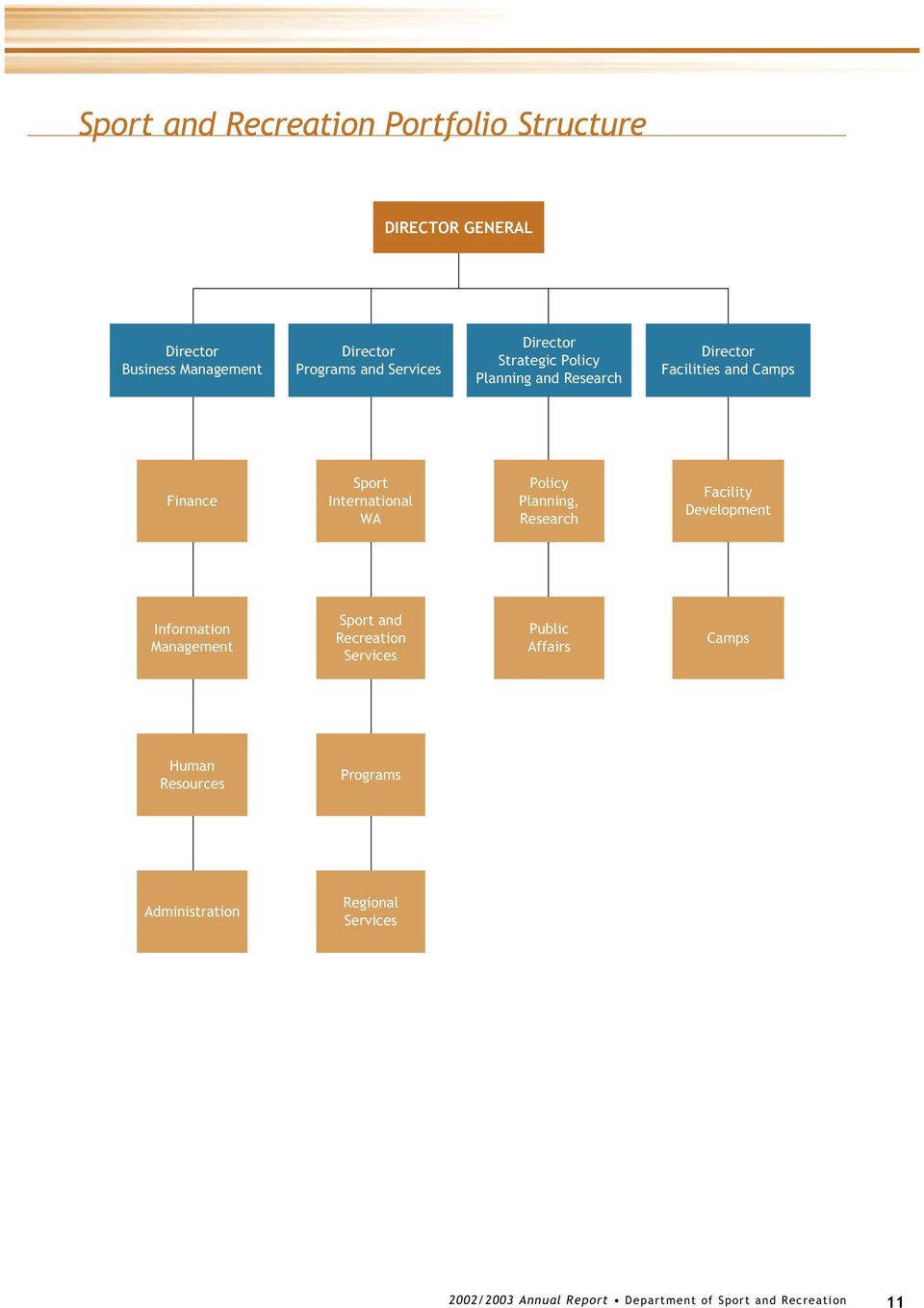
11 Sport and Recreation Portfolio Structure DIRECTOR GENERAL Director Business Management Director Programs and Services Director Strategic Policy Planning and Research Director Facilities and Camps Finance Sport International WA Policy Planning, Research Facility Development Information Management Sport and Recreation Services Public Affairs Camps Human Resources Programs Administration Regional Services 2002/2003 Annual Report Department of Sport and Recreation 11
12 Meeting the Government s objectives Government objective Department contribution 2002/2003 Honest, accountable and inclusive government Sound financial management A growing and diversified economy Strong and vibrant regions Safe, healthy and supportive communities An educated and skilled future for all Western Australians A valued and protected environment Honest: The department s code of conduct and complaints management system reflects a culture of honesty among staff in all their work activities. This means that we are open to feedback and criticism and respond accordingly to improve our performance. Accountable: The department conducts an annual independent client survey and responds to the feedback. The department also seeks feedback on each major initiative and project to ensure that appropriate strategies are developed. Inclusive: Indigenous people, women, youth and seniors are included in statewide initiatives. The department also promotes strategies of best practice on all major initiatives. The department has deployed a grants management system and reviewed grants to sporting groups. The department spent considerable time working with sporting groups on financial risk management. This is ongoing. The department complies with the Financial Administration and Audit Act and much of our internal financial management is on-line. The department contributes to the state s economic development through the annual $9m Community Sporting and Recreation Facilities Fund. New facilities or upgrades support building and related industries. The employment of professionals to manage facilities contributes to the local economy. The department s nine regional offices support sport and recreation throughout WA. The Community Sporting and Recreation Facilities fund supports the development of facilities in country areas, as well as employment opportunities. All of the department s funding programs are available to country residents and several initiatives are specifically designed for regional residents (e.g. Country Sport Enrichment Scheme, Sports Lotteries Account Country Package). The department has been developing a greater online capacity to ensure that regional residents can access information at their convenience. The department supports physical activity initiatives for individuals in communities through a range of initiatives including the well-managed Club Development Scheme. There is also a strong emphasis on risk management of facilities and activities to ensure that people can participate in a safe environment. The department coordinates training courses for sporting officials, coaches, volunteers and clubs. These are delivered statewide and on occasions to specific groups such as women, young people and/or Indigenous people. The department has a strong commitment to a well-educated and responsive sport and recreation industry and this is reflected through topical courses and seminars conducted each year (e.g. trails, facilities management, governance, risk management). An industry conference is conducted annually with several similar initiatives in regions, including a regional aquatic conference. The department considers sustainability and protection of the environment when assessing funding applications for facilities development. This may impact on design and/or management models. 12 Department of Sport and Recreation 2002/2003 Annual Report

13 OUR MAJOR PARTNERS ARE: Sport and recreation clubs and community groups State sporting associations Western Australian Institute of Sport Western Australian Sports Centre Trust Local governments Peak industry organisations Outdoor recreation agencies Sport and recreation service agencies Sport and recreation education institutions State departments and agencies, e.g. Education, Health, Planning and Infrastructure, Lotterywest, Healthway, and Housing and Works Federal agencies, e.g. Australian Sports Commission, Australian Sports Drug Agency, Aboriginal and Torres Strait Islander Commission Non-government organisations, e.g. National Heart Foundation, Australian Council for Health, Physical Education and Recreation (ACPHER) 2002/2003 Annual Report Department of Sport and Recreation 13
14 The Year In Review INFRASTRUCTURE AND ORGANISATIONAL DEVELOPMENT INDUSTRY DEVELOPMENT GOAL: Development of a sport and recreation industry with vibrancy, purpose and direction Policy Development Sport and recreation industry strategic directions Strategic Directions for Western Australian Sport and Recreation (SD3) was launched in March 2003 following nine months of extensive consultation with industry stakeholders. SD3 will guide the industry to deal with current and emerging challenges to meet industry and community demands. The Department of Sport and Recreation provides industry leadership and support for infrastructure and organisational development Public Liability and Insurance The Department of Sport and Recreation contributed to, and was represented on, several State Government working parties, including the CEO s Taskforce on Insurance. This taskforce was formed to explore options to respond to public liability and insurance issues and to progress first and second stage tort law reforms: Volunteers (Protection from Liability) Act 2002 was proclaimed on 1 January Parliament is currently debating amendments to the Civil Liability Bill. The amendments will redefine negligence, strengthen the value of risk warnings and waivers and introduce proportionate liability instead of joint and several. The department was represented on, and provided input to, the Standing Committee on Recreation and Sport s (SCORS) Insurance/Risk Management Working Party and the SCORS Sub-Committee on Insurance established to develop long-term strategies for the sport and recreation industry. Updates for clients were provided on the Department of Sport and Recreation s website and at forums and seminars. 14 Department of Sport and Recreation 2002/2003 Annual Report

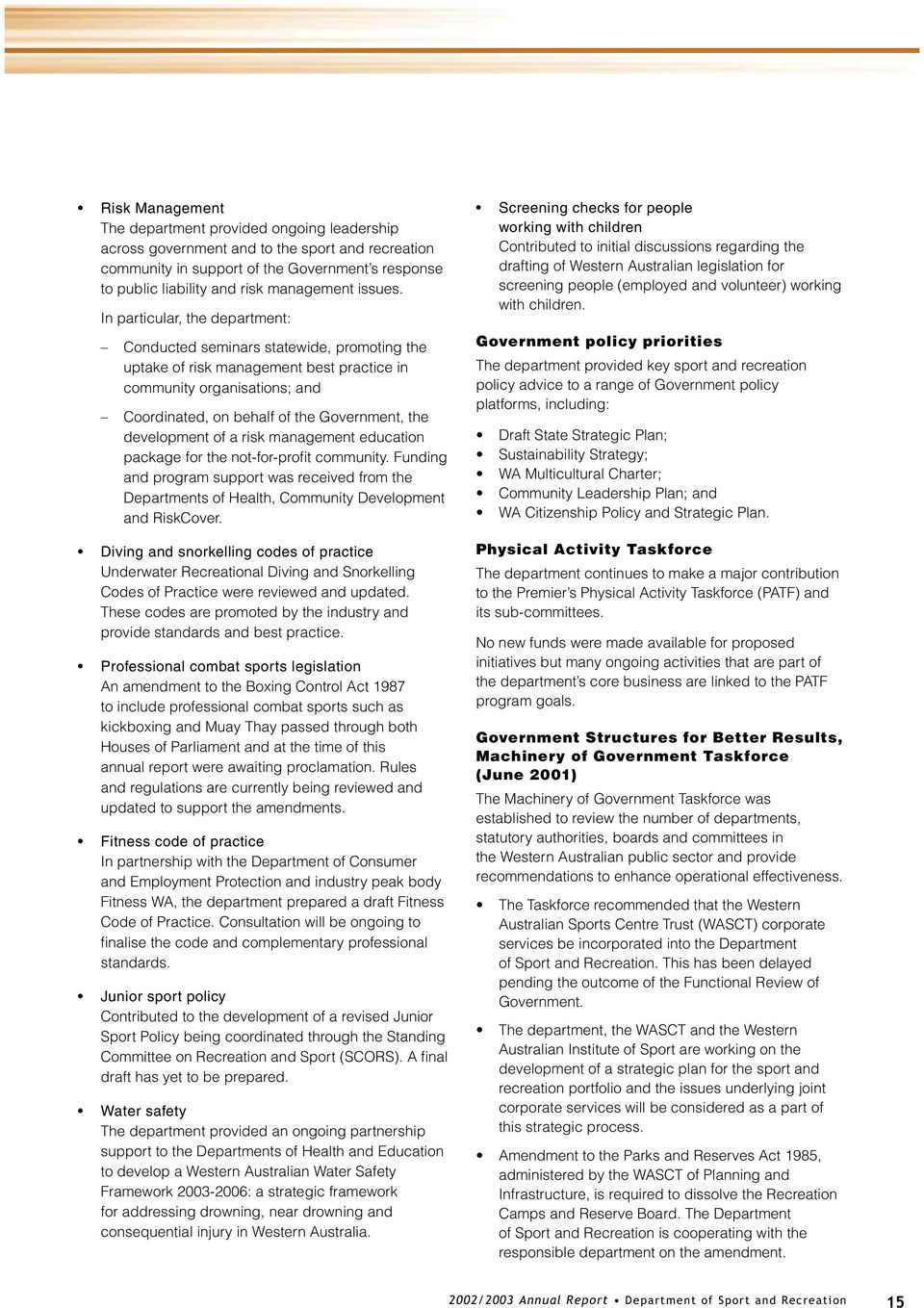
15 Risk Management The department provided ongoing leadership across government and to the sport and recreation community in support of the Government s response to public liability and risk management issues. In particular, the department: Conducted seminars statewide, promoting the uptake of risk management best practice in community organisations; and Coordinated, on behalf of the Government, the development of a risk management education package for the not-for-profit community. Funding and program support was received from the Departments of Health, Community Development and RiskCover. Diving and snorkelling codes of practice Underwater Recreational Diving and Snorkelling Codes of Practice were reviewed and updated. These codes are promoted by the industry and provide standards and best practice. Professional combat sports legislation An amendment to the Boxing Control Act 1987 to include professional combat sports such as kickboxing and Muay Thay passed through both Houses of Parliament and at the time of this annual report were awaiting proclamation. Rules and regulations are currently being reviewed and updated to support the amendments. Fitness code of practice In partnership with the Department of Consumer and Employment Protection and industry peak body Fitness WA, the department prepared a draft Fitness Code of Practice. Consultation will be ongoing to finalise the code and complementary professional standards. Junior sport policy Contributed to the development of a revised Junior Sport Policy being coordinated through the Standing Committee on Recreation and Sport (SCORS). A final draft has yet to be prepared. Water safety The department provided an ongoing partnership support to the Departments of Health and Education to develop a Western Australian Water Safety Framework : a strategic framework for addressing drowning, near drowning and consequential injury in Western Australia. Screening checks for people working with children Contributed to initial discussions regarding the drafting of Western Australian legislation for screening people (employed and volunteer) working with children. Government policy priorities The department provided key sport and recreation policy advice to a range of Government policy platforms, including: Draft State Strategic Plan; Sustainability Strategy; WA Multicultural Charter; Community Leadership Plan; and WA Citizenship Policy and Strategic Plan. Physical Activity Taskforce The department continues to make a major contribution to the Premier s Physical Activity Taskforce (PATF) and its sub-committees. No new funds were made available for proposed initiatives but many ongoing activities that are part of the department s core business are linked to the PATF program goals. Government Structures for Better Results, Machinery of Government Taskforce (June 2001) The Machinery of Government Taskforce was established to review the number of departments, statutory authorities, boards and committees in the Western Australian public sector and provide recommendations to enhance operational effectiveness. The Taskforce recommended that the Western Australian Sports Centre Trust (WASCT) corporate services be incorporated into the Department of Sport and Recreation. This has been delayed pending the outcome of the Functional Review of Government. The department, the WASCT and the Western Australian Institute of Sport are working on the development of a strategic plan for the sport and recreation portfolio and the issues underlying joint corporate services will be considered as a part of this strategic process. Amendment to the Parks and Reserves Act 1985, administered by the WASCT of Planning and Infrastructure, is required to dissolve the Recreation Camps and Reserve Board. The Department of Sport and Recreation is cooperating with the responsible department on the amendment. 2002/2003 Annual Report Department of Sport and Recreation 15
16 The Year In Review Facilities planning and development The department s facilities branch initiated a series of seminars targeting those who operate and manage sport and recreation facilities in Western Australia. There were three Leading Edge seminars during 2002/ 2003 covering facility planning, asset management and the emerging issues of fees and charges. More than 230 people attended these seminars, including a statewide audience through WestLink. The department completed the second stage of a review of 56 regional aquatic facilities. This takes to 84 the number of facilities now reviewed as part of the Regional Aquatic Audit in partnership with local governments, which has provided an independent appraisal of the status of the facilities and assessed the future needs of these ageing aquatic centres. Sport and Recreation Ministers Council (SRMC) Western Australia is a member of the Sport and Recreation Ministers Council and continued to make an important contribution to the direction of sport and recreation policy and service provision in Australia. Each state and territory government reports to the Ministers Council through the Standing Committee on Recreation and Sport (SCORS). Issues included: Insurance and public liability; Risk management guidelines for sport and recreation; Water safety; World anti-doping code; Boxing and martial arts regulations; ABC coverage of sport; National facility audit; Aboriginal reconciliation; Commonwealth/state partnerships; Sport and recreation research and statistics; National elite sports system; Elite athletes code of conduct; National approach to recreation trails; and Parental program. Standing Committee on Recreation and Sport (SCORS) The department continued its active support of SCORS and contributed to the discussions of a range of working groups such as: SCORS strategic plan and operating procedures; Review of constitution and rules of procedure; Resource sharing; Insurance; Risk management; Leaders in Sport Conference; National approach to recreation trails; Recreation and Sport Industry Statistics Group; and National Elite Sports Council pathways review. Western Australia was granted approval to host the next Leaders in Sport Conference on behalf of SCORS/ SRMC in A SCORS secretariat was established in Queensland to provide executive support to SCORS, SRMC and sub-committees. National Network of Regional Academies of Sport (NNRAS) The Department of Sport and Recreation maintained its alliance with NNRAS. NNRAS is the peak body for regional sporting academies throughout Australia and provides a forum that encourages a coordinated and collaborative approach for quality development of sporting potential in regional Australia. INFRASTRUCTURE GOAL: Quality sport and recreation facility planning, design and management Major infrastructure, planning and funding The department continued to provide leadership through its facilities planning and funding programs. Achievements during 2002/2003 include: A review the State Sporting Facilities Plan; Facilitating the development of the Leederville Oval Football Centre of Excellence, which will culminate in the co-location of two WAFL teams; Assisting the planning for the State Baseball Centre at Tom Bateman Reserve in Thornlie to be completed by December 2003; 16 Department of Sport and Recreation 2002/2003 Annual Report

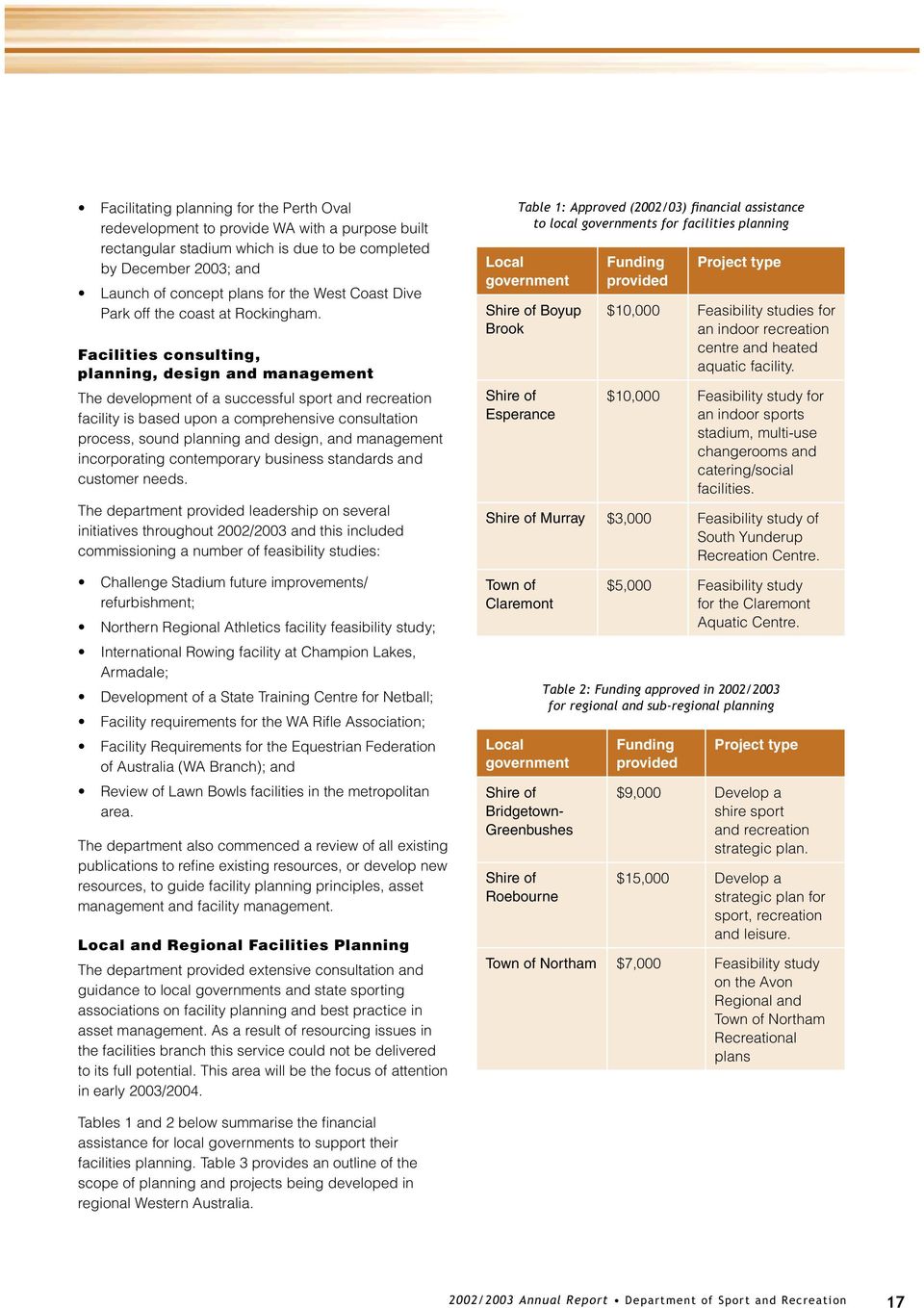
17 Facilitating planning for the Perth Oval redevelopment to provide WA with a purpose built rectangular stadium which is due to be completed by December 2003; and Launch of concept plans for the West Coast Dive Park off the coast at Rockingham. Facilities consulting, planning, design and management The development of a successful sport and recreation facility is based upon a comprehensive consultation process, sound planning and design, and management incorporating contemporary business standards and customer needs. The department provided leadership on several initiatives throughout 2002/2003 and this included commissioning a number of feasibility studies: Challenge Stadium future improvements/ refurbishment; Northern Regional Athletics facility feasibility study; International Rowing facility at Champion Lakes, Armadale; Development of a State Training Centre for Netball; Facility requirements for the WA Rifle Association; Facility Requirements for the Equestrian Federation of Australia (WA Branch); and Review of Lawn Bowls facilities in the metropolitan area. The department also commenced a review of all existing publications to refine existing resources, or develop new resources, to guide facility planning principles, asset management and facility management. Local and Regional Facilities Planning The department provided extensive consultation and guidance to local governments and state sporting associations on facility planning and best practice in asset management. As a result of resourcing issues in the facilities branch this service could not be delivered to its full potential. This area will be the focus of attention in early 2003/2004. Table 1: Approved (2002/03) financial assistance to local governments for facilities planning Local government Shire of Boyup Brook Shire of Esperance Funding provided Project type $10,000 Feasibility studies for an indoor recreation centre and heated aquatic facility. $10,000 Feasibility study for an indoor sports stadium, multi-use changerooms and catering/social facilities. Shire of Murray $3,000 Feasibility study of South Yunderup Recreation Centre. Town of Claremont Local government Shire of Bridgetown- Greenbushes Shire of Roebourne $5,000 Feasibility study for the Claremont Aquatic Centre. Table 2: Funding approved in 2002/2003 for regional and sub-regional planning Funding provided Project type $9,000 Develop a shire sport and recreation strategic plan. $15,000 Develop a strategic plan for sport, recreation and leisure. Town of Northam $7,000 Feasibility study on the Avon Regional and Town of Northam Recreational plans Tables 1 and 2 below summarise the financial assistance for local governments to support their facilities planning. Table 3 provides an outline of the scope of planning and projects being developed in regional Western Australia. 2002/2003 Annual Report Department of Sport and Recreation 17
18 The Year In Review State Sporting Facilities Plan In November 2001, the Government endorsed the State Sporting Facilities Plan (SSFP). The SSFP was developed by the department and will serve as a blue print for the provision of state-level infrastructure for sport in Western Australia for the next decade. The SSFP has been a catalyst for the development of a range of state standard facilities. Significant progress was made during 2002/2003 on the implementation of the SSFP. The redevelopment of Perth Oval into a rectangular stadium was progressed to the point that construction will commence on site in July The completion of this facility will be a major boost for sports requiring a rectangular stadium such as soccer, rugby and lacrosse. The establishment of the State Baseball facility at Tom Bateman Reserve in the City of Gosnells also advanced to the point where commencement of construction is to occur in August The development of a State Netball training facility is being progressed as part of a feasibility study funded by the department. Trailswest Following the release of recommendations from the Machinery of Government Taskforce report, the Trailswest Advisory Committee was discontinued. The functions were absorbed in the Department of Sport and Recreation s Facilities branch. The department continued its strong support of trails throughout 2002/2003 including: Hosting the Second Annual National Trails Conference in Mandurah. The conference featured national and international keynote speakers and attracted 138 delegates from throughout Australasia; The inaugural meeting of the Standing Committee on Recreation and Sport s (SCORS) National Trails Working Party was held in conjunction with the National Trails Conference; Table 3: Regional support for facilities development Region South West Kimberley Mid West Goldfields Great Southern Wheatbelt Peel Gascoyne Pilbara Local government (and projects) Eaton Recreation Centre, Bridgetown Recreation Centre, Pemberton Sports Club, Shires of Collie and Nannup. Derby Recreation Centre, Halls Creek Aquatic and Recreation Centre, Wyndham Recreation Centre, Kununurra Skate Park, an upgrade of the Kununurra swimming pool, the clubroom facilities at Derby 4 Kids, new tennis courts at the Broome Recreation Centre, extensions to the Broome Surf Life Saving Clubrooms. Mid West Trails Group, development of a CBD/urban trails network. The department initiated regional facilities through a series of local and regional planning forums. Formulation of facility and recreation plans with City of Kalgoorlie-Boulder and Shire of Esperance. Regional strategy initiated to determine regional sport and recreation infrastructure needs, the development of a joint-use multi-purpose youth recreation venue in Albany. Facilitation of the development of recreation facility plans for eight local governments. Work has commenced on two district plans. Facilitation of the Peel Region Sport and Recreation Facilities Plan and the completion of one remaining local plan. The re-establishment of the Carnarvon Sports Council, which assisted local government in formulating a facilities plan. Partnering with local governments to plan regional initiatives. The Town of Port Hedland and the Shire of Roebourne undertook to commence regional recreation planning. 18 Department of Sport and Recreation 2002/2003 Annual Report

19 The first 200-kilometre stage of the Munda Biddi Cycle trail from Mundaring to Collie was opened in December The final two stages will include the completion of a cycling trail from Mundaring in the Perth foothills to Albany; and Allocation and management of 28 grants totalling $501,734 through the Trails Funding Program, sponsored by Lotterywest. Local governments and community-based trails user groups applied for the grants to support multi-use and heritage trail developments. Co-ordinator Rowing WA Department Softball WA Department Department EventsCorp Table 4: Funding approved to assist with State Sporting Facility Planning Funding provided Project type $15,000 Develop a State Plan for Champion Lakes relating to aquatic activities $10,000 Feasibility study for the proposed State Centre at Mirrabooka $40,000 Feasibility study for major sports and entertainment venue: Hopman Cup, National Basketball Table 5: Trails funding per region for 2002/2003 Region Amount ($) Metropolitan 218,847 South West 83,310 Wheatbelt 31,700 Great Southern 19,949 Goldfields 20,803 Peel 39,200 Midwest 55,000 Gascoyne 32,925 DEVELOPING ORGANISATIONS GOAL: Improved management in organisations delivering sport and recreation services. CONSULTANCY The department provided consultancy services to 104 state sporting associations, as well as regional sporting associations, many community-based clubs, a variety of recreation organisations and local governments throughout the state. There were more than 1,700 consultations with identified clients during the year and the consultancies included advice on the following areas: Management strategic, business, financial, resource allocation and risk management planning. A trial assessment system to evaluate the management performance of all organisations receiving grants from the department was developed and implemented. Significantly, the full implementation of an organisational effectiveness assessment tool was carried out by the consultancy. The tool, along with other processes, enabled the department to make an objective assessment of its funded clients operations and funding levels required from the Sports Lotteries Account. Governance board performance, constitution and incorporation and organisational structure; Change Management research, evaluation and review that incorporate the latest trends in the industry. This area forms the basis for much of the department s education and training programs; Policy development and implementation sharing best practice principles and dealing with compliance systems; and Sport development approximately 260 people representing community sport and recreation organisations, state association development officers, local government personnel, state sporting association presidents and school sport peak bodies attended eleven forums. The department partnered Sports Medicine Australia, the WA Sports Federation, the WA branch of the Australian and New Zealand Sports Law Association and the City of Fremantle to present the forums. Topics included the roles and responsibilities of directors, Blood Rules and industrial issues in the industry. Total $501, /2003 Annual Report Department of Sport and Recreation 19

20 The Year In Review The department continued to work towards the unification of soccer in WA and acted as a conduit for the various soccer communities to negotiate reform in the sport s administration. Work continued on the restructuring and redevelopment of a variety of sport and recreation organisations so they remain relevant in the market place. The department entered into significant Contracts for Service with Royal Life Saving WA and Surf Life Saving WA, the West Australian Football Commission and the WA Sports Federation. Recreation Sector Peak Bodies The department committed physical and financial resources to the development of community recreation, including: A full review into the advocacy for and representation of the non-sport sectors in the industry was completed and a concept of establishing a peak body has been developed. This peak body is currently known as the Active Alliance and further development is required to ensure it is capable of representing the non-sport sectors at all levels of the community and government. Draft Codes of Practice have been established with the fitness sector of the industry. Considerable work was carried with Fitness WA and the Department of Consumer and Employment Protection. Working with Parks and Leisure Australia (WA) and LIWA Recreation to facilitate a merger of the two bodies. Funding has been provided to Outdoors WA to implement the National Outdoor Leader Registration Scheme and the Australian Organisation Registration Scheme. This has been done under the auspices of the National Training Framework, transferring the abseiling instructors course from the department to a registered training organisation. Regional support Consultancy services were also provided to a number of regional organisations and local governments. All regional offices conducted Club Development Scheme workshops focussing on risk management, insurance and public liability. Other major consultancy achievements included: Kimberley Developed the concept of a sport office in Kununurra in partnership with Kimberley College of TAFE and the Shire of Wyndam/East Kimberley. Mid West Business, strategic and risk management planning implemented for a number of regional associations including Geraldton Midwest Sports Federation, Indian Ocean Masters Games, Midwest Trails Group. Great Southern Comprehensive consultation has occurred with Gomm Park Croquet Club and Southern Ocean Surf Riders in the development of business plans. Goldfields Significant involvement in the unification of the various soccer bodies in Kalgoorlie. Wheatbelt An increase in the number of sports receiving development plan funding. Pilbara Development Plans are now in operation for six sports, with the North West Gymnastics Association showing solid growth in their sport as a result of this process. Gascoyne Many sport and recreation clubs have responded positively to the information available through the Club Development Scheme. Peel The department provided a key leadership role in the development of regional associations in the Peel and the formation of the Peel Sport and Recreation Network. South West More than 80 organisations and 12 local governments directly benefited from risk management and other governance seminars conducted by the department. 20 Department of Sport and Recreation 2002/2003 Annual Report
21 FUNDING Sports Lotteries Account Figure 1 outlines the allocation of $8,379,187 approved through the Sports Lotteries Account for sport development in Western Australia. A detailed list of all grants may be found on page 57 of this report. Country Package The Sports Lotteries Account Country Package provides financial support to sport development initiatives in regional communities. A total of $417,239 was approved in 2002/2003 for 367 applicants to support the development of country sport. Of this, approximately 71 per cent was allocated to organisational development plans and the remainder to categories such as education, player development, travel to regional competitions and hosting events (Figure 2). A comparison of approvals for the past two years is presented in Table 7. State Sporting Associations Almost $4 million was approved for 95 state sporting associations. A percentage breakdown for the categories to which it was provided is outlined in Figure 3. Community Sporting and Recreation Facilities Fund The Community Sporting and Recreation Facilities Fund (CSRFF) is administered by the Department of Sport and Recreation to provide financial assistance to local governments and sport and recreation organisations for the provision of well-planned capital works facilities. The total approved funding for 2003/2004 amounted to $9,352,750. A full listing of CSRFF approvals can be viewed on page 62 of this report. Table 7: A comparative breakdown of Country Package funding approvals for 2001/2002 and 2002/2003 Program $ % $ % Development plans 283, , Education (coaching/admin) 19, ,009 5 Hosting competitions 19, ,934 5 Junior sport 17, Player development 21, ,671 3 Special projects 1, ,000 0 State team training scholarships 34, ,200 8 Travel to regional competitions 32, ,612 8 Total 428, , /2003 Annual Report Department of Sport and Recreation 21
22 The Year In Review State sporting associations Country specific WA Institute of Sport Administration Recurrent funding to key sports organisations Officiating Figure 1: Sports Lotteries Account allocations 2002/03 Development plans Education (coaching/admin) Hosting competitions Player development Special projects State team training scholarships Figure 2: Percentage breakdown of Country Package Funding by category for 2002/2003 Governance Market Analysis Other Risk Management Sport Development participation Sport Development high performance Figure 3: Breakdown of category funding to state sporting associations 22 Department of Sport and Recreation 2002/2003 Annual Report
23 PEOPLE DEVELOPMENT PARTICIPATION GOAL: Physically active lifestyles for Western Australians Initiate and partner participation initiatives The department s ability to deliver its outcomes is dependent upon developing partnerships with stakeholders, including sport and recreation groups, local governments, other government agencies, community groups and businesses. Country Sport Enrichment Scheme (CSES) The Country Sport Enrichment Scheme makes a powerful contribution to life in regional Western Australia by providing opportunities for communities to access state and national level sporting events. Significantly, they also provide training and coaching opportunities for participants through high level role models, players, coaches and administrators. Funding of $225,500 was provided to assist 11 sporting associations host events in Busselton, Geraldton, Bunbury, Derby, Collie, Margaret River and Esperance (refer Figure 4). Australian Football Western Australian Football League games were held in Busselton and Geraldton; Basketball A National Basketball League fixture was played in Bunbury between the Perth Wildcats and the West Sydney Razorbacks; Motocross A successful motocross event was held in Derby bringing national riders from around Australia to the Kimberley town; Soccer The Perth Glory played pre-season games against Parramatta Power in Collie and Margaret River; Tennis Evonne Goolagong-Cawley visited Esperance and Geraldton as part of the Evonne Goolagong Getting Started Program; Beach Volleyball A Beach Volleyball tour to Busselton, Bunbury and Collie showcased elite players to the communities of the South West; and Bowls An Australian v England under-25 Test Series was conducted in Geraldton. It is estimated that more than 4,000 people participated in clinics and seminars associated with the events. Regional participation initiatives Peel The department continues to lead the development of the Peel Physical Activity Group and associated physical activity strategies. Gascoyne The department conducted sporting clinics and visits to remote communities and formed a partnership with Carnarvon and Exmouth PCYC to provide school programs. Wheatbelt The Wheatbelt Physical Activity Council and Be Active coordinators provided valuable opportunities for increasing physical activity through a Physical Activity Leadership Form. WAFL Basketball Motorcycling Volleyball Waterpolo Speedway Bowls Soccer Surfing Tennis Squash Figure 4: Percentage allocation of CSES funding to sports. 2002/2003 Annual Report Department of Sport and Recreation 23
24 The Year In Review Mid West The Regional Aboriginal Development Officer and Active Women Consultant delivered programs to enhance physical activity throughout the region, including visits to remote areas. Pilbara Establishment of physical activity networks throughout the region to identify and conduct programs to increase physical activity. Goldfields The inaugural Physical Activity Expo was conducted incorporating clinics and activities. The department led the formation of the 10,000 Steps Goldfields program. Great Southern The productive partnership with the Department of Health continues to develop strategies for promoting physical activity in schools. South West The touring play Let s Get Active was developed as the new strategy for physical activity in the South West, complementing the South West Physical Activity Network and Walk it Bunbury as the participation activities in the region. Kimberley Partnerships with other agencies were established to support youth and participation initiatives including skateboarding in Kununurra and a youth sports program in Derby. Indigenous Sport Program (ISP) 2 The Indigenous Sport Program develops and promotes sport and recreation among the Indigenous Community of Western Australia. The ISP is supported by 13 officers throughout the State; the majority are located in regional WA. The program receives significant financial support from the Australian Sports Commission through a Contract for Service arrangement. Partnerships were established with several state and national sporting organisations to deliver a range of sport development and participation activities. The Aboriginal Participation in Sport Program, sponsored by Healthway, complements the ISP. Walk Friendly The department partnered the Injury Control Council s Stay On Your Feet program to present a number of Walk Leader Training Forums in regional WA and the metropolitan area. A new walk leader manual was developed to support these forums and there are plans to make it available in hard copy and online. The department became a prominent partner in the presentation of the Walk There Today project with the Heart Foundation, Department of Health and Department of Planning and Infrastructure. Seniors The department continued to work with the Seniors Recreation Council (SRC) on a number of projects. This year s achievements included: SRC branches have been established in the Peel, Goldfields and Perth to support metropolitan operations. The possibility of branches in Albany, Northam and Bunbury will be explored. A memorandum of understanding has strengthened relationships between the SRC and the Departments of Health and Community Development. Funding from Lotterywest for the next three years will enable the Council to consolidate its statewide operations and acquire urgently needed equipment to support a wide range of events and projects, including Have a Go Day, the Seniors Ball and the Add Life to Your Years booklet. Table 8: A selection of Indigenous sport programs in the metropolitan area Location Program Comment Nyungar (Perth) Basketball Seniors Multi- Sports In conjunction with WA Basketball and the Perth Wildcats, a team was entered in the curtainraiser matches for Wildcats home games. The State Basketball League drafted nine of the boys who took part in the program. Seniors were introduced to an initiative to participate in various sporting programs and challenging activities to assist with everyday life. Activities included aerobics/ weights, boot scooting and selfdefence. 2 Action: A State Government Plan for Young People. Priority area 2, 3 and 5. 3 Action: A State Government Plan for Young People. Priority area 2 and Department of Sport and Recreation 2002/2003 Annual Report
25 Corporate Challenge The Department of Sport and Recreation supported the StateWest Corporate Challenge in which 4,800 people took part in 14 sports and other physical activities. More than 800 teams represented 113 government agencies and private sector companies. Junior Sport Unit The Junior Sport unit facilitates opportunities for young people statewide to participate in leadership programs. It also provides advice on youth issues for state sporting associations, schools and other key community and government organisations involved in the delivery of sport and recreation. Active Australia Schools Network (AASN) The AASN is the vehicle through which the department assists schools and teachers of sport and physical activity. During the year 17 new schools were inducted into the network. Two Junior Sport Development Days and two regional development days were conducted, which provided sport in-service training to more than 200 teachers statewide. National Junior Sport Policy Framework Two workshops one metro and one regional - were held to facilitate feedback on the draft national junior sport framework. These workshops provided key stakeholders with an opportunity to discuss how the new guidelines could be implemented in WA. The policy framework is expected to be available in late Junior Sport Reference Group The Junior Sport Reference Group is an advisory panel to the industry and government on strategies and policies to support junior sport in Western Australia. As a follow up to last year s industry workshop, the group guided the development of a three-year youth in sport strategic plan. It also helped to develop a Youth Sports Good Practice Guide. Sportsfun 3 The Smarter Than Smoking Sportsfun program sponsored by Healthway was conducted in 10 district high schools and provided opportunities for young people to develop leadership skills. Overall, 1,800 students from 60 secondary schools were involved. They demonstrated leadership by coaching 9,000 primary school students from 85 primary schools in modified sports. Teachers supervise all programs. The Department of Sport and Recreation acknowledges the support of the Department of Education and the Catholic Education Office. Table 9: Indigenous sport programs in regional areas Location Program Yamatji (Mid West) The inaugural Aboriginal Sports Star Awards event was attended by more than 300 people including role models to encourage Indigenous people to participate and excel in sport. Gascoyne Nyoongar (Bunbury) Western Desert (Martu Lands and Ngaanyatjarra Lands) Ngarda Ngarli Yarndu (South Hedland) The Royal Lifesaving Society Swim Program, conducted in collaboration with the department, involved 40 Indigenous participants and six officials. Indigenous girls are now starting to feel comfortable about wearing bathers in public, which is a significant cultural development. The Mooditj Noongar Yorgas netball program was a pilot development program held for young Indigenous people as a pathway to the regional netball academies. Three of the girls attending the development program were accepted into the regional academy in Bunbury. Netball was introduced as a change from long-standing sports such as softball and basketball. Clinics were run in the Martu Lands at several communities. Girls from the Martu Lands had the opportunity to participate in the Norwest games. Various activities were run for Indigenous teenagers to encourage their participation in sport. Clinics including basketball, tennis and netball were conducted in conjunction with the regional and state sporting associations. The programs also built confidence and self-motivation. 2002/2003 Annual Report Department of Sport and Recreation 25
26 The Year In Review Challenge Achievements Pathways in Sport (CAPS) 4 CAPS is a youth leadership skills development program designed to encourage youth participation in sporting clubs and State sporting associations. Young people have the opportunity to develop skills and knowledge in administration, coaching, management, officiating, sports health and participation. Five sports and approximately 500 children were involved. School- Community Link Projects The junior sport unit funded and coordinated several school-community link projects to provide youth leadership and participation programs to enhance links between schools and clubs. Partnerships were established with the Australian Council for Health, Physical Education and Recreation, YMCA, local governments and state sporting associations. Positive Parent Behaviour The department developed a new kit to tackle the issue of inappropriate parent behaviour at junior sporting events. Keep it Fun a clubs guide to encourage positive parent behaviour was developed and distributed throughout WA to all sport, local government and community groups. The kit has also been eagerly sought by sporting groups in other states. Active Women Programs The active women unit provides opportunities for Western Australian women and girls to access and participate in physical activities in safe and enjoyable environments (see Table 10). Regional programs were supported through sponsorship from Healthway. Table 10: Metropolitan and Regional Women s Programs Program 2002 Active Achiever Country Week Awards 2002 Active Achiever District High School Recognition Awards Smarter Than Smoking Schoolgirls Breakfast The Girls Club Over 25s Seniors Leadership Comment Thirty-two girls and 12 boys from 16 regional senior high schools were nominated for the award. Sixty students and teachers attended the awards ceremony and the nominees were acknowledged at the Country Week closing ceremony before an audience of 4,000 teachers and students. This award attracted 36 nominees. Fifty students and guests attended the presentation ceremony. More than 1,100 schoolgirls and 50 role models attended 14 regional breakfasts to encourage and inspire young girls to maintain their participation in sport and physical activity. More than 3,700 girls participated in 38 programs in regional WA. These programs target post-natal women and those aged over 25 years. More than 1,500 women took part in 33 programs. One hundred and eighty women aged 65 and over participated in six specifically designed events. More than 100 schoolgirls participated in four programs centred on improving leadership skills. NB Where events were ongoing and involved the same people during the program, participants were included in the figures each time they participated. 4 Action: A State Government Plan for Young People. Priority area 2 and Department of Sport and Recreation 2002/2003 Annual Report
27 Active Women Forums Forum DSR Forum WA Women in Sport Forum Comment Approximately 25 people from the sports industry attended this seminar to develop strategies and best practice examples of how sports can attract more women. Twenty experienced practitioners from across the sports industry were invited to attend this half-day workshop to develop long-term strategies to increase the involvement of Western Australian women and girls in all aspects of sport and recreation. Ethics/ Harassment- free Sport The department coordinated the delivery of courses to train industry personnel as Member Protection Officers (MPO). These officers are the first contact point for members of their organisation in matters involving harassment, discrimination or abuse. Course Member Protection Officer Course Member Protection Officer Children (MPOC) and Young People Course Train-the-Trainer Comment Fifty people from state sporting associations and the department attended one of three two-day workshops to be accredited as Member Protection Officer (MPO) for their association. More than 30 MPOs attended one of two workshops that addressed harassment and abuse of children in sport. Five potential trainers attended the MPO, MPOC and Train-the-Trainer courses to be appointed to a panel of WA-based presenters. 2002/2003 Annual Report Department of Sport and Recreation 27
28 The Year In Review HIGH PERFORMANCE GOAL: Encourage the pursuit of excellence Talent Development Athletes require opportunities through which they can develop their talent and reach the elite level in their sport. This necessitates the provision of specialist programs to assist the individual and sport. During 2002/2003 the department funded many state sporting associations for high performance programs through their annual business plan funding. As part of its contribution to the implementation of recommendations contained in Future Success A Strategic Plan for High Performance Sport in Western Australian Beyond 2002 the department partnered with the WA Institute of Sport and the WA Sports Federation to produce resources for state sporting associations to develop high performance programs. The resources include a contemporary operational model, a planning process and an auditing tool to help an organisation to determine whether it has the capacity and capability to deliver high performance outcomes. Academy of Sport Program 5 The Academy of Sport Program helps to create genuine opportunities and pathways for talented athletes in regional Western Australia and is a key commitment of the State Government s sport and recreation policy. Through this program and other initiatives the department builds a link between talent and elite development to increase the number of country athletes representing Western Australia at state and national level. In 2002/2003 there were 31 coaches and 77 athletes involved in the program of whom 19 athletes have been selected to represent Western Australia. The recent inclusion of TouchWest and TennisWest into the program brings the number of associations involved in the Academy of Sport to six. Academy sports regional talent identification programs TennisWest all regions Cricket: Dennis Lillee Fast Bowling Academy all regions Netball North West TouchWest North West Swimming North West, Goldfields Gymnastics North West Academy sports conducted camps and clinics in Karratha, Broome, Port Hedland, Tom Price, Kalgoorlie and Perth. Table 11: State sporting association Academy of Sport grants for 2002/2003 Association Amount Athletes Coaches State representatives TennisWest 15, TouchWest 9, Netball 25, Swimming 30, Gymnastics 12, WACA 30,000* Total 02/03 $121, * WACA Dennis Lillee Fast Bowling Academy funding is for three years commencing 2001/02. 5 Action: A State Government Plan for Young People. Priority areas 2 and Department of Sport and Recreation 2002/2003 Annual Report
29 Drugs in Sport The State Government s policy on drugs in sport is to ensure that participation at all levels is free of performance enhancing drugs and methods. A comprehensive strategy includes: Legislative base that allows for drug testing of state competitors; Introduction of a drug-testing program conducted by the Australian Sports Drug Agency, for state competitors; Implementation of a policy that outlines the roles and responsibilities of the State Government and state sporting associations; Requirement of state sporting associations to have drugs in sport policies; and Continuation of funding to Sports Medicine Australia (WA Branch) for a further three years to support drugs in sport education programs. Regional initiatives Mid West Hosted the annual regional sports awards in partnership with the Mid West Sports Federation. The Indigenous Sports Awards were included in the awards for the first time. Evonne Goolagong was a special guest at the awards. Peel The inaugural Peel Sports Awards were conducted in Mandurah providing further opportunities to recognise the achievements of regional athletes. Goldfields The Goldfields Sportstar of the Year Awards and Esperance and Districts Sports Awards were conducted. These will become annual events. Pilbara Regional championships incorporating talent identification for netball, swimming and gymnastics were conducted. Kimberley Talent identification and athlete development were assisted through the Garnduwa community. Great Southern The Albany Sportsperson of the Year was the culmination of monthly awards presented throughout the year. South West A working party was formed to establish the South West Sports Hall of Fame. Wheatbelt A presentation by a dietician on good nutrition and pre-performance options for energy was arranged for athletes. Gascoyne The Carnarvon Sports Awards were re-established and provided new opportunities to acknowledge the achievements of regional athletes. Smarter Than Smoking Country Sport Scholarship Healthway provided $150,000 for Country Sport Scholarships to support talented country athletes. Pilbara mountain bike riding, motocross, BMX and karate were among eleven sports to receive scholarships. Rider Brett Gillespie used his scholarship to travel to Perth to train with WAIS cyclists. Gascoyne thirty-two athletes from eleven sports received scholarships. Achievements include representation in the state pistol team and participation in state and national training squads for karate. Goldfields Scholarships were presented to athletes in Kalgoorlie and, for the first time, in Esperance. South West Australian hockey representative and former scholarship winner, Jayde Taylor was guest speaker at the South West Scholarship presentation to 22 recipients. Wheatbelt Mark Britza s scholarship helped him to represent Australia in Tetrathlon and Western Australia in national showjumping. Forty-two scholarships were awarded in the region. Great Southern Kate Siddell was awarded a scholarship and was also named 2002 Albany Junior Sports Star of the Year. A further 26 scholarships were awarded in the region. Mid West Several junior badminton players achieved Australian and Australasian rankings at the recent Australian titles. Scholarships were awarded to 21 athletes. Peel Scholarships were awarded to ten athletes in the Peel and three exceptional athletes were selected as regional role models. Kimberley Scholarships provided opportunities for athletes to be recognised and offered training in Perth. 2002/2003 Annual Report Department of Sport and Recreation 29
30 The Year In Review International Sport Sport International WA (SIWA) High performance athletes require opportunities to compete with international counterparts if they are to aspire to national and international standard performances. These opportunities were created either by travel overseas to compete or hosting high performance events in Western Australia. The Department of Sport and Recreation, through Sport International WA, helps state sporting associations to organise exchanges with other countries. It also assists with the conducting of sporting events and other international sporting initiatives. In November 2002, at the invitation of the Indian Government, SIWA assisted the Sports Authority of India to draw up a National Sports Plan for India. Similarly, in response to a request from the Government of Sri Lanka, SIWA prepared a report on the design brief for the construction of a high-altitude sports training centre at Nuwara Eliya. Both countries have expressed their gratitude for the work done. The Government of Western Australia signed two Memoranda of Understanding (MOU) to set out the framework under which sports exchanges were to take place. In January a MOU was signed with the Government of Catalonia and in February with the Government of Mauritius. The outbreak of Severe Acute Respiratory Syndrome (SARS) significantly impacted the number of international sports exchanges involving Western Australian athletes between January and June In each case the exchange was cancelled due to travel restrictions imposed. The following are the few exchanges that were conducted between July and December 2002: 2002 WA Badminton International, 5 7 July 2002; Tri Nations Keirin Cycling Series, November 2002; Grolsch International 505 World Sailing Championships, 3 14 December 2002; and FINA World Women s Water Polo Championships, December Utilising its networks, SIWA has found suitable training and competition opportunities for elite WA athletes based at the WA Institute of Sport in Europe at a significantly reduced cost. DEVELOPING PEOPLE GOAL: Development of skilled and informed people in service delivery Education and Training of Service Providers 6 Education and training remain core components of the development of sport and recreation in Western Australia. Volunteers and paid personnel required regular updating of their skills and knowledge to remain relevant and to meet the increased expectations and demands placed upon their roles in the sport and recreation industry. Coaching Education and Training 7 The department supported the delivery of the National Coach Accreditation Scheme by developing partnerships and employing five regional coordinators who delivered 13 Level 1 Coaching General Principles workshops and 21 professional development and recognition workshops. Ten Level 1 Coaching General Principles courses, two Level 2 Coaching General Principles courses and 10 development workshops were delivered in the metropolitan area. Workshops included: John Northey coaching clinics in Albany and Katanning; Women in sport Mel McClure from Perth Lynx, held in Mt Barker; Kim Hughes and Ken Judge delivered coaching development workshops in Jerramungup, Kondinin, Bunbury, Jurien and Margaret River in partnership with BankWest; Golf clinics in Derby conducted by a Fremantlebased professional; Community coaches seminar Insurance for Coaches; Coach of the Year function in the Peel region; and Coaching Development in injury and strength training in the Mid West. Modifications to delivery methods allowed students to access the Level 1 Coaching Principles courses at minimal cost and in some cases at no cost. Additionally, the recognition of physical education teachers as highly competent presenters provided more opportunities for students to undertake the course. A statewide database has been established to support and develop presenters. 30 Department of Sport and Recreation 2002/2003 Annual Report
31 Visiting Coach Program The department funded projects in partnership with state sporting associations that supported visits by coaches to country areas. Partnerships A Memorandum of Understanding was signed with Central TAFE to deliver the Level 2 Coaching Course in conjunction with the department. Strong partnerships continue with Central TAFE, The University of Western Australia and Edith Cowan University to accredit students who have completed courses with Level 1 and 2 Coaching General Principles certificates. The Alcoa Coach in Residence Program continued to provide sports with long-term development opportunities through funding support to bring top-level coaches to Western Australia (see Table 12). This partnership was further developed through Regional Coach Scholarships. Twenty-two scholarships were awarded to regional coaches to assist in their development. Officiating The department continued its commitment to the development and promotion of sports officials in Western Australia. The main programs undertaken were: Officiating Initiative Funding Program $150,000 was allocated to 35 state sporting associations to assist with the implementation of initiatives to develop officials across the state. Officials Breakfast Club Four functions gave 528 officials the opportunity to discuss issues affecting officials. They also contributed to local planning for Year of the Official strategies which put Western Australia at the forefront of state-based activities to mark this important year. Officials Awards Dinner Attended by more than 170 people, this event acknowledged those who had achieved at the highest level or contributed to the ongoing development of officials in their sport. Table 12: Alcoa Coach in Residence Grant Recipients for 2002/2003 Sport Coach Dates of Program Amount Basketball Ganon Baker 21/7/02 to 23/7/02 $1,230 Tennis Mark McGrath 6/8/02 to 11/8/02 $2,550 Equestrian Rod Brown 12/8/02 to 13/8/02 $1,280 Badminton Andrew Martin 23/8/02 to 1/9/02 $2,500 Softball Martin Rubinoff 30/8/02 to 6/9/02 $1,800 Sporting Shooters Tibor Gonczol 13/9/02 to 15/9/02 $1,350 Taekwondo Kytu Dang 28/9/02 to 7/10/02 $3,500 Marching Colleen Parkes 4/10/02 to 13/10/02 $700 Cricket Dennis Lillee 18/11/02 to 22/11/02 $5,685 Water Polo Juan Jane 6/12/02 to 14/6/02 $3,000 Fencing Mathieu Meriaux 1/1/03 to 31/12/03 $6,500 Cheerleading Sanford McMurray Margaret-Mary Opstelten 23/5/03 to 25/5/03 $2,200 Total $32,295 6 Action: A State Government Plan for Young People. Priority areas 2, 3 and 5. 7 Action: A State Government Plan for Young People. Priority areas 2, 3 and /2003 Annual Report Department of Sport and Recreation 31
32 The Year In Review Officiating General Principles Course Delivered by the department twice during the year in the metropolitan area. The Certificate IV in Sport Development was delivered in partnership with Bunbury Regional TAFE. The department is also progressing the development of a Level 0 course. Officiating Reference Panel The panel met seven times and provided advice to the department on strategies and policies to develop and support the role of officials. Year of the Official This national initiative began in 2003 to improve community attitudes towards officials and reduce the incidence of abuse. The department is assisting with the implementation of national initiatives as well as developing local strategies. Country Sport Development Program 8 This program has been sponsored by Skywest Airlines for nine years and has been accessed by more than 40 sports. The program enables individuals to travel to country areas and conduct courses or country people to travel to Perth to upgrade their skill and knowledge of community sport development. During 2002/2003 the total value of the sponsorship was approximately $20,000. Highlights for the year through this sponsorship included: Gascoyne An umpiring and skills session for Carnarvon Touch Association provided valuable training for players and umpires. A safety course was conducted for the Carnarvon District Shooting Sports Association. Mid West The Midwest Regional Netball Association named Skywest Airlines as their sponsor for a development weekend during which 14 umpires achieved higher qualifications. The swimming, touch, teeball and cricket associations also benefited through the Skywest Airlines program. Great Southern In Albany a Western Australian Institute of Sport canoeist provided valuable coaching expertise to canoeists, kayakers, school students and people with disabilities. Coaching accreditation for pony club members was also undertaken. Goldfields Fremantle Dockers squad members worked with local junior football players. The Esperance Volleyball Association, under the guidance of the WA Volleyball development officer, conducted skills sessions at school clinics involving local players. Pilbara Development of a regional basketball coach with a strong focus on training young people. The Club Development Scheme The Club Development Scheme (CDS) supports volunteers who play a vital role in the functioning of community sport and recreation clubs. In its second year the CDS continued to provide valuable assistance to volunteers to help them deliver better quality services and activities through their clubs to their members and participants. The key areas of the scheme include grants, resource development, education and training seminars and online club development. Club Development Grants $30,000 was provided to 19 metropolitan local governments to deliver education and training to community clubs. Ten state sporting associations were targeted to develop and implement club development initiatives. Grants up to $3,000 were provided to each targeted sport. A club improvement grants program was launched through which all SSAs could apply for up to $1,000 to conduct a club development seminar or forum. Region Table 13: Skywest Airlines Sponsorship 2002/2003 Number of flights in 2002/03 Mid West 7 Goldfields (including Kalgoorlie and Esperance) Great Southern 5 Gascoyne (including Carnarvon and Exmouth) Pilbara (flights to Karratha ceased during the year) Total 27 8 Action: A State Government Plan for Young People. Priority areas 2 and Department of Sport and Recreation 2002/2003 Annual Report
33 Seminars Ninety-nine club development seminars were conducted statewide attended by 1,900 people. These included two seminars distributed via the WestLink network to approximately 350 people in more than 60 venues. A new seminar was developed Club Committee Inservice. Resources Since 2001 the Club Development Scheme has distributed more than 35,000 club guides and 4,000 Smart Clubs Checklists free of charge. Online Club Development The department s website continued to provide a comprehensive section for clubs through which all club guides, the Smart Clubs Management checklist and an extensive range of club management and administration templates could be downloaded. Regional Implementation $30,000 was allocated to the department s statewide offices for club development initiatives. These initiatives include education and training and consultancy to clubs. Risk Management The department responded to sport and recreation industry and community concerns over public liability and insurance. In particular, the department: Volunteers in Sport Alcoa Coach in Residence Volunteers Recognition Breakfast The second Volunteers Recognition Breakfast was held 5 December 2002 to coincide with International Volunteers Day and in WA Thank a Volunteer Day. More than 400 nominations were received from around the state and of these 160 volunteers were invited through a ballot process to attend the breakfast. The Minister for Sport and Recreation and 20 WA sporting personalities attended and, as a gesture of thanks, served breakfast to the volunteers. Rio Tinto Volunteer Management Scheme The department was successful in securing $540,000 in funding over three years through the Rio Tinto WA Future Fund to develop an innovative scheme to improve the management of volunteers in sport and recreation. The department received initial funding to implement four pilot projects. Following extensive evaluation, these pilots were rated highly by Rio Tinto and the company chose to provide further funding to develop a three-year program. In partnership with the Australian Sports Commission, convened a risk management seminar presenting Standards Australia guidelines to 70 state sporting association board members. Conducted 13 Legal Issues and Risk Management seminars through the Club Development Scheme with more than 450 people attending across the state. This included a WestLink seminar delivered to regional WA via satellite. The seminar reached 27 towns and over 200 people on one night. More than 1,920 Risky Business A Club Guide to Risk Management resources were distributed free of charge. 2002/2003 Annual Report Department of Sport and Recreation 33
34 Business Management, Legislation and Compliance During 2002/2003, the department continued to build on major reforms implemented during the previous reporting period with further development of our internal management system Managing Outcome and Output Delivery (MOODS). The reforms continued to improve corporate accountability recognising the need to continue to focus on improving client services. Information Management A key component of the department s internal business processes and accountability framework includes online access to policies and procedures through the agency s intranet The Arena. Enhancements were implemented to enable relevant staff to develop, update and review policies online. The department implemented the Sportshouse concept in five regional offices to provide local sporting associations with access to contemporary IT equipment and services. Information systems are protected through a virus management system that continually polls for new viruses and downloads the latest protection software within hours of its being available. Staff forums were conducted regularly to update staff on systems and software. Records Management The department s contemporary records management system was enhanced to provide all staff with online access to records searching; file transfers; file bring-ups; and file creation. Regional areas also have online access to enter correspondence. A hard-copy records management system has also been implemented in each of the nine regional offices to mirror the standards in place in the metropolitan office. Information Centre During 2002/2003 the Information Centre continued to provide excellent information services to the sport and recreation community of Western Australia. There was a 58 per cent increase in service delivery and a 356 per cent increase in enquiries through the department s website. 34 Department of Sport and Recreation 2002/2003 Annual Report
35 In November 2002, the department hosted a successful Sports Librarians Conference, which was attended by delegates from South Africa, Mozambique, Fiji, New Zealand, Singapore, Hong Kong and France. Interstate and intrastate libraries were well represented. The conference enhanced the department s status among the international sports librarians community. Human Resource Management The past 12 months was a period of further development and consolidation including: Finalising arrangements for the transition and restoration of parity pay and conditions between like employees, with the return to award-based employment. Implementation of the Government s policy on the use of fixed-term contracts. Input into further development of relevant awards and agreements. Human Resource Management Initiatives In response to increasing community and departmental concerns about the important issue of child protection, the department sought cabinet approval to apply for exemption from the Spent Convictions Act The department s police clearance policy was upgraded to require all new employees to obtain a National Police Certificate prior to commencement and approval for a back-catch of all existing employees. Successful implementation of the main recommendations of the Recreation Camps and Services Structural Review Australian Liquor, Hospitality and Miscellaneous Workers Union (ALHMWU) v Recreation Camps and Reserve Board cleaners dispute finalised. Closure of Noalimba Accommodation and Conference Centre was managed sensitively and finalised without industrial concerns. All job description forms were formally reviewed to reflect structural changes and incorporate core, generic selection criteria. Ongoing delivery of a corporate training program targeting needs identified from Performance Development Program discussions; including Occupational Health Safety and Welfare training needs. Implementation of the department s revised Recruitment and Selection Policy and Procedures, including strategies for an Innovative Recruitment and Resource Kit. Employment of two school-based trainees to complete Certificate 2 in Sport and Recreation. Their employment was in program-based roles. Financial Management A major priority for the year was to develop and refine further the systems to support financial planning, management and reporting in the agency. Managing Outcomes and Output Delivery System (MOODS) was further developed to enhance the financial reporting suite of tools to enable staff to seek detailed information from agency or divisional level to transaction information level. These reports are updated daily and are available online to staff statewide. Additionally, managers are now able to forecast and manage outputs, resources used and resources required. MOODS also allows the department to systematically plan and manage agency outcomes in a framework that mirrors the Government s outcomes and outputs model. Other significant achievements for the year included: All monthly, quarterly and annual reporting deadlines were met; Unqualified audit reports were received for the department, Recreation Camps and Reserve Board and the Western Australian Boxing Commission; Financial management training was provided to all staff in conjunction with the implementation of the forecasting tool; Internal audit reviews conducted during the year reported that internal control systems were operating effectively; Electronic lodgement facilities were set up for all taxation returns; and Ongoing support services were provided to employees in all three agencies. 2002/2003 Annual Report Department of Sport and Recreation 35
36 Business Management, Legislation and Compliance Administration The Administration area complements each of the core management disciplines (human resources, information and finance). Major achievements included: More efficient purchasing practices with an increase in the department s purchasing delegation to $50;000; and Training of all staff in the department s online risk management database system, which was implemented to assess the risks involved in undertaking departmental programs. 36 Department of Sport and Recreation 2002/2003 Annual Report
37 Statutory Reporting REGIONAL CUSTOMER SERVICE DELIVERY In line with the requirement to report against regional outcomes/indicators, the Department of Sport and Recreation reports the following against the five objectives. This has been achieved through the nine regional locations. Regional customers have equitable (in comparison to Perth) access to the services provided. (Regional Development Policy Strategy 2.2.1) The department s regional customers are provided with an equitable service through the: Country Sport Enrichment Scheme The aim of the Country Sport Enrichment Scheme is to help country Western Australians experience sporting events and other major sporting initiatives that would ordinarily be metropolitan-based. The scheme recognises the importance of sport to regional Western Australians and the ongoing success of country sport participants, many of whom represented the state and Australia in competition. In 2002/2003 the scheme supported a wide range of sports including football, soccer, cricket, tennis, volleyball and motocross. Sports Lotteries Account Country Package The aim of the Country Package is to increase the opportunities for country people to participate in sporting and educational activities of their choice. The department encourages all sporting groups in regional areas to affiliate with their respective state sporting association or equivalent, to take advantage of the services offered; however, this is not essential to access the Country Package funding support. Through the Country Package, organisations are able to seek financial support for various aspects of their sport development. The Country Package has financially supported education for coaches, administrators and officials, player development, hosting events, travel, state team scholarships and longer-term development plan funding for regional sporting associations. 2002/2003 Annual Report Department of Sport and Recreation 37
38 Statutory Reporting Skywest Sport Development Program The department s partnership with Skywest continued in 2002/2003. The Skywest Sport Development Program provided travel support to country people and in turn supported country sport development. Specifically, support was provided for country people to travel to seminars/events in the metropolitan area or other regional centres. Metropolitan-based coaches and officials are also flown to regional centres for educational forums, workshops, coaching clinics and seminars. Community Sporting and Recreation Facilities Fund (CSRFF) The CSRFF supports statewide facilities development through the provision of funding for sporting and recreational facilities. Funds are provided, usually in a tripartite arrangement with the relevant local government, the department and the organisation involved, to jointly fund sporting and recreational facilities. The importance of the support to regions is demonstrated in a comparison of funding provided to regional versus metropolitan Western Australia. In the 2003/2004 funding triennium, 65 per cent of CSRFF funds were allocated to projects in country regions; which equates to $13.22 per head of population for country regions as opposed to $2.57 per head for metropolitan Western Australia. Regional customers are informed of the services available to them. (Regional Development Policy Strategy 2.2.7) The department has nine regional offices located throughout the State. The department informs regional customers of the services available to them by developing networks with local governments and regional sporting and recreation associations and clubs. Regional offices regard local governments as their primary client group. Local governments in regional Western Australia deal directly with the community, therefore to maximise information provided to regional areas local government networks are developed and sustained by the department and the products and services available to regional customers are advertised locally. Many of the department s services and resources are available on the department s website. Your organisation used regional suppliers. (Regional Development Policy Strategy 3.2.4) The department adheres to the Regional Buyers Compact wherever possible and the department s regional managers are encouraged to purchase locally. The benefits have included the development of harmonious relationships between the department and regional businesses, including better after sales service. Your organisation consulted with regional communities about the effects of proposed changes. (Regional Development Policy Strategy 6.4.1) Through the daily operations of the regional offices of the department, there is ongoing consultation with communities. Regional representation is also sought on boards and committees affiliated with departmental projects and the sport and recreation industry. Supported local planning processes. (Regional Development Policy Strategy ) The department is involved in facility planning at a regional level by working with local governments to rationalise facility development and maximise the benefits to individuals in the community. The department actively encourages local consultation, especially with respect to facility and recreation planning. The department also works with local governments in developing local and regional recreation plans. PUBLIC SECTOR STANDARDS STATEMENT OF COMPLIANCE Public Sector standards in Human Resource Management The Department of Sport and Recreation and the Recreation Camps and Reserve Board monitored its policies, guidelines and processes to ensure compliance with all Public Sector Standards in Human Resource Management. All departmental policies and procedures are available online to all employees through the Department s intranet The Arena. New employees are informed of, and introduced to, these through a formal induction program. The Human Resources Branch conducts appropriate internal checks, combined with a self-assessment program and input from other employees as required, to ensure compliance. During 2002/2003, no applications were lodged for breach of standards. Accordingly, no breach was found. 38 Department of Sport and Recreation 2002/2003 Annual Report
39 Code of Ethics and Code of Conduct The Department of Sport and Recreation and the Recreation Camps and Reserve Board monitored its policies, guidelines and processes to ensure compliance the Western Australian Public Sector Code of Ethics and Code of Conduct. All departmental policies and procedures are available online to all employees through the Department s intranet The Arena. New employees are informed of, and introduced to, these through a formal induction program. The Human Resources Branch conducts appropriate internal checks, combined with a self-assessment program and input from other employees as required, to ensure compliance. During 2002/2003, no complaints were lodged with this agency or with external bodies that include issues relating to the agency s compliance of our Code of Ethics or Code of Conduct. Customer Service The department s employee charter was revised and enhanced to incorporate the corporate ethos and values, customer service charter and code of conduct. These were linked to the Public Sector Code of Ethics, to provide staff with a comprehensive guide on the required standard of behaviour for the department. A new complaints handling policy and procedures for lodging and handling complaints was developed and endorsed by Corporate Executive. Disability Service Plan Equity, access and inclusion are principles on which the department s Strategic Intent is based. The interdivisional equity and access committee met quarterly to progress the agency s plan. Key achievements against the plan s key outcomes are: Existing services are adapted to ensure they meet the needs of people with disabilities. Commonwealth funding for sport and recreation delivery to people with disabilities is being renegotiated to provide support to a broader clientele; support will be in the areas of education, advocacy and training. An access guide for the sport and recreation industry is available on the DSR website: Expanding Your Sport and Recreation Markets: Universal access to your markets and programs Perth, WA (2001) WAMA, DSR and DSC. Information about services is provided in formats, which meet the communication requirements of people with disabilities. The department s style guide specifies the use of clear, concise language in all publications. The website has been reviewed to ensure compliance; it is mainly in black on white, with clear headings, a minimum of images and text presented in plain language. Access to information for staff and external clients has been provided through the services of the department s information centre but no specific requests have been received for alternative format materials. Advice and services are delivered by staff who are aware of and understand the needs of people with disabilities. Relevant staff met as part of a strategic thinking group to examine ways in which policy initiatives from stakeholder departments might lead to better outcomes for people with disabilities in mainstream community recreation. Industry awareness is increasing as the department s consultants discuss performance indicators targeted at servicing specific populations with state sporting associations during their funding assessment meetings. Opportunities are provided for people with disabilities to participate in public consultations, grievance mechanisms and decision-making processes. Equitable arrangements were made for ease of participation in consultation processes for sport and recreation policy. Groups representing people with disabilities were consulted in the development of Strategic Directions 3, the sport and recreation industry s major policy and planning document. Access to buildings and facilities is improved. All office re-locations take into account access requirements; planning for the agency s move from Perry Lakes includes access considerations. 2002/2003 Annual Report Department of Sport and Recreation 39
40 Statutory Reporting Advertising and Marketing Expenditure In compliance with section 175ZE of the Electoral Act 1907, the Department of Sport and Recreation is required to report on expenditure incurred during the financial year in relation to advertising agencies, market research organisations, polling organisations, direct mail organisations and media advertising organisations. Expenditure with Advertising Agencies Marketforce Productions $57,537 Expenditure with Media Advertising Hocking & Company 90 SWEK Directory 40 Telstra (White Pages) 5,907 WA Local Gov Assoc 200 Volunteering WA 1,500 Albany Advertiser 976 MacWrite Publicity 180 Boddington Community 20 Great Southern Herald 234 Rural Press Region Media 356 Carnarvon Community News 70 Expenditure with Direct Mail Organisations $9,573 Quickmail $4,452 Equal Employment Opportunity During 2002/2003, the department further implemented its Equity and Diversity Plan This has now been amalgamated with the department s Equal Employment Opportunity Management Plan to form the EEO, Equity and Diversity Plan Strategies and action plans are being addressed by the EEO, Equity and Diversity Consultative Committee. A key target area identified in the plan is the increased representation of young people in the department s workforce. The department developed an initiative targeted at school leavers, with a commitment to employ at least one trainee each year and one student through the school-based Instep Program. Two traineeships commenced during The department s recruitment and selection policy and procedures were revised to include innovative recruitment strategies. Freedom of Information (FOI) Act 1992 The department provided Freedom of Information services to all sectors of the community including the public and media. Of the seven valid FOI applications received, all were for non-personal information and edited access was given. No applications were refused or transferred to other government departments. Staff from the Office of the Information Commissioner provided a freedom of information briefing session for departmental staff and approximately seventy staff attended. Language Services Policy The Department of Sport and Recreation adopted and implemented the Model Language Services Policy developed by the Office of Multicultural Affairs. Information has been disseminated through our statewide organisation to managers and first-contact officers to ensure all available resources are accessed. Occupational Health, Safety and Welfare (OHSW) Two minor, new workers compensation claims were submitted during 2002/2003. The department s emergency procedures were monitored and updated with appropriate training and courses provided for all wardens at the Perry Lakes Office and RCRB camps, as well as awareness sessions and appropriate evacuation drills for all employees. First aid officers were appointed and provided with appropriate training. Strategies were established to develop more rigorous monitoring and training for the department s regional offices. A general fire awareness training session was conducted for regional staff. The department s OHSW policy and procedures were expanded to include practical guidelines on the management of Occupational Overuse Syndrome, AIDS/ HIV, SARS and influenza. The department s corporate health and well-being program continued to be very popular among employees statewide, with components being incorporated into the annual staff conference. Staff participate in a range of sporting and recreational activities including: information sessions on health, diet and exercise; a walking program; pilates; jogging; yoga; gym workouts; surfing; team games; and community events such as the City to Surf and Avon Descent. 40 Department of Sport and Recreation 2002/2003 Annual Report
41 Record Keeping Plan In compliance with Principle 6 of the State Records Act 2000, the department is required to report on its compliance with the Act. The department has partially completed its record keeping plan and will submit the completed document to the State Records Advisory Committee for approval before March As part of the requirements for the plan the department conducts record keeping training for staff. Each induction program addresses the roles and responsibilities of employees in regard to compliance with the record keeping plan. Training on different aspects of record keeping requirements was delivered to staff at monthly meetings. Youth Plan A key target area identified by the department in its Equity and Diversity Plan is the increased representation of youth in its workforce. The department has developed an initiative targeted at school leavers, with a commitment to employ at least one trainee per annum and one student through the school based Instep Program. 2002/2003 Annual Report Department of Sport and Recreation 41
42 Corporate Legislation and Compliance The Department of Sport and Recreation is a department constituted under the Public Sector Management Act In the performance of its functions the department has exercised controls that provide reasonable assurance that it has complied with the following relevant written laws: Financial Administration and Audit Act 1985 and State Supply Commission Act 1991 Public Sector Management Act 1994 and Salaries and Allowances Act 1975 Public and Bank Holidays Act 1972; Equal Opportunity Act 1984; Government Employees Superannuation Act 1987; Occupational Health and Safety Act 1984; Workers Compensation and Rehabilitation Act 1981 (as amended Workers Compensation and Rehabilitation Amendment Act 1993); Industrial Relations Act 1979; Minimum Conditions of Employment Act 1993 and Workplace Agreement Act 1993 Freedom of Information Act 1992 Parks and Reserves Act 1985 and Boxing Control Act 1987 Lotteries Commission Act 1990 Totalisator Agency Board Betting Act 1990 Disability Services Act 1993 Electoral Act 1907, section 175ZE 42 Department of Sport and Recreation 2002/2003 Annual Report
43 Sponsors Without the support of sponsors, a great deal of the work of the Department of Sport and Recreation would not be possible. The contribution of our sponsors is gratefully acknowledged. Major industry sponsors: Other sponsors: Dampier Salt Ltd Nine Network Torkan Packaging The Movie Masters Westar Rules Merida Cycles Hytek Marketing Hamersley Iron Office of Aboriginal Health Newman Brooks Golf Tennis Derbaral Yerrigan Health Services Rio Tinto Kickstart AFL Robe River Westcoast Eagles The Polly Farmer Foundation Western Desert Puntukurnuparna Aboriginal Corporation SRL Straits Resources Shire of Nganntjarraku Kaldera Resources BHP Billiton WA Police Newcrest Mining Belt Up Department of Education 2002/2003 Annual Report Department of Sport and Recreation 43
44 Sports Lotteries Account Approvals This is a Treasury Trust Account administered by the Department of Sport and Recreation to provide financial support to sporting organisations for the development of sport in Western Australia. The funds are generated by Lotterywest, formerly known as The Lotteries Commission of Western Australia. Section 22 of the Lotteries Commission Act 1990 provides that five per cent of the Commission s net subscriptions are made available to the Minister for Sport and Recreation from this account. The total funds approved for distribution in 2002/2003 were $8,379, Department of Sport and Recreation 2002/2003 Annual Report
45 Sport State Association (net) Special Purposes Country Package (net) $ $ Details $ $ TOTAL (net) Archery 12, ,200 Athletics 200,000 1,000 Officiating 2, ,270 AUSSI Swimming 28,000 6,500 Officiating ,744 Axemen 2,500 2,500 Badminton 27,000 2,441 29,441 Baseball 54,000 3,775 Officiating 1,600 59,375 Basketball 71,000 7,500 Wildcats v Sydney Kings at Bunbury 19,930 98,430 4,000 Officiating 4,000 Billiards and Snooker 17, ,500 BMX 14,000 1,250 15,250 Bocce 5,500 5,500 Bowhunters 10,300 10,300 Bowls, Men s 38,100 8,100 Australia v England under 25 at Geraldton 3,115 49,315 3,200 Officiating 3,200 15,000 Feasibility study on strategic needs 15,000 Bowls, Ladies 28,000 3,500 Officiating 5,561 37,061 Boxing 9,100 9,100 Calisthenics 10,700 5,000 Officiating 15,700 Canoeing 23,000 7,000 Officiating 30,000 35,000 Host kayaking world marathon champs 35,000 Chess 11,800 11,800 Clay Target 34, ,200 Cricket, Men s 135,000 4,500 Officiating 25, ,285 12,500 Centre of Excellence 12,500 Cricket, Women s 12,000 12,000 Croquet 4,100 1,600 Officiating 1,300 7,000 Cycling 45,950 1,680 47,630 Dancesport 13,000 13,000 Darts 22, ,550 Disabled Sports 188,550 5, ,550 Diving 15,000 3,675 Officiating 18,675 Dragon Boats 1,500 1,500 Eight Ball 19,000 1,400 20,400 Equestrian 63,000 7,050 Officiating 16,695 86,745 10,000 Feasibility study for major facility 10, /2003 Annual Report Department of Sport and Recreation 45
46 Sports Lotteries Account Approvals Sport State Association (net) Special Purposes Country Package (net) $ $ Details $ $ TOTAL (net) Fencing 10,000 2,500 Host 2003 national championships 12,500 Field & Game 10,243 10,243 Fishing 36,000 36,000 Flying Disc 10,300 10,300 Football 277,500 40,500 WAFL game in Newman and Geraldton 32, ,511 Gaelic 14,000 14,000 Gliding 14,000 14,000 Golf, Men s 55,400 4,568 59,968 Golf, Women s 26,000 4,877 30,877 Gridiron 4,000 2,200 Officiating 6,200 Gymnastics 85,900 4,500 Officiating 9, ,200 12,475 Academy of Sport 12,475 Hang Gliders 3,000 3,000 Highland Games 1,600 1,600 Hockey, Men s 84,000 25, ,850 Hockey, Women s 52,000 5,100 Officiating 2,000 59,100 9,000 World Cup Hockey office 9,000 Ice Hockey 13,000 13,000 Ice Skating 9,450 9,450 Indoor Cricket 14,500 14,500 Judo 10,000 10,000 Karate 26,000 1,900 Officiating 2,572 30,472 Karting 10,000 10,000 Lacrosse, Men s 62,000 62,000 Lacrosse, Women s 21,700 1,300 Officiating 23,000 Light aircraft 2,300 2,300 Marching 8,425 8,425 Motor Sport 48,500 1,600 Officiating 50,100 Motorcycling 32,500 4,500 Officiating 4,085 41,085 Miscellaneous Sports 37,565 37,565 Netball 130,000 8,000 Officiating 38, ,005 25,000 Academy of Sport 25,000 Orienteering 15, , Department of Sport and Recreation 2002/2003 Annual Report
47 Sport State Association (net) Special Purposes Country Package (net) $ $ Details $ $ TOTAL (net) Parachute 4,400 4,400 Pistol 14,900 2,000 Officiating 1,755 18,655 Polocrosse 15, ,877 Pony Club 34,000 13,648 47,648 Power Boats 6,000 6,000 Powerlifting Practical Shooting 8,100 8,100 Rifle 34,700 10,000 Feasibility study for major facility 44,700 Rogaining 10,000 10,000 Roller Sports 22,500 22,500 Rowing 72,500 20,000 Feasibility: Champion Lakes, Armadale Royal Life Saving 92,500 57, ,000 Water Safety Strategy 12, ,100 Rugby League 30,000 1,000 Officiating 1,615 32,615 Rugby Union 86,000 4,000 Officiating 90,000 15,000 Have a Go during World Cup Oct/Nov 15,000 Shooting 35,600 Annual funding ,768 Smallbore 7, ,200 Soccer 43,500 Glory v Parramatta at Maragaret River and Collie 5,400 48,900 7,000 Officiating 7,000 8,000 Airfares to attend national planning meet Softball 49,000 6,000 Officiating 8,979 63,979 Speedway 100,000 5,000 Host World Series Sprintcar Boulder 105,000 Sporting Shooters 8,000 5,500 Officiating 5,500 8,000 8,000 Squash 55,000 12,000 Tournaments in various country towns 5,640 72,640 Surf Life Saving 42,000 4,500 Officiating 46, ,000 Water Safety Program 100,000 Surfing 56,600 30,000 Salmon Masters at Margaret River 1,420 88,020 8,000 Officiating 8,000 Swimming 95,000 6,500 Officiating 35, ,000 14,565 Academy of Sport 14, /2003 Annual Report Department of Sport and Recreation 47
48 Sports Lotteries Account Approvals Sport State Association (net) 48 Department of Sport and Recreation 2002/2003 Annual Report Special Purposes Country Package (net) $ $ Details $ $ TOTAL (net) Taekwondo 22,600 6,000 Officiating 5,500 34,100 Tee-Ball 0 Ten Pin 13,700 1,189 14,889 Tennis 77,000 3,900 Yvonne Goolagong Getting Started program 45, ,284 15,000 Academy of Sport 15,000 4,500 Officiating 4,500 Touch 44,000 7,500 Officiating 11,600 63,100 9,000 Academy of Sport 9,000 Triathlon 27,000 4,000 Officiating ,200 Underwater 14,000 14,000 Volleyball 114,000 1, ,270 Water Polo 55, ,400 Water Ski 17,000 2,600 19,600 Wave Ski 13,000 13,000 Weightlifting 11,400 11,400 Wrestling 8,000 8,000 Yachting 84,000 2,400 Officiating 6,400 92,800 3,527, , ,239 4,693,909 Admin. costs 170, ,000 Aust. Sports Drug Agency 15,670 Drug testing program 15,670 Regional Games 5,000 Gascoyne regional games 5,000 Regional Sports Houses 20,000 Indian Ocean Masters Games 20,000 90,000 Provides common facilities available to be used by a number of sport organisations. 90,000 Sports Mates 4,608 Programs to drought affected areas 4,608 Sports Medicine Aust [WA] WA Boxing Commission WA Institute of Sport WA Olympic Council WA Sports Federation Womensport West 30,000 Awareness/ knowledge/ policy/ legislation 30,000 55,000 55,000 20,000 Administration grant 20,000 3,050,000 Annual Funding 3,050,000 30,000 Administration funding 30, ,000 Annual funding 165,000 30,000 Schoolgirls breakfast and Sportswoman of the Year 30,000 Total 0 3,685, ,685,278 GRAND TOTAL 3,527,530 4,434, ,239 8,379,187
49 Community Sporting and Recreation Facilities Fund Approvals (CSRFF) This is a Treasury Trust Fund administered by the Department of Sport and Recreation to provide financial assistance to local governments and sporting and recreation organisations for the provision of wellplanned capital works facilities that can impact on physical activity levels. Through the Community Sporting and Recreation Facilities Fund (CSRFF) program, grants, usually of up to one-third of the estimated project cost, are available to community groups and local governments. Each year, grants are allocated over a triennium of three financial years. In 2003 funds were allocated for 2003/04, 2004/05 and 2005/06. Grants are categorised as either annual grants or forward planning grants. Annual grants are allocated to projects with an estimated value between $3,000 and $150,000. Grants in this category must be claimed in the 2003/2004 financial year. Forward planning grants are allocated to projects of a more complex nature requiring extensive planning, with a total value in excess of $150,000. These projects may be allocated funds in any of the three years of the triennium. All CSRFF grant payments are made in the name of the applicant body, through the local government in which the project is to be undertaken. The total approved funding for 2003/2004 amounted to $9,352, /2003 Annual Report Department of Sport and Recreation 49
50 Community Sporting and Recreation Facilities Fund Approvals Table 14: CSRFF Approved grants 2003/3004 Organisation Project Approved Ajana Tennis Club Resurfacing of four tennis courts. 9,260 Albany Bowling Club Inc. Installation of artificial greens and flood lighting. 110,000 Bassendean Volunteer Fire Brigade Beacon Community Recreation Council Beacon Progress Association Beaumaris Sports Association Upgrade of community running track at Ashfield Reserve. 26,514 Construction of shade/shelter over playground. 2,000 Resurfacing and fencing existing netball court. 7,994 Installation of floodlighting at Iluka. 86,667 Bedford Bowling Club Inc. Replace one existing bowling green with synthetic bowling green. 49,854 Belmont Junior Soccer Club Installation of two lighting towers at Miles Park. 3,333 Beverley Horse and Pony Club Inc. Beverley Lawn Tennis Club Inc. Construction of new ablution block 10,000 Installation of four lighting towers.. 7,000 Bindoon Districts Rifle Club Construction of a new club house. 11,666 Bremer Bay Sports Club Inc. Broome Junior/Senior Motocross Club Inc. Resurfacing of five tennis courts, installation of basketball towers and perimeter fencing. Construction of ablution block, mains water connection, bore, reticulation of track. 26,300 10,000 Brunswick and District Bowling Club Inc. Upgrade of lighting for bowling greens. 4,144 Brunswick Tennis Club Inc. Re-fencing of tennis courts. 6,633 Cadoux Tennis Club Resurfacing of three tennis courts. 15,000 Cambridge Sporting Association Carlisle Lathlain Bowling Club Inc. Carnarvon Sports Council Inc. Installation of additional lighting tower at City Beach Oval. 1,950 Upgrade of bowling green surrounds. 11,538 Erection of competition lights at the Carnarvon Festival Grounds. 50,000 Central Midlands Riding and Pony Club Inc. Replacement of clubhouse, construction of additional horse yards and improvement to float entrance. 50,000 City of Armadale Upgrade Armadale Recreation Centre Stage 4 50,000 City of Armadale Construction of two skate parks at Forrestdale and Westfield. 30, Department of Sport and Recreation 2002/2003 Annual Report
51 Organisation Project Approved City of Bayswater Installation of shade structures in special needs playground at Maylands Water Playground. 50,000 City of Bayswater Establishing a leisure development strategy. 10,000 City of Bayswater Replacement of cricket nets at Houghton Reserve. 1,000 City of Belmont Installation of shade shelters at Ascot Water Playground. 9,945 City of Canning City of Cockburn City of Cockburn City of Cockburn Provision of changerooms and public amenities at Woodford Park. Needs analysis/concept plan for sport and recreation facility in Success. Construction of a multi-purpose facility and active reserve at Atwell South. Refurbishment of 25m pool, stands and spa at South Lake Leisure Centre 128,666 5, , ,500 City of Fremantle Expansion of health club facilities and upgrade of changerooms. 166,000 City of Gosnells Development of active reserve, changerooms at Canning Vale SHS. 119,333 City of Gosnells Resurfacing of 22 netball courts at Langford Netball Facility. 70,333 City of Rockingham City of Rockingham City of Stirling Construction of skate park at Warnbro Aquatic and Leisure Centre. Installation of floodlights at Korana Reserve, Warnbro Oval, Paul Garnett Oval. Needs assessment/ feasibility study of Hamer Park, Inglewood Oval. 30,000 42,000 6,333 City of Swan Construction of sports pavilion and oval at Coolamon Reserve. 120,000 City of Swan Installation of floodlighting, oval infrastructure, half court basketball at Bennett Springs. 42,000 City of Swan Resurfacing 13 netball courts at Dulcie Liddlow Netball Facility. 30,000 Dongara Golf Club Eastern Goldfields Lawn Tennis Association Installation of reticulation and infrastructure to connect to recycled sewerage water in 04/05. Replacement of existing grass courts with 18 new acrylic hardcourts with night lighting and modest improvements to the clubhouse amenities. 45, ,000 Elleker Progress and Sporting Inc. Equestrian Federation of Australia (WA Branch) Upgrade of cricket pitch, levelling and reticulation of oval. 7,141 Construction of open-fronted storage shed 3,998 Esperance Speedway Association Erection of new club rooms at Esperance Motor Raceway complex. 45, /2003 Annual Report Department of Sport and Recreation 51
52 Community Sporting and Recreation Facilities Fund Approvals Organisation Project Approved Fremantle Hockey Club Inc. Installation of floodlighting at Stevens Reserve. 7,433 Fremantle Rugby League Club Upgrade floodlighting at Ken Allen Field. 5,000 French and Mauritian Society of WA Inc. Gascoyne Memorial Foundation Geraldton Clay Target Club Construction of pentaque alleys, children s play area, volleyball court. Replacement of solar heating system and installation of chlorine injection system. Installation of tower shooting range and five stand sporting clays. 5,926 3,000 9,824 Geraldton Sporting Shooters Assoc of Australia Club Inc. Greenbushes Ratepayers and Residents Association Inc. Construction of toilet and ablutions facility. 3,361 Storage, lighting and extensions to skate park. 3,000 Harvey Tennis Club Inc. Resurfacing of two tennis courts. 8,456 Hills BMX Club Construction of cover over staging and assembly areas. 3,000 Hilton Park Bowling Club Inc. Jarlmadangah Burru Aboriginal Corporation Jerramungup Sports Club Inc. Installation of floodlighting to two bowling greens. 10,000 Development of a multi-purpose basketball court. 24,000 Replacement of existing lighting towers. 7,221 Jingalup Tennis Club Inc. Resurfacing of five tennis courts. 15,150 Jurien Bowling Club Installation of four lighting poles to one bowling green. 5,546 Kalamunda and Districts Football and Sportsman s Club Kalumburu Aboriginal Corporation Installation and reconfiguration of floodlights at Ray Owen Reserve. Construction of multi-purpose, joint provision and shared use sport and recreation facility. 8, ,180 Karalundi Aboriginal Education Centre Construction of an indoor recreation centre. 38,250 Katanning Country Club Irrigation of golf course. 191,566 Kelmscott Tennis Club Inc. Resurfacing of nine tennis courts. 15,000 Koorda Tennis Club Inc. Resurfacing four tennis courts with synthetic grass and two courts with walktop for tennis, basketball and netball. 26,283 Kununurra Water Ski Club Replacement of shade structure Kununurra Ski Beach. 12, Department of Sport and Recreation 2002/2003 Annual Report
53 Organisation Project Approved La Fiamma Sporting Club Inc. Lower King Croquet, Progress and Recreation Association Manypeaks Community and Recreation Association Meckering Sporting Club Inc. Merredin Railways Institute Tennis Club Upgrade of existing lighting and installation of two new towers. 18,000 Construction of ablution block. 12,600 Resurfacing of four tennis courts. 9,500 Upgrade of kitchen facilities. 9,728 Resurfacing of four tennis courts 23,000 Midwest Kart Club Installation of safety fencing. 1,112 Mingenew Lawn Tennis Club Inc. installation of lighting to two courts. 9,935 Moonyoonooka Horse and Pony Club Upgrade of equipment shelter, veranda, storage, fencing of dressage arena. 4,612 Mosman Park Tennis Club Resurfacing of two tennis courts. 2,833 Narembeen Bowling Club Replacement of existing seating and upgrade ditches. 2,500 Narembeen Hockey Club Upgrade lighting. 2,378 Narrogin Pony and Riding Club Inc. Construction of a storage shed. 3,248 Peel BMX Club Construction of a BMX facility 25,000 Perth Lever Action Rifle Club Inc. Upgrade of embankments on either side of shooting range. 1,710 Pingelly Bowling Club Inc. Replacement of one grass green with synthetic grass. 48,165 Pinjarra Cricket Club Installation of cricket training nets. 7,836 Pinjarra Equestrian Assn Inc. Port Hedland Netball Association Port Hedland Tennis Club Shire of Broome Floodlighting to the front grassed arena and to the wood chip dressage arena. Resurfacing of six multi-purpose courts, shade structure, fencing, paving. Resurfacing four bitumen courts and upgrade, extension of clubhouse. Broome Recreation and Aquatic Centre - Stage Two Need Analysis and Feasibility Study. 5,166 40,000 50,000 10,000 Shire of Carnamah Installation of lighting and resurfacing multi-purpose courts. 20,400 Shire of Chapman Valley Installation of rigging area, shelter and toilet facilities at Coronation Beach. 10, /2003 Annual Report Department of Sport and Recreation 53
54 Community Sporting and Recreation Facilities Fund Approvals Organisation Project Approved Shire of Chittering Skate park upgrade Bindoon, new skate park Muchea and installation of lighting at both parks. 14,333 Shire of Collie Resurfacing of recreation ground at Roche Park - Stage 2 development. 50,000 Shire of Coorow Reticulation of Leeman Recreation Complex 22,500 Shire of Cuballing Resurfacing tennis courts, construction of one netball court, additional lighting. 40,000 Shire of Dalwallinu Construction of skate park at Dalwallinu. 12,000 Shire of Dardanup Construction of cricket pitch. 1,000 Shire of Derby-West Kimberley Shire of Derby-West Kimberley Shire of Derby-West Kimberley Construction of skate park in Derby. 39,000 Installation of lighting to Derby and Fitzroy Crossing ovals. 240,000 Construction of a shade structure to cover swimming pool area. 33,000 Shire of Dundas Refurbishment of Fire Brigade competition and training track at Norseman 7,000 Shire of Dundas Resurfacing basketball and tennis courts. 8,552 Shire of East Pilbara Construction of club rooms and kiosk at Newman. 7,442 Shire of East Pilbara Installation of two additional practice nets at Capricorn Complex, Newman. 8,048 Shire of Greenough Reticulation at Bellimos Park, Wandina. 7,292 Shire of Halls Creek Construction of an aquatic centre. 1,500,000 Shire of Harvey Construction of storage facilities at Harvey Recreation Centre. 9,585 Shire of Katanning Construction of a synthetic turf cricket wicket. 1,573 Shire of Kulin Construction of skate park. 10,000 Shire of Lake Grace Replacement of synthetic cricket pitch. 1,093 Shire of Laverton Construction of skate park. 36,000 Shire of Leonora Construction of aquatic facility on land adjacent to the indoor recreation centre. 793,091 Shire of Meekatharra Swimming pool upgrade (Stage 2). 122,154 Shire of Morawa Swimming pool upgrade (Stage 2). 34,624 Shire of Mukinbudin Upgrade with synthetic cricket pitch. 3,672 Shire of Nannup Construction of a double cricket practice wicket 5,250 Shire of Nungarin Minor upgrade of Nungarin swimming pool and addition of a gymnasium. 47, Department of Sport and Recreation 2002/2003 Annual Report
55 Organisation Project Approved Shire of Perenjori Feasibility Study for Perenjori swimming pool. 5,000 Shire of Plantagenet Upgrade of toddlers and baby pool. 4,100 Shire of Ravensthorpe Replacement of existing cricket pitch. 1,441 Shire of Sandstone Construction of tennis hit-up wall, BMX track, golf putting facility. 18,486 Shire of Serpentine- Jarrahdale Construction of a recreation centre. 1,000,000 Shire of Three Springs Swimming pool upgrade (Stage 1). 37,505 Shire of Wandering Replacement of synthetic cricket wicket. 1,300 Shire of Woodanilling Installation of two lighting towers. 8,690 Shire of Wyalkatchem Construction of two new netball/basketball courts. 10,000 Sorrento Duncraig Junior Football Club Inc. Sorrento Sporting Club Inc. Croquet Division South West Show Horse Association Inc. Southern River Football Club Spalding Park Tennis Club Inc. Swan Athletic Sporting Club Inc. Installation of floodlighting at Percy Doyle Reserve. 14,000 Removal of old and construction of new equipment shed. 2,121 Upgrade of arena/grounds at Jim McDonald oval. 8,467 Extension to veranda and construction of dug-out. 3,939 Replacement of fencing around tennis courts. 3,838 Installation of a fully automatic reticulation system. 8,571 Tambellup Cricket Club Construction of two practice cricket pitches and nets. 3,360 Tambellup Tennis Club Inc. Restoration and resurfacing of four tennis/ netball courts. 14,299 Tarcoola Park Tennis Club Installation of lights to two hardcourts. 7,302 Tom Price Tennis Club Resurfacing of three tennis courts. 20,000 Town of Bassendean Town of Claremont Resurfacing of tennis courts and upgrade of lighting at Bassendean and Eden Hill hard courts. Geothermal heating and upgrade of the Claremont swimming pool. 24, ,500 Town of Victoria Park Redevelopment of Somerset swimming pool. 700,000 Town of Vincent Upgrade and construction of new facilities at Leederville Oval. 600,000 University of Western Australia Tennis Club Inc. Construction of five clay tennis courts. 47,000 Warburton Community Inc. Repairing cracks in pool and replacing the surrounding concrete. 19, /2003 Annual Report Department of Sport and Recreation 55
56 Community Sporting and Recreation Facilities Fund Approvals Organisation Project Approved Warwick Bowling Club Inc. Replacement of existing grass green with synthetic green. 38,000 Wembley Athletic Club Inc. Baseball Section Wickepin District Sports Club Golf Wirrimanu Aboriginal Corporation Woogenellup Polocrosse Club Upgrade of back-nets and installation of batting cages. 3,487 Installation of 27 synthetic golf tee boxes. 6,620 Construction of a multi-purpose undercover hard court. 268,032 Development of shared equine facility. 10,000 Yerecoin Tennis Club Inc. Resurfacing and re-fencing of four tennis courts. 30, Department of Sport and Recreation 2002/2003 Annual Report
57 INDEPENDENT AUDIT OPINION To the Parliament of Western Australia DEPARTMENT OF SPORT AND RECREATION FINANCIAL STATEMENTS FOR THE YEAR ENDED JUNE 30, 2003 Audit Opinion In my opinion, (i) the controls exercised by the Department of Sport and Recreation provide reasonable assurance that the receipt and expenditure of moneys, the acquisition and disposal of property, and the incurring of liabilities have been in accordance with legislative provisions; and (ii) the financial statements are based on proper accounts and present fairly in accordance with applicable Accounting Standards and other mandatory professional reporting requirements in Australia and the Treasurer s Instructions, the financial position of the Department at June 30, 2003 and its financial performance and cash flows for the year ended on that date. Scope The Director General s Role The Director General is responsible for keeping proper accounts and maintaining adequate systems of internal control, preparing the financial statements, and complying with the Financial Administration and Audit Act 1985 (the Act) and other relevant written law. The financial statements consist of the Statement of Financial Performance, Statement of Financial Position, Statement of Cash Flows, Output Schedule of Expenses and Revenues, Summary of Consolidated Fund Appropriations and Revenue Estimates, and the Notes to the Financial Statements. Summary of my Role As required by the Act, I have independently audited the accounts and financial statements to express an opinion on the controls and financial statements. This was done by looking at a sample of the evidence. An audit does not guarantee that every amount and disclosure in the financial statements is error free. The term reasonable assurance recognises that an audit does not examine all evidence and every transaction. However, my audit procedures should identify errors or omissions significant enough to adversely affect the decisions of users of the financial statements. D D R PEARSON AUDITOR GENERAL October 14, /2003 Annual Report Department of Sport and Recreation 57
58 Financial Statements CERTIFICATION OF FINANCIAL STATEMENTS for the year ended 30 June 2003 The accompanying financial statements of the Department of Sport and Recreation have been prepared in compliance with the provisions of the Financial Administration and Audit Act 1985 from proper accounts and records to present fairly the financial transactions for the financial year ended 30 June 2003 and the financial position as at 30 June At the date of signing we are not aware of any circumstances which would render any particulars included in the financial statements misleading or inaccurate. Principal Accounting Officer Jenny Ough Accountable Officer Ron Alexander Date:15 August Department of Sport and Recreation 2002/2003 Annual Report
59 Statement of Financial Performance for the year ended 30 June 2003 Note 2002/ /02 $ 000 $ 000 COST OF SERVICES Expenses from ordinary activities Employee expenses 4 6,883 6,417 Supplies and services 5 2,440 1,837 Depreciation expense Administration expenses Accommodation expenses Grants and subsidies 9 17,127 22,989 Capital User Charge Other expenses from ordinary activities Total cost of services 28,110 33,321 Revenues from ordinary activities Revenue from operating activities Commonwealth grants and contributions Other revenues from ordinary activities Revenue from non-operating activities Proceeds from disposal of non-current assets Total revenues from ordinary activities 1,423 1,520 NET COST OF SERVICES 26,687 31,801 REVENUES FROM STATE GOVERNMENT Output Appropriation 15 29,213 27,984 State grants Liabilities assumed by the Treasurer Resources received free of charge Total revenues from State Government 29,379 28,160 CHANGE IN NET ASSETS 2,692 (3,641) Total changes in equity other than those resulting from transactions with WA State Government as owners 2,692 (3,641) The Statement of Financial Performance should be read in conjunction with the accompanying notes. 2002/2003 Annual Report Department of Sport and Recreation 59
60 Statement of Financial Position as at 30 June 2003 Note 2002/ /02 $ 000 $ 000 Current Assets Cash assets 26(a) 2, Restricted cash assets 16 5,800 7,318 Inventories Receivables Other assets 20 1, Amounts receivable for outputs Total Current Assets 9,484 9,569 Non-Current Assets Restricted cash assets Amounts receivable for outputs Plant and equipment Total Non-Current Assets TOTAL ASSETS 10,134 10,222 Current Liabilities Payables ,711 Provisions Other liabilities Total Current Liabilities 1,910 4,725 Non-Current Liabilities Provisions Total Non-Current Liabilities TOTAL LIABILITIES 2,419 5,199 Equity Contributed equity Accumulated surplus 25 7,387 4,695 Total Equity 7,715 5,023 TOTAL LIABILITIES AND EQUITY 10,134 10,222 The Statement of Financial Position should be read in conjunction with the accompanying notes. 60 Department of Sport and Recreation 2002/2003 Annual Report
61 Statement of Cash Flows for the year ended 30 June 2003 Note 2002/ /02 $ 000 $ 000 CASH FLOWS FROM STATE GOVERNMENT Output appropriations 29,027 27,789 Capital contributions 328 Holding account drawdowns 150 State grants 30 Net cash provided by State Government 29,207 28,117 Utilised as follows: CASH FLOWS FROM OPERATING ACTIVITIES Payments Employee costs (6,237) (6,116) Superannuation (533) (489) Supplies and services (3,439) (2,936) Grants and subsidies (20,089) (22,364) Capital user charge (534) (237) GST payments on purchases (972) (1,018) GST payments to taxation authority (26) Receipts Sale of goods and services Commonwealth grants and contributions GST receipts on sales GST receipts from taxation authority Other receipts Net cash provided by/(used in) operating activities 26(b) (28,961) (30,954) CASH FLOWS FROM INVESTING ACTIVITIES Proceeds from the sale of non-current physical assets 12 7 Purchase of non-current physical assets (235) (147) Net cash provided by/(used) in investing activities (223) (140) Net increase/(decrease) in cash held 23 (2,977) Cash assets at the beginning of the financial year 8,207 11,184 CASH ASSETS AT THE END OF THE FINANCIAL YEAR 26(a) 8,230 8,207 The Statement of Cash Flows should be read in conjunction with the accompanying notes. 2002/2003 Annual Report Department of Sport and Recreation 61
62 Output Schedule of Expenses and Revenues for the year ended 30 June 2003 COST OF SERVICES Infrastructure and People development organisational development in sport and recreation Total 2002/ / / / / /02 $ 000 $ 000 $ 000 $ 000 $ 000 $ 000 Expenses from ordinary activities Employee expenses 3,883 3,918 3,000 2,499 6,883 6,417 Supplies and services 1,376 1,122 1, ,440 1,837 Depreciation and amortisation expenses Administration expenses Accommodation expenses Grants and subsidies 17,127 22,989 17,127 22,989 Capital User Charge Other expenses from ordinary activities Total cost of services 23,323 29,298 4,787 4,023 28,110 33,321 Revenues from ordinary acitivities Commonwealth grants and contributions Proceeds from disposal of non-current assets Other revenues from ordinary activities Total revenues from ordinary activities 410 1,254 1, ,423 1,520 NET COST OF SERVICES 22,913 28,044 3,774 3,757 26,687 31,801 REVENUES FROM STATE GOVERNMENT Output Appropriations 24,705 23,484 4,508 4,500 29,213 27,984 State Grants Liabilities assumed by the Treasurer Resources received free of charge Total revenues from State Government 24,845 23,630 4,534 4,529 29,379 28,160 CHANGE IN NET ASSETS 1,932 (4,413) ,692 (3,641) The Output Schedule of Expenses and Revenues should be read in conjunction with the accompanying notes. 62 Department of Sport and Recreation 2002/2003 Annual Report
63 Summary of Consolidated Fund Appropriations and Revenue Estimates for the year ended 30 June 2003 PURCHASE OF OUTPUTS 2002/ / / /02 Estimate Actual Variance Actual Actual Variance $ 000 $ 000 $ 000 $ 000 $ 000 $ 000 Item 101 Net amount appropriated to purchase outputs 13,031 13, ,000 13, Item 102 Contribution to Community Sporting and Recreation Facilities Fund 12,700 6,700 6,000 6,700 5,050 (1,650) Amount Authorised by Other Statutes: Lotteries Commission Act ,000 9,378 (378) 9,378 8,845 (533) Salaries and Allowances Act Total appropriations provided to purchase outputs 34,866 29,213 5,653 29,213 27,984 (1,229) CAPITAL Capital Contribution GRAND TOTAL OF APPROPRIATIONS 34,866 29,213 5,653 29,213 28,312 (901) Details of Expenses by Outputs Infrastructure and organisational development 32,847 23,323 9,524 23,323 29,298 (5,975) People development in sport and recreation 3,932 4,787 (855) 4,787 4, Total Costs of Outputs 36,779 28,110 8,669 28,110 33,321 (5,211) Less retained revenue from ordinary activities (774) (1,423) 649 (1,423) (1,520) 97 Net Cost of Outputs 36,005 26,687 9,318 26,687 31,801 (5,114) Adjustments (i) (1,139) 2,526 (3,665) 2,526 (3,817) 6,343 Total appropriations provided to purchase outputs 34,866 29,213 5,653 29,213 27,984 1,229 Capital Expenditure Purchase of non-current physical assets 6, , (93) Adjustments for other funding sources (6,620) (235) (6,385) (235) (235) Capital Contribution (appropriation) 328 (328) (i) Adjustments are related to movements in cash balances and other accrual items such as receivables, payables and superannuation. The Summary of Consolidated Fund Appropriations, Variance to Budget and Actual should be read in conjunction with the accompanying notes. This Summary provides the basis for the Explanatory Statement information requirements of TI 945, set out in Note /2003 Annual Report Department of Sport and Recreation 63
64 Notes to the Financial Statements for the year ended 30 June Departmental mission and funding The Department s mission is to enhance the quality of life of Western Australians through their participation and achievement in sport and recreation. The Department is predominantly funded by Parliamentary appropriations. A net appropriation determination was established with effect from 28 June 1998, which allowed the Department to retain all moneys received for the provision of services. The Department provides minimal services on a feefor-service basis. The financial statements encompass all Funds through which the Department controls resources to carry on its functions. In the process of reporting on the Department as a single entity, all intra-entity transactions and balances have been eliminated. 2 Significant accounting policies The following accounting policies have been adopted in the preparation of the financial statements. Unless otherwise stated these policies are consistent with those adopted in the previous year. General Statement The financial statements constitute a general purpose financial report which has been prepared in accordance with Accounting Standards, Statements of Accounting Concepts and other authoritative pronouncements of the Australian Accounting Standards Board, and Urgent Issues Group (UIG) Consensus Views as applied by the Treasurer s Instructions. Several of these are modified by the Treasurer s Instructions to vary application, disclosure, format and wording. The Financial Administration and Audit Act and the Treasurer s Instructions are legislative provisions governing the preparation of financial statements and take precedence over Australian Accounting Standards, Statements of Accounting Concepts and other authoritative pronouncements of the Australian Accounting Standards Board, and UIG Consensus Views. The modifications are intended to fulfil the requirements of general application to the public sector, together with the need for greater disclosure and also to satisfy accountability requirements. If any such modification has a material or significant financial effect upon the reported results, details of that modification and where practicable, the resulting financial effect, are disclosed in individual notes to these financial statements. Basis of accounting The financial statements have been prepared in accordance with Australian Accounting Standard AAS 29. The statements have been prepared on the accrual basis of accounting using the historical cost convention. (a) Output Appropriations Output appropriations are recognised as revenues in the period in which the Department gains control of the appropriated funds. The Department gains control of appropriated funds at the time the funds are deposited into the Department s bank account or credited to the holding account held at the Department of Treasury and Finance. (b) Contributed Equity Under UIG 38 Contributions by Owners Made to Wholly-Owned Public Sector Entities transfers in the nature of equity contributions must be designated by the Government (owners) as contributions by owners (at the time of, or prior to transfer) before such transfers can be recognised as equity contributions in the financial statements. Capital contributions (appropriations) have been designated as contributions by owners and have been credited directly to Contributed Equity in the Statement of Financial Position. 64 Department of Sport and Recreation 2002/2003 Annual Report
65 2 Significant accounting policies (continued) (c) Net Appropriation Determination Pursuant to section 23A of the Financial Administration and Audit Act, the net appropriation determination by the Treasurer provides for retention of the following moneys received by the Department: proceeds from fees and charges; Commonwealth specific purpose grants and contributions; revenues derived from the sale of real property; one-off revenues with a value of less than $10,000 derived from the sale of property other than real property; and other departmental revenue. In accordance with the determination, the Department retained $1.423m in 2003 ($1.52m in 2002). Retained revenues may only be applied to the outputs specified in the Budget Statements. (d) Grants and Other Contributions Grants, donations and gifts and other non-reciprocal contributions are recognised as revenue when the Department obtains control over the assets comprising the contributions. Control is normally obtained upon their receipt. (e) Revenue Recognition Revenue from the sale of goods and disposal of other assets and the rendering of services, is recognised when the Department has passed control of the goods or other assets or delivery of the service to the customer. Income due under the Lotteries Commission Act 1990 is recognised as revenue when due to the Department. Accordingly, amounts due but not received are recognised as accrued income. (f) Acquisition of assets The cost method of accounting is used for all acquisitions of assets. Cost is measured as the fair value of the assets given up or liabilities undertaken at the date of acquisition plus incidental costs directly attributable to the acquisition. Assets acquired at no cost or for nominal consideration, are initially recognised at their fair value at the date of acquisition. (g) Depreciation of Non-Current Assets All non-current assets having a limited useful life are systematically depreciated over their useful lives in a manner which reflects the consumption of their future economic benefits. Depreciation is calculated on a straight line basis, using rates which are reviewed annually. Expected useful lives for each class of depreciable assets are: Furniture and Fittings Equipment Computer Hardware Computer Software 5 years 3 1/3 years to 5 years 3 1/3 years 3 1/3 years 2002/2003 Annual Report Department of Sport and Recreation 65
66 Notes to the Financial Statements 2 Significant accounting policies (continued) Motor vehicles used by the Department are leased. See note 2(h). (h) Leases The Department has entered into a number of operating lease arrangements for the rent of office accommodation and vehicles where the lessor effectively retains all risks and benefits incident to ownership of the items held under the operating leases. Equal instalments of the lease payments are charged to the Statement of Financial Performance over the lease term as this is representative of the pattern of benefits to be derived from the leased property. (i) (j) Cash For the purpose of the Statement of Cash Flows, cash includes cash assets and restricted cash assets. These include short-term deposits that are readily convertible to cash on hand and are subject to insignificant risk of changes in value. Accrued Salaries The accrued salaries suspense account (refer note 16) consists of amounts paid annually into a suspense account over a period of 10 financial years to largely meet the additional cash outflow in each eleventh year when 27 pay days occur in that year instead of the normal 26. No interest is received on this account. Accrued salaries (refer note 24) represent the amount due to staff but unpaid at the end of the financial year, as the end of the last pay period for that financial year does not coincide with the end of the financial year. Accrued salaries are settled within a few days after the financial year end. The Department considers the carrying amount of accrued salaries to be equivalent to their net fair value. (k) Inventories Inventories are valued at the lower of cost and net realisable value. Costs are assigned by the method most appropriate to each particular class of inventory, with the majority being valued on a first in first out basis. (l) Receivables Receivables are recognised at the amounts receivable as they are due for settlement no more than 30 days from the date of recognition. Collectibility of receivables is reviewed on an ongoing basis. Debts which are known to be uncollectible are written off. A provision for doubtful debts is raised when some doubt as to collection exists. (m) Software Significant costs associated with the acquisition or development of computer software are capitalised and amortised on a straight line basis over the periods of the expected benefit of 3 1/3 years. (n) Payables Payables, including accruals not yet billed, are recognised when the Department becomes obliged to make future payments as a result of a purchase of goods or services. Payables are generally settled within 30 days. Grant expenditure is generally recognised as a liability when approved by the Minister and when the grantee meets conditions, such as grant eligibility criteria, or has provided the services or facilities required by the grant agreement. 66 Department of Sport and Recreation 2002/2003 Annual Report
67 Deferred grants Grant expenditure approved for the current year, but subsequently formally deferred until future years, is recorded as a liability in the year in which the expenditure is expected to be incurred, rather than in the year to which the grant originally related. This deferred grant expenditure is included within the balance of commitments for expenditure disclosed in note 28 to the financial statements. (o) Employee benefits Annual leave This benefit is recongised at the reporting date in respect to employees services up to that date and is measured at the nominal amounts expected to be paid when the liabilities are settled. Long service leave Leave benefits are calculated at remuneration rates expected to be paid when the liabilities are settled. A liability for long service leave is recognised as soon as an employee commences service. An actuarial assessment of long service leave undertaken by Barton Consultancy in 2001 determined that the liability measured using the short hand method was not materially different from the liability measured using the present value of expected future payments. This method of measurement of the liability is consistent with the requirements of Australian Accounting Standard AASB 1028 Employee Benefits. Superannuation Staff may contribute to the Pension Scheme, a defined benefits pension scheme now closed to new members, or to the Gold State Superannuation Scheme, a defined benefit lump sum scheme now also closed to new members. All staff who do not contribute to either of these schemes become noncontributory members of the West State Superannuation Scheme, an accumulation fund complying with the Commonwealth Government s Superannuation Guarantee (Administration) Act All of these schemes are administered by the Government Employees Superannuation Board (GESB). The superannuation expense comprises the following elements: (i) change in the unfunded employer s liability in respect of current employees who are members of the Pension Scheme and current employees who accrued a benefit on transfer from that Scheme to the Gold State Superannuation Scheme; and (ii) employer contributions paid to the Gold State Superannuation Scheme and West State Superannuation Scheme. The superannuation expense does not include payment of pensions to retirees, as this does not constitute part of the cost of services provided by the Department in the current year. A revenue Liabilities assumed by the Treasurer equivalent to (i) is recognised under Revenues from State Government in the Statement of Financial Performance as the unfunded liability is assumed by the Treasurer. The GESB makes the benefit payments and is recouped by the Treasurer. The Department is funded for employer contributions in respect of the Gold State Superannuation Scheme and the West State Superannuation Scheme. These contributions were paid to the GESB during the year. The GESB subsequently paid the employer contributions in respect of the Gold State Superannuation Scheme to the Consolidated Fund. 2002/2003 Annual Report Department of Sport and Recreation 67
68 Notes to the Financial Statements (p) Employee benefit on-costs Employee benefit on-costs are recognised and included in employee benefit liabilities and costs when the employee benefits to which they relate are recognised as liabilities and expenses. (See notes 4 and 23). (q) Resources Received Free of Charge or For Nominal Value Resources received free of charge or for nominal value which can be reliably measured are recognised as revenues and as assets or expenses as appropriate at fair value. (r) Comparative Figures Comparative figures are, where appropriate, reclassified so as to be comparable with the figures presented in the current financial year. (s) Rounding Amounts in the financial statements have been rounded to the nearest thousand dollars, or in certain cases, to the nearest dollar. 3 Outputs of the Department Information about the Department s outputs and the expenses and revenues which are reliably attributable to those outputs is set out in the Output Schedule. The two key outputs of the Department are: Output 1: Infrastructure and Organisational Development This output provides industry leadership and support for infrastructure and organisational development, through funding and advice to sport and recreation organisations statewide, including state and local government. Output 2: People Development in Sport and Recreation This output provides information, advice and education support to personnel involved in sport and recreation service delivery (e.g. coaches, officials, administrators and volunteers). 68 Department of Sport and Recreation 2002/2003 Annual Report
69 4 Employee expenses 2002/ /02 $ 000 $ 000 Salaries 5,744 5,567 Superannuation Long service leave (i) 86 (71) Annual leave (i) 122 (89) Other related expenses ,883 6,417 (i) These employee expenses include superannuation, workers compensation premiums and other employment on-costs associated with the recognition of annual and long service leave liabilities. The related on-costs liability is included in employee entitlements at Note Supplies and services Consultants and contractors Materials Repairs and maintenance Motor vehicles Travel Other ,440 1,837 6 Depreciation expense Furniture and fittings Computer equipment Administration expenses Communications Other Accommodation expenses Lease rentals Cleaning /2003 Annual Report Department of Sport and Recreation 69
70 Notes to the Financial Statements 9 Grants and subsidies Recurrent 2002/ /02 $ 000 $ 000 Sports financial grants 2,886 6,053 Sports Lotteries Account 8,097 8,431 Community Sporting and Recreation Facilities Fund (refer Note 31 (ii) for further information) 6,144 8,505 17,127 22, Capital user charge Capital user charge A capital user charge rate of 8% has been set by the Government and represents the opportunity cost of capital invested in the net assets of the Department used in the provision of outputs. The charge is calculated on the net assets adjusted to take account of exempt assets. Payments are made to the Department of Treasury and Finance on a quarterly basis. The capital user charge in 2001/02 includes an accrual of $179,000, due to the erroneous application of the capital user charge formula for 2002/03 instead of 2001/02. This accrual of $179,000 has been reversed in 2002/ Other expenses from ordinary activities Doubtful debts expense 1 Carrying amount of non-current assets disposed of Commonwealth grants and contributions ATSIC Aboriginal Young People s Sport and Recreation Australian Sports Commission Net gain/(loss) on disposal of non- current assets Gain on Disposal of Non-Current Assets Computer equipment 8 95 Loss on Disposal of Non-Current Assets Computer equipment (3) (72) Net gain/(loss) Department of Sport and Recreation 2002/2003 Annual Report
71 14 Other revenues from ordinary activities 2002/ /02 $ 000 $ 000 Other revenues Healthway Alcoa of Australia Revenues from State Government Appropriation revenue received during the year: Output appropriations (i) 29,213 27,984 State Grants: Health Department 75 Department of Community Development 15 29,303 27,984 The following liabilities have been assumed by the Treasurer during the financial year: Superannuation (ii) Total liabilities assumed by the Treasurer Resources received free of charge: (iii) Determined on the basis of the following estimates provided by agencies: Office of the Auditor General Crown Solicitors Office 6 2 (i) Output appropriations are accrual amounts reflecting the full cost of outputs delivered. The appropriation revenue comprises a cash component and a receivable (asset). The receivable (holding account) comprises the depreciation expense for the year and any agreed increase in leave liability during the year. (ii) The assumption of the superannuation liability by the Treasurer is only a notional revenue to offset the notional superannuation expense reported in respect of current employees who are members of the pension scheme and current employees who have a transfer benefit entitlement under the Gold State scheme. (iii) Where assets or services have been received free of charge or for nominal consideration, the Department recognises revenues equivalent to the fair value of the assets and/or the fair value of those services that can be reliably determined and which would have been purchased if not donated, and those fair values shall be recognised as assets or expenses, as applicable ,379 28, /2003 Annual Report Department of Sport and Recreation 71
72 Notes to the Financial Statements 16 Restricted cash assets Current 2002/ /02 $ 000 $ 000 Community Sporting and Recreation Facilities Fund (i) 1,799 4,275 Sports Lotteries Account (ii) 3,580 2,846 ATSIC (iii) 72 (30) ASC (iii) Healthway (iii) TAB Women s Sport Program (iii) 4 5 Alcoa of Australia Account (iii) ,800 7,318 Non-current Accrued salaries suspense account (iv) Total Refer note 26 (a) 6,003 7,501 The purposes of these accounts are set out below. (i) The purpose of the account is to hold monies appropriated for the purpose of making grants for the development of public sporting and recreation facilities, and for the management and administration of those grants. (ii) The purpose of the Sports Lotteries Account is to hold funds received by the Department of Sport and Recreation from the Lotteries Commission pursuant to Section 22(2)(c) of the Lotteries Commission Amendment Act (iii) Funds are being held on behalf of a number of organisations for a variety of sport development programs and initiatives ranging from work with specific target groups such as indigenous Australians, women and youth, to coaching, officiating and sport management initiatives and reviews. (iv) Amount held in the accrued salaries suspense account is only to be used for the purpose of meeting the 27th pay in a financial year that occurs every 11 years. 17 Inventories Current Inventories held for resale at cost: Saleable publications and merchandise Department of Sport and Recreation 2002/2003 Annual Report
73 18 Receivables Current 2002/ /02 $ 000 $ 000 Trade debtors 93 8 Provision for doubtful debts (1) GST receivable Amounts receivable for outputs Current Non-current 51 This asset represents the non-cash component of output appropriations. It is restricted in that it can only be used for asset replacement or payment of leave liability Other Assets Current Prepayments Accrued Income , Plant and equipment Plant and equipment At cost Accumulated depreciation (212) (192) Office equipment At cost 1, Accumulated depreciation (767) (580) Reconciliations Reconciliations of the carrying amounts of plant and equipment at the beginning and end of the current financial year are set out below. 2002/2003 Annual Report Department of Sport and Recreation 73
74 Notes to the Financial Statements 2002/03 Carrying amount at start Plant and Office equipment equipment Total $ 000 $ 000 $ 000 of year Additions Disposals (7) (7) Depreciation (42) (260) (302) Carrying amount at end of year Payables Current 2002/ /02 $ 000 $ 000 Sports Lotteries Grants Community Sporting & Recreation Facilities Fund 249 3,029 Trade and other payables , Provisions Current Annual leave (i) Long service leave (i) Non-current Long service leave (i) (i) The settlement of annual and long service leave liabilities gives rise to the payment of employment on-costs including superannuation and workers compensation premiums. The liability for such on-costs is included here. The associated expense is included under Long Service Leave and Annual Leave (under Employee expenses) at Note 4. The Department considers the carrying amount of employee benefits to approximate the net fair value. 74 Department of Sport and Recreation 2002/2003 Annual Report
75 Employee Benefit Liabilities The aggregate employee benefit liability is recognised and included in the financial statements is as follows: 2002/ /02 $ 000 $ 000 Provision for employee benefits: Current Non-current , Other liabilities Current Capital user charge 179 Accrued salaries Accrued supplies and services 1 Income received in advance Equity Equity represents the residual interest in the net assets of the Department. The Government holds the equity interest in the Department on behalf of the community. Contributed equity Opening balance 328 Capital contributions (i) 328 Closing Balance (i) Capital Contributions have been designated as contributions by owners and are credited directly to equity in the Statement of Financial Position. Accumulated surplus Opening balance 4,695 8,336 Change in net assets 2,692 (3,641) Closing balance 7,387 4, /2003 Annual Report Department of Sport and Recreation 75
76 Notes to the Financial Statements 2002/ /02 $ 000 $ Notes to the Statement of Cash Flows (a) Reconciliation of cash For the purposes of the Statement of Cash Flows, cash includes cash at bank, amounts in suspense and restricted cash. Cash at the end of the financial year, as shown in the Statement of Cash Flows is reconciled to the related items in the Statement of Financial Position as follows: Cash assets 2, Restricted cash assets (refer note 16) 6,003 7,501 8,230 8,207 (b) Reconciliation of net cost of services to net cash flows provided by/(used in) operating activities: Net cost of services (26,687) (31,801) Non cash items Depreciation/amortisation Doubtful debts expense 1 Superannuation expense (notional) Resources received free of charge Net (gain)/loss on sale of property, plant and equipment (5) (23) (Increase)/decrease in assets: Current receivables (iii) (70) (72) Current inventories (11) 23 Other current assets (108) Non-current receivables (51) Increase/(decrease) in liabilities: Current payables (iii) (2,935) 665 Current provisions 172 (132) Other liabilities (52) 189 Non-current provisions 35 (61) Net GST (receipts)/payments (i) Change in GST in receivables/payables (ii) 143 (357) Net cash provided by/(used in) operating activities (28,961) (30,954) 76 Department of Sport and Recreation 2002/2003 Annual Report
77 (i) This is the net GST paid/received, i.e. cash transactions. (ii) This reverses out the GST in accounts receivable and payable. (iii) Note that ATO receivable/payable in respect of GST and receivable/payable in respect of the sale/purchase of noncurrent assets are not included in these items as they are not reconciling items. (c) Non-cash financing and investing activities During the financial year, there were no assets/liabilities transferred/assumed from other government agencies not reflected in the Statement of Cash Flows (2001/02: nil). (d) At the reporting date, the Department had fully drawn on all financing facilities, details of which are disclosed in the financial statements. 2002/ /02 $ 000 $ Resources provided free of charge During the year the following resources were provided to another agency free of charge for functions outside the normal operations of the Department: Recreation Camps & Reserve Board Corporate support Commitments for expenditure (a) Non-cancellable operating lease commitments Commitments in relation to leases contracted for at the reporting date but not recognised as liabilities, payable: Within 1 year Later than 1 year and not later than 5 years Later than five years The property leases are non-cancellable with terms ranging from two to seven years. Contingent rental provisions within these lease agreements consist of annual rent reviews or annual CPI increases. (b) Grants committed but not reflected in the financial statements Within 1 year 9,081 7,377 Later than 1 year and not later than 5 years 1, Later than five years Grant commitments are primarily funded from future years revenue, and arise when a funding application has been approved. 10,682 8, /2003 Annual Report Department of Sport and Recreation 77
78 Notes to the Financial Statements 29 Contingent Liabilities and Contingent Assets The Department is not aware of any contingent liabilities and contingent assets as at balance date. 30 Events occurring after reporting date The Department is not aware of any matters or circumstances that have arisen since the end of the financial year to the date of this report which has significantly affected or may significantly affect the activities of the Department, the results of those activities or the state of affairs of the Department in the ensuing or any subsequent years. 31 Explanatory statements The Summary of Consolidated Fund Appropriations and Revenue Estimates discloses appropriations and other statutes expenditure estimates, the actual expenditure made and revenue estimates and payments into the Consolidated Fund, all on an accrual basis. The following explanations are provided in accordance with Treasurer s Instruction 945. Significant variations are considered to be those greater than 10% or $250,000. (i) Significant variances between estimate and actual Total appropriation to purchase outputs: There was a significant variation in the total appropriation, which was due to the following: 2002/ /03 Estimate Actual Variation $ 000 $ 000 $ 000 Contribution to Community Sporting and Recreation Facilities Fund 12,700 6,700 6,000 Amounts Authorised by Other Statutes: Lotteries Commission Act ,000 9,378 (378) Contribution to Community Sporting and Recreation Facilities Fund The Department identified grant deferrals to the value of $6,000,000 in respect of grants payable from the Community Sporting and Recreation Facilities Fund. The deferrals were due to delays in the completion of projects by grantees, as funds only become payable upon achievement of agreed milestones. Appropriations relating to these deferred amounts will be received when the grants are due for payment. Amounts Authorised by Other Statutes Amounts due under the Lotteries Commission Act 1990 exceeded the estimate as distributions from net subscriptions earned by the Lotteries Commission were higher than anticipated. Output Expenditure 2002/ /03 Estimate Actual Variation $ 000 $ 000 $ 000 Infrastructure and organisational development 32,847 23,323 9,524 People development in sport and recreation 3,932 4,787 (855) Retained revenues from ordinary activities 774 1,423 (649) 78 Department of Sport and Recreation 2002/2003 Annual Report
79 31 Explanatory statements (continued) Infrastructure and organisational development The variance is primarily due to the deferral of significant grants expenditure. Most of this variance relates to grants for major facilities development. There are often significant delays in facilities planning which impacts the timeframe in which grant monies are paid out. This area is managed quite rigorously but ultimately it is beyond the control of the Department. People development in sport and recreation The increase is due to increased employee expenses, which primarily relates to increased activity as a result of obtaining grants for the delivery of specific programs and services. Further refinements to output reporting measures combined with an internal restructure resulted in a greater proportion of costs being allocated to this output. Additional revenue earned from external sources largely funded the increase in expenses. Retained revenues from ordinary activities Revenue is budgeted where signed funding agreements are in place for delivery of services. Revenue exceeded budget in respect of funding agreements finalised and signed some time after the budget was struck. Agreements with Healthway, the Australian Sports Commission and other government agencies were signed after finalisation of the budget. (ii) Significant variances between actual and prior year actual Total appropriation to purchase outputs. 2002/ /02 Variation $ 000 $ 000 $ 000 Total appropriation provided to purchase outputs 13,000 13, Contribution to Community Sporting and Recreation Facilities Fund 6,700 5,050 (1,650) Amounts Authorised by Other Statutes: Lotteries Commission Act ,378 8, Total appropriation provided to purchase outputs Explanations for the variation are set out below. The appropriation in 2002 included the following one-off items: A grant for the development of the South West Recreation Centre of $3,000,000; A grant for the installation of fans at the Oasis Recreation Centre of $55,000; and Additional funding for implementation of the regional review of $314,000. The appropriation in 2003 included adjustments for the following items: A grant towards the development of a new baseball facility at the Tom Bateman Reserve of $1,500,000; A grant (deferred in 2002) towards the development of a West Coast Dive Park of $100,000; Adjustments totalling $326,000 to increase the capital user charge, superannuation contributions and depreciation/leave liability; Additional funding of $142,000 was received in respect of the full year impact of the transfer of Sport International WA from the WA Sports Centre Trust to the Department; Funding of $150,000 was provided for feasibility studies in relation to initiatives identified in the State Sporting Facilities Plan; and The balance of the variation comprised various other minor adjustments. 2002/2003 Annual Report Department of Sport and Recreation 79
80 Notes to the Financial Statements 31 Explanatory statements (continued) Contribution to Community Sporting and Recreation Facilities Fund Additional appropriations of $3,700,000 were due to be drawn in 2003, representing amounts deferred in However, significant deferrals were again necessary as some major projects did not commence due to significant planning delays or additional time being required to identify other relevant funding sources. A number of major projects were partially completed by the end of the year and are expected to be finalised and paid early next financial year. Amounts Authorised by Other Statutes Distributions from the Lotteries Commission did not reach expectations in Distributions in 2003 were higher than anticipated, as mentioned in note 31 (i). Output Expenditure 2002/ /02 Variation $ 000 $ 000 $ 000 Infrastructure and organisational development 23,323 29,298 5,975 People development in sport and recreation 4,787 4,023 (764) Infrastructure and organisational development The variance is due to higher levels of grant funding in 2002 (including $3m for the South West Recreation Centre) combined with a greater level of deferrals in 2003 (see note 28(b)). People development in sport and recreation The variance is primarily due to a shift in the cost allocation between outputs as a result of an internal restructure. The Department is continually refining and rationalising its output measures to ensure they continue to be relevant and reflect where agency resources are actually applied. (iii) Significant variances between estimate and actual Capital Contribution: 2002/ /03 Estimate Actual Variation $ 000 $ 000 $ 000 Purchase of non-current physical assets 6, ,385 The capital budget format for 2003 resulted in the total cost of capital projects being reported, even where part of the cost was met by external funding sources, such as Local Government. The estimate included $4.9m of external funding, along with $1.5m for the baseball facility at the Tom Bateman Reserve. All of the projects representing this $6.4m were deferred due to planning and implementation delays. (iv) Significant variances between actual and prior year actual Capital Contribution: 2002/ /02 Variation $ 000 $ 000 $ (328) In 2002, reductions in leave liabilities of $178,000 were funded via the Capital Contribution, and a corresponding reduction was applied to the Net amount appropriated to purchase outputs. This item is no longer funded via the Capital Contribution. A further $150,000 was received in 2002 as a Capital Contribution for replacement of computer hardware and software. Funding has remained constant for this item in 2003, however this year it was appropriated to the Department via the Holding Account. 80 Department of Sport and Recreation 2002/2003 Annual Report
81 32 Financial Instruments (a) Interest Rate Risk Exposure The following table details the Department s exposure to interest rate risk as at the reporting date: 2002/ /02 $ 000 $ 000 Non Interest Non Interest Bearing Bearing Financial Assets Cash assets 2, Restricted cash assets 6,003 7,501 Accounts receivable Total financial assets 8,403 8,572 Financial Liabilities Payable 776 3,711 Accrued expenses Total financial liabilities 1,217 4,204 (b) Credit Risk Exposure Amounts owing by other government agencies are guaranteed and therefore no credit risk exists in respect of those amounts. In respect of other financial assets the carrying amount, net of any provisions for losses, represents the maximum exposure to credit risk for those assets. (c) Net Fair Values The carrying amount of financial assets and financial liabilities recorded in the financial statements are not materially different from their net fair values, determined in accordance with the accounting policies disclosed in note 2 to the financial statements. 33 Remuneration of senior officers Remuneration The number of senior officers, whose total of fees, salaries, superannuation and other benefits for the financial year, fall within the following bands are: $ No. No. 0 10, ,001 20, ,001 40, ,001 50, ,001 60, ,001 70, ,001 80, ,001 90, , , , , , , , , $ 000 $ 000 The total remuneration of senior officers is: 1,415 1,404 The superannuation included here represents the superannuation expense incurred by the Department in respect of senior officers. No senior officers are members of the Pension Scheme. 2002/2003 Annual Report Department of Sport and Recreation 81
82 Notes to the Financial Statements 34 Affiliated Bodies During 2002/03 the Department transferred or spent the following funds on behalf of organisations which represented at least 50% of those organisation s operational funding: Western Australian Boxing Commission Western Australian Institute of Sport 3,276 3,250 3,296 3,270 The organisations listed above are not subject to operational control by the Department. 35 Supplementary Financial Information Write-Offs During the year the following amounts were written off under the authority of the Accountable Officer: Asset register write-downs 1 82 Department of Sport and Recreation 2002/2003 Annual Report
83 INDEPENDENT AUDIT OPINION To the Parliament of Western Australia DEPARTMENT OF SPORT AND RECREATION PERFORMANCE INDICATORS FOR THE YEAR ENDED JUNE 30, 2003 Audit Opinion In my opinion, the key effectiveness and efficiency performance indicators of the Department of Sport and Recreation are relevant and appropriate to help users assess the Department s performance and fairly represent the indicated performance for the year ended June 30, Scope The Director General s Role The Director General is responsible for developing and maintaining proper records and systems for preparing performance indicators. The performance indicators consist of key indicators of efficiency and effectiveness. Summary of my Role As required by the Financial Administration and Audit Act 1985, I have independently audited the performance indicators to express an opinion on them. This was done by looking at a sample of the evidence. An audit does not guarantee that every amount and disclosure in the performance indicators is error free, nor does it examine all evidence and every transaction. However, my audit procedures should identify errors or omissions significant enough to adversely affect the decisions of users of the performance indicators. D D R PEARSON AUDITOR GENERAL October 14, /2003 Annual Report Department of Sport and Recreation 83
84 Performance Indicators CERTIFICATION OF PERFOR M ANCE INDICATORS for the year ended 30 June 2003 I hereby certify that the performance indicators are based on proper records, are relevant and appropriate for assisting users to assess the Department of Sport and Recreation s performance, and fairly represent the performance of the Department of Sport and Recreation for the financial year ended 30 June Accountable Officer Ron Alexander Date:15 August Department of Sport and Recreation 2002/2003 Annual Report
85 CORPOR ATE PROFILE AND KEY PERFOR M ANCE INDICATORS The Department s outcome is an enhanced quality of life for Western Australians through their participation and achievement in sport and recreation. Key performance indicators consist of four effectiveness indicators and three efficiency indicators. REPORTING METHODOLOGY Commencing 1998/99 performance indicator reporting requirements were expanded to provide for agencies to report their achievements in terms of: Outcomes (broadly defined as the effect or impact for the community of the goods and services produced); and Outputs (broadly defined as the discrete goods and services produced for external users). Consistent with this, the Department of Sport and Recreation identified one outcome and seven outputs as a framework for external reporting in The output structure has undergone considerable review and refinement since 1998/99. As a result two outputs are presented for 2002/03. SA MPLING The survey of the Department s key stakeholders involved contacting senior personnel from local government and sport and recreation groups responsible for managing sport and recreation in Western Australia. In the survey 97 interviews were conducted with sport and recreation group respondents and 80 with local government respondents. The sample pools were provided by the Department and included sport and recreation groups 1 and local governments 2 throughout Western Australia. Respondents were selected randomly. The overall response rate was 65.3% from the sample population (59.3% for local government, 71.3% for sport and recreation groups). Sample Population size Sample selected Respondents from sample population Forecasting accuracy (95% confidence interval) Local government % Sport and Recreation groups % TOTAL % 1 Source: The Department of Sport and Recreation s Client Management System. 2 Source: The Western Australian Municipal Directory 2002/2003. Note localities of Christmas Island and Rottnest Island were not included. 2002/2003 Annual Report Department of Sport and Recreation 85
86 Performance Indicators KEY PERFOR M ANCE INDICATORS EFFECTIVENESS OUTCOME 1: Enhanced lifestyle of Western Australians through their participation and achievement in sport and recreation. Effectiveness Indicator No. 1: The satisfaction rating of the Department s consulting advice to clients The consultancy provides expertise in a wide range of organisational, business and compliance matters to help clients run efficient and effective organisations within their operating resources and budgets. Figure 1 illustrates the findings of the Department s market research /00 to 2002/03 with key stakeholders, i.e. State sporting associations, local government and recreation peak bodies, into the agency s consultancy advice at a strategic and operational level as well as the agency s responsiveness in providing consultancy advice. In summary, the majority of stakeholders were equally satisfied with the quality of Department of Sport and Recreation s consultancy advice at both the strategic and operational level. A very high percentage of respondents were satisfied with the responsiveness of the Department to requests for advice. % /00 00/ /02 02/ Strategic Operational Responsive Figure 1: Satisfaction with consultancy advice for 1999/2000 to 2002/2003 Effectiveness Indicator No. 2: The extent to which stakeholders (sporting groups) reflect social policy in their operations Wider social concerns such as member protection, sustainability, drugs in sport, and inclusiveness (access and equity) need to be addressed by sporting groups to function appropriately. Stakeholders reflecting social policy in their operations 2001/02 Target 2001/02 Actual Variation 2002/03 Target 2002/03 Actual Variation 55% 58% 3% 55% 68% 4 13% 3 Stakeholder and Customer Satisfaction Key Performance Indicators Report, Market Equity Pty Ltd, July 2001, Performance Indicators Research. Hides Consultancy Group Pty Ltd, June 2000, Hides Group, August 2002 and Research Solutions Pty Ltd, July In 2002/03 there were 100 sport organisations reviewed and 106 in 2001/02, this change is due to increased constraints of funding eligibility through the Sports Lotteries Account. To determine a direct comparison of 2002/03 with 2001/02 figures, social policy implementation in the same 100 organisations used in 2002/03 sample (106), was at 60% in 2001/02. Hence an increase of 8% is evident across the comparable sample population. 86 Department of Sport and Recreation 2002/2003 Annual Report
87 In 2002/03 there has been increased implementation of social policy particularly with the responses to the introduction of Drugs in Sport and Privacy legislation. There has also been increased level of reporting detail through development of the annual sports industry profile, hence a better understanding of the types of social policy implementation across sports organisations. Effectiveness Indicator No. 3: The extent to which the community ranks the Department s initiatives as being relevant The Department s programs and campaigns cover both technical matters and social policy to ensure stakeholders are well trained and well informed. The majority of stakeholders were satisfied with the programs and campaigns developed by the Department and with the level of stakeholder consultation/involvement in the development of these initiatives. Figure 2 illustrates a comparison of 1999/00 to 2002/03 market research responses in this regard. Note: There is no target shown for 1999/2000 as no target was set for this indicator for that year. % Target Actual /00 99/00 99/00 99/00 Figure 2: A comparison of the responses from 1999/00 to 2002/03 on the clients rating of relevance of DSR s programs and campaigns 5 5 Stakeholder and Customer Satisfaction Key Performance Indicators Report, Market Equity Pty Ltd, July 2001, Performance Indicators Research. Hides Consultancy Group Pty Ltd, June 2000 and Hides Group, August Research Solutions Pty Ltd, July /2003 Annual Report Department of Sport and Recreation 87
88 Performance Indicators Effectiveness Indicator No. 4: Western Australia maintains participation rate in physical activities The proven social and physical benefits of regular physical activity underlie the State s need to promote and maintain, and ideally increase, the levels of physical activity in the community. Percentage of participants in organised sport and physical activity 1996/97 to % Males Females /97 WA 96/97 AUST 97/98 WA 97/98 AUST 98/99 WA 98/99 AUST 99/00 WA 99/00 AUST Figure 3.1: Percentage of participants in organised sport and physical activities 96/97 to 99/00 ABS. 6 % Males Females WA 2001 AUST 2002 WA 2002 AUST Figure 3.2: Percentage of participants in organised sport and physical activities 2001 and 2002 ERASS. 7 6 Participation in Sport and Physical Activities, 1999/00 (Australian Bureau of Statistics, Catalogue ). 7 Exercise Recreation and Sport Survey, Australian Sports Commission, 2001 and Exercise Recreation and Sport Survey, 2002 published by the Standing Committee on Recreation and Sport. 88 Department of Sport and Recreation 2002/2003 Annual Report
89 Notes: 1. The ABS has discontinued its Population Survey Monitor (PSM) so a fully comparable set of figures is no longer available. The Australian Sports Commission in collaboration with the state and territory departments of sport and recreation inaugurated the Exercise, Recreation and Sport Survey (ERASS) in This survey was repeated in 2002 and will be repeated again in Due to variations in sample size and definitions, the ERASS figures are not directly comparable with ABS data but the figures continue to provide comparison between the WA and national data. Therefore to aid the transition to the use of ERASS data, the ABS data from 1996/1997 to 1999/2000 has been included for this year. 2. The data used comes from Participation in Sport and Physical Activities, 1999/00 (Australian Bureau of Statistics, Catalogue ). The data found in this document comes from the Population Survey Monitor (PSM). The PSM collected data under the National Sport and Recreation Industry Statistical Framework. 3. As noted in Participation in Sport and Physical Activities 1998/99 care should be taken in comparing the 1998/99 and 1999/00 data with previous years due to several changes to the PSM questionnaire. For the 1997/98 issue, participation in running/jogging and/or walking that was not organised by a club or association was excluded. The 1998/99 issue included these types of activities. The 1996/97 issue covered persons 15 years and over whereas, the 1997/98, 1998/99 and 1999/00 data was limited to persons aged 18 years and over. 2002/2003 Annual Report Department of Sport and Recreation 89
90 Performance Indicators KEY PERFOR M ANCE INDICATORS EFFICIENCY Output 1: Infrastructure and organisational development Output Description: Provide industry leadership and support for infrastructure and organisational development, through funding and advice to sport and recreation organisations Statewide, including State and local government. Key Efficiency Indicators 2001/02 Target 2001/02 Actual Variation 2002/03 Target 2002/03 Actual Variation Cost Average cost of grants managed $16,890 $19,461 ($2,571) $20,413 $15,829 $4,584 9 Number of grants managed 1,400 1,281 (119) 1,400 1,252 8 (148) Average cost of providing consultancy to organisations Number of organisations provided consultancy support $6,121 $5,955 $ $5,336 $6, ($933) (68) (241) Note: The costs of grants managed in 2002/03 can be further broken down as follows: Average cost of grants provided was $14,012 (2001/02 cost was $17,946); Average per unit cost for managing the grants was $1,817 (2001/02 cost was $1,515). 8 Decrease due to numerous small Country Package grants being consolidated into fewer but larger value Country Package Development Plan grants. Country Package grants comprise only 4% of total funds. The number of grants claimed and value of grants allocated each year varies based on community needs and significant issues requiring support. 9 The variance is primarily due to the deferral of significant grants expenditure. Most of this variance relates to a small number of significant grants for major facilities development. There are often significant delays in facilities planning which impacts the timeframe in which grant monies are paid out. This area is managed quite rigorously but ultimately is beyond the control of the Department. 10 The reduction is attributable to a more stringent definition of consultancy being applied and multiple consultations counted. 11 Target figure included multiple consultations with organisations. Improved internal reporting mechanism has enabled more accurate counting of consultations. 12 The reduced cost was due in part to the higher frequency of consultations with the same pool of clients. Public liability insurance and risk management have had a substantial impact on the not-for-profit sector and requests for assistance in dealing with these issues were extensive. 13 The higher unit cost is due to the lower number of consultations. Additionally, increased employee expenses have impacted this figure. Further refinements to output reporting measures along with an internal restructure resulted in a greater proportion of costs being allocated to this output. Additional revenue earned from external sources largely funded the increased expenses. 90 Department of Sport and Recreation 2002/2003 Annual Report
91 Output 2: People development in sport and recreation Output Description: Provide information, advice and education support (contact-type services) to personnel involved in sport and recreation service delivery (e.g. coaches, officials, administrators and volunteers). Key Efficiency Indicators 2001/02 Target 2001/02 Actual Variation 2002/03 Target 2002/03 Actual Variation Cost Average cost of providing contact-type services Industry representatives with whom the Department has contact each year $724 $467 $ $752 $ $325 5,227 8,601 3, ,227 11,204 5,977 Notes: Increase of 2,603 contacts reported in 2002/03 is due to: 1. Extended client base for the Information Centre e.g. Sports Medicine and the Premier s Physical Activity Taskforce. 2. Increased hits on the department s website. 3. Additional forums and seminars conducted in 2002/03, such as: a. Ongoing presentation of risk management forums following the need identified and part satisfied in 2001/02 and additional forums in response to public liability and insurance issues, and b. Statewide delivery of Club Development forums. 4. Increased sophistication of the recording mechanism enabling improved record of contacts statewide. In addition to the 11,204 contacts recorded, a further 2,628 industry participants were involved in participationbased programs e.g. Carnivals, Smarter than Smoking Schoolgirls Breakfasts, Awards Presentations, Sports Mates Programs for drought relief, etc. 14 The considerable increase in contact services resulted in a lower cost per unit. 15 The significant increase in contact services resulted in a lower cost per unit. 16 The increase was due in part to the provision of extra forums and seminars in response to issues such as risk management. 2002/2003 Annual Report Department of Sport and Recreation 91
92 Performance Measures For each output, agencies are required to report measures of quantity, quality, timeliness and cost. Consistent with this, the Department identified two outputs as a framework for external reporting in 2000/01, this is the same for 2002/03. The Department is continuing to refine and rationalise its output measures. Output 1: Infrastructure and organisational development Output Description: Provide industry leadership and support for infrastructure and organisational development, through funding and advice to sport and recreation organisation Statewide, including State and local government. Performance measures 2001/02 Target 2001/02 Actual Variation 2002/03 Target 2002/03 Actual Variation Quantity Grants managed each year 1,400 1,281 (119) 1,400 1, (148) 18 Organisations provided consultancy support Quality (68) (241) Satisfaction rating of organisations provided consultancy Satisfaction rating by recipients regarding the management of grants Timeliness Grants managed within time frames Public perception of Department being punctual to meetings, returning phone calls 80% 84% 4% 90% 86% (4%) 21 90% 83% (7%) 80% 81% 1% 90% 100% 10% 90% 96% 6% 90% 94% 4% 90% 92% 2% Cost Average cost of grants managed $16,890 $19,461 ($2,571) $20,413 $15,829 $4, Average cost of providing consultancy to organisations $6,121 $5,955 $ $5,336 $6, ($933) 17 Decrease due to smaller Country Package grants being consolidated into larger Country Package Development Plan grants. Country Package grants comprise only 4% of total funds. The number of grants claimed and value of grants allocated each year varies based on community needs and significant issues requiring support. 18 Refer to footnote The reduction is attributable to a more stringent definition of consultancy being applied. 20 Improved internal reporting mechanism has enabled more accurate counting of consultations. 21 The satisfaction rating for 2002/03 is statistically similar to the results obtained in 2001/ The variance is primarily due to the deferral of significant grants expenditure. Most of this variance relates to a small number of significant grants for major facilities development. There are often significant delays in facilities planning which impacts the timeframe in which grant monies are paid out. This area is managed quite rigorously but ultimately is beyond the control of the Department. 23 The reduced cost was due in part to the higher frequency of consultations with the same pool of clients. Public liability insurance and risk management have had a substantial impact on the not-for-profit sector and requests for assistance in dealing with these issues were extensive. 24 The higher unit cost is due to the lower number of consultations. Additionally, increased employee expenses have impacted this figure. Further refinements to output reporting measures along with an internal restructure resulted in a greater proportion of costs being allocated to this output. Additional revenue earned from external sources largely funded the increased expenses. 92 Department of Sport and Recreation 2002/2003 Annual Report
93 Output 2: People development in sport and recreation Output Description: Provide information, advice and education support to personnel involved in sport and recreation service delivery (e.g. coaches, official, administrators and volunteers). Performance measures 2001/02 Target 2001/02 Actual Variation 2002/03 Target 2002/03 Actual Variation Quantity Industry representatives with whom the Department has contact each year 5,227 8,601 3, ,227 11, ,977 Quality Satisfaction rating with forums, seminars and programs 80% 81% 1% 80% 85% 5% Timeliness Clients rating of service responsiveness 90% 94% 4% 90% 92% 2% Cost Average cost of providing the contact services $724 $ $257 $752 $ $ The increase is due in part to the provision of extra forums and seminars in response to issues such as risk management and insurance. 26 Increase of 2,603 contacts reported in 2002/03 is due to: 1. Extended client base for the Information Centre e.g. Sports Medicine and the Premier s Physical Activity Taskforce. 2. Increased hits on the department s website. 3. Additional forums and seminars conducted in 2002/03, such as: a. Ongoing presentation of risk management forums following the need identified and part satisfied in 2001/02 and additional forums in response to public liability and insurance issues, and b. Statewide delivery of Club Development forums. 4. Increased sophistication of the recording mechanism enabling improved record of contacts statewide. *In addition to the 11,204 contacts recorded, a further 2,628 industry participants were involved in participation-based programs e.g. Carnivals, Smarter than Smoking Schoolgirls Breakfasts, Awards Presentations, Sports Mates Programs for drought relief, etc. 27 The considerable increase in contacts resulted in a lower cost per unit. 28 The significant increase in contact services resulted in a lower cost per unit. 2002/2003 Annual Report Department of Sport and Recreation 93
smart clubs club scheme club club scheme development development development development club scheme
 club club development development club smart clubs club development scheme scheme development scheme A management checklist for sport and recreation groups smart clubs A well-organised club is the key
MINISTER FOR SPORT AND RECREATION
 MINISTER FOR SPORT AND RECREATION Hon Norman Moore, MLC Minister for Sport and Recreation In accordance with Section 62 of the Financial Administration and Audit Act 1985, I hereby submit for your information
INTEGRATED PLANNING AND REPORTING
 Government of Western Australia Department of Local Government INTEGRATED PLANNING AND REPORTING Framework and Guidelines Integrated Planning and Reporting Framework and Guidelines p1. Contents Foreword
introduction University of Melbourne Sport Stategic Plan 2010 2015 1
 University of Melbourne Sport Strategic Plan 2010 2015 introduction Sport has always had a special significance through the performance of sporting clubs, teams and high profile athletes that enhance the
What does it mean? A guide for families and carers about how the Department for Child Protection helps keep children safe
 What does it mean? A guide for families and carers about how the Department for Child Protection helps keep children safe Keeping our children safe Being a parent is a big job. It is rewarding, exciting
Strategic Plan 2013-2016. Leading a strong, vibrant and growing sport
 Strategic Plan 2013-2016 Leading a strong, vibrant and growing sport Message from the President and CEO Athletics Australia in consultation with its Member Associations and other key stakeholders has developed
ARU COACH DEVELOPMENT FRAMEWORK
 ARU COACH DEVELOPMENT FRAMEWORK CONTENTS 3. 4. 5. 6. 7. 8. 9. 10. 11. 12. 13. 14. 15. 16. 17. Introduction National Philosophy & Vision Coaching Framework: Participation & Performance Coach Development:
Legal Aid WA. We Help More People Than You Think. (Presentation to FCAWA October 2014)
 Legal Aid WA We Help More People Than You Think (Presentation to FCAWA October 2014) Our Aims To help people to resolve their legal problems as soon as possible. To make it easier for people to get legal
thought difference, You never you d end up here, did you? where they ll It s not everyday you get to make a visible
 Psychologist Social Worker You never thought you d end up here, did you? It s not everyday you get to make a visible difference, to use your skills in an environment where they ll have the biggest impact.
Mission. Our purpose. Who we are. Principles. To save lives, create great Australians and build better communities.
 Mission To save lives, create great Australians and build better communities. Our purpose Surf Life Saving NSW exists to save lives and we are committed to reducing drowning in the NSW community. Who we
The National Health Plan for Young Australians An action plan to protect and promote the health of children and young people
 The National Health Plan for Young Australians An action plan to protect and promote the health of children and young people Copyright 1997 ISBN 0 642 27200 X This work is copyright. It may be reproduced
LEGACIES FOR CANADA. To a Greater Goal
 LEGACIES FOR CANADA To a Greater Goal SPORT DEVELOPMENT AND EXCELLENCE ENGAGEMENT AND EDUCATION ECONOMIC DEVELOPMENT ENVIRONMENTAL STEWARDSHIP SOCIAL INCLUSION, CULTURE AND COMMUNITY GOOD GOVERNANCE Cover
Appendix 1 Legislation administered by our department
 Appendix 1 Legislation administered by our department The Department of Communities functions and powers are derived from administering the following Acts of Parliament, in accordance with Administrative
Table 1. $45.00 (GST inclusive) Netball Hierarchy National Level State Level Community Level West Coast Fever. Coaches Team Managers Team Physio (or
 MEMORANDUM TO: Netball WA Member Regions and Associations FROM: Simon Taylor CEO Netball WA RE: Non-Playing and Volunteer Categories DATE: 6 February 2015 Netball WA has recently received feedback from
Surf Life Saving NSW Strategic Plan. 2013 14 to 2016 17
 Surf Life Saving NSW Strategic Plan 2013 14 to 2016 17 Mission To save lives, create great Australians and build better communities. Who we are Surf Life Saving NSW is the State s peak coastal water safety
The Liberals Training and Workforce Development Policy
 The Liberals Training and Workforce Development Policy To develop the State s workforce in order to maximise the supply of skilled labour. Printed and Authorised by B Morton, 640 Murray Street, West Perth
DRAFT ECONOMIC DEVELOPMENT STRATEGY, RETAIL AND TOURISM ACTION PLANS PUBLIC EXHIBITION
 ITEM 2. FILE NO: DRAFT ECONOMIC DEVELOPMENT STRATEGY, RETAIL AND TOURISM ACTION PLANS PUBLIC EXHIBITION S038970 SUMMARY Sydney is Australia s largest and only global city. It is the leading knowledge-based
Growing Sport, Growing Colleges: A national strategy for sport in Further Education and Sixth Form Colleges Annual Operational Plan 2013/14
 Growing Sport, Growing : A national strategy for sport in Further Education and Sixth Form Annual Operational Plan 2013/14 This plan has been produced for curriculum leaders and sports staff in to help
2013/14 2016/17 Strategic Plan. Prepared with assistance from Grant O Hara
 2013/14 2016/17 Strategic Plan Prepared with assistance from Grant O Hara ONE PAGE SUMMARY SUMMARY OF STRATEGIC PLAN 2014 TO 2017 4. Strengths Focus 1. Vision For Volleyball to be a unified and growth
Learning through PE and Sport
 Learning through PE and Sport A guide to the Physical Education, School Sport and Club Links Strategy Learning through PE & Sport www.dfes.gov.uk/pess www.culture.gov.uk Introduction 1. All children, whatever
SENIOR EXECUTIVE SERVICE NSW DEPARTMENT OF EDUCATION AND TRAINING POSITION DESCRIPTION. Director TAFE NSW New England Institute
 SENIOR EXECUTIVE SERVICE NSW DEPARTMENT OF EDUCATION AND TRAINING POSITION DESCRIPTION POSITION DETAILS POSITION TITLE: REPORTS TO: LOCATION: Director TAFE NSW New England Institute Deputy Director-General,
Mutare-Haarlem Sportleaders
 Mutare-Haarlem Sportleaders 5 th 6 th August 2006 Multi-Sports Festival Core Document Introduction The Multi Sport Festival (MSF) is an annual event organised by Sportleaders of the Mutare Haarlem Sportleaders
11. Human Services. 11.1 Education
 11. Human Services 11. Human Services 11.1 Education Alice Springs is serviced by a number of government and non-government schools which are well dispersed through the township, including within the development
Foreword. Closing the Gap in Indigenous Health Outcomes. Indigenous Early Childhood Development. Indigenous Economic Participation.
 National Aboriginal and Torres Strait Islander Health Workforce Strategic Framework 2011 2015 Prepared for The Australian Health Ministers Advisory Council by the Aboriginal and Torres Strait Islander
About YMCA South Australia
 Position Title: Department / Industry: Location / Centre: Membership Manager Management The Parks Recreation & Sports Centre (Primary Location) About YMCA South Australia YMCA South Australia is the leading
Opportunities for Growth in the UK Events Industry
 Opportunities for Growth in the UK Events Industry Roles & responsibilities A report to the All Party Parliamentary Group For Events Presented jointly by the October 2011 1 Contents 1.0 The UK events industry
Start Playing Stay Playing. A plan to increase and enhance sport and active recreation opportunities for women and girls
 Image: Ross Barton, Zen Creative Studios Start Playing Stay Playing A plan to increase and enhance sport and active recreation opportunities for women and girls Prepared by: State of Queensland, 2013.
Strategic Plan 2011 2012 to 2014 2015. Working Together for Australian Sport
 Strategic Plan 2011 2012 to 2014 2015 Working Together for Australian Sport Strategic Plan 2011 2012 to 2014 2015 Working Together for Australian Sport Australian Sports Commission 2011 Ownership of intellectual
Evaluation Case Study. Kimberley Region Support Centre
 Australian Government Department of Education More Support for Students with Disabilities 2012-2014 Evaluation Case Study Kimberley Region Support Centre MSSD Output 3: Developing support centres Catholic
NATIONAL STRATEGY FOR FOOD SECURITY IN REMOTE INDIGENOUS COMMUNITIES
 NATIONAL STRATEGY FOR FOOD SECURITY IN REMOTE INDIGENOUS COMMUNITIES Council of Australian Governments A Strategy agreed between: the Commonwealth of Australia and the States and Territories, being: the
Capability Report. JLT Sport
 Capability Report JLT Sport Table of Contents Introduction to JLT 3 The JLT Sport Difference 4 JLT Sport Service Platform 5 Sport Expertise 6 Risk Management Solutions 7 2 Introduction to JLT Distinctive.
STRATEGIC PLAN 2014-2017 PROMOTING AFFORDABLE HOUSING AND WORKING TOWARDS THE ELIMINATION OF HOMELESSNESS IN WESTERN AUSTRALIA
 STRATEGIC PLAN 2014-2017 PROMOTING AFFORDABLE HOUSING AND WORKING TOWARDS THE ELIMINATION OF HOMELESSNESS IN WESTERN AUSTRALIA Contents Foreword... 1 Shelter WA... 2 Strategic Priorities... 5 Policy Advice...
ASSISTIVE TECHNOLOGY DISCUSSION PAPER
 ASSISTIVE TECHNOLOGY DISCUSSION PAPER Reference No: SQ15-000084 The Independent Advisory Council has agreed to provide the following information: Concerns have been raised about the NDIA discussion paper
Athlete Progression Guide
 Western Australia Stay on Track Athletics is a sport for all ages that provides equal opportunity for girls and boys across a range of track and field disciplines. Athletics WA and Little Athletics WA
Life Saving Sport Development Plans
 Life Saving Sport Development Plans Surf Life Saving Australia Rick Wright (Paper 315) What works best for SLSA 1 What works best for SLSA A skilled Sport Development Department SLSA works closely with
Logan City Council. Strategic Planning and Performance Management Framework
 Logan City Council Strategic Planning and Performance Management Framework 1 Table of contents 1. Overview 3 a) Purpose 3 b) Key Features 3 2. Context 4 a) National Framework for Sustainability 4 b) Elements
Supporting Australia s current and future sporting champions
 ELITE ATHLETE PROGRAM Supporting Australia s current and future sporting champions SPORT.UNIMELB.EDU.AU SPORT.UNIMELB.EDU.AU 1 Table of CONTENTS PAGE 02. INFORMATION Introduction to the ELITE ATHLETE PROGRAM
Primary Health Networks Life After Medicare Locals
 Health Industry Group Primary Health Networks Life After Medicare Locals BULLETIN 2 25 MARCH 2015 HEALTH INDUSTRY GROUP BULLETIN a Federal health policy is changing with 30 Primary Health Networks (PHNs)
BA STRATEGIC PLAN 2011-2014. Presentation to BA Board Monday 20 June 2011
 BA STRATEGIC PLAN 2011-2014 Presentation to BA Board Monday 20 June 2011 Strategy on a page 2011_2014 Vision Basketball Everyone s Game Mission To ignite Australia s passion for basketball through growth,
SMALL BUSINESS FRIENDLY COUNCILS PROGRAM
 ITEM 4. FILE NO: SMALL BUSINESS FRIENDLY COUNCILS PROGRAM S123386 SUMMARY The City of Sydney has long recognised the importance of the small business community and their contribution to the economic, cultural
APPENDIX 1. APPENDIX 1 Bye-Law to Article 54 Duties of the Commissions, Working Groups and Management Boards. 3. Specific Duties of the Commissions
 APPENDIX 1 Bye-Law to Article 54 Duties of the Commissions, Working Groups and Management Boards 3. Specific Duties of the Commissions Athletes Commission 1.1. To provide a means of ensuring that the Council
The game originally known as women s basketball has come a long way in this country from its humble beginnings.
 Netball: Netball Australia To ensure that all Australians have the opportunity to participate in the sport of netball in a way that brings them good health, recognition, achievement, involvement, satisfaction,
Education and Early Childhood Development Legislation Reform
 Education and Early Childhood Development Legislation Reform Discussion Paper No 3 General Provisions for Education and Early Childhood Development Discussion Paper No 3 State of South Australia, 2008.
THE SOUTH WEST SETTLEMENT QUESTIONS AND ANSWERS
 THE SOUTH WEST SETTLEMENT QUESTIONS AND ANSWERS FEBRUARY 2014 QUESTIONS AND ANSWERS 1. Why has the Government of Western Australia entered into these negotiations? All native title claims are filed in
National Trade Cadetships
 Schools Vocational Pathways National Trade Cadetships Discussion paper National Trade Cadetships Background Paper National Trade Cadetships Introduction The National Trade Cadetship offers the potential
LIFE SAVING VICTORIA POSITION DESCRIPTION
 Position Summary Position Title: Position Category: Area Of Operation: Reporting To: Governing Councils: Direct Reports Sports Manager Full-Time Permanent Aquatic Sports General Manager Lifesaving Club
Chiropractic Boards response 15 December 2008
 NATIONAL REGISTRATION AND ACCREDITATION SCHEME FOR THE HEALTH PROFESSIONS Chiropractic Boards response 15 December 2008 CONSULTATION PAPER Proposed arrangements for accreditation Issued by the Practitioner
SENIOR EXECUTIVE SERVICE NSW DEPARTMENT OF EDUCATION AND TRAINING POSITION DESCRIPTION. Deputy Director-General TAFE and Community Education
 SENIOR EXECUTIVE SERVICE NSW DEPARTMENT OF EDUCATION AND TRAINING POSITION DESCRIPTION POSITION DETAILS POSITION TITLE: REPORTS TO: LOCATION: Director, TAFE NSW - South Western Sydney Institute Deputy
Quick Grants. Small grants up to $500 that are quick and easy to access at any time of the year, subject to allocated funding.
 QUICK GRANT APPLICATION PACK 2016-2017 COMMUNITY GRANT APPLICATION PACK 2012/2013 GRANT GUIDELINES The Shire of Derby / West Kimberley receive many requests for financial assistance from community groups
Public Tertiary Education Sector
 Auditor General Report on the Western Australian Public Tertiary Education Sector 1998 Annual Reporting Cycle Report No 5 June 1999 Western Australia A U D I T O R G E N E R A L Western Australia 4th Floor
BEST PRACTICE IN COMMUNITY PARTNERSHIP TO REDUCE YOUTH OFFENDING (Lessons Learned from Eight Years of Practice)
 BEST PRACTICE IN COMMUNITY PARTNERSHIP TO REDUCE YOUTH OFFENDING (Lessons Learned from Eight Years of Practice) Steve Armitage Youth Justice Program, Families, Youth and Community Care Queensland Paper
Improving ACT Public High Schools and Colleges
 Improving ACT Public High Schools and Colleges A discussion paper to generate ideas Better schools will only come when those in schools dare to have dreams and work to make them a reality Caldwell and
OUR WORKPLACE DIVERSITY PROGRAM. Diversity is important to AFSA.
 OUR WORKPLACE DIVERSITY PROGRAM Diversity is important to AFSA. 2014 2017 OUR WORKPLACE DIVERSITY PROGRAM PAGE 1 OF 9 What is diversity? The concept of diversity encompasses acceptance and respect. It
Department of Finance and Deregulation Reconciliation Action Plan Annual Progress Report for the Year 2007/2008
 Department of Finance and Deregulation Reconciliation Action Plan Annual Progress Report for the Year 2007/2008 Reconciliation Action Area 1: Employ Aboriginal and Torres Strait Islander people into Finance
An outline of National Standards for Out of home Care
 Department of Families, Housing, Community Services and Indigenous Affairs together with the National Framework Implementation Working Group An outline of National Standards for Out of home Care A Priority
Workforce Management Plan 2013-2017
 Workforce Management Plan 2013-2017 Adopted on Wednesday 19 June 2013 Contents Message from the General Manager 5 city Plan: Cascade of Plans 6 our Vision, Mission and Community Outcomes 7 Introduction
Australian Charities and Not-for-profits Commission: Regulatory Approach Statement
 Australian Charities and Not-for-profits Commission: Regulatory Approach Statement This statement sets out the regulatory approach of the Australian Charities and Not-for-profits Commission (ACNC). It
Investment Domains Guideline
 Investment Domains Guideline Version: 1.0 Date: 2 September 2014 Version Control History This document was approved by: Name: Position: Unit: Date: Author: PCMR Date: 2 September 2014 Page 2 CONTENTS 1.
Titans Basketball Club Organisation Structure 2010-2011
 Titans Basketball Club Organisation Structure 2010-2011 Ver 4.0; Last Updated; 20 th May 2010 Social and Community Training & Local Competition National Competition Individual Officers Executive Committee
Reconciliation Action Plan for 2012 14
 Reconciliation Action Plan for 2012 14 Reanna Bono About the Artist: Reanna Bono is a proud Wiradjuri and Wemba Wemba woman originally from Echuca in northern Victoria. In 2000, she moved to Melbourne
AUSTRALIAN PUBLIC LIBRARIES STATISTICAL REPORT 2010-2011. Final Report
 AUSTRALIAN PUBLIC LIBRARIES STATISTICAL REPORT 2010-2011 Final Report Compiled by Public & Indigenous Library Services State Library of Queensland July 2012 Foreword The National Library and the State
Assistant Superintendent for Recreation
 Assistant Superintendent for Recreation fast facts 1883 Year MPRB established 15.4 million 5 million 182 6,732 200,000 50 27 6 215 60 2 12 12 6 4 345 438 7 59 51 51 6 12 2 7 3 1 2 47 396 Estimated regional
Standing Council on Police and Emergency Management
 Standing Council on Police and Emergency Management Communiqué 29 June 2012 The Standing Council on Police and Emergency Management (SCPEM) met in Melbourne today, chaired by the Hon Peter Ryan MLA, Deputy
The AFL NATioNAL CoAChiNg ACCrediTATioN SCheme WhY ACCrediTATioN? mandatory ACCrediTATioN
 The AFL National Coaching Accreditation Scheme The AFL is a participant in the Australian Sports Commission s National Coaching Accreditation Scheme (NCAS). AFL coaching courses provide participants with
1. Executive Summary: an overview of MSC s focus for 2009-10 and can be read as a stand-alone document.
 Business Plan 2009/10 Introduction The 2009-10 business year for the New Zealand Mountain Safety Council (MSC) will be interesting i.e. challenging but rewarding. The number of recent high profile incidents
SPORTS MARKETING 2013
 SPORTS MARKETING 2013 September 2012; 476 pages; ISBN# 1-57783-183-7; $385.00 (print or electronic edition) Published by Richard K. Miller & Associates (RKMA) 1 MARKET SUMMARY 1.1 The U.S. Sports Market
Campbelltown s Community Strategic Plan
 Campbelltown s Community Strategic Plan 2013-2023 1 Creating our Future Together: Campbelltown Community Strategic Plan 2012-2022 Campbelltown public swimming pool in Bradbury Park, Campbelltown in 1970
Submission on the National Registration and Accreditation Scheme Partially Regulated Occupations
 Submission on the National Registration and Accreditation Scheme Partially Regulated Occupations The Australian Medical Council Limited (AMC) welcomes the opportunity to make a submission to the Practitioner
Our Youth-Our Future. Western Australia s Youth Strategic Framework. Department for Communities. Government of Western Australia
 Department for Communities Our Youth-Our Future Western Australia s Youth Strategic Framework Government of Western Australia Department for Communities Youth Our Youth Our Future Minister s Foreword The
FITNESS AND ATHLETICS AND THE AVENUES CHELSEA PIERS PARTNERSHIP
 FITNESS AND ATHLETICS AND THE AVENUES CHELSEA PIERS PARTNERSHIP AVENUES FITNESS AND ATHLETICS Sports, fitness and wellness are central to Avenues mission. By providing numerous opportunities for physical