
Treatment Strategies for DBP Reduction. Module 10
|
|
|
- Andrea Horton
- 9 years ago
- Views:
Transcription

1 Treatment Strategies for DBP Reduction Module 10

2 DBP Control Options Optimize existing facilities Treatment plant Distribution system Make the most of what you ve got! Implement new facilities Treatment plant Distribution system Remote DBP control Evaluate using lifecycle costs!

3 DBP Control Options Treatment Plant Enhanced Coagulation GAC Adsorption PAC Adsorption MIEX Process Alternative Oxidants Bio-treatment Chloramination Distribution System Reduce water age Blending with lower TOC/DBP water Remote DBP control GAC/BAC Aeration
4 Overview of Treatment Technologies Severity of Problem Treatment Capital Cost Mild Alternative Pre-oxidant $ $ Mild Bio-treatment $-$$ $ Moderate Enhanced Coagulation $ $ O&M Cost Moderate PAC $ $$ High Alt. Primary Disinfectant $$-$$$ $-$$$ High MIEX $$-$$$ $-$$$ High GAC $$-$$$ $-$$$ Extreme Chloramines $ $ Extreme Multiple Barrier $$$ $$$
5 Alternative Pre-oxidants Oxidant Dose range (mg/l) Contact time (min) Mode of Action Limitations Eliminate Oxidant Permanganate (KMnO 4 ) Chlorine Dioxide (ClO 2 ) Ozone (O 3 ) Doesn t form DBPs Doesn t form DBPs < No TTHM and HAA5 formation May reduce DS formation No TTHM and HAA5 formation Reduces TOC after biofiltration No Fe & Mn control No biogrowth control Colored water No biogrowth control Chlorite formation Bromate formation Requires biofiltration
6 Alternative Primary Disinfectants Disinfectant Dose range (mg/l) Contact time (min) Mode of Action Limitations Chlorine Dioxide (ClO 2 ) Ozone (O 3 ) Ultraviolet Radiation (UV) < No TTHM and HAA5 formation Reduces d/s formation No TTHM and HAA5 formation Reduces TOC after biofiltration ~ 40 < 20 s Doesn t form mj/cm 2 DBPs Chlorite formation Bromate formation Requires biofiltration Doesn t consume chlorine demand Relatively ineffective for viruses
7 Chloramination Disinfectant Chloramines Dose range (mg/l) Mode of Action Slows TTHM and HAA5 formation Persistent residual Limitations Nitrification in distribution system Requires tight dose control
8 Enhanced Coagulation Dose (mg/l) Contact Time (min) TOC Removal (%) Limitations Coagulant Residuals production Coagulant + Membranes 5-30 < Adding more coagulant lowers ph 1. More TOC is coagulated due to dose and ph 2. Allows lowering of disinfectant dose
9 Coagulation Dose, Contact Time and ph Conditions TOC Reduction with ACH & Ferric Sulfate 5 Filtered Water TOC Concentration (mg/l) Avg. Raw Water TOC Concentration 3.5 mg/l 0 Ferric 15 mg/l 2.5m Ferric 30 mg/l 2.5m Ferric 60 mg/l 2.5m Ferric 15 mg/l 10m Ferric 30 mg/l 10m Ferric 60 mg/l 10m ACH 10 mg/l 2.5m ACH 20 mg/l 2.5m ACH 40 mg/l 2.5m ACH 10 mg/l 10m ACH 20 mg/l 10m ACH 40 mg/l 10m Coagulant Type & Dose ph 6.0 ph 7.0 Ambient ph
10 Powdered Activated Carbon (PAC) Intake PAC PAC PAC PAC PAC B/W PAC removal PAC removal dist. Application Point Intake PAC Contactor Rapid Mix Flocculation Sedimentation Contact Time (min) varies < Mixing poor excellent very good moderate none
11 Granular Activated Carbon (GAC): Filter Adsorber (FA) Conventional treatment with filter media replaced with GAC coagulant disinfectant distribution rapid mix flocculation settling GAC filteradsorber disinfection & storage
12 Granular Activated Carbon (GAC): Post Filter Adsorber (PFA) Conventional treatment with additional GAC filter coagulant disinfectant rapid mix flocculation settling rapid media filtration GAC filtration disinfection & storage Dist. Application EBCT (min) TOC Removal (%) Media Life Media size Limitations Post-Filter Adsorber months 12x40 ES= 0.65 mm Cost/space/hydraulic head Oxidant compatibility
13 Granular Activated Carbon (GAC): TOC Breakthrough Curves % biodegradable DOC C/C % non-adsorbable Operation time, t

14 Magnetic Ion Exchange (MIEX) Filtration
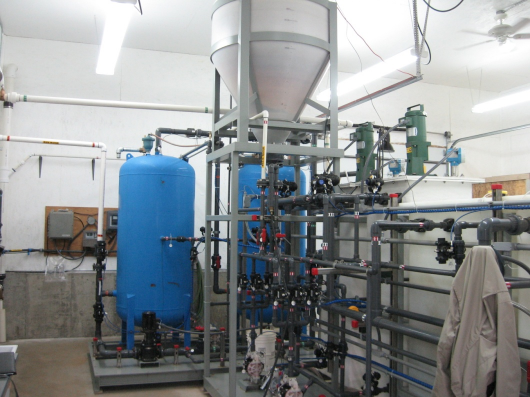
15 MIEX Contact Time (min) TOC Removal (%) Limitations MIEX Cost Footprint Hydraulic head Brine disposal
16 Bio-Treatment Bio-treatment Riverbank Filtration Engineered Biological Filtration Contact Time Acclimation Period TOC Removal (%) Limitations > 30 days none Land Availability Soil conditions 5 10 min > 2 months Temperature Substrate availability No preoxidation
17 Activity Using an example from the systems sketched earlier Identify process changes that you want to investigate and provide three reasons why it might be best
18 Distribution System DBP Control Menu Shorten water age by controlling tank levels, periodic flushing at endpoints, system optimization using existing valving Optimize chlorination strategy throughout the DS by monitoring (replace old pipes, illegal xconn, boost or no boost?) Precursor removal (pre-dbp formation) Optimize existing treatment Install new treatment DBP removal (post-formation) GAC Aeration (TTHM only)
19 Know Your System Determine water age throughout distribution system, particularly at compliance locations Measure chlorine residual throughout distribution system, particularly at maximum distribution locations Quantify TOC removal through treatment processes
20 Getting Started Reduce water age DBPs (µg/l) TTHM Cl 2 residual Chlorine Residual 20 0 Minimum Cl 2 residual Time (days)
21 Getting Started Reduce chlorine residual DBPs (µg/l) TTHM Cl 2 residual Chlorine Residual 20 0 Minimum Cl 2 residual Time (days)
22 Chlorination Strategies Prechlorination Primary Chlorination Booster Chlorination Raw water intake rapid mix flocculation sedimentation filtration disinfection & storage distribution Prechlorination Primary Chlorination Booster Chlorination Oxidation of Fe & Mn Biogrowth control Increased Long CT CT DBPs After Less TOC DBPs removal after TOC removal Pre-filter: longer filter runs Pre-filter: longer filter runs Post-filter: bioremoval of Post-filter: TOC less Cl2 costs Maintains residual for microbial control but could produce more DBPs
23 Chloramination DBPs (µg/l) TOC = 2.5 mg/l Br - = 50 µg/l Cl 2 = 1.25 x TOC ph = 8.0 Temp = 15 C SUVA = 2.0 L/mg/min NH 3 HAA5 TTHM TTHM MCL HAA5 MCL Time (hours)
24 Remote DBP Control Works in isolated areas of high DBPs TTHM aeration (HAA5 not removed effectively by aeration and degrades biologically over time anyway) GAC or BAC (biologically enhanced GAC with O 3 ) WTP Low DBP High DBP Implement Remote DBP Control
25 Remote DBP Control in Distribution Systems Water Treatment Plant Reservoir Stage 2 DBPR Site 80 μg/l TTHM Time
26 TTHM Aeration Strategies THMs can be removed by air stripping Efficiency depends on air and liquid phase transfer (e.g. Henry s Constant for bubble aeration) TTHM reformation after re-chlorination should be evaluated Aeration does not remove HAAs THM Species Henry s Constant (m 3 atmmol -1, 20 C) Chloroform (3.0 ± 0.1) x 10-3 Bromodichloromethane (1.6 ± 0.2) x 10-3 Chlorodibromomethane (8.7 ± 0.2) x 10-4 Bromoform (4.3 ± 0.3) x 10-4
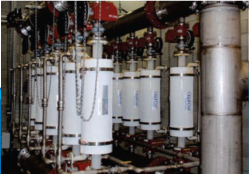
27 TTHM Aeration Strategies In-Reservoir Aeration Strategies Spray Surface External Aeration Strategies Tray / Packed Tower Liqui-Cel Membrane Contactor
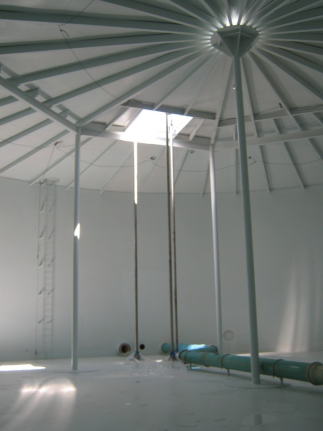
28 Photos from a Full-Scale Installation 7.5-hp aerator installed within a 2 MG reservoir
29 Full-Scale Data Following Implementation 100 of Aeration Equipment Concentration (µg/l) Before start of aeration After start of aeration TTHMs Distribution System Sample Site 0750 HAAs Distribution System Sample Site 0750 Jun-1 Jun-6 Jun-11 Jun-16 Jun-21 Jun-26 Jul-1 Jul-6 After start of aeration 23% avg. TTHM reduction achieved Model estimate of 29% reduction at 1.3 MGD
30 Question What can you do if you have remote HAA5 problems?

31 GAC/BAC Good removal of TTHM up to 10,000 Bed Volumes (BV) for EBCT of 10 min Higher BV for longer EBCT HAA5 removal by both adsorption & biological activities Completely eliminate Cl 2 residual % Removal TTHM 100 B. Johnson (2007) Min EBCT 20 Min 30 Min 20-30% TTHM removal after 30,000 bed volumes and 10 minutes EBCT GAC adsorption effective for ~10,000 bed volumes Bed Volumes HAA5 (µg/l) Inflow Adsorption breakthrough/ Developing biological activity Fully developed GAC Column 4 (10 min EBCT) Initial adsorption biological activity Bed Volumes
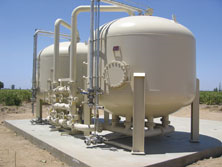
32 Potential Benefits Proven technology Passive treatment Minimal O&M Potential Challenges GAC disposal or reactivation GAC/BAC TOC will govern carbon life expectancy Pilot column tests should be conducted to better understand a selected manufacturer s GAC performance Reformation of DBPs possible if need to rechlorinate downstream to meet SWTR residual and HPC requirements Customer complaints due to release of GAC fines into DS
33 GAC/BAC Rechlorination Reformation of DBPs Rate of reformation a function of DBP precursor concentration
34 GAC/BAC Considerations Need disinfectant residual to eliminate HPC potentially induced by BAC Release of GAC fines New monitoring locations may be required for Stage 2 DBPR Design and construction based on requirement for treated water
35 Discussion Does your system have a location where remote DBP treatment may be warranted?
36 If your brain looks like this right nowt

37 Then we re pau!
EPB 311- Strategies for Dealing with Groundwater Treatment Systems Having High Natural Ammonia
 EPB 311- Strategies for Dealing with Groundwater Treatment Systems Having High Natural Ammonia Background The occurrence of ammonia (NH 3 ) in the water source is often associated with pollution due to
8 Chemicals from water treatment and distribution
 8 Chemicals from water treatment and distribution 8.1 Introduction Chemicals from water treatment and distribution reach drinking-water by the most direct route. They fall into three broad categories:
Cyanotoxin Removal in Drinking. Recreational Waters. Judy Westrick April 14, 2011 2011 Northeast Regional Cyanobacteria Workshop
 Cyanotoxin Removal in Drinking Water Treatment Process and Recreational Waters Judy Westrick April 14, 2011 2011 Northeast Regional Cyanobacteria Workshop NEIWPCC Overview Water Treatment Source and Recreational
Adsorption WATER TREATMENT
 WATER TREATMENT WATER TREATMENT Adsorption micro pores pump macro pores meso pores 2 micro pores atrazine (mg/l) 1.5 1 > 25 nm 1-25 nm < 1 nm pesticides macro pore meso pore pump.5 1, 2, 3, bed volumes
Bromate Formation and its Control in Advanced Water Treatment System 高 度 浄 水 処 理 における 臭 素 酸 の 生 成 と 制 御
 Bromate Formation and its Control in Advanced Water Treatment System 高 度 浄 水 処 理 における 臭 素 酸 の 生 成 と 制 御 Tohru Miyagaki, Bureau of Waterworks, Tokyo Metropolitan Government, Japan 東 京 都 水 道 局 宮 垣 融 Bromate
Facility Classification Standards
 Facility Classification Standards Approval Date: April 3, 2009 Effective Date: April 3, 2009 Approved By: Nancy Vanstone, Deputy Minister Version Control: Replaces Facility Classification Standards dated
Enhanced Organic Precursor Removals Using Aged Filter Media Page 1. Enhanced Organic Precursor Removals Using Aged Filter Media
 Enhanced Organic Precursor Removals Using Aged Media Page 1 Enhanced Organic Precursor Removals Using Aged Media O b j e c t i v e s The main goals of this project was to evaluate the dissolved organic
How To Water System
 Mid-Monroe Water System: Soluble Iron and Manganese Removal via Oxidation & Filtration Daniel Rickard, P.E. Engineering Project Manager Pennsylvania-American Water Company Who Is American Water We are
Task D: Water Quality Management Plan
 Task D: Water Quality Management Plan Comprehensive Water Master Plan DWSD Contract No. CS-1278 Final Report For Submittal to Detroit Water and Sewerage Department February 2004 (Updated June 2004) IN
Water Treatment. Session Objectives
 Water Treatment Session Objectives To demonstrate the need for treatment of surface waters and some groundwaters for drinking purposes. To introduce the concept of the multiple barrier principle and to
Chemistry at Work. How Chemistry is used in the Water Service
 Chemistry at Work How Chemistry is used in the Water Service WATER TREATMENT Everyday, more than 100 water treatment works in Northern Ireland put approximately 680 million litres of water into the supply
Indiana s Newest Filtration Facility; East Chicago
 Indiana s Newest Filtration Facility; East Chicago Innovation and Value-Added Benefits Behind East Chicago s Membrane Treatment Facility Eric Horvath, PE and Kara M. Boyles, PhD, PE August 1, 2012 Presentation
Cyanobacteria, Toxins and Indicators. Field Monitoring Treatment Facility Monitoring Treatment Studies
 U.S. Environmental Projection Agency, Office of Research and Development Cyanobacteria, Toxins and Indicators Field Monitoring Treatment Facility Monitoring Treatment Studies Nicholas Dugan, Toby Sanan,
CWD BALDWIN PLANT NEW RESIDUALS HANDLING SYSTEM
 CWD BALDWIN PLANT NEW RESIDUALS HANDLING SYSTEM OTCO Water Workshop March, 2011 Frank Woyma Plant Manager Nick Pizzi Vice-President EE&T ENVIRONMENTAL ENGINEERING & TECHNOLOGY, INC. Objectives Review the
Life Cycle Assessment of Three Water Scenarios: Importation, Reclamation, and Desalination
 Life Cycle Assessment of Three Water Scenarios: Importation, Reclamation, and Desalination Erin Lyons, Peng Zhang, Troy Benn, Miles Costanza, Ke Li, John Crittenden Department of Civil and Environmental
Treatment options for hydrogen sulfide. Testing for hydrogen sulfide
 Sometimes hot water will have a sour smell, similar to that of an old damp rag. This smell often develops when the thermostat has been lowered to save energy or reduce the potential for scalding. Odor-causing
Chemical Feed Systems Best Practices
 Chemical Feed Systems Best Practices NJAWWA Annual Conference Atlantic City, NJ March 18 th, 2015 John Perry Director of Public Works and Water and Sewer Utilities Montville Township, NJ What are Chemicals
John D. Dyson, Manager Municipal Water Group Infilco Degremont Inc. Richmond, VA
 High Rate Pulsed Sludge Blanket Clarifier Performance on Rivers and Reservoirs with Widely Different Raw Water Characteristics in Texas and United States John D. Dyson, Manager Municipal Water Group Infilco
CERTIFICATION TO OPERATE WATER AND WASTEWATER TREATMENT SYSTEMS APPLICATION INSTRUCTIONS
 COMMONWEALTH OF PENNSYLVANIA DEPARTMENT OF ENVIRONMENTAL PROTECTION STATE BOARD FOR CERTIFICATION OF WATER AND WASTEWATER SYSTEMS OPERATORS CERTIFICATION TO OPERATE WATER AND WASTEWATER TREATMENT SYSTEMS
Iron and Manganese BACTERIA AND IRON AND MANGANESE
 Iron and Manganese Iron and manganese control is the most common type of municipal water treatment in Minnesota. Iron and manganese occur naturally in groundwater. Neither element causes adverse heath
Guidelines for Arsenic Removal Treatment for Small Public Drinking Water Systems
 February 2010 Guidelines for Arsenic Removal Treatment for Small Public Drinking Water Systems Ted Strickland, Governor Lee Fisher, Lt. Governor Chris Korleski, Director Ohio Environmental Protection Agency
q = 6.74x1 =6.74 10-1 mg/l x 3.78x10 L/d = 3.4x10 mg / day a) Single CMFR mg/g C Organic Load = Carbon requirement = 6.74 mg 1000 g C inf = 10 mg/l
 Example An industrial wastewater contains 10 mg/l chlorophenol, and is going to be treated by carbon adsorption. 90% removal is desired. The wastewater is discharged at a rate of 0.1 MGD. Calculate the
WATER TREATMENT SIMULATORS: STATE-OF-THE- ART REVIEW
 WATER TREATMENT SIMULATORS: STATE-OF-THE- ART REVIEW J Dudley, G Dillon, WRc plc, Frankland Road, Swindon SN5 8YF, UK ABSTRACT A new water treatment simulator will be developed as part of the EU-funded
THE NWF WATER PURIFICATION PROCESS FRESH WATER IN A NATURAL WAY. Esko Meloni Ferroplan Oy
 THE NWF WATER PURIFICATION PROCESS FRESH WATER IN A NATURAL WAY Esko Meloni Ferroplan Oy 1 The NWF Water Purification Process: list of contents 1. NWF biological purification of groundwater Iron and manganese
Highly Colored Water Removal Using Nanofiltration Membranes at the Colored Water Treatment Facility. Adam Zacheis, Project Manager Carollo Engineers
 Highly Colored Water Removal Using Nanofiltration Membranes at the Colored Water Treatment Facility Adam Zacheis, Project Manager Carollo Engineers Topics 1. Background - Mesa Water District (Mesa) Water
Comparison of natural radioactivity removal methods for drinking water supplies: A review
 Comparison of natural radioactivity removal methods for drinking water supplies: A review E. Esmeray, M. E. Aydin Selcuk University Environmental Engineering Department, Konya Turkey e-mail: [email protected]
Study on Characteristics and Removal of Natural Organic Matter in Drinking Water Systems in Newfoundland and Labrador
 Study on Characteristics and Removal of Natural Organic Matter in Drinking Water Systems in Newfoundland and Labrador 103047.00 Final Report August 2011 ISO 9001 Registered Company Prepared by: Department
PRETREATMENT PROCESSES FOR POTABLE WATER TREATMENT PLANTS
 7 May 2014 PRETREATMENT PROCESSES FOR POTABLE WATER TREATMENT PLANTS JEFF LINDGREN ENGINEERING MANAGER B&V WATER AGENDA Conventional Pretreatment Focus on Clarification (including Sedimentation) Theory/Goals
Coagulation and Flocculation
 Coagulation and Flocculation Groundwater and surface water contain both dissolved and suspended particles. Coagulation and flocculation are used to separate the suspended solids portion from the water.
Water Pollution. A Presentation for Café Scientifique Cherie L. Geiger, Ph.D. Department of Chemistry, UCF
 Water Pollution A Presentation for Café Scientifique Cherie L. Geiger, Ph.D. Department of Chemistry, UCF Overview What is Causing it? Problems with Groundwater Contamination Traditional Remediation Techniques
SYNERGISTIC APPLICATION OF ADVANCED PRIMARY AND SECONDARY WASTEWATER TREATMENT SYSTEMS
 SYNERGISTIC APPLICATION OF ADVANCED PRIMARY AND SECONDARY WASTEWATER TREATMENT SYSTEMS Published in Water and Waste Digest membrane issue, November 2008 Miroslav Colic; Chief Scientist, Clean Water Technology
Microfiltration for Removal of Manganese from Surface Water
 Microfiltration for Removal of Manganese from Surface Water Carl Schneider, Ph.D., P.E., Senior Process Engineer Wiedeman & Singleton, Inc., Atlanta, GA Peter Johns, P.E., Vice-President Wiedeman & Singleton,
City of West Palm Beach makes Water Treatment Plant Improvements by Implementing Priority Projects
 October 13, 2014 Tulsa, OK City of West Palm Beach makes Water Treatment Plant Improvements by Implementing Priority Projects Ron Cass Gert-Jan Schers Location West Palm Beach 2 Consent Order - 2008 Source
 IMPACT OF CHEMICALS ADDITION IN WATER/WASTEWATER TREATMENT ON TDS CONCENTRATION AND SLUDGE GENERATION Jurek Patoczka, PhD, PE Hatch Mott MacDonald 27 Bleeker Str., Millburn, NJ 07041 (973) 912 2541 [email protected]
Nitrification TCEQ. Public Drinking Water Conference Austin, Texas August 16, 2006. A System s Perspective after 20 years of Chloramination
 Nitrification A System s Perspective after 20 years of Chloramination Presented by: Daniel K. Nix Water Source/Purification Superintendent City of Wichita Falls Public Drinking Water Conference Austin,
EFFECTS OF OZONATION vs. CHLORINATION WATER TREATMENT OPERATIONS ON NATURAL ORGANIC MATTER FRACTIONS
 EFFECTS OF OZONATION vs. CHLORINATION WATER TREATMENT OPERATIONS ON NATURAL ORGANIC MATTER FRACTIONS Taha F. Marhaba 1, Doanh Van 1, and R. Lee Lippincott 1. Department of Civil & Environmental Engineering
Table of Contents. Certification
 Certification This report was prepared by CH2M Gore & Storrie Limited, Reid Crowther & Partners, Ltd., Wardrop Engineering Inc., and TetrES Consultants Inc., under the direction of a professional engineer
REMOVAL OF PHOSPHATE FROM WASTEWATER USING LOW-COST ADSORBENTS
 International Journal of Engineering Inventions ISSN: 2278-7461, www.ijeijournal.com Volume 1, Issue 7 (October2012) PP: 44-50 REMOVAL OF PHOSPHATE FROM WASTEWATER USING LOW-COST ADSORBENTS Dr. C.R.Ramakrishnaiah
DENVER, CO. WHAT S ON TAP? Grading Drinking Water in U.S. Cities June 2003 KEY CONTAMINANTS IN DENVER S WATER DENVER
 WHAT S ON TAP? Grading Drinking Water in U.S. Cities June 23 DENVER, CO Earned a Water Quality and Compliance Grade in 2 and 21 The city had moderate levels of some contaminants, but they generally measured
GUIDELINES FOR LEACHATE CONTROL
 GUIDELINES FOR LEACHATE CONTROL The term leachate refers to liquids that migrate from the waste carrying dissolved or suspended contaminants. Leachate results from precipitation entering the landfill and
THE PHOSPHATE METHOD FOR PRODUCING QUALITY DRINKING WATER!
 THE PHOSPHATE METHOD FOR PRODUCING QUALITY DRINKING WATER! Answers to Frequently Asked Questions Phosphates have a long history of successful application in drinking water treatment, providing both primary
1. Inspection and monitoring... 3
 1 Index 1. Inspection and monitoring... 3 1.1 Handling of new elements... 3 1.1.1 Storage of original packaged RO elements... 3 1.1.2 Packing... 3 1.2 Initial start- up checks of a plant... 3 1.2.1 Preparation
Nova Scotia Treatment Standards for Municipal Drinking Water Systems
 Nova Scotia Treatment Standards for Municipal Drinking Water Systems Approval Date: March 12, 2012 Effective Date: March 12, 2012 Approved By: S. J. Snook, Deputy Minister Version Control: Replaces: Treatment
COSTS AND THE CHOICE OF DRINKING WATER TREATMENT TECHNOLOGY IN SMALL AND RURAL SYSTEMS
 COSTS AND THE CHOICE OF DRINKING WATER TREATMENT TECHNOLOGY IN SMALL AND RURAL SYSTEMS By: Mohammed H.I. Dore, Arian Khaleghi- Moghadam, Rajiv G. Singh, and Gopal Achari Res'Eau-Waternet_Project 4.2-DORE
TREATMENT OPTIONS FOR REMOVAL OF SPECIFIC IMPURITIES FROM WATER. S. Vigneswaran Faculty of Engineering, University of Technology, Sydney, Australia
 TREATMENT OPTIONS FOR REMOVAL OF SPECIFIC IMPURITIES FROM WATER S. Vigneswaran Faculty of Engineering, University of Technology, Sydney, Australia C. Visvanathan Asian Institute of Technology, Bangkok,
LONG TERM 2 ENHANCED SURFACE WATER TREATMENT RULE TOOLBOX GUIDANCE MANUAL
 LONG TERM 2 ENHANCED SURFACE WATER TREATMENT RULE TOOLBOX GUIDANCE MANUAL Office of Water (4606) EPA 815-R-09-016 April 2010 www.epa.gov/safewater Purpose: The purpose of this guidance manual is solely
Residuals Management Somersworth Drinking Water Treatment Facility. Ian Rohrbacher, Treatment Operator IV
 Residuals Management Somersworth Drinking Water Treatment Facility A HISTORICAL OVERVIEW OF SURFACE WATER TREATMENT RESIDUALS HANDLING Ian Rohrbacher, Treatment Operator IV Background We are a Grade III
The uses of chlorine dioxide exploit the advantages over chlorine. The main applications are detailed below, along with any additional information.
 Main Applications of Chlorine Dioxide The uses of chlorine dioxide exploit the advantages over chlorine. The main applications are detailed below, along with any additional information. Drinking Water
Treatment of Arsenic Residuals from Drinking Water Removal Processes
 EPA/6/R/33 June 2 Treatment of Arsenic Residuals from Drinking Water Removal Processes by Michael J. MacPhee Gail E. Charles David A. Cornwell Environmental Engineering & Technology, Inc. Newport News,
Water Purification Treatment System
 Introductions to Tap Water Purification Treatment System A diagram of water treatment process : Raw water Flash mixer Floccula;on basin Sedimenta;on tank Add PAC Add disinfectant Sludge Surface thickening
Residual Chlorine Decay Simulation in Water Distribution System
 The 7 th International Symposium on Water Supply Technology, Yokohama 2006, November 22-24, 2008, Yokohama, Japan Residual Chlorine Decay Simulation in Water Distribution System Toru Nagatani (Osaka Municipal
Steps in the design process. The draft Ultraviolet Disinfection Guidance Manual (USEPA, 2003) recommends the following steps in the design:
 DESIGN OF UV DISINFECTION SYSTEMS FOR DRINKING WATER In EPA s economic analyses for the proposed LT2ESWTR, EPA estimated that 500 to 1000 filtration plants will choose UV disinfection as part of their
Guidelines for Four-Log Virus Treatment of Ground Water Drinking Water Section Florida Department of Environmental Protection October 2009
 Guidelines for Four-Log Virus Drinking Water Section Florida Department of Environmental Protection October 2009 2600 Blair Stone Road, MS 3520 Tallahassee, Florida 32399-2400 www.dep.state.fl.us Contents
THE CHLORINE DEMAND CHARACTERISTICS OF IRISH WATER SUPPLIES Process design implications for disinfection and THM formation. Pat Kearney Hugh Kerr
 THE CHLORINE DEMAND CHARACTERISTICS OF IRISH WATER SUPPLIES Process design implications for disinfection and THM formation Tom Casey Pat Kearney Hugh Kerr INTRODUCTION Chlorine has been the drinking water
CHAPTER 7: REMEDIATION TECHNOLOGIES FOR CONTAMINATED GROUNDWATER
 CHAPTER 7: REMEDIATION TECHNOLOGIES FOR CONTAMINATED GROUNDWATER There are a number of technologies that are being use to remediate contaminated groundwater. The choice of a certain remediation technology
Applying Life Cycle Assessment to Drinking Water Treatment
 Applying Life Cycle Assessment to Drinking Water Treatment W.Takashima*, S.Takizawa**and M. Fujiwara* *Japan Water Research Center, Minato-ku, Tokyo, 105-0001, Japan ([email protected]) ** University
How To Treat Water With Water From A Water Cycle
 Flow cytometry in drinking water research: case-study Amsterdam Marius Vital, Marco Dignum, Aleksandra Magic, Petra Ross, Luuk Rietveld and Frederik Hammes Overview Waternet s philosophy behind safe drinking
Biological Nitrate Removal Pretreatment for a Drinking Water Application
 Tailored Collaboration Biological Nitrate Removal Pretreatment for a Drinking Water Application Subject Area: Water Quality Biological Nitrate Removal Pretreatment for a Drinking Water Application About
Genesee Advanced Water Treatment Facility
 Genesee Advanced Water Treatment Facility Preliminary Engineering Report November 3, 2014 Hatch Mott MacDonald 143 Union Blvd., Suite 1000 Lakewood, Colorado 80228 303.831.4700 www.hatchmott.com Advanced
Texas Commission on Environmental Quality Page 1 Chapter 290 - Public Drinking Water
 Texas Commission on Environmental Quality Page 1 SUBCHAPTER F: DRINKING WATER STANDARDS GOVERNING DRINKING WATER QUALITY AND REPORTING REQUIREMENTS FOR PUBLIC WATER SYSTEMS 290.101-290.119, 290.121, 290.122
IRON AND MANGANESE FILTRATION SYSTEMS
 3726 E. Miraloma Ave., Anaheim, CA 92804 Phone: (714) 630-5040 Fax: (714) 630-1160 www.filtronics.com IRON AND MANGANESE FILTRATION SYSTEMS A TECHNICAL DISCUSSION INTRODUCTION Iron (Fe) and manganese (Mn)
WISCONSIN WASTEWATER OPERATORS ASSOCIATION
 Integrity. People. Knowledge. WISCONSIN WASTEWATER OPERATORS ASSOCIATION ANNUAL CONFERENCE GREEN BAY Resources. MEETING LOW LEVEL PHOSPHORUS LIMITS BY CHEMICAL ADDITION WHAT IS PHOSPHORUS Atomic # 15 Electron
Trichloramine and Asthma in Swimming pools & spas Problem solved
 1 Trichloramine and Asthma in Swimming pools & spas By Dr.Howard T Dryden October 2006 In recent years there have been many reports in the press regarding trichloramine and its potential implications as
Saudi Aramco Project Development
 Saudi Aramco Project Development Wastewater Treatment Facilities Jeddah Refinery And Marine Area December 2007 Facilities Planning Dept. OBJECTIVE: Provide an overview of the complexities of developing
Biological Drinking Water Treatment Perceptions and Actual Experiences in North America
 Biological Drinking Water Treatment Perceptions and Actual Experiences in North America Web Report #4129 Subject Area: Water Quality Biological Drinking Water Treatment Perceptions and Actual Experiences
Water Softening for Hardness Removal. Hardness in Water. Methods of Removing Hardness 5/1/15. WTRG18 Water Softening and Hardness
 Water Softening for Removal 1 in Water High concentration of calcium (Ca2+) and magnesium (Mg2+) ions in water cause hardness Generally, water containing more than 100 mg/l of hardness expressed as calcium
DRINKING WATER - LAB EXPERIMENTS. Coagulation and flocculation LAB EXPERIMENTS. Jartest
 DRINKING WATER - LAB EXPERIMENTS LAB EXPERIMENTS Coagulation and flocculation Jartest coagulation and flocculation - jartest lab experiments Framework This module explains the lab experiment on coagulation
Wastewater Reuse. Typical treated wastewater is:
 Wastewater Reuse Most metal finishing industries have in-house wastewater treatment to economically dispose of the acids, alkali, oils, and dissolved metals in the rinse water and occasional tank solution
Experts Review of Aerobic Treatment Unit Operation and Maintenance. Bruce Lesikar Texas AgriLife Extension Service
 Experts Review of Aerobic Treatment Unit Operation and Maintenance Bruce Lesikar Texas AgriLife Extension Service Overview Overview of Aerobic Treatment Units Installing for accessibility to system components
AP ENVIRONMENTAL SCIENCE 2007 SCORING GUIDELINES
 AP ENVIRONMENTAL SCIENCE 2007 SCORING GUIDELINES Question 1 Read the Fremont Examiner article below and answer the questions that follow. (a) Identify ONE component of the sewage that is targeted for removal
Elucidation of membrane biofouling processes using bioassays for assessing the microbial growth potential of feed water
 Elucidation of membrane biofouling processes using bioassays for assessing the microbial growth potential of feed water Dick van der Kooij, Wim Hijnen, Emile Cornelissen, Kiwa Water Research Sjack van
Removal of Xenobiotic Compounds from Wastewater for Environment Protection: Treatment Processes and Costs
 505 A publication of CHEMICAL ENGINEERING TRANSACTIONS VOL. 32, 2013 Chief Editors: Sauro Pierucci, Jiří J. Klemeš Copyright 2013, AIDIC Servizi S.r.l., ISBN 978-88-95608-23-5; ISSN 1974-9791 The Italian
Water Water Treatment Plant Tour
 Water Water Treatment Plant Tour Don Rankin, Superintendent Topeka, KS 66606 785-368-3111 Tel 785-368-3825 FAX For a complete list of contacts with phone numbers, FAX numbers and email addresses, click
Particle and Natural Organic Matter Removal in Drinking Water
 AWWA MANUAL M37 Chapter 1 Particle and Natural Organic Matter Removal in Drinking Water Kwok-Keung (Amos) Au, Scott M. Alpert, and David J. Pernitsky Introduction One of the most basic processes in the
Micropollutants in the aquatic environment: The Swiss strategy
 Micropollutants in the aquatic environment: The Swiss strategy Adriano Joss, Hansruedi Siegrist (eawag), Michael Schärer, Christian Abegglen (Bafu, VSA) Hilversum, 21 November 2013 Overview The Swiss strategy
1.3 Wastewater and Ambient Water Quality
 1.3 Wastewater and Ambient Water Quality Applicability and Approach...25 General Liquid Effluent Quality...26 Discharge to Surface Water...26 Discharge to Sanitary Sewer Systems...26 Land Application of
Ammonium removal from drinking water - comparison of the breakpoint chlorination and the biological technology
 Conference of Junior Researchers in Civil Engineering 248 Ammonium removal from drinking water - comparison of the breakpoint chlorination and the biological technology Szabolcs Takó BME Department of
In-Situ Bioremediation Demonstration of Coal-Based Acid Mine Drainage. Tide Mine Site Indiana County, Pennsylvania
 In-Situ Bioremediation Demonstration of Coal-Based Acid Mine Drainage Tide Mine Site Indiana County, Pennsylvania Presented to: 26 th West Virginia Surface Mine Drainage Task Force Symposium Kelly S. Houston
Addressing Declining Elevations in Lake Mead
 Integrated Resource Planning Advisory Committee July 23, 2014 Addressing Declining Elevations in Lake Mead 1 Meeting Topics Drought update Attribute finalization Interbasin Cooperation Intake Pumping Station
Cartridge Filter Application Notes
 Industrial Water Purification (800) CAL-WATER Cal Water 1961 Petra Lane Placentia, CA 92870 FAX: (714) 792-0794 Web Page / Email: www.cal-water.com Cartridge Filter Application Notes Cal Water offers a
CT DISINFECTION MADE SIMPLE
 CT DISINFECTION MADE SIMPLE (Brock Rush, M. Eng., P. Eng., Alberta Environment) The following discussion is about CT Disinfection. It was prepared as a presentation for the Alberta Water and Wastewater
Inventory of Performance Monitoring Tools for Subsurface Monitoring of Radionuclide Contamination
 Inventory of Performance Monitoring Tools for Subsurface Monitoring of Radionuclide Contamination H. Keith Moo-Young, Professor, Villanova University Ronald Wilhelm, Senior Scientist, U.S. EPA, Office
Arsenic Removal with Bayoxide E33 Ferric Oxide Media & SORB 33 As Adsorption
 Arsenic Removal with Bayoxide E33 Ferric Oxide Media & SORB 33 As Adsorption Frank Stanish Severn Trent Services, Inc. AWWA New York Conference Saratoga Springs, NY April 15, 2015 Agenda Background on
DOW Ultrafiltration. Case History. High Turbidity and Temperature Fluctuation No Obstacle for DOW Ultrafiltration
 Case History High Turbidity and Temperature Fluctuation No Obstacle for Site Information Location: HeBei, China Capacity: 12 m 3 /h (5283 gpm) Purpose: Pretreat sea water prior to RO system Time in Operation:
OXIDATION-REDUCTION TITRATIONS-Permanganometry
 Experiment No. Date OXIDATION-REDUCTION TITRATIONS-Permanganometry INTRODUCTION Potassium permanganate, KMnO 4, is probably the most widely used of all volumetric oxidizing agents. It is a powerful oxidant
TALLINN WATER TREATMENT AND SEWERAGE Tuuli Myllymaa
 TALLINN WATER TREATMENT AND SEWERAGE Tuuli Myllymaa Tallinn is the capital of Estonia. It has approximately 450,000 inhabitants and the town area is about 150 km 2. Tallinn Water Ltd., owned by the City
CHAPTER 8 UPGRADING EXISTING TREATMENT FACILITIES
 CHAPTER 8 UPGRADING EXISTING TREATMENT FACILITIES 8-1. General. Upgrading of wastewater treatment plants may be required to handle increased hydraulic and organic loadings to meet existing effluent quality
Advanced Water Treatment and Membrane Technology in Japan
 PUB-JWRC Symposium 2012.7.5 Dealing with Source Water Deterioration-Advanced Water Treatment Technology and Management Advanced Water Treatment and Membrane Technology in Japan Masahiro FUJIWARA, Dr.Eng.
Drinking Water Treatment Using Air Strippers
 Drinking Water Treatment Using Air Strippers Dave Fischer QED Environmental Systems Inc. Ann Arbor, MI / San Leandro, CA Copyright QED Environmental Systems, Inc. 2007-2011; all rights reserved. Presentation