
Particle Physics WS 2015/16
|
|
|
- Tyler Logan
- 9 years ago
- Views:
Transcription
1 Particle Physics Lecture WS 2015/16 Prof. A. Schöning Physikalisches Institut der Universität Heidelberg 1
2 Goal of this Lecture Introduction to particle physics for master students Comprehensive overview about particle physics: Experiments and experimental methods phenomenology theoretical concepts and fundamental laws 2
3 Particle Physics Related Courses Winter term 2015/16: Higgs, Precision Tests and New Physics at the LHC lecture + seminar: Wed 14h15, Fri, 14h15 (Dunford) Accelerator Physics lecture + tutorial: Wed 11h15, 16h15 (Schöning) Statistical Methods in Particle Physics lecture + tutorial: Mon 14h14, Mon 16h15 (Brandt) LHC analyses and their physics impact master seminar: Mon 16h15 (Brandt/Plehn/Uwer) Nobel Prizes in Particle Physics master seminar: Fri 9h00 (Reygers/Stachel) Particle Physics Colloquium Tue 17h15 [Standard Model Theory II] Wed 16h15, Fri 9h00 (Rodejohann/Lindner) Summer term 2016: Particle Physics, Detector Physics, Standard Model I, seminars,... 3
4 Organisation of PP lecture Prerequisites: Knowledge: Quantum Mechanics (Schrödinger Eq.), special relativity Lectures: Physics I-V, Introduction to Nuclear and Particle Physics Focus and content of this lecture: Accelerators, Detectors, Relativisitc Kinematics, Symmetries, Quantum Electrodynamics, Weak Interaction, Quantum Chromodynamics, Standard Model, Beyond the Standard Model, Flavor Physics, Astroparticle Physics This course is a basis for more specialised lectures: LHC Physics, Standard Model, Beyond the SM, Supersymmetry Other useful lectures: Quantum Field Theory (Mon+Wed, 11h15, A. Hebecker) more information: 4
5 Tutorials + Requirements Tutorials: 11 series of exercises to be handed in Thursday 14h15 beginning of lecture typically ~4 exercises/sheet (up to three names) exercises are checked and corrected target: 60% of the maximum score registration deadline for PP lecture November 27 (point of no return...) written examination (repetition ) number of credit points = 8 (lecture+tutorial) Dates of tutorials (start in 2nd lecture week): Thu; 16:15-18:00; INF 501 / FP (R.102); group 1; Thu; 16:15-18:00; INF 501 / CIP R. 103; group 2; Mon; 11:00-13:00; INF 227 / SR 3.402; group 3; [Fri; 09:15-11:00; INF 226, K2,3; group 4;] Fri; 11:15-13:00; INF 227 / SR 3.404; group 5; Registration: Coordinator: Christoph Anders <[email protected]> 5
6 Literature on Particle Physics Ch. Berger: Elementarteilchenphysik, 2014, in German, Springer Verlag, ISBN M. Thompson: Modern Particle Physics, 2013, engl., ISBN-13: B.R. Martin, Nuclear and Particle Physics, An Introduction, 2009, Wiley, ISBN Povh, Rith, Scholz and Zetsche, Particles and Nuclei, An Introduction, 2008, Springer Verlag ISBN D.Griffith, Introduction to Elementary Particle Physics, 2008, Wiley, ISBN: D.H. Perkins, Introduction to High Energy Physics, 2000, Addison Wesley (older standard book) P. Schmüser, Feynmann Graphen, 1995, Springer Verlag Particle Data Group, K.A. Olive et al., Chin. Phys. C, 38, (2014) and 2015 update [ by far not complete. Many, many more books... 6

7 Lecture Dates Tuesday 14:15-16:00 and Thursday 14:15-16:00 7
8 Master Thesis in Particle Physics Nuclear and Heavy Ion Physics: Prof. N.Herrmann (CBM) Prof. J.Stachel (ALICE) High Energy Physics: Dr. O Brandt (ATLAS) Prof. S.Hansmann Menzemer (LHCb) Prof. H.C. Schultz-Coulon (ATLAS,CALICE, MU3E) Prof. (ATLAS, MU3E) Prof. M Schmelling (LHCb) Prof. U. Uwer (LHCb) Neutrino Physics: Prof. M.Lindner (GERDA,XENON100,...) Prof. Enss (ECHO, ) Astroparticle Physics: Prof. W.Hoffmann (HESS, CTA) Theory Prof. J.Jäckel (Beyond the Standard Model) Prof. T.Plehn (LHC Phenomenology) 8 + research groups
9 give feedback! 9
10 Introduction 100 years of particle physics......more than a success story! a historical overview 10
11 Ionisation Measurement Victor Hess discovery of cosmic showers 1912 Nobel Prize (1936) 11
12 years 2012 electron photons nuclei (protons, neutrons) 12

13 years 2012 electron photons nuclei (protons, neutrons) Standard Model Lagrangian 13
14 Anti-Particle Hypothesis Paul Dirac (1928): Field equation for a relativistic Quantum Mechanics based on Einsteins special relativity relation: 2 2 E =m + p 2 Dirac equation has solutions for positively and negatively polarised particles and for positive and negative energies: negative energy antiparticles! Later, Feynman-Stückelberg interpretation: antiparticles are particles travelling in reverse time direction 14
15 Discovery of the Positron first observed by D.Skobeltsyn in cosmic rays using a Wilson (cloud) chamber (1929) C.D. Anderson: study of cosmic rays in a cloud chamber (1932) positrons are bent due to magnetic field proof of existence of anti-particles Carl D. Anderson Nobel Prize (1936) 15
16 Muon Discovery (1936) Muon discovery in cosmic rays by Carl Anderson + Seth Nedermeyer mass: mµ ~100 MeV Nobel Prize (1936) myon was first exotic particle and believed to be the meson predicted by Yukawa 16
17 Prediction of the Pion H.Yukawa predicted 1935 mesons as carriers of the strong force Nobel Prize (1949) meson mass ~ ħc / (range of force) range ~ 1 fm mmeson = 200 MeV Note 1: mesons are quark-anti-quark states and not elementary Note 2: meson = mean, intermediate state 17
18 Discovery of the Pion 1947 discovered by Perkins, Ochialini and Powell emulsions μ e π Nobel Prize (Powell 1950) 18
19 Discovery of Neutrinos _ beta decay: n p e ν - e- me = MeV mn = MeV n missing energy? p mp = MeV _ ν W. Pauli predicted in a letter to E.Fermi the existence of neutrinos (1930) 19

20 Discovery of the Electron-Neutrino Discovery of the electron neutrino (Cowan, Reines, 1957) Nobel Prize (1995) Anti-Electron-Neutrino 20
21 Existence of Muon-Neutrinos proton accelerator berylium plate dipole magnets iron absorber pion decay tunnel decay: π μνμ big sparc chamber 10 tons νμn μ p Discovery of the muon neutrino (Ledermann, Schwartz, Steinberger 1962) Nobel Prize (1988) 21
22 Discovery of Strangeness Surprise! V-particles Production of Kaons and Lambda-Baryons in pp Collisions Long Lifetime! neither electromagnetic nor strong force bubble chamber (1950ties) 22
23 Status in 1962 (50 years after Hess's baloon trip) known fermions M. Gell-Mann and G. Zweig hypothised existence of quarks: up-quark down-quark strange-quark in the year 1964 Nobel Prize (1969) 23
24 Prediction of the Charm Quark How explain non-observation of Flavor Changing Neutral Currents? K π γ γ K us ud? π Such a flavor changing decay is frobidden if fourth quark exists (Glashow, Iliopoulos, Maiani) Note: not the first time that a new particle was predicted! 24
25 Observation of the Charm Quark cc resonance e+ e- J/Psi e+ e- (μ+,μ-),(π+ π-) SLAC: B.Richter et al. (1974) p Be X J/Psi X e+ ebnl: S.Ting et al. (1974) Nobel Prizes
26 Status in 1975 known fermions no anti-matter in universe! Charge and Parity Conservation must be broken! (2nd A.Sakharovs condition) third quark family could explain matter-antimatter asymmetry Nambu, Kobayashi, Maskawa Nobel Prize 2008 Note: particle physics and evolution of universe are closely related! 26
27 Discovery of the Third Family Tau Lepton discovered by MARK1 at SPEAR ( ) + + e e τ τ τ eνν τ μ ν ν discovery of tau-lepton (Reines et al., M.Perl) Nobel Prize (1995) meµ mτ=1.777 GeV Discovery of the Bottom-Quark (1977) by M.Ledermann et al. at Fermilab Nobel Prize (1988) 27
28 Top Quark Discovery at Tevatron Fermilab Tevatron p p collider s1/2 =2 TeV 28
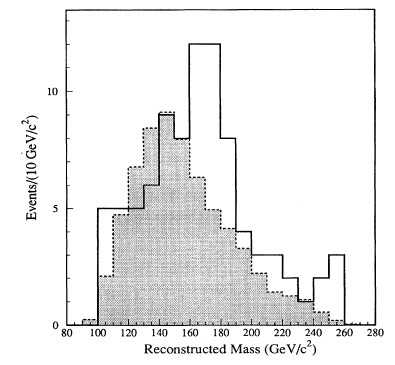
29 Top Quark Discovery in 1995 CDF Collaboration D0 Collaboration Top-quark mass ~175 GeV Top production: Top decay: pp tt X t W b and W qq or lv 29
30 Status in 2000 (~90 years after Hess's baloon trip) all fermions discovered tau neutrino discovered in 2000 by Donut experiment 30
31 Status in 2002 (90 years after Hess's baloon trip) Nobel Prize 2015 neutrinos have mass! Takaaki Kajita + Arthur B. McDonald SNO experiment (2001/2) Super-kamiokande (1998) 31
32 Discovery of Vector Bosons Photons: X-rays (Röntgen 1995) Nobel Prize 1901 photo-electric effect (Einstein 1905) Nobel Prize 1921 Gluons: carriers of strong force predicted by Gell-Mann et al. experimentally discovered as jets of hadrons e.g. at PETRA W± bosons: carriers of weak interactions responsible for weak decays. building blocks of Standard Model Glashow, Salam, Weinberg Nobel Prize 1979 W-boson discovered at CERN SppS in 1983 C.Rubbia and S. van d. Meer Nobel Prize
33 Observation of Neutral Currents Bubble Chamber Gargamelle (1974) νe νe e ν e e νe Z e e 33


34 Discovery of Vector Bosons Z bosons: indirectly observed at Gargamelle discovered at at CERN SppS in 1983 C.Rubbia and S. van d. Meer Nobel Prize 1984 precision studies at LEP accelerator 34


35 Large Electron-Positron Collider CERN s1 / 2= GeV 26.7 km circumference Four experiments: ALEPH DELPHI L3 OPAL 35
36 Large Hadron Collider (CERN) LHC (pp) s1/2 <= 14 TeV 26.7 km circumference! 36
37 The Higgs Boson ATLAS CMS mh=125 GeV Nobel Prize 2013 F.Englert P.Higgs 37
38 Experimental Tools CMS (LHC) ATLAS (LHC) ZEUS (HERA) H1 (HERA) CDF (Tevatron) 38
39 Supermikroskop HERA 920 GeV Protonen x 26.7 GeV Elektronen HERMES H1 ZEUS ( Hamburg) 39
40 Study of the Proton Structure Recent results on proton structure H1 + ZEUS experiments (2015) important for other (future) experiments and LHC 40
41 Theoretical Problems of the SM Grand Unification??? 41
42 Dark Matter dark matter in filaments between galaxies (simulation) [R.Kaehler et al. (KIPAC)] 42
43 The SM and Astro- Particle Physics Matter-Antimatter Asymmetry in Universe N B 10 9 N Dark Matter Problem (only 1% of the mass is visible in the universe) Formation of galaxies and structures in the universe Dark energy (from microwave background anisotropy) Nucleosynthesis constraints Big-Bang 43
44 era of gravitation era of particle physics 44
45 1874 "in this field (physics), almost everything is already discovered, and all that remains is to fill a few unimportant holes." (1874) Philipp von Jolly ( ) Prof. in Heidelberg (physicist and mathematician) Max Planck:
46 46
Introduction to Elementary Particle Physics. Note 01 Page 1 of 8. Natural Units
 Introduction to Elementary Particle Physics. Note 01 Page 1 of 8 Natural Units There are 4 primary SI units: three kinematical (meter, second, kilogram) and one electrical (Ampere 1 ) It is common in the
Periodic Table of Particles/Forces in the Standard Model. Three Generations of Fermions: Pattern of Masses
 Introduction to Elementary Particle Physics. Note 01 Page 1 of 8 Periodic Table of Particles/Forces in the Standard Model Three Generations of Fermions: Pattern of Masses 1.0E+06 1.0E+05 1.0E+04 1.0E+03
Accelerator Physics WS 2011/12
 Lecture: Accelerator Physics Heidelberg WS 2011/12 Prof. A. Schöning Physikalisches Institut der Universität Heidelberg Introduction 1 Goal of this Lecture Introduction to Accelerator Physics: experimental
Concepts in Theoretical Physics
 Concepts in Theoretical Physics Lecture 6: Particle Physics David Tong e 2 The Structure of Things 4πc 1 137 e d ν u Four fundamental particles Repeated twice! va, 9608085, 9902033 Four fundamental forces
Theoretical Particle Physics FYTN04: Oral Exam Questions, version ht15
 Theoretical Particle Physics FYTN04: Oral Exam Questions, version ht15 Examples of The questions are roughly ordered by chapter but are often connected across the different chapters. Ordering is as in
High Energy Physics. Lecture 4 More kinematics and a picture show of particle collisions
 High Energy Physics Lecture 4 More kinematics and a picture show of particle collisions 1 Recall from the previous lecture: the momentum of the scattered Particle in an elastic collision is given by p
Weak Interactions: towards the Standard Model of Physics
 Weak Interactions: towards the Standard Model of Physics Weak interactions From β-decay to Neutral currents Weak interactions: are very different world CP-violation: power of logics and audacity Some experimental
REALIZING EINSTEIN S DREAM Exploring Our Mysterious Universe
 REALIZING EINSTEIN S DREAM Exploring Our Mysterious Universe The End of Physics Albert A. Michelson, at the dedication of Ryerson Physics Lab, U. of Chicago, 1894 The Miracle Year - 1905 Relativity Quantum
Selected Topics in Elementary Particle Physics ( Haupt-Seminar )
 Selected Topics in Elementary Particle Physics ( Haupt-Seminar ) Paola Avella, Veronika Chobanova, Luigi Li Gioi, Christian Kiesling, Hans-Günther Moser, Martin Ritter, Pit Vanhoefer Time: Do, 12 ct -14
hij Teacher Resource Bank GCE Physics A Other Guidance: Particle Physics By J Breithaupt
 hij Teacher Resource Bank GCE Physics A Other Guidance: Particle Physics By J Breithaupt Copyright 2008 AQA and its licensors. All rights reserved. The Assessment and Qualifications Alliance (AQA) is a
How To Find The Higgs Boson
 Dezső Horváth: Search for Higgs bosons Balaton Summer School, Balatongyörök, 07.07.2009 p. 1/25 Search for Higgs bosons Balaton Summer School, Balatongyörök, 07.07.2009 Dezső Horváth MTA KFKI Research
Pearson Physics Level 30 Unit VIII Atomic Physics: Chapter 17 Solutions
 Pearson Physics Level 30 Unit VIII Atomic Physics: Chapter 17 Solutions Student Book page 831 Concept Check Since neutrons have no charge, they do not create ions when passing through the liquid in a bubble
The Standard Model and the LHC! in the Higgs Boson Era Juan Rojo!
 The Standard Model and the LHC in the Higgs Boson Era Juan Rojo Saturday Mornings of Theoretical Physics Rudolf Peierls Center for Theoretical Physics Oxford, 07/02/2015 1 The Standard Model of Particle
Masses in Atomic Units
 Nuclear Composition - the forces binding protons and neutrons in the nucleus are much stronger (binding energy of MeV) than the forces binding electrons to the atom (binding energy of ev) - the constituents
The Standard Model of Particle Physics - II
 The Standard Model of Particle Physics II Lecture 4 Gauge Theory and Symmetries Quantum Chromodynamics Neutrinos Eram Rizvi Royal Institution London 6 th March 2012 Outline A Century of Particle Scattering
How To Teach Physics At The Lhc
 LHC discoveries and Particle Physics Concepts for Education Farid Ould- Saada, University of Oslo On behalf of IPPOG EPS- HEP, Vienna, 25.07.2015 A successful program LHC data are successfully deployed
Particle Physics. The Standard Model. A New Periodic Table
 5 Particle Physics This lecture is about particle physics, the study of the fundamental building blocks of Nature and the forces between them. We call our best theory of particle physics the Standard Model
1 Introduction. 1 There may, of course, in principle, exist other universes, but they are not accessible to our
 1 1 Introduction Cosmology is the study of the universe as a whole, its structure, its origin, and its evolution. Cosmology is soundly based on observations, mostly astronomical, and laws of physics. These
The Higgs Boson. Linac08 Victoria BC, Canada CANADA S NATIONAL LABORATORY FOR PARTICLE AND NUCLEAR PHYSICS
 CANADA S NATIONAL LABORATORY FOR PARTICLE AND NUCLEAR PHYSICS Owned and operated as a joint venture by a consortium of Canadian universities via a contribution through the National Research Council Canada
STRING THEORY: Past, Present, and Future
 STRING THEORY: Past, Present, and Future John H. Schwarz Simons Center March 25, 2014 1 OUTLINE I) Early History and Basic Concepts II) String Theory for Unification III) Superstring Revolutions IV) Remaining
Searching for the Building Blocks of Matter
 1 Searching for the Building Blocks of Matter Building Blocks of Matter The Smallest Scales Physicists at Fermilab are searching for the smallest building blocks of matter and determining how they interact
Discovery of neutrino oscillations
 INSTITUTE OF PHYSICS PUBLISHING Rep. Prog. Phys. 69 (2006) 1607 1635 REPORTS ON PROGRESS IN PHYSICS doi:10.1088/0034-4885/69/6/r01 Discovery of neutrino oscillations Takaaki Kajita Research Center for
THREE QUARKS: u, d, s. Precursor 2: Eightfold Way, Discovery of Ω - Quark Model: first three quarks and three colors
 Introduction to Elementary Particle Physics. Note 20 Page 1 of 17 THREE QUARKS: u, d, s Precursor 1: Sakata Model Precursor 2: Eightfold Way, Discovery of Ω - Quark Model: first three quarks and three
Launching DORIS II and ARGUS. Herwig Schopper University Hamburg and CERN
 Launching DORIS II and ARGUS Herwig Schopper University Hamburg and CERN ARGUS 20 Years, DESY symposium 9 November 2007 Early days of DORIS The DESY laboratory was founded in 1959 synchrotron DESY began
The Wilson Chamber. Karlsruhe, Fall 2002
 The Wilson Chamber Paolo Franzini Università di Roma, La Sapienza Karlsruhe University Karlsruhe, Fall 2002 1. A Dclaimer 2. The Wilson Chamber 3. Cosmic Rays (a) The Positron (b) The Muon (c) V-particles
The OPERA Emulsions. Jan Lenkeit. Hamburg Student Seminar, 12 June 2008. Institut für Experimentalphysik Forschungsgruppe Neutrinophysik
 The OPERA Emulsions Jan Lenkeit Institut für Experimentalphysik Forschungsgruppe Neutrinophysik Hamburg Student Seminar, 12 June 2008 1/43 Outline The OPERA experiment Nuclear emulsions The OPERA emulsions
Unification - The Standard Model
 Unification - The Standard Model Information on Physics level 4 Undergraduate Course PT.4.6 K.S. Stelle, Office Huxley 519 November 9, 2015 Rapid Feedback to be handed in to the UG office Level 3 (day
Curriculum for Excellence. Higher Physics. Success Guide
 Curriculum for Excellence Higher Physics Success Guide Electricity Our Dynamic Universe Particles and Waves Electricity Key Area Monitoring and Measuring A.C. Monitoring alternating current signals with
Spontaneous symmetry breaking in particle physics: a case of cross fertilization
 Spontaneous symmetry breaking in particle physics: a case of cross fertilization Yoichiro Nambu lecture presented by Giovanni Jona-Lasinio Nobel Lecture December 8, 2008 1 / 25 History repeats itself 1960
Gauge theories and the standard model of elementary particle physics
 Gauge theories and the standard model of elementary particle physics Mark Hamilton 21st July 2014 1 / 35 Table of contents 1 The standard model 2 3 2 / 35 The standard model The standard model is the most
The origin of neutrino mass
 New experimental data, which show that neutrinos have mass, are forcing theorists to revise the Standard Model of particle physics The origin of neutrino mass IF WE look deep into the universe, we see
A Study of the Top Quark Production Threshold at a Future Electron-Positron Linear Collider
 A Study of the Top Quark Production Threshold at a Future Electron-Positron Linear Collider Filimon Gournaris Department of Physics and Astronomy University College London A thesis submitted for the degree
Highlights of Recent CMS Results. Dmytro Kovalskyi (UCSB)
 Highlights of Recent CMS Results Dmytro Kovalskyi (UCSB) Introduction Number of CMS publication is over 0 already It is very hard to review all the recent results in one talk This talk concentrates on
Relativistic kinematics basic energy, mass and momentum units, Lorents force, track bending, sagitta. First accelerator: cathode ray tube
 Accelerators Relativistic kinematics basic energy, mass and momentum units, Lorents force, track bending, sagitta Basic static acceleration: First accelerator: cathode ray tube Cathode C consist of a filament,
Experimental Particle Physics PHYS6011 Southampton University Lecture 1
 Experimental Particle Physics PHYS6011 Southampton University Lecture 1 Fergus Wilson, Email: Fergus.Wilson at stfc.ac.uk 1st May 2014 Fergus Wilson, RAL 1 Administrative Points 5 lectures: Tuesday 10am:
Quark Model. Quark Model
 Quark odel Outline Hadrons Isosin Strangeness Quark odel Flavours u d s esons Pseudoscalar and vector mesons Baryons Deculet octet Hadron asses Sin-sin couling Heavy Quarks Charm bottom Heavy quark esons
Big Bang Nucleosynthesis
 Big Bang Nucleosynthesis The emergence of elements in the universe Benjamin Topper Abstract. In this paper, I will first give a brief overview of what general relativity has to say about cosmology, getting
Physics for the 21 st Century. Unit 1: The Basic Building Blocks of Matter. Bonnie Fleming and Mark Kruse
 Physics for the 21 st Century Unit 1: The Basic Building Blocks of Matter Bonnie Fleming and Mark Kruse What are the basic building blocks that make up all matter? BONNIE FLEMING: The basic building blocks
The Elegant Universe Teacher s Guide
 The Elegant Universe Teacher s Guide On the Web It s the holy grail of physics the search for the ultimate explanation of how the universe works. And in the past few years, excitement has grown among scientists
The Standard Model of Particle Physics. Tom W.B. Kibble Blackett Laboratory, Imperial College London
 The Standard Model of Particle Physics Tom W.B. Kibble Blackett Laboratory, Imperial College London Abstract This is a historical account from my personal perspective of the development over the last few
Elementary Particle Physics Fall Term 2014. Course Information
 Physics 145 Harvard University Elementary Particle Physics Fall Term 2014 Course Information Instructors: Gary Feldman, Professor, Lyman 232, 496-1044, [email protected] Teaching Fellow, Stephen
HIGH-ENERGY COLLIDER PARAMETERS: e + e Colliders (I)
 28. High-energy collider parameters 1 HIGH-ENERGY COLLIDER PARAMETERS: e + e Colliders (I) Updated in early 2012 with numbers received from representatives of the colliders (contact J. Beringer, LBNL).
The Physics Graduate Program
 The Physics Graduate Program p. 1/3 The Physics Graduate Program Jacobus Verbaarschot, Graduate Program Director [email protected] Stony Brook, August 2015 The Physics Graduate Program
Topic 3. Evidence for the Big Bang
 Topic 3 Primordial nucleosynthesis Evidence for the Big Bang! Back in the 1920s it was generally thought that the Universe was infinite! However a number of experimental observations started to question
Evolution of the Universe from 13 to 4 Billion Years Ago
 Evolution of the Universe from 13 to 4 Billion Years Ago Prof. Dr. Harold Geller [email protected] http://physics.gmu.edu/~hgeller/ Department of Physics and Astronomy George Mason University Unity in the
PHYSICS WITH LHC EARLY DATA
 PHYSICS WITH LHC EARLY DATA ONE OF THE LAST PROPHETIC TALKS ON THIS SUBJECT HOPEFULLY We may have some two month of the Machine operation in 2008 LONG HISTORY... I will extensively use: Fabiola GIANOTTI
FCC 1309180800 JGU WBS_v0034.xlsm
 1 Accelerators 1.1 Hadron injectors 1.1.1 Overall design parameters 1.1.1.1 Performance and gap of existing injector chain 1.1.1.2 Performance and gap of existing injector chain 1.1.1.3 Baseline parameters
0.33 d down 1 1. 0.33 c charm + 2 3. 0 0 1.5 s strange 1 3. 0 0 0.5 t top + 2 3. 0 0 172 b bottom 1 3
 Chapter 16 Constituent Quark Model Quarks are fundamental spin- 1 particles from which all hadrons are made up. Baryons consist of three quarks, whereas mesons consist of a quark and an anti-quark. There
A Guide to Detectors Particle Physics Masterclass. M. van Dijk
 A Guide to Particle Physics Masterclass M. van Dijk 16/04/2013 How detectors work Scintillation Ionization Particle identification Tracking Calorimetry Data Analysis W & Z bosons 2 Reconstructing collisions
Toward a PhD Degree in Physics
 Steps Toward a PhD Degree p. 1/?? Toward a PhD Degree in Physics Jacobus Verbaarschot, Graduate Program Director [email protected] Stony Brook, August 2012 The Grand Picture Steps Toward
The standard model of particle physics
 The standard model of particle physics Mary K. Gaillard University of California, Berkeley, California 94720 Paul D. Grannis State University of New York, Stony Brook, New York 11794 Frank J. Sciulli Columbia
Objectives 404 CHAPTER 9 RADIATION
 Objectives Explain the difference between isotopes of the same element. Describe the force that holds nucleons together. Explain the relationship between mass and energy according to Einstein s theory
Universe. Can scientists theory of everything really explain all the weirdness the universe displays? /// BY EDWARD WITTEN
 Can scientists theory of everything really explain all the weirdness the universe displays? /// BY EDWARD WITTEN Astronomers have wrapped up cosmic history in a neat package. Or so it might seem. Some
Where is Fundamental Physics Heading? Nathan Seiberg IAS Apr. 30, 2014
 Where is Fundamental Physics Heading? Nathan Seiberg IAS Apr. 30, 2014 Disclaimer We do not know what will be discovered. This is the reason we perform experiments. This is the reason scientific research
Top rediscovery at ATLAS and CMS
 Top rediscovery at ATLAS and CMS on behalf of ATLAS and CMS collaborations CNRS/IN2P3 & UJF/ENSPG, LPSC, Grenoble, France E-mail: [email protected] We describe the plans and strategies of the
NIKHEF Annual Report 2004
 NIKHEF Annual Report 2004 NIKHEF Annual Report 2004 cover.indd 1 6/28/05 2:19:54 PM Annual Report 2004 Colofon Publication edited for NIKHEF Nationaal Instituut voor Kernfysica en Hoge Energie Fysica National
The Universe. The Solar system, Stars and Galaxies
 The Universe The Universe is everything. All us, the room, the U.S. the earth, the solar system, all the other stars in the Milky way galaxy, all the other galaxies... everything. How big and how old is
UN PICCOLO BIG BANG IN LABORATORIO: L'ESPERIMENTO ALICE AD LHC
 UN PICCOLO BIG BANG IN LABORATORIO: L'ESPERIMENTO ALICE AD LHC Parte 1: Carlos A. Salgado Universidade de Santiago de Compostela [email protected] http://cern.ch/csalgado LHC physics program Fundamental
Cross section, Flux, Luminosity, Scattering Rates
 Cross section, Flux, Luminosity, Scattering Rates Table of Contents Paul Avery (Andrey Korytov) Sep. 9, 013 1 Introduction... 1 Cross section, flux and scattering... 1 3 Scattering length λ and λ ρ...
Directed by: Prof. Yuanning Gao, IHEP, Tsinghua University Prof. Aurelio Bay, LPHE, EPFL
 Masters Thesis in High Energy Physics Directed by: Prof. Yuanning Gao, IHEP, Tsinghua University Prof. Aurelio Bay, LPHE, EPFL 1 Study for CP-violation in the ψ π + π J/ψ transition Vincent Fave July 18,
thermal history of the universe and big bang nucleosynthesis
 thermal history of the universe and big bang nucleosynthesis Kosmologie für Nichtphysiker Markus Pössel (vertreten durch Björn Malte Schäfer) Fakultät für Physik und Astronomie, Universität Heidelberg
Theory of electrons and positrons
 P AUL A. M. DIRAC Theory of electrons and positrons Nobel Lecture, December 12, 1933 Matter has been found by experimental physicists to be made up of small particles of various kinds, the particles of
Big Bang Cosmology. Big Bang vs. Steady State
 Big Bang vs. Steady State Big Bang Cosmology Perfect cosmological principle: universe is unchanging in space and time => Steady-State universe - Bondi, Hoyle, Gold. True? No! Hubble s Law => expansion
Olga Botner, Uppsala. Photo: Sven Lidström. Inspirationsdagar, 2015-03-17
 Olga Botner, Uppsala Photo: Sven Lidström Inspirationsdagar, 2015-03-17 OUTLINE OUTLINE WHY NEUTRINO ASTRONOMY? WHAT ARE NEUTRINOS? A CUBIC KILOMETER DETECTOR EXTRATERRESTRIAL NEUTRINOS WHAT NEXT? CONCLUSIONS
Middle East Technical University. Studying Selected Tools for HEP: CalcHEP
 Middle East Technical University Department of Physics Advanced Selected Problems in Physics Studying Selected Tools for HEP: CalcHEP Author: Jack Yakup Araz Supervisor: Assoc. Prof Ismail Turan December
Calorimetry in particle physics experiments
 Calorimetry in particle physics experiments Unit n. 8 Calibration techniques Roberta Arcidiacono Lecture overview Introduction Hardware Calibration Test Beam Calibration In-situ Calibration (EM calorimeters)
Your years of toil Said Ryle to Hoyle Are wasted years, believe me. The Steady State Is out of date Unless my eyes deceive me.
 Your years of toil Said Ryle to Hoyle Are wasted years, believe me. The Steady State Is out of date Unless my eyes deceive me. My telescope Has dashed your hope; Your tenets are refuted. Let me be terse:
Phase Transitions in the Early Universe
 Trick Phase Transitions in the Early Universe Electroweak and QCD Phase Transitions Master Program of Theoretical Physics Student Seminar in Cosmology Author: Doru STICLET Supervisors: Prof. Dr. Tomislav
Extensions of the Standard Model (part 2)
 Extensions of the Standard Model (part 2) Prof. Jorgen D Hondt Vrije Universiteit Brussel Inter-university Institute for High Energies Content: The Higgs sector of the Standard Model and extensions Theoretical
PHOTOELECTRIC EFFECT AND DUAL NATURE OF MATTER AND RADIATIONS
 PHOTOELECTRIC EFFECT AND DUAL NATURE OF MATTER AND RADIATIONS 1. Photons 2. Photoelectric Effect 3. Experimental Set-up to study Photoelectric Effect 4. Effect of Intensity, Frequency, Potential on P.E.
Build Your Own Universe
 Build Your Own Universe You will need: At least 10,000,000,000,000,00 0,000,000,000,000,000,000,00 0,000,000,000,000,000,000,00 0,000,000,000,000,000,000,00 0,000 x Down quarks At least 10,000,000,000,000,000,
Measurement of the Mass of the Top Quark in the l+ Jets Channel Using the Matrix Element Method
 Measurement of the Mass of the Top Quark in the l+ Jets Channel Using the Matrix Element Method Carlos Garcia University of Rochester For the DØ Collaboration APS Meeting 2007 Outline Introduction Top
Cosmic Ray Astrophysics with AMS-02 Daniel Haas - Université de Genève on behalf of the AMS collaboration
 Cosmic Ray Astrophysics with AMS-02 Daniel Haas - Université de Genève on behalf of the AMS collaboration Overview of AMS-02 Cosmic ray studies p/he, Z>2, p/e +, γ-rays Comparison AMS vs. GLAST AMS vs.
Information about the T9 beam line and experimental facilities
 Information about the T9 beam line and experimental facilities The incoming proton beam from the PS accelerator impinges on the North target and thus produces the particles for the T9 beam line. The collisions
Real, False and Missed Discoveries in High Energy Physics
 Real, False and Missed Discoveries in High Energy Physics Luc Demortier The Rockefeller University Terascale Statistics Tools School DESY, Wednesday October 1, 2008 Outline 1. Examples of discoveries...