
7A Rev. 2. APEX & ANDES Series. Printer Command Language Developer s Manual
|
|
|
- Carmella Cunningham
- 9 years ago
- Views:
Transcription
1 7A Rev. 2 APEX & ANDES Series Printer Command Language Developer s Manual

2

3 Copyrights Datamax-O Neil is a registered trademark of Datamax-O Neil Bluetooth is registered trademark of Bluetooth SIG, Inc. Wi-Fi is a registered trademark of the Wi-Fi Alliance Windows is a registered trademark of Microsoft Corporation Zebra and Comtec are registered trademarks of Zebra Technologies All other trademarks are the property of their respective owners. Specifications subject to change without notice. Copyright 2013, Datamax-O Neil. All rights reserved.

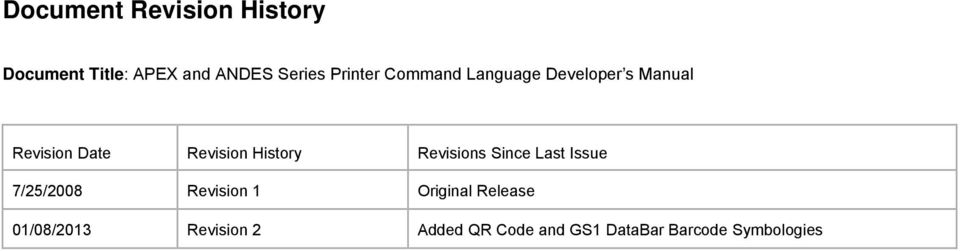
4 Document Revision History Document Title: APEX and ANDES Series Printer Command Language Developer s Manual Revision Date Revision History Revisions Since Last Issue 7/25/2008 Revision 1 Original Release 01/08/2013 Revision 2 Added QR Code and GS1 DataBar Barcode Symbologies
5 CONTENTS Introduction...1 Datamax-O Neil Printer Command Language (ExPCL)...1 Communications...2 Character Sets...3 Character Size and Line Spacing...3 Character Size and Line Spacing Width and Height...5 Character Attributes...6 Horizontal Position...8 Vertical Position...9 Bar Codes...10 Code 39 Specifications...11 Code 128 Specifications...12 UCC/EAN-128 Specifications...13 Interleaved 2 of 5 Specifications...14 UPC/EAN/JAN Specifications...14 Codabar Specifications...15 GS1 DataBar Specifications...16 QR CODE Specifications...21 PDF 417 Specifications...22 Graphics...24 Printer Controls Data Processing...26 Printer Controls Printed Output Adjust...27 Printer Controls - Reset...28 Printer Controls Power...28 Printer Status Commands...30 Magnetic Card Reader...31 Black Mark Sensing Control Commands...33 Black Mark Sensing Command Mode...34 Black Mark Sensing Auto Mode...34 Page Print Commands - Configuration...36 Page Print Commands Draw Commands...37 Form Fiesta TM...40 Form Fiesta TM...40 Download - Printer Default Setup...41 Download Self test Message Hardware Information...42 i

6 Download Logo...43 Download Fonts...44 Important Font Downloading Notes:...47 Bluetooth & WiFi Setup Command...49 Emulation...50 O Neil Line Print mode...50 Communications Settings...52 Dip Switch Settings...52 Serial Communication (RS232C)...53 USB Communication (USB)...54 Bluetooth Communications...55 Infrared Communications (Option)...56 Wi-Fi Communication (Option)...57 Printer Status Indicator LED Panel...57 Appendix A: Flash Font Tables...59 ii

7 Introduction This manual is intended to be used by software developers and system integrators with the purpose of developing applications that can print output results using Datamax-O Neil wide range of mobile thermal printers. This section of the manual describes the various printer models, their main technical specifications and the communication interfaces available for each model. For specific information about the operation of each printer refer to the User s Guide. Printer Models and Supported Features The Datamax-O Neil series of thermal printers offer a wide variety of solutions for printing applications. Communication interfaces and supporting flexible paper widths are shown in the table below. For additional information, please refer to the printer s User Guide. Model Max Paper Width Max. Print Width Max Print Dots Sensors Communication Interfaces RS-232 USB BT IrDA WiFi MCR SCR APEX /58m m 1.89 /48mm 384 Front Black Mark Std NA Std Opt Opt Opt Opt APEX /80m m 2.83 /72mm 576 Front Black Mark Std NA Std Opt Opt Opt Opt ANDES /80m m 2.83 /72mm 576 Front & Back Black Mark Std Std Opt* Std Opt* Opt* Opt* APEX /110.6 mm 4.09 /104m m 832 Front Black Mark Opt Std Std Opt Opt Opt Opt Std = Standard NA = Not Available Opt = Optional Datamax-O Neil Printer Command Language (ExPCL) This section describes the control codes and escape sequences comprising Datamax-O Neil Printer Command Language (ExPCL). Control characters defined as the set of characters encoding from 0x00 to.0x1f (ASCII values between 0 to 31) The ExPCL defines commands that start with the ESC (Hexadecimal 1B or Decimal 27) character and then are followed for the command and the parameters. The general structure of the commands can be defined as follows: ESC <Command> <Param1, Param2,...,Param n> Where: Character Hexadecimal 1B or Decimal 27 ESC Command One or more ASCII characters that define a unique Datamax-O Neil Printer Command Language Param1 Input parameters for the command. The commands that accept just one parameter will be defined as n while commands with more than one parameter will be defined as n1, n2, etc. Note that spaces are not part of the commands and the parameters are indicated as items typed in italics. For instance, the command ESC k n is used to select the character size of the resident fonts in the printers. The parameter n indicates the font type to choose with possible values between o and 9. 1

8 Parenthesis is not part of the command unless specified otherwise: For example Esc K n CR Escape Sequence: ESC K 1 CR Hexadecimal: 1B 4B 31 0D Decimal: Note that CR means Carriage Return control character. The following pages describe Datamax-O Neil Command Language (ExPCL) components in more details. The commands have been grouped based on major functions. Communications This section describes various methods of controlling the flow of data to and from the printer. The set of control characters described below are used by the printer and the host while a communicating process is in place. Note that some handshaking methods are only supported by the RS-232C Serial interface and are not supported for the USB, IrDA, Bluetooth, or Wi-Fi interfaces. End of Transmission The printer sends an EOT character each time the printer s input buffer becomes empty (indicating that the printer is idle). Control Code: EOT Hexadecimal: 04 Decimal: 4 Note that this control character can be enabled and disabled using the command ESC P n. See detailed description of the command in Section: Printer Control: Data Processing. Transmitter On When selected XON/XOFF as flow control method of serial communication, this character is transmitted by the printer to indicate that the printer is on line and ready to receive data. After receiving this character the host computer will start sending data to the printer. Control Code: XON Hexadecimal: 11 Decimal: 17 Transmitter Off EOT XON XOFF When selected XON/XOFF as flow control method of serial communication, this character is transmitted by the printer to indicate that the printer s buffer is nearly full and that the host computer should stop sending data. The communication process is reestablished after the printer transmits XON character to the host. Control Code: XOFF Hexadecimal: 13 Decimal: 19 2

9 Character Sets Select Character Set Esc F n This command will select the character set that will be used when printing extended characters (Hexadecimal: 80 to FF; Decimal: 128 to 255). n Character Set 1 International Character Set 2 PC Line Drawing Character Set A 16 bit font (Asian tables) Example1: The following escape sequence will select the International character set. Escape Sequence: ESC F 1 Hexadecimal: 1B Decimal: Refer to Appendices Section for complete list of characters contained in each character set. Note that printers are set to International Character Set by default. When using the PC Line Drawing Character Set, the text line spacing should be set to zero in order to create continuous vertical lines. This command is used in conjunction with the command ESC k n (or Esc K n, refer to Character Size and Line Spacing). Character Size and Line Spacing Select Character Pitch: Mode 1 ESC K n CR This command sets the font size based on the number of character per inch. The parameter n can have the following values: n Character Pitch/Font Character size Columns Per Line APEX2 APEX3 / Andes3 APEX4 0 ~13 cpi Rotated / Courier mode 0 16 x (rows/line) 36 (rows/line) 52 (rows/line) 1 ~12 cpi Normal / Courier mode 1 16 x ~16 cpi Normal / Courier mode 2 12 x ~19 cpi Normal / Courier mode 3 10 x ~21 cpi Normal / Courier mode 4 09 x ~24 cpi Normal / Courier mode 5 08 x ~10 cpi Normal / Monospace 821BT 20 x ~20 cpi Normal / Monospace 821BT 10 x ~20 cpi Bold / Monospace 821BT 10 x ~20 cpi Short / Monospace 821BT 10 x ~4 cpi Bold 48 x ~25 cpi Verin 08 x ~22 cpi Verin 09 x ~20 cpi Verin 10 x ~16 cpi Verin 12 x ~12 cpi Verin 16 x

10 This command (ESC K n CR) must be sent prior to any printable characters on the line in order to take effect. Example 1: The following escape sequence set the pitch to 12 CPI (Courier Font): Escape Sequence: ESC K 1 CR Hexadecimal: 1B 4B 31 0D Decimal: Example 2: The following escape sequence set the pitch to 25 CPI Verin Font: Escape Sequence: ESC K 1 1 CR Hexadecimal: 1B 4B D Decimal: Select Character Pitch: Mode 2 ESC k n This command is used for backward compatibility when Legacy or Factory fonts are selected. The command sets the font size based on the number of character per inch. The parameter n can have the following values: n Character Pitch/Font Character size Columns Per Line APEX 2 APEX 3 Andes3 APEX4 0 ~13 cpi Rotated / Courier mode 0 16 x (rows/line) 36 (rows/line) 52 (rows/line) 1 ~12 cpi Normal / Courier mode 1 16 x ~16 cpi Normal / Courier mode 2 12 x ~19 cpi Normal / Courier mode 3 10 x ~21 cpi Normal / Courier mode 4 09 x ~24 cpi Normal / Courier mode 5 08 x ~10 cpi Normal / Monospace 821BT 20 x ~20 cpi Normal / Monospace 821BT 10 x ~20 cpi Bold / Monospace 821BT 10 x ~20 cpi Short / Monospace 821BT 10 x This command (ESC k n) must be sent prior to any printable characters on the line in order to take effect. Example: The following escape sequence set the pitch to 12 CPI (Courier font): Escape Sequence: ESC k 1 Hexadecimal: 1B 6B 31 Decimal:

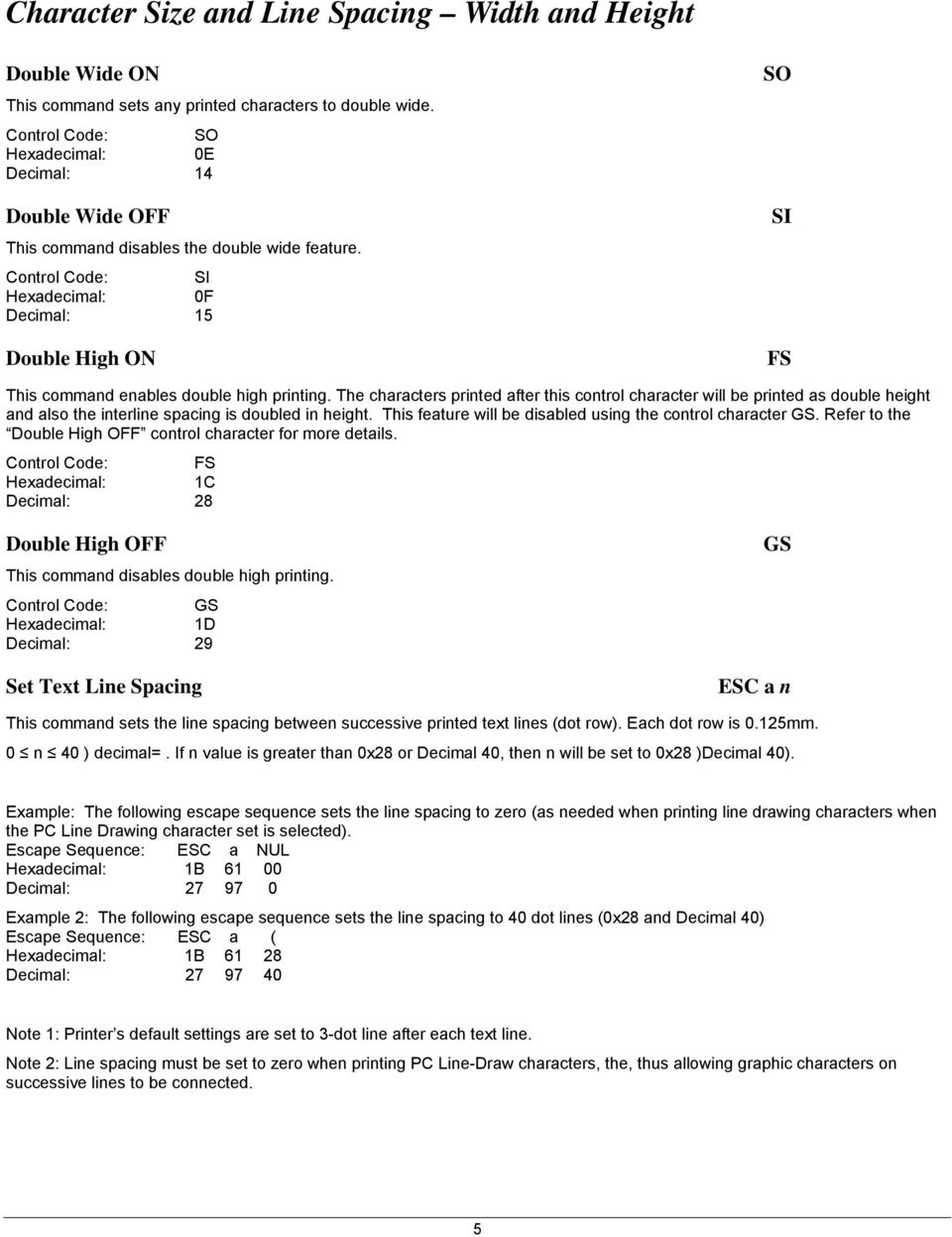
11 Character Size and Line Spacing Width and Height Double Wide ON This command sets any printed characters to double wide. Control Code: SO Hexadecimal: 0E Decimal: 14 Double Wide OFF This command disables the double wide feature. Control Code: SI Hexadecimal: 0F Decimal: 15 Double High ON SO SI FS This command enables double high printing. The characters printed after this control character will be printed as double height and also the interline spacing is doubled in height. This feature will be disabled using the control character GS. Refer to the Double High OFF control character for more details. Control Code: FS Hexadecimal: 1C Decimal: 28 Double High OFF This command disables double high printing. Control Code: GS Hexadecimal: 1D Decimal: 29 Set Text Line Spacing GS ESC a n This command sets the line spacing between successive printed text lines (dot row). Each dot row is 0.125mm. 0 n 40 ) decimal=. If n value is greater than 0x28 or Decimal 40, then n will be set to 0x28 )Decimal 40). Example: The following escape sequence sets the line spacing to zero (as needed when printing line drawing characters when the PC Line Drawing character set is selected). Escape Sequence: ESC a NUL Hexadecimal: 1B Decimal: Example 2: The following escape sequence sets the line spacing to 40 dot lines (0x28 and Decimal 40) Escape Sequence: ESC a ( Hexadecimal: 1B Decimal: Note 1: Printer s default settings are set to 3-dot line after each text line. Note 2: Line spacing must be set to zero when printing PC Line-Draw characters, the, thus allowing graphic characters on successive lines to be connected. 5
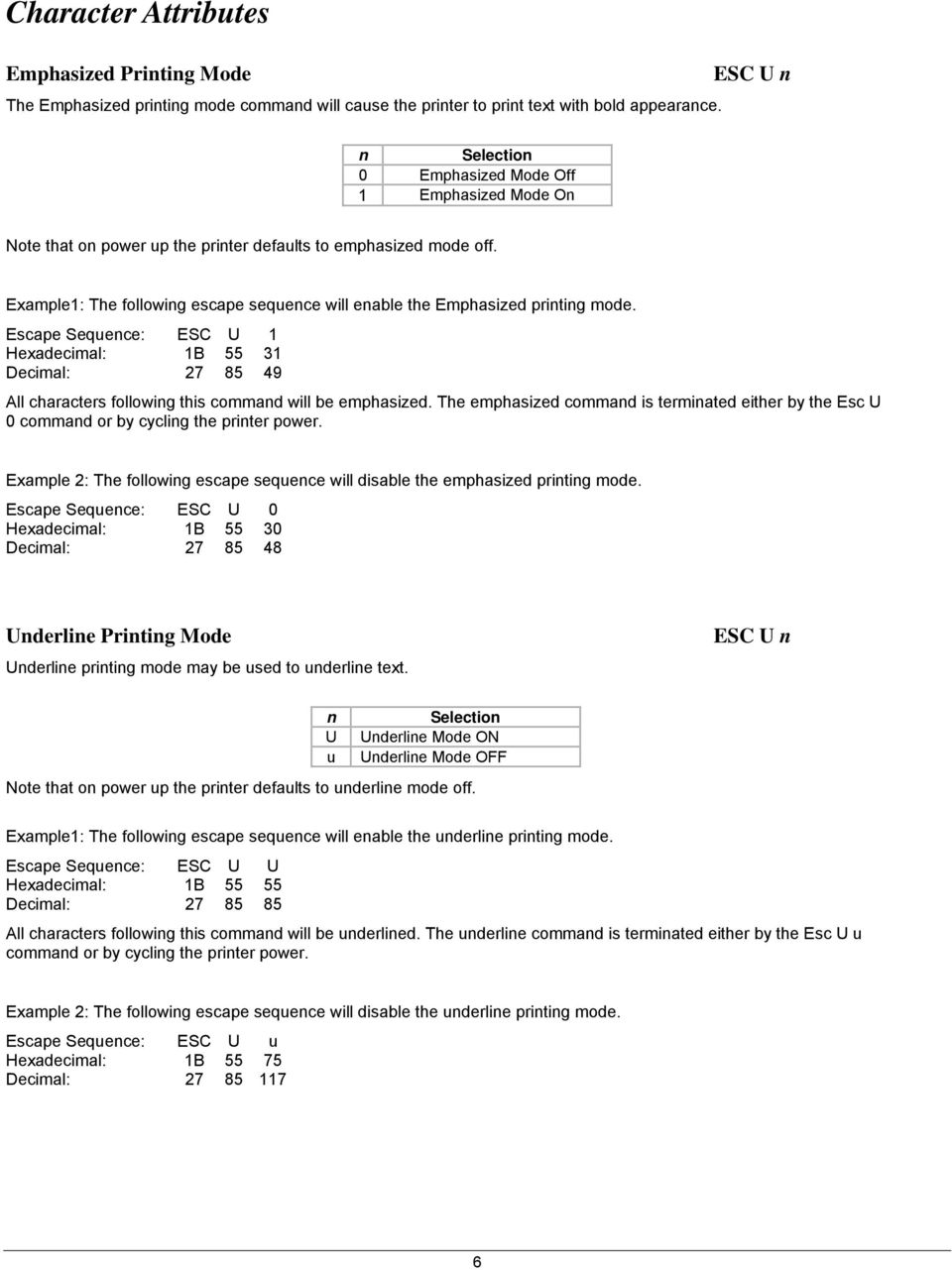
12 Character Attributes Emphasized Printing Mode ESC U n The Emphasized printing mode command will cause the printer to print text with bold appearance. n Selection 0 Emphasized Mode Off 1 Emphasized Mode On Note that on power up the printer defaults to emphasized mode off. Example1: The following escape sequence will enable the Emphasized printing mode. Escape Sequence: ESC U 1 Hexadecimal: 1B Decimal: All characters following this command will be emphasized. The emphasized command is terminated either by the Esc U 0 command or by cycling the printer power. Example 2: The following escape sequence will disable the emphasized printing mode. Escape Sequence: ESC U 0 Hexadecimal: 1B Decimal: Underline Printing Mode Underline printing mode may be used to underline text. ESC U n n Selection U Underline Mode ON u Underline Mode OFF Note that on power up the printer defaults to underline mode off. Example1: The following escape sequence will enable the underline printing mode. Escape Sequence: ESC U U Hexadecimal: 1B Decimal: All characters following this command will be underlined. The underline command is terminated either by the Esc U u command or by cycling the printer power. Example 2: The following escape sequence will disable the underline printing mode. Escape Sequence: ESC U u Hexadecimal: 1B Decimal:
13 Reverse Print ESC U n The reverse print command enables the user to print white letters on a black background.reverse printing begins with the characters following the command. n R n Selection Reverse printing ON Reverse printing OFF Note that on power up the printer defaults to reverse printing off. Example1: The following escape sequence will enable the reverse printing mode. Escape Sequence: ESC U R Hexadecimal: 1B Decimal: All characters following this command will be reverse printed. The reverse printing command is terminated either by the Esc U n command or by cycling the printer power. Example 2: The following escape sequence will disable the reverse printing mode. Escape Sequence: ESC U n Hexadecimal: 1B 55 6E Decimal: Right to Left and Left to Right Printing ESC F n This command causes the printer to change the direction in which characters are printed. The printer direction default mode is set to Left to Right. n R L Selection Right to Left Left to Right Note that on power up the printer defaults to left to right printing mode. Example1: The following escape sequence will enable the right to left printing mode. Escape Sequence: ESC F R Hexadecimal: 1B Decimal: All characters following this command will be printing right to left printed. The right to left printing command is terminated either by the Esc F L command or by cycling the printer power. Example 2: The following escape sequence will disable the left to right printing mode. Escape Sequence: ESC F L Hexadecimal: 1B 46 4C Decimal:

14 Horizontal Position Carriage Return CR This command prints the input buffer information and advances the paper to the next line. If the printer buffer is empty a line is advanced. Control Code: CR Hexadecimal: 0D Decimal 13 Backspace This command removes the previous character from the print buffer. BS Control Code: BS Hexadecimal: 08 Decimal: 8 Horizontal Tab This command advances the cursor by the number of dots specified in the Horizontal Margins command Control Code: HT Hexadecimal: 09 Decimal: 9 HT Set Horizontal Tab Width ESC T H n This command sets the Horizontal Tab (HT) value. The parameter n has values between 0 and 255 with a default value of 100 dots.. Example: The following escape sequence sets the horizontal tab width to 50 dots. Escape Sequence: ESC T H 2 Hexadecimal: 1B Decimal:

15 Vertical Position Line Feed LF This command prints the input buffer information and advances the paper to the next line. Total Feed Length = Vertical size of the current font + Text Line Spacing A Carriage Return (CR) is also performed to place the current print position at the beginning of the next line. Control Code: LF Hexadecimal: 0A Decimal : 10 Variable Size Line Feed ESC J n This command moves the paper forward as per the distance specified by the parameter n x 0.125mm. 0 n 255. A Carriage Return (CR) is also performed to place the current print position at the beginning of the next line. Example: The following escape sequence advances the paper ten millimeters. Each dot is 0.125mm so to advance the paper 10mm, the n parameter is 80 (10 / 0.125). Escape Sequence: ESC J P Hexadecimal: 1B 4A 50 Decimal: Variable Size Reverse Line Feed ESC Q J n This command moves the paper in reverse direction as per the distance specified by the parameter n x 0.125mm. 0 n 255. A Carriage Return (CR) is also performed to place the current print position at the beginning of the next line. Example: The following escape sequence moves the paper in the reverse direction ten millimeters. Each dot is 0.125mm so to reverse the paper 10mm, the n parameter is 80 (10 / 0.125). Escape Sequence: ESC Q J P Hexadecimal: 1B 51 4A 50 Decimal: Vertical Tab VT This command advances the cursor the number of dot lines specified in the Vertical Margin command (below). A Carriage Return (CR) is also performed to place the current print position at the beginning of the next line. Control Code: Hexadecimal: VT 0B 9

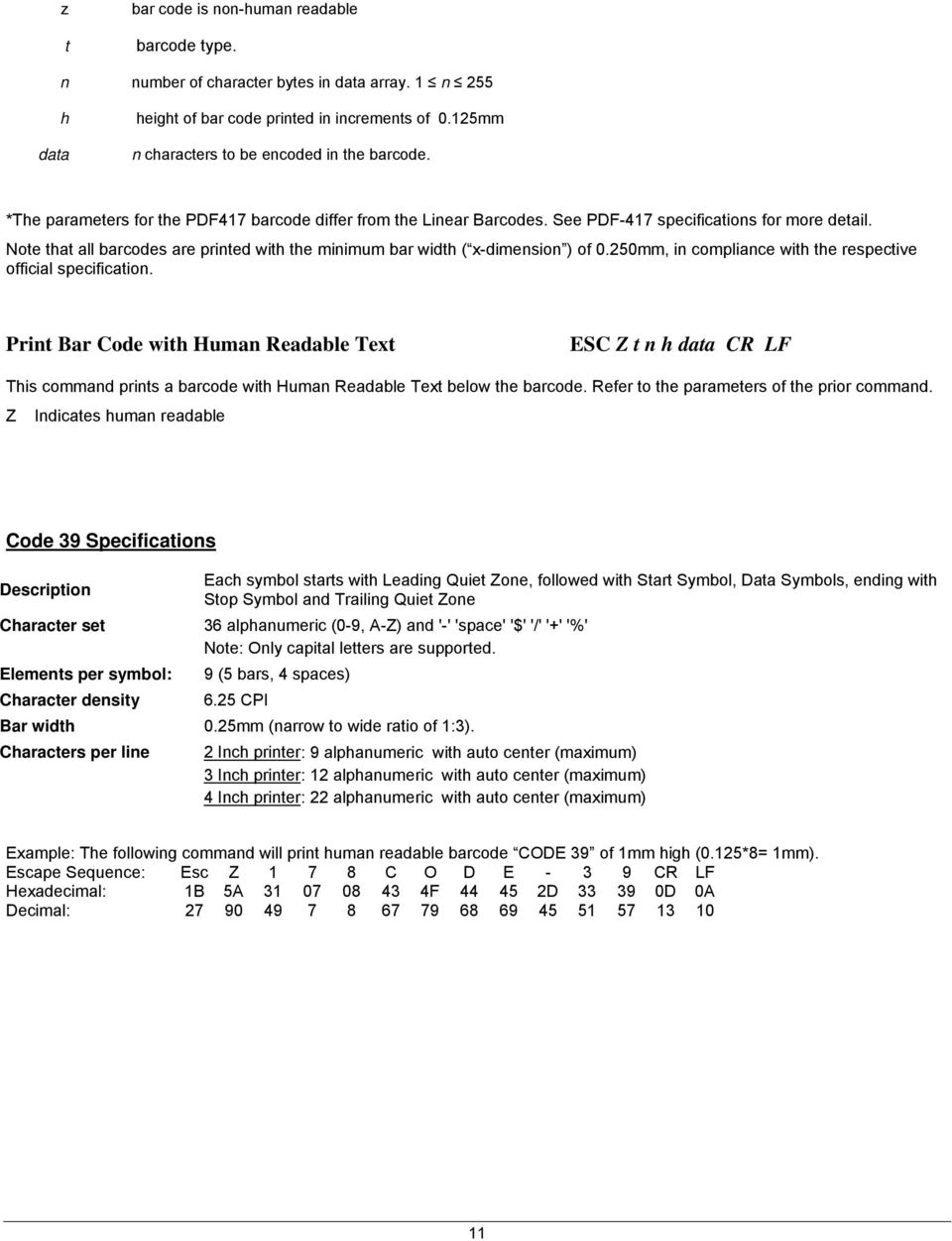
16 Set Vertical Tab Height ESC T V n This command sets the vertical tab length in dot lines. 0 n 255. The default value of the vertical tab is 203 dot lines. Example: The following escape sequence sets the vertical tab to ten millimeters. Each dot is 0.125mm so to fixed the vertical distance of 10mm, the n parameter is 80 (10 / 0.125). Escape Sequence: ESC T V P Hexadecimal: 1B Decimal: Form Feed FF This command advances the paper by the number of lines specified in the Set Form Feed length in dot lines (below). A Carriage Return (CR) is also performed to place the current print position at the beginning of the next line. Control Code: FF Hexadecimal: 0C Decimal 12 Set Form Feed Length in Dot Lines ESC T F n1 n2 This command sets the Form Feed Length in Dot Lines. The total Form Feed distance is computed using the following formula: (n2 * n1). 0 n n The default value is 1030 dot lines. Note that the height of the font in dot lines will be subtracted from the total dot lines specified in the command. Example: For a font 23 dot lines high and with an Esc T V 200 (0xC8) command sent, the actual VT value will be = 177 dots. Bar Codes The Datamax-O Neil printer series print several barcode symbologies including Linear and 2D barcodes. The following commands are used to print barcodes. Print Bar Code ESC z t n h data CR LF This command will print a barcode without human readable text. The following table describes the Bar Code command structure. Parameters: t Barcode 1 Code 39 2 Code 128,UCC/EAN Interleaved 2 of 5 4 UPC/EAN/JAN 5 Codabar 9 PDF417 * 10

17 z t bar code is non-human readable barcode type. n number of character bytes in data array. 1 n 255 h data height of bar code printed in increments of 0.125mm n characters to be encoded in the barcode. *The parameters for the PDF417 barcode differ from the Linear Barcodes. See PDF-417 specifications for more detail. Note that all barcodes are printed with the minimum bar width ( x-dimension ) of 0.250mm, in compliance with the respective official specification. Print Bar Code with Human Readable Text ESC Z t n h data CR LF This command prints a barcode with Human Readable Text below the barcode. Refer to the parameters of the prior command. Z Indicates human readable Code 39 Specifications Description Each symbol starts with Leading Quiet Zone, followed with Start Symbol, Data Symbols, ending with Stop Symbol and Trailing Quiet Zone Character set 36 alphanumeric (0-9, A-Z) and '-' 'space' '$' '/' '+' '%' Note: Only capital letters are supported. Elements per symbol: 9 (5 bars, 4 spaces) Character density 6.25 CPI Bar width 0.25mm (narrow to wide ratio of 1:3). Characters per line 2 Inch printer: 9 alphanumeric with auto center (maximum) 3 Inch printer: 12 alphanumeric with auto center (maximum) 4 Inch printer: 22 alphanumeric with auto center (maximum) Example: The following command will print human readable barcode CODE 39 of 1mm high (0.125*8= 1mm). Escape Sequence: Esc Z C O D E CR LF Hexadecimal: 1B 5A F D D 0A Decimal:
18 Code 128 Specifications Description Character set Elements per symbol Character density Bar width Characters per line Each symbol starts with Leading Quiet Zone, followed with Start Symbol, Data Symbols, ending with Stop Symbol and Trailing Quiet Zone Support for full 256 ASCII set among three subsets 6 (3 bars, 3 spaces) 9.1 CPI 0.25mm 2 Inch printer: 13 alphanumeric characters or 26 numeric only (maximum) - automatically centered 3 Inch printer: 18 alphanumeric characters or 36 numeric only (maximum) - automatically centered 4 Inch printer: 32 alphanumeric characters or 36 numeric only (maximum) - automatically centered Code 128 Start Character: <start character> = {0x87, 0x88, 0x89} determines the character set to be printed Start Character Characters Sent to Printer Characters Read by Bar Code Reader IF <start character> is 0x87 CODE A IF <start character> is 0x88 CODE B IF <start character> is 0x89 CODE C (Each number must be paired with another) 0x020 through 0x03F ASCII (#32 - #63) 0x040 through 0x07F ASCII (#64 - #127) 0x020 through 0x07F ASCII (#32 - #127) PAIRS 0x030 through 0x039 ASCII (#48 - #57) 0x020 through 0x03F ASCII (#32 - #63) 0x00 through 0x07F ASCII (#0 - #31) 0x020 through 0x07F ASCII (#32 - #127) PAIRS 0x030 through 0x039 ASCII (#48 - #57) Code 128 Data Bytes: <DATA> The data bytes are defined by which character set is defined. The printer accepts all characters 0x20h - 0x7Fh with the translations defined above. Also, characters 0x080-0x86 may be used as Code 128 control characters: HEX DEC CODE A CODE B CODE C 0x FNC 3 FNC 3 0x FNC 2 FNC 2 0x SHIFT SHIFT 0x change to C change to C 0x change to B FNC 4 change to B 0x FNC 4 change to A change to A 0x FNC 1 FNC 1 FNC 1 FNC 1: Reserved CODE 128 character (used for UCC/EAN128) FNC 2: Message append (not supported by all bar code readers) FNC 3: Initialize bar code reader FNC 4: Extend characters (bar code reader reads character + 128) For example: 'a' is changed from #97 to # = #225 Note that it is possible to switch code sets in the middle of the bar code. This is useful with heavily numeric alphanumeric bar codes (see example below). 12

19 Example 1: The following escape sequence prints alphanumeric bar code "A2a", 12.5mm high, with human readable text: n = 3 printed characters + 1 start character = 4 L = 12.5mm / 0.125mm = #100 start character = START B (full ASCII alpha numeric) = #136 Escape Sequence: Esc Z 2 4 d 88 A 2 a CR LF Hexadecimal: 1B 5A D 0A Decimal: Example 2: The following escape sequence print all-numeric bar code "1234", 5mm high, non-human readable text: n1 = 4 printed characters + 1 start character = 5 L = 5mm / 0.125mm = #40 start character = START C (numeric pairs) = #137 Escape Sequence: Esc z 2 5 ( CR LF Hexadecimal: 1B 7A D 0A Decimal: UCC/EAN-128 Specifications Description The UCC/EAN-128 specification is an internationally recognized format for application identifiers in code 128 bar codes. The bar code symbology is identical to Code 128. These identifiers are not intended for point-of-sale applications. Only recognized bodies of the UCC or EAN may assign application identifiers. More information may be found at: for the EAN and for the UCC Example: The following escape sequence print all-numeric bar code "1234", 5mm high, with human readable text in EAN-128 format: n1 = 1 start character + EAN specified + 4 printed characters = 6 L = 5mm / 0.125mm = #40 start character = START C (numeric pairs) = #137 Escape Sequence: Esc Z 2 6 ( 89 FNC CR LF Hexadecimal: 1B 5A D 0A Decimal:

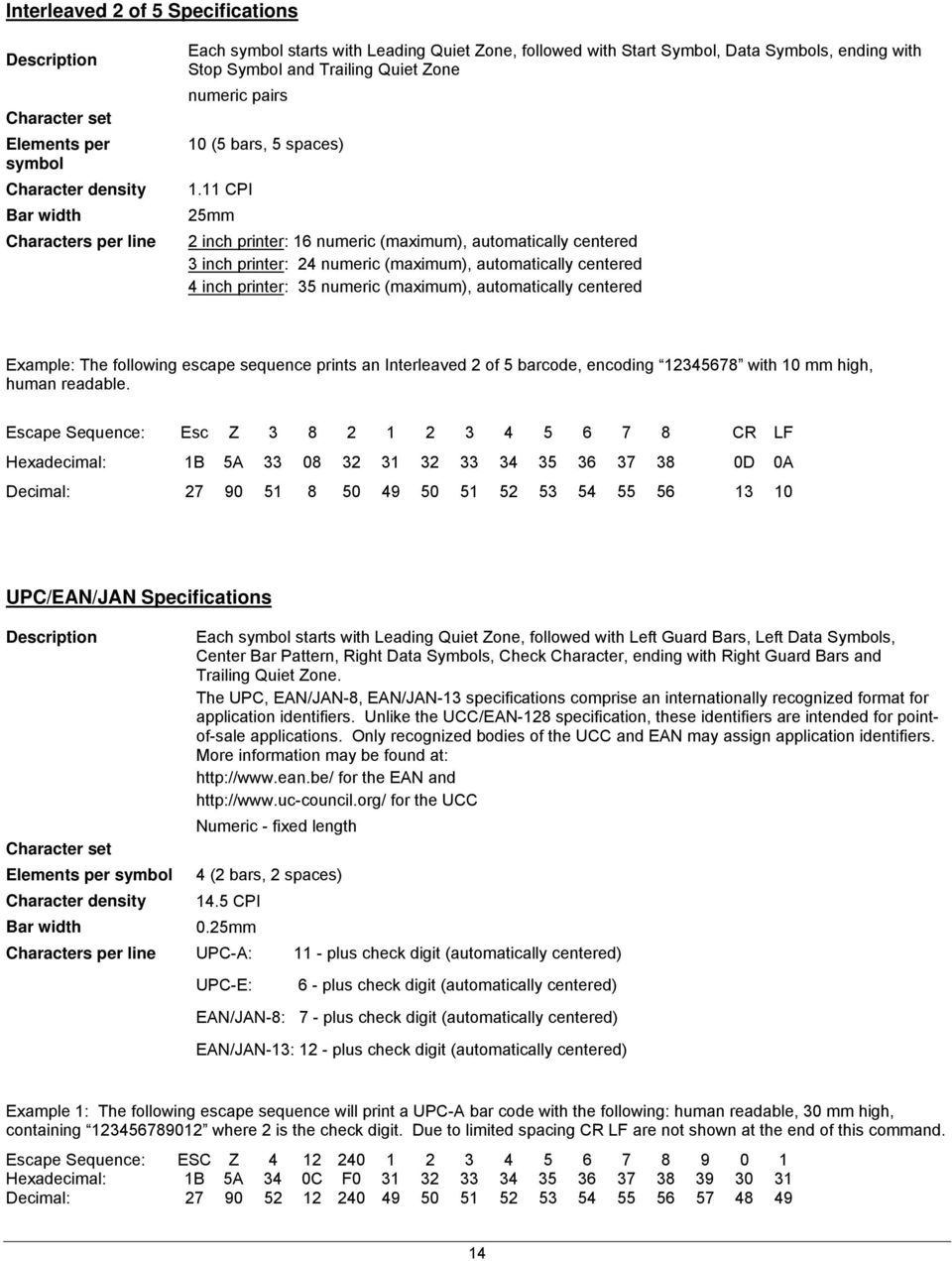
20 Interleaved 2 of 5 Specifications Description Character set Elements per symbol Character density Bar width Characters per line Each symbol starts with Leading Quiet Zone, followed with Start Symbol, Data Symbols, ending with Stop Symbol and Trailing Quiet Zone numeric pairs 10 (5 bars, 5 spaces) 1.11 CPI 25mm 2 inch printer: 16 numeric (maximum), automatically centered 3 inch printer: 24 numeric (maximum), automatically centered 4 inch printer: 35 numeric (maximum), automatically centered Example: The following escape sequence prints an Interleaved 2 of 5 barcode, encoding with 10 mm high, human readable. Escape Sequence: Esc Z CR LF Hexadecimal: 1B 5A D 0A Decimal: UPC/EAN/JAN Specifications Description Each symbol starts with Leading Quiet Zone, followed with Left Guard Bars, Left Data Symbols, Center Bar Pattern, Right Data Symbols, Check Character, ending with Right Guard Bars and Trailing Quiet Zone. The UPC, EAN/JAN-8, EAN/JAN-13 specifications comprise an internationally recognized format for application identifiers. Unlike the UCC/EAN-128 specification, these identifiers are intended for pointof-sale applications. Only recognized bodies of the UCC and EAN may assign application identifiers. More information may be found at: for the EAN and for the UCC Numeric - fixed length Character set Elements per symbol 4 (2 bars, 2 spaces) Character density 14.5 CPI Bar width 0.25mm Characters per line UPC-A: 11 - plus check digit (automatically centered) UPC-E: 6 - plus check digit (automatically centered) EAN/JAN-8: 7 - plus check digit (automatically centered) EAN/JAN-13: 12 - plus check digit (automatically centered) Example 1: The following escape sequence will print a UPC-A bar code with the following: human readable, 30 mm high, containing where 2 is the check digit. Due to limited spacing CR LF are not shown at the end of this command. Escape Sequence: ESC Z Hexadecimal: 1B 5A 34 0C F Decimal:
21 Example 2: The following escape sequence will print a UPC-E bar code with the following: human readable, 30 mm high, containing where 5 is the check digit. Escape Sequence: ESC Z CR LF Hexadecimal: 1B 5A F D 0A Decimal: Example 3: The following escape sequence will print an EAN/JAN-8 bar code with the following: human readable, 30 mm high, containing where 0 is the check digit. Escape Sequence: ESC Z CR LF Hexadecimal: 1B 5A F D 0A Decimal: Example 4: The following escape sequence will print an EAN/JAN-13 bar code with the following: human readable, 30 mm high, containing where 8 is the check digit. Due to limited spacing CR LF are not shown at the end of this command. Escape Sequence:ESC Z Hexadecimal: 1B 5A 34 0D F Decimal: Note that all heights are total height, including a 1.23mm drop bar pattern printed after the bar code pattern. Codabar Specifications Description Character set Elements per symbol Character density Bar width Characters per line Each symbol starts with Leading Quiet Zone, followed with Start Symbol, Data Symbols, ending with Stop Symbol and Trailing Quiet Zone 0-9, {$, -, :, /,., +} and start/stop pairs {A/T, B/M, C/*, D/E} 7 (4 bars, 3 spaces) 8.1 CPI 0.25mm 2 Inch Printer: 15 (maximum) plus start/stop, automatically centered 3 inch printer: 20 (maximum) plus start/stop, automatically centered 4 inch printer: 35 (maximum) plus start/stop, automatically centered Example 1: The following escape command prints a Codabar barcode with the following: Encoding , human readable, 20 mm high, start character A and stop character T Escape Sequence: ESC Z A T CR LF Hexadecimal: 1B 5A A D 0A Decimal: Example 2: The following escape command prints Codabar barcode with the following: Encoding 2468, human readable, 10 mm high, start character C and stop character *.. Escape Sequence: ESC Z 5 6 P C * CR LF Hexadecimal: 1B 5A A 0D 0A Decimal:
22 GS1 DataBar Specifications Description Character set QR Code Models Error Correction Levels GS1 DataBar symbols can carry more information and identify small items than the current EAN/UPC bar code. GS1 DataBar enables GTIN identification for hard-to-mark products like fresh foods, jewelry and do-it-yourself hardware products and can carry GS1 Application Identifiers such as serial numbers, lot numbers, and expiration dates. numeric, alphanumeric, byte / binary, Kanji Model 1 is the original specification. Model 2 is an enhanced form of the symbology. Ultra High Reliability Level (30% of codewords can be restored) High Reliability Level (25% of codewords can be restored) Standard Level (15% of codewords can be restored) High Density Level (7% of codewords can be restored) Data Modes AUTO (do not need to specify the character mode) MANUAL (need to specify the character mode.) Elements per symbol Square dot/element with the following pixel multipliers: 1(none), 2, 4(default), 8, 16 Max. Characters 7366 QR Code Command Structure: <ESC> z or Z 6 TYPE DATA SIZE ELEMENT SIZE X UNDERCUT Y UNDERCUT SEP ROW HEIGHT MAX SEG PER ROW - [User s Data] Parameters: 1) ESC(0x1B) 2) "Z"(0x5A) or "z"(0x7a) - Enables\disables annotation 3) "6"(0x36) - Selects GS1 DataBar barcode family 4) 1(SOH) through 12(FF) - selects symbology type, where: New GS1 Databar 1(SOH) RSS-14 GS1 DataBar Omnidirectional 2(STX) RSS-14 Truncated GS1 DataBar Truncated 3(ETX) RSS-14 Stacked GS1 DataBar Stacked 4(EOT) RSS-14 Stacked Omnidirectional GS1 DataBar Stacked Omnidirectional 5(ENQ) RSS Limited GS1 DataBar Limited 6(ACK) RSS Expanded GS1 DataBar Expanded 7(BEL) UPC-A 8(BS) UPC-E 9(HT) EAN-13 10(LF) EAN-8 11(VT) UCC/EAN-128 & CC-A/B 12(FF) UCC/EAN-128 & CC-C 5) 0(NULL)-256(0xFF) - number of bytes to encode. For more information please refer to "Data input string format:" section below. 16
23 6) 1(SOH)-12(FF) - pixels per X 7) 0(NULL)-3(ETX) - X pixels to undercut 8) 0(NULL)-3(ETX) - Y pixels to undercut 9) 1(SOH)-12(FF) * 2 - separator row height 10) 2(STX)-22(SYN) - maximum segments per row (22 default). Note this entry is only applicable for RSS Expanded symbology 11) Data string Example: The following escape commands encode the data in RSS14 Linear type. Due to space limitation CR LF are not shown Escape Sequence: <ESC> z 6 <SOH> <EOT> <SOH> <NUL> <NUL> <SYN> Hexadecimal : 1b 5a d Decimal: Expected Result (not to scale): Example: The following escape commands encode the data in RSS14 Truncated Linear type. Due to space limitation CR LF are not shown Escape Sequence: <ESC> z 6 <STX> <EOT> <SOH> <NUL> <NUL> <SYN> Hexadecimal : 1b 5a d Decimal: Expected Result (not to scale): Example: The following escape commands encode the data in RSS14 Stacked Linear type. Due to space limitation CR LF are not shown Escape Sequence: <ESC> z 6 <ETX> <EOT> <SOH> <NUL> <NUL> <SYN> Hexadecimal : 1b 5a d Decimal: 17
24 Expected Result (not to scale): Example: The following escape commands encode the data in RSS14 Stacked Omnidirectional Linear type. Due to space limitation CR LF are not shown Escape Sequence: <ESC> z 6 <EOT> <EOT> <SOH> <NUL> <NUL> <SYN> Hexadecimal : 1b 5a d Decimal: Expected Result (not to scale): Example: The following escape commands encode the data in RSS Limited Linear type. Due to space limitation CR LF are not shown Escape Sequence: <ESC> z 6 <ENQ> <EOT> <SOH> <NUL> <NUL> <SYN> Hexadecimal : 1b 5a d Decimal: Expected Result (not to scale): Example: The following escape commands encode the data DATAMAX-O NEIL in RSS Expanded Linear type. Due to space limitation CR LF are not shown Escape Sequence: <ESC> z 6 <ACK> <SO> <SOH> <NUL> <NUL> <SOH> <SYN> D A T A M A X - O N E I L Hexadecimal : 1b 5a e d d 4f 27 4e c Decimal:
25 Expected Result (not to scale): Example: The following escape commands encode the data in UPC-A type. Due to space limitation CR LF are not shown Escape Sequence: <ESC> z 6 <BEL> <VT> <SOH> <NUL> <NUL> <SOH> <SYN> Hexadecimal : 1b 5a b Decimal: Expected Result (not to scale): Example: The following escape commands encode the data in UPC-E type. Due to space limitation CR LF are not shown Escape Sequence: <ESC> z 6 <BS> <LF> <SOH> <NUL> <NUL> <SOH> <SYN> Hexadecimal : 1b 5a a Decimal: Expected Result (not to scale): Example: The following escape commands encode the data in EAN-13 type. Due to space limitation CR LF are not shown Escape Sequence: <ESC> z 6 <HT> <FF> <SOH> <NUL> <NUL> <SOH> <SYN> Hexadecimal : 1b 5a c
26 Decimal: Expected Result (not to scale): Example: The following escape commands encode the data in EAN-8 type. Due to space limitation CR LF are not shown Escape Sequence: <ESC> z 6 <LF> <BEL> <SOH> <NUL> <NUL> <SOH> <SYN> Hexadecimal : 1b 5a 36 0a Decimal: Expected Result (not to scale): Example: The following escape commands encode the data in UCC EAN-128 & CC-A/B type. Due to space limitation CR LF are not shown Escape Sequence: <ESC> z 6 <VT> <FF> <SOH> <NUL> <NUL> <SOH> <SYN> Hexadecimal : 1b 5a 36 0b 0c Decimal: Expected Result (not to scale): Example: The following escape commands encode the data in UCC EAN-128 & CC-C type. Due to space limitation CR LF are not shown Escape Sequence: <ESC> z 6 <FF> <FF> <SOH> <NUL> <NUL> <SOH> <SYN> Hexadecimal : 1b 5a 36 0c 0c
27 Decimal: Expected Result (not to scale): QR CODE Specifications Description Character set QR Code Models Error Correction Levels The code consists of black modules (square dots) arranged in a square pattern on a white background. The information encoded may be made up of four standardized types ("modes") of data (numeric, alphanumeric, byte / binary, Kanji), or through supported extensions, virtually any type of data. numeric, alphanumeric, byte / binary, Kanji Model 1 is the original specification. Model 2 is an enhanced form of the symbology. Ultra High Reliability Level (30% of codewords can be restored) High Reliability Level (25% of codewords can be restored) Standard Level (15% of codewords can be restored) High Density Level (7% of codewords can be restored) Data Modes AUTO (do not need to specify the character mode) MANUAL (need to specify the character mode.) Elements per symbol Square dot/element with the following pixel multipliers: 1(none), 2, 4(default), 8, 16 Max. Characters 7366 QR Code Command Structure: <ESC> z or Z 7 QR MODEL ERROR CORRECTION DATA MODE MSB LSB PIXEL MULT - [User s Data] or <ESC> z or Z 7 1 or 2 H, Q, M or L A or M MSB LSB PM - [User s Data] Parameters 1) ESC(0x1B) 2) 'Z'(0x5A) or 'z'(0x7a) - Enables\disables annotation 3) '7'(0x37) - Selects QR Code barcode symbology 4) '1'(0x31) or '2'(0x32) - selects model, where: '1'(0x31) --- QR Code model 1 is the original specification while '2'(0x32) --- QR Code model 2 is an enhanced form of the symbology (default and recommended) 5) 'L', 'M', 'Q' or 'H' - QR Code Error correction level, where: 'H' --- Ultra High Reliability Level 'Q' --- High Reliability Level 'M' --- Standard Level (default) 'L' --- High Density Level 6) 'A' or 'M' - QR Code Data Input Modes <AUTO, MANUAL>, where: 'A' --- AUTO (default) 21
28 'M' --- MANUAL If you specify AUTO you do not need to specify the character mode. If you specify MANUAL you will need to specify the character mode. 7) 0x00(NULL)-0xFF - MSB for a message length parameter 8) 0x00(NULL)-0xFF - LSB for a message length parameter Total Message Length = (MSB * 256) + LSB 9) '0'(0x30) - '4'(0x34) - Pixel multiplier. '2' - (default) Multiplication factor = 2^provided value. For Example: '0' -> 2^0=1, '1' -> 2^1=2, '2' -> 2^2=4, '3' -> 2^3=8 and '4' -> 2^4=16 10) 'N', 'A', 'B' or 'K' - Character mode(for MANUAL mode only), where: 'N' --- Numeric 'A' --- Alphanumeric (default) 'B' --- Binary 'K' --- Kanji 11) Data string Example: The following escape commands encode the data Due to space limitation CR LF are not shown Escape Sequence: <ESC> Z 7 2 M A <NUL> <FS> 2 h t t p : / / w w w. d a t a m a x o n e i l. c o m Hexadecimal: b a 7 2 d 1 0 c a f f e d 1 8 d f e 5 9 c Decimal: e f d PDF 417 Specifications Description Each PDF 417 symbol character consists of a stack of vertically aligned rows between 3 and 90. Each row includes a start and a stop pattern, left and right row indicators and a maximum of 30 symbol characters. The symbol shall include a quite zone on all four sides Character set All ASCII and extended characters, 8-Bit binary data and up to 811,800 different character sets Elements per Height: Variable (3 to 90 rows) and Width: Variable (90X to 583X) symbol Character/symbol 1850 text characters Error correction 2 to 512 PDF417 Command Structure: <ESC> z 9 CM SL SW SH EW EH MSB LSB [User s Data] Parameters CM: Compaction Mode. Select a mode to encode the user s data 22
29 Compaction Mode Description Encoding Capability 0 (Future Use) Byte Compaction Mode (BC) All characters, (0-255) 1 (Recommended) Text Compaction Mode (TC) ASCII only, (0-127) + Shift to BC Mode is implemented. 2 (Future Use) Numeric Compaction Mode (NC) Digits Only, ( 0-9 ) A (Future Use) AUTO (combinations of all modes) Mix of three compaction modes SL: Security Level byte. This can be any digit from 0 to 8. Set the value of the Security Level based on the number of user s data to be encoded Security Level # Error-Check Code Words (recommended) SW: SH: Symbol Width byte. This is the total width length of the printed PDF417 symbol. The user may specify any value here, and the printer will calculate the actual width of the symbol & it will update this value again (Future Use). Recommended Value: 0 or 0x30 Symbol Height byte. This is the total height length of the printed PDF417 symbol. The user may specify any value here, and the printer will calculate the actual width of the symbol & it will update this value again (Future Use). Recommended Value: 0 or 0x30 EW: Element Width byte. This is the width length of a single element in the PDF417 symbol, that is, bar/space width. Can be set to 1 or 2 Element Width Value Length in mil mil 2 (recommended) 9.8 mil EH: Element Height byte. This is the height length of a single element in the PDf417 symbol, that is, bar/space height. A value between 0x03 to 0x0A can be used. Recommended Value: 0x06 MSB: Most Significant Byte: This byte represents the most significant byte of how many bytes to encode of User s Data. Maximum is 06 in hex, that is, MSB = 06h (max). LSB: Least Significant Byte: This byte represents the least significant byte of how many bytes to encode of user s Data. User s data: Data to be encoded in the barcode Total number of user s data that can be encode is [MSB][LSB] = 0x06B8 = 1720 bytes, that is, only alphanumeric with security level set to its minimum value. Setting the security level to a higher value, will result in less user data to be encoded, since the total number of code words that can fit in a PDF417 symbol are 929, and if security level is set to 8, then already 512 error code words are occupied in the symbol, and ( = 417), so only about (417*2) alphanumeric data can be encoded with security level 8. If any parameter in the command line does not match the spec in this document, then an error message Invalid Barcode will be sent out from the printer s serial port. 23
30 Example: The following escape commands encode the data Due to space limitation CR LF are not shown Escape Sequence: ESC z Hexadecimal : 1B 7A Decimal: Barcode Height Multiplier ESC z h n This command allows the user to change the height of a selected barcode using a multiplier with values 1 < n < 18 (HEX values). The multiplier command can be sent prior to or after the Print Barcode sequence (ESC z t n h data CR LF) Example: The sequence below prints CODE39 barcode first of a height of 50 dots and then sets the new height to 3 x 50 dots. To print CODE-39 of height 150 dots using the multiplier command send steps 1, 2, in the order below. Barcode Height Multiplier Escape Sequence: ESC z h 3 Hexadecimal: 1B 7A Decimal: Printing Barcode: Escape Sequence: Esc Z C O D E CR LF Hexadecimal: 1B 5A F D D 0A Decimal: Graphics The printer uses a single line thermal print head with elements spaced at 0.125mm. The 8-bit graphic commands enable control of each heating element of the print head. The commands also advance the paper in increments of 0.125mm. The number of heating elements can vary according to your printer model. Refer to the printer s User s Guide for specific information. To select the 8-bit graphic mode, the user application must issue the ESC V command. After that, the user application must send two bytes to indicate the number of the graphic lines desired, followed with a packet of 72 bytes for each graphic line. The printer prints the graphic line and advances to the next line automatically. 8-Bit Graphics 24 ESC V n1 n2 data 8-bit Graphic mode is selected using the ESC V command. <n1> and <n2> is a 16 bit integer indicating the number of graphic lines of 72 characters each to be received. Valid Graphic character sets range from 0x00 to 0xFF Hex using bits 0-7 To achieve optimized smooth printing and to extend battery life when printing graphics, a print buffer is employed. The printer buffer accumulates a specific amount of data before actually printing the graphic data.
31 The following 8-bit graphic command is used to print a single line of graphic Escape Sequence: ESC V SOH NUL 72 bytes of data Hexadecimal: 1B bytes of data Decimal: bytes of data 8 Bit Compressed Graphics ESC v height width counter data [c data] [c data] This command differs from the 8 Bit Graphics command described above by reducing the number of bits (bytes) that have to be sent to the printer. This allows for faster data transfer between the host computer and the printer. Graphic String Component height (# of lines) width (# of bytes in each line) counter r (# of lines) Function An eight bit value representing the number of dot-lines contained in the following data set An eight bit value representing the number of bytes to be contained in each dot-line of the following data set An eight bit value which describes how the following data will be processed For Signed Values For Unsigned Values {127 Counter 0} Process the next (Counter + 1) bytes of data as 8 bit graphics. {0 > Counter -128} Repeat the next single byte of data ((-Counter) + 1) times. {127 Counter 0} Process the next (Counter+1) bytes of data as 8 bit graphics {128 Counter 255} Repeat the next Singe byte of data, (( 256 Counter)+1) times Example: Compressed graphic The following graphics data is to be printed: 25
32 This data may be represented in hexadecimal: 0x55 0x55 0x00 0x00 0xAA 0x11 0x55 0x00 0x55 0x55 0x55 0x55 The RLE compressed graphics command: ESC v height width counter data DEC HEX 0x1B 0x76 0x02 0x06 0xFF 0x55 0xFF 0x00 0x03 0xAA 0x11 0x55 0x00 0xFD 0x55 Printer Controls Data Processing The printer can be operated in two modes, Online and Buffer mode. In online mode, the characters are printed as they are received. In buffer mode, the characters received are stored in the print buffer and printed upon receipt of the EOT character (^D). Also if the printer is in Buffer Mode and the print buffer is full, the printer will start printing but will remain in the Buffer Mode until the Online Mode command is sent to the printer. Enable Buffer Mode ESC P $ This command selects the printer buffer mode. Escape Sequence: ESC P $ Hexadecimal: 1B Decimal: Disable Buffer Mode (Select Online Mode) ESC P # This command disables the printer buffer mode and selects the online mode. The online mode is the default mode of operation of the printer. Escape Sequence: ESC P # Hexadecimal: 1B Decimal:
33 Print Buffer Contents (Buffer Mode) EOT This command allows the printer to process all of the commands stored in the printer buffer. This command is valid only when the printer is in the buffer mode. Control Code: EOT Hexadecimal: 04 Decimal 04 Enable EOT Control Character Transmission (Currently Not Available) ESC P + When enabled, the printer transmits the EOT command character when the print buffer is empty. The End Of Text (EOT) control character is transmitted once when the printer buffer is empty. Escape Sequence: ESC P + Hexadecimal: 1B 50 2B Decimal: Disable EOT Control Character Transmission (Currently Not Available) ESC P This command disables the EOT control character transmission. Therefore, the control character EOT is not transmitted when the printer buffer is empty Escape Sequence: ESC P - Hexadecimal: 1B 50 2D Decimal: Printer Controls Printed Output Adjust Print Contrast This command sets the printer level of contrast or darkness of the printer. The parameter n is the level of contrast. 1 n 9. ESC P n The printed text or graphics contrast depends on the type of thermal paper used, the printer battery voltage and the printer contrast setting (selected by the host application). The table below specifies recommended n values according to the media used. Paper type Low Medium High P (*) 3 P Reserved (currently P300) * The printer defaults to a contrast of 2. Note that the print speed and power consumption is affected by the contrast setting. Example: The following escape sequence set the printer contrast to 7. Escape Sequence: ESC P 7 Hexadecimal: 1B Decimal:
34 Printer Controls - Reset Cancel This command deletes the entire printer buffer and resets the printer to the power-up default values. Control Code: CAN Hexadecimal: 18 Decimal: 24 CAN Reset printer and load default setup This command initializes all programmable attributes to factory default values. Custom programming, present in flash memory, will be restored as well, overriding the factory defaults. Note: This command does not clear the print buffer! Use the Cancel (CAN) command to clear the buffer. This command will not restore any changes that were burned into the flash memory such as: fonts, logos, default power up message or hardware information message. User programmable printer attributes and their factory defaults are shown in the table below: Attribute Factory Default Font Courier 3 Character set International Underline Disabled Bold Disabled Reverse Printing (White on Black) Disabled Double Width Disabled Double Height Disabled Line spacing 3 dots Form Feed Length 2030 dots Vertical Tab distance 203 dots Horizontal Tab distance 100 dots Printing direction Left-to-right Contrast 2 Sensor Sensitivity 255 Auto Power Down time 99 seconds Printer Controls Power Auto Power Down Command 28 ESC M n m 0 CR This command configures the printer Auto power-down timer. In order to conserve battery life, the printer features an auto power down timer. If the printer is in the AUTO POWER DOWN MODE, the power down timer defaults to 99 seconds on initial power up. Refer to the printer User Manual for appropriate dip-switch positions. The auto power down timer may be set or disabled by sending recognized command strings. The auto power down is re-started upon every character received. The auto power down timer may be disabled by activating the <RTS> input line, or setting the auto power down timer to zero, the printer lowers the CTS output line and transmits AUXOFF followed by XOFF before power down. On power down the timer reverts to its default settings. The parameters n1 and n2 may be set to 0 through 9.
35 Example 1: The command Esc M CR Disables the power out timer Example 2: The command Esc M CR Sets the timer to 99 seconds Note that spaces are not part of the command Extended Auto Power Down Command ESC M HH MM SS 0 CR The Set Auto Power Down command allows the user to program the printer to automatically shut down after a certain length of inactivity. This command accepts the following formats: (1) seconds, (2) minutes and seconds, or (3) hours, minutes and seconds. When used in conjunction with the Default Power-Up Setup command, this command will allow for the power down timer value to be saved permanently in Flash. The following table details the available formats for this command: Command String Printer Response Esc M S 1 S 2 0 CR Sets the printer Auto power down timer to S 1 S 2 seconds Esc M M 1 M 2 S 1 S 2 0 CR Sets the printer Auto power down timer to M 1 M 2 minutes S 1 S 2 seconds Esc M H 1 H 2 M 1 M 2 S 1 S 2 0 CR Sets the printer Auto power down timer to H 1 H 2 hours M 1 M 2 minutes S 1 S 2 seconds Here, H 1 H 2, M 1 M 2 and S 1 S 2 are two decimal characters that denote hours, minutes and seconds respectively. Values range from 00 to 99 with values over 59 being carried over. Up to 18 hours may be specified. The CR character at the end of the command is mandatory. Example 1: This escape sequence sets the Auto power down timer to 54 seconds Escape Sequence: ESC M CR Hexadecimal: 1B 4D C Decimal: Example 2: This escape sequence sets the Auto power down timer to 1 hour 16 minutes 54 seconds. Note that 76 minutes was converted to 1 hour 16 minutes. Escape Sequence: ESC M CR Hexadecimal: 1B 4D C Decimal: Example 3: This escape sequence sets the Auto power down timer to 18 hours. Note that 98 hours got truncated to 18 hours Escape Sequence: ESC M CR Hexadecimal: 1B 4D C Decimal:
36 Printer Status Commands Query Print Buffer & Timer-MCR Status This command will cause the printer to print the battery status STX Print Buffer Status Timer-MCR Status Printer Response ESC B <4 ASCII digits> CR LF ESC M <4 ASCII digits> CR LF Note that the first three digits of the Timer-MCR field correspond to the printer times. The last byte indicates that the MRC track is currently activated in the printer. Query Print Buffer, Battery Voltage, Timer-MCR & Print Head Temperature This command will cause the printer to send the following information to the host: SYN Print Buffer Status Battery Voltage Status Timer-MCR Status Print Head Temperature Printer Response ESC B <4 ASCII digits> CR LF ESC V <4 ASCII digits> CR LF ESC M <4 ASCII digits> CR LF ESC T <4 ASCII digits> CR LF Note that the first three digits of the Timer-MCR field correspond to the printer times. The last byte indicates that the MRC track is currently activated in the printer. Print Battery Voltage This command will enable the printer to output the battery voltage reading. ESC P ^ Escape Sequence: ESC P ^ Hexadecimal: 1B 50 5E Decimal: Query Printer Firmware Version ESC P ( This command will cause the printer to send the Firmware Version to the host. Escape Sequence: ESC P ( Hexadecimal: 1B Decimal: After sending the previous command, the printer will respond with the following ASCII sequence: ASCII Sequence: <string> CR LF The <string> field represents the firmware version. 30
37 Query Printer Model and Hardware Revision Level ESC P ) This command will cause the printer to send the hardware model to the host. Escape Sequence: ESC P ) Hexadecimal: 1B Decimal: After sending the previous command, the printer will respond with the ASCII sequence: ASCII Sequence:<string> CR LF The <string> field represents the hardware model. Magnetic Card Reader A three track Magnetic Card Reader is an option available on the Datamax-O Neil printers. The MCR reader is designed to read magnetically encoded data from cards conforming to ANSI/ISO 7810, 7811 standards. The MC reader converts the F2F encoded signals on the magnetic card, to ISO7811 compatible ASCII format and transmits the information to the host computer or terminal. Also, the MCR can read one, two or three tracks simultaneously and bi-directionally. The table below summarizes the format of the data stored on each magnetic track. Track Position Track 1 ISO1 (IATA) Track2 ISO2 (ABA) Track3 ISO3(MINTS) Recording Density 210 BPI 75 BPI 210 BPI Recording Capacity 79 characters 40 characters 107 characters Number of data bits Card Thickness.76 mm +/ mm Read Magnetic Card Data ESC M n1 n2 t (CR) or ESC m n1 n2 t (CR) This command activates the MRC reader and waits until the user swipes a card (or until the timer times out). The <n1><n2> parameters are used to set the MC reader s timer. "01" through "99" are valid timer settings. 00 disables the timer. The t value indicates which MCR track number to read. The printer aborts and transmits the time-out error message if the operator fails to swipe a card within the time period set by the host application. If the timer times out, the printer aborts the swipe process, transmits the timeout error message and switches off the <READING> LED. A good magnetic card swipe automatically terminates the read process. The following table details the possible combinations for this command: Magnetic Card Command String ESC M n1n2 1 CR (CR = Carriage Return) or ESC m n1n2 1 CR (CR = Carriage Return) ESC M n1n2 2 CR or ESC m n1n2 2 CR ESC M n1n2 3 CR or ESC m n1n2 3 CR ESC M n1n2 4 CR or ESC m n1n2 4 CR ESC M n1n2 5 CR or ESC m n1n2 5 CR ESC M n1n2 6 CR or ESC m n1n2 6 CR Description Read Track1 only Read Track2 only Read Track3 only Read Track1 and Track2 simultaneously Read Track2 and Track3 simultaneously Read Tracks 1,2 and 3 simultaneously 31
38 Example: The following escape sequence sets the timer to 99 seconds and activates the MRC to read the track #1. Escape Sequence: ESC M CR Hexadecimal: 1B 4D C Decimal: or Escape Sequence: ESC m CR Hexadecimal: 1B 6D C Decimal: Magnetic Card Data Output Format The track data retrieved from a magnetic card is transmitted to the host in ISO7811 ASCII format as summarized in the table below. The first four characters ( %/1/ ) flag the track number, the track data follows the flag string terminated with? -CR-LF. %;+ are the track start characters, While? is the end of track character. If no data is available for a track then that data field will be empty. If an Error is encountered on any track, a single E will be the output for that track s data field. The ISO 7811 ASCII Format is detailed below: Track1 Track 2 Track 3 %/1/ Data?CRLF ;/2/ Data?CRLF +/3/ Data?CRLF Magnetic Card Read Error Messages The characters <%> and <E> preface all error messages. Following these two characters is a comma, two ASCII digits representing the error number (01 through 99), another comma, English description of the error encountered, and finally a CR-LF which terminates the <Error Message> string. The syntax is as follows: <%><E>, nn, Error text in ASCII, <CR> <LF> Where nn is the error number encountered The printer may transmit three (3) types of Read Error messages. Refer to the table below for detailed description of the error messages. Error # Error Message Transmitted 05 Time-out Expired 07 Invalid Track Number 09 Cancel Request Interfacing to the Magnetic Card Reader This section details the software steps required to access the MC reader from a computer or a terminal. (1) The Host selects the printer by activating the RTS input line or sending wake-up characters to the printer. (2) The Printer Sends the XON command to the host to indicate that it is ready to receive data from the host. (3) Once XON is received the host sends an ASCII serial command string to enable the magnetic card reader (e.g. Escm004-cr). The printer switches on the GREEN <READY> LED. (4) Once the operator swipes the magnetic card, the printer transmits, in ASCII format, the track information found on the magnetic card. A good read automatically switches off the MC reader and the <READY> LED. (5) The <READY> LED illuminates RED if an error is encountered while reading the magnetic card. The printer transmits a timeout error message if the operator fails to swipe a card in the time period set by the host application. 32
39 Cancel Magnetic Card Data Read Command This command cancels the MCR read process. The printer returns to online operation mode. ESC C Escape Sequence: ESC C Hexadecimal: 1B 43 Decimal: Note that after executing this command the printer will send the message, 09, Cancel Request to the host. Black Mark Sensing Control Commands Set Paper-Out Sensitivity ESC Q Q n CR This command sets the paper-out sensor sensitivity level. 0 n 255. This command sets the number of 0.125mm dot rows that the printer can advance paper before the sensor detects an out of paper error. The length of the paper sensitivity must be larger than the length of the black mark on the media to avoid paper out error. The value selected for the sensitivity is dependent upon the height of the pre-printed black mark located on the label or form stock. The default power-on value n is 255 (0xFF). Example: The following escape sequence sets the paper sensitivity to 6.25mm (50*0.125) Escape Sequence: ESC Q Q 50 Hexadecimal: 1B Decimal: Enable Black Mark Reporting ESC Q R CR This command enables the printer to send reporting messages to the host. Refer to Black Mark Found and Black Mark not found commands for details of the messages that are activated. Escape Sequence: ESC Q R CR Hexadecimal: 1B D Decimal: Disable Black Mark Reporting ESC Q r CR Prevents the printer from sending report messages to the host. Refer to Black Mark Found and Black Mark not found commands for details of the messages that are deactivated Escape Sequence: ESC Q r CR Hexadecimal: 1B D Decimal:
40 Black Mark Sensing Command Mode Forward Seek Black Mark ESC Q F n CR This command sets the printer to black mark seek mode using a forward feed operation. The value of forward feed is determined by the user in dot lines (n) where 0 n 255 dots. Each dot line corresponds to 0.250mm. If the black mark is found, the printer responds with the command Black Mark Found, otherwise the printer responds with the command Black Mark not Found. Both escape sequence responses are described below. Example: The following escape sequence advances the paper 80 dot lines looking for a Black Mark. Escape Sequence: ESC Q F P CR Hexadecimal: 1B D Decimal: Reverse Seek Black Mark ESC Q B n CR This command causes the printer to seek black mark using backward feed until n dot line feeds have been processed; each dot line feed is 0.25mm. Not the using this command can cause a paper jam since the paper is advanced in reverse mode. The results may vary depending on the media used in the printer. Black Mark Found (Response from printer) ESC Q?? n1, n2 This message is sent to the host and indicates that a black mark has been found. The numbers n1 and n2 are the high and the low nibble, respectively, describing how many (0.25mm) dot lines were required to find black mark. Black Mark Not Found (Response from Printer) ESC Q 0 0 n1 n2 This message is sent to the host and indicates that a black mark has not been found. The numbers n1 and n2 are the high and the low nibble, respectively, describing how many (0.25mm) dot lines were processed before reporting black mark not found. Black Mark Sensing Auto Mode Enable Front Black Mark Sensor ESC Q f e CR This command will enable the printer s front black mark sensor and automatically disable the BACK side sensor. Escape Sequence: ESC Q f e CR Hexadecimal: 1B D Decimal: Disable Front Black Mark Sensor This command disables the printer s front black mark sensor. ESC Q f d CR Escape Sequence: ESC Q f d CR Hexadecimal: 1B D Decimal:
41 Enable Back Black Mark Sensor ESC Q b e CR This command will cause the printer to enable the back black mark sensor and automatically disables the front side sensor. Escape Sequence: ESC Q b e CR Hexadecimal: 1B D Decimal: Disable Back Black Mark Sensor This command will disable the printer s back black mark sensor. ESC Q b d CR Escape Sequence: ESC Q b d CR Hexadecimal: 1B D Decimal: Disable Both Front and Back Black Mark Sensors This command disables the printer s front and back black mark sensors. ESC Q f x CR or ESC Q b x CR Escape Sequence: ESC Q f x CR Hexadecimal: 1B D Decimal: or This command disables the printer s front and back black mark sensors. Escape Sequence: ESC Q b x CR Hexadecimal: 1B D Decimal: Printed Receipt/Label Presenter Positive Adjust ESC Q D + n This command will cause the printer to advance the paper to the distance specified by n dots after a form or label has been printed. Example: The following escape sequence will feed the paper 112 dots. Escape Sequence: ESC Q D Hexadecimal: 1B B 70 Decimal: Printed Receipt/Label Presenter Positive Adjust ESC Q P n This command is identical to Esc Q D + n command and will cause the printer to advance the paper to the distance specified by n dots after a form or label has been printed. Example: The following escape sequence will feed the paper 112 dots. Escape Sequence: ESC Q P 112 Hexadecimal: 1B Decimal:
42 Printed Receipt/Label Presenter Negative Adjust (*) ESC Q D n This command will cause the printer to move the paper backwards to a distance specified by n dots after a form or label has been printed. Example: The following escape sequence will move the paper backwards 112 dots Escape Sequence: ESC Q D Hexadecimal: 1B D 70 Decimal: Note: In Auto Q-Mark Mode Form Feed length is limited to the following range: print dots. Default value is set to 1218 dots. Page Print Commands - Configuration Datamax-O Neil printers can operate in two separate modes: Line Print Mode and Page Print Mode. On Power Up the printer defaults to Line Print Mode. In this mode, all data is printed from top to bottom as it is received. In Page Print mode, the canvas is constructed in advance and the form is printed afterwards. This allows for positioning of text, barcodes, lines and rectangles at specific X and Y coordinates and also at specific angles 0, 90, 180 and 270 degrees. The rendering process of the page is done in printer s memory. Page Print Mode can be used to design a certain template and replace only variable data during communication. Line Printing vs. Page Printing This section describes the commands which are supported in Page Print Mode. Enter the Page Printing Mode ESC P P This command is required to enter Page Print Mode. Esc P P also works in conjunction with the following commands: Command Name Command String Command Description Enter Buffer Mode Esc P $ Printer Enters Buffer Mode. All data is retained in the Buffer until ^ D ( 0x04) is received. Exit Buffer Mode Esc P # Exits Buffer Mode and puts the printer into the Line print Mode Print Buffer Content ^ D Prints Buffer Content; Printer is ready to receive more data. 36
43 Mark Beginning of a Page BeginPage(); This command follows Esc P P command and is used to indicate the beginning of a form in page printing mode. Define the Page Size SetPageSize (width, height); This command is used to define the valid drawing area for a label or form. Two parameters are required: width and height of the form, measured in dots. Set Margins SetMargin (lm, tm); This command sets the left margin to lm and the top margin to tm. The margin is then used as a start point (0, 0) for the form or label. Mark Page End, Print and Exit EndPage(); This command is used to end a form or label while in the Page Printing mode. This command also forces the printer to print a label or form. Page Print Commands Draw Commands Draw Text DrawText (x,y,color,angle,"string"); Draws text at any coordinate on the canvas. DrawText data prints the text enclosed in the double quotes at the current cursor location. x and y specify where the text is to be printed (upper left corner of the first letter of the top line). Parameters: x specifies x axis location y specifies y axis location Color specifies text color: 0 = white, 1= black. User may print white text on an existing black background by specifying color = 0. Angle specifies text direction Angle Print angle Description 0 0 degrees Counter-clockwise Prints text horizontally from left to right degrees Counter-clockwise Prints text vertically in the upward direction degrees Counter-clockwise Prints text horizontally from right to left degrees Counter-clockwise Prints text vertically in the downward direction. String specifies the text to print Multiple lines can be printed with a single DrawText command by separating the lines with \n characters. Text formatting is accomplished by tags inserted in the string argument. The formatting is effective only in the string in which it appears and does not carry over to the subsequent DrawText commands. The text formatting commands are listed below. 37
44 Command Name Description <b>, </b> Bold Text enclosed by <b> and </b> appear in bold. <u>, </u> Underline Text enclosed by <u> and </u> are underlined. <h = value> Text Height Text height is magnified by the given numeric value. Use <h = 1> to return to original size. <w = value> Text Width Text width is magnified by the given numeric value. Use <w = 1> to return to original size. <f = value> Font Sets the font. value = {0.. 9}. \n New Line Moves the cursor to the beginning of the next line. \<, \>, \, \\ Literals Use backslashes to print these special characters. Example: The figure below shows the use of the \n command as well as the effect of the angle command in the text being printed with the DrawText command Draw Rectangle DrawRectangle (x1, y1, x2, y2,color,width); Draws a rectangle object at any coordinate on the canvas. DrawRectangle command draws either a hollow or a filled rectangle. (x1, y1) and (x2, y2) specify the two diagonally opposing corners. All measurements are in dots. Parameters: x1, y1 Top left corner coordinates (x1, y1) x2, y2 Bottom right corner coordinates (x2, y2) color width Specifies the line or fill color: 0 = white, 1 = black The user may draw a white rectangle on a black background only by specifying color parameter = 0. Specifies the line width of a hollow rectangle. A zero-width results in a filled rectangle Draw Bar Code DrawBarcode(x,y,angle,annotate,type,height, "data"); Draws a barcode object at any coordinate on the canvas. Parameters: X Indicates location on x axis of the left top corner Y indicates location on y axis of the left top corner angle annotate type Values 0, 1, 2, or 3 allow the barcode to be rotated 0, 90, 180, or 270 degrees respectively Setting annotate to 1 allows human-readable text to appear. 0 disables this function. Indicates the barcode type to be printed. The barcodes supported are listed below: 38
45 Type Value Barcode type 1 Code 39 2 Code Code 2 of 5 4 UPC 5 Codabar height Sets the height of barcode in units of dots data Specifies the content of the barcode. It is the user s responsibility to supply data that is appropriate for the chosen code. For example, Code 39 will not accept lower case letters. Refer to the Barcode Specification section for detailed information of characters accepted by each barcode Example: The following commands are used to create code 39 barcode inside an outline box. P$PP BeginPage(); SetMargin(0,0); SetPageSize(576,2496); DrawRectangle(61,35,524,265,1,3); DrawText(119,75,1,0,"<f=1>DEMO Page Printing Mode"); DrawBarcode(129,130,0,1,1,70,"CODE39"); EndPage(); P# The printer also allows for Page Print mode and Line Print mode printing on the same page. Example: Print text and barcode in Page Print Mode (without entering and exiting Buffer Mode) accompanied by text in Line Print Mode. PP BeginPage(); SetMargin(0,0); SetPageSize(576,150); DrawBarcode(71,60,0,1,1,25,"ABC123"); DrawText(7,10,1,0,"Test: Welcome to Page Print Mode"); DrawText(10,35,1,0,"This barcode 39 is printed in Page Print Mode"); DrawText(10,110,1,0,"Exiting Page Print Mode"); EndPage(); Welcome to Line Print Mode This text line is printed in Line Print Mode. You are now out of Page Print Mode!!! 39
46 Form Fiesta TM Form Fiesta is a Form and Label Generating Software that can be used to automate the label design process. It is provided to Datamax-O Neil partners and customers at no charge. All supported commands are implemented in Form Fiesta and are automatically generated when an element is drawn onto the canvas on the screen. Developers can use Form Fiesta to generate a label and then copy the commands generated in the yellow section of the screen (these are the commands which render the image on the screen). The variable data can be acquired by the user s application and replaced in the command string. Example: The code below demonstrates how to implement this using a simple VB program. CustomerName and cscarmodel are two variables which are substituted in the string. Private Sub Command1_Click() csticket = Chr$(27) + "P$" + Chr$(27) + "PP" + vbcrlf + "BeginPage();" + vbcrlf csticket = csticket + "SetPageSize(400,200);" + vbcrlf csticket = csticket + "DrawRectangle(30,0,330,40,1,0);" + vbcrlf csticket = csticket + "DrawText(80,10,0,0,""<f=6><b>Dollar Rental"");" + vbcrlf csticket = csticket + "DrawText(30,60,1,0,""Customer"");" + vbcrlf csticket = csticket + "DrawRectangle(140,50,330,90,1,3);" + vbcrlf csticket = csticket + "DrawText(150,60,1,0,""" + CustomerName + """);" + vbcrlf csticket = csticket + "DrawText(30,110,1,0,""Model"");" + vbcrlf csticket = csticket + "DrawRectangle(140,100,330,140,1,3);" + vbcrlf If Option1.Item(0) Then cscarmodel = "Taurus" If Option1.Item(1) Then cscarmodel = "Cavalier" If Option1.Item(2) Then cscarmodel = "Neon" csticket = csticket + "DrawText(150,110,1,0,""" + cscarmodel + """);" + vbcrlf csticket = csticket + "EndPage()" +vbcrlf+chr$(27)+"p#" + vbcr+chr$(4)+vbcrlf Ticket.TicketText = csticket Ticket.Visible = True MSComm1.CommPort = 1 MSComm1.PortOpen = True MSComm1.Output = csticket + vbcrlf MSComm1.PortOpen = False End Sub The Form Fiesta installation program, as well as instructions for using the software, is available in the Developer s CD. 40
47 Download - Printer Default Setup Select Setup Download mode ESC D S This command puts the printer into the Download mode. The printer will response with a? character. Escape Sequence: ESC D S Hexadecimal: 1B Decimal: Start Default download process This command alerts the printer that a file will now be downloaded. ESC S L Escape Sequence: ESC S L Hexadecimal: 1B 53 4C Decimal: Stop Download Process This command stops the downloading process. ESC S T 0xFF CR Escape Sequence: ESC S T 0xFF CR Hexadecimal: 1B D Decimal: Store In Flash Default setup data ESC S B CR This command allows the printer to burn the command file in Flash memory. After finishing the process, the printer will respond with the D! X characters. Escape Sequence: ESC S B CR Hexadecimal: 1B D Decimal: Example: The following escape commands will change the default font to k2 (48 characters per line). The k2 font will be restored in place of the k3 value every time the printer is power cycle The commands below must be sent sequentially: Escape sequence 1: ESC D S Escape sequence 2: ESC S L Escape sequence 3: ESC k 2 (The previous command can be a binary file with a list of commands to initiate default start up) Escape sequence 4: ESC S T 0xFF CR Escape sequence 5: ESC S B CR 41
48 Download Self test Message Hardware Information Select Setup Download mode ESC D S This command puts the printer into the Download mode. The printer will response with a? character. Escape Sequence: ESC D S Hexadecimal: 1B Decimal: Start Hardware Information download process This command alerts the printer that a file will now be downloaded. ESC S I Escape Sequence: ESC S I Hexadecimal: 1B Decimal: Stop Download Process This command stops the downloading process. ESC S T 0xFF CR Escape Sequence: ESC S T 0xFF CR Hexadecimal: 1B FF 0D Decimal: Store In Flash Default setup data ESC S B CR This command allows the printer to burn the command file in Flash memory. After finishing the process, the printer will respond with the D!X characters. Escape Sequence: ESC S B CR Hexadecimal: 1B D Decimal: Print Hardware Information ESC L g 8 This command prints a hardware information message previously store in memory. Escape Sequence: ESC L g 8 Hexadecimal: 1B 4C Decimal: Example: The following escape commands will burn Hardware Information string into the flash memory. The Hardware Information string will be printed below battery voltage readings in the self test message. The commands below must be sent sequentially: Escape sequence 1: ESC D S Escape sequence 2: ESC S I Escape sequence 3: Hardware Information Escape sequence 4: ESC S T 0xFF CR Escape sequence 5: ESC S B CR 42
49 Download Logo The Graphic Logo feature allows the storage of a formatted Bitmap file in nonvolatile memory. Up to eight memory sectors, of up to 64,000 bytes each, are reserved to store a Graphic Logo in the printer. Upon receipt of a Graphic Logo print command, the Graphic Logo data is sent to the printer. This feature allows printing of a stored graphic image as part of a receipt. Logo images must be modified and saved to a.prn file prior to logo download. The specifications for the logo memory are as follows: Printer Number of Logos Bytes per logo Dot lines per logo Dots per line Logo Locations Available 2 inch 8 (FLASH) 0 n 7 64, inch 8 (FLASH) 0 n 7 64, inch 8 (FLASH) 0 n 7 64, Select Logo Download mode This command places the printer in Flash Logo mode. ESC D L CR LF Escape Sequence: ESC D L CR LF Hexadecimal: 1B 44 4C 0D 0A Decimal: Before executing this command, the printer power must be cycled, alternatively the command ESC X X can be sent. The printer responds by sending a? character to the host application indicating that the Flash Logo Mode is enabled. Select logo Download Memory Location ESC L G n CR LF This command selects the memory location in which to store the logo. The parameter n can take values between 0 7 (n varies with printer model. Please refer to the above table). Escape Sequence: ESC L G 1 CR LF Hexadecimal: 1B 4C D 0A Decimal: Stop Logo Download Process ESC L G 0xFF CR LF This command terminates the logo uploading process. The printer saves the received Logo data in Flash and sends D!X characters to the host, indicating that the logo data was saved successfully. Escape Sequence: ESC L G 0xFF CR LF Hexadecimal: 1B 4C 47 0xFF 0D 0A Decimal: Print Logo ESC L g n This command prints a logo previously store in memory. The parameter n instructs the printer to print the graphic stored in memory locations (refer to table above for logo location availability) Example 1: The following escape sequence will print the logo at memory location one. 43
50 Escape Sequence: ESC L g 1 Hexadecimal: 1B 4C Decimal: Example 2: The following example replaces logo location 1 with the logo image contained in logo.prn file. The following escape commands must be sent sequentially and are necessary to complete logo download. Escape sequence 1: ESC D L CR LF Escape sequence 2: ESC L G 1 CR LF Escape sequence 3:logo.prn file Escape sequence 4: ESC L G 0xFF CR LF Escape sequence 5: ESC L g 1 The following table represents the LED behavior for each Escape sequence during logo download. Command Description Printer Response LED Status ESC D L CR LF Select Logo Download Mode? Power LED - Flashing Green MRC & Error Steady Red ESC L G n CR LF Select Memory Location none Power LED - Flashing green Send Graphic Logo File Send a Binary file with the Logo none Power LED - Flashing green image ESC L G 0xFF CR LF Stop Loading Graphic Logo D!X While the logo is being burned Power LED Steady Green MRC & Error Steady Red When Burning complete Power LED Steady Green ESC L g n Print Graphic Logo Printer Prints Logo n none Note: The above logo download commands are intended for Developers only. Please contact Customer Support for any Logo Download Utilities. Download Fonts Enable Font Downloading This command will enable the font download feature. ESC D F CR Escape Sequence: ESC D F CR Hexadecimal: 1B D Decimal: Display Tables Information ESC F I CR This command will instruct the printer to display the font table s information at the host. The printer must be connected to the host in order to receive the font table s information. Escape Sequence: ESC F I CR Hexadecimal: 1B D Decimal: Command is valid after ESC, D, F, CR 44
51 Display Tables Information ESC D I CR Same description as the command directly above. This command is for Legacy printer s compatibility. Escape Sequence: ESC D I CR Hexadecimal: 1B D Decimal: Disable Font Download Mode This command will disable the font download mode and put the printer in ready print mode. ESC F X Escape Sequence: ESC F X Hexadecimal: 1B Decimal: Display Font Download Current Settings ESC F S m t k f CR This command will instruct the printer to display the current font download settings. The printer will send the following string to the host: Esc- F - S m t k f Parameters m 0 =standard response, 1 =response with diagnostics message (default) t Font File type. t = 0. BDF formatted file (default). t= 1 through 9 reserved k Font Table: column value. = 0 through 9 f Font Table: row value. f = 0 through 9 Set Font Download Parameter ESC F P m t k f CR This command sets the font download parameters such as for the row and column of the font memory table. The command structure is detailed below. Parameters m 0 =standard response, 1 =response with diagnostics message (default) t Font File Type. t = 0. BDF formatted file (default). t= 1 through 9 reserved k Font Table: column value. = 0 through 9 f Font Table: row value. f = 0 through 9 45
52 Select Load Operating Mode ESC F M m CR This command selects the load operating mode. Possible values for parameter m are 0 : Standard response or 1 : Response with diagnostics message (default). Command String Command Description Printer Response m =1 Printer Response m =0 LED Status Esc- D - F Esc- F - I Esc- F - S - <CR> or <LF> Enable font downloading Display tables Information Display font download current Settings?? Communication LED Flashing Green MCR/Printer Error LED Steady Red Display installed Font tables info (refer to Table 5) Esc- F - S m t k f 1 : if command correct 0 : otherwise 1 : if command correct 0 : otherwise Communication LED Flashing Green MCR/Printer Error LED Steady Red Communication LED Flashing Green MCR/Printer Error LED Steady Red Esc- F - P m - t - k - f - <CR> or <LF> Esc- F - M - m - <CR> or <LF> Set Font Download Parameter Esc- F - S m t k f 1 : if command correct 0 : otherwise To select Mode Esc- F - S m t k f 1 : if command correct 0 : otherwise Communication LED Flashing Green MCR/Printer Error LED Steady Red Communication LED Flashing Green MCR/Printer Error LED Steady Red Esc- F - K - k - <CR> or <LF> To select font column(k) value Esc- F - S -m t k f 1 : if command correct 0 : otherwise Communication LED - Flashing green Esc- F - F - f - <CR> or <LF> To select font row(f) value Esc- F - S m t k f 1 : if command correct 0 : otherwise Communication LED - Flashing green Esc- F - L t - <CR> or <LF> Select file type **and start of font download Esc- F - S m t k f 1 : if command correct 0 : otherwise Communication LED - Flashing green Send the.bdf file Send the File While File is transferring: Communication LED - Flashing Green When transfer is complete: Communication LED - Flashing Green Total number of characters transferred is displayed Esc- F - B <CR> or <LF> To program or burn font on flash On burn process Complete: D!X On burn process Complete: D!X While the font is being burned in FLASH Communication LED Flashing Green MCR/Printer Error LED - Flashing Red When Burning complete Communication LED Steady Green 46
53 Select Font Row ESC F F f CR This command selects the row value for the font tables. The parameter f can be set in the range of 0 to 9 Select Font Column ESC F K k CR This command selects the column value for the font tables. The parameter k can be set in the range of 0 to 9 Select File Type ESC F L t CR This command selects the file type to be uploaded. The parameter t has a range of values between 0 to 9. The default value is 0 which means BDF format. Save Font File in Flash ESC F B CR This command instructs the printer to program or burn font onto Flash memory. The table below summarizes the font downloading commands supported by the Datamax-O Neil printer along with the printer s expected LED status. Escape Sequence: ESC F B CR Hexadecimal: 1B D Decimal: Important Font Downloading Notes: The file to be downloaded must be.bdf formatted. When downloading, ensure that the metrics of the fonts to be downloaded are equal or smaller than the metrics of the existing font in the location in question; otherwise the fonts will not be downloaded correctly. The escape sequence ESC D F CR must be the first command after power up, otherwise the printer will print the command instead of executing it. You can also use the commands ESC X X CR command to initialize the printer after other escape commands have been used. Once a font has been downloaded, press the FEED button twice to exit the downloading mode. Shut the printer OFF by pressing the ON/OFF switch. Each character s header uses.dbf font and represents the true size of the font bitmap. Example1: For a 16x23 font, the header at the beginning of each character must appear as follows: BBX Example 2: For a 10 x 23 font, the header at the beginning of each character must appear as: BBX If the font to be downloaded is one byte in size (8 x 23), the.bdf file must be one byte only in size. Otherwise the firmware will not accept the font! 47
54 BITMAP F Example 1: BBX INCORRECT BITMAP 08 0F Example 2: BBX CORRECT The name of the font is indicated at the beginning of the.bdf file, therefore: FONT Font12C.BDF. If only the file is renamed, the firmware will not recognize it; in this case, the.bdf file must be opened and the file name must be changed as in the format shown previously in this paragraph. The following section shows the steps required to upload a new font into the printer memory. 1) Have the.bdf font file available and ready. The file should contain all of the characters which are to be downloaded. When downloading, ensure that the Serial Port setting for the Terminal Program is configured for Hardware Handshaking. If the file is in.asm format rather than a.bdf format, use Datamax-O Neil s asm2bdf utility to convert the file to.bdf format. Instructions on how to use the utility are available in the USING THE ASM2BDF UTILITY document available in the FONT section of the supplied Developer s CD. 2) Cycle Printer Power or Send ESC X X command 3) Send Esc D F and wait for a question mark to return from the printer. The Ready and Status LED should each illuminate in green. 4) Send Esc F I to view the current font table information 5) Send Esc F K 1 <CR> or <LF> This will select the second column of the table the Power LED will begin flashing Green and the Status LED will illuminate a steady RED. 6) Send Esc F F 1 <CR>or <LF> This will select the second row of the table - the Power LED will start flashing Green and the Status LED will turn steady RED. 7) Send Esc F L 0 <CR>or <LF> which will signal that the file you are sending is.dbf format (this command is implemented primarily for future releases when users will be able to download more than one font format) - the Power LED will start flashing Green and the Status LED will illuminate a steady RED. 8) Send the.bdf file - While the File is transferring the Power LED is steady Green and the Status LED is steady RED when the transfer is complete the Status LED switches OFF and the Power LED flashes Green. The.BDF font metrics must be equal or smaller than the metrics of the existing font. 9) Send Esc F B <CR>or <LF> - The Power (green) and Status (red) LEDs are steady while the font is burned in FLASH. When burning has been completed, both the Power LED (green) and the Status LED (red) begin flashing. 10) The.BDF font in the example above has been stored in the International Section of the Courier Mode 1 font (F = 1, k = 1). Unplug the Serial Cable, press the Feed button, and shut the printer OFF by pressing the ON/OFF button. 48
55 Bluetooth & WiFi Setup Command Datamax-O Neil printers can be placed in pass-thru mode. In pass-thru mode, data communication will only occur between the two selected UARTS. This mode of operation is used to setup the Bluetooth or b/g interface parameters. While in this mode, printing is disabled. Select Pass-Thru Command Mode ESC P U n1 U n2 T t0 t1 t2 (CR) This command sets the printer in pass-thru mode. In most serial applications the command can be sent manually or as a file. For UART selection only use ECU application. Parameter Description Note: Pass-thru timeout value 000 is not a valid entry n1 Source UART, values 0 4 UART0 = Serial Interface UART1 = Wireless Interface (BT, WiFi) UART2 = Wireless Interface (BT, WiFi) UART3 = IrDA Interface UART4 = USB Interface n2 Destination UART, values 0 4 UART0 = Serial Interface UART1 = Wireless Interface (BT, WiFi) UART2 = Wireless Interface (BT, WiFi) UART3 = IrDA Interface UART4 = USB Interface t0 Pass-thru timeout, value 0 9 t1 Pass-thru timeout, value 0 9 t2 Pass-thru timeout, value 0 9 Example 1: The Pass-thru sequence below is used to put Apex2 printer is Pass-thru mode from serial to Wireless with timeout value set to 999 seconds. Escape Sequence: ESC P U 0 U 2 T CR Hexadecimal: 1B D Decimal: Example 2: The Pass-thru sequence below is used to put Apex3 printer is Pass-thru mode from serial to Wireless with timeout value set to 999 seconds. Escape Sequence: ESC P U 0 U 1 T CR Hexadecimal: 1B D Decimal: Example 3: The Pass-thru sequence below is used to put Apex4 printer is Pass-thru mode from USB to Wireless with timeout value set to 999 seconds. Escape Sequence: ESC U 4 U 2 T CR Hexadecimal: 1B D Decimal: Note: Pass-thru command is not available when Source (n1) = Destination (n2) The Pass-thru mode terminates under three conditions: After pressing the FEED button After TIMEOUT duration specified in the pass-thru command has EXPIRED After receiving three consecutive # characters. 49
56 Emulation The printer s default mode of operation of Datamax-O Neil Printers is the Datamax-O Neil Printer Command Language (ExPCL). The emulations offered by Datamax-O Neil Printers allow compatibility with printing systems and software created for printers offered by other mobile printer s manufacturers. The Datamax-O Neil printers offer the following emulations: O Neil: Line Print Mode and Easy Print Mode Zebra: CPCL Line Print Mode. To select a temporary emulation mode the user must use the following command: Select Emulation ESC E n This command selects emulation mode n by which future commands will be interpreted as described in the following table. The selected mode will be in effect until another Select Emulation command is received or the printer is manually reset by cycling power on the printer. Once the emulation has been selected, please refer to the section of this manual that describes the commands available for that emulation. Example: The following escape sequence will set the printer to O Neil Emulation. Escape Sequence: ESC E O Hexadecimal: 1B 45 4F Decimal: n N O Z C Emulation Language Datamax-O Neil Printer Command Language O Neil Emulation Line Print Mode O Neil Emulation EZ Print Mode CPCL Emulation The following table details the behavior of the printer to enter and exit the emulation mode. Getting From ( Mode Name) Regular Mode(Datamax-O Neil) Line Print Mode Easy Print Mode Regular Mode ( Datamax-O Neil ) Esc E O ESC E Z O Neil Easy Print Mode ESC E N {LP} O Neil Line Print Mode ESC E N ESC E Z Note: O Neil EZ Print Mode and CPCL emulation are not supported in version O Neil Line Print mode O Neil Printers can operate in one of two modes: Easy Print mode and Line Print Mode. Only two commands are implemented in the Easy Print mode {LP} which is the command which brings the printer from Easy Print Mode to Line Print Mode and the other command is ESC E N (N for Normal Datamax-O Neil Mode) which brings the Datamax-O Neil printer out of the Emulation into its regular Datamax-O Neil command mode. The table below details the list of supported commands of the O Neil Line Print Mode emulation. 50
57 Esc C n Esc A n CAN (^X) Esc V n1 n2 104*number of lines bytes of data Esc B/Esc E SO (^N) SI (^O) FF (^L) LF (^J) CR (^M) This command is ignored by the Datamax-O Neil printer. It is recognized but no action is taken This command sets the number of blank dot lines that are fed between character lines. n is the number of interline spacing Originally n = (0x01..0x9B) in our version however n = (0x01..0x0A). Cancels the unprinted characters on the forming line. Prints the next (n1*256 + n2) dot-lines as bit mapped graphics. The numbers n1n2 form a 16 bit set with the MSB first. The printer will remain in Graphic mode until the full number of bytes has been received. Accepts compressed graphics data Set double wide print with Datamax-O Neil double wide does not mean burn the dot twice but rather increase the space between the characters Condensed printing go back to normal mode Feeds 10 lines and the information in the buffer Line feed Carriage Return Esc w n Esc H n Esc Q n1n2 Font Select the Datamax-O Neil Fonts are matched as close as possible to the Line Print fonts n (0x20..0x26) Esc w 20-16w x 23h Font Esc w 21 10w x 23h Font Esc w 22 16w x 23h Font Esc w 23 16w x 46h Font Esc w 24-12w x 23h Font Esc w 25-9w x 23h Font Esc w 26-16w x 23h Font Doubles the height no matter what the n value is Advance n1n2 from Q mark Datamax-O Neil Printer can advance only up to 255 graphic lines from the Q Mark and the Q mark has to be within 255 lines from the beginning point. Esc R n This command switches between the two Character Tables in the Datamax-O Neil Printer International Character Table and Line Drawn Character Table. Esc! n Set double high and double wide n = 16d (0x10) double high n = 32d (0x20) double wide n = 48d (0x30) double high and wide Reset the printer to defaults Note: This command does not clear the print buffer! Use the Cancel (CAN) command to clear the buffer. This command will not restore any changes that were burned into the flash memory such as: fonts, logos, default power up message or hardware information message. Esc EZ {LP} Go to Easy Print Mode From EZ Print mode go to Line Print Mode 51
58 Communications Settings Dip Switch Settings The Datamax-O Neil printers support Serial RS232, IrDA compatible infrared communication interfaces and USB* 1.Bluetooth and Wi-Fi communication are also available as an optional feature. Serial/USB IrDA, Wi-Fi and Bluetooth communication settings can be changed via a DIP switch located on the control card. In the following sections each setting is discussed in more detail. Function (APEX2,3,4) Switch # Notes Communication Interface SW 1 SW 2 SW 3 SW 4 SW 5 SW 6 SW 7 SW 8 RS232 OFF OFF 1 IrDA ON OFF Bluetooth or g OFF ON Baud rate set by Dip switches 3,4 and 5 Baud Rate can be negotiated up to the value specified through Dip switches 3,4 and 5 N/A ON ON Setting not supported 2 USB X X OFF OFF ON 3 USB Bootloader X X ON OFF ON 4 Baud Rate SW 3 SW 4 SW 5 RS232 and IrDA only OFF OFF OFF ON OFF OFF OFF ON OFF ON ON OFF OFF OFF ON 9600 ON OFF ON Use for fixed IrDA 2400 OFF ON ON 1200 ON ON ON Parity Bit SW 6 SW 7 Parity Enabled (ODD) ON ON Does not apply for IrDA Parity Enabled (EVEN) ON OFF Does not apply for IrDA Auto Power Save SW 8 Power Save Enabled ON Auto Power Down Power Save Disabled OFF Manual On/Off 1 If IrDA is not installed, printer will default to RS232 mode with baud rate X stands for Don t Care: Dip Switch 7 will override 1 and 2 3 Firmware Applies to Apex 4 - Version 1.10 or later, Check availability for other printer models 4 Baud Rate and Parity are applicable to RS232 and IrDA communication mode ONLY 52
59 Serial Communication (RS232C) The RS232C Interface signals for the Datamax-O Neil printers are terminated on a 6 PIN RJ type data connector located on the side of the printer. Six connections are provided from the Serial Interface to the host computer. A minimum of two connections are required for operation, RXD pin 3 and Common pin 1.The proper baud rate and protocol settings are required to communicate with the host device. The printer defaults to K BAUD, 8 DATA BITS, NO PARITY BIT, and two STOP BITs on initial power up. Two communication handshaking protocols are supported by the Datamax-O Neil printers, Serial Busy protocol and XON/XOFF protocols. Serial Busy Protocol For the serial busy handshaking mode, request to send printer input (RTS) and clear to send printer output (CTS) are used to control data flow to and from the printer. The RTS and CTS are considered to be valid or active when the signal level is positive (3 to 12VDC). A positive RTS signal from the host device enables the printer. The RTS signal is monitored during data transmission from the printer to the host device, the printer transmits data to the host device only if RTS input is high. The printer raises CTS output when it is ready to accept data. The printer lowers CTS line when the print buffer has less than 256 unused locations. XON/XOFF Protocol For the XON/XOFF handshaking mode, the printer transmits XON (0x11) when it is ready to accept data, and XOFF (0x13) when the print buffer has fewer than 256 unused locations. Under XON/XOFF protocol, the data flow from the printer's serial port is halted on receipt of an XOFF from the Host device and resumed on receipt of a XON. RS232C Connections The RS232C Interface signals for the Datamax-O Neil printers are terminated on a 6 PIN RJ25 type data connector located at the back of the printer. Six connections are provided from the Serial Interface to the host computer. The table below lists the Serial Interface signals and pin-outs for the RJ25 connector while pin locations are shown in Figure below. A minimum of two signal connections are required for operation, RXD - pin3 and Common - pin1. RJ25 Connector PIN # Functional Description Signal Name 3 RS232 from Host (INPUT) RXD 2 RS232 from Printer (OUTPUT) TXD 6 Request to send from Host (INPUT) RTS 4 Clear to send from Printer (OUTPUT) CTS 1, 5 Logic common COM 53
60 RS232C Technical Specifications Name Value Data Transfer Rate Baud Word Length 10 or 11 bits Start Bit 1 Data Bits 8 Parity Bit None, Odd or Even Stop Bits Auto Select 1 or 2 Signal Levels RS232C Mark or Logical 1-3 to -15 VDC Space or Logical to + 15 VDC Handshaking Two modes are supported (Software and Hardware) Hardware RTS/CTS Software XON/XOFF Auto Power Up Positive Signal on RTS input switches the printer ON USB Communication (USB) Overview Apex printer comes equipped with a USB 2.0 slave port. Everything that can be done through the RS-232 port can now be done through the USB port, using A to B type USB cable. You may print to or send commands to the printer from a PC or any equipment that can act as a USB master. Dip switch setting To enable USB, you must set the dipswitches on the printer as below: SW 1 SW 2 SW 3 SW 4 SW 5 SW 6 SW 7 SW 8 Any Any Any Any Any Off On Any position position position position position position Compatible Software The host and printer communicate through a method called the "Virtual Com Port", in which a software intermediary called the "driver" makes the USB connection look like a com port to the end-application. Consequently, all software that communicates through the com port is compatible. You may continue to use legacy software, such as the TeraTerm terminal emulation software. 54
61 Software Driver Installation You must install the USB driver before you can use USB communication on the printer. Turn on the printer and connect it to the PC with a USB cable. If the driver has never been installed before, a dialog box will appear. Reply by selecting "Install from a list or specific location" and indicating the location of the file usbprintercdc.inf supplied with the CD. The usbprintercdc.inf file points to the actual driver called msports.dll, which is a part of the Windows operating system. Next, open the Windows Device Manager. (Control Panel > System > Hardware Tab > Device Manager) Under the Ports (COM & LPT), you should see an entry named "Datamax-O Neil USB CDC Communications Port If you ever needed to uninstall the driver, you may do so by right-clicking on the "Datamax-O Neil USB CDC Communications Port from the Device Manager. TeraTerm Example TeraTerm is a free terminal emulator program. Make sure TeraTerm is not running when you connect the USB cable. Then run TeraTerm, select (Setup > Serial Port...) to configure it and save the configuration. There are only three items that you need to configure: Port, Data, and Flow control. All other parameters can be set to any value. PORT Data Baud rate Parity Stop Flow control COM<n> where <n> is the port number where USB driver was installed 8 bit Any value Any value Any value None Note: Select ENTER key on the keyboard to advance paper in the printer and to verify communication. USB Technical Specifications Pin Name Cable Color Description 1 VCC Red +5V 2 D- White Data - 3 D+ Green Data + 4 GND Black Ground A to B type USB cable Bluetooth Communications The printer control card communicates with the Bluetooth base band interface at K Baud/sec for serial interface printers and 57.6 K Baud/sec for USB interface printers, using no parity. To select the Bluetooth interface, Dip Switch # 2 must be ON and all other Dip Switches must be OFF. If required by the host application to enter 0 (digit zero) for PIN number while connecting to the BT module. Bluetooth settings can be changed via the AT command set (Refer to Developer s CD for available AT commands). The table below details the Bluetooth Datamax-O Neil default settings: 55
62 Settings Name Serial Settings USB Settings Discoverability mode Connectivity mode Security mode Fixed PIN Set Master/Slave Policy Client Profile Server Profile Wireless Multi-drop mode Set Serial Interface Configuration over Bluetooth Power Save mode ESC sequence timing Value APEX#, where # matches the printer model ,8,n,2,n 57600, 8, n, 2, n Generally Discoverable GAP Connectable Security Disabled 0 (Zero) Always let the connecting device select the master/slave role on incoming connections Disable Client Services Serial Port Profile Server enabled disabled, forward to host only RS232 Enabled Allow Sleep mode only 500ms before ESC command & 500ms thereafter The Bluetooth Interface Power Modification The Bluetooth interface increases the battery power consumption by 50mA. To compensate for the increased power demand, the trickle charge rate is modified to help extend the life of the internal battery cartridge. The printer modification is such that the printer can be set to operate in either the MANUAL POWER OFF or CONTINUOUS ON mode. For Dip Switch settings on Power Save mode please refer to the Dip Switch Table above. Manual Power OFF Mode For the printer to be in Manual Power OFF mode Dip Switch # 8 must be OFF. When demonstrating RF wireless communication, turn the printer on by pressing the ON switch located at the front of the printer. The printer will remain active waiting for the wireless print command. Pressing the ON switch again will turn the printer OFF. For each wireless demonstration, turn the printer on by pressing the ON switch. Operation in this fashion will greatly extend the life of the battery cartridge. Unless the ON/OFF switch is pressed the printer will stay ON until the battery drains completely. Automatic Power OFF Mode To have the printer automatically SHUT DOWN after a period of time, turn Dip Switch # 8 ON. The printer will turn OFF after 99 seconds. The value of the default timer can be changed by using the command ESC M n1n2 0 CR command described earlier in the manual. Once power is cycled the printer reverts to the default 99 second value. Infrared Communications (Option) Set Dip Switch 1 to ON position. The printer can be powered up by pressing the power <ON/OFF> switch. If no IrDA connection is made, the printer will automatically power down to a lower power level to conserve battery life. It will remain in a sleep mode until an IrDA connection is made, at which time the printer will wake and print the requested data. Pressing the power switch again will turn the printer <OFF>. 56
63 Wi-Fi Communication (Option) The printer control card communicates with the Wi-Fi interface at K Baud/sec for serial interface printers and 57.6 K for USB interface printers. To select the WiFi interface, Dip Switch # 1 or Dip Switch # 2 (See Dip Switch Settings table above) must be ON and all other Dip Switches must be OFF. Below are the factory default settings of the Wi-Fi module. For more information please refer to the g kit available on the Developer s CD. Settings Value IP address DHCP mode Disabled Ad - Hoc mode Enabled Infrastructure mode Disabled SSID APEX#, where # matches the printer model Tunnel port 23 (to send data to the g module use this port number) Printer Status Indicator LED Panel The table below describes the normal function of each of the Printer s Status LEDs. LED Status Condition Function LED # 1 Communication GREEN BLUE Light Blue Flashing Steady Flashing Steady Flashing Steady Power is ON and the printer is in RS232/USB or IRDA mode Communicating with host Power is ON and the printer is in Bluetooth mode Transmitting/receiving Power is ON and the printer is in b/g mode Transmitting/Receiving in mode OR Printing Self test in mode LED # 2 Battery AMBER Steady Battery being charged. The LED will turn off when the battery is fully charged Steady Indicates that MCR or SCR is ready to accept data LED # 3 Magnetic Card Reader & Printer Error GREEN Flashing Dip Switches 5 and 7 are ON USB cable is plugged in. Note: If USB is unplugged, LED will flash Amber until printer is reset manually Serial Firmware upload Note: Firmware upload complete indicated by blue flashing LED #3 57
64 Error/ Warning LED Panel LED # LED Color/ Status Description Action Required LED # 1 Communication RED/ Steady Low power indication: Charge battery LED # 1 & LED # 3 (#1) GREEN/ Flashing (#3) RED/ Flashing (#1) BLUE-GREEN Flashing* (#3) RED/ Flashing Printer is in RS232 or USB mode and Printer Buffer is not empty. Printer is in Bluetooth mode and Printer Buffer is not empty. Press Feed to clear error. Cycling printer power will result in printer buffer data loss. Press Feed to clear error. Cycling printer power will result in printer buffer data loss. LED # 3 Magnetic Card Reader & Printer Error GREEN Momentary flashing RED Flashing RED Flashing RED Steady Printer has discovered and is parked on the Q-Mark Paper Error/ Paper Door Open/ Dip Switch 5 and 7 are ON Print Error: Printer out of paper Advance Q-Mark to tear bar level to continue (refer to manual for Q-Mark commands) Insert paper properly (refer to User s Guide)/ Close paper door to clear error/ Place printer in correct mode Replace roll of paper RED Flash Fast Print head is hot. Printer will stop printing Allow print head to cool off: restart print temperature recommended is 75 o C Blue Flashing Firmware upload via serial cable is completed successfully Cycle printer power to continue 58
65 Appendix A: Flash Font Tables The tables below show the Font Table organization in the Datamax-O Neil Printers. There are two classes of font tables: Replaceable and Factory Fonts. Please note each font table represents either the first or the second half of a font, not the complete 255 character set. Replaceable Fonts Tables The fonts in Red correspond to the replaceable fonts that can be modified via the font downloading commands. Replaceable Fonts k-0 k-1 k-2 k-3 k-4 k-5 F0 Courier 16X23 Courier 12X23 Courier 10X23 Courier 09X23 Courier 08X23 Courier Mode 0(Rotated) ASCII ASCII ASCII ASCII ASCII I 0x20..0x7F 0x20..0x7F 0x20..0x7F 0x20..0x7F 0x20..0x7F 0x20..0x7F Rotated PC Line Draw F1 0x80..0xFF International Set 0x80..0xFF International Set 0x80..0xFF International Set 0x80..0xFF International Set 0x80..0xFF International Set 0x80..0xFF Rotated PC Line Draw PC Line Draw PC Line Draw PC Line Draw PC Line Draw PC Line Draw F2 0x80..0xFF 0x80..0xFF 0x80..0xFF 0x80..0xFF 0x80..0xFF 0x80..0xFF Factory Fonts Formed by the Monospace, Bold and Verin font sets, these font tables cannot be modified by the users. Factory Fonts k- 6 k-7 k- 8 k 9 k- 10 k- 11 k- 12 k- 13 k- 14 k- 15 Monospace 10x23 Monospace 10x23 - Bold Monospace 20x23 Monospace 10x18 Bold 80x48 Verin 08X23 Verin 09X23 Verin 10X23 Verin 12X23 Verin 16X23 ASCII ASCII ASCII ASCII ASCII ASCII ASCII ASCII ASCII ASCII 0x20..0x7F 0x20..0x7F 0x20..0x7F 0x20..0x7F 0x20..0x7F 0x20..0x7F 0x20..0x7F 0x20..0x7F 0x20..0x7F 0x20..0x7F International Set 0x80..0xFF PC Line Draw International Set 0x80..0xFF PC Line Draw International Set 0x80..0xFF PC Line Draw International Set 0x80..0xFF PC Line Draw International Set 0x80..0xFF PC Line Draw International Set 0x80..0xFF PC Line Draw International Set 0x80..0xFF PC Line Draw International Set 0x80..0xFF PC Line Draw International Set 0x80..0xFF PC Line Draw International Set 0x80..0xFF PC Line Draw 0x80..0xFF 0x80..0xFF 0x80..0xFF 0x80..0xFF 0x80..0xFF 0x80..0xFF 0x80..0xFF 0x80..0xFF 0x80..0xFF 0x80..0xFF 59
66 Courier International Font Table Courier PC Line Graphic Table 60
67 Monospace Font Table Rotated Font Table 61
Command Emulator STAR Line Mode Command Specifications
 Line Thermal Printer Command Emulator STAR Line Mode Command Specifications Revision 0.01 Star Micronics Co., Ltd. Special Products Division Table of Contents 1. Command Emulator 2 1-1) Command List 2
CHAPTER 8 BAR CODE CONTROL
 CHAPTER 8 BAR CODE CONTROL CHAPTER 8 BAR CODE CONTROL - 1 CONTENTS 1. INTRODUCTION...3 2. PRINT BAR CODES OR EXPANDED CHARACTERS... 4 3. DEFINITION OF PARAMETERS... 5 3.1. Bar Code Mode... 5 3.2. Bar Code
Technical Reference DYMO LabelWriter SE450 Label Printer
 Technical Reference DYMO LabelWriter SE450 Label Printer Copyright 2010 Sanford, L.P. All rights reserved. Revised 7/26/2010. No part of this document or the software may be reproduced or transmitted in
Create!form Barcodes. User Guide
 Create!form Barcodes User Guide Barcodes User Guide Version 6.3 Copyright Bottomline Technologies, Inc. 2008. All Rights Reserved Printed in the United States of America Information in this document is
BAR CODE 39 ELFRING FONTS INC.
 ELFRING FONTS INC. BAR CODE 39 This package includes 18 versions of a bar code 39 font in scalable TrueType and PostScript formats, a Windows utility, Bar39.exe, that helps you make bar codes, and Visual
BARCODE READER V 2.1 EN USER MANUAL
 BARCODE READER V 2.1 EN USER MANUAL INSTALLATION OF YOUR DEVICE PS-2 Connection RS-232 Connection (need 5Volts power supply) 1 INSTALLATION OF YOUR DEVICE USB Connection 2 USING THIS MANUAL TO SETUP YOUR
Barcode Scanning Made Easy. WWS500 Programming Guide
 Barcode Scanning Made Easy WWS500 Programming Guide Table of Contents Chapter 1. Introduction...........................2 Chapter 2. Barcode Symbologies...................3 Chapter 3. Quick Start............................4
IBM Emulation Mode Printer Commands
 IBM Emulation Mode Printer Commands Section 3 This section provides a detailed description of IBM emulation mode commands you can use with your printer. Control Codes Control codes are one-character printer
ESC/POS Command Specifications
 Hybrid Printer ESC/POS Command Specifications Revision 0.00 Star Micronics Co., Ltd. Special Products Operating Division Contents 1) GENERAL DESCRIPTION 1-1 2) COMMAND FUNCTION LIST 2-1 3) COMMAND DETAILS
Part No. : MUL-53221-07 PROGRAMMING GUIDE
 Part No. : MUL-53221-07 PROGRAMMING GUIDE PROGRAMMING GUIDE for BARCODE SCANNERS The guide can be used as keyboard emulation, RS- 232C serial interface, and USB 1.1 interface and wand emulation. IMPORTANT
Voyager 9520/40 Voyager GS9590 Eclipse 5145
 Voyager 9520/40 Voyager GS9590 Eclipse 5145 Quick Start Guide Aller à www.honeywellaidc.com pour le français. Vai a www.honeywellaidc.com per l'italiano. Gehe zu www.honeywellaidc.com für Deutsch. Ir a
BI-300. Barcode configuration and commands Manual
 BI-300 Barcode configuration and commands Manual 1. Introduction This instruction manual is designed to set-up bar code scanner particularly to optimize the function of BI-300 bar code scanner. Terminal
Xi2000 Series Configuration Guide
 U.S. Default Settings Sequence Reset Scanner Xi2000 Series Configuration Guide Auto-Sense Mode ON UPC-A Convert to EAN-13 OFF UPC-E Lead Zero ON Save Changes POS-X, Inc. 2130 Grant St. Bellingham, WA 98225
Barcode Scanning Made Easy. Programming Guide
 Barcode Scanning Made Easy Programming Guide CCD Scanner Programming Guide Please Read Note: The Wasp WCS3900 Series Scanners are ready to scan the most popular barcodes out of the box. This manual should
DPP-250 Thermal Printer User Manual
 1 DATECS DPP-250 Thermal Printer User Manual The information in this document cannot be reproduced in any mechanical, electrical or electronic way and under any circumstances without the written consent
Enter/Exit programming
 P/N: MUL-53247-02 Enter/Exit programming (This barcode is also found at back cover page.) Framed values are default values. All Rights Reserved This guide is designed for advanced settings of Hand Free
ASCII Code. Numerous codes were invented, including Émile Baudot's code (known as Baudot
 ASCII Code Data coding Morse code was the first code used for long-distance communication. Samuel F.B. Morse invented it in 1844. This code is made up of dots and dashes (a sort of binary code). It was
plc numbers - 13.1 Encoded values; BCD and ASCII Error detection; parity, gray code and checksums
 plc numbers - 3. Topics: Number bases; binary, octal, decimal, hexadecimal Binary calculations; s compliments, addition, subtraction and Boolean operations Encoded values; BCD and ASCII Error detection;
How To Use A Microsoft Powerbook With A Microtron 2 (Ios) On A Microsatellite (Ipl) On An Iphone Or Ipro (Iphones) On Your Computer Or Ipo (Iphone)
 MP-4000 TH Programmer's Manual Rev.1.4 August 2007 (First edition: November 2006) Copyright by Bematech S.A, Curitiba-PR, Brazil. All rights reserved. No part of this publication may be copied, reproduced,
XR-500 [Receipt Printer User s Manual ]
![XR-500 [Receipt Printer User s Manual ]](/thumbs/40/21302789.jpg "XR-500 [Receipt Printer User s Manual ]") XR-500 [Receipt Printer User s Manual ] All specifications are subjected to change without notice TABLE OF CONTENTS 1. Parts Identifications 2 2. Setting up the printer 3 2.1 Unpacking 3 2.2 Connecting
XR-500 [Receipt Printer User s Manual ] All specifications are subjected to change without notice TABLE OF CONTENTS 1. Parts Identifications 2 2. Setting up the printer 3 2.1 Unpacking 3 2.2 Connecting
URL encoding uses hex code prefixed by %. Quoted Printable encoding uses hex code prefixed by =.
 ASCII = American National Standard Code for Information Interchange ANSI X3.4 1986 (R1997) (PDF), ANSI INCITS 4 1986 (R1997) (Printed Edition) Coded Character Set 7 Bit American National Standard Code
Thermal Control Board User Manual 1
 Thermal Control Board User Manual 1 1 Outline... 2 2 HOW TO USE... 2 2.1 Printing test... 2 2.2 On board LED... 2 3 MECHANISM... 2 4 CONNECTOR... 3 5 ESC/POS PRINTING COMMAND SET... 3 5.1 Set of Command...
Memory is implemented as an array of electronic switches
 Memory Structure Memory is implemented as an array of electronic switches Each switch can be in one of two states 0 or 1, on or off, true or false, purple or gold, sitting or standing BInary digits (bits)
S302D. Programming Guide. 2D Imaging Barcode Scanner. Advanced Handheld High-Speed Laser Scanner
 S302D 2D Imaging Barcode Scanner Programming Guide 1 Advanced Handheld High-Speed Laser Scanner Revision History Changes to the original manual are listed below: Version Date Description of Version 1.0
Scanner Configuration
 Scanner Configuration SmartScan Manual DOC Version 2.21 This document is specifically designed for the user to print two pages per sheet of paper with optimal print quality. Copyright 2005~ 2008 CIPHERLAB
Allen-Bradley. Bar Code. 2-D Hand-Held. Programming Guide. Bar Code. Scanners. (Cat. No. 2755-HTG-4)
 Allen-Bradley 2-D Hand-Held Bar Code Scanners Bar Code Programming Guide (Cat. No. 2755-HTG-4) Important User Information The illustrations, charts, sample programs and layout examples shown in this guide
Identification of products that require activation at the Pointof-sale. www.gs1.eu The global language of business. in Europe
 in Europe Identification of products that require activation at the Pointof-sale Technical specifications for GS1 DataBar Version 1.0, November 2014 www.gs1.eu The global language of business Contents
Software Developer's Manual
 Software Developer's Manual ESC/P Command Reference QL-720NW Version 1.0 The Brother logo is a registered trademark of Brother Industries, Ltd. Brother is a registered trademark of Brother Industries,
SocketScan Software Advanced Programming Guide
 SocketScan Software Advanced Programming Guide A guide to help you program symbology and parameter settings for the following Socket barcode scanning products: Secure Digital Scan Card Series 3 CompactFlash
Index...1. Introduction...3. Installation- Keyboard Wedge...3 RS-232...3 USB...3. Default Setting for each barcode shown as below:...
 Index Index...1 Introduction...3 Installation- Keyboard Wedge...3 RS-232...3 USB...3 Default Setting for each barcode shown as below:...4 Programming the MS320...5 Interface Selection...7 Keyboard wedge...8
QuickScan i. QD2100 Barcode Imager. Product Reference Guide
 QuickScan i QD2100 Barcode Imager Product Reference Guide Configuring the Interface KEYBOARD FEATURES AT, PS/2 25-286, 30-286, 50, 50Z, 60, 70, 80, 90 & 95 w/standard Key Encoding Select KBD-AT Keyboard
Bar Code CCD Scanner OPERATION MANUAL
 ISO 9002 Certified Lead with technology Win customers with service Bar Code CCD Scanner OPERATION MANUAL 69 Jarltech International Inc. 1998. All rights reserved. Under the copyright laws, this manual
Japanese Character Printers EPL2 Programming Manual Addendum
 Japanese Character Printers EPL2 Programming Manual Addendum This addendum contains information unique to Zebra Technologies Japanese character bar code printers. The Japanese configuration printers support
Barcode Magstripe. Decoder & Scanner. Programming Manual
 Barcode Magstripe Decoder & Scanner Programming Manual CONTENTS Getting Started... 2 Setup Procedures... 3 Setup Flow Chart...4 Group 0 : Interface Selection... 5 Group 1 : Device Selection for keyboard
CD-3860 Bar Code Scanner User s Manual
 CD-3860 Bar Code Scanner User s Manual Important Notice Rev. Original No warranty of any kind is made in regard to this material, including, but not limited to, implied warranties of merchantability or
BAR CODE CONTROL BAR CODE CONTROL - 1
 BAR CODE CONTROL BAR CODE CONTROL - 1 CONTENTS 1. INTRODUCTION... 3 2. PRINT BAR CODES OR EXPANDED CHARACTERS... 4 3. DEFINITION OF PARAMETERS... 5 3.1. Bar Code Mode............ 5 3.2. Bar Code Style,
DPP-350. ESC/POS Thermal Printer. Programmer s Manual 1 DATEC
 DPP-350 ESC/POS Thermal Printer Programmer s Manual 1 DATEC Introduction DATECS DPP-350 is a mobile ESC/POS thermal printer with 3-inch wide printing mechanism. It can be used in dynamic working conditions
MK-5200 2D Imager Barcode Scanner Configuration Guide
 MK-5200 2D Imager Barcode Scanner Configuration Guide V 1.2 Programming the Engine Code Programming On/Off Read the barcode to activate Code Programming function. One or more Code Programming barcodes
Barcodes principle. Identification systems (IDFS) Department of Control and Telematics Faculty of Transportation Sciences, CTU in Prague
 Barcodes principle Identification systems (IDFS) Department of Control and Telematics Faculty of Transportation Sciences, CTU in Prague Contents How does it work? Bulls eye code PostNet 1D Bar code 2D
Model 200 / 250 / 260 Programming Guide
 Model 200 / 250 / 260 Programming Guide E-SEEK Inc. R & D Center 9471 Ridgehaven Court #E San Diego, CA 92123 Tel: 858-495-1900 Fax: 858-495-1901 Sales & Marketing 245 Fischer Ave #D5 Costa Mesa, CA 92626
WTP-150 Receipt Printer User s Manual
 WTP-150 Receipt Printer User s Manual All specifications are subject to change without notice TABLE OF CONTENTS 1. Parts Identifications 3 2. Setting up the printer 4 2.1 Unpacking 4 2.2 Connecting the
FTP-628WSL100/200 series
 Battery drive, MOBILE type Compact standalone thermal printer 2 easy loading model FTP-628WSL100/200 series Overview The supply voltage of the FTP-628WSL Series is 120VAC (via AC adaptor) or battery. The
Windows Driver Manual Metapace T-4 Thermal Printer Rev. 1.00
 Manual Metapace T-4 Thermal Printer Rev. 1.00 http://www.metapace.com Table of Contents 1. Manual Information... 3 2. Operating System (OS) Environment... 3 3. Windows Driver Preparation... 3 4. Windows
Register your product and get support at www.philips.com/dictation DPM8500. Barcode scanner configuration guide
 Register your product and get support at www.philips.com/dictation DPM8500 Barcode scanner configuration guide Table of contents 1 Introduction 5 Operational Parameters 5 Parameter defaults 5 2 Set default
INTERNATIONAL STANDARD
 INTERNATIONAL STANDARD ISO/IEC 18004 First edition 2000-06-15 Information technology Automatic identification and data capture techniques Bar code symbology QR Code Technologies de l'information Techniques
FTP-628WSL100/200-R series
 Battery drive, MOBILE type Compact standalone thermal printer 2 easy loading model FTP-628WSL100/200-R series Overview The supply voltage of the FTP-628WSL Series is 120/240VAC (via AC adaptor) or battery.
BCST-20 Barcode Scanner. Instruction Manual. www.inateck.com
 BCST-20 Barcode Scanner Instruction Manual www.inateck.com IMPORTANT NOTICE Safety Precaution * DO NOT disassemble the scanner, or place foreign matter into the scanner causing a short circuit or circuit
Symbols in subject lines. An in-depth look at symbols
 An in-depth look at symbols What is the advantage of using symbols in subject lines? The age of personal emails has changed significantly due to the social media boom, and instead, people are receving
HANDHELD LASER SCANNER
 HANDHELD LASER SCANNER PROGRAMMING GUIDE PSC Scanning, Inc. En Suisse: 959 Terry Street GOMARO s.a. Eugene, Oregon 97402-9120 1123 Aclens - Switzerland Telephone: (541) 683-5700 http://www.gomaro.ch/ Toll
Enter/Exit Programming Mode
 Enter/Exit Programming Mode (This barcode can also be found at back cover page.) Framed values are default values. IMPORTANT NOTICE No warranty of any kind is made in regard to this material, including,
Software Developer's Manual
 Software Developer's Manual ESC/P Command Reference RJ-3050/3150 Version 1.00 The rother logo is a registered trademark of rother Industries, Ltd. rother is a registered trademark of rother Industries,
Windows Driver Manual SRP-330 Thermal printer Rev. 1.02
 Windows Driver Manual SRP-330 Thermal printer Rev. 1.02 http://www.bixolon.com Table of Contents 1. Manual Information... 3 2. Operating System (OS) Environment... 3 3. Windows Driver Preparation... 3
Addendum Advanced POS Printer Drivers
 Addendum Advanced POS Printer Drivers Overview With the introduction of version 4.0, The General Store now supports the use of advanced, manufacturer s printer drivers for certain point of sale printers.
The ASCII Character Set
 The ASCII Character Set The American Standard Code for Information Interchange or ASCII assigns values between 0 and 255 for upper and lower case letters, numeric digits, punctuation marks and other symbols.
MK-SERIE 1000/1500/2000 AllOfBarcode.de Michael Krug - 83278Traunstein BARCODE SCANNER
 MK-SERIE 1000/1500/2000 AllOfBarcode.de Michael Krug - 83278Traunstein BARCODE SCANNER Configuration Guide - 1 - Table of Contents Chapter 1 System Information 1.1 About this manual 3 1.2 How to set up
 [Format] [Range] [Default] [Description] The name of the command. The code sequence. [ ]k indicates the contents of the [ ] should be repeated k times. Gives the allowable ranges, if any, for the arguments.
Programming Reference Guide HP USB Barcode Scanner
 Programming Reference Guide HP USB Barcode Scanner Document Part Number: 430944-002 August 2006 Print this document before setting up the HP USB Barcode Scanner. The document provides the programming bar
TAP Interface Specifications
 TAP Interface Specifications This Document is for those who want to develop their own paging control software or add an interface for the WaveWare v9 Series Paging Encoder to their existing software applications.
APPENDIX E COMMAND BARCODES
 APPENDIX E COMMAND BARCODES Scan command barcode(s) to quickly configure the Socket Bluetooth Cordless Hand Scanner v3 (1D laser versions). By default, the CHS is in HID mode as a Keyboard device. IMPORTANT!
Elliott NWSM Laser Form Technical Information
 Introduction Elliott NWSM Laser Form Technical Information Elliott NWSM Laser Form supports form printing on blank paper with professional output. Elliott Business Software supports user definable form
Laser Scanner Programming Guide (SE923 laser engine)
 Laser Scanner Programming Guide (SE923 laser engine) CONTENT Technical note... 5 How to recognise the type of the laser barcode engine... 5 How to program the laser barcode reader into default value...
Bar Code Printing Guide
 Bar Code Printing Guide Please read this guide before operating this equipment. After you finish reading this guide, store it in a safe place for future reference. ENG Bar Code Printing Guide How This
Barcode Definitions. Labels: Getting Started. Overview. Defining a barcode definition
 1 Labels: Getting Started Barcode Definitions Overview Barcode definitions contain information for different types of barcodes. You may skip this document if you are not printing barcodes, or if you are
DL910 SERIES. Instruction Manual
 DL910 SERIES Instruction Manual DL910 SERIES INSTRUCTION MANUAL ALL RIGHTS RESERVED Datalogic reserves the right to make modifications and improvements without prior notification. Datalogic shall not
Software Developer's Manual
 Software Developer's Manual P-touch Template 2.0 Command Reference RJ-4030/4040 Version 1.0 The Brother logo is a registered trademark of Brother Industries, Ltd. Brother is a registered trademark of Brother
May 2001. Prepared: Product version: Keyword: Accelio Present Central 5.4. Original value:
 : Page 1 : : ANSI/AIM BC2-1995, Uniform Symbology Specification - Interleaved 2 of 5 0 2 of 5 Industrial Interleaved 2 of 5 (also called I-2/5 and ITF) is suitable for encoding general purpose all-numeric
HAND-HELD DEVICES II. Software Configuration Manual
 HAND-HELD DEVICES II Software Configuration Manual HAND-HELD DEVICES II SOFTWARE CONFIGURATION MANUAL DATALOGIC S.p.A. Via Candini 2 40012 - Lippo di Calderara di Reno Bologna - Italy Hand-Held Devices
2 Advanced Scanner Configuration Guide
 2 Advanced Scanner Configuration Guide Table of contents Introduction...4 Operational Parameters...4 Set Default Parameter...7 Default Parameters...7 Beeper Volume...7 Beeper Tone...8 Beeper Frequency
 Bar Code Reader Models 1000/1002 USER'S MANUAL 2190 Regal Parkway Euless, TX 76040 (817) 571-9015 (800) 648-4452 FAX (817) 685-6232 FCC NOTICE WARNING: This equipment generates, uses and can radiate radio
User Manual Microsoft Dynamics AX Add-on LabAX Label Printing
 User Manual Microsoft Dynamics AX Add-on LabAX Label Printing Version 1.7 Last Update: 17.04.2011 User Manual Microsoft Dynamics AX Add-on LabAX Label Printing Page 2 / 23 Contents 1 Introduction... 3
Frequently Asked Questions
 Advanced Function Presentation Consortium Bar Code Object Content Architecture Frequently Asked AFPC-0011-02 Questions Implementation Tips for Producing Bar Codes with the Bar Code Object Content Architecturee
Revision History. Advanced Handheld CCD/Laser Scanner
 Revision History Changes to the original manual are listed below: Version Date Description of Version 1.0 September 9, 2010 Initial release 1.1 February 18, 2011 Added Blink mode selections. i Important
Product Reference Guide
 PowerScan 7000 SRI Product Reference Guide Datalogic Scanning, Inc. 959 Terry Street Eugene, Oregon 97402 Telephone: (541) 683-5700 Fax: (541) 345-7140 An Unpublished Work - All rights reserved. No part
CT20 Barcode Scanner User Manual
 CT20 Barcode Scanner User Manual IMPORTANT NOTICE Safety Precaution * DO NOT disassemble the scanner, or place foreign matter into the scanner cause a short circuit or circuit damage. * DO NOT expose the
NOTICE: respective owner. Note: Specification is subject to changes without. notice.
 0 NOTICE: This device complies with Part 15 of the FCC Rules. Operation shall be subject to the following two conditions: (1) This device may not cause harmful interface, and (2) This device must accept
Computer Peripherals
 Computer Peripherals School of Computer Engineering Nanyang Technological University Singapore These notes are part of a 3rd year undergraduate course called "Computer Peripherals", taught at Nanyang Technological
GS1 QR Code. GS1 US Guideline
 QR Code US Guideline June 2012 V1.2 9 May 2012, Issue #1 All contents copyright 2009 Page 1 of 15 Document Summary Document Item Current Value Document Title QR CODE Date Last Modified 14 May 2012 Current
Windows Driver Manual Metapace T-1. Thermal Printer Rev. 1.00
 Windows Driver Manual Metapace T-1 Thermal Printer Rev. 1.00 Table of Contents 1. Manual Information...3 2. Operating System (OS) Environment...3 3. Windows Driver Preparation...3 4. Windows Driver Installation...4
Product Reference Guide. QuickScan TM QS6500/QS6500BT. General Purpose Handheld Linear Imager Bar Code Reader with Bluetooth Wireless Technology
 QuickScan TM QS6500/QS6500BT General Purpose Handheld Linear Imager Bar Code Reader with Bluetooth Wireless Technology Product Reference Guide Datalogic Scanning, Inc. 959 Terry Street Eugene, Oregon 97402
NHD-0420D3Z-FL-GBW-V3
 NHD-0420D3Z-FL-GBW-V3 Serial Liquid Crystal Display Module NHD- Newhaven Display 0420-4 Lines x 20 Characters D3Z- Model F- Transflective L- Yellow/Green LED Backlight G- STN-Gray B- 6:00 Optimal View
LTM-1338B. Plus Communications Manual
 LTM-1338B Plus Communications Manual 2000. Best Power, Necedah, Wisconsin All rights reserved. Best Power The System Setup option from the Main Menu on the front panel is passwordprotected. The default
Bar Code & Label Layout Specification
 Bar Code & Label Layout Specification 2004 FedEx Ground Package System, Inc. All rights reserved. FY04.A Effective January 2004 This document outlines the FedEx Ground bar code specifications and provides
The ID Technology. Introduction to GS1 Barcodes
 The ID Technology Introduction to GS1 Barcodes Contents GS1 - The Basics 2 Starting Point - GTIN 3 GTIN Labels for Cases - ITF-14 5 Adding More Data - GS1 128 6 GS1 Application Identifiers 7 Logistics
E-i. Section E. Code Formatting. E/D = Enable/Disable T/DNT = Transmit/Do Not Transmit EX/DNEX = Expand/Do Not Expand
 Section E Code Formatting E/D = Enable/Disable T/DNT = Transmit/Do Not Transmit EX/DNEX = Expand/Do Not Expand C/DNC = Convert/Do Not Convert E/DNE = Enable/Do Not Enable T/DNT UPC-A Check Digit (E - 1)
QuickScan QS6500/QS6500BT
 QuickScan QS6500/QS6500BT Product Reference Guide PSC Inc 959 Terry Street Eugene, Oregon 97402 Telephone: (541) 683-5700 Fax: (541) 345-7140 An Unpublished Work - All rights reserved. No part of the contents
Magellan TM 800i. On-Counter Presentation Omnidirectional Bar Code Reader. Product Reference Guide
 Magellan TM 800i On-Counter Presentation Omnidirectional Bar Code Reader Product Reference Guide Datalogic Scanning, Inc. 959 Terry Street Eugene, Oregon 97402 USA Telephone: (541) 683-5700 Fax: (541)
MD6 Series 2D Barcode Scanner
 MD6 Series 2D Barcode Scanner User Manual Version: MD6_UM_EN_V1.1.9 2 Warning: Ensure that the optional DC adapter works at +5V, especially for the RS-232 interface cable. NOTICE: 1. All software, including
Laser Barcode Scanner User s Manual
 Laser Barcode Scanner User s Manual FCC Compliance This equipment has been tested and found to comply with the limits for a Class A digital device, pursuant to Part 15 of the FCC Rules. These limits are
ET215 Ethernet Terminal Product Definition Version 1.20
 ET215 Ethernet Terminal Product Definition Version 1.20 Introduction The ET215 Ethernet Terminal is a small, low cost data collection device that communicates with a software application program over a
ESPA 4.4.4 Nov 1984 PROPOSAL FOR SERIAL DATA INTERFACE FOR PAGING EQUIPMENT CONTENTS 1. INTRODUCTION 2. CHARACTER DESCRIPTION
 PROPOSAL FOR SERIAL DATA INTERFACE FOR PAGING EQUIPMENT CONTENTS 1. INTRODUCTION 2. CHARACTER DESCRIPTION 2.1 CHARACTER STRUCTURE 2.2 THE CHARACTER SET 2.3 CONTROL CHARACTERS 2.3.1 Transmission control
S PT-H500LI ELECTRONIC E C LABELING L SYSTEM INTRODUCTION EDITING A LABEL LABEL PRINTING USING THE FILE MEMORY USING P-TOUCH SOFTWARE
 ELECTRONIC E C LABELING L SYSTEM S PT-H00LI In order to use your P-touch labeler safely, read the included Quick Setup Guide first. Read this guide before using your P-touch labeler. Keep this guide in
Code. Barc. ber 20100
 PrecisionID Code 128 Barc code Fonts User Manual Updated Septemb ber 20100 Copyright 2010 - PrecisionID, LLC PrecisionID Code 128 Barcode Font User Manual Notice: When you use this product you agree to
ASCII CODES WITH GREEK CHARACTERS
 ASCII CODES WITH GREEK CHARACTERS Dec Hex Char Description 0 0 NUL (Null) 1 1 SOH (Start of Header) 2 2 STX (Start of Text) 3 3 ETX (End of Text) 4 4 EOT (End of Transmission) 5 5 ENQ (Enquiry) 6 6 ACK
QuickScan L. Barcode Scanner. Advanced Data Formatting (ADF) Guide
 QuickScan L Barcode Scanner Advanced Data Formatting (ADF) Guide Datalogic Scanning, Inc. 959 Terry Street Eugene, Oregon 97402 Telephone: (541) 683-5700 Fax: (541) 345-7140 An Unpublished Work - All rights
Barcode reader setup manual
 Barcode reader setup manual Setup procedures are as follows: 1 Scan Begin setting 2 Scan your required function and its corresponding barcode 3 Scan End setting 4 All the setting parameters will be saved
TMCT-10 Barcode Scanner User Manual. 102, 5661-99 St. Edmonton, AB T6E 3N8 Ph. 780.988.0215 Fax 780.988.0465
 TMCT-10 Barcode Scanner User Manual 102, 5661-99 St. Edmonton, AB T6E 3N8 Ph. 780.988.0215 Fax 780.988.0465 IMPORTANT NOTICE Safety Precaution * DO NOT disassemble the scanner, or place foreign matter
Customer Barcoding Technical Specifications
 Customer Barcoding Technical Specifications June 1998 Contents Revised 3 Aug 2012 Introduction 2 Key features of the barcoding system 2 About this document 2 Why we are introducing Customer Barcoding 3
Numeral Systems. The number twenty-five can be represented in many ways: Decimal system (base 10): 25 Roman numerals:
 Numeral Systems Which number is larger? 25 8 We need to distinguish between numbers and the symbols that represent them, called numerals. The number 25 is larger than 8, but the numeral 8 above is larger
BRMO 80 / ETH-IP. User Manual. Réf : MU-BRMO 80-ETH-IP-1.4-EN
 User Manual Réf : MU-BRMO 80-ETH-IP-1.4-EN BALOGH SA 189, rue d Aubervilliers - C.P. 97 75886 PARIS Cedex 18 France Tél : 33 (0)1 44 65 65 00 Fax : 33 (0)1 44 65 65 10 e-mail : [email protected]