
Step by Step Guide to Learn Integrated Planning
|
|
|
- Preston Sparks
- 9 years ago
- Views:
Transcription
1 Step by Step Guide to Learn Integrated Planning Applies to: BI Integrated Planning in SAP BI. For more information, visit the Business Intelligence homepage. Summary The Document guides to learn Integrated Planning in a step by step manner. It includes steps to create Real- Time Info Cube; Planning Functions like Copy Data, Planning Sequence in a Planning Modeler; Input Ready Query in BEx; Button Group to perform operations like Display/Change Mode, Execute Planning Sequence and Drop Down Box in WAD. Author: Nasarat Anjum Company: Infosys Created on: 20 March 2010 Author Bio Anjum is working at Infosys as a SAP BW developer for the past 3 years. She has SAP BW Skills along with SAP ABAP Knowledge SAP AG 1
2 Table of Contents Table of Contents... 2 Overview of Integrated Planning:... 3 Aggregation levels... 3 Characteristic relationships... 3 Data slices... 3 Planning functions... 3 Planning sequences... 3 Filters... 3 Variables... 3 Steps to Create a Real Time Enabled Info Cube:... 4 Steps to Create a Planning Model:... 5 Aggregation Levels Tab... 6 Filter Tab... 7 Planning Functions Tab... 8 Planning Sequence Tab Creating a Input Ready Query Creating a Web Template Drop Down Box Multiple Buttons Related Contents Disclaimer and Liability Notice SAP AG 2

3 Overview of Integrated Planning: There are various new terms in Integrated Planning which we should be aware of before actually creating Planning Model. Let us take a quick overview of the terminology used in Integrated Planning. Characteristic Relationship Data Slicing Aggregation Level Filter Planning Function Planning Sequence Input Ready Query In the planning modeler, you have the following objects to edit in the planning model: Aggregation levels To determine the level on which data can be entered or changed (manually through user input or automatically by a planning function), you define an InfoProvider of type aggregation level. An aggregation level consists of a subset of the characteristics and key figures of a MultiProvider or real-time Info Cube. Real-time Info Cubes are used to store data. Characteristic relationships You use characteristic relationships to model semantic relationships between characteristics (such as product group and product). In this way you check, for example, whether a particular combination of characteristics can be generated (if this combination is permitted) or whether a cell is input ready. Characteristic relationships are created for an Info Cube. Data slices You use data slices to protect whole areas of data globally against changes (for example, current values or historic values). Planning functions Planning functions allow system-based processing or generation of data. The BW-BPS function types are provided as standard. Functions can be executed immediately (using the pushbutton) or in the background as a planning sequence. You can also define your own function types. Planning sequences A planning sequence is a sequence of planning functions and manual input templates that are executed sequentially. You can also schedule planning sequences to be processed in the background as a step in a process chain. Filters A filter describes a section of a dataset which is processed, for example, in a query or a planning function. (For example, calendar year , customer group XY). Variables Variables can be used in various places; in the filter for selecting characteristic values that can be parameterized, to parameterize planning functions or planning sequences SAP AG 3

4 As we are now familiar with the integrated planning terminology we will now start creating Real-Time Info Cube as this will form the basis for creating Planning models. Steps to Create a Real Time Enabled Info Cube: 1. Create an Info Cube with Technical Name YNS_IC01 & Description Test IC IP. 2. Check the option highlighted in red to enable it as Real Time Info Cube. 3. The structure of the Info Cube should be as follows: Data Package Change Run ID Record type Request ID Time Calendar Year/Month Calendar Year Calendar Year/Quarter Unit Currency key Customer Customer Product Product Geography Country Region YNS_IC01P 0CHNGID 0RECORDTP 0REQUID YNS_IC01T 0CALMONTH 0CALYEAR 0CALQUARTER YNS_IC01U 0CURRENCY YNS_IC011 Y26CUST YNS_IC012 Y26PROD YNS_IC013 Y26CNTRY Y26REGION Key Figures Quantity Amount - 01 Y26QTY YAMOUNT SAP AG 4


5 4. Create Transformations and DTP to load Info Cube with some test data. Snap shot of the test data is shown below: 5. Once data is ready in the Info Cube, right click on the Info Cube and select the option Change Real-Time Load Behavior from the Context Menu. By default the option Real-time Data Target Can Be Loaded With Data; Planning Not Allowed will be checked. Now select the option Real-time Data target Can Be Planned; Data Loading Not Allowed. In a Real-Time Info Cube you cannot load actual and plan data in parallel. Hence you can set the mode to either enter plan data or to load data manually at any particular point of time. Steps to Create a Planning Model: 1. Go to Transaction RSPLAN and click on the Start Modeler to start web based modeler which will allow us to create a Planning Model. 2. A web page is opened where you have to enter the Info Cube name which you have just created. The Info Cube must be Real-Time Enabled to access it in Planning Modeler. The Modeling screen is divided into two horizontal parts where in the upper half section you can define the Technical Name & Description of the entity which you are going to create and the lower half gives you the properties and related information of the entity created in upper part of screen. 3. Once you enter Info Cube Technical Name you will be able to see the dimensions and their corresponding Characteristics of the Info Cube in the lower part of the screen SAP AG 5
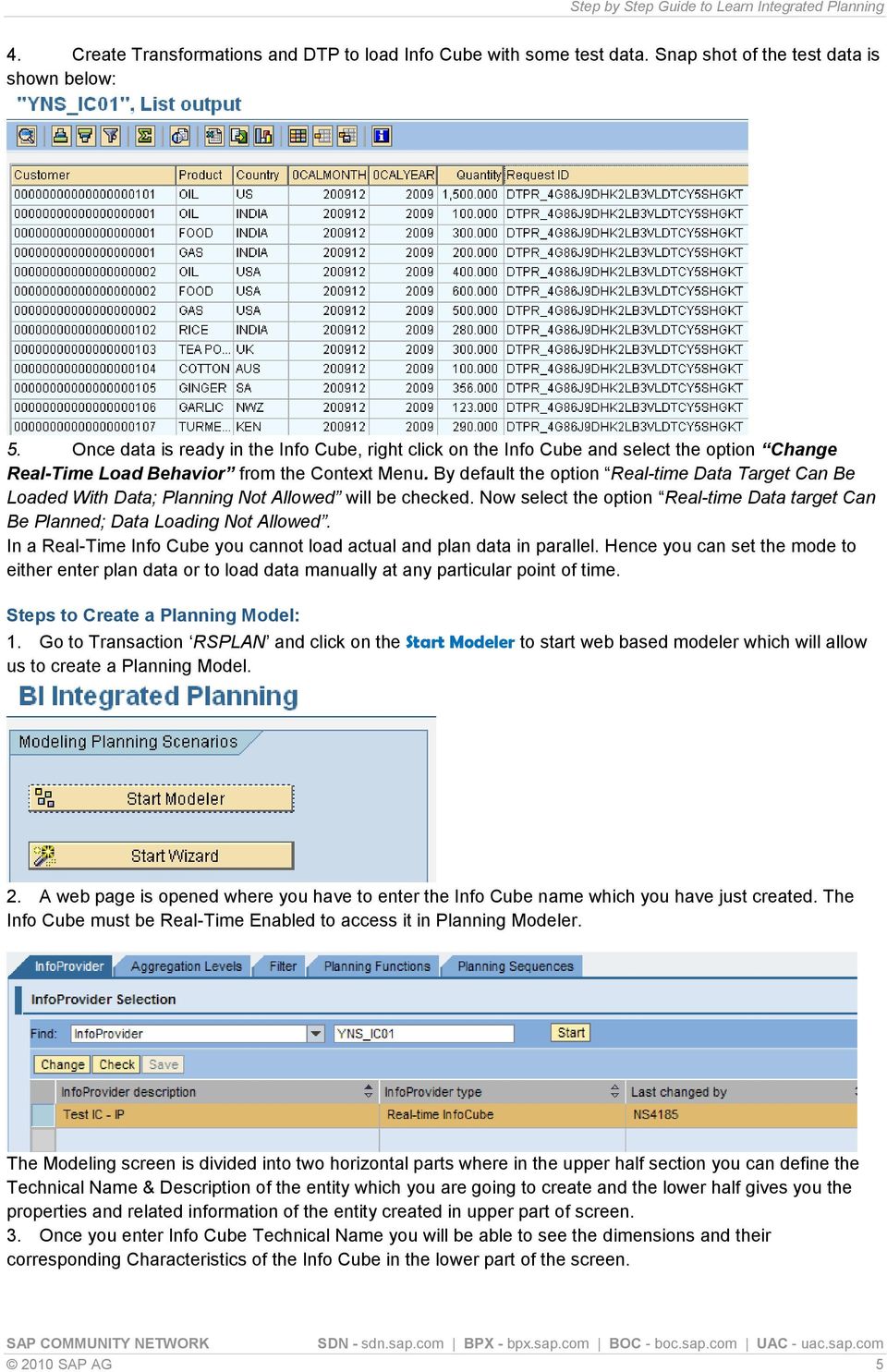

6 4. There are options to create Characteristic relationships on the data in Info Cube. Here you define Valid / Invalid combinations of data in the Info Cube. By doing this you can make sure invalid combinations of data is not loaded to Info Cube. 5. Data Slicing is used to lock a set of data against any changes during planning. 6. You also have an option to set the Key Date on which the planning has to be taken place. Here you have various options to set the Key date to some fixed date or through any variable value. Now you have defined the Info Provider on which your planning model will be based on. The second tab is Aggregation Levels. Aggregation Levels Tab Create an Aggregation Level by clicking on Create. 1. Enter a Technical Name & Description for the Aggregation level and click on Transfer Button. In the above figure Technical Name: YNS_PDT; Description: Product Aggregation Level 2. Select the characteristics on which want to plan data from the list of Characteristics seen in the lower part of screen. Note: All the characteristics checked here should be mandatorily used in the Planning Query which you will be creating later. In this example we have selected Calendar Year/Month Quantity 2010 SAP AG 6


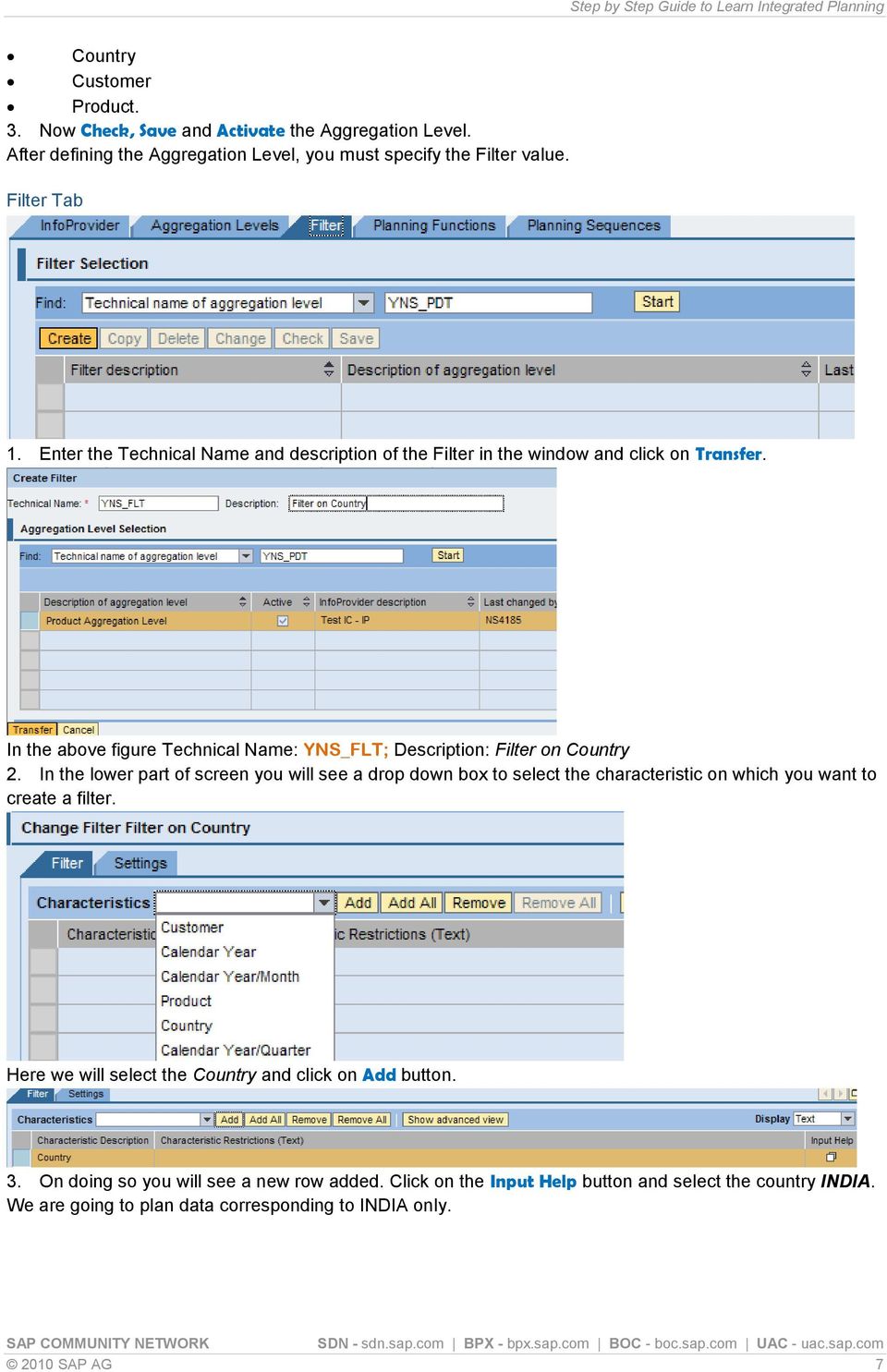
7 Country Customer Product. 3. Now Check, Save and Activate the Aggregation Level. After defining the Aggregation Level, you must specify the Filter value. Filter Tab 1. Enter the Technical Name and description of the Filter in the window and click on Transfer. In the above figure Technical Name: YNS_FLT; Description: Filter on Country 2. In the lower part of screen you will see a drop down box to select the characteristic on which you want to create a filter. Here we will select the Country and click on Add button. 3. On doing so you will see a new row added. Click on the Input Help button and select the country INDIA. We are going to plan data corresponding to INDIA only SAP AG 7
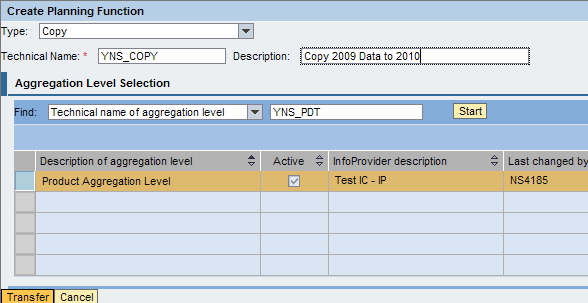
8 4. Now Check the filter and Save it by using the buttons present in the upper part of screen. Planning Functions Tab 1. Create the Planning Function by clicking on the Create button on this screen. Here we have to select the Type of planning Function by the selecting one of the options present in the drop down menu present at the top of the pop up window. In the above figure Technical Name: YNS_COPY, Description: Copy 2009 Data to Here you need to select the characteristics which are to be changed on execution of planning function SAP AG 8


9 We will select Calendar Year/Month, Calendar Year/Quarter & Calendar Year in the above screen because we will modify CALMONTH 12/2009 to 01/ Now click on the To Parameters button to navigate to another window where you have to select the list of impacted Key Figures. Since there is only one key figure in our aggregation level, we select only that Key figure i.e. Quantity. 4. Now we need to specify the From and To values for the Planning Function. Click on the Create Row. This will add a new row in the table below. 5. Click on the From Change Button to specify the source value which is to be changed. You will be able to see a pop-up to specify these values on clicking the From Change which is showed below: Here we add 2009 as Calendar Year 2010 SAP AG 9


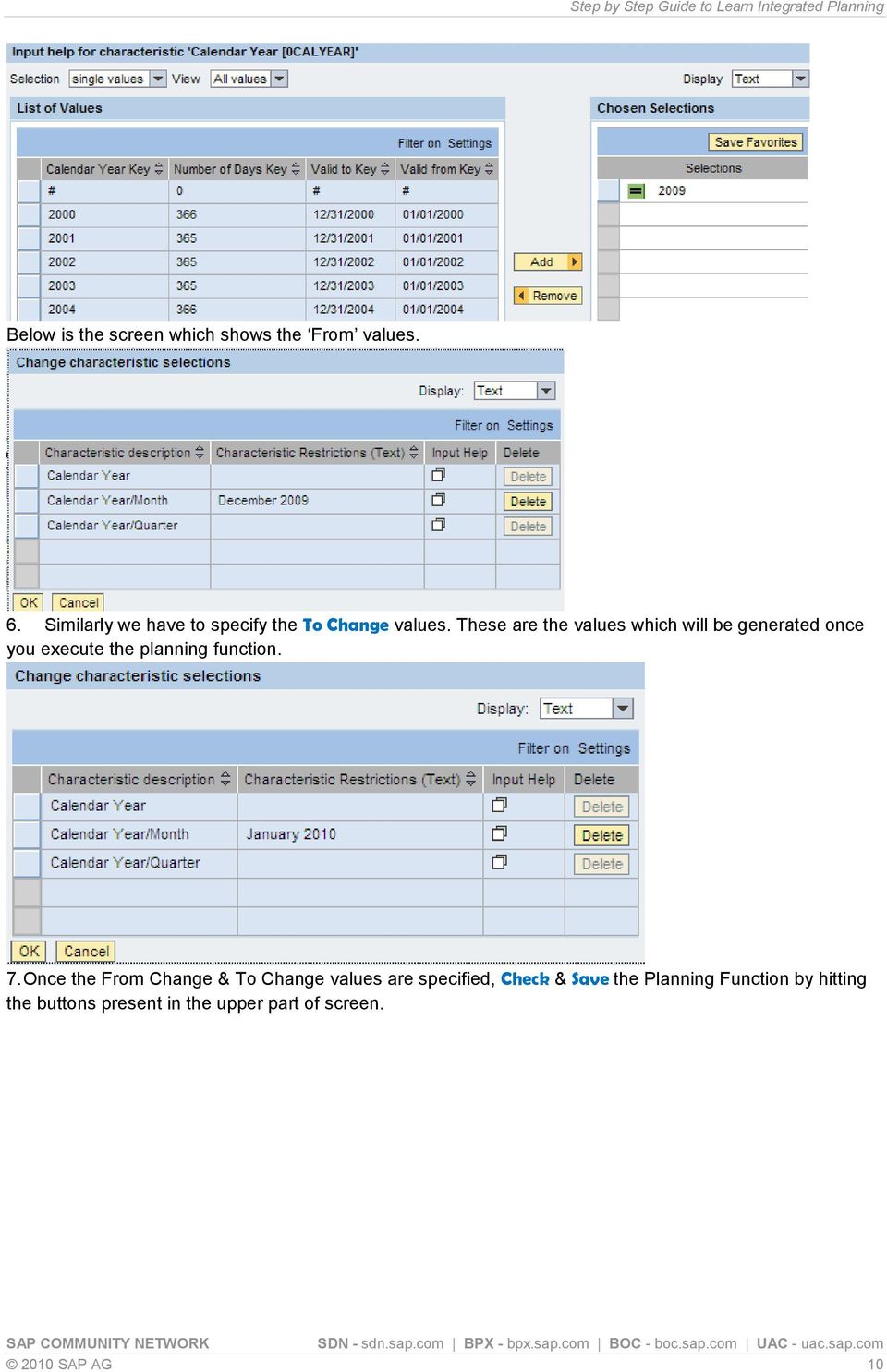
10 Below is the screen which shows the From values. 6. Similarly we have to specify the To Change values. These are the values which will be generated once you execute the planning function. 7. Once the From Change & To Change values are specified, Check & Save the Planning Function by hitting the buttons present in the upper part of screen SAP AG 10
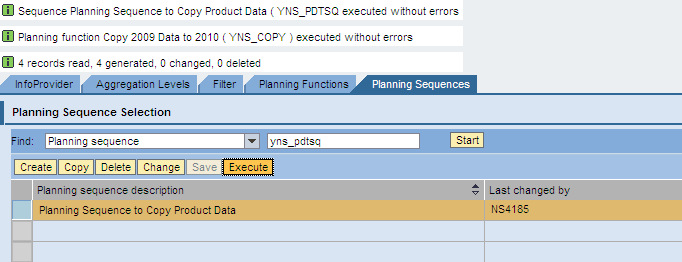
11 Planning Sequence Tab 1. Enter the Technical Name of the Planning Sequence and click on the Start Button. Here Technical Name: YNS_PDTSQ; Description: Planning Sequence to Copy Product Data 2. Now in the lower part of the screen you will have buttons to add steps to the planning sequence. Click on the Add Step for Planning Function. Here you have to select the Filter and Planning Function for your planning sequence. Once you select the Filter & Planning Function save the Planning Sequence by clicking on the Save button in the upper part of screen. You are now ready to execute the planning function and test its functionality. For Executing the planning Function you have an Execute Button in the upper part of screen. Once you notice that the records are generated in the messages above, you have to save the plan data by using the option Save Plan Data Button present in the lower part of screen SAP AG 11
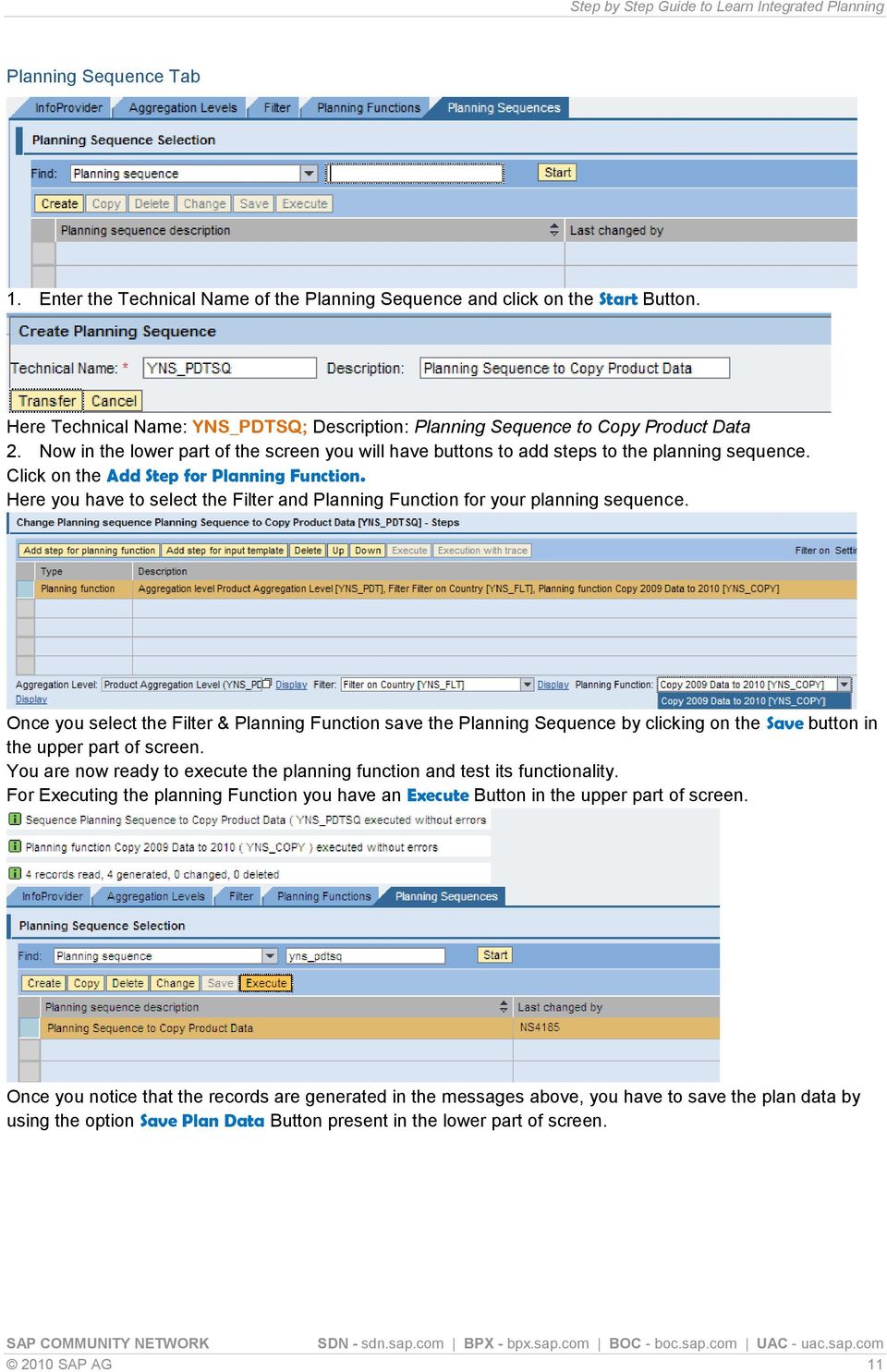
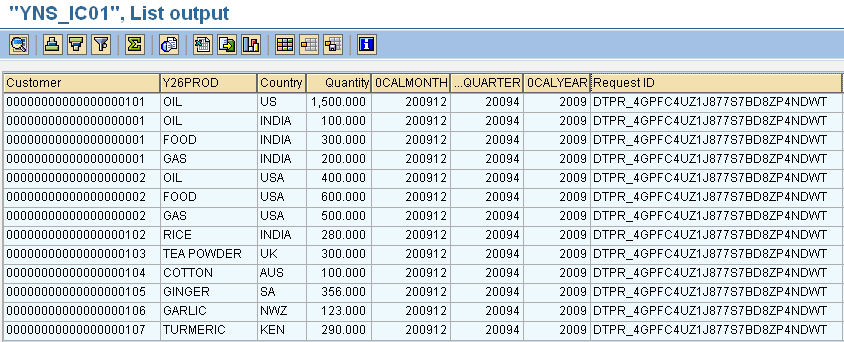
12 Once you click on Save Plan Data in the above screen then a request is created in the Manage Tab of your Info Cube. Now the data is now loaded to the Info Cube. You can now check the data of Info Cube to test the functionality of planning function. Below is the snapshot of data before executing the planning sequence. Snapshot of data after executing the planning sequence is shown below: 2010 SAP AG 12


13 Creating a Input Ready Query Create a query having Customer; Product & Country in rows, Calendar Month & Quantity are in columns. One point to mention is that the Key Figure to be changed must be checked for Input-Ready. Below is the screen shot highlighting the option: Also the query should be selected for the option to change it during navigation. There is option to select this under Query Properties SAP AG 13

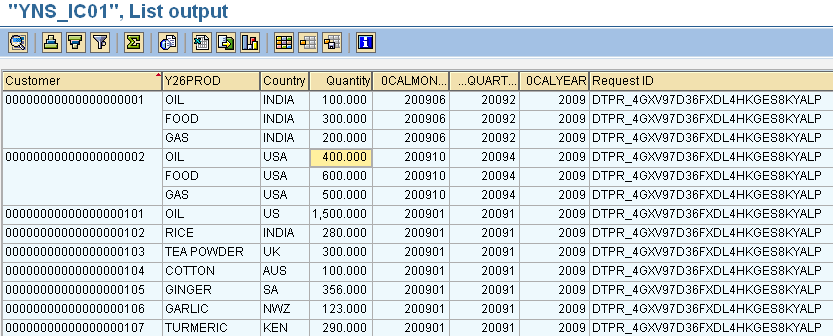
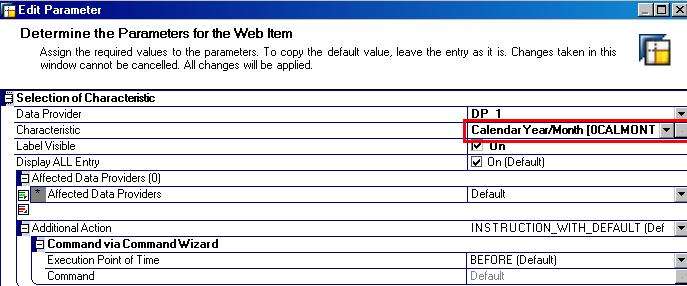
14 Creating a Web Template We will see how to create a web template to provide Drop down Option on the Calendar Month to customize data view, Multiple Buttons to perform various actions like Switch Display/Change Mode, Executing Planning Function, Save Back data to Info Provider. Drop Down Box Create a web template YNS_WT01 and add web item Drop down Box SAP AG 14
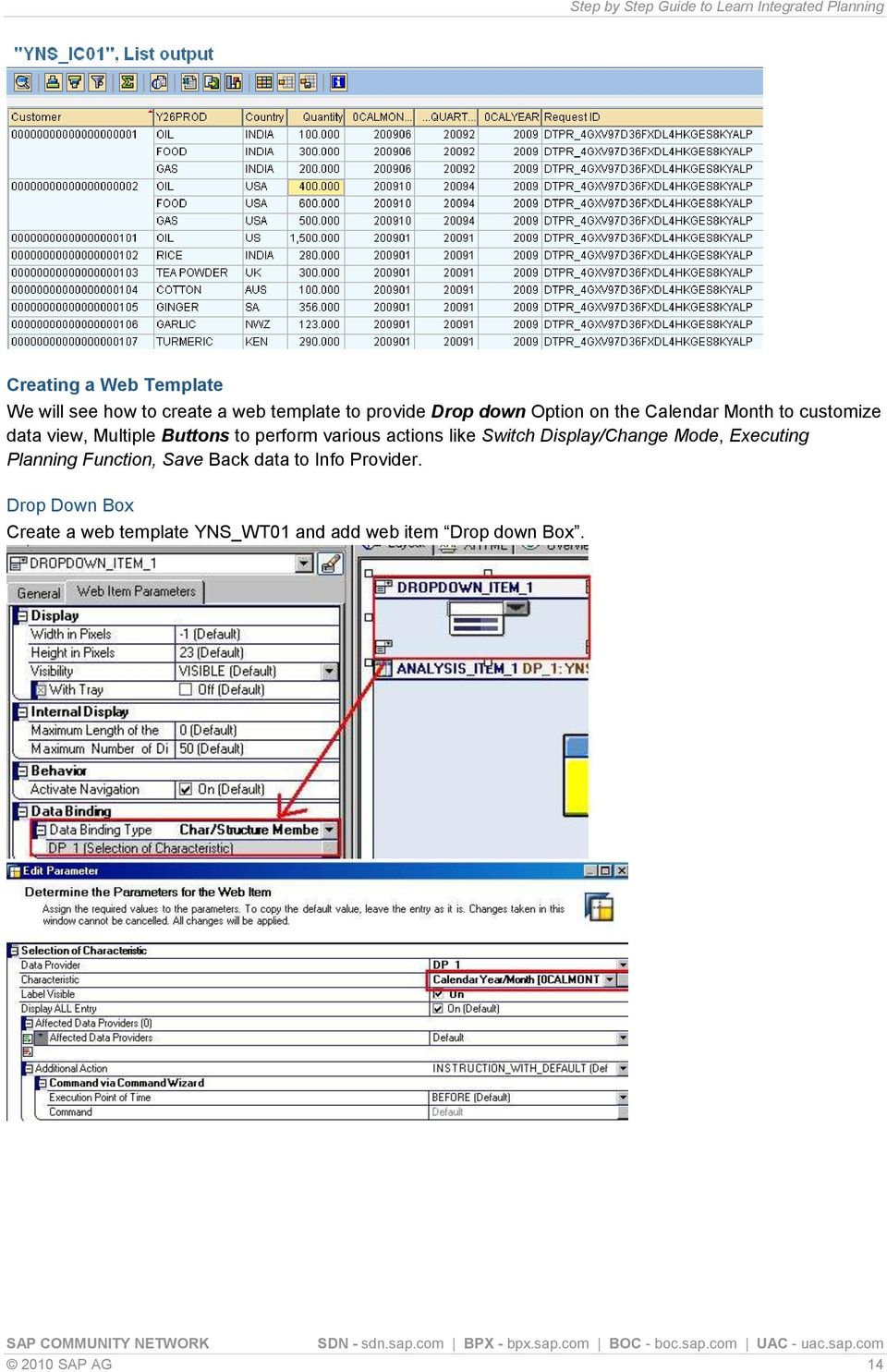
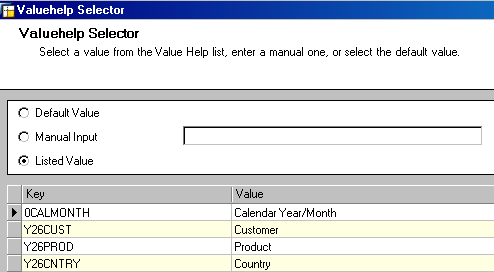

15 We can select a single month to view only single month s data SAP AG 15

16 Multiple Buttons Drag a Button Group into the right side pane of the Web Template YNS_WT01. Now click on the properties of this Web Item and create a button by clicking as shown in the below figure: Enter the required parameters in the screen displayed below. You need to enter a caption for the button. An action is given as Command via Command Wizard. Now click on the Command button, it will lead you to list of Commands. Here we select a Command to Execute a Planning Sequence. Below screen shot shows how to assign a command. Double click this Command; it will lead you to a screen where you can specify which Planning Sequence to be executed. This Planning Sequence which we created is to Copy Data of 01/2009 to 01/2010. On the output screen when you click this button, the planning sequence will be executed hence writing new data to the Info Cube. Note: Whenever the Planning Sequence/Planning function is executed the InfoProvider property should be set to the below shown option SAP AG 16
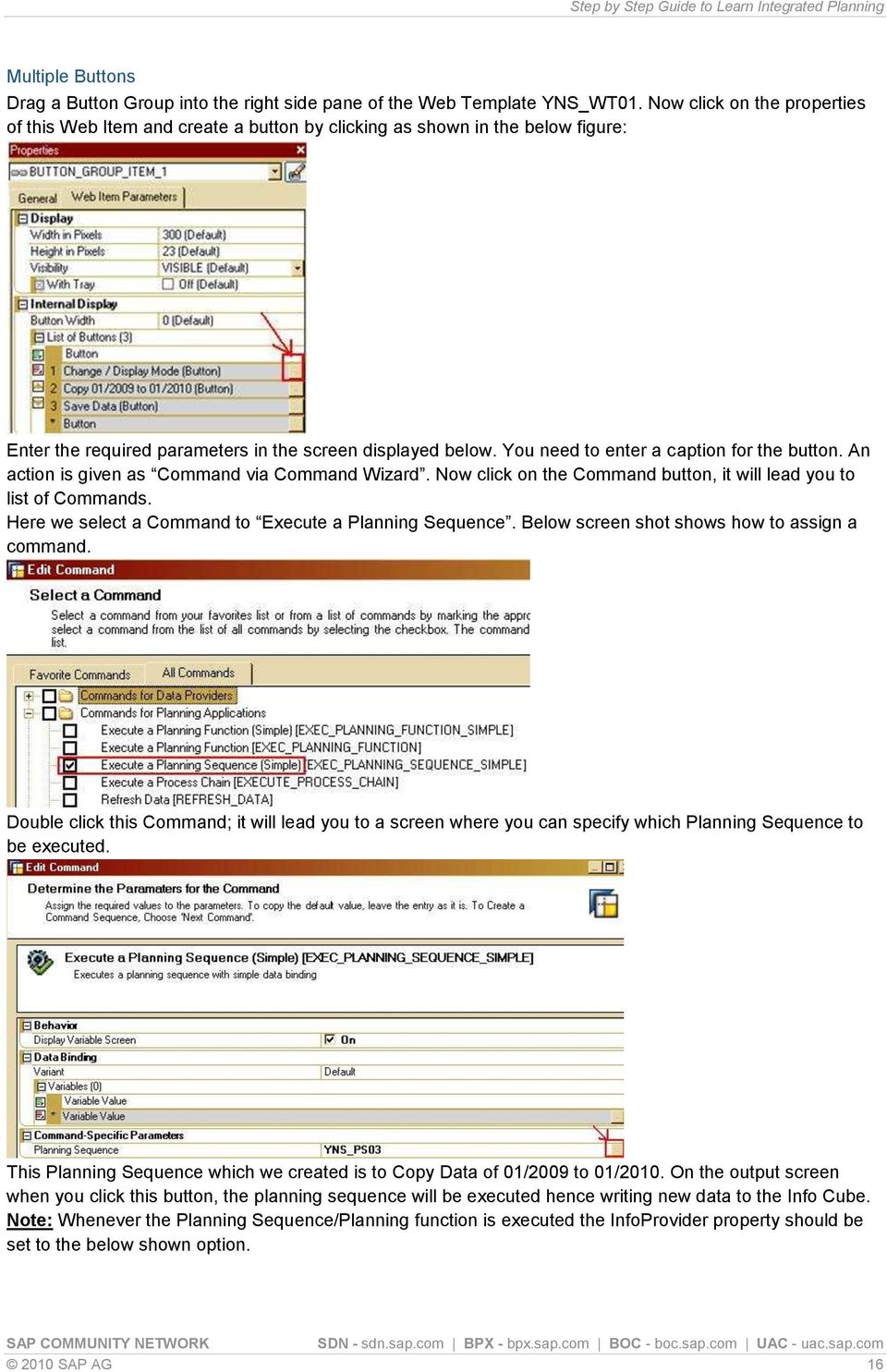

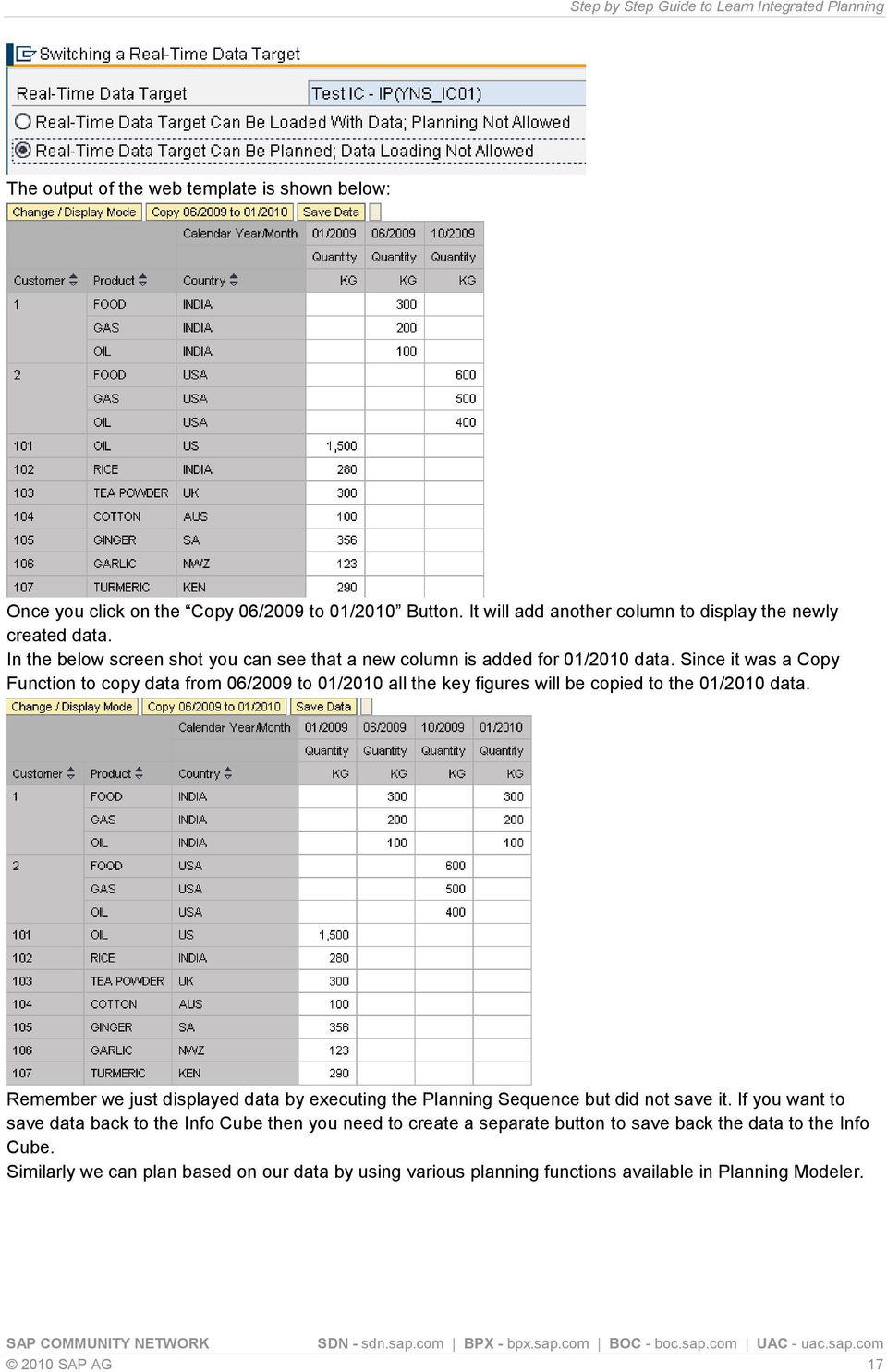
17 The output of the web template is shown below: Once you click on the Copy 06/2009 to 01/2010 Button. It will add another column to display the newly created data. In the below screen shot you can see that a new column is added for 01/2010 data. Since it was a Copy Function to copy data from 06/2009 to 01/2010 all the key figures will be copied to the 01/2010 data. Remember we just displayed data by executing the Planning Sequence but did not save it. If you want to save data back to the Info Cube then you need to create a separate button to save back the data to the Info Cube. Similarly we can plan based on our data by using various planning functions available in Planning Modeler SAP AG 17
18 Related Contents Integrated Planning Planning Functions For more information, visit the Business Intelligence homepage SAP AG 18

19 Disclaimer and Liability Notice This document may discuss sample coding or other information that does not include SAP official interfaces and therefore is not supported by SAP. Changes made based on this information are not supported and can be overwritten during an upgrade. SAP will not be held liable for any damages caused by using or misusing the information, code or methods suggested in this document, and anyone using these methods does so at his/her own risk. SAP offers no guarantees and assumes no responsibility or liability of any type with respect to the content of this technical article or code sample, including any liability resulting from incompatibility between the content within this document and the materials and services offered by SAP. You agree that you will not hold, or seek to hold, SAP responsible or liable with respect to the content of this document SAP AG 19

Understanding BEx Query Designer: Part-2 Structures, Selections and Formulas
 Understanding BEx Query Designer: Part-2 Structures, Selections and Formulas Applies to: SAP NetWeaver BW. Summary This document is the second installment of a 6 part Query Designer Training guide for
Compounding in Infoobject and Analyzing the Infoobject in a Query
 Compounding in Infoobject and Analyzing the Infoobject in a Query Applies to: SAP BI 7.0. For more information, visit the EDW homepage Summary This article demonstrates step by step process of creating
Multi Provider Creation Based on Sales and Planning Info Cubes
 Multi Provider Creation Based on Sales and Planning Info Cubes Applies to: SAP BI 2004s or SAP BI 7.x. For more information, visit the Business Intelligence homepage. Summary In This article, I am going
SAP BW 7.3: Exploring Semantic Partitioning
 SAP BW 7.3: Exploring Semantic Partitioning Applies to: SAP BW 3.x & SAP BI Net Weaver 2004s. For more information, visit the EDW homepage. Summary A semantically partitioned object is an InfoProvider
Data Extraction and Retraction in BPC-BI
 Data Extraction and Retraction in BPC-BI Applies to: Document is applicable to all the BPC 7.0 NW version users and the users BI 7.0 integration with BPC. For more information, visit the Enterprise Performance
Deploying Crystal Reports on Top of a SAP BI Query
 Deploying Crystal Reports on Top of a SAP BI Query Applies to: SAP BI NetWeaver 2004s, Crystal Reports 2008. For more information, visit the Business Intelligence homepage. Summary The objective of the
Working with SAP BI 7.0 Data Transfer Process (DTP)
 Working with SAP BI 7.0 Data Transfer Process (DTP) Applies to: SAP BI 7.0. For more information, visit the EDW homepage Summary The objective of this document is to know the various available DTP options
Step by Step Guide for Language Translation Tool
 Step by Step Guide for Language Translation Tool Applies to: SAP ECC 6.0 Summary This document helps people to understand the steps involved in translation of standard SAP screen and also helps to change
Configuration and Utilization of the OLAP Cache to Improve the Query Response Time
 Configuration and Utilization of the OLAP Cache to Improve the Query Response Time Applies to: SAP NetWeaver BW 7.0 Summary This paper outlines the steps to improve the Query response time by using the
Understanding DSO (DataStore Object) Part 1: Standard DSO
 Understanding DSO (DataStore Object) Part 1: Standard DSO Applies to: SAP NetWeaver BW. Summary This is the first of a three part series of documents containing each and every detail about DSOs and their
SAP BW - Excel Pivot Chart and Pivot Table report (Excel)
 SAP BW - Excel Pivot Chart and Pivot Table report (Excel) Applies to: SAP BI Consultants. For more information, visit the EDW HomePage. Summary Document explains to create Excel Pivot Chart and Pivot Table
Query OLAP Cache Optimization in SAP BW
 Query OLAP Cache Optimization in SAP BW Applies to: SAP NetWeaver 2004s BW 7.0 Summary This article explains how to improve performance of long running queries using OLAP Cache. Author: Sheetal Maharshi
Step by Step Guide How to Copy Flat File from Other Application Server to BI and Load through Info Package
 Step by Step Guide How to Copy Flat File from Other Application Server to BI and Load through Info Package Applies to: SAP BW 7.x. For more information, visit the EDW Homepage. Summary The objective of
Step by Step Procedure to Create Broadcasters, to Schedule and to Enhance of SAP- BI Queries from Query Designer
 Step by Step Procedure to Create Broadcasters, to Schedule and to Enhance of SAP- BI Queries from Query Designer Applies to: SAP Business Intelligence 7.0. For more information, visit the EDW homepage.
Step by Step guide of Report-to- Report Interface in BW Reporting
 Step by Step guide of Report-to- Report Interface in BW Reporting Applies to: SAP BI 7.0. For more information, visit the Business Intelligence Home Page Summary This paper gives a detail understanding
Step by Step Procedures to Load Master Data (Attribute and Text) from FlatFile in BI 7.0
 Step by Step Procedures to Load Master Data (Attribute and Text) from FlatFile in BI 7.0 Applies to: SAP Business Intelligence (BI 7.0). For more information, visit the EDW homepage Summary This article
Quick Viewer: SAP Report Generating Tool
 Quick Viewer: SAP Report Generating Tool Applies to: SAP Net Weaver 7.0, ABAP, SAP ECC 6.0, to all those who wants to learn about SAP Report Generating Tool: Quick Viewer. For more information, please
Web Dynpro: Multiple ALV Grids and Layouts in ALV
 Web Dynpro: Multiple ALV Grids and Layouts in ALV Applies to: SAP ECC 6.0. For more information, visit the Web Dynpro ABAP homepage. Summary The article is designed in such a way that person with ABAP
Deleting the User Personalization done on Enterprise Portal
 Deleting the User Personalization done on Enterprise Portal Applies to: SRM 7.0 with EP 6.0. For more information, visit the Supplier Relationship Management homepage Summary This document explains the
SAP FI - Automatic Payment Program (Configuration and Run)
 SAP FI - Automatic Payment Program (Configuration and Run) Applies to: SAP ECC 6.0. For more information, visit the Financial Excellence homepage. Summary This document helps you to configure and run Automatic
Display Options in Transaction SE16
 Display Options in Transaction SE16 Applies to: SAP-HCM. For more information, visit the Enterprise Resource Planning homepage. Summary This document deals with the various data display options available
Understanding OLAP Processor and RSRT
 Understanding OLAP Processor and RSRT Applies to: SAP R/3, SAP ECC 6.0 and SAP BI NetWeaver 2004s. For more information, visit the EDW homepage. Summary This article gives the idea about Architecture of
Extractor in R/3 and Delta Queue
 Applies to: SAP BW (3.5) / SAP BI(7.0). For more information, visit the Business Intelligence homepage. Summary This article contains all the information required in order to create data sources in R/3
Deleting the Requests from the PSA and Change Log Tables in Business Intelligence
 Deleting the Requests from the PSA and Change Log Tables in Business Intelligence Applies to: SAP BI 7.0. For more information, visit the Business Intelligence homepage Summary This paper discusses how
Creating New Unit of Measure in SAP BW
 Creating New Unit of Measure in SAP BW Applies to: Software Component: SAP_BW. For more information, visit the Business Intelligence homepage. Release: 700 Summary This article is intended to serve as
Web Dynpro ABAP: ALV and Table in Popup Window
 Web Dynpro ABAP: ALV and Table in Popup Window Applies to: SAP ECC 6.0 Summary Normally in ABAP, we come across the scenario of displaying ALV in popup. This article tells about displaying data both in
Restricting Search Operators in any Search View
 Restricting Search Operators in any Search View Applies to SAP CRM 2007 and SAP CRM 7.0. For more information, visit the Customer Relationship Management homepage. Summary The purpose of this article is
Web Application Designer for Beginners
 Applies To: Web Application Designer, SAP BW Version: 3.5, SAP GUI version 6.40/Patch Level 13 BW 3.5 front end patch 7 (bw350_7-10001615) Summary The document will run the readers through a step by step
Reverse Transport Mechanism in SAP BI
 Reverse Transport Mechanism in SAP BI Applies to: SAP Net Weaver 2004s BI 7.0 Ehp1 SP 08. For more information, visit the EDW homepage Summary This document helps you to understand the detailed step by
BW Performance Monitoring
 Applies to: SAP BW 7.0. For more information, visit the EDW homepage. Summary This article helps to achieve BW statistics of the system which will help a user to calculate the performance for a particular
Currency Conversion using Variables in SAP BI -Reporting
 Currency Conversion using Variables in SAP BI -Reporting Applies to: SAP BI 7.0. For more information, visit the Business Intelligence homepage. Summary This Article gives you a brief idea on how to do
Exploring SAP NetWeaver BW on SAP HANA in combination with SAP BusinessObjects BI 4.x
 Exploring SAP NetWeaver BW on SAP HANA in combination with SAP BusinessObjects BI 4.x Content`s Disclaimer... 4 1 Introduction... 5 2 Logon Details... 6 3 Connecting to your environment... 7 3.1 Remote
Table of Content. SAP Query creation and transport Procedure in ECC6
 SAP Query creation and transport Procedure in ECC6 Applies to: ECC6, For more information, visit the Enterprise Resource Planning homepage. Summary This article guides the how to technique for creating
Different Types of Alerts for Process Chains. Table of Content
 Different Types of Alerts for Process Chains Applies to: This article applies to BW 3.x and SAP Business Intelligence (BI 7.0) with highest support package. For more information, visit the EDW homepage.
ABAP Debugging Tips and Tricks
 Applies to: This article applies to all SAP ABAP based products; however the examples and screen shots are derived from ECC 6.0 system. For more information, visit the ABAP homepage. Summary This article
SAP CRM System 6.0/7.0. For more information, visit the Customer Relationship Management homepage
 Applies to: SAP CRM System 6.0/7.0. For more information, visit the Customer Relationship Management homepage Summary This article explains how to customize the Fact Sheet for different business roles.
Converting and Exporting Data in XML Format
 Converting and Exporting Data in XML Format Applies to: SAP BW 3.5, SAP BI 7.0 etc. For more information, visit the EDW homepage. Summary This paper briefs about Information broadcasting that allows you
Creating Transaction and Screen Variants
 Creating Transaction and Screen Variants Applies to: Tested on SAP version ECC 6. Summary This article explain a way to create Transaction and Screen Variants to change screen layouts. And how to assign
ALE Settings, for Communication between a BW System and an SAP System
 ALE Settings, for Communication between a BW System and an SAP System Applies to: SAP ECC 6.0. For more details, visit the EDW homepage. Summary This document helps people to create ALE settings, which
How to Create an ecatt?
 How to Create an ecatt? Applies to: SAP ECC 5.0 and above Summary This is a step by step guide to create a CATT script in SAP ECC version 5 and upwards. It can be used by beginners to create a basic CATT
Understanding BW Non Cumulative Concept as Applicable in Inventory Management Data Model
 Understanding BW Non Cumulative Concept as Applicable in Inventory Management Data Model Applies to: SAP R/3, SAP ECC 6.0 and SAP BI NetWeaver 2004s. For more information, visit the Business Intelligence
Exposing RFC as Web Service and Consuming Web Service in Interactive Forms in ABAP
 Exposing RFC as Web Service and Consuming Web Service in Interactive Forms in ABAP Applies to: SAP Interactive Forms by Adobe and Web Service in ABAP. For more information, visit SAP Interactive forms
Step By Step Procedure to Create Logical File Path and Logical File Name
 Step By Step Procedure to Create Logical File Path and Logical File Name Applies to: SAP BW (3.5) / SAP BI(7.0) For more information, visit Business Intelligence Homepage. Summary These documents describe
How to Modify, Create and Delete Table Entries from SE16
 How to Modify, Create and Delete Table Entries from SE16 Applies to This article applies to all SAP ABAP based products; however the examples and screen shots are derived from ECC 6.0 system. For more
How to Assign Transport Request for Language Translation?
 How to Assign Transport Request for Language Translation? Applies to: SAP ECC 6.0. For more information, visit the ABAP homepage. Summary This document helps people to create a transport request for the
Creating and Scheduling Publications for Dynamic Recipients on SAP Business Objects Enterprise
 Creating and Scheduling Publications for Dynamic Recipients on SAP Business Objects Enterprise Applies to: SAP BusinessObjects Enterprise. For more information, visit the Business Objects homepage. Summary
SAP CRM 2007 - Campaign Automation
 SAP CRM 2007 - Campaign Automation Applies to: SAP CRM 7.0 For more information, visit the Customer Relationship Management homepage Summary Campaign Automation is designed to help you in the increasingly
Step by Step Procedure to Block and Debug a CIF Queue Flowing from R/3 to APO System
 Step by Step Procedure to Block and Debug a CIF Queue Flowing from R/3 to APO System Applies to: SAP R/3 and SAP APO. For more information, visit the ABAP homepage. Summary This article gives a detailed
SAP CRM Middleware Configurations
 SAP CRM Middleware Configurations Applies to: SAP CRM Middleware Configurations. For more information, visit the Customer Relationship Management homepage. Summary This whitepaper elaborates the steps
How to Load Data from Flat Files into BW PSA
 How to Load Data from Flat Files into BW PSA Applies to: SAP BI/BW 7.0 and above. Summary The document is aimed at all those who are at beginner level in BW. It details out step by step processes that
Creating Web Service from Function Modules/BAPIs & Integrating with SAP Interactive Forms
 Creating Web Service from Function Modules/BAPIs & Integrating with SAP Interactive Forms Applies to: ECC 6.0, SAP Interactive forms by Adobe. Summary This document states how to create Web Service from
Creation and Configuration of Business Partners in SAP CRM
 Creation and Configuration of Business Partners in SAP CRM Applies to: SAP CRM 2005 (5.0) and above release. For more information, visit the Customer Relationship Management homepage. Summary This document
Introduction to COPA and COPA Realignment
 Introduction to COPA and COPA Realignment Applies to: SAP BI Consultants & Developers working on COPA Data Model. For more information, visit the EDW homepage Summary This document gives a brief introduction
Check out our website!
 Check out our website! www.nvcc.edu/woodbr idge/computer-lab Contact Us Location: Open Computer Lab Seefeldt Building #336 NOVA Woodbridge Campus Hussna Azamy (OCL Supervisor) Phone: 703-878-5714 E-mail:
A Step-by-Step guide on SMTP Configuration and File to Mail Scenario Using Process Integration Scenario in PI 7.1
 A Step-by-Step guide on SMTP Configuration and File to Mail Scenario Using Process Integration Scenario in PI 7.1 Applies to: SAP NetWeaver Process Integration 7.1 For more information, visit the SOA Management
Dynamic Authorization Concept and Role Assignment in BI
 Dynamic Authorization Concept and Role Assignment in BI Applies to: This applies to SAP BI 3.X or SAP BI 7.X. For more details, visit the Business Intelligence homepage. Summary The document describes
Create Automatic Mail Notification/ Email Alert for Process Chain Monitoring
 Create Automatic Mail Notification/ Email Alert for Process Chain Monitoring Applies to: SAP BW 3.X, Business Intelligence 7.0. For more information, visit the EDW homepage. Summary This document will
Organizational Management- Organizational Structure Creation
 Organizational Management- Organizational Structure Creation Applies to: SAP ECC6.0 (Release 700, SP 12). For more information, visit the Enterprise Resource Planning homepage. Summary HR applications
Order Split Usage in Production Orders
 Order Split Usage in Production Orders Applies to: SAP Shop Floor Control (Production Orders) R/3 and ECC 6.0. For more information, visit the Enterprise Resource Planning homepage. Summary: This is an
Workflow Troubleshooting and Monitoring in SAP ECC 6.0
 Workflow Troubleshooting and Monitoring in SAP ECC 6.0 Applies to: ECC 6.0, Workflow Troubleshooting & Monitoring Summary A major advantage of workflow is the ability to monitor the workflow steps according
Embedding Crystal Reports inside ECC ALV Reports
 Embedding Crystal Reports inside ECC ALV Reports Applies to: Applies to ECC Enhancement Package 5 Summary These steps describe how to configure and set up embedded Crystal Reports inside the ECC system
SAP BUSINESS OBJECT ANALYSIS FOR EXCEL DEVELOPER GUIDE
 STEP 1: Log on to Business Object Analysis for Excel. Path: Start All Programs SAP Business Intelligence Analysis for Microsoft Excel Click Microsoft Excel will appear Figure 1 STEP 2: Choose Microsoft
Customer Exit Variables in SAP BW/BI Reports First day of the Current/Previous Month
 Customer Exit Variables in SAP BW/BI Reports First day of the Current/Previous Month Applies to: SAP BW 7.0 and will also work on BW 3.5. For more information, visit the EDW homepage. Summary This article
Connecting to SAP BW with Microsoft Excel PivotTables and ODBO
 Connecting to SAP BW with Microsoft Excel PivotTables and ODBO Applies To: ODBO, Microsoft Excel, Microsoft Excel 2007, PivotTables for connecting to SAP BW. Summary Microsoft Excel is considered by many
Configuration of Enterprise Services using SICF and SOA Manager
 Configuration of Enterprise Services using SICF and SOA Manager Applies to: SAP NetWeaver 7.0 SP14 and above. For more information, visit the SOA Management homepage. Summary This document will provide
Scenario... 3 Step-by-Step Solution... 3. Virtual Infocube... 4 Function Module (Virtual InfoCube)... 5 Infocube Data Display... 7
 SAP BI - Virtual Infocube based on Function Module (Transport History) Applies to: SAP BW 3.5 / BI 7.0 consultants accustomed with SAP ABAP skills. For more information, visit EDW Homepage. Summary Explains
Welcome to the topic on Master Data and Documents.
 Welcome to the topic on Master Data and Documents. In this topic, we will look at master data in SAP Business One. After this session you will be able to view a customer record to explain the concept of
LSMW: Upload Master Data using Batch Input Recording
 LSMW: Upload Master Data using Batch Input Recording Applies to: All modules of SAP where upload of data need to be performed using Batch Input Recording. For more information, visit the Master Data Management
Data Flow from LBWQ/SMQ1 to RSA7 in ECC and Delta Extraction in BI
 Data Flow from LBWQ/SMQ1 to RSA7 in ECC and Delta Extraction in BI Applies to: SAP NetWeaver Business Warehouse (Formerly BI), Will also work on SAP BI 3.5. Business Intelligence homepage. Summary This
Reporting and Analysis with SAP BusinessObjects
 Ingo Hilgefort Reporting and Analysis with SAP BusinessObjects Bonn Boston Contents at a Glance 1 Introduction to the SAP BusinessObjects Reporting and Analysis Tools... 19 2 Customer Requirements and
Inventory Management in SAP BW
 Applies to: SAP BW 3.X and BI NetWeaver 2004s. For more information, visit the EDW homepage. Summary This document aims to explain the concept of Inventory management using non cumulative key figures in
ABAP How To on SQL Trace Analysis
 Applies To: ABAP Summary SQL trace is a performance analysis tool that shows how open SQL statements are converted into native SQL statements. The following document discusses the performance measure utility
How to Integrate CRM 2007 WebClient UI with SAP NetWeaver Portal
 How to Integrate CRM 2007 WebClient UI with SAP NetWeaver Portal Applies to: Enterprise Portal, CRM 2007. For more information, visit the Portal and Collaboration homepage. Summary This document will describe
APD to Update Marketing Attributes from SAP BI to SAP CRM
 APD to Update Marketing Attributes from SAP BI to SAP CRM Applies to: SAP NetWeaver BI 7.0 and SAP CRM 5.0(and above). For more information, visit the EDW homepage. Summary This article gives a clear picture
BEx Ad Hoc Query Fundamentals Part III
 SAP Business Warehouse/Business Intelligence Reporting BEx Ad Hoc Query Fundamentals Part III Washington State HRMS Business Warehouse/Business Intelligence (BW/BI) BW/BI Power User Workshop Materials
Release Document Version: 1.4-2013-05-30. User Guide: SAP BusinessObjects Analysis, edition for Microsoft Office
 Release Document Version: 1.4-2013-05-30 User Guide: SAP BusinessObjects Analysis, edition for Microsoft Office Table of Contents 1 About this guide....6 1.1 Who should read this guide?....6 1.2 User profiles....6
Table of Contents. Passing Data across Components through Component Controller between Two Value Nodes
 Passing Data across Components through Component Controller between Two Value Nodes Applies to: SAP CRM WEBCLIENT UI 2007. For more information, visit the Customer Relationship Management homepage Summary
Realize an ABC Analysis
 How to Realize an ABC Analysis BUSINESS INFORMATION WAREHOUSE ASAP How to Paper Applicable Releases: BW 2.0B, 2.1C, 3.0A October 20 2001 SAP (SAP America, Inc. and SAP AG) assumes no responsibility for
SAP BW Configuration Basic System Settings
 SAP BW Configuration Basic System Settings Applies to: SAP BI 7.0. For more information, visit the EDW homepage Summary This document is intended to show the basic configuration settings that should be
Business Explorer (BEx)
 SAP Business Warehouse/Business Intelligence Reporting Business Explorer (BEx) Washington State HRMS Business Warehouse/Business Intelligence (BW/BI) BW/BI Power User Workshop Materials General Topics
Standard SAP Configuration of SMS through HTTP with Third Party SMS Gateway
 Standard SAP Configuration of SMS through HTTP with Third Party SMS Gateway Applies to: SAP R/3 4.7 EE SR 200,ECC 5.0 For more information, visit the Web Services homepage. Summary There is an increasing
Creating Email Content Using SO10 Objects and Text Symbols
 Creating Email Content Using SO10 Objects and Text Symbols Applies to: SAP ECC 6.0. For more information, visit the ABAP homepage. Summary The article describes the benefits of SO10 objects in comparison
Offline Mode SAP Mobile BI 4.1. Author : Priya Sridhar
 Offline Mode SAP Mobile BI 4.1 Author : Priya Sridhar OCTOBER 15 2013 TABLE OF CONTENTS Contents INTRODUCTION... 2 AUTHOR BIO... 2 Chapter 1: Dashboards... 3 Chapter 2: Web Intelligence... 5 Chapter 3:
Step by Step Guide to Extract Batch Master Data via Generic and Classification Datasource to BW
 Step by Step Guide to Extract Batch Master Data via Generic and Classification Datasource to BW Applies to: SAP ECC 5.0 and above releases and BW 7.0 Summary This paper gives a detail understanding on
OLAP Cube Manual deployment and Error resolution with limited licenses and Config keys
 Documented by - Sreenath Reddy G OLAP Cube Manual deployment and Error resolution with limited licenses and Config keys Functionality in Microsoft Dynamics AX can be turned on or off depending on license
Access Tutorial 1 Creating a Database
 Access Tutorial 1 Creating a Database Microsoft Office 2013 Objectives Session 1.1 Learn basic database concepts and terms Start and exit Access Explore the Microsoft Access window and Backstage view Create
MICROSOFT ACCESS TABLES
 MICROSOFT ACCESS TABLES Create a New Table... 1 Design View... Datasheet View... 5 Table Tools in Datasheet View... 6 Sorting and Filtering Data... 8 Import and Export Data... 10 Relationships... 11 Relationship
Tutorial 3. Maintaining and Querying a Database
 Tutorial 3 Maintaining and Querying a Database Microsoft Access 2010 Objectives Find, modify, and delete records in a table Learn how to use the Query window in Design view Create, run, and save queries
Microsoft Office 2010
 Access Tutorial 3 Maintaining and Querying a Database Microsoft Office 2010 Objectives Find, modify, and delete records in a table Learn how to use the Query window in Design view Create, run, and save
Provisional Master Data in Integrated Business Planning for SAP Simple Finance An Example-Based How-To Guide
 Provisional Master Data in Integrated Business Planning for SAP Simple Finance An Example-Based How-To Guide Applies to: Integrated Business Planning in SAP Simple Finance Summary SAP customers who use
SAP CRM 7.0 for Newbies: (Part 1) Simple BOL Object Creation for CRM Webclient UI
 SAP CRM 7.0 for Newbies: (Part 1) Simple BOL Object Creation for CRM Webclient UI Applies to: This article applies to SAP Netweaver 7.0, CRM ABAP 7.0. For more information, visit the Customer Relationship
At the end of this lesson, you will be able to create a Request Set to run all of your monthly statements and detail reports at one time.
 Request Set Creation You can use a Request Set to run all of your monthly reports at one time, such as your Department Statements, Project Statements and RIT Account Analysis reports. A Request Set allows
Microsoft Access 2010 Overview of Basics
 Opening Screen Access 2010 launches with a window allowing you to: create a new database from a template; create a new template from scratch; or open an existing database. Open existing Templates Create
A Practical Guide to SAP" NetWeaver Business Warehouse (BW) 7.0
 Bharat Patel, Amol Palekar, Shreekant Shiralkar A Practical Guide to SAP" NetWeaver Business Warehouse (BW) 7.0 Galileo Press Bonn Boston Preface 17 An Introduction to Business Intelligence 21 1.1 ABCD
SAP CRM 7.0 E2C Setup: CRM via Email Toolset
 SAP CRM 7.0 E2C Setup: CRM via Email Toolset Applies to: SAP CRM 700/NW 701. For more information, visit the Customer Relationship Management homepage. Summary This article describes the Email2CRM functionality
How to Archive Data from SAP NetWeaver BW to SAP Sybase IQ as Near line Storage
 SAP How-to Guide Database & Technology SAP NetWeaver Business Warehouse SAP HANA Appliance How to Archive Data from SAP NetWeaver BW to SAP Sybase IQ as Near line Storage Applicable Releases: SAP NetWeaver
BW370 BI Integrated Planning
 BI Integrated Planning SAP NetWeaver Course Version: 98 Course Duration: 5 Day(s) Publication Date: 2015 Publication Time: Copyright Copyright SAP SE. All rights reserved. No part of this publication may
SAP BI Generic Extraction Using a Function Module
 SAP BI Generic Extraction Using a Function Module Applies to: SAP BI Summary This article demonstrates a step-by-step process for doing generic extraction from R3 into BI using a Function Module. Author(s):
SAP BusinessObjects Design Studio Overview. Jie Deng, Product Management Analysis Clients November 2012
 SAP BusinessObjects Design Studio Overview Jie Deng, Product Management Analysis Clients November 2012 Legal Disclaimer 2 SAP BusinessObjects Dashboarding Strategy Self Service Dashboarding Professional
Direct Subcontracting Process (SAP SD & MM)
 Direct Subcontracting Process (SAP SD & MM) Applies to: This article is applicable to SAP SD & MM modules of SAP for version SAP 4.7 till ERP 6.0 Summary This article describes a process called Direct