
ELECTRICAL SAFETY REGULATION 2002
|
|
|
- Shannon Ramsey
- 9 years ago
- Views:
Transcription
1 Queensland Electrical Safety Act 2002 ELECTRICAL SAFETY REGULATION 2002 Reprinted as in force on 1 October 2002 (regulation not amended up to this date) Reprint No. 1 This reprint is prepared by the Office of the Queensland Parliamentary Counsel Warning This reprint is not an authorised copy

2 Information about this reprint This regulation is reprinted as at 1 October Minor editorial changes allowed under the provisions of the Reprints Act 1992 mentioned in the following list have been made to reorder definitions consistent with current drafting practice (s 30) use aspects of format and printing style consistent with current drafting practice (s 35) omit provisions that are no longer required (s 40) make all necessary consequential amendments (s 7(1)(k)). See endnotes for information about when provisions commenced. Dates shown on reprints Reprints dated at last amendment All reprints produced on or after 1 July 2002, hard copy and electronic, are dated as at the last date of amendment. Previously reprints were dated as at the date of publication. If a hard copy reprint is dated earlier than an electronic version published before 1 July 2002, it means the legislation was not further amended and the reprint date is the commencement of the last amendment. If the date of a hard copy reprint is the same as the date shown for an electronic version previously published, it merely means that the electronic version was published before the hard copy version. Also, any revised edition of the previously published electronic version will have the same date as that version. Replacement reprint date If the date of a hard copy reprint is the same as the date shown on another hard copy reprint it means that one is the replacement of the other.
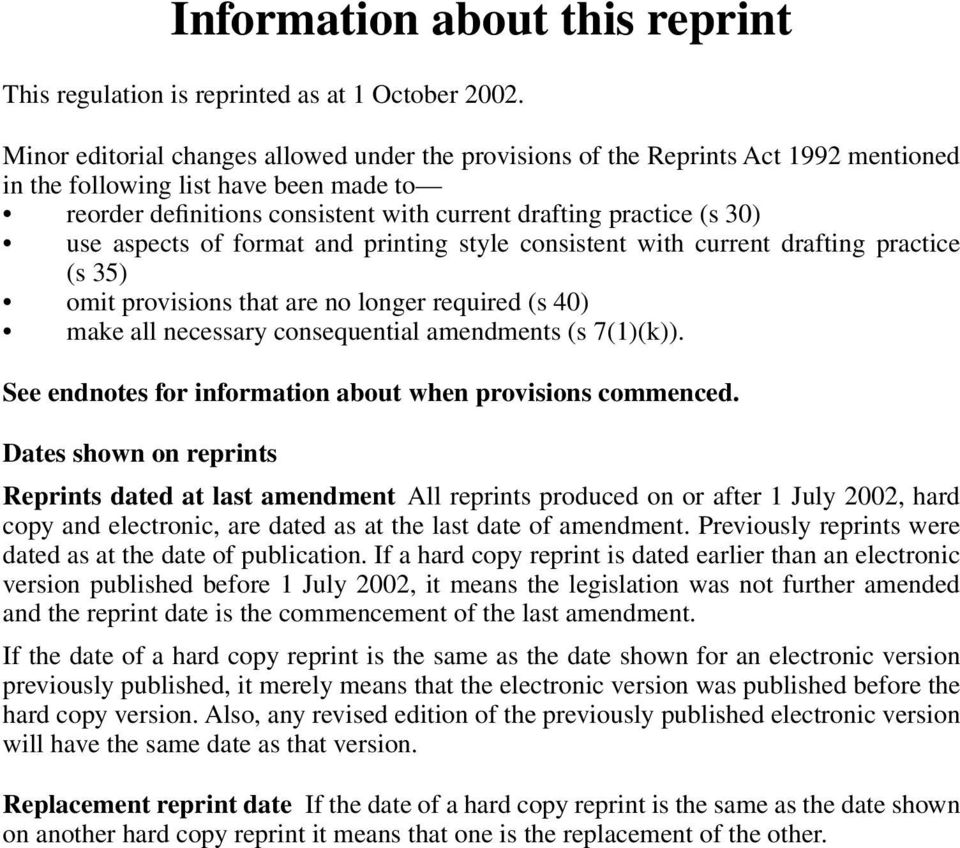
3 Queensland ELECTRICAL SAFETY REGULATION 2002 TABLE OF PROVISIONS Section Page PART 1 PRELIMINARY 1 Short title Commencement Purposes How purposes are to be achieved Definitions References to standards and other documents Meaning of qualified individual PART 2 ELECTRICAL WORK Division 1 Preliminary 8 Purpose of divs 2 to Division 2 Basic requirements for electrical work 9 Definition for div Application of div Requirements for electrical work Requirements for performance of live work Division 3 High voltage live line work 13 Performance of high voltage live line work Division 4 Testing of work 14 Testing of electrical work Certificate of testing and safety Division 5 Requirements applying to employers and self-employed persons 16 Application of div

4 2 17 Testing and maintenance of safety equipment Employer or self-employed person to ensure suitability of testing instruments Division 6 Other requirements 19 Electrical equipment with serious defect not to be connected to electricity source Signs on switches and disconnection points Rescue and resuscitation training Division 7 Documents about electrical work 22 Application of div Who may sign documents about electrical work Division 8 General provisions 24 Misrepresentations about electrical equipment or work PART 3 LICENSING Division 1 Electrical work licences 25 Classes of electrical work licences What electrical mechanic licence authorises What electrical linesperson licence authorises What electrical fitter licence authorises What electrical jointer licence authorises What restricted electrical work licence authorises What electrical work training permit authorises External licence equivalents Division 2 Electrical work licence requirements 33 General requirements Eligibility requirements for electrical mechanic licence Eligibility requirements for electrical linesperson licence Eligibility requirements for electrical fitter licence Eligibility requirements for electrical jointer licence Eligibility requirements for restricted electrical work licence Term of electrical work licence Division 3 Electrical contractor licence requirements 40 Eligibility requirements for electrical contractor licence for individual

5 3 41 Eligibility requirements for electrical contractor licence for partnership Eligibility requirements for electrical contractor licence for corporation Financial and insurance requirements for applicant for electrical contractor licence Change of name of corporation or partnership Change in membership of partnership Term of electrical contractor licence Division 4 Miscellaneous 47 Eligibility requirements for renewal or reinstatement of electrical licence Application requirements Giving chief executive cancelled or suspended licence or licence to be endorsed Replacement of electrical licence Surrender of electrical licence Register of electrical licences Examinations Examiners Refund and remission of fees Advertising by licensed electrical contractor Performing electrical work without electrical licence PART 4 WORKING AROUND ELECTRICAL PARTS Division 1 Preliminary 58 Purpose of pt Definitions for pt Meaning of direct contact Meaning of exclusion zone Division 2 Requirements for working around electrical parts 62 Employer or self-employed person to ensure work is performed in accordance with requirements Work involving direct contact with electrical part Work within exclusion zone for electrical part
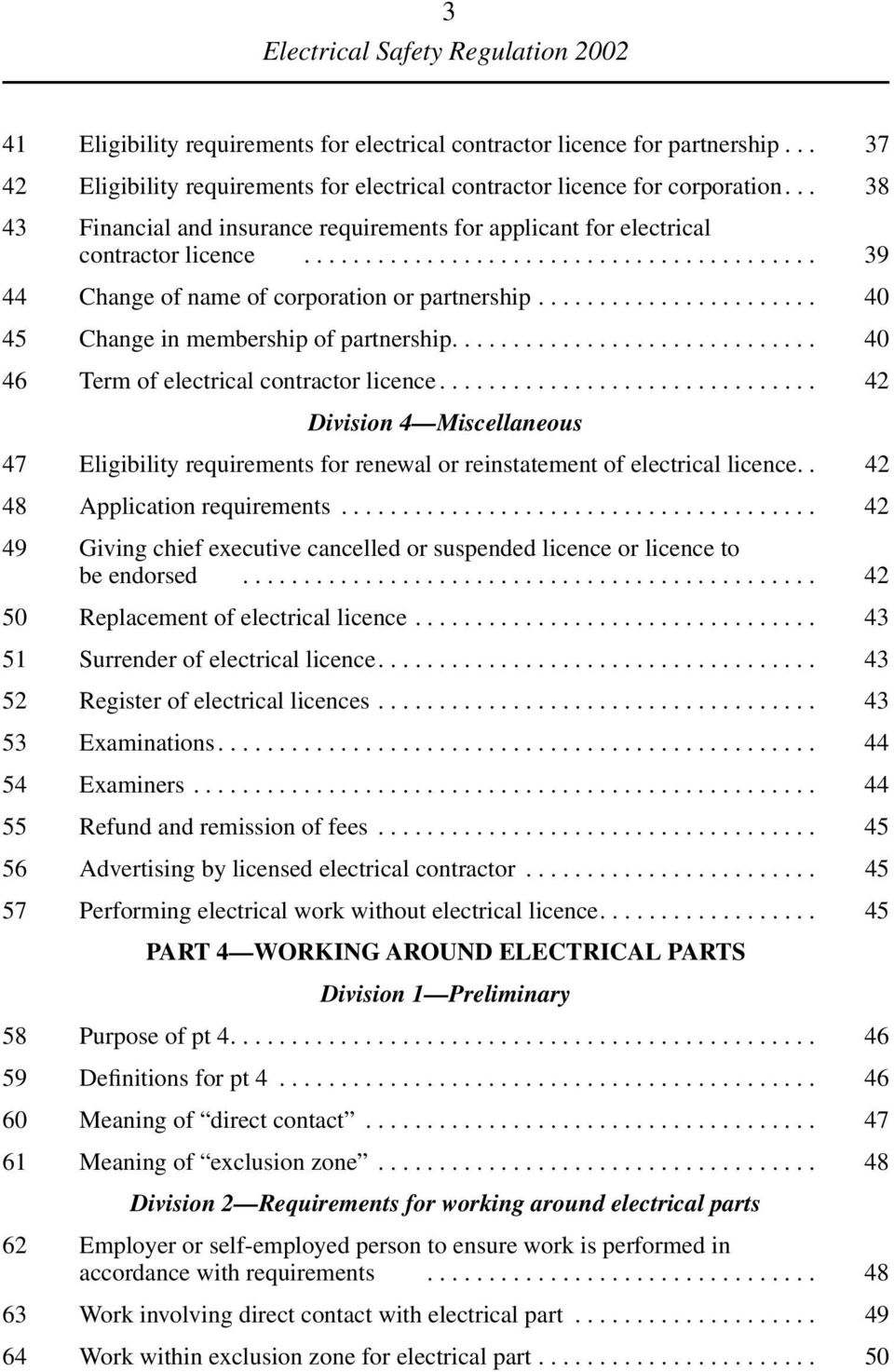
6 4 PART 5 ELECTRICAL INSTALLATIONS Division 1 Performing electrical work 65 Purpose of div Licensed electrical worker to comply with wiring rules Employer to ensure electrical work complies with wiring rules Work involving water equipment Work involving electric motor forming part of vehicle Division 2 Defects and earthing 70 Requirement on person in control to fix defect Earthing Division 3 Electric lines 72 Service line Structure supporting electric line or equipment to comply with wiring rules Obligation to preserve insulation of electric line Trimming of trees near overhead electric line Obligation to ensure safety of disconnected overhead electric line Division 4 Installation of approved safety switches in domestic residences 77 Definitions for div Notice to transferee about approved safety switch Notice to chief executive about approved safety switch and other matters Installation of approved safety switch in particular residences Performing electrical installation work for domestic residences Division 5 Workplace electrical installations Subdivision 1 Preliminary 82 Purpose of div Definitions for div Subdivision 2 All work 84 Application of sdiv Cord extension sets and flexible cables Subdivision 3 Class 1 work 86 Application of sdiv

7 5 87 Requirements for construction wiring and electrical equipment Subdivision 4 Class 2 work 88 Application of sdiv Double adaptors and piggyback plugs prohibited Specified electrical equipment Safety switches, including portable safety switches Subdivision 5 Class 3 or 4 work 92 Application of sdiv Specified electrical equipment Safety switches, including portable safety switches PART 6 ELECTRICAL EQUIPMENT Division 1 Preliminary 95 Definitions for pt Meanings of prescribed class and type Meaning of relevant standard Queensland approvals External approvals Division 2 Restriction on hire or sale of particular items of electrical equipment 100 Hire or sale of electrical equipment of prescribed class Division 3 Queensland approvals of types of electrical equipment of prescribed classes 101 Application for approval of type of electrical equipment Approval of type of electrical equipment Term of approval Register of approved types of electrical equipment Division 4 Changes to approvals 105 Changing name and address Application to change approval to include new type Changing approval of type of electrical equipment to include new type Division 5 Transfer and cancellation of approvals 108 Transfer of approval of type of electrical equipment Cancellation of approval of type of electrical equipment

8 6 110 Procedure before cancellation Type approval holder to return type approval certificate for cancelled approval Division 6 Marking of equipment of approved type 112 Marking of item of electrical equipment of approved type Approval by the chief executive not to mark item of electrical equipment.. 77 Division 7 Chief executive may require testing of item of electrical equipment of approved type 114 Chief executive may require item of electrical equipment of approved type to be submitted Procedure for obtaining item of electrical equipment for testing Identification of item of electrical equipment to be tested Cost of testing and examining and liability for damage Return of item of electrical equipment given to chief executive Division 8 Nonprescribed electrical equipment 119 Chief executive may put into effect program for certification Sale of particular nonprescribed electrical equipment prohibited Division 9 Prohibition of hire or sale of particular electrical equipment 121 Chief executive may prohibit the hire, sale or use of electrical equipment on safety grounds Division 10 Second-hand electrical equipment 122 Limitation on sale of second-hand electrical equipment Limitation on offering second-hand electrical equipment for sale Division 11 Labelling and inspection of electrical equipment 124 Labelling faulty portable electrical equipment Division 12 Hire electrical equipment 125 Purpose of div Hiring electrical equipment PART 7 WORKS OF AN ELECTRICITY ENTITY Division 1 Compliance with part 127 Purpose of pt Compliance with this part Division 2 Earthing and protection 129 Systems of earthing
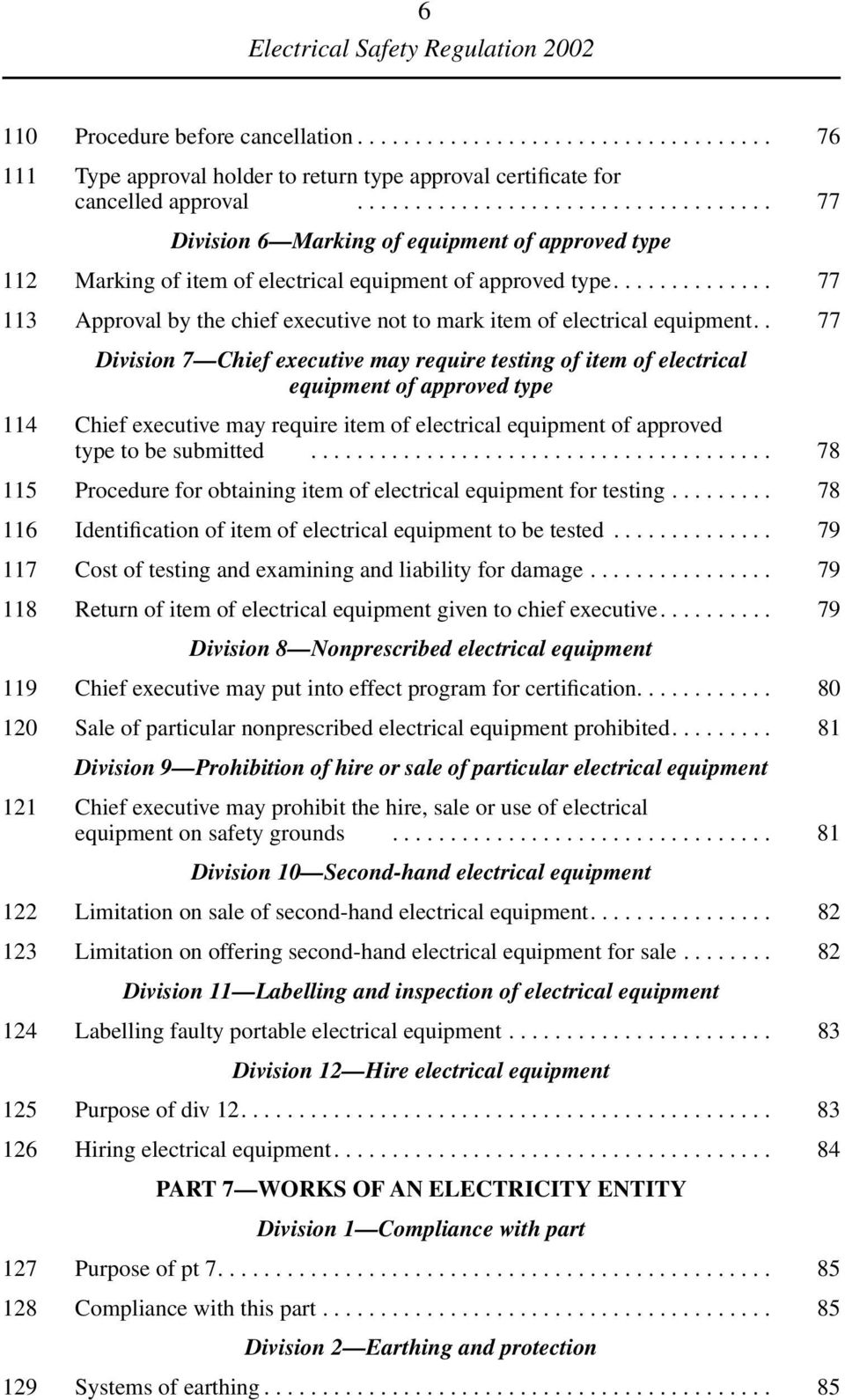
9 7 130 Connection of high voltage circuit to earth Performance and other requirements for works Insulation of stay wire Protection of earth conductors Division 3 Substations 134 Substation requirements Division 4 Electric lines and control cables 135 Measurement of vertical and horizontal distances Electric lines and control cables Clearance from exposed conductive parts and separation of conductors in same circuit Location of overhead circuit in relation to another overhead circuit Clearance of overhead electric lines from ground Clearance of overhead electric lines from structures Building or adding to structure near electric line Clearance of stay wires and control cables over road Connection to consumer s premises Division 5 Termination requirements for low voltage overhead service lines 144 Termination of low voltage overhead service line Division 6 Service lines generally 145 Fuses and disconnectors for service line Disused service lines to be disconnected Division 7 Maintenance of works 147 Maintenance of integrity of insulation Trimming of trees near overhead electric line PART 8 ELECTRICITY SUPPLY Division 1 Connection to source of electricity 149 Electrical installation with serious defect not to be connected to electricity source Electrical installation not to be connected to electricity source if work not tested Electrical installation not to be initially connected to electricity source without examination and testing
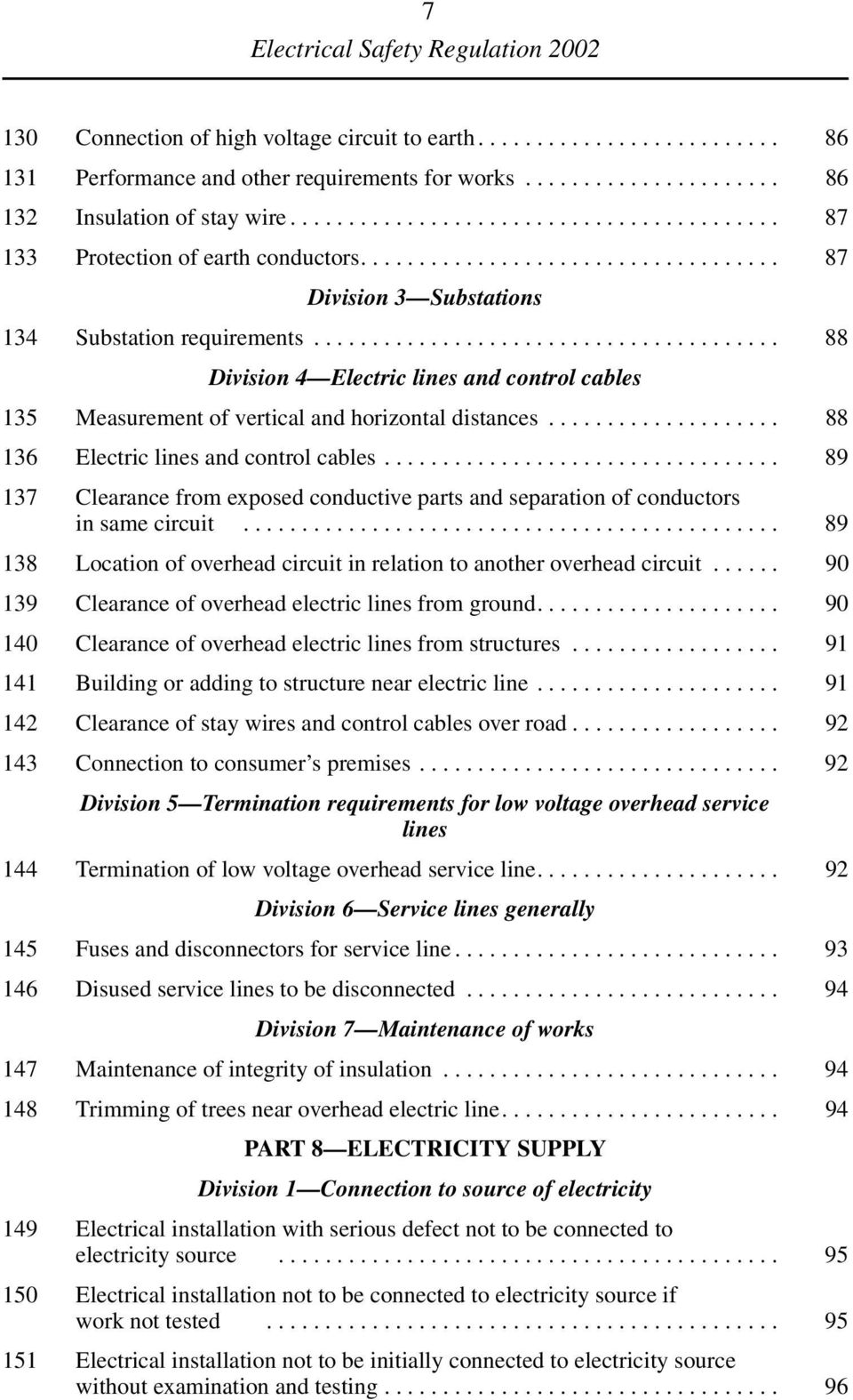
10 8 152 Reconnection of electrical installation to electricity source High voltage or hazardous area electrical installation not to be connected to electricity source without inspection Licensed electrical contractor to ensure compliance with Act before connection to electricity source Disconnection and reconnection of low voltage electrical installation Division 2 Private generating plant 156 Generating plant for emergency supply Generating plant for interconnection to works of electricity entity Division 3 Testing 158 Certificate by licensed electrical contractor of test Certificate of testing and compliance Performance of examination or test Reasons to be given for not connecting to source of electricity after examination Keeping copy of report Division 4 Requests and advice to distribution entities 163 Request to distribution entity for examination of electrical work Telling distribution entity of need for change to metering PART 9 SAFETY MANAGEMENT SYSTEMS Division 1 Prescribed electricity entities 165 Prescribed electricity entities Division 2 Requirements for safety management systems 166 Safety management system requirements PART 10 ACCREDITED AUDITORS 167 Appointment Refund of part of fee Term of office as accredited auditor PART 11 CATHODIC PROTECTION SYSTEMS Division 1 Preliminary 170 Definitions for pt Electrical terms apply for direct current Exclusion from application
11 9 Division 2 Installation and design 173 Installation of cathodic protection system only if preliminary steps taken Correct design and installation of cathodic protection system Division 3 Operating requirements 175 Operation of cathodic protection system only on conditions Division 4 Testing requirements 176 Tests before registration or operation of system Further tests during period of registration of system Further tests during operation of system Further tests of new foreign structure if required by the chief executive Records of tests to be kept Testing by chief executive Division 5 System requirements 182 Electrical limits Maximum potential change Tolerances Identification of anode groundbed Division 6 Registration of registrable systems 186 Register Application for registration of registrable system Registration of registrable system Term of registration Change of name and address Cancellation of registration Taking away or making a registered system inoperable Change to registered system to be notified PART 12 INCIDENT NOTIFICATION AND REPORTING 194 Definitions for pt Meaning of distribution entity for incident or event Employer or self-employed person to advise chief executive of serious electrical incident or dangerous electrical event Recording serious electrical incident or dangerous electrical event

12 Distribution entity to advise chief executive of serious electrical incident or dangerous electrical event Action required by distribution entity on report of electric shock Report of incident records Scene not to be interfered with Requirement on distribution entity to take action in interests of electrical safety PART 13 MISCELLANEOUS PROVISIONS Division 1 Electrical safety contributions 203 Context of div Definitions for div Fixing electrical safety contribution for each distribution entity for current financial year Payment of electrical safety contribution by instalments Division 2 Mines and petroleum plants 207 Application of regulation at mine or petroleum plant Division 3 Other matters 208 Climbing poles of electricity entity prohibited Obligations of employer about supervising training person Inspection of entries in registers Provision of information by retail entity PART 14 TRANSITIONAL PROVISIONS Division 1 Interpretation 212 Definitions for pt Division 2 Electrical licences 213 Equivalent licences to previous licences Eligibility for electrical jointer licence Eligibility for electrical linesperson licence Division 3 Matters in place before commencement 216 Registered cathodic protection system Approval of type of prescribed electrical article Clearances for lines built before 1 January Termination of low voltage overhead service line built before 1 January

13 Clearances for lines built before commencement Division 4 Transitional provisions for rural industry 221 Requirements not applying until 1 March Requirements not applying until 1 March Requirements not applying until 1 March Division 5 Workplace requirements for class 1 work until 28 February Purpose of div Application of div Interpretation of div Double adaptors and piggyback plugs prohibited Specified electrical equipment Portable safety switches Construction wiring Expiry of div Division 6 Workplace requirements for class 2 work until 28 February Application of div Requirement for type 1 safety switch or type 2 safety switch Expiry of div SCHEDULE EXTERNAL LICENCES AND ELECTRICAL WORK LICENCE EQUIVALENTS SCHEDULE EXCLUSION ZONES FOR ELECTRICAL PARTS SCHEDULE PRESCRIBED CLASSES OF ELECTRICAL EQUIPMENT AND RELEVANT STANDARDS SCHEDULE CLEARANCE OF OVERHEAD ELECTRIC LINES (OTHER THAN LOW VOLTAGE SERVICE LINES) SCHEDULE CLEARANCE OF LOW VOLTAGE OVERHEAD SERVICE LINES SCHEDULE

14 12 PRESCRIBED ELECTRICITY ENTITIES SCHEDULE DICTIONARY ENDNOTES 1 Index to endnotes Date to which amendments incorporated Key List of legislation List of annotations
15 s 1 13 s 4 ELECTRICAL SAFETY REGULATION 2002 [reprinted as in force on 1 October 2002] PART 1 PRELIMINARY 1 Short title This regulation may be cited as the. 2 Commencement This regulation commences on 1 October Purposes The purposes of this regulation include the following (a) (b) (c) (d) (e) ensuring the electrical safety of licensed electrical workers, other workers, licensed electrical contractors, consumers and the general public; enhancing consumer protection in relation to electrical work; stopping cathodic protection systems from damaging or interfering with the property of others; ensuring a safe supply of electricity; ensuring electrical equipment hired or sold is electrically safe. 4 How purposes are to be achieved The ways adopted by this regulation for the achievement of its purposes include the following (a) prescribing matters in support of the electrical licensing arrangements established under the Act;
16 s 5 14 s 6 (b) (c) (d) (e) (f) (g) (h) (i) prescribing requirements for working around exposed parts; prescribing requirements for electrical installations; prescribing matters about electrical equipment, including (i) requirements for electrical equipment; and (ii) requirements for particular electrical equipment to be approved by the chief executive; and (iii) requirements about the hiring, selling, testing and using of electrical equipment; and (iv) requiring particular electrical equipment to be approved and marked for compliance with prescribed standards; and (v) requirements for the testing of electrical equipment; prescribing requirements and procedures for the design, building and maintenance of electric lines and the works of electricity entities; prescribing requirements for the performance of electrical work; providing for the preparation, lodging and auditing of safety management plans; prescribing requirements for the operation of cathodic protection systems and requirements for particular systems to be registered by the chief executive; prescribing notification and reporting requirements for serious electrical incidents and dangerous electrical events. 5 Definitions (1) The dictionary in schedule 8 defines particular words used in this regulation. (2) If a word used in this regulation is not defined in the dictionary, and is not defined in the Act, but is used in the wiring rules, it must, to the greatest practicable extent, be taken to have the same meaning in this regulation as it has in the wiring rules. 6 References to standards and other documents (1) In this regulation, unless otherwise stated

17 s 7 15 s 7 (a) a reference to a standard using the designation made up of AS and a number is a reference to the standard as in force from time to time under that designation; and Example (b) AS 3127 is a reference to the standard that is currently in force under that designation. a reference to a joint standard using the designation made up of AS/NZS and a number is a reference to the joint standard as in force from time to time under that designation; and Example (c) AS/NZS is a reference to the joint standard that is currently in force under that designation. a reference to a standard or other document using ESAA as part of its name is a reference to the standard or other document as first published under the name quoted; and Example A reference to the document known as the ESAA Live Line Guideline (2000) is a reference to that guideline as first published under that name. (d) subject to paragraphs (a) to (c), a reference to a standard or other document is a reference to the standard or other document as in force from time to time. (2) Subsection (1)(a), (b) and (d) applies regardless of the edition or year of the standard, joint standard or other document. Example of operation of subsection (2) In this regulation, a reference to AS/NZS 3000 is a reference to that standard as amended from time to time, and as remade from time to time. (3) Bracketed words appearing after a standard s designation are included for information purposes only. 7 Meaning of qualified individual (1) An individual is a qualified individual if (a) (b) the individual has held for at least a year, or a shorter period considered acceptable by the chief executive, and still holds, an electrical work licence or an external contracting authority; and the chief executive is satisfied that the individual
18 s 8 16 s 8 (i) (ii) is a fit and proper person; and is competent to perform electrical work as, or for, a licensed electrical contractor; and (iii) has satisfactorily finished a course of instruction, or an examination required by the chief executive, on technical aspects of performing electrical work; and (iv) either (A) has satisfactorily finished a course of instruction, or an examination required by the chief executive, on business aspects of performing electrical work; or (B) has been operating a business for the last 5 years. (2) In deciding whether an individual is a fit and proper person, the chief executive may only consider (a) the standard of honesty and integrity demonstrated by the individual in commercial and other activities in which the individual has been involved; and (b) any failure by the individual to perform commercial or statutory obligations and the reasons for the failure. PART 2 ELECTRICAL WORK Division 1 Preliminary 8 Purpose of divs 2 to 5 Divisions 2 to 5 each prescribe a way of discharging the electrical safety obligation of an employer or self-employed person to ensure the person s business or undertaking is conducted in a way that is electrically safe.

19 s 9 17 s 12 Division 2 Basic requirements for electrical work 9 Definition for div 2 In this division electrical work does not include high voltage live line work. 10 Application of div 2 This division applies to the performance of electrical work for the purposes of the business or undertaking of an employer or self-employed person. 11 Requirements for electrical work (1) An employer or self-employed person must ensure that, unless the circumstances required under this division for the performance of live work apply, live work is not performed. Maximum penalty 40 penalty units. (2) Without limiting what the employer or self-employed person must do to ensure compliance with subsection (1), the employer or self-employed person must ensure that (a) (b) each exposed part is treated as if it is energised until it is isolated and proved not to be energised; and each high voltage exposed part is earthed. 12 Requirements for performance of live work (1) The following circumstances are required for the performance of live work (a) it is not practicable to perform the electrical work other than by live work because of 1 or more of the following (i) it is necessary in the interests of safety, whether or not electrical safety, for the work to be performed while the electrical equipment the subject of the electrical work is energised;

20 s s 12 Example for subparagraph (i) It may be necessary in the interests of road safety for a set of traffic lights to remain operating while electrical work is performed on the lights. (ii) a supply of electricity is necessary for the proper performance of the electrical work; (iii) there is no reasonable alternative to performing the electrical work by live work; Example for subparagraph (iii) It may be necessary, to avoid widespread outages, to perform electrical work on works of an electricity entity by live work. (b) the employer or self-employed person has prepared a written risk assessment of the performance of the live work; (c) the employer or self-employed person authorises the performance of the live work only after consultation with the person in control of the electrical equipment the subject of the electrical work; (d) the person who performs the live work has appropriate qualifications and training for the performance of the live work; (e) testing equipment appropriate to the performance of the live work has been given to the person performing the electrical work, the testing equipment has been properly maintained, and the person performing the electrical work makes proper use of the testing equipment in performing the work; (f) clothing and personal protective equipment appropriate to the performance of the live work has been given to the person performing the electrical work and the person performing the electrical work makes proper use of the clothing and equipment in performing the work; (g) the isolation point of the electricity supply for the electrical equipment the subject of the electrical work has been clearly identified and, except for electric line work, is able to be reached quickly without the need to climb over or shift obstructions; (h) the area where the electrical work is performed is clear of obstructions to the extent necessary for easy access to and from the area;

21 s s 13 (i) (j) there is a safety observer observing the performance of the electrical work, unless the work involves testing electrical equipment; the performance of the electrical work is in accordance with a safe system of work. Example of what a safe system of work could include for paragraph (j) A safe system could include preventing persons from accessing the area where live work is being performed if the persons are not needed for the performance of the work. (2) In this section safe system of work, for live work on a low voltage electrical installation, includes, but is not limited to, a system of work that complies with the provisions of AS/NZS 4836 (Safe working on low voltage electrical installations) about ensuring the safety of persons while performing live work. safety observer, in relation to the observing of the performance of electrical work, means a person (a) who is competent to help with the electrical work; and (b) who is competent to rescue the person performing the electrical work and to provide resuscitation; and (c) whose competence for paragraph (b) has been assessed in the last 6 months. Division 3 High voltage live line work 13 Performance of high voltage live line work (1) A person must not perform high voltage live line work unless the person s performance of the work (a) is authorised in writing by the person in control of the electrical equipment the subject of the work; and (b) is in accordance with a high voltage live line work management plan. Maximum penalty 40 penalty units.
22 s s 13 (2) A person in control of electrical equipment may authorise a person s performance of high voltage live line work in relation to the electrical equipment only if (a) the person in control is satisfied the person (i) has successfully finished an appropriate course of training; and (ii) has been assessed by the provider of the course as competent to perform the work; and (b) the written authorisation states the voltages of the electrical equipment on which the high voltage live line work may be performed. (3) If the written authorisation provides for the performance of work on more than 1 occasion, the entity that gives the authorisation must, while the authorisation is in force, cause the person authorised to perform the high voltage live line work to be regularly assessed to ensure the person remains competent to perform the work. Maximum penalty 40 penalty units. (4) In this section high voltage live line work management plan means a plan for the performance of high voltage live line work that (a) includes procedures developed in accordance with the ESAA Live Line Guideline (2000); and (b) is developed in conjunction with all of the following (i) representatives of workers who are to perform high voltage live line work in accordance with the plan; (ii) if the high voltage live line work involves the works of an electricity entity the electricity entity; (iii) other persons who might reasonably be expected to have an interest in the performance of the high voltage live line work; and (c) has been approved by a person who (i) is an electrical engineer who has expertise as a professional engineer in the performance of high voltage live line work; or
23 s s 15 (ii) has expertise the person in control of the electrical equipment the subject of the high voltage live line work decides is equivalent to the expertise mentioned in subparagraph (i). Division 4 Testing of work 14 Testing of electrical work (1) A person who performs electrical work must test the work in accordance with the requirements of this section. Maximum penalty 40 penalty units. (2) If electrical equipment the subject of electrical work is energised for testing, the person performing the work must ensure that persons not necessary for the performance of the testing are electrically safe. (3) The testing of the electrical work must be directed at ensuring that the electrical equipment, to the extent it is affected by the electrical work, is electrically safe. 15 Certificate of testing and safety (1) This section applies if a licensed electrical contractor performs electrical work that must be tested under this division. (2) The contractor must, as soon as practicable after the testing, ensure that the person for whom the electrical work was performed is given a certificate complying with this section. Maximum penalty 40 penalty units. (3) The certificate must state the following (a) the name and address of the person for whom the work was performed; (b) the electrical equipment tested; (c) the day the electrical equipment was tested; (d) the number of the electrical contractor licence under which the electrical equipment was tested. (4) The certificate must certify that the electrical equipment, to the extent it is affected by the electrical work, is electrically safe.
24 s s 17 (5) A licensed electrical contractor must keep a copy of a certificate given under this section for at least 5 years after the certificate is given. Maximum penalty for subsection (5) 20 penalty units. Division 5 Requirements applying to employers and self-employed persons 16 Application of div 5 This division applies to the performance of electrical work for the purposes of the business or undertaking of an employer or self-employed person. 17 Testing and maintenance of safety equipment (1) An employer or self-employed person must ensure that (a) safety equipment is used in the performance of electrical work; and (b) the safety equipment is (i) a suitable type for the electrical work being performed; and (ii) maintained so that it is suitable for use in the electrical work being performed; and (iii) if it is safety equipment that can not be visually confirmed as being correctly functioning and safe tested at least every 6 months to ensure it provides the protection it is intended to provide; and (iv) labelled to state the day on or before which it is next due for testing; and (v) in good repair and condition. Maximum penalty 40 penalty units. (2) The employer or self-employed person must keep records of the tests performed under subsection (1)(b)(iii) for at least 5 years. Maximum penalty for subsection (2) 20 penalty units.
25 s s Employer or self-employed person to ensure suitability of testing instruments (1) This section applies to the following (a) an employer of a person required to perform tests on electrical work or safety equipment; (b) a self-employed person required to perform tests on electrical work or safety equipment. (2) The employer or self-employed person must ensure (a) the test instruments used for the testing are designed for, and capable of correctly performing, the required tests; and (b) if a testing instrument can not be visually confirmed as being correctly functioning and safe that the instrument is tested at least every 6 months to ensure it is in proper working order; and (c) records of tests performed are kept for at least 5 years. Maximum penalty for subsection (2) 40 penalty units. Division 6 Other requirements 19 Electrical equipment with serious defect not to be connected to electricity source If an item of electrical equipment has a serious defect, a licensed electrical worker must not connect the equipment to a source of electricity for use for its intended purpose. Maximum penalty 40 penalty units. 20 Signs on switches and disconnection points (1) This section applies if (a) (b) a licensed electrical worker is performing electrical work; and to perform the work, the worker has de-energised, or otherwise isolated from electricity, an item of electrical equipment that is the subject of the electrical work or that is near where the electrical work is being performed; and
26 s s 21 (c) to de-energise, or otherwise isolate, the item of electrical equipment, the licensed electrical worker has operated a device; and (d) while the worker is performing the work, the worker does not have the device under the worker s sole effective control. (2) The licensed electrical worker must ensure that there is attached to the device, in a prominent position, a warning sign that is suitable in the circumstances, having regard to AS 1319 (Safety signs for the occupational environment). Maximum penalty 40 penalty units. (3) The electrical worker must also ensure that (a) the device, when in the open position, is locked; or (b) other precautions are taken to stop the device being accidentally closed. Maximum penalty 40 penalty units. (4) If the electrical work is being performed for the purposes of the business or undertaking of an employer or self-employed person, the employer or self-employed person must ensure that (a) the licensed electrical worker has all the signs and equipment necessary for the worker to comply with subsections (2) and (3); and (b) the signs and equipment are used in the way required under the subsections. Maximum penalty 40 penalty units. (5) In this section device means a circuit-breaker, disconnection point, fuse or switch. 21 Rescue and resuscitation training An employer must ensure workers who are required to perform, or help in performing, electrical work are competent in rescue and resuscitation in accordance with recognised practices in the electricity industry. Maximum penalty 40 penalty units.
27 s s 24 Division 7 Documents about electrical work 22 Application of div 7 This division applies to the performance of electrical work as part of the business or undertaking of a licensed electrical contractor. 23 Who may sign documents about electrical work A person must not sign a document required under the Act, or by an electricity entity, about the performance of electrical work unless the person is (a) if the electrical work was performed as part of the business or undertaking of a licensed electrical contractor who is an individual the individual; or (b) if the electrical work was performed as part of the business or undertaking of a licensed electrical contractor that is a partnership a qualified person for the partnership; or (c) if the electrical work was performed as part of the business or undertaking of a licensed electrical contractor that is a corporation or other entity a qualified person for the corporation or other entity. Maximum penalty 20 penalty units. Division 8 General provisions 24 Misrepresentations about electrical equipment or work (1) A person must not, in trade or commerce, represent that someone who is not a licensed electrical worker may lawfully (a) connect to a source of electricity an item of electrical equipment that may only be connected to a source of electricity by a licensed electrical worker; or (b) do electrical work that may only be done by a licensed electrical worker. Maximum penalty 40 penalty units.
28 s s 27 (2) An employer must take all reasonable steps to ensure the employer s workers do not contravene subsection (1). Maximum penalty for subsection (2) 40 penalty units. PART 3 LICENSING Division 1 Electrical work licences 25 Classes of electrical work licences The following classes of electrical work licences may be issued (a) (b) (c) (d) (e) (f) electrical mechanic licence; electrical linesperson licence; electrical fitter licence; electrical jointer licence; restricted electrical work licence; electrical work training permit. 26 What electrical mechanic licence authorises Subject to particular conditions or restrictions included in the licence, an electrical mechanic licence authorises the holder to perform all electrical work. Examples of what the holder of an electrical mechanic licence may do installing or changing an electrical installation or electrical line maintaining, repairing, or connecting to a source of electricity, an item of electrical equipment. 27 What electrical linesperson licence authorises Subject to particular conditions or restrictions included in the licence, an electrical linesperson licence authorises the holder to perform all electric line work.
29 s s 30 Examples of what the holder of an electrical linesperson licence may do electrical work in the building or maintenance of an overhead electric line electrical work in the building or maintenance of street lighting connected to an overhead or underground electric line tests to ensure overhead electric lines are correctly connected. 28 What electrical fitter licence authorises Subject to particular conditions or restrictions included in the licence, an electrical fitter licence authorises the holder to perform all electrical equipment work. Example of what the holder of an electrical fitter licence may do Electrical work, whether in a workshop or on site, of building, manufacturing, fitting, assembling, erecting, operating, testing or repairing electrical equipment. 29 What electrical jointer licence authorises Subject to particular conditions or restrictions included in the licence, an electrical jointer licence authorises the holder to perform electrical work to the extent of the following (a) (b) installing, jointing and terminating cables to the extent the work requires specialised knowledge or skill; electrical equipment work necessary for the work mentioned in paragraph (a). 30 What restricted electrical work licence authorises (1) A restricted electrical work licence authorises the holder to perform electrical work only of a particular type stated in the licence. Example of what the holder of a restricted electrical work licence may do A restricted electrical work licence may restrict the holder to the performance of electrical work incidental or special to a particular calling. (2) A restricted electrical work licence (a) does not entitle the holder to another electrical licence; and (b) must not be taken into account in deciding whether the holder is qualified to obtain or hold another electrical licence.
30 s s What electrical work training permit authorises (1) An electrical work training permit authorises the holder to perform electrical work stated in the permit in accordance with the conditions about training stated in the permit. (2) An electrical work training permit (a) (b) does not entitle the holder to another electrical licence; and must not be taken into account in deciding whether the holder is qualified to obtain or hold another electrical licence. 32 External licence equivalents An external licence mentioned in schedule 1 is equivalent to the electrical work licence stated in the schedule for the external licence. Division 2 Electrical work licence requirements 33 General requirements (1) This section states requirements that apply generally for the issue of an electrical work licence, other than an electrical work training permit, to an applicant for the licence. (2) The chief executive must be satisfied that (a) the applicant satisfies the eligibility requirements stated for the licence in this division; and (b) the applicant is adequately able to understand, and read and write in, the English language without the aid of an interpreter. (3) The chief executive may consider the following about the applicant s activities, whether before or after the commencement of this section, as a licensed electrical worker (a) disciplinary action taken against the applicant under a law regulating the activities of licensed electrical workers; (b) the applicant s non-performance of an obligation under a law about electrical work and the reasons for the non-performance. (4) The chief executive must be satisfied the applicant has been trained in, and is competent to carry out, resuscitation on an individual who has stopped breathing or is unconscious because of electric shock.
31 s s 34 (5) For an application for an electrical linesperson licence, the chief executive must also be satisfied the applicant has been trained in, and is competent to carry out, resuscitation and rescue at a pole-top or transmission tower on an individual who has stopped breathing or is unconscious because of electric shock. 34 Eligibility requirements for electrical mechanic licence (1) To be issued an electrical mechanic licence, an applicant must comply with subsection (2), (3) or (4). (2) The applicant must have (a) satisfactorily finished an apprenticeship of electrical mechanic under the Training and Employment Act 2000; and (b) satisfactorily finished a course of instruction decided by the chief executive; and (c) produced to the chief executive a written statement that (i) outlines the experience the applicant has had at the trade work of an electrical mechanic; and (ii) is verified by the person who was the applicant s employer when the applicant obtained the experience; and (d) satisfied the chief executive the applicant is competent in the trade work of an electrical mechanic. (3) The applicant must have (a) satisfactorily finished an apprenticeship outside Queensland that is, in the chief executive s opinion, at least equivalent to an apprenticeship mentioned in subsection (2)(a); and (b) satisfactorily finished a course of instruction related to the apprenticeship that is, in the chief executive s opinion, at least equivalent to the course of instruction mentioned in subsection (2)(b); and (c) produced to the chief executive a written statement that (i) outlines the experience the applicant has had at the trade work of an electrical mechanic; and (ii) is verified by the person who was the applicant s employer when the applicant obtained the experience; and
32 s s 35 (d) satisfied the chief executive the applicant is competent in the trade work of an electrical mechanic. (4) The applicant must satisfy the chief executive that the applicant (a) has a relevant qualification; and (b) has complied with the chief executive s examination requirements; and (c) is competent in the trade work of an electrical mechanic. (5) In this section relevant qualification, for an applicant, means that the applicant (a) is the holder of a current electrical fitter licence; or (b) has served an apprenticeship to the calling of electrical mechanic under the Training and Employment Act 2000, but has not satisfactorily finished the course of instruction mentioned in subsection (2)(b); or (c) is the holder of a tradesman s certificate within the meaning of the Tradesmen s Rights Regulation Act 1946 (Cwlth) in the classification of electrical mechanic. 35 Eligibility requirements for electrical linesperson licence (1) To be issued an electrical linesperson licence, an applicant must comply with subsection (2), (3) or (4). (2) The applicant must have (a) (b) (c) (d) satisfactorily finished an apprenticeship of electrical linesperson under the Training and Employment Act 2000; and satisfactorily finished a course of instruction decided by the chief executive; and produced to the chief executive a written statement that (i) outlines the experience the applicant has had at the trade work of an electrical linesperson; and (ii) is verified by the person who was the applicant s employer when the applicant obtained the experience; and satisfied the chief executive the applicant is competent in the trade work of an electrical linesperson.
33 s s 36 (3) The applicant must have (a) satisfactorily finished an apprenticeship outside Queensland that is, in the chief executive s opinion, at least equivalent to an apprenticeship mentioned in subsection (2)(a); and (b) satisfactorily finished a course of instruction related to the apprenticeship that is, in the chief executive s opinion, at least equivalent to the course of instruction mentioned in subsection (2)(b); and (c) produced to the chief executive a written statement that (i) outlines the experience the applicant has had at the trade work of an electrical linesperson; and (ii) is verified by the person who was the applicant s employer when the applicant obtained the experience; and (d) satisfied the chief executive the applicant is competent in the trade work of an electrical linesperson. (4) The applicant must satisfy the chief executive that the applicant (a) has a relevant qualification; and (b) has complied with the chief executive s technical and practical requirements, including any examination requirements; and (c) is competent in the trade work of an electrical linesperson. (5) In this section relevant qualification, for an applicant, means that the applicant (a) is the holder of a current electrical mechanic licence; or (b) has served an apprenticeship of electrical linesperson under Training and Employment Act 2000, but has not satisfactorily finished the course of instruction mentioned in subsection (2)(b); or (c) is the holder of a tradesman s certificate within the meaning of the Tradesmen s Rights Regulation Act 1946 (Cwlth) in the classification of electrical linesperson. 36 Eligibility requirements for electrical fitter licence (1) To be issued an electrical fitter licence, an applicant must comply with subsection (2), (3) or (4).
34 s s 36 (2) The applicant must have (a) satisfactorily finished an apprenticeship of electrical fitter under the Training and Employment Act 2000; and (b) satisfactorily finished a course of instruction decided by the chief executive; and (c) produced to the chief executive a written statement that (i) outlines the experience the applicant has had at the trade work of an electrical fitter; and (ii) is verified by the person who was the applicant s employer when the applicant obtained the experience; and (d) satisfied the chief executive the applicant is competent in the trade work of an electrical fitter. (3) The applicant must have (a) satisfactorily finished an apprenticeship outside Queensland that is, in the chief executive s opinion, at least equivalent to an apprenticeship mentioned in subsection (2)(a); and (b) satisfactorily finished a course of instruction related to the apprenticeship that is, in the chief executive s opinion, at least equivalent to the course of instruction mentioned in subsection (2)(b); and (c) produced to the chief executive a written statement that (i) outlines the experience the applicant has had at the trade work of an electrical fitter; and (ii) is verified by the person who was the applicant s employer when the applicant obtained the experience; and (d) satisfied the chief executive the applicant is competent in the trade work of an electrical fitter. (4) The applicant must satisfy the chief executive that the applicant (a) has a relevant qualification; and (b) has complied with the chief executive s examination requirements; and (c) is competent in the trade work of an electrical fitter. (5) In this section
35 s s 37 relevant qualification, for an applicant, means that the applicant (a) (b) (c) is the holder of a current electrical mechanic licence; or has served an apprenticeship to the calling of electrical fitter under the Training and Employment Act 2000, but has not satisfactorily finished the course of instruction mentioned in subsection (2)(b); or is the holder of a tradesman s certificate within the meaning of the Tradesmen s Rights Regulation Act 1946 (Cwlth) in the classification of electrical fitter. 37 Eligibility requirements for electrical jointer licence (1) To be issued an electrical jointer licence, an applicant must comply with subsection (2), (3) or (4). (2) The applicant must have (a) satisfactorily finished an apprenticeship of electrical jointer under the Training and Employment Act 2000; and (b) satisfactorily finished a course of instruction decided by the chief executive; and (c) produced to the chief executive a written statement that (i) outlines the experience the applicant has had at the trade work of an electrical jointer; and (ii) is verified by the person who was the applicant s employer when the applicant obtained the experience; and (d) satisfied the chief executive the applicant is competent in the trade work of an electrical jointer. (3) The applicant must have (a) satisfactorily finished an apprenticeship outside Queensland that is, in the chief executive s opinion, at least equivalent to an apprenticeship mentioned in subsection (2)(a); and (b) satisfactorily finished a course of instruction related to the apprenticeship that is, in the chief executive s opinion, at least equivalent to the course of instruction mentioned in subsection (2)(b); and (c) produced to the chief executive a written statement that
36 s s 38 (i) outlines the experience the applicant has had at the trade work of an electrical jointer; and (ii) is verified by the person who was the applicant s employer when the applicant obtained the experience; and (d) satisfied the chief executive the applicant is competent in the trade work of an electrical jointer. (4) The applicant must satisfy the chief executive that the applicant (a) has a relevant qualification; and (b) has complied with the chief executive s technical and practical requirements, including any examination requirements; and (c) is competent in the trade work of an electrical jointer. (5) In this section relevant qualification, for an applicant, means that the applicant (a) is the holder of a current electrical mechanic licence; or (b) has served an apprenticeship to the calling of electrical jointer under Training and Employment Act 2000, but has not satisfactorily finished the course of instruction mentioned in subsection (2)(b); or (c) is the holder of a tradesman s certificate within the meaning of the Tradesmen s Rights Regulation Act 1946 (Cwlth) in the classification of electrical jointer. 38 Eligibility requirements for restricted electrical work licence (1) To be issued a restricted electrical work licence, an applicant must comply with subsection (2), (3), (4) or (5). (2) The applicant must have (a) (b) (c) satisfactorily finished a course of training under the Training and Employment Act 2000 the chief executive considers to be appropriate; and satisfactorily finished a course of instruction decided by the chief executive; and produced to the chief executive a written statement that
37 s s 38 (i) outlines the experience the applicant has had in performing electrical work the subject of the licence; and (ii) is verified by the person who was the applicant s employer when the applicant obtained the experience; and (d) satisfied the chief executive the applicant is competent to perform electrical work the subject of the licence. (3) The applicant must have (a) satisfactorily finished a course of training outside Queensland that is, in the chief executive s opinion, at least equivalent to the course of training mentioned in subsection (2)(a); and (b) satisfactorily finished a course of instruction that is, in the chief executive s opinion, at least equivalent to the course of instruction mentioned in subsection (2)(b); and (c) produced to the chief executive a written statement that (i) outlines the experience the applicant has had in performing electrical work the subject of the licence; and (ii) is verified by the person who was the applicant s employer when the applicant obtained the experience; and (d) satisfied the chief executive the applicant is competent to perform electrical work the subject of the licence. (4) The applicant must be the holder of a current licence, permit, certificate or other authority issued under a law of the Commonwealth, another State or New Zealand that the chief executive decides is equivalent to the restricted electrical work licence. (5) The applicant must have (a) satisfied the chief executive that the applicant has a relevant qualification; and (b) satisfactorily finished a course of instruction decided by the chief executive; and (c) satisfactorily finished a structured on-job training program approved by the chief executive; and (d) produced to the chief executive a written statement that (i) outlines the experience the applicant has had in performing electrical work the subject of the licence; and
38 s s 39 (ii) is verified by the person who was the applicant s employer when the applicant obtained the experience; and (e) satisfied the chief executive the applicant is competent to perform electrical work the subject of the licence. (6) In this section corresponding training department means a department of government of another State in which a law corresponding to the Training and Employment Act 2000 is administered. relevant qualification, for an applicant, means that the applicant (a) is the holder of a tradesperson s certificate within the meaning of the Tradesmen s Rights Regulation Act 1946 (Cwlth) in a calling that the chief executive has decided requires the tradesperson to perform electrical work; or (b) is the holder of a tradesperson s certificate issued by a corresponding training department in a calling that the chief executive has decided requires the tradesperson to perform electrical work; or (c) has equivalent qualifications or experience in a calling that the chief executive decides requires the person to perform electrical work. 39 Term of electrical work licence (1) Each of the following may be issued, renewed or reinstated for a maximum of 5 years (a) electrical mechanic licence; (b) electrical linesperson licence; (c) electrical fitter licence; (d) electrical jointer licence; (e) restricted electrical work licence. (2) An electrical work training permit may be issued, renewed or reinstated for a maximum of 1 year.
39 s s 41 Division 3 Electrical contractor licence requirements 40 Eligibility requirements for electrical contractor licence for individual (1) To be issued an electrical contractor licence, an individual must (a) be a qualified individual; and (b) satisfy the financial and insurance requirements prescribed in this division for an applicant for an electrical contractor licence. (2) The electrical contractor licence is automatically cancelled if the individual stops being a qualified individual. 41 Eligibility requirements for electrical contractor licence for partnership (1) To be issued an electrical contractor licence, a partnership must (a) have at least 1 qualified person; and (b) satisfy the financial and insurance requirements prescribed in this division for an applicant for an electrical contractor licence; and (c) satisfy the chief executive that electrical work to be performed by the partnership is proposed to be performed, or supervised, by a qualified person for the partnership. (2) The chief executive must endorse the electrical contractor licence with the name of at least 1 qualified person for the partnership. (3) The partnership may, before the issue of the electrical contractor licence, or at any time after its issue but while the electrical contractor licence is in force, apply to the chief executive to have other names endorsed on the electrical contractor licence as the names of qualified persons for the partnership. (4) The chief executive must endorse a person s name in accordance with the application if the chief executive is satisfied the person is a qualified person for the partnership. (5) If a person whose name is endorsed on the electrical contractor licence as a qualified person is no longer the holder of an electrical work licence or external contracting authority
40 s s 42 (a) the partnership must advise the chief executive of the fact within 1 month after the person stops being the holder of the licence or authority; and (b) the chief executive must, on receiving the advice, take the endorsement from the electrical contractor licence. (6) The electrical contractor licence is automatically cancelled if, for a period of 1 month, there is no person (a) who is a qualified person for the partnership; and (b) whose name is endorsed on the electrical contractor licence as a qualified person for the partnership. 42 Eligibility requirements for electrical contractor licence for corporation (1) To be issued an electrical contractor licence, a corporation must (a) have at least 1 qualified person; and (b) satisfy the financial and insurance requirements prescribed in this division for an applicant for an electrical contractor licence; and (c) satisfy the chief executive that electrical work to be performed by the corporation is proposed to be performed, or supervised, by a qualified person for the corporation. (2) The chief executive must endorse the electrical contractor licence with the name of at least 1 qualified person for the corporation. (3) The corporation may, before the issue of the electrical contractor licence, or at any time after its issue but while the electrical contractor licence is in force, apply to the chief executive to have other names endorsed on the electrical contractor licence as the names of qualified persons for the corporation. (4) The chief executive must endorse a person s name in accordance with the application if the chief executive is satisfied the person is a qualified person for the corporation. (5) If a person whose name is endorsed on the electrical contractor licence as a qualified person is no longer the holder of an electrical work licence or external contracting authority
41 s s 43 (a) the corporation must advise the chief executive of the fact within 1 month after the person stops being the holder of the licence or authority; and (b) the chief executive must, on receiving the advice, take the endorsement from the electrical contractor licence. (6) The electrical contractor licence is automatically cancelled if, for a period of 1 month, there is no person (a) who is a qualified person for the corporation; and (b) whose name is endorsed on the electrical contractor licence as a qualified person for the corporation. 43 Financial and insurance requirements for applicant for electrical contractor licence (1) This section prescribes the financial and insurance requirements for an applicant for an electrical contractor licence. (2) An applicant for an electrical contractor licence must give to the chief executive (a) (b) (c) evidence that the applicant has public liability insurance for at least $ , under a contract of insurance approved by the chief executive; and if the applicant is an individual or partnership (i) evidence that the applicant has net realisable assets of $5 000; or (ii) evidence from a financial institution, in a form approved by the chief executive, that the applicant has $5 000 available for its disposal; and if the applicant is a corporation (i) a document, in a form approved by the chief executive, in which a director of the corporation certifies that the applicant has net realisable assets of $10 000; or (ii) evidence from a financial institution, in a form approved by the chief executive, that the applicant has $ available for its disposal.
42 s s Change of name of corporation or partnership (1) This section applies if there is a change in the name of a corporation or partnership that is the holder of an electrical contractor licence. (2) The corporation or partnership must, within 1 month after the change of name, give written notice of the change to the chief executive. Maximum penalty 20 penalty units. (3) The written notice must be accompanied by the electrical contractor licence, and may be accompanied by an application about how the chief executive is to act under subsection (4). (4) After receiving the written notice and considering any accompanying application, the chief executive may (a) endorse the licence with information about the change of name and reissue it to the corporation or partnership; or (b) cancel the licence and issue a new licence; or (c) cancel the licence. (5) A licence reissued by the chief executive with an endorsement of the change of the name of the corporation or partnership, subject to the endorsement, has continuing effect as the original electrical contractor licence. (6) A new licence issued by the chief executive under this section must be endorsed with a memorandum stating the reasons for the issue of the new licence. (7) If the chief executive acts under subsection (4)(c) to cancel the licence, the chief executive must give the corporation or partnership an information notice for the decision to cancel. 45 Change in membership of partnership (1) This section applies if (a) (b) a partnership is the holder of an electrical contractor licence; and there is a change in the membership of the partnership, whether by the death or retirement of a member or the admission of a new member.
43 s s 45 (2) The partnership must, within 1 month after the membership change, give written notice of the change to the chief executive. Maximum penalty 20 penalty units. (3) The written notice must give full information and particulars of the change. (4) The written notice must be accompanied by the electrical contractor licence, and may be accompanied by an application about how the chief executive is to act under subsection (5). (5) After receiving the written notice and considering any accompanying application, the chief executive may (a) endorse the licence with information about the membership change and reissue it to the partnership; or (b) cancel the licence and issue a new licence; or (c) cancel the licence. (6) A licence reissued by the chief executive with an endorsement of the change of the membership of the partnership, subject to the endorsement, has continuing effect as the original electrical contractor licence. (7) A new licence issued by the chief executive must be endorsed with a memorandum stating the reasons for its issue. (8) The chief executive may issue a new licence to the partnership only if the chief executive is satisfied that (a) the entire business of electrical contracting work carried on by the partnership in Queensland before the membership change is to be carried on by the partnership after the new licence is issued; and (b) the partnership complies with the eligibility requirements for the issue of the licence. (9) If the chief executive acts under subsection (5)(c) to cancel the licence, the chief executive must give the partnership an information notice for the decision to cancel. (10) Nothing in this section affects the requirement under this division for the endorsement of an electrical contractor licence issued to a partnership with the name of at least 1 qualified person for the partnership.
44 s s Term of electrical contractor licence An electrical contractor licence may be issued, renewed or reinstated for a maximum of 1 year. Division 4 Miscellaneous 47 Eligibility requirements for renewal or reinstatement of electrical licence To renew or reinstate an electrical licence, the chief executive must be satisfied the applicant for the renewal or reinstatement continues to satisfy the eligibility requirements applying under this part for the issue of the licence. 48 Application requirements (1) An electrical licence application under part 4, division 2 1 of the Act must, if a fixed fee applies to the application, be accompanied by the fixed fee. (2) An application under this part about an electrical licence must (a) (b) be made in the approved form; and if a fixed fee applies be accompanied by the fixed fee. 49 Giving chief executive cancelled or suspended licence or licence to be endorsed The holder of an electrical licence, or other person who has control of the licence, must, if required by the chief executive, give the licence to the chief executive if the licence (a) has been cancelled or suspended; or (b) has ended; or (c) is required to have anything endorsed on it. Maximum penalty 20 penalty units. 1 Part 4 (Licences), division 2 (Electrical licence applications) of the Act
45 s s Replacement of electrical licence If, on application by the holder of an electrical licence, the chief executive is satisfied that the licence has been lost, damaged or destroyed, the chief executive may issue a replacement licence. 51 Surrender of electrical licence The holder of an electrical licence may surrender the licence by written notice given to the chief executive. 52 Register of electrical licences (1) The chief executive must keep a register containing information about electrical licences, in the form the chief executive considers appropriate to ensure the information in the register can be efficiently recorded and accessed. Example The chief executive may decide to keep the register of electrical licences in electronic form. (2) The chief executive may order the information in the register of electrical licences in the way the chief executive considers appropriate. Example The chief executive may decide to separate historical information about electrical licences from current information. (3) Without limiting subsections (1) and (2), the register of electrical licences must include, for each electrical licence (a) the full name and address of the holder; and (b) an identifying number; and (c) when the licence was issued; and (d) details of every renewal and reinstatement of the licence, and of any failure to renew the licence; and (e) details of disciplinary action taken by the licensing committee against the holder; and (f) details of anything else the chief executive considers should be included in the register of electrical licences.
46 s s 54 (4) If contact details recorded in the register of electrical licences for the holder of an electrical licence, including the name and address of the holder, are no longer correct, the holder must, within 14 days after the details become incorrect, give the chief executive written notice of the correct details. (5) Subsection (4) does not apply to (a) the change of name of a corporation or partnership that is the holder of an electrical contractor licence; or (b) the change of the membership of a partnership that is the holder of an electrical contractor licence. (6) The chief executive may publish some or all of the information included in the register in the way the chief executive considers appropriate. 53 Examinations (1) In deciding examinations for assessing a person s competency, or conditions with which a person must comply under this part, the chief executive may decide that the person must (a) undertake an examination conducted by the chief executive; or (b) satisfactorily finish a course of instruction recognised by the chief executive at which the student s performance is assessed during the course; or (c) undertake 1 or more examinations, oral or written tests, or practical tests. (2) The examinations and tests may be conducted by the chief executive or by an entity engaged by the chief executive. 54 Examiners The chief executive may appoint examiners to conduct examinations or tests required by the chief executive at a fee approved by the chief executive.
47 s s Refund and remission of fees (1) If the chief executive does not approve any of the following applications, or if the application is withdrawn before it is decided, the licence administration part of any fixed fee paid with the application must be refunded (a) an application for an electrical licence; (b) an application for renewal or reinstatement of an electrical licence. (2) In this section licence administration part, of a fixed fee, means the part of the fixed fee decided by the chief executive as the amount fairly representing the cost of administering the electrical licence as issued, renewed or reinstated. 56 Advertising by licensed electrical contractor The holder of an electrical contractor licence who publishes an advertisement about the holder s business must ensure the advertisement (a) states the name under which the holder is licensed; and (b) states that the holder is licensed under the Act and the identifying number of the holder s electrical contractor licence. Maximum penalty 40 penalty units. 57 Performing electrical work without electrical licence For section 55(3)(d) 2 of the Act, the following testing is authorised (a) (b) the testing of electrical equipment by a competent person, if the testing is required under part 5, division 5; 3 the testing of the works of an electricity entity by a competent person; Example for paragraph (b) A competent person testing protection relay operation that is part of the works of an electricity entity. 2 Section 55 (Requirement for electrical work licence) of the Act 3 Part 5 (Electrical installations), division 5 (Workplace electrical installations)
48 s s 59 (c) the testing of electrical equipment by a person, other than testing mentioned in paragraph (a) or (b), if the testing does not interfere with the integrity of the electrical equipment. Examples for paragraph (c) A person testing a safety switch in a domestic electrical installation by operating a test button on the safety switch A person using an appropriate voltmeter to measure voltage. PART 4 WORKING AROUND ELECTRICAL PARTS Division 1 Preliminary 58 Purpose of pt 4 (1) This part prescribes a way of discharging the electrical safety obligation of an employer or self-employed person to ensure that the person s business or undertaking is conducted in a way that is electrically safe. (2) In particular, this part prescribes requirements about persons performing work in contact with, or near to, electrical parts. 59 Definitions for pt 4 In this part authorised person, for an electrical part, means a person who (a) has enough technical knowledge and experience to do work that involves contact with, or being near to, the electrical part; and (b) has been approved by the person in control of the electrical part to do work that involves contact with, or being near to, the electrical part, or is authorised to act for the person in control of the electrical part. direct contact see section 60. electrical part means (a) an exposed part; or
49 s s 60 (b) an overhead insulated electric line. exclusion zone see section 61. instructed person, for an electrical part, means a person who is acting under the supervision of an authorised person for the electrical part. operating plant means plant being operated for its intended purpose. Examples of operating plant A tip truck tipping a load A fixed crane operating at a building site A vehicle that includes an elevated work platform being used for clearing vegetation from around overhead electric lines A concrete pumping truck pumping concrete A harvester with height changeable attachments being used to transfer grain to a truck. untrained person, for an electrical part, means a person who is not an authorised person or an instructed person for the electrical part. work means work of any type, whether or not electrical work, other than live work or electrical welding performed in accordance with a safe system of work. 60 Meaning of direct contact (1) A person is in direct contact with an electrical part if (a) the person is touching the electrical part with the person s bare hands or another bare part of the person s body; or (b) the person is touching a conductive object with the person s bare hands or another bare part of the person s body, and the conductive object is touching the electrical part; or (c) an article of clothing worn by the person is touching the electrical part; or (d) an article of clothing worn by the person is touching a conductive object, and the conductive object is touching the electrical part. (2) Operating plant or a vehicle is in direct contact with an electrical part if any part of the operating plant or vehicle is touching the electrical part.
50 s s Meaning of exclusion zone (1) The exclusion zone, for a person for an electrical part, or for operating plant or a vehicle for an electrical part, means the distance from the part stated for the person, plant or vehicle in schedule 2. (2) For applying schedule 2 to a person, the person includes any article of clothing worn by the person, and any conductive object the person is holding or carrying. (3) For applying schedule 2 to an authorised person or instructed person who does not have a safety observer as required under the schedule, the authorised person or instructed person must be taken to be an untrained person. (4) A reference in schedule 2 to a vehicle does not include a reference to (a) (b) an aircraft; or a vehicle that is operating plant. Examples for paragraph (b) A tip truck tipping a load would not be a vehicle for schedule 2. However, a tip truck travelling between sites would be a vehicle for schedule 2 A vehicle that includes an elevated work platform being used for clearing vegetation would not be a vehicle for schedule 2. However, when the platform is not being used for clearing vegetation, the vehicle would be a vehicle for schedule 2. Division 2 Requirements for working around electrical parts 62 Employer or self-employed person to ensure work is performed in accordance with requirements (1) An employer or self-employed person must ensure that work performed in the conduct of the person s business or undertaking does not involve, other than in accordance with the requirements of this division (a) (b) (c) a person coming into direct contact with an electrical part; or any operating plant or vehicle coming into direct contact with an electrical part; or a person coming within the exclusion zone for the person for an electrical part; or
51 s s 63 (d) any operating plant or vehicle coming within the exclusion zone for the operating plant or vehicle for an electrical part. Maximum penalty 40 penalty units. (2) Subsection (1)(a) does not apply to a person if (a) the person is an authorised person or instructed person for the electrical part; and (b) the electrical part is a low voltage overhead insulated electric line. (3) Subsection (1)(b) does not apply to operating plant if (a) the operating plant is being operated by an authorised person or instructed person for the electrical part; and (b) a safety observer is being used; and (c) the electrical part is a low voltage overhead insulated electric line. 63 Work involving direct contact with electrical part (1) Work may be performed involving a person coming into direct contact with an electrical part if the electrical part is (a) isolated from all sources of electricity; and (b) tested to ensure it is, or otherwise confirmed to be, isolated from all sources of electricity; and (c) if the electrical part is a high voltage electrical part earthed. (2) Subsection (1)(b) does not apply as a requirement if (a) the electrical part can not be directly contacted to prove isolation from all sources of electricity; and (b) there is in place an earthing switch that is able to control the operation of the electrical part and is designed to operate safely if the electrical part has not been isolated from all sources of electricity; and (c) the work is being performed in the business or undertaking of an employer, and the employer has given written instructions to the person performing the work that, if complied with, will be effective to isolate the electrical part from all sources of electricity.
52 s s Work within exclusion zone for electrical part (1) Work may be performed involving a person, operating plant or a vehicle coming within the exclusion zone for the person, operating plant or vehicle for an electrical part, other than by coming into direct contact with the electrical part, if the electrical part is (a) isolated from all sources of electricity; and (b) tested to ensure it is, or otherwise confirmed to be, isolated from all sources of electricity; and (c) if the electrical part is a high voltage electrical part earthed. (2) However, if it is not practicable for subsection (1)(b) to be complied with, the work may nevertheless be performed if (a) the work can be performed safely; and (b) if the work is being performed in the business or undertaking of an employer the employer has given written instructions, either generally or directed at the particular circumstances, about the work to be performed and the precautions to be complied with; and (c) at least 1 of the following applies (i) suitable barriers or earthed metal shields are installed between the person, operating plant or vehicle and the electrical part; (ii) the work is testing, and the electrical part, or an item of electrical equipment of which the electrical part is a component, is designed in a way requiring the work to be performed while the person, operating plant or vehicle is within the exclusion zone for the person, operating plant or vehicle for the electrical part; (iii) the work is earthing of the electrical part, or an item of electrical equipment of which the electrical part is a component, and is performed after the electrical part or item of electrical equipment has been isolated and proved to be de-energised.
53 s s 68 PART 5 ELECTRICAL INSTALLATIONS Division 1 Performing electrical work 65 Purpose of div 1 To the extent that this division applies, or is capable of applying, to a person who is an employer or self-employed person, this division prescribes a way of discharging the electrical safety obligation of an employer or self-employed person to ensure that the person s business or undertaking is conducted in a way that is electrically safe. 66 Licensed electrical worker to comply with wiring rules A licensed electrical worker who performs electrical work on an electrical installation must ensure that the electrical installation, to the extent it is affected by the electrical work, is in accordance with the wiring rules. Maximum penalty 40 penalty units. 67 Employer to ensure electrical work complies with wiring rules A licensed electrical contractor who employs a licensed electrical worker to perform electrical work on an electrical installation must ensure that the electrical installation, to the extent it is affected by the electrical work, is in accordance with the wiring rules. Maximum penalty 40 penalty units. 68 Work involving water equipment (1) A person must not perform work on water equipment unless (a) (b) the person is a licensed electrical worker; and the work performed is work that the person would be authorised to perform on the water equipment under the person s electrical work licence if the water equipment were electrical equipment; and
54 s s 69 (c) the water equipment, to the extent it is affected by the work, is in accordance with the wiring rules. Maximum penalty 40 penalty units. (2) An employer or self-employed person whose business or undertaking includes the performance of work on water equipment must ensure that, in the conduct of the business or undertaking, a person does not perform work in contravention of subsection (1). Maximum penalty 40 penalty units. (3) In this section designated equipment means any apparatus, appliance, cable, conductor, fitting, insulator, material, meter or wire (a) used for controlling, generating, supplying, transforming or transmitting electricity at extra low voltage; or (b) operated by electricity at extra low voltage. water equipment means designated equipment that is in, or that surrounds the water container of, a swimming pool, paddling pool, spa pool, water feature or water tub. work, on water equipment, does not include (a) the plugging in of a pre-packaged water feature; or (b) replacing a component forming part of the water equipment if the water equipment has been designed so that the component is readily and safely able to be replaced by a person without electrical knowledge or skill. 69 Work involving electric motor forming part of vehicle (1) A person must not perform work on an electric motor forming part of a vehicle unless (a) the person is a licensed electrical worker; and (b) the work performed is work that the person would be authorised to perform on the electric motor under the person s electrical work licence if the electric motor were electrical equipment. Maximum penalty 40 penalty units. (2) An employer or self-employed person whose business or undertaking includes the performance of work on an electric motor must ensure that, in
55 s s 71 the conduct of the business or undertaking, a person does not perform work in contravention of subsection (1). Maximum penalty 40 penalty units. (3) In this section electric motor means an electric motor that is electrical equipment within the meaning of section 14(1) 4 of the Act, but is not electrical equipment under the Act because of the operation of section 14(2) of the Act. vehicle does not include a car or motorbike under the Transport Operations (Road Use Management) Act work, on an electric motor, means work on the electric motor that would be electrical work if the electric motor were electrical equipment. Division 2 Defects and earthing 70 Requirement on person in control to fix defect If an inspector or electricity entity gives written notice to the person in control of electrical equipment of any defect affecting the electrical safety of the electrical equipment, whether or not a serious defect, the person in control must take all reasonable steps to ensure the defect is fixed. Maximum penalty 40 penalty units. 71 Earthing (1) This section applies if a low voltage electrical installation receives electricity distributed by an electricity entity. (2) The person in control of the low voltage electrical installation must not knowingly allow the earthing for the installation to be inconsistent with the earthing system requirements the electricity entity has under this regulation. Maximum penalty for subsection (2) 40 penalty units. 4 Section 14 (Meaning of electrical equipment ) of the Act
56 s s 73 Division 3 Electric lines 72 Service line (1) This section applies if an electrical installation receives electricity distributed by an electricity entity. (2) The person in control of the electrical installation must maintain the person in control s facilities for (a) attaching an overhead service line to supply electricity to the electrical installation; or (b) the entrance, support, protection and termination of an underground service line to supply electricity to the electrical installation. Maximum penalty 40 penalty units. Examples of facilities that may be provided by a person in control A service riser bracket Timber backing for the electricity entity s J hook. (3) However, subsection (2) does not require the person in control of the electrical installation to maintain the insulation of any clamp or apparatus supplied by the person in control for the purposes of any joint needed for consumer terminals. (4) The electricity entity must periodically inspect and maintain the insulation of the clamp or apparatus mentioned in subsection (3). Maximum penalty for subsection (4) 40 penalty units. 73 Structure supporting electric line or equipment to comply with wiring rules (1) The person in control of an electrical installation must ensure that any structure supporting an electric line or item of electrical equipment forming part of the electrical installation is in accordance with the requirements of (a) the wiring rules; and (b) any direction the chief executive gives for ensuring electrical safety. Maximum penalty 40 penalty units.
57 s s 76 (2) If there is a conflict between the wiring rules and a direction of the chief executive, the direction prevails. 74 Obligation to preserve insulation of electric line The person in control of an electrical installation must maintain, to a reasonable extent, the integrity of the insulation of any electric line, or connection to an electric line, that is part of the electrical installation (a) if it is an overhead electric line near the point of attachment of the electric line to any structure; and (b) whether or not it is an overhead electrical line near roofs or structures where it is likely that persons, including, for example, painters and plumbers, could come into contact with the insulated wires or connectors of the line. Maximum penalty 40 penalty units. 75 Trimming of trees near overhead electric line (1) The person in control of an overhead electric line must ensure that trees and other vegetation are trimmed, and other measures taken, to prevent contact with the line that is likely to cause injury from electric shock to any person or damage to property. Maximum penalty 40 penalty units. (2) In this section overhead electric line does not include an overhead electric line owned by an electricity entity. 76 Obligation to ensure safety of disconnected overhead electric line (1) This section applies if an electrical installation receives electricity distributed by an electricity entity through a service line that is an overhead electric line. (2) The person in control of the electrical installation must take all reasonable steps to ensure that, if the line is disconnected from its electricity supply, the line is (a) dismantled as soon as practicable after disconnection; or
58 s s 77 (b) maintained so it is electrically and mechanically safe. Maximum penalty for subsection (2) 40 penalty units. Division 4 Installation of approved safety switches in domestic residences 77 Definitions for div 4 In this division approved safety switch means a residual current device that (a) has a Queensland or external approval; and (b) has a rated residual current of not more than 30 ma. chief executive (land) means the chief executive of the department in which the Land Act 1994 is administered. combined form means a form that (a) gives transfer and safety switch information and information about a change of ownership required under other Acts; and (b) may be given to the chief executive (land) or the registrar. date of possession, for residential land, means the date the transferee of the land enters into possession of the land. domestic residence means a building or structure, or a part of a building or structure, that (a) is used, or designed to be used, as a single dwelling; and Examples for paragraph (a) Dwelling house (b) Flat. is not used, or designed to be used, for temporary accommodation. Examples of temporary accommodation for paragraph (b) Boarding house Motel. general purpose socket-outlet means a low voltage socket-outlet that (a) has a rating of 10 A; and
59 s s 78 (b) is designed to fit a three-pin flat-pin plug that complies with the relevant standard under part 6 for the type of plug; and (c) is used, or intended to be used, or could at some time reasonably be expected to be used, for more than 1 appliance. registrar see the Land Title Act 1994, schedule 2. residential land means land on which a domestic residence is constructed, and includes an interest in residential land. transfer and safety switch information see section 79. transfer date, for residential land, means the date the transferee of the land is entitled to possession of the land. transferee, of residential land, means the person who, on becoming entitled to possession of the land, may lodge an application for registration (a) under the Land Act 1994, as a lessee, or personal representative of a deceased lessee, of the land; or (b) under the Land Title Act 1994, as an owner, or the personal representative of an owner, of the land. transferor, of residential land, means the person registered, immediately before the transfer date for the land (a) under the Land Act 1994, as a lessee, or personal representative of a deceased lessee, of the land; or (b) under the Land Title Act 1994, as an owner, or the personal representative of an owner, of the land. 78 Notice to transferee about approved safety switch (1) The transferor of residential land must, on or before the date of possession for the land, give the transferee of the land written notice of whether an approved safety switch has been installed for the general purpose socket-outlets installed in the domestic residence on the land. Maximum penalty 15 penalty units. (2) However, subsection (1) does not apply if (a) the transferor became transferor of the residential land under an agreement to transfer the land; and (b) the date of the agreement is before 1 September 2002.
60 s s 79 (3) The transferor must not state anything in the notice that the transferor knows is false or misleading in a material particular. Maximum penalty for subsection (3) 15 penalty units. 79 Notice to chief executive about approved safety switch and other matters (1) The transferor of residential land must, within 90 days after the date of possession for the land, give the chief executive a written notice stating the following information ( transfer and safety switch information ) (a) the full names of the transferor and transferee; (b) the addresses of the transferor and transferee immediately after the date of possession for the land; (c) the property details of the land; (d) the current use of the land; (e) if there is an agreement for the transfer of the land the date of the agreement; (f) the date of possession for the land; (g) whether an approved safety switch has been installed for the general purpose socket-outlets installed in the domestic residence on the land; (h) whether the transferor has given the transferee written notice of whether an approved safety switch has been installed for the general purpose socket-outlets installed in the domestic residence on the land. Maximum penalty 15 penalty units. (2) However, subsection (1) does not apply if (a) the transferor became transferor of the residential land under an agreement to transfer the land; and (b) the date of the agreement is before 1 September (3) Also, the transferor is not required to comply with subsection (1) if a properly completed combined form, together with an application for registration is given to (a) for an application for registration under the Land Act 1994 the chief executive (land); or
61 s s 81 (b) for an application for registration under the Land Title Act 1994 the registrar. (4) If a combined form is given under subsection (3), the chief executive may use only the transfer and safety switch information on the form. 80 Installation of approved safety switch in particular residences (1) This section applies if (a) the date of possession for residential land is on or after 1 September 2002; and (b) a general purpose socket-outlet was installed in the domestic residence on the land before 1 June 1992; and (c) an approved safety switch has not been installed for the general purpose socket-outlet. (2) The owner of the land must, within 3 months after the date of possession, have an approved safety switch installed for the general purpose socket-outlet. Maximum penalty 15 penalty units. (3) In this section owner, of residential land, means the person registered or entitled to be registered, immediately after the transfer date for the land (a) under the Land Act 1994, as a lessee, or personal representative of a deceased lessee, of the land; or (b) under the Land Title Act 1994, as an owner, or the personal representative of an owner, of the land. 81 Performing electrical installation work for domestic residences A licensed electrical worker or a licensed electrical contractor must not perform electrical installation work on an electrical installation installed in a domestic residence unless (a) (b) an approved safety switch has been installed for the general purpose socket-outlets installed in the residence; or if an approved safety switch has not been installed for the general purpose socket-outlets installed in the residence
62 s s 83 (i) the work is or includes the installation of an approved safety switch for the general purpose socket-outlets installed in the residence; or (ii) the worker reasonably believes installation of an approved safety switch for the general purpose socket-outlets installed in the residence is not required under this regulation; or (iii) the work is the connection of the residence to a source of electricity; or (iv) the work is needed to be performed without delay in an emergency, to prevent an emergency from happening or for safety reasons. Maximum penalty 40 penalty units. Division 5 Workplace electrical installations Subdivision 1 Preliminary 82 Purpose of div 5 This division prescribes a way of discharging the electrical safety obligation of an employer or self-employed person to ensure that the person s business or undertaking is conducted in a way that is electrically safe. 83 Definitions for div 5 In this division class 1 work means (a) (b) construction-type work; or work done in conjunction with construction-type work. Example of paragraph (b) Installation of plumbing in a house under construction. class 2 work means the work of assembly, fabrication, installation, maintenance, manufacturing, refurbishment or repair, but does not include work that is class 1 work.
63 s s 83 Examples Installing the interior fittings of a shop Manufacturing clothes Repairing leaking pipes. class 3 work means work that is not class 1 work, class 2 work or class 4 work. Example Cleaning a motel Cooking in a restaurant Providing health services at a health facility Selling goods from a shop Teaching at an education facility Caring for children at a child care centre. class 4 work means office work. construction-type work means (a) construction work; or (b) work that is not building work under the WHS Act, but that would be building work under the WHS Act if its estimated final price were more than the amount provided for in the WHS Act, schedule 3, definition building work ; or (c) work that is not civil construction work under the WHS Act, but that would be civil construction work under the WHS Act if its estimated final price were more than the amount provided for in the WHS Act, schedule 3, definition civil construction work. construction wiring, for a workplace, means temporary electrical wiring by which electricity is supplied by an electricity entity for use in, and for the period of, construction-type work at the place. construction work has the meaning given in the WHS Act, section 14. construction workplace means (a) a place that is a construction workplace under the WHS Act; or (b) a place intended to become a construction workplace under the WHS Act when work starts at the place. cord extension set means an assembly of
64 s s 83 (a) a plug intended for connection to a socket outlet; and (b) a sheathed flexible cord; and (c) a cord extension socket. principal contractor has the meaning given by the WHS Act, section 13. safety switch means a type 1 safety switch or a type 2 safety switch. specified electrical equipment means (a) in relation to the performance of class 2 work (i) a cord extension set; or (ii) a portable outlet device; or (iii) electrical equipment, other than a portable safety switch, that has a current rating of not more than 20 amps; and (b) in relation to the performance of class 3 work or class 4 work (i) a cord extension set; or (ii) a portable outlet device; or (iii) electrical equipment, other than a portable safety switch, that (A) has a current rating of not more than 20 amps; and (B) is connected by a flexible cord and plug to low voltage supply; and (C) is moved during its normal use for the purpose of its use. type 1 safety switch means a residual current device, whether or not portable, with a rated residual current of not more than 10 ma. type 2 safety switch means a residual current device, whether or not portable, with a rated residual current of more than 10 ma but not more than 30 ma.
65 s s 87 Subdivision 2 All work 84 Application of sdiv 2 This subdivision applies to an employer or self-employed person if the employer or a worker of the employer, or the self-employed person, performs work, whether or not electrical work, at a workplace. 85 Cord extension sets and flexible cables (1) An employer or self-employed person must ensure that any cord extension set or flexible cable at the workplace is (a) located where it is not likely to suffer damage; and (b) protected against damage. (2) In this section damage includes damage by liquid. Subdivision 3 Class 1 work 86 Application of sdiv 3 This subdivision applies to the performance of class 1 work at a workplace Requirements for construction wiring and electrical equipment (1) An employer or self-employed person must ensure that all electrical equipment for the performance of work is in accordance with the requirements of AS/NZS 3012 (Electrical installations Construction and demolition sites). (2) An employer or self-employed person whose business or undertaking is being conducted at a construction workplace and who is the principal contractor for the construction workplace must ensure that all construction wiring at the workplace is in accordance with the requirements of 5 Until the end of 28 February 2003, part 14, division 5 applies to the performance of class 1 work at a workplace rather than this division.
66 s s 90 AS/NZS 3012 (Electrical installations Construction and demolition sites). Subdivision 4 Class 2 work 88 Application of sdiv 4 This subdivision applies to the performance of class 2 work at a workplace. 89 Double adaptors and piggyback plugs prohibited (1) An employer or self-employed person must not use a double adaptor or piggyback plug. (2) An employer must ensure the employer s workers do not use a double adaptor or piggyback plug. 90 Specified electrical equipment (1) An employer or self-employed person must ensure that specified electrical equipment of the employer or self-employed person at the workplace is not used to perform work unless (a) it is inspected and tested by a competent person (i) if the equipment is double insulated at least once every year; or (ii) if the equipment is not double insulated at least once every 6 months; and (b) it is connected to a type 1 safety switch or a type 2 safety switch. 6 Examples of specified electrical equipment used to perform class 2 work A hand held grinder plugged into a socket outlet A hand held electric drill plugged into a socket outlet that is used for drilling holes in steelwork in a light engineering workshop. 6 Until the end of 28 February 2003, part 14, division 6 also applies for circumstances in which electricity supply is provided by an unearthed output from a single phase portable generator.
67 s s 91 (2) If after inspecting and testing the electrical equipment under subsection (1)(a), a competent person decides the equipment is safe to use, the employer or self-employed person must ensure the competent person immediately attaches a durable tag to the equipment that shows the day by which the equipment must be reinspected and retested. (3) If after inspecting and testing the electrical equipment under subsection (1)(a), a competent person decides the equipment is not safe to use, the employer or self-employed person must ensure (a) (b) the competent person immediately attaches a durable tag to the equipment that warns people not to use the equipment; and the equipment is immediately withdrawn from use. 91 Safety switches, including portable safety switches (1) An employer or self-employed person must ensure that each safety switch, other than a portable safety switch, the employer or self-employed person has at the workplace (a) is tested, using its inbuilt test button (i) immediately after it is connected; and (ii) at least once every 3 months; and (b) is tested by a competent person at least once every year. (2) An employer or self-employed person must ensure that each portable safety switch the employer or self-employed person has at the workplace (a) is tested, using its inbuilt test button (i) immediately after it is connected to a socket outlet; and (ii) immediately before it is used for the first time each day; and (b) is tested by a competent person at least once every year. (3) The employer or self-employed person may use a safety switch, or allow it to be used, only if (a) when tested using its inbuilt test button, it trips immediately; and (b) when tested by a competent person, the safety switch has a residual current trip of not more than
68 s s 93 (i) for a type 1 safety switch 10 ma; 7 or (ii) for a type 2 safety switch 30 ma; and (c) when tested by a competent person at rated residual current, it has a tripping time of not more than (i) for a type 1 safety switch 40 ms; 8 or (ii) for a type 2 safety switch 300 ms. (4) If a safety switch is not working properly, the employer or self-employed person must ensure (a) a durable tag is immediately attached to the safety switch that warns people not to use the device; and (b) the safety switch is immediately withdrawn from use. Subdivision 5 Class 3 or 4 work 92 Application of sdiv 5 This subdivision applies to the performance of class 3 work or class 4 work at a workplace. 93 Specified electrical equipment (1) An employer or self-employed person must ensure that specified electrical equipment of the employer or self-employed person at the workplace is not used to perform work unless (a) (b) it is inspected and tested by a competent person (i) if the equipment is used only for class 4 work at least once every 5 years; or (ii) otherwise at least once every year; or it is connected to a type 1 safety switch or a type 2 safety switch. Examples of specified electrical equipment used to perform class 3 work An overhead projector used in a classroom 7 The symbol ma is the symbol for a milliampere. 8 The symbol ms is the symbol for a millisecond.
69 s s 94 A hand held blow dryer used in a hairdressing salon A portable ECG monitor used in a hospital. Example of specified electrical equipment used to perform class 4 work A powerboard or extension lead used to supply power to office equipment. (2) If after inspecting and testing the electrical equipment under subsection (1)(a), a competent person decides the equipment is safe to use, the employer or self-employed person must ensure the competent person immediately attaches a durable tag to the equipment that shows the day by which the equipment must be reinspected and retested. (3) If after inspecting and testing the electrical equipment under subsection (1)(a), a competent person decides the equipment is not safe to use, the employer or self-employed person must ensure (a) the competent person immediately attaches a durable tag to the equipment that warns people not to use the equipment; and (b) the equipment is immediately withdrawn from use. 94 Safety switches, including portable safety switches (1) An employer or self-employed person must ensure that each safety switch, other than a portable safety switch, the employer or self-employed person has at the workplace (a) is tested, using its inbuilt test button (i) immediately after it is connected; and (ii) at least once every 3 months; and (b) is tested by a competent person at least once every 2 years. (2) An employer or self-employed person must ensure that each portable safety switch the employer or self-employed person has at the workplace (a) is tested, using its inbuilt test button (i) immediately after it is connected to a socket outlet; and (ii) at least once every 3 months; and (b) is tested by a competent person at least once every 2 years. (3) The employer or self-employed person may use a safety switch, or allow it to be used, only if (a) when tested using its inbuilt test button, it trips immediately; and
70 s s 95 (b) when tested by a competent person, the safety switch has a residual current trip of not more than (i) for a type 1 safety switch 10 ma; 9 or (ii) for a type 2 safety switch 30 ma; and (c) when tested by a competent person at rated residual current, it has a tripping time of not more than (i) for a type 1 safety switch 40 ms; 10 or (ii) for a type 2 safety switch 300 ms. (4) If a safety switch is not working properly, the employer or self-employed person must ensure (a) a durable tag is immediately attached to the safety switch that warns people not to use the safety switch; and (b) the safety switch is immediately withdrawn from use. PART 6 ELECTRICAL EQUIPMENT Division 1 Preliminary 95 Definitions for pt 6 In this part existing type see section 106. external approval see section 99. externally approved see section 99. new type see section 106. nonprescribed electrical equipment means electrical equipment of a type that is not a type of electrical equipment of a prescribed class. prescribed class, of electrical equipment, see section The symbol ma is the symbol for a milliampere. 10 The symbol ms is the symbol for a millisecond.
71 s s 97 Queensland approval see section 98. Queensland approved see section 98. relevant standard, for a type of electrical equipment of a prescribed class of electrical equipment, see section 97. type, of electrical equipment of a prescribed class of electrical equipment, see section 96. type approval certificate, for a type of electrical equipment, means a certificate issued by the chief executive evidencing the approval of the type of electrical equipment under this part. type approval holder, for a type of electrical equipment, means the holder of a type approval certificate for the type of electrical equipment. type approval number, for an approval of a type of electrical equipment, see section Meanings of prescribed class and type (1) Schedule 3 lists classes of electrical equipment. (2) Each class of electrical equipment listed is a prescribed class of electrical equipment. (3) A particular type of electrical equipment is a type of electrical equipment of a prescribed class of electrical equipment if the type matches the description given in the defining standard to the prescribed class. (4) In this section defining standard means AS/NZS 4417 (Marking of electrical products to indicate compliance with regulations), part 2 (Specific requirements for electrical safety regulatory applications). 97 Meaning of relevant standard (1) A standard is a relevant standard for a type of electrical equipment of a prescribed class of electrical equipment if (a) it is the standard shown in schedule 3 as the relevant standard for the prescribed class, and the standard can be readily applied to the type; or
72 s s 99 (b) if the standard mentioned in paragraph (a) can not be readily applied to the type it is a standard accepted by the chief executive as a standard that can be readily applied to the type; or (c) if there is no standard under paragraph (a) that can be readily applied to the type, and there is no standard under paragraph (b) accepted by the chief executive as a standard that can be readily applied to the type the standard identified by the chief executive as the standard to be applied to the type. (2) The acceptance of a standard under subsection (1)(b), or the identification of a standard under subsection (1)(c), has effect subject to compliance with any requirements stated by the chief executive as part of the chief executive s acceptance or identification of the standard. 98 Queensland approvals (1) A type of electrical equipment is Queensland approved if (a) it is a type of electrical equipment of a prescribed class of electrical equipment; and (b) the type has been approved under this part. (2) An item of electrical equipment has a Queensland approval if the item is of a type of electrical equipment that is Queensland approved. 99 External approvals (1) A type of electrical equipment is externally approved if (a) it is a type of electrical equipment of a prescribed class of electrical equipment; and (b) the type has been registered, certified or otherwise approved by an external approvals entity to comply with standards required to permit the type of electrical equipment to be offered for sale in the entity s jurisdiction. (2) An item of electrical equipment has an external approval if the item is of a type of electrical equipment that is externally approved.
73 s s 101 Division 2 Restriction on hire or sale of particular items of electrical equipment 100 Hire or sale of electrical equipment of prescribed class (1) A person must not hire or sell an item of electrical equipment of a type of electrical equipment of a prescribed class of electrical equipment unless (a) the item has a Queensland approval or an external approval; and (b) the item is marked (i) for an item with a Queensland approval as required under this part; or (ii) for an item with an external approval as required by law governing the marking of the item in the external approvals entity s jurisdiction; or (iii) with a regulatory compliance mark; and (c) the item is of a type that complies with the relevant standard for the type. Maximum penalty 40 penalty units. (2) This section does not apply to the sale of second-hand electrical equipment. (3) In this section regulatory compliance mark means a compliance mark for an item of electrical equipment complying with AS/NZS 4417 (Marking of electrical products to indicate compliance with regulations) that is used to indicate that the item complies with this regulation. Division 3 Queensland approvals of types of electrical equipment of prescribed classes 101 Application for approval of type of electrical equipment (1) A person may apply to the chief executive for approval of a type of electrical equipment of a prescribed class of electrical equipment. (2) The application for approval must
74 s s 102 (a) (b) be made in the approved form; and be accompanied by (i) a test report issued by an approved testing entity stating that an item of electrical equipment of the type the subject of the application has been tested and examined in the last 3 years in accordance with the relevant standard for the type, and stating the results of the test and examination; and (ii) if a fixed fee applies the fixed fee; and (iii) if required by the chief executive an item of electrical equipment of the type the subject of the application; and (iv) any other relevant information the chief executive requires about the construction, operation or safety of the type of electrical equipment. (3) The application must include a declaration by the applicant that an item of electrical equipment of the type the subject of the application has been tested and examined by an approved testing entity in accordance with the relevant standard for the type. 102 Approval of type of electrical equipment (1) The chief executive may approve the type of electrical equipment the subject of an application for approval if the type of electrical equipment complies with the electrical safety requirements of the relevant standard for the type of electrical equipment. (2) The chief executive must approve the type of electrical equipment by (a) issuing the applicant with a type approval certificate for the type of electrical equipment; and (b) giving the type of electrical equipment an identification number (a type approval number ). (3) If the chief executive refuses to approve the type of electrical equipment, the chief executive must give the applicant an information notice for the decision to refuse.
75 s s Term of approval Unless it is cancelled earlier, the approval of a type of electrical equipment is for 5 years. 104 Register of approved types of electrical equipment (1) The chief executive must keep a register of approved types of electrical equipment. (2) The register must include particulars of (a) type approval certificates, including the name and address of each type approval holder; and (b) transfers and cancellations of approvals. (3) The chief executive may keep the register in the form, whether or not documentary form, the chief executive considers appropriate. Division 4 Changes to approvals 105 Changing name and address (1) If the name or address of a type approval holder for a type of electrical equipment changes, the holder must give written notice of the new name or address to the chief executive within 14 days after the change. Maximum penalty 10 penalty units. (2) The chief executive must enter details of the new name or address in the register of approved types of electrical equipment. 106 Application to change approval to include new type (1) A type approval holder for a type of electrical equipment may apply to the chief executive to change the approval of the type of electrical equipment (the existing type ) to include an approval of another type of electrical equipment (the new type ) that is not substantially different from the existing type. (2) The application to change the approval of the existing type to include an approval of the new type must (a) be made in the approved form; and
76 s s 108 (b) be accompanied by (i) if required by the chief executive a test report issued by an approved testing entity stating that an item of electrical equipment of the new type has been tested and examined in the last 3 years in accordance with the relevant standard for the existing type, and stating the results of the test and examination; and (ii) information required by the chief executive to decide if the new type complies with the relevant standard for the existing type; and (iii) if a fixed fee applies the fixed fee; and (iv) if required by the chief executive an item of electrical equipment of the new type. 107 Changing approval of type of electrical equipment to include new type (1) The chief executive may change the approval of the existing type by including approval of the new type in the approval of the existing type if the new type complies with the electrical safety requirements of the relevant standard for the existing type. (2) In changing the approval, the chief executive must issue the type approval holder a certificate to be attached to the type approval certificate for the existing type. (3) If the chief executive refuses to change the approval, the chief executive must give the type approval holder an information notice for the decision to refuse. Division 5 Transfer and cancellation of approvals 108 Transfer of approval of type of electrical equipment (1) A proposed transferee of the approval of a type of electrical equipment may apply to the chief executive for approval of the transfer. (2) The chief executive may approve the transfer if the application (a) is made in the approved form; and
77 s s 109 (b) is accompanied by (i) the type approval certificate for the type of electrical equipment; and (ii) if a fixed fee applies the fixed fee; and (iii) the type approval holder s written agreement to the transfer. (3) The chief executive may approve the transfer even if subsection (2)(b)(i) or (iii) is not complied with if the chief executive is satisfied that the type approval holder agrees to the transfer. (4) If the chief executive refuses to approve the transfer, the chief executive must give the proposed transferee an information notice for the decision to refuse. (5) If the chief executive approves the transfer, the chief executive must (a) issue to the proposed transferee a new type approval certificate for the type of electrical equipment; and (b) cancel the old type approval certificate. 109 Cancellation of approval of type of electrical equipment (1) The chief executive may cancel the approval of a type of electrical equipment if (a) (b) (c) (d) an item of electrical equipment of the type does not comply with the electrical safety requirements of the relevant standard for the type; or an item of electrical equipment of the type is, or is likely to be or to become, dangerous in normal use; or the approval was obtained by incorrect or misleading information; or an item of electrical equipment of the type, or purportedly of the type, is found, on examination by the chief executive, to be substantially different from the type as described in (i) the type approval certificate for the type; or (ii) a test report forming the basis for the approval of the type; or
78 s s 110 (e) the type approval holder for the type of electrical equipment contravenes the Act in relation to the approval; or (f) the type approval holder for the type of electrical equipment does not pay a fee required under this regulation to be paid in relation to the approval; or (g) the type approval holder for the type of electrical equipment asks for the cancellation. (2) If the chief executive cancels the approval of a type of electrical equipment, other than at the type approval holder s request, the chief executive must notify the cancellation by gazette notice stating the day of cancellation. 110 Procedure before cancellation (1) If the chief executive considers a ground exists to cancel the approval of a type of electrical equipment, other than that the type approval holder has asked for the cancellation, the chief executive must, before taking the action, give the type approval holder written notice (a) stating that the chief executive is considering cancelling the approval; and (b) stating each ground for the proposed cancellation; and (c) outlining the facts and circumstances forming the basis for each ground; and (d) inviting the type approval holder to show, within a stated time of at least 28 days, why the approval should not be cancelled. (2) If, after considering all written representations made by the type approval holder within the stated time, the chief executive still considers a ground exists to cancel the approval, the chief executive may cancel the approval. (3) If the chief executive cancels the approval, the chief executive must give the type approval holder an information notice for the decision to cancel the approval.
79 s s Type approval holder to return type approval certificate for cancelled approval Within 14 days of receiving notice of cancellation of approval of a type of electrical equipment, the type approval holder for the type of electrical equipment must give the chief executive the type approval certificate for the type unless the type approval holder has a reasonable excuse. Maximum penalty 10 penalty units. Division 6 Marking of equipment of approved type 112 Marking of item of electrical equipment of approved type An item of electrical equipment of a type of electrical equipment approved under this part is marked as required under this part if it is marked with (a) (b) the type approval number for the approval of the type; or another mark approved by the chief executive. 113 Approval by the chief executive not to mark item of electrical equipment (1) This section applies if the chief executive considers that any item of electrical equipment of a type approved under this part is too small to be marked as otherwise required under this part or, for another reason, should not be marked. (2) The chief executive may, by written notice given to the type approval holder for the type of electrical equipment, direct that each item of electrical equipment of the type is adequately marked under this part if the container for each item of the type (a) (b) is marked with (i) the type approval number for the approval of the type; or (ii) another mark approved by the chief executive; and states the nature of the item of electrical equipment.
80 s s 115 Division 7 Chief executive may require testing of item of electrical equipment of approved type 114 Chief executive may require item of electrical equipment of approved type to be submitted If the chief executive considers it necessary or appropriate for the maintenance of electrical safety, the chief executive may decide to have an item of electrical equipment of a type approved under this part tested and examined for compliance with the relevant standard for the type. 115 Procedure for obtaining item of electrical equipment for testing (1) If the chief executive decides to have an item of electrical equipment of a type approved under this part tested and examined, the chief executive may (a) by written notice, require the type approval holder for the type of electrical equipment to give the chief executive items of electrical equipment of the type for testing and examining within a stated reasonable time; or (b) buy, for testing and examining, items of electrical equipment of the type at any place where they are offered for sale; or (c) require an inspector to select, for testing and examining, items of electrical equipment of the type from a place where the type approval holder for the type of electrical equipment has them stored and give them to the chief executive within a stated reasonable time. (2) If the chief executive makes a requirement under subsection (1)(a), the type approval holder must take all steps that are reasonable in the circumstances to ensure that the requirement is complied with. Maximum penalty 40 penalty units. (3) If the chief executive makes a requirement under subsection (1)(c), the type approval holder must take all steps that are reasonable in the circumstances to ensure the inspector is able to comply with the requirement. Maximum penalty for subsection (3) 40 penalty units.
81 s s Identification of item of electrical equipment to be tested Before the chief executive gives an item of electrical equipment of a type approved under this part to an approved testing entity for testing and examining, the chief executive must (a) (b) give the type approval holder for the type an opportunity to place an identifying mark on the item; and advise the approved testing entity of the mark. 117 Cost of testing and examining and liability for damage (1) If an item of electrical equipment of a type approved under this part is tested and examined under this division and is found to comply substantially with the relevant standard for the type, the chief executive must bear the cost of the testing and examination and compensate the type approval holder for the type for any damage done to the item. (2) An amount for which a type approval holder is entitled to be compensated under subsection (1) may be recovered from the chief executive as a debt owing by the State to the type approval holder. (3) If an item of electrical equipment of a type approved under this part is tested and examined under this division and is found not to comply substantially with the relevant standard for the type, the type approval holder for the type (a) must reimburse the chief executive for all costs incurred in obtaining and having the item of electrical equipment tested and examined; and (b) is not entitled to compensation for damage necessarily caused to the item to enable it to be properly tested and examined. (4) An amount the chief executive is entitled to be reimbursed under subsection (3) may be recovered by the chief executive as a debt owing to the State. 118 Return of item of electrical equipment given to chief executive (1) This section applies if, at the chief executive s request, a person gives the chief executive free of charge an item of electrical equipment (a) (b) for testing and examination under this division; or with an application under this part.
82 s s 119 (2) The chief executive must notify the person the item of electrical equipment is available for collection by the person at a stated place as soon as practicable after (a) for an item of electrical equipment provided for testing or examination (i) if the chief executive believes, on reasonable grounds, that the item is required as evidence in a prosecution for an offence the prosecution and any appeal from the prosecution; or (ii) if subparagraph (i) does not apply the testing and examination; or (b) if the item is given with an application under this part the chief executive decides the application. (3) Despite subsection (2)(a)(i), the chief executive must notify the person immediately after the earlier of the following (a) the chief executive decides the item of electrical equipment is not required as evidence; (b) a prosecution for an offence involving the item of electrical equipment is not started within 6 months from when the notice would have been given if subsection (2)(a)(i) had not applied. (4) If, at the end of 6 months after the giving of notice, the item of electrical equipment has not been collected, the chief executive may dispose of the item as the chief executive considers appropriate and the person is not entitled to claim for the item or any loss or damage to it. (5) Subsection (2) does not apply if the item of electrical equipment was necessarily destroyed by testing. Division 8 Nonprescribed electrical equipment 119 Chief executive may put into effect program for certification (1) The chief executive may put into effect a program for the issue of, including charging of fees for, certificates for nonprescribed electrical equipment of its suitability for connection to electricity supply. (2) A program under subsection (1) can not require a person to take part in the program.
83 s s Sale of particular nonprescribed electrical equipment prohibited A person must not sell an item of nonprescribed electrical equipment to which the safety criteria in AS/NZS 3820 (Essential safety requirements for low voltage electrical equipment) apply unless the item of electrical equipment complies with the safety criteria. Maximum penalty 40 penalty units. Division 9 Prohibition of hire or sale of particular electrical equipment 121 Chief executive may prohibit the hire, sale or use of electrical equipment on safety grounds (1) The chief executive may, by gazette notice, prohibit the hire, sale or use of an item of electrical equipment, or items of electrical equipment of a particular type, if the chief executive believes on reasonable grounds that the item or type does not comply with the safety criteria in AS/NZS 3820 (Essential safety requirements for low voltage electrical equipment). (2) The prohibition remains in force for the time stated in the prohibition or, if no time is stated, without limit of time. (3) As well as notifying the prohibition in the gazette, the chief executive must give an information notice for the decision to prohibit the hire, sale or use of the item or type of electrical equipment to each person the chief executive knows to be, or to be likely to be, a hirer or seller of the item or type. (4) A person must not contravene the prohibition, unless the person has a reasonable excuse. Maximum penalty 40 penalty units. (5) Unless a court otherwise decides in the circumstances of a particular case, it is not a reasonable excuse for a contravention of the prohibition that the person did not receive an information notice under subsection (3).
84 s s 123 Division 10 Second-hand electrical equipment 122 Limitation on sale of second-hand electrical equipment (1) This section applies to a person if the person conducts a business or undertaking that includes selling items of second-hand electrical equipment. (2) A person to whom this section applies must not sell an item of second-hand electrical equipment unless the person gives the purchaser of the item information about whether the item has been tested and found to be electrically safe. Maximum penalty 40 penalty units. (3) A person to whom this section applies must not sell an item of second-hand electrical equipment if (a) the item is of a type of a prescribed class of electrical equipment; and (b) none of the following apply (i) the item has a Queensland approval, and is marked as required under this part; (ii) the item has an external approval, and is marked as required by the law governing the marking of the item in the external approvals entity s jurisdiction; (iii) the item is marked with a regulatory compliance mark. Maximum penalty for subsection (3) 40 penalty units. 123 Limitation on offering second-hand electrical equipment for sale (1) A person who offers for sale to another person (the proposed purchaser ) an item of second-hand electrical equipment must also give the proposed purchaser information to the effect that the item has not been tested and found to be electrically safe. Maximum penalty 40 penalty units. (2) However, if the item has been tested by a licensed electrical worker who is qualified to test the item and has been found to be electrically safe, the proposed purchaser may instead be given the information about the test.
85 s s 125 (3) A person is not required to comply with subsection (1) if the proposed purchaser conducts a business or undertaking that includes dealing in, repairing or reconditioning items of second-hand electrical equipment. Division 11 Labelling and inspection of electrical equipment 124 Labelling faulty portable electrical equipment (1) This section applies if a person acting under the authority of a distribution entity finds, at a place occupied by a consumer, an item of portable electrical equipment that has a serious defect. (2) The distribution entity must ensure that a label is attached to the item of electrical equipment stating that the item is electrically unsafe. Maximum penalty 40 penalty units. (3) A person must not take the label off the item of electrical equipment or connect a source of electricity to the item unless the item (a) is repaired by a licensed electrical worker qualified to repair it; or (b) is repaired by a person who, because of the operation of section 18(2)(d) 11 of the Act, is not performing electrical work in repairing the equipment. Maximum penalty for subsection (3) 40 penalty units. Division 12 Hire electrical equipment 125 Purpose of div 12 This division prescribes a way of discharging the electrical safety obligation of an employer or self-employed person to ensure that the person s business or undertaking is conducted in a way that is electrically safe. 11 Section 18 (Meaning of electrical work ) of the Act
86 s s Hiring electrical equipment (1) An employer or self-employed person must not hire out to another person an item of electrical equipment belonging to the employer or self-employed person unless the employer or self-employed person ensures that (a) the item is the subject of inspection, testing and tagging by a competent person at least once every 6 months; and (b) a competent person inspects and tests the equipment before each hiring. Maximum penalty 40 penalty units. (2) For subsection (1)(b), if because of the way in which the item of electrical equipment is designed, the item can not be tested without dismantling it, the item must be tested to the extent that it can be tested without dismantling it. (3) If, after inspecting and testing an item of electrical equipment under subsection (1)(a), a competent person decides the item is safe to use, the employer or self-employed person must ensure the competent person immediately attaches a durable tag to the item that shows the day by which the item must be reinspected and retested. Maximum penalty 40 penalty units. (4) If the competent person decides the item of electrical equipment is not safe to use, the employer or self-employed person must ensure that (a) the competent person immediately attaches a durable tag to the item warning people not to use the item; and (b) the item is immediately withdrawn from use. Maximum penalty 40 penalty units. (5) The employer or self-employed person must keep records of the tests performed under subsection (1)(a) for at least 5 years. Maximum penalty for subsection (5) 40 penalty units.
87 s s 129 PART 7 WORKS OF AN ELECTRICITY ENTITY Division 1 Compliance with part 127 Purpose of pt 7 To the extent that this part applies, or is capable of applying, to an electricity entity, this part prescribes a way of discharging the electrical safety obligation of an electricity entity to ensure that its works (a) (b) are electrically safe; and are operated in a way that is electrically safe. 128 Compliance with this part A person, including an electricity entity, who designs, builds, maintains or operates works of an electricity entity must ensure that the requirements of this part for the works of an electricity entity are complied with. Maximum penalty 40 penalty units. Division 2 Earthing and protection 129 Systems of earthing (1) The works of an electricity entity must incorporate an earthing and protection system, to a recognised electricity supply industry standard, capable of ensuring the following (a) (b) (c) (d) (e) reliable passage of fault current; reliable passage of single wire earth return load currents to ground or source; reliable operation of circuit protection devices; safe step, touch and transfer potentials for all electrical equipment; appropriate coordination with the earthing and protection systems of other electricity entities;
88 s s 131 (f) protection against likely mechanical damage, inadvertent interference and chemical deterioration; (g) mechanical stability and integrity of connections. (2) Without limiting subsection (1), the following specific requirements apply for the works of an electricity entity (a) to stop, as far as practicable, a person suffering electric shock (i) if the multiple earthed neutral system of earthing is used the neutral conductor of the system must be effectively earthed; and (ii) each non current carrying exposed conductive part of an electric line or generating plant must be effectively earthed; (b) each non current carrying exposed conductive part of a substation must be effectively earthed; (c) a system of earthing must be tested as soon as practicable after its installation to prove its effectiveness; (d) a high voltage electric line must be protected by a suitable fuse, circuit-breaker or equivalent device. (3) Earthing is not required under subsection (2)(a)(ii) or (b) in circumstances where the electricity entity, in accordance with a recognised practice in the electricity industry, considers that for safety reasons earthing is not appropriate. 130 Connection of high voltage circuit to earth (1) Each distinct high voltage system included in the works of an electricity entity must be connected to earth by direct connection or through a resistance or a reactance. (2) All reasonable precautions must be taken to ensure that, for the circumstances in which the system is to operate, fuses or circuit-breakers in the system will operate during fault conditions. 131 Performance and other requirements for works The following requirements apply for the works of an electricity entity
89 s s 133 (a) (b) (c) (d) (e) (f) (g) (h) the works must be able to perform under the service conditions and the physical environment in which the works operate; the works must have enough thermal capacity to pass the electrical load for which they are designed, without reduction of electrical or mechanical properties to a level below that at which safe operational performance can be provided; to the greatest practicable extent, the works must have enough capacity to pass short circuit currents to allow protective devices to operate correctly; the works must have enough mechanical strength to withstand anticipated mechanical stresses caused by environmental, construction or electrical service conditions; the works must be designed and constructed to restrict unauthorised access by a person to live exposed parts; design, construction, operation and maintenance records necessary for the electrical safety of the works must be kept in an accessible form; parts of the works whose identity or purpose is not obvious must be clearly identified by labels, and the labels must be updated as soon as possible after any change is made to the works; electrical equipment intended to form part of the works of an electricity entity must undergo commissioning tests and inspection to verify that the electrical equipment is suitable for service and can be operated safely. 132 Insulation of stay wire If a stay wire attached to a pole or structure supporting an overhead electric line forming part of the works of an electricity entity does not form part of an earthing system, the wire must be insulated to prevent, as far as practicable, any person suffering an electric shock. 133 Protection of earth conductors To prevent, as far as practicable, any person suffering an electric shock, earthing conductors installed on the outside of a pole or structure supporting an overhead electric line forming part of the works of an electricity entity must be, from ground level to a height of at least 2.4 m
90 s s 135 (a) (b) insulated or suitably covered by a nonconductive material; and protected from mechanical damage. Division 3 Substations 134 Substation requirements The following requirements apply for a substation forming part of the works of an electricity entity (a) (b) (c) (d) there must be safe access to, and exit from, the substation; a building or enclosure forming part of the substation must be secure, and all reasonable care must be taken to stop unauthorised access to the building or enclosure; electrical equipment forming part of the substation must meet applicable standards for electrical safety of persons and property; the substation must have appropriate signs, labels, warning notices and barriers. Division 4 Electric lines and control cables 135 Measurement of vertical and horizontal distances For this division (a) (b) (c) (d) the vertical distance of a conductor from the ground is the length of a vertical line between the conductor and the ground; and the vertical distance of a conductor from a structure that is immediately below the conductor is the length of a vertical line between the conductor and the point on the structure immediately below the conductor; and the vertical distance of a conductor from a structure that is not immediately below the conductor is the length of a vertical line between the conductor and the horizontal projection of the nearest point on the structure to the conductor; and the horizontal distance of a conductor from a structure is the length of a horizontal line from the conductor to the nearest point on the structure; and
91 s s 137 (e) (f) the horizontal distance of a conductor from a verandah, balcony, road cutting, embankment or other similar thing is the length of a horizontal line from the conductor to the vertical projection of the nearest point on the verandah, balcony, road cutting, embankment or other similar thing; and the horizontal distance of a conductor from a structure that is not immediately below the conductor is the length of a horizontal line from the conductor to the vertical projection of the nearest point on the structure. 136 Electric lines and control cables The following requirements apply for electrical lines and control cables forming part of the works of an electricity entity (a) (b) (c) (d) the lines and cables must be designed and constructed to ensure that applicable safety clearance requirements for clearance to the ground, buildings and other structures, and to other conductors, are complied with, and are appropriate having regard to environmental, construction and electrical service conditions; underground cables are installed in a way that takes account of local environmental and service conditions, the location of other public utility provider services and the risk of damage from excavation; if an underground cable is located above the surface of the ground at a particular place and is accessible to the public, it must be mechanically protected from the point at which it leaves the ground up to a height of mm above any surface near the place on which a person is able to stand; a low voltage overhead service must be an insulated cable or a neutral screened cable. 137 Clearance from exposed conductive parts and separation of conductors in same circuit Exposed conductors in the same circuit of an overhead electric line forming part of the works of an electricity entity must be separated so that, as far as practicable, a conductor does not come in contact with or within arcing distance of (a) another conductor; or
92 s s 139 (b) (c) an earthed exposed conductive part; or a stay wire forming part of the overhead electric line. 138 Location of overhead circuit in relation to another overhead circuit (1) If the overhead circuits of electric lines forming part of the works of 1 or more electricity entities include different overhead circuits of electric lines that are adjacent, or that cross, and that are on 1 structure, the circuits must be placed as follows (a) 2 or more low voltage circuits must be placed 1 above the other or side by side; (b) 2 or more high voltage circuits must be placed 1 above the other or side by side; (c) low voltage circuits must be placed below high voltage circuits; (d) if 2 or more high voltage circuits are placed 1 above the other, any lower voltage circuit must be placed below any higher voltage circuit. (2) Subsection (1)(c) does not apply to conductors erected on a pole transformer substation. (3) Subsection (1)(d) does not apply if an electricity entity considers that exceptional circumstances apply, and that failure to comply with the requirement would not create an unsafe or hazardous situation. 139 Clearance of overhead electric lines from ground (1) An electricity entity must ensure the distance from the conductors of its overhead electric lines to the ground is in accordance with (a) for an overhead electric line, including a high voltage overhead service line schedule 4, parts 1 and 3; and (b) for a low voltage overhead service line schedule 5, part 1. (2) Subsection (1) does not apply to electric cables known as aerial bundled cables installed with a clearance from the ground decided by the electricity entity to be a safe clearance considering the nature of the cables and their location.
93 s s Clearance of overhead electric lines from structures (1) An electricity entity must ensure the distance from the conductors of its overhead electric lines to a structure is in accordance with (a) for an overhead electric line, including a high voltage overhead service line schedule 4, parts 2 and 4; and (b) for a low voltage overhead service line schedule 5, part 2. (2) Subsection (1) does not apply to electric cables known as aerial bundled cables installed with a clearance from a structure decided by the electricity entity to be a safe clearance considering the nature of the cables and their location. 141 Building or adding to structure near electric line (1) This section applies if (a) a person proposes to perform work; and (b) the work is 1 or more of the following (i) the construction of a building or other structure or of a change to a building or other structure; (ii) the performance of other work in relation to a building or other structure; and (c) the proposed work is likely to involve a building or other structure coming within the clearance requirements under this division for an overhead or underground electric line. (2) The person must give written notice in a form approved by the electricity entity whose works include the electric line before the work starts. Maximum penalty 40 penalty units. (3) On receiving the notice, the electricity entity must (a) take action it considers necessary to protect its works while the work is being performed and to ensure the requirements of part 4 for exclusion zones will be complied with while the work is being performed; 12 and 12 Part 4 (Working around electrical parts)
94 s s 144 (b) relocate or change the electric line so that after the work is completed (i) the requirements of this regulation for clearances will be complied with; and (ii) the electric line will be accessible to the electricity entity s employees for the line s operation and maintenance. (4) Unless otherwise agreed between the electricity entity and the person (a) the person must pay the costs reasonably incurred by the electricity entity acting under subsection (3); and (b) the costs are a debt payable by the person to the electricity entity. 142 Clearance of stay wires and control cables over road An electricity entity s overhead stay wire or overhead control cable crossing the carriageway of a road must have clearance from the ground of at least 5.5 m at the centre line of the carriageway and at least 4.9 m at the kerb line of the road. 143 Connection to consumer s premises (1) An electricity entity, in supplying electricity to a consumer, must decide the position of its fuses, circuit-breakers, disconnection links and other apparatus in accordance with recognised practice in the electricity industry. (2) A consumer must provide suitable means for the connection of the consumer s electrical installation to a service line. Division 5 Termination requirements for low voltage overhead service lines 144 Termination of low voltage overhead service line (1) An electricity entity must ensure a low voltage overhead service line is (a) secured to a consumer s premises, including poles on the premises; and
95 s s 145 (b) insulated continuously; and (c) not readily accessible to persons. (2) An electricity entity must ensure a metallic pin, eye bolt or other similar fixture installed by or for it on a consumer s premises to support an active conductor of a low voltage overhead service line is effectively earthed. (3) The earthing must be by direct connection to the neutral conductor of the service line, at the point of support, by a conductor having an appropriate cross-sectional area. (4) Earthing under subsections (2) and (3) is not required if (a) the low voltage overhead service line is a neutral screened cable and the service fuse is mounted on the electricity entity s pole; or (b) no part of the metallic pin, eye bolt or other similar fixture, or of a metal bracket or riser supporting it, is within 25 mm of other metal work on a building, pole or other structure. Division 6 Service lines generally 145 Fuses and disconnectors for service line (1) An electricity entity must provide a fuse or circuit-breaker for each active conductor of a low voltage service line that provides fault current protection for a consumer s electrical installation unless (a) electricity to the consumer s electrical installation is supplied direct from a transformer; and (b) the electricity entity is satisfied that the fuse or circuit-breaker of the transformer provides enough protection for the consumer s electrical installation; and (c) the electricity entity uses the fuse or circuit-breaker of the transformer instead of a fuse or circuit-breaker in the low voltage service line. (2) However, if, under subsection (1), the electricity entity uses the fuse or circuit-breaker of the transformer instead of a fuse or circuit-breaker in the low voltage service line, the electricity entity must install isolating links in the electric line supplying the consumer s electrical installation if
96 s s 148 another consumer s electrical installation is also supplied from the transformer. (3) Also, if the electricity entity is not satisfied the fuse or circuit-breaker of the transformer provides enough protection for the consumer s electrical installation, the electricity entity must provide suitable protection on the low voltage side of the transformer. (4) Subsection (3) does not apply if the electricity entity is satisfied that suitable protection is provided in the consumer s electrical installation. 146 Disused service lines to be disconnected An electricity entity must ensure that a service line for a consumer s premises is disconnected and sufficiently isolated from any electric line forming part of its works if (a) (b) the supply of electricity to the consumer s premises has been disconnected; and the electricity entity has taken away any of its meters, control apparatus or other electrical equipment from the premises. Division 7 Maintenance of works 147 Maintenance of integrity of insulation (1) An electricity entity must ensure the integrity of the insulation of an electric line forming part of its works is periodically inspected and maintained adjacent to roofs or structures where it is likely that persons, including, for example, painters or plumbers, could come into contact with the line. (2) An electricity entity must ensure integrity of insulation is periodically inspected and maintained for the clamp or other apparatus at the point where consumer mains are connected to the electricity entity s service line. 148 Trimming of trees near overhead electric line An electricity entity must ensure that trees and other vegetation are trimmed, and other measures taken, to prevent contact with an overhead
97 s s 150 electric line forming part of its works that is likely to cause injury from electric shock to any person or damage to property. PART 8 ELECTRICITY SUPPLY Division 1 Connection to source of electricity 149 Electrical installation with serious defect not to be connected to electricity source (1) If an electrical installation has a serious defect, a person must not connect the installation to a source of electricity for use for its intended purpose. Maximum penalty 40 penalty units. (2) Subsection (1) does not apply to a distribution entity unless the serious defect in the electrical installation is located in a consumer main switchboard or between a consumer main switchboard and the works of the distribution entity. 150 Electrical installation not to be connected to electricity source if work not tested (1) A person must not connect an electrical installation on which electrical work has been performed to a source of electricity unless (a) the person who performed the electrical work was authorised under the Act to perform it; and (b) the electrical installation, to the extent it is affected by the electrical work, has been tested to ensure it is electrically safe and is in accordance with the requirements of the wiring rules and any other standard applying under this regulation to the electrical installation. Maximum penalty 40 penalty units. (2) Subsection (1) does not apply to an electrical installation s first connection to a source of electricity.
98 s s Electrical installation not to be initially connected to electricity source without examination and testing (1) A person must not connect an electrical installation to a source of electricity supplied by a distribution entity for the first time unless the distribution entity has (a) examined the consumer mains and main switchboard for the electrical installation and confirmed there are no serious defects; and (b) carried out tests to ensure the consumer mains and main switchboard are electrically safe. Maximum penalty 40 penalty units. (2) The distribution entity may charge a consumer for an examination or test performed under subsection (1) only if, at the consumer s request, the examination or test is performed outside normal working hours. 152 Reconnection of electrical installation to electricity source (1) A person must not reconnect an electrical installation to a source of electricity supplied by a distribution entity unless the person is authorised to do so under subsection (2) or (3). Maximum penalty 40 penalty units. (2) A distribution entity is authorised to reconnect an electrical installation to a source of electricity if (a) the distribution entity first performs a visual examination of the electrical installation and finds there to be no serious defects; or (b) the distribution entity does not first perform a visual examination of the electrical installation, but the following circumstances apply (i) the electrical installation was disconnected by the distribution entity because of debt; (ii) the electrical installation has been disconnected for less than 1 month; (iii) the reconnection is for the purpose of supplying the same consumer. (3) A licensed electrical contractor is authorised to reconnect a part of an electrical installation to a source of electricity if the contractor has rectified
99 s s 153 a serious defect that has caused a distribution entity to leave the part disconnected. (4) A distribution entity must keep a record, for at least 5 years, of all electrical installations that have been disconnected from a source of electricity supplied by the distribution entity and which, in the absence of authorisation under subsection (2) or (3), must not be reconnected. (5) A distribution entity may charge a consumer for an examination performed under subsection (2)(a) only if, at the consumer s request, the examination is performed outside normal working hours. (6) This section does not apply to reconnection in the ordinary course of disconnection and reconnection in the performance of electrical work. 153 High voltage or hazardous area electrical installation not to be connected to electricity source without inspection (1) A person must not connect or reconnect a high voltage electrical installation, or an electrical installation located in a hazardous area, to a source of electricity after electrical installation work has been performed on the electrical installation unless (a) the electrical work has been inspected by an accredited auditor; and (b) the accredited auditor has confirmed that the electrical installation, to the extent it is affected by the electrical work, has been tested to ensure it is electrically safe and is in accordance with the requirements of the wiring rules and any other standard applying under this regulation to the electrical installation. Maximum penalty 40 penalty units. (2) A person must not, at a particular place, connect a high voltage electrical installation, or an electrical installation located in a hazardous area, to a source of electricity for the first time at the place unless (a) the electrical installation has been inspected by an accredited auditor; and (b) the accredited auditor has confirmed that the electrical installation has been tested to ensure it is electrically safe and is in accordance with the requirements of the wiring rules and any
100 s s 155 other standard applying under this regulation to the electrical installation. Maximum penalty 40 penalty units. (3) This section applies in addition to other provisions of this division about the connection or reconnection of an electrical installation to a source of electricity. 154 Licensed electrical contractor to ensure compliance with Act before connection to electricity source A licensed electrical contractor must not connect an electrical installation on which electrical work has been performed to a source of electricity unless the contractor is satisfied that (a) this regulation has been complied with in relation to the electrical installation to the extent it is affected by the electrical work; and (b) if a certificate is required to be given by an accredited auditor, that the certificate has been given. Maximum penalty 40 penalty units. 155 Disconnection and reconnection of low voltage electrical installation (1) This section applies to person who (a) is a licensed electrical contractor, or a licensed electrical worker who holds an electrical mechanic licence and is employed by a licensed electrical contactor; and (b) performs electrical installation work on a consumer s consumer terminals, main switchboard or consumer mains. (2) Despite anything else in this division, the person may, in accordance with recognised electricity industry practice, de-energise and re-energise the consumer s electrical installation by (a) removing and replacing a fuse wedge from a service fuse; or (b) switching off and on a circuit-breaker installed as a service line disconnector.
101 s s 157 (3) The person must test to confirm the electrical installation is safe to connect to the source of electricity before connecting the installation to a source of electricity. Maximum penalty for subsection (3) 40 penalty units. Division 2 Private generating plant 156 Generating plant for emergency supply (1) This section applies to a person if (a) private generating plant is installed at the person s premises as part of the person s electrical installation; and (b) the private generating plant is intended to provide a supply of electricity to the person s electrical installation, or to the person s electrical installation and the electrical installation of another person, during an interruption of the supply of electricity from a distribution entity. (2) The person must ensure that, when the private generating plant is operating to give emergency supply, there is effective isolation between (a) all active conductors of the part of the electrical installation or electrical installations to which the private generating plant is connected; and (b) any part of the electrical installation or electrical installations still connected to the supply from the distribution entity. Maximum penalty 40 penalty units. (3) The person must ensure the installation of the private generating plant is in accordance with the requirements of the wiring rules. Maximum penalty for subsection (3) 40 penalty units. 157 Generating plant for interconnection to works of electricity entity (1) This section applies to a person if (a) (b) private generating plant is installed at the person s premises as part of the person s electrical installation; and the private generating plant is intended to interconnect with the works of an electricity entity.
102 s s 159 (2) The person must comply with the electricity entity s conditions for ensuring safe and stable parallel operation of the private generating plant with the works of the electricity entity. Maximum penalty for subsection (2) 40 penalty units. Division 3 Testing 158 Certificate by licensed electrical contractor of test (1) This section applies if, under this part (a) a licensed electrical contractor is required to test electrical work performed on an electrical installation; and (b) part of the electrical installation is required to be examined or tested by the distribution entity that supplies or is to supply electricity to the electrical installation. (2) The licensed electrical contractor must give the distribution entity a certificate complying with subsection (3). Maximum penalty 40 penalty units. (3) The certificate must certify that (a) the tests required to be carried out by the licensed electrical contractor have been carried out in the way required under this part; and (b) the electrical installation is electrically safe; and (c) the electrical installation is ready for connection. 159 Certificate of testing and compliance (1) A licensed electrical contractor who connects an electrical installation on which electrical work has been performed to a source of electricity must, as soon as practicable after the connection, give the person for whom the work was performed a certificate, complying with this section, about the testing of the electrical installation required under this part. Maximum penalty 40 penalty units. (2) The certificate must state the following
103 s s 161 (a) the name and address of the person for whom the work was performed; (b) the electrical installation tested; (c) the day the electrical installation was tested; (d) the number of the electrical contractor licence under which the electrical installation was tested. (3) The certificate must certify that the electrical installation, to the extent it is affected by the electrical work, has been tested to ensure it is electrically safe and is in accordance with the requirements of the wiring rules and any other standard applying under this regulation to the electrical installation. (4) A licensed electrical contractor must keep a copy of a certificate given under this section for at least 5 years after the certificate is given. Maximum penalty for subsection (4) 20 penalty units. 160 Performance of examination or test A distribution entity that carries out an examination or test required under this part in relation to an electrical installation must examine or test to ensure that the electrical installation, to the extent of the required examination or test, is electrically safe. Maximum penalty 40 penalty units. 161 Reasons to be given for not connecting to source of electricity after examination If, after performing an examination or test, a distribution entity does not connect or reconnect a consumer s electrical installation on which electrical work has been performed to a source of electricity, the distribution entity must give the consumer a written report stating the reasons for not connecting or reconnecting the installation. Maximum penalty 40 penalty units.
104 s s Keeping copy of report The employer of a person who, under this part, performs an examination, inspection or test, must keep a copy of the report of the examination, inspection or test for at least 5 years after the report is made. Maximum penalty 20 penalty units. Division 4 Requests and advice to distribution entities 163 Request to distribution entity for examination of electrical work (1) This section applies if, under this part, electrical work must be examined or tested by a distribution entity before an electrical installation is connected or reconnected to a source of electricity. (2) The person who performed the electrical work must, as soon as practicable after the completion of the electrical work, ask the distribution entity that supplies or is to supply electricity to the electrical installation for the work to be examined or tested. Maximum penalty 40 penalty units. (3) The person must make the request in a way approved by the distribution entity. (4) In making the request, the person must certify that the electrical work has been completed and that the electrical installation is in accordance with the requirements of this regulation. 164 Telling distribution entity of need for change to metering (1) This section applies if, because of the performance of electrical work on an electrical installation, there is a need to install or change metering, control apparatus or other ancillary equipment forming part of the works of a distribution entity. (2) The person who performed the electrical work must, as soon as practicable after the completion of the electrical work, tell the distribution entity of the need for the installation or change. Maximum penalty 40 penalty units. (3) The person must advise the distribution entity in a way approved by the distribution entity.
105 s s 166 (4) In giving the advice, the person must certify that the electrical work has been completed. PART 9 SAFETY MANAGEMENT SYSTEMS Division 1 Prescribed electricity entities 165 Prescribed electricity entities For part 5 13 of the Act, an electricity entity is a prescribed electricity entity if (a) (b) it is named in schedule 6, part 1, and 2 years have elapsed after the commencement of this section; or it is named in schedule 6, part 2, and both of the following apply (i) 2 years have elapsed after the commencement of this section; (ii) 3 months have elapsed after the entity s name was included in schedule 6, part 2. Division 2 Requirements for safety management systems 166 Safety management system requirements (1) This section prescribes requirements for safety management systems. (2) A safety management system must contain details of the following (a) (b) (c) the system s safety objectives; the systems and procedures by which the objectives are to be achieved; the performance criteria to be met; 13 Part 5 (Safety management systems for electricity entities) of the Act
106 s s 166 (d) the way in which adherence to the performance criteria is to be maintained. (3) When a prescribed electricity entity s safety management system is first put into effect or is modified, the entity must give the chief executive (a) a copy of the safety management system in its current form; and (b) a certificate in the approved form from an accredited auditor that verifies that the safety management system has been assessed and validated to ensure that the system comprehensively identifies and addresses the hazards and risks associated with the design, construction, operation and maintenance of the entity s works. (4) A prescribed electricity entity s safety management system must provide that, when the entity gives the chief executive a copy of its safety management system under subsection (3)(a) and a certificate under subsection (3)(b), the entity must give the chief executive any information the chief executive reasonably requires to ensure that the design, construction, operation and maintenance of the entity s works is in accordance with the requirements of the Act. (5) A prescribed electricity entity s safety management system must provide for (a) the auditing by an accredited auditor, at least once every year and at the expense of the prescribed electricity entity, of how the entity is giving effect to the safety management system; and (b) submission to the chief executive of an annual audit plan for the auditing mentioned in paragraph (a); and (c) submission to the chief executive, after each annual audit, of a certificate of the accredited auditor who conducts the auditing mentioned in paragraph (a), stating the current level of compliance of the prescribed electricity entity with its safety management system; and (d) the giving to the chief executive, after the chief executive s consideration of an annual audit plan under paragraph (b) or of a certificate of an accredited auditor under paragraph (c), of the further information the chief executive reasonably requires about the entity s safety management system and how the entity is giving effect to the system. (6) A prescribed electricity entity s safety management system must also provide for
107 s s 167 (a) (b) the making of modifications to the safety management system in accordance with the reasonable requirements of the chief executive; and if reasonably required by the chief executive, the auditing by an accredited auditor, in addition to the auditing provided for under subsection (5) and at the expense of the prescribed electricity entity, of how the entity is giving effect to the safety management system. PART 10 ACCREDITED AUDITORS 167 Appointment (1) An application for appointment as an accredited auditor under part 10, division 2 14 of the Act must be (a) made in the approved form; and (b) if a fixed fee applies accompanied by the fixed fee; and (c) supported by enough information to allow the chief executive to decide the application. (2) An application for a renewal of a person s appointment as an accredited auditor must be (a) made in the approved form; and (b) if a fixed fee applies accompanied by the fixed fee; and (c) supported by enough information to allow the chief executive to decide the application; and (d) be received by the chief executive at least 14 days before the appointment ends. 14 Part 10 (Inspectors and accredited auditors), division 2 (Accredited auditors) of the Act
108 s s Refund of part of fee (1) If the chief executive does not approve an application under this part, or if the application is withdrawn before it is decided, the appointment administration part of any fixed fee paid with the application must be refunded. (2) In this section appointment administration part, of a fixed fee, means the part of the fixed fee decided by the chief executive as the amount fairly representing the cost of administering an appointment as an accredited auditor. 169 Term of office as accredited auditor A person s term of office as an accredited auditor is (a) (b) 5 years; or a shorter time provided for by the chief executive in the person s appointment. PART 11 CATHODIC PROTECTION SYSTEMS Division 1 Preliminary 170 Definitions for pt 11 In this part cathodically protected structure means a structure protected by a cathodic protection system. cathodic protection standard means AS/NZS (Cathodic protection of metals Pipes and cables). foreign structure, for a cathodic protection system, means a structure that is buried or submerged and that may be subject to interference arising from the cathodic protection system.
109 s s 172 foreign structure owner, for a cathodic protection system, means a person who owns a foreign structure for the cathodic protection system. impressed current cathodic protection system means a cathodic protection system in which the current flowing between the structure protected by the cathodic protection system and the anode is supplied by an external source. maximum operating current, for a cathodic protection system, means the maximum value of the fixed, manually variable or automatically variable current at which the cathodic protection system operates, other than during short term testing of the cathodic protection system. registered system means a registrable system registered under this part. registrable system means an impressed current cathodic protection system the converter of which is capable of delivering a current greater than 0.25 A. short term testing, of a cathodic protection system, means testing of less than a total of 30 minutes in any 7 consecutive days. 171 Electrical terms apply for direct current In this part, electrical values are the values as they apply for direct current. Examples 500 mv means 500 mv d.c. 50 V means 50 V d.c. 172 Exclusion from application Unless otherwise stated in this part, this part does not apply to a cathodic protection system installed on (a) (b) (c) a floating mobile structure; or fishing equipment; or a fixed off shore structure not connected with land above sea level; or
110 s s 175 (d) an internal surface of an apparatus, structure or item of equipment to which AS (Guide to the cathodic protection of metals Internal surfaces) applies. Division 2 Installation and design 173 Installation of cathodic protection system only if preliminary steps taken (1) A person must not start to install a cathodic protection system unless the person has complied with subsection (2). Maximum penalty 40 penalty units. (2) At least 60 days before starting installation, the person must (a) advise all relevant persons for the proposed cathodic protection system of the proposal to install the system; and (b) allow the relevant persons to examine the proposal. (3) In this section relevant person, for a proposed cathodic protection system, means a person who will, if the system is installed, become a foreign structure owner for the system. 174 Correct design and installation of cathodic protection system A person who owns a cathodic protection system must ensure that the system is designed and installed in accordance with the requirements of the cathodic protection standard. Maximum penalty 40 penalty units. Division 3 Operating requirements 175 Operation of cathodic protection system only on conditions (1) The owner of a cathodic protection system must not operate the system unless (a) the system has been tested in accordance with the testing requirements of this part; and
111 s s 176 (b) each foreign structure owner for the system has stated either that interference mitigation is satisfactory or that it is not required; and (c) the system is operated in accordance with the requirements of the cathodic protection standard; and (d) if the system is a registrable system the system is currently registered under this part, and is operated in accordance with the requirements of the conditions of its registration. Maximum penalty 40 penalty units. (2) Despite subsection (1)(b), (c) and (d), a person may operate a cathodic protection system for a reasonable period to perform tests in accordance with the testing requirements of this part. Division 4 Testing requirements 176 Tests before registration or operation of system (1) An owner of a cathodic protection system that is a registrable system must perform tests in accordance with this section within 90 days, or the longer period the chief executive allows, before applying for registration of the system. Maximum penalty 40 penalty units. (2) An owner of a cathodic protection system that is not a registrable system must perform tests in accordance with this section within 90 days before starting to operate the system, other than for the tests. Maximum penalty 40 penalty units. (3) The tests are (a) interference tests on all foreign structures for the system; and (b) if the system has an anode immersed in water or a marine environment tests to ensure the potential difference between any 2 accessible points spaced 1 m apart in the water or marine environment are not more than 3 V when the system is energised. (4) The tests must be based on the maximum value of the current at which the cathodic protection system will operate at all times, other than during short term testing of the cathodic protection system in which currents of greater values are permitted.
112 s s 177 (5) The owner of the cathodic protection system must make all the arrangements for the tests, provide all the facilities and equipment for the tests and bear all the costs associated with the tests. (6) Without limiting subsection (5), for the performance of an interference test mentioned in subsection (3)(a), the owner must (a) (b) arrange with all foreign structure owners a mutually acceptable time for performing the test; and allow the foreign structure owners to observe the performance of the test. 177 Further tests during period of registration of system (1) This section applies to a cathodic protection system that is a registered system. (2) The owner of the system must perform interference tests on all foreign structures for the system (a) when an anode forming part of the system is replaced; and (b) if required by the chief executive when the system, or its method of operation, is changed. Maximum penalty 40 penalty units. (3) If the system has an immersed anode that is redesigned, causing the anode to be relocated or to become subject to variation in anode current distribution, the owner of the system must retest the system to ensure the potential difference between any 2 accessible points spaced 1 m apart in the water or marine environment is not more than 3 V when the system is energised. Maximum penalty 40 penalty units. (4) If, when interference tests are being performed, there is a foreign structure for the system for which interference tests have not previously been performed, the person must (a) arrange with the foreign structure owner a mutually acceptable time for performing the tests; and (b) allow the foreign structure owner to observe the performance of the tests. Maximum penalty for subsection (4) 40 penalty units.
113 s s Further tests during operation of system (1) The owner of a relevant system must perform interference tests on all foreign structures for the system (a) when an anode forming part of the system is replaced; and (b) when the system or its method of operation is changed. Maximum penalty 40 penalty units. (2) In this section relevant system means (a) a cathodic protection system, other than a registered system, that is an impressed current cathodic protection system; or (b) a cathodic protection system with a total anode mass of more than 25 kg. 179 Further tests of new foreign structure if required by the chief executive If required by the chief executive, the owner of a cathodic protection system must perform interference tests on a foreign structure for the system not previously tested by the owner. Maximum penalty 40 penalty units. 180 Records of tests to be kept (1) The owner of a cathodic protection system must keep records of tests carried out under this division for 10 years if the system (a) is an impressed current cathodic protection system; or (b) has a total anode mass of more than 25 kg. Maximum penalty 20 penalty units. (2) If asked by the chief executive, the owner must give to the chief executive copies of the records within 14 days of the request. Maximum penalty for subsection (2) 20 penalty units.
114 s s Testing by chief executive (1) The chief executive may arrange for the testing the chief executive considers necessary to decide whether a cathodic protection system complies with the requirements of this part. (2) If reasonably required by the chief executive, the owner of a cathodic protection system must provide access to, and facilities for the testing of, the system. Maximum penalty 40 penalty units. (3) If, on testing, a system is found not to comply with the requirements of this part, the costs reasonably incurred by the chief executive in conducting the test, including the indirect and overhead costs incurred by the chief executive, are a debt payable by the owner to the State. Division 5 System requirements 182 Electrical limits (1) The owner of a cathodic protection system must ensure that the system is in accordance with the requirements of this section for a cathodic protection system. Maximum penalty 40 penalty units. (2) The maximum open circuit voltage of a cathodic protection system may be more than 50 V only if safety requirements have been met to the chief executive s satisfaction. (3) If an anode for a cathodic protection system is immersed in water or in a marine environment, the potential difference between any 2 accessible points spaced 1 m apart in the water or marine environment must not be more than 3 V when the system is energised. (4) In a surface area of 1000 m 2 measured radially about an electrode or the centre of a group of electrodes discharging current to ground as part of a cathodic protection system on land or in non-saline water, the total current of 1 polarity must not be more than 100 A. (5) In an area of surface water of 2000 m 2 bounded by a 100 m length of the mean low water level contour and a line displaced 20 m in a direction away from land from the contour, the total current of 1 polarity discharged to water or substrata by all electrodes in the area for a cathodic protection system must not be more than 500 A.
115 s s 183 (6) Subsections (2) and (3) do not apply to a cathodic protection system installed on an internal surface of an apparatus, structure or item of equipment to which AS (Guide to the cathodic protection of metals Internal surfaces) applies. 183 Maximum potential change (1) The owner of a cathodic protection system must ensure that the system is in accordance with the requirements of this section for a cathodic protection system. Maximum penalty 40 penalty units. (2) This section states requirements for a cathodic protection system in relation to a foreign structure for the system. (3) The change in potential, foreign structure to ground, must not be more than any of the following (a) at a point 100 m radially from an anode, if there is no metallic link between the cathodically protected structure and the foreign structure, 150 mv in a negative going direction; (b) at a point where buried or submerged parts of the foreign structure are in ground or water generally of 1 ohm metre or higher resistivity, 10 mv in a positive going direction; (c) at a point where buried or submerged parts of the foreign structure are in ground or water generally below 1 ohm metre resistivity, 0 mv; (d) for a foreign structure that is not connected electrically to the cathodically protected structure, 500 mv in a negative going direction or, with the foreign structure owner s written agreement, 1 V in a negative going direction. (4) However, for short term testing of the cathodic protection system, 5 times the potential change stated in subsection (3)(a) or (b) and twice the potential stated in subsection (3)(d) is permitted. (5) The potential change stated in subsection (3)(b) or (c) may be changed with the foreign structure owner s written agreement after an assessment of the effect of any existing cathodic protection or interference mitigation measures on the foreign structure.
116 s s Tolerances The owner of a cathodic protection system must ensure that the tolerances for measuring instruments used to test the system are in accordance with the safety and technical requirements of the cathodic protection standard. Maximum penalty 40 penalty units. 185 Identification of anode groundbed If a registrable system is installed on land or premises not owned by the owner of the system, the owner of the system must identify the location of each anode groundbed of the system by erecting as close as practicable to the anode groundbed a clearly visible, durable sign suitably and indelibly inscribed with the location of the anode groundbed and the name of the owner of the system. Maximum penalty 20 penalty units. Division 6 Registration of registrable systems 186 Register (1) The chief executive must keep a register of registered systems. (2) The register may be kept in the form, whether or not a documentary form, the chief executive considers appropriate. 187 Application for registration of registrable system (1) An application for registration of a cathodic protection system that is a registrable system must (a) (b) be made in the approved form; and if required by the chief executive, be accompanied by (i) the prescribed fee; and (ii) details of the geographical location of the system; and (iii) a plan indicating full particulars about the system; and
117 s s 188 (iv) a certificate from the owner of the system stating the system has been tested as required by this part and complies with the requirements of this part. (2) The certificate mentioned in subsection (1)(b)(iv) must state (a) the value of the maximum operating current on which the tests were based; and (b) for a system operating with an anode immersed in water or in a marine environment the operating voltage of the system corresponding to the maximum operating current mentioned in paragraph (a); and (c) that the owner has complied with the requirements under division 4 15 for testing of the system before registration. (3) If asked in writing by the chief executive, the applicant must give further relevant information the chief executive requires to decide the application. (4) The chief executive must decide the application within 60 days of receiving the application. (5) If the chief executive refuses to register the system, the chief executive must give notice of the refusal to the applicant within 30 days of the decision. (6) The notice must be accompanied by an information notice for the decision to refuse. 188 Registration of registrable system (1) The chief executive must register a cathodic protection system that is a registrable system by entering in the register (a) (b) (c) (d) the name and address of the owner of the system notified to the chief executive; and the location of the system; and the description of the structure being cathodically protected; and the conditions of registration about 15 Division 4 (Testing requirements)
118 s s 191 (i) the permitted maximum operating current of the system; and (ii) for a system operating with an anode immersed in water or a marine environment the permitted maximum operating voltage of the system; and (e) other conditions imposed by the chief executive on the system s operation; and (f) the date of registration. (2) Within 30 days of registering the system, the chief executive must give the owner of the system written notice of the registration, including (a) the conditions about the permitted maximum operating current and, if relevant, the permitted maximum operating voltage of the system; and (b) other conditions the chief executive imposes on the system s operation; and (c) the date of registration. 189 Term of registration The registration of a registrable system is for 5 years, unless it is earlier cancelled. 190 Change of name and address (1) The owner of a registered system whose name or address changes must give written notice of the change to the chief executive within 30 days of the change. Maximum penalty 40 penalty units. (2) The chief executive must enter details of the change in the register of registered systems. 191 Cancellation of registration (1) The chief executive may cancel the registration of a registered system if (a) the chief executive is not satisfied the system is installed or operating in accordance with this part; or
119 s s 193 (b) the chief executive has been notified by the owner of the system that the system has been taken away or made permanently inoperable. (2) On cancellation of registration of a cathodic protection system, the chief executive must (a) enter in the register of registered systems the date of cancellation; and (b) give written notice of the cancellation to the owner of the system within 14 days of the cancellation. (3) If the cancellation is under subsection (1)(a), the notice must be accompanied by an information notice for the decision to cancel. 192 Taking away or making a registered system inoperable If a registered system is taken away or made permanently inoperable, the owner of the system must give written notice to the chief executive within 30 days of the removal or the making inoperable. Maximum penalty 40 penalty units. 193 Change to registered system to be notified (1) If a registered system or its method of operation is changed, the owner of the system must (a) immediately advise the chief executive; and (b) give written notice to the chief executive within 14 days after the change. Maximum penalty 20 penalty units. (2) The notice must be accompanied by a plan clearly showing how the system has been changed. (3) If required by the chief executive, the owner of the registered system must take all or part of the action an applicant for registration of a registrable system is required to take under this part. Maximum penalty for subsection (3) 40 penalty units.
120 s s 196 PART 12 INCIDENT NOTIFICATION AND REPORTING 194 Definitions for pt 12 In this part distribution entity, for a serious electrical incident or dangerous electrical event, see section 195. incident record see section Meaning of distribution entity for incident or event (1) The distribution entity for a serious electrical incident is (a) if the electrical equipment the incident involves is part of the works of a distribution entity the distribution entity; or (b) otherwise the distribution entity that supplies electricity to the electrical equipment the incident involves. (2) The distribution entity for a dangerous electrical event is the distribution entity that supplies electricity to, or has as part of its works, the electrical equipment that is (a) the subject of the event; or (b) the subject of the electrical work that is the subject of the event. 196 Employer or self-employed person to advise chief executive of serious electrical incident or dangerous electrical event (1) This section applies if, in the conduct of the business or undertaking of an employer or self-employed person, a serious electrical incident or dangerous electrical event happens. (2) The employer or self-employed person must (a) give written notice of the incident or event to the chief executive in the approved form; and (b) ensure the written notice is received by the chief executive within 24 hours after the employer or self-employed person first becomes aware of the happening of the incident or event. Maximum penalty 40 penalty units.
121 s s 198 (3) However, if the incident or event that happens is a serious electrical incident in which a person has been killed, the employer or self-employed person must also advise the chief executive of the incident, immediately the employer or self-employed person becomes aware of the happening of the incident, by phone, fax or another suitable form of immediate and effective communication. Maximum penalty 40 penalty units. 197 Recording serious electrical incident or dangerous electrical event (1) This section applies if an employer or self-employed person is required under this part to notify the chief executive of a serious electrical incident or a dangerous electrical event. (2) The employer or self-employed person must make and keep a record of the incident or event in accordance with the requirements of this section. Maximum penalty 20 penalty units. (3) The record of the incident or event must be made in the approved form (a) within 3 days after the employer or self-employed person becomes aware of the happening of the incident or event; or (b) if the employer or self-employed person is incapacitated by the incident or event as soon as reasonably practicable after the employer or self-employed person is no longer incapacitated. (4) The record must be kept for 3 years. 198 Distribution entity to advise chief executive of serious electrical incident or dangerous electrical event (1) This section applies if (a) a distribution entity is advised about the happening of a serious electrical incident or dangerous electrical event; and (b) the distribution entity is the distribution entity for the incident or event. (2) The distribution entity must (a) give written notice of the incident or event to the chief executive in the approved form; and
122 s s 200 (b) ensure the written notice is received by the chief executive within 24 hours after the distribution entity first becomes aware of the happening of the incident or event. Maximum penalty 40 penalty units. (3) However, if the incident or event that happens is a serious electrical incident in which a person has been killed, the distribution entity must also advise the chief executive of the incident, immediately the distribution entity becomes aware of the happening of the incident, by phone, fax or another suitable form of immediate and effective communication. Maximum penalty 40 penalty units. (4) The distribution entity is not required to give written notice or immediate advice to the chief executive of the incident or event if the distribution entity knows that the incident or event has already been reported to the chief executive. 199 Action required by distribution entity on report of electric shock (1) This section applies if a distribution entity is advised by a consumer to whom the distribution entity supplies electricity that a person has received an electric shock. (2) The distribution entity must (a) take the action necessary to be taken in the interests of the electrical safety of persons; and (b) make a written record of the incident ( incident record ), in a format approved by the chief executive, within 3 days after the distribution entity is advised of the person having received the electric shock; and (c) keep the incident record made under paragraph (b) for 5 years. Maximum penalty for subsection (2) 40 penalty units. 200 Report of incident records A distribution entity must, every 3 months, report to the chief executive, in a format approved by the chief executive, about the incident records made by the distribution entity in the 3 months. Maximum penalty 20 penalty units.
123 s s Scene not to be interfered with (1) This section applies if a serious electrical incident or dangerous electrical event happens at a place. (2) A person, other than a person acting under the authority of the distribution entity for the incident or event, must not move or otherwise interfere with any electrical equipment, or part of any electrical equipment, involved in the happening of the incident or event without the permission of (b) an inspector; or (c) if an inspector is not available, a police officer. Maximum penalty 40 penalty units. (3) A person does not commit an offence against subsection (2) if the movement or interference is necessary (a) to save life or relieve suffering; or (b) to prevent injury to a person or property damage. 202 Requirement on distribution entity to take action in interests of electrical safety (1) If a person has a reasonable concern about the electrical safety of electrical equipment to which a distribution entity supplies electricity, the person may advise the distribution entity of the concern. (2) The distribution entity must take the action necessary to be taken in the interests of the electrical safety of persons. Maximum penalty for subsection (2) 40 penalty units.
124 s s 205 PART 13 MISCELLANEOUS PROVISIONS Division 1 Electrical safety contributions 203 Context of div 1 The purpose of this division is to prescribe, for part 14, division 1 16 of the Act, things that are necessary or convenient for establishing and operating arrangements for the payment of electrical safety contributions. 204 Definitions for div 1 current financial year means the part of the financial year that (a) starts on the commencement of this section; and (b) ends at the end of 30 June financial year means the financial year beginning on 1 July premises figure, for a distribution entity, means a figure that is a fair estimate of the average number of retail premises for the distribution entity for the current financial year. total contribution amount, for the current financial year, means $ total premises figure means the total of the premises figures for all distribution entities. unit contribution amount means the total contribution amount divided by the total premises figure. 205 Fixing electrical safety contribution for each distribution entity for current financial year The method for working out the amount of the electrical safety contribution payable by each distribution entity for the current financial year is as follows 16 Part 14 (Miscellaneous provisions), division 1 (Electrical safety contributions) of the Act
125 s s 207 The chief executive decides the premises figure for each distribution entity The chief executive works out the total premises figure The chief executive works out the unit contribution amount The chief executive works out the amount of the electrical safety contribution payable by each distribution entity for the current financial year by multiplying the premises figure for the distribution entity by the unit contribution amount. 206 Payment of electrical safety contribution by instalments (1) The electrical safety contribution for a distribution entity for the current financial year may be paid in equal instalments. (2) The electrical safety contribution notices given to a distribution entity must, as far as is practicable, provide for the payment of the instalments at or near the beginning of each quarter of the financial year. Division 2 Mines and petroleum plants 207 Application of regulation at mine or petroleum plant (1) For section 6(2) 17 of the Act, the following provisions of this regulation have application at a mine or petroleum plant (a) part 1; (b) part 3, other than to the extent it relates to electrical contractor licences; (c) section 69; (d) part 6, other than divisions 11 and 12; (e) part 11; 17 Section 6 (Application of Act to mines and petroleum plant) of the Act
126 s s 208 (f) part (2) For the application of part 12 at a mine or petroleum plant, a reference to a dangerous electrical event does not include a reference to a matter mentioned in section 12(a), (b) or (c) of the Act 19 if the matter is required to be reported under the Coal Mining Safety and Health Act 1999, the Mining and Quarrying Safety and Health Act 1999 or the Petroleum Act Division 3 Other matters 208 Climbing poles of electricity entity prohibited (1) A person must not climb a pole, standard or other structure that is part of the works of an electricity entity, or a ladder attached to a pole, standard or other structure that is part of the works of an electricity entity, if the electricity entity has not authorised the person to climb the pole, standard, other structure or ladder. Maximum penalty 40 penalty units. (2) Subsection (1) does not apply to (a) (b) an inspector; or a licensed electrical contractor or licensed electrical worker who, under part 8, division 1, 20 de-energises and re-energises a consumer s electrical installation by (i) removing and replacing a fuse wedge from a service fuse; or (ii) switching off and on a circuit breaker installed as a service line disconnector. 18 Part 1 (Preliminary) Part 3 (Licensing) Section 69 (Work involving electric motor forming part of vehicle) Part 6 (Electrical equipment) Part 11 (Cathodic protection systems) Part 12 (Incident notification and reporting) 19 Section 12 (Meaning of dangerous electrical event ) of the Act 20 Part 8 (Electricity supply), division 1 (Connection to source of electricity)
127 s s Obligations of employer about supervising training person (1) The employer of a training person who has not finished 6 months of the person s apprenticeship or training program must ensure the training person does not work (a) in the immediate vicinity of a live high voltage exposed part; or (b) where there is a risk the training person could come into contact with a live low voltage exposed part. Maximum penalty 40 penalty units. (2) An employer must ensure that a training person who performs electrical work is supervised at all times by a licensed electrical worker licensed to perform the work. Maximum penalty 40 penalty units. (3) The level of supervision required under subsection (2) must be appropriate, having regard to (a) the type of electrical work performed; and (b) the adequacy of the training person s training; and (c) the competency of the training person. (4) In this section training person means a person who is undertaking, but has not finished (a) an apprenticeship under the Training and Employment Act 2000, in a calling that requires the person to perform electrical work; or (b) a training program approved by the chief executive that requires the person to perform electrical work. 210 Inspection of entries in registers (1) The chief executive must keep each register under this regulation open for inspection, on payment of any fixed fee applying to the inspection, by members of the public during office hours on business days. (2) A person may obtain a copy of an entry in a register on payment of any fixed fee applying to obtaining the copy.
128 s s Provision of information by retail entity The following information is prescribed under section of the Act (a) (b) (c) (d) (e) (f) (g) (h) (i) (j) a customer s full name; the address of the premises at which a customer receives customer retail services; a customer s postal address and telephone number; a contact person for a customer; the date a retail entity agreed to provide customer retail services to the premises of a customer; the location of a meter at a premises; the number of meters at a premises; the tariff applying to a meter at a premises; the number of a pole or pillar used in supplying electricity to a premises; information relevant to locating a premises or gaining access to it. PART 14 TRANSITIONAL PROVISIONS Division 1 Interpretation 212 Definitions for pt 14 In this part Electrical Articles Regulation means the repealed Electricity (Electrical Articles) Regulation Electricity Regulation means the Electricity Regulation Section 164 (Provision of information by retail entity) of the Act
129 s s 215 Division 2 Electrical licences 213 Equivalent licences to previous licences (1) This section identifies equivalent licences for previous licences for the Act, section 211, definition equivalent licence. (2) Electrical work licences are equivalent to previous licences as follows an electrical mechanic licence is the equivalent of a licence as an electrical mechanic under the Electricity Regulation an electrical linesperson licence is the equivalent of a licence as an electrical linesperson under the Electricity Regulation an electrical fitter licence is the equivalent of a licence as an electrical fitter under the Electricity Regulation an electrical jointer licence is the equivalent of a licence as an electrical jointer under the Electricity Regulation a restricted electrical work licence is the equivalent of a restricted licence under the Electricity Regulation an electrical work training permit is the equivalent of a training permit under the Electricity Regulation. (3) An electrical contractor licence is equivalent to an electrical contractor s licence under the Electricity Regulation. 214 Eligibility for electrical jointer licence (1) This section applies to a person if, immediately before the commencement of this section, the person complied with the requirements under section 46(2) or (3) of the Electricity Regulation for the issue of a licence as an electrical jointer. (2) The person is taken to comply with the eligibility requirements for the issue and subsequent renewal or reinstatement of an electrical jointer licence under this regulation. 215 Eligibility for electrical linesperson licence (1) This section applies to a person if, immediately before the commencement of this section, the person complied with the requirements
130 s s 218 under section 47(2) or (3) of the Electricity Regulation for the issue of a licence as an electrical linesperson. (2) The person is taken to comply with the eligibility requirements for the issue and subsequent renewal or reinstatement of an electrical linesperson licence under this regulation. Division 3 Matters in place before commencement 216 Registered cathodic protection system On the commencement of this section, a cathodic protection system registered under the Electricity Regulation immediately before the commencement of this section is taken to be registered under this regulation, but only for a term that expires when its period of registration under the Electricity Regulation would have expired. 217 Approval of type of prescribed electrical article (1) This section applies if, immediately before the commencement of this section there is in force under the Electrical Articles Regulation an approval for a type (the previously approved type ) of prescribed electrical article. (2) On the commencement of this section, there is taken to be in force an approval of the type of electrical equipment of a prescribed class of electrical equipment that is the equivalent type of the previously approved type. (3) The approval is for a term that expires when the period of approval for the previously approved type would have expired. 218 Clearances for lines built before 1 January 1995 (1) This section applies to an overhead electric line built before 1 January 1995 that (a) (b) immediately before 1 January 1995, complied with the clearance requirements of the Electricity Regulation 1989; and immediately before the commencement of this section, was continuing to comply with the clearance requirements of that regulation.
131 s s 220 (2) Until the line is replaced or rebuilt, the line, if it continues to comply with the clearance requirements of that regulation, is taken to comply with clearance requirements under part 7, division 4 22 for overhead electric lines. 219 Termination of low voltage overhead service line built before 1 January 1995 (1) This section applies to a low voltage overhead service line built before 1 January 1995 that (a) immediately before 1 January 1995, complied with the termination requirements of the Electricity Regulation 1989; and (b) immediately before the commencement of this section, was continuing to comply with the termination requirements of that regulation. (2) Until the line is replaced or rebuilt, the line, if it continues to comply with the termination requirements of that regulation, is taken to comply with termination requirements under part 7, division 5 23 for low voltage overhead service lines. 220 Clearances for lines built before commencement (1) This section applies to an overhead electric line built on or after 1 January 1995 but before the commencement of this section that (a) immediately before the commencement, complied with the clearance requirements of the Electricity Regulation; and (b) would still be in compliance with the clearance requirements of the Electricity Regulation if the requirements were still in force. (2) Until the line is replaced or rebuilt, the line is taken to comply with clearance requirements under part 7, division 4 for overhead electric lines. 22 Part 7 (Works of an electricity entity), division 4 (Electric lines and control cables) 23 Part 7 (Works of an electricity entity), division 5 (Termination requirements for low voltage overhead service lines)
132 s s 223 Division 4 Transitional provisions for rural industry 221 Requirements not applying until 1 March 2003 (1) Until the end of 28 February 2003, an employer or self-employed person in rural industry need not comply with part 5, division (2) An employer or self-employed person in rural industry need not comply with division Requirements not applying until 1 March 2004 Until the end of 29 February 2004, an employer or self-employed person in rural industry need not comply with the requirements of part 5, division 5, subdivision 4 26 for specified electrical equipment to be connected to a type 1 safety switch or type 2 safety switch. 223 Requirements not applying until 1 March 2006 (1) Until the end of 28 February 2006, an employer or self-employed person in rural industry need not comply with the requirements of part 5, division 5, subdivision 4 for specified electrical equipment to be inspected and tested by a competent person. (2) Until the end of 28 February 2006, an employer or self-employed person in rural industry need not comply with any of the requirements of part 5, division 5, subdivision 5 27 for specified electrical equipment. 24 Part 5 (Electrical installations), division 5 (Workplace electrical installations) 25 Division 5 (Workplace requirements for class 1 work until 28 February 2003) 26 Part 5 (Electrical installations), division 5 (Workplace electrical installations), subdivision 4 (Class 2 work) 27 Part 5 (Electrical installations), division 5 (Workplace electrical installations), subdivision 5 (Class 3 or 4 work)
133 s s 228 Division 5 Workplace requirements for class 1 work until 28 February Purpose of div 5 This division prescribes a way of discharging the electrical safety obligation of an employer or self-employed person to ensure that the person s business or undertaking is conducted in a way that is electrically safe. 225 Application of div 5 (1) This division applies to the performance of class 1 work at a workplace until the end of 28 February (2) Until the end of 28 February 2003, part 5, division 5, subdivision 3 28 does not apply to the performance of class 1 work at a workplace. 226 Interpretation of div 5 (1) Definitions applying for part 5, division 5 apply also for this division. (2) However, for applying the definition specified electrical equipment, the reference to class 2 work is taken to be a reference to class 1 work. 227 Double adaptors and piggyback plugs prohibited (1) An employer or self-employed person must not use a double adaptor or piggyback plug. (2) An employer must ensure the employer s workers do not use a double adaptor or piggyback plug. 228 Specified electrical equipment (1) An employer or self-employed person must ensure that specified electrical equipment of the employer or self-employed person at the workplace is not used to perform work unless it is 28 Part 5 (Electrical installations), division 5 (Workplace electrical installations), subdivision 3 (Class 1 work)
134 s s 229 (a) (b) inspected and tested by a competent person at least once every 6 months; and if the specified electrical equipment is being used without construction wiring for the workplace connected to a type 1 safety switch or type 2 safety switch. Example of specified electrical equipment used to perform class 1 work A portable electric hand saw used to saw timber at a site where a house is under construction. (2) However, the electrical equipment need not be connected to a type 1 safety switch or type 2 safety switch under subsection (1)(b) if its electricity supply is provided by an unearthed output from a single phase portable generator. (3) If after inspecting and testing the electrical equipment under subsection (1)(a), a competent person decides the equipment is safe to use, the employer or self-employed person must ensure the competent person immediately attaches a durable tag to the equipment that shows the day by which the equipment must be reinspected and retested. (4) If after inspecting and testing the electrical equipment under subsection (1)(a), a competent person decides the equipment is not safe to use, the employer or self-employed person must ensure (a) the competent person immediately attaches a durable tag to the equipment that warns people not to use the equipment; and (b) the equipment is immediately withdrawn from use. 229 Portable safety switches (1) An employer or self-employed person must ensure that each portable type 1 safety switch and portable type 2 safety switch the employer or self-employed person has at the workplace (a) is tested, using its inbuilt test button (i) immediately after it is connected to a socket outlet; and (ii) immediately before it is used for the first time on each day; and (b) is tested by a competent person at least once every year. (2) The employer or self-employed person may use the safety switch, or allow it to be used, only if
135 s s 230 (a) (b) (c) when tested using its inbuilt test button, it trips immediately; and when tested by a competent person, the safety switch has a residual current trip of not more than (i) for a portable type 1 safety switch 10 ma; 29 or (ii) for a portable type 2 safety switch 30 ma; and when tested by a competent person at rated residual current, it has a tripping time of not more than (i) for a portable type 1 safety switch 40 ms; 30 or (ii) for a portable type 2 safety switch 300 ms. (3) If the safety switch is not working properly, the employer or self-employed person must ensure (a) a durable tag is immediately attached to the safety switch that warns people not to use the safety switch; and (b) the safety switch is immediately withdrawn from use. 230 Construction wiring (1) This section applies if (a) the workplace where class 1 work is being performed is a construction workplace; and (b) an employer or self-employed person whose business or undertaking is being conducted at the construction workplace is the principal contractor for the construction workplace. (2) The employer or self-employed person must ensure each final subcircuit of construction wiring for the construction workplace that is used to supply electrical equipment from a socket outlet at the construction workplace is connected to a type 1 safety switch, other than a portable type 1 safety switch, or a type 2 safety switch, other than a portable type 2 safety switch, at the switchboard where the final subcircuits originate. (3) The employer or self-employed person must ensure each safety switch (a) is tested, using its inbuilt test button 29 The symbol ma is the symbol for a milliampere. 30 The symbol ms is the symbol for a millisecond.
136 s s 231 (i) immediately after it is connected; and (ii) at least once every month; and (b) is tested by a competent person at least once every year. (4) The employer or self-employed person may use the safety switch, or allow it to be used, only if (a) when tested using its inbuilt test button, it trips immediately; and (b) when tested by a competent person, the safety switch has a residual current trip of not more than (i) for a type 1 safety switch 10 ma; 31 or (ii) for a type 2 safety switch 30 ma; and (c) when tested by a competent person at rated residual current, it has a tripping time of not more than (i) for a type 1 safety switch 40 ms; 32 or (ii) for a type 2 safety switch 300 ms. (5) If the safety switch is not working properly, the employer or self-employed person must ensure (a) a durable tag is immediately attached to the safety switch that warns people not to use the safety switch; and (b) the safety switch is immediately withdrawn from use. 231 Expiry of div 5 This division expires at the end of 28 February The symbol ma is the symbol for a milliampere. 32 The symbol ms is the symbol for a millisecond.
137 s s 234 Division 6 Workplace requirements for class 2 work until 28 February Application of div 6 This division applies to the performance at a workplace, until the end of 28 February 2003, of work that is class 2 work under part 5, division Requirement for type 1 safety switch or type 2 safety switch Despite the requirement under part 5, division 5, subdivision 4 34 for specified electrical equipment to be connected to a type 1 safety switch or a type 2 safety switch, the equipment need not be connected to a type 1 safety switch or a type 2 safety switch if its electricity supply is provided by an unearthed output from a single phase portable generator. 234 Expiry of div 6 This division expires at the end of 28 February Part 5 (Electrical installations), division 5 (Workplace electrical installations) 34 Part 5 (Electrical installations), division 5 (Workplace electrical installations), subdivision 4 (Class 2 work)
138 136 SCHEDULE 1 EXTERNAL LICENCES AND ELECTRICAL WORK LICENCE EQUIVALENTS section 32 External licence Equivalent licence New South Wales Department of Fair Trading Qualified Supervisor Certificate Electrician (endorsed Q ) electrical licence mechanic Victoria Electrician s licence electrical mechanic licence Unrestricted Electrical Mechanic s electrical mechanic licence licence South Australia Office of Consumer and Business Affairs Workers Registration Electrical scope: any electrical work electrical licence mechanic Tasmania Office of Tasmanian Energy Regulator Electrical Technician s Licence electrical mechanic licence Electrical Mechanic s Licence (expiry electrical mechanic 31/03/02) licence Western Australia Energy Safety WA A Grade Electrical Workers Licence endorsed All electrical work electrical licence mechanic
139 137 SCHEDULE 1 (continued) External licence Equivalent licence A Grade Electrical Workers Licence endorsed Electrical Mechanic A Grade Electrical Workers Licence endorsed Electrical Fitter and Mechanic A Grade Electrical Workers Licence endorsed Electrical Fitter electrical licence electrical licence electrical licence mechanic mechanic fitter Australian Capital Territory Electrical Licensing Board Electrician s licence grade A electrical mechanic licence Northern Territory Electrical Workers and Contractors Licensing Board Electrical Workers Licence endorsed Electrical Mechanic Electrical Workers Licence endorsed Electrical Fitter and Mechanic Electrical Workers Licence endorsed Electrical Fitter New Zealand Electrical Workers Registration Board Practising Licence for Registered electrician electrical licence electrical licence electrical licence electrical licence mechanic mechanic fitter mechanic
140 138 SCHEDULE 2 EXCLUSION ZONES FOR ELECTRICAL PARTS section 61 PART 1 EXCLUSION ZONES FOR EXPOSED PARTS FOR UNTRAINED PERSONS AND FOR OPERATING PLANT AND VEHICLES OPERATED BY UNTRAINED PERSONS Nominal phase to phase voltage of exposed part Low voltage (with consultation with person in control of exposed part) Low voltage (without consultation with person in control of exposed part) Above low voltage, up to 33kV (with consultation with person in control of exposed part) Untrained person for the exposed part (mm) Operating plant operated by untrained person for the exposed part (mm) Vehicle operated by untrained person for the exposed part (mm)
141 139 SCHEDULE 2 (continued) Nominal phase to phase voltage of exposed part Untrained person for the exposed part (mm) Operating plant operated by untrained person for the exposed part (mm) Vehicle operated by untrained person for the exposed part (mm) Above low voltage, up to 33kV (without consultation with person in control of exposed part) Above 33 kv up to 50 kv Above 50 kv up to 66 kv Above 66 kv up to 110 kv Above 110 kv up to 132 kv Above 132 kv up to 220 kv Above 220 kv up to 275 kv Above 275 kv up to 330 kv Above 330 kv up to 400 kv Above 400 kv up to 500 kv Nominal pole to earth dc voltage of exposed part +/- 25 kv /- 85 kv /- 150 kv
142 140 Nominal phase to phase voltage of exposed part SCHEDULE 2 (continued) Untrained person for the exposed part (mm) Operating plant operated by untrained person for the exposed part Vehicle operated by untrained person for the exposed part (mm) (mm) +/- 270 kv /- 350 kv /- 400 kv
143 141 SCHEDULE 2 (continued) PART 2 EXCLUSION ZONES FOR EXPOSED PARTS FOR AUTHORISED AND INSTRUCTED PERSONS AND FOR OPERATING PLANT AND VEHICLES OPERATED BY AUTHORISED OR INSTRUCTED PERSONS Nominal phase to phase voltage of exposed part Low voltage (with consultation with person in control of exposed part) Low voltage (without consultation with person in control of exposed part) Above low voltage, up to 33kV (with consultation with person in control of exposed part) Above low voltage, up to 33kV (without consultation with person in control of exposed part) Authorised person or instructed person for the exposed part (mm) (No exclusion zone prescribed) (No exclusion zone prescribed) Operating plant operated by authorised person or instructed person for the exposed part, with safety observer (mm) Vehicle operated by authorised person or instructed person for the exposed part (mm)
144 142 SCHEDULE 2 (continued) Nominal phase to phase voltage of exposed part Authorised person or instructed person for the exposed part (mm) Operating plant operated by authorised person or instructed person for the exposed part, with safety observer (mm) Vehicle operated by authorised person or instructed person for the exposed part (mm) Above 33 kv up to 50 kv Above 50 kv up to 66 kv Above 66 kv up to 110 kv Above 110 kv up to 132 kv Above 132 kv up to 220 kv Above 220 kv up to 275 kv Above 275 kv up to 330 kv Above 330 kv up to 400 kv Above 400 kv up to 500 kv Nominal pole to earth dc voltage of exposed part +/- 25 kv /- 85 kv /- 150 kv /- 270 kv
145 143 Nominal phase to phase voltage of exposed part SCHEDULE 2 (continued) Authorised person or instructed person for the exposed part (mm) Operating plant operated by authorised person or instructed person for the exposed part, with safety observer Vehicle operated by authorised person or instructed person for the exposed part (mm) (mm) +/- 350 kv /- 400 kv
146 144 SCHEDULE 2 (continued) PART 3 EXCLUSION ZONES FOR LOW VOLTAGE OVERHEAD INSULATED ELECTRIC LINE FOR UNTRAINED PERSONS AND FOR OPERATING PLANT OR VEHICLES OPERATED BY UNTRAINED PERSONS Low voltage overhead insulated electric line With consultation with, and with insulation verified by, an authorised person for the electric line Without consultation with, and without insulation verified by, an authorised person for the electric line Untrained person (mm) (No exclusion zone prescribed) Operating plant operated by untrained person for the electric line (mm) Vehicle operated by untrained person for the electric line (mm)
147 145 SCHEDULE 2 (continued) PART 4 EXCLUSION ZONES FOR LOW VOLTAGE OVERHEAD INSULATED ELECTRIC LINE FOR AUTHORISED OR INSTRUCTED PERSONS AND FOR OPERATING PLANT OR VEHICLES OPERATED BY AUTHORISED OR INSTRUCTED PERSONS Low voltage overhead insulated electric line With consultation with, and with insulation verified by, an authorised person for the electric line Without consultation with, and without insulation verified by, an authorised person for the electric line Authorised person or instructed person for the electric line (mm) (No exclusion zone prescribed) (No exclusion zone prescribed) Operating plant operated by authorised person or instructed person for the electric line, with safety observer (mm) (No exclusion zone prescribed) Vehicle operated by authorised person or instructed person for the electric line (mm) (No exclusion zone prescribed)
148 146 SCHEDULE 2 (continued) PART 5 EXCLUSION ZONES FOR HIGH VOLTAGE OVERHEAD INSULATED ELECTRIC LINE FOR UNTRAINED PERSONS AND FOR OPERATING PLANT OR VEHICLES OPERATED BY UNTRAINED PERSONS Nominal phase to phase voltage of high voltage overhead insulated electric line Above low voltage, up to 33kV (with consultation with person in control of electric line) Above low voltage, up to 33kV (without consultation with person in control of electric line) Above 33 kv up to 50 kv Above 50 kv up to 66 kv Untrained person for the electric line (mm) Operating plant operated by untrained person for the electric line (mm) Vehicle operated by untrained person for the electric line (mm) Nominal pole to earth dc voltage of electric line +/- 25 kv /- 85 kv
149 147 SCHEDULE 2 (continued) PART 6 EXCLUSION ZONES FOR HIGH VOLTAGE OVERHEAD INSULATED ELECTRIC LINE FOR AUTHORISED AND INSTRUCTED PERSONS AND FOR OPERATING PLANT AND VEHICLES OPERATED BY AUTHORISED OR INSTRUCTED PERSONS Nominal phase to phase voltage of high voltage overhead insulated electric line Above low voltage, up to 33kV (with consultation with person in control of electric line) Above low voltage, up to 33kV (without consultation with person in control of electric line) Authorised person or instructed person for electric line (mm) Operating plant operated by authorised person or instructed person for electric line, with safety observer (mm) Vehicle operated by authorised person or instructed person for electric line (mm)
150 148 SCHEDULE 2 (continued) Nominal phase to phase voltage of high voltage overhead insulated electric line Authorised person or instructed person for electric line (mm) Operating plant operated by authorised person or instructed person for electric line, with safety observer (mm) Vehicle operated by authorised person or instructed person for electric line (mm) Above 33 kv up to 50 kv Above 50 kv up to 66 kv Nominal pole to earth dc voltage of electric line +/- 25 kv /- 85 kv
151 149 SCHEDULE 3 PRESCRIBED CLASSES OF ELECTRICAL EQUIPMENT AND RELEVANT STANDARDS sections 96 and 97 Prescribed classes of electrical equipment Relevant standard 1. Appliance connector AS/NZS 3109 (Appliance couplers for household and similar general purposes) 2. Arc welding machine AS/NZS 3195 (Portable machines for electric arc welding and allied processes) 3. Battery charger automotive type AS/NZS (Particular requirements for battery chargers) 4. Battery charger general type AS/NZS (Particular requirements for battery chargers) AS/NZS (Audio, video and similar electronic apparatus Safety requirements) AS/NZS (Safety of information technology equipment) 5. Bayonet lampholder AS 3117 (Bayonet lampholder) 6. Bayonet lampholder adaptor AS 3119 (Normal bayonet lampholder adaptor) 7. Blanket AS (Particular requirements Blankets, pads and similar flexible heating appliances)
152 150 SCHEDULE 3 (continued) Prescribed classes of electrical equipment Relevant standard 8. Bread toaster AS/NZS (Particular requirements Toasters, grills, roasters and similar appliances) 9. Clothes dryer AS/NZS (Particular requirements for tumble dryers) AS/NZS (Particular requirements for clothes dryers and towel rails) 10. Control or conditioning device AS/NZS 3197 (Portable electrical control or conditioning device) 11. Cooking appliance portable type AS/NZS (Particular requirements Grills, toasters, and similar portable cooking appliances) AS/NZS (Particular requirements Warming plates and similar appliances) AS/NZS (Particular requirements for deep fat fryers, frying pans and similar appliances) 12. Cord extension socket AS/NZS 3120 (Cord extension sockets) 13. Cord-line switch AS/NZS 3127 (Cord-line switches) 14. Decorative lighting outfit AZ/NZS 3152 (Decorative lighting outfits) AS/NZS (Particular requirements Lighting chains) 15. Dishwashing machine AS/NZS (Particular requirements Dishwashers)
153 151 SCHEDULE 3 (continued) Prescribed classes of electrical equipment Relevant standard 16. Edison screw lampholder AS 3140 (Edison-type screw lampholders) 17. Extra-low voltage power supply unit AS/NZS 3108 (Particular requirements for isolating transformers and safety isolating transformers) AS/NZS (Safety of power transformers, power supply units and similar) AS/NZS (Audio, video and similar electronic apparatus Safety requirements) AS/NZS (Safety of information technology equipment) 18. Fan AS/NZS (Particular requirements Electric fans) 19. Fence energiser AS/NZS (Particular requirements Electric fence energizers) 20. Flexible heating pad AS/NZS (Particular requirements Blankets, pads and similar flexible heating appliances) 21. Floor polisher/scrubber AS/NZS (Particular requirements Floor treatment machines and wet scrubbing machines)
154 152 SCHEDULE 3 (continued) Prescribed classes of electrical equipment Relevant standard 22. Fluorescent lamp ballast AS/NZS (Auxiliaries for lamps A.C. supplied electronic ballasts for tubular fluorescent lamps General and safety requirements) AS/NZS 3134 (A.C. supplied electronic ballasts for tubular fluorescent lamps) AS 3168 (Fluorescent lamp ballasts) 23. Fluorescent lamp starter AS/NZS (Glow-starters for fluorescent lamps) 24. Hair care appliance AS/NZS (Particular requirements for skin and hair care) 25. Hedge clipper AS/NZS 3160 (Hand-held portable electric tools) 26. Immersion heater AS/NZS (Particular requirements for portable immersion heaters) AS/NZS (Particular requirements Electrical appliances for use with aquariums and garden ponds) AS/NZS (Particular requirements Fixed immersion heaters) 27. Insect electrocutor AS/NZS (Particular requirements Insect killers)
155 153 SCHEDULE 3 (continued) Prescribed classes of electrical equipment Relevant standard 28. Inspection handlamp AS/NZS 3118 (Electric inspection handlamp) AS/NZS (Particular requirements Handlamps) 29. Iron AS/NZS (Particular requirements Electric irons) AS/NZS (Particular requirements Fabric steamers) 30. Kitchen machine AS/NZS (Particular requirements Kitchen machines) 31. Lawn care appliance AS/NZS 3156 (Electric lawnmowers) AS/NZS 3160 (Hand-held portable electric tools) 32. Liquid heating appliance AS/NZS (Particular requirements Appliances for heating liquids) AS/NZS (Particular requirements Humidifiers) AS 3106 (Electric jugs with non-metallic bodies) 33. Luminaire portable type AS/NZS 3128 (Portable lamp standard bracket) AS/NZS (Particular requirements Portable general purpose luminaries) AS/NZS (Particular requirements Portable child-appealing luminaries)
156 154 SCHEDULE 3 (continued) Prescribed classes of electrical equipment Relevant standard 34. Massage appliance AS/NZS (Particular requirements for massage appliances) 35. Microwave oven AS/NZS (Particular requirements for microwave ovens) 36. Miniature overcurrent circuit-breaker AS 3111 (Miniature overcurrent circuit-breakers) AS/NZS 4898 (Circuit-breakers for overcurrent protection for household and similar installations) AS/NZS (Residual current operated circuit-breakers with integral overcurrent protection for household and similar uses (RCBOs)) 37. Outlet device AS/NZS 3122 (Socket-outlet adaptors) AS/NZS 3105 (Electrical portable outlet devices) 38. Plug AS/NZS 3112 (Plugs and socket-outlet) 39. Projector AS/NZS (Particular requirements Projectors and similar appliances) 40. Range AS/NZS (Particular requirements for stationary cooking ranges, hobs, ovens and similar appliances) 41. Range hood AS/NZS (Particular requirements for range hoods)
157 155 SCHEDULE 3 (continued) Prescribed classes of electrical equipment Relevant standard 42. Razor/hair clipper AS/NZS (Particular requirements Shavers, hair clippers and similar appliances) 43. Refrigerating appliance AS/NZS (Particular requirements for refrigerating appliances, ice-cream appliances and ice-makers) 44. Residual current device AS/NZS 3190 (Residual current devices (current-operated earth-leakage devices)) AS/NZS 3175 (Residual current-operated circuit-breakers without integral overcurrent protection for household and similar uses (RCCBs)) AS/NZS (Residual current operated circuit-breakers with integral overcurrent protection for household and similar uses (RCBOs)) 45. Room heater AS/NZS (Particular requirements Room heaters) AS/NZS (Particular requirements for thermal storage room heaters) 46. Sewing machine AS/NZS (Particular requirements sewing machines) 47. Socket outlet AS/NZS 3112 (Plugs and socket-outlet)
158 156 SCHEDULE 3 (continued) Prescribed classes of electrical equipment Relevant standard 48. Soldering-iron AS/NZS (Particular requirements Portable heating tools and similar appliances) 49. Supply flexible cord AS/NZS 3191 (Electric flexible cords) 50. Swimming pool/spa equipment AS/NZS 3136 (Electrical equipment for spa and swimming pools) AS/NZS (Particular requirements Pumps) AS/NZS (Particular requirements Whirlpool baths) 51. Television receiver AS/NZS (Audio, video and similar electronic apparatus safety requirements) 52. Therapeutic lamp AS/NZS (Particular requirements Appliances for skin exposure to ultraviolet and infrared radiation) 53. Tool portable type AS/NZS 3160 (Hand-held portable electric tools) AS/NZS 7450 (Safety of hand-held motor operated electric tools) 57. Vacuum cleaner AS/NZS (Particular requirements Vacuum cleaners and water suction cleaning appliances) 58. Wall switch AS 3133 (Air break switches) 59. Washing machine AS/NZ S (Particular requirements Washing machines)
159 157 SCHEDULE 3 (continued) Prescribed classes of electrical equipment Relevant standard 60. Waterbed heater AS/NZS (Particular requirements Waterbed heaters) 61. Water heater AS/NZS (Particular requirements Storage water heaters AS/NZS (Particular requirements instantaneous water heaters
160 158 SCHEDULE 4 CLEARANCE OF OVERHEAD ELECTRIC LINES (OTHER THAN LOW VOLTAGE SERVICE LINES) sections 139 and 140 PART 1 LOW VOLTAGE CONDUCTOR CLEARANCE FROM GROUND Vertical clearance from roads 1. The minimum vertical clearance from roads must be (a) crossing the carriageway (i) insulated m (ii) uninsulated m (b) at other positions (i) insulated m (ii) uninsulated m Vertical clearance from other than roads 2.(1) The minimum vertical clearance from other than roads must be (a) insulated m (b) uninsulated m (2) This item does not apply if item 3 or 4 applies. Vertical clearance over nontrafficable land 3. The minimum vertical clearance over land that, because of the steepness or swampiness of its terrain, can not be crossed by traffic or mobile machinery must be (a) insulated m (b) uninsulated m
161 159 SCHEDULE 4 (continued) Horizontal clearance from road cuttings and embankments 4. The minimum horizontal clearance, in accordance with note 2, from road cuttings, embankments and similar features must be (a) insulated m (b) uninsulated m PART 2 LOW VOLTAGE CONDUCTOR CLEARANCE FROM STRUCTURES Clearance from unroofed terraces, balconies and sun decks 1. The minimum clearance, in accordance with note 2, for unroofed terraces, balconies, sun decks, paved areas and similar areas that are subject to pedestrian traffic only, that have a surrounding hand rail or wall and on which a person is likely to stand must be (a) vertically (i) insulated m (ii) uninsulated m (b) horizontally (i) insulated m (ii) uninsulated m Clearance from roofs or similar structures not used for traffic 2. The minimum clearance vertically and horizontally, in accordance with note 2, for roofs or similar structures not used for traffic or resort but on which a person is likely to stand, and for parapets surrounding roofs or similar structures not used for traffic or resort but on which a person is likely to stand, must be
162 160 SCHEDULE 4 (continued) (a) (b) vertically (i) insulated m (ii) uninsulated m horizontally (i) insulated m (ii) uninsulated m Clearance from covered places of traffic 3. The minimum clearance in any direction from covered places of traffic or resort, including for example, windows capable of being opened, roofed open verandahs and covered balconies, must be (a) insulated m (b) uninsulated m Horizontal clearance from blank walls or windows 4. The minimum clearance horizontally from blank walls or windows that can not be opened must be (a) insulated m (b) uninsulated m Clearance from structures not normally accessible to persons 5. The minimum clearance from other structures not normally accessible to persons must be, in accordance with note 2 (a) (b) vertically (i) insulated m (ii) uninsulated m horizontally (i) insulated m (ii) uninsulated m
163 161 SCHEDULE 4 (continued) PART 3 HIGH VOLTAGE CONDUCTOR CLEARANCE FROM GROUND Vertical clearance from roads 1. The minimum vertical clearance from roads must be (a) crossing the carriageway (i) more than V but not more than 33 kv 6.7 m (ii) more than 33 kv but not more than 66 kv. 6.7 m (iii) more than 66 kv but not more than 132 kv 6.7 m (iv) more than 132 kv but not more than 275 kv 7.5 m (v) more than 275 kv but not more than 330 kv 8.0 m (vi) more than 330 kv but not more than 500 kv 9.0 m (b) at other places (i) more than V but not more than 33 kv 5.5 m (ii) more than 33 kv but not more than 66 kv. 6.7 m (iii) more than 66 kv but not more than 132 kv 6.7 m (iv) more than 132 kv but not more than 275 kv 7.5 m (v) more than 275 kv but not more than 330 kv 8.0 m (vi) more than 330 kv but not more than 500 kv 9.0 m Vertical clearance from other than roads 2.(1) The minimum vertical clearance from other than roads must be (a) more than V but not more than 33 kv m (b) more than 33 kv but not more than 66 kv m (c) more than 66 kv but not more than 132 kv m (d) more than 132 kv but not more than 275 kv m (e) more than 275 kv but not more than 330 kv m (f) more than 330 kv but not more than 500 kv m (2) This item does not apply if item 3 or 4 applies.
164 162 SCHEDULE 4 (continued) Vertical clearance over nontrafficable land 3. The minimum vertical clearance over land that, because of the steepness or swampiness of its terrain, can not be crossed by traffic or mobile machinery must be (a) more than V but not more than 33 kv m (b) more than 33 kv but not more than 66 kv m (c) more than 66 kv but not more than 132 kv m (d) more than 132 kv but not more than 275 kv m (e) more than 275 kv but not more than 330 kv m (f) more than 330 kv but not more than 500 kv m Horizontal clearance from road cuttings and embankments etc. 4. The minimum horizontal clearance, in accordance with note 2, from road cuttings, embankments and other similar places must be (a) more than V but not more than 33 kv m (b) more than 33 kv but not more than 66 kv m (c) more than 66 kv but not more than 132 kv m (d) more than 132 kv but not more than 275 kv m (e) more than 275 kv but not more than 330 kv m (f) more than 330 kv but not more than 500 kv m PART 4 HIGH VOLTAGE CONDUCTOR CLEARANCE FROM STRUCTURES Clearance from unroofed terraces, balconies and sun decks 1. The minimum clearance, in accordance with note 2, for unroofed terraces, balconies, sun decks, paved areas and similar areas that are subject to pedestrian traffic only, that have a surrounding hand rail or wall and on which a person is likely to stand, must be
165 163 SCHEDULE 4 (continued) (a) (b) vertically (i) more than V but not more than 33 kv 4.6 m (ii) more than 33 kv but not more than 66 kv. 5.5 m (iii) more than 66 kv but not more than 132 kv 5.5 m (iv) more than 132 kv but not more than 275 kv 6.5 m (v) more than 275 kv but not more than 330 kv 7.0 m (vi) more than 330 kv but not more than 500 kv 8.0 m horizontally (i) more than V but not more than 33 kv 2.1 m (ii) more than 33 kv but not more than 66 kv. 4.6 m (iii) more than 66 kv but not more than 132 kv 4.6 m (iv) more than 132 kv but not more than 275 kv 5.5 m (v) more than 275 kv but not more than 330 kv 5.5 m (vi) more than 330 kv but not more than 500 kv 6.0 m Clearance from roofs or similar structures not used for traffic 2. The minimum clearance vertically and horizontally, in accordance with note 2, for roofs or similar structures not used for traffic or resort but on which a person is likely to stand, and for parapets surrounding roofs or similar structures not used for traffic or resort but on which a person is likely to stand, must be (a) vertically (i) more than V but not more than 33 kv 3.7 m (ii) more than 33 kv but not more than 66 kv. 4.6 m (iii) more than 66 kv but not more than 132 kv 4.6 m (iv) more than 132 kv but not more than 275 kv 6.0 m (v) more than 275 kv but not more than 330 kv 6.5 m (vi) more than 330 kv but not more than 500 kv 7.5 m (b) horizontally (i) more than V but not more than 33 kv 2.1 m (ii) more than 33 kv but not more than 66 kv. 4.6 m (iii) more than 66 kv but not more than 132 kv 4.6 m
166 164 SCHEDULE 4 (continued) (iv) more than 132 kv but not more than 275 kv 5.5 m (v) more than 275 kv but not more than 330 kv 5.5 m (vi) more than 330 kv but not more than 500 kv 6.0 m Clearance from covered places of traffic 3. The minimum clearance in any direction from covered places of traffic or resort such as windows capable of being opened, roofed open verandahs and covered balconies must be (a) more than V but not more than 33 kv m (b) more than 33 kv but not more than 66 kv m (c) more than 66 kv but not more than 132 kv m (d) more than 132 kv but not more than 275 kv m (e) more than 275 kv but not more than 330 kv m (f) more than 330 kv but not more than 500 kv m Horizontal clearance from blank walls or windows 4. The minimum clearance horizontally from blank walls or windows that can not be opened must be (a) more than V but not more than 33 kv m (b) more than 33 kv but not more than 66 kv m (c) more than 66 kv but not more than 132 kv m (d) more than 132 kv but not more than 275 kv m (e) more than 275 kv but not more than 330 kv m (f) more than 330 kv but not more than 500 kv m Clearance from structures not normally accessible to persons 5. The minimum clearance from other structures not normally accessible to persons must be, in accordance with note 2 (a) vertically (i) more than V but not more than 33 kv 3.0 m (ii) more than 33 kv but not more than 66 kv. 3.0 m
167 165 SCHEDULE 4 (continued) (b) (iii) more than 66 kv but not more than 132 kv 4.6 m (iv) more than 132 kv but not more than 275 kv 5.5 m (v) more than 275 kv but not more than 330 kv 5.5 m (vi) more than 330 kv but not more than 500 kv 6.0 m horizontally (i) more than V but not more than 33 kv 1.5 m (ii) more than 33 kv but not more than 66 kv. 3.0 m (iii) more than 66 kv but not more than 132 kv 4.6 m (iv) more than 132 kv but not more than 275 kv 5.5 m (v) more than 275 kv but not more than 330 kv 5.5 m (vi) more than 330 kv but not more than 500 kv 6.0 m Note 1 For this schedule, a conductor is taken to be insulated if it is insulated in accordance with AS 3116 (Approval and test specification Electric cables Elastomer insulated For working voltages up to and including 0.6/1 kv) or AS 3147 (Approval and test specification Electric cables Thermoplastic insulated For working voltages up to and including 0.6/1 kv). Otherwise, it is taken to be uninsulated. Note 2 Either the vertical clearance or the horizontal clearance stated must be maintained. Also, in the zone outside the vertical alignment of the building, road cutting, embankments and similar places, either the horizontal clearance from the vertical alignment or the vertical clearance from the horizontal level on which a person is likely to stand must be maintained.
168 166 SCHEDULE 5 CLEARANCE OF LOW VOLTAGE OVERHEAD SERVICE LINES sections 139 and 140 PART 1 CLEARANCE FROM GROUND Vertical clearance from roads 1. The minimum vertical clearance from roads must be (a) at centre line of the carriageway m (b) at kerb line m (c) at fence alignment m Vertical clearance from other than roads 2. The minimum vertical clearance from other than roads must be (a) private driveways and areas including elevated areas used by vehicles m (b) areas not normally used by vehicles m Horizontal clearance from road cuttings and embankments 3. The minimum horizontal clearance from road cuttings, embankments and other similar places m
169 167 SCHEDULE 5 (continued) PART 2 CLEARANCE FROM STRUCTURES Clearance from unroofed terraces, balconies and sun decks 1. The minimum clearance, in accordance with note 1, for unroofed terraces, balconies, sun decks, paved areas and similar areas that are subject to pedestrian traffic only, that have a hand rail or wall surrounding the area and on which a person is likely to stand (see note 2) must be (a) vertically above m (b) vertically below m (c) horizontally m Clearance from roofs or similar structures not used for traffic 2. The minimum clearance, in accordance with note 1, for roofs or similar structures not used for traffic or resort but on which a person is likely to stand, and for parapets surrounding roofs or similar structures not used for traffic or resort but on which a person is likely to stand (see note 2), must be (a) vertically m (b) horizontally m Clearance from covered places of traffic 3. The minimum clearance in any direction from covered places of traffic or resort, including, for example, windows capable of being opened, roofed open verandahs and covered balconies, must be m Horizontal clearance from blank walls or windows 4. The minimum clearance horizontally from blank walls or windows that can not be opened (see note 2) must be 0.2 m
170 168 SCHEDULE 5 (continued) Clearance from structures not normally accessible to persons 5. The minimum clearance in any direction from other structures not normally accessible to persons must be, in accordance with note m Note 1 Either the vertical clearance or the horizontal clearance stated must be maintained. Also, in the zone outside the vertical alignment of the building or structure, either the horizontal clearance from the vertical alignment or the vertical clearance above the horizontal level on which a person is likely to stand must be maintained. Note 2 The clearance stated applies for the service line not attached to the part of the building described. Note 3 The clearance stated does not apply to the part of a low voltage overhead service line not under tension.
171 169 SCHEDULE 6 PRESCRIBED ELECTRICITY ENTITIES section 165 PART 1 ORIGINAL PRESCRIBED ELECTRICITY ENTITIES Comalco Limited (ABN ) Country Energy (ABN ) Energex Limited (ABN ) Ergon Energy Corporation Limited (ABN ) Powerlink Queensland (ABN ) QR (ABN ) PART 2 LATER PRESCRIBED ELECTRICITY ENTITIES [No electricity entities prescribed]
172 170 SCHEDULE 8 DICTIONARY section 5 accredited auditor means a person holding an appointment as an accredited auditor under part 10, division 2 of the Act. active conductor means (a) in a system that has a neutral or earthed conductor a conductor of electricity kept at a difference of potential from the neutral or earthed conductor; or (b) in a system that does not have a neutral or earthed conductor all conductors. anode, in relation to a cathodic protection system, means a part of the system that is an electrical conductor placed in contact with ground or water. approved safety switch, for part 5, division 4, see section 77. approved testing entity means (a) NATA; or (b) a laboratory operating under a reciprocal agreement with NATA. AS/NZS means a joint Standards Australia and Standards New Zealand standard. authorised person, for part 4, see section 59. cathodically protected structure, for part 11, see section 170. cathodic protection standard, for part 11, see section 170. chief executive (land), for part 5, division 4, see section 77. class 1 work, for part 5, division 5, see section 83. class 2 work, for part 5, division 5, see section 83. class 3 work, for part 5, division 5, see section 83. class 4 work, for part 5, division 5, see section 83.
173 171 SCHEDULE 8 (continued) combined form, for part 5, division 4, see section 77. competent person means a person who has acquired, through training, qualifications, experience or a combination of these, the knowledge and skill enabling the person to inspect and test electrical equipment. conductive object means a tool or other object readily able to conduct electricity. construction-type work, for part 5, division 5, see section 83. construction wiring, for part 5, division 5, see section 83. construction work, for part 5, division 5, see section 83. construction workplace, for part 5, division 5, see section 83. consumer mains, of a consumer, means the conductors between the consumer s consumer terminals and the consumer s main switchboard. consumer terminals, of a consumer, means the point where the consumer s electrical installation is connected to the works of an electricity entity. cord extension set, for part 5, division 5, see section 83. current financial year, for part 13, division 1, see section 204. date of possession, for part 5, division 4, see section 77. direct contact, for part 4, see section 59. distribution entity, for part 12, see section 194. domestic residence, for part 5, division 4, see section 77. earthed means connected to the general mass of the earth. Electrical Articles Regulation, for part 14, see section 212. electrical part, for part 4, see section 59. electrical work, for part 2, division 2, see section 9. Electricity Regulation, for part 14, see section 212. ESAA means the Electricity Supply Association of Australia Limited ABN exclusion zone, for part 4, see section 59.
174 172 SCHEDULE 8 (continued) existing type, for part 6, see section 95. external approval, for part 6, see section 95. external approvals entity means an entity in another State or New Zealand that has powers similar to the chief executive to approve, register or certify types of electrical equipment of prescribed classes of electrical equipment. external contracting authority means a licence or other authority under a law of another State that authorises the holder to contract for the performance of electrical work in the other State. externally approved, for part 6, see section 95. financial year, for part 13, division 1, see section 204. fixed fee means a fee fixed by the chief executive under section 209 of the Act. foreign structure, for part 11, see section 170. foreign structure owner, for part 11, see section 170. general purpose socket-outlet, for part 5, division 4, see section 77. high voltage live line work means live work on exposed live high voltage conductors or exposed live parts of high voltage electrical equipment. impressed current cathodic protection system, for part 11, see section 170. incident record, for part 12, see section 194. instructed person, for part 4, see section 59. insulated cable means an insulated aerial cable complying with AS 3116 (Approval and test specification Electric cables Elastomer insulated For working voltages up to and including 0.6/1 kv) or AS 3147 (Approval and test specification Electric cables Thermoplastic insulated For working voltages up to and including 0.6/1 kv). jurisdiction, of an external approvals entity, includes the place where it operates. kerb line, of a road, means
175 173 SCHEDULE 8 (continued) (a) if there is a formed footpath the line where the formed footpath meets the carriageway; or (b) if there is no formed footpath but a formed footpath is proposed the line where the proposed formed footpath can reasonably be expected to meet the carriageway; or (c) if there is no formed footpath and no formed footpath is proposed (i) if widening of the existing carriageway is proposed the line of the edge of the carriageway as proposed to be widened; or (ii) if no widening of the existing carriageway is proposed the line of the edge of the existing carriageway. live work means electrical work performed in circumstances in which some or all of the electrical equipment the subject of the electrical work is energised. maximum operating current, for part 11, see section 170. NATA means the National Association of Testing Authorities, Australia ABN neutral screened cable means a cable complying with AS 3155 (Approval and test specification Neutral screened cables for working voltages of 0.6/1 kv). new type, for part 6, see section 95. nonprescribed electrical equipment, for part 6, see section 95. operating plant, for part 4, see section 59. portable outlet device has the meaning given by AS/NZS 3105 (Approval and test specification Electrical portable outlet devices). 35 premises figure, for part 13, division 1, see section 204. prescribed class, for part 6, see section AS/NZS Portable outlet device a device, other than a cord extension set, having a single means of connection to a low voltage supply, and one or more outlet facilities. It may incorporate a reeling or coiling arrangement. The term device means electrical portable outlet device.
176 174 SCHEDULE 8 (continued) qualified individual see section 7. qualified person means (a) for a partnership that is the holder, or is intended to be the holder, of an electrical contractor licence a member of the partnership who is a qualified individual; or (b) for a corporation that is the holder, or is intended to be the holder, of an electrical contractor licence an executive officer, a member or an employee of the corporation who is a qualified individual. Queensland approval, for part 6, see section 95. Queensland approved, for part 6, see section 95. registered system, for part 11, see section 170. register of electrical licences means the register the chief executive is required to keep under section 52. registrable system, for part 11, see section 170. registrar, for part 5, division 4, see section 77. relevant standard, for part 6, see section 95. residential land, for part 5, division 4, see section 77. rural industry means an industry in which persons are engaged primarily in work (a) in the cultivation of any agricultural crop or product whether grown for food or not; or; (b) in the rearing and management of livestock; or (c) in the classing, scouring, sorting or pressing of wool; or (d) aquaculture; or (e) in flower or vegetable market gardens; or (f) at clearing, fencing, trenching, draining or otherwise preparing land for anything stated in paragraph (a), (b), (d) or (e). safety switch, for part 5, division 5, see section 83. serious defect means a defect likely to cause a fire or a person to suffer an electric shock or other personal injury.
177 175 SCHEDULE 8 (continued) service line means an electric line that (a) forms part of the works of an electricity entity; and (b) connects consumer terminals to (i) other parts of the works of the electricity entity; or (ii) the works of another electricity entity. short term testing, for part 11, see section 170. specified electrical equipment, for part 5, division 5, see section 83. structure includes the following (a) anything attached to a structure; (b) anything erected or standing at a place. total contribution amount, for part 13, division 1, see section 204. total premises figure, for part 13, division 1, see section 204. transfer and safety switch information, for part 5, division 4, see section 77. transfer date, for part 5, division 4, see section 77. transferee, for part 5, division 4, see section 77. transferor, for part 5, division 4, see section 77. type, for part 6, see section 95. type 1 safety switch, for part 5, division 5, see section 83. type 2 safety switch, for part 5, division 5, see section 83. type approval certificate, for part 6, see section 95. type approval holder, for part 6, see section 95. type approval number, for part 6, see section 95. unit contribution amount, for part 13, division 1, see section 204. untrained person, for part 4, see section 59. WHS Act means the Workplace Health and Safety Act 1995.
178 176 SCHEDULE 8 (continued) wiring rules means AS/NZS 3000 (Electrical installations) (known as the Australian/New Zealand Wiring Rules). 36 work, for part 4, see section AS/NZS 3000 (Electrical installations) may be purchased from Standards Australia.
179 177 ENDNOTES 1 Index to endnotes Page 2 Date to which amendments incorporated Key List of legislation List of annotations Date to which amendments incorporated This is the reprint date mentioned in the Reprints Act 1992, section 5(c). However, no amendments have commenced operation on or before that day. Future amendments of the may be made in accordance with this reprint under the Reprints Act 1992, section Key Key to abbreviations in list of legislation and annotations Key Explanation Key Explanation AIA = Acts Interpretation Act 1954 prev = previous amd = amended (prev) = previously amdt = amendment proc = proclamation ch = chapter prov = provision def = definition pt = part div = division pubd = published exp = expires/expired R[X] = Reprint No.[X] gaz = gazette RA = Reprints Act 1992 hdg = heading reloc = relocated ins = inserted renum = renumbered lap = lapsed rep = repealed notfd = notified s = section o in c = order in council sch = schedule om = omitted sdiv = subdivision orig = original SIA = Statutory Instruments Act 1992 p = page SIR = Statutory Instruments Regulation 2002 para = paragraph SL = subordinate legislation prec = preceding sub = substituted pres = present unnum = unnumbered
180 178 4 List of legislation SL No. 260 made by the Governor in Council on 26 September 2002 notfd gaz 27 September 2002 pp ss 1 2 commenced on date of notification remaining provisions commenced 1 October 2002 (see s 2) exp 1 September 2013 (see SIA s 54) Note A regulatory impact statement and an explanatory note were prepared 5 List of annotations PART 14 TRANSITIONAL PROVISIONS Division 5 Workplace requirements for class 1 work until 28 February 2003 div 5 (ss ) exp 28 February 2003 (see s 231) Division 6 Workplace requirements for class 2 work until 28 February 2003 div 6 (ss ) exp 28 February 2003 (see s 234) PART 15 AMENDMENTS OF OTHER SUBORDINATE LEGISLATION pt hdg om R1 (see RA s 7(1)(k)) Amendments in sch 7 s 235 om R1 (see RA s 40) SCHEDULE 7 AMENDMENTS om R1 (see RA s 40) State of Queensland 2002
The Electrical Safety Regulation (pre and post 1 January 2014)
 The Electrical Safety Regulation (pre and post 1 January 2014) The following table provides an overview comparison between the Electrical Safety Regulation 2002 (the ESR 2002) current as at 1 July 2013
Electrical Safety Office. Eligibility and other requirements for an electrical licence
 Electrical Safety Office Eligibility and other requirements for an electrical licence May 2014 Electrical Safety Office Eligibility and other requirements for an electrical licence Change control Version
11. Assessment of service 12. S-phase supply 13. Water heaters NORTHERN TERRITORY OF AUSTRALIA ELECTRICITY BY-LAWS T ABLE OF PROVISIONS
 NORTHERN TERRITORY OF AUSTRALIA ELECTRICITY BY-LAWS T ABLE OF PROVISIONS By-law PART I - PRELIMINARY 1. Citation 2. Repeal 3. Interpretation 4. Qualifications of inspector PART II - INSPECTORS PART III
Queensland COAL MINING SAFETY AND HEALTH ACT 1999
 Queensland COAL MINING SAFETY AND HEALTH ACT 1999 Act No. 39 of 1999 Queensland COAL MINING SAFETY AND HEALTH ACT 1999 TABLE OF PROVISIONS Section Page PART 1 PRELIMINARY Division 1 Introduction 1 Short
Contractor Connect Scheme Electrical Contractor and Worker Handbook
 Contractor Connect Scheme Electrical Contractor and Worker Handbook January 2016 Document release information Document number 13553681 Document title Revision status Contractor Connect Scheme handbook
Electrical Safety and Another Regulation Amendment Regulation (No. 1) 2008
 Queensland Electrical Safety and Another Regulation Amendment Regulation (No. 1) 2008 Subordinate Legislation 2008 No. 154 made under the Electrical Safety Act 2002 State Penalties Enforcement Act 1999
Casino Control Act 2006
 Australian Capital Territory A2006-2 Republication No 13 Effective: 14 October 2015 Republication date: 14 October 2015 Last amendment made by A2015-33 Authorised by the ACT Parliamentary Counsel About
Queensland. Nursing Act 1992 NURSING BY-LAW 1993. Reprinted as in force on 21 December 1993 (By-law not amended up to this date) Reprint No.
 Queensland Nursing Act 1992 NURSING BY-LAW 1993 Reprinted as in force on 21 December 1993 (By-law not amended up to this date) Reprint No. 1 This reprint is prepared by the Office of the Queensland Parliamentary
Form 11 Application for electrical work licence/permit (other than apprentice)
 Electrical Safety Office Form 11 Application for electrical work licence/permit (other than apprentice) V15.06-2014 Electrical Safety Act 2002 If you are applying for an additional electrical work training
Energy Products (Safety and Efficiency) Regulations 2012
 Version: 10.5.2012 South Australia Energy Products (Safety and Efficiency) Regulations 2012 under the Energy Products (Safety and Efficiency) Act 2000 Contents 1 Short title 2 Commencement 3 Interpretation
Customer Installation Safety Plan. March 2015
 Customer Installation Safety Plan March 2015 Document History Issue No. Date Approved By Summary of Changes 1 June 2014 Chief Engineer Updated and revised in line with requirement for biennial review under
REVIEW OF ELECTRICITY (CONSUMER SAFETY) ACT 2004 ISSUES PAPER
 REVIEW OF ELECTRICITY (CONSUMER SAFETY) ACT 2004 ISSUES PAPER April 2010 HOW TO MAKE A SUBMISSION Written submissions are invited to this Issues Paper. Please send submissions by email to: [email protected]
Electrical safety code of practice 2013. Managing electrical risks in the workplace
 Electrical safety code of practice 2013 Managing electrical risks in the workplace This Queensland code of practice has been approved by the Attorney-General and Minister for Justice and commences on 1
How To Get A Job In A Police Station
 Queensland Working with Children (Risk Management and Screening) Act 2000 Current as at 2 January 2015 Information about this reprint This reprint shows the legislation current as at the date on the cover
COAL MINING SAFETY AND HEALTH REGULATION 2001
 Queensland Coal Mining Safety and Health Act 1999 COAL MINING SAFETY AND HEALTH REGULATION 2001 Reprinted as in force on 1 October 2002 (includes amendments up to SL No. 260 of 2002) Reprint No. 1B This
High Voltage (HV) Electricity System Safety Rules and Associated Safety Guidance
 Annex I To Loughborough University (LU) Facilities Management (FM) Health and Safety Policy High Voltage (HV) Electricity System Safety Rules and Associated Safety Guidance 1. Introduction a. These Safety
Queensland PLUMBING AND DRAINAGE ACT 2002
 Queensland PLUMBING AND DRAINAGE ACT 2002 Act No. 77 of 2002 Queensland PLUMBING AND DRAINAGE ACT 2002 TABLE OF PROVISIONS Section Page PART 1 PRELIMINARY 1 Short title....................................................
Heading FACT SHEET. Overview. www.safeworkaustralia.gov.au
 ELECTRICAL RISKS AT THE WORKPLACE Heading FACT SHEET Overview This fact sheet provides general guidance for persons conducting a business or undertaking (PCBUs) and workers on managing electrical risks
NZQA registered unit standard 15848 version 6 Page 1 of 5. Demonstrate and apply knowledge of safeguards for use with portable electrical appliances
 Page 1 of 5 Title Demonstrate and apply knowledge of safeguards for use with portable electrical appliances Level 2 Credits 3 Purpose This unit standard covers knowledge of safeguards used in conjunction
Tax Agent Services Act 2009
 Tax Agent Services Act 2009 No. 13, 2009 An Act to establish the Tax Practitioners Board and to provide for the registration of tax agents and BAS agents, and for related purposes Note: An electronic version
Queensland CORRECTIVE SERVICES AMENDMENT ACT 2003
 Queensland CORRECTIVE SERVICES AMENDMENT ACT 2003 Act No. 48 of 2003 Queensland CORRECTIVE SERVICES AMENDMENT ACT 2003 TABLE OF PROVISIONS Section Page PART 1 PRELIMINARY 1 Short title....................................................
CHECKING AND TESTING ELECTRICAL INSTALLING WORK
 CHECKING AND TESTING ELECTRICAL INSTALLING WORK Department of Consumer and Employment Protection Energy Safety Preface It is a requirement of the Electricity (Licensing) Regulations 1991 that all electrical
Electrical Practices for Construction Work
 1. Purpose Electrical Practices for Construction Work The purpose of this Code is to provide practical guidance and set minimum safety requirements for electrical practices on all construction sites in
Queensland NURSING ACT 1992
 Queensland NURSING ACT 1992 Act No. 55 of 1992 Queensland NURSING ACT 1992 TABLE OF PROVISIONS Section Page PART 1 PRELIMINARY 1 Short title..................................................... 10 2 Commencement................................................
ELECTRICAL INSULATION TESTING OF HV EQUIPMENT UP TO 33kV
 1. SCOPE This document details PowerSystems requirements for electrical testing of HV Equipment up to and including 33kV. 2. ISSUE RECORD This is a Reference document. The current version of Controlled
Local Government (Finance, Plans and Reporting) Regulation 2010
 Queensland Local Government (Finance, Plans and Reporting) Regulation 2010 Subordinate Legislation 2010 No. 124 made under the Local Government Act 2009 Contents Page Chapter 1 Preliminary 1 Short title...........................................
Work Health and Safety Act 2011
 Australian Capital Territory A2011-35 Republication No 8 Effective: 1 January 2015 Republication date: 1 January 2015 Last amendment made by A2014-53 Authorised by the ACT Parliamentary Counsel About this
STATUTORY INSTRUMENTS. S.I. No.[ ] of 2014 SMALL PUBLIC SERVICE VEHICLE (CONSOLIDATION AND REFORM) REGULATIONS 2014
![STATUTORY INSTRUMENTS. S.I. No.[ ] of 2014 SMALL PUBLIC SERVICE VEHICLE (CONSOLIDATION AND REFORM) REGULATIONS 2014](/thumbs/31/14922152.jpg "STATUTORY INSTRUMENTS. S.I. No.[ ] of 2014 SMALL PUBLIC SERVICE VEHICLE (CONSOLIDATION AND REFORM) REGULATIONS 2014") STATUTORY INSTRUMENTS S.I. No.[ ] of 2014 SMALL PUBLIC SERVICE VEHICLE (CONSOLIDATION AND REFORM) REGULATIONS 2014 SMALL PUBLIC SERVICE VEHICLE (CONSOLIDATION AND REFORM) REGULATIONS 2014 ARRANGEMENT OF
STATUTORY INSTRUMENTS S.I. No.[ ] of 2014 SMALL PUBLIC SERVICE VEHICLE (CONSOLIDATION AND REFORM) REGULATIONS 2014 SMALL PUBLIC SERVICE VEHICLE (CONSOLIDATION AND REFORM) REGULATIONS 2014 ARRANGEMENT OF
Queensland ENVIRONMENTAL PROTECTION AMENDMENT ACT 1997
 Queensland ENVIRONMENTAL PROTECTION AMENDMENT ACT 1997 Act No. 7 of 1997 Queensland ENVIRONMENTAL PROTECTION AMENDMENT ACT 1997 Section TABLE OF PROVISIONS Page 1 Short title.....................................................
Electrical Safety Policy
 Electrical Safety Policy Version Number: V2 Name of originator/author: Director of Estates and Facilities Name of responsible committee: Estates and Facilities Committee Name of executive lead: Chief Operating
Company Policy MANAGEMENT OF OVERHEAD PRIVATE AND SHARED MAINS. Page 1 of 11
 MANAGEMENT OF OVERHEAD PRIVATE AND SHARED MAINS Page 1 of 11 MANAGEMENT OF OVERHEAD PRIVATE AND SHARED MAINS 2015 Contents 1.0 POLICY STATEMENT... 3 2.0 PURPOSE... 4 3.0 REFERENCES... 4 4.0 DEFINITIONS...
Preventative Maintenance & Statutory Testing
 Preventative Maintenance & Statutory Testing Emergency Evacuation Lighting - Inspection and Maintenance It is an Occupational Health and Safety Act requirement that employers have a legal duty of care
Title 24-A: MAINE INSURANCE CODE
 Title 24-A: MAINE INSURANCE CODE Chapter 72-A: MAINE LIABILITY RISK RETENTION ACT HEADING: PL 1987, c. 769, Pt. A, 100 (rpr) Table of Contents Section 6091. SHORT TITLE... 3 Section 6092. PURPOSE... 3
Road Transport (Drink Driving) Legislation Amendment Bill 2010
 00 THE LEGISLATIVE ASSEMBLY FOR THE AUSTRALIAN CAPITAL TERRITORY (As presented) (Minister for Transport) Road Transport (Drink Driving) Legislation Amendment Contents Page Part Preliminary Name of Act
REGISTER OF DELEGATIONS COUNCIL TO CEO Environmental Protection Act 1994
 1 Chief Executive Officer Power, as an affected person, to make written comments to the chief executive about a TOR notice. 2 Chief Executive Officer Power to make a written submission about a submitted
Small Business Grants (Employment Incentive) Act 2015 No 14
 New South Wales Small Business Grants (Employment Incentive) Act 2015 No 14 Contents Page Part 1 Part 2 Preliminary 1 Name of Act 2 2 Commencement 2 3 Object of Act 2 4 Definitions 2 Grant scheme 5 Grant
Electrical Safety Tips. Help us keep you safe
 Electrical Safety Tips Help us keep you safe To help you stay safe when using electricity, ActewAGL has compiled these electrical safety tips. For natural gas safety tips please see ActewAGL s natural
Code of Practice Electricity transmission and distribution asset management. February 2009
 Code of Practice Electricity transmission and distribution asset management February 2009 CONTENTS 1 PREFACE...4 2 APPLICATION AND OBJECTIVES...5 3 SCOPE...6 4 DEFINITIONS...7 5 DESIGN AND CONSTRUCTION...11
FREQUENTLY ASKED QUESTIONS TESTING AND TAGGING OF ELECTRICAL EQUIPMENT
 FREQUENTLY ASKED QUESTIONS TESTING AND TAGGING OF ELECTRICAL EQUIPMENT HAS THE LAW CHANGED REGARDING TESTING AND TAGGING OF ELECTRICAL EQUIPMENT? Yes, Simplified safety regulations for electrical equipment
Form 20 Application for additional/change of qualified person for a contractor licence
 Department of Justice and Attorney-General Electrical Safety Office Form 20 Application for additional/change of qualified person for a contractor licence V12.06-2014 Electrical Safety Act 2002 INSTRUCTIONS:
Queensland. Trust Accounts Act 1973
 Queensland Trust Accounts Act 1973 Current as at 23 September 2013 Information about this reprint This reprint shows the legislation current as at the date on the cover and is authorised by the Parliamentary
Health and Safety Policy
 Health and Safety Policy October 2014 1 October 2014 Contents: Introduction 1. STATEMENT OF INTENT AND POLICY OBJECTIVES 2. RESPONSIBILITIES AND ACCOUNTABILITIES FOR HEALTH AND SAFETY 2.1 The Director
Ipswich City Council Subordinate Local Law 5.1 (Parking) 2013
 Ipswich City Council Subordinate Local Law 5.1 (Parking) 2013 1 Contents PART 1 PRELIMINARY... 2 1 Short title... 2 2 Authorising local law... 2 3 Object... 2 4 Definitions the dictionary... 2 PART 2 PERMITS...
Changes to the Electricity (Safety) Regulations effective from 1 July 2013. www.energysafety.govt.nz www.ewrb.govt.nz www.standards.co.
 Changes to the Electricity (Safety) Regulations effective from 1 July 2013 www.energysafety.govt.nz www.ewrb.govt.nz www.standards.co.nz Changes to the electrical certification regime under the Electricity
Building Work Contractors Act 1995
 Version: 21.11.2015 South Australia Building Work Contractors Act 1995 An Act to regulate building work contractors and the supervision of building work; and for other purposes. Contents Part 1 Preliminary
Life Saving Rules SAFETY BY CHOICE, NOT BY CHANCE
 Life Saving Rules SAFETY BY CHOICE, NOT BY CHANCE Foreword from Kevin Reinhart The 12 Life Saving Rules are a part of Nexen s continued commitment to create a safe work environment for our employees. The
PARALEGAL PRACTITIONERS RULES 2015
 PARALEGAL PRACTITIONERS RULES 2015 Rule 1. Citation, Commencement and Interpretation 1.1 These Rules may be cited as the Paralegal Practitioners Rules 2015 and come into force on 20th April 2015. These
Circuit Electrical Testing
 Safe Isolation Procedure Circuit Electrical Testing Site Safety Management It is essential from the outset that effective management and control of the system, apparatus and equipment used on site is achieved
Payroll Tax Act 2011. Republication No 6 Effective: 25 November 2015. Australian Capital Territory A2011-18. Republication date: 25 November 2015
 Australian Capital Territory A2011-18 Republication No 6 Effective: 25 November 2015 Republication date: 25 November 2015 Last amendment made by A2015-49 (republication for amendments by A2015-48 and A2015-49)
Asbestos licensing and notification guide for applicants
 Asbestos licensing and notification guide for applicants Use this guide if you are: applying for an asbestos removal work licence applying for an asbestos assessor licence notifying of asbestos removal
Asbestos removal and licensing
 Applicant Guide Asbestos removal and licensing Includes: Asbestos removal and asbestos assessor licence and notifications of asbestos removal work, asbestos fibres and emergency demolition of structures
Pre-Apprenticeship Training Apprentice Training Post-Trade Training Short Refresher Courses
 The College of Electrical Training (CET) is the major private training provider for the Western Australian electrical & telecommunications industries. Course Delivery Profile Pre-Apprenticeship Training
Form 18 Application for a Queensland electrical contractor licence
 Electrical Safety Office Form 18 Application for a Queensland electrical contractor licence V17.06-2014 Electrical Safety Act 2002 INSTRUCTIONS: Read the guidelines when completing this application form.
COLLECTIVE INVESTMENT LAW DIFC LAW No. 2 of 2010
 ---------------------------------------------------------------------------------------------- COLLECTIVE INVESTMENT LAW DIFC LAW No. 2 of 2010 ----------------------------------------------------------------------------------------------
Local Government in Scotland Act 2003
 Local Government in Scotland Act 2003 (asp 1) i Local Government in Scotland Act 2003 2003 asp 1 CONTENTS Section PART 1 BEST VALUE AND ACCOUNTABILITY Duty to secure best value 1 Local authorities duty
Unit Titles (Management) Act 2011
 Australian Capital Territory A2011-41 Republication No 8 Effective: 1 July 2015 Republication date: 1 July 2015 Last amendment made by A2015-19 Authorised by the ACT Parliamentary Counsel About this republication
CAYMAN ISLANDS. Supplement No. 1 published with Gazette No. 22 of 22nd October, 2012. MUTUAL FUNDS LAW (2012 REVISION)
 CAYMAN ISLANDS Supplement No. 1 published with Gazette No. 22 of 22nd October, 2012. MUTUAL FUNDS LAW (2012 REVISION) Law 13 of 1993 consolidated with Laws 18 of 1993, 16 of 1996 (part), 9 of 1998, 4 of
Part 9. Accounts and Audit
 Part 9 Division 1 Section 357 A3977 Part 9 Accounts and Audit Division 1 Preliminary 357. Interpretation (1) In this Part annual consolidated financial statements ( ) means the consolidated statements
GUIDE TO THE MAINTENANCE, INSPECTION AND TESTING OF PORTABLE EQUIPMENT (ELECTRICAL APPLIANCES AND TOOLS) IN THE WORKPLACE
 GUIDE TO THE MAINTENANCE, INSPECTION AND TESTING OF PORTABLE EQUIPMENT (ELECTRICAL APPLIANCES AND TOOLS) IN THE WORKPLACE ET 215:2008 ELECTRO-TECHNICAL COUNCIL OF IRELAND 2008 Page 1 of 6 Published by
INDUSTRY WIDE LABOR-MANAGEMENT SAFETY COMMITTEE SAFETY BULLETIN #23
 INDUSTRY WIDE LABOR-MANAGEMENT SAFETY COMMITTEE SAFETY BULLETIN #23 GUIDELINES FOR WORKING WITH PORTABLE POWER DISTRIBUTION SYSTEMS AND OTHER ELECTRICAL EQUIPMENT "ADDENDUM C" WORKING WITH 480 VOLT SYSTEMS
ASBESTOS REMOVAL LICENCE ASBESTOS NOTIFICATIONS
 GUIDE FOR APPLICANTS ASBESTOS REMOVAL LICENCE ASBESTOS NOTIFICATIONS TABLE OF CONTENTS INTRODUCTION... 2 WHY YOU NEED A LICENCE... 2 WHY YOU NEED TO NOTIFY... 2 LICENCE TYPES... 2 SCOPE... 2 WHO MAY APPLY
GUIDE TO IMPLEMENTING A REGULATORY FOOD SAFETY AUDITOR SYSTEM
 GUIDE TO IMPLEMENTING A REGULATORY FOOD SAFETY AUDITOR SYSTEM FEBRUARY 2016 2 Contents Introduction... 4 Scope and objectives... 5 Scope... 5 Objectives... 5 Responsibilities... 5 The role of the licensee
WESTERN AUSTRALIA HEAVY VEHICLE ACCREDITATION SCHEME (WAHVAS) BUSINESS RULES (DRAFT)
 WESTERN AUSTRALIA HEAVY VEHICLE ACCREDITATION SCHEME (WAHVAS) BUSINESS RULES (DRAFT) June 2015 DRAFT v1.3 Remove on final Contents 1. BUSINESS RULES OVERVIEW 3 1.1 Purpose 3 1.2 Legal Status of the Business
Corporate Standard. Contractor Management
 Corporate Standard Contents Purpose... 2 Scope... 2 Definitions... 2 Background... 3 Specific Requirements... 4 Responsibilities... 11 Review Date... 11 References... 11 Date Issued July 2010 Management
Lottery and Gaming Regulations 2008
 Version: 1.7.2015 South Australia Lottery and Gaming Regulations 2008 under the Lottery and Gaming Act 1936 Contents Part 1 Preliminary 1 Short title 3 Interpretation 4 Prohibited goods and services 4A
RMM 306 Lockout/Tagout (LOTO) Program for the Control of Hazardous Energy Page 2 June 2016
 RMM 306 Lockout/Tagout (LOTO) Program for the Control of Hazardous Energy Page 2 3 Related Documents 3.1 Occupational Health and Safety Act, R.S.O. 1990 3.2 Regulations for Industrial Establishments, R.R.O.
Children s Services Regulation 2004
 New South Wales Children s Services Regulation 2004 under the Children and Young Persons (Care and Protection) Act 1998 Her Excellency the Governor, with the advice of the Executive Council, has made the
FIRE SAFETY INFORMATION FACT SHEET
 Disclaimers: This information was believed to be correct at the date of its publication. This information is for general information purposes only and should not be relied upon for legal advice. FIRE SAFETY
Subordinate Local Law No. 1.12 (Operation of Temporary Entertainment Events) 2015
 Redland City Council Subordinate Local Law No. 1.12 (Operation of Temporary Entertainment Events) 2015 Redland City Council Subordinate Local Law No. 1.12 (Operation of Temporary Entertainment Events)
WORKPLACE HEALTH AND SAFETY AUDITING GUIDELINES
 WHS UNIT WORKPLACE HEALTH AND SAFETY AUDITING GUIDELINES Contents 1 Purpose... 1 2 Scope... 1 3 Definitions... 1 4 Responsibilities... 1 4.1 WHS Unit... 1 4.2 Auditor(s)... 1 4.3 Managers of Faculties
Excavation & Trenching Procedure
 Excavation & Trenching 1. Overview The will ensure, as far as is reasonably practicable, that the conduct of work relating to excavation and trenching will not be harmful to the health and safety of employees
WORKING IN THE ELECTRIFIED AREA
 Network Safety Management System SPECIFICATION SAF/SPC/5178/ELE/NET WORKING IN THE ELECTRIFIED AREA Version 1.0 Effective Date: 12 October 2014 AURIZON COMMERCIAL-IN-CONFIDENCE SAF/SPC/5178/ELE/NET Working
GUIDELINES FOR THE ADMINISTRATION OF INSURANCE AGENTS - 2010
 GUIDELINES FOR THE ADMINISTRATION OF INSURANCE AGENTS - 2010 PART I - PRELIMINARY Purpose and Authorisation 1. These Guidelines are intended to provide the framework and procedure for the licencing and
GETTING CONNECTED WITH
 GETTING CONNECTED WITH Table of Contents INTRODUCTION... 1 01 BEING A MEMBER... 1 Becoming a member... 1 Meters, reading your meter and meter testing... 2 Accessing your property... 2 Vegetation management...
ELECTRICITY MARKET ACT
 1 NB: Unofficial translation Ministry of Trade and Industry, Finland ELECTRICITY MARKET ACT (386/1995; amendments up to 1172/2004 included) In accordance with a decision by Parliament, the following is
PLEASE NOTE. For more information concerning the history of these regulations, please see the Table of Regulations.
 PLEASE NOTE This document, prepared by the Legislative Counsel Office, is an office consolidation of this regulation, current to August 1, 2013. It is intended for information and reference purposes only.
What the OHS Act says about the training responsibilities of constructors, employers, and supervisors
 REQUIRED Pull-out chart TRAINING Construction Health and Safety in Ontario The Occupational Health and Safety Act (OHS Act) requires constructors and employers to provide worker training. Specific requirements
See Table of Amendments
 Title: Electrical Safety Procedure Version 1.2 TRIM file number Short description Relevant to Authority Responsible officer Responsible office 06/XXXX A procedure on ensuring the safe and reliable supply
Government of Western Australia Department of Transport. How to become a licensed Driving Instructor in Western Australia.
 Government of Western Australia Department of Transport How to become a licensed Driving Instructor in Western Australia Information Pack Last Updated August 2010 L Requirement Act 1963 requires that any
No. S 000 - ELECTRONIC TRANSACTIONS ACT 2010 (ACT 16 OF 2010) ELECTRONIC TRANSACTIONS (CERTIFICATION AUTHORITY) REGULATIONS 2010
 No. S 000 - ELECTRONIC TRANSACTIONS ACT 2010 (ACT 16 OF 2010) ELECTRONIC TRANSACTIONS (CERTIFICATION AUTHORITY) REGULATIONS 2010 ARRANGEMENT OF REGULATIONS PART I PRELIMINARY Regulation 1. Citation and
Land Agents Regulations 2010
 Version: 21.11.2015 South Australia Land Agents Regulations 2010 under the Land Agents Act 1994 Contents Part 1 Preliminary 1 Short title 3 Interpretation 4 Fees payment, waiver, reduction and refund Part
WORKERS COMPENSATION AND REHABILITATION REGULATION 2003
 Queensland Subordinate Legislation 2003 No. 119 Workers Compensation and Rehabilitation Act 2003 WORKERS COMPENSATION AND REHABILITATION REGULATION 2003 TABLE OF PROVISIONS Section Page PART 1 PRELIMINARY