
Children s Services Regulation 2004
|
|
|
- Alaina Page
- 10 years ago
- Views:
Transcription
1 New South Wales Children s Services Regulation 2004 under the Children and Young Persons (Care and Protection) Act 1998 Her Excellency the Governor, with the advice of the Executive Council, has made the following Regulation under the Children and Young Persons (Care and Protection) Act CARMEL TEBBUTT, M.L.C., Minister for Community Services Explanatory note This Regulation makes provision for licensing and management of children s services under Chapter 12 of the Children and Young Persons (Care and Protection) Act In particular, this Regulation deals with the following matters: (a) the making of applications for a licence for a children s service, (b) the granting of licences for a children s service, (c) the conditions of licences for different classes of children s services, which include requirements for: (i) staffing of children s services, and (ii) the number of children who may be provided with a children s service, and (iii) the facilities and equipment of children s services, (iv) the administration of children s services, and (v) practices for providing children s services, and (vi) the conduct of probity checks of certain persons involved in providing children s services, (d) appeals to the Administrative Decisions Tribunal against certain decisions involving licences for children s services. Published in Gazette No 87 of 21 May 2004, page 2925 Page 1

2 Children s Services Regulation 2004 Explanatory note This Regulation refers to the following publications: (a) guidelines published by the New South Wales Cancer Council under the title Shade for Child Care Services, (b) the Building Code of Australia, (c) Australian/New Zealand Standard AS/NZS Cots for household use Safety requirements, (d) Australian and New Zealand Standard AS/NZS 4422:1996, Playground surfacing Specifications, requirements and test method, (e) Australian Standard AS , Maintenance of fire protection equipment, Part 1: Portable fire extinguishers and fire blankets, (f) the guide published by the Department of Health under the title Caring for Children Food, Nutrition and Fun Activities, Third Edition. This Regulation is made under the Children and Young Persons (Care and Protection) Act 1998, in particular section 264 (the general power to make regulations), section 220 (the power to make regulations for the purposes of Chapter 12) and clause 1 of Schedule 3 (the power to make regulations of a savings or transitional nature consequent on the enactment of that Act). Page 2

3 Children s Services Regulation No 260 Contents Part 1 Preliminary Page 1 Name of Regulation 8 2 Commencement 8 3 Application 8 4 Definitions 8 5 Meaning of notifiable offence 8 6 Meaning of required abilities to care for children 10 Part 2 Licensing procedures Division 1 Applications for licences 7 Who may apply for a licence? 11 8 How is an application made? 11 9 Personal information to be contained in application Identity documents to accompany application Documents showing applicant is a fit and proper person Information to be provided by applicant who is neither a natural person nor a public authority Information about training and development Information about abilities, experience and capacity of applicant for a licence for a home based children s service Authorised supervisor Information about premises to accompany application centre based or mobile children s service Venue management plans for mobile children s services Statements and undertakings about facilities and equipment, administration and policies to accompany application Waiver and postponement of certain requirements Advertising of application and copy of advertisement to accompany application Further licences 25 Division 2 Licences 22 Grant of licence Form of licence Term of licence Licence conditions generally 27 Page 3

4 Children s Services Regulation No 260 Contents Page Division 3 Variation, suspension and revocation of licences 26 Grounds for variation, suspension or revocation of licences Variation, suspension or revocation of licence Notice to parents of variation, suspension or revocation of licence Change of mobile children s service 30 Part 3 Facilities and equipment requirements Division 1 Facilities 30 Space requirements: centre based children s services Laundry Craft preparation facilities: centre based or mobile children s service Food preparation facilities Toilets and washing facilities Nappy change facilities Sleeping facilities Storage facilities Swimming pools 36 Division 2 Equipment 39 Telephone Development and play equipment First aid kits Fire safety equipment 38 Division 3 General 43 Ventilation, light and heating Hot water Fencing Glass Cleanliness, maintenance and repairs Safe environment centre based or mobile children s service Repair of premises Facilities and equipment requirements responsibility of family day care carer 42 Page 4

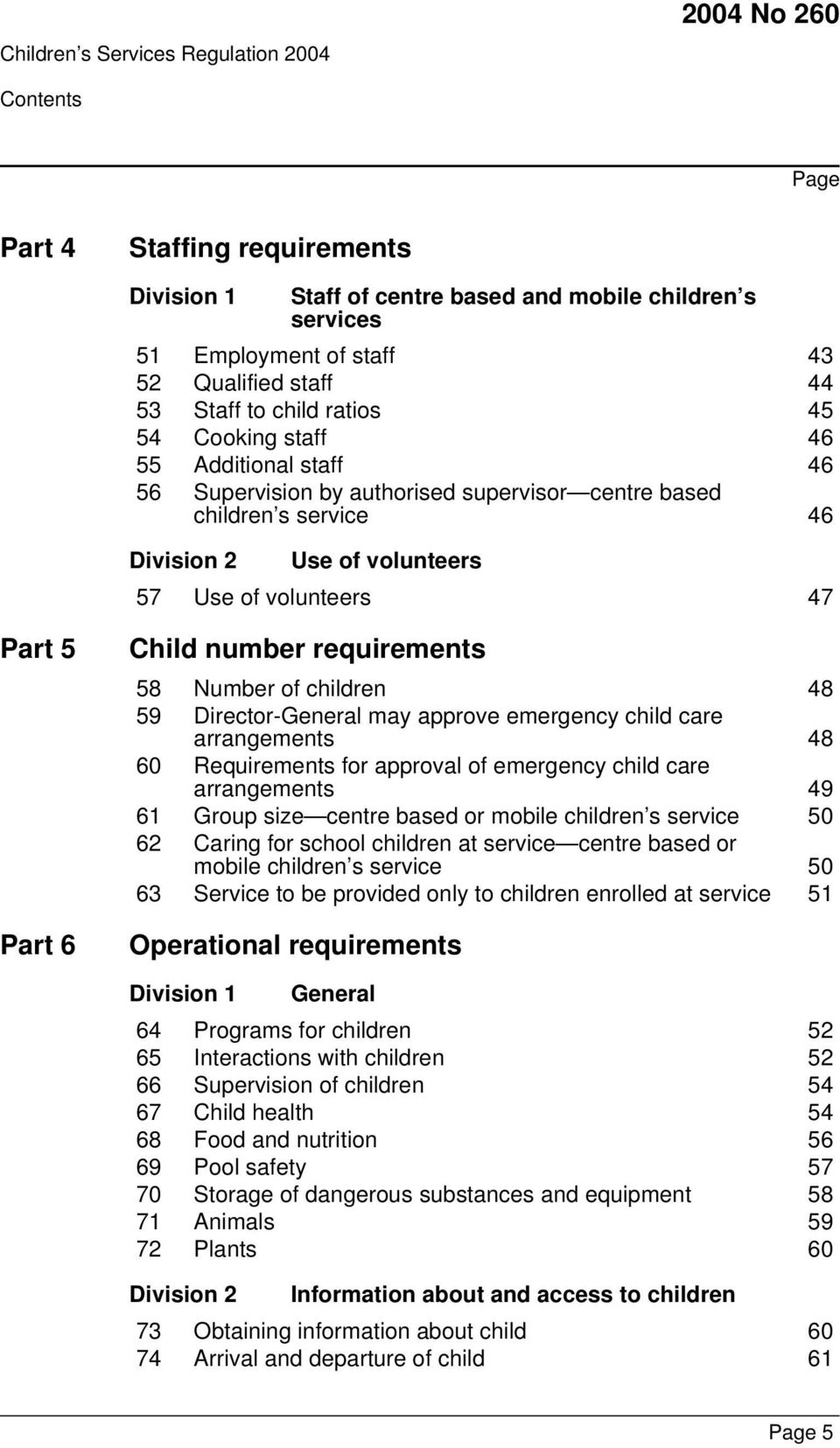
5 Children s Services Regulation No 260 Contents Page Part 4 Staffing requirements Division 1 Staff of centre based and mobile children s services 51 Employment of staff Qualified staff Staff to child ratios Cooking staff Additional staff Supervision by authorised supervisor centre based children s service 46 Division 2 Use of volunteers 57 Use of volunteers 47 Part 5 Part 6 Child number requirements 58 Number of children Director-General may approve emergency child care arrangements Requirements for approval of emergency child care arrangements Group size centre based or mobile children s service Caring for school children at service centre based or mobile children s service Service to be provided only to children enrolled at service 51 Operational requirements Division 1 General 64 Programs for children Interactions with children Supervision of children Child health Food and nutrition Pool safety Storage of dangerous substances and equipment Animals Plants 60 Division 2 Information about and access to children 73 Obtaining information about child Arrival and departure of child 61 Page 5
6 Children s Services Regulation No 260 Contents Page 75 Access to children Information and access to be denied to certain persons 62 Division 3 Excursions 77 Authority for excursions Conduct of excursions: general Conduct of excursions: water hazards 65 Division 4 Emergencies 80 Illness, accident and emergency treatment Medication Infectious diseases Emergency and evacuation procedures Family day care carer or home based licensee to hold first aid qualification 71 Part 7 Administrative requirements Division 1 Information 85 Policies to be made available Information or documents required by Director-General Entry and inspection Notice of complaint Public liability insurance Display of licence and family day care carer s certificate of registration Copy of Regulation to be kept on premises of service 74 Division 2 Records 92 Records in relation to children Records in relation to staff and visitors Records in relation to attendance at children s service Records about programs for children, developmental records, daily routine Retention of records Inspection of records Confidentiality guidelines Mobile children s service register Family day care register Removal of names from family day care register 80 Page 6

7 Children s Services Regulation No 260 Contents Page Division 3 Authorised supervisors 102 Change of authorised supervisor Temporary supervisors Application of licence conditions if no authorised supervisor Notice of change relating to authorised supervisor 82 Division 4 Miscellaneous 106 Notice of proposed change to constitution of licensee Notice of change in management of licensee: public authorities Notice of change in management of licensee: bodies other than public authorities Notice of significant change in circumstances of licensee Notice of change in contact information to be notified Notice of cessation of children s service Notice of changes to premises centre based, mobile or home based children s service Notice of change to family day care carer s home Notice of criminal charges or convictions licensee Notice of criminal charges or convictions family day care carer Informing and meeting family day care carers 85 Part 8 Part 9 Probity checks 117 Probity check of proposed licensee and supervisor Probity checks of proposed staff Nature of probity check By whom probity check to be carried out Probity check to be carried out in compliance with guidelines Unauthorised disclosure or dishonest collection of information 87 Miscellaneous 123 Review by Administrative Decisions Tribunal Original documents may be used instead of certified copies Savings and transitional provisions 89 Schedule 1 Records to be kept for each child 90 Schedule 2 Savings and transitional provisions 93 Dictionary 99 Page 7

8 Clause 1 Children s Services Regulation 2004 Part 1 Preliminary Children s Services Regulation 2004 under the Children and Young Persons (Care and Protection) Act 1998 Part 1 Preliminary 1 Name of Regulation This Regulation is the Children s Services Regulation Commencement 3 Application 4 Definitions This Regulation commences on 30 September This Regulation applies to prescribed children s services, being: (a) centre based children s services, or (b) family day care children s services, or (c) home based children s services, or (d) mobile children s services, referred to in this Regulation simply as children s services. Note. See also sections 199, 200 and 213 of the Act. (1) In this Regulation, words and expressions that are defined in the dictionary at the end of this Regulation have the meanings set out in the dictionary. (2) Notes included in this Regulation do not form part of this Regulation. 5 Meaning of notifiable offence (1) For the purposes of this Regulation, all offences are notifiable offences other than the following: Page 8

9 Children s Services Regulation 2004 Clause 5 Preliminary Part 1 (a) an offence (other than an offence referred to in subclause (2)) under the road transport legislation, (b) an offence that relates to the parking of a motor vehicle. (2) The following offences under the road transport legislation are also notifiable offences for the purposes of this Regulation: (a) an offence under section 9 of the Road Transport (Safety and Traffic Management) Act 1999 (which relates to presence of prescribed concentration of alcohol in person s blood), (b) an offence under section 12 (1) of the Road Transport (Safety and Traffic Management) Act 1999 (which relates to driving while under the influence of alcohol or any other drug), (c) an offence under section 42 (1) of the Road Transport (Safety and Traffic Management) Act 1999 relating to driving a motor vehicle negligently if the person found guilty is, by way of penalty, sentenced to imprisonment or fined a sum of not less than $200, (d) an offence under section 42 (2) of the Road Transport (Safety and Traffic Management) Act 1999 relating to driving a motor vehicle upon a road or road-related area furiously or recklessly or at a speed or in a manner which is dangerous to the public, (e) an offence under section 43 of the Road Transport (Safety and Traffic Management) Act 1999 (which relates to menacing driving), (f) an offence under section 70 of the Road Transport (Safety and Traffic Management) Act 1999 (which relates to failing to stop after an accident), (g) an offence under section 19 (2) of the Road Transport (General) Act 1999 (which relates to refusing to produce a driver licence when required, refusing to state a name or home address, or stating a false name or home address), (h) an offence under section 25A (1), (2) or (3) of the Road Transport (Driver Licensing) Act 1998 (which relates to driving while unlicensed), (i) any other offence under the road transport legislation if the court orders the disqualification of the person found guilty from holding a driver licence. Page 9

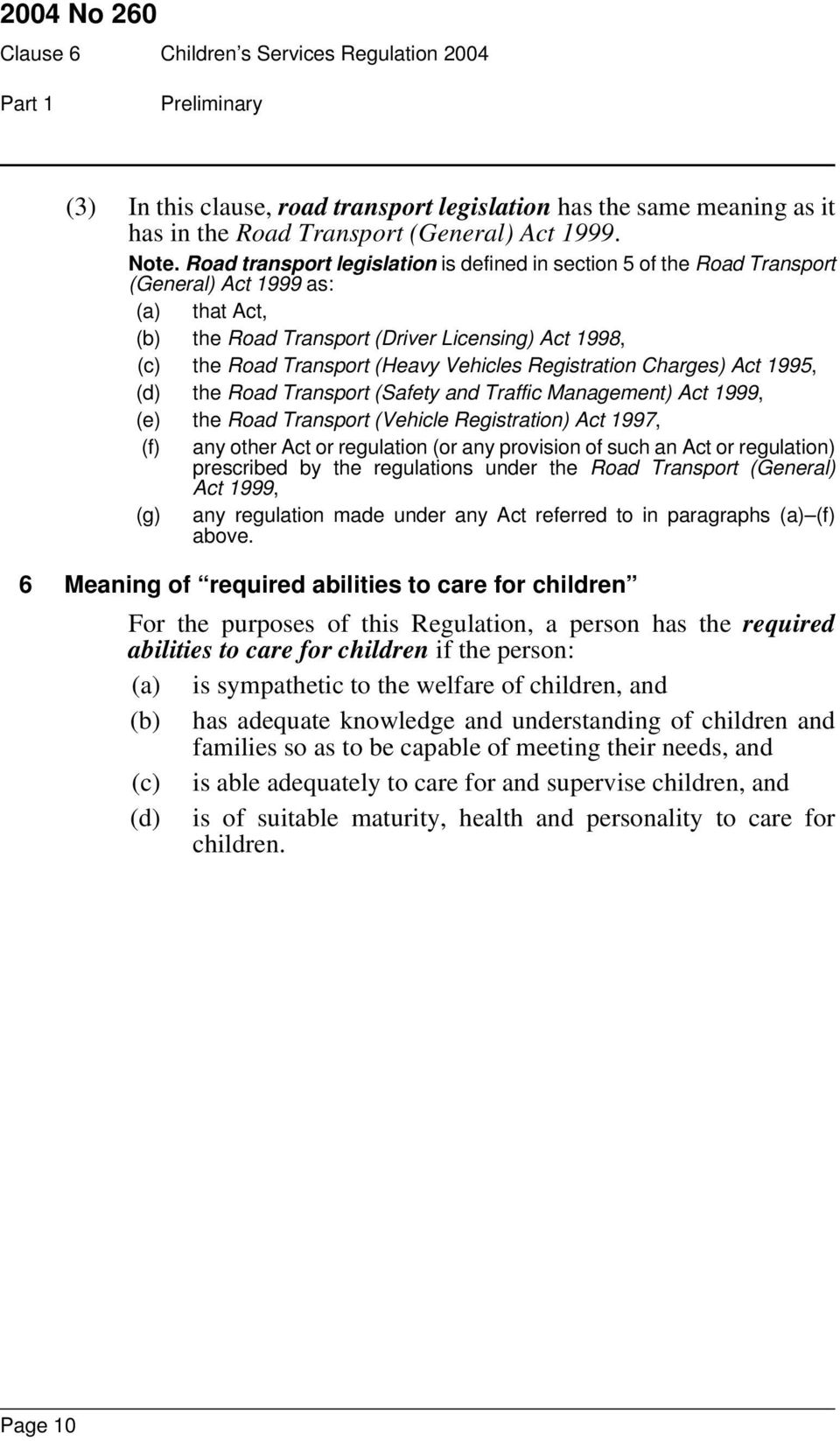
10 Clause 6 Children s Services Regulation 2004 Part 1 Preliminary (3) In this clause, road transport legislation has the same meaning as it has in the Road Transport (General) Act Note. Road transport legislation is defined in section 5 of the Road Transport (General) Act 1999 as: (a) that Act, (b) the Road Transport (Driver Licensing) Act 1998, (c) the Road Transport (Heavy Vehicles Registration Charges) Act 1995, (d) the Road Transport (Safety and Traffic Management) Act 1999, (e) the Road Transport (Vehicle Registration) Act 1997, (f) (g) any other Act or regulation (or any provision of such an Act or regulation) prescribed by the regulations under the Road Transport (General) Act 1999, any regulation made under any Act referred to in paragraphs (a) (f) above. 6 Meaning of required abilities to care for children For the purposes of this Regulation, a person has the required abilities to care for children if the person: (a) is sympathetic to the welfare of children, and (b) has adequate knowledge and understanding of children and families so as to be capable of meeting their needs, and (c) is able adequately to care for and supervise children, and (d) is of suitable maturity, health and personality to care for children. Page 10
11 Children s Services Regulation 2004 Clause 7 Licensing procedures Part 2 Part 2 Division 1 Licensing procedures Applications for licences 7 Who may apply for a licence? (1) Subject to this clause, an application for a licence may be made by any person or body: (a) who is the owner (or one of the owners) of the premises at which the children s service is proposed to be provided, or (b) who is the lessee (or one of the lessees) of those premises under a lease that has a period of not less than 3 years to run (including the period of any option to renew the lease) at the time of the making of the application and who is entitled to immediate possession of the premises, or (c) who, not being an owner or lessee referred to in paragraph (a) or (b), has obtained the consent of the Director-General to the making of the application. (2) An application for a licence may not be made by a natural person unless he or she is of or above the age of 21 years. (3) If development consent under the Environmental Planning and Assessment Act 1979 is required for the conduct of a children s service at the premises of the proposed service, an application for a licence may not be made until development consent has been obtained. (4) An application for the Director-General s consent under subclause (1) (c) is to be made in the approved form. 8 How is an application made? (1) An application for a licence is to be made in the approved form. (2) For the purposes of this Regulation, an application is incomplete unless: (a) the application is accompanied by all the information, documents and particulars required by or under this Part (unless the Director-General has waived or postponed the requirement in relation to the applicant under clause 19), and Page 11

12 Clause 9 Children s Services Regulation 2004 Part 2 Licensing procedures (b) the applicant has furnished to the satisfaction of the Director- General any further particulars that the Director-General may require under section 206 (4) of the Act. Note. Section 206 (4) of the Act provides that the Director-General may require an applicant for a licence to furnish such further particulars with respect to the application as the Director-General may specify in a written notice to the applicant. 9 Personal information to be contained in application (1) An application is to contain the information specified in subclause (2) about each of the following persons: (a) if the applicant is a natural person, the applicant, (b) if the applicant is a public authority: (i) the chief executive officer (however described) of the public authority, and (ii) if the public authority is a local authority, the manager of community services (however described) of the local authority, (c) if the applicant is neither a natural person nor a public authority: (i) each natural person involved in the control and management of the applicant, and (ii) if the applicant is a corporation and a majority shareholder of the applicant is another corporation, each natural person involved in the control and management of the majority shareholder corporation, (d) the proposed supervisor for the children s service nominated under clause 15. (2) For the purposes of subclause (1), the specified information is the following: (a) the person s full name, any other name by which the person is known (such as a nickname) and all former names of the person, (b) the person s contact details, including the person s postal address, home and business telephone numbers (including any mobile telephone numbers), any home and business fax numbers and any address for electronic mail, (c) the person s residential address, if different from the postal address, Page 12

13 Children s Services Regulation 2004 Clause 10 Licensing procedures Part 2 (d) (e) (f) (g) (h) (i) (j) the period of time for which the person has lived at that residential address, and the residential address at which the person lived before taking up residence at the current residential address, the person s date of birth and place of birth (including country of birth), details of the person s qualifications, experience and training, details of any children s services or other youth related activities that the person has previously been involved in (for example, a service or activity that the person operated, managed, carried out or assisted with), details of any criminal conviction of the person for an offence relating to neglect of a child or young person or assault (including sexual assault), whether or not the conduct constituting the offence occurred, or the person was convicted, in New South Wales, details of any charge for an offence relating to neglect of a child or young person or assault (including sexual assault) preferred against the person in the period of 5 years immediately before the application is made, whether or not the conduct to which the charge relates occurred, or the charge was preferred, in New South Wales, details of any disciplinary action or departmental or other proceedings of which the person is aware that have been taken in respect of the person relating to neglect of a child or assault (including sexual assault) in the period of 5 years immediately before the application is made, whether or not the conduct to which the action or proceedings relate occurred, or the proceedings were taken, in New South Wales. 10 Identity documents to accompany application (1) An application is to be accompanied by duly certified copies of the documents specified in subclause (2) for each of the following persons: (a) if the applicant is a natural person, the applicant, (b) if the applicant is a public authority: (i) the chief executive officer (however described) of the public authority, and Page 13
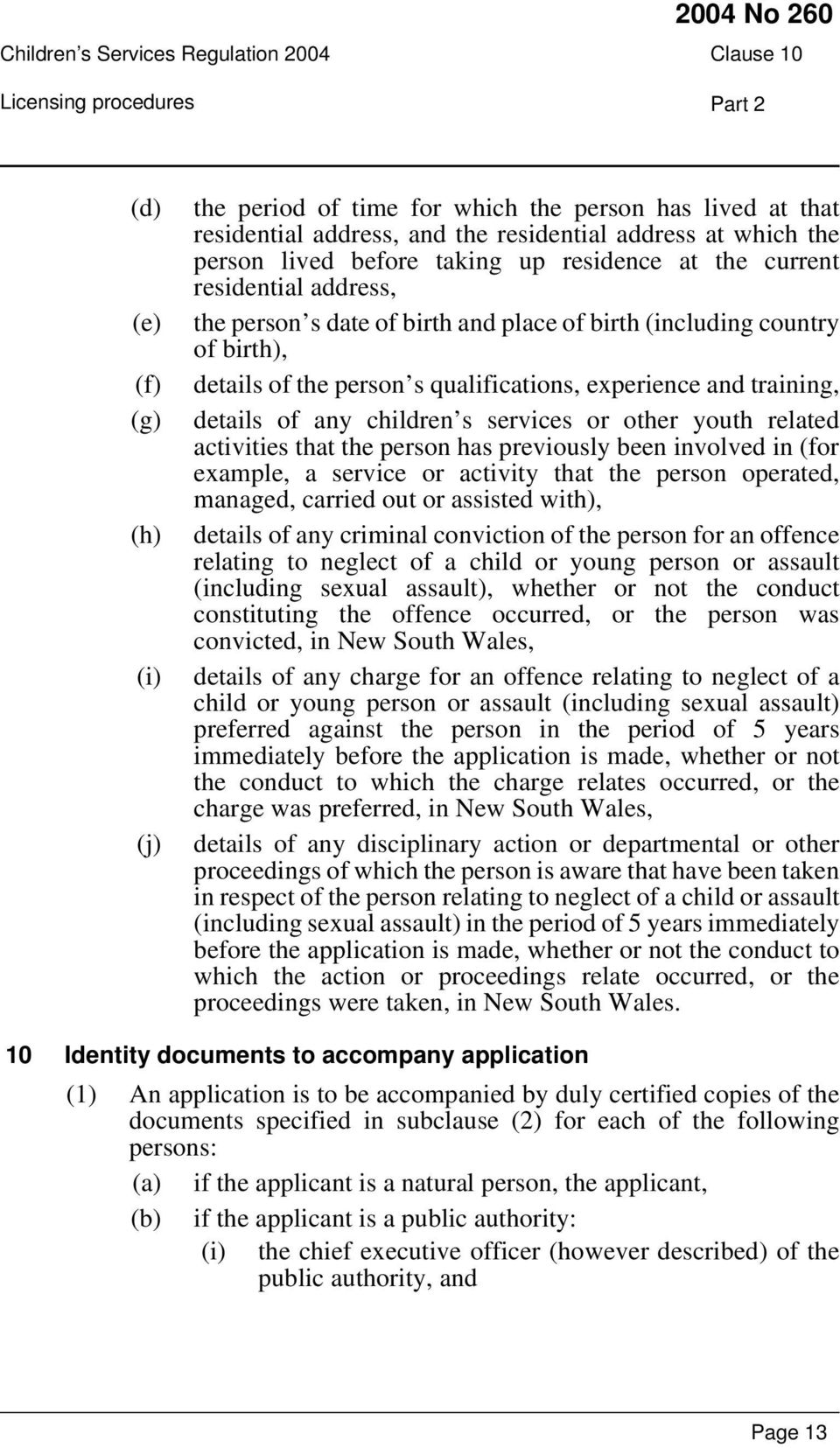
14 Clause 10 Children s Services Regulation 2004 Part 2 Licensing procedures (ii) if the public authority is a local authority, the manager of community services (however described) of the local authority, (c) if the applicant is neither a natural person nor a public authority: (i) each natural person involved in the control and management of the applicant, and (ii) if the applicant is a corporation and a majority shareholder of the applicant is another corporation, each natural person involved in the control and management of the majority shareholder corporation, (d) the proposed supervisor for the children s service nominated under clause 15. (2) For the purposes of subclause (1), the specified documents are the following: (a) the person s birth certificate (or if the person cannot practicably obtain such a certificate, any current passport held by the person), (b) if the person changed his or her name upon marriage, the marriage certificate, (c) either: (i) a current Australian driver licence held by the person, or (ii) if the person does not hold a current Australian driver licence, any current driver licence held by the person (together with a photograph of the person taken and certified in accordance with subclause (3)) or any current passport held by the person, (d) if applicable, any registered deed by which the person has formally changed the person s name, (e) if applicable, the person s naturalisation certificate. (3) A photograph referred to in subclause (2) (c) (ii): (a) must have been taken no earlier than 12 months before it is provided to the Director-General, and (b) must be accompanied by a written statement from a natural person (the verifier) who knows the person that: (i) states the full name and address of the verifier, and Page 14
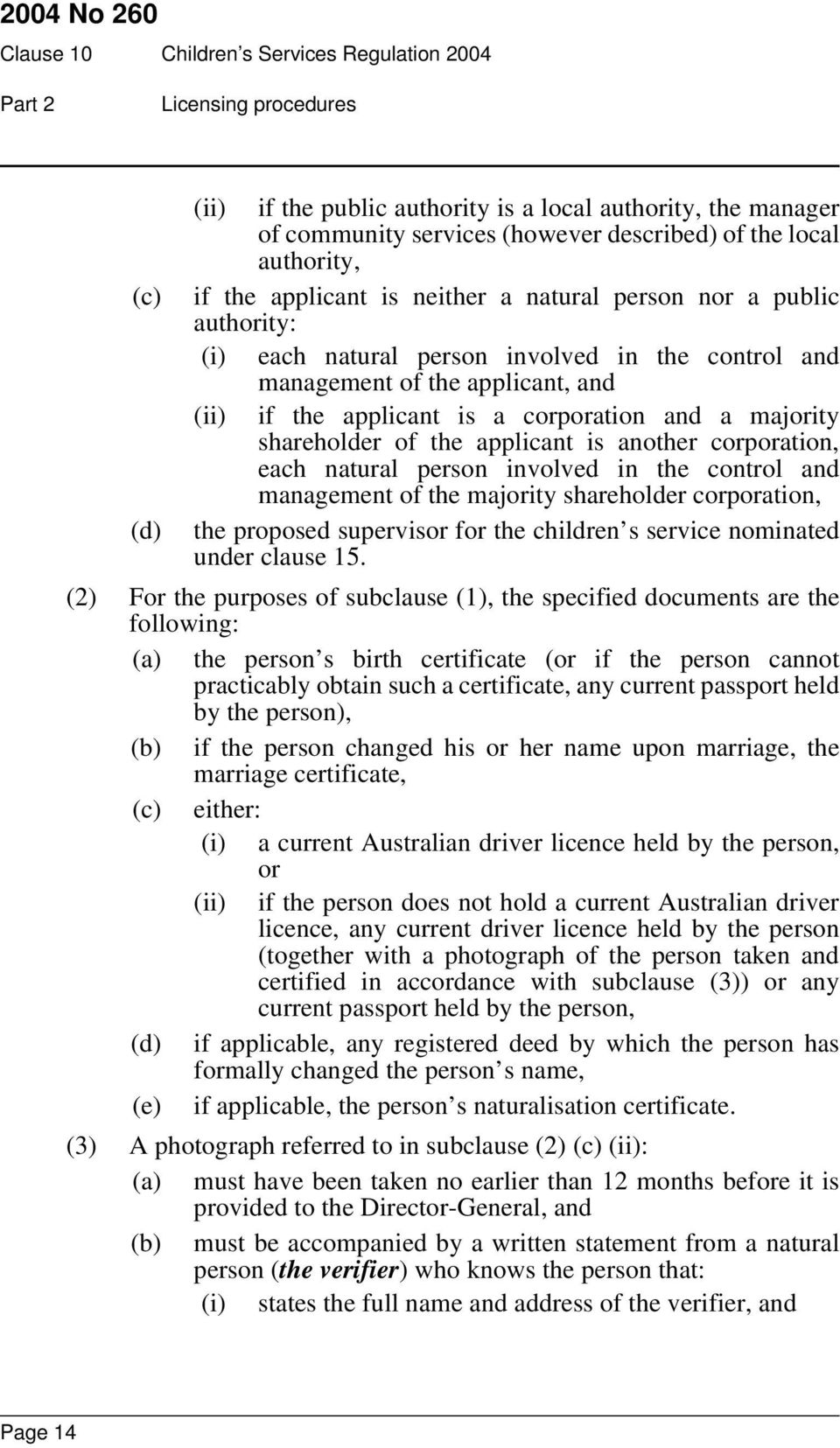
15 Children s Services Regulation 2004 Clause 11 Licensing procedures Part 2 (c) (ii) states that the verifier is of or above the age of 18 years, and (iii) states that the verifier has known the person for 12 months or more, and (iv) states that the verifier is not a relative of the person, and (v) is signed by the verifier, and must be endorsed on the reverse of the photograph with the words I, [name of verifier], certify that this is a true photograph of [name of person] and the signature of the verifier. 11 Documents showing applicant is a fit and proper person (1) An application for a licence is to be accompanied by information to demonstrate that the applicant is a fit and proper person to be concerned in the provision of the children s service. (2) For the purposes of subclause (1), the application is to be accompanied by the documents specified in subclause (3) for each of the following persons: (a) if the applicant is a natural person, the applicant, (b) if the applicant is a public authority: (i) the chief executive officer (however described) of the public authority, and (ii) if the public authority is a local authority, the manager of community services (however described) of the local authority, (c) if the applicant is neither a natural person nor a public authority: (i) each natural person involved in the control and management of the applicant, and (ii) if the applicant is a corporation and a majority shareholder of the applicant is another corporation, each natural person involved in the control and management of the majority shareholder corporation. (3) For the purposes of subclause (2), the specified documents are the following: (a) a duly certified copy of the person s qualifications in the area of children s services or any related area (such as a diploma, certificate of competency or statement of attainment), Page 15
![[name of verifier], certify that this is a true photograph of [name of person] and the signature of the verifier.](/docs-images/51/13985433/images/page_15.jpg "11 Documents showing applicant is a fit and proper person (1) An application for a licence is to be accompanied by information to demonstrate that the applicant is a fit and proper person to be")
16 Clause 12 Children s Services Regulation 2004 Part 2 Licensing procedures (b) character references from 2 independent referees, each dated no earlier than 3 months before the reference is furnished to the Director-General and containing an address to which further inquiries of the referee may be made, (c) if the person has any training or work experience in providing children s services (or assisting with providing children s services), references from 2 independent referees, each describing the person s performance during the training or work experience and containing an address to which further inquiries of the referee may be made. (4) Subclause (3) does not limit the information that may accompany the application for the purposes of subclause (1). Note. For example, the information may include copies of bank statements, financial records and any other documents indicating that the applicant has a sound financial reputation and stable financial background. 12 Information to be provided by applicant who is neither a natural person nor a public authority An application by a person who is neither a natural person nor a public authority must be accompanied by the following information: (a) the full name of the person, including any Australian Company Number or Australian Business Number, (b) any former names of the person, (c) the address of the registered office or head office of the person, (d) the contact details for the person, including the postal address (if different from the registered office or head office), telephone numbers (including any mobile telephone numbers), any facsimile number and any address for electronic mail, (e) the current constitution, charter, memorandum, rules, statement of objects, deed of trust or partnership agreement of the person (if any), (f) in the case of a corporation or body corporate, evidence of incorporation (such as a certificate of incorporation, or a certificate of registration under the Corporations Act 2001 of the Commonwealth). Page 16

17 Children s Services Regulation 2004 Clause 13 Licensing procedures Part 2 13 Information about training and development (1) Centre based or mobile children s service An application for a licence for a centre based or mobile children s service must be accompanied by information to demonstrate that the applicant: (a) intends to make provision for the training and development of primary contact staff, and (b) intends to ensure that all primary contact staff: (i) have the required abilities to care for children, and (ii) understand their responsibilities under the child protection legislation, and (iii) are fit and proper persons to care for children. Note. The required abilities to care for children are specified in clause 6. The licensee of a centre based or mobile children s service is required by clause 51 to ensure that members of the primary contact staff are fit and proper persons to be members of the primary contact staff. (2) Family day care children s service An application for a licence for a family day care children s service must be accompanied by information to demonstrate that the applicant: (a) intends to make provision for the training and development of family day care carers and staff of the service, and (b) intends to ensure that all family day care carers and staff of the service understand their responsibilities under the child protection legislation. (3) Home based children s service An application for a licence for a home based children s service must be accompanied by information to demonstrate that the applicant: (a) intends to participate in training in child development and child care on an annual basis to maintain and update the applicant s knowledge and skills, and (b) understands the applicant s responsibilities under the child protection legislation. Page 17

18 Clause 14 Children s Services Regulation 2004 Part 2 Licensing procedures 14 Information about abilities, experience and capacity of applicant for a licence for a home based children s service An application for a licence for a home based children s service must be accompanied by information to demonstrate that the applicant: (a) has the required abilities to care for children, and (b) has experience in caring for children, and (c) has demonstrated a capacity to exercise overall supervision of the provision of a children s service, and (d) has an understanding of nutrition, safe food handling, health, hygiene and safety in caring for children. Note. The required abilities to care for children are specified in clause Authorised supervisor (1) An application for a licence for a children s service: (a) must nominate a person as the proposed supervisor for the service, and (b) must be accompanied by the prescribed documents to demonstrate that the person is eligible to be an authorised supervisor for the service. Note. Under section 208 (1) (c) of the Act, the licence must specify the authorised supervisor of the service. (2) Subject to this clause, a person is eligible to be an authorised supervisor for a children s service if the person: (a) has the required abilities to care for children, and (b) has the required qualifications and experience, and (c) has demonstrated a capacity to exercise overall supervision of the provision of the service, and (d) is a fit and proper person to be concerned in the provision of the service, and (e) has successfully completed a course in child protection approved by the Director-General for the purposes of this clause (being a course that covers all applicable requirements under the child protection legislation). Note. The required abilities to care for children are specified in clause 6. Page 18

19 Children s Services Regulation 2004 Clause 15 Licensing procedures Part 2 (3) For the purposes of subclause (2) (b), a person has the required qualifications and experience if the person: (a) has obtained: (i) a degree or diploma in early childhood education from a university following a course with a duration (on a full-time basis) of not less than 3 years, or (ii) a Child Care Certificate, a Certificate of Child Care Studies or an Associate Diploma of Social Science (Child Studies) from a registered training organisation, or (iii) a Diploma of Community Services (Children s Services) from a registered training organisation, being a diploma as part of which the person has successfully completed a course unit in administration and a course unit in service management, or (iv) another approved qualification, and (b) has 12 months full-time experience or its equivalent in part-time experience (gained after obtaining the qualification referred to in paragraph (a)) in providing a relevant children s service as a member of the primary contact staff. (4) Subclause (3) (a) and (b) do not apply in relation to the authorised supervisor of a home based children s service. (5) Subclause (3) (a) and (b) do not apply in relation to the authorised supervisor of a children s service that forms part of a school (within the meaning of the Education Act 1990) if the authorised supervisor: (a) is the school principal or some other member of the school teaching staff, and (b) has tertiary qualifications in the field of education, and (c) has an active role in the management of the early childhood curriculum at the school. (6) A person may be nominated as a proposed supervisor in relation to 2 children s services if at least one other member of staff of each service is qualified as required by clause 52, but may not be nominated as a proposed supervisor in relation to more than 2 children s services. Page 19

20 Clause 16 Children s Services Regulation 2004 Part 2 Licensing procedures (7) For the purposes of subclause (1) (b), the prescribed documents are the following: (a) duly certified copies of the person s qualification referred to in subclause (3) (a) and of any other of the person s qualifications in the area of children s services or any related area (such as a diploma, certificate of competency or statement of attainment from a registered training organisation), (b) work references from 2 independent referees describing the person s performance during the training or work experience referred to in subclause (3) (b), (c) character references from 2 independent referees attesting to the person s suitability to work with children, each dated no earlier than 3 months before the reference is furnished to the Director-General and containing an address to which further inquiries of the referee may be made. 16 Information about premises to accompany application centre based or mobile children s service (1) An application for a licence for a centre based children s service must be accompanied by the following information and documents: (a) the address of the premises where the children s service will be provided, (b) evidence of the applicant s eligibility to apply for a licence under clause 7, (c) 3 copies of a site plan of the premises at which the service is to be provided that: (i) (ii) (iii) (iv) shows the location of every building, structure, outdoor play area, fence, gate and shaded area on the premises, and shows the location of each point of entry to or exit from the premises, including entries and exits by way of any residential premises, and specifies the type of each fence and gate located on the premises, and shows the boundaries of the premises, and Page 20

21 Children s Services Regulation 2004 Clause 16 Licensing procedures Part 2 (v) is drawn by a person who is entitled to use the title architect, architectural draftsman or architectural assistant under the Architects Act 1921 or who is accredited by the Building Designers Association of NSW Inc in relation to the design of the class of buildings concerned, and (vi) is drawn to a metric scale of 1:100 or 1:200, and (vii) is drawn on one sheet of paper, (d) 3 copies of a plan of each building on the premises that: (i) shows the elevations and dimensions of the building and the dimensions of the lot on which the building is located, and (ii) shows the location of fences on the premises, and (iii) shows the floor plan of each of the buildings concerned, together with the proposed use of each part of the building (including the location of the toilets, any nappy change area, craft preparation area and internal storeroom), (iv) is drawn by a person who is entitled to use the title architect, architectural draftsman or architectural assistant under the Architects Act 1921 or who is accredited by the Building Designers Association of NSW Inc in relation to the design of the class of buildings concerned, and (v) is drawn to a metric scale of 1:50 or 1:100, and (vi) is drawn on one sheet of paper, (e) a statement in writing signed or sealed by the applicant and by the person referred to in paragraph (d) (iv): (i) stating that the premises comply with the Part 3 facilities and equipment requirements applicable to a centre based children s service, or (ii) stating any respect in which the premises do not comply with those requirements, (f) if an occupation certificate is required under the Environmental Planning and Assessment Act 1979 for the proposed use of the premises for a children s service, a copy of the certificate, (g) a certificate issued under section 149A of the Environmental Planning and Assessment Act 1979 for the premises. Page 21
22 Clause 17 Children s Services Regulation 2004 Part 2 Licensing procedures (2) An application for a licence for a mobile children s service must be accompanied by the following information and documents: (a) the address of the premises where the children s service will be provided, including any adjacent premises that will be used to provide the service in conjunction with the main premises, (b) if an occupation certificate is required under the Environmental Planning and Assessment Act 1979 for the proposed use of the premises for a children s service, a copy of the certificate, (c) a certificate issued under section 149A of the Environmental Planning and Assessment Act 1979 for the premises. 17 Venue management plans for mobile children s services (1) An application for a licence for a mobile children s service is to be accompanied by: (a) a statement as to whether any of the premises at which the service is proposed to be provided do not comply with the Part 3 facilities and equipment requirements applicable to a mobile children s service, and (b) if so, a plan describing how the applicant intends to ensure the safety and well-being of children at those premises. (2) The Director-General: (a) may approve a plan submitted under subclause (1) (b), or (b) may require the applicant to revise the plan as to any matter or in any respect specified by the Director-General. (3) A revised plan may be resubmitted to the Director-General for the approval of the Director-General. (4) Subclauses (2) and (3) apply to a revised plan resubmitted under subclause (3) in the same way as they apply to a plan submitted under subclause (1) (b). (5) The Director-General may not grant a licence for a mobile children s service for which a plan is required unless the Director- General has approved a plan for the service under this clause. (6) A plan approved by the Director-General under this clause is referred to in this Regulation as a venue management plan. Page 22
23 Children s Services Regulation 2004 Clause 18 Licensing procedures Part 2 18 Statements and undertakings about facilities and equipment, administration and policies to accompany application (1) An application for a licence must be accompanied by a statement of the philosophy and aim of the service. (2) Subject to subclause (3), an application for a licence for a centre based children s service or mobile children s service must also be accompanied by the following: (a) a written undertaking signed or sealed by the applicant that at all times during the term of the licence the applicant will conduct such checks as are necessary to ensure that: (i) the premises of the children s service comply with the Part 3 facilities and equipment requirements applicable to the class of children s services the subject of the application, and (ii) the children s service is conducted in accordance with the Part 6 operational requirements and Part 7 administrative requirements applicable to the class of children s services the subject of the application, (b) a written undertaking signed by the proposed supervisor that at all times during the term of the licence the proposed supervisor will conduct such checks as are necessary to ensure that: (i) the premises of the children s service comply with the Part 3 facilities and equipment requirements applicable to the class of children s services the subject of the application, and (ii) the children s service is conducted in accordance with the Part 6 operational requirements and Part 7 administrative requirements applicable to the class of children s services the subject of the application. (3) An application for a licence for a mobile children s service that is accompanied by a venue management plan must, in place of the undertakings referred to in subclause (2) (a) (i) and (b) (i), be accompanied by: (a) a written undertaking signed or sealed by the applicant that at all times during the term of the licence the applicant will conduct such checks as are necessary to ensure that the premises comply with the venue management plan, and Page 23
24 Clause 19 Children s Services Regulation 2004 Part 2 Licensing procedures (b) a written undertaking signed by the proposed supervisor that at all times during the term of the licence the proposed supervisor will conduct such checks as are necessary to ensure that the premises comply with the venue management plan. (4) An application for a licence for a family day care or home based children s service must also be accompanied by a written undertaking signed or sealed by the applicant that at all times during the term of the licence the applicant will conduct such checks as are necessary to ensure that: (a) the premises of the children s service comply with the Part 3 facilities and equipment requirements applicable to the class of children s services the subject of the application, and (b) the children s service is conducted in accordance with the Part 6 operational requirements and Part 7 administrative requirements applicable to the class of children s services the subject of the application. 19 Waiver and postponement of certain requirements The Director-General may waive or postpone a requirement to provide specified information or documents under this Part, or may approve the production of specified information or documents in place of information or documents the subject of such a requirement. 20 Advertising of application and copy of advertisement to accompany application (1) An applicant for a licence must advertise notice of intention to apply for a licence in a daily newspaper circulating generally throughout New South Wales and in a newspaper circulating generally in the locality where the service is to be provided. (2) Such a notice: (a) must be in the approved form, and (b) must state the name of the applicant (including any alternative name by which the applicant is known) and any former names of the applicant, and (c) if the applicant is neither a natural person nor a public authority, must state the name (and any former names and alternative names) of: Page 24
25 Children s Services Regulation 2004 Clause 21 Licensing procedures Part 2 (i) each natural person involved in the control and management of the applicant, and (ii) if the applicant is a corporation and a majority shareholder of the applicant is another corporation, each natural person involved in the control and management of the majority shareholder corporation, and (d) in the case of a centre based or home based children s service, must identify the address of the premises where the children s service is proposed to be provided, and (e) must state that submissions in respect of the proposed application may be made to the Director-General within 3 weeks after the publication of the notice, and (f) must be published no earlier than 2 weeks before the application is lodged with the Director-General and no later than the day on which the application is lodged. (3) An application for a licence must be accompanied by evidence of the due publication of the notice required by this clause. 21 Further licences (1) A licensee who intends to continue to provide the children s service to which the licence relates may apply for a further licence for that service in accordance with this clause. (2) The application: (a) is to be made at least 6 months before the expiry of the licence, and (b) is to be made in the approved form. (3) The application is to be accompanied by the information and documents required by clauses 9 18, except that: (a) the application is not required to be accompanied by any of the documents referred to in clause 16 if: (i) there have been no structural alterations to the premises to which the licence relates (including any fences) since the licence was granted, or (ii) any such structural alterations have been approved in writing by the Director-General, and Page 25
26 Clause 22 Children s Services Regulation 2004 Part 2 Licensing procedures (b) the application is not required to be accompanied by any information or documents referred to in clause 9 (2) (d) (g), 10 (2) (a) (e), 11 (3) (a), 12 (e) or (f) or 15 (1) (b) unless the relevant information (or the information contained in the relevant documents) that accompanied the initial application for the licence is no longer correct or accurate. Note. The premises of a children s service include each part of the premises. (4) If an application for a further licence has not been determined by the Director-General by the time the licence expires: (a) the application is taken to have been refused by the Director- General on the day that the licence expires, and (b) if an application for a review of the refusal is made under clause 123, the licence remains in force until the application for review is finally dealt with. Note. Clause 123 enables an applicant to apply for a review of a decision to refuse to grant a licence. Division 2 Licences 22 Grant of licence (1) If a person applies to the Director-General for a licence, the Director-General is to: (a) grant the licence, or (b) cause to be served on the applicant a notice stating that, when 4 weeks have expired after service of the notice, the Director- General intends to refuse to grant the licence on the grounds specified in the notice unless it has been established to the Director-General s satisfaction that the licence should not be refused. (2) When 4 weeks have expired after a notice has been served under subclause (1) (b), the Director-General, after considering any submissions made during that period, is to: (a) grant the licence, or (b) refuse to grant the licence and cause to be served on the applicant a notice stating the grounds on which the licence has been refused. Note. In order to lawfully operate a children s service it may be necessary to obtain approvals or consents from other public authorities, in addition to obtaining a licence. Page 26
27 Children s Services Regulation 2004 Clause 23 Licensing procedures Part 2 23 Form of licence (1) A licence is to be in the approved form. (2) A licence is to be endorsed with any condition imposed on it by the Minister under section 209 (b) of the Act. (3) A person may be a licensee for more than one children s service. 24 Term of licence (1) The Director-General may grant a licence for a term not exceeding 3 years. (2) A licence takes effect on the day on which it is granted or such later date as is specified in the licence. 25 Licence conditions generally (1) For the purposes of section 209 (a) of the Act, the prescribed conditions for a licence for a children s service are the provisions of Parts 3, 4, 5, 6 and 7 that are relevant to that class of children s service. (2) For the purposes of section 210 (1) of the Act, a provision of Part 3, 4, 5, 6 or 7 applies to the licensee unless it is expressed to apply to someone else. (3) The prescribed conditions are taken to include an additional condition to the effect that the licensee will develop procedures to ensure that the authorised supervisor, and all other members of staff of the service, comply with the provisions of this Regulation that apply to them. (4) In the case of a licence for a mobile children s service for which there is a venue management plan, the prescribed conditions are taken to include a further additional condition to the effect that the licensee will ensure that the premises of the service will comply with that plan. (5) In the case of a licence for a family day care children s service, the prescribed conditions are taken to include a further additional condition to the effect that the licensee: (a) will make it a condition of registration with the service that a family day care carer must comply with the provisions of this Regulation that apply to a family day care carer, and Page 27
28 Clause 26 Children s Services Regulation 2004 Part 2 Licensing procedures (b) will develop procedures to ensure that each family day care carer who is registered with the service complies with those provisions. Division 3 Variation, suspension and revocation of licences 26 Grounds for variation, suspension or revocation of licences (1) Subject to this Division, the Director-General: (a) may vary or revoke a condition of a licence, or (b) may impose a further condition on a licence, or (c) may vary a particular specified in a licence, or (d) may suspend a licence for a period not exceeding 6 months, or (e) may revoke a licence. (2) The grounds on which the Director-General may take an action under subclause (1) are: (a) the licensee under the licence has requested that the Director- General take the action, or (b) either the licensee or the authorised supervisor under the licence is no longer a fit and proper person to be concerned in the provision of the children s service, or (c) either of those persons has contravened or failed to comply with a provision of the Act or this Regulation that applies to that person, or (d) any premises of a children s service do not comply with any provision of the Act or this Regulation, or of a licence condition, that applies to them, or (e) the authorised supervisor under the licence does not have the overall supervision of the provision of the children s service to which the licence relates. Note. Section 211 of the Act specifies other grounds on which a licence may be revoked. These grounds include: (a) the Director-General is of the opinion that the continued operation of the children s service would constitute an unacceptable risk to the safety, welfare or well-being of any child or class of children attending the service, or (b) exceptional circumstances arise in which the Director-General considers it contrary to the best interests of the children attending the children s service for the service to continue, or (c) the Director-General is of the opinion that any person involved in the control and management of a licensee that is not a natural person is no longer a suitable person to hold a licence. Page 28
29 Children s Services Regulation 2004 Clause 27 Licensing procedures Part 2 27 Variation, suspension or revocation of licence (1) If the Director-General intends to take any action referred to in clause 26 (1), the Director-General is to cause to be served on the licensee and the authorised supervisor under the licence a notice: (a) stating that when 4 weeks have expired after service of the notice, the Director-General intends to take the action specified in the notice unless it has been established to the Director-General s satisfaction that the action should not be taken, and (b) stating the reasons for the intention to take the action, and (c) stating that the licensee may make submissions to the Director-General about the proposed action within the period of 4 weeks after service of the notice. (2) When 4 weeks have expired after the notice was served under subclause (1), the Director-General may, after considering any submissions made during that period by the licensee, take the action specified in the notice by a further notice served on the licensee. (3) Subsections (1) and (2) do not apply to any action taken at the request of the licensee. (4) Action taken pursuant to the further notice under subclause (2) takes effect on the date specified in the notice for that purpose. (5) A licence is taken not to be in force while it is suspended. (6) If a licence is revoked, the person who was the licensee under the licence immediately before the revocation: (a) must return the licence to the Director-General within the period specified in the notice for its return, and (b) must take all reasonably practicable steps to inform a parent of each child to whom the service is provided that the service will cease to be provided on the date specified in the notice for that purpose. (7) If a licence has been suspended, the Director-General may, at any time during the period of suspension, restore the licence by serving on the person who was the licensee under the licence immediately before it was suspended a notice stating that the licence is restored. Page 29
30 Clause 28 Children s Services Regulation 2004 Part 2 Licensing procedures 28 Notice to parents of variation, suspension or revocation of licence (1) A licensee who requests the Director-General to vary or revoke a licence condition, or add a further licence condition, or revoke the licence: (a) must give notice in writing of the request to a parent of each child to whom the service is provided within 2 weeks after the request is made, and (b) must give notice in writing of the result of the request to each parent within 2 weeks after the licensee is notified of the result of the request by the Director-General. (2) A licensee must cause written notice to be given to a parent of each child to whom the service is provided of any other variation or addition of a licence condition within 2 weeks after the licensee is notified by the Director-General of the variation or addition. Maximum penalty: 5 penalty units. 29 Change of mobile children s service A licensee of a mobile children s service who intends to change the premises specified in the licence (whether by relocating the service, ceasing to provide the service at particular premises or providing the service at additional premises) or to change a venue management plan: (a) (b) must request the Director-General to vary the licence under clause 26 (1) (c) with respect to the premises or venue management plan specified in the licence, and must provide the information and documents specified in clauses 16 and 17, where relevant, and such other information as the Director-General may reasonably require. Page 30
31 Children s Services Regulation 2004 Clause 30 Facilities and equipment requirements Part 3 Part 3 Division 1 Facilities and equipment requirements Facilities 30 Space requirements: centre based children s services (1) The premises of a centre based children s service must have: (a) a room or an area that is used only for administration of the service and for private consultation between staff and parents, and (b) a room or an area, located away from the areas used by children, that is used for respite of staff, and (c) a room or an area that is used only for sleeping for children under 2 years of age. (2) The premises of a centre based children s service must have at least 3.25 square metres of unencumbered indoor play space per child that is exclusively for the use of children provided with education and care while in attendance at the service. (3) For the purposes of calculating unencumbered indoor play space, items such as any passage way or thoroughfare, door swing areas, kitchen, cot rooms, toilet or shower areas located in the building or any other facility such as cupboards and areas set aside as referred to in subclause (1) are to be excluded. (4) Subject to subclauses (7) and (8), the premises of a centre based children s service must have at least 7 square metres of useable outdoor play space per child that is exclusively for the use of children provided with education and care while in attendance at the service. (5) For the purposes of calculating useable outdoor play space, items such as car parking areas, storage sheds and other fixed items that prevent children from using the space or that obstruct the view of staff supervising children in the space are to be excluded. (6) The outdoor play space must be adequately shaded in accordance with guidelines published by the New South Wales Cancer Council under the title Shade for Child Care Services, as in force immediately before the commencement of this Regulation. (7) If the Director-General is satisfied that the location of a centre based children s service makes it impracticable to provide the required amount of useable outdoor play space, the Director-General may Page 31
32 Clause 31 Part 3 Children s Services Regulation 2004 Facilities and equipment requirements consent to the provision of some or all of that space in an indoor area that is to be designed and equipped to permit children to participate in activities that promote gross motor skills. (8) The Director-General may impose conditions on such a consent relating to any matter the Director-General sees fit, including the availability of natural light and ventilation. 31 Laundry (1) All children s services A children s service must have laundry arrangements, whether on the premises of the children s service or through another facility, service or arrangement. (2) The premises of a children s service must have safe, sanitary facilities for the storage of soiled clothes, linen and nappies before laundering or disposal. (3) Centre based children s service A centre based children s service that provides children under 3 years of age with the service must have laundry facilities available on the premises of the service, being facilities that include at least a laundry tub connected to both hot and cold water. 32 Craft preparation facilities: centre based or mobile children s service (1) The premises of a centre based or mobile children s service must have separate facilities (including a sink, bench top and lockable cupboard) for use in craft activities. (2) The area must not be next to any food preparation facilities or nappy change area at the premises. 33 Food preparation facilities (1) The premises of a children s service must have a designated area, that is both safe and hygienic, for food preparation and storage. (2) Facilities in the designated area must include a stove or microwave, sink, refrigerator, suitable disposal facilities and hot water supply. (3) Facilities for the preparation and storage of food must be designed, located and maintained so as to prevent children from gaining access to any harmful substance, equipment or amenity. Page 32
33 Children s Services Regulation 2004 Clause 34 Facilities and equipment requirements Part 3 (4) Without limiting subclause (3), if the premises of a centre based or mobile children s service contains a separate kitchen, the kitchen must have a door, half-gate or other barrier to prevent unsupervised entry by children into the kitchen. (5) In addition to a food preparation area, a centre based children s service must also have a designated area, that is both safe and hygienic, for the preparation of bottles for children under the age of 2 years. (6) Any area in which bottles are prepared for children under the age of 2 years, whether in a centre based children s service or any other children s service, must be separate from any area in which nappychanging facilities are provided. (7) Despite subclause (1), a mobile children s service may provide food preparation and storage facilities through another facility, service or regular arrangement if food preparation and storage facilities are not available on the premises used by the mobile children s service. 34 Toilets and washing facilities (1) All children s services The premises of a children s service must have toilet, hand washing and bathing facilities that are safe and appropriate to the ages of the children at the service and must have products and equipment for cleaning those facilities whenever necessary. (2) Centre based children s service The sanitary facilities of a centre based children s service must comply with the requirements for class 9b buildings (Early childhood centres) of clause F2.3 of the Building Code of Australia. Note. Table F2.3 9b provides that for every 15 children or part thereof there must be: (a) a junior toilet or adult toilet with a firm step and a junior seat, (b) one hand basin either with a firm step, or at a height so as to provide reasonable child access. 35 Nappy change facilities (1) All children s services The following facilities must be provided at the premises of a children s service if any child provided with the service wears nappies: Page 33
34 Clause 35 Children s Services Regulation 2004 Part 3 Facilities and equipment requirements (a) a stable surface for changing nappies, together with a mat that has an impervious washable surface, for every 10 children (or part thereof), (b) hand washing facilities for adults in the immediate vicinity of the nappy changing area, (c) sanitary facilities for the storage of soiled nappies pending laundering or disposal of the nappies, (d) if the children s soiled clothing is laundered by the staff of a centre based or mobile children s service or by a family day care carer or home based licensee, adequate facilities for laundering the clothing or otherwise dealing hygienically with waste, (e) facilities for the storage of clean nappies. (2) If any such child is under the age of 3 years, the stable surface referred to in subclause (1) (a) is to be a properly constructed nappy changing bench. (3) Any nappy changing bench or mat must be cleaned after each use. (4) The nappy changing facilities must be designed, located and maintained so as to prevent unsupervised access by children. (5) The nappy changing facilities must be separated from food preparation facilities and craft preparation facilities. (6) Centre based children s service In addition to the facilities referred to in subclause (1), the premises of a centre based children s service must be equipped with the following: (a) an age appropriate washing facility with temperature regulated hot and cold running water in, or adjacent to, the nappy change area, (b) a sluice or contaminated waste disposal unit in the nappy change area. (7) Nothing in subclause (6) prevents the premises of a centre based children s service from being equipped with an additional movable nappy changing bench. However, if such a bench is provided it must provide a stable surface on which to place a child when changing nappies. Page 34
35 Children s Services Regulation 2004 Clause 36 Facilities and equipment requirements Part 3 36 Sleeping facilities (1) The premises of a children s service must have an adequate number of cots, beds, stretchers or sleeping mats (together with waterproof covers) or other culturally appropriate forms of bedding for all children who sleep while at the premises. (2) For the purposes of subclause (1), the ages of children at the service, the program of activities of the service and hours of operation of the service are to be taken into account when determining adequate sleeping facilities. (3) Provision must be made at the premises of a children s service to ensure that: (a) mattresses and other bedding are clean and comfortable, and (b) bed clothing is appropriate to the climate, and (c) all bed clothing is kept clean and in good repair, and (d) there is individual bed linen and blankets for each child, and (e) children do not share the same bed at the same time, and (f) bed linen used by one child is washed before it is used by another child, and (g) no child who is of or above 7 years of age sleeps in the same room as another child of the opposite sex who is not a relative, and (h) no child who is of or above the age of 2 years, and (except with the written consent of a parent of the child) no child who is under the age of 2 years, sleeps in a room in which an adult is sleeping. (4) Cots, beds, stretchers, mattresses and other bedding at the premises of a children s service must be arranged so as: (a) to be in an area that has natural light, and (b) to allow easy exit of any child, and (c) to allow easy access to any child, and (d) to reduce the risk of cross infection between children. (5) A sleeping area for children must be designed to ensure that all children in the area are readily accessible to staff of the service, or the family day care carer or home based licensee. Page 35
36 Clause 37 Children s Services Regulation 2004 Part 3 Facilities and equipment requirements (6) Cots must comply with the requirements of Australian/New Zealand Standard AS/NZS Cots for household use Safety requirements, as published on 5 April Storage facilities (1) All children s services The premises of a children s service must have storage facilities (whether fixed or movable) that are secure and inaccessible to children. (2) Centre based or mobile children s service The premises of a centre based or mobile children s service must have: (a) storage facilities for indoor and outdoor equipment, and (b) storage facilities that give each child provided with the service at the premises access to a space for storage of the child s personal belongings. (3) Equipment used for providing a mobile children s service may be stored at any premises at which the service is provided, at the offices of the service or in any vehicle used to transport equipment used for providing the service. 38 Swimming pools (1) Centre based or mobile children s services There must not be a swimming pool (within the meaning of the Swimming Pools Act 1992) on the premises of any centre based or mobile children s service unless the pool existed on the premises before 6 November (2) Any swimming pool on the premises of a centre based or mobile children s service on or before the commencement of this clause must be fenced. The fencing must be in accordance with the Swimming Pools Act 1992 (whether or not that Act applies to the swimming pool concerned). (3) Family day care or home based children s services Any swimming pool at the premises of a family day care carer or home based licensee must be fenced to the standard to which a new swimming pool would be required to be fenced under the Swimming Pools Act Page 36
37 Children s Services Regulation 2004 Clause 39 Facilities and equipment requirements Part 3 Division 2 Equipment 39 Telephone (1) The premises of a children s service must be equipped with an operating telephone or two-way radio capable of communication with, at least, the nearest police station, ambulance station, fire service, and medical emergency facility and that is readily accessible to staff of the service. (2) The telephone may include a mobile telephone, but only if the telephone has a reception adequate for communication as referred to in subclause (1) and is maintained in a state of operation such that it may be used immediately at any time. 40 Development and play equipment (1) All children s services Play equipment (whether fixed or not) used on the premises of a children s service must not constitute a hazard to children at the service because of: (a) the height from which a child can fall, or (b) the likelihood that a child can be trapped, pinched or crushed in the equipment or struck by it, or (c) sharp or rough edges and projections or rust, or (d) lack of stability. (2) Play equipment used on the premises must be safe and in good repair. (3) All broken equipment and broken toys must immediately be removed from play areas. (4) The premises of a children s service must have independent access for children to books and equipment that are suitable to the children s development and needs and that are representative of a diverse range of cultures. (5) Centre based or mobile children s service The premises of a centre based or mobile children s service must be equipped with a balance of indoor and outdoor equipment to meet the developmental and other needs of children that is readily available for use by the children and staff of the service. Page 37
38 Clause 41 Children s Services Regulation 2004 Part 3 Facilities and equipment requirements (6) In determining the balance of types of equipment and the sufficiency of equipment for the purposes of subclause (5), the age, number and interests of the children provided with the service must be taken into account. (7) The surfacing used underneath or around play equipment on the premises of a centre based children s service must comply with the requirements of Australian and New Zealand Standard AS/NZS 4422:1996 Playground surfacing Specifications, requirements and test method as in force on the commencement of this Regulation. (8) Family day care or home based children s service The home of a family day care carer or home based licensee must be equipped with equipment that is: (a) adequate and sufficient to meet the individual interests and capabilities of each child provided with the service, and (b) readily available for use by children and the family day care carer or home based licensee. (9) In determining the adequacy and sufficiency of equipment for the purposes of subclause (8), the age, number and interests of children provided with the service must be taken into account. 41 First aid kits (1) The premises of a children s service must be equipped with a suitable and fully stocked first-aid kit of a kind approved by the WorkCover Authority under the Occupational Health and Safety Act (2) The first aid kit must be inaccessible to children, but readily accessible to staff or a family day care carer or home based licensee. (3) Adult and child cardio-pulmonary resuscitation charts must be displayed in a prominent position both inside and outside the premises of a centre based or mobile children s service, or the part of the home of a family day care carer or home based licensee used to provide the service. 42 Fire safety equipment (1) All children s services The premises of a children s service must be provided with: (a) appropriately located smoke detectors, and Page 38
39 Children s Services Regulation 2004 Clause 43 Facilities and equipment requirements Part 3 (b) a fire blanket that is kept adjacent to the cooking facilities at the premises, and (c) appropriately located fire extinguishers. (2) Centre based or mobile children s services All fire protection equipment with which the premises of a centre based or mobile children s service is equipped must be tested in accordance with the requirements of AS for Level 1 service and be kept in proper working condition. Note. AS requires equipment to be tested every 6 months at Level 1 service levels. (3) In subclause (2), AS means Australian Standard AS , Maintenance of fire protection equipment, Part 1: Portable fire extinguishers and fire blankets as in force on the commencement of this Regulation. (4) Family day care and home based children s services All fire protection equipment with which the home of a family day care carer or home based licensee is equipped must be inspected annually and after any use. Division 3 General 43 Ventilation, light and heating (1) The premises of a children s service must have access to natural light and must be properly ventilated, lit and heated when children are being provided with the service. (2) All heating and cooling units on the premises of a children s service must be adequately secured and guarded to prevent injury to children through contact with hot surfaces or moving parts or the emission of any sparks or flames. (3) The controls of all equipment on the premises that may be hazardous to children must be guarded to prevent access by children. (4) Fans on the premises or the home must be placed in a position that is inaccessible to children. Page 39
40 Clause 44 Children s Services Regulation 2004 Part 3 Facilities and equipment requirements 44 Hot water (1) Centre based children s service Hot water from any outlet accessible to children at a centre based children s service must be regulated to keep the temperature of water from the outlet below 43.5 degrees Celsius. (2) Family day care and home based children s service Children under school age who are provided with a children s service at the home of a family day care carer or home based licensee must not have unsupervised access to any hot water supply. (3) Children of school age who are provided with a children s service at the home of a family day care carer or home based licensee must not have unsupervised access to any hot water supply unless the hot water supply is regulated so as to keep it below the temperature at which a child can be scalded. 45 Fencing (1) Any part of the premises of a children s service that is designated for outdoor play space must be fenced on all sides. (2) The design and height of any fence or gate on the premises must prevent children from scaling or crawling under or through it and must inhibit or impede intruders from entering the premises. (3) Any side of a stairway, ramp, corridor, hallway or external balcony on the premises of a children s service that is not abutting a wall must be enclosed to prevent a child being trapped or falling through. (4) All gates leading to or from the premises of a children s service must be designed so as to prevent children from entering or leaving the premises unsupervised. (5) Child-proof barriers that are appropriate to the ages of children provided with the service must be provided at the top and bottom of stairs at the premises of a children s service if: (a) the Director-General so requires by notice in writing served on the licensee, or (b) in the case of a family day care children s service, the authorised supervisor of the service so requires by notice in writing served on the family day care carer concerned. Page 40
41 Children s Services Regulation 2004 Clause 46 Facilities and equipment requirements Part 3 46 Glass The licensee of a children s service must ensure that any glazed area of the premises of the children s service that is in a room or other place accessible to children and is 0.75 metres or less above the level of the floor: (a) is glazed with safety glass, if the Building Code of Australia requires the area to be glazed with safety glass, or (b) in any other case: (i) is treated with a product that prevents glass from shattering if broken, or (ii) is guarded by barriers that prevent a child from striking or falling against the glass. 47 Cleanliness, maintenance and repairs (1) The premises of a children s service, and all equipment and furnishing used in providing the children s service, must be maintained in a safe, clean and hygienic condition and in good repair at all times. (2) The licensee and the authorised supervisor must use their best endeavours to ensure that any buildings and grounds on the premises are kept free of vermin and pests. (3) The premises must not be fumigated while children are attending the premises. (4) The premises of a children s service must be fitted with appropriate devices that: (a) are designed to prevent children from gaining access to power points or other electrical outlets, and (b) are designed to minimise the risk of electrical shocks arising from electrical wiring. (5) The licensee and the authorised supervisor of a children s service must ensure that the premises of the service are kept clean of garbage, rubbish and rubble. Page 41
42 Clause 48 Children s Services Regulation 2004 Part 3 Facilities and equipment requirements 48 Safe environment centre based or mobile children s service The licensee of a centre based or mobile children s service must comply with the requirements of the Occupational Health and Safety Act 2000 that apply to the licensee. Note. The Occupational Health and Safety Act 2000 requires employers to ensure the health, safety and welfare at work of all employees of the employer. 49 Repair of premises (1) If the Director-General directs the licensee of a centre based, mobile or home based children s service to effect any repairs or maintenance at the premises of the service, the licensee: (a) if the licensee owns the premises (or does not own the premises but has the responsibility in relation to the licensee s occupation of the premises to effect repairs or maintenance of the kind directed), must comply with the direction within the time specified by the Director-General, or (b) if the licensee does not own the premises and does not have the responsibility in relation to the licensee s occupation to effect repairs or maintenance of the kind directed, must use the licensee s best endeavours to ensure that the owner of the premises carries out the repairs or maintenance within the time specified by the Director-General. (2) If the Director-General notifies the licensee of a family day care children s service that any repairs are necessary at the home of a family day care carer of the service, the licensee must use his or her best endeavours to ensure that the owner of the home carries out the repairs or maintenance within the time specified by the Director- General. 50 Facilities and equipment requirements responsibility of family day care carer A family day care carer must ensure that the grounds and buildings of his or her home, and any equipment and amenities used at the home in providing the service, comply with the requirements of this Part that are applicable to family day care children s services. Note. Under clause 101, the Director-General may direct the licensee to remove the name of a family day care carer who fails to comply with this provision from the family day care register for the service. Page 42
43 Children s Services Regulation 2004 Clause 51 Staffing requirements Part 4 Part 4 Division 1 Staffing requirements Staff of centre based and mobile children s services 51 Employment of staff (1) The licensee of a centre based or mobile children s service must not employ a person as a member of the primary contact staff for the service unless the licensee is satisfied that the person is a fit and proper person to be a member of the primary contact staff. Note. Part 7 of the Commission for Children and Young People Act 1998 requires an employer to conduct employment screening of a preferred applicant for certain child-related employment, including employment in child care centres. The Child Protection (Prohibited Employment) Act 1998 prohibits a person convicted of a serious sex offence from applying for, undertaking or remaining in child-related employment. (2) For the purposes of subclause (1), the licensee of a centre based or mobile children s service must ensure that each person whom the licensee employs or proposes to employ as a member of the primary contact staff has: (a) an understanding of the principles set out in section 202 of the Act, and (b) an understanding that the environment of a children s service must be safe for children, and (c) a basic knowledge of the stages of physical, emotional, cognitive, social and cultural development of children, and (d) a basic knowledge of activities and learning experiences that are appropriate for the various ages and stages of development of children, and (e) a basic knowledge of the health, hygiene and nutrition needs of children, and (f) except in the case of a trainee, experience in caring for children. (3) A licensee of a centre based or mobile children s service must not employ a person as a member of the primary contact staff of the service unless the person is at least 18 years of age. (4) The licensee of a centre based or mobile children s service is to ensure that all primary contact staff for the service understand their responsibilities under the child protection legislation. Page 43
44 Clause 52 Children s Services Regulation 2004 Part 4 Staffing requirements 52 Qualified staff (1) The licensee of a centre based or mobile children s service must ensure that the following number of teaching staff members are in attendance at the premises of the service while the service is being provided: (a) 1, if there are 30 or more but less than 40 children (other than school children) being provided with the service, (b) 2, if there are 40 or more but less than 60 children (other than school children) being provided with the service, (c) 3, if there are 60 or more but less than 80 children (other than school children) being provided with the service, (d) 4, if there are 80 or more children (other than school children) being provided with the service. (2) The licensee of a centre based or mobile children s service must ensure that at all times while a child under 2 years of age is being provided with the service at least one primary contact staff member is in attendance at the service who: (a) is an enrolled nurse (mothercraft) within the meaning of the Nurses Act 1991 or an enrolled nurse within the meaning of that Act who has obtained: (i) a Certificate IV from a TAFE establishment on completion of a course in Parenthood, or (ii) a Certificate III from a registered training organisation on completion of a course in Children s Services, or (b) is a registered nurse within the meaning of the Nurses Act 1991 who has had previous work experience in providing a children s service or has other approved qualifications, or (c) has obtained: (i) a Child Care Certificate, a Certificate of Child Care Studies or an Associate Diploma of Social Science (Child Studies) from a TAFE establishment, or (ii) a Diploma of Community Services (Children s Services) from a registered training organisation, or (d) has some other approved qualification. Page 44
45 Children s Services Regulation 2004 Clause 53 Staffing requirements Part 4 (3) The authorised supervisor of a centre based or mobile children s service must ensure that at least one person who holds a current approved first aid qualification is on the premises of the service at all times while children provided with the service are on the premises. (4) In this clause, teaching staff member of a children s service means a member of staff of the service who: (a) has a degree or diploma in early childhood education from a university following a course with a duration (on a full-time basis) of not less than 3 years, or (b) has some other approved qualification, or (c) has other approved training and other approved experience. 53 Staff to child ratios (1) The licensee of a centre based or mobile children s service must ensure that the ratio of primary contact staff to children being provided with the service is: (a) 1:5 in respect of all children who are under the age of 2 years, and, (b) 1:8 in respect of all children who are 2 or more years of age but under 3 years of age, and (c) 1:10 in respect of all children who are 3 or more years of age but under 6 years of age. (2) The licensee of a centre based or mobile children s service must ensure that at least 2 members of the primary contact staff are present on the premises of the service whenever children are being provided with the service at the premises. (3) If a centre based or mobile children s service is being provided to a group of children who are not all in the same age bracket, the licensee of the service must ensure that the ratio of primary contact staff to children in the group is the ratio specified in subclause (1) for the age bracket in which the youngest child in the group belongs. (4) In counting the number of primary contact staff for the purposes of this clause, a trainee referred to in paragraph (c) of the definition of primary contact staff in the dictionary to this Regulation is not to be included unless a majority of the staff counted (and at least 2) are primary contact staff who are not trainees. Page 45
46 Clause 54 Children s Services Regulation 2004 Part 4 Staffing requirements (5) In this clause, age bracket means a range of ages specified in subclause (1) (a), (b) or (c). 54 Cooking staff (1) The licensee of a centre based or mobile children s service must ensure that a qualified cook is employed by the service if meals are prepared and provided to children on the premises of the service. (2) The cook is to be available for the period necessary to prepare the meals for the number of children being catered for and to clean the area of the premises used to prepare the meals. (3) A person is a qualified cook only if the person holds a certificate attesting to the person s successful completion of a basic training course in food safety and nutrition that: (a) complies with guidelines issued by the Director-General from time to time for the purpose of this clause, and (b) is provided by a registered training organisation. (4) The licensee and the authorised supervisor of a centre based or mobile children s service must ensure that, for each cook employed by the service to prepare and provide meals to children on the premises, a copy of the cook s certificate, as referred to in subclause (3), is displayed on the premises in a prominent position. 55 Additional staff (1) The licensee of a centre based or mobile children s service must employ staff, additional to any other staff required by this Division, if the Director-General so requires by notice in writing served on the licensee. (2) Such a notice may specify both the number of staff to be employed and the qualifications they must have. (3) The Director-General may make such a requirement if satisfied that, having regard to any particular function carried out by the service, sufficient staff with suitable qualifications are not employed by the service. 56 Supervision by authorised supervisor centre based children s service The licensee of a centre based children s service must ensure that the authorised supervisor for the service: (a) has the overall supervision of the provision of the service, and Page 46
47 Children s Services Regulation 2004 Clause 57 Staffing requirements Part 4 (b) is, each week, present on the premises of the service for no less than 50% of the time that the service is provided. Division 2 Use of volunteers 57 Use of volunteers A licensee of a children s service may provide a children s service with the assistance of volunteers, but only if the volunteers: (a) in the case of a centre based or mobile children s service, supplement the Part 4 staffing requirements and are not counted (except for the purposes of clauses 78 and 79) in determining whether the required staffing levels have been met, and (b) are accompanied by primary contact staff whenever they are in the presence of children, and (c) are covered by appropriate insurance arrangements. Note. A licensee may be required to conduct a probity check of a volunteer as a licence condition, or under Part 7 of the Commission for Children and Young People Act Page 47
48 Clause 58 Children s Services Regulation 2004 Part 5 Child number requirements Part 5 Child number requirements 58 Number of children (1) Centre based or mobile children s service Subject to clause 59, the number of children who may attend a centre based or mobile children s service at any one time while a service is being provided must not exceed the number of children specified in the licence for the service unless the Minister otherwise approves in a particular case. (2) The maximum number of children that may be so specified is 90, of whom: (a) no more than 30 may be children under the age of 2 years, and (b) no more than 60 may be children of or above the age of 2 years, but under the age of 6 years, who do not ordinarily attend school. (3) Family day care children s service The licensee of a family day care children s service must ensure that the number of children for whom a service is provided by any family day care carer of the service (including children related to the carer) does not at any one time exceed 7 children under the age of 12 years, including no more than 5 who do not ordinarily attend school. (4) Home based children s service The licensee of a home based children s service must not provide a children s service for a number of children (including children related to the licensee) that at any one time exceeds 7 children under the age of 12 years, including no more than 5 who do not ordinarily attend school. 59 Director-General may approve emergency child care arrangements (1) Centre based or mobile children s service The Director-General may give approval for the licensee of a centre based or mobile children s service to provide the service to more children than the number of children specified in the licence for that service if the Director-General is of the opinion that the children need to be provided with the service as a matter of urgency. Page 48
49 Children s Services Regulation 2004 Clause 60 Child number requirements Part 5 (2) The Director-General may give such an approval: (a) only with the agreement of the licensee of the centre based or mobile children s service, and (b) only if the number of additional children specified in the approval does not at any one time exceed 5, or 10% of the number of children specified in the licence for the service, whichever is the lesser. (3) Family day care children s service The Director-General may give approval for a family day care carer to provide a family day care children s service to one more child than the number of children specified in the family day care register for the service as the maximum number of children that may be placed with that family day care carer if the Director-General is of the opinion that the child needs to be provided with the service as a matter of urgency. (4) Home based children s service The Director-General may give approval for one more child to be provided with a home based children s service than the maximum number of children who may be provided with the service under clause 58 if the Director-General is of the opinion that the child needs to be provided with the service as a matter of urgency. 60 Requirements for approval of emergency child care arrangements (1) The Director-General may give an approval under clause 59 only if each child the subject of the approval: (a) is a client of the Department or is a member of a family that is a client of the Department, or (b) is, in the opinion of the Director-General, likely to become a client of the Department, or is a member of a family that is likely to become a client of the Department, or (c) has a parent whose health needs require urgent care for the child, or (d) has a parent who is undertaking a rehabilitation program, or (e) is a client of, or is a member of a family that is a client of, an organisation funded by the Department (other than an organisation funded by or under the Children s Services Program administered by the Department), or Page 49
50 Clause 61 Children s Services Regulation 2004 Part 5 Child number requirements (f) has a parent who is participating in an approved job skills program for the long-term unemployed, or (g) is the holder of a visa of a class of visas described as protection visas under the Migration Act 1958 of the Commonwealth (or is the child of a person who holds such a visa). (2) The period for which a child may be provided with a service under such an approval must not exceed 6 months. (3) Each child who is the subject of an approval under clause 59 is to be named in the approval. (4) The licensee of a centre based, mobile or home based children s service must admit a child who is the subject of such an approval to the first available vacancy at the service. (5) The authorised supervisor of a family day care children s service must admit a child who is the subject of such an approval to the first available vacancy at the service. (6) The Director-General may give an approval for a particular child to be provided with a service under this clause on more than one occasion. 61 Group size centre based or mobile children s service The licensee of a centre based or mobile children s service must ensure that children are arranged and supervised in groups as follows: (a) if the children are under 2 years of age, in groups of not more than 10, (b) if the children are 2 or more years of age but under 3 years of age, in groups of not more than 16, (c) if the children are 3 or more years of age but under 6 years of age and do not ordinarily attend school, in groups of not more than Caring for school children at service centre based or mobile children s service (1) The licensee of a centre based or mobile children s service must ensure that if any school child is provided with education or care by the licensee: Page 50
51 Children s Services Regulation 2004 Clause 63 Child number requirements Part 5 (a) the access of any pre-school child attending the service to facilities and staff of the service is not diminished, and (b) any programs provided for pre-school children attending the service are not adversely affected, and (c) if all the school children attending the service are attending school in kindergarten or Year 1, the total number of school children who are cared for at the premises of the service is not greater than 20% of the number of children specified in the licence for the service, and (d) if any school children attending the service are attending school other than in kindergarten or Year 1, the total number of school children who are cared for at the premises of the service is not greater than 10% of the number of children specified in the licence for the service. (2) The percentages referred to in subclause (1) (c) and (d) may be exceeded if: (a) the indoor and outdoor areas and amenities used by the children are not used at the same time by any other children attending the service, and (b) the staff providing the service to the children are not at the same time providing the service to any other children attending the service. (3) Nothing in subclause (1) authorises the licensee to provide education or care to more children (including school children) than the number specified in the licence for the service. Note. Clause 59 provides that in certain circumstances the Director-General may authorise the licensee of the children s service to provide a children s service to a number of children that exceeds the number of children specified in the licence for the service. 63 Service to be provided only to children enrolled at service The authorised supervisor of a children s service must ensure that all children (including school children) to whom the licensee provides education or care are enrolled in the service. Page 51
52 Clause 64 Children s Services Regulation 2004 Part 6 Operational requirements Part 6 Division 1 Operational requirements General 64 Programs for children (1) The licensee of a children s service must develop policies for the development and education of children that set out: (a) the level of involvement of children, parents and staff in the development of the curriculum, and (b) the ways in which the service ensures that individual children s interests are taken into account, and (c) the ways in which children will be assisted in the transition to other early childhood programs or to school. (2) The authorised supervisor of a children s service must ensure that there is provided a program of activities that: (a) balances indoor and outdoor experiences, and (b) stimulates and develops each child s social, physical, emotional, cognitive, language and creative potential, and (c) is appropriate to the individual needs and development level of each child, and (d) is capable of engaging the interest of children, and (e) allows children to freely select experiences, and (f) is appropriate to the development of children. (3) In the case of a family day care children s service, the obligations of an authorised supervisor under subclause (2) are taken to be the obligations of each family day care carer of the service. 65 Interactions with children (1) All children s services The licensee and authorised supervisor of a children s service must ensure that interactions with children for whom the service is being provided occur in a way that ensures that the children: (a) are encouraged to express themselves and their opinions, and (b) are given the opportunity to become self-reliant and to develop self-esteem, and (c) are given guidance as to positive and responsible behaviour, and Page 52
53 Children s Services Regulation 2004 Clause 65 Operational requirements Part 6 (d) are not required to perform duties that are inappropriate, having regard to each child s family and cultural values, age and physical and intellectual development. (2) The licensee and authorised supervisor of a children s service must ensure that the dignity and rights of each child being provided with the service are maintained at all times and that: (a) child management techniques do not include physical, verbal or emotional punishment, including, for example, punishment that humiliates, frightens or threatens the child, and (b) the child is not isolated for any reason other than illness, accident or a pre-arranged appointment with parental consent, and (c) a child is given positive guidance directed towards acceptable behaviour with encouragement freely given, and (d) the values of the child s family are respected, and (e) the child is given support in the child s learning experiences, and (f) the child is given emotional support, and (g) the child is not required to sleep or rest against the child s wishes or needs. (3) The licensee and authorised supervisor of a children s service must ensure that all children enrolled in the service: (a) are treated without bias regardless of ability, gender, religion, culture, family structure or economic status, and (b) if they have disabilities, or come from different cultural and linguistic backgrounds, are encouraged to fully participate (with any necessary help and support) in programs at the service, and (c) if they have disabilities, are given access to: (i) buildings, areas and facilities at which the service is provided, and (ii) appropriate support services and specialised equipment and resources. (4) In the case of a family day care children s service, the obligations of an authorised supervisor under this clause are taken to be the obligations of each family day care carer of the service. Page 53
54 Clause 66 Children s Services Regulation 2004 Part 6 Operational requirements 66 Supervision of children (1) All children s services The licensee and authorised supervisor of a children s service must ensure that no member of the primary contact staff, a family day care carer or the home based licensee is performing other duties while supervising children. (2) The licensee and authorised supervisor of a children s service must ensure that children at the service are supervised at all times (including while they are asleep) having regard to their ages and physical and intellectual development and to the activities in which they are engaged. (3) In the case of a family day care children s service, the obligations of an authorised supervisor under subclauses (1) and (2) are taken to be the obligations of each family day care carer of the service. (4) Centre based or mobile children s service If, in the case of a centre based or mobile children s service, the toilet, hand washing and bathing facilities are not visible or easily accessible from the main areas where the service is provided, children provided with the service must be supervised when using those facilities. (5) The licensee and authorised supervisor of a centre based or mobile children s service must use their best endeavours to monitor whether children provided for by the service are able to climb or crawl under any fences or gates on the premises at which the service is provided and, if so, to take appropriate action to prevent them doing so. 67 Child health (1) Centre based or mobile children s service The authorised supervisor of a centre based or mobile children s service must ensure that: (a) in relation to children provided with the service, all members of staff of the service observe strict health and hygiene practices that have regard to current community standards, and are in accordance with relevant government guidelines to minimise risks to children, and Page 54
55 Children s Services Regulation 2004 Clause 67 Operational requirements Part 6 (b) no alcohol or unlawful substances are consumed on any part of the premises of the service at any time when the service is being provided to children, and (c) no tobacco or any other substance is smoked on any part of the premises of the service at any time when the service is being provided to children and that all practicable steps are taken to ensure that no tobacco is smoked on any part of the premises that is indoors at any other time. (2) The licensee of a centre based or mobile children s service must develop and maintain procedures and policies to ensure that the authorised supervisor and primary contact staff of the service comply with the requirements of this clause. (3) Family day care or home based children s service A family day care carer or home based licensee: (a) in relation to children provided with the service, must observe strict health and hygiene practices that have regard to current community standards and are in accordance with relevant government guidelines to minimise risks to children, and (b) must encourage children to observe these practices, and (c) must not provide care for children unless he or she is in good health and is free from any medical conditions or dependency on any medication or substance that may affect the carer s or licensee s ability to provide care for children, and (d) if the family day care carer or home based licensee requires regular medication, must obtain a medical certificate confirming his or her ability to care for children, and (e) must not be under the influence of alcohol or any other drug while the family day care carer or home based licensee is providing children with the service, and (f) must not consume any alcohol or unlawful substance while the family day care carer or home based licensee is providing children with the service, and (g) must provide a smoke free environment while providing the children with the service at the home of the family day care carer or home based licensee. (4) The licensee of a family day care children s service must develop and maintain procedures and policies to ensure that the family day care carers of the service comply with the requirements of this clause. Page 55
56 Clause 68 Children s Services Regulation 2004 Part 6 Operational requirements 68 Food and nutrition (1) Centre based or mobile children s service The licensee of a centre based or mobile children s service must ensure a policy is developed and maintained that: (a) is consistent with the Food Act 2003 and the regulations under that Act, and (b) is consistent with the Dietary Guide for Children, and (c) ensures that each child provided with the service is given food and drinks that are nutritious, adequate in quantity, varied, offered at frequent intervals, appropriate to the developmental needs of the child and any special dietary needs of the child and appropriate to the culture and religion of the child, and (d) provides a system for parents of a child to be given information about: (i) the approach taken by the service to meet the nutritional needs of the child, and (ii) the eating habits of the child, and (e) outlines a program of nutrition education for primary contact staff covering the following matters: (i) safe eating practices (including the eating environment), (ii) understanding and handling eating behaviour of children (including refusal of food by children), (iii) teaching children provided with the service about nutrition through food-related activities, and (f) requires information to be given to parents of children provided with the service to assist them in providing food for the child that is varied, adequate in quantity, appropriate to the developmental needs of the child and consistent with the Dietary Guide for Children, (g) requires information to be prominently displayed as to the service s weekly menu for children s meals, (h) outlines practices for the preparation, storage, handling and hygiene of food, (i) requires eating utensils and furniture used when eating to have a size and shape that encourage development of eating skills and independence in eating by children, Page 56
57 Children s Services Regulation 2004 Clause 69 Operational requirements Part 6 (j) requires primary contact staff to ensure that drinking water is provided and available to children at all times while the service is being provided. (2) The authorised supervisor of a centre based or mobile children s service must ensure that the policy referred to in subclause (1) is practised by each member of staff. (3) Family day care or home based children s service A family day care carer or home based licensee must ensure that: (a) each child provided with the service is given food and drinks that are nutritious, adequate in quantity, varied, offered at frequent intervals, appropriate to the developmental needs of the child and any special dietary needs of the child and appropriate to the culture and religion of the child, and (b) drinking water is available to children at all times while the service is being provided, and (c) information is readily available to parents of a child that outlines: (i) the approach taken by the family day care carer or home based licensee to meet the nutritional needs of the child, and (ii) the eating habits of the child. (4) The licensee and the authorised supervisor of a family day care children s service must use their best endeavours to ensure that a family day care carer for the service complies with subclause (3). (5) In this clause, Dietary Guide for Children means the guide published by the Department of Health under the title Caring for Children Food, Nutrition and Fun Activities, Third Edition. 69 Pool safety (1) The authorised supervisor of a children s service must ensure that the written authorisation of a parent of a child provided with the service is obtained before the child enters a pool of water on the premises of the children s service (whether or not the pool has been identified on the site plan accompanying the application for the licence for the service or the Director-General has otherwise been notified about the pool). Page 57
58 Clause 70 Children s Services Regulation 2004 Part 6 Operational requirements (2) The authorised supervisor of a children s service must ensure that if children provided with the service are allowed to swim at a swimming pool on the premises of the children s service, then there must be present within the fenced area of the pool at least one adult for each child using the pool. (3) The authorised supervisor of a children s service must ensure that: (a) all paddling pools at the premises of the service are emptied immediately after use and stored to prevent the collection of water, and (b) other water containers at the premises that could constitute a drowning hazard are safely covered or are inaccessible to children, and (c) any pool filters at the premises are inaccessible to children. (4) The licensee of a children s service (other than a home based children s service) must develop and maintain procedures and policies to ensure that the authorised supervisor, primary contact staff or family day care carers comply with the requirements of this clause. (5) In the case of a family day care children s service, the obligations of an authorised supervisor under this clause are taken to be the obligations of each family day care carer of the service. 70 Storage of dangerous substances and equipment (1) The authorised supervisor of a children s service must ensure that all dangerous cleaning materials, disinfectants, poisonous and other dangerous substances and medications are kept in a child resistant container that is labelled with a description of its contents and directions for their use. (2) The authorised supervisor of a children s service must ensure that the following items are kept in secure storage facilities that are inaccessible to children: (a) dangerous cleaning materials, (b) disinfectants, (c) poisonous and other dangerous substances, (d) dangerous tools and equipment, (e) toiletries, (f) medications, Page 58
59 Children s Services Regulation 2004 Clause 71 Operational requirements Part 6 (g) first aid equipment, (h) sharp or jagged objects that pose a hazard to children. (3) The authorised supervisor of a children s service must ensure that if a substance referred to in subclause (2) needs to be refrigerated, it is kept in a child resistant container in the refrigerator. (4) In the case of a family day care children s service, the obligations of an authorised supervisor under this clause are taken to be the obligations of each family day care carer of the service. (5) The licensee of a children s service (other than a home based children s service) must develop and maintain procedures and policies to ensure that the authorised supervisor and family day care carers comply with the requirements of this clause. 71 Animals (1) The licensee and authorised supervisor of a children s service must ensure that any animal (including livestock) or domesticated bird that enters or is kept on the premises of the service is in a clean and healthy condition. (2) The licensee and authorised supervisor of a children s service must ensure that any animal (including livestock) or domesticated bird that enters or is kept on the premises of the service does not constitute a health or safety risk to children (for example, by causing an allergic response or infection or in any other way having a detrimental effect on the well-being of children provided with the service). (3) The licensee and authorised supervisor of a children s service must ensure that the following are made inaccessible to a child in the care of the service unless the child is under direct supervision: (a) every domestic pet or farm animal or other potentially dangerous animal kept on the premises of the service, (b) any bedding, toys, litter tray, food, feeding container or water container used or consumed by animals. (4) The licensee and authorised supervisor of a children s service must ensure that all play areas are kept free from the following: (a) animal droppings, (b) bones, (c) holes dug by animals. Page 59
60 Clause 72 Children s Services Regulation 2004 Part 6 Operational requirements (5) The licensee and authorised supervisor of a children s service must ensure that animals do not have access to the following: (a) bedding used by children, (b) toys or play equipment used by children, (c) food preparation areas or food prepared by the service, (d) eating surfaces, (e) eating utensils. (6) The licensee and authorised supervisor of a children s service must ensure that no animal travels in a motor vehicle with a child in the course of the provision of the service to the child unless the animal is restrained in the car (for example, by a fixed barrier or harness or in a cage). (7) In the case of a family day care children s service, the obligations of an authorised supervisor under this clause are taken to be the obligations of each family day care carer of the service. 72 Plants (1) The licensee and authorised supervisor of a children s service must ensure that any poisonous vegetation in children s play areas on the premises of a children s service is identified and maintained so as to ensure that it does not present a hazard to children. (2) In particular, any vegetation on the premises of a children s service that can lead to injury or severe discomfort (for example, because of sharp prickles or prominent thorns) must be identified and maintained so as to ensure that it does not present a hazard to children. (3) In the case of a family day care children s service, the obligations of an authorised supervisor under this clause are taken to be the obligations of each family day care carer of the service. Division 2 Information about and access to children 73 Obtaining information about child The licensee of a children s service must ensure that procedures are in place for a parent of a child attending the service to obtain information from the licensee, the authorised supervisor, primary contact staff or family day care carers about the health, welfare and conduct of the child. Page 60
61 Children s Services Regulation 2004 Clause 74 Operational requirements Part 6 74 Arrival and departure of child (1) All children s services The authorised supervisor of a centre based or mobile children s service, or a family day care carer or home based licensee, must ensure that: (a) when a child arrives at the premises of the children s service, a member of staff of the service, the family day care carer or the home based licensee receives the child, and (b) when a child leaves the premises of the children s service, the person who collects the child is a parent of the child or another person who is authorised in writing by a parent of the child to collect the child, and (c) if it is not possible to comply with paragraph (b), alternative arrangements to secure the safety and welfare of the child are made before the child is permitted to leave the premises, and (d) if a school age child arrives at or leaves the premises of the children s service unaccompanied by a parent of the child, the arrival or departure is in accordance with procedures agreed to in writing by the child s parents. (2) For the purposes of subclause (1), a child who is collected or returned by a member of staff of a children s service is taken to have arrived when he or she is collected from the pick-up address and to have left when he or she is returned to the drop-off address. (3) Centre based or mobile children s service The authorised supervisor of a centre based or mobile children s service must ensure that at the end of each day all beds and all areas of the premises (whether indoors or outdoors) are thoroughly checked by at least 2 members of the primary contact staff to ensure that no child remains on the premises after the service closes for the day. (4) The licensee of a centre based or mobile children s service must develop and maintain procedures and policies to ensure that the authorised supervisor of the service complies with the requirements of subclause (1). Page 61
62 Clause 75 Children s Services Regulation 2004 Part 6 Operational requirements (5) Family day care children s service The licensee of a family day care children s service must develop and maintain procedures and policies to ensure that the family day care carers of the service comply with the requirements of subclause (1). 75 Access to children (1) The authorised supervisor of a children s service must ensure that any parent of a child: (a) can contact the child at any time during the hours the child is at the service, and (b) can exchange information about the child with primary contact staff, with family day care carers or with the home based licensee at mutually convenient times on an ongoing basis. (2) The licensee of a children s service must ensure that the authorised supervisor and members of staff or family day care carers of the service comply with the requirements of subclause (1). (3) The licensee of a children s service must ensure that video monitoring or surveillance equipment on the premises of the service is not used so as to enable children and staff at the premises to be viewed from a place other than those premises or that home. 76 Information and access to be denied to certain persons (1) Despite any other provision of this Division, a person who has been forbidden by court order from having contact with a child attending a children s service: (a) must not be given any information concerning the child, and (b) must not be allowed to enter the premises of the children s service while the child is attending the service. (c) must not be permitted to collect the child from the service. (2) The licensee of a children s service must ensure that procedures are in place to ensure that the requirements of subclause (1) are complied with. Page 62
63 Children s Services Regulation 2004 Clause 77 Operational requirements Part 6 Division 3 Excursions 77 Authority for excursions (1) All children s services routine excursions The authorised supervisor of a children s service must ensure that no child provided with the service leaves the premises of the service to participate in any routine excursion unless the licensee of the service has obtained written authorisation from a parent of the child for the child to participate in excursions of that kind. (2) All children s services non-routine excursions The authorised supervisor of a children s service must ensure that no child provided with the service leaves the premises of the service to participate in any non-routine excursion unless the licensee of the service has obtained written authorisation from a parent of the child for the child to participate in that excursion. (3) An authorisation referred to in subclause (2) must state the following: (a) the date of the excursion, (b) the proposed destination, (c) the method of transport or walking itinerary, (d) the activities to be carried out during the excursion, (e) the number of adults to accompany and supervise the children, (f) the name of the person with first aid qualifications who will accompany the children on the excursion, (g) the proposed period of time during which the excursion is to take place, (h) if practicable, an emergency contact number for the excursion. (4) The licensee of a children s service (other than a home based children s service) must develop and maintain procedures and policies to ensure that the authorised supervisor complies with the requirements of this clause. Page 63
64 Clause 78 Children s Services Regulation 2004 Part 6 Operational requirements 78 Conduct of excursions: general (1) All children s services The authorised supervisor of a children s service must ensure that all excursions are conducted in a safe manner. (2) The authorised supervisor of a children s service must ensure that any motor vehicle that is used to transport children on excursions (other than a motor vehicle with seating for more than 9 persons) is fitted with child restraints approved by the Roads and Traffic Authority. (3) The authorised supervisor of a children s service must ensure that a suitable and fully stocked first aid kit is taken on all excursions and that the children on such an excursion are accompanied by a primary contact staff member with approved first aid qualifications. (4) The licensee of a children s service (other than a home based children s service) must develop and maintain procedures and policies to ensure that the authorised supervisor, primary contact staff or family day care carers comply with the requirements of this clause that apply to them. (5) Centre based or mobile children s service The authorised supervisor of a centre based or mobile children s service must ensure that at least 2 adult persons, at least one of whom is a primary contact staff member, accompany the children on any excursion. (6) Subject to subclause (7), the authorised supervisor of a centre based or mobile children s service must ensure that the minimum adult to child ratio of persons participating in the excursion is: (a) one adult for each 2 children who are under 3 years of age, and (b) one adult for each 5 children who are 3 or more years of age. (7) The authorised supervisor of a centre based or mobile children s service must ensure that children are not taken on any excursion that involves using public transport or crossing a major road unless the minimum adult to child ratio of persons participating in the excursion is: (a) one adult for each 2 children who are under 3 years of age, and (b) one adult for each 4 children who are 3 or more years of age. Page 64
65 Children s Services Regulation 2004 Clause 79 Operational requirements Part 6 (8) Family day care or home based children s service A family day care carer or home based licensee must conduct all excursions in a safe manner. 79 Conduct of excursions: water hazards (1) All children s services The authorised supervisor of a children s service must ensure that: (a) children provided with the service are taken on an excursion to swim for the purpose only of learning water safety or learning to swim, and (b) when children are taken on such an excursion, the minimum adult to child ratio of participants in the excursion is one adult for each child. (2) The authorised supervisor of a children s service must ensure that if children provided with the service are taken on any excursion to a beach, river, lake or other place where there is a significant water hazard (otherwise than for the purpose of learning water safety or learning to swim), the minimum adult to child ratio of persons participating in the excursion is: (a) one adult for each child who is under 3 years of age, and (b) one adult for each 2 children who are 3 or more years of age but who do not normally attend school, and (c) one adult for each 5 children who normally attend school. (3) The licensee of a children s service (other than a home based children s service) must develop and maintain procedures and policies to ensure that the authorised supervisor, primary contact staff or family day care carers comply with the requirements of this clause that apply to them. (4) Centre based or mobile children s services The authorised supervisor of a centre based or mobile children s service must ensure that children are not taken on an excursion to a beach, river, lake or other place where there is a significant water hazard unless 2 of the adult persons accompanying the children have: (a) a certificate issued on completion, within the period of 12 months immediately before the excursion, of a senior first aid course that relates to resuscitation approved by the WorkCover Authority under the Occupational Health and Safety Act 2000, and Page 65
66 Clause 80 Children s Services Regulation 2004 Part 6 Operational requirements (b) a Bronze Medallion Award, or award given on completion of a water rescue test, issued by the Royal Life Saving Society Australia, and (c) the knowledge and ability to implement water safety procedures. (5) Family day care or home based children s service A family day care carer or home based licensee must ensure that the person in charge of any excursion to a beach, river, lake or other place where there is a significant water hazard has a current approved first aid qualification and the knowledge and ability to implement water safety procedures. Division 4 Emergencies 80 Illness, accident and emergency treatment (1) All children s services The authorised supervisor of a children s service must ensure that a child is not enrolled in the service unless a parent of the child: (a) has given written authorisation for the service to seek urgent medical, dental or hospital treatment or ambulance service, and (b) has given written consent to the carrying out of appropriate medical, dental or hospital treatment, in the event that such action appears to be necessary because the child has been injured, or is ill, at the premises. (2) The authorised supervisor of a children s service must ensure that: (a) if a child has an accident or becomes ill while being provided with the service: (i) the child is kept under adult supervision until the child recovers or until a parent of the child or some other responsible person takes charge of the child, and (ii) if the child requires urgent medical or dental treatment, immediate steps are taken to secure that treatment, and (iii) the child is returned as soon as practicable to the care of a parent of the child, and Page 66
67 Children s Services Regulation 2004 Clause 80 Operational requirements Part 6 (b) if any medication or medical, hospital or dental treatment or ambulance services are obtained for a child, a parent of the child is notified as soon as practically possible of the accident or illness and the treatment or services arranged for the child, and (c) if any other matter concerning the child s health arises while the child is being provided with the service, a parent of the child is given notice of that matter. (3) If the written authorisation referred to in subclause (1) (a) nominates a preferred medical practitioner or dentist to treat the child, any medical or dental treatment for the child must, if practicable, be carried out by that medical practitioner or dentist. Note. Nothing in this clause limits the authority of a medical practitioner or dentist to carry out emergency medical or dental treatment on a child without the consent of the child s parent as referred to in section 174 of the Act. (4) An authorised supervisor of a children s service who becomes aware of a serious accident involving a child attending the service, being an accident that requires the child to receive medical, dental or hospital treatment, must immediately cause notice of that fact to be given to: (a) a parent of the child, and (b) the Director-General, and (c) the licensee of the service (except in the case of a home based licensee). (5) The authorised supervisor of a children s service who becomes aware of a serious accident involving a child attending the service, being an accident that requires the child to be hospitalised or causes the child to die, must immediately cause notice of that fact to be given to the licensee of the service. (6) An authorised supervisor or home based licensee who becomes aware of the death of a child while being provided with the children s service at the premises of the children s service, must immediately cause notice of that fact to be given to: (a) a parent of the child, and (b) a police officer, and (c) the Director-General, and (d) the licensee of the service (except in the case of a home based licensee). Page 67
68 Clause 81 Children s Services Regulation 2004 Part 6 Operational requirements (7) Centre based or mobile children s service The licensee of a centre based or mobile children s service must develop and maintain procedures and policies to ensure that the authorised supervisor and the primary contact staff of the service comply with the requirements of this clause. (8) Family day care children s service The licensee of a family day care children s service must develop and maintain procedures and policies to ensure that the authorised supervisor and the family day care carers of the service comply with the requirements of this clause. 81 Medication (1) The licensee of a children s service must ensure that: (a) a policy is developed and maintained concerning the administration of medication to children, and (b) procedures to implement that policy are developed and observed. (2) The authorised supervisor of a children s service must ensure that: (a) medication is not administered to a child being provided with the service without written authorisation or authority from a parent of the child, and (b) medication is administered from the container in which it was originally packaged, being (in the case of a prescription medicine) a container that is labelled with the child s name, the prescribed dosage and the medicine s use by date, and (c) if it is necessary in an emergency to administer medication to a child that is being provided with the service without the prior consent of the child s parent, every attempt is made to secure that consent. (3) In the case of a family day care children s service, the obligations of an authorised supervisor under subclause (2) are taken to be the obligations of each family day care carer of the service. 82 Infectious diseases (1) All children s services The licensee of a children s service must ensure that a policy on infectious diseases is developed and maintained for the service that: Page 68
69 Children s Services Regulation 2004 Clause 82 Operational requirements Part 6 (a) is consistent with the Public Health Act 1991 and the regulations under that Act, including the requirements for mandatory reporting, and (b) outlines practices to be adopted in the event of an outbreak of an infectious disease at the service, and (c) outlines the exclusion practices and conditions for return to care for children who have an infectious disease or who have been exposed to an infectious disease. (2) Centre based or mobile children s service The licensee and the authorised supervisor of a centre based or mobile children s service must ensure that primary contact staff, casual employees and contractors of the children s service practise the policy on infectious diseases. (3) The authorised supervisor of a centre based or mobile children s service must ensure that information about the occurrence within the service of significant infectious disease: (a) in any child provided with the service, or (b) in any member of staff of the service, is made available to the parents of children provided with the service in a manner that is not prejudicial to the rights of individual children or staff. (4) Family day care and home based children s service The licensee and authorised supervisor of a family day care or home based children s service must ensure that the infectious diseases policy covers all persons normally resident in the home of a family day care carer or the home based licensee. (5) The licensee and the authorised supervisor of a family day care children s service must use their best endeavours to ensure that the family day care carers of the children s service practise the policy on infectious diseases. (6) The licensee of a home based children s service must practise the policy on infectious diseases. (7) The authorised supervisor of a family day care children s service or a home based licensee must ensure that information about the occurrence within the children s service of significant infectious disease: (a) in any child provided with the service, or (b) in any family day care carer or in the home based licensee, or Page 69
70 Clause 83 Children s Services Regulation 2004 Part 6 Operational requirements (c) in any person resident at the home of a family day care carer or the home based licensee, is made available to the parents of children provided with the service in a manner that is not prejudicial to the rights of individual children, carers or other persons. 83 Emergency and evacuation procedures (1) The licensee of a children s service must ensure that a written emergency plan for fire and other emergencies (including evacuation procedures) is developed and kept up to date. (2) A copy of each plan must be displayed: (a) in the case of a centre based children s service, in each playroom in any building on the premises of the service and at each main exit from the building, and (b) in the case of a mobile children s service, at each of the premises where the service is provided, and (c) in the case of a family day care children s service, at the home of each family day care carer of the service, and (d) in the case of a home based children s service, at the home of the licensee of the service. (3) The licensee and authorised supervisor of a children s service must ensure that primary contact staff, family day care carers or the home based licensee practise emergency procedures (including evacuation procedures) with all children provided with the service at least once every 3 months so that they and the children are prepared for emergencies. (4) The licensee and the authorised supervisor of a children s service must ensure that a record of each practice is taken that includes an evaluation of the procedures followed and is kept at the premises of the service (or the offices of the service or the home of the home based licensee) for a period of 2 years after the practice. (5) The licensee of a children s service must ensure that an effective emergency communications plan is in place for situations in which the means of communication referred to in clause 39 are unavailable or inoperable. Page 70
71 Children s Services Regulation 2004 Clause 84 Operational requirements Part 6 84 Family day care carer or home based licensee to hold first aid qualification A family day care carer of a family day care children s service, or a home based licensee, must hold a current approved first aid qualification. Page 71
72 Clause 85 Children s Services Regulation 2004 Part 7 Administrative requirements Part 7 Division 1 Administrative requirements Information 85 Policies to be made available (1) The licensee of a children s service must develop policies to promote the health, safety and well-being of children attending the service, and must ensure that copies of those policies are available at the premises of the service for inspection by the children s parents. (2) In particular, the policies must deal with the following matters: (a) child protection, (b) ethical conduct, (c) development and education, (d) the treatment of children with special needs, (e) interactions with children, (f) procedures for handling complaints, (g) parental involvement, (h) access, (i) arrival and departure, (j) excursions, (k) confidentiality of records, (l) child health, (m) illness, accident and emergency treatment, (n) administration of medication, (o) infectious diseases, (p) food and nutrition, (q) water safety, (r) sun protection, (s) storage of dangerous substances and dangerous equipment. 86 Information or documents required by Director-General The licensee of any class of children s service, or a family day care carer of a family day care children s service, must provide the Director-General with such information in relation to the service as the Director-General may from time to time reasonably require. Page 72
73 Children s Services Regulation 2004 Clause 87 Administrative requirements Part 7 87 Entry and inspection The licensee of any class of children s service: (a) must not hinder any person authorised by or under the Act to enter and inspect the premises of the children s service, or where documents, records or a register maintained in connection with the service are kept, in the exercise of the person s functions, and (b) must ensure that the authorised supervisor, any staff of the service, or any family day care carer of the service, does not hinder any person authorised by or under the Act to enter and inspect any premises where the children s service is provided, or where documents, records or a register maintained in connection with the service are kept, in the exercise of the person s functions. Note. It is an offence under section 241 (2) of the Act for a person to fail to comply with any requirement under that section made by a person authorised to enter and inspect the premises concerned. The maximum penalty for the offence is 200 penalty units. 88 Notice of complaint If a parent of a child provided with any class of children s service makes a complaint to the licensee about the conduct of the service, the licensee must, unless the complaint is of an obviously trivial nature: (a) give written notice of the complaint to the Director-General within one week after the complaint is made, and (b) give written notice to the Director-General of any action taken in response to the complaint as soon as reasonably practicable after the action is taken. 89 Public liability insurance (1) The licensee of any class of children s service (other than a family day care children s service): (a) must obtain and keep current a policy of insurance that adequately meets the licensee s public liability in respect of the provision of children s services, being a policy that provides for cover for an amount of not less than $10,000,000, and (b) must provide the Director-General with a duly certified copy of a certificate of currency with respect to such insurance on request by the Director-General, and Page 73
74 Clause 90 Children s Services Regulation 2004 Part 7 Administrative requirements (c) must not require or request any parent of a child provided with the service to release or indemnify the licensee against any liability in proceedings against the licensee involving injury caused to the child while being provided with the service. (2) The licensee of a family day care children s service must ensure that each family day care carer who is listed on the family day care register for the service: (a) obtains and keeps current a policy of insurance that adequately meets the carer s public liability in respect of the provision of children s services, being a policy that provides for cover for an amount of not less than $10,000,000, and (b) provides the licensee with a duly certified copy of a certificate of currency with respect to such insurance on request by the Director-General, and (c) does not require or request any parent of a child provided with the service to release or indemnify the carer against any liability in proceedings against the carer involving injury caused to the child while being provided with the service. 90 Display of licence and family day care carer s certificate of registration (1) The licensee of a children s service (other than a family day care children s service) must ensure that the licence for the service is displayed at all times in a prominent place on the premises of the service that is accessible to parents of children attending the service. (2) A family day care carer must ensure that the carer s certificate of registration as a family day care carer is displayed at the carer s home at all times in a prominent place that is accessible to parents of children attending the service. 91 Copy of Regulation to be kept on premises of service The licensee of a children s service must ensure that at least one copy of this Regulation is available at the premises of the service for inspection by the parents of children in respect of whom the service is provided. Page 74
75 Children s Services Regulation 2004 Clause 92 Administrative requirements Part 7 Division 2 Records 92 Records in relation to children (1) Subject to subclause (2), the licensee and authorised supervisor of a children s service must ensure that the records referred to in Schedule 1 are made in relation to each child provided with the service and (as appropriate) kept up to date. (2) In the case of a family day care children s service, the family day care carer of the service who provides care for the child (rather than the licensee or the authorised supervisor) must ensure that the records referred to in Schedule 1 (other than those referred to in clause 4 of that Schedule) are made in relation to each child provided with the service and (as appropriate) kept up to date. 93 Records in relation to staff and visitors (1) Centre based and mobile children s services The licensee of a centre based or mobile children s service must ensure that the following records are made and kept up to date in relation to each member of staff of the service: (a) a copy of any relevant qualification held by the member, (b) a copy of any first aid qualification held by the member, (c) any other particulars that the Director-General requires, by notice in writing served on the licensee, to be kept in relation to the member. (2) The licensee of a centre based or mobile children s service must ensure that records are made and kept up to date of the day to day attendance of each member of staff, casual employee or contractor of the service, including times of arrival and departure during the day and including details of all absences. (3) All children s services The licensee of a children s service must ensure that records are made and kept up to date of the attendance of any visitor to the premises of the service, including times of arrival and departure. (4) The records kept under this clause in relation to any person must be signed by the person. Page 75
76 Clause 94 Children s Services Regulation 2004 Part 7 Administrative requirements 94 Records in relation to attendance at children s service (1) Centre based or mobile children s service The licensee of a centre based or mobile children s service must ensure that the authorised supervisor of the children s service maintains and keeps up to date a record of attendance by children at the service. (2) The licensee of a centre based or mobile children s service must maintain and keep up to date a staff roster detailing the hours to be worked by each member of staff, casual employee or contractor of the service. (3) Family day care children s service The licensee of a family day care children s service must ensure that the authorised supervisor of the service maintains and keeps up to date a record of attendance by children at the service. (4) Home based children s service The licensee of a home based children s service must maintain and keep up to date a record of attendance by children at the service. 95 Records about programs for children, developmental records, daily routine The licensee and authorised supervisor of a children s service must ensure that the following records are maintained and kept up to date: (a) the programs provided under clause 64, (b) the structure of the children s day, (c) a developmental record for each child provided with the service, (d) a weekly record of the service. 96 Retention of records (1) The licensee of a children s service must ensure that the records referred to in clause 92 in respect of a child are kept: (a) in a safe and secure area at the premises of the service (or in the case of a family day care children s service, at the premises where the service is organised and arranged) for a period of not less than 2 years after the making of the record, and Page 76
77 Children s Services Regulation 2004 Clause 97 Administrative requirements Part 7 (b) thereafter at a place approved by the Director-General until the time the child reaches (or would have reached) 24 years of age. (2) The licensee of a centre based or mobile children s service must ensure that the records referred to in clause 93 in relation to a member of staff are kept: (a) in a safe and secure area at the premises of the service while the member of staff remains a member of staff of the service, and (b) thereafter at a place approved by the Director-General for a period of not less than 7 years after the member of staff ceases to be a member of staff of the service. (3) The licensee of a children s service must ensure that the records referred to in clauses 94 and 95 are kept in a safe and secure area at the premises of the service for a period of 12 months after the record is made. (4) If the Director-General so directs, the licensee must give the records specified in the direction to the person (including the Director- General) specified in the direction within one week after the licensee receives the direction. (5) If a children s service ceases operation, the licensee must either: (a) keep the records referred to in clauses 92 and 93 at a safe and secure place and, if the records are to be moved to that place, obtain the approval of the Director-General before the records are moved to that place, or (b) give the records to such person (including the Director- General) as the Director-General approves in writing. (6) The licensee or authorised supervisor must give the parent of a child formerly provided with the service copies of the developmental records for the child kept by the service if requested to do so within 6 months after the child ceases to be provided with the service. 97 Inspection of records (1) The licensee of a children s service must ensure that the records relating to a child remain confidential and are made available only to the following persons: (a) if the licensee is a natural person, the licensee, (b) if the licensee is not a natural person, a natural person nominated by the licensee, Page 77
78 Clause 98 Children s Services Regulation 2004 Part 7 Administrative requirements (c) (d) (e) (f) (g) (h) the authorised supervisor of the service, a member of staff or contractor of the service authorised to access the records by the licensee or the authorised supervisor of the service, the Director-General, a person otherwise authorised by law to inspect the records, a parent of the child, any person authorised in writing to inspect the records by a parent of the child. (2) Nothing in this clause prevents records relating to a person who was formerly a child provided with the service being made available to that person. 98 Confidentiality guidelines The licensee of a children s service is to prepare or cause to be prepared written guidelines setting out the policies and practices to be observed by the licensee, staff or family day care carers of the service and agents and contractors of the service to ensure confidentiality about records of the service, or information obtained by the licensee or staff, family day care carers, agents or contractors concerning: (a) children provided with the service, and (b) staff and their families, and (c) family day care carers and their families, and (d) the families of children provided with the service, and (e) contractors of the service and their families. 99 Mobile children s service register A licensee of a mobile children s service, must keep a register of the following particulars: (a) the address of each of the premises at which the service is provided, (b) the name of the proprietor of each of those premises. Page 78
79 Children s Services Regulation 2004 Clause 100 Administrative requirements Part Family day care register (1) The licensee of a family day care children s service is to cause a register of the following particulars to be kept in relation to each family day care carer of the service: (a) the name, address and home telephone number of the carer, (b) the maximum number of children, as determined by the authorised supervisor, who may be placed with the carer at any one time, (c) the number of children who have been placed with the carer at any one time. (2) The licensee of a family day care children s service is not to enter the name of a person as a family day care carer on the register for the service unless the person is an adult who, in the opinion of the authorised supervisor: (a) has an appropriate understanding of young children s needs and development, including: (i) the individual differences between children, and (ii) activities that stimulate a child s growth and development, and (iii) nutrition, health, hygiene and safety, and (iv) behaviour management, and (b) is responsive to children, and (c) is physically and emotionally able to care for young children, and (d) is the holder of a current first aid certificate or is otherwise appropriately qualified to provide first aid in a medical or other emergency, and (e) is able to communicate effectively with adults, and (f) is aware of and sensitive to the needs of young children and their families, including children from a range of cultures and religions and children with disabilities, and (g) is a fit and proper person to be concerned in the provision of the service, and (h) has a general understanding of the relevant requirements of this Regulation. Page 79
80 Clause 101 Children s Services Regulation 2004 Part 7 Administrative requirements (3) Before entering the name of a person on the register for the service as a family day care carer, the licensee must ensure that: (a) an inspection is carried out of the prospective carer s home, and (b) an assessment is made as to whether the prospective carer s home is adequate for provision of the service. (4) The licensee is not to enter the name of a person on the register for the service as a family day care carer unless the person agrees in writing that his or her continued registration is conditional upon the carer permitting the licensee (or his or her delegate) and any officer of the Department to inspect the carer s home during the normal hours in which the children s service is provided by the carer. (5) The licensee is to issue a certificate of registration in the approved form to each person whose name is entered on the register for the service as a family day care carer. 101 Removal of names from family day care register (1) The Director-General may direct the licensee of a family day care children s service to remove a family day care carer s name from the register for the service: (a) if the carer: (i) is convicted of a notifiable offence, or (ii) fails to comply with an obligation that this Regulation requires the licensee to impose on the carer, or (b) if any part of the grounds and buildings of the carer s home that is available for use in connection with the service and is accessible to children, or any equipment used at the home in providing the service, fails to comply with the Part 3 facilities and equipment requirements applicable to family day care children s services, or (c) if a person normally resident at the home of the carer: (i) is convicted of an offence about which the carer is required to notify the Director-General, or (ii) has injured a child provided with a service at the home, or (iii) in the opinion of the Director-General, has taken any verbal or physical action against a child provided with a service at the home that has seriously humiliated, frightened or threatened the child. Page 80
81 Children s Services Regulation 2004 Clause 102 Administrative requirements Part 7 (2) On receiving a direction under subclause (1) in relation to any person, the licensee must remove the person s name from the register. (3) Nothing in this clause prevents the licensee of a family day care children s service from removing the name of a family day care carer from the family day care register for the service at any time and for any reason. (4) On removing a person s name from the register for a family day care children s service, the licensee for the service: (a) must notify the person of that fact, and (if the removal arises from a direction under subclause (1)) of the reasons given by the Director-General for the direction, and (b) must notify the parents of the children to whom the person was providing the service of the fact that the person s name has been removed from the register. Division 3 Authorised supervisors 102 Change of authorised supervisor (1) A licensee for a children s service who intends to appoint a new supervisor to replace the existing authorised supervisor for the service must apply for the Minister s consent to the appointment of the proposed new supervisor. (2) The Minister, by notice served on the licensee, the existing authorised supervisor and the proposed new supervisor: (a) if the Minister considers the proposed new supervisor suitable to act as the authorised supervisor under the licence, may consent to the proposed new supervisor becoming the authorised supervisor under the licence, or (b) may refuse the application. (3) An application under this clause must be accompanied by the same kind of documents as those required to accompany an application for a licence in relation to a proposed supervisor. 103 Temporary supervisors (1) The Minister may, by instrument in writing, appoint a specified person (the temporary supervisor) to act on behalf of the authorised supervisor for a specified children s service during the authorised supervisor s illness or absence. Page 81
82 Clause 104 Children s Services Regulation 2004 Part 7 Administrative requirements (2) The instrument of appointment is to be served on both the licensee and the temporary supervisor. (3) During any absence from duty of the authorised supervisor, the temporary supervisor has and may exercise all of the functions of the authorised supervisor. (4) The Minister may, by notice served on a temporary supervisor, revoke that person s instrument of appointment as such on any ground that the Minister considers sufficient. (5) Nothing in this clause prevents a person who is or has been the temporary supervisor for a children s service from being appointed, subject to the other provisions of this Regulation, as the authorised supervisor for that service. 104 Application of licence conditions if no authorised supervisor While a children s service has no authorised supervisor, the licence conditions for the service that apply to an authorised supervisor extend to the licensee. 105 Notice of change relating to authorised supervisor At least one week before a new authorised supervisor commences duty, the licensee must give written notice of that fact to the Director-General. Division 4 Miscellaneous 106 Notice of proposed change to constitution of licensee A licensee of any class of children s service who is not a natural person must give written notice of any proposed change to the constitution, charter, memorandum, rules, statement of objects, deed of trust or partnership agreement of the licensee to the Director-General no later than 4 weeks before the change occurs. 107 Notice of change in management of licensee: public authorities (1) This clause applies to a licensee that is a public authority. (2) If: (a) the chief executive officer (however described) of the public authority ceases to be the chief executive officer, or Page 82
83 Children s Services Regulation 2004 Clause 108 Administrative requirements Part 7 (b) if the public authority is a local authority, the manager of community services (however described) ceases to be the manager of community services, the licensee must, within one week after the change, give the Director-General written notice of the change. (3) If: (a) a person becomes the chief executive officer (however described) of the public authority, or (b) if the public authority is a local authority, a person becomes the manager of community services (however described) of the local authority, the licensee must, within one week after the change, give the Director-General written notice of the change, together with the information and documents in relation to a chief executive officer or manager of community services that is required by Part 2 of this Regulation to accompany an application for a licence. 108 Notice of change in management of licensee: bodies other than public authorities (1) This clause applies to a licensee that is neither a natural person nor a public authority. (2) If a person involved in the control and management of the licensee substantially alters the person s involvement or ceases to be so involved, the licensee must, within one week after the change, give the Director-General written notice of the change. (3) If a person becomes involved in the control and management of the licensee, the licensee must, within one week after the change, give the Director-General written notice of the change, together with the information and documents in relation to persons involved in the control and management of a licensee that is required by Part 2 of this Regulation to accompany an application for a licence. 109 Notice of significant change in circumstances of licensee If a significant change that may affect the licensee s capacity to provide the children s service occurs: (a) in the circumstances (including financial circumstances) of the licensee of any class of children s service, or Page 83
84 Clause 110 Children s Services Regulation 2004 Part 7 Administrative requirements (b) in the case of a licensee that is not a natural person, in the circumstances (including financial circumstances) of a person involved in the control and management of the licensee, the licensee must give written notice to the Director-General of the change within one week after the change occurs. 110 Notice of change in contact information to be notified Within one week after any change in a licensee s contact information, the licensee must give written notice of the fact, and new contact information, to the Director-General. 111 Notice of cessation of children s service If a licensee of any class of children s service intends to cease providing the service, the licensee must give the Director-General notice in writing of that intention at least 3 weeks before the licensee ceases providing the service. 112 Notice of changes to premises centre based, mobile or home based children s service The licensee of a centre based, mobile or home based children s service must give written notice to the Director-General of any proposed alteration, renovation or demolition of any building or other structure on the premises of the service: (a) at least 6 weeks before any relevant work commences, or (b) before the consent or approval of any public or local authority is sought for the relevant work, whichever is the earlier. 113 Notice of change to family day care carer s home A family day care carer must give written notice to the authorised supervisor of any proposed alteration, renovation or demolition of any building or other structure at his or her home: (a) before the consent or approval of any public or local authority is sought for the relevant work, or (b) at least 6 weeks before any relevant work commences, whichever is the earlier. Page 84
85 Children s Services Regulation 2004 Clause 114 Administrative requirements Part Notice of criminal charges or convictions licensee The licensee of any class of children s service must immediately give written notice to the Director-General: (a) if the licensee is charged with or convicted of a notifiable offence, or (b) in the case of a licensee that is not a natural person, if any person involved in the control and management of the licensee, or in the control and management of a majority shareholder corporation of the licensee, is charged with or convicted of a notifiable offence, or (c) if the licensee becomes aware that a member of the staff of the service (including the authorised supervisor) or a family day care carer of the service has been charged with or convicted of a notifiable offence, or (d) if the licensee becomes aware that a person who normally resides at any residential premises of the service, or at the home of a family day care carer of the service, has been charged with or convicted of a notifiable offence. 115 Notice of criminal charges or convictions family day care carer A family day care carer of a family day care children s service must immediately give written notice to the Director-General: (a) if the carer is charged with or convicted of a notifiable offence, or (b) if the carer becomes aware that any person who is normally resident at the carer s home has been charged with or convicted of a notifiable offence. 116 Informing and meeting family day care carers (1) The authorised supervisor of a family day care children s service is to provide a family day care carer whose name is entered on the family day care register for the service with all information in the authorised supervisor s possession in relation to a child to be placed with the carer before the child is placed with the carer. (2) The authorised supervisor is to convene a meeting as soon as practicable between: (a) the person who requested the family day care children s service, and (b) the family day care carer who provides that service, at the reasonable request of either person. Page 85
86 Clause 117 Children s Services Regulation 2004 Part 8 Probity checks Part 8 Probity checks 117 Probity check of proposed licensee and supervisor (1) The Director-General must conduct a probity check of an applicant for a licence, and of the proposed supervisor for the service, for the purpose of establishing whether or not the applicant and proposed supervisor are fit and proper persons to provide or be involved in the provision of a children s service. (2) If the applicant for a licence is a public authority, the Director- General must conduct a probity check of: (a) the chief executive officer (however described) of the public authority, and (b) if the public authority is a local authority, of the manager of community services (however described) of the local authority. (3) If the applicant for a licence is neither a natural person nor a public authority, the Director-General must conduct a probity check of: (a) each natural person involved in the control and management of the applicant, and (b) if the applicant is a corporation and a majority shareholder of the corporation is another corporation, each natural person involved in the control and management of the majority shareholder corporation. 118 Probity checks of proposed staff (1) The licensee of a children s service must conduct a probity check of any natural person who is, or who is proposed to be, engaged in the operation or management of the children s service, including a person who is, or is proposed to be, engaged as a volunteer. (2) Subclause (1) does not apply if the licensee is required to carry out employment screening of the person as the preferred applicant for employment in primary child-related employment under Part 7 of the Commission for Children and Young People Act Nature of probity check (1) For the purposes of this Part, a probity check of a person is to comprise the following procedures: (a) a check for any criminal record of the person (whether or not within New South Wales), Page 86
87 Children s Services Regulation 2004 Clause 120 Probity checks Part 8 (b) a check for any relevant apprehended violence orders made against the person or for any relevant disciplinary proceedings completed against the person, (c) any other relevant check relating to the previous employment or other activities of the person, (d) an assessment of the risk to children provided with the children s service arising from anything disclosed by such a check, having regard to all the circumstances of the case, (e) in the case of a probity check carried out on behalf of a licensee, the disclosure of the results of any such check or risk assessment to the licensee of a children s service. (2) In this clause, relevant apprehended violence order and relevant disciplinary proceedings have the same meanings as they have in Part 7 of the Commission for Children and Young People Act By whom probity check to be carried out (1) If a licensee so requests, a probity check that is required to be conducted by the licensee may instead be conducted by the Director-General or by the Commission for Children and Young People. (2) The Director-General may engage the Commission for Children and Young People to carry out a probity check, whether on his or her own behalf or on behalf of a licensee. 121 Probity check to be carried out in compliance with guidelines As far as practicable, a probity check is to be conducted in accordance with any guidelines in force under section 35 of the Commission for Children and Young People Act 1998 in relation to the procedures and standards for employment screening. 122 Unauthorised disclosure or dishonest collection of information (1) A person who discloses any information obtained by the person in connection with a probity check under this Part is guilty of an offence unless the disclosure: (a) is made in good faith for the purposes of employment screening or the exercise of a function under this Part, or (b) is made with the consent of the person from whom the information was obtained, or Page 87
88 Clause 122 Children s Services Regulation 2004 Part 8 Probity checks (c) is ordered by a court, or any other body or person exercising judicial functions, for the purposes of the hearing or determination by the court, body or person of any matter, or (d) is made with other lawful excuse. Maximum penalty: 10 penalty units. (2) A person who dishonestly obtains confidential information relating to a probity check under this Part is guilty of an offence. Maximum penalty: 10 penalty units. Page 88
89 Children s Services Regulation 2004 Clause 123 Miscellaneous Part 9 Part 9 Miscellaneous 123 Review by Administrative Decisions Tribunal Pursuant to section 245 (g) of the Act, the following classes of decisions are prescribed: (a) a decision to refuse to grant a licence, (b) a decision to impose a condition on a licence (other than a condition imposed by this Regulation), or to refuse to impose a condition on a licence, (c) a decision to vary or revoke a condition of a licence, (d) a decision to vary, suspend or revoke a licence, (e) a decision of the Director-General to refuse to grant consent to the making of an application for a licence, (f) a decision of the Minister to refuse to grant consent to the replacement of an authorised supervisor, (g) a decision of the Director-General to require the licensee of a children s service to employ additional staff, (h) a decision of the Director-General to direct the licensee of a family day care children s service to remove the name of a family day care carer from the register for the service. 124 Original documents may be used instead of certified copies A requirement of this Regulation for production of a duly certified copy of a document may be satisfied by production of the original document if the owner of the original document so elects. 125 Savings and transitional provisions Schedule 2 has effect. Page 89
90 Children s Services Regulation 2004 Schedule 1 Records to be kept for each child Schedule 1 Records to be kept for each child (Clause 92) 1 Records of personal information The following written records are to be kept in relation to the child s personal information: (a) the child s full name and any other names by which the child is known, and any former names of the child, (b) the child s date of birth and place of birth (if possible, verified by the authorised supervisor, within 6 weeks after the child is enrolled at the service, by inspection of a duly certified copy of the child s birth certificate, Australian citizenship certificate or passport or other documentation approved by the Director-General), (c) the child s sex, (d) the child s residential address, (e) a description of the child s family circumstances, in particular any court orders of which the staff or carers of the service are aware that affect the residence of the child or contact with the child by the parents (if possible, court orders are to be verified by the authorised supervisor or licensee by inspection of a duly certified copy of the court order at the time of enrolment of the child at the service or after the making of any subsequent court order), (f) the full name of each parent of the child, and any other name by which each parent is known, (g) the residential address, place of employment, all contact telephone numbers (whether for the residence, place of employment or for a mobile telephone) and any other contact details for each parent of the child, (h) any special requirements concerning the child notified by a parent of the child (such as requirements relating to the child s culture or religion or to the child s needs in relation to any disability that the child has), (i) the ethnic and cultural identity of the child and the primary language spoken by the child, or if the child has not learned to speak, the primary language or languages of the child s parents, Page 90
91 Children s Services Regulation No 260 Records to be kept for each child Schedule 1 (j) (k) (l) information (if any) provided by a parent of the child concerning the child s religion and cultural background and any practice that the parent considers should, to the greatest extent possible, be observed at the service in respect of the child because of that religion or background, the full name, address, all telephone numbers (whether for the residence, place of employment or for a mobile telephone) and any other contact details for each person authorised by a parent of the child to collect the child from the premises of the service, the full name, address, all telephone numbers (whether for the residence, place of employment or for a mobile telephone) and any other contact details for each person who may be contacted in an emergency if a parent of the child is not available. 2 Records concerning health matters The following written records are to be kept in relation to the child s health: (a) the name, address and telephone number of the child s doctor (if any), (b) any written authorisation by a parent of the child for the administration of any medication by a member of staff of the service or by a carer, and any medical practitioner s instructions relating to its administration, (c) if any medication is administered to the child by a member of staff of the service or by a carer: (i) the name of the medication, and (ii) the date, time and dosage administered, and (iii) the names and signatures of the persons who checked the dosage and administered the medication, (d) any written particulars provided by a parent of the child advising the licensee that the child suffers from allergies, epilepsy, asthma or any other specified medical condition and of the treatment to be given if the child appears to be severely physically affected by the condition while being provided with the service, (e) any written authorisation by a parent of the child for emergency medical, hospital, dental and ambulance service, Page 91
92 Children s Services Regulation 2004 Schedule 1 Records to be kept for each child (f) (g) (h) (i) the medicare number by which the child is covered, and (if known) the name of any health fund that has issued a policy by which the child is covered, the nature and circumstances (including the date and time) of any injury to the child or illness of the child while being provided with the service, particulars of treatment given to the child if the child is injured or becomes ill while being provided with the service, if the child dies while being provided with the service, the details surrounding the child s death. 3 Records of attendance and excursions The following written records are to be kept of the child s attendance and excursions: (a) the day to day attendance of the child at the premises of the service, including arrival and departure times, (b) as far as is practicable, the signature of the person who brings the child to the service each time the child arrives at the service, and the signature of the person who collects the child each time the child departs from the service, (c) any authorisation by a parent for a child to be taken on an excursion or escorted to or from a specified place. 4 Records of complaints The following written records are to be kept in relation to complaints relating to the child: (a) details of any complaint by a parent or person responsible for a child provided with the service concerning the care provided to the child or the operations of the service, (b) details of any action taken in response to the complaint. Page 92
93 Children s Services Regulation No 260 Savings and transitional provisions Schedule 2 Schedule 2 Savings and transitional provisions (Clause 125) 1 Definitions In this Schedule: 1987 Act means the Children (Care and Protection) Act Act means the Children and Young Persons (Care and Protection) Act CBM Regulation means the Centre Based and Mobile Child Care Services Regulation (No 2) existing licence means a licence for a child care service granted under Schedule 1 to the 1987 Act, being a licence in force immediately before the transition day, and includes a licence granted under that Schedule as referred to in clause 7. FDH Regulation means the Family Day Care and Home Based Child Care Services Regulation transition day means the day on which Division 1 of Part 3 of the 1987 Act is repealed. transition period means the period commencing on the transition day and ending on 31 December Licences granted under the 1987 Act (1) A person who is the holder of an existing licence for a class of child care service is taken to be the holder of a licence under the 1998 Act for the corresponding class of children s service. (2) After the transition day, the licence: (a) is taken to have been granted subject to the same conditions as those to which it was subject immediately before the repeal of Division 1 of Part 3 of the 1987 Act, and (b) remains in force for the remainder of the period for which it was granted or until the end of the transition period, whichever first occurs, and (c) is not subject to the applicable conditions set out in Parts 3, 4, 5, 6 and 7 of this Regulation for a licence for the corresponding class of children s service. Page 93
94 Children s Services Regulation 2004 Schedule 2 Savings and transitional provisions (3) The provisions of the CBM Regulation or FDH Regulation, as applicable, continue to apply in relation to the licence for: (a) the transition period, or (b) for the remainder of the period for which it was granted, whichever is the lesser period, as if the Regulation concerned had not been repealed, subject to any necessary modifications. (4) Subclause (2) does not prevent a condition being imposed on the licence by the Minister under section 209 of the 1998 Act. (5) After the expiry of the transition period: (a) the licence (if still in force) is subject to this Regulation and the provisions of the CBM Regulation or FDH Regulation cease to apply to the licence, and (b) the licence is subject to the conditions set out in Parts 3, 4, 5, 6 and 7 of this Regulation that apply to a licence for that class of children s service. 3 Licences under 1987 Act that expire during transition period (1) This clause applies if an existing licence expires during the transition period and the person who was the holder of the licence immediately before that expiry applies for another licence for the same class of children s service before that expiry. (2) The application is taken to be accompanied by all the information, documents and particulars required by clauses 16 and 17 of this Regulation if: (a) in the case of a centre-based children s service the application is accompanied by the information, documents and particulars that it would be required to be accompanied by clause 9 (2) of the CBM Regulation if it were an application for a licence for a centre based child care service under the 1987 Act and if that Schedule and the relevant Regulation were still in force, and (b) in the case of a mobile children s service the application is accompanied by a statement as to whether any of the premises at which the service is proposed to be provided do not comply with the applicable requirements of Schedule 1 to the CBM Regulation. Page 94
95 Children s Services Regulation No 260 Savings and transitional provisions Schedule 2 (3) The undertakings required by this Regulation to accompany an application for a licence are taken to be undertakings to comply with the relevant requirements from the time that they commence to apply in relation to the licence under this clause. (4) If a licence is granted for an application referred to in subclause (1), for the remainder of the transition period the licence: (a) is taken to have been granted subject to the same conditions as those to which the existing licence was subject immediately before it expired, and subject to any conditions imposed by the Minister on the licence under section 209 of the Act, and (b) is not subject to the applicable conditions set out in Parts 3, 4, 5, 6 and 7 of this Regulation for the licence for that class of children s service. (5) The provisions of the CBM Regulation or FDH Regulation, as applicable, continue to apply in relation to a licence granted under the 1998 Act as referred to in subclause (4) for the remainder of the transition period as if the Regulation concerned had not been repealed, subject to any necessary modifications. (6) After the expiry of the transition period: (a) a licence granted under the 1998 Act as referred to in subclause (4) is subject to this Regulation and the provisions of the CBM Regulation or FDH Regulation cease to apply in relation to the licence, and (b) the licence is subject to the applicable conditions set out in Parts 3, 4, 5, 6 and 7 of this Regulation that apply to that class of licence. (7) Nothing in this clause prevents: (a) the Director-General from requiring an applicant for a licence for a children s service under the 1998 Act to furnish further particulars under section 206 of the 1998 Act, or (b) a condition being imposed under section 209 of the 1998 Act on a licence granted by the Minister under that Act. 4 Space requirements (1) The following provisions have effect despite clauses 2 and 3: (a) an existing licence (including any further licence for the same service) is not subject to the space requirements set out in clause 30 of this Regulation, either during or after the transition period, Page 95
96 Children s Services Regulation 2004 Schedule 2 Savings and transitional provisions (b) during the transition period, an existing licence (including any further licence for the same service) is subject to the same space requirements as those to which it was subject immediately before the transition day, (c) after the transition period, an existing licence (including any further licence for the same service) is subject to such space requirements as are set out in the licence. (2) In the case of a licence for a centre based children s service, the space requirements referred to in subclause (1) (c) must include the requirement that, on and from 1 January 2008, the premises of the service must have a room or area that is used only for sleeping for children under 2 years of age. 5 Application of Part 3 facilities and equipment requirements to existing school-based services Part 3 of this Regulation (clauses 34, 40 and 45 excepted) does not apply to or in respect of a children s service that is located, and has at all times since the commencement of Chapter 12 of the Act been located, on the premises of a school within the meaning of the Education Act Venue management plans (1) Before the expiry of the transition period: (a) the holder of an existing licence for a mobile children s service that will not expire until the end of the transition period, or (b) the licensee of a licence for a mobile children s service granted under the 1998 Act during the transition period, is to prepare and submit to the Director-General a statement and, if necessary, a plan describing how the licensee intends to ensure the safety and well-being of children at the premises of the service. (2) The provisions of clause 17 (2) (4) of this Regulation apply to a plan referred to in subclause (1) in the same way as they apply to a plan required to accompany an application for a licence for a mobile children s service. Page 96
97 Children s Services Regulation No 260 Savings and transitional provisions Schedule 2 7 Pending applications (1) Schedule 1 to the 1987 Act continues to apply (despite the repeal of section 32 of that Act) to and in respect of an application for a grant of a licence for a child care service or for restoration of such a licence that was pending immediately before the transition day. (2) A licence granted or restored under Schedule 1 to the 1987 Act pursuant to subclause (1) is taken to have been granted or restored immediately before the transition day. 8 Pending appeals (1) Any application for review by the Administrative Decisions Tribunal under section 112 of the 1987 Act pending immediately before the transition day is to continue and be determined as if Division 1 of Part 3 of the 1987 Act had not been repealed. (2) For the purposes of the operation of this Schedule, the determination of the application for review is to have effect as if the application was made immediately before transition day. 9 Authorised supervisors (1) A person who was the authorised supervisor for an existing licence under Division 1 of Part 3 of the 1987 Act immediately before the transition day is taken to be the authorised supervisor for the licence under the 1998 Act. (2) A person who was authorised to act as an authorised supervisor under clause 10 of Schedule 1 to the 1987 Act immediately before the transition day is taken to be a temporary supervisor for the licence under the 1998 Act for the remainder of the period specified in the authorisation. 10 Carers A person who was a carer under a licence for a family day care service under the 1987 Act immediately before the transition day is taken to be a family day care carer under the transferred licence. 11 Guidelines for approved first aid qualifications Guidelines for first aid qualifications issued by the Department for the purposes of the definition of approved first aid qualification in the CBM Regulation are taken to be guidelines issued for the purposes of the definition of approved first aid qualification in this Regulation, until the Department issues guidelines to replace those guidelines. Page 97
98 Children s Services Regulation 2004 Schedule 2 Savings and transitional provisions 12 Guidelines for basic training course in food safety and nutrition (1) Guidelines for basic training courses in food safety and nutrition issued by the Director-General for the purposes of clause 23 of the CBM Regulation are taken to be guidelines issued for the purposes of clause 54 (Cooking staff) of this Regulation until the Director- General issues guidelines to replace those guidelines. (2) The provisions of clause 54 of this Regulation with respect to certificates do not apply until 1 January Continuity of things done before commencement Anything done or omitted to be done under or for the purposes of a provision of Division 1 of Part 3 of the 1987 Act, the CBM Regulation or the FDH Regulation is, to the extent that the thing done or omitted has effect immediately before the repeal of the provision, taken to have been done or omitted under or for the purposes of the corresponding provision of the 1998 Act or this Regulation. Page 98
99 Children s Services Regulation No 260 Dictionary Schedule 2 Dictionary (Clause 4) adult means a person who is of or above the age of 18 years. approved means approved by the Director-General. approved first aid qualification means: (a) a successfully completed first aid course that is approved by the WorkCover Authority for the purposes of the Occupational Health and Safety Regulation 2001 and that specifically relates to first aid and emergency care of children and meets the guidelines issued for the purposes of this definition by the Department, or (b) another successfully completed first aid course approved by the Director-General for the purposes of this definition. authorised supervisor has the same meaning as in section 199 of the Act. Note. Section 199 of the Act defines authorised supervisor, in relation to a children s service, as the person specified as the authorised supervisor in the licence for the service. Building Code of Australia has the same meaning as in the Environmental Planning and Assessment Act centre based children s service has the same meaning as in section 199 of the Act. Note. Centre based children s service is defined in section 199 of the Act as a children s service that is provided at a fixed premises (other than the home of the licensee of the service). child protection legislation means the Child Protection (Prohibited Employment) Act 1998, the Children and Young Persons (Care and Protection) Act 1998, the Commission for Children and Young People Act 1998 and Part 3A of the Ombudsman Act children s service means a centre based children s service, a mobile children s service, a family day care children s service or a home based children s service. children s service record means a record required to be kept under clause 92. client of the Department means a person to whom services are provided or assistance is given by any person or body under any Act administered by the Minister for Community Services. Page 99
100 Children s Services Regulation 2004 Schedule 2 Dictionary contractor, in relation to a children s service, means a person engaged by the licensee of the children s service to perform a service on the premises of the children s service, but does not include: (a) a person engaged by a contract of employment, or (b) a person engaged to deliver any item to the service. de facto partner, in relation to a person, means any other person with whom the person is in a de facto relationship within the meaning of the Property (Relationships) Act developmental record of a child means an ongoing record of all aspects of the individual development of the child. diploma means a diploma in early childhood studies awarded by a university, a TAFE establishment or a registered training organisation. duly certified means certified in accordance with guidelines approved by the Director-General. excursion means an activity carried out for a recreational or educational purpose: (a) in the case of a centre based or mobile children s service, under the supervision of one or more members of staff of the service at a place other than the premises of the service, and (b) in the case of a family day care children s service, under the supervision of one or more carers at a place other than the home of a carer of the service, and (c) in the case of a home based children s service, under the supervision of the home based licensee at a place other than the home of the home based licensee. exercise a function includes perform a duty. family day care carer means: (a) a natural person who is directly involved, at his or her home, in educating, supervising or caring for children for a family day care children s service (a primary carer), or (b) a natural person who is directly involved, at a primary carer s home, in educating, supervising or caring for children for a family day care children s service so as to relieve the primary carer (a relief carer), being in either case a natural person whose name is on the family day care register for the service. Page 100
101 Children s Services Regulation No 260 Dictionary Schedule 2 family day care children s service has the same meaning as in section 199 of the Act. Note. Family day care children s service is defined in section 199 of the Act as a children s service that organises or arranges for the care to be provided at the home of a carer other than the licensee of a home based children s service. family day care register means a register for a family day care children s service referred to in clause 100. function includes a power, authority or duty. group of children, in relation to a centre based or mobile children s service, means one or more children supervised by one or more members of the primary contact staff of the service in: (a) an individual room or well-defined space within a room, or (b) a part of a room that is recognisably a space for a group, (c) a well-defined outdoor area that is recognisably a space for a group. health fund means a registered organisation within the meaning of the National Health Act 1953 of the Commonwealth. home based children s service has the same meaning as in section 199 of the Act. Note. Home based children s service is defined in section 199 of the Act as a children s service in which the care (not being care organised or arranged by a family day care children s service) is provided at the home of the carer, not being the home of any of the children receiving the care (other than a child related to the carer). home based licensee means the licensee of a home based children s service. home of a family day care carer means the premises where a carer of a family day care children s service resides for most of the time. home of a home based licensee means the premises where the licensee of a home based children s service resides for most of the time. independent referee, in relation to an applicant for a licence or a proposed authorised supervisor, means: (a) in the case of an applicant for a licence who is a natural person, a natural person who is not a relative of the applicant or of a spouse or de facto partner of the applicant, or Page 101
102 Children s Services Regulation 2004 Schedule 2 Dictionary (b) in the case of an applicant for a licence who is a public authority, a natural person who: (i) is not a relative of the chief executive officer (however described) of the public authority or of a spouse or de facto partner of the chief executive officer, and (ii) if the public authority is a local authority, is not a relative of the manager of community services (however described) of the local authority or of a spouse or de facto partner of the manager of community services, or (c) in the case of an applicant for a licence who is neither a natural person nor a public authority, a natural person who: (i) is not involved in the control and management of the applicant, and (ii) if the applicant is a corporation and a majority shareholder of the applicant is another corporation, is not involved in the control and management of the majority shareholder corporation, or (d) in the case of a proposed authorised supervisor, a natural person who is not a relative of the proposed authorised supervisor or of a spouse or de facto partner of the proposed authorised supervisor. licence has the same meaning as in section 199 of the Act. Note. Licence is defined in section 199 of the Act as a licence that has been granted under the Act and is in force. licensee has the same meaning as in section 199 of the Act. Note. Licensee is defined in section 199 of the Act in relation to a children s service as the person specified as the licensee in the licence for the service. local authority means a council or a county council within the meaning of the Local Government Act major road means: (a) a two-way road with a dividing line or median strip that indicates the parts of the road to be used by vehicles travelling in opposite directions, or (b) a one-way road with more than one marked lane. majority shareholder has the same meaning as in section 199 of the Act. Note. Majority shareholder is defined in section 199 of the Act in relation to a corporation as a person holding 50% or more of the shares of the corporation. Page 102
103 Children s Services Regulation No 260 Dictionary Schedule 2 medicare number has the same meaning as in section 84 of the National Health Act 1953 of the Commonwealth. mobile children s service has the same meaning as in section 199 of the Act. Note. Mobile children s service is defined in section 199 of the Act as a children s service that visits specific premises, areas or places at specific times for the purpose of providing the care. mobile children s service register is a register for a mobile children s service required to be kept as a condition of a licence for a mobile children s service. non-routine excursion, in relation to a children s service, means an excursion that is not a routine excursion. Note. An example of a non-routine excursion is a visit to a zoo or museum. notifiable offence see clause 5. parent of a child has the same meaning as in the Act. Note. Parent is defined in the Act as a person having parental responsibility for the child or young person. Parental responsibility is defined as meaning all the duties, powers, responsibilities and authority which, by law, parents have in relation to their children. Part 3 facilities and equipment requirements means the requirements arising under Part 3. Part 4 staffing requirements means the requirements arising under Part 4. Part 6 operational requirements means the requirements arising under Part 6. Part 7 administrative requirements means the requirements arising under Part 7. premises includes a structure, building, vehicle, vessel or place (including a public or other place), whether built on or not, and any part of such a structure, building, vehicle, vessel or place. premises of a centre based children s service means the premises at which a centre based children s service is provided as specified in the licence for the service, and includes any part of those premises. premises of a children s service means: (a) in relation to a centre based children s service, the premises of the service, and (b) in relation to a mobile children s service, the premises of the service, and Page 103
104 Children s Services Regulation 2004 Schedule 2 Dictionary (c) in relation to a family day care children s service, the home of a family day care carer of the service, and (d) in relation to a home based children s service, the home of the licensee of the service. premises of a mobile children s service means any premises at which a mobile children s service is provided from time to time as specified in the licence for the service, and includes any part of those premises. pre-school child means a child who is under 6 years of age and who does not ordinarily attend school. primary contact staff, in relation to a centre based or mobile children s service, means: (a) any member of the staff of the service who is directly involved in educating or caring for children at the service, or (b) the licensee of the service at any time while the licensee is directly involved in educating or caring for children at the service, or (c) a trainee who is at the service as a formal part of studies at an educational institution, but does not include: (d) a person who is engaged solely in administrative, clerical or domestic duties at the service, or (e) a person who is at the service for the purpose of work experience, or (f) a volunteer who is assisting in the provision of the service. public authority means: (a) a public authority constituted by or under an Act, or (b) a local authority, or (c) a Government Department or government agency, or (d) a statutory body representing the Crown, or (e) a university or TAFE establishment. registered training organisation means an education or training provider registered under the Vocational Education and Training Accreditation Act 1990 or under a law of the Commonwealth or of another State or Territory that corresponds to that Act. Page 104
105 Children s Services Regulation No 260 Dictionary Schedule 2 relative of a person means: (a) the parent, grandparent, brother, sister, uncle, aunt, nephew, niece, lineal descendant or adopted child of the person or of the person s spouse, or (b) a spouse or de facto partner of the person or of a person referred to in paragraph (a). required abilities to care for children see clause 6. routine excursion, in relation to a children s service, means an excursion that is undertaken at least once a month to a particular place in the locality of the place where the service is provided. Note. An example of a routine excursion is a daily walk to a nearby park or to a nearby library to borrow books. school age child means a child who is of or above the age of 4 years and 6 months. school child means a child who has started attending school. staff of a children s service means those persons employed for remuneration by the licensee of the service who are engaged in the provision of the service. TAFE establishment has the same meaning as in the Technical and Further Education Commission Act temporary supervisor see clause 103. the Act means the Children and Young Persons (Care and Protection) Act trainee means a person who is enrolled at a registered training organisation in a duly accredited child care course under the Vocational Education and Training Accreditation Act venue management plan see clause 17. volunteer, in relation to a service, means a person who assists in the provision of the service but is not employed or engaged for remuneration in relation to that assistance. BY AUTHORITY Page 105
Education and Care Services National Regulations 2011 EXPLANATORY STATEMENT
 Education and Care Services National Regulations 2011 EXPLANATORY STATEMENT Background National Quality Framework 1. The Council of Australian Governments (COAG) released a consultation Regulation Impact
Legal Profession Amendment (Notification) Regulation 2001
 New South Wales Legal Profession Amendment (Notification) Regulation 2001 under the Legal Profession Act 1987 Her Excellency the Governor, with the advice of the Executive Council, and on the recommendation
Casino, Liquor and Gaming Control Authority Act 2007 No 91
 New South Wales Casino, Liquor and Gaming Control Authority Act 2007 No 91 Contents Part 1 Part 2 Preliminary Page 1 Name of Act 2 2 Commencement 2 3 Definitions 2 4 Meaning of gaming and liquor legislation
Building Work Contractors Act 1995
 Version: 21.11.2015 South Australia Building Work Contractors Act 1995 An Act to regulate building work contractors and the supervision of building work; and for other purposes. Contents Part 1 Preliminary
Education and Care Services National Regulations
 Education and Care Services National Regulations under the Education and Care Services National Law The Ministerial Council for Education, Early Childhood Development and Youth Affairs has made the following
Description of the Regulation/Section
 SELECTED NATIONAL REGULATIONS & SECTIONS OF THE NATIONAL LAW Topic Public liability insurance Classes of persons granted supervisor certificate without application Responsible persons required to be present
How To Get A Job In A Police Station
 Queensland Working with Children (Risk Management and Screening) Act 2000 Current as at 2 January 2015 Information about this reprint This reprint shows the legislation current as at the date on the cover
Witness Protection Act 1995 No 87
 New South Wales Witness Protection Act 1995 No 87 Status information Currency of version Current version for 5 October 2012 to date (generated 10 October 2012 at 19:15). Legislation on the NSW legislation
Guide to the Education and Care Services National Law and the Education and Care Services National Regulations 2011
 2 Guide to the Education and Care Services National Law and the Education and Care Services National Regulations 2011 November 2011 Copyright The details of the relevant licence conditions are available
PLEASE NOTE. For more information concerning the history of these regulations, please see the Table of Regulations.
 PLEASE NOTE This document, prepared by the Legislative Counsel Office, is an office consolidation of this regulation, current to November 8, 2005. It is intended for information and reference purposes
Property Management Services Bill. Contents
 C2717 Property Management Services Bill Contents Clause Page Part 1 Preliminary 1. Short title and commencement... C2727 2. Interpretation... C2727 3. Property management services... C2733 4. Disciplinary
Home Building Amendment Act 2004 No 101
 New South Wales Home Building Amendment Act 2004 No 101 Contents Page 1 Name of Act 2 2 Commencement 2 3 Amendment of Home Building Act 1989 No 147 2 4 Amendment of Home Building Regulation 2004 2 5 Amendment
Guide to the Education and Care Services National Law and the Education and Care Services National Regulations 2011
 2 Guide to the Education and Care Services National Law and the Education and Care Services National Regulations 2011 September 2013 Amendments to the Education and Care Services National Regulations affecting
Registered and Accredited Individual Non-government Schools (NSW) Manual
 Registered and Accredited Individual Non-government Schools (NSW) Manual October 2014 (incorporating changes from 2004 to 2014) Please note: Amendments to the Manual are noted, as they take effect, in
Road Transport (Drink Driving) Legislation Amendment Bill 2010
 00 THE LEGISLATIVE ASSEMBLY FOR THE AUSTRALIAN CAPITAL TERRITORY (As presented) (Minister for Transport) Road Transport (Drink Driving) Legislation Amendment Contents Page Part Preliminary Name of Act
Casino Control Act 2006
 Australian Capital Territory A2006-2 Republication No 13 Effective: 14 October 2015 Republication date: 14 October 2015 Last amendment made by A2015-33 Authorised by the ACT Parliamentary Counsel About
The New Regulations. the really simple guide to. For NSW centre-based early education and care services. NOVEMBER 2011
 the really simple guide to NOVEMBER 2011 The New Regulations (The Education and Care Services National Regulations) For NSW centre-based early education and care services. The Education and Care Services
Queensland NURSING ACT 1992
 Queensland NURSING ACT 1992 Act No. 55 of 1992 Queensland NURSING ACT 1992 TABLE OF PROVISIONS Section Page PART 1 PRELIMINARY 1 Short title..................................................... 10 2 Commencement................................................
Education and Care Services National Regulations
 New South Wales Education and Care Services National Regulations under the Children (Education and Care Services) National Law (NSW) Status information Currency of version Current version for 1 June 2014
Queensland PLUMBING AND DRAINAGE ACT 2002
 Queensland PLUMBING AND DRAINAGE ACT 2002 Act No. 77 of 2002 Queensland PLUMBING AND DRAINAGE ACT 2002 TABLE OF PROVISIONS Section Page PART 1 PRELIMINARY 1 Short title....................................................
New South Wales. 1 Name of Act 2 Commencement 3 Definitions 4 Who is a witness?
 New South Wales Page 1 Name of Act 2 Commencement 3 Definitions 4 Who is a witness? 5 Witness protection program 5 6 Inclusion in the witness protection program 5 7 Assessing witness for inclusion in witness
APPLICATION FOR A LICENCE Security & Related Activities (Control) Act 1996
 WESTERN AUSTRALIA POLICE APPLICATION FOR A LICENCE Security & Related Activities (Control) Act 1996 Instructions to applicants follow all of these steps to complete your application You must carefully
Electronic Health Record Sharing System Bill. Contents. Part 1. Preliminary. 1. Short title and commencement... C1203. 2. Interpretation...
 C1193 Electronic Health Record Sharing System Bill Contents Clause Page Part 1 Preliminary 1. Short title and commencement... C1203 2. Interpretation... C1203 3. Substitute decision maker... C1213 4. Ordinance
THIRD SUPPLEMENT TO THE GIBRALTAR GAZETTE No. 4,167 of 7th May, 2015
 THIRD SUPPLEMENT TO THE GIBRALTAR GAZETTE No. 4,167 of 7th May, 2015 B. 13/15 Clause PRIVATE TRUST COMPANIES BILL 2015 1. Short title and commencement. 2. Interpretation. 3. Registration of Private Trust
VIRGIN ISLANDS PRIVATE SECURITY INDUSTRY ACT, 2007 ARRANGEMENT OF SECTIONS PRELIMINARY PART I LICENSING
 No. 10 of 2007 VIRGIN ISLANDS PRIVATE SECURITY INDUSTRY ACT, 2007 ARRANGEMENT OF SECTIONS Section 1. Short title and commencement. 2. Interpretation. 3. Disapplication of Cap. 200. PRELIMINARY PART I LICENSING
Training and Skills Development Act 2008
 Version: 1.7.2015 South Australia Training and Skills Development Act 2008 An Act relating to higher education, vocational education and training, adult community education, and education services for
The Credit Reporting Act
 1 CREDIT REPORTING c. C-43.2 The Credit Reporting Act being Chapter C-43.2 of The Statutes of Saskatchewan, 2004 (effective March 1, 2005). NOTE: This consolidation is not official. Amendments have been
Compulsory Drug Treatment Correctional Centre Act 2004 No 42
 New South Wales Compulsory Drug Treatment Correctional Centre Act 2004 No 42 Contents Page 1 Name of Act 2 2 Commencement 2 3 Amendment of Drug Court Act 1998 No 150 2 4 Amendment of Crimes (Sentencing
Architects Accreditation Council of Australia. Regulation of the Architect Profession within Australia An Overview
 Architects Accreditation Council of Australia Regulation of the Architect Profession within Australia An Overview February 2015 Table of Contents 1. Introduction... 3 2. Registration Requirements for Individuals...
Crimes (Serious Sex Offenders) Act 2006 No 7
 New South Wales Crimes (Serious Sex Offenders) Act 2006 No 7 Contents Part 1 Part 2 Preliminary Page 1 Name of Act 2 2 Commencement 2 3 Objects of Act 2 4 Definitions 2 5 Definitions of serious sex offence
No. S 000 - ELECTRONIC TRANSACTIONS ACT 2010 (ACT 16 OF 2010) ELECTRONIC TRANSACTIONS (CERTIFICATION AUTHORITY) REGULATIONS 2010
 No. S 000 - ELECTRONIC TRANSACTIONS ACT 2010 (ACT 16 OF 2010) ELECTRONIC TRANSACTIONS (CERTIFICATION AUTHORITY) REGULATIONS 2010 ARRANGEMENT OF REGULATIONS PART I PRELIMINARY Regulation 1. Citation and
National Quality Standard Assessment and Rating Instrument
 National Quality Assessment and Rating Instrument April 2012 Copyright The details of the relevant licence conditions are available on the Creative Commons website (accessible using the links provided)
How To Get A Small Business License In Australia
 1 L.R.O. 2007 Small Business Development CAP. 318C CHAPTER 318C SMALL BUSINESS DEVELOPMENT ARRANGEMENT OF SECTIONS SECTION 1. Short title. 2. Interpretation. 3. Small business. 4. Approved small business
Community Housing Providers (Adoption of National Law) Bill 2012
 Passed by both Houses [] New South Wales Community Housing Providers (Adoption of National Law) Bill 2012 Contents Part 1 Part 2 Preliminary Page 1 Name of Act 2 2 Commencement 2 3 Objects of Act 2 4 Definitions
AUSTRALIAN CAPITAL TERRITORY LEGISLATIVE ASSEMBLY DENTISTS (AMENDMENT) BILL 1994 EXPLANATORY MEMORANDUM
 1994 AUSTRALIAN CAPITAL TERRITORY LEGISLATIVE ASSEMBLY DENTISTS (AMENDMENT) BILL 1994 EXPLANATORY MEMORANDUM Circulated by authority of the Minister for Health Terry Connolly MLA Authorised by the ACT
Application for registration in New Zealand Part B: This form is to be accompanied by Part A [checklist] and all documents required on checklist
![Application for registration in New Zealand Part B: This form is to be accompanied by Part A [checklist] and all documents required on checklist](/thumbs/27/11226504.jpg "Application for registration in New Zealand Part B: This form is to be accompanied by Part A [checklist] and all documents required on checklist") Application for registration in New Zealand Part B: This form is to be accompanied by Part A [checklist] and all documents required on checklist REG1 October 2015 For office use only Registration no: PO
Application for registration in New Zealand Part B: This form is to be accompanied by Part A [checklist] and all documents required on checklist REG1 October 2015 For office use only Registration no: PO
THE PRIVATE SECURITY SERVICE BILL (No. VI of 2004) Explanatory Memorandum
 THE PRIVATE SECURITY SERVICE BILL (No. VI of 2004) Explanatory Memorandum The object of this Bill is to provide for the licensing of private security services, the registration of security guards, the
CREDIT REPORTING BILL EXPLANATORY NOTES
 CREDIT REPORTING BILL EXPLANATORY NOTES INTRODUCTION These explanatory notes are intended as a guide to the proposed new Act. They are not meant as a substitute for a careful reading of the Bill itself.
Moneylenders Bill MONEYLENDERS ACT 2008. (No. of 2008) ARRANGEMENT OF SECTIONS PART I PRELIMINARY
 Moneylenders Bill Bill No. 33/08. Read the first time on th October 08. MONEYLENDERS ACT 08 (No. of 08) Section 1. Short title and commencement 2. Interpretation 3. Persons presumed to be moneylenders
Guide for applicants for asbestos removal and asbestos assessor licences and notifications
 Guide for applicants for asbestos removal and asbestos assessor licences and notifications of asbestos removal work, asbestos fibres and emergency demolition of structures containing asbestos March 2013
CHAPTER 16.02 UNIVERSITIES AND COLLEGES (LICENSING AND ACCREDITATION)
 CHAPTER 16.02 UNIVERSITIES AND COLLEGES (LICENSING AND ACCREDITATION) ACT and Subsidiary Legislation Revised Edition showing the law as at 1 January 2013 This is a revised edition of the law, prepared
STATUTORY INSTRUMENTS 2012 No. _
 STATUTORY INSTRUMENTS 2012 No. _ THE ELECTRONIC SIGNATURES REGULATIONS 2012 ARRANGEMENT OF REGULATIONS Regulation PART I-PRELIMINARY 1. Title. 2. Interpretation PART II - LICENSING AND RECOGNITION OF CERTIFICATION
BERMUDA PRIVATE INVESTIGATORS AND SECURITY GUARDS ACT 1974 1974 : 78
 QUO FA T A F U E R N T BERMUDA PRIVATE INVESTIGATORS AND SECURITY GUARDS ACT 1974 1974 : 78 TABLE OF CONTENTS 1 2 3 4 4A 5 6 6A 7 8 9 9A 10 11 12 13 14 15 16 17 18 Interpretation Application of the Act
APPLICATION FOR A LICENCE Security & Related Activities (Control) Act 1996
 Security & Related Activities (Control) Act 1996 Instructions to applicants follow all of these steps to complete your application You must carefully complete all sections and attach all required documents.
How To Write An Act Of Parliament
 Version: 1.7.2014 South Australia Authorised Betting Operations Act 2000 An Act to provide for the regulation of totalisator and other betting operations. Contents Part 1 Preliminary 1 Short title 3 Interpretation
THE OFFICIAL GAZETTE 10 TH JUNE, 2010 LEGAL SUPPLEMENT A
 THE OFFICIAL GAZETTE 10 TH JUNE, 2010 LEGAL SUPPLEMENT A GUYANA ACT No. 9 of 2010 CREDIT REPORTING ACT 2010 ARRANGEMENT OF SECTIONS SECTION PART I PRELIMINARY 1. Short title and commencement. 2. Interpretation.
INVESTMENT FUNDS ACT 2006 BERMUDA 2006 : 37 INVESTMENT FUNDS ACT 2006
 BERMUDA 2006 : 37 INVESTMENT FUNDS ACT 2006 Date of Assent: 28 December 2006 Operative Date: 7 March 2007 ARRANGEMENT OF PARAGRAPHS PART I PRELIMINARY 1 Short title and commencement Interpretation 2 Interpretation
Licence Application Guidelines
 Licence Application Guidelines Conveyancers Licensing Act 2003 Table of Contents Disclaimer... 1 Definition of conveyancing business... 2 What is conveyancing work?... 2 Licensing requirements... 2 Disqualified
PUBLIC ACCOUNTANTS PART I PRELIMINARY
 [CH.364 1 CHAPTER 364 ARRANGEMENT OF SECTIONS PART I PRELIMINARY SECTION 1. Short title. 2. Interpretation. PART II THE BAHAMAS INSTITUTE OF CHARTERED ACCOUNTANTS 3. The Bahamas Institute of Chartered
Asbestos licensing and notification guide for applicants
 Asbestos licensing and notification guide for applicants Use this guide if you are: applying for an asbestos removal work licence applying for an asbestos assessor licence notifying of asbestos removal
BILL NO. 28. An Act to Amend the Public Health Act
 2nd SESSION, 60th GENERAL ASSEMBLY Province of Prince Edward Island 48 ELIZABETH II, 1999 BILL NO. 28 An Act to Amend the Public Health Act Hon. Mildred A. Dover Minister of Health and Social Services
Property, Stock and Business Agents Regulation 2014
 New South Wales Property, Stock and Business Agents Regulation 2014 under the Property, Stock and Business Agents Act 2002 [If this Regulation is made, the following enacting formula will be included:]
The Hearing Aid Sales and Service Act
 1 HEARING AID SALES AND SERVICE c. H-2.01 The Hearing Aid Sales and Service Act being Chapter H-2.01 of The Statutes of Saskatchewan, 2001 (effective March 10, 2006) as amended by the Statutes of Saskatchewan,
CHILD CARE LICENSING REGULATION
 Province of Alberta CHILD CARE LICENSING ACT CHILD CARE LICENSING REGULATION Alberta Regulation 143/2008 With amendments up to and including Alberta Regulation 62/2013 Office Consolidation Published by
Building and Construction Industry Security of Payment Amendment (Retention Money Trust Account) Regulation 2015
 New South Wales Building and Construction Industry Security of Payment Amendment (Retention Money Trust Account) Regulation 2015 under the Building and Construction Industry Security of Payment Act 1999
EDUCATION ACT 2001 Chapter 33
 Copyright Treasury of the Isle of Man Crown Copyright reserved See introductory page for restrictions on copying and reproduction EDUCATION ACT 2001 Chapter 33 Arrangement of sections PART 1 GENERAL DUTIES
Guide for applicants for admission as a lawyer in NSW
 Legal Profession Admission Board Guide for applicants for admission as a lawyer in NSW in accordance with the Legal Profession Uniform Admission Rules 2015 Version 1.3 9 December 2015 1. Introduction...
Application for a real estate salesperson registration certificate
 New registration application Form 3 1 Notes Application for a real estate salesperson registration certificate Property Occupations Act 2014 This form is effective from 1 December 2014 ABN: 13 846 673
Asbestos Removal and Assessor Licensing Information
 Asbestos Removal and Assessor Licensing Information January 2013 Version 1.0 - GB366 1 2 Contents Introduction 5 Why you need a licence 5 Why you need to notify 5 Licence types 5 Class A asbestos removal
Subordinate Local Law No. 1.12 (Operation of Temporary Entertainment Events) 2015
 Redland City Council Subordinate Local Law No. 1.12 (Operation of Temporary Entertainment Events) 2015 Redland City Council Subordinate Local Law No. 1.12 (Operation of Temporary Entertainment Events)
Guide for family day carers Responsibilities under the Children s Services Act 1996 and the Children s Services Regulations 2009
 Guide for family day carers Responsibilities under the Children s Services Act 1996 and the Children s Services Regulations 2009 Please note: The Web version of this guide has been specifically designed
Guide to Assessment and Rating for Regulatory Authorities
 Guide to Assessment and Rating for Regulatory Authorities January 2013 Copyright The details of the relevant licence conditions are available on the Creative Commons website (accessible using the links
Private Security Industry Bill
 Bill No. 26/07. Private Security Industry Bill Read the first time on 16th July 07. PRIVATE SECURITY INDUSTRY ACT 07 (No. of 07) ARRANGEMENT OF SECTIONS PART I PRELIMINARY Section 1. Short title and commencement
Code of Conduct for registered migration agents
 Code of Conduct for registered migration agents Current from 1 JULY 2012 SCHEDULE 2: CODE OF CONDUCT (regulation 8) Migration Act 1958, subsection 314(1) THIS CODE OF CONDUCT SHOULD BE DISPLAYED PROMINENTLY
STOCK (ARTIFICIAL INSEMINATION) ACT.
 STOCK (ARTIFICIAL INSEMINATION) ACT. Act No. 11, 1948. An Act to make provision with respect to the control and regulation of the artificial insemination of stock; and for purposes connected therewith.
A BILL for AN ACT. Serial 270 Volatile Substance Abuse Prevention Bill 2004 Ms Scrymgour
 Serial 270 Volatile Substance Abuse Prevention Bill 2004 Ms Scrymgour A BILL for AN ACT to provide for the prevention of volatile substance abuse and the protection of individuals and communities from
Civil Law (Wrongs) (Proportionate Liability and Professional Standards) Amendment Act 2004
 Australian Capital Territory Civil Law (Wrongs) (Proportionate Liability and Professional Standards) Amendment Act 2004 Contents Page 1 Name of Act 2 2 Commencement 2 3 Legislation amended 2 4 New chapter
Tax Agent Services Act 2009
 Tax Agent Services Act 2009 No. 13, 2009 An Act to establish the Tax Practitioners Board and to provide for the registration of tax agents and BAS agents, and for related purposes Note: An electronic version
Queensland DRUG REHABILITATION (COURT DIVERSION) ACT 2000
 Queensland DRUG REHABILITATION (COURT DIVERSION) ACT 2000 Act No. 3 of 2000 Queensland DRUG REHABILITATION (COURT DIVERSION) ACT 2000 Section TABLE OF PROVISIONS PART 1 PRELIMINARY Page 1 Short title.....................................................
Form 20 Application for additional/change of qualified person for a contractor licence
 Department of Justice and Attorney-General Electrical Safety Office Form 20 Application for additional/change of qualified person for a contractor licence V12.06-2014 Electrical Safety Act 2002 INSTRUCTIONS:
Small Business Grants (Employment Incentive) Act 2015 No 14
 New South Wales Small Business Grants (Employment Incentive) Act 2015 No 14 Contents Page Part 1 Part 2 Preliminary 1 Name of Act 2 2 Commencement 2 3 Object of Act 2 4 Definitions 2 Grant scheme 5 Grant
Racing Administration Regulation 2012
 New South Wales under the Racing Administration Act 1998 Her Excellency the Governor, with the advice of the Executive Council, has made the following Regulation under the Racing Administration Act 1998.
12 LC 33 4683S. The House Committee on Health and Human Services offers the following substitute to HB 972: A BILL TO BE ENTITLED AN ACT
 The House Committee on Health and Human Services offers the following substitute to HB 972: A BILL TO BE ENTITLED AN ACT 1 2 3 4 5 6 7 8 9 10 11 12 13 To amend Chapter 34 of Title 43 of the Official Code
Application to become an Education Queensland International Homestay Provider
 Application to become an Education Queensland International Homestay Provider Part A: HOMESTAY FAMILY PROFILE (to be completed by the Homestay Family) 1. PERSONAL DETAILS Name Occupation Permanent Resident
Lottery and Gaming Regulations 2008
 Version: 1.7.2015 South Australia Lottery and Gaming Regulations 2008 under the Lottery and Gaming Act 1936 Contents Part 1 Preliminary 1 Short title 3 Interpretation 4 Prohibited goods and services 4A
DIVISION OF CORPORATIONS, BUSINESS AND PROFESSIONAL LICENSING
 Statutes and Regulations Public Accountancy October 2014 (Centralized Statutes and Regulations not included) DEPARTMENT OF COMMERCE, COMMUNITY, AND ECONOMIC DEVELOPMENT DIVISION OF CORPORATIONS, BUSINESS
THE CHILD PROTECTION (AMENDMENT) BILL (No. XXXIX of 2008) Explanatory Memorandum
 THE CHILD PROTECTION (AMENDMENT) BILL (No. XXXIX of 2008) Explanatory Memorandum The object of this Bill is to amend the Child Protection Act to provide for a Child Mentoring Scheme. 28 November 2008 I.
Mutual Recognition. Who can apply? Build better.
 Build better. Mutual Recognition Mutual Recognition is a process whereby an individual who holds a licence in one state, territory or New Zealand is entitled to be licensed in another state, territory
NORTHERN TERRITORY OF AUSTRALIA HEALTH SERVICES ACT 2014. As in force at 1 July 2014. Table of provisions
 NORTHERN TERRITORY OF AUSTRALIA HEALTH SERVICES ACT 2014 As in force at 1 July 2014 Table of provisions Part 1 Preliminary matters 1 Short title... 1 2 Commencement... 1 3 Principles and objectives of
Health Administration Act 1982 No 135
 New South Wales Health Administration Act 1982 No 135 Status information Currency of version Historical version for 1 July 2011 to 13 May 2013 (generated 21 May 2013 at 13:52). Legislation on the NSW legislation
Vocational Education and Training (Commonwealth Powers) Bill 2012
 Vocational Education and Training (Commonwealth Powers) Bill 2012 Explanatory Notes Short title The Short title of the Bill is the Vocational Education and Training (Commonwealth Powers) Bill 2012. Policy
LICENSED PROFESSIONAL COUNSELORS AND MARRIAGE AND FAMILY THERAPISTS
 LICENSED PROFESSIONAL COUNSELORS AND MARRIAGE AND FAMILY THERAPISTS (Generally) 675.705 Definitions for ORS 675.715 to 675.835. As used in ORS 675.715 to 675.835: (1) Assessment means assessment under
It is hereby notified that the President has assented to the following Act which is hereby published for general information:-
 PRESIDENT'S OFFICE No. 967. 14 June 1996 NO. 29 OF 1996: MINE HEALTH AND SAFETY ACT, 1996. It is hereby notified that the President has assented to the following Act which is hereby published for general
Motor Accidents Compensation Amendment Act 2006 No 17
 New South Wales Motor Accidents Compensation Amendment Act 2006 No 17 Contents Page 1 Name of Act 2 2 Commencement 2 3 Amendment of Motor Accidents Compensation Act 1999 No 41 2 4 Consequential amendments
A BILL FOR SOCIAL PROTECTION ACT, 2015
 ANGUILLA A BILL FOR SOCIAL PROTECTION ACT, 2015 Published by Authority A BILL FOR SOCIAL PROTECTION ACT TABLE OF CONTENTS SECTION PART 1 PRELIMINARY 1. Interpretation PART 2 BOARD 2. Establishment of Board
Queensland. Classification of Computer Games and Images and Other Legislation Amendment Act 2013
 Queensland Classification of Computer Games and Images and Other Legislation Amendment Act 2013 Act No. 3 of 2013 Queensland Classification of Computer Games and Images and Other Legislation Amendment
GOVERNMENT NOTICE NO. 416 published on 28/12/2012 ARRANGEMENT OF SECTIONS THE BANK OF TANZANIA (CREDIT REFERENCE BUREAU) REGULATIONS, 2012
 GOVERNMENT NOTICE NO. 416 published on 28/12/2012 THE BANK OF TANZANIA (CREDIT REFERENCE BUREAU) REGULATIONS, 2012 ARRANGEMENT OF SECTIONS PART I PRELIMINARY PROVISIONS Section Title 1.Citation 2. Application
Insolvency Practitioners Bill
 Insolvency Practitioners Bill Government Bill Explanatory note General policy statement The Insolvency Practitioners Bill introduces a negative licensing system that gives the Registrar of Companies the
REPUBLIC OF KIRIBATI (No. 14 of 1996)
 REPUBLIC OF KIRIBATI (No. 14 of 1996) I assent Beretitenti Assented: 4 th July 1996 AN ACT TO SET UP A KIRIBATI MEDICAL COUNCIL AND A NURSING COUNCIL AS CONTROLLING AUTHORITIES FOR THE REGISTRATION AND
The Interior Designers Act
 1 The Interior Designers Act being Chapter I-10.02 of the Statutes of Saskatchewan, 1995 (effective June 19, 1997) as amended by the Statutes of Saskatchewan 2009, c.t-23.01; 2010, c.19 and 20; and 2014,
AS TABLED IN THE HOUSE OF ASSEMBLY
 AS TABLED IN THE HOUSE OF ASSEMBLY A BILL entitled CRUISE SHIPS (CASINOS) ACT 2013 TABLE OF CONTENTS 1 2 3 4 5 6 7 8 9 10 11 12 13 14 15 16 17 18 19 20 21 22 Citation Interpretation Licensing of a Casino
Application for a Company Licence
 Private Security Personnel Licensing Authority For more information visit www.pspla.govt.nz Application for a Company Licence Under the Private Security Personnel and Private Investigators Act 2010 1 What
Application for a debt relief order information to be in the application
 SCHEDULE 1 PART 5A OF THE INSOLVENCY RULES PART 5A DEBT RELIEF ORDERS CHAPTER 1 Preliminary Scope of this part: introductory and interpretation 5A.1. The Rules in this Part apply in relation to debt relief
Asbestos removal and licensing
 Applicant Guide Asbestos removal and licensing Includes: Asbestos removal and asbestos assessor licence and notifications of asbestos removal work, asbestos fibres and emergency demolition of structures
Authorised Persons Regulations
 Authorised Persons Regulations Contents Part 1: General Provisions Article 1: Preliminary... Article 2: Definitions... Article 3: Compliance with the Regulations and Rules... Article 4: Waivers... Part