
Table 1 Key data - the market for electronic communications
|
|
|
- Darleen Little
- 9 years ago
- Views:
Transcription
1 Key data Table 1 Key data - the market for electronic communications Fixed call services 1st half-year st half-year 2008 Change Subscriptions for fixed telephony (thousands) % of which via WLR (thousands) % Private % Business % of which via IP-telephony (thousands) % Private % Business % Pre-selection customers (thousands) % Private % Business % Mobile call services and mobile data Mobile subscriptions (thousands) % Private % Business % of which active UMTS subscriptions % of which subscriptions for only mobile packet data % Number of SMS sent (millions) % Number of MMS sent (millions) % Traffic for mobile data services (Tbyte) % Internet services Internet subscriptions (thousands) % Dial-up subscriptions % Broadband subscriptions % Mobile broadband subscriptions % Source: Swedish Post and Telecom Agency, 18 November Post- och Telestyrelsen 1

2 Nyckeldata Tabell 1 Nyckeldata - marknaden för elektronisk kommunikation Fasta samtalstjänster 1:a halvåret :a halvåret 2008 Förändring Abonnemang för fast telefoni (tusen) % varav abonnemang via GTA (tusen) % Privat % Företag % varav abonnemang för IP-baserad telefoni (tusen) % Privat % Företag % Förvalskunder (tusen) % Privat % Företag % Mobila samtals- och datatjänster Mobilabonnemang (tusen) % Privat % Företag % varav aktiva UMTS-abonnemang % varav abonnemang för enbart mobil paketdata % Antal skickade SMS (miljoner) % Antal skickade MMS (miljoner) % Trafik för mobila datatjänster (Tbyte) % Internettjänster Internetabonnemang (tusen) % Abonnemang till uppringd anslutning % Abonnemang till fast bredbandsanslutning % Abonnemang till mobil bredbandsanslutning % Källa: Kommunikationsmyndigheten PTS, 18 november 2009 Post- och Telestyrelsen 2

3 Table 3 Electronic communications - traffic from end-user (millions of minutes) Total number of traffic minutes Fixed call services (excl. dial-up access) Dial-up access to the Internet Mobile call services Annual growth [1] - total -5% -2% -1% -3% -6% -7% -5% -4% -7% -3% -2% -4% -4% -8% -4% 3% 4% Annual growth - fixed call services (excl. dial-up access) -12% -8% -6% -7% -11% -10% -5% -3% -5% -3% -3% -4% -4% -5% -3% -2% -2% Annual growth - dial-up access to the Internet -60% -62% -54% -50% -48% -42% -38% -32% -32% -11% -7% -9% -9% -20% -13% 11% 13% Annual growth - mobile call services 9% 16% 18% 24% 27% 27% 26% 30% 31% 13% 10% 7% 6% 14% 14% 10% 17% Proportion mobile traffic of total traffic (incl. dial-up access) 45.7% 41.6% 39.8% 35.1% 33.4% 27.5% 24.8% 20.0% 18.7% 14.7% 13.2% 12.6% 11.7% 11.3% 10.7% 9.2% 9.0% 8.5% Proportion mobile traffic of total traffic 46.2% 42.5% 41.0% 37.0% 35.6% 30.6% 28.0% 23.8% 22.7% 18.9% 17.4% 16.7% 15.8% 15.3% 14.6% 13.1% 12.7% 11.9% [1] The annual growth relates to a comparison between the current period and the corresponding period in the previous year. Post- och Telestyrelsen 3 Table 3

4 Table 4 Fixed call services - number of fixed telephony subscriptions and end-users (thousands) [1] (PSTN, ISDN and IP-based telephony) Subscriptions for fixed telephony - via PSTN [2] Private Business Subscriptions for fixed telephony - via ISDN [3] Private Business Subscriptions for fixed telephony - via IP [4] Private Business via xdsl access via cable television access via LAN network access [5] via other form of access Subscriptions for fixed telephony - total Private Business of which via WLR [6] Private Business of which active pre-selection customers [7] Private Business [1] The distribution between private and business has been revised by TeliaSonera for 2005, whereby comparability with previous periods has been restricted. [2] A PSTN subscription is equivalent to a main line to own end-user where subscriptions for analogue telephony are supplied. The operator that has customers with subscriptions usually owns the main line or leases the main line from a network operator (for example by full or shared access) or buys Wholesale Line Rental (WLR). An indirectly connected customer, i.e. pre-selection customer or prefix customer, is not included here. [3] An ISDN subscription is equivalent to a main line to own end-user comprising either basic rate or primary rate ISDN. The operator that has customers with subscriptions usually owns the main line or leases the main line from a network operator or buys Wholesale Line Rental (WLR). An indirectly connected customer, i.e. pre-selection customer or prefix customer, is not included here. [4] This relates to the form of IP-based telephony where an ordinary telephone is linked to a broadband connection via, for example, a terminal adapter. Alternatively, an IP telephone or the corresponding is used, which is linked directly to a broadband connection. PBXs that are connected via IP protocol should also be included. A telephone call that is made by a subscriber for IP telephony should be able to reach, and be reached by, telephones connected to the PSTN and ISDN networks. [5] LAN network means a fixed connection which is reached via a LAN (local network, property network) usually based on Ethernet technology. The LAN is linked to a public fibre network, for example an area network. The LAN (which may comprise optic fibre cable or copper-based cable) links the individual dwellings/operations with a centrally located data switch in the premises, which in its turn is connected with the routers available in the area and backbone networks. [6] Wholesale Line Rental. Refers to distribution under agreements concluded with TeliaSonera both prior to and after 18 May [7] Relates to active pre-selection customers where the customer is indirectly connected. Active means that the customer has made at least one call during the quarter preceding the measurement period in question. Note that if a customer has different pre-selections for national calls and international calls, this only corresponds to one customer. Corresponds to the English term 'Carrier PreSelect' (CPS). Relates to pre-selection for both PSTN and ISDN. Post- och Telestyrelsen 4 Table 3
![475 4 515 Business 1 112 1 124 1 118 1 126 1 125 1 122 1 117 1 185 1 254 1 047 1 004 1 061 1 123 1 202 1 198 1 238 1 248 1 268 Subscriptions for fixed telephony - via ISDN [3] 123 133 141 146 149 160](/docs-images/44/23168530/images/page_4.jpg "169 183 199 210 236 247 258 268 279 289 283 273 Private 2 2 3 4 4 5 6 10 30 35 36 41 44 52 57 63 62 52 Business 121 130 137 142 145 155 163 173 169 175 200 206 214 216 222 226 221 221 Subscriptions")
5 Table 5 Fixed call services - number of outgoing traffic minutes (millions) from end-user [1] (PSTN, ISDN and IP-based telephony) Number of outgoing traffic minutes for fixed call services - private [2] National calls from fixed networks to fixed networks of which telephone calls of which dial-up access to the Internet [3] Calls from fixed networks to mobile networks International calls Number of outgoing traffic minutes for fixed call services - business [2] National calls from fixed networks to fixed networks of which telephone calls of which dial-up access to the Internet [3] Calls from fixed networks to mobile networks International calls Total number of outgoing traffic minutes for fixed call services [2] National calls from fixed networks to fixed networks of which telephone calls of which dial-up access to the Internet [3] Calls from fixed networks to mobile networks International calls Average number of traffic minutes per fixed telephony subscription and month Private Business [1] The distribution between private and business has been revised by TeliaSonera for 2005, whereby comparability with previous periods has been restricted. IP telephony relates to the form where an ordinary telephone is linked to a broadband connection via, for example, a terminal adapter. Alternatively, an IP telephone or the corresponding is used, which is linked directly to a broadband connection. PBXs that are connected via IP protocol should also be included. A telephone call that is made by a subscriber for IP telephony should be able to reach, and be reached by, telephones connected to the PSTN and ISDN networks. [2] Does not include calls from/with pre-paid telephone cards from payphones (both national and international calls), emergency calls, calls with shared cost (077-), directory inquiry services (118 XYZ), free-phone (020-), pay telecom services and mass call services (0900-, 0939-, and 099-), value-added services and supplementary services. [3] Calls to dial-up Internet are dial-up access to the Internet via either a PSTN modem or an ISDN modem. Post- och Telestyrelsen 5 Table 3

6 Table 6 Fixed call services - number of outgoing telephone calls (millions) from end-user [1] (PSTN, ISDN and IP-based telephony) Number of outgoing calls for fixed call services - private [2] National calls from fixed networks to fixed networks of which telephone calls of which dial-up access to the Internet [3] Calls from fixed networks to mobile networks International calls Free-phone (020-) Number of outgoing calls for fixed call services - business [2] National calls from fixed networks to fixed networks of which telephone calls of which dial-up access to the Internet [3] Calls from fixed networks to mobile networks International calls Free-phone (020-) Total number of outgoing calls for fixed call services [2] National calls from fixed networks to fixed networks of which telephone calls of which dial-up access to the Internet [3] Calls from fixed networks to mobile networks International calls Free-phone (020-) [1] The distribution between private and business has been revised by TeliaSonera for 2005, whereby comparability with previous periods has been restricted. IP telephony relates to the form where an ordinary telephone is linked to a broadband connection via, for example, a terminal adapter. Alternatively, an IP telephone or the corresponding is used, which is linked directly to a broadband connection. PBXs that are connected via IP protocol should also be included. A telephone call that is made by a subscriber for IP telephony should be able to reach, and be reached by, telephones connected to the PSTN and ISDN networks. [2] Does not include calls from/with pre-paid telephone cards from payphones (both national and international calls), emergency calls, calls with shared cost (077-), directory inquiry services (118 X value-added services and supplementary services. [3] Calls to dial-up Internet are dial-up access to the Internet via either a PSTN modem or an ISDN modem. Post- och Telestyrelsen 6 Table 3
![931 2 219 0 2 645 0 2 932 0 3 307 0 3 514 0 0 0 0 0 0 0 0 of which dial-up access to the Internet [3] 10 34 0 83 0 169 0 283 0 427 0 0 0 0 0 0 0 0 Calls from fixed networks to mobile networks 287 690](/docs-images/44/23168530/images/page_6.jpg "0 812 0 882 0 991 0 1 039 0 0 0 0 0 0 0 0 International calls 33 75 0 83 0 90 0 85 0 89 0 0 0 83 0 0 0 0 Free-phone (020-) 8 12 0 14 0 10 0 15 0 91 0 0 0 0 0 0 0 0 Number of outgoing calls for fixed")
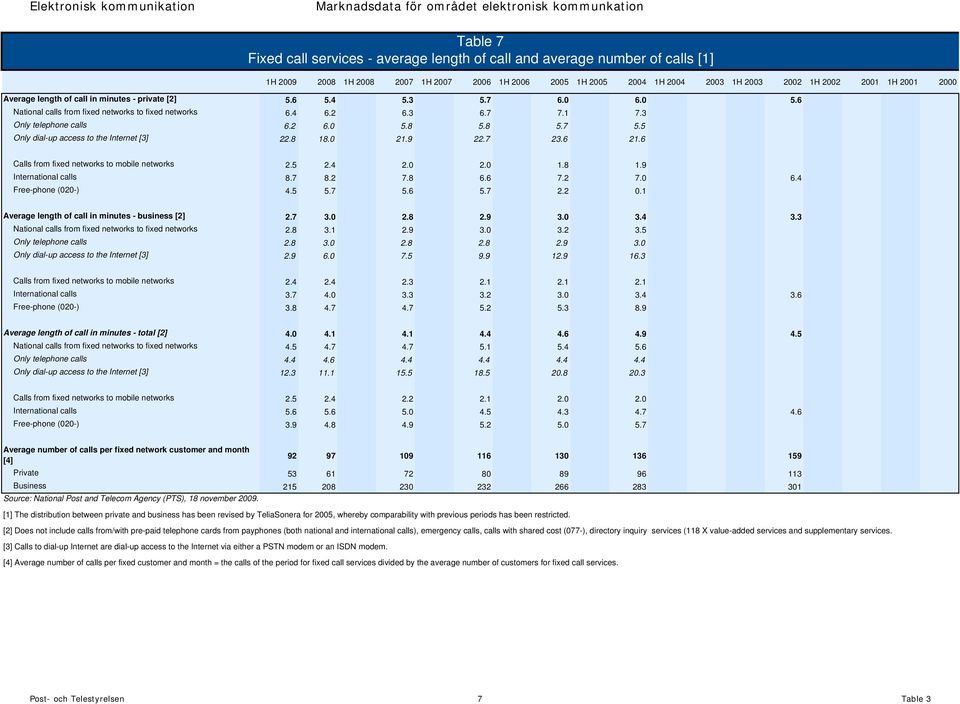
7 Table 7 Fixed call services - average length of call and average number of calls [1] Average length of call in minutes - private [2] National calls from fixed networks to fixed networks Only telephone calls Only dial-up access to the Internet [3] Calls from fixed networks to mobile networks International calls Free-phone (020-) Average length of call in minutes - business [2] National calls from fixed networks to fixed networks Only telephone calls Only dial-up access to the Internet [3] Calls from fixed networks to mobile networks International calls Free-phone (020-) Average length of call in minutes - total [2] National calls from fixed networks to fixed networks Only telephone calls Only dial-up access to the Internet [3] Calls from fixed networks to mobile networks International calls Free-phone (020-) Average number of calls per fixed network customer and month [4] Private Business [1] The distribution between private and business has been revised by TeliaSonera for 2005, whereby comparability with previous periods has been restricted. [2] Does not include calls from/with pre-paid telephone cards from payphones (both national and international calls), emergency calls, calls with shared cost (077-), directory inquiry services (118 X value-added services and supplementary services. [3] Calls to dial-up Internet are dial-up access to the Internet via either a PSTN modem or an ISDN modem. [4] Average number of calls per fixed customer and month = the calls of the period for fixed call services divided by the average number of customers for fixed call services. Post- och Telestyrelsen 7 Table 3
8 Table 8 Mobile call services and mobile data - number of contract subscriptions and pre-paid cards[1] (thousands) All subscriptions and active pre-paid cards [1] Private Business of which subscriptions for only mobile packet data [2] Private Business of which via [3] GSM UMTS and CDMA NMT of which contract subscriptions of which pre-paid cards [1] [1] This series was discontinued in 2004 as PTS then transferred to a three-month rule regarding how long a pre-paid card should be deemed to be active. Pre-paid card only means pre-paid cards that have been topped up, or through which calls have been received or made or have in another way generated revenues during a given period. The length of this period varies depending on operator. For the first half-year 2004 and earlier TeliaSonera uses 12 months, Tele2 uses 13 months and Vodafone (Telenor) uses 6 months. All pre-paid cards are defined as private owing to the difficulty in verifying whether the buyer is a private customer or a business customer. [2] Active UMTS subscriptions are defined as subscriptions where the user has actively used services in the UMTS network. Includes subscriptions that are mainly used for mobile packet data and where the data access has been used at least once during the fourth quarter of 2008 or where subscription charges have been paid during the fourth quarter of [3] For an UMTS- or CDMA 2000 subscription to be considered as active, it must have generated traffic (minutes or data) in UMTS or CDMA 2000 networks during the forth quarter of All other subscriptions are considered to be GSM. Post- och Telestyrelsen 8 Table 3

9 Table 9 Mobile call services and mobile data - percentage distribution - number of contract subscriptions and pre-paid cards All subscriptions and active pre-paid cards [1] 100% 100% 100% 100% 100% 100% 100% 100% 100% 100% 100% 100% 100% 100% 100% 100% 100% 100% Private 79% 79% 79% 80% 80% 80% 81% 81% 81% 80% 83% 83% 83% 82% 81% 81% 80% 80% Business 21% 21% 21% 20% 20% 20% 19% 19% 19% 20% 17% 17% 17% 18% 19% 19% 20% 20% of which subscriptions for only mobile packet data [2] 100% 100% 100% 100% 100% 100% Private 67% 67% 65% 61% 47% 29% Business 33% 33% 35% 39% 53% 71% of which via [3] GSM 63% 65% 73% 77% 81% 86% 99% 99% 99% 99% 99% 99% 98% 98% 98% 98% 98% 97% UMTS and CDMA % 35% 27% 22% 18% 13% 0% 0% 0% 0% 0% 0% 0% 0% 0% 0% 0% 0% NMT 0% 0% 0% 1% 1% 1% 1% 1% 1% 1% 1% 1% 2% 2% 2% 2% 2% 3% of which contract subscriptions 60% 60% 57% 55% 52% 50% 48% 48% 47% 46% 41% 42% 42% 44% 47% 49% 52% 54% of which pre-paid cards [1] 40% 40% 43% 44% 47% 49% 50% 51% 52% 53% 58% 57% 56% 54% 51% 49% 46% 44% Number of subscriptions per 1000 inhabitants [4] [1] This series was discontinued in 2004 as PTS then transferred to a three-month rule regarding how long a pre-paid card should be deemed to be active. Pre-paid card only means pre-paid cards that have been topped up, or through which calls have been received or made or have in another way generated revenues during a given period. The length of this period varies depending on operator. For the first half-year 2004 and earlier TeliaSonera uses 12 months, Tele2 uses 13 months and Vodafone (Telenor) uses 6 months. All pre-paid cards are defined as private owing to the difficulty in verifying whether the buyer is a private customer or a business customer. [2] Active UMTS subscriptions are defined as subscriptions where the user has actively used services in the UMTS network. Includes subscriptions that are mainly used for mobile packet data and where the data access has been used at least once during the fourth quarter of 2008 or where subscription charges have been paid during the fourth quarter of [3] For an UMTS- or CDMA 2000 subscription to be considered as active, it must have generated traffic (minutes or data) in UMTS or CDMA 2000 networks during the forth quarter of All other subscriptions are considered to be GSM. [4] When computing the number of subscriptions per 1000 inhabitants, population statistics from SCB have been used. The value, as computed here, does not take into account whether the subscriber has more than one subscription, nor whether the subscription is a private or a business subscription. Post- och Telestyrelsen 9 Table 3
![20% 20% 19% 19% 19% 20% 17% 17% 17% 18% 19% 19% 20% 20% 2006 2005 2005 2004 2004 2003 2003 2002 2002 2001 2001 2000 of which subscriptions for only mobile packet data [2] 100% 100% 100% 100% 100%](/docs-images/44/23168530/images/page_9.jpg "100% Private 67% 67% 65% 61% 47% 29% Business 33% 33% 35% 39% 53% 71% of which via [3] GSM 63% 65% 73% 77% 81% 86% 99% 99% 99% 99% 99% 99% 98% 98% 98% 98% 98% 97% UMTS and CDMA 2000 37% 35% 27% 22%")
10 Table 10 Mobile call services and mobile data - growth in number of contract subscriptions and pre-paid cards [1] (thousands) Net growth - All subscriptions and active pre-paid cards [1] Private Business Net growth - of which subscriptions for only mobile packet data [2] Private Business Net growth - subscriptions via [3] GSM UMTS and CDMA NMT Net growth - contract subscriptions Net growth - pre-paid cards [1] Total annual growth as per cent 3.3% 4.5% 3.0% 2.4% 2.8% 4.2% 1.3% 1.3% 2.3% -5.6% 5.7% 5.1% 5.4% 6.7% 3.8% 7.3% 5.0% 10.5% Aggregated percentage growth in relation to % 70.9% 63.5% 58.8% 55.0% 50.8% 44.7% 42.9% 41.0% 37.9% 46.0% 38.1% 31.4% 24.7% 16.9% 12.6% 5.0% 0.0% [1] This series was discontinued in 2004 as PTS then transferred to a three-month rule regarding how long a pre-paid card should be deemed to be active. Pre-paid card only means pre-paid cards that have been topped up, or through which calls have been received or made or have in another way generated revenues during a given period. The length of this period varies depending on operator. For the first half-year 2004 and earlier TeliaSonera uses 12 months, Tele2 uses 13 months and Vodafone (Telenor) uses 6 months. All pre-paid cards are defined as private owing to the difficulty in verifying whether the buyer is a private customer or a business customer. [2] Active UMTS subscriptions are defined as subscriptions where the user has actively used services in the UMTS network. Includes subscriptions that are mainly used for mobile packet data and where the data access has been used at least once during the fourth quarter of 2008 or where subscription charges have been paid during the fourth quarter of [3] For an UMTS- or CDMA 2000 subscription to be considered as active, it must have generated traffic (minutes or data) in UMTS or CDMA 2000 networks during the forth quarter of All other subscriptions are considered to be GSM. Post- och Telestyrelsen 10 Table 3
![115 Net growth - of which subscriptions for only mobile packet data [2] 487 501 420 284 184 92 0 0 0 0 0 0 0 0 0 0 0 Private 337 362 306 202 86 26 0 0 0 0 0 0 0 0 0 0 0 Business 150 139 115 82 97 65](/docs-images/44/23168530/images/page_10.jpg "0 0 0 0 0 0 0 0 0 0 0 Net growth - subscriptions via [3] GSM -502-687 -435-526 -1 073-705 239 325-309 -11 934 858 929 778 770 842 998 UMTS and CDMA 2000 1 331 1 569 1 089 1 044 1 736 1 214 0 0 0 0 0")
11 Table 11 Mobile call services and mobile data - number of outgoing traffic minutes (millions) from end-user Outgoing traffic from mobile telephone to national mobile network of which within own network [1] Private Business Outgoing traffic from mobile telephone to national fixed network Private Business International outgoing traffic Private Business Total number of outgoing traffic minutes UMTS and CDMA GSM [2] NMT Pre-paid cards [3] Contract subscriptions Private Business Average number of traffic minutes per mobile telephony subscription and month [4] Private Business [1] For service providers where network capacity is purchased from a mobile network operator, voice traffic refers to voice traffic that terminates in the same mobile network to which the service provider is connected. [2] Includes traffic from UMTS for [3] All pre-paid cards are defined as private owing to the difficulty in verifying whether the buyer is a private customer or a business customer. This series was discontinued in 2004 as PTS then transferred to a three-month rule regarding how long a pre-paid card should be deemed to be active. [4] Average number of traffic minutes per month = the total number of traffic minutes of the period for mobile telephony divided by the average number of mobile telephony customers during the period. [5] Average revenue per traffic minute = the revenues of the period from mobile telecommunications services divided by the total number of traffic minutes for mobile telephony during the period. The revenues of the period from mobile call services relate to revenues from end-user (excluding revenues from SMS, MMS, mobile value-added services, interconnection, international roaming and group internal revenues. Supplementary charges or other instalment payment for discounted mobile telephones are not included). Post- och Telestyrelsen 11 Table 3

12 Table 12 Mobile call services and mobile data - number of outgoing calls (millions) from end-user Mobile call services - number of outgoing calls (millions) from enduser of which within own network [1] Private Business Outgoing calls from mobile telephone to national fixed network Private Business International outgoing calls Private Business Total number of outgoing calls UMTS and CDMA GSM [2] NMT Pre-paid cards [3] Contract subscriptions Private Business Average number of calls per mobile voice subscription and month [4] Private Business Average length of call per mobile telephony subscription in minutes Private Business Pre-paid cards [3] Contract subscriptions [1] For service providers where network capacity is purchased from a mobile network operator, voice traffic refers to voice traffic that terminates in the same mobile network to which the service provider is connected. [2] Includes traffic from UMTS for [3] All pre-paid cards are defined as private owing to the difficulty in verifying whether the buyer is a private customer or a business customer. [4] Average number of calls per mobile voice subscription and month = the total number of mobile phone calls during the period divided by the avarege number of mobile telephony subscriptions during the period. Post- och Telestyrelsen 12 Table 3

13 Table 13 Mobile call services and mobile data - mobile data services Number of GSM, UMTS and CDMA 2000 subscriptions with active users of mobile data services (thousands) [1] Private Business of which subscriptions for only mobile packet data [2] Private Business Proportion GSM, UMTS and CDMA 2000-subscriptions with active users of mobile data services 57.8% 52.6% 48.9% 60.2% 54.7% 39.3% 36.6% 28.5% 14.5% 11.2% 6.0% 6.0% 2.4% 1.2% 0.8% 0.0% 0.0% 0.0% Private 54.6% 49.8% 46.3% 57.6% 52.0% 36.4% 33.5% 26.8% 14.0% 11.0% 5.4% 5.0% 1.7% 0.6% 0.5% 0.0% 0.0% 0.0% Business 70.4% 63.8% 59.1% 70.6% 65.5% 51.2% 49.9% 35.4% 16.5% 12.3% 8.7% 10.6% 5.8% 3.7% 2.1% 0.0% 0.0% 0.0% Traffic for mobile data services (Tbyte) Private Business Average amount of data traffic (Mbyte) per subscription for mobile data traffic only and month [3] Private Business [1] The question has been re-defined for the first half year It has also been difficult for the operators to separete between subscriptions for only voice services and subscription for voice and mobile packet data services prior to the first half-year For that reason comparability with previous periods has been restricted. Includes subscriptions that are mainly used for mobile packet data and where the data access has been used at least once during the fourth quarter of 2008 or where subscription charges have been paid during the fourth quarter of The subscription should not have generated any voice traffic minutes during the fourth quarter of [3] Also includes data traffic from users with other subscriptions than for only mobile packet data. Post- och Telestyrelsen 13 Table 3
![278 209 137 159 82 51 29 0 0 0 of which subscriptions for only mobile packet data [2] 1 090 877 604 376 184 92 0 0 0 0 0 0 0 0 0 0 0 0 Private 729 591 392 228 86 26 0 0 0 0 0 0 0 0 0 0 0 0 Business](/docs-images/44/23168530/images/page_13.jpg "362 287 212 148 97 65 0 0 0 0 0 0 0 0 0 0 0 0 Proportion GSM, UMTS and CDMA 2000-subscriptions with active users of mobile data services 57.8% 52.6% 48.9% 60.2% 54.7% 39.3% 36.6% 28.5% 14.5% 11.2% 6.")
14 Table 14 Mobile call services and mobile data - SMS [1] Antal från mobiltelefon skickade SMS (miljoner) [7] of which within own network [2] Private Business Annual growth in number of SMS sent - total 48% 56% 69% 95% 107% 63% 30% 2% 4% 13% 19% 37% 32% 30% 37% 116% 179% Average number of SMS sent per GSM-, UMTS- and CDMA telephony customer and month [3] Private Business Denmark [4] Norway [5] Finland [6] [1] Short Message Service [2] For service providers where network capacity is purchased from a mobile network operator, 'SMS' relates to SMS that terminate in the same network to which the service provider is connected. [3] Average number of SMS sent per GSM-, UMTS- and CDMA 2000-telephony customer and month = the number of SMS sent during the period divided by the average number of GSM-, UMTS- and CDMA 2000-telephony customers during the period, and divided by the number of months during the period. [4] Based on statistics from the National IT and Telecom Agency in Denmark. [5] Based on statistics from the Norwegian Post and Telecommunications Authority. [6] Based on statistics from Viestintävirasto, the Finnish Communications Regulatory Authority. [7] Tele2 har i samband med detta halvårs insamling reviderat sina tidigare siffror för antalet sända sms för tiden första halvåret 2006 och fram till och med helåret Post- och Telestyrelsen 14 Table 3

15 Table 15 Mobile call services and mobile data - MMS [1] Number of MMS sent from mobile telephone (millions) Private Business Annual growth in number of MMS sent - total 4% 34% 53% 46% 55% 80% 54% 45% 64% 301% 430% Average number of MMS sent per GSM-, UMTS- and CDMA telephony customer and month [2] Private Business Denmark [3] Norway [4] Finland [5] [1] Multimedia Messaging Service [2] Average number of MMS sent per GSM-, UMTS- and CDMA 2000-telephony customer and month = the number of MMS sent during the period divided by the average number of GSM-, UMTS- and CDMA 2000-telephony customers during the period, and divided by the number of months during the period. [3] Based on statistics from the National IT and Telecom Agency in Denmark. [4] Based on statistics from the Norwegian Post and Telecommunications Authority. [5] Based on statistics from Viestintävirasto, the Finnish Communications Regulatory Authority. Post- och Telestyrelsen 15 Table 3
![CDMA 2000- telephony customer and month [2] 1.10 1.17 1.10 0.90 0.74 0.64 0.50 0.37 0.34 0.26 0.20 0.07 0.04 0.00 0.00 0.00 0.00 Private 1.11 1.14 1.10 0.87 0.70 0.62 0.48 0.36 0.34 0.24 0.20 0.00 0.00 0.00 0.00 0.00 0.00 Business 1.](/docs-images/44/23168530/images/page_15.jpg "05 1.26 1.10 1.00 0.91 0.70 0.58 0.38 0.31 0.35 0.21 0.00 0.00 0.00 0.00 0.00 0.00 Denmark [3] 0.9 0.8 0.8 0.4 0.5 0.4 0.4 0.4 0.4 0.2 0.2 0.1 0.0 0.0 0.0 0.0 0.0 0.0 Norway [4] 1.6 2.0 2.3 1.6 1.7 1.")
16 Table 16 Mobile call services and mobile data - telematics Number of M2M subscriptions [1] (thousands) Antal SMS skickade från M2M-abonnemang [2] (miljoner) [1] Subscriptions = contract subscriptions + pre-paid cards. [2] M2M = machine-to-machine, i.e. wireless technology primarily used for telematics and telemetry. Post- och Telestyrelsen 16 Table 3
![0 0 0 0 0 0 0 0 0 0 [1] Subscriptions = contract subscriptions + pre-paid cards.](/docs-images/44/23168530/images/page_16.jpg "[2] M2M = machine-to-machine, i.e. wireless technology primarily used for telematics and telemetry.")
17 Table 17 Internet services - number of active Internet-access customers [1] per form of access (thousands) Internet subscriptions - private PSTN [2] (Modems up to 56 kbit/s) ISDN [3] DSL [4] Cable television Fixed radio Mobile broadband [5] Satellite Fiber and fiber-lan [6] Other broadband access Internet subscriptions - business PSTN [2] (Modems up to 56 kbit/s) ISDN [3] DSL [4] Cable television Fixed radio Mobile broadband [5] Satellite Fiber and fiber-lan [6] Other broadband access Internet subscriptions - total PSTN [2] (Modems up to 56 kbit/s) ISDN [3] DSL [4] Cable television Fixed radio Mobile broadband [5] Satellite Fiber and fiber-lan [6] Other broadband access [1] Active customer means a customer that has used his access at least once during the quarter that precedes the measurement period in question (only applies to those customers who do not pay subscription charges). If the customer pays a subscription charge, the customer is deemed to be active if the payment was made during the immediately preceding quarter. [2] Public Switched Telephone Network. [3] Integrated Services Digital Network. [4] Digital Subscriber Line. The two most common are ADSL (Asymmetrical Digital Subscriber Line) and VDSL (Very-high-bit-rate Digital Subscriber Line). [5] Subscriptions for data access cards, internal data access cards and data access cards that connects with USB or similar. [6] Internet access is reached via a property network, i.e. a LAN (local area network, usually based on Ethernet technology. The LAN is linked to a public fibre network; for example, a wide area network (WAN). The property network,which may comprise optical fibre cable or copper-based cable, links the individual dwellings/operations with the property node, which in its turn is connected to the wide area networks. Post- och Telestyrelsen 17 Table 3
![996 1 868 1 784 ISDN [3] 1 1 2 12 16 17 17 16 21 30 40 53 62 69 72 74 76 74 DSL [4] 1 538 1 562 1 576 1 552 1 480 1 378 1 234 1 083 910 749 576 505 420 371 305 223 116 22 Cable television 576 561 545](/docs-images/44/23168530/images/page_17.jpg "535 504 453 403 354 288 242 229 211 179 156 127 111 92 56 Fixed radio 3 3 3 4 5 4 6 7 7 6 7 5 4 2 2 1 1 0 Mobile broadband [5] 729 591 392 228 86 26 0 0 0 0 0 0 0 0 0 0 0 0 Satellite 0.0 0.1 0.0 0.0 0.6 0.6 0.7 0.")
18 Table 18 Internet services - percentage distribution of the number of active Internet-access customers [1] per form of access Internet subscriptions - private 100% 100% 100% 100% 100% 100% 100% 100% 100% 100% 100% 100% 100% 100% 100% 100% 100% 100% PSTN [2] (Modems up to 56 kbit/s) 9% 11% 15% 20% 25% 31% 36% 41% 51% 57% 62% 67% 71% 73% 77% 80% 85% 90% ISDN [3] 0% 0% 0% 0% 0% 1% 1% 1% 1% 1% 1% 2% 2% 3% 3% 3% 3% 4% DSL [4] 41% 42% 45% 44% 44% 42% 39% 37% 30% 26% 21% 17% 15% 14% 11% 9% 5% 1% Cable television 15% 15% 15% 15% 15% 14% 13% 12% 10% 8% 8% 7% 6% 6% 5% 4% 4% 3% Fixed radio 0% 0% 0% 0% 0% 0% 0% 0% 0% 0% 0% 0% 0% 0% 0% 0% 0% 0% Mobile broadband [5] 19% 16% 11% 6% 3% 1% 0% 0% 0% 0% 0% 0% 0% 0% 0% 0% 0% 0% Satellite 0.00% 0.00% 0.00% 0.00% 0.02% 0.02% 0.02% 0.03% 0.03% 0.03% 0.02% 0.02% 0.02% 0.00% 0.00% 0.00% 0.01% 0.02% Fiber and fiber-lan [6] 16% 15% 14% 14% 13% 12% 11% 10% 9% 8% 7% 7% 6% 5% 0% 0% 0% 0% Other broadband access 0% 0% 0% 0% 0% 0% 0% 0% 0% 0% 0% 0% 0% 0% 4% 4% 2% 2% Internet subscriptions - business 100% 100% 100% 100% 100% 100% 100% 100% 100% 100% 100% 100% 100% 100% 100% 100% 100% 100% PSTN [2] (Modems up to 56 kbit/s) 9% 12% 13% 20% 18% 21% 31% 49% 55% 59% 60% 62% 62% 66% 69% 73% 77% 77% ISDN [3] 1% 1% 3% 4% 3% 5% 7% 9% 9% 10% 10% 11% 12% 14% 16% 18% 19% 19% DSL [4] 27% 31% 35% 37% 44% 47% 54% 37% 30% 27% 25% 22% 20% 15% 10% 6% 2% 1% Cable television 0% 0% 0% 0% 0% 0% 0% 0% 0% 0% 0% 0% 0% 0% 0% 0% 0% 0% Fixed radio 0% 0% 0% 0% 0% 0% 1% 0% 1% 0% 0% 0% 0% 0% 0% 0% 0% 0% Mobile broadband [5] 58% 50% 43% 34% 27% 20% 0% 0% 0% 0% 0% 0% 0% 0% 0% 0% 0% 0% Satellite 0.00% 0.01% 0.00% 0.00% 0.02% 0.03% 0.10% 0.08% 0.07% 0.00% 0.05% 0.00% 0.00% 0.00% 0.00% 0.00% 0.00% 0.00% Fiber and fiber-lan [6] 3% 4% 4% 4% 4% 3% 4% 2% 2% 2% 2% 2% 2% 2% 0% 0% 0% 0% Other broadband access 4% 6% 6% 6% 7% 7% 7% 5% 4% 4% 4% 4% 5% 4% 4% 3% 2% 2% Internet subscriptions - total 100% 100% 100% 100% 100% 100% 100% 100% 100% 100% 100% 100% 100% 100% 100% 100% 100% 100% PSTN [2] (Modems up to 56 kbit/s) 9% 11% 15% 20% 24% 30% 36% 42% 51% 57% 62% 66% 70% 72% 76% 79% 84% 89% ISDN [3] 0% 0% 0% 1% 1% 1% 1% 1% 2% 2% 2% 3% 3% 4% 4% 5% 5% 6% DSL [4] 39% 41% 43% 43% 44% 43% 40% 37% 30% 26% 21% 18% 15% 14% 11% 9% 5% 1% Cable television 13% 13% 14% 14% 14% 13% 12% 11% 9% 7% 7% 7% 6% 5% 4% 4% 4% 3% Fixed radio 0% 0% 0% 0% 0% 0% 0% 0% 0% 0% 0% 0% 0% 0% 0% 0% 0% 0% Mobile broadband [5] 25% 21% 15% 9% 5% 3% 0% 0% 0% 0% 0% 0% 0% 0% 0% 0% 0% 0% Satellite 0.00% 0.00% 0.00% 0.00% 0.02% 0.02% 0.03% 0.03% 0.03% 0.02% 0.03% 0.02% 0.02% 0.00% 0.00% 0.00% 0.01% 0.02% Fiber and fiber-lan [6] 14% 14% 13% 13% 12% 11% 10% 9% 8% 7% 7% 6% 5% 4% 0% 0% 0% 0% Other broadband access 14% 14% 13% 13% 13% 11% 11% 9% 8% 8% 7% 6% 6% 5% 4% 3% 2% 2% [1] Active customer means a customer that has used his access at least once during the quarter that precedes the measurement period in question (only applies to those customers who do not pay subscription charges). If the customer pays a subscription charge, the customer is deemed to be active if the payment was made during the immediately preceding quarter. [2] Public Switched Telephone Network. [3] Integrated Services Digital Network. [4] Digital Subscriber Line. The two most common are ADSL (Asymmetrical Digital Subscriber Line) and VDSL (Very-high-bit-rate Digital Subscriber Line). [5] Subscriptions for data access cards, internal data access cards and data access cards that connects with USB or similar. [6] Internet access is reached via a property network, i.e. a LAN (local network) usually based on Ethernet technology. The property network is linked to a public fibre network, for example an area network. The property network, which may comprise optic fibre cable or copper-based cable, links the individual dwellings/operations with the property node, which in its turn is connected to the area networks. Post- och Telestyrelsen 18 Table 3
![0% 0% 0% 0% 0% 1% 1% 1% 1% 1% 1% 2% 2% 3% 3% 3% 3% 4% DSL [4] 41% 42% 45% 44% 44% 42% 39% 37% 30% 26% 21% 17% 15% 14% 11% 9% 5% 1% Cable television 15% 15% 15% 15% 15% 14% 13% 12% 10% 8% 8% 7% 6% 6%](/docs-images/44/23168530/images/page_18.jpg "5% 4% 4% 3% Fixed radio 0% 0% 0% 0% 0% 0% 0% 0% 0% 0% 0% 0% 0% 0% 0% 0% 0% 0% Mobile broadband [5] 19% 16% 11% 6% 3% 1% 0% 0% 0% 0% 0% 0% 0% 0% 0% 0% 0% 0% Satellite 0.00% 0.00% 0.00% 0.00% 0.02% 0.")
19 Table 19 Internet services - number of active customers with broadband connection to Internet (thousands) Number of subscriptions with broadband connection [1] Private Business varav via mobil bredbandsanslutning [4] Private Business Number of subscriptions with transmission capacity of 2 Mbit/s or more [2] Private Business varav via mobil bredbandsanslutning [4] Private Business Number of subscriptions with transmission capacity of 10 Mbit/s or more [3] Private Business varav via mobil bredbandsanslutning [4] Private Business Number of subscriptions with transmission capacity of 30 Mbit/s or more Private Business [1] Relates to xdsl, cabel-tv, fixed radio, mobile broadband, satellite, fiber and fiber-lan and other broadband access. [2] At least 2 Mbit/s downstream. NOTE: The definition for 2003 and earlier was at least 2 Mbit/s both upstream and downstream. [3] At least 10 Mbit/s downstream. NOTE: The definition for 2003 and earlier was at least 10 Mbit/s both upstream and downstream. [4] Subscriptions for data access cards, internal data access cards and data access cards that connects with USB or similar. Post- och Telestyrelsen 19 Table 3
![560 498 410 338 286 244 156 143 122 114 104 93 81 65 44 29 15 10 2006 2005 2005 2004 2004 2003 2003 2002 2002 2001 2001 2000 varav via mobil bredbandsanslutning [4] 1 090 877 604 376 184 92 0 0 0 0 0](/docs-images/44/23168530/images/page_19.jpg "0 0 0 0 0 0 0 Private 729 591 392 228 86 26 0 0 0 0 0 0 0 0 0 0 0 0 Business 362 287 212 148 97 65 0 0 0 0 0 0 0 0 0 0 0 0 Number of subscriptions with transmission capacity of 2 Mbit/s or more [2] 3")
20 Table 20 Internet services - growth, penetration and traffic Annual growth in number of Internet access subscriptions 10% 8% 8% 10% 10% 9% 1% 0% 7% 2% 0% 7% 5% 8% 18% 25% 23% Private 7% 5% 5% 8% 7% 10% 4% 1% 8% 1% -1% 7% 5% 8% 21% 27% 23% Business 27% 30% 35% 35% 44% -3% -27% -7% 0% 5% 7% 4% 5% 2% -3% 17% 23% varav via mobil bredbandsanslutning [7] 81% 133% 229% 309% Private 86% 159% 354% 763% Business 71% 94% 118% 126% Annual growth in number of subscriptions to broadband connections to the Internet 17% 20% 22% 27% 31% 32% 34% 40% 42% 34% 33% 39% 42% 60% 118% 267% 0% Private 14% 17% 20% 25% 27% 29% 35% 41% 44% 35% 34% 38% 39% 55% 114% 275% 0% Business 37% 47% 43% 39% 83% 70% 28% 26% 18% 22% 27% 42% 86% 127% 193% 177% 0% varav via mobil bredbandsanslutning [7] 81% 133% 229% 309% Private 86% 159% 354% 763% Business 71% 94% 118% 126% Annual growth in number of Internet access subscriptions with 2 Mbit/s or more 28% 45% 40% 35% 57% 63% 60% 83% 91% 219% 153% 41% 50% 29% 0% 0% Private 23% 36% 33% 35% 56% 61% 57% 80% 91% 226% 157% 40% 49% 27% 0% 0% Business 62% 181% 144% 35% 77% 109% 139% 150% 83% 104% 87% 47% 84% 59% 0% 0% varav via mobil bredbandsanslutning [7] 117% 0% 0% Private 116% 0% 0% Business 121% 0% 0% Subscriptions to fixed Internet access as a proportion of number of households [3] 69% 69% 70% 74% 74% 73% 71% 67% 69% 67% 63% 66% 63% 61% 61% 57% 50% 45% Connection with 2 Mbit/s or more [2] 53% 51% 48% 45% 41% 34% 26% 21% 17% 12% 9% 4% 3% 3% 2% 2% 1% 0% Connection with 10 Mbit/s or more 27% 22% 20% 19% 16% 13% 11% 9% 8% 6% 4% 3% 0% 0% 0% 0% 0% 0% Subscriptions to fixed broadband access as a proportion of number of households [4] 61% 60% 59% 58% 55% 50% 45% 39% 34% 28% 23% 21% 17% 15% 13% 10% 6% 3% Connection with 2 Mbit/s or more [2] 53% 51% 48% 45% 41% 34% 26% 21% 17% 12% 9% 4% 3% 3% 2% 2% 1% 0% Connection with 10 Mbit/s or more 27% 22% 20% 19% 16% 13% 11% 9% 8% 6% 4% 3% 0% 0% 0% 0% 0% 0% Internet subscriptions as a proportion of the population [5] 41% 40% 38% 38% 37% 36% 35% 33% 34% 33% 31% 32% 31% 30% 30% 28% 25% 22% Connection with 2 Mbit/s or more [2] 32% 30% 26% 22% 20% 16% 13% 10% 8% 6% 4% 2% 2% 1% 1% 1% 1% 0% Connection with 10 Mbit/s or more 14% 11% 10% 9% 8% 6% 6% 4% 4% 3% 2% 2% 0% 0% 0% 0% 0% 0% Mobile broadband subscriptions as a proportion of the population [6] 8% 6% 4% 2% 1% 0% 0% 0% 0% 0% 0% 0% 0% 0% 0% 0% 0% 0% Connection with 2 Mbit/s or more [2] 7% 5% 3% 0% 0% 0% 0% 0% 0% 0% 0% 0% 0% 0% 0% 0% 0% 0% Connection with 10 Mbit/s or more 1% 0% 0% 0% 0% 0% 0% 0% 0% 0% 0% 0% 0% 0% 0% 0% 0% 0% [1] Relates to xdsl, cabel-tv, fixed radio, mobil broadband, satellite, fiber and fiber-lan and other broadband access. [2] At least 2 Mbit/s downstream. NOTE: The definition for 2003 and earlier was at least 2 Mbit/s both upstream and downstream. [3] Relates to PSTN, ISDN, xdsl, cabel-tv, fixed radio, mobil broadband, satellite, fiber and fiber-lan and other broadband access. The proportion is computed by dividing the number of subscriptions to fixed Internet access by data from Statistics Sweden (SCB) on the number of housekeeping units in Sweden. The fact that one household can have several Internet subscriptions has not been taken into account. [4] Relates to xdsl, cabel-tv, fixed radio, satellite, fiber and fiber-lan and other broadband access. The proportion is computed by dividing the number of subscriptions to fixed broadband access by data from Statistics Sweden (SCB) on the number of housekeeping units in Sweden. The fact that one household can have several Internet subscriptions has not been taken into account. [5] Relates to PSTN, ISDN, xdsl, cabel-tv, fixed radio, mobil broadband, satellite, fiber and fiber-lan and other broadband access. The proportion is computed by dividing the number of Internet subscriptions by data from Statistics Sweden (SCB) on the population of Sweden. The fact that one household can have several Internet subscriptions has not been taken into account. [6] Relates to mobile broadband. The proportion is computed by dividing the number of mobile broadband subscriptions by data from Statistics Sweden (SCB) on the population of Sweden. The fact that one household can have several Internet subscriptions has not been taken into account.. [7] Subscriptions for data access cards, internal data access cards and data access cards that connects with USB or similar. Post- och Telestyrelsen 20 Table 3

21 Table 21 Television services - Number of subsriptions Total number of subscriptions [1] Analogue - via cable network [2] Analogue - via satellite: Digital - via terrestrial network: Digital - via cable network [3] Digital - via satellite Iptv - via LAN [4] IPTV - via the metal-based access network IPTV - via other infrastructure [1] The customer is deemed to be active if payment of a subscription charge was made during the second quarter of Either via contract directly with household or indirectly, via distributor (such as property owner or similar associations). Subscription here relates to a basic package ('basic range' and the like) of channels that are provided to end-users. [2] The subscription/network is analog if the broadcasts in the network could be received by a standard television receiver without decoding the signal. [3] The subscription/network is digital if the signal distributed to the property owner's network or directly to the household is digital. [4] LAN network means a fixed connection which is reached via a LAN (local network, property network) usually based on Ethernet technology. The LAN is linked to a public fibre network, for example an area network. The LAN (which may comprise optic fibre cable or copper-based cable) links the individual dwellings/operations with a centrally located data switch in the premises, which in its turn is connected to the routers available in the area and backbone networks. Post- och Telestyrelsen 21 Table 3
22 Table 22 Bundled subscribtions - Number of end users with bundled subscriptions [1] Double-play: Private Business Fixed telephony and broadband: Private Fixed telephony and television: Private Fixed telephony and mobile telephony: Private Mobile telephony and broadband: Private Business Mobile telephony and television: Private Television and broadband: Private Other combinations: Private Triple-play: Private Fixed telephony and broadband and television: Private Fixed telephony and broadband and mobile telephony: Private Fixed telephony and mobile telephony and television: Private Mobile telephony and broadband and television: Private Other combinations: Private Quadruple -play: Private Fixed telephony and broadband and television and mobile telephony: Private Other combinations: Private Total (double play, triple play and quadruple play): Private Business [1] 'Number of subscribers' relates to the number of contracts that electronic communications service providers have for the provision of bundled services. Post- och Telestyrelsen 22 Table 3
Definitions of the Telecommunication indicators used in the EUROSTAT telecommunications inquiry
 Definitions of the Telecommunication indicators used in the EUROSTAT telecommunications inquiry Table 1 Operators (Unit: number (NBR)) Number of active operators (only active) offering publicly available
How To Understand And Understand The Swedish Telecommunications Market
 Report number PTS-ER 2015:19 Date 18th June 2015 The Swedish Telecommunications Market 2014 The Swedish Telecommunications Market 2014 Report Number PTS-ER 2015:19 Reference Number 15-97 ISSN 1650-9862
1.a Number of broadband Internet retail lines, by type of access technology and by class of service (defined in terms of downstream speed)
 QUARTERLY QUESTIONNAIRE ON ELECTRONIC COMMUNICATION SERVICES AS A FIXED LOCATION AND NOMADIC VOIP SERVICES Fixed Telephone Service (FTS) Nomadic VoIP service Internet Access Services (IAS) Pay-TV Service
Appendix A: Basic network architecture
 Appendix A: Basic network architecture TELECOMMUNICATIONS LOCAL ACCESS NETWORKS Traditionally, telecommunications networks are classified as either fixed or mobile, based on the degree of mobility afforded
The Norwegian Electronic Communication Service Market
 The Norwegian Electronic Communication Service Market First half 2015 22 October 2015 Contents 1 Introduction... 8 2 Development trends... 10 2.1 Telephony... 10 2.2 Fied and mobile broadband... 13 2.3
Telecommunication Markets in the Nordic and Baltic Countries. - Per 31.12.2013 -
 Telecommunication Markets in the Nordic and Baltic Countries - Per 3.2.203 - About the database Established 2007 The Baltic States included spring 203 A descriptive database A selected number of variables
ADSL or Asymmetric Digital Subscriber Line. Backbone. Bandwidth. Bit. Bits Per Second or bps
 ADSL or Asymmetric Digital Subscriber Line Backbone Bandwidth Bit Commonly called DSL. Technology and equipment that allow high-speed communication across standard copper telephone wires. This can include
Managing mature markets
 Managing mature markets Morten Karlsen Sørby Nordic 1 1 Agenda Nordic overview Manage long term cash effects of fixed migration in Norway Sustain margin and market share in Norwegian mobile Develop Danish
Division 12 Report Record-Keeping and Reporting Rules. Issued under section 151BU of the Trade Practices Act 1974
 Division 12 Report Record-Keeping and Reporting Rules Issued under section 151BU of the Trade Practices Act 1974 December 2004 1. TITLE (1) These Rules, made by the Australian Competition and Consumer
Information Memorandum. Annex D: Overview of the Danish telecoms market. March 2012
 800 MHz Auction Auction of frequencies in the frequency bands 791-821 MHz and 832-862 MHz Information Memorandum Annex D: Overview of the Danish telecoms market March 2012 Issued by The Danish Business
Appendix 1: Satellite broadband service providers
 Appendixes Appendix 1: Satellite broadband service providers In 2005 06, satellite broadband services were provided by the following companies: Australian Private Networks (ACTIV8me) Be Communications
RTR Telekom Monitor. Annual Review 2013
 RTR Telekom Monitor Annual Review RTR Telekom Monitor Annual Review Preface 5 1 Fixed network 7 Fixed lines 8 Fixed-line penetration 9 Development of fixed lines 1 Carrier pre-selection and call-by-call
Quarterly Key Data Report
 Irish Communications Market Quarterly Key Data Report Data as of Q1 2014 Document No: 14/61 Date: 20 June 2014 Table of Contents SUMMARY... 6 Notes to data:... 8 1. OVERALL MARKET DATA... 10 1.1 Number
Quarterly Key Data Report
 Irish Communications Market Quarterly Key Data Report Data as of Q4 2013 Document No: 14/19 Date: 14 March 2014 Table of Contents SUMMARY... 6 Notes to data:... 8 1. OVERALL MARKET DATA... 10 1.1 Number
ITU World Telecommunication/ICT Indicators Long Questionnaire 2015
 ITU World Telecommunication/ICT Indicators Long Questionnaire 2015 SAMPLE QUESTIONNAIRE Please complete the Answer and Notes columns in the table below. Black cells must NOT be completed. Please do NOT
NAPCS Product List for NAICS 517: Telecom Products
 NAPCS List for NAICS 517: Telecom s 1 2 3 4 5 6 7 8 9 National 1.1 X Carrier services and Internet backbone services Providing wired or wireless facilities to originate, terminate or transit voice or data
Irish Communications Market
 Irish Communications Market Quarterly Key Data Report Data as of Q4 2014 Document No: 15/27 Date: 12 March 2015 Table of Contents SUMMARY... 6 Notes to data:... 8 1. OVERALL MARKET DATA... 10 1.1 Number
Telecommunication Markets in the Nordic and Baltic Countries. - Per 31.12.2012 -
 Telecommunication Markets in the Nordic and Baltic Countries - Per 3.2.202 - About the database Established 2007 The Baltic States included spring 203 A descriptive database A selected number of variables
Chapter 6. By Frankie, K. F. Yip MSN: [email protected] Email: [email protected] Facebook: [email protected]
 Chapter 6 The Internet By Frankie, K. F. Yip MSN: [email protected] Email: [email protected] Facebook: [email protected] 6 Background The ARPANET, created in 1969, connected computers at
Internet access services Leased line and data transmission services
 Internet access services Leased line and data transmission services - statistical data report - (updated based upon the statistical data corresponding to 1 January 30 June 2011 reporting period) ANCOM/Regulation
Irish Communications Market
 Irish Communications Market Quarterly Key Data Report Data as of Q3 2015 Reference: ComReg 15/130 Version: Final Date: 10/12/2015 An Coimisiún um Rialáil Cumarsáide Commission for Communications Regulation
GLOSSARY. access channel. ACD (automatic call distribution) ADSL (Asymmetric Digital Subscriber Line) ARPL (average revenue per line)
 GLOSSARY 3G access channel ACD (automatic call distribution) ADSL (Asymmetric Digital Subscriber Line) ARPL (average revenue per line) ARPU (average revenue per user) ATM (Asynchronous Transfer Mode) Base
Broadband Mapping 2013
 Broadband Mapping 2013 Broadband Mapping 2013 Summary Publisher: The Danish Business Authority A full Danish edition can be downloaded from the website of the Danish Business Authority: www.erst.dk BROADBAND
Quarterly Key Data Report
 Irish Communications Market Quarterly Key Data Report Data as of Q4 2008 Document No: 09/17 Date: 19 March 2009 Table of Contents SUMMARY... 6 Notes to data:... 7 1 OVERALL MARKET DATA... 8 1.1 Number
DEFINITIONS OF WORLD TELECOMMUNICATION/ICT INDICATORS
 DEFINITIONS OF WORLD TELECOMMUNICATION/ICT INDICATORS MARCH 2010 Fixed telephone network 112 Fixed telephone lines 117 Total capacity of local public switching exchanges 1142 Percent of fixed telephone
Broadband enabling SME's. Tommy McCabe Director, Telecommunications and Internet Federation, IBEC
 Broadband enabling SME's Tommy McCabe Director, Telecommunications and Internet Federation, IBEC What is Broadband? Broadband is a combination of two words, broad bandwidth fast, always on internet connection
CMPT 165: The Internet, Part 3
 CMPT 165: The Internet, Part 3 Tamara Smyth, [email protected] School of Computing Science, Simon Fraser University September 15, 2011 1 Basic Communication Technology Packet Switching (sharing a tranmission
Definitions. "All Ireland Landline Numbers" means fixed telephone exchange line numbers in the State (including Northern Ireland).
 the Acts mean the Communications Regulation (Amendment) Act 2007, the Communications Regulation Act, 2002, the Postal and Telecommunications Services Act, 1983 as amended, and any applicable secondary
VoIP Seminar. 21, 22 June 2005. Amsterdam / London
 VoIP Seminar 21, 22 June 2005 Amsterdam / London Safe harbor Certain statements contained in this presentation constitute forward-looking statements. These statements may include, without limitation, statements
Next Generation Access Glossary. 21CN: BT s upgrade of their core network (the backbone of the network).
 Next Generation Access Glossary 21CN: BT s upgrade of their core network (the backbone of the network). Access network: The part of the network that connects directly to customers from the local telephone
TAXONOMY OF TELECOM TERMS
 TAXONOMY OF TELECOM TERMS Prepared by TUFF Ltd This short taxonomy is designed to describe the various terms used in today s telecommunications industry. It is not intended to be all embracing but to describe
Information Society Statistics
 e-stats service Date: 26 January 2005 No. : 11/2005 Time of release: 11.00 hrs Information Society Statistics Information Society: October-December 2004 Internet Subscriptions This release provides indices
Network support for tele-education
 Network support for tele-education Aiko Pras Centre for Telematics and Information Technology University of Twente (UT) http://wwwtios.cs.utwente.nl/~pras This paper discusses the state of the art in networking,
Building integrated services intranets
 Building integrated services intranets A White Paper from Inalp Networks Inc Meriedweg 7 CH-3172 Niederwangen Switzerland http://www.inalp.com CONTENTS CONTENTS...2 1 EXECUTIVE SUMMARY...3 2 INTRODUCTION...4
&RPSHWLWLRQDQGGHUHJXODWLRQLQ )LQODQGDQGLQ(8
 &RPSHWLWLRQDQGGHUHJXODWLRQLQ )LQODQGDQGLQ(8 The liberalization of European telecom markets The Finnish market situation New regulatory demands in promoting competition 7KH(87HOHFRPPXQLFDWLRQV PDUNHW 150
REGULATORY ENVIRONMENT AND LATEST DEVELOPMENTS. BALÁZS MÁTHÉ Chief Legal and Corporate Affairs Officer
 REGULATORY ENVIRONMENT AND LATEST DEVELOPMENTS BALÁZS MÁTHÉ Chief Legal and Corporate Affairs Officer TAXES PUTTING PRESSURE ON EBITDA HUF bn 40 30 8.7 20 10 0 27.0 2010 25.4 2011 24.3 2012 ca. 25 7.3
Connection Services. Hakim S. ADICHE, MSc
 Connection Services Hakim S. ADICHE, MSc [email protected] Department of Computer Engineering King Fahd University of Petroleum and Minerals Dhahran, Saudi Arabia Connection Services Different connectivity
April 1999. Made by Öhrlings PricewaterhouseCoopers on commission by the National Post and Telecom Agency (PTS)
 April 1999 Made by Öhrlings PricewaterhouseCoopers on commission by the National Post and Telecom Agency (PTS) Öhrlings PricewaterhouseCoopers has been commissioned by the National Post and Telecom Agency
Elisa Carrier Services. Elisa Operator Broadband Services. Technologies, distribution centres and delivery interfaces
 1(5) Elisa Operator Broadband Services Elisa Operator Broadband Services comprise wholesalelevel bitstream data subscriptions classified as broadband services by the Finnish Communications Regulatory Authority
INTERNET CONNECTIVITY
 INTERNET CONNECTIVITY http://www.tutorialspoint.com/internet_technologies/internet_connectivity.htm Copyright tutorialspoint.com Here in this tutorial, we will discuss how to connect to internet i.e. internet
E1-E2 (EB) Chapter 8A. Broadband Services
 E1-E2 (EB) Chapter 8A Broadband Services 8A. Broadband and Broadband Services 8A.1 Introduction In toady s globally networked society through internet, there is always increasing demand for higher capacity
Avancerede Datanet. Ole Brun Madsen Professor Department of Control Engineering University of Aalborg. Infrastruktur
 Department of Control Engineering Distributed Real-time Systems Avancerede Datanet Infrastruktur Ole Brun Madsen Professor Department of Control Engineering University of Aalborg Avancerede Datanet Infrastructure
WAN Data Link Protocols
 WAN Data Link Protocols In addition to Physical layer devices, WANs require Data Link layer protocols to establish the link across the communication line from the sending to the receiving device. 1 Data
An automated system designed to guide a caller through the options of a voice menu. Typically set to answer and route incoming calls.
 Jargon Buster Access Server An Access Server or Network Access Server connects devices to a Local Area Network (LAN) or Wide Area Network (WAN). Internet Service Providers are able to provide customers
TELECOMMUNICATIONS STANDARDS ADVISORY COMMITTEE TSAC WORKING GROUP ON NEW STANDARDS AND POLICY (NSP)
 TELECOMMUNICATIONS STANDARDS ADVISORY COMMITTEE TSAC WORKING GROUP ON NEW STANDARDS AND POLICY (NSP) Introduction Development of Digital Subscriber Line (DSL) Technology This paper introduces the development
Traffic Forecasting Models for the Incumbent Based on New Drivers in the Market
 Traffic Forecasting Models for the Incumbent Based on New Drivers in the Market KJELL STORDAHL Kjell Stordahl (58) received his M.S. in statistics from Oslo University in 1972. He worked with Telenor R&D
OVERVIEW OF THE TELECOMMUNICATIONS INDUSTRY
 Certain facts, statistics and data presented in this section and elsewhere in this document have been derived, in part, from various government or official sources. Whilst the Directors have taken all
GLOSSARY. 3G network:
 GLOSSARY 3G network: ADSL: APP: Bit: Bitrate: Broadband: Byte: CallBack: Channel: DTMF: Ethernet: Gateway: (also UMTS network) "Universal Mobile Telecommunications System", UMTS represents an evolution
By: Mohsen Aminifar Fall 2014
 By: Mohsen Aminifar Fall 2014 Contact Information: E-Mail: [email protected] [email protected] Phone : 021-22919726 09128442885 Website : http://parsenet.ir http://aminifar.ir SMS Center : 5000262175
Broadband Access Technologies
 Broadband Access Technologies Chris Wong Communications Engineering Sector Analysis & Reporting Branch International Training Program 23 October 2007 Presentation Outline What is broadband? What are the
THIRD QUARTER OF 2004
 THIRD QUARTER OF 2004 The third quarter of 2004 showed a growth in revenues excluding gains for the Telenor Group of 15.9% to NOK 15.6 billion compared to the third quarter of 2003. Profit before taxes
Morgan Stanley TMT Conference, Barcelona
 Morgan Stanley TMT Conference, Barcelona November 2006 1 Contents Elisa today Finnish telecoms market Q3 2006 and financial highlights, and Elisa s segment review Execution of the strategy Outlook for
Voice over Internet Protocol (VoIP) - An Introduction
 PITCOM Voice over Internet Protocol (VoIP) - An Introduction Peter Ingram Chief Technology Officer Ofcom 18th January 2005 Ofcom What is Voice over IP? Carrying Voice Traffic on Networks Designed for Data
This course has been retired. View the schedule of current <a href=http://www.ptr.co.uk/networkingcourses.htm>networking
 Introduction to Data Communications & Networking Course Description: This course has been retired. View the schedule of current networking Courses
Quarterly Key Data Report
 Irish Communications Market Quarterly Key Data Report Data as of Q4 2009 Document No: 10/19 Date: 18 th March 2010 Table of Contents SUMMARY... 6 Notes to data:... 7 1. OVERALL MARKET DATA... 9 1.1 Number
The Status of Telecommunications in Grenada
 The Status of Telecommunications in Grenada 1 Overview The telecommunications sector was estimated to have contributed EC $94.9 million to GDP, Telecommunications Investment and Revenue in Grenada representing
Orange Polska (TPSA) new layout of revenues and KPIs. Warsaw, April 17 th, 2013
 Orange Polska (TPSA) new layout of revenues and KPIs Warsaw, April 17 th, 2013 cautionary statement all figures in this presentation are based on IFRS as adopted by the European Union figures included
4G: Fourth generation mobile phone standards and technology. Provides faster mobile data speeds than the 3G standards that it succeeds.
 Department for Culture, Media & Sport 1 Annex B: Glossary 2G: Second generation of mobile telephony systems. Uses digital transmission to support voice, low-speed data communications, and short messaging
Chapter 11: WAN. Abdullah Konak School of Information Sciences and Technology Penn State Berks. Wide Area Networks (WAN)
 Chapter 11: WAN Abdullah Konak School of Information Sciences and Technology Penn State Berks Wide Area Networks (WAN) The scope of a WAN covers large geographic areas including national and international
Technology Brief. Implementing DSL Service for ISPs with the SMS. The DSL Opportunity. DSL is Different from Dial
 Technology Brief Implementing DSL Service for ISPs with the SMS The DSL Opportunity Digital Subscriber Line (DSL) services represent a major opportunity for dialup-based Internet Service Providers (ISPs)
FIRST QUARTER OF 2004
 FIRST QUARTER OF 2004 First quarter of 2004 showed a growth in revenues for the Telenor Group of 13% to NOK 14.3 billion. Profit before taxes and minority interests increased to NOK 4.7 billion. Telenor
Mobility and cellular networks
 Mobility and cellular s Wireless WANs Cellular radio and PCS s Wireless data s Satellite links and s Mobility, etc.- 2 Cellular s First generation: initially debuted in Japan in 1979, analog transmission
Dobson Telephone Company McLoud Telephone Company Digital Subscriber Line Access Services Terms, Conditions, and Rates
 1. Dobson Telephone Company Digital Subscriber Line (DSL) Access Services provide transmission services over local exchange service facilities that can be used for simultaneous voice and data communications.
Hong Kong - Telecoms, Mobile, Broadband and Forecasts
 Brochure More information from http://www.researchandmarkets.com/reports/1226790/ Hong Kong - Telecoms, Mobile, Broadband and Forecasts Description: This report covers the sophisticated Hong Kong telecommunications
US Data Services 2014-2019
 US Data Services 2014-2019 Executive Summary CMR Market Research April 2015 Reproduction without permission 1 The contents of this report represent CMR s analysis of the information available to the public
Usage of Telecommunications Services by Businesses in 2014. Research Summary for the National Media and Infommunications Authority
 Usage of Telecommunications Services by es in 0 Research Summary for the National Media and Infommunications Authority Survey Methodology Target groups: enterprises, public institutions, and NGOs employing
Regional Bell Operating Companies (RBOC) Data Communications Strategies and Opportunities, Market Forecasts, 2002-2007
 Regional Bell Operating Companies (RBOC) Data Communications Strategies and Opportunities, Market Forecasts, 2002-2007 RBOC Data Market Assessment Make a Splash WinterGreen Research, Inc. Lexington, Massachusetts
Data Transmission. from one person or place to another. person or place to another of passing something
 Data Transmission Transmission: the process of passing something from one person or place to another of passing something from one person or place to another Data Transmission Main types of Transmission
Orange Polska 1Q 15 results. 28 April 2015
 Orange Polska 1Q 15 results 28 April 2015 1 Forward looking statement This presentation contains 'forward-looking statements' including, but not limited to, statements regarding anticipated future events
Japan s s Best Practice for Telecommunications Market
 Japan s s Best Practice for Telecommunications Market WTO Basic Telecommunications Agreement 10 th Anniversary Symposium Panel C: Regulatory Challenges/Best Practices February 20, 2008 Shun SAKURAI Director-General
Network+ Guide to Networks 6 th Edition. Chapter 7 Wide Area Networks
 Network+ Guide to Networks 6 th Edition Chapter 7 Wide Area Networks Objectives Identify a variety of uses for WANs Explain different WAN topologies, including their advantages and disadvantages Compare