
FiOS Quantum Gateway USER GUIDE. Model FiOS-G Verizon Wireless
|
|
|
- Phillip Gibbs
- 9 years ago
- Views:
Transcription
1 FiOS Quantum Gateway USER GUIDE Model FiOS-G Verizon Wireless
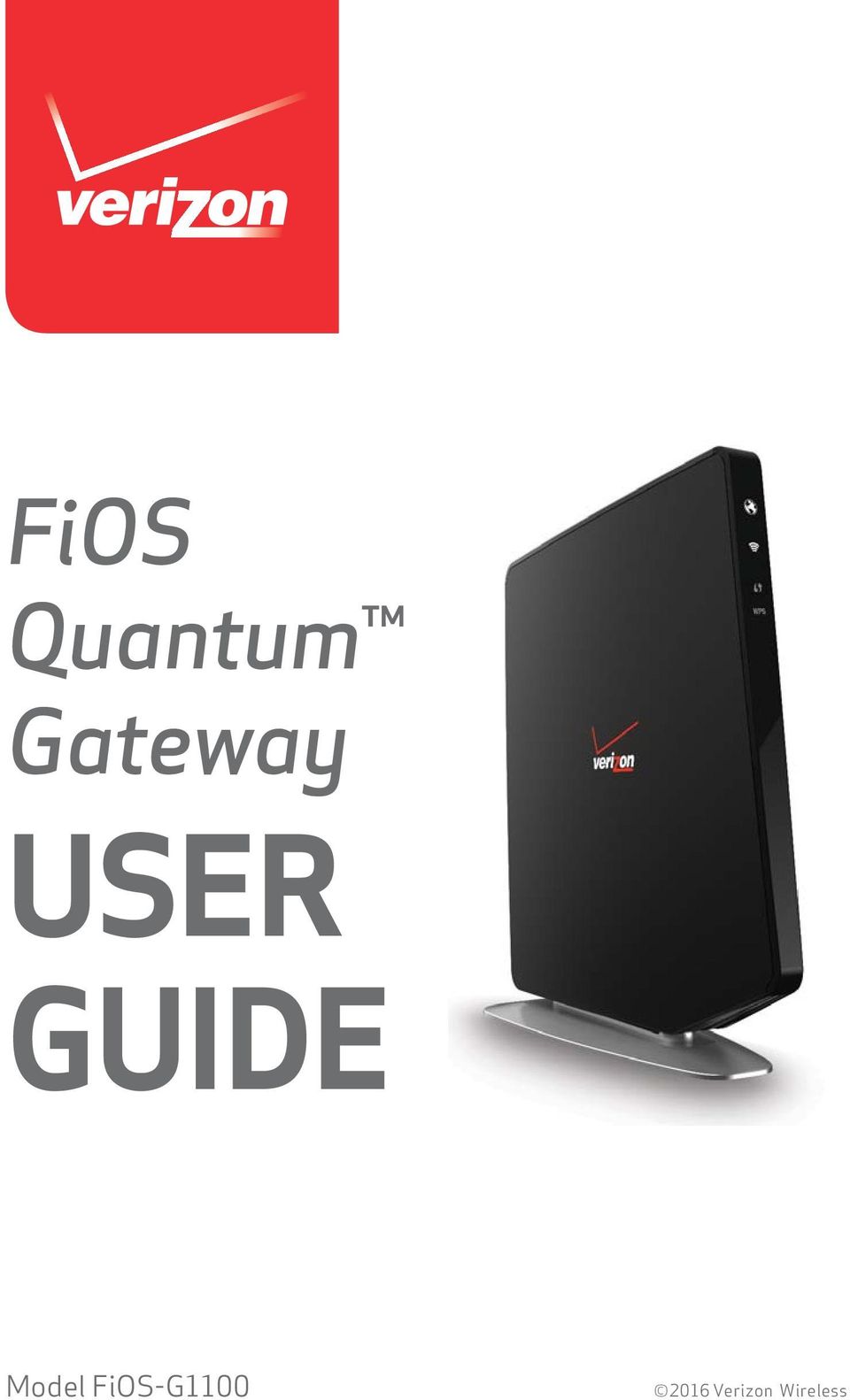
2 CONTENTS 01/ INTRODUCTION 1.0 Package 7 Contents 1.1 System 7 Requirements 1.2 Features Getting to 10 Know Your Gateway 02/ CONNECTING YOUR GATEWAY 2.0 Setting Up 18 Your Gateway 2.1 Computer 24 Network Configuration 2.2 Main Screen 30 03/ WIRELESS SETTINGS 3.0 Overview Wireless Status Basic Security 40 Settings 3.3 Advanced 46 Security Settings 3.4 Wireless MAC 50 Authentication Mode Other Advanced 54 Wireless Options 3.7 Guest Wi-Fi 58 Settings 04/ CONFIGURING MY NETWORK SETTINGS 4.0 Accessing My 64 Network Settings 4.1 Using My Network 65 Settings
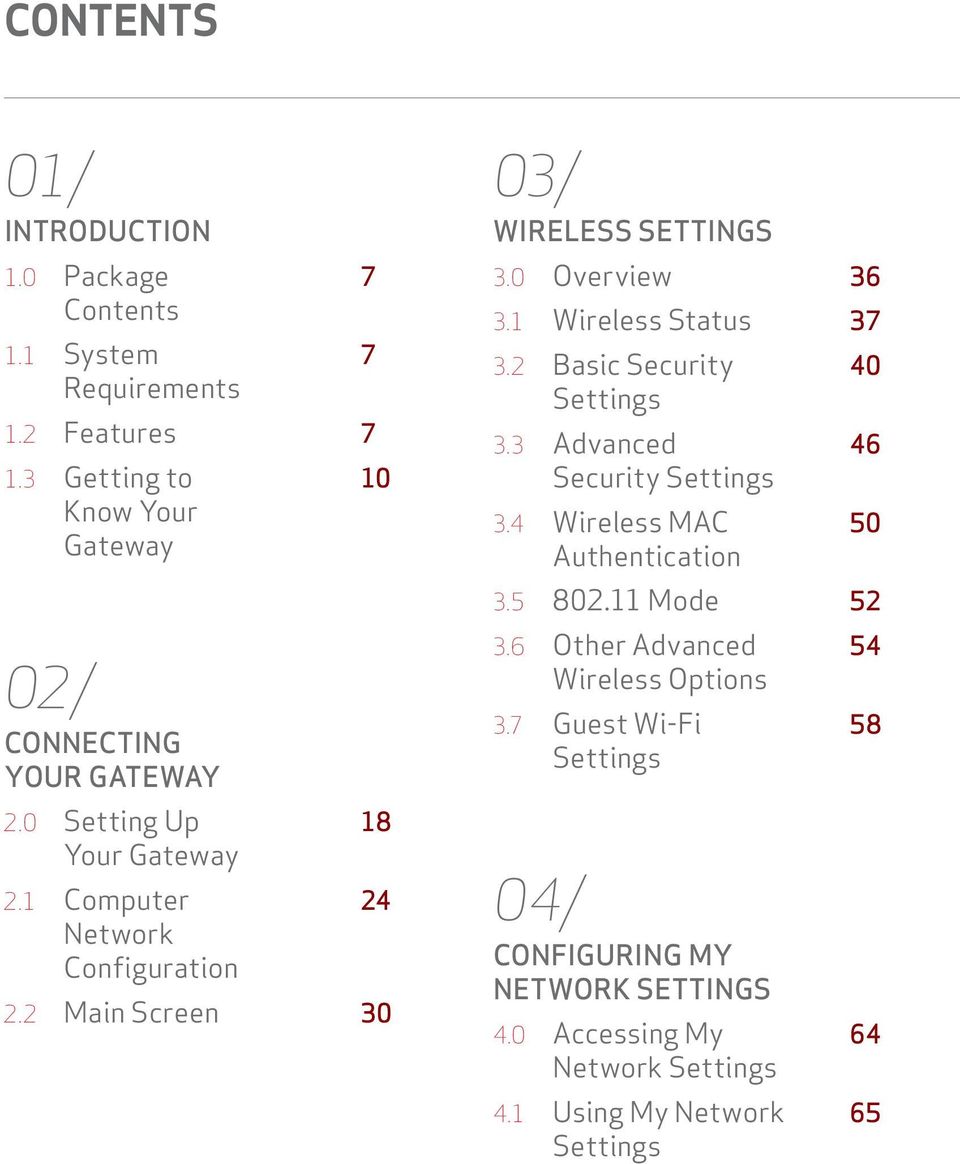
3 TABLE OF CONTENTS 2 05/ USING NETWORK CONNECTIONS 5.0 Accessing 69 Network Connections 5.1 Network 70 (Home/Office) Connection 5.2 Broadband 77 Connection 5.3 Wireless 81 Access Point Connection 5.4 Broadband 85 Ethernet/Coax Connection 06/ CONFIGURING SECURITY SETTINGS 6.0 Firewall Access Control Port Forwarding Port Triggering DMZ Host Remote 106 Administration 6.6 Static NAT Security Log / SETTING PARENTAL CONTROLS 7.0 Activating 119 Parental Controls 7.1 Rule Summary 121 verizon.com/fios 2016 Verizon. All Rights Reserved.
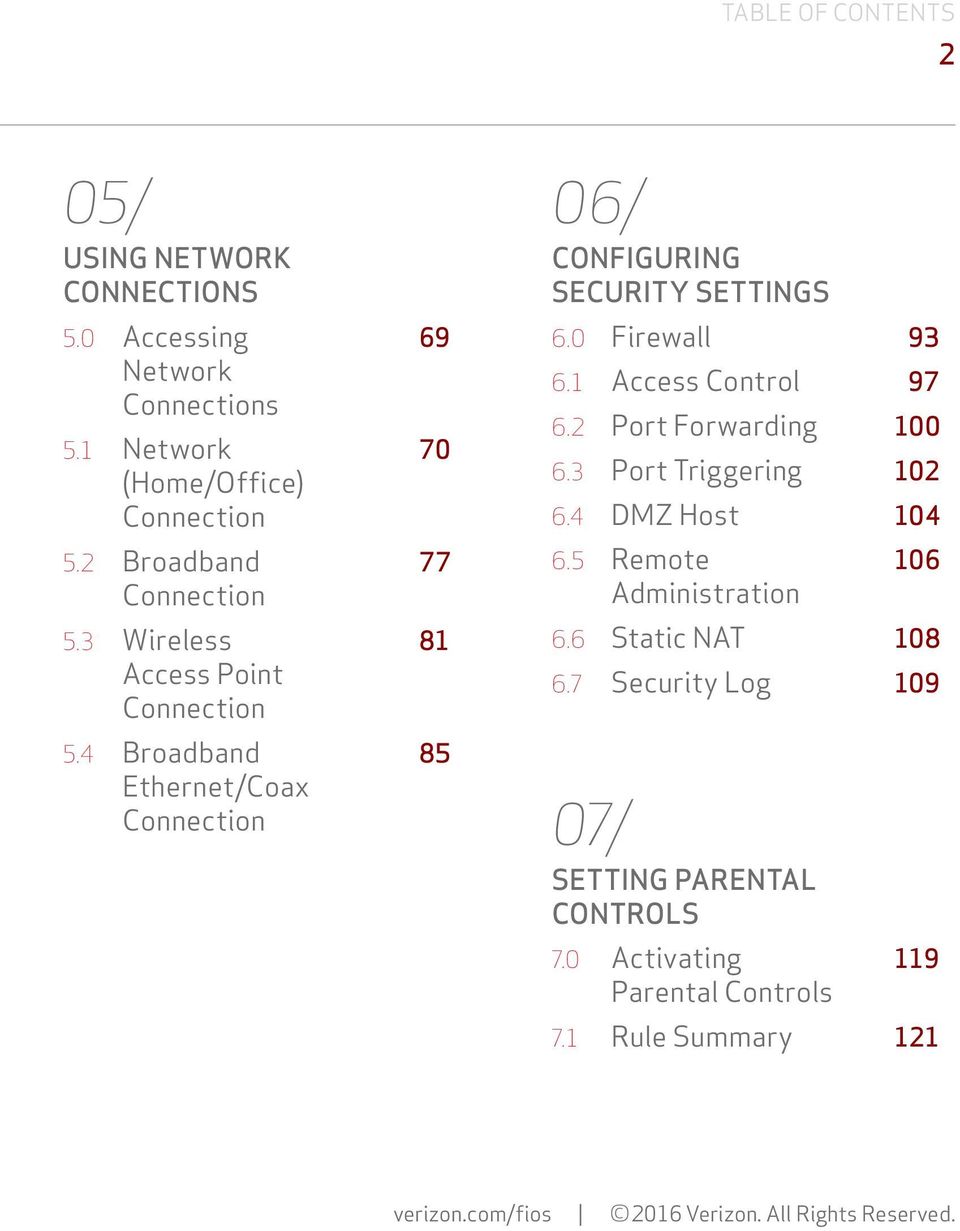
4 CONTENTS 08/ CONFIGURING ADVANCED SETTINGS 8.0 Using Advanced 125 Settings 8.1 Utilities DNS Settings Network 138 Settings 8.4 Routing Date and Time Configuration 172 Settings 09/ MONITORING YOUR GATEWAY 9.0 Gateway Status Advanced Status System Logging Full Status/System 184 wide Monitoring of Connections 9.4 Traffic 185 Monitoring 9.5 Bandwidth 186 Monitoring 10/ TROUBLESHOOTING 10.0 Troubleshooting 189 Tips 10.1 Frequently 195 Asked Questions

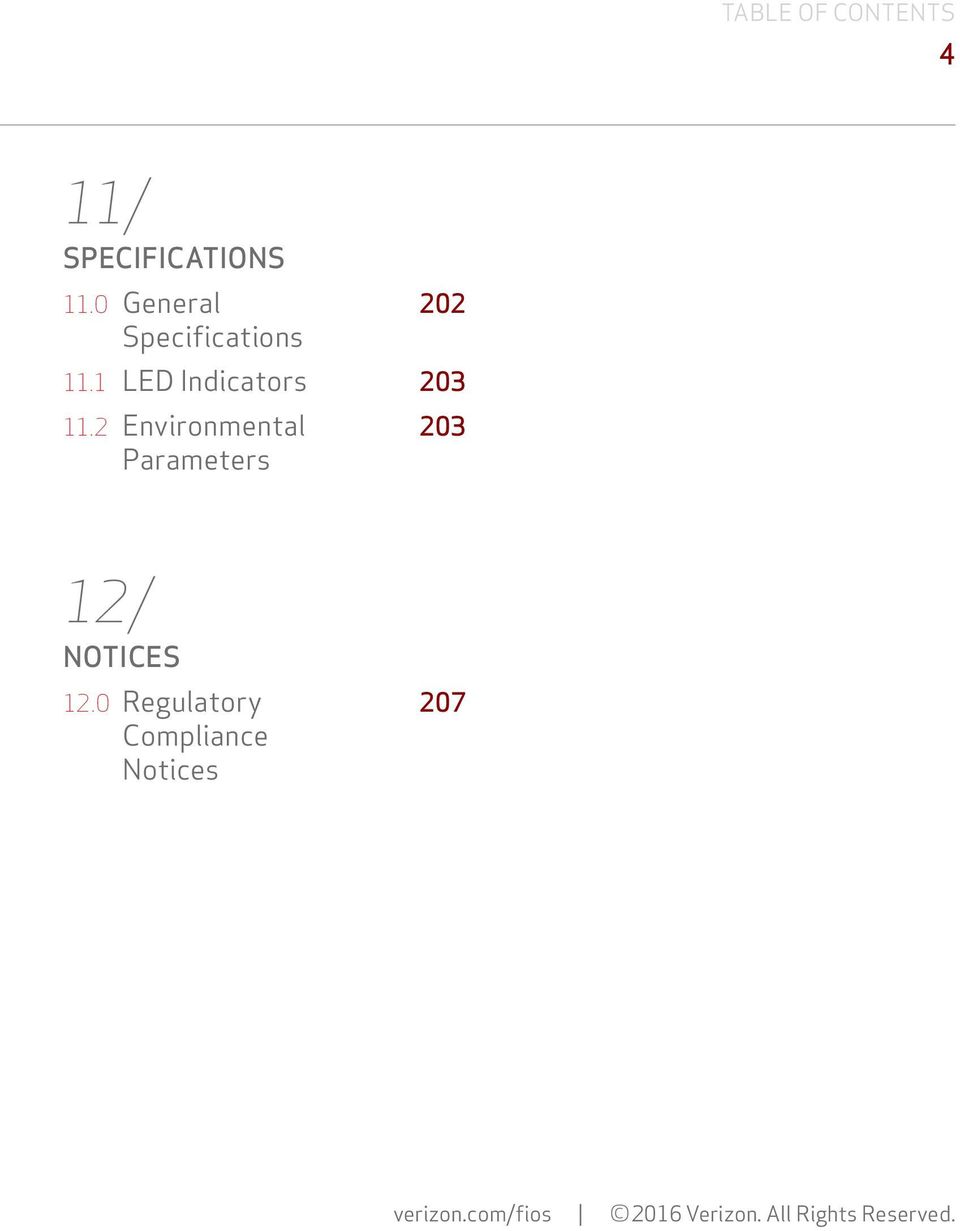
5 TABLE OF CONTENTS 4 11/ SPECIFICATIONS 11.0 General 202 Specifications 11.1 LED Indicators Environmental 203 Parameters 12/ NOTICES 12.0 Regulatory 207 Compliance Notices verizon.com/fios 2016 Verizon. All Rights Reserved.
6 01/ INTRODUCTION Package Contents System Requirements Features Getting to Know Your Gateway

7 01/ INTRODUCTION 6 The Verizon FiOS Quantum Gateway lets you transmit and distribute digital entertainment and information to multiple devices in your home/office. Your Gateway supports networking using coaxial cables, Ethernet, or Wi-Fi, making it one of the most versatile and powerful gateways available. verizon.com/fios 2016 Verizon. All Rights Reserved.
8 PACKAGE CONTENTS, SYSTEM REQUIREMENTS AND FEATURES 1.0/ PACKAGE CONTENT Your package contains: The FiOS Quantum Gateway Power adapter LAN Ethernet cable (yellow) WAN Ethernet cable (white) Quick Start Guide 1.1/ SYSTEM REQUIREMENTS System and software requirements are: A computer or other network device supporting Wi-Fi or wired Ethernet A web browser, such as Chrome, Firefox, Internet Explorer 8 or higher, or Safari 5.1 or higher 1.2/ FEATURES Your Gateway features include: Support for multiple networking standards, including WAN Gigabit Ethernet and MoCA 2.0 interfaces LAN b/g/n/ac, Gigabit Ethernet and MoCA 2.0 interfaces Integrated wired networking with 4-port Ethernet switch and Coax (MoCA)

9 01/ INTRODUCTION 8 Ethernet supports speeds up to 1000 Mbps MoCA 2.0 and 1.1 enabled to support speeds up to 700 Mbps over coaxial cable Integrated wireless networking with b/g/n/ac access point featuring: Enabled b capable speeds (based on device) Enabled g capable speeds (based on device) Enabled n capable speeds (based on device) Enabled ac capable speeds (based on device) Enterprise-level security, including: Fully customizable firewall with Stateful Packet Inspection (SPI) Content filtering with URL-keyword based filtering, parental controls, and customizable filtering policies per computer Intrusion detection with Denial of Service protection against IP spoofing attacks, scanning attacks, IP fragment overlap exploit, ping of death, and fragmentation attacks Event logging MAC address filtering Static NAT verizon.com/fios 2016 Verizon. All Rights Reserved.

10 FEATURES AND GETTING TO KNOW YOUR GATEWAY Port forwarding Port triggering Access control Advanced wireless protection featuring WPA2/WPA Mixed Mode, WEP 64/128 bit encryption, and MAC address filtering Options, including: DHCP server WAN interface auto-detection Dynamic DNS DNS server LAN IP and WAN IP address selection MAC address cloning IPv6 support QoS support (end to end layer 2/3) featuring: Differentiated Services (Diffserv), 802.1p/q prioritization, and passthrough of WAN-side DSCPs, Per Hop Behaviors (PHBs), and queuing to LAN-side devices Remote management and secured remote management using HTTPS Static routing VPN (VPN pass through only)
11 01/ INTRODUCTION 10 IGMP Daylight savings time support 1.3/ GETTING TO KNOW YOUR GATEWAY 1.3a/ FRONT PANEL The front panel has two lighted indicators and a WPS (Wi-Fi Protected Setup) button. The Power/Internet light will be on and solid when your Gateway is turned on, connected to the Internet, and functioning normally. The Wireless light will be on when your Gateway Wi-Fi is turned on. For additional information on the front lights and error indications, refer the Troubleshooting section in this Guide. The WPS button is used to initiate Wi-Fi Protected Setup. This is an easy way to add WPS capable devices to your wireless network. When WPS is initiated from your Gateway, the wireless light slowly flashes white for up to two minutes, allowing time to complete the WPS pairing process on your wireless device (also known as a wireless client). When a device begins connecting to your Gateway using WPS, the wireless light rapidly flashes white for a few seconds, then turns solid white as the connection completes. verizon.com/fios 2016 Verizon. All Rights Reserved.

12 GETTING TO KNOW YOUR GATEWAY If there is an error during the WPS pairing process, the wireless light flashes red rapidly for two minutes after the error occurs. The WPS button can also be used to reboot the router. To perform a soft reboot, press and hold the WPS button for at least 10 seconds. 1.3b/ SIDE PANEL The side panel of your Gateway has a label that contains important information about your device, including the default settings for the Gateway s wireless network name (ESSID), wireless password (WPA2 key), local URL for accessing the Gateway s administrative pages, and Gateway administrator password. The label also contains a QR code that you can scan with your smartphone, tablet, or other cameraequipped Wi-Fi device to allow you to automatically connect your device to your Wi-Fi network without typing in a password (requires a QR code reading app with support for Wi-Fi QR codes). 1.3c/ REAR PANEL The rear panel of your Gateway has 8 ports; COAX, Ethernet LAN [4], Ethernet WAN, and USB [2]. The rear panel also includes a DC power jack and a reset button.

13 01/ INTRODUCTION 12 USB (2 ports) Reset Button Ethernet LAN (4 ports) HAN expansion port Ethernet WAN Coax WAN and LAN Power verizon.com/fios 2016 Verizon. All Rights Reserved.

14 GETTING TO KNOW YOUR GATEWAY USB - provides up to 500 ma at 5 VDC for attached devices. For example, you could charge a cell phone. In the future, with a firmware upgrade, the USB host functionality may be available for other devices, such as external storage and cameras. Firmware updates are performed automatically by Verizon. Reset Button - allows you to reset your Gateway to the factory default settings. To reset the Gateway, press and hold the Reset button for at least three seconds. Ethernet LAN - connects devices to your Gateway using Ethernet cables to join the local area network (LAN). The four Ethernet LAN ports are 10/100/1000 Mbps auto-sensing and can be used with either straight-through or crossover Ethernet cables. HAN Expansion Port - provides for future hardware upgrades to add support for Home Area Networking capabilities. Ethernet WAN - connects your Gateway to the Internet using an Ethernet cable. Coax WAN and LAN - connects your Gateway to the Internet and/or to other MoCA devices using a coaxial cable. Warning: The WAN Coax Port is intended for connection to Verizon FiOS only. It must not be connected to any exterior or interior coaxial wires not designated for Verizon FiOS. Power - connects your Gateway to an electrical wall outlet using the supplied power adapter. Warning: The included power adapter is for home use only, supporting voltages from Vac. Do not use in environments with greater than 240Vac.

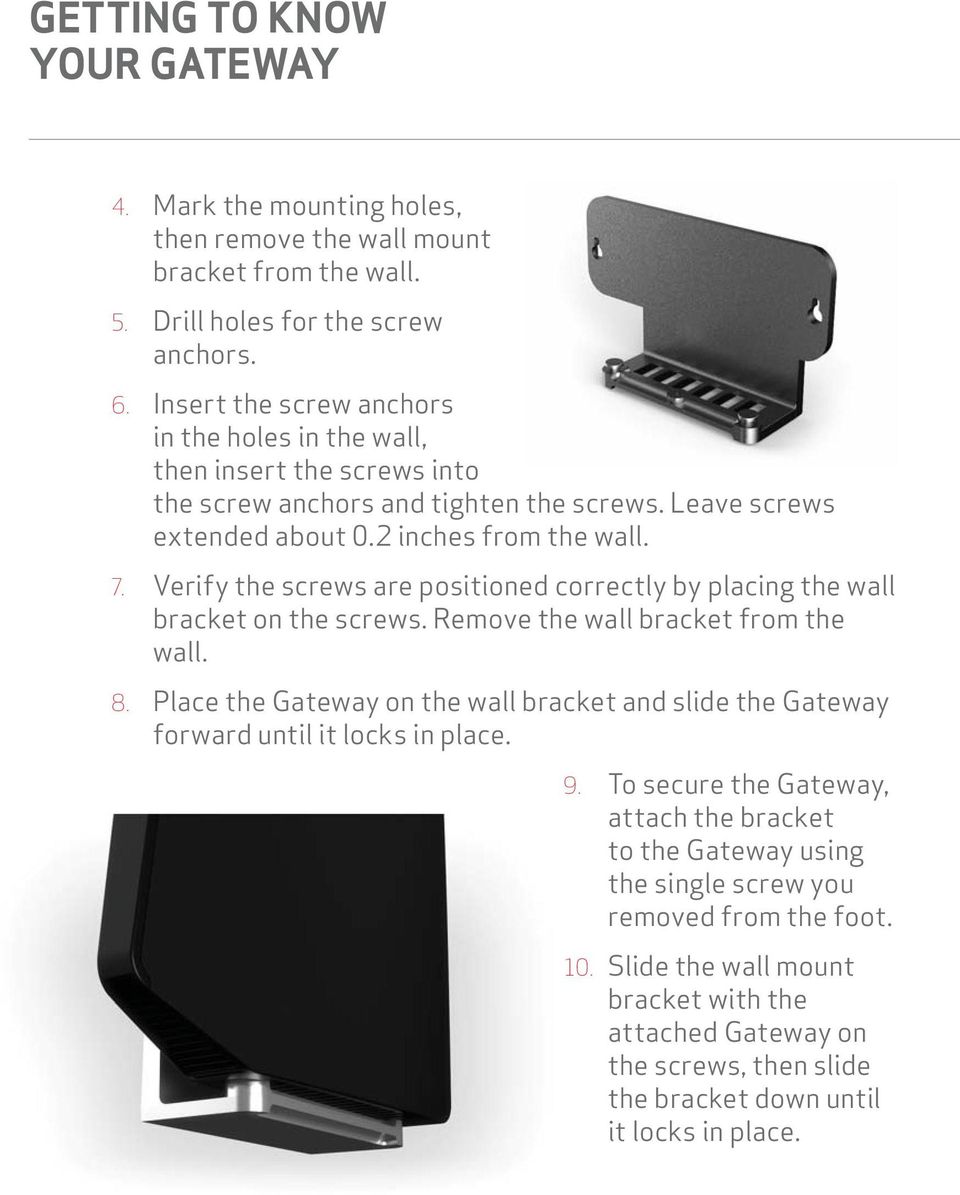
15 01/ INTRODUCTION d/ MOUNTING THE GATEWAY TO A WALL For optimum performance, the FiOS Quantum Gateway is designed to stand in a vertical upright position. Verizon does not recommend wall mounting the FiOS Quantum Gateway. However, if you wish to mount your Gateway, you can purchase a wall mount bracket from the Verizon FiOS Accessories Store at verizon.com/fiosaccessories. If you are replacing an existing Verizon wall mounted router, you do not need to remove the mounting screws from the wall. The existing mounting screws will fit the new bracket. To mount your Gateway to a wall: 1. Remove the foot by turning the Gateway upside down and removing the single screw that holds the foot to the Gateway. 2. Slide the foot toward the front of the Gateway and pull the foot from the holes. You may need to wiggle the foot slightly. 3. You may use the wall mount bracket as a template for positioning the Gateway. verizon.com/fios 2016 Verizon. All Rights Reserved.

16 GETTING TO KNOW YOUR GATEWAY 4. Mark the mounting holes, then remove the wall mount bracket from the wall. 5. Drill holes for the screw anchors. 6. Insert the screw anchors in the holes in the wall, then insert the screws into the screw anchors and tighten the screws. Leave screws extended about 0.2 inches from the wall. 7. Verify the screws are positioned correctly by placing the wall bracket on the screws. Remove the wall bracket from the wall. 8. Place the Gateway on the wall bracket and slide the Gateway forward until it locks in place. 9. To secure the Gateway, attach the bracket to the Gateway using the single screw you removed from the foot. 10. Slide the wall mount bracket with the attached Gateway on the screws, then slide the bracket down until it locks in place.
17 02/ CONNECTING YOUR GATEWAY Setting Up Your Gateway Computer Network Configuration Main Screen verizon.com/fios 2016 Verizon. All Rights Reserved.
18 SETTING UP YOUR GATEWAY Connecting your Gateway and accessing its web-based Graphical User Interface (GUI) are both simple procedures. Accessing the GUI may vary slightly, depending on your device s operating system and web browser.

19 02/ CONNECTING YOUR GATEWAY / SETTING UP YOUR GATEWAY There are three basic steps to setting up your Gateway: Step 1: Connect your Gateway to the Internet Step 2: Connect your network device to your Gateway Step 3: Configure your Gateway Before you begin, if you are replacing an existing Gateway, disconnect it. Remove all old Gateway components, including the power supply. They will not work with your new Gateway. 2.0a/ STEP 1 - CONNECT YOUR GATEWAY 1. Remove your Gateway, Ethernet cables, and power adapter from the box. 2. Locate your high-speed Internet (WAN) outlet. This would be the wall jack installed previously by Verizon. Note the type of jack may be either Ethernet or coaxial. 3. Connect your Gateway to the Internet (WAN). If connecting the WAN using Ethernet, use the supplied white Ethernet cable and plug one end into the white Ethernet WAN port on the back of your Gateway. Plug the other end of the cable into the high-speed Ethernet wall jack. verizon.com/fios 2016 Verizon. All Rights Reserved.

20 SETTING UP YOUR GATEWAY If connecting the WAN using coaxial cable, locate a coaxial cable and connect one end to the coax port on the back of your Gateway. Connect the other end of the coaxial cable to a coax wall jack. Tighten the coaxial cables by hand until snug. The cables should not require a wrench. 4. Plug the power cord into the power port on the back of your Gateway and then into a power outlet. The Gateway automatically turns on as soon as power is plugged in. Important: Wait until the Power/Internet light on the front of the Gateway stops flashing and is solid white. If the light turns red, check the troubleshooting steps in the Troubleshooting section of the user guide. 2.0b/ STEP 2 - CONNECT YOUR DEVICE TO YOUR GATEWAY If connecting a device using wired Ethernet (preferred for initial setup): Plug one end of the supplied yellow Ethernet cable into one of the four yellow Ethernet ports in the back of your Gateway. Alternatively, you can use your own Ethernet cable of any color to connect from the yellow Ethernet ports on the back of your Gateway to your device with an Ethernet connector. Plug the other end of the yellow Ethernet cable into the Ethernet port of your network device.
21 02/ CONNECTING YOUR GATEWAY 20 If connecting a wireless device: Access the Wi-Fi setting on your wireless device, then select your new Gateway using the wireless network name (ESSID) shown on the sticker located on the side of your Gateway. Enter the wireless password (WPA2 key) also shown on the sticker. 2.0c/ STEP 3 - CONFIGURE YOUR GATEWAY: 1. Open a web browser on the device connected to your Gateway network. 2. In the browser address field (URL), enter: myfiosgateway.com, then press the Enter key on your keyboard. Alternately, you can enter: verizon.com/fios 2016 Verizon. All Rights Reserved.
22 SETTING UP YOUR GATEWAY The first time you access your Gateway, an Easy Setup Wizard displays to help step you through the setup process. 3. In the Admin Password field, enter the password that is printed next to the Administrator Password on the label on the side of your Gateway.
23 02/ CONNECTING YOUR GATEWAY Click Next. The Personalize Your Wi-Fi Settings screen displays. Click on the check box next to Setup your Guest Wi-Fi (Optional) to personalize your Guest Wi-Fi Name and Password. For your protection, your Gateway is pre-set at the factory to use WPA2/WPA mixed mode (Wi-Fi Protected Access) encryption for your wireless network. This is the best setting for most users and provides maximum security. verizon.com/fios 2016 Verizon. All Rights Reserved.
24 SETTING UP YOUR GATEWAY AND COMPUTER NETWORK CONFIGURATION 5. Click Continue. The Apply to Save Your Wi-Fi Settings screen appears. You have an option of saving the Wi-Fi settings as an image on your device by clicking the Save as Picture button. After you click Save as Picture to save your Wi-Fi settings as an image, click Apply to save the Wi-Fi changes to your Gateway. Important: If you are on a Wi-Fi device when setting up your Gateway, you will be disconnected from the Wi-Fi network when you change the Wi-Fi name or Wi-Fi password. When this occurs, your Gateway will detect this situation and prompt you to reconnect using the new settings.
25 02/ CONNECTING YOUR GATEWAY 24 The Congratulations! You re All Set Up screen displays once your Gateway verifies the final settings and has successfully connected to the Internet and is ready for use. You can click on Main Router Settings to access the Main screen of the Gateway or click on Start Browsing and you will be directed to the Verizon.com website. If your Gateway is subsequently reset to the factory default settings, the settings printed on the label will again be in effect. If your Gateway fails to connect, follow the troubleshooting steps in the Troubleshooting section of this guide. 2.1/ COMPUTER NETWORK CONFIGURATION Each network interface on your computer should either automatically obtain an IP address from the upstream Network DHCP server (default configuration) or be manually configured with a statically defined IP address and DNS address. We recommend leaving this setting as is. verizon.com/fios 2016 Verizon. All Rights Reserved.
26 COMPUTER NETWORK CONFIGURATION 2.1a/ CONFIGURING DYNAMIC IP ADDRESSING To configure a computer to use dynamic IP addressing: WINDOWS 7/8 1. In the Control Panel, locate Network and Internet, then select View Network Status and Tasks. 2. In the View your active networks Connect or disconnect section, click Local Area Connection in the Connections field. The Local Area Connection Status window displays. 3. Click Properties. The Local Area Connection Properties window displays. 4. Select Internet Protocol Version 4 (TCP/IPv4), then click Properties. The Internet Protocol Version 4 (TCP/IPv4) Properties window displays. 5. Click the Obtain an IP address automatically radio button. 6. Click the Obtain DNS server address automatically radio button, then click OK. 7. In the Local Area Connection Properties window, click OK to save the settings. 8. To configure Internet Protocol Version 6 (TCP/IPv6) to use dynamic IP addressing, repeat step 1 to 7. However for step 3, select Internet Protocol Version 6 (TCP/IPv6) in the Properties option (refer to IPv6 section for Gateway configuration).
27 02/ CONNECTING YOUR GATEWAY 26 MACINTOSH OS X 1. Click the Apple icon in the top left corner of the desktop. A menu displays. 2. Select System Preferences. The System Preferences window displays. 3. Click Network. 4. Verify that Ethernet, located in the list on the left, is highlighted and displays Connected. 5. Click Assist Me. 6. Follow the instructions in the Network Diagnostics Assistant. 2.1b/ CONNECTING OTHER COMPUTERS & NETWORK DEVICES You can connect your Gateway to other computers or set top boxes using an Ethernet cable, wireless connection (Wi-Fi), or coaxial cable. ETHERNET 1. Plug one end of an Ethernet cable into one of the open yellow Ethernet ports on the back of your Gateway. 2. Plug the other end of the Ethernet cable into an Ethernet port on the computer. 3. Repeat these steps for each computer to be connected to your Gateway using Ethernet. You can connect up to four. verizon.com/fios 2016 Verizon. All Rights Reserved.
28 COMPUTER NETWORK CONFIGURATION CONNECTING A WI-FI DEVICE USING WPS Wi-Fi Protected Setup (WPS) is an easier way for many devices to set up a secure wireless network connection. Instead of manually entering passwords or multiple keys on each wireless client, such as a laptop, printer, or external hard drive, your Gateway creates a secure wireless network. In most cases, this only requires the pressing of two buttons one on your Gateway and one on the wireless client. This could be either a built-in button or one on a compatible wireless adapter/card, or a virtual button in software. Once completed, this allows wireless clients to join your wireless network. To initialize the WPS process, you can either press and release the WPS button located on the front of your Gateway or use the GUI and press the on-screen button. You can easily add wireless devices to your wireless network using the WPS option if your wireless device supports the WPS feature. To access WPS using the user interface: 1. From the Main menu, select Wireless Settings, then select Wi-Fi Protected Setup (WPS).
29 02/ CONNECTING YOUR GATEWAY Enable the protected setup by moving the selector to On. 3. Use one of the following methods: If your wireless client device has a WPS button, press the WPS button on your Gateway, then click the WPS button on your wireless device (client) to start the WPS registration process. If your client device has a WPS PIN, locate the PIN printed on the client s label or in the client documentation. verizon.com/fios 2016 Verizon. All Rights Reserved.
30 COMPUTER NETWORK CONFIGURATION AND MAIN SCREEN Enter the PIN number in the Client WPS PIN field. The Client WPS PIN field is located in the section B - PIN Enrollment on the user interface. Click Register. Alternatively, you can enter the Gateway s PIN shown on this screen into the WPS user interface of your device, if this PIN mode is supported by your wireless device. 4. After pressing the WPS button on your Gateway, you have two minutes to press the WPS button on the client device before the WPS session times out. When the WPS button on your Gateway is pressed, the Wireless light on the front of your Gateway begins flashing white. The flashing continues until WPS pairing to the client device completes successfully. At this time, the Wireless light turns solid white. If WPS fails to establish a connection to a wireless client device within two minutes, the Wireless light on your Gateway flashes red for two minutes to indicate the WPS pairing process was unsuccessful. After flashing red, the light returns to solid white to indicate that Wi-Fi is on. CONNECTING A WI-FI DEVICE USING A PASSWORD 1. Verify each device that you are connecting wirelessly (using Wi-Fi) has a built-in wireless or external wireless adapter. 2. Open the device s wireless settings application.
31 02/ CONNECTING YOUR GATEWAY Select your Gateway s wireless network name (SSID) from the device s list of discovered wireless networks. 4. When prompted, enter your Gateway s wireless password (WPA2 key) into the device s wireless settings. Your Gateway s default wireless network name and wireless password are located are on the sticker on the side of your Gateway. 5. Verify the changes were implemented by using the device s web browser to access a site on the Internet. 6. Repeat these steps for every device that you are wirelessly connecting to your Gateway. COAXIAL 1. Verify all coax devices are turned off. 2. Disconnect any adapter currently connected to the coaxial wall jack in the room where your Gateway is located. 3. Connect one end of the coaxial cable to the coaxial wall jack and the other end to the Coax port on your network device. 4. Power up the network device. 2.2/ MAIN SCREEN When you log into your Gateway, the page displays showing the Main navigation menu at the top of the page and your Gateway s Status, including Quick Links, My Network, and Verizon Zone display in the body of the page. verizon.com/fios 2016 Verizon. All Rights Reserved.
32 MAIN SCREEN 2.2a/ MENU The Main menu links across the top of the page to the following configuration options and chapters: Wireless Settings - Chapter 3 My Network - Chapter 5 Firewall - Chapter 6
33 02/ CONNECTING YOUR GATEWAY 32 Parental Controls - Chapter 7 Advanced - Chapter 8 System Monitoring - Chapter 9 2.2b/ STATUS This section displays the status of your Gateway s local network (LAN) and Internet connection (WAN). BROADBAND CONNECTION Broadband Connection displays the state of the broadband connection: Broadband interface: Ethernet or Coax Connected status: Connected or No Connection Connection Type: DHCP or Static WAN IP address: Address of the broadband connection QUICK LINKS Quick Links contains frequently accessed documentation, such as User Guide and Verizon Help, and settings, such as Change Wireless Settings, Change Admin Password, and Port Forwarding as well as Logout. MY NETWORK My Network displays the connection type, IP address, and status of all devices that have accessed or are currently connected to the network. verizon.com/fios 2016 Verizon. All Rights Reserved.
34 MAIN SCREEN The icon associated with the device displays to signify the device is active or shaded gray to indicate the device has not been active for several minutes. You can view the individual settings of each device by clicking its icon. VERIZON ZONE The Verizon Zone contains links to various Verizon web sites and other informational links. Note: You may see an alert when using an older b device indicating the Wi-Fi network performance maybe affected, as shown in the example below.
35 03/ WIRELESS SETTINGS Overview Wireless Status Basic Security Settings Advanced Security Settings Wireless MAC Authentication Mode Other Advanced Wireless Options Guest Wi-Fi Settings verizon.com/fios 2016 Verizon. All Rights Reserved.
36 OVERVIEW Wireless networking enables you to free yourself from wires and plugs, making your devices more accessible and easier to use. You can create a wireless network, including accessing and configuring wireless security options.
37 03/ WIRELESS SETTINGS / OVERVIEW Your Gateway provides you with wireless connectivity using the b, g, n, or ac standards. These are the most common wireless standards b has a maximum data rate of 11 Mbps, g has a maximum data rate of 54 Mbps, n has a maximum data rate of 450 Mbps, and ac has a maximum data rate of 1300 Mbps b and g standards operate in the 2.4 GHz range n operates in both the 2.4 GHz and 5 GHz ranges ac operates in the 5 GHz range. Note: b is a legacy mode and is not recommended. Even one b device connected to the network will slow your entire wireless network. The wireless service and wireless security are activated by default. The level of security is preset to WPA2 encryption using a unique default WPA2 key (also referred to as a passphrase or password) preconfigured at the factory. This information is displayed on a sticker located on the side of your Gateway. Your Gateway integrates multiple layers of security. These include Wired Equivalent Privacy (WEP), Wi-Fi Protected Access (WPA/WPA2), and firewall. verizon.com/fios 2016 Verizon. All Rights Reserved.
38 OVERVIEW 3.1/ WIRELESS STATUS Use the Wireless Status feature to view the status of your Gateway s wireless network. To view the status: 1. Access the Main page. You can quickly view your Gateway s wireless status in the My Network column. This includes all devices that have recently accessed or are currently connected to the network.
39 03/ WIRELESS SETTINGS Select the Wireless Settings icon. The Wireless Status page displays additional wireless details. verizon.com/fios 2016 Verizon. All Rights Reserved.
40 WIRELESS STATUS 3. On the Wireless Status page for either 2.4 GHz or 5 GHz, the following information displays: Radio Enabled - displays whether the wireless radio is active. When the radio is not enabled, no wireless devices will be able to connect to the home network. SSID - displays the SSID (Service Set Identifier) shared among all devices on a wireless network. The SSID is the network name. All devices must use the same SSID. Channel - displays the channel the wireless connection is currently using. Security Enabled - displays the type of security active on the wireless connection as well as the security encryption key. SSID Broadcast - displays whether your Gateway is broadcasting its SSID. If activated, the SSID of your Gateway wireless network is broadcast wirelessly. If not activated, the SSID is hidden and the wireless clients must be manually configured to use the SSID. MAC Authentication - displays whether your Gateway is using MAC (Media Access Control) address authentication to allow wireless devices to join the network. Wireless Mode - displays the types of wireless device that can join the network.
41 03/ WIRELESS SETTINGS 40 WMM - displays if WMM is enabled on your Gateway. Packets Received/Sent - displays the number of packets received and sent since the wireless capability was activated. 3.2/ BASIC SECURITY SETTINGS You can configure the basic security settings for your Gateway s wireless network. verizon.com/fios 2016 Verizon. All Rights Reserved.
42 WIRELESS STATUS AND BASIC SECURITY SETTINGS To configure the basic security radio, SSID and channel settings: 1. On the Wireless Setting page, select Basic Security Settings. 2. To activate the wireless radio, click the On radio button. 3. If desired, enter a new name for the wireless network in the SSID field or leave the default name that displays automatically. 4. Select the channel you want the wireless radio to use to communicate or accept the default Automatic channel, then select the Keep my channel selection during power cycle check box to save your channel selection when your Gateway is rebooted.
43 03/ WIRELESS SETTINGS 42 To configure the basic Wi-Fi Security settings, select a Security option: WPA/WPA2 Mixed Mode If WPA/WPA2 Mixed Mode (Wi-Fi Protected Access) was selected, the WPA Key page displays. Selecting WPA/WPA2 Mixed Mode allows the security mode to be automatically set by the gateway based on the security capabilities of the client device. WPA/WPA2 mixed mode is the default wireless security protocol. To set the WPA/WPA2 Mixed Mode security: 1. Enter the Pre-Shared Key as a wireless password. verizon.com/fios 2016 Verizon. All Rights Reserved.
44 BASIC SECURITY SETTINGS WPA2 2. To activate the group key update interval, select the Group Key Update Interval check box and set the interval time in seconds. 3. Click Apply to save the changes. If WPA2 (Wi-Fi Protected Access II) was selected, the WPA2 page displays. To set the WPA2 security: 1. Enter the Pre-Shared Key. 2. To activate the group key update interval, select the Group Key Update Interval check box and set the interval time in seconds. 3. Click Apply to save the changes.
45 03/ WIRELESS SETTINGS 44 WEP If WEP was selected, the WEP Settings page displays. Warning: WEP provides a low level of security and is not recommended. Additionally, the WEP security setting will drop your Gateway s wireless performance to a maximum data rate of 54 Mbps, and will disable Wi-Fi Protected Setup (WPS). WEP should only be enabled if you have wireless client devices that don t support WPA or WPA2. verizon.com/fios 2016 Verizon. All Rights Reserved.
46 BASIC SECURITY SETTINGS Note: Your Gateway s recommended wireless security encryption is set to WPA2. This is the factory default. This section explains how to activate WEP (Wired Equivalent Privacy) wireless security. WEP is a significantly less robust security compared to WPA or WPA2 and is not recommended. To set up WPA2 wireless security, refer to the WPA2 section. To configure basic security to WEP: 5. To turn on WEP (Wired Equivalent Privacy) security, click the WEP radio button. 6. Select a WEP security level as 64/40 bit or 128/104 bit. 7. Enter the key code. If using a HEX key, each character must be a letter from A to F or a number from 0 to 9. If the key is ASCII, each character can be either any ASCII or alphanumeric character. If using 64/40 bit, enter 10 HEX or 5 ASCII/alphanumeric characters. If 128/104, enter 26 HEX or 13 ASCII/ alphanumeric characters. 8. Be sure to write down the wireless settings for future use. Other wireless devices that will be connected to your Gateway must be configured to use these settings to join your Gateway s wireless network. 9. Click Apply to save changes.
47 03/ WIRELESS SETTINGS / ADVANCED SECURITY SETTINGS You can change your advanced wireless security settings, such as configuring wireless encryption to help protect your network from unauthorized access or damage to your network devices; disable your SSID broadcast to secure your wireless traffic; stop your Gateway from broadcasting your SSID; set Wireless MAC Authentication to limit access to specific wireless devices; and change the wireless mode to limit or allow access to your wireless network based on the type of technology as well as other advanced wireless options. To modify the security settings for either 2.4 GHz or 5 GHz: 1. In the Wireless Settings page, select Advanced Security Settings. 3.3a/ LEVEL 1: SECURING YOUR NETWORK In the Level 1 section, select the type of wireless security. Depending on your selection, one of the following pages displays. verizon.com/fios 2016 Verizon. All Rights Reserved.
48 ADVANCED SECURITY SETTINGS 3.3b/ LEVEL 1: SSID BROADCAST You can configure your Gateway s SSID broadcast capabilities to allow or disallow wireless devices from automatically using a broadcast SSID name to detect your Gateway wireless network. To enable or disable SSID broadcast: 1. In the Advanced Settings page, locate the Level 2 section. 2. Click the 2.4 GHz SSID Broadcast or 5 GHz SSID Broadcast link for the wireless network you wish to modify. The following example uses the 2.4 GHz network. The display configuration looks basically the same for the 5 GHz network.
49 03/ WIRELESS SETTINGS To enable SSID broadcasting, click the Enable radio button. SSID broadcast is enabled by default. The SSID of the wireless network will be broadcast to all wireless devices. 4. To disable SSID broadcasting, click the Disable radio button. The public SSID broadcast will be hidden from all wireless devices. You will need to manually configure additional wireless devices to join the wireless network. 5. Click Apply to save the changes. 3.3c/ LEVEL 2: LIMIT ACCESS You can configure your Gateway to limit access to your wireless network allowing access only to those devices with specific MAC addresses or based on the type of wireless technology used. verizon.com/fios 2016 Verizon. All Rights Reserved.
50 ADVANCED SECURITY SETTINGS To limit access: 1. In the Advanced Settings page, locate the Level 2 section. 2. To allow only devices with specific MAC addresses, click the Wireless MAC Authentication link. The Wireless MAC Authentication page displays. For additional details, refer to the Wireless MAC Authentication section. 3. To limit access based on the type of technology, click the b/g/n/ac Mode link. The b/g/n/ac Mode page displays. For additional details, refer to the b/g/n/ac Mode section. 4. To access other advanced wireless options, click the Other Advanced Wireless Options link. The Other Advanced Wireless Options page displays. For additional details, refer to the Other Advanced Wireless Options section.
51 03/ WIRELESS SETTINGS / WIRELESS MAC AUTHENTICATION You can allow or deny access to your wireless network by specifying devices with specific MAC addresses. To set wireless MAC authentication: 1. On the Advanced Settings page, locate the Level 2 section and click the Wireless MAC Authentication link. The Wireless MAC Authentication page displays. 2. To enable access control, select the Enable Access List check box. 3. Select either: Accept all devices listed below allows only the listed devices to access the wireless network. Warning: This will block wireless network access for all devices not in the list. Only devices in the list will be able to connect to the wireless network. Deny all devices listed below denies access to the listed devices. All other wireless devices will be able to access the wireless network if they use the correct wireless password. verizon.com/fios 2016 Verizon. All Rights Reserved.
52 WIRELESS MAC AUTHENTICATION
53 03/ WIRELESS SETTINGS Enter the MAC address of a device, then click Add. 5. Repeat step 2 to add additional devices, as needed. 6. To remove a specific device s MAC address, click the Remove button next to the specific MAC address. 7. When all changes are complete, click Apply to save changes. 3.5/ MODE From the Mode page, you can limit the wireless access to your network by selecting the 2.4 GHz and 5 GHz wireless communication standard (mode) best suited or compatible with the devices you allow access to your wireless network. verizon.com/fios 2016 Verizon. All Rights Reserved.
54 MODE To select the Mode: 1. On the Advanced Settings page, locate the Level 2 section and click the Mode link. The Mode page displays. 2. Select the 2.4 GHz Wireless Mode as follows: Compatibility This is the default mode setting, providing a good balance of performance and compatibility with existing wireless devices b, g, and n devices can connect. Legacy For older wireless devices. Only b and g devices can connect b (legacy mode) will cause your wireless network to slow and is not recommended. Performance For newer wireless n devices only. No other devices can be used. 3. Select the 5 GHz Wireless Mode as follows: N and AC Mode This is the default setting. Both n and ac are available on the 5 GHz frequencies. AC Only Mode This provides maximum performance ac devices will have exclusive use of the 5 GHz frequencies and n devices will not be able to connect at 5 GHz. 4. Click Apply to save the changes.
55 03/ WIRELESS SETTINGS / OTHER ADVANCED WIRELESS OPTIONS You can view additional wireless options. Comment: Recommend leaving defaults as is unless otherwise directed. To view the options: 1. In the Advanced Settings page, locate the Level 2 section and click Other Advanced Wireless Options link. A warning message displays. 2. Click Yes. The Other Advanced Wireless Options page displays. Comment: The following example uses the 2.4 GHz network. The display configuration looks basically the same for the 5 GHz network. verizon.com/fios 2016 Verizon. All Rights Reserved.
56 OTHER ADVANCED WIRELESS OPTIONS 3. View the following options: Caution: These settings should only be configured by experienced network technicians. Changing the settings could adversely affect the operation of your Gateway and your local network.
57 03/ WIRELESS SETTINGS 56 Group Key Update Interval time interval used to update the WPA shared key (used to generate the group key) Transmission Rate displays status as Auto Channel Width Controls the bandwidth of the wireless signal Transmit Power adjusts the power of the wireless signal CTS (Clear to Send) Protection Mode allows mixed b/g/n/ac networks to operate at maximum efficiency CTS Protection Type displays cts, which is only for mixed b/g/n/ac networks or rts_cts, which is for a/b/g networks Frame Burst Max Number allows packet bursting, which increases overall network speed Frame Burst Burst Time indicates the burst time of the frame bursts Beacon Interval displays the time period of the beacon interval DTIM (Delivery Traffic Indication Message) Interval provides a countdown mechanism, informing wireless network clients of the next window for listening to broadcast and multicast messages Fragmentation Threshold increases the reliability of frame transmissions on the wireless network verizon.com/fios 2016 Verizon. All Rights Reserved.
58 OTHER ADVANCED WIRELESS OPTIONS RTS Threshold controls the size of the data packet that the low level RF protocol issues to an RTS packet MSDU Aggregation enables or disables MSDU aggregation MPDU Aggregation enables or disables MPDU aggregation 5. To access the WMM settings, click the WMM Settings link. 6. Click Apply to save changes. 3.6a/ WMM SETTINGS You can prioritize the types of data transmitted over the wireless network using the advanced WMM settings. Wireless QoS (WMM) can improve the quality of service (QoS) for voice, video, and audio streaming over Wi-Fi by prioritizing these data streams. WMM Power Save can improve battery life on mobile Wi-Fi devices such as smart phones and tablets by fine-tuning power consumption. WMM (Wi-Fi Multimedia) QoS and Power Save require a wireless client device which also supports WMM. To set the options: Note: The following example uses the 2.4 GHz network. The display configuration looks basically the same for the 5 GHz network. 1. In the Advanced Wireless Options page, click WMM Settings link. A warning message displays.
59 03/ WIRELESS SETTINGS Click Yes. The WMM Settings page displays. 3. To enable Wireless QoS (WMM), select the Enabled check box. 4. To enable WMM Power Save, enable Wireless QoS (WMM) first, then enable WMM Power Save by selecting the Enabled check box. 5. Click Apply to save changes. 3.7/ GUEST WI-FI SETTINGS The Guest Wi-Fi network is designed to provide Internet connectivity to your guests but restricts access to your primary network and shared files. The primary network and the guest network are separated from each other through firewalls. You create one Guest Wi-Fi SSID and one password and use it for all guests. Guest Wi-Fi can be managed using either the Gateway s web interface, or via the Verizon MyFiOS app. The verizon.com/fios 2016 Verizon. All Rights Reserved.
60 GUEST WI-FI SETTINGS guest network SSID does not change when you make a change to your primary network SSID. The Gateway is shipped from the factory with Guest Wi-Fi turned off. The default SSID for Guest Wi-Fi is preconfigured at the factory to the default wireless network name (ESSID) which is displayed on a sticker located at the side of the router followed by hyphen guest (-Guest). For example if the router is shipped with a default SSID of FiOS-ABCDE then the default SSID for Guest Wi-Fi is FiOS-ABCDE-Guest.
61 03/ WIRELESS SETTINGS a/ GUEST WI-FI To enable Guest Wi-Fi: 1. From the Main menu, select Wireless Settings, then select Guest Wi-Fi Settings 2. Select the Guest Wi-Fi tab 3. Press the Edit button and enter a valid SSID and password 4. Press Save to save changes 5. Toggle the Guest Wi-Fi button to ON verizon.com/fios 2016 Verizon. All Rights Reserved.
62 GUEST WI-FI SETTINGS 3.7b/ GUEST DEVICES The devices on the Guest Wi-Fi network can be viewed on the Guest Devices page. If the admin toggles the button next to a device to OFF, that device will be blocked from accessing the Internet.
63 04/ CONFIGURING MY NETWORK SETTINGS Accessing My Network Settings Using My Network Settings verizon.com/fios 2016 Verizon. All Rights Reserved.
64 ACCESSING MY NETWORK SETTINGS You can configure the basic network settings for your Gateway s network.
65 04/ CONFIGURING MY NETWORK SETTINGS 64 Caution: The settings described in this chapter should only be configured by experienced network technicians. Changes could adversely affect the operation of your Gateway and your local network. 4.0/ ACCESSING MY NETWORK SETTINGS My Network allows you to view and manage your network connections and devices. You can block websites and Internet services, set port forwarding, view device details, and rename devices. To view your network connections: 1. On the Main page, select the My Network icon. The My Network page opens with our current status displayed. verizon.com/fios 2016 Verizon. All Rights Reserved.
66 USING MY NETWORK SETTINGS 4.1/ USING MY NETWORK SETTINGS You can access and configure common network parameters: Block this Device - Click Block this Device to quickly enable/disable a device from having Internet access. Website Blocking - To block specific websites, click Website Blocking. The Parental Controls page displays. For additional information about blocking websites, refer to Chapter 7 Setting Parental Controls. Block Internet Services - Internet services blocking prevents a device on your network from accessing specific services, such as receiving or downloading files from FTP sites. Block Internet services by locating the device, then clicking Block Internet Services. The Access Control page displays. For additional information on blocking Internet services, refer to the Access Control section in Chapter 6 Configuring Security Settings. Port Forwarding - Port Forwarding allows your network to be exposed to the Internet in specific limited and controlled ways. For example, you could allow specific applications, such as gaming, voice, and chat, to access servers in the local network. To access the Port Forwarding page, click Port Forwarding. For additional information, refer to the Port Forwarding section in Chapter 6 Configuring Security Settings.
67 04/ CONFIGURING MY NETWORK SETTINGS 66 View Device Details - Click View Device Details to display the Device Information page and view the selected device s information, such as IP Address, MAC address, Network Connection, Lease Type, Port Forwarding Services, and Windows Shared Folder as well as the Ping Test option. You can also click the device s icon in the Main page to display the Device Information page. Rename this Device - To change the name of a specific device, click Rename this Device. The Rename Device page displays. If desired, enter the new device name and/or select a different icon. Click Apply to save changes. The My Network page will open with the new name and icon displayed. verizon.com/fios 2016 Verizon. All Rights Reserved.
68 05/ USING NETWORK CONNECTIONS Accessing Network Connections Network (Home/Office) Connection Ethernet/Coax Connection Wireless Access Point Connection Broadband Ethernet/Coax Connection
69 05/ USING NETWORK CONNECTIONS 68 Your Gateway supports various local area network (LAN) and wide area network (WAN), or Internet connections using Ethernet or coaxial cables. You can configure aspects of the network and Internet connections as well as create new connections. verizon.com/fios 2016 Verizon. All Rights Reserved.
70 ACCESSING NETWORK CONNECTIONS Caution: The settings described in this chapter should only be configured by experienced network technicians. Changes could adversely affect the operation of your Gateway and your local network. 5.0/ ACCESSING NETWORK CONNECTIONS You can access your network connections and view the connections by connection type. To access the network connections: 1. Select My Network, then select Network Connections. 2. To display all connection entries, click the Advanced button.
71 05/ USING NETWORK CONNECTIONS To view and edit the details of a specific network connection, click the hyperlinked name or the action icon. The following sections detail the types of network connections that you can view. 5.1/ NETWORK (HOME/OFFICE) CONNECTION You can view the properties of your local network. This connection is used to combine several network interfaces under one virtual network. For example, you can create a home/office network connection for Ethernet and other network devices. verizon.com/fios 2016 Verizon. All Rights Reserved.
72 NETWORK (HOME/OFFICE) CONNECTION Note: When a network connection is disabled, the formerly underlying devices connected to it will not be able to obtain a new DHCP address from that Gateway network interface. To view the connection: 1. On the Network Connections page, click the Network (Home/Office) connection link. The Network (Home/Office) Properties page displays. 2. To rename a network connection, enter the new network name in the Name field.
73 05/ USING NETWORK CONNECTIONS Click Apply to save the changes. CONFIGURING THE HOME/OFFICE NETWORK To configure the network connection: 1. In the Network (Home/Office) Properties page, click Settings. The configuration page displays. 2. Configure the following sections, as needed. GENERAL In the General section, verify the following information: Status - displays the connection status of the network. verizon.com/fios 2016 Verizon. All Rights Reserved.
74 NETWORK (HOME/OFFICE) CONNECTION BRIDGE Network displays the type of network connection. Connection Type - displays the type of connection. Physical Address - displays the physical address of the network card used for the network MTU - specifies the Maximum Transmission Unit (MTU) specifies the largest packet size permitted for Internet transmissions: Automatic - sets the MTU at 1500 Automatic by DHCP - sets the MTU according to the DHCP connection Manual - allows you to manually set the MTU Internet Protocol - in the internet protocol section, specify one of the following Use the Following IP Address - the network connection uses a permanent or static IP address and subnet mask address, provided by Verizon or experienced network technician. In the Bridge section of the Configure Network (Home/Office), you can configure the various LAN interfaces. By default, the Ethernet, Coax, and Wireless Access Point connections are included in the Network (Home/Office) bridge. Caution: Do not change these settings unless specifically instructed to by Verizon. Changes could adversely affect the operation of your Gateway and your local network.
75 05/ USING NETWORK CONNECTIONS 74 Verify the following information: Status displays the connection status of a specific network connection. Action contains an icon that, when clicked, generates the next lower-level configuration page for the specific network connection or network device. IP ADDRESS DISTRIBUTION The IP Address Distribution section of the Properties settings is used to configure your Gateway s Dynamic Host Configuration Protocol (DHCP) server parameters. verizon.com/fios 2016 Verizon. All Rights Reserved.
76 NETWORK (HOME/OFFICE) CONNECTION Once enabled and configured, the DHCP server automatically assigns IP addresses to any network devices which are set to obtain their IP address dynamically. If DHCP Server is enabled on your Gateway, configure the network devices as DHCP Clients. There are 2 basic options in this section: Disabled and DHCP Server. To set up the Gateway s network bridge to function as a DHCP server: 1. In the IP Address Distribution section, select the DHCP server. Once enabled, the DHCP server provides automatic IP assignments (also referred to as IP leases) based on the preset IP range defined below. Start IP Address Enter the first IP address in the IP range that the Gateway will automatically begin assigning IP addresses from. Since your Gateway s IP address is , the default Start IP Address is
77 05/ USING NETWORK CONNECTIONS 76 ROUTING End IP Address Enter the last IP address in the IP range that the Gateway will automatically stop the IP address allocation at. The maximum end IP address range that can be entered is If Windows Internet Naming Service (WINS) is being used, enter the WINS server address. 3. In the Lease Time in Minutes field, enter the amount of time a network device is allowed to connect to the Gateway with its currently issued dynamic IP address. 4. Click Apply to save changes. You can configure your Gateway to use static or dynamic routing. Static routing specifies a fixed routing path to neighboring destinations based on predetermined metrics. Dynamic routing automatically adjusts how packets travel on the network. The path determination is based on network/device reachability and status of network being traveled. To configure routing: 1. In the Routing Table section, click Add New Route to display and modify the new route configuration page. verizon.com/fios 2016 Verizon. All Rights Reserved.
78 NETWORK (HOME/OFFICE) CONNECTION COMPLETE NETWORK CONNECTION CONFIGURATION UPDATES To save your changes click Apply. 5.2/ BROADBAND CONNECTION You can view the properties of your broadband connection (your connection to the Internet). This connection may be via either Ethernet or Coaxial cable. To view the connection settings: 1. In the Network Connections page, click the Broadband Connection (Ethernet/Coax) link.
79 05/ USING NETWORK CONNECTIONS To rename the network connection, enter the new name in the Name field. 3. Click Apply to save changes. verizon.com/fios 2016 Verizon. All Rights Reserved.
80 ETHERNET/COAX CONNECTION 5.2a/ CONFIGURING THE ETHERNET/COAX CONNECTION To configure the connection: 1. In the Broadband Connection (Ethernet/Coax) Properties page, click Settings. The configuration page displays. GENERAL 2. Configure the following settings, as needed. Verify the following information: Status - displays the connection status of the network. Network displays the type of network connection. Connection Type - displays the type of connection. Physical Address - displays the physical address of the network card used for the network.
81 05/ USING NETWORK CONNECTIONS 80 COAX LINK MTU - specifies the largest packet size permitted for Internet transmissions: To set the Channel: Automatic - sets the MTU (Maximum Transmission Unit at 1500) Automatic by DHCP - sets the MTU according to the DHCP connection Manual - allows you to manually set the MTU to be set. 1. Select the coax link channel as 1 to Select the On or Off radio button in the Auto Detection field. 3. To set privacy, select the Enabled check box. This causes all devices connected to the coaxial cable to use the same password. This is recommended. 4. To set the password, enter the Coax Link password in the Password field. verizon.com/fios 2016 Verizon. All Rights Reserved.
82 ETHERNET/COAX CONNECTION 5. To enable or disable the Coax link, click Disable or Enable. 6. To view the devices connected using the coaxial cable, click the Go to WAN Coax Stats link. COMPLETE ALL ETHERNET/COAX CONNECTION CONFIGURATION UPDATES To save your changes: 1. Click Apply. 5.3/ WIRELESS ACCESS POINT CONNECTION A Wireless Access Point network connection allows wireless devices to connect to the local area network (LAN) using the 2.4 GHz or 5 GHz Wi-Fi network. Note: Once disabled, all wireless devices connected to that wireless network will be disconnected from the LAN network and Internet. To view the connection: 1. In the Network Connections page, click Advanced.
83 05/ USING NETWORK CONNECTIONS Click 5 GHz Wireless Access Point 1 or 2.4 GHz Wireless Access Point 2. verizon.com/fios 2016 Verizon. All Rights Reserved.
84 WIRELESS ACCESS POINT CONNECTION 3. To disable the connection, click Disable. 4. To rename the connection, enter a name in the Name field. 5. Click Apply to save the changes. 6. Reboot your Gateway. 5.3a/ CONFIGURING WIRELESS ACCESS POINT PROPERTIES To configure the connection: 1. In the Wireless Access Point Properties page, click Settings. The configuration page displays.
85 05/ USING NETWORK CONNECTIONS Verify the following information: Status - displays the connection status of the network. Network displays the type of network connection. Connection Type - displays the type of connection. Physical Address - displays the physical address of the network card used for the network. MTU - specifies the largest packet size permitted for Internet transmissions: Automatic - set the MTU (Maximum Transmission Unit) at 1500 Automatic by DHCP - sets the MTU according to the DHCP connection verizon.com/fios 2016 Verizon. All Rights Reserved.
86 WIRELESS ACCESS POINT CONNECTION AND BROADBAND ETHERNET/COAX CONNECTION Manual - allows you to manually set the MTU 3. Click Apply to save changes. 5.4/ BROADBAND ETHERNET/COAX CONNECTION A Broadband Ethernet connection connects computers to your Gateway using Ethernet cables. The connections are either direct or use network hubs and switches. A Coax connection connects devices, such as set-top boxes, to your Gateway using a coaxial cable. Note: If disabling the connection, you must reboot your Gateway for the change to take effect. To view the connection: 1. In the Network Connections page, click the Broadband Connection (Ethernet/Coax) link.
87 05/ USING NETWORK CONNECTIONS To rename the network connection, enter the new name in the Name field. 3. Click Apply to save changes. 5.4a/ CONFIGURING THE ETHERNET/COAX CONNECTION To configure the connection: 1. In the Broadband Connection (Ethernet/Coax) Properties page, click Settings. The configuration page displays. verizon.com/fios 2016 Verizon. All Rights Reserved.
88 BROADBAND ETHERNET/COAX CONNECTION GENERAL 2. Configure the following settings, as needed. Verify the following information: Status - displays the connection status of the network Network displays the type of network connection Connection Type - displays the type of connection Physical Address - displays the physical address of the network card used for the network MTU - specifies the largest packet size permitted for Internet transmissions: Automatic - set the MTU (Maximum Transmission Unit) at 1500
89 05/ USING NETWORK CONNECTIONS 88 COAX LINK Automatic by DHCP - sets the MTU according to the DHCP connection Manual - allows you to manually set the MTU 1. To set the Channel, select the coax link channel as 1 to Select the On or Off radio button in the Auto Detection field. 3. To set privacy, select the Enabled check box. This causes all devices connected to the coaxial cable to use the same password. This is recommended. 4. To set the password, enter the Coax Link password in the Password field. 5. To enable or disable the Coax link, click Disable or Enable. 6. To view the devices connected using the coaxial cable, click the Go to WAN Coax Stats link. verizon.com/fios 2016 Verizon. All Rights Reserved.
90 BROADBAND ETHERNET/COAX CONNECTION INTERNET PROTOCOL 1. In the Internet Protocol section, specify one of the following: No IP Address the connection has no IP address. This is useful if the connection operates under a bridge. Obtain an IP Address Automatically the network connection is required by Verizon to obtain an IP address automatically. The server assigning the IP address also assigns a subnet mask address, which can be overridden by entering another subnet mask address. Use the Following IP Address - the network connection uses a permanent or static IP address, then the IP address and subnet mask address. 2. To override the subnet mask, select the Override Subnet Mask check box, then enter the new subnet mask.
91 05/ USING NETWORK CONNECTIONS 90 ROUTING MODE COMPLETE ALL ETHERNET/COAX CONNECTION CONFIGURATION UPDATES To save your changes: 1. Click Apply. verizon.com/fios 2016 Verizon. All Rights Reserved.
92 06/ CONFIGURING SECURITY SETTINGS Firewall Access Control Port Forwarding Port Triggering DMZ Host Remote Administration Static NAT Security Log
93 06/ CONFIGURING SECURITY SETTINGS 92 Your Gateway s security suite includes comprehensive and robust security services, such as stateful packet inspection, firewall security, user authentication protocols, and password protection mechanisms. These and other features help protect your computers from security threats on the Internet. verizon.com/fios 2016 Verizon. All Rights Reserved.
94 FIREWALL This chapter covers the following security features: Firewall - select the security level for the firewall. Access Control - restrict access from the local network to the Internet. Port Forwarding - enable access from the Internet to specified services provided by computers on the local network. Port Triggering - define port triggering entries to dynamically open the firewall for some protocols or ports. DMZ Host - allows a single device on your primary network to be fully exposed to the Internet for special purposes such as Internet Gaming. Remote Administration - enable remote configuration of your gateway from any Internet-accessible computer. Static NAT - allow multiple static NAT IP addresses to be designated to devices on the network. Security Log - view and configure the security log. 6.0/ FIREWALL The firewall is the cornerstone of the security suite for your Gateway. It has been exclusively tailored to the needs of the residential or office user and is pre-configured to provide optimum security. The firewall provides both the security and flexibility home and office users seek. It provides a managed, professional level of network security while enabling the safe use of interactive applications, such as Internet gaming and video conferencing.
95 06/ CONFIGURING SECURITY SETTINGS 94 Additional features, including surfing restrictions and access control, can also be configured locally through the user interface or remotely by a service provider. The firewall regulates the flow of data between the local network and the Internet. Both incoming and outgoing data are inspected, then either accepted and allowed to pass through your Gateway or rejected and barred from passing through your Gateway, according to a flexible and configurable set of rules. These rules are designed to prevent unwanted intrusions from the outside, while allowing local network users access to Internet services. The firewall rules specify the type of services on the Internet that are accessible from the local network and types of services in the local network that are accessible from the Internet. Each request for a service that the firewall receives is checked against the firewall rules to determine whether the request should be allowed to pass through the firewall. If the request is permitted to pass, all subsequent data associated with this request or session is also allowed to pass, regardless of its direction. For example, when accessing a website on the Internet, a request is sent to the Internet for this site. When the request reaches your Gateway, the firewall identifies the request type and origin, such as HTTP and a specific computer in the local network. Unless your Gateway is configured to block requests of this type from this computer, the firewall allows this type of request to pass to the Internet. When the website is returned from the web server, the firewall associates the website with this session and allows it to pass; verizon.com/fios 2016 Verizon. All Rights Reserved.
96 FIREWALL regardless HTTP access from the Internet to the local network is blocked or permitted. It is the origin of the request, not subsequent responses to this request, which determines whether a session can be established. 6.0a/ SETTING FIREWALL CONFIGURATION You can select a maximum, typical, or minimum security level to block, limit, or permit all traffic. The following table shows request access for each security level. Security Level Internet Requests Incoming Traffic Local Network Requests Outgoing Traffic Maximum Blocked Limited Typical Blocked Unrestricted Minimum Unrestricted Unrestricted The request access is defined as: Blocked traffic - no access allowed, except as configured in Port Forwarding and Remote Access Limited - permits only commonly used services, such as and web browsing Unrestricted - permits full access of incoming traffic from the Internet and allows all outgoing traffic, except as configured in Access Control
97 06/ CONFIGURING SECURITY SETTINGS b/ SPECIFYING GENERAL SETTINGS FOR IPV4 OR IPV6 To set your firewall configuration: 1. From the Firewall General settings page click on desired IPv6 option to configure IPv6 security: verizon.com/fios 2016 Verizon. All Rights Reserved.
98 ACCESS CONTROL 2. Select a security level by clicking one of the radio buttons. Using the Minimum Security setting may expose the local network to significant security risks, and should only be used for short periods of time to allow temporary network access. 3. Click Apply to save changes. 6.1/ ACCESS CONTROL You can block individual computers on your local network from accessing specific services on the Internet. For example, you could block one computer from accessing the Internet, then block a second computer from transferring files using FTP as well as prohibit the computer from receiving incoming . Access control incorporates a list of preset services, such as applications and common port settings. 6.1a/ ALLOW OR RESTRICT SERVICES To allow or restrict services: 1. From the Firewall page, select Access Control. The Access Control page opens with the Allows and Blocked sections displayed. The Allowed section only displays when the firewall is set to maximum security.
99 06/ CONFIGURING SECURITY SETTINGS To block a service, click Add. The Add Access Control Rule page displays. verizon.com/fios 2016 Verizon. All Rights Reserved.
100 ACCESS CONTROL AND PORT FORWARDING 3. To apply the rule to: All networked devices - select Any. Specific devices only - select User Defined, then click Add and create a network object. 4. In the Protocol field, select the Internet protocol to be allowed or blocked. If the service is not included in the list, select User Defined. The Edit Service page displays. Define the service, then click OK. The service is automatically added to the Add Access Control Rule section. 5. Specify when the rule is active as Always or User Defined and click Add to create the schedule. 6. Click Apply to save changes. The Access Control page displays a summary of the new access control rule. 6.1b/ DISABLE ACCESS CONTROL You can disable an access control and enable access to the service without removing the service from the Access Control table. This can make the service available temporarily and allow you to easily reinstate the restriction later. To disable an access control, clear the check box next to the service name. To reinstate the restriction, select the check box next to the service name.
101 06/ CONFIGURING SECURITY SETTINGS 100 To remove an access restriction, select the service and click Remove. The service is removed from the Access Control table. 6.2/ PORT FORWARDING You can activate port forwarding to expose the network to the Internet in a limited and controlled manner. For example, enabling applications, such as gaming and voice, to work from the local network as well as allowing Internet access to servers within the local network. To create port forwarding rules: 1. From the Firewall page, select Port Forwarding. The Port Forwarding page opens with the current rules displayed. verizon.com/fios 2016 Verizon. All Rights Reserved.
102 PORT FORWARDING AND PORT TRIGGERING 2. To create a new rule, select the IP address in the Select IP from Menu drop down. 3. Select the application in the Application to Forward drop down. 4. Click Add. The rule displays in the Applied Rules section. 5. Click Apply to save changes. 6.2a/ ADVANCED PORT FORWARDING RULES You can configure advanced port forwarding rules. To configure the rules: 1. In the Port Forwarding page, select Advanced.
103 06/ CONFIGURING SECURITY SETTINGS If needed, to select a port to forward communication to, select an option in the Forward to Port list box. 3. If a single port or range of ports is selected, a text box displays. Enter the port numbers. 4. To schedule the rule, select either Always or User Defined in the Schedule list box. 5. Click Add. The rule displays in the Applied Rules section. 6. Click Apply to save changes. 6.3/ PORT TRIGGERING Port triggering can be described as dynamic port forwarding. By setting port triggering rules, inbound traffic arrives at a specific network host using ports that are different than those used for outbound traffic. The outbound traffic triggers the ports where the inbound traffic is directed. For example, a gaming server is accessed using UDP protocol on port The gaming server then responds by connecting the user using UDP on port 3333, when a gaming session is initiated. In this case, port triggering must be used since it conflicts with the following default firewall settings: Firewall blocks inbound traffic by default. Server replies to your Gateway IP, and the connection is not sent back to the host since it is not part of a session. verizon.com/fios 2016 Verizon. All Rights Reserved.
104 PORT TRIGGERING AND REMOTE ADMINISTRATION To resolve the conflict, a port triggering entry must be defined, which allows inbound traffic on UDP port 3333 only after a network host generated traffic to UDP port This results in your Gateway accepting the inbound traffic from the gaming server and sending it back to the network host which originated the outgoing traffic to UDP port To configure port triggering: 1. Select Port Triggering. 2. To add a service as an active protocol, click Add. The Edit Port Triggering Rule page displays.
105 06/ CONFIGURING SECURITY SETTINGS Enter the service name then configure its inbound and outbound trigger ports. Click Apply to save User Defined changes. The Port Triggering page displays. 4. Click Apply again to save all changes. 6.4/ DMZ HOST DMZ Host allows a single device on your primary network to be fully exposed to the Internet for special purposes like Internet gaming. verizon.com/fios 2016 Verizon. All Rights Reserved.
106 DMZ HOST Warning: Enabling DMZ Host is a security risk. When a device on your network is a DMZ Host, it is directly exposed to the Internet and loses much of the protection of the firewall. If it is compromised, it can also be used to attack other devices on your primary network. Follow these steps to designate a device on your primary network as a DMZ Host: 1. From the Firewall page, select DMZ Host 2. Select Enable for the DMZ Host 3. Enter the IP address of the device you want to designate as the DMZ Host 4. Click Apply
107 06/ CONFIGURING SECURITY SETTINGS / REMOTE ADMINISTRATION Caution: Enabling Remote Administration places your Gateway network at risk from outside attacks. You can access and control your Gateway not only from within the local network, but also from the Internet using Remote Administration. You can allow incoming access to the following: Web Management - used to obtain access to your Gateway s GUI and gain access to all settings and parameters through a web browser. Diagnostic Tools - used for troubleshooting and remote system management by a user or Verizon. Web Management remote administration access may be used to modify or disable firewall settings. Local IP addresses and other settings can also be changed, making it difficult or impossible to access your Gateway from the local network. Remote administration access to SSH or Web Management services should be activated only when absolutely necessary. Note: Encrypted remote administration is performed using a secure SSL connection and requires a SSL certificate. When accessing your Gateway for the first time using encrypted remote administration, a warning page opens with a certificate authentication message displayed. This is due to your Gateway SSL certificate being self-generated. When this message display under that circumstance, ignore the message and continue. Even though this message displays, the self-generated certificate is safe and provides a secure SSL connection. verizon.com/fios 2016 Verizon. All Rights Reserved.
108 REMOTE ADMINISTRATION AND STATIC NAT To enable remote administration: 1. Select Remote Administration. 2. To enable access, select the check box. 3. Click Apply to save changes. 4. To remove access, clear the check box. 5. Click Apply again to save changes.
109 06/ CONFIGURING SECURITY SETTINGS / STATIC NAT Static NAT allows devices located behind a firewall that is configured with private IP addresses to appear to have public IP addresses to the Internet. This allows an internal host, such as a web server, to have an unregistered (private) IP address and still be accessible over the Internet. To configure static NAT: 1. Select Static NAT. 2. To create a static NAT, click Add. The Add NAT/NAPT Rule page displays. verizon.com/fios 2016 Verizon. All Rights Reserved.
110 STATIC NAT AND SECURITY LOG 3. Select a source address in the Specify Address field or enter an IP address in the text box. 4. Enter the public IP address. 5. If using port forwarding, select the Enable Port Forwarding for Static NAT check box. 6. Click Apply to save changes. 7. Repeat these steps to add additional static IP addresses. 6.7/ SECURITY LOG You can view events that your firewall has blocked by accessing the security log. Your Gateway reports events, such as attempts to establish inbound and outbound connections, attempts to authenticate at an administrative interface, such as your Gateway GUI, firewall configuration, and system start-up.
111 06/ CONFIGURING SECURITY SETTINGS 110 The security log reports the following information: Time - based on the date and time in your Gateway Event Type - consists of firewall information, firewall setup, and system log Log Level - describes the event that occurred, such as a fragmented packet or parental controls. Details - provide a reason the event occurred, such as a packet has been blocked because of parental controls. You can modify the type of events that display in the security log. This does not modify the event itself. It simply changes the information that displays in the log. 6.7a/ EVENT TYPES The security log records the following event types: Access control a packet has been accepted/blocked due to an access control rule. Advance filter rule a packet has been accepted/blocked due to an advanced filter rule. ARP an ARP packet has been accepted. AUTH:113 request - an outbound packet for AUTH protocol has been accepted (for maximum security level). Broadcast/Multicast protection a packet with a broadcast/ multicast source IP has been blocked. verizon.com/fios 2016 Verizon. All Rights Reserved.
112 SECURITY LOG Default policy a packet has been accepted/blocked according to the default policy. Defragmentation failed the fragment has been stored in memory and blocked until all fragments have arrived and defragmentation can be performed. DHCP request your Gateway sent a DHCP request (depends on the distribution). DHCP response - your Gateway sent a DHCP response (depends on the distribution). Echo/Chargen/Quote/Snork protection a packet has been blocked due to Echo/Chargen/Quote/Snork protection. Firewall internal from the firewall internal mechanism, event type is recorded and an accompanying explanation will be added. Firewall rules were changed the rule set has been modified. Firewall status changed the firewall status changed from up to down or vice versa, as specified in the event type description. First packet in connection is not a SYN packet a packet has been blocked due to a TCP connection that started without a SYN packet. Fragmented packet a fragment has been rejected. Fragmented packet, bad align a packet has been blocked because, after defragmentation, the packet was badly aligned. Fragmented packet, header too big a packet has been blocked because, after defragmentation, the header was too big. Fragmented packet, header too small a packet has been blocked because, after defragmentation, the header was too small.
113 06/ CONFIGURING SECURITY SETTINGS 112 Fragmented packet, no memory a packet has been blocked because there is no memory for fragments. Fragmented packet, overlapped a packet has been blocked because, after defragmentation, there were overlapping fragments. Fragmented packet, packet exceeds a packet has been blocked because, after defragmentation, the packet exceeded. Fragmented packet, packet too big a packet has been blocked because, after defragmentation, the packet was too big. FTP port request to 3rd party is forbidden possible bounce attack a packet has been blocked. ICMP flood protection a broadcast ICMP (Internet Control Message Protocol) flood. ICMP protection a broadcast ICMP message has been blocked. ICMP redirect protection an ICMP redirected message has been blocked. ICMP replay an ICMP replay message has been blocked. Illegal packet options the options field in the packet s header is either illegal or forbidden. IP Version 6 an IPv6 packet has been accepted. Malformed packet: Failed parsing a packed has been blocked because it is malformed. Maximum security enabled service a packet has been accepted because it belongs to a permitted service in the maximum security level. verizon.com/fios 2016 Verizon. All Rights Reserved.
114 SECURITY LOG Multicast IGMP connection a multicast packet has been accepted. NAT Error: Connection pool is full - No connection created a connection has not been created because the connection pool is full. NAT Error: Conflict mapping already exists a conflict occurred because the NAT mapping already exists, so NAT failed. NAT Error: No free NAT IP no free NAT IP, so NAT has failed. NAT out failed NAT failed for this packet. Outbound Auth1X an outbound Auth1X packet has been accepted. Packet invalid in connection an invalid connection packet has been blocked. Parental controls a package has been block because of parental controls. Passive attack on ftp-server: Client attempted to open Server ports a packet has been blocked. Service a packet has been accepted because of a certain service, as specified in the event type. Spoofing protection a packet from the Internet with a source IP belong to the local network has been blocked. STP packet STP (Spanning Tree Protocol) packet has been accepted/rejected. SynCookies protection a SynCookies packet has been blocked. Trusted device a packet from a trusted device has been accepted.
115 06/ CONFIGURING SECURITY SETTINGS 114 UDP flood protection a packed has been blocked, stopping a UDP flood. User authentication a message arrived during login time, including both successful and failed authentication. Wildcard connection hooked debug message regarding connection. Wildcard connection opened - debug message regarding connection. WinNuke protection a WinNuke attack has been blocked. To view the security log: 1. Select Security Log. 2. To modify the types of events that display in the log, click Settings. verizon.com/fios 2016 Verizon. All Rights Reserved.
116 SECURITY LOG 3. In the Accepted Events section, select the type of activities that generates a log message: Accepted Incoming Connections generates a log message for each successful attempt to establish an inbound connection to the local network.
117 06/ CONFIGURING SECURITY SETTINGS 116 Accepted Outgoing Connections - generates a log message for each successful attempt to establish an outbound connection to the public network. 4. In the Blocked Events section, select the type of blocked events you want logged. 5. To log a message for each remote administration connection attempt, click the Remote Administration Attempts check box. 6. To log the connection for handling by the firewall and application level Gateways, click the Connection States check box. 7. Click Apply to save changes. The Security Log page displays. verizon.com/fios 2016 Verizon. All Rights Reserved.
118 07/ SETTING PARENTAL CONTROLS Activating Parental Controls Rule Summary
119 07/ SETTING PARENTAL CONTROLS 118 The abundance of harmful information on the Internet poses a serious challenge for employers and parents alike as they ask How can I regulate what my employee or child does on the Internet? With that question in mind, your Gateway s Parental Controls were designed to allow control of Internet access on all locally networked devices. verizon.com/fios 2016 Verizon. All Rights Reserved.
120 ACTIVATING PARENTAL CONTROLS 7.0/ ACTIVATING PARENTAL CONTROLS You can create a basic access policy for any computer or device on your Gateway network. Parental controls limit Internet access to specific websites based on a schedule that you create. Access can be limited on specific websites or keywords embedded in a website. For example, you can block access to the as well as block any website that has the word any in its site name. To limit computer access: 1. Select Parental Controls. 2. In Step 1 (optional), select the computers or device where you are limiting access in the Networked Computer/Device list box, then click Add. The devices display in the Selected Devices section.
121 07/ SETTING PARENTAL CONTROLS To remove a device from the Selected Devices list box, select the device, then click Remove. The device displays in the Networked Computer/Device list box. 4. In Step 2, click one of the following options in the Limit Access By section: Block the following Websites and Embedded Keywords within a Website blocks the specified websites and websites with names contained the specified keyword. Allow the following Websites and Embedded Keywords within a Website allows the specified websites and websites with names contained the specified keyword. Block ALL Internet Access will not allow the device to access the Internet. 5. Enter the name of the website or keyword, then click Add. 6. To remove a website or keyword, select the word, then click Remove. verizon.com/fios 2016 Verizon. All Rights Reserved.
122 ACTIVATING PARENTAL CONTROLS AND RULE SUMMARY 7. Create a schedule by selecting the days of the week when the rule will be active or inactive. 8. Set the time when the rule will be active or inactive, then specify the start time and end time. 9. Create a rule name and description. 10. Click Apply to save changes. 7.1/ RULE SUMMARY You can view the rules created for your Gateway. To view the rule summary, select Rule Summary. The Rule Summary page opens with the rule name, description, and computer or device displayed.
123 07/ SETTING PARENTAL CONTROLS 122 You can enable, view, edit, or delete the rule, refer to Scheduler Rules for additional setting details. verizon.com/fios 2016 Verizon. All Rights Reserved.
124 08/ CONFIGURING ADVANCED SETTINGS Using Advanced Settings Utilities DNS Settings Network Settings Routing Date and Time Configuration Settings
125 08/ CONFIGURING ADVANCED SETTINGS 124 Advanced settings cover a wide range of sophisticated configurations for your Gateway s firmware and network. verizon.com/fios 2016 Verizon. All Rights Reserved.
126 USING ADVANCED SETTINGS AND UTILITIES Caution: Many of the settings described in this section should only be configured by experienced network technicians. Changes could adversely affect the operation of your Gateway and local network. 8.0/ USING ADVANCED SETTINGS You can access the following settings: Utilities DNS Settings Date & Time Routing Network Settings Configuration Settings To access the advanced settings: 1. Select Advanced. A warning page displays, asking if you want to proceed. 2. Click Yes. The Advanced page displays.
127 08/ CONFIGURING ADVANCED SETTINGS Select a topic by clicking the topic name. 8.1/ UTILITIES You can access the following advanced settings: Diagnostics performs diagnostic tests Restore Defaults resets your Gateway to it default settings Reboot Router restarts your Gateway MAC Cloning clones the MAC address ARP Table displays active devices with their IP and MAC addresses Users creates and manages remote users Quality of Service (QoS) contact Technical Support for detailed information verizon.com/fios 2016 Verizon. All Rights Reserved.
128 UTILITIES Local Administration allows you to grant local SSH access Remove Administration detailed in Chapter 6 Configuring Your Network Settings 8.1a/ DIAGNOSTICS You can use diagnostics to test network connectivity. To diagnose network connectivity: 1. Select Diagnostics in the Advanced page. 2. To ping an IP address, enter the IP address or domain name in the Destination field and click Go. The diagnostics will display the number of pings, status, packets sent, and round trip time. If no diagnostic status displays, click Refresh in your web browser.
129 08/ CONFIGURING ADVANCED SETTINGS Click Close to exit the session. 8.1b/ RESTORE DEFAULTS You can restore your configuration settings to your Gateway factory default settings. Restoring the default settings erases the current configuration, including user defined settings and network connections. All connected DHCP client must request new IP addresses. Your Gateway must restart. Prior to restoring the factory defaults, you may want to save your current configuration to a file. This allows you to reapply your current settings and parameters to the default settings, as needed. For additional information, refer to the Configuration File section. Note: When restoring defaults, the setting and parameters of your Gateway are restored to their default values. This includes the Administrator password. A user-specified password will no longer be valid. To restore your Gateway s factory default settings: 1. Select Restore Defaults in the Advanced page. verizon.com/fios 2016 Verizon. All Rights Reserved.
130 UTILITIES 2. To save your current configuration file, click Save Configuration File. 3. To restore the factory default settings, click OK. The factory default settings are applied and your Gateway restarts. Once complete, the Login page for the First Time Easy Setup Wizard displays. 8.1c/ REBOOT GATEWAY You can reboot your Gateway using the Reboot Router feature as well as pressing and holding the WPS button on the front of the Gateway for at least 10 seconds. To reboot your Gateway: 1. Select Reboot Router in the Advanced page. 2. To reboot, click OK. Your Gateway reboots. This may take up to a minute. 3. To access your Gateway user interface, refresh your web browser.
131 08/ CONFIGURING ADVANCED SETTINGS d/ MAC CLONING A MAC address is a hexadecimal code that identifies a device on a network. All networkable devices have a unique MAC address. When replacing a network device on your Gateway, you can simplify the installation process by copying the MAC address of the existing device to your Gateway. To copy the MAC address of the existing device: 1. Select MAC Cloning in the Advanced page. 2. In the To Physical Address field, enter the MAC address of your new device. 3. To locate the MAC address, refer to the documentation from the device manufacturer. 4. Click Apply to save changes. verizon.com/fios 2016 Verizon. All Rights Reserved.
132 UTILITIES 8.1e/ ARP TABLE You can view the IP and MAC addresses of each DHCP connection. To view the IP and MAC addresses: 1. Select ARP Table. 8.1f/ USERS 2. Review the IP and MAC address for each device. 3. When complete, click Close. You can view the users that can currently access your wireless network. In addition, you can modify their login password and name as well as manage the number of unsuccessful login attempts a user can enter before your Gateway temporarily denies all further login attempts by that user.
133 08/ CONFIGURING ADVANCED SETTINGS 132 To view users: 1. Select Users in the Advanced page. 2. In the Login Configuration section, enter the maximum number of unsuccessful login attempts. 3. To edit usernames and passwords, click the Edit icon in the Action column. The User Settings page displays. verizon.com/fios 2016 Verizon. All Rights Reserved.
134 UTILITIES 4. To edit the username and set a new password, as needed. 5. To add a new user, specify the following parameters: Full Name - name of the user. User Name name the user enters to remotely access the home or office network. This field is case-sensitive. 6. To set a new Password, select the Set a new password check box. The New Password fields display. 7. Verify the level of access for the user in the Permissions field. 8. Click Apply to save changes. The Users page opens with the user information displayed. 9. Click Apply again to save changes and exit.
135 08/ CONFIGURING ADVANCED SETTINGS g/ LOCAL ADMINISTRATION You can grant local access on a specific port. To grant access: 1. Select Local Administration in the Advanced page. 2. To grant access, select the check box for the specific SSH access. 3. Click Apply to save changes. Local access is granted. 4. To remove access, clear the checkbox, then click Apply. No local access is granted. 8.1h/ REMOTE ADMINISTRATION The Remote Administration parameters are detailed in Chapter 4 Configuring Your Network Settings. verizon.com/fios 2016 Verizon. All Rights Reserved.
136 DNS SETTINGS AND NETWORK SETTINGS 8.2/ DNS SETTINGS You can view and manage the DNS server host name and IP address as well as add a new computer. The DNS server does not require configuration. 8.2a/ DYNAMIC DNS Typically, when connecting to the Internet, your router is assigned an unused public IP address from a pool, and this address changes periodically. Dynamic DNS allows a static domain name to be mapped to the dynamic IP address, allowing a computer within your network to be more easily accessible from the Internet. When using Dynamic DNS, each time the public IP address changes, the DNS database is automatically updated with the new IP address. In this way, even though the IP address changes often, the domain name remains constant and accessible. To set up dynamic DNS: 1. Select Dynamic DNS
137 08/ CONFIGURING ADVANCED SETTINGS To set up a new entry, click the Add button. verizon.com/fios 2016 Verizon. All Rights Reserved.
138 NETWORK SETTINGS 3. Configure the following parameters: Host Name enter the full domain name for your Dynamic DNS domain. Provider select the Dynamic DNS account provider from the menu. User Name enter your user name for your Dynamic DNS account. Password enter the password for your Dynamic DNS account. SSL Mode select if your Dynamic DNS service supports SSL. Click Apply to save your changes. To edit the host name or IP address: 1. In the Action column, click the Edit icon. The DNS Entry page displays. 2. Edit the settings. 3. Click Apply to save the changes. 8.2b/ DNS SERVER You can edit the host name and/or IP address, if the host was manually added to the DNS table. If not, you can only modify the host name. To access the DNS server: 1. Select DNS Server in the Advanced page.
139 08/ CONFIGURING ADVANCED SETTINGS To view and add computers stored in the DNS table, click Add DNS Entry. The Add DNS Entry page displays. 3. In the Host Name field, enter the name of the computer, then enter the IP address and click Apply to save changes. The DNS Server page displays. 4. To edit the host name or IP address, click the Edit icon in the Action column. The DNS Entry page displays. Edit the host name and/or IP address, then click Apply to save changes. 5. To remove a host from the DNS table, click the Delete icon in the Action column. 8.3/ NETWORK SETTINGS You can configure the following network settings: Network Objects define a group, such as a group of computers verizon.com/fios 2016 Verizon. All Rights Reserved.
140 NETWORK SETTINGS UPnP checks the validity of all UPnP services and rules Port Forwarding Rules displays port forwarding rules 8.3a/ NETWORK OBJECTS Network objects define a group, such as a group of computers, on your Gateway network by MAC address, IP address, and /or host name. The defined group becomes a network object. You can apply settings, such as configuring system rules, to all devices defined in the network object. For example, instead of setting the same website filtering configuration individually to five computers one at a time, you can define the computers as a network object. Website filtering can then be simultaneously applied to all the computers. You can use network objects to apply security rules based on host names, instead of IP addresses. This is useful since IP addresses change from time to time. In addition, you can define network objects according to MAC address to make the rule application more persistent against network configuration settings. To define a network object: 1. Select Network Objects in the Advanced page.
141 08/ CONFIGURING ADVANCED SETTINGS To define a network object, click Add. The Edit Network Objects page displays. verizon.com/fios 2016 Verizon. All Rights Reserved.
142 NETWORK SETTINGS AND ROUTING 3. In the Description field, enter a name for the network object. 4. Click Add. The Edit Item page displays. 5. Select the type of network object as IP address, IP subnet, IP range, MAC address, host name, DHCP option, or protocol, and click Apply to save changes. 6. Repeat the above steps to create additional network objects. 7. When complete, click Apply to save changes. 8.3b/ UNIVERSAL PLUG AND PLAY You can use Universal Plug and Play (UPnP) to support new devices without configuring or rebooting your Gateway. In addition, you can enable the automatic cleanup of invalid rules. When enabled, this functionality verifies the validity of all UPnP services and rules every five minutes. Old and unused UPnP defined services are removed, unless a user-defined rule depends on it.
143 08/ CONFIGURING ADVANCED SETTINGS 142 UPnP services are not deleted when disconnecting a computer without proper shutdown of the UPnP applications, such as messenger. Services may often not be deleted and eventually this leads to the exhaustion of rules and services, and no new services can be define. The cleanup feature locates the invalid services and removes them, preventing services exhaustion. To access this setting: 1. Select Universal Plug and Play in the Advanced page. 2. To enable UPnP and allow UPnP services to be defined on any network hosts, select the UPnP Enabled check box. 3. To enable automatic cleanup of invalid rules, select Enable Automatic Cleanup of Old Unused UPnP Services check box. 4. Click Apply to save changes. verizon.com/fios 2016 Verizon. All Rights Reserved.
144 ROUTING 8.3c/ PORT FORWARDING RULES You can view, modify, and delete port forwarding rules. To access the rules: 1. Select Port Forwarding Rules in the Advanced page. 2. To edit a protocol rule, click the Edit icon in the Action column. The Edit Service page displays.
145 08/ CONFIGURING ADVANCED SETTINGS Modify the Service Name and Service Description, as needed. 4. To modify the current protocol, click the Edit icon in the Action column. 5. To add server ports, click Add Server Ports. 6. Click Apply to save changes. verizon.com/fios 2016 Verizon. All Rights Reserved.
146 ROUTING 8.4/ ROUTING You can configure the following settings: IPv6 enables IPv6 support. Routing manages the routing and IP address distribution rules. IP Address Distribution - adds computers configured as DHCP clients to the network 8.4a/ IPv6 Use the IPv6 feature settings to enable, disable, or configure an IPv6 Internet connection and IPv6 LAN settings. 1. To configure your network to use the IPv6 Internet connection type. Select IPv6 from the Advanced page to display the IPv6 service options:
147 08/ CONFIGURING ADVANCED SETTINGS Select Enable under the Enable IPv6 Support option. (Once IPv6 is enabled the default setting will be IPv6 WAN as DHCPv6 and IPv6 LAN as Stateless). 3. Select the appropriate IPv6 connection method from the drop-down list, as shown below to specify the method to be used to obtain your WAN IPv6 Address. 4. Click Apply to have changes take effect. verizon.com/fios 2016 Verizon. All Rights Reserved.
148 ROUTING Note: The Internet IPv6 service is required for this feature to work over the Internet. 5. To disable the IPv6 service click on the Disable option as shown below and click Apply to have changes take effect. Once configured using valid IPv6 WAN and LAN configurations you should not see any errors when you click on the Apply button and the Main page will reflect the router s new IPv6 address as shown below. Once configured your IPv6 address will show here You should also see the IPv6 address for all IPv6 supported devices on your local network displayed on the My Network page and under the Broadband Connection (Ethernet/Coax) Properties as shown on the two pages below.
149 08/ CONFIGURING ADVANCED SETTINGS 148 verizon.com/fios 2016 Verizon. All Rights Reserved.
150 ROUTING STATIC - WAN IPv6 ADDRESS CONNECTION The IPv6 WAN Static configurations are IPv6 settings that you enter manually. These specific IPv6 addresses and settings are not expected to change frequently. 1. To configure IPv6 WAN Static mode, select the Static option on the IPv6 Configuration Control Page as shown below: 2. Specify the Static method to be used to obtain your WAN IPv6 Address by entering: IPv6 WAN Configuration (select Static) as shown in dropdown list and page below:
151 08/ CONFIGURING ADVANCED SETTINGS 150 IPv6 WAN Address Prefix Length (A numeric value between 16 and 128) Default Gateway Primary DNS Server Secondary DNS Server 3. After entering all appropriate IPv6 settings click Apply to have changes take effect. STATIC - WAN IPv6 ADDRESS CONNECTION 1. To configure IPv6 LAN Stateful mode with Static WAN, select the Stateful (DHCPv6) option on the IPv6 Configuration Control Page as shown below: 2. Specify the Stateful (DHCPv6) settings to be used to assign LAN IPv6 addresses by entering the following details: verizon.com/fios 2016 Verizon. All Rights Reserved.
152 ROUTING IPv6 LAN Configuration (select Stateful from the dropdown list) as shown in drop-down list and page below: LAN Prefix LAN IPv6 Link Local Address (automatically populated) LAN IPv6 Address Range (start and end) Router Advertisement Lifetime (minutes between 0-150) IPv6 Address Lifetime (minutes between 3-150) Interfaces - check one or more of the box(s) to apply IPv6 LAN settings to the selected interfaces: Ethernet/Coax IPv6 Enabled Wireless Access Point 1 IPv6 Enabled Wireless Access Point 2 IPv6 Enabled 3. After entering all appropriate IPv6 settings click Apply to have changes take effect. STATIC WAN WITH LAN IPv6 STATELESS SETTINGS: 1. To configure LAN IPv6 Stateless mode with Static WAN, select the Stateless option on the IPv6 Configuration Control Page as shown below:
153 08/ CONFIGURING ADVANCED SETTINGS Specify the settings to be used to assign LAN IPv6 addresses by entering the following details: IPv6 LAN Configuration (select Stateless from the dropdown list) as shown in drop-down list and page below: LAN Prefix LAN IPv6 Link Local Address (automatically populated) Router Advertisement Lifetime (minutes between 0-150) Interfaces - check one or more of the box(s) to apply IPv6 LAN settings to the selected interfaces: Ethernet/Coax IPv6 Enabled Wireless Access Point 1 IPv6 Enabled Wireless Access Point 2 IPv6 Enabled verizon.com/fios 2016 Verizon. All Rights Reserved.
154 ROUTING 3. After entering all appropriate IPv6 settings click Apply to have changes take effect. DHCPv6 - WAN IPv6 ADDRESS CONNECTION The IPv6 WAN DHCPv6 configurations are IPv6 settings that you enter that will allow your IPv6 connection to be updated by the ISP as needed. 1. To configure IPv6 WAN Stateful (DHCPv6) mode, select the Stateful (DHCPv6) option on the IPv6 Configuration Control Page as shown below: 2. Specify the DHCPv6 method to be used to obtain your WAN IPv6 Address by entering: IPv6 WAN Configuration (select DHCPv6 from the dropdown list) as shown in drop-down list and page below:
155 08/ CONFIGURING ADVANCED SETTINGS Check to either Obtain IPv6 DNS Server address automatically, or to Use the following IPv6 DNS Server addresses 4. After entering all appropriate IPv6 settings click Apply to have changes take effect. DHCPv6 WAN WITH LAN IPv6 STATEFUL (DHCPv6) SETTINGS: 1. To configure IPv6 WAN Stateful (DHCPv6) mode, select the Stateful (DHCPv6) option on the IPv6 Configuration Control Page as shown below: 2. Specify the Stateful (DHCPv6) settings to be used to assign LAN IPv6 addresses by entering the following details: IPv6 LAN Configuration (select Stateful from the dropdown list) as shown in drop-down list and page below: verizon.com/fios 2016 Verizon. All Rights Reserved.
156 ROUTING LAN Prefix LAN IPv6 Link Local Address (automatically populated) LAN IPv6 Address Range (start and end) Router Advertisement Lifetime (minutes between 0-150) IPv6 Address Lifetime (minutes between 3-150) Interfaces - check one or more of the box(s) to apply IPv6 LAN settings to the selected interfaces: Ethernet/Coax IPv6 Enabled Wireless Access Point 1 IPv6 Enabled Wireless Access Point 2 IPv6 Enabled 3. After entering all appropriate IPv6 settings click Apply to have changes take effect. DHCPv6 WAN WITH LAN IPv6 STATELESS SETTINGS: 1. To configure IPv6 LAN Stateless mode with DHCPv6 WAN, select the Stateless option on the IPv6 Configuration Control Page as shown below:
157 08/ CONFIGURING ADVANCED SETTINGS Specify the Stateless settings to be used to assign LAN IPv6 addresses by entering the following details: IPv6 LAN Configuration (select Stateless from the dropdown list) as shown in drop-down list and page below: LAN Prefix (automatically populated) LAN IPv6 Link Local Address (automatically populated) Router Advertisement Lifetime (minutes between 0-150) Interfaces - check one or more of the box(s) to apply IPv6 LAN settings to the selected interfaces: Ethernet/Coax IPv6 Enabled Wireless Access Point 1 IPv6 Enabled Wireless Access Point 2 IPv6 Enabled 3. After entering all appropriate IPv6 settings click Apply to have changes take effect. verizon.com/fios 2016 Verizon. All Rights Reserved.
158 ROUTING LAN IPv6 CONFIGURATION WITHOUT AN IPv6 WAN CONNECTION: 1. To configure IPv6 to use either the IPv6 LAN Stateful or Stateless mode without using an IPv6 Internet WAN connection, select the None option on the IPv6 Configuration Control Page as shown below: 2. After entering all appropriate IPv6 settings click Apply to have changes take effect. LAN IPv6 STATEFUL (DHCPv6) WITH NO WAN SETTINGS: 1. To configure IPv6 LAN Stateful mode with No WAN connection, select the Stateful option on the IPv6 Configuration Control Page as shown below:
159 08/ CONFIGURING ADVANCED SETTINGS Specify the Stateful (DHCPv6) settings to be used to assign LAN IPv6 addresses by entering the following details: IPv6 LAN Configuration (select Stateful from the dropdown list) as shown in drop-down list and page below: LAN IPv6 Link Local Address (automatically populated) LAN IPv6 Address Range (start and end) verizon.com/fios 2016 Verizon. All Rights Reserved.
160 ROUTING Router Advertisement Lifetime (minutes between 0-150) Interfaces - check one or more of the box(s) to apply IPv6 LAN settings to the selected interfaces: Ethernet/Coax IPv6 Enabled Wireless Access Point 1 IPv6 Enabled Wireless Access Point 2 IPv6 Enable 3. After entering all appropriate IPv6 settings click Apply to have changes take effect. LAN IPv6 STATELESS WITH NO WAN SETTINGS: 1. To configure IPv6 LAN Stateless mode with No WAN connection, select the Stateless option on the IPv6 Configuration Control Page as shown below: 2. Specify the Stateless settings to be used to assign LAN IPv6 addresses by entering the following details:
161 08/ CONFIGURING ADVANCED SETTINGS 160 IPv6 LAN Configuration (select Stateless from the dropdown list) as shown in drop-down list and page below: LAN IPv6 Link Local Address (automatically populated) Router Advertisement Lifetime (minutes between 0-150) Interfaces - check one or more of the box(s) to apply IPv6 LAN settings to the selected interfaces: Ethernet/Coax IPv6 Enabled Wireless Access Point 1 IPv6 Enabled Wireless Access Point 2 IPv6 Enable 3. After entering all appropriate IPv6 settings click Apply to have changes take effect. 8.4b/ ROUTING SETTINGS You can view the routing and IP address distribution rules as well as add, edit, or delete the rules. To view the rules: 1. Select Routing in the Advanced page. verizon.com/fios 2016 Verizon. All Rights Reserved.
162 ROUTING 2. To add a new Gateway, click Add New Route.
163 08/ CONFIGURING ADVANCED SETTINGS Specify the following parameters: Name select the network type. Destination - enter the destination IP of the destination host, subnet address, network address, or default route. The destination for a default route is Netmask enter the network mask. This is used in conjunction with the destination to determine when a route is used. Gateway enter the IP address of your Gateway. Metric enter a measurement preference of the route. Typically, the lowest metric is the most preferred route. If multiple routes exist to a specific destination network, the route with the lowest metric is used. 4. Click Apply to save changes. 8.4c/ IP ADDRESS DISTRIBUTION You can easily add computers configured as DHCP clients to the network. The DHCP server provides a mechanism for allocating IP addresses to these hosts and for delivering network configuration parameters to the hosts. For example, a client (host) sends a broadcast message on the network requesting an IP address for itself. The DHCP server then checks its list of available addresses and leases a local IP address to the host for a specific period of time and simultaneously designates this IP address verizon.com/fios 2016 Verizon. All Rights Reserved.
164 ROUTING as taken. At this point, the host is configured with an IP address for the duration of the lease. The host can renew an expiring lease or let it expire. If it renews a lease, the host receives current information about network services, as it did during the original lease, allowing it to update its network configurations to reflect any changes that occurred since the first connection to the network. If the host wishes to terminate a lease before its expiration, it sends a release message to the DHCP server. This makes the IP address available for use by other hosts. The DHCP server performs the following functions: Displays a list of all DHCP host devices connected to your Gateway Defines the range of IP addresses that can be allocated in the network Defines the length of time the dynamic P addresses are allocated Provides the above configurations for each network device and can be configured and enabled or disabled separately for each network device Assigns a static lease to a network computer to receive the same IP address each time it connects to the network, even if this IP address is within the range of addresses that the DHCP server may assign to other computer Provides the DNS server with the host name and IP address of each computer connected to the network
165 08/ CONFIGURING ADVANCED SETTINGS 164 To view a summary of the services provided by the DHCP server: 1. Select IP Address Distribution in the Advanced page. DHCP SERVER SETTINGS You can edit the DHCP server settings for a device. To edit the settings: 1. On the IP Address Distribution page, click the Edit icon in the Action column. The DHCP Settings page opens with the device information displayed. verizon.com/fios 2016 Verizon. All Rights Reserved.
166 ROUTING 2. To enable the DHCP server, select DHCP Server in the IP Address Distribution field. Once enabled, the DHCP server provides automatic IP assignments (IP leases) based on the preset IP range defined below. 3. To configure the DHCP server complete the following fields: Start IP Address enter the first IP address that your Gateway will automatically begin assigning IP addresses from. Since your Gateway s default IP address is , the default start IP address should be End IP Address enter the last IP address that your Gateway will automatically stop the IP address allocation. The maximum end IP address range that can be entered is WINS Server determines the IP address associated with a network device. Lease Time in Minutes assigns the amount of time in minutes that each device is assigned an IP address by the DHCP server when it connects to the network. When the lease expires, the server determines if the computer has disconnected from the network. If it has, the server may reassign this IP address to a newlyconnected computer. Provide Host Name if Not Specified by Client when activated, your Gateway assigns a default name to the client, if the DHCP client has no host name.
167 08/ CONFIGURING ADVANCED SETTINGS Click Apply to save changes. DHCP CONNECTIONS You can view a list of the connections currently assigned and recognized by the DHCP server. In addition, you can add a new connection with a fixed IP address. Note: The fixed IP address of a device is assigned to the MAC address of the network card installed on the network computer. If this network card is replaced, you must update the device entry in the DHCP Connections list with the MAC address of the new network card. To view a list of computers: 1. On the IP Address page, click Connection List. verizon.com/fios 2016 Verizon. All Rights Reserved.
168 DATE AND TIME 2. To define a new Static Connection with a fixed IP address, click Add Static Connection. 3. Enter the host name. 4. Enter the fixed IP address to be assigned. 5. Enter the MAC address of the network interface of the computer used with this DHCP static connection. 6. Click Apply to save changes. 8.5/ DATE AND TIME You can configure the following settings: Date and Time Settings sets the time zone and enables automatic time updates. Scheduler Rules limits the activation of firewall rules to specific time periods.
169 08/ CONFIGURING ADVANCED SETTINGS a/ DATE AND TIME SETTINGS You can set the time zone and enable automatic time updates. To configure the settings: 1. Select Date and Time in the Advanced page. 2. Select the local time zone. Your Gateway automatically detects daylight saving times for selected time zone. 3. In the Automatic Time Update section, select the Enabled check to perform an automatic time update. 4. Define the time server addresses by clicking Add. The Time Server Settings page displays. verizon.com/fios 2016 Verizon. All Rights Reserved.
170 DATE AND TIME 5. Enter the IP address or domain name of the time server, then click Apply to save changes. 8.5b/ SCHEDULER RULES Scheduler rules are used for limiting the activation of firewall rules to specific time periods. The time periods are either for days of the week or for hours of each day based on activity or inactivity. To define a rule: 1. Verify that the date and time of your Gateway is correct. 2. Select Scheduler Rules in the Advanced page.
171 08/ CONFIGURING ADVANCED SETTINGS Click Add. The Set Rule Schedule page displays. verizon.com/fios 2016 Verizon. All Rights Reserved.
172 CONFIGURATION SETTINGS 4. Enter the name of the rule. 5. In the Rule Settings section, specify if the rule is active at the scheduled time or inactive at the scheduled time. 6. Click the Add Rule Schedule. The Edit Rule Schedule page displays. 7. Select the active or inactive days of the week. 8. To define a new active or inactive hourly range, click New Hours Range Entry.
173 08/ CONFIGURING ADVANCED SETTINGS Enter the start and end time, then click Apply to save changes. 10. Click Apply again to save the rule schedule. 8.6/ CONFIGURATION SETTINGS You can configure the following configuration settings: Configuration File used for file backups and restoring configuration files System Settings configures various system and management parameters Port Configuration sets up Ethernet ports 8.6a/ CONFIGURATION FILE You can use the Configuration File functionality to view, save, and load configuration files. These files are used to backup and restore the current configuration of your Gateway. Only configuration files saved on a specific Gateway can be applied to that Gateway. You cannot transfer configuration files between Gateways. Warning: Manually editing a configuration file can cause your Gateway to malfunction or become completely inoperable. To save or load the configuration file: 1. Select Configuration File. verizon.com/fios 2016 Verizon. All Rights Reserved.
174 CONFIGURATION SETTINGS 2. To save the current configuration to a file, click Save Configuration File. The configuration file is saved to you web browser s download folder. 3. To load a previously saved configuration file, click Load Configuration File. Browse to the location of the file, then click Apply to begin the configuration uploading process. Your Gateway will automatically restart with that configuration. 8.6b/ SYSTEM SETTINGS You can configure various system and management parameters. To configure system settings: 1. Select System Settings in the Advanced page.
175 08/ CONFIGURING ADVANCED SETTINGS In the Router Status section, configure the following: Wireless Broadband Route s Hostname enter the host name or URL address of your Gateway. Both names are the same. Local Domain view the local domain of the network. 3. In the Wireless Broadband Router section, configure the following by selecting the check box: verizon.com/fios 2016 Verizon. All Rights Reserved.
176 CONFIGURATION SETTINGS Automatic Refresh of System Monitoring Web Pages activates the automatic refresh of system monitoring web pages. Prompt for Password when Accessing via LAN causes your Gateway to ask for a password when trying to connect to the network. Warn User Before Configuration Changes activates user warnings before network configuration changes take effect. In the Session Lifetime field, specify the length of time required before reentering a user name and password after your Gateway has been inactive. In the Configure a Number of Concurrent Users field, select the number of users that can access your Gateway at any time. 4. Select Remote Administration to configure the remote administration to your Gateway. 5. In the Management Application Ports section, change the primary and secondary HTTP management ports. 6. In the System Logging section, configure the following system log options: Enable Logging activates system logging. Low Capacity Notification Enabled activates low capacity notification. This works in conjunction with the Allowed Capacity before Notification and System Log Buffer Size.
177 08/ CONFIGURING ADVANCED SETTINGS 176 Allowed Capacity before Notification specify the capacity before an notification is sent. System Log Buffer Size specify the size of the system log buffer. Remote System Notify Level specify the type of information, such as none, error, warning, and information, received for remote system logging. 7. In the Security Logging section, configure the following security logging options: Low Capacity Notification Enabled activates low capacity notification. This works in conjunction with the Allowed Capacity before Notification and System Log Buffer Size. verizon.com/fios 2016 Verizon. All Rights Reserved.
178 CONFIGURATION SETTINGS Allowed Capacity before Notification specify the capacity before an notification is sent. System Log Buffer Size specify the size of the system log buffer. Remote System Notify Level specify the type of information, such as none, error, warning, and information, received for remote system logging. 8. In the Auto WAN Detection section, specify the DHCP timeout. 9. Click Apply to save changes. 8.6c/ ETHERNET PORT CONFIGURATION Ethernet port configuration allows you to set up the Ethernet ports as either full- or half-duplex ports, at either 10 Mbps, 100 Mbps, or 1000 Mbps. To configure the ports: 1. Select Port Configuration in the Advanced page.
179 08/ CONFIGURING ADVANCED SETTINGS To emulate the speed and duplex configuration of the port with which it s communicating, select Auto or select the port speed and duplicity. 3. Click Apply to save changes. verizon.com/fios 2016 Verizon. All Rights Reserved.
180 09/ MONITORING YOUR GATEWAY Gateway Status Advanced Status System Logging Full Status/System wide Monitoring of Connections Traffic Monitoring Bandwidth Monitoring
181 09/ MONITORING YOUR GATEWAY 180 System Monitoring displays system information, including basic settings, system log, key network device parameters and network traffic statistics. verizon.com/fios 2016 Verizon. All Rights Reserved.
182 GATEWAY STATUS AND ADVANCED STATUS 9.0/ GATEWAY STATUS You can view the basic settings of your Gateway. To view the basic settings: 1. Select System Monitoring in the Main menu. The Router Status page displays. 2. To refresh the page, click Refresh.
183 09/ MONITORING YOUR GATEWAY To continuously refresh the page, click Automatic Refresh On. 9.1/ ADVANCED STATUS You can view the details and status of: System Logging Full Status/System wide Monitoring of Connections Traffic Monitoring Broadband Monitoring To view the advanced status: 1. Select Advanced Status. A warning page displays. 2. Click Yes. The Advanced Status page displays. 3. To view the details of the listed monitoring options, click the link. verizon.com/fios 2016 Verizon. All Rights Reserved.
184 SYSTEM LOGGING AND FULL STATUS/ SYSTEM WIDE MONITORING OF CONNECTIONS 9.2/ SYSTEM LOGGING System logging provides a view of the most recent activity of your Gateway. In addition, you can view additional logs, such as the security, advanced, firewall, WAN, DHCP, and LAN DHCP. To view the system log: 1. In the Advanced Status page, click the System Logging link. 2. To view a specific type of log event such as Security Log, WAN DHCP Log, etc., click the appropriate link in the menu in the left column. 3. To update the data, click Refresh.
185 09/ MONITORING YOUR GATEWAY / FULL STATUS/SYSTEM WIDE MONITORING OF CONNECTIONS You can view a summary of the monitored data collected for your Gateway. To view your Gateway s full system status: 1. In the Advanced Status page, click Full Status/System wide Monitoring of Connections. 2. To modify the connection properties, click the individual connection links. verizon.com/fios 2016 Verizon. All Rights Reserved.
186 TRAFFIC MONITORING AND BANDWIDTH MONITORING 3. To refresh the page, click Refresh. 4. To continuously refresh the page, click Automatic Refresh On. 9.4/ TRAFFIC MONITORING Your Gateway continually monitors traffic in the local area network and between the local network and the Internet. You can view up to the second statistical information about data received from and transmitted to the Internet as well as data received from and transmitted to computers in the local network. To view the traffic monitoring data: 1. In the Advanced Status page, select Traffic Monitoring.
187 09/ MONITORING YOUR GATEWAY To refresh the page, click Refresh. 3. To continuously refresh the page, click Automatic Refresh On. 9.5/ BANDWIDTH MONITORING You can view and monitor the recorded bandwidth usage measured in Kbps. To view the bandwidth: 1. In the Advanced Status page, select Bandwidth Monitoring. 2. To refresh the page, click Refresh. 3. To continuously refresh the page, click Automatic Refresh On. verizon.com/fios 2016 Verizon. All Rights Reserved.
188 10/ TROUBLE SHOOTING Troubleshooting Tips Frequently Asked Questions
189 10/ TROUBLESHOOTING 188 This chapter lists solutions for issues that may be encountered while using your Gateway as well as frequently asked questions. verizon.com/fios 2016 Verizon. All Rights Reserved.
190 TROUBLESHOOTING TIPS Note: The advanced settings should only be configured by experienced network technicians to avoid adversely affecting the operation of your Gateway and your local network. 10.0/ TROUBLESHOOTING TIPS 10.0a/ IF YOU ARE UNABLE TO CONNECT TO THE INTERNET: The first thing to check is whether your Gateway is powered on and it is connected to the Internet. Check the Power/Internet light on the front of the Gateway; if it is lit a solid white color, then the Gateway itself has successfully connected to the Internet, and the problem lies elsewhere. If the Power/Internet light is red, the Gateway is on but is unable to connect to the Internet. In that case, check the WAN cable (Ethernet or Coax) connecting your Gateway to the Internet to make sure it is properly connected on both ends. Be sure your wireless device is within range of your Wi-Fi Gateway, move it closer to see if your connection improves. Check your network device s Wi-Fi settings to be sure your device s Wi-Fi is on (enabled) and that you have the correct Wi-Fi network and password (if using a Wi-Fi password) as configured on your Gateway. Be sure you are connecting to the correct Wi-Fi network, check to be sure you are using your Gateway s ESSID. In some cases, if using a wireless password, you may need to enter the Wi-Fi password into your network device again to be sure your device accepts the password. Check to be sure you are running the latest software for your network device.
191 10/ TROUBLESHOOTING 190 Try turning your network device s Wi-Fi off and on and try to connect. If you have made any changes in your network settings and turning your network device s Wi-Fi off and on does not help, try to restart your network device. As a final tip you may need to turn your gateways Wi-Fi settings from on to off, and back to on again and apply the changes. 10.0a/ ACCESSING YOUR GATEWAY IF YOU ARE LOCKED OUT If your Gateway connection is lost while making configuration changes, a setting that locks access to your Gateway s GUI may have inadvertently been activated. The common ways to lock access to your Gateway are: Scheduler - If a schedule has been created that applies to the computer over the connection being used, your Gateway will not accessible during the times set in the schedule. Access Control - If the access control setting for the computer is set to block the computer, access to your Gateway is denied. To gain access, restore the default settings to your Gateway. 10.0b/ RESTORING YOUR GATEWAY S DEFAULT SETTINGS There are two ways to restore your Gateway s default settings. It is important to note that after performing either procedure, all previously save settings on your Gateway will be lost. verizon.com/fios 2016 Verizon. All Rights Reserved.
192 TROUBLESHOOTING TIPS Using the tip of a ballpoint pen or pencil, press and hold the Reset button on the back of your Gateway for three seconds. Access the GUI and navigate to the Advanced Settings page. Select the Restore Defaults option. After saving your configuration, if desired, click the Restore Defaults button. For additional details, refer to the Restore Defaults section of this guide. 10.0c/ LAN CONNECTION FAILURE To troubleshoot a LAN connection failure: Verify your Gateway is properly installed, LAN connections are correct, and that the Gateway and communicating network devices are all powered on. Confirm that the computer and Gateway are both on the same network segment. If unsure, let the computer get the IP address automatically by initiating the DHCP function, then verify the computer is using an IP address within the default range of through If the computer is not using an IP address within the correct IP range, it will not connect to your Gateway. Verify the subnet mask address is set to
193 10/ TROUBLESHOOTING d/ TIMEOUT ERROR OCCURS WHEN ENTERING THE URL OR IP ADDRESS Verify the following: All computers are working properly. IP settings are correct. Gateway is on and connected properly. Gateway settings are the same as the computer. 10.0e/ FRONT LIGHTED INDICATORS Flash Speed Slow flash Two times per second Fast flash Four times per second Power/Internet Light Slow flash white Gateway is starting Solid white Gateway is powered on and connected to the Internet Slow flash red Gateway has malfunctioned Solid red Unable to connect to the Internet Fast flash red Gateway is overheating. Please verify your Gateway is upright and has sufficient ventilation verizon.com/fios 2016 Verizon. All Rights Reserved.
194 TROUBLESHOOTING TIPS AND FREQUENTLY ASKED QUESTIONS Wireless Light Solid white Wi-Fi is on Additional Functions when pressing WPS button: Slow flash white When the WPS button is pressed, the Wireless Light slowly flashes white, while waiting for a WPS device to connect. This can require up to two minutes. Fast flash white When a device begins connecting to the Gateway using WPS, the Wireless Light fast flashes white for two seconds as establishing connection. Solid white When a device successfully completes its WPS association to the Gateway, the Wireless Light returns to solid white. Fast flash red If an error occurs during Wi-Fi Protected Setup, the Wireless Light flashes red rapidly for two minutes. 10.0f/ REAR LIGHTED INDICATORS Flash Speed Slow flash Two times per second Fast flash Four times per second WAN Ethernet Unlit Indicates no Ethernet link Solid green Indicates a network link
195 10/ TROUBLESHOOTING 194 Fast flash green Indicates network activity. The traffic can be in either direction. LAN Ethernet Upper LED Unlit Indicates no 1 Gbps link Solid green Indicates 1 Gbps link Fast flash green Indicates LAN activity. The traffic can be in either direction. LAN Ethernet Lower LED Unlit Indicates no 10/100 Mbps link Solid green Indicates 10/100 Mbps link Fast flash green Indicates LAN activity. The traffic can be in either direction. LAN Coax Unlit Indicates no MoCA network connection to the device Solid green Indicates network link WAN Coax Unlit Indicates no link to the upstream MoCA device Solid green Indicates network link verizon.com/fios 2016 Verizon. All Rights Reserved.
196 FREQUENTLY ASKED QUESTIONS 10.1/ FREQUENTLY ASKED QUESTIONS 10.1a/ I VE RUN OUT OF ETHERNET PORTS ON MY GATEWAY. HOW DO I ADD MORE COMPUTERS OR DEVICES? Plugging in an Ethernet hub or switch expands the number of ports on your Gateway. Run a straight-through Ethernet cable from the Uplink port of the new hub to the Gateway. Use a crossover cable if there is no Uplink port/switch on your hub, use a crossover cable. Remove an existing device from the yellow Ethernet port on your Gateway and use that port. 10.1b/ HOW DO I CHANGE THE PASSWORD ON MY GATEWAY GUI? To change the password: 1. On the Main screen, select Advanced, then select Users. 2. In the Users page, select Admin. The User Settings page displays. 3. In the General section, change the password. 10.1c/ IS THE WIRELESS OPTION ON BY DEFAULT ON MY GATEWAY? Yes, your Gateway s wireless option is activated out of the box.
197 10/ TROUBLESHOOTING d/ IS THE WIRELESS SECURITY ON BY DEFAULT WHEN THE WIRELESS OPTION IS ACTIVATED? Yes, with the unique WPA2 (Wi-Fi Protected Access II) key that is printed on the sticker on the side of your Gateway. 10.1e/ WHICH CONNECTION SPEEDS DOES MY GATEWAY SUPPORT? The Ethernet WAN Internet connection supports 10/100/1000 Mbps. The LAN Ethernet connections support 10/100/1000 Mbps. The ac wireless connection supports up to 1300 Mbps and the n supports up to 450 Mbps, depending on signal quality. The Coax (MoCA 2.0) connection supports 700 Mbps. 10.1f/ ARE MY GATEWAY S ETHERNET PORTS AUTO-SENSING? Yes. Either a straight-through or crossover Ethernet cable can be used. 10.1g/ CAN I USE AN OLDER WIRELESS DEVICE TO CONNECT TO MY GATEWAY? Yes, your Gateway can interface with b, g, n, or ac devices. Your Gateway can be setup to handle only n wireless cards, g wireless cards, b wireless cards, or any combination of the three. verizon.com/fios 2016 Verizon. All Rights Reserved.
198 FREQUENTLY ASKED QUESTIONS 10.1h/ CAN MY WIRELESS SIGNAL PASS THROUGH FLOORS, WALLS, AND GLASS? The physical environment surrounding your Gateway can have a varying effect on signal strength and quality. The denser the object, such as a concrete wall compared to a plaster wall, the greater the interference. Concrete or metal-reinforced structures experience a higher degree of signal loss than those made of wood, plaster, or glass. 10.1i/ HOW DO I LOCATE THE IP ADDRESS THAT MY COMPUTER IS USING? In Windows 7, click the Windows button and select Control Panel, then click View Network Status and Tasks. In the next window, click Local Area Connection. In the Local Area Network Connection Status window, click Details. On Mac OS X, open System Preferences and click the Network icon. The IP address displays near the top of the screen. 10.1j/ MY COMPUTER CANNOT CONNECT TO THE INTERNET USING MOCA. WHAT SHOULD I DO? A computer cannot be connected directly using a coaxial cable. It must go through a MoCA bridge to connect. The bridge converts the coax (MoCA) signal to an Ethernet signal the computer can understand. The FiOS Quantum Gateway has an integrated MoCA bridge. First, check the connection and verify all cables are connected correctly. Then verify the Gateway is still connected and
199 10/ TROUBLESHOOTING 198 check the Ethernet connection to the Gateway from the computer. 10.1k/ I USED DHCP TO CONFIGURE MY NETWORK. DO I NEED TO RESTART MY COMPUTER TO REFRESH MY IP ADDRESS? No. In Windows 7, unplug the Ethernet cable or wireless card, then plug it back in. 10.1l/ I CANNOT ACCESS MY GATEWAY GUI. WHAT SHOULD I DO? If you cannot access the GUI, verify the computer connected to your Gateway is set up to dynamically receive an IP address. 10.1m/ I HAVE A FTP OR WEB SERVER ON MY NETWORK. HOW CAN I MAKE IT AVAILABLE TO USERS ON THE INTERNET? For a web server, enable port forwarding for port 80 to the IP address of the server. Also, set up the web server to receive that port. Configuring the server to use a static IP address is recommended. For a FTP server, enable port forwarding for port 21 to the IP address of the server. Also, set up the web server to receive that port. Configuring the server to use a static IP address is recommended. verizon.com/fios 2016 Verizon. All Rights Reserved.
200 FREQUENTLY ASKED QUESTIONS 10.1n/ HOW MANY COMPUTERS CAN BE CONNECTED THROUGH MY GATEWAY? Your Gateway is capable of 254 connections, but we recommend having no more than 45 connections. As the number of connections increase, the available speed for each computer decreases.
201 11/ SPECIFICATIONS General Specifications LED Indicators Environmental Parameters verizon.com/fios 2016 Verizon. All Rights Reserved.
202 GENERAL SPECIFICATIONS The specifications for your FiOS Quantum Gateway are as follows. This includes standards, cabling types and environmental parameters.
203 11/ SPECIFICATIONS 202 Note: The specifications listed in this chapter are subject to change without notice. 11.0/ GENERAL SPECIFICATIONS Model Number: Model: FiOS-G1100 Standards: IEEE 802.3x, 802.3u IEEE b/g/n/ac IP: IP versions 4 and 6 MoCA: Speed: MoCA WAN: MHz and MHz MoCA LAN: MHz Wired WAN Ethernet: 10/100/1000 Mbps auto-sensing Wired LAN Ethernet: 10/100/1000 Mbps auto-sensing verizon.com/fios 2016 Verizon. All Rights Reserved.
204 GENERAL SPECIFICATIONS Wireless LAN: b up to 11 Mbps g up to 54 Mbps n up to 450 Mbps ac up to 1300 Mbps Cabling Type: Ethernet 10BaseT: UTP/STP Category 3 or 5 Ethernet 100BaseT: UTP/STP Category 5 Ethernet 1000BaseT: UTP/STP Category 5e Firewall: ICSA certified 11.1/ LED INDICATORS Front Panel: Power/Internet, Wi-Fi Rear Panel: WAN Coax, LAN Coax, WAN Ethernet, and LAN Ethernet [4] 11.2/ ENVIRONMENTAL PARAMETERS DIMENSIONS AND WEIGHT FiOS Quantum Gateway (unit only) Size: 3.63 width x 9.56 height x 8.50 depth Weight: 1.56 lbs / 0.71 kg
205 11/ SPECIFICATIONS 204 Complete System (including packaging) Size: / 258 mm width x 3.78 / 96 mm height x / 263 mm depth Weight: 2.63 lbs / 1.19 kg Power: External, 12V DC, 3.0A Certifications: FCC Part 15, UL Operating Temperature: 10 C to 40 C (50 F to 104 F) Storage Temperature: -20 C to 85 C (-4 F to 185 F) Operating Humidity: Storage Humidity: 8% to 95% (non-condensing) 5% to 100% (non-condensing) verizon.com/fios 2016 Verizon. All Rights Reserved.
206 12/ NOTICES 12.0 Regulatory Compliance Notices
207 12/ NOTICES 206 This chapter lists various compliance and modification notices, as well as the NEBS requirements and GPL. verizon.com/fios 2016 Verizon. All Rights Reserved.
208 REGULATORY COMPLIANCE NOTICES 12.0/ REGULATORY COMPLIANCE NOTICES 12.0a/ CLASS B EQUIPMENT This equipment has been tested and found to comply with the limits for a Class B digital device, pursuant to Part 15 of the FCC Rules. These limits are designed to provide reasonable protection against harmful interference in a residential installation. This equipment generates, uses, and can radiate radio frequency energy and, if not installed and used in accordance with the instructions, may cause harmful interference to radio communications. However, there is no guarantee that interference will not occur in a particular installation. If this equipment does cause harmful interference to radio or television reception, which can be determined by turning the equipment off and on, the user is encouraged to try to correct the interference by implementing one or more of the following measures: Reorient or relocate the receiving antenna Increase the separation between the equipment and receiver Connect the equipment to an outlet on a circuit different from the one to which the receiver is connected Consult the dealer or an experienced radio or television technician for help 12.0b/ MODIFICATIONS The FCC requires the user to be notified that any changes or modifications made to this device that are not expressly approved by Verizon may void the user s authority to operate the equipment.
209 12/ NOTICES 208 Declaration of conformity for products marked with the FCC logo United States only. This device complies with Part 15 of the FCC Rules. Operation is subject to the following two conditions: This device may not cause harmful interference This device must accept any interference received, including interference that may cause unwanted operation Note: To comply with FCC RF exposure compliance requirements, the antenna used for this transmitter must be installed to provide a separation distance of at least 28 cm from all persons and must not be co-located or operating in conjunction with any other antenna or transmitter. For operation within the 5.15 ~ 5.25 GHz frequency range, this device is restricted to indoor environments. This device meets all the other requirements specified in Part 15E, Section of the FCC Rules. For questions regarding your product or the FCC declaration, contact: Verizon One Verizon Way Basking Ridge, NJ Attn: FCC declaration VERIZON ( ) verizon.com/fios 2016 Verizon. All Rights Reserved.
210 REGULATORY COMPLIANCE NOTICES 12.0c/ NEBS REQUIREMENTS The coaxial cable screen shield must be connected to the Earth at the building entrance per ANSI/NFPA 70, the National Electrical Code (NEC), in particular Section , Grounding of Outer Conductive Shield of a Coaxial Cable, or in accordance with local regulation. Warning! The WAN Coax Port is intended for connection to Verizon FiOS only. It must not be connected to any exterior or interior coaxial wires not designated for Verizon FiOS. Set Top Box with Television Laptop Computer with Wireless Adapter VoIP Device with Telephone Desktop Computer ONT Fiber Optic Set Top Box with Television Broadband Home Router Ethernet or Coaxial Connection Typical Broadband Home Router Installation
211 12/ NOTICES 210 Caution: The Broadband Home Router must be installed inside the home. The Router is not designed for exterior installation. 12.0d/ GENERAL PUBLIC LICENSE This product contains certain software that is covered by open source licensing requirements. Copies of the licenses and a downloadable copy of the source code for the open source software that is used in this product are available on the following website: All open source software contained in this product is distributed WITHOUT ANY WARRANTY. All such software is subject to the copyrights of the authors and to the terms of the applicable licenses included in the download. You may also obtain a copy of the source code for the open source software used in this product for a period of three years after your receipt of the product by sending a check for $10, payable to VERIZON, to the address below: Verizon One Verizon Way Basking Ridge, NJ Attn: Legal, Open Source Requests Note: This information is provided for those who wish to edit or otherwise change such programs. You do not need a copy of any of such open source software source code to install or operate the device. verizon.com/fios 2016 Verizon. All Rights Reserved.
212 01/ CHOICE. COUNTLESS REASONS. THAT S POWERFUL. Version: 1.3.1
Frontier FiOS Gateway USER GUIDE. Model: FiOS-G1100. Copyright 2016 Frontier Communications. All Rights Reserved.
 Frontier FiOS Gateway USER GUIDE Model: FiOS-G1100 CONTENTS 01/ INTRODUCTION. 1.0 Package Contents. 1.1 System Requirements. 1.2 Features. 1.3 Getting to Know Your Gateway 02/ CONNECTING YOUR GATEWAY 2.0
FiOS Quantum Gateway USER GUIDE. Model FiOS-G1100. 2014 Verizon Wireless
 FiOS Quantum Gateway USER GUIDE Model FiOS-G1100 2014 Verizon Wireless CONTENTS 01/ INTRODUCTION 1.0 Package 7 Contents 1.1 System 7 Requirements 1.2 Features 7 1.3 Getting to 10 Know Your Gateway 02/
Wireless Broadband Router
 Wireless Broadband Router MI424WR rev. G User Manual Contents FiOS Router User Manual 1 Introduction 1.0 Introduction 1.1 Package Contents 1.2 System Requirements 1.3 Features 1.4 Getting to Know the FiOS
Wireless Broadband Router
 Wireless Broadband Router MI424WR rev. I User Manual Contents FiOS Router User Manual 1 Introduction 1.0 Introduction 1.1 Package Contents 1.2 System Requirements 1.3 Features 1.4 Getting to Know the FiOS
Verizon FiOS Router MI424WR. User Manual
 Verizon FiOS Router MI424WR User Manual Contents FiOS Router User Manual 1 Introduction 1.0 Introduction 1.1 Package Contents 1.2 System Requirements 1.3 Features 1.4 Getting to Know the FiOS Router 2
Verizon FiOS Router MI424WR. User Manual
 Verizon FiOS Router MI424WR User Manual Contents FiOS Router User Manual 1 Introduction 1.0 Introduction 1.1 Package Contents 1.2 System Requirements 1.3 Features 1.4 Getting to Know the FiOS Router 2
Wireless Broadband Router. User Manual. Solutions for the Digital Life. Model #: MI424-WR. Firmware Version: 4.0.16.1.45.120. Ver 1.
 Wireless Broadband Router Model #: MI424-WR Firmware Version: 4.0.16.1.45.120 User Manual Ver 1.1 Solutions for the Digital Life Table of Contents 1 Introduction 1 Package Contents 1 Minimum System Requirements
Wireless Broadband Router MI424WR. User s Manual
 Wireless Broadband Router MI424WR User s Manual Table of Contents 1 Introduction 1 Package Contents 1 Minimum System Requirements 2 Features 2 Getting to Know the Router 4 2 Connecting the Router 9 Setting
Quick Start Guide. WRV210 Wireless-G VPN Router with RangeBooster. Cisco Small Business
 Quick Start Guide Cisco Small Business WRV210 Wireless-G VPN Router with RangeBooster Package Contents WRV210 Router Ethernet Cable Power Adapter Product CD-ROM Quick Start Guide Welcome Thank you for
Wireless Broadband Router
 Wireless Broadband Router Model #: MI424WR Firmware Version: 4.0.16.1.44.28 User Manual Ver 2.0 Solutions for the Digital Life Table of Contents 1 Introduction 1 Package Contents 1 Minimum System Requirements
LTE Internet (Installed)
 LTE Internet (Installed) 1 Getting Started... 1 1.1 Basic Concepts... 3 1.2 Contents of the HBR Box... 4 1.3 Getting to Know the HBR... 5 1.3.1 Front Panel... 6 1.3.2 Back Panel...10 2 Setup... 12 2.1
Linksys WAP300N. User Guide
 User Guide Contents Contents Overview Package contents 1 Back view 1 Bottom view 2 How to expand your home network 3 What is a network? 3 How to expand your home network 3 Where to find more help 3 Operating
N300 WiFi Range Extender WN2000RPT User Manual
 N300 WiFi Range Extender WN2000RPT User Manual December 2013 202-11333-01 350 East Plumeria Drive San Jose, CA 95134 USA Support Thank you for selecting NETGEAR products. After installing your device,
Link Link sys E3000 sys RE1000
 User Guide High Performance Extender Wireless-N Router Linksys Linksys RE1000 E3000Wireless-N Table of Contents Contents Chapter 1: Product Overview 1 Front 1 Top 1 Bottom 1 Back 2 Chapter 2: Advanced
AC1600 WiFi VDSL/ADSL Modem Router
 AC1600 WiFi VDSL/ADSL Modem Router Model D6400 User Manual May 2015 202-11485-03 350 East Plumeria Drive San Jose, CA 95134 USA Support Thank you for selecting NETGEAR products. After installing your device,
AC1200 WiFi Range Extender
 Model EX6200 User Manual February 2014 202-11298-01 350 East Plumeria Drive San Jose, CA 95134 USA Support Thank you for selecting NETGEAR products. After installing your device, locate the serial number
AC1900, N900, and N450 WiFi Cable Data Gateways
 AC1900, N900, and N450 WiFi Cable Data Gateways Models C6300BD, CG4500BD, and CG3000Dv2 User Manual March 2015 202-11434-03 350 East Plumeria Drive San Jose, CA 95134 USA Support Thank you for selecting
Nokia Siemens Networks. CPEi-lte 7212. User Manual
 Nokia Siemens Networks CPEi-lte 7212 User Manual Contents Chapter 1: CPEi-lte 7212 User Guide Overview... 1-1 Powerful Features in a Single Unit... 1-2 Front of the CPEi-lte 7212... 1-2 Back of the CPEi-lte
VDSL2/GigE Wireless 11n Gateway. Model #: T1200H, T2200H. User Manual. Ver 1.0. Solutions for the Digital Life
 VDSL2/GigE Wireless 11n Gateway Model #: T1200H, T2200H User Manual Ver 1.0 Solutions for the Digital Life Table of Contents Introduction 1 Minimum System Requirements 1 Features 2 Getting to Know the
N450 Wireless Router WNR2500
 User Manual September 2013 202-11311-01 350 East Plumeria Drive San Jose, CA 95134 USA Support Thank you for purchasing this NETGEAR product. After installing your device, locate the serial number on the
N600 WiFi DSL Modem Router. AC750 WiFi DSL Modem Router. User Manual. Model D3600. Model D6000. March 2015 202-11386-01
 N600 WiFi DSL Modem Router Model D3600 AC750 WiFi DSL Modem Router Model D6000 User Manual March 2015 202-11386-01 350 East Plumeria Drive San Jose, CA 95134 USA Support Thank you for selecting NETGEAR
WRE6505. User s Guide. Quick Start Guide. Wireless AC750 Range Extender. Default Login Details. Version 1.00 Edition 1, 4 2014
 WRE6505 Wireless AC750 Range Extender Version 1.00 Edition 1, 4 2014 2.4G 5G Quick Start Guide User s Guide Default Login Details LAN IP Address 192.168.1.2 User Name admin www.zyxel.com Password 1234
N300 Wireless Router WNR2000v4 User Manual
 User Manual March 2014 202-11229-03 350 East Plumeria Drive San Jose, CA 95134 USA Support Thank you for selecting NETGEAR products. After installing your device, locate the serial number on the label
AC1600 WiFi Cable Modem Router
 Model C6250 User Manual WiFi On/Off WPS February 2016 202-11533-01 350 East Plumeria Drive San Jose, CA 95134 USA Support Thank you for selecting NETGEAR products. After installing your device, locate
User s Guide. High Power 700mW Dual Band AC Wi-Fi Router RTA15
 User s Guide High Power 700mW Dual Band AC Wi-Fi Router RTA15 CONTENTS INTRODUCTION... 3 GETTING STARTED... 4 Package Contents... 4 LED Indicators... 5 Back Panel Description... 6 BASIC SETUP GUIDE...
NBG2105. User s Guide. Quick Start Guide. Wireless Mini Travel Router. Default Login Details. Version 1.00 Edition 1, 11/2012
 NBG2105 Wireless Mini Travel Router Version 1.00 Edition 1, 11/2012 Quick Start Guide User s Guide LAN IP Address Default Login Details 192.168.1.1 (Router Mode) 192.168.1.2 (Other Modes) Passwordwww.zyxel.com
NOTICE. All brand and product names are the trademarks of their respective owners. Copyright 2011 All rights reserved.
 X7N USER MANUAL NOTICE This document contains proprietary information protected by copyright, and this Manual and all the accompanying hardware, software, and documentation are copyrighted. No part of
USER GUIDE AC2400. DUAL BAND GIGABIT Wi Fi ROUTER. Model# E8350
 USER GUIDE AC2400 DUAL BAND GIGABIT Wi Fi ROUTER Model# E8350 Table of Contents Product overview E8350..................................... 1 Setting Up Your E-Series Router Where to find more help.........................
A Division of Cisco Systems, Inc. GHz 2.4 802.11g. Wireless-G. Access Point with SRX. User Guide WIRELESS WAP54GX. Model No.
 A Division of Cisco Systems, Inc. GHz 2.4 802.11g WIRELESS Wireless-G Access Point with SRX User Guide Model No. WAP54GX Copyright and Trademarks Specifications are subject to change without notice. Linksys
Nighthawk AC1900 WiF Range Extender
 Nighthawk AC1900 WiF Range Extender Model EX7000 User Manual December 2014 202-11469-01 350 East Plumeria Drive San Jose, CA 95134 USA Nighthawk AC1900 WiF Range Extender Support Thank you for selecting
ProSAFE 8-Port and 16-Port Gigabit Click Switch
 ProSAFE 8-Port and 16-Port Gigabit Click Switch Model GSS108E and GSS116E User Manual March 2015 202-11520-01 350 East Plumeria Drive San Jose, CA 95134 USA Support Thank you for selecting NETGEAR products.
User s Guide WI-FI ROUTER HIGHPOWERTM RTA1750 AC1750
 User s Guide RTA1750 HIGHPOWERTM AC1750 WI-FI ROUTER CONTENTS INTRODUCTION... 3 GETTING STARTED... 4 Package Contents... 4 LED Indicators... 5 Back Panel Description... 6 BASIC SETUP GUIDE... 7 5.0GHz
User Guide. E-Series Routers
 User Guide E-Series Routers Table of Contents Table of Contents Product overview E900/E1200/E1500/E2500/E3200 1 Back view 1 Bottom view 1 E4200 2 Top view 2 Back view 2 Setting Up Your E-Series Router
USER GUIDE AC2600 MU-MIMO GIGABIT ROUTER. Model# EA8500
 USER GUIDE AC2600 MU-MIMO GIGABIT ROUTER Model# EA8500 Table of Contents Product overview EA8500.....................................1 Setting Up Your Router Where to find more help.........................
The following sections describe the Gateway configuration pages in the SBG1000 Setup Program.
 Configuration Gateway > WAN Page Gateway: LAN nat config Page Gateway: LAN dhcp server config Page Gateway LOG Page Preparing the Network Preparing the Computers for TCP/IP Networking Configuring TCP/IP
MN-700 Base Station Configuration Guide
 MN-700 Base Station Configuration Guide Contents pen the Base Station Management Tool...3 Log ff the Base Station Management Tool...3 Navigate the Base Station Management Tool...4 Current Base Station
N150 and N300 Wireless Routers User Manual
 User Manual Models: JNR1010v2 JWNR2000v5 JWNR2010v5 WNR614 WNR618 WNR1000v4 WNR2010 WNR2020 WNR2050 October 2014 202-11392-03 350 East Plumeria Drive San Jose, CA 95134 USA Support Thank you for selecting
USER GUIDE Cisco Small Business
 USER GUIDE Cisco Small Business WBPN Wireless-N Bridge for Phone Adapters December 2011 Cisco and the Cisco Logo are trademarks of Cisco Systems, Inc. and/or its affiliates in the U.S. and other countries.
AC750 WiF Range Extender
 Model EX3700 User Manual May 2015 202-11487-01 350 East Plumeria Drive San Jose, CA 95134 USA Support Thank you for selecting NETGEAR products. After installing your device, locate the serial number on
Chapter 1 Installing the Gateway
 Chapter 1 Installing the Gateway This chapter describes how to set up the wireless voice gateway on your Local Area Network (LAN), connect to the Internet, and perform basic configuration. For information
User Manual. PePWave Surf / Surf AP Indoor Series: Surf 200, E200, AP 200, AP 400. PePWave Mesh Connector Indoor Series: MC 200, E200, 400
 User Manual PePWave Surf / Surf AP Indoor Series: Surf 200, E200, AP 200, AP 400 PePWave Mesh Connector Indoor Series: MC 200, E200, 400 PePWave Surf AP Series: Surf AP 200-X, E200-X, 400-X PePWave Surf
your Gateway Windows network installationguide 802.11b wireless series Router model WBR-100 Configuring Installing
 your Gateway Windows network installationguide 802.11b wireless series Router model WBR-100 Installing Configuring Contents 1 Introduction...................................................... 1 Features...........................................................
2 Setting Up the Hardware for a Wired Ethernet Network... 13. 3 Setting Up the Software for an Ethernet Network... 21
 Contents 1 Networking Basics............................................... 1 Selecting a network connection........................................ 2 Wired Ethernet network...........................................
WHR-300HP2 User Manual
 AirStation WHR-300HP2 User Manual www.buffalotech.com 35020025-01 Contents Chapter 1 - Product Overview...6 Package Contents...6 Diagrams and Layout...6 Front Panel...6 Back Panel...8 Bottom...9 Chapter
User s Guide. High Power Wireless-N 600mW Gigabit Dual Band Router R20000G
 User s Guide High Power Wireless-N 600mW Gigabit Dual Band Router R20000G CONTENTS INTRODUCTION... 2 GETTING STARTED... 3 Package Contents... 3 LED Indicators... 4 Back Panel Description... 5 SETUP GUIDE...
AC1200 Smart WiFi Router with External Antennas
 AC1200 Smart WiFi Router with External Antennas Model R6220 User Manual November 2014 202-11443-01 350 East Plumeria Drive San Jose, CA 95134 USA Support Thank you for selecting NETGEAR products. After
PePWave Surf Series PePWave Surf Indoor Series: Surf 200, AP 200, AP 400
 PePWave Surf Series PePWave Surf Indoor Series: Surf 200, AP 200, AP 400 PePWave Surf Outdoor Series: Surf AP 200/400-X, PolePoint 400-X, Surf 400-DX User Manual Document Rev. 1.2 July 07 COPYRIGHT & TRADEMARKS
AWG 2.0ac Ubee Equipment Reference Guide (Residential Only)
 Reference Guide (Residential Only) Purpose: Use this Reference Guide to become familiar with the new WiFi standardization, installation, and troubleshooting features of the Advanced Wireless Gateway (AWG)
Wireless VDSL Modem Router. User Manual. Solutions for the Digital Life. Model #: V1000H. Ver 1.0
 Wireless VDSL Modem Router Model #: V1000H User Manual Ver 1.0 Solutions for the Digital Life Table of Contents Introduction 1 Minimum System Requirements 1 Features 1 Getting to Know the Modem Router
User s Guide. High Power Wireless-N 600mW Gigabit Dual Band Repeater SR20000G
 User s Guide High Power Wireless-N 600mW Gigabit Dual Band Repeater SR20000G CONTENTS INTRODUCTION... 2 GETTING STARTED... 3 Package Contents... 3 LED Indicators... 4 Back Panel Description... 5 SETUP
FI8910W Quick Installation Guide. Indoor MJPEG Pan/Tilt Wireless IP Camera
 Model: FI8910W Quick Installation Guide (For Windows OS) (For MAC OS please go to page 17) Indoor MJPEG Pan/Tilt Wireless IP Camera Black White Package Contents IP Camera FI8910W with IR-Cut.x 1 DC Power
2.4GHz / 5GHz Dual CPU 600Mbps 11N AP/Router
 Dual Band Concurrent Router ESR7750 2.4GHz / 5GHz Dual CPU 600Mbps 11N AP/Router PRODUCT DESCRIPTION ESR7750 is a Dual Band Concurrent Wireless 11N Broadband Router with dual CPU that offers user unprecedented
NETVIGATOR Wireless Modem Setup Guide. (TG789Pvn)
 NETVIGATOR Wireless Modem Setup Guide (TG789Pvn) Configure the NETVIGATOR Wireless Modem Make sure that system meets the following requirement prior to NETVIGATOR Wireless Modem usage: - Subscribers who
Quick Start. Nighthawk X8 AC5300 Tri-Band WiFi Router Model R8500. Package Contents. NETGEAR, Inc. 350 East Plumeria Drive San Jose, CA 95134 USA
 Support Thank you for purchasing this NETGEAR product. You can visit www.netgear.com/support to register your product, get help, access the latest downloads and user manuals, and join our community. We
A6210 WiFi USB Adapter 802.11ac USB 3.0 Dual Band User Manual
 802.11ac USB 3.0 Dual Band User Manual August 2014 202-11373-01 350 East Plumeria Drive San Jose, CA 95134 USA Support Thank you for selecting NETGEAR products. After installing your device, locate the
STATIC IP SET UP GUIDE
 STATIC IP SET UP GUIDE VERIZON D-LINK 2750B & ACTIONTEC GT784 WNV WIRELESS GATEWAY Verizon High Speed Internet for Business Verizon High Speed Internet for Business YOUR NEW STATIC IP CONNECTION AND SET
LTE Broadband 11n Wireless Router MBR1515
 LTE Broadband 11n Wireless Router MBR1515 User Manual 350 East Plumeria Drive San Jose, CA 95134 USA November 2012 202-11102-01 v1.0 Support Thank you for choosing NETGEAR. To register your product, get
DSL-2600U. User Manual V 1.0
 DSL-2600U User Manual V 1.0 CONTENTS 1. OVERVIEW...3 1.1 ABOUT ADSL...3 1.2 ABOUT ADSL2/2+...3 1.3 FEATURES...3 2 SPECIFICATION...4 2.1 INDICATOR AND INTERFACE...4 2.2 HARDWARE CONNECTION...4 2.3 LED STATUS
Chapter 4 Customizing Your Network Settings
 . Chapter 4 Customizing Your Network Settings This chapter describes how to configure advanced networking features of the Wireless-G Router Model WGR614v9, including LAN, WAN, and routing settings. It
WiFi Cable Modem Router C3700
 User Manual Note: This document is for certification purposes only. Images are for position only and might differ from the actual product. October 2013 350 East Plumeria Drive San Jose, CA 95134 USA Support
ESR7550 KEY FEATURES PRODUCT DESCRIPTION
 PRODUCT DESCRIPTION ESR7750 is a Dual Band Concurrent Wireless 11N Broadband Router with dual CPU that offers user unprecedented network performance. WMM support boosts streaming and multimedia intensive
Preparing the Computers for TCP/IP Networking
 Configuration Preparing the Computers for TCP/IP Networking Configuring Windows 98, and ME for TCP/IP Networking Verifying TCP/IP Properties Configuring Windows 2000 or XP for IP Networking Install or
EW-7438RPn V2 User Manual
 EW-7438RPn V2 User Manual 09-2013 / v1.0 CONTENTS I. Product Information... 1 I-1. Package Contents... 1 I-2. System Requirements... 1 I-3. LED Status... 1 I-4. Hardware Overview... 3 I-5. Safety Information...
Wi-Fi EOC Slave Quick Start Guide
 Wi-Fi EOC Slave Quick Start Guide Catalog 1. Hardware Setup... 3 1.1 Unpack Your EOC salve... 3 1.2 Hardware Features... 3 1.3 Position Your EOC Slave... 5 1.4 Cable Your EOC Slave... 5 2. Getting Started...
How To Set Up A D-Link Dir-610N Router
 Version 1.0 06/24/2013 User Manual Wireless N 150 Home Router Preface D-Link reserves the right to revise this publication and to make changes in the content hereof without obligation to notify any person
User s Guide. High Power 700mW Dual Band AC Wi-Fi Range Extender REA20
 User s Guide High Power 700mW Dual Band AC Wi-Fi Range Extender REA20 CONTENTS INTRODUCTION... 2 GETTING STARTED... 3 LED Indicators... 4 Back Panel Description... 5 SETUP GUIDE... 6 Welcome to the Dashboard...
Wireless-N. User Guide. PCI Adapter WMP300N (EU) WIRELESS. Model No.
 2,4 GHz WIRELESS Wireless-N PCI Adapter User Guide Model No. WMP300N (EU) Copyright and Trademarks Specifications are subject to change without notice. Linksys is a registered trademark or trademark of
WRE2205. User s Guide. Quick Start Guide. Wireless N300 Range Extender. Default Login Details. Version 1.00 Edition 1, 06/2012
 WRE2205 Wireless N300 Range Extender Version 1.00 Edition 1, 06/2012 Quick Start Guide User s Guide Default Login Details LAN IP Address http://192.168.1.2 User Name admin Passwordwww.zyxel.com 1234 Copyright
WAP3205 v2. User s Guide. Quick Start Guide. Wireless N300 Access Point. Default Login Details. Version 1.00 Edition 2, 10/2015
 WAP3205 v2 Wireless N300 Access Point Version 1.00 Edition 2, 10/2015 Quick Start Guide User s Guide Default Login Details Web Address http://zyxelsetup Password www.zyxel.com 1234 Copyright 2014 ZyXEL
TRENDnet User s Guide. Cover Page
 Cover Page Table of contents Product Overview... 4 Package Contents... 4 Features... 4 Product Hardware Features... 5 Application Diagram... 6 Wireless Performance Considerations... 7 Basic Router Setup...
AC1750 Smart WiFi Router
 Model R6400 User Manual June 2015 202-11508-01 350 East Plumeria Drive San Jose, CA 95134 USA Support Thank you for selecting NETGEAR products. After installing your device, locate the serial number on
N600 Wireless Dual Band Gigabit ADSL2+ Modem Router DGND3700v2 User Manual
 N600 Wireless Dual Band Gigabit ADSL2+ Modem Router DGND3700v2 User Manual June 2014 202-10918-05 350 East Plumeria Drive San Jose, CA 95134 USA Support Thank you for selecting NETGEAR products. After
NETGEAR Trek N300 Travel Router and Range Extender
 NETGEAR Trek N300 Travel Router and Range Extender PR2000 Installation Guide NETGEAR Reset /LAN LAN Contents Get Started........................................... 3 Connect on the Go..................................
WiFi DSL Modem Router
 WiFi DSL Modem Router Model D6300 User Manual December 2015 202-11039-06 350 East Plumeria Drive San Jose, CA 95134 USA Support Thank you for purchasing this NETGEAR product. You can visit www.netgear.com/support
Linksys E2000 Advanced Wireless-N Router. User Guide
 User Guide Table of Contents Contents Chapter 1: Product Overview 4 Top....................................................... 4 Back...................................................... 4 Placement Positions............................................
LW310V2 Sweex Wireless 300N Router
 LW310V2 Sweex Wireless 300N Router Please notice! On the included CD-ROM you will find the Setup Wizard. This easy install procedure will show you how to setup the router step-by-step. Do not expose the
English version. LW320/LW321 Sweex Wireless 300N Router. Package Contents. Terminology list
 LW320/LW321 Sweex Wireless 300N Router Do not expose the Sweex Wireless 300N Router to extreme temperatures. Do not place the device in direct sunlight or in the direct vicinity of heating elements. Do
WiFi DSL Modem Router
 WiFi DSL Modem Router Model D6200 User Manual September 2014 202-11171-05 350 East Plumeria Drive San Jose, CA 95134 USA Support Thank you for selecting NETGEAR products. After installing your device,
Wireless-N Range Extender. User Manual
 Wireless-N Range Extender User Manual Version A1.0, June 19, 2012 Preface This manual provides information related to the installation and operation of this Wireless-N Range Extender. The individual reading
WiFi DSL Modem Router
 WiFi DSL Modem Router Model D6300 User Manual September 2014 202-11039-05 350 East Plumeria Drive San Jose, CA 95134 USA Support Thank you for selecting NETGEAR products. After installing your device,
ESR-9753. 802.11b/g/n SOHO Router PRODUCT OVERVIEW. 2.4 GHz 150Mbps 11N Router/AP
 802.11b/g/n SOHO Router 2.4 GHz 150Mbps 11N Router/AP PRODUCT OVERVIEW is a 1T1R Wireless Single chip 11N Broadband Router that delivers up to 3x faster speeds than 802.11g devices. supports home network
N750 Wireless Dual Band Gigabit Router
 N750 Wireless Dual Band Gigabit Router Model WNDR4300 User Manual September 2014 202-11031-07 350 East Plumeria Drive San Jose, CA 95134 USA Support Thank you for selecting NETGEAR products. After installing
Connecting to the Internet. LAN Hardware Requirements. Computer Requirements. LAN Configuration Requirements
 Connecting to the Internet LAN Hardware Requirements Computer Requirements LAN Configuration Requirements Installation Performed by Time Warner Cable Technician Connecting via Ethernet Connecting via USB
N900 WiFi Router. Model WNDR4500v3 User Manual. January 2015 202-11400-01. 350 East Plumeria Drive San Jose, CA 95134 USA
 Model WNDR4500v3 User Manual January 2015 202-11400-01 350 East Plumeria Drive San Jose, CA 95134 USA Support Thank you for selecting NETGEAR products. After installing your device, locate the serial number
ENHWI-N3. 802.11n Wireless Router
 ENHWI-N3 802.11n Wireless Router Product Description Encore s ENHWI-N3 802.11n Wireless Router s 1T1R Wireless single chip can deliver up to 3x faster speed than of 802.11g devices. ENHWI-N3 supports home
AC1750 Smart WiFi Router
 AC1750 Smart WiFi Router Model R6300v2 User Manual May 2015 202-11440-02 350 East Plumeria Drive San Jose, CA 95134 USA Support Thank you for selecting NETGEAR products. After installing your device, locate
EnGenius Work & Play Series
 EnGenius Work & Play Series Wireless-N Gigabit Router User Guide V1.0 TABLE OF CONTENTS TABLE OF CONTENTS Product Overview Product Overview 1-1 Package Contents 1-2 Product Layout 1-3 LEDs.............................................................1-3
Wireless Cable Gateway CG3100Dv3
 Wireless Cable Gateway CG3100Dv3 User Manual 350 East Plumeria Drive San Jose, CA 95134 USA October 2011 202-10942-01 v1.0 2011 NETGEAR, Inc. All rights reserved No part of this publication may be reproduced,
AC750 WiFi Range Extender
 Model EX6100 User Manual April 2014 202-11307-03 350 East Plumeria Drive San Jose, CA 95134 USA Support Thank you for selecting NETGEAR products. After installing your device, locate the serial number
TECHNICAL NOTE. GoFree WIFI-1 web interface settings. Revision Comment Author Date 0.0a First release James Zhang 10/09/2012
 TECHNICAL NOTE GoFree WIFI-1 web interface settings Revision Comment Author Date 0.0a First release James Zhang 10/09/2012 1/14 Web interface settings under admin mode Figure 1: web interface admin log
Quick Start Guide. WAP371 Wireless AC/N Dual Radio Access Point with Single Point Setup Quick Start Guide. Cisco Small Business
 Quick Start Guide Cisco Small Business WAP371 Wireless AC/N Dual Radio Access Point with Single Point Setup Quick Start Guide Versión en Español para México en el CD Version en français sur CD Versione
Chapter 2 Wireless Settings and Security
 Chapter 2 Wireless Settings and Security This chapter describes how to set up the wireless features of your WGT624 v4 wireless router. In planning your wireless network, select a location for the wireless
N600 Wireless Dual Band Router
 N600 Wireless Dual Band Router Model WNDR3400v3 User Manual June 2014 202-11204-04 350 East Plumeria Drive San Jose, CA 95134 USA Support Thank you for selecting NETGEAR products. After installing your
R6200v2 Smart WiFi Router
 User Manual August 2013 202-11220-02 350 East Plumeria Drive San Jose, CA 95134 USA Support Thank you for selecting NETGEAR products. After installing your device, locate the serial number on the label
Quick Start Guide. RV 120W Wireless-N VPN Firewall. Cisco Small Business
 Quick Start Guide Cisco Small Business RV 120W Wireless-N VPN Firewall Package Contents Wireless-N VPN Firewall Ethernet Cable Power Adapter Quick Start Guide Documentation and Software on CD-ROM Welcome
TRENDnet User s Guide. Cover Page
 Cover Page Table of Contents Table of Contents... 2 Product Overview... 4 Package Contents... 4 Features... 4 Product Hardware Features... 5 Application Diagram... 6 Router Setup... 7 Creating a Home Network...