
NEONATAL RESPIRATORY CARE: CLINICAL APPLICATIONS
|
|
|
- Peter Smith
- 9 years ago
- Views:
Transcription
1 By Kevin T. Martin BVE, RRT, RCP RC Educational Consulting Services, Inc Van Buren Blvd, Suite B, Riverside, CA (800) 441-LUNG / (877) 367-NURS
2 BEHAVIORAL OBJECTIVES BY THE END OF THE READING MATERIAL, THE PRACTITIONER WILL BE ABLE TO: 1. Describe the complications of oxygen therapy. 2. Describe the indications for: a. Oxygen therapy. b. Continuous distending pressure. c. Mechanical ventilation. 3. Recommend modification with the use of Continuous Distending Pressure. 4. Describe the proper procedure to wean a neonate from oxygen therapy. 5. Compare the relationship between inspiratory time, expiratory time, frequency, and I:E ratio. 6. Describe the effects of airway obstruction on I:E ratio. 7. Describe the effects associated with increased peak inspiratory pressures on tidal volume. 8. Identify acceptable blood gas values ranges for the neonate. 9. Compare and contrast acceptable PaCO 2 and ph values. 10. List the factors affecting transcutaneous measurements. 11. Describe the complications associated with suctioning. 12. Explain the importance of proper neck position of the neonate during CPR. 13. Select proper resuscitation bag for the transport of a neonate. 14. Determine initial settings for mechanical ventilation. 15. Discuss factors affecting oxygenation in the mechanically ventilated neonate. 16. Describe ways to improve the oxygenation of mechanical ventilated patients. This material is copyrighted by RC Educational Consulting Services, Inc. Unauthorized duplication is prohibited by law. 2

3 17. Identify situations when it is acceptable to promote the use of IMV. 18. Choose correct endotracheal tube size based upon infant weight. 19. Identify the common clinical symptoms of hypoxemia. 20. Name the narrowest point in the upper airway of a neonate. COPYRIGHT MARCH, 1989 BY RC Educational Consulting Services, Inc. COPYRIGHT April, 2000 By RC Educational Consulting Services, Inc. (#TX ) AUTHORED BY KEVIN T. MARTIN, BVE, RRT, RCP REVISED 1992, 1995 BY KEVIN T. MARTIN, BVE, RRT, RCP REVISED 2001, BY ANNE B. FASCIO, RRT, RCP AND PHILIP M. SORKIN, RRT, RCP, PERI/PED RESPIRATORY CARE SPECIALIST AND MICHAEL R. CARR, BA, RRT, RCP REVISED 2004 BY DENISE M. REES, RRT, RCP REVISED 2007 BY MICHAEL R. CARR, BA, RRT, RCP ALL RIGHTS RESERVED This course is for reference and education only. Every effort is made to ensure that the clinical principles, procedures and practices are based on current knowledge and state of the art information from acknowledged authorities, texts and journals. This information is not intended as a substitution for a diagnosis or treatment given in consultation with a qualified health care professional. This material is copyrighted by RC Educational Consulting Services, Inc. Unauthorized duplication is prohibited by law. 3
4 TABLE OF CONTENTS INTRODUCTION...7 OXYGEN THERAPY...7 COMPLICATIONS AND CAUTIONS...7 SYMPTOMS OF HYPOXEMIA...9 OXYGEN DELIVERY DEVICES...10 ADMINISTRATION...13 WEANING FROM OXYGEN...14 CONTINUOUS DISTENDING PRESSURE...14 INDICATIONS...14 DEVICES AND MODES...15 INITIATION AND MANAGEMENT...17 MONITORING...18 WEANING...19 COMPLICATIONS...19 MECHANICAL VENTILATION...20 INDICATIONS...21 MANUAL VENTILATION...22 MECHANICAL VENTILATORS...22 IMPORTANT CONCEPTS...23 INITIAL SETTINGS...25 VENTILATOR MANAGEMENT...28 This material is copyrighted by RC Educational Consulting Services, Inc. Unauthorized duplication is prohibited by law. 4

5 WEANING...30 HIGH-FREQUENCY OSCILLATORY VENTILATION...31 AIRWAY CARE...33 SUCTIONING...33 INTUBATION...36 TUBE POSITION...37 SECURING THE TUBE...38 EXTUBATION...38 BRONCHIAL HYGIENE/CHEST PHYSICAL THERAPY...39 AEROSAL THERAPY...40 ASSESSMENT AND MONITORING...40 PHYSICAL EXAMINATION...41 PULMONARY FUNCTION TESTING...42 LAB VALUES...42 CHEST X-RAY...42 MONITORING...43 TRANSCUTANEOUS MONITORING...44 OXIMETRY...45 ARTERIAL AND CAPILLARY BLOOD SAMPLING...46 ARTERIAL LINES...46 ARTERIAL PUNCTURES...47 CAPILLARY SAMPLING...47 This material is copyrighted by RC Educational Consulting Services, Inc. Unauthorized duplication is prohibited by law. 5
6 SURFACTANT REPLACEMENT...47 TRANSPORT...48 CLINICAL PRACTICE EXERCISE...49 SUMMARY...51 PRACTICE EXERCISE DISCUSSION...54 SUGGESTED READING AND REFERENCES...55 This material is copyrighted by RC Educational Consulting Services, Inc. Unauthorized duplication is prohibited by law. 6

7 INTRODUCTION The material contained herein can be a useful introduction to the various respiratory care procedures performed on the neonate. The following should be considered general guidelines for each procedure discussed. Each institution will have specific guidelines for the standard of care to be practiced by their staff. The following procedures will be discussed: oxygen therapy, continuous distending pressure, mechanical ventilation, airway care, bronchial hygiene therapy, assessment, monitoring, surfactant replacement, and transport. OXYGEN THERAPY The American Academy of Pediatrics (AAP) has established standards and set forth recommendations for administering oxygen to the newborn infant. The goal of oxygen therapy is to provide adequate oxygenation and avoid the consequences of hypoxemia. Unlike the adult, indiscriminate use of O 2, even for short periods, can have dire consequences for the neonate. All efforts to minimize the quantity or duration of oxygen therapy should be made. If, however, the practitioner is faced with a blue or pale baby, oxygen should be provided. Oxygenation status needs to be continuously monitored via blood gases, transcutaneous oxygen monitoring (TCOM), and/or oximetry and documented. PaO 2 can fluctuate rapidly in infants so FIO 2 or liter flow needs to be constantly monitored and titrated. The neonate less than 36 weeks should be provided an FIO 2 that gives a PaO 2 between 50 to 80 mm Hg or a capillary PO2 between 40 to 50 mm Hg. COMPLICATIONS AND CAUTIONS Transcutaneous Monitor Gas Calibrator Model 868 Compliments of Novametrix Medical Systems Inc. Both adults and neonates suffer the effects of oxygen toxicity on the lungs. These effects (hyaline membranes, stiffening parenchyma, pulmonary edema, etc.) are believed to be a result of an increase in oxygen radicals. These radicals disrupt normal metabolism at the This material is copyrighted by RC Educational Consulting Services, Inc. Unauthorized duplication is prohibited by law. 7

8 cellular level and cause a decrease in surfactant production. An increase in oxygen radicals is directly related to an increase in FIO 2. Obviously, the greatest danger exists at an FIO 2 of 100%. Oxygen toxicity can occur within 24 to 72 hours at 100%. The lower the FIO 2, the longer it will take to develop symptoms. Levels less than 40% are considered nontoxic to the lungs. Levels more than 40% can be toxic to other organs if they result in an excessive PaO 2. PaO 2 s in excess of 100 mm Hg, particularly in the premature infant, can be damaging to the eyes. Excess PaO 2 (more than 100 mm Hg) can result in the condition of retinopathy of prematurity (ROP) in infants. ROP is a result of an excess of oxygen in the blood causing vasoconstriction of immature retinal vessels. If the vasoconstriction continues for several hours, vessels can be destroyed. New vessels are then formed and proliferate in the eye. This will result in retinal hemorrhage, detachment, or the new vessels can cover the retina. There can be varying degrees of sight loss, up to and including total blindness. ROP can develop in as little as 2 to 3 hours. It is most common in premature infants less than 1500 grams and rare in infants greater than 2500 grams. Blood gases of arterial blood supplying the head should be obtained. Blood from a peripheral or umbilical artery is sufficient should there be no ductal shunt. If a ductal shunt is present, blood from the right radial, brachial, or temporal artery is necessary. Continuous non-invasive monitoring also should be used. Transcutaneous or oximetry readings should be obtained from the right (preductal) and left (postductal) upper chest when a ductal shunt is suspected. A significant difference indicates a ductal shunt. A difference of 5 to 10 mm Hg in transcutaneous readings is fairly diagnostic. One also should note the use of anesthesia in considering the potential for ROP. Anesthesia can lower the threshold for ROP causing it to occur at a lower PaO 2. Absorption atelectasis is always a potential complication of an elevated FIO 2. It occurs as a result of replacing the nitrogen in the alveoli with oxygen. Normally, nitrogen acts as a splint to help maintain alveolar patency. (It is physiologically inert and does not diffuse out of the alveoli like oxygen.) If the nitrogen is washed out by oxygen and that oxygen diffuses into the blood, there is little left to keep the alveoli open. Note: The reader may find it interesting that a small percentage of otherwise healthy normal full term babies have small, spontaneous pneumothoraces probably due to birth trauma. One possible explanation might be that the neonate s chest has been squeezed in the birth canal, and then at the moment of birth, there is recoil of the chest. Rapidly following are the first few breaths, which require high pressures to inflate the lungs initially. A baby may present in the regular nursery with tachypnea. Subsequent evaluation and a chest X-ray reveal the presence of a small pneumothorax. One method of treatment is the nitrogen washout. The infant is placed in an oxyhood with as close to 100% oxygen as possible for several hours. On 100% O 2 all the nitrogen is gone so significant amounts of atelectasis can develop rapidly. A repeat chest X-ray hopefully shows the pneumothorax resolved. This is the expected result. The baby can be removed from the oxyhood immediately rather than weaning from O 2, and the nitrogen washout was successful in treating this problem. This would not be good for a premature infant however. Rapidly This material is copyrighted by RC Educational Consulting Services, Inc. Unauthorized duplication is prohibited by law. 8
9 developing absorption atelectasis is even more pronounced in the premature infant because they are hampered by an immature surfactant-producing system. This lack of surfactant leads to early collapse. The addition of positive pressure appears to accelerate the toxic effects of oxygen. Elevated FIO 2 combined with positive pressure ventilation can lead to a form of chronic lung disease known as bronchopulmonary dysplasia (BPD). BPD is much more common with the premature infant, particularly those who suffer from respiratory distress syndrome (RDS). Infants less than 1500 grams are more likely to develop BPD. SYMPTOMS OF HYPOXEMIA Anormal infant respiratory rate (RR) is 40 to 60 per minute. A sustained rate greater than this can indicate hypoxemia. Heart rate also will increase above the norm of 120 to 160 per minute (as the heart rate increases, the ventricular filling time decreases causing a drop in cardiac output). As hypoxia becomes severe or prolonged, tachypnea and tachycardia will reverse to bradypnea, bradycardia, apnea, or asystole. An increase in frequency/respiratory rate is one of the first symptoms of hypoxemia. Chest retractions on inspiration are present when there is an increase in the respiratory demand. An increase in demand leads to an increase in the force of contraction. This pulls the soft tissues of the thorax and the rib cage in on inspiration. This is particularly prominent on the premature infant when they are asleep. They lack intercostal muscle tone during most of their sleep cycle. Intercostal muscle tone normally helps stabilize the chest. The more severe the hypoxia, the more evident will be the retractions. If the increase in respiratory demand is due to lung disease, retractions will be more pronounced. An expiratory grunt may or may not be present depending upon the cause of hypoxemia. Hypoxemia related to lung disease will present with grunting. Lung disease usually results in alveolar instability and collapse. The expiratory grunt is a mechanism to keep alveoli inflated and exchanging gas (much like purse lip breathing in the adult). Grunting is less likely when the hypoxemia is related to other causes. Nasal flaring is common. Neonates are obligate nose breathers. When they become distressed, the nares will flare out on inspiration. They give the appearance of dilating on inspiration to obtain more air. Nasal flaring is usually present despite the cause of the hypoxemia (this is a very obvious sign of air hunger). Temperature regulation, as discussed in the Neonatal Respiratory Care: Essential Care course, is very unstable in the neonate. Hypoxemia may result in a fall in temperature. Heat production requires oxygen and if not present, temperature drops. Cyanosis will be present in severe hypoxemia, but less so for milder cases. In order for cyanosis This material is copyrighted by RC Educational Consulting Services, Inc. Unauthorized duplication is prohibited by law. 9
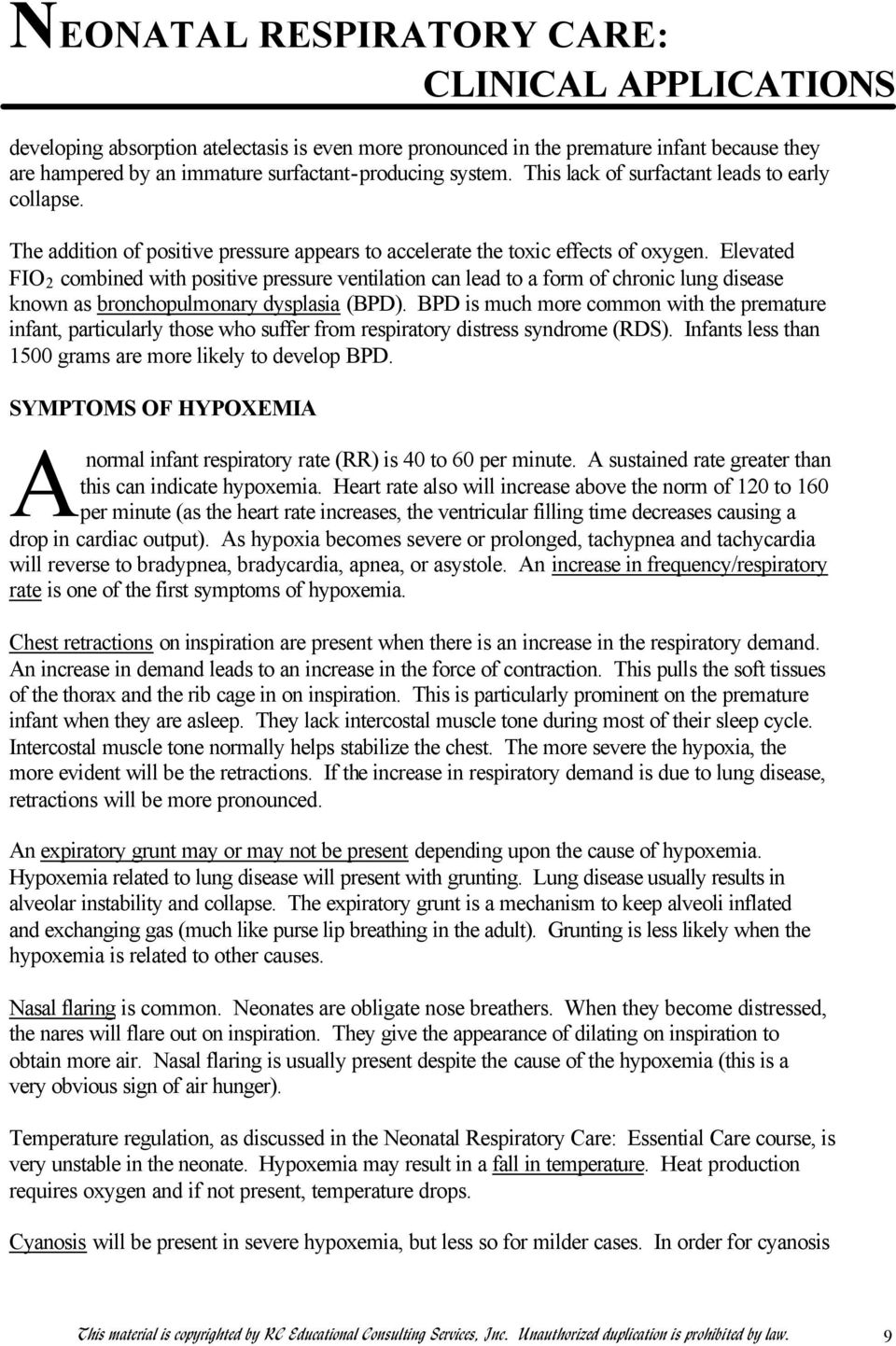
10 to be clinically evident, there must be 5 grams % of reduced hemoglobin. If fetal hemoglobin (HbF) is present, PaO 2 may have to decrease to 30 to 40 mm Hg for this to occur. HbF has a much higher affinity for O 2 than adult hemoglobin. So it will remain well saturated as PaO 2 falls considerably. HbF is replaced by adult hemoglobin in the first few months, or sooner if the baby is transfused. If adult hemoglobin is present, PaO 2 may still have to decrease to 50 mm Hg and % saturation to 80% for cyanosis to be evident. OXYGEN DELIVERY DEVICES M ost oxygen delivered to the infant is via oxyhoods or nasal cannulas. Nasal catheters are less common, and oxygen via isolette/incubator is possible but less efficient. Isolette/incubator - FIO 2 in an isolette can fluctuate considerably. It will depend upon the amount of oxygen flow into the isolette, the presence of leaks, and how much or how often it is opened. Rapid and substantial fluctuations can occur. Theoretically, it is possible to achieve an FIO 2 of 40 to 100% in an isolette but it will be very difficult to regulate. Because of the variability of FIO 2, babies can be maintained with a nasal cannula or oxyhood INSIDE the isolette, rather than using the isolette as the delivery device. (In fact, isolettes are rarely used as an O 2 delivery device in current practice). Air Shields Compliments of Medcom.ru An isolette can be single or double-walled. A single-walled isolette will cause radiant heat loss of the infant. If they are being used, a plastic heat shield should be placed over the infant. There are many products commercially available. When caring for micropreemies, for the first several days of life, heated aerosol or humidified gas is frequently delivered into these body hoods which helps maintain both temperature stability and skin integrity. This material is copyrighted by RC Educational Consulting Services, Inc. Unauthorized duplication is prohibited by law. 10
11 Oxyhoods - These are devices that enclose the head of the infant with therapeutic gas. They can be either a clear, plastic cylinder with removable lid, a mini O 2 tent composed of a framework and plastic canopy placed around the head, or other plastic devices. There is an opening for the neck. These are not airtight devices and one does not strive for a complete seal. Leaks are, in fact, necessary to allow for exhaled CO 2 to escape. The cylinder-type oxyhoods have a hole in the lid to allow for CO 2 to escape. There are inlets for large-bore tubing, temperature probes, and oxygen analyzer probes. Sensors should be placed as close as possible to the infant s face. Flow from the oxygen source is baffled to avoid flow on the face. Flow directed on the face or body can result in apnea and heat loss. Baffles also serve to decrease sound levels in the hood. The gas must be warmed and humidified. An air-entrainment device should not be used for humidification purposes, if possible. These devices can transmit considerable noise to the hood and damage hearing. This material is copyrighted by RC Educational Consulting Services, Inc. Unauthorized duplication is prohibited by law. 11

12 Oxyhoods maintain a stable FIO 2 around the infant s head. They can be used with or without an isolette for this purpose. Temperature and FIO 2 inside the oxyhood need to be carefully monitored. Too cold of an environment will increase oxygen consumption and cause heat loss. Too hot of an environment will cause apnea and dehydration. Flow to the hood must be high enough to flush out exhaled CO 2. A flow of 5 to 10 liters per minute (lpm) is usually sufficient. Be careful to avoid pressure necrosis around the neck from too small of an opening. Cannulas and catheters - Once used nearly exclusively on babies who had been weaned from the ventilator or oxyhood, now nasal cannulas are frequently used in acute situations. They are available in several sizes appropriate even for babies under one kilogram. Feeding tubes, doubling as nasal catheters, may still be in use at some institutions. They are placed about 2 cm inside either nare and secured with tape or a gentle semi-permeable dressing. A connector is placed between the feeding tube and the O 2 tubing, which is attached to the bubble humidifier. A common practice is to change the nasal catheter to the opposite nare every 12 hours, and every 24 hours replace it. Cannulas and catheters are generally used with low flow flowmeters, some available in tenths of a liter up to 1 liter, some starting at 1/16 of a liter up to 2 liters, some beginning at 1/4 liter up to 3 liters. There are several care plans for oxygen administration, all very different. Each will be discussed under administration. One method is used for the acute infant who needs improved oxygenation. Another plan is implemented for babies who have had episodes of apnea, with or without oxygenation deficits. These babies may be on an FI0 2 of.21, with flows of 1-3 liters a minute to treat apnea. The practitioner might wonder how this can be This material is copyrighted by RC Educational Consulting Services, Inc. Unauthorized duplication is prohibited by law. 12

13 therapeutic. It is a form of low tech CPAP. It will be discussed further under administration. Still another care plan may be implemented for infants who are older, or who have chronic lung disease (BPD) also known as reactive airway disease (RAD). One is advised to avoid high flows as these can cause drying of the mucosa and result in an excessive FIO 2 within the alveoli. FIO 2 delivered to the alveoli is affected by the same factors as in the adult (respiratory rate, depth, flowrates, etc.). ADMINISTRATION Oxygen therapy should be provided with low flow flowmeters calibrated for use with infants. An oxygen blender for precise control should regulate FIO 2. When an air-entrainment device is used for humidification and connected to the blender, set it at 100%. This will prevent any entrainment and dilution of the gas coming from the blender. Pass-over humidifiers are generally used for humidification. Aerosols should not be delivered for humidification purposes as they may cause fluid overload. FIO 2 and/or liter flow needs to be monitored constantly and documented at least every 1 to 2 hours. Analyzers need to be calibrated per manufacturer s recommendations and per individual institutional policy. This refers to oxyhoods, as it is not possible to measure the FIO 2 actually delivered via a cannula or catheter except under laboratory conditions. FIO 2 measurement of dry vs wet gas may vary due to water vapor pressure. Drier gas may give a higher FIO 2 due to a lower water vapor pressure. A lower temperature may have the same effect. FIO 2 measurement should be obtained under the same conditions as the infant is breathing. Oxygen should be constantly titrated to maintain acceptable arterial blood gas (ABG) values. Acceptable values are a PaO 2 of 50 to 70 mm Hg; however, some physicians may prefer ranges slightly lower (45-65). Serial arterial blood gases are necessary to evaluate and monitor PaO 2 even when patients are stable. Institutional policy should determine the schedule for drawing ABG s. Continuous monitoring via transcutaneous monitors or oximeters provides vital assessment information. TCOM readings should be noted and the RCP should observe them for trending. A reading of 55 mm Hg when an arterial blood CO 2 is 45 mm Hg shows values that are 10 mm Hg apart. If this trend is noted to be consistent on serial arterial blood gases, then the monitor may be very helpful in patient management. If, however, you have values that are 10 mm Hg apart one time, the next time they are 16 mm Hg apart, and later they are 4 mm Hg apart, they are inconsistent and the TCOM is a less valuable tool in patient management. The high and low alarms should be properly set according to your institution s policy. TCOM accuracy is based on skin perfusion; if skin perfusion is poor this can render the TCOM values almost useless. Continuous monitoring of all vital signs and frequent total infant assessment must be taken into consideration when examining TCOM values. This material is copyrighted by RC Educational Consulting Services, Inc. Unauthorized duplication is prohibited by law. 13
14 WEANING FROM OXYGEN W eaning from oxygen is a constant process that is merely an extension of the titration of oxygen discussed above. As the patient improves, it takes less FIO 2 to maintain an acceptable blood gas. Eventually, the titration would result in an FIO 2 of 21% (room air). Another tool used in management of oxygen therapy to babies is the pulse oximeter. While not specific for PaO 2, many physicians are quite comfortable using oxygen saturation as a guideline in weaning from oxygen. It is advisable to perform a trial of a decreased FIO 2 to see if the infant can tolerate it, as long as the saturation remains in the range ordered by the physician. The reader is referred to articles that describe the actual hypopharyngeal fractional inspired O 2 at different FIO 2 s, liter flows, and while the baby is crying (mouth open, entraining air). Individual physicians may have preferences regarding lowering liter flows first, then titrating FIO 2 s. It is also to be noted that as mentioned earlier, some babies are on a high liter flow, 1-3 liters, but at.21 FIO 2 for the CPAP effect. In many cases a return of apnea is noted if the liter flow is decreased to less than 1 liter per minute. With chronic oxygen dependent babies, the plan may be for the infant to go home on oxygen. In that case, the RCP need not wean the FIO 2 since home care companies do not provide an oxygen blender. The FIO 2 would remain at 1.0, with the liter flow being adjusted to accommodate the infant s needs. CONTINUOUS DISTENDING PRESSURE Continuous distending pressure (CDP) consists of the administration of either continuous positive airway pressure (CPAP) or continuous negative pressure (CNP). The former is far more common and will be the only mode discussed in this paper. (The terms CDP and CPAP will be used interchangeably in the following discussion.) CDP is a mode of therapy designed to maintain an increased transpulmonary pressure throughout the ventilatory cycle. Often, it is the next logical step when simple oxygen therapy is insufficient to maintain acceptable blood gases. It also can be instituted prior to a failure of oxygen therapy. One should not, in fact, wait until severe hypoxemia or infant fatigue develops before considering CDP. INDICATIONS The flexible thorax and instability of the alveoli were extensively discussed in the Neonatal Respiratory Care: Essential Care course. That discussion emphasized that a strong inspiratory effort can collapse the chest. CDP can be useful in stabilizing the thorax. It can splint the chest to prevent collapse and retractions. If atelectasis has occurred, it may be reversed with CDP. Through the process of collateral ventilation via the pores of Kohn, collapsed alveoli may open up. Alveolar collapse can be prevented until the surfactant producing system becomes mature. Functional residual capacity (FRC) can be restored to normal with CDP so compliance will improve. This will, in turn, reduce intrapulmonary shunting and increase PaO 2. It may be possible to maintain the infant on a lower FIO 2, reducing possible toxic complications related to oxygen. This material is copyrighted by RC Educational Consulting Services, Inc. Unauthorized duplication is prohibited by law. 14
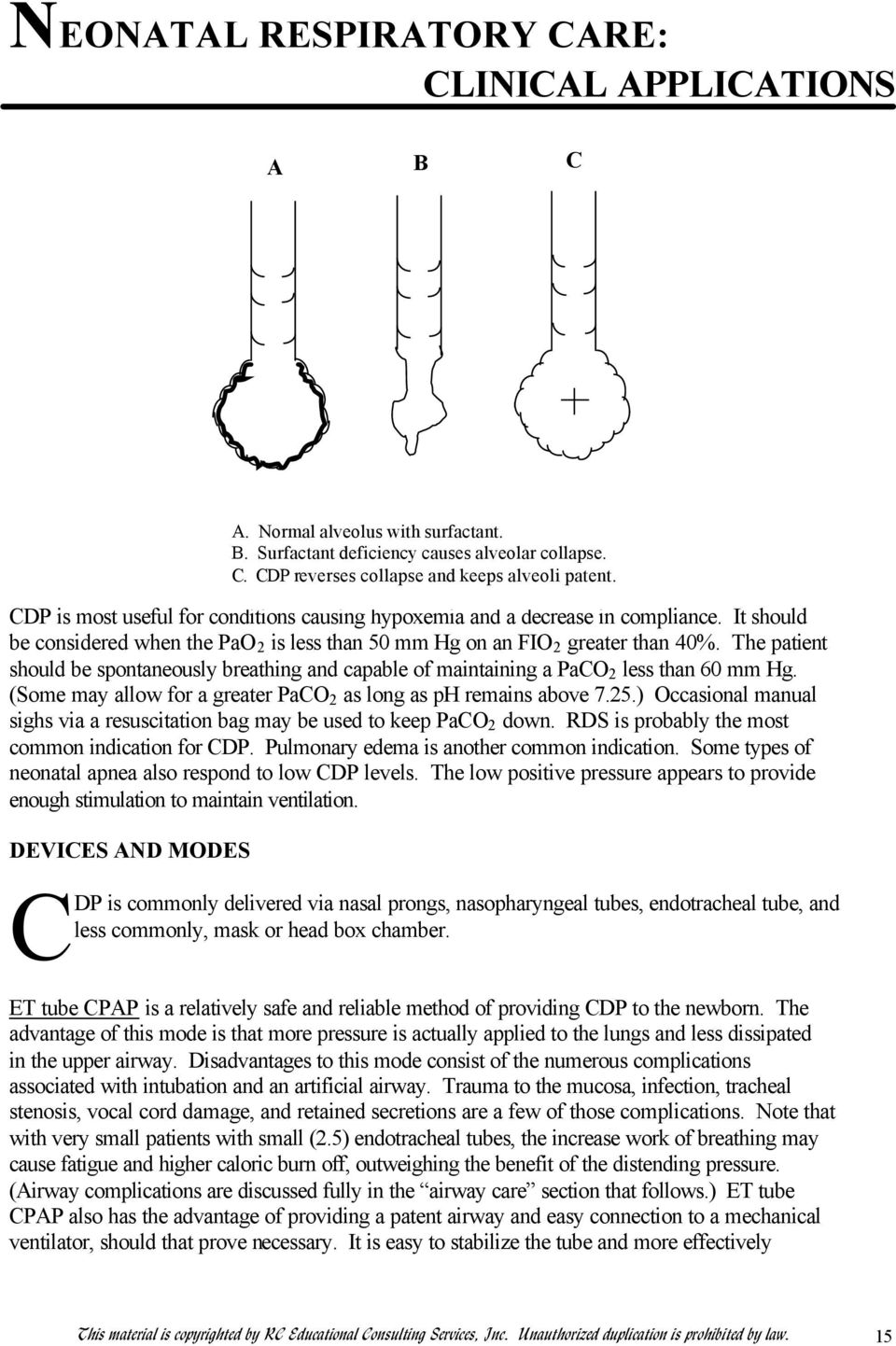
15 A B C CDP is most useful for conditions causing hypoxemia and a decrease in compliance. It should be considered when the PaO 2 is less than 50 mm Hg on an FIO 2 greater than 40%. The patient should be spontaneously breathing and capable of maintaining a PaCO 2 less than 60 mm Hg. (Some may allow for a greater PaCO 2 as long as ph remains above 7.25.) Occasional manual sighs via a resuscitation bag may be used to keep PaCO 2 down. RDS is probably the most common indication for CDP. Pulmonary edema is another common indication. Some types of neonatal apnea also respond to low CDP levels. The low positive pressure appears to provide enough stimulation to maintain ventilation. DEVICES AND MODES A. Normal alveolus with surfactant. B. Surfactant deficiency causes alveolar collapse. C. CDP reverses collapse and keeps alveoli patent. CDP is commonly delivered via nasal prongs, nasopharyngeal tubes, endotracheal tube, and less commonly, mask or head box chamber. ET tube CPAP is a relatively safe and reliable method of providing CDP to the newborn. The advantage of this mode is that more pressure is actually applied to the lungs and less dissipated in the upper airway. Disadvantages to this mode consist of the numerous complications associated with intubation and an artificial airway. Trauma to the mucosa, infection, tracheal stenosis, vocal cord damage, and retained secretions are a few of those complications. Note that with very small patients with small (2.5) endotracheal tubes, the increase work of breathing may cause fatigue and higher caloric burn off, outweighing the benefit of the distending pressure. (Airway complications are discussed fully in the airway care section that follows.) ET tube CPAP also has the advantage of providing a patent airway and easy connection to a mechanical ventilator, should that prove necessary. It is easy to stabilize the tube and more effectively This material is copyrighted by RC Educational Consulting Services, Inc. Unauthorized duplication is prohibited by law. 15
16 control the amount of CDP with this method. Nasal (prong) CPAP is more popular than in the past. It may be possible to avoid intubation on some infants by utilizing nasal CPAP. They are easily applied but challenging to maintain in place. They must be secured in place but still become dislodged easily with movement. Innovations in technology include CPAP drivers, which decrease resistance during exhalation. They are microprocessor driven, electric and pneumatically powered, with built in high and low pressure alarms for safety, oxygen blenders and oxygen analyzer. There are many new styles of headgear and prongs to make securing the CPAP much easier than in the past. They come in a variety of sizes, with charts to assist the practitioner in determining the appropriate size for the patient. Some new prongs are very soft for patient safety and comfort, and some have flared flanges to help keep the prongs from being easily dislodged. Care should be taken to avoid compression of blood vessels in the neck or head when securing the prongs. Compression can lead to an increase in intracranial pressure and possible hemorrhage. If the prongs are too loose, there will be a leak. If too tight, the nasal septum can be eroded. A cap should be used to secure the prongs in place. They are usually provided along with the prongs, complete with instructions for use and diagrams. These help prevent skin irritation or breakdown. There should be two sets so one can be cleaned every shift. Attached tubing must be supported to avoid excess weight on the infant. Prongs can cause pressure necrosis and infection. Excess flow through the prongs can cause a falsely high CPAP pressure reading due to resistance through the narrow lumen. When the infant opens their mouth, effective CPAP pressure is decreased. Fortunately, since infants are nose breathers, the mouth is usually closed and CPAP pressure maintained. Infants may use up considerable energy fighting it and become fatigued. The newer systems have decreased this problem; however, as previously mentioned, the practitioner should keep in This material is copyrighted by RC Educational Consulting Services, Inc. Unauthorized duplication is prohibited by law. 16

17 mind that ET tube CPAP can be very tiring for infants with small endotracheal tubes (2.5). The mouth and nose should be suctioned with a bulb syringe or nasal olive PRN for secretion build up. Do not use a steroid cream for the nose as this may cause tissue breakdown. An orogastric tube should always be placed to relieve swallowed air. Nasopharyngeal (NP) tube CPAP is a combination of the above. Endotracheal tubes are cut and inserted through the nares into the nasopharynx. The distance of insertion is measured from the tip of the nose to the tragus of the ear. This will place the distal end of the tube posterior to the uvula. The tubes are then connected to the CPAP source. NP tubes are less easily dislodged than prongs and many of the complications associated with intubation are avoided. More pressure is transmitted to the lungs than with prongs alone. Damage to the nose is possible with NP tubes so caution is again advised. New technology has brought new products. There are now very soft, flexible binasopharyngeal prongs, much longer than previous CPAP prongs, with universal sized adapters to attach to the CPAP source, usually a ventilator or, as mentioned, the CPAP driver. Edema, inflammation, or trauma in this area will significantly increase airway resistance when the tube is removed. Sometimes for mild atelectasis, chest physiotherapy and suction may be needed to stimulate a deep breath and mobilize secretions. The frequency is determined by the need using chest X- rays, blood gases, physical examination including breath sounds. It is important to coordinate with the feeding schedule so that the CPT and suctioning precedes feedings. It is also important to cluster the care to optimize the amount of uninterrupted sleep the infant gets for optimum growth and development. INITIATION AND MANAGEMENT One usually initiates CPAP at 4 to 6 cm H 2 O. If necessary, CPAP is increased by 1 to 2 cm H 2 O until an acceptable PaO 2 (greater than 50 mm Hg) is achieved. It may be wise to initially increase FIO 2 5 to 10%. The maximum CPAP level for a given patient is based upon weight: WEIGHT MAXIMUM CPAP 1000 grams... 8 cm H 2 O 1500 grams...10 cm H 2 O 2000 grams...12 cm H 2 O 2500 grams...12 cm H 2 O Obtain ABG s after initiation of CPAP. Continuous monitoring via TCOM or oximetry is recommended. (It is particularly important to monitor the patient during suctioning when the CPAP is removed.) The patient s clinical condition, chest X-ray, and ABG s should be monitored to evaluate the This material is copyrighted by RC Educational Consulting Services, Inc. Unauthorized duplication is prohibited by law. 17

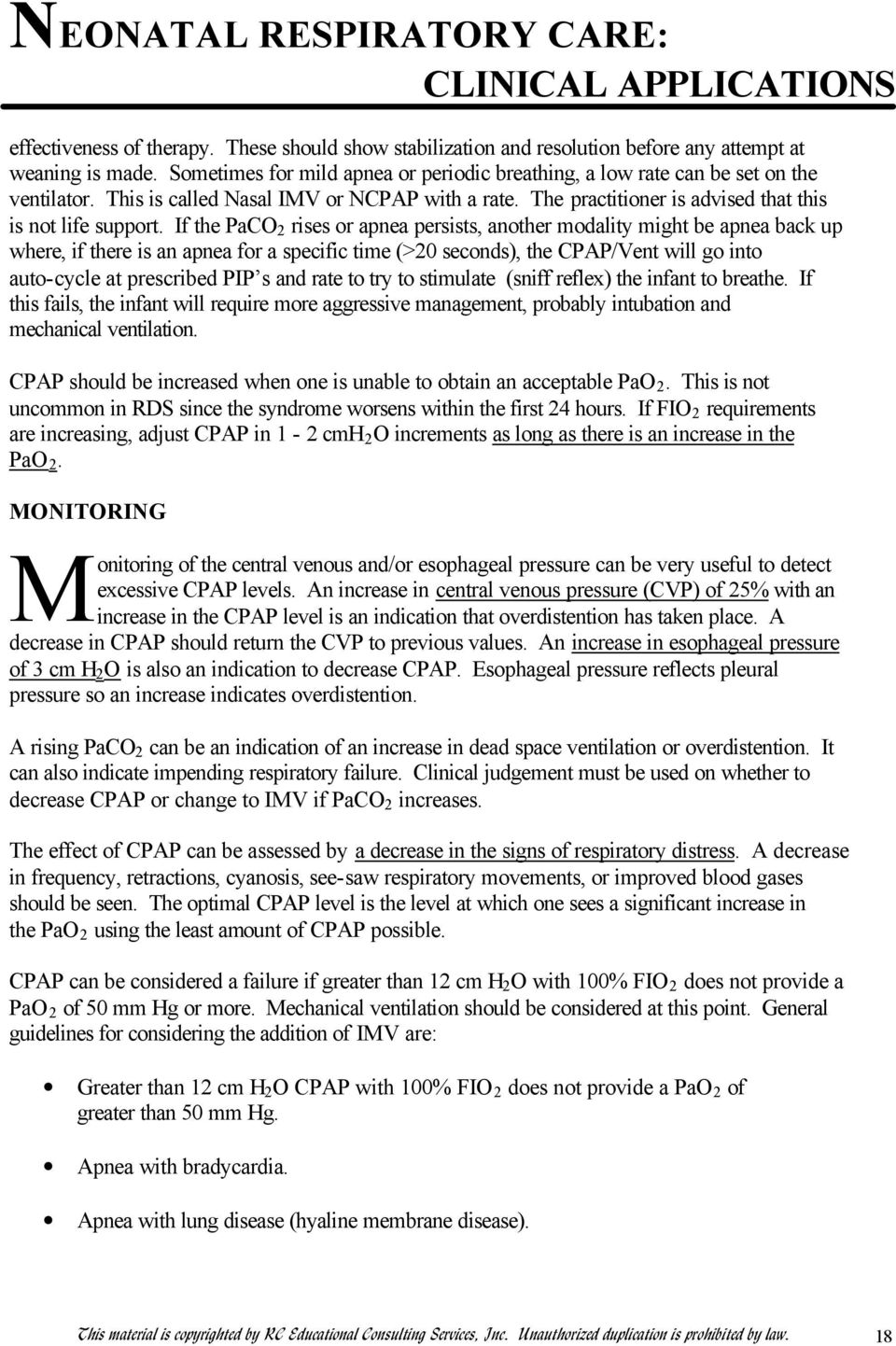
18 effectiveness of therapy. These should show stabilization and resolution before any attempt at weaning is made. Sometimes for mild apnea or periodic breathing, a low rate can be set on the ventilator. This is called Nasal IMV or NCPAP with a rate. The practitioner is advised that this is not life support. If the PaCO 2 rises or apnea persists, another modality might be apnea back up where, if there is an apnea for a specific time (>20 seconds), the CPAP/Vent will go into auto-cycle at prescribed PIP s and rate to try to stimulate (sniff reflex) the infant to breathe. If this fails, the infant will require more aggressive management, probably intubation and mechanical ventilation. CPAP should be increased when one is unable to obtain an acceptable PaO 2. This is not uncommon in RDS since the syndrome worsens within the first 24 hours. If FIO 2 requirements are increasing, adjust CPAP in 1-2 cmh 2 O increments as long as there is an increase in the PaO 2. MONITORING M onitoring of the central venous and/or esophageal pressure can be very useful to detect excessive CPAP levels. An increase in central venous pressure (CVP) of 25% with an increase in the CPAP level is an indication that overdistention has taken place. A decrease in CPAP should return the CVP to previous values. An increase in esophageal pressure of 3 cm H 2 O is also an indication to decrease CPAP. Esophageal pressure reflects pleural pressure so an increase indicates overdistention. A rising PaCO 2 can be an indication of an increase in dead space ventilation or overdistention. It can also indicate impending respiratory failure. Clinical judgement must be used on whether to decrease CPAP or change to IMV if PaCO 2 increases. The effect of CPAP can be assessed by a decrease in the signs of respiratory distress. A decrease in frequency, retractions, cyanosis, see-saw respiratory movements, or improved blood gases should be seen. The optimal CPAP level is the level at which one sees a significant increase in the PaO 2 using the least amount of CPAP possible. CPAP can be considered a failure if greater than 12 cm H 2 O with 100% FIO 2 does not provide a PaO 2 of 50 mm Hg or more. Mechanical ventilation should be considered at this point. General guidelines for considering the addition of IMV are: Greater than 12 cm H 2 O CPAP with 100% FIO 2 does not provide a PaO 2 of greater than 50 mm Hg. Apnea with bradycardia. Apnea with lung disease (hyaline membrane disease). This material is copyrighted by RC Educational Consulting Services, Inc. Unauthorized duplication is prohibited by law. 18
19 PaCO 2 greater than 70 mm Hg with ph less than High CVP or esophageal pressure with a poor PaO 2. WEANING F IO 2 is generally the first parameter to be weaned. As the patient improves: 1. Initially decrease FIO 2 in 2 to 10% increments, according to patient tolerance, to 60% (some prefer 40%). The amount of each decrease will be based upon the disease process. For example, a decrease of 2% would be appropriate for hyaline membrane disease whereas a decrease of 10% is more appropriate for transient tachypnea. 2. At 60% FIO 2, begin decreasing CPAP 1 to 2 cm H 2 O until CPAP is 4 cm H 2 O. 3. Decrease FIO 2 in gradual increments to 40% (if not already done). 4. Decrease CPAP to a minimal CPAP of 2 cm H 2 O and continue to decrease FIO 2. (Some consider 4 cm H 2 O to be a minimal CPAP level.) 5. Maintain on a minimal CPAP until extubation to help infant overcome the resistance of the tube. If the patient is stable on a minimal CPAP for 2-4 hours, consider extubation and/or discontinuing the CPAP. Prior to discontinuing the CPAP therapy form the patient, hyperinflate and suction him/her. Increase FIO 2 5 to 10% upon cessation. Obtain a chest X-ray within 2 hours. Postural drainage, percussion, and suctioning should be performed as needed. It is very important to begin weaning CDP/CPAP as the compliance improves. If not, the same CPAP pressure will overdistend the more compliant alveoli. This can result in apnea, CO 2 retention, and a decrease in venous return to the heart, pneumothorax, and an increase in dead space ventilation. COMPLICATIONS As with any form of positive pressure, the risk of barotrauma exists. Patients need to be closely monitored for signs of air leaks such as: pneumothorax, pneumomediastinum, or pulmonary interstitial emphysema (PIE). Most complications of CPAP are a result of an overdistention of the lung parenchyma. Should the lungs be uniformly stiff, there is less chance of overdistention. A stiff lung will absorb the pressure applied to it. However, when the lungs are compliant, the pressure is transmitted to the This material is copyrighted by RC Educational Consulting Services, Inc. Unauthorized duplication is prohibited by law. 19

20 pulmonary vascular bed. This results in a decrease in venous return and cardiac output. A compliant lung will be more prone to overdistention, rupture, and decreased blood flow. A B C A. Correct CDP provides adequate alveolar distention. B. Excessive CDP overdistends alveoli. C. When patient improves and surfactant returns the same CDP now overdistends. CPAP can cause a decrease in urine output by decreasing renal blood flow and perfusion pressure. Fluid overload can occur. CPAP will stimulate production of antidiuretic hormone (ADH) and lymph flow in the thorax can also be obstructed. All of the above increase the possibility of pulmonary edema. If excessive CPAP is used, overdistention will occur. If the lung disease is patchy, overdistention will occur in the compliant areas resulting in V/Q mismatching. If CPAP is applied to lungs with no pulmonary disease, as much as 50% of the pressure can be transmitted to the circulatory system. Overdistention also will occur when the patient begins to improve. As compliance increases, CPAP will begin to overdistend the lung. It must be titrated to prevent overdistention. MECHANICAL VENTILATION The goal of mechanical ventilation of the neonate is to maintain an adequate minute volume using a minimum of mechanical force. (In clinical practice, one rarely thinks of volume in neonatal ventilation, but rather in terms of pressure. However, the pressure one is using is merely to exchange a volume of gas in the lung.) The indications for mechanical ventilation are: apnea, hypoventilation, severe hypoxemia, and cardiovascular collapse. Mechanical ventilation This material is copyrighted by RC Educational Consulting Services, Inc. Unauthorized duplication is prohibited by law. 20

21 has numerous complications, so less intensive efforts to treat the problem should be attempted first. (For example, attempt respiratory stimulation and CPAP for hypoventilation or CPAP alone for severe hypoxemia prior to mechanical ventilation.) Once ventilation is initiated, one should strive to minimize the amount as much as possible. The lowest frequency, pressure, and time to achieve the desired end should be used. It is essential to remember that within this course when the issues of setting changes are addressed, it s referring to ventilators that are of the pressure limited, timed cycled classification. At the present time, it is possible to use time cycled, volume (flow) limited ventilation in neonates. INDICATIONS Apnea in the neonate can be absolute or periodic. Absolute apnea makes mechanical ventilation obvious because the infant is not breathing. It may not be so obvious with periodic apnea. Periodic apnea is when the apnea comes and goes. These infants require some type of stimulation to break the apneic spell. The more severe the problem, the greater the amount of stimulation needed to initiate breathing. Periodic apnea that requires resuscitation or vigorous stimulation to initiate breathing is an indication for ventilation. Less severe forms of periodic apnea, in an infant with lung disease, are also an indication for ventilation. In these patients, apneic spells increase atelectasis through the process of absorption. In patients without lung disease, adequate amounts of surfactant will help prevent atelectasis. Therefore, apneic spells in patients with lung disease should not be tolerated, even if the patient resumes spontaneous breathing. Rocking beds are not currently considered a good choice for relief of periodic apnea. They consist of placing a test lung hooked to a ventilator under a water mattress. The inflation of the test lung rocks the mattress, which provides stimulation to continue breathing. (Caution is advised in low birth weight infants as this may cause intraventricular hemorrhage.) The amount of hypoventilation that requires mechanical ventilation is somewhat debatable. Most consider a PaCO 2 of 60 mm Hg an indication for mechanical ventilation. Others may let it go higher, if the ph remains above An elevated PaCO 2 associated with a falling ph denotes acute respiratory failure (ARF) and is an indication for ventilation. An elevated PaCO 2 with a normal ph denotes a chronic condition. In this situation, one must weigh the potential risks and benefits of ventilation versus the risks of hypercarbia. (Hypercarbia causes pulmonary vasoconstriction, cerebral vasodilation, and depresses respiration.) Some institutions prefer periodic manual ventilation with a resuscitation bag to lower the PaCO 2 prior to ventilator commitment. If this is insufficient, the patient is placed on a ventilator. Severe hypoxemia, as evidenced by a PaO 2 less than 50 mm Hg or a % saturation less than 90% on 100% O 2, is an indication for ventilation. CPAP should be given a trial first to obtain This material is copyrighted by RC Educational Consulting Services, Inc. Unauthorized duplication is prohibited by law. 21
22 acceptable blood gases. If a CPAP greater than 12 cm H 2 O is being used, consider mechanical ventilation. Lastly, cardiovascular collapse or compromise is an indication for ventilation. Mechanical ventilation will decrease the work of breathing in these infants by decreasing oxygen consumption and carbon dioxide production. This will make the job of the heart easier and enhance oxygen delivery to the tissues. MANUAL VENTILATION M echanical ventilation can be accomplished manually via a resuscitation bag and mask. One can use a self-inflating or non self-inflating (flow-inflating) bag. The former is recommended when the practitioner has just occasional contact with neonates and for transport. The latter requires frequent practice for proper use and a constant gas supply to function. Flow-inflatable are preferred in the hospital setting. They can be more precisely adjusted to the needs of the infant than the self-inflating bags. They also provide a feel for the compliance of the infant. Flow-inflatable bags consist of an anesthesia bag with a patient elbow attached. There is an adapter to connect an in-line pressure manometer. A low-flow flowmeter and oxygen blender is used. Flow is set according to minute volume needs, usually between 5 to 10 liters per minute. For emergency resuscitation, 100% O 2 is used. This should then be adjusted based upon ABG results. For other situations, the same FIO 2 that the patient is currently receiving should be used. (Many institutions will increase FIO 2 10% for bagging associated with suctioning.) Either bag should allow the patient to breathe spontaneously while attached and allow connection to a pressure manometer. They should be capable of providing PEEP/CPAP. The selection of a bag should be based upon frequency of use, ease of operation, range of FIO 2 available, gas supply available, pressure monitoring, and availability of PEEP/CPAP. MECHANICAL VENTILATORS M ost ventilation of infants is accomplished with a pressure preset, time-cycled, continuous flow IMV ventilator. A continuous flow of fresh gas flows through the circuit and is periodically interrupted at the exhalation valve. This forces gas into the patient (the path of least resistance) for a preset period. The pressure that builds up in the circuit (and patient) is preset and limited. This pressure is maintained throughout the inspiratory cycle. This gives an inspiratory plateau or square wave type of ventilatory pattern. Volume-preset ventilators are rarely used with infants. However, volume-preset ventilators have been successful when pressure-preset ventilators have failed. Volume-preset ventilators provide a specific volume to the patient s every breath. Peak inspiratory pressure (PIP) will vary This material is copyrighted by RC Educational Consulting Services, Inc. Unauthorized duplication is prohibited by law. 22
23 depending upon the resistance and compliance of the patient. (For most infants, one needs precise control of PIP to minimize potential complications, particularly development of BPD.) Infants with severely low compliant lung disease (such as diaphragmatic hernia patients) are candidates for a volume-preset ventilator. Continuous flow systems are generally used so the infant can inhale at any time. Infant respiratory rates are high and demand valve systems have difficulty sensing the infant demand in adequate time to deliver flow. (This is why infants are on IMV instead of SIMV.) Newer microprocessor-controlled ventilators have a much quicker response time and may provide the choice of either a demand flow or continuous-flow. IMPORTANT CONCEPTS The parameters to be adjusted will vary from one ventilator to the next. One must commonly adjust inspiratory and expiratory time, i:e ratio, frequency (respiratory rate), flow rate, pressure limit, pressure popoff, FIO 2, PEEP/CPAP level, and various alarms. (Pressure limit in infant ventilation refers to ventilating pressure. Pressure popoff refers to a pressure relief safety mechanism to allow venting of excess pressure within the system.) One also may have the choice of selecting sensitivity and demand or continuous flow (pressure popoff should be set at 5-7 cm of H 2 O above the PIP to avoid possible pneumothorax). The interplay of inspiratory time, expiratory time, i:e ratio, and frequency must be understood. They interrelate and a change in one parameter will affect the others. If one receives an order to change a single parameter, the practitioner must then determine how to adjust the remaining parameters to maintain the infant. For example, if inspiratory time is set at 1 second, expiratory time at 2 seconds, then i:e ratio is 1:2 and frequency is 20 breaths per minute. (Adding the inspiratory time (sec.) to the expiratory time (sec.) and dividing the result into 60 sec. can easily calculate breathing frequency. In this example, 1 sec. + 2 sec. = 3 sec., 60 sec. divided by 3 sec. = 20 breaths per minute.) If the physician orders the inspiratory time increased to 2 seconds and the other parameters are left at the previous settings, i:e ratio is now 1:1 and frequency is decreased to 15 breaths per minute (60 sec. divided by [2 sec. + 2 sec.] = 15 breaths per minute). This can seriously decrease minute volume. To maintain the frequency of 20 per minute there must be a simultaneous decrease in the expiratory time to one second. However, if this is done, then the i:e ratio is now 2:1 instead of 1:2. The ordering physician must be made aware of this and it must be taken into consideration. One cannot just change a single parameter and expect all the others to remain the same. This takes considerable experience to become familiar with these concepts. The ventilator being used may have controls for any combination of inspiratory time, expiratory time, frequency, or i:e ratio. As long as one understands the relationships between these parameters one can use any given ventilator. This material is copyrighted by RC Educational Consulting Services, Inc. Unauthorized duplication is prohibited by law. 23
24 To determine proper inspiratory and expiratory time, one must also understand the concept of time constants. A time constant is the time it takes for proximal airway pressure to equilibrate with distal airway or alveolar pressure. (In other words, the time it takes a lung unit to empty or fill). A time constant is measured in seconds and is the product of airway resistance and pulmonary compliance. Very stiff lungs and no airway disease produce a short time constant. This causes pressure to equilibrate quickly. The opposite is true when there is significant airway disease. Airway disease produces a long time constant for the lung unit(s) they feed. Depending upon the disease process, there may be a different time constant for inspiration and expiration. This will influence how one sets inspiratory and expiratory time. A generic inspiratory time setting is between 0.3 and 0.7 second. (In modern ventilators, once the inspiratory time is set and the rate is changed, the expiratory time is adjusted automatically). Expiratory time will be set to achieve the desired frequency. A disease process that is primarily airway has a long inspiratory time constant. This would indicate a long inspiratory time would be most beneficial. However, the expiratory time constant is even longer than the inspiratory with airway obstruction. (This is due to the passive mechanical dilation of airways on inspiration and slight constriction on expiration.) One must allow enough time for the lungs to empty completely to prevent air trapping. A long expiratory time is therefore advantageous. Ideally, a long inspiratory and long expiratory time are both necessary. (One is limited in doing this because the resulting respiratory frequency may be inadequate to maintain CO 2 levels.) Hyaline membrane disease (HMD) is an example of a disease process with short inspiratory and expiratory time constants. There is relatively little airway disease and stiff lung parenchyma in HMD. Pressure is transmitted rapidly through the airways and the stiff parenchyma equilibrates rapidly with proximal airway pressure. Due to an increase in elastic recoil they also empty rapidly, making atelectasis common. Prolonging expiratory time is necessary to prolong the expiratory time constant to help prevent alveolar collapse. (PEEP is also advantageous in prolonging the expiratory time constant.) As one can readily see, adjustment of a given parameter on infant ventilators is not an isolated event. The practitioner must keep these concepts and their relationships in mind in making parameter adjustments. In an effort to minimize barotrauma from PIP or PEEP, prolonged inspiratory times and inverse i:e ratios have been used. (A normal i:e ratio for mechanical ventilation is greater than or equal to 1:2. Inspiratory times greater than or equal to expiratory time are inverse ratios, such as 2:1, 3:1, etc.) Prolonged inspiratory times provide an inspiratory plateau or square wave pressure pattern. This improves gas exchange and expiratory lung volume similar to PEEP. (However, PEEP provides a greater increase in lung volume per unit increase in mean airway pressure This material is copyrighted by RC Educational Consulting Services, Inc. Unauthorized duplication is prohibited by law. 24
25 (MAP) than prolonging inspiratory time. It is generally more effective. There is also a greater increase in arterial oxygenation with PEEP than with a prolonged inspiratory time at a comparable MAP.) Prolonged inspiratory times are associated with an increase in lung rupture so careful consideration must be given to their use. Mean airway pressure also must be understood to ventilate the neonate. It is not a ventilator setting, but rather an average of the pressure generated in the lung over time. It is determined by calculating the area beneath the proximal airway pressure wave of inspiration and expiration. Changes in PIP, i:e ratio, frequency, PEEP, and the shape of the pressure wave will influence MAP. Most ventilators monitor and display MAP. If not, a separate monitor will be used to display MAP and duration of positive pressure (DPP). MAP appears to be the single most important variable on arterial oxygenation (other than F1O 2 ). One can manipulate all of the above parameters but, if the MAP remains the same, arterial oxygenation will probably stay the same. For example, one can increase PEEP to increase oxygenation, but if frequency is simultaneously decreased, MAP may remain the same. Arterial oxygenation will therefore change very little in this example (but PaCO 2 may change significantly). INITIAL SETTINGS I nitial FIO 2 settings should be based upon previous ABG results. The following are suggested reference points for initial mechanical ventilator settings. If oxygenation was adequate before ventilator commitment, use the same FIO 2 as they were previously receiving. If not, increase the FIO 2 10 to 20% depending upon the degree of hypoxemia. Determining where to set peak inspiratory pressure (PIP) is often a trial and error situation. One can set PIP initially by using the pressure it takes to provide adequate chest excursion and audible breath sounds with a resuscitation bag. The weight of the infant and the disease state of the lungs can also estimate it. The following can be used as a guideline: CLINICAL SITUATION INITIAL PIP Normal lungs, weight under 1200 gms cm H 2 O Normal lungs, weight gms cm H 2 O Normal lungs, weight over 2000 gms cm H 2 O Moderately non-compliant lungs cm H 2 O (moderate HMD) Severely non-compliant lungs cm H 2 O (severe HMD) This material is copyrighted by RC Educational Consulting Services, Inc. Unauthorized duplication is prohibited by law. 25
26 Meconium aspiration.... >30 cm H 2 O One should begin with the low end of the above ranges initially. ABG s will guide further adjustments. Increasing PIP should decrease PaCO 2 and increase PaO 2. Decreasing PIP should do the opposite. (This would have to be verified with repeat gases.) One should use the lowest PIP possible to decrease the risk of BPD and other complications. If the PIP chosen does not provide acceptable blood gases, several other options are available other than increasing PIP. One can change inspiratory time, i:e ratio, frequency, or PEEP rather than increasing the PIP. (Some physicians may prefer to increase PIP and PEEP before changing inspiratory time or i:e ratio.) The parameter that is currently posing the greatest risk to the infant should be the last parameter to increase. For example, if the patient is already on a high PEEP level one may choose to increase frequency or inspiratory time slightly instead of increasing PEEP. If a prolonged inspiratory time is already being used, increase PIP or PEEP slightly to obtain acceptable blood gases. There is no best way. A firm and complete understanding of the disease process and some common sense is always your best guide. Flow must be set high enough to provide for the minute volume needs of the infant. This can also be a trial and error situation. Select a flow, usually 4 to 5 lpm, and then carefully observe the pressure manometer when ventilation is initiated. If flow is inadequate, there will be noticeable negative pressure deflections. Increasing the flow should correct this. Excessive flow will result in a very rapid rise to the preset pressure. This can be very detrimental. It will result in an increase in the volume delivery to the patient since the preset pressure is reached sooner within the set inspiratory time. The result is a prolonged inspiratory plateau and an increase in the actual volume delivered. Excessive flow can also cause overdistention of the more compliant areas of the lung since they will fill faster. Flow to the periphery of the lung may be decreased due to turbulence caused by high flowrates. If so, actual volume delivery to the infant may be decreased rather than increased. Should most of the infant s breathing be spontaneous, one can estimate flow by multiplying 7 ml/kg times the measured frequency. This will give an estimate of the infant s minute volume. One then sets flow at double this value to provide a cushion for changes in minute volume. Should most or all the infant s ventilation be mechanical breaths, flow is set to achieve a pressure slightly above the pressure limit (PIP). The pressure limit control is then used to decrease the pressure to the desired value. The disease process, its severity, and ABG measurements determine setting of respiratory frequency. For HMD patients, one may start at frequencies of 30 to 40 per minute. Persistent fetal circulation (PFC) patients may require a higher frequency (60 to 80 or higher) for mechanical hyperventilation. (Lowering PaCO 2 may help reverse pulmonary vasoconstriction and right-to-left shunting in these patients.) Much lower rates are used with less severe disease. In some patients with apnea, ventilator breaths merely serve as a stimulus to keep breathing. This material is copyrighted by RC Educational Consulting Services, Inc. Unauthorized duplication is prohibited by law. 26
27 Several breaths a minute are sufficient in such a situation. Very rapid rates, up to 200 breaths per minute, have been used with conventional infant ventilators. This is known as high frequency positive pressure ventilation (HFPPV). The advantage of very rapid rates is maintenance of adequate minute volume with lower proximal airway pressures. It should be noted that a conventional ventilator might not have been designed for very rapid rates. If not, its maximal effective rate may be well below 150 breaths per minute. Minute volume begins to suffer above the maximal effective rate. One should know the capabilities of the ventilator being used before one uses it in an unconventional manner. High frequency jet ventilation (HFJV) and high frequency oscillatory ventilation (HFOV) are also unconventional modes. HFJV is a mode whereby small puffs of gas are injected into the ET tube at very rapid (above bpm) rates. HFOV is a mode whereby a volume of gas is oscillated in the airway at extremely rapid rates (thousands per minute). The advantage of both methods is acceptable blood gases at lower proximal airway pressures. HFOV appears to be the most popular mode, so it will be discussed in greater detail later in the course. A PEEP of 2 to 4 cm H 2 O is used on virtually all neonates who are intubated (with the exception of pulmonary interstitial emphysema P.I.E.). These low levels help replace the normal grunting mechanism that is lost with the presence of the tube. PEEP is also used when there is widespread alveolar dysfunction and surfactant deficiency. The patient must have diffusely noncompliant lungs. If not, the compliant areas will overdistend and barotrauma can result. There will also be cardiovascular depression and an increase in pulmonary vascular resistance in the compliant area. Over application of PEEP when there is diffuse disease can cause the same problems. An increasing PaCO 2 or decreasing PaO 2 can evidence excessive PEEP. This is a result of overdistention of alveoli and compression of pulmonary vessels. The resulting shift in blood flow to less compliant, diseased areas results in a decrease in oxygenation and an increase in wasted ventilation. Areas are ventilated, but no gas exchange takes place. One usually begins with 2 to 4 cm H 2 O of PEEP. If this does not provide satisfactory blood gases, slowly increase PEEP in 1 to 2 cm H 2 O increments. There will usually be a point at which oxygenation improves significantly. The lowest PEEP level providing acceptable blood gases should be used. The point at which oxygenation decreases significantly is an indication that overdistention has taken place. One should observe the patient closely for this phenomenon as their condition improves. As the lung becomes more compliant, PEEP must be reduced accordingly to prevent overdistention (air trapping). Regardless of the initial setting, an ABG is necessary and PEEP should be adjusted according to the results. (Refer to the discussion on CDP for further information on overdistention and managing PEEP. The principles and concepts relating to CDP are essentially the same for PEEP.) Since tidal volume delivery is largely determined by the pressure gradient of inspiration, one This material is copyrighted by RC Educational Consulting Services, Inc. Unauthorized duplication is prohibited by law. 27
28 should note the difference between the baseline PEEP and PIP. This pressure gradient must be maintained to ensure adequate volume delivery. A change in PEEP without a concomitant change in PIP will alter the pressure gradient and therefore alter tidal volume. For example, a PEEP of 5 cm H 2 O and PIP of 20 cm H 2 O provides a pressure gradient of 15 cm H 2 O. If PEEP is increased to 10 cm H 2 O and PIP remains at 20 cm H 2 O the gradient is decreased to 10 cm H 2 O. Tidal volume will therefore be decreased. (These changes must be monitored very closely as the MAP increases by 1 for each increase in PEEP). The importance of humidity has previously been discussed in other sections. A gas temperature of 37 degrees centigrade would be ideal. Unfortunately, this would cause excessive rainout in the tubing and there would be heat and water gain for the infant. Too cool of a temperature will result in heat loss, drying, and inspissation of secretions. Over humidification and excessive heat will result in fluid overload and heat gain. (Infants less than 600 grams may be placed in a body hood with heated humidified air at or near 37 degrees. This helps prevent the skin from drying, preserves heat, and decreases the calorie loss from cold stress.) Water level in the humidifier should be kept constant to keep compressible volume and volume delivery constant. Tubing needs to be kept clear of condensation via water traps or heated circuits. VENTILATOR MANAGEMENT To improve oxygenation with mechanical ventilation, several maneuvers are possible. One has the option of increasing FIO 2, MAP, or flow. Each maneuver has its advantages and disadvantages and each will be discussed. Increasing FIO 2 has the effect of increasing the partial pressure of oxygen in the alveolus and, hopefully, the blood. The risk of increasing FIO 2 is that prolonged exposure to high O 2 concentrations cause BPD. The risk of retinopathy of prematurity (ROP) in premature infants is also possible if the increased FIO 2 results in a high PaO 2. There are several ways to increase MAP: increase PEEP, increase PIP, increase flow, or increase inspiratory time. Increasing MAP has the possible effect of providing better distribution of ventilation. Increasing PEEP can increase alveolar surface area, increase FRC, and decrease atelectasis and shunting. Increasing PIP also can increase alveolar surface area and tidal volume. Increasing inspiratory time provides an increase in the distribution time for gas exchange to take place. The complications associated with an increase in the MAP are barotrauma, decreased venous return, and decreased cardiac output, BPD, and air leaks. Overdistention as a result of increasing MAP can cause a decrease in tidal volume. Insufficient expiratory time as a result of increasing inspiratory time can cause CO 2 retention and eventual air leak syndrome. Increasing flow will cause a more rapid rise to PIP and potentially allow for an inspiratory pressure plateau. It also decreases the possibility of rebreathing of exhaled gases from the This material is copyrighted by RC Educational Consulting Services, Inc. Unauthorized duplication is prohibited by law. 28
29 circuit. The risks of increasing flow consist of alveolar rupture or cellular damage from too rapid of an expansion, or an increase in airway resistance from turbulence. TO IMPROVE OXYGENATION: Increase FIO 2 Increase MAP Increase PIP Increase PEEP* Increase Inspiratory Time Increase Flow * If excessive PEEP levels are causing overdistention, a decrease in PEEP will improve oxygenation. To improve ventilation and decrease PaCO 2, one can increase ventilator rate, increase PIP, increase or decrease PEEP, decrease inspiratory time, and increase or decrease flowrate. The first, increasing rate, will increase minute volume causing a decrease in PaCO 2. Problems associated with an increase in ventilator rate consist of: an increased possibility of air trapping, a decrease in inspiratory time, and the PaO 2 may increase above an acceptable level. An increase in PIP should also increase minute volume by increasing tidal volume. It also should decrease atelectasis. Problems are pulmonary air leaks, BPD, and possible hyperinflation with a resultant decrease in compliance. Increasing or decreasing PEEP can improve ventilation, depending upon the patient s disease state. In an acute/critical state, more PEEP may be necessary to stabilize alveoli, increase FRC, and increase alveolar surface area. Therefore, an increase in PEEP at this stage will decrease PaCO 2. In a less critical and more compliant stage, PEEP may have to be decreased to reverse overdistention. This will result in an increase in tidal volume and a decrease in PaCO 2. The danger of increasing PEEP, when inappropriate, is that overdistention and air leaks may occur. The danger of decreasing PEEP, when inappropriate, is that PaO 2 may decrease through a drop in the MAP. A decrease in the inspiratory time will allow for a greater time for expiration and the release of CO 2. The PaO 2 may also decrease as a result of a decrease in MAP and insufficient time for gas exchange to occur. Flowrate can influence machine tidal volume and the inspiratory waveform. If flow is set too low, there will be rebreathing of exhaled gas and an increase in infant work. Inadvertent PEEP, turbulence and uneven distribution of inspired gas could occur if the flow is set too high. Therefore adequate flowrate must be maintained. This material is copyrighted by RC Educational Consulting Services, Inc. Unauthorized duplication is prohibited by law. 29
30 TO IMPROVE VENTILATION: Increase Respiratory Rate Increase PIP Increase or Decrease PEEP Decrease Inspiratory Time Increase or Decrease Flow WEANING W eaning of the infant can be divided into two phases. The first is weaning of ventilator parameters and FIO 2. The second is the actual weaning from the ventilator to complete spontaneous breathing. RCP's might want to wean the infant as soon as possible, but should not be overzealous in their weaning efforts. Weaning too soon may result in a multiple crash syndrome. This is where the baby deteriorates during weaning and settings must be increased above the original parameters to stabilize the infant. For example, original settings were: IMV 30, PIP 20, PEEP 3, and FIO 2 40%. The infant crashes and it now takes: IMV 40, PIP 22, PEEP 4, and FIO 2 of 60% to stabilize them. Weaning may be attempted again and the scene is repeated. To prevent this, do not attempt weaning until there are: stable vital signs and blood gases on baseline settings, no acidosis, no apneic periods, and adequate Hb. (A crash is possible even when these criteria are met.) Phase I weaning (ventilator parameters) is actually just common ventilator monitoring and management. The goal is to maintain the patient within acceptable blood gas values. As the patient improves, blood gases will improve and begin to exceed the set acceptable range. The response of the practitioner will be to decrease the appropriate parameter. For example, if PaO 2 increases, one decreases FIO 2. If PaCO 2 decreases, one may decrease PIP or rate. This can occur while the patient is still acutely ill. One should not attempt a trial weaning at this point, just maintain blood gases within the acceptable range. Phase I weaning should get the patient to a certain level of ventilatory support where actual weaning may begin. This certain level of support is determined by institutional policy. (Examples might be to delay weaning if: greater than 60% O 2 or greater than 30 cm H 2 O pressure is being used or the baby is not taking sufficient calories.) A general guideline for weaning is as follows: 1. Try to change only one parameter at a time. 2. Obtain an ABG 10 to 15 minutes after each change, monitor the patient continuously This material is copyrighted by RC Educational Consulting Services, Inc. Unauthorized duplication is prohibited by law. 30
31 With TCOM (TcPO 2 and TcPCO 2 ), oximetry, and/or capnography. 3. If patient is on greater than 60% FIO 2, reduce to 60% (some recommend 40%) in 2% Increments while maintaining TCOM/oximetry readings. Obtain ABG after a decrease of 10%. 4. Reduce PIP in 2 to 3 cm H 2 O increments until there is minimal chest excursion with an adequate PaO Reduce FIO 2 by 5 to 10% increments to 40%. 6. Reduce IMV rate by 2 to 3 breaths per minute until patient is only receiving CPAP. (An exception to this may be patients who have a 2.5 mm ET tube.) 7. Reduce CPAP in 1 to 2 cm H 2 O increments to a minimum of 2 cm H 2 O (some prefer 4 cm H 2 O). 8. Leave patient on a minimal CPAP of several hours then obtain an ABG. 9. Suction, hyperinflate, and extubate. (Refer to airway care section.) 10. Place patient in oxyhood at FIO 2 5 to 10% higher than that on ventilator. Nasal CPAP may be necessary for some infants. 11. Obtain an ABG in 15 minutes. 12. Perform CPT and suctioning as needed. 13. Obtain a chest X-ray in 2 to 4 hours. NOTE: Institutional policy should be followed in weaning infants. HIGH-FREQUENCY OSCILLATORY VENTILATION HFPPV and HFJV utilize an active inspiratory phase and a passive expiratory phase. HFOV oscillates fresh gas in and out of the airway at a high frequency, typically around 600 times a minute (rate per minute equals the Hz x 60). Therefore, HFOV utilizes an active inspiratory and expiratory phase. This active expiratory phase may aid in removal of gas from the lung and decrease airtrapping. More importantly, HFOV allows adequate ventilation without the large pressure and volume changes associated with conventional mechanical ventilation (CMV). CMV results in large pressure fluctuations and constantly changing lung volumes. This is This material is copyrighted by RC Educational Consulting Services, Inc. Unauthorized duplication is prohibited by law. 31
32 necessary to deliver a bulk flow of gas in and out of the lung. In the presence of diffuse alveolar disease, such as, surfactant deficiency, alveoli collapse on each breath and have to be reopened. This requires large pressures and volumes to raise the FRC and closing volume of the lung. Small terminal airways are more compliant than atelectatic alveoli so they are stretched and damaged with these large pressure/volume changes. The result is barotrauma. HFOV provides a MAP that is high enough to recruit alveoli and prevent their collapse. Non-compliant areas are opened and compliant areas are not overdistended as with CMV. FRC increases, V D decreases, V/Q matching is improved, along with gas exchange. In CMV, MAP is a function of PEEP, PIP, inspiratory time, and frequency. An adjustment in any of these changes the MAP. Since oxygenation is intimately associated with the MAP in neonates, a change in any of the above ventilatory parameters may affect oxygenation status. MAP is an independent variable in HFOV and can be adjusted by itself. MAP and FIO 2 are used to manipulate oxygenation status. Amplitude and resonant frequency are the variables used to manipulate ventilatory status. Therefore, HFOV allows one to disengage manipulation of oxygenation status from ventilation status more easily than with CMV. There are two strategies used for the setting of MAP in HFOV. The air-leak syndrome or low volume strategy is used to minimize airway pressure. It is used for air-leak syndromes, such as, PIE, pneumothorax, pneumopericardium, pneumoperitoneum, and ECMO candidates. For airleak syndromes, MAP is set < to the MAP used on CMV. A high FIO 2 and permissive hypercapnia are also accepted to resolve the leak and prevent further leakage. The diffuse alveolar disease or high volume strategy is used to optimize lung volume and alveolar recruitment. It is used for RDS babies. MAP is generally higher (2-5 cm H 2 O) than that seen with CMV. MAP is increased as long as the PaO 2 improves, blood pressure remains stable, and normal lung expansion is seen on the CXR. Once the optimal MAP has been determined, one begins weaning the FIO 2 to a safe level. It is important to note that alveolar recruitment will improve over time, so MAP must be decreased accordingly to prevent overdistention. Amplitude setting is used to adjust V T in HFOV. Increasing the amplitude increases the distance the mechanism providing the oscillation travels (usually a piston or diaphragm). This increases V T by increasing the volume of oscillation. One should note that amplitude is dampened by the ETT and that dampening is increased the smaller the ETT. Resonant frequency is the frequency providing the largest volume change with the least amount of pressure. The resonant frequency of paralyzed intubated neonates is approximately hertz (Hz). No ideal frequency has been established for various disease states but frequencies of 10, 12, and 15 Hz are used clinically (600, 720, and 900 cycles per minute). Frequency is initially set and adjustments are seldom needed in neonates. Changes in frequency affect inspiratory time and equilibration of amplitude across the ETT. A decrease in frequency results in a longer inspiratory time and greater equilibration of amplitude. This material is copyrighted by RC Educational Consulting Services, Inc. Unauthorized duplication is prohibited by law. 32
33 This causes V T, and therefore ventilation, to increase. Conversely, an increase in frequency shortens inspiratory time, decreases equilibration, decreases V T and decreases ventilation. This is the opposite of CMV where a decrease in frequency decreases ventilation and an increase in frequency increases ventilation. (One should note that increases in frequency above 10 Hz cause very little change in V T and PaO 2 drops at higher frequencies, possibly due to impaired oscillator performance.) V T also can be manipulated via % inspiratory time. A decrease in % inspiratory time reduces delivered V T and lowers ventilation. An increase in % inspiratory time increases delivered V T and increases ventilation. AIRWAY CARE The following section on airway care discusses suctioning, the intubation procedure, determining proper tube position, methods of securing the tube, and extubation. SUCTIONING S uctioning can be performed with a simple bulb syringe, standard suction catheter and setup, or a standard catheter attached to a Meconium aspirator or a Delee trap. A bulb syringe is the safest for suctioning the oropharynx and nares. However, deep suctioning is not possible. For tracheal suctioning, a standard suction catheter must be used. A Meconium aspirator is a simple plastic device similar in appearance to a Briggs adapter or tpiece. One end attaches to the end of the endotracheal tube, the other end to suction tubing. Suction is applied by occluding the open port. It is used for suctioning meconium from the trachea. The Delee trap is simply a filtering mechanism placed between the operator s mouth and the suction catheter. Vacuum is created via the operator s mouth rather than a wall or portable unit. It prevents aspiration of any matter suctioned by the operator by trapping it in a container. The trap is also used for suctioning meconium. Few practitioners recommend the Delee trap due to the danger of operator contamination. It is important to remember the small size of an infant s airways. Their airway can be easily occluded with insertion of a catheter. If the catheter is inserted through the nose, work of breathing will increase tremendously in the neonate. (Approximately 1/2 of the total airway resistance in an infant is related to the nose.) Since airway resistance is directly related to the radius of the airway to the fourth power, occlusion of a nare increases work of breathing sixteen times (2 x 2 x 2 x 2 = 16)! When suctioning through an artificial airway, catheter size should be no more than 2/3 the inner diameter (ID) of the tube. Dividing the French size of a suction catheter by 3 gives an approximate estimate of the diameter of the catheter. For example, a size 5 French has a This material is copyrighted by RC Educational Consulting Services, Inc. Unauthorized duplication is prohibited by law. 33
34 diameter of about 1.67 mm. This is approximately 2/3 of the ID of a size 2.5 ET tube. The following can be used as a guideline: TUBE (mm) CATHETER (French) Another complication of too large of a catheter is the development of atelectasis. Normally, when suction is applied air is entrained around the catheter. If there is very little room around the catheter, proportionally more air will be evacuated from the lung when suction is applied. If the catheter has been advanced to the point of occlusion of a bronchus, atelectasis will be immediate. As soon as suction is applied, all air will be evacuated from the alveoli that communicate with the bronchus. A B A. Too large of a catheter occludes airway and results in instant atelectasis when suction is applied. B. Correct size catheter allows air to be entrained around catheter instead of from the alveoli. Suctioning can also cause a reflexive bradycardia from vagal stimulation. Hypoxemia from the procedure can also produce bradycardia or other arrhythmias. The patient needs to be monitored closely via EKG, TCOM, and/or oximetry. Should any of this change significantly, abort the procedure and provide manual ventilation until readings return to normal. This material is copyrighted by RC Educational Consulting Services, Inc. Unauthorized duplication is prohibited by law. 34
35 Like the adult, careful attention to aseptic technique must be paid. Before, during, and after suctioning, the patient should be well-oxygenated. Unlike the adult, 100% O 2 should not always be used! If the patient were placed on 100% O 2 for merely 2 minutes before, during, and after suctioning, they could be on 100% for a total of 2 to 3 hours in a 24 hour period. (Based upon suctioning once every hour.) This is sufficient time to cause retinopathy in a susceptible infant. One may wish to simply increase the FIO 2 slightly (5 to 10%) for the procedure. Hyperinflation is necessary to prevent or reverse any atelectasis that may be associated with the procedure. Hyperinflate the patients via resuscitation bag before and after suctioning. (Some hospitals choose to omit this last step for mechanically ventilated infants.) Suctioning may be a two-person procedure. One person does the actual suctioning, while the other provides manual ventilation. Generally a suction pressure of 50 to 80 mm Hg is sufficient for tracheal suctioning but more may be necessary. For simple oral and nasopharyngeal suctioning, a size 5 French catheter is preferred, however, one may prefer a larger catheter for suctioning the mouth. The current trend is to use a closed suction system. This system allows suctioning without breaking into the circuit, and can be performed by one person. Suctioning will cause infants to gasp and oropharyngeal secretions can easily be aspirated if not suctioned first. Suctioning of the oropharynx is done prior to nasopharyngeal or endotracheal suctioning in the infant. Infant ET tubes have no protective cuff so this danger also exists if they are intubated. The nasopharynx can be suctioned with the same catheter as that used for oral suctioning. Tracheal suctioning must be done with a new sterile catheter. (Unfortunately, in the clinical situation it is more common to suction the trachea and nose before suctioning the mouth. Consult your institutional procedure manual for the preferred method at your hospital.) To perform nasopharyngeal or nasotracheal suctioning, push the catheter along the floor of the nasal cavity along the septum. Never force the catheter because trauma to the mucosa can result. Remember that any edema or swelling in the nasal passage increases airway resistance tremendously. If swelling is severe, apnea can result. Suctioning is applied intermittently on removal only. Do not suction longer than 10 seconds before reoxygenating the patient. (Entire insertion and removal of catheter should not exceed 10 seconds.) One may wish to rotate the catheter between the thumb and forefinger while applying suction. It is very important to note that the main purpose of suctioning through an artificial airway is to keep the tube, rather than the bronchi, patent. Do not insert the catheter past the tip of the ET tube, if possible. The diameter of the suction catheter is almost equal to the diameter of main-stem bronchi. A bronchus can be occluded, particularly those communicating with the right upper and middle lobes. Catheters have external markings to gauge the precise depth of insertion. If there are no markings, insert the catheter until a resistance is felt. Then, withdraw the catheter approximately one cm. One can also look at the ET tube cm mark at the lip or upper gum, add 1 or 2 cm (for the connector), and insert the suction catheter that amount only. If the catheters are not marked, measure this length on one catheter and tape it to the bed for reference. Remove the catheter while applying intermittent This material is copyrighted by RC Educational Consulting Services, Inc. Unauthorized duplication is prohibited by law. 35
36 suction. If lavage is necessary, normal saline or sodium bicarbonate can be instilled directly into the airway. Sodium bicarbonate has mucolytic-like properties so it may be useful for thick and tenacious secretions. A few drops of lavage solution are instilled, followed by several manual breaths via resuscitation bag for distribution. INTUBATION The indications for intubation of the infant are basically the same as those for an adult. The procedure is also very similar. The main difference is in positioning of the neck. Hyperextension of the newborn s neck can collapse the airway. Equipment for suctioning, ventilation, monitoring, and securing the tube once in place should be available. Size 0 Miller laryngoscope blades are usually adequate. ET tube size will vary depending upon the weight or age of the infant. The following can be used as a guideline in tube selection: WEIGHT ET TUBE SIZE AGE <1000 grams mm...<28 weeks grams mm weeks grams mm weeks >3000 grams mm...> 38 weeks The appropriate size, as well as one size larger and one size smaller, should be available. One can also estimate tube size based upon the diameter of the infant s smallest finger. Place the head in a sniffing position but avoid hyperextension of the neck. Hold the laryngoscope handle in the left hand and insert the blade into the right side of the mouth. Use the blade to move the tongue to the side of the oral cavity. Advance the blade while moving it to the midline. Advance the blade into the vallecula. Lift the laryngoscope upward and outward to elevate the epiglottis and expose the glottis. (It may be useful to use the smallest finger of the right hand to push on the hyoid bone to move the larynx down.) Never use the gingiva, lips, or any other structure as a fulcrum for the blade. Do not rock the blade back and forth on these structures. After being given the ET tube, which is now in your right hand, insert the tube under direct visualization through the glottis. The insertion of a stylet prior to the procedure may facilitate entry. Care should be taken to insure the stylet does not protrude beyond the tip of the ET tube. Placing the tube on ice in its package to make it stiff (maintaining sterility) before intubation can be used instead of a stylet. (However, the risk of contamination increases greatly.) Advance the This material is copyrighted by RC Educational Consulting Services, Inc. Unauthorized duplication is prohibited by law. 36
37 tube one to two centimeters past the vocal cords. One should remember that the cricoid cartilage is narrower than the glottis and is not under direct visualization during the procedure. A tube can easily pass the glottis and be blocked by the cricoid. Never force the tube if resistance is felt. The cricoid can be damaged or the soft tissues traumatized. Resistance that is encountered is an indication for a smaller tube. One can estimate the cricoid diameter by: Diameter in mm = (gestational age in weeks/10) As with suctioning, significant changes of heart rate, TCOM, or oximetry readings indicate aborting the intubation attempt. The patient should be ventilated and oxygenated for 2 minutes after such an event, or longer if readings remain abnormal. After stabilization, intubation may be attempted again. The maximum time for the procedure is seconds. TUBE POSITION Check tube position immediately by bilateral auscultation in the axillary region. Intubation of one main stem (usually the right) may still provide bilateral breath sounds, but they will be decreased on the non-intubated side. If this occurs, pull back on the tube until breath sounds are equal bilaterally. One should also auscultate the stomach to ensure the esophagus has not been entered. If the esophagus has been intubated, one will hear breath sounds in the stomach when the infant is ventilated. Immediately remove the tube and reintubate. You should have single patient use, commercially made CO 2 detectors available for use at every intubation. These devices will show exhaled carbon dioxide after the first few breaths and are very reliable. Finally, observe the chest for symmetrical expansion. If there is no movement on one side, slightly withdraw the tube until bilateral movement is present. A rule of thumb for estimating the insertion distance of a tube is also based upon infant weight. For babies of one kilogram the tube is inserted approximately 7 cm from the upper lip or gum. Babies weighing 2 kilograms, insert the tube 8 cm. Insert the tube 9 cm for those weighing 3 kilograms. Mark this point with a piece of tape before intubation as a guideline. A chest X-ray is necessary to confirm proper placement. The tip of the ET tube should be midway between the vocal cords and the carina or approximately 0.5 to 1 cm above the carina. Movement of the neck and head can significantly affect tube position on the chest X-ray. Flexion of the neck moves the tip up and extension does the opposite. The head and neck should be midline and upright prior to the film. Once tube position is confirmed, mark the tube with a piece of tape at the upper lip or gum line so movement can be easily detected. Before securing the tube you may rotate it so the tip bevel faces anteriorly. This reduces the likelihood of the tip being occluded by the tracheal wall if the neck becomes flexed. This material is copyrighted by RC Educational Consulting Services, Inc. Unauthorized duplication is prohibited by law. 37
38 SECURING THE TUBE The tube must be secured so movement of the infant or attached tubing doesn t displace its position or cause accidental extubation. Each institution will have a preferred method for securing tubes. We will describe three such methods. The first is very complex*, the second and third quite simple. *Do not attempt to suture a real patient without practice on a dummy. Mark the tube at the upper lip or gum line with a piece of tape, if not already done. Apply benzoin to the upper lip and from ear to ear. Place a piece of elastoplast over the upper lip with a slight crimp in the middle. Suture the tube to the elastoplast by sewing through the edge of the tube without entering the lumen. (If suture enters the lumen, it may obstruct the passage of suction catheters.) Now sew into the elastoplast crimp without entering the skin or lip. Tie in place. Repeat on the other side of the tube. Cut a piece of tape in the form of an H. Attach the upper arms of the H to the elastoplast and face. Then wrap the lower arms around the ET tube. Take two single strips of tape and attach to the face from each ear to the elastoplast and around the tube. A simpler and quicker technique is to paint the cheeks, upper lip, and ET tube with benzoin or other adhesive. Place a piece of ½ inch adhesive tape on the cheek, across the upper lip, around the tube twice, and place the excess on the opposite cheek. Do the same thing with another piece of tape, starting on the opposite cheek and going the other direction. Many commercially produced, specially designed devices are available for securing and maintaining ET tubes in infants. Most of these are simple to use and are less likely to cause skin problems for the infants than tape on the face and lip. Check your institution s policies. EXTUBATION W hen the cause for intubation is reversed, the patient should be extubated. If the patient is receiving CPAP, do not discontinue the CPAP prior to extubation. A minimal CPAP level is necessary to help overcome the high resistance of the tube (particularly with a 2.5 mm ID tube). Suction the patient thoroughly, including the mouth and pharynx, before extubation. You may empty the stomach. Ventilate the patient for several minutes with a resuscitation bag. Do not hyperventilate the infant. This can lower the PaCO 2 and may eliminate the ventilatory drive. Loosen the tape while holding the tube in place. Gently inflate the chest, hold the inflation pressure, and withdraw the tube. Do not suction the trachea while withdrawing the tube as this can cause atelectasis. After removal, place the infant in an oxygen environment containing 5 to 10% more oxygen than used while intubated. Monitor oxygenation and adjust accordingly. Observe for signs of This material is copyrighted by RC Educational Consulting Services, Inc. Unauthorized duplication is prohibited by law. 38
39 distress. Glottic edema and atelectasis may develop gradually over a period of hours. Laryngospasm will be apparent immediately. Aerosolized racemic epinephrine may be necessary to decrease edema of the upper airway. Steroids may be given before and after extubation to minimize laryngeal edema. A sample regimen would be IV dexamethasone at 1.5 mg/kg and followed with 1 mg/kg every 8 hours. This should be started approximately 12 hours before extubation and continued 24 hours after extubation. Chest physical therapy should be continued post extubation. Infants should not be fed for several hours after extubation to minimize the potential of aspiration. BRONCHIAL HYGIENE/CHEST PHYSICAL THERAPY Chest physical therapy (CPT) should be based upon chest X-ray and physical findings. Indications for CPT are atelectasis, excessive secretions, and pneumonia. Due to the extremely small airways, it can be difficult for the normal mucociliary mechanism to mobilize secretions. An ET tube will also impair clearance. Problems tend to be localized, so generally the affected segments need only be done. This will minimize stress to the baby from the procedure. As a prophylactic therapy, all segments are done briefly. However, do not place premature infants in trendelenberg. This position may increase intracranial pressure (ICP) and result in hemorrhage. The infant must be monitored continuously via EKG, TCOM, or oximetry throughout the procedure. If all segments are being done and the infant has difficulty tolerating the procedure, alternate the side done each treatment. The positions for postural drainage on the infant are the same as for the adult. They will not be reviewed here. The reader is referred to standard textbooks for specific positions. Percussion/vibration is used to help dislodge secretions from the airway wall. This makes it much easier for the pull of gravity to drain the affected segment when the infant is positioned. The objective of percussion is to trap air between the infant and hand/device. This transmits vibrations through the chest to shake mucus loose. Trapping air between the infant and device also minimizes pain from hitting the chest. It is virtually impossible to perform percussion with the cupped hand as in adults. (It may be possible to use the hands on larger infants.) A homemade or commercially available device will be used instead. One can use a round infant resuscitation mask by simply occluding the bag connection opening with your finger. Vibration of the chest may be slightly less painful and stressful. The fingers can do this but a mechanical vibrator is recommended. FIO 2 may have to be increased slightly for the procedure. Secretions must be suctioned post treatment. There should be an improvement in oxygenation, breath sounds, and the chest X-ray as atelectasis and pneumonia resolve. Complications of CPT include those associated with suctioning (bradycardia, hypoxia, atelectasis, etc.) plus bruised or fractured ribs due to excessively vigorous percussion. The baby This material is copyrighted by RC Educational Consulting Services, Inc. Unauthorized duplication is prohibited by law. 39
40 also can be exhausted by the procedure. Infants with low platelets (less than 15,000) or who have evidence of pulmonary hemorrhage run the risk of bleeding. It is wise to avoid percussion on these infants but postural drainage should still be performed. AEROSOL THERAPY Bland aerosols (normal saline, H 2 O, etc.) are not used for treatment of thick secretions in the newborn. They can be fluid overloaded easily because most water is extracellular in the neonate. Gases must be properly humidified, but bland aerosols per se are not used. Pharmacological aerosols are provided. The most common of these are bronchodilator preparations. Vasoconstrictors and mucolytics also may be given. Beta-adrenergic bronchodilators are the most common medications provided. They have less net effect on the infant than the adult due to a decreased amount of airway smooth muscle in the infant. The most prominent side effect of beta-adrenergic medication is an increase in heart rate from excessive beta one receptor stimulation. For more information, the reader is referred to standard textbooks of pharmacology. The most common vasoconstrictor used is racemic epinephrine. It is primarily used for post-extubation and upper airway edema. Mucolytics are rarely used. Acetylcysteine is the most common agent aerosolized. It may produce bronchospasm so it should be given with a bronchodilator. (Sodium bicarbonate and normal saline can be instilled directly into the airway as a mucolytic for lavage purposes in intubated patients). All of the above medications are given with a small volume jet nebulizer. Many institutions prefer nondisposable jet nebulizers because they produce a more advantageous particle size range. The FIO 2 powering the nebulizer should be the same as the patient was receiving before the treatment. The actual treatment time will vary from institution to institution. Some give the treatment until all the medication is aerosolized. Others prefer to attach the nebulizer to a resuscitation bag and give a specific number of breaths. ASSESSMENT AND MONITORING Assessment of the newborn via the Apgar and Silverman-Anderson scoring systems are discussed in detail in the Neonatal Respiratory Care: Essential Care course. Physical examination, pertinent lab values, and monitoring the patient s pulmonary function will be discussed in this section. Time of onset of respiratory insufficiency can be valuable to note. Congenital problems such as diaphragmatic hernia and choanal atresia will usually demonstrate immediate symptoms. Congenital heart defects will have a variable onset of respiratory distress. HMD, transient tachypnea of the newborn, and meconium aspiration will give symptoms within the first few hours. Acquired problems, such as pneumonia and pneumothorax, also will give symptoms within the first few hours. Severe or large pneumothoraces will give immediate symptoms. This material is copyrighted by RC Educational Consulting Services, Inc. Unauthorized duplication is prohibited by law. 40
41 PHYSICAL EXAMINATION W e begin patient examination with an inspection of the chest and respiratory muscles. Work of breathing (WOB) is evaluated based upon the severity of chest wall retractions and the use of accessory muscles of respiration. The more pronounced the retractions or use of muscles, the greater the amount of distress. Breathing frequency is also directly related to WOB and distress. As WOB/distress increase, so does frequency. Normal newborn frequency is 40 to 60 per minute. The chest and abdomen should move synchronously. Asynchronous or alternating movement between the chest and abdomen indicate distress and impending fatigue. (This alternation may be an effort to rest the muscle on every other breath.) An increase in anterior-posterior diameter is an indication of air trapping. Localized problems (tumors, obstructions, etc.) may cause asymmetrical chest expansion. The presence of nasal flaring or an expiratory grunt also indicates distress. Grunting is believed to be an effort to maintain alveolar stability similar to PEEP and nasal flaring is a sign of air hunger. The greater the distress of the neonate, the greater the degree of nasal flaring or grunting, which is observed by the clinician. Patients who are severely distressed will be cyanotic, floppy, flaccid, and lethargic. Patients assume a frog-leg position instead of normal flexion. There may be visible pulsations of the umbilical cord. Nonpulmonary causes of respiratory distress can be related to central nervous system or congenital heart problems. These patients will also be floppy, flaccid, and have poor color. Respirations may be very irregular. The cry will be weak. One should look for a history of asphyxia and low Apgar scores. Tachypnea without labored breathing and cyanosis (that doesn t respond to an increased FIO 2 ) indicate a nonpulmonary cause for the distress. The trachea should be palpated for its position. Deviations of the trachea or apical pulse from the midline indicate a mediastinal shift. Mediastinal shifting occurs from a unilateral condition, such as, pneumothorax or diaphragmatic hernia. Congenital problems (other than congenital heart disease) that can cause respiratory distress include choanal atresia, obstructions, paralysis, tumors, tracheo-esophageal fistula, and diaphragmatic hernia, to name a few. Choanal atresia is a blockage of the nasal passage. It is diagnosed by failure to pass a suction catheter through each nare or by listening carefully to airflow through each nare with a stethoscope. Tracheo-esophageal fistula may have frothy secretions at the mouth. These patients may have difficulty feeding or cough consistently during feeding. Hernias can cause mediastinal shifting and severe respiratory distress. A chest X-ray is needed to evaluate the extent of the hernia. Chest X-ray may also detect the presence of obstructions or tumors that may be causing distress. This material is copyrighted by RC Educational Consulting Services, Inc. Unauthorized duplication is prohibited by law. 41
42 PULMONARY FUNCTION TESTING Pulmonary function testing (PFT) for newborns is difficult for several reasons: lack of patient cooperation, a highly compliant chest wall, and a lack of appropriate equipment. Recent years have seen an increase in testing due to advanced technology. Thoracic gas volume, FRC, tidal volume, airway resistance, compliance, and flow-volume curves can now be measured. Common bedside measurements consist of tidal volume, crying vital capacity, and possibly esophageal pressure measurements. Tidal volume can be measured with a spirometer, pneumotachograph, or by inductive plethysmography. A normal value for infants is 7 to 10 ml/kg. Crying vital capacity (CVC) is obtained by stimulating the infant and measuring tidal volume during the cry. Serial CVC s are used to monitor the patient s pulmonary condition. If a pneumotachograph is used, consideration must be given to its size because it will add dead space. If it adds too much dead space, it may trigger hyperventilation or produce hypercapnia. It also should be heated to prevent condensation from affecting measurements. Condensation will increase resistance through the pneumotachograph, causing an overestimation of flow and therefore volume. An esophageal catheter and balloon measure Esophageal pressure. Esophageal pressure approximates pleural pressure and is useful in monitoring compliance. Esophageal pressures are also useful in determining optimal PEEP/CPAP and ventilating pressures. LAB VALUES Newborn hemoglobin levels are grams % and hematocrit is 55-60%. Hb decreases to grams % and HCT to 30-40% over the first few weeks. (In NICU, it may be more common to see numbers greater than this. Sick babies may be transfused to increase O 2 carrying capacity.) Leukocytes may range from ,000 mm3. Of the leukocytes, neutrophils are the most useful indicators of infection. An indication of infection is a neutrophil count of less than 7800 in the first 60 hours of life or less than 10 after 60 hours. Lymphocytes are the most prominent white blood cells during the early childhood years. A platelet count less than 100,000 mm 3 is considered low. It is associated with bacterial sepsis and TORCH infections (toxoplasmosis, rubella, cytomegalovirus, and herpes). Thiazide diuretics and disseminated intravascular coagulation also will decrease the platelet count. These patients will bleed easily. CHEST X-RAY Aradiologist should obviously evaluate chest radiograph. However, the practitioner can obtain valuable information without being an expert. The normal chest X-ray (CXR) should reveal a rounded diaphragm with sharp costaphrenic angles. Heart size should be less than 55-60% of the lung field diameter. The mediastinum should be in the midline. This material is copyrighted by RC Educational Consulting Services, Inc. Unauthorized duplication is prohibited by law. 42
43 The lungs should be lucent (black) and well-aerated. Hyperaeration (air trapping) will appear hyperlucent and the diaphragm will be depressed/flattened. The ribs will appear horizontal and the rib spaces may bulge. The anterior chest wall protrudes and the retrosternal air space increases on the lateral view. Underaeration (atelectasis) will appear hazy. The diaphragm will be elevated and the anterior chest wall is depressed on the lateral view. Underaeration also may make the heart appear larger. Granularity is small white dots that give the appearance of ground-glass on the CXR. It is most often associated with HMD. Other conditions such as transient tachypnea of the newborn and group B streptococcal pneumonia can also cause granularity. Bubbles that appear on the CXR are a result of overinflation of an area or air leaks. They are classified as Type I, II, or III. Type I are small, spherical bubbles from overdistended terminal airways. It is associated with HMD. Type II is tortuous and usually occurs in one lung first. They radiate out from the hilum to the periphery. Type II is associated with PIE and mechanical ventilation. Type III is oval or a spherical bubble associated with BPD. Opaque lungs are indicative of no residual volume or consolidation. It is common in severe HMD and BPD. Vascular congestion can produce a diffuse hazy pattern. Hilar and perihilar vessels will be prominent and there will be a reticular pattern of engorged veins and lymphatics. Infiltrates appear as fluffy densities. Well-localized densities are associated with bacterial pneumonias. Scattered nodules characterize aspiration syndromes. Bacterial pneumonias that spread from a single lobe to other parts can give a diffuse pattern. Air-filled bronchi surrounded by atelectasis or consolidation is associated with HMD. MONITORING Apnea monitoring is based upon the motion of the chest. Impedance pneumography is used to measure chest movement. Two electrodes are attached to the chest and the electrical current between them is measured. The current changes with distance between the electrodes. Chest movement alters the distance and therefore the current. There are some problems associated with impedance pneumography. Artifacts are common which create many false alarms. Place the electrodes in the midaxillary line in the lower third of the thorax to minimize motion artifact. If the sensitivity is increased to avoid false alarms, it will be more difficult to detect the size of the breaths. Detection of hyper and hypoventilation will also be more difficult. Another problem is that upper airway obstruction may not be detected if chest movement continues. If there is any movement during an apneic period, the alarm time delay will reset delaying the actual alarm. One can also monitor respiration with a nasal thermistor or CO 2 sampling line placed on the This material is copyrighted by RC Educational Consulting Services, Inc. Unauthorized duplication is prohibited by law. 43
44 upper lip and below the nare. The nasal thermistor will record the temperature change caused by inspiratory/expiratory flow. The CO 2 sampler will record changes in inhaled/exhaled CO 2. These may be helpful in differentiating central vs obstructive apnea. Thermistors should also be used for routine temperature monitoring of the infant. They are 10 times more accurate than thermometers. Attach the thermistor to the skin and the servocontrol maintaining the NTE (neutral thermal enviroment). Skin temperature is degrees cooler than core temperature. A lower skin temperature will be recorded if the thermistor detaches or gets wet. A higher temperature is recorded if the thermistor is not shielded from radiant warmers. TRANSCUTANEOUS MONITORING Oxygen and carbon dioxide tensions can be measured/estimated via transcutaneous monitors. An electrode is placed on the skin and heated. The heat causes vasodilation of cutaneous blood vessels and arterializes the capillary bed. The heat also changes the lipid structure of the stratum corneum allowing for gas to diffuse through the skin easier. Gas molecules diffuse through a membrane into a sensor where they cause an electrochemical reaction to take place. The amount of the reaction is proportional to the amount of gas being measured. O 2 and CO 2 can be measured transcutaneously. Transcutaneous oxygen (TcPO 2 ) correlates well with arterial PO 2 but is slightly less. Correlation diminishes during hypotension, when PaO 2 is more than 100 mm Hg, or as skin thickness increases, or with hypotension where there is peripheral shut down. The lag time between a change in FIO 2 and the TcPO 2 is seconds. Transcutaneous carbon dioxide (TcPCO 2 ) overestimates arterial values by a factor of This is due to the heating of the skin increasing metabolism and CO 2 production at the site. Most monitors use a correction factor for this and adjust the displayed TcPCO 2 accordingly. There are false readings in approximately 18% of infants. TcPCO 2 response is slower than that of TcPO 2. TcPCO 2 overestimates PaCO 2 in BPD, hypercapnia, poor perfusion, and in older children. TcPCO 2 underestimates PaCO 2 if there is an air leak between the skin and electrode or if insufficiently heated. Perfusion will greatly affect transcutaneous readings. Poor perfusion seriously decreases the amount of gas flowing into the electrode resulting in lower readings. Monitoring the power used to heat the electrode indicates the quality of perfusion. The greater the blood flow, the more power is necessary to continue heating the electrode. (Increased blood flow steals the heat.) If power is increased, perfusion is increased, and vice versa. Infants less than 1500 grams usually require a temperature setting of 43 degrees on the electrode. Infants greater than 1500 grams usually require a setting of 44 degrees. TcPO 2 is very sensitive to changes in blood pressure so always assess perfusion when TcPO 2 changes significantly. This material is copyrighted by RC Educational Consulting Services, Inc. Unauthorized duplication is prohibited by law. 44
45 Regular fluctuations of TcPO 2 can indicate a patent ductus arteriosus (PDA). The ductus arteriosus can open causing perfusion and TcPO 2 to decrease. It can then close causing perfusion and TcPO 2 to increase. If one notices a regular pattern, check for a murmur. If a PDA is suspected, pre and postductal TCOM measurements can be obtained. Place the preductal sensor on the right arm, right upper chest, or head. The postductal sensor is placed on the left arm or upper chest. A difference between the two readings indicates a PDA. The difference can be used to estimate severity and the effects of treatment. One must select a site with good capillary blood flow, little fat, no bony prominences, and a flat surface. The upper chest, abdomen, and inner thigh are common sites. It usually takes 15 to 20 minutes for readings to stabilize, longer than this indicates poor site perfusion. One should check the initial site placement after one hour for skin trauma. The site needs to be changed every few hours to prevent permanent skin damage. Your monitor should have an alarm/timer built in. Extremely sensitive skin is a contraindication for transcutaneous monitoring. Very premature infants with bad skin turgor are also a contraindication. Excessive skin edema and hypothermia are also contraindications. Blood pressure medications can cause inaccurate readings. Hypoperfusion, hypotension, thick skin, and BPD patients can provide unreliable measurements. OXIMETRY Pulse oximetry can also be used to noninvasively monitor oxygenation status. Percent saturation is measured by changes in the absorption of red and infrared light as it passes through tissue. Changes in the absorption are related to pulsation of blood through the vascular bed and are used to determine both % saturation and pulse rate. Oximetry is less affected by perfusion than transcutaneous monitoring. It also monitors the strength of the pulse signal so disturbances in perfusion are easier to detect than with transcutaneous monitors. Oximetry readings may differ from co-oximetry readings obtained from arterial blood gas analysis. Co-oximeters measure the fractional % saturation of hemoglobin with oxygen plus the % of abnormal hemoglobin. Pulse oximeters cannot distinguish between normal and abnormal hemoglobins. (Their readings reflect functional % saturation rather than fractional % saturation.) Oximetry sites should be changed approximately every 6 to 12 hours to allow the skin to breathe and prevent tissue breakdown. Some advantages to oximetry monitoring are: there is virtually no warm-up time, no heating of the skin, and no burns. It reflects hypoxemia and oxygen availability better than transcutaneous monitoring but hyperoxia is not detected. The main disadvantages are motion artifact and keeping the sensor in place on the infant. A reading of 80-95% usually indicates a PaO 2 of mm Hg. A PaO 2 more than 100 mm Hg will usually read 100%. Oximetry normal values are per facility and are usually between 88-92% for smaller infants and greater than 94% for larger infants. This material is copyrighted by RC Educational Consulting Services, Inc. Unauthorized duplication is prohibited by law. 45
46 ARTERIAL AND CAPILLARY BLOOD SAMPLING Each institution will train and certify personnel in obtaining blood from the neonate. Therefore, each will have a specific training and certification program consisting of specific procedures. The following should be considered general information regarding drawing blood for blood gas analysis. Acceptable arterial PO 2 is 50 to 70 mm Hg and capillary PO 2 is 40 to 60 mm Hg in the neonate. The ph is slightly acidotic (less than 7.40) at birth and gradually increases to normal levels. It is not unusual for ph to lean toward acidosis. (Poor perfusion of the infant causes the accumulation of lactic acids for a time after birth.) At birth, PaCO 2 is high (greater than 50 mm Hg) and PaO 2 low (less than 55 mm Hg). This is a result of the stress of delivery, the presence of anatomical shunts, and disruption of placental blood flow during labor. In the normal term infant, PaO 2 gradually increases above 60 mm Hg and PaCO 2 decreases below 40 within the first hour. Bicarbonate values run slightly below the adult normal of 24 meq/l. This is due, in part, to the lactic acid accumulation mentioned above. The low bicarbonate contributes to the leaning towards acidosis. It also makes it more difficult for the infant to buffer increases in hydrogen ions should they occur. Hypoxia has been extensively covered in other sections of this series and will not be further discussed. Likewise, the conditions of respiratory acidosis/alkalosis and metabolic acidosis/alkalosis will not be discussed. These conditions do not differ significantly from the same conditions in the adult population. The reader is referred to more extensive texts for ABG interpretation. ARTERIAL LINES The most common site for an arterial line is the umbilical artery. The umbilical vein can be used in emergency situations for ph measurements. O 2 values from the umbilical vein are not valid. Placing a line in the umbilical artery allows for frequent sampling and blood pressure monitoring. Other methods (arterial and capillary punctures) significantly disturb the infant and cause a disruption of the ventilatory pattern. This can cause a transient change in blood gas values. Crying will produce a temporary respiratory alkalosis and must be considered when interpreting values. Peripheral arteries may also be used for arterial lines but are the second choice. The most common sites are radial, and tibial. Should an arterial line become obstructed, it should never be flushed. Flushing can cause thromboembolism. If a line becomes nonfunctional, for any reason, it should be withdrawn and replaced. Sterile technique must be used when drawing blood from a line. Attach a sterile syringe and withdraw until blood is obtained. Remove and cap the syringe. This fluid must be returned to This material is copyrighted by RC Educational Consulting Services, Inc. Unauthorized duplication is prohibited by law. 46
47 the infant to minimize blood loss from the procedure. Attach another sterile heparinized syringe. Withdraw the amount of blood specified by the ABG machine being used. Cap the syringe and place in ice. Attach the previous syringe to reinfuse the fluid. Aspirate before infusing to remove any air from the sampling port. Tap the syringe to make any air bubbles rise to the top. While infusing, observe carefully to ensure no bubbles enter the line. When completed, carefully flush the line to prevent clotting. ARTERIAL PUNCTURES The radial, brachial, temporal, and posterior tibial arteries are used for arterial punctures. The first two are the most common. The femoral artery is never used. The radial artery is the most preferred, as with the adult. Transillumination (a very concentrated bright light) can be used to visualize the artery by placing the transilluminator at the back of the wrist. Be careful when drawing from the brachial artery. The brachial plexus can be stimulated resulting in bradycardia. The puncture technique is the same as for the adult. (Exceptions are using a smaller needle, syringe or butterfly needle, and withdrawing a smaller amount of blood.) One is reminded again of the effect of crying on ABG results. The procedure should be accomplished as quickly as possible and with a minimum of discomfort to the infant. CAPILLARY SAMPLING Capillary blood is obtained from the heel of the infant. Prior to puncture, the heel must be warmed for several minutes to arterialize the capillary bed. Capillary blood provides fairly accurate values for ph and PCO 2. It is less accurate for PO 2 values, particularly when arterial PO 2 is above 60 mm Hg. An infant can have an acceptable capillary O 2 level but the actual arterial value can be much greater. This places the infant at risk for RLF. The reverse can also be true. One can have an acceptable capillary O 2 with an actual arterial value much lower. When in doubt, an arterial sample should always be drawn. A falsely high capillary O 2 value will be obtained if the sample is contaminated with room air. Capillary samples are obtained from the lateral heel surface. After warming and cleansing with alcohol and betadine, the heel is punctured (not slashed). Avoid weight bearing surfaces and the Achilles area. Discard the first drop of freely flowing blood. Do not squeeze the heel. This can alter blood gas values and damage the foot. Place a heparinized capillary tube as close as possible to the puncture and obtain the proper amount of blood. Follow institutional procedure for specimen handling from this point. Apply pressure until bleeding stops and place a dressing over the site. SURFACTANT REPLACEMENT Recent years have seen the perfection of artificial surfactant solutions. These solutions have been very successful in decreasing the incidence and severity of infant respiratory distress syndrome. The solution is injected directly into the ET tube. A simple This material is copyrighted by RC Educational Consulting Services, Inc. Unauthorized duplication is prohibited by law. 47
48 procedure* is as follows: 1. Place the infant in a midline position and suction thoroughly. 2. Inject 1/2 of the dose ordered over 1-2 minutes or mechanical breaths. 3. Turn the infant to the right approximately 45 degrees and hold for seconds. 4. Return to the midline position and inject remainder of dose. 5. Turn 45 degrees to the left and hold for seconds. 6. Monitor patient closely for 30 minutes after treatment. 7. Readjust ventilator parameters as necessary. A special ET tube adapter with a luer-lock sideport is necessary so the infant can remain ventilated during treatment. Indications for surfactant replacement are pulmonary immaturity, infants who have RDS, or infants who are at risk of developing RDS. It can be used prophylactically on high-risk infants or as a rescue treatment for those with RDS. * The procedure varies depending upon the brand of artificial surfactant used. Some brands are given in quarter-doses and position the infant differently than the above. When quarter-doses are given, a dose is given with the infant on each side with the head down and with the head up. (A dose is injected into each corner of the lung.) Consult the manufacturer s recommendations and your institution s policies. TRANSPORT Approximately 1/3 of neonatal deaths are within the first 24 hours. Rapid transport to a skilled NICU is therefore essential. An in-depth discussion of transport will not be attempted here. Transport teams receive extensive specialized training. Staff at the referring facility should have the following available for the team to minimize delays: Maternal history A copy of the chart Laboratory results X-rays List of medications /treatment given This material is copyrighted by RC Educational Consulting Services, Inc. Unauthorized duplication is prohibited by law. 48
49 Maternal and cord blood specimens Parental agreement for transport Phone number of the referring physician It is important to spend time in reassuring the parents. Be sure to introduce the transport team members to the parents and explain that they will take over the care of the baby for the trip. Avoid making blanket promises such as your baby will be just fine or everything is going to be O.K.. You may state that the safe transfer of the baby is the teams priority. Make sure all equipment is in good working order. Most transport problems are related to equipment failure. Some problems associated with helicopter transport are noise and vibrations that interfere with evaluation of the infant. A problem with airplane transport is the decrease in oxygen partial pressure at high altitude. Keeping the patient warm increases survival approximately seven times. CLINICAL PRACTICE EXERCISE The following clinical practice discussion is discussed at the end of the course. The practitioner should keep in mind there is no one right answer. Often there are several equally effective responses depending upon personal preference or experience. 1. The patient is a 1500 gram, 28 week old male in moderate respiratory distress. RR is 80, HR is 160, and there is nasal flaring, chest retractions, and expiratory grunting present. The patient is receiving 80% oxygen via oxyhood. The PaO 2 is 48 and the PaCO 2 is 46. Assess this information and make recommendations. 2. Two hours later, the patient is receiving 4 cm H 2 O nasal CPAP and 85% O 2. Retractions have decreased, RR is 75, and HR is 155. PaO 2 is 51 mm Hg and PaCO 2 is 57 mm Hg. The physician orders you to intubate the patient. What size tube will you select, approximately how far will it be inserted, and how will you verify proper placement? This material is copyrighted by RC Educational Consulting Services, Inc. Unauthorized duplication is prohibited by law. 49
50 3. PaO 2 on 4 cm H 2 O ET CPAP is 55 mm Hg, PaCO 2 is 75, and ph is Respirations are 35, HR is 95. Manual ventilation is implemented with PEEP of 4 cm H 2 O, PIP of 20 cm H 2 O, RR of 40, and 85% O 2. Repeat gases are PaO 2 60, PaCO 2 55, ph What mechanical ventilator settings do you suggest? 4. Surfactant has been given resulting in an increase in PaO 2 to 85 mm Hg, PaCO 2 decrease to 40 mm Hg, and ph increase to 7.53 on the present ventilator settings. What do you recommend? 5. Three days later, the patient is stable on 5 cm H 2 O ET CPAP, 40% O 2, RR 40, HR 120. There are no periods of apnea or evidence of respiratory distress. What do you recommend? This material is copyrighted by RC Educational Consulting Services, Inc. Unauthorized duplication is prohibited by law. 50
51 SUMMARY The goal of oxygen therapy is to obtain an acceptable PaO 2 of mm Hg or a capillary O 2 of mm Hg. The lowest FIO 2 that can achieve these values should be used. Excessive FIO 2 can result in O 2 toxicity. Should the PaO 2 be excessive (greater than 100 mm Hg) there is the danger of RLF in susceptible infants. Oxygen is indicated when the infant displays signs of hypoxemia. These include: increased frequency, retractions, nasal flaring, expiratory grunting, temperature instability, cyanosis, apnea, and a PaO 2 less than 50 mm Hg. Oxygen is most often delivered with an oxyhood. Isolettes, cannulas, and catheters also can be used. FIO 2 and/or liter flow must be constantly monitored and titrated based upon ABG results. The infant should be continuously monitored via transcutaneous monitors to maintain TcPO 2 between mm Hg. The physician may order a specific range based upon the disease process. If there is a patent ductus arteriosus or meconium aspiration, the range may be mm Hg. In severely asphyxiated infants the range ordered may be mm Hg. Gas should be warmed and humidified. Weaning from O 2 should be constant and gradual. The infant should not be suddenly removed from O 2 for a trial on room air. O 2 should be constantly titrated to the lowest level providing acceptable blood gases. Oxygenation can be increased with the use of CDP/CPAP. It is indicated when there is widespread alveolar collapse, noncompliant lungs, when toxic levels of O 2 are being used, or as a means to stabilize the thorax. It is most commonly applied via an endotracheal tube. One usually begins with a pressure of 4 to 6 cm H 2 O. It can be increased in 2 cm H 2 O increments as long as there is an increase in the PaO 2 and a decrease in signs of respiratory distress. Maximum CPAP levels are based upon infant weight. An increase in CVP, esophageal pressure, PaCO 2, or a decrease in compliance can all indicate overdistention with CPAP. It should be decreased if this is thought to be the case. CDP should be weaned as compliance improves to prevent overdistention. If greater than 12 cm H 2 O is needed to maintain adequate oxygenation, IMV should be considered. Infants who are intubated should be maintained on a minimal CPAP level until extubation. Complications of CDP/CPAP include: barotrauma, decreased venous return and cardiac output, decreased urine output, fluid overload, and increased ADH. The goal of mechanical ventilation of the neonate is to maintain adequate minute volume using a minimum of mechanical pressure. Indications include: apnea, hypoventilation, severe hypoxemia, and cardiovascular collapse. Mechanical ventilation can be provided with a mechanical ventilator or a resuscitation bag. Self-inflating resuscitation bags are recommended for transport purposes since they will continue to function if the gas source fails. Inspiratory time, expiratory time, i:e ratio, and frequency are all interrelated. A change in inspiratory or expiratory time will change the i:e ratio and frequency. (Frequency can be calculated by adding the inspiratory and expiratory times and dividing into 60.) If frequency is This material is copyrighted by RC Educational Consulting Services, Inc. Unauthorized duplication is prohibited by law. 51
52 changed and i:e ratio is set, then both inspiratory and expiratory time will be changed. These interrelationships must be understood since infant ventilators will vary in the specific parameters that can be set. MAP is the average of the pressure generated in the lung over a unit of time. It appears to be the single most important variable on arterial oxygenation (other than F1O 2 ). Initial FIO 2 settings should be based upon previous ABG results. Initial PIP setting can be based upon the pressure needed to provide adequate ventilation with a resuscitation bag and the clinical situation. Frequency is determined by the disease process, its severity, and previous ABG measurements. Acceptable range for PaCO 2 is less than 60 mm Hg as long as ph remains above To improve oxygenation on mechanical ventilation, one has the option of either increasing FIO 2 or MAP. MAP may be increased by an increase in PEEP, PIP, inspiratory time, or flow. To improve ventilation and decrease PaCO 2, one can increase frequency, increase PIP, increase or decrease PEEP (depending upon pathological state), decrease inspiratory time, and increase or decrease flow. Weaning should be done as the patient improves. The danger of weaning too soon is multiple crash syndrome. If the infant crashes (deteriorates) they will often require even higher ventilator settings than before to be stabilized. Suctioning is most easily accomplished with a bulb syringe. It is used for suctioning the oropharynx and nasal passage. Deeper suctioning can be accomplished with standard suction catheters. The main purpose of suctioning through an artificial airway is to keep the tube patent. Catheters should be no more than 2/3 the inner diameter of an artificial airway. Numerous complications are associated with suctioning. Atelectasis, vagal stimulation, bradycardia, and hypoxia are not uncommon. Suctioning of the oropharynx should be done before nasal or tracheal suctioning although the reverse is more common. Care should be taken to avoid nasal trauma as this will increase airway resistance considerably. A significant difference between intubating an infant and an adult is in hyperextension of the neck. Hyperextension in the neonate can collapse the airway and should not be performed. Correct endotracheal tube size can be estimated by infant weight. One should note that the cricoid cartilage is the narrowest point of the upper airway in the neonate. Correct tube position should be verified by bilateral auscultation and chest X-ray results. The tube must be secured in place when position has been verified. Chest physical therapy is indicated for atelectasis, excessive secretions, and pneumonia. Postural drainage is used to position the affected segment for maximum drainage. Infants less than 1500 grams should not be placed in a head dependent position as this increases the risk of intraventricular hemorrhage. Percussion/vibration is used to dislodge mucus from the airway. Aerosolized medications can be used for bronchodilation, to decrease edema, or lyse secretions. Assessment begins with noting the time of onset of respiratory distress. An inspection of the chest and an evaluation of the ventilatory pattern follow this. The presence of nasal flaring or This material is copyrighted by RC Educational Consulting Services, Inc. Unauthorized duplication is prohibited by law. 52
53 expiratory grunting should be noted. Severely depressed infants will be cyanotic, floppy, flaccid, and lethargic. Deviations of the trachea indicate a mediastinal shift. Normal newborn hemoglobin levels are gm %. The chest X-ray can be extremely valuable for assessment purposes. Infants are commonly monitored via impedance pneumography, transcutaneous or oximetry measurements, and blood gases. Impedance pneumography monitors respirations. Transcutaneous measurements indicate arterial PO 2 and PCO 2. Site selection of the electrode is very important as perfusion will greatly affect readings. Oximeters indicate % saturation of hemoglobin, rather than PaO 2. They also will be affected by perfusion. Blood for blood gas analysis is obtained via arterial lines, arterial punctures, or heel sticks. This material is copyrighted by RC Educational Consulting Services, Inc. Unauthorized duplication is prohibited by law. 53
54 PRACTICE EXERCISE DISCUSSION 1. Based upon patient s age and weight, he is high-risk for RDS. RR is elevated, HR is on the high end of normal. FIO 2 is at a toxic level. Flaring, retractions, and grunting indicate respiratory distress. The most conservative approach is to place patient on a nasal CPAP of 4 cm H 2 O and increase FIO 2 slightly (5-10%). If PaO 2 remains below 50, increase CPAP 1-2 cm H 2 O until the desired level is achieved. Keep CPAP below 10 cm H 2 O. One may choose to skip nasal CPAP and go directly to ET tube CPAP. If CPAP is unsuccessful in relieving distress and hypoxia, IMV will be necessary. Prophylactic surfactant replacement is indicated tube, insert approximately 7.5 cm, verify position by bilateral midaxillary auscultation and CXR. 3. One should use the same settings being used for manual ventilation since these settings provide acceptable ABG s. RR of 40, 85% FIO 2, PEEP 4, PIP 20, and inspiratory time of 0.5, expiratory time of 1 second should be sufficient for initial settings. They should be readjusted following ABG s. 4. FIO 2 should be decreased 5-10% with careful monitoring. Reducing frequency or PIP can raise PaCO 2. PIP of 20 is not particularly excessive so a decrease in frequency is probably more appropriate. Reduction of RR in 2-3 bpm increments with careful monitoring can be done. Others may choose to decrease PIP in 2-3 cm increments. 5. Reduce CPAP 1-2 cm H 2 O and monitor patient response. If stable for four hours or more, extubate and place on nasal CPAP of 3-4 cm H 2 O and 45% O 2 or 45-50% oxyhood. TCOM and oximetry monitoring is necessary with ABG s after the extubation. Do not hyperoxygenate or hyperventilate prior to extubation. This material is copyrighted by RC Educational Consulting Services, Inc. Unauthorized duplication is prohibited by law. 54
55 SUGGESTED READING AND REFERENCES 1. Wyka, Kenneth, A., et al. (2002). Foundations of Respiratory Care. 1 st edition Delmar, a division of Thomas Learning, Inc. 2. Scanlan, L., et al. (2003). Egan's Fundamentals of Respiratory Care. 8th edition. St Louis, Mosby-Year Book, Inc. 3. Hess, Dean, R., et al. (2002). Respiratory Care Principles & Practice 1 st edition. W.B. Saunders Company 4. Des Jardins T., et al. (2006). Clinical Manifestations & Assessment of Respiratory Disease 5 th edition Mosby-Year Book, Inc 5. Whitaker, K., COMPREHENSIVE PERINATAL & PEDIATRIC RESPIRATORY CARE, 3 nd edition, 2001, Delmar 6. American Academy of Pediatrics Neonatal Resuscitation Program Steering Committee, NEONATAL RESUSCITATION TEXTBOOK, 4th Edition, American Academy of Pediatrics and American Heart Association, Aloan C. RESPIRATORY CARE OF THE NEWBORN 2 nd edition, 1997, J. B. Lippincott Co. 8. Goldsmith J, Karotkin E. ASSISTED VENTILATION OF THE NEONATE, 3rd edition, 1996, W. B. Saunders Co. 9. Bower L, Betit P. EXTRACORPOREAL LIFE SUPPORT AND HIGH-FREQUENCY OSCILLATORY VENTILATION, Respiratory Care, January 1995, Vol 40, #1, pp Coghill C, Haywood J, Chatburn R, Carlo W. NEONATAL AND PEDIATRIC HIGH- FREQUENCY VENTILATION, Respiratory Care, June 1991, Vol 36 #6, pp Barnhart, Czervinske, PERINATAL & PEDIATRIC RESPIRATORY CARE, 1995, Saunders. This material is copyrighted by RC Educational Consulting Services, Inc. Unauthorized duplication is prohibited by law. 55
56 POST TEST DIRECTIONS: IF COURSE WAS MAILED TO YOU, CIRCLE THE MOST CORRECT ANSWERS ON THE ANSWER SHEET PROVIDED AND RETURN TO: RCECS, VAN BUREN BLVD, SUITE B, RIVERSIDE, CA OR FAX TO: (951) IF YOU ELECTED ONLINE DELIVERY, COMPLETE THE TEST ONLINE PLEASE DO NOT MAIL OR FAX BACK. 1. Hyperextension of the newborn s neck can result in: a. collapse of the airway. b. exposure of the glottis. c. bradycardia. d. perforation of the trachea. e. neck fracture. 2. All of the following are benefits that result from the use of continuous distending pressure (CDP) except? a. 1, 2, and 3 b. 1 and 3 c. 2 and 3 d. 3 e. 1, 3, and 4 1. stabilize thorax 2. return FRC to normal 3. increase surfactant levels 4. increase PaO 2 3. Which of the following represent acute complications of oxygen therapy? a. 1 and 2 b. 2 and 4 c. 1, 2, and 3 d. 3 and 4 e. 1, 2, 3, and 4 1. increased work of breathing 2. retinopathy of prematurity (ROP) 3. hypoxia 4. oxygen toxicity This material is copyrighted by RC Educational Consulting Services, Inc. Unauthorized duplication is prohibited by law. 56
57 4. When a neonate s, oxygen is indicated. a. ph is b. PaO 2 is mm Hg. c. PaCO 2 is < 60 mm Hg. d. PaO 2 is < 50 mm Hg. 5. Of the listed general guidelines for mechanical ventilation of the newborn, which is considered the most important? a. maintain PaCO mm Hg. b. maintain PaO mm Hg. c. maintain adequate minute volume with a minimum of pressure. d. all of the above. 6. A useful guideline used when weaning a patient off oxygen is: a. decrease FIO 2 if ph is > b. decrease FIO 2 when PaO 2 exceeds 70 mm Hg. c. decrease FIO 2 when PaO 2 is < 60 mm Hg. d. titrate FIO 2 to keep PaO mm Hg. e. none of the above. 7. Retinopathy of prematurity is most likely to occur when: a. PaO 2 is > 100 mm Hg. b. PaO 2 is < 100 mm Hg. c. Percent saturation is < 92%. d. PaCO 2 is > 70 mm Hg. 8. Which of the following are indications for mechanical ventilation of the neonate? a. 1 and 2 b. 2 and 3 c. 2, 3, and 4 d. 1, 2, 3, and 4 e. 3 and 4 1. oligohydramnios 2. apnea 3. hypoventilation 4. kidney failure This material is copyrighted by RC Educational Consulting Services, Inc. Unauthorized duplication is prohibited by law. 57
58 9. Which type of resuscitation bag is preferred when transporting a neonate? a. self-inflating resuscitation bags b. flow-inflating resuscitation bags 10. Your patient s I:E ratio requires adjustment. If expiratory time is increased and no other changes are made, what is the outcome? a. Inspiratory time increases also and the respiratory rate stays the same. b. Respiratory rate increases and inspiratory time remains unchanged. c. Respiratory rate decreases and inspiratory time remains unchanged. 11. During mechanical ventilation, oxygenation may be improved by what technique(s)? a. 1 and 4 b. 2, 3, and 4 c. 1 and 3 d. 2 and 3 e. 1, 2, 3, and 4 1. increase FIO 2 2. increase or decrease PEEP 3. increase peak inspiratory pressure 4. increase mean airway pressure 12. An acceptable PaO 2 in the neonate while titrating FIO 2 is: a. 100 mm Hg. b. 110 mm Hg. c. 90 mm Hg. d. 65 mm Hg. e. 35 mm Hg. 13. Which of the following parameters is the most important variable affecting oxygenation in the mechanically ventilated neonate? a. mean airway pressure b. PEEP level c. peak inspiratory pressure d. continuous distending pressure e. none of the above This material is copyrighted by RC Educational Consulting Services, Inc. Unauthorized duplication is prohibited by law. 58
59 14. The narrowest anatomical point in the upper airway of the neonate is: a. cricoid cartilage. b. carina. c. glottis. d. oropharynx. e. none of the above. 15. Perfusion of the sensor site will have little effect on transcutaneous PO 2 measurement. a. true b. false 16. If ph is > 7.25, PaCO 2 may be allowed to increase above in some cases? a. 50 mm Hg b. 60 mm Hg c. 70 mm Hg d. 80 mm Hg 17. The physician asks you for your recommendation of an endotracheal tube. What endotracheal tube size would you recommend for a 36-week-old infant weighing 2000 grams? a. 3.0 b. 2.5 c. 3.5 d A disease that primarily involves the patient s airways has an inspiratory time constant that is: a. short. b. long. 19. If I:E ratio is 1:3, inspiratory time is 0.5 seconds, and expiratory time is 1.5 seconds, what is the frequency? a. 20 b. 10 c. 15 d. 25 e. none of the above This material is copyrighted by RC Educational Consulting Services, Inc. Unauthorized duplication is prohibited by law. 59
60 20. IMV should be added to patients receiving CPAP when: a. when compliance increases significantly. b. when PaO 2 increases significantly. c. a and b. d. when greater than 12 cm H 2 O is needed to maintain PaO 2 greater than 50 mm Hg. 21. An increase in the peak inspiratory pressure (PIP) will most likely cause: a. increased tidal volume. b. decreased tidal volume. c. no effect on tidal volume 22. Another method to determine initial PIP setting is: a. set it at 20 cm H 2 O on all infants. b. subtract 10 cm H 2 O from the pressure being used with a resuscitation bag. c. divide the infants weight in kilograms by 10. d. set it at the pressure it takes to provide adequate chest expansion and audible breath sounds with a resuscitation bag. 23. In a 2500 gm infant with normal lungs, where might one set the initial PIP for mechanical ventilation? a. 8 to 12 cm H 2 O. b. 8 to 10 cm H 2 O. c. 14 to 18 cm H 2 O. d. 20 to 30 cm H 2 O. 24. What is one of the most common clinical symptoms of hypoxemia? a. jaundice. b. pulmonary hypotension. c. increased respiratory rate. d. leukopenia. 25. What would you recommend for a patient receiving 100% O 2 and a high CDP (Continuous Distending Pressure) who s PaO 2 remains at 45 mm Hg? a. add IMV. b. add a bronchodilator. c. repeat the ABG. d. none of the above. KM: Test Version F This material is copyrighted by RC Educational Consulting Services, Inc. Unauthorized duplication is prohibited by law. 60
61 ANSWER SHEET NAME STATE LIC # ADDRESS AARC# (if applic.) DIRECTIONS: (REFER TO THE TEXT IF NECESSARY PASSING SCORE FOR CE CREDIT IS 70%). IF COURSE WAS MAILED TO YOU, CIRCLE THE MOST CORRECT ANSWERS AND RETURN TO: RCECS, VAN BUREN BLVD, SUITE B, RIVERSIDE, CA OR FAX TO: (951) IF YOU ELECTED ONLINE DELIVERY, COMPLETE THE TEST ONLINE PLEASE DO NOT MAIL OR FAX BACK. 1. a b c d e 16. a b c d 2. a b c d e 17. a b c d 3. a b c d e 18. a b 4. a b c d 19. a b c d e 5. a b c d 20. a b c d 6. a b c d e 21. a b c 7. a b c d 22. a b c d 8. a b c d e 23. a b c d 9. a b 24. a b c d 10. a b c 25. a b c d 11. a b c d e 12. a b c d e 13. a b c d e 14. a b c d e 15. a b KM: Test Version F This material is copyrighted by RC Educational Consulting Services, Inc. Unauthorized duplication is prohibited by law. 61
62 EVALUATION FORM NAME: DATE: AARC # (if applic.) STATE LICENSE #: RC Educational Consulting Services, Inc. wishes to provide our clients with the highest quality CE materials possible. Your honest feedback helps us to continually improve our courses and meet CE regulations in many states. Please complete this form and return/submit it with your answer sheet. Thank you. YES NO Were the objectives of the course met? Was the material clear and understandable? Was the material well-organized? Was the material relevant to your job? Did you learn something new? Was the material interesting? Were the illustrations, if any, helpful? Would you recommend this course to a friend? What was the most valuable portion of the material? What was the least valuable portion of the material? Suggestions for future courses: Comments: What is your specialty area? Credentials? How did you hear about RCECS? This material is copyrighted by RC Educational Consulting Services, Inc. Unauthorized duplication is prohibited by law. 62
MECHINICAL VENTILATION S. Kache, MD
 MECHINICAL VENTILATION S. Kache, MD Spontaneous respiration vs. Mechanical ventilation Natural spontaneous ventilation occurs when the respiratory muscles, diaphragm and intercostal muscles pull on the
Oxygenation and Oxygen Therapy Michael Billow, D.O.
 Oxygenation and Oxygen Therapy Michael Billow, D.O. The delivery of oxygen to all body tissues is the essence of critical care. Patients in respiratory distress/failure come easily to mind as the ones
Oxygenation. Chapter 21. Anatomy and Physiology of Breathing. Anatomy and Physiology of Breathing*
 Oxygenation Chapter 21 Anatomy and Physiology of Breathing Inspiration ~ breathing in Expiration ~ breathing out Ventilation ~ Movement of air in & out of the lungs Respiration ~ exchange of O2 & carbon
GUIDELINES FOR THE MANAGEMENT OF OXYGEN THERAPY
 SOUTH DURHAM HEALTH CARE NHS TRUST GUIDELINES FOR THE MANAGEMENT OF OXYGEN THERAPY AIM To supplement oxygen intake using the appropriate equipment in order to correct hypoxia and relieve breathlessness.
RESPIRATORY VENTILATION Page 1
 Page 1 VENTILATION PARAMETERS A. Lung Volumes 1. Basic volumes: elements a. Tidal Volume (V T, TV): volume of gas exchanged each breath; can change as ventilation pattern changes b. Inspiratory Reserve
Airway Pressure Release Ventilation
 Page: 1 Policy #: 25.01.153 Issued: 4-1-2006 Reviewed/ Revised: Section: 10-11-2006 Respiratory Care Airway Pressure Release Ventilation Description/Definition Airway Pressure Release Ventilation (APRV)
OPTIMAL PEEP DETERMINATION
 by Kevin T. Martin BVE, RRT, RCP RC Educational Consulting Services, Inc. 16781 Van Buren Blvd, Suite B, Riverside, CA 92504-5798 (800) 441-LUNG / (877) 367-NURS www.rcecs.com BEHAVIORAL OBJECTIVES UPON
POLICIES & PROCEDURES. ID Number: 1115
 POLICIES & PROCEDURES Title: OXYGEN ADMINISTRATION ID Number: 1115 Authorization [X] SHR Nursing Practice Committee Source: Nursing, Respiratory Therapy, Physiotherapy Date Revised: March 2015 Date of
Mechanical Ventilation
 Mechanical Ventilation 127 Mechanical Ventilation William Benitz, M.D. Caring for a mechanically ventilated neonate continues to unnecessarily strike fear in the heart of many a resident. This fear is
Pulmonary Diseases. Lung Disease: Pathophysiology, Medical and Exercise Programming. Overview of Pathophysiology
 Lung Disease: Pathophysiology, Medical and Exercise Programming Overview of Pathophysiology Ventilatory Impairments Increased airway resistance Reduced compliance Increased work of breathing Ventilatory
Why is prematurity a concern?
 Prematurity What is prematurity? A baby born before 37 weeks of pregnancy is considered premature. Approximately 12% of all babies are born prematurely. Terms that refer to premature babies are preterm
5/30/2014 OBJECTIVES THE ROLE OF A RESPIRATORY THERAPIST IN THE DELIVERY ROOM. Disclosure
 THE ROLE OF A RESPIRATORY THERAPIST IN THE DELIVERY ROOM Ona Fofah, MD FAAP Assistant Professor of Pediatrics Director, Division of Neonatology Department of Pediatrics Rutgers- NJMS, Newark OBJECTIVES
Understanding Hypoventilation and Its Treatment by Susan Agrawal
 www.complexchild.com Understanding Hypoventilation and Its Treatment by Susan Agrawal Most of us have a general understanding of what the term hyperventilation means, since hyperventilation, also called
Pediatric Respiratory System: Basic Anatomy & Physiology. Jihad Zahraa Pediatric Intensivist Head of PICU, King Fahad Medical City
 Pediatric Respiratory System: Basic Anatomy & Physiology Jihad Zahraa Pediatric Intensivist Head of PICU, King Fahad Medical City Outline Introduction Developmental Anatomy Developmental Mechanics of Breathing
Mechanical Ventilators
 University of Washington Academic Medical Center Copyright 2000 Disclaimer Children's Hospital and Regional Medical Center Copyright 2002 Disclaimer Mechanical Ventilators Authors Created 07/31/95 Reviewed
NRP 2012 Putting New Resuscitation Guidelines into Practice
 Outreach Education Online Video Library for Healthcare Professionals NRP 2012 Putting New Resuscitation Guidelines into Practice. Jeanette Zaichkin, RN, MN, NNP-BC December 2, 2010 Program Handouts This
Pediatric Airway Management
 Pediatric Airway Management Dec 2003 Dr. Shapiro I., PICU Adult Chain of Survival EMS CPR ALS Early Defibrillation Pediatric Chain of Survival Prevention CPR EMS ALS Out-of-Hospital Cardiac Arrest SIDS
ASSISTED VENTILATION IN NEONATES
 ASSISTED VENTILATION IN NEONATES CONTINUOUS POSITIVE AIRWAY PRESSURE (CPAP) DEFINITION Continuous Positive Airway Pressure or CPAP is a modality of respiratory support in which increased pulmonary pressure
A. All cells need oxygen and release carbon dioxide why?
 I. Introduction: Describe how the cardiovascular and respiratory systems interact to supply O 2 and eliminate CO 2. A. All cells need oxygen and release carbon dioxide why? B. Two systems that help to
From AARC Protocol Committee; Subcommittee Adult Critical Care Version 1.0a (Sept., 2003), Subcommittee Chair, Susan P. Pilbeam
 AARC - ADULT MECHANICAL VENTILATOR PROTOCOLS 1. Guidelines for Using Ventilator Protocols 2. Definition of Modes and Suggestions for Use of Modes 3. Adult Respiratory Ventilator Protocol - Guidelines for
Ventilation Perfusion Relationships
 Ventilation Perfusion Relationships VENTILATION PERFUSION RATIO Ideally, each alveolus in the lungs would receive the same amount of ventilation and pulmonary capillary blood flow (perfusion). In reality,
3100B Clinical Training Program. 3100B HFOV VIASYS Healthcare
 3100B Clinical Training Program 3100B HFOV VIASYS Healthcare HFOV at Alveolar Level Nieman,, G, SUNY 1999 Who DO We Treat? Only Pathology studied to date has been ARDS Questions about management of adults
AHA/AAP Neonatal Resuscitation Guidelines 2010: Summary of Major Changes and Comment on its Utility in Resource-Limited Settings
 AHA/AAP Neonatal Resuscitation Guidelines 2010: Summary of Major Changes and Comment on its Utility in Resource-Limited Settings Resuscitation step Recommendations (2005) Recommendations (2010) Comments/LOE
PULMONARY PHYSIOLOGY
 I. Lung volumes PULMONARY PHYSIOLOGY American College of Surgeons SCC Review Course Christopher P. Michetti, MD, FACS and Forrest O. Moore, MD, FACS A. Tidal volume (TV) is the volume of air entering and
MECHANICAL VENTILATION IN THE NEONATE
 Supplemental Resources for the PICU/NICU MECHANICAL VENTILATION IN THE NEONATE I. GENERAL PRINCIPLES A. NEONATAL VENTILATORS We use three types of neonatal ventilators in the NICU: 1. SIMV (Synchronized
Addendum to the NRP Provider Textbook 6 th Edition Recommendations for specific modifications in the Canadian context
 Addendum to the NRP Provider Textbook 6 th Edition Recommendations for specific modifications in the Canadian context A subcommittee of the Canadian Neonatal Resuscitation Program (NRP) Steering Committee
SARASOTA MEMORIAL HOSPITAL DEPARTMENT POLICY
 PS1006 SARASOTA MEMORIAL HOSPITAL DEPARTMENT POLICY TITLE: NON-INVASIVE POSITIVE PRESSURE (NPPV) VENTILATION (CPAP/BIPAP) Job Title of Reviewer: EFFECTIVE DATE: REVISED DATE: POLICY TYPE: Director, Respiratory
Common Ventilator Management Issues
 Common Ventilator Management Issues William Janssen, M.D. Assistant Professor of Medicine National Jewish Health University of Colorado Denver Health Sciences Center You have just admitted a 28 year-old
ACUTE RESPIRATORY DISTRESS SYNDROME (ARDS) S. Agarwal, MD, S. Kache MD
 ACUTE RESPIRATORY DISTRESS SYNDROME (ARDS) S. Agarwal, MD, S. Kache MD Definition ARDS is a clinical syndrome of lung injury with hypoxic respiratory failure caused by intense pulmonary inflammation that
Understanding Anesthetic Delivery Systems Dean Knoll, CVT, VTS (Anes.) Anesthesia Technician Supervisor University of Wisconsin Madison, WI May 2003
 Understanding Anesthetic Delivery Systems Dean Knoll, CVT, VTS (Anes.) Anesthesia Technician Supervisor University of Wisconsin Madison, WI May 2003 Knowing the functions of the anesthetic delivery system
NEONATAL RESUSCITATION PROVIDER (NRP) RECERTIFICATION TABLE OF CONTENTS
 NEONATAL RESUSCITATION PROVIDER (NRP) RECERTIFICATION TABLE OF CONTENTS NEONATAL FLOW ALGORITHM.2 INTRODUCTION 3 ANTICIPATION OF RESUSCITATION 4 TEMPERATURE CONTROL.4 CLEARING THE AIRWAY OF MECONIUM 5
Neonatal Intubation. Purpose. Scope. Indications. Equipment Cardiorespiratory monitor SaO 2 monitor. Anatomic Considerations.
 Page 1 of 5 Purpose Scope Indications Neonatal Intubation To assure proper placement of endotracheal tubes for maximum ventilation using proper intubation procedures. The policy applies to all Respiratory
NRP Study Guide. This packet is intended for review only. Requirements to successfully complete NRP:
 This packet is intended for review only Requirements to successfully complete NRP: Completed NRP Pretest is required for admission to the course. Score 84% on the multiplechoice posttest. You may be allowed
Neonatal Emergencies. Care of the Neonate. Care of the Neonate. Care of the Neonate. Student Objectives. Student Objectives continued.
 Student Objectives Neonatal Emergencies After completing this section the student will be able to: 1. Identify three physiologic and/or anatomic features unique to the newborn 2. List three perinatal factors
Pulmonary Ventilation
 Pulmonary Ventilation Graphics are used with permission of: Pearson Education Inc., publishing as Benjamin Cummings (http://www.aw-bc.com) Page 1. Introduction Pulmonary ventilation, or breathing, is the
Levels of Critical Care for Adult Patients
 LEVELS OF CARE 1 Levels of Critical Care for Adult Patients STANDARDS AND GUIDELINES LEVELS OF CARE 2 Intensive Care Society 2009 All rights reserved. No reproduction, copy or transmission of this publication
The EMT Instructional Guidelines in this section include all the topics and material at the EMR level PLUS the following material:
 Airway Management, Respiration and Artificial Ventilation EMR Applies knowledge (fundamental depth, foundational breadth) of general anatomy and physiology to assure a patent airway, adequate mechanical
More detailed background information and references can be found at the end of this guideline
 Neonatal Intensive Care Unit Clinical Guideline Oxygen Over the past few years there have been significant changes, based on high quality research, in our understanding of how to give the right amount
Safe Zone: CV PIP < 26; HFOV: MAP < 16; HFJV: MAP < 16 Dopamine infusion up to 20 mcg/kg/min Epinephrine infusion up to 0.1 mcg /kg/min.
 Congenital Diaphragmatic Hernia: Management Guidelines 5-2006 Issued By: Division of Neonatology Reviewed: Effective Date: Categories: Chronicity Document Congenital Diaphragmatic Hernia: Management Guidelines
Critical Care Therapy and Respiratory Care Section
 Category: Section: Title: Critical Care Therapy and Respiratory Care Section Policy #: 03 Revised: 5/02 1.0 DESCRIPTION Clinical Ventilator Management Invasive and Noninvasive Positive Pressure Ventilation
The Advantages of Transcutaneous Co 2 Over End-Tidal Co 2 for Sleep Studies PETCo 2 vs. TCPCo 2
 The Advantages of Transcutaneous Co 2 Over End-Tidal Co 2 for Sleep Studies PETCo 2 vs. TCPCo 2 Ramalinga P. Reddy, M.D., MBA, FCCP Director, Children s Pulmonary & Sleep Center Mercy Children s Hospital
Evaluation and treatment of emphysema in a preterm infant
 ISPUB.COM The Internet Journal of Pediatrics and Neonatology Volume 11 Number 1 Evaluation and treatment of emphysema in a preterm infant T Saad, P Chess, W Pegoli, P Katzman Citation T Saad, P Chess,
Respiratory failure and Oxygen Therapy
 Respiratory failure and Oxygen Therapy A patient with Hb 15 G % will carry 3X more O2 in his blood than someone with Hb 5G % Give Controlled O2 treatment in acute pulmonary oedema to avoid CO2 retention
MODULE. POSITIVE AIRWAY PRESSURE (PAP) Titrations
 MODULE POSITIVE AIRWAY PRESSURE (PAP) Titrations POSITIVE AIRWAY PRESSURE (PAP) TITRATIONS OBJECTIVES At the end of this module the student must be able to: Identify the standards of practice for administering
OXYGEN THERAPY. DR :Gehan Ali. Lecturer of chest Ds Menoufia university
 OXYGEN THERAPY DR :Gehan Ali Lecturer of chest Ds Menoufia university O 2 Therapy : Indications Documented hypoxemia as evidenced by PaO 2 < 60 mmhg or SaO 2 < 90% on room air PaO 2 or SaO 2 below desirable
CHAPTER 1: THE LUNGS AND RESPIRATORY SYSTEM
 CHAPTER 1: THE LUNGS AND RESPIRATORY SYSTEM INTRODUCTION Lung cancer affects a life-sustaining system of the body, the respiratory system. The respiratory system is responsible for one of the essential
Therapist Multiple-Choice Examination
 Therapist Multiple-Choice Examination Effective: January 2015 Detailed Content Outline Items are linked to open cells. Each scored form will include 20-item pretests. I. PATIENT DATA EVALUATION AND RECOMMENDATIONS
NEEDLE THORACENTESIS Pneumothorax / Hemothorax
 NEEDLE THORACENTESIS Pneumothorax / Hemothorax By: Steven Jones, NREMT-P Pneumothorax Pneumothorax is a collection of air or gas in the pleural space of the lung, causing the lung to collapse. Pneumothorax
Gas Exchange Graphics are used with permission of: adam.com (http://www.adam.com/) Benjamin Cummings Publishing Co (http://www.awl.
 Gas Exchange Graphics are used with permission of: adam.com (http://www.adam.com/) Benjamin Cummings Publishing Co (http://www.awl.com/bc) Page 1. Introduction Oxygen and carbon dioxide diffuse between
NURSING SERVICES DEPARTMENT
 NURSING SERVICES DEPARTMENT TITLE: Mechanical Ventilation PATIENT CARE PLAN DIAGNOSIS: DISCHARGE CRITERIA: 1 The patient will: Maintain adequate mechanics of PERTINENT INFORMATION:. ventilation as demonstrated
TRACHEOSTOMY TUBE PARTS
 Page1 NR 33 TRACHEOSTOMY CARE AND SUCTIONING Review ATI Basic skills videos: Tracheostomy care and Endotracheal suction using a closed suction set. TRACHEOSTOMY TUBE PARTS Match the numbers on the diagram
Gas Exchange. Graphics are used with permission of: Pearson Education Inc., publishing as Benjamin Cummings (http://www.aw-bc.com)
 Gas Exchange Graphics are used with permission of: Pearson Education Inc., publishing as Benjamin Cummings (http://www.aw-bc.com) Page 1. Introduction Oxygen and carbon dioxide diffuse between the alveoli
COURSE SYLLABUS RC 223 CLINICAL-3
 COURSE SYLLABUS RC 223 CLINICAL-3 Class Hours: 0 Laboratory Hours: 24 Credit Hours: 4 Course Description: Entry Level Standards: This course will emphasize neonatal-pediatric intensive care, pulmonary
Home Ventilator. 2009 Breath of Life Home Medical Equipment and Respiratory Services
 Home Ventilator 2009 Breath of Life Home Medical Equipment and Respiratory Services 1 Your Prescription Your physician has prescribed a home ventilator system for your child. This book will help you to
Section Two: Arterial Pressure Monitoring
 Section Two: Arterial Pressure Monitoring Indications An arterial line is indicated for blood pressure monitoring for the patient with any medical or surgical condition that compromises cardiac output,
Guidelines for Standards of Care for Patients with Acute Respiratory Failure on Mechanical Ventilatory Support
 Guidelines for Standards of Care for Patients with Acute Respiratory Failure on Mechanical Ventilatory Support Copyright by the SOCIETY OF CRITICAL CARE MEDICINE These guidelines can also be found in the
Your Lungs and COPD. Patient Education Pulmonary Rehabilitation. A guide to how your lungs work and how COPD affects your lungs
 Patient Education Your Lungs and COPD A guide to how your lungs work and how COPD affects your lungs Your lungs are organs that process every breath you take. They provide oxygen (O 2 ) to the blood and
Extracorporeal Life Support Organization (ELSO) Guidelines for Neonatal Respiratory Failure
 Extracorporeal Life Support Organization (ELSO) Guidelines for Neonatal Respiratory Failure Introduction This neonatal respiratory failure guideline is a supplement to ELSO s General Guidelines for all
Anatomy and Physiology: Understanding the Importance of CPR
 Anatomy and Physiology: Understanding the Importance of CPR Overview This document gives you more information about the body s structure (anatomy) and function (physiology). This information will help
Vtial sign #1: PULSE. Vital Signs: Assessment and Interpretation. Factors that influence pulse rate: Importance of Vital Signs
 Vital Signs: Assessment and Interpretation Elma I. LeDoux, MD, FACP, FACC Associate Professor of Medicine Vtial sign #1: PULSE Reflects heart rate (resting 60-90/min) Should be strong and regular Use 2
Nurses Competencies in Caring for Mechanically Ventilated Patients, What does the Evidence Say? Dr. Samah Anwar Dr. Noha El-Baz
 Nurses Competencies in Caring for Mechanically Ventilated Patients, What does the Evidence Say? Dr. Samah Anwar Dr. Noha El-Baz The mechanically ventilated patient presents many challenges for the intensive
Artificial Ventilation Theory into practice
 Artificial Ventilation Theory into practice Keith Simpson BVSc MRCVS MIET(Electronics) www.vetronic.co.uk [email protected] June 13 th 2014 Today we will discuss the administration of IPPV to anaesthetised
The Anesthesia Ventilator
 The Anesthesia Ventilator Why is the piston replacing the bellows? For many decades, and millions of anesthetics, the bellows anesthesia ventilator has been a safe and effective clinical device. Indeed,
Airways Resistance and Airflow through the Tracheobronchial Tree
 Airways Resistance and Airflow through the Tracheobronchial Tree Lecturer: Sally Osborne, Ph.D. Department of Cellular & Physiological Sciences Email: [email protected] Useful links: www.sallyosborne.com
All About Your Peripherally Inserted Central Catheter (PICC)
 All About Your Peripherally Inserted Central Catheter (PICC) General Information Intravenous (IV) therapy is the delivery of fluid directly into a vein. An intravenous catheter is a hollow tube that is
How To Determine The Difference Between Long Versus Short Inspiratory Times In Neonates
 Long versus short inspiratory times in neonates receiving mechanical ventilation (Review) Kamlin COF, Davis PG This is a reprint of a Cochrane review, prepared and maintained by The Cochrane Collaboration
Department of Surgery
 What is emphysema? 2004 Regents of the University of Michigan Emphysema is a chronic disease of the lungs characterized by thinning and overexpansion of the lung-like blisters (bullae) in the lung tissue.
ADMINISTERING EMERGENCY OXYGEN
 FACT SHEET ADMINISTERING EMERGENCY OXYGEN Emergency oxygen can be given for many breathing and cardiac emergencies. It can help improve hypoxia (insufficient oxygen reaching the cells) and reduce pain
Hypoxia and Oxygenation Hypoxia is a serious threat to patients and escorts alike when
 Chapter 4 2 71 Hypoxia and Oxygenation Hypoxia is a serious threat to patients and escorts alike when they fly. Air medical escorts need to understand what causes hypoxia, why some people are more likely
Hyperbaric Oxygen Therapy WWW.RN.ORG
 Hyperbaric Oxygen Therapy WWW.RN.ORG Reviewed September, 2015, Expires September, 2017 Provider Information and Specifics available on our Website Unauthorized Distribution Prohibited 2015 RN.ORG, S.A.,
DRG 475 Respiratory System Diagnosis with Ventilator Support. ICD-9-CM Coding Guidelines
 DRG 475 Respiratory System Diagnosis with Ventilator Support ICD-9-CM Coding G The below listed g are not inclusive. The coder should refer to the applicable Coding Clinic g for additional information.
Thyroid Eye Disease. Anatomy: There are 6 muscles that move your eye.
 Thyroid Eye Disease Your doctor thinks you have thyroid orbitopathy. This is an autoimmune condition where your body's immune system is producing factors that stimulate enlargement of the muscles that
Using a Reservoir Nasal Cannula in Acute Care
 Using a Reservoir Nasal Cannula in Acute Care Cheryl Plate Dumont, RN, MSN, CCRN Brian L. Tiep, MD Oxymizer and Oxym i z e r Pendant (CHAD Therapeutics Inc, Chatsworth, Calif) brand reservoir cannulas
Paediatric Intensive Care unit Nursing Procedure: Care of the ventilated child
 Paediatric Intensive Care unit Nursing Procedure: Care of the ventilated child All nursing staff should read this policy to inform themselves of relevant areas prior to undertaking any aspect of care related
Southern Stone County Fire Protection District Emergency Medical Protocols
 TITLE Pediatric Medical Assessment PM 2.4 Confirm scene safety Appropriate body substance isolation procedures Number of patients Nature of illness Evaluate the need for assistance B.L.S ABC s & LOC Focused
RES Non-Invasive Positive Pressure Ventilation Guideline Page 1 of 9
 Page 1 of 9 Scope: Respiratory Care Department, Physicians, Advanced Nurse Practitioners (APRN), Physician Assistants (PA) Population: Patients receiving rescue or non-rescue non-invasive positive pressure
Tests. Pulmonary Functions
 Pulmonary Functions Tests Static lung functions volumes Dynamic lung functions volume and velocity Dynamic Tests Velocity dependent on Airway resistance Resistance of lung tissue to change in shape Dynamic
What, roughly, is the dividing line between the upper and lower respiratory tract? The larynx. What s the difference between the conducting zone and
 What, roughly, is the dividing line between the upper and lower respiratory tract? The larynx. What s the difference between the conducting zone and the respiratory zone? Conducting zone is passageways
Nasal-Aire II Critical Care Single-use CPAP interface by InnoMed The comfortable, economical solution to non-invasive ventilation!
 CPAP Nasal-Aire II Critical Care Single-use CPAP interface by InnoMed The comfortable, economical solution to non-invasive ventilation! Advantages:. Can be worn for any duration without discomfort-no uncomfortable
CHEST TUBES AND CHEST DRAINAGE SYSTEMS
 CHEST TUBES AND CHEST DRAINAGE SYSTEMS Central Nursing Orientation April 2008 Revised September 2011 OBJECTIVES Describe common tubes and indications for use at LHSC Review indications and contraindications,
Do not use soaps with added scents. We recommend plain Ivory liquid soap or baby shampoo. Rinse well and allow to air dry out of direct sunlight.
 ResMed CPAP Mask FAQ When and how should I clean my mask? Daily Wash the mask system with warm, soapy water. Do not use soaps with added scents. We recommend plain Ivory liquid soap or baby shampoo. Rinse
NHS FORTH VALLEY Neonatal Oxygen Saturation Guideline
 NHS FORTH VALLEY Neonatal Oxygen Saturation Guideline Date of First Issue 11/07/2011 Approved 30/09/2011 Current Issue Date 07/09/2011 Review Date July 2013 Version 1 EQIA Yes 22/10/2011 Author / Contact
Pathophysiology of hypercapnic and hypoxic respiratory failure and V/Q relationships. Dr.Alok Nath Department of Pulmonary Medicine PGIMER Chandigarh
 Pathophysiology of hypercapnic and hypoxic respiratory failure and V/Q relationships Dr.Alok Nath Department of Pulmonary Medicine PGIMER Chandigarh Jan 2006 Respiratory Failure inadequate blood oxygenation
GRADE 11F: Biology 3. UNIT 11FB.3 9 hours. Human gas exchange system and health. Resources. About this unit. Previous learning.
 GRADE 11F: Biology 3 Human gas exchange system and health UNIT 11FB.3 9 hours About this unit This unit is the third of six units on biology for Grade 11 foundation. The unit is designed to guide your
Mechanical Ventilation for Dummies Keep It Simple Stupid
 Mechanical Ventilation for Dummies Keep It Simple Stupid Indications Airway Ventilation failure (CO2) Hypoxia Combination Airway obstruction Inability to protect airway Hypoxia (PaO 2 < 50) Hypercapnia
PICC & Midline Catheters Patient Information Guide
 PICC & Midline Catheters Patient Information Guide medcompnet.com 1 table of contents Introduction 4 What is a PICC or Midline Catheter? 4 How is the PICC or Midline Catheter Inserted? 6 Catheter Care
High-Frequency Oscillatory Ventilation
 High-Frequency Oscillatory Ventilation Arthur Jones EdD, RRT Learning Objectives Describe the indications and rationale and monitoring for HFOV. Identify HFOV settings and describe the effects of their
MINI - COURSE On TEMPERATURE CONTROL IN THE NEWBORN
 MINI - COURSE On TEMPERATURE CONTROL IN THE NEWBORN Instructions: Read each sheet and answer any questions as honestly as possible The first sheets have four questions to allow you to give your thoughts
Lothian Guideline for Domiciliary Oxygen Therapy Service for COPD
 Lothian Guideline for Domiciliary Oxygen Therapy Service for COPD This document describes the standard for clinical assessment, prescription, optimal management and follow-up of patients receiving domiciliary
RESISTANCE AND COMPLIANCE
 by Kevin T. Martin BVE, RRT, RCP RC Educational Consulting Services, Inc. 16781 Van Buren Blvd, Suite B, Riverside, CA 92504-5798 (800) 441-LUNG / (877) 367-NURS www.rcecs.com BEHAVIORAL OBJECTIVES UPON
Provided by the American Venous Forum: veinforum.org
 CHAPTER 1 NORMAL VENOUS CIRCULATION Original author: Frank Padberg Abstracted by Teresa L.Carman Introduction The circulatory system is responsible for circulating (moving) blood throughout the body. The
Accuracy and reliability of pulse oximetry in
 Accuracy and reliability of pulse oximetry in premature neonates with respiratory distress GINNY W. HENDERSON, CRNA, MS Concordville, Pennsylvania Continuous noninvasive monitoring of oxygenation in premature
POCKET GUIDE. NAVA and NIV NAVA in neonatal settings
 POCKET GUIDE NAVA and NIV NAVA in neonatal settings Table of contents EMPTY 1 2 3 4 Introduction and background facts Invasive ventilation with NAVA Non invasive ventilation with NAVA NAVA and NIV NAVA
Neonatal Resuscitation Program 2011: Changes and Controversies
 Neonatal Resuscitation Program 2011: Changes and Controversies Myra H. Wyckoff, MD Associate Professor of Pediatrics UT Southwestern Medical Center at Dallas Disclosures I am not on any speakers bureaus
MEASURING AND RECORDING BLOOD PRESSURE
 MEASURING AND RECORDING BLOOD PRESSURE INTRODUCTION The blood pressure, along with the body temperature, pulse, and respirations, is one of the vital signs. These measurements are used to quickly, easily,
Acute heart failure may be de novo or it may be a decompensation of chronic heart failure.
 Management of Acute Left Ventricular Failure Acute left ventricular failure presents as pulmonary oedema due to increased pressure in the pulmonary capillaries. It is important to realise though that left
Peripherally Inserted Central Catheter (PICC) for Outpatient
 Peripherally Inserted Central Catheter (PICC) for Outpatient Introduction A Peripherally Inserted Central Catheter, or PICC line, is a thin, long, soft plastic tube inserted into a vein of the arm. It
Chapter 4 Physiological Therapeutics. 1 Cryotherapy
 Chapter 4 Physiological Therapeutics 1 Cryotherapy CRYOTHERAPY PHYSIOLOGIC EFFECTS OF ICE APPLICATION 1. Decreased circulation 5. Increased tissue stiffness 2. Local vasoconstriction 6. Decreased muscle
PROP Acute Care/Rehab Discharge Planning Requirements 1. PROP Medical Criteria 2. PROP Prescription for Services 3
 BC Association for Individualized Technology and Supports for People with Disabilities (BCITS) Proviinciiall Respiiratory Outreach Program ((PROP)) Discharge Planning Guide For ventilator dependent and