
RETScreen. International CLEAN ENERGY PROJECT ANALYSIS: WIND ENERGY PROJECT ANALYSIS CHAPTER RETSCREEN ENGINEERING & CASES TEXTBOOK
|
|
|
- Jonathan Boone
- 9 years ago
- Views:
Transcription
1 RETScreen International Clean Energy Decision Support Centre CLEAN ENERGY PROJECT ANALYSIS: RETSCREEN ENGINEERING & CASES TEXTBOOK WIND ENERGY PROJECT ANALYSIS CHAPTER Disclaimer This publication is distributed for informational purposes only and does not necessarily reflect the views of the Government of Canada nor constitute an endorsement of any commercial product or person. Neither Canada, nor its ministers, officers, employees and agents make any warranty in respect to this publication nor assume any liability arising out of this publication. Minister of Natural Resources Canada

2 ISBN: Catalogue no.: M39-97/2003E-PDF Minister of Natural Resources Canada

3 TABLE OF CONTENTS 1 WIND ENERGY BACKGROUND Description of Wind Turbines Wind Energy Application Markets Off-grid applications On-grid applications RETSCREEN WIND ENERGY PROJECT MODEL Unadjusted Energy Production Wind speed distribution Energy curve Unadjusted energy production Gross Energy Production Renewable Energy Delivered Renewable energy collected Absorption rate and renewable energy delivered Excess renewable energy available Specifi c yield Wind plant capacity factor Validation Validation of wind energy model compared with an hourly model Validation of wind energy model compared with monitored data Summary REFERENCES WIND.3

4

5 1. Wind Energy Background WIND ENERGY PROJECT ANALYSIS CHAPTER Clean Energy Project Analysis: RETScreen Engineering & Cases is an electronic textbook for professionals and university students. This chapter covers the analysis of potential wind energy projects using the RETScreen International Clean Energy Project Analysis Software, including a technology background and a detailed description of the algorithms found in the RETScreen Software. A collection of project case studies, with assignments, worked-out solutions and information about how the projects fared in the real world, is available at the RETScreen International Clean Energy Decision Support Centre Website 1 WIND ENERGY BACKGROUND 1 The kinetic energy in the wind is a promising source of renewable energy with significant potential in many parts of the world. The energy that can be captured by wind turbines is highly dependent on the local average wind speed. Regions that normally present the most attractive potential are located near coasts, inland areas with open terrain or on the edge of bodies of water. Some mountainous areas also have good potential. In spite of these geographical limitations for wind energy project siting, there is ample terrain in most areas of the world to provide a significant portion of the local electricity needs with wind energy projects (Rangi et al., 1992). Figure 1: 39.6 MW Central-Grid Windfarm in Spain. Photo Credit: Photo BONUS Energy A/S 1. Some of the text in this Background description comes from the following two CANMET supported reports: Wind Energy Basic Information, Backgrounder published by the Canadian Wind Energy Association (CanWEA), and, Rangi, R., Templin, J., Carpentier, M. and Argue, D., Canadian Wind Energy Technical and Market Potential, EAETB, Energy, Mines and Resources Canada (CANMET), ON, Canada, October WIND.5

6 Wind Energy Project Analysis Chapter The world-wide demand for wind turbines has been growing rapidly over the last 15 years. During 2001 alone the wind energy industry installed close to 5,500 MW of new generating capacity. More than 24,000 MW of wind energy capacity is now estimated to be in operation around the world (Wind Power Monthly, 2001). Much of this demand has been driven by the need for electric power plants that use cleaner fuels. Windfarms that use multiple turbines are being constructed in the multi-megawatt range, as depicted in Figure 1. Over the last decade, typical individual turbine sizes have increased from around 100 kw to 1 MW or more of electricity generation capacity, with some wind energy projects now even being developed offshore, as shown in Figure 2. The result of all this progress is that, in some areas of the world, large-scale wind energy projects now generate electricity at costs competitive with conventional power plants (e.g. nuclear, oil and coal). Figure 2: 2 MW Wind Turbines at 40 MW Offshore Windfarm in Denmark. Photo Credit: Photo BONUS Energy A/S In addition to these larger scale applications, there are a number of other applications for wind turbines, such as medium scale applications on isolated-grids and off-grid uses for pumping water and providing smaller amounts of electricity for stand-alone battery charging applications. Wind energy projects are generally more financially viable in windy areas. This is due to the fact that the power potential in the wind is related to the cube of the wind speed. However, the power production performance of a practical wind turbine is typically more proportional to the square of the average wind speed. The difference is accounted for by the WIND.6

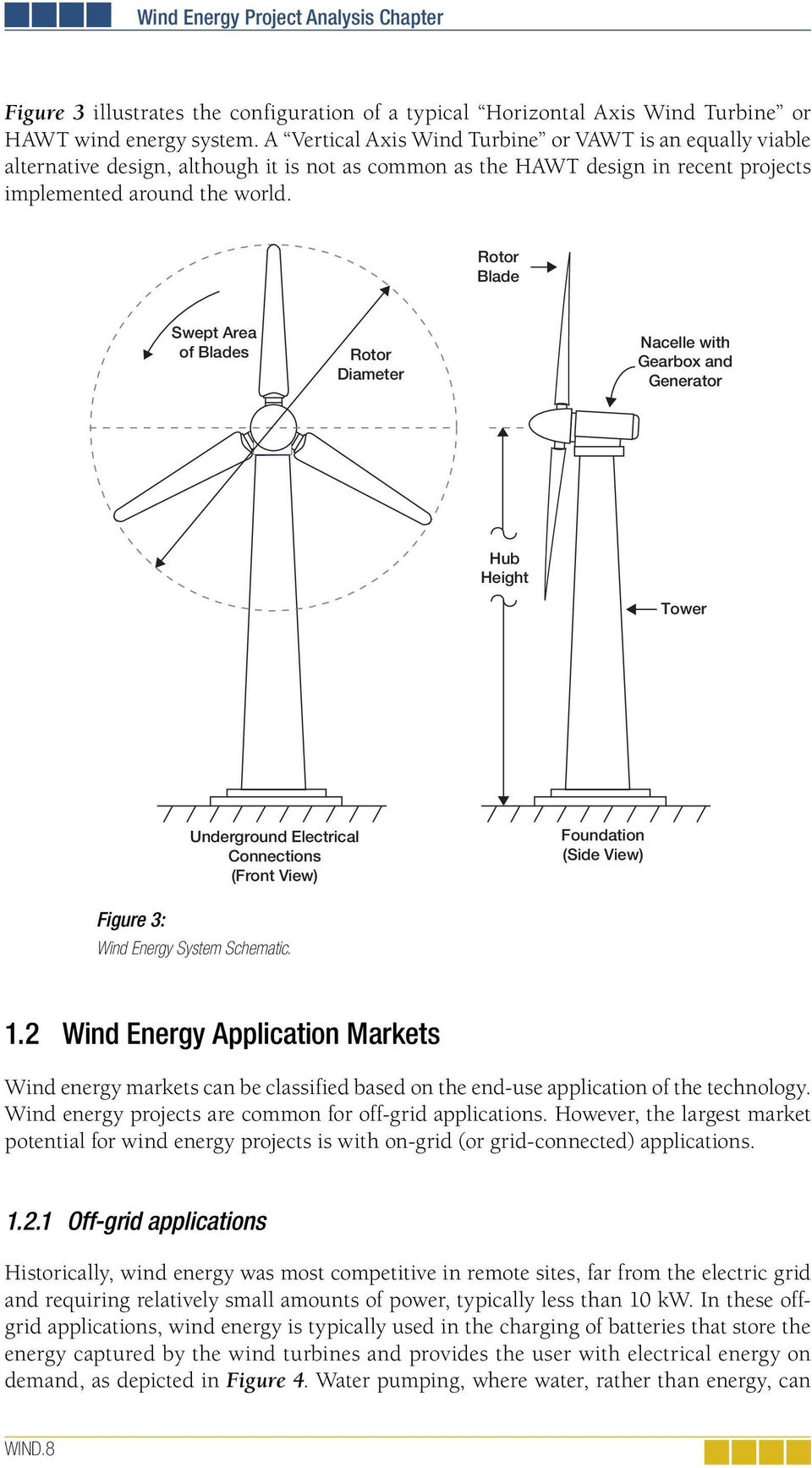
7 1. Wind Energy Background aerodynamic, mechanical and electrical conversion characteristics and efficiencies of the wind turbines. This means that the energy that may be produced by a wind turbine will increase by about 20% for each 10% increase in wind speed. Wind energy project siting is critical to a financially viable venture. It is important to note that since the human sensory perception of the wind is usually based on short-term observations of climatic extremes such as wind storms and wind chill impressions, either of these wind speeds might be wrongly interpreted as representative of a windy site. Proper wind resource assessment is a standard and important component for most wind energy project developments. 1.1 Description of Wind Turbines Wind turbine technology has reached a mature status during the past 15 years as a result of international commercial competition, mass production and continuing technical success in research and development (R&D). The earlier concerns that wind turbines were expensive and unreliable have largely been allayed. Wind energy project costs have declined and wind turbine technical availability is now consistently above 97%. Wind energy project plant capacity factors have also improved from 15% to over 30% today, for sites with a good wind regime (Rangi et al., 1992). Modern wind energy systems operate automatically. The wind turbines depend on the same aerodynamic forces created by the wings of an aeroplane to cause rotation. An anemometer that continuously measures wind speed is part of most wind turbine control systems. When the wind speed is high enough to overcome friction in the wind turbine drivetrain, the controls allow the rotor to rotate, thus producing a very small amount of power. This cut-in wind speed is usually a gentle breeze of about 4 m/s. Power output increases rapidly as the wind speed rises. When output reaches the maximum power the machinery was designed for, the wind turbine controls govern the output to the rated power. The wind speed at which rated power is reached is called the rated wind speed of the turbine, and is usually a strong wind of about 15 m/s. Eventually, if the wind speed increases further, the control system shuts the wind turbine down to prevent damage to the machinery. This cut-out wind speed is usually around 25 m/s. The major components of modern wind energy systems typically consist of the following: Rotor, with 2 or 3 blades, which converts the energy in the wind into mechanical energy onto the rotor shaft; Gearbox to match the slowly turning rotor shaft to the electric generator; Tall tower which supports the rotor high above the ground to capture the higher wind speeds; Solid foundation to prevent the wind turbine from blowing over in high winds and/or icing conditions (CanWEA, 1996); and Control system to start and stop the wind turbine and to monitor proper operation of the machinery. WIND.7

8 Wind Energy Project Analysis Chapter Figure 3 illustrates the configuration of a typical Horizontal Axis Wind Turbine or HAWT wind energy system. A Vertical Axis Wind Turbine or VAWT is an equally viable alternative design, although it is not as common as the HAWT design in recent projects implemented around the world. Rotor Blade Swept Area of Blades Rotor Diameter Nacelle with Gearbox and Generator Hub Height Tower Underground Electrical Connections (Front View) Foundation (Side View) Figure 3: Wind Energy System Schematic. 1.2 Wind Energy Application Markets Wind energy markets can be classified based on the end-use application of the technology. Wind energy projects are common for off-grid applications. However, the largest market potential for wind energy projects is with on-grid (or grid-connected) applications Off-grid applications Historically, wind energy was most competitive in remote sites, far from the electric grid and requiring relatively small amounts of power, typically less than 10 kw. In these offgrid applications, wind energy is typically used in the charging of batteries that store the energy captured by the wind turbines and provides the user with electrical energy on demand, as depicted in Figure 4. Water pumping, where water, rather than energy, can WIND.8
9 1. Wind Energy Background be stored for future use, is also a key historical application of wind energy. The key competitive area for wind energy in remote off-grid power applications is against electric grid extension, primary (disposable) batteries, diesel, gas and thermoelectric generators. Wind energy is also competitive in water pumping applications (Leng et al., 1996). Figure 4: 10 kw Off-Grid Wind Turbine in Mexico. Photo Credit: Charles Newcomber/NREL Pix On-grid applications In on-grid applications the wind energy system feeds electrical energy directly into the electric utility grid. Two on-grid application types can be distinguished. 1. Isolated-grid electricity generation, with wind turbine generation capacity typically ranging from approximately 10 kw to 200 kw. 2. Central-grid electricity generation, with wind turbine generation capacity typically ranging from approximately 200 kw to 2 MW. RETScreen International Wind Energy Project Model The RETScreen International Wind Energy Project Model can be used world-wide to easily evaluate the energy production, life-cycle costs and greenhouse gas emissions reduction for central-grid, isolated-grid and off-grid wind energy projects, ranging in size from large scale multi-turbine wind farms to small scale single-turbine wind-diesel hybrid systems. WIND.9

10 Wind Energy Project Analysis Chapter Isolated-grids Isolated-grids are common in remote areas. Electricity generation is often relatively expensive due to the high cost of transporting diesel fuel to these isolated sites. However, if the site has good local winds, a small wind energy project could be installed to help supply a portion of the electricity requirements. These wind energy projects are normally referred to as wind-diesel hybrid systems. The wind energy system s primary role is to help reduce the amount of diesel fuel consumption. A wind-diesel hybrid system is shown in Figure 5. Figure 5: 50 kw Isolated-Grid Wind Turbine in the Arctic. Photo Credit: Phil Owens/Nunavut Power Corp. WIND.10

11 1. Wind Energy Background Central-grids Central-grid applications for wind energy projects are becoming more common. In relatively windy areas, larger scale wind turbines are clustered together to create a windfarm with capacities in the multi-megawatt range. The land within the windfarm is usually used for other purposes, such as agriculture or forestry. Another common approach for wind energy project development includes the installation of one or more larger scale wind turbines by individuals, businesses or co-operatives. A windfarm, as depicted in Figure 6, consists of a number of wind turbines (which are often installed in rows perpendicular to the wind direction), access roads, electrical interconnections and a substation, a monitoring and control system and a maintenance building for the larger farms. The development of a wind energy project includes the determination of the wind resource, the acquisition of all authorisations and permits, the design and specification of the civil, electrical and mechanical infrastructure, the layout of the wind turbines, the purchasing of the equipment, the construction and the commissioning of the installation. Construction involves preparing the site, grading roads, building turbine foundations, installing the electrical collection lines and transformers, erecting the turbines, and construction of the substation and building. Figure 6: Components of a Windfarm in the United States. Photo Credit: Warren Gretz/NREL Pix WIND.11

12 Wind Energy Project Analysis Chapter The wind resource assessment and approvals for a windfarm are often the longest activities in the development of the wind energy project. These can take up to 4 years in the case of a large windfarm requiring a comprehensive environmental impact study. The construction itself can normally be completed within one year. The precise determination of the wind resource at a given site is one of the most important aspects in the development of a wind energy project as the available wind resource at the project site can dramatically impact the cost of wind energy production. In the case where a pre-feasibility study indicates that a proposed wind energy project could be financially viable, it is typically recommended that a project developer take at least a full year of wind measurements at the exact location where the wind energy project is going to be installed (Brothers, 1993), (CanWEA, 1996) and (Lynette et al., 1992). Figure 7 shows the installation of a 40 m tall meteorological mast at the CANMET Energy Technology Centre - Varennes in Canada. Figure 7: Installation of a 40 m Meteorological Mast. Photo Credit: GPCo Inc. For very small-scale projects (e.g. off-grid battery charging and water pumping), the cost of wind monitoring could actually be higher than the cost to purchase and install a small wind turbine. In this case a detailed wind resource assessment would normally not be completed. WIND.12

13 2. RETScreen Wind Energy Project Model 2 RETSCREEN WIND ENERGY PROJECT MODEL The RETScreen International Wind Energy Project Model can be used world-wide to easily evaluate the energy production, life-cycle costs and greenhouse gas emissions reduction for central-grid, isolated-grid and off-grid wind energy projects, ranging in size from large scale multi-turbine wind farms to small scale single-turbine wind-diesel hybrid systems. Six worksheets (Energy Model, Equipment Data, Cost Analysis, Greenhouse Gas Emission Reduction Analysis (GHG Analysis), Financial Summary and Sensitivity and Risk Analysis (Sensitivity)) are provided in the Wind Energy Project Workbook file. The Energy Model and Equipment Data worksheets are completed first. The Cost Analysis worksheet should then be completed, followed by the Financial Summary worksheet. The GHG Analysis and Sensitivity worksheets are optional analysis. The GHG Analysis worksheet is provided to help the user estimate the greenhouse gas (GHG) mitigation potential of the proposed project. The Sensitivity worksheet is provided to help the user estimate the sensitivity of important financial indicators in relation to key technical and financial parameters. In general, the user works from top-down for each of the worksheets. This process can be repeated several times in order to help optimise the design of the wind energy project from an energy use and cost standpoint. To help the user characterise a wind energy system before evaluating its cost and energy performance, some values are suggested, such as suggested wind energy absorption rate for projects located on isolated-grid and off-grid. Suggested or estimated values are based on input parameters and can be used as a first step in the analysis and are not necessarily the optimum values. This section describes the various algorithms used to calculate, on an annual basis, the energy production of wind energy systems in RETScreen. A flowchart of the algorithms is shown in Figure 8. The calculation of the energy curve and the unadjusted energy production is described in Section 2.1. Gross energy production, which takes into account effects of temperature and atmospheric pressure, is calculated in Section 2.2. Calculation of net energy production (i.e. taking into account various losses) and renewable energy delivered is covered in Section 2.3. A validation of the RETScreen Wind Energy Project Model is presented in Section 2.4. The main limitations of the model are that the stand-alone wind energy projects requiring energy storage currently cannot be evaluated, and that the model has not yet been validated for vertical axis wind energy systems. Also, the model addresses primarily Calculate energy curve [sections & 2.1.2] Calculate unadjusted energy production [section 2.1.3] Calculate gross energy production [section 2.2] Calculate renewable energy collected [section 2.3.1] Calculate renewable energy delivered [section 2.3.2] Calculate other auxiliary quantities [sections to 2.3.5] Figure 8: Wind Energy Model Flowchart. WIND.13

14 Wind Energy Project Analysis Chapter low penetration technologies. To properly evaluate high penetration technologies currently under development for isolated diesel-grid applications, the user will need to carefully evaluate the wind energy absorption rate used and will likely require further information. However, for the majority of the wind energy capacity being installed around the world today, these limitations are without consequence. 2.1 Unadjusted Energy Production RETScreen calculates the unadjusted energy production from the wind turbines. It is the energy that one or more wind turbines will produce at standard conditions of temperature and atmospheric pressure. The calculation is based on the energy production curve of the selected wind turbine (entered in the Equipment Data worksheet) and on the average wind speed at hub height for the proposed site Wind speed distribution Wind speed distribution, when required in the model (see Section 2.1.2), is calculated in RETScreen as a Weibull probability density function. This distribution is often used in wind energy engineering, as it conforms well to the observed long-term distribution of mean wind speeds for a range of sites. In some cases the model also uses the Rayleigh wind speed distribution, which is a special case of the Weibull distribution, where the shape factor (described below) is equal to 2. The Weibull probability density function expresses the probability p( x) to have a wind speed x during the year, as follows (Hiester and Pennell, 1981): k k k x x p( x)= 1 C C exp (1) C This expression is valid for k >1, x 0, and C > 0. k is the shape factor, specified by the user. The shape factor will typically range from 1 to 3. For a given average wind speed, a lower shape factor indicates a relatively wide distribution of wind speeds around the average while a higher shape factor indicates a relatively narrow distribution of wind speeds around the average. A lower shape factor will normally lead to a higher energy production for a given average wind speed. C is the scale factor, which is calculated from the following equation (Hiester and Pennell, 1981): x C = Γ 1+ 1 (2) k where x is the average wind speed value and Γ is the gamma function. WIND.14

15 2. RETScreen Wind Energy Project Model In some cases, the model will calculate the wind speed distribution from the wind power density at the site rather than from the wind speed. The relations between the wind power density WPD and the average wind speed v are: (3) (4) where year. is the air density and p(x) is the probability to have a wind speed x during the Energy curve The energy curve data is the total amount of energy a wind turbine produces over a range of annual average wind speeds. In RETScreen, the energy curve is specified over the range of 3 to 15 m/s annual average wind speed, and is displayed graphically in the Equipment Data worksheet. The user can specify the energy curve data by choosing among the three following data sources: Standard, Custom and User-defined. For the standard and custom cases, the model uses the wind turbine power curve data entered by the user and the Weibull probability function described in Section to calculate the energy curve data. In the User-defined case, the user directly enters the energy curve data. In the Standard and Custom cases, the user specifies the wind turbine power curve as a function of wind speed in increments of 1 m/s, from 0 m/s to 25 m/s. Each point on the energy curve, E v, is then calculated as: (5) where v is the mean wind speed considered (v =3, 4,, 15 m/s), P x is the turbine power at wind speed x, and p( x) is the Weibull probability density function for wind speed x, calculated for an average wind speed v. WIND.15

16 Wind Energy Project Analysis Chapter Unadjusted energy production The unadjusted energy production is the energy produced by the turbines at standard conditions of temperature and atmospheric pressure. The calculation is based on the average wind speed at hub height for the proposed site. Wind speed at hub height is usually significantly higher than wind speed measured at anemometer height due to wind shear. The model uses the following power law equation to calculate the average wind speed at hub height [Gipe, 1995]: V V H = H 0 0 α (6) where V is the average wind speed at hub height H, V 0 is the wind speed at anemometer height H 0, and α is the wind shear exponent. Values of H, H 0, V 0 and α are specified by the user 2. Once the annual average wind speed at hub height V is calculated, the unadjusted energy production E U is calculated simply by interpolating the energy curve from Section at the value V. 2.2 Gross Energy Production Gross energy production is the total annual energy produced by the wind energy equipment, before any losses, at the wind speed, atmospheric pressure and temperature conditions at the site. It is used in RETScreen to determine the renewable energy delivered (Section 2.3). Gross energy production E G is calculated through: EG = EU ch ct (7) where E U is the unadjusted energy production, and c H and c T are the pressure and temperature adjustment coefficients. c H and c T are given by: c P P H = 0 (8) 2. The same equation is used to calculate wind speed at the 10-meter level, with H set to 10 m. This latter value has no bearing on the energy calculation procedure; it is calculated in order to provide a common basis to compare two sites for which the wind speed has been measured at different heights. WIND.16

17 2. RETScreen Wind Energy Project Model T c = 0 (9) T T where P is the annual average atmospheric pressure at the site, P 0 is the standard atmospheric pressure of kpa, T is the annual average absolute temperature at the site, and T 0 is the standard absolute temperature of K. 2.3 Renewable Energy Delivered The RETScreen Wind Energy Project Model calculates the renewable energy delivered to the electricity grid, taking into account various losses. In the special case of isolated-grid and off-grid applications, the amount of wind energy that can be absorbed by the grid or the load is also considered Renewable energy collected Renewable energy collected is equal to the net amount of energy produced by the wind energy equipment: EC = EG cl (10) where E G is the gross energy production, and c L is the losses coefficient, given by: ( ) ( ) ( ) ( ) c L = 1 λ a 1 λ s& i λ d λ m 1 1 (11) where λ a is the array losses, λ s& i is the airfoil soiling and icing losses, λ d is the downtime losses, and λ m is the miscellaneous losses. Coefficients λ a, λ s& i, λ d, and λ m are specified by the user in the Energy Model worksheet. WIND.17

18 Wind Energy Project Analysis Chapter Absorption rate and renewable energy delivered The model calculates the wind energy delivered E D according to: E D = E µ (12) C where E C is the renewable energy collected (see equation 10), and µ is the wind energy absorption rate. The wind energy absorption rate is the percentage of the wind energy collected that can be absorbed by the isolated-grid or the off-grid system. For central-grid applications, this rate is always equal to 100% since the grid is assumed to be large enough to always absorb all the energy produced by the wind energy project. For isolated-grid and off-grid applications, the user enters the value of the absorption rate. For isolated-grid and off-grid applications, the model computes a suggested wind energy absorption rate. It is found by interpolation in Table 1, where the Wind Penetration Level (WPL) is defined as: WPL = WPC 100 (13) PL where WPC is the wind plant capacity and PL is the peak load specified by the user. WPC is obtained by multiplying the number of wind turbines by their rated, or nameplate, capacity (power). Average Wind Speed Wind Penetration Level (WPL) (m/s) 0% 10% 20% 30% 0 100% 100% 100% 100% % 98% 96% 93% % 98% 94% 90% % 98% 93% 87% % 97% 92% 84% % 96% 90% 82% Table 1: Suggested Wind Energy Absorption Rate for Isolated-Grid and Off-Grid Applications. WIND.18

19 2. RETScreen Wind Energy Project Model As illustrated in Table 1, the suggested wind energy absorption rate varies according to the average wind speed and the wind penetration level. Note that it is based on the wind speed at the wind turbine hub height. Table 1 values are derived from simulations conducted to establish the amount of wind energy delivered from windfarms installed in remote communities (i.e. isolated-grid and off-grid applications). The simulations considered combinations of wind regime, load profiles and equipment performance curves. Detailed results can be found in Rangi et al. (1992). The model only provides suggested values for wind penetration levels less than 25%. However, if the wind penetration level is greater than 3% and the wind speed at hub height is 8.3 m/s or higher, then the model does not provide suggested values. Under these circumstances, the wind energy absorption rates will vary widely depending on the configuration of the system and on the control strategies adopted Excess renewable energy available Excess renewable energy available E X is simply the difference between the wind energy collected E C and the wind energy delivered E D : EX = EC ED (14) Specific yield The specific yield Y is obtained by dividing the renewable energy collected E C swept area of the turbines: by the Y EC = (15) NA where N is the number of turbines and A is the area swept by the rotor of a single wind turbine. WIND.19

20 Wind Energy Project Analysis Chapter Wind plant capacity factor The wind plant capacity factor PCF represents the ratio of the average power produced by the plant over a year to its rated power capacity. It is calculated as follows [Li and Priddy, 1985]: E C PCF = 100 (16) WPC hy where E C is the renewable energy collected, expressed in kwh, WPC is the wind plant capacity, expressed in kw, and h Y is the number of hours in a year. 2.4 Validation Numerous experts have contributed to the development, testing and validation of the RETScreen Wind Energy Project Model. They include wind energy modelling experts, cost engineering experts, greenhouse gas modelling specialists, financial analysis professionals, and ground station and satellite weather database scientists. This section presents two examples of the validations completed. First, predictions of the RETScreen Wind Energy Project Model are compared to results from an hourly simulation program. Then, model predictions are compared to yearly data measured at a real wind energy project site Validation of wind energy model compared with an hourly model In this section predictions of the RETScreen Wind Energy Project Model are compared with an hourly model. The hourly model used is HOMER, an optimisation model for designing stand-alone electric power systems (NREL, 2001). HOMER uses hourly simulations to optimise the design of hybrid power systems. HOMER can model any combination of wind turbines, photovoltaic panels, diesel generation, and battery storage. The present validation does not make use of the optimisation capabilities of HOMER; the program is used only as a simulation tool. Two configurations were tested: a small windfarm connected to an isolated-grid and a large windfarm connected to a central-grid. Small windfarm The system configuration used for the first test is based on a real wind power project in Kotzebue, Alaska, a small coastal community about 50 km North of the Arctic Circle (CADDET, 2001). The system comprises 10 turbines with a combined rated capacity of 500 kw; it is a joint undertaking between the US Department of Energy, the Electric Power Research Institute (EPRI), and the Alaska Energy Authority-Alaska Industrial Development Export Authority (AEA/AIDEA). The system services a small local grid, with a total population of 3,500. The system is designed to meet about 6% of the total electrical demand of the town. The system configuration is summarised in Table 2. WIND.20
![It is calculated as follows [Li and Priddy, 1985]: E C PCF = 100 (16) WPC hy where E C is the renewable energy collected, expressed in kwh, WPC is the wind plant capacity, expressed in kw, and h Y is](/docs-images/46/21477967/images/page_20.jpg "the number of hours in a year. 2.4 Validation Numerous experts have contributed to the development, testing and validation of the RETScreen Wind Energy Project Model.")
21 2. RETScreen Wind Energy Project Model Turbines Atlantic Orient Corporation AOC 15/50 Number of turbines 10 Rotor diameter 15 m Swept area 177 m 2 Hub height Grid type Local grid peak load Table 2: Kotzebue Wind System Confi guration. 24 m Isolated local grid 3.6 MW The power output curve of the AOC 15/50 is shown in Figure 9. The same data were used for both software programs. Weather data from the RETScreen online weather database for Kotzebue/Wien, AK, was used. RETScreen and HOMER differ in the type of wind speed they require. HOMER requires monthly wind speed values (shown in Table 3) and stochastically estimates hourly values from these. RETScreen simply requires the annual average wind speed, which is equal to 5.8 m/s (all wind values are measured at 9.4 m). In both models, a Weibull wind distribution was used, with a shape factor of 2.0. The annual average atmospheric pressure is kpa and the annual average temperature is -6 C Power output (kw) Wind speed (m/s) Figure 9: AOC 15/50 Turbine Power Curve. WIND.21
22 Wind Energy Project Analysis Chapter RETScreen requires a wind shear exponent to automatically calculate the wind speed at hub height. An exponent of 0.14 was used, which leads to a wind speed at hub height of 6.6 m/s. In HOMER a wind speed-scaling factor has to be entered manually. The factor used was set to 6.6/5.8 or so that both RETScreen and HOMER use the same average wind speed at hub height. Month Average Wind Speed (m/s) Jan 6.5 Feb 5.5 Mar 5.3 Apr 5.4 May 5.1 Jun 5.6 Jul 5.7 Aug 5.8 Sep 6.1 Oct 6.2 Nov 6.7 Dec 6.0 Yearly Average 5.8 Table 3: Average Wind Speeds in Kotzebue, AK. Comparison between HOMER and RETScreen requires exercising some judgement because the two programs do not necessarily require the same inputs, nor do they necessarily correct for the same physical phenomena. In many respects, RETScreen tends to be more thorough in its description of the system. For example RETScreen automatically calculates the pressure adjustment coefficient and the temperature adjustment coefficient. In HOMER, these values have to be manually entered in the form of a power curve-scaling factor. Similarly, RETScreen allows the user to specify array losses, losses due to airfoil soiling or icing, and downtime losses; these have no equivalent in HOMER. Finally RETScreen allows the user to specify a wind energy absorption rate; again there is no equivalent in HOMER. For these reasons, the comparison will be more meaningful if unadjusted energy production values calculated by RETScreen are used, rather than the renewable energy delivered. Table 4 compares the annual energy productions predicted by RETScreen and HOMER. As can be seen, the agreement between the two software programs is excellent. Section will show that the agreement with experimental data is also acceptable in terms of actual renewable energy delivered, that is, once energy production is adjusted for various losses and pressure and temperature effects. WIND.22
23 2. RETScreen Wind Energy Project Model RETScreen Unadjusted Energy Production (MWh) HOMER Total Energy Production (MWh) Difference 1,532 1, % Table 4: Comparison of Predicted Annual Energy Production Small Windfarm. Large windfarm The second test configuration represents a large windfarm connected to a centralgrid. The main parameters of the system are as follows: 76 Vestas V47-600kW turbines (hub height 55 m, diameter 47 m). Annual average wind speed: 8.1 m/s. Annual average temperature: 12 C. Altitude of site: 250 m, annual average atmospheric pressure: 98.4 kpa. Wind speed distribution: Weibull, shape factor: 1.8. Wind shear exponent: The power output curve of the Vestas V47-600kW turbine is shown in Figure 10. The same data were used for both software programs. According to RETScreen the average wind speed at hub height is 10.3 m/s. As in the small windfarm case, a wind speed-scaling factor equal to 10.3/8.1 or had to be entered manually in HOMER so that both programs use the same average wind speed at hub height. As before, unadjusted energy production values calculated by RETScreen are used, rather than the actual renewable energy delivered, to facilitate comparison with HOMER. The comparison is shown in Table 5. Once again, the agreement between the two software programs is excellent. RETScreen Unadjusted Energy Production (GWh) HOMER Total Energy Production (GWh) Difference % Table 5: Comparison of Predicted Annual Energy Production Large Windfarm. WIND.23
24 Wind Energy Project Analysis Chapter Power output (kw) Wind speed (m/s) Figure 10: Vestas V47-600kW Turbine Power Curve Validation of wind energy model compared with monitored data Annual monitoring data have been published for the small windfarm system described in Section This makes a brief experimental validation of RETScreen Wind Energy Project Model possible. The system s 10 turbines were installed in several phases. Electricity production from turbines 1-3 is available for years 1998 and 1999; for turbines 4-10, one-year of electricity production is available from July 1999 to June Electricity production figures can be found in CADDET (2001). Bergey (2000) also reports on system performance for the 10 turbines. A caveat in using these data is that the first couple of years of production of a system can sometimes not be representative, as there are often teething problems and adjustments required. This is especially true for one-of-a-kind applications. One should keep this in mind when reading the following comparison. Monitored wind speeds, as presented in Table 6, were used as inputs to RETScreen. In the absence of additional information, the following conservative estimates were used: 95% wind energy absorption rate, 3% array losses, 5% airfoil soiling and/or icing losses, and 5% for miscellaneous losses. Downtime losses are difficult to estimate. According to CADDET (2001) the turbines were available 96% of the time; however that figure excludes many downtimes for scheduled maintenance and grid failures, which should be included in the value used by RETScreen. The other downtime losses parameter in RETScreen was therefore estimated at roughly 10%; this is probably still too low a value given the harsh conditions to which the system is subjected and the fact that the system is still in its infancy. WIND.24
25 2. RETScreen Wind Energy Project Model Table 6 summarises RETScreen predictions versus actual energy production. RETScreen reasonably predicts the actual electricity production, except in 1999 where the energy production of the monitored project appears to have under-performed. For example, when comparing production of turbines 1-3 in 1998 and in 1999, it appears that the 3 turbines actually only produced 23% less energy in 1999 although the average wind was 10% higher than in Also, average production per turbine for a 5.4 m/s wind speed was 69.5 MWh in 1999 according to CADDET (2001) whereas it was MWh (or 68% more) in 1999/2000 for the same 5.4 m/s average wind speed according to Bergey (2000). Again these discrepancies may be due to problems experienced by the installed wind energy system in its first few years of operation, and solved since then. The comparison of RETScreen predictions with real data is nevertheless acceptable and this, together with the model-to-model comparison of Section 2.4.1, confirms the adequacy of RETScreen for pre-feasibility studies of wind energy projects. Period Turbines Average Wind Speed (m/s) RETScreen Prediction (MWh) Actual Electricity Production (MWh) Difference 1998* % 1999* % July 1999-June 2000* % ** ,057 1,170-10% * From CADDET (2001). ** From Bergey (2000). Table 6: Comparison of RETScreen Predictions against Monitored Data for Kotzebue, AK. 2.5 Summary In this section the algorithms used by the RETScreen Wind Energy Project Model have been shown in detail. The model uses a user-specified power curve and a Weibull wind speed probability distribution function to calculate the energy curve of the turbine. Energy production is then adjusted for pressure and temperature effects, as well as for various user-specified losses. In the case of isolated-grid and off-grid applications, the calculation of wind energy delivered takes into account the wind energy absorption rate. Comparison of the RETScreen model predictions against results of an hourly simulation program and against monitored data shows that the accuracy of the RETScreen Wind Energy Project Model is excellent in regards to the preparation of pre-feasibility studies, particularly given the fact that RETScreen only requires 1 point of wind speed data versus 8,760 points of data for most hourly simulation models. WIND.25
26
27 REFERENCES Bergey, M., Small Wind Systems For Rural Energy Supply, Village Power 2000, Washington, DC, USA, Brothers, C., Wind Generation Systems for Remote Communities - Market Assessment and Guidelines for Wind Turbines Selection, Canadian Electrical Association, Project no G 880, CADDET, Technical Bulletin no. 143, Canadian Wind Energy Association (CanWEA), Wind Energy Basic Information, Backgrounder Published with Support from CANMET, Conover, K., Wind Energy Financial Due Diligence, R. Lynette & Associates, Seminar on Opportunities for Finance and Investment in Wind Energy, Elliot, D. et al., Wind Energy Resource Atlas of the United States, SERI, Gipe, P., Wind Energy Comes of Age, John Wiley & Sons, Inc., New York, NY, USA, Hiester, T.R. and Pennell, W.T., The Siting Handbook for Large Wind Energy Systems, WindBooks, New York, NY, USA, Le Gouriérès, D., Wind Power Plants: Theory and Design, Pergamon Press, Leng, G., Dignard-Bailey, L., Bragagnolo, J., Tamizhmani, G. and Usher, E., Overview of the Worldwide Photovoltaic Industry, Report no A1 (TR), CANMET Energy Diversification Research Laboratory, Natural Resources Canada, Varennes, QC, Canada, J3X 1S6, Li, K.W. and Priddy, A.P., Power Plant System Design, John Wiley & Sons, Inc., New York, NY, USA, Lynette, R. and Ass., Technical and Economic Potential for Wind Energy Development in Ontario, Prepared for Independent Power Producers Society of Ontario, NREL, HOMER, The Hybrid Optimization Model for Electric Renewables, Available from National Renewable Energy Laboratory, 1617 Cole Boulevard, Golden, CO , USA, Rangi, R., Templin, J., Carpentier, M. and Argue, D., Canadian Wind Energy Technical and Market Potential, EAETB, Energy, Mines and Resources Canada, Reid, R., Application de l éolien aux réseaux non-reliés, Hydro-Québec, Congrès de l ACFAS, Montreal, QC, Canada, SunMedia GmbH, Wind Turbine Market: Types, Technical Characteristics, Prices, Vesterdal, J., The Potential of Wind Farms, ELSAM, WECTEC, Évaluation du potentiel éolien du Québec, Report Prepared for the Ministère des Ressources naturelles du Québec, WIND.27
28 Wind Power Monthly, The Windicator-Operational Wind Power Capacity Worldwide, Winkra-Recom, Wind Turbine Market - Types, Technical Characteristics, Prices, 1995/96. Zond, Wind Power Economics, Seminar on Opportunities for Finance and Investment in Wind Energy, WIND.28
29
30
Wind Resource Assessment for BETHEL, ALASKA Date last modified: 2/21/2006 Compiled by: Mia Devine
 813 W. Northern Lights Blvd. Anchorage, AK 99503 Phone: 907-269-3000 Fax: 907-269-3044 www.akenergyauthority.org Wind Resource Assessment for BETHEL, ALASKA Date last modified: 2/21/2006 Compiled by: Mia
Case Study 5 Use of Wind Turbine Technology
 Case Study 5 Use of Wind Turbine Technology 1. Context Hong Kong relies on an adequate and reliable electricity supply for its economic development. Our electricity needs are met by the two electricity
Manufactured by Seaforth Energy. The world s most proven 50 kw wind turbine
 Manufactured by Seaforth Energy The world s most proven 50 kw wind turbine The world s most proven 50 kw wind turbine The AOC 15/50 is the world s most proven 50 kw wind turbine. Manufactured by Seaforth
Hybrid Micro-Power Energy Station; Design and Optimization by Using HOMER Modeling Software
 Hybrid Micro-Power Energy Station; Design and Optimization by Using HOMER Modeling Software Iyad. M. Muslih 1, Yehya Abdellatif 2 1 Department of Mechanical and Industrial Engineering, Applied Science
Wind-Diesel Hybrid System Options for Alaska. Steve Drouilhet National Renewable Energy Laboratory Golden, CO
 Wind-Diesel Hybrid System Options for Alaska Steve Drouilhet National Renewable Energy Laboratory Golden, CO Wind-Diesel Hybrid Power Systems Basic Concept A wind-diesel hybrid system combines wind turbine(s)
Nordex SE. Capital Markets Day Products & Sales - Lars Bondo Krogsgaard
 Nordex SE Capital Markets Day Products & Sales - Lars Bondo Krogsgaard Rostock, 13 October 2011 SUMMARY The situation in the wind industry has changed: Attractive medium-term growth prospects Overcapacity
CLEAN ENERGY PROJECT ANALYSIS WITH RETSCREEN SOFTWARE
 Training Module SPEAKER S NOTES CLEAN ENERGY PROJECT ANALYSIS WITH RETSCREEN SOFTWARE CLEAN ENERGY PROJECT ANALYSIS COURSE This document provides a transcription of the oral presentation (Voice & Slides)
Welcome to our open house. Thanks for coming. Please sign in and help yourself to refreshments. Energizing your community. www.fortisbc.
 Welcome to our open house Thanks for coming Please sign in and help yourself to refreshments Integrated System Plan (ISP) Looks ahead 20 years to identify the energy and infrastructure needs of our customers
QUALITY OF WIND POWER. How does quality affect the cost of electricity generation from wind power?
 QUALITY OF WIND POWER How does quality affect the cost of electricity generation from wind power? QUALITY OF WIND POWER Wind power is a cornerstone in the green transition of the power sector, and onshore
Energy Efficiency, Clean Power as Engine for Sustainable Growth
 Energy Efficiency, Clean Power as Engine for Sustainable Growth Rakesh Kumar Bhatnagar, Advisor (Technology), & P K Panigrahi, Sr. DDG, Department of Telecommunications, Government of India. 1 Agenda 2
WIND AND SOLAR ENERGY DEVELOPMENTS IN IRAN
 WIND AND SOLAR ENERGY DEVELOPMENTS IN IRAN H. Kazemi Karegar a,b, A.Zahedi a,v. Ohis a, G. taleghani b and M. Khalaji b a Department of Electrical & Computer Systems Engineering, PO Box 35, Monash University,
Integrating WAsP and GIS Tools for Establishing Best Positions for Wind Turbines in South Iraq
 Integrating WAsP and GIS Tools for Establishing Best Positions for Wind Turbines in South Iraq S.M. Ali Remote Sensing Research Unit, College of Science, Univ. of Baghdad, Baghdad, Iraq deanoffice {at}
Wind Turbine Power Calculations
 Wind Turbine Power Calculations RWE npower renewables Mechanical and Electrical Engineering Power Industry INTRODUCTION RWE npower is a leading integrated UK energy company and is part of the RWE Group,
OFF-GRID ELECTRICITY GENERATION WITH HYBRID RENEWABLE ENERGY TECHNOLOGIES IN IRAQ: AN APPLICATION OF HOMER
 Diyala Journal of Engineering Sciences ISSN 1999-8716 Printed in Iraq Second Engineering Scientific Conference College of Engineering University of Diyala 16-17 December. 2015, pp. 277-286 OFF-GRID ELECTRICITY
A wind turbine is a machine for converting the kinetic energy in wind into mechanical energy.
 Type of Turbines Page 1 Turbines A wind turbine is a machine for converting the kinetic energy in wind into mechanical energy. mills Turbines If the mechanical energy is used directly by machinery, such
Running on Renewables (Lesson Plan) (Utilizing HOMER: Modeling Software for Hybrid Electric Power Systems)
 Running on Renewables (Lesson Plan) (Utilizing HOMER: Modeling Software for Hybrid Electric Power Systems) Suggested Grade Level 9-12 Overview Students utilize software developed by the National Renewable
Training Workshop: RETScreen for Assessing Renewable Energy Projects
 Training Workshop: RETScreen for Assessing Renewable Energy Projects November, 2009 Sponsored by Energy Sector Management Assistance Programme Coordinated by The World Bank Presented by Dr. Roland R Clarke
Outline. Introduction to Wind Energy. US Wind Energy Installations. ME 483 Alternative Energy Engineering II 1
 Wind Power Introduction February, Introduction to Wind Energy Larry Caretto Mechanical Engineering 48 Alternative Energy Engineering II February, Outline Current use of wind energy Advantages and disadvantages
GE Power & Water Renewable Energy. Digital Wind Farm THE NEXT EVOLUTION OF WIND ENERGY. www.ge.com/wind
 GE Power & Water Renewable Energy Digital Wind Farm THE NEXT EVOLUTION OF WIND ENERGY www.ge.com/wind GE S DIGITAL WIND FARM PITCH Since entering the wind industry in 2002, GE Power & Water s Renewable
V112-3.0 MW. Your best option for low cost energy production at low and medium wind sites. Federico Gonzalez Vives. Director Technology.
 V112-3.0 MW Your best option for low cost energy production at low and medium wind sites Federico Gonzalez Vives. Director Technology. Vestas MED REOLTEC. Jornadas tecnicas 17 de junio de 2010 vestas.com
Yukon Government Solar Energy Pilot: Performance Monitoring Yukon Government s Energy Solutions Centre. February 2014
 Yukon Government Solar Energy Pilot: Performance Monitoring Yukon Government s Energy Solutions Centre February 2014 Contents 1. Project Overview... 3 2. System Specifications... 3 2.1. Yukon Government
HOMER Software Training Guide for Renewable Energy Base Station Design. Areef Kassam Field Implementation Manager
 HOMER Training Guide for Renewable Energy Base Station Design Areef Kassam Field Implementation Manager Solar Table of Contents Introduction Step Step Step Step Solar Step Step Step Step Solar Introduction
Siemens D7 platform 6.0-MW and 7.0-MW direct drive wind turbines. The new standard for offshore. siemens.com/wind
 Siemens D7 platform 6.0-MW and 7.0-MW direct drive wind turbines The new standard for offshore siemens.com/wind The first SWT-6.0-154 prototype Siemens, the offshore leader Intelligent ways to drive down
THE NEW GUIDELINE FOR THE CERTIFICATION OF WIND TURBINES, EDITION 2010
 THE NEW GUIDELINE FOR THE CERTIFICATION OF WIND TURBINES, EDITION 2010 Mike Woebbeking Germanischer Lloyd Industrial Services GmbH, Renewables Certification (GL) Brooktorkai 18, 20457 Hamburg, GERMANY
Wind Turbine Technology Overview
 Wind Turbine Technology Overview Course No: M01-009 Credit: 1 PDH Brian McCaffrey, P.E. Continuing Education and Development, Inc. 9 Greyridge Farm Court Stony Point, NY 10980 P: (877) 322-5800 F: (877)
CSP. Feranova Reflect Technology. klimaneutral natureoffice.com DE-296-558771 gedruckt
 RENEWABLE SOURCES RENEWABLE SOURCES CSP Feranova Reflect Technology klimaneutral natureoffice.com DE-296-558771 gedruckt Gedruckt auf 100% Recyclingpapier Circlesilk Premium White 200/150 g/m 2 2012 Feranova
GE Renewable Energy. GE s 3 MW Platform POWERFUL AND EFFICIENT. www.ge.com/wind
 GE Renewable Energy GE s 3 MW Platform POWERFUL AND EFFICIENT www.ge.com/wind GE S 3 MW PLATFORM PITCH Since entering the wind industry in 2002, GE Renewable Energy has invested more CONTROLS than $2 billion
Solar and Wind Energy for Greenhouses. A.J. Both 1 and Tom Manning 2
 Solar and Wind Energy for Greenhouses A.J. Both 1 and Tom Manning 2 1 Associate Extension Specialist 2 Project Engineer NJ Agricultural Experiment Station Rutgers University 20 Ag Extension Way New Brunswick,
V52-850 kw The turbine that goes anywhere
 V2-8 kw The turbine that goes anywhere Versatile, efficient, dependable and popular The highly efficient operation and flexible configuration of the V2 make this turbine an excellent choice for all kinds
Modelling and Simulation of Distributed Generation System Using HOMER Software
 Modelling and Simulation of Distributed Generation System Using HOMER Software Bindu U Kansara Electrical Engineering Department Sardar Patel University SICART, Vidyanagar 388 1210, Gujarat, India [email protected]
Abstract. emails: [email protected], [email protected], phone: 860-429-6508, fax: 860-429-4456
 SOLAR THERMAL POWER PLANT WITH THERMAL STORAGE Ronald C. Derby, President Samuel P. Lazzara, Chief Technical Officer Cenicom Solar Energy LLC * Abstract TM employs 88 parabolic mirrors (concentrating dishes)
NORDEX USA, INC. GREAT LAKES SYMPOSIUM
 NORDEX USA, INC. GREAT LAKES SYMPOSIUM CHICAGO 24 Sep 2013 AGENDA 1 About Nordex 2 Wind Industry Challenges & Our Responses Nordex USA, Inc. Great Lakes Symposium Presentation Chicago Sept 2013 Slide 2
THE EUROPEAN GREEN BUILDING PROGRAMME. Technical Module on Combined Heat and Power
 THE EUROPEAN GREEN BUILDING PROGRAMME Technical Module on Combined Heat and Power Contents Foreword...1 1. Introduction...2 2. Inventory of the CHP system...3 3. Assessment of technical energy saving measures...5
Community Solar Roof Guide
 Community Solar Roof Guide Installing a community owned solar roof has become a reality in the UK since the introduction of the Feed-in-Tariff in April 2010, which pays renewable energy generators a premium
ALL STAR ELECTRIC COMPANY 10,000 Trumbull SE, Suite #F Albuquerque, NM 87123 (505) 856-1010 voice & fax NM License 21880 www.allstarelec.
 ALL STAR ELECTRIC COMPANY 10,000 Trumbull SE, Suite #F Albuquerque, NM 87123 (505) 856-1010 voice & fax NM License 21880 www.allstarelec.com On-Site Power System Specialists: Photovoltaics, Wind Turbine
Offshore Windfarm Egmond aan Zee 4 years of Operation
 Offshore Windfarm Egmond aan Zee 4 years of Operation CUEN Offshore Wind Energy Conference 28 June 2011, Cambridge Elke Delnooz Operations Support Manager www.noordzeewind.nl 1 Contents Project description
Natural Gas Diversification Strategy for PREPA GOVERNMENT DEVELOPMENT BANK FOR PUERTO RICO
 Natural Gas Diversification Strategy for PREPA GOVERNMENT DEVELOPMENT BANK FOR PUERTO RICO Agenda 1 Importance of Diversifying to Natural Gas 2 Natural Gas Diversification Strategy 2 Currently, Puerto
The Real Cost of Electrical Energy. Outline of Presentation
 2 Outline of Presentation Data Sources Electricity Demand and Supply Cost to Meet Demand Profile Electricity Pricing Cost Impact of Dispatching Generation (Load Following) Simplifying Assumptions Electricity
Siemens D3 platform 3.0-MW, 3.2-MW, 3.3-MW, and 3.4-MW direct drive turbines. Reduced complexity, increased profitability. siemens.
 Siemens D3 platform 3.0-MW, 3.2-MW, 3.3-MW, and 3.4-MW direct drive turbines Reduced complexity, increased profitability siemens.com / wind As the major driver of innovation with more than 30 years of
Trout Lake Wind and Solar Energy Pre Feasibility Analysis
 Trout Lake Wind and Solar Energy Pre Feasibility Analysis Source: MACA Prepared for By Jean Paul Pinard, P. Eng., PhD. 703 Wheeler St., Whitehorse, Yukon Y1A 2P6 Tel. (867) 393 2977; Email [email protected],
MICRO-HYDROPOWER NEED FOR ENERGY FOR RURAL DEVELOPMENT. By: Payman Hassan Rashed
 MICRO-HYDROPOWER NEED FOR ENERGY FOR RURAL DEVELOPMENT Significant water resources are found in many developing countries. In areas where adequate water resources are present, harnessing the power of falling
Offshore Wind: some of the Engineering Challenges Ahead
 Offshore Wind: some of the Engineering Challenges Ahead David Infield CDT in Wind Energy Systems Institute of Energy and Environment University of Strathclyde International context (from IPCC report) Greenhouse
Title: IEC WT 01 vs. IEC 61400-22 Development of a new standard and innovations in certification of Wind Turbines. mike.woebbeking@gl-group.
 Title: IEC WT 01 vs. IEC 61400-22 Development of a new standard and innovations in certification of Wind Turbines Author: Address: Mike Woebbeking Germanischer Lloyd Industrial Services GmbH, Business
Wind Energy Conversion Systems
 Wind Energy Conversion Systems Lecture Notes by Prof. Shireesh B. Kedare Adjunct Assistant Professor ENERGY SYSTEMS ENGINEERING INDIAN INSTITUTE OF TECHNOLOGY, BOMBAY Powai, Mumbai 400076, INDIA Contents
Asian Journal on Energy and Environment
 As. J. Energy Env. 2005, 6(02), 139-144 Asian Journal on Energy and Environment ISSN 1513-4121 Available online at www.asian-energy-journal.info The Small Hydropower Project as the Important Renewable
1.0 Background 1.1 Historical background 1.2 Cost of wind turbines
 1.0 Background 1.1 Historical background Wind energy has been used for thousands of years for milling grain, pumping water and other mechanical power applications. Wind power is not a new concept. The
150 Watts. Solar Panel. one square meter. Watts
 Tool USE WITH Energy Fundamentals Activity land art generator initiative powered by art! 150 Watts 1,000 Watts Solar Panel one square meter 600 Watts SECTION 1 ENERGY EFFICIENCY 250 Watts 1,000 Watts hits
Australian Remote Renewables: Opportunities for Investment
 Australian Remote Renewables: Opportunities for Investment The largely untapped remote clean energy market and funding support available from the Australian Government creates an attractive opportunity
EFFECTS OF COMPLEX WIND REGIMES ON TURBINE PERFORMANCE
 EFFECTS OF COMPLEX WIND REGIMES ON TURBINE PERFORMANCE Elisabeth Rareshide, Andrew Tindal 1, Clint Johnson, AnneMarie Graves, Erin Simpson, James Bleeg, Tracey Harris, Danny Schoborg Garrad Hassan America,
Renewable Wind. Wind Basics. Energy from Moving Air. The Daily Wind Cycle. Wind Energy for Electricity Generation
 Renewable Wind Wind Basics Energy from Moving Air Wind is simply air in motion. It is caused by the uneven heating of the Earth's surface by the sun. Because the Earth's surface is made of very different
As a minimum, the report must include the following sections in the given sequence:
 5.2 Limits for Wind Generators and Transformer Substations In cases where the noise impact at a Point of Reception is composed of combined contributions due to the Transformer Substation as well as the
Onshore Wind Services
 GE Renewable Energy Onshore Wind Services www.ge.com/wind PITCH TABLE OF CONTENTS: 3 Operate and Maintain 3 Asset and Park Management 5 Turbine Maintenance 8 Enhance and Optimize 8 Wind PowerUp * Services
SIMULATION OF A COMBINED WIND AND SOLAR POWER PLANT
 SMULATON OF A COMBNED WND AND SOLAR POWER PLANT M. T. SAMARAKOU Athens University, Electronics Laboratory, Solonos /04, Athens, Greece AND J. C. HENNET Laboratoire d'automatique et d'analyse des Systemes
SIMPLIFIED PERFORMANCE MODEL FOR HYBRID WIND DIESEL SYSTEMS. J. F. MANWELL, J. G. McGOWAN and U. ABDULWAHID
 SIMPLIFIED PERFORMANCE MODEL FOR HYBRID WIND DIESEL SYSTEMS J. F. MANWELL, J. G. McGOWAN and U. ABDULWAHID Renewable Energy Laboratory Department of Mechanical and Industrial Engineering University of
Óbuda University Power System Department. The wind. Dr. Péter Kádár Óbuda University, Power System Department, Hungary [email protected].
 The wind Dr. Péter Kádár,, Hungary [email protected] Draft Wind basics Drivers of the wind energy application The energy of the wind Dynamic simulation Wind forecast Wind basics - Patra, 2012
Impacts of large-scale solar and wind power production on the balance of the Swedish power system
 Impacts of large-scale solar and wind power production on the balance of the Swedish power system Joakim Widén 1,*, Magnus Åberg 1, Dag Henning 2 1 Department of Engineering Sciences, Uppsala University,
Renewable Energy: Essential terms terms and and concepts for citizens and a dvocates advocates
 Renewable Energy: Essential terms and concepts for citizens and advocates Courtesy of NASA Contact Information Pete Shoemaker Pacific Energy Center 851 Howard St. San Francisco, CA 94103 (415) 973-8850
Wind Energy Development in Jamaica
 ACCELERATING ADVANCED ENERGY TECHNOLOGIES Wind Energy Development in Jamaica Group Managing Director, Petroleum Corporation of Jamaica Presentation Outline Country Profile Jamaica Case Study: Wind Energy
Solar systems provide a range of flexible heating
 f a c t s h e e t 7 Solar Power Production photo by Alex Nikada Why solar? Solar systems provide a range of flexible heating and electricity options and are particularly wellsuited to remote or off-grid
STEADYSUN THEnergy white paper. Energy Generation Forecasting in Solar-Diesel-Hybrid Applications
 STEADYSUN THEnergy white paper Energy Generation Forecasting in Solar-Diesel-Hybrid Applications April 2016 Content 1 Introduction... 3 2 Weather forecasting for solar-diesel hybrid systems... 4 2.1 The
Wind Electrolysis: Hydrogen Cost Optimization
 Wind Electrolysis: Hydrogen Cost Optimization Genevieve Saur and Todd Ramsden NREL is a national laboratory of the U.S. Department of Energy, Office of Energy Efficiency & Renewable Energy, operated by
SDH ONLINE-CALCULATOR
 CALCULATION PROGRAM FOR THE COST-BENEFIT ANALYSIS OF SOLAR DISTRICT HEATING SYSTEMS WWW.SDH-ONLINE.SOLITES.DE Dipl.-Ing. Thomas Schmidt and Dipl.-Ing. Laure Deschaintre Solites Steinbeis Research Institute
V112-3.0 MW Making wind even more profitable
 V112-3.0 MW Making wind even more profitable Large rotor diameter expands your opportunities The impressive 54.65 m blades set completely new standards, making it possible to produce more energy from the
Critical Limitations of Wind Turbine Power Curve Warranties
 Critical Limitations of Wind Turbine Power Curve Warranties A. Albers Deutsche WindGuard Consulting GmbH, Oldenburger Straße 65, D-26316 Varel, Germany E-mail: [email protected], Tel: (++49) (0)4451/9515-15,
AT&T Global Network Client for Windows Product Support Matrix January 29, 2015
 AT&T Global Network Client for Windows Product Support Matrix January 29, 2015 Product Support Matrix Following is the Product Support Matrix for the AT&T Global Network Client. See the AT&T Global Network
R&D in Vattenfall Johan Söderbom
 R&D in Vattenfall Johan Söderbom Agenda 1 2 3 Vattenfall in brief R&D portfolio Smart Grids Vattenfall in brief Net sales 2011: 181 billion SEK (20 billion ) Electricity Generation: 166,7 TWh 7.8 million
Letter Report No. 100413407CRT-004 Project No. G100413407
 3933 US Route 11 Cortland, NY 13045 Telephone: (607) 753-6711 Facsimile: (607) 753-1045 www.intertek.com Letter Report No. 100413407CRT-004 Project No. G100413407 Mr. Steve Turek Phone: 952-447-6064 Wind
A Green Sector Overview
 A Green Sector Overview Micro Hydro Electric Power Ontario's Waterpower Resources: Past and Present The first hydroelectric generator in Canada was installed near Ottawa, which was the first city in North
Presenter: Bruce Clay Clay Energy Fiji
 IRENA - Renewable Energy Applications for Island Tourism: The Business Case for PV Systems - Fiji Presenter: Bruce Clay Clay Energy Fiji Page01 The Pacific Page02 Off-Grid Island RE Power 01/ PV/Diesel
Why wind power works for Denmark
 Proceedings of ICE Civil Engineering 158 May 25 Pages 66 72 Paper 13663 Keywords electrical engineering & distribution; power stations (non-fossil fuel); weather Why wind power works for Denmark Hugh Sharman
Canada A Global Leader in Renewable Energy Enhancing Collaboration on Renewable Energy Technologies
 Canada A Global Leader in Renewable Energy Enhancing Collaboration on Renewable Energy Technologies Energy and Mines Ministers Conference Yellowknife, Northwest Territories August 2013 Canada A Global
WindREN AB IEA Task 19 national overview - Swedish activities in measurements and mapping of icing and de-icing of wind turbines Göran Ronsten,
 WindREN AB IEA Task 19 national overview - Swedish activities in measurements and mapping of icing and de-icing of wind turbines Göran Ronsten, WindREN Why bother? Binding targets to be achieved by 2020
Technology Fact Sheet for Mitigation
 Technology Fact Sheet for Mitigation Solar PV systems (>1MW) i Technology: Solar PV systems (>1MW) Sector : Energy Subsector : Technology characteristics Introduction Solar photovoltaic, or simply photovoltaic
Integrating End-User and Grid Focused Batteries and Long-Term Power-to-Gas Storage for Reaching a 100 % Renewable Energy Supply
 Integrating End-User and Grid Focused Batteries and Long-Term Power-to-Gas Storage for Reaching a 100 % Renewable Energy Supply M. Hlusiak, Ch. Breyer 7 th International Renewable Energy Storage Conference
Nordex SE. Nordex goes Offshore
 Nordex SE Nordex goes Offshore Hannover, April 2011 Content 1. Offshore Wind Market 2. Nordex Offshore History & Future 3. Competition & Technical Development 4. The N150/6000 2 Strong growth prospects
OFFSHORE WIND INDUSTRY IN DENMARK
 OFFSHORE WIND INDUSTRY IN DENMARK ORGANIZATION AND DEVELOPMENT OF AN EMERGING BUSINESS SYSTEM Published in cooperation between Danish Wind Industry Association EXECUTIVE SUMMARY AND CONCLUSIONS Offshore
Optimization of Renewable Energy Hybrid System by Minimizing Excess Capacity
 Optimization of Renewable Energy Hybrid System by Minimizing Excess Capacity Juhari Ab. Razak, Kamaruzzaman Sopian, Yusoff Ali, Abstract Optimization of renewable energy hybrid system looks into the process
INTERFACES FOR RENEWABLE ENERGY SOURCES WITH ELECTRIC POWER SYSTEMS
 INTERFACES FOR RENEWABLE ENERGY SOURCES WITH ELECTRIC POWER SYSTEMS Paulo Ferreira, Manuel Trindade, Júlio S. Martins and João L. Afonso University of Minho, Braga, Portugal [email protected],
Ministry of Power & Energy
 Ministry of Power & Energy Institutional Frame work Power sector overview Renewable energy policy Major issues and barriers Institutional Framework Sustainable Energy Authority The Sri Lanka Sustainable
JEDI Capital Expenditure Update
 JEDI Capital Expenditure Update U.S. Offshore Wind Market and Supply Chain Workshop Presented by Aaron Smith National Renewable Energy Laboratory Brent Cooper Ocean & Coastal Consultants, Inc. 2014 Navigant
7 th TYNDP WS. The role of storage in a liberalized market. Georg Dorfleutner RAG Energy Storage GmbH www.rag-energy-storage.
 7 th TYNDP WS The role of storage in a liberalized market Georg Dorfleutner RAG Energy Storage GmbH www.rag-energy-storage.at Unbundled SSO since 1.1.2013 Operating a storage-pool in Austria - CEGH TOV:
Frequently Asked Questions SOLAR ENERGY:
 Frequently Asked Questions SOLAR ENERGY: Why should I have Solar Power? There are lots of reasons that make installing Solar Power Generation worthwhile: Environmental Green advantages Zero carbon emissions
Overview of Long Island Electric Service Territory
 Overview of Long Island Electric Service Territory Long Island Electric Service Territory» Long Island s electric service customers are located in Nassau County and Suffolk County (except for the villages
International Solar Energy Arena January 23rd, 2009, Istanbul STEAM (Strategic Technical Economic Research Center)
 International Solar Energy Arena January 23rd, 2009, Istanbul STEAM (Strategic Technical Economic Research Center) Good morning. Sayin Bakanım. Members of Parliament. Ladies and Gentlemen. Slide 1: Opening
Advanced Electricity Storage Technologies Program. Smart Energy Storage (Trading as Ecoult) Final Public Report
 Advanced Electricity Storage Technologies Program Smart Energy Storage (Trading as Ecoult) Final Public Report Introduction Ecoult, working with CSIRO as its principal subcontractor, was provided $1,825,440
DANISH DISTRICT ENERGY PLANNING EXPERIENCE
 MOWAT ENERGY, A RESEARCH HUB AT THE MOWAT CENTRE, AT THE REQUEST OF THE ONTARIO MINISTRY OF ENERGY FUTURE INNOVATION IN ENERGY PLANNING: A SPECIAL SESSION TO ADVISE ON ONTARIO S LONG-TERM ENERGY FUTURE
Applicability of Trigeneration Systems in the Hotel Buildings: The North Cyprus Case
 Applicability of Trigeneration Systems in Hotel Buildings: The North Cyprus Case M. OZDENEFE, U. ATIKOL Department of Mechanical Engineering Eastern Mediterranean University Gazimagusa, North Cyprus, Mersin
Integrating 300 GW wind power in European power systems: challenges and recommendations. Frans Van Hulle Technical Advisor
 Integrating 300 GW wind power in European power systems: challenges and recommendations Frans Van Hulle Technical Advisor Worldbank, SDN Week, Washington, February 21-22, 2008 Leonard Crettaz What is the
Amir Bashirzadeh Tabrizi, Nassir Gifani. TOOSSAB Consulting Engineers Company e-mail: [email protected], [email protected].
 International Renewable Energy Congress November 5-7, 2010 Sousse, Tunisia Economical and Environmental Effects of Pressure Reducer Valve Substituting by Small Hydro Power-Plants in Gravity Water Transmission
Your guide to electricity pricing in Ontario
 Your guide to electricity pricing in Ontario A guide designed to help you understand and decipher the components of your electricity bill for your Ontario-based commercial or manufacturing business. -
Wind Turbines - Biggest 5G Turbine Market Ever
 Small (Distributed) Wind Technology Farm Industry Business Residential Schools Trudy Forsyth [email protected] National Renewable Energy Laboratory June 2008 1 Presentation Outline Power in the wind
Status of Renewable Energy in Liberia
 Status of Renewable Energy in Liberia Augustus V. Goanue Principal Officer Prototype Rural and Renewable Energy Agency of Liberia Email: [email protected] Mobile: +231 655 9266 Presentation Outline Background
Enlarged Wind Power Statistics 2010 including Denmark, Germany, Ireland and Great Britain
 1 Enlarged Wind Power Statistics 2010 including Denmark, Germany, Ireland and Great Britain Background This work is based on hourly time series for wind power output in Denmark, Germany, Ireland and Great