
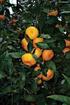
Orange Citrus sinensis 'Parson Brown'
|
|
|
- Joseph Scott
- 9 years ago
- Views:
Transcription
1 Orange Citrus sinensis 'Parson Brown' One of the most widely favored of the world's fruits, the orange, sweet orange, or round orange, was for many years known as Citrus aurantium var. sinensis L. and considered to be a form of the sour orange (q.v.). It is still not universally agreed to be a distinct species, C. sinensis Osbeck, but it is usually treated as though it were. One of its first recorded regional names was the Persian narang, from which were derived the Spanish name, naranja, and the Portuguese, laranja. In some Caribbean and Latin American areas, the fruit is called naranja de China, China dulce, or simply China (pronounced cheena). Description The orange tree, reaching 25 ft (7.5 m) or, with great age, up to 50 ft (15 m), has a rounded crown of slender branches. The twigs are twisted and angled when young and may bear slender, semi flexible, bluntish spines in the leaf axils. There may be faint or conspicuous wings on the petioles of the aromatic, evergreen, alternate, elliptic to ovate, sometimes faintly toothed "leaves" technically solitary leaflets of compound leaves. These are 2 1/2 to 6 in ( cm) long, 1 to 3 3/4 in ( cm) wide. Borne singly or in clusters of 2 to 6, the sweetly fragrant white flowers, about 2 in (5 cm) wide, have a saucer shaped, 5 pointed calyx and 5 oblong, white petals, and 20 to 25 stamens with conspicuous yellow anthers. The fruit is globose, subglobose, oblate or somewhat oval, 2 1/2 to 3 3/4 in ( cm) wide. Dotted with minute glands containing an essential oil, the outer rind (epicarp) is orange or yellow when ripe, the inner rind (mesocarp) is white, spongy and non aromatic. The pulp (endocarp), yellow, orange or more or less red, consists of tightly packed membranous juice sacs enclosed in 10 to 14 wedge shaped compartments which are readily separated as individual segments. In each segment there may be 2 to 4 irregular seeds, white externally and internally, though some types of oranges are seedless. The sweet orange differs physically from the sour orange in having a solid center. Origin and Distribution The orange is unknown in the wild state; is assumed to have originated in southern China, northeastern India, and perhaps southeastern Asia (formerly Indochina). It was carried to the Mediterranean area possibly by Italian traders after 1450 or by Portuguese navigators around Up to that era, citrus fruits were valued by Europeans mainly for medicinal purposes, but the orange was quickly adopted as a luscious fruit and wealthy persons grew it in private conservatories, called orangeries. By 1646 it had been much publicized and was well known. Spaniards undoubtedly introduced the sweet orange into South America and Mexico in the mid 1500's, and probably the French took it to Louisiana. It was from New Orleans that seeds were obtained and distributed in Florida about 1872 and many orange groves were established by grafting the sweet orange onto sour orange rootstocks. Arizona received the orange tree with the founding of missions

2 between 1707 and The orange was brought to San Diego, California, by those who built the first mission there in An orchard was planted at the San Gabriel Mission around A commercial orchard was established in 1841 on a site that is now a part of Los Angeles. In 1781, a surgeon and naturalist on the ship, Discovery, collected orange seeds in South Africa, grew seedlings on board and presented them to tribal chiefs in the Hawaiian Islands on arrival in In time, the orange became commonly grown throughout Hawaii, but was virtually abandoned after the advent of the Mediterranean fruit fly and the fruit is now imported from the United States mainland. The orange has become the most commonly grown tree fruit in the world. It is an important crop in the Far East, the Union of South Africa, Australia, throughout the Mediterranean area, and subtropical areas of South America and the Caribbean. The United States leads in world production, with Florida, alone, having an annual yield of more than 200 million boxes, except when freezes occur which may reduce the crop by 20 or even 40%. California, Texas and Arizona follow in that order, with much lower production in Louisiana, Mississippi, Alabama and Georgia. Other major producers are Brazil, Spain, Japan, Mexico, Italy, India, Argentina and Egypt. In Brazil, oranges are grown everywhere in the coastal plain and in the highlands but most extensively in the States of Sao Paulo and Rio de Janeiro, where orange culture rose sharply in the years immediately following World War II and is still advancing. Mexico's citrus industry is located largely in the 4 southern states of Nuevo Leon, Tamaulipas, San Luis Potosi and Veracruz. The orange crop is over one million MT and Nuevo Leon has 20 modern packing plants, mostly with fumigation facilities. Large quantities of fresh oranges and orange juice concentrate are exported to the United States and small shipments go to East Germany, Canada and Argentina. However, overproduction has glutted domestic markets and brought down prices and returns to the farmer to such an extent that plantings have declined and growers are switching to grapefruit. Cuba's crop has become nearly 1/3 as large as that of Florida. Lesser quantities are produced in Puerto Rico, Central America (especially Guatemala), some of the Pacific Islands, New Zealand, and West Africa, where the fruit does not acquire an appealing color but is popular for its quality and sweetness. Many named cultivars have been introduced and grown in the Philippines since 1912, but the fruitis generally of low qualitybecause of the warm climate. Varieties Most of the oranges grown in California are of 2 cultivars: the 'Washington Navel' and the 'Valencia'. Florida's commercial cultivars are mainly: (early) 'Hamlin'; (mid season) 'Pineapple'; (late) 'Valencia'. The 'Washington Navel' (formerly known as 'Bahia') originated, perhaps as a mutant in Bahia, Brazil, before It was introduced into Florida in 1835 and several other times prior to In 1873, budded trees reached California where the fruit matures at the Christmas season. It is large but with a thick, easily removed rind; not very juicy; of excellent flavor, and seedless or nearly so. Ease of peeling and separation of segments makes this the most popular orange in the world for eating out of hand or in salads. Limonene content of the juice results in bitterness when pasteurized and therefore this cultivar is undesirable for processing. The tree needs a relatively cool climate and should not be grown below an elevation of 3,300 ft (1,000 in) in tropical countries. Today it is commercially grown, not only in Brazil and California, but also in Paraguay, Spain, South Africa, Australia and Japan.

3 'Trovita', a non navel seedling raised in at the Citrus Experiment Station in California and released in 1935, is milder in flavor and has a few seeds, but may be earlier in season, and it has been considered promising in hot, dry regions unsuitable for 'Washington Navel'. There are several other named variations such as 'Robertson Navel', 'Summer Navel', 'Texas Navel', and the externally attractive 'Thompson Navel' which was grown in California for a time but dropped because of its poor quality. Various mutants, more suitable for warmer climates, have been selected and named in Florida, including 'Dream', 'Pell', 'Summerfield', 'Surprise' the latter being more productive than 'Washington Navel' in Florida but still not grown to any extent. 'Bahiamina' is a small version of the 'Washington Navel' developed in Brazil in the late 1940's. It follows 'Pera' and 'Natal' sweet oranges in importance in tropical Bahia. 'Valencia', or 'Valencia Late', is the most important cultivar in California, Texas and South Africa. It has been the leader in Florida until recently. In 1984, 40% of the oranges being planted in Florida were 'Valencia', 60% were 'Hamlin'. The 'Valencia' may have originated in China and it was presumably taken to Europe by Portuguese or Spanish voyagers. The well known English nurseryman, Thomas Rivers, supplied plants from the Azores to Florida in 1870 and to California in In Florida, it was quickly appreciated and cultivated, at first labeled 'Brown' and later renamed 'Hart's Tardiff, 'Hart' and 'Hart Late' until it was recognized as identical to the 'Valencia' in California. It was not propagated for sale in California until 1916 and was slow to be adopted commercially. It is smaller than the 'Washington Navel', with a thinner, tighter rind; is far juicier and richer in flavor; nearly seedless except in Chile where the dry climate apparently allows better pollination and development of many more seeds up to 980 in 44 lbs (20 kg). It needs a warm climate. In fact, it is the most satisfactory orange for the tropics, even though it may not develop full color in warm regions. In Colombia, the quality is good from sea level to 5,000 ft (1,600 m). It bears two crops a year, overlapping and giving it the great advantage of a late and long season lasting until midsummer. The fruits on the trees in spring will regreen, lose their orange color and turn green at the stem end, but the quality is not affected. They were formerly dyed to improve market appearance but since the 1955 Food & Drug Administration ban on the synthetic dyes used on oranges, they have been colored by exposure to ethylene gas in storage. The gas removes the chlorophyll layer, revealing the orange color beneath. Degreening does not occur in California where 'Valencia' oranges from one growing area or another are marketed from late spring through fall. 'Lue Gim Gong' was claimed to be a hybrid of 'Valencia' and 'Mediterranean Sweet' made by a Chinese grower in 'Lue Gim Gong' was awarded the Wilder Silver Medal by the American Pomological Society in 1911 but, later on, his hybrid was judged to be a nucellar seedling of 'Valencia'. Propagated and distributed by Glen St. Mary Nurseries in 1912, this cultivar closely resembles 'Valencia', matures and is marketed with its parent without distinction. It is best cited as the 'Lue Gim Gong Strain' of 'Valencia'. 'Mediterranean Sweet' was introduced into Florida from Europe in 1875, was briefly popular, but is no longer grown. Certain strains of 'Valencia' are classed as summer oranges because the fruits can be left on the trees longer without dehydrating. One is known as 'Pope', 'Pope Summer', or 'Glen Summer'. It was found in a grove of 'Pineapple' oranges near Lakeland about 1916, was propagated in 1935, and trademarked in

4 1938. On sour orange or sweet orange rootstocks in hammock soils, the fruit matures in April but is still in good condition on the tree in July and August. 'Rhode Red Valencia' was discovered in 1955 in a grove near Sebring, Florida, by Paul Rhode, Sr., of Winter Haven. Some budwood was put on sour orange stock which caused dwarfing and some on rough lemon which produced large, vigorous, productive trees. In 1974, 5 trees were accepted into the Citrus Budwood Registration Program but there was no budwood free of exocortis and xyloporosis viruses. The fruit equals 'Valencia' insoluble solids, excels 'Valencia' in volume of juice, is less acid, has slightly less ascorbic acid, but has a far more colorful juice due to its high content of cryptoxanthin, a precursor of vitamin A which remains nearly stable during processing. In Cuba, 'Campbell Valencia' (a 1942 seedling similar to 'Valencia'), 'Frost Valencia' (a 1915 nucellar seedling of 'Valencia'), and 'Olinda Valencia' (a virus free nucellar seedling of 'Valencia' discovered in California in 1939), each on 2 different rootstocks sour orange and Cleopatra mandarin were testplanted in 1973 and evaluated in 'Olinda Valencia' on sour orange excelled in quality and in productivity. 'Hamlin', discovered in 1879 near Glenwood, Florida, in a grove later owned by A.G. Hamlin, is small, smooth, not highly colored, seedless and juicy but the juice is pale. The fruit is of poor to medium quality but the tree is high yielding and cold tolerant. The fruit is harvested from October to December and this cultivar is now the leading early orange in Florida. On pineland and hammock soil it is budded on sour orange which gives a high solids content. On sand, it does best on rough lemon rootstock. 'Homosassa', a selected Florida seedling named in 1877, is of rich orange color, of medium size, and excellent flavor, It was formerly one of the most valued midseason oranges in Florida but it is too seedy to maintain that position. It is no longer planted except perhaps in Texas and Louisiana. 'Shamouti' ('Jaffa'; 'Khalili'; 'Khalili White') originated as a limb sport on a 'Beledi' tree near Jaffa, Israel, in 1844; introduced into Florida about 1883; oval, medium large; peel entirely orange when ripe; leathery, thick, easy to remove; pulp very juicy, of good quality. Constitutes 75% of the Lebanese and Israeli crops; is one of the 2 main cultivars in Syria; was formerly an important, midseason, cold tolerant, cultivar in Florida and was grown in all other orange growing regions of the United States. However, the tree tends to alternate bearing, the fruit does not hold for long on the tree and is subject to the fungus, Alternaria citri, and it is no longer planted in this country. 'Parson Brown' wasdiscovered in a grove owned by Parson Brown in Wester, Florida; was purchased, propagated and distributed by J.L. Carney between 1870 and It is rough skinned, with pale juice; moderately seedy; of low to medium quality. It was formerly popular in Florida because of its earliness and long season (October through December), but has been largely replaced by 'Hamlin'. It is grown in Texas, Arizona and Louisiana but is not profitable in California where it matures at the same time as 'Washington Navel'. It does not develop acceptable quality in the tropics. 'Pineapple' is a seedling found in a grove near Citra, Florida. It was propagated in 1876 or 1877 under the name of 'Hickory'. It is pineapple scented, smooth, highly colored, especially after cold spells; of rich,

5 appealing flavor, and medium seedy. It is the favorite midseason orange in Florida, its tendency to preharvest drop having been overcome by nutrition and spray programs. If the crop is allowed to remain too long on the tree, it may induce alternate bearing. It is grown to some extent in Texas, rarely in California; succeeds on sour orange rootstock in low hammock land, on rough lemon in light sand. Seedless mutants of 'Pineapple' have been produced by seed irradiation. This cultivar does fairly well in tropical climates though not as well as 'Valencia'. 'Queen' is a seedling of unknown origin which was found in a grove near Bartow, Florida. Because it survived the freeze of , it was propagated in 1900 under the name 'King' which was later changed to 'Queen'. It is much like 'Pineapple', has fewer seeds, higher soluble solids, persists on the tree better in dry spells; is high yielding and somewhat more cold tolerant than 'Pineapple'. 'Blood Oranges' are commonly cultivated in the Mediterranean area, especially in Italy, and also in Pakistan. They are grown very little in Florida where the red coloration rarely develops except during periods of cold weather. In California they are grown only as novelties. Among the well known cultivars in this group are 'Egyptian', which tends to develop a small navel; 'Maltese', 'Ruby', and 'St. Michael'. Pollination Orange blossoms yield very little pollen and orange growers do not practice artificial pollination. However, there is evidence of self incompatibility and need for cross pollination in the TANGOR and TANGELO (qq.v.). Climate The orange is subtropical, not tropical. During the growing period, the temperature should range from 55º to 100º F (12.78º 37.78º C). In the winter dormancy, the ideal temperature range is 35º to 50º F (1.67º 10º C). Mature, dormant trees have survived 10 hours at temperatures below 25º F ( 3.89º C) but fruit is damaged by freezing 30º to 26º F ( 1.11º 3.33º C). Young trees may be killed outright by even brief frosts. Hardiness, however, varies with the cultivar and rootstock, Seedling orange trees of bearing age are capable of enduring more cold than budded cultivars. Prolonged cold is more injurious than short periods of freezing temperatures. In Florida, many efforts have been made to protect orange trees from winter cold, which is most damaging if preceded or accompanied by drought. In the early days, slatted shadehouses were erected over young groves. Windbreaks have been planted on the northeast exposure. Old automobile tires have been burned in piles throughout groves. A commercially produced heater has been fueled and lit in the coldest predawn hours. Helicopters have been flown back and forth to cause movement of air, and, more recently, wind machines have been installed. Most recent, and most effective are overhead sprinklers which give maximum protection from cold damage. Favorable annual precipitation varies from 5 to 20 in ( cm), though oranges are frequently grown in areas receiving 40 to 60 in ( cm) of rain. Benthall says that in the damp climate of Lower Bengal, the fruits lack juice and are usually very sour. California's generally dry climate contributes to

6 more intense color in the orange peel than is seen in humid areas. Success in orange culture depends a great deal on the selection of cultivars tolerant of the weather conditions where they are to be grown. Soil The best soil for orange growing in Florida is known as Lakeland fine sand, well drained, and often identified as high hammock or high pineland soil. There must be adequate depth for good root development. Shallow soils of high water holding ability are avoided. In Egypt, it has been found that where the water table is too high 30 in (78 cm) or less below the surface of the soil root growth, vegetative vigor and fruit yield of orange trees are greatly reduced. In the alkaline soil of South Florida, neglected orange trees develop chlorosis and gradually decline. Many old groves planted in the southern part of the state to avoid cold have been totally lost. In California, the best soils for orange groves are deep loams. It is important to select the appropriate rootstock for particular soil conditions. Propagation While the orange will often come true from seed because of nucellar embryos, the common means of assuring the reproduction of cultivars of known quality is by budding onto appropriate rootstocks. It is believed that budding was practiced by Europeans during the 16th and 17th Centuries, but, with the realization that seedling trees were more vigorous and productive, Italian and Spanish orange growers went back to planting seeds. Fortunately, budded orange trees from Europe had been imported into Florida in 1824 and budwood from these and of others later brought in from England was utilized in topworking existing sour and sweet orange seedlings. It was soon apparent that the budded trees came into bearing earlier than seedlings, were less thorny, and matured uniformly. The sweet orange lost popularity as a rootstock because of its susceptibility to foot rot. Sour orange, resistant to foot rot, became the preferred rootstock in low hammock and flatwoods soils with high water table until the discovery of the virus disease, tristeza, in Florida orange groves in This caused many to switch from the susceptible sour orange to 'Cleopatra mandarin'. Unfortunately, trees on 'Cleopatra' stock are reduced in size, they have lower yields than those on sour orange, and acidity of the fruit is elevated. As citrus growing stretched southward into high pineland, rough lemon (Citrus jambhiri) rootstock gained favor and was found to induce more rapid and vigorous growth and earlier bearing, counterbalancing its sensitivity to cold and tendency toward foot rot. Rough lemon became the dominant rootstock in Florida until it was found to be extremely susceptible to blight and was abandoned. Sour orange has been reinstated in recent years because tristeza has been more or less dormant since the 1940's and sour orange is now the prevailing stock for 50% of the orange and grapefruit trees in the state. In second place is the 'Carrizo citrange', resistant to tristeza but subject to exocortis and also to blight though less so than rough lemon. 'Carrizo' is somewhat resistant to the burrowing nematode and gives a little higher yield than the similar rootstocks. Growers are advised to quickly replace blight affected orange trees on rough lemon with new plants on 'Carrizo' held ready for this purpose. Because exocortis can now be detected quickly, it has become possible to utilize 'Carrizo' as a rootstock for hundreds of thousands of orange trees in Florida.

7 About 90% of commercial orange groves in Queensland are on rough lemon rootstock, as are 90% of the citrus trees in Jamaica. In Egypt, rough lemon rootstock has been found short lived on heavy soils. In that country, early budding was done on citron (Citrus medica L.) but that stock was abandoned when sour orange was found much more desirable on the prevailing loamy clay. Second to the sour orange rootstock is the Egyptian lime, locally considered native and used mainly on lighter soils. In the tropical citrus growing region of Bahia, Brazil, Rangpur lime (C. X limonia Osbeck) has been the dominant rootstock 95 % in orchards and 100% in nurseries but experiments in the past few years have shown that rough lemon and Cleopatra mandarin give better results. Also, 'Cleopatra' has good resistance to citrus decline, whereas Rangpur is susceptible to Phytophthora root rot and exocortis. Some oranges are budded onto the so called trifoliate orange (Poncirus trifoliata Raf.) which tends to reduce the growth but is cold tolerant and able to flourish on low, wet soils. It does poorly in light sand. Rootstocks capable of dwarfing orange trees may become necessary if close spacing is to be considered more advantageous. Trifoliate orange cultivar 'English Small' has successfully dwarfed 'Valencia'. 'Rusk' and 'Carrizo' ('Troyer') citranges (P. trifoliata X C. sinensis) show promise for semi dwarfing of 'Valencia'. However, all of these are very susceptible to the exocortis virus. Alternative root stocks include 'Swingle citrumelo' (P. trifoliata X C. paradisi) cold hardy, resistant to tristeza, exocortis, xyloporosis, and the citrus nematode but not the burrowing nematode and the 'Volkamer lemon' (C. volkameriana) which behaves much like rough lemon but gives very high yields of fruit of slightly better quality. In India, the sweet lime (C. limettioides Tanaka) was found to be the best rootstock for their 'Mosambi' orange in wet zones with high maximum temperatures. Cuban horticulturists are currently experimenting with various Citrus species as potential rootstocks to replace sour orange. In Florida, nurseries of seedling rootstocks must be approved by the Department of Agriculture, Division of Plant Industry. The seeds must not be more than 3 to 4 weeks old unless they have been washed, dried, then mixed with sand and kept in a cool place, or put into a plastic bag and refrigerated for a few weeks at about 40º F (4.4º C). Seeds of P. trifoliata are planted in the fall but sour orange and 'Cleopatra mandarin' are planted in spring. Seeds are set in rows 3 to 4 ft ( m) apart and will germinate in 3 weeks. When the stems reach 1/2 in (1.25 cm) in diameter, the seedlings are ready for budding. The budding technique most commonly used in Florida is shield budding by the inverted T method, inserting the bud 2 to 3 in (5 7.5 cm) above ground level. California propagators favor the upright T. Usually the trees are ready for transplanting after one growing season. Mature trees that have been frozen back, or that are to be converted to more suitable cultivars, may be top worked by cleft grafting, crown grafting, or budding of the sprouts that arise after the tree is cut off close to the ground. It must be kept in mind that the rootstock influences not only the rate of growth, disease resistance and productivity of the cultivar but also the physical and chemical attributes of the crop. For example, 'Valencia' oranges on sour orange stock have been found to have more dry matter in the peel, pulp and juice than those on rough lemon. 'Washington Navel' oranges on rough lemon stock have had low levels of potassium in the peel, pulp and juice; and, on 'Cleopatra mandarin' stock, even lower in the pulp and

8 juice. Trifoliate orange rootstock produces high levels of potassium throughout the fruit. In southeastern Queensland, Australia, nearly half of the oranges for processing are grown in the Near North Coast area. There, trials of 'Valencia' on rough lemon revealed that fruit quality was inferior to that in Florida; there was bitterness in the juice and only a small percentage of the fruits met the minimum standards for processing as frozen orange juice concentrate. General quality, flavor and ascorbic acid content were considerably higher on sweet orange rootstock. Trifoliate orange gave second best results. Rootstocks affect the chemistry of the peel oil, especially the aldehyde content, and the oil content of the peel is influenced by selection of budwood. Dr. Walter T. Swingle, one of the early and renowned plant explorers of the United States Department of Agriculture, was an authority on Citrus and vitally interested in rootstocks. He was convinced that they were the key to the successful future of the citrus industry. Culture A spacing of 25 x 25 ft (7.5x7.5 m) was standard in the past. However, many orange groves today are being close planted and hedged to facilitate both manual and wide enough to accommodate mobile machinery for fertilizing, spraying, pruning and harvesting. There are arguments against close spacing; mainly that, as the trees grow and become more crowded, productivity declines; also that close spacing requires expensive pruning. However, data gathered on yields of the 'Pineapple' orange on rough lemon rootstock at Lake Alfred, Florida, over an 11 year trial, showed total yields for the period as: 2,380 boxes per acre (5,880/ha) at 25 x 20 ft (7.5x6 m) 87 trees per acre (215/ha); 3,496 boxes per acre (8,639/ha) at 20 x 15 ft (6x4.5 m) 145 trees per acre (358/ha); 4,484 boxes per acre (11,079/ha) at 15 x 10 ft (4.5 3 m) 290 trees per acre (716/ha). Other examples are given under Yield. The young trees must be carefully tended and kept weed free for the first 2 or 3 years in the field. Citrus trees have special nutritional requirements. The soil should be tested to determine the best balance of major and minor elements to be added. In general, orange trees need to be fertilized with N P K very soon after harvesting. The balance of major nutrients has to be considered in relation to the ultimate use of the crop. For example, extra nitrogen increases the peel oil content of oranges, while extra potassium decreases it. In California, 1 lb (0.45 kg) of nitrogen per tree per year has been found sufficient to maintain high productivity. Indian scientists, after a 4 year study, concluded that sweet oranges of the best quality were produced by applications of nitrogen at the rate of 2 lbs (0.9 kg) per year for 8 year old trees. Orange trees are watched for signs of deficiencies which may be counteracted by foliar spraying. Leaf analysis reveals what is lacking or being applied in excess. Efforts in northern India to control spring fruit drop with growth regulators have not been successful but pre harvest drop has been greatly reduced. Gibberellic acid at 100 to 1,000 ppm, whether applied at full bloom or small fruit stage, has significantly increased the number of 'Washington Navel' fruits harvested. Irrigation: Irrigation of orange trees is carefully managed. Ordinarily, it is omitted in the fall in order to avoid the production of tender new growth that would be damaged in winter cold spells. It may be very desirable in the spring dry season to prevent wilting. Excessive irrigation lowers the solids content of the

9 fruit. The deeper the soil, the better the root system and the greater the ability to withstand drought. Soils at least 4 ft (1.2 m) deep can be given 1 1/2 in (6.25 cm) of water as needed, whereas soils only 1 1/2 ft (45 cm) deep should receive no more than 1 in (2.5 cm) of water at a time but more frequently. Pruning: Orange trees are self forming and do not need to be shaped by early pruning. Removal of water sprouts from young and older trees is important. Branches that are lower than 1 ft (30 cm) from the ground should be taken off. Deadwood from any cause adverse soil conditions, pests or diseases, nutritional deficiencies, or cold injury should be cut out and cut surfaces over 1 in (2.5 cm) in diameter should be sealed with pruning compound. Orange trees that are close planted and hedged are being mechanically pruned by special equipment. Cuban experimenters claim that this procedure is beneficial in increasing the number of new shoots and that it decreases pest and disease problems. In Israel, the old practice of girdling has been revived. If done in winter, it will enhance the sprouting of buds in the spring. Summer girdling increases the size of the fruits. Harvesting In the early days of the orange industry, harvesters climbed ladders and pulled the fruits off by hand, putting them into pails or shoulder sacks which they later emptied into 90 lb (40.8 kg) field boxes. From 1900 to 1940, they used clippers. With the erstwhile shortage and increased cost of field labor, various changes and improvements have been made in harvesting methods. Pulling is again practiced, especially with fruits destined for processing. In the United States, Federal regulations and the individual state Department of Agriculture and state Citrus Commission control the stage of maturity at which the fruits may be picked and the grading of the fruits for marketing and shipping. In anticipation of drastic increases in the cost of conventional harvesting, various methods of wholly or partly mechanized harvesting have been explored, including limb and tree shakers and air jets. Devices developed are not being widely utilized as yet because of the investments necessary for their acquisition and the current availability of manual labor. Manual picking is less laborious now that oranges for processing can be allowed to fall on the ground instead of being placed in sacks which have to be carried down ladders. The efficiency of hand harvesting has been enhanced also by the use of fiberglass ladders and abscission agents which make it possible to pluck the fruit with less force and consequently greater speed. Good workers who have harvested oranges at the rate of 6.5 boxes per hour are now able to pick 9.1 boxes per hour. The effectiveness of the abscission agent depends largely on the lapsed time after spray application and the prevailing temperature and relative humidity during that period. Yield On the average, a 'Washington Navel' orange tree may bear approximately 100 fruits in a season. Horticulturists at the University of Puerto Rico have selected Navel orange clones and budded them onto orange seedlings for test plantings. Of 5 that were numbered 4, 5, 6, 7 and 8, numbers 5 and 7 surpassed the others in productivity, number 7 yielding 293 fruits per tree. These two clones are considered worthy of propagation and naming. It is said that very old, large orange trees in the Mediterranean area may bear 3,000 to 5,000 oranges each year.

10 Growers everywhere are testing high density as a means of gaining higher yields. In Australia, 'Valencia' orange trees 6 years old, planted 1,011 to 2,023 trees per acre (2,500 5,000/ha), yielded 24 tons/acre (60 tons/ha). 'St. Ives Valencia' trees on P. trifoliata rootstock and inoculated in the nursery with mildly dwarfing exocortis, were planted in 1973 at densities ranging from 270 to 2,023 trees per acre (667 5,000 trees/ha). Those at 506 trees/ acre (1,250/ha) yielded 55 tons/acre (135 tons/ha). Those at 1,214 to 2,023 trees/acre (3,000 5,000/ha) yielded 105 tons/acre (260 tons/ha) until after the 4th crop, when productivity began to decline. Keeping Quality Oranges can be stored for 3 months at 52º F (11.11º C); up to 5 months at 36º to 39º F (2.22º 3.89º C). Deterioration in market quality is primarily due to transpiration loss of moisture in the peel and pulp. After 2 months of storage at 68º F (20º C) and, relative humidity of 60 to 80 %, 'Valencia' oranges have been found to have lost 9.5% of the moisture in the peel but only 2.1% of that in the pulp. The peel becomes 50% thinner, the pulp 10%. Later, the peel is very thin, dry and brittle while the pulp is still juicy. Coating the fruits with a polyethylene/wax emulsion doubles the storage life. Pests Oranges and other citrus fruits are commonly affected by citrus rust mites causing external blemishing and, in extreme infestations, smaller fruits, pre mature falling and even shedding of leaves. Citrus red mites (purple mites) and Texas citrus mites, common in summer, disfigure the surface of the fruit and the foliage mainly in the winter and during droughts. Parasitic fungi (Hirsutella thompsonii and Triplosporium floridana) help to eradicate rust mites and the Texas citrus mite. Several scale insects prey on citrus trees. The most harmful enemy is citrus snow scale infesting the woody portions of the tree. Purple scale and glover scale suck sap from the branches, twigs, leaves and fruit. Florida red scale and yellow scale induce shedding of fruit and foliage. Chaff scale may be found on the fruit, foliage and bark and produces green spots on the fruit. Cottony cushion scale often infests young trees. Maintaining populations of the Vedalia lady beetle in nurseries and groves is a fairly effective means of controlling this scale. Parasitic wasps (Aphytis spp.) are able to control Citrus snow scale, purple scale and Florida red scale. California red scale (Aonidiella aurantii) is fairly well controlled by insect parasites in desert orchards but chemical treatment is necessary in the San Joaquin Valley when pheromone trapping of males reveals infestations. Pheromone trapping has virtually eliminated this scale in commercial groves in Arizona. Mealybugs, prevalent in spring and early summer, form white masses underneath and between fruits in the early stages of development and may cause shedding, and their excretion of honeydew provides a base for the fungal manifestation termed sooty mold. The whitefly in its immature stage congregates on the lower side of the leaves, sucking the sap, and also excreting honeydew leading to sooty mold. Immature whiteflies are preyed upon by the parasitic fungi, Aschersonia spp. and Aegerita sp., which are frequently mistaken for harmful pests. The citrus blackfly, Aleurocanthus woglumi, deposits eggs in spiral formations on the underside of the leaves. It is a serious pest in many of the citrus regions of the

11 world. In January 1976, an inspection program was launched in Florida with the expectation that spraying could eventually be replaced with biological control utilizing the blackfly parasites, Amitus hesperidum and Prospaltella opulenta. By 1978, the parasites were credited with a 97% reduction in the blackfly population. Aphids (plant lice) cause leaves to curl and become crinkled. The brown citrus aphid, Toxoptera citricidus, is the main vector of the tristeza virus. The orange dog is a large brown and white caterpillar, the larva of a black and yellow, swallowtailed butterfly. These pests damage the trees in summer and autumn. In 1953, it was discovered that the burrowing nematode, Radopholus similis, was the cause of spreading decline in Florida and extraordinary measures costing over 21 million dollars in the next 22 years were taken to remove infested trees, treat the soil and create buffer zones to prevent spread into other groves. Fruit flies are a constant threat to oranges and massive steps have been taken against the spread of the Mediterranean fruit fly whenever it has appeared in Florida or California. The Caribbean fruit fly is common in Florida and oranges from this state were, until 1980, fumigated with ethylene dibromide before export. When this chemical was reported to have caused cancer in experimental animals, it was banned for export or domestic use. Instead, cold treatment for 17 days at 34º F (1.1º C) has been required. Quality of 'Valencia' oranges has remained stable for only 1 week at 40º F (4.4º C) following cold treatment; has deteriorated in a further 2 weeks at 70º F (21.1º C). Diseases Orange and other citrus trees are subject to a great number of fungal diseases affecting the roots, the trunk and branches, the foliage and the fruits. Greasy spot, caused by Cercospora citri grisea, is seen, 2 to 9 months after severe infection, as yellow brown, blistery, oily, brown or black spots on the foliage. Severe defoliation may follow. The fungus, Diaporthe citri, is responsible for gummosis, melanose, dieback and stem end rot. The fungus, Elsinoe australis, causes sweet orange scab which is frequently seen on oranges in South America and in Sicily and New Caledonia. Phytophthora megasperma, P. palmivora and P. Parasitica are common causes of foot rot. There are also viruses and viroids usually named for the syndromes they cause crinkly leaf; gummy bark; exocortis (scaly butt) transmitted by budwood and by tools; psorosis, xyloporosis (cachexia), transmitted only by budwood. Tristeza has been a major problem in Florida in the past and still is in Brazil. Since 1953, Florida has maintained a Citrus Budwood Registration program for the production of virus tested citrus trees. Under this program, the Etrog citron was adopted as a test plant for identifying exocortis virus in one year's time, and techniques have been developed for identifying tristeza in a few hours instead of months. In 1984, an outbreak of citrus canker (Xanthomonas campestris pr. citri or Phytomonas citri) in four whole sale citrus nurseries in Florida caused widespread alarm and forced the burning of thousands of nursery plants and a search for plants that had been sold by those nurseries, in efforts to prevent the

12 spread of this menace. The virus causes lesions on fruits, stems, and, unlike other diseases, on both sides of the leaves; induces leaf fall and premature fruit drop and, in severe cases, the death of the tree. Canker is common in various countries including India, the Philippines, the Middle East, parts of Africa and in Brazil and Argentina. The highly virulent Oriental Strain A was introduced into Florida in 1910 and was eradicated in Florida and the Gulf States by In anticipation of reintroduction, pathologists have gone abroad to study the disease. By January 1986, Strain E had been reported in 17 nurseries and over 15 million young trees had been destroyed. Eradication programs were intensified when Oriental Strain A reappeared on Florida's west coast in midsummer, and 5 million more trees had to be burned. Blight, or young tree decline (YTD), is the leading cause of losses of orange trees up to a half million per year in Florida, especially 'Valencia' on rough lemon, but any cultivars on any rootstocks. Sour orange rootstock seems somewhat more resistant than the others. Blight was thought to be the result of nutritional deficiencies or physiological or soil problems. But root grafting of healthy trees onto affected trees has shown the disease to be infectious. Experiments at Lake Alfred have shown that substantial recovery from YTD, can be achieved by early treatment of an affected tree with 20 gals (7 6 liters) of a 1 1/2% solution of sodium erythorbate or erythorbic acid applied to the soil, and 10 gals (38 liters) applied as a foliar spray, plus soil application of 5 to 7 1/2 lbs ( kg) of calcium chloride or calcium nitrate about 6 ft (1.8 m) out from the base of the trunk. Foliar sprays of urea 5 lbs (2.2 kg) per 100 gals (380 liters) with a wetter sticker are given to encourage new growth. Californian scientists have traced decline of the 'Navel' orange to incompatibility with trifoliate orange rootstock (especially 'Rubidoux'; rarely 'Rich 16 6'). Malformation at the union, evident in about 20 years, fully developed in 25, takes two forms tongue and groove, and shelf and shoulder distortions. Often, abnormal aspects of leaves, occasioned by mineral deficiencies, may be mistaken for signs of disease, Exanthema is the result of copper deficiency. Mottle leaf indicates zinc deficiency. Yellow spot signals lack of molybdenum. On the other hand, star melanose is brought about by late copper spraying. Inspection by trained entomologists and/or plant pathologists is usually necessary to determine the actual cause, or causes, of disfigurations or decline. Citrus quarantine laws are very strict with a view to preventing the introduction and spread of pests and diseases, and failure to comply with these laws can have disastrous consequences. Selected from

Growing Balaton - Horticultural Considerations
 Growing Balaton - Horticultural Considerations Amy Iezzoni Dept. of Horticulture Michigan State University Jim Nugent District Horticulturist MSU Extension The fruit industry in Michigan has generations
Pineapples. Ian Hewett Horticultural Marketing Inspectorate United Kingdom. Version - October 2011
 Pineapples Ian Hewett Horticultural Marketing Inspectorate United Kingdom Version - October 2011 1 Definition Of Produce This Standard applies to pineapples of varieties (cultivars) grown from Ananascomosus(L).
Why Fruit Trees Die D. B. Meador, Extension Specialist (retired) University of Illinois
 Why Fruit Trees Die D. B. Meador, Extension Specialist (retired) University of Illinois Occasionally, fruit trees decline and often die. Diseases affecting the leaves, fruit, and twigs of fruit trees usually
Strawberry Anthracnose
 Strawberry Anthracnose Bill Turechek and Cathy Heidenreich Introduction - The term anthracnose is a general term used to describe plant diseases. Strawberry anthracnose refers to several diseases of strawberry
Diagnosing Home Citrus Problems
 ARIZONA COOP E R AT I V E E TENSION AZ1492 April 2009 Diagnosing Home Citrus Problems John Begeman, Glenn Wright PROBLEMS OF FRUIT Fruit Drops Prematurely: Natural fruit drop occurs during the spring.
Custard apple information kit
 information kit Reprint information current in 1998 REPRINT INFORMATION PLEASE READ! For updated information please call 13 25 23 or visit the website www.deedi.qld.gov.au This publication has been reprinted
Citrus Propagation 1. Fact Sheet HS-86 June 1994. J. G. Williamson and L. K. Jackson 2 DEFINITIONS OF HORTICULTURAL TERMS COMPOSITION OF A CITRUS TREE
 Fact Sheet HS-86 June 1994 Citrus Propagation 1 J. G. Williamson and L. K. Jackson 2 Home fruit growers often want to propagate their own citrus trees, or change varieties by top-working an existing tree
Tree Integrated Pest Management. Dan Nortman Virginia Cooperative Extension, York County
 Tree Integrated Pest Management Dan Nortman Virginia Cooperative Extension, York County IPM Refresher Definition: The use of a combination of appropriate pest control tactics to reduce pest population
Growing Cocoa Beans. Growing Region
 Growing Cocoa Beans All chocolate begins with cocoa beans, the fruit of the cacao tree (also called a cocoa tree). Scientists know that the cacao tree originated somewhere in South or Central America.
Identification and Prevention of Frost or Freeze Damage By Linda Reddick, Kingman Area Master Gardener
 KINGMAN IS GROWING! COLUMN Identification and Prevention of Frost or Freeze Damage By Linda Reddick, Kingman Area Master Gardener Again this year we have been experiencing some very cold weather, with
RIPPLE Africa Step by Step Fruit Tree planting Guide
 RIPPLE Africa Step by Step Fruit Tree planting Guide NOTES ON FRUIT PRODUCTION Aim and Objective The aim and objective of RIPPLE Africa as an organisation is to make Nkhata Bay District one of the leading
Strawberry Leaf Spot
 Strawberry Leaf Spot Cathy Heidenreich and Bill Turechek Introduction - Leaf spot is one of the most common and widespread diseases of strawberry. Mycosphaerella fragariae is also the cause of black seed
Part 1: Knowing how to identify the problem. Author: Damon Polta, Friendly Aquaponics Farm Manager. For free distribution.
 Diseases, Deficiencies, and Toxicities in Plants Part 1: Knowing how to identify the problem. Author: Damon Polta, Friendly Aquaponics Farm Manager. For free distribution. Diseases Beet Western Yellow
Your Florida Dooryard Citrus Guide - Common Pests, Diseases, and Disorders of Dooryard Citrus 1
 HS 890 Your Florida Dooryard Citrus Guide - Common Pests, Diseases, and Disorders of Dooryard Citrus 1 James J. Ferguson 2 You've probably already noticed that Florida's humid climate harbors all kinds
Chilli - Long Red Cayenne, Long Slim Cayenne, P2391, Serano, Skyline 3, Star 6601, Thai chili, Thai Dragon.
 CAPSICUMS Hot pepper (chilli), sweet pepper and paprika. CLIMATE These crops require warmer conditions than tomatoes, and are more sensitive to cold and frost. The optimum mean temperatures for growth,
As closely related members of the rose family,
 E-612 2-13 Texas Fruit and Nut Production lums, Nectarines, Apricots Cherries, Almonds and Prunus hybrids Larry Stein, Jim Kamas, and Monte Nesbitt Extension Fruit Specialists, The Texas A&M University
runing & Orchard Renewal
 P runing & Orchard Renewal Richard G. St-Pierre, Ph.D. (January 2006) The Basics Of Pruning & Orchard Renewal Pruning is defined as the art and science of cutting away a portion of a plant to improve its
The lychee belongs to the Sapindaceae family Christian DIDIER
 THE LYCHEE Litchi chinensis Sonn is a tropical /subtropical fruit originated in southern China and southeastern Asia. The lychee belongs to the Sapindaceae family Christian DIDIER Introduction to LYCHEE
PINEAPPLE PRODUCTION. Introduction
 PINEAPPLE PRODUCTION Introduction The pineapple is a tropical and subtropical fruit grown in many countries in Africa. In Uganda it is mainly grown south of Lake Kyoga and western Uganda. Ii is a tradable
Care of Mature Backyard Apple Trees
 Education Center and Info Line practical solutions to everyday questions Toll free Info Line 1-877-398-4769 M-F 9 AM - 2 PM Care of Mature Backyard Apple Trees Introduction Backyard apple trees can be
A guide for handling for cabbage, carrot, hot pepper, lettuce, sweet potato and tomato. Food and Agriculture Organization of the United Nations
 A guide for handling for cabbage, carrot, hot pepper, lettuce, sweet potato and tomato Food and Agriculture Organization of the United Nations A guide for handling for cabbage 1. HARVESTING Harvesting
Tropical Horticulture: Lecture 11
 Lecture 11 Agricultural Development in Tropical America Cuba Until 1900 the island was in an era of hacienda, only few plantations. A modern plantation developed at the end of the Colonial period. The
CITRUS PRUNING. control, fruit production and size control
 CITRUS PRUNING Pruning techniques for tree health pest Pruning techniques for tree health, pest control, fruit production and size control Tree Shapes Citrus trees are generally pruned to a central leader
GARDEN FACTS. When are apples ripe?
 A3743-E GARDEN FACTS U n i v e r s i t y o f W i s c o n s i n E x t e n s i o n When are apples ripe? Teryl R. Roper DIFFERENT APPLE CULTIVARS RIPEN over a long season. In Wisconsin, apples ripen from
The Basics of Tree Pruning
 The Basics of Tree Pruning By John Ball, Forest Health Specialist and Aaron Kiesz, Urban and Community Forestry Specialist Until the end of the 19 th century, trees were not a common sight in many parts
University of California Cooperative Extension Master Gardeners The Backyard Orchard Fruit Cultivation Guide
 Strawberries (Short day: Chandler ; Day neutral: Fern ) Blueberries (Low chill: O Neal, Misty, Sunshine Blue ) Boysenberries ( Boysen, Olallie ) Raspberries ( Bababerry ) Bareroot and 6 packs in fall to
KINGMAN IS GROWING! Column
 KINGMAN IS GROWING! Column Protect Plants When Temperatures Drop By Charlee Ware, Kingman Area Master Gardener Fortunately for us, we had three extra weeks of warm fall weather. In most years, that 32-degree
Plant Responses to Environmental Cues Tropisms, Photoperiodism, and Plant Hormones
 Plant Responses to Environmental Cues Tropisms, Photoperiodism, and Plant Hormones Plant Responses to Environmental Cues Phototropism - plant growth response to light shoots bend toward light - positive
Insect Pests of Pecan. Will Hudson Extension Entomologist
 Insect Pests of Pecan Will Hudson Extension Entomologist How important is nut drop to production? Pecan trees typically lose 75% of the pecans between nut set and shell hardening even when protected from
Citrus Fruits for Southern and Coastal Georgia
 Citrus Fruits for Southern and Coastal Georgia Gerard W. Krewer, Extension Fruit Specialist and Arlie A. Powell, Former Extension Horticulturist Table of Contents Introduction... 1 Historical Background
WHAT IS WRONG WITH MY LAWN?
 WHAT IS WRONG WITH MY LAWN? Lawn problems can occur in small areas or larger patches and entire lawns can be affected. Sometimes the problems are due to poor growing conditions, improper lawn care practices,
LOW DESERT CITRUS VARIETIES
 Publication AZ 1001 LOW DESERT CITRUS VARIETIES Issued April 1998 by: Michael Maurer, Agent Fruits Crops Lucy Bradley, Agent Urban Horticulture Cooperative Extension College of Agriculture http://ag.arizona.edu/extension/
Irish potatoes are one of America s most
 E-511 11-10 Easy Gardening Joseph Masabni, Assistant Professor and Extension Horticulturist, The Texas A&M University System Irish potatoes are one of America s most popular vegetables the average American
Two Main Precautions Before You Begin Working
 Pruning Mango Trees Roy Beckford, Ag/Natural Resources Agent, UF/IFAS Lee County Two Main Precautions Before You Begin Working 1. Mango peel and sap contain urushiol, the chemical in poison ivy and poison
Integrated Pest Management
 Chapter 2 Integrated Pest Management In This Chapter Keywords After learning the information in this chapter, you will be able to: 1. Define Integrated Pest Management (IPM). 2. List and describe the 5
Apricot Tree Prunus armeniaca
 Apricot Tree Prunus armeniaca Up to 25-30 tall x 15-20 wide or partial shade 10 degrees F. General: The Apricot Tree is a subspecies of the peach and dates back 3,000 years to northeastern China. Apricots
Types/Cultivars Season of Maturity Seeds/Fruit Relative Fruit Size
 Fact Sheet HS-85 September 1995 Growing Citrus in the Dooryard 1 L. K. Jackson 2 Citrus trees can be an important part of the landscape for many Florida homeowners. They are both useful ornamental trees
Virginia Gardener http://www.hort.vt.edu/envirohort
 The Virginia Gardener http://www.hort.vt.edu/envirohort Name Help Sheets: Seeds What Is a Seed? A seed is a very young plant that is in the dormant, or resting stage. It is very much alive. There are three
Whiteflies in Southwest Florida
 Whiteflies in Southwest Florida 02/22/2013 Agenda What is a whitefly? What damage do whiteflies cause? How can whiteflies be treated? What is the future for whitefly problems? What is a whitefly? Small,
Citrus for Southern and Coastal Alabama
 A L A B A M A A & M A N D A U B U R N U N I V E R S I T I E S ANR-603 Citrus for Southern and Coastal Alabama With proper attention given to selection of the more cold hardy varieties, along with recommended
Zinfandel. clusters. Synonyms None
 Zinfandel Synonyms None Source Zinfandel is only grown under this name in California. As a result, historians have long debated the appearance of this variety in the state. Some believe Zinfandel was first
Horticulture Information Leaflet 33-E
 Department of Horticultural Science Horticulture Information Leaflet 33-E Revised 9/93 -- Author Reviewed 8/97 VEGETABLE CROP IRRIGATION Douglas C. Sanders, Extension Horticultural Specialist Distributed
COOPERATIVE EXTENSION
 COOPERATIVE EXTENSION UNIVERSITY of CALIFORNIA COUNTY of SAN DIEGO 4-H YOUTH & FAMILY AGRICULTURE HORTICULTURE NATURAL RESOURCES NUTRITION & CONSUMER SCIENCE 9335 Hazard Way, Suite 201, San Diego, CA 92123
Strawberry Production Basics: Matted Row
 Strawberry Production Basics: Matted Row David T. Handley, Vegetable and Small Fruits Specialist University of Maine Cooperative Extension Highmoor Farm, P.O. Box 179, Monmouth, Maine 04259 (207) 933-2100
Coffee Growing Basics: Fertilizer, Disease, Insects. HC Skip Bittenbender Extension Specialist CTAHR/UH
 Coffee Growing Basics: Fertilizer, Disease, Insects HC Skip Bittenbender Extension Specialist CTAHR/UH Problems? Who to call first? Our UH/CTAHR Extension Agents! Virginia Easton Smith, W. Hawaii - 322-4892
HARVESTING AND GINNING OF COTTON IN THE WORLD
 HARVESTING AND GINNING OF COTTON IN THE WORLD M. Rafiq Chaudhry Technical Information Section International Cotton Advisory Committee, Washington, D.C. Abstract About 30% of world cotton production is
Onion & Leek Planting Guide
 Onion & Leek Planting Guide Important Remove plants from box immediately. Do not put in soil or water before planting. Keep cool and dry until you can plant. Follow the instructions inside for best results.
Christmas Trees Pseudotsuga menziesil (Douglas-fir), Abies grandis (Grand fir), Abies procera
 Christmas Trees Pseudotsuga menziesil (Douglas-fir), Abies grandis (Grand fir), Abies procera (Noble fir) (Pinaceae) Fast Facts: Acres in Washington: 25,000 acres Number of growers: 300 Value of Production
Orange Fruit Processing
 Orange Fruit Processing Luis Cisneros-Zevallos, Ph.D. Department of Horticultural Sciences Texas A&M University Commercially Important Orange Varieties Valencia - most widely grown, late maturing, good
Hop Pest Control. H. E. Morrison. jpf^vrsiolnrru; - «ibntoj."' «- '',orto JUN 6 I-JJ3
 Hop Pest Control H. E. Morrison its of jpf^vrsiolnrru; - «th ' s ibntoj."' «- '',orto JUN 6 I-JJ3 Agricultural Experiment Station Oregon State College Corvallis Circular of Information 589 May 1958 Hop
Citrus: Should We Still Plant Them? The Question of the Hour.
 Citrus: Should We Still Plant Them? The Question of the Hour. J.D. Burrow, M.M. Dewdney, and M. Rogers University of Florida, IFAS, Citrus Research and Education Center Outline Florida Citrus History Citrus
CITRUS PROBLEM DIAGNOSIS
 Citrus trees are well suited for Southern California. They don t mind alkaline soil too much and they like the climate. The major problems of backyard citrus at this time are Citrus Leafminer, various
Figs are one of the most problem-free fruits that can be
 EHT-019 11-13 Texas Fruit and Nut Production F igs Jim Kamas, Monte Nesbitt, and Larry Stein Extension Fruit Specialists, the Texas A&M AgriLife Extension Service Figs are one of the most problem-free
The Alfalfa Weevil in Utah
 Page 1 of 5 The Alfalfa Weevil in Utah Fact Sheet No. 58 January 1989 Edward W. Evans Extension Entomologist Introduction The alfalfa weevil is a major pest throughout Utah. It is a beetle with one generation
Maintaining Cactus and Succulents
 Maintaining Cactus and Succulents Master Gardener Education February 22, 2011 Jack Kelly University of Arizona College of Agriculture and Life Sciences Pima County Cooperative Extension Tucson, Arizona
GENERAL WATERING & CARE GUIDE
 GENERAL WATERING & CARE GUIDE Between 30-60 percent of water applied to lawns and gardens is never absorbed by the plants. Water is often wasted because it is applied too quickly and runs off, evaporates
Chapter D9. Irrigation scheduling
 Chapter D9. Irrigation scheduling PURPOSE OF THIS CHAPTER To explain how to plan and schedule your irrigation program CHAPTER CONTENTS factors affecting irrigation intervals influence of soil water using
Asparagus (Asparagus officinalis) is a
 E-503 03-09 Easy Gardening ASPARAGUS ASPARAGUS ASPARAGUS ASPAR Joseph Masabni, Assistant Professor and Extension Horticulturist, The Texas A&M University System Asparagus (Asparagus officinalis) is a highly
JAPANESE KNOTWEED. What is Japanese Knotweed?
 JAPANESE KNOTWEED What is Japanese Knotweed? Japanese Knotweed (botanical name Fallopia japonica) was introduced into Britain from Japan in the early 1800 s. It was originally grown as an ornamental plant,
Assessing the Value of Pecan Trees
 Assessing the Value of Pecan Trees by Dan Childs, Job Springer, Charles Rohla and Steve Upson It is the intent of this publication to provide methodology that appraisers, tax preparers and other interested
BANANA PRODUCTION. ARC-Institute for Tropical and Subtropical Crops. Banana Production - English
 BANANA PRODUCTION ARC-Institute for Tropical and Subtropical Crops Banana Production - English BANANA PRODUCTION Compiled by Directorate Communication National Department of Agriculture and W. Willemse,
P omegranates. Texas Fruit and Nut Production. Larry Stein, Jim Kamas, and Monte Nesbitt, Extension Fruit Specialists, The Texas A&M University System
 E-613 2-13 Texas Fruit and Nut Production P omegranates Larry Stein, Jim Kamas, and Monte Nesbitt, Extension Fruit Specialists, The Texas A&M University System I nterest in growing pomegranates has increased
Moringa Oleifera a Multipurpose Tree:
 Moringa Oleifera a Multipurpose Tree: 1.0 Introduction: Amandla Resources 1.1 Moringa Oleifera belongs to the onogeneric family of shrubs and trees and originated south of the Himalayas in Northern India.
1 SEEDLING QUALITY. Seedling quality
 Seedling quality Quality versus quantity A nursery manager s most important goal is to produce quality trees. Quality is more important than quantity. It is a common mistake in nurseries to concentrate
1. THE GROWER 2. GREENHOUSE STRUCTURE FEATURED 3. CROPS GROWN. Hung Nguyen: 0408 696 949, [email protected]
 1. THE GROWER Hung Nguyen: 0408 696 949, [email protected] Hung is a new grower in his third year of independent farm management. He completed a Diploma in Horticulture while working on his parent
Maintaining a Healthy Lawn
 Maintaining a Healthy Lawn in Western Oregon A.M. VanDerZanden and T. Cook EC 1521 Reprinted February 2001 $1.50 The typical home lawn is an evolving ecosystem that gets more complex each year. At first,
Cloud Mountain Farm Center 6906 Goodwin Rd., Everson, WA 98247 (360)966-5859 voice, (360)966-0921 fax, www.cloudmountainfarmcenter.
 Disease and Pest Management in the Home Orchard Fruit trees have been grown in home orchards for centuries. The goal of many gardeners today is to have fresh fruit from their own trees with a minimum of
Introduction to Plant Propagation. Glenn T. Sako Assistant County Extension Agent CTAHR, UHM
 Introduction to Plant Propagation Glenn T. Sako Assistant County Extension Agent CTAHR, UHM Purposes for Plant Propagation Multiply the number of a species Perpetuate a species Maintain the youthfulness
PUTTING FORAGES TOGETHER FOR YEAR ROUND GRAZING
 PUTTING FORAGES TOGETHER FOR YEAR ROUND GRAZING Jimmy C. Henning A good rotational grazing system begins with a forage system that allows the maximum number of grazing days per year with forages that are
Pruning Fruit Trees. Develop strong tree structure. This should begin when trees are planted and continue each year thereafter.
 Agriculture and Natural Resources Pruning Fruit Trees Extension Horticulture Arkansas Is Our Campus Visit our web site at: http://www.uaex.edu Fruit trees should be pruned every year to maintain their
2. Trade in forest commodities
 5 2. Trade in forest commodities The volume of wood products in international trade increased 125 percent between 1992 and 2008 (FAO, 2010b). Some examples of the changes in volume of exports of particular
Southern Purple Hardneck
 Highly recommended. I have obtained variations of this type from 5 separate sources in the South (and North) Islands under different names. It appears to be widely grown in the South Island and is a strong
Summer Stress Arrives Early on Cool Season Lawns
 Summer Stress Arrives Early on Cool Season Lawns Figure 1. A fall installed tall fescue sod showing the first signs of summer stress following the arrival of record setting heat in central Virginia in
Business Planning and Economics
 Business Planning and Economics of Apple Orchard Establishment and Cost of Production in Nova Scotia 1 Business Planning and Economics of Apple Orchard Establishment and Cost of Production in Nova Scotia
Pruning Trees. Center for Landscape and Urban Horticulture. University of California Cooperative Extension Central Coast & South Region
 University of California Cooperative Extension Central Coast & South Region Center for Landscape and Urban Horticulture Pruning Trees Pruning Trees at Planting Landscape trees should not be pruned at planting
ROOTSTOCKS FOR FRUIT TREES
 A3561 ROOTSTOCKS FOR FRUIT TREES IN WISCONSIN TO OBTAIN fruit that is true to type, fruit trees INORDER are propagated by budding or grafting sections of known cultivars (scions) onto special rootstocks.
Oak Trees BASIC GROWING REQUIREMENTS FOR YOUR
 They are beautiful in their peace, They are wise in their silence. They will stand after we are dust. They teach us, and we tend them. G.A. MacDunelmor BASIC GROWING REQUIREMENTS FOR YOUR Oak Trees The
NUTRIENT DISORDERS IN TREE FRUITS
 PNW 121E NUTRIENT DISORDERS IN TREE FRUITS A Pacific Northwest Extension Publication Washington Idaho Oregon NUTRIENT DISORDERS IN TREE FRUITS By Nels R. Benson, Soil Scientist and Horticulturist (retired),
Fertilizer, Weed Control, Grubs, and General Application Questions
 Lawn Care FAQ s Fertilizer, Weed Control, Grubs, and General Application Questions Why do we have so many weeds? Dandelions in particular, weeds in general, do not seem concerned about how long lawn has
The concepts developed in this standard include the following: Oceans cover about 70% of the surface of the Earth.
 Name Date Grade 5 SOL 5.6 Review Oceans Made by SOLpass - www.solpass.org [email protected] Reproduction is permitted for SOLpass subscribers only. The concepts developed in this standard include
Tree and forest restoration following wildfire
 Peter F. Kolb (PhD) MSU Extension Forestry Specialist Adj. Assistant Professor Forest Ecology School of Forestry, University of Montana, Missoula, MT 59808 Tel. (406) 243-4705, e-mail: [email protected]
JUNIPER TREE NURSERY. Growing The Future Forest Today. A Promise We ve Been Keeping Since 1957.
 JUNIPER TREE NURSERY Growing The Future Forest Today. A Promise We ve Been Keeping Since 1957. JUNIPER TREE NURSERY J.D. Irving, Limited has had an active tree growing program since 1957 as part of our
12. INSECT PEST AND DISEASE MANAGEMENT
 12. INSECT PEST AND DISEASE MANAGEMENT Conservation farming promotes a diversity of insect life, influences pest populations and also favours many beneficial insects. The beneficial insects which act as
BENEFITS OF USING IPM
 Edward J. Bechinski and William H. Bohl Potato growers who use IPM consider all available pest control tools. Alternatives to conventional pesticides are the foundation of every IPM plan. Pesticides play
UNECE STANDARD FFV-52 concerning the marketing and commercial quality control of EARLY AND WARE POTATOES 2011 EDITION
 UNECE STANDARD FFV-52 concerning the marketing and commercial quality control of EARLY AND WARE POTATOES 2011 EDITION UNITED NATIONS New York and Geneva, 2011 NOTE Working Party on Agricultural Quality
FORESTED VEGETATION. forests by restoring forests at lower. Prevent invasive plants from establishing after disturbances
 FORESTED VEGETATION Type of strategy Protect General cold adaptation upland and approach subalpine forests by restoring forests at lower Specific adaptation action Thin dry forests to densities low enough
University of Hawaii at Manoa, College of Tropical Agriculture and Human Resources
 University of Hawaii at Manoa, College of Tropical Agriculture and Human Resources J. Sugano, J. Uyeda, S. Fukuda, K. Wang, M. Kawate, C. Tamaru, B. Fox, and T. Radovich College of Tropical Agriculture
Managing of Annual Winter Forages in Southwest Texas
 r r r rr EDUCATION RESEARCH EXTENSION The Texas A&M University System Soil & Crop Sciences Managing of Annual Winter Forages in Southwest Texas Mr Charles Stichler Assocaite Professor and Extension Agronomist
Virginia Gardener http://www.hort.vt.edu/envirohort
 The Virginia Gardener http://www.hort.vt.edu/envirohort Name Help Sheets: Things Plants Need There are certain things that every living thing needs in order to live and grow. Just like you, plants need
Ligustrum, Privet Ligustrum japonicum
 Ligustrum, Privet Ligustrum japonicum http://edis.ifas.ufl.edu/mg022 Propagation L. japonicum Ligustrum are propagated by softwood cuttings taken in spring, or 5 10 cm semihardwood cuttings with a heel
Symptoms Include: Stippled, bronzed or bleached appearance of leaves
 Common Tree Pests & Diseases Of Central Texas Lara Schuman City of Austin Urban Forestry Program Stress and Trees City life can be stressful, and trees feel stress too. Common urban tree issues include:
Growing the Best Phalaenopsis
 CULTURE CORNER Growing the Best Phalaenopsis Part 4: A Complete Production Schedule By Matthew Blanchard, Roberto Lopez, Erik Runkle, PhD, and Yin-Tung Wang, PhD TOP An example of mass production of young
UNECE STANDARD FFV-14 concerning the marketing and commercial quality control of CITRUS FRUIT 2012 EDITION
 UNECE STANDARD FFV-14 concerning the marketing and commercial quality control of CITRUS FRUIT 2012 EDITION UNITED NATIONS New York and Geneva, 2012 NOTE Working Party on Agricultural Quality Standards
IRRIGATING TOBACCO. J. Michael Moore
 IRRIGATING TOBACCO J. Michael Moore Irrigation is an important component for the production of quality tobacco in Georgia. Rainfall is unpredictable and generally unreliable during the critical growth
Construction Damage to Trees
 Construction Damage to Trees When a building site is cleared, several large, well-established trees are often left to enhance the aesthetic value of the property. However, within about 2-8 years after
CORN IS GROWN ON MORE ACRES OF IOWA LAND THAN ANY OTHER CROP.
 CORN IS GROWN ON MORE ACRES OF IOWA LAND THAN ANY OTHER CROP. Planted acreage reached a high in 1981 with 14.4 million acres planted for all purposes and has hovered near 12.5 million acres since the early
Irrigation - How Best to Water Your Desert Trees
 Irrigation - How Best to Water Your Desert Trees John Eisenhower, ISA Certified Arborist WE-5213A Integrity Tree Service, Inc. 602-788-0005 www.itreeservice.com How much water do my trees need? How much
Picture Tour: Dry Beans Diseases
 Picture Tour: Dry Beans Diseases Saginaw Valley Research and Extension Center agbioresearch.msu.edu 1 Images of: Blight Root rot White mold Common Mosaic virus Leaf spot Rust Anthracnose BLIGHT Common
AMAZING AEONIUMS. Donna Kuroda 16 October 2011
 AMAZING AEONIUMS Donna Kuroda 16 October 2011 A Journey to Travel the Wide World of Aeoniums Why are they a separate genus? Where to did come from? How does their origin influence their lives today? What