
Tree and forest restoration following wildfire
|
|
|
- Martha Morgan
- 10 years ago
- Views:
Transcription
1 Peter F. Kolb (PhD) MSU Extension Forestry Specialist Adj. Assistant Professor Forest Ecology School of Forestry, University of Montana, Missoula, MT Tel. (406) , Tree and forest restoration following wildfire After a wildfire has run across a landscape, it often appears as if all vegetation has been destroyed by the flames. However, many of our native trees, shrubs, forbs and grasses have some mechanism of coping with fire. Some will grow new leaves or needles, others will resprout from their roots while others have fire resistant seeds that will sprout following a fire. Much of the response will depend on the intensity (how hot) and duration (how long) of the fire. Fast moving fires such as those that occur on grasslands usually leaves from trees but do not kill the woody stems or root systems. On the opposite side of the spectrum, fires that occur where heavy woody fuels have built up tend to burn for a longer duration around tree bases releasing intense and direct heat that in essence cooks tree stems and root systems. Under the later conditions the damage that fire causes to trees and shrubs can be more severe even though the tree may look as if it sustained less damage. A secondary wildfire effect results from blackened surfaces absorbing more of the sun s energy. This causes severe increases of soil surface temperatures and plant stems and may kill plants that had survived the initial fire. The following paragraphs will summarize some of the things that can be done to help trees and shrubs recover after a wildfire. Assessing trees Although the initial temptation following a wildfire is to remove every blackened tree, it is important to first assess actual damage. Trees that look burned and have their leaves or needles ed are not necessarily dead. Fire usually kills trees in two ways: (1) by killing the cambium layer just under the bark of a tree, and (2) by killing all of the leaves and buds. Often some of the cambium and some of the leaves have been burned, but not enough to kill the tree. How much damage was done will depend on how the fire behaved and what tree species burned. In most cases if salvage logging is not being considered, it is best to wait until the following spring to determine if new leaves and needles will reappear before deciding whether or not to cut down a ed tree. If new leaves appear, the tree will survive and often fill out to its former glory in 1 to 3 years. If no new needles or leaves appear by June, the tree is most likely dead. There are several ways of assessing trees after a wildfire has damaged them. The first and is to determine the extent of damage to the live needles on the crown of the tree. Needles that are intact but have turned orange or brown are referred to as ed (Figure 1). Needles that have been burned are referred to as consumed. Of all the conifers across Montana two tree species, ponderosa pine and western larch can recover from a severely ed crown. Ponderosa pine and Larch that have had over 90% of their needles ed occasionally recover. Douglas-fir has an intermediate resistance to crown and the other common native tree species (lodgepole pine, grand fir, subalpine fir, hemlock, cedar and spruce) are often killed if their crowns are ed more than 40%. If the needles in the crown have been consumed it is highly unlikely that any tree species will survive.

2 Zero 50% 90% 100% Consumed crown Most ponderosa pine, larch & Douglas-fir will survive < 50% crown. Spruce, grand & subalpine fir, lodgepole pine may have severe cambium damage. Ponderosa pine and larch with 9 or larger diameter stems may survive Figure 1 Few ponderosa pine and larch can survive Of equal importance to a tree as foliage damage is heat related injury to the tree s cambium layer. This is the part of the tree that adds woody growth to the stem every year and is found just underneath the tree s bark. Some tree species have evolved a thick bark to insulate this layer. Ponderosa pine and western larch that have stem diameters greater than 9 inches are often characterized by bark that is 1 to 3 inches thick with a heat resistant plate-like structure. Older Douglas-fir can also have heat resistant bark, and is distinguishable from ponderosa pine and larch by having a much more tightly glued-together bark. All of the other native conifers will usually have much thinner bark and, therefore, are more easily killed by fire. To assess a tree shortly after a fire, the bark on twigs and the stem may be peeled back in a few areas (dime sized or smaller cuts should be made in the bark, Figure 2) to determine if the cambium area has been killed. If the bark under the ed area is white or green and juicy looking, the stem has survived the fire and the tree has a good chance of resprouting leaves or needles. If the inner bark that lies next to the wood is dark brown and/or dried out, the stem you are examining is more than likely dead. Another assessment that can be made is to check for intact buds at the ends of branches. Buds that are still green and moist inside are alive, and if the tree stem has survived the fire the tree has a good chance of recovering. Be sure to check several branches and the main stem of the tree. Depending on the intensity of the fire, small twigs may be killed but larger branches left alive, or if there was a lot of fuel around the base of the tree, the stem adjacent to the ground may have been killed while the branches still look alive. It is important to check the entire tree (base of the main stem, cambium, larger branches and smaller twigs) to determine the extent of the damage. Or, wait until next spring for new leaves to form. Remove small patches of bark on twigs and stem to check for moist white or green tissue right next to wood Examine around the base of the tree to look for fire damage to the stem Figure 2 Though needles may be dead or ed, check terminal buds. If inside of bud is brown and dried out buds are dead, if inside is green and juicy bud has survived and new needles will grow next spring.

3 Assessing soils Wildfires usually travel quite rapidly over the surface of the soil. As the fire approaches, the intense radiated heat preceding the flames usually vaporizes a lot naturally occurring terpenes, resins and waxes that plants produce to protect their stems and needles. Although many of these vapors burn off, some condense on the cooler soil surface and form a water impermeable layer. (Ironically, these same substances are captured by wood processing plants and become major ingredients in the wood preservatives people apply to their decks.) Typically, the greater the intensity of a fire, the more gases condense on the soil surface water and the more impermeable the soil surface will become to water. This results in what are called hydrophobic soils and can also significantly decrease the recovery of plant species on burned areas by excluding water recharge to the soil and promoting serious erosion. Often hydrophobic soil conditions are only present in the upper ½ to 2 inches of soil and in a patches across the burned area. On lightly burned areas where soil surface organic matter did not completely burn (Figure 3), hydrophobic conditions usually do not persist very long. On sites where soil surface organic matter completely burned and mineral soil particles were baked, hydrophobic conditions can last up to 1 year. These areas are often identifiable by a layer of powdery white ash and orange colored soils. When possible, the later conditions can be amended by lightly scarifying soil surfaces. This can be accomplished by dragging a shallow chisel implement over the area that does not penetrate the soil any deeper than 1 2 inches. Deeper penetration can result in serious tree root injury. Mulching scarified or hydrophobic areas will further help increase water absorption and reduce surface erosion from the site. Soil Profile Unburned, litter layer intact Lightly burned, litter burned, humus present, fine plant roots intact Severely burned, litter and humus gone, white ash, ed soil particles, hydrophobic soil possible Litter layer Humus layer Mineral soil top soil layer Mineral soil substrate layer Figure 3 Soil surface amendments The black surface left by a fire absorbs almost all of the suns energy resulting in high soil temperatures, which also can cause the soil to dry-out more rapidly than normal. Both the increased temperature and dry soil conditions can harm the root systems of surviving trees. (An exception to this may be quaking aspen and cottonwood warmer soil temperatures can stimulate root suckering if the mature trees have been killed). Since vigorous roots are required for a tree to recover from needle or leaf it is important

4 to protect them. Soil temperatures can be kept cool by mulching lightly with straw around the bases of trees. The mulch should extend out from the tree stem 1 ½ times as far as the longest branches. Straw mulch has a much lower absorption of the suns energy and keeps the soil cool and moist. Often breaking up the black surface left by fire will also reduce excessive soil surface temperatures. Applying grass seed to undisturbed burned soil surfaces often results in poor grass seedling survival. Black surfaces warm to lethal temperatures for grass seed when exposed to the sun and often do not retain enough moisture for good seed germination. If a site has been severely burned and has hydrophobic soil conditions, it is recommended to break up this type of surface condition. Shallow plowing, raking, or logging equipment operation can accomplish this. Note: this is the only circumstance where heavy handed soil disturbance is recommended! On sites where the organic layer on the soil surface is intact, only light disturbance is recommended to enhance the surface roughness and thereby allowing for a better seed bed. Care must be taken to avoid losing the remaining organic layer to erosion. What to do to help trees Water and fertilizer If the tree has survived the fire with some damage it is important to help your tree recover. Loss of leaves or needles results in the tree not being able to produce the sugars and starches it needs to live. Depending on the time of year and the tree species, some trees will try to grow new leaves. Watering and fertilizing trees with ornamental value (such as those around your house) with a mild solution of balanced fertilizer ( : ¼ lb dissolved in 3 gallons of water and applied in concentric circles around tree base, Figure 4) will help trees regrow leaves, either immediately after the fire or the following spring. If the fire occurred in August or later, it is best to fertilize in the fall after freezing temperature has set in so as not to stimulate new growth that will not have time to become frost hardy. Apply water and fertilizer Apply mulch Stem care and pruning Figure 4 Fire blackened tree stems can also absorb too much solar radiation causing the living tissue under the bark to die. For trees that have ornamental value, it may be worthwhile to try and protect stems from getting too hot from the sun. Deciduous trees (most broadleaved trees) are most susceptible to this because of their thin bark. An
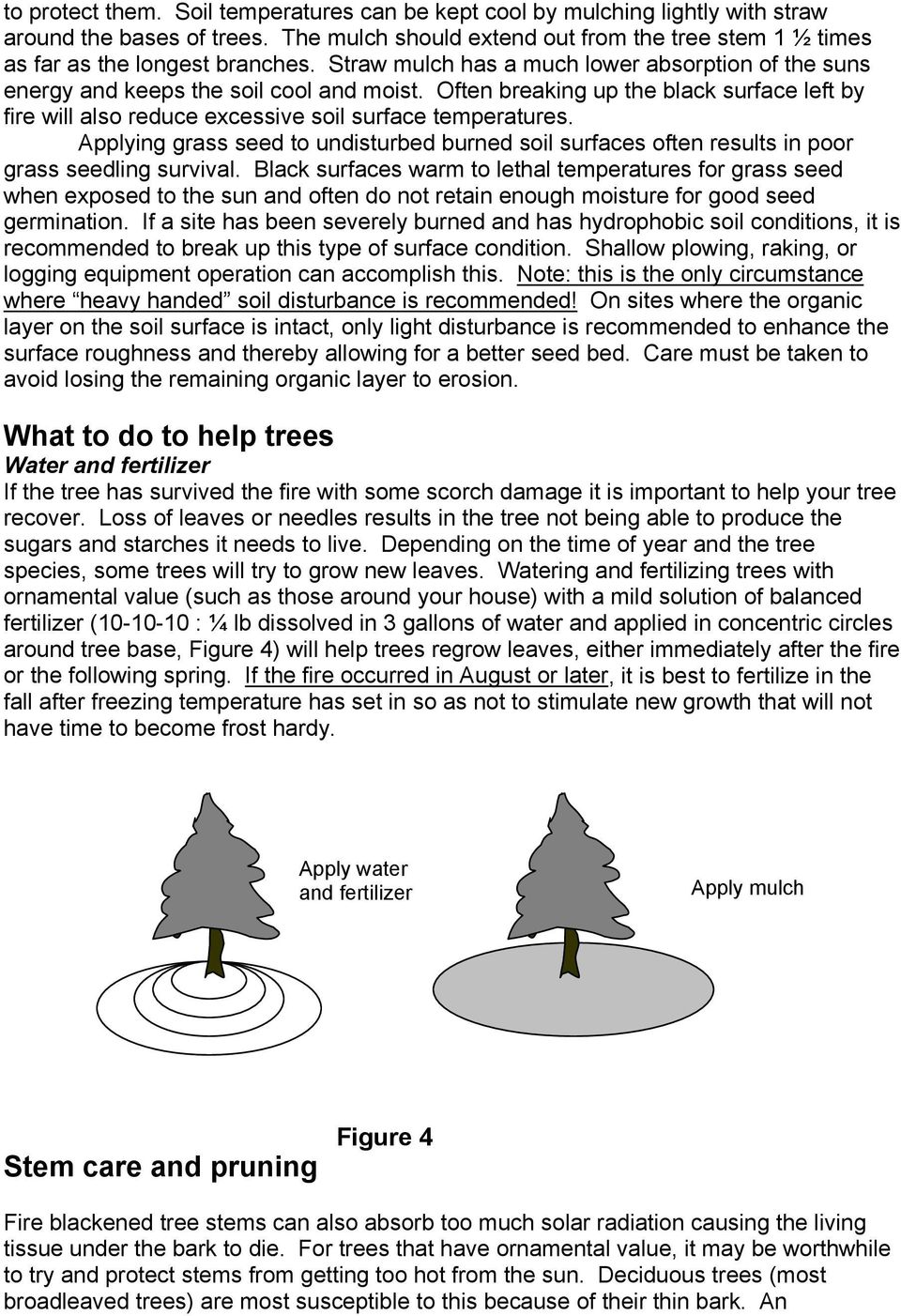
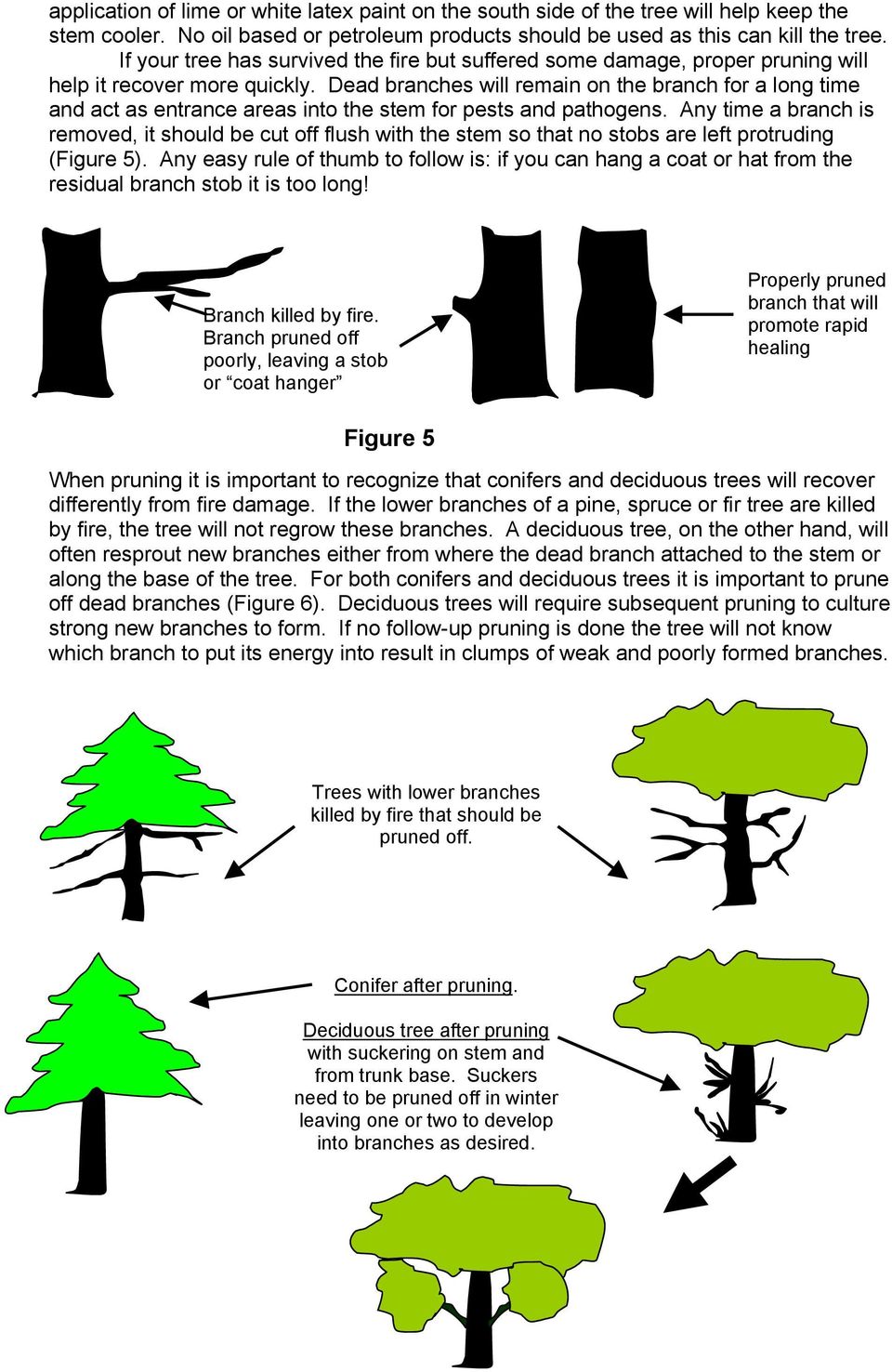
5 application of lime or white latex paint on the south side of the tree will help keep the stem cooler. No oil based or petroleum products should be used as this can kill the tree. If your tree has survived the fire but suffered some damage, proper pruning will help it recover more quickly. Dead branches will remain on the branch for a long time and act as entrance areas into the stem for pests and pathogens. Any time a branch is removed, it should be cut off flush with the stem so that no stobs are left protruding (Figure 5). Any easy rule of thumb to follow is: if you can hang a coat or hat from the residual branch stob it is too long! Branch killed by fire. Branch pruned off poorly, leaving a stob or coat hanger Properly pruned branch that will promote rapid healing Figure 5 When pruning it is important to recognize that conifers and deciduous trees will recover differently from fire damage. If the lower branches of a pine, spruce or fir tree are killed by fire, the tree will not regrow these branches. A deciduous tree, on the other hand, will often resprout new branches either from where the dead branch attached to the stem or along the base of the tree. For both conifers and deciduous trees it is important to prune off dead branches (Figure 6). Deciduous trees will require subsequent pruning to culture strong new branches to form. If no follow-up pruning is done the tree will not know which branch to put its energy into result in clumps of weak and poorly formed branches. Trees with lower branches killed by fire that should be pruned off. Conifer after pruning. Deciduous tree after pruning with suckering on stem and from trunk base. Suckers need to be pruned off in winter leaving one or two to develop into branches as desired.
6

After the Storm: Caring for Your Trees
 Montana State University Extension Service Peter Kolb (PhD) MSU Extension Forestry Specialist School of Forestry, University of Montana,Missoula, MT 59812 Tel. (406) 243-4705; e-mail: [email protected]
Post-Wildfire Clean-Up and Response in Houston Toad Habitat Best Management Practices
 Post-Wildfire Clean-Up and Response in Houston Toad Habitat Best Management Practices Purpose The purpose of this document is to provide guidance and recommendations for minimizing potential impacts to
Wildfire Damage Assessment for the 2011 Southeast Complex Fires
 Wildfire Damage Assessment for the 2011 Southeast Complex Fires Chip Bates & Mark McClure, Forest Health Management Background: On March 24, 2011, multiple wildfires began across southeast Georgia. Strong,
Identification and Prevention of Frost or Freeze Damage By Linda Reddick, Kingman Area Master Gardener
 KINGMAN IS GROWING! COLUMN Identification and Prevention of Frost or Freeze Damage By Linda Reddick, Kingman Area Master Gardener Again this year we have been experiencing some very cold weather, with
Arbor Day Tree Trivia
 Arbor Day Tree Trivia What day is Arbor Day? The last Friday of April. (April 30, 2010) Who is the father of Arbor Day? J. Sterling Morton When was the first Arbor Day? 1872 Name Idaho's state tree. Western
Why Fruit Trees Die D. B. Meador, Extension Specialist (retired) University of Illinois
 Why Fruit Trees Die D. B. Meador, Extension Specialist (retired) University of Illinois Occasionally, fruit trees decline and often die. Diseases affecting the leaves, fruit, and twigs of fruit trees usually
Your Defensible Space Slideshow
 Your Defensible Space Slideshow Red = Trees to Remove Your Defensible Space Slideshow This slideshow was created to highlight actions you can take to dramatically improve the chances of your home surviving
The Basics of Tree Pruning
 The Basics of Tree Pruning By John Ball, Forest Health Specialist and Aaron Kiesz, Urban and Community Forestry Specialist Until the end of the 19 th century, trees were not a common sight in many parts
Tree Care Guide. W.A. Industries: 3655 N. Southport Ave., Chicago, IL 60613 (888) 333-9352 www.megagro.com
 Tree Care Guide Think of the tree you just purchased as a lifetime investment and considering many tree species live for many decades, they are a wonderful legacy. How well your tree, and investment, grows
Fertilizer, Weed Control, Grubs, and General Application Questions
 Lawn Care FAQ s Fertilizer, Weed Control, Grubs, and General Application Questions Why do we have so many weeds? Dandelions in particular, weeds in general, do not seem concerned about how long lawn has
Construction Damage to Trees
 Construction Damage to Trees When a building site is cleared, several large, well-established trees are often left to enhance the aesthetic value of the property. However, within about 2-8 years after
Planting and Tree Care for Roxborough Park. Keith Worley, Forester ISA Certified Arborist
 Planting and Tree Care for Roxborough Park Keith Worley, Forester ISA Certified Arborist Where We Live: High elevation at the edge of Mountains and Plains. Harsh climates with: High winds. Drought periods
3.1. Succession, Recovery, and Renewal in Natural Communities. A35 Starting Point. What Happens to a Vacant Lot?
 3.1 Succession, Recovery, and Renewal in Natural Communities Here is a summary of what you will learn in this section: Ecosystems change in predictable ways known as succession. Ecosystems can establish
runing & Orchard Renewal
 P runing & Orchard Renewal Richard G. St-Pierre, Ph.D. (January 2006) The Basics Of Pruning & Orchard Renewal Pruning is defined as the art and science of cutting away a portion of a plant to improve its
TREE NOTES. CALIFORNIA DEPARTMENT OF FORESTRY AND FIRE PROTECTION Arnold Schwarzenegger Governor State of California. Dale T.
 TREE NOTES CALIFORNIA DEPARTMENT OF FORESTRY AND FIRE PROTECTION Arnold Schwarzenegger Governor State of California Dale T. Geldert Director NUMBER: 30 February 2005 Mike Chrisman Secretary for Resources
Virginia Gardener http://www.hort.vt.edu/envirohort
 The Virginia Gardener http://www.hort.vt.edu/envirohort Name Help Sheets: Things Plants Need There are certain things that every living thing needs in order to live and grow. Just like you, plants need
Regional Parks Botanic Garden Plant Adaptations to Habitat Tour: Selected Plant Adaptations by Garden Section
 INTRO Regional Parks Botanic Garden Plant Adaptations to Habitat Tour: Selected Plant Adaptations by Garden Section Tools (optional, but nice to use): -Discovery Scope -Spray bottle of water--from the
Ten Easy Ways to Kill a Tree
 DIVISION OF AGRICULTURE RESEARCH & EXTENSION University of Arkansas System Agriculture and Natural Resources FSA5011 Ten Easy Ways to Kill a Tree (And How to Avoid Them) H. Christoph Stuhlinger University
GENERAL WATERING & CARE GUIDE
 GENERAL WATERING & CARE GUIDE Between 30-60 percent of water applied to lawns and gardens is never absorbed by the plants. Water is often wasted because it is applied too quickly and runs off, evaporates
FORESTED VEGETATION. forests by restoring forests at lower. Prevent invasive plants from establishing after disturbances
 FORESTED VEGETATION Type of strategy Protect General cold adaptation upland and approach subalpine forests by restoring forests at lower Specific adaptation action Thin dry forests to densities low enough
King Fire Restoration Project, Eldorado National Forest, Placer and El Dorado Counties, Notice of intent to prepare an environmental impact statement.
 This document is scheduled to be published in the Federal Register on 12/24/2014 and available online at http://federalregister.gov/a/2014-30158, and on FDsys.gov [3410-11- P] DEPARTMENT OF AGRICULTURE
How To Prune Coniferous Evergreen Trees
 Bulletin No. 644 How To Prune Coniferous Evergreen Trees D. W. McConnell R. L. Mahoney W. M. Colt A. D. Partridge Cooperative Extension System 1 How To Prune Coniferous Evergreen Trees D. W. McConnell,
Pruning Mature Trees. Reasons for Pruning
 Pruning Mature Trees Pruning is the most common tree maintenance procedure. Although forest trees grow quite well with only nature's pruning, landscape trees require a higher level of care to maintain
Care of Mature Backyard Apple Trees
 Education Center and Info Line practical solutions to everyday questions Toll free Info Line 1-877-398-4769 M-F 9 AM - 2 PM Care of Mature Backyard Apple Trees Introduction Backyard apple trees can be
Proper Pruning For Tree Health and Defensible Space
 Proper Pruning For Tree Health and Defensible Space NFP Training for Lone Peak Conservation Center, May 4, 2005 Maggie Shao, Community Forestry Program Coordinator Reasons for Pruning Safety - involves
Tree Landscape Planting
 City of Pierre Tree Landscape Planting The value of Woody Plant Landscaping Locally Adapted Species List Tips for Successful Planting Pierre Ordinances Public Needs to Know Community Tree Statistics: Trees
Tree Maintenance Practices
 OUTLINE. I. Pruning Methods a. Crown Raising.3 b. Structural Pruning...3 c. Thinning 4 d. Crown Reduction (drop crotch).4 e. Restoration...5 II. Pruning Cuts a. Types of Pruning Cuts.5-8 b. Principles,
Managing Fire Dependent Wildlife Habitat without Fire. A Land Management Practice That: 100 Years of Fire Suppression in Ponderosa pine ecosystems
 Managing Fire Dependent Wildlife Habitat without Fire Dale Swedberg Chairman North Central Washington Prescribed Fire Council Land Management Practices used to Manage Wildlife Habitat A Land Management
Two Main Precautions Before You Begin Working
 Pruning Mango Trees Roy Beckford, Ag/Natural Resources Agent, UF/IFAS Lee County Two Main Precautions Before You Begin Working 1. Mango peel and sap contain urushiol, the chemical in poison ivy and poison
CITRUS PRUNING. control, fruit production and size control
 CITRUS PRUNING Pruning techniques for tree health pest Pruning techniques for tree health, pest control, fruit production and size control Tree Shapes Citrus trees are generally pruned to a central leader
6.4 Taigas and Tundras
 6.4 Taigas and Tundras In this section, you will learn about the largest and coldest biomes on Earth. The taiga is the largest land biome and the tundra is the coldest. The taiga The largest land biome
Pruning Deciduous Trees
 Pruning Deciduous Trees By Robert S. Logan, Extension Forestry Specialist, and Steven B. Laursen, former Natural Resources Specialist MontGuide Nearly any question the homeowner may have about trees, especially
How To Plan A Buffer Zone
 Backyard Buffers Protecting Habitat and Water Quality What is a buffer? A buffer (also called a riparian buffer area or zone) is the strip of natural vegetation along the bank of a stream, lake or other
KINGMAN IS GROWING! Column
 KINGMAN IS GROWING! Column Protect Plants When Temperatures Drop By Charlee Ware, Kingman Area Master Gardener Fortunately for us, we had three extra weeks of warm fall weather. In most years, that 32-degree
When you buy a high-quality tree, plant it correctly, and treat it properly, you and your tree will benefit greatly in many ways for many years.
 Buying High-Quality Trees When you buy a high-quality tree, plant it correctly, and treat it properly, you and your tree will benefit greatly in many ways for many years. When you buy a low-quality tree,
Appendix C. Re-vegetation and Rehabilitation Sub-Plan
 Appendix C Re-vegetation and Rehabilitation Sub-Plan DRENNAN SOLAR ENERGY FACILITY REVEGETATION & REHABILITATION PLAN PRODUCED FOR ERM ON BEHALF OF SOLAIREDIRECT BY [email protected] JUNE 2013 BACKGROUND
Why hire an arborist?
 Why hire an arborist? Spring is fast approaching and that means gardens to attend and flowers to plant, but what about your trees? Now is the best time to hire an arborist to maintain your trees before
Guide to Healthy Trees
 Guide to Healthy Trees Al and Bri Seaton Front cover image: This magnifi cent tree is located on our property in Mansfi eld, Victoria. A few years ago it was suffering severely from drought, erosion and
by Erik Lehnhoff, Walt Woolbaugh, and Lisa Rew
 Designing the Perfect Plant Activities to Investigate Plant Ecology Plant ecology is an important subject that often receives little attention in middle school, as more time during science classes is devoted
Oak Trees BASIC GROWING REQUIREMENTS FOR YOUR
 They are beautiful in their peace, They are wise in their silence. They will stand after we are dust. They teach us, and we tend them. G.A. MacDunelmor BASIC GROWING REQUIREMENTS FOR YOUR Oak Trees The
Fire, Forest History, and Ecological Restoration of Ponderosa Pine Forests at Mount Rushmore, South Dakota
 Fire, Forest History, and Ecological Restoration of Ponderosa Pine Forests at Mount Rushmore, South Dakota Restoration uses the past not as a goal but as a reference point for the future...it is not to
Introduction to Plant Propagation. Glenn T. Sako Assistant County Extension Agent CTAHR, UHM
 Introduction to Plant Propagation Glenn T. Sako Assistant County Extension Agent CTAHR, UHM Purposes for Plant Propagation Multiply the number of a species Perpetuate a species Maintain the youthfulness
Natural Resources. Air and Water Resources
 Natural Resources Key Concepts Why is it important to manage air and water resources wisely? How can individuals help manage air and water resources wisely? Air and Water Resources What do you think? Read
FREQUENTLY ASKED QUESTIONS Biomass Harvest Guidelines
 FREQUENTLY ASKED QUESTIONS Biomass Harvest Guidelines What do Biomass Harvest Guidelines offer? They offer recommendations to manage forest-, brush- and open- land with the intent to protect water, timber,
Composting is one of the healthiest means of Organic Gardening.
 Master Gardeners Nearly 30 years ago Washington State University began a program of training volunteers to help instruct members of their communities about proper gardening practices. That program has
Proper Pruning Basic Techniques and Tips. 2012 ECCFC Rocky Ford, CO
 Proper Pruning Basic Techniques and Tips 2012 ECCFC Rocky Ford, CO 1 The Pro-Active Pruner! Plan BEFORE Planting Select the Right Tree For the Right Place Begin pruning trees while they are young Common
4.0 Discuss some effects of disturbances on the forest.
 4.0 Discuss some effects of disturbances on the forest. 4.1 Describe common disturbances that occur in the Boreal forest. Disturbances are normal to the life of the forest. Forests are very resilient (able
DEVELOPMENT GUIDELINES OAK TREES CARE AND MAINTENANCE
 DEVELOPMENT GUIDELINES OAK TREES CARE AND MAINTENANCE This guide will offer basic information for the preservation and maintenance of oak trees as a part of an overall landscape use. Unfortunately, oak
Pruning Fruit Trees. Develop strong tree structure. This should begin when trees are planted and continue each year thereafter.
 Agriculture and Natural Resources Pruning Fruit Trees Extension Horticulture Arkansas Is Our Campus Visit our web site at: http://www.uaex.edu Fruit trees should be pruned every year to maintain their
2744 Tanaga Basin New Lenox, Illinois 60451 (t)708.860.8310 (f)888.354.0955 www.agemalandscape.com
 Maintaining YOUR Landscape Annual Calendar 2744 Tanaga Basin New Lenox, Illinois 60451 (t)708.860.8310 (f)888.354.0955 www.agemalandscape.com MARCH - Clean winter debris, leaves, and twigs from your lawn
Cool Spaces. earth-wise guide to. green strategies: light strategies: Keep Austin Cool
 earth-wise guide to Cool Spaces green strategies: 1. Trees and leafy plants 2. Green roofs 3. Green walls light strategies: 4. Reflective roofs 5. Permeable pavement 6. Shade structures Keep Austin Cool
NORTH COUNTY TRANSFER CENTER METRO Contract Numbers 01756/01862 100% - DESIGN DEVELOPMENT SECTION 32 90 13 NEW PLANTING MAINTENANCE
 SECTION 32 90 13 NEW PLANTING PART 1 - GENERAL 1.01 INTENT A. The intent of the landscape maintenance program is to maintain the landscape areas (lawn and shrub plantings) in a vigorous, healthy and attractive
General Guidelines on Tree Pruning
 1 General Guidelines on Tree Pruning Tree pruning is the removal of unwanted branches from a tree such as those shown on Fig. (1) either for reducing risk and inconvenience to the public, maintaining or
University of Central Florida Campus Tree Care Plan Adopted October 2010
 University of Central Florida Campus Tree Care Plan Adopted October 2010 Prepared by: Dr. Patrick Bohlen, Director Timothy Newman, Landscape Superintendent Alaina Bernard, Land Manager Jennifer Pudewell,
Integrated Weed Management in Portland Parks
 Urban Pest Management Course February 6, 2013 Integrated Weed Management in Portland Parks Commissioner Nick Fish www.portlandparks.org Director Mike Abbaté Commissioner www.portlandparks.org Jim Francecsconi
restoring trees after a hurricane
 CHAPTER restoring trees after a hurricane PUBLICATION Nº ENH 1054 edward f. gilman t r a c i pa r t i n Introduction Contents The step-by-step outline provided in this document summarizes the process for
o d Propagation and Moon Planting Fact Sheet
 o d Propagation and Moon Planting Fact Sheet Propagation Propagation is actually quite simple and requires very little effort on your part. Most seeds are ready to go, complete with all the nutrients and
Are My. Pine Trees. Ready To Thin?
 Are My Pine Trees Ready To Thin? ARE MY PINE TREES READY TO THIN? One question private forest landowners ask most frequently is, Are my pine trees ready to thin? There is no definite answer to this question,
Overview. Suggested Lesson Please see the Greenlinks Module description.
 Overview Plants interact with their environment in many ways that we cannot see. Children often enjoy learning about these hidden secrets of plant life. In this lesson, children will learn about role of
Life Cycle Of A Plant Population
 Life Cycle Of A Plant Population Seed Rain n=3 Growth And Mortality n=7 Seedling Cohort n=22 Environmental Sieve Seed Bank n=5 Copyright G. Bonan 22 Suvivorship Of Seedlings In A Northern Hardwood Forest
Landscaping with Ornamental Trees and Exterior Structure Features Using EcoSmart Fire Model
 Landscaping with Ornamental Trees and Exterior Structure Features Using EcoSmart Fire Model Mark A. Dietenberger, Ph.D., USDA, FS, Forest Products Laboratory, Madison, Wisconsin, USA, [email protected]
DO's and DON'Ts in Pruning
 DO's and DON'Ts in Pruning Introduction "Pruning is one of the best things an arborist can do for a tree but one of the worst things we can do to a tree" -Alex Shigo Pruning is the most common tree maintenance
WHAT IS WRONG WITH MY LAWN?
 WHAT IS WRONG WITH MY LAWN? Lawn problems can occur in small areas or larger patches and entire lawns can be affected. Sometimes the problems are due to poor growing conditions, improper lawn care practices,
INTEGRATED PEST MANAGEMENT SYSTEM FOR KENNESAW STATE UNIVERSITY
 INTEGRATED PEST MANAGEMENT SYSTEM FOR KENNESAW STATE UNIVERSITY KENNESAW, GEORGIA PREPARED JANUARY 1997 REVISED NOVEMBER 2006 TABLE OF CONTENTS Introduction and Principles of Integrated Pest Management
Managing Black Walnut
 Managing Black Walnut Mel Baughman Professor Emeritus University of Minnesota Lenny Farlee Extension Forester Purdue University Why Grow Black Walnut? Wood Products Rich, brown color Novelty items Lumber
Diagnosing Disorders of Trees
 148 Appendix A Diagnosing Disorders of Trees Diagnosing tree problems can be difficult. Symptoms and signs can be subtle or only visible using special techniques, important information can be missing,
Angora Fire Restoration Activities June 24, 2007. Presented by: Judy Clot Forest Health Enhancement Program
 Angora Fire Restoration Activities June 24, 2007 Presented by: Judy Clot Forest Health Enhancement Program California Tahoe Conservancy Independent California State Agency within the Resources Agency Governed
PREVENTING PEST DAMAGE IN HOME LAWNS
 PREVENTING PEST DAMAGE IN HOME LAWNS Quick Tips Summary Use mixed grass seeds rather than a single variety Fertilize with composted organics or slow-acting synthetic products Keep soil at ph 5.8 6.5 Keep
Caring for StormDamaged Trees
 QUICK GUIDES UCF 2010-1 Caring for StormDamaged Trees Information provided by the National Arbor Day Foundation and the International Society of Arboriculture In the Storm s Wake After a major storm, a
Irrigation - How Best to Water Your Desert Trees
 Irrigation - How Best to Water Your Desert Trees John Eisenhower, ISA Certified Arborist WE-5213A Integrity Tree Service, Inc. 602-788-0005 www.itreeservice.com How much water do my trees need? How much
Citrus Propagation 1. Fact Sheet HS-86 June 1994. J. G. Williamson and L. K. Jackson 2 DEFINITIONS OF HORTICULTURAL TERMS COMPOSITION OF A CITRUS TREE
 Fact Sheet HS-86 June 1994 Citrus Propagation 1 J. G. Williamson and L. K. Jackson 2 Home fruit growers often want to propagate their own citrus trees, or change varieties by top-working an existing tree
Prune Your Trees. Prune early, prune often, prune for safety
 Prune Your Trees 9 Prune early, prune often, prune for safety Why should I prune? Safety, tree health, aesthetics, and value are the primary reasons for pruning trees. A single pruning can accomplish more
A. In this chapter, the following terms have the meanings indicated.
 08.07.02.01 Title 08 DEPARTMENT OF NATURAL RESOURCES Subtitle 07 FORESTS AND PARKS Chapter 02 Roadside Tree Care Authority: Natural Resources Article, 5-209 and 5-406, Annotated Code of Maryland.01 Purpose.
City of Bellingham Tree Planting Guide
 City of Bellingham Tree Planting Guide This guide provides you with resources for planting trees in the city. Using the right tree in the right place, and maintaining it correctly will provide healthy,
Virginia State University Tree Care Plan
 Virginia State University Tree Care Plan Justification and Introduction: Trees and shrubs are an extraordinarily valuable asset to the Virginia State University community. Benefits include energy efficiency
Background research on the topic of urban forestry is intended to
 overview urban forestry Urban Forestry Background research on the topic of urban forestry is intended to help guide the task of integrating trees and urban forestry goals and aspirations into the Portland
Tree Trimming Tips and Tricks
 Tree Trimming Tips and Tricks Start with Professionals Mistakes can be costly for you and your tree. Professionals who know about trees can help you get started with the right tree in the right place.
Section 01562 TREE AND PLANT PROTECTION
 Section 01562 PART 1 G E N E R A L 1.01 SECTION INCLUDES A. Tree and plant protection. B. Minimum qualifications of Arborist and Urban Forester. 1.02 MEASUREMENT AND PAYMENT A. Payment for Tree Protection,
12.16.070 - Forestry Division: Regulations and Specifications.
 12.16.070 - Forestry Division: Regulations and Specifications. A. Regulations and specifications known as the "Forestry Division: Regulations and Specifications" are set forth within the following subsections.
A Land Manager s Guide for Creating Fire-Resistant Forests
 A Land Manager s Guide for Creating Fire-Resistant Forests Stephen Fitzgerald and Max Bennett Photo by Stephen Fitzgerald Oregon State University EM 9087 EM 9087 September 2013 A Land Manager s Guide for
COMPOST A USER'S GUIDE TO. The Beauty of Your Lawn & Garden Blossoms from the Soil
 A USER'S GUIDE TO COMPOST The Beauty of Your Lawn & Garden Blossoms from the Soil Compost adds organic material and nutrients to the soil, increases water-holding capacity and biological activity, and
What do we mean by evidence?
 1 of 11 What do we mean by evidence? Background The following point needs to be made explicit to pupils Evidence is the outcome from measurements (data as in tables, graphs) and observations We use evidence
Will climate changedisturbance. interactions perturb northern Rocky Mountain ecosystems past the point of no return?
 Photo: Craig Allen, USGS Will climate changedisturbance interactions perturb northern Rocky Mountain ecosystems past the point of no return? Rachel Loehman Research Landscape Ecologist USGS Alaska Science
Urban and Community Forestry Agriculture & Natural Resources TIMELY INFORMATION Post Storm Tree Assessment; Guide to evaluating trees
 Urban and Community Forestry Agriculture & Natural Resources TIMELY INFORMATION Post Storm Tree Assessment; Guide to evaluating trees Post Storm Assessment: To assess trees in the aftermath of storms it
Summer Stress Arrives Early on Cool Season Lawns
 Summer Stress Arrives Early on Cool Season Lawns Figure 1. A fall installed tall fescue sod showing the first signs of summer stress following the arrival of record setting heat in central Virginia in
Insects That Kill Trees. Diane G. Alston Extension Entomologist Utah State University 2004 Professional Tree Care Workshops
 Insects That Kill Trees Diane G. Alston Extension Entomologist Utah State University 2004 Professional Tree Care Workshops Topics Introduction websites, IPM strategies Ips bark beetles Tree borers flatheaded,
Yard Tree Planting and Care
 Yard Tree Planting and Care Contents 10 Easy Steps To Properly 3 Plant Your Tree 6 How To Care For Your New Tree 8 Pruning Your Newly Planted Tree 10 11 5 Steps To Properly Remove A Branch Fruit Trees
Preserving Wild Ginseng in Minnesota
 Note: This digital document was adapted from Smith, W. R. 1993. Preserving Wild Ginseng in Minnesota. Minnesota Natural Heritage Program, Minnesota Department of Natural Resources. 7 pages. Preserving