
E/ECE/324/Rev.1/Add.89/Rev.3 E/ECE/TRANS/505/Rev.1/Add.89/Rev.3
|
|
|
- Bryan Williamson
- 9 years ago
- Views:
Transcription
1 17 February 2012 Agreement Concerning the adoption of uniform technical prescriptions for wheeled vehicles, equipment and parts which can be fitted and/or be used on wheeled vehicles and the conditions for reciprocal recognition of approvals granted on the basis of these prescriptions* (Revision 2, including the amendments which entered into force on 16 October 1995) Addendum 89: Regulation No. 90 Revision 3 Incorporating all valid text up to: Supplement 11 to the 01 series of amendments Date of entry into force: 24 October 2009 Corrigendum 1 to Revision 2 of the Regulation Date of entry into force: 23 June series of amendments Date of entry into force: 28 October 2011 Uniform provisions concerning the approval of replacement brake lining assemblies, drum brake linings and discs and drums for powerdriven vehicles and their trailers UNITED NATIONS * Former title of the Agreement: Agreement Concerning the Adoption of Uniform Conditions of Approval and Reciprocal Recognition of Approval for Motor Vehicle Equipment and Parts, done at Geneva on 20 March GE.12-

2

3 Regulation No. 90 Contents Uniform provisions concerning the approval of replacement brake lining assemblies, drum brake linings and discs and drums for power-driven vehicles and their trailers 1. Scope Definitions Application for approval Approval Specifications and tests Packaging and marking Page 7. Modifications and extension of approval of replacement parts Conformity of production Penalties for non-conformity of production Production definitively discontinued Names and addresses of Technical Services responsible for conducting approval tests, and of Type Approval Authorities Transitional provisions Annexes 1A 1B Communication concerning the approval or extension or refusal or withdrawal of approval or production definitively discontinued of a replacement brake lining assembly or replacement drum brake lining pursuant to Regulation No Communication concerning the approval or extension or refusal or withdrawal of approval or production definitively discontinued of a replacement brake disc or a replacement brake drum pursuant to Regulation No Arrangements of the approval mark and approval data Requirements for replacement brake lining assemblies for vehicles of categories M 1, M 2 and N Requirements for replacement brake lining assemblies and drum brake linings for vehicles of categories M 3, N 2 and N Requirements for replacement brake lining assemblies for vehicles of categories O 1 and O Requirements for replacement brake lining assemblies and drum brake linings for vehicles of categories O 3 and O Requirements for replacement brake lining assemblies for vehicles of category L

4 8 Technical prescriptions for replacement brake lining assemblies intended for the use in separate parking brake systems being independent of the vehicle service brake system Special additional procedures for conformity of production Illustrations Requirements for replacement brake discs or brake drums for vehicles of categories M and N Requirements for replacement brake discs/drums for vehicles of category O Model test report for a replacement brake disc/drum

5 1. Scope 1.1. This Regulation applies to the basic braking function of the following replacement parts 1 : Replacement brake lining assemblies intended for use in friction brakes forming part of a braking system of vehicles of category M, N, L and O which have a type approval in accordance with Regulations Nos. 13, 13-H or Replacement drum brake linings designed to be riveted to a brake shoe for fitment to and use on vehicles of category M 3, N 2, N 3, O 3 or O 4 having a type approval in accordance with Regulation No The replacement brake lining assemblies used for separate parking brake systems being independent of the vehicle service brake system will be subject only to the technical prescriptions defined in Annex 8 of this Regulation Replacement brake drums and discs intended for use in friction brakes forming part of a braking system of vehicles of category M, N and O which have a type approval in accordance with Regulation No. 13 or Regulation No. 13-H Original brake discs and brake drums, fitted at time of manufacturing of the vehicle and original replacement discs and drums intended for the servicing of the vehicle are not subject to this Regulation This Regulation does not apply to "Special parts", as defined in paragraph Definitions 2.1. General definitions "Manufacturer" means the organization which can assume technical responsibility for the brake lining assemblies or drum brake linings or brake drums and discs and can demonstrate that it possesses the necessary means to achieve conformity of production "Replacement part" means either a replacement brake lining assembly type, a replacement drum brake lining type, a replacement drum brake lining, a replacement brake drum or a replacement brake disc "Original part" means either an original brake lining, an original brake lining assembly, an original drum brake lining, an original brake drum or an original brake disc Definitions regarding the approval of a replacement brake lining assembly type, a replacement drum brake lining type or a replacement drum brake lining. 1 It does not apply to possible additional functions of replacement parts as for example speed sensing in the case of integrated speed sensing devices or guidance of the wheels in the case of integrated hubs. 5

6 "Braking system" has the meaning assigned in Regulation No. 13, paragraph 2.3., or Regulation No. 13-H, paragraph 2.3., or Regulation No. 78, paragraph "Friction brake" means the part of a braking system in which the forces opposing the movement of a vehicle are developed by friction between a brake lining and a wheel disc or drum moving relatively to each other "Brake lining assembly" means a component of a friction brake which is pressed against a drum or disc, respectively, to produce the friction force "Shoe assembly" means a brake lining assembly of a drum brake; "Shoe" means a component of a shoe assembly which carries the brake lining; "Pad assembly" means a brake lining assembly of a disc brake; "Backplate" means a component of a pad assembly which carries the brake lining; "Brake lining" means the friction material component with the shape and final dimension to be fixed on to the shoe or backplate; "Drum brake lining" means a brake lining for a drum brake "Friction material" means the product of a specified mixture of materials and processes which together determine the characteristics of a brake lining; "Brake lining type" means a category of brake linings which do not differ in friction material characteristics "Brake lining assembly type" means wheel sets of brake lining assemblies which do not differ in brake lining type, dimension or functional characteristics "Drum brake lining type" means wheel sets of brake lining components which after fitment to the shoes do not differ in brake lining type, dimensions or functional characteristics "Original brake lining" means a brake lining type referenced in the vehicle type approval documentation, Regulation No. 13, Annex 2, paragraph , Regulation No. 13-H, Annex 1, paragraph or Regulation No. 78, Annex 1, paragraph "Original brake lining assembly" means a brake lining assembly conforming to the data attached to a vehicle type approval documentation; "Replacement brake lining assembly" means a brake lining assembly of a type approved under this Regulation as a suitable service replacement for an original brake lining assembly "Original drum brake lining" means a drum brake lining conforming to the data attached to a vehicle type approval documentation. 2 If such brake linings are not available on the market, alternatively, brake linings listed under paragraph 8.2. may be used. 6

7 "Replacement drum brake lining" means a drum brake lining of a type approved under this Regulation as a suitable service replacement when fitted to a shoe for an original drum brake lining "Parking brake lining assembly" means a pad assembly or shoe assembly belonging to a parking brake system separate and independent from the service brake system Definitions regarding the approval of a replacement brake drum or a replacement brake disc "Original brake disc/brake drum" In the case of motor vehicles, is a brake disc/drum covered by the vehicle braking system type approval according to Regulation No. 13 or 13-H In the case of trailers: (a) (b) Is a brake disc/drum covered by the vehicle braking system type approval according to Regulation No. 13; Is a brake disc/drum which is part of a brake for which the axle manufacturer owns a test report according to Annex 11 of Regulation No "Identification code" identifies the brake discs or brake drums covered by the braking system approval according to Regulations Nos. 13 and 13-H. It contains at least the manufacturer's trade name or trademark and an identification number. The vehicle manufacturer shall provide on request of the technical service and/or approval authority the necessary information, which makes the link between the braking system type approval and the corresponding identification code Replacement parts "Original replacement brake discs and brake drums": original brake discs/ brake drums intended for servicing the vehicle and carrying an identification code as defined in paragraph affixed in such a way as to be indelible and clearly legible "Identical brake disc" is a replacement brake disc which is chemically and physically identical in every respect with the exception of the vehicle manufacturer mark, which is absent, to the original brake disc "Identical brake drum" is a replacement brake drum which is chemically and physically identical in every respect with the exception of the vehicle manufacturer mark, which is absent, to the original brake drum "Equivalent brake disc" is a replacement brake disc which is identical to the original brake disc in respect to all dimensions, geometric features and basic design and is also from the same material sub-group as the original brake disc as defined in paragraph "Equivalent brake drum" is a replacement brake drum which is identical to the original brake drum in respect to all dimensions, geometric features and basic design and is also from the same material sub-group as the original brake drum as defined in paragraph

8 "Interchangeable brake disc" is a replacement brake disc which has the same interface dimensions as the original brake disc but may differ from the original brake disc in terms of its design, material composition and mechanical properties "Interchangeable brake drum" is a replacement brake drum which has the same interface dimensions as the original brake drum but may differ from the original brake drum in terms of its design, material composition and mechanical properties "Special brake disc/drum" means a replacement brake disc/drum not covered by paragraphs to "Functional dimensions": all the measurements that are relevant with regard to the fitting and functioning of the components of the braking system (see paragraph and Annex 10) "Type of brake disc/drum": brake discs or drums having the same basic design and material group in accordance with the classification criteria pursuant to paragraphs or as appropriate "Test group": type of brake discs/drums having the same characteristics pursuant to paragraph "Variant": individual brake disc/drum within a given test group "Material": chemical composition and mechanical properties as per paragraph "Material group": e.g. grey cast iron, steel, aluminum, etc "Material sub-group": one of the sub-group defined in paragraph "Minimum thickness": the thickness of the brake disc is the point at which replacement becomes necessary "Maximum inside diameter": the maximum inside diameter of the brake drum is the point at which replacement becomes necessary. 3. Application for approval 3.1. An application for approval of a replacement part for (a) specific vehicle type(s) shall be submitted by the manufacturer of the replacement part or his duly accredited representative An application may be submitted by the holder of (a) vehicle type approval(s) to Regulation No. 13 or 13-H or 78 in respect of replacement part conforming to the type recorded in the vehicle type approval(s) documentation In the case of an application regarding the approval of a replacement brake lining assembly type, a replacement drum brake lining type or a replacement drum brake lining: An application for approval shall be accompanied, in triplicate, by a description of the replacement brake lining assembly or replacement drum brake lining with regard to the items specified in Annex 1 to this Regulation, and by the following particulars: 8

9 Diagrams showing functional dimensions of the replacement brake lining assembly or replacement drum brake lining; An indication of the positions of the replacement brake lining assembly or replacement drum brake lining on the vehicles for which approval to fit is sought Brake lining assemblies or drum brake linings of the type for which approval is sought shall be made available in sufficient quantity to perform the approval tests The applicant shall agree with and make available to the technical service responsible for conducting approval tests the suitable representative vehicle(s) and/or brake(s) The Competent Authority shall verify the existence of satisfactory arrangements for ensuring effective control of the conformity of production before type approval is granted The applicant shall submit values for friction behaviour in accordance with Annex 9, Part A, paragraph or respectively of this Regulation In the case of an application regarding the approval of a replacement brake drum or a replacement brake disc An application for approval shall be accompanied, in triplicate, by a description of replacement brake drum or a replacement brake disc with regard to the items specified in Annex 1B to this Regulation, and by the following particulars: Disc or drum drawing(s) including the dimensions of the features mentioned in paragraph , together with tolerances, and any accompanying accessories: (a) (b) (c) Location and nature of the marking pursuant to paragraph dimensions in mm; Weight in grams; Material Component description The manufacturer shall provide a component description containing at least the following information: (a) (b) (c) (d) (e) The manufacturer of the unmachined part; A description of the process of manufacture of the unmachined part; Proof of the reliability of the process (e.g. freedom from cracks and cavities, dimensions); Material composition, specifically: (i) (ii) (iii) Chemical composition; Microstructure; Mechanical properties: a. Brinell hardness pursuant to ISO :2005; b. Tensile strength in accordance with ISO 6892:1998. Corrosion or surface protection; 9

10 (f) (g) Description of the balancing measures, maximum permissible balance error; Amount of wear allowed (minimum thickness in the case of brake discs or the maximum internal diameter in the case of brake drums). The applicant shall submit the information and specifications outlined in Annex 9, Part B, paragraph 2.5. of this Regulation Conformity of production The competent authority shall verify the existence of satisfactory arrangements for ensuring effective control of the conformity of production before type approval is granted The applicant shall submit the documentation in accordance with Annex 9, Part B, paragraph 2. of this Regulation Sample quantities and usage A minimum number of disc or drum samples of the design for which approval is requested shall be provided, as shown in the following table. The table also shows the recommended use of the samples. Item No. Check/Test Sample Number Remarks Geometric check Paragraphs , x x x x x x 2 Material check Paragraphs , x x 3 Balancing provisions check Paragraph Wear condition marking check Paragraph Integrity test thermal fatigue Paragraphs , of Annex 11, , of Annex 12 6 Integrity test high load test Paragraphs , of Annex 11, and paragraphs , of Annex 12 7 Service brake vehicle performance test Paragraph 2.2. of Annex 11, Paragraph 2.2. of Annex 12 x x x x x x x x x x x Pair of discs Either front or rear axle 10

11 Item No. Check/Test Sample Number Remarks 8 Parking brake vehicle performance test Paragraph 2.3. of Annex 11, Paragraph 2.3. of Annex 12 9 Service brake dynamometer performance test Paragraph 3.3. of Annex 11, paragraph 3.3. of Annex 12 Pair of discs x If applicable Alternative to vehicle test Each disc and drum, other than those using geometric and material checks, shall be accompanied by the appropriate number of the suitable brake lining assemblies which have an approval to Regulation No. 13, 13-H or In the case where a comparison with the original brake disc or brake drum is required, an axle set of original brake discs or original brake drum, as applicable, shall be provided Where an equivalent replacement disc/drum approval is sought, two original brake disc/drum or original replacement brake disc/drum samples shall be provided for dimensional and material comparisons Where an interchangeable replacement disc/drum approval is sought, two original brake disc/drum or original replacement brake disc/drum samples shall be provided for dimensional comparison. 4. Approval 4.1. If the replacement part submitted for approval pursuant to this Regulation meet the requirements of paragraph 5. below, approval of the replacement part shall be granted In the case of replacement brake lining assemblies for vehicles of category L with a combined braking system in the meaning of paragraph 2.9. of Regulation No. 78, the approval must be restricted to the brake lining assembly combination(s) on the axles of the vehicle having been tested according to Annex 7 of this Regulation To each replacement part approved there shall be assigned an approval number comprising four groups of digits: The first two digits (at present 02 for the Regulation in its 02 series of amendments) shall indicate the series of amendments incorporating the most recent major technical amendments made to the Regulation at the time of issue of the approval The following single digit shall indicate the category of the replacement part as follows: A B C D Replacement brake lining assembly Replacement drum brake lining Replacement brake disc Replacement brake drum 11

12 The next four digits shall indicate the manufacture and the type of the brake lining, the type of disc or the type of drum. A suffix of four digits shall indicate: (a) (b) The shoe or back plate or specific dimension in the case of drum brake linings; The variant in the case of a replacement disc or replacement drum. _ / 4 digits indicate the variant/shoe /back plate/specific dimension of the replacement part (0001 to 9999) 4 digits indicate (manufacturer and) the type of the replacement part (0001 to 9999) 1 digit (A to D) indicates the category of the replacement part 2 digits indicate series of amendment (01 to 99) Example: 0 2 C / Variant No Type No Brake disc Amendment The same Contracting Party may not assign the same number to another replacement part. The same type approval number may cover the use of that replacement part on a number of differing vehicle types Notice of approval or of extension or refusal of approval or withdrawal of approval or production definitively discontinued of a replacement part pursuant to this Regulation shall be communicated to the Parties to the 1958 Agreement which apply this Regulation by means of a form conforming to the model in Annex 1 to this Regulation. 12

13 4.5. There shall be affixed, conspicuously and in a readily accessible place, to every replacement part approved under this Regulation, an international approval mark consisting of: A circle surrounding the letter "E" followed by the distinguishing number of the country which has granted approval 3 ; The number of this Regulation, followed by the letter "R", a dash and the approval number to the right of the circle prescribed in paragraph The approval mark referred to in paragraph 4.5. above shall be clearly legible and be indelible Annex 2 to this Regulation gives examples of arrangements of the approval mark and approval data referred to above and in paragraph 6.5. below. 5. Specifications and tests 5.1. General A replacement part shall be so designed and constructed that, when substituted for the part originally fitted to a vehicle, the braking efficiency of that vehicle accords with that of the approved vehicle type. Specifically: (a) A replacement part for a vehicle type approved prior to Regulation No. 13, 09 series of amendments, or the original version of Regulation No. 13-H or Regulation No. 78, 01 series of amendments, shall satisfy as a minimum the appropriate above-mentioned Regulation level; (b) A replacement part shall display performance characteristics similar to that of the original part it is intended to replace; (c) (d) (e) (f) (g) A replacement part must possess adequate mechanical characteristics; Brake linings shall not contain asbestos; A replacement brake disc/drum shall exhibit sufficient deformation resistance under temperature; The minimum thickness of the brake disc shall not be less than the minimum thickness of the original brake disc as specified by the vehicle manufacturer; The maximum permissible inside diameter of the brake drum shall not be more than the maximum permissible inside diameter of the original brake drum specified by the vehicle manufacturer Replacement brake lining assemblies or replacement drum brake linings conforming to the type specified in vehicle type approval documentation to Regulation No. 13 or to Regulation No. 13-H or Regulation No. 78 are deemed to satisfy the requirements of paragraph 5. of this Regulation. 3 The distinguish numbers of the Contracting Parties to the 1958 Agreement are reproduced in Annex 3 to Consolidated Resolution on the Construction of Vehicles (R.E.3), document ECE/TRANS/WP.29/78/Rev.2/Amend.1. 13

14 Replacement discs and replacement drums conforming to the identification code specified in vehicle type approval documentation to Regulation No. 13 or to Regulation No. 13-H are deemed to satisfy the requirements of paragraph 5. of this Regulation Requirements regarding the approval of a replacement brake lining assembly type, a replacement drum brake lining type or a replacement drum brake lining Performance requirements Replacement brake lining assemblies for vehicles of categories M 1, M 2 and N 1 At least one set of replacement brake lining assemblies, representing the type of lining to be approved, shall be installed and tested in at least one vehicle which is representative of the vehicle type for which approval is sought, according to the prescriptions of Annex 3 and shall satisfy the requirements stated in this annex. The representative vehicle(s) shall be selected from among the application range using a worst case analysis 4. For speed sensitivity and cold performance equivalence, one of the two methods described in Annex 3 shall be used Replacement brake lining assemblies and replacement drum brake linings for vehicles of categories M 3, N 2 and N 3 At least one set of replacement brake lining assemblies or replacement drum brake linings, representing the type of lining to be approved, shall be installed and tested in at least one vehicle or a brake which is representative of the vehicle type for which approval is sought, according to the prescriptions of Annex 4, using one of the two methods described in paragraph 1. (vehicle test) or in paragraph 2. (inertia dynamometer test) and shall satisfy the requirements stated in this annex. The representative vehicle(s) or brake(s) shall be selected from among the application range using a worst case analysis Replacement brake lining assemblies for vehicles of categories O 1 and O 2 Replacement brake lining assemblies shall be tested according to the prescriptions of Annex 5 and shall satisfy the requirements stated in this annex Replacement brake lining assemblies and replacement drum brake linings for vehicles of categories O 3 and O 4 4 Worst case analysis must include the following technical characteristics (as a minimum) of each vehicle type in the application range: (a) Rotor diameter; (b) Rotor thickness; (c) Ventilated or solid rotor; (d) Piston diameter; (e) Tyre dynamic radius; (f) Vehicle mass; (g) Axle mass and percentage of braking effort of the axle; (h) Maximum speed of the vehicle. The testing conditions shall be specified in the test report. 14

15 Replacement brake lining assemblies and replacement drum brake linings shall be tested according to the prescriptions of Annex 6 and shall satisfy the requirements stated in this annex. For the tests, one of the three methods described in paragraph 3. of Appendix 2 to Annex 11 of Regulation No. 13 shall be used Replacement brake lining assemblies for vehicles of category L At least one set of replacement brake lining assemblies, representing the type of lining to be approved, shall be installed and tested in at least one vehicle which is representative of the vehicle type for which approval is sought, according to the prescriptions of Annex 7 and shall satisfy the requirements stated in this annex. The representative vehicle(s) shall be selected from among the application range using a worst case analysis Mechanical characteristics Replacement brake lining assemblies for vehicles of categories M 1, M 2, N 1, O 1, O 2, and L Replacement brake lining assemblies of the type for which approval is requested shall be tested for shear strength according to Standard either ISO 6312:1981 or ISO 6312:2001. The minimum acceptable shear strength is 250 N/cm 2 for pad assemblies and 100 N/cm 2 for shoe assemblies Replacement brake lining assemblies of the type for which approval is requested shall be tested for compressibility according to standard either ISO 6310:1981, ISO 6310:2001 or ISO 6310:2009. The compressibility values shall not exceed 2 per cent at ambient temperature and 5 per cent at 400 C for pad assemblies and 2 per cent at ambient temperature and 4 per cent at 200 C for shoe assemblies. This requirement does not apply to parking brake lining assemblies Replacement brake lining assemblies and replacement drum brake linings for vehicles of categories M 3, N 2, N 3, O 3, and O Shear strength This test applies only to disc brake pad assemblies. Replacement brake lining assemblies of the type for which approval is requested shall be tested for shear strength according to Standard ISO 6312:1981 or ISO 6312:2001. Brake lining assemblies may by divided into two or three parts to match the test machine's capability. The minimum acceptable shear strength is 250 N/cm Compressibility Replacement brake lining assemblies and replacement drum brake linings of the type for which approval is requested shall be tested for compressibility according to standard either ISO 6310:1981, ISO 6310:2001 or ISO 6310:2009. Flat specimens according to sample type I may be used. The compressibility values shall not exceed 2 per cent at ambient temperature and 5 per cent at 400 C for pad assemblies and 2 per cent at ambient temperature and 4 per cent at 200 C for shoe assemblies and drum brake linings. 15

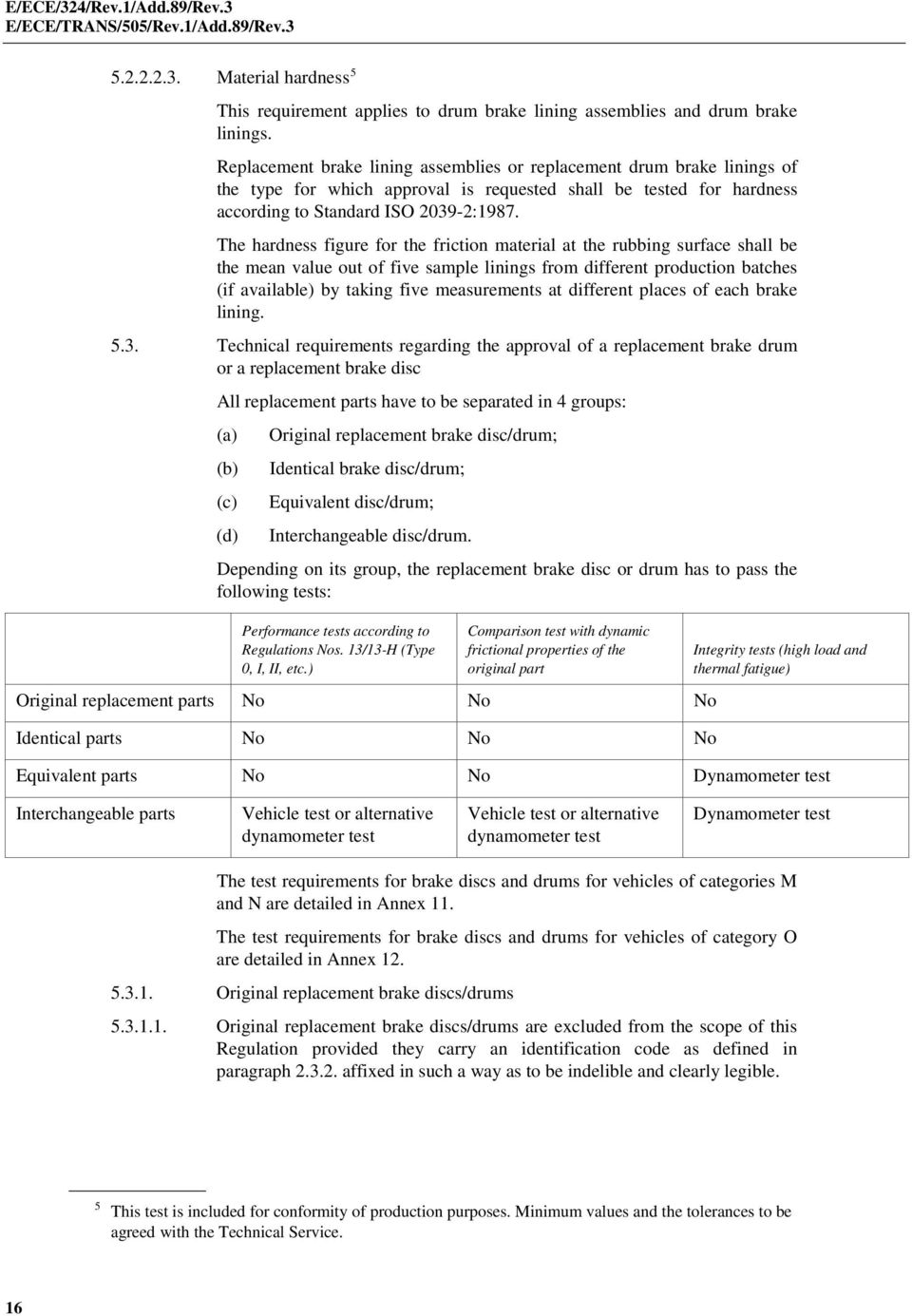
16 Material hardness 5 This requirement applies to drum brake lining assemblies and drum brake linings. Replacement brake lining assemblies or replacement drum brake linings of the type for which approval is requested shall be tested for hardness according to Standard ISO :1987. The hardness figure for the friction material at the rubbing surface shall be the mean value out of five sample linings from different production batches (if available) by taking five measurements at different places of each brake lining Technical requirements regarding the approval of a replacement brake drum or a replacement brake disc All replacement parts have to be separated in 4 groups: (a) (b) (c) (d) Original replacement brake disc/drum; Identical brake disc/drum; Equivalent disc/drum; Interchangeable disc/drum. Depending on its group, the replacement brake disc or drum has to pass the following tests: Performance tests according to Regulations Nos. 13/13-H (Type 0, I, II, etc.) Comparison test with dynamic frictional properties of the original part Original replacement parts No No No Identical parts No No No Integrity tests (high load and thermal fatigue) Equivalent parts No No Dynamometer test Interchangeable parts Vehicle test or alternative dynamometer test Vehicle test or alternative dynamometer test Dynamometer test The test requirements for brake discs and drums for vehicles of categories M and N are detailed in Annex 11. The test requirements for brake discs and drums for vehicles of category O are detailed in Annex Original replacement brake discs/drums Original replacement brake discs/drums are excluded from the scope of this Regulation provided they carry an identification code as defined in paragraph affixed in such a way as to be indelible and clearly legible. 5 This test is included for conformity of production purposes. Minimum values and the tolerances to be agreed with the Technical Service. 16
17 Identical brake discs/drums The applicant for approval shall demonstrate to the approval authority that he supplies the brake discs or drums to the vehicle manufacturer as original equipment of the vehicles/axles/brakes mentioned under Annex 1B point 4. In particular, the brake discs or drums shall be produced under the same production and quality assurance systems and conditions as for the original parts pursuant to paragraph Since the identical brake discs/drums fulfils all requirement as the Original part no testing requirements are prescribed Equivalent replacement discs or drums Geometric requirements The brake discs or drums shall be identical to the original brake disc or drum in respect to all dimensions, geometric features and basic design For discs the following maximum values shall be met: M 1, N 1, O 1, O 2 M 2, M 3, N 2, N 3, O 3, O 4 Thickness variation mm mm Cheek thickness variation (for ventilated disc only) 1.5 mm 2.0 mm Lateral run-out friction surface mm * 0.15 mm * Location bore variation H9 H9 "Top hat" parallelism mm mm Location face flatness mm mm Friction surface roughness ** 3.2 µm 3.2 µm * n/a in the case of a floating disc. ** Ra-value according to ISO 1302: For drums the following maximum values shall be met: M 1, N 1, O 1, O 2 M 2, M 3, N 2, N 3, O 3, O 4 Radial run-out friction surface mm mm Location bore variation H9 H9 Ovality mm mm Location face flatness mm mm Friction surface roughness * 3.5 µm 3.5 µm * Ra-value according to ISO 1302: Material and metallurgical requirements In order to be considered "Equivalent" the replacement brake disc or drum shall be from the same material sub-group as the original brake disc or drum. Four original part material sub-groups are defined. 17

18 Test standard Sub-group 1 Base cast iron DIN EN 1561 EN-GJL-200 Sub-group 2 Base high carbon EN-GJL-150 Sub-group 3 Alloyed high carbon Sub-group 4 Unalloyed high carbon Carbon Content (per cent) Silicon Content (per cent) Manganese Content (per cent) Min 0.40 Min 0.40 Min 0.40 Min 0.40 Chromium Content (per cent) Max 0.35 Max Max 0.25 Copper Content (per cent) Max 0.40 Hardness HBW ISO : Tensile strength (N/mm 2 ) ISO 6892:1998 Min 220 Min 160 Min 170 Min Performance requirements The part has to pass the integrity tests for high load and thermal fatigue according to Annexes 11 and Interchangeable replacement discs or drums Geometric requirements As paragraphs and plus the same interface dimensions. An interchangeable replacement disc or drum may differ from the original part disc in design features such as: (a) (b) (c) Type and geometry of ventilation (for vented discs); Integral or composite disc or drum; Surface finish (e.g. holes, slots etc.) Performance requirements The part has to pass the following performance tests according to Annexes 11 and 12: (a) (b) (c) Type The performance test according to Regulation No. 13 or 13-H; The Comparison test with dynamic frictional properties of the original part; The integrity tests for high load and thermal fatigue. Brake discs/drums that do not differ in terms of their main characteristics as detailed below shall be regarded as one type within one report or approval: Type criteria for brake discs Basic design (a) (b) With or without ventilation (e.g. solid, ventilated); Design of ventilation; 18

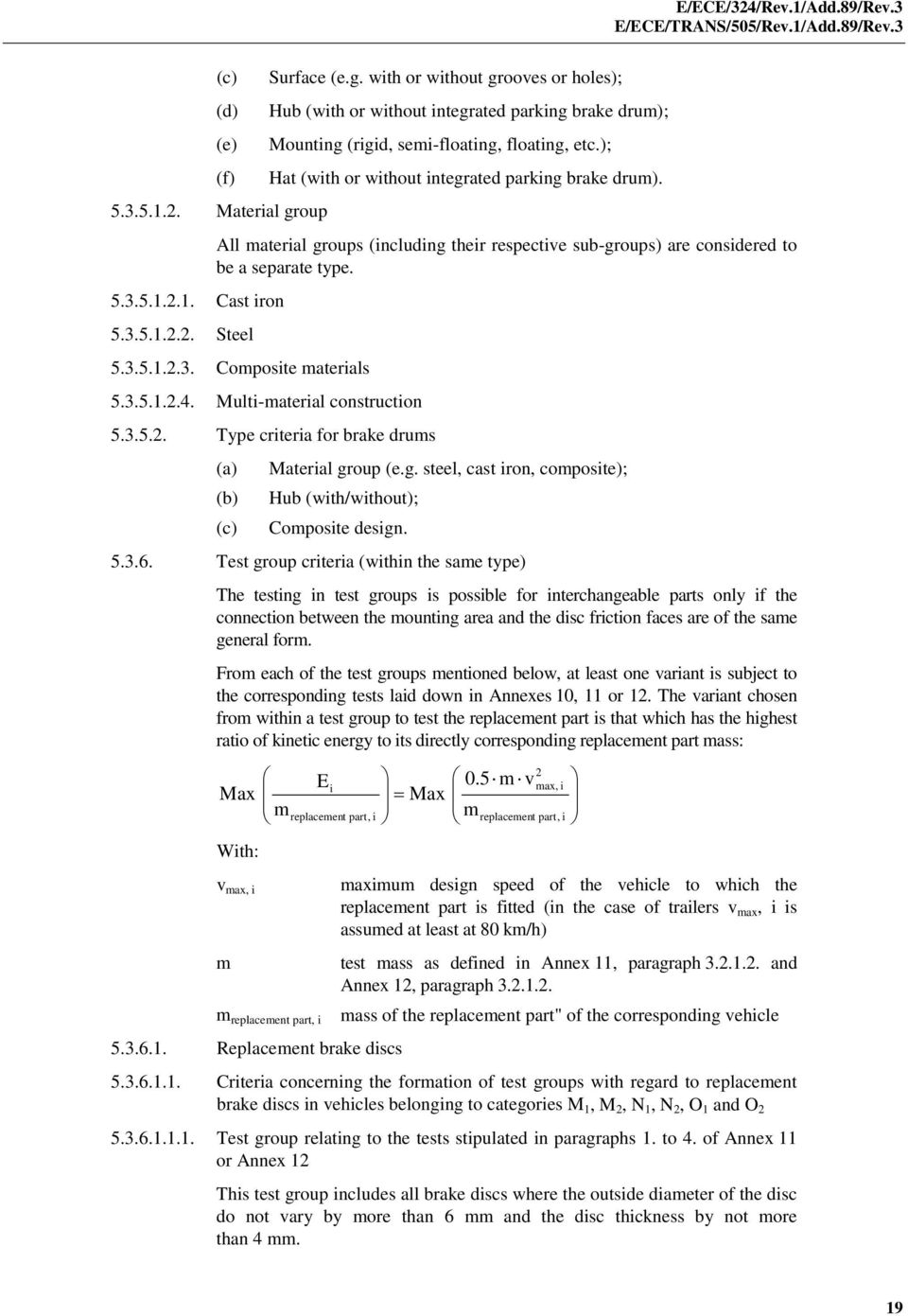
19 (c) (d) (e) (f) Material group Cast iron Steel Surface (e.g. with or without grooves or holes); Hub (with or without integrated parking brake drum); Mounting (rigid, semi-floating, floating, etc.); Hat (with or without integrated parking brake drum). All material groups (including their respective sub-groups) are considered to be a separate type Composite materials Multi-material construction Type criteria for brake drums (a) (b) (c) Material group (e.g. steel, cast iron, composite); Hub (with/without); Composite design Test group criteria (within the same type) The testing in test groups is possible for interchangeable parts only if the connection between the mounting area and the disc friction faces are of the same general form. From each of the test groups mentioned below, at least one variant is subject to the corresponding tests laid down in Annexes 10, 11 or 12. The variant chosen from within a test group to test the replacement part is that which has the highest ratio of kinetic energy to its directly corresponding replacement part mass: Max m With: v max, i m i replacement m replacement part, i E part, i Replacement brake discs 0.5 m v = Max mreplacement 2 max, i part, i maximum design speed of the vehicle to which the replacement part is fitted (in the case of trailers v max, i is assumed at least at 80 km/h) test mass as defined in Annex 11, paragraph and Annex 12, paragraph mass of the replacement part" of the corresponding vehicle Criteria concerning the formation of test groups with regard to replacement brake discs in vehicles belonging to categories M 1, M 2, N 1, N 2, O 1 and O Test group relating to the tests stipulated in paragraphs 1. to 4. of Annex 11 or Annex 12 This test group includes all brake discs where the outside diameter of the disc do not vary by more than 6 mm and the disc thickness by not more than 4 mm. 19
20 In the case of different materials within a group of materials, proof shall be furnished for each separate material that the requirements stipulated in Annex 11 or Annex 12 are met Criteria concerning the formation of test groups with regard to replacement brake discs in vehicles belonging to categories M 3, N 3, O 3 and O Test group relating to the tests stipulated in paragraphs 1. to 4. of Annex 11 or Annex 12 This test group includes all brake discs where the outside diameter of the disc does not vary by more than 10 mm and the disc thickness by not more than 4 mm In the case of different materials within a group of materials, proof shall be furnished for each separate material that the requirements stipulated in Annex 11 or Annex 12 are met Replacement brake drums Criteria concerning the formation of test groups with regard to replacement brake drums in vehicles belonging to categories M 1, M 2, N 1, N 2, O 1 and O Test group relating to the tests stipulated in paragraphs 1. to 4. of Annex 11 or Annex 12 This test group includes all brake drums that do not vary by more than 30 mm in terms of the inside diameter of the drum and by more than 10 mm as regards the shoe width of the drum brake In the case of different materials within a group of materials, proof shall be furnished for each separate material that the requirements stipulated in Annex 11 or Annex 12 are met Criteria concerning the formation of test groups with regard to replacement brake drums in vehicles belonging to categories M 3, N 3, O 3 and O Test group relating to the tests stipulated in paragraphs 1. to 4. of Annex 11 or Annex 12 This test group includes all brake drums that do not vary by more than 10 per cent (referring to the smallest value) in terms of the inside diameter of the drum and by more than 40 mm as regards the shoe width of the drum brake In the case of different materials within a group of materials, proof shall be furnished for each separate material that the requirements stipulated in Annex 11 or Annex 12 are met Scope of assessment with regard to replacement brake discs/drums Geometric checks Compared with original parts, replacement brake discs/drums shall be checked in terms of the following applicable characteristics (see also Annex 10): (a) Disc/drum diameter, including friction surface diameters (in the case of a disc brake with an integrated parking brake drum, both diameters have to be checked); 20

21 (b) (c) (d) (e) (f) (g) (h) (i) Disc thickness (original dimensions and the minimum permissible wear indication) mounting face to external friction surface; Mounting flange thickness; Pitch circle diameter of fixing holes/studs; Number of fixing holes/studs; Mounting flange diameter; Type of centring (e.g. central spigot or mounting bolts/studs); In the case of brake discs with integrated parking brake drums the width of the friction surface area and any heat compensation groove(s); Additionally, in the case of ventilated brake discs: (i) (ii) (iii) Balancing provision The type of ventilation (internal/external); The number of ribs and pillars; The dimensions of the ventilation duct. The balancing provision with regard to the replacement brake discs/drums shall correspond to that of the original part being replaced Assessment of the wear condition of the friction surfaces Tests Test report This shall conform to the vehicle manufacturer criteria. Each test group (see ) within a particular type of replacement brake disc/drum (see ) shall be tested by the Technical Service. A test report shall be produced, the content of which shall be at least that defined in Annex 13 to this Regulation. 6. Packaging and marking 6.1. Packaging and marking requirements regarding a replacement brake lining assembly type, a replacement drum brake lining type or a replacement drum brake lining: Replacement brake lining assemblies or replacement drum brake linings conforming to a type approved in accordance with this Regulation shall be marketed in axle sets Each axle set shall be contained in a sealed package constructed to show previous opening Each package shall display the following information: The quantity of replacement brake lining assemblies or replacement drum brake linings in the package; Manufacturer's name or trade mark; 21
22 Make and type of replacement brake lining assemblies or replacement drum brake linings; The vehicles/axles/brakes for which the contents are approved; The approval mark Each package shall contain fitting instructions in an official ECE language, supplemented by the corresponding text in the language of the country where it is sold: With particular reference to auxiliary parts; Stating that replacement brake lining assemblies or replacement drum brake linings should be replaced in axle sets; With, in the case of replacement drum brake linings, a general statement calling attention to the following points: The integrity of the shoe platform, abutment and pivot; Freedom of the shoe from distortion, deformation and corrosion; The type and size of rivet to be used; The required riveting tools and forces With, additionally, in the case of combined braking systems in the meaning of paragraph 2.9. of Regulation No. 78 giving the approved brake lining assembly combination(s) Each replacement brake lining assembly or replacement drum brake lining shall display permanently one set of approval data: The approval mark; The date of manufacture, at least month and year, or batch number; Make and type of brake lining Packaging and marking requirements regarding replacement brake discs or replacement brake drums Every unit sold shall at least exhibit the following information: Part number; In the case of motor vehicles: Make, type and trade name of the vehicle, the axle intended to be fitted and period of manufacturing of the vehicle; should the period of manufacture not be readily available a reference to the original part number/identification code may be used; In the case of trailers a reference to the original part number/identification code shall be used; Each package shall contain fitting instructions in the language of the country where it is sold: With particular reference to ancillary parts; Stating that replacement brake discs and drums should be replaced in axle sets. 22
23 Marking Every brake disc/drum approved in accordance with this Regulation shall be durably marked with at least the following information: Manufacturer's name or trade mark; The approval number; An indication which provides traceability of the production process (e.g. date, batch number, source code); The minimum thickness of the brake disc or the maximum permissible inside diameter of the brake drum. 7. Modifications and extension of approval of replacement parts 7.1. Every modification of the replacement part shall be notified to the Type Approval Authority which granted the type approval. The department may then either: Consider that the modifications made are unlikely to have appreciable adverse effects and that in any event the replacement part still complies with the requirements; or Require a further test report from the technical service responsible for conducting the tests Confirmation or refusal of approval, specifying the alterations, shall be notified by the procedure specified in paragraph 4.4. above to the Parties to the 1958 Agreement applying this Regulation The Competent Authority issuing the extension of approval shall assign a series number for such an extension and inform thereof the other Parties to the 1958 Agreement applying this Regulation by means of a communication form conforming to the model in Annex 1 to this Regulation. 8. Conformity of production 8.1. Replacement parts approved to this Regulation shall be so manufactured as to conform to the type approved Original parts being the subject of an application under paragraph 3.2. are deemed to satisfy the requirements of paragraph To verify that the requirements of paragraph 8.1. are met, suitable controls of the production shall be applied. These shall encompass the control of raw materials and components used The holder of an approval shall in particular: Ensure that for each replacement brake lining assembly type or replacement drum brake lining type at least the relevant tests prescribed in paragraph and the relevant tests as prescribed in Annex 9 to this Regulation are carried out on a statistically controlled and random basis in accordance with a regular quality assurance procedure. For parking brake lining assemblies only the shear strength described in paragraph is applicable. 23
24 Ensure that for each replacement disc and drum at least the tests prescribed in Annex 9 to this Regulation are carried out on a statistically controlled and random basis in accordance with a regular quality assurance procedure Ensure existence of procedures for the effective control of the quality of products; Have access to the control equipment necessary for checking the conformity of each approved type; Analyse the results of each type of test in order to verify and ensure the consistency of the product characteristics, making allowance for variation of an industrial production; Ensure that data of test results are recorded and that annexed documents remain available for a period to be determined in agreement with the administrative service; Ensure that any samples or test pieces giving evidence of non-conformity with the type of test considered shall give rise to another sampling and another test. All the necessary steps shall be taken to re-establish the conformity of the corresponding production The Competent Authority which has granted type-approval may at any time verify the conformity control methods applicable to each production unit In every inspection, the test books and production survey records shall be presented to the visiting inspector The inspector may take samples at random to be tested in the manufacturer's laboratory. The minimum number of samples may be determined according to the results of the manufacturer's own verification When the quality level appears unsatisfactory or when it seems necessary to verify the validity of the tests carried out in application of paragraph the inspector shall select samples to be sent to the technical service which has conducted the type approval tests The competent authority may carry out any tests prescribed in this Regulation The normal frequency of inspections authorized by the Competent Authority shall be one per year. In the case where negative results are recorded during one of these visits, the competent authority shall ensure that all necessary steps are taken to re-establish the conformity of production as rapidly as possible. 9. Penalties for non-conformity of production 9.1. The approval granted in respect of a replacement brake lining assembly type or drum brake lining type pursuant to this Regulation may be withdrawn if the requirements laid down in paragraph 8.1. above are not complied with. The approval granted in respect of the type of a replacement brake drum or a replacement brake disc pursuant to this Regulation may be withdrawn if the requirements laid down in paragraph 8.1. above are not complied with. 24
25 9.2. If a Contracting Party to the Agreement applying this Regulation withdraws an approval it has previously granted, it shall forthwith so notify the other Contracting Parties applying this Regulation, by means of a communication form conforming to the model in Annex 1A or Annex 1B to this Regulation. 10. Production definitively discontinued If the holder of the approval completely ceases to manufacture a replacement part approved in accordance with this Regulation, he shall so inform the authority which granted the approval. Upon receiving the relevant communication that authority shall inform thereof the other Parties to the 1958 Agreement applying this Regulation by means of a communication form conforming to the model in Annex 1A or 1B to this Regulation. 11. Names and addresses of Technical Services responsible for conducting approval tests, and of Type Approval Authorities The Contracting Parties to the 1958 Agreement which apply this Regulation shall communicate to the United Nations secretariat the names and addresses of the Technical Services responsible for conducting approval tests and of the Type Approval Authorities which grant approval and to which forms certifying approval or extension or refusal or withdrawal of approval, or production definitively discontinued, issued in other countries, are to be sent. 12. Transitional provisions As from the official date of entry into force of the 02 series of amendments, no Contracting Party applying this Regulation shall refuse to grant approval under this Regulation as amended by the 02 series of amendments Even after the date of entry into force of the 02 series of amendments, brake lining assembly and drum brake lining approvals to the 01 series of amendments to the Regulation shall remain valid and Contracting Parties applying the Regulation shall continue to accept them and shall not refuse to grant extensions of approval to the 01 series of amendments to this Regulation Contracting Parties applying this Regulation shall continue to allow fitting or use on a vehicle in use of a replacement brake lining assembly approved to this Regulation in its original, unamended form. 25
26 Annex 1A Annex 1A Communication (Maximum format: A4 (210 x 297 mm)) 1 issued by: Name of administration: concerning 2 : Approval granted Approval extended Approval refused Approval withdrawn Production definitively discontinued of a replacement brake lining assembly or replacement drum brake lining pursuant to Regulation No. 90 Approval No... Extension No Applicant s name and address Manufacturer s name and address Make and type of brake lining assembly/drum brake lining Make and type of brake lining Vehicles/axles/brakes for which the brake lining assembly type/drum brake lining type qualifies as original brake lining assembly/original drum brake lining: Vehicles/axles/brakes for which the brake lining assembly type/drum brake lining type qualifies as replacement brake lining assembly/replacement drum brake lining: Additionally in the case of combined braking systems in the meaning of paragraph 2.9. of Regulation No. 78, approved brake lining assembly combination(s): Submitted for approval on Technical service responsible for approval tests Date of test report Number of test report... 1 Distinguishing number of the country which has granted/extended/refused/withdrawn approval (see approval provisions in the Regulation). 2 Strike out what does not apply. 26
27 9. Approval granted/extended/refused/withdrawn 2 E/ECE/324/Rev.1/Add.89/Rev.3 E/ECE/324/TRANS/505/Rev.1/Add.89/Rev.3 Annex 1A 10. Place Date Signature Annexed to this communication is a list of documents in the approval file deposited at the Type Approval Authorities having delivered the approval and which can be obtained upon request. 27
28 Annex 1B Annex 1B Communication (maximum format: A4 (210 x 297 mm)) 1 issued by: Name of administration: concerning 2 : Approval granted Approval extended Approval refused Approval withdrawn Production definitively discontinued of a replacement brake disc or a replacement brake drum pursuant to Regulation No. 90 Approval No... Extension No Applicant name and address Manufacturer name and address Make and type of brake disc/drum Vehicles/axles/brakes for which the replacement brake disc or a replacement brake drum is approved: Submitted for approval on Technical service responsible for approval tests Date of test report Number of test report Approval granted/extended/refused/withdrawn 2 8. Place Date Signature Annexed to this communication is a list of documents in the approval file deposited at the Type Approval Authorities having delivered the approval and which can be obtained upon request. 1 Distinguishing number of the country which has granted/extended/refused/withdrawn approval (see approval provisions in the Regulation). 2 Strike out what does not apply. 28
29 Annex 2 Annex 2 Arrangements of the approval mark and approval data (See paragraph 4.2. of this Regulation) a a 2 E2 a 3 90 R 02 C0359/7248 a 3 a = 8 mm min. The above approval mark shows that the item concerned has been approved in France (E2) pursuant to Regulation No. 90 under approval number C0359/7248. The first two digits of the approval number indicate that the approval was granted in accordance with the requirements of Regulation No. 90 as amended by the 02 series of amendments. 29
30 Annex 2 Example of pad assembly marking Make and type of brake lining Date of assembly manufacture and manufacturer s name or trade mark Approval mark Example of shoe assembly marking Make and type of brake lining Date of assembly manufacture and manufacturer s name or trade mark Approval mark Example of drum brake lining marking Make and type of brake lining Date of manufacture Approval mark Note: Positions of markings and mutual positions of markings shown in the examples are not mandatory. 30
31 Annex 3 Annex 3 Requirements for replacement brake lining assemblies for vehicles of categories M 1, M 2 and N 1 1. Conformance with Regulation No. 13 or 13-H Compliance with the requirements of Regulation No. 13 or 13-H shall be demonstrated in a vehicle test Vehicle preparation Test Vehicle A vehicle which is representative of the type(s) for which the replacement brake lining assembly approval is required shall be equipped with the replacement brake lining assemblies of the type for which approval is requested and instrumented for brake testing as required by Regulations Nos. 13 and 13-H. Brake linings submitted for test shall be fitted to the relevant brakes and, until a fixed burnishing procedure is established, shall be burnished to the manufacturer's instructions in agreement with the technical service Bedding (burnishing) procedure General conditions Procedure Brake lining assemblies submitted for test shall be fitted to the relevant brakes. In the case of replacement brake lining assemblies, new brake linings must be used. Drum brake linings may be machined to achieve the best possible initial contact between the linings and drum(s). The test vehicle shall be fully laden. Original brake lining assemblies used for comparison test and already fitted to the test vehicle may be used provided they are in a good condition and have not been worn out by more than 20 per cent of the initial thickness. They must not show damages, cracks, excessive corrosion or signs of overheating. They shall be bedded to the procedure described below. Perform a minimum 50 km driving distance and at least 100 brake applications at varying decelerations (at least between 1 m/s² and 5 m/s²) with initial speeds between 50 km/h and 120 km/h. A temperature range between 250 C and 500 C for pad assemblies or between 150 C and 250 C for drum brake lining assemblies (measured at the rubbing surface of the disc or drum) must be achieved at least 3 times during the bedding procedure. Temperatures must not exceed 500 C for pad assemblies and 250 C for drum brake lining assemblies Performance check By braking only one axle at a time perform 5 brake applications from 70 km/h to 0 km/h (front axle) and 45 km/h to 0 km/h (rear axle) at a 31
32 Annex 3 line pressure of 4 Mpa 1 and with an initial temperature of 100 C for each stop. The 5 consecutive non-monotonic results must remain within the tolerance of 0.6 m/s² (front axle) or 0.4 m/s² (rear axle) of their mean fully developed deceleration. If this requirement is not fulfilled the bedding procedure according to paragraph must be extended and the performance check according to paragraph must be repeated The braking system of the vehicle shall be tested according to the requirements for the vehicle category in question (M 1, M 2 or N 1 ) in Regulation No. 13, Annex 4, paragraphs 1. and 2. or Regulation No. 13-H, Annex 3, paragraphs 1. and 2. which ever is appropriate taking into consideration the original approval of the system. The applicable requirements or tests are: Service braking system Type-0 test with engine disconnected, vehicle laden, according to Regulation No. 13, Annex 4, paragraph or Regulation No. 13-H, Annex 3, paragraph Type-0 test with engine connected, vehicle unladen and laden, according to Regulation No. 13, Annex 4, paragraphs (stability test) and (only the test with initial speed v = 0.8 v max ) or Regulation No. 13-H, Annex 3, paragraphs and Type-I test, according to Regulation No. 13, Annex 4, paragraph 1.5. or Regulation No. 13-H, Annex 3, paragraph Secondary braking system Type-0 test with engine disconnected, vehicle laden, according to Regulation No. 13, Annex 4, paragraph 2.2. or Regulation No. 13-H, Annex 3, paragraph 2.2. (this test may be omitted in cases where it is obvious that the requirements are met, e.g. diagonal split braking system) Parking braking system (Only applicable if the brakes for which lining approval is sought are used for parking) Parking brake test at 18 per cent gradient, vehicle laden, according to Regulation No. 13, Annex 4, paragraph or parking brake test at 20 per cent gradient, vehicle laden, Regulation No. 13-H, Annex 3, paragraph The vehicle must satisfy all the relevant requirements stated in Regulation No. 13, Annex 4, paragraph 2. or Regulation No. 13-H, Annex 3, paragraph 2. for that category of vehicle. 2. Additional requirements Compliance with the additional requirements shall be demonstrated by using one of the two following methods: 1 For other than hydraulic braking systems an equivalent input value should be used. 32
33 2.1. Vehicle test (split axle test) E/ECE/324/Rev.1/Add.89/Rev.3 Annex 3 For this test the vehicle shall be fully laden and all brake applications made with engine disconnected, on a level road. The vehicle service brake control system shall be equipped with a means of isolating front and rear axle brakes so that either may be used independently of the other. Where brake lining assembly approval is required for front axle brakes the rear axle brakes shall remain inoperative throughout the test. Where brake lining assembly approval is required for rear axle brakes the front axle brakes shall remain inoperative throughout the test Cold performance equivalence test A comparison of the cold performance of the replacement brake lining assembly and the original brake lining assembly shall be made by comparing the results of testing to the following method: Make a minimum of six brake applications at spaced increments of pedal effort or line pressure up to wheel lock or, alternatively, up to a mean fully developed deceleration of 6 m/s 2 or up to the allowed maximum pedal force for the category of vehicle in question from an initial speed as given in the table below: Vehicle category Test speed in km/h Front axle Rear axle M M N The initial brake temperature at the start of each application shall be 100 C Note and plot pedal force or line pressure and mean fully developed deceleration for each application, and determine the pedal force or line pressure required to achieve (if possible) a mean fully developed deceleration of 5 m/s 2 for front axle brakes and 3 m/s 2 for rear axle brakes. If these values cannot be achieved with the maximum allowed pedal force determine alternatively the pedal force or line pressure required to achieve maximum deceleration The replacement brake lining assembly shall be considered to show similar performance characteristics to the original brake lining assembly if the achieved mean fully developed decelerations at the same control force or line pressure in the upper two thirds of the generated curve are within 15 per cent of those obtained with the original brake lining assembly Speed sensitivity test Using the pedal force derived from paragraph of this annex and with initial brake temperature 100 C, make three brake applications from each of the following speeds: (a) (b) Front axle 65, 100 km/h and additionally 135 km/h where v max exceeds 150 km/h. Rear axle 45, 65 km/h and additionally 90 km/h where v max exceeds 150 km/h. 33
34 Annex Average the results for each group of three applications and plot speed against corresponding mean fully developed deceleration Mean fully developed decelerations recorded for the higher speeds shall lie within 15 per cent of that recorded for the lowest speed Inertia dynamometer test Test equipment For the tests an inertia dynamometer shall be equipped with the vehicle brake in question. The dynamometer shall be instrumented for continuous recording of rotational speed, brake torque, pressure in the brake line, number of rotations after brake application, braking time and brake rotor temperature Test conditions The rotational mass of the dynamometer shall correspond to half the axle portion of the maximum vehicle mass as listed in the table below and to the rolling radius of the largest tyre that is authorized for that vehicle type(s). Vehicle category Axle portion of maximum vehicle mass Front Rear M M N The initial dynamometer rotational speed shall correspond to the linear vehicle speed as stated in paragraphs and of this annex and shall be based on the dynamic rolling radius of the tyre Brake linings submitted for test shall be fitted to the relevant brakes and bedded (burnished) according to the following procedure: Burnishing phase 1, 64 snubs from 80 km/h to 30 km/h at varying line pressures: Rear axle Rear axle Parameter Front axle Disc brake Drum brake Number of snubs per cycle Brake speed (km/h) Release speed (km/h) Initial brake temperature ( C) < 100 < 100 < 80 Final brake temperature ( C) Open Open Open Pressure snub 1 (kpa) Pressure snub 2 (kpa) Pressure snub 3 (kpa) Pressure snub 4 (kpa) Pressure snub 5 (kpa) Pressure snub 6 (kpa) Pressure snub 7 (kpa) Pressure snub 8 (kpa) Pressure snub 9 (kpa) Pressure snub 10 (kpa)
35 Rear axle E/ECE/324/Rev.1/Add.89/Rev.3 Annex 3 Rear axle Parameter Front axle Disc brake Drum brake Pressure snub 11 (kpa) Pressure snub 12 (kpa) Pressure snub 13 (kpa) Pressure snub 14 (kpa) Pressure snub 15 (kpa) Pressure snub 16 (kpa) Pressure snub 17 (kpa) Pressure snub 18 (kpa) Pressure snub 19 (kpa) Pressure snub 20 (kpa) Pressure snub 21 (kpa) Pressure snub 22 (kpa) Pressure snub 23 (kpa) Pressure snub 24 (kpa) Pressure snub 25 (kpa) Pressure snub 26 (kpa) Pressure snub 27 (kpa) Pressure snub 28 (kpa) Pressure snub 29 (kpa) Pressure snub 30 (kpa) Pressure snub 31 (kpa) Pressure snub 32 (kpa) Number of cycles Burnishing phase 2, 10 stops from 100 km/h to 5 km/h at 0.4 g deceleration and increasing initial temperatures: Rear axle Rear axle Parameter Front axle Disc brake Drum brake Number of stops per cycle Brake speed (km/h) Release speed (km/h) < 5 < 5 < 5 Deceleration level (g) Maximum pressure (kpa) Initial temperature 1 ( C) < 100 < 100 < 100 Initial temperature 2 ( C) < 215 < 215 < 151 Initial temperature 3 ( C) < 283 < 283 < 181 Initial temperature 4 ( C) < 330 < 330 < 202 Initial temperature 5 ( C) < 367 < 367 < 219 Initial temperature 6 ( C) < 398 < 398 < 232 Initial temperature 7 ( C) < 423 < 423 <
36 Annex 3 Rear axle Rear axle Parameter Front axle Disc brake Drum brake Initial temperature 8 ( C) < 446 < 446 < 254 Initial temperature 9 ( C) < 465 < 465 < 262 Initial temperature 10 ( C) < 483 < 483 < 270 Number of cycles Recovery, 18 snubs from 80 km/h to 30 km/h at line pressure of kpa: Rear axle Rear axle Parameter Front axle Disc brake Drum brake Number of stops per cycle Brake speed (km/h) Release speed (km/h) Pressure (kpa) Initial brake temperature ( C) < 100 < 100 < 80 Final brake temperature ( C) Open Open Open Number of cycles Perform 5 brake applications from 80 km/h to 0 km/hat a line pressure of 4 MPa and with an initial temperature of 100 C for each stop. The 5 consecutive non-monotonic results must remain within the tolerance of 0.6 m/s² of their mean fully developed deceleration. If this requirement is not fulfilled the first part of the bedding procedure "Burnishing Phase 1" must be repeated until the required performance stability is achieved The use of cooling air is permitted. The speed of the airflow during the brake application at the brake shall be: v air = 0.33 v Where: v = vehicle test speed at initiation of braking Cold performance equivalence test A comparison of the cold performance of the replacement brake lining assembly and the original brake lining assembly shall be made by comparing the results of testing to the following method From the initial speed of 80 km/h for M 1 and N 1 and 60 km/h for M 2 and with brake temperature 100 C at the start of each application make a minimum of six brake applications at spaced intervals of line pressure up to a mean fully developed deceleration of 6 m/s Note and plot line pressure and mean fully developed deceleration for each application, and determine line pressure required to achieve 5 m/s 2. 36
37 Annex The replacement brake lining assembly shall be considered to show similar performance characteristics to the original brake lining assembly if the achieved mean fully developed decelerations at the same control force or line pressure in the upper two thirds of the generated curve are within 15 per cent of those obtained with the original brake lining assembly Speed sensitivity test Using the line pressure derived from paragraph and with initial brake temperature 100 C make three brake applications from rotational speeds corresponding to vehicle linear speeds of: 75, 120 km/h and additionally 160 km/h where v max exceeds 150 km/h Average the results for each group of three applications and plot speed against corresponding mean fully developed deceleration Mean fully developed decelerations recorded for the higher speeds shall lie within 15 per cent of that recorded for the lowest speed. 37
38 Annex 4 Annex 4 Requirements for replacement brake lining assemblies and drum brake linings for vehicles of categories M 3, N 2 and N 3 1. Vehicle test 1.1. Test vehicle A vehicle which is representative of the type(s) for which the replacement brake lining assembly approval or drum brake lining approval is required shall be equipped with brake lining assemblies or drum brake linings of the type for which approval is sought and instrumented for brake testing as required by Regulation No. 13. Brake linings submitted for test shall be fitted to the relevant brakes and, until a fixed burnishing procedure is established, shall be burnished to the manufacturer's instructions in agreement with the technical service Tests and requirements Conformance with Regulation No The braking system of the vehicle shall be tested according to the requirements for the vehicle category in question (M 3, N 2 or N 3 ) in Regulation No. 13, Annex 4, paragraphs 1. and 2. The applicable requirements or tests are: Service braking system Type-0 test with engine disconnected, vehicle laden Type-0 test with engine connected, vehicle unladen and laden, according to Regulation No. 13, Annex 4, paragraphs (stability test) and (only the test with initial speed v = 0.8 v max ) Type-I test according to Regulation No. 13, Annex 4, paragraphs and Type-II test The laden vehicle must be tested in such a manner that the energy input is equivalent to that recorded in the same period of time with the laden vehicle driven at an average speed of 30 km/h on a 2.5 per cent down-gradient for a distance of 6 km with the gear disengaged, the braking energy being taken by the service brakes alone Secondary braking system Type-0 test with engine disconnected, vehicle laden (this test may be omitted if covered by tests according to paragraph of this annex) Parking braking system (Only applicable if the brakes for which lining approval is sought are used for parking.) Downhill test at 18 per cent gradient, vehicle laden 38
39 Annex The vehicle must satisfy all relevant requirements stated in Regulation No. 13, Annex 4, paragraph 2. for that category of vehicle Additional requirements (split axle test) For the tests mentioned below the vehicle shall be fully laden and all brake applications made with engine disconnected, on a level road. The vehicle service brake control system shall be equipped with a means of isolating front and rear axle brakes so that either may be used independently of the other. Where brake lining assembly approval or drum brake lining approval is required for front axle brakes the rear axle brakes shall remain inoperative throughout the test. Where brake lining assembly approval or drum brake lining approval is required for rear axle brakes the front axle brakes shall remain inoperative throughout the test Cold performance equivalence test A comparison of the cold performance of the replacement brake lining assembly or the replacement drum brake lining and the original brake lining assembly or the original drum brake lining shall be made by comparing the results of testing to the following method Make a minimum of six brake applications at spaced increments of pedal force or line pressure up to wheel lock or, alternatively, up to a mean fully developed deceleration of 3.5 m/s 2 or up to the maximum allowed pedal force or up to the maximum line pressure from an initial speed of 45 km/h and with a brake temperature 100 C at the start of each application Note and plot pedal force or line pressure and mean fully developed deceleration for each application, and determine the pedal force or line pressure required to achieve (if possible) a mean fully developed deceleration of 3 m/s 2. If this value cannot be achieved determine alternatively the pedal force or line pressure required to achieve maximum deceleration The replacement brake lining assembly or the replacement drum brake lining shall be considered to show similar performance characteristics to the original brake lining assembly or the original drum brake lining if the achieved mean fully developed decelerations at the same control force or line pressure in the upper two thirds of the generated curve are within 15 per cent of those obtained with the original brake lining assembly or the original drum brake lining Speed sensitivity test Using the pedal force derived from paragraph of this annex and with initial brake temperature 100 C, make three brake applications from each of the following speeds: 40 km/h down to 20 km/h, 60 km/h down to 40 km/h and 80 km/h down to 60 km/h (if v max 90 km/h) Average the results for each group of three applications and plot speed against corresponding mean fully developed deceleration. 39
40 Annex Mean fully developed decelerations recorded for the higher speeds shall lie within 25 per cent of that recorded for the lowest speed. 2. Inertia dynamometer test 2.1. Test equipment For the tests an inertia dynamometer shall be equipped with the vehicle brake in question. The dynamometer shall be instrumented for continuous recording of rotational speed, brake torque, pressure in the brake line, number of rotations after brake application, braking time and brake rotor temperature Test conditions The rotational mass of the dynamometer shall correspond to half the axle portion of 0.55 of the maximum vehicle mass and the rolling radius of the largest tyre that is authorised for that vehicle type(s) The initial dynamometer rotational speed shall correspond to the linear vehicle speed as stated in the paragraphs below and shall be based on the mean of the dynamic rolling radii of the largest and smallest tyres authorized for that vehicle type(s) Brake lining assemblies or drum brake linings submitted for the test shall be fitted to the brake and, until a fixed burnishing procedure is established, shall be burnished to the manufacturer's instructions in agreement with the technical service If cooling air is used, the speed of the airflow at the brake shall be: v air = 0.33v Where: v = vehicle test speed at initiation of braking The actuation cylinder fitted to the brake must be of the smallest size that is authorized for that vehicle type(s) Tests and requirements Tests derived from Regulation No Type-0 test From the initial speed of 60 km/h with a brake temperature 100 C at the start of each application make a minimum of six brake applications at spaced intervals of line pressure up to the line pressure that is permanently guaranteed by the braking system of the vehicle type(s) (e.g. cut in pressure of the compressor). A mean fully developed deceleration of at least 5 m/s 2 must be achieved Type-0 test, high speed performance Make three brake applications with a brake temperature of 100 C at the start of each application from a speed of 100 km/h where approval is directed to vehicles of category N 2 and 90 km/h where approval is directed to vehicles of categories M 3 and N 3 using the guaranteed line pressure as defined in paragraph The mean value of the achieved mean fully developed decelerations of the three applications must be at least 4 m/s 2. 40
41 Type-I test Heating procedure E/ECE/324/Rev.1/Add.89/Rev.3 Annex 4 Make 20 consecutive snub applications with v 1 = 60 km/h and v 2 = 30 km/h with a cycle time of 60 s starting at a brake temperature of 100 C at the first application. The line pressure shall correspond to a deceleration of 3 m/s 2 at the first application and must remain constant throughout the succeeding applications Hot performance Recovery Type-II test On completion of the heating procedure the hot performance shall be measured under the conditions of paragraph above using the guaranteed line pressure as defined in paragraph (the temperature conditions may be different). The mean fully developed deceleration with the heated brake must not be less than 60 per cent of the value achieved with the cold brake or 4 m/s 2. Starting 120 s after the hot performance brake application make 5 full stops with the line pressure used in paragraph above and with intervals of at least 2 minutes from the initial speed of 60 km/h. At the beginning of the fifth application the brake temperature shall be 100 C and the mean fully developed deceleration achieved shall be within 10 per cent of that calculated from the relation line pressure/deceleration of the Type-0 test at 60 km/h Heating procedure The brakes shall be heated by constant braking torque corresponding to a deceleration of 0.15 m/s 2 at a constant speed of 30 km/h during a period of 12 minutes Hot performance On completion of the heating procedure the hot performance shall be measured under the conditions of paragraph above using the guaranteed line pressure as defined in paragraph (the temperature conditions may be different). The mean fully developed deceleration with the heated brake must not be less than 3.75 m/s Static test for parking performance For the whole range of applications determine the worst case regarding input force to the brake, maximum vehicle mass to be braked by one axle, and tyre radius Apply the brake with the input force as determined under paragraph above Put a slowly increasing torque on the dynamometer shaft in order to turn the drum or disc. Measure the output torque at the brake in the moment the dynamometer shaft begins to move and calculate corresponding axle braking force using the tyre radius as determined under paragraph The brake force measured under paragraph divided by one-half of the vehicle mass as determined under paragraph must give at least a quotient of
42 Annex Cold performance equivalence test A comparison of the cold performance of the replacement brake lining assembly or the replacement drum brake lining and the original brake lining assembly or the original drum brake lining shall be made by comparing the results of the Type-0 test as described in paragraph The Type-0 test as prescribed in paragraph shall be performed with one set of the original brake lining assembly or the original drum brake lining The replacement brake lining assembly or the replacement drum brake lining shall be considered to show similar performance characteristics to the original brake lining assembly or the original drum brake lining if the achieved mean fully developed decelerations at the same line pressure in the upper two thirds of the generated curve are within 15 per cent of those obtained with the original brake lining assembly or the original drum brake lining Speed sensitivity test Using the guaranteed line pressure as defined in paragraph and with initial brake temperature 100 C, make three brake applications from each of the following speeds: 60 km/h down to 30 km/h, 80 km/h down to 60 km/h, and 110 km/h down to 80 km/h (if v max 90 km/h) Average the results for each group of three applications and plot speed against corresponding mean fully developed deceleration Mean fully developed decelerations recorded for the higher speeds shall lie within 25 per cent of that recorded for the lowest speed. 42
43 Annex 5 Annex 5 Requirements for replacement brake lining assemblies for vehicles of categories O 1 and O 2 1. General The test method described in this annex is based on an inertia dynamometer test. Alternatively the tests may be carried out on a test vehicle or on a rolling road test bench provided that the same test conditions are achieved and the same parameters measured as in the inertia dynamometer test. 2. Test equipment For the tests an inertia dynamometer shall be equipped with the vehicle brake in question. The dynamometer shall be instrumented for continuous recording of rotational speed, brake torque, pressure in the brake line or actuation force, number of rotations after brake application, braking time and brake rotor temperature Test conditions The rotational mass of the dynamometer shall correspond to half the relevant axle portion of the maximum vehicle mass and the rolling radius of the largest tyre that is authorized for that vehicle type(s) The initial dynamometer rotational speed shall correspond to the linear vehicle speed as stated in paragraph 3.1. of this annex and shall be based on the dynamic rolling radius of the smallest tyre that is authorized for that vehicle type(s) Brake linings submitted for the test shall be fitted to the relevant brake and, until a fixed burnishing procedure is established, shall be burnished to the manufacturer s instructions in agreement with the technical service If cooling air is used, the speed of the airflow at the brake shall be: v air = 0.33v Where: v = vehicle test speed at initiation of braking The actuation device fitted to the brake must correspond to the vehicle installation. 3. Tests and requirements 3.1. Type-0 test From the initial speed of 60 km/h with a brake temperature 100 C at the start of each application make a minimum of six consecutive brake applications at spaced intervals of line pressure or application force up to the maximum line pressure or up to 6 m/s 2 deceleration. Repeat the last brake application using an initial speed of 40 km/h. 43
44 Annex Type-I test Heating procedure The brake shall be heated with continuous braking according to the requirement of Regulation No. 13, Annex 4, paragraph starting with a brake rotor temperature 100 C Hot performance On completion of the heating procedure the hot performance from an initial speed of 40 km/h shall be measured under the conditions of paragraph above using the same line pressure or application force (the temperature conditions may be different). The mean fully developed deceleration with the heated brake must not be less than 60 per cent of the value achieved with the cold brake or 3.5 m/s Cold performance equivalence test A comparison of the cold performance of the replacement brake lining assembly and the original brake lining assembly shall be made by comparing the results of the Type-0 test as described in paragraph The Type-0 test as prescribed in paragraph 3.1. shall be performed with one set of the original brake lining assembly The replacement brake lining assembly shall be considered to show similar performance characteristics to the original brake lining assembly if the achieved mean fully developed decelerations at the same line pressure or application force in the upper two thirds of the generated curve are within 15 per cent of those obtained with the original brake lining assembly. 44
45 Annex 6 Annex 6 Requirements for replacement brake lining assemblies and drum brake linings for vehicles of categories O 3 and O 4 1. Test conditions The tests prescribed in this annex may be carried out alternatively on a test vehicle or on an inertia dynamometer or on a rolling road test bench under the same conditions as mentioned in Regulation 13, Annex 11, Appendix 2, paragraphs 3.1. to 3.4. Brake linings submitted for test shall be fitted to the relevant brakes and, until a fixed burnishing procedure is established, shall be burnished to the manufacturer s instructions in agreement with the technical service. 2. Tests and requirements 2.1. Conformance with Regulation No. 13, Annex 11 The brakes shall be tested according to the requirements of Regulation No. 13, Annex 11, Appendix 2, paragraph The results shall be reported in a form according to Regulation No. 13, Annex 11, Appendix A comparison shall be made between these results and those obtained with the original brake lining assemblies or the original drum brake linings under the same conditions The achieved hot performance at the same input torque of the replacement brake lining assembly or the replacement drum brake lining in the Type-I test or in the Type-III test (whichever is applicable) must be: (a) (b) Equal to or higher than the hot performance of the original brake lining assembly or the original drum brake lining, or At least 90 per cent of the cold performance of the replacement brake lining assembly or the replacement drum brake lining. The corresponding stroke of the actuator must not be 110 per cent of the value achieved with the original brake lining assembly or the original drum brake lining and must not exceed the value s p as defined in Annex 11, Appendix 2, paragraph 2. of Regulation No. 13. In the case where the original brake lining assembly or drum brake lining has been tested against the Type-II test requirements, the minimum requirements of Regulation No. 13, Annex 4, paragraph (Type-III test) are applicable for the replacement brake lining assembly or drum brake lining Cold performance equivalence test (Type-0) Under the conditions of paragraph 1 of this annex and from an initial speed of 60 km/h with a brake temperature 100 C make 6 brake applications at spaced intervals of control force or line pressure up to 6.5 bar or an achieved deceleration of 6 m/s 2. 45
46 Annex Note and plot control force or line pressure and mean brake torque or mean fully developed deceleration for each application Compare the results with those obtained with the original brake lining assemblies or the original drum brake linings under the same test conditions The replacement brake lining assembly or the replacement drum brake lining shall be considered to show similar performance characteristics to the original brake lining assembly or the original drum brake lining if the achieved mean fully developed decelerations at the same input force or line pressure in the upper two thirds of the generated curve are within -5 per cent and +15 per cent of those obtained with the original brake lining assembly or the original drum brake lining. 46
47 Annex 7 Annex 7 Requirements for replacement brake lining assemblies for vehicles of category L 1. Test conditions 1.1. A vehicle which is representative of the type(s) for which the replacement brake lining assembly approval is required shall be equipped with the brake lining assemblies of the type for which approval is requested and instrumented for brake testing as required by Regulation No Brake lining assemblies submitted for the test shall be fitted to the relevant brakes and, until a fixed burnishing procedure is established, shall be burnished to the manufacturer s instructions in agreement with the technical service In the case of brake lining assemblies for vehicles with a combined braking system in the meaning of paragraph 2.9. of Regulation No. 78 the combination(s) of brake lining assemblies for the front and the rear axle to which the approval shall be directed must be tested. The combination may consist of replacement brake lining assemblies for both axles and/or a replacement brake lining assembly on one and an original brake lining assembly on the other axle. 2. Tests and requirements 2.1. Conformance with Regulation No The braking system of the vehicle shall be tested according to the requirements for the vehicle category in question (L 1, L 2, L 3, L 4 or L 5 ) in Regulation No. 78, Annex 3, paragraph 1. The applicable requirements or tests are: Type-0 test with engine disconnected The test is to be carried out only in the laden condition. Make a minimum of six brake applications at spaced increments of control force or line pressure up to wheel lock, or up to a deceleration of 6 m/s 2 or up to the maximum allowed control force Type-0 test with engine connected Only applicable for vehicles of categories L 3, L 4 and L Type-0 test with wet brakes Type-I test Not applicable to vehicles of category L 5 or in cases of drum brakes or fully enclosed disc brakes not subjected to this test during approval to Regulation No. 78. Only applicable for vehicles of categories L 3, L 4 and L The vehicle must satisfy all the relevant requirements stated in Regulation No. 78, Annex 3, paragraph 2. for that category of vehicles. 47
48 Annex Additional requirements Cold performance equivalence test A comparison of the cold performance of the replacement brake lining assembly and the original brake lining assembly shall be made by comparing the results of the Type-0 test as described in paragraph The Type-0 test as prescribed in paragraph shall be performed with one set of the original brake lining assembly The replacement brake lining assembly shall be considered to show similar performance characteristics to the original brake lining assembly if the achieved mean fully developed decelerations at the same line pressure in the upper two thirds of the generated curve are within 15 per cent of those obtained with the original brake lining assembly Speed sensitivity test This test is only applicable for vehicles of categories L 3, L 4 and L 5 and shall be carried out with the laden vehicle under the conditions of the Type-0 test with engine disconnected. However, the test speeds are different From the results of the Type-0 test as described in paragraph determine the control force or line pressure corresponding to the minimum required mean fully developed deceleration for that category of vehicle Using the control force or line pressure determined in paragraph and with initial brake temperature 100 C, make three brake applications from each of the following speeds: 40 km/h, 80 km/h and 120 km/h (if v max 130 km/h) Average the results for each group of three applications and plot speed against corresponding mean fully developed deceleration Mean fully developed decelerations recorded for the higher speeds shall lie within 15 per cent of that recorded for the lowest speed. 48
49 Annex 8 Annex 8 Technical prescriptions for replacement brake lining assemblies intended for the use in separate parking brake systems being independent of the vehicle service brake system 1. Compliance with Regulation No. 13 or 13-H 1.1. Vehicle test Compliance with the requirements of Regulation No. 13 or 13-H shall be demonstrated in a vehicle test. A vehicle which is representative of the type(s) for which the replacement brake lining assembly approval is required shall be equipped with the replacement brake lining assemblies of the type for which approval is requested and instrumented for brake testing as required by Regulation No. 13 or Regulation No. 13-H whichever is appropriate. The vehicle shall be fully laden. Brake linings submitted for test shall be fitted to the relevant brakes and, shall not be burnished The parking braking system of the vehicle shall be tested according to all relevant requirements in Regulation No. 13, Annex 4, paragraph 2.3. or Regulation No. 13-H, Annex 3, paragraph 2.3., whichever is appropriate taking into consideration the original approval of the system. 49
50 Annex 9 Annex 9 Special additional procedures for conformity of production Part A: Determination of friction behaviour by machine testing 1. Introduction Part A applies to replacement brake lining assemblies or replacement drum brake linings approved to this Regulation Samples of a replacement brake lining assembly type shall be tested on a machine capable of generating the test conditions and applying the test procedures described in this annex Test results shall be evaluated to determine sample friction behaviour The friction behaviour of samples shall be compared to assess conformity with the standard registered for a replacement brake lining assembly type. 2. Replacement brake lining assemblies for vehicles of categories M 1, M 2, N 1, O 1, O 2, and L 2.1. Equipment The machine shall be designed to accept and operate a full size brake similar to those fitted to the vehicle axle used for approval testing to paragraph 5. of this Regulation The disc or drum rotational speed shall be 660 ± 10 1/min 1 without load and shall not fall below 600 1/min on full load The test cycles and brake applications during the cycles to be adjustable and automatic Output torque or brake pressure (constant torque method) and working surface temperature shall be recorded Provisions shall be made to direct cooling air across the brake at a rate of 600 ± 60 m 3 /h Test procedure Sample preparation The manufacturer's bedding schedule shall ensure a minimum of 80 per cent surface contact area for pad assemblies without exceeding a surface temperature of 300 C and 70 per cent surface contact area for the leading shoe assemblies without exceeding a surface temperature of 200 C. 1 In the case of vehicles of categories L 1 and L 2, a lower test speed may be used. 50
51 Test schedule E/ECE/324/Rev.1/Add.89/Rev.3 Annex 9 The test schedule comprises a number of consecutive braking cycles each containing X braking intervals of 5 seconds brake applied followed by 10 seconds brake released. The following two methods may be used alternatively Test schedule with constant pressure Pad assemblies The hydraulic pressure p under the piston(s) of the calliper shall be constant following the formula: Md p = rw. A M d = 150 Nm for Ak 18.1 cm 2 M d = 300 Nm for Ak > 18.1 cm 2 A k = area of calliper piston(s) r w = effective radius of disc k No of cycle Number of brake applications X Initial brake rotor temperature ( C) Max. brake rotor temperature ( C) Forced cooling x 10 5 x 10 1 x open open (350) 2 open no no yes Shoe assemblies The mean contact pressure at the brake lining working surface shall be constant at 22 ± 6 N/cm 2 calculated for a static brake without self-energizing. No of cycle Number of brake applications X Initial brake rotor temperature ( C) Max. brake rotor temperature ( C) Forced cooling x 10 1 x 10 1 x 10 1 x open 200 open yes no yes no 2 In the case of vehicles of category L, the temperature shall be limited to 350 C. If necessary, the number of applications per cycle must be reduced accordingly. However, in this case, the number of cycles shall be increased to keep the total number of applications constant. 51
52 Annex Test schedule with constant torque This method applies only for pad assemblies. The brake torque shall be constant within a tolerance of ±5 per cent and adjusted to guarantee the maximum brake rotor temperatures given in the table below. No of cycle Number of brake applications X Initial brake rotor temperature ( C) Max. brake rotor temperature ( C) Forced cooling x 5 3 x 5 1 x 10 4 x 5 1 x 10 3 x 5 1 x ( ) ( ) ( ) ( ) ( ) ( ) ( ) no no no no no no no 2.3. Evaluation of test results Friction behaviour is determined from the brake torque noted at selected points in a test schedule. Where brake factor is constant, e.g. a disc brake, brake torque may be translated to coefficient of friction Pad assemblies The operational coefficient of friction (µ op ) is the mean of the values recorded during cycles two to seven (constant pressure method) or during cycles 2-4, 6-9 and (constant torque method); measurement being made one second after commencing the first brake application of each cycle The maximum coefficient of friction (µ max ) is the highest value recorded during all cycles The minimum coefficient of friction (µ min ) is the lowest value recorded during all cycles Shoe assemblies The mean torque (M mean ) is the average of the maximum and minimum values of brake torque recorded during the fifth brake application of cycles one and three The hot torque (M hot ) is the minimum brake torque developed during cycles two and four. If the temperature exceeds 300 C during these cycles the value at 300 C is to be taken as M hot Acceptance criteria With each application for approval of a brake lining assembly type there shall be submitted: For pad assemblies, values for µ op, µ min, µ max For shoe assemblies, values for M mean and M hot. 3 Values in brackets for vehicles of category L. 52
53 Annex During production of an approved brake lining assembly type, test samples must demonstrate compliance with the values registered under paragraph of this annex with the following tolerances: For disc brake pads: µ op ± 15 per cent of registered value; µ min registered value; µ max registered value For simplex drum brake linings: M mean ± 20 per cent of registered value; M hot registered value. 3. Brake lining assemblies and drum brake linings for vehicles of categories M 3, N 2, N 3, O 3, and O Equipment The machine shall be equipped with a disc brake of the fixed calliper type with a cylinder diameter of 60 mm and a solid (not ventilated) disc having a diameter of 278 ± 2 mm and a thickness of 12 mm ± 0.5 mm. A rectangular piece of the friction material with an area of 44 cm 2 ± 0.5 cm 2 and a thickness of at least 6 mm shall be attached to the backing plate The disc rotational speed shall be 660 ± 10 1/min without load and shall not fall below 600 1/min on full load The mean contact pressure at the brake lining working surface shall be constant at 75 N/cm 2 ± 10 N/cm The test cycles and brake applications during the cycles to be adjustable and automatic Output torque and working surface temperature shall be recorded Provisions shall be made to direct cooling air across the brake at a rate of 600 ± 60 m 3 /h Test procedure Sample preparation The manufacturer's bedding procedure shall ensure a minimum of 80 per cent surface contact area without exceeding a surface temperature of 200 C. 53
54 Annex Test schedule The test procedure comprises a number of consecutive braking cycles each containing a number of X braking intervals of 5 seconds brake applied followed by 10 seconds brake released. No of Number of brake Initial brake rotor temperature cycle applications X ( C) Forced cooling increasing increasing increasing yes no no no no yes yes yes yes no no 3.3. Evaluation of test results Friction behaviour is determined from the brake torque noted in selected cycles of the test schedule. Brake torque shall be translated to coefficient of friction µ. The µ-value of each brake application shall be determined as the mean value of the 5 seconds brake applied The operational coefficient of friction µ op1 is the mean value of µ recorded for the brake applications in cycles 1 and µ op2 is the mean value of µ recorded for the brake applications in cycle The maximum coefficient of friction µ max is the highest value of µ recorded in an application during cycles 1 to 11 inclusive The minimum coefficient of friction µ min is the lowest value of µ recorded in an application during cycles 1 to 11 inclusive Acceptance criteria With each application for approval of a replacement brake lining assembly type or a replacement drum brake lining type, there shall be submitted values for µ op1, µ op2, µmin and µ max During production of an approved replacement brake lining assembly type or replacement drum brake lining type, test samples must demonstrate compliance with the values registered under paragraph of this annex within the following tolerances: µ op1, µ op2 ± 15 per cent of the registered value; µ min registered value; µ max registered value. 54
55 Annex 9 Part B: Conformity of production for brake discs and drums 1. Introduction Part B applies to replacement brake discs and drums approved to this Regulation. 2. Requirements Conformity of production is to be demonstrated through the routine control and documentation of at least the following: 2.1. Chemical composition 2.2. Microstructure The microstructure must be characterised in accordance with ISO 945-1:2006 (a) (b) 2.3. Mechanical properties Description of the composition of the matrix; Description of the graphite shape, distribution and size. (a) Tensile strength measured in accordance with ISO 6892:1998; (b) Brinell hardness measured in accordance with ISO :2005. In each case the measurements must be made on samples taken from the actual brake disc or drum Geometric features Brake Discs: (a) (b) (c) (d) Brake Drums: (a) (b) Thickness variation; Friction surface run out; Friction surface roughness; Cheek thickness variation (for ventilated brake discs). Ovality; Friction surface roughness Acceptance criteria With each application for approval of a replacement brake disc or drum there shall be submitted a production specification covering: (a) Chemical composition and its permitted range, or where appropriate, maximum value, for each element; (b) Microstructure as per paragraph 2.2.; (c) Mechanical properties as per paragraph 2.3. and their permitted range, or where appropriate, minimum value. During routine production of an approved replacement brake disc or drum production must demonstrate compliance with these registered specifications. 55
56 Annex 9 In the case of Geometric features the values prescribed in paragraph for brake discs and paragraph for brake drums must not be exceeded Documentation The documentation shall contain the manufacturer s maximum and minimum permitted values Test frequency The measurements prescribed in this annex should be carried out for each production batch. 56
57 Annex 10 Annex 10 Illustrations 1. Brake disc design types (examples) Flat type 57
58 Annex 10 Cylinder type Pot type 58
59 Annex 10 Conical type 59
60 Annex 10 Double flange type B Diameter of mounting bolt holes (or thread size in case of threaded holes) D External diameter of disc F (i) F (o) H L (k) Inner diameter of friction surface (inboard) Inner diameter of friction surface (outboard) Mounting flange thickness Width of cooling (ventilating) channel S (new) Disc thickness (nominal) S (min) Disc thickness (minimal permissible wear thickness) T (i) T (k) T (t) Internal diameter (mounting spigot diameter) "x" number of mounting bolt holes and pitch circle diameter Overall length of disc 60
61 Annex Brake drum (example) A B C D E F G H I Inside diameter of the drum Friction surface width "x" number of mounting bolt holes and pitch circle diameter Mounting spigot diameter Outside drum width Mounting flange thickness Outside diameter of the drum Casing diameter Diameter of the mounting bolt holes 61
62 Annex 11 Annex 11 Requirements for replacement brake discs or brake drums for vehicles of categories M and N 1. Test overview The tests required in paragraph 5.3. of this Regulation are detailed as follows according to the vehicle category: Table A11/1A Vehicles of categories M 1, N 1 Performance tests according to Regulations Nos. 13/13-H Vehicle test Type 0, engine disconnected Type 0, engine connected Alternative dynamometer test Type 0, Brake tests simulation engine connected Speed and load analog to item Type I Type I Comparison test with original part Integrity tests 2.3. Parking braking system (if applicable) 2.4. Testing the dynamic frictional properties (comparison test conducted on the individual axles) No vehicle test use dynamometer test 3.5. Testing the dynamic frictional properties (comparison test conducted on the individual wheel brake) 4.1. Brake discs Brake disc thermal fatigue test Brake disc high load test 4.2. Brake drums Brake drum thermal fatigue test Brake drum high load test For each disc and drum type at least one test group (see definition in paragraph of this Regulation) requires the Type 0 and Type I tests to be carried out on a vehicle. 62
63 Annex 11 Table A11/1B Vehicles of categories M 2, M 3, N 2, N 3 Performance tests according to Regulation No. 13 Vehicle test Type 0, engine disconnected Alternative dynamometer test Type Type I Type I Type II Type II Comparison test with original part Integrity tests 2.3. Parking braking system (if required) 2.4. Testing the dynamic frictional properties (comparison test conducted on the individual axles) No vehicule test use dynamometer test 3.5. Testing the dynamic frictional properties (comparison test conducted on the individual wheel brake) 4.1. Brake discs Thermal fatigue High load test 4.2. Brake drums Thermal fatigue High load test 2. Verification of the vehicle test requirements 2.1. Test vehicle A vehicle that is representative for the selected test group (see definition in paragraph of this Regulation) in respect of which an approval or parts report for a replacement brake disc/drum is applied for shall be fitted with this replacement brake disc/drum as well as be equipped with test devices for testing the brakes pursuant to the provisions of Regulation No. 13 or 13-H. The replacement brake disc/drum shall be fitted to the axle in question together with an accompanying brake lining which has been type approved according to Regulations Nos. 13 or 13-H or 90 available from the vehicle or axle manufacturer. Unless a uniform procedure is laid down for how braking is to effected, the test shall be carried out following agreement with the Technical Service. All the tests listed below shall be carried out on brakes that have been bedded in. The same "bedding-in" programme shall be used for both replacement and original brake discs and drums Service braking system Type 0 brake tests, engine disconnected, vehicle laden This test shall be carried out pursuant to Regulation No. 13, Annex 4, paragraph or Regulation No. 13-H, Annex 3, paragraph
64 Annex Type 0 brake tests, engine connected, vehicle unladen and laden This test shall be carried out pursuant to Regulation No. 13, Annex 4, paragraph (supplementary test, how the vehicle behaves when braking from high speed) or Regulation No. 13-H, Annex 3, paragraph Type I brake tests This test shall be carried out pursuant to Regulation No. 13, Annex 4, paragraph or Regulation No. 13-H, Annex 3, paragraph At the end of the Type I brake test, the performance when the brakes are hot is to be satisfied pursuant to Regulation No. 13, Annex 4, paragraph or Regulation No. 13-H, Annex 3, paragraph Type II brake tests This test shall be carried out pursuant to Regulation No. 13, Annex 4, paragraph Parking braking system (if required) If the service brake system and the parking brake system use a common disc or drum friction surface, it is not necessary to conduct a specific parking brake system test. The satisfactory achievement of the Type 0 laden test shall be taken as meeting the parking brake system requirements Static test with 18 per cent gradient, vehicle laden The vehicle shall satisfy all the relevant provisions laid down in Regulation No. 13, Annex 4, paragraph 2.3. or Regulation No. 13-H, Annex 3, paragraph 2.3. that apply to this category of vehicle Testing the dynamic frictional properties (comparison test conducted on the individual axles) For this test, the vehicle shall be laden and all brake applications carried out on a flat road with the engine disconnected. The service braking system of the vehicle shall be provided with a device that separates the front-wheel brakes from the rear-wheel brakes so that they can always be operated independently of one another. If an approval or a part report is required in connection with a replacement brake disc/drum for the front-wheel brakes, the rear-wheel brakes shall remain inoperative throughout the test. If an approval or a part report is required in connection with a replacement brake disc/drum for the rear-wheel brakes, the front-wheel brakes shall remain inoperative throughout the test Performance comparison test when the brakes are cold With cold brakes, the performance of the replacement brake disc/drum shall be compared with the original equivalents by comparing the results of the test below Using the replacement brake disc/drum, at least six consecutive brake applications with different, gradually increasing control forces or brake pressures are carried out as part of the process up to the point at which the wheels lock, or up to a mean fully developed deceleration of 6 m/s² (M 1, M 2, N 1 ) or 3.5 m/s² (M 3, N 2, N 3 ) or up to the maximum control force or line 64
65 Table A11/ Vehicle category E/ECE/324/Rev.1/Add.89/Rev.3 Annex 11 pressure permitted for this category of vehicle, in which connection the initial speed for the testing of front or rear axle brake discs and drums is as per the table below: Test speed in km/h Front axle Rear axle M M N M 3, N 2, N Prior to each brake application, the initial temperature of the brake disc/drum shall be 100 C The brake test described in paragraph also has to be carried out using the original brake disc/drum The dynamic frictional properties of the replacement brake disc/drum can be regarded as similar to those of the original brake disc/drum, provided the values attained in relation to the mean fully developed deceleration at the same operating pressures or control forces in the region of the upper 2/3 of the curve generated do not deviate by either ±10 per cent or ±0.4 m/s² from those of the original brake disc/drum. 3. Inertia dynamometer test 3.1. Equipping the dynamometer For testing purposes, the dynamometer shall be fitted out with the original brake caliper or wheel brake of the vehicle(s) concerned. The inertia dynamometer shall be equipped with a constant torque device and equipment for recording rotational speed, brake pressure, the number of revolutions after braking has commenced, brake torque, the braking period and the temperature of the brake discs/drums on a continuous basis Test conditions Inertia mass of the inertia dynamometer The inertia mass of the inertia dynamometer shall be set as close as possible, with a permissible variation of ±5 per cent, to the theoretically required value which corresponds to that part of the total inertia of the vehicle braked by the appropriate wheel. The formula used for calculation purposes is as follows: I = m r dyn ² Where: I = rotary inertia (kgm 2 ); r dyn = dynamic rolling radius of the tyre (m); m = test mass (part of the maximum mass of the vehicle braked by the appropriate wheel) as stipulated by this Regulation. 65
66 Annex Dynamic rolling radius Test mass In calculating the inertia mass, the dynamic rolling radius (r dyn ) of the largest tyre authorised for the vehicle (or the axle) shall be taken into account. The test mass for calculating the inertia mass shall be as follows: a) When testing front axle brake discs and drums: x m m = 2 n veh front m veh = max. permitted mass of the vehicle n front = number of front axles b) When testing rear axle brake discs and drums: y m m = 2 n Table A11/ Vehicle category veh rear m veh n rear = max. permitted mass of the vehicle = number of rear axles Percentage by mass m to be taken into account X values (front axle) Y values (rear axle) M M N M 3, N 2, N The initial rotational speed of the dynamometer shall correspond to the linear speed of the vehicle at 80 km/h (M 1, N 1 ) or 60 km/h (M 2, M 3, N 2, N 3 ) based on the mean of the dynamic rolling radii of the largest and smallest tyre of the authorised tyre sizes Cooling The cooling may be carried out either to paragraphs or Test carried out with a complete wheel (rim and tyre), mounted on the moving part of the brake, as it would be on the vehicle (worst case). With respect to the Type I and Type II tests air cooling at a velocity and air flow direction simulating actual conditions may be used during the heating runs, the speed of the air flow being v Air = 0.33 v Where: v = vehicle test speed at initiation of braking. In other cases cooling air is not restricted. The temperature of the cooling air shall be the ambient temperature Test carried out without a rim With respect to the Type I and Type II tests during the heating runs no cooling is allowed. In other cases cooling air is not restricted. 66
67 Preparation of the brake Disc brakes Drum brakes E/ECE/324/Rev.1/Add.89/Rev.3 Annex 11 The test is conducted using a new disc with new brake lining assemblies which have been type approved according to Regulation No. 13, 13-H or 90 (in the condition as mounted on the vehicle, e.g. protective grease removed). The test is conducted using a new drum with new linings assemblies which have been type approved according to Regulation No. 13, 13-H or 90 (if applicable, protective grease removed). Machining of the linings to achieve good lining to drum contact is permissible Alternative dynamometer performance test Table A11/3.3. In the case of vehicles of categories M 1, M 2, N 1 1a. See bedding-in (burnishing) procedure as described in Annex 3, paragraph b. In the case of vehicles of categories M 3, N 2, N 3 Bedding-in (burnishing): 100 (disc) or 200 (drum) brake applications T i = 150 C (disc) or 100 C (drum) v i = 60 km/h d m = 1 and 2 m/s² alternating 2. Dynamic friction properties, see paragraph of this annex 3. Brake test Type 0, see paragraph of this annex 4. Brake test Type I, see paragraph of this annex 5. Re-burnishing: 10 (disc) or 20 (drum) brake applications T i = 150 C (disc) or 100 C (drum) v i = 60 km/h, d m = 1 and 2 m/s² alternating 6. Brake test Type 0, see paragraph of this annex 7. Brake tests simulation engine connected, see paragraph of this annex 8. Re-burnishing: (like No. 5.) 9. Dynamic friction properties, see paragraph of this annex 10. Brake test Type II (if applicable), see paragraph of this annex 11. Re-burnishing: (like No. 5.) Steps 12 to 19 are optional (if activation is not sufficient) 12. Brake test Type 0, see paragraph of this annex 67
68 Annex 11 In the case of vehicles of categories M 1, M 2, N 1 1a. See bedding-in (burnishing) procedure as described in Annex 3, paragraph Brake test Type I, see paragraph of this annex 14. Re-burnishing: (like item 5.) 15. Dynamic friction properties, see paragraph of this annex 16. Brake tests simulation engine connected, see paragraph of this annex 17. Re-burnishing: (like item 5.) 18. Dynamic friction properties, see paragraph of this annex 19. Re-burnishing: (like item 5.) 3.4. Service braking system Brake tests Type 0, vehicle laden This test shall be carried out analogous to the provisions of Regulation No. 13, Annex 4, paragraph or Regulation No. 13-H, Annex 3, paragraph Brake tests Type I This test shall be carried out analogous to the provisions of Regulation No. 13, Annex 4, paragraph or Regulation No. 13-H, Annex 3, paragraph At the end of the Type I brake test, the performance when the brakes are hot is to be satisfied pursuant to Regulation No. 13, Annex 4, paragraph or Regulation No. 13-H, Annex 3, paragraph Brake tests Type II This test shall be carried out analogous to the provisions of Regulation No. 13, Annex 4, paragraph Brake tests simulation engine connected Instead of the Type 0 test with engine connected, for the purpose of this Regulation it is acceptable to carry out a test to simulating for the laden condition (see paragraph 3.2. of this annex) the test conditions which are prescribed for the Type 0 test with engine connected in Regulation No. 13, Annex 4, paragraph or Regulation No. 13-H, Annex 3, paragraph Testing the dynamic frictional properties (comparison test conducted on the individual wheel brake) With cold brakes, the performance of the replacement brake disc/drum shall be compared with the original equivalents by comparing the results of the test below. 68
69 Annex Using the replacement brake disc/drum, at least six consecutive brake applications with different, gradually increasing control forces or brake pressures are carried out as part of the process up to a mean fully developed deceleration of 6 m/s² (M 1, M 2, N 1 ) or 5 m/s² (M 3, N 2, N 3 ). The control forces or line pressure have not to exceed the maximum allowed control forces or line pressure that is permanently guaranteed by the braking system of the vehicle (e. g. cut in pressure of the compressor). Prior to each brake application, the initial temperature of the brake disc/drum shall be 100 C The brake test described in paragraph also has to be carried out using the original brake disc/drum The dynamic frictional properties at the end of the procedure (step 9 or 18) of the replacement brake disc/drum can be regarded as similar to those of the original brake disc/drum, provided the values attained in relation to the mean fully developed deceleration at the same operating pressures or control forces in the region of the upper 2/3 of the curve generated do not deviate by either ±8 per cent or ±0.4 m/s² from those of the original brake disc/drum. 4. Integrity tests using an inertia dynamometer The tests are conducted in accordance with paragraph 4.1. (discs) or 4.2. (drums). A single test per test group is required unless the replacement part does not achieve the required number of cycles before damage or failure (see paragraph or of this annex). The brake should be installed on the dynamometer in accordance with its fitting position on the vehicle (rigidly mounted brakes or those installed by means of a stub axle are exempt). The temperature of the brake disc/brake drum should be measured in as close proximity to the friction rubbing surface as possible. The temperature measurement should be recorded and the method and measuring point shall be the same for all tests. If cooling air is used during a brake application or between brake applications inside one braking cycle, the speed of the airflow at the brake shall be limited to v air = 0.33 v Where: 4.1. Brake discs v = vehicle test speed at initiation of braking. In other cases cooling air is not restricted. The temperature of the cooling air shall be the ambient temperature Brake disc thermal fatigue test This test is conducted using a new disc, an original brake caliper of the vehicle(s) concerned and new brake lining assemblies of the vehicle(s) concerned which have been type approved according to Regulation No. 13, 13-H or 90 (in the condition as mounted on the vehicle, e.g. protective grease removed). Worn brake linings may be replaced during the test if necessary. 69
70 Annex Vehicles of categories M 1, N Test conditions (brake disc thermal fatigue test) The inertia mass of the inertia dynamometer shall be determined in accordance with the requirements laid down in paragraphs , and of Annex 11. The rotational speed of the dynamometer shall correspond to the linear test speed of the vehicle based on the mean of the largest and smallest dynamic rolling radius of the tyres authorized for that vehicle Test program (brake disc thermal fatigue test) Table A11/ Brake linings submitted for test shall be fitted to the relevant brakes and bedded (burnished) according to the procedure of Annex 3, paragraph : Test provision Thermal fatigue test Vehicle categories M 1, N 1 Type of braking Braking interval (= t total ) Sequential brake applications 70 s Number of brake applications per cycle 2 Brake torque in accordance with a deceleration of 5.0 m/s² Total number of braking cycles 100 or 150 (see ) Brake applications from to Initial temperature of the 1st brake application in each cycle v max 20 km/h 100 C Where: v max t bra t acc t rest the v max to be used to test the replacement part is that corresponding to the vehicle which has the highest ratio of kinetic energy to disc mass; actual braking period during the application; minimum acceleration time in accordance with the accelerating power of the respective vehicle; rest period; t total Braking interval (t bra + t acc + t rest ) Test result (brake disc thermal fatigue test) The test is regarded as having been passed if 150 or more cycles are completed without damage or failure. If less than 150 cycles but more than 100 cycles are completed without damage or failure then the test must be repeated on a new replacement part. 70
71 Annex 11 Under these circumstances both tests must complete more than 100 cycles without damage or failure for the part to have passed the test. If less than 100 cycles are completed before damage or failure then a test should be conducted on the original part and the results compared. If the damage or failure point is no worse than the number of cycles of the original part -10 per cent then the test is regarded as having been passed. Damage in this context means: (a) (b) (c) (d) Radial cracks on the friction surface which are longer than 2/3 of the radial height of the friction surface; Cracks on the friction surface which reach the inner or outer diameter of the friction surface; Through-cracking of any friction ring; Any type of structural damage or cracks in any area outside the friction surface Vehicles of categories M 2, M 3, N 2 and N Test conditions (brake disc thermal fatigue test) Vehicles with a maximum permissible mass > 7.5 t Table A11/ By means of the following Test program, brake discs are tested as components of the braking system. It does not imitate actual driving conditions but is understood as being purely a component test. The parameters listed below in Table A11/ cover the brakes that are presently used as a rule on vehicles with a maximum permitted mass > 7.5 t. Outside disc diameter Test parameter Test parameter Example of equipment Test mass m [kg] r dyn [m] "Brake size"/smallest possible rim size , " , " , " > 440 * * * * The test mass and the dynamic tyre rolling radius to be agreed between the applicant and the Technical Service. The inertia mass of the inertia dynamometer shall be determined in accordance with the requirements laid down in paragraph of Annex 11 in conjunction with the parameters specified in the table above (test mass and r dyn ). The rotational speed of the dynamometer shall correspond to the linear test speed of the vehicle based on the dynamic tyre rolling radii specified in Table A11/
72 Annex Vehicles with a maximum permissible mass > 3.5 t and 7.5 t As regards vehicles with a maximum permitted mass > 3.5 t and 7.5 t in respect of which the parameters listed in Table A11/ do not apply, the test parameters shall be selected in such a way that the worst case scenario that formed the basis of the range of use of the replacement brake disc (maximum permitted vehicle mass, maximum tyre equipment size) is covered. The inertia mass of the inertia dynamometer shall be determined in accordance with the requirements laid down in paragraphs , and of Annex 11. The rotational speed of the dynamometer shall correspond to the linear test speed of the vehicle based on the mean of the largest and smallest dynamic rolling radius of the tyres authorized for that vehicle Test program (brake disc thermal fatigue test) Table A11/ "Bedding-in" procedure 100 brake applications Initial speed: 60 km/h Final speed: 30 km/h d m alternating between 1 m/s 2 and 2 m/s 2 Initial temperature : 300 C (beginning at room temperature) 1. Conditioned braking 10 brake applications from 60 to 30 km/h d m alternating between 1 m/s 2 and 2 m/s 2 Initial temperature: 250 C 2. High-speed braking 2 Brake applications from 130 to 80 km/h d m 3 m/s 2 Initial temperature: 100 C 3. Conditioned braking See test stage 1 4. High-speed braking See test stage 2 5. Conditioned braking See test stage 1 6. Continuous braking (1) 5 Brake applications at a constant speed of: 85 km/h Decelerating torque corresponding to 0.5 m/s 2 Braking period 60 s Initial temperature: 80 C 7. Conditioned braking See test stage 1 8. Continuous braking (2) 5 Brake applications at a constant speed of: 85 km/h Decelerating torque corresponding to 1.0 m/s 2 Braking period 40 s Initial temperature: 80 C 9. Repeat test stages 1 to 8: 9 or 14 times (whichever is applicable) see paragraph distance related mean deceleration. d m 72
73 Annex Test result (brake disc thermal fatigue test) The test is regarded as having been passed if 15 or more cycles are completed without damage or failure. If less than 15 cycles but more than 10 cycles are completed without damage or failure then the test must be repeated on a new replacement part. Under these circumstances both tests must complete more than 10 cycles without damage or failure for the part to have passed the test. If less than 10 cycles are completed before damage or failure then a test should be conducted on the original part and the results compared. If the damage or failure point is no worse than the number of cycles of the original part then the test is regarded as having been passed. Damage in this context means: (a) (b) (c) (d) Brake disc high load test Radial cracks on the friction surface which are longer than 2/3 of the radial height of the friction ring; Cracks on the friction surface which reach the inner or outer diameter of the friction surface; Through-cracking of any friction ring; Any type of structural damage or cracks in any area outside the friction surface. This test is conducted using a new disc, an original brake caliper of the vehicle(s) concerned and new brake lining assemblies of the vehicle(s) concerned which have been type approved according to Regulations Nos. 13, 13-H or 90 (in the condition as mounted on the vehicle, e.g. protective grease removed). Worn brake linings may be replaced during the test if necessary Vehicles of categories M 1, N Test conditions (brake disc high load test) See paragraph above Test program (brake disc high load test) Table A11/ The test has to be carried out according to the following table: Test provision High load test Vehicle categories M 1, N 1 Type of braking Single brake applications Number of brake applications 70 Initial temperature at the beginning of braking 100 C Brake torque in accordance with 10.0 m/s² (however, brake pressure p 16,000 kpa) Brake applications from to v max 10 km/h 73
74 Annex 11 Where: v max the v max to be used to test the replacement part is that corresponding to the vehicle which has the highest ratio of kinetic energy to disc mass Test result (brake disc high load test) The test is regarded as having been passed if 70 or more brake applications are completed without damage or failure. If less than 70 brake applications are completed before damage or failure then a test should be conducted on the original part and the results compared. If the damage or failure point is no worse than the number of cycles of the original part -10 per cent then the test is regarded as having been passed. Damage in this context means: (a) (b) (c) (d) Radial cracks on the friction surface which are longer than 2/3 of the radial height of the friction surface; Cracks on the friction surface which reach the inner or outer diameter of the friction surface; Through-cracking of any friction ring; Any type of structural damage or cracks in any area outside the friction surface Vehicles of categories M 2, M 3, N 2 and N Test conditions (brake disc high load test) See paragraph above Test program (brake disc high load test) 500 brake applications are carried out from a speed of 50 km/h to 10 km/h with a brake torque of 90 per cent of the maximum brake torque specified by the applicant. Initial temperature: 200 C Test result (brake disc high load test) 4.2. Brake drums The test is regarded as having been passed if the brake disc does not exhibit any signs of fracture after 500 brake applications Brake drum thermal fatigue test The test is conducted using a new drum with new linings assemblies which have been type approved according to Regulations No. 13, 13-H or 90 (if applicable, protective grease removed). Machining of the linings to achieve good lining to drum contact is permissible Vehicles of categories M 1 and N Test conditions (brake drum thermal fatigue test) The inertia mass of the inertia dynamometer shall be determined in accordance with the requirements laid down in paragraphs , and of Annex
75 Annex 11 The rotational speed of the dynamometer shall correspond to the linear test speed of the vehicle based on the mean of the largest and smallest dynamic rolling radius of the tyres authorized for that vehicle Test program (brake drum thermal fatigue test) The thermal fatigue requirements for brake drums are covered by the high load tests of paragraph Test result (brake drum thermal fatigue) See paragraph Vehicles of categories M 2, M 3, N 2, N Test conditions (brake drum thermal fatigue test) Vehicles with a maximum permissible mass > 7.5 t Table A11/ Inner drum diameter [mm] By means of the following Test program, brake discs are tested as components of the braking system. It does not imitate actual driving conditions but is understood as being purely a component test. The parameters listed below in Table A11/ cover the brakes that are presently used as a rule on vehicles with a maximum permitted mass > 7.5 t. Test mass [kg] Lining width < 130 mm mm >190 mm Tyre radius [m] Test mass [kg] Tyre radius [m] Test mass [kg] Tyre radius [m] Typical rim diameter < " * * " " > 430 * * * * * * * The test mass and the dynamic tyre rolling radius to be agreed between the applicant and the Technical Service. The inertia mass of the inertia dynamometer shall be determined in accordance with the requirements laid down in paragraph of Annex 11 in conjunction with the parameters specified in the table above (test mass and r dyn ). The rotational speed of the dynamometer shall correspond to the linear test speed of the vehicle based on the dynamic tyre rolling radii specified in Table A11/ Vehicles with a maximum permissible mass > 3.5 t and 7.5 t As regards vehicles with a maximum permitted mass > 3.5 t and 7.5 t in respect of which the parameters listed in Table A11/ do not apply, the test parameters shall be selected in such a way that the worst case scenario that formed the basis of the range of use of the replacement brake disc (maximum permitted vehicle mass, maximum tyre equipment size) is covered. 75
76 Annex 11 The inertia mass of the inertia dynamometer shall be determined in accordance with the requirements laid down in paragraphs , and of Annex 11. The rotational speed of the dynamometer shall correspond to the linear test speed of the vehicle based on the mean of the largest and smallest dynamic rolling radius of the tyres authorized for that vehicle Test program (brake drum thermal fatigue test) Table A11/ Test provision Type of braking Number of brake applications Brake torque in accordance with Brake applications from to Thermal fatigue test Sequential brake applications 250 or 300 (whichever is applicable) see paragraph NB: The test is interrupted when a through crack appears. 3.0 m/s² km/h Initial temperature of each brake application 50 C Cooling pursuant to paragraph permitted Test result (brake drum thermal fatigue) The test is regarded as having been passed if 300 or more brake applications are completed without damage or failure. If less than 300 brake applications but more than 250 brake applications are completed without damage or failure then the Technical Service must repeat the test on a new replacement part. Under these circumstances both tests must complete more than 250 brake applications without damage or failure for the part to have passed the test. If less than 250 brake applications are completed before damage or failure then a test should be conducted on the original part and the results compared if the damage or failure point is no worse than the original part then the test is regarded as having been passed. Damage in this context means: (a) (b) (c) (d) Cracks on the friction surface which are longer than 2/3 of the axial width of the friction surface; Cracks on the friction surface which reach the axial outer end of the drum; Through-cracking of the drum; Any type of structural damage or cracks in any area outside the friction surface. 76
77 Brake drum high load test E/ECE/324/Rev.1/Add.89/Rev.3 Annex 11 The high load test shall be conducted on the same test specimens following the alternative dynamometer test (see paragraph 3.3. of this annex.) Vehicles of categories M 1 and N Test conditions (brake drum high load test) See paragraph above Test program (brake drum high load test) Table A11/ "Bedding-in" procedure Test provision Type of braking Make 100 consecutive snub applications with v 1 = 80 km/h and v 2 = 10 km/h and an initial temperature of 100 C. The deceleration of the first application shall be constant 1.5 m/s 2. From the second up to the last application the pressure shall be constant and equivalent to the average of the first application. The bedding should be continued until a minimum of 80 per cent lining to drum contact is achieved. Brake drum high load test Single brake applications Number of brake applications 100 Initial temperature at the beginning of braking Brake torque in accordance with Brake applications from to 100 C 10.0 m/s² (however, brake pressure p 16,000 kpa) v max 10 km/h v max the v max to be used to test the replacement part is that corresponding to the vehicle which has the highest ratio of kinetic energy to disc mass Test result (brake drum high load test) The test is regarded as having been passed if 100 or more brake applications are completed without damage or failure. If less than 100 brake applications are completed before damage or failure then a test should be conducted on the original part and the results compared. If the damage or failure point is no worse than the number of cycles of the original part -10 per cent then the test is regarded as having been passed. Damage in this context means: (a) Cracks on the friction surface which are longer than 2/3 of the axial width of the friction surface; 77
78 Annex 11 (b) (c) (d) Cracks on the friction surface which reach the axial outer end of the drum; Through-cracking of the drum; Any type of structural damage or cracks in any area outside the friction surface Vehicles of categories M 2, M 3, N 2 and N Test conditions (brake drum high load test) See above paragraph Test program (brake drum high load test) Table A11/ Test provision Type of braking High load test Braking to less than 5 km/h Total number of brake applications 150 Initial brake drum temperature at each brake application Brake applications from to Brake torque in accordance with a Cooling (also deviating from paragraph of this annex) 100 C 60 km/h 5 km/h 6 m/s² permitted Test result (brake drum high load test) The test result is positive provided the brake drum does not fracture. 78
79 Annex 12 Annex 12 Requirements for replacement brake discs/drums for vehicles of category O 1. Test overview The tests required in paragraph 5.3. of this Regulation are detailed as follows according to the vehicle category: Table A12/1A Vehicles of categories O 1, O 2 and O 3 Track test Type Type Type I Type I Alternative dynamometer test (Alternative to track test) 2.3. Parking brake system (if applicable) 2.4. Testing the dynamic frictional properties (comparison test conducted on the individual axles) 3.5. Testing the dynamic frictional properties (comparison test conducted on the individual axles) Table A12/1B Vehicles of categories O 4 Track test Type Type Type III Type III Alternative dynamometer test (Alternative to track test) 2.3. Parking brake system (if applicable) 2.4. Testing the dynamic frictional properties (comparison test conducted on the individual axles) 3.5. Testing the dynamic frictional properties (comparison test conducted on the individual axles) 2. Verification of the vehicle test requirements 2.1. Test vehicle A vehicle that is representative for the selected test group (see definition in paragraph of this Regulation) in respect of which an approval or parts report for a replacement brake disc/drum is applied for shall be fitted with this replacement brake disc/drum as well as be equipped with test devices for testing the brakes pursuant to the provisions of Regulation No. 13. The replacement brake disc/drum shall be fitted to the axle in question together with an accompanying brake lining which has been type approved according to Regulations No. 13, or 90 available from the vehicle or axle manufacturer. Unless a uniform procedure is laid down for how braking is to be effected, the test shall be carried out following agreement with the Technical Service. All the tests listed below shall be carried out on brakes that have been bedded in. The same "bedding-in" programme shall be used for both replacement and original brake discs and drums. 79
80 Annex Service braking system Type 0 brake tests, vehicle laden This test shall be carried out pursuant to Regulation No. 13, Annex 4, paragraph Type I brake tests This test shall be carried out pursuant to Regulation No. 13, Annex 4, paragraph At the end of the Type I brake test, the performance when the brakes are hot is to be satisfied pursuant to Regulation No. 13, Annex 4, paragraph Type III brake tests This test shall be carried out pursuant to Regulation No. 13, Annex 4, paragraph Parking braking system (if applicable) If the service brake system and the parking brake system use a common disc or drum friction surface, it is not necessary to conduct a specific parking brake system test. The satisfactory achievement of the Type 0 laden test shall be taken as meeting the parking brake system requirements Static test with 18 per cent gradient, vehicle laden The vehicle shall satisfy all the relevant provisions laid down in Regulation No. 13, Annex 4, paragraphs 2.3. and 3.2. that apply to this category of vehicle Testing the dynamic frictional properties (comparison test conducted on the individual axles) For this test, the vehicle shall be laden and all brake applications carried out on a flat road. The service braking system of the vehicle shall be provided with a device that separates the front-wheel brakes from the rear-wheel brakes so that they can always be operated independently of one another. If an approval or a parts report is required in connection with a replacement brake disc/drum for the front-wheel brakes, the rear-wheel brakes shall remain inoperative throughout the test. If an approval or a parts report is required in connection with a replacement brake disc/drum for the rear-wheel brakes, the front-wheel brakes shall remain inoperative throughout the test Performance comparison test when the brakes are cold With cold brakes, the performance of the replacement brake disc/drum shall be compared with the original equivalents by comparing the results of the test below Using the replacement brake disc/drum, at least six consecutive brake applications with different, gradually increasing control forces or brake pressures are carried out as part of the process up to the point at which the wheels lock, or up to a mean fully developed deceleration of 3.5 m/s², or up 80
81 Annex 12 to the maximum control force permitted for this category of vehicle, in which connection the initial speed for testing purposes is 45 km/h: Prior to each brake application, the initial temperature of the brake drum shall be 100 C The brake test described in paragraph also has to be carried out using the original brake disc/drum The dynamic frictional properties of the replacement brake disc/drum can be regarded as similar to those of the original brake disc/drum, provided the values attained in relation to the mean fully developed deceleration at the same operating pressures or control forces in the region of the upper 2/3 of the curve generated do not deviate by more than ±10 per cent or ±0.4 m/s² from those of the original brake disc/drum. 3. Inertia dynamometer test 3.1. Equipment of the dynamometer For testing purposes, the dynamometer shall be fitted out with the original brake caliper or wheel brake of the vehicle concerned. The inertia dynamometer shall be equipped with a constant torque device and equipment for recording rotational speed, brake pressure, the number of revolutions after braking has commenced, brake torque, the braking period and the temperature of the brake drum on a continuous basis Test conditions Inertia mass of the inertia dynamometer The inertia mass of the inertia dynamometer shall be set as close as possible, with a permissible variation of ±5 per cent, to the theoretically required value which corresponds to that part of the total inertia of the vehicle braked by the appropriate wheel. The formula used for calculation purposes is as follows: I = m r dyn ² Where: I = rotary inertia (kgm 2 ); r dyn = dynamic rolling radius of the tyre (m); m = test mass (part of the maximum mass of the vehicle braked by the appropriate wheel) as stipulated by this Regulation Dynamic rolling radius Test mass In calculating the inertia mass, the dynamic rolling radius (r dyn ) of the largest tyre authorised for the vehicle (or the axle) shall be taken into account. The test mass for calculating the inertia mass shall be as follows: m = 0.55 m 2 n veh m v eh n = max. permitted mass of the vehicle = number of axles, or number of front or rear-axles in the case of full trailer 81
82 Annex The initial rotational speed of the dynamometer shall correspond to the linear speed of the vehicle at 40 or 60 km/h (depending on the type of test) based on the mean of the dynamic rolling radii of the largest and smallest tyre of the authorised tyre sizes Cooling The cooling may be carried out either to paragraphs or Test carried out with a complete wheel according to Regulation No. 13, Annex 11, Appendix 2, paragraph With respect to the Type I and Type III tests air cooling at a velocity and air flow direction simulating actual conditions may be used during the heating runs, the speed of the air flow being v Air = 0.33 v Where: v = vehicle test speed at initiation of braking. In other cases cooling air is not restricted. The temperature of the cooling air shall be the ambient temperature Test carried out without a rim With respect to the Type I and Type III tests during the heating runs no cooling is allowed. In other cases cooling air is not restricted Preparation of the brake Disc brakes Drum brakes This test is conducted using a new disc with new brake lining assemblies which have been type approved according to Regulation No. 13 or 90 (in the condition as mounted on the vehicle, e.g. protective grease removed). The test is conducted using a new drum with new linings assemblies which have been type approved according to Regulation No. 13 or 90 (if applicable, protective grease removed). Machining of the linings to achieve good lining to drum contact is permissible. 82
83 Annex Alternative dynamometer performance test Table A12/ Cold Bedding-in (cold burnishing): 100 (disc) or 200 (drum) brake applications T i = 150 C (disc) or 100 C (drum) v i = 60 km/h d m = 1 and 2 m/s² alternating 2. Dynamic friction properties, see paragraph of this annex 3. Hot Bedding-in (Hot burnishing): Make 30 consecutive snub applications with v 1 = 60 km/h and v 2 = 30 km/h with a cycle time of 60 s starting at a brake temperature of 100 C at the first application. The deceleration of the first application shall be constant 3 m/s 2. From the second up to the last application the pressure shall be constant and equivalent to the average of the first application. 4. Re-burnishing: 30 brake applications T i = 150 C (disc) or 100 C (drum) v i = 60 km/h, d m = 1 and 2 m/s² alternating 5. Brake test Type 0, see paragraph of this annex 6. Brake test Type I (in the case of O 2 /O 3 ), see paragraph of this annex 7. Re-burnishing: (like item 4.) 8. Brake test Type 0, see paragraph of this annex 9. Brake test Type III ((in the case of O 4 ), see paragraph of this annex 10. Re-burnishing: (like item 4.) 3.4. Service braking system Brake tests Type 0, vehicle laden This test shall be carried out analogous to the provisions of Regulation No. 13, Annex 4, paragraph Brake tests Type I This test shall be carried out analogous to the provisions of Regulation No. 13, Annex 4, paragraph At the end of the Type I brake test, the performance when the brakes are hot is to be satisfied pursuant to Regulation No. 13, Annex 4, paragraph
84 Annex Brake tests Type III This test shall be carried out analogous to the provisions of Regulation No. 13, Annex 4, paragraph Testing the dynamic frictional properties (comparison test conducted on the individual wheel brake) The test shall be carried out in accordance of Regulation No. 13, Annex 19, paragraphs to The brake test described in paragraph also has to be carried out using the original brake disc/drum The dynamic frictional properties at step 2 oft the procedure of the replacement brake disc/drum can be regarded as similar to those of the original brake disc/drum, provided the values attained in relation to the mean fully developed deceleration at the same operating pressures or control forces in the region of the upper 2/3 of the curve generated do not deviate by more than ±8 per cent or ±0.4 m/s² from those of the original brake disc/drum. 4. Integrity tests using an inertia dynamometer The tests are conducted in accordance with paragraph 4.1. (discs) or 4.2. (drums). A single test per test group is required unless the replacement part does not achieve the required number of cycles before damage or failure (see paragraph or of this annex). The brake should be installed on the dynamometer in accordance with its fitting position on the vehicle (rigidly mounted brakes or those installed by means of a stub axle are exempt). The temperature of the brake disc/brake drum should be measured in as close proximity to the friction rubbing surface as possible. The temperature measurement should be recorded and the method and measuring point shall be the same for all tests. If cooling air is used during a brake application or between brake applications inside one braking cycle, the speed of the airflow at the brake shall be limited to: v air = 0.33 v Where: v = vehicle test speed at initiation of braking. In other cases cooling air is not restricted. The temperature of the cooling air shall be the ambient temperature Brake discs Brake disc thermal fatigue test This test is conducted using a new disc with new brake lining assemblies which have been type approved according to Regulation No. 13 or 90 (in the condition as mounted on the vehicle, e.g. protective grease removed). 84
85 Annex Vehicles of categories O 1 and O Test conditions (brake disc thermal fatigue) The inertia mass of the inertia dynamometer shall be determined in accordance with the requirements laid down in paragraphs , and of Annex 12. The rotational speed of the dynamometer shall correspond to the linear test speed of the vehicle based on the mean of the largest and smallest dynamic rolling radius of the tyres authorized for that vehicle Test program (brake disc thermal fatigue) Table A12/ Test provision Thermal fatigue test Vehicle categories O 1, O 2 Type of braking Braking interval (= t total ) Sequential brake applications 70 s Number of brake applications per cycle 2 Brake torque in accordance with a [m/s²] 5.0 Total number of braking cycles 100 or 150 (see paragraph ) Brake applications from to Initial temperature of the 1st brake application in each cycle 80 km/h 20 km/h 100 C v max maximum design speed (as per its range of use); t bra actual braking period during the application; t acc minimum acceleration time in accordance with the accelerating power of the respective vehicle; t rest rest period; t total Braking interval (t bra + t acc + t rest ) Test result (brake disc thermal fatigue test) The test is regarded as having been passed if 150 or more cycles are completed without damage or failure. If less than 150 cycles but more than 100 cycles are completed without damage or failure then the test must be repeated on a new replacement part. Under these circumstances both tests must complete more than 100 cycles without damage or failure for the part to have passed the test. 85
86 Annex 12 If less than 100 cycles are completed before damage or failure then a test should be conducted on the original part and the results compared. If the damage or failure point is no worse than the number of cycles of the original part -10 per cent then the test is regarded as having been passed. Damage in this context means: (a) (b) (c) (d) Radial cracks on the friction surface which are longer than 2/3 of the radial height of the friction surface; Cracks on the friction surface which reach the inner or outer diameter of the friction surface; Through-cracking of any friction ring; Any type of structural damage or cracks in any area outside the friction surface Vehicles of categories O 3 and O Test conditions (brake disc thermal fatigue test) Vehicles with a maximum permissible mass > 7.5 t Table A12/ Outside disc diameter By means of the following test program, brake discs are tested as components of the braking system. It does not imitate actual driving conditions but is understood as being purely a component test. The parameters listed below in Table A12/ cover the brakes that are presently used as a rule on vehicles with a maximum permitted mass > 7.5 t. Test parameter Test parameter Example of equipment Test mass m [kg] r dyn [m] "Brake size"/smallest possible rim size , " , " , " > 440 * * * * The test mass and the dynamic tyre rolling radius to be agreed between the applicant and the Technical Service. The inertia mass of the inertia dynamometer shall be determined in accordance with the requirements laid down in paragraph of Annex 12 in conjunction with the parameters specified in the table above (test mass and r dyn ). The rotational speed of the dynamometer shall correspond to the linear test speed of the vehicle based on the dynamic tyre rolling radii specified in Table A12/ Vehicles with a maximum permissible mass > 3.5 t and 7.5 t As regards vehicles with a maximum permitted mass > 3.5 t and 7.5 t in respect of which the parameters listed in Table A12/ do not apply, the test parameters shall be selected in such a way that the worst case scenario that formed the basis of the range of use of the replacement brake disc (maximum permitted vehicle mass, maximum tyre equipment size) is covered. 86
87 Annex 12 The inertia mass of the inertia dynamometer shall be determined in accordance with the requirements laid down in paragraphs , and of Annex 12. The rotational speed of the dynamometer shall correspond to the linear test speed of the vehicle based on the mean of the largest and smallest dynamic rolling radius of the tyres authorised for that vehicle Test program (brake disc thermal fatigue test) Table A12/ "Bedding-in" procedure 100 Brake applications Initial speed: 60 km/h Final speed: 30 km/h dm alternating between 1 m/s 2 und 2 m/s 2 Initial temperature: 300 C (beginning at room temperature) 1. Conditioned braking 10 Brake applications from 60 to 30 km/h d m alternating between 1 m/s 2 und 2 m/s 2 Initial temperature : 250 C 2. High-speed braking 2 Brake applications from 130 to 80 km/h d m = 3 m/s 2 Initial temperature: 100 C 3. Conditioned braking See test stage 1 4. High-speed braking See test stage 2 5. Conditioned braking See test stage 1 6. Continuous braking (1) 5 Brake applications at a constant speed of: 85 km/h Decelerating torque corresponding to 0.5 m/s 2 Braking period 60 s Initial temperature: 80 C 7. Conditioned braking see test stage 1 8. Continuous braking (2) 5 Brake applications at a constant speed of: 85 km/h Decelerating torque corresponding to 1.0 m/s 2 d m Braking period 40 s Initial temperature: 80 C 9. Repeat test stages 1 to 8: 9 or 14 times (whichever is applicable) see paragraph distance-related mean deceleration. 87
88 Annex Test result (brake disc thermal fatigue test) The test is regarded as having been passed if 15 or more cycles are completed without damage or failure. If less than 15 cycles but more than 10 cycles are completed without damage or failure then the test must be repeated on a new replacement part. Under these circumstances both tests must complete more than 10 cycles without damage or failure for the part to have passed the test. If less than 10 cycles are completed before damage or failure then a test should be conducted on the original part and the results compared. If the damage or failure point is no worse than the number of cycles of the original part then the test is regarded as having been passed. Damage in this context means: (a) (b) (c) (d) Brake disc high load test Radial cracks on the friction surface which are longer than 2/3 of the radial height of the friction surface; Cracks on the friction surface which reach the inner or outer diameter of the friction surface; Through-cracking of any friction ring; Any type of structural damage or cracks in any area outside the friction surface. The high load tests shall be conducted on the same test specimens following on from the alternative dynamometer test (see paragraph 3.3. of this annex) Vehicles of categories O 1 and O 2 Not applicable Vehicles of categories O 3 and O Test conditions (brake disc high load test) See above paragraph Test program (brake disc high load test) 500 brake applications are carried out from a speed of 50 km/h to 10 km/h with a brake torque of 90 per cent of the maximum brake torque specified by the applicant. Initial temperature: 200 C Test result (brake disc high load test) 4.2. Brake drums The test is regarded as having been passed if the brake disc does not exhibit any signs of fracture after 500 brake applications Brake drum thermal fatigue test The test is conducted using a new drum with new linings assemblies which have been type approved according to Regulation No. 13, 13-H or 90 (if applicable, protective grease removed). 88
89 Annex 12 Machining of the linings to achieve good lining to drum contact is permissible Vehicles of categories O 1 and O Test conditions (brake drum thermal fatigue test) Vehicles with a maximum permissible axle load 1,200 kg Not applicable Vehicles with a maximum permissible axle load > 1,200 kg The inertia mass of the inertia dynamometer shall be determined in accordance with the requirements laid down in paragraphs , and of Annex 12. The rotational speed of the dynamometer shall correspond to the linear test speed of the vehicle based on the mean of the largest and smallest dynamic rolling radius of the tyres authorized for that vehicle Test program (brake drum thermal fatigue test) Table A12/ Test provision Type of braking Number of brake applications Brake torque set to produce a deceleration of Thermal fatigue test Sequential brake applications 250 or 300 (whichever is applicable) see NB: The test is interrupted when a through crack appears. 3.0 m/s² Brake applications from 130 to 80 km/h Initial temperature of each brake application 50 C Cooling pursuant to permitted Test result (brake drum thermal fatigue test) The test is regarded as having been passed if 450 or more brake applications are completed without damage or failure. If less than 450 brake applications but more than 300 brake applications are completed without damage or failure then the Technical Service must repeat the test on a new replacement part. Under these circumstances both tests must complete more than 300 brake applications without damage or failure for the part to have passed the test. If less than 300 brake applications are completed before damage or failure then a test should be conducted on the original part and the results compared if the damage or failure point is no worse than the original part then the test is regarded as having been passed. 89
90 Annex 12 Damage in this context means: (a) (b) (c) (d) Cracks on the friction surface which are longer than 2/3 of the axial width of the friction surface; Cracks on the friction surface which reach the axial outer end of the drum; Through-cracking of the drum; Any type of structural damage or cracks in any area outside the friction surface Vehicles of categories O 3 and O Test conditions (brake drum thermal fatigue test) Vehicles with a maximum permissible mass > 7.5 t Table A12/ By means of the following Test program, brake discs are tested as components of the braking system. It does not imitate actual driving conditions but is understood as being purely a component test. The parameters listed below in Table A12/ cover the brakes that are presently used as a rule on vehicles with a maximum permitted mass > 7.5 t. lining width < 130 mm mm >190 mm Inner drum Tyre Tyre Tyre diameter [mm] Test mass [kg] radius [m] Test mass [kg] radius [m] Test mass [kg] radius [m] Typical rim diameter < 330 2, , , " * * 3, , " , , , " > 430 * * * * * * * The test mass and the dynamic tyre rolling radius to be agreed between the applicant and the Technical Service. The inertia mass of the inertia dynamometer shall be determined in accordance with the requirements laid down in paragraph of Annex 12 in conjunction with the parameters specified in the table above (test mass and r dyn ). The rotational speed of the dynamometer shall correspond to the linear test speed of the vehicle based on the dynamic tyre rolling radii specified in Table A12/ Vehicles with a maximum permissible mass > 3.5 t and 7.5 t As regards vehicles with a maximum permitted mass > 3.5 t and 7.5 t in respect of which the parameters listed in Table A12/ do not apply, the test parameters shall be selected in such a way that the worst case scenario that formed the basis of the range of use of the replacement brake disc (maximum permitted vehicle mass, maximum tyre equipment size) is covered. 90
91 Annex 12 The inertia mass of the inertia dynamometer shall be determined in accordance with the requirements laid down paragraphs , and of Annex 12. The rotational speed of the dynamometer shall correspond to the linear test speed of the vehicle based on the mean of the largest and smallest dynamic rolling radius of the tyres authorized for that vehicle Test program (brake drum thermal fatigue test) Table A12/ Test provision Type of braking Number of brake applications Thermal fatigue test Sequential brake applications 250 or 300 (whichever is applicable) see NB: The test is interrupted when a through crack appears. Brake torque set to produce a deceleration of 3.0 m/s 2 Brake applications from to km/h Initial temperature of each brake application 50 C Cooling pursuant to paragraph permitted Test result (brake drum thermal fatigue test) The test is regarded as having been passed if 300 or more brake applications are completed without damage or failure. If less than 300 brake applications but more than 250 brake applications are completed without damage or failure then the Technical Service must repeat the test on a new replacement part. Under these circumstances both tests must complete more than 250 brake applications without damage or failure for the part to have passed the test. If less than 250 brake applications are completed before damage or failure then a test should be conducted on the original part and the results compared if the damage or failure point is no worse than the original part then the test is regarded as having been passed. Damage in this context means: (a) (b) (c) (d) Cracks on the friction surface which are longer than 2/3 of the axial width of the friction surface; Cracks on the friction surface which reach the axial outer end of the drum; Through-cracking of the drum; Any type of structural damage or cracks in any area outside the friction surface. 91
92 Annex Brake drum high load test The high load test shall be conducted on the same test specimens following the alternative dynamometer test (see paragraph 3.3. of this annex.) Vehicles of categories O 1 and O Test conditions (brake drum high load test) See paragraph above Test program (brake drum high load test) See paragraph below Test result (brake drum high load test) See paragraph below Vehicles of categories O 3 and O Test conditions (brake drum high load test) See paragraph above Test program (brake drum high load test) Table A12/ Test provision Type of braking High load test Braking to standstill Total number of brake applications 150 Initial temperature of the brake drum every time the brake is operated Brake applications from to Brake torque set to produce a deceleration of Cooling (also deviating from paragraph ) 100 C 60 km/h 0 km/h 6 m/s² permitted Test result (brake drum high load test) The test result is positive provided the brake drum does not fracture. 92
93 Annex 13 Annex 13 Model test report for a replacement brake disc/drum Test Report No. concerning the approval of a replacement brake disc/drum in accordance to Regulation No General technical description of a replacement brake disc/drum Applicant (name and address): Manufacturer (name and address): Trade name: Category of replacement disc/drum: Original/Identical/Equivalent/ Interchangeable Type of disc/drum 1 : Marking: Manufacturer name or trade name: Approval number Indication for traceability Minimum thickness (disc)/maximum inside diameter (drum) 1 Identification E2-90R02 Cxxxx/yyyy xxxx => Type No. yyyy => Variant No. Location of marking Method of marking 1.7. Material Material group: Material subgroup 2 :... 1 Strike out what does not apply. 2 If applicable. 93
94 Annex Application range With minimum of the following information: Part Replacement part Original part Variant part number part number identification code Motor-vehicle 2 Make Type of vehicle Trade name Maximum Gross weight Maximum speed Year of manufacture Axle for trailers 2 Make Type of axle Trade name Maximum axle load Range of dynamic tyre radius (largest / smallest) Brake Position Calliper 2 Dimensions Type of construction Front Rear 1.9. Additional information 2 2. Test Groups 2.1. Dimensions per test group Outside (disc)/inside (drum) 1 diameters: Thickness (disc)/shoe width (drum) 1 diameters: Highest ratio of kinetic energy per test group in according to paragraph of Regulation No. 90 m E replacement part, i = i Max Disc/drum 1 material per test group:... 94
95 3. Technical data regarding the tests per test group 3.1. Vehicle test Data of the test vehicle E/ECE/324/Rev.1/Add.89/Rev.3 Annex Vehicle category: Vehicle manufacturer: Vehicle make: Vehicle type and trade name: Vehicle identification number: Vehicle type approval No.: Vehicle engine power: Speed: Maximum vehicle speed v max : Tyres: Brake circuit configuration/layout: Test masses Brake: Axle 1:... Axle 2:... Axle : Test sample brake disc/brake drum 1 : Identification code of the original replacement part:... Test group:... Part number:... Mass of the replacement part:... Outside disc diameter/inside drum diameter 1:... Radius r e, effective:... Friction surface width:... Disc thickness (nominal)/outside drum width 1 : Brake calliper/brake drum mechanism 1 Manufacturer:... Type:... Variant:... Part number:... Method of construction:... 95
96 Annex 13 Maximum technically permissible torque C max,e at the brake lever (pneumatic)/line pressure (p max,e ) (hydraulic) 1 :... Threshold torque C 0,e (pneumatic)/line pressure (hydraulic) 1 :... Ratio l e /e e (pneumatic)/piston diameter (hydraulic) 1 : /... Maximum brake torque: Brake pad/brake lining 1 Manufacturer:... Make:... Type:... Approval number 2 :... Identification (e.g. part number):... Effective surface area: Test equipment Deceleration: Pressure: Speed: Drum/Disc temperature: Test track: Location: Surface: Condition (e.g. dry/wet): Dynamometer test Test data Vehicle category: Dynamic rolling radius Dynamic rolling radius R Iner for calculating the inertia: with respect to paragraph of Annex 11/12... Dynamic rolling radius R veh with respect to paragraph of Annex 11/12: Masses and inertia Maximum permissible mass of the vehicle:... X-Value (front axle):... Y-Value (rear axle):... Test mass m:... Test inertia I Adj : Cooling Speed of cooling air during Type I, Type II and/or Type III
97 Speed of cooling air in other cases: Speed E/ECE/324/Rev.1/Add.89/Rev.3 Annex 13 Maximum speed v max : Actuation device Brake Manufacturer:... Make:... Type:... Variant:... Effective area (hydraulic)/th A formula (pneumatic) 1 : Test sample brake disc/brake drum 1 Identification code of the original replacement part:... Test group:... Part number:... Mass of the replacement part:... Outside disc diameter/inside drum diameter 1 :... Radius r e, effective:... Friction surface width:... Disc thickness (nominal)/outside drum width 1 : Brake calliper/brake drum mechanism 1 Manufacturer:... Type:... Variant:... Method of construction:... Maximum technical permissible torque C max,e at the brake lever (pneumatic)/line pressure (p max,e ) (hydraulic) 1 :... Threshold torque C 0,e (pneumatic)/line pressure (hydraulic) 1 :... Ratio l e /e e (pneumatic)/piston diameter (hydraulic) 1 /..... Maximum Brake torque:... Identification-No.: Brake pad/brake Lining 1 Manufacturer:... Make:... Type:... Approval number 2 :... Identification:... 97
98 Annex 13 Width b e :... Thickness d e :... Surface, effective:... Method of attachment: Record of Test results 4.1. Geometric check:... Drawing No. and issue level: Material check: Balancing provisions check: Wear condition marking check: Vehicle test/alternative dynamometer test 1 : Brake performance Service brake performance in the case of categories M, N 2 0 disconnected 2 0 connected I No. of sample Annex 11, paragraph: / / / Test speed Initial Final Brake chamber pressure p e km/h km/h kpa Number of applications Duration of one brake cycle Brake force 0.5 T e Braking ratio 0.5 T e / 9.81 m (m = Test mass) Brake chamber stroke s e Threshold torque at the brake lever C e C 0,e s dan mm Nm Nm Free running:... 98
99 Service brake performance in the case of categories M 2, M 3, N 2, N 3 2 Test type: 0 II No. sample E/ECE/324/Rev.1/Add.89/Rev.3 Annex 13 Annex 11, paragraph: / / Test speed Brake chamber pressure p e kpa Number of applications Duration of one brake cycle Brake force 0.5 T e Braking ratio 0.5 T e / 9.81 m (m = Test mass) Brake chamber stroke s e Threshold torque at the brake lever C e C 0,e s dan mm Nm Nm Free running: Service brake performance in the case of categories O 1, O 2, O 3 Test type: 0 I No. sample Annex 12, paragraph: / Test speed / Brake chamber pressure p e kpa Number of applications Duration of one brake cycle Brake force 0.5T e Braking ratio 0.5T e / 9.81 m (m = Test mass) Brake chamber stroke s e Threshold torque at the brake lever C e C 0,e s dan mm Nm Nm Free running:... 99
100 Annex Service brake performance in the case of categories O 4 2 Test type: 0 III No. sample Annex 12, paragraph: / / Test speed Initial Final Brake chamber pressure p e km/h km/h kpa Number of applications Duration of one brake cycle Brake force 0.5T e Braking ratio 0.5T e / 9.81 m (m = Test mass) Brake chamber stroke s e Threshold torque at the brake lever C e C 0,e s dan mm Nm Nm Free running: Parking brake performance 2 : Dynamic friction properties Diagram: deceleration vs pressure 4.6. Integrity tests: Thermal fatigue test: Sample No. Cycles without damage in accordance with Annex 11: paragraphs / / Annex 12: paragraphs / / /
101 Annex High load test: Sample No. Cycles without damage in accordance with Annex 11: paragraphs / / / Annex 12: paragraphs / / Test Documents 6. Appendices Appendix Date of Test: This test has been carried out and the results reported in accordance with Regulation No. 90 as last amended by the 02 series of amendments. Technical Service conducting the test Signed:... Date:
E/ECE/324 Rev.1/Add.38/Rev.1 E/ECE/TRANS/505. 7 February 2003 AGREEMENT
 7 February 2003 AGREEMENT CONCERNING THE ADOPTION OF UNIFORM TECHNICAL PRESCRIPTIONS FOR WHEELED VEHICLES, EQUIPMENT AND PARTS WHICH CAN BE FITTED AND/OR BE USED ON WHEELED VEHICLES AND THE CONDITIONS
E/ECE/324/Rev.2/Add.127 E/ECE/TRANS/505/Rev.2/Add.127
 8 January 2013 Agreement Concerning the Adoption of Uniform Technical Prescriptions for Wheeled Vehicles, Equipment and Parts which can be fitted and/or be used on Wheeled Vehicles and the Conditions for
UNECE Regulation No 106
 UNECE Regulation No 106 Presentation to the GRRF February 2009 meeting ETRTO Delegation 1 Agenda : Scope of the UNECE Regulation No 106 Definitions Markings Requirements Section width Outer diameter Resistance
E/ECE/324/Rev.1/Add.72/Rev.1 E/ECE/TRANS/505/Rev.1/Add.72/Rev.1
 1 September 2011 Agreement Concerning the adoption of uniform technical prescriptions for wheeled vehicles, equipment and parts which can be fitted and/or be used on wheeled vehicles and the conditions
BRAKE DRUM AND ROTOR SERVICE INFORMATION
 SERVICE INFORMATION To achieve maximum drum life and optimum performance, proper brake maintenance and brake balance are essential. Consult your truck or trailer manufacturer s maintenance manual for proper
E/ECE/324/Rev.1/Add.64/Rev.2 E/ECE/TRANS/505/Rev.1/Add.64/Rev.2
 7 December 2011 Agreement Concerning the adoption of uniform technical prescriptions for wheeled vehicles, equipment and parts which can be fitted and/or be used on wheeled vehicles and the conditions
JIS G3472 Electric Resistance Welded Carbon Steel Tubes for Automobile Structural Purposes
 JIS G3472 Electric Resistance Welded Carbon Steel Tubes for Automobile Structural Purposes 1. Scope This Japanese Industrial Standard specifies the electric resistance welded carbon steel tubes, hereinafter
VdS 2100-09en. VdS Guidelines for water extinguishing systems. Non-return valves. Requirements and test methods. VdS 2100-09en : 2011-05 (01)
 VdS Guidelines for water extinguishing systems VdS 2100-09en Requirements and test methods VdS 2100-09en : 2011-05 (01) Publishing house: VdS Schadenverhütung GmbH Amsterdamer Str. 172-174 50735 Köln,
E/ECE/324/Rev.1/Add.44/Rev.2 E/ECE/TRANS/505/Rev.1/Add.44/Rev.2
 7 September 2010 Agreement Concerning the Adoption of Uniform Technical Prescriptions for Wheeled Vehicles, Equipment and Parts which can be Fitted and/or be Used on Wheeled Vehicles and the Conditions
E/ECE/324/Rev.2/Add.116/Rev.2/Amend.2 E/ECE/TRANS/505/Rev.2/Add.116/Rev.2/Amend.2
 6 August 2013 Agreement Concerning the Adoption of Uniform Technical Prescriptions for Wheeled Vehicles, Equipment and Parts which can be Fitted and/or be Used on Wheeled Vehicles and the Conditions for
Guiding Principles for the contents of Particular Materials Appraisals (Version approved at the WGP on 21 November 2006)
 PE- 03-28 - rev 5 21 November 2006 Page 1 of 5 Guiding Principles for the contents of Particular Materials Appraisals (Version approved at the WGP on 21 November 2006) Introduction A Particular Material
AGREEMENT. (Revision 2, including the amendments which entered into force on 16 October 1995) Addendum 54: Regulation No. 55.
 7 December 2001 AGREEMENT CONCERNING THE ADOPTION OF UNIFORM TECHNICAL PRESCRIPTIONS FOR WHEELED VEHICLES, EQUIPMENT AND PARTS WHICH CAN BE FITTED AND/OR BE USED ON WHEELED VEHICLES AND THE CONDITIONS
E/ECE/324/Rev.1/Add.12/Rev.8 E/ECE/TRANS/505/Rev.1/Add.12/Rev.8
 3 March 2014 Agreement Concerning the Adoption of Uniform Technical Prescriptions for Wheeled Vehicles, Equipment and Parts which can be Fitted and/or be Used on Wheeled Vehicles and the Conditions for
Force measurement. Forces VECTORIAL ISSUES ACTION ET RÉACTION ISOSTATISM
 Force measurement Forces VECTORIAL ISSUES In classical mechanics, a force is defined as "an action capable of modifying the quantity of movement of a material point". Therefore, a force has the attributes
Technical Data. 7. Bearing Fits. 7.1 Interference. 7.2 Calculation of interference F B LLLLLLLLL( A-54
 Technical Data 7. Bearing Fits 7.1 Interference For rolling s the rings are fixed on the or in the housing so that slip or movement does not occur between the mated surface during operation or under. This
Additional requirements and conditions for abrasive products to be marked with the osa symbol
 Appendix of paragraph 3 of the Conditions of Use for the osa Trademark Additional requirements and conditions for abrasive products to be marked with the osa symbol Conformance with the European safety
E/ECE/324/Rev.1/Add.12/Rev.7/Amend.4 E/ECE/TRANS/505/Rev.1/Add.12/Rev.7/Amend.4
 6 December 2012 Agreement Concerning the adoption of uniform technical prescriptions for wheeled vehicles, equipment and parts which can be fitted and/or be used on wheeled vehicles and the conditions
Specification for Rotary Drill Stem Elements
 Addendum 1 March 2007 Effective Date: September 1, 2007 Specification for Rotary Drill Stem Elements ANSI/API SPECIFICATION 7-1 FIRST EDITION, MARCH 2006 EFFECTIVE DATE: SEPTEMBER 2006 ISO 10424-1:2004
Section 4: NiResist Iron
 Section 4: NiResist Iron Section 4 Ni-Resist Description of Grades...4-2 201 (Type 1) Ni-Resist...4-3 202 (Type 2) Ni-Resist...4-6 Stock Listings...4-8 4-1 Ni-Resist Description of Grades Ni-Resist Dura-Bar
SAFETY FENCES, SAFETY BARRIERS AND PEDESTRIAN GUARDRAILS
 SERIES NG 400 SAFETY FENCES, SAFETY BARRIERS AND PEDESTRIAN GUARDRAILS Contents Clause Title Page NG 401 Performance Criteria for Safety Fences and Safety Barriers 2 NG 402 Components for Safety Fences
SFI SPECIFICATION 61.1 EFFECTIVE: FEBRUARY 26, 2014
 SFI SPECIFICATION 61.1 EFFECTIVE: FEBRUARY 26, 2014 PRODUCT: Turbochargers 1.0 GENERAL INFORMATION 1.1 This SFI Specification establishes uniform test procedures and minimum standards for evaluating and
Highly flexible couplings
 Construction and operation 8.03.00 Instructions for installation 8.03.00 Types of stress 8.04.00 Diagrams for static deformation of the coupling ring 8.05.00 Coupling size 8.07.00 Examples of combinations
SFI SPECIFICATION 28.1 EFFECTIVE: SEPTEMBER 23, 2011 *
 SFI SPECIFICATION 28.1 EFFECTIVE: SEPTEMBER 23, 2011 * PRODUCT: Polymer (Foam-Filled) Fuel Cells 1.0 GENERAL INFORMATION 1.1 This SFI Specification establishes uniform test procedures and minimum standards
INTERNATIONAL HOCKEY FEDERATION PERFORMANCE REQUIREMENTS AND TEST PROCEDURES FOR HOCKEY BALLS. Published: April 1999
 INTERNATIONAL HOCKEY FEDERATION PERFORMANCE REQUIREMENTS AND TEST PROCEDURES FOR HOCKEY BALLS Published: April 1999 CONTENTS 1 Introduction 2 Test Procedures General 3 Standards and Specific Test Procedures
JIS G3445 Carbon steel tubes for machine structural purposes
 JIS G3445 arbon steel tubes for machine structural purposes 1. Scope This Japanese Industrial Standard specifies the carbon steel tubes, hereinafter referred to as the "tubes", used for machinery, automobiles,
Gunite Disc Brake Rotors
 Gunite Disc Brake Rotors Maintenance Manual Gunite is the industry leader in the development of brake system components for heavy-duty truck applications including air disc brake rotors. Gunite was the
Check-list for auditors. Audit visit at candidate registered laboratories
 Check-list for auditors Audit visit at candidate registered laboratories 1 Contents Introduction Laboratory documentation required by the standard(s), available for inspection by the auditor Items to be
DIRECTIVE 2014/32/EU OF THE EUROPEAN PARLIAMENT AND OF THE COUNCIL
 29.3.2014 Official Journal of the European Union L 96/149 DIRECTIVE 2014/32/EU OF THE EUROPEAN PARLIAMENT AND OF THE COUNCIL of 26 February 2014 on the harmonisation of the laws of the Member States relating
Lapping and Polishing Basics
 Lapping and Polishing Basics Applications Laboratory Report 54 Lapping and Polishing 1.0: Introduction Lapping and polishing is a process by which material is precisely removed from a workpiece (or specimen)
Standard Specification for Stainless Steel Bars and Shapes 1
 Designation: A 276 06 Standard Specification for Stainless Steel Bars and Shapes 1 This standard is issued under the fixed designation A 276; the number immediately following the designation indicates
Guidelines for the Acceptance of Manufacturer's Quality Assurance Systems for Welding Consumables
 (1987) Guidelines for the Acceptance of Manufacturer's Quality Assurance Systems for Welding Consumables 1. General 1.1 Introduction 1.1.1 The present guidelines are to serve as a supplement to the IACS
Checking Wheel Brakes Wear
 Issue 1 en 1 Checking Wheel Brakes Wear Contents Disc Brakes... 3 Removing the wheels... 4 Checking the Brake Pads... 5 Check brake disc thickness... 7 Checking brake disc for cracks... 8 Drum Brakes...
ASTM A860/A860M-09 Standard Specification for Wrought High Strength. Ferritic Steel Butt Welding Fittings. 1. Scope :- 2. Reference Documents :-
 Standard Specification for Wrought High Strength Ferritic Steel Butt Welding Fittings 1. Scope :- 1.1 This specification covers wrought high strength ferritic steel butt-welding fitting of seamless and
SERIES NG 1800 STRUCTURAL STEELWORK
 MANUAL OF CONTRACT DOCUMENTS FOR HIGHWAY WORKS VOLUME 2 NOTES FOR GUIDANCE ON THE SPECIFICATION FOR HIGHWAY WORKS SERIES NG 1800 STRUCTURAL STEELWORK Contents Clause Title Page NG 1800 (08/14) General
TYPE APPROVAL CERTIFICATION SCHEME MASS PRODUCED DIESEL ENGINES
 1. Introduction TYPE APPROVAL CERTIFICATION SCHEME MASS PRODUCED DIESEL ENGINES 1.1 This scheme details the tests and inspection of diesel engines manufactured by mass production system for use in marine
NEW SIX-SEALS CUTTING RING. INTERNATIONAL INDUSTRIAL PATENT Nr. 864061 of the 10/03/99 FLANKS AND DOES NOT REPLACE THE STANDARD RING CURRENTLY IN USE
 B4 NEW SIX-SEALS CUTTING RING. INTERNATIONAL INDUSTRIAL PATENT Nr. 864061 of the 10/03/99 FLANKS AND DOES NOT REPLACE THE STANDARD RING CURRENTLY IN USE AVAILABLE IN CARBON AND STAINLESS STEEL 23 THEORY
Economic and Social Council
 UNITED NATIONS E Economic and Social Council Distr. GENERAL TRANS/WP.1/2003/1/Rev.4 23 April 2004 ENGLISH Original: ENGLISH, FRENCH and RUSSIAN ECONOMIC COMMISSION FOR EUROPE INLAND TRANSPORT COMMITTEE
AGREEMENT. Addendum 96: Regulation No. 97. Revision 1
 29 January 2007 AGREEMENT CONCERNING THE ADOPTION OF UNIFORM TECHNICAL PRESCRIPTIONS FOR WHEELED VEHICLES, EQUIPMENT AND PARTS WHICH CAN BE FITTED AND/OR BE USED ON WHEELED VEHICLES AND THE CONDITIONS
THE COMPOSITE DISC - A NEW JOINT FOR HIGH POWER DRIVESHAFTS
 THE COMPOSITE DISC - A NEW JOINT FOR HIGH POWER DRIVESHAFTS Dr Andrew Pollard Principal Engineer GKN Technology UK INTRODUCTION There is a wide choice of flexible couplings for power transmission applications,
Webinar Series. Committee. Disc Brake Wheels Off Inspection and Reline. Presents
 1 APTA Bus Webinar Technical Series Maintenance Committee Webinar Series Presents Disc Brake Wheels Off Inspection and Reline January 21, 2015 2 Introduction Welcome to today s webinar in which we will
TECHNICAL SPECIFICATION SERIES 8000 PRECAST CONCRETE
 TECHNICAL SPECIFICATION SERIES 8000 PRECAST CONCRETE TECHNICAL SPECIFICATION PART 8000 - PRECAST CONCRETE TABLE OF CONTENTS Item Number Page 8100 PRECAST CONCRETE CONSTRUCTION - GENERAL 8-3 8101 General
Chapter 18: Brakes and Clutches
 Chapter 18: Brakes and Clutches Nothing has such power to broaden the mind as the ability to investigate systematically and truly all that comes under thy observation in life. Marcus Aurelius, Roman Emperor
TECHNICAL SPECIFICATION FOR HIGH TENSION LINE HARDWARE AND ACCESSORIES FOR ACSR PANTHER & WOLF CONDUCTOR
 TECHNICAL SPECIFICATION FOR HIGH TENSION LINE HARDWARE AND ACCESSORIES FOR ACSR PANTHER & WOLF CONDUCTOR 1.1.0 SCOPE : This specification covers design, manufacture, testing at manufacture s works before
WHAT MAKES A GOOD BRAKE DRUM
 WHAT MAKES A GOOD BRAKE DRUM There are a number of attributes that differentiate between mediocre and a good brake drum. The following highlights these and what they mean to the end user. 1. A HEAT ABSORPTION
General Description of The CMC- Services
 STANDARD FOR CERTIFICATION No.1.1 General Description of The CMC- Services JANUARY 2013 The electronic pdf version of this document found through http://www.dnv.com is the officially binding version The
PROPERTIES OF MATERIALS
 1 PROPERTIES OF MATERIALS 1.1 PROPERTIES OF MATERIALS Different materials possess different properties in varying degree and therefore behave in different ways under given conditions. These properties
DiscPlus DX195 and DX225 Air Disc Brakes
 Revised 11-04 Technical Bulletin Revised 1 Technical 11-04 Bulletin DiscPlus DX195 and DX225 Air Disc Brakes Inspection, Installation and Diagnostics Air Disc Brake Inspection Intervals and Procedures
Structural Bolting. Notice the Grade 5 has a much smaller head configuration and a shorter shank then the A325 structural bolt. Rev.
 Structural Bolting ASTM A325 and ASTM A490 are the two U.S. standard structural bolts. When looking at the mechanical requirements of bolts it appears that an ASTM A325 and SAE J429 Grade 5 are identical
FRICTION MATERIALS & BONDING SERVICES
 FRICTION MATERIALS & BONDING SERVICES World Class Friction Materials & Bonding Services The Industry Leader Midwest Brake has been a leading supplier of non asbestos industrial friction material and bonding
STAR Linear Bushings and Shafts Supplement RE 83 117/2001-08. Linear Motion and Assembly Technologies
 STAR Linear Bushings and Shafts Supplement RE 83 117/2001-08 Linear Motion and Assembly Technologies STAR Linear Motion Technology Ball Rail Systems Standard Ball Rail Systems Ball Rail Systems with Aluminum
Naue GmbH&Co.KG. Quality Control and. Quality Assurance. Manual. For Geomembranes
 Naue GmbH&Co.KG Quality Control and Quality Assurance Manual For Geomembranes July 2004 V.O TABLE OF CONTENTS 1. Introduction 2. Quality Assurance and Control 2.1 General 2.2 Quality management acc. to
COUNCIL DIRECTIVE 92/42/EEC of 21 May 1992 on efficiency requirements for new hot-water boilers fired with liquid or gaseous fuels
 1992L0042 EN 11.08.2005 003.001 1 This document is meant purely as a documentation tool and the institutions do not assume any liability for its contents B COUNCIL DIRECTIVE 92/42/EEC of 21 May 1992 on
E/ECE/324/Rev.1/Add.63/Rev.1 E/ECE/TRANS/505/Rev.1/Add.63/Rev.1
 9 November 2010 Agreement Concerning the Adoption of Uniform Technical Prescriptions for Wheeled Vehicles, Equipment and Parts which can be Fitted and/or be Used on Wheeled Vehicles and the Conditions
MASTER CYLINDER. Section 2. Master Cylinder. Tandem Master Cylinder. Master Cylinder
 MASTER CYLINDER Master Cylinder The master cylinder converts the motion of the brake pedal into hydraulic pressure. It consists of the reservoir tank, which contains the brake fluid; and the piston and
NetShape - MIM. Metal Injection Molding Design Guide. NetShape Technologies - MIM Phone: 440-248-5456 31005 Solon Road FAX: 440-248-5807
 Metal Injection Molding Design Guide NetShape Technologies - MIM Phone: 440-248-5456 31005 Solon Road FAX: 440-248-5807 Solon, OH 44139 [email protected] 1 Frequently Asked Questions Page What
Steel Reinforcing Bars for the Reinforcement of Concrete
 Construction Standard CS2:2012 Steel Reinforcing Bars for the Reinforcement of Concrete 香 港 特 別 行 政 區 政 府 The Government of the Hong Kong Special Administrative Region The Government of the Hong Kong Special
} Rev.2/Add.108/Rev.1
 E/ECE/TRANS/505 } Rev.2/Add.108/Rev.1 3 June 2010 AGREEMENT CONCERNING THE ADOPTION OF UNIFORM TECHNICAL PRESCRIPTIONS FOR WHEELED VEHICLES, EQUIPMENT AND PARTS WHICH CAN BE FITTED AND/OR BE USED ON WHEELED
Permanent Magnetic Couplings and Brakes for Drive Technology
 Tridelta Magnetsysteme A Tridelta Group Company Permanent Magnetic Couplings and Brakes for Drive Technology Raw Materials Magnets Systems and Components Magnet N1 Soft iron N2 Resin Introduction and principals
7.3 Fit selection. Inner ring: Rotating. Outer ring: Stationary. Inner ring: Stationary. Outer ring: Rotating. Inner ring: Stationary
 7. Bearing Fits 7. Fitting For rolling s, inner and outer rings are fixed on the or in the housing so that relative movement does not occur between fitting surfaces during operation or under. This relative
European Technical Approval ETA-12/0500
 ETA-Danmark A/S Kollegievej 6 DK-2920 Charlottenlund Tel. +45 72 24 59 00 Fax +45 72 24 59 04 Internet www.etadanmark.dk Authorised and notified according to Article 10 of the Council Directive 89/106/EEC
Two most common lock nut groups: 1-Prevailing Torque Type Lock Nuts:
 Two most common lock nut groups: 1. PREVAILING TORQUE a design feature of the lock nut produces friction between threads of mated components thereby increasing the force needed to tighten as well as loosen
Copies of this document shall be classified either as Controlled or Uncontrolled, and shall be identified as such on the cover sheet.
 INTRODUCTION This document describes an inspection system broken down into four separate levels. When Inspection Level IV is invoked, this system meets the requirements of former MIL-I-45208A. The primary
Caps STANDARD WEIGHT Inches / Pounds
 Standard Caps you are here: Home > Weldbend Catalog > Fittings > Caps Caps STANDARD WEIGHT Inches / Pounds For Metric Units >Click Here Nominal Pipe Size Outside Inside Wall Thickness (T) Length (E) Pipe
North American Stainless
 North American Stainless Flat Products Stainless Steel Grade Sheet 310S (S31008)/ EN 1.4845 Introduction: SS310 is a highly alloyed austenitic stainless steel designed for elevated-temperature service.
AISI CHEMICAL COMPOSITION LIMITS: Nonresulphurized Carbon Steels
 AISI CHEMICAL COMPOSITION LIMITS: Nonresulphurized Carbon Steels AISI No. 1008 1010 1012 1015 1016 1017 1018 1019 1020 1021 1022 1023 1024 10 1026 1027 1029 10 1035 1036 1037 1038 1039 10 1041 1042 1043
Raad voor Accreditatie (Dutch Accreditation Council RvA) Assessment of Conformity Assessment Schemes
 Raad voor Accreditatie (Dutch Accreditation Council RvA) Assessment of Conformity Assessment Schemes Document code: RvA-T033-UK Version 3, 28 februari 2014 A Rv A-Explanatory note describes the policy
Introduction to JIGS AND FIXTURES
 Introduction to JIGS AND FIXTURES Introduction The successful running of any mass production depends upon the interchangeability to facilitate easy assembly and reduction of unit cost. Mass production
Thickness Gauges. convex R 15 or R 40, flat 10 mm Ø, spherical
 Thickness Gauges Technical Data for Metric Thickness Gauges Page Model Lifting Contact points Contact points mm mm mm device standard available on request 130 K 15 0.1 10 15 no 6.35 mm Ø flat Ø flat, 130
Railway Wheelsets. Railway Group Standard GM/RT2466 Issue Three Date February 2010
 Synopsis This document mandates requirements for the design, manufacture and maintenance of wheelsets and their components. This document contains requirements that are amended under the Railway Group
Section. Tolerances. Aluminum Extrusion Manual. 4th Edition
 Section 8 Tolerances Aluminum Extrusion Manual 4th Edition Section 8 How straight is straight enough? How flat is flat enough? How uniform must a wall thickness be in order to be acceptable? These are
European Technical Assessment ETA-10/0153 of 10/06/2015
 ETA-Danmark A/S Göteborg Plads 1 DK-2150 Nordhavn Tel. +45 72 24 59 00 Fax +45 72 24 59 04 Internet ww.etadanmark.dk Authorised and notified according to Article 29 of the Regulation (EU) No 305/2011 of
Guidelines on the Calibration of Static Torque Measuring Devices
 European Association of National Metrology Institutes Guidelines on the Calibration of Static Torque Measuring Devices EURAMET cg-14 Version.0 (03/011) Previously EA-10/14 Calibration Guide EURAMET cg-14
Rotary actuators Rotary wing drives Series RAK. Brochure
 Brochure 2 Rotary wing drives, angle of rotation: 30-270 Rotary wing drive, double-acting axis geometry: single 4 Rotary wing drives, angle of rotation: 90-270 Rotary wing drive, double-acting axis geometry:
(A5) Brakes Sample Questions and Answers
 (A5) Brakes Sample Questions and Answers Answers to these questions are found beginning on page 4 of this document 1. Two technicians are discussing a problem where the brake pedal travels too far before
Section 6 Brake Drum Failure Analysis. Brake Drum Wear Conditions. What is Normal Wear? What is Deep or Excessive Wear? WARNING. Deep, Uniform Wear
 Section Brake Drum 6 Failure Analysis WARNING To prevent serious eye injury, always wear safe eye protection when you perform vehicle maintenance or service. Figure 6.1 ASBESTOS AND NON-ASBESTOS FIBERS
Quality Regulations for Profiles
 Quality Regulations for Profiles September 2010 Quality Regulations for Profiles Page 2/42 Contents Preface... 4 1. Terms and Definitions... 5 1.1 Third parties... 5 1.2 Independent laboratories... 5 1.3
Cerobear Spindle Bearings for Machine Tool Applications
 Cerobear Spindle Bearings for Machine Tool Applications Cerobear Spindle Bearings About CEROBEAR Committed to the abbreviation CEramic in ROlling BEARings, CEROBEAR GmbH is the renowned world leader in
DECISIONS ADOPTED JOINTLY BY THE EUROPEAN PARLIAMENT AND THE COUNCIL
 L 218/82 EN Official Journal of the European Union 13.8.2008 DECISIONS ADOPTED JOINTLY BY THE EUROPEAN PARLIAMENT AND THE COUNCIL DECISION No 768/2008/EC OF THE EUROPEAN PARLIAMENT AND OF THE COUNCIL of
3.1.1 Full Type Tests & Routine Tests according to Clause 8 2 & 8 3. 4.0 Instructions For Installation, Operation & Maintenance
 SPECIFICATION FOR LOW VOLTAGE SWITCHBOARD SEN I N D E X Description 10 STANDARD TECHNICAL REQUIREMENTS 11 Standards 12 General Operating Conditions 13 General Description Of Switchboard 131 Structure 132
JIS G3461 Carbon Steel Tubes for Boiler and Heat Exchanger
 JIS G3461 Carbon Steel Tubes for Boiler and Heat Exchanger 1. Scope This Japanese Industrial Standard specifies the carbon steel tubes, hereinafter referred to as the "tubes", used for exchanging heat
SECTION 03400 PRECAST CONCRETE STRUCTURES
 SECTION 03400 PART 1 - GENERAL 1.01 DESCRIPTION A. Section includes specifications for precast concrete structures, including fabrication and erection. 1.02 REFERENCE STANDARDS A. American Society for
Welded Fabric. The CARES Guide to Reinforcing Steels Part 5. Installation of welded fabric on a major contract. 1.0 Introduction
 Welded Fabric 1.0 Introduction Welded fabric, often referred to as mesh, is a machine welded grid arrangement of reinforcing bars or wires. It is covered by British Standard BS4483. This was revised in
Geometry and dimensional tolerances of engine bearings
 Geometry and dimensional tolerances of engine bearings Dr. Dmitri Kopeliovich (Research & Development Manager.) 1. Hydrodynamic lubrication Engine bearings operate mostly in the hydrodynamic regime of
ICC EVALUATION SERVICE, LLC, RULES OF PROCEDURE FOR EVALUATION REPORTS
 www.icc-es.org (800) 423-6587 (562) 699-0543 A Subsidiary of the International Code Council ICC EVALUATION SERVICE, LLC, RULES OF PROCEDURE FOR EVALUATION REPORTS 1.0 PURPOSE These rules set forth procedures
ENGINEERING SPECIFICATION PULTRUDED DYNARAIL FIBERGLASS LADDER & LADDER CAGES
 ENGINEERING SPECIFICATION PULTRUDED DYNARAIL FIBERGLASS LADDER & LADDER CAGES PART 1 - GENERAL 1.1 SCOPE OF WORK SECTION 06610 FIBERGLASS REINFORCED PLASTICS (FRP) FABRICATIONS PULTRUDED SQUARE TUBE LADDER
INTERNATIONAL ASSOCIATION OF CLASSIFICATION SOCIETIES. Interpretations of the FTP
 INTERNATIONAL ASSOCIATION OF CLASSIFICATION SOCIETIES Interpretations of the FTP CONTENTS FTP1 Adhesives used in A or B class divisions (FTP Code 3.1, Res A.754 para. 3.2.3) June 2000 FTP2 Pipe and duct
Understanding BS EN 771-3: Aggregate concrete masonry units
 60 Charles Street, Leicester LE1 1FB Tel: 0116 253 6161 Fax: 0116 251 4568 Email: [email protected] Website: www.cba-blocks.org.uk February 2006 Understanding BS EN 771-3: Aggregate concrete
COMMISSION DIRECTIVE 2003/94/EC
 L 262/22 COMMISSION DIRECTIVE 2003/94/EC of 8 October 2003 laying down the principles and guidelines of good manufacturing practice in respect of medicinal products for human use and investigational medicinal
Rules for Classification and Construction Additional Rules and Guidelines
 VI Rules for Classification and Construction Additional Rules and Guidelines 7 Guidelines for the Performance of Type Approvals 6 Test Requirements for Electrical Machinery Edition 1999 The following Guidelines
Length measuring instruments
 INTERNATIONAL OIML R 66 RECOMMENDATION Edition 1985 (E) Length measuring instruments Instruments mesureurs de longueurs OIML R 66 Edition 1985 (E) ORGANISATION INTERNATIONALE DE MÉTROLOGIE LÉGALE INTERNATIONAL
Quality Assurance Concepts. Outline
 Quality Assurance Concepts Peter C. Taylor Outline What is quality? Who cares? How do we get it? What is the important stuff? 1 Defining Quality Simple Definition (Philip Crosby) Quality: Conformance to
Stress Strain Relationships
 Stress Strain Relationships Tensile Testing One basic ingredient in the study of the mechanics of deformable bodies is the resistive properties of materials. These properties relate the stresses to the
E/ECE/324 Rev.2/Add.110 E/ECE/TRANS/505 AGREEMENT
 7 March 2001 AGREEMENT CONCERNING THE ADOPTION OF UNIFORM TECHNICAL PRESCRIPTIONS FOR WHEELED VEHICLES, EQUIPMENT AND PARTS WHICH CAN BE FITTED AND/OR BE USED ON WHEELED VEHICLES AND THE CONDITIONS FOR
Standard Specification for Chromium and Chromium-Nickel Stainless Steel Plate, Sheet, and Strip for Pressure Vessels and for General Applications 1
 Designation: A 2/A 2M 04a e1 Standard Specification for Chromium and Chromium-Nickel Stainless Steel Plate, Sheet, and Strip for Pressure Vessels and for General Applications 1 This standard is issued
OMCL Network of the Council of Europe QUALITY MANAGEMENT DOCUMENT
 OMCL Network of the Council of Europe QUALITY MANAGEMENT DOCUMENT PA/PH/OMCL (12) 77 7R QUALIFICATION OF EQUIPMENT ANNEX 8: QUALIFICATION OF BALANCES Full document title and reference Document type Qualification
The word teamster today means a truck driver,
 Page 47 Heron of Alexandria The word teamster today means a truck driver, but originally it meant a wagon driver, someone who drives a team of horses, mules or oxen. Over 2000 years ago teamsters in the