
Computational Fluid Dynamics or Wind Tunnel Modeling?
|
|
|
- Amelia Fox
- 9 years ago
- Views:
Transcription
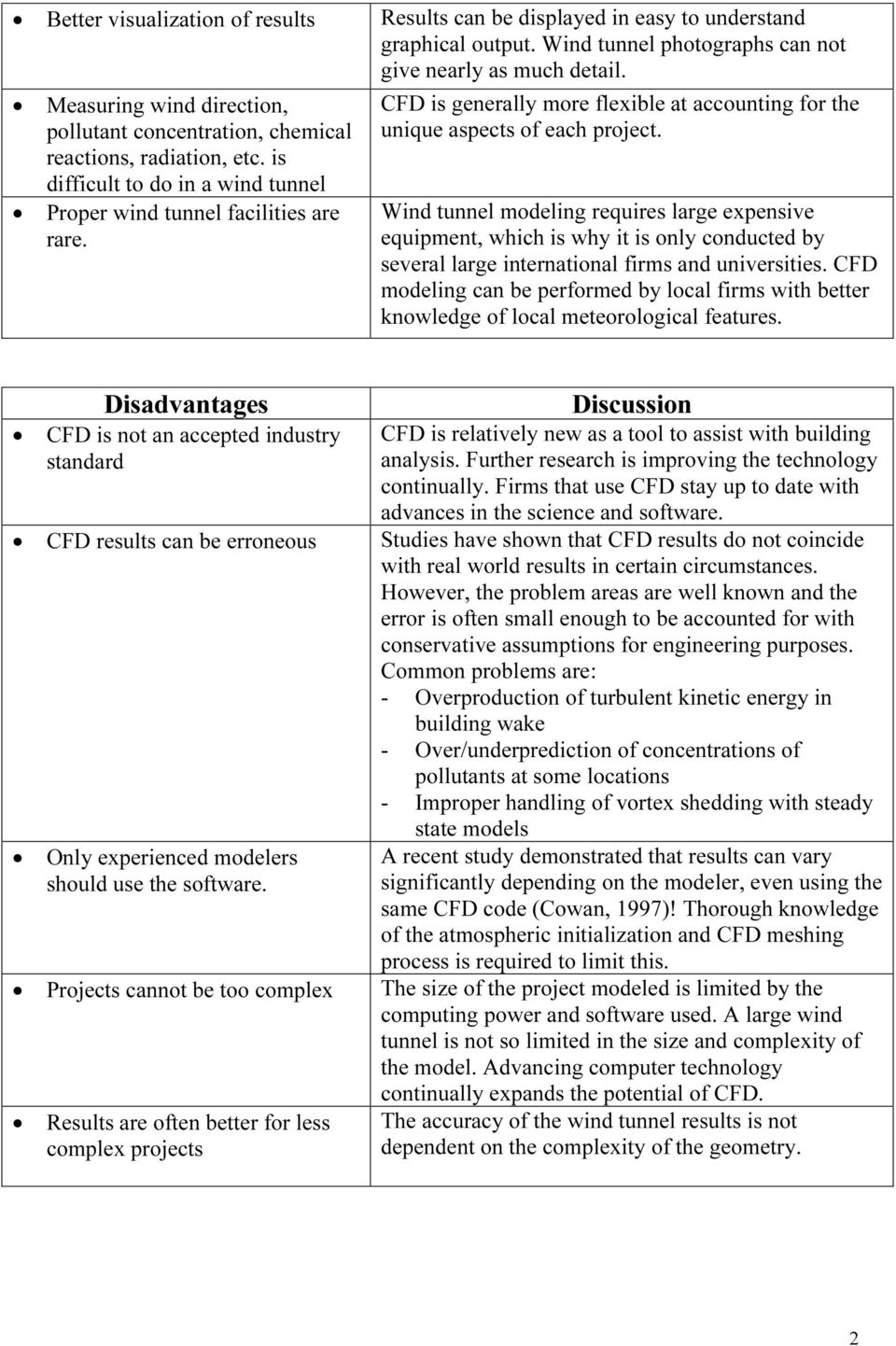
1 Computational Fluid Dynamics or Wind Tunnel Modeling? J.D. McAlpine, Envirometrics, Inc. CFD holds great promise for replacing the wind tunnel in coming years as the science behind CFD improves and computers become more powerful. Currently, CFD can provide results almost as accurate as a wind tunnel that are often more useful due to the sophisticated visualization and domain wide measurements characteristic of CFD. For building services, CFD is an effective tool for simulating wind climate to analyze pedestrian comfort, and pollution dispersion. It can also be used to assist engineers with natural ventilation design and building wind loading. I. Current Status Wind Tunnel modeling is generally accepted in the scientific and engineering community. Wind tunnel results have been proven to be representative of real world situations when the modeling correctly accounts for the features of the atmosphere and scaling is exact. Computational Fluid Dynamics (CFD) is a well-proven tool that was economically feasible only on mainframe computers until recent advances in computing made it possible to use a desktop PC. However, CFD results may not be as comprehensively comparable to real world results as most wind tunnel results can be. Many CFD validation studies have shown quite comparable results to real world or wind tunnel studies. Many CFD results that are critized by academics as insufficiently exact are often quite satisfactory for engineering purposes because the degree of error is within reasonable bounds. Conservative assumptions can be applied to CFD studies to account for the higher potential degree of error. II. CFD as an alternative to wind tunnel modeling Advantages Discussion Full domain analysis Wind tunnels need instruments to record wind speed at each discrete point. CFD by definition computes these variables throughout the whole study domain. Easy alternative analysis CAD design of buildings in the CFD domain can be altered quickly and remodeling done immediately. Physical models require more time and effort for adjustments, especially if the design changes occur long after the initial wind tunnel modeling or the wind tunnel is booked for other projects. Cheaper overall Same or lower cost and quicker turnover times to conduct the modeling in most cases. 1

2 Better visualization of results Results can be displayed in easy to understand graphical output. Wind tunnel photographs can not give nearly as much detail. Measuring wind direction, pollutant concentration, chemical reactions, radiation, etc. is difficult to do in a wind tunnel Proper wind tunnel facilities are rare. CFD is generally more flexible at accounting for the unique aspects of each project. Wind tunnel modeling requires large expensive equipment, which is why it is only conducted by several large international firms and universities. CFD modeling can be performed by local firms with better knowledge of local meteorological features. Disadvantages CFD is not an accepted industry standard Discussion CFD is relatively new as a tool to assist with building analysis. Further research is improving the technology continually. Firms that use CFD stay up to date with advances in the science and software. CFD results can be erroneous Studies have shown that CFD results do not coincide with real world results in certain circumstances. However, the problem areas are well known and the error is often small enough to be accounted for with conservative assumptions for engineering purposes. Common problems are: - Overproduction of turbulent kinetic energy in building wake - Over/underprediction of concentrations of pollutants at some locations - Improper handling of vortex shedding with steady state models Only experienced modelers should use the software. A recent study demonstrated that results can vary significantly depending on the modeler, even using the same CFD code (Cowan, 1997)! Thorough knowledge of the atmospheric initialization and CFD meshing process is required to limit this. Projects cannot be too complex The size of the project modeled is limited by the computing power and software used. A large wind tunnel is not so limited in the size and complexity of the model. Advancing computer technology continually expands the potential of CFD. Results are often better for less complex projects The accuracy of the wind tunnel results is not dependent on the complexity of the geometry. 2

3 CFD yields steady state solution, transient solution is more time consuming Average wind field acceptable for certain applications including pollution dispersion and pedestrian winds (when turbulent kinetic energy is used to estimate gusts). Transient primary wind runs are used to locate time of worst conditions for conservative results. III. CFD vs. real-world and wind tunnel modeling results Example 1: Development and applications of CFD simulations in support of air quality studies involving buildings. (Huber, 2004) Paper recently presented at the joint Air and Waste Management Association/ American Meteorological Society conference on the urban environment. This paper outlined some of the current EPA research into the validation of CFD modeling for use in dispersion modeling in microenvironments. The paper points out that CFD modeling often underpredicts turbulent kinetic energy (TKE) upwind of buildings and overpredicts TKE downwind of buildings, which is the common understanding at this time. Modified models are available that use various methods to correct this. TKE is important for determining wind gusts, recirculation zone size, and pollutant dispersion. However, the paper demonstrates that even though the model has some deficiencies, the results compare fairly well to experimental results. The paper illustrates the comparison of pollutant dispersion with graphs that show fairly insignificant deviation from experimental results. The following graphic from the paper compares the performance of a modified CFD model and a wind tunnel in predicting elements of the flow that are important for determining pedestrian winds and pollutant dispersion. 3

4 Example 2: A Comparison of Wind Tunnel and CFD Methods Applied to Natural Ventilation Design. (Alexander, 1997) This paper does not focus as much on the direct comparison of the CFD/wind-tunnel results, but the guidance that the results lead to. This is important because CFD is often used only as a tool to assist with the decision making of a project. Small variations in the results are rather insubstantial when it comes to true design guidance. A large atrium at the south face of the building was designed to allow incoming outdoor winds to drive ventilating air movement in the atrium. However it was anticipated that, during stronger winds, flow reversal might occur due to wind pressure at the top of the atrium. Wind tunnel modeling demonstrated that flow reversal did occur during even during lighter winds; the design was flawed and required adjustment. Wind tunnel measurements were used to validate an addition to the building structure to prevent the flow reversal from occurring. The most useful change was the use of a wing to create lower pressures at the top of the atrium during windy periods, thus preventing the flow reversal from occurring. Different wing designs were tested until the most effective design was decided upon. The entire process was repeated using CFD instead of a wind-tunnel. Though differences in the results were present, pressure gradients were relatively close, leading to confirmation of the flow reversal during high winds. The same selection of alternative wing designs were tested in the CFD model and the modeling resulted in the selection of the same alternative as finally selected during the wind-tunnel study. Therefore, both studies provided similar guidance by showing similar trends and indicating the same design solution. Example 3: Flow and Dispersion Around Storage Tanks: A Comparison Between Numerical and Wind Tunnel Studies. (Fothergill, 2004) This paper provides an in depth comparison of CFD results and windtunnel results for the variables involving turbulent kinetic energy around cubes and cylinders. It notes that higher accuracy can be achieved in CFD models if the calculation cell mesh is done carefully. It also notes that CFD is much more useful than the simplified EPA dispersion models for predicted wake concentrations. Example 4: The Numerical Wind Tunnel for Industrial Aerodynamics: Real or Virtual in the New Millennium? (Stathopoulos, 2002) This paper is a critical evaluation of the use of CFD as a replacement for the wind-tunnel. Its overall conclusion is that the use of CFD as a reliable accurate tool is promising, but currently falls short due to deviations from real world results. However, this paper references a number of comparison studies that generally support the use of CFD as a design tool. The author himself states that use of CFD for environmental wind effect problems has been shown to be generally comparable to wind-tunnel studies: By and large the comparisons are satisfactory, at least for engineering problems. He references several environmental wind impact studies and their comparable results. 4

5 The author also explores pollutant dispersion using CFD and notes that modeling comparisons have not been able to accurately model some building recirculation zones when sources were located on roofs. However, he notes that other conditions have been modeled quite well. Sources: Alexander, D. K., H. G. Jenkins, P. J. Jones A Comparison of Wind Tunnel and CFD Methods Applied to Natural Ventilation Design. Proceedings of Building Simulation 97: International Building Performance Simulation Ass., Volume 2: Cowan, Ian R. Castro, Ian P. Robins, Alan G, 1997 Numerical Considerations for Simulations of Flow and Dispersion around Buildings. J. of Wind Eng. and Ind. Aerodynamics, v. 67 & 68 (1997) Fothergill, C.E., Roberts, P.T., Flow and Dispersion Around Storage Tanks: A Comparison Between Numerical and Wind Tunnel Studies. Wind & Structures, Vol. 5, No.2-4 (2002), Huber, Alan, Development and applications of CFD simulations in support of air quality studies involving buildings. 13 th Conf. on the App. of Air Poll. Met./5 th AWMA Conf. on the Urban Env., August 25 th, Stathopoulos, T., The Numerical Wind Tunnel for Industrial Aerodynamics: Real or Virtual in the New Millennium? Wind & Structures, Vol. 5, No. 2-4(2002),
ME6130 An introduction to CFD 1-1
 ME6130 An introduction to CFD 1-1 What is CFD? Computational fluid dynamics (CFD) is the science of predicting fluid flow, heat and mass transfer, chemical reactions, and related phenomena by solving numerically
(1) 2 TEST SETUP. Table 1 Summary of models used for calculating roughness parameters Model Published z 0 / H d/h
 Estimation of Surface Roughness using CFD Simulation Daniel Abdi a, Girma T. Bitsuamlak b a Research Assistant, Department of Civil and Environmental Engineering, FIU, Miami, FL, USA, [email protected]
Express Introductory Training in ANSYS Fluent Lecture 1 Introduction to the CFD Methodology
 Express Introductory Training in ANSYS Fluent Lecture 1 Introduction to the CFD Methodology Dimitrios Sofialidis Technical Manager, SimTec Ltd. Mechanical Engineer, PhD PRACE Autumn School 2013 - Industry
CFD Computational Fluid Dynamics
 CFD Computational Fluid Dynamics Norconsult is both highly competent and has a broad experience in the 3D simulation of fluid flows. The section for Applied Fluid Dynamics utilises CFD in a multi-discipline
DESIGN OF NATURAL VENTILATION WITH CFD CHAPTER SEVEN. Qingyan Chen. difficult to understand and model, even for simple
 CHAPTER SEVEN L. Glicksman and J. Lin (eds), Sustainable Urban Housing in China, 116-123 2006 Springer. Printed in the Netherlands. DESIGN OF NATURAL VENTILATION WITH CFD Qingyan Chen INTRODUCTION As the
Customer Training Material. Lecture 2. Introduction to. Methodology ANSYS FLUENT. ANSYS, Inc. Proprietary 2010 ANSYS, Inc. All rights reserved.
 Lecture 2 Introduction to CFD Methodology Introduction to ANSYS FLUENT L2-1 What is CFD? Computational Fluid Dynamics (CFD) is the science of predicting fluid flow, heat and mass transfer, chemical reactions,
Validation of CFD Simulations for Natural Ventilation
 Jiang, Y., Allocca, C., and Chen, Q. 4. Validation of CFD simulations for natural ventilation, International Journal of Ventilation, (4), 359-37. Validation of CFD Simulations for Natural Ventilation Yi
How To Model With Cfd Using Phoenics
 The Use and Application of CFD in the Air Conditioning and Fire Protection Industry AIRAH NSW February 2008 The Use and Application of CFD in the Air Conditioning and Fire Protection Industry An Introduction
Computational Modeling of Wind Turbines in OpenFOAM
 Computational Modeling of Wind Turbines in OpenFOAM Hamid Rahimi [email protected] ForWind - Center for Wind Energy Research Institute of Physics, University of Oldenburg, Germany Outline Computational
Optimizing Tensile Membrane Design utilizing CFD. Trevor Scott. Light Weight Structures Advisory Service
 Optimizing Tensile Membrane Design utilizing CFD Trevor Scott Light Weight Structures Advisory Service Abstract CFD is a process that assists designers in optimizing the design configuration of a Tensile
Basics of vehicle aerodynamics
 Basics of vehicle aerodynamics Prof. Tamás Lajos Budapest University of Technology and Economics Department of Fluid Mechanics University of Rome La Sapienza 2002 Influence of flow characteristics on the
XFlow CFD results for the 1st AIAA High Lift Prediction Workshop
 XFlow CFD results for the 1st AIAA High Lift Prediction Workshop David M. Holman, Dr. Monica Mier-Torrecilla, Ruddy Brionnaud Next Limit Technologies, Spain THEME Computational Fluid Dynamics KEYWORDS
Introduction to CFD Analysis
 Introduction to CFD Analysis Introductory FLUENT Training 2006 ANSYS, Inc. All rights reserved. 2006 ANSYS, Inc. All rights reserved. 2-2 What is CFD? Computational fluid dynamics (CFD) is the science
Numerical Simulation of the External Flow Field. Around a Bluff Car*
 Numerical Simulation of the External Flow Field Around a Bluff Car* Sun Yongling, Wu Guangqiang, Xieshuo Automotive Engineering Department Shanghai Tongji University Shanghai, China E-mail: [email protected]
CONVERGE Features, Capabilities and Applications
 CONVERGE Features, Capabilities and Applications CONVERGE CONVERGE The industry leading CFD code for complex geometries with moving boundaries. Start using CONVERGE and never make a CFD mesh again. CONVERGE
Computational Fluid Dynamics
 Aerodynamics Computational Fluid Dynamics Industrial Use of High Fidelity Numerical Simulation of Flow about Aircraft Presented by Dr. Klaus Becker / Aerodynamic Strategies Contents Aerodynamic Vision
THE CFD SIMULATION OF THE FLOW AROUND THE AIRCRAFT USING OPENFOAM AND ANSA
 THE CFD SIMULATION OF THE FLOW AROUND THE AIRCRAFT USING OPENFOAM AND ANSA Adam Kosík Evektor s.r.o., Czech Republic KEYWORDS CFD simulation, mesh generation, OpenFOAM, ANSA ABSTRACT In this paper we describe
An Overview of the Finite Element Analysis
 CHAPTER 1 An Overview of the Finite Element Analysis 1.1 Introduction Finite element analysis (FEA) involves solution of engineering problems using computers. Engineering structures that have complex geometry
2013 Code_Saturne User Group Meeting. EDF R&D Chatou, France. 9 th April 2013
 2013 Code_Saturne User Group Meeting EDF R&D Chatou, France 9 th April 2013 Thermal Comfort in Train Passenger Cars Contact For further information please contact: Brian ANGEL Director RENUDA France [email protected]
Application of CFD in connection with ship design
 DANSIS meeting Lyngby, 13 May 2009 Application of CFD in connection with ship design www.force.dk Background Method Examples Summary Claus Daniel Simonsen FORCE Technology Background When a ship, which
CFD Based Air Flow and Contamination Modeling of Subway Stations
 CFD Based Air Flow and Contamination Modeling of Subway Stations Greg Byrne Center for Nonlinear Science, Georgia Institute of Technology Fernando Camelli Center for Computational Fluid Dynamics, George
Interactive simulation of an ash cloud of the volcano Grímsvötn
 Interactive simulation of an ash cloud of the volcano Grímsvötn 1 MATHEMATICAL BACKGROUND Simulating flows in the atmosphere, being part of CFD, is on of the research areas considered in the working group
Introduction to CFD Analysis
 Introduction to CFD Analysis 2-1 What is CFD? Computational Fluid Dynamics (CFD) is the science of predicting fluid flow, heat and mass transfer, chemical reactions, and related phenomena by solving numerically
On the use of 3D simulations in Energy and Buildings related applications
 On the use of 3D simulations in Energy and Buildings related applications Dr. Cécile Goffaux Energy & Buildings Team Leader Contact: [email protected] Doc. ref.: ENB-NS-042-00 Energy & Buildings
Using CFD to improve the design of a circulating water channel
 2-7 December 27 Using CFD to improve the design of a circulating water channel M.G. Pullinger and J.E. Sargison School of Engineering University of Tasmania, Hobart, TAS, 71 AUSTRALIA Abstract Computational
Computational Fluid Dynamics in Automotive Applications
 Computational Fluid Dynamics in Automotive Applications Hrvoje Jasak [email protected] Wikki Ltd, United Kingdom FSB, University of Zagreb, Croatia 1/15 Outline Objective Review the adoption of Computational
CFD SIMULATION OF SDHW STORAGE TANK WITH AND WITHOUT HEATER
 International Journal of Advancements in Research & Technology, Volume 1, Issue2, July-2012 1 CFD SIMULATION OF SDHW STORAGE TANK WITH AND WITHOUT HEATER ABSTRACT (1) Mr. Mainak Bhaumik M.E. (Thermal Engg.)
How To Model A Horseshoe Vortex
 Comparison of CFD models for multiphase flow evolution in bridge scour processes A. Bayón-Barrachina, D. Valero, F.J. Vallès Morán, P. A. López-Jiménez Dept. of Hydraulic and Environmental Engineering
Computational Fluid Dynamics Research Projects at Cenaero (2011)
 Computational Fluid Dynamics Research Projects at Cenaero (2011) Cenaero (www.cenaero.be) is an applied research center focused on the development of advanced simulation technologies for aeronautics. Located
5.14 COMPUTATIONAL MODELLING OF AIRFLOW IN URBAN STREET CANYON AND COMPARISON WITH MEASUREMENTS
 5.14 COMPUTATIONAL MODELLING OF AIRFLOW IN URBAN STREET CANYON AND COMPARISON WITH MEASUREMENTS J. Pospisil 1,M. Jicha 1, A. Niachou 2 and M. Santamouris 2 1 Brno University of Technology, Faculty of Mechanical
Application of CFD Simulation in the Design of a Parabolic Winglet on NACA 2412
 , July 2-4, 2014, London, U.K. Application of CFD Simulation in the Design of a Parabolic Winglet on NACA 2412 Arvind Prabhakar, Ayush Ohri Abstract Winglets are angled extensions or vertical projections
PUTTING THE SPIN IN CFD
 W H I T E PA P E R PUTTING THE SPIN IN CFD Overview Engineers who design equipment with rotating components need to analyze and understand the behavior of those components if they want to improve performance.
External bluff-body flow-cfd simulation using ANSYS Fluent
 External bluff-body flow-cfd simulation using ANSYS Fluent External flow over a bluff body is complex, three-dimensional, and vortical. It is massively separated and it exhibits vortex shedding. Thus,
Flow Physics Analysis of Three-Bucket Helical Savonius Rotor at Twist Angle Using CFD
 Vol.3, Issue.2, March-April. 2013 pp-739-746 ISSN: 2249-6645 Flow Physics Analysis of Three-Bucket Helical Savonius Rotor at Twist Angle Using CFD Pinku Debnath, 1 Rajat Gupta 2 12 Mechanical Engineering,
Computational Fluid Dynamics (CFD) Markus Peer Rumpfkeil
 Computational Fluid Dynamics (CFD) Markus Peer Rumpfkeil January 13, 2014 1 Let's start with the FD (Fluid Dynamics) Fluid dynamics is the science of fluid motion. Fluid flow is commonly studied in one
Multiphase Flow - Appendices
 Discovery Laboratory Multiphase Flow - Appendices 1. Creating a Mesh 1.1. What is a geometry? The geometry used in a CFD simulation defines the problem domain and boundaries; it is the area (2D) or volume
Aeroelastic Investigation of the Sandia 100m Blade Using Computational Fluid Dynamics
 Aeroelastic Investigation of the Sandia 100m Blade Using Computational Fluid Dynamics David Corson Altair Engineering, Inc. Todd Griffith Sandia National Laboratories Tom Ashwill (Retired) Sandia National
Performance Comparison of a Vertical Axis Wind Turbine using Commercial and Open Source Computational Fluid Dynamics based Codes
 Performance Comparison of a Vertical Axis Wind Turbine using Commercial and Open Source Computational Fluid Dynamics based Codes Taimoor Asim 1, Rakesh Mishra 1, Sree Nirjhor Kaysthagir 1, Ghada Aboufares
QUALITY OF WIND POWER. How does quality affect the cost of electricity generation from wind power?
 QUALITY OF WIND POWER How does quality affect the cost of electricity generation from wind power? QUALITY OF WIND POWER Wind power is a cornerstone in the green transition of the power sector, and onshore
Compatibility and Accuracy of Mesh Generation in HyperMesh and CFD Simulation with Acusolve for Torque Converter
 Compatibility and Accuracy of Mesh Genen in HyperMesh and CFD Simulation with Acusolve for Converter Kathiresan M CFD Engineer Valeo India Private Limited Block - A, 4th Floor, TECCI Park, No. 176 Rajiv
Pressure in Fluids. Introduction
 Pressure in Fluids Introduction In this laboratory we begin to study another important physical quantity associated with fluids: pressure. For the time being we will concentrate on static pressure: pressure
Turbulence: The Invisible Hazard presented by Scott Miller PIA Symposium 2005 Jacksonville, Florida, USA
 1300 E. International Speedway Blvd DeLand, FL 32724 USA Tel: +1.386.738.2224 Fax: +1.734.8297 www.performancedesigns.com Turbulence: The Invisible Hazard presented by Scott Miller PIA Symposium 2005 Jacksonville,
Simulation to Analyze Two Models of Agitation System in Quench Process
 20 th European Symposium on Computer Aided Process Engineering ESCAPE20 S. Pierucci and G. Buzzi Ferraris (Editors) 2010 Elsevier B.V. All rights reserved. Simulation to Analyze Two Models of Agitation
CFD Beyond the Whitespace. Datacentres Central & Eastern Europe
 CFD Beyond the Whitespace Datacentres Central & Eastern Europe September 2013 CONTENTS 1.0 Introduction 2.0 What is CFD? How it Works CFD in Data Centres 3.0 CFD Outside the White Space Case Study 4.0
Diego Ibarra Christoph Reinhart Harvard Graduate School of Design
 Building Performance Simulation for Designers - Energy DesignBuilder // EnergyPlus Tutorial #3 Construction Assemblies, Load Reduction & Shading GEOMETRY LOADS RESULTS Diego Ibarra Christoph Reinhart Harvard
Turbulence Modeling in CFD Simulation of Intake Manifold for a 4 Cylinder Engine
 HEFAT2012 9 th International Conference on Heat Transfer, Fluid Mechanics and Thermodynamics 16 18 July 2012 Malta Turbulence Modeling in CFD Simulation of Intake Manifold for a 4 Cylinder Engine Dr MK
Application of CFD modelling to the Design of Modern Data Centres
 Application of CFD modelling to the Design of Modern Data Centres White Paper March 2012 By Sam Wicks BEng CFD Applications Engineer Sudlows March 14, 2012 Application of CFD modelling to the Design of
GAS DISPERSION WITH OPENFOAM
 GAS DISPERSION WITH OPENFOAM Chris Dixon Major Hazards Management Centre of Expertise October 2012 1 DEFINITIONS AND CAUTIONARY NOTE Resources: Our use of the term resources in this announcement includes
Averaging Pitot Tubes; Fact and Fiction
 Averaging Pitot Tubes; Fact and Fiction Abstract An experimental investigation has been undertaken to elucidate effects of averaging stagnation pressures on estimated velocities for pressure averaging
Introduction to Computational Fluid Dynamics (CFD) for Combustion. www.reaction-eng.com (801) 364-6925
 Introduction to Computational Fluid Dynamics (CFD) for Combustion www.reaction-eng.com (801) 364-6925 What is CFD? CFD stands for Computational Fluid Dynamics CFD uses computers to represent (or model)
ASSESSMENT OF MODELING SLATTED FLOOR AS POROUS MEDIA IN LIVESTOCK BUILDINGS IN TWO VENTILATION SYSTEMS. Inge Lehmanns Gade 10, 8000, Aarhus C, Denmark
 ASSESSMENT OF MODELING SLATTED FLOOR AS POROUS MEDIA IN LIVESTOCK BUILDINGS IN TWO VENTILATION SYSTEMS Li Rong 1, Bjarne Bjerg 2, Guoqiang Zhang 1 1 Department of Engineering, Aarhus University Inge Lehmanns
Action 9.2/Part II. Stijn Vranckx, Peter Vos VITO
 Final report OpenFOAM CFD simulation of pollutant dispersion in street canyons: Validation and annual impact of trees Action 9.2/Part II Stijn Vranckx, Peter Vos VITO www.vmm.be www.vito.be Lisa Blyth
CFD Application on Food Industry; Energy Saving on the Bread Oven
 Middle-East Journal of Scientific Research 13 (8): 1095-1100, 2013 ISSN 1990-9233 IDOSI Publications, 2013 DOI: 10.5829/idosi.mejsr.2013.13.8.548 CFD Application on Food Industry; Energy Saving on the
F1 Fuel Tank Surging; Model Validation
 F1 Fuel Tank Surging; Model Validation Luca Bottazzi and Giorgio Rossetti Ferrari F1 team, Maranello, Italy SYNOPSIS A Formula One (F1) car can carry more than 80 kg of fuel in its tank. This has a big
Name Partners Date. Energy Diagrams I
 Name Partners Date Visual Quantum Mechanics The Next Generation Energy Diagrams I Goal Changes in energy are a good way to describe an object s motion. Here you will construct energy diagrams for a toy
COOKING THE ROOF CFD BEYOND THE WHITE SPACE
 COOKING THE ROOF CFD BEYOND THE WHITE SPACE Alex Nock 20 November 2013 CONTENTS 1. Introduction» Introduction to RED» Modeling in Data Centres 1. What is CFD» How it works» CFD in Data Centres 3. Cooking
Opening the Bonnet. Prof Darren Woolf WYSINWYG 1
 Opening the Bonnet Prof Darren Woolf WYSINWYG 1 WYSINWYG What You See Is NOT What You Get: Looking inside the Pandora s Box Prof Darren Woolf WYSINWYG 2 WYSIWYG implies a user interface that allows the
Offshore Wind Farm Layout Design A Systems Engineering Approach. B. J. Gribben, N. Williams, D. Ranford Frazer-Nash Consultancy
 Offshore Wind Farm Layout Design A Systems Engineering Approach B. J. Gribben, N. Williams, D. Ranford Frazer-Nash Consultancy 0 Paper presented at Ocean Power Fluid Machinery, October 2010 Offshore Wind
CFD Analysis of Swept and Leaned Transonic Compressor Rotor
 CFD Analysis of Swept and Leaned Transonic Compressor Nivin Francis #1, J. Bruce Ralphin Rose *2 #1 Student, Department of Aeronautical Engineering& Regional Centre of Anna University Tirunelveli India
Titelmasterformat durch Klicken bearbeiten
 Titelmasterformat durch Klicken bearbeiten Stefan Trometer, CADFEM GmbH Exploring Urban Simulation Semantic 3D City Models 3D city model of Frankfurt Generated and hosted by virtualcitysystems CityGML
SOLIDWORKS SOFTWARE OPTIMIZATION
 W H I T E P A P E R SOLIDWORKS SOFTWARE OPTIMIZATION Overview Optimization is the calculation of weight, stress, cost, deflection, natural frequencies, and temperature factors, which are dependent on variables
AB3080 L. Learning Objectives: About the Speaker:
 AB3080 L While architects have tested their designs in wind tunnels for many years, the process is typically outsourced to engineering firms and not easily accessible to architects during the conceptual
Michael W. Kuenstle, AIA School of Architecture, University of Florida, U.S.A. [email protected]
 PHOENICS Abstract A COMPARATIVE STUDY OF A SIMPLE BUILDING TYPE SITUATED IN THREE VARYING CONDITIONS WITHIN A SINGLE EXPOSURE CATEGORY 3 Second gust wind 63 m/s exposure C, ASCE 7-98, α 11.5 Michael W.,
Master of Science Program (M.Sc.) in Renewable Energy Engineering in Qassim University
 Master of Science Program (M.Sc.) in Renewable Energy Engineering in Qassim University Introduction: The world is facing the reality that the global energy demand is increasing significantly over the coming
AN EFFECT OF GRID QUALITY ON THE RESULTS OF NUMERICAL SIMULATIONS OF THE FLUID FLOW FIELD IN AN AGITATED VESSEL
 14 th European Conference on Mixing Warszawa, 10-13 September 2012 AN EFFECT OF GRID QUALITY ON THE RESULTS OF NUMERICAL SIMULATIONS OF THE FLUID FLOW FIELD IN AN AGITATED VESSEL Joanna Karcz, Lukasz Kacperski
Mesh Discretization Error and Criteria for Accuracy of Finite Element Solutions
 Mesh Discretization Error and Criteria for Accuracy of Finite Element Solutions Chandresh Shah Cummins, Inc. Abstract Any finite element analysis performed by an engineer is subject to several types of
MODELLING COUPLED HEAT AND AIR FLOW: PING-PONG VS ONIONS
 MODELLING COUPLED HEAT AND AIR FLOW: PING-PONG VS ONIONS Jan Hensen University of Strathclyde Energy Systems Research Unit 75 Montrose Street, GLASGOW G1 1XJ, Scotland Email: [email protected] SYNOPSIS
Seagull Intersection Layout. Island Point Road - A Case Study. Authors: John Harper, Wal Smart, Michael de Roos
 Seagull Intersection Layout. Island Point Road - A Case Study Authors: John Harper, Wal Smart, Michael de Roos Presented by Mr John Harper, Road Safety and Traffic Services Manager Phone: 4221 2456 Mobile:
ABSTRACT FOR THE 1ST INTERNATIONAL WORKSHOP ON HIGH ORDER CFD METHODS
 1 ABSTRACT FOR THE 1ST INTERNATIONAL WORKSHOP ON HIGH ORDER CFD METHODS Sreenivas Varadan a, Kentaro Hara b, Eric Johnsen a, Bram Van Leer b a. Department of Mechanical Engineering, University of Michigan,
CFD Grows Up! Martin W. Liddament Ventilation, Energy and Environmental Technology (VEETECH Ltd) What is Computational Fluid Dynamics?
 CIBSE/ASHRAE Meeting CFD Grows Up! Martin W. Liddament Ventilation, Energy and Environmental Technology (VEETECH Ltd) 10 th December 2003 What is Computational Fluid Dynamics? CFD is a numerical means
AN APPLICATION MANUAL FOR BUILDING ENERGY AND ENVIRONMENTAL MODELLING
 AN APPLICATION MANUAL FOR BUILDING ENERGY AND ENVIRONMENTAL MODELLING D. Bartholomew *, J. Hand #, S. Irving &, K. Lomas %, L. McElroy # F. Parand $, D. Robinson $ and P. Strachan # * DBA, # University
CFD analysis for road vehicles - case study
 CFD analysis for road vehicles - case study Dan BARBUT*,1, Eugen Mihai NEGRUS 1 *Corresponding author *,1 POLITEHNICA University of Bucharest, Faculty of Transport, Splaiul Independentei 313, 060042, Bucharest,
Accurate Air Flow Measurement in Electronics Cooling
 Accurate Air Flow Measurement in Electronics Cooling Joachim Preiss, Raouf Ismail Cambridge AccuSense, Inc. E-mail: [email protected] Air is the most commonly used medium to remove heat from electronics
CFD analysis of external aerodynamic and entry into to the air conditioning system on the roof of a bus
 CFD analysis of external aerodynamic and entry into to the air conditioning system on the roof of a bus Samuel Diaz ESSS Argentina [email protected] PRESENTATION TOPICS Company Overview; Problem
Simulation of Water-in-Oil Emulsion Flow with OpenFOAM using Validated Coalescence and Breakage Models
 Simulation of Water-in-Oil Emulsion Flow with OpenFOAM using Validated Coalescence and Breakage Models Gabriel G. S. Ferreira*, Jovani L. Favero*, Luiz Fernando L. R. Silva +, Paulo L. C. Lage* Laboratório
The calculation of train slipstreams using Large-Eddy Simulation techniques
 The calculation of train slipstreams using Large-Eddy Simulation techniques Abstract Hassan Hemida, Chris Baker Birmingham Centre for Railway Research and Education, School of Civil Engineering, University
BBIPED: BCAM-Baltogar Industrial Platform for Engineering design
 BBIPED: BCAM-Baltogar Industrial Platform for Engineering design Carmen Alonso-Montes, Imanol García, Ali Ramezani, Lakhdar Remaki BCAM Basque Center for Applied Mathematics (Bilbao), Spain Motivation
The ADREA-HF CFD code An overview
 The ADREA-HF CFD code An overview Dr. A.G. Venetsanos Environmental Research Laboratory (EREL) National Centre for Scientific Research Demokritos, Greece [email protected] Slide 2 Computational
FAN PROTECTION AGAINST STALLING PHENOMENON
 FAN PROTECTION AGAINST STALLING PHENOMENON Roberto Arias Álvarez 1 Javier Fernández López 2 2 1 ZITRON Technical Director [email protected] ZITRON Technical Pre Sales Management [email protected]
COMPUTATIONAL FLUID DYNAMICS USING COMMERCIAL CFD CODES
 ME469B - Spring 2007 COMPUTATIONAL FLUID DYNAMICS USING COMMERCIAL CFD CODES Gianluca Iaccarino Dept. Mechanical Engineering Bldg. 500 RM 204 (RM500-I) Ph. 650-723-9599 Email: [email protected] ME469B/1/GI
APPLYING CFD TO ENVIRONMENTAL FLOWS
 APPLYING CFD TO ENVIRONMENTAL FLOWS Eric N Jal Connell Wagner Pty Ltd 60 Albert Road South Melbourne Victoria AUSTRALIA E-mail: [email protected] Date: December 2003 Computer: Intel Pentium IV 1.7GHz Operating
Wing Loading and its Effects
 www.performancedesigns.com I. Wing Loading Defined Wing Loading and its Effects A seminar by Performance Designs, Inc. Speaker: John LeBlanc Wing loading is a measurement of how much total weight is supported
EVALUATION OF PHOENICS CFD FIRE MODEL AGAINST ROOM CORNER FIRE EXPERIMENTS
 EVALUATION OF PHOENICS CFD FIRE MODEL AGAINST ROOM CORNER FIRE EXPERIMENTS Yunlong Liu and Vivek Apte CSIRO Fire Science and Technology Laboratory PO Box 31 North Ryde, NSW 167, Australia TEL:+61 2 949
Flow in data racks. 1 Aim/Motivation. 3 Data rack modification. 2 Current state. EPJ Web of Conferences 67, 02070 (2014)
 EPJ Web of Conferences 67, 02070 (2014) DOI: 10.1051/ epjconf/20146702070 C Owned by the authors, published by EDP Sciences, 2014 Flow in data racks Lukáš Manoch 1,a, Jan Matěcha 1,b, Jan Novotný 1,c,JiříNožička
Transient Wind Events and Their Effect on Drive-Train Loads INTERNATIONAL. siteurpublications
 Transient Wind Events and Their Effect on Drive-Train Loads INTERNATIONAL April/May 2015 siteurpublications Volume 11 No. 3 Feature Although wind turbines have been around for decades, recent research
OPTIMISE TANK DESIGN USING CFD. Lisa Brown. Parsons Brinckerhoff
 OPTIMISE TANK DESIGN USING CFD Paper Presented by: Lisa Brown Authors: Lisa Brown, General Manager, Franz Jacobsen, Senior Water Engineer, Parsons Brinckerhoff 72 nd Annual Water Industry Engineers and
Aerodynamic Department Institute of Aviation. Adam Dziubiński CFD group FLUENT
 Adam Dziubiński CFD group IoA FLUENT Content Fluent CFD software 1. Short description of main features of Fluent 2. Examples of usage in CESAR Analysis of flow around an airfoil with a flap: VZLU + ILL4xx
CFD and EXPERIMENTAL ANALYSIS of VORTEX SHEDDING BEHIND D-SHAPED CYLINDER
 CFD and EXPERIMENTAL ANALYSIS of VORTEX SHEDDING BEHIND D-SHAPED CYLINDER Chandrakant D. Mhalungekar Department of Mechanical Engineering, MIT College of Engineering, Pune 411038, Pune University, India.
Pros and Cons. of CFD and Physical Flow Modeling. A White Paper by: Kevin W. Linfield, Ph.D., P.E. Robert G. Mudry, P.E.
 Pros and Cons of CFD and Physical Flow Modeling A White Paper by: Kevin W. Linfield, Ph.D., P.E. Robert G. Mudry, P.E. August, 2008 2008 Airflow Sciences Corporation All Rights Reserved When it comes to
NUCLEAR ENERGY RESEARCH INITIATIVE
 NUCLEAR ENERGY RESEARCH INITIATIVE Experimental and CFD Analysis of Advanced Convective Cooling Systems PI: Victor M. Ugaz and Yassin A. Hassan, Texas Engineering Experiment Station Collaborators: None
Experimental Evaluation of the Discharge Coefficient of a Centre-Pivot Roof Window
 Experimental Evaluation of the Discharge Coefficient of a Centre-Pivot Roof Window Ahsan Iqbal #1, Alireza Afshari #2, Per Heiselberg *3, Anders Høj **4 # Energy and Environment, Danish Building Research
Research and Education in the Field of Wind Energy at the Technical University of Denmark
 Research and Education in the Field of Wind Energy at the Technical University of Denmark Jens Nørkær Sørensen Head of Section of Fluid Mechanics DTU Wind Energy DTU Wind Energy The department, which was
SINGLE TRAIN PASSING THROUGH A TUNNEL
 European Conference on Computational Fluid Dynamics ECCOMAS CFD 2006 P. Wesseling, E. Oñate, J. Périaux (Eds) TU Delft, The Netherlands, 2006 SINGLE TRAIN PASSING THROUGH A TUNNEL Jakub Novák* *Skoda Research,
Eu-NORSEWInD - Assessment of Viability of Open Source CFD Code for the Wind Industry
 Downloaded from orbit.dtu.dk on: Jun 28, 2016 Eu-NORSEWInD - Assessment of Viability of Open Source CFD Code for the Wind Industry Stickland, Matt; Scanlon, Tom; Fabre, Sylvie; Ahmad, Abdul; Oldroyd, Andrew;