
Lepton Flavour LHC?
|
|
|
- Sybil Carson
- 9 years ago
- Views:
Transcription
1 m ν (charged) lepton flavour change happens, and the LHC exists...so look for Lepton Flavour LHC? Sacha Davidson, P Gambino, G Grenier, S Lacroix, ML Mangano, S Perries, V Sordini, P Verdier IPN de Lyon/CNRS (1412.xxxx, , , , ) 1. LHC is a discovery machine: look for LFV decays of theoretically motivated new particles (sleptons, N R,...) 2. SM external legs exist look for LFV interactions of SM particles? with a heavy SM leg, so LHC complements lower energy searches

2 Lepton Flavour LHC? Sacha Davidson, P Gambino, G Grenier, S Lacroix, ML Mangano, S Perries, V Sordini, P Verdier IPN de Lyon/CNRS (1412.xxxx, , , , ) 1. LHC a discovery machine: look for LFV in decays of theoretically motivated new particles (sleptons, N R,...) 2. SM external legs exist LHC look for LFV interactions of SM particles? with a heavy leg, to complement lower energy searches τ µ,e τ,µ Z µ,e h τ t e q Parametrise LFV vertices as contact interactions Bounds from low energy and LEP? LHC sensitivity?

3 What about the Z? LEP? LHC? low energy?

4 Dimension six operators for LFV Z decays Mass dimension of Z and two lepton external legs = 4 Z τ ± µ operators contains two Higgs and/or Derivatives Three options among gauge invariant operators at dimension 6: O( 2 ) : µγ β D α τb αβ,... O(H 2 ) : [H D α H]µγ α τ,... O(yH ) dipole : l µ Hσ βα τb αβ,... (where B αβ = α B β β B α, B hypercharge gauge boson).
![invariant operators at dimension 6: O( 2 ) : µγ β D α τb αβ,... O(H 2 ) : [H D α H]µγ α τ,.](/docs-images/47/20858980/images/page_4.jpg ".. O(yH ) dipole : l µ Hσ βα τb αβ,.")
5 Dimension six operators for LFV Z decays Need two powers of a vev/momentum in operator. Three options among gauge invariant operators at dimension 6. Suppose operator coefficients such that: Rossi+Brignole..., µγ β D α τb αβ g Z C p2 Z 16π 2 Λ 2µγ ατz α..., [H D α H]µγ α τ g Z A m2 Z 16π 2 Λ 2µγ αz α τ..., l µ Hσ βα τb αβ g Z D m τ 16π 2 Λ 2[µσ αβτ]z αβ NP of mass Λ > m Z in a loop, A,C,D dimless

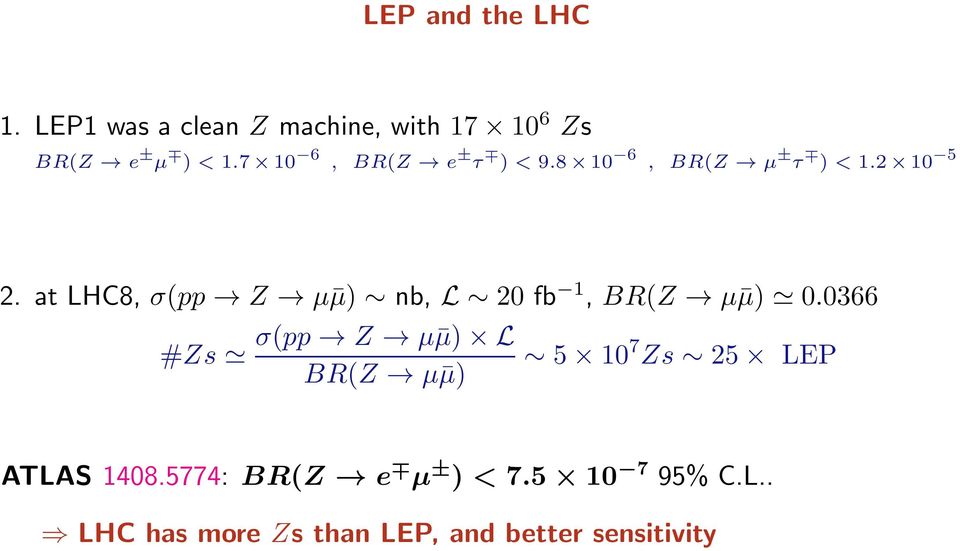
6 LEP and the LHC 1. LEP1 was a clean Z machine, with Zs BR(Z e ± µ ) < , BR(Z e ± τ ) < , BR(Z µ ± τ ) < at LHC8, σ(pp Z µ µ) nb, L 20 fb 1, BR(Z µ µ) #Zs σ(pp Z µ µ) L BR(Z µ µ) Zs 25 LEP ATLAS : BR(Z e µ ± ) < % C.L.. LHC has more Zs than LEP, and better sensitivity
7 Low energy: the Z contributes too? decades of rare decay/precision data?... BR(τ µ µµ) < τ L τ µ Z µ L µ Z µ

8 Low energy: the Z contributes too? decades of rare decay/precision data?... BR(τ µ µµ) < τ L τ µ Z µ L µ Z µ But gradient operators better constrained at high energy. Consider ( α Z β β Z α = Z αβ ) g Z C on the Z : vertex =g Z Cm 2 Z 16π 2 Λ 2µZ/ τ 1 16π 2 Λ 2Zαβ µγ α β τ g Z C p2 Z 16π 2 Λ 2µγ αz α τ in τ µ µµ :vertex < g Z Cm 2 τ 16π 2 Λ 2µZ/ τ (negligeable)? But, am I allowed gradient operators? Yes, more later...


9 The gradient 2 Z τ ± µ operators: are they important in loops? and can I calculate that? τ Z µ 1. assume NP scale Λ m Z γ 2. assume NP generates only 2 operator (no other LFV; not τ µγ), so interaction : g Z C µτ p 2 Z 16π 2 Λ 2µγ ατz α 3. in RG running between Λ and m Z, Z τ ± µ will mix to τ µγ operator (...estimate the coefficient of 1/ǫ in dim reg...) BR(τ µγ) 3α gz 4 4πG 2 F Λ4 ( ) 2 Cµτ log C2 µτv 4 32π 2 no constraint on C µτ from BR(τ lγ) < but µ eγ constrains C eµ : BR(Z e ± µ ) < (BR(µ eγ) < ) Λ 4

10 Simma EJPC Derivative Operators, Eqns of Motion and the Operator Basis equations of motion (EoM) for the hypercharge boson (B Z) µ B µν g 2 (H D ν H [D ν H] H) g f Qf Y fγν f = 0 p 2 Z ν m 2 Z Zν g J ν

11 Simma EJPC Derivative Operators, Eqns of Motion and the Operator Basis On-shell S-matrix elements induced by an operator containing EoM vanish. This is used to reduce the operator basis. Eg, the equations of motion (EoM) for the hypercharge boson (B Z) µ B µν g 2 (H D ν H [D ν H] H) g f Qf Y fγν f = 0 so the operator: O = τγ ν µ( µ B µν ig 2 H HB ν g f Qf Y fγν f) induces vertices τγ ν µfγ ν f, Q f Y B ν τγ ν µ, p 2 B m2 B (m B = g H ). These vertices cancel in on-shell S-matrix elements : f µ µτ O f f = Q f Y f τ Q f Y p 2 m 2 B p 2 m 2 B f f µ τ
![Eg, the equations of motion (EoM) for the hypercharge boson (B Z) µ B µν g 2 (H D ν H [D ν H] H) g f Qf Y fγν f = 0 so the operator: O =](/docs-images/47/20858980/images/page_11.jpg "τγ ν µ( µ B µν ig 2 H HB ν g f Qf Y fγν f) induces vertices τγ ν µfγ ν f, Q f Y B ν τγ ν µ, p 2 B m2 B (m B = g H ).")
12 Simma EJPC Derivative Operators, Eqns of Motion and the Operator Basis On-shell S-matrix elements induced by an operator containing EoM vanish. This is used to reduce the operator basis. Eg, the equations of motion (EoM) for the hypercharge boson (B Z) µ B µν g 2 (H D ν H [D ν H] H) g f Qf Y fγν f = 0 so the operator: O = τγ ν µ( µ B µν ig 2 H HB ν g f Qf Y fγν f) induces vertices τγ ν µfγ ν f, Q f Y B ν τγ ν µ, p 2 B m2 B (m B = g H ). These vertices cancel in on-shell S-matrix elements : f µ µτ O f f = Q f Y Q f Y p 2 m 2 B p 2 m 2 B f τ f so only keep one dim 6 Zτµ operator: HD ν H, or 2 Z ν τγ ν µ f µ τ
![Eg, the equations of motion (EoM) for the hypercharge boson (B Z) µ B µν g 2 (H D ν H [D ν H] H) g f Qf Y fγν f = 0 so the operator: O = τγ ν µ( µ B µν](/docs-images/47/20858980/images/page_12.jpg "ig 2 H HB ν g f Qf Y fγν f) induces vertices τγ ν µfγ ν f, Q f Y B ν τγ ν µ, p 2 B m2 B (m B = g H ).")
13 Getting the same constraints on NP in either basis? 1. four fermion operator and 2 LFV Z operator: (τγ α µ)(µγ α µ), p 2 Z τz/ µ on the Z, LFV Z coupling contributes, 4-f operator not. in τ µ µµ, only 4-f operator contributes 2. four fermion operator and penguin=h D ν H LFV Z operator: (τγ α µ)(µγ α µ), m 2 Z τz/ µ on the Z, LFV Z coupling contributes, 4-f operator not. in τ µ µµ, both operators contribute in the amplitude, cancellations possible. (formally: below m Z, must match out Z so the coeff of 4 ferm op changes) Choose derivative operators to parametrise Z contact interactions, because these contribute at LHC (where Z is propagating particle), but not at low energy:

14 Summary about the Z: LHC has interesting sensitivity to Z µ ± τ, Z e ± τ. h τ ± l low energy bounds h τ µ selon CMS?

15 Operators and Models for LFV Higgs decays LFV could appear in Higgs decays: 1. if have Y 1 lhτ, plus dim 6 operator Y2 H H lhτ Giudice-Lebedev, Babu-Nandi 2. also two Higgs doublets of type III = flavour changing couplings + keep two neutral light scalars...davidson-grenier Aristizabal,Vicente

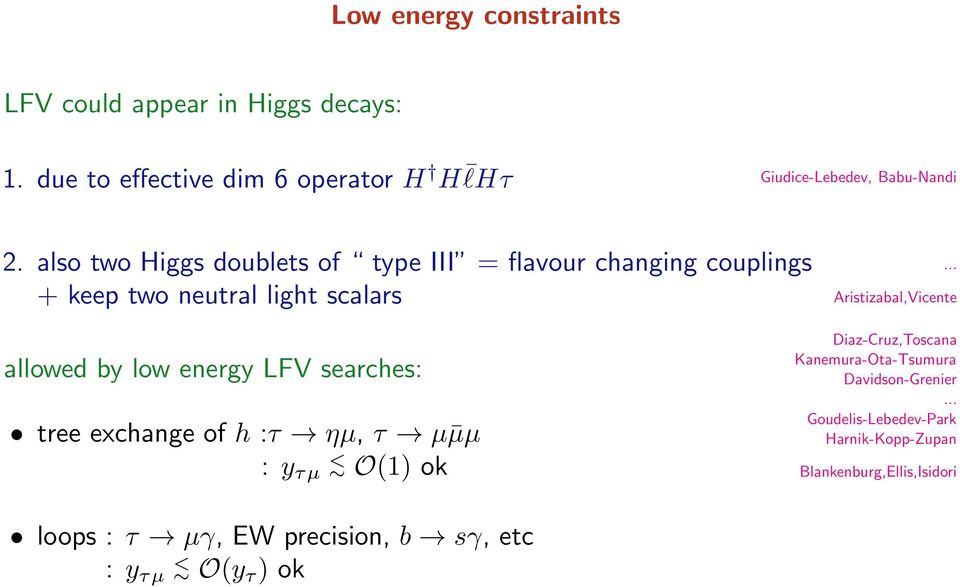
16 Low energy constraints LFV could appear in Higgs decays: 1. due to effective dim 6 operator H H lhτ Giudice-Lebedev, Babu-Nandi 2. also two Higgs doublets of type III = flavour changing couplings + keep two neutral light scalars... Aristizabal,Vicente allowed by low energy LFV searches: tree exchange of h :τ ηµ, τ µ µµ : y τµ < O(1) ok Diaz-Cruz,Toscana Kanemura-Ota-Tsumura Davidson-Grenier... Goudelis-Lebedev-Park Harnik-Kopp-Zupan Blankenburg,Ellis,Isidori loops : τ µγ, EW precision, b sγ, etc : y τµ < O(y τ ) ok
17 Tree level Higgs exchange (diff from Z! h is much narrower) in low energy rare decays: τ µ y 2 τµ y2 µ µ h µ Γ(τ 3µ) Γ(τ µν ν) m 4 h g 4 m 4 W y 2 τµ y2 µ g 4 so feeble bounds on y τµ on the narrow resonance ( Γ h 3y 2 b /16π): τ L h Γ(h τ µ) Γ(h b b) y 2 τµ y 2 b µ L right place to look for small couplings: BR(h τµ) y τµ 2 /y 2 b

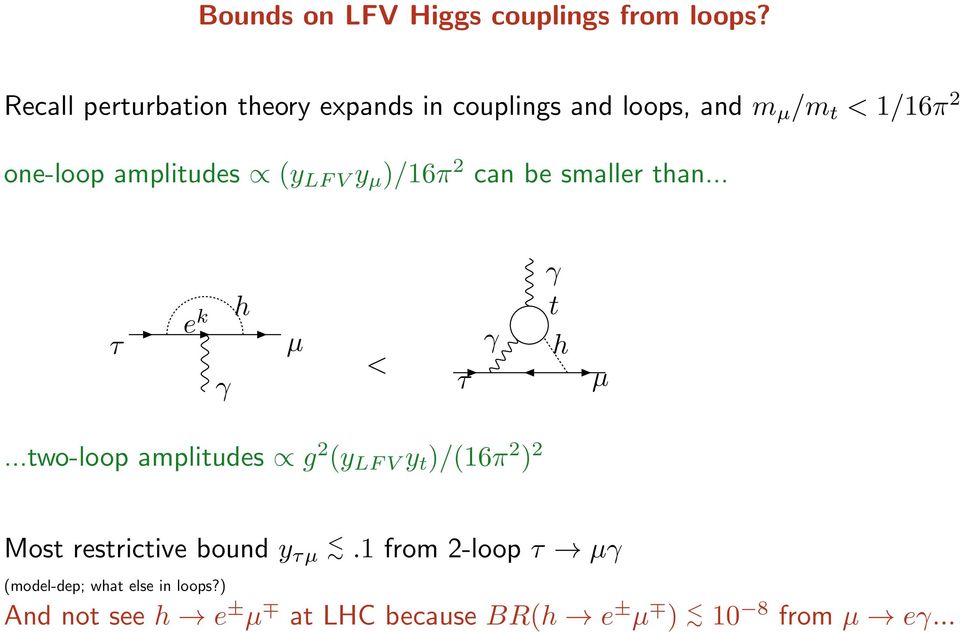
18 Bounds on LFV Higgs couplings from loops? Recall perturbation theory expands in couplings and loops, and m µ /m t < 1/16π 2 one-loop amplitudes (y LFV y µ )/16π 2 can be smaller than... h e k τ µ < γ γ t γ h τ µ...two-loop amplitudes g 2 (y LFV y t )/(16π 2 ) 2 Most restrictive bound y τµ <.1 from 2-loop τ µγ (model-dep; what else in loops?) And not see h e ± µ at LHC because BR(h e ± µ ) < 10 8 from µ eγ...
19 CMS: h τ ± µ µτ, 0 Jets had % µτ, 1 Jet had % µτ, 2 Jets had % CMS preliminary fb, s = 8 TeV BR(h τ ± µ ) < 1.57% (95% C.L.) y τµ BR(h τ ± µ ) = %(2.46σ) y τµ y τ y µ = µτ, 0 Jets e % µτ, 1 Jet e % µτ, 2 Jets e % h µτ % Best Fit to Br(h µτ), %

20 t e ± µ q (t τ ± l q) Low Energy? LHC?

21 Contact interactions mediating LFV top decays O (1) lq O (3) lq = (l i γ α l j )(q r γ α q t ) = (l i γ α τ a l j )(q r γ α τ a q t ) O eq = (e i γ α e j )(q r γ α q t ) O lu = (l i γ α l j )(u r γ α u t ) O eu = (e i γ α e j )(u r γ α u t ) O (1) lequ = (l i e j )ǫ(q r u t ) = (ν i e j )(d r u t )+(e i P R e j )(u r P R u t ) O (3) lequ = (l i σ αβ e j )(q r σ αβ u t ) l,q are doublets, e,u are singlets i j lepton flavour indices, t = third generation quark index, r = first or second generation quark index.
22 BRs for LFV top decays is small... Standard model top decay is 2-body, by enhanced equivalence thm : Γ(t bw) = g2 m 3 t 64πm 2 W. Three body decay, due to contact interaction 1 Λ 2 (tγ α P R q)(l i γ α l j ) (guess from Γ = G 2 F m5 µ /(192π3 )): Γ(t l + l +j) V±A = m 5 t 8 192π 3 Λ 4 So BR(t l + l +j) = m4 t 48π 2 Λ 4 < m4 t Λ 4
23 Low energy: LFV B and K decays? focus on t R (because what t L does, b L does too...) exchange a W between the quark legs of 1 Λ 2 (cγ α P R t)(eγ α P L µ) gives g2 m t m c V ts V cd m2 t 16π 2 Λ 2 (m 2 t m 2 W )log m 2 (dγ α P R s)(eγ α P L µ) W which contributes to K + π + e µ +. compare to SM K + π + l l + g2 32π 2 m 2 t V tsv td (dγ α P R s)(lγ α P L l)
24 Low energy: LFV B and K decays? B + K + l + l,e + e,µ + µ K + π + µ + µ,e + e B + π + e ± µ B + π + l ± τ B + K + e ± µ B + K + l ± τ K + π + e µ + 4.5,4.5, , < < < < < constrain coefficient of LFV top operator by normalising with SM: m 4 t BR(K πe + µ ) m 2 < t V td 2 < Λ 4 BR(K πl + l ) 14.5m 2 r V rd 2 { r = c.12 r = u Also restrictive bounds from K L µē. Summary: for one operator, BR(t e µ+jet) < few 10 4 (for other operators, BR(t e µ+jet) < few 10 7 ). t l τ +jet unconstrained by B decays.
25 LHC sensitivity to LFV top decays? CMS and ATLAS search for t Zc,Zu: t t c l1 ν l 2 l 2 b FindBR(t Z+jet) < (assumingz eē,µ µ,br(z l + l ).036)). Equivalently BR(t l + l +jet) < ?? sensitive to BR(t eµ+jet) < few 10 6??
26 Summary The LHC could produce New particles with LFV decays. If New particles are beyond the mass reach of the LHC, they could nonetheless have effects parametrised by contact interactions, involving kinematically accessible particles. The LHC is the only place where the t,h and Z are kinematically accessible, so it (?is the only place which?) can probe their LFV contact interactions. ATLAS : BR(Z e µ) CMS BR(h τ µ) (with 2σ excess:br ) to do: the top? Unlikely to see h e ± µ, Z e ± µ, due to µ eγ bound. But maybe LFV top decays: t e ± µ + accessible to LHC?
Bounding the Higgs width at the LHC
 Bounding the Higgs width at the LHC Higgs XSWG workshop, June 2014 John Campbell, Fermilab with K. Ellis, C. Williams 1107.5569, 1311.3589, 1312.1628 Reminder of the method This is the essence of the original
Standard Model of Particle Physics
 Standard Model of Particle Physics Chris Sachrajda School of Physics and Astronomy University of Southampton Southampton SO17 1BJ UK SUSSP61, St Andrews August 8th 3rd 006 Contents 1. Spontaneous Symmetry
Theoretical Particle Physics FYTN04: Oral Exam Questions, version ht15
 Theoretical Particle Physics FYTN04: Oral Exam Questions, version ht15 Examples of The questions are roughly ordered by chapter but are often connected across the different chapters. Ordering is as in
arxiv:1008.4792v2 [hep-ph] 20 Jun 2013
![arxiv:1008.4792v2 [hep-ph] 20 Jun 2013](/thumbs/40/21085474.jpg "arxiv:1008.4792v2 [hep-ph] 20 Jun 2013") A Note on the IR Finiteness of Fermion Loop Diagrams Ambresh Shivaji Harish-Chandra Research Initute, Chhatnag Road, Junsi, Allahabad-09, India arxiv:008.479v hep-ph] 0 Jun 03 Abract We show that the mo
A Note on the IR Finiteness of Fermion Loop Diagrams Ambresh Shivaji Harish-Chandra Research Initute, Chhatnag Road, Junsi, Allahabad-09, India arxiv:008.479v hep-ph] 0 Jun 03 Abract We show that the mo
arxiv:hep-ph/0310021v2 4 Oct 2003
 Physics in Collision - Zeuthen, Germany, June 6-8, 003 arxiv:hep-ph/0300v 4 Oct 003 SEARCHES FOR NEW PARTICLES AT THE ENERGY FRONTIER AT THE TEVATRON Patrice VERDIER LAL, Université Paris-Sud, 9898 Orsay
t th signal: theory status
 t th signal: theory status M.V. Garzelli MTA - DE Particle Physics Research Group, Univ. Debrecen, Hungary e-mail: [email protected] LHC HXSWG Workshop CERN, June 12-13th, 2014 t th production at LHC
Gauge theories and the standard model of elementary particle physics
 Gauge theories and the standard model of elementary particle physics Mark Hamilton 21st July 2014 1 / 35 Table of contents 1 The standard model 2 3 2 / 35 The standard model The standard model is the most
Feynman diagrams. 1 Aim of the game 2
 Feynman diagrams Contents 1 Aim of the game 2 2 Rules 2 2.1 Vertices................................ 3 2.2 Anti-particles............................. 3 2.3 Distinct diagrams...........................
How To Find The Higgs Boson
 Dezső Horváth: Search for Higgs bosons Balaton Summer School, Balatongyörök, 07.07.2009 p. 1/25 Search for Higgs bosons Balaton Summer School, Balatongyörök, 07.07.2009 Dezső Horváth MTA KFKI Research
Middle East Technical University. Studying Selected Tools for HEP: CalcHEP
 Middle East Technical University Department of Physics Advanced Selected Problems in Physics Studying Selected Tools for HEP: CalcHEP Author: Jack Yakup Araz Supervisor: Assoc. Prof Ismail Turan December
Vector-like quarks t and partners
 Vector-like quarks t and partners Luca Panizzi University of Southampton, UK Outline Motivations and Current Status 2 Couplings and constraints 3 Signatures at LHC Outline Motivations and Current Status
A SUSY SO(10) GUT with 2 Intermediate Scales
 A SUSY SO(10) GUT with 2 Intermediate Scales Manuel Drees Bonn University & Bethe Center for Theoretical Physics SUSY SO(10) p. 1/25 Contents 1 Motivation: SO(10), intermediate scales SUSY SO(10) p. 2/25
Extensions of the Standard Model (part 2)
 Extensions of the Standard Model (part 2) Prof. Jorgen D Hondt Vrije Universiteit Brussel Inter-university Institute for High Energies Content: The Higgs sector of the Standard Model and extensions Theoretical
Selected Topics in Elementary Particle Physics ( Haupt-Seminar )
 Selected Topics in Elementary Particle Physics ( Haupt-Seminar ) Paola Avella, Veronika Chobanova, Luigi Li Gioi, Christian Kiesling, Hans-Günther Moser, Martin Ritter, Pit Vanhoefer Time: Do, 12 ct -14
 α α λ α = = λ λ α ψ = = α α α λ λ ψ α = + β = > θ θ β > β β θ θ θ β θ β γ θ β = γ θ > β > γ θ β γ = θ β = θ β = θ β = β θ = β β θ = = = β β θ = + α α α α α = = λ λ λ λ λ λ λ = λ λ α α α α λ ψ + α =
FINDING SUPERSYMMETRY AT THE LHC
 FINDING SUPERSYMMETRY AT THE LHC Tilman Plehn MPI München & University of Edinburgh TeV scale supersymmetry Signals at Tevatron and LHC Measurements at LHC SUSY parameters at LHC (and ILC) Tilman Plehn:
Directed by: Prof. Yuanning Gao, IHEP, Tsinghua University Prof. Aurelio Bay, LPHE, EPFL
 Masters Thesis in High Energy Physics Directed by: Prof. Yuanning Gao, IHEP, Tsinghua University Prof. Aurelio Bay, LPHE, EPFL 1 Study for CP-violation in the ψ π + π J/ψ transition Vincent Fave July 18,
Part II: Heavy Quark Expansion
 Part II: Heavy Quark Expansion Thomas Mannel CERN-PH-TH and Theoretische Physik I, Siegen University KITPC, June 24th, 2008 Contents 1 Introduction to HQE Set-up: OPE Spectra of Inclusive Decays 2 Theory
The Higgs sector in the MSSM with CP-phases at higher orders
 The Higgs sector in the MSSM with CP-phases at higher orders Paul-Scherrer-Institut in coll. with T. Hahn, S. Heinemeyer, W. Hollik and G. Weiglein Outline Higgs sector in the MSSM with CP-phases Mass
How To Teach Physics At The Lhc
 LHC discoveries and Particle Physics Concepts for Education Farid Ould- Saada, University of Oslo On behalf of IPPOG EPS- HEP, Vienna, 25.07.2015 A successful program LHC data are successfully deployed
Channels & Challenges New Physics at LHC
 Channels & Challenges New Physics at LHC Jürgen Reuter Carleton University, Ottawa Southampton, 15. January 2007 The success of the Standard Model Standard Model describes microcosm gauge interactions:
Physik des Higgs Bosons. Higgs decays V( ) Re( ) Im( ) Figures and calculations from A. Djouadi, Phys.Rept. 457 (2008) 1-216
 : Higgs decays V( ) Re( ) Im( ) Figures and calculations from A. Djouadi, Phys.Rept. 457 (2008) 1-216 1 Reminder 10.6.2014 Higgs couplings: 2 Reminder 10.6.2014 Higgs BF as a function of mh Higgs total
Weak Interactions: towards the Standard Model of Physics
 Weak Interactions: towards the Standard Model of Physics Weak interactions From β-decay to Neutral currents Weak interactions: are very different world CP-violation: power of logics and audacity Some experimental
Search for Dark Matter at the LHC
 Search for Dark Matter at the LHC Steven Lowette Vrije Universiteit Brussel - IIHE 19 November 2014 3rd CosPa Meeting Université de Liège Content Introduction Generic DM searches at the LHC Explicit DM
arxiv:hep-ph/0507264v1 22 Jul 2005
 OU-HET-55, SISSA 54/005/EP Phase effects from the general neutrino Yukawa matrix on lepton flavor violation Shinya Kanemura, 1, Koichi Matsuda, 1, Toshihiko Ota, 1, Tetsuo Shindou,, Eiichi Takasugi, 1,
Highlights of Recent CMS Results. Dmytro Kovalskyi (UCSB)
 Highlights of Recent CMS Results Dmytro Kovalskyi (UCSB) Introduction Number of CMS publication is over 0 already It is very hard to review all the recent results in one talk This talk concentrates on
arxiv:hep-th/0404072v2 15 Apr 2004
 hep-th/0404072 Tree Amplitudes in Gauge Theory as Scalar MHV Diagrams George Georgiou and Valentin V. Khoze arxiv:hep-th/0404072v2 15 Apr 2004 Centre for Particle Theory, Department of Physics and IPPP,
Gravity and running coupling constants
 Gravity and running coupling constants 1) Motivation and history 2) Brief review of running couplings 3) Gravity as an effective field theory 4) Running couplings in effective field theory 5) Summary 6)
Higgs and Electroweak Physics
 Higgs and Electroweak Physics [theory summary] Southampton University & Rutherford Appleton LAB WIN2015 June 12, 2015, MPIK Heidelberg 1 Present: impressive success of LHC RUN 1 on the Higgs&EW Physics
Search for a heavy gauge boson W in the final state with electron and large ET. s = 7 TeV
 UNIVERSITÀ DEGLI STUDI MILANO BICOCCA Facoltà di Scienze MM. FF. NN. Scuola di Dottorato di Scienze Corso di Dottorato di Ricerca in Fisica ed Astronomia Search for a heavy gauge boson W in the final state
Physics Department, Southampton University Highfield, Southampton, S09 5NH, U.K.
 \ \ IFT Instituto de Física Teórica Universidade Estadual Paulista July/92 IFT-P.025/92 LEPTON MASSES IN AN SU(Z) L U(1) N GAUGE MODEL R. Foot a, O.F. Hernandez ", F. Pisano e, and V. Pleitez 0 Physics
ffmssmsc a C++ library for spectrum calculation and renormalization group analysis of the MSSM
 ffmssmsc a C++ library for spectrum calculation and renormalization group analysis of the MSSM Alexei Sheplyakov Joint Institute for Nuclear Research, Dubna, Russia SUSY 07 Karlsruhe, July 31, 2007 version
Martino Margoni Universita` di Padova & INFN (on behalf of the BaBar Collaboration)
 B Xs/d γ & B + - Xs/d l l Martino Margoni Universita` di Padova & INFN (on behalf of the BaBar Collaboration) Outlook: B Xs/d γ : Motivations Xsγ (Belle), Acp (Xs+d γ) (BaBar), Vtd/Vts (BaBar) Spectral
Feynman Diagrams for Beginners
 Feynman Diagrams for Beginners Krešimir Kumerički arxiv:1602.04182v1 [physics.ed-ph] 8 Feb 2016 Department of Physics, Faculty of Science, University of Zagreb, Croatia Abstract We give a short introduction
Masses in Atomic Units
 Nuclear Composition - the forces binding protons and neutrons in the nucleus are much stronger (binding energy of MeV) than the forces binding electrons to the atom (binding energy of ev) - the constituents
STRING THEORY: Past, Present, and Future
 STRING THEORY: Past, Present, and Future John H. Schwarz Simons Center March 25, 2014 1 OUTLINE I) Early History and Basic Concepts II) String Theory for Unification III) Superstring Revolutions IV) Remaining
Axion/Saxion Cosmology Revisited
 Axion/Saxion Cosmology Revisited Masahiro Yamaguchi (Tohoku University) Based on Nakamura, Okumura, MY, PRD77 ( 08) and Work in Progress 1. Introduction Fine Tuning Problems of Particle Physics Smallness
Spontaneous symmetry breaking in particle physics: a case of cross fertilization
 Spontaneous symmetry breaking in particle physics: a case of cross fertilization Yoichiro Nambu lecture presented by Giovanni Jona-Lasinio Nobel Lecture December 8, 2008 1 / 25 History repeats itself 1960
Introduction to SME and Scattering Theory. Don Colladay. New College of Florida Sarasota, FL, 34243, U.S.A.
 June 2012 Introduction to SME and Scattering Theory Don Colladay New College of Florida Sarasota, FL, 34243, U.S.A. This lecture was given at the IUCSS summer school during June of 2012. It contains a
Electric Dipole moments as probes of physics beyond the Standard Model
 Electric Dipole moments as probes of physics beyond the Standard Model K. V. P. Latha Non-Accelerator Particle Physics Group Indian Institute of Astrophysics Plan of the Talk Parity (P) and Time-reversal
Basic Concepts in Nuclear Physics
 Basic Concepts in Nuclear Physics Paolo Finelli Corso di Teoria delle Forze Nucleari 2011 Literature/Bibliography Some useful texts are available at the Library: Wong, Nuclear Physics Krane, Introductory
Real Time Tracking with ATLAS Silicon Detectors and its Applications to Beauty Hadron Physics
 Real Time Tracking with ATLAS Silicon Detectors and its Applications to Beauty Hadron Physics Carlo Schiavi Dottorato in Fisica - XVII Ciclo Outline The ATLAS Experiment The SiTrack Algorithm Application
FCC 1309180800 JGU WBS_v0034.xlsm
 1 Accelerators 1.1 Hadron injectors 1.1.1 Overall design parameters 1.1.1.1 Performance and gap of existing injector chain 1.1.1.2 Performance and gap of existing injector chain 1.1.1.3 Baseline parameters
SUSY Breaking and Axino Cosmology
 SUSY Breaking and Axino Cosmology Masahiro Yamaguchi Tohoku University Nov. 10, 2010 ExDiP2010@KEK, Japan 1. Introduction Fine Tuning Problems of Particle Physics Smallness of electroweak scale Smallness
Measurement of Neutralino Mass Differences with CMS in Dilepton Final States at the Benchmark Point LM9
 Measurement of Neutralino Mass Differences with CMS in Dilepton Final States at the Benchmark Point LM9, Katja Klein, Lutz Feld, Niklas Mohr 1. Physikalisches Institut B RWTH Aachen Introduction Fast discovery
Solutions to Problems in Goldstein, Classical Mechanics, Second Edition. Chapter 7
 Solutions to Problems in Goldstein, Classical Mechanics, Second Edition Homer Reid April 21, 2002 Chapter 7 Problem 7.2 Obtain the Lorentz transformation in which the velocity is at an infinitesimal angle
Concepts in Theoretical Physics
 Concepts in Theoretical Physics Lecture 6: Particle Physics David Tong e 2 The Structure of Things 4πc 1 137 e d ν u Four fundamental particles Repeated twice! va, 9608085, 9902033 Four fundamental forces
Perfect Fluids: From Nano to Tera
 Perfect Fluids: From Nano to Tera Thomas Schaefer North Carolina State University 1 2 Perfect Fluids sqgp (T=180 MeV) Neutron Matter (T=1 MeV) Trapped Atoms (T=0.1 nev) 3 Hydrodynamics Long-wavelength,
Maximum Likelihood Estimation
 Math 541: Statistical Theory II Lecturer: Songfeng Zheng Maximum Likelihood Estimation 1 Maximum Likelihood Estimation Maximum likelihood is a relatively simple method of constructing an estimator for
Scalar Mediated Fermion Masses for Technicolor
 HELSINKI INSTITUTE OF PHYSICS INTERNAL REPORT SERIES HIP-01-04 Scalar Mediated Fermion Masses for Technicolor Matti Antola Helsinki Institute of Physics and Division of Elementary Particle Physics Department
The Standard Model of Particle Physics - II
 The Standard Model of Particle Physics II Lecture 4 Gauge Theory and Symmetries Quantum Chromodynamics Neutrinos Eram Rizvi Royal Institution London 6 th March 2012 Outline A Century of Particle Scattering
CHI-SQUARE: TESTING FOR GOODNESS OF FIT
 CHI-SQUARE: TESTING FOR GOODNESS OF FIT In the previous chapter we discussed procedures for fitting a hypothesized function to a set of experimental data points. Such procedures involve minimizing a quantity
Special Theory of Relativity
 June 1, 2010 1 1 J.D.Jackson, Classical Electrodynamics, 3rd Edition, Chapter 11 Introduction Einstein s theory of special relativity is based on the assumption (which might be a deep-rooted superstition
THE NUMBER OF GRAPHS AND A RANDOM GRAPH WITH A GIVEN DEGREE SEQUENCE. Alexander Barvinok
 THE NUMBER OF GRAPHS AND A RANDOM GRAPH WITH A GIVEN DEGREE SEQUENCE Alexer Barvinok Papers are available at http://www.math.lsa.umich.edu/ barvinok/papers.html This is a joint work with J.A. Hartigan
arxiv:1006.5339v1 [hep-ph] 28 Jun 2010
![arxiv:1006.5339v1 [hep-ph] 28 Jun 2010](/thumbs/25/5365387.jpg "arxiv:1006.5339v1 [hep-ph] 28 Jun 2010") FR-PHENO-2010-021 arxiv:1006.5339v1 [hep-ph] 28 Jun 2010 NLO QCD corrections to 4 b-quark production University of Illinois at Urbana-Champaign, Urbana IL, 61801 USA E-mail: [email protected] Alberto
FR-PHENO-2010-021 arxiv:1006.5339v1 [hep-ph] 28 Jun 2010 NLO QCD corrections to 4 b-quark production University of Illinois at Urbana-Champaign, Urbana IL, 61801 USA E-mail: [email protected] Alberto
Gaussian Conjugate Prior Cheat Sheet
 Gaussian Conjugate Prior Cheat Sheet Tom SF Haines 1 Purpose This document contains notes on how to handle the multivariate Gaussian 1 in a Bayesian setting. It focuses on the conjugate prior, its Bayesian
FIELD THEORY OF ISING PERCOLATING CLUSTERS
 UK Meeting on Integrable Models and Conformal Field heory University of Kent, Canterbury 16-17 April 21 FIELD HEORY OF ISING PERCOLAING CLUSERS Gesualdo Delfino SISSA-rieste Based on : GD, Nucl.Phys.B
PoS(LHCPP2013)033. Rare B meson decays at LHC. Francesco Dettori Nikhef and Vrij Universiteit, Amsterdam E-mail: [email protected].
 Nikhef and Vrij Universiteit, Amsterdam E-mail: [email protected] Paolo Iengo INFN Napoli E-mail: [email protected] Luca Martini INFN Pisa E-mail: [email protected] Rare decays of B mesons are fundamental
Lecture 4: BK inequality 27th August and 6th September, 2007
 CSL866: Percolation and Random Graphs IIT Delhi Amitabha Bagchi Scribe: Arindam Pal Lecture 4: BK inequality 27th August and 6th September, 2007 4. Preliminaries The FKG inequality allows us to lower bound
Localization of scalar fields on Branes with an Asymmetric geometries in the bulk
 Localization of scalar fields on Branes with an Asymmetric geometries in the bulk Vladimir A. Andrianov in collaboration with Alexandr A. Andrianov V.A.Fock Department of Theoretical Physics Sankt-Petersburg
arxiv:1111.4354v2 [physics.acc-ph] 27 Oct 2014
![arxiv:1111.4354v2 [physics.acc-ph] 27 Oct 2014](/thumbs/39/19151390.jpg "arxiv:1111.4354v2 [physics.acc-ph] 27 Oct 2014") Theory of Electromagnetic Fields Andrzej Wolski University of Liverpool, and the Cockcroft Institute, UK arxiv:1111.4354v2 [physics.acc-ph] 27 Oct 2014 Abstract We discuss the theory of electromagnetic
Theory of Electromagnetic Fields Andrzej Wolski University of Liverpool, and the Cockcroft Institute, UK arxiv:1111.4354v2 [physics.acc-ph] 27 Oct 2014 Abstract We discuss the theory of electromagnetic
Risultati recenti dell'esperimento CMS ad LHC e prospettive per il run a 14 TeV
 Risultati recenti dell'esperimento CMS ad LHC e prospettive per il run a 14 TeV Luca Lista INFN Napoli 1 78 reconstructed vertices CMS experiment CMS recorded 5fb-1 at 7 TeV and 20 fb-1 at 8 TeV 2 Electroweak
The Standard Model Higgs Boson
 The Standard Model Higgs Boson Part of the Lecture Particle Physics II, UvA Particle Physics Master 011-01 Date: November 011 Lecturer: Ivo van Vulpen Assistant: Antonio Castelli Disclaimer These are private
Top-Quark Studies at CMS
 Top-Quark Studies at CMS Tim Christiansen (CERN) on behalf of the CMS Collaboration ICHEP 2010, Paris 35th International Conference on High-Energy Physics tt 2 km 22 28 July 2010 Single-top 4 km New Physics
1 Variational calculation of a 1D bound state
 TEORETISK FYSIK, KTH TENTAMEN I KVANTMEKANIK FÖRDJUPNINGSKURS EXAMINATION IN ADVANCED QUANTUM MECHAN- ICS Kvantmekanik fördjupningskurs SI38 för F4 Thursday December, 7, 8. 13. Write on each page: Name,