
A SUSY SO(10) GUT with 2 Intermediate Scales
|
|
|
- Oliver Cannon
- 10 years ago
- Views:
Transcription

1 A SUSY SO(10) GUT with 2 Intermediate Scales Manuel Drees Bonn University & Bethe Center for Theoretical Physics SUSY SO(10) p. 1/25

2 Contents 1 Motivation: SO(10), intermediate scales SUSY SO(10) p. 2/25
3 Contents 1 Motivation: SO(10), intermediate scales 2 The Model SUSY SO(10) p. 2/25
4 Contents 1 Motivation: SO(10), intermediate scales 2 The Model 3 Neutralino Dark Matter SUSY SO(10) p. 2/25

5 Contents 1 Motivation: SO(10), intermediate scales 2 The Model 3 Neutralino Dark Matter 4 LHC Phenomenology SUSY SO(10) p. 2/25
6 Contents 1 Motivation: SO(10), intermediate scales 2 The Model 3 Neutralino Dark Matter 4 LHC Phenomenology 5 Summary SUSY SO(10) p. 2/25

7 Contents 1 Motivation: SO(10), intermediate scales 2 The Model 3 Neutralino Dark Matter 4 LHC Phenomenology 5 Summary Based on: MD, Ju Min Kim, arxiv: v1 (JHEP); MD, Ju Min Kim, Eun-Kyung Park, to appear very soon SUSY SO(10) p. 2/25

8 Introduction: Why SO(10)? 3 gauge couplings of SM unify quite nicely in MSSM SUSY SO(10) p. 3/25
9 Introduction: Why SO(10)? 3 gauge couplings of SM unify quite nicely in MSSM Minimal unified group has rank 4: SU(5). SUSY SO(10) p. 3/25

10 Introduction: Why SO(10)? 3 gauge couplings of SM unify quite nicely in MSSM Minimal unified group has rank 4: SU(5). In SU(5), ν R would have to be gauge singlet. SUSY SO(10) p. 3/25
11 Introduction: Why SO(10)? 3 gauge couplings of SM unify quite nicely in MSSM Minimal unified group has rank 4: SU(5). In SU(5), ν R would have to be gauge singlet. Instead, in SO(10): ν R required to fill 16 with matter (s)fermions! SUSY SO(10) p. 3/25
12 Introduction: Why SO(10)? 3 gauge couplings of SM unify quite nicely in MSSM Minimal unified group has rank 4: SU(5). In SU(5), ν R would have to be gauge singlet. Instead, in SO(10): ν R required to fill 16 with matter (s)fermions! Naturally allows to implement see saw mechanism! SUSY SO(10) p. 3/25
13 Introduction: Why intermediate scales? SO(10) has rank 5 SUSY SO(10) p. 4/25

14 Introduction: Why intermediate scales? SO(10) has rank 5 Usually need several Higgs reps to break it to SM gauge group SUSY SO(10) p. 4/25

15 Introduction: Why intermediate scales? SO(10) has rank 5 Usually need several Higgs reps to break it to SM gauge group No reason why the corresponding vevs should be the same SUSY SO(10) p. 4/25
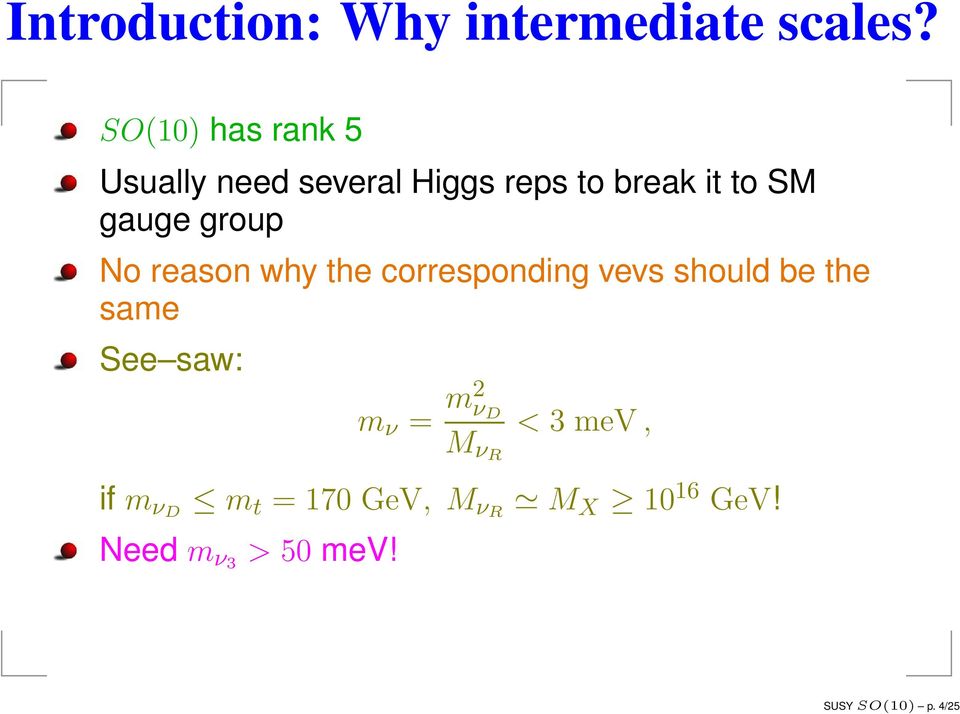
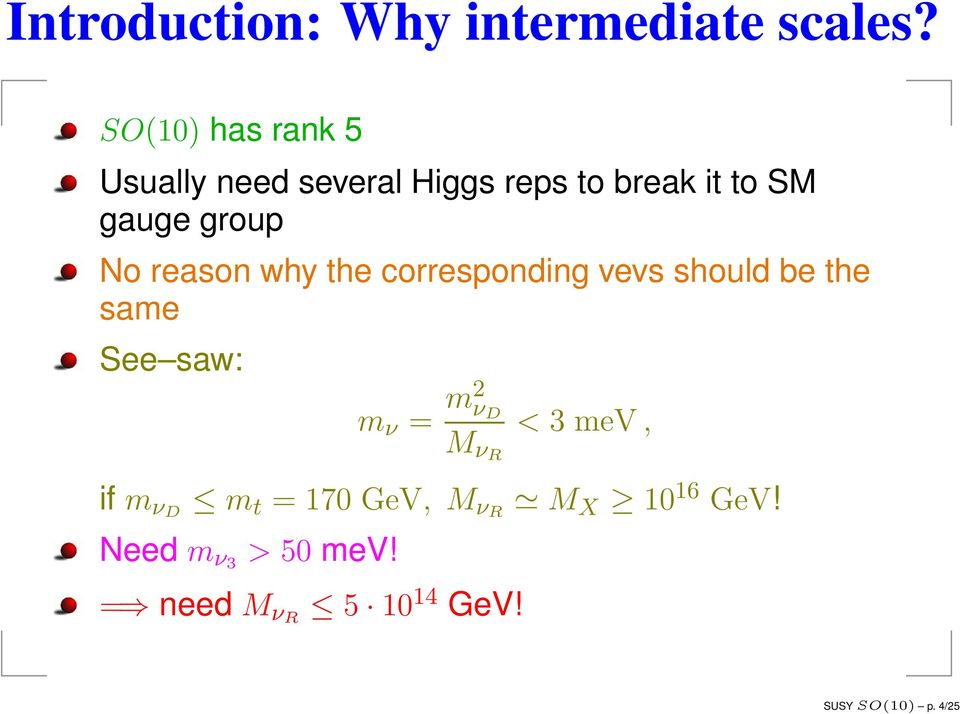
16 Introduction: Why intermediate scales? SO(10) has rank 5 Usually need several Higgs reps to break it to SM gauge group No reason why the corresponding vevs should be the same See saw: m ν = m2 ν D M νr < 3 mev, if m νd m t = 170 GeV, M νr M X GeV! SUSY SO(10) p. 4/25

17 Introduction: Why intermediate scales? SO(10) has rank 5 Usually need several Higgs reps to break it to SM gauge group No reason why the corresponding vevs should be the same See saw: m ν = m2 ν D M νr < 3 mev, if m νd m t = 170 GeV, M νr M X GeV! Need m ν3 > 50 mev! SUSY SO(10) p. 4/25
18 Introduction: Why intermediate scales? SO(10) has rank 5 Usually need several Higgs reps to break it to SM gauge group No reason why the corresponding vevs should be the same See saw: m ν = m2 ν D M νr < 3 mev, if m νd m t = 170 GeV, M νr M X GeV! Need m ν3 > 50 mev! = need M νr GeV! SUSY SO(10) p. 4/25
19 The model Ref: al. et Senjanovic, Nucl. Phys B597 (2001) 89 SO(10) SU(4) SU(2) L SU(2) R D at M X using 54 SU(3) C U(1) B L SU(2) L SU(2) R at M C using 45 SU(3) C SU(2) L U(1) Y at M R using 126,126 D: Discrete symmetry, ensures parity (same L and R couplings) SUSY SO(10) p. 5/25

20 Higgs fields Most general renormalizable superpotential = light Higgs states: SUSY SO(10) p. 6/25

21 Higgs fields Most general renormalizable superpotential = light Higgs states: 54 = (1,1,1) (20,1,1) (1,3,3) (6,2,2); 45 = (15,1,1) (1,1,3) (1,3,1) (6,2,2); 126 = (10,1,3) (10,3,1) (15,2,2) (6,1,1); 126 = (10,1,3) (10,3,1) (15,2,2) (6,1,1). Decomposition under SU(4) SU(2) L SU(2) R ; components obtaining vev are written first. SUSY SO(10) p. 6/25
22 Higgs spectrum all of 54 State Mass all of 45, except (15,1,1) 45 all of 126 and 126, except 10, 10 of SU(4) M X (10,3,1) 126 and (10,3,1) 126 3, 6 of SU(3) C in (10,1,3) 126 and (10,1,3) 126 M C color triplets of (15,1,1) 45 (δ 0 δ 0 ), δ +, δ M R [ ] M 2 color octet and singlet of (15,1,1) A M 1 max R M C, M2 C M X (δ 0 + δ 0 ), δ ++, δ M2 M 2 R /M X δ = (1,1,3) 126 ; δ = (1,1,3) 126 SUSY SO(10) p. 7/25
23 Running gauge couplings Existence of states with mass < M R is crucial for allowing intermediate scales, given that single step unification works. SUSY SO(10) p. 8/25
24 Running gauge couplings Existence of states with mass < M R is crucial for allowing intermediate scales, given that single step unification works. From RGE: Can compute M C and M R for given M X (and given weak scale parameters): No prediction for M X or ratios of weak scale couplings. SUSY SO(10) p. 8/25
25 Running gauge couplings Existence of states with mass < M R is crucial for allowing intermediate scales, given that single step unification works. From RGE: Can compute M C and M R for given M X (and given weak scale parameters): No prediction for M X or ratios of weak scale couplings. In particular, M X = M C = M R remains possible: allows smooth transition to Grand Desert SUSY SO(10) p. 8/25
26 Running gauge couplings Existence of states with mass < M R is crucial for allowing intermediate scales, given that single step unification works. From RGE: Can compute M C and M R for given M X (and given weak scale parameters): No prediction for M X or ratios of weak scale couplings. In particular, M X = M C = M R remains possible: allows smooth transition to Grand Desert Introduce second pair of 10, 10 with mass M 2, to allow more realistic fermion masses (see below). SUSY SO(10) p. 8/25
27 Relation between scales log(q/gev) log(m X /GeV) log(m C /GeV) log(m R /GeV) /α U SUSY SO(10) p. 9/25
28 Superpotential above M C W = Y 1 F c FΦ Y N ( F c ΣR F c + F Σ L F ) F = (4, 2, 1): left handed matter fields F c = ( 4, 1, 2): right handed matter fields Φ 1,2 = (1, 2, 2): Higgs bi doublets Σ R = (10, 1, 3) of 126 Σ L = (10, 3, 1) of 126 SUSY SO(10) p. 10/25
29 Superpotential above M C W = Y 1 F c FΦ Y N ( F c ΣR F c + F Σ L F ) F = (4, 2, 1): left handed matter fields F c = ( 4, 1, 2): right handed matter fields Φ 1,2 = (1, 2, 2): Higgs bi doublets Σ R = (10, 1, 3) of 126 Σ L = (10, 3, 1) of 126 Have set coupling Y 2 of Φ 2 to zero: can always be done via field re definition SUSY SO(10) p. 10/25
30 Superpotential above M C W = Y 1 F c FΦ Y N ( F c ΣR F c + F Σ L F ) F = (4, 2, 1): left handed matter fields F c = ( 4, 1, 2): right handed matter fields Φ 1,2 = (1, 2, 2): Higgs bi doublets Σ R = (10, 1, 3) of 126 Σ L = (10, 3, 1) of 126 Have set coupling Y 2 of Φ 2 to zero: can always be done via field re definition Y N generates ν R mass! SUSY SO(10) p. 10/25
31 Superpotential between M R and M C W = Y q1 Q c QΦ 1 + Y l1 L c LΦ Y NL c δl c Q c = ( 3, 1, 2, 1/3): right handed quarks Q = (3, 2, 1, 1/3): left handed quarks L c = (1, 1, 2, 1): right handed leptons L = (1, 2, 1, 1): left handed leptons δ = (1, 1, 3, 2): breaks SU(2) R U(1) B L U(1) Y. SUSY SO(10) p. 11/25
32 Superpotential between M R and M C W = Y q1 Q c QΦ 1 + Y l1 L c LΦ Y NL c δl c Q c = ( 3, 1, 2, 1/3): right handed quarks Q = (3, 2, 1, 1/3): left handed quarks L c = (1, 1, 2, 1): right handed leptons L = (1, 2, 1, 1): left handed leptons δ = (1, 1, 3, 2): breaks SU(2) R U(1) B L U(1) Y. Matching condition at E = M C : Y q1 = Y l1 = Y 1 SUSY SO(10) p. 11/25
33 Superpotential between M R and M 2 W = Y u1 U c QH u1 + Y d1 D c QH d1 + Y l1 E c LH d Y NE c δ E c SUSY SO(10) p. 12/25
34 Superpotential between M R and M 2 W = Y u1 U c QH u1 + Y d1 D c QH d1 + Y l1 E c LH d Y NE c δ E c Matching condition at E = M R : Y u1 = Y d1 = Y q1 SUSY SO(10) p. 12/25
35 Superpotential below M 2 As in MSSM: W = Y u U c QH u + Y d D c H d + Y l E c LH d SUSY SO(10) p. 13/25
36 Superpotential below M 2 As in MSSM: W = Y u U c QH u + Y d D c H d + Y l E c LH d Matching: H u,d = cosϕ u,d H (u,d)1 +sin ϕ u,d H (u,d)2 = Y u,d = Y (u,d)1 cosϕ u,d SUSY SO(10) p. 13/25
37 Superpotential below M 2 As in MSSM: W = Y u U c QH u + Y d D c H d + Y l E c LH d Matching: H u,d = cosϕ u,d H (u,d)1 +sin ϕ u,d H (u,d)2 = Y u,d = Y (u,d)1 cosϕ u,d = need cos ϕ u 1, since Y t already near maximal SUSY SO(10) p. 13/25
38 Superpotential below M 2 As in MSSM: W = Y u U c QH u + Y d D c H d + Y l E c LH d Matching: H u,d = cosϕ u,d H (u,d)1 +sin ϕ u,d H (u,d)2 = Y u,d = Y (u,d)1 cosϕ u,d = need cos ϕ u 1, since Y t already near maximal = cosϕ d = Y d(m 2 ) Y u (M R ) [ g 2 1 (M R ) g 2 1 (M 2) ] 1/60 = Y d1 Y u,1 : always in large tanβ scenario for E M 2! SUSY SO(10) p. 13/25
39 Gaugino masses Assume unified boundary conditions: scalar mass m 0, gaugino mass M 1/2, single parameter A 0. SUSY SO(10) p. 14/25
40 Gaugino masses Assume unified boundary conditions: scalar mass m 0, gaugino mass M 1/2, single parameter A 0. Gauge β functions increase for E > M 2 = ratios M i /M 1/2 decrease (M i, i = 1, 2, 3: weak scale gaugino masses) SUSY SO(10) p. 14/25
41 Gaugino masses Assume unified boundary conditions: scalar mass m 0, gaugino mass M 1/2, single parameter A 0. Gauge β functions increase for E > M 2 = ratios M i /M 1/2 decrease (M i, i = 1, 2, 3: weak scale gaugino masses) E.g. for M X = GeV (minimal value): M 1 = 0.23M 1/2 M 2 = 0.46M 1/2 M 3 = 1.4M 1/2 Coefficients nearly two times smaller than in msugra. SUSY SO(10) p. 14/25
42 Gaugino masses Assume unified boundary conditions: scalar mass m 0, gaugino mass M 1/2, single parameter A 0. Gauge β functions increase for E > M 2 = ratios M i /M 1/2 decrease (M i, i = 1, 2, 3: weak scale gaugino masses) E.g. for M X = GeV (minimal value): M 1 = 0.23M 1/2 M 2 = 0.46M 1/2 M 3 = 1.4M 1/2 Coefficients nearly two times smaller than in msugra. Ratios M 1 : M 2 : M 3 same as in msugra! SUSY SO(10) p. 14/25
43 Sfermion masses (1 st generation) For fixed M i, get larger gaugino loop contributions to sfermion masses; partly cancels previous effect when expressed in terms of M 1/2 : SUSY SO(10) p. 15/25
44 Sfermion masses (1 st generation) For fixed M i, get larger gaugino loop contributions to sfermion masses; partly cancels previous effect when expressed in terms of M 1/2 : m 2 f(m SUSY ) = m c fm 2 1/2 cẽr = 0.15 (as in msugra); cẽl = 0.21 (smaller than in msugra); c q = 1.15 (smaller than in msugra). SUSY SO(10) p. 15/25
45 Sfermion masses (1 st generation) For fixed M i, get larger gaugino loop contributions to sfermion masses; partly cancels previous effect when expressed in terms of M 1/2 : m 2 f(m SUSY ) = m c fm 2 1/2 cẽr = 0.15 (as in msugra); cẽl = 0.21 (smaller than in msugra); c q = 1.15 (smaller than in msugra). mẽr 1.68 M 1 : No co annihilation of χ 0 1 with ẽ R, µ R! mẽl M 2 : No W l L decays! m q 0.75m g : Similar to msugra SUSY SO(10) p. 15/25
46 3 rd generation sfermions & Higgs Y N reduces m τl,r, m t L,R, m br SUSY SO(10) p. 16/25
47 3 rd generation sfermions & Higgs Y N reduces m τl,r, m t L,R, m br = increases m 2 H u (M SUSY ) (and hence m A ) SUSY SO(10) p. 16/25
48 3 rd generation sfermions & Higgs Y N reduces m τl,r, m t L,R, m br = increases m 2 H u (M SUSY ) (and hence m A ) = reduces µ(m SUSY ) via EWSB condition SUSY SO(10) p. 16/25
49 3 rd generation sfermions & Higgs Y N reduces m τl,r, m t L,R, m br = increases m 2 H u (M SUSY ) (and hence m A ) = reduces µ(m SUSY ) via EWSB condition m ν3 m2 t Y N M R = smaller m ν3 implies larger Y N! SUSY SO(10) p. 16/25
50 Effect on the spectrum 2e+06 (a) m 0 = 1500GeV, M 12 = 900GeV, A 0 = 0, tanb = (b) m 0 = 700GeV, A 0 = 0, tanb = 50, m ν = 0.4eV M 12 = 700GeV M 12 = 1400GeV m 2 sf (M S ) 1.5e+06 1e m A0 /2mχ m 2 t m 2 L τ m 2 L 0.9 t m 2 R τ R m ν (ev) log (M X /GeV) SUSY SO(10) p. 17/25
51 Survey of parameter space (a) tanb=40, A 0 =0, m ν =0.4eV (a) tanb=40, A 0 =0, m ν =0.2eV m 0 (GeV) 1000 m 0 (GeV) M 1/2 (GeV) M 1/2 (GeV) Grey: no ESWB or tachyonic sfermion; red: mass bounds; pink: b sγ excluded; blue: favored by g µ ; green: DM allowed; black: all ok SUSY SO(10) p. 18/25
52 Survey of parameter space (a) tanb=40, A 0 =0, m ν =0.4eV (a) tanb=40, A 0 =0, m ν =0.2eV m 0 (GeV) 1000 m 0 (GeV) M 1/2 (GeV) M 1/2 (GeV) Grey: no ESWB or tachyonic sfermion; red: mass bounds; pink: b sγ excluded; blue: favored by g µ ; green: DM allowed; black: all ok In msugra: don t find allowed region (DM & g µ ) with m 2 0 M2 1/2! SUSY SO(10) p. 18/25
53 Same for tanβ = 50 (a) tanb=50, A 0 =0, m ν =0.4eV (a) tanb=50, A 0 =0, m ν =0.2eV m 0 (GeV) 1000 m 0 (GeV) M 1/2 (GeV) M 1/2 (GeV) SUSY SO(10) p. 19/25
54 Same for tanβ = 50 (a) tanb=50, A 0 =0, m ν =0.4eV (a) tanb=50, A 0 =0, m ν =0.2eV m 0 (GeV) 1000 m 0 (GeV) M 1/2 (GeV) M 1/2 (GeV) In right frame, DM relic density too small everywhere SUSY SO(10) p. 19/25
55 Same for tanβ = 50 (a) tanb=50, A 0 =0, m ν =0.4eV (a) tanb=50, A 0 =0, m ν =0.2eV m 0 (GeV) 1000 m 0 (GeV) M 1/2 (GeV) M 1/2 (GeV) In right frame, DM relic density too small everywhere 50% of plane DM allowed for tan β = 49! SUSY SO(10) p. 19/25
56 Impact on DM searches For m 0 M 1/2 : ( focus point, but no focussing in this scenario!) Very similar to msugra, if m χ 0 1, Ω χ 0 1 are fixed. SUSY SO(10) p. 20/25
57 Impact on DM searches For m 0 M 1/2 : ( focus point, but no focussing in this scenario!) Very similar to msugra, if m χ 0 1, Ω χ 0 1 are fixed. τ 1 co annihilation region: More promising, due to reduced µ = more higgsino gaugino mixing = enhanced couplings of χ 0 1 to Higgs bosons and Z0! SUSY SO(10) p. 20/25
58 Impact on DM searches For m 0 M 1/2 : ( focus point, but no focussing in this scenario!) Very similar to msugra, if m χ 0 1, Ω χ 0 1 are fixed. τ 1 co annihilation region: More promising, due to reduced µ = more higgsino gaugino mixing = enhanced couplings of χ 0 1 to Higgs bosons and Z0! cross section[*10-36 cm 2 ] 1e-05 1e-06 1e-07 1e-08 1e-09 tanβ=40, A 0 =0, m ν =0.2eV, M 1/2 =1000GeV FP CO CDMS II XENON100 (projected) 1e log M X [GeV] SUSY SO(10) p. 20/25
59 LHC signals: large m 0 region In SO(10) model: can get large bino higgsino mixing for relatively modest m 0, where q can be produced at LHC. This is not possible in msugra. SUSY SO(10) p. 21/25
60 LHC signals: large m 0 region In SO(10) model: can get large bino higgsino mixing for relatively modest m 0, where q can be produced at LHC. This is not possible in msugra. To get correct DM density in msugra for same m q, m g : have to increase tan β quite a lot (to reach A funnel ) SUSY SO(10) p. 21/25
61 LHC signals: large m 0 region In SO(10) model: can get large bino higgsino mixing for relatively modest m 0, where q can be produced at LHC. This is not possible in msugra. To get correct DM density in msugra for same m q, m g : have to increase tan β quite a lot (to reach A funnel ) = msugra has much smaller heavy Higgs masses: can be detected in τ + τ channel! SUSY SO(10) p. 21/25
62 LHC signals: large m 0 region In SO(10) model: can get large bino higgsino mixing for relatively modest m 0, where q can be produced at LHC. This is not possible in msugra. To get correct DM density in msugra for same m q, m g : have to increase tan β quite a lot (to reach A funnel ) = msugra has much smaller heavy Higgs masses: can be detected in τ + τ channel! msugra has much larger µ :changes χ 0, χ ± spectrum; can be checked via l + l invariant mass distribution! SUSY SO(10) p. 21/25
63 M l + l distribution (m 0 M 1/2 ) SO(10) msugra Events/10 GeV/300fb Invariant mass (GeV) Only msugra has Z 0 peak; SO(10) model has softer spectrum SUSY SO(10) p. 22/25
64 LHC signals: co annihilation region In msugra: either slightly change A 0 (option a) or slightly increase tanβ (option b) to match Ω χ 0 1 for fixed m q, m g. SUSY SO(10) p. 23/25
65 LHC signals: co annihilation region In msugra: either slightly change A 0 (option a) or slightly increase tanβ (option b) to match Ω χ 0 1 for fixed m q, m g. In SO(10): smaller m t 1,2, m b1 SUSY SO(10) p. 23/25
66 LHC signals: co annihilation region In msugra: either slightly change A 0 (option a) or slightly increase tanβ (option b) to match Ω χ 0 1 for fixed m q, m g. In SO(10): smaller m t 1,2, m b1 Smaller µ = smaller m χ 0 3,4, m χ ± 2 SUSY SO(10) p. 23/25
67 LHC signals: co annihilation region In msugra: either slightly change A 0 (option a) or slightly increase tanβ (option b) to match Ω χ 0 1 for fixed m q, m g. In SO(10): smaller m t 1,2, m b1 Smaller µ = smaller m χ 0 3,4, m χ ± 2 = more g χ 0 3,4, χ± 2 decays SUSY SO(10) p. 23/25
68 LHC signals: co annihilation region In msugra: either slightly change A 0 (option a) or slightly increase tanβ (option b) to match Ω χ 0 1 for fixed m q, m g. In SO(10): smaller m t 1,2, m b1 Smaller µ = smaller m χ 0 3,4, m χ ± 2 = more g χ 0 3,4, χ± 2 decays = more g Z 0 on shell in SO(10)! SUSY SO(10) p. 23/25
69 ubtracted M l + l distribution (m 0 M 1/2 ) Events/10 GeV/300fb SO(10) msugra 2b msugra 2a Invariant mass (GeV) SO(10) has significantly more pronounced Z 0 peak SUSY SO(10) p. 24/25
70 ubtracted M l + l distribution (m 0 M 1/2 ) Events/10 GeV/300fb SO(10) msugra 2b msugra 2a Invariant mass (GeV) SO(10) has significantly more pronounced Z 0 peak SO(10) model also has more like sign di lepton events: 492 vs. 422 (434). SUSY SO(10) p. 24/25
71 Summary and Outlook SO(10) model natural if ν R state! SUSY SO(10) p. 25/25
72 Summary and Outlook SO(10) model natural if ν R state! Allows intermediate scale; required for see saw. SUSY SO(10) p. 25/25
73 Summary and Outlook SO(10) model natural if ν R state! Allows intermediate scale; required for see saw. This modifies the RG running below M X. SUSY SO(10) p. 25/25
74 Summary and Outlook SO(10) model natural if ν R state! Allows intermediate scale; required for see saw. This modifies the RG running below M X. For fixed boundary condition at M X : reduced µ tends to make DM detection easier! SUSY SO(10) p. 25/25
75 Summary and Outlook SO(10) model natural if ν R state! Allows intermediate scale; required for see saw. This modifies the RG running below M X. For fixed boundary condition at M X : reduced µ tends to make DM detection easier! Points with same m q, m g, m χ 0 1, Ω χ 0 1 can be distinguished at LHC, using di lepton events and heavy Higgs searches SUSY SO(10) p. 25/25
76 Summary and Outlook SO(10) model natural if ν R state! Allows intermediate scale; required for see saw. This modifies the RG running below M X. For fixed boundary condition at M X : reduced µ tends to make DM detection easier! Points with same m q, m g, m χ 0 1, Ω χ 0 1 can be distinguished at LHC, using di lepton events and heavy Higgs searches Results should be qualitatively same in other models where M R < M X. SUSY SO(10) p. 25/25
77 Summary and Outlook SO(10) model natural if ν R state! Allows intermediate scale; required for see saw. This modifies the RG running below M X. For fixed boundary condition at M X : reduced µ tends to make DM detection easier! Points with same m q, m g, m χ 0 1, Ω χ 0 1 can be distinguished at LHC, using di lepton events and heavy Higgs searches Results should be qualitatively same in other models where M R < M X. To fix high scale physics: need to know m ν, proton lifetime! SUSY SO(10) p. 25/25
SUSY Breaking and Axino Cosmology
 SUSY Breaking and Axino Cosmology Masahiro Yamaguchi Tohoku University Nov. 10, 2010 ExDiP2010@KEK, Japan 1. Introduction Fine Tuning Problems of Particle Physics Smallness of electroweak scale Smallness
ffmssmsc a C++ library for spectrum calculation and renormalization group analysis of the MSSM
 ffmssmsc a C++ library for spectrum calculation and renormalization group analysis of the MSSM Alexei Sheplyakov Joint Institute for Nuclear Research, Dubna, Russia SUSY 07 Karlsruhe, July 31, 2007 version
How To Find The Higgs Boson
 Dezső Horváth: Search for Higgs bosons Balaton Summer School, Balatongyörök, 07.07.2009 p. 1/25 Search for Higgs bosons Balaton Summer School, Balatongyörök, 07.07.2009 Dezső Horváth MTA KFKI Research
Mass spectrum prediction in non-minimal supersymmetric models
 Mass spectrum prediction in non-minimal supersymmetric models Dissertation zur Erlangung des wissenschaftlichen Grades Doctor rerum naturalium (Dr. rer. nat.) vorgelegt von Dipl.-Phys. Alexander Voigt
Axion/Saxion Cosmology Revisited
 Axion/Saxion Cosmology Revisited Masahiro Yamaguchi (Tohoku University) Based on Nakamura, Okumura, MY, PRD77 ( 08) and Work in Progress 1. Introduction Fine Tuning Problems of Particle Physics Smallness
Theoretical Particle Physics FYTN04: Oral Exam Questions, version ht15
 Theoretical Particle Physics FYTN04: Oral Exam Questions, version ht15 Examples of The questions are roughly ordered by chapter but are often connected across the different chapters. Ordering is as in
Measurement of Neutralino Mass Differences with CMS in Dilepton Final States at the Benchmark Point LM9
 Measurement of Neutralino Mass Differences with CMS in Dilepton Final States at the Benchmark Point LM9, Katja Klein, Lutz Feld, Niklas Mohr 1. Physikalisches Institut B RWTH Aachen Introduction Fast discovery
Search for supersymmetric Dark Matter with GLAST!!
 Search for supersymmetric Dark Matter with GLAST!! Aldo Morselli INFN, Sezione di Roma 2 & Università di Roma Tor Vergata ICCRC2003 The 28th International Cosmic Ray Conference Tsukuba, Japan, July 31-
Selected Topics in Elementary Particle Physics ( Haupt-Seminar )
 Selected Topics in Elementary Particle Physics ( Haupt-Seminar ) Paola Avella, Veronika Chobanova, Luigi Li Gioi, Christian Kiesling, Hans-Günther Moser, Martin Ritter, Pit Vanhoefer Time: Do, 12 ct -14
Physics Department, Southampton University Highfield, Southampton, S09 5NH, U.K.
 \ \ IFT Instituto de Física Teórica Universidade Estadual Paulista July/92 IFT-P.025/92 LEPTON MASSES IN AN SU(Z) L U(1) N GAUGE MODEL R. Foot a, O.F. Hernandez ", F. Pisano e, and V. Pleitez 0 Physics
Vector-like quarks t and partners
 Vector-like quarks t and partners Luca Panizzi University of Southampton, UK Outline Motivations and Current Status 2 Couplings and constraints 3 Signatures at LHC Outline Motivations and Current Status
Mini-Split. Stanford University, Stanford, CA 94305 USA. and Institute for Advanced Study, Princeton, NJ 08540 USA
 Mini-Split arxiv:1210.0555v2 [hep-ph] 19 Oct 2012 Asimina Arvanitaki a, Nathaniel Craig b, Savas Dimopoulos a, and Giovanni Villadoro c a Stanford Institute for Theoretical Physics, Stanford University,
How To Teach Physics At The Lhc
 LHC discoveries and Particle Physics Concepts for Education Farid Ould- Saada, University of Oslo On behalf of IPPOG EPS- HEP, Vienna, 25.07.2015 A successful program LHC data are successfully deployed
The Higgs sector in the MSSM with CP-phases at higher orders
 The Higgs sector in the MSSM with CP-phases at higher orders Paul-Scherrer-Institut in coll. with T. Hahn, S. Heinemeyer, W. Hollik and G. Weiglein Outline Higgs sector in the MSSM with CP-phases Mass
FINDING SUPERSYMMETRY AT THE LHC
 FINDING SUPERSYMMETRY AT THE LHC Tilman Plehn MPI München & University of Edinburgh TeV scale supersymmetry Signals at Tevatron and LHC Measurements at LHC SUSY parameters at LHC (and ILC) Tilman Plehn:
Extensions of the Standard Model (part 2)
 Extensions of the Standard Model (part 2) Prof. Jorgen D Hondt Vrije Universiteit Brussel Inter-university Institute for High Energies Content: The Higgs sector of the Standard Model and extensions Theoretical
STRING THEORY: Past, Present, and Future
 STRING THEORY: Past, Present, and Future John H. Schwarz Simons Center March 25, 2014 1 OUTLINE I) Early History and Basic Concepts II) String Theory for Unification III) Superstring Revolutions IV) Remaining
Standard Model of Particle Physics
 Standard Model of Particle Physics Chris Sachrajda School of Physics and Astronomy University of Southampton Southampton SO17 1BJ UK SUSSP61, St Andrews August 8th 3rd 006 Contents 1. Spontaneous Symmetry
Bounding the Higgs width at the LHC
 Bounding the Higgs width at the LHC Higgs XSWG workshop, June 2014 John Campbell, Fermilab with K. Ellis, C. Williams 1107.5569, 1311.3589, 1312.1628 Reminder of the method This is the essence of the original
GRAVITINO DARK MATTER
 GRAVITINO DARK MATTER Wilfried Buchmüller DESY, Hamburg LAUNCH09, Nov. 2009, MPK Heidelberg Why Gravitino Dark Matter? Supergravity predicts the gravitino, analog of W and Z bosons in electroweak theory;
Top rediscovery at ATLAS and CMS
 Top rediscovery at ATLAS and CMS on behalf of ATLAS and CMS collaborations CNRS/IN2P3 & UJF/ENSPG, LPSC, Grenoble, France E-mail: [email protected] We describe the plans and strategies of the
Implications of CMS searches for the Constrained MSSM A Bayesian approach
 Implications of CMS searches for the Constrained MSSM A Bayesian approach Małgorzata Kazana, Yue-Lin Sming Tsai On behalf of the BayesFITS group National Centre for Nuclear Research Warsaw, Poland BayesFITS,
Higgs and Electroweak Physics
 Higgs and Electroweak Physics [theory summary] Southampton University & Rutherford Appleton LAB WIN2015 June 12, 2015, MPIK Heidelberg 1 Present: impressive success of LHC RUN 1 on the Higgs&EW Physics
Gamma-rays from Dark Matter Mini-Spikes in Andromeda Galaxy M31. Mattia Fornasa Dipartimento di Fisica G. Galilei I.N.F.N. Padova
 Gamma-rays from Dark Matter Mini-Spikes in Andromeda Galaxy M31 Mattia Fornasa Dipartimento di Fisica G. Galilei I.N.F.N. Padova based on astro-ph/0703757 by M. Fornasa, M. Taoso and G.Bertone Journal
Introduction to SME and Scattering Theory. Don Colladay. New College of Florida Sarasota, FL, 34243, U.S.A.
 June 2012 Introduction to SME and Scattering Theory Don Colladay New College of Florida Sarasota, FL, 34243, U.S.A. This lecture was given at the IUCSS summer school during June of 2012. It contains a
Highlights of Recent CMS Results. Dmytro Kovalskyi (UCSB)
 Highlights of Recent CMS Results Dmytro Kovalskyi (UCSB) Introduction Number of CMS publication is over 0 already It is very hard to review all the recent results in one talk This talk concentrates on
High Energy Physics. Lecture 4 More kinematics and a picture show of particle collisions
 High Energy Physics Lecture 4 More kinematics and a picture show of particle collisions 1 Recall from the previous lecture: the momentum of the scattered Particle in an elastic collision is given by p
Search for Dark Matter at the LHC
 Search for Dark Matter at the LHC Steven Lowette Vrije Universiteit Brussel - IIHE 19 November 2014 3rd CosPa Meeting Université de Liège Content Introduction Generic DM searches at the LHC Explicit DM
arxiv:hep-ph/9310295v1 17 Oct 1993
 HU-TFT-93-51 Signatures of left-right symmetry at high energies 1 arxiv:hep-ph/9310295v1 17 Oct 1993 J. Maalampi 2 Department of Theoretical Physics, University of Helsinki Helsinki, Finland Abstract We
Calorimetry in particle physics experiments
 Calorimetry in particle physics experiments Unit n. 8 Calibration techniques Roberta Arcidiacono Lecture overview Introduction Hardware Calibration Test Beam Calibration In-situ Calibration (EM calorimeters)
The Compact Muon Solenoid Experiment. CMS Note. Mailing address: CMS CERN, CH-1211 GENEVA 23, Switzerland. D. J. Mangeol, U.
 Available on CMS information server CMS NOTE 6/96 The Compact Muon Solenoid Experiment CMS Note Mailing address: CMS CERN, CH11 GENEVA 3, Switzerland July, 6 Search for χ decays to ττ and SUSY mass spectrum
arxiv:1006.5339v1 [hep-ph] 28 Jun 2010
![arxiv:1006.5339v1 [hep-ph] 28 Jun 2010](/thumbs/25/5365387.jpg "arxiv:1006.5339v1 [hep-ph] 28 Jun 2010") FR-PHENO-2010-021 arxiv:1006.5339v1 [hep-ph] 28 Jun 2010 NLO QCD corrections to 4 b-quark production University of Illinois at Urbana-Champaign, Urbana IL, 61801 USA E-mail: [email protected] Alberto
FR-PHENO-2010-021 arxiv:1006.5339v1 [hep-ph] 28 Jun 2010 NLO QCD corrections to 4 b-quark production University of Illinois at Urbana-Champaign, Urbana IL, 61801 USA E-mail: [email protected] Alberto
Physik des Higgs Bosons. Higgs decays V( ) Re( ) Im( ) Figures and calculations from A. Djouadi, Phys.Rept. 457 (2008) 1-216
 : Higgs decays V( ) Re( ) Im( ) Figures and calculations from A. Djouadi, Phys.Rept. 457 (2008) 1-216 1 Reminder 10.6.2014 Higgs couplings: 2 Reminder 10.6.2014 Higgs BF as a function of mh Higgs total
Risultati recenti dell'esperimento CMS ad LHC e prospettive per il run a 14 TeV
 Risultati recenti dell'esperimento CMS ad LHC e prospettive per il run a 14 TeV Luca Lista INFN Napoli 1 78 reconstructed vertices CMS experiment CMS recorded 5fb-1 at 7 TeV and 20 fb-1 at 8 TeV 2 Electroweak
Monodromies, Fluxes, and Compact Three-Generation F-theory GUTs
 arxiv:0906.4672 CALT-68-2733 Monodromies, Fluxes, and Compact Three-Generation F-theory GUTs arxiv:0906.4672v2 [hep-th] 1 Jul 2009 Joseph Marsano, Natalia Saulina, and Sakura Schäfer-Nameki California
Particle Physics. Michaelmas Term 2011 Prof Mark Thomson. Handout 7 : Symmetries and the Quark Model. Introduction/Aims
 Particle Physics Michaelmas Term 2011 Prof Mark Thomson Handout 7 : Symmetries and the Quark Model Prof. M.A. Thomson Michaelmas 2011 206 Introduction/Aims Symmetries play a central role in particle physics;
Channels & Challenges New Physics at LHC
 Channels & Challenges New Physics at LHC Jürgen Reuter Carleton University, Ottawa Southampton, 15. January 2007 The success of the Standard Model Standard Model describes microcosm gauge interactions:
Looking for Magnetic Monopoles AT The Large Hadron Collider. Vicente Vento Universidad de Valencia-IFIC
 Looking for Magnetic Monopoles AT The Large Hadron Collider Vicente Vento Universidad de Valencia-IFIC Luis Epele Huner Fanchiotti Carlos García Canal Vasiliki Mitsou Introduction Monopoles Monopole Production
Open access to data and analysis tools from the CMS experiment at the LHC
 Open access to data and analysis tools from the CMS experiment at the LHC Thomas McCauley (for the CMS Collaboration and QuarkNet) University of Notre Dame, USA [email protected]! 5 Feb 2015 Outline
Three-nucleon interaction dynamics studied via the deuteron-proton breakup. Elżbieta Stephan Institute of Physics, University of Silesia
 Three-nucleon interaction dynamics studied via the deuteron-proton breakup Elżbieta Stephan Institute of Physics, University of Silesia Studies of the 1 H(d,pp)n Breakup at 130 MeV University of Silesia,
Scalar Mediated Fermion Masses for Technicolor
 HELSINKI INSTITUTE OF PHYSICS INTERNAL REPORT SERIES HIP-01-04 Scalar Mediated Fermion Masses for Technicolor Matti Antola Helsinki Institute of Physics and Division of Elementary Particle Physics Department
Validation of the MadAnalysis 5 implementation of ATLAS-SUSY-13-05
 Validation of the MadAnalysis 5 implementation of ATLAS-SUSY-3-5 Guillaume Chalons (LPSC Grenoble) email: [email protected] October 27, 24 Abstract In this note we summarise our validation of the ATLAS
Basic Nuclear Concepts
 Section 7: In this section, we present a basic description of atomic nuclei, the stored energy contained within them, their occurrence and stability Basic Nuclear Concepts EARLY DISCOVERIES [see also Section
The Higgs Boson. Linac08 Victoria BC, Canada CANADA S NATIONAL LABORATORY FOR PARTICLE AND NUCLEAR PHYSICS
 CANADA S NATIONAL LABORATORY FOR PARTICLE AND NUCLEAR PHYSICS Owned and operated as a joint venture by a consortium of Canadian universities via a contribution through the National Research Council Canada
Middle East Technical University. Studying Selected Tools for HEP: CalcHEP
 Middle East Technical University Department of Physics Advanced Selected Problems in Physics Studying Selected Tools for HEP: CalcHEP Author: Jack Yakup Araz Supervisor: Assoc. Prof Ismail Turan December
0.33 d down 1 1. 0.33 c charm + 2 3. 0 0 1.5 s strange 1 3. 0 0 0.5 t top + 2 3. 0 0 172 b bottom 1 3
 Chapter 16 Constituent Quark Model Quarks are fundamental spin- 1 particles from which all hadrons are made up. Baryons consist of three quarks, whereas mesons consist of a quark and an anti-quark. There
arxiv:hep-ph/0201001v1 31 Dec 2001
 TIFR/TH/1-49 NUB-TH/35 arxiv:hep-ph/1v1 31 Dec 1 Supersymmetric Dark Matter and Yukawa Unification Utpal Chattopadhyay (a), Achille Corsetti (b) and Pran Nath (b) (a) Department of Theoretical Physics,
Gauge theories and the standard model of elementary particle physics
 Gauge theories and the standard model of elementary particle physics Mark Hamilton 21st July 2014 1 / 35 Table of contents 1 The standard model 2 3 2 / 35 The standard model The standard model is the most
From Jet Scaling to Jet Vetos
 From Jet Scaling to Jet Vetos Heidelberg DESY, 2/202 LHC Higgs analyses Two problems for LHC Higgs analyses [talks Rauch, Englert] observe H b b decays [fat Higgs jets, Marcel s talk] 2 understand jet
Weak Interactions: towards the Standard Model of Physics
 Weak Interactions: towards the Standard Model of Physics Weak interactions From β-decay to Neutral currents Weak interactions: are very different world CP-violation: power of logics and audacity Some experimental
1 Introduction. 1 There may, of course, in principle, exist other universes, but they are not accessible to our
 1 1 Introduction Cosmology is the study of the universe as a whole, its structure, its origin, and its evolution. Cosmology is soundly based on observations, mostly astronomical, and laws of physics. These
arxiv:hep-ph/0310021v2 4 Oct 2003
 Physics in Collision - Zeuthen, Germany, June 6-8, 003 arxiv:hep-ph/0300v 4 Oct 003 SEARCHES FOR NEW PARTICLES AT THE ENERGY FRONTIER AT THE TEVATRON Patrice VERDIER LAL, Université Paris-Sud, 9898 Orsay
A Study of the Top Quark Production Threshold at a Future Electron-Positron Linear Collider
 A Study of the Top Quark Production Threshold at a Future Electron-Positron Linear Collider Filimon Gournaris Department of Physics and Astronomy University College London A thesis submitted for the degree
FLAVOUR OVERVIEW. Luca Silvestrini. INFN, Rome. M. Bona @ SUSY2013. Special thanks to D. Derkach & M. Bona
 FLAVOUR OVERVIEW Luca Silvestrini INFN, Rome M. Bona @ SUSY2013 Special thanks to D. Derkach & M. Bona 1 INTRODUCTION In the past 45 years, we (almost) always found what we expected, where we expected
Physics Department Phone: (541)357-9284 Center of High Energy Physics Fax: (541)346-5217
 Spencer Chang Curriculum Vitae Contact Information Research Positions Education Awards Teaching Physics Department Phone: (541)357-9284 Center of High Energy Physics Fax: (541)346-5217 University of Oregon
Study of the B D* ℓ ν with the Partial Reconstruction Technique
 Study of the B D* ℓ ν with the Partial Reconstruction Technique + University of Ferrara / INFN Ferrara Dottorato di Ricerca in Fisica Ciclo XVII Mirco Andreotti 4 March 25 Measurement of B(B D*ℓν) from
Conservative Day Trading Strategy for Forex
 Conservative Day Trading Strategy for Forex By Markus Heitkoetter Please note: THE RISK OF LOSS IN TRADING COMMODITIES CAN BE SUBSTANTIAL. YOU SHOULD THEREFORE CAREFULLY CONSIDER WHETHER SUCH TRADING IS
Low- and high-energy neutrinos from gamma-ray bursts
 Low- and high-energy neutrinos from gamma-ray bursts Hylke B.J. Koers Low- and high-energy neutrinos from gamma-ray bursts Hylke B.J. Koers HK and Ralph Wijers, MNRAS 364 (2005), 934 (astro-ph/0505533)
Lepton Flavour Violation @ LHC?
 m ν (charged) lepton flavour change happens, and the LHC exists...so look for Lepton Flavour Violation @ LHC? Sacha Davidson, P Gambino, G Grenier, S Lacroix, ML Mangano, S Perries, V Sordini, P Verdier
PoS(LHCPP2013)033. Rare B meson decays at LHC. Francesco Dettori Nikhef and Vrij Universiteit, Amsterdam E-mail: [email protected].
 Nikhef and Vrij Universiteit, Amsterdam E-mail: [email protected] Paolo Iengo INFN Napoli E-mail: [email protected] Luca Martini INFN Pisa E-mail: [email protected] Rare decays of B mesons are fundamental
FCC 1309180800 JGU WBS_v0034.xlsm
 1 Accelerators 1.1 Hadron injectors 1.1.1 Overall design parameters 1.1.1.1 Performance and gap of existing injector chain 1.1.1.2 Performance and gap of existing injector chain 1.1.1.3 Baseline parameters
Investigation of a dark matter particle in the Higgs Portal model. Alicia Wongel 1314727
 Investigation of a dark matter particle in the Higgs Portal model Alicia Wongel 1314727 Bachelor Thesis (BSc) Supervisor: Axel Maas Karl-Franzens-Universität Graz 2016 Abstract The Higgs-Portal Theory
The degree of a polynomial function is equal to the highest exponent found on the independent variables.
 DETAILED SOLUTIONS AND CONCEPTS - POLYNOMIAL FUNCTIONS Prepared by Ingrid Stewart, Ph.D., College of Southern Nevada Please Send Questions and Comments to [email protected]. Thank you! PLEASE NOTE
Particle Physics. The Standard Model. A New Periodic Table
 5 Particle Physics This lecture is about particle physics, the study of the fundamental building blocks of Nature and the forces between them. We call our best theory of particle physics the Standard Model
THREE QUARKS: u, d, s. Precursor 2: Eightfold Way, Discovery of Ω - Quark Model: first three quarks and three colors
 Introduction to Elementary Particle Physics. Note 20 Page 1 of 17 THREE QUARKS: u, d, s Precursor 1: Sakata Model Precursor 2: Eightfold Way, Discovery of Ω - Quark Model: first three quarks and three
The future of string theory
 JOURNAL OF MATHEMATICAL PHYSICS VOLUME 42, NUMBER 7 JULY 2001 The future of string theory John H. Schwarz a) California Institute of Technology, Pasadena, California 91125 Received 2 January 2001; accepted
Cross section, Flux, Luminosity, Scattering Rates
 Cross section, Flux, Luminosity, Scattering Rates Table of Contents Paul Avery (Andrey Korytov) Sep. 9, 013 1 Introduction... 1 Cross section, flux and scattering... 1 3 Scattering length λ and λ ρ...
variables to investigate Monte Carlo methods of t t production
 Using the M 2 and variables to investigate Monte Carlo methods of t t production Caitlin Jones September 8, 25 Abstract In this project the behaviour of Monte Carlo simulations for the event t t! ` `+b
Aggressive Day Trading Strategy for Forex
 Aggressive Day Trading Strategy for Forex By Markus Heitkoetter Please note: THE RISK OF LOSS IN TRADING COMMODITIES CAN BE SUBSTANTIAL. YOU SHOULD THEREFORE CAREFULLY CONSIDER WHETHER SUCH TRADING IS
Supersymmetric electroweak models oer the simplest solution of the gauge hierarchy problem [1]-[4]. In real life supersymmetry has to be broken and th
![Supersymmetric electroweak models oer the simplest solution of the gauge hierarchy problem [1]-[4]. In real life supersymmetry has to be broken and th](/thumbs/40/20592009.jpg "Supersymmetric electroweak models oer the simplest solution of the gauge hierarchy problem [1]-[4]. In real life supersymmetry has to be broken and th") Search for avor lepton number violation in slepton decays at LHC N.V.Krasnikov Institute for Nuclear Research, Moscow 117312 November, 1996 Abstract We show that in supersymmetric models with explicit
Search for avor lepton number violation in slepton decays at LHC N.V.Krasnikov Institute for Nuclear Research, Moscow 117312 November, 1996 Abstract We show that in supersymmetric models with explicit
Spatially separated excitons in 2D and 1D
 Spatially separated excitons in 2D and 1D David Abergel March 10th, 2015 D.S.L. Abergel 3/10/15 1 / 24 Outline 1 Introduction 2 Spatially separated excitons in 2D The role of disorder 3 Spatially separated
REALIZING EINSTEIN S DREAM Exploring Our Mysterious Universe
 REALIZING EINSTEIN S DREAM Exploring Our Mysterious Universe The End of Physics Albert A. Michelson, at the dedication of Ryerson Physics Lab, U. of Chicago, 1894 The Miracle Year - 1905 Relativity Quantum
About the Author. journals as Physics Letters, Nuclear Physics and The Physical Review.
 About the Author Dr. John Hagelin is Professor of Physics and Director of the Doctoral Program in Physics at Maharishi International University. Dr. Hagelin received his A.B. Summa Cum Laude from Dartmouth
Measurement of the Mass of the Top Quark in the l+ Jets Channel Using the Matrix Element Method
 Measurement of the Mass of the Top Quark in the l+ Jets Channel Using the Matrix Element Method Carlos Garcia University of Rochester For the DØ Collaboration APS Meeting 2007 Outline Introduction Top
DOING PHYSICS WITH MATLAB COMPUTATIONAL OPTICS RAYLEIGH-SOMMERFELD DIFFRACTION INTEGRAL OF THE FIRST KIND
 DOING PHYSICS WITH MATLAB COMPUTATIONAL OPTICS RAYLEIGH-SOMMERFELD DIFFRACTION INTEGRAL OF THE FIRST KIND THE THREE-DIMENSIONAL DISTRIBUTION OF THE RADIANT FLUX DENSITY AT THE FOCUS OF A CONVERGENCE BEAM
Decays of the Higgs Bosons
 PM 97/5 December 997 Decays of the Higgs Bosons Abdelhak DJOUADI Laboratoire de Physique Mathématique et Théorique, UMR CNRS, Université Montpellier II, F 34095 Montpellier Cedex 5, France. E-mail: [email protected]