
Version 11.1 May 2012
|
|
|
- Trevor Nicholson
- 9 years ago
- Views:
Transcription
1 BSAC Methods for Antimicrobial Susceptibility Testing Version 11.1 May 2012 All enquiries to: Jenny Andrews at: + 44 (0) [email protected]

2 Contents Page Working Party members 5 Abstract 6 Preface 11 Disc Diffusion Method for Antimicrobial Susceptibility Testing 1. Preparation of plates Selection of control organisms 14 Table 2 a Control strains to monitor test performance of antimicrobial susceptibility 15 testing 2b Control strains used to confirm that the method will detect resistance Preparation of inoculum Comparison with 0.5 McFarland standard Preparation of the McFarland standard Inoculum preparation by the growth method Inoculum preparation by the direct colony suspension method Adjustment of the organism suspension to the density of the McFarland standard Dilution of suspension equivalent to 0.5 McFarland standard in distilled 16 water before inoculation 3.2 Photometric standardisation of turbidity of suspension Direct susceptibility testing of urines and blood cultures Inoculation of agar plates Antimicrobial discs Storage and handling of discs Application of discs Incubation Conditions of incubation Measuring zones and interpretation of susceptibility Acceptable inoculum density Measuring zones Use of templates for interpreting susceptibility Oxacillin/cefoxitin testing of staphylococci Detection of oxacillin resistance in Staphylococcus aureus and 22 coagulase negative staphylococci 8.2 Detection of methicillin/oxacillin/cefoxitin resistance in staphylococci by use of cefoxitin as test agent 23 Interpretative tables Table MIC and zone breakpoints for: 6 Enterobacteriaceae 25 7 Acinetobacter species 30 8 Pseudomonas 31 9 Stenotrophomonas maltophilia 33 Version 11.1 May

3 Interpretative tables continued Page 10 Staphylococci Streptococcus pneumoniae Enterococci α-haemolytic streptococci β-haemolytic streptococci Moraxella catarrhalis Neisseria gonorrhoeae Neisseria meningitidis Haemophilus influenzae Pasteurella multocida Campylobacter spp Coryneform organisms Gram-negative anaerobes Gram-positive anaerobes except Clostridium difficile Clostridium difficile 66 Appendices 1 Advice on testing the susceptibility to co-trimoxazole 67 2 Efficacy of cefaclor in the treatment of respiratory infections caused by 68 Haemophilus influenzae Acknowledgment 69 References 69 Additional information 1 Susceptibility testing of Helicobacter pylori 70 2 Susceptibility testing of Brucella species 70 3 Susceptibility testing of Legionella species 70 4 Susceptibility testing of Listeria species 71 5 Susceptibility testing of topical antibiotics 71 6 Development of MIC and zone diameter breakpoints 72 Control of disc diffusion antimicrobial susceptibility testing 1 Control strains 73 2 Maintenance of control strains 73 3 Calculation of control ranges for disc diffusion 73 4 Frequency of routine testing with control strains 73 5 Use of control data to monitor the performance of disc diffusion tests 73 6 Recognition of atypical results for clinical isolates 74 7 Investigation of possible sources of error 74 8 Reporting susceptibility results when controls indicate problems 75 Table Acceptable ranges for control strains for: 2 Iso-Sensitest agar incubated at C in air for 18-20h 76 3 Iso-Sensitest agar supplemented with 5% defibrinated horse blood, 79 with or without the addition of NAD, incubated at C in air for 18-20h 4 Detection of methicillin/oxacillin/cefoxitin resistance in staphylococci 79 5 Iso-Sensitest agar supplemented with 5% defibrinated horse blood, 80 with or without the addition of NAD, incubated at C in 10% CO 2 /10% H 2 /80% N 2 for h 6 Iso-Sensitest agar supplemented with 5% defibrinated horse blood, with or without the addition of NAD, incubated at C in 4-6% CO 2 for h 81 Version 11.1 May

4 Page 9. Control of MIC determinations Table Target MICs for: 7 Haemophilus influenzae, Enterococcus faecalis, Streptococcus 83 pneumoniae, Bacteroides fragilis and Neisseria gonorrhoeae 8 Escherichia coli, Pseudomonas aeruginosa and Staphylococcus 85 aureus 9 Pasteurella multocida Bacteroides fragilis, Bacteroides thetaiotaomicron and Clostridium 87 perfringens 11 Group A streptococci 87 References 88 Suppliers 89 Useful web sites 90 Version 11.1 May

5 Dr Robin Howe (Chairman) Consultant Microbiologist NPHS Microbiology Cardiff University Hospital of Wales Heath Park Cardiff CF14 4XW Dr David Livermore Head Clinical Scientist Antibiotic Resistance Monitoring & Reference Laboratory, HPA 61 Colindale Avenue LONDON NW9 5HT Dr Derek Brown (Scientific Secretary for EUCAST) Working Party Members: Mrs Jenny Andrews (Secretary) Consultant Clinical Scientist Antimicrobial Chemotherapy BSAC Antimicrobial Susceptibility Testing Methods Development Centre City Hospital Dudley Road, Birmingham B18 7QH Dr Nicholas Brown Consultant Microbiologist Clinical Microbiology HPA Level 6 Addenbrooke's Hospital Hills Road Cambridge CB2 2QW Mr Christopher Teale Veterinary Lab Agency Kendal Road Harlescott Shrewsbury Shropshire SY1 4HD Professor Alasdair MacGowan Consultant Medical Microbiologist Southmead Hospital Westbury-on-Trym Bristol BS10 5NB Dr Trevor Winstanley Clinical Scientist Department of Microbiology Royal Hallamshire Hospital Glossop Road Sheffield S10 2JF Professor Gunnar Kahlmeter Central Lasarettet Klinisk Mikrobiologiska Laboratoriet Vaxjo Sweden Dr Ian Morrissey Business Development Manager Quotient Bioresearch Ltd. Newmarket Road Fordham Cambridge CB7 5WW Dr. Karen Bowker Clinical Scientist Southmead Hospital Westbury-on-Trym Bristol BS10 5NB Dr. Gerry Glynn Medical Microbiologist Microbiology Department Altnagelvin Hospital Glenshane Road Londonderry N. Ireland BT47 6SB Dr. Mandy Wootton Lead Scientist NPHS Microbiology Cardiff University Hospital of Wales Heath Park Cardiff CF14 4XW Dr. Fiona MacKenzie Medical Microbiology Aberdeen Royal Infirmary Foresthill Aberdeen AB25 2ZN All enquiries to Jenny Andrews at: +44 (0) [email protected] Version 11.1 May

6 Abstract Summary of changes in version 11 Table 5: Incubation conditions for antimicrobial susceptibility tests on various organisms Change to the incubation temperature and duration of incubation for Campylobacter spp. 8.2 Detection of methicillin/oxacillin/cefoxitin resistance in staphylococci by use of cefoxitin as the test agent Amendment stating that testing is for all staphylococci not just Staphylococcus aureus. Reading cefoxitin zones of inhibition is for all staphylococci (Figure 3) Interpretation: For S. saprophyticus For coagulase staphylococci other than S. saprophyticus Table 6. MIC and zone diameter breakpoints for Enterobacteriaceae (including Salmonella and Shigella spp.) Change in MIC or zone diameter breakpoints Co-amoxiclav (UTI) Azithromycin (S. typhi only) Change to comments Cefixime Cefotaxime Ceftazidime Ceftriaxone Table 8. MIC and zone diameter breakpoints for Pseudomonas spp. Change in MIC or zone diameter breakpoints Amikacin Table 10. MIC and zone diameter breakpoints for staphylococci Removal of recommendations which can now be found in the Legacy section Mupirocin (5µg disc) Change in MIC or zone diameter breakpoints Cefoxitin (S. saprophyticus) Vancomycin (coagulase negative staphylococci) Change to comments Cefoxitin (S. saprophyticus) Vancomycin (coagulase negative staphylococci) Version 11.1 May
7 Clindamycin Erythromycin Table 11. MIC and zone diameter breakpoints for Streptococcus pneumoniae Change in MIC or zone diameter breakpoints Meropenem (meningitis) Linezolid Change to comments Linezolid Table 13. MIC and zone diameter breakpoints for α-haemolytic streptococci Change to comments Clindamycin Erythromycin Table 14. MIC and zone diameter breakpoints for β-haemolytic streptococci Change in MIC or zone diameter breakpoints Trimethoprim (Group B streptococci) Change to comments Clindamycin Table 15. MIC and zone diameter breakpoints for Moraxella catarrhalis Change in MIC or zone diameter breakpoints Cefaclor Cefuroxime Cefuroxime axetil Nalidixic acid Chloramphenicol Change to comments Cefaclor Chloramphenicol Table 16. MIC and zone diameter breakpoints for Neisseria gonorrhoeae Change to comments Tetracycline Version 11.1 May
8 Table 18. MIC and zone diameter breakpoints for Haemophilus influenzae Change in MIC or zone diameter breakpoints Amoxicillin Co-amoxiclav Meropenem (meningitis) Chloramphenicol Change to comments Amoxicillin Chloramphenicol Table 20. MIC and zone diameter breakpoints for Campylobacter spp. Change in MIC or zone diameter breakpoints Ciprofloxacin Nalidixic acid Erythromycin Change to comments Erythromycin Table 24. MIC and zone diameter breakpoints for Clostridium difficile Change in MIC or zone diameter breakpoints Daptomycin Fusidic acid Metronidazole Moxifloxacin Tigecycline Rifampicin Vancomycin Change to comments Daptomycin Fusidic acid Metronidazole Moxifloxacin Tigecycline Rifampicin Vancomycin Additional information Table 1: MIC breakpoints for Helicobacter pylori based on epidemiological cut-off values (ECOFFs), which distinguish wild-type isolates from those with reduced susceptibility Change in MIC or zone diameter breakpoints Amoxicillin Version 11.1 May
9 Clarithromycin Levofloxacin Tetracycline Metronidazole Rifampicin 4. Susceptibility testing Listeria spp. Table 3: MIC ranges for wild type Listeria spp. Change in MIC or zone diameter breakpoints Ampicillin Penicillin Meropenem Cotrimoxazole Change to comments Cotrimoxazole Control of susceptibility testing Table 3: Acceptable zone diameter (mm) ranges for control strains on Iso-Sensitest agar supplemented with 5% defibrinated horse blood, with or without the addition of NAD, plates incubated at C in air for h. Change in acceptable range Erythromycin v Staphylococcus aureus NCTC 6571 Table 6: Acceptable zone diameter (mm) ranges for control strains on Iso-Sensitest agar supplemented with 5% defibrinated horse blood with or without the addition of NAD, plates incubated at C in 4-6% CO 2 for h. Change in acceptable range Co-amoxiclav v Staphylococcus aureus NCTC Control of MIC determination Tables 7-10 provide target MIC (mg/l) values for recommended control strains by BSAC methodology. 1,2 MICs should be within one two-fold dilution of the target values i.e. target MIC 1 mg/l acceptable range mg/l. Table 7: Target MICs (mg/l) for Haemophilus influenzae, Enterococcus faecalis, Streptococcus pneumoniae, Bacteroides fragilis and Neisseria gonorrhoeae control strains by BSAC methods Change in MIC Linezolid Version 11.1 May

10 Table 8: Target MICs (mg/l) for Escherichia coli, Pseudomonas aeruginosa and Staphylococcus aureus control strains by BSAC methods Change in MIC Cefoxitin Colistin Daptomycin Doripenem Piperacillin/tazobactam Sulphamethoxazole Tetracycline NB. All changes to the tables are shown in bold text. Erratum In Table 14 (MIC and zone diameter breakpoints for β-haemolytic streptococci) the MIC breakpoints for tetracycline should be R > 2 mg/l, I = 2 mg/l and S 1 mg/l. In Table 16 (MIC and zone diameter breakpoints for Neisseria gonorrhoeae) the MIC breakpoints for penicillin should be R > 1 mg/l, I = mg/L and S 0.06 mg/l. In Table 18 (MIC and zone diameter breakpoints for Haemophilus influenzae) the MIC breakpoints for cefuroxime should be R > 2 mg/l, I = 2mg/L and S 1 mg/l. In Table 22 (MIC and zone diameter breakpoints for Gram-negative anaerobes) the MIC breakpoints for penicillin should be R > 0.5 mg/l, I = 0.5mg/L and S 0.25 mg/l. For the control of susceptibility testing the acceptable ranges for Staphylococcus aureus NCTC 6571 (Table 3: Acceptable zone diameter (mm) ranges for control strains on Iso-Sensitest agar supplemented with 5% defibrinated horse blood, with or without the addition of NAD, plates incubated at C in air for h) have been expanded to include cefuroxime, amoxicillin, co-amoxiclav, chloramphenicol and nalidixic acid. Version 11.1 May

11 Preface Since the Journal of Antimicrobial Chemotherapy Supplement containing the BSAC standardized disc susceptibility testing method was published in 2001, there have been various changes to the recommendations and these have been posted on the BSAC website ( One major organizational change has been the harmonisation of MIC breakpoints in Europe. In 2002 the BSAC agreed to participate with several other European national susceptibility testing committees, namely CA-SFM (Comité de l Antibiogramme de la Société Française de Microbiologie, France), the CRG (Commissie Richtlijnen Gevoeligheidsbepalingen (The Netherlands), DIN (Deutsches Institut für Normung, Germany), NWGA (Norwegian Working Group on Antimicrobials, Norway) and the SRGA (Swedish Reference Group of Antibiotics, Sweden), in a project to harmonize antimicrobial breakpoints, including previously established values that varied among countries. This work is being undertaken by the European Committee on Antimicrobial Susceptibility Testing (EUCAST) with the support and collaboration of the national committees, and is funded by the European Union, the European Society for Clinical Microbiology and Infectious Diseases (ESCMID) and the national committees, including the BSAC. The review process includes application of more recent techniques, such as pharmacodynamic analysis, and current data, where available, on susceptibility distributions, resistance mechanisms and clinical outcomes as related to in vitro tests. There is extensive discussion between EUCAST and the national committees, including the BSAC Working Party on antimicrobial susceptibility testing, and wide consultation on proposals. In the interest of international standardization of susceptibility testing, and the need to update older breakpoints, these developments are welcomed by the BSAC. The implication of such harmonization is that over time some MIC breakpoints will change slightly and these changes will be reflected, where necessary, in corresponding changes to zone diameter breakpoints in the BSAC disc diffusion method. It is appreciated that changes in the method require additional work for laboratories in changing templates and laboratory information systems, and that the wider use of `intermediate categories will add complexity. Nevertheless the benefits of international standardization are considerable, and review of some older breakpoints is undoubtedly warranted. In line with the European consensus EUCAST MIC breakpoints are defined as follows: Clinically resistant: level of antimicrobial susceptibility which results in a high likelihood of therapeutic failure Clinically susceptible: level of antimicrobial susceptibility associated with a high likelihood of therapeutic success Clinically intermediate: a level of antimicrobial susceptibility associated with uncertain therapeutic effect. It implies that an infection due to the isolate may be appropriately treated in body sites where the drugs are physically concentrated or when a high dosage of drug can be Version 11.1 May
12 used; it also indicates a buffer zone that should prevent small, uncontrolled, technical factors from causing major discrepancies in interpretation. The presentation of MIC breakpoints (mg/l) has also been amended to avoid the theoretical gap inherent in the previous system as follows: MIC (as previously) MIC breakpoint concentration = organism is susceptible MIC > (previously ) MIC breakpoint concentration = organism is resistant In practice, this does result in changes to breakpoint systems based on two-fold dilutions. However, the appearance of the tables will change, e.g. R 16, S 8 will change to R>8, S 8. Version 11.1 May

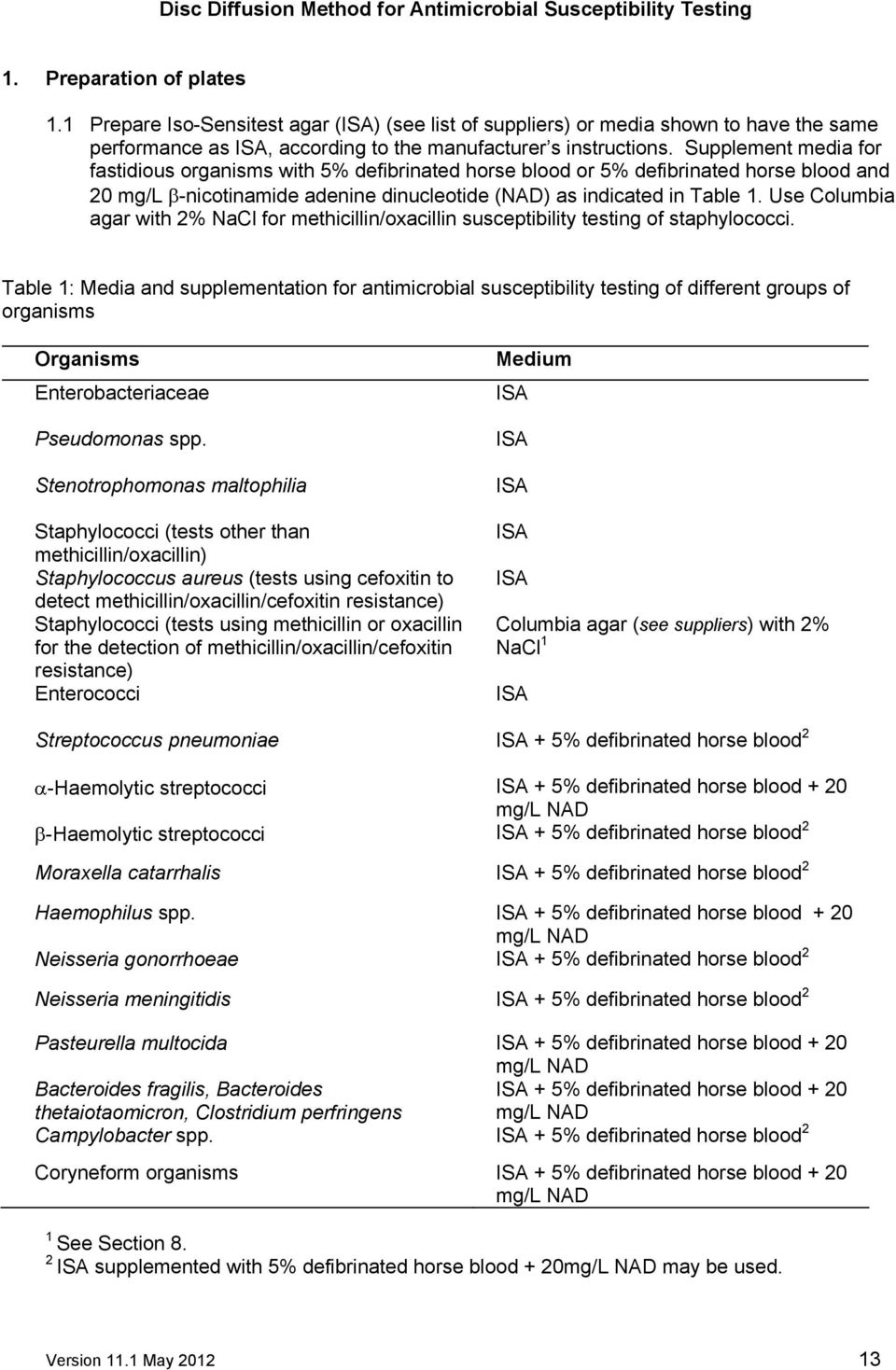
13 Disc Diffusion Method for Antimicrobial Susceptibility Testing 1. Preparation of plates 1.1 Prepare Iso-Sensitest agar (ISA) (see list of suppliers) or media shown to have the same performance as ISA, according to the manufacturer s instructions. Supplement media for fastidious organisms with 5% defibrinated horse blood or 5% defibrinated horse blood and 20 mg/l β-nicotinamide adenine dinucleotide (NAD) as indicated in Table 1. Use Columbia agar with 2% NaCl for methicillin/oxacillin susceptibility testing of staphylococci. Table 1: Media and supplementation for antimicrobial susceptibility testing of different groups of organisms Organisms Enterobacteriaceae Pseudomonas spp. Stenotrophomonas maltophilia Staphylococci (tests other than methicillin/oxacillin) Staphylococcus aureus (tests using cefoxitin to detect methicillin/oxacillin/cefoxitin resistance) Staphylococci (tests using methicillin or oxacillin for the detection of methicillin/oxacillin/cefoxitin resistance) Enterococci Medium ISA ISA ISA ISA ISA Columbia agar (see suppliers) with 2% NaCl 1 ISA Streptococcus pneumoniae ISA + 5% defibrinated horse blood 2 α-haemolytic streptococci ISA + 5% defibrinated horse blood + 20 mg/l NAD β-haemolytic streptococci ISA + 5% defibrinated horse blood 2 Moraxella catarrhalis ISA + 5% defibrinated horse blood 2 Haemophilus spp. ISA + 5% defibrinated horse blood + 20 mg/l NAD Neisseria gonorrhoeae ISA + 5% defibrinated horse blood 2 Neisseria meningitidis ISA + 5% defibrinated horse blood 2 Pasteurella multocida ISA + 5% defibrinated horse blood + 20 mg/l NAD Bacteroides fragilis, Bacteroides ISA + 5% defibrinated horse blood + 20 thetaiotaomicron, Clostridium perfringens mg/l NAD Campylobacter spp. ISA + 5% defibrinated horse blood 2 Coryneform organisms ISA + 5% defibrinated horse blood + 20 mg/l NAD 1 See Section 8. 2 ISA supplemented with 5% defibrinated horse blood + 20mg/L NAD may be used. Version 11.1 May
14 1.2 Pour sufficient molten agar into sterile Petri dishes to give a depth of 4 mm ± 0.5 mm (25 ml in 90 mm diameter Petri dishes). 1.3 Dry the surface of the agar to remove excess moisture before use. The length of time needed to dry the surface of the agar depends on the drying conditions, e.g. whether a fanassisted drying cabinet or still air incubator is used, whether plates are dried before storage and storage conditions. It is important that plates are not over dried. 1.4 Store the plates in vented plastic boxes at 8-10 C prior to use. Alternatively the plates may be stored at 4-8 C in sealed plastic bags. Plate drying, method of storage and storage time should be determined by individual laboratories as part of their quality assurance programme. In particular, quality control tests should confirm that excess surface moisture is not produced and that plates are not over-dried. 2. Selection of control organisms 2.1 The performance of the tests should be monitored by the use of appropriate control strains (see section on control of antimicrobial susceptibility testing). The control strains listed (Tables 2a, 2b) include susceptible strains that have been chosen to monitor test performance and resistant strains that can be used to confirm that the method will detect a mechanism of resistance. 2.2 Store control strains at 70 C on beads in glycerol broth. Non-fastidious organisms may be stored at 20 C. Two vials of each control strain should be stored, one for an in-use supply, the other for archiving. 2.3 Every week subculture a bead from the in-use vial on to appropriate non-selective media and check for purity. From this pure culture, prepare one subculture on each of the following 5 days. For fastidious organisms that will not survive on plates for 5/6 days, subculture the strain daily for no more than 6 days. Version 11.1 May

15 Table 2a: Susceptible control strains or control strains with low-level resistance that have been chosen to monitor test performance of antimicrobial susceptibility testing Strain Organism Either Or Characteristics Escherichia coli NCTC NCTC Susceptible (ATCC 25922) Staphylococcus aureus NCTC NCTC 6571 Susceptible (ATCC 25923) Pseudomonas aeruginosa NCTC NCTC Susceptible (ATCC 27853) Enterococcus faecalis NCTC Susceptible (ATCC 29212) Haemophilus influenzae NCTC Susceptible Streptococcus pneumoniae NCTC (ATCC 49619) Low-level resistant to penicillin Neisseria gonorrhoeae NCTC (ATCC 49226) Low-level resistant to penicillin Pasteurella multocida NCTC 8489 Susceptible Bacteroides fragilis NCTC 9343 Susceptible (ATCC 25285) Bacteroides thetaiotaomicron ATCC Susceptible Clostridium perfringens NCTC 8359 (ATCC 12915) Susceptible Table 2b: Control strains with a resistance mechanism that can be used to confirm that the method will detect resistance. Organism Strain Characteristics Escherichia coli NCTC TEM-1 ß-lactamaseproducer Staphylococcus aureus NCTC MecA positive, methicillin resistant Haemophilus influenzae NCTC (ATCC 49247) Resistant to ß- lactams (ßlactamase-negative) 3. Preparation of inoculum The inoculum should give semi-confluent growth of colonies after overnight incubation. Use of an inoculum that yields semi-confluent growth has the advantage that an incorrect inoculum can easily be observed. A denser inoculum will result in reduced zones of inhibition and a lighter inoculum will have the opposite effect. The following methods reliably give semi-confluent growth with most isolates. NB. Other methods of obtaining semi-confluent growth may be used if they are shown to be equivalent to the following. Version 11.1 May

16 3.1 Comparison with a 0.5 McFarland standard Preparation of the 0.5 McFarland standard Add 0.5 ml of M BaCl 2 (1.17% w/v BaCl 2. 2H 2 O) to 99.5 ml of 0.18 M H 2 SO 4 (1% w/v) with constant stirring. Thoroughly mix the suspension to ensure that it is even. Using matched cuvettes with a 1 cm light path and water as a blank standard, measure the absorbance in a spectrophotometer at a wavelength of 625 nm. The acceptable absorbance range for the standard is Distribute the standard into screw-cap tubes of the same size and volume as those used in growing the broth cultures. Seal the tubes tightly to prevent loss by evaporation. Store protected from light at room temperature. Vigorously agitate the turbidity standard on a vortex mixer before use. Standards may be stored for up to six months, after which time they should be discarded. Prepared standards can be purchased (See list of suppliers), but commercial standards should be checked to ensure that absorbance is within the acceptable range as indicated above Inoculum preparation by the growth method (for non-fastidious organisms, e.g. Enterobacteriaceae, Pseudomonas spp. and staphylococci) Touch at least four morphologically similar colonies (when possible) with a sterile loop. Transfer the growth into Iso-Sensitest broth or an equivalent that has been shown not to interfere with the test. Incubate the broth, with shaking at C, until the visible turbidity is equal to or greater than that of a 0.5 McFarland standard Inoculum preparation by the direct colony suspension method (the method of choice for fastidious organisms, i.e. Haemophilus spp., Neisseria gonorrhoeae, Neisseria meningitidis, Moraxella catarrhalis, Streptococcus pneumoniae, α and β-haemolytic streptococci, Clostridium perfringens, Bacteroides fragilis, Bacteroides thetaiotaomicron, Campylobacter spp., Pasteurella multocida and Coryneform organisms). Colonies are taken directly from the plate into Iso-Sensitest broth (or equivalent) or sterile distilled water. The density of the suspension should match or exceed that of a 0.5 McFarland standard. NB. With some organisms production of an even suspension of the required turbidity is difficult and growth in broth, if possible, is a more satisfactory option Adjustment of the organism suspension to the density of a 0.5 McFarland standard Adjust the density of the organism suspension to equal that of a 0.5 McFarland standard by adding sterile distilled water. To aid comparison, compare the test and standard suspensions against a white background with a contrasting black line. NB. Suspension should be used within 15 min Dilution of suspension in distilled water before inoculation Dilute the suspension (density adjusted to that of a 0.5 McFarland standard) in distilled water as indicated in Table 3. Version 11.1 May
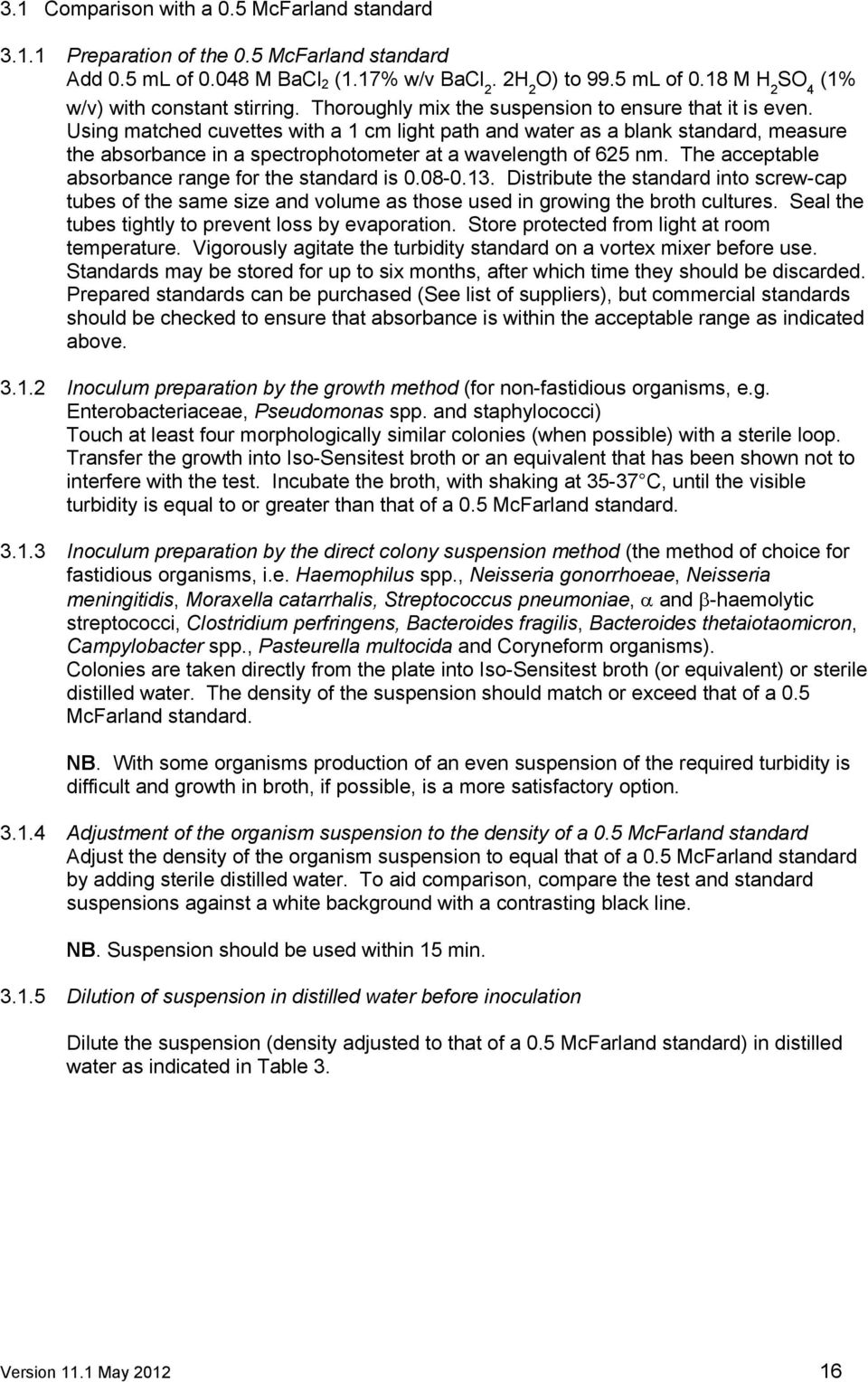
17 Table 3: Dilution of the suspension (density adjusted to that of a 0.5 McFarland standard) in distilled water Dilute Dilute No dilution 1:100 1:10 β-haemolytic streptococci Staphylococci Neisseria gonorrhoeae Enterococci Serratia spp. Campylobacter spp. Enterobacteriaceae Streptococcus pneumoniae Pseudomonas spp. Neisseria meningitidis Stenotrophomonas maltophilia Moraxella catarrhalis Acinetobacter spp. α-haemolytic streptococci Haemophilus spp. Clostridium perfringens Pasteurella multocida Coryneform organisms Bacteroides fragilis Bacteroides thetaiotaomicron NB. These suspensions should be used within 15 min of preparation. 3.2 Photometric standardization of turbidity of suspensions A photometric method of preparing inocula was described by Moosdeen et al (1988) 1 and from this the following simplified procedure has been developed. The spectrophotometer must have a cell holder for 100 x 12 mm test tubes. A much simpler photometer would also probably be acceptable. The 100 x 12 mm test tubes could also be replaced with another tube/cuvette system if required, but the dilutions would need to be recalibrated Suspend colonies (touch 4-5 when possible) in 3 ml distilled water or broth in a 100 x 12 mm glass tube (note that tubes are not reused) to give just visible turbidity. It is essential to get an even suspension. NB. These suspensions should be used within 15 min of preparation Zero the spectrophotometer with a sterile water or broth blank (as appropriate) at a wavelength of 500 nm and measure the absorbance of the bacterial suspension From table 4 select the volume to transfer (with the appropriate fixed volume micropipette) to 5 ml sterile distilled water Mix the diluted suspension to ensure that it is even NB. Suspension should be used within 15 min. of preparation Version 11.1 May

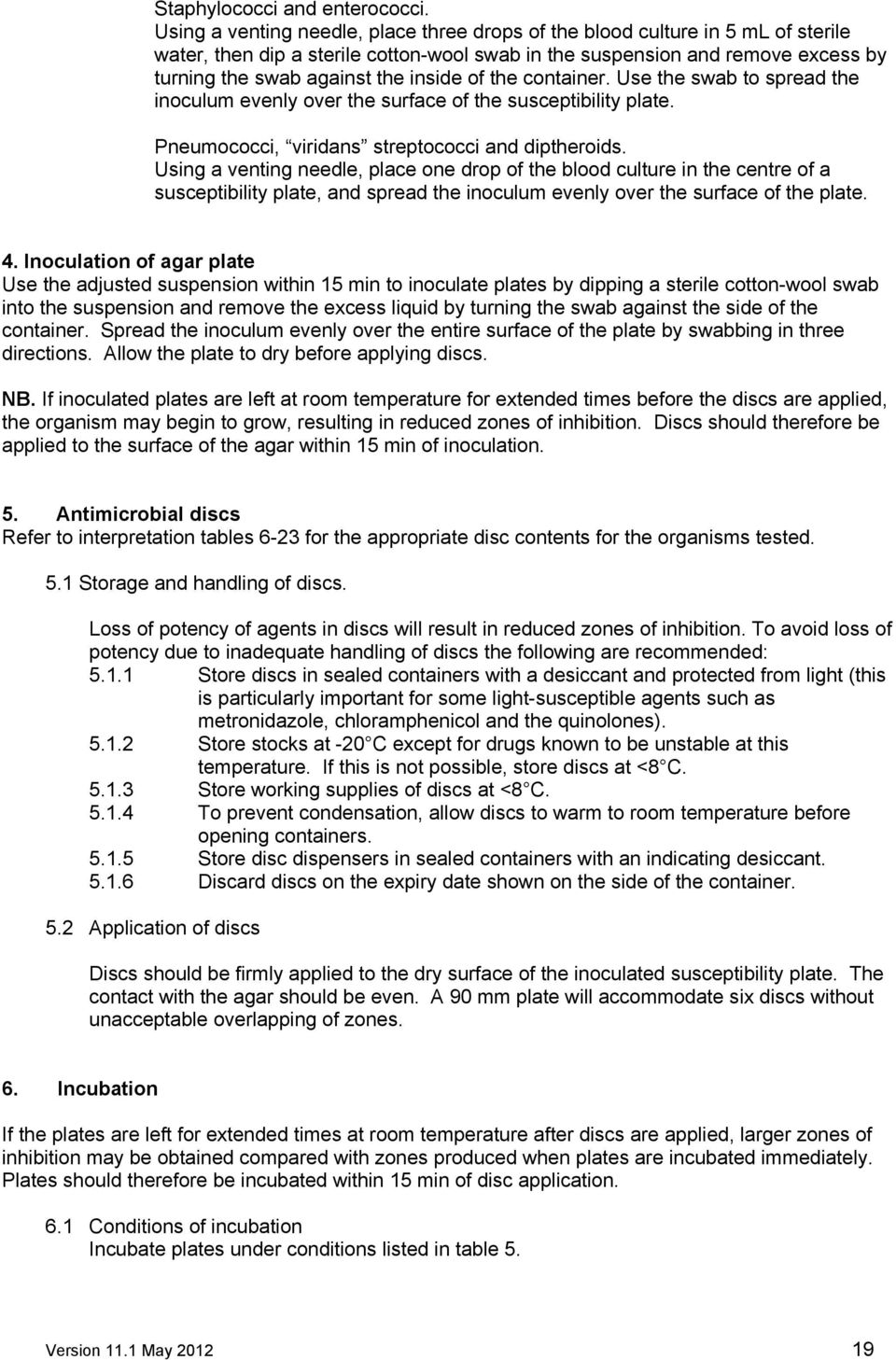
18 Table 4: Dilution of suspensions of test organisms according to absorbance reading Organisms Enterobacteriaceae Enterococci Pseudomonas spp. Staphylococci Haemophilus spp. Streptococci Miscellaneous fastidious Organisms Absorbance reading at 500 nm Volume (µl) to transfer to 5 ml sterile distilled water > > > > > > > > NB. As spectrophotometers may differ, it may be necessary to adjust the dilutions slightly to achieve semi-confluent growth with any individual set of laboratory conditions. 3.3 Direct antimicrobial susceptibility testing of urine specimens and blood cultures Direct susceptibility testing is not advocated as the control of inoculum is very difficult. Direct testing is, however, undertaken in many laboratories in order to provide more rapid test results. The following methods have been recommended by laboratories that use the BSAC method and. will achieve the correct inoculum size for a reasonable proportion of infected urines and blood cultures If the inoculum is not correct (i.e. growth is not semi-confluent) or the culture is mixed, the test must be repeated Urine specimens Method 1 Thoroughly mix the urine specimen, then place a 10 µl loop of urine in the centre of the susceptibility plate and spread evenly with a dry swab Method 2 Thoroughly mix the urine specimen, then dip a sterile cotton-wool swab in the urine and remove excess by turning the swab against the inside of the container. Use the swab to make a cross in the centre of the susceptibility plate and spread evenly with another sterile dry swab. If only small numbers of organisms are seen in microscopy, the initial cotton-wool swab may be used to inoculate and spread the susceptibility plate Positive blood cultures The method depends on the Gram reaction of the infecting organism Gram-negative bacilli. Using a venting needle, place one drop of the blood culture in 5 ml of sterile water, then dip a sterile cotton-wool swab in the suspension and remove excess by turning the swab against the inside of the container. Use the swab to spread the inoculum evenly over the surface of the susceptibility plate Gram-positive organisms. It is not always possible accurately to predict the genera of Gram-positive organisms from the Gram s stain. However, careful observation of the morphology, coupled with clinical information, should make an educated guess correct most of the time. Version 11.1 May

19 Staphylococci and enterococci. Using a venting needle, place three drops of the blood culture in 5 ml of sterile water, then dip a sterile cotton-wool swab in the suspension and remove excess by turning the swab against the inside of the container. Use the swab to spread the inoculum evenly over the surface of the susceptibility plate. Pneumococci, viridans streptococci and diptheroids. Using a venting needle, place one drop of the blood culture in the centre of a susceptibility plate, and spread the inoculum evenly over the surface of the plate. 4. Inoculation of agar plate Use the adjusted suspension within 15 min to inoculate plates by dipping a sterile cotton-wool swab into the suspension and remove the excess liquid by turning the swab against the side of the container. Spread the inoculum evenly over the entire surface of the plate by swabbing in three directions. Allow the plate to dry before applying discs. NB. If inoculated plates are left at room temperature for extended times before the discs are applied, the organism may begin to grow, resulting in reduced zones of inhibition. Discs should therefore be applied to the surface of the agar within 15 min of inoculation. 5. Antimicrobial discs Refer to interpretation tables 6-23 for the appropriate disc contents for the organisms tested. 5.1 Storage and handling of discs. Loss of potency of agents in discs will result in reduced zones of inhibition. To avoid loss of potency due to inadequate handling of discs the following are recommended: Store discs in sealed containers with a desiccant and protected from light (this is particularly important for some light-susceptible agents such as metronidazole, chloramphenicol and the quinolones) Store stocks at -20 C except for drugs known to be unstable at this temperature. If this is not possible, store discs at <8 C Store working supplies of discs at <8 C To prevent condensation, allow discs to warm to room temperature before opening containers Store disc dispensers in sealed containers with an indicating desiccant Discard discs on the expiry date shown on the side of the container. 5.2 Application of discs Discs should be firmly applied to the dry surface of the inoculated susceptibility plate. The contact with the agar should be even. A 90 mm plate will accommodate six discs without unacceptable overlapping of zones. 6. Incubation If the plates are left for extended times at room temperature after discs are applied, larger zones of inhibition may be obtained compared with zones produced when plates are incubated immediately. Plates should therefore be incubated within 15 min of disc application. 6.1 Conditions of incubation Incubate plates under conditions listed in table 5. Version 11.1 May
20 Table 5: Incubation conditions for antimicrobial susceptibility tests on various organisms Organisms Incubation conditions Enterobacteriaceae C in air for h Acinetobacter spp C in air for h Pseudomonas spp C in air for h Stenotrophomonas maltophilia 30 C in air for h Staphylococci (other than C in air for h methicillin/oxacillin/cefoxitin) Staphylococcus aureus using cefoxitin for the 35 C in air for h detection of methicillin/oxacillin/cefoxitin resistance Staphylococci using methicillin or oxacillin to 30 C in air for 24 h detect resistance Moraxella catarrhalis C in air for h α-haemolytic streptococci C in 4-6% CO 2 in air for h β-haemolytic streptococci C in air for h Enterococci C in air for 24 h 1 Neisseria meningitidis C in 4-6 % CO 2 in air for h Streptococcus pneumoniae C in 4-6 % CO 2 in air for h Haemophilus spp C in 4-6 % CO 2 in air for h Neisseria gonorrhoeae C in 4-6 % CO 2 in air for h Pasteurella multocida C in 4-6% CO 2 in air for h Coryneform organisms C in 4-6% CO 2 in air for h Campylobacter spp. 42 C in microaerophilic conditions for 24 h Bacteroides fragilis, Bacteroides thetaiotaomicron, Clostridium perfringens C in 10% CO 2 /10% H 2 /80% N 2 for h (anaerobic cabinet or jar) 1 It is essential that plates are incubated for at least 24 h before reporting a strain as susceptible to vancomycin or teicoplanin. NB. Stacking plates too high in the incubator may affect results owing to uneven heating of plates. The efficiency of heating of plates depends on the incubator and the racking system used. Control of incubation, including height of plate stacking, should therefore be part of the laboratory s Quality Assurance programme. Version 11.1 May

21 7. Measuring zones and interpretation of susceptibility 7.1 Acceptable inoculum density The inoculum should give semi-confluent growth of colonies on the susceptibility plate, within the range illustrated in Figure 1. Figure 1: Acceptable inoculum density range for a Gram-negative rod Lightest acceptable Ideal Heaviest acceptable 7.2 Measuring zones Measure the diameters of zones of inhibition to the nearest millimetre (zone edge should be taken as the point of inhibition as judged by the naked eye) with a ruler, callipers or an automated zone reader Tiny colonies at the edge of the zone, films of growth as a result of the swarming of Proteus spp. and slight growth within sulphonamide or trimethoprim zones should be ignored Colonies growing within the zone of inhibition should be subcultured and identified and the test repeated if necessary When using cefoxitin for the detection of methicillin/oxacillin/cefoxitin resistance in S. aureus, measure the obvious zone, taking care to examine zones carefully in good light to detect minute colonies that may be present within the zone of inhibition (see Figure 3) Confirm that the zone of inhibition for the control strain falls within the acceptable ranges in Tables before interpreting the test (see section on control of the disc diffusion method). 7.3 Use of templates for interpreting zone diameters A template may be used for interpreting zone diameters (see Figure 2). A program for preparing templates is available from the BSAC ( The test plate is placed over the template and the zones of inhibition are examined in relationship to the template zones. If the zone of inhibition of the test strain is within the area marked with an R, the organism is resistant. If the zone of inhibition is equal to or larger than the marked area, the organism is susceptible. Version 11.1 May
22 Figure 2: Template for interpreting zone diameters R IM CZ R PN R R CT G R CI R 8. Oxacillin/cefoxitin testing of staphylococci Methicillin susceptibility testing is difficult with some strains. Expression of resistance is affected by test conditions and resistance is often heterogeneous, with only a proportion of cells showing resistance. Adding NaCl or lowering incubation temperatures increases the proportion of cells showing resistance. Methicillin susceptibility testing of coagulase-negative staphylococci is further complicated as some strains do not grow well on media containing NaCl and are often slower-growing than Staphylococcus aureus. Detection of methicillin resistance in coagulase-negative staphylococci may require incubation for 48 h. 8.1 Method for detection of oxacillin resistance in S. aureus and coagulase-negative staphylococci Medium Prepare Columbia (See list of suppliers) or Mueller-Hinton agar (See list of suppliers) following the manufacturer s instructions and add 2% NaCl. After autoclaving, mix well to distribute the sodium chloride. Pour plates to give a depth of 4 mm (± 0.5 mm) in a 90 mm sterile Petri dish (25 ml). Dry and store plates as previously described (section 1) Inoculum Prepare inoculum as previously described (section 3) Control Susceptible control strains (Staphylococcus aureus ATCC or NCTC 6571) test the reliability of disc content. Staphylococcus aureus NCTC is a methicillin resistant strain and is used to check that the test will detect resistant organisms (although no strain can be representative of all the MRSA types in terms of their response to changes in test conditions) Discs Place a oxacillin 1 µg disc on to the surface of inoculated agar. Discs should be stored and handled as previously described (section 5). Version 11.1 May
23 8.1.5 Incubation Incubate plates for 24 h at 30 o C Zone measurement Measure zone diameters (mm) as previously described (section 7). Examine zones carefully in good light to detect colonies, which may be minute, in zones. If there is suspicion that the colonies growing within zones are contaminants they should be identified and the isolate re-tested for resistance to methicillin/oxacillin if necessary Interpretation For oxacillin interpretation is as follows: Susceptible = > 15 mm diameter, resistant = < 14 mm diameter. NB. Hyper-production of β-lactamase does not confer clinical resistance to penicillinase-resistant penicillins and such isolates should be reported susceptible to oxacillin. Some hyper-producers of β-lactamase give zones within the range of 7-14 mm and, if possible, such isolates should be checked by a PCR method for meca or by a latex agglutination test for PBP2a. Increase in oxacillin zone size in the presence of clavulanic acid is not a reliable test for hyper-producers of β-lactamase as zones of inhibition with some MRSA also increase in the presence of clavulanic acid. Rarely, hyperproducers of β-lactamase give no zone in this test and would therefore not be distinguished from MRSA. 8.2 Detection of methicillin/oxacillin/cefoxitin resistance in staphylococci by use of cefoxitin as the test agent Medium Prepare Iso-Sensitest agar as previously described (section 1) Inoculum Prepare inoculum as previously described (section 3) Control Use control strains as previously described (section 8.1.3) Discs Place a 10 µg cefoxitin disc on the surface of inoculated agar. Discs should be stored and handled as previously described (section 5) Incubation Incubate plates at 35 C for h. NB. It is important that the temperature does not exceed 36 C, as tests incubated at higher temperatures are less reliable Zone measurement Measure zone diameters as previously described (section 7), reading the obvious zone edge (see Figure 3). Examine zones carefully in good light to detect colonies, which may be minute, in zones. If there is suspicion that the colonies growing within zones are contaminants they should be identified and the isolate re-tested for resistance to cefoxitin if necessary. Version 11.1 May
24 Figure 3: Reading cefoxitin zones of inhibition with staphylococci Obvious zone to be measured Examine this area for minute colonies Inner zone NOT to be measured Interpretation: For S. aureus Susceptible = >22 mm diameter, resistant = <21 mm diameter For S. saprophyticus Susceptible = >20 mm diameter, resistant = <19 mm diameter For coagulase staphylococci other than S. saprophyticus Susceptible = >27 mm diameter, intermediate = mm, resistant = <21 mm diameter NB. Hyper -production of β-lactamase does not confer clinical resistance to penicillinaseresistant penicillins and such isolates should be reported susceptible to cefoxitin. Hyperproducers of β-lactamase give zones within the ranges of the susceptible population. Version 11.1 May
25 Table 6. MIC and zone diameter breakpoints for Enterobacteriaceae (including Salmonella and Shigella spp.) The identification of Enterobacteriaceae to species level is essential before applying Expert Rules for the interpretation of susceptibility. Comments 1-5 relate to urinary tract infections (UTIs) only. 1 UTI recommendations are for organisms associated with uncomplicated urinary infections only. For complicated UTI systemic recommendations should be used. 2 If an organism is isolated from multiple sites, for example from blood and urine, interpretation of susceptibility should be made with regard to the systemic site (e.g., if the blood isolate is resistant and the urine isolate susceptible, both should be reported resistant irrespective of the results obtained using interpretative criteria for urine isolates). 3 For agents not listed, criteria given for systemic isolates may be used for urinary tract isolates. Intermediate susceptibility infers that the infection may respond as the agent is concentrated at the site of infection. 4 Direct susceptibility tests on urine samples may be interpreted only if the inoculum gives semi-confluent growth. 5 In the absence of definitive organism identification, use the recommendations most appropriate for the presumptive identification, accepting that on some occasions the interpretation may be incorrect. A more cautious approach is to use the systemic recommendations. Table 6. MIC and zone diameter breakpoints for Enterobacteriaceae (including Salmonella and Shigella spp.) MIC breakpoint (mg/l) Interpretation of zone diameters (mm) Antibiotic R> I S Disc content R I S (µg) Aminoglycosides Amikacin Gentamicin Tobramycin Penicillins Amoxicillin Ampicillin Co-amoxiclav Systemic / Co-amoxiclav UTI / Salmonella spp. should be reported resistant to these agents, irrespective of susceptibility testing result, as they are inactive against Salmonella spp. in vivo. Individual aminoglycoside agents must be tested; susceptibility to other aminoglycosides cannot be inferred from the gentamicin result and vice versa. Species that have chromosomal penicillinases (Klebsiella spp.) or those that typically have inducible AmpC enzymes (e.g. Enterobacter spp., Citrobacter spp. and Serratia spp.) are intrinsically resistant to ampicillin/amoxicillin. Species that typically have inducible AmpC enzymes (e.g. Enterobacter spp., Citrobacter spp. and Serratia spp.) are intrinsically resistant to co-amoxiclav. Zone diameter based on a 2:1 ratio of amoxicillin: clavulanate are currently under review to establish correlation with an MIC breakpoint with a fixed concentration of clavulanate. Version 11.1 May
26 Table 6. MIC and zone diameter breakpoints for Enterobacteriaceae (including Salmonella and Shigella spp.) MIC breakpoint (mg/l) Interpretation of zone diameters (mm) Antibiotic R> I S Disc content R I S (µg) Penicillins cont. Mecillinam UTI These interpretative criteria are for E. coli, Klebsiella spp. and P. mirabilis only. Isolates of Escherichia coli and Klebsiella spp. that produce ESBLs often appear susceptible to mecillinam in vitro but clinical efficacy against these organisms is unproven. Piperacillin Piperacillin-tazobactam / Temocillin The distribution of zone diameters for ESBL and AmpC producers straddles the breakpoint. Organisms that appear resistant by disc diffusion should have resistance confirmed by MIC determination. No EUCAST BP at present based on BSAC data. Temocillin UTI No EUCAST BP at present based on BSAC data. Ticarcillin-clavulanate / The zone diameter breakpoint relates to an MIC of 8 mg/l as no data for the intermediate category are currently available. Cephalosporins Cefalexin UTI These interpretative criteria are for E. coli and Klebsiella spp. only. Cefalexin results may be used to report susceptibility to cefadroxil and cefradine. Cefalexin UTI These interpretative criteria are for P. mirabilis only. Cefalexin results may be used to report susceptibility to cefadroxil and cefradine. Cefepime Cefixime MIC breakpoint for UTI only. Cefotaxime Enterobacter spp., Citrobacter freundii, Serratia spp. and Morganella morganii. If susceptible in- vitro, the use of monotherapy of cefotaxime should be discouraged, owing to the risk of selection of resistance, or suppress the susceptibility testing result for this agent. Version 11.1 May
27 Table 6. MIC and zone diameter breakpoints for Enterobacteriaceae (including Salmonella and Shigella spp.) MIC breakpoint (mg/l) Interpretation of zone diameters (mm) Antibiotic R> I S Disc content R I S (µg) Cephalosporins cont. Cefoxitin (AmpC screen) This is an epidemiological cut off for AmpC detection which has high sensitivity, but poor specificity as Cefpodoxime (ESBL screen) susceptibility is also affected by permeability If screening for ESBLs is required for infection control or epidemiological purposes, Enterobacteriaceae isolates should be screened with cefpodoxime or both cefotaxime (or ceftriaxone) and ceftazidime. The presence of ESBLs should be confirmed with a specific test. Ceftazidime Ceftriaxone Cefuroxime (axetil) UTI 1-5 only Cefuroxime (parenteral) Carbapenems Doripenem Ertapenem Imipenem Meropenem Other β-lactams Aztreonam Enterobacter spp., Citrobacter freundii, Serratia spp. and Morganella morganii. If susceptible to ceftazidime or ceftriaxone in- vitro, the use of monotherapy of ceftazidime or ceftriaxone should be discouraged, owing to the risk of selection of resistance, or suppress the susceptibility testing result for this agent. Salmonella spp. should be reported resistant to these agents, irrespective of susceptibility testing result, as they are inactive in-vivo. For parenteral cefuroxime the breakpoint relates to a dosage of 1.5 g three times a day and to E. coli, Klebsiella spp. and P. mirabilis only. Detection of carbapenem resistance is difficult. Guidance on detection is given at Proteus spp. and Morganella morganii are considered poor targets for imipenem. Version 11.1 May
28 Table 6. MIC and zone diameter breakpoints for Enterobacteriaceae (including Salmonella and Shigella spp.) MIC breakpoint (mg/l) Interpretation of zone diameters (mm) Antibiotic R> I S Disc content R I S (µg) Quinolones Ciprofloxacin For ciprofloxacin, there is clinical evidence to indicate a poor response in systemic infections caused by Salmonella spp. with reduced susceptibility to fluoroquinolones. Isolates with MICs greater than 0.06 mg/l should be reported as resistant. It is recommended that the ciprofloxacin MIC should be determined for all invasive salmonellae infections. Levofloxacin Moxifloxacin Nalidixic acid UTI Norfloxacin (Systemic) Norfloxacin UTI No EUCAST breakpoint. BSAC data used. Ofloxacin Macrolides, lincosamides and streptogramins Azithromycin S. typhi only Azithromycin has been used in the treatment of infections with S. typhi (MIC 16 mg/l for wild type isolates) and some enteric infections. Tetracyclines Tigecycline Disc diffusion for Enterobacteriaceae other than E.coli may not give reliable results and for these organisms an MIC method should be used if tigecycline therapy is considered. Susceptibility of E. coli isolates appearing intermediate or resistant should be confirmed with an MIC method. Morganella morganii, Providencia spp. and Proteus spp. are considered inherently non-susceptible to tigecycline. Miscellaneous antibiotics Chloramphenicol Colistin 2-2 The disc diffusion test is inappropriate because it does not reliably detect low level resistance. Colistin susceptibility should be determined with an MIC method. Version 11.1 May
29 Table 6. MIC and zone diameter breakpoints for Enterobacteriaceae (including Salmonella and Shigella spp.) MIC breakpoint (mg/l) Interpretation of zone diameters (mm) Antibiotic R> I S Disc content R I S (µg) Miscellaneous antibiotics cont. Co-trimoxazole / The MIC breakpoint is based on the trimethoprim concentration in a 1:19 combination with Sulfamethoxazole. For advice on testing susceptibility to co-trimoxazole, see Appendix 1. The zone diameter breakpoint relates to an MIC of 2 mg/l as no data for the intermediate category are currently available. Trimethoprim UTI Fosfomycin UTI / These interpretative criteria are for E. coli only. Disc content indicates 200 µg fosfomycin/ 50 µg glucose- Fosfomycin UTI / 50 6-phosphate These interpretative criteria are for P. mirabilis only. Disc content indicates 200 µg fosfomycin/ 50 µg glucose- 6-phosphate. The susceptibility of Proteus spp. that swarms up to the disc can be difficult to interpret. Nitrofurantoin UTI These interpretative criteria are for E. coli only. Version 11.1 May
30 Table 7. MIC and zone diameter breakpoints for Acinetobacter spp. MIC breakpoint (mg/l) Interpretation of zone diameters (mm) Antibiotic R > I S Disc R I S Comment content (µg) Aminoglycosides Amikacin Gentamicin Penicillins Piperacillin-tazobactam / No EUCAST MIC BP as there is insufficient clinical evidence. BSAC data used. Carbapenems Doripenem Imipenem Meropenem Quinolones Ciprofloxacin Tetracyclines Tigecycline No EUCAST MIC BP as there is insufficient clinical evidence. For determining susceptibility an MIC method should be used and the EUCAST Non-Species specific MIC BP of S = 0.25 mg/l, R = > 0.5 mg/l applied to interpret susceptibility. Miscellaneous antibiotics Colistin Disc diffusion susceptibility testing is unreliable. An MIC method is therefore recommended. Version 11.1 May
31 Table 8. MIC and zone diameter breakpoints for Pseudomonas spp. Table 8. MIC and zone diameter breakpoints for Pseudomonas spp. MIC breakpoint (mg/l) Interpretation of zone diameters (mm) Antibiotic R > I S Disc content R I S Comment (µg) Aminoglycosides Amikacin Gentamicin Netilmicin Tobramycin Penicillins Piperacillin Piperacillin-tazobactam / Ticarcillin Ticarcillin-clavulanate / Cephalosporins Ceftazidime Carbapenems Doripenem The detection of resistance Imipenem mediated by carbapenemases is Version 11.1 May
32 Table 8. MIC and zone diameter breakpoints for Pseudomonas spp. MIC breakpoint (mg/l) Interpretation of zone diameters (mm) Antibiotic R > I S Disc content R I S Comment (µg) Meropenem difficult, particularly if resistance is not fully expressed. For epidemiological or cross infection purposes consideration should be given to testing isolates resistant to ceftazidime and a carbapenem for the presence of carbapenemases ( ebfile/hpaweb_c/ ) Other β-lactams Aztreonam Relates only to isolates from patients with cystic fibrosis given high dosage therapy to treat P. aeruginosa. Quinolones Ciprofloxacin Ciprofloxacin Levofloxacin No EUCAST MIC BP as there is insufficient clinical evidence. EUCAST non-species specific MIC breakpoint and BSAC data used. Miscellaneous antibiotics Colistin 4-4 The disc diffusion test is unreliable. Colistin susceptibility should be determined with an MIC method. Version 11.1 May
33 Table 9. MIC and zone diameter breakpoints for Stenotrophomonas maltophilia MIC breakpoint (mg/l) Interpretation of zone diameters (mm) Antibiotic R > I S Disc content R I S Comment (µg) Co-trimoxazole / For Stenotrophomonas maltophilia, susceptibility testing is not recommended except for cotrimoxazole (see BSA Standardized Susceptibility Testing Method, Additional Methodology, Stenotrophomonas maltophilia) The MIC breakpoint is based on the trimethoprim concentration in a 1:19 combination with sulfamethoxazole. Version 11.1 May
34 Table 10. MIC and zone diameter breakpoints for staphylococci Comments 1-3 relate to urinary tract infections (UTI) only. 1 These recommendations are for organisms associated with uncomplicated urinary tract infections only. For complicated infections and infections caused by Staphylococcus aureus and Staphylococcus epidermidis, which are associated with more serious infections, systemic recommendations should be used. 2 If an organism is isolated from multiple sites, for example from blood and urine, interpretation of susceptibility should be made with regard to the systemic site (e.g., if the blood isolate is resistant and the urine isolate susceptible, both should be reported resistant irrespective of the results obtained using interpretative criteria for urine isolates). 3 Direct susceptibility tests on urine samples may be interpreted only if the inoculum gives semi-confluent growth. Table 10. MIC and zone diameter breakpoints for staphylococci MIC breakpoint (mg/l) Interpretation of zone diameters (mm) Antibiotic R > I S Disc content R I S Comment (µg) Aminoglycosides Amikacin for Staphylococcus aureus Amikacin for coagulase-negative staphylococci Gentamicin Tobramycin for Staphylococcus aureus Version 11.1 May
35 Tobramycin for coagulasenegative staphylococci Neomycin For topical use only. The zone diameter breakpoint distinguishes the wild type susceptible population from isolates with reduced susceptibility. Table 10. MIC and zone diameter breakpoints for staphylococci β-lactams Most staphylococci are penicillinase-producers. The benzylpenicillin will mostly, but not unequivocally, separate β-lactamase producers. Isolates positive for β-lactamase are resistant to benzylpenicillin, phenoxymethylpenicillin, amino-,carboxy-and ureidopenicillins. Isolates negative for β-lactamase and susceptible to cefoxitin (cefoxitin is used to screen for methicillin resistance ) can be reported susceptible to these drugs. Isolates positive for β-lactamase and susceptible to cefoxitin are susceptible to penicillin- β-lactamase inhibitor combinations and penicillinase-resistant penicillins (oxacillin, cloxacillin, dicloxacillin and flucloxacin). Isolates resistant to cefoxitin are methicillin resistant and resistant to β-lactam agents, including β-lactamase inhibitor combinations, except for cephalosporins with approved anti-mrsa activity and clinical breakpoints. MIC breakpoint (mg/l) Interpretation of zone diameters (mm) Antibiotic R > I S Disc R I S Comment content Ampicillin UTI 1-3 Staphylococcus saprophyticus Cefoxitin Staphylococcus aureus (Screen) Cefoxitin S. saprophyticus (Screen) Cefoxitin coagulase-negative staphylococci (Screen) (µg) Staphylococci exhibiting resistance to oxacillin/cefoxitin should be regarded as resistant to other penicillins, cephalosporins, carbapenems and combinations of β- lactam and β-lactamase inhibitors. For coagulase negative staphylococci with cefoxitin zone diameters of mm, PCR for meca is required to determine susceptibility for treatment of deep seated infection with any β-lactam. Version 11.1 May
36 Oxacillin (Screen) Penicillin unit For oxacillin tests on Mueller Hinton or Columbia agars with 2% NaCl: Some hyper-producers of β-lactamase give zones within the range of 7-14 mm and if possible, should be checked by a PCR method for meca or a latex agglutination test for PBP2a. Increase in oxacillin zone size in the presence of clavulanic acid is not a reliable test for hyper-producers of β-lactamase as zones of inhibition with some MRSA also increase in the presence of clavulanic acid. Rarely, hyper-producers of β-lactamase give no zone in this test and would therefore not be distinguished from MRSA. For S. saprophyticus there is very little data for resistant meca strains. With penicillin check for a heaped zone edge which indicates β-lactamase mediated resistance. Table 10. MIC and zone diameter breakpoints for staphylococci MIC breakpoint (mg/l) Interpretation of zone diameters (mm) Antibiotic R > I S Disc R I S Comment content (µg) Quinolones Ciprofloxacin MIC breakpoints relate to high-dose therapy (750 mg BD). Ciprofloxacin UTI Staphylococcus saprophyticus Moxifloxacin Ofloxacin Glycopeptides Teicoplanin Staphylococcus aureus Teicoplanin Coagulase negative staphylococci Vancomycin Staphylococcus aureus Disc diffusion for staphylococci does not give reliable results. An MIC method should be used to determine susceptibility, positive results requiring confirmation. Population analysis is the most reliable method for confirming resistance and for distinguishing susceptible, hetero-gisa and GISA isolates. If, on clinical grounds, resistance to vancomycin is Version 11.1 May
37 Vancomycin Coagulase negative staphylococci suspected, it is recommended that the organism be sent to a specialist laboratory, such as Southmead Hospital in Bristol 1 or the Antibiotic Research Laboratory in Cardiff 2. ( gradient%20tests.pdf) Macrolides, lincosamides and streptogramins Azithromycin The zone diameter breakpoint relates to an MIC of 1 mg/l as no data for the intermediate category are currently available. Clarithromycin Table 10. MIC and zone diameter breakpoints for staphylococci MIC breakpoint (mg/l) Interpretation of zone diameters (mm) Antibiotic R > I S Disc R I S Comment content (µg) Macrolides, lincosamides and streptogramins cont. Clindamycin Erythromycin can be used to determine the Version 11.1 May
38 Erythromycin susceptibility to azithromycin, clarithromycin and roxithromycin. Organisms that appear resistant to erythromycin, but susceptible to clindamycin should be checked for the presence of inducible resistance (see issociated_resistance_in_staphylococc12.pdf. Inducible clindamycin resistance can be detected only in the presence of a macrolide antibiotic. If positive, report as resistant to clindamycin or report as susceptible with a warning that clinical failure during treatment with clindamycin may occur by selection of constitutively resistant mutants and the use of clindamycin best avoided in severe infection. Quinupristin-dalfopristin The presence of blood has a marked effect on the activity of Quinupristin-dalfopristin. On the rare occasions when blood needs to be added to enhance the growth of staphylococci, susceptible 15 mm, resistant 14 mm. Table 10. MIC and zone diameter breakpoints for staphylococci MIC breakpoint (mg/l) Interpretation of zone diameters (mm) Antibiotic R > I S Disc R I S Comment content (µg) Tetracyclines Doxycycline The zone diameter breakpoint relates to an MIC of 1 Version 11.1 May
39 mg/l as no data for the intermediate category are currently available. Minocycline The zone diameter breakpoint relates to an MIC of 0.5 mg/l as no data for the intermediate category are currently available. Tetracycline The zone diameter breakpoint relates to an MIC of 1 mg/l as no data for the intermediate category are currently available. Staphylococci susceptible to tetracycline are also susceptible to doxycycline and minocycline. Some staphylococci resistant to tetracycline may be susceptible to minocycline and doxycycline. Tigecycline Strains with MIC values above the susceptible breakpoint are very rare or not yet reported. The identification and antimicrobial susceptibility tests on any such isolate must be repeated and if the result is confirmed the isolate must be sent to a reference laboratory. Until there is further evidence regarding clinical response for confirmed isolates with MIC above the current resistant breakpoint they should be reported as resistant. Table 10. MIC and zone diameter breakpoints for staphylococci MIC breakpoint (mg/l) Interpretation of zone diameters (mm) Antibiotic R > I S Disc R I S Comment content (µg) Miscellaneous antibiotics Daptomycin Strains with MIC values above the susceptible Version 11.1 May
40 breakpoint are very rare or not yet reported. The identification and antimicrobial susceptibility tests on any such isolate must be repeated and if the result is confirmed the isolate sent to a reference laboratory. Until there is evidence regarding the clinical response for confirmed isolates with MIC above the current resistant breakpoint they should be reported resistant. Susceptibility testing by disc diffusion is not reliable. Susceptibility should be determined using a broth dilution method with Mueller Hinton broth or by an MIC method on Mueller Hinton agar. Chloramphenicol Co-trimoxazole / For advice on testing susceptibility to co-trimoxazole see Appendix 1. The MIC breakpoint is based on the trimethoprim concentration in a 1:19 combination with sulfamethoxazole. Trimethoprim Breakpoints are epidemiological cut-offs based on distributions for the wild type population. However, there is no clear evidence correlating these breakpoints with clinical efficacy. Trimethoprim UTI Staphylococcus saprophyticus Fosfomycin (IV) / Disc content indicates 200 µg fosfomycin/50 µg glucose-6-phosphate Fusidic acid Linezolid Table 10. MIC and zone diameter breakpoints for staphylococci MIC breakpoint (mg/l) Interpretation of zone diameters (mm) Antibiotic R > I S Disc R I S Comment content (µg) Miscellaneous antibiotics cont. Mupirocin Version 11.1 May
41 Nitrofurantoin UTI Staphylococcus saprophyticus Rifampicin = Department of Microbiology, Lime Walk Building, Southmead Hospital Westbury on-trym, Bristol, BS10 5NB. 2 = Public Health Wales, Microbiology Cardiff, University Hospital of Wales, Heath Park, Cardiff, CF14 4XW. Table 11. MIC and zone diameter breakpoints for Streptococcus pneumoniae Table 11. MIC and zone diameter breakpoints for Streptococcus pneumoniae MIC breakpoint (mg/l) Interpretation of zone diameters (mm) Antibiotic R > I S Disc content R I S Comment (µg) Most MIC values for penicillin, ampicillin, amoxicillin and piperacillin (with or without a β-lactamase inhibitor) differ by no more than one dilution step and isolates fully susceptible to Version 11.1 May
42 Table 11. MIC and zone diameter breakpoints for Streptococcus pneumoniae MIC breakpoint (mg/l) Interpretation of zone diameters (mm) Antibiotic R > I S Disc content (µg) R I S Comment benzlpenicillin (MIC 0.06 mg/l; susceptible by oxacillin disc screen) can be reported susceptible to β-lactam agents that have been given breakpoints. Penicillins Penicillin Oxacillin Cephalosporins Cefaclor Cefotaxime Cefpodoxime Ceftriaxone Cefuroxime Reduced susceptibility to penicillin in Streptococcus pneumoniae is most reliably detected with an oxacillin 1 µg disc; confirm resistance with a penicillin MIC determination. Infections with organisms with a penicillin MIC 2mg/L may be effectively treated if adequate doses are used except in infections of the central nervous system. In addition, cefotaxime or ceftriaxone MIC determination is advised for isolates from meningitis or other invasive infections. Isolates categorised as susceptible with the oxacillin 1 µg disc can be reported susceptible to cefepime, cefotaxime, cefpodoxime, ceftriaxone, cefuroxime ± axetil and cefaclor. Isolates with MIC values above the S/I breakpoint for cefotaxime or ceftriaxone are very rare. The identification and antimicrobial susceptibility tests on any such isolate must be repeated and if the result is confirmed the isolate sent to a reference laboratory. Until there is evidence regarding clinical response for confirmed isolates with MIC above the current resistant breakpoint they should be reported resistant. Carbapenems Ertapenem Screen for β-lactam resistance with the oxacillin 1 Imipenem µg disc. Isolates categorised as susceptible can be Version 11.1 May
43 Table 11. MIC and zone diameter breakpoints for Streptococcus pneumoniae MIC breakpoint (mg/l) Interpretation of zone diameters (mm) Antibiotic R > I S Disc content R I S Comment Meropenem (Infections other than meningitis) Meropenem (for meningitis) (µg) Quinolones Ciprofloxacin Ofloxacin Levofloxacin Moxifloxacin Glycopeptides Vancomycin reported susceptible for ertapenem, imipenem and meropenem. Meropenem is the only carbapenem used for meningitis. For use in meningitis determine the meropenem MIC value. Isolates with MIC values above the S/I breakpoint are very rare or not yet reported. The identification and antimicrobial susceptibility tests on any such isolate must be repeated and if the result is confirmed the isolate sent to a reference laboratory. Until there is evidence regarding clinical response for confirmed isolates with MIC above the current resistant breakpoint they should be reported resistant. Wild type isolates (ciprofloxacin MICs mg/l; ofloxacin MICs mg/l) are considered intermediate in susceptibility. Tetracyclines Tetracycline The zone diameter breakpoint relates to an MIC of 1 mg/l as no data for the intermediate category are Version 11.1 May
44 Table 11. MIC and zone diameter breakpoints for Streptococcus pneumoniae MIC breakpoint (mg/l) Interpretation of zone diameters (mm) Antibiotic R > I S Disc content R I S Comment (µg) currently available. Isolates susceptible to tetracycline are also susceptible to doxycycline and minocycline. Some isolates resistant to tetracycline may be susceptible to minocycline and /or doxycycline. Macrolides, lincosamides and streptogramins Azithromycin Clarithromycin Erythromycin Erythromycin can be used to determine susceptibility to azithromycin, clarithromycin and roxithromycin. Telithromycin No EUCAST breakpoint, BSAC data used. Insufficient data are available to distinguish the intermediate category. Miscellaneous antibiotics Chloramphenicol Co-trimoxazole / For advice on testing susceptibility to cotrimoxazole see Appendix 1. The MIC breakpoint is based on the trimethoprim concentration in a 1:19 combination with sulfamethoxazole. Linezolid Zone diameter breakpoint relates to an MIC of 2 mg/l as no data for the intermediate category are currently available. Rifampicin Table 12. MIC and zone diameter breakpoints for enterococci Version 11.1 May
45 Comments 1-3 relate to urinary tract infections (UTIs) only. 1 UTI recommendations are for organisms associated with uncomplicated urinary tract infections only. For complicated urinary tract infections, systemic recommendations should be used. 2 If an organism is isolated from multiple sites, for example from blood and urine, interpretation of susceptibility should be made with regard to the systemic site (e.g., if the blood isolate is resistant and the urine isolate susceptible, both should be reported resistant irrespective of the results obtained using interpretative criteria for urine isolates). 3 Direct susceptibility tests on urine samples may be interpreted only if the inoculum gives semi-confluent growth. NB. For isolates from endocarditis the MIC should be determined and interpreted according to national endocarditis guidelines (Elliott TS et al. Guidelines for the antibiotic treatment of endocarditis in adults: report of the Working Party of the British Society for Antimicrobial Chemotherapy. J Antimicrob Chemother. 2004; 54: ). Table 12. MIC and zone diameter breakpoints for enterococci MIC breakpoint (mg/l) Interpretation of zone diameters (mm) Antibiotic R > I S Disc content R I S Comment (µg) Aminoglycosides Gentamicin High-level gentamicin-resistant enterococci usually give no zone or only a trace of inhibition around gentamicin 200 µg discs. Occasionally, however, the plasmid carrying the resistance gene may be unstable and the resistance is seen as a zone of inhibition with a few small colonies within the zone. Retesting of resistant colonies results in growth to the disc or increased numbers of colonies within the zone. Zones should be carefully examined to avoid missing such resistant organisms. If in doubt, isolates may be sent to a reference laboratory for confirmation. Streptomycin The EUCAST breakpoint is 512 mg/l tested on Mueller- Hinton agar which correlates with the MIC breakpoint of 128 mg/l on Iso-Sensitest agar and the zone criteria given. Penicillins Ampicillin The MIC breakpoint has changed but a review of the data indicates that no adjustment of the zone diameter breakpoints is necessary. Co-amoxiclav susceptibility can be inferred from the ampicillin result. Carbapenems Imipenem Recommendations for E. faecalis only. Glycopeptides Teicoplanin To ensure that microcolonies indicating reduced Version 11.1 May
46 Table 12. MIC and zone diameter breakpoints for enterococci MIC breakpoint (mg/l) Interpretation of zone diameters (mm) Antibiotic R > I S Disc content R I S Comment (µg) Vancomycin susceptibility to the glycopeptides are detected, it is essential that plates are incubated for at least 24 h before reporting a strain as susceptible to vancomycin or teicoplanin. Macrolides, lincosamides and streptogramins Quinupristin-dalfopristin Generally, E. faecalis are intermediate or resistant and E. faecium are susceptible. The presence of blood has a marked effect on the activity of quinupristin-dalfopristin. On the rare occasions when blood needs to be added to enhance the growth of enterococci, breakpoints are 15 mm, 14 mm. Tetracyclines Tigecycline Isolates with MIC values above the susceptible breakpoint are very rare or not yet reported, so there is no intermediate category for disc diffusion. The identification and antimicrobial susceptibility tests on any such isolate must be repeated and if the result is confirmed the isolate must be sent to a reference laboratory. Until there is evidence regarding clinical response for confirmed isolates with MIC above the current resistant breakpoint they should be reported resistant. Miscellaneous antibiotics Linezolid Nitrofurantoin UTI Trimethoprim UTI >50 There is some doubt about the clinical relevance of testing the susceptibility of enterococci to trimethoprim. The breakpoints have been set to interpret all enterococci as intermediate. Table 13. MIC and zone diameter breakpoints for α-haemolytic streptococci Version 11.1 May
47 N.B. For isolates from endocarditis the MIC should be determined and interpreted according to national endocarditis guidelines (Elliott TS et al. Guidelines for the antibiotic treatment of endocarditis in adults: report of the Working Party of the British Society for Antimicrobial Chemotherapy. J Antimicrob Chemother. 2004; 54: ). Table 13. MIC and zone diameter breakpoints for α-haemolytic streptococci MIC breakpoint (mg/l) Interpretation of zone diameters (mm) Antibiotic R > I S Disc content R I S Comment (µg) Penicillins Amoxicillin Penicillin unit Cephalosporins Cefotaxime Glycopeptides Teicoplanin Vancomycin Macrolides, lincosamides and streptogramins Clindamycin Erythromycin Organisms that appear resistant to erythromycin, but susceptible to clindamycin should be checked for the presence of inducible MLS B resistance (see esting_for_dissociated_resistance_in_stap hylococc12.pdf). Inducible clindamycin resistance can be detected only in the presence of a macrolide antibiotic. If positive, report as susceptible to clindamycin with a warning that resistance may develop during treatment. No EUCAST MIC breakpoint for erythromycin as there is insufficient clinical evidence. BSAC data used. Miscellaneous antibiotics Linezolid No EUCAST MIC breakpoint as there is insufficient clinical evidence. BSAC data used. Table 14. MIC and zone diameter breakpoints for β-haemolytic streptococci Version 11.1 May
48 Comments 1-3 relate to urinary tract infections (UTIs) only. 1 UTI recommendations are for organisms associated with uncomplicated urinary tract infections only. For complicated urinary tract infections and infections systemic recommendations should be used. 2 If an organism is isolated from multiple sites, for example from blood and urine, interpretation of susceptibility should be made with regard to the systemic site (e.g., if the blood isolate is resistant and the urine isolate susceptible, both should be reported resistant irrespective of the results obtained using interpretative criteria for urine isolates). 3 Direct susceptibility tests on urine samples may be interpreted only if the inoculum gives semi-confluent growth. Table 14. MIC and zone diameter breakpoints for β-haemolytic streptococci MIC breakpoint (mg/l) Interpretation of zone diameters (mm) Antibiotic R > I S Disc content R I S Comment (µg) Penicillins Penicillin unit Susceptibility to other penicillins, carbapenems and cephalosporins can be inferred from the penicillin result. Macrolides, lincosamides and streptogramins Azithromycin Clarithromycin Clindamycin Organisms that appear resistant to erythromycin, but susceptible to clindamycin should be checked for the presence of inducible MLS B resistance (see ng_for_dissociated_resistance_in_staphylococ c12.pdf). If positive, report as susceptible to clindamycin with a warning that resistance may develop during treatment. Erythromycin Telithromycin Zone diameter breakpoints relate to the wild type susceptible population as no data are available for the non-susceptible population. Tetracyclines Tetracycline Isolates susceptible to tetracycline are also susceptible to doxycycline and minocycline. Version 11.1 May
49 Table 14. MIC and zone diameter breakpoints for β-haemolytic streptococci MIC breakpoint (mg/l) Interpretation of zone diameters (mm) Antibiotic R > I S Disc content (µg) R I S Comment Some isolates resistant to tetracycline may be susceptible to minocycline and/or doxycycline. Tigecycline Strains with MIC values above the susceptible breakpoint are very rare or not yet reported. The identification and antimicrobial susceptibility tests on any such isolate must be repeated and if the result is confirmed the isolate must be sent to a reference laboratory. Until there is evidence regarding clinical response for confirmed isolates with MIC above the current resistant breakpoint they should be reported resistant. Miscellaneous antibiotics Co-trimoxazole / For advice on testing susceptibility to cotrimoxazole see Appendix 1. The MIC breakpoint is based on the trimethoprim concentration in a 1:19 combination with Sulfamethoxazole. Trimethoprim UTI Group B streptococci Daptomycin Strains with MIC values above the susceptible breakpoint are very rare or not yet reported. The identification and antimicrobial susceptibility tests on any such isolate must be repeated and if the result is confirmed the isolate sent to a reference laboratory. Until there is evidence regarding the clinical response for confirmed isolates with MIC above the current resistant breakpoint they should be reported resistant. No zone diameter breakpoints are given because disc diffusion susceptibility testing is unreliable. Miscellaneous antibiotics cont. Linezolid Zone diameter breakpoints relate to the MIC breakpoint of 2 mg/l as no data for the Version 11.1 May
50 Table 14. MIC and zone diameter breakpoints for β-haemolytic streptococci MIC breakpoint (mg/l) Interpretation of zone diameters (mm) Antibiotic R > I S Disc content (µg) R I S Comment Nitrofurantoin UTI 1-3 Group B Streptococci intermediate category are currently available. Table 15. MIC and zone diameter breakpoints for Moraxella catarrhalis Table 15. MIC and zone diameter breakpoints for Moraxella catarrhalis Version 11.1 May
51 MIC breakpoint (mg/l) Interpretation of zone diameters (mm) Antibiotic R > I S Disc content R I S Comment (µg) Penicillins Ampicillin Resistance to ampicillin by production of β- lactamase (BRO-1/2 β-lactamase) may be misidentified by disk diffusion technique and, because β-lactamase production is slow, may give weak results with in vitro tests. Since >90% of M. catarrhalis strains produce β-lactamase, testing of penicillinase production is discouraged and isolates reported resistant to ampicillin and amoxicillin. Co-amoxiclav 1-1 2/ Cephalosporins Cefaclor MIC breakpoints render all M. catarrhalis resistant to cefaclor. Cefuroxime Zone diameter breakpoints relate to the MIC breakpoint of 4 mg//l as no data for the intermediate category are currently available. Cefuroxime axetil Carbapenems Ertapenem Quinolones Ciprofloxacin Levofloxacin Moxifloxacin Nalidixic acid (Screen) Ofloxacin Quinolone resistance is most reliably detected with nalidixic acid discs. Macrolides, lincosamides and streptogramins Clarithromycin Erythromycin Zone diameter breakpoints relate to the MIC breakpoint of 0.25 mg/l as no data for the intermediate category are currently available. Macrolides, lincosamides and streptogramins cont. Telithromycin Erythromycin can be used to determine susceptibility to azithromycin and clarithromycin. Version 11.1 May
52 Table 15. MIC and zone diameter breakpoints for Moraxella catarrhalis MIC breakpoint (mg/l) Interpretation of zone diameters (mm) Antibiotic R > I S Disc content R I S Comment (µg) Tetracyclines Tetracycline No disc diffusion data to distinguish the intermediate category available at present. Isolates susceptible to tetracycline are also susceptible to doxycycline and minocycline. Some isolates resistant to tetracycline may be susceptible to minocycline and/or doxycycline. Miscellaneous antibiotics Chloramphenicol Breakpoints relate to the topical use of chloramphenicol. Co-trimoxazole / For advice on testing susceptibility to cotrimoxazole, see Appendix 1. The MIC breakpoint is based on the trimethoprim concentration in a 1:19 combination with sulfamethoxazole. Table 16. MIC and zone diameter breakpoints for Neisseria gonorrhoeae Version 11.1 May
53 Table 16. MIC and zone diameter breakpoints for Neisseria gonorrhoeae MIC breakpoint (mg/l) Interpretation of zone diameters (mm) Antibiotic R > I S Disc content R I S Comment (µg) Penicillins Penicillin unit Always test for β-lactamase. If positive report resistant to penicillin. Cephalosporins Cefixime Cefotaxime Ceftriaxone Cefuroxime (Screen) Quinolones Ciprofloxacin Results for isolates with reduced zones around ceftriaxone, cefotaxime and cefixime discs should be confirmed by MIC determinations. Although cefuroxime is not recommended for clinical use, it can be used as an indicator antibiotic to detect reduced susceptibility to other oxyimino cephalosporin. For ciprofloxacin the zone diameter breakpoints relate to the MIC breakpoint of 0.03mg/L as no data for the intermediate category are currently available. Quinolone resistance is generally reliably detected with nalidixic acid; however there are a few isolates that are resistant to ciprofloxacin yet susceptible to nalidixic acid in disc diffusion tests. The mechanism of resistance and the Nalidixic acid prevalence of these isolates in the UK is still under investigation. Isolates with reduced susceptibility to fluoroquinolones normally have no zone of inhibition with a 30 µg nalidixic acid disc. For organisms with nalidixic acid zone diameters mm a ciprofloxacin MIC should be determined if the patient is to be treated with this agent. Macrolides, lincosamides and streptogramins Azithromycin Zone diameter breakpoints relate to the MIC breakpoints of >0.5 mg/l as disc diffusion testing will not reliably differentiate between the intermediate and susceptible populations. Tetracyclines Tetracycline The tetracycline result may be used to infer susceptibility to doxycycline. Isolates susceptible to tetracycline are also susceptible to minocycline, but some isolates resistant to tetracycline may be susceptible to minocycline. Version 11.1 May
54 Table 16. MIC and zone diameter breakpoints for Neisseria gonorrhoeae MIC breakpoint (mg/l) Interpretation of zone diameters (mm) Antibiotic R > I S Disc content R I S Comment (µg) Miscellaneous antibiotics Spectinomycin Version 11.1 May
55 Table 17. MIC and zone diameter breakpoints for Neisseria meningitidis Table 17. MIC and zone diameter breakpoints for Neisseria meningitidis MIC breakpoint (mg/l) Interpretation of zone diameters (mm) Antibiotic R > I S Disc content R I S Comment (µg) Penicillins Ampicillin Amoxicillin Ampicillin and amoxicillin are used as indicator antibiotics to detect reduced susceptibility to penicillin. The recommendations given are for this purpose only; ampicillin and amoxicillin should not be used therapeutically. EUCAST MIC breakpoints are S 0.12 mg/l, R > 1 mg/l. Currently there are no BSAC MIC breakpoints and zone diameter breakpoints relating to the presence of specific mutations in the pena gene. Penicillin unit Cephalosporins Cefotaxime Ceftriaxone Quinolones Ciprofloxacin Quinolone resistance is most reliably detected in tests with nalidixic acid. Isolates with reduced susceptibility to fluoroquinolones have no zone of inhibition with 30 µg nalidixic acid discs. Zone diameter breakpoints relate to the MIC breakpoint of 0.03 mg/l as no data for the intermediate category are currently available. Miscellaneous antibiotics Chloramphenicol Zone diameter breakpoints relate to the MIC breakpoint of 2 mg/l as insufficient data to distinguish the intermediate category are currently available. Rifampicin Epidemiological breakpoint based on an MIC breakpoint of 0.25 mg/l. Version 11.1 May
56 Table 18. MIC and zone diameter breakpoints for Haemophilus influenzae Table 18. MIC and zone diameter breakpoints for Haemophilus influenzae MIC breakpoint (mg/l) Interpretation of zone diameters (mm) Antibiotic R > I S Disc content R I S Comment (µg) Penicillins Amoxicillin Ampicillin Always test for β-lactamase; β-lactamase positive isolates should be reported resistant Breakpoints apply to β-lactamase negative isolates only. Strains may be resistant to penicillins, aminopenicillins and/or cephalosporins due to changes in PBPs (BLNAR, β-lactamase negative ampicillin resistant) and a few strains have both resistance mechanisms (BLPACR, β-lactamase positive, amoxicillin-clavulanate resistant). Isolates susceptible to ampicillin/amoxicillin are also susceptible to piperacillin and piperacillin-tazobactam and isolates susceptible to amoxicillin-clavulanate are also susceptible to piperacillin-tazobactam. Susceptibility to amoxicillin can be inferred from ampicillin. Co-amoxiclav 2-2 2/ Cephalosporins Cefaclor See Appendix 2. MIC breakpoints render most H. influenzae resistant for cefaclor. The disc diffusion test can be used to screen for BLNAR. Isolates with zone diameters<15 mm should be checked for ampicillin and cephalosporin resistance. Version 11.1 May
57 Table 18. MIC and zone diameter breakpoints for Haemophilus influenzae MIC breakpoint (mg/l) Interpretation of zone diameters (mm) Antibiotic R > I S Disc content R I S Comment (µg) Cephalosporins cont. Cefotaxime Ceftriaxone Cefuroxime Zone diameter breakpoints relate to the MIC breakpoint of 1 mg//l as no data for the intermediate category are currently available. Carbapenems Ertapenem Imipenem Meropenem (Infection other than meningitis) Meropenem (Meningitis) Quinolones Ciprofloxacin Levofloxacin Moxifloxacin Nalidixic acid Ofloxacin Macrolides, lincosamides and streptogramins Azithromycin Clarithromycin Erythromycin Telithromycin Meropenem is the only carbapenem used for meningitis. For use in meningitis determine the MIC value. Quinolone resistance is most reliably detected in tests with nalidixic acid. Strains with reduced susceptibility to fluoroquinolones give no zone of inhibition with a 30µg nalidixic acid disc. Correlation between macrolide MICs and clinical outcome is weak for H. influenzae. Therefore, breakpoints for macrolides and related antibiotics have been set to categorize wild type H. influenzae as intermediate. Erythromycin can be used to determine susceptibility to azithromycin and clarithromycin. Tetracyclines Tetracycline Isolates susceptible to tetracycline are also susceptible to doxycycline and minocycline. Some isolates resistant to tetracycline may be susceptible to minocycline and/or doxycycline. Version 11.1 May
58 Table 18. MIC and zone diameter breakpoints for Haemophilus influenzae MIC breakpoint (mg/l) Interpretation of zone diameters (mm) Antibiotic R > I S Disc content R I S Comment (µg) Miscellaneous antibiotics Chloramphenicol The breakpoints have changed but a review of the data indicates that no adjustment of the zone diameter breakpoint is necessary. Co-trimoxazole For advice on testing susceptibility to co-trimoxazole see Appendix 1. The MIC breakpoint is based on the trimethoprim concentration in a 1:19 combination with sulfamethoxazole. Version 11.1 May
59 Table 19. MIC and zone diameter breakpoints for Pasteurella multocida MIC breakpoint (mg/l) Interpretation of zone diameters (mm) Antibiotic R > I S Disc content R I S Comment (µg) Penicillins Ampicillin Penicillin unit Cephalosporins Cefotaxime Quinolones Ciprofloxacin Nalidixic acid Tetracyclines Tetracycline Quinolone resistance is most reliably detected in tests with nalidixic acid discs. Version 11.1 May
60 Table 20. MIC and zone diameter breakpoints for Campylobacter spp. MIC breakpoint (mg/l) Interpretation of zone diameters (mm) Antibiotic R > I S Disc content R I S Comment (µg) Quinolones Ciprofloxacin Quinolone resistance is most reliably detected in Nalidixic acid tests with nalidixic acid discs. The zone diameters for ciprofloxacin relate to an MIC breakpoint of 0.5 mg/l as no data for the intermediate category are currently available. Macrolides, lincosamides and streptogramins Erythromycin The susceptibility of clarithromycin can be inferred from the erythromycin result. Version 11.1 May
61 Table 21. MIC and zone diameter breakpoints for Coryneform organisms MIC breakpoint (mg/l) Interpretation of zone diameters (mm) Antibiotic R > I S Disc content R I S Comment (µg) Penicillins Penicillin unit Quinolones Ciprofloxacin The zone diameters relate to an MIC breakpoint of 0.5 mg/l as no data for the intermediate category are currently available. Glycopeptides Vancomycin The zone diameters relate to an MIC breakpoint of 4 mg/l as no data for the intermediate category are currently available. Version 11.1 May
62 Table 22. MIC and zone diameter breakpoints for Gram-negative anaerobes Table 22. MIC and zone diameter breakpoints for Gram-negative anaerobes MIC breakpoint (mg/l) Interpretation of zone diameters (mm) Antibiotic R > I S Disc content R I S Comment (µg) Penicillins Ampicillin Amoxicillin Co-amoxiclav Zone diameter breakpoints are for B. fragilis only. Penicillin Susceptibility to ampicillin, amoxicillin and piperacillin ± tazobactam can be inferred from the susceptibility to penicillin. B. fragilis is inherently resistant to penicillin. Piperacillin Piperacillin-tazobactam / Zone diameter breakpoints are for B. fragilis only. The breakpoints are based on the wild type susceptible population as there are few clinical data relating MIC to outcome. Organisms that appear resistant in disc diffusion tests should have resistance confirmed by MIC determination and resistant isolates should be sent to the Anaerobe Reference Laboratory in Cardiff. Ticarcillin Ticarcillin-clavulanate Carbapenems Doripenem The zone diameter breakpoint relates to an MIC of 8 mg/l as no data for the intermediate category are currently available. Ertapenem Imipenem Meropenem Zone diameter breakpoints are for B. fragilis and B. thetaiotaomicron only. Version 11.1 May
63 Table 22. MIC and zone diameter breakpoints for Gram-negative anaerobes MIC breakpoint (mg/l) Interpretation of zone diameters (mm) Antibiotic R > I S Disc content R I S Comment (µg) Macrolides, lincosamides and streptogramins Clindamycin Zone diameter breakpoints are for B. fragilis and B. thetaiotaomicron only. The breakpoints are based on the wild type susceptible population as there are few clinical data relating MIC to outcome. Organisms that appear resistant in disc diffusion tests should heave resistance confirmed by MIC determination and resistant isolates should be sent to the Anaerobe Reference Laboratory in Cardiff. Miscellaneous antibiotics Chloramphenicol Metronidazole Zone diameter breakpoints are for B. fragilis and B. thetaiotaomicron only. Version 11.1 May
64 Table 23. MIC and zone diameter breakpoints for Gram-positive anaerobes except Clostridium difficile Table 23. MIC and zone diameter breakpoints for Gram-positive anaerobes except Clostridium difficile MIC breakpoint (mg/l) Interpretation of zone diameters (mm) Antibiotic R > I S Disc content R I S Comment (µg) Penicillins Ampicillin Amoxicillin Co-amoxiclav The zone diameter breakpoints are for C. perfringens only. The zone diameter breakpoint relates to an MIC of 4 mg/l as no data for the intermediate category are currently available. Penicillin unit The zone diameter breakpoints are for C. perfringens only. The breakpoints are based on the wild type susceptible population as there are few clinical data relating MIC to outcome. Organisms that appear resistant in disc diffusion tests should have resistance confirmed by MIC determination and resistant isolates should be sent to the Anaerobe Reference Laboratory in Cardiff. For penicillin the zone diameter breakpoint relates to an MIC of 0.25 mg/l as no data for the intermediate category are currently available. Susceptibility to ampicillin, amoxicillin and piperacillin ± tazobactam can be inferred from susceptibility to penicillin. Version 11.1 May
65 Table 23. MIC and zone diameter breakpoints for Gram-positive anaerobes except Clostridium difficile MIC breakpoint (mg/l) Interpretation of zone diameters (mm) Antibiotic R > I S Disc content R I S Comment (µg) Penicillins cont. Piperacillin Piperacillin-tazobactam / The zone diameter breakpoints are for C. perfringens only. The breakpoints are based on the wild type susceptible population as there are few clinical data relating MIC to outcome. Organisms that appear resistant in disc diffusion tests should have resistance confirmed by MIC determination and resistant isolates should be sent to the Anaerobe Reference Laboratory in Cardiff. For piperacillin-tazobactam the zone diameter breakpoint relates to an MIC of 8 mg/l as no data for the intermediate category are currently available. Ticarcillin Ticarcillin-clavulanate Carbapenems Doripenem Ertapenem Imipenem Meropenem Zone diameter breakpoints are for C. perfringens only. Glycopeptides Vancomycin Version 11.1 May
66 Table 23. MIC and zone diameter breakpoints for Gram-positive anaerobes except Clostridium difficile MIC breakpoint (mg/l) Interpretation of zone diameters (mm) Antibiotic R > I S Disc content R I S Comment (µg) Macrolides, lincosamides and streptogramins Clindamycin Zone diameter breakpoints are for C. perfringens only. The breakpoints are based on the wild type susceptible population as there are few clinical data relating MIC to outcome. Organisms that appear resistant in disc diffusion tests should heave resistance confirmed by MIC determination and resistant isolates should be sent to the Anaerobe Reference Laboratory in Cardiff. Miscellaneous antibiotics Chloramphenicol Metronidazole Zone diameter breakpoints are for C. perfringens only. There is no evidence for changing the epidemiological zone diameter breakpoint in line with the change in MIC breakpoint. Version 11.1 May
67 Table 24. MIC and zone diameter breakpoints for Clostridium difficile Table 24. MIC and zone diameter breakpoints for Clostridium difficile MIC breakpoint (mg/l) Interpretation of zone diameters (mm) Antibiotic R > I S Disc content R I S Comment (µg) Daptomycin Not used clinically. May be tested for epidemiological purposes only. MIC breakpoint based on the ECOFF for the wild type population. Fusidic acid Not used clinically. May be tested for epidemiological purposes only. MIC breakpoint based on the ECOFF for the wild type population. Metronidazole The breakpoints are based on epidemiological cut-off values (ECOFFs) which distinguish wild-type isolates from those with reduced susceptibility. Moxifloxacin Not used clinically. May be tested for epidemiological purposes only. MIC breakpoint based on the ECOFF for the wild type population. Tigecycline Not used clinically. May be tested for epidemiological purposes only. MIC breakpoint based on the ECOFF for the wild type population. Rifampicin Not used clinically. May be tested for epidemiological purposes only. MIC breakpoint based on the ECOFF for the wild type population. Vancomycin The breakpoints are based on epidemiological cut-off values (ECOFFs) which distinguish wild-type isolates from those with reduced susceptibility. Version 11.1 May
68 Appendix 1: Advice on testing the susceptibility to co-trimoxazole Breakpoints for testing susceptibility to co-trimoxazole are provided. However, the following recommendations from the UK Committee on the Safety of Medicines (CSM) should be noted. Co-trimoxazole should be limited to the role of drug of choice in Pneumocyctis carinii pneumonia, it is also indicated for toxoplasmosis and nocardiasis. It should now only be considered for use in acute exacerbations of chronic bronchitis and infections of the urinary tract when there is good bacteriological evidence of sensitivity to cotrimoxazole and good reason to prefer this combination to a single antibiotic; similarly it should only be used in acute otitis media in children when there is good reason to prefer it. Review of the safety of co-trimoxazole using spontaneous adverse drug reaction data has indicated that the profile of reported adverse reactions with trimethoprim is similar to that with co-trimoxazole; blood and generalised skin disorders are the most serious reactions with both drugs and predominantly have been reported to occur in elderly patients. A recent large post-marketing study has demonstrated that such reactions are very rare with co-trimoxazole; the study did not distinguish between co-trimoxazole and trimethoprim with respect to serious hepatic, renal, blood or skin disorders. Version 11.1 May
69 Appendix 2: Efficacy of cefaclor in the treatment of respiratory infections caused by Haemophilus influenzae Concerns have been expressed, particularly by laboratories moving from Stokes method to the BSAC disc diffusion method, about the interpretation of susceptibility of Haemophilus influenzae to cefaclor. When using Stokes method the majority of isolates appeared susceptible; but with the BSAC disc diffusion method most isolates are now reported resistant. The following comments explain the BSAC rationale for interpretation of cefaclor susceptibility. Cefaclor pharmacokinetics Cefaclor is dosed at mg TDS po: 250 mg TDS is probably the most common dose but data is absent to confirm this. The expected C max for 250 mg is 5-10 mg/l and mg/l for 500 mg; the half life is 1 h; drug concentration in blood is <1 mg/l at 4 h and the protein binding is 25-50%. Tissue penetration is similar to other β- lactams. Cefaclor potency against Haemophilus influenzae Data from the BSAC surveillance programme (n= 899) indicates that the cefaclor MIC range is mg/l; MIC 50 2 mg/l; MIC 90 8 mg/l. Pharmacodynamics An average patient with an Haemophilus influenzae infection will have a free drug Time>MIC of 25% with 250 mg dosing and 37% with 500 mg dosing. A conservative Time>MIC target for cephalosporins in community practice is 40-50%, but this is not achieved with cefaclor. Therefore, it is likely that cefaclor will have at best borderline activity against Haemophilus influenzae. Conclusion The pharmacodynamic data indicate that cefaclor has borderline activity against Haemophilus influenzae, even for community use. The outcome of infection will be difficult to predict and susceptibility testing is likely to be of limited value. Version 11.1 May
70 Acknowledgment The BSAC acknowledges the assistance of the Swedish Reference Group for Antibiotics (SRGA) in supplying some breakpoint data for inclusion in this document. References 1. Moosdeen, F., Williams, J.D. & Secker, A. (1988). Standardization of inoculum size for disc susceptibility testing: a preliminary report of a spectrophotometric method. J. Antimicrob Chemother 21, Version 11.1 May
71 Additional information 1. Susceptibility testing of Helicobacter pylori Disc diffusion methods are not suitable for testing Helicobacter pylori as this species is slow growing and results may not be accurate. The recommended method of susceptibility testing is Etest (follow technical guide instructions). Suspend colonies from a 2-3 day culture on a blood agar plate in sterile distilled water and adjust the density to equal a McFarland 3 standard. Use a swab dipped in the suspension to inoculate evenly the entire surface of the plate. The medium of choice is Mueller-Hinton agar or Wilkins-Chalgren agar with 5-10% horse blood. Allow the plate to dry and apply Etest strip. Incubate at 35 C in microaerophilic conditions for 3-5 days. Read the MIC at the point of complete inhibition of all growth, including hazes and isolated colonies. Tentative interpretative criteria for MICs are given in Table 1. Table 1: MIC breakpoints for Helicobacter pylori based on epidemiological cutoff values (ECOFFs), which distinguish wild-type isolates from those with reduced susceptibility MIC breakpoint (mg/l) Antimicrobial agent R > I S Amoxicillin Clarithromycin Levofloxacin 1-1 Tetracycline 1-1 Metronidazole 8-8 Rifampicin Susceptibility testing of Brucella species Brucella spp. are Hazard Group 3 pathogens and all work must be done in containment level 3 accommodation. The antimicrobial agents most commonly used for treatment are doxycycline, rifampicin, ciprofloxacin, tetracycline and streptomycin and, from the limited information available, there is little or no resistance to these drugs. Brucella spp. are uncommon isolates and interpretative standards are not available. Since Brucella spp. are highly infectious, susceptibility testing in routine laboratories is not recommended. 3. Susceptibility testing of Legionella species Legionella spp. are slow growing and have particular growth requirements. Disc diffusion methods for susceptibility testing are unsuitable. Susceptibility should be determined by agar dilution MICs on buffered yeast extract agar with 5% water-lysed horse blood. The antimicrobial agents commonly used for treatment are macrolides, rifampicin and fluoroquinolones. Validated MIC breakpoints are not established for Version 11.1 May
72 Legionella spp. If results for test isolates are within range of the normal wild type distribution, given in table 2, clinical susceptibility may be assumed. Table 2: MIC ranges for wild type Legionella spp. Antimicrobial agent MIC range for wild-type Legionella spp. (mg/l) Erythromycin Clarithromycin Rifampicin Ciprofloxacin Susceptibility testing Listeria spp. For susceptibility testing Listeria spp. an MIC determination is advised on Iso- Sensitest agar with incubation at C in air. If a gradient method is used the test should be undertaken following the manufacturer s instructions. In Table 3 the MIC ranges and cut offs for wild type strains are shown and these can be used as an aid to interpreting susceptibility. Table 3: MIC ranges for wild type Listeria spp. Antimicrobial agent MIC range (mg/l) MIC cut off (mg/l) Comment Ampicillin No resistance described Penicillin Meropenem - 1 Daptomycin Erythromycin Resistance very rare 0.5% Gentamicin Linezolid Tetracycline Resistance rare 0% Trimethoprim Co-trimoxazole The MIC breakpoint is based on the trimethoprim concentration in a 1:19 combination with sulfamethoxazole. Vancomycin For advice on testing susceptibility to co-trimoxazole, see Appendix Susceptibility testing of topical antibiotics MIC breakpoints specifically for topical antibiotics are not given because there are no pharmacological, pharmacodynamic or clinical response data on which to base recommendations. [Relevant data would be gratefully received]. Version 11.1 May
73 6. Development of MIC and zone diameter breakpoints All breakpoints are subject to review in the light of additional data and any data relating to breakpoints, control zone ranges or any other aspect of antimicrobial susceptibility testing would be welcome (contact the Working Party secretary or any member listed at the front of this document). The BSAC is part of the European Committee on Antimicrobial Susceptibility Testing (EUCAST) and is actively involved in the process of harmonization of MIC breakpoints in Europe. This process will undoubtedly lead to some small breakpoint adjustments, and these will be incorporated into the BSAC method as European breakpoints are agreed. The BSAC has a mechanism to modify and publish changes to breakpoints on an annual basis via the BSAC www site ( Any changes will be dated. Ad hoc modifications to breakpoints by users are not acceptable. Version 11.1 May
74 1. Control strains Control of Antimicrobial Susceptibility Testing Control strains include susceptible strains to monitor test performance (not for the interpretation of susceptibility), and resistant strains to confirm that the method will detect particular mechanisms of resistance, for example, Haemophilus influenzae ATCC is a β-lactamase negative, ampicillin resistant strain (see table 2 of Disc Diffusion Method). Tables 2-6 provide zone diameters for recommended control organisms under a range of test conditions. Control strains can be purchased from the National Collection of Type Cultures (NCTC; HPA Centre for Infections, 61 Colindale Avenue, London NW9 5HT). Alternatively, some may be obtained commercially (see section on suppliers) 2. Maintenance of control strains Store control strains by a method that minimises the risk of mutations, for example, at C, on beads in glycerol broth. Ideally, two vials of each control strain should be stored, one as an in-use supply, the other for archiving. Every week a bead from the in-use vial should be subcultured on to appropriate non-selective media and checked for purity. From this pure culture, prepare one subculture for each of the following 7 days. Alternatively, for fastidious organisms that will not survive on plates for 7 days, subculture the strain daily for no more than 6 days. 3. Calculation of control ranges for disc diffusion tests The acceptable ranges for the control strains have been calculated by combining zone diameter data from `field studies' and from multiple centres supplying their daily control data, from which cumulative distributions of zones of inhibition have been prepared. From these distributions, the 2.5 and 97.5 percentiles were read to provide a range that would contain 95% of observations. If distributions are normal, these ranges correspond to the mean ± 1.96 SD. The percentile ranges obtained by this method are, however, still valid even if the data do not show a normal distribution. 4. Frequency of routine testing with control strains When the method is first introduced, daily testing is required until there are acceptable readings from 20 consecutive days (this also applies when new agents are introduced or when any test component changes). This provides sufficient data to support once weekly testing. 5. Use of control data to monitor the performance of disc diffusion tests Use a reading frame of 20 consecutive results (remove the oldest result when adding a new one to make a total of 20) as illustrated in Figure 1. Testing is acceptable if no more than1 in every 20 results is outside the limits of acceptability. If 2 or more results fall out of the acceptable range this requires immediate investigation. Look for trends within the limits of acceptability e.g. tendency for zones to be at the limits of acceptability; tendency for zones to be consistently above or below the mean; Version 11.1 May
75 gradual drift in zone diameters. Quality Assurance will often pick up trends before the controls go out of range. 6. Recognition of atypical results for clinical isolates Atypical results with clinical isolates may indicate problems in testing that may or may not be reflected in zone diameters with control strains. An organism with inherent resistance appears susceptible e.g. Proteus spp. susceptible to colistin or nitrofurantoin. Resistance is seen in an organism when resistance has previously not been observed, e.g. penicillin resistance in Group A streptococci. Resistance is seen in an organism when resistance is rare or has not been seen locally, e.g. vancomycin resistance in Staphylococcus aureus. Incompatible susceptibilities are reported, e.g. a methicillin resistant staphylococcus reported susceptible to a β-lactam antibiotic. In order to apply such rules related to atypical results it is useful to install an `expert system for laboratory reporting to avoid erroneous interpretation. 7. Investigation of possible sources of error If the control values are found to be outside acceptable limits on more than one occasion during a reading frame of twenty tests, investigation into the possible source of error is required. Possible problem areas are indicated in table 1. Version 11.1 May
76 Table 1: Potential sources of error in disc diffusion antimicrobial susceptibility testing. Possible source of error Test conditions Medium Antimicrobial discs Control strains Detail to check Excessive pre-incubation before discs applied Excessive pre-diffusion before plates incubated Incorrect incubation temperature Incorrect incubation atmosphere Incorrect incubation time Inadequate illumination of plates when reading Incorrect reading of zone edges Required susceptibility testing agar not used Not prepared as required by the manufacturer s instructions Batch to batch variation Antagonists present (e.g. with sulphonamides and trimethoprim) Incorrect ph Incorrect divalent cation concentration Incorrect depth of agar plates Agar plates not level Expiry date exceeded Wrong agent or content used Labile agent possibly deteriorated Light sensitive agent left in light Incorrect storage leading to deterioration Disc containers opened before reaching room temperature Incorrect labelling of disc dispensers Expiry date exceeded Contamination Mutation Incorrect inoculum density Uneven inoculation Old culture used 8. Reporting susceptibility results when controls indicate problems Microbiologists must use a pragmatic approach, as results from repeat testing are not available on the same day. If results with control strains are out of range the implications for test results need to be assessed. Control results out of range If control zones are below range but test results are susceptible, or control zones are above range but test results are resistant, investigate possible sources of error but report the test results. Otherwise it may be necessary to suppress reports on affected agents, investigate and retest. Atypical results If results are atypical with clinical isolates, the purity of the isolate and identification should be confirmed and the susceptibility repeated. Suppress the results for individual agents and retest. Version 11.1 May
77 Table 2: Acceptable zone diameter (mm) ranges for control strains on Iso-Sensitest agar, plates incubated at C in air for h. Antimicrobial agent Disc content (µg unless stated) NCTC Escherichia coli ATCC NCTC NCTC Pseudomonas aeruginosa ATCC Version 11.1 May Staphylococcus aureus NCTC 6571 ATCC Enterococcus faecalis ATCC Amikacin Ampicillin Ampicillin Amoxicillin Aztreonam Azithromycin Carbenicillin Cefamandole Cefepime Cefepime- 30/ clavulanic acid Cefixime Cefoxitin Cefotaxime Cefotaximeclavulanic 30/ acid Cefotetan Cefpodoxime Cefpodoxime- 10/ clavulanic acid Cefpirome Ceftazidime Ceftazidimeclavulanic 30/ acid Ceftizoxime Ceftriaxone Cefuroxime Cefalexin
78 Antimicrobial agent Disc content (µg unless stated) NCTC Escherichia coli ATCC NCTC NCTC Pseudomonas aeruginosa ATCC Version 11.1 May Staphylococcus aureus NCTC 6571 ATCC Enterococcus faecalis ATCC Cefradine Cephalothin Chloramphenicol Ciprofloxacin Ciprofloxacin Clarithromycin Clindamycin No zone Co-amoxiclav Co-amoxiclav Colistin Cotrimoxazole Cotrimoxazole 30 0 C Doripenem Doxycycline Ertapenem Erythromycin Fosfomycin 200/ trometamol/g6p Fusidic acid Gentamicin Gentamicin Imipenem Levofloxacin Levofloxacin Linezolid Mecillinam Meropenem Mezlocillin Minocycline
79 Antimicrobial agent Disc content (µg unless stated) NCTC Escherichia coli ATCC NCTC NCTC Pseudomonas aeruginosa ATCC Staphylococcus aureus NCTC 6571 ATCC Enterococcus faecalis ATCC Moxifloxacin Moxifloxacin Mupirocin Mupirocin Nalidixic acid Neomycin Netilmicin Nitrofurantoin Norfloxacin Ofloxacin Penicillin 1 unit Piperacillin Pip/tazobactam Quinupristin Dalfopristin Rifampicin Streptomycin Streptomycin Teicoplanin Tetracycline Ticarcillin Ticarcillin clavulanic acid Tigecycline Tobramycin Trimethoprim Trimethoprim Vancomycin = β-lactamase producing strain Version 11.1 May
80 Table 3: Acceptable zone diameter (mm) ranges for control strains on Iso-Sensitest agar supplemented with 5% defibrinated horse blood, with or without the addition of NAD, plates incubated at C in air for h. Antimicrobial agent Disc content Staphylococcus aureus Group A streptococci (µg unless stated) NCTC 6571 ATCC NCTC 8198 ATCC Amoxicillin Cefuroxime Chloramphenicol Clindamycin Co-amoxiclav 2/ Erythromycin Nalidixic acid Penicillin 1 unit Tetracycline Table 4: Acceptable zone diameter ranges for control strains for detection of methicillin/oxacillin/cefoxitin resistance in staphylococci (methicillin/oxacillin incubated at 30 0 C; cefoxitin incubated at 35 0 C). Staphylococcus aureus Antimicrobial agent Disc content NCTC 6571 ATCC NCTC Medium (µg) a Methicillin Columbia/Mueller Hinton agar + 2% NaCl No zone Oxacillin Columbia/Mueller Hinton agar + 2% NaCl No zone Cefoxitin ISA a Methicillin/oxacillin/cefoxitin- resistant strain. Version 11.1 May
81 Table 5: Acceptable zone diameter (mm) ranges for control strains on Iso-Sensitest agar supplemented with 5% defibrinated horse blood and NAD, plates incubated at C in 10% CO 2 /10% H 2 /80% N 2 for h. Antimicrobial agent Disc content (µg unless stated) Bacteroides fragilis NCTC 9343 Bacteroides thetaiotaomicron ATCC Clostridium perfringens NCTC 8359 Clindamycin Co-amoxiclav Meropenem Metronidazole Penicillin 1 unit Piperacillin/tazobactam 75/ Version 11.1 May
82 Table 6: Acceptable zone diameter (mm) ranges for control strains on Iso-Sensitest agar supplemented with 5% defibrinated horse blood with or without the addition of NAD, plates incubated at C in 4-6% CO 2 for h. ATCC Pasteurella Neisseria Staphylococcus Haemophilus Streptococcus Antimicrobial agent Disc content multocida gonorrhoeae aureus influenzae pneumoniae ( µg unless (with NAD) (with NAD) stated) NCTC 8489 NCTC NCTC ATCC NCTC ATCC a Amoxicillin No zone - Ampicillin Ampicillin Azithromycin Cefaclor No zone Cefixime Cefotaxime Ceftazidime Ceftizoxime Ceftriaxone Ceftriaxone Cefuroxime Chloramphenicol Ciprofloxacin Clarithromycin No zone Clindamycin Co-amoxiclav Co-trimoxazole Ertapenem Erythromycin Imipenem Levofloxacin Linezolid Meropenem Moxifloxacin Nalidixic acid Ofloxacin Oxacillin Penicillin 1 unit Version 11.1 May
83 Antimicrobial agent Disc content ( µg unless Pasteurella multocida Neisseria gonorrhoeae (with NAD) Staphylococcus aureus Haemophilus influenzae (with NAD) NCTC ATCC Streptococcus pneumoniae ATCC stated) NCTC 8489 NCTC NCTC ATCC a Quinupristin- Dalfopristin Rifampicin Rifampicin Spectinomycin Teicoplanin Telithromycin Tetracycline Tigecycline Trimethoprim Vancomycin a β-lactamase-negative, ampicillin-resistant strain Version 11.1 May
84 9. Control of MIC determination Tables 7-10 provide target MIC (mg/l) values for recommended control strains by BSAC methodology. 1,2 MICs should be within one two-fold dilution of the target values i.e. target MIC 1 mg/l acceptable range mg/l. Table 7: Target MICs (mg/l) for Haemophilus influenzae, Enterococcus faecalis, Streptococcus pneumoniae, Bacteroides fragilis and Neisseria gonorrhoeae control strains by BSAC methods Antimicrobial agent Haemophilus influenzae Enterococcus faecalis Streptococcus pneumoniae Bacteroides fragilis Neisseria gonorrhoeae NCTC ATCC ATCC ATCC NCTC ATCC Amikacin Amoxicillin Ampicillin Azithromycin Azlocillin Aztreonam - - > Cefaclor >32 2 >128 - Cefamandole Cefixime Cefotaxime Cefoxitin Cefpirome Cefpodoxime > Ceftazidime > Ceftriaxone - - > Cefuroxime 2 16 > Cephadroxil - - > Cephalexin - - > Cephalothin Chloramphenicol Ciprofloxacin Clarithromycin Clindamycin Co-amoxiclav Cotrimoxazole Dalfopristin/ quinupristin Enoxacin Ertapenem Erythromycin Faropenem Fleroxacin Flucloxacillin Fucidic acid Gatifloxacin Gemifloxacin Gentamicin Grepafloxacin Imipenem Levofloxacin Linezolid Loracarbef >32 2 >128 - Mecillinam - - >128 - >128 - Meropenem Version 11.1 May
85 Antimicrobial agent Haemophilus influenzae Enterococcus faecalis Streptococcus pneumoniae Bacteroides fragilis Neisseria gonorrhoeae NCTC ATCC ATCC ATCC NCTC ATCC Metronidazole Moxalactam Moxifloxacin Naladixic acid > Nitrofurantoin Norfloxacin Ofloxacin Oxacillin Pefloxacin Penicillin Piperacillin Rifampicin Roxithromycin Rufloxacin Sparfloxacin Teicoplanin Telithromycin Tetracycline Ticarcillin Tigecycline Tobramycin Trimethoprim Trovafloxacin Vancomycin Version 11.1 May
86 Table 8: Target MICs (mg/l) for Escherichia coli, Pseudomonas aeruginosa and Staphylococcus aureus control strains by BSAC methods Escherichia coli Pseudomonas Staphylococcus aureus Antimicrobial agent aeruginosa NCTC ATCC NCTC ATCC NCTC ATCC ATCC Amikacin Amoxicillin 2 4 >128 > Ampicillin 2 4 >128 > Azithromycin Azlocillin Aztreonam >128 - >128 Carbenicillin Cefaclor 1 2 >128 > Cefamandole >128 > Cefixime Cefotaxime Cefotetan >128 > Cefoxitin 4 - >128 > Cefpirome Cefpodoxime > Ceftazidime Ceftizoxime Ceftriaxone Cefuroxime 2 4 >128 > Cephadroxil 8 8 >128 > Cephalexin 4 8 >128 > Cephaloridine - - >128 > Cephalothin 4 8 >128 > Cephradine - - >128 > Chloramphenicol Ciprofloxacin Clarithromycin Clindamycin Co-amoxiclav 2 4 > Colistin Cotrimoxazole Dalfopristin/ Quinupristin Daptomycin Mueller Hinton Dirythromycin Doripenem Doxycycline Enoxacin Ertapenem Erythromycin Farapenem >128 > Fleroxacin Flucloxacillin - - >128 > Flumequine 2 - >128 > Fosfomycin 4 - >128 > Fusidic acid > Gatifloxacin Gemifloxacin Gentamicin Grepafloxacin Imipenem Version 11.1 May
87 Escherichia coli Pseudomonas Staphylococcus aureus Antimicrobial agent aeruginosa NCTC ATCC NCTC ATCC NCTC ATCC ATCC Kanamycin Levofloxacin Linezolid Lomefloxacin Loracarbef >128 > Mecillinam Meropenem Methicillin - - >128 > Mezlocillin Minocycline Moxalactam Moxifloxacin Mupirocin Nalidixic acid 2 4 >128 >128 > Neomycin Netilmicin Nitrofurantoin Norfloxacin Ofloxacin Oxacillin - - >128 > Pefloxacin Penicillin - - >128 > Piperacillin Piperacillin/ tazobactam Rifampicin Roxithromycin Rufloxacin Sparfloxacin Sulphonamide 16 - >128 > Sulphamethoxazole Teicoplanin Telithromycin Temocillin 2 - > Tetracycline Ticarcillin Ticarcillin/ mg/L clavulanate Tigecycline Tobramycin Trimethoprim Trovafloxacin Vancomycin Version 11.1 May
88 Table 9: Target MICs (mg/l) for Pasteurella multocida control strain by BSAC methods Pasteurella multocida Antimicrobial agents NCTC 8489 Ampicillin 0.12 Cefotaxime Ciprofloxacin Penicillin 0.12 Tetracycline 0.25 Table 10: Target MICs (mg/l) for anaerobic control strains by BSAC methods on Iso- Sensitest agar supplemented with 5% defibrinated horse blood and 20 mg/l NAD Antimicrobial agent Bacteroides fragilis NCTC 9343 Bacteroides thetaiotaomicron ATCC Clostridium perfringens NCTC 8359 Clindamycin Co-amoxiclav (2:1 ratio) Meropenem Metronidazole Penicillin Piperacillin/tazobactam (fixed 4 mg/l tazobactam) Table 11: Target MICs (mg/l) for Group A streptococci control strains by BSAC methods Group A streptococci NCTC 8198 ATCC Antimicrobial agent Clindamycin Version 11.1 May
89 References 1. Andrews, J.M. Determination of minimum inhibitory concentrations. Journal of Antimicrobial Chemotherapy, Suppl S1 to Volume 48 July Andrews, J. M., Jevons, G., Brenwald, N. and Fraise, A. for the BSAC Working Party on Sensitivity Testing. Susceptibility testing Pasteurella multocida by BSAC standardized methodology. Journal of Antimicrobial Chemotherapy. Version 11.1 May
90 Suppliers Reagent ISA Columbia agar Mueller Hinton agar NAD McFarland turbidity standards Control strains Suppliers (others may be available) CM471, Thermo Fisher, Basingstoke, UK CM331, Thermo Fisher, Basingstoke, UK CM337, Thermo fisher, Basingstoke, UK Mast Group, Merseyside, UK biomérieux, Basingstoke, UK NCTC, Colindale, London Thermo Fisher, Basingstoke, UK Mast Laboratories, Merseyside, UK Becton Dickinson, Oxford, UK TCS Biosciences Ltd. Buckingham, UK Version 11.1 May
91 Useful web sites BSAC British Society for Antimicrobial Chemotherapy SRGA The Swedish Reference Group for Antibiotics CDC Centre for Disease Control (Atlanta, USA) WHO World Health Organisation (Geneva, Switzerland) CLSI Clinical and Laboratory Standards Institute NEQAS National External Quality Assessment Scheme NCTC National Collection of Type Cultures JAC The Journal of Antimicrobial Chemotherapy EUCAST European Committee on Antimicrobial Susceptibility Testing Version 11.1 May
Version 12 May 2013. BSAC Methods for Antimicrobial Susceptibility Testing. All enquiries to: Mandy Wootton. Email: [email protected].
 BSAC Methods for Antimicrobial Susceptibility Testing Version 12 May 2013 All enquiries to: Mandy Wootton Email: [email protected] Telephone: +44 (0) 2920 746581 Contents Page Working Party members
British Society for Antimicrobial Chemotherapy
 British Society for Antimicrobial Chemotherapy BSAC to actively support the EUCAST Disc Diffusion Method for Antimicrobial Susceptibility Testing in preference to the current BSAC Disc Diffusion Method
Determination of minimum inhibitory concentrations. Jennifer M. Andrews* Department of Microbiology, City Hospital NHS Trust, Birmingham B18 7QH, UK
 Journal of Antimicrobial Chemotherapy (2001) 48, Suppl. S1, 5 16 Determination of minimum inhibitory concentrations JAC Jennifer M. Andrews* Department of Microbiology, City Hospital NHS Trust, Birmingham
How To Treat Mrsa From A Dead Body
 HUSRES Annual Report 2012 Martti Vaara www.huslab.fi www.intra.hus.fi Martti Vaara 2013 1 The basis of this HUSRES 2012 report is the HUSLAB/Whonet database 2012, which contains susceptibility data on
Liofilchem - Antibiotic Disk Interpretative Criteria and Quality Control - F14013 - Rev.7 / 20.02.2013
 Liofilchem Antibiotic Disk Interpretative Criteria and Quality Control F0 Rev.7 /.02. Amikacin AK Amoxicillin + Clavulanic acid AUG (+) ATCC 352 Coagulasenegative staphylococci Amoxicillin + Clavulanic
HUSRES Annual Report 2010 Martti Vaara www.huslab.fi www.intra.hus.fi
 HUSRES Annual Report 2010 Martti Vaara www.huslab.fi www.intra.hus.fi Martti Vaara, 2/2011 1 The basis of this HUSRES 2010 report is the HUSLAB/Whonet database 2010, which contains susceptibility data
HUSRES Annual Report 2008 Martti Vaara. www.huslab.fi www.intra.hus.fi
 HUSRES Annual Report 2008 Martti Vaara www.huslab.fi www.intra.hus.fi The basis of this HUSRES 2008 report is the HUSLAB/Whonet database 2008, which contains susceptibility data on about 180.000 bacteria
How To Treat Mrsa In Finnish
 HUSRES Annual Report 2013 Martti Vaara www.huslab.fi www.intra.hus.fi Martti Vaara 2014 1 The basis of this HUSRES 2013 report is the HUSLAB/Whonet database 2013, which contains susceptibility data on
HUSRES Annual Report 2015
 HUSRES Annual Report 2015 1 This report is based on the HUSLAB/Whonet database 2015, which contains data on more than 190.000 microbes. EUCAST 2015 clinical breakpoints have mainly been used. The doses
Disc Diffusion Susceptibility Methods
 Disc Diffusion Susceptibility Methods Introduction When a filter paper disc impregnated with a chemical is placed on agar the chemical will diffuse from the disc into the agar. This diffusion will place
Date: November 30, 2010
 Department of Health and Human Services Public Health Service Food and Drug Administration Center for Drug Evaluation and Research Date: November 30, 2010 To: Through: From: Subject: Drug Name(s): Application
SEA-HLM-415 Distribution: General. Establishment of national laboratory-based surveillance of antimicrobial resistance
 SEA-HLM-415 Distribution: General Establishment of national laboratory-based surveillance of antimicrobial resistance World Health Organization 2011 All rights reserved. Requests for publications, or for
Drug Use Review. Edward Cox, M.D. Director Office of Antimicrobial Products
 Department of Health and Human Services Public Health Service Food and Drug Administration Center for Drug Evaluation and Research Drug Use Review Date: April 5, 2012 To: Through: Edward Cox, M.D. Director
ANTIMICROBIAL AGENT CLASSES AND SUBCLASSES
 ANTIMICROBIAL AGENT CLASSES AND SUBCLASSES FOR USE WITH CLSI DOCUMENTS M2 AND M7 Beta-lactams: penicillins e penicillin a penicillin beta-lactam/beta-lactamase inhibitor combinations aminopenicillin a
Helsingin ja Uudenmaan alueen herkkyystilastoja 2004. www.huslab.fi www.intra.hus.fi
 Helsingin ja Uudenmaan alueen herkkyystilastoja 2004 www.huslab.fi www.intra.hus.fi Staph. aureus 2004 (%R+I) Pus and blood isolates at six hospitals (M,T,L,K,N,Ma) in Helsinki University Central Hospital,
The 14th EURL-AR Proficiency Test - enterococci, staphylococci and E. coli 2013. Lina Cavaco Susanne Karlsmose Rene S. Hendriksen Frank M.
 The 14th EURL-AR Proficiency Test - enterococci, staphylococci and E. coli 2013 Lina Cavaco Susanne Karlsmose Rene S. Hendriksen Frank M. Aarestrup The 14TH EURL-AR Proficiency Test Enterococci, Staphylococci
Biological Sciences Initiative
 Biological Sciences Initiative HHMI Student Activities Measuring Antibiotic Resistance Introduction: You might be aware that antibiotics were once thought of as a magic bullet; a nearly perfect drug for
Urinary Tract Infections
 Urinary Tract Infections Overview A urine culture must ALWAYS be interpreted in the context of the urinalysis and patient symptoms. If a patient has no signs of infection on urinalysis, no symptoms of
URINE CULTURES GENERAL PROCEDURE
 University of Nebraska Medical Center Division of Laboratory Science Clinical Laboratory Science Program CLS 418/CLS 419 URINE CULTURES GENERAL PROCEDURE I. Principle Urine cultures are performed to detect
BD Sensi-Disc Susceptibility Test Discs
 INSTRUCTIONS FOR USE BD SENSI-DISCS SD-BD.01 Rev.: May 2005 BD Sensi-Disc Susceptibility Test Discs INTENDED USE Sensi-Disc susceptibility test discs are used for semi-quantitative in vitro susceptibility
Antimicrobial Activity and Spectrum of PPI-0903M (T-91825), a Novel Cephalosporin, Tested against a Worldwide Collection of Clinical Strains
 ANTIMICROBIAL AGENTS AND CHEMOTHERAPY, Aug. 2005, p. 3501 3512 Vol. 49, No. 8 0066-4804/05/$08.00 0 doi:10.1128/aac.49.8.3501 3512.2005 Copyright 2005, American Society for Microbiology. All Rights Reserved.
Management of Extended Spectrum Beta- Lactamase (ESBL) Producing Enterobacteriaceae in health care settings
 Management of Extended Spectrum Beta- Lactamase (ESBL) Producing Enterobacteriaceae in health care settings Dr. Mary Vearncombe PIDAC-IPC February 2012 Objectives: To provide an overview of the RP/AP Annex
Test Method for the Continuous Reduction of Bacterial Contamination on Copper Alloy Surfaces
 Test Method for the Continuous Reduction of Bacterial Contamination on Copper Alloy Surfaces Test Organisms: Staphylococcus aureus (ATCC 6538) Enterobacter aerogenes (ATCC 13048) Pseudomonas aeruginosa
ANNUAL REPORT ON STAPHYLOCOCCUS AUREUS BACTERAEMIA CASES IN DENMARK 2008 (part I)
 ANNUAL REPORT ON STAPHYLOCOCCUS AUREUS BACTERAEMIA CASES IN DENMARK 2008 (part I) STAPHYLOCOCCUS LABORATORY, STATENS SERUM INSTITUT 1 Staphylococcus aureus bacteraemia annual report, part I The format
Practice Guidelines. Updated Guideline on Diagnosis and Treatment of Intra-abdominal Infections
 Updated Guideline on Diagnosis and Treatment of Intra-abdominal Infections CARRIE ARMSTRONG Guideline source: Surgical Infection Society, Infectious Diseases Society of America Literature search described?
Beta-lactam antibiotics - Cephalosporins
 Beta-lactam antibiotics - Cephalosporins Targets - PBP s Activity - Cidal - growing organisms (like the penicillins) Principles of action - Affinity for PBP s Permeability ypropertiesp Stability to bacterial
Guidelines for Assuring Quality. Medical Microbiological Culture Media
 Guidelines for Assuring Quality of Medical Microbiological Culture Media Culture Media Special Interest Group for the Australian Society for Microbiology, Inc. 2 nd edition July 2012 Page 1 of 32 FOREWORD
BBL Mueller Hinton II Agar L007393 Rev. 11 July 2006
 ! I II BBL Mueller Hinton II Agar L007393 Rev. 11 July 2006 QUALITY CONTROL PROCEDURES INTRODUCTION Mueller Hinton II Agar is used in the standardized disc diffusion procedure for determining the susceptibility
APPENDIX B: UWHC SURGICAL ANTIMICROBIAL PROPHYLAXIS GUIDELINES
 APPENDIX B: UWHC SURGICAL ANTIMICROBIAL PROPHYLAXIS GUIDELINES Principles of prophylaxis 1) Use antimicrobials for surgical procedures where prophylactic antimicrobials have been found to be beneficial.
SELECTIVE AND DIFFERENTIAL MEDIA
 SELECTIVE AND DIFFERENTIAL MEDIA Selective and differential media are used to isolate or identify particular organisms. Selective media allow certain types of organisms to grow, and inhibit the growth
Product Catalogue 2015 Clinical and Industrial Microbiology
 Product Catalogue 201 Antibiotic discs in cartridge µg CLSI 1,2 EUCAST 3,4 BSAC Packaging * Amikacin AK x0 Discs 9004 Amoxicillin AML 2 x0 Discs 911 Amoxicillin AML x0 Discs 9133 Amoxicillin AML 2 x0 Discs
Antimicrobial Resistance Surveillance
 WHO/CDS/CSR/RMD/2003.1 Antimicrobial Resistance Surveillance Questionnaire for Assessment of National Networks DEPARTMENT OF COMMUNICABLE DISEASE SURVEILLANCE AND RESPONSE Acknowledgements The World Health
INOCULATION PROCEDURES FOR MEDIA QC
 INOCULATION PROCEDURES FOR MEDIA QC The following inoculation procedures are used by Hardy Diagnostics for performance testing. Refer to the Quality Control section of each Technical Data Sheet in the
LAB 4. Cultivation of Bacteria INTRODUCTION
 LAB 4. Cultivation of Bacteria Protocols for use of cultivation of bacteria, use of general growth, enriched, selective and differential media, plate pouring, determination of temperature range for growth
ANNUAL REPORT ON STAPHYLOCOCCUS AUREUS BACTERAEMIA CASES IN DENMARK 2009 (part I)
 ANNUAL REPORT ON STAPHYLOCOCCUS AUREUS BACTERAEMIA CASES IN DENMARK 2009 (part I) STAPHYLOCOCCUS LABORATORY, STATENS SERUM INSTITUT 1 Staphylococcus aureus Bacteraemia Annual Report, Part I The annual
BD Phoenix Automated Microbiology System
 BD Phoenix Automated Microbiology System Resistance Detection Workflow Efficiency Analysis and Communication BD Diagnostics 7 Loveton Circle Sparks, MD 115-0999 800.638.8663 www.bd.com/ds CHROMagar is
Received 22 March 2006/Returned for modification 2 May 2006/Accepted 14 September 2006
 JOURNAL OF CLINICAL MICROBIOLOGY, Nov. 2006, p. 4085 4094 Vol. 44, No. 11 0095-1137/06/$08.00 0 doi:10.1128/jcm.00614-06 Copyright 2006, American Society for Microbiology. All Rights Reserved. Two-Center
bactericidal Gram+ streptococci, enterococci, meningococci, treponema pallidum (syphilis), most anaerobes poor activity against Gram- rods
 Penicillin binds penicillin binding beta-lactamase proteins (transpeptidases, cleaves beta-lactam carboxypeptidases); ring and inactivates enzymes involved in cell drug wall (peptidoglycan) (chromosomal
Adjustment of antibiotic treatment according to the results of blood cultures leads to decreased antibiotic use and costs
 Journal of Antimicrobial Chemotherapy (2006) 57, 326 330 doi:10.1093/jac/dki463 Advance Access publication 29 December 2005 Adjustment of antibiotic treatment according to the results of blood cultures
CEFA-DROPS AND CEFA-TABS
 Page 1 of 5 FORT DODGE ANIMAL HEALTH Division of Wyeth 800-5TH STREET N.W., P.O. BOX 518 FORT DODGE IA 50501 USA Telephone: 515-955-4600 Fax: 515-955-3730 Order Desk Telephone: 800-685-5656 Order Desk
Open Access Article pissn 0976 3325 eissn 2229 6816
 Original Article A STUDY OF EXTENDED SPECTRUM β-lactamase (ESBL) AND AmpC β-lactamase PRODUCING KLEBSIELLA PNEUMONIAE IN NEONATAL INTENSIVE CARE UNIT AT TERTIARY CARE HOSPITAL, AHMEDABAD Modi Dhara J 1,
Streptococcus pneumoniae IgG AB (13 Serotypes), MAID... 7
 Volume 12 December 2011 Table of Contents Summary of Test Changes... 3 Test Changes... 6 Human Anti-Mouse AB (HAMA), ELISA... 6 Hepatitis E Antibody (IgG, IgM)... 6 Hepatitis E Antibody (IgG)... 6 Hepatitis
HOW TO WRITE AN UNKNOWN LAB REPORT IN MICROBIOLOGY
 HOW TO WRITE AN UNKNOWN LAB REPORT IN MICROBIOLOGY GENERAL Unknown reports in microbiology are written in scientific format. Scientific writing is written differently from other types of writing. The results
Vancomycin. Beta-lactams. Beta-lactams. Vancomycin (Glycopeptide) Rifamycins (rifampin) MID 4
 Antibiotic Classes Introduction to Antimicrobials Rachel J. Gordon, MD, MPH Assistant Professor of Clinical Medicine and Epidemiology Beta-lactams Inhibit cell wall synthesis Penicillins Cephalosporins
NewYork-Presbyterian Hospital Sites: Columbia University Medical Center Guideline: Medication Use Manual Page 1 of 12
 Page 1 of 12 TITLE: ANTIBIOTICS IN ADULT PATIENTS EMPIRIC USE GUIDELINES, COLUMBIA UNIVERSITY MEDICAL CENTER MEDICATION GUIDELINE PURPOSE: These are the 2011 guidelines for the empiric use of antibiotics
`TORAY TEXTILES EUROPE
 `TORAY TEXTILES EUROPE See It Safe ANTI-MICROBIAL TEST RESULTS October 2006 Antimicrobial Test Methods Used ' TORAY' AATCC 147 (Modified) Antibacterial Activity Assessment of Tetile Materials: Parallel
Urinary tract infections caused by extended spectrum β-lactamase (ESBL) producing Escherichia coli and Klebsiella pneumoniae
 African Journal of Biotechnology Vol. 10(73), pp. 16661-16666, 21 November, 2011 Available online at http://www.academicjournals.org/ajb DOI: 10.5897/AJB11.2449 ISSN 1684 5315 2011 Academic Journals Full
Antibiotic resistance does it matter in paediatric clinical practice? Jette Bangsborg Department of Clinical Microbiology Herlev Hospital
 Antibiotic resistance does it matter in paediatric clinical practice? Jette Bangsborg Department of Clinical Microbiology Herlev Hospital Background The Department of Clinical Microbiology at Herlev Hospital
BD Modified CNA Agar BD Modified CNA Agar with Crystal Violet
 INSTRUCTIONS FOR USE READY-TO-USE PLATED MEDIA PA-255082.02 Rev.: June 2003 BD Modified CNA Agar BD Modified CNA Agar with Crystal Violet INTENDED USE BD Modified CNA Agar is a selective medium for the
Treatment of Fever and Infection in Children with Transfusion Dependent Thalassaemia
 Treatment of Fever and Infection in Children with Transfusion Dependent Thalassaemia Document Information Version: 2 Date: June 2014 Authors (incl. job title): Professor David Rees, Sue Height (consultant
Oscar E. Guzman, PharmD, BCPS
 P Chapter 32 Antibiotic Streamlining Oscar E. Guzman, PharmD, BCPS Introduction Antibiotic streamlining is one of the most important methods pharmacists can use to encourage appropriate antibiotic use,
Quantifying Bacterial Concentration using a Calibrated Growth Curve
 BTEC 4200 Lab 2. Quantifying Bacterial Concentration using a Calibrated Growth Curve Background and References Bacterial concentration can be measured by several methods, all of which you have studied
Effects of Antibiotics on Bacterial Growth and Protein Synthesis: Student Laboratory Manual
 Effects of Antibiotics on Bacterial Growth and Protein Synthesis: Student Laboratory Manual I. Purpose...1 II. Introduction...1 III. Inhibition of Bacterial Growth Protocol...2 IV. Inhibition of in vitro
The Five Intravenous Antibiotics You Need to Know
 The Five Intravenous Antibiotics You Need to Know Ray Geyer, DO Infectious Disease Specialist Medical Director, Benefis Infection Prevention Empirical Antimicrobial Prescribing: Save the Patient and Kill
Labquality External Quality Assessment Programmes General Bacteriology 1 4/2010
 Labquality External Quality Assessment Programmes General Bacteriology 1 4/2010 Photos and text: Markku Koskela, M.D., Ph.D. Clinical microbiology specialist Oulu, Finland Sample 13/2010 Cerebrospinal
Lecture Outline. Quinolones
 Lecture Outline Quinolones Trimethoprim/Sulfamethoxazole Miscellaneous antimicrobials - Metronidazole Daptomycin Cases Quinolones Bactericidal broad spectrum antibiotics Increasingly used because of their
Adapted from Biology 15 Laboratory Supplemental Manual: Wrightsman, Ininns and Cannon- Moloznic.
 Biology 3B Laboratory Cultural Characteristics of Bacteria Objectives: Describe bacterial structure: colony morphology, cell shape, growth patterns. To distinguish how various growth media will affect
BACTERIAL ENUMERATION
 BACTERIAL ENUMERATION In the study of microbiology, there are numerous occasions when it is necessary to either estimate or determine the number of bacterial cells in a broth culture or liquid medium.
Testing Waste Water for Fecal Coliforms and/or E.coli using Colilert and Colilert -18 & Quanti-Tray
 Testing Waste Water for Fecal Coliforms and/or E.coli using Colilert and Colilert -18 & Quanti-Tray Gil Dichter World Wide Technical Support Manager, Water www.idexx.com/water 1 FOR ALL OF YOU WHO ARE
Laboratory Exercise # 11: Differentiation of the Species Staphylococcus and Streptococcus
 Laboratory Exercise # 11: Differentiation of the Species Staphylococcus and Streptococcus Purpose: The purpose of this laboratory exercise is to explore the differences between Staphylococcal species and
Diagnostic Techniques: Urine Culture
 Diagnostic Techniques: Urine Culture Melissa Schreiber, Presenter: Valencia College, Orlando, FL [email protected] Objectives: After completing this project the students should be able to:
Direct Testing Systems and Serology
 Direct Testing Systems and Serology Rapid Manual Tests 6-2 Serology Diagnostics 6-6 BD Diagnostics Diagnostic Systems Catalog 2005/2006 6-1 Rapid Manual Tests Meningitis Test Systems 252360 Directigen
Dosing information in renal impairment
 No. Drug name Usual dose Adjustment for Renal failure estimated CrCl (ml/min) Aminoglycoside antibiotics 1 Amikacin 2 Gentamicin 7.5 mg /kg q 12 hr > 50-90 7.5 mg/kg q 12 hr 10-50 7.5 mg/kg q 24 hr < 10
Welcome to Implementing Inquirybased Microbial Project. Veronica Ardi, PhD
 Welcome to Implementing Inquirybased Microbial Project Veronica Ardi, PhD Microbiology Laboratory Courses CourseSmart: ebook resources http://instructors.coursesmart.com/ Microbiology Laboratory Courses
Lab 10: Bacterial Transformation, part 2, DNA plasmid preps, Determining DNA Concentration and Purity
 Lab 10: Bacterial Transformation, part 2, DNA plasmid preps, Determining DNA Concentration and Purity Today you analyze the results of your bacterial transformation from last week and determine the efficiency
The 11 th EURL-AR Proficiency Testing Salmonella and Campylobacter 2011. Susanne Karlsmose Lina M. Cavaco Rene S. Hendriksen Frank M.
 The 11 th EURL-AR Proficiency Testing Salmonella and Campylobacter 2011 Susanne Karlsmose Lina M. Cavaco Rene S. Hendriksen Frank M. Aarestrup European Union Reference Laboratory - Antimicrobial Resistance
Intra-abdominal abdominal Infections
 Intra-abdominal abdominal Infections Marnie Peterson, Pharm.D., BCPS Dept. of Pediatric Infectious Diseases Medical School University of Minnesota Intra-abdominal abdominal Infections Intra-abdominal abdominal
SHEA Position Paper. Vol. 18 No. 4 INFECTION CONTROL AND HOSPITAL EPIDEMIOLOGY 275
 Vol. 18 No. 4 INFECTION CONTROL AND HOSPITAL EPIDEMIOLOGY 275 SHEA Position Paper Society for Healthcare Epidemiology of America and Infectious Diseases Society of America Joint Committee on the Prevention
GROWING BACTERIA INTRODUCTION
 GROWING BACTERIA INTRODUCTION E. coli is a normal part of the bacterial flora of the human gut. It is not generally considered pathogenic, although some strains are highly toxic (recent food poisonings
TREATMENT OF PERITONEAL DIALYSIS (PD) RELATED PERITONITIS. General Principles
 WA HOME DIALYSIS PROGRAM (WAHDIP) GUIDELINES General Principles 1. PD related peritonitis is an EMERGENCY early empiric treatment followed by close review is essential 2. When culture results and sensitivities
Tigecycline and intravenous fosfomycin zone breakpoints equivalent to the EUCAST MIC criteria for Enterobacteriaceae
 Brief Original Article Tigecycline and intravenous fosfomycin zone breakpoints equivalent to the EUCAST MIC criteria for Enterobacteriaceae Fernando Pasteran, Celeste Lucero, Melina Rapoport, Leonor Guerriero,
Medical Microbiology Microscopic slides and media
 Medical Microbiology Microscopic slides and media Head of Microbiology Department and Laboratory Medical Immunology : Janina Grzegorczyk MD, PhD, professor Implementators: Małgorzata Brauncajs MD Zbigniew
Appropriate Treatment for Children with Upper Respiratory Infection
 BCBS ACO Measure Appropriate Treatment for Children with Upper Respiratory Infection HEDIS Measure CPT II coding required: YES Click here to go to Table of Contents BCBS Measure: Page 50 of 234 Dated:
Enumerating Chromogenic Agar Plates Using the Color QCOUNT Automated Colony Counter
 P3-4 IAFP, 06 Enumerating Chromogenic Agar Plates Using the Color QCOUNT Automated Colony Counter EILEEN GARRY, GRACE OUATTARA, PATRICK WILLIAMS, AND MEREDITH PESTA SPIRAL BIOTECH, INC., NORWOOD, MA Two
NEW SELECTIVE AND DIFFERENTIAL MEDIUM FOR COAGULASE-POSITIVE STAPHYLOCOCCI ALLOWING RAPID GROWTH AND STRAIN DIFFERENTIATION'
 NEW SELECTIVE AND DIFFERENTIAL MEDIUM FOR COAGULASE-POSITIVE STAPHYLOCOCCI ALLOWING RAPID GROWTH AND STRAIN DIFFERENTIATION' SYDNEY M. FINEGOLD AND EDWARD E. SWEENEY Departments of Medicine, Veterans Administration
Antimicrobial Resistance and Human Health
 Antimicrobial Resistance and Human Health Dearbháile Morris, Discipline of Bacteriology, School of Medicine, National University of Ireland, Galway The microbial world The is a gene Talk cloud in a The
skin and soft tissue infections (skinfold pyoderma, impetigo, folliculitis, furunculosis, cellulitis) caused by susceptible strains of organisms.
 Part II SUMMARY OF PRODUCT CHARACTERISTICS 1. NAME OF THE VETERINARY MEDICINAL PRODUCT MARBOCYL P 5 mg tablet 2. QUALITATIVE AND QUANTITATIVE COMPOSITION Active Ingredient Marbofloxacin 5mg per tablet
SURVEILLANCE REPORT. Antimicrobial resistance surveillance in Europe. www.ecdc.europa.eu
 SURVEILLANCE REPORT Antimicrobial resistance surveillance in Europe 2010 www.ecdc.europa.eu Antimicrobial resistance surveillance in Europe Annual report of the European Antimicrobial Resistance Surveillance
Global Spread of Carbapenemase- Producing Klebsiella pneumoniae
 Global Spread of Carbapenemase- Producing Klebsiella pneumoniae These pathogens arose in the mid-1990s and continue to spread, leaving few options for treating infected patients John Quale John Quale is
CMT - Copan Milk Test
 - Copan Milk Test for the detection of Antibiotics & Sulphonamides in milk and milk products - Copan Milk Test Copan Milk Test () Description and principle of the test is available as a single test which
Antibiotic-Associated Diarrhea, Clostridium difficile- Associated Diarrhea and Colitis
 Antibiotic-Associated Diarrhea, Clostridium difficile- Associated Diarrhea and Colitis ANTIBIOTIC-ASSOCIATED DIARRHEA Disturbance of the normal colonic microflora Leading to alterations in bacterial degradation
ANTIBIOTIC RESISTANCE THREATS. in the United States, 2013
 ANTIBIOTIC RESISTANCE THREATS in the United States, 2013 TABLE OF CONTENTS Foreword... 5 Executive Summary.... 6 Section 1: The Threat of Antibiotic Resistance... 11 Introduction.... 11 National Summary
2016 PQRS OPTIONS FOR INDIVIDUAL MEASURES: REGISTRY ONLY
 Measure #65 (NQF 0069): Appropriate Treatment for Children with Upper Respiratory Infection (URI) National Quality Strategy Domain: Efficiency and Cost Reduction 2016 PQRS OPTIONS FOR INDIVIDUAL MEASURES:
Microbiology BIOL 275 DILUTIONS
 DILUTIONS Occasionally a solution is too concentrated to be used as is. For example, when one is performing manual blood counts, the blood contains too many cells to be counted as such. Or when performing
Bacterial Transformation with Green Fluorescent Protein. Table of Contents Fall 2012
 Bacterial Transformation with Green Fluorescent Protein pglo Version Table of Contents Bacterial Transformation Introduction..1 Laboratory Exercise...3 Important Laboratory Practices 3 Protocol...... 4
Urinary Tract Infections
 Urinary Tract Infections Leading cause of morbidity and health care expenditures in persons of all ages. An estimated 50 % of women report having had a UTI at some point in their lives. 8.3 million office
Urinary Tract Infection and Asymptomatic Bacteriuria Guidance
 Urinary Tract Infection and Asymptomatic Bacteriuria Guidance Urinary tract infection (UTI) is the most common indication for antimicrobial use in hospitals and a significant proportion of this use is
BD CLED Agar / MacConkey II Agar (Biplate)
 PA-257562.01-1 - INSTRUCTIONS FOR USE READY-TO-USE PLATED MEDIA PA-257562.01 Rev.: Jan. 2016 BD CLED Agar / MacConkey II Agar (Biplate) INTENDED USE BD CLED Agar / MacConkey II Agar (Biplate) is used for
IDSA GUIDELINES EXECUTIVE SUMMARY
 IDSA GUIDELINES Diagnosis and Management of Complicated Intra-abdominal Infection in Adults and Children: Guidelines by the Surgical Infection Society and the Infectious Diseases Society of America Joseph
CAP, HAP, VAP, & HCAP
 Objectives Following the presentation, the participant will be able to: CP, HP, VP, & HCP John C. Rotschafer, Pharm. D. Professor College of Pharmacy University of Minnesota 1. Identify typical, atypical,
BacT/Alert: an Automated Colorimetric Microbial Detection System
 JOURNAL OF CLINICAL MICROBIOLOGY, JUlY 199, P. 168-1612 Vol. 28, No. 7 95-1137/9/7168-5$2./ Copyright 199, American Society for Microbiology BacT/Alert: an Automated Colorimetric Microbial Detection System
Introduction to Antimicrobial Therapy
 Introduction to Antimicrobial Therapy Christine Kubin, Pharm.D., BCPS Clinical Pharmacist, Infectious Diseases Case #1 L.G. is a 78 yo woman admitted for cardiac cath. 3-vessel disease was identified and