
PUZZLES AND GAMES THE TOOTHPICK WAY
|
|
|
- Ada Watkins
- 9 years ago
- Views:
Transcription
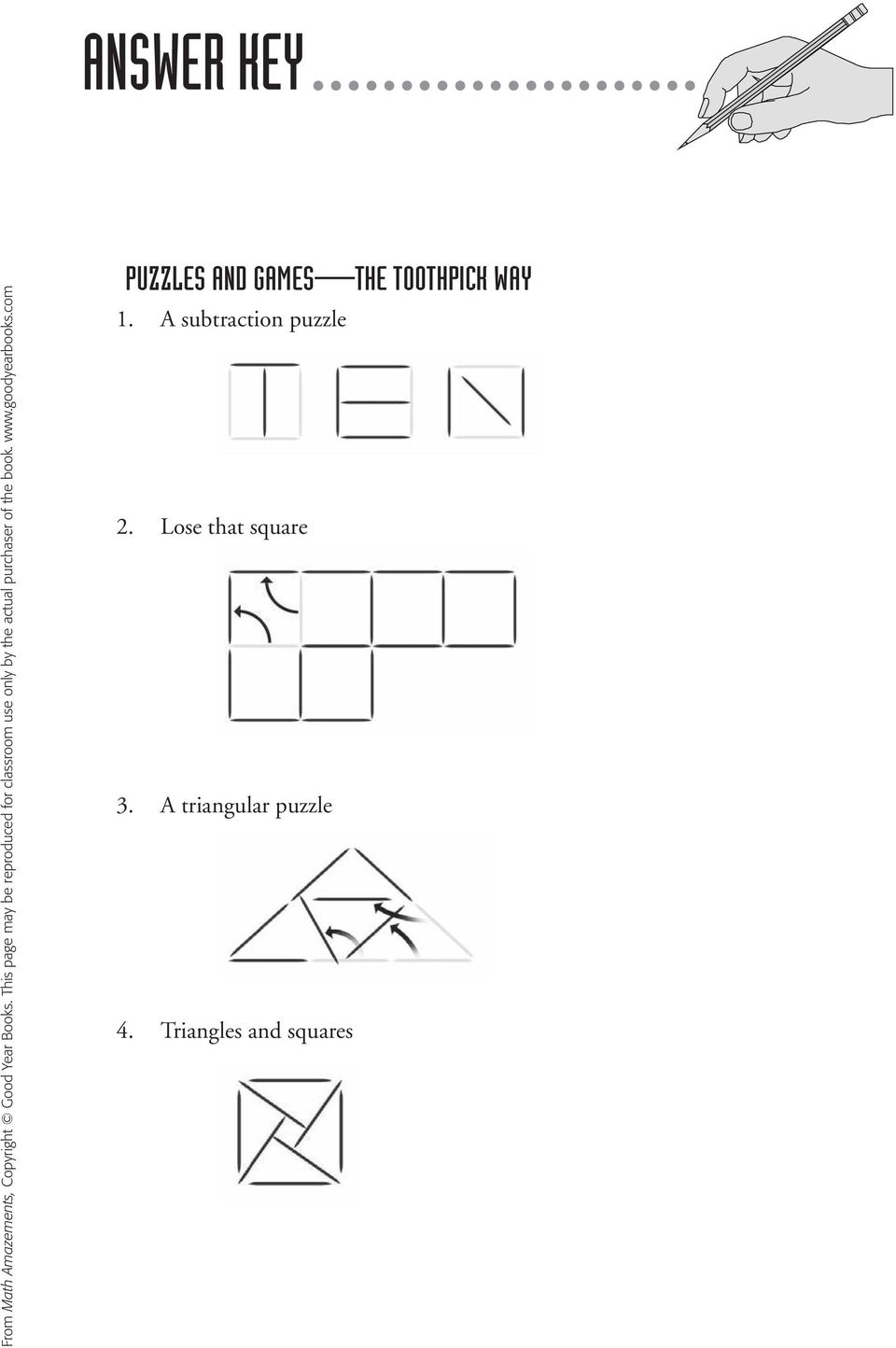
1 PUZZLES AND GAMES THE TOOTHPICK WAY Many thinking skills go into solving math problems. The more advanced the mathematics, the more skills you need. You rely less on straight memorization and more on your ability to think clearly and logically. Many great mathematicians, scientists, and writers enjoyed puzzles and tricks. Lewis Carroll loved word games. Benjamin Franklin enjoyed making magic squares. Still others enjoyed puzzles such as toothpick and coin puzzles. Successful puzzle-solving sometimes requires you to think in a logical way. Many puzzles distract the person puzzling them out with unnecessary information. To solve the puzzle, you must think in a straight line and avoid taking the wrong road because of assumptions you make. Sometimes puzzle-solving requires that you stop looking at the puzzle in the usual way and try to see it from a different perspective. Toothpick puzzles allow you to exercise these skills and focus your thinking. Many of them are geometric in nature because the toothpick acts like a kind of line segment. Doing these puzzles exercises your skill in seeing the relationship between geometric designs and shapes. But, remember, not all toothpick puzzles involve geometric shapes. Here are a couple of classics to get you started on good puzzle-solving thinking. 1 A Subtraction Puzzle: Look at the fifteen toothpicks shown. Can you remove six to leave ten? 2 Lose That Square: Look at the five squares formed by the toothpicks below. Can you move two toothpicks to turn five squares into four squares?

2 3 A Triangular Puzzle: Seven toothpicks make a triangle with a base of three toothpicks and two equal sides of two toothpicks each. Can you move three toothpicks to turn one triangle into three triangles? Hint: The three small triangles will be inside a quadrilateral with only two parallel sides. 4 Triangles and Squares: Can you make two squares and four triangles from eight toothpicks?

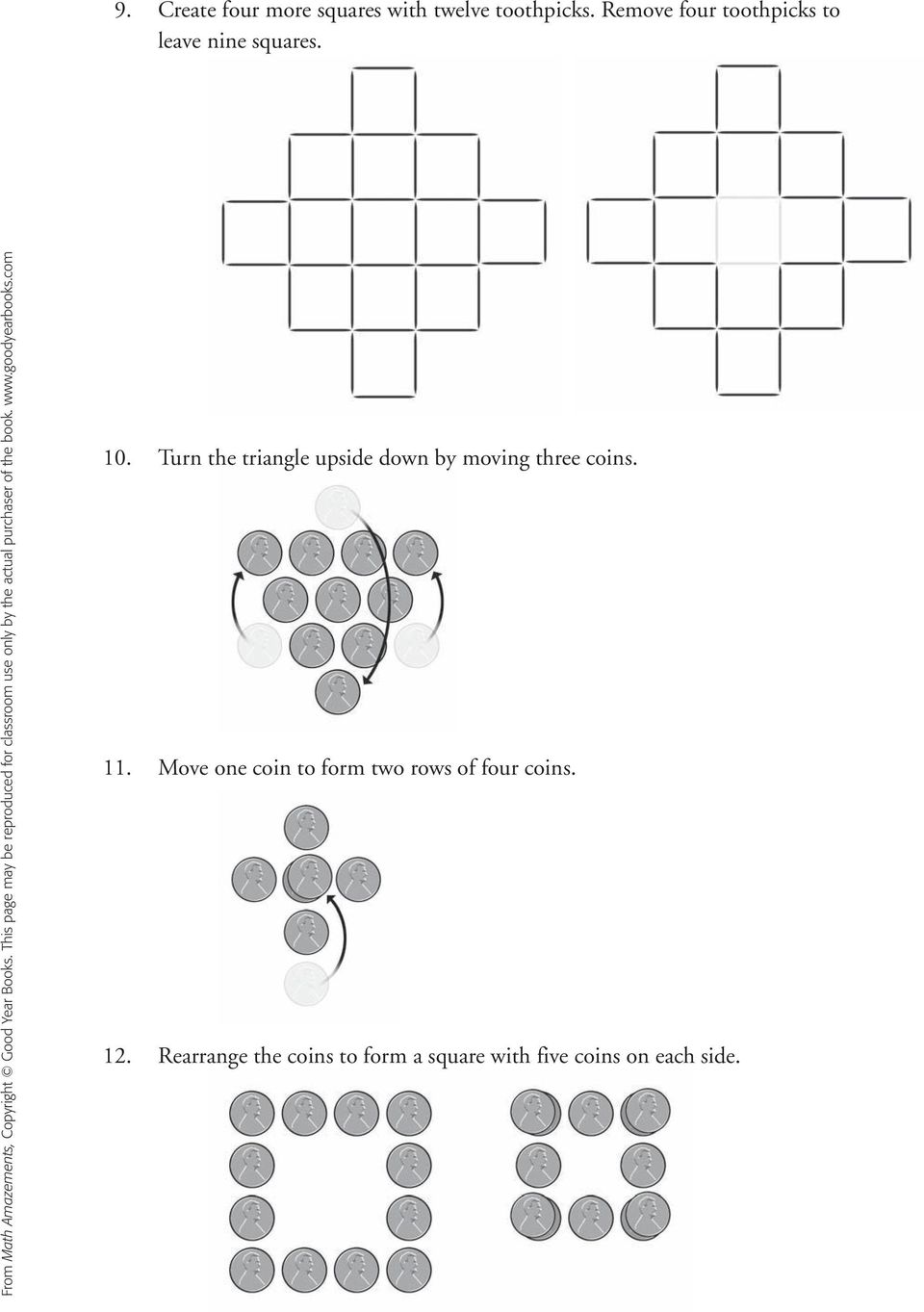
3 YOUR TURN Have some fun solving these toothpick puzzles. You may need to think logically about how to move the toothpicks or you may need to try looking at the shapes in a new or different way in order to solve the puzzles. 5 Can you move only one toothpick to make the following equations correct? Some puzzles require you to think creatively about shapes and their relationships. Can you change one shape or group of shapes into another configuration of shapes? 6 Find the relationship between geometric shapes. Arrange twelve toothpicks in a hexagon with six spokes. Move four toothpicks to create three triangles from the original design. 7 Make a spiral from thirty-five toothpicks. Move four toothpicks of the spiral to make three squares. 8 Arrange twelve toothpicks in four connected squares. Move three toothpicks to create three squares. 9 Arrange twenty-four toothpicks in nine squares arranged in a 3-by-3 block. With twelve more toothpicks, create four more squares. Then, remove four toothpicks from your design to leave nine squares.

4 AND ANOTHER THING Now let s try a little coin fun. 10 Can you turn this triangle upside-down by moving only three coins? 11 Arrange six coins in a cross shape. Move one coin to form two rows, each of which has four coins. 12 Arrange twelve coins in a square. Rearrange them to form another square with five coins on each side.

5 ANSWER KEY PUZZLES AND GAMES THE TOOTHPICK WAY 1. A subtraction puzzle 2. Lose that square 3. A triangular puzzle 4. Triangles and squares
6 5. Move one toothpick to solve the equations. 6. Move four toothpicks to create three triangles. 7. Move four toothpicks of the spiral to make three squares. 8. Move three toothpicks to create three squares.

7 9. Create four more squares with twelve toothpicks. Remove four toothpicks to leave nine squares. 10. Turn the triangle upside down by moving three coins. 11. Move one coin to form two rows of four coins. 12. Rearrange the coins to form a square with five coins on each side.
MATHEMATICS Y3 Using and applying mathematics 3810 Solve mathematical puzzles and investigate. Equipment MathSphere www.mathsphere.co.
 MATHEMATICS Y3 Using and applying mathematics 3810 Solve mathematical puzzles and investigate. Equipment Paper, pencil, ruler Dice, number cards, buttons/counters, boxes etc MathSphere 3810 Solve mathematical
3D shapes. Level A. 1. Which of the following is a 3-D shape? A) Cylinder B) Octagon C) Kite. 2. What is another name for 3-D shapes?
 Level A 1. Which of the following is a 3-D shape? A) Cylinder B) Octagon C) Kite 2. What is another name for 3-D shapes? A) Polygon B) Polyhedron C) Point 3. A 3-D shape has four sides and a triangular
G3-33 Building Pyramids
 G3-33 Building Pyramids Goal: Students will build skeletons of pyramids and describe properties of pyramids. Prior Knowledge Required: Polygons: triangles, quadrilaterals, pentagons, hexagons Vocabulary:
1 ST GRADE COMMON CORE STANDARDS FOR SAXON MATH
 1 ST GRADE COMMON CORE STANDARDS FOR SAXON MATH Calendar The following tables show the CCSS focus of The Meeting activities, which appear at the beginning of each numbered lesson and are taught daily,
Algebra Geometry Glossary. 90 angle
 lgebra Geometry Glossary 1) acute angle an angle less than 90 acute angle 90 angle 2) acute triangle a triangle where all angles are less than 90 3) adjacent angles angles that share a common leg Example:
3. Relationship between this Unit and the Principles and Standards for School Mathematics (NCTM 2000). This Unit
 4 th Grade Mathematics Lesson Plan April 16-18, 2002 Brewer Island School, San Mateo, CA Instructor: Akihiko Takahashi 1. Title of Unit: Finding the Area of Shapes 2. Goal: a. To deepen students understanding
Sue Fine Linn Maskell
 FUN + GAMES = MATHS Sue Fine Linn Maskell Teachers are often concerned that there isn t enough time to play games in maths classes. But actually there is time to play games and we need to make sure that
Mathematics Second Practice Test 1 Levels 4-6 Calculator not allowed
 Mathematics Second Practice Test 1 Levels 4-6 Calculator not allowed Please read this page, but do not open your booklet until your teacher tells you to start. Write your name and the name of your school
Patterns in Pascal s Triangle
 Pascal s Triangle Pascal s Triangle is an infinite triangular array of numbers beginning with a at the top. Pascal s Triangle can be constructed starting with just the on the top by following one easy
The Most Widely Used. Mathematics Textbook Series in Japan is Now in English! Introducing Tokyo Shoseki s. and
 The Most Widely Used Mathematics Textbook Series in Japan is Now in English! Introducing Tokyo Shoseki s Mathematics International (Elementary School, s 1 to 6) and Mathematics International (Lower Secondary
Mathematical goals. Starting points. Materials required. Time needed
 Level A0 of challenge: D A0 Mathematical goals Starting points Materials required Time needed Connecting perpendicular lines To help learners to: identify perpendicular gradients; identify, from their
Maths Targets for pupils in Year 2
 Maths Targets for pupils in Year 2 A booklet for parents Help your child with mathematics For additional information on the agreed calculation methods, please see the school website. ABOUT THE TARGETS
2x + y = 3. Since the second equation is precisely the same as the first equation, it is enough to find x and y satisfying the system
 1. Systems of linear equations We are interested in the solutions to systems of linear equations. A linear equation is of the form 3x 5y + 2z + w = 3. The key thing is that we don t multiply the variables
MATH STUDENT BOOK. 8th Grade Unit 6
 MATH STUDENT BOOK 8th Grade Unit 6 Unit 6 Measurement Math 806 Measurement Introduction 3 1. Angle Measures and Circles 5 Classify and Measure Angles 5 Perpendicular and Parallel Lines, Part 1 12 Perpendicular
Which Shape? Student Task Core Idea 4 Geometry and Measurement
 Which Shape? Student Task Core Idea 4 Geometry and Measurement Identify circles, triangles, and squares among a collection of shapes. Identify two attributes of all triangles. Recognize and use characteristics,
Stanford Math Circle: Sunday, May 9, 2010 Square-Triangular Numbers, Pell s Equation, and Continued Fractions
 Stanford Math Circle: Sunday, May 9, 00 Square-Triangular Numbers, Pell s Equation, and Continued Fractions Recall that triangular numbers are numbers of the form T m = numbers that can be arranged in
Third Grade Shapes Up! Grade Level: Third Grade Written by: Jill Pisman, St. Mary s School East Moline, Illinois Length of Unit: Eight Lessons
 Third Grade Shapes Up! Grade Level: Third Grade Written by: Jill Pisman, St. Mary s School East Moline, Illinois Length of Unit: Eight Lessons I. ABSTRACT This unit contains lessons that focus on geometric
Squaring, Cubing, and Cube Rooting
 Squaring, Cubing, and Cube Rooting Arthur T. Benjamin Harvey Mudd College Claremont, CA 91711 [email protected] I still recall my thrill and disappointment when I read Mathematical Carnival [4], by
MATHEMATICS. Y5 Multiplication and Division 5330 Square numbers, prime numbers, factors and multiples. Equipment. MathSphere
 MATHEMATICS Y5 Multiplication and Division 5330 Square numbers, prime numbers, factors and multiples Paper, pencil, ruler. Equipment MathSphere 5330 Square numbers, prime numbers, factors and multiples
Volume of Right Prisms Objective To provide experiences with using a formula for the volume of right prisms.
 Volume of Right Prisms Objective To provide experiences with using a formula for the volume of right prisms. www.everydaymathonline.com epresentations etoolkit Algorithms Practice EM Facts Workshop Game
Grade 7/8 Math Circles Sequences and Series
 Faculty of Mathematics Waterloo, Ontario N2L 3G1 Centre for Education in Mathematics and Computing Grade 7/8 Math Circles Sequences and Series November 30, 2012 What are sequences? A sequence is an ordered
Math vocabulary can be taught with what Montessorians call the Three Period Lesson.
 Full Transcript of: Montessori Mathematics Materials Presentations Introduction to Montessori Math Demonstrations ( Disclaimer) This program is intended to give the viewers a general understanding of the
Geometry of Minerals
 Geometry of Minerals Objectives Students will connect geometry and science Students will study 2 and 3 dimensional shapes Students will recognize numerical relationships and write algebraic expressions
2.1. Inductive Reasoning EXAMPLE A
 CONDENSED LESSON 2.1 Inductive Reasoning In this lesson you will Learn how inductive reasoning is used in science and mathematics Use inductive reasoning to make conjectures about sequences of numbers
UNIT H1 Angles and Symmetry Activities
 UNIT H1 Angles and Symmetry Activities Activities H1.1 Lines of Symmetry H1.2 Rotational and Line Symmetry H1.3 Symmetry of Regular Polygons H1.4 Interior Angles in Polygons Notes and Solutions (1 page)
These tests contain questions ranging from Level 3 to Level 4. They get progressively more difficult. Children should have five seconds to
 These tests contain questions ranging from Level to Level. They get progressively more difficult. Children should have five seconds to answer questions in each test and ten seconds to answer questions.
Investigating Relationships of Area and Perimeter in Similar Polygons
 Investigating Relationships of Area and Perimeter in Similar Polygons Lesson Summary: This lesson investigates the relationships between the area and perimeter of similar polygons using geometry software.
The Triangle and its Properties
 THE TRINGLE ND ITS PROPERTIES 113 The Triangle and its Properties Chapter 6 6.1 INTRODUCTION triangle, you have seen, is a simple closed curve made of three line segments. It has three vertices, three
Problem of the Month: Cutting a Cube
 Problem of the Month: The Problems of the Month (POM) are used in a variety of ways to promote problem solving and to foster the first standard of mathematical practice from the Common Core State Standards:
Area of Parallelograms, Triangles, and Trapezoids (pages 314 318)
 Area of Parallelograms, Triangles, and Trapezoids (pages 34 38) Any side of a parallelogram or triangle can be used as a base. The altitude of a parallelogram is a line segment perpendicular to the base
1. The volume of the object below is 186 cm 3. Calculate the Length of x. (a) 3.1 cm (b) 2.5 cm (c) 1.75 cm (d) 1.25 cm
 Volume and Surface Area On the provincial exam students will need to use the formulas for volume and surface area of geometric solids to solve problems. These problems will not simply ask, Find the volume
Maths class 11 Chapter 7. Permutations and Combinations
 1 P a g e Maths class 11 Chapter 7. Permutations and Combinations Fundamental Principles of Counting 1. Multiplication Principle If first operation can be performed in m ways and then a second operation
Exploring Geometric Probabilities with Buffon s Coin Problem
 Exploring Geometric Probabilities with Buffon s Coin Problem Kady Schneiter Utah State University [email protected] Published: October 2012 Overview of Lesson Investigate Buffon s coin problem using
Which shapes make floor tilings?
 Which shapes make floor tilings? Suppose you are trying to tile your bathroom floor. You are allowed to pick only one shape and size of tile. The tile has to be a regular polygon (meaning all the same
Grade 8 Mathematics Geometry: Lesson 2
 Grade 8 Mathematics Geometry: Lesson 2 Read aloud to the students the material that is printed in boldface type inside the boxes. Information in regular type inside the boxes and all information outside
Using games to support. Win-Win Math Games. by Marilyn Burns
 4 Win-Win Math Games by Marilyn Burns photos: bob adler Games can motivate students, capture their interest, and are a great way to get in that paperand-pencil practice. Using games to support students
Dear Grade 4 Families,
 Dear Grade 4 Families, During the next few weeks, our class will be exploring geometry. Through daily activities, we will explore the relationship between flat, two-dimensional figures and solid, three-dimensional
SMART NOTEBOOK 10. Instructional Technology Enhancing ACHievement
 SMART NOTEBOOK 10 Instructional Technology Enhancing ACHievement TABLE OF CONTENTS SMART Notebook 10 Themes... 3 Page Groups... 4 Magic Pen... 5 Shape Pen... 6 Tables... 7 Object Animation... 8 Aligning
angle attribute Figure 1 4 right angles opposite sides parallel Lesson 14 5 Lesson 14 4 Vocab
 Vocab angle attribute 006_055_G4_VisV_101741.indd Page F46 2/13/10 11:27:36 PM u-s014 /Volumes/114/GO00403/GO00403_Natl_Visual_Voca_Cards_G4%0 Figure 1 4 right angles opposite sides parallel endpoint hexagon
Mathematical Induction. Mary Barnes Sue Gordon
 Mathematics Learning Centre Mathematical Induction Mary Barnes Sue Gordon c 1987 University of Sydney Contents 1 Mathematical Induction 1 1.1 Why do we need proof by induction?.... 1 1. What is proof by
What Is Singapore Math?
 What Is Singapore Math? You may be wondering what Singapore Math is all about, and with good reason. This is a totally new kind of math for you and your child. What you may not know is that Singapore has
Acquisition Lesson Planning Form Key Standards addressed in this Lesson: MM2A3d,e Time allotted for this Lesson: 4 Hours
 Acquisition Lesson Planning Form Key Standards addressed in this Lesson: MM2A3d,e Time allotted for this Lesson: 4 Hours Essential Question: LESSON 4 FINITE ARITHMETIC SERIES AND RELATIONSHIP TO QUADRATIC
1st Grade Math Standard I Rubric. Number Sense. Score 4 Students show proficiency with numbers beyond 100.
 1st Grade Math Standard I Rubric Number Sense Students show proficiency with numbers beyond 100. Students will demonstrate an understanding of number sense by: --counting, reading, and writing whole numbers
GEOMETRY. Constructions OBJECTIVE #: G.CO.12
 GEOMETRY Constructions OBJECTIVE #: G.CO.12 OBJECTIVE Make formal geometric constructions with a variety of tools and methods (compass and straightedge, string, reflective devices, paper folding, dynamic
1 st Grade Math Do-Anytime Activities
 1 st Grade Have your child help create a number line (0-15) outside with sidewalk chalk. Call out a number and have your child jump on that number. Make up directions such as Hop to the number that is
Intermediate Math Circles October 10, 2012 Geometry I: Angles
 Intermediate Math Circles October 10, 2012 Geometry I: Angles Over the next four weeks, we will look at several geometry topics. Some of the topics may be familiar to you while others, for most of you,
Problems in Teaching Primary School Mathematics
 Problems in Teaching Primary School Mathematics Seán Delaney, PhD Marino Institute of Education Laois Education Centre 18 October 2012 Introductions Who here: Teaches junior/senior infants Teaches 1 st
Turtle Power. Introduction: Python. In this project, you ll learn how to use a turtle to draw awesome shapes and patterns. Activity Checklist
 Python 1 Turtle Power All Code Clubs must be registered. By registering your club we can measure our impact, and we can continue to provide free resources that help children learn to code. You can register
SPRING UNIT 14. second half. Line symmetry and reflection. Measuring angles. Naming and estimating angles. Drawing angles
 PART SPRING second half SHAPE AND SPACE SECTION Line symmetry and reflection SECTION Measuring angles SECTION Naming and estimating angles SECTION Drawing angles SECTION 5 Calculations involving angles
Mathematics. What to expect Resources Study Strategies Helpful Preparation Tips Problem Solving Strategies and Hints Test taking strategies
 Mathematics Before reading this section, make sure you have read the appropriate description of the mathematics section test (computerized or paper) to understand what is expected of you in the mathematics
Mental Questions. Day 1. 1. What number is five cubed? 2. A circle has radius r. What is the formula for the area of the circle?
 Mental Questions 1. What number is five cubed? KS3 MATHEMATICS 10 4 10 Level 8 Questions Day 1 2. A circle has radius r. What is the formula for the area of the circle? 3. Jenny and Mark share some money
Grade 5 Math Content 1
 Grade 5 Math Content 1 Number and Operations: Whole Numbers Multiplication and Division In Grade 5, students consolidate their understanding of the computational strategies they use for multiplication.
Making tessellations combines the creativity of an art project with the challenge of solving a puzzle.
 Activities Grades 6 8 www.exploratorium.edu/geometryplayground/activities EXPLORING TESSELLATIONS Background: What is a tessellation? A tessellation is any pattern made of repeating shapes that covers
Unit 8 Angles, 2D and 3D shapes, perimeter and area
 Unit 8 Angles, 2D and 3D shapes, perimeter and area Five daily lessons Year 6 Spring term Recognise and estimate angles. Use a protractor to measure and draw acute and obtuse angles to Page 111 the nearest
MATHEMATICS: REPEATING AND GROWING PATTERNS First Grade. Kelsey McMahan. Winter 2012 Creative Learning Experiences
 MATHEMATICS: REPEATING AND GROWING PATTERNS Kelsey McMahan Winter 2012 Creative Learning Experiences Without the arts, education is ineffective. Students learn more and remember it longer when they are
SQUARE-SQUARE ROOT AND CUBE-CUBE ROOT
 UNIT 3 SQUAREQUARE AND CUBEUBE (A) Main Concepts and Results A natural number is called a perfect square if it is the square of some natural number. i.e., if m = n 2, then m is a perfect square where m
Real World Performance Tasks
 Real World Performance Tasks Real World Real Life, Real Data, Real- Time - These activities put students into real life scenarios where they use real- time, real data to solve problems. In the Seriously
Numeracy and mathematics Experiences and outcomes
 Numeracy and mathematics Experiences and outcomes My learning in mathematics enables me to: develop a secure understanding of the concepts, principles and processes of mathematics and apply these in different
G C.3 Construct the inscribed and circumscribed circles of a triangle, and prove properties of angles for a quadrilateral inscribed in a circle.
 Performance Assessment Task Circle and Squares Grade 10 This task challenges a student to analyze characteristics of 2 dimensional shapes to develop mathematical arguments about geometric relationships.
Indicator 2: Use a variety of algebraic concepts and methods to solve equations and inequalities.
 3 rd Grade Math Learning Targets Algebra: Indicator 1: Use procedures to transform algebraic expressions. 3.A.1.1. Students are able to explain the relationship between repeated addition and multiplication.
Evaluating trigonometric functions
 MATH 1110 009-09-06 Evaluating trigonometric functions Remark. Throughout this document, remember the angle measurement convention, which states that if the measurement of an angle appears without units,
Grade 5 Mathematics Curriculum Guideline Scott Foresman - Addison Wesley 2008. Chapter 1: Place, Value, Adding, and Subtracting
 Grade 5 Math Pacing Guide Page 1 of 9 Grade 5 Mathematics Curriculum Guideline Scott Foresman - Addison Wesley 2008 Test Preparation Timeline Recommendation: September - November Chapters 1-5 December
Repeating Shape Patterns
 HPR 1 1 Repeating Shape Patterns xtend and create shape patterns. 1. Vincenza made this pattern. a) What attribute is changing? b) How is it changing? big, small, his is how the attributes change. Number
Toothpick Squares: An Introduction to Formulas
 Unit IX Activity 1 Toothpick Squares: An Introduction to Formulas O V E R V I E W Rows of squares are formed with toothpicks. The relationship between the number of squares in a row and the number of toothpicks
Determine If An Equation Represents a Function
 Question : What is a linear function? The term linear function consists of two parts: linear and function. To understand what these terms mean together, we must first understand what a function is. The
MATHS ACTIVITIES FOR REGISTRATION TIME
 MATHS ACTIVITIES FOR REGISTRATION TIME At the beginning of the year, pair children as partners. You could match different ability children for support. Target Number Write a target number on the board.
Similar shapes. 33.1 Similar triangles CHAPTER. Example 1
 imilar shapes 33 HTR 33.1 imilar triangles Triangle and triangle have the same shape but not the same size. They are called similar triangles. The angles in triangle are the same as the angles in triangle,
INTERSECTION MATH And more! James Tanton
 INTERSECTION MATH And more! James Tanton www.jamestanton.com The following represents a sample activity based on the December 2006 newsletter of the St. Mark s Institute of Mathematics (www.stmarksschool.org/math).
THE USE OF ORIGAMI IN THE TEACHING OF GEOMETRY
 THE USE OF ORIGAMI IN THE TEACHING OF GEOMETRY Sue Pope St. Martin s College, Lancaster This paper describes how Origami was used as a source of mathematical problemsolving in a series of lessons with
Mathematics (Project Maths Phase 1)
 2012. M128 S Coimisiún na Scrúduithe Stáit State Examinations Commission Leaving Certificate Examination, 2012 Sample Paper Mathematics (Project Maths Phase 1) Paper 2 Ordinary Level Time: 2 hours, 30
Glow-in-the-Dark Geometry
 The Big Idea Glow-in-the-Dark Geometry This week you ll make geometric shapes out of glow sticks. The kids will try all sizes and shapes of triangles and quadrilaterials, then lay out sticks in mystical
Area of Parallelograms (pages 546 549)
 A Area of Parallelograms (pages 546 549) A parallelogram is a quadrilateral with two pairs of parallel sides. The base is any one of the sides and the height is the shortest distance (the length of a perpendicular
Paper 1. Calculator not allowed. Mathematics test. First name. Last name. School. Remember KEY STAGE 3 TIER 6 8
 Ma KEY STAGE 3 Mathematics test TIER 6 8 Paper 1 Calculator not allowed First name Last name School 2009 Remember The test is 1 hour long. You must not use a calculator for any question in this test. You
Unit 6 Number and Operations in Base Ten: Decimals
 Unit 6 Number and Operations in Base Ten: Decimals Introduction Students will extend the place value system to decimals. They will apply their understanding of models for decimals and decimal notation,
MAKING MATH MORE FUN BRINGS YOU FUN MATH GAME PRINTABLES FOR HOME OR SCHOOL
 MAKING MATH MORE FUN BRINGS YOU FUN MATH GAME PRINTABLES FOR HOME OR SCHOOL THESE FUN MATH GAME PRINTABLES are brought to you with compliments from Making Math More Fun at and Math Board Games at Copyright
Objective. Materials. TI-73 Calculator
 0. Objective To explore subtraction of integers using a number line. Activity 2 To develop strategies for subtracting integers. Materials TI-73 Calculator Integer Subtraction What s the Difference? Teacher
Day 1. 1. What number is five cubed? 2. A circle has radius r. What is the formula for the area of the circle?
 Mental Arithmetic Questions 1. What number is five cubed? KS3 MATHEMATICS 10 4 10 Level 7 Questions Day 1 2. A circle has radius r. What is the formula for the area of the circle? 3. Jenny and Mark share
Grade 7 & 8 Math Circles Circles, Circles, Circles March 19/20, 2013
 Faculty of Mathematics Waterloo, Ontario N2L 3G Introduction Grade 7 & 8 Math Circles Circles, Circles, Circles March 9/20, 203 The circle is a very important shape. In fact of all shapes, the circle is
Problem of the Month: Perfect Pair
 Problem of the Month: The Problems of the Month (POM) are used in a variety of ways to promote problem solving and to foster the first standard of mathematical practice from the Common Core State Standards:
Minnesota Comprehensive Assessments-Series III
 Name Minnesota Comprehensive Assessments-Series III Mathematics Item Sampler Grade 3 ITEM SAMPLERS ARE NOT SECURE TEST MATERIALS. THIS ITEM SAMPLER TEST BOOK MAY BE COPIED OR DUPLICATE State of Minnesota
Direct Translation is the process of translating English words and phrases into numbers, mathematical symbols, expressions, and equations.
 Section 1 Mathematics has a language all its own. In order to be able to solve many types of word problems, we need to be able to translate the English Language into Math Language. is the process of translating
Activities Grades K 2 THE FOUR-SQUARE QUILT. Put triangles together to make patterns.
 Activities Grades K 2 www.exploratorium.edu/geometryplayground/activities THE FOUR-SQUARE QUILT Put triangles together to make patterns. [45 minutes] Materials: Four-Square Quilt Template (attached) Triangle
Investigating Quadrilaterals Grade Four
 Ohio Standards Connection Geometry and Spatial Sense Benchmark A Provide rationale for groupings and comparisons of two-dimensional figures and three-dimensional objects. Indicator 3 Identify similarities
Lateral and Surface Area of Right Prisms
 CHAPTER A Lateral and Surface Area of Right Prisms c GOAL Calculate lateral area and surface area of right prisms. You will need a ruler a calculator Learn about the Math A prism is a polyhedron (solid
Welcome to Harcourt Mega Math: The Number Games
 Welcome to Harcourt Mega Math: The Number Games Harcourt Mega Math In The Number Games, students take on a math challenge in a lively insect stadium. Introduced by our host Penny and a number of sporting
Geometry and Measurement
 The student will be able to: Geometry and Measurement 1. Demonstrate an understanding of the principles of geometry and measurement and operations using measurements Use the US system of measurement for
Year 9 mathematics test
 Ma KEY STAGE 3 Year 9 mathematics test Tier 5 7 Paper 1 Calculator not allowed First name Last name Class Date Please read this page, but do not open your booklet until your teacher tells you to start.
The Function Game: Can You Guess the Secret?
 The Function Game: Can You Guess the Secret? Copy the input and output numbers for each secret given by your teacher. Write your guess for what is happening to the input number to create the output number
Teaching and Learning 3-D Geometry
 This publication is designed to support and enthuse primary trainees in Initial Teacher Training. It will provide them with the mathematical subject and pedagogic knowledge required to teach 3-D geometry
Fun with Fractions: A Unit on Developing the Set Model: Unit Overview www.illuminations.nctm.org
 Fun with Fractions: A Unit on Developing the Set Model: Unit Overview www.illuminations.nctm.org Number of Lessons: 7 Grades: 3-5 Number & Operations In this unit plan, students explore relationships among
Problem of the Month: William s Polygons
 Problem of the Month: William s Polygons The Problems of the Month (POM) are used in a variety of ways to promote problem solving and to foster the first standard of mathematical practice from the Common
Hooray for the Hundreds Chart!!
 Hooray for the Hundreds Chart!! The hundreds chart consists of a grid of numbers from 1 to 100, with each row containing a group of 10 numbers. As a result, children using this chart can count across rows
Year 9 mathematics test
 Ma KEY STAGE 3 Year 9 mathematics test Tier 6 8 Paper 1 Calculator not allowed First name Last name Class Date Please read this page, but do not open your booklet until your teacher tells you to start.
THE BLASTER METHOD: MATH GAMES TO MAKE YOU MATH SMART
 THE BLASTER METHOD: MATH GAMES TO MAKE YOU MATH SMART Math fundamentals for a technological age: What makes students math smart? What makes a student math smart? What kind of mathematical competencies
Grade 7/8 Math Circles November 3/4, 2015. M.C. Escher and Tessellations
 Faculty of Mathematics Waterloo, Ontario N2L 3G1 Centre for Education in Mathematics and Computing Tiling the Plane Grade 7/8 Math Circles November 3/4, 2015 M.C. Escher and Tessellations Do the following
College of Charleston Math Meet 2008 Written Test Level 1
 College of Charleston Math Meet 2008 Written Test Level 1 1. Three equal fractions, such as 3/6=7/14=29/58, use all nine digits 1, 2, 3, 4, 5, 6, 7, 8, 9 exactly one time. Using all digits exactly one
The program also provides supplemental modules on topics in geometry and probability and statistics.
 Algebra 1 Course Overview Students develop algebraic fluency by learning the skills needed to solve equations and perform important manipulations with numbers, variables, equations, and inequalities. Students