
The No-Nonsense,Technician Class License Study Guide
|
|
|
- Barry Chandler
- 9 years ago
- Views:
Transcription
1 The No-Nonsense,Technician Class License Study Guide (for tests given after July 1, 2010) Dan Romanchik KB6NU NOT FOR SALE!! Copyright 2010 Daniel M. Romanchik All rights reserved. No part of this publication may be reproduced, stored in a retrieval system, or transmitted in any form or by any means, electronic, mechanical, recording or otherwise, without the prior written permission of the author. revision 1.0, 6/3/2010

2 What is amateur (ham) radio? Amateur radio, also known as ham radio, is a hobby enjoyed by hundreds of thousands of Americans and millions around the world. They enjoy communicating with one another via twoway radios and experimenting with antennas and electronic circuits. All kinds of people are amateur radio operators, also known as hams. Hams are young, old, men, women, boys, and girls. Kids as young as seven years old have gotten amateur radio licenses, and many hams are active into their 80s and beyond. You never know who you'll run into on the amateur radio bands: young and old, teachers and students, engineers and scientists, doctors and nurses, mechanics and technicians, kings and entertainers. For example, did you know that most of the astronauts sent up to the International Space Station (ISS) in the last five to ten years have been licensed radio amateurs? They use the amateur radio station on board the ISS to communicate with school groups all over the world as they are flying over. How do you get into amateur radio? With just a little study, you can learn all you need to know to get a Technician Class license, which is the license most popular with beginners. To get a Technician Class license, you must take a test with 35 multiple-choice questions. The test covers basic regulations, operating practices, and electrical and electronics theory. Knowing Morse Code is no longer required to get this license, nor any class of license. Technician Class licensees have all amateur radio privileges above 30 MHz, including the very popular 2-meter band. Technicians can also operate Morse Code (CW) on portions of the 80m, 40m, 15m, and 10m bands, and phone and data on portions of the 10m band. There are two other license classes: the General Class license and the Amateur Extra Class license. To get a General Class license, you must pass another 35-question test; the Amateur Extra Class test has 50 questions. The tests are progressively more difficult. General Class licensees get phone and digital mode privileges on portions of the 160m, 80m, 60m, 40m, 20m, 15m, and 10m bands. They can also operate CW and digital modes on the 30m band. Amateur Extra licensees have all amateur privileges. How much does it cost? Basic study materials, such as this study guide, can be had for free, and the license exam fee will be $15 or less. Once you have your first license, most hams find it best to start with simple equipment and grow over time. A handheld VHF FM transceiver can be purchased for as little as $80 new, and excellent used equipment is often available at low prices. All things considered, the cost to get the first license and radio should be less than $200. Where do I take the test? Amateur radio license examinations are given by Volunteer Examiners, or VEs. VEs are licensed radio amateurs who have been trained to administer amateur radio tests. To find out when the VEs in your area will be giving the test go to the American Radio Relay League's (ARRL) website: Using that page, you The No-Nonsense, Technician Class License Study Guide 1

3 will be able to search for test sessions that are close to you. If you do not have access to the Internet, you can phone the ARRL at Can I really learn how to be an amateur radio operator from a manual like this? Yes and no. This manual will help you get your license, but getting your license is only the beginning. There is still much to learn, and to get the most out of amateur radio, you will have to continually learn new things. I am normally not a big fan of this type of approach to getting an amateur radio license. It will teach you the answers to the test questions, but not give you a deep understanding of electronics, radio, or the rules and regulations. That will be up to you after you get your license. I hope that by helping you get your license that you ll be encouraged to become an active radio amateur and get on the air, participate in public service and emergency communications, join an amateur radio club, and experiment with radios, antennas, and circuits. These are the activities that will really help you learn about radio in depth, and in the end, help you be confident in your abilities as an amateur radio operator. How do I use this manual? Simply read through the manual and take some practice tests. The characters in parentheses (T5A05), for example refer to the question number in the Technician Class Exam Question Pool. You will find the answers to questions in bold. You can take practice tests online at: KB0MGA.Net - AA9PW.Com - QRZ.Com - EHam.Net - You can use all four for free. Good luck and have fun! I hope that you find this study guide useful and that you ll become a radio amateur. Remember that getting your license is just a start, and that you will be continually learning new things. If you have any comments, questions, compliments or complaints, I want to hear from you. E- mail me at [email protected]. My goal is to continually refine this study guide and to continually make it better. Acknowledgments I would like to thank the following who proofread the draft and offered some useful comments: K2MUN, KD8IXP, KC8ZTJ, N6QXA, N5IUT, N6KZW, AK5Z, KE4KPC Dan Romanchik KB6NU The No-Nonsense, Technician Class License Study Guide 2
4 Table of Contents What is Amateur Radio? Electrical principles Current and voltage, conductors and insulators, alternating and direct current, power 5 Ohm s Law, calculating power 6 Math for electronics: the metric system, electrical units, and decibels 9 Electronic principles and components Passive components: resistors, capacitors, inductors, batteries 10 Semiconductors: diodes and transistors 11 Circuit diagrams; schematic symbols 12 Other components 14 Radio and electromagnetic wave properties Frequency, wavelength, the electromagnetic spectrum 15 Radio wave characteristics; how a radio signal travels; UHF/VHF propagation 16 HF propagation 18 Antennas and Feedlines Antenna types, antenna polarization 19 Feedlines: types of feedline, feedline connectors, SWR 20 Amateur Radio Signals Modulation modes, signal bandwidth 22 Digital modes: packet, PSK31 23 Be Safe! AC power safety, hazardous voltages, fuses and circuit breakers, battery safety 24 Antenna safety: tower safety, overhead power lines 26 RF safety: radiation exposure, proximity to antennas, recognized safe power levels 27 Station Setup and Operation Station accessories, dealing with interference, grounding 28 Operating controls 30 Station equipment; receivers, transmitters, transceivers 31 Troubleshooting common problems 33 Basic repair and testing: soldering, using test equipment 35 The No-Nonsense, Technician Class License Study Guide 3

5 Operating Procedures FM Operation 36 HF Operation 38 General Guidelines 39 Public service, emergency, and non-emergency operations 40 Amateur satellite operation 42 Having fun with amateur radio 43 Rules and Regulations Definitions 44 ITU regions, authorized frequencies; frequency allocations 45 Operator classes, privileges, and station call signs 46 Authorized and prohibited transmissions 47 Control operator and control types 48 Station identification 49 The No-Nonsense, Technician Class License Study Guide 4
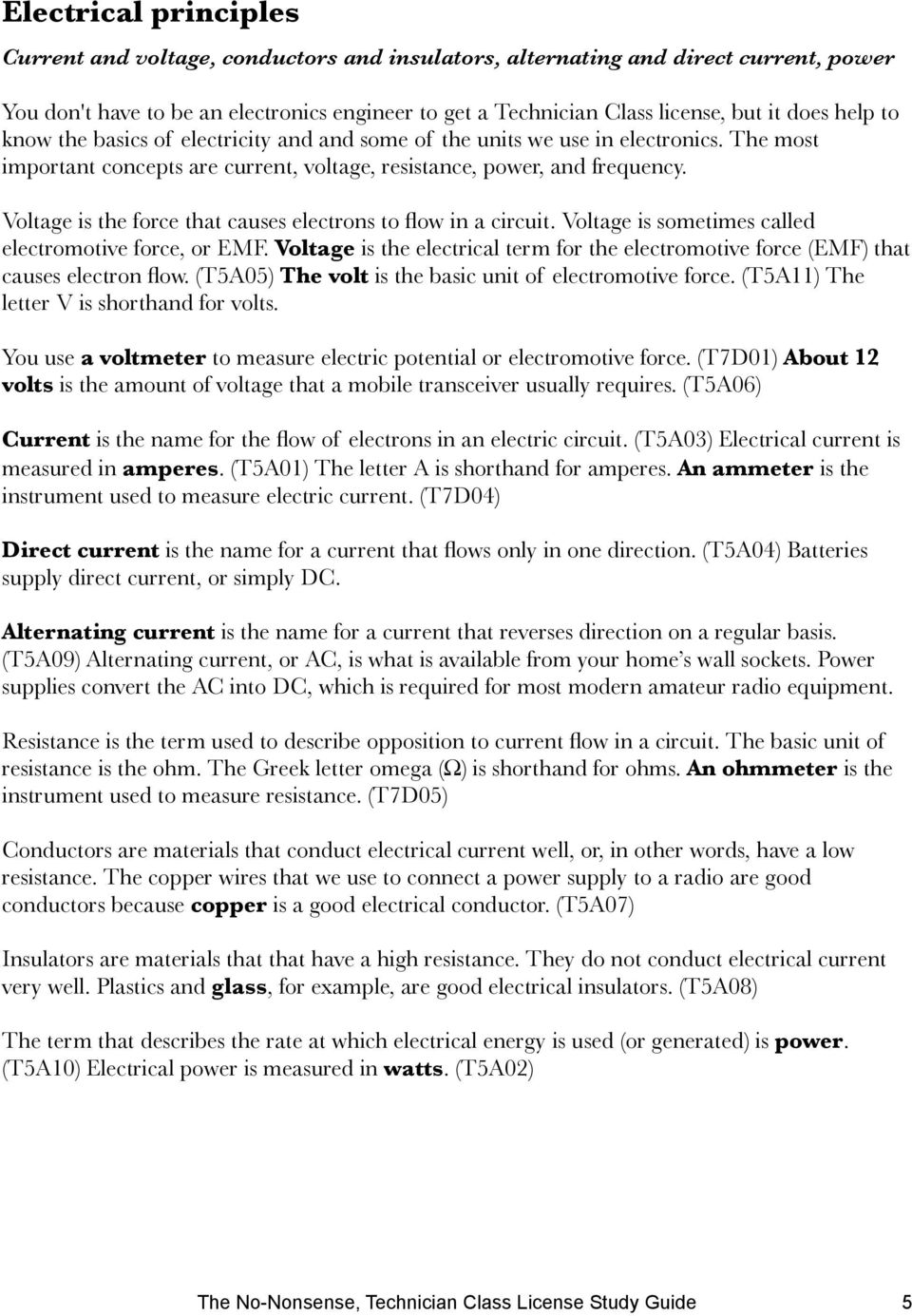
6 Electrical principles Current and voltage, conductors and insulators, alternating and direct current, power You don't have to be an electronics engineer to get a Technician Class license, but it does help to know the basics of electricity and and some of the units we use in electronics. The most important concepts are current, voltage, resistance, power, and frequency. Voltage is the force that causes electrons to flow in a circuit. Voltage is sometimes called electromotive force, or EMF. Voltage is the electrical term for the electromotive force (EMF) that causes electron flow. (T5A05) The volt is the basic unit of electromotive force. (T5A11) The letter V is shorthand for volts. You use a voltmeter to measure electric potential or electromotive force. (T7D01) About 12 volts is the amount of voltage that a mobile transceiver usually requires. (T5A06) Current is the name for the flow of electrons in an electric circuit. (T5A03) Electrical current is measured in amperes. (T5A01) The letter A is shorthand for amperes. An ammeter is the instrument used to measure electric current. (T7D04) Direct current is the name for a current that flows only in one direction. (T5A04) Batteries supply direct current, or simply DC. Alternating current is the name for a current that reverses direction on a regular basis. (T5A09) Alternating current, or AC, is what is available from your home s wall sockets. Power supplies convert the AC into DC, which is required for most modern amateur radio equipment. Resistance is the term used to describe opposition to current flow in a circuit. The basic unit of resistance is the ohm. The Greek letter omega (Ω) is shorthand for ohms. An ohmmeter is the instrument used to measure resistance. (T7D05) Conductors are materials that conduct electrical current well, or, in other words, have a low resistance. The copper wires that we use to connect a power supply to a radio are good conductors because copper is a good electrical conductor. (T5A07) Insulators are materials that that have a high resistance. They do not conduct electrical current very well. Plastics and glass, for example, are good electrical insulators. (T5A08) The term that describes the rate at which electrical energy is used (or generated) is power. (T5A10) Electrical power is measured in watts. (T5A02) The No-Nonsense, Technician Class License Study Guide 5
7 Ohm s Law Hams obey Ohm s Law! Ohm s Law is the relationship between voltage, current, and the resistance in a DC circuit. When you know any two of these values, you can calculate the third. The most basic equation for Ohm s Law is E = I R In other words, when you know the current going into a circuit and the resistance of the circuit, the formula used to calculate voltage across the circuit is voltage (E) equals current (I) multiplied by resistance (R). (T5D02) When you know the voltage across a circuit and the resistance of a circuit, the formula used to calculate resistance in a circuit is resistance (R) equals voltage (E) divided by current (I). (T5D03) We can also write this formula as R = E I When you know the voltage across a circuit and the resistance of a circuit, the formula used to calculate current in the circuit is current (I) equals voltage (E) divided by resistance (R). (T5D01) This formula is written I = E R Examples The resistance of a circuit in which a current of 3 amperes flows through a resistor connected to 90 volts is 30 ohms. (T5D04) R = E I = 90 V 3 A = 30 Ω The resistance in a circuit for which the applied voltage is 12 volts and the current flow is 1.5 amperes is 8 ohms.(t5d05) R = E I = 12 V 1.5 A = 8 Ω The resistance of a circuit that draws 4 amperes from a 12-volt source is 3 ohms. (T5D06) R = E I = 12 V 4 A = 3 Ω The current flow in a circuit with an applied voltage of 120 volts and a resistance of 80 ohms is 1.5 amperes. (T5D07) The No-Nonsense, Technician Class License Study Guide 6

8 I = E R = 120 V 80 Ω = 1.5 A The current flowing through a 100-ohm resistor connected across 200 volts is 2 amperes. (T5D08) I = E R = 200 V 100 Ω = 2 A The current flowing through a 24-ohm resistor connected across 240 volts is 10 amperes. (T5D09) I = E R = 240 V 24 Ω = 10 A The voltage across a 2-ohm resistor if a current of 0.5 amperes flows through it is 1 volt. (T5D10) E = I R = 0.5 A 2 Ω = 1 V The voltage across a 10-ohm resistor if a current of 1 ampere flows through it is 10 volts. (T5D11) E = I R = 1 A 10 Ω = 10 V The voltage across a 10-ohm resistor if a current of 2 amperes flows through it is 20 volts. (T5D12) E = I R = 2 A 10 Ω = 20 V Calculating Power Power is the rate at which electrical energy is generated or consumed. The formula used to calculate electrical power in a DC circuit is power (P) equals voltage (E) multiplied by current (I). (T5C08) P = E I 138 watts is the power being used in a circuit when the applied voltage is 13.8 volts DC and the current is 10 amperes. (T5C09) P = E I = 13.8 V 10 A = 138 W When the applied voltage in a circuit is 12 volts DC and the current is 2.5 amperes, the power being used is 30 watts. (T5C10) P = E I = 12 V 2.5 A = 30 W The No-Nonsense, Technician Class License Study Guide 7

9 Just as with Ohm s Law, you can use algebra to come up with other forms of this equation to calculate the voltage if you know the power and the current, or to calculate the current if you know the power and the voltage. The formula to calculate the current, if you know the power and the voltage is I = P E For example, 10 amperes are flowing in a circuit when the applied voltage is 12 volts DC and the load is 120 watts. (T5C11) I = P E = 120 W 12 V = 10 A The No-Nonsense, Technician Class License Study Guide 8

10 Math for electronics: the metric system, electrical units, and decibels When dealing with electrical parameters, such as voltage, resistance, current, and power, we use a set of prefixes to denote various orders of magnitude: milli- is the prefix we use to denote 1 one-thousandth of a quantity. A milliampere, for example, is 1 one-thousandth of an ampere, or.001 A. Often, the letter m is used instead of the prefix milli-. 1 milliampere is, therefore, 1 ma. micro- is the prefix we use to denote 1 millionth of a quantity. A microvolt, for example, is 1 millionth of a volt, or V. Often you will see the Greek letter mu, or μ, to denote the prefix micro-. 1 microvolt is, therefore, 1 μv. pico- is the prefix we use to denote 1 trillionth of a quantity. A picovolt is 1 trillionth of a volt, or μv. kilo- is the prefix we use to denote 1 thousand of a quantity. A kilovolt, for example, is 1000 volts. Often, the letter k is used instead of the prefix kilo-. 1 kilovolt is, therefore, 1 kv. mega- is the prefix we use to denote 1 million of a quantity. A megahertz, for example, is 1 million Hertz. The unit of frequency is the Hertz. (T5C05) It is equal to one cycle per second. Often, the letter M is used instead of the prefix mega-. 1 megahertz is, therefore, 1 MHz. Here are some examples: 1,500 milliamperes is 1.5 amperes. (T5B01) Another way to specify a radio signal frequency of 1,500,000 hertz is 1500 khz. (T5B02) One thousand volts are equal to one kilovolt. (T5B03) One one-millionth of a volt is equal to one microvolt. (T5B04) If an ammeter calibrated in amperes is used to measure a 3000-milliampere current, the reading it would show would be 3 amperes. (T5B06) If a frequency readout calibrated in megahertz shows a reading of MHz, it would show 3525 khz if it were calibrated in kilohertz. (T5B07) 1 microfarad is 1,000,000 picofarads. (T5B08) (Farad is the unit for capacitance.) When dealing with ratios especially power ratios we often use decibels (db). The reason for this is that the decibel scale is a logarithmic scale, meaning that we can talk about large ratios with relatively small numbers. At this point, you don t need to know the formula used to calculate the ratio in db, but keep in mind the following values: 3 db is the approximate amount of change, measured in decibels (db), of a power increase from 5 watts to 10 watts. (T5B09) This is a ratio of 2 to 1. 6 db is the approximate amount of change, measured in decibels (db), of a power decrease from 12 watts to 3 watts. (T5B10) This is a ratio of 4 to db is the approximate amount of change, measured in decibels (db), of a power increase from 20 watts to 200 watts. (T5B11) This is a ratio of 10 to 1. The No-Nonsense, Technician Class License Study Guide 9

11 Electronic principles and components Passive components: resistors, capacitors, inductors, batteries A resistor is the electrical component used to oppose the flow of current in a DC circuit. (T6A01) Most resistors have a fixed value, which is specified in ohms. Some resistors are variable, that is you can change the resistance of the resistor by turning a shaft or sliding a control back and forth. These variable resistors are called potentiometers. A potentiometer is the type of component that is often used as an adjustable volume control. (T6A02) Resistance is the electrical parameter that is controlled by a potentiometer. (T6A03) The type of electrical component that consists of two or more conductive surfaces separated by an insulator is a capacitor. (T6A05) A capacitor is the electrical component that stores energy in an electric field. (T6A04) Capacitance is the ability to store energy in an electric field. (T5C01) The farad is the basic unit of capacitance. (T5C02) The type of electrical component that stores energy in a magnetic field is an inductor. (T6A06) The electrical component that is usually composed of a coil of wire is an inductor. (T6A07) The ability to store energy in a magnetic field is called inductance. (T5C03) The henry is the basic unit of inductance. (T5C04) A switch is the electrical component used to connect or disconnect electrical circuits. (T6A08) A fuse is the electrical component used to protect other circuit components from current overloads. (T6A09) As amateur radio operators, we often use batteries to power our radio equipment. Some types of batteries are rechargeable, while others are not. The battery type that is not rechargeable is the carbon-zinc battery. (T6A11) One common type of rechargeable battery is the nickel-cadmium, or NiCad battery. The nominal voltage of a fully charged nickel-cadmium cell is 1.2 volts. (T6A10). A NiCad battery pack with an output of 12 V DC would have ten cells wired in series inside the pack. The No-Nonsense, Technician Class License Study Guide 10

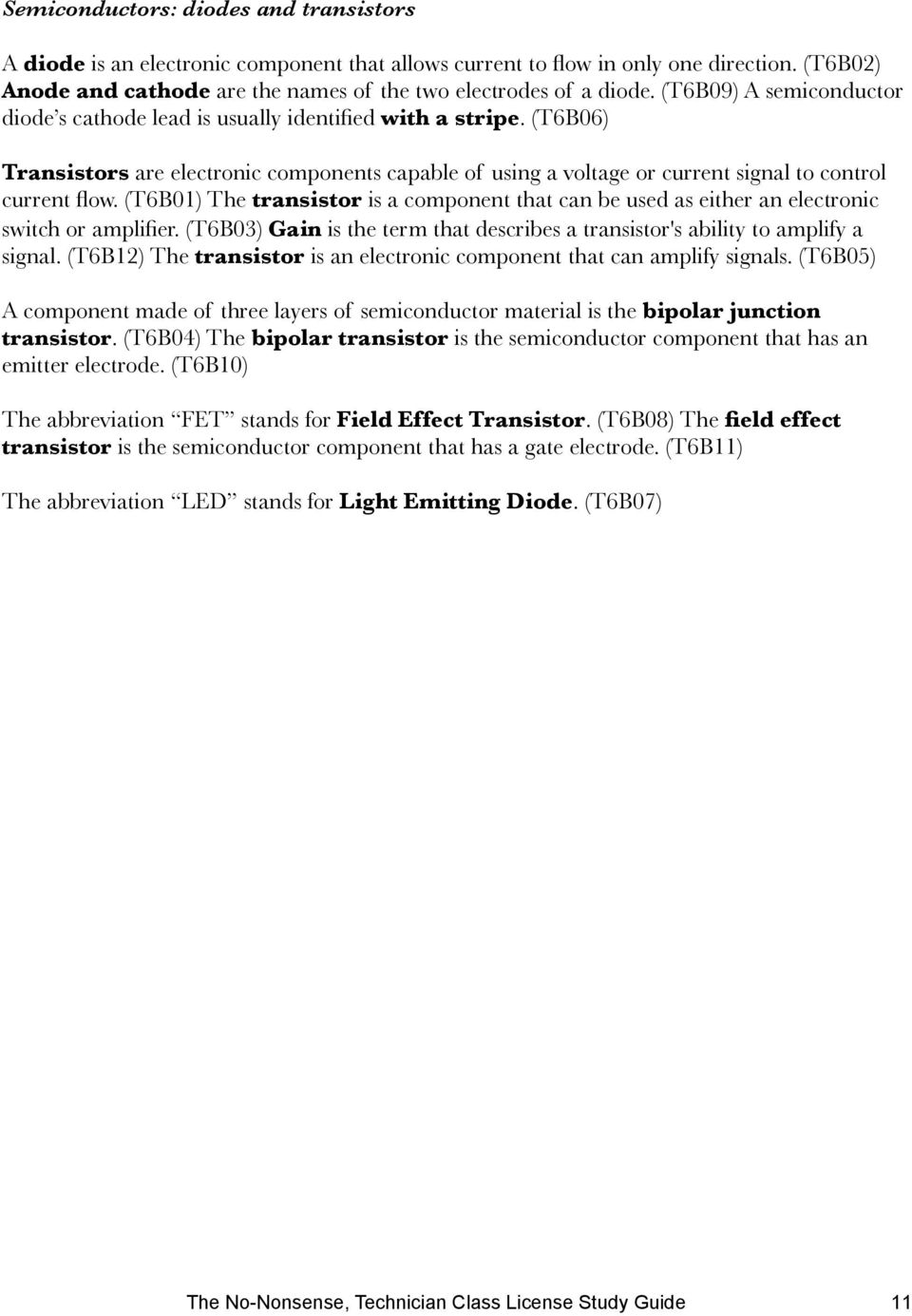
12 Semiconductors: diodes and transistors A diode is an electronic component that allows current to flow in only one direction. (T6B02) Anode and cathode are the names of the two electrodes of a diode. (T6B09) A semiconductor diode s cathode lead is usually identified with a stripe. (T6B06) Transistors are electronic components capable of using a voltage or current signal to control current flow. (T6B01) The transistor is a component that can be used as either an electronic switch or amplifier. (T6B03) Gain is the term that describes a transistor's ability to amplify a signal. (T6B12) The transistor is an electronic component that can amplify signals. (T6B05) A component made of three layers of semiconductor material is the bipolar junction transistor. (T6B04) The bipolar transistor is the semiconductor component that has an emitter electrode. (T6B10) The abbreviation FET stands for Field Effect Transistor. (T6B08) The field effect transistor is the semiconductor component that has a gate electrode. (T6B11) The abbreviation LED stands for Light Emitting Diode. (T6B07) The No-Nonsense, Technician Class License Study Guide 11
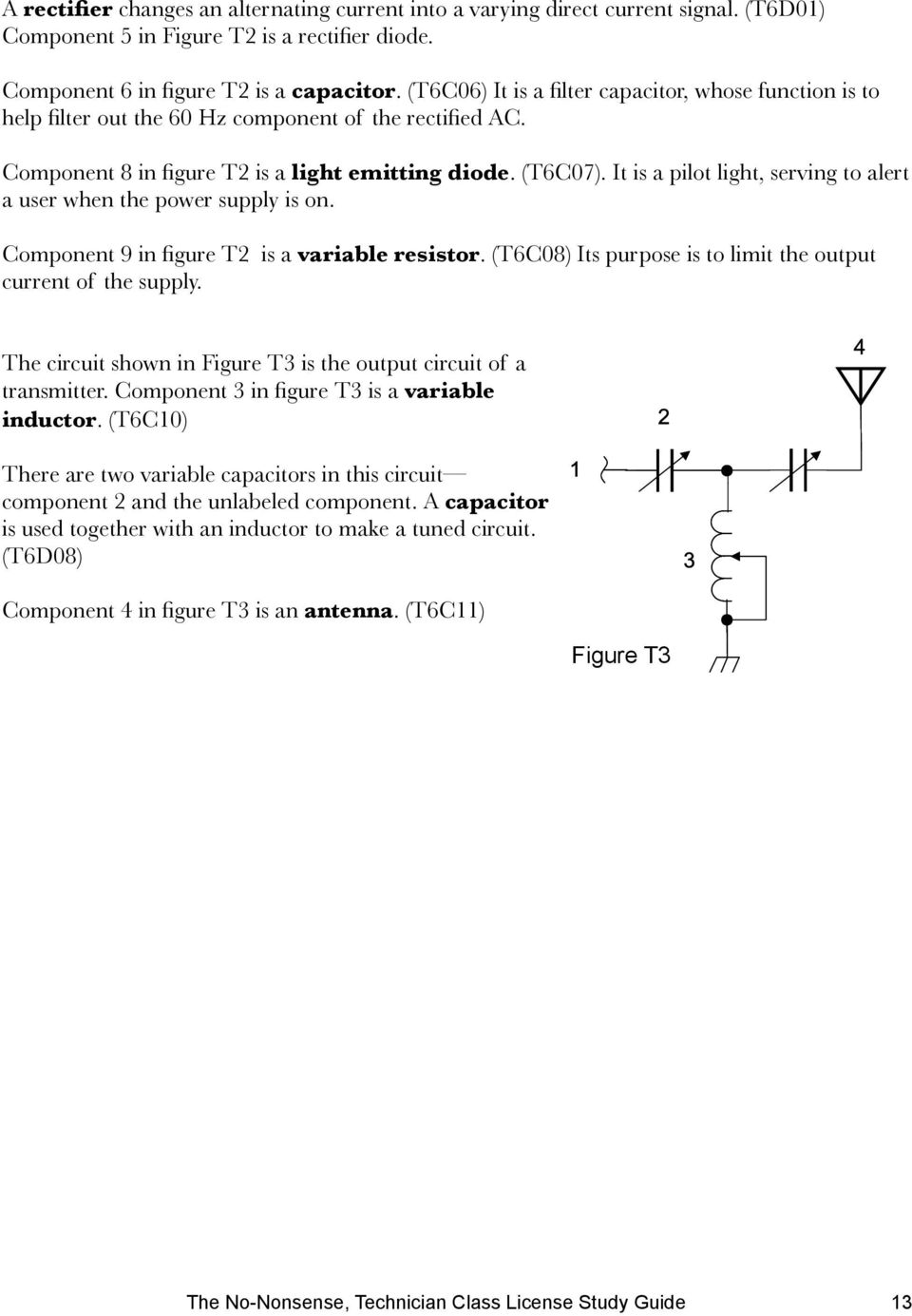
13 Circuit diagrams, schematic symbols, component functions Schematic symbols is the name for standardized representations of components in an electrical wiring diagram. (T6C01) The symbols on an electrical circuit schematic diagram represent electrical components. (T6C12) The way components are interconnected is accurately represented in electrical circuit schematic diagrams. (T6C13) Figure T1 is a simple circuit that turns on a light when a positive voltage is applied to the input. Component 1 in figure T1 is a resistor. (T6C02) Its function is to limit the input current. Figure T1 Component 2 in figure T1 is a transistor. (T6C03) Its function is to switch the current through the lamp on and off. The function of component 2 in Figure T1 is to control the flow of current. (T6D10) Component 3 in figure T1 is the lamp. (T6C04) Component 4 in figure T1 is a battery. (T6C05) This battery supplies the current that lights the lamp. Figure T2 The circuit shown in Figure T2 is a simple power supply. Component 2 is a fuse. Item 3 in figure T2 is a single-pole single-throw switch. (T6D03) It turns the power supply on and off. Component 4 in figure T2 is a transformer. (T6C09) A transformer is commonly used to change 120V AC house current to a lower AC voltage for other uses. (T6D06) The No-Nonsense, Technician Class License Study Guide 12

14 A rectifier changes an alternating current into a varying direct current signal. (T6D01) Component 5 in Figure T2 is a rectifier diode. Component 6 in figure T2 is a capacitor. (T6C06) It is a filter capacitor, whose function is to help filter out the 60 Hz component of the rectified AC. Component 8 in figure T2 is a light emitting diode. (T6C07). It is a pilot light, serving to alert a user when the power supply is on. Component 9 in figure T2 is a variable resistor. (T6C08) Its purpose is to limit the output current of the supply. The circuit shown in Figure T3 is the output circuit of a transmitter. Component 3 in figure T3 is a variable inductor. (T6C10) There are two variable capacitors in this circuit component 2 and the unlabeled component. A capacitor is used together with an inductor to make a tuned circuit. (T6D08) Component 4 in figure T3 is an antenna. (T6C11) Figure T3 The No-Nonsense, Technician Class License Study Guide 13
15 Other components There are many different types of components in modern radio equipment. Below, we will describe the types of components you will need to know about to pass the Technician Class license examination. A relay is a switch controlled by an electromagnet. (T6D02) Meters are devices used to indicate many different values. For example, a meter can be used to display signal strength on a numeric scale. (T6D04) Meters are also used to indicate the output voltage of a power supply, the output power of a transmitter, and many other parameters. A regulator is the type of circuit that controls the amount of voltage from a power supply. (T6D05) An LED is commonly used as a visual indicator. (T6D07) LED is short for light-emitting diode. They come in a variety of colors. Integrated circuit is the name of a device that combines several semiconductors and other components into one package. (T6D09) Integrated circuits may perform either analog or digital functions. The No-Nonsense, Technician Class License Study Guide 14

16 Radio and electromagnetic wave properties Frequency, wavelength, the electromagnetic spectrum Electromagnetic is the type of wave that carries radio signals between transmitting and receiving stations. (T3A07) The usual name for electromagnetic waves that travel through space is radio waves. (T5C07) As the name would imply, an electromagnetic wave has an electric component and a magnetic component. The two components of a radio wave are electric and magnetic fields. (T3B03) One important parameter of a radio wave is its frequency. Frequency is the term that describes the number of times per second that an alternating current (or radio wave) reverses direction (or polarity). (T3B02) The unit of frequency is the Hertz (Hz). (T5C05) One Hz is one cycle per second. Another important parameter of a radio wave is its wavelength. Wavelength is the name for the distance a radio wave travels during one complete cycle. (T3B01) A radio wave travels at the speed of light through free space. Because the speed of light is about 300,000,000 meters per second, the approximate velocity of a radio wave as it travels through free space is 300,000,000 meters per second. (T3B11)(T3B04) All radio waves travel at the speed of light no matter what their frequency happens to be. Because of this, the wavelength gets shorter as the frequency increases. (T3B05) The formula for converting frequency to wavelength in meters is wavelength in meters equals 300 divided by frequency in megahertz. (T3B06) The approximate wavelength of radio waves is often used to identify the different frequency bands. (T3B07). For example, when we refer to the 2 meter band, we are referring to the amateur radio band that spans 144 MHz to 148 MHz. A radio wave with a frequency of 148 MHz, would have a wavelength of 2.02 meters. RF is the abbreviation that refers to radio frequency signals of all types. (T5C06) For convenience, we split the entire range of radio frequencies into sub-ranges, including high frequency (HF), very high frequency (VHF), and ultra-high frequency (UHF). The frequency range 3 to 30 MHz is referred to as HF. (T3B10) The frequency limits of the VHF spectrum are 30 to 300 MHz. (T3B08) The frequency limits of the UHF spectrum are 300 to 3000 MHz. (T3B09) The No-Nonsense, Technician Class License Study Guide 15
17 Radio wave characteristics; how a radio signal travels; propagation modes As amateur radio operators, we should always try to use the right frequency and the right mode for the job. To do this, we need to know how radio signals travel from one point to another and what affect frequency, our antennas, and even our location have on signal propagation. Communications at VHF and UHF frequencies are generally line of sight communications. That is to say that normally they travel in a straight line from the transmitter to the receiver. For this reason, they are normally used for local communications. The reason direct (not via a repeater) UHF signals are rarely heard from stations outside your local coverage area is that UHF signals are usually not reflected by the ionosphere. (T3C01) We ll talk more about the ionosphere below. The maximum distance for line-of-sight communications is called the radio horizon. The radio horizon is the distance at which radio signals between two points are effectively blocked by the curvature of the Earth. (T3C10) Because the Earth seems less curved to radio waves than to light, VHF and UHF radio signals usually travel somewhat farther than the visual line of sight distance between two stations, meaning that the radio horizon is somewhat farther than the visual horizon. (T3C11) One problem often encountered when using VHF and UHF frequencies is multi-path distortion. Multi-path distortion occurs when your signals arrive at a receiving station via two or more paths. Since the signals take different paths, they may be out of phase and cancel one another. For example, if another operator reports that your station s 2 meter signals were strong just a moment ago, but now they are weak or distorted, try moving a few feet, as random reflections may be causing multi-path distortion. (T3A01) Multi-path distortion affects both voice and digital transmissions. Error rates are likely to increase if VHF or UHF data signals propagate over multiple paths. (T3A10) When using a repeater, you may find yourself in a place where a direct path to the repeater is not possible. If you find yourself in this situation, you could try using a directional antenna. When using a directional antenna, try to find a path that reflects signals to the repeater if buildings or obstructions are blocking the direct line of sight path to a distant repeater. (T3A05) If you try to use a hand-held transceiver inside a building to communicate with someone, you might want to choose to operate in a UHF band. The reason for this is that UHF signals are often more effective from inside buildings than VHF signals because the shorter wavelength allows them to more easily penetrate the structure of buildings. (T3A02) Another interesting phenomenon is knife-edge propagation. Knife-edge propagation is the term used to describe when signals are partially refracted around solid objects exhibiting sharp edges. (T3C05) You might be able to use this phenomenon to get your signal around a building in an urban setting. The No-Nonsense, Technician Class License Study Guide 16

18 Antenna polarization is also important at VHF and UHF frequencies. Signals could be significantly weaker if the antennas at opposite ends of a VHF or UHF line of sight radio link are not using the same polarization. (T3A04) When using a repeater, vertical polarization is most often used. So, when using a hand-held transceiver, make sure to hold it so that your antenna is vertically oriented. On the other hand, horizontal antenna polarization is normally used for long-distance weak-signal CW and SSB contacts using the VHF and UHF bands. (T3A03) Mobile operation has its own unique challenges as your transmitter location is constantly changing. This means that the signal at the receiving station constantly changes as well. Picket fencing is the term commonly used to describe the rapid fluttering sound sometimes heard from mobile stations that are moving while transmitting. (T3A06) Even though VHF communications are most often line-of-sight, there are times when it s possible to communicate over long distances. Sometimes, VHF signals will bounce off the E layer of the ionosphere. When VHF signals are being received from long distances, what might be happening is that signals are being refracted from a sporadic E layer. (T3C02) Sporadic E propagation is most commonly associated with occasional strong over-the-horizon signals on the 10, 6, and 2 meter bands. (T3C04) Other interesting propagation phenomena at VHF frequencies include auroral reflection, meteor scatter, tropospheric scatter, and tropospheric ducting. Bouncing signals off the earth s aurora is very interesting. A characteristic of VHF signals received via auroral reflection is that the signals exhibit rapid fluctuations of strength and often sound distorted. (T3C03) Some hams also bounce signals off meteor showers. This propagation mode is called meteor scatter. 6 meters is the band best suited to communicating via meteor scatter. (T3C07) The troposphere is the lowest region of the atmosphere, extending from the earth's surface to a height of about 6 10 km. Tropospheric scatter is the mode responsible for allowing over-thehorizon VHF and UHF communications to ranges of approximately 300 miles on a regular basis. (T3C06) Temperature inversions in the atmosphere causes tropospheric ducting. (T3C08) Tropospheric ducting can also propagate VHF signals for many hundreds of miles. The No-Nonsense, Technician Class License Study Guide 17

19 HF Propagation For more reliable long-distance communications, amateurs use the HF frequencies. The reason for this is that HF signals bounce off the ionosphere. The ionosphere is the part of the atmosphere that enables the propagation of radio signals around the world. (T3A11) It contains a high concentration of ions and free electrons and is able to reflect radio waves. It extends from about 50 to 600 miles above the earth's surface. A common phenomenon of HF signal propagation is fading. The cause of irregular fading of signals from distant stations during times of generally good reception is random combining of signals arriving via different path lengths. (T3A08) Unlike VHF/UHF communications, polarization is not quite so important. This is because signals skip off the ionosphere. One common effect of skip reflections between the Earth and the ionosphere is that the polarization of the original signal is randomized. (T3A09) Because of the way that the ionosphere changes throughout the day, propagation is best on the higher frequency bands, such as 10m, 15m and 20m, during the day while propagation is best on the lower frequency bands (160m, 80m, 40m) at night. Consequently, the best time for longdistance 10 meter band propagation is during daylight hours. (T3C09) The No-Nonsense, Technician Class License Study Guide 18

20 Antennas and Feedlines Antenna types, antenna polarization The most common, and perhaps the simplest, antenna is the half-wave dipole antenna. As the name suggests, it measures close to one half wavelength from one end of the antenna to the other. A simple dipole mounted so the conductor is parallel to the Earth's surface is a horizontally polarized antenna. (T9A03) The direction that radiation is strongest from a half-wave dipole antenna in free space is broadside to the antenna. (T9A10) The length of a dipole antenna is actually about 5% shorter than the value that you would calculate using the formula wavelength in meters equals 300 divided by frequency in megahertz. The reason for this is that the velocity of a radio wave through wire is lower than the velocity of the wave in free space. Consequently, the approximate length of a 6 meter 1/2- wavelength wire dipole antenna is 112 inches. (T9A09) To make a dipole antenna resonant on a higher frequency, you would shorten it. (T9A05) Another kind of amateur radio antenna is the quarter-wave vertical antenna. For vertical antennas, the electric field is perpendicular to the Earth. (T9A02) This makes them vertically-polarized antennas. The approximate length of a quarter-wavelength vertical antenna for 146 MHz is 19 inches. (T9A08) A beam antenna is an antenna that concentrates signals in one direction. (T9A01) The quad, Yagi, and dish antennas are directional antennas. (T9A06) The gain of an antenna is the increase in signal strength in a specified direction when compared to a reference antenna. (T9A11) Most hand-held VHF and UHF transceivers come with what s called a rubber duck antenna. A disadvantage of the rubber duck antenna supplied with most handheld radio transceivers is that it does not transmit or receive as effectively as a full-sized antenna. (T9A04) A good reason not to use a rubber duck antenna inside your car is that signals can be significantly weaker than when it is outside of the vehicle. (T9A07) The No-Nonsense, Technician Class License Study Guide 19

21 Feedlines: types of feedline, connectors, SWR Coaxial cable is used more often than any other feedline for amateur radio antenna systems because it is easy to use and requires few special installation considerations. (T9B03) A common use of coaxial cable is to carry RF signals between a radio and antenna. (T6D11) The loss increases as the frequency of a signal passing through coaxial cable is increased. (T9B05) When choosing a feedline, it is important to match the impedance of the feedline to the output impedance of the transmitter and the input impedance of the antenna. Most amateur radio transmitters are designed to have an output impedance of 50 ohms. Because that is the case, the impedance of the most commonly used coaxial cable in typical amateur radio installations is 50 ohms. (T9B02) RG-58 and RG-8 are two types of coaxial cable often used in amateur radio stations. Both have an impedance of 50 ohms, but there are important differences between the two. One electrical difference between the smaller RG-58 and larger RG-8 coaxial cables is that RG-8 cable has less loss at a given frequency. (T9B10) The type of coax that has the lowest loss at VHF and UHF is air-insulated hard line. (T9B11) Moisture contamination is the most common cause for failure of coaxial cables. (T7C09) One way that moisture enters a cable is via cracks in the cable s outer jacket. The reason that the outer jacket of coaxial cable should be resistant to ultraviolet light is that ultraviolet light can damage the jacket and allow water to enter the cable.(t7c10) A disadvantage of air core coaxial cable when compared to foam or solid dielectric types is that it requires special techniques to prevent water absorption. (T7C11) In general terms, standing wave ratio (SWR) is a measure of how well a load is matched to a transmission line. (T7C03) The reason it is important to have a low SWR in an antenna system that uses coaxial cable feedline is to allow the efficient transfer of power and reduce losses. (T9B01) Power lost in a feedline is converted into heat. (T7C07) You can measure the SWR of your antenna system with an SWR meter. You usually connect the SWR meter near the output of your transmitter because it is important to have a low SWR at that point. A directional wattmeter is an instrument other than an SWR meter that you could use to determine if a feedline and antenna are properly matched. (T7C08) 1 to 1 is the reading on an SWR meter indicates a perfect impedance match between the antenna and the feedline. (T7C04) 2 to 1 is the approximate SWR value above which the protection circuits in most solid-state transmitters begin to reduce transmitter power. (T7C05) An SWR reading of 4:1 means that there is an impedance mismatch. (T7C06) One way to ensure that the impedance of the antenna system matches the output impedance of transmitter is to use an antenna tuner. An antenna tuner matches the antenna system impedance to the transceiver's output impedance. (T9B04) The No-Nonsense, Technician Class License Study Guide 20
22 PL-259 connectors are the most common type of connectors used on coaxial cables in amateur radio stations. One thing that is true of PL-259 type coax connectors is that they are commonly used at HF frequencies. (T9B07) One problem with PL-259 connectors is that they are not the most suitable connector when operating at higher frequencies. Instead, a Type N connector is most suitable for frequencies above 400 MHz. (T9B06) No matter what type of connector you use, coax connectors exposed to the weather should be sealed against water intrusion, to prevent an increase in feedline loss. (T9B08) Also make sure to tighten connectors well. A loose connection in an antenna or a feedline might cause erratic changes in SWR readings. (T9B09) In addition to the SWR meter and the directional wattmeter, there are a couple of other types of test instruments commonly found in an amateur s shack. One instrument that every shack should have is the dummy load. The primary purpose of a dummy load is to prevent the radiation of signals when making tests. (T7C01) Another common test instrument is the antenna analyzer. An antenna analyzer is an instrument that can be used to determine if an antenna is resonant at the desired operating frequency. (T7C02) You can also make a number of other measurements that will help you set up an antenna system, such as SWR, capacitance, and inductance. The No-Nonsense, Technician Class License Study Guide 21
23 Amateur Radio Signals Modulation modes, signal bandwidth Frequency modulation, or FM, is the type of modulation most commonly used for VHF and UHF voice repeaters. (T8A04) FM is also the type of modulation most commonly used for VHF packet radio transmissions. (T8A02) Single sideband, or SSB, is the type of voice modulation most often used for long-distance or weak signal contacts on the VHF and UHF bands. (T8A03) Single sideband is a form of amplitude modulation. (T8A01) A single-sideband signal may be upper- or lower-sideband. Upper sideband is normally used for 10 meter HF, VHF and UHF single-sideband communications. (T8A06) The primary advantage of single sideband over FM for voice transmissions is that SSB signals have narrower bandwidth. (T8A07) The approximate bandwidth of a single sideband voice signal is 3 khz. (T8A08) The approximate bandwidth of a VHF repeater FM phone signal is between 5 and 15 khz. (T8A09) Morse Code, or CW, is the type of emission that has the narrowest bandwidth. (T8A05) The approximate maximum bandwidth required to transmit a CW signal is 150 Hz. (T8A11) International Morse is the code used when sending CW in the amateur bands. (T8D09) All of these choices are correct when talking about instruments used to transmit CW in the amateur bands (T8D10): Straight Key Electronic Keyer Computer Keyboard Some modes have very wide bandwidths. The typical bandwidth of analog fast-scan TV transmissions on the 70 cm band, for example, is about 6 MHz. (T8A10) The type of transmission indicated by the term NTSC is an analog fast scan color TV signal. (T8D04) The No-Nonsense, Technician Class License Study Guide 22
24 Digital modes: packet, PSK31 When hams talk about digital modes, we are talking about the ways in which we use a computer in conjunction with a radio to communicate with one another. They all involve sending digital data back and forth to one another. Data transmission may be used by a Technician Class operator between 219 and 220 MHz. (T8D05) All of these choices are correct (examples of a digital communications method) (T8D01): Packet PSK31 MFSK Packet radio was one of the first digital modes. It is called packet radio because the data to be sent from station to station is separated into a number of packets which are then sent separately by the transmitting station and received and re-assembled by the receiving station. All of these choices are correct when talking about what may be included in a packet transmission (T8D08): A check sum which permits error detection A header which contains the call sign of the station to which the information is being sent Automatic repeat request in case of error Some digital modes use a single bit in a data stream to detect errors. A parity bit is an extra code element used to detect errors in received data. (T8D11) APRS is one service that uses packet radio. The term APRS means Automatic Position Reporting System. (T8D02) A Global Positioning System receiver is normally used when sending automatic location reports via amateur radio. (T8D03) A popular digital mode on the HF bands is PSK. The abbreviation PSK means Phase Shift Keying. (T8D06) PSK31 is a low-rate data transmission mode. (T8D07) The No-Nonsense, Technician Class License Study Guide 23
25 Be Safe! AC power safety, hazardous voltages, fuses and circuit breakers, battery safety When operating or working on amateur radio equipment, it s possible to come into contact with dangerous voltages and currents. Because it would be a shame to lose a single person, it s important to know how to be safe when working with electricity. Having said that, 30 volts is the commonly accepted value for the lowest voltage that can cause a dangerous electric shock. (T0A01) 100 ma is the lowest amount of electrical current flowing through the body that is likely to cause death. All of these choices are correct when considering how current flowing through the body can cause a health hazard (T0A02): By heating tissue It disrupts the electrical functions of cells It causes involuntary muscle contractions Three-wire electrical outlets and plugs are safer than two-wire outlets and plugs, and you should use three-wire plugs for all of your amateur radio equipment. The third wire provides an independent, or safety ground. Safety ground is connected to the green wire in a three-wire electrical AC plug. (T0A03) All of these choices are correct when choosing a good way to guard against electrical shock at your station (T0A06): Use three-wire cords and plugs for all AC powered equipment Connect all AC powered station equipment to a common safety ground Use a circuit protected by a ground-fault interrupter Individual pieces of equipment may have their own fuses to protect that piece of equipment should something happen that causes that equipment to draw excessive current. The purpose of a fuse in an electrical circuit is to interrupt power in case of overload. (T0A04) When replacing a fuse, always replace the blown fuse with a fuse of the same type and value. It is, for example, unwise to install a 20-ampere fuse in the place of a 5-ampere fuse because excessive current could cause a fire. (T0A05) If you plan to build your own equipment, be sure to include fuses in your designs. A fuse or circuit breaker in series with the AC hot conductor should always be included in home-built equipment that is powered from 120V AC power circuits. (T0A13) Whenever you re working on equipment, be sure to disconnect it from the power lines, and even then be careful working around a power supply s capacitors. If a power supply is turned off and disconnected, you might receive an electric shock from stored charge in large capacitors. (T0A12) Finally, it s necessary to take precautions when using batteries to power your amateur radio station. Conventional 12-volt storage batteries present several safety hazards. Explosive gas The No-Nonsense, Technician Class License Study Guide 24
26 can collect if not properly vented (T0A09), and if a lead-acid storage battery is charged or discharged too quickly, the battery could overheat and give off flammable gas or explode. (T0A10) One way to recharge a 12-volt lead-acid station battery if the commercial power is out is to connect the battery to a car's battery and run the engine. (T0A08) When doing this make sure that you make secure connections to the car s battery and that the vehicle is in a wellventilated area. The No-Nonsense, Technician Class License Study Guide 25
27 Antenna safety: tower safety, overhead power lines Antenna safety is also of primary concern. There are two aspects of antenna safety being safe when installing an antenna and safely operating an antenna. When putting up an antenna tower, an important safety precaution is to look for and stay clear of any overhead electrical wires. (T0B04) When installing an antenna, make sure that it is far enough from power lines, so that if the antenna falls unexpectedly, no part of it can come closer than 10 feet to the power wires. (T0B06) This is the reason you should avoid attaching an antenna to a utility pole. The antenna could contact high-voltage power wires. (T0B09) You also should position the antenna so that no one can touch it while you are transmitting. If a person accidentally touched your antenna while you were transmitting, they might receive a painful RF burn. (T0C07) Another safety tip is to use a gin pole designed for use with the tower that you re installing. The purpose of a gin pole is to lift tower sections or antennas. (T0B05) At all times when any work is being done on the tower, members of a tower work team should wear a hard hat and safety glasses. (T0B01) Before climbing an antenna tower, it is a good precaution to put on a climbing harness and safety glasses. (T0B02) It is never safe to climb a tower without a helper or observer. (T0B03) When using a crank-up tower, an important safety rule to remember is that this type of tower must never be climbed unless it is in the fully retracted position. (T0B07) Grounding is very important when installing a tower because the tower is basically a big lightning rod. Local electrical codes establish grounding requirements for an amateur radio tower or antenna. (T0B11) Separate eight-foot long ground rods for each tower leg, bonded to the tower and each other is considered to be a proper grounding method for a tower. (T0B08) When installing ground wires on a tower for lightning protection, it is good practice to ensure that connections are short and direct. (T0A11) Sharp bends must be avoided when installing grounding conductors used for lightning protection. (T0B10) Lightning can also be conducted down a feedline and into your shack. To prevent this, several manufacturers make devices designed to shunt this current to ground before it gets into the shack. When installing devices for lightning protection in a coaxial cable feedline, ground all of the protectors to a common plate which is in turn connected to an external ground. (T0A07) The No-Nonsense, Technician Class License Study Guide 26
28 RF safety: radiation exposure, proximity to antennas, recognized safe power levels Finally, let s consider the safety hazards of being exposed to radio waves. When using high power, you are required to perform an RF exposure evaluation, even though VHF and UHF radio signals are non-ionizing radiation. (T0C01) The maximum power level that an amateur radio station may use at VHF frequencies before an RF exposure evaluation is required is 50 watts PEP at the antenna. (T0C03) How do you perform an RF exposure evaluation? All of these choices are correct as acceptable methods to determine if your station complies with FCC RF exposure regulations (T0C06): By calculation based on FCC OET Bulletin 65 By calculation based on computer modeling By measurement of field strength using calibrated equipment One of the factors to consider when performing an RF exposure evaluation is the duty cycle of your transmissions. The term duty cycle when referring to RF exposure is the ratio of onair time to total operating time of a transmitted signal. (T0C11) Duty cycle is one of the factors used to determine safe RF radiation exposure levels because it affects the average exposure of people to radiation. (T0C10) A transmission with a lower duty cycle would be less hazardous than a high duty cycle transmission. Because of the way radio waves interact with the body, the exposure limits are different for each amateur radio band. Exposure limits vary with frequency because the human body absorbs more RF energy at some frequencies than at others. (T0C05) The 50 MHz band has the lowest Maximum Permissible Exposure limit. (T0C02) All of these choices are correct when talking about factors that affect the RF exposure of people near an amateur station antenna (T0C04): Frequency and power level of the RF field Distance from the antenna to a person Radiation pattern of the antenna So, what should you do if your RF exposure evaluation shows that people are being exposed to excessive RF? One action amateur operators might take to prevent exposure to RF radiation in excess of FCC-supplied limits is to relocate antennas. (T0C08) You could also lower the power or simply transmit less. After the initial RF exposure evaluation, you make sure your station stays in compliance with RF safety regulations by re-evaluating the station whenever an item of equipment is changed. (T0C09) The No-Nonsense, Technician Class License Study Guide 27
29 Station Setup and Operation Station accessories, dealing with interference, grounding When setting up an amateur radio station, choosing the radio itself is the most important consideration, but you must also choose a wide range of accessories, such as power supplies and microphones. In addition, how you set up the station is important for it to operate efficiently. One accessory that you ll definitely need is a power supply to provide the DC voltage and current that your radio needs. A good reason to use a regulated power supply for communications equipment is that it prevents voltage fluctuations from reaching sensitive circuits. (T4A03) When choosing a supply, check the voltage and current ratings of the supply and be sure to choose one capable of supplying a high enough voltage and enough current to power your radio. One common accessory is a set of headphones. Because they fit over your ears and block out ambient noise, a set of headphones could be used in place of a regular speaker to help you copy signals in a noisy area. (T4A02) If you are going to operate with one of the voice modes, you ll need a microphone. When considering the microphone connectors on amateur transceivers, note that some connectors include push-to-talk and voltages for powering the microphone. (T4A01) If you plan to operate packet radio, you will need a computer and a terminal controller, or TNC, in addition to the radio. A terminal node controller would be connected between a transceiver and computer in a packet radio station. (T4A06) The TNC converts the ones and zeroes sent by the computer into tones sent over the air. To operate other digital modes, such as RTTY or PSK-31, you also need a computer. When conducting digital communications using a computer, the sound card provides audio to the microphone input and converts received audio to digital form. (T4A07) The sound card may be connected directly to the radio, but it s usually better to connect it through a device that isolates the radio from the computer. This prevents ground loops from causing the signal to be noisy. Audio and power supply cables in a amateur radio station sometimes pick up stray RF. At minimum, this RF can cause the audio to be noisy. At worst, it can cause a radio or accessory to malfunction. To reduce RF current flowing on the shield of an audio cable (or in a power supply cable), you would use a ferrite choke. (T4A09) Modern radio equipment is very well-designed, and harmonic radiation is rarely a problem these days. Even so, there may be times when it does become a problem, and you ll have to take steps to attenuate the harmonics. To reduce harmonic emissions, a filter must be installed between the transmitter and the antenna. (T4A04) The No-Nonsense, Technician Class License Study Guide 28
30 Another thing that sometimes happens is that your radio will overload a nearby TV set. Most of the time, the TV set is at fault, but rather than get into an argument with your neighbor, you can install a filter that rejects the signal you are transmitting and allows TV signals to pass through. This type of filter is called a band-reject filter. A band-reject filter should be connected to a TV receiver as the first step in trying to prevent RF overload from a nearby 2 meter transmitter. (T4A05) Good grounding techniques can help you avoid interference problems. When grounding your equipment, you should connect the various pieces of equipment to a single point, keep leads short, and use a heavy conductor to connect to ground. Flat strap is the type of conductor that is best to use for RF grounding. (T4A08) If you plan to install a radio in your car and operate mobile, you have a different set of challenges. One is connecting the radio to the car s power system. Some amateurs connect their radio with a cigarette lighter plug, but this plug is not designed for high currents. Instead, a mobile transceiver s power negative connection should be made at the battery or engine block ground strap. (T4A11) The positive connection can also be made at the battery or through an unused position of the vehicle s fuse block. Another challenge is noise generated by the car itself. The alternator is the source of a highpitched whine that varies with engine speed in a mobile transceiver s receive audio. (T4A10) Should this be a problem, there are filters that you can install to mitigate the alternator whine. One thing that would reduce ignition interference to a receiver is to turn on the noise blanker. (T4B05) The No-Nonsense, Technician Class License Study Guide 29
31 Operating controls To properly operate a transceiver, you need to know how to use the controls. Perhaps the most important transmitter control is microphone gain. If a transmitter is operated with the microphone gain set too high, the output signal might become distorted. (T4B01) You also need to know how to set the operating frequency of your transceiver. The keypad or VFO knob can be used to enter the operating frequency on a modern transceiver. (T4B02) A way to enable quick access to a favorite frequency on your transceiver is to store the frequency in a memory channel. (T4B04) A common receiver control on VHF/UHF transceivers is the squelch control. The purpose of the squelch control on a transceiver is to mute receiver output noise when no signal is being received. (T4B03) If set too high, then you will not be able to hear low-level signals. Another common setting on VHF/UHF transceivers is the offset frequency. This is especially important when operating repeaters. The common meaning of the term repeater offset is the difference between the repeater s transmit and receive frequencies. (T4B11) A common receiver control on HF transceivers is the RIT control. The term RIT means Receiver Incremental Tuning. (T4B07) The receiver RIT or clarifier are controls that could be used if the voice pitch of a single-sideband signal seems too high or low. (T4B06) HF transceivers are often equipped with a variety of different filters. The advantage of having multiple receive bandwidth choices on a multimode transceiver is that it permits noise or interference reduction by selecting a bandwidth matching the mode. (T4B08) For example, 2400 Hz is an appropriate receive filter to select in order to minimize noise and interference for SSB reception. (T4B09) 500 Hz is an appropriate receive filter to select in order to minimize noise and interference for CW reception. (T4B10) The No-Nonsense, Technician Class License Study Guide 30
32 Station equipment; receivers, transmitters, transceivers The two most basic pieces of gear in an amateur radio station are the transmitter and receiver. When combined into a single unit, the unit is called a transceiver, and the antenna is switched between the transmitter and receiver. If figure T5 represents a transceiver in which block 1 is the transmitter portion and block 3 is the receiver portion, block 2 is a transmit-receive switch. (T7A07) The type of receiver shown in Figure T6 is a single-conversion superheterodyne receiver. (T7A02) The function of a mixer in a superheterodyne receiver is to shift the incoming signal to an intermediate frequency. (T7A03) The function of a product detector (block #1 in Figure T6) is to detect CW and SSB signals. (T7A01) The two most important specifications for a receiver are selectivity and sensitivity. The term that describes the ability of a receiver to discriminate between multiple signals is selectivity. (T7A12) The sensitivity specification tells you how weak a signal the receiver can detect. To improve the sensitivity of a receiver, you can use an RF preamplifier. An RF preamplifier is installed between the antenna and receiver. (T7A13) The block diagram for an FM receiver is somewhat different than the block diagram for a superheterodyne receiver. If block 1 in Figure T7 is a frequency discriminator, the circuit pictured is an FM receiver. (T7A04) A discriminator is the circuit that demodulates FM signals. (T7A11) The No-Nonsense, Technician Class License Study Guide 31
33 The simplest form of transmitter is the CW transmitter. If figure T4 is a simple CW transmitter, the function of block 1 is an oscillator. (T7A05) The oscillator generates a signal at the frequency you want to operate. To operate voice modes, such as SSB and FM, your transmitter will need a modulator. A modulator is a circuit that combines a speech signal and an RF carrier. (T7A08) To use a transceiver on a frequency for which it was not designed, you might want to use a transverter. A transverter is the device that takes the output of a low-powered 28 MHz SSB exciter and produces a 222 MHz output signal. (T7A06) It also converts the 222 MHz received signal to a frequency in the 28 MHz band. While most operation on the VHF and UHF bands is now on FM repeaters, many amateurs enjoy working CW and SSB on these bands. This type of operation is sometimes called weak signal communication, because the signals are often very weak. The device most useful for VHF weak-signal communication is a multi-mode VHF transceiver. (T7A09) One of the disadvantages of using a handheld VHF transceiver is that the output power is usually restricted to 5 W or less. This limits the range of the handheld. To increase that range you need a device that increases the output power of the handheld. The device that increases the low-power output from a handheld transceiver is an RF power amplifier. (T7A10) The No-Nonsense, Technician Class License Study Guide 32
34 Troubleshooting common problems Since Murphy s Law the law that states if anything can go wrong, it will applies to ham radio as much as it does to any other pursuit, at some point you will have to deal with problems. These may include overload, distortion, feedback, and interference. Let s first consider interference. All of these choices are correct when talking about causes of radio frequency interference (T7B03): fundamental overload, harmonics, spurious emissions. Any of these could cause interference to a TV set or radio, and you will want to take steps to find and eliminate that interference. If someone tells you that your station s transmissions are interfering with their radio or TV reception, you should first make sure that your station is functioning properly and that it does not cause interference to your own television. (T7B06) Another device that often experiences interference from amateur radio stations is the telephone. The most likely cause of interference to a non-cordless telephone from a nearby transmitter is that the telephone is inadvertently acting as a radio receiver. (T7B04) The logical first step when attempting to cure a radio frequency interference problem in a nearby telephone is to install an RF filter at the telephone. (T7B05) All of these choices are correct when considering useful things to try in correcting a radio frequency interference problem (T7B07): Snap-on ferrite chokes Low-pass and high-pass filters Band-reject and band-pass filters Interference works both ways. Your neighbors may have wireless devices, sometimes called Part 15 devices, that can interfere with your station. All of these choices are correct when considering things you should do if a Part 15 device in your neighbor s home is causing harmful interference to your amateur station (T7B08): Work with your neighbor to identify the offending device Politely inform your neighbor about the rules that require him to stop using the device if it causes interference Check your station and make sure it meets the standards of good amateur practice Another type of interference is called fundamental overload. Fundamental overload, in reference to a receiver, means interference caused by very strong signals. (T7B02) The No-Nonsense, Technician Class License Study Guide 33
35 Perhaps the most common problem that amateur radio operators have is distorted or noisy audio when transmitting. There are many reasons for poor audio. All of these choices are correct if you receive a report that your audio signal through the repeater is distorted or unintelligible (T7B10): Your transmitter may be slightly off frequency Your batteries may be running low You could be in a bad location Reports of garbled, distorted, or unintelligible transmissions is a symptom of RF feedback in a transmitter or transceiver. (T7B11) Sometimes, garbled or distorted audio when operating FM is the result of over-deviation. Talk farther away from the microphone is one thing you can do if you are told your FM handheld or mobile transceiver is over-deviating. (T7B01) Frequently, when operating mobile, someone will report that your audio is noisy. Noise on the vehicle s electrical system is being transmitted along with your speech audio may be what s happening if another operator reports a variable high-pitched whine on the audio from your mobile transmitter. (T7B09) One problem caused by a noisy signal when operating one of the digital modes is that the noise causes errors. The rate at which these errors occur is called the bit error rate, or BER. The acronym BER means Bit Error Rate when applied to digital communications systems. (T7B12) The No-Nonsense, Technician Class License Study Guide 34
36 Basic repair and testing: soldering, using test equipment Voltage and resistance are two measurements commonly made using a multimeter. (T7D07) You use a voltmeter to measure electric potential or electromotive force. (T7D01) The correct way to connect a voltmeter to a circuit is in parallel with the circuit.(t7d02) An ohmmeter is the instrument used to measure resistance. (T7D05) When measuring circuit resistance with an ohmmeter ensure that the circuit is not powered. (T7D11) Attempting to measure voltage when using the resistance setting might damage a multimeter. (T7D06) What is probably happening when an ohmmeter, connected across a circuit, initially indicates a low resistance and then shows increasing resistance with time is that the circuit contains a large capacitor. (T7D10) An ammeter is the instrument used to measure electric current. (T7D04) An ammeter is usually connected to a circuit in series with the circuit. (T7D03) In addition to knowing how to make electrical measurements, knowing how to solder is an essential skill for amateur radio operators. Rosin-core solder is best for radio and electronic use. (T7D08) A grainy or dull surface is the characteristic appearance of a cold solder joint. (T7D09) The No-Nonsense, Technician Class License Study Guide 35
37 Operating Procedures FM Operation Once they get their licenses, most Technicians purchase a VHF/UHF FM transceiver. This type of radio allows them to use repeaters and participate in public-service events. To use repeaters, you need to know how to set up your radio. Repeaters receive on one frequency and transmit on another. You program your radio so that it receives on the repeater s transmit frequency and transmits on the repeater s receive frequency. The difference between the transmit frequency and receive frequency is called the repeater frequency offset. Plus or minus 600 khz is the most common repeater frequency offset in the 2 meter band. (T2A01) Plus or minus 5 MHz is a common repeater frequency offset in the 70 cm band. (T2A03) Repeater operation is called duplex operation because you re transmitting and receiving on two different frequencies. In many situations, such as when you re close enough to the station you want to contact that you don t need a repeater, you ll want to transmit and receive on the same frequency. Simplex communication is the term used to describe an amateur station that is transmitting and receiving on the same frequency. (T2B01) MHz is the national calling frequency for FM simplex operations in the 70 cm band. (T2A02) MHz is the national calling frequency for FM simplex operation in the 2 m band. Because repeaters often operate in environments where there is a lot of interference they are programmed not to operate unless the station they are receiving is also transmitting a sub-audible tone of a specific frequency. These tones are sometimes called PL (short for private line ) tones or CTCSS tones. CTCSS is the term used to describe the use of a sub-audible tone transmitted with normal voice audio to open the squelch of a receiver. (T2B02) If your radio has not been programmed to transmit the proper sub-audible tone when you transmit, the repeater will not repeat your transmission. All of these choices are correct when talking about common problems that might cause you to be able to hear but not access a repeater even when transmitting with the proper offset: (T2B04) The repeater receiver requires audio tone burst for access The repeater receiver requires a CTCSS tone for access The repeater receiver may require a DCS tone sequence for access One of the controls on a VHF/UHF transceiver is the squelch control. Carrier squelch is the term that describes the muting of receiver audio controlled solely by the presence or absence of an RF signal. (T2B03) You can set this control so that you only get an audio output when receiving a signal. The No-Nonsense, Technician Class License Study Guide 36
38 Microphone gain is also an important control. The reason for this is that the amplitude of the modulating signal determines the amount of deviation of an FM signal. (T2B05)When the deviation of an FM transmitter is increased, its signal occupies more bandwidth. (T2B06) In addition to knowing how to set the controls of your radio, you need to know the protocol for making contacts. First, when using a repeater, it is rare to hear stations calling CQ. In place of CQ, say your call sign to indicate that you are listening on a repeater. (T2A09) An appropriate way to call another station on a repeater if you know the other station's call sign is to say the station's call sign then identify with your call sign. (T2A04) The No-Nonsense, Technician Class License Study Guide 37
39 HF Operation On the HF bands, when you want to contact another station, you call CQ. That is to say, you would say something like, CQ CQ CQ. This is KB6NU. The meaning of the procedural signal CQ is calling any station. (T2A08) When responding to a call of CQ, you should transmit the other station s call sign followed by your call sign. (T2A05) For example, if W8JNZ heard my call and wanted to talk to me, he would reply, KB6NU this is W8JNZ. Over. Then, I would return the call, and our contact would begin. It s important to always identify your station, even when only performing tests. An amateur operator must properly identify the transmitting station when making on-air transmissions to test equipment or antennas. (T2A06) When making a test transmission, station identification is required at least every ten minutes during the test and at the end. (T2A07) As a technician, you will be able to operate Morse Code on certain portions of the 80 m, 40 m, 15 m, and 10 m bands. To shorten the number of characters sent during a CW contact, amateurs often use three-letter combinations called Q-signals. QRM is the Q signal used to indicate that you are receiving interference from other stations. (T2B10) The Q signal used to indicate that you are changing frequency is QSY. (T2B11) The No-Nonsense, Technician Class License Study Guide 38
40 General Guidelines FCC rules specify broadly where amateur radio operators have operating privileges, but are not very detailed. Band plans take this one step further, suggesting where amateurs should use certain modes. While consulting a band plan before operating is a good idea, realize that a band plan is a voluntary guideline for using different modes or activities within an amateur band. (T2A10) Regarding power levels used in the amateur bands, the FCC rules state that an amateur must use the minimum transmitter power necessary to carry out the desired communication. (T2A11) So, while you are authorized to use up to 1,500 W output power on VHF and above (200W on HF), you really should only use that much power when you really need it. The basics of good operation include keeping your signals clean and avoid interference to other stations. If you receive a report that your station s transmissions are causing splatter or interference on nearby frequencies, you should check your transmitter for off-frequency operation or spurious emissions. (T2B07) If your station s transmission unintentionally interferes with another station, the proper course of action is to properly identify your transmission and move to a different frequency. (T2B08) When identifying your station when using phone, use of a phonetic alphabet is encouraged by the FCC. (T2B09) Most hams around the world understand and use the NATO, or ITU phonetic alphabet. Learn it and use it. The No-Nonsense, Technician Class License Study Guide 39
41 Public service, emergency, and non-emergency operations One of the reasons amateur radio exists at all is that ham radio operators are uniquely set up to provide emergency and public-service communications. As a result, many hams consider it an obligation to be prepared to help out when called upon to do so. This includes having the proper equipment and knowing the proper operating procedures. Whenever you provide emergency communications or take part in a public-service event, remember that FCC rules apply to proper operation of your station when using amateur radio at the request of public service officials. (T2C01) An amateur station may, however, use any means of radio communications at its disposal for essential communications in connection with immediate safety of human life and protection of property when normal communications systems are not available. (T2C09) The Radio Amateur Civil Emergency Service is a radio service using amateur stations for emergency management or civil defense communications. (T2C05) Another group that uses amateur radio for emergency or public-service communications is the Amateur Radio Emergency Service, or ARES. The thing that both RACES and ARES have in common is that both organizations may provide communications during emergencies. (T2C04) One recent controversy in amateur radio circles is the use of amateur radio during governmentsponsored disaster drills. The controversy arises because some of the entities that take part in these drills, such as hospitals, may be profit-making businesses. A recent rules change by the FCC allows employees of such organizations to take part in these drills. To to so, the government agency sponsoring the event must submit the request for a temporary waiver of Part to allow amateur radio operators to provide communications on behalf of their employers during a government sponsored disaster drill. (T2C02) Only when the FCC has granted a government-requested waiver is it legal for an amateur licensee to provide communications on behalf of their employer during a government sponsored disaster drill or exercise. (T2C03) When an emergency occurs, it s common for amateur radio operators to form a network or net to facilitate emergency communications. The net is led by the net control station, whose job it is to make sure that messages are passed in an efficient and timely manner. The term for messages passed between stations in an emergency net is traffic. Message traffic may be formal or informal. In either case, passing messages exactly as written, spoken or as received is usually considered to be the most important job of an amateur operator when handling emergency traffic messages. (T2C08) Formal traffic messages consists of four parts: preamble, address, text, signature. The preamble in a formal traffic message is the information needed to track the message as it passes through the amateur radio traffic handling system. (T2C10) Part of the preamble is the check. The check is a count of the number of words or word equivalents in the text portion of the message. (T2C11) The address is the name and address of the intended The No-Nonsense, Technician Class License Study Guide 40
42 recipient, the text is the message itself, and the signature is the part of the message that identifies the originator of the message. The basic rule of net operation is that you only speak when directed to do so by the net control station. To minimize disruptions to an emergency traffic net once you have checked in, do not transmit on the net frequency until asked to do so by the net control station. (T2C07) Sometimes, though, you may have an emergency situation at your location that cannot wait. If this is the case, a common practice during net operations to get the immediate attention of the net control station when reporting an emergency is to begin your transmission with Priority or Emergency followed by your call sign. (T2C06) The No-Nonsense, Technician Class License Study Guide 41
43 Amateur satellite operation As a Technician Class licensee, you can make contacts via amateur radio satellites. One of the things you can do using an amateur radio satellite is talk to amateur radio operators in other countries. (T8B03) Amateur satellites are basically repeaters in space. As such they have an uplink frequency, which is the frequency on which you transmit and the satellite receives, and a downlink frequency, on which the satellite transmits and you receive. Any amateur whose license privileges allow them to transmit on the satellite uplink frequency may be the control operator of a station communicating through an amateur satellite or space station. (T8B01) As with other transmissions, the minimum amount of power needed to complete the contact should be used on the uplink frequency of an amateur satellite or space station. (T8B02) Often, the uplink frequency and downlink frequency are in different amateur bands. For example, when a satellite is operating in mode U/V, the satellite uplink is in the 70 cm band and the downlink is in the 2 meter band. (T8B08) The International Space Station often has amateur radio operators on board. Any amateur holding a Technician or higher class license may make contact with an amateur station on the International Space Station using 2 meter and 70 cm band amateur radio frequencies. (T8B04) Like most amateur satellites, the Space Station is in low earth orbit. When used to describe an amateur satellite, the initials LEO means that the satellite is in a Low Earth Orbit. (T8B10) Amateur satellites are often equipped with beacons. A satellite beacon is a transmission from a space station that contains information about a satellite. (T8B05) FM Packet is a commonly used method of sending signals to and from a digital satellite. (T8B11) How do you know when you are able to communicate via an amateur satellite? A satellite tracking program can be used to determine the time period during which an amateur satellite or space station can be accessed. (T8B06) Two problems that you must deal with when communicating via satellite is Doppler shift and spin fading. Doppler shift is an observed change in signal frequency caused by relative motion between the satellite and the earth station. (T8B07) Rotation of the satellite and its antennas causes spin fading of satellite signals. (T8B09) The No-Nonsense, Technician Class License Study Guide 42
44 Having fun with amateur radio There are many different ways to have fun with amateur radio. Contesting, for example, is a popular operating activity that involves contacting as many stations as possible during a specified period of time. (T8C03) When contacting another station in a radio contest, a good procedure is to send only the minimum information needed for proper identification and the contest exchange. (T8C04) In VHF/UHF contests, part of the exchange is often your grid locator. A grid locator is a letternumber designator assigned to a geographic location. (T8C05) Special event stations can also be fun. These are stations set up at community events or to commemorate a historical event. A temporary 1 by 1 format (letter-number-letter) call sign is sometimes assigned for operations in conjunction with an activity of special significance to the amateur community. (T8C06) One fun activity that is very practical is radio direction finding. You would use radio direction finding equipment and skills to participate in a hidden transmitter hunt, sometimes called a fox hunt. In addition to participating in this kind of contest, radio direction finding is one of the methods used to locate sources of noise interference or jamming. (T8C01) A directional antenna would be useful for a hidden transmitter hunt. (T8C02) Some amateurs get licensed because they like to build and operate radio-controlled models, including boats, planes, and automobiles. The maximum power allowed when transmitting telecommand signals to radio controlled models is 1 watt. (T8C07) In place of on-air station identification when sending signals to a radio control model using amateur frequencies, a label indicating the licensee s name, call sign and address must be affixed to the transmitter.(t8c08) If the only radios that you have are VHF or UHF radios, you might want to look into EchoLink and the Internet Radio Linking Project (IRLP). Both of these networks use Voice Over Internet Protocol (VOIP) to connect you to other hams around the world. One way to obtain a list of active nodes that use VoIP is from a repeater directory. (T8C09) To select a specific IRLP node when using a portable transceiver, use the keypad to transmit the IRLP node ID. (T8C10) If you re using IRLP or connecting through a repeater or simplex station to EchoLink, you will use a gateway. A gateway is the name given to an amateur radio station that is used to connect other amateur stations to the Internet. (T8C11) The No-Nonsense, Technician Class License Study Guide 43
45 Rules and Regulations Definitions The Amateur Radio Service is intended for persons who are interested in radio technique solely with a personal aim and without pecuniary interest (T1A01). The FCC is the agency that regulates and enforces the rules for the Amateur Radio Service in the United States (T1A02). Part 97 is the part of the FCC rules that contains the rules and regulations governing the Amateur Radio Service (T1A03). The FCC Part 97 definition of an amateur station is a station in an Amateur Radio Service consisting of the apparatus necessary for carrying on radio communications (T1A10). Part 97 also defines other things, including space station, telecommand, and telemetry: The FCC Part 97 definition of a space station is an amateur station located more than 50 km above the Earth's surface (T1A05). The FCC Part 97 definition of telecommand is a one-way transmission to initiate, modify or terminate functions of a device at a distance (T1A06). The FCC Part 97 definition of telemetry is a one-way transmission of measurements at a distance from the measuring instrument (T1A07). Part deals with repeater stations and their operation. A repeater station is the type of amateur station that simultaneously retransmits the signal of another amateur station on a different channel or channels. (T1F09) Often, auxiliary stations are used with repeater stations. As defined in Part , an auxiliary station is a station that transmits signals over the air from a remote receive site to a repeater for retransmission (T1A11). Amateur operators in a local or regional area that are eligible to be auxiliary or repeater stations select a frequency coordinator (T1A09). A frequency coordinator is an entity that recommends transmit/receive channels and other parameters for auxiliary and repeater stations (T1A08). Another thing that you need to know is the definition of harmful interference. The FCC definition of harmful interference is that which seriously degrades, obstructs, or repeatedly interrupts a radio communication service operating in accordance with the Radio Regulations (T1A04). Intentionally causing harmful interference is grounds for revocation of your license, and in the most extreme cases, imprisonment. The No-Nonsense, Technician Class License Study Guide 44
46 ITU regions, authorized frequencies, frequency allocations The ITU is a United Nations agency for information and communication technology issues(t1b01). There are three ITU regions. North American amateur stations are located in ITU region 2 (T1B02). While the ITU deals with amateur radio issues worldwide, the FCC is concerned with amateur radio matters in the United States. One thing that the FCC does is to define the limits of the amateur radio bands (within the framework established by the ITU) and decide the privileges given to each license class. Below, find the questions and answers that deal with the amateur bands: MHz is a frequency is within the 6 meter band (T1B03). The 2 meter band is the amateur band are you using when your station is transmitting on MHz (T1B04) MHz is the 70 cm frequency is authorized to a Technician Class license holder operating in ITU Region 2 (T1B05) MHz is a 23 cm frequency that is authorized to a Technician Class operator license (T1B06). The 1.25 meter band is the amateur band are you using if you are transmitting on MHz (T1B07). Amateur radio frequency operators share some bands with users from other services. Sometimes, amateurs are the primary users, such as the 70 cm band, but sometimes amateur radio operators are secondary users. When the FCC rules say that an amateur frequency band is said to be available on a secondary basis it means that amateurs may not cause harmful interference to primary users (T1B08). If you are operating on the 23 cm band and learn that you are interfering with a radiolocation station outside the United States, you must stop operating or take steps to eliminate the harmful interference (T1C05). In addition to defining which frequencies are available to amateur radio operators, the FCC also defines sub-bands for various modes. For example, CW only is the emission mode permitted in the mode-restricted sub-bands at 50.0 to 50.1 MHz and to MHz (T1B11). The 6 meter, 2 meter, and 1.25 meter bands are the bands available to Technician Class operators that have mode-restricted sub-bands (T1B10). All of these choices are correct reasons why you should not set your transmit frequency to be exactly at the edge of an amateur band or sub-band (T1B09). To allow for calibration error in the transmitter frequency display. So that modulation sidebands do not extend beyond the band edge. To allow for transmitter frequency drift. The No-Nonsense, Technician Class License Study Guide 45
47 Operator classes, privileges, and station call signs You may operate a transmitter on an amateur service frequency after you pass the examination required for your first amateur radio license as soon as your name and call sign appear in the FCC s ULS database (T1C10). Ten years is the normal term for an FCC-issued primary station/operator license grant (T1C08). Two years is the grace period following the expiration of an amateur license within which the license may be renewed (T1C09). If you don t renew your license before it expires, or within the two-year grace period, you will have to take the test again to get a new amateur radio license. If your license has expired and is still within the allowable grace period, transmitting is not allowed until the ULS database shows that the license has been renewed (T1C11). When the FCC issues an amateur radio operator license, it also issues a station license. The call sign of that station consists of one or two letters, followed by a number and then one, two, or three letters. W3ABC is a valid US amateur radio station call sign (T1C02). Amateurs that set up stations at special events, such as a community fair or fundraising event, can request a special callsign specifically for that event. A special event call sign is the type of call sign that has a single letter in both the prefix and suffix (T1C01). An example of a special event callsign is W8C. Clubs may apply for a station license for their club station. The club may even apply for a vanity call sign. At least 4 persons are required to be members of a club for a club station license to be issued by the FCC. (T1F12) When you get your first license, you must give the examiners a mailing address. Should you move, you must inform the FCC of your new mailing address. Revocation of the station license or suspension of the operator license may result when correspondence from the FCC is returned as undeliverable because the grantee failed to provide the correct mailing address (T1C07). You are allowed to operate your amateur station in a foreign country when the foreign country authorizes it (T1C04). Sometimes countries have reciprocal licensing agreements, and you can operate from that country without any specific authorization. For example, I could operate my station in Germany by simply using the callsign DL/KB6NU. There are restrictions on your operating privileges, depending on the country from which you plan to operate, and you should investigate these before you get on the air. You can also operate your station while aboard a ship in international waters. An FCC-licensed amateur station may transmit from any vessel or craft located in international waters and documented or registered in the United States, in addition to places where the FCC regulates communications (T1C06). The No-Nonsense, Technician Class License Study Guide 46
48 Authorized and prohibited transmissions As a licensed radio amateur, it s important to know what you can and can t do on the air. For example, transmissions that contain obscene or indecent words or language are types of transmissions that are prohibited (T1D06). For the most part, transmitting music is also prohibited. The only time an amateur station is authorized to transmit music is when incidental to an authorized retransmission of manned spacecraft communications (T1D04). Transmitting any codes whose specifications are not published or well-known is prohibited. The transmission of codes or ciphers that hide the meaning of a message transmitted by an amateur station is allowed only when transmitting control commands to space stations or radio control craft (T1D03). Amateur radio operators are only allowed to communicate with other amateur radio stations, except in specific instances. For example, in an emergency, you are allowed to communicate with stations in other radio services. Another example is during the special event called Armed Forces Day Communications Test. An FCC-licensed amateur station may exchange messages with a U.S. military station during an Armed Forces Day Communications Test (T1D02). FCC-licensed amateur stations are prohibited from exchanging communications with any country whose administration has notified the ITU that it objects to such communications (T1D01). Fortunately, there are very few countries with which U.S. amateurs may not communicate. Amateur radio operators may not use their stations to make money, except in some very special circumstances. For example, the control operator of an amateur station may receive compensation for operating the station only when the communication is incidental to classroom instruction at an educational institution (T1D08). Amateur radio operators may use their stations to notify other amateurs of the availability of equipment for sale or trade, but only when the equipment is normally used in an amateur station and such activity is not conducted on a regular basis (T1D05). All amateur communications must be station to station. That is to say, amateur radio operators may not broadcast. The term broadcasting in the FCC rules for the amateur services means transmissions intended for reception by the general public (T1D10). Amateur stations are authorized to transmit signals related to broadcasting, program production, or news gathering, assuming no other means is available, only where such communications directly relate to the immediate safety of human life or protection of property. (T1D09). So, what is allowed? Communications incidental to the purposes of the amateur service and remarks of a personal character are the types of international communications that are permitted by an FCC-licensed amateur station (T1C03). Also, brief transmissions to make station adjustments is one of the types of communications are permitted in the Amateur Radio Service (T1D11). The No-Nonsense, Technician Class License Study Guide 47
49 Control operator and control types An important concept in amateur radio is the control operator. Who is eligible to be the control operator of an amateur station? Only a person for whom an amateur operator/ primary station license grant appears in the FCC database or who is authorized for alien reciprocal operation. (T1E02) The FCC presumes the station licensee to be the control operator of an amateur station, unless documentation to the contrary is in the station records. (T1E11) An amateur station must have a control operator only when the station is transmitting. (T1E01) The station licensee must designate the station control operator. (T1E03) When the control operator is not the station licensee, the control operator and the station licensee are equally responsible for the proper operation of the station. (T1E07) The control operator of the originating station is accountable should a repeater inadvertently retransmit communications that violate the FCC rules. (T1F10) The class of operator license held by the control operator determines the transmitting privileges of an amateur station. (T1E04) For example, a Technician Class licensee may never be the control operator of a station operating in an exclusive Extra Class operator segment of the amateur bands. (T1F08) Two related concepts are the control type and control point. An amateur station control point is the location at which the control operator function is performed. (T1E05) Local control is the type of control being used when transmitting using a handheld radio. (T1E09) Remote control is the type of control being used when the control operator is not at the station location but can indirectly manipulate the operating adjustments of a station. (T1E10) Automatic control is the type of control is being used for a repeater when the control operator is not present at a control point. (T1E08) Automatic control is the type of control under which it is permissible for the control operator to be at a location other than the control point. (T1E06) The No-Nonsense, Technician Class License Study Guide 48
50 Station identification Proper station identification is also very important. The basic rule is that an amateur station is required to transmit its assigned call sign at least every 10 minutes during and at the end of a contact. (T1F03) The English language is the only acceptable language for use for station identification when operating in a phone sub-band. (T1F04) Sending the call sign using CW or phone emission is the required method of call sign identification is for a station transmitting phone signals. (T1F05) For some types of operations, using a tactical call is allowed. A tactical call describes the function of the station or the location of a station. For example, a tactical call is the type of identification is being used when identifying a station on the air as Race Headquarters. (T1F01) When using tactical identifiers, your station must transmit the station s FCC-assigned call sign every ten minutes. (T1F02) When operating mobile or portable, or when you wish to note something about your station, you may use a self-assigned call sign indicator, such as /3, mobile, or QRP. When appending a self-assigned call sign indicator, it must not conflict with any other indicator specified by the FCC rules or with any call sign prefix assigned to another country. (T1F07) All of these choices are correct when choosing formats for self-assigned indicators that are acceptable when identifying using a phone transmission. (T1F06) KL7CC stroke W3 KL7CC slant W3 KL7CC slash W3 Third-party communications are communications on behalf of someone who is not the station licensee. For example, if you have a friend over to your house and let him or her talk on your radio, that is a third-party communication. These are entirely legal within the United States, but there are some restrictions when you are in contact with an amateur station in a foreign country. The FCC rules authorize the transmission of non-emergency, third party communications to any station whose government permits such communications.(t1f11) Finally and I do mean finally the station licensee must make the station and its records available for FCC inspection any time upon request by an FCC representative. (T1F13) They re not going to knock on your door at 3 a.m. some morning to take a look at your shack, but one of your obligations as a licensee is to make your station and your records available when requested to do so. The No-Nonsense, Technician Class License Study Guide 49
Technician Licensing Class
 Technician Licensing Class Antennas Presented by Amateur Radio Technician Class Element 2 Course Presentation ELEMENT 2 SUB-ELEMENTS (Groupings) About Ham Radio Call Signs Control Mind the Rules Tech Frequencies
Study Guide. Study Guide for Exam Questions
 Study Guide Questions for Exam Study Guide to Exam Questions Study Guide for Exam Questions This This version of of the the Question Pool Pool has has been rearranged to to follow the topics as presented
Just a Dipole. Gary Wescom N0GW July 16, 2007
 Just a Dipole Gary Wescom N0GW July 16, 2007 Often we will hear people describing their antennas as just a dipole. After all, a coax cable fed, half wavelength dipole is one of the simplest antennas to
Are You Smarter Than A Technician?
 bring this sheet back to the Youth Lounge to get another sheet of questions. Each question is worth one point. Good luck! 1. Who is an amateur operator as defined in Part 97? A person named in an amateur
HamElmer.com. This document displays the Technicians question pool in a Question and Answer format. Only the question and correct answer is presented.
 HamElmer.com This document displays the Technicians question pool in a Question and Answer format. Only the question and correct answer is presented. Valid from July 1, 2010 to June 30, 2014 Download other
Technician Licensing Class. Lesson 1. presented by the Arlington Radio Public Service Club Arlington County, Virginia
 Technician Licensing Class Lesson 1 presented by the Arlington Radio Public Service Club Arlington County, Virginia 1 FCC Rules Sub element T1 2 Why Amateur Radio? The basis & purpose of the amateur service
FILTERS - IN RADIO COMMUNICATIONS
 Reading 32 Ron Bertrand VK2DQ http://www.radioelectronicschool.com FILTERS - IN RADIO COMMUNICATIONS RADIO SIGNALS In radio communications we talk a lot about radio signals. A radio signal is a very broad
The W5JCK Guide to the Mathematic Equations Required for the Amateur Extra Class Exam
 The W5JCK Guide to the Mathematic Equations Required for the Amateur Extra Class Exam This document contains every question from the Extra Class (Element 4) Question Pool* that requires one or more mathematical
Table of Contents. The Basics of Electricity 2. Using a Digital Multimeter 4. Testing Voltage 8. Testing Current 10. Testing Resistance 12
 Table of Contents The Basics of Electricity 2 Using a Digital Multimeter 4 IDEAL Digital Multimeters An Introduction The Basics of Digital Multimeters is designed to give you a fundamental knowledge of
Constructing a precision SWR meter and antenna analyzer. Mike Brink HNF, Design Technologist.
 Constructing a precision SWR meter and antenna analyzer. Mike Brink HNF, Design Technologist. Abstract. I have been asked to put together a detailed article on a SWR meter. In this article I will deal
HUMAN EXPOSURE TO EMR: ASSESSMENT OF AMATEUR RADIO STATIONS FOR COMPLIANCE WITH ACA REQUIREMENTS
 HUMAN EXPOSURE TO EMR: ASSESSMENT OF AMATEUR RADIO STATIONS FOR COMPLIANCE WITH ACA REQUIREMENTS May 2005 Version 2.0 PO Box 78 BELCONNEN ACT 2616 Telephone (02) 6219 5555 Facsimile (02) 6219 5353 www.aca.gov.au
Single Transistor FM Transmitter Design
 Single Transistor FM Transmitter Design In telecommunications, frequency modulation (FM) conveys information over a carrier wave by varying its frequency. FM is commonly used at VHF radio frequencies for
Impedance Matching and Matching Networks. Valentin Todorow, December, 2009
 Impedance Matching and Matching Networks Valentin Todorow, December, 2009 RF for Plasma Processing - Definition of RF What is RF? The IEEE Standard Dictionary of Electrical and Electronics Terms defines
ISS Minimalist Antenna
 ISS Minimalist Antenna The purpose of this project was to develop an antenna suggestion that would allow for a simple to duplicate, affordable antenna solution for reasonable access to signals transmitted
Antenna Properties and their impact on Wireless System Performance. Dr. Steven R. Best. Cushcraft Corporation 48 Perimeter Road Manchester, NH 03013
 Antenna Properties and their impact on Wireless System Performance Dr. Steven R. Best Cushcraft Corporation 48 Perimeter Road Manchester, NH 03013 Phone (603) 627-7877 FAX: (603) 627-1764 Email: [email protected]
Understanding SWR by Example
 Understanding SWR by Example Take the mystery and mystique out of standing wave ratio. Darrin Walraven, K5DVW It sometimes seems that one of the most mysterious creatures in the world of Amateur Radio
Marine HF SSB Installation and Grounding. Anatomy of the Best Tour 2006
 Marine HF SSB Installation and Grounding Anatomy of the Best Tour 2006 Marine HF Installation Considerations This document is meant to be an overview of Marine HF radio installation For detailed installation
Antennas & Propagation. CS 6710 Spring 2010 Rajmohan Rajaraman
 Antennas & Propagation CS 6710 Spring 2010 Rajmohan Rajaraman Introduction An antenna is an electrical conductor or system of conductors o Transmission - radiates electromagnetic energy into space o Reception
A Tutorial on the Decibel
 A Tutorial on the Decibel This tutorial combines information from several authors, including Bob DeVarney, W1ICW; Walter Bahnzaf, WB1ANE; and Ward Silver, NØAX Decibels are part of many questions in the
Germanium Diode AM Radio
 Germanium Diode AM Radio LAB 3 3.1 Introduction In this laboratory exercise you will build a germanium diode based AM (Medium Wave) radio. Earliest radios used simple diode detector circuits. The diodes
Critical thin-film processes such as deposition and etching take place in a vacuum
 WHITEPAPER INTRODUCING POWER SUPPLIES AND PLASMA Critical thin-film processes such as deposition and etching take place in a vacuum SYSTEMS chamber in the presence of a plasma. A plasma is an electrically
Amplifier for Small Magnetic and Electric Wideband Receiving Antennas (model AAA-1B)
 Amplifier for Small Magnetic and Electric Wideband Receiving Antennas (model AAA-1B) 1. Description and Specifications Contents 1.1 Description 1.2 1.2 Specifications 1.3 1.3 Tested parameters in production
Essential Electrical Concepts
 Essential Electrical Concepts Introduction Modern vehicles incorporate many electrical and electronic components and systems: Audio Lights Navigation Engine control Transmission control Braking and traction
EMC STANDARDS STANDARDS AND STANDARD MAKING BODIES. International. International Electrotechnical Commission (IEC) http://www.iec.
 EMC STANDARDS The EMC standards that a particular electronic product must meet depend on the product application (commercial or military) and the country in which the product is to be used. These EMC regulatory
AN INTRODUCTION TO TELEMETRY PART 1: TELEMETRY BASICS
 AN INTRODUCTION TO TELEMETRY PART 1: TELEMETRY BASICS Telemetry is defined as the sensing and measuring of information at some remote location and then transmitting that information to a central or host
Building the HVPS High Voltage Power Supply
 Introduction Building the HVPS High Voltage Power Supply Voltages higher than the LVPS provides kilovolts are needed in later experiments to get strong electric fields and to generate microwaves. The high-voltage
Homebuilt HF Radios for Use Underground Paul R. Jorgenson KE7HR
 Homebuilt HF Radios for Use Underground Paul R. Jorgenson KE7HR With the good success in using Amateur Band HF radio for underground communications, I started looking for cheaper alternatives to the $500+
BSNL TTA Question Paper-Instruments and Measurement Specialization 2007
 BSNL TTA Question Paper-Instruments and Measurement Specialization 2007 (1) Instrument is a device for determining (a) the magnitude of a quantity (b) the physics of a variable (c) either of the above
ANALOG AND DIGITAL METERS ANALOG VS. DIGITAL METERS VOLTMETERS ANALOG AND DIGITAL
 ANALOG VS. DIGITAL METERS Ultimately, your diagnosis of vehicle electrical system problems will come down to using a voltmeter, ammeter, or ohmmeter to pinpoint the exact location of the problem. There
Antenna Basic Concepts
 ANTENNA An antenna is a device to transmit and/or receive electromagnetic waves. Electromagnetic waves are often referred to as radio waves. Most antennas are resonant devices, which operate efficiently
Selecting Receiving Antennas for Radio Tracking
 Selecting Receiving Antennas for Radio Tracking Larry B Kuechle, Advanced Telemetry Systems, Inc. Isanti, Minnesota 55040 [email protected] The receiving antenna is an integral part of any radio location
Current Probes. User Manual
 Current Probes User Manual ETS-Lindgren L.P. reserves the right to make changes to any product described herein in order to improve function, design, or for any other reason. Nothing contained herein shall
Avaya WLAN 9100 External Antennas for use with the WAO-9122 Access Point
 Avaya WLAN 9100 External Antennas for use with the WAO-9122 Access Point Overview To optimize the overall performance of a WLAN in an outdoor deployment it is important to understand how to maximize coverage
OHM S LAW AND RESISTANCE
 OHM S LAW AND RESISTANCE Resistance is one of the basic principles of Ohm s law, and can be found in virtually any device used to conduct electricity. Georg Simon Ohm was a German physicist who conducted
SP1790JK 900MHz Wireless Indoor/Outdoor Speakers. User Manual INTRODUCTION FEATURES IMPORTANT SAFETY INFORMATION
 SP1790JK 900MHz Wireless Indoor/Outdoor Speakers INTRODUCTION This 900 MHz digital hybrid wireless speaker system uses the latest wireless technology that enables you to enjoy music and TV sound anywhere
Fundamentals of radio communication
 Fundamentals of radio communication This worksheet and all related files are licensed under the Creative Commons Attribution License, version 1.0. To view a copy of this license, visit http://creativecommons.org/licenses/by/1.0/,
EH-20 20m antenna. By VE3RGW
 EH-20 20m antenna By VE3RGW Equivalent circuit of EH-20 (prototype 2A) antenna system. Upper cylinder Lower cylinder Ground Counter pose Phasing coil Impedance transformer and tune circuit Tune coil Feed
ELECTRICAL CIRCUITS. Electrical Circuits
 Electrical Circuits A complete path, or circuit, is needed before voltage can cause a current flow through resistances to perform work. There are several types of circuits, but all require the same basic
GenTech Practice Questions
 GenTech Practice Questions Basic Electronics Test: This test will assess your knowledge of and ability to apply the principles of Basic Electronics. This test is comprised of 90 questions in the following
Antenna Deployment Technical Brief
 ProCurve Networking Antenna Deployment Technical Brief Introduction... 2 Antenna types... 2 Omni directional antennas... 2 Directional antennas... 2 Diversity antennas... 3 High gain directional antennas...
Power Supplies. 1.0 Power Supply Basics. www.learnabout-electronics.org. Module
 Module 1 www.learnabout-electronics.org Power Supplies 1.0 Power Supply Basics What you ll learn in Module 1 Section 1.0 Power Supply Basics. Basic functions of a power supply. Safety aspects of working
AM TRANSMITTERS & RECEIVERS
 Reading 30 Ron Bertrand VK2DQ http://www.radioelectronicschool.com AM TRANSMITTERS & RECEIVERS Revision: our definition of amplitude modulation. Amplitude modulation is when the modulating audio is combined
Study Guide for the Electronics Technician Pre-Employment Examination
 Bay Area Rapid Transit District Study Guide for the Electronics Technician Pre-Employment Examination INTRODUCTION The Bay Area Rapid Transit (BART) District makes extensive use of electronics technology
Study of RF Spectrum Emissions in High Pressure Sodium and Metal Halide Lamps. Lawrence P. Glaister VE7IT, Automation Engineer.
 Study of RF Spectrum Emissions in High Pressure Sodium and Metal Halide Lamps Lawrence P. Glaister VE7IT, Automation Engineer May 2010 Abstract: This research was performed in collaboration with the City
Line Reactors and AC Drives
 Line Reactors and AC Drives Rockwell Automation Mequon Wisconsin Quite often, line and load reactors are installed on AC drives without a solid understanding of why or what the positive and negative consequences
Electromagnetic (EM) waves. Electric and Magnetic Fields. L 30 Electricity and Magnetism [7] James Clerk Maxwell (1831-1879)
![Electromagnetic (EM) waves. Electric and Magnetic Fields. L 30 Electricity and Magnetism [7] James Clerk Maxwell (1831-1879)](/thumbs/40/20813653.jpg "Electromagnetic (EM) waves. Electric and Magnetic Fields. L 30 Electricity and Magnetism [7] James Clerk Maxwell (1831-1879)") L 30 Electricity and Magnetism [7] ELECTROMAGNETIC WAVES Faraday laid the groundwork with his discovery of electromagnetic induction Maxwell added the last piece of the puzzle Heinrich Hertz made the experimental
L 30 Electricity and Magnetism [7] ELECTROMAGNETIC WAVES Faraday laid the groundwork with his discovery of electromagnetic induction Maxwell added the last piece of the puzzle Heinrich Hertz made the experimental
RigExpert AA-30 Antenna Analyzer (0.1 to 30 MHz) AA-54 Antenna Analyzer (0.1 to 54 MHz) User s manual
 RigExpert AA-30 Antenna Analyzer (0.1 to 30 MHz) AA-54 Antenna Analyzer (0.1 to 54 MHz) User s manual Table of contents 1. Description... 3 2. Specifications... 4 3. Precautions... 5 4. Operation... 6
'' EGGBEATER '' ANTENNA VHF/UHF ~ PART 2
 '' EGGBEATER '' ANTENNA VHF/UHF ~ PART 2 ON6WG / F5VIF Summary Note : In Part 1, Fig 1 shows a maximum gain of 6.45 dbi. Several design attempts were made using slightly different configurations ( i.e.
Series and Parallel Circuits
 Series and Parallel Circuits Direct-Current Series Circuits A series circuit is a circuit in which the components are connected in a line, one after the other, like railroad cars on a single track. There
Aircraft Electrical System
 Chapter 9 Aircraft Electrical System Introduction The satisfactory performance of any modern aircraft depends to a very great degree on the continuing reliability of electrical systems and subsystems.
Antenna Diversity in Wireless Local Area Network Devices
 Antenna Diversity in Wireless Local Area Network Devices Frank M. Caimi, Ph.D. Kerry L. Greer Jason M. Hendler January 2002 Introduction Antenna diversity has been used in wireless communication systems
LDG RBA-4:1Balun LDG RBA-1:1Balun
 LDG RBA-4:1Balun LDG RBA-1:1Balun Table of Contents Features 1 Specifications 1 Preparation 2 An important word about power levels: 2 Installation 2 Care and Maintenance 6 Technical Support 6 Warranty
Understanding Range for RF Devices
 Understanding Range for RF Devices October 2012 White Paper Understanding how environmental factors can affect range is one of the key aspects to deploying a radio frequency (RF) solution. This paper will
PS-6.2 Explain the factors that determine potential and kinetic energy and the transformation of one to the other.
 PS-6.1 Explain how the law of conservation of energy applies to the transformation of various forms of energy (including mechanical energy, electrical energy, chemical energy, light energy, sound energy,
2 Meter Half-Wave J-Pole Antenna From 450 Ohm Ladder Line
 2 Meter Half-Wave J-Pole Antenna From 450 Ohm Ladder Line Photos: Copyright 2007 David Jordan WA3GIN. All rights reserved. This is a good rainy day antenna project for those of you who would like to home
EE302 Lesson 14: Antennas
 EE302 Lesson 14: Antennas Loaded antennas /4 antennas are desirable because their impedance is purely resistive. At low frequencies, full /4 antennas are sometime impractical (especially in mobile applications).
E. K. A. ADVANCED PHYSICS LABORATORY PHYSICS 3081, 4051 NUCLEAR MAGNETIC RESONANCE
 E. K. A. ADVANCED PHYSICS LABORATORY PHYSICS 3081, 4051 NUCLEAR MAGNETIC RESONANCE References for Nuclear Magnetic Resonance 1. Slichter, Principles of Magnetic Resonance, Harper and Row, 1963. chapter
Basic Wire Antennas. Part II: Loops and Verticals
 Basic Wire Antennas Part II: Loops and Verticals A loop antenna is composed of a single loop of wire, greater than a half wavelength long. The loop does not have to be any particular shape. RF power can
Selecting a Transmission Line for Your Broadcast System
 Selecting a Transmission Line for Your Broadcast System Introduction This Bulletin presents the procedures broadcasters need for calculating attenuation and power handling parameters to properly design
People s Physics Book
 The Big Ideas: The name electric current is given to the phenomenon that occurs when an electric field moves down a wire at close to the speed of light. Voltage is the electrical energy density (energy
Cumbria Designs T-1. SSB/CW Filter kit (4.9152MHz) User Manual
 Cumbria Designs T-1 SSB/CW Filter kit (4.9152MHz) User Manual CONTENTS 1 INTRODUCTION 2 2 CIRCUIT DESCRIPTION 2 3 ASSEMBLY 2 4 TESTING 4 The Steading Stainton PENRITH Cumbria CA11 0ES UK 1 Introduction
Byonics Micro Trak 1000 High Altitude Balloon Tracker
 Byonics Micro Trak 1000 High Altitude Balloon Tracker The Micro Trak 1000 (MT 1000) is a high altitude balloon (HAB) tracker. It is usually sold as a combination to provide a simple, turn key tracking
This Antenna Basics reference guide includes basic information about antenna types, how antennas work, gain, and some installation examples.
 Antenna Basics This Antenna Basics reference guide includes basic information about antenna types, how antennas work, gain, and some installation examples. What Do Antennas Do? Antennas transmit radio
INSTRUCTION MANUAL PLEASE READ ALL THE INSTRUCTIONS COMPLETELY BEFORE USE AND SAVE THIS MANUAL FOR FUTURE REFERENCE
 INSTRUCTION MANUAL PLEASE READ ALL THE INSTRUCTIONS COMPLETELY BEFORE USE Ver. 2.0 AND SAVE THIS MANUAL FOR FUTURE REFERENCE Table of Contents Unpacking... 3 About the CCRadio-EP... 4 Quick Start Guide...
THE MclNTOSH MC 2100 SOLID STATE STEREO POWER AMPLIFIER
 THE MclNTOSH MC 2100 SOLID STATE STEREO POWER AMPLIFIER Price $1.25 Your MC 2100 stereo amplifier will give you many years of pleasant and satisfactory performance. If you have any questions concerning
Electrical Circuit Theory
 Electrical Circuit Theory Learning Objectives: 1. Review the basic electrical concepts of voltage, amperage, and resistance. 2. Review the components of a basic automotive electrical circuit. 3. Introduce
5. ANTENNA TYPES. Figure 5. The vertical dipole and its electromagnetic equivalent, the vertical monopole
 Antennas can be classified in several ways. One way is the frequency band of operation. Others include physical structure and electrical/electromagnetic design. The antennas commonly used for LMR both
ECEN 1400, Introduction to Analog and Digital Electronics
 ECEN 1400, Introduction to Analog and Digital Electronics Lab 4: Power supply 1 INTRODUCTION This lab will span two lab periods. In this lab, you will create the power supply that transforms the AC wall
Video Camera Installation Guide
 Video Camera Installation Guide The intent of this guide is to provide the information needed to complete or modify a video camera installation to avoid lightning and induced power surge damage. This guide
Resistors in Series and Parallel
 Resistors in Series and Parallel Bởi: OpenStaxCollege Most circuits have more than one component, called a resistor that limits the flow of charge in the circuit. A measure of this limit on charge flow
Odyssey of the Mind Technology Fair. Simple Electronics
 Simple Electronics 1. Terms volts, amps, ohms, watts, positive, negative, AC, DC 2. Matching voltages a. Series vs. parallel 3. Battery capacity 4. Simple electronic circuit light bulb 5. Chose the right
W03 Analysis of DC Circuits. Yrd. Doç. Dr. Aytaç Gören
 W03 Analysis of DC Circuits Yrd. Doç. Dr. Aytaç Gören ELK 2018 - Contents W01 Basic Concepts in Electronics W02 AC to DC Conversion W03 Analysis of DC Circuits (self and condenser) W04 Transistors and
This paper will explain some of the more important factors on how UTP wires work; specifically it will cover the following:
 UTP Technology In the late 1970s, unshielded twisted pair (UTP) cabling originated in the computer industry as a means of transmitting digital data over computer networks. This cable was designed to be
Antenna Glossary Before we talk about specific antennas, there are a few common terms that must be defined and explained:
 Antenna Basics Introduction Antennas are a very important component of communication systems. By definition, an antenna is a device used to transform an RF signal, traveling on a conductor, into an electromagnetic
EDEXCEL NATIONAL CERTIFICATE/DIPLOMA UNIT 5 - ELECTRICAL AND ELECTRONIC PRINCIPLES NQF LEVEL 3 OUTCOME 4 - ALTERNATING CURRENT
 EDEXCEL NATIONAL CERTIFICATE/DIPLOMA UNIT 5 - ELECTRICAL AND ELECTRONIC PRINCIPLES NQF LEVEL 3 OUTCOME 4 - ALTERNATING CURRENT 4 Understand single-phase alternating current (ac) theory Single phase AC
Ameritron ATP-102 Tuning Pulser II
 Ameritron ATP-102 The Ameritron ATP-102 relieves temperature related stress on amplifiers, tuners, and dummy loads while allowing proper system adjustments. It allows amplifiers to be properly adjusted
Unit/Standard Number. High School Graduation Years 2010, 2011 and 2012
 1 Secondary Task List 100 SAFETY 101 Demonstrate an understanding of State and School safety regulations. 102 Practice safety techniques for electronics work. 103 Demonstrate an understanding of proper
Lab E1: Introduction to Circuits
 E1.1 Lab E1: Introduction to Circuits The purpose of the this lab is to introduce you to some basic instrumentation used in electrical circuits. You will learn to use a DC power supply, a digital multimeter
FURTHER READING: As a preview for further reading, the following reference has been provided from the pages of the book below:
 FURTHER READING: As a preview for further reading, the following reference has been provided from the pages of the book below: Title: Cellular/PCS Management Author: Paul Beddel Publisher: McGraw-Hill
Module 11: Conducted Emissions
 Module 11: Conducted Emissions 11.1 Overview The term conducted emissions refers to the mechanism that enables electromagnetic energy to be created in an electronic device and coupled to its AC power cord.
Lab 3 - DC Circuits and Ohm s Law
 Lab 3 DC Circuits and Ohm s Law L3-1 Name Date Partners Lab 3 - DC Circuits and Ohm s Law OBJECTIES To learn to apply the concept of potential difference (voltage) to explain the action of a battery in
CONSTRUCTING A VARIABLE POWER SUPPLY UNIT
 CONSTRUCTING A VARIABLE POWER SUPPLY UNIT Building a power supply is a good way to put into practice many of the ideas we have been studying about electrical power so far. Most often, power supplies are
Electrical Fundamentals Module 3: Parallel Circuits
 Electrical Fundamentals Module 3: Parallel Circuits PREPARED BY IAT Curriculum Unit August 2008 Institute of Applied Technology, 2008 ATE310- Electrical Fundamentals 2 Module 3 Parallel Circuits Module
Coaxial Cable Feeder Influence on Yagi Antenna Dragoslav Dobričić, YU1AW [email protected]
 Coaxial Cable Feeder Influence on Yagi Antenna Dragoslav Dobričić, YU1AW [email protected] Introduction o far, in several previous articles [1, 2, 3], we investigated how boom radius and its S distance
Diode Applications. by Kenneth A. Kuhn Sept. 1, 2008. This note illustrates some common applications of diodes.
 by Kenneth A. Kuhn Sept. 1, 2008 This note illustrates some common applications of diodes. Power supply applications A common application for diodes is converting AC to DC. Although half-wave rectification
DX 88HL OWNER S MANUAL. Full Channel AM/FM/SSB Mobile Built in Frequency Counter AM/FM 10W SSB 25W with Roger Beep
 DX 88HL Full Channel AM/FM/SSB Mobile Built in Frequency Counter AM/FM 10W SSB 25W with Roger Beep Printed In Malaysia AT2100013P PD000929 OWNER S MANUAL TABLE OF CONTENTS Page Specification...................................
An equivalent circuit of a loop antenna.
 3.2.1. Circuit Modeling: Loop Impedance A loop antenna can be represented by a lumped circuit when its dimension is small with respect to a wavelength. In this representation, the circuit parameters (generally
Understanding the Electrical Performance of Category Cables
 Understanding the Electrical Performance of Category Cables By: Mike Levesque, Mike Karg & Himmeler Themistocle Obsessed with cable solutions. Understanding the Electrical Performance of Category Cables
Application Note Receiving HF Signals with a USRP Device Ettus Research
 Application Note Receiving HF Signals with a USRP Device Ettus Research Introduction The electromagnetic (EM) spectrum between 3 and 30 MHz is commonly referred to as the HF band. Due to the propagation
Balanced vs. Unbalanced Audio Interconnections
 Revised 7/2/08 Balanced vs. Unbalanced Audio Interconnections In discussing the characteristics and performance of various interconnect systems; two points should be kept in mind. Balance is defined in
Regional Emergency Communications. John Walters W8CX Alpena RACES
 Regional Emergency Communications John Walters W8CX Alpena RACES Regional Communications Needs 400 mile radius No skip zone; no dead spots No interference with or from broadcasters Reliable day/night coverage
E&I MAINTENANCE ENTRY TEST ENABLING OBJECTIVES. DESCRIBE hazards and precautions taken to avoid injury in the workplace.
 SAFETY Industrial DESCRIBE hazards and precautions taken to avoid injury in the workplace. Example #1: All of the following are common PPE used to perform maintenance activities EXCEPT: a. Safety Glasses
1. The diagram below represents magnetic lines of force within a region of space.
 1. The diagram below represents magnetic lines of force within a region of space. 4. In which diagram below is the magnetic flux density at point P greatest? (1) (3) (2) (4) The magnetic field is strongest
Ohm's Law and Circuits
 2. Conductance, Insulators and Resistance A. A conductor in electricity is a material that allows electrons to flow through it easily. Metals, in general, are good conductors. Why? The property of conductance
BASIC ELECTRONICS AC CIRCUIT ANALYSIS. December 2011
 AM 5-202 BASIC ELECTRONICS AC CIRCUIT ANALYSIS December 2011 DISTRIBUTION RESTRICTION: Approved for Pubic Release. Distribution is unlimited. DEPARTMENT OF THE ARMY MILITARY AUXILIARY RADIO SYSTEM FORT
ELECTRICAL FUNDAMENTALS
 General Electricity is a form of energy called electrical energy. It is sometimes called an "unseen" force because the energy itself cannot be seen, heard, touched, or smelled. However, the effects of
Episode 126: Capacitance and the equation C =Q/V
 Episode 126: Capacitance and the equation C =Q/V Having established that there is charge on each capacitor plate, the next stage is to establish the relationship between charge and potential difference
PIEZO FILTERS INTRODUCTION
 For more than two decades, ceramic filter technology has been instrumental in the proliferation of solid state electronics. A view of the future reveals that even greater expectations will be placed on
AC Direct Off-Line Power Supplies
 AC Direct Off-Line Power Supplies r Introduction Many DC power supplies found in electronic systems, including those in this Tech School, rectify the 120 volts available at an electric outlet. The initial