
Comparative Assessment of Large Dam Projects
|
|
|
- Kimberly Jefferson
- 10 years ago
- Views:
Transcription
1 ZIT-Publik 23/2007 Veröffentlichungen des Zentrums für Interdisziplinäre Technikforschung der TU Darmstadt Elke Petersson Comparative Assessment of Large Dam Projects -A Challenge for Multi-Criteria Decision Analysis- Darmstadt, January 2007 Hochschulstrasse 1 D Darmstadt Fon: +49 (0) Fax: +49 (0) [email protected]
2 ZIT-Publik 23/2007 Veröffentlichungen des Zentrums für Interdisziplinäre Technikforschung der TU Darmstadt Zugleich Dissertation an der TU Darmstadt unter dem selben Titel (D 17) Die Autorin dankt dem Zentrum für Interdisziplinäre Technikforschung (ZIT) der TU Darmstadt für die freundliche Unterstützung der Veröffentlichung Das Werk einschließlich seiner Teile ist urheberrechtlich geschützt. Jede Verwertung ist ohne eine Zustimmung der Verfasserin unzulässig. Dies gilt insbesondere für Vervielfältigungen, Übersetzungen, Mikroverfilmungen und die Einspeisung und Verarbeitung in elektronischen Systemen. ISSN: ISBN:

3 The Ultimate Question of Life, the Universe and Everything Never again, cried the man, never again will we wake up in the morning and think Who am I? What is my purpose in life? Does it really, cosmically speaking, matter if I don t get up and go to work? For today we will finally learn once and for all the plain and simple answer to all these nagging little problems of Life, the Universe and everything!. You re really not going to like it, observed Deep Thought. Tell us! All right, said Deep Thought. The answer to the Great question Yes! Of Life, the Universe and Everything said Deep Thought. Yes! Is said Deep thought, and paused. Yes! Is. Yes!!!? Forty-two, said Deep Thought, with infinite majesty and calm. Forty-two! yelled Loonquawl. Is that all you ve got to show for seven and a half million years work? I checked it very thoroughly, said the computer, and that quite definitely is the answer. I think the problem, to be quite honest with you, is that you ve never actually known what the question is. Source: (Adams 1980)

4

5 Acknowledgements ACKNOWLEDGEMENTS This doctoral thesis would not have been possible without the cooperation and assistance of numerous persons and institutions. Only their unreserved and generous support in many different ways enabled me to comprehensively analyse the role of MCDA methods in the large dam context. I thank Prof. Dr.-Ing. Manfred Ostrowski and Prof. Dr. rer. pol. Dirk Ipsen for their unconditional support of the dissertation and fruitful discussions on relevant disciplinary and interdisciplinary aspects. The work owes much to the scientific and personal advice from my colleagues Judith Elbe and Stephanie Petrasch at the Centre for Interdisciplinary Studies of Technology. I very much appreciate the time I could spend at Fondazione Eni Enrico Mattei (feem) in Venice that was made possible by a Marie-Curie Fellowship of the European Commission. The fruitful and inspiring collaboration with Prof. Carlo Giupponi and Jacobo Feás at feem marks the initial step forward in writing this doctoral thesis. Survey III is the result of these joint efforts. I also express my gratitude to Dr. Detlev Belke, Institute of Engineering Hydrology and Water Resources Management, for the joint mental struggle to hone the final reasoning. This work would not have been possible without the generous financial and temporal resources provided by Dr. Gerhard Stärk as the managing director of the Centre for Interdisciplinary Studies of Technology. Lahmeyer International made available information on their MOSES DSS and thus enabled one of the surveys carried out. I also thank all students that contributed to this doctoral thesis through their investigations and their student projects. Raphael Beecroft, Martha Gibson, and Jana Kaiser were of great help in proofreading the text and account for valuable linguistic improvements. In general, thanks go to my colleagues at the Centre for Interdisciplinary Studies of Technology and at the Institute of Engineering Hydrology and Water Resources Management for their creative input and time. Last but not least, thanks go to my family and friends for their unlimited patience, for mental and scientific support, for proofreading, and, most important, for their company. I
6 Abstract II ABSTRACT To face the continuously intensifying conflicts surrounding large dam projects, the international World Commission on Dams (WCD) has developed a set of recommendations on how to attain the equitable and sustainable development of water and energy resources. One such recommendation emphasises the need to, in the first instance, carry out a comprehensive options assessment in which both positive and negative project impacts are taken into consideration. The WCD furthermore recommends that this necessary assessment be formalised through the use of multi-criteria decision analysis (MCDA), although MCDA has up until now seldom been applied to the large dam context. This thesis will therefore pursue three aims: 1. To improve the understanding of the decision situation 2. To investigate the applicability of MCDA, its compatibility with the guiding principle of sustainable development and the significance of its results. 3. To recommend methodological improvements. This dissertation offers an understanding of large dams and their complex interactions with the natural environment and society s subsystems as a system and connects the MCDA theory to it. The thesis furthermore provides a link between the theoretical analysis of the strengths and weaknesses pertaining to MCDA independent of its specific methods and the findings of three analytical surveys, all of which bear direct relation to the comparison of large dam projects in practice. These surveys are: A comparison of computer-aided MCDA-tools for the large dam context, regarding methodological and content-related strengths and weaknesses. A retrospective quality analysis of a real-world application of one of the investigated tools for a large dam project in Laos. A theoretical reproduction of the decision to build a large dam in Turkey in the 1970s, applying one of the investigated tools. The strengths of MCDA can be found in its formalisation of the procedure, while its weaknesses are caused by methodological problems posed by the individual steps of the analysis. It will be shown that MCDA can be used to support the comparison of large dam projects. Splitting the decision into several more manageable decisions formalises the procedure, improves the understanding of the decision situation, increases the transparency of the decision-making process for the public, and facilitates conflict management. In practice, the weaknesses of the procedure are considered to outweigh its strengths. This is in particular due to the formalised aggregation of objective and subjective information. MCDA methods can be misleading, due to their tendency to overemphasise numerical results. The significance of the results is limited by the complexity reduction required. In addition to this, the assumptions necessary to the methods are loaded with a high level of uncertainty and the many small decisions to be made transform meanings. These effects interact in an irreproducible manner when integrated into an overall result. At the same time, it is impossible to validate the methods and to compare the individual methods with each other. Therefore, even the choice of a particular aggregation algorithm contains subjective preference information. As regards future application, MCDA should be broadened to include a form of quality management and its methods should only be understood as one element of a wider, explorative analysis of the decision situation. It will furthermore be necessary to create decision-making structures which avoid the export of problems into other sectors and which mediate between different interests.

7 Zusammenfassung ZUSAMMENFASSUNG Als Reaktion auf die sich verschärfenden Konflikte um große Talsperren, erarbeitete die internationale World Commission on Dams (WCD) Empfehlungen, wie einer gerechten und nachhaltigen Entwicklung von Wasser- und Energieressourcen entsprochen werden kann. Eine der Empfehlungen betont die Notwendigkeit, vorab einen Vergleich möglicher alternativer Projekte unter Berücksichtigung sowohl positiver als auch negativer Auswirkungen durchzuführen. Die WCD rät, die Bewertung mit Hilfe der Mehrkriterienverfahren (MCDA) zu formalisieren. Bisher liegen für den Vergleich von alternativen Talsperrenprojekten aber nur sehr wenig Erfahrungen mit diesen Methoden vor. Daher verfolgt die Dissertation drei Ziele: 1. Das Verständnis der Entscheidungssituation soll verbessert werden. 2. Die Anwendbarkeit der MCDA, ihre Kompatibilität mit dem Leitbild einer nachhaltigen Entwicklung und die Aussagekraft der Ergebnisse sollen überprüft werden. 3. Es sollen Empfehlungen für eine methodische Verbesserung gegeben werden. Die Arbeit beschreibt große Talsperren und ihre komplexen Wechselwirkungen mit der natürlichen Umwelt und mit der Gesellschaft als System und führt die theoretischen Grundlagen der MCDA ein. Der Hauptbeitrag liegt in der Verknüpfung einer theoretischen Diskussion von Stärken und Schwächen der Verfahren, unabhängig von einzelnen Methoden, mit Erkenntnissen aus drei analytischen Studien, die einen konkreten Bezug zur Praxis des Vergleiches von Talsperrenprojekten beinhalten: Vergleich computergestützter MCDA-Tools im Talsperrenkontext bezüglich methodischer und inhaltlicher Stärken und Schwächen. Retrospektive Qualitätsanalyse der praktischen Anwendung eines der untersuchten Tools im Planungsprozess für eine Talsperre in Laos. Nachbildung der Entscheidung für den Bau einer Talsperre in der Türkei aus den 1970er Jahren mit einem der untersuchten Tools. Die Stärken der MCDA liegen in der Formalisierung des Vorgehens, wohingegen die Schwächen in methodischen Problemen der Einzelschritte liegen. Die Arbeit hat gezeigt, dass MCDA den Vergleich von Talsperrenprojekten unterstützen können. Die Unterteilung der komplexen Entscheidung in viele kleine Entscheidungen strukturiert das Vorgehen, verbessert das Verständnis von der Entscheidungssituation, erhöht die Transparenz des Prozesses gegenüber der Öffentlichkeit und erleichtert das Konfliktmanagement. Insbesondere auf Grund des formalisierten Aggregationsschrittes überwiegen die Schwächen der Verfahren im konkreten Fall aber deren Stärken. Die Methoden verleiten zu einer unsauberen Implementierung in der Praxis, wie z.b. der Überbewertung der numerischen Ergebnisse. Die Aussagekraft der Methoden wird durch die erforderliche Komplexitätsreduktion stark eingeschränkt. Außerdem sind die getroffenen Annahmen von großer Unsicherheit geprägt und in vielen kleinen Entscheidungen werden Bedeutungen transformiert. Diese Veränderungen überlagern sich im Gesamtergebnis auf nicht nachvollziehbare Weise. Eine Validierung der Methoden und ein Vergleich unterschiedlicher Methoden ist dabei nicht möglich. Somit bildet auch der gewählte Aggregationsalgorithmus eine subjektive Präferenzinformation ab. Für zukünftige Anwendungen wird empfohlen, MCDA um eine Qualitätssicherung zu erweitern und sie nur als Teil einer weiter gefassten, explorativen Untersuchung der Entscheidungssituation zu sehen. Außerdem ist es wichtig, Entscheidungsstrukturen zu schaffen, die vermeiden, dass Probleme in andere Sektoren exportiert werden und die zwischen unterschiedlichen Interessen vermitteln. III
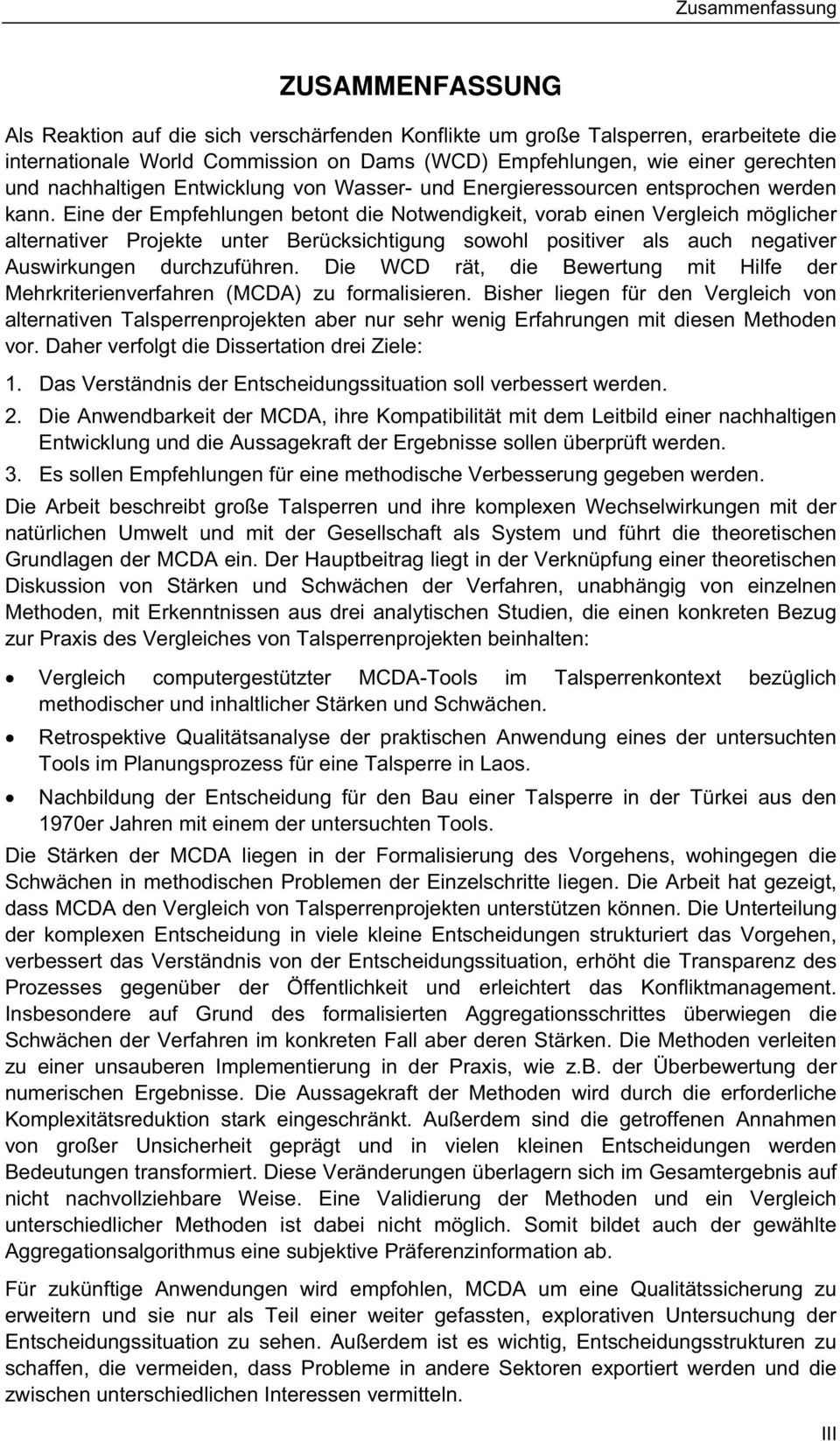
8 Table of contents TABLE OF CONTENTS LIST OF FIGURES VIII LIST OF TABLES X ACRONYMS XI 1 INTRODUCTION 1 2 THE LARGE DAM CONTEXT BASICS OF LARGE DAMS THE LARGE DAM CONTEXT SYSTEM THEORY OBJECT SYSTEMS ACTING SYSTEMS TARGET SYSTEMS THE WORLD COMMISSION ON DAMS (WCD) HISTORICAL DEVELOPMENTS FORMATION OF THE WORLD COMMISSION ON DAMS AND ITS FINAL REPORT GOVERNANCE ASPECTS OF THE WCD REACTIONS TO THE RESULTS OF THE WCD DEVELOPMENTS INITIATED BY THE WCD THE CHALLENGE OF DECISION-MAKING IN THE LARGE DAM CONTEXT DECISION SITUATION UNCERTAINTY 67 3 MULTI-CRITERIA DECISION ANALYSIS DECISION THEORY BASIC MODEL OF DECISION THEORY DECISION PHASES DECISION MAKER 76 IV
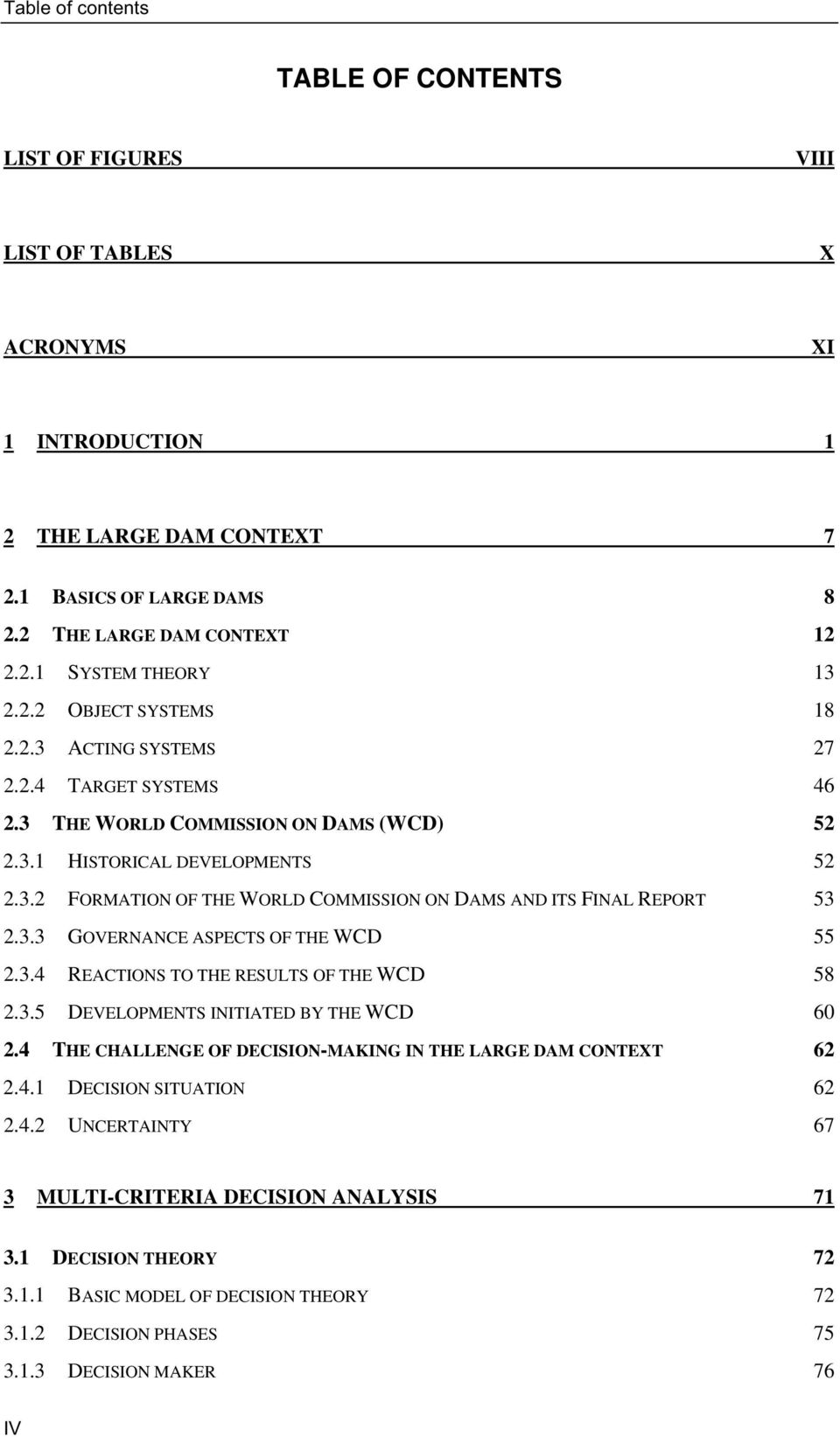
9 Table of contents CLASSIFICATION OF DECISION SITUATIONS ALTERNATIVE- AND VALUE-FOCUSED THINKING DECISION SUPPORT SYSTEMS (DSS) MULTI-CRITERIA DECISION ANALYSIS (MCDA) OPTIMISATION AND CHOICE MODELS CHOICE MODELS SELECTION OF AN APPROPRIATE MCDA METHOD MCDA AS SEEN BY THE WCD STRENGTHS AND WEAKNESSES OF MCDA IN THE LARGE DAM CONTEXT STRENGTHS OF MCDA DIFFICULTIES IN PROBLEM STRUCTURING DIFFICULTIES IN PERFORMANCE ANALYSIS DIFFICULTIES RELATED TO PREFERENCE INFORMATION AND AGGREGATION DIFFICULTIES RELATED TO IMPLEMENTATION OF MCDA INTRODUCTION TO SURVEYS SURVEY I: TOOLS FOR THE COMPARATIVE ASSESSMENT OF LARGE DAM PROJECTS DESCRIPTION OF ASSESSMENT TOOLS RESERVOIR SITE SELECTION IN TROPICAL ENVIRONMENTS (BABAN) GUIDELINES TO SUSTAINABLE WATER RESOURCES MANAGEMENT (DBU) PROJECT EVALUATION ON SUSTAINABLE DEVELOPMENT (DELFT) SUSTAINABILITY GUIDELINES AND COMPLIANCE PROTOCOL (IHA) MULTI-OBJECTIVE SCENARIO EVALUATION SYSTEM (MOSES) MULINO DSS (MDSS) WATERSTRATEGYMAN DSS (WSM) COMPARISON OF MCDA ASSESSMENT TOOLS SUSTAINABLE DEVELOPMENT PROBLEM STRUCTURING PERFORMANCE ANALYSIS PREFERENCE INFORMATION AGGREGATION SENSITIVITY ANALYSIS PARTICIPATORY AND DECISION-MAKING PROCESSES SUMMARY 154 V
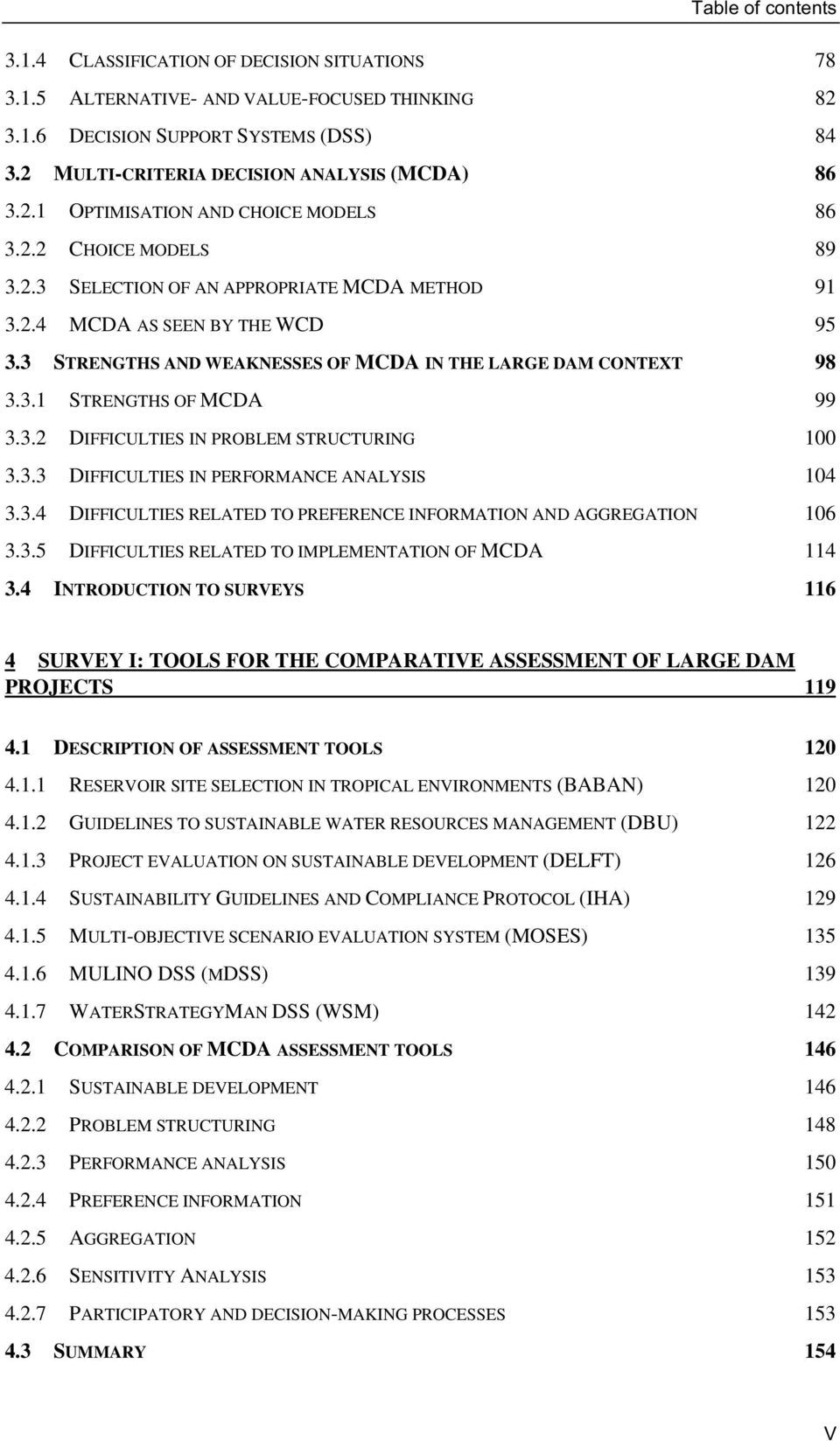
10 Table of contents 5 SURVEY II: ANALYSIS OF THE MULTI-OBJECTIVE SCENARIO EVALUATION SYSTEM (MOSES) ANALYSIS OF THE DECISION CONTEXT: THE CONCEPTUAL PHASE ASSESSMENT OF ALTERNATIVE DAM OPTIONS: THE DESIGN PHASE SELECTION OF THE PREFERRED RESPONSE: THE CHOICE PHASE SCORING WEIGHTING AGGREGATION SUMMARY SURVEY III: APPLICATION OF MULINO DSS TO THE CEYHAN ASLANTAS DAM, TURKEY THE MULINO METHODOLOGY IN BRIEF THE CEYHAN ASLANTAS PROJECT TEST OF THE MULINO APPROACH ANALYSIS OF THE DECISION CONTEXT: THE CONCEPTUAL PHASE ASSESSMENT OF ALTERNATIVE DAM OPTIONS: THE DESIGN PHASE SELECTION OF THE PREFERRED RESPONSE: THE CHOICE PHASE SENSITIVITY ANALYSIS SUSTAINABILITY ANALYSIS DISCUSSION OF RESULTS SUMMARY CONCLUSIONS AND RECOMMENDATIONS DECISION SITUATION SUBJECT OF PLANNING: THE LARGE DAM CONTEXT TARGET SYSTEM: THE CHALLENGES OF SUSTAINABLE DEVELOPMENT PLANNING SYSTEM: THE INSTITUTIONAL SURROUNDING DECISION METHODS MULTI-CRITERIA DECISION ANALYSIS STRENGTHS AND WEAKNESSES OF MCDA METHODS RECOMMENDATIONS ON IMPLEMENTING MCDA FUTURE PERSPECTIVES 221 VI
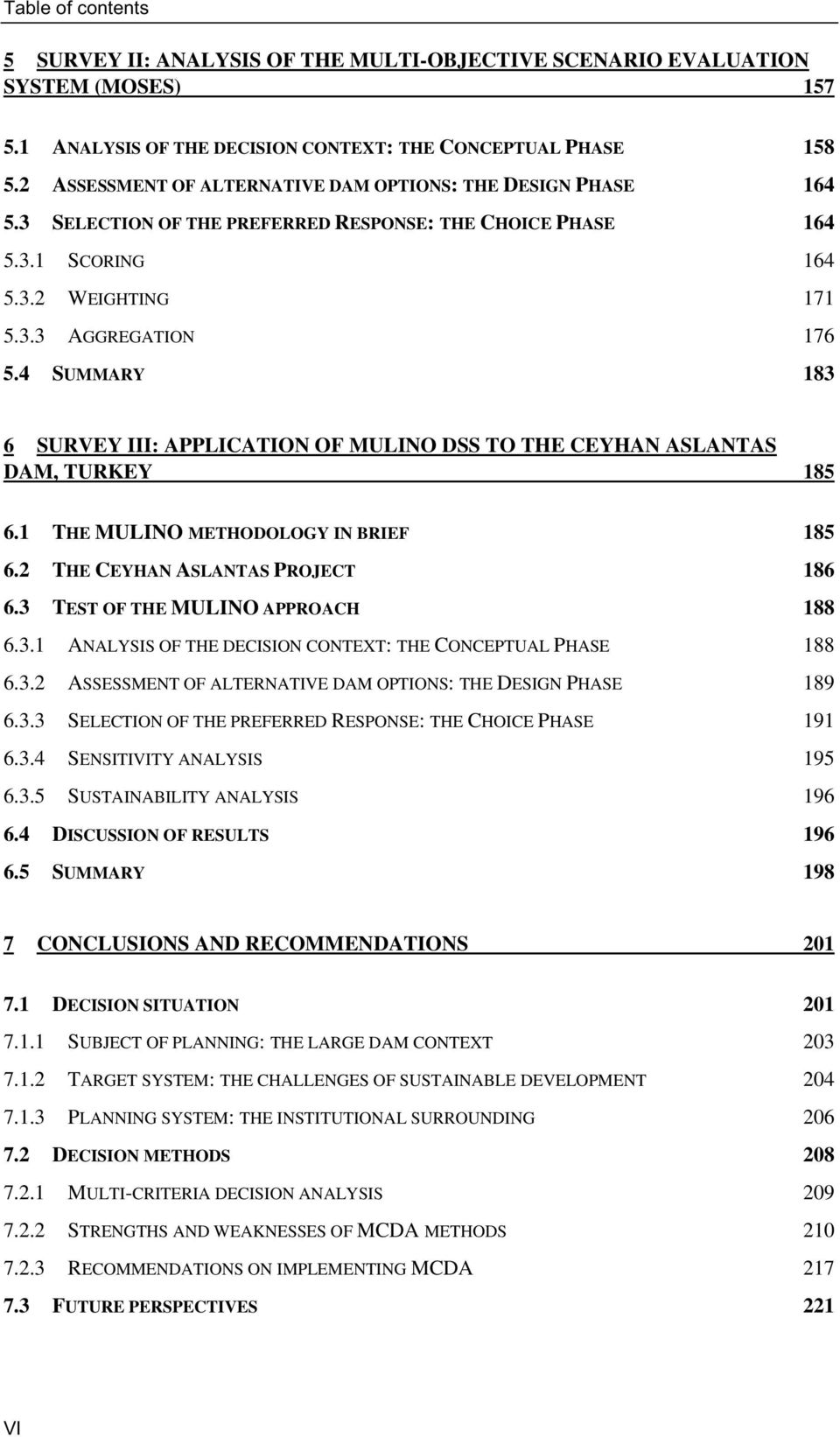
11 Table of contents ANNEX A: GLOBAL CHANGE, GOVERNANCE AND ECONOMY 223 ANNEX B: THE NOTION OF SUSTAINABLE DEVELOPMENT 224 ANNEX C: STRENGTHS AND WEAKNESSES OF SIMULATION MODELS 231 ANNEX D : SCORING RULES USED IN MOSES APPLICATION 233 REFERENCES 241 VII

12 List of figures LIST OF FIGURES Figure 1: Schematic flowchart of dissertation... 5 Figure 2: Delimitation of dam and dam context... 7 Figure 3: Basic types of dams... 9 Figure 4: Dam components and partition of the reservoir Figure 5: Schematic representation of system science Figure 6: System definition Figure 7: General diagram for dynamic systems Figure 8: Sequence of large dam impacts on sectors Figure 9: A framework for assessing the impacts of dams on river ecosystems Figure 10: Distinction of shareholders and stakeholders Figure 11: The circular flow of income at national level Figure 12: The circular flow of income with irrational acting participants Figure 13: The strategic priorities developed by the WCD Figure 14: The challenges of decision-making Figure 15: Methods to approach uncertainty Figure 16: Elements of a decision model Figure 17: Classification of multi-participant decision makers Figure 18: Typology of decisions faced by a group Figure 19: Engineering decision-making Figure 20: Properties of wicked problems Figure 21: Problem solving in alternative- and value-focused thinking Figure 22: Continuous and discrete decision space Figure 23: Classification of MCDA approaches Figure 24: Interlinkage of real system and decision model in decision-making Figure 25: Difficulties in evidencing improved decision outcome for MCDA Figure 26: Documentation of indicators Figure 27: Project evaluation with respect to sustainable development Figure 28: Summary table for evaluation of new hydropower projects Figure 29: Guidelines for scoring Figure 30: Schematic procedure of MOSES VIII

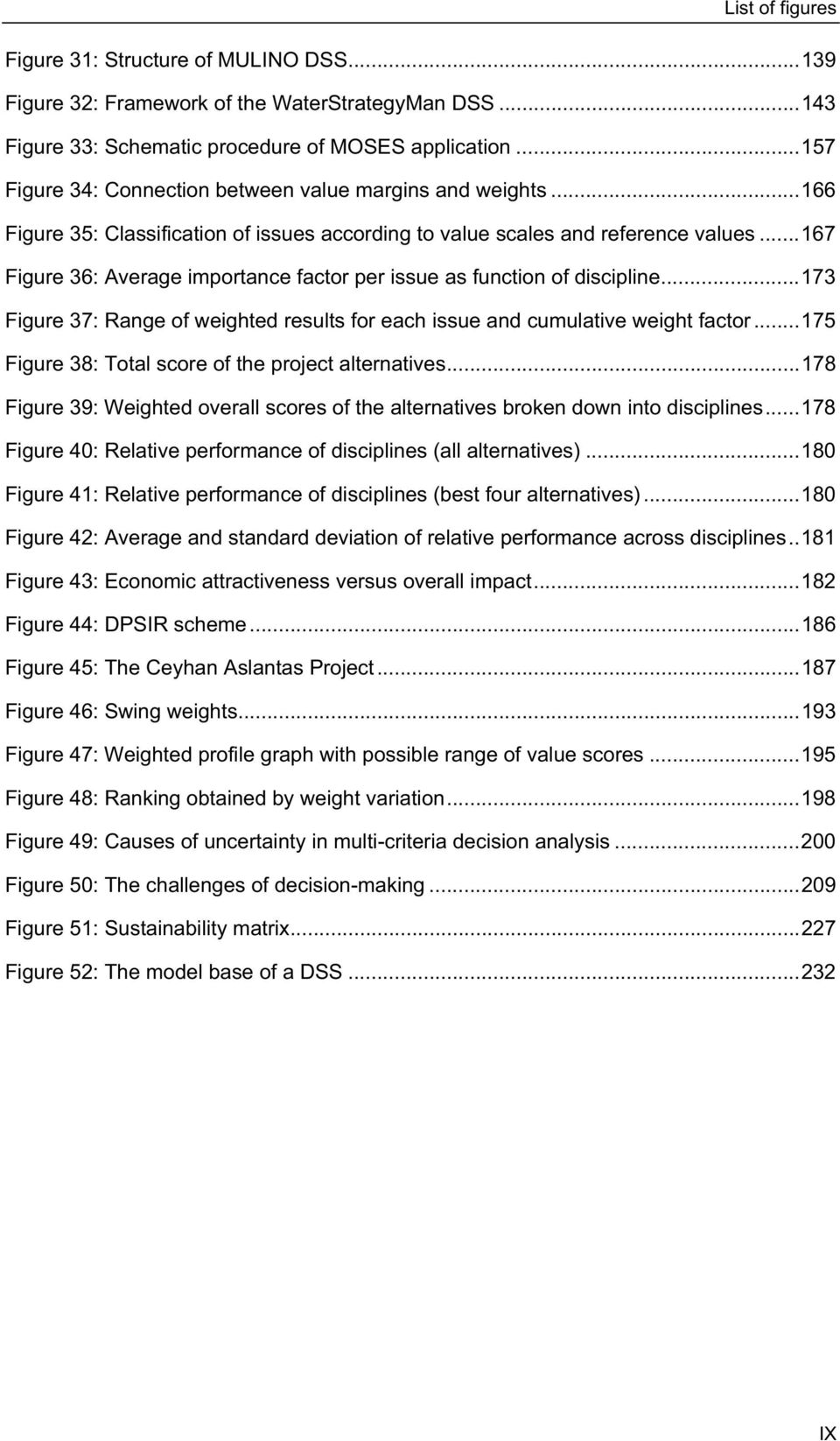
13 List of figures Figure 31: Structure of MULINO DSS Figure 32: Framework of the WaterStrategyMan DSS Figure 33: Schematic procedure of MOSES application Figure 34: Connection between value margins and weights Figure 35: Classification of issues according to value scales and reference values Figure 36: Average importance factor per issue as function of discipline Figure 37: Range of weighted results for each issue and cumulative weight factor Figure 38: Total score of the project alternatives Figure 39: Weighted overall scores of the alternatives broken down into disciplines Figure 40: Relative performance of disciplines (all alternatives) Figure 41: Relative performance of disciplines (best four alternatives) Figure 42: Average and standard deviation of relative performance across disciplines..181 Figure 43: Economic attractiveness versus overall impact Figure 44: DPSIR scheme Figure 45: The Ceyhan Aslantas Project Figure 46: Swing weights Figure 47: Weighted profile graph with possible range of value scores Figure 48: Ranking obtained by weight variation Figure 49: Causes of uncertainty in multi-criteria decision analysis Figure 50: The challenges of decision-making Figure 51: Sustainability matrix Figure 52: The model base of a DSS IX
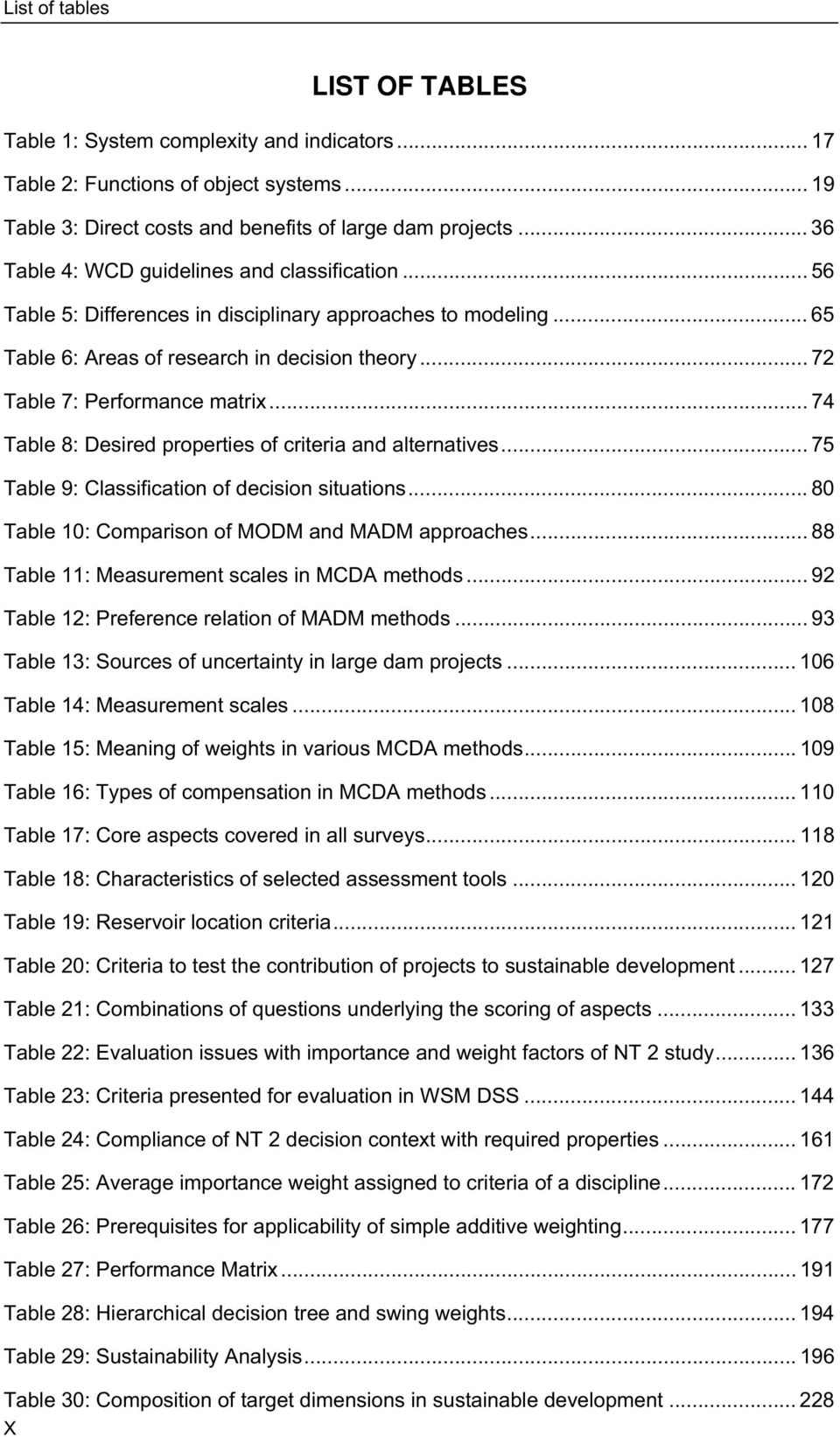
14 List of tables LIST OF TABLES Table 1: System complexity and indicators Table 2: Functions of object systems Table 3: Direct costs and benefits of large dam projects Table 4: WCD guidelines and classification Table 5: Differences in disciplinary approaches to modeling Table 6: Areas of research in decision theory Table 7: Performance matrix Table 8: Desired properties of criteria and alternatives Table 9: Classification of decision situations Table 10: Comparison of MODM and MADM approaches Table 11: Measurement scales in MCDA methods Table 12: Preference relation of MADM methods Table 13: Sources of uncertainty in large dam projects Table 14: Measurement scales Table 15: Meaning of weights in various MCDA methods Table 16: Types of compensation in MCDA methods Table 17: Core aspects covered in all surveys Table 18: Characteristics of selected assessment tools Table 19: Reservoir location criteria Table 20: Criteria to test the contribution of projects to sustainable development Table 21: Combinations of questions underlying the scoring of aspects Table 22: Evaluation issues with importance and weight factors of NT 2 study Table 23: Criteria presented for evaluation in WSM DSS Table 24: Compliance of NT 2 decision context with required properties Table 25: Average importance weight assigned to criteria of a discipline Table 26: Prerequisites for applicability of simple additive weighting Table 27: Performance Matrix Table 28: Hierarchical decision tree and swing weights Table 29: Sustainability Analysis Table 30: Composition of target dimensions in sustainable development X
15 Acronyms ADB AfDB AHP AM ASCE BMZ Asian Development Bank African Development Bank Analytic Hierarchy Process Analysis matrix ACRONYMS American Society of Civil Engineers Bundesministerium für Wirtschaftliche Zusammenarbeit und Entwicklung (Federal Ministry for Economic Cooperation and Development) BOT Build Operate Transfer CBA Cost-benefit analysis cf. confer DBU Deutsche Bundesstiftung Umwelt DDP Dams and Development Project DETR Department for the Environment, Transport, and Regions (Great Britain) DIN Deutsches Institut für Normungen e.v. DM Decision maker DPS Driving force Pressure State of environment DPSIR Driving force Pressure State of environment Impact Response DSS Decision Support System DVWK Deutscher Verband für Wasserwirtschaft und Kulturbau e.v. (German Association for Water, Wastewater and Waste) e.g. for example EA Ecological aspects EBRD European Bank for Reconstruction and Development EC Economic aspects ECA Export Credit Agency EEA European Environmental Agency IECO International Engineering Company EM Evaluation matrix et al. and others FA Financial aspects FAO Food and Agriculture Organisation GDP Gross domestic product GDSS Group Decision Support System GIS Geo Information System GNP Gross National Product gtz Deutsche Gesellschaft für Technische Zusammenarbeit (gtz) GmbH GUS Gemeinschaft unabhängiger Staaten (Commomwealth of Independent States) ha hectare HDT Hasse Diagram Technique HSBC Hongkong and Shanghai Banking Cooperation XI

16 Acronyms i.e. that is ICID International Commission on Irrigation and Drainage ICOLD International Commission on Large Dams IHA International Hydropower Association IRN International Rivers Network IUCN International Union for the Conservation of Nature IWG Interim Working Group IWRM Integrated water resources management KfW Kreditanstalt für Wiederaufbau (Reconstruction Loan Corporation) km³ square kilometre LAWA Bund/Länder-Arbeitsgemeinschaft Wasser LI Lahmeyer International m metre m³ cubic metre MAB Movimento dos Atingidos por Barragens (Brazilian Movement of Damaffected people) MADM Multi-attribute decision-making MAUT Multi-attributive utility theory MAVT Multi-attributive value theory MCDA Multi-criteria decision analysis MDM Multi-participant decision maker MODM Multi-objective decision-making MOP Multi-objective programming GP Goal programming MOSES Multi-objective scenario evaluation system MOU Memorandum of understanding MULINO Multi-sectoral, integrated and operational decision support system for the sustainable use of water resources at the catchments scale MW Megawatt n.s. not specified NAIADE Novel approach to imprecise assessment and decision environments NGO Non-governmental organisation NT 2 Nam Theun 2 study of alternatives OR Operations research OWA Ordered weighted average p. page PMF Probable maximum flood POE Panel of experts RD Regional development s second SA Social aspects SAW Simple additive weighting SD Sustainable development XII
17 Acronyms SDM Single decision maker SH Stakeholder SP State of preparedness TA Technical aspects TOPSIS Technique for order preference by similarity to ideal solution TRCOLD Turkish Commission on Large Dams UN-DESA United Nations Department of Economic and Social Affairs UNEP United Nations Environment Programme UNESCO United Nations Educational Scientific and Cultural Organisation US United States VDI Verein Deutscher Ingenieure (Association of German Engineers) WBGU Wissenschaftlicher Beirat der Bundesregierung Globale Umweltveränderungen (German Advisory Council on Global Change) WCD World Commission on Dams WCED World Commission on Environment and Development WEED Weltwirtschaft, Ökologie & Entwicklung e.v. WFD European Water Framework Directive WHO World Health Organisation WP Work Package WSM Water Strategy Man WWF World Wildlife Found XIII

18

19 Introduction 1 INTRODUCTION Problem description Looking back at 5000 years of history, we find that dams are still a decisive technology. Constituting a barrier across a valley to contain the flow of water in the reservoir behind it, dams serve to balance the uneven distribution of water in space and time, raise the water head in the reservoirs and reduce or increase downstream runoff. They bring a variety of benefits ranging from agricultural irrigation, domestic and industrial water supply, electricity generation and flood protection to river navigability. These benefits should not overshadow their considerable impacts on the natural environment and society, such as changes of flora and fauna and their uses, resettlement, or health risks to name but a few. In their report Dams and Development - hereafter referred to as the report - the World Commission on Dams (WCD) analysed the effectiveness of the developments generated by large 1 dam projects in comparison to the expectations formulated at the planning stage. According to their findings, benefits of large dam projects tended to be smaller than planned, and negative impacts were often greatly underestimated. (WCD 2000) Despite these outcomes, improved living standards of a growing world population increase demands in particular for electricity and water (Altinbilek 2002). In contrast, water availability decreases, due to changes of environmental conditions such as climate or land use, but also due to the deteriorating quality of the water resources, because of existing intensive uses (Sanmugnathan et al. 2000). The environmental impact and the renewability of electricity generation is currently a subject of intensive discussions. Large dams are one way to increase the water supply and the generation of electricity. Depending on the specific use and the local conditions, alternative approaches to satisfy the demands may exist, for example, demand optimisation or other technologies. In other cases, namely water supply for irrigation and other consumptive uses in developing countries, the construction of large dams will be indispensable (Takeuchi et al. 1998). Acknowledging the need for dams motivates research on the selection of the most preferable dam alternative. According to the report, it is of particular importance to carry out a thorough assessment of options, in order to identify the most preferable planning alternative with regard to the required benefit(s) and the notion of sustainable development. The latter requires projects to be not only functional and economically viable but also acceptable from a broader social, environmental and economic perspective, as well as operative in the long run (WCED 1987). Both internal and external costs as well as benefits of a project are relevant. Options assessment compares the impacts of alternative courses of action against set (value) objectives. The information obtained is then used in subsequent decision-making to avoid wrong decisions and to improve decision outcome. In the past, this potential for choice and selection among alternative courses of action was often neither realised nor made explicit. Planning procedures for large infrastructure projects such as dams may be largely independent of procedures used for more routine projects, blurring boundaries between planning levels (Nichols et al. 2000). Furthermore, planned projects were often only compared to a limited set of objectives, in particular, technical functionality and economic viability. Over the past 50 years, environmental and social aspects have been increasingly introduced (Palmieri 2004). Acknowledging the need for large dams, the options assessment is complicated by the characteristics of the decision-making situation. The International 1 The International Commission on Large Dams (ICOLD) defines all dams with a height of 15 metres or more, measured from the lowest portion of the general foundation area to the crest as large (ICOLD 1984) cf. chapter

20 Introduction Hydropower Association (IHA) distinguishes three major decision situations in planning large dams or alternative projects (IHA 2004a). They are: identifying a technology (e.g. thermal, nuclear, wind, hydropower or solar power plants), a dam project (catchment, site, project size, uses, design, impacts), and the operation (discharge rules) that is most suitable. These three decision situations are interrelated and not necessarily addressed strictly consecutively. A respective planning process is iterative. New insights cast a different light on previous decision steps. The present dissertation will focus on project selection, in contrast to technology selection, to limit complexity. Nevertheless, the complexity related to the decision situation still poses a major challenge. By means of decision-making the planning system identifies the alternative that is expected to achieve the desired state of the subject of planning, i.e. the target, best. Aiming at sustainable development, the subject of planning comprises the large dam project and all economic, social, environmental and technical sectors related. Furthermore, a variety of organisational levels, from individuals to social groups, or from species to habitats, play an important role. To describe the subject of planning and its development over time in the wake of interventions by man, diverse quantitative and qualitative measurement units, their spatial and temporal distributions, as well as a variety of spatial and temporal scales need to be charged. Although external developments, such as climate and land use change, or economic developments cannot be influenced by the project, their possible influence on the project has to be taken into account. The planning system is shaped by the people actively participating in the decision-making process and by the formal setting thereof. Co-ordination and integration of experts with various disciplinary backgrounds, as well as of decision makers and stakeholders pursuing different interests (values), pose an additional challenge to options assessment. The target system reflects subjective personal or institutional preferences as regards the future performance of the subject of planning. In public decisions, the moral obligation of sustainable development is pursued as main target (cf. p. 1). It needs to be specified for individual decision contexts. In the case of large dam projects, it requires to give due consideration to the characteristics of the subject of planning elaborated above. The ambiguity contained in the notion of sustainable development in combination with the given complexity of the subject of planning and the diversity of interests in the planning system make it difficult to formulate clear-cut assessment criteria and preferences. Nevertheless to allow for the comparison of the different options, the information available on the subject of planning and the preferences represented in the target system need to be aggregated. All related processes should be transparent, to ensure acceptance of results. Any methodological approach used for options assessment should meet the corresponding challenges. Objective The WCD recommends the implementation of multi-criteria decision analysis methods (MCDA) to facilitate the options assessment of alternative dam projects at the planning stage (WCD 2000). MCDA is an umbrella term to describe a collection of formal, to some extent quantitative, approaches, which seek to take explicit account of multiple criteria in helping individuals or groups (Belton et al. 2002) to assess, integrate and compare the performance of alternative options against set targets. When deciding among distinct dam alternatives, as is the case here, only choice models (multi-attribute decision-making (MADM)) are applicable, however. Consequently, in this dissertation, as in the WCD documents, the terms MCDA and MADM will be used synonymously. The benefits quoted by the WCD correspond well to the challenges previously mentioned. MCDA enables the comparison of alternative courses of action with regard to a set of diverse and conflicting objectives and identify the most preferable one. Besides serving as justification and control in political processes, the 2

21 Introduction methods are valued for improving the understanding of the decision situation and the quality of decision-making and for considering diverse interests. MCDA is considered beneficial for increasing transparency of the decision process and facilitating communication between all interested and affected parties (Nichols et al. 2000). On the other hand, the required reduction in complexity and number of participants is experienced as a limitation as regards the methods comprehensiveness. Further criticism addresses difficulties that arise if a decision situation has to comply with methodological and mathematical preconditions. The procedure s formalised approach can be misleading, resulting in an overestimation of the significance of quantitative aspects, such as aggregated results, in contrast to an improved understanding of criteria interaction (Green et al. 2000). However, with regard to large dams, the WCD Thematic Study on Financial, economic and distributional analysis (Aylward et al. 2001) stated that to date, this technique has been applied in project assessments of dams in only a few instances, and the details of how it can be effectively practised on a wider scale, and within a range of contexts, still have to be fully explored. This specification of the WCD recommendation, in conjunction with the described co-existence of the methodology s benefits and difficulties, initiated research in this direction, which is guided by the following thesis: It is acknowledged that the options assessment of alternative large dam projects involves a highly complex decision situation and has to satisfy the notion of sustainable development. It is claimed that MCDA methods are applicable in this specific context. They are expected to be supportive in addressing the involved challenges and, although difficulties are involved, the benefits obtained prevail. This dissertation discusses and analyses this thesis in order to encourage greater objectivity in decision-making and to help avoid making unfavourable decisions. To achieve this, it strives for three goals. Firstly, the work at hand intends to provide an improved understanding of the decision situation and its complexity, as well as of MCDA itself, to stakeholders and multidisciplinary experts engaged in planning large dams. Secondly, it wants to examine MCDA methods with regard to their applicability, their compliance with the notion of sustainable development and the significance of their results, specifically in the large dam context. Finally, on the basis of the insights gained, it aims to provide recommendations for an improved options assessment in the given decision context. The dissertation is designed to give due consideration to theoretical knowledge, case study applications, and generic models (e.g. computer-aided tools) linking the large dam context and MCDA. The approach is furthermore interdisciplinary. To be generic, results are intended to be specific neither to one MCDA method nor to a project. The information gained in this dissertation is relevant for the scientific community and for all persons confronted with the options assessment of real dam projects. Of the latter group, the work in particular addresses planners, as they often actively guide an options assessment. Nevertheless it may also be useful for decision makers, investors, money providers, as well as interested and affected people. Modus operandi The formulated thesis will be discussed in this dissertation, following the structure that is shown in Figure 1. Developing the thesis, the introduction in Chapter 1 provides insights to the motivation underlying the dissertation. The challenge of any assessment lies in the aggregation of objective information about the subject of planning with the subjective values of the target system. Chapter 2 will outline a basic understanding of large dams and their complex interactions with both natural environment and society. A system approach and a descriptive approach 3
22 Introduction will be combined. As the main principle guiding the decision maker, the notion of sustainable development will be introduced. Furthermore, an introduction to the work of the World Commission on Dams serves to highlight size and complexity of the value conflicts surrounding large dam projects. Special emphasis will be laid on a summary of uncertainties relevant with regard to large dam projects. Chapter 3 begins with a general introduction to decision theory, elaborating on different types of decision situations, decision phases, and decision makers and a corresponding characterisation of project selection in the large dam context. Based on a presentation of MCDA, advantages and methodological as well as practical difficulties in applying it to the large dam context will be discussed theoretically. To complete understanding about the applicability of MCDA, the chapter will also look into decision support systems (DSS) and their assets and drawbacks. Subsequently, three independent surveys will extend this discussion to more practical aspects. Survey I (Chapter 4) starts with a compilation of existing assessment tools that implement MCDA for large dam assessment, or at least for water resources management. Besides describing each tool s functionality together with its strengths and weaknesses, similarities and differences among the tools will be discussed. The capacities formalised tools currently available will be summarised. Two of the tools introduced in Survey I will be analysed in further detail in Surveys II and III. MOSES - Multi-Objective Scenario Evaluation System, was applied within the study of alternatives for the Laotian Nam Theun 2 project s public consultation process. In Chapter 5, Survey II will investigate this real world application for methodological soundness from an external point of view. It serves to learn about the practical difficulties encountered in real applications of MCDA approaches in decision-making for large dam projects, as opposed to theoretical requirements. Survey III (Chapter 6) aims to identify benefits and limitations of applying MCDA and particularly the performance of the MULINO methodology and DSS tool (Multi-sectoral, integrated and operational decision support system for the sustainable use of water resources at the catchment scale) in the large dam context. It will present the procedure implemented and results obtained by theoretically reproducing the decision to build the Turkish Ceyhan Aslantas Project in the 1970s. The results of the theoretical discussion (Chapter 3) and the findings of the three surveys (Chapters 4 to 6) will be jointly assessed in Chapter 7. In particular the formulated thesis will be summarised and discussed using the information gained in the work reported here. On this basis, recommendations will be developed to improve future decision-making in the large dam context. The dissertation closes with a few thoughts about strengthening the qualitative approach and about future research needs in the large dam context. 4
23 Introduction Introduction Is MCDA supportive comparing dam projects with regard to sustainable development? Chapter 1 Subject Matter Object, acting, and target systems of large dam projects Chapter 2 Methodology Strengths and weaknesses of multi-criteria decision analysis (MCDA) Chapter 3 Survey I Comparison of assessment tools Chapter 4 Survey II Real case Nam Theun 2 Chapter 5 Survey III Retrospective Aslantas Dam Chapter 6 Conclusions and Recommendations about MCDA when comparing dam projects in relation to sustainable development Chapter 7 Figure 1: Schematic flowchart of dissertation 5
24
25 The large dam context 2 THE LARGE DAM CONTEXT Water infrastructures, such as dams, water works, or sewage plants, determine the interaction between society and the natural environment (Figure 2). They satisfy societal demands by enabling the use of natural resources, the disposal of wastes, or the protection of society against natural hazards (Buchholz 2001; Loske et al. 2005). Therefore, water infrastructures in the following only titled infrastructures - are a specification of technology that requires the consideration of the technological object in conjunction with its context. NATURE Impact Supply DAM Demand Impact SOCIETY DAM CONTEXT Source: adapted from (Voigt 1997) Figure 2: Delimitation of dam and dam context Located in the stream bed of rivers, large dams and their reservoirs occupy central positions in river catchments and the hydrological cycle. These enable them to balance natural availability and societal demand for water, electricity generation capacities, or flood storage volume. Because water is a means of transport, but also because of direct interaction, dams are susceptible to influences from surrounding natural and human systems. At the same time, they have enormous impacts on these systems. Either way the interactions can be beneficial or undesired. It is noteworthy that neither complete nor generic descriptions of the large dam context nor predictions of its future development are feasible. Size and complexity rule out completeness, while the project s specific combinations of natural, economic and, in particular, cultural and institutional constraints get in the way of generic descriptions. Based on this understanding, it is the aim of this chapter to provide a fundamental understanding of large dams and their complex interactions with both the natural environment and society, i.e. of the large dam context. Without going into great detail the chapter will name constitutive elements and structural characteristics of the large dam context, without details of technical design. As an extension of these neutral descriptions, an introduction to the work of the World Commission on Dams serves to highlight the size and complexity of the value conflicts surrounding large dam projects. Consequently, the information gained is intended to frame the decision situation that, in subsequent chapters, will be analysed regarding its compatibility with MCDA methods. The chapter will not develop a specific set of criteria and indicators for this decision situation. Besides its function within the framework of this dissertation the chapter is of more general destination. It expands on the generally available causal descriptions by emphasising the system character of the large dam context. 7
26 The large dam context The chapter is structured in four consecutive sections: Every analysis of the large dam context requires a thorough understanding of the dam itself, the technology. The first subchapter will cover functional elements of large dams as well as design and operation in relation to the dam s function. In addition, a dam s project life cycle and alternative ways of integrating a dam into water resources management systems will be addressed. Subsequently, the large dam context will be presented. Starting from an introduction to system theory, the subchapter will recognise the relevance of object, acting, and target systems. These types of systems differ as regards their function, structure and hierarchy. For each system type, a system understanding will be provided preceding a description of exemplary causal interactions with the dam. The notion of sustainable development will be introduced as the guiding principle of the target system. Large dam projects contain considerable conflict potential. A short history of large dam development will illustrate the stages in development and spread of the technology up to the series of conflicts that lead to the formation of the World Commission on Dams (WCD) for mediation. Results of the commission s work and corresponding reactions will be summarised. A presentation of achievements induced by the WCD as well as of ongoing activities and developments describes the current state of affairs. The chapter will close with a delimitation of the decision situation underlying this dissertation. Special emphasis will be laid on a summary of uncertainties influencing large dam projects. Specifying the comparison of alternative large dam projects regarding their contribution to sustainable development leads to the subsequent chapter on decision theory. 2.1 Basics of large dams A dam is a barrier built across a valley to confine the water flow of a river in the storage reservoir thus created (DIN ; Hornby 1989). As this work is limited to large dams, the terms dam and large dam will be used interchangeably. The International Commission on Large Dams (ICOLD 1984) defines all dams with a height of 15 metres or more, measured from the lowest portion of the general foundation area to the crest as large 2. ICOLD (1988) classifies a major or mega dam according to either its height ( 150 m), volume ( 15*10 6 m³), reservoir storage ( 25 km³) or electrical generation capacity ( 1,000 MW). For clarity, the terms dam structure, dam, and dam project will also be distinguished. Dam refers to the dam structure, the reservoir as well as immediate functional elements and installations. Dam project comprises the dam and the sum of structures entailed by its uses. This section will transmit a more detailed understanding of the underlying technology. Dams are built to balance the uneven and often anti-cyclic distribution of natural water supply and human water demand in space and time, raise the water head in the reservoir and reduce or increase downstream runoff. By controlling reservoir discharge to downstream reaches, storage level and volume as well as the water surface in the reservoir are determined in dependence of the local hydrological and topographic conditions. A multipurpose dam, as opposed to a single purpose dam, faces several simultaneous uses that are possibly of a competitive nature. Dams provide water for consumptive uses such as irrigation or domestic and industrial use, as well as for 2 8 In addition ICOLD considers dams between 10 metres and 15 metres high as large dams, provided they have either a crest length longer or equal to 500 m, a storage capacity of the reservoir larger or equal to 1 Mill. m³, a maximum flood discharge of at least 2,000 m³/s, especially difficult foundation problems, or an unusual design.
27 The large dam context hydropower generation or the mechanical use of the waterpower. Furthermore, they serve flood protection by providing storage volume, and low flow augmentation for navigation and dilution downstream by releasing sufficient water in dry periods. Besides, they are used for tourism, recreation, and fishery (Maniak 1993). The mining industry uses dams for waste disposal by sedimentation. Dam structures are classified on the basis of the type and materials of construction as either gravity, arch, buttress, or earth dam (Figure 3). A gravity dam depends on its own weight for stability and is usually straight in plan view. Arch dams transmit most of the horizontal thrust of the water behind them to the abutments by arch action. They have thinner cross sections than comparable gravity dams and can only be used in narrow canyons where the walls are capable of withstanding the thrust produced by the arch action. The simplest of the many types of buttress dams is the slab type, which consists of sloping flat slabs supported at intervals by buttresses. Earth dams are embankments of rock or earth with provisions for controlling seepage by means of an impermeable core or upstream blanket. More than one type of dam may be included in a single dam structure. (Heinz Center 2002; Linsley et al. 1979) Figure 3: Basic types of dams Source: (Linsley et al. 1979) The dam structure comprises a spillway (to ensure the safe discharge of water that cannot be stored in the reservoir), a bottom outlet (to be able to empty the active storage), as well as intake structures or service outlets to withdraw water for different uses. In addition, all structures needed for the direct functioning of the dam are considered to be part of it, such as diversion tunnels, collecting works, bed load retention dams, pre dams, gauging stations, and premises (DIN ). The reservoir is the upstream volume lying below the level of the dam crest. It is divided into sections that are subject to the storage level and serve different uses (Figure 4). The freeboard reaches down from the dam crest to the maximum water level, making allowances for increased water levels due to ice, wind, waves and an excess charge. The 9
28 Reservoir Gross storage The large dam context underlying surcharge flood storage is activated simultaneously with the spillway in cases of extraordinarily high storage levels due to floods. In addition to the surcharge flood storage, the gross storage comprises flood storage, active storage for other dam functions, inactive storage, and dead storage. The inactive storage lies below the lowest service outlet and can only be activated by the bottom outlet. The dead storage lies below the bottom outlet. It cannot be activated. (DIN ) Crest level Surcharge flood storage Freeboard Maximum water level Weir crest (spillway) Flood storage Full supply level depends on dam use Active storage Dam structure Minimum operating level Service outlet Inactive storage Minimum water level Bottom outlet Dead storage Source: according to (DIN ) Figure 4: Dam components and partition of the reservoir Besides the structural design of the dam itself and the lay out design of mechanical and electrical equipment, a hydrological and hydraulic design is required for all elements that are connected to storage or discharge of water. These are namely reservoir, spillway, bottom outlet, and service outlets, as well as any storage or discharge elements needed to fulfil the functions and functioning of a dam. The hydrological design serves to determine parameters such as storage volume, storage levels and discharges over time, balancing availability and demand with the dam s functions in dependence of the hydrological, topographical and geological conditions. For example, the water supply function of a dam rests upon the storage volume, which allows water to be saved for later use. The flood protection function, in contrast, provides storage volume, which can be filled in case of a flood. Electricity supply depends on the optimum combination of storage level in and discharge from the reservoir. The subsequent hydraulic design ensures that the dam structure and all its elements are able to retain and safely discharge the water volumes and flows determined in the hydrological design. In particular, the height of the dam crest and the geometry and capacity of outlets are specified. Independent of the dam functions, 10
29 The large dam context hydrological and hydraulic design of the spillway ensure safety of the dam in the case of extreme floods. The spillway should be able to discharge an extreme flood assuming full supply level. Hydrological information is always of a statistical character, mainly due to the natural variability and long-term trends involved in climate and the limited time frame of the data bases used for analysis. In addition, the determination of the extreme flood to be used for design is not merely a technical task, but has to consider the degree of protection desired and the degree of risk considered acceptable by society. In Germany, the relevant regulations (DIN ) require spillway capacities of a large dam to be able to discharge a flood with a return period of T n =1000 a. Other countries do not specify a return period, but use the probable maximum flood (PMF), a concept that has been criticised because of the uncertainties involved in the underlying methodologies (Rißler 1998). A dam is integrated into the surrounding water resources system through several links. Reservoir inflow can be from the river catchment where the reservoir is located (direct) or via transfers from neighbouring catchments and reservoirs (indirect). Due to the discharge quantities to be handled large, dams are seldom constructed as off-river systems. Downstream, a dam is linked to the water resources system via its functions and discharges. The water from the reservoir can be diverted directly from the reservoir to the user or it can be discharged into the river and diverted only further downstream (indirect supply). Depending on whether the use is non-consumptive or consumptive, after use the water is or is not available for further use or as runoff. A dam can be the only one in a catchment or it can be part of a reservoir system, where it is aligned in parallel or in series to other dams (Maniak 1993). Reservoir operation traditionally aims to maximise the benefits of the dam s functions, i.e. water stored, energy produced, flood peak reduced, etc. It needs to be determined in relation to the water resources system the dam is part of. Usually, reservoir operation rules, indicating the discharge for a specific use as a function of the time of the year and the current storage level, are often determined on the basis of computer simulations. They consider competing uses by assigning priorities. On the basis of local climate conditions, dams providing water for drinking, irrigation, and industry are managed on an annual or multi-annual basis, i.e. once filled the storage volume is discharged over a period of one or several years. With regard to peak electricity production, reservoirs are sometimes run on an hourly, daily or weekly basis. The size of maintained flood storage varies on a seasonal basis. Its actual management, though, reacts to individual flood events. Failure of large dam projects can occur for several reasons. Besides failure of the dam structure, hydraulic failure can occur if the hydrologic admission of discharges exceeds design flows. Furthermore, the reservoir of large dams is subject to sedimentation, reducing the available storage volume. Finally, operational failure occurs because of disadvantageous management of water flows. A dam s period of operation is often scheduled to last at least from 50 to 100 years (Linsley et al. 1979). In addition, its overall life cycle comprises planning and construction as well as decommissioning and removal phases. Considerable variability of their durations makes average values insignificant. The division between these phases is based on the related tasks and does not refer to a point in time. During planning and decommissioning, both a political process of decision-making and an issue-related process of collecting, compiling and providing information are carried out interactively and iteratively. During the planning process, from the first project ideas, needs and options assessment, through pre-feasibility and feasibility studies, to the final design of the project, the relative sizes of these process elements develop in different directions. The share of the political process decreases, while the share of the issue-related process increases. Often plans are adapted continuously all the way through construction. Construction and removal phases comprise all activities 11
30 The large dam context related to the material realisation of the project. Often operation already starts during construction. Operation and maintenance cover all the activities that ensure the dam s functionality while it is in use. Besides the management of reservoir discharge and of related uses, this includes the up-keep and recovery of the dam structure and its functional elements. Planning for decommissioning and removal mirrors the tasks of planning and construction. The aim is the restoration of the pre-dam state though and not the creation of the dam state. The life cycle phases just reviewed are the same as for the other elements of a dam project. The duration of the life cycles of different elements varies, though. For instance, the rehabilitation of the dam structure is scheduled after several decades while rehabilitation of turbines might be required after a single decade. The elements of dam projects that need to be considered in discussing the impacts of a dam project are characterised by great diversity, as the following examples will show. Water supply entails the construction of transport and distribution pipes as well as of purification plants. To be beneficial, hydropower generation requires a powerhouse, transformer stations as well as transmission and power supply lines. If the reservoir water is used for irrigation, the dam project comprises transport and distribution channels, the development of irrigation areas as well as drainage infrastructure. The construction of locks ensures river navigation. Furthermore, both the dam itself and the other project elements require peripheral infrastructure. Partly, this infrastructure will be of long-term public benefit, e.g. roads and electrification. Other measures are limited to the construction phase, e.g. quarries. Large dam projects are highly site-specific. The conditions at the construction site determine many design features. But also the interactions of dams with their natural environment and society strongly depend on the pre-dam conditions. The following subchapter will analyse the wider context of large dam projects. 2.2 The large dam context In nature, water supports life and provides habitats. Furthermore, it regulates the balance of energy and matter on earth. With respect to society, consumptive uses refer to the use of water as food, for cleansing, or production. Polluting water is a specific form of consumptive use that serves disposal or use of a water body s self-purification capacity. In contrast, non-consumptive uses do not significantly change the quantity or quality of water. They provide water to produce energy, for transport, or for recreation, but also to satisfy more abstract values such as aesthetic or religious functions. According to this summary provided by WBGU (1998), water fulfils dual functions that are characterised by interdependency and conflict between its individual functions in natural environment and society. It is the dam s impact on these interdependent functions of water that requires a broadening of the perspective of the previous subchapter and, in the following, a focussing on the interactions of dams with the natural environment and society. The need to consider different elements and their interaction favours the use of a system approach (Matthies 2001). The identified system character is relocated throughout different levels of aggregation. The interaction of dam, natural environment and society represents the most abstract level, but each of its elements is a system in itself. The chapter will, therefore, begin with an introduction to system theory, to prepare for the system approach applied in the subsequent elaborations on the large dam context. Understanding a dam as an infrastructure suggests several partitions of the dam context that overlap in great parts. Following the distinction of dam, natural environment, and society, a classification into object, acting, and target systems is helpful in structuring and 12
31 The large dam context describing the large dam context (= first partition). It distinguishes different types of systems that have common characteristics with regard to their function, structure, and hierarchy. The object systems cover the dam and the natural environment. The acting systems describe society. The target systems define desired future states of the object and acting systems. The three types of systems will be described successively in the following subchapters. Although even the behaviour of quite simple systems often is not fully predictable, decisions on which infrastructures to implement and on their design have to be made and co-ordinated within society (Jessel et al. 2002). Planning is the notional and systematic anticipation of these future actions (Stachowiak 1970; in Jessel et al. 2002). It serves to identify projects or behavioural patterns that suit the achievement of society s targets by changing the interactions and relations within and between systems (Zangemeister, 1976). In a second partition the basic types of systems that were introduced are rearranged according to their role in the planning process. The distinction of shareholders, i.e. the actors in the decision-making process, and stakeholders, i.e. people affected by the project, among the acting systems allows one to rearrange object and acting systems. The subject of planning includes the object systems and the stakeholders. The shareholders and related planning processes, i.e. the remaining parts of the acting systems, represent the planning system. The target system represents the desired future states of the subject of planning. The terminology of the two partitions will be used side by side in the following text. To avoid confusion, it is important to understand the terms always in the context of their partition. Object, acting and target systems of the first partition distinguish different types of systems that have common characteristics. Several systems of each type can be relevant in a specific decision situation. Subject of planning as well as planning and target systems of the second partition indicate the three functional roles forming a decision situation. Each functional role is constituted of one or several of the above system types System theory The term system theory here is used, firstly, to indicate that this subchapter provides some theoretical background on systems. Secondly, it refers to the scientific field of research, which is understood to be generic and independent of any disciplinary background. To interlink system and decision theory within the framework of this dissertation, Zangemeister s (1976) classification of system science is applied. In general, purpose-rational action 3, of which planning is a distinct form, presumes both systematic information retrieval about the object and logic information processing in decision-making to precede implementation. Hence, system science, i.e. the scientific discipline dealing with purpose-rational action, is directed towards system research and theory as well as decision research and theory (Zangemeister 1976). As shown in Figure 5, 3 Purpose-rational action: The individual acts purpose-rationally who orients his conduct to purpose, means and consequences and thereby rationally weighs the means against the purposes, as much as the purposes against the consequences or the purposes against each other (Weber 1978/2002). 13
32 The large dam context the insights of both contribute to systems engineering that develops methodologies and procedures for handling complex systems (Zangemeister 1976). Systems engineering focuses on the development of both methods and procedures that serve to plan, analyse, choose and implement complex systems (Zangemeister 1976). The idea behind it is to optimise an overall system as distinct from the sub-optimisation of its elements (Miles 1973). Here, models are understood as simplified representations of reality (Matthies 2001), i.e. the system or the decision situation. SYSTEM SCIENCE Information retrieval Information processing SYSTEM RESEARCH DECISION RESEARCH SYSTEM THEORY System models SYSTEM ENGINEERING DECISION THEORY Decision models Source: adapted from (Zangemeister 1976) Figure 5: Schematic representation of system science Conventional approaches of the natural sciences explore coherences by changing only one variable. They are unsuitable for systems analysis. In complex systems, changing one variable usually results in changes of many other variables and possibly the course of temporal development. Accounting for this, system research aims to improve the understanding of system structures, organisation, control and properties and to develop supportive methodologies. It is often not possible to identify system behaviour of empirical systems by mathematical analysis. Hence, system theory works on the development of system models for different types of (ideal) systems that can be approached mathematically. This allows for conclusions about real systems and supports the solution of real problems (Zangemeister 1976). In the following, a very brief introduction covers those aspects of system theory that are considered most relevant in the context of this dissertation. Comprehensive introductions to system theory are available (Bossel 1998; Forrester 1972; Vester 2002; Voigt 1997). 14
33 The large dam context Extending the system definition provided above, Ropohl (1999) emphasises that a system is a combination of three aspects. A system is an entity, or the model of an entity, that (a) connects attributes of the system (input, output, states), which often are observable from the outside, and (b) consists of several linked parts (elements) or sub-models, and (c) is delimitated to its surrounding 4 or a super-system. Figure 6 visualises these functional, structural, and hierarchical aspects of a system. It is important to realise that the definition of a system according to size and composition is not immanent to the real system. Rather it depends on the specific perspective taken by an observer and, consequently, is not unique. Manifold examples of systems can be found in nature and in the anthroposphere and the combination thereof. Machines, organisms, society, ecological cohesions, companies, man-nature interaction or theoretical models thereof are examples, to name but a few. Surrounding System Inputs States Outputs (a) FUNCTIONAL CONCEPT Surrounding System Element Relation (b) STRUCTURAL CONCEPT Supersystem System Subsystem (c) HIERARCHICAL CONCEPT Source: (Ropohl, 1999) Figure 6: System definition Attributes specify system characteristics that are observable from the outside. Underlying the description of the system s function, three classes of attributes are distinguished: inputs, states, and outputs. Ropohl (1999), referring to N. Wiener, states that all phenomena can be denoted as either material, energy or information (attribute categories). Material has a volume, is inertial and weighs, whereas energy holds the ability to work (in the physical sense). Information takes the form of data (representation of meanings) or 4 The term surrounding will be used here instead of environment to avoid confusion with the natural environment. 15
34 The large dam context instructions (initiating changes of state). In addition, all the phenomena occur in space and time. Following Bossel (1998), there are only few basic building blocks or types of system elements that determine the structure of a system: Converters transform one or several inputs immediately to an output by means of some (mathematical) rule. They can be functions of parameters, state variables, or other converters. Contrary to imagination most systems are not of this simple converter type. Rather, all systems that are relevant for future development are of a different kind. They are determined by one or more internal variables of state (system variables), which cannot react immediately on a varying input. In the simplest case it, therefore, can be assumed that such states can be changed only at a certain rate. The rates themselves follow from some other variables of the system and may be, therefore, looked upon as converters. A full description of the system is achieved by a third kind of system element: the inputs and, more generally, the parameters. They have the common property that their values are independent of the system, i.e. some external agent, which the system cannot influence, determines them. Parameters may change with time. Surprisingly, these three types of system elements represent all the basic building blocks of dynamic systems. Considering their possible linkages, Bossel (1998) constructs a general system diagram as given in Figure 7. Converters, state variables and parameters are depicted as circles, rectangles and hexagons respectively. This structural diagram points to two processes that determine the behaviour of dynamic systems. First, the output is a function of the inputs to the system. In the diagram, the arrows connecting inputs to output indicate this. Second, the feedback structure of the system can cause intrinsic dynamics, i.e. the system state affects the rate of change of the state of the system and, thus, determines the new state of the system. According to Bossel (1998) this intrinsic dynamic is predominantly determined by the feedback structure of the system and to a large extent is independent of external influences. Driving functions INPUT Parameters INPUT RATE STATE OUTPUT Feedback Source: (Bossel 1998) Figure 7: General diagram for dynamic systems Accordingly, dynamic systems describe changes of system states over time (Bossel 1998). Simple examples for dynamic systems are exponential growth (positive feedback), control system (negative feedback), logistic growth or steady state. In dynamic systems mostly feedback loops are decisive for system control and adaptation to parameters. In reality, one is often dealing with more complex systems. A system is complex, if at least one 16
35 The large dam context relationship between system elements is non-linear and the system contains at least one feedback loop (Matthies 2001). Bossel (1998) distinguishes characteristic types of systems according to their degree of complexity, as listed in Table 1. With system complexity also system requirements increase. As the fulfilment of these requirements ensures system viability, it can be used to indicate the behaviour or well-being of complex systems. These indicators are additive in the sense that the well-being of systems at higher levels of complexity demands the fulfilment of all the lower level requirements in addition to the requirement of the respective level of complexity. Most of the indicators appear in response to fundamental properties of the system surrounding. Some are, however, the consequence of specific system qualities. Table 1: System complexity and indicators static metabolic self-sustaining self-organizing non-isolated self-replicating SYSTEM INDICATOR 5 is inanimate and static. It changes only through environmental parameters. requires energy, material, or information throughputs. has the ability to sustain itself in its environment, following rigid rules. changes its structure, parameters or relationships to adapt to changes and coevolve with their environment. modifies its behaviour towards other systems in its environment. regenerates itself or generates systems of its own kind. Existence Subsistence Effectiveness, freedom of action, and security Adaptability Coexistence Reproduction sentient experiences pain, emotions, etc. Psychological needs conscious reflects about its actions, its impacts as actors and makes conscious choices. Ethical reference Source: (Bossel 1998) With respect to complexity the feedbacks mentioned before occur at different levels, representing different impacts and characteristic response times (Bossel 1994b; Bossel 1998). The resulting processes of system preservation or evolvement range from simple cause-effect processes and feedback regulations to structural changes of selforganisation or evolutionary changes of identity. This differentiation often is neglected in reality and considerations are limited to simple cause-effect considerations or feedback regulations. The limited understanding with respect to both static and dynamic properties can lead to misinterpretations causing serious difficulties in real systems. The understanding of systems is closely related to the difficulties immanent in the reduction of system complexity. One way to reduce system complexity is to split a system into several subsystems that can be analysed separately and then be reintegrated. (Matthies 2001) 5 The indicators are additive as explained in the text. 17
36 The large dam context The practical application of a system approach on the basis of the principles that have been introduced in this subchapter poses a challenge due to the complexity of the systems and often also due to the relevance of qualitative aspects. To apply system understanding to a comparison of alternative future paths (Bossel 1998), different types of knowledge need to be used. Besides knowledge about systems, knowledge of constraints (natural laws, logic, time, economy, psychology, ethics) and of impact dynamics (impact assessment) as well as of crucial details is required Object systems Theoretical background Object systems represent the material surrounding of acting systems (Voigt 1997). Accordingly, the technology that is implemented to make the natural environment useful for society (here the dam infrastructure or more general the use system ) and the natural environment itself can be object systems. Both are subject to the laws of nature (Ropohl 1999). Often infrastructures impact on the natural environment and on society far beyond the intended use(s) (Ropohl 1999). Sustainable development (cf. target systems p. 46) explicitly requires the consideration of these impacts. Whether they are internalised in object and acting systems, or treated as system surroundings, raises the question of system delimitation that will not be discussed here in detail. The focus is on a general description of function, structure, and hierarchy of object systems. Ropohl (1999) specifies the function of an object system as the ability to transform their surroundings or their own state. They dynamically transform inputs and initial states into outputs and final states. Object systems, unlike acting systems, do not contain targets. In keeping with previous definitions (cf. p. 15), the input, state, and output attributes are assigned to the categories of mass, energy, and information and have a spatial and temporal reference. Different types of functions result from input and output but also from their combination with a state and their combination with each other (cf. acting systems p. 27). Transformations provide five characteristic functions of object systems (Table 2). Change of state and maintenance of state as a reaction to changes in input are transformation functions (input + state). Conversion, transport, and storage are input-output transformations. Conversion describes quantitative or qualitative changes between input and output. Transport and storage refer to changes in place and time, or only in time, respectively. Although not complete, at a basic level these five functions are sufficient to also represent ecosystem functions that are introduced as part of the natural environment (cf. p. 22). 18
37 The large dam context Table 2: Functions of object systems Output-attributes Y, RY, TY CONVERSION State-attribute Z CHANGE OF STATE Input-attributes X, RX, TX Y X (qualitative/quantitative) X const Z const TRANSPORT MAINTENANCE OF STATE Y = X X const RY RX Z = const TY TX STORAGE RX, RY Spatial coordinates Y = X TX, TY Temporal coordinates RY = RX unequal TY TX const unchanged Source: (Ropohl 1999) According to Ropohl (1999), object systems are part of a hierarchy consisting of object systems at different levels of aggregation. For a technical object like a dam, this could be, for example, the construction material (reinforcement, concrete), an individual component (gate), a functional component (intakes, spillway, dam structure), a dam, or a system of several dams. While the hierarchy of the abiotic environment is similar, the hierarchy of the biotic environment resembles that of acting systems. Odum (1991) distinguishes different organisational levels, starting from the individual level (organism), followed by populations of individuals of the same species, and then communities of several species. The structure of object systems builds upon the object systems of the next lower level as elements and their relationships. These relationships are mainly couplings: the material, energetic, or information output of one element is the input of another element. Spatial and temporal relationships are also relevant. (Ropohl 1999) Introduction to sector descriptions Descriptions of object, acting, and target systems will comprise an introduction to the theoretical background, a system understanding of the subsystems and exemplify causal interactions with the dam. The dam (infrastructure system) has already been covered in Chapter 2.1. The preceding elaborations already identified similarities of different object systems, independently of a specific context. This introduction to the general approach of the descriptions precedes the analysis of the natural environment as one subsystem and its interaction with large dam projects. Infrastructures balance the improvement of societal well-being and support for human development against the protection of the natural environment as the basis for life. Holding this position, they, and even technology in general, represent a separate category. They overlap with both nature and society but do not belong to either. Extending the introduction to dam technology, the descriptions will cover the major impacts caused mutually between a large dam project on the one hand and society and the natural environment on the other. Anticipating the introduction to the acting systems in Chapter 2.2.3, functional and nonfunctional social systems are distinguished within society. The economy and civil society 19
38 The large dam context are their major representatives. Making simplifying approximations, after completion, a new dam affects these sectors consecutively, the order of impact being determined less by time than by causality. A dam firstly changes the abiotic environment and then the biotic, before these changes affect the different societal systems, as shown in Figure 8. Among functional and non-functional societal systems, no clear sequence is assumed. Looking at the impacts of the different sectors on a dam, the same sequence is applicable, though the impacts act in the reverse order and ultimately on the dam. Furthermore, direct impacts of society on the dam are possible, through dam operation. Environment Biota Abiota DAM Economy Functional social system Non-functional social system Society Impacts of dam Impacts on dam Figure 8: Sequence of large dam impacts on sectors In reality, this order of impact cannot develop freely. Its anticipation during planning serves the identification of measures aimed at preventing or at least mitigating the impacts, or, alternatively, to be prepared to adapt. The implementation of these measures precedes the occurrence of the described causality. Besides, some of the impacts in fact will already start to occur during the construction phase, as they are either induced by construction activities or due to the partial overlap of operational activities with construction. Large dams induce cause-effect chains along the introduced sequence of sectors. These chains can be of different lengths, as they do not necessarily have to integrate all the sectors along the sequence. Furthermore, it is important to realise that each impact triggers its own cascade of secondary impacts. A domino-like web of complex interactions unfolds, consisting of the exchange of matter, energy, or information within each sector and mutually between sectors. A number of aspects contributing to the complexity of the large dam context are equally relevant for all sectors, justifying their presentation as part of this introduction to the general approach. They have to be thought of as underlying all subsequent sector-specific descriptions, as it will be impossible to deal with each of these aspects individually for each of the sectors: 20 Impacts of large dam projects on natural environment and society occur throughout all life cycle phases. The descriptions will focus on changes induced by the dam project, as compared to the pre-dam state. The impacts that are specific to planning and construction phases will be discussed in less detail. For the planning of decommissioning and removal phases, it is assumed that impacts will be the same as in planning and construction either being directed equally or opposite. A large dam project affects all sectors of the natural environment and society but is equally impacted in its functioning and existence by developments in these sectors. These interactions strongly depend on the local conditions of the sectors.
39 The large dam context Strong impacts occur through the dam itself but each of its uses also entails numerous complex changes that require consideration. Structural work related to the uses has been introduced in Chapter 2.1. Changes specific to the operation of the dam s uses also must be considered. Both positive and negative developments can emerge from the same source of change. Furthermore, according to their interests, different groups in the population perceive developments differently. This not only refers to interest groups within a society but also to different forms of society, such as hunter-gatherer, agrarian, industrial, or world-risk societies (Heinrichs 2005). Descriptions are intended to be impartial and refrain from judgements about which impacts are considered beneficial or adverse. The specific quantitative or qualitative dimensions of each system element and process contribute to complexity. The state of system elements varies with time and space and many levels of spatial and temporal scales are adopted for their measurement. A spatial scale refers to the physical extension of each individual system, element, or process and can range from local to global. A (qualitative) temporal scale, on the other hand, permits an adequate representation of consecutive incidents 6 (Wikipedia 2005). Feedbacks (Bossel 1994a) described within or between the systems are relevant for system control and system adaptation to changing environments. They cover simple cause-effect processes, structural changes of self-organisation, or evolutionary changes of identity (cf. Chapter 2.2.1). The extent of changes varies greatly between impacts, ranging from local reservoirbound impacts, such as inundation, to impacts that can reach downstream up to coastal waters, such as water quality. In addition, the extent is determined as a function of the reservoir s position in the catchment, i.e. the catchment s ability to buffer the impacts through river confluences. Impacts of dam uses, such as hydropower generation, irrigation, or water supply, as well as social and economic impacts, are much less restricted to the river channel. In particular, immaterial impacts can range from local up to national levels. When several dams are built on a single river, they influence each other and some impacts of the individual dams can cumulate. The overall effect of cumulative impacts 7 may be greater than the sum of the individual impacts (Bergkamp et al. 2000). Consideration of such effects is complicated by the different implementation times of projects and because many of these effects are not well-understood (Petts 1984). Heinrichs (2005) indicates a growing spatial scale of environmental changes, an increasing number of environment - society interactions and increasing technological possibilities for acting. The non-deterministic character of the system(s) means that system states and processes are subject to risk and uncertainties (cf. Chapter 2.4.2). Due to complexity, feedback dynamics and uncertainty it is often impossible to specify the degree and sometimes even the direction of change 8 (increase or decrease for example) Geological eras are presented in millions of years. To grasp the course of intense rains, minutes or even seconds are considered adequate. For dam operation, cumulative effects can be beneficial in decreasing sediment rates, flood frequencies, or peak discharges of individual dams. Increasing river fragmentation negatively affects water quality, water quantity, and species composition of the entire river (WCD 2000). Degree and direction of change are determined primarily by pre-dam conditions, by interactions with other impacts as well as by the system boundaries considered. 21
40 The large dam context Furthermore, it is often forgotten that valuations are always with us. Our valuations determine our approaches to a problem, the definition of our concepts, the choice of models, the selection of observations, the presentation of our conclusions - (Myrdal 1978). These valuations vary with time and with the shareholders specifying them. They make any description of a system or prediction of its future behaviour only apparently correct, unambiguous and objective. The elaborations of this subchapter aim to transmit the variety and complexity determining the large dam context. Four threads of argument are combined to make the large dam context accessible. Namely, these are the abstract specifications of object, acting, and target systems, the list of aspects that are relevant for all sectors, the descriptions of system understanding for the different sectors, and the examples of causal interactions between the sectors and the dam in the course of the described sequence. Neither is it claimed that the descriptions are complete 9 nor that all impacts covered necessarily occur for each dam. Each dam is unique (McCartney et al. 2001) and its individual character depends on the interaction of the dam and its operation with local natural and anthropogenic conditions. The environmental system The natural environment consists of ecosystems that constitute a spatial unit (site), the living organisms it contains, and their abiotic environment (Digel et al. 1987). The following specifications are based on Odum s (1980) fundamental work on the topic. The abiotic elements of an ecosystem are inorganic substances (C, O, N, P, H 2 O, ), organic compounds (carbohydrates, amino acids, proteins, ), and a myriad of physical factors. Odum specifies the last group as temperature, radiation, water, co-action of temperature and water, atmospheric gases, biogenic salts (macro + micro nutrients), currents and pressures, as well as soils. The biotic elements of the system are autotrophic producers (plants and micro-organisms), phagotrophic macroconsumers (herbivores, carnivores, parasites etc.), and saprotrophic microconsumers (bacteria and fungi). Often spatially and temporally separated, the first, autotrophic producers, use light energy and simple inorganic substances to build complex organic compounds (photosynthesis and metabolism) while the latter two make use of simple or complex organic compounds by generating new organic compounds, or by digesting existing ones, respectively. These structural elements are inseparably geared by complex interactions that determine the ecosystem function s energy flow, food chains, diversity in space and time, biogeochemical cycles, succession and evolution, as well as cybernetics (Odum 1991): All biological processes require the conversion of energy between different forms, in particular from light or food into heat. It is the basis for the development of food chains, the variety of biological relations, and the cycles of matter. The conversion has to fulfil the first and second law of thermodynamics. Chemical elements circulate between biota and abiota in biogeochemical cycles 10. The slow but continuous exchange with an element s reservoir in the atmosphere/hydrosphere (gas cycle) or earth crust (sediment cycle) determines the 9 For more detailed information on the individual aspects as well as examples, please refer to: (Baumann et al. 1984; Bergkamp et al. 2000; Goldsmith et al. 1984; McCully 1996; WCD Secretariat 2000) 10 The gas cycles of oxygen, carbon, and hydrogen are omnipresent. Besides, substances required in considerable amounts, i.e. macronutrients, are mainly nitrogen, phosphor, potassium, calcium, magnesium, and sulphur. Although both demand and supply are extremely low, micro nutrient cycles are nevertheless of great relevance for photosynthesis (manganese, iron, chlorine, zinc, vanadium etc.), for nitrogen metabolism (molybdenum, cobalt, iron, boron etc.) and for other metabolism functions (manganese, boron, cobalt, copper and silicon, etc.). (Odum 1980) 22
41 The large dam context availability of an element to the biota. Only the smaller amount of an element is involved in the faster, more dynamic exchange between organisms and their direct environment. Overlapping in physical, geological, chemical, meteorological or biological processes the cycles of the different elements regulate each other. According to the law of limiting factors the existence and well-being of organisms depends firstly, on the fulfilment of minimum requirements with regard to the available amount and variability of essential substances as well as on the physical factors just mentioned. Secondly, they are determined by the organism s tolerance to these factors and other environmental components. Individuals, populations of individuals belonging to one species, and communities of several species are the organisational levels of the biota. In accordance with the principle of functional integration each level has its own structural and functional properties in addition to those of its components at lower organisational levels. Structure and function of communities have been indicated previously as specifying an ecosystem. The higher organisational levels determine the fate of its components. Depending on local abiotic factors, communities are functional units of characteristic energy flow and trophic structure. Although certain species tend to occur together (unity of taxonomic composition), functionally similar communities can have different taxonomic compositions. Often, only a few species dominate a community by way of number, size, productivity, or energy flow, but species, as well as functional and distributional diversity, foster stability. The structural properties of a population are best expressed as statistical functions describing density, growth rate, age distribution, intrinsic rate of natural increase, or spatial distribution. A population also possesses genetic properties such as the ability to adapt or reproduce. Between populations, very distinct types of positive or negative dependency develop (i.e. mutualism or competition 11 ). Ecosystems are subject to short and long-term developments, i.e. succession and evolution, due to changes of the biota and abiota. Their common strategy is to develop a diverse organic structure within the abiotic limits, to maximise protection against disturbances (stabilise the ecosystem). As opposed to evolution, succession is predictable. In succession, the community causes changes of the abiota that again determine limitations, patterns, and rates of changes in the community. Identification, control, and self-acting regulation of interconnected elements and processes using minimum energy are decisive (not only) in ecosystems (Vester 2002). Chapter introduced the corresponding system theory. Large dams and the natural environment Because water is a transport medium, aquatic ecosystems are strongly dependent on all biotic and abiotic elements of the upstream river catchment, and they also impact the developments of downstream riverine and floodplain ecosystems. The functionality of dams depends on the characteristics of the corresponding upstream drainage basin, and of the newly created reservoir. Climate, topography, geology, soils, and natural vegetation, in combination with human water and land use, determine water availability and quality including temperature in the reservoir. Local climate and water and land use have the highest variability. Their future development will have the strongest influence on long-term reservoir operation. Consumptive water uses decrease water 11 Mutualism describes a positive interaction that is vital for the survival of both populations. Competition describes the negative interaction that hampers the development of both populations. (Odum 1980) 23
42 The large dam context availability and quality. More intensive land use (clearing, intensification of agriculture) increases the renewable water resources reaching the reservoir, while reducing water quality. At the same time, it increases the erosion rate in the catchment. Faster reservoir sedimentation poses a considerable threat to reservoir operation and its life span. Furthermore, if they pass the reservoir, high sediment loads reduce the generating efficiency of turbines through abrasion and increase maintenance costs (McCully 1996). Environmental impacts of dams mainly occur in the reservoir, in the downstream river, and in adjacent amphibic and terrestrial ecosystems (DVWK 1996). The new water regime requires adaptation of abiota and biota, resulting in the extinction, introduction, or adaptation of individual plants or animals, populations, or communities and their habitats, following the principles of ecosystem functioning. Often unique wildlife habitats and populations of endangered species are lost and the modified habitats are conducive to nonnative and exotic species (WCD 2000). These developments alter biodiversity at genetic, species, ecosystem, and ecological levels (McAllister et al. 2001). McCartney (2001) distinguishes three levels of dam impacts on aquatic river ecosystems that are linked through causal interactions (Figure 9). Changes of abiotic steering variables related to hydrology, water quality, and sediment load are first-order impacts. Their implications for morphology and primary production are second-order impacts. Third-order impacts cover the resulting changes with respect to invertebrates, fish, birds and mammals. Wherever existent, respective uses of these resources by society are affected by these changes. Terrestrial environment Primary Production Birds Mammals Fish Invertebrates Morphology THIRD-ORDER IMPACTS SECOND-ORDER IMPACTS Water Quality Hydrology Sediment load FIRST-ORDER IMPACTS Barrier effects Source: (McCartney et al. 2001) Figure 9: A framework for assessing the impacts of dams on river ecosystems Changing the riverine ecosystem into a lacustrine ecosystem submerges large areas of land varying in its value, due to topography, (protected) habitats, and uses of the often fertile floodplain soils. Due to the increased surface of the reservoir, evaporation tends to increase, thus altering the local microclimate, reducing available water resources, and increasing the concentrations of salts and other substances (Stüben 1986). Further water losses can occur through infiltration. In particular, downstream from the dam, the lowering of surface water levels impacts on all existing uses and natural functions of the groundwater. Following a transition period, a dam s reservoir develops its own specific pattern of physical, thermal, chemical, and biological processes and their interrelations. The major 24
43 The large dam context differences between rivers and lakes relate to the velocity regime, the oxygen contents and the exchange between land and water (Odum 1980). Besides local climate, the developing ecosystem strongly depends on the amount of organic matter (nutrients) introduced through submergence or reservoir inflow and the retention time of the water in the reservoir 12 (McCully 1996). Furthermore, the combination of the spatial and temporal distribution of oxygen and carbon dioxide 13, the stratification resulting from different temperatures and water compositions, the formation of different zones of radiation availability 14 (penetration depth) and, partly resulting, horizontal and vertical circulations in the reservoir determine the abiota of the evolving ecosystems. The reduced flow velocity traps both sediments and nutrients such as phosphor, nitrogen, sulphur, or carbon in the reservoir. In contrast to rivers, primary production of plankton through photosynthesis is a decisive factor for the food chain in reservoirs. The developing reservoir-specific seasonal pattern of (primary) production and decomposition is extremely complex and determines the reservoir s degree of trophication (Petts 1984). If it takes place under anaerobic conditions, the decay of submerged, produced, or inflowing organic matter causes the emission of methane from reservoirs. The resulting contributions of dams to climate change vary greatly and are not well understood (see (WCD Secretariat 2000) for a detailed discussion). Another example of the complex changes evolving from dams is the transformation of naturally present inorganic mercury into methyl mercury by bacteria (McCully 1996). This central nervous toxin accumulates along the food chain and can pose a health risk, depending on a person s diet. In the tropics, where turbid water inhibits the growth of submerged macrophytes, mass development of floating aquatic weeds can become a serious problem, not only for ecosystem processes in the reservoir, but also for operation and as a breeding ground for mosquitoes (Baumann et al. 1984). Because large dams obstruct migratory paths, still river water and provide a different nutrient pattern, only well adapted fish populations 15 remain (Baumann et al. 1984). After an initial explosion of their populations, due to the increased size of the habitat, a high nutrient level and less competition, new species enter the habitat. With the exception of some tropical reservoirs (McAllister et al. 2001), in most cases the diversity of fish species will drop, when compared to the river (McCully, 2001). With increasing eutrophication, the fish stock increases and the species composition shifts to less valuable species (Baumann et al. 1984). Reservoirs are acknowledged to promote waterfowl and alter their migratory patterns (McAllister et al. 2001). Besides providing a year-round habitat, reservoirs can become an important stopover or temporary habitat for migratory birds. Due to the fluctuations of water level with reservoir operation, not necessarily typical but nevertheless adapted ecosystems will develop in the riparian zone of the reservoir. The still water of the reservoir, but also the increased humidity, often lead to the introduction of new disease vectors, such as mosquitoes or snails (McAllister et al. 2001). Both the dam and its reservoir form physical barriers for material and energy but also for fauna and flora. Besides separating the fish and benthic populations of previously connected habitats, dams and their reservoirs obstruct both upstream and downstream migration pathways, change species composition and even cause loss. But large dam 12 The retention time of a reservoir is calculated as the time that needs to pass until the water in the reservoir has been completely replaced. 13 The distribution of oxygen and carbon dioxide are often limiting factors in aquatic ecosystems (Odum 1980). 14 Artificial lakes are often characterised by high turbidity of either abiotic or biotic (plankton) origin. The resulting penetration depth of light, rules the energy input of the ecosystem. (Odum 1980) 15 In particular fish that feed on plants and that do not depend on running water will adapt (Baumann et al. 1984). 25
44 The large dam context projects can also obstruct migratory routes of terrestrial animals through the new water body, new infrastructures, or the changed flow and temperature regimes of reservoir runoff. Furthermore, seismic activity might be induced by the locally concentrated mass of the water body (McCully 1996). Additionally, depending on the local geotechnical characteristics, the impoundment can change slope stability. Downstream of a dam, if not all the way to the sea, the characteristic dynamic hydrological regime of the natural river, together with its bed and nutrient loads, is altered dramatically. The new discharge pattern often inverts times of low and high flows and reduces flow variability. Consumptive water uses can reduce flows considerably. In addition, hydropower plants superimpose daily or even hourly fluctuations. The described change of the flow pattern physically enables the benefits of a dam, while simultaneously entailing numerous changes in the natural environment and other sectors. The quality of reservoir discharge also differs considerably from pre-dam run-off. Depending on local conditions and whether deep or high reservoir outlets are present, mainly temperature, oxygen and carbon dioxide contents, nutrient contents, and plankton concentration of the discharge downstream impact on aquatic and terrestrial habitats and water related anthropogenic uses (e.g. drinking water treatment, reduced fishery). Petts (1984) provides a comprehensive summary of these. The resulting changes affect water uses downstream, i.e. quantity and quality of available water or availability of fish. Due to the lack of the normal bed load, downstream of the dam the river tries to regain its morphologic balance by eroding the river bed and banks and depositing the material further down. This dynamic intensifies groundwater impacts, threatens habitats and biodiversity as well as adjacent properties, infrastructures and their uses. Similarly, the floodplains and, in dependence of the reach of impacts, even the delta and the coast lack the continuous supply of water, of material as well as of nutrients and trace elements limiting their respective use or even causing their loss. Depending on the point of view, downstream floodplains are deprived or protected from floods. This prevents previous uses of the land (fishing, agriculture or grazing after flood recession) while enabling others (irrigation agriculture, industrial development). Natural floodplain habitats, in particular wetlands and riverbank forests, suffer from reduced water levels and nutrient supply, requiring successive adaptation of their communities (McAllister et al. 2001). Besides, reduced river flow can, in dependence of the reach of impacts, enable the sea s saltwater to intrude further up the river requiring adaptations of the respective habitats. Dams and their management also change the biogeochemical cycles on large spatial and temporal scales. Downstream communities will adapt to the supply of macro and micronutrients provided by the dam. Eickhoff (2004) for example suggests that the retention of silicon in reservoirs contributes to the reduction of diatomeae in coastal waters. As a consequence less carbon dioxide will be stored in the sediments of the ocean, meaning an indirect contribution to climate change. Preceding the described impacts of dams and their reservoirs, during construction the noise and activity of the construction site, the loss of vegetation, changes of river flow and increasing turbidity of river flow are additional impacts (McAllister et al. 2001). But impacts are not limited to the construction site. Quarries, roads to the construction site, the intensive traffic to and from the site as well as the settlements of construction workers constitute interferences with the natural environment. 26
45 The large dam context Acting systems Theoretical background Unlike object systems, acting systems represent society 16 and thus refer to people, their ways of living together and their interaction with each other. Ropohl (1999) specifies acting systems as entities that carry out actions 17. These can be individuals, organisations or countries. Acting systems comprise everything required for an action to be carried out. Acting itself is the deliberate, target-oriented and purposeful interference of human subjects with their natural and societal 18 surroundings (Klaus et al. 1972; in Voigt 1997). This distinctly human capacity is considered the dominant relationship within a social system and is subject to the cognitive limits of the human mind (Parsons 1965). On a more abstract level, Ropohl (1999) describes the function of acting systems as transforming inputs and initial states 19 into outputs and final states 19 in such a way that they comply with the set targets. In reality, the function of a specific acting system can be any combination of input, output and state and does not necessarily combine all three. As previously discussed (cf. p. 15), the input, state, and output attributes are assigned to the categories of mass, energy, and information and have a spatial and temporal reference. Target systems (cf. Chapter 2.2.4) are state attributes related to information are constitutive to acting systems. They represent the desired state of the subject of planning, which consists of object and acting systems (cf. Chapter 2.2.4). Voigt (1997) requires the subject of planning to actually be controllable by the planning system, i.e. those acting systems that are shareholders (cf. p. 13). One subject of planning can be assigned to several planning systems, requiring their cooperation. The structure of acting systems that enables their functions is based on three basic components: formulation of target systems, information transformation, and implementation of measures characterised by material and energetic attributes. The hierarchy of acting systems distinguishes between an individual level and a society s level. Classified in the span between the individual and society are a variety of groups, administrative institutions, corporations, associations, or similar groupings. Globalisation justifies the extension of the hierarchy through a global society. Of particular relevance in this context is the internalisation of the law of the excluded reductionism (Ropohl 1999): social phenomena cannot be reduced to either individual or to societal level. The influence they exert upon each other must also be taken into consideration. Besides being classified according to this vertical hierarchy, acting systems can be assigned to different horizontal divisions of society, namely functional systems. According to Voigt (1997), one can differentiate between six functional systems. Voigt (1997) explains that the functional differentiation of society into economy, law, science, politics, religion, and education improves its ability to react to its surroundings. The functional systems are based on bivalent codes, such as to have or not to have in economy, right or wrong in legislation, true or false in science. Within these functional systems, elements are individuals that act as part of the specific functional system or organisations of individuals that cannot be reduced to the sum of the individuals as regards their targets or functions. 16 Societies are built to satisfy and secure the common needs of their individual members (Schäfers 1995). 17 as opposed to systems of actions 18 According to the author, technical artefacts should also be explicitly added to this definition. 19 States refer to the acting system itself or its surroundings, resulting in internal and external transformations. 27
46 The large dam context Society is more than the sum of the functional systems, however. In addition, therefore, non-functional systems are introduced in this dissertation. These non-functional systems neither provide exclusive functions to society nor do they dispose of a closed terminology or a bivalent code specifying what is good or bad. Compared to the functional systems, their delimitation is often much more informal and strongly related to the subjective perceptions and the felt togetherness of individual or collective human subjects. Examples of these collectives are families, households, parishes, clubs, groups of equal cultural background or the like. Motivated by their well-being (i.e. the minimisation of physical, psychological or socio-cultural stress (cf. p. 34)), the individuals act on their own behalf while the collective human subjects pursue common interests. The interaction with or in the non-functional systems is less explicit even less visible than with or in the functional systems, which makes them difficult to describe. As a consequence, their existence shows only indirectly in demographic developments, social cohesion, culture and tradition as well as the well-being of the individual. The delimitation of functional and non-functional systems is blurred, however, because each acting system can be simultaneously part of one or several of the subsystems of the two groups at different hierarchical levels. The elements of the non-functional systems are understood to act within the framework of the functional systems. An individual, for example, is part of its family and of a certain cultural group, but at the same time participates in economic, legal and political systems. In the planning process of, for example, large dam projects, the negligence of any one of the relevant functional and nonfunctional systems and thus also their interaction will result in an unbalanced project outcome and stress for the acting systems. In the past, in particular, the non-functional systems have been neglected (cf. p. 35). Resettlers access to land and resources can change, for example, which equals a change in the legal system and as a result also of the economic system. Practically, people experience these changes as beneficial or disadvantageous through impacts on their non-functional systems, e.g. no access to common land to generate food by horticulture etc. To exemplify the difference between functional and non-functional systems, at this point, Max Weber s terminology on sociation (Vergesellschaftung) and communitarisation (Vergemeinschaftung) is introduced. Although not necessarily voluntary, communitarisation characterises the subjectively felt togetherness of the system s elements, such as emotion or tradition, as opposed to the rational balance of interests in a society (von der Pfordten 2001). Tönnies (2005) had previously formulated the willingness of individuals to understand themselves as a means to an end, as the basis of a community. Accordingly, the willingness to use the group as a means for one s own purposes constitutes society. Communitarisation relates to kinship, friendship, neighbourhoods, clubs, etc. It also refers to culture and tradition, to mentalities and the cohesion of society. Communities are determined through self-assignment by their members that takes place as a means of delimitation against others (Vester et al. 1993). This delimitation can bind individuals of different gender, age or habit into a community. Sociation on the other hand is based on groups of equal profession, education or income. Societies are determined through markets, contracts or division of labour within or between these groups. Delimitation of any group also involves a marked conflict component relating to the exertion of power and/or the distribution of scarce goods and resources. This potential for conflict occurs within community, within society and between the two. Combining both the vertical and the horizontal classifications of acting systems generates an additional classification of acting systems as regards their role in a project. The distinction made between stakeholders and shareholders serves to introduce the major 28
47 The large dam context acting systems of a large dam project. It precedes the general descriptions of functional and non-functional social systems and of their causal interactions with a large dam project. Shareholders and stakeholders of large dam projects The definition of an acting system allows for the transformation of its surroundings as well as the system itself. An acting system therefore acts upon its surroundings while at the same time being subject to its own acting. This overlap presents both a major and a general difficulty in planning processes. The acting individuals or organisations are not necessarily the ones subjected to the action. The use of acting system (or actor) as an umbrella term for both represents a much broader understanding than that which Voigt (1997) and Ropohl (1999) propose, and is justified due to the goal of sustainable development. To facilitate separate treatment of the two fractions, the extreme positions of functional and non-functional social systems and the hierarchical level of a respective acting system, i.e. individual level and a society s level, are used for classification. They enable one to draw an imaginary line between shareholders involved in project development and stakeholders, which are subject to positive or negative project impacts (Figure 10). Transitions between these are, however, blurred. Depending on the project, governmental shareholders can be beneficiaries of the project and thus become stakeholders. On the other hand, public participation enables stakeholders to become shareholders. Voigt (1997) links the delimitation between shareholders and stakeholders to the availability of operative means. Level of individual Functional systems Shareholder Stakeholder Non-functional systems State level Figure 10: Distinction of shareholders and stakeholders Government institutions, parastatals and private firms or a combination thereof make up the bodies responsible for large dam projects. They manage and coordinate planning and construction of the projects and operate them after completion. Scudder (2005) identifies private sector engineering firms who are independent of the responsible body as key institutions. They are not only responsible for feasibility studies, project design, and construction, but also often take over supervision and coordination functions among the shareholders. Other private sector companies involved are contractors for the resettlement process who are in charge of resettlement planning, implementation, and monitoring, as well as secondary contractors. The latter build access roads, construction townships, or transmission lines or are later involved with using the reservoir for tourism, fishing, or agribusiness. Local institutions, together with representatives of stakeholder groups, are often the weakest among the shareholder groups, due to lack of experience, modest financial capabilities and their low political standing. However, local institutions and leaders should in reality play an important role in options assessment and in representing the interests of resettlers and host communities in the resettlement process. These groups gain strength 29
48 The large dam context by being organised into citizen s groups or non-governmental organisations (NGOs). Besides acting at the local level, national and international NGOs act in the interests of the stakeholders and the environment affected by large dams, either directly or by supporting local initiatives. The World Bank and other multilateral agencies, such as the Asian or the African development bank provide the most funding for large dam projects and can therefore exert great influence upon the way in which they are carried out. Some governmental bilateral donors are also active in the field. As these groups cut back on their funding of large dam projects, export credit agencies and private banks will step in. The above list is a summary of Scudder s (2005) detailed elaborations of the main shareholders. He also discusses their strengths and weaknesses in coping with the environmental and social aspects of large dam projects. Dual functions of individuals and institutions complicate the integrated consideration of all aspects. McCully (1996) highlights this. He refers to the interlinkage of personal promotion and project volume at the World Bank. In another example he criticises the assignment of environmental and social impact assessments to companies that are interested in receiving further assignments and not in delivering comprehensive and honest assessments of a project s feasibility. Corruption, which is greatly relevant in the large dam context, is another example of the dual function of individuals. The following descriptions of system understanding tie in with the distinction made between functional and non-functional social systems. It exceeds the scope of this thesis, however, to cover all systems. Among the functional systems, the economic system is of particular relevance, due to the fact that a dam project has considerable impacts on the economic system and less on the other functional systems (see also Annex A). Voigt (1997) also emphasises the importance of the economy in connecting the natural environment and society. Because the non-functional systems are less distinct in their delimitation, the respective description of system understanding combines a general description with an overview of possible sources of stress that can disturb the system s functioning and wellbeing. Functional social systems: the economic system Taking a system theoretical approach, the economic system comprises all elements related to production, distribution, and consumption of goods and services (system relationships) to satisfy public and private needs (system function). The system elements are private and public households and companies, as well as their respective power of control on means of production, labour, resources or capital (production factors). Both the general scarcity 20 of goods and the division of labour within society motivate the exchange of goods, services, and means of payment between the economic agents. Each one of them strives to maximise its own utility. The respective legal setting, the cultural regime and economic policy of a nation frame the processes taking place within the economic system (Gabler 1988a). Together with system elements and relationships they create specific system characteristics related to the system of property ownership, the coordination of decisions among households, companies, and state, the integration of individuals and the community, as well as the role of the state (Brockhaus 1994). Furthermore, the economic system closely interacts with and depends on the other functional and non-functional social systems. 20 Scarcity is not used in an absolute sense, but describes any difference between desires and reality (Endres 2000). 30
49 The large dam context Circular flows of income are simplified models of a national economy, representing the essential exchange patterns of goods, services or money between economic actors. The cycle of goods and services flows in the opposite direction to the monetary cycle. The sum of incoming and outgoing values is assumed equal for each actor as well as for the overall system. The simple circular flow of income that underlies Figure 12 is the most basic of these models. Accordingly, companies obtain production factors such as labour, resources or capital from the households that they reward with an income. The company then sells its generated products to the households. To represent a whole national economy, the state, and foreign countries, as well as capital accumulation in form of banks or as virtual actors are added to this cycle, multiplying the number of processes. Figure 11 provides a basic overview of relevant processes that shall not be explained here in further detail. Some will reappear, however, during the discussion of the impacts of large dam projects. Import Payment Export Payment Export Sector Transfer State Transfer Abroad Corporate Sector Subsidy Direct Taxes Indirect Taxes Payment for Transfer of Goods State Sector Corporate Investment Capital Formation Sector Trade Surplus GovernmentalSavings GovernmentalInvestments Private Household Savings Consumer Goods Expenses Factor Income Factor Income Transfer Payment Direct Taxes Private Household Sector Factor Income Source: translated from (Gabler 1988a) Figure 11: The circular flow of income at national level A look at the different scientific disciplines that cover economic systems will provide a better understanding of the difficulties related to the integration of a large dam project into economic systems as well as of the difficulties that arise when making predictions. Business studies consider financing, marketing, logistics, and production of individual micro-systems (companies) that focus on their own profit maximisation within the global economic system. Economics is the science of rationing short social resources (Mankiw 2004). It covers the interactions between all economic households (organisations, firms, individuals, stakeholder communities) within the global economic system described above. The science of macroeconomics is the functional approach to analysing the aggregated economic scales, i.e. especially inflation, rate of unemployment, rate of economic growth, and the 31
50 The large dam context influences of all participants of an economic system on each other without knowing their individual preferences (Mankiw 2004). Microeconomics uses a structural approach to consider the preferences of economic individuals (companies, households, etc.) and pricing through individual and decentralised behaviour within the economic system (Feess 2000). The two main schools of economics, neoclassical economics and Keynesian economics, assume humans to be rational thinking individuals or in other words as being a homo oeconomicus. Accordingly, each individual maximises its own welfare to a Pareto optimum (cf. Chapter 3.2.1) within perfect competition 21. Overall, these theories are based on strong assumptions that frame the resulting mathematical and statistical models developed. In particular the representation of the interaction of the economic individuals deviate from reality: irrational human actions, opportunistic behaviour, or asymmetrical levels of information 22 are assumed to compensate in toto. Furthermore, neither externalities nor governmental interventions are taken into consideration within this model. In contrast, modern schools of economics assume that trade-offs and negotiations that are necessary to reach a Pareto optimum require additional resources and imply forgoing alternatives, which generate opportunity costs (Feess 2000; Varian 2004). The market is not considered to represent a perfect competition. Institutional economists are members of one of the modern schools of economics. They extend the basic circular flow of income by giving consideration to imperfect and incomplete information (Williamson 1975; Williamson 1986). Irrational human actions, opportunistic behaviour, asymmetrical information, individual preferences, a lack of transparency, a lack of homogeneity, uncertainty and external effects, to name but a few, do not mutually compensate. These effects are understood to complicate, delay and even disrupt the circular flow of income between companies and households (Figure 12). 21 Perfect competition describes a theoretical market form in which no individual has the market power to influence prices. The theory assumes that all goods are substitutable and every market participant has perfect and complete information about all other participants. According to the standard economic definition of Pareto efficiency, perfect competition leads to a completely efficient outcome. (Feess 2000) 22 Asymmetrical information describes a situation in which some market participants are better informed than others. One can differentiate between imperfect information (information which cannot be observed) and incomplete information (information which is not available). 32
51 The large dam context Governmental Regulations Market of Goods Monetary Flow Companies selling: Goods Services Companies Goals: Profitability Economical Growth Output Individual Preferences and Values Asymmetric Information Goals: Monetary Income Employment Households (Employees, Consumer) Input Households selling: Labor Knowledge Natural Resources Market of Production-Factors Monetary Flow Economical and Political Framework Figure 12: The circular flow of income with irrational acting participants In combining human capital, money, and natural resources, large dam projects aim to obtain a Pareto optimum for all stakeholders and shareholders. However, different stakeholders and shareholders have different preferences regarding the use of the production factors. The contradiction contained within this, coupled with asymmetrical information and different strengths of external effects 23, are the main reasons for the challenges arising when trying to reach a Pareto optimum for all concerned with large dam projects. The scarcity of goods, especially natural goods, and the growing demands of individuals lead to a difficult trade-off between wealth allocation and general welfare. The non-functional social system As opposed to the functional social systems, the non-functional social systems do not have one explicit function within society and they have not developed a uniform codification. Instead, they relate to the subjective perceptions that individuals and collective human subjects have and their resulting relations and (inter)-action (cf. p. 27). The individual is central to the non-functional acting systems. Relevant collective human subjects are families, households, parishes, clubs, neighbourhoods or groups of equal cultural background but also non-governmental organisations whose members pursue the same interests together. Non-functional social systems are much less regulated and hence more open and manifold in their outcome and their development than functional systems. Determined and orderly action within the non-functional systems is not motivated by the rules and regulations of the functional systems but by individual needs and interests aiming at the well-being of the individual within its community (cf. p. 28) and surroundings. 23 External effects summarise impacts of projects or measures on third parties that are not directly involved in it, i.e. that are not compensated for monetary or non-monetary costs and that do not pay for monetary or non-monetary benefits occurring to them (Gabler 1988c). 33
52 The large dam context Sociology describes and analyses how individuals and groups of individuals 24 live together (Schäfers 1995). At first glance, sociological system theory seems promising for use in the system context of this work. Ropohl (1999) explicitly rejects it, however, because of its understanding of acting systems as a subset of actions, independent of the persons carrying out these actions. In order to ensure a consistent use of the system definition in this chapter (cf. Chapter 2.2.1), Ropohl s view will be adhered to throughout. This will also make it possible to cover all hierarchical levels within society, starting from the individual through to a global society (Ropohl 1999). Society stands out from other types of systems due to the fact that it consists of sentient and conscious beings who have psychological needs and the capacity for self-reflection (Bossel 1998). In accordance to the general definition of an acting system, Ropohl (1999) distinguishes between three structural components for the individual determining its functions. He classifies body-related motor and operational functions as implementations of measures characterised by material and energetic attributes. Sensory and cognitive capacities equal the transformation of information, and motivational aspects refer to the formulation of target systems. With regard to the first two structural components, Scudder (2005) distinguishes between three different forms of stress: physiological, psychological and socio-cultural. These different forms of stress originate from changes in the functional and non-functional social systems that the individual or the collective human subject is part of or a combination thereof. This implies that functional and non-functional social systems influence each other. Only the minimisation of all three forms of stress ensures the well-being of the individual and as a consequence of the non-functional social systems. The physical well-being is determined by the occurrence or absence of violence that can be exerted by individuals or government bodies, by hardships through physical labour, by the composition and sufficiency of food and water supplies, by exposure to pathogenic germs, by the constitution of the individual as well as its living conditions as regards hygiene. Psychological well-being relates to the mental processes of the individual and its (resulting) behaviour in society. It can be disturbed by any kind of strong emotion such as fear, grief, joy, affection, isolation, family bonds but also by the experience of conflicting individual interests or conflicts with other people as well as by mental illness. In contrast, sociocultural well-being focuses on society as a whole or groups of society and their cultural values (Duden 1996), i.e. on the framework of their living together. On the one hand, these values feed into the bivalent codes of the functional systems. On the other hand, they determine how people associate with each other. Socio-cultural processes cover power structures among different societal groups (on the basis of gender, age, religion, ethnicity etc.) processes of integration or exclusion as well as changes of cultural identification and corresponding livelihood support patterns (use of technology, property rights to land or means of production, labour distribution, customs, beliefs, migratory patterns, demographic developments etc.). Socio-cultural stress is the result of discrepancies in cultural values, i.e. one group imposing its values on another group. Changes of values over time continuously create new discrepancies. Large dams and the acting systems Large dam projects interact with all kinds of acting systems at different hierarchical levels. Due to the size of large dam projects, these interactions can have almost infinite specifications as the preceding system descriptions suggest. The dam provides an impulse 24 Groups are here understood to have some characteristic common to all their members. Such characteristics are age, gender, income, profession, religion but also beliefs, family bonds, leisure activities or functions within a project. 34
53 The large dam context for change. The resulting cause-effect chains then mingle with general developments and feedback processes within society that do not depend only on the dam. These chains are therefore difficult to trace or even to predict. The basic difficulty in analysing social change lies in the fact that a general theory of the respective processes is not available due to the present state of knowledge (Parsons 1951; in Thomi 1981). Although originally stated in the 1950s, this still holds today. The development of a general theory, and therefore of a concise description of large dam projects, is complicated by lack of knowledge about individual phenomena, by the sheer size of the system and its vertical and horizontal extensions, by the uncertainties involved, by the relevance of values in describing acting systems, by the dual function of acting systems in functional and non-functional systems, by the scarcity of goods and services as well as by the continuous development of the system. As a result, the following description aims to provide a concise overview of relevant aspects. They are not necessarily presented in the form of chains. It is a particular trait of infrastructure projects, such as large dams, that they aim to enhance the welfare of society and its economic development. The WCD (2000) states that in the past the direct benefits of the projects were typically reduced to monetary figures. Too often the project s consequences for the people were not sufficiently recorded. In particular, the positive and negative impacts on people s livelihoods, economic and legal status, health, social systems, environment, and culture were not adequately accounted for at the planning stage and during operation. As a consequence, dams are considered to have contributed considerable benefits to human development but in too many cases the WCD (2000) judges the price to have been unacceptably high. The price had to be paid in particular by people who have been displaced due to the dam, by communities downstream that depend on the riverine ecosystems, and by taxpayers. The natural environment also suffered considerably. Changes were spatially significant, locally disruptive and often irreversible. At the planning stage, according to the WCD, an overestimation of monetary and nonmonetary benefits in combination with an underestimation of monetary and non-monetary costs supports the seeming attractiveness of the projects. Next to the large uncertainties involved in all planning, as part of this dissertation, in particular the impacts on the nonfunctional systems and their interactions with the functional systems are identified to be crucially neglected. As a consequence, when the project is implemented, the occurrence of unexpected or unconsidered monetary and non-monetary costs impairs the intended functionality of the large dam project. This understanding motivated the explicit distinction between functional and non-functional systems (cf. p. 28) for the description of the acting systems in this dissertation. The economic, environmental and social impacts of large dams can be classified as gains or losses that are felt by different social groups. The poor and most vulnerable groups and future generations in particular have to bear a disproportionate share of the social and environmental costs without participating in project gains. Where mitigation measures are taken, they often fail to adequately address problems caused by the projects (WCD 2000). The impacts of large dams on the acting systems and vice versa are very project specific. Their perception by the actors depends on the specific acting systems involved. Due to this, any descriptions given here can only be exemplary. In the following, an overview of the interfaces between large dam projects and the economic system as an example of functional systems as well as between large dam projects and the non-functional systems will be provided. Although not strictly neutral (cf. p. 21), the findings of the WCD will be integrated into the descriptions to highlight the most relevant societal impacts of dams. Subsequently, examples of cause-effect chains that evolved in the case of the Manantali Dam on the Senegal River will be introduced to visualise the complexity of the overall 35
54 The large dam context system. Where not explicitly stated, the information on problems and benefits of large dam projects is taken from the WCD report (2000). 1. Large dams and the functional social systems: the case of the economic system The characteristics of the economic system (cf. p. 30) prevailing at the respective dam site provide the most general framework for any project planning (Brockhaus 1994). Within this framework the operator, as well as investors or moneylenders focus on the financial analysis at project level, aiming at the economic efficiency 25 and profitability 26 of a project. The consideration of external social and environmental impacts is minimised as far as possible within the relevant legal setting. Table 3 lists the direct costs and benefits categories to be considered in the financial analysis of large dam projects, as defined by the WCD (Aylward et al. 2001). The inclusion of the decommissioning costs is subject to ongoing discussions. In the past these have generally not been considered to be direct costs. Their future consideration could turn the scales as regards project viability. Table 3: Direct costs and benefits of large dam projects DIRECT COST CATEGORIES Construction Costs Resettlement Costs Environmental Mitigation Costs Capital Costs Operations and Maintenance Costs Decommissioning Costs DIRECT BENEFIT CATEGORIES Hydropower Benefits Irrigation Benefits Water Supply Benefits Flood Control Benefits Source: (Aylward et al. 2001) Physical catchment conditions, project operation and functioning in combination with price developments in the specific markets 27 that a dam project participates in determine a project s direct economic benefits. The dam s uses can contribute to national, regional or local markets for energy, agricultural products or water by increasing the supply of goods and services. Due to their size, they change the power structure among market participants. The viability of dam projects strongly depends on the performance of their competitors in the respective markets. Generally, markets cannot allocate public goods in the same way as they do private goods (Endres 1981). As a consequence, state regulation is required to manage typical phenomena in these markets, such as natural monopolies, asymmetrical information among participants, ruinous competition, and strong external effects. The markets are regulated to varying degrees and comprise different levels of spatial aggregation. Products generated by irrigated agriculture are often traded on a free (world) market. They have to compete with production under more favourable physical and economic conditions and have to survive in times of excess production. The electricity market is often strongly regulated. On a free market, hydropower dams are, in particular, susceptible to the development of competing forms of energy in terms of price and ecology (Kull et al. 2003). All planning must deal with the challenges presented within this dynamic framework. 25 Economic efficiency (or project viability) signifies the ratio of the output of benefits to the outlay for costs (VDI 2000). 26 Profitability is the ratio of a company s profits to its equity capital (VDI 2000). 27 A market has a supply function, a co-ordination function, a price formation function and a distributional function. 36
55 The large dam context In accordance with a dam s life span, both cost and benefit estimations need to be evaluated on a long-term basis during planning. Both can be subject to considerable error. Sources of error can be found in the uncertainty of future developments (variability of natural supply and demand, climate change, soil depletion, prices, markets, competitors, project financing) and the uncertainty of planning assumptions (e.g. available data, data quality, impacts considered relevant, project performance, model accuracies, discounting factors). While hydropower benefits have a market price (even if it is regulated), flood control benefits are much more difficult to monetise. As regards costs, the WCD (2000) found a considerable portion of large dam projects to have been subject to significant overruns. As well as schedule delays, poor development of technical and cost estimates, technical problems during construction, poor implementation and changes in external economic or regulatory conditions have been identified as major causes for these overruns. Overall, both the performance and viability of large dam projects differ considerably with the dam s specific use. The findings of the WCD (2000) are based on an analysis of existing projects: Despite the fact that they have provided an extended period of water availability, irrigation dams have tended to fall short of physical targets, mainly due to the slow development of irrigation areas and cropping intensities. In addition, lower yields than expected have occurred due to insufficient or inadequate technology, irrigation management, seed quality, weather conditions, finances, labour, and knowledge. As a result of this shortfall in physical targets and of a parallel decline in the relevant market prices, many projects have not been able to recover their costs. This lack of cost recovery often is accepted to be a subsidy to the respective economic sectors. Actually it often leads to misallocation of resources and inefficient production, however. Irrigation schemes are characterised by high maintenance and fixed costs and are also threatened by water logging and salinity. The recovery of operation and maintenance costs has varied considerably, apparently depending on the management of the schemes by public agencies or local organisations. The majority of the hydropower dams investigated have performed close to but still below the projected targets of capacity installed and delivery of power. Notwithstanding, the projects have shown great variability. Higher-than-expected output has been generated due to favourable stream flow conditions and optimised dam operation but also due to the installation of extra capacity. Output has been lower than expected due to increased upstream abstractions and below normal natural stream flows. Delays in construction due to unexpected events and design changes, in reservoir filling and in bringing turbines on-line explain shortfalls in the early years of the projects. These have had important consequences for providing power to consumers and securing early economic benefits. Financially, the targets of these dams have generally been met. Dams built for municipal or industrial water supply have typically fallen short of intended targets for timing and delivery of bulk water. Besides their longer development horizon as regards water distribution, predictions made about water demand have often overestimated population growth and increase in per capita consumption. Water supply dams have exhibited poor financial cost recovery. In spite of people s willingness to pay for improved water supplies, the operation and maintenance costs could in many cases not be covered. Even if it was not anticipated during planning, demand for water supply has emerged over time. Dams with a flood control component have reduced flood peaks to enable the occupation of floodplains for agricultural, urban, and industrial use at a reduced risk to live, health, social cohesion, and property. Depending on the flood event, they have provided time for public warning by delaying the flood peak. At the same time, they 37
56 The large dam context have increased the vulnerability of riverine communities by providing an increased feeling of security. An unexpected surge of water in the river due to a dam break, the mechanical failure of gates, peaking operation of hydropower plants or water releases at peak rainfall periods have in some cases even caused amplified floods. The costs of structural measures, such as dams or dykes, are exceptionally high, while their effectiveness is reduced over time due to sediment accumulation in river beds and reservoirs. Multipurpose dams have shown a greater variability in reaching their targets as regards schedule delays, hydropower generation and water supply. Operational conflicts have been shown to be one possible cause. For irrigation projects, the performances of single- and multi-purpose dams have not varied much. It is also suggested that multipurpose projects generate higher cost overruns of a greater variability. The financial profitability of the hydropower component has often been used to cross-finance the irrigation facility. For most developing countries, economic growth, measured as growth in gross national or gross domestic product (GNP or GDP), is considered a prerequisite for a lasting reduction of poverty (Durth et al. 2002). At national level, or, depending on project size and country, at regional level, the focus of project assessment needs to be on an economic analysis that considers the direct and indirect effects of a project (Naudascher-Jankowski 1999). Indirect effects cover all impacts of a large dam project that are not directly related to the dam s functions, i.e. that are not hydropower generated, crop produced or water supplied. The financial analysis is limited to the direct cash flows that determine the profitability of a project for the owner. In contrast, the economic analysis looks at the overall economic welfare created for society: as well as direct cash flows it considers indirect cash flows 28. The economic analysis is subject to the same sources of uncertainty that were introduced for the financial analysis (cf. p. 37). Many of the benefits and costs to be considered, especially indirect social and environmental costs, are difficult to quantify and not of the same value dimension. They are generally difficult to monetise. This makes weighing costs and benefits up against each other complicated. As a consequence, in the past although these effects were often known, they were frequently simply ignored. In addition to the general risks and uncertainties of large dam projects (which will also be discussed in Chapter 2.4.2), political instability presents an additional threat for developing and emerging economies. The WCD (2000) limits the economic analysis of large dam projects presented to direct impacts and to the related direct and indirect cash flows. Findings basically confirm the results of the financial analysis. In economic terms, irrigation and water supply dams have proven themselves to be less profitable than planned. Hydropower dams have demonstrated a much higher variability of economic performance relative to targets. The analysis uncovered a number of notable under- and over-performers. The indirect effects of large dam projects are manifold. They occur in all life phases, have an impact on all sectors and at all hierarchical levels. According to the WCD (2000), the broader impacts on livelihood enhancement and regional development have often not been quantified, particularly in irrigation projects. McCully (1996) emphasises the importance of not only considering the absolute benefit of a project, but also whether alternative uses of the money would be equally efficient and socially beneficial (opportunity costs). He 28 Annual cash flow profiles computed in the financial analysis should be modified for use in the economic analysis. Taxes, subsidies and other distortions should be eliminated through shadow-pricing inputs and outputs at their marginal opportunity cost; costs and benefits that are external to the project (externalities) should be included; and adjustments made to convert to a common price level using the appropriate exchange rate (Aylward 2001). 38
57 The large dam context indicates that the high investments required for large dams could often be used much more efficiently with respect to overall economic growth. During the planning and construction of large dam projects, economic growth comes about through the business generated for contractors, consultants, and bankers as well as companies engaged in construction and in supplying equipment and material. The large number of unskilled as well as the significant number of skilled workers that is required to construct a dam have a positive employment effect. Dam construction can be used to build up local capacity for subsequent development projects. However, skilled workers and the majority of unskilled workers are typically drawn from the national labour market. International companies are often involved in planning and constructing large dams (Adams 2000). Only if carefully planned, which often is not the case, can the short-lived impulse induced by the construction economy lead to long-lasting effects. Roads, power lines, social services and other infrastructures can create development potential by connecting local economies to national markets, while threatening the livelihood of the indigenous people and of the local poor as well as the social cohesion of their communities. The employment effect extends to the operation phase, although it is difficult to anticipate. The provision of water and electricity is crucial to productive enterprises and industries and therefore a main source of employment. However, recreation and tourism, fishery and inland navigation can also be potential job motors depending on the specific local conditions. While many projects have shown positive employment effects in farming, these tended to be less than expected. General economic as well as specific market developments in combination with mechanisation and less labour-intensive crops often outweighed job creation through increased agricultural acreage. Irrigation, however, creates secondary employment in the agro-industry, which provides machinery, seeds, fertilisers and pesticides for irrigation as well as in the food processing industry. The employment effect is one indicator showing that project investment and income generated by a large dam project typically lead to additional expenditures and income in the local or regional economy. Past experiences with irrigation projects have shown that an enabling framework needs to be established as early as the planning stage to ensure positive regional development. On a national scale, these benefits have to be judged depending on the unemployed resources available. Where no unemployed resources are available, positive regional development in reality only represents a re-distribution of resources. Unanticipated indirect benefits of irrigation projects are typically ascribed to the multiple uses of water for horticulture, livestock, fishing, or domestic use. Overall, the role of irrigation dams in improving nutrition and food security has proven itself to be ambivalent, however. On the one hand, the increased food production has generated higher income for the farming households 29 and has caused price declines for the urban population. On the other hand, people who did not participate in the irrigation project have sometimes been faced with higher food prices and less security. They have suffered from the tendency of farmers to grow cash crops instead of food crops, once they have exceeded self-sufficiency or are able to purchase foodstuffs. Hydropower benefits are restricted to those connected to the grid. However, these benefits have often been only granted to the urban population of capitals, depriving the rural population and secondary urban centres of considerable development potential. According to the WCD, even small inputs can bring significant welfare improvements. Even single electrical appliances, e.g. a lamp, a radio, an iron, a refrigerator, a shower or TV can 29 At the same time they may, however, be confronted with increased expenditures (cf. p. 40). 39
58 The large dam context simplify cleaning, caring for children or meal preparation and improve health conditions through better hygiene and the lack of smoke from lamps. The dam s uses as well as its indirect effects alter the structure of income and expenditure at the individual or household level. Growing cash crops instead of local food supplies generates a stable increase of agricultural productivity and revenues (Adams 2000). At the same time, expenditures also increase due to the need for different (high-yielding) seeds, fertilisers, pesticides, and machinery. While new income opportunities are created, others are lost or changed. Conflicts can occur when the gains of one group come at the expense of other groups (distributional issues). One of the most drastic examples of this problem relates to the replacement of complex systems of flood recession agriculture, fishing, herding and the corresponding traditional way of life with irrigation agriculture (see 3. Examples of cause-effect chains p. 45). As well as being economically relevant, these changes at household level have strong impacts on the non-functional social systems (cf. p. 41) and will be explained in more detail in the following section of the text. For resettlers, the key economic risks are the loss of livelihood and income sources (arable land, common property resources) and altered access and control of productive resources. Overall, according to Scudder (2005), the construction of large dams has impoverished the large majority of those resettled (cf. p. 41). Project financing and the benefits generated by dams, in particular, can involve international aspects. The actual performance of a national economy determines a state s capability to finance large-scale projects, which require large investments. Multinational or bilateral donors, such as development banks, export credit agencies and foreign private banks play a major role in large dam financing (Scudder 2005). A mix of national and international capital finances most projects. Depending on project and country size, international credit can make up for a considerable part of a country s external debts (McCully 1996). The large amount of finances invested into dam projects in their early stages, require long payback periods to avoid undoing the competitive advantage of a dam s long life span through high annual capital costs (Worm et al. 2003). Kull et al. (2003) recommend a combination of short- and medium-term export credits and long-term bank loans. The way in which large dams are financed, as well as their size, structural effects and patterns of use, links them to the development debate in multiple ways. Depending on the local knowledge and capacities available, international contractors or consultants often benefit from business generated by large dam projects (WCD 2000). In addition, large dams have international ramifications due to the fact that they generate and export hydropower to neighbouring countries or export cash crops produced with the help of irrigation to the world market. They also affect downstream countries by reducing the quantity and quality of water at their disposal and they are even deliberately used for that purpose. These international dependencies have numerous effects at all hierarchical levels of the national economy as well as on other functional and non-functional systems. In particular in recent years, the direct and indirect impacts of dams on the environment and society have been meticulously discussed. At the same time, the resulting impacts (feedbacks) of environment and society on the dam and respective financial and economic implications have been given little attention in literature. One can distinguish between three impact groups, these being: impacts on the physical conditions of the catchment, on dam operation and functioning and on project viability. The performance of a dam relies heavily on the physical conditions in its catchment that determine only three decisive parameters, namely water quantity, water quality and sediment load. A dam is, therefore, susceptible to all changes pertaining to these parameters. Besides physical, chemical and biological processes in the reservoir, these changes mainly depend on natural climate variability, 40
59 The large dam context water and land use patterns, and climate change as well as on societal developments that can be influenced by the dam, such as legal regulations, industrialisation, population growth, and migratory patterns. To be of relevance, these changes need to be of considerable size, but the resulting impacts are actually observed in reality (McCully 1996). The maintenance of its technological infrastructure and knowledge availability are the major factors determining dam functioning. Insufficient project viability and a high level of debt, i.e. a lack of necessary resources, are possible threats to project functioning, ultimately causing a downward loop. The introduction of a reservoir and its specific uses often entails changes in society that feedback on the originally envisioned demand pattern. Examples of these changes can be seen in the in- or out-migration of people, additional demand for water supply or other new dam uses, or a dynamic increase in electricity demand as result of industrial development initiated by the dam in the first place. The factors determining project viability were discussed at the beginning of this chapter (cf. p. 36). In particular due to their size, large dams have a considerable impact on the respective markets of its uses. Market development, again, is one of the factors determining project viability. 2. Large dams and the non-functional social systems As stated previously, it is difficult (if not impossible) to clearly separate the functional and non-functional social systems from each other, given that each acting system simultaneously forms part of both groups. While direct impacts of large dam projects on the non-functional social systems can be explicitly named, the impacts of the non-functional social systems on the project are much less distinct. The first are best described by analysing the resulting changes of the physical, psychological and socio-cultural well-being separately for different stake- and shareholder groups. The latter mostly act through their influences on the functional social systems that operate the dam and its uses and influence the conditions in the catchment (see above). The most immediate impacts of large dam projects on non-functional social systems occur through resettlement. Resettlers are people whose houses are submerged, who loose access to the resources of their productive activities, or whose lands are appropriated for agricultural or other dam-related development (independent of their legal control of the land). According to Scudder s (2005) concise introduction of the topic, resettlement causes physiological, psychological and socio-cultural stress (cf. p. 34) for both resettlers and their host community. As previously stated, the construction of large dams has overall impoverished the large majority of those resettled, depriving them of economic, social and cultural resources, all at the same time. The WCD (2000) criticises that resettlement programmes generally only focused on the process of physical relocation rather than on economic and social development, i.e. the restoration of livelihoods. Where measures have been taken, they have not been adapted to the needs of those resettled, partly due to their exclusion from the planning process. Irregularities in food production and food supply were common especially in the year following the actual resettlement. As a result of the local conditions at the resettlement site, such as soil quality, water availability, size, or availability of the commons, food composition and food supply often change and turn out to be inadequate. In many cases, resettlement took place on resource-depleted and environmentally degraded land that did not provide the necessary livelihood opportunities. Land abandonment and poverty and migration have proven themselves to be inevitable long-term consequences. Similarly, replacement sites often lacked basic services and infrastructure, such as housing, electricity, drinking water, food, health services, schools, as well as means of transportation 41
60 The large dam context and communication. People also have to adapt to the different physical conditions at the new site, e.g. climate, population densities, settlement structures, and different disease vectors. Overall, physical and psychological stress have been shown to cause increases of mortality and morbidity rates immediately following involuntary resettlement. Psychologically, resettlers grieve for what they loose, i.e. community and family, their way of life, a landscape they are used to, origin myths, historical accounts, and religious symbols. However, they also fear the uncertainty of the future and experience the new socio-cultural environment as a source of psychological pressure: the new community and its way of life, differences in ethnicity, changes in their own status within the community, changes in tasks and responsibilities and also in access and formal rights to land and water. Scudder (2005) summarises that resettlement processes have often exacerbated inequalities already present in the communities and fan the flame of conflicts. Long periods of uncertainty during the extraordinary long planning phases of large dam projects have increased anxiety and stress. Similarly, higher risks and uncertainties due to the loss of diversified livelihood sources have increased psychological pressure. The temporary or permanent loss of livelihood-support patterns and comforting customs, of institutions, local leadership, spiritual existence, and symbols represent possible threats to a community s socio-cultural identity. Loss of livelihood support practices has occurred where economic activities were not suited to the new habitat, whether because of habitat conditions (flood recession cultures, climate, soils), available technologies, loss of clientele, competition with providers from the host community, or increased government presence. In rural communities in particular the multiple functions of common property for the physical, psychological and socio-cultural well-being of society have been underestimated. In the past, not all people recognised as eligible for resettlement were given the required assistance. Resettlement often occurred involuntarily, sometimes even enforced with violence and considerably delayed. People often lacked any possibility of recourse to enforce compliance to agreements. The sum of these difficulties heightens the risk of poverty. Similar problems occur in the allocation of cash compensation, i.e. one-off payments in cash or kind for land, housing, and other assets, when delivering resettlement benefits. People often lacked the ability to cope with the replacements or compensation offered due to the substantial difference in the new way of life and new conditions compared to pre-dam life (Scudder 2005). The appreciation of potential benefits of resettlement due to improved housing, health and education infrastructures, or job and market opportunities only increases slowly with time after resettlement. Overall, the group of people affected by large dam projects is much larger than the group of resettlers. The changes in the natural environment entail changes of any societal uses thereof in the reservoir area or far downstream: fishery, transport, agriculture, quantity and quality of water supply, or food supplies, to name but a few. The dam also affects landscape aesthetics and heritage sites. Non-linear impacts on the livelihood of the people occur within the region in which society depends on the river s diverse functions, due to the fact that the changes of the natural environment influence the river and flood plains. In order to be successfully implemented, the dam s uses must be adapted to current practices. The sources of physiological, psychological and socio-cultural stress caused by the changes of the natural environment are basically the same for the affected people as described for resettlers. Descriptions have to be understood as changes affecting people in their normal surroundings, however, and not as conditions at the resettlement site in comparison to the original home. There are many further examples of relevant impacts at hand. In addition to the changes to their economic livelihood (cf. p. 40), people can, for example, be exposed to new diseases. 42
61 The large dam context The changes in the water regime improve living conditions for water-borne diseases, such as billharzia, rift valley fever, malaria etc. Water quality tends to deteriorate through reservoir eutrophication, which can be enhanced by increased nutrient contributions from urban growth, intensified agriculture, and mining operations in the catchment as well as biological or chemical reactions which could occur in the reservoir, for example the transformation of mercury into methyl mercury (cf. p. 25). Another example is the adaptation of fish populations to the new habitat, which influences fishery, food customs and income opportunities. Downstream fishery is often severely impaired, reducing the availability of a low cost protein source and even entailing cultural and spiritual consequences. Reservoir fishing requires different boats and materials, as well as the corresponding knowledge, which is often lacking in the local cultural traditions. Considerable economic and cultural adaptation is required from the people affected. For further examples please refer to the examples of cause-effect chains (cf. p. 45). For both resettlers and affected people, influences on their non-functional social systems have been observed in some cases as early as the planning phase. Besides negative impacts, relating to the fear and uncertainty about the future that are created in the project area, welfare and development investments are put to a halt in the region, often for long periods of time (planning blight). The planning process possibly fuels speculation (Adams 2000). During this period, envy and mistrust are created by people trying to benefit from compensation and by already falling property prices. The integration of workers into the local population needs to be managed carefully during construction. They often have different requirements and ways of life, due to their cultural background or specific life situation (Sadler et al. 2000). In addition to this, the departure of the work force needs to be well prepared. Both workers and the local population are subject to the noise, dust, and hazards produced by the construction of the dam and the infrastructure required for its uses. The local boom occurring during the construction phase poses a challenge to the socio-cultural identity of the local population (Adams 2000). In addition to the actual impacts during the early project phases, the planning phase is decisive for the success of a project. Difficulties encountered with project outcome can be caused by several factors. Firstly, all planning is subject to considerable risks and uncertainties that are immanent to the subject of planning or the methodology used (cf. p. 37). They increase with the size and complexity of projects. Secondly, from the beginning onwards, the indirect impacts on people s livelihoods, health, social systems, environment, and culture are not adequately accounted for. Thirdly, relevant topics and stakeholder are neglected although the need for concern is known. The WCD highlights two examples: Initial assessment and available information regarding health impacts of dam projects were often not given due consideration until these impacts began taking on alarming proportions. Respective mitigation measures tended to be unprepared and inadequate, while in addition being carried out without commitment. Those affected experienced an increase in pain and suffering, putting pressure on the public health system. At societal level educational achievement and productivity can decline. Although improvements have been noted in recent years, no investigation of cultural and archaeological resources affected by dam building, such as temples, burial sites, sacred landscape elements, plant and animal remains or architectural elements, usually took place. The result can be significant, and irreversible losses of cultural resources often occur, causing stress for the affected communities. The relevance of the described impacts on resettlers and otherwise affected people as well as of the difficulties involved in planning lies in the fact that, depending on the project, a considerable number of people are subject to them. An inverse relationship between the 43
62 The large dam context scale of displacement and the possibility of properly carrying out resettlement is evident. The number of people directly or indirectly affected by resettlement or other impacts of large dam projects have been systematically underestimated in the past. The inadequate understanding of nature and extent of negative impacts only partly justifies this carelessness. The surveys carried out on people affected by a dam often ignored whole groups due to the above reason but also due to these peoples lack of legal titles, such as citizenship, rights of indigenous people and ethnic minorities, or tenure papers. The planning process often failed to address the special needs and vulnerabilities of individual groups. As a consequence, this has, in the past led to these people receiving neither resettlement nor compensation. Among the groups particularly vulnerable to the different forms of stress and disproportionately affected by large dam projects are indigenous people, the landless, people that are otherwise marginalised (women, ethnic minorities, the elderly, children, religious or political minorities) as well as the people affected downstream of a dam, and the people affected by other project infrastructures than the reservoir (WCD 2000). Besides being neglected by the official side, these groups lack the capacity to secure justice because of structural inequities, cultural dissonance, discrimination, and economic and political marginalisation. As a result, these groups faced a disproportionate share of the negative impacts and an under-proportionate share of the benefits. As for the downstream impacts of large dams, the extent to which mitigation and development can be designed and implemented to address these complex and diverse concerns effectively is open to question. Within the identified groups of negatively affected people women tend to be even more severely affected, justifying a closer look at the difficulties they encounter. In principle, as for all societal groups, large dams can improve or worsen the existing situation, i.e. in this case, gender disparities. The access of women to the benefits generated (availability of water, electricity, food, etc.) is a necessary but not sufficient condition for improvements in their working and living conditions. General improvements in living conditions can have spill over effects that reduce gender disparities, such as the elimination of polygamy as a result of higher education for all. A large dam project poses a unique opportunity to level existing disparities, e.g. the distribution of use and land rights among men and women. In spite of gender policies, however, large dam projects have typically exacerbated existing gender disparities and, in addition, have incorporated the gender bias of the developer. An ongoing ignorance of gender aspects in planning and construction can at best confirm and at worst radically aggravate existing disparities. The specific local arrangements that provide livelihoods to women have often been ignored. Land and use rights have been lost, fishery, forestry and vegetable gardens on common property have been eliminated, social lives have been more disrupted, the general impoverishment have left women with more responsibilities and less money due to male migration, and poverty has put more pressure on the gender relations (violence, etc.). If managed and maintained successfully, which often is not the case due to difficulties involved, the dam project can however provide many, in particular physical and economic, benefits for its users (cf. p. 23, 36). Irrigated agriculture, hydropower generation, flood protection, and water supply cannot only contribute to the physical well-being of the nonfunctional acting systems. By creating stability they can also reduce the causes of psychological stress. If integrated carefully within existing societal practice, the dam s uses can also entail general regional development. Improvements in quantity and quality of employment, food supply, infrastructures, health care or access to education are not mere economic key figures but boost the overall well-being of the non-functional social systems. In many cases, a benefit at overall societal level is made up of improvement for one group and deterioration for another group. Improvement and deterioration can relate to the same 44
63 The large dam context or to different types of stress, i.e. the project causes a redistribution of stress. Typical examples are the benefits from increased hydropower supply for urban populations or the benefits from irrigated cash crops that both go at the cost of local rural food security and composition. Within each group, the improvement or deterioration experienced can again be unequally distributed between its members. The benefit of an irrigator, for example, depends on his location in the irrigation network. However, the overall acceptance of a project depends on the assignment of its costs for costs and benefits to different groups of people a fact that has often been ignored in the past (WCD 2000). A wide range of opportunities exists to grant all people affected by a dam project benefits. The problem of making all people beneficiaries of dams lies in inadequate laws, policies, plans, financing capacities and political will of governments and project authorities. A positive outcome requires several enabling conditions such as a low level of displacement, resettlement as development policy with supporting legislation, a combination of land and non-land based sustainable livelihood provisions, strong community participation and accountability and commitment from government and project developers (WCD 2000). A baseline demographic and socio-cultural study is considered a prerequisite for a successful process. A large dam project has to be sensibly arranged with the tensions between beneficiaries versus negatively affected people as well as between local versus national and international interests. 3. Examples of cause-effect chains the Manantali Dam on the Senegal River To visualise the complexity of the overall system, possible cause-effect chains experienced at the Manantali Dam on the Senegal River serve to exemplify the preceding general descriptions. The cause-effect chains presented here are of particular relevance, either because of their general validity or the magnitude of their impact. Descriptions are based on some comprehensive documentations of the Senegal River Project (McCully 1996; Hammerlynck et al. 2000; Naudascher 2001) that do not however explicitly follow a system approach, however. As a consequence, feedback mechanisms are difficult to identify. In literature, to further reduce complexity, the effects of large dam projects are described separately for different groups of people affected. Not much information is available on their interaction and developments at societal level, i.e. societal dynamics. In semi-arid regions flow regulation through dams reduces or eliminates the annual flood that is the backbone of the subsistence agriculture of the rural poor. In the Senegal River valley, traditional use of the floodplains signified a sophisticated synergy of recession agriculture, nomadic pastoralism, fishery, forestry and gathering with groundwater usage. During flooding the plains were fertilised by silts and clays from the river and water infiltration ensured the use of groundwater wells during the dry season. At the same time, the plains were used as fish spawning grounds, fish being a valuable contribution to the local diet. Subsequently, recession agriculture used the moist ground to grow food and after harvesting the herds were moved in to feed on the stubble fields. Water from groundwater wells was used to grow vegetable gardens. With their dung the herds provided fertiliser for both the aquatic and the terrestrial food chain. During the rainy season, when the plains were flooded, the animals lived on the rain-fed pastures away from the river. The annual migration pattern allowed humans and animals to avoid the disease vectors in the flooded valleys during the rainy season. The storage dam at Manantali was completed in 1990 to irrigate ha of land for rice production in large schemes and to generate 800 GWh/a of electricity. In reality, the dam now performs far below expectations (Hammerlynck et al. 2000). Neither the projected production, the area equipped for irrigation, the area cultivated nor the cropping patterns 45
64 The large dam context have been implemented as planned. Confronting these reduced benefits with the project investments for dam construction, irrigation development, electricity transmission as well as increased operational costs, the project economically turned out a failure. The local rural population was encouraged to participate in the large irrigation schemes by initial direct and indirect incentives, such as free access to land, guaranteed prices for rice and sugarcane produced for urban consumption, subsidised pumps and diesel or free technical advice. People did not have a real choice, however, because at the same time recession agriculture was limited to small areas, due to the reductions in flood height and their consequences. The impossibility of recession agriculture in combination with fading incentives, low productivity and credit debits ultimately forced people into a debt spiral and to seek paid labour either on larger farms or in the capital. Poverty, malnutrition, health problems and social conflicts caused stress for those affected. These developments again intensified the co-ordinated concentration of land with investors who were not living in the valley and with dominant families; a trend that had been initially induced by new landownership laws. Independently of their cause, the changed land tenures raised ethnic tensions between farmers and herders concerning the small amount of land remaining outside commercial control. The people affected were even subjected to political violence and physical abuse. Furthermore, the fact that common or fallow land can be used in many diverse ways, such as for grazing, fruit cultivation, for providing fuel and building materials and for soil regeneration was completely ignored during its conversion into irrigated land. The year round availability of water in the irrigation schemes furthermore, increased the incidence of water borne diseases for both humans and cattle. These diseases do not only cause personal suffering for the individual but also entail hardships for his household and the economy as a whole. The state is faced with the challenge of battling the spread of the diseases and to provide health care, facing rising costs at reduced contributions to the GNP and food security. As planned, electricity generation benefited the urban affluent classes in the capitals. Access of secondary urban centres along the transmission lines was not planned for, causing unequal distribution of benefits. Generally, electricity generation has proven itself more profitable than irrigation. In the case of the Manantali dam electricity generation was proven therefore the only option for reimbursement of loans to national and international lenders. The resulting request for maximum hydropower production conflicted with the concept of an artificial flood that could relieve the hardship of the rural poor Target systems Theoretical background A target is a state of affairs imagined to be possible and whose realisation is pursued (VDI 2000). Again, following the specifications provided by Ropohl (1999), the term target is used generically for all normative characterisations of object and acting systems, such as needs, wishes, interests, norms or societal values 30. Target systems, he continues, are sets of targets that are pursued by an acting system together with a set of relationships between these targets. Conflicting targets, representing one form of relation, cannot be achieved simultaneously. In the case of indifferent targets, alternative paths of action improve the 30 Keeney (1992) furthermore lists ethics, traits, characteristics of consequences, guidelines, priorities, trade-offs or risk 46 attitudes.
65 The large dam context performance for one target without influencing performance for the other target. In the case of symmetrically complementary target relationships, it is sufficient to analyse only one of the targets, as improvements for one target always entail improvements for the other (Klein et al. 2004). On the basis of these general types of target relationships, Ropohl (1999) specifies the preference relationship, allowing preference for one target over another, and the means-end relationship. In the style of complementary targets, the latter indicates that obtaining one target serves to also obtain the other, while the opposite is not necessarily the case (Klein et al. 2004). As opposed to object and acting systems, target systems exist only as imagined representations that are verbalised by the acting systems. As such they do not have a real function. Being only abstract structural systems, they are information-related state attributes of object and acting systems that are defined by acting systems (cf. Chapter 2.2.3). They are generated either within the acting systems or received as an instruction from the surroundings of the acting systems. Voigt (1997) discusses the interrelations between target system, subject of planning, and planning system in some detail. His view is that target systems are a representation of the subject of planning that has been transformed in space and time. Methodologically, this representation originates from the combination of the subject of planning at a specific site with an understanding of its controllability and the targets of the planning system within a framework of functional social systems (Voigt 1997). Thus, target systems serve to connect subject of planning and planning system and to delimitate the subject of planning in the planning context. The need for change, which motivates the generation of target systems, results from either increased potentialities due to progress or from observing deficiencies in reality. The hierarchy of target systems refers to different levels of abstraction. Achieving compliance with a target at a lower level simultaneously achieves compliance with the upper level target (Ropohl 1999). The lower level target is not only a means to enable compliance with the target at the upper level. The notion of sustainable development As previously indicated, infrastructures satisfy societal demands by enabling the use of natural resources. Water resources management, as a specific type of infrastructure, is the purposeful organisation of all human influences on surface and groundwater (DIN ). It serves public welfare by preserving and improving the quality of life (Pflügner 1989). Being responsible for design, implementation and operation of water resources management, engineers have always assessed infrastructures at the planning stage. But their interest concentrated on functionality and safety of a technology as well as its economic efficiency within a defined legal and fiscal framework (Jischa 1999). Today, public welfare is closely linked to the more comprehensive notion of sustainable development. Technology design requires the consideration of additional objectives without eliminating the objectives of the past. Engineering must become a unifying, not a partitioning discipline in achieving these (Haimes 1992; Jischa 1999). In spite of a long tradition, the idea of sustainable development is generally ascribed to the report of the World Commission on Environment and Development (WCED) Our common future (WCED 1987). The moral obligation of sustainable development aims at a long lasting symbiosis of economic and ecological systems for the benefit of societies today and in the future. It is based on the understanding that a global perspective is needed, that environment and development are closely interrelated and that equity is central to all further actions (Jörissen et al. 1999). 47
66 The large dam context Jischa (1999) assigns the success of the notion of sustainable development to the possibility of its being interpreted differently by different people. Understanding it as being normative, it has to be specified through the interests, values, and moral tenor of decision makers involved and stakeholders that are affected (Jörissen et al. 1999). The essential vertices underlying these interpretations outline the ongoing discourse. They stress the dynamics involved in sustainable development, they specify the understanding of the relationships between the target dimensions economy, ecology, and society, and highlight the relevance of the acceptable degree of substitution between different types of capital stock. According to Jischa (1997), the discourse about the definition of sustainable development is framed by society s understanding of nature, of social equity and of mannature interaction. Discussion is also unfolding about the question whether sustainable development is a top-down or bottom-up concept. Annex B presents these vertices in detail, together with a short historical review of the concept. In the ongoing discussion, the terms sustainability and sustainable development are often used synonymously. With few exceptions, throughout this dissertation the term sustainable development will be used to emphasise the positive change of a condition over time (ASCE 1998) as opposed to the maintenance and stability of a certain condition over time. To obtain an overview of how the term sustainable development was operationalised into more specific requirements, the core aspects identified by different authors 31 were established, compared, and finally summarised. The texts referred to different levels of detail, from the societal level, to the water management sector, down to the project level of reservoirs or comparable infrastructure projects. In spite of these differences in scale, the major requirements became very clear: Environmentally friendly: Fatal and cumulative adverse effects, as well as long-term irreversible degradation of the environment - society s life support system - have to be avoided. Environmentally conscious design and implementation are required. They have to minimise adverse effects by reducing resource use and emissions, emphasising management on a regional level in accordance with the local natural conditions, and implementing mitigating measures. Economically viable: A truly economic viability assessment has to be carried out, that exceeds financial viability assessments for the private financing sector by far. All direct and indirect (i.e. all internal and external) costs have to be considered over the full life cycles of projects. All the costs of resource development throughout a project s lifecycle (planning, construction, operation, monitoring, demolition) have to be recovered in an equitable and efficient way. Operating costs and energy use for operation need to be minimised. Society has to support the services provided and must be willing as well as capable to pay for the services. The discount rates used in the assessments are decisive factors, especially with regard to the issue of intergenerational equity. Attention should also be given to the economic consequences of risk reduction. Socially acceptable: All adverse social impacts caused by dislocation of people and by stress during system failure need to be minimised and mitigated. Societies cultural heritages need to be preserved. Hence the consequences of all plans, policies, and actions (direct or indirect; immediate or long-term) upon social security, human health and (distributional) equity need to be evaluated and considered. Health aspects and psychological needs, as well as civil and constitutional rights, deserve special attention. 31 (ASCE 1998; Beck 2003; Bossel 1998; de Montis et al. 2005; Haimes 1992; Kahlenborn et al. 1999; Lang et al. 2002; Lorenz et al. 2001; Oud 1998; Plate 1993; Socher 2000; Takeuchi et al. 1998; WCED 1987) 48
67 The large dam context Institutional capability: Based on the political preparedness for sustainable development, the institutional setting should aim at improved efficiency in the use of environmental, economic, labour, time, and other resources. Within a democratic decision-making framework, governments and institutions need to have the ability and the resources to negotiate terms and conditions with a fair sharing of benefits and risks, to solve conflicts among stakeholders, to plan, manage, monitor, and adapt to changing situations, and to mitigate negative effects. Independent review panels can be helpful. It is important to have highly qualified personnel who are continuously improving their skills and knowledge and are well aware of the needs of those whom the planned systems serve. Equity: All systems (humans, species, ecosystems) that are sufficiently unique and irreplaceable have an equal right to present and future existence and development. Appropriate provisions have to be made in all planning, decision-making, operation and design stages. With respect to inter-generational equity, a maximum number of future options regarding the use of resources, the quality of life, and the satisfaction of needs have to be envisioned. Flexibility needs to be preserved and irreversible effects need to be minimised. The long-term benefits for future generations have to exceed long-term costs caused by long-term impacts. Provisions to pay the necessary cleanup costs have to be made. Intra-generational equity, on the other hand, refers to the equitable allocation and sharing of all benefits and costs, as well as rights and risks of available resources, between all stakeholders and regions involved. This is closely linked to the enforcement of the principles for polluter pays, cooperation, consensus, and participation. Special attention has to be given to the proper rehabilitation of involuntarily relocated people. Equity becomes a relevant issue also because man in modern civilisations is no longer directly affected by the ecological consequences of his societal actions (Plate 1993). Participatory approach: To achieve transparency and consensus, planning should be a cooperative and participatory process involving several decision makers as well as public stakeholders from the earliest possible point in time. To make the planning outcome compatible with the local living conditions it is important to include all available data in the participatory process. Capacity building and awareness of responsibility towards the surroundings are a pre-requisite for a successful process. Operation: To allow for sustainable development, both proper maintenance and management, as well as pre- and post-development monitoring of social, environmental and economic conditions is decisive. This requires a continuous improvement of data bases for the relevant aspects. In accordance with the data bases and the demands, system operation needs to be upgraded. Risk: Based on an analysis of which risks are present, it must be ensured that provisions to manage these risks are in place and updated regularly. Personnel needs to be trained to cope with natural and or man-made disasters and changes in demand, supply, land use, and climate. Unpredictable risks need to be identified and minimised as far as possible. Efficiency: Systems should be designed and managed to be effective and efficient in the use of money and resources, while solving the identified deficits. They need to be feasible from judicial, organisational, and technical points of view. This also includes the combined use of system elements, and the use of computer-aided information management and decision-support technology. Reversibility: Projects and measures taken need to be as flexible and modifiable as possible and their consequences need to be reversible. Reversibility can be defined as the degree to which the aggregated set of anticipated and unanticipated impacts of a 49
68 The large dam context reservoir can be mitigated without great costs. (see also (Ipsen et al. 2004) in Annex B, p. 224) Robustness: Systems should be prepared to replace or repair components without undue system disruption. They should be planned and managed to be robust, i.e. have a high adaptability with regard to changes in the surrounding conditions. The impacts of the planned system should be considered from the perspective of present as well as possible future changes. Structures should be designed and managed to supply their service indefinitely, assuming proper maintenance. System approach: Due to the complexity of the decision problems in water management, a system approach is necessary, covering the three target areas economy, ecology, and society, as well as their respective interlinkages. The theoretical-philosophical framework for implementing a comprehensive systems analysis includes operational-pragmatic limitations such as lack of understanding of the systems and their interlinkages in all their details, lack of personnel, lack of money, lack of time. Integrated water resources management represents a system approach: institutional, managerial, economic, physical, and all possibly relevant means are implemented to manage water and material flows within their environmental, economic, and social systems of demands and supplies (Heathcote 1998). Methodological approach: With regard to sustainable development, planning is a multi-disciplinary process that requires multi-objective analysis in order to find an acceptable balance between economic development and environmental protection. This requires the evaluation of all relevant options and their long-term effects with regard to multiple criteria. The formulated requirements define a position characterised by a broad anthropocentric view, a combination of increased resource efficiency with a consistent integration of the human systems into the natural systems, and social justice that is based on merit as well as on need (cf. Annex B). They set a value framework against which possible alternatives have to be measured. To be of practical use however, they have to be specified in further detail. They cannot simply be understood as, for example, minimum values for individual criteria. Both contents and methodology of an assessment need to comply with the notion of sustainable development. The assessment needs to reflect the functional unity of object, target, and acting systems. The consideration of the formulated requirements in assessments is extremely difficult. Any assessment related to sustainable development is torn between the vagueness of the concept and the formal crispness required. Besides its abstract formulation and the resulting freedom of subjective interpretation required by different stakeholders, the vagueness of sustainable development results from the lack of knowledge about the complex interdependencies within and between social, economic, and natural systems and their controllability. In particular, the interests of future generations are difficult to foresee. On the other hand, assessments encounter difficulties when reducing the complexity to a manageable level, in dealing with the interdependencies between aspects and sectors (Schäfers 1995), in coping with the diversity of qualitative and quantitative aspects and in handling the high degree of uncertainty involved. The main sources of uncertainty pertain to data quality, and the lack of understanding of systems behaviour, but also to natural variability and to changes in values (cf. Chapter 2.4.2). Furthermore, developments are very slow and difficult to control. In general, assessments with regard to sustainable development are carried out to analyse and subsequently improve society s development on a national, regional, or local scale. The world is understood as a complex system of thematic systems or sectors and different spatial scales that are superimposed (Bossel 1998). According to ASCE (1998) there is a 50
69 The large dam context difference between the sustainable development of a particular component of a system, such as a reservoir, and the system itself, i.e. the water resources system or society. The former is usually impossible. Takeuchi et al. (1998) define a sustainable reservoir as a reservoir that is designed and managed in accordance with the principle of sustainable development. While fully contributing to the objectives of society, now and in the future, the integrity of the holistic system of society and natural environment needs to be maintained (ASCE 1998; Takeuchi et al. 1998). Reservoirs have adverse effects on one or several of the formulated requirements. Nevertheless, they can be the best alternative to reach a more sustainable development of the water resources sector or society, considering the limitations of present-day society with regard to technology, institutions, knowledge, etc. (Takeuchi et al. 1998). This understanding emphasises the need for a corresponding options assessment at the project level, which considers the previously formulated requirements. System delimitation is crucial in determining the meaning of the options assessment. System boundaries need to be expanded from project design and narrowed down from considering society as a whole to represent the project s contribution to a sustainable development of society and make the assessment manageable. In general, any assessment with regard to sustainable development is hampered by the different analytical levels involved (Hornbogen 1998) as required by the law of the excluded reductionism introduced in Chapter It has to be assumed that only a concerted interaction of all levels fosters sustainable development. Policy, strategic and project (Blok et al. 2003) levels need to be distinguished in decision-making for dams. They differ in the related planning context and level of detail, but also with respect to stakeholder groups concerned and the relevant alternative options. At the policy level, national development objectives are defined and specified for different sectors or regions. Thus, strategic assessment serves to compare the performance of some mix of policy measures, programmes, and projects to satisfy a number of development objectives specified for a sector or region. The political level subsumes policy and strategic levels. At the project level, the feasibility of a specific project option is judged in the context of the larger, strategic plan (Blok et al. 2003; Nichols et al. 2000). Political and project levels differ in the orientation of their analysis. At the political level, a framework of targets to be achieved by lower levels is identified (top-down). At the more prescriptive project level, the assessment serves to prove compliance of individual projects with the set targets (bottom-up). Coherence among the planning levels benefits from feedback loops (Blok et al. 2003). Besides a classification into political and project levels, a distinction between goal orientation, i.e. where we want to go, and process orientation, i.e. how we could get there, is required (Mantau 1996). Due to the very different functionality of target and process orientation, Mantau does not consider a direct adoption of targets into the process to be helpful. In the case of large dams, this clear separation does not strictly hold, however. As high profile projects, large dams tend to receive special governmental attention. The resulting planning procedures are almost independent of what could be considered routine in energy and water resources management. The larger a project is with respect to the size of the national economy, the more blurred the boundaries between the specified levels and orientations become (Nichols et al. 2000). The same effects that evoke this phenomenon make an assessment of dam projects, with regard to sustainable development, particularly interesting and important. 51
70 The large dam context 2.3 The World Commission on Dams (WCD) The work carried out by and the institutional setting of the World Commission on Dams (WCD) are unprecedented far beyond the large dam context. The following description and analysis of the WCD s work and its institutional setting serve, in particular, to identify the conflicts surrounding large dam projects and the difficulties involved in solving these conflicts. First, a short history of large dams will illustrate the aggravation of conflicting developments that ultimately led to the formation of the World Commission on Dams (WCD). The results of the Commission s work will be summarised after a description of its structure. Existing reviews allow an assessment of the Commission s institutional framework and working procedures. The subsequent overview of the various perceptions of the WCD s results mirrors the different interests in the conflicts surrounding large dam projects. The current situation will be described through a presentation of the achievements obtained by the WCD as well as ongoing activities Historical developments The first dams were built 5000 years ago in Jordan, Egypt and other parts of the Middle East to store water for irrigation and flood protection. Without any of today s scientific knowledge being available at the time, and using only experience from previous projects, in combination with excellent manual abilities and intuition for physical-hydraulic processes, these dams have to be considered masterpieces of hydrotechnology (Garbrecht 1991). In his analysis of the development and characteristics of the associated hydraulic societies, Wittfogel (1962) identifies their dependence on essentially despotic power structures. The implementation of dams for generating hydropower began around By 1900, the number of large dams had risen to several hundred worldwide. By 1950, as populations and their economies grew, a massive increase in large dam building took place. With their number rising from to worldwide within the second half of the 20 th century, large dams are contentiously titled the cathedrals of progress (WCD 2000; WEED 1997). Today hydropower is used in over 150 countries and provides nearly one-fifth of the world s electricity. Twenty-four countries generate more than 90% of their total supply with hydropower, while 63 countries generate more than 50%. Energy and, in particular, electricity needs are growing according to the summary of the current situation provided by Altinbilek (2002). In contrast, % of the hydropower potential is not tapped in developing countries and one third of the world s population has no access to electricity (Eberhard et al. 2000). For many developing countries, hydropower is the sole powerful native electricity source (BMZ 2001a). Similarly, over 40% of the world s food production depends on irrigation, although not necessarily from dams, while irrigated land constitutes less than 20% of arable land (Sanmugnathan et al. 2000). More precisely, an estimated 30-40% of irrigated land, between x10 6 ha worldwide, relies on dams. Thus an estimated 12-16% of global food production or 1 billion persons depend on reservoir-related irrigation. Supposedly, no alternatives exist (Altinbilek 2002). Overall, a growing world population is expected to need 15-20% more water within the next 25 years (Sanmugnathan et al. 2000). These arguments document the need for further dams, in particular in developing countries. In industrialised countries, the removal of dams that are too expensive to maintain safely, that no longer serve a useful purpose, or that have unacceptable levels of impact, is gaining momentum (WCD 2000). Since 1998, in the US, the decommissioning rate has overtaken the rate of construction of large dams. 52
71 The large dam context As described previously, serious negative impacts on both humans and nature were produced through large dams, in addition to the intended benefits. Rising awareness of these impacts led to serious conflicts about future dam projects, which increased continuously towards the end of the 20 th century. During the 1980s and 1990s, new projects were hampered or even impeded by protests of people affected by the projects and by the civil society. This development was reflected in the decrease of development assistance by bilateral and multilateral development banks from 4.4 $ billion per year in the early 1980s to 2.6 $ billion per year in the late 1990s (WCD 2000). Both governance and economic systems played a decisive role in these developments Formation of the World Commission on Dams and its Final Report Finding themselves in a deadlock situation, 39 representatives from civil and private organisations and from the government met in April 1997 in Gland, Switzerland, to discuss a report on large dam projects, which had been recently published by the World Bank (WCD 2000; World Bank 1997). The most important result of the conference was the participants proposal to create a World Commission on Dams (WCD). It was meant, on the one hand, to carry out a global review on the effectiveness of dams and appraise possible alternatives, and, on the other hand, to develop criteria and guidelines to make new dam construction projects and their operation more sustainable. This ambitious project was to be carried out by a core team of around a dozen staff. This group was to be made up of representatives from every region of the world and was to represent the most interests possible, without however, being explicitly portrayed as representatives of these interests (WCD 2000). In the follow-up to the WCD s creation, the question of which persons were to make up the WCD staff led to a number of conflicts. An Interim Working Group (IWG) made up of World Bank and World Conservation Union (IUCN) staff selected the members of the Commission. Having been elected as Chairman of the Commission, Kader Asmal, the then South African Minister of Water Affairs and Forestry, was also involved in the selection of future WCD members. NGOs and the industry selected their own representatives (Dingwerth 2003). The Commission was made up of both opponents and advocates of large dam projects. Government and Industry were originally allotted three or two members as representatives, whilst four NGO activists represented civil society. The remaining members of the Commission were experts who could not be clearly assigned to any one of the three stakeholder groups (Dingwerth 2003; WCD 2000). Achim Steiner, the WCD s General Secretary, was appointed as a full member after Shen Guoyi s (the then Chinese general director in the Chinese Ministry of Water Resources) resignation, allegedly due to health problems. The twelve-strong committee met nine times altogether. In addition, the commissioners also took part in further activities laid out in the work plan. The Commission was supported by a full-time secretariat, working under a secretary general, which consisted of 10 experts and 8 financial and program staff who were assisted by a considerable temporary staff force (Scudder 2005). The secretariat was able to exercise a great deal of influence on the formation of the WCD process through its organisational and context-related work. It was also responsible for mediation between the Commission and the Forum and between the WCD and the public (Dingwerth 2003). The Commission invited seventy further representatives, selected from all of the stakeholder groups, to form the WCD Forum, which was to supplement the WCD. The Forum was seen as a ''sounding board" for the work of the Commission and not intended as a steering committee. The WCD Forum held two meetings. Many members of the Forum 53
72 The large dam context supported the work carried out by providing context-related contributions (Dingwerth 2003). The process was financed by state, civil and privately owned institutions. The total financial volume was 10 $ million (WCD 2001). An extensive knowledge base has been established to evaluate the performance of dam projects on a global scale (WCD 2000). The knowledge base comprises 8 profound case studies of large dam projects, 125 surveys of dam projects to cross-check the findings of the individual studies, two country studies on China and India, and a report on the Soviet Union and the GUS states. Furthermore 17 thematic reviews on social, environmental, and economic issues, on alternatives to dams, as well as on governance and institutional processes were compiled. In addition, almost 1000 submissions and the input of four regional consultations were considered. Two and a half years after the Commission had begun its surveying in May 1998, it published its Final Report, which bore the title Dams and Development A New Framework for Decision-Making, and triggered many reactions. In the report, special emphasis was placed on environmental conservation and the rights of people affected by the construction of dams. The results of the Commission s work, as published in (WCD 2000), are summarised in the following. The Commission acknowledges the important contribution of dam projects to human development as well as the considerable benefits that can be derived for society. Nevertheless, the overall findings are disillusioning. The Final Report indicates that these benefits were only possible at the cost of very high environmental and social impacts borne by communities downstream, by the environment, and by the taxpayer, as well as by the people displaced. According to the World Commission on Dams, in the past, the desired benefits of large dam projects, particularly in developing countries, have often been overestimated, whereas undesired impacts on the environment and society have been underestimated. Although considerable benefits have been delivered, most of the investigated dam projects have not reached their physical targets, they have not recovered their costs, and they have been less profitable than expected. Significant cost overruns, in combination with schedule delays, were frequently detected. The degree of this shortfall depends on the major task of the dams. In general, multi-purpose dams performed better than single-purpose dams, and hydropower dams performed better than dams for irrigation. Last but not least, many dam projects are characterised by a lack of social equity in the distribution of the project benefits, thus questioning the overall development effect of the projects. Based on this knowledge, the Commission developed a total of 26 criteria and guidelines to improve the development effectiveness of large dam projects, demanding profound changes of the current proceeding. Decision-making and planning should aim at an economically viable, socially equitable, and environmentally sustainable water and electricity development that is not necessarily based on dam building. Accordingly, all planning processes should comply with the core values of equity, sustainability, efficiency, participatory decision-making, and accountability. On this basis, the Commission recommends a rights and risks approach to make future planning and decision-making widely accepted. By assessing all rights and responsibilities that might be affected by a project, the complexity and diversity of the issues involved, as well as the values that society attaches to different options of water and energy development are considered. In order to understand in which way and to what extent a project will have an impact upon these rights, it is important to incorporate both the risk takers, i.e. the developer or corporate investor, and the risk bearers, i.e. different groups of individuals that have risks imposed on them by others. In addition, the planning procedure should follow the seven strategic priorities developed by the WCD depicted in Figure 13 (WCD 2000). 54
73 The large dam context Gaining public acceptance Comprehensive options assessment Sharing rivers for peace, development and security Ensuring compliance Equitable and sustainable development of water and energy resources Recognising entitlements and sharing benefits Addressing existing dams Sustaining rivers and livelihoods Source: (WCD 2000) Figure 13: The strategic priorities developed by the WCD Along these lines, the core of the present debate becomes obvious. Even if consensus could be reached that alternatives to dams, social and environmental impacts and participatory approaches need to be considered in the planning procedure, conflicts still arise about the degree to which they should be able to influence the project. Whereas the opponents emphasise the gap between targets and actual outcomes, in combination with the negative impacts of dam projects, the proponents refer to the challenge of water and energy development on a national scale, which, in many countries, relies on large dams. Both perspectives are justified Governance aspects of the WCD The wide-ranging and independent evaluation of large dam projects carried out by the World Commission on Dams represents a unique experiment. For the first time, international representatives with varying interests relating to large dam projects had been successfully brought together and they were able to develop recommendations in a transparent and participative process. Despite the threat of failure, due to internal differences, the Commission was able to carry out this unique experiment in reaching consensus (Baur 1999). Every participant added his or her signature to the Final Report. Medha Patkar, a member of the Struggle to save the Narmada River NGO, added a comment to the Final Report because she was unable to attend the Commission s final meeting. Fujikura et al. (2002) try to identify the feasibility and applicability of the proposed guidelines. As summarised in Table 4, they classify the guidelines into four categories: a) guideline is ready (or ready at least in certain countries) for implementation as it stands, b) guideline is either too theoretical or methodologically too premature to be implemented, c) guideline is not appropriate for application to a single dam construction project and d) guideline requires a reliable mechanism for compliance. Guideline 6, which is most relevant in the context of this work, is classified as too theoretical or methodologically too premature. Only a minority of guidelines are classified to be ready for application. 55
74 The large dam context Table 4: WCD guidelines and classification Guideline Description Category 1 Stakeholder analysis A 2 Negotiated decision-making processes B 3 Free, prior and informed consent A 4 Strategic impact assessment C 5 Project-level impact assessment for environmental, social, health and cultural heritage issues B 6 Multi-criteria analysis B 7 Life cycle assessment B 8 Greenhouse gas emissions B 9 Distributional analysis of projects B 10 Valuation of social and environmental impacts B 11 Improving economic risk assessment A 12 Ensuring operating rules reflect social and environmental concerns A 13 Improving reservoir operations A 14 Baseline ecosystem surveys A 15 Environmental flow assessment 16 Maintaining productive fisheries D 17 Baseline social conditions B 18 Impoverishment risk analysis B 19 Implementation of the mitigation, resettlement and development action plan D 20 Project benefit-sharing mechanisms D 21 Compliance plans D 22 Independent reviews panels for social and D environmental matters 23 Performance bonds D 24 Trust funds D 25 Integrity pacts D 26 Procedures for shared rivers C Source: (Fujikura et al. 2002) Global political networks are generally seen as providing hope for better global governance (Dingwerth 2003). This is why the WCD is often presented as an example of future institutions. It is expected of such institutions that they should be able to increase not only effectiveness and efficiency but also the democratic legitimacy of governance beyond national boundaries. In addition, it is hoped that sensitive topics will be objectified and that there will be less need for political tactics within the institutions and that, instead, quick and rational solutions will be found. The WCD succeeded in doing this by developing detailed policy principles and guidelines (WWF 2005). However, critics of political networks fear that it is impossible for a comprehensive body of legislation, which has a binding character, to be developed without an official mandate, and that only meaningless recommendations can be made with this system (Baur 1999). In his essay The democratic legitimacy of global political networks an analysis of the World Commission on Dams, Klaus Dingwerth deals 56
75 The large dam context extensively with the special features of the WCD process. He examines the democratic legitimacy of the WCD, using three criteria: 1. Participation, representation and political equality The WCD aimed to achieve the broadest legitimacy basis possible with the aid of two mechanisms. Firstly, the opportunity for further actors to participate (submissions, regional consultations) was offered within a part of the work plan. However, although numerous contributions were received, some also view the success of this mechanism critically. Possible causes for criticism will be discussed below during the examination of the transparency of the procedure. Secondly, both the Commission s and the Forum s make-up fulfilled the requirement that the stakeholders be as broadly and evenly represented as possible. There were, however, many fundamental differences within the stakeholder groups. Firstly, women were underrepresented within the WCD process. The women taking part were mostly members of an NGO, which means that they probably had a comparatively weak position (Dubash et al. 2001; in Dingwerth 2003). Secondly, the group made up of people affected by dam projects is generally distinctly larger than the group made up of people needing to be relocated. The large spatial dispersion of the first group and its extremely varying interests, however, makes it difficult to organise, which also applies to the make-up of the WCD and its Forum. The different interests within the group are in danger of not being taken into consideration sufficiently. In addition, the fact that all groups and their interests are seen as being equal has been criticised. Dingwerth maintains that industry is, in the first instance, only a contractor whose rights are therefore not directly affected. Furthermore, not all interests are equally legitimate. Dingwerth gives bribery as an example. 2. Political responsibility, transparency, and the public The WCD has set standards for democratic control (i.e. political responsibility) according to its own understanding of the matter. The lack of formal mechanisms was partly compensated by informal control mechanisms, which were, for example, carried out through the WCD Forum s work. Transparency was to be ensured by publications on the internet, and regular mailing and s. The weaknesses of this procedure lay in the delay in providing the information, in its availability (hindered by restricted internet access and language barriers) and in the evaluation of the contributions by the Commission. Furthermore, the selection of the commissioners and members of the Forum was not transparent and the Commission meetings and their minutes were not made public. A sectoral publicity was established through the integration of numerous representatives of interests. However, the aim of initiating a public debate on large dams and reaching a broad segment of the public by means of extensive press coverage could not be achieved. 3. The discursive structure of forming opinions and decision-making It is difficult to assess the discursive structure of the formation of opinions and of decisionmaking within the Commission because only a few people took part in the non-public deliberations. Only a small number of meetings took place. Due to the numbers of participants, both the Forum meetings and the regional consultations were more an information process than a discursive exchange of arguments. 57
76 The large dam context Reactions to the results of the WCD Reactions to the report range from strong support to serious concern and even rejection of certain sections (Bird 2002). The reactions of the interest groups participating in dam projects will be illustrated below, using examples from the World Resources Institute s report, when not otherwise stated (Dingwerth 2003). The majority of the national and international NGO s welcomed the WCD report and called for the recommended criteria and guidelines to be accepted immediately. They emphasised the success of having been able to create a consensus, despite the fact that the members of the Commission represented very different interests: The process was not perfect, but the product was surprisingly good. International environmental organisations, such as the World Wildlife Fund (WWF) and the International Union for the Conservation of Nature (IUCN), supported the WCD s call for an extensive option assessment prior to the construction of large dam projects. Criticism, however, also emerged. For example, Philip Williams, the founder and former president of the International Rivers Network (IRN), stated that the report represented an unacceptable compromise for the global anti-dam movement, because the WCD did not speak out against large dam projects in general. Only a few statements were made by citizens initiatives and organisations. This is mainly due to the fact that the WCD report was first only available in a limited number of languages and that there were logistic complications attached to its distribution. The Brazilian Movement of Dam-affected People (MAB) demanded that a national Commission on Dams be convened to assess Brazilian dam performance and planning and address issues such as unfulfilled reparation promises. The request has not yet been realised. Although the WCD report was criticised, for example, because of its vague statements, it is nevertheless considered by many local associations of affected people to be a basis and an encouragement for fighting against the further construction of large dam projects. Representatives of industry and of industrial syndicates had a variety of views on the World Commission on Dams report. Engineering companies with vested interests in the production of dam-related technologies perceived the report as a fundamental threat to their businesses. Many businesses had hoped to glean simple and easy-to-apply criteria for the construction of large dams from the report. Following publication, these businesses made their disappointment known. The dam construction industry warned that the WCD report would cause insecurity among project participants. Furthermore, industry did not consider itself to have been satisfactorily represented in the earlier process, although some of its representatives were members of the WCD. However, the report also generated some positive reactions. For example, the Swedish Skanska company promised to follow the guidelines of the World Commission on Dams and to incorporate them in its own projects (Skanska 2000). As expected, professional dam industry associations provided a mixed, and somewhat negative reaction to the WCD report. The International Commission On Large Dams (ICOLD), the International Commission on Irrigation and Drainage (ICID), and other associations criticised the fact that far too little emphasis had been placed on the benefits associated with large dam projects, and that following the WCD guidelines would greatly restrict the construction of future dams (Scudder 2005). They furthermore criticised the selected case studies as not being representative and their number as being too small (ICOLD 2000). Mümtaz Turfan, the chairman of TRCOLD, accused the WCD of being biased and of making wild generalisations (Mümtaz 2001). The advantages for the local population were, according to him, insufficiently taken into consideration. In Turkey, he claims, all political parties support the construction of dams. The guidelines introduced by 58
77 The large dam context the WCD cannot be reconciled with the needs and interests of the Turkish population (Mümtaz 2001). Several UNO sub-organisations welcomed the WCD project, because, they consider that it could be useful for all kinds of development projects. The recommendations should be incorporated into future development work. The WCD s successor, the DDP, was accommodated in Nairobi under the auspices of the United Nations Environment Programme (UNEP) on the initiative of the UNEP s director, Dr. Klaus Töpfer (DDP 2006). The World Health Organisation (WHO) praised the WCD report for acknowledging the myriad and often complex effects of dam building on public health. The Food and Agriculture Organisation of the United Nations (FAO) faulted the WCD for under-stating food security concerns but promised to integrate the recommendations into a forthcoming international multi-stakeholder dialogue on water, food, and the environment. It was expected that the World Bank s response to the WCD report would have a great influence on its international acceptance. As one of the WCD s initiators, the World Bank welcomed its Final Report. However, before the results of the report could be incorporated in the Bank s work, they would have to be discussed within the World Bank itself and also with client governments. As opposed to the World Bank, both the Asian Development Bank (ADB) and the African Development Bank (AfDB) ensured that the guidelines developed by the WCD would be taken into consideration when planning and carrying out future projects, in particular regarding the financing of the projects (ADB 2000; AfDB 2001). In many countries, the WCD report led to controversial discussions within governments, the fundamental dividing lines emerging between the environmental and energy ministries as well as between social and finance departments. Many governments, for example that of Brazil, claimed that their laws were already in accordance with the WCD spirit. However, they also claimed that not all of the recommendations were realisable. The Indian government, for whom the guidelines and the recommendations were not acceptable, because India had already developed its own set of guidelines for large dam construction, fiercely rejected the report. Dams would continue to be built in order to guarantee the requirements of the population (India 2001). The Chinese government also considered the recommendations to be irreconcilable with national politics and with the needs of the nation. The Ethiopian government criticised the WCD s approach, which, according to the Ethiopian government, did not consider enough dam projects (only 8 case studies and 125 cross-check surveys from dams worldwide) to obtain sound information. Furthermore, the Ethiopian government also claimed that the dams examined were already very old and that therefore no newer developments in dam building were taken into consideration. The Turkish and Spanish government were also among the report s strongest critics (Scudder 2005). Although the Norwegian Foreign Secretary considers the WCD report to be helpful, when trying to avoid undesired effects of dam projects, and recognising the need for just compensation, his criticism still outweighs his praise. According to him, the report does not sufficiently discuss the advantages of large dam projects and possible alternatives to dams. He also points out the potential for conflict, which exists between wanting to reach a consensus and the necessity of having to make decisions. Nevertheless, Norway, which generates 100% of its electricity through hydropower, plans to share its experiences in the broad public discussion of dam projects (Norway 2001). In contrast, the Vietnamese, South African and German governments, for example, all reacted positively to the WCD report. The Vietnamese government called it a helpful framework and said that it made a valuable contribution to the discussion of large dams 59
78 The large dam context (DDP 2003). South Africa s reaction to the WCD report is seen as exemplary worldwide as will be elaborated in more detail below. The German Minister for Economic Cooperation and Development welcomed the WCD recommendations as an important contribution to making the discussion on large dams more objective. She announced that Germany would examine its own allocation guidelines and would support the application of the WCD s recommendations in international financial institutions. This should ensure that German businesses are at no disadvantage in competition with businesses, which have not voluntarily decided to operate according to strict criteria, such as those laid out in the WCD report. She emphasised the need for weighing up advantages and disadvantages of a project individually, whilst considering its social and environmental compatibility as well as the chances of development for the affected population (BMZ 2001b). Overall, developing countries tended to criticise the results of the WCD as interfering with their sovereignty. According to many developing countries, the WCD represents a hypocritical attempt on the part of industrialised nations and their financial institutions to impose standards on developing countries, which they themselves have not followed when constructing their own large dams. Furthermore, many developing countries claim that the advantages of dam projects related to the reduction of growing deficits in the provision of developing countries with water, electricity, and foodstuffs was not sufficiently taken into consideration by the WCD. In the industrialised countries, governments tended to respond to the WCD report in the context of their development aid and export guarantee activities, not in their roles as domestic dam-builders Developments initiated by the WCD As well as considering direct opinions of the WCD report, it is interesting to discuss the changes triggered by the report when dealing with the practicalities of large dam projects. A WWF survey published in November 2005 (WWF 2005), five years after the WCD report, came to the sobering conclusion that, especially in developing countries, large dam construction is still as prolific as before, due to the fact that the need for water and energy is at its highest in these countries. Three of the six examined dams were construction projects in Turkey, Iceland, and Australia. Case studies have shown that the recommendations of the WCD have, in many projects, not yet been implemented. Not enough attention has been paid to the assessment of possible alternatives (Strategic priority 2). Although the World Bank was one of the initiators of the WCD, it has, up until now, refused to incorporate the World Commission on Dam s 26 guidelines as conditions for its projects (Palmieri 2004). Scudder (2005) criticises the fact that the World Bank s newly developed water resources strategy does not sufficiently recognise the WCD s new decision-making framework. Fortunately, the WCD s work has been continued, as a response to the appeal made by the WCD Forum, under the auspices of the United Nations Environment Programme (UNEP) as the Dams and Development Project (DDP). It is financed by bilateral donor organisations (DDP 2006). Two of the DDP s tasks are to encourage dialogue on dam projects at all levels and to distribute the WCD report and further information. The DDP is led by a steering committee made up of multi-stakeholders. The DDP s mandate does not, however, stipulate that it takes up a clear position and that it makes judgements (ADB 2005). Both China and Turkey have become members of the DDP Forum despite their original criticism of the WCD report (Scudder 2005). 60
79 The large dam context National dialogue processes are under way in many countries, for example, in Nepal, South Africa, China, Germany, Vietnam, and Sweden. The results of these processes leave room for hope, in part, but most of them have not been reflected in national politics. The Vietnamese Ministry of Agriculture compared its own procedures to the WCD s recommendations and came to the conclusion that further discussion was necessary. Thus, an open dialogue between all interested parties has emerged in Vietnam (DDP 2003). The process, which took place in South Africa, is considered worldwide to be exemplary. Terri Hathaway (International Rivers Network s Africa campaigner) said it represented an impressive example of democracy in action (IRN 2005b). WCD recommendations were discussed and analysed within the context of South Africa in a three-year process created and led by a committee of multi-stakeholders. A two-year follow-up process should implement the findings by, for example, ensuring integration in national water and energy policies and legislation. The high level of commitment displayed by South Africa can be traced back to, on the one hand, the reshaping of the country at the end of the Apartheid regime, and, on the other hand, to the close connections between the Commission s chairpersons and the South African government, as well as having the WCD s chair in their own country (DDP 2003). Changes can be perceived even in China, where the state is in favour of dam projects and against the WCD. In 2004, the construction of several dams was halted, because developments observed during construction did not correspond to the EIA s (Environmental Impact Assessment) predictions. This was added to by the establishment of the Yangtze- Forum, within which integrative perspectives for the maintenance and management of the river have been developed (WWF 2005). In Germany, the government, the state-owned development agency Gesellschaft für technische Zusammenarbeit (GTZ) GmbH and the state-owned development bank Kreditanstalt für Wiederaufbau (KfW) have also committed themselves to the WCD s recommendations (Neumann-Silkow et al. 2004). Within a politically desired dialogue between NGOs with an environmental or social background and the German economy, the two parties named 10 WCD recommendations, which they felt were fundamental. To these positions of consensus and dissent as well as recommendations regarding the realisation of projects for German stakeholders were added (BMZ 2004). Furthermore, the meaning of the WCD guidelines for different countries Export Credit Agencies (ECAs) was examined (Knigge et al. 2003). It was established that the examined ECAs had introduced environmental and social standards the internal reform processes had been influenced by the WCD but the WCD s recommendations were unrealistic and too extensive. Other financial institutes have also used the WCD s recommendations as a guideline for the assessment of a dam project s eligibility for financial support. Among these national, multinational, and private banks and reinsurers are the HSBC Holdings, the Swiss Re und the European Bank for Reconstruction and Development (EBRD) (IRN 2005b). Although the dam construction industry s representatives and syndicates strongly criticised the World Commission on Dam s report, nevertheless some positive developments have emerged. The International Hydropower Association (IHA 2005) has, for example, published sustainability guidelines (cf. Chapter 4.1.4). The United Nations Symposium on Hydropower and Sustainable Development in Beijing in 2004, attended by more than 500 participants from government and non-governmental organisations, business and industry, financing agencies and academia, culminated in the Beijing Declaration on Hydropower 61
80 The large dam context and Sustainable Development. It established that hydropower must be developed in such a way that it is socially, ecologically, and economically compatible (UN-DESA 2004). In conclusion, it can be noted that only a few successes have been registered five years after the publication of the World Commission on Dam s Final Report. Problem awareness has, however, clearly risen within all interest groups and the WCD guidelines have become a kind of soft law, according to which all new projects are gauged (IRN 2005a). People affected by projects are beginning to be more aware of their rights. Numerous environmental organisations are willing to aid in the realisation of the WCD model, as demonstrated by the partnership created between the HSBC Holdings and the WWF (WWF 2005). 2.4 The challenge of decision-making in the large dam context Decision situation Within the project life cycle of large dam projects, the WCD (2000) identifies five key decision points as having a particularly strong influence on the final project outcome. These are: needs assessment, selection of an alternative, project preparation, project implementation, and project operation. Together with the needs assessment, selecting alternatives is considered most fundamental. As part of project selection, the International Hydropower Association (IHA) requires a sequence of three decisions: identification of a technology (e.g. thermal, nuclear, wind, hydropower or solar power plants), a dam project (catchment, site, project size, uses, design, impacts), or an operation scheme (discharge rules) that is most preferable (IHA 2004a). Motivated by society s need for water and energy, the decision situation underlying this work refers to the comparative assessment of large dam projects as opposed to the absolute assessment of an individual project. The aim of the comparative assessment is to identify the most preferable project alternative from a set (decision point 2 according to the WCD). The no-change option should always be one of the alternatives compared. Furthermore, the decision situation is classified as strategic (cf. p. 51), i.e. a decision that refers to the way or the concept that is used to reach a set objective. The level of detail considered in a strategic decision correlates with the level of detail underlying the strategic priorities developed by the WCD. Elaborations relate to the comparison of large dam projects as opposed to the comparison of different technologies. Many aspects discussed are, however, equally valid for other projects of similar size. A large dam project is understood to comprise a single dam as opposed to a large dam network. The alternatives to be compared will differ in their impacts on the systems of environment, society, and economy, depending on their river catchment, the specific river site, the size of the projects, dam uses implemented, or the contributions of individual uses. Whereas for existing dams, the selection of a new operation scheme is a separate decision, during the planning process different operation schemes also represent project alternatives. Alternatives varying only in construction costs and material used will not be considered 32. As a basis for further analysis of the circumscribed decision situation, this chapter has provided a fundamental understanding of large dams and their complex mutual interactions with both the natural environment and society. Starting from an introduction to the technology of large dams and to system theory, four threads of argument have been combined to make the large dam context accessible. These were the abstract 32 Among the alternatives that vary only in design aspects a pre-selection is assumed. 62
81 The large dam context specifications of object, acting, and target systems, a list of aspects that are relevant for all sectors of the object and acting systems, descriptions of system understanding for the different sectors, and examples of causal interactions between the sectors and the dam. In spite of these neutral descriptions, value-laden conflicts surround large dam projects. The developments preceding and succeeding the World Commission on Dams and the results of the Commission s work highlight the conflict potential involved. The large dam context (cf. Figure 2) is understood as a large-scale system of high complexity, formed by numerous elements and their interrelations. Feedbacks within or between systems (Bossel 1994a) are relevant for system control and the system s adaptation to changing environments. The latter takes place through simple cause-effect processes, structural changes of self-organisation, or evolutionary changes of identity. Control by external interference is only possible to a limited degree. Referring to the large dam context, the subject of planning but also the target system, as a desirable state thereof, have considerable extensions, both vertically and horizontally. Vertically, monetary and non-monetary project costs and benefits pertain different organisational levels, ranging from individuals to groups and systems of people, animals, and plants. Different types of society exist simultaneously, affecting all organisational levels of society. Broadly speaking, these are hunter-gatherer, agrarian, industrial, and world risk society (Heinrichs 2005). Horizontally, firstly, refers to the extension of the system across different sectors. Large dam projects are closely interrelated with abiotic and biotic environments and with functional and non-functional social settings. Functional social systems cover economy, law, science, politics, religion and education (Voigt 1997), while non-functional systems relate to systems of individual or collective human subjects, their interaction, and relationships. The overall system can be understood as a puzzle of subsystems representing a crossover of horizontal disciplines with vertical elements and all corresponding connections. Secondly, a system s horizontal extension refers to its spatial extension. Although the dam itself is a local interference, its impacts on nature and society range from local to far-reaching. In particular, the water cycle, electricity lines, irrigation areas, and economic interdependencies cause a large spatial extension of impacts. Being complex, the subject of planning develops over time, in the wake of the anthropogenic intervention of building a dam. It comprises elements and processes that are characterised by very diverse quantitative and qualitative measurement units, characteristic spatial and temporal distributions, as well as various spatial and temporal scales. Only the high level of abstraction used enabled the generic system approach of this chapter. Real world decision situations in the large dam context require a much more detailed level of analysis, however. A complete and generic system representation, i.e. system model, is impossible and will remain impossible for the future. Main reasons for this are the size of large dam projects and project specific differences. The analysis of a system at a detailed level is inhibited by the extremely different characteristics of the subsystems forming the large dam context. According to Forrester (1969), physical systems comprise phenomena that can be observed but not changed, whereas social systems are part of an information-feedback structure. In contrast to social systems, physical systems develop along one-way cause-effect relations and are characterised by separate objects and subjects. Due to the described differences, the interlinkages of these subsystems are not well understood. Furthermore, an all-encompassing system approach would require a multidisciplinary team made up of practitioners and theoretical scientists. Due to the system characteristics, the sciences dealing with the respective subsystems differ considerably in their understanding of models and modelling. System characteristics 63
82 The large dam context and the capabilities to adequately represent them in models again determine the predictability of future system development. As opposed to experiments with the original system, modelling, in general, avoids any real impacts and, being more flexible, allows for the theoretical analysis of a greater variety of alternatives (scenarios). Both financial and temporal resources are therefore saved. The subjectivity that needs to be introduced in the process of model building creates uncertainty about the correctness of the representation. It varies not only with the selection of a disciplinary or an interdisciplinary approach (Bossel 1994a) but also with different disciplinary backgrounds. Thus, any description of a system or prediction of its future behaviour is only seemingly correct, unambiguous and objective. In general, but also for the case of large dam projects, it is perceived that the degree of subjectivity increases from the physical models to ecosystem models and to economic and social models. In accordance, the level of detail and accuracy of the knowledge that can be gained about system behaviour from these models in the case of structural and operational changes or a changing environment also varies. In water resources management, for example, the application of physical models for scenario analysis, in particular, provides crucial information of considerable reliability that is required for decision-making in planning as well as in real-time operation of the water management system. The development of the economic and social systems resulting from a large dam project can be predicted with less accuracy and less comprehensively due to their complexity, dynamics and value dependency. Table 5 summarises the differences between physical and social models with regard to different system- and model-related factors to illustrate the difficulties of interlinking the models. Annex C discusses the strengths and weaknesses of modelling in more detail. Due to the content-related difficulties described and the lack of an interdisciplinary team, the system approach was not pursued any further as part of this work. 64
83 The large dam context Table 5: Differences in disciplinary approaches to modeling PHYSICAL MODELS SOCIAL MODELS System characteristics One-way cause-effect relations Effects react on cause Uncertainty Nonlinear analysis Transience Recurrence Predictability System delimitation Phenomena that can be observed but not altered Separate object and subject Gap between important and negligible factors Phenomena that are part of information-feedback structure Union of object and subject Continuous gradation of factors from important to negligible Model objective Design new systems Explain existing systems Model basis Model validity Understandability Upward from knowledge about the components Exhibition of dynamic system characteristics Cast in terms employed by the active practitioner Backward from observed totalsystem results Prediction of system state at some future time Not cast in terms employed by the active practitioner Source: (Forrester 1969) The lack of objectivity and completeness in the description of the subject of planning require compensation through the co-ordination and integration of experts from various disciplines as well as of decision makers and stakeholders pursuing different, often conflicting subjective interests within the planning system. Conflicts also arise from the impossibility to reach targets simultaneously due to the characteristics of the subject of planning. Having a lifespan of 100 years and more, conflicts induced by large dam projects can even run between generations. The planning system, furthermore, distinguishes different analytical levels of planning (cf. Chapter 2.2.4) that are correlated with the progression of a planning process. Being generally carried out consecutively, they differ in the level of detail considered. Nevertheless, new insights can cast a different light on previous decision steps. The comparison of different alternatives for large dam projects aims to identify the alternative that performs best with regard to the target system. Basically, the target of sustainable development requires giving due consideration to the elaborated characteristics of object and acting systems. Looking at the requirements formulated under the heading of sustainable development (cf. Chapter 2.2.4), most projects will have adverse effects on one or the other. But they still can be the overall best alternative. This apparent conflict holds true, in particular, for large dam projects. Besides their physical benefits for society and the resulting economic gains, they also have strong negative impacts on society and the environment. The requirements of sustainable development also challenge their operation and the institutions managing their uses. They are high-risk 65
84 The large dam context projects showing little flexibility in adapting to external changes and in the reversibility of their impacts. Within the framework of financial, temporal, and personal resources, the comparison of alternative large dam projects reveals several challenges that can be understood as successive procedural steps in decision-making (Figure 14). As described previously, a complete and generic description of the subject of planning is not feasible due to project size and project-specific differences, respectively. Hence, the underlying complexity and size of the system need to be reduced by limiting and simplifying the overall system to be analysed in a system model. A representation of the current system state is not sufficient, however. The comparison of potential project alternatives requires the anticipation of the future developments they could induce in the system by using the system model. Logic information processing succeeds this systematic information retrieval. It needs to aggregate the available information alternative-wise across the various characteristics described for the subject of planning. It results in the identification of the most preferred alternative. Two aspects equally influence all three of these challenges as visualised in Figure 14. Firstly, both contents and method that will be used to face these challenges have to comply with the requirements of sustainable development, i.e. of the target system. The target system also represents the subjective valuations that are always with us (Myrdal 1978). Secondly, the elaborated steps have to give due consideration to the fact that they are subject to and a source of uncertainty. Planning system Subject of planning Uncertainty Complexity reduction Anticipation of changes Information aggregation Sustainable develop. Target system Preferred alternative Figure 14: The challenges of decision-making Although uncertainty has been previously mentioned, its relevance for all three of the challenges requires a systematic review of the topic. The following subchapter classifies different sources of uncertainty and introduces possible approaches to confront this factor during planning. Thus it completes the understanding of the large dam context provided as basis for subsequent analysis of multi-criteria decision analysis methods (MCDA). In order to meet the above challenges in comparing project alternatives, the WCD recommends the implementation of multi-criteria decision analysis methods (MCDA) to facilitate the options assessment of alternative dam projects at the planning stage (WCD 2000). With regard to large dams, the WCD Thematic Study on Financial, economic and distributional analysis (Aylward et al. 2001) stated, however, that to date, this technique has been applied in project assessments of dams in only a few instances, and the details of how it can be effectively practised on a wider scale, and within a range of contexts, still have to be fully explored. Fujikura et al. (2002) who classified the WCD 66
85 The large dam context guidelines according to their applicability (cf ) expressed a similar understanding. The identified challenges, in combination with the WCD s recommendation to use MCDA, and their request for further research motivated this dissertation. Following the discussion of uncertainty, Chapter 3 will introduce MCDA in more detail and theoretically analyse its strengths and weaknesses. It will analyse the compatibility of the outlined decision situation with MCDA methods Uncertainty In taxonomical terms Knight (see (Horsch et al. 2001)) distinguishes incertitude and risk as sub-groups of uncertainty. Although in both cases potential effects are known, in the case of risk one also disposes of information about the probability of occurrence of these effects. In practice, however, it is difficult to make a clear distinction between incertitude and risk due to the inaccuracy of their probability of occurrence. Potential incertitude of the probability of occurrence turns risk into incertitude whilst a distribution curve depicting the probability of occurrence drawn up with only two points will transform incertitude to risk (Aylward et al. 2001). Faber and Proops (in (Horsch et al. 2001)) introduced ignorance or lack of knowledge as further category for a situation in which the effects of the alternatives examined are also not completely known. This lack of knowledge can only be reduced through research or actor training. Causes of uncertainty There are also, however, some content-based characteristics that make it possible to categorise uncertainties. Parties involved in the planning, construction and operation of dams (developers, investors, businesses or authorities) expose themselves voluntarily to uncertainty, whilst the affected population, the natural environment as well as regional and sometimes also national governmental institutions are exposed to risks against their will. It is furthermore possible to differentiate between uncertainties related to different factors. These factors are: the units of measurement used (monetary, non-monetary, qualitative), the project s life cycle phase in which the uncertainties could occur (planning, construction, operation of the dam), the place where the uncertainties could occur (on land, in water, at the dam structure, in the up- or downstream catchment), the affected sectors (economy, ecology, society), the effects of the project (cost, benefits). However, the causes of the uncertainties themselves are the most diverse, and the most influential distinguishing features for the consideration of uncertainties in the planning phase. It is possible to differentiate between methodological and content-related causes. The contentrelated causes are made up of uncertainties, which stem from the project itself and of those affecting the project. Methodological causes: Due to their significance for society, public decisions must be subjected to a thorough analysis of their possible consequences and combined with an organised decision process (Jessel et al. 2002). Above all, decision-making is subject to uncertainties related to the delimitation of the decision situation in the area of conflict between subject of planning, target and planning systems. The methods employed in the process of decision-making will, however, also contribute to the uncertainty of the end result. Lack of or bad quality inventories: make a realistic forecast of future development impossible. The complex and dynamic interactions present in society, ecosystems and also in economic relations represent systems with specific regional or local characteristics. The quality of the forecasts depends considerably upon how much time and finances are available to take the inventory, i.e. a baseline survey. 67
86 The large dam context Errors of measurement: These can arise from the chosen measurement procedure, the instruments used and also by the way in which the instruments used are operated. Measuring a factor in discrete steps of temporal and/or spatial resolution further reduces the significance of the measured values. Errors in the model: A model can be seen as being the simplified representation of an object or a process, which is used in order to examine the functions of the object or process. Errors in a model therefore show the deviation of the model from reality. The errors arise due to a reduced amount of system elements in a model as well as through the imprecise reproduction of processes. Content-related causes - the effects of dams: Even though there is lack of knowledge about systems affected by dams, the fundamental effects a dam can have on economic, ecological and social systems have been qualitatively established. However, delivering a quantitative forecast of these effects is complicated by a variety of influences: Complexity: In relation to a system, complexity signifies the number of its elements as well as the dynamic inherent to systems with multiple elements, which results from interactions between the various elements. The scientific understanding of systems is furthermore complicated by the strong regional characteristics of systems, which limit transferability of knowledge or potential mitigation measures. Actors: A project and its effects are significantly determined by the actors involved and how well they do their job. Even in its planning stages, a project will provoke reactions from affected and/or involved parties. These reactions can trigger, amplify or diminish the effects a project may have. The way in which different moral values are handled is the determining factor. Risk of failure: This depends on the care taken when planning, conducting and operating a large dam project. One can distinguish between three categories of failure: mechanical failure of the components, for example of the dam structure or control devices, functional failure due to extreme natural conditions such as flooding, periods of drought and earthquakes, and lastly, failure due to incorrect use or operation, for example lack of sufficient flood storage volume. Content-related causes - impacts on dams: The influence that the economy and the society have on dam projects and the projects dependence on natural conditions have both been established. However, the performance of these parameters is mainly determined by factors, which are difficult to influence and which can change over time. 68 Natural variability: Genuine stochastic processes as well as non-predictable singular events in nature, economy, and society, influence the functionality and the effects of a project. The development of ecosystems, as well as precipitation, discharge, evaporation and therefore energy potential and water availability cannot be reliably forecasted. The effect climate change has on dams is particularly difficult to forecast. Change of values: The continuous development of knowledge and understanding combined with the dynamics of the moment contribute to changes in perception and in the way things are assessed. This is the reason, why the concept of sustainable development stipulates inter-generational equity and room for manoeuvre. An example of change in values can be seen in the shift over the past forty years in the way ecological themes are assessed. External developments: During the planning phase of a project, the way in which external influences and constraints, i.e. factors, which cannot be determined by the project, develop is not known for the whole of the dam s life-span. This is due to complex system interactions on different spatial scales. In this way, the development of prices of alternative energy sources or the development of prices on the world
87 The large dam context market of agricultural irrigation products determine the profitability of a dam in the long run. The functionality of a project is not only influenced by developments in water demand and water availability; political, scientific and technical developments can also be influential. Methods The spectrum of the causes presented highlights the net-like manner in which uncertainty permeates the planning and the life cycle phases of a large dam project as well as all the disciplines and methods involved. In terms of sustainable development, uncertainties should be methodologically and explicitly taken into consideration as part of the planning process and when comparing different alternatives. In doing so, a more certain alternative can be favoured to an uncertain one in dependence on existing preferences (Figure 15). Within the planning process, uncertainty can be taken into consideration using the following methods: Lack of knowledge can be reduced as early as the planning phase by means of an extensive inventory. The continuous monitoring based on this inventory serves to create awareness of unexpected changes in their early stages, so that they can be dealt with within the scope of possibility. According to the WCD (2000) the awareness of the rights of individual citizens or population groups, put at risk by the alternatives considered, is essential if uncertainties are to be successfully dealt with. Participation of the persons potentially affected by project impacts and of the public in general makes the minimisation of such uncertainties possible in the planning process. Precautions against unexpected developments should be taken as early as the planning stage. As well as establishing a course of action and responsibility for the case of occurrence, these precautions should also include the creation of financial reserves. RISK UNCERTAINTY IGNORANCE COMPARISON PLANNING Inventory - Monitoring - Mitigation Participation: Compensation - Accountability Evaluation criteria Sensitivity analysis Scenario analysis Figure 15: Methods to approach uncertainty The comparison of alternatives can consider uncertainties by the following methods: Uncertainty must be taken into account by drawing up specific assessment criteria, geared towards the assessment of risk of failure, an estimation of the significance of the results of the assessment dependent on the quality and availability of data as well 69
88 The large dam context as towards the assessment of the equity as regards the distribution of costs and benefits. In the sensitivity analysis, the predicted effects of individual, multiple or even all criteria afflicted by uncertainty and the weights of these criteria, respectively, will be varied in order to gain an estimate of the robustness of the general results. In this way, natural variability, errors of measurement and errors in the model can be taken into consideration. The effects of the paths of development of external factors, i.e. those not directly influenced by the alternatives examined, are investigated in a scenario analysis. Within the framework of this analysis, the paths of development are mapped out on the basis of realistic parameter assumptions. Conclusion The planning of dams is always subject to considerable uncertainties due to the long lifespan of the dam, the high investment volume, the complexity of the surrounding systems, and the large number of users and people affected by the projects. Uncertainties should be reduced or at least the form and extent of the uncertainties should be made transparent through the application of the above mentioned spectrum of methods. In this way, one is able to make a conscious decision to take on a project, whilst accepting the uncertainties accompanying it. The investigation of uncertainties alone does not lessen their extent, but it contributes to taking the precautions necessary in anticipation of their possible occurrence, for example the clarification of responsibility or the provision of finances. Consciously dealing with uncertainties contributes to making the planning process as well as planning decisions more sustainable. However, only future generations will be able to tell if project really was sustainable. 70
89 Multi-criteria decision analysis 3 MULTI-CRITERIA DECISION ANALYSIS The discussion in the preceding chapter elaborated the comparison of large dam projects with regard to sustainable development and the content-related challenges involved. The decision situation raises the question of how to decide on the most preferable alternative. Referring back to the discussion of system theory (Chapter 2.2.1) and the diagram of system science (Figure 5), purpose-rational action 33, of which planning is a specific form, presumes both systematic information retrieval on the subject of planning and logic information processing in decision-making. Ultimately, at the end of the planning phase (Forman et al. 2001), a decision between at least two alternative courses of action results from the combination of these two threads. Respective methodologies are developed in systems engineering. Distinguishing between theoretical background and systems engineering application, the preceding chapter covered system theory in the large dam context. Dealing accordingly with the second thread underlying systems engineering requires a presentation of decision theory and of the specific methodologies to be applied. Complementing these theoretical requirements, the WCD demands improved options assessment and acknowledges the need for methodological support. They explicitly recommend the implementation of multi-criteria decision analysis methods (MCDA) to facilitate the comparative assessment of alternative dam projects at the planning stage (WCD 2000). MCDA is understood as an umbrella term to describe a collection of formal, to some extent quantitative, approaches which seek to take explicit account of multiple criteria in helping individuals or groups (Belton et al. 2002) to assess, integrate and compare the performance of alternative options. The first two subchapters will serve to implement these incentives: The first subchapter will cover decision theory. It will introduce the basic model of decision theory to formalise decision situations and to ensure consistent use of terminology. Furthermore the elaborations address decision phases and decision makers. Besides its theoretical relevance, a classification of decision situations serves to file the decision on the selection of large dam projects. Alternative- and valuefocused thinking introduce two distinct approaches to decision-making. Finally, the subchapter will investigate the assets and drawbacks of computer-aided tools that serve to facilitate the process of decision-making (decision support systems (DSS)). In the second subchapter, multi-criteria decision analysis (MCDA) will be introduced. Based on an overview of available methods, choice methods will be identified as to their applicability to the specific decision situation of the large dam context. A presentation of their distinct procedural characteristics will precede a discussion on the selection of the methodology appropriate for a decision situation. The subchapter closes with a reference to the information on MCDA provided by the WCD. The knowledge base developed to this point covers the two theoretical threads of system and decision theory, as well as their specific applications to large dams and MCDA, respectively. From here the analysis on the applicability of MCDA methods for the selection of large dam projects unfolds. The theoretical analysis provided within this chapter precedes three surveys in subsequent chapters: 33 Purpose-rational action: The individual acts purpose-rationally who orients his conduct to purpose, means and consequences and thereby rationally weighs the means against the purposes, as much as the purposes against the consequences or the purposes against each other (Weber 1978/2002). 71
90 Multi-criteria decision analysis In the third subchapter, the understanding obtained in this way will facilitate MCDA methods to be analysed theoretically in terms of their strengths and weaknesses. The discussion will include all steps of MCDA as well as its implementation. The large dam context and the notion of sustainable development will be referred to where relevant. The chapter closes with an introduction to the three surveys. The text presents the basic concepts behind each survey and the differences among them. A list of topics to be discussed in each survey will be presented to ensure comparability of the individual results. 3.1 Decision theory Making a decision is a (more or less conscious) process of choosing among alternative courses of action or reaction to attain set objectives (Forman et al. 2001; Laux 1998). Bartsch (1998) specifies further that a decision, in contrast to a choice, is made between alternatives that differ in their performance with regard to the set objectives. Decision theory develops decision models that explain rational action in ideal decision situations (Zangemeister 1976). We talk about a decision situation or problem, whenever a person or group of persons ( decision maker in the following) needs to decide among several possible courses of action that will change the current state (Dinkelbach 1982). Of the various research areas in decision theory (see Table 6), prescriptive decision theory is qualified for the context of complex man-nature interactions. The project specific preferences of the decision maker(s) are considered within a framework of normative presettings (Schneeweiß 1991). Table 6: Areas of research in decision theory Formal decision theory engages in the formal description of the elements in a decision situation and their logical dependencies. Normative decision theory states how to act rationally. It asks what rational behaviour is. Descriptive decision theory describes and analyses real decision-making with the aim of drawing conclusions. Prescriptive decision theory combines the three preceding types. It is founded on the empirical bases of real decision-making, while at the same time accounting for normative aspects and situational preferences. Stochastic decision theory uses statistical knowledge to shed light on uncertainties involved in a decision situation (Berger 1985) Source: (Schneeweiß 1991) Basic model of decision theory Following the terminology introduced by Schneeweiß (1991), a decision model serves to identify the course of action from a continuous or discrete set of alternatives (cf. Chapter 3.2.1) that complies best with a set of targets specified by the decision maker. In so doing, it formalises subject of planning and target system as decision space and value 72
91 Multi-criteria decision analysis system (Figure 16). The basic model of decision theory 34, introduced here, describes decision space and value system in their simplest form. Although representing a decision under certainty (i.e. the performance of the alternatives is deterministic), the terminology introduced is universal. Value system Decision space Criteria Preferences Alternatives Scenarios Preference relations Interrelations Performance matrix Evaluation matrix Preferred alternative Source: adapted from (Klein et al. 2004) Figure 16: Elements of a decision model The decision space 35 comprises all possible decision outcomes and the elements determining it. The alternatives a i (i = 1,, i, I) represent alternative courses of action to be decided among. The scenarios s j (j =1,, j,, J) denote impacts of external developments that cannot be influenced by the alternatives. At best, their probability of occurrence p (s j ) is known. The set of interrelations I provides the rules linking input information to decision outcome. On the other hand, the value system 36 specifies the targets aimed at by formulating criteria c l (l = 1,, l, L) 37 considered relevant and preferences on the performance of individual criteria and the importance of each criterion. The performances x c (a i, s j ) are summarised in a performance matrix (Table 7), linking decision space and value systems, for all combinations of criteria c l, alternatives a i and scenarios s j. Subsequently, preference information is used to transform the information of the performance matrix into information of equal units and represent it in the evaluation matrix. For each alternative the information can then be aggregated, possibly using further preference information. The alternative a i that turns out to be most beneficial with regard to the set of criteria C is recommended for implementation. 34 (Bechmann 1981a; Dinkelbach 1982; Klein et al. 2004; Schneeweiß 1991) 35 To avoid confusion, a strict separation of the terms decision space and subject of planning, as well as value system and target system is made according to their respective definitions here and in Chapter 1. They refer to the formal structure underlying a decision situation and the real system respectively. 36 The term value is used similarly to the term target in Chapter as genus for all kinds of evaluation principles such as ethics, traits, characteristics of consequences, guidelines, priorities, trade-offs or risk attitudes (Keeney 1992). Ropohl (1999) adds needs, wishes, interests, norms or societal values. 37 It is generally assumed that an alternative s performance on the criteria is quantified or qualitatively measured by some surrogate measure of performance (Stewart 1992), referred to as indicator. To minimise complexity, reference to this distinction is only made where it is meaningful. 73
92 Multi-criteria decision analysis Within this dissertation the terms decision model and decision method are used interchangeably, although the former puts more emphasis on structuring the decision situation, while the latter connotes practical implementation of the aggregation step. Chapter will provide a short review of aspects determining decision models by classifying decision situations. Various methodological approaches will be introduced in Chapter 3.2. Table 7: Performance matrix s 1 /p (s j ) a 1 a.. a I c 1 x c1 (a 1, s 1 ) x c1 (a i, s 1 ) x c1 (a I,s 1 ) c 2 x c2 (a i, s 1 ) X c2 (a i, s 1 ) X c2 (a I,s 1 )... c c x c (a i, s 1 ) x c (a i, s 1 ) x c (a I,s 1 ) Source: (Klein et al. 2004) The basic model of decision theory depends on several assumptions concerning the criteria, the alternatives, as well as the acting and thinking of the decision maker. Noncompliance of a decision situation reduces the quality of the decision outcome (cf. p. 102). Table 8 defines the desired properties of the evaluation criteria and the alternatives as specified by Keeney (1992) and Belton et al. (2002). The model, furthermore, assumes the alternatives to be possible solutions for the decision problem that exclude each other and result in only one performance of the decision space (Klein et al. 2004). Furthermore only alternatives that are not dominated 38 are considered. The proceeding is single-stage and static, but both scenarios and alternatives can be aggregated to represent decision sets from different time steps (Klein et al. 2004). The quality of the decision outcome depends on the similarity between the decision maker s subjective perception 39 of the decision space and the actual situation (Zangemeister 1976). In addition, decision makers are assumed to act according to the principle of rational choice, such that they use available resources to maximise their (not necessarily monetary) benefit (Werner 1992). A consistent implementation of the basic model of decision theory faces practical limitations though. 38 Efficient = pareto-optimal: An alternative is pareto-optimal, if no criterion can perform better without another criterion performing worse (Feess 2000). The other way round, an alternative is dominated, if it performs worse than another alternative on at least one criterion, while not performing better on any criterion (Merz et al. 1999). 39 Cf. page
93 Table 8: Desired properties of criteria and alternatives Multi-criteria decision analysis CRITERIA / ALTERNATIVES SHOULD BE understandable operational complete and concise value relevant controllable essential measurable non-redundant preferentially independent Do the people involved have a shared understanding of the issues? Are the criteria utilizable with a reasonable amount of effort (i.e. regarding time, information requirements)? Are all-important aspects captured, but the level of detail minimal? Do the selected issues represent underlying values? Are all alternatives/scenarios that influence the issues included in the decision context? Does every alternative influence the performance of the criteria? Are the criteria precisely defined? Can the degree to which an alternative achieves a certain level of criterion performance be specified? Is more than one criterion measuring the same concept? Do value scores or weight/importance factors depend on the level of achievement of another criterion? Source: (Belton et al. 2002; Keeney 1992) The implementation should be accompanied by awareness of the reference states chosen for the assessment. Lang (2002) distinguishes three different approaches that are characterised briefly in the following: Present system characteristics are compared /assessed with regard to a desirable and feasible future state as reference state. With regard to sustainable development, it is critical to assume that future generations have the same needs that we do and furthermore, always looking at a small subsystem will not enable us to construct and consider all possible future states. Current system in- and outputs are considered and compared with normative reference values. This approach faces the problem of tracing all problematic impacts for the future and secondly it assumes that they are still considered problematic in the future. According to system theory, the well-being of a system is based on a limited number of general principles. The more these are obeyed, the higher is the possibility that a system will develop sustainably. Difficulties of this approach arise due to the uncertainties involved in the definition of these general principles. The systems are often not well understood and are influenced by complex interactions with other systems Decision phases Independently of a specific model or method, a decision-making process consists of four phases (Simon 1977). In the best case, these are executed consecutively. More complex decision situations might require an iterative sequence, allowing new insights to feed back into an earlier step of the process. 75
94 Multi-criteria decision analysis For further reference, terminology introduced by Simon (1977) are inherited: Conceptual Phase: Problem structuring specifies decision space and value systems. Design Phase: Choice Phase: Review Phase: Identification of alternatives and scenarios. Performance analysis. Preference specification, information aggregation and project choice. Assessing the outcome of past choices Decision maker In particular large-scale projects involve multi-participant decision makers (MDM), as opposed to single decision makers (SDM). MDM can be classified with regard to: the interaction and flow of communication among their members (Figure 17) their agreement (A) or disagreement (D) on the decision space their agreement (A) or disagreement (D) on the value system For a MDM where all have equal say (group), Crausaz (1999) develops a typology of decisions that have to be made in dependence on agreement and disagreement on decision space and value system among the group members (Figure 18). Similar classifications by other authors tend to ignore the legal case 40, while distinguishing further within the cultural case. While bargaining takes place within the group of MDM, Eisenführ and Weber (1999) introduce politics to allow for a much wider context with regard to the matter of bargaining and the involvement of external allies. In game theory, decision makers can take into account possible actions of other decision makers (Schneeweiß 1991). In the case of political decisions, two ways of reaching agreement are possible (Merz et al. 1999). Each DM opts for an alternative according to his preferences. Subsequently the group agrees on a proceeding to aggregate this information (voting, aggregation or discussion). Alternatively, the group needs to develop common preferences, resulting in an unambiguous decision model. SDM MDM Non DM participants Y Equal say of all DM N N Communication between non DM participants Y Individual N Team Y Committee Group Y = Yes N = No Figure 17: Classification of multi-participant decision makers Source: adapted from (Marakas 1999) As regards the selection of large dam projects, the project-specific institutional structure and functioning determine who will be making decisions and how. Public decision-making in general remains an institutionalised task of the state, but analysing the structure of the 40 (Eisenführ et al. 1999; Malczewski 1999; Schneeweiß 1991) 76
95 Multi-criteria decision analysis decision maker is closely related to the role of public participation (non-decision-making participants). While an SDM is most unlikely to take decisions in the large dam context, the decision maker will be determined by the structure of the actual MDM, the interaction between MDM and the non-decision-making participants, and finally the communication within the group of non-decision-making participants. Assuming disagreement on the targets at least, the selection of a dam project as specified in Chapter will most probably be a decision classified as political or cultural in nature (Figure 18). Decision Space A = Agreement D = Disagreement D Value System A Value System D A D A Crausaz, 1999 Cultural (negotiate) Legal (check) Political (persuade) Technical (solve) Consideration of options and acting of other DM Eisenführ, 1999 Politics Bargaining Persuade Solving Malcezewski, 1999 Independent Competitive Coalition Team Schneeweiß, 1999 Game Theory Collective Decision-Making Figure 18: Typology of decisions faced by a group For a liberal society with many individual preferences, Arrow states the impossibility of a voting mechanism (social welfare function) that simultaneously complies with all of the seemingly plausible requirements of such a mechanism (Laux 1998). He presumes voting among at least three alternatives by at least two individuals (see also p. 97): Universal domain: the social welfare function should create a deterministic, complete societal preference order from every possible set of individual preference orders. Every societal preference order can be obtained by a respective set of individual preferences. Pareto condition: if every individual prefers the same option to another, then the resulting societal preference order must do the same. Independence of irrelevant alternatives 41 : the preference order of any two alternatives should be independent of any other alternatives and any other preferences considered. Non-dictatorship: the social welfare function should not be dominated by the preference order of an individual at the expense of all others. Thus all the rules provided for group decision-making offering support to obtain a respective social welfare function contradict one of the above requirements. The Borda count for example violates the need for independence. 41 Cf. preferential independence p
96 Multi-criteria decision analysis Classification of decision situations With regard to large dams, the spatial dimension of the related decision problems is particularly important, relating to many of the above aspects. Malczewski (1999) highlights spatial decision problems as being ill structured or semi-structured, i.e. partly structured and partly ill-structured. An ill-structured problem has conflicting objectives (or targets); alternative paths of action are difficult to identify, and the outcome of alternatives carries with it a high degree of uncertainty (Marakas 1999). These problems are characterised by complex spatial processes of unusually consequential impact that are not well understood and hence cannot be structured easily. Figure 19 shows the degree of structuredness of engineering projects in relation to the planning level of the decision situation. The more strategic the planning level of a decision is, the less structured it is while the available information is more qualitative. System complexity resulting from the combination of multiple conflicting and incommensurate objectives, spatial reference and multiple actors often results in difficulties in identifying a single best alternative. Spatial decision problems are multi-criteria in nature (Nijkamp 1979; in Malczewski 1999). They are not repetitive and face different conditions each time. As a result, programmed computer tools cannot replace human experience (Malczewski 1999). Spatial decision problems and public decision processes share critical attributes. A multiplicity of perceptions held by multiple actors need to be integrated into a decisionmaking process (Allor 1991; in Beinat 1998a). The balance between amounts and ways of combining objective and subjective information involved in decision-making are thus central to spatial decision-making (Malczewski 1999). Both types of information are negatively influenced by uncertainty in the spatial context. Beinat (1998b) introduces location and scale dimensions as the main cause of spatial conflicts. The various impacts of alternatives act upon different land characteristics and uses (location dimension). Different actors apply individual target systems in different places (scale dimension). The location dimension thus represents horizontal conflicts that are caused by the spatial distribution of the elements involved. The scale dimension addresses concerns that both facts and values need to be assessed differently on different spatio-temporal scales. A consistent link is required between the macro and micro level to avoid vertical conflicts. No comprehensive theory is available that systematically covers all aspects of spatial decision problems (Beinat 1998a). 78
97 Multi-criteria decision analysis Managerial Decision Making Policy Level Unstructured Qualitative Information Political and Social Analyses Economics and Finance Environmental Factors Tentative Physical Designs Operational Level Highly Structured Quantitative Information Demand for Project Source: (Hipel 1992) Figure 19: Engineering decision-making Extrapolating from the above description of the large dam context as a spatial decision problem, decision situations can generally be classified with regard to different formal aspects of the decision space, the decision maker and the setting. Although literally speaking this does not include the objectives, they are involved because they initiate the need for a decision in the first place. The digest in Table 9 presents possible typologies for each aspect. At the same time, it classifies the comparison of large dam projects as specified in Chapter by marking the respective typologies bold. The methodology to be applied in a specific decision situation must be suited to the respective typologies of the situation. 79
98 Multi-criteria decision analysis Table 9: Classification of decision situations 42 CLASSIFICATION ASPECT Planning level 43 Frequency Objectives Alternatives Decision space Problem Structure Measurement scales Level of information POSSIBLE TYPOLOGIES Policy level Strategic level Project level Operational level Nonrecurring Recurring Single objective Multiple objective Commensurable Non-commensurable Explicit Implicit Discrete Continuous Open Closed Consists of Tangibles Consists of Intangibles Large Restricted Well-structured Semi-structured Ill-structured Monolithic Decomposable Quantitative Qualitative Nominal Ordinal Cardinal Decision under certainty (deterministic) Decision under risk Decision under uncertainty (stochastic) Strategic decisions (game theory) Decision under imprecision (fuzziness) Decision in a mix of situations 42 (Bartsch 1998; Beinat 1998a; Crausaz et al. 1999; de Montis et al. 2005; Feess 2000; Hipel 1992; Klein et al. 2004; Laux 1998; Marakas 2003; Mitra 1988; Sage 1977; Schneeweiß 1991; Zangemeister 1976) 43 Cf. p
99 Multi-criteria decision analysis Geographical Scale Periodicity Time frame / duration Type of stakeholders Number of decision makers Interaction between decision makers (Figure 18) Global Regional Local No spatial relevance Location dimension Scale dimension Static (single time step) Dynamic (multiple time steps) Long-term Middle-term Short-term People Role occupants Groupings Organisations Occupational groupings Pressure groups Single decision maker Multiple decision makers Different types of group-decision-making are distinguished with regard to: -Perception of decision situation (alternatives, criteria) -Preferences -Communication hierarchy Given the above understanding spatial decision problems that in general are public decision problems fall under the category of wicked problems. Figure 20 summarises the characteristics of wicked problems in further detail (Rittel 1971; Rittel et al. 1973). As opposed to tamed and complex problems, for wicked problems neither the problem nor their solution is clearly identifiable (Chrislip et al. 1994). Schridde (2002) notes that in spite of this knowledge, the competitive logic of action in political debate results in handling wicked problems as being well-structured. The more complicated the problem, the more desperately people cling to the linear model understanding (Willke 1996; in Schridde 2002). Supposing they understand what the problem is and how it could be solved, according to Schridde (2002) the different actors use the decision problems to demonstrate their capacity to act and to be successful. By treating the problems as wellstructured, they are able to control interdependencies and barriers between sectors and organisations. In this way, the problems are not solved but instead reappear as negative externalities in other societal or political sectors. Handling cross-cutting - or wicked - issues effectively requires an outcomes-driven approach to public policy, where structures, systems and processes are designed around the policy problem to be solved, rather than defining the problem in terms of the existing system (DETR 1999). 81
100 Multi-criteria decision analysis 1) There is no definitive formulation of a wicked problem. 2) Wicked problems have no stopping rule. Problem formulation, understanding and solution are interwoven. Thus, the problem is understood only when it is solved. 3) Solutions to wicked problems are not true-or-false, but good-or-bad. Hence the judgement about which solution is the right one is the major difficulty. 4) There is no immediate and no ultimate test of a solution to a wicked problem. 5) Every solution to a wicked problem is a one-shot operation; because there is no opportunity to learn by trial-and-error, every attempt counts significantly. 6) Wicked problems do not have enumerable (or an exhaustively describable) set of potential solutions, nor is there a well-described set of permissible operations that may be incorporated into the plan. 7) Every wicked problem is essentially unique. It is difficult to say whether aspects that are distinctive with regard to other problems or those that are common are decisive. 8) Every wicked problem can be considered to be a symptom of another problem. It is not clear whether the problem is tackled on the right scale. 9) The existence of a discrepancy representing a wicked problem can be explained in numerous ways. The choice of explanation determines the nature of the problem s resolution. 10) The planner has no right to be wrong. Figure 20: Properties of wicked problems Source: (Rittel 1971; Rittel et al. 1973) Alternative- and value-focused thinking Discussions about decision-making show a clear tendency to focus on solving predefined decision problems. Instead, Keeney (1992) emphasises the decisive importance of problem structuring - conceptual phase according to Simon (1977) - stating: In most decision-making methodologies a philosophical approach and methodological help to understand and articulate values and to use them to identify decision opportunities and create alternatives is missing. As an outline of what we care about, values are used as genus for many kinds of evaluation principles such as ethics, traits, characteristics of consequences, guidelines, priorities, trade-offs or risk attitudes. Based on this understanding, Keeney confronts the traditional approach of alternative-focused thinking with his concept of value-focused thinking. Although core activities are equal, the two concepts formally differ in how the activities are conducted and in the succession of the activities along the decision-making process. After recognising a decision problem, alternative-focused thinking requires the identification of the decision alternatives and only subsequently values are specified that serve in the comparative evaluation of the alternatives. Besides recognizing a decision problem that is seen to be imposed on the decision maker by others or by external conditions, value-focused thinking allows in addition for the generation of decision opportunities by the decision maker himself. Subsequently value-focused thinking starts problem solving with the specification of values. Alternatives are understood to be relevant for achieving these values; they do not have an end in themselves. These formal differences result in alternative-focused thinking having the potential (or better limitations) 82
101 Multi-criteria decision analysis to select the best alternative out of a set of readily available alternatives. Value-focused thinking both allows and requires the identification of the most preferable outcome and works to make it reality by developing and evaluating alternatives that allow one to get closest to it. Contrary to present practice, values should be the guiding principles along the decision-making process. Being read top down, Figure 21 illustrates the macro structure of alternative-focused problem solving as depicted by Schmidtke (2002/2003) to depict the difference with regard to Keeney s concept of value-focused thinking. Alternative-focused thinking DECISION SITUATION Value-focused thinking Thinking in Alternatives Problem structuring Creation of variety Thinking in Values ALTERNATIVE VALUES Thinking in Values Choice Reduction of variety Thinking in Alternatives PREFERRED ALTERNATIVE Figure 21: Problem solving in alternative- and value-focused thinking Source: adapted from (Keeney 1992; Schmidtke 2002/2003) To render values useful for decision-making, a precise articulation of what one desires to achieve is required in the form of objectives. Three different levels of objectives are of relevance: Strategic objectives are a stable point of reference over a long time period. They guide all decision-making in more specific decision contexts that are simply a means to this end. The strategic decision context embodies all alternatives possible for the decision maker in pursuing its objectives. At the next lower level, fundamental objectives represent the essential reasons for interest in a decision situation. They specify the values one cares about and define the class of consequences of concern. Fundamental objectives are structured in a hierarchy. The hierarchy is developed by providing value judgements to the question What aspects of the higher level objective are important?. The lower level objectives are part of the higher level objective. This hierarchy is the basis for the development of criteria to measure the degree to which an objective is achieved. The means objectives are relevant in determining the degree to which a fundamental objective can be achieved. They should be considered in a model relating the alternatives to their consequences. Development of a respective network of means objectives requires judgements of facts that answer the question How can the higher level objective be better achieved?. The lower level objective is a causal factor of the higher level objective. Alternatives are the lowest level of means objectives. Distinguishing clearly between means objectives and fundamental objectives supports the separation of fact and value judgement. Facts are needed to relate alternatives to fundamental objectives, whereas values are needed to relate the fundamental objectives 83
102 Multi-criteria decision analysis to the strategic objectives. The possible consequences in terms of the achievement of fundamental objectives are calculated on the basis of the objectives network. This allows experts to construct a system model based on the means objectives and allows decision makers to input their values into the fundamental objectives hierarchy or decision model (cf. Figure 24). Based on this understanding, a decision is framed by an iterative process, which pushes out means objectives and narrows strategic objectives down until an equilibrium is found such that the decision context represents all alternatives that can affect the achievement of the fundamental objectives Decision Support Systems (DSS) Having discussed the theoretical background of decision-making, the question arises whether and how it is possible to support decision-making by means of computer tools. This subchapter will provide an overview on what decision support systems (DSS) are and analyse their assets and drawbacks at a general level. Using a literature research as his basis, Marakas (2003) defines a Decision Support System (DSS) as a system under the control of one or more decision makers that assists in the activity of decision-making by providing an organised set of tools intended to impose structure on portions of the decision-making situation and to improve the ultimate effectiveness of the decision outcome. A multitude of different DSS is conceivable under this definition. Recent definitions specify a DSS as having four compulsory elements (Hahn et al. 2000; Marakas 2003). In the strict sense, all computer aided developments that consist of less than these four elements wrongly claim to be a DSS (Rizzoli and Cuddy in (feem 2005)): The data management system serves to retrieve, store and organise all data and information needed in the models and methods of the DSS. It provides various security functions, data integrity procedures and general administration duties. The model management system serves to retrieve, store and organise the analytical models related to the decision-making context. It provides the triggers for model execution and synthesis. The advantages and difficulties coming along with simulation models are discussed in Annex C (cf. also p. 64, 102). The tool base supports the mapping of the decision-making process from problem recognition to the evaluation of alternatives. It decides on the usability and effectiveness of the DSS by bringing together data and models. The user interface is the vehicle of interaction between the user and the components of the DSS. It translates the user input into computer instructions and reports back the results of the computations. The following discussion identifies the strengths and weaknesses of DSS as dependent on the success or failure to fulfil the expected functions provided by its elements (Hall 2000): support in information collection and management of disparate and large data sources, generation of new information by means of complex simulation and decision analysis, support in structuring the problem and decision process, as well as visualisation of results and interaction with the user. Their combined implementation certainly adds value, but for this study these synergies shall be considered to be of a mostly practical character. Although difficult due to the manifold types of DSS, strengths and weaknesses of DSS will be described at a general level. They neither occur necessarily with every DSS nor is the list provided exhaustive. 84
103 Multi-criteria decision analysis Successful DSS implementation improves the quality of the decision-making process and thus the resulting decision. Formalisation fosters acceptance of the decision. Besides becoming more transparent, both process and rationale underlying the decision are documented by the DSS (Vacik in (feem 2005)). Thus, revision of the decision is possible when changes in objectives, preferences or external system impacts occur and control of the decision maker is facilitated. As well, the use of existing DSS saves time and financial resources in data processing and in solving the well-structured part of the decision (Marakas 2003). These resources can be used for other tasks in the process. Furthermore, the formal guidance and structure provided by a DSS facilitate stakeholder participation. The terminology used within the DSS framework serves as a common language towards the development of a common problem understanding (Fedra in (feem 2005)). A DSS is a step towards better compromise solutions and superior conflict management. It allows any conflicts in the process to be addressed directly. Finally, the combination of stakeholder involvement and complex simulation of alternative scenarios leads to a better understanding of the problem situation and stakeholders target systems. While the process is more efficient, the resulting decision is more firmly grounded, more rational and less contradictory. In contrast to the common understanding that DSS mainly provide accurate predictions about complex system behaviour, DSS benefits are qualitative in character and result from a software-aided co-operation and exploration process. (Fedra in (feem 2005)) For the following elaboration of the weaknesses of DSS, the author summarised the position papers (feem 2005) submitted for a workshop on Success and Failure of DSS held in Venice in October They provide a useful overview. First and foremost, the nature of the decision situation and of the related decision process limit the usefulness of DSS. The complexity of the situation, in combination with the focus of DSS, requires the co-ordinated implementation of different DSS. Referring back to the description of the large dam context, complexity, risk and uncertainty involved in problem and process and the continuous development of problem and policy contexts all complicate the development and use of DSS. In addition to the various scientific disciplines, the decision process is challenged by the required integration of governance and field levels, of conflicting objectives and of different actors and their interests. Besides suitable methods and the availability of information and models, the challenges posed by a wicked problem require a DSS to have truly human capacities. Failure to fulfil these requirements is a second limitation. For the integration of process and problem orientation, for methods that link processes across spatial and temporal scales, or for the integration across the modeling languages and capabilities of disciplines, appropriate methods simply do not exist. When dealing with uncertainty, one is caught between confusing the DSS user, exceeding computing loads and ignoring its importance. A DSS faces the challenge of being as simple as possible, but as complex as necessary. Past experience has shown that the success of a DSS crucially depends on the development phase. Often the effective management of interaction and the successful communication between DSS developer, end-user and scientist that is needed in equal amounts is lacking. This again presumes sufficient temporal and financial resources for communication besides data pre-processing, software engineering and DSS testing. The DSS and its development process must reflect policy aims, institutional needs and the needs of the DSS user, as opposed to the developer s disciplinary interests. DSS projects require a long-term continuous interaction of academic development and institutional implementation to harmonise the DSS capabilities with its use and user. For reasons of acceptance and transparency, it is important to implement a modular DSS structure with 85
104 Multi-criteria decision analysis an understandable and modifiable code and to disclose underlying assumptions and policy implications. Together with the application context, the latter provides the basis for successful DSS use. Due to the complexity, uncertainty and valuations involved, a DSS can only be helpful if professionals and stakeholders act responsibly in the interest of a good decision. Apart from this attitude, it is crucial that stakeholders have a common understanding of the problem and of whose problem it is, acknowledging that the decisive factors are often beyond the decision maker s competencies and beyond the scope of the DSS. To avoid further limitation of the decision situation, the DSS should support the development of a sufficiently large and versatile set of alternatives. Furthermore, DSS application is subject to both advantageous and adverse influences of public participation, such as use of local experience and improved acceptance but also decelerated processes and support for a NIMBY (not in my backyard) attitude. Often a DSS application lacks a codified integration into administrative procedures (Nardini 1998). Individual interest provides the incentive apart from the DSS functionality. In addition to limited temporal, financial and data resources, the effort required to learn to use the DSS and to interpret its results and to transfer the qualities of the new tool for one s own applications, all deter busy water managers from adopting a DSS. Often, they are not very interested in the integrated decision-making capacity of the DSS. From their point of view, a DSS mainly provides a knowledge base that justifies decisions and enhances transparency. As such it has the potential of threatening established power structures. The strengths and weaknesses of a DSS are essentially determined by the methods used to implement the elements of the DSS and by their compatibility with the decision situation. 3.2 Multi-criteria decision analysis (MCDA) The basic model of decision theory guides the decision maker to develop the performance matrix of the decision situation (Table 7). Having to comply with several objectives, a direct comparison of the performances between the criteria of one alternative, and thus between the alternatives, is complicated by the various (quantitative and qualitative) measurement scales used. The information in the performance matrix needs to be made comparable and subsequently aggregated across all the criteria for an alternative. A variety of formal approaches exist that take explicit account of multiple criteria in helping decision makers to explore alternative paths of action (Belton et al. 2002) on the basis of the performance matrix. The collective term is multi-criteria decision analysis (MCDA). The classification of MCDA methods presented at the beginning of this subchapter provides an overview. Methods applicable in the discrete, multi-dimensional and nonmonetary decision context of selecting large dam projects will be presented in more detail. Subsequently the selection of an appropriate methodology from this group will be discussed. The subchapter concludes by indicating the understanding of MCDA as presented by the WCD Optimisation and choice models Subject to the alternatives considered, the decision space (cf. Figure 16) can be continuous or discrete (Merz et al. 1999), as shown in Figure 22, assuming conflicting Cf. p
105 Multi-criteria decision analysis criteria. By generating all possible combinations of relevant decision criteria performance, a continuous decision space of alternative paths of action is obtained. The most preferable alternative is determined implicitly through the optimisation of an objective function in conjunction with a set of constraints. In the case of a discrete decision space, a set of distinct alternatives is available, as has been introduced in the basic model of decision-making. The performances of the alternatives are explicitly evaluated in order to identify the most preferred one with regard to the set objectives. Only if the set of alternatives considered includes all feasible alternatives that are not dominated 45, is the result obtained the overall best solution. Otherwise it is the relatively best solution among the alternatives considered. Performance criterion 2 Pareto optimal alternatives Performance criterion 2 A C B Efficient alternatives D E Impossible alternative Performance criterion 1 Constraint Performance criterion 1 Dominated alternatives Ineligible alternative Dominated alternative Decision space Source: adapted from (Merz et al. 1999) Figure 22: Continuous and discrete decision space Choice models ( multi-attribute decision-making (MADM)) and optimisation models ( multi objective decision-making (MODM)) allows us to identify the most preferable alternative in discrete or continuous decision spaces respectively 46. Table 10 summarises the differences between these two model classes. Both from a methodological and from a problem-related view an overlap of these approaches can be observed. Certain methods cannot be clearly allocated to either group. 45 Dominated: An alternative is dominated, if it performs worse than another alternative on at least one criterion, while not performing better on any criterion (Merz et al. 1999). The other way round, an alternative is pareto-optimal or efficient, if no criterion can perform better without another criterion performing worse (Feess 2000). 46 (Klein et al. 2004; Merz et al. 1999; Pflügner 1989) 87
106 Multi-criteria decision analysis Table 10: Comparison of MODM and MADM approaches MODM MADM Criteria defined by: Objectives Attributes Objectives defined: Explicitly Implicitly Attributes defined: Implicitly Explicitly Constraints defined: Explicitly Implicitly Alternatives defined: Implicitly Explicitly Number of alternatives Infinite (large) Finite (small) Decision maker s control Significant Limited Relevant to: Design/search Evaluation/choice Source: (Malczewski 1999) In the past, MCDA methods have largely been aspatial in the sense that they assumed spatial homogeneity (Malczewski 1999). For decisions about site selection, for example of dam projects, the alternatives to be compared have a clear spatial reference, and rely on specific site conditions. Furthermore, the performance of the criteria varies across space. The need for appropriate consideration of these two aspects complicates both MADM and MODM methods (cf. Chapter 3.1.4). A subject of planning that is characterised by a high level of complexity, as for example in the case of wicked problems (Chapter 3.1.4), and restrictive spatial constraints can only be represented as a discrete decision space (Merz et al. 1999). In general, MADM methods are often implemented for policy decisions (Dodgson et al. 2001) that are guided by value principles such as general welfare and sustainable development (cf. Chapter 2.2.4). In both cases it is impossible to describe the design of the alternatives as a functional relation of its impacts. In addition, MODM methods, as opposed to MADM methods, can only process quantitative information. With regard to reservoirs, MODM has led to significant results regarding the optimisation of multi objective reservoir operation (Tilmant 2002, Despic et al. 2000). This is due to the fact that in reservoir operation, all objectives can be related to water quantity variables such as water levels or outflows. Due to their algebraic complexity, MODM methods run the risk of less acceptance. (Merz et al. 1999; Pflügner 1989). MADM seems to be more appropriate for the selection of alternative paths of action in the planning, construction and decommissioning phases of a dam s life cycle. Thus, when referring to reservoir site selection, MADM methods will be the focus of all further discussions, although MODM methods might still be applicable to subsystems of the system analysed. In general, terminology is ambiguous in the field of MCDA, complicating the classification of methodologies. Besides different fields of application, possible sources for confusion are language dependent terminologies, the great variety of methods and diverse cultural backgrounds. German literature, with a background of applied water resources management but operational references, as well, in general distinguish formalised decision models according to their expressiveness using monetary or non-monetary scales, or a combination thereof, to make criteria performances comparable (Dodgson et al. 2001; LAWA 1981). In contrast, international literature, particularly with a scientific 88
107 Multi-criteria decision analysis background, focuses on MADM models 47. Using monetary measurement scales and allowing for the consideration of subjective values describe these models. To facilitate understanding, Figure 23 illustrates the classification of multi-criteria decision situations with regard to the way alternatives are specified, the number of dimensions of the decision space, and finally, the measurement scales and the value system. Care needs to be taken to boost problem specific selection of a method and to avoid formal selection simply on the basis of this classification (LAWA 1981). In acknowledgement of the formal distinction between MADM and MODM models, all following chapters refer mainly to MADM models. The terms MADM and MCDA will be used interchangeably. Multi Criteria Decision Situation Alternatives discrete continuous Dimensions onedimensional multidimensional Scales monetary nonmonetary monetary + non-monetary monetary or non-monetary Values objective subjective objective + subjective objective + subjective closed closed closed open closed increasing expressiveness Cost or benefit effectiveness Cost-benefit analysis Multi-attribute. decision making Cost-utility analysis Open decision models Multi-objective decision making Source: developed from (Schmidtke 2002/2003) Figure 23: Classification of MCDA approaches Choice models This chapter presents the major groups of choice models. The taxonomy chosen is clearcut (Merz et al. 1999; Yoon et al. 1995). It can be aligned with the various classifications found in literature 48 where detailed descriptions of selected models are further provided. Substitute criterion methods 47 Cf. (Stewart 1992; Stewart et al. 1995; Tkach et al. 1997) 48 (Abi-Zeid et al ; Al-Rashdan et al. 1999; Belton et al. 2002; Horsch et al. 2001; Klein et al. 2004; Laux 1998; Munda 1995; Ruhr-Universität Bochum 2002b; Steinberg et al. 2002; Stewart 1992; Tkach et al. 1997) 89
108 Multi-criteria decision analysis Substitute criterion methods As the name suggests, the substitute criterion methods introduce a formal criterion in addition to the evaluation criteria that enables the decision maker to decide which of the alternatives is considered best or acceptable. In the case of dominance, the formal criterion requires that an alternative perform better than another alternative in all evaluation criteria. The conjunctive and disjunctive methods (satisficing methods) accept alternatives such that all criteria reach their minimum threshold level or where at least one criterion reaches its minimum threshold level respectively. By applying the sequential methods, one criterion at a time is considered in order to eliminate alternatives. The lexicographic method compares the alternatives on the most important criterion. If this does not result in a single best alternative, the procedure is repeated with the next most important criterion. In contrast, the elimination by aspects eliminates alternatives that fail to satisfy some standard until all alternatives except one have been eliminated. Pessimistic or optimistic attitudes of the decision makers can implicitly be considered using the Maximin or the Maximax strategies (attitude oriented methods). The best/worst criterion for each alternative is identified in order to subsequently choose the alternative that performs best among the worst, or best among the best criteria. Distance based methods The distance based methods recommend choosing the alternative that is closest to a positive and/or farthest away from a negative ideal solution, using some measure of distance. Alternatively, these conditions can be implemented independently. The Technique for Order Preference by Similarity to Ideal Solution (TOPSIS) implements this understanding by first calculating the root of the sum of the quadratic distances between the weighted normalised criteria performance and the weighted normalised positive or negative ideal solutions, i.e. the separation of an option from the positive- or negativeideal solution. Theoretically weights should be interpreted as swing weights, although failure to do so is not considered serious (Belton et al. 2002). The relative closeness is then calculated as the ratio of the separation from the negative-ideal solution and the sum of the separations from negative- and positive-ideal solutions. Goal programming, compromise programming and composite programming are further examples of this group. Outranking methods Outranking methods, such as ELECTRE, ORESTE or PROMETHEE, result in an outranking relation for the set of alternatives. As opposed to scoring methods where the performance of each criterion and each alternative is evaluated independently, in the outranking methods the differences in criteria wise performance between the alternatives are of interest. Outranking methods are based on a two-step procedure. Firstly, the criteria performances are compared in pairs of two alternatives separately for all criteria. PROMETHEE introduces a preference function for each criterion, indicating good and bad performance levels. The obtained preference matrix indicates the difference in performance levels according to the preference function for each pair of alternatives. ELECTRE I instead determines a concordance and a discordance matrix which contain all criteria for which an alternative a is preferred or not preferred to an alternative b. In the second step the preference matrices in PROMETHEE are aggregated across the criteria to form an overall preference matrix using weight factors expressing the subjective importance assigned to a criterion. The matrix is interpreted by calculating concordance and discordance indices for each alternative. Using these indices, a concordance (maximising) and a discordance (minimising) ranking of the alternatives is determined. For 90
109 Multi-criteria decision analysis ELECTRE I the concordance index is the sum of weights of the criteria listed in the concordance matrix for the respective comparison of alternatives. The discordance index is the ratio of the sum of the differences between the weighted normalised performances of the criteria listed in the discordance matrix for the alternatives compared and the respective sum for all criteria. An alternative a is considered to outrank an alternative b if its concordance index is higher than the average concordance index, and, at the same time, the discordance index is lower than the average discordance index. When using concordance and discordance information, only partial compensation occurs. The use of pair wise comparison throughout the method frequently results in an ambiguous overall ranking, confronting even alternatives which might be incomparable (Abi-Zeid et al ; Horsch et al. 2001). On the other hand, pair wise comparison facilitates the consideration of uncertainty (Zimmermann et al. 1991). Scoring methods Scoring methods compare alternatives with regard to their overall usefulness, measured as value or utility for example. These methods employ an aggregation function to obtain an overall score from contributions of the single criteria. The goal is to reach an explicit ranking. Simple additive weighting is probably the most well-known of the scoring methods. The individual criteria represent monetary and non-monetary, ecological, social and economic aspects and are measured on different scales. For each criterion, a value function indicates which performance levels are preferred according to the decision maker. The performance of each alternative is thus transformed criteria wise to a common value scale. Subsequently, weight factors are introduced that are to be interpreted as swing weights, characterising the relative worth of the swing between the two reference points of the value scale used. It captures the subjective importance assigned to a criterion and in how far the scales used are able to discriminate between the alternatives (Belton et al. 2002). The overall performance of an alternative a, or V(a), is calculated by summing up the products of v i (a), the value score of criterion i, and w i, the weight of criterion i, considering all criteria. For all additive aggregation functions, compensation occurs and criteria are required to be preferentially independent, criteria performance to be measured in interval scales (cf. Table 14) and weights to be interpreted as scaling constants (cf. Table 15). Ratio scales are required when using multiplicative aggregation but transformation to dimensionless scales is not (Yoon et al. 1995). The overall performance of an alternative a, or V(a), is calculated by multiplying the performance values a i to the power of their weights w i, of all criteria i. (Abi-Zeid et al. 1998; Horsch et al. 2001). Besides Simple Additive Weighting, Multi Attributive Value Theory (MAVT), Multi Attributive Utility Theory (MAUT), the Analytic Hierarchy Process or the Weighed Product Method are well-known scoring methods Selection of an appropriate MCDA method With regard to the selection of an appropriate MCDA method, recommendations are rare and non-specific. As results vary depending on the method used, careful selection of the method is required. Basically arguments for method selection can be derived from three different sources (de Montis et al. 2005): the classification of the decision situation (cf. Chapter 3.1.4), the requirements for decision-making formulated by the decision maker e.g. decision aim, global preferences or degree of compensation, and the user context of the application, e.g. financial, temporal and human resources, transparency of the method or group decision-making. 91
110 Multi-criteria decision analysis Table 9 presented a list of aspects for classifying decision situations, of which three are considered particularly relevant for method selection. The classification of the decision space as continuous or discrete determines the set of methods to choose from (MODM or MADM). Both the level of information (decision under certainty, risk, uncertainty or imprecision) and the measurement scale (nominal, ordinal or cardinal) then specify the information to be processed by the method. Among the MADM methods, only MAUT (multi-attribute utility theory) allows consideration of the probability of a specific performance, however. This method is considerably more complicated than other (scoring) methods. Results from simpler scoring methods in combination with substantial sensitivity analysis are described to provide essentially the same insights in most instances (Belton et al. 2002). This justifies excluding MAUT from subsequent discussions. The consistent application of a MCDA method is bound to the use of compatible scales for performance measurement, as summarised in Table 11 (Merz et al. 1999). Table 11: Measurement scales in MCDA methods METHOD REQUIRED MEASUREMENT SCALE 49 (Additive) value measurement Analytic Hierarchy Process (AHP) TOPSIS Satisficing Lexicographic method Goal programming / reference point method Electre I IV PROMETHEE I-II NAIADE Interval scale Ratio scale Cardinal scale Ordinal scale Cardinal scale Cardinal scale Ordinal scale Ordinal scale Ordinal scale Source: (Abi-Zeid et al. 1998; Belton et al. 2002) Extending the focus from the decision situation to the decision model requires the decision maker to specify his preferences as part of the value system. This includes specifying his preferences regarding several aspects that are relevant in choosing the decision method. Rational choice assumes decision makers use available resources to maximise their (not necessarily monetary) benefit (Werner 1992). Underlying the basic model of decision theory is a requirement for complete knowledge of all the alternatives that are open to choice and their consequences, certainty in the decision maker s present and future evaluation of these consequences and the ability to compare them in terms of some consistent measure of utility. Non-compliance of reality with this ideal caused Simon (1977; in Werner 1992) to develop the concept of bounded rationality. In this view, people tend not to search for an optimal solution but successively compare alternatives with an aspiration level until a satisficing alternative is found (Marakas 1999; Werner 1992). Although in the strictest sense optimisation complies best with the concept of rational choice, MADM methods, while being limited in the number of alternatives considered, also 49 For definitions of scales see Table 14. While a transformation reducing the scale level is always possible accepting the loss of information, upgrading the scale levels introduces information that is not expressed by the raw data. 92
111 Multi-criteria decision analysis reflect these concepts. They differ in the decision s aim to rank the alternatives (e.g. SAW), to choose a best alternative (e.g. lexicographic method), to identify the alternative that comes closest to an optimum (e.g. goal programming), to sort alternatives into different categories (e.g. satisficing methods) or to identify an alternative that induces maximum improvement 50. The extreme positions of rational choice and bounded rationality can be interpreted as matching the scoring methods and the substitute criterion methods. MCDA methods vary in the preference relations they can handle (Table 12). Strict preference indicates that the decision maker clearly prefers the performance of one alternative to that of another alternative. In the case of indifference, the performance of the alternatives is valued equally; none of the alternatives is preferred. Weak preference combines the concepts of strict preference and indifference. To enable the ranking of alternatives, preferences need to be complete, i.e. preference information is available for any pair of alternatives, and transitive, i.e. if a is preferred over b and b over c, then a must also be preferred over c. Instead of actual preference, many outranking methods refer to the evidence that a is at least as good as b. If neither a nor b outranks the other, the two alternatives might be indifferent or, if decisive evidence is lacking, incomparable. (Abi-Zeid et al. 1998) Table 12: Preference relation of MADM methods METHOD PREFERENCE RELATION (Additive) value measurement Strict preference, indifference Analytic Hierarchy Process (AHP) Strict and weak preference, indifference TOPSIS Strict preference, indifference Satisficing No preference relation 51 Lexicographic method Strict preference, indifference Goal programming / reference point method Strict preference, indifference Electre I IV at least as good as, incomparable PROMETHEE I-II Strict preference, indifference, incomparable NAIADE at least as good as, incomparable Source: (Abi-Zeid et al. 1998) MCDA methods also differ regarding the degree of compensation allowed between criteria with a good performance and criteria with a bad performance. Partial compensation describes any intermediate form not pertaining to full or no compensation (cf. p. 109). While additive scoring methods allow for full compensation, outranking methods are not compensatory or only partially compensatory. Ultimately, the user context is also relevant for method selection. The structure of the decision maker discussed in Chapter is not so much relevant for the selection of the method than for its application in a MDM context. For selection in particular, the transparency and understandability of the method is important to avoid the extraction 50 (Abi-Zeid et al. 1998; Nachtnebel 1988; Pflügner 1989) 51 (Yoon et al. 1995) 93
112 Multi-criteria decision analysis of wrong preference information and increase trust in results. Furthermore, individual methods and groups of methods vary regarding the necessary planning effort i.e. time and financial resources needed and the level of detail of preference information e.g. use of explicit intra- and inter-criterion preferences - required from the decision maker (Klein et al. 2004). Both planning effort and the required preference information increase from substitute criterion methods to scoring methods. Comparison of outranking methods and scoring methods with regard to planning effort is difficult however. Outranking methods require more effort in comparing alternatives, scoring methods in extracting information on the DM s preferences. Klein et al. (2004) recommend extracting as much preference information from the decision maker as the decision situation permits. The more complex the planning decision is, the more effort will be accepted and even required. Subsequently the most sophisticated method that is (formally) applicable should be used. With rising complexity in the decision situations, formal compliance is often lacking and even impossible due to conflicts arising between the three classes of requirements. The mere assumption of compliance affects the reliability of results. In summary, the selection of a MCDA method is in itself a multi-criteria decision that requires sensible, case-specific aggregation across the requirements. Adding to this formal, systematic approach, the selection of the right method also has a context-related, project-specific thread (LAWA 1981) that is paid much less attention. On the one hand, literature provides recommendations for specific decision situations. Stewart (1992), for example, recommends using rather more formal methods in public decisions. To clearly document the rationale for decisions, he is willing to accept that these may be less efficient or impose structures of rationality that may not be strictly justifiable. If many alternatives are to be investigated, Tkach et al. (1997) argues against using outranking methods because of the number of pair wise comparisons that need to be performed. Regarding complex environmental systems, they advise against scoring methods, while Nichols et al. (2000) explicitly recommend the scoring methods for interactive use with decision makers and stakeholders. On the other hand, Nichols et al. (2000) also judge both outranking and distance based methods as requiring application by method experts in the background. With regard to sustainable development, the study on the quality of MCDA methods by de Montis et al. (2005) recommends choosing the most appropriate method in relation to the focus of the planned study. Following the three classes of requirements that were also introduced at the beginning of this subchapter, de Montis et al. (2005) claim to extend available comparisons of MCDA methods. Adding to the aspects introduced previously for method selection, in their comparison of 7 methods they explicitly address the quality of decision-making with regard to sustainable development. Their findings indicate in particular the allowance of interdependent criteria, the possibility of considering non-linear preferences, and the avoidance of compensation not being addressed adequately by any of the MCDA methods in the study. The action of to informing stakeholders in order to increase their knowledge and change their opinion and behaviour is judged as satisfactory for all methods. Nevertheless, for some methods the lack of transparency hinders public participation. Besides investigating individual aspects of the methods, the study highlights qualities of the tools as diverse as adherence to welfare theory (MAUT), applicability to value conflicts (AHP, NAIADE), suitability as learning tool (MAUT, AHP), coping with constraints (ELECTRE III, MOP/GP) and ranking all alternatives (MAUT, AHP, Evamix, Regime). 94
113 Multi-criteria decision analysis MCDA as seen by the WCD Based upon seven strategic priorities (cf. Figure 13), in their final report the World Commission on Dams has provided a framework for all decision-making within the life cycle of large dam projects. They developed 26 guidelines that describe in general terms how to assess options and how to plan and implement dam projects. Guideline 6 explicitly recommends the implementation of multi-criteria decision analysis in options assessment. Their primary purpose is to screen and rank alternatives with regard to social, environmental, technical, economic and financial concerns. Furthermore they serve to resolve conflicts among stakeholder groups. More detailed descriptions of MCDA, its benefits and limitations are provided in the thematic studies III.1, IV.4 and V.1 on financial, economic and distributional analysis (Aylward et al. 2001), on the assessment of flood control and management options (Green et al. 2000) and on planning approaches (Nichols et al. 2000), respectively. This subchapter then summarises the above named literature with regard to MCDA. As it is a reproduction of the WCD texts, some of the aspects previously introduced are repeated without including any interpretations or extensions. Introduction to MCDA The options assessment in the large dam context is, such as water resources issues and problems in general, characterised by multiple objectives, multiple criteria, multiple decision makers, multiple uses, and multiple constituencies (Nichols et al. 2000). Conflicts between involved parties and objectives are immanent to this type of problem, complicating choice between mutually exclusive alternatives. Furthermore, in choosing the best alternative of the lot, the quality of decision outcome strongly depends on the alternatives considered (Green et al. 2000). The societal objectives are also not absolute, varying from country to country and according to the specific stakeholders in a planning process. In terms of societal objectives, the critical feature of a dam is not its size but the distribution of monetary and non-monetary costs and benefits (Green et al. 2000). The consideration of multiple societal objectives is complicated as their achievement is measured in different units, which embrace both quantitative and qualitative measurements (Green et al. 2000) Multi-criteria decision analysis (MCDA) names a group of appraisal techniques that explicitly copes with these different measurement units. Thus, they contribute to overcoming the limitation of cost-benefit-analysis (CBA), which can only handle monetary units. They provide formal, to some extent quantified, methods to assess, integrate and compare the performance of alternative options with regard to the set objectives, following three procedural steps (Nichols et al. 2000). identification of relevant criteria to distinguish and assess alternative courses of action, criteria wise performance analysis and direct comparison of alternative courses of action, and aggregation across criteria to establish an overall preference ranking, including sensitivity analysis. Multi-criteria decision analysis requires input from decision makers and/or stakeholders regarding their valuation of different aspects. The degree of participation can vary, however, depending on the decision situation, the planning process and the MCDA method (Aylward et al. 2001). MCDA can range from very simple to very complex exercises at all decision points in the planning and life cycle of (dam) projects, policies or programmes. Each exercise needs to be matched to the project phase and the specific problem involved. Public sector decision-making is 95
114 Multi-criteria decision analysis acknowledged to be ultimately a political process where management intuition plays an important role. But in a rapidly changing world, intuition becomes rapidly outdated and a justification of decisions is furthermore needed. Strengths of MCDA By providing a formalised, well-structured process for screening and ranking alternatives, multi-criteria decision analysis serves several functions. The implementation of MCDA improves the quality of decision-making by increasing understanding of the decision situation and simplifying the choice at a manageable level (Green et al. 2000). The methods enable the consideration of all criteria and interests involved and trade-offs between them independently of their units. Besides the content-related benefits according to Nichols (2000), MCDA methods are valued for their formal contributions to the decisionmaking process. They increase transparency of the decision-making process by making all assumptions explicit. This information basis serves to facilitate communication between all interested and affected parties, thus identifying alternatives where conflict has minimal impact. Overall, MCDA enhances control given that the results of the analysis are public and any decisions contradicting analysis results can be criticised. Although the method itself emphasises quantitative approaches, emphasis should also be placed on the importance of improved understanding, not on generated numbers (Green et al. 2000). In particular its capability to facilitate public participation, and thus including group processes, is stressed in the WCD documents. Limitations of MCDA MCDA exercises are developed in the area of conflict defined by the size and complexity of the field of investigation, by the uncertainty involved due to the lack of knowledge about the subject, and about future developments and the limitations imposed by the time and financial resources available. Neither the overall system nor all people involved in or affected by a project can be considered in the planning process. The way in which the required reduction in complexity and in number of participants is carried out almost always prompts criticism of MCDA applications for being too minimalist (Green et al. 2000). The results can never be exact, even when using a seemingly exact mathematical type of approach. The aggregation step involves imprecise and subjective judgements at least in terms of the relative importance of each criterion (Nichols et al. 2000). Limitations are seen mainly in the implementation of the various procedural steps, as the prerequisites of methods are not fulfilled (Green et al. 2000). Information is added or deleted, by formally assuming compliance with the prerequisites. Furthermore, the method s formalised approach can lead to mis- and overestimates of the significance of quantitative aspects, such as aggregated results, instead of to an improved understanding of criteria interaction (Green et al. 2000). Methodological issues The documents of the WCD also consider relevant methodological issues and the implementation of MCDA in some detail. Value measurement, goal programming and aspiration level methods as well as outranking methods are introduced, representing the three major schools of MCDA. The value measurement methods are recommended for interactive use with decision makers and stakeholders in particular (Nichols et al. 2000). Independently of these schools, all MCDA methods rely on the concept of weights. Care needs to be taken, as they have different meanings in different methods and are not 96
115 Multi-criteria decision analysis simply subjective statements on relative importance. Another topic of relevance across the different schools is the need to consider uncertainty (due to the lack of knowledge) and risks (due to uncertain future events) by means of extensive scenario and sensitivity analysis in all MCDA implementations. Risks can also be included as separate criteria. The use of multi-attribute utility theory that explicitly includes uncertainties is judged to be difficult, as numerous additional assumptions are necessary. The consultation of expert decision analysts is recommended for appropriate implementation of these and other difficult steps. (Nichols et al. 2000) In addition, the WCD emphasises the need for the stakeholder group participating to be appropriate for the decision situation. The size and groups represented depend on the decision level, the size of a project and the project phase. As well, criteria should represent economic, technical, environmental, social, and risk aspects. The WCD recommends to determining the criteria using a value-focused approach as proposed by Keeney (1992), instead of simply ranking alternatives obviously on the table (cf. Chapter 3.1.5). Keeney (1976) states that criteria should be complete, operational, decomposable, non-redundant and of minimum number. The measurement and value scales used need to be developed with great care to avoid any discrepancies between the original information and its representation on that scale. The Arrow theorem provides for an interesting analogy. The original setting aims to aggregate the votes of a number of persons for a number of alternatives (cf. Chapter 3.1.3). Nichols (2000) replaces the persons by criteria and the person s votes by the ordinal ranking of the alternatives with regard to each criterion. The Arrow theorem states the impossibility of aggregating the provided information without violating at least one of four plausible rationality axioms that must satisfied. The axioms 52 are monotonicity, independence of irrelevant alternatives, individual sovereignty and non-dictatorship. As a consequence, many aggregation methods try to use stronger than ordinal preference information to avoid this impossibility. The differences between CBA and MCDA are also discussed in some detail. It is elaborated that CBA, as it internalises many of the known monetary costs and benefits, can be considered as one criterion within MCDA. MCDA is considered preferable in that financial equivalents between the different criteria emerge from the decision process and can be used as consistency check. In CBA, in contrast, they are imposed from the start as expert inputs (Nichols et al. 2000). As regards the consideration of monetary expenditures or gains over a period of time, discounting enables the aggregation of the information with reference to a specific point in time. Any, interpretation of the net present value also needs to consider the shape of the underlying curve, since it indicates possible trends (Green et al. 2000). The WCD documents also acknowledge the lack of justification in applying discounting, as used in financial calculations, to environmental or social effects of a project. According to (Stewart 1998; in Nichols et al. 2000) non-geometric discounting, exhibiting a high rate of discounting in the early years and placing greater weight on long-term impacts may be more relevant in this regard. The various documents of the WCD provide a general overview of MCDA methods, covering major aspects such as methods, strengths and weaknesses and specific 52 A different definition than that provided by Laux (1998) in chapter is used here. Monotonicity indicates that an individual should not be able to hurt an option in the overall ranking by ranking it higher in the individual ranking. Individual sovereignty requests that every possible societal preference order should be achievable by some set of individual preference orders. These two axioms can be replaced by the Pareto condition (Wikipedia 2006). The definition presented by Nichols et al. (2000) then is missing the axiom on universal domain. 97
116 Multi-criteria decision analysis content-related aspects. Central to this thesis is the statement that to date, this technique has been applied in project assessments of dams in only a few instances, and the details of how it can be effectively practised on a wider scale, and within a range of contexts, still have to be fully explored (Aylward et al. 2001). On the basis of the information provided by the WCD, the following chapters will provide an extended and differentiated analysis of MCDA comprising theoretical discussion, as well as analysis of case studies and supporting evaluation tools. 3.3 Strengths and weaknesses of MCDA in the large dam context MCDA methods originated from operations research in the 1940s. It aimed at highly structured problems, such as production planning that arose more frequently at the operational level (Hipel 1992). From the beginning, methods were also applied in the field of financial management (Getzner et al. 2005). In the late 1950s the engineering disciplines transferred MCDA methods from their original uses to planning decisions in the public sector to overcome the problems of cost-benefit analysis (Fürst et al. 2001), such as the limitation to monetary units. Diverse disciplinary and cultural backgrounds can be traced to the present day. Anglophone literature of an economic background tends to highlight the supportive function of MCDA methods in (strategic) decision situations, characterised by the conflicting objectives of different sectors 53. Aggregation is considered applicable no matter how diverse the criteria or sectors being considered. In contrast, literature with a German background in planning theory or water resources management tends to focus on the application of MCDA methods in the planning phase of public sector projects 54. Aggregation across sectors and even across different media such as water, air or soil is not recommended due to a presumably high degree of information loss and methodological difficulties. Besides highlighting the amount of subjectivity involved, these different backgrounds complicate a structured analysis of the methodological approach and a comparison of the individual methods. In the following, the strengths and weaknesses of MADM in the selection of large dam projects will be discussed. The arguments for supporting or opposing their use will address all phases of the decision-making process from problem structuring to project selection (cf. Chapter 3.1.2). A systematic theoretical reflection will provide a comprehensive compilation that is specific to the dam context. As opposed to many references, it will cover the general ideas underlying MCDA, independently of specific methods. For aspects that are method specific, overviews will help to clarify the various ways of implementation. Where sufficient information for an overview is lacking, the method referred to will be indicated. Nevertheless, the arguments will be identified according to SAW procedures. It is one of the most quantitative and detailed methods and is commonly used. The discussion will provide the foundation for a sound application of MCDA methods and for an improved understanding of what to expect from MCDA methods. The following compilation is by no means complete. As a structured overview, it extends strengths and weaknesses of MCDA methods discussed in literature to the large dam context. In literature, it has been observed that often less effort is spent on analysing the critical aspects of problem structuring and changes in meaning due to transformation of 53 (Beinat 1998b; Belton et al. 2002; de Montis et al. 2005; Dodgson et al. 2001; Stewart et al. 1998) 54 (DVWK 1997; Fürst et al. 2001; Merz et al. 1999; Pflügner 1989; Rudolph 1980) 98
117 Multi-criteria decision analysis information into numbers or subsequent mathematical operations. The analysis results in very different lengths of the subchapters covering strengths and weaknesses, which is justified due to their different characteristics. As two sides of a coin, the benefits are of a more general character, while the disadvantages at least partly relate to the specific way this benefit is obtained and the individual steps involved. The difficulties encountered are at the same time the source of the benefits. To facilitate understanding, the drawbacks of MCDA are broadly classified into four groups related to the conceptual, design and choice phases of decision-making and the method s practical implementation. If an unambiguous assignment to either group is not possible, an aspect will be elaborated in the group of major crossover Strengths of MCDA MCDA methods provide a generic audit trail that is applicable to very different decision contexts (Gheorghe 2002). Putting less emphasis on the importance of the numerical results, they support learning along the decision-making process (DVWK 1997). If applied properly, they result in an improved understanding of the decision situation, its alternative and objectives and of prevailing values. Independently of the decision level, analytical assessments, such as cost effectiveness analysis, cost-benefit analysis or MCDA, serve several functions within a decision-making process (LAWA 1981; Merz et al. 1999; Pflügner 1989): Identification of a most preferred alternative Improved co-ordination in decision-making Improved communication in decision-making Justification (control function) MCDA methods guide decision makers and stakeholders obtaining a value assessment of alternatives with regard to a number of diverse and conflicting criteria (DVWK 1997; Pflügner 1989) In order to conclude what is the most preferred alternative (Stewart 1992), the required complex trade-offs between conflicting objectives need to be formalised (Steinberg et al. 2002). MCDA methods achieve this by splitting the decision into several more manageable decisions. Firstly, according to the basic model of decision theory, a performance matrix is developed. For public decisions, in particular, the performance matrix encloses different natural units, i.e. monetary and non-monetary, and different scales (cardinal, ordinal or nominal) (Munda 1995; Nardini 1998). Subsequently, intra- and inter-criterion preferences of the decision maker allow for the aggregation of this information. This separate treatment of analysis and valuation allows the distribution of competencies in the decision-making process among disciplinary experts, decision makers and/or stakeholders (Stahl 2002). Along this line, an iterative and reflexive procedure (Renn 2000) can be developed. MCDA methods are not able to revoke ambiguity and uncertainty of decision situations. Instead, they support the investigation of their consequences by making explicit which assumptions about performance and values underlie the results (transparency). Extensive sensitivity and scenario analysis (Deutscher Bundestag 1998) result in information about the reliability of results. While optimisation models (MODM) analytically determine the best alternative, MADM models emphasise the discourse leading to a compromise solution (Munda et al. 1998; Stahl 2002). Especially in complex decision situations, MCDA is supportive in structuring the decision-making process. Transparency is improved (Nardini 1998) by integrating scientific disciplines, stakeholders, information on criteria performances, intra- and intercriterion preference information and scenario information in a co-ordinated manner. Thus the resulting discourse is more rational and efficient (Hobbs et al. 1992; Ropohl 1997) and 99
118 Multi-criteria decision analysis amenable to being analysed, discussed or even changed. These achievements provide the basis for improved communication between all people involved (Dodgson et al. 2001). Allowing the direct addressing of conflicts is a step towards better compromise solutions, superior conflict management (Munda et al. 1998) and better understanding of the problem situation and target systems. Aiming at transparency and explicitness requires effective documentation of the decisionmaking process. This facilitates a revision when changes in either objectives, preferences or external system impacts occur. As well, MCDA methods can support cost-effectiveness considerations. The explicit trade-off between criteria abides by the basic principle of commensurability (planning law). Indirectly, the more explicitly, systematically and transparently decisions are founded, the smaller is the risk of appeals Difficulties in problem structuring According to Ropohl (1997) in technology impact assessment, problem structuring should delineate the decision situation, describe alternative paths of (technological 55 ) action, preestimate future technological developments, and contemplate the societal environment and possible developments thereof. Although central to any MCDA method, these general considerations are often sketched only roughly (Ropohl 1997). Besides the complexity of the situation, the lack of detailed methodological guidance for problem structuring has been identified as a major problem. Rosenhead s criticism (2001) that operations research in general drifts away from wicked problems towards simply assuming clear, unambiguous problem specifications, appears to be justified. Too little effort is put into determining objectives and decision context, while focus is limited to means-ends relationships. A fundamental confirmation of this direction is also Keeney s concept of value-focused thinking (1992) as opposed to alternative-focused thinking (cf. Chapters 3.1.5). Rosenhead (2001) also mentions ignoring the relations of people involved, while Stewart et al. (1995) identify poorly or imprecisely defined alternatives which hamper the use of standard MCDA methods. In summary, neglecting to fix objectives and decision-context results in mathematically sophisticated but contextually naïve methods. Similarity between the evaluation subject and its perception by the decision maker Figure 24 visualises the coherences of interlinking system and decision models in decision-making. The system names the reality of the evaluation subject, which here is the large dam context 56. The system model is its theoretical reproduction at a reduced level of complexity. It serves to improve system understanding and to predict future behaviour of the system. While the character of the system model is descriptive, the character of the decision model is normative. The decision model neither claims to reproduce the system objectively, nor is it able to do so. Instead, the aim of developing a decision model on the basis of the system model is to construct a perception of decision makers preferences as consistent with a set of assumptions. It helps the decision maker to identify the most preferred alternative or - more abstractly - the result. Value judgements and preferences represented in the decision model do not actually exist but are formed only as a result of the process (Belton et al. 2002). 55 Added by the author 56 Engaging in a system approach target and planning systems have to be considered besides the subject of planning. Without going into further detail it is assumed that the system model comprises the subject of planning, while the target system is introduced as part of the decision model. 100
119 Multi-criteria decision analysis Implementation descriptive Criteria normative System System Model Targets Decision Model Result Performance information Figure 24: Interlinkage of real system and decision model in decision-making The described sequential steps from the system to the decision result do not necessarily take place consecutively. Among the simultaneous developments, the interaction between the system model and the decision model is of particular interest, as they represent a descriptive and a normative approach. Even if not fully specified at the time, the targets, which specify the desired state of reality, imply a perception of reality that will explicitly or implicitly influence the delimitations carried out in developing the system model. In the decision model again the view of reality that is represented in the system model will be used to develop a set of individual evaluation criteria. In both steps a tug of war unfolds between a precise system representation to ensure reliable results and complexity reduction to limit the workload. Furthermore the system model contributes the performance information to the decision model. After a decision has been made, the alternative identified to be preferred (i.e. the result) is implemented 57 in the system. All too often the subtle differences between these representations are blurred or neglected, resulting in the following effects: An obtained result is only valid for the assumptions introduced along the steps. Consequently an aspect not expressed as a criterion is not assigned any subjective value, although after implementation it is possibly perceived as decisive in determining actual system behaviour. Thus, although a decision model does not represent reality, the quality of results depends on the model builder s success in anticipating impacts induced by the alternatives and resulting system states that he will then perceive as relevant. Comprising both the development of a system model and a decision model, this understanding will be referred to as similarity between subject of planning and its perception by the decision maker. Looking at large dam projects of the past illustrates this phenomenon. Projects that were considered best in technical and economic performance during planning were heavily criticised after initiation for their social and ecological impacts that were not valued at the time of planning. The similarity between the subject of planning and its perception by the decision maker generally decreases with complexity and limited understanding of the system. From the behavioural side, it is hypothesised that people easily make assumptions to reduce complexity of both system and decision model, and subsequently with similar ease, forget about them. Not clearly separating between a system and a decision model increases the risk of criteria only being descriptive and neglecting the system character. The normative character, in particular of the concept of sustainable development, is lacking. This discussion is closely linked to circumscribing value-focused and alternative-focused approaches in MCDA (cf. Chapter 3.1.5). Focusing on alternatives guides logic to a 57 For reasons of simplicity it is assumed that the decision maker decides in accordance with the result of the decision model, which is not compulsory. 101
120 Multi-criteria decision analysis development of criteria that represents system elements directly influenced by alternatives via cause-effect interrelations. However, beginning with the specification of values facilitates the broadening of perspective and identifying other types of criteria, e.g. the constituency of element connections as criteria which best represent the set values, system functionality, equity. Adding to the different perceptions of the system in terms of modeling and reality, as described above, the representation of the system in a system model and the resulting performance analysis obtained with this model are subject to numerous difficulties. Annex C presents an overview of relevant aspects such as complexity, uncertainty, ignorance, difficulties in integrating disciplinary approaches, and as well conflicts between the need for complexity reduction and comprehensiveness (cf. also p. 64). To obtain a result the decision model is challenged to aggregate preference and performance information of the different criteria developed. This step will not be discussed in further detail here, as it is the subject of the overall work. Compliance of decision criteria with desired properties The desired properties of decision criteria (Belton et al. 2002; Keeney 1992) presented in Chapter 3.1 are a source of limitations. First of all, the properties conflict with each other. Ensuring that criteria are measurable, complete, understandable, non-redundant and preferentially independent tends to push problem structuring into further detail. In contrast, specifying the criteria is often inhibited by a lack of understanding of underlying interdependencies and by the need to keep the decision model operational (limited temporal, financial and human resources) and concise (minimise number of objectives). This conflict also influences the compatibility between the decision maker s subjective perception of the decision situation and the actual objective situation discussed above. Temporal, financial and human resources limit efforts to optimise the decision model with regard to adhering to the properties. Furthermore, the increasing complexity of the subject of planning, plus more abstract and general decision criteria aimed at sustainable development will complicate compliance with the properties. The properties will normally be considered soft, i.e. their fulfilment cannot be clearly proved. No formal approaches are available to show compliance. Besides being difficult with regard to content, a discussion of these properties individually for all relevant elements of the decision context is furthermore time-intensive. Finally and partly as a consequence, compliance with the properties is paid little attention in the problem structuring of practical applications. On the other hand, non-compliance adds to the assumptions under which results are valid or even obscures results to an irreproducible extent. With regard to large-scale infrastructure projects, in particular, the properties of controllability, non-redundancy and preferential independence are critical. The remaining properties are implied in a discussion of other weaknesses of MCDA methods, namely problem structuring, public participation, scales and transformation of information. To be essential and controllable requires the decision context to include all those and only those alternatives and scenarios, which influence the criteria in the decision context. Decision situations are in general framed as essential, i.e. all alternatives influence the performance of the criteria. With regard to large-scale infrastructure projects it is virtually impossible to build a decision model where criteria are only influenced by the choice of alternatives in the decision context. Often respective decision situations are simply assumed to be controllable. This results in uncertainty with regard to the overall assessment. The deliberate limitation of the decision space implies that a comparison of alternatives can only identify the relatively best alternative among the alternatives 102
121 Multi-criteria decision analysis considered. The quality of the decision outcome depends on the effort spent on identifying alternatives and the intuition available. Non-redundancy ensures that no more than one criterion measures the same aspect (Belton et al. 2002). Keeney (1992) distinguishes between double-counting the possible impacts of the alternatives criteria, and double counting the value of these impacts (scores and weights). Substitute criterion methods are not susceptible to these effects, as intra-criterion preference information is limited to the information of relevance or nonrelevance of a criterion. According to Belton et al. (2002), preferential independence differs from structural or statistical independence and needs to be fulfilled for: 1. the scoring principles of individual issues (intra-criterion information): Do I value a certain performance on criterion A differently if criterion B performs differently? the trade-off between two issues (inter-criterion information): Do I value the relative importance of criterion A as compared to criterion B differently, depending on the alternatives? 59 Due to the difficulties encountered in proving compliance, this property is often simply assumed to be fulfilled. Simulations by Stewart (1996) have shown that this is only permissible if the criteria are at least close to preferential independence. Otherwise, the quality of the decision outcome is severely degraded 60. Sustainable development In the effort to assess the impacts of water management projects, such as large dams, the affected socio-political values of society, serve as objectives (Pflügner 1989). Sociopolitical values in their most general form are specified in a nation s constitution or the corresponding water law and vary considerably among countries 61. Their formulation depends heavily on the recognition of the relationship between the state and individuals. Welfare theory has tried to improve the assessment of public measures by unambiguously defining cost-benefit-criteria, optimality constraints and general welfare functions. Rudolph (1980) names their practical irrelevance, the lack of distributional aspects and the tendency to reduce welfare to economic welfare as the most essential criticisms. As opposed to cost-benefit-analysis, MCDA methods are less vulnerable with regard to the two latter critiques, allowing the consideration of distributional aspects as one criterion within both monetary and non-monetary criteria. Adding to these difficulties, today, public welfare is closely linked to the more comprehensive notion of sustainable development. MCDA methods are challenged to address the complex requirements formulated for its operationalisation as well as its ambiguity that were both introduced in Chapter The requirements cannot be simply 58 E.g. what is an acceptable salary for me if the unemployment rate is high or low? An answer violating the condition of preferential independence could be that, if the unemployment rate is high, 3,000 is an acceptable salary. If unemployment is low, 4,000 is an acceptable salary. 59 E.g. Do you prefer higher annual leave or a higher salary? Is this the same for the job in Greece as for the job in Alaska? If I took the job in Greece, I would prefer more annual leave; otherwise I would prefer a higher salary. (Belton et al. 2002) 60 In his theoretical simulation Stewart artificially generated preferential dependence among criteria, allowing him to numerically specify the meaning of close to preferential independence numerically. A transfer of this concept to enable the calculation of the degree of preferential dependence in real world examples has, however, not yet been achieved. 61 For example the objective of societal decision-making can be to determine the public interest (UK), to solve conflicts among stakeholders (USA), to implement communal solidarity (much of Europe), or to maintain social order (China). (Green et al. 2000) 103
122 Multi-criteria decision analysis addressed as single criteria. Instead, the notion of sustainable development needs to be addressed throughout different methodological steps. The formulated targets need to be represented in form of descriptive criteria that represent the prevailing cause effect chains within but also between the major subsystems involved and in form of normative criteria that represent distributional and equity issues (distribution of costs and benefits among stakeholders or among regions), risks, interlinkages between systems and possible future changes. The use of indicators and criteria is complicated by the fact that many of the aims can only be measured on qualitative scales (Deutscher Bundestag 1998; Schäfer 2000). The requirements of sustainable development must be given consideration within the multi-criteria assessment method applied, e.g. by introducing minimum threshold values (Bossel 1998), by limiting compensation, by emphasising scenario analysis and sensitivity analysis. Finally, the planning process itself needs to be framed in accordance with the notion of sustainable development, i.e. consideration of public participation processes Difficulties in performance analysis The problem specification (conceptual phase) has as the next step the decision maker implementing the design phase, simulating the performance of possible alternative projects. Belton et al. (2002) understand simulation as modeling external realties under different scenarios. Models are simplified representations of reality that can be anything from a physical computer model to an abstract set of ideas. The real world provides the standard against which the model can be tested and validated, although to varying degrees depending on the discipline. Annex C provides a short discussion of the strengths and weaknesses of simulation models. Impacts occurring over time (time preference) Besides being limited in the number of criteria (cf. p. 111) and the contents they can cover, MCDA requires the presentation of criteria performance as a single value (Nardini 1998). Large dams promote developments that not only occur over different lengths of time but also at different points in time. As in the case of many public projects, dams entail (huge) expenditures at the time that have diverse impacts over numerous years. Introducing sustainable development as a normative value in a MCDA method explicitly requires their consideration (see Chapter 2.2.4). If not explicitly considered in the form of a development function over time 62, the information of performance over time needs to be related to one point in time that is identical for all criteria. The concept of time preference serves to make the information and the resulting differences in valuation comparable at the decision level. There is very little published guidance, but Keeney et al. (1976) dedicate a chapter to time preferences. Among the difficulties encountered in the aim to make all assessments on the same basis are: For criteria measured in monetary terms, discounting is a well-established method, which specifies the current value of an amount of cash that is spent or earned at some future date (Gabler 1988b). Following the general principles of interest calculations, money today can be used to make money tomorrow (Keeney et al. 1976). The major difficulty is to find an appropriate discount rate to be used in respective calculations, as it can be decisive for decision outcome. Arguments for specific discount rates vary 62 Here comparability could be obtained by specifying the indicators as statistical parameters representing the criterion s performance over time, such as reliability, resilience and vulnerability (ASCE 1998) as used by WSM DSS (cf. Chapter 4.1.7). Alternatively, the provision of separate performance matrices at different points in time could be introduced, requiring specification of which criteria can and should be discounted over time. 104
123 Multi-criteria decision analysis from the time value of capital funds to experience, highlighting the high degree of subjectivity involved here. Although discounting is a well-established method when it comes to economic aspects, its application to environmental and social aspects is disputed. In contrast to the economic sector, other sectors do not comprise anything similar to the concept of added value (cf. Annex A), thereby questioning the meaning of a discount factor. On the one hand, the notion of sustainable development argues against discounting by calling for equity between generations. On the other hand, information on future developments is subject to considerable uncertainties that again would justify the use of discounting factors. Arguments are closely linked to the discussion about the allowable degree of substitution between various types of capital stock (Tisdell 1999) and on the meaning of intergenerational equity. If one type of capital can be substituted by another type, no loss occurs for future generations. At the criterion level, the specific time horizon and time of occurrence are relevant in combination with considerations of the frequency of occurrence of the impacts (one-off or repeated) (Dodgson et al. 2001). At the decision level, the time horizon for planning and the timing of the resolution of uncertainties are decisive features affecting time preference (Keeney et al. 1976). Government decisions on large-scale infrastructure projects have very long, even infinite, time horizons. Its representation in the decision model can be a decisive factor. The time of resolution for uncertainties as introduced by Keeney (1976) accounts for our present perception on the time evolution of experience and preferences 63, the anxiety that accompanies unresolved uncertainty, and the need to hedge in our early actions to be able to use information acquired later on to adjust direction. Ambiguity and uncertainty The discussion about ambiguity and uncertainties is not specifically limited to performance analysis. All decision phases are subject to the uncertainties of their inputs, while at the same time they are a source of uncertainty for all steps, which build on the information provided. Even using the best methodology available, technology evaluation will always be limited by ambiguity and by the uncertainties of the future (Renn 2000). Ambiguity describes the inextricable occurrence of desirable and undesirable effects when using technologies, as well as the flexibility and subjectivity in selecting criteria for evaluation. In order to cope with ambiguity, trade-offs are necessary, linking complete, exact and objective scientific analysis and traceable, politically legitimate value judgements. The challenges posed by ambiguity are aggravated by prevailing uncertainties. Table 13 provides a summary of all uncertainties relevant in the planning of large dam projects, as discussed in Chapter In addition, project comparison is in particular subject to uncertainties related to the delimitation of the decision situation in the area of conflict between subject of planning, target system and planning system. 63 It is not only values of individuals or society as a whole that change with time, but also the information available, possibly casting a different light on the decision situation. 105
124 Multi-criteria decision analysis Table 13: Sources of uncertainty in large dam projects METHODOLOGICAL CAUSES IMPACTS OF DAMS IMPACTS ON DAMS Lack of inventories System complexity Natural variability Errors of measurement Actors Change of targets Model aberrations Risk of failure External developments The appropriate consideration of ambiguity and uncertainty is often neglected in both the simulation and evaluation methodologies and their application. This negligence emphasises the importance of reasonable problem structuring and design of scenario analysis, as well as the need for exhaustive sensitivity analysis 64 in comparing alternative courses of action. The analysis of scenarios of general development gives an idea about the robustness of a planned measure s performance in coping with changes of the surrounding systems. The sensitivity analysis of performance information or evaluation results allows one to interpret their stability in terms of process immanent uncertainties. In general, planning needs to put more effort into the provision of inventories with regard to different aspects, the participation of people whose rights are at risk and sufficient provisions determining the proceeding and responsibilities in the case of unexpected developments (Petersson 2004) Difficulties related to preference information and aggregation The multidimensionality of MCDA methods is a mathematically ill-defined problem, indicating the difficulty of completely axiomising the underlying theory (Arrow et al. 1986; in Munda et al. 1998). Choice of the right method The literature expends little effort on explaining when to apply which MADM method. The resulting deliberate choice of a method would be satisfactory if outputs were stable, independently of the approach used. In reality, this is not the case. Merz (1999) confirms the above claim in a case study that applied 9 different MADM methods to the same decision situation. The methodological variety in expression of preference information and performing aggregation results in these differences. Moreover, the reliability of results depends on the degree of compliance by the decision method with: the classification of the decision situation, e.g. level of information, measurement scales and planning level (cf. Chapter 3.1.4), the requirements for decision-making formulated by the decision maker, e.g. decision aim, preference relations and degree of compensation (cf. Chapter 3.2.3), the user context of the application, e.g. financial, temporal and human resources, transparency of the method and group decision-making. With a rise in complexity of the decision situations, comes a frequent lack in formal compliance and even impossibility due to conflicts arising between the three classes of 64 Sensitivity analysis should be carried out with regard to performance information, as well as inter- and intra-criterion and time preferences 106
125 Multi-criteria decision analysis requirements. To summarise, the selection of a MCDA method is in itself a multi-criteria decision that requires sensible, case-specific integration across the requirements. Analogy between relative importance of criteria and real world system The large dam context is characterised by high nonhomogeneity of relevant aspects. The overall system can be understood as a spatially distributed puzzle of subsystems representing a crossover of horizontal sectors and scientific disciplines, with elements of the vertical hierarchies and all the connections thereof (cf. Chapter 2.2). An aspect, which easily gets lost when developing criteria to represent the objectives of a decision situation, is the multi-attributive character of these subsystems, and consequently the criteria. They are simultaneously characterised by several attributes, such as temporal and spatial extension, variation with space and time, number of people, animals, plants, species or ecosystems affected, distributional considerations, relevance for system functioning and uniqueness. With complexity reduction as the aim, only certain of these aspects are explicitly considered in measuring criteria performance. Although in the first place a difficulty related to problem structuring, the remaining aspects, it can also be argued, make up for the relative importance (weights) of criteria, a procedure that entails several risks. The first problem is that they are not necessarily given due consideration in specifying weights, due to lack of awareness. Secondly, if considered at all, the complexity and multi-layeredness of the systems hamper an explicit specification of these components and their merger into a weight factor. Thirdly, weights are generally assessed as a sort of flat-rate value, recognizing the relative importance of a criterion as one subsuming subjective value judgement, which then fourthly, results in a loss of transparency. The seeming linearity of cause-effect considerations, in combination with the immaterial character of normative values, supports a tendency in peoples minds to cut short any sort of extensions. One also has to avoid double counting these aspects by considering them both in criteria performance, as well as in the weight factors, for example. Precise guidance for a structured approach to considering system contents in weight parameters on the basis of preceding problem structuring is an absolute necessity. Numbers and meanings The benefits of MCDA tend to be obtained by formalising the relevant performance and preference information in a decision situation quantitatively. Results obtained by means of such numerical calculations are then interpreted to provide information about the decision situation. Using the terminology introduced in Figure 24, this description illustrates the step from the decision model to the results. The transformations involved require careful alignment between numbers (form) and meaning (contents). Basically every step in MCDA methods is subject to inconsistent alignments. The occurrence of the inconsistent alignments is motivated by the need to squeeze a complex decision situation, such as that of the large dam context, into the template of a MCDA method that is not always strictly consistent with regard to numbers and meanings. Any assumptions represent a gain or loss of information that carries forward to the results. The interpretation of results needs to consider these assumptions, as well as the meanings of mathematical operations carried out along the way. The next four arguments exemplify this critical issue. Making explicit any assumptions would at least raise awareness about what is added and what is lost in each step. 107
126 Multi-criteria decision analysis Measurement scales The consistent application of a MCDA method is bound to the use of compatible scales (cf. Table 11) for performance measurement. When considering quantitative and qualitative data in public policy decisions, it is tempting to unduly use measurement scales by transforming nominal information into ordinal information, or to assume cardinal scales where only ordinal information is provided. While a transformation that reduces the scale level is always possible, given the loss of information, upgrading the scale levels will introduce information that is not expressed by the raw data (DVWK 1997; Merz et al. 1999). As a consequence, the overall results obtained will show an apparent accuracy that does not exist. Pflügner (1989) finds fault with resulting aberrations that are neither made explicit nor discussed. Table 14: Measurement scales SCALE PROPERTY OF ENTITIES FEASIBLE TRANSFORMATIONS Nominal scale Equality / inequality Unique transformations Count Ordinal scale + rank order Strictly monotonic increasing transformations Interval scale Ratio scale + rank order of differences Positive linear transformations + rank order of ratios (i.e. point of origin) f(x) = u*x+v Dilation or shortening f(x)=u*x MATHEMATICAL OPERATION + median + addition / subtraction + multiplication / division Absolute scale + absolute entities No transformation any mathematical operation Source: (Meran 2002; Schneeweiß 1991) As presented in Table 14, the measurement scales differ in the transformation feasible for each scale. This in turn implies differences in the properties of the numbers used and the mathematical operations feasible. While the number of feasible transformations decreases from nominal scales to absolute scales, the number of feasible mathematical operations increases. In transforming scales, addition stands for the translation of zero, and multiplication for dilation or shortening of the scale units used. Mathematical operations are discussed as a separate topic below. While bearing considerable risk of not being commensurate with reality (see 3.3.1), using cardinal scales, i.e. interval or ratio scale, to measure the performance of alternatives formally facilitates the arithmetic operations of subsequent steps. All basic mathematical operations are feasible (Schneeweiß 1991). Depending on the specific methodology used, however, cardinal scales seemingly increase the degree of transparency. Intra-criterion preference information (scores) Furthermore, value scales but also distances can be relative or absolute. When using a relative scale, the scale s reference points are specified according to the alternatives, which perform best and worst on the respective criterion. In contrast, an absolute scale uses absolute judgements on what performance is considered as the reference points 108
127 Multi-criteria decision analysis good or bad. For additive aggregation algorithms, the relevance of this difference for overall results is discussed in the interpretation of results section. Inter-criterion preference information (weights) Unlike trends in practice, weights need to be determined not only with regard to their assigned subjective importance, but also with regard to their mathematical functioning in the aggregation (Belton et al. 2002, Belton et al. 1997). The resulting error is transmitted along the process to the final results. Table 15 presents the definitions of weights for the various aggregation methods. Table 15: Meaning of weights in various MCDA methods METHOD Simple additive weighting Analytic Hierarchy Process Satisficing Goal programming / Reference point method Linear (preemptive) goal programming Electre I III ELECTRE IV PROMETHEE SPECIFICATION OF WEIGHTS Swing weights are scaling constants that render different 0-to-1 value scales compatible (cf. Figure 46). Criteria performance sums to 1 across all alternatives! Hence, the weight of the criteria compares the total or average scores of the criteria across all alternatives. No weight parameter Importance is implied in specified aspiration levels. Swing weights rescale attribute values to ensure appropriate trade-off between deviations. No individual weight parameter, rank ordering of criteria should consider ranges of achievable outcomes. Importance weights interpreted as voting power No criteria weights Importance weights interpreted as voting power Source: (Belton et al. 2002; Yoon et al. 1995) Mathematical operations The previous introduction of measurement scales has examined the meaning of mathematical operations in the transformation of measurement scales for individual criteria. When considering the aggregation step of MCDA, the meaning of mathematical operations is of interest as they combine information of different criteria 65. Addition and multiplication are distinguished to refer to subtraction and division respectively. In general, adding up information across criteria, for example, levels extreme performances. A good performance on one criterion compensates for a bad performance on another criterion. In MCDA, additive aggregation demands interval scales, plus the transformation of performance information into a dimensionless scale. Besides full compensation, MCDA methods exist that are characterised by partial or no compensation (Table 16). Whereas the concepts of full compensation and no compensation are selfexplanatory in their absoluteness, the concept of partial compensation is more complex. 65 (see also last column in Table 14) 109
128 Multi-criteria decision analysis Two indices are calculated expressing the support for and the opposition against a statement that one alternative is preferred over another alternative, i.e. concordance and discordance indices respectively. Compensation is only possible within the group of criteria supporting the statement and within the group of criteria opposing the statement. Compensation is critical as regards balancing the good and bad performances of conflicting criteria. In formal terms, the integration of criteria representing qualitative and quantitative aspects contradicts compliance with the interval scale. Table 16: Types of compensation in MCDA methods METHOD COMPENSATION (Additive) value measurement Analytic Hierarchy Process (AHP) TOPSIS Satisficing - conjunctive 66 Satisficing - disjunctive Lexicographic method Goal programming / Reference point method Yes Yes Yes No Yes No Yes Electre I IV No 67 PROMETHEE I No 67 PROMETHEE II Yes NAIADE No 67 Source: (Ruhland 2004) By multiplying the available information, each individual value becomes significant. The overall result can be only as good as the worst performing value permits. In MCDA, multiplicative aggregation requires measurement on the stricter ratio scales, while the transformation of performance information into a dimensionless scale is not required (Yoon et al. 1995). Although seemingly attractive in the context of sustainable development, due to their formal requirements, less transparent meaning and high sensitivity to specification errors, methods implementing a multiplicative approach are seldom applied. Validation Simulation models representing external realities, such as an economic or hydrologic system, can be used for performance analysis. Although different models of the same reality are conceivable and none will be comprehensive, their function and quality can be tested and validated against the standard of the real world. In contrast to the descriptive model of reality, preference modelling using MCDA methods serves to extract and form a perception of the physically non-existent preferences along the decision-making process in a continuous manner. This implies that, validation being essentially impossible, it is not a question of how well the model describes the preferences of a decision maker. Instead, it is a question of how 66 (Yoon et al. 1995) 67 In contrast to Ruhland (2004), Horsch (2001) classifies outranking method to be subject to partial compensation. 110
129 Multi-criteria decision analysis well the model is constructed in compliance with the actual decision situation (Belton et al. 2002). According to Roy (1985; in Munda et al. 1998) the validity of a MCDA model can only be judged on its compliance with required mathematical and descriptive properties as well as by the way it is used and integrated in the decision-making process 68. Dependency of results on number of criteria MCDA requires complex systems to be represented by a finite number of criteria (Nardini 1998). No formal limits on the number of alternatives or criteria that can be handled by a methodology are consistently provided or frequently discussed in literature. Munda (1998) even highlights their capability to consider a large number of data, relations and objectives, showing promise for their application in the large dam context. Two formal mathematical considerations discourage large numbers of criteria. Although the information is provided for additive scoring methods, due to the mathematical operations involved, similar effects are expected to occur for distance based and outranking methods: With an increasing number of criteria, probability evens out the overall results around an average of 40 to 60 % of the possible maximum score (Fürst et al. 2001). An unambiguous ranking of the alternatives therefore becomes less likely. Uncertainties in the performance analysis and preference information increase with the complexity of the subject of planning, obscuring the results obtained. Aggregation With the merging of performance information and preference information, the aggregation step depends on the consistent use of scales and feasible mathematical operations as described above. Besides formal compliance, alignment of numbers and meanings is required. MCDA methods and groups of methods vary considerably in their philosophies of determining the meaning of the results. On the basis of the descriptions of various methods and groups of methods in Chapter 3.2.2, a short summary of these meanings reveals some of their strengths and weaknesses: Substitute criterion methods probably show the greatest variety in the meaning of results (cf. Chapter 3.2.2). In some cases, the substitute criterion comprises information on all criteria (dominance, satisficing methods); in others, only the information on one or some criterion is employed (sequential methods, attitudeoriented methods). Dominance in particular has been excluded by allowing only nondominated alternatives. The satisficing methods do not actively aggregate across the criteria, and thus are not subject to many of the difficulties discussed above. Consecutively raising or lowering satisficing levels to eliminate alternatives requires one to proceed in an extremely sensitive manner and to document fully to ensure transparency. The method allows one to indicate content-related satisficing levels that are independent of the performance of the alternatives. The highly conflicting criteria in the large dam context make it less likely to find a satisficing alternative. However, the expressiveness of the second group of methods is limited by the ignorance of criteria and shall not be discussed in further detail. 68 E.g. alternative- or value-focused approach (cf. chapter 3.1.5), focus on process or outcome. 111
130 Multi-criteria decision analysis Aiming to achieve satisfactory levels of performance on each criterion, distance based methods require the explicit indication of positive and/or negative ideal solutions. The ideal solution consists of the best performances among the alternatives or performances identified as best in a more absolute sense of all the criteria. In the latter case distance based methods support a value-focused approach to the aggregation step. An aggregation function is used to merge the distances to the ideal solutions of the individual criteria. Results express some form of distance to the ideal solutions and are subject to compensation. To be significant, cardinal measurement scales need to be used. Both concepts conflict with the notion of sustainable development. Similarly to the scoring methods, distance based methods are valued for their seeming transparency, due to their high degree of partition, while on the other hand incorporating strong assumptions. Outranking methods do not introduce a unifying concept like usefulness or distance. They build on the pairwise comparison of the performance of alternatives with regard to the individual criteria. The comparisons are understood to express evidence justifying a statement which alternative is considered to be better and to imply transformation of different measurement units into some criteria-independent measure of strength. The information of the pairwise comparisons is aggregated across the criteria in some form of concordance and discordance indices, that express an evidence supporting or opposing the assertion that alternative a is better than alternative b. These indices are calculated from an importance weight or voting power that is assigned to each criterion and the results of the pairwise comparison. The use of these two indices causes outranking methods to be subject only to partial compensation. Formally outranking methods require criteria to be measured at least in ordinal scales. Outranking methods are overall considered to be less consistent in the underlying theory and are less strict in their assumptions. Scoring methods compare alternatives with regard to their overall usefulness, with the aim of reaching an explicit ranking. They use an aggregation function to merge the contributions of the individual criteria. Scoring methods are valued for their seeming transparency, due to their high degree of partition. On the other hand, this method incorporates strong assumptions that are easily neglected. Scoring methods require measurement using interval scales and, when using an additive aggregation function, they are subject to compensation. Both concepts conflict with the notion of sustainable development. The underlying concepts of distance and usefulness represent the major difference between distance-based methods and scoring methods. Discussing strengths and weaknesses of MCDA ultimately enables us to make a strong claim, which prevails. In extending the context, it furthermore becomes of interest whether other alternative methods of decision-making besides MCDA are available which might lead to better decisions. Figure 25 visualises the question just posed. Vertically, it shows two alternative decisionmaking processes for the same decision situation. In the left one MCDA is used, and for the right one no explicit methodology other than MCDA is specified as to how the information available should be aggregated to determine the most preferable alternative. The decision processes run from top to bottom through the successive steps of problem structuring, performance analysis, decision-making (with or without MCDA), and finally project implementation, represented by the final outcome. In addition, Figure 25 distinguishes the comparison of MCDA with alternative decision-making methods and the analysis of an individual method, its strengths and weaknesses, such as MCDA, for example. 112
131 Multi-criteria decision analysis Comparison Analysis Problem structuring Performance analysis MCDA A1 A2 A3 A4 No MCDA A1 A2 A3 A4 Validation K1 K2 K3 K4 Validation Decision 1 Decision 2 Outcome Non existing/ impossible Figure 25: Difficulties in evidencing improved decision outcome for MCDA A decision is always the result of specific assumptions about how the decision situation is understood and about the specific preferences of the decision maker. The lack of a reality against which the quality of decision models can be assessed makes their validation impossible. When two alternative decision-making processes have been carried out hypothetically, it means that it is possible to compare the formal aspects of alternative decision-making processes in terms of their applicability, as well as content-related assumptions regarding their seeming acceptability. It is impossible however, to compare the resulting decisions of any two decision methods, independently of their being MCDA or not, as better or worse. This means that an absolute answer is impossible. When considering the decision outcome after implementation, instead of the decision itself, the desired comparison still is not possible, because only one of the alternative decisions will actually have been implemented. This leads nevertheless to a discussion of possible sources of errors occurring in large dam projects and as a consequence an appraisal of the relevance of the posed question. In addition, any governance-related difficulties (participation, compensation, etc.) or sources of errors can be traced to problem structuring and performance analysis (information basis), to decision-making and structural planning (planning), as well as to project implementation (implementation). Looking at the examples presented in the very comprehensive but also very critical book Silenced rivers the ecology and politics of large dams (McCully 1996), the number of errors and absentees at the information level are overwhelming. They enter into both the decision for a project and its outcome after implementation. A comparison of decision methods, as the guiding question, versus prevention of errors in the information basis each address two completely different, although interlinked, problem areas. High quality information contributes to the project outcome independently of the way, in which a tradeoff is carried out, whereas the benefits of any decision method always depend on the quality of the information employed. Thus, the quality of the information basis, or 113
132 Multi-criteria decision analysis avoidance of errors, is a prerequisite for all decision-making, while the improvement of the result s significance as a result of the method used to carry out aggregation is unverifiable. Interpretation of results The application of MCDA consolidates information by assimilating value judgements. Due to the loss of information involved, results are difficult to interpret (Klein et al. 2004). Results of MADM methods are always relative when identifying the best alternative of the set of investigated alternatives (LAWA 1981). They identify a local maximum that does not exclude the existence of a better alternative. Only when considering all efficient, i.e. nondominated, alternatives, the best of the lot will also represent the optimum (depending on the assumptions made in the respective aggregation algorithm!). Results are only significant in relation to the set of alternatives. The alternative ranked first does not have to be a good 69 one in an absolute sense (Merz et al. 1999). By ignoring the relativeness of results due to the limited number of alternatives, plus the combined effects of value scales, compensatory effects and weighting, the user is tempted to interpret results as good and not as best of results. Again here, information is introduced artificially. While supporting the qualitative benefits of scoring methods, Ropohl (1997) stamps the quantitative results as unreliable due to inconsistencies in the measurement theory, the decision theory and the mathematical approaches, which are applied. On the basis of the above elaborations, this criticism also holds for the other types of MCDA. The purpose of these representations is not to enable the consultant to find a solution; it is to enable the group to engage their experience and judgement more effectively (Rosenhead et al. 2001). The focus should therefore be on the process, not on the outcome. Ill-defined problems (cf. Chapter 3.1.4) per se occur at low frequencies or only once (Schlenzig 1997) and tend to be unique. As a consequence, MCDA methods developed for this kind of problems are only valid for a specific case. It is considered extremely difficult if not impossible to provide generic criteria catalogues without limiting the case specific scope of the analysis, and drawing the user s attention to the outcome instead of the process Difficulties related to implementation of MCDA Difficulties in implementation add to the method-specific conceptual difficulties within the different phases of decision-making. They arise either from a loose implementation of a method 70, or from characteristics of man-method interactions. Possible sources are the need to consider both objective and subjective information in combination with the complexity of the subject of planning and the vagueness of procedural requirements. As sources of loose implementation are difficult to separate from methodological or contentrelated difficulties, they have been discussed together with the preceding description of difficulties in the various decision phases. 69 Using additive scoring methods, even if absolute scales are used, an alternative can only be classified as good in an absolute sense as the premises of compensation and weights dictate. 70 E. g. all methodological steps in all decision phases are subject to loose implementation. This can be either deliberate or unintended. 114
133 Non implementation Multi-criteria decision analysis A study on technological impact assessment analysed the methods used in case studies, and found that available methods for prediction, evaluation, simulation or the like were not explicitly applied (Zimmermann 1993; in Ropohl 1997). Identifying suitability of the methods, capabilities of the user and lack of time as possible causes, Ropohl (1997) argues for the latter, hinting at the importance of the institutional setting. Among other reasons, within a given institutional setting the use of MCDA is hampered due to the lack of codification in the administrative (statutory) procedures (Nardini 1998). Furthermore, Wilbanks and Lee (1986; in Nijkamp 1990) identify five bottlenecks precluding the smooth application of information from scientific analysis in policy making. With regard to the application of MCDA methods in the planning of large dam projects, these bottlenecks relate to the MCDA methodologies, to the use of performance information, and finally to the extraction of preference information from the decision maker. The bottlenecks are: Lack of tailor-made scientific tools for various policy issues, given the time constraints prevailing in policy making Discrepancy between basic scientific research and the needs of planners and politicians Existence of knowledge gaps (uncertainties, interaction across disciplinary boundaries, behavioural uncertainties ) Lack of integration in scientific research, resulting in isolated pieces of information Lack of learning from past experiences (failures) Man-method interaction Extracting preference information from a decision maker or stakeholder one is challenged to cope with several (mostly behavioural) dilemmas: People accept different weights depending on theoretically irrelevant aspects of question phrasing (Delquié 1990; in Merz et al. 1999), People find it difficult to give due consideration to the value differences between performance levels of various alternatives (Klein et al. 2004), e.g. a seemingly large difference in criteria performance possibly needs to be valued as negligible. The information provided by a decision maker or stakeholder is susceptible to inconsistency and inaccuracy (Klein et al. 2004), thus contradicting the explicit objective to extract unambiguous information (Stewart 1992). Besides double-counting impacts of alternatives or values assigned to them, the literature advises against the splitting-effect (Klein et al. 2004): The greater the level of detail pertaining to an objective,, the more likely it is that it will be attributed a high level of importance (Belton et al. 2002). Substitute criterion methods are not susceptible to these effects. In practical applications, people feel uncomfortable with the informal and often irrational determination of weights (Hobbs et al. 1992; in Merz et al. 1999). If methods are explicitly suggested, for example (Merz et al. 1999), the focus is on formal procedures. These procedures often ignore the mathematical functioning of weights in different MCDA methods, the value differences between maximum and minimum performance levels of the measurement scales and lastly the general level of performance. 115
134 Multi-criteria decision analysis Weber et al. (1993) have analysed behavioural influences on weights in MAVT. They describe violations of the required invariances with regard to the procedure of eliciting them and with regard to their dependency on the hierarchic structure of the criteria. The ambiguous specification of criteria not only violates the desired property of being understandable, but furthermore is a source of misinterpretations and misunderstandings. People s risk attitude (risk-averse or risk-taking) determines the preference information provided without being made explicit. Similarly, the implementation of MCDA in public participation processes is subject to difficulties: Stewart et al. (1995) have encountered difficulties in applying the standard MCDA methods in public participation processes. Especially in Third World societies (DWA 1986), large discrepancies in the sophistication of affected parties have led to inequities within the process. Groups were often not able to express their goals or trade-offs in terms of the natural system attributes. Partly as a result, establishing intergroup trade-offs was experienced as very difficult. Contrary to the common belief of it being easily applicable in public participation, the application of MCDA by non-experts is inhibited by their complexity. They are burdened with prerequisites, and the complexity of the decision situation (Stewart 1992). The (mathematical) logic of MCDA methods is often difficult to understand for nonspecialised decision makers. This lack of transparency often results in its complete rejection (Bisset 1988; in Nardini 1998; Stewart 1992). In case applications, the participants had difficulties adapting to the concept of valuefocused thinking. Contrary to the belief underlying the present strong focus on participatory processes, the population doesn t really know what is best for them or even for future generations (Wenstøp et al. 1998). Both expert knowledge and highly informative local knowledge need to be considered in decision-making. 3.4 Introduction to surveys The preceding subchapter theoretically analysed the strengths and weaknesses of MCDA. Besides being considered supportive in structuring decision problems and the decisionmaking process, MCDA is valued for increasing the transparency of the decision-making process. MCDA methods support value assessments of project alternatives by splitting complex decision problems into many smaller decisions on performance (objective) and preferences (subjective) of multiple criteria that are considered relevant by the decision makers. Subsequently, the information provided is aggregated by means of a formalised algorithm, indicating the most preferred alternative overall. Each of the procedural steps implemented to obtain these benefits also poses a difficulty however. Complexity reduction comes at the expense of satisfying the complexity of the decision situation. Among the difficulties encountered are, as described in the preceding Chapters to 3.3.5, discrepancies between the reality and its representation in the decision model, lack of formal compliance with required criteria properties, insufficient consideration of the meaning underlying numbers, and inconsistencies in implementation. Based on the understanding gained, the following chapters extend the theoretical analysis. Three surveys relating to the large dam context discuss the actual occurrence of strengths and weaknesses in practical implementations of MCDA. Practical implementation here refers to the implementation of MCDA methods in generic tools, 116
135 Multi-criteria decision analysis some of them being computer-aided. Thus, the focus will still be on methodological aspects. Any judgement about real projects compared by the tools is out of the scope of the present work: Survey I (cf. Chapter 4) compiles existing assessment tools that implement MCDA for large dam assessment or at least for water resources management. The tools were selected to bear on sustainable development and implement MCDA. Furthermore they were either developed specifically for application in the large dam context or in a broad water resources management context that permits application to large dam projects. Besides describing each tool s functionality and their strengths and weaknesses, similarities and differences among the tools will be discussed and the capacity of formalised tools, available at present, will be summarised. As well, the compilation of several tools will serve to exemplify the diversity of methods in further detail, demonstrate specific focal points and visualise the related strengths and weaknesses. Subsequently, the comparative Survey I will be complemented by two more case specific surveys. The methods of two of the tools presented in Survey I will be analysed at a higher level of detail. Both cover decision situations identical to the one specified previously in this dissertation. In Chapter 5, Survey II will investigate the study of alternatives carried out for the Laotian Nam Theun 2 project s public consultation process, in which MOSES - Multi- Objective Scenario Evaluation System was applied. Survey II focuses on the real world application from a retrospective, external point of view by discussing its soundness and its incorporation in public participation. It will serve to teach about the difficulties encountered in real applications of MCDA methods in decision-making for large dam projects, as opposed to theoretical requirements. Survey III (Chapter 6) aims to identify the benefits and limitations of applying MULINO methodology and DSS tool (Multi-sectoral, integrated and operational decision support system for the sustainable use of water resources at the catchment scale) in the large dam context. Survey III maintains the procedure implemented together with the assumptions required, and results obtained, by theoretically reproducing the decision to build the Turkish Ceyhan Aslantas Project in the 1970s for the use of the present research. As an addition to the other surveys, problem structuring, data availability, and sustainability analysis will be central themes. The tools discussed are summarised as assessment tools. Not all of the tools are computer-aided and among those that are, not all comprise the four elements required to be considered a Decision Support System (DSS). Throughout the surveys, the term DSS will be used only if it is part of a tool s name. Besides the fact that the tools analysed in Surveys II and III are also part of the comparison in Survey I, all three surveys incorporate a unifying set of core aspects (Table 17). These aspects relate to the decision phases as defined in Chapter and individual procedural or content-related aspects to each of them. In addition, they consider general aspects with regard to both participation and decision-making processes. The three surveys differ in their specific design, though. 117
136 Multi-criteria decision analysis Table 17: Core aspects covered in all surveys DECISION PHASE ASPECTS 71 COVERED Conceptual phase Sustainable development Problem structuring Design phase Aspects of performance analysis Choice phase Preference information Aggregation algorithm Sensitivity analysis Procedural aspects Public participation Decision-making process The results of the theoretical discussion (Chapter 3) and the findings of the three surveys (Chapters 4 to 6) will be jointly assessed in Chapter 7. The information obtained will serve to resume the thesis formulated and to provide discussion. Recommendations will be made to improve future decision-making in the large dam context. 71 Focusing on content or method in dependence of the aspect. 118
137 Survey I: Tools for the comparative assessment of large dam projects 4 SURVEY I: TOOLS FOR THE COMPARATIVE ASSESSMENT OF LARGE DAM PROJECTS Besides reviewing the essential theoretical background, any developments for the comparative assessment of large dam projects with regard to sustainable development must take existing tools into account. Survey I has been shaped to compile this information. Assessment tools here are understood as generic computer tools or written instructions that guide the user or decision maker through a decision-making process. To be generic, a tool provides either a methodology that guides problem structuring or a criteria catalogue that claims to be applicable to a specified type of decision situations. Based on a thorough description of the way each tool functions, its strengths and weaknesses have been elaborated with regard to application in comparing the predicted project performance towards sustainable development. Subsequently, similarities and differences among the tools are discussed. Survey I thus serves to identify the capabilities of formalised assessment tools available at present as opposed to the requirements constituted for a successful solution of the decision situation. The selection of assessment tools to be considered here encompasses the core elements of the decision situation specified at the end of Chapter 2: firstly, they are required to support comparative assessment of alternative paths of action with regard to sustainable development by using MCDA. The restriction to MCDA tools originates in the motivation of this thesis to investigate the applicability of MCDA in selecting one out of several large dam alternatives. Secondly, the tools are preferred as explicitly developed for application to the comparison of large dam projects. As only few tools satisfy this request, tools developed for application in water resources management in general are also considered for use, provided that they are applicable to the set decision situation. Only tools explicitly developed for the large dam context were accepted, even if they were developed for application in a specific project without claiming to be generic. Overall, 7 tools have been selected for investigation. In accordance with the above requirements all bear on sustainable development and implement MCDA. They were either developed specifically for application in the large dam context or in a broad water resources management context that permits application on large dam projects. Besides this information, Table 18 relates the selected assessment tools to the decision phases that they cover. For a better understanding, the tools are named by memorable abbreviations. These are linked to the tool s full names in the headings of the following subchapters. Due to the dynamic developments in shaping assessment tools, the presented compilation does not claim to be comprehensive. The selected tools represent a good overview on the state of the art and allow learning about general benefits and limitations. Tools that purely comprise the implementation of a MCDA method, such as ExpertChoice, HiView or DecisionPro, have not been included. They do not concern the large dam context or the discussion on sustainable development. Klein (n.s.) provides a compilation of these tools. Although not being a prerequisite, all the tools presented can be used in stakeholder processes. Several have been explicitly developed for this purpose. The provided interfaces for stakeholder involvement are mentioned in the descriptions of the tools. The processes themselves are not subject to this survey. 119
138 Survey I: Tools for the comparative assessment of large dam projects Table 18: Characteristics of selected assessment tools COMPARATIVE ASSESSMENT COVERAGE SUSTAINABLE DEVELOPMENT PROBLEM STRUCTURING PERFORMANCE ANALYSIS CHOICE (MCDA) DAMS WATER MANAGEMENT BABAN * X X X DBU X X X X DELFT X X X IHA X X X MOSES * X X X MULINO DSS X (X) X X X WSM X X X X *: Single case application (): Live link allows controlling of the model runs from within the program The following descriptions of the tools are geared to the information about the tools originally provided by the developers. Subsequently, on the basis of these descriptions the author discusses strengths and weaknesses of the individual tools. The discussion takes up the aspects to be discussed in the comparison of similarities and differences among the tools, where appropriate. Building on the information provided on MCDA in the previous chapter, the comparison of the tools uses the core set of aspects unifying the three surveys (cf. Chapter 3.4). These relate to the decision phases. Sustainable development and problem structuring are relevant for the conceptual phase and the design phase relates to performance analysis. The extraction of preference information, the aggregation algorithm used and the sensitivity analysis provisioned make up the choice phase. Adding to the decision phases, the comparison will discuss aspects relating to public participation or group decision-making of the tools. 4.1 Description of assessment tools Reservoir site selection in tropical environments (BABAN) Based on general guidelines, technical knowledge and experience, the location of reservoir sites is considered to be time consuming and expensive. Aiming at sustainable development by giving consideration to environmental and social aspects besides economic considerations intensifies the required workload. In order to facilitate the location of potential reservoir sites on the island of Langkawi, Malaysia, a raster based GIS was employed allowing topography, geology, hydrology, land use, land cover types and settlements to be taken into account. The advantages of using GIS were seen in its capability of handling a large number of data sets, of analyzing and manipulating the relevant spatial information, of investigating a wider area of potential sites in a shorter period and at lower cost, of making information available for the decision-making process and of visualizing the information. In particular, a GIS can outline: areas of geological weakness, the size of the catchment area to determine the runoff volume, land lost to inundation, the coverage of population distribution as well as land use and land cover information to determine the retention of runoff or the contribution of sediments. Table
139 Survey I: Tools for the comparative assessment of large dam projects summarises the criteria developed for site selection in the Langkawi case study and indicates the major consideration behind each criterion. A satellite imagery was utilised in combination with digitised geological and elevation maps to generate the necessary data layers (Baban et al. 2003). Table 19: Reservoir location criteria CRITERIA Not located in or near settlement area Be on granite and/or metamorphic rock Avoid forest reserved areas Avoid high grade agricultural land value areas Be at an altitude between m Be on a gentle slope of 0-11 Have sufficient volume for demand CONSIDERATION Safety Safety Resources/environment Resources/economic Hydraulic/economic Environmental/safety Consumption/economic Source: (Baban et al. 2003) Two different multi-criteria decision analysis approaches were subsequently applied to aggregate the information across the criteria. The Boolean method marks areas in each layer that are suitable or unsuitable. A single suitability image is created by overlaying these layers. The Boolean method gives equal weight to all criteria. By applying the simple additive weighting (SAW), the information in the different layers is standardised to a continuous linear scale: 0 marks the least suitable and 255 marks the most suitable performance. The relative importance of the different criteria is expressed in weights. They were determined by pairwise comparison of their importance using a 9 point scale as suggested by the Analytic Hierarchy Process. A comparison of reservoir sites selected by Boolean methods, by simple additive weighting and by field-based studies was carried out. The Boolean approach does not permit any trade-off between criteria. It is a risk averse approach that identifies sites satisfying all criteria. In contrast, the simple additive weighting allows for trade-off between the different criteria, thus balancing between extreme risk taking and risk aversion. Interestingly, no overlap existed between the potential reservoir sites identified by the Boolean and the SAW methods, but both the Boolean as well as the SAW methods identified solutions that corresponded well with the field studies. In absolute numbers of alternatives identified, the SAW method performed better (Baban et al. 2003). Discussion The chosen GIS-based methodology aims to evaluate the suitability of potential reservoir sites as a function of spatial criteria to reduce the dependency of site selection on field investigations. It is helpful in providing two different aggregation methods that highlight different sites, resulting overall in good accordance with field study results. Furthermore, the study explicitly gives reference to the fact that the two methods applied represent different attitudes with regard to risks, risk averse and risk taking. Due to the small number of criteria in combination with the question posed, the defined criteria comply with the required property of preferential independence. Besides, they are quantitative in nature and can be measured in interval scales. 121
140 Survey I: Tools for the comparative assessment of large dam projects The complex impacts of reservoirs on ecological, economic and social systems are explicitly not addressed in this study. Although aspects such as number of people to be resettled, distance to demand points or flooding of sites of archaeological value with a clear spatial reference are acknowledged to be of importance for the decision, they are not considered in the criteria catalogue. As a consequence, the criteria catalogue is judged as limited by the author. Furthermore, the description by Baban (2003) does not refer to the desired criteria properties that were introduced in Chapter GIS technology is used to formalise the selection of reservoir sites and to make it more transparent. As previously discussed, transformation of the performance levels on the individual criteria to the common scale (here 0 to 255) and the allocation of weights require subjective input. The author criticises that the weight factors represent the importance of the criteria. No consideration is given to the fact that, for SAW, the weights are a scaling factor and depend on the scales used for scoring (Belton et al. 2002) Guidelines to sustainable water resources management (DBU) The Deutsche Bundesstiftung Umwelt (DBU) financed the Sustainable water resources management Development of an evaluation scheme interdisciplinary research project since Different strategic alternatives for sewage treatment in greater Berlin were evaluated in a case study (Steinberg et al. 2002). General guidelines were developed based on corresponding concepts, methodologies and results. These are intended as support for the comparative assessment of sets of projects in water resources management on a regional scale (Heinrich et al. 2001). The steps of six work packages (WP) that should be carried out consecutively in an iterative process are described in detailed explanations. These are in line with Simon s four phases of decision-making (Simon 1977) and bear considerable similarity to the basic model of decision-making introduced in Chapter Because it avoids the use of explicit preference information, the Hasse Diagram Technique (HDT), recommended for application, does not result in a ranking of the alternatives. It eliminates dominated alternatives and provides guidance on how to proceed. The characteristics of the water sector, such as spatial and temporal distribution of parameters or involvement of multiple stakeholders and multiple disciplines are given special attention (Heinrich et al. 2001). Although the case study had a strong urban focus the developed guidelines do not limit themselves to this: WP 1: Working group formation, specification of decision space and purpose of the comparative assessment. A working group representing experts from all disciplines related to the decision situation as well as local stakeholders needs to be established. To ensure smooth implementation, project coordination needs to be organised at this stage. Moreover, this work package serves to specify the framework of the comparative assessment, which consists of: 122 Deducing fundamental objectives by aligning the sectoral way of thinking and the unspecific term of sustainable development through stakeholder discussions. Specifying the purpose of the comparative assessment Delineating the area under investigation (system boundaries) on the basis of water management and hydrologic aspects and specify inbound and outbound energy and material flows. Identifying problems at all scales, from local to global, that are linked with local water resources management. Aligning the extent of the comparative assessment with available financial, personnel and time resources.
141 Survey I: Tools for the comparative assessment of large dam projects WP 2: Identification of objectives and development of alternatives. Starting from the fundamental objectives, means objectives for the water sector in the investigation area are developed. Differences between present state and fundamental objectives are analysed and the problems identified in WP 1 scrutinised. Subsequently, individual measures (projects) are deduced, aiming to reach one or several of the means objectives. The measures need to be specified to a level of detail that complies with the size of the investigation space and the purpose of the comparative assessment. In order to be able to consider all of the means and fundamental objectives, several measures are formed into alternatives. The present state is always to be considered as one alternative, representing the state of reference. WP 3: Development of indicators. Indicators are measurands to document the states and temporal trends of the alternatives performance. The set of indicators should represent the scientific disciplines, the stakeholders interests and the problems involved. Furthermore they should comply with the purpose of the study. Using the terminology introduced by Keeney (1992) the indicators should be predictable, concise, comprehensible, relevant in the decision context and in public perception, compatible with superior indicator systems, quantifiable, operational, sensitive with regard to temporal developments and of overview character (cf. Chapters and 3.3.2). Each of the indicators has to be assigned an individual spatial reference system (river, areas of equal land use, catchments, administrative boundaries ) different from the investigation area. The indicators can refer to a river or a sub-catchment but also to extended areas for impacts on a global scale and for economic or social indicators that are independent of catchment boundaries. Furthermore it can be necessary to highlight several elements within this system (river stretches, land use areas ). The indicators need to be determined for each element separately. A detailed documentation of each indicator is recommended (Figure 26). Indicators should be designed to have the same orientation, i.e. higher values are better or lower values are better, to allow for the application of the Hasse Diagram Technique (HDT). WP 4: Determination of indicator performance. The performance of all indicators and their specified spatial references has to be predicted for each alternative. Available measurements and descriptions can be used to describe the performance of the present state. In all other cases simulations and estimation calculations are required. Results are presented in a performance matrix, indicating the performance of all indicators and all spatial references for all alternatives. This work intensive step requires data collection and processing by experts. 123
142 Survey I: Tools for the comparative assessment of large dam projects Indicator Name of indicator Definition and explanation Detailed description of the indicator Main problem addressed Identification of the problem, the indicator is related to Measuring unit Dimension used to measure the information Local, regional, national or global importance Indicator s level of relevance or level of aggregation Reference to higher level objectives or standardisation Identification of higher level objectives, the indicator is related to, e.g. maximum or minimum objectives or objectives that are generally acknowledged. Specification of possibilities to standardise the indicator, i.e. relate the indicator to a known parameter. Type of indicator Driving Force/Pressure State Response National/international compatibility References that provided the indicator or analogy to national or international indicators General objectives, quality or environmental objectives Detailed description of the indicator s context and its meaning in this context. Interlinkage with other indicators Explanation of issue-related interfaces, classification within the set of indicators Principles of sustainable development Statement of principles of sustainable development that the indicator reflects Relevance and transferability to other urban regions Assessment of indicator s relevance for other applications Relevance for the problem area considered Scale: - - / - / 0 / + /+ + Understandability Scale: - - / - / 0 / + /+ + Relevance in public discussion Scale: - - / - / 0 / + /+ + Broadness of indicator (overview character) Scale: - - / - / 0 / + /+ + Sensitivity to changes with time Scale: - - / - / 0 / + /+ + Quantification / data availability Scale: - - / - / 0 / + /+ + Data collection Scale: - - / - / 0 / + /+ + References / literature Relevant reading Figure 26: Documentation of indicators 124 Source: translated from (Steinberg et al. 2002) WP 5: Sorting of scenarios using HDT. In principle, the HDT visualises alternatives as better or worse by comparing the indicator performances. Furthermore, it identifies irrelevant indicators as well as those where a trade-off is required by experts. It is a strictly mathematical procedure that avoids any subjective weighting. First, the performance matrix established in WP4 needs to be revised by means of statistical procedures: Are there any indicators that perform equally for all alternatives? The discriminatory power of indicators and thus their relevance for the comparative assessment can be determined, classifying their performances by means of cluster analysis.
143 Survey I: Tools for the comparative assessment of large dam projects The analysis of the correlation between the performances of various indicators identifies possible redundancies, resulting in the elimination of indicators. The Hasse Diagram is developed based on the resulting matrix. It usually shows several alternatives to be comparatively better than others and identifies incomparable alternatives, thus presenting a partial order: Alternatives are depicted as circles. If an alternative A is better with regard to all indicators of an alternative B, A is placed below B in the diagram and the two alternatives are linked. Alternatives are incomparable if they encompass both the indicators where alternative A performs better and the indicators where alternative B performs better (antagonism). The incomparability of alternatives requires further analysis in order to determine which alternative is most preferable overall. Elaborating antagonistic pairs of indicators for the better alternatives and analysing the sensitivity of the diagram with regard to the indicators provides further information for the decision-making (process). WP 6: Decision-making. Discussing the plausibility of the developed Hasse diagram with the stakeholder working group overall can support decision-making concerning which alternative is preferable. This will possibly result in adjustments. To overcome any persisting conflicts the working group is asked to Aggregate (the spatial distribution of) indicators Question the relevance of indicators Optimise scenarios MCDA methodologies should only be implemented if it is still not possible to identify the most preferable alternative overall. Due to the introduction of subjective weight information, the MCDA methods result in a clear-cut ranking of the alternatives. The use of PROMETHEE is recommended but not specified; PROMETHEE will therefore not be further discussed. The described procedure builds on the intensive involvement of the working group in all work packages outlining the decision situation (WP 1-3) and on interpreting the results of implemented technologies (WP 6). Existing disciplinary methodologies are applied to predict indicator performances (WP 4). The different alternatives are compared by means of the HDT (WP 5). Discussion The described procedure stands out in comparison to other procedures with regard to several aspects. Although not explicitly referring to Keeney s approach of value focusedthinking (Keeney 1992), the sequence of work packages encourages clarification of the decision situation before possible alternatives of action are considered. In particular, the understanding of sustainable development, the fundamental objectives resulting thereof, the decision space considered and the practical constraints of the study need to be specified beforehand. The continuous involvement of an interdisciplinary group of experts and stakeholders throughout the process is beneficial in solving these tasks. The information obtained is used consequentially to develop alternative paths of action. Much less pronounced is the need to convert the determined objectives into criteria for the comparison of the alternatives. Here the negligence of the normative aspects of sustainable development (equity issues, robustness, risks, etc) is abetted by only referring to the support obtained from the analysis of cause effect relations. 125
144 Survey I: Tools for the comparative assessment of large dam projects The application of HDT is based on the principle of dominance, thus avoiding the use of subjective information, be it inter- or intra-criterion information, for as long as possible within the evaluation process. Especially in complex spatial decision-making, where a large number of indicators are relevant, it is unlikely that HDT will identify one best alternative. It however serves to eliminate alternatives from further investigation. As compared to other approaches, the suggested proceeding provides very detailed recommendations for the analysis of the data in the performance matrix to ensure that a minimum number of indicators and a minimum of information are used at maximum consistency. This approach is also consequently implemented suggesting further analysis for an improved interpretation of the obtained Hasse diagram and the procedural recommendations for the working group s subsequent decision-making. The introduction of subjective information for aggregation over space is avoided by permitting the use of different spatial reference systems for the indicators that, again, can be split into several elements. As a negative consequence the performance of an indicator has to be determined separately for each element (all river stretches, all land use areas etc.) WP 3 acknowledges that indicators can be used to document states or temporal trends, but lacks further recommendations. The Berlin case study considers the performance of the indicators in By using temporal trends as indicators, distinguishing the performance of indicators for different time phases could be one possibility of giving consideration to the changes over time. The resulting larger number of indicators would increase the probability though that different alternatives turn out to be incomparable. In general, the relevance of temporal developments is neglected. External scenarios, such as climate change or changes in land use, initiate relevant long-term developments. The more complex a system under investigation is, due for example to consideration of economic or societal developments, the more relevant becomes the acknowledgement of the temporal scale in system development as opposed to the analysis of static points in time. The clear and detailed structure of the method is outstanding. However, the complexity of the systems analysed is expected to cause difficulties in its practical implementation. The method in particular lacks detailed guidelines on the proceeding as regards contents for the delimitation of the underlying system and its boundaries. The consideration of external scenarios that cannot be influenced by the measures is also found to be lacking. The Berlin case study may serve as an example for this: The fundamental objective of sustainable development was consequently itemised, when analyzing alternatives in sewage treatment for greater Berlin. Nevertheless, the development of indicators laid focus on the (abiotic) environmental sector, measuring water quantities, concentrations of different substances and water levels or combinations thereof. Indicators representing economic and in particular societal aspects were discussed but eventually were not developed for application in the case study Project evaluation on sustainable development (DELFT) Based on their experience in the management of land and water systems, Delft Hydraulics developed a procedure to test research and consultancy projects on their contribution to sustainable development (Baan 1994). The method, determining a sustainability-index, is applicable in three different modes: an individual project can be assessed as acceptable or not acceptable, project alternatives can be ranked according to their sustainability indices or the sustainability indices can be considered as one criterion in a multi-criteria decision analysis. Five main criteria, each consisting of four sub-criteria, were identified 126
145 Survey I: Tools for the comparative assessment of large dam projects with respect to sustainable development. They are presented in Table 20. In order to be able to assign equal weights the sub-criteria were selected to be of almost equal importance. Table 20: Criteria to test the contribution of projects to sustainable development RELEVANT CRITERIA / SUBCRITERIA EFFECT ON SOCIOECONOMIC STRUCTURE AND STABILITY Effects on income distribution Effects on cultural heritage Feasibility in socio-economic context Effects on socio-economic structure USE OF NATURAL RESOURCES INCLUDING RAW MATERIALS Raw materials and energy Waste discharges (closing material cycles) Use of natural resources (water) Effects on resilience and vulnerability of nature ENHANCEMENT AND CONSERVATION OF NATURAL RESOURCES Water conservation Accretion of land/cost Improvement and conservation of soil fertility Nature development and conservation of natural values PUBLIC HEALTH, SAFETY AND WELL-BEING Effects on public health Effects on safety (risks) Effects on annoyance/hindrance Effects on living and working conditions FLEXIBILITY AND SUSTAINABLE QUALITY OF (INFRASTRUCTURAL) WORKS & MANAGEMENT Opportunities for a phased development Opportunities for multifunctional use and management and opportunities to respond to changing conditions Sustainable quality of structures Opportunities for rehabilitation of the original situation TOTAL Source: (Baan 1994) A conscious decision was made to accept the subjectivity of a qualitative scoring system in the assessment procedure, distinguishing strongly negative (non-sd), negative, neutral, positive and strongly positive (plus-sd) scores. A strongly negative score indicates that a 127
146 Survey I: Tools for the comparative assessment of large dam projects required minimum level can probably not be met by a sub-criterion, whereas a strongly positive score should be used only if the overall project can be identified as sustainability oriented by means of the respective sub-criterion. All sub-criteria are considered to be of equal importance. A sustainability index is calculated according to Formula [1]. The ratios of the number of criteria scoring positive/negative and the total number of negative, neutral and positive scores N are calculated and assigned respective algebraic signs. The sustainability index is the sum of the ratios plus the number of sub-criteria scoring strongly positive minus the sub-criteria scoring strongly negative. The extremely favourable or extremely unfavourable scores of plus-sd and non-sd are not considered in the total number of negative, neutral and positive scores N. Thus, one plus-sd or non-sd score can compensate a maximum of 19 negative or 19 positive scores respectively. SD-index = (no. plus-sd) + (no. positive)/n (no. negative)/n (no. non-sd) [1] The SD-index can range from +20 to 20, although unless any non-sd or plus-sd scores are assigned it only attains values between 1 and +1. As a result, six classes of SDindexes are distinguished according to Figure 27. A project s contribution to sustainable development is acceptable if none of the sub-criteria perform strongly negative and the SD-index turns out positive. If none of the sub-criteria perform strongly negative and the SD-index turns out negative or in the case of at least one sub-criterion performing strongly negative in combination with a positive SD-index a project is only acceptable if a positive influence is detected over time. If a combination of strongly negative performance of at least one sub-criterion and a negative SD-index occurs, following the precautionary principle, the project should be considered not acceptable. A positive influence on SD-aspects * B C D E F acceptable no clear option no clear option yes positive influence possible (in time) no * Number of non-sd scores = 0: Class A SD index > 1 Class B 0.5 < SD index = 1 Class C 0 < SD index = 0.5 Class D SD index < 0 * Number of non-sd scores = 1: Class E SD index > 0 Class F SD index < 0 starting from precaution principle yes not acceptable no no clear option Source: (Baan 1994) Figure 27: Project evaluation with respect to sustainable development 128
147 Discussion Survey I: Tools for the comparative assessment of large dam projects The developed set of criteria and the method of information aggregation stand out because they explicitly refer to research and consultancy projects and assess these exclusively with regard to sustainable development. This implies delimitation from any consideration of overall societal development. The analysis focuses on aspects that are characteristic for sustainable development (flexibility and sustainable quality of infrastructures, minimal and efficient use of raw materials and natural resources, discharge of waste within carrying capacity of natural systems) leaving out aspects that are covered in standard analysis (e.g. cost-benefit analysis). The criteria selected do not represent cause-effects but aim to represent values (structural aspects) underlying sustainable development. Through its broadness, the method makes it possible to give an indication about a project s performance on sustainable development at an early planning stage. A threshold function is established through the introduction of exclusive scores for strongly negative and strongly positive performance. Criteria that are assigned these exclusive scores can outweigh the scores of all other criteria in both a positive and negative sense. The ambiguity of sustainable development, system dynamics, risk attitudes, the importance of temporal developments and the exploitation of natural resources is very much taken into account and discussed in the theoretical understanding underlying the method. This complexity is reduced considerably by developing the criteria catalogue. If the user of the method is expected to give consideration to this underlying information in his/her assessment, he/she has to accomplish a challenging task. Otherwise, it appears that in particular, risk attitudes and temporal developments are neglected. While indicating a general compliance with the idea of sustainable development, the limited specification of criteria and sub-criteria complicates judgements. Intended as expert assessment, the scoring however turns out subjective due to the lack of an unambiguous interpretation of the sub-criteria and of the qualitative scales used. Besides, this procedure limits transparency. Allowing for only three main levels in distinguishing how positive or negative a project scores, limits the comparison of projects by hindering their discrimination through discarding information. The final classification of projects is based on the simple assumption that a project is acceptable with regard to sustainable development if the determined sustainability index is greater than 0, i.e. that at least half of the criteria are scored as positive. This is considered a very formal classification. While acknowledging the general interpretation that a project is judged acceptable with regard to sustainable development if the majority of aspects are scored positive, two aspects are still to be questioned: Is it sensible to constitute a generic demarcation line, equalling half of the criteria, between the classifications of acceptable and no clear opinion? Are projects scoring positive in just above half of the criteria always acceptable? Sustainability Guidelines and Compliance Protocol (IHA) The International Hydropower Association is a non-governmental mutual association of organisations and professionals working or studying in the hydropower sector. Under the auspices of UNESCO s International Hydrological Programme, the IHA aims to advance knowledge on all aspects of hydropower and to promote good practice by tackling technical, social, environmental, economic, financial and administrative aspects of hydropower development and operation (IHA n.s.). As a response to the ongoing discussion about the recommendations of the WCD, the IHA has developed sustainability guidelines (IHA 2004b) to promote greater consideration 129
148 Survey I: Tools for the comparative assessment of large dam projects of environmental, social, and economic aspects in the assessment of new hydro-projects and in the management and operation of existing power schemes. Sustainability assessment here is understood to be aiming at avoiding, mitigating and compensating detrimental social and environmental impacts, while maximizing positive outcomes. Aiming to assist in evaluating competing environmental, social and economic issues, the guidelines cover the IHA policy, the role of governments, the decision-making process as well as environmental, social and economic aspects with regard to hydropower. Understanding sustainable development as defined by the Brundtland report (WCED 1987) (cf. Chapter 2.2.4), the IHA outlines its policy following the core values and strategic priorities of the WCD introduced in Chapter 2. The IHA disagrees on some of the detailed recommendations of the WCD (IHA 2004b) without giving any specifications. In addition, the IHA strengthens the cooperation between government, business, civil society, consumers and individuals as well as the objective of eco-efficiency and a precautionary approach to environmental management. Eco-efficiency aims to reduce resource consumption and the impact on nature while increasing service value. A precautionary approach intends to avoid..serious or irreversible damage to the environment while considering the need for electricity and water supply and assessing the risks associated with various options (IHA 2004b). Three rating assessments have been developed (IHA 2004a), to aid implementation of and compliance with the IHA sustainability guidelines. They aim to compare the sustainability performance of alternative energy generation options, alternative hydropower projects and alternative hydropower operation and management schemes. Their design is simple and easy to use. Each rating assessment consists of a set of 20 aspects. The performance of an alternative to be assessed is rated on a 0-to-5 scale. The aspects and the respective scores of the different alternatives are summarised in a table. It is not compulsory to derive averages, totals, percentage scores or ranges to aggregate the information across the different aspects, although the possibility is indicated. The individual assessor is free in how he chooses to obtain an overall ranking or to select a best alternative. The aspects were developed to be of equal importance. The compliance protocol is still under development. Its third draft is currently (July 2006) being discussed (IHA 2006). The compliance protocol explicitly acknowledges that the selection of the most appropriate energy supply option is the most decisive of the three situations described. At the same time it constitutes the most complex one. The different generation options vary in their consequences (changes in sediment regime vs. air emissions; disruption of water cycle vs. use of non-renewable resources), in the scale of the performance levels of equal criteria (number of people resettled) as well as in the importance assigned to the impacts. The present work is dedicated to the evaluation of large dam projects (see Chapter 2). Therefore, only the IHA s evaluation of hydropower projects will be presented in detail (Figure 28). 130
149 Survey I: Tools for the comparative assessment of large dam projects Figure 28: Summary table for evaluation of new hydropower projects Source: (IHA 2006) Not all of the 20 aspects can be unambiguously assigned to either of the three columns of sustainable development for the assessment of new hydropower alternatives. In addition, some aspects have a technical reference. Each of the 20 aspects is described in detail and guidance is given for scoring. A 0-to-5 rating scale is used to evaluate the hydropower projects. Figure 29 provides the generic interpretation of the scores, which was used to develop the scoring tables for each individual aspect. 131
150 Survey I: Tools for the comparative assessment of large dam projects Source: (IHA 2006) Figure 29: Guidelines for scoring Each aspect is simultaneously scored with regard to a more formal consideration and a more context oriented consideration. Each of these considerations can be implemented in two distinct ways. The overall score is taken as the lower of the two scores obtained: Future provisions: the suitability and adequacy of plans and provisions for future management, mitigation and compensation (formal) Analysis: the quality of planning assessments and analysis (formal) Performance: the performance of the alternatives with regard to an aspect (contextual) Approval: regulatory and/or community approval (contextual) The occurrence of resulting combinations is compiled in Table 21. In total, analysis and performance are on par, being implemented 13 times. Approval is only implemented 7 times and future provisions 10 times. Only the aspect political risk and regulatory approval is scored on two contextual considerations. 132
151 Survey I: Tools for the comparative assessment of large dam projects Table 21: Combinations of questions underlying the scoring of aspects FORMAL SCORE 1 CONTEXTUAL SCORE 2 No. of occurrences Future provisions Performance 3 Future provisions and perform. Performance 1 Analysis Future provisions 3 Analysis Performance 1 Analysis Approval 4 Analysis Future provisions and perform. 1 Analysis Approval and Performance 2 Analysis and performance Future provisions 1 Analysis and future provisions Performance 2 Analysis or future provisions Performance 1 Approval and Performance 1 Discussion The IHA approach is acknowledged for its clear specification of decision aspects at three different levels of decision-making. Furthermore, the separate analysis of more formal and more content-related considerations is judged supportive. The comprehensiveness of the planning process reduces the risk of overlooking important aspects and improves understanding of the decision situation. The use of both formal and contextual scoring rules introduces the principle of checks and balances, as will be explained by a short example further on in the text. For the performance considerations, an attempt is made at a generic level to avoid the specification of a thematic indicator in natural units at a generic level. Instead, the descriptions of the scoring values require the formal achievement of nearly all objectives, for a judgement on whether acceptable alternatives exist or the confidence that stakeholders will not be disadvantaged. It is this formality in all of the considerations that can be used to justify the assignment of equal weights to all aspects. It can even be argued that these are swing weights: Within the planning process, the delivery of adequate as opposed to no plans for understanding aquatic biodiversity is considered equally important as a shift from no social impact assessment to a comprehensive social impact assessment. In addition, the very detailed qualitative scales are highlighted, assigning different performance levels of the aspects to each value of the rating scale. Detailed examples furthermore facilitate gaining an understanding of how evidence for the judgements on the qualitative scales can be obtained. The strength of the IHA approach lies in providing a classification of the performance of 20 aspects that are considered of great and equal relevance in the comparison of large hydropower projects. Interestingly they focus on aspects potentially developing negative outcomes. The assessment here is guided by asking whether all has been done to avoid negative impacts and not whether monetary or non-monetary benefits outweigh costs. The major benefit of hydropower dams, the electricity, is only considered as part of the economic viability and the social impact assessment. The question of whether the information compiled is aggregated and if so, how, is left to the decision maker. As a result, the procedure is only partly supportive in developing a ranking of the options. It is acknowledged that IHA refrains from regulating the identification of the best alternative as a numerical problem, thus enabling 133
152 Survey I: Tools for the comparative assessment of large dam projects participatory and negotiation processes and adaptation of the decision-making process to project specific aspects. At the same time this freedom is criticised for decreasing transparency and being a risk to the abetment of inequity with regard to the final decisionoutcome. Another effect that can blur overall results is the need to assign case study specific meanings to the generic descriptions provided for the different performance levels: what is a good understanding of likely water quality issues? What are moderate impacts on extent and severity of economic and social impacts on directly affected people? What are minor gaps in planning for future auditing/monitoring program? General guidelines and regulations are often not available for the evaluation of the projects on these individual aspects. If expert support is not available for this step, assessment runs the risk of implicitly or even explicitly evaluating the aspects on different levels. It is thus made easier or more difficult to obtain the maximum score on an aspect, implying consequences for possible aggregation. This argument is closely related to the discussion on absolute or relative scoring (see Chapter 3.3.4). The IHA s scoring assessment is, at first glance, designed to provide an absolute scoring that is independent of the scoring of the individual alternatives investigated. On closer inspection, there is a risk that the transformation of project information into the scoring system uses only relative information by defining, for example, effective monitoring as the best monitoring among the alternatives. While acknowledging the comprehensiveness of the planning processes as a supportive indicator in choosing between project alternatives, the IHA approach is criticised for two points by the author. Firstly, for different alternatives one or the other of the two strands introduced is dominant. The meaning behind the scores of an aspect is therefore neither uniform nor apparent. Secondly, an overall assessment cannot be interpreted unambiguously as judgement on the quality of the planning process or on the project impacts. Tying in with this inconsistency, the previously elaborated formality in the description of the scores must be scrutinised. It serves to facilitate the evaluation process. The question of whether the actual magnitude of the reality lying behind the formalities scored in the assessment is given due consideration within the results should, however, be discussed. For example, two alternatives score 3 on both environmental impact assessment (B-8) and social impact assessment (B-13), indicating a moderate social and environmental impact assessment process with some gaps. One alternative affects only several hundred people, while the other alternative affects several thousand people. The environmental impacts are considered to be almost equal. The actual dimension of the aspects is eliminated; available information is not used within the decision-making process. It can, however, be argued that in this case the contextual score of the two alternatives on these aspects will differ and tip the scales. In this regard the use of both formal and contextual scores is experienced as balancing. The project information that is at the most ordinal is transformed into a cardinal scoring system by means of the qualitative scales. Thus, calculating totals, averages and percentages simulates a measuredness that is inexistent in the original information (cf. Chapter 3.3.4) and in general also questions the credibility of an overall ranking obtained. It is acknowledged that these steps are not explicitly recommended. In addition, criticism is attenuated due to the seemingly justified use of equal weights in combination with very similar breakdowns of the rating scale to the individual scores, putting forward the assumption that one point on one aspect is considered to be of equal value as one point on another aspect. The rating assessment was developed for single purpose hydropower dam projects. In order for it to be applicable in the context of multipurpose projects the list of aspects needs to be revised and extended. 134
153 Survey I: Tools for the comparative assessment of large dam projects Multi-objective scenario evaluation system (MOSES) MOSES enables the comparison of alternative single purpose hydropower scenarios with regard to conflicting evaluation issues. It was developed to be employed in the public consultation process of the study of alternatives for the Laotian Nam Theun 2 project (LI n.s.; Oud 1998). Scenarios here are defined as a single project or a set of projects that make it possible to obtain a required electricity demand. This definition has to be clearly distinguished from the way the term scenario is used in the other chapters of this document (cf. Chapter 3.1). The issues that were considered and their grouping into seven thematic disciplines are presented with the importance and weight factors used in the study of alternatives for the Laotian Nam Theun 2 (NT 2) project in Table 22. MOSES is a multi-criteria analysis tool that is implemented as a spreadsheet tool with a hierarchical structure. Information for higher levels is obtained by aggregating lower level information. As visualised in Figure 30, the different steps of aggregation are carried out sequentially starting from the lowest level: Issue level: The performance of each individual project considered is scored with regard to all issues. A -10 to +10 value scale is used for scoring. Issue Score Discipline level: The issues, together with the determined scores, are grouped into seven disciplines: technical, ecological, social, financial and economic aspects as well as regional development and state of preparedness. Each issue is assigned a weight factor, which expresses its relative importance within the discipline. The performance of a project with regard to a discipline is determined by summing up the products of weight and score across all issues of a discipline. Discipline score Project level: The disciplines make up a project. Importance factors are assigned to the different disciplines, allowing one to determine the project performance by summing the products of importance factor and discipline score. Project score Scenario level: A fixed hydropower demand can be satisfied by individual projects or by sets of projects (= scenarios). The performance of a scenario is determined by weighting the performance of each involved project according to its relative energy contribution to the overall hydropower generation of the scenario. Scenario score Strategy Level: At the strategic level the scenario with the overall best performance, i.e. maximum score, is recommended for implementation. Choice Figure 30: Schematic procedure of MOSES Source: (LI n.s.) 135
154 Survey I: Tools for the comparative assessment of large dam projects Table 22: Evaluation issues with importance and weight factors of NT 2 study TECHNICAL ASPECTS (TA) TA-1 Hydrological risk TA-2 Geological risk 20 TA-3 Independent panel of experts (POE) for design and construction 15 TA-4 Dam safety 10 TA-5 Risk of reservoir sedimentation 8 TA-6 Quality and extent of field investigations 8 TA-7 Conservativeness of design 8 TA-8 Availability of construction materials 5 TA-9 Provision of bottom outlet for emergency drawdown 4 TA-10 Period required for reservoir filling 2 TA-11* 74 Hydrological risk 4 TA-12* Coal quality and quantity 15 TA-13* Emission control technology 10 TA-14* Groundwater control 10 TA-15* Risk of flooding and fire of open cut 5 ECONOMIC ASPECTS (EC) 7 EC-1 Ability to compete with thermal plants 48 EC-2 External costs vs. government income 15 EC-3 External benefits vs. govt income 10 EC-4 Infrastructure benefits-roads and bridges 5 EC-5 General infrastructure benefits-national 500kV grid 5 EC-6 General infrastructure benefits-electrification 5 EC-7 Employment effect, development of vocational skills 5 EC-8 Project risks (delays, cost overrun, reduced generation) 5 EC-9 Potential economic effect of dam break (or fire lignite) 2 SOCIAL ASPECTS (SA) 19 SA-1 Number of people affected by project 24 SA-2 Number of people resettled 21 SA-3 Difficulty of finding suitable sites for resettlement 10 SA-4 Ethnic adaptability of affected people 8 SA-5 Health impacts 7 SA-6 Risk factors 7 SA-7 Public infrastructure benefit 5 SA-8 Degree of public consultation and awareness importance factor 73 weight factor 74 criteria used for assessment of coal fired plant 136
155 Survey I: Tools for the comparative assessment of large dam projects FINANCIAL ASPECTS (FA) 30 FA-1 Benefits to government-per kwh 35 FA-2 Benefits to government-first 10 years 30 FA-3 Benefits to government-total 13 FA-4 Debt/service ratio 10 FA-5 Financiability / financing plan 7 FA-6 Capability/willingness of developer to meet up-front cost 5 ECOLOGICAL ASPECTS (EA) 16 EA-1 Impacts on nature refuges and unique scenery 20 EA-2 Impacts on wildlife 20 EA-3 Downstream impacts on fishery 15 EA-4 Impacts on fish biodiversity 15 EA-5 Cumulative effects on Mekong biodiversity and fisheries 6 EA-6 Impact on riverine habitats and wetlands 10 EA-7 Upstream impacts on fisheries 5 EA-8 Potential benefits of reservoir for birds and wildlife 3 EA-9 Impacts on rare/endangered vegetation 6 EA-10* Emission of NO x and SO 2 15 EA-11* Emission of CO 2 10 EA-12* Emission of dust 8 REGIONAL DEVELOPMENT (RD) 6 RD-1 Use of project for irrigation 20 RD-2 Use of project for rural electrification 20 RD-3 Improved transport (road waterway lake) 20 RD-4 Improved health service 8 RD-5 Potential for lake fisheries 5 RD-6 Priority area development 5 RD-7 Use of project funds for watershed protection 8 RD-8 Use of project for vocational training 5 RD-9 Potential for attraction of tourists 1 RD-10 Education and cultural benefits 8 STATE OF PREPAREDNESS (SP) 11 SP-1 Negotiations with power purchaser 30 SP-2 Negotiations with govt. 30 SP-3 Level of technical studies and design 20 SP-4 Level of socio-environmental studies and action plan 20 Source: (LI n.s.) 137
156 Survey I: Tools for the comparative assessment of large dam projects The public consultation process carried out as part of the study of alternatives for the Nam Theun 2 project consisted of three subsequent workshops (Oud 1998): Workshop I: Agreement on study procedure and formulation of project alternatives Workshop II: Discussion and assessment of energy resources, power market and export potential in Thailand and Laos respectively. Specification of project alternatives for final study phase. Workshop III: Presentation of study results, ranking of scenarios, reaching of consensus MOSES was implemented to support Workshop III. Based on the outcome of Workshops I and II, an expert study team had analysed the performance of the issues for all projects to be considered in the scenarios. Due to the lack of time and expertise of the workshop participants the study team had to transform the issue performances into scores on a -10 to +10 scale (Oud 1998). A re-assessment of the scores by the workshop participants would have been too intricate. The underlying principles of the scoring were presented to the workshop participants (see Annex D). Furthermore, the study team suggested weight and importance factors for all issues and disciplines. In particular the weight factors in Table 22 reflect the perception of Laotian people, mainly government employees (Oud 2006). In Workshop III participants were split into working groups representing the expertise of the seven disciplines. They were allowed to: add issues to or delete issues from the discipline of the working group; assess and, if considered necessary, adapt the weight factors of issues within the discipline of the working group; and assess and, if considered necessary, adapt the importance factors assigned to each discipline. Discussion The short summary of advantages and disadvantages presented here, anticipates the results of the detailed elaborations in Chapter 5. MOSES makes reference to the complexity of a large dam system by considering 57 issues. MOSES is valued for increasing transparency by formalising the assumptions underlying decision-making, for discussing the assessment within a participatory workshop and for processing a considerable amount of information as the foundation of the formalised assessment. MOSES was even carried out before the WCD was founded. The evaluation issues defined in MOSES present mainly cause-effect thinking within the delimitations of the decision situation, focusing on hydropower projects that need to supply electricity by The underlying system character is given little attention. Furthermore, the performance of the issues at a specific point in time is considered instead of their temporal development. Most critical is the inconsistent application of the common 10 to +10 value scale with regard to reference values and value margins. Both weight and importance factors are considered as importance weights and not as swing weights thus violating the preconditions of the chosen aggregation approach. According to Oud (1998) sensitivity analysis has been carried out with regard to changes in individual importance factors but neither with regard to changes of several of the importance factors at the same time nor with regard to the weight factors or the issue performances at the lowest level of the hierarchy. 138
157 4.1.6 MULINO DSS (mdss) Survey I: Tools for the comparative assessment of large dam projects The MULINO methodology and decision support tool (mdss) have been designed to provide a generic approach to a variety of decision problems in the field of water management. It gives special consideration to the notion of sustainable development (Giupponi et al. 2004) aiming to support the implementation of the EU Water Framework Directive (EC 2000; Giupponi et al. 2003). MULINO is the acronym for the project titled Multi-sectoral, integrated and operational decision support system for the sustainable use of water resources at the catchment scale, funded by the European Commission (EVK ) in the period. The framework of the mdss user interface, depicted in Figure 31, superimposes two theoretical concepts: the three consecutive phases of a decision-making process as defined by Simon (1977) and the DPSIR approach (Driving force - Pressure - State of the environment - Impact - Response), developed by the European Environmental Agency (Smeets et al. 1999). A third theoretical concept, multi-criteria decision analysis (MCDA), is applied within the choice phase of the decision-making process. Figure 31: Structure of MULINO DSS Source: (Giupponi et al. 2003) Source: (Giupponi et al. 2003) MULINO DSS was conceived as an operational tool aiming to support and guide the decision makers step by step along the decision process from problem conception to choosing the best policy for solving the problem (Fassio et al. 2001; Giupponi et al. 2003; Mysiak 2002): Firstly, in the Conceptual Phase, the DPSIR approach allows the user of MULINO to formalise the decision situation on the basis of cause-effect relationships, linking Driving forces, Pressures and the State of the environment (DPS chains). Driving forces are underlying processes and causes of pressures on the state of the environment (e.g. fertiliser use in agriculture). Pressures are the variables, which directly cause environmental problems (e.g. quantity of nitrogen in chemical or biological fertilisers). The state of the environment is represented by its current condition or by ongoing changes (e.g. concentration of nitrogen in surface water). The impacts are understood to summarise the existing problem representing the ultimate effects caused by the DPS chains. They are the causal link of the DPS chains and possible responses. 139
158 Survey I: Tools for the comparative assessment of large dam projects In the following Design Phase, possible options for solving a problem i.e. responses in the terms of the DPSIR framework are identified, from which the decision maker is required to choose the preferred option. In addition, from each DPS chain one of the elements is selected to serve as decisional criterion according to which the options performance must be evaluated. Indicators are developed to quantify the options performances on the criteria. The indicator values are determined by applying simulation models and other elaboration procedures from various disciplines. They are measured in various natural scales and are summarised for all options in the Analysis Matrix (AM). Alternatively, the indicator values can be determined by comparative assessment of the alternatives such as in the AHP method. In addition, mdss does provide a generic interface facilitating exchange and integration of data from external simulation models. A live link functionality even makes it possible to control model runs from within mdss. In addition, the GIS functionalities of the spatial explorer make it possible to display and explore spatially and temporally distributed data on the basis of a geo-referenced data base. Scenario analysis capabilities offer potential for exploration of the possible effects of uncertainty and of hypothetical situations that are determined by events outside the decisional capabilities of the user, for example, climate change. Finally, in the Choice Phase the multidimensional decision problem is transformed into a one dimensional problem. This is the core of the MCDA procedure. The mdss user is required to provide partial value functions to transform the natural scales to a 0-1 preference scale that is common to all indicators. Thus the Analysis Matrix (AM) is turned into the Evaluation Matrix (EM). The partial preferences described for each indicator in the evaluation matrix are aggregated to form a global preference, ranking the options. The decision maker must provide the weight factors required for this proceeding, which are understood as importance weights. In particular, MULINO DSS offers the implementation of Simple Additive Weighting (SAW), Ordered Weighted Average (OWA) and the Technique for Order Preference by Similarity to Ideal Solution (TOPSIS). In addition, the mdss tool provides capabilities for sensitivity and sustainability analysis and assists in finding compromise solutions, which support stakeholder involvement in group decision-making. The most critical criterion method and the Tornado diagram are offered to analyse the impacts of changes in a single criterion weight on the overall result for sensitivity analysis. The sustainability chart allows for the exploration of compensatory effects of the SAW aggregation methodology by visualizing how balanced the evaluation is with regard to the three pillars of sustainable development. To support group decision-making, compromising on criteria weights 75 is supported as well as compromising on the final solution using the Bordarule 76. For an explanation of these methods refer to the mdss user s guide (Giupponi et al. 2003). Eight case studies were carried out within the MULINO project. These included decision situations at different scales as diverse as the selection of strategies for (or against) obtaining minimum living standards in combination with environmentally friendly farming techniques, optimised reservoir operation, flood reduction, diffuse agricultural pollution, water pricing or the supply of irrigation water. The case studies were carried out in 75 mdss allows comparing different sets of weights and suggests compromise weights. (Giupponi et al. 2003) 76 Borda rule: Each decision maker generates its own ranking of alternatives. Subsequently the highest rank of each ranking is assigned a value of (n-1) and the lowest rank is assigned a value of 0, where n is the number of alternatives considered. The overall ranking is obtained by summing the values assigned to each alternative by the different rankings. The alternative with the highest value is considered best. (Mysiak 2002) 140
159 Survey I: Tools for the comparative assessment of large dam projects Belgium, Great Britain, Italy, Portugal and Rumania as well as at European level. An additional case study has also been carried out to test the applicability of mdss to the large dam context. Details of this study are presented as Survey III in Chapter 6. Discussion In summary, the major strength of MULINO lies in providing consistent guidance throughout the phases of the decision-making process. Aside from the provision of different MCDA approaches, the supply of a generic problem structuring approach on the basis of the DPSIR approach and support in the interpretation of results with regard to sensitivity and sustainability should be highlighted. Furthermore, mdss explicitly addresses the problem of spatial decision-making by providing several algorithms that allow for the aggregation of information across space or time. mdss obtains a twofold benefit by helping to disclose the assumptions and interests involved in a decision context explicitly. Firstly, the decision process is made transparent. Secondly, it enables the simulation and exploration of alternative political or cultural visions of a problem. Limitations of the mdss tool mainly concern the methodological aspects but also the characteristics of the decision situation. As problem structuring is based on cause-effect relations of the DPS chains, the descriptive aspects of sustainable development are emphasised. Value-oriented aspects of sustainable development such as risks, distributional issues or robustness are neglected. In dependence of the decision situation the use of DPS chains is considered constrictive by the author. In the case of large dams for example, induced changes in water quality, water quantity and river morphology have a serious impact on a considerably larger number of criteria related to environment, economy and society. The consideration of DPSI chains is required in order to be able to represent the decision situation with a sufficient level of detail. In the design phase, the selection of one criterion from each of the developed DPS chains avoids the risk of redundancy between the criteria. Furthermore, the required properties of the criteria (Belton et al. 2002; Keeney 1992) are neither elaborated nor is guidance provided to ensure compliance. With regard to sustainable development, not only do the states before and after a project need to be compared, but also, more importantly, the developments occurring with and without a project. mdss, such as every other MCDA approach, faces the difficulty of representing the lifetime performance and the spatial distribution of a criterion that is induced by a given option in a single value. mdss provides tools that facilitate the required aggregation but provides no guidance as to the meaning of this aggregation and its possible consideration in the weighting procedure. No guidance is given on the use of the different aggregation methods offered. The weight factors implemented in mdss are importance weights. They do not give consideration to the scales used to measure the performance of the criteria. Sensitivity analysis is limited to analyzing the impact of the changes of the weights of a single criterion. A systematic analysis of changes in one up to all weights and also in changes of value performances and of value functions is, however, of relevance. The sustainability chart depicts the performance of the economic, environmental and societal sectors as percentage of the overall score of an alternative. To visualise the balance between the sectors in dependence of the number of criteria assigned to each sector and their respective weights it is, however, necessary to depict the performance of a sector as percentage of the maximum possible performance of that sector (cf. Chapters and 6.3.5). 141
160 Survey I: Tools for the comparative assessment of large dam projects WaterStrategyMan DSS (WSM) The WaterStrategyMan DSS was developed to support decision makers and water managers in multi-objective planning of water resources systems in compliance with the European Water Framework Directive. The developed methodology aims at a comprehensive and sustainable water resources planning that enhances the quality of the environment as well as the availability of renewable natural resources. It should in particular serve the development of strategies for regulating and managing water resources and demand in water deficient regions (Peruffo et al. 2004). WSM was designed to guide the decision maker through the decision-making process by allowing him to (Progea S.r.l. 2004): Describe and represent the logic and conditions of artificial and natural water systems in a case study area. Assess the state of the water systems in dependence of economic, technical, social, institutional and environmental influences. Define alternative strategies of integrated water resources management by combining possible water management actions. These can comprise supply enhancement, demand management, regional development or institutional policies. Simulate and thus forecast the state of the water system for different management strategies in combination with different scenarios, i.e. developments on water availability and water demand that cannot be directly influenced by the decision maker. Evaluate the impacts generated by different forecasted strategies with regard to sustainable development. The MCDA approaches employed take into account indicators representing three different categories: environment and resources, efficiency of demand coverage and economic. To structure the practical implementation of the DSS in case studies, these activities are supported by 6 computing modules that are interrelated by the Driving Forces - Pressures - State - Impacts - Response approach (Figure 32). For a description of the DPSIR approach see the previous chapter on MULINO DSS. In WSM the water availability and water demand modules cover the driving forces and the pressures. The driving forces, as opposed to the pressures, are defined as external influences on water availability and demands that are not easily manipulated, such as climate or population size. Furthermore, the water quality of supply resources as well as pollutant loads generated by human activities are simulated as pressures. The water availability and water demand modules are considered pre-processors to the water allocation module, the core of the WaterStrategyMan DSS. In the allocation module the state of the water system is analysed in terms of the coverage of the water demand, of changes in water quality and as a cost analysis of the service provided. The allocation is conducted by means of priority rules that express cost, quality or conservation preferences on the supply side and social or regional development priorities on the demand side. As a post-processor the evaluation module enables the user to assess the state of the system and the impacts determined by means of multi-criteria decision analysis, giving consideration to social, environmental and economic influences. Possible responses or management strategies can be formulated and subsequently analysed based on the evaluation results (Progea S.r.l. 2004). 142
161 Survey I: Tools for the comparative assessment of large dam projects Input Data (Drivers) Preprocessor (Pressures) Preprocessor (Impacts) Strategy Definition (Responses) Pricipiation Evaporation Population Growth Land Use Patterns Available Supply Forecasted Demand Water quality of Supply sources Waster generation Water Allocation (State) Water Balace Water Pollution Wister Cos Demand Feedback Impacts * Environmental * Social * Economic Policy Options * Supply Enhancement * Demand reduction * Pollution Prevention * Institutional Capacity Building * Socio- Economic Instruments Figure 32: Framework of the WaterStrategyMan DSS Source: (Progea S.r.l. 2004) The WaterStrategyMan DSS was developed as already existing DSS had not been found to perform satisfactorily in the integrated planning and management of water resources systems. In particular an attempt was made to avoid the inadequacies detected in a baseline study on existing DSS that was carried out at the beginning of the project by (Progea S.r.l. 2003): Considering socio-economical and environmental influences in the simulation and optimisation of a water resources system s physical aspects. Linking policy options such as supply enhancement, demand management, regional development or institutional policies to information and analysis in the context of management implementation. Clearly distinguishing scenarios from management strategies. The former characterises developments, which cannot be directly influenced by the decision maker, whereas the latter directly influences the water system. Using an open architecture that can take advantage of external routines and userdefined extensions. ESRI ArcView GIS provides flexible use of wide spread programming languages. Providing a GIS based, easy to use graphical interface that supports the user in designing and updating the water system (network editor) on the basis of georeferenced data. Distinguishing demand and supply nodes and specifying demand and supply priorities to put in evidence potential conflicts and shortages in water allocation. Allowing simulation of a water system under a set of different management strategies and scenarios and subsequent evaluation of the resulting state of the system by means of multi-criteria decision analysis. Avoiding the conceptual linking of all simulation modules in a predefined sequence, to preserve flexibility and reduce complexity. The evaluation tool that is of particular interest here provides a list of criteria, representing the results obtained by means of simulation (Table 23). Three categories of criteria are set 143
162 Survey I: Tools for the comparative assessment of large dam projects apart: Environment and resources covers water availability, exploitation and dependencies on imported water. The efficiency criteria provide information on the rate of demand coverage for each of the water uses. The third category allows for examination of different economic aspects of system operation. The user needs to activate those criteria relevant for the specific scheme under investigation. Table 23: Criteria presented for evaluation in WSM DSS ENVIRONMENT/RESOURCES EFFICIENCY ECONOMICS Minimum flow requirement coverage Desalination and reuse supply share Dependence on imported water Groundwater exploitation index Non sustainable groundwater production index Rate of demand coverage for all water uses in the region Benefit from water use Total environmental cost Rate of cost recovery The simulation model outputs in form of time series at node level must be spatially and temporally aggregated in order to be able to evaluate alternative management strategies in water resources management using multi-criteria decision analysis. The WaterStrategyMan DSS explicitly acknowledges this (Progea S.r.l. 2004; Ruhr-Universität Bochum 2002a): Spatial aggregation is obtained by distinguishing indicators at node level and at regional level. The criteria introduced in Table 23 for evaluation purposes represent the analysed water scheme at the regional level. Temporal aggregation is obtained by calculating statistical criteria (parameters) over the performance time series of the regional level indicators and merging them in a sustainability index. Based on the definition of maximum and minimum satisfactory performance values, the statistical parameters of reliability, resilience and vulnerability are introduced for further evaluation, as defined by Loucks et al. (1999). Reliability indicates the probability that a particular value C t of time step t is within the range of satisfactory values. Resilience expresses the probability that a satisfactory value C t+1 will follow an unsatisfactory value C t (speed of recovery). Vulnerability reproduces the average and maximum extents of failure and the average duration of failure. To ensure vulnerability scores to range between 0 and 1 as reliability and resilience, for each of the three vulnerability indicators the relative vulnerability is calculated as the ratio of vulnerability and the maximum vulnerability among the set of alternatives analysed. Ensuring that for the resulting 5 statistical parameters higher scores are preferred, the sustainability index is calculated according to Formula 2: SD-Index = reliability*resilience *(1-rel. failure duration)*(1- rel. failure extent)*(1-rel. max. extent) [2] The resulting sustainability indices vary between 0 and 1. To evaluate the different water management strategies and scenarios with regard to their relative sustainability, the 144
163 Survey I: Tools for the comparative assessment of large dam projects weighted sum of the sustainability indices is calculated across all criteria. A detailed explanation of the methodology can be found in (ASCE 1998; Progea S.r.l. 2004; Ruhr- Universität Bochum 2002a). Discussion The WaterStrategyMan tool focuses on the representation of the water system and simulation of water availability, water demand, water quality, water allocation and an economic analysis on a monthly basis. To comply with the purpose of the case study in this chapter, the following discussion of its potentials and limitations will be limited to the evaluation module and relevant elements. Only pertinent features of the complex simulation tools will be subject to analysis. Focussing on the simulation of water quantities, WSM features a flexible representation of water schemes and their elements. It allows for the (quantitative) assessment of the water sector and is not intended to assess overall societal development or project impacts on society. The performance of this representation can be scrutinised under different strategic options and scenarios that are considered to be supportive with regard to sustainable development: (non-structural) supply enhancement measures, demand management options, regional development measures and institutional policies. With regard to the comparative assessment of different alternatives or future scenarios, WSM allows for performance analysis (design phase) as well as multi-criteria decision-analysis (choice phase). This combination facilitates the skilful consideration of the temporal development of the indicators by means of statistical parameters in the evaluation phase. Refraining from comparing alternatives at a single point in time, WSM explicitly acknowledges the differences in temporal scales of sub-systems. Successful implementation of the evaluation tool requires the explicit indication of least and maximum acceptable values for each indicator, thus increasing transparency of evaluation. A starting point for advancements could be the separate consideration of vulnerability for exceeding the upper limit and undershooting the lower limit. For the suggested method, the performance levels of the statistical parameters equal the scores. They depend only on the time series of the performance of a criterion. This implies that scores are independent of the performance levels of other criteria, signifying compliance with preferential independence. The sustainability index for each indicator is calculated by multiplying the 5 statistical parameters, thus avoiding compensation between them. The sustainability of an indicator is only judged high if all parameters are performing high. The benefits obtained by this method are to a large part due to the fact that only quantitative criteria are considered. Limitations of the approach with regard to the comparative assessment of large dam projects can furthermore be seen in the central position of water quantities (in the approach). A broad variety of input parameters (agricultural area demand, tourists, livestock number, industrial production) and strategic options (see above) are provided in order to analyse their influence on the water scheme. Besides several indicators on costs and revenues, including environmental costs, the output is confined to indicators describing the allocation situation of scarce water resources. The impacts on ecological and social systems are not considered. WSM can be pictured as providing only one lane of a road. Being comprehensive in this limited, quantity related sense, WSM can serve as input data basis for the analysis of a broader range of aspects and impacts. It is not far reaching enough for the assessment of dams with regard to sustainable development. Difficulties are perceived in the determination of the required time series for environmental but even more for social criteria. The accuracy in predicting time series for these subsystems is considerably lower than for water 145
164 Survey I: Tools for the comparative assessment of large dam projects quantity and quality. Besides, predictions in particular on the performance of social systems to a high degree are subject to underlying value systems (cf. Annex C). Continuing the previous elaborations, the regional level indicators offered for use in the evaluation confirm a narrow sectoral view on sustainable development. Although minimum flow coverage and total environmental cost are given consideration, a clear anthropocentric view is expressed. Water quality is not considered relevant as an evaluation criterion. While the multiplicative aggregation of the statistical parameters into the sustainability index of each criterion is commended for its lack of compensation, it has the disadvantage of being very sensitive to specification errors of the used parameters. Furthermore, it appears that due to the definition of the relative vulnerability in dependence of the maximum vulnerability among all schemes analysed, for each criterion at least one and at the most three alternatives will have a sustainability index of 0. The application of the simple additive weighting approach in aggregating the sustainability indices across all criteria selected to form the relative sustainability index requires the interpretation of the weight factors as swing weights. Asking whether a performance of one is considered equally important for the rates of demand coverage of different uses, it can be argued that a performance of 1 in drinking water supply is probably valued higher than a performance of 1 in industrial production. 4.2 Comparison of MCDA assessment tools The seven tools analysed are grouped into tools that provide a fixed set of evaluation criteria (BABAN, DELFT, IHA, MOSES, WSM), and generic tools that instruct the user to develop their own set of evaluation criteria in dependence of the decision situation under investigation (DBU, MULINO DSS). The use of a ready-made set of criteria confines the user to the decision situation underlying the tool and impedes the accommodation of the decision s peculiarities. Of the seven tools, only IHA and MOSES explicitly address the choice between different large dam alternatives whilst accounting for their broad impacts. The DELFT approach is designed to assess the contribution of water management projects to sustainable development at an early planning stage. It allows for the consideration of large dam characteristics, but does not provide guidance on what they are. BABAN focuses on aspects relevant for site selection that can be represented as geo-referenced data. WSM, developed for the comparison of alternative water management schemes, centres on the sustainable performance of the water sector, and holds a strongly anthropocentric view Sustainable development Acting on the importance which Keeney (1992) assigns to value-focused as opposed to alternative-focused thinking (cf. Chapter 3.1.5), it is of particular interest to explore which approach was implemented in the analysed tools. The DBU guidelines pay attention to an extensive exploration and definition of the decision situation, for example by defining a shared understanding of sustainable development among the people involved or by deriving objectives for the decision under consideration (Heinrich et al. 2001). It presents a qualified example for the first steps of a value-focused thinking approach, which is however not consistently continued. The information obtained is consequentially used to develop alternative paths of action. Much less pronounced is the need to convert the determined objectives into criteria for the comparison of the alternatives. Here the negligence of the normative aspects of sustainable development is abetted by only 146
165 Survey I: Tools for the comparative assessment of large dam projects referring to the analysis of cause-effect relations (cf. Chapter 3.3.2). MULINO DSS, which is the only other tool that provides guidance for problem structuring, includes no preliminary analysis. Criteria are exclusively developed on the basis of cause-effect chains (DPS chains). The guidance provided in these two tools is formal and less context related. The tools that employ ready-made criteria sets do not pay attention to the need for preceding investigation of the decision situation in case applications. Contrariwise, the prepared criteria sets only leave the user to specify possible alternatives to be compared. This indirectly supports human tendency towards alternative-focused thinking and subsequent schematic application of the tools. During the development of these tools at least some preliminary analysis of the decision situation was carried out in all cases: each tool introduce an understanding of sustainable development. Tools primarily accounting for the relevance of different sectors in sustainable development are susceptible to alternative-focused thinking. The importance of system dynamics and normative aspects of sustainable development (equity, robustness, vulnerability, risks ) is not considered. Theoretically, it is still possible to implement these aspects when specifying how to measure and value the performance of the sectors. However, the resulting sets of criteria in BABAN, WSM and MOSES confirm the assumption that aspects, which are not described in the underlying definition of sustainable development, are only fractionally taken into account. Also, the resulting criteria sets and methods often represent only a selection of the aspects previously identified as important. The DELFT assessment stands out because it addresses specific sustainability aspects such as efficient use of raw materials, socio-economic stability or flexibility to adapt to changing circumstances. Nevertheless, in comparison with the definition of sustainable development, the lack of reference to temporal developments underlying the tool is criticised. Furthermore, risks and distributional issues are missing in the criteria represented. The IHA rating assessment, developed to compare the sustainability of new hydro projects, is situated between the two extremes presented. It addresses a broader variety of sustainability issues than BABAN, WSM, and MOSES but is less explicit than the DELFT tool. In particular, it considers the comprehensiveness of the planning process as an indicator for a project s potential with regard to sustainable development. On the other hand, the performance measurement in dependence of formal planning steps or of formal fulfilment of requirements limits the consistent implementation of the underlying ideas. In summary, with the exception of the DELFT tool, observing the criteria considered in the different tools and the underlying definitions of sustainable development, the tools follow an alternative-focused approach. The limited focus on cause-effect relations in most of the tools is a consequence of system complexity and resulting difficulties in system delimitation. The challenge of making decisions requires reduction of system complexity. Closely related to the topic of value-focused thinking, three aspects are considered to be of particular relevance in the context of sustainable development. They are seldom explicitly addressed in the analysed tools or in literature: The formulation of the question underlying the decision situation is the starting point of any comparative assessment. As the first step of system delimitation it decisively directs the contents of the evaluation. In MOSES, for example, temporal constraints limit the alternatives considered. The underlying question frames the understanding of sustainable development that is used in the assessment. Furthermore, it can support a more value-focused or a more alternative-focused approach by explicitly formulating the contents of the decision question or by simply demanding to know which of a set of alternatives is better. A good answer to a misleading question will not result in 147
166 Survey I: Tools for the comparative assessment of large dam projects beneficial outcome. A concise formulation of the decision situation, contributing to the transparency of the decision process, is necessary but not sufficient. Only the consistent alignment of all subsequent evaluation steps with the formulated question ensures a successful evaluation. For example, in order to use a ready made criteria set, the decision situation needs to match the decision situation underlying the set of criteria. In general, the formulation of the decision will be strongly influenced by the diversity of the disciplinary backgrounds and hierarchical levels of the people involved. The administrative level at which a decision is taken limits what is up for decision as do apparently external necessities. The questions underling the investigated tools were presented at the beginning of this comparison (cf. p. 146). They demonstrate the variety of possible decisions. The need to distinguish between the evaluation of projects, sectors and the whole of society is closely related to the importance of question formulation and correspondingly specifies system delimitation. Both ex-ante and ex-post evaluation is possible for all three. Different questions are however posed. Possible interrogations with regard to a sector or society are: How does this system develop when implementing different types of measures (if-then analysis)? For projects, the system to be considered is defined through the impacts of the project. The feasibility of the project, and thus technology, forms part of the evaluation (two-way analysis). Loucks and Gladwell (1999) confirm that there is a difference between the sustainability of a particular component of a system, such as a reservoir, and the system itself. The former is usually impossible. The latter is possible, if we have the wisdom to consider the long-term impacts of what we do today and take actions that will not preclude future generations from deriving the greatest benefits they can from their water resources systems. Aiming at sustainable development, the comparative assessment of projects needs to merge the consideration of the system defined by the causeeffects induced by the project and the descriptive and normative requirements of sustainable development for the affected sectors of society Problem structuring The balance between the reduction of system complexity and resulting complexity of the decision model is seldom picked out as a central theme. A large number of criteria represents the complexity of the system (although not necessarily its system character, as required for sustainable development) but restricts the expressiveness of the decision model and vice versa. This understanding points to the need of distinguishing between modelling a system and modelling a decision context clearly. A system model is intended to reproduce an external reality, capturing a certain perception of it. It can be tested and validated against reality. A decision model also aims at modelling the value judgements and preferences of the decision maker. It constructs a view of reality that improves understanding of the desirability of certain options. Due to the subjectivity involved, there is no reality against which the model can be tested (Belton et al. 2002). A system is considered to be more than the sum of its parts. As a consequence, the question underlying a decision should aim at grasping the well being of the parts as well as of the system: What impacts and what structural changes occur and where do they lead to? The question should not be limited to an endless list answering: What impacts occur? 148
167 Criteria Survey I: Tools for the comparative assessment of large dam projects With the exception of the DBU guidelines, the required criteria properties (cf. Chapters and 3.3.2) are not explicitly addressed by the tools analysed. Several tools comply with individual properties. MULINO DSS supports non-redundancy of criteria by guiding users to choose only one criterion for each DPS chain developed. Due to the formalisation applied (cf. Chapter 4.2.4), the list of aspects in IHA and WSM comply with the properties of preferential independence. As part of the detailed Survey II on the application of MOSES in the Nam Theun 2 study of alternatives (cf. Chapter 5) the fact that the set of issues conflicts with the properties of preferential independence, non-redundancy and measurability will be criticised. Alternatives The comparison of alternative developments with regard to a complex set of criteria is always relative. Furthermore, with regard to sustainable development, the temporal development of the criteria is relevant, not their performance at a point in time. Consequently, the present state of the system and the projected development of the present state up to a certain point of evaluation should always be part of the alternatives evaluated (Heinrich et al. 2001). Conclusions on whether an alternative is better or worse compared to the present state and compared to predicted developments without changes can thus be drawn. Out of the seven tools, only the DBU guidelines allude to this. The combination of simulation and evaluation in WSM and the DPSIR approach in MULINO DSS suggest that the present state will be considered as one of the alternatives. However, in neither case such requirement is formulated. Although not explicitly planned for, DELFT enables the consideration of the present state or its projected development like any other project. Interestingly, the remaining tools are designed in a way that does not allow for the consideration of the present state of the system or its projected development. The formulation of the decision situation is one reason for this, as illustrated by BABAN and MOSES. The first aims to identify suitable dam sites within an area. It is impossible to introduce any alternatives here. MOSES aims to compare hydropower alternatives that are capable of producing 3000 MW of electricity by Due to the failure to produce this amount of electricity, the present state and its projected development are excluded from consideration. Whilst intending to assess the sustainability of new hydro projects, the IHA rating assessment is also prone to the limited formulation of the decision situation. Additional aggravation occurs through the formalisation of the assessment (see Chapter 4.2.4). While it would be possible to score the performance of the no change -option as, for example, high or low, it is impossible to score whether or not a certain type of analysis has been carried out. These findings again emphasise the importance of a concise and sensible formulation of the decision situation, as postulated at the beginning of this chapter. Scenarios Often the outcome of a decision does not only depend on the criteria defined as relevant and the alternative paths of action analysed, but also on possible external developments. External developments, or scenarios, influence the performance of the criteria, and thus the decision outcome. Inversely, they cannot be influenced by the decision. With all tools it 149
168 Survey I: Tools for the comparative assessment of large dam projects is possible to carry out scenario analysis by introducing the same set of alternatives several times assuming different scenarios for each. The necessity for scenario analysis is explicitly respected in MULINO DSS and in WSM. MULINO DSS allows the user to specify alternative scenarios freely. Besides naming the scenarios, they simply result in adapted performance values of the criteria. It is left to the user to decide how he obtains the required performance levels. WSM predefines scenarios in dependence of climate change for water availability and of population growth for water demand. These scenarios are then used as input information for the simulation and enter the evaluation in the form of the simulation results. Although discussed in the explanations on the evaluation of sustainable development, the method implemented in DELFT does not explicitly refer to scenarios. The sources available for MOSES do not indicate that multi-criteria decision analysis was carried out for different sets of external developments. The NT 2 study of alternatives was, however, explicitly prompted to discuss the robustness of the electricity demand growth in Thailand and the attractiveness of the NT 2 project in comparison with potential electricity generation options in Thailand (Oud 1998). In spite of its generally extensive coverage of problem structuring, the DBU guidelines do not refer to scenarios. In BABAN the introduction of scenarios is neither discussed nor does it seem sensible Performance analysis The criteria relevant for mapping the potential for sustainable development of large dam projects are characterised by very different spatial and temporal scales. In particular due to the latter, it is considered limiting to compare the alternatives only for a certain point in time. The comparison of the temporal development of the criteria is required. As MCDA requires criteria performance to be represented in single values, aggregation across both space and time is necessary. Being a quantitative tool, WSM introduces criteria at different spatial levels, i.e. node level and regional level. The statistical parameters used for performance measurement incorporate temporal aggregation. For both spatial and temporal aggregation MULINO DSS provides a set of mathematical functions, without however informing the user about their specific meaning. Being independent of MCDA, the DBU guidelines simply avoid spatial aggregation. Spatial elements may be defined as required for each criterion. Criteria performance is determined separately for each element. The DBU guidelines as well as MOSES and BABAN compare the criteria performance for a fixed point in time that can even be the present. Formalisation at criteria or indicator level, described in the subsequent chapter, also serves to avoid the need for aggregation. Either a spatially disaggregated presentation of the information is permitted by defining all criteria as geo-referenced data (BABAN) or the formulation of criteria and indicators does not have any spatial or temporal reference (IHA). Although MOSES is not subject to formalisation, i.e. value functions are defined for each criterion separately, the spatial dimension of the criteria is not explicitly addressed. The same is valid for both spatial and temporal dimensions in DELFT. To give consideration to system dynamics, temporal and spatial aggregation are counterproductive, as information becomes lost through. Instead, the temporal development of the criteria should be compared referring to a variety of spatial scales. As well as considering states it is also important to consider trends in the development of 150
169 Survey I: Tools for the comparative assessment of large dam projects system elements or processes. Furthermore, it is considered relevant to provide a clear temporal reference of the comparative assessment. It can be an absolute assessment of alternatives at a certain point in time or a relative assessment referring to the present state or some point in the past Preference information Several of the tools introduced adopt the idea of formalisation to facilitate assessment and aggregation of criteria performance depending on the decision to be made. Instead of trying to transform the (natural) measurement scales of all criteria individually to a common (value) scale as in BABAN, MULINO and MOSES, it is attempted to define the criteria and the corresponding measurement indicators using a common denominator from the beginning. As many aspects as possible are quantified in order to facilitate valuation (scoring) and subsequent aggregation. Different types of formalisation exist: The IHA rating assessment interprets the performance of criteria and their measurands on the basis of the level of formal, as opposed to contextual, fulfilment of certain planning steps (e.g. comprehensive environmental impact assessment) or performance requirements (e.g. achievement of nearly all objectives and targets), representing a formalisation of the performance measurement. Furthermore, for each score on the common qualitative scale, the criterion specific meaning must be specified following a generic understanding of the scoring levels. This represents a formalisation of qualitative scoring rules. WSM uses the same set of 5 statistical parameters to score the criteria by means of multiplicative aggregation. Multiplicative aggregation as opposed to simple additive weighting reacts very sensitively if any one of the parameters performs low or erroneous. The resulting score describes a criterion s performance over time with regard to minimum and maximum acceptable levels (formalisation of quantitative scoring rules). The underlying mode of calculation ensures that the statistical parameters range on an interval scale between 0-1. The project assessment in DELFT uses a direct scoring of the criteria performance as positive, neutral or negative. Subsequently, on the basis of this classification, aggregation is carried out using the number of elements in each class (formalisation through classification). Formalisation of the performance measurement in IHA allows for the use of equal weights for all criteria and their interpretation as swing weights. The combination of formalisation in performance measurement and in the qualitative scoring rules, as carried out in IHA, even goes so far as to justify the transformation of ordinal information to cardinal information. In WSM the formalisation of quantitative scoring rules ensures compliance with preferential independence and interval scale properties, needed for subsequent application of the simple additive weighting approach. The facilitation thus obtained however also comes hand in hand with strong limitations in the form of: underlying assumptions, for example that the system performs well if the formalities are scored high (IHA), being restricted to the use of quantitative criteria (WSM), or a limited accuracy of results due to scoring on the basis of a broad classification. The formalisations lead to a loss of information, in particular of the magnitude of impacts and effects (cf. Chapter 3.3.2). It is considered critical that in the end, results determined 151
170 Survey I: Tools for the comparative assessment of large dam projects on the basis of these formalisations are interpreted to be meaningful with regard to the decision context (DELFT, IHA). Although the methods for scoring (including formalisation) are described satisfactorily, guidance on scoring of the individual criteria with regard to contents is ambiguous for MOSES and DELFT. DBU and DELFT do not implement the simple additive weighting approach. Transformation of the performance measurements from natural scales to a common value scale is therefore not required Aggregation In general, the assessment tools compiled do not emphasise or even refer to their theoretical background. The meaning behind the aggregation of numbers representing the performance levels of the criteria is thus ignored. This proceeding leads to inconsistencies in the implementation of the aggregation methodologies as described in the preceding chapters. In particular, the inconsistent definition of value margins, reference values and weight factors is criticised. None of the chosen tools provides a justification as to why a specific aggregation method has been implemented in the tool that is related to the contents of the decision situation. Tools that offer the possibility of choosing between several aggregation methods, such as BABAN and MULINO DSS, lack guidance on when to use each method. Out of the seven tools, five allow for the use of SAW (BABAN, IHA, MOSES, MULINO, WSM), resulting in a ranking of the alternatives (cf. Chapter 3.2.2). In the documentation of the tools, SAW is perceived to be easy to implement and for stakeholders to understand. Instead, the previous discussions of the individual tools showed that the theoretical foundations of the method are not given due consideration. The preconditions of its applicability are not examined and, with the exception of the IHA rating assessment, not fully followed. The meaning of the weight factors in particular is misinterpreted in all applications as importance weights, independently of the measurement scales used (cf. Table 14). For the IHA rating the formal interpretation and measurement of the aspects results in compliance with the properties required for SAW, although use of SAW is not explicitly recommended. Also due to the formalisation implemented, the statistical parameters used in WSM result in preferential independence of the criteria and in the use of interval scales. Another source of deficient implementation is the transformation of the criteria s performance levels to value scales that have different reference points and value margins (MOSES). In addition, compensation occurs between the performance levels of different criteria through the use of an additive aggregation function. The tools and their documentation do not broach this issue, although it is considered of particular relevance in the discussion on sustainable development. Sustainable development requires a balanced performance at a high level across its three pillars economy, ecology and society. Indirectly, only MULINO DSS accounts for this aspect. The sustainability analysis integrated in the tool visualises the performance of an alternative for each pillar separately. The use of threshold values for each criterion is recommended to attenuate the impact of compensation. Threshold values specify a minimum or maximum acceptable performance. If one criterion does not perform within this limit the alternative should be excluded from further consideration altogether. Additionally the use of threshold values would strengthen a value-focused approach, a structured proceeding and transparency. In WSM criteria scores are calculated on the basis of the criterion s performance over time in relation to maximum and minimum acceptable levels. The maximum and minimum acceptable levels are considered relative thresholds. 152
171 Survey I: Tools for the comparative assessment of large dam projects In DELFT the idea of a threshold value is integrated into the aggregation algorithm. A criterion performing extremely well or extremely badly is able to outweigh the scores of all other criteria, resulting in the unconditional support of a project or in its rejection. However, the very limited number of performance levels in DELFT lack the capacity to discriminate between alternatives. The resulting hidden compensation is not transparent. Besides being able to compare projects on the basis of their rating, DELFT provides guidance to interpret the acceptability of a project with regard to sustainable development on an absolute level. The IHA rating assessment stops short of recommending any form of aggregation. For each project alternative the user is guided in the compilation of the performance levels of all aspects measured on a common 0-to-5 scale. Subsequent possibilities for the aggregation of this information are simply named; no methodological advice is given regarding either their applicability or the meaning of their results. On the one hand, this freedom can strengthen participation and negotiation processes as well as the consideration of project specific aspects. On the other hand, this freedom can turn out to decrease transparency and risk inequity. The Hasse diagram technique recommended in the DBU guidelines is not an aggregation method at all. It identifies and possibly excludes alternatives that are found to be dominated by any one alternative. Besides, it provides detailed guidance for preparing this step and for subsequent analysis of the remaining alternatives Sensitivity Analysis Methodological guidance on the performance of sensitivity analysis is only provided in MULINO DSS. It is however limited to analyzing changes in singular weight factors. Similarly, in the Nam Theun 2 study of alternatives with MOSES, sensitivity analysis was carried out externally applying different importance factor settings for the disciplines. In general, sensitivity analysis needs to be a compulsory element of all MCDA tools aiming to analyse the impacts of all possible types of uncertainties comprehensively. Besides the analysis of changes in singular weight factors, a systematic analysis of simultaneous changes in several weight factors is required. Depending on the criteria and alternatives selected for SAW, the obtained results are not only sensitive with regard to weight factors but also with regard to results of the performance analysis and the scoring rules introduced. For other methods the sensitivity of results needs to be analysed similarly with regard to any uncertainties that were possibly introduced in any of the procedural steps Participatory and decision-making processes The analysed tools are considered supportive in making the decision situation more transparent and in structuring the decision-making process, independently of who are the participating parties or individuals. Fundamentally, this is achieved through the separate specification of criteria, their performance, the valuation of their performance and weights. At the same time, different methodological aspects blur transparency, e.g. the ambiguity of the sub-criteria (DELFT), imprecise definition of qualitative scales (DELFT, MOSES), inconsistent use of value scales (MOSES), taking criteria scores as the lower of a contextual and a formal evaluation strand (IHA) and formalisations within the aggregation (IHA, DELFT, WSM). In spite of increased transparency, the MCDA procedures are still subject to non-explicit ideological influences from developers and users (Söderbaum 2000). Söderbaum uses ideology in a broad sense and refers to ideas about means-ends relationships in any sphere of human activity. Apart from the ready-made criteria sets (understanding of sustainable development), the aggregation methods (compensation, 153
172 Survey I: Tools for the comparative assessment of large dam projects formalisation, sensitivity to specification errors) also represent ideological influences. The choice of two aggregation algorithms in BABAN for example represents different risk attitudes. Although not explicitly discussed in the respective documentations, the analysed tools are principally applicable in stakeholder participation. Several of the tools contain specific features that can be used to address the challenges of stakeholder involvement and group decision-making explicitly. The MULINO methodology arranges for a local network analysis to encourage the co-operation of local actors in decision-making on local water resources. MULINO DSS was designed to facilitate this integration not only by allowing for the analysis of different management options but also by providing tools to facilitate group decision-making. Compromising on criteria weights is supported as well as compromising on the final solution using the Borda-rule. MOSES was explicitly developed for use in stakeholder participation. MULINO DSS and the DBU guidelines expect stakeholders to participate actively in problem structuring, weighting (only MULINO) as well as discussion and interpretation of results. In contrast, in the NT 2 study of alternatives stakeholders were only permitted to comment on the list of criteria as well as weight and importance factors that were suggested by the expert study team. The integration of the remaining tools into a participatory process is not specified. The IHA sustainability guidelines consider quality and extent of participation as one of the evaluation aspects. The WSM, DELFT, and BABAN documentations refer to the importance of participation but neither explicitly address the process nor evaluate its implementation. 4.3 Summary Based on a thorough analysis of strengths and weaknesses of the individual tools, similarities and differences among existing DSS tools for selecting the most preferable large dam alternative have been discussed in the preceding subchapters. The analysis of the tools has shown the conflict arising between the need to consider the complexity of reality and the need to make the decision situation manageable by reducing the complexity. In particular applications in public participation processes shows this dilemma. The following difficulties became evident from the comparison of different tools implementing MCDA methods: 1. The interpretation of sustainable development is often limited. Emphasis is put on descriptive criteria, representing cause-effect relations. Normative aspects, such as distributional issues, robustness, vulnerability etc. and a system approach, addressing temporal developments (instead of points in time) and feedbacks, are neglected. Evaluation results can only be interpreted with regard to this limited interpretation of sustainable development. (sustainable development) 2. Value-focused thinking needs to be strengthened by putting more effort and awareness into the specification of the decision situation. An appropriate definition of criteria and indicators as well as alternatives and possible scenarios must accompany a concise formulation of the underlying question, a specification of the purpose and the type of the decision and thus the extent of the decision space to be represented. (problem structuring) 3. It is difficult to appropriately depict the complexity of the decision situation and the underlying systems in generic, formalised (as opposed to non-formalised or procedural) assessment methods. Nevertheless, the methods ensure that complexity is considered at the least at a minimum level. The implementation of procedural 154
173 Survey I: Tools for the comparative assessment of large dam projects approaches presumes a high amount of expert knowledge and experience in different disciplines. Their successful implementation is threatened by the lack of knowledge or the lack of understanding of the procedure. (problem structuring, decision-making process) 4. The formal evaluation methods are valuable in structuring the decision-making process with and without stakeholders and in compiling information on the decision case. The introduction of subjective information in order to assign values to the performance of the criteria and to provide inter-criteria information leads to a degree of accuracy in the overall results that is inexistent in the original information. The subjective information furthermore runs the risk of being intransparent. The values assumed are often specified without indicating which aspects were considered. (preference information, aggregation algorithm) 5. Sensitivity and scenario analysis are not sufficiently integrated into the tools. If considered, sensitivity analysis is limited to changes in weights of individual criteria. A systematic variation of multiple criterion weights is lacking. Besides weights, all causes of uncertainty influencing MCDA - the main sources for the ambiguity of options ranking - need to be analysed. Similarly scenario analysis is given little attention. As opposed to sensitivity analysis, it can be implemented easily by introducing the basic set of alternatives several times, assuming different scenarios for each. 6. Development of assessment tools and their practical applications are often carried out detached from theoretical backgrounds. In particular, the theoretical meaning of any transformations or mathematical operations have to be made explicit and duly considered in all further interpretations. (decision-making process) 7. The assessment tools and also their application, for example in participatory processes, are susceptible to an improper implementation of MCDA methods. Besides being well understood by the direct user, the underlying methodology has to be presented to the stakeholders. It has to be understood by the stakeholders and subsequently correctly implemented. (decision-making process) 8. The amount of aspects to be formally considered in the delimitation of the decision situation together with the multitude of project specific characteristics points to the fact that it is unlikely that there will be many exactly equal decision situations. This complicates the development and subsequent applicability of generic decision support tools. (decision-making process) 155
174
175 Survey II: Analysis of the Multi-objective scenario evaluation system (MOSES) 5 SURVEY II: ANALYSIS OF THE MULTI-OBJECTIVE SCENARIO EVALUATION SYSTEM (MOSES) The Multi-Objective Scenario Evaluation System (MOSES) enables the comparison of alternative sets of single purpose hydropower projects with regard to conflicting evaluation issues. The multi-criteria decision analysis (MCDA) tool was developed for application within the study of alternatives for the Laotian Nam Theun 2 project s public consultation process (LI n.s.; Oud 1998). For a detailed description of the procedure together with a list of the issues considered and their grouping into seven disciplines refer to Chapter (Survey I). Figure 33, below, recapitulates the procedural order of MOSES. Complementing the general description of MOSES, this chapter, also referred to as survey, provides a thorough investigation of the methodology applied in the real world case study by scrutinizing its soundness and discussing its incorporation into public participation processes. Survey II serves to learn about the difficulties encountered in real applications of MCDA approaches in decision-making for large dam projects as opposed to theoretical requirements. Putting emphasis on the MCDA approach that is used to compare the alternative projects, i.e. up to the project level, the survey follows the three phases of decision-making introduced in Chapter 3.1.2: conceptual, design and choice phase (Simon 1977). Aspects that relate to several of the decision phases are itemised where they are considered most relevant. Chosen Scenario (best set of projects, or best overall project) Scenario Project 1 Project 2 Project recommended scenario Project Discipline 1 - Finance Discipline 2 - Environment Discipline Discipline Issue 1 Issue 2 Issue points= importance x weight x score weight x score Issue Score Project 1 Score Project 2 Score Project score per issue and project Magnitude of importance factors and weights is set by the workshop participants Scores are result of study team s work and are subject to scrutiny by the public Figure 33: Schematic procedure of MOSES application Source: (LI n.s.) The Nam Theun 2 study of alternatives (NT 2) is a valuable contribution to the discussion on the applicability of MCDA approaches in the large dam context. In general, it is disproportionately more difficult to actively carry out a study like NT 2 than to analyse the methodology and its outcome retrospectively (Survey II). The available sources of information are listed below: a presentation of the methodological approach used in MOSES (LI n.s.), including a data set from the Nam Theun 2 application, providing the issues, the project alternatives, resulting scores as well as weight and importance factors, 157
176 Survey II: Analysis of the Multi-objective scenario evaluation system (MOSES) an extract from the Nam Theun 2 study of alternatives providing the scoring rules used to transform issue performances to a common value scale (see (LI et al. n.s.) in Annex D), and the documentation of a presentation on the experiences gathered in the Nam Theun 2 study of alternatives (Oud 1998). As a consequence of the available sources of information Survey II is limited to methodological considerations. The actual project scores presented by Lahmeyer International GmbH (LI) and thus the NT 2 project itself are not subject to investigation. Project scores are only used to draw conclusions on the methodological proceeding. The author of the dissertation carried out the statistical analyses referred to in the following. For a few issues, the project scores in the LI analysis (LI n.s.) do not correspond to the reference points of the respective value scales provided by (LI et al. n.s.), e.g. dam safety (TA-4), use of project funds for watershed protection (RD-7), potential for attraction of tourists (RD-9) or provision of bottom outlet (TA-9). This indicates that these two sources are not completely compatible. Continuous advancements were probably carried out along the planning process and the documents refer to different stages in this process. Issues, weights and importance factors correspond in the documents. Due to the large number of issues and projects involved in NT 2, neither issues nor scoring principles can be discussed on an individual basis. Instead, characteristics are identified along the procedural steps of MOSES and exemplified to facilitate understanding. Results can therefore not be considered exhaustive. It is acknowledged that MCDA models represent the decision makers perception of the decision situation. No two models of the same situation by different persons or groups will be equal (Belton et al. 2002). The selection of issues in the NT 2 study is attributed to the understanding of the decision situation by the expert study team. As a consequence, the selection of issues will not be questioned. Instead, the analysis of the set of issues focuses on compliance with the required properties (Belton et al. 2002; Keeney 1992) introduced in Chapter Besides hydropower options, the Nam Theun 2 study of alternatives considers four project alternatives that are based on coal-fired plants. The expert study team used a slightly different set of issues for their assessment and considered the project scores obtained to be comparable with the hydropower options. The issues describing the performance of the alternatives suggesting coal-fired plants are shown in Table 22, separately for each discipline below the issues for the hydropower projects. Firstly, the modus operandi is criticised for its formally inconsistent adaptation of weights to these alternative issues in the ecological discipline (sum of weights 100). Secondly, lack of information about the design of the coal-fired plant alternatives makes it impossible to comprehend the selection of issues. For all statistical analysis carried out in the following, the alternatives using coalfired plants are excluded due to the mathematical intricacies caused by the different sets of issues. 5.1 Analysis of the decision context: the Conceptual Phase The aim of the comparative assessment of the NT 2 alternatives was to identify the scenario that best fulfils the Laotian export commitment to Thailand of 3,000 MW electricity by the year 2006 (Oud 1998). This goal was specified along a hierarchical structure by introducing seven disciplines and a total of 57 issues for performance analysis. Financial and technical aspects as well as state of preparedness and regional development were taken into consideration besides the three disciplines fundamental to 158
177 Survey II: Analysis of the Multi-objective scenario evaluation system (MOSES) sustainable development, i.e. economic, social and ecological aspects. This procedure indicates a much wider understanding of sustainable development than in many other applications, which only focus on the latter three. Although justified by the temporal constraint formulated within the aim, the introduction of the state of preparedness as a discipline is considered critical. Projects that are at an advanced planning stage comply better with this temporal constraint. They might be preferred in spite of their less preferable thematic impacts on other disciplines. The subjective interests of those that have invested time and money into the planning process of these projects are thus strengthened. This argument endorses the criticism expressed against the NT 2 study by, for example, the International Rivers Network (Imhof 2001): The study focused on how the country could meet its commitments to provide electricity to Thailand, rather than on other options by which water and other resources could be utilised to provide revenue and alternative livelihoods. There has never been any analysis of how the resources of the area could be managed to balance watershed protection and enhance livelihoods while avoiding the serious negative impacts expected from Nam Theun 2. The argument addresses the ordering party of the study, as the requested content was not included in the terms of reference (Oud 2006). In general, criteria, such as interests, concerns or points of view according to which decision alternatives may be compared and indicators that represent a measure of performance for a criterion are distinguished. Understanding the issues in the MOSES case study as criteria the terms issue and criterion will be used interchangeably - the indicators are specified only indirectly as part of the principles of transformation that are introduced later on in the process. At times the issues do not specify explicitly what they intend to indicate (Belton et al. 2002; Giupponi et al. 2003; Keeney 1992) or they are formulated ambiguously. This makes it difficult to understand the issues, particularly those that are measured qualitatively. The issues are formulated having a tendency to appear static. This impression is confirmed by looking at their measurement scales. Ecological and social aspects have to be excluded from this statement due to a lack of detailed information regarding the aspects considered in scoring. For the other disciplines the issues express little consideration of temporal developments or system dynamics. Focus is on the evaluation of a predicted state of the issues, most probably occurring shortly after dam implementation without looking further into the future. With regard to sustainable development, this temporal development cannot be simply neglected. If not explicitly considered in form of a development function over time, the information of performance over time needs to be related to one point in time. The question of if and how discounting is to be carried out should be taken into consideration. In monetary terms, discounting means finding the current value of an amount of cash at some future date (Gabler 1988b). Although discounting is a well-established method when it comes to economic aspects, this does not apply to ecological and social aspects. On the one hand, the notion of sustainable development calls for equity between generations and arguing against discounting, on the other hand the information on future developments is subject to considerable uncertainties that again would justify the use of discounting factors (cf. also Chapters and 3.3.3). Besides simple consideration of the relevant disciplines, crosscutting aspects such as equity, reversibility, robustness, efficiency and distributional issues were not addressed explicitly in the NT 2 study. Risks are considered in several of the disciplines and will be discussed in section on weighting, later in this chapter. Closely related to risks is also the requirement that different development scenarios (as opposed to project scenarios that name a set of projects) be analysed, for example with regard to economic 159
178 Survey II: Analysis of the Multi-objective scenario evaluation system (MOSES) development, discount factors, climate change, electricity demand, land use changes etc. Being one of the tasks of the NT 2 study of alternatives (Oud 1998), it is expected that at least the impacts of external development scenarios on electricity demand growth in Thailand were covered in the full document. External development scenarios are not covered in the documents available to this survey (LI n.s.; Oud 1998). Other than the independent panel of experts for design and construction issue (TA-3), the suitability and capability of institutional aspects are neither discussed for the planning and construction phases nor for the operation phase of the projects. In many discussions on sustainable development, the institutional framework is considered to be a fundamental fourth column (see Annex B). Topics such as avoidance of corruption and compliance to agreements emphasised by the WCD (2000) also fall into this category. In addition, the principles underlying the planned operation rules of the dam are not listed. The available documentations do not consider the no change option as a possible scenario, which is considered unusual. Accepting the export commitment as given, it is not actually a realistic scenario. The comparison of alternative scenarios with the nochange option could however provide valuable information regarding complex multiple objective decisions. It is of interest to investigate whether the beneficial aspects of the nochange -option outweigh the benefits of the electricity export scenarios. Following this view, the posed question underlying the analysis can be considered to be too limited. One of the advantages accredited to public consultation processes is an improved understanding of the decision situation. During the study of alternatives for the Nam Theun 2 project, the expert study team presented the initial set of issues. Although the adding and deleting of issues through workshop participants was permissible, the procedure is understood to have been rigid. On the other hand, it has to be acknowledged that if the workshop participants had had to develop the initial set of issues, the complexity of the system would have highly challenged the mental capacities of the workshop participants and would have caused a large amount of their time to be taken up. Actually, very few issues were added to the initial list during the public consultation process. This does not necessarily indicate a good consensus between the study team and the participants of the public consultation process. It could also indicate that people may have felt swamped by the complexity of the system. Compliance of issues with required properties The following discussion on the compliance of the sets of issues and alternatives with the required properties as specified by Keeney (1992) and Belton et al. (2002) is summarised in Table 24. The required properties were discussed in detail with the weaknesses of MCDA methods (cf. Chapter 3.3.2). Due to the fact that the fulfilment of the properties cannot be evidenced distinctly (cf. Chapter 3.3.2), the catalogue of issues developed for the application of MOSES in NT 2 is not questioned with regard to understandability, operationality, value relevance as well as balance of completeness and conciseness. These properties are assumed to have been considered to the satisfaction of the expert study team. The properties of controllability, non-redundancy and preferential independence will be subsequently discussed in further detail. 160
179 Survey II: Analysis of the Multi-objective scenario evaluation system (MOSES) Table 24: Compliance of NT 2 decision context with required properties PROPERTY DEFINITION COMPLIANCE Understandability Operationality Completeness and conciseness Value relevance Controllability Essentiality Measurability Non-redundancy Preferential independence Do people involved have a shared understanding of the issues? Are the criteria utilizable with a reasonable amount of effort (i.e. regarding time, information requirements)? Are all-important aspects captured, but the level of detail minimal? Do the selected issues represent underlying values? Are all alternatives/scenarios that influence the issues included in the decision context? Does each alternative influence the performance of the criteria? Are the criteria precisely defined? Can the degree to which an alternative achieves a criterion be specified? Is more than one criterion measuring the same idea? Do value scores or weight/importance factors depend on the level of achievement of another criterion? Yes, assumed Yes, assumed Yes, assumed Yes, assumed. Values are not explicated. Yes, assumed. Formal proof is impossible. Yes. Limited. Scoring principles show a high percentage of qualitative criteria and scales lack consistency. Limited. Several redundant issues have been identified. Only limited compliance, in complex systems full compliance is almost impossible. Source: (Belton et al. 2002; Keeney 1992) Controllability In MOSES, controllability was not explicitly referred to in the development of alternatives. Implicitly, the close formulation of the decision context only allowed for a limited range of projects and sets of projects. Besides technical and economic feasibility, the sets of projects were required to supply a minimum installed capacity of 3,000 MW to fulfil the target power exports of the Memorandum of understanding between Thailand and Laos by 2006 (Oud 1998). Non-redundancy ensures that not more than one criterion measures the same aspect (double-counting) (Belton et al. 2002). Keeney (1992) distinguishes between doublecounting the possible impacts of the alternatives (score) and double counting the value of these impacts (weights). For many issues, in particular those that are of qualitative nature, not enough information is available on what exactly was measured to discuss whether double-counting occurs in the set of issues included in MOSES. Within these limits, the issues of the Nam Theun application will be discussed with regard to non-redundancy by means of logic scrutiny, correlation analysis and a synchronisation thereof that were all carried out by the author of the dissertation. Assuming interval scaled, Gaussian variables, the correlation coefficient according to Pearson is calculated (Pearson productmoment correlation coefficient) using the SPSS software for statistical data analysis (SPSS Inc. 2006). Consideration in the following discussion will be formally limited to pairs 161
180 Survey II: Analysis of the Multi-objective scenario evaluation system (MOSES) of issues that have correlation coefficients r > 0.7 (high or very high) in combination with a probability of error p 0.01 (high significance). Exceptions will be made with regard to those issues, whose name and/or scoring rules suggest occurrence of double counting. The correlation analysis delivers formal mathematical results. Secondly, their plausibility will need to be checked, which here is complicated by the limited information base. If both a mathematical and a logical correlation have been identified, it is in addition necessary to discuss whether the identified correlation occurs because the correlating data represents two distinct objectives or whether unintended double counting occurred. This aspect will not be discussed for all examples due to lack of information. The list of examples presented below is by no means exhaustive. It serves to illustrate the general difficulty involved in developing a set of issues that is non-redundant for the large dam context, while identifying some critical points in the set of issues used in the Nam Theun study of alternatives: 162 Example 1: Electrification, as the major benefit of the dam, is listed in three disciplines: general infrastructure benefits electrification (economic aspects), use of project for rural electrification (regional development), public infrastructure benefit (social aspects). The latter has been scored on a qualitative scale of which no further details are known. In the case of the two previous disciplines, the scoring principles measure the electrification of areas, which do not yet dispose of an electricity supply. The correlation coefficient between these issues is classified as medium (0.5<r<0.7). The scoring rules suggest that the rural electrification considered as part of the regional development is double-counted as part of the general infrastructure benefits that allow for a larger, not only rural, area of influence. In addition, it is expected that all improvements in electrification also be considered as part of the public infrastructure benefits. In contrast, it can be argued that, although linked to the same physical change, the three issues present different aspects of this change, i.e. different objectives of society. Example 2: Within the financial aspects, three issues cover the benefits for the Laotian government making up for 78 % of the weights in this discipline. At first glance it is suggested that the benefit obtained during both the first ten years and the first 25 years (total) be related to the integration of the benefits per kwh over time. In contrast, correlation analysis indicates that total benefits to the government are highly correlated (0.7<r<0.9) with the other two issues. Further analysis of the data used is required. Example 3: Another pair of issues likely to be double-counted is the number of people affected by the project (SA-1) and the number of people resettled as a consequence of the project (SA-2). Due to the qualitative scale used, no further investigation is possible. Correlation analysis indicates a high correlation of r=0.839 (p=0.000). Presumably, the correlation results from double-counting the resettlers as being affected by the project and the high percentage they represent in the latter group. Example 4: The use of project for vocational training (RD-4) and employment effect, development of vocational skills (EC-7) issues are both scored on the basis of construction costs, leading to a correlation coefficient of 1. Here, even the two disciplines are closely interlinked, indicating double counting. Example 5: High or close to high correlations are indicated between the public infrastructure benefit (SA-7) issue and several of the issues used to describe the impact of the projects on the regional development, such as use of project for irrigation (RD-1), use of project for rural electrification (RD-2), use of project funds for watershed protection (RD-7), and educational and cultural benefits (RD-10). To
181 Survey II: Analysis of the Multi-objective scenario evaluation system (MOSES) support non-redundancy it could be argued that the issue of the social aspects relates to the improvement of the situation for the individual, and the other issues to the well being of the region. In addition to this, unexpectedly, correlation is high among the four issues describing regional development. By means of correlation analysis and logic scrutiny it is possible to identify several pairs or groups of issues that seem to be subject to double counting. To eliminate redundancies the issues themselves and their scoring rules should reconsidered in more detail: Issues related to general or public infrastructure benefits Groups of issues representing thematic sub issues, such as the three issues describing the benefits to the Laotian government Issues related to the quality and level of field studies such as geological risks, level of technical studies and design and level of socio-environmental studies and action plan The ecological issues describing impacts on fisheries, wildlife and riverine habitats Preferential independence (cf. Chapter 3.3.2) needs to be fulfilled for both the scoring principles of two issues (intra-criterion information) and the weight factors between two issues dependent on the alternatives compared (inter-criterion information). Several examples will illustrate the difficulties in complying with the property of preferential independence with regard to the NT 2 application. The reader is reminded that the information required, to be able to verify the examples, is not available, hence these are only interpretations. Firstly, examples demonstrating the effect of preferentially dependent scoring principles are presented: Example 1: Three of the economic issues present general infrastructure benefits, focusing on road and bridges (EC-4), the national 500 kv grid (EC-5), and electrification (EC-6). Hypothetically, a state of reference where the performance of all three issues is valued 5 on a [-10; 10] scale could be assumed. It sounds realistic that one would still be willing to value a lower performance in roads and bridges 5, if the performance with regard to electrification, that is also still valued 5, were higher. Example 2: Looking at regional development, the argument counts with regard to the issues use of project for irrigation (RD-1), use of project for rural electrification (RD- 2), improved transport (RD-3) and improved health service (RD-4). Example 3: The valuation of health impacts (SA-5) depends on the number of people affected (SA-1). Not all people affected by the project will be affected by the health impacts, but the more intense the impacts are, the more a smaller number of affected people is preferred. Example 4: Finding suitable areas for resettlement (SA-3) depends, among other aspects, on the number of people to be resettled (SA-4) and the size and quality of land required in dependence of its uses. Whether 2,000 people or 100,000 people need to be resettled makes a difference for the valuation of the situation. Examples 5 / 6: Similarly, arguments can be constructed for the relation of external costs and benefits to the government income (EC-2; EC-3) and the ability to compete with thermal plants and project risks (EC-1; EC-8). Secondly, the below example demonstrates that one or the other issue is preferred in dependence of the alternatives considered: Example 7: Again, the three economic issues; general infrastructure benefits, focusing on roads and bridges (EC-4), on the national 500 kv grid (EC-5) and on electrification (EC-6) are taken into consideration. Imagine one project alternative to be situated in a highly electrified area, for example by means of a local grid, and the other in a poorly electrified area, assuming equally good levels of performance for 163
182 Survey II: Analysis of the Multi-objective scenario evaluation system (MOSES) road and bridges. In the first case, the issue valuing the general benefits for road and bridges will probably be assigned more importance, while in the latter electrification may be considered more important. In this case the problem could be overcome by redefining the performance measurement of the issue. Besides only determining the changes with respect to the present state in absolute terms (km of new street), the level of performance of the present state also needs to be considered. 5.2 Assessment of alternative dam options: the Design Phase On the basis of the available information, the performance analysis, executed by the expert study team, does not form part of this investigation. For further analysis it is however of interest that the performance of the alternatives on the different criteria is measured on different types of scales. Besides cardinal and ordinal scales for some criteria the performance of the analysis is only described verbally. This aspect will be discussed in detail together with the scoring rules in the following chapter. 5.3 Selection of the preferred Response: the Choice Phase The choice phase is the core of an MCDA approach. Problem structuring and performance analysis depend on the MCDA approach that will be applied later on in the process. The major differences between the MCDA approaches are, however, relevant when proceeding with the choice phase. In MOSES, simple additive weighting (SAW), a scoring approach, is used. A more detailed description was given in Chapter The following discussion is structured along the three major steps of SAW: 164 Scoring: to assess the value of the performance of alternatives against the relevant criteria on a common value scale (intra-criterion information) Weighting: to elicit weights expressing the relative importance of the individual issues / disciplines within a group of issues / disciplines (inter-criterion information) Aggregation: to synthesise the information available for each issue across all issues of an alternative. An issue s value score is multiplied with its weight factor and the importance factor of its discipline. The resultant values are added Scoring The aim of the scoring process is to set the stage for the aggregation of information across criteria. The performance of the alternatives relating to the criteria is valued and the obtained preference information is expressed on a value scale that is common to all criteria. To construct a respective value scale it is necessary to define two reference points, e.g. best and worst performance levels, best and worst performance that can realistically occur or good and neutral performance levels, and allocate them numerical values (Stewart et al. 1995). In the NT 2 study -10 and +10 are used as reference values. Although unusual, these values are perfectly valid for use with the simple additive weighting approach. The maximum and minimum values of the common scale can be chosen freely (Eisenführ et al. 1999). Two basic concepts of defining value scales can be distinguished. On a relative value scale the maximum value is assigned to the alternative performing best on a particular criterion and the minimum value to the alternative performing worst on a criterion. In the case of an absolute scale, the valuation of what performance level is associated with the reference points of the scale is carried out independently of the performance of the alternatives. The use of both absolute and
183 Survey II: Analysis of the Multi-objective scenario evaluation system (MOSES) relative scales in one model is possible, but requires particularly careful weighting (see Chapter 3.2.2). To transform the results of the performance analysis into value scores, partial value functions, qualitative value scales or judgmental scores can be used. Because in the NT 2 study of alternatives the performance levels for the different criteria are measured on cardinal scales, on ordinal scales or are only described verbally, all of the previously named methods for transformation are implemented. A list of the scoring rules or, in other words, the principles of transformation that are used in the Nam Theun 2 study of alternatives is provided in Annex D. Scoring is considered a critical procedural step within MOSES. It seems to lack consistency in both theoretical assumptions and their implementation, as the following details will show. Use of different value margins for scoring In the NT 2 study the value scale does not seem to have been constructed consistently. The two reference points are not specified in their general meaning and the same reference values are not assigned for all issues. The qualitative scales used to score the issues negotiations with government (SP-2), level of technical studies and design (SP- 3) and level of socio-environmental studies and action plan (SP-4) serve as an example. They transform qualitative ratings to scores ranging from 0 to 10, but not from -10 to +10 as previously stated. The use of different numerical values for the reference points of issues, resulting in different value margins, violates the basic idea of a common scale. It can be interpreted as anticipating weighting in part. Having actually been the intention in the given case 77, it was neither consistently integrated with the suggested weights nor with the workshop participants. Using the above example scales, the use of different value scales indicates that an increase from the lowest value to the highest value on the scale [0; 10] is considered to be worth only half compared to an improvement from worst to best on the [-10; +10] scale. If these improvements were seen to be of equal value, the weight factors would have to compensate this, as is shown and explained in Figure 34 (swing weights). Due to the additivity of the aggregation function it is fundamental to understand and specify the meaning of the value score margins and the dependence of the weights on these value margins. These differences in value margins used and in values delimiting the value margins were introduced to identify issues in general as bad, indifferent or good (Oud 2006). Limited information on the weighting procedure only allows for a conditional conclusion. If not compensated for by means of the weight factors, the use of different value scales equals a weight factor that is integrated into the scoring rules. If this weight factor does not correspond to the values assigned, the procedure will lead to inconsistency of the aggregation results. Mathematically, the use of different numbers to define the value margin is irrelevant for the ranking of the alternatives as long as all value scales used equal margins. It manifests itself though as a careless handling of the meaning of values. An estimation for the Nam Theun study shows that using a consistent value scale across all issues does not indicate a change of project ranks. 77 The underlying idea was that issues can be bad, indifferent or good (Oud 2006). A gradation was introduced. Some issues are always bad, with scores below 0. Other impacts are definitely good, with scores above 0. Furthermore impacts can be negative or positive in dependence of the specific project conditions. 165
184 Survey II: Analysis of the Multi-objective scenario evaluation system (MOSES) Good Performance C1 C2 A2 Scores A1 A1 A2 D C 0 Bad performance 0 A B The above scoring rules express that a good performance of criterion 1 is valued 10 times a good performance of criterion 2. Assuming equal importance of the criteria, i.e. equal weights (w1=w2=0.5), the overall score obtained for the alternatives A1 and A2 are calculated as: A1=0.5*3+0.5*0.3=1,65 2. rank A2=0.5*5+0.5*0.1=2,55 1. rank Accepting the value scales as defined above, to express that a good performance of criterion 1 is valued equal to a good performance of criterion 2 the weights have to be adapted respectively (w1*=0.09; w2*=0.91). The implication that the criteria are considered equally important is not changed. The overall scores are: A1*=0.09*3+0.91*0.3=1,65 1. rank A2*=0.09*5+0.91*0.1= rank Figure 34: Connection between value margins and weights In addition, the use of different value margins reduces the transparency of the procedure, which is essential to the successful implementation of a participation process. First of all, participants lack information on the exact meaning of scoring and weighting, which is counterproductive. Furthermore, the fact that the workshop participants would have been able to grasp this procedure if it had been explained to them in detail and that they would have been subsequently able to give it due consideration in discussing the weight factors suggested by the study team must be questioned. Aiming for the highest degree of transparency possible, the scoring rules should result in a truly common value scale that is subsequently subject to the weighting procedure. Classification of the scoring principles Further analysis shows that both absolute and relative value scales are implemented in the MOSES application. The affiliation of each issue to either absolute or relative value scales and to the value margin used on this scale is shown in Figure 35. With regard to the latter aspect only two groups which indicate whether the -10/+10 value margin is used or any other, are distinguished. For the analysis on the basis of the NT 2 data sets, the maximum and minimum values that can result from the scoring rules are compared to the maximum and minimum value scores occurring for an issue across the alternatives. If these values are equal, the issue is considered to be scored on a relative value scale, otherwise on an absolute value scale. It is assumed that the hypothetical situation in 166
185 Survey II: Analysis of the Multi-objective scenario evaluation system (MOSES) which an absolute value scale is developed and by chance both alternatives scoring maximum and alternatives scoring minimum are investigated will never occur. About two thirds of the issues are classified to be used with scoring rules on an absolute scale (left side of the diagram). Partly overlapping, an other two thirds of the issues are assigned scoring rules that do not use the complete -10 / +10 value margin (lower part of the diagram). The latter means that for about two thirds of the issues the value scores are not derived in agreement with the [-10 / +10] value scale defined as common scale. Of the 21 issues that are listed as having relative scoring rules only 5 use the complete value margin (-10 to +10). Reference values -10 and +10 EC8 FA1 SP1 RD6 EC1 TA2 TA3 FA4 FA2 RD10 TA5 FA3 TA6 TA8 Absolute value scale FA6 SA1 SA7 EA2 EA6 TA7 TA1 TA10 SA3 FA5 SP2 EA1 RD2 Relative value scale SA2 SA8 EA3 EA7 EC2 TA4 SA4 EC4 SP3 RD3 SA5 RD8 EA4 EA8 EC3 RD9 EC5 SP4 RD4 SA6 RD7 EA5 EA9 EC7 EC9 TA9 EC6 RD1 RD5 Reference values NOT -10 and +10 Legend: Partial value function qualitative judgmental indicative cumulative missing link Figure 35: Classification of issues according to value scales and reference values For criteria scored on an absolute value scale, it is observed that often either the best or worst performing project scores the reference value of +10 or -10. This may indicate that the principles for value transformation were not developed on the basis of independent specifications of what is considered good or bad but were developed using the performance of particular projects as point of origin for the development of the scoring rules. Although not critical in its impact, this procedure can be seen as another inconsistent implementation of the theoretical procedure. Another possible cause for this effect lies in the truncation of the value scores obtained by the scoring rules to the [-10 / +10] margin. Alternatives whose performance exceed +10 or fall short of -10 are not valued better or worse than + or -10. Being equally applied to all criteria; this truncation is a broad theoretical assumption. Although methodologically admissible, information originally contained in the determined performance levels becomes lost and therefore no longer available for the discrimination of alternatives. For each issue within the NT 2 study, the principle of transformation is determined in dependence of the way the performance levels are measured. Figure 35 specifies the type of scoring rule used for each issue according to the classification introduced below. Partial value functions and qualitative scales are applied independently of the value margins used in the scoring rules: Partial value functions: When natural scales are used to measure the performance level of issues they can be positive per se, negative per se or they can cover positive and negative values. The respective principles of valuation are equations that either 167
186 Survey II: Analysis of the Multi-objective scenario evaluation system (MOSES) result in scores truncated to range between -10 and +10, or in positive / negative scores ranging between 0 and +10 or -10 and 0. Theoretically, each class of performance levels can be combined with each class of scores. Qualitative scales: Qualitative ratings such as very high, medium or low or issue specific thematic classifications are transformed to numerical values. Within this category of scores, two groups of value margins are used in the MOSES application. Performance levels are either transformed to the -10 to +10 value margin or to absolute values ranging between 0 and 10 that are subsequently valued as desirable or undesirable by attaching + or - algebraic signs. For the latter, examples are the criteria pertaining to the social and ecological aspects. In addition, judgmental scores are used to transform the performance levels of the issues to the value margin [-10; +10]: Judgmental scores: In the case of judgmental scores, no indication is given on how to derive scores from the information on an issue s performance. The decision maker is asked to rate the description available on the performance of the issue on the value scale directly. In order to transform the performance level of an issue to a value scale that does not cover the complete [-10; +10] value margin, additional types of scoring rules are used in the NT 2 study. To facilitate understanding, these are named below: Indicative references: The principles underlying the scoring process in many cases are not complete enough to be classified as qualitative scales. For some criteria only one or two indicative references are given on how to score the performance of an issue. For example the scoring principle provided for the general infrastructure benefits due to electrification (EC-6) only indicates that it will score an alternative +10 if power is supplied to areas, which do not yet dispose of an electricity supply. The indicative references refer either to (parts of) the positive or to (parts of) the negative value range of the [-10; +10] scale. Cumulative scores: The financiability / financing plan (FA-5), dam safety (TA-4), potential economic effect of dam break (EC-9) and level of socio-environmental studies and action plan (SP-4), and level of technical studies and design (SP-3) issues use cumulative scores covering either the positive or the negative value margin. In the case of the potential economic effect of dam break, the level of technical studies and design and the level of socio-environmental studies and action plan a cumulative score is used in addition to a value function or a qualitative scale. Cumulative scores are a disguised aggregation of independently scored sub-issues. For all sub-issues, scoring only takes maximum and minimum performance (the two reference points) into consideration, i.e. the sub-issue is either relevant or not. The maximum score provided for each sub-issue implies a weight factor. An issue s cumulative score is determined by summing the scores of the sub-issues. Missing link: For several issues, namely use of project for rural electrification (RD-2); improved health service (RD-4), magnitude of external costs / benefits vis-àvis GOL income (EC-2/3) and hydrological risk (TA-1) the principles of value transformation take several sub-issues into account. These sub-issues are assigned to either of the previous groups but information on how to aggregate them lacks. 168
187 Survey II: Analysis of the Multi-objective scenario evaluation system (MOSES) Miscellaneous Besides the difficulties arising from the use of the previously described different value margins, several other methodological aspects are worth being discussed: Value concept 1: Formally, the results of the scoring rules for the ecological and social aspects are criticised for the limited value margin used, ranging [-10; 0] or [0; +10]. In addition, the scoring rules themselves need to be criticised for their underlying value concept. Assuming performance analysis to rate the impact of an alternative on an issue as very high, high, medium, low or none, the scoring rules then assign the values 10, 5, 2, 1, 0 to these classes. To be able to express whether it is preferable for a particular issue to have very high impacts or none, i.e. the direction of preference, the scoring rule in a second step requires the attachment of + or algebraic signs. Besides expressing, as intended, the direction of preference, this assigns different values to equal performance levels: for an issue that is valued better with higher impacts, a very high impact is scored +10, whereas for an issue that is valued better with less impacts, no impacts are scored 0. The difference in numbers is particularly striking when one realises that both are expressing equal values. Mathematically, this discrepancy is irrelevant for the ranking of the alternatives as long as all value scales used equal margins. It manifests itself though as a careless handling of the meaning of values. Value concept 2: For the majority of issues, qualitative scales, judgmental scores or indicative references are employed as principles of transformation (Figure 35). In these cases the scoring rules transform ordinal information into cardinal information that is not immanent to the original information. The principles of transformation provided for the issues representing social and ecological aspects are in particular criticised. Equally, for all issues in these disciplines the performance levels are classified into very high, high, medium, low and none. These classifications are assigned value scores of 10, 5, 2, 1 and 0 independently of the specific issue. Besides the universality of this transformation, one should question whether it is justified that a performance level classified as very high be valued double as compared to a performance level classified as high. Keeping in mind the use of different value margins, one asks whether a consistent value concept underlies these principles of transformation. Consistent in this context means that an alternative that is value scored 2 according to the developed scoring rules of an issue should be valued twice as much as an alternative that only value scores 1 with regard to this issue. Values of decision maker: Based on the understanding that the expert study team developed the scoring rules, it is considered critical that not even the values of the decision makers are extracted. Cumulative scales: The cumulative scales are criticised for not being readily understandable as the aggregation of sub-issues. The transparency of the proceeding is further reduced by the indication of only the maximum score of each sub-issue. For reasons of consistency, the maximum score for each sub-issue should be +10 and the weights should be assigned separately. As discussed before, consistency would furthermore require the minimum score of the sub-issues to be 10 and be subject to subsequent weighting. Transparency: On the basis of the information available for this study, it is stated that apparently, the scoring rules are not specified in sufficient detail to contribute to the transparency of the decision-making process. For example the principles of transformation are not furnished with any information on the units and thus also the disciplines to be used (Net present value, debt-service ratio etc.). In the case of the 169
188 Survey II: Analysis of the Multi-objective scenario evaluation system (MOSES) partial value functions in particular, insufficient information is supplied with regard to a) the reference points and values used and b) the assumptions on values that the variables used can take. Due to this lack of information a comprehensive understanding of the assumptions underlying the scoring is not possible. Scoring principles of individual issues Scrutinizing the scoring principles of individual criteria closes the discussion on the scoring procedure. Again the limitations of the information basis are emphasised. Vocational training: The performance of the use of project for vocational training (RD-8) and employment effect, development of vocational skills (EC-7) issues are scored linearly dependant on project costs. Even by limiting this consideration to the construction phase, it still has limited explanatory power. The overall construction costs pay for material, for consultancies and for international construction companies besides local and immigrating workers. During the operation phase, the employment effect and the use of project for vocational training are considered more or less independent of the construction costs. With regard to sustainable development, starting points for criticism consist of the temporal limitation of the employment effect on the construction phase, the lack of certainty that a contribution to the vocational skills of the local population is actually made and the question of whether after project completion job opportunities suiting these skills will be available. Ambiguity: In some cases the scoring principles are specified ambiguously. In accordance with the classification provided earlier in this document, indicative references for the scoring of the issue improved health service (RD-4) are provided. Reference is made to the present conditions, scoring a high population density in combination with a lack of medical care as +10 and the opposite as 0. Although it is probably easier to improve the situation when the present conditions are bad, this is clearly no indication whatsoever of the improvements planned. Furthermore, if the present state is already satisfactory, a project will obtain a low score because hardly any improvements need to be carried out, which sounds contradictory. This indicates a need for unambiguous definitions of what is actually measured, a change or a state, and at which point in time. For the use of project for irrigation (RD-1) issue no reference is given to the type of land to be considered: newly developed irrigation areas, potentially irrigable areas, including or excluding improvement of already existing agricultural areas, suitability of land for irrigation. The principles of transformation of the issues magnitude of external costs or benefits vis-à-vis GOL income (EC-2; EC-3) are not traceable. Dam safety: A clear formulation of the requirements of the issues covering the safety of the dam structure, i.e. provision of bottom outlet for emergency drawdown, dam safety and conservativeness of design, is not available. The scoring rules for these issues are classified as indicative reference, cumulative score and judgmental score respectively. In principle, the type of dam, possibly its extreme height, the slopes, an unconventional design and the existence of a bottom outlet influence these scores. Neither provision of a spillway nor the probable maximum flood underlying the design (PMF) are explicitly considered. Referring to international and national standards as well as other references (DIN ; DIN ; DVWK 1995; 170
189 Survey II: Analysis of the Multi-objective scenario evaluation system (MOSES) Høeg 1996; Lafitte 1996; Rettemeier et al. 2004) it should be possible to provide more specific guidance in order to objectify scoring for these issues. Regional development: Several of the scoring principles developed for the issues in the regional development discipline appear to have limited focus. The potential for lake fishery is based only on the lake area. Neither lake depth nor water quality nor resulting potential for fish habitats are considered, not to mention the population s acceptance of these possibly different fish species. The delimitation of the scoring rules for the use of the project for vocational training and the improvement of health service have been discussed previously. Thresholds: In general, the introduction of thresholds indicating a minimum level of performance for each issue is considered an important extension of MOSES. Thus, for example, alternatives predicted to have a lifetime of less than 10 years, such as alternative 9, would simply be excluded from the comparative assessment Weighting If not otherwise explicitly stated, in this chapter, all reference to the weight factors assigned by the workshop members will be made as presented in Table 22. In the information base accompanying this survey no explanation is given about the underlying understanding of weight and impact factors, as is the case in many MCDA applications. The only description provided indicates that the scoring rules and the weight and impact factors were presented to the participants by the expert study team. The participants were subsequently asked to add or exclude issues and adapt the factors where considered necessary. This general description is interpreted as meaning that in MOSES, the weight and importance factors simply express the (subjective) importance assigned to an issue or discipline by a decision maker or stakeholder. They are not considered to be a scaling factor relating the value margins of a score on one criterion to the value margins of the scores of all other criteria, as is formally the precondition for applying the simple additive weighting approach (Belton et al. 2002): the notion of swing weights captures both the psychological concept of importance and the extent to which the measurement scale adopted in practice discriminates between alternatives (see also Chapter 3.2.2). Referring to the inconsistent use of the value margins and the simultaneous use of absolute and relative scales, this proceeding is considered a violation of the theory behind the SAW methodology. As a consequence, the overall results need to be questioned. Although it is difficult to argue with the limited information base, two cases are put forward as examples below: Example 1: The ability to compete with thermal plants in Thailand (EC-1) is weighted factor 10 against the economic project risks (EC-8), such as delays, cost overruns and reduced generation. A reduction in generation costs of 4 US cents / per unit of electricity from 6 US cents / per unit of electricity (score 10) to 2 US cents / per unit of electricity (score +10) is valued 10 times more than a reduction of risk expressed through changes in score from -10 to +10. In spite of the judgmental vagueness involved in the latter, it is obvious that the incidence of delays and cost overruns imply influences on generation costs. If one imagines a planning process which designs the project to predict low generation costs by deliberately acknowledging a higher risk of delays and cost overruns, then one will see that the weights result in a dramatic overvaluation of the outstanding competitiveness score and a distinct underestimation of the involved risks. This simply equals procrastinating a realistic judgment on generation costs to a point of no return, when the project has already been implemented. The trade-off is further complicated by the unknown risk attitudes of the people involved. 171
190 Survey II: Analysis of the Multi-objective scenario evaluation system (MOSES) Example 2: Less distinct is the comparison of an imagined improvement of the available information on the geological situation ( geological risk (TA-2)) from only superficial mapping (-10) to the availability of borehole information in combination with tests audit (+10). It is assigned approximately double weight compared with increasing the lifetime of a reservoir from less than 10 years to more than 250 years. In other words, the overall value obtained by this increase in lifetime is only valued half of the overall value obtained by increasing the information available on geological conditions. Both issues are fundamental for the operation of the reservoir. On this basis, imagining that the improvement of the geological risk from (-10) to (+10) were valued equal to an increase in life time from 0 to 50 years (scores change from (-10) to (0)) it would be necessary to assign the weights the other way around. Apart from double counting, being discussed under the keyword non-redundancy in Chapter 3.3.2, other literature states that the greater the level of detail pertaining to an objective the more likely it is that it will be attributed a high level of importance (Belton et al. 2002). Although the disciplines are represented by very different numbers of issues, this does not apply to MOSES. The three disciplines with the lowest numbers of issues actually have the highest sum of weights and thus on average the highest weight per issue. Table 25 indicates the sum of weights assigned to a discipline in relation to the number of issues of this discipline as both fraction and decimal number separately for the study team and the workshop participants. Figure 36 visualises the differences in weights, numbers of issues and resulting average weights per issue for all disciplines according to the workshop participants. As a result, dependent on their performance, the issues, weighted high within the disciplines financial aspects, state of preparedness and social aspects, have the strongest influence on the overall results. Table 25: Average importance weight assigned to criteria of a discipline Study team w dis 1 /issues 2 5/10 7/9 18/7 32/6 18/9 5/9 15/4 Discipline TA EC SA FA EA RD SP w dis 1 /issues 2 11/10 7/9 19/8 30/6 16/9 6/10 11/4 Participants w dis = importance weight assigned to a discipline [%] 2 issues = number of issues in a discipline [-] Source: data from (LI n.s.; LI et al. n.s.) 172
191 Survey II: Analysis of the Multi-objective scenario evaluation system (MOSES) [%]; [-]; [%] Importance factor [%] No. of issues [-] Average weight/issue [%] TA EC SA FA EA RD SP Source: data from (LI n.s.) Figure 36: Average importance factor per issue as function of discipline Although it is considered positive that the described effect does not occur in the MOSES application, the assumed reason for this is once again criticised. The independent determination of weight and importance factors at the different hierarchical levels, i.e. between the different families of issues, that has been identified from the available information, is, once again, not consistent with the concept of swing weights. Following the explanations of Belton and Stewart (2002), the swing weights can be determined either top-down or bottom-up along a decision tree. For reasons of clarity, relative and cumulative weights are distinguished, describing weights that are assessed within a group of issues and weights that are determined by forming the product of a criterion s relative weight and the relative weights of all of its parent criteria. With regard to a hierarchical decision structure, the underlying understanding is that the cumulative weight of a higherlevel criterion is the sum of the cumulative weights of all its sub-criteria on the next lower level. Working top-down begins by assigning relative weights at the uppermost level of the hierarchy. It faces the difficulty of having to consider all of the sub-issues of the higherlevel criteria at the same time. Working bottom-up begins by assigning relative criteria within families of criteria at the lowest level of the hierarchy. Subsequently, on the next higher-level cross-family comparisons are carried out, using one criterion from each family, to determine the respective relative weights. When all the relative weights in the hierarchy have been determined, the cumulative weights of the lowest level issues are determined by multiplying the relative weights of all relevant parent criteria. Even if the method of how the weights were derived in the NT 2 study were acceptable, i.e. weights were understood to express only the importance assigned to an issue or a discipline, some of the values assigned would still be considered to be critical. Looking at the cumulative weights of the issues (weight factor x importance factor) that are depicted in Figure 37, it is obvious that only a very limited number of issues are dominant, having cumulative weights 2 %. These are, namely, benefits to the Laotian government (FA-1; FA-3), number of people affected by the project (SA-1), number of people resettled by the project (SA-2), ability to compete with thermal plants in Thailand (EC-1), debt 173
192 Survey II: Analysis of the Multi-objective scenario evaluation system (MOSES) service ratio (FA-4), impacts on nature refuges and unique scenery (EA-1), impacts on wildlife (EA-2) as well as the state of the negotiations with EGAT (SP-1) and state of the negotiations with GOL (SP-2). Besides the two examples named above, which could also be cited here, further examples of what should be questioned are stated below: The original weighting of the study team assigned an importance factor of 15 to the state of preparedness discipline in contrast to one of 5 to the technical aspects. This gives the impression that the technical functionality is behind the advancement of the projects in time. The workshop members valued both disciplines as equal. Weighting the financial aspects 30 % as opposed to 7 % for the economic aspects or 6 % of the regional development also seems disproportionate. This strengthens the interests, in this case of the Laotian government, of implementing a project that secures its returns. Further discussion is needed on whether this is beneficial for the country and its people. Why is dam safety (TA-4) only assigned half the weight factor of hydrological risks (TA-1) or geological risks (TA-2)? Among the financial aspects, the benefits to the Laotian government are very dominant. Being expressed per kwh, for the first 10 years and in total they make up for 78 % of the weights assigned in this discipline. As previously discussed, whether this is to be considered double counting should be questioned. In the NT 2 application risks, here used to cover ignorance, uncertainty and risks (see Chapter 2.3) are considered within the technical, the social and the economic aspects. The versatility of the concept can thus be acknowledged. Nevertheless, technical risks of failure are dominant. 70 % of the weights in the technical discipline, making up for 7.7 % of the overall cumulative weights, are distributed among issues related to risks: hydrological risk, geological risk, dam safety, risk of reservoir sedimentation, conservativeness of design, and provision of emergency drawdown. In the economic and social disciplines only 3 % and 10 % of the weight factors, which make up 0.21 % and 1.9 % of the overall cumulative weights, are assigned to risk issues. Interestingly, project risks such as delays, cost overruns or reduced generation are considered as economic risks and not as financial risks. The dominance of the ability to compete with thermal plants in Thailand issue in combination with the restricted importance of the economic discipline minimises the impact of risk consideration here. Environmental risks are not explicitly mentioned. 174
193 Survey II: Analysis of the Multi-objective scenario evaluation system (MOSES) Figure 37: Range of weighted results for each issue and cumulative weight factor 175
194 Survey II: Analysis of the Multi-objective scenario evaluation system (MOSES) Aggregation MOSES implements the simple additive weighting approach (SAW), one of the methodologies easy to communicate within participatory processes (Stewart 1996). With SAW, the overall performance of alternative a, or V(a), is calculated by summing up the products of v i (a), the value score of criterion i, and its cumulative weight w i that again is calculated as the product of weight factor and importance factor, considering all the m issues: V ( a) m i 1 w v ( a) i i [3] The total scores obtained are used for relative comparison of the project alternatives. Based on SAW, a project can be identified as being better or worse compared to other alternatives. It cannot be interpreted as a desirable or undesirable project in absolute terms. For the NT 2 study the project scores are subsequently integrated into scenario scores (scores of sets of projects). The overall project score contributes a percentage that equals the project s electricity generation in respect to the total 3,000 MW demand to the scenario score. From the methodological point of view the last step does not belong to MCDA. It will not be discussed further. For SAW to be applicable, the criteria need to be preferentially independent, measurements should use an interval scale and weights should be understood as scaling constants. The property of preferential independence has been discussed as part of Chapters and 5.1. It should be repeated that proof of preferential independence is labour-intensive and methodologically difficult. For complex societal systems, it is almost impossible to fully achieve this prerequisite. On the other hand, Stewart (1996) states its relevance for the validity of results. Although formally complying with the property of interval scale, the scoring rules classified as qualitative scales, judgmental scales, indicative references or cumulative scores transform ordinal information into cardinal information. As commented in Chapter the value concept underlying the scoring rules lacks consistency. Finally, weight and importance factors are not understood as scaling constants. Table 26 compiles the required properties of issues that ensure applicability of the SAW approach and the compliance of the NT 2 study (Belton et al. 2002). To summarise, it can be stated that the MOSES application does not comply as required, casting a critical light on the obtained results discussed in the following. 176
195 Survey II: Analysis of the Multi-objective scenario evaluation system (MOSES) Table 26: Prerequisites for applicability of simple additive weighting PROPERTY DEFINITION COMPLIANCE Preferential independence Interval scale property Weights as scaling constants Do values, preferences or tradeoffs depend on the respective values of another criterion? Two pairs of values having the same difference in value scores imply that the corresponding pairs of performance levels compensate another criterion equally well. Weights are understood as scaling constants which render the different value scales commensurate, for equally preferred alternatives a and b wr/ws=(vs(b)-vs(a))/((vr(a)- vr(b)). Only limited compliance, counter-examples are discussed in the explanation for Table 24 Formal compliance but inconsistency of the underlying value concept. Weights are not understood as scaling constants. Source: (Belton et al. 2002) Interpretation of results Figure 38 and Figure 39 show the scores obtained by each alternative as total score and as disciplinary scores respectively. Alternative 4 is ranked first (5.1) followed by Alternative 1 (4.2), Alternative 5 (2.9), Alternative 2 (2.9) and Alternative 14 (2.5). The lowest total scores among the hydropower project options are with Alternatives 19 (1.17), 23 (0.98), and 18 (-0.16). Three of the four alternatives considering coal-fired plants perform even lower. The highest overall scores for a discipline occur for the financial aspects. Scores of up to 3 stand against scores around or below 1 for the other disciplines. Due to the additive function of SAW that allows for compensation, the outstanding strength of both weight and importance factors as well as performance levels of this discipline have a strong influence on the total scores of the alternatives. The first seven ranks within the financial aspects correspond to the first 6 ranks of the total scores. 177
196 Survey II: Analysis of the Multi-objective scenario evaluation system (MOSES) Source: data from (LI n.s.) Figure 38: Total score of the project alternatives 1 RD SP TA EC SA EA FA Figure 39: Weighted overall scores of the alternatives broken down into disciplines Source: data from (LI n.s.) 178
197 Survey II: Analysis of the Multi-objective scenario evaluation system (MOSES) The SAW approach allows for complete compensation not only between the disciplines of a project, but also between the issues within a discipline. Compensation is critical with regard to sustainable development. The overall ranking can result in indicating a project to be the best because it scores extraordinarily well in one issue/discipline while performing unacceptably low in others. For example, the overall best project, alternative 4, ranks 14 th and the overall second best project, alternative 1, ranks 19 th with regard to the ecological aspects. This is, however, only a relative comparison among the alternatives. The comparatively bad score in this discipline is outweighed by very good performances in several of the other disciplines. Hence, not only the overall score but in addition both the level of performance within each discipline and the balance between the disciplines are of relevance to the notion of sustainable development. The ratio of the overall performance of a discipline on a project to the maximum possible performance of that discipline indicates a discipline s relative level of performance. Calculating the average and the standard deviation of the relative performance across the disciplines shows which of the projects performs best on average with regard to the disciplines and which project is most balanced across the disciplines, i.e. has the lowest standard deviation. In the NT 2 study the following methodological aspects complicate this calculation: The suggested value margin [-10; +10] used in the NT 2 study is symmetrical to 0. Due to the use of interval scales that do not have an absolute 0, only the ratios of differences between scores have an absolute meaning. Assuming a common value scale, to calculate the relative performance of a discipline, 10 has to be the reference point for all value scores. A value score of 5 then equals 15, a value score of 10 equals 0. Furthermore, different value margins are used in the Nam Theun case study: [-10, +10]; [-10;0]; [0; 10]. Hence, assuming the weight factors of the issues within a discipline to sum to 1, the maximum score that can be obtained within a discipline does not equal the maximum score of the common value scale, i.e It must be calculated as the sum of the products of weight factor and maximum issue score. In doing so, the issue score needs to be expressed as the distance to the lower reference point of the respective scale and not as an absolute value (see above). In addition, the different value margins do not all have the same minimum or maximum value. Apart from taking these values into consideration for the calculations explained above, this is, in all other cases, not of relevance. Accounting for the above, the relative performance of the disciplines has been calculated on the basis of the aforementioned limited information base and the analysis carried out for Figure 35. In addition, the value margins provided with the scoring rules (LI et al. n.s.) have been adapted in accordance with the scores in (LI n.s.) for the dam safety (TA-4), use of fund for watershed protection (RD-7) and potential for attraction of tourists (RD-9) issues. Thus, the existing conflicts between the two sources can be assumed to be solved. Figure 40 and Figure 41 show the relative performance of all alternatives and of the best four alternatives respectively, broken down into disciplines. Compared to the absolute numbers in Figure 39, not one single discipline is highlighted. The relative performance covers a range of at least 50 % for all disciplines. The lowest values are around 25 to 30 %. The financial aspects are an exception, scoring at least 48 %. The highest values range between 80 and 100 %. 179
198 Survey II: Analysis of the Multi-objective scenario evaluation system (MOSES) RD SP TA 100 % 80 % 60 % 40 % 20 % 0 % EC SA EA FA Source: data from (LI n.s.) Figure 40: Relative performance of disciplines (all alternatives) 100 % 80 % SP 60 % EC 40 % 20 % 0 % RD SA EA FA Source: data from (LI n.s.) Figure 41: Relative performance of disciplines (best four alternatives) 180
199 Survey II: Analysis of the Multi-objective scenario evaluation system (MOSES) Figure 42 shows the total score of the alternatives, the average of the relative performance across the disciplines and the respective bandwidth resulting from the standard deviation. The difficulties in obtaining a high total score and a high average of relative performance across the disciplines with a low standard deviation become obvious. Due to the effect of compensation, an alternative having a comparatively high total score does not necessarily have to have a high relative performance average across the disciplines. The standard deviation is independent of both the average relative performance across the disciplines and the total score. For the NT 2 case study, the average relative performance and the standard deviation can be interpreted as supporting the ranking obtained by means of the total scores. Relative performance [-] Total score [-] Total score AV + SD AV - SD AV, Average relative performance Project alternative Source: data from (LI n.s.) Figure 42: Average and standard deviation of relative performance across disciplines Oud (1998) suggests plotting the weighted sum of financial, economic and preparedness disciplines as an indicator of economic attractiveness (FA, EC, SP) against the weighted sum of social and ecological aspects and regional development as an overall impact indicator (SA, EA, RD). Figure 43 depicts these indicators as weighted sums and as a percentage of the maximum possible score for the respective groups of disciplines (see explanations on calculating the relative level of performance p. 179). The diagrams indicate the projects in the top right corner as the most preferable ones. Looking at the figure depicting the percentage of the maximum possible score, it becomes obvious that the five best performing alternatives on the overall impact vary below 10 % while the respective economic attractiveness varies 50 %. Furthermore, the economic attractiveness ranges between 50 and 100 % of the possible maximum for all projects, while for the majority of alternatives the overall impact scores between 60 and 80 % of the possible maximum. The latter value is surprisingly high when considering the severe impacts on society and in 181
200 Survey II: Analysis of the Multi-objective scenario evaluation system (MOSES) particular on the environment. This can partly be linked to the problem of not using consistent values scales. SA, EA, RD [-] 0.2 Weighted sums SA, EA, RD[-] 80 Percent of possible maximum FA, EC, SP [-] FA, EC, SP [-] Source: data from (LI n.s.) Figure 43: Economic attractiveness versus overall impact Sensitivity analysis Sensitivity analysis is considered to be an essential part of all MCDA applications (Belton et al. 2002; Mysiak 2002; Zangemeister 1976), providing information on how small changes in performance levels, scoring rules or weights influence the overall scores of the alternatives. In the Nam Theun case study, the obtained ranking of power export scenarios was analysed with regard to its sensitivity to different importance factor settings (Oud 1998). The evaluation was carried out two times. One used the weighted importance factors as indicated in Table 22. In addition, each working group was asked for their set of importance factors 78 and calculations were also carried out using these sets. It was found that NT2 was featuring in the best 5 power export scenarios for each working group (Oud 2006). An independent analysis of sensitivity to the weighting factors at issue level, carried out as part of this survey using the most critical criterion method, confirmed the statement. By simply changing the weight factor of one issue it is not possible to change the first five ranks of projects, with exception of rank 3 and 4. In general, the fact that sensitivity analysis has not been carried out at the weight factor level is criticised. Furthermore, it is not clear whether in the sensitivity analysis carried out only one importance factor has been changed at a time or whether more complex sensitivity analysis has also been carried out (see also discussion on scenarios). As part of this survey additional analysis has been carried out on the changes in scores that are required to switch ranks 1 and 2 among the alternative projects. The score of each issue needs to be changed either by +0.9 for all issues of Alternative 1 or by 0.9 for all issues of Alternative makes up for between 5 and 10 % of the value margin of the respective issues. Looking at individual issues and the complexity behind their scoring this margin of error is within the realms of possibility. It seems unrealistic though that the 78 Interestingly, each working group, except the group representing ecological aspects, rated themselves much more important (higher) than the average rating of the remaining groups. 182
201 Survey II: Analysis of the Multi-objective scenario evaluation system (MOSES) error, which in the absolute sense of the word cannot actually be considered to be an error, is directed equally for all issues. 5.4 Summary As compared to many other MCDA case studies, the MOSES application does refer to an extremely complex, large-scale system and it strives not to simplify the system too much in order for it to be analysed. This complicates the decision-making process. Besides its broad consideration of societal sectors in 57 issues assigned to 7 disciplines, the NT 2 study is in general valued for its intention of increasing transparency by formalising the underlying assumptions of the decision-making (decision-making process), for discussing the assessment within a participatory workshop (public participation) and for processing a considerable amount of information as the foundation of the formalised assessment (performance analysis). This effort has provided a real world case study. The present expost survey of the NT 2 case study is thus able to contribute to future improvements and to continuous learning on decision-making processes in the large dam context. The most essential findings of this survey are closely linked to the limitations of the study. They refer to the methodology, its application in a participatory process and its contents: The broad set of issues feigns an open assessment. The main question motivating the analysis is, however, strongly limiting. Besides focussing on large-scale hydropower it emphasises the need to supply electricity by (problem structuring) The set of issues is strongly linked to cause-effect-thinking. Too little thought is put into systems thinking in general and system functionality in particular. Neither are temporal developments given due consideration. The performance measurements focus on a specific point in time. (problem structuring) The study does not use a consistent value concept. (preference information) The study uses theoretically inconsistent value scales. They have different reference points and cover different value margins. If not compensated for in the weighting procedure, this equals an implicit, not transparent weighting. (preference information) The weights are interpreted and subsequently determined as importance weights and not as swing weights, as required for the application of the simple additive weighting approach. (preference information) The MOSES application does not comply with the properties required to apply SAW, casting a critical light on the obtained results. The SAW approach allows for complete compensation not only between the disciplines of a project, but also between the issues within a discipline. Compensation is critical with regard to sustainable development. (aggregation algorithm) Sensitivity analysis has been carried out only for the change of individual importance factors, which is not considered to be sufficient. (sensitivity analysis) Although used in a public participation workshop, it has been criticised that the possibilities for the participants to influence the study were very limited. A discrepancy can be seen between the time available, the theoretical background of the participants and the complexity of the system. (public participation) The survey has shown the MCDA methods to be highly susceptible to deficient implementation. (decision-making process) 183
202
203 Survey III: Application of MULINO DSS to the Ceyhan Aslantas Dam, Turkey 6 SURVEY III: APPLICATION OF MULINO DSS TO THE CEYHAN ASLANTAS DAM, TURKEY MULINO DSS, the software tool developed by the MULINO Project (Giupponi et al. 2003), provides an integrated framework for sustainable water resources management and decision-making by employing Multi-Criteria Analysis (MCDA). MULINO is the acronym for the project titled Multi-sectoral, integrated and operational decision support system for the sustainable use of water resources at the catchment scale, funded by the European Commission (EVK ) in the period Originally developed to support the implementation of the EU Water Framework Directive (EC 2000), the MULINO methodology satisfies the need for multi-sectoral and multidisciplinary assessment and decision-making that has been formulated also in the large dam context. The WCD framed respective core values and strategic priorities (WCD 2000). Survey III presents the proceeding implemented and results obtained by testing the MULINO methodology and DSS tool in the large dam context, giving special consideration to the notion of sustainable development. The work was carried out in collaboration with Fondazione Eni Enrico Mattei in Venice and a summary of the results published (Petersson et al. 2004). Survey III aims to identify benefits and limitations of applying MCDA in the large dam context from an inside perspective The application has an exploratory character and is built upon a theoretical reproduction of the decision to build the Turkish Ceyhan Aslantas Project in the 1970s. The project aimed to irrigate 97,000 ha of land in the lower Ceyhan basin, generate 500 GWh/y of hydropower and reduce the frequency of floods downstream. The information provided by the WCD case study on this project (Agrin Co. Ltd. 2000) was then used to evaluate the No-change option, by projecting the state of local conditions before the dam to the year of project implementation (1985), in comparison with the Dam-planned option, using the information projected for 1985 in the planning documents of the time. Additionally, the use of the MULINO approach as a means for investigating the effect of the uncertainty inherent in performance and preference information was explored. To this end the information available in the WCD case study on actual project turnout was introduced as Dam-reality option to a purely hypothetical comparison. The lack of detailed temporal and spatial information limited the selection of evaluation criteria and impeded the design of alternative options using different technologies to deliver the same uses. Nevertheless, the information available allowed an explorative testing of the cited methodology with the aim of assessing its current potential and identifying further research needs. Due to the described information basis, any judgement about the alternative options compared, i.e. whether the dam should have been built or not, is outside the scope of the present work. 6.1 The MULINO methodology in brief The MULINO methodology was designed to provide a generic approach to a variety of decision problems in the field of water management (see Giupponi et al. (2004) for details). The unifying structure of the mdss user interface, depicted Figure 31, superimposes two theoretical concepts: the three consecutive phases of a decisionmaking process as defined by Simon (1977) and the DPSIR approach (Driving force - Pressure - State of the environment - Impact - Response), developed by the European Environmental Agency (Smeets et al. 1999). A third theoretical concept, multi-criteria decision analysis (MCDA), is applied within the choice phase. Survey I provided a detailed description of the methodology s general proceeding, that shall not be recurred here (see Chapter 4.1.6). Some of the limitations of mdss that were identified in Survey I have 185
204 Survey III: Application of MULINO DSS to the Ceyhan Aslantas Dam, Turkey been avoided by new developments or by loading the results of external calculations into mdss. The application of mdss to strategic planning decisions, as in the case of large dams, evidenced some limitations that required two main conceptual developments to the approach described above (Figure 44). Firstly, societal needs (NEEDS) and external drivers (EX-D) were formally introduced into the process. Large dams are one possible response to the societal needs for water and energy supply. The implementation of large dams then induces cause-effect chains linking human activities and the state of the environment. External drivers are elements of the natural environment that cannot be influenced by the Responses, although they are a relevant element of the DPS chains, such as for example climate change. Secondly, DPSI chains were considered instead of DPS chains. Changes in the State indicators water quality, water quantity and river morphology caused by large dams have serious Impacts on the environment and society, resulting in diversified cause-effect chains. The limited number of State indicators requires that the Impact indicators represent the relevant cause-effect chains in the Analysis Matrix. Each Response effect may then be formalised as a distinct chain consisting of DPSI, PSI, SI or I elements, as will be specified in the test of the MULINO approach (conceptual phase). NEEDS Problem Structuring R EM Decision Analysis EX-D D P P S S S I I I I AM Modelling Cause-Effect Chains Source: adapted from (Fassio et al. 2001) Figure 44: DPSIR scheme 6.2 The Ceyhan Aslantas Project In the 1960s, expansion of agricultural production in Turkey was required to feed the increasing population, to increase exports and foreign exchange receipts, to create more job opportunities and to improve farmers standard of living. Five dams on the main Ceyhan River and 12 dams on tributaries were projected in a report by the International Engineering Company Inc. (IECO) in Aslantas was the first to be built and went into operation in 1984 (hydropower) and in 1985 (irrigation) with a delay of 3 and 4 years, respectively. The following description of the Aslantas Project is based on the WCD case study (Agrin Co. Ltd. 2000). 186
205 Survey III: Application of MULINO DSS to the Ceyhan Aslantas Dam, Turkey Rising in mountains of 2200 m in the eastern Mediterranean region of Turkey, the Ceyhan River runs southwest on a river length of 509 km before flowing into the Mediterranean Sea near Adana (Figure 45). The basin covers 2,067,000 ha (1 ha = 10,000 m²) within the Kahramanmaras, Osmaniye and Adana provinces. An annual precipitation of 400 to 700 mm in the north and 1,000 to 1,200 mm in the south in combination with a high level of evapotranspiration necessitates irrigation for optimum agricultural production. Overall, the Ceyhan catchment holds a potential of up to 590,000 ha of irrigable land. Figure 45: The Ceyhan Aslantas Project Source: (WCD 1999) The 78 m high earth-fill dam has created a reservoir area of 4,900 ha equalling 1, m 3 of storage volume to serve irrigation and flood protection, while at the same time creating the water head for hydropower generation. Three 46 MW units on average produced 31 % more than the planned 500 GWh/y. In addition, the Ceyhan River dykes were raised, reinforced and extended on a river length of 59 km. The dam height was designed to save the historical Karatepe site and Haruniye thermal facilities from flooding. The overall investment of US$ 885 million (1989) considerably surpassed the initial estimation of US $ 552 million (1989) during the planning stage. As cost recovery of the project is rather poor, the taxpayer is bearing the financial costs. The resulting irrigated area on either side of the river covered an area of 93,000 ha, or 95 % of the area planned. By 1997, it had dwindled to 84,000 ha due to subsequent industrialisation and infrastructure development. The irrigation scheme s overall efficiency of 43 % has fallen well short of the 60 % planned. Owing to the unplanned introduction of 187
206 Survey III: Application of MULINO DSS to the Ceyhan Aslantas Dam, Turkey second crops, the cropping intensity, calculated as the total area cultivated (considering both rain-fed and irrigated crops) in a full year divided by the irrigation command area, has risen to 10 % more than predicted. Nevertheless, the production value has remained less than predicted, partly due to the significant decrease in cotton cultivation. The demand for farm labour decreased by 7 %, instead of increasing by an expected 144 %, although numerous jobs were created in the agribusiness sector. In order to maximise irrigation benefits and sustainable land resource use, on-farm infrastructure was implemented as planned, with the exception of drainage facilities. Positive effects on net farm incomes were drastically overestimated, especially for small land holdings. Structural changes and institutional strengthening (e.g. land reform, capacity building, mechanisation, farmer training), that were planned but not implemented, diminished the project outcome in terms of improved land distribution and increased farmer incomes. Other socio-economic problems raised by the WCD case study relate to the compensation of 953 resettled families, which was based upon the low values that had been declared for taxation by the farmers. The resettlement of 47 families was concluded only seven years after flooding and was found to be partially inadequate. In general, people lacked support to cope with their new situation. Conflicts between host and resettled communities were not recorded. Impacts on the environment and regional as well as national development were paid little attention when the dam was designed and planned, and hence today are hard to identify. The diversity of terrestrial habitats decreased mainly due to the impoundment of the dam, but also due to human activities. None of the areas lost were considered unique. The wide water table of the reservoir has created new habitats for aquatic life but at the same time has caused native trout and eel populations to disappear and impaired the habitats of invertebrates and microorganisms. The sediment regime of the river has been altered, but neither the impacts of erosion nor sedimentation are considered to be a problem. Moreover, intensive agriculture, urban growth and industrialisation increased water pollution, thus impacting in turn the irrigation system. The unforeseen introduction of oriental sore to the region has detracted from the success of controlling the increase in malaria. Society in general has profited from the electricity generated and the increased agricultural production at local, regional and national levels. Positive regional developments with regard to health and educational services, water and electricity supply, nutrition and the development of all agriculture-related branches of business have been attributed to the dam. 6.3 Test of the MULINO approach Analysis of the decision context: the Conceptual Phase The analysis of dam-related cause-effect chains identifies first of all changes in the State of the physical environment. Specifically, changes in water quantity, water quality and river morphology are recorded. These result in direct and indirect Impacts on the physical and living environment such as increased intensity of water use, introduction of new species or loss of habitats. Society as a whole as well as individuals are also affected by these changes of the State of the environment, for example through resettlement, the necessary adaptation of economic life and regional development. Furthermore, influences on economic developments, i.e. local labour market, crop production, availability of electricity, can be observed. The limited number of State indicators makes them unsuitable for unambiguously characterizing the effects of large dam projects. In the given case, only Impact indicators were selected as criteria for MCDA methods. They were 188
207 Survey III: Application of MULINO DSS to the Ceyhan Aslantas Dam, Turkey grouped hierarchically under three macro-criteria, representing the three pillars of sustainable development, as listed in Table 28. Full-length DPSI chains are only used to represent activities made possible through the dam, such as irrigation or industrialisation. Since such activities influence the same States of the environment and thus Impacts as the dam, no extension of the identified Impact indicators is required. Some of the indicators comprise information from various aspects of relevance. For instance, the indicator riverine habitats includes influences on wetlands in the reservoir and downstream but also on lagoons and coastal zones. Oxygen concentration, the presence of phytoplankton, performance with regard to quality requirements and influences due to irrigation return flow are summarised as water quality indicator. Furthermore, sedimentation and erosion are considered in the catchment, in the reservoir, downstream of the dam and in the river delta. General developments such as health service and educational services, but also water and electricity supply and the overall nutritional situation together with cultural and recreational aspects are grouped under the living standard indicator. Data from the WCD case study were extracted to provide indicators satisfying the properties 79 that are relevant to MCDA methods and, in particular, enabling the use of the simple additive weighting methodology (SAW), as specified by Keeney (1992) and Belton et al. (2002). Above all, the individual criteria should be relevant, unambiguous, operational with reasonable effort, and their performance should be measurable to some extent. In general, proof of their fulfilment is difficult to determine. For example, the complexity of the large dam context makes it impossible to ensure that the performance of the criteria selected is only influenced by the choice of alternatives that are analysed in the decision context (i.e. controllability). External influences can never be eliminated completely, i.e. external societal developments that are independent of the dam project might nevertheless influence the outcome of the project. In order to apply simple additive weighting the criteria should furthermore be preferentially independent, i.e. preferences between two criteria should be independent of the level of performance of all other criteria, measurements should use an interval scale and weights should be understood as scaling constants. Being different from structural or statistical independence, preferential independence in complex contexts is difficult to prove due to the lack of methodological approaches. In spite of the broadness of the criteria, an attempt has been made to define criteria and preferences accordingly. The property of interval scale measurement was found to be a limitation especially for qualitative criteria. In real-world cases it is recommended that the groups of decision makers concerned, the people affected by the project or relevant non-governmental organisations (NGOs) specify the criteria, goals and objectives (preferences) to be considered. This approach was obviously impossible. The present study has an explorative, theoretical and a posteriori character Assessment of alternative dam options: the Design Phase In the Design Phase, possible Responses, or alternative options in the terminology adopted by mdss, to the pressing societal needs for water, energy and food are specified. The corresponding performances of the indicators selected in the previous phase are determined for all options, thus compiling an Analysis Matrix (criteria x alternative design option). 79 See chapter for detailed discussion 189
208 Survey III: Application of MULINO DSS to the Ceyhan Aslantas Dam, Turkey Among the various limits of the discussed application, it should be mentioned that the projection of conditions prior to building the dam to the year 1985 did not consider any general development that may have taken place due to external influences. Hence, the No-change option has to be considered more pessimistic than it would have been in reality, while the Dam-planned option used the most consistent data set with regard to the reference point in time. The Dam-reality option used information about the actual project outcome, observed in the period from implementation in 1985 until The options and indicators deployed in mdss are depicted together with the corresponding data in the Analysis Matrix in Table 27. The WCD case study provided cost and benefit values in US dollars that were converted from current figures to real figures for the base year 1985 (Agrin Co. Ltd. 2000). The Aslantas dam is part of a cascade of dams on the Ceyhan River. The present analysis is limited to the information provided in the WCD case study, which lacks detailed information on resulting cumulative effects. Where quantitative information was not available to measure the indicators, qualitative scales were developed. For the environmental indicators this scale ranged from -3 to +3, representing little, some or strong changes for the better or the worse as compared to the pre-dam state. The same scale was used to describe the sediment regime, though in this case it represented the intensity of sedimentation and erosion for the option looked at. Within the social criteria, a scale from -2 to +2 was used, distinguishing only between an increase or decrease and a considerable increase or decrease as compared to the predam state. The overall score of a qualitative indicator, conveying the combined information on several aspects, was obtained by determining their average value. 190
209 Survey III: Application of MULINO DSS to the Ceyhan Aslantas Dam, Turkey Table 27: Performance Matrix Economic macro-criterion Criterion [Unit] No-dam Planned Reality Value Funct. 1 Total crop value (1984) % of TL/a Max./relative 2 Jobs in agribusiness No. jobs 9,800 22,411 14,281 Max./relative 3 Construction costs (1998) 10 6 US $ Min./relative 4 Electricity generation GWh/y Max./relative 5 Crop production (t) %/a Max./relative Environmental macro-criterion Criterion [Unit] No-dam Planned Reality Value Funct. 6 Terrestrial habitats q Max./absolute 7 Riverine habitats q Max./absolute 8 Intensity of water use % run-off/a Min./absolute 9 Water quality q Max./absolute 10 Sediment regime q Max./absolute Social macro-criterion Criterion [Unit] No-dam Planned Reality Value Funct. 11 Net farm income (1984) %/a Max./relative 12 No. of people resettled % loc Min./relative pop. 13 Compensation quality % Max./absolute 14 New diseases q Max./absolute 15 Living standard q Max./absolute from 84/ 85 average or either of data from 72/ 73 Q: qualitative TL: Turkish Lira (19xx): base year of value conversions average for Selection of the preferred Response: the Choice Phase With regard to large dams or other large infrastructure projects, the basic question is about whether the supposed physical and economic benefits of the project are worth the associated negative environmental and societal impacts as well as the associated costs. Furthermore, it is of interest whether those that bear the costs also share the benefits 191
210 Survey III: Application of MULINO DSS to the Ceyhan Aslantas Dam, Turkey (Nichols et al. 2000). In practice, the aim is to identify the more sustainable response to societal needs. Out of various alternatives this search can bring forward the idea of constructing a dam. In the Choice Phase, the values for each indicator in relation to the considered option are compared not only to the goals and objectives of the specific case but to those of society. The Analysis Matrix is transformed into the Evaluation Matrix using partial value functions to express each option s performance as value scores on a 0-1 range (intra-criterion information). Wherever possible, absolute scales were established, i.e. 0 and 1 values were assigned by referring to a wider set of possibilities, such as the ideal and the worst conceivable performance of a criterion. In all other cases, relative scales assigned 1 to the option performing best and 0 to the option performing worst on a particular criterion. To ensure flexible adoption in the reproduction of the decision to build the Aslantas dam as well as in the hypothetical comparison analyzing the effect of the uncertainty of information, the scales and subsequently the weights were determined considering all three options defined. Both absolute and relative scales were used in the model (see Table 27) depending on the availability of data and existing values of reference. According to Belton and Stewart (2002), there is no difference in the overall performance obtained, as long as the weights are properly adjusted to the scales. To simplify the analysis and due to the impossibility of analyzing decision makers preferences, the value functions used in the study were linear and monotonic, as indicated in Table 27, either increasing (Max.) or decreasing (Min.) the value assigned against the natural scale. The authors are aware that this simplified assumption contributes to the uncertainty of the overall results (Belton et al. 2002). For all criteria the scale and type of value function are listed in the last column of Table 27. For instance, the intensity of water use was valued on an absolute scale according to the definition of water stress laid down by UNESCO (1997). Using less than 10 % of the renewable water resources in a catchment is defined as low water stress, whereas using more than 40 % of the renewable resources is considered high water stress. To obtain the maximum possible quality of resettlement, all people resettled needed to be compensated with the proper amount of money in due time. In addition, long-term guidance was needed to support them in adapting to the new living conditions. For all other criteria, where an absolute scale was defined, the scale s minimum and maximum values were used (-3/+3 or -2/+2). The scales describe the impact of the options on the respective criteria or, in the case of the sedimentation regime, its occurrence. Following the criteria-wise scoring of each option s performance, weights representing inter-criterion information are assigned. To determine the relative importance of each criterion, a bottom-up swing weight approach was implemented, as described by Belton et al. (2002). The term swing refers to the range from worst to best value on each criterion s relevant scale, i.e. the value range represented by the value scores 0 to 1. Hence, by comparing the swings of different criteria, a decision maker assigns weights according to how much he/she prefers one criterion to swing (be improved) from worst to best performance instead of another criterion. This understanding implies that a change in scales requires a change in weights. In the hierarchical decision tree developed for the Ceyhan Aslantas Project, the swings were first compared within the criteria families at the bottom level of the tree (column A of Table 28). One assumes, for example, that the planned increases in electricity generation and crop production, i.e. the difference between the Dam-planned and No-change option, are of equal importance X (Figure 46). Furthermore, the difference between the Dam-reality and No-change options of crop production is assigned a relative importance of 1. Applying the rule of proportion twice allows one to determine the value of X and the relative importance of the difference 192
211 Survey III: Application of MULINO DSS to the Ceyhan Aslantas Dam, Turkey between the Dam-reality and No-change options of electricity generation. Likewise, comparisons are carried out at inter-family and macro-criteria levels (columns B and C), each family or macro-criterion being represented by one of its bottom-level criteria. For instance, crop production, construction costs and the agricultural production value were compared at the inter-family level of the economic macro-criterion. On the other hand, construction costs, the intensity of water use and the increase in living standard were compared at the macro-criterion level. The cumulative weight vector (column D) resulting from criteria-wise multiplication of the relative weights was then normalised (column E). As it is a theoretical assessment, assumptions to determine the weights, aiming at sustainable development, were made by the authors. They are specified in Table 28. The swing weight approach was carried out externally, the results then being loaded into mdss. 269 % 653 GWh 500 GWh Iw CP =1 183 % (653-0) *X =0,64 (500-0) =weg I ( ) X= ( ) *1 =0,49 0 GWh Electricity Generation 100 % Crop Production Figure 46: Swing weights 193
212 Survey III: Application of MULINO DSS to the Ceyhan Aslantas Dam, Turkey Table 28: Hierarchical decision tree and swing weights QUALITY OF LIFE ECONOMY ENVIRONMENT SOCIETY CRITERIA RELATIVE WEIGHTS CUMULATIVE WEIGHTS A B C D E Economic benefits Agricult. production value Jobs in agribusiness Monetary costs Construction costs Material benefits Electricity generation Crop production Habitat status Terrestrial habitats Riverine habitats River status Intensity of water use Water quality Sediment regime Individual benefits Net farm income Severity of resettlement % of local people resettled Quality of compensation Regional development Introduct. of new diseases Increase in living standard SUM % increase in jobs (planned) = 128 % increase in production value 2 range of planned increase/decrease valued 1:1 3 absolute scales valued 1:1 4 water use scale values half of the other(s) 5 absolute scale = relative scale 6 max. increase of public benefits (0 to 2) =2 * sum of the individual benefits/disadvantages 7 criteria valued according to aspects considered (1:6) Subsequently, one out of three possible aggregation algorithms in mdss was applied to merge the criteria-wise information into an overall ranking of the options. The simple additive weighting approach (SAW) was selected because, generally, it is easier to communicate within participatory processes. As the method allows for compensation between good and bad scores of criteria, only little attention is given to the balance between criteria that is relevant with regard to sustainable development. With SAW, the 194
213 Survey III: Application of MULINO DSS to the Ceyhan Aslantas Dam, Turkey overall performance of option a, or V(a), is calculated by summing up the products of v i (a), the value score of criterion i, and w i, the weight of criterion i, considering all the m criteria: V ( a) m i 1 w v ( a) i i [4] In the data set developed for theoretical reproduction of the decision to build the Turkish Ceyhan Aslantas Project in the 1970s, the Dam-planned option (0.51) outranked the No-change option (0.47). The weighted profile graph (Figure 47) shows that the Damplanned option, which is ranked first in overall performance, was only the better-rated option with regard to four of the five economic criteria and the living standard criterion. In addition, equal performance of the two options occurs for the criteria water quality and new diseases. In addition, the graph shows the importance of the living standard indicator among the list of criteria, which is partly due to the number of aspects considered in this criterion. V i (a) NoDam Planned Reality wi(a)* wi(a)* criterion (see table 1) Figure 47: Weighted profile graph with possible range of value scores Sensitivity analysis In order to find out how robust the results are with regard to changes in weights, mdss provides a sensitivity analysis tool. The most critical criterion method is applied to calculate which criterion requires the minimum absolute value of change in order to reverse the options rank order (Triantaphyllou 2000). Reproducing the decision to build the Aslantas Dam, the criterion describing the number of people resettled was identified as the most critical criterion. An increase of the current cumulative weight of 0.01 by would make No-change the best-performing option. To achieve this, the scale describing the number of people resettled needed to be valued at 40 % of that of the living standard indicator, as compared to 10 % at present. General perception holds that the larger a change, causing conversion of ranking, is in comparison to the original weight, the less likely it is that this change will actually take place (relative sensitivity). To change the ranking of the options on the basis of the next sensitive criteria, which were the 195
214 Survey III: Application of MULINO DSS to the Ceyhan Aslantas Dam, Turkey construction costs (+0.07) and the intensity of water use (+0.09), the required changes were even more fundamental Sustainability analysis Based on the understanding that the three dimensions of sustainable development environment, economy and societal aspects are inseparable, development is considered to be sustainable when it harmonises the improvement of economic and social living conditions while aligning it with the long-term protection of the natural living basis (WCED 1987). Sustainable development has become one of the main objectives of all planning and management activities in water management (Loucks et al. 1999), as has been discussed in Chapter and Annex B. For the notion of sustainable development, both the balance between the three macro-criteria and the level of performance within each macro-criterion are of relevance. The ratio of the overall performance of a macro-criterion on an option to the maximum possible performance of that macro-criterion gives an indication of its relative level of performance. It is decisive to use the relative instead of the absolute level of performance to ensure comparability among the macro-criteria. Calculating the average (arithmetic mean) and the standard deviation (S.D.) across the three macro-criteria a step that is not yet encompassed in mdss shows which of the options performs best with regard to the three macro-criteria and which is most balanced. In compliance with the concept of sustainable development, the arithmetic mean implies equal importance of the macro-criteria. Allowing for compensation between the three macro-criteria, arithmetic mean and standard deviation are only jointly significant with regard to the notion of sustainable development. The option showing a high average level of performance with little deviation is the most preferable one. Comparing the Damplanned and No-change options, the average values clearly confirm the ranking according to the overall score, while the standard deviations are almost equal (Table 29). Table 29: Sustainability Analysis Performance Lev. MAX. NO-DAM PLANNED REALITY [%] [%] [%] Society Economy Environment Average S.D Discussion of results To analyse whether the decision would have been any different if the information on the project outcome had been more complete at the time, a purely hypothetical comparison of the Dam-reality option with the Dam-planned and No-change options was carried out. As a result, the Dam-reality option was ranked last (0.43) behind the Dam-planned (0.51) and No-change (0.47) options. This means that, in theory, if the decision makers had known precisely what the outcome of the project was going to be and, of course, if they had adopted the decisional procedure and assumptions reported here, they might have decided not to build the dam. This was clearly impossible at the time of decisionmaking, but it brings attention to the relevance of uncertainty in the decision process. Besides uncertainty of performance information (data availability, data accessibility, 196
215 Survey III: Application of MULINO DSS to the Ceyhan Aslantas Dam, Turkey projections, etc.), uncertainty of preference information (value functions and weights) requires consideration. The capacity of the mdss software may provide support to simulate alternative decision scenarios where high levels of uncertainty exist. It may be interesting, for example, to abandon the assumptions inspired by the recent concept of sustainable development and try, by means of mdss, to more closely simulate the hypothetical orientations of decision makers during the 1970s. In fact, at the time of decision-making, environmental impacts were not considered in any detail, and nor were decision makers formally required to do so (Agrin Co. Ltd. 2000). These assumptions were transferred to the hypothetical comparison of the Dam-reality option with the Damplanned and No-change options in mdss. The exclusion of all environmental criteria results in the Dam-planned and the Dam-reality options at close scores of 0.67 and 0.64, outperforming the 0.38 score of the No-change option. That the Aslantas Dam is generally perceived to be uncontroversial (McCully 1996) suggests that local decision makers, the general public and experts both in the past and at present may give marginal attention to environmental aspects. In recognition of this, the hypothetical comparison of the Dam-reality option with the Dam-planned and No-change options was extended, analyzing how the overall performance of the options changes according to the importance assigned to the macrocriteria in the decision tree. Preliminarily, the weights determined by the swing weight approach at the lowest level of the decision tree were aggregated and normalised to form relative and cumulative weights at the intermediate and uppermost levels. Upon systematic analysis of all possible allocations of the weight distributions to the three macro-criteria, using a top-down approach, the weights at the lowest level were determined by multiplying the relative weights of all parent criteria. Subsequently, the ranking of the alternatives was determined for the developed range of weight sets. Only three out of six possible rankings of the options occur. As the weights of the three macrocriteria are defined to sum to 1, the possible allocations of weights to the three macrocriteria outline a triangle in a three-dimensional coordinate plane. By means of this triangle the ranking of the alternatives can be presented as a function of the weight distribution to the three macro-criteria (Figure 48). The Dam-planned option s first rank turned out to be very stable except for very high allocations to the environmental macro-criterion. The ranking obtained through the hypothetical Planned/No dam/reality comparison held only a very small section of all possible weight combinations. As long as economic and social aspects are considered equally important, the weight assigned to the environmental sector needs to be changed by ±10 % to change the overall ranking. Further research will be needed to improve the interpretation of this type of diagram, in particular if more than two alternatives are compared. A better understanding of the composition of bottom-up and top-down weighting could support the understanding of sensitivity analysis for hierarchical decision trees. 197
216 Survey III: Application of MULINO DSS to the Ceyhan Aslantas Dam, Turkey Environment 1 Case study (0.21/0.6/0.19) 0.5 No-ch./P./R. 0 P./No-ch./R P./R./No-ch. Economy 1 1 Society Figure 48: Ranking obtained by weight variation 6.5 Summary Generally, decision analysis helps to provide structure to the thinking process, a language for expressing possible concerns, plus a way of combining different perspectives. Hence, the emphasis must be on the process, not on the act or the outcome, as stated by Belton et al. (2002). Mulino DSS has proven to be a useful tool supporting decision analysis both in general and in particular with regard to the large dam context of this study: In the exploratory study conducted on the Aslantas Dam to test the applicability of the MULINO method, the DPSIR approach has been consistently supportive in structuring decision-making, while the multi-criteria assessment methodology provided effective guidance through the decision-making process as well as through sensitivity and sustainability analysis. (problem structuring 80, decision-making process) Scenario analysis capabilities proved to offer concrete potentials for exploration of the possible effects of uncertainty and different perspectives on the final decision. The sustainability analysis, i.e. the average and standard deviation analysis of criteria, allowed for the exploration of compensatory effects of the SAW aggregation methodology. (sensitivity analysis) mdss provided support for the management of information that is characterised by diversity: long time series, large spatial areas, multi-disciplinarity, uncertainty and varying units. (performance analysis) By helping to explicitly disclose the assumptions and interests involved in a decision context, mdss obtains a twofold benefit. Firstly, the decision process is made transparent. Secondly, it allows simulating and exploring alternative political or cultural visions of a problem from both a priori and a posteriori perspectives. (preference information, decision-making process) On the other hand, advances in methodology through further research would strengthen the applicability of mdss in assessing sustainable development. In particular, focus needs to be on several aspects: Two main conceptual developments were introduced to problem structuring as part of this survey in order to allow for the application of mdss to strategic planning decisions, as in the case of large dams. Societal needs and external drivers were 80 The underline makes reference to the core aspects covered in all surveys (cf. chapter 3.4) 198
217 Survey III: Application of MULINO DSS to the Ceyhan Aslantas Dam, Turkey formally introduced into the process. Besides, DPSI chains were considered instead of DPS chains. The limited number of state indicators required that the diverse Impact indicators can represent the relevant cause-effect chains. In the Conceptual Phase, problem structuring needs to be revised so that descriptive as well as value-oriented, normative criteria can be identified in order to foster the analytical potential of the mdss tool with regard to sustainable development. The criteria selected in the Conceptual Phase represent the cause-effect chains characterizing the functioning of the system. The WCD s strategic priorities and guidelines on specific sustainability criteria are not respected if equity issues, the balance between economic, environmental and social systems as well as rights affected and risks imposed are seen to be lacking. In general, problem structuring approaches are chiefly guided by the choices among alternatives instead of being driven by the values society cares about (Keeney 1992). In the Design Phase, MCDA requires a single value to represent the lifetime performance of a criterion induced by a given option. The developments with and without a project need to be compared, not simply the state before and after a project. Aggregating the performance over time in a single value requires the avoidance of any influence of time preference, i.e. valuing present benefits and costs more than future ones, while at the same time deliberately considering the increasing uncertainty connected to future values. Instead, for the sake of transparency, the potential of introducing separate analysis matrices representing the life phases of a project should be analysed. (performance analysis) In the Choice Phase, the intra-criterion preference information, or weights, need to be interpreted and subsequently determined as swing weights, as required for the application of SAW. For the presented survey the swing weight approach was carried out externally. In the Choice Phase, three different aggregation algorithms are offered. Guidance is needed on the differences in meaning of these algorithms and regarding the selection of the appropriate method for a specific decision situation. (aggregation algorithm) In the Choice Phase, what needs to be considered in order to add to the sensitivity analysis of single criterion weights is the systematic variation of multiple criterion weights as well as of performance values and value functions. Possible starting points for future advancements in mdss are the different causes of uncertainty influencing multi-criteria analyses, as shown in Figure 49, i.e. the main sources for the ambiguity of options ranking. Even if the performance of the individual criteria can be predicted with a certain degree of accuracy, the methodology of multi-criteria assessment is challenged by the impact of these different types of uncertainties on the accuracy of the overall result. 199
218 Survey III: Application of MULINO DSS to the Ceyhan Aslantas Dam, Turkey Decision Objective Selection Criteria Alternatives Criteria values Analysis Matrix Value Functions Evaluation Matrix Weights Aggregated Results Decision Figure 49: Causes of uncertainty in multi-criteria decision analysis 200
219 Conclusions and recommendations 7 CONCLUSIONS AND RECOMMENDATIONS The WCD has emphasised the need to carry out an exhaustive assessment of options in order to identify the most preferred planning alternative with regard to the benefit(s) required and for the notion of sustainable development. In the thesis underlying this dissertation, it has been acknowledged that the options assessment of alternative large dam projects is a highly complex decision situation. In accordance with the explicit recommendations of the WCD, in this dissertation it has been claimed that MCDA methods are applicable to this specific context. Furthermore, these methods were expected to be supportive in addressing the challenges involved and, although difficulties occur, the benefits obtained were assumed to prevail over any disadvantages. This thesis has been analysed in the preceding chapters. The large dam context has been introduced by taking a system approach, followed by an introduction to MCDA methods and a theoretical discussion of their strengths and weaknesses. Three in-depth surveys investigated practical applications of MCDA methods in the large dam context for their benefits and limitations: a comparison of available assessment tools, an analysis of a real world application for methodological soundness, and an application of an assessment tool to theoretically reproduce a past decision to build a dam. The results obtained in the preceding chapters will be jointly summarised in the following sections. The summary will close with a statement regarding the viability of the formulated thesis. Based on these overall findings, recommendations have been formulated on how to allow for an improved implementation of MCDA in the future and on related research needs. The dissertation closes with a few thoughts about strengthening the qualitative approach and about future research needs in the large dam context. 7.1 Decision situation Motivated by society s need for water and energy supply, the decision situation underlying this work refers to the comparative assessment of alternative large dam projects as opposed to the absolute assessment of an individual project. The decision situation is classified as a strategic decision, i.e. a decision that refers to the way or the concept that is used to reach a set objective. The strategic priorities developed by the WCD provide the methodological framework how to come to a respective decision. In spite of limiting the discussion to large dam projects, many aspects discussed here are equally valid for other projects of similar size. A large dam project is understood to comprise a single dam, as opposed to a large dam network, together with the dam s uses and its unintended impacts on society and the natural environment. The aim of the comparative assessment is to identify the most preferable project alternative from a set. The No-change option is included as one alternative to represent the pre-project state. Formally, the decision situation has been classified as a wicked problem (cf. Chapter 3.1.4), just as most public decisions are (Schridde 2002). This means that neither problem formulation nor solutions are clear-cut (Chrislip et al. 1994). Instead, wicked problems are difficult to delimitate against other decision problems and the proper scale to tackle the problem is difficult to determine. Following the definition provided by Rittel (1973), wicked problems and their solutions are highly interwoven, thus the problem can be understood only when it is solved (Rittel et al. 1973). As a consequence, the focus should be on the process of improving the understanding of the decision situation and possible solutions, and not simply on a formal outcome. It is impossible to test the solutions with regard to their performance before being implemented. Once implemented, any adaptations are 201
220 Conclusions and recommendations difficult if not impossible 81. Based on this understanding, the above limitation to large dam projects as possible solutions for the problem of society s water and energy supply must be understood as a means of enabling a generic discussion about otherwise largely unique decision situations. Three main sources that partly overlap determine the wickedness of the decision situation: the complex system character of the large dam context, the uncertainties involved, and the reach, diversity and intensity of impacts generated by large dam projects. Large-scale systems, such as the large dam context, consist of numerous elements and their complex interrelations of distinct spatial distribution and temporal development. The delimitation of a system always depends on the perspective of the viewer (Ropohl 1999). The system s behaviour results from the combination of inputs to the system and the system s intrinsic feedback structure (Bossel 1998). External interference can change the inputs to a system and thus control a system. External control of the intrinsic system dynamics strongly depends on the type of system considered, tending to be higher for technical artefacts and lower for environmental dynamics. Internally, the feedback mechanisms ensure the system s adaptation to changing environments by simple causeeffect processes, structural changes in self-organisation and evolutionary changes of identity. The overall system consists of numerous subsystems. The elaborations in Chapter 2.2 built on the distinction of different system types having characteristic function, structure and hierarchy. Material, energy and information make up all input-, output- and state-attributes of systems. The object systems comprise the material surrounding of the acting systems (Voigt 1997) and are subject to the law of nature. Basically, object systems cover conversion, transport, and storage of energy, material or information as well as change or maintenance of states. In the given case, these are the large dam project, which makes the natural environment useful for society, and the natural environment itself. Acting is the deliberate, target-oriented and purposeful interference of human subjects with their natural and societal 82 surroundings (Klaus et al. 1972; in Voigt 1997). All entities that carry out actions make up acting systems. Targets, representing the desired states of object and acting systems, are constitutive to acting systems. The acting systems either formulate targets, transform information or implement measures characterised by material and energetic attributes. Besides non-functional social systems consisting of individual or collective human subjects, their interaction and relationships, six functional sub-systems are distinguished, which shape the acting systems: economy, law, science, politics, religion and education (Voigt 1997). The target systems consist of several targets. In contrast to object and acting systems, it is only a verbalised imagination. All of the systems have characteristic hierarchies. Acting systems, in particular, can neither be reduced to the individual nor to the society level. They require the simultaneous consideration of their mutual influence. (Ropohl 1999) The short summary following will regroup these system types according to their role in the planning and decision-making process. As previously indicated, the object systems and the stakeholder components of the acting systems represent the subject of planning. The remaining shareholder components of the acting systems form the planning system. The 81 Decisions on building large dams are asymmetric. One can easily postpone a decision to build a dam, but once the dam is built, it is almost impossible to implement a decision to restore the original condition, which existed before the dam was built due to the high and unproductive costs. 82 Technical artefacts should be explicitly named. 202
221 Conclusions and recommendations target system represents the desired future states of the subject of planning. This partition allows the merger of information from the descriptive introduction to the large dam context (Chapter 1) and the theoretical background of decision-making (Chapter 3). Uncertainty, as discussed in Chapter 2.4.2, exists equally within all three of these subsystems. Above all, a comparative assessment is subject to uncertainties related to the delimitation of the decision situation in the area of conflict between subject of planning, target and planning systems. Decision-making is subject to the uncertainties related to the knowledge about the decision situation and to the uncertainties introduced along the decision-making process itself. The methods used to analyse potential consequences of project alternatives and to provide a well-structured decision-making process are one major source of uncertainty. The quality of inventories on the present system is transmitted to the predictions of future developments. A lack of quality is transformed into uncertainty in results or even ignorance of relevant aspects. Besides the simple lack of inventories, errors in measurement or investigation determine the quality of inventories. The predictions of future developments are furthermore subject to aberrations of the models applied. It is perceived that subjectivity increases from the physical models to ecosystem models and to economic and social models (Forrester 1969). The complexity, dynamics and value dependency of the latter results in a lower degree of understanding and predictability. But there are also sources of uncertainty, which are issue-related. Although not all impacts of large dam projects on the natural environment and society are even known, a considerable number of known impacts is difficult to predict quantitatively, due to the complexity of the related systems. People also play a major role in projects. Their behaviour is uncertain in itself, but even the interaction among different groups or reactions to possible future developments is difficult to anticipate. The decision makers and planners have a great deal of responsibility to reduce uncertainties, such as the risk of dam failure. Finally, the local conditions of the natural environment and society are a source of uncertainty, which influence large dam projects. Besides natural variability, these can comprise the change of values over time (Zeitgeist). External developments, which cannot be influenced by the project, are also subject to a high degree of uncertainty. These are difficult to predict, due to their complexity and reach and even more so given the long life span of large dam projects Subject of planning: the large dam context In general terms, in the large dam context, the subject of planning comprises the dam and all its functionalities (use systems), as well as their interaction with the natural environment and the stakeholders. In economic terms, this represents a broad delimitation with regard to general societal welfare. Besides the direct, monetary costs and benefits of the dam, and the functionalities that are relevant for the financial analysis of a project, indirect, non-monetary societal and environmental consequences must also be considered. The concept of dams is simple. They are massive barriers across a valley section to store water. Outlets, respectively intakes, enable to control of downstream run-off, to withdraw water for the dam s functionalities and to safely discharge flood waters. Any changes induced are extremely complex. Depending on the specific project design, these changes enable improvements in society s electricity supply, in the supply of water for domestic, industrial or agricultural use, or in society s protection from floods. The immediate benefits then again entail further developments in society, or in certain parts of society, such as 203
222 Conclusions and recommendations economic growth, increased living standards, access to infrastructures, income generation or regional development, to name but a few. Together with the new reservoir, the dam structure forms a barrier in the continuum of a flowing river. As transport medium water transmits quantitative and qualitative changes to downstream river reaches, to the riparian and floodplain areas, to the air and the groundwater, where they induce changes in the abiotic and biotic parts of the respective ecosystem. As well, interaction with non-aquatic ecosystems and society takes place along points of contact with the reservoir, the river stretches downstream or the coastal zones of the ocean near the river mouth. Points of contact can be any uses of the affected water bodies for domestic or industrial use, for cooling, fishing or irrigation agriculture, but also the perception of water as having aesthetic or spiritual value. Impacts of a dam project occur not only through the dam itself, but also through each of its uses. General valuations of these impacts are difficult as they are project-dependent. Both positive and negative developments can flow from the same source of change and are possibly perceived differently by different stakeholder groups. Nevertheless, strong negative impacts on the natural environment and society have been experienced in the past (WCD 2000). In particular for people who have been resettled, Scudder (2005) presents evidence that the construction of dams has impoverished the large majority of those resettled. The resulting subject of planning has considerable extensions both vertically and horizontally. Vertically, monetary and non-monetary project costs and benefits comprise different organisational levels, ranging from individuals to groups, and further to ecosystems or societies. Furthermore, different types of society occur, each of them potentially affecting several of society s organisational levels. Mainly these are huntergatherer, agrarian, industrial and world risk society (Heinrichs 2005). Horizontally, firstly, refers to the extension of the system across different sectors. Large dam projects are closely interrelated with abiotic and biotic environments and with functional and nonfunctional social settings. The overall system can be understood as a puzzle of subsystems representing a crossover of horizontal disciplines with vertical elements and all the connections thereof. Secondly, horizontally refers to a system s spatial extension. Although the dam itself is a local interference, its impacts on nature and society range from local to far-reaching. In particular, the water cycle, electricity lines, irrigation areas and economic interdependencies make for a large spatial extension of impacts. Being complex, the subject of planning develops over time in the wake of the anthropogenic intervention of building a dam. Planning comprises elements and processes characterised by very diverse quantitative and qualitative measurement units, characteristic spatial and temporal distributions, as well as various spatial and temporal scales. The combination of long life span with high complexity renders dams subject to great uncertainties. Besides its design, the project outcome depends heavily on the local conditions of the natural environment and society, which are affected, and on the capabilities of the planning system to face the intrinsic challenges Target system: the challenges of sustainable development A target is a state of affairs imagined to be possible and whose realisation is pursued by an acting system (VDI 2000). As normative characterisations of the subject of planning, they can be needs, wishes, interests, norms or values (Ropohl 1999). Equally they can be ethics, traits, characteristics of consequences, guidelines, priorities, trade-offs or risk attitudes (Keeney 1992). A target system is a set of targets representing the subject of planning that has been transformed in space and time. The target system also comprises 204
223 Conclusions and recommendations the relations between the targets. For example, conflicting targets cannot be obtained simultaneously, due to characteristics of the object systems, or due to the difference in targets of different acting systems. Nevertheless, conflicting targets are unfortunately of particular relevance to public decision-making processes. (Ropohl 1999) Increased potentialities due to progress or observed difficulties in reality serve to motivate the generation of target systems (Voigt 1997). In contrast to object and acting systems, according to Ropohl (1999), target systems are simply verbalised imaginations specified by acting systems. As such, they do not have an actual function in themselves. They are information-related state attributes of acting systems. Target systems connect the subject of planning and the planning system, while at the same time they are crucial in delimitating the subject of planning in the acting context. Methodologically, a projectspecific target system originates from the combination of the subject of planning at a specific site and the broader targets of the planning system. Understanding the controllability of the subject of planning is crucial in formulating realistic targets (Voigt 1997). Closely related to controllability is the question to what degree undesired consequences of a project can be mitigated. Today, the comprehensive notion of sustainable development guides public decisionmaking in many countries. This moral obligation aims at a long lasting symbiosis of economic and environmental systems for the benefit of societies today and in the future. It is based on the understanding that a global 83 perspective is needed, that the environment and development are closely interrelated, and that equity is central to all further actions (Jörissen et al. 1999). Basically, the target of sustainable development requires due consideration of the elaborated characteristics of the subject of planning. More specifically (cf. Chapter 2.2.4), it emphasises the equal consideration of functions provided by object systems, plus functional and non-functional social systems. Their system character is explicitly acknowledged and emphasis is placed on its consideration and protection. In addition, inter-generational and intra-generational equity, efficiency, reversibility and robustness are the major cross-cutting targets to be pursued. As regards risks, the concept of sustainable development demands awareness, minimisation and management. Successful implementation of sustainable development comes along with its consideration in all life cycle phases of a project. This consideration includes planning, construction, and operation, including monitoring and decommissioning. Due to the intrinsic conflicts, the challenge in comparing different alternatives of large dam projects is the trade-offs required for the integration of information available on the subject of planning and the various interests involved. Furthermore, a high level of uncertainty limits the expressiveness of the predicted project outcome during planning. With regard to the requirements formulated under the heading of sustainable development (cf. Chapter 2.2.4), large dam projects will have adverse effects on one or the other requirement. But they can still be the best alternative for reaching a more sustainable development of a society. Besides their physical benefits for society and the resulting economic gains and development effects, they have strong negative impacts on society and environment. A mitigation of effects is not possible with regard to all aspects; compensation can be complex and expensive. The requirements for sustainable development are also a challenge for the operation of large dam projects and for the institutions managing their uses. Large dams are high-risk projects, showing little flexibility in adapting to external changes and in the reversibility of their impacts. 83 The author thinks that at the same time a local perspective is also needed. 205
224 Conclusions and recommendations The ambiguity contained in the notion of sustainable development enables its broad acceptance (Jischa 1997). In combination with the described complexity of the subject of planning and the diversity of interests represented in the shareholder group (acting systems), the formulation of clear-cut evaluation criteria and preferences is made difficult. Therefore, the concept of sustainable development is often reduced to somehow including economic, social and environmental impacts without considering the cross-cutting values, and also neglecting the interlinkages between the various types of systems. Many of these interrelations are difficult to represent using individual criteria (Schäfer 2000), while simulation is complicated by the complexity of the matter. System boundaries need to be pushed out from project design and narrowed down from a consideration of society as a whole, to represent the project s contribution to the sustainable development of society and to make the assessment manageable. As such, sustainable development continues the preceding developments. Ipsen et al. (2004) describe this continuity borrowing the terminology of mechanics. Static limit values were introduced in response to the first ecological problems and risks perceived in the late 1960s and early 1970s. From the mid 1980s on, the concept of sustainable development started to spread. The new trend integrated the static ecological view into a more kinematic framework of practical social and economic developments: adaptation and development within the boundaries of society and environment (Jonas 1984) to retrieve the lost state of equilibrium. Ipsen and Schmidt (2004) interpret present tendencies as further advancement towards a dynamic approach: replacing conservation and development with innovation and renewal. Continuous changes and even instabilities of ecological, social and technical systems need to be observed and shaped in a continuous, iterative process. Analogous elements can be found in the debate and in the developments with regard to large dams. Originally, use optimisation had highest priority. Today (constant) minimum flow requirements to downstream reaches are quite well established. Seasonally variable minimum flows are widely discussed and are increasingly implemented. At the next level of development, the first large dam has been inaugurated where the downstream discharge reproduces the hydrograph of reservoir inflow at a reduced level and even water temperature and quality (Sauer 2006). Similarly, planning and management of large dam projects made progress according to Palmieri (2004). Up to the 1950s, it was mostly engineers who were in charge of large dam projects. Projects were often only compared to a limited set of objectives, in particular technical functionality and economic viability. Over the past 50 years, environmental and social aspects have successively been introduced. Besides respective experts even the people affected now participate in the planning process. Nevertheless, although these developments improve dams considerably, there is no denying that the dam structure and its reservoir in particular are very static and not easily changed Planning system: the institutional surrounding The planning system is an acting system. As such it carries out deliberate, target-oriented and purposeful interferences with human natural and societal surroundings (Klaus et al. 1972; in Voigt 1997). The planning system comprises the shareholders of a project, plus related institutionalised planning processes (cf. Chapter 2.2.3). Government institutions, parastatals and private firms or a combination thereof are the responsible bodies for large dam projects. Furthermore, national and international financing institutions play a key role. Scudder (2005) identifies private sector engineering firms as key players in large dam projects. Besides doing feasibility studies, project design and construction, they often take over supervision and coordination functions among the shareholders. They become even 206
225 Conclusions and recommendations more important with the increase in BOT schemes, where they build the project, operate it for an agreed period and only then transfer the project to the state. In spite of this importance, the core of the planning system in terms of decision-making for or against a project are executive state institutions and legislative bodies that can be assigned to the functional system of politics. Ultimately, projects, especially if they have the size of large dams, require legitimation. Within the setting of a state, institutions and political bodies are challenged to align the decision-making process with the subject of planning (objective information) and the target system (subjective information). This involves the co-ordination and integration of experts with various disciplinary backgrounds, as well as of decision makers, other shareholders and stakeholders pursuing different, often conflicting interests. Independently of the specific decisionmaking methods applied, public participation carried out, or the quantity and quality of project information available, ultimately it will always be the decision maker who has to decide due to his irreplaceable distinct human features of creativity, imagination and intuition, for example. Formally, he bears the responsibility for the decision and for the obligations imposed with regard to authorisation and their abidance. Generally, he neither bears the consequences of his acting nor can he be called to account. This can weaken the influence of responsibility on his acting, as often constraints of temporal, financial or personal resources are much more pressing. Furthermore, the involvement of several decision makers entails the risk that each believes the others to be responsible. This similarly holds true if private companies or stakeholders are involved. The decision-making process represents the interface, where the formal approach to decision-making discussed in Chapter 3 is applied to the large dam context described in Chapter 1. Due to their relevance, the numerous difficulties involved in the decisionmaking process will be briefly summarised here, irrespective of those related to the subject of planning and the target systems. The difficulties involved in the decision-making process pertain to structural aspects of the planning system and to the behavioural aspects of the people involved. Usually, several decision makers interact in these political decisions (cf. Chapter 3.1.3). They shape the decision-making process by agreement or disagreement on the decision space and the value system. The underlying power structures, i.e. both the formal and informal interaction and the flow of communication among the decision makers, are probably most decisive. The term formal here refers to the formal institutional setting and the individuals representing the interests of institutions or organisations, while informal denotes the representation of personal interests. Power structures not only determine the interaction among the decision makers but among all groups and institutions involved in large dam projects. Power structures can be dominant not only in project financing but also in the interaction of shareholders and stakeholders. Power structures determine the degree of dominance of the shareholder s targets over the stakeholder s individual targets. While the despotic structures of hydraulic societies (cf. p. 52) ignore individual targets, the other extreme, i.e. satisfying all individual targets, is also impossible. Similarly to power structures, dual functions of individuals and organisations complicate decision-making and the integrated consideration of all relevant aspects with regard to the subject of planning. Dual functions arise from the overlaying of personal or organisational interests (or targets) with more general societal targets that should themselves be the guiding principles in planning and decision-making concerning public but to a certain extent also private projects. Generally, these are not, or only partially, equally directed; difficulties arise from the failure of people to clearly separate these functions when they act. Persons or organisations generally do but to a certain extent also have to act in their own interest. Corruption was among the examples described in Chapter 2.2.3, i.e. the 207
226 Conclusions and recommendations enrichment of an individual at the cost of the project and thus the public welfare. The phenomenon can also be observed with companies, which diminish environmental and social impacts in their respective impact studies while aiming to gain future contracts (McCully 1996). Similarly, the issues of equity discussed in Chapter fall into this category. The operator aims to minimise costs and maximise financial benefits, thereby possibly diluting, as much as possible, any existing legal framework that regulates compensation of affected people. Even people s tendency to deal with wicked problems (cf. Chapter 3.1.4) as wellstructured is partly a problem of dual functions. Even assuming that they understand what the problem is, and how it could be solved, the various actors use the decision problems to demonstrate their capacity to act and to be successful. By treating the problems as well-structured, they are able to control interdependencies and barriers among sectors and organisations. Thus the problems are not actually solved but reappear as negative externalities in other societal or political sectors (Schridde 2002). Dealing with wicked problems effectively requires an outcomes-driven approach to public policy, where structures, systems and processes are designed around the policy problem to be solved, and not, vice versa, the policy problem around the existing policy system (DETR 1999). Political decisions are always subject to uncertainty, which can be reduced only to a limited extent. The sources of uncertainty were discussed above in Chapter The design of the decision-making process aims on the one hand to reduce the uncertainty involved by maximising the available knowledge, while on the other hand it aims to minimise the planning effort. The pursuit of these conflicting aims interferes with the separation of the decision into several successive sub-decisions at the different planning levels. Early in the decision-making process, higher levels of uncertainty are accepted. Eventually, more effort is expended but the increasing knowledge about the decision situation is not fed back into the earlier decision. In general, the decisions made at previous planning levels are considered to be irrevocable (Bechmann 1981b). The WCD (2000) explicitly demands breaking with this logic and reconsidering the acceptability of previous decisions for the extended information base. While this is certainly desirable for the preceding decisions directly related to a specific project and its alternative options, doing so will be impossible for previous decisions at higher societal levels. Furthermore, the design of the decision-making process furthermore requires the implementation of an alternative- or value-focused approach. These approaches differ in that they start with the specification of the alternatives or with the values respectively. Alternative-focused thinking has potential (or better limitations) in its selection of the best alternative from a set of readily available alternatives. Value-focused thinking allows and requires the identification of the most preferable outcome, and then works to make it reality by developing and evaluating alternatives that allow getting closest to it. 7.2 Decision methods The decision situation describing the comparison of alternative large dam projects involves several challenges that can be understood as succeeding procedural steps in decision-making (Figure 50). As stated previously, a complete and generic description of the systems making up the subject of planning is not feasible due to project size and project-specific differences, respectively. Hence, the underlying complexity and size of the system need to be reduced by delimitating and simplifying the overall system to be analysed in a system model. A representation of the current system state is not sufficient, however. The comparison of potential project alternatives requires the anticipation of future developments induced in the system by means of the system model. Logic 208
227 Conclusions and recommendations information processing succeeds this systematic information retrieval. This processing must aggregate the available information alternative-wise across the various characteristics described in the object and acting systems. Information processing results in the identification of the most preferred alternative. Two aspects equally influence all three of these challenges. Firstly, both the contents and method used to address these challenges have to comply with the requirements of sustainable development, i.e. the target system. Because sustainable development is an ambiguous concept, the target system also represents the subjective valuations that are always with us (Myrdal 1978). Secondly, the elaborated steps must give due consideration to the fact that they are subject to and sources of uncertainty. Planning system Subject of planning Uncertainty Complexity reduction Anticipation of changes Information aggregation Sustainable develop. Target system Preferred alternative Figure 50: The challenges of decision-making The challenges identified in combination with the WCD s recommendation to use MCDA, plus their request for further research on the method s application in the large dam context (cf. Chapter 2.4.1) motivated this dissertation. After a short summary of MCDA methods, the following subchapters will draw conclusions from the theoretical discussion of the method s strengths and weaknesses and from the three surveys carried out on their practical application in the large dam context. On the basis of these findings, advancements of the methods and recommendations for their implementation in the large dam context will be given Multi-criteria decision analysis MCDA is an umbrella term to describe a collection of formal, to some extent quantitative, approaches, which seek to take explicit account of multiple criteria in helping individuals or groups (Belton et al. 2002) to assess, integrate and compare the performance of alternative options against set targets. Because the decision situation refers to the comparison of distinct large dam projects as opposed to a continuous decision space, all analysis was limited to choice models. Choice models build upon the basic model of decision-making (cf. Chapter 3.1.1), which formalises the subject of planning and target system as decision space and value system. The decision space comprises the alternative courses of action and the interrelations that allow the determination of the outcome related to each of the alternatives. Scenarios can be included that consider uncertain external developments, which influence the outcome of the alternatives but cannot be influenced by the alternatives. As part of the value system, criteria represent the set targets, and preferences are specified on the performance of individual criteria, for 209
228 Conclusions and recommendations example, or on their importance within the set of criteria. For all combinations of criteria, alternatives and scenarios, the decision outcome is determined and summarised in a performance matrix. The choice models then provide rules for how to make comparable the performance information of criteria that is measured in very different units. The preference information represents the trade-offs between various performance levels of individual criteria and among the different criteria. The choice models also provide aggregation algorithms that allow the integration of preference and performance information alternative-wise across all criteria. MCDA methods are applied by the planning system. The proceeding described follows not only the general phases of decision-making introduced by Simon (cf. Chapter 3.1.2), but also incorporates the challenges formulated above: complexity reduction (conceptual phase), anticipation of changes (design phase) and information aggregation (choice phase). The choice models vary in the degree of quantification required for the input information. Their aggregation algorithms recognise different philosophies of what is considered the best alternative. With regard to the selection of an appropriate MADM method, recommendations are rare and unspecific. Since results vary given the method used, careful selection of the method is required. An unambiguous assignment of the one correct method in a specific situation is impossible. As discussed in Chapter arguments for method selection can be basically derived from three different sources (de Montis et al. 2005): the classification of the decision situation, the requirements for decision-making formulated by the decision maker, e.g. decision aim, preference relations or degree of compensation, the user context of the application, e.g. financial, temporal and human resources, transparency of the method or group decision-making. MCDA approaches originated from operations research in the 1940s. Operations research was aimed at highly structured problems, such as production planning, which arose more frequently at the operational level (Hipel 1992). In the late 1950s, the engineering disciplines transferred MCDA approaches from their original uses to planning decisions in the public sector, subject to multiple objectives. Over the last 50 years, the theory underlying the methods has been advanced considerably and a multitude of case study applications of varying scope have been carried out. In many countries the trade-off among different objectives pursued by public sector projects is legally binding, but formalised methods such as MCDA have established themselves only to varying degrees in different countries or even institutions. Their use is hardly ever legally binding Strengths and weaknesses of MCDA methods The thesis underlying this work stated that MCDA methods were expected to be supportive in addressing the challenges involved in comparing large dam projects. Although it was acknowledged that difficulties are involved in MCDA methods, their benefits were believed to prevail. The overlay of methodological variety, complexity of the subject of planning and ambiguity of sustainable development complicates the formulation of general findings. The theoretical discussion of the MCDA method s strengths and weaknesses, in combination with three independent surveys carried out regarding their practical application in the large dam context served as an analysis of the supportability of this thesis. Within this subchapter, the findings will be summarised and merged into concluding statements about the thesis. The characteristics of strengths and weaknesses depend highly on the combination of the specific decision, the MCDA method used, and the way it is implemented. They represent 210
229 Conclusions and recommendations two sides of the same coin that in many cases call for each other. The weaknesses are the price to be paid for the benefits obtained. In the following, strengths and weaknesses will be discussed successively and precede the concluding statements. The strengths will be discussed as a unit. The summary of weaknesses will commence with some crosscutting issues and then will reflect the set of core aspects that unified the theoretical discussion and the three surveys. Performance analysis and public participation are excluded due to their little importance throughout the dissertation. Strengths MCDA methods interconnect the subject of planning, the target system and the planning system of a specific decision. They fulfil both content-related, subject-oriented as well as formal, procedural functions in the decision-making process. Furthermore, functions of MCDA methods can act within the decision-making process (internal) or can serve to represent the decision-making process to the outside (external). In spite of considerable methodological differences, all of the MCDA methods enforce problem structuring by requiring the specification of the decision maker s targets as a set of evaluation criteria. Unlike cost-benefit analysis, which is limited to the consideration of criteria measured in monetary units, MCDA allows for the flexible choice of criteria, independently of their units. In this way, MCDA methods are suitable in particular for the due consideration of the different target dimensions contained in the notion of sustainable development. Criteria selected for use in the comparative assessment of large dam projects represent economic, social and environmental aspects. At the same time, more general value concepts such as resource efficiency, equity or risks can also be represented. The flexible choice of criteria improves overall understanding and delimitation of the decision situation. It is also the first instance in the decision-making process, where subjectivity is introduced. Along the decision-making process, MCDA methods explicitly distinguish between objective performance analysis and subjective value judgements. Thus, it is possible to distribute different tasks to different people or groups of people in accordance with their capacities and their role in the decision-making process, e.g. disciplinary experts and political decision makers, public participation of several stakeholder groups. The transparent management of subjectivity is one major advantage of the methods. In technical terms, MCDA methods allow the comparison of project alternatives with regard to a set of diverse and conflicting targets by replacing the overall decision with several smaller, more manageable decisions, transforming a multi-dimensional decision context into a one-dimensional decision context, integrating performance analysis with value judgements, providing a formal aggregation rule to be applied schematically, enabling sensitivity analysis with regard to any of the assumptions made. By formalising the procedure, choice methods guide the decision maker along the decision-making process and enable computer support. They also increase transparency by explicitly disclosing the process, including the aggregation rule and all underlying assumptions about, for example, criteria, their performance and relevant preferences. This also enables the identification of underlying conflicts that are immanent to the decision context or that result from different stakeholder views. These achievements facilitate communication about the decision and subsequent compromises made among various 211
230 Conclusions and recommendations stakeholder groups and their interests. Implementation of MCDA methods requires concise information and data management, while at the same time it fosters documentation. The latter serves as a basis of political and legal justification or later reevaluation. Weaknesses A joint consideration of the theoretical discussion and the surveys allows for a few general findings, independent of the decision phases and individual procedural steps. These findings highlight structural difficulties immanent to MCDA methods, the correspondence between theory and practical application, as well as different perceptions regarding the significance of MCDA methods. As these findings tend to turn out to be weaknesses, they are introduced before a more detailed discussion of weaknesses: 212 A) Strengths and weaknesses of MCDA refer to the formalisation of the decisionmaking process through the methods, although their emphasis is different. While the strengths result from formalisation itself and its procedural steps, the weaknesses relate to underlying assumptions and the meaning or changes in meaning accompanying the procedural steps. B) The three surveys carried out on practical applications of MCDA methods showed that the strengths and weaknesses discussed theoretically do actually occur. Each assessment tool analysed is subject to different sets of one or more strengths and weaknesses identified in the theoretical discussion. C) A gap is observed between available theoretical knowledge about MCDA methods and the use thereof in practical applications. All of the practical applications analysed take on aspects of decision theory. But neither the developed tools nor the information provided to its user indicate a systematic and thorough representation of the underlying theory. Besides lacking awareness, the subtle complexity and conceptual vagueness of decision theory are possible causes of limited schematic implementations of the methods. D) Interestingly, the significance of the formal procedure underlying MCDA methods is attributed to two different emphases. The theoretical discussion stresses the importance of the process, of learning about the decision situation, of constructing a perception of preferences and of exploring different settings to identify a preferred course of action. The practical implementations, on the other hand, and in particular those that provide preset criteria, tend to focus on the outcome, which can be a ranking of alternatives, the identification of the best alternative, a classification of alternatives etc. MCDA methods are expected to address the challenges of complexity reduction, anticipation of changes and information aggregation involved in the described decision situation of comparing large dam projects. In doing so, they must consistently interlink the subject of planning and the target and planning systems of the specific decision. Furthermore, they not only have to integrate the content-related aspects and subjective interests, but also form and contents, theory and practice, process and outcome, completeness and conciseness. The knowledge presented in this dissertation about weaknesses of MCDA methods in facing the described challenges provides an improved formulation of the problems faced. A summary of the major weaknesses of MCDA methods identified will follow the set of core aspects that unified the theoretical discussion and the three surveys. Not all weaknesses occur in one method but most methods are subject to one or the other weakness.
231 Problem structuring Conclusions and recommendations As the starting point of any comparative assessment, the formulation of the question underlying the decision, together with problem structuring, direct the assessment and its outcome. This holds irrespective of using a ready-made set of criteria or developing a project specific set of criteria. The delimitation and structuring of the decision, i.e. the development of the decision model, is crucial in aligning MCDA methods with the subject of planning, the target system and the planning process. For complex public decisions, only little methodological support is available, however. The balance between complexity reduction and the significance of the outcome is often not sufficiently addressed. An objective representation of complex systems is often impossible due to the system s size, complexity, dynamics and value dependency. Difficulties increase from physical models to ecosystem models and to economic and social models. Instead, the decision model turns out to be too simplified to make the decision manageable for the application of MCDA. A decision model developed for the application of MCDA methods neither claims to reproduce the real system objectively, nor is it able to do so. Instead, developing a decision model on the basis of the system model aims at constructing a perception of decision makers preferences. Nevertheless, the quality of results and successive outcome depends on the model builder s success in anticipating impacts induced by the project alternatives and the resulting system states that he then perceives as relevant (cf. p. 100). As well, an oversimplified decision model can result from personal interests, and institutional necessities regarding time, finances or manpower, but also cognitive capacities determining the carrying out of the planning system. MCDA methods are valued for being able to separately consider objective performance information and subjective preference information. However, the identification of decision formulation and problem structuring as preference information, which represents the perception and interests of decision makers or stakeholders is often not sufficiently highlighted. A connection also is hardly ever established between the assumptions of decision formulation and problem structuring and the results obtained using MCDA methods. Results are only held to be valid for the assumptions made. They are neither real nor true. And, as previously mentioned, their quality depends on the decision model builder s success in anticipating the impacts induced by the project alternatives and the resulting system states that he will perceive as relevant after implementation. Due to size and complexity of the large dam context, in combination with the guiding principle of sustainable development, the defining of decision criteria encounters difficulties in complying with the formal properties desired. These difficulties are intensified by a lack of methodological support, the softness of the properties and a combination of high work load with limited resources to optimise the decision model. Possibly as a consequence of these difficulties, the properties are paid little attention in practical applications, although non-compliance adds to the assumptions under which results are valid, and even fudge results in an irreproducible manner (cf. p.102). Planning procedures for large infrastructure projects, such as dams, may be largely independent of procedures used for more routine projects, thereby blurring boundaries between planning levels (Nichols et al. 2000). Starting with a specific project idea in mind furthermore limits the flexibility to look for alternatives. With large dam projects and with multifunctional dam projects, in particular, alternatives, which provide the same uses, can be rare due to the size of benefits required and to their possible restriction to certain spatial areas, e.g. in the case of irrigation. As a consequence, decision opportunities are 213
232 Conclusions and recommendations often simply not perceived. Practical applications of MCDA methods often do not even consider the No-change option. Sustainable development The notion of sustainable development holds ample potential for interpretation. The need to consider economic, environmental and social aspects and their interrelations is generally beyond dispute, however. The interrelations among these factors, in particular, are difficult to represent using individual criteria (Schäfer 2000) and are, therefore, often neglected in practical implementations. Their vertical integration across various organisational levels, such as individual, group, system or local, regional, national is paid too little attention in problem structuring. The same inattention holds for the integration of the various spatial and temporal scales of criteria. They are not made explicit but simply are used side by side. Furthermore, the spatial distribution of impacts and their continuous temporal development need to be represented as single values in order to carry out MCDA. The implementation of this step often lacks transparency. The criteria of most tools analysed to-date are limited in their focus to that of cause-effect relations, which corresponds to an alternative-focused approach. Besides a lack of awareness about the meaning of sustainable development, system complexity and resulting difficulties in system delimitation are possible causes. But in effect it is normative values such as equity, system viability, resource efficiency, welfare, or the balance between economy, ecology, and society that make up the notion of sustainable development and require a value-focused approach. The notion of sustainable development requires a broad system delimitation of the large dam context. Preference information and aggregation The introduction of preference information and the aggregation of performance and preference information across criteria are crucial steps in making alternatives comparable and, depending on the method applied, also in determining their overall performance. The methodological recommendations provided by MCDA methods differ particularly with regard to these steps, making them strongly dependent on the choice of methods. In general, little guidance is available. Arguments for method selection can be derived from the classification of decision situations, the requirements for decision-making formulated by the decision maker, and the user context of the application (cf. Chapter 3.2.3). In the case of highly complex decisions, such as comparing large dam projects, for example, formal compliance is often even impossible due to conflicts arising among the three classes. In spite of their decisive influence on the results, the choice of a method turns out to be deliberate to a certain extent. With the assessment tools analysed, the choice of the MCDA method used is not made a subject of discussion, and as neither is the theory underlying the methods in general. The observed lack of integration between theoretical background and practical implementation intensifies the difficulties immanent to the extraction of preference information and to the aggregation of performance and preference information across the criteria. The benefits of MCDA are obtained by replacing the overall decision with many smaller, more manageable decisions, and by providing a formal aggregation rule that is applied schematically to integrate the preference and performance information alternative-wise across the criteria. The individual steps to be carried out along this general outline vary considerably with the method used. The methods consistently formalise the relevant performance and preference information of a decision situation in numbers of at least ordinal scale. All 214
233 Conclusions and recommendations methods provide an aggregation algorithm or rule that determines the mathematical operations to be carried out with these numbers. The results thus obtained are then interpreted to provide information on the decision. Independently of the specific method, each step involved in this logic requires careful alignment of numbers (form) and meanings (contents). Inconsistent alignments are a major weakness of MCDA methods because they are accompanied by intransparent changes of meaning. Nevertheless, their occurrence is motivated by the need to squeeze complex decisions, like that of the large dam context, into the template of a MCDA method that is sometimes in itself not strictly consistent with regard to numbers and meanings. Basically, inconsistent alignments result in the loss or gain of information, which impairs the significance of the results obtained. Any inconsistent alignment within individual steps is carried forward to the results along the successive steps. The degree of impairment of the results depends on the method and on the intensity of the individual discrepancies between meaning and numbers. Examples of inconsistent alignments were discussed in more detail in previous chapters. The inconsistency of measurement scales for performance analysis of the various criteria and for the MCDA method, of the alignment between the mathematical function and the content-related meaning of inter-criterion preference information and of the meaning underlying the mathematical operations used in aggregation (the methods philosophy on what is the best alternative) were identified as crucial in the surveys. Furthermore, it is considered problematic that validation is impossible for MCDA methods. By replacing the overall decision with many smaller, more manageable decisions, MCDA methods improve the transparency of decision-making. In particular, they distinguish between preference and performance information. Some methods even require the specification of intra- and inter-criterion preferences. For each criterion, MCDA methods make explicit the respective preference and performance information. As the above weaknesses showed, MCDA methods are less transparent with regard to the meaning of the methodological steps carried out. Another limitation to transparency is the possible lack of detail in criteria specification. Sensitivity and scenario analysis The results of MCDA applications are subject to the uncertainties introduced along the procedural steps (cf. Figure 50). These include uncertainties in problem structuring and performance analysis, as well as in intra- and inter-criterion preference information. Therefore, both objective and subjective information is subject to uncertainty. The aggregation algorithm, which is applied, determines how these various sources of uncertainty interact with the overall result and, consequently, determine how stable it is. The number of criteria considered is a decisive determinant in this regard. Furthermore, scenario analysis allows investigating the influence of uncertainties in external developments. The majority of assessment tools analysed neither provide support for sensitivity, nor for scenario analysis. If carried out, sensitivity analysis considered only changes in weights and only of individual criteria. Understanding the various sources of uncertainty, and that all criteria can be affected simultaneously by all of these uncertainties, reveals the need to identify those alternatives that perform at a high level and are least sensitive to the uncertainties. Any limitations to this understanding overemphasise the outcome of MCDA instead of the process. 215
234 Conclusions and recommendations Decision-making process In general, MCDA has been identified as susceptible to inconsistent implementation. Besides negligence of problem structuring and sensitivity analysis, the inconsistencies relate to all steps performed in the choice phase. They can thus occur with the underlying value concepts, the extraction of preference information or with the implementation of the aggregation algorithm. Methodological and content-related complexity and ambiguity and even the lack of expertise and behavioural dilemmas faced in performing the required steps, are the major causes of their occurrence. Concluding statements MCDA has been defined as an umbrella term for formal approaches, which take explicit account of multiple criteria in comparing the future performance of alternative options. Based on this understanding, MCDA methods are applicable in the comparison of large dam projects. Their use is considered a necessity if the aim is sustainable development. Due to the discrete decision space, discussion in this dissertation was limited to choice models that tend to emphasise a quantitative approach in the aggregation step. Substitute criterion methods constitute an exception in this respect (cf. p. 111). The theoretical discussion and the analysis of available tools in the surveys highly valued choice models to satisfy the requirement of concisely structuring the decision, for guiding the replacement of the overall decision with several smaller, more manageable decisions and for providing a formal aggregation rule that allows to schematically determine the overall performance of the alternatives. Thus, MCDA methods support the management of various measurement units, distinguish performance and preference information and explicitly disclose assumptions made. The level of detail of the considerations depends on the decision situation and the applied MCDA method. Furthermore, MCDA provides guidance along the decision-making process and increases transparency of the decisionmaking process. These more formal characteristics allow the methods to be supportive in addressing the posed challenges. At the same time, methodological and content-related difficulties were encountered throughout the steps involved. The intention of MCDA is to support decision makers in constructing a perception of their preferences. These methods neither claim nor are they able to reproduce the real system. Nevertheless, the quality of their results depends on the model builders success in anticipating the impacts of the alternatives on the real system that after implementation he will perceive as relevant. In doing so, understanding and reproducing the real system is a prerequisite. Problem structuring faces a lack of methodological guidance and difficulties in representing the complexity of the large dam context aiming at sustainable development. Formally, in the given context, the developed set of criteria will probably not comply with the desired properties, which results in the introduction of strong assumptions or even in results that are fudged in an irreproducible manner. The difficulties involved in formalisation of performance and preference information, and particularly in quantitative aggregation, further limit the significance of results. They relate to the possible changes in meaning, which accompany these steps. The compatibility between the real system and the decision model is of particular relevance with regard to (a) the measurement scales for performance analysis of the criteria, (b) the mathematical function and the content-related meaning of inter-criterion preference information and (c) the method s philosophy on what is the best alternative. The changes of meaning occurring in the individual steps of MCDA are not well-understood in their influence on the 216
235 Conclusions and recommendations overall result. Therefore, the results obtained by quantitative aggregation are only pseudoaccurate and pseudo-transparent. Adding to these difficulties, MCDA methods are vulnerable to deficient implementation and to misinterpretations. In practical applications, emphasis often is on results instead of on the process and sensitivity analysis is neglected. Overall, the described difficulties hamper the sound application of MCDA methods in comparing large dam projects in terms of their contribution to sustainable development. Contrary to the thesis formulated at the beginning of the dissertation (cf. p. 3), in absolute terms as well as depending on the specific implementation, the difficulties of the quantitative aggregation are perceived to prevail over their benefits. In relative terms, bashing quantitative aggregation, one is obliged to implement some form of qualitative aggregation. The result of a qualitative aggregation cannot be as seemingly explicit and transparent in terms of numbers and rankings as the result of quantitative aggregation and neither can their sensitivity analysis. Qualitative aggregation does not run the risk of overemphasizing the outcome if sufficient care is taken to avoid arbitrariness. Instead it invites exploration of the decision. Therefore, quantitative and qualitative aggregation are two ways of approaching a complex decision situation. Both quantitative and qualitative aggregation equally face the impossibility of validation that rules out their comparison with regard to the quality of their outcome. As a consequence, improved decision-making requires, above all, to strengthen the explorative, i.e. qualitative, character of the assessment. At the same time any sources of errors in governance structures and the information basis must be identified and minimised. Within a respective framework, decision-making then needs to be directed to boosting the strengths of MCDA methods implemented and to avoiding their difficulties as far as possible, independently of a specific method s quantitative or qualitative character Recommendations on implementing MCDA Decision makers are challenged, above all, to avoid incorrect decisions and to identify the supposedly best among the alternatives according to the understanding at any given point in time. Based on the findings of this dissertation that were summarised in the concluding statements, this subchapter aims to look ahead and provide recommendations to confront the posed challenges. Focus will be on strengthening the explorative character of options assessments. Governance structures and quality assurance will be discussed as prerequisite for any analysis. Presenting the qualitative aggregation step in some detail again boosts the exploration of the decision situation. Although some of these recommendations may sound trivial, it is just these aspects that are considered crucial in making better decisions. The introduction to the large dam context (cf. Chapter 1) has identified the integration of the subject of planning with the target and the planning system as a prerequisite for successful decision outcome. Renn (2000) emphasises the need to balance the target system and the subject of planning. This avoids, on the one hand, deadlock between general moral positions of good or bad with regard to a certain technology, and, on the other hand, the understanding that decisions about technology are free of value judgements. The planning system is challenged to take responsibility for the trade-offs required between advantages and disadvantages, the acceptability of uncertainties or compliance and non-compliance with targets. The importance of responsibility is stressed 217
236 Conclusions and recommendations by the fact that validation of this integration is impossible in an absolute sense. The reality against which the quality of the decision model can be assessed is lacking (cf. Chapter 3.3.4). Therefore, theoretical discussions emphasise the process-orientation of MCDA methods, i.e. their contribution to an improved understanding of the decision situation. Awareness about decision opportunities is a first crucial step in this regard. The capacities of the planning system but also the quality of problem structuring and performance analysis, and finally, the preference information need to be improved to strengthen practical applications. Such improvements are believed to hold more promise for improving decision-making than simply advancing the quantitative aggregation step. The decision to select the most preferred alternative of large dam projects has been classified as a wicked problem. It is a political decision that requires the integration of objective information with subjective values and should therefore not be left to consultants or other groups representing their individual interests (McCully 1996). The governance structures of the planning system must overcome current tendencies to externalise wicked problems to other sectors by treating them as well-structured problems (Schridde 2002). Similarly, the selective perception of the natural environment as a consequence of society s functional differentiation is considered a barrier in coping with wicked problems (Voigt 1997). Instead, to handle wicked problems effectively requires an outcome-driven approach to public policy, where structures, systems and processes are designed around the policy problem to be solved, rather than defining the problem in terms of the existing system (DETR 1999). Wicked problems cannot be solved by the state alone (Schridde 2002). They require the co-ordinated interaction of state, parastatal and private actors at different political levels and of different societal sectors. In transboundary catchments interaction must span several nations. The described organisation of the actors needs to be complemented by a differentiated, flexible set of tools that is supportive in finding consensus. Different disciplines, political levels, local actors, and companies should all be represented in the resulting working group or multi-participant decision maker. Special attention needs to be given to who represents the interests of the natural environment, of the many people affected, of future generations, and how these interests are taken into account. Interests not represented run the risk of being neglected. Due to the power structures developing in a respective group, the need to integrate preference and performance information, and to consider the complexity of the subject of planning and of the target system, it is explicitly recommended that one or even several facilitators be included. They should not have any personal or institutional interests in the project itself but should be knowledgeable of mediation processes, as well as in either the subject of planning, the methods applied, planning processes, or parts thereof (MCDA methods, sustainable development, large dams). They must guide through all steps, beginning with problem structuring and closing with guiding trade-off negotiations, which will be discussed below. If quantitative aggregation is carried out, these experts must provide the expertise on the methods applied. The quality of the decision outcome strongly depends on the facilitator s capability for mediation, for bringing people of different interests together and for finding compromise solutions. Therefore the facilitator or mediator has to be selected with great care and even preferably with the approval of all major groups. The selection of the facilitator is the first step determining the values underlying the decision-making process. While the facilitators aim to balance power structures, provisions should also be made to ensure compliance with the core values introduced by the WCD (2000): equity, efficiency, participatory decision-making, sustainability, and accountability. In particular, mechanisms 218
237 Conclusions and recommendations that allow to confront difficulties arising from the dual function of individuals or institutions (cf. p. 30) are desirable and demand further research. In this dissertation, it has been argued previously that validation of the decision-making methods is impossible. Independently of the specific method used and its validity, all planning decisions depend on the quality of problem structuring and performance analysis. In this regard, quality management is recommended for both process and content. This can take the form of some kind of official certification (top-down) but also commitment to self-imposed standards (bottom-up). First steps in this direction are the certification of hydropower according to naturemade (2006) in Switzerland or the Equator principles, a financial industry benchmark for determining, assessing and managing social and environmental risk that funding organisations commit themselves to (Principles 2006). The complexity of the subject of planning can make compliance ambiguous however. Independently of its bindingness, concise, comprehensive guidance on problem structuring in comparing large dam alternatives is also considered supportive with regard to quality management. To do justice to the highly individual character of large dam projects, whilst preventing everybody newly involved in large dam projects from having to start from scratch, respective guidance needs to combine generic assessment criteria to be used, and guidance in the form of questions or explanations which will direct the search for the project-specific aspects. It is observed that the guidance available focuses on single-purpose dam projects, in particular hydropower dams, and remains very general in scope. Extension to multi-purpose dams and an increase in the level of detail are objectives for future developments. The knowledge gained over the last few decades needs to be made available in a concise manner to avoid repetition of negative experiences. Respective guidance supports individual experts to better integrate themselves in the overall context, and to gain improved understanding of the interdisciplinary context. Going into the details of the decision-making process, action should be guided by increased awareness of the meaning of individual steps within the process and of changes in meaning regarding the subject of planning they entail. Further prerequisites are openness to different view points, and the intention to make any assumptions explicit as much as possible. Although in reality strict adherence to value-focused thinking is probably unrealistic, it is explicitly recommended that it be strengthened in practical applications. A determination of the targets, where one wants to go, before settling and considering the alternatives, how one can get there, all broaden the decision space. Even if the starting point for the whole process was the idea for one specific project, valuefocused thinking makes simply drawing up some pseudo-alternatives difficult, which is a tempting way out for those having an interest in the project. In all decision-making it is crucial to make explicit the delimitation of the decision situation and to specify the question underlying the decision. What is the reference state of the assessment, for example: any constraints encountered during the process should be questioned and, if accepted, documented as remaining unchanged. Constraints could relate to which institutions are concerned, who is considered to be affected, which level of planning is relevant, how the process is integrated with other planning levels, and what are the available resources for the planning process. With regard to content, constraints could relate to the scope of project impacts, to the level of detail considered relevant or to limitations in predictability of individual criteria, and even to market structures or cultural aspects. Furthermore, responsibilities of individuals or institutions should be explicitly assigned or recapitulated to avoid people creating a vacuum by believing others to be responsible. 219
238 Conclusions and recommendations Although strongly dependent on the quality and extent of information available, aggregation is considered crucial in decision-making. Rejection of quantitative aggregation in complex decisions poses the question of how to support aggregation. The result of a qualitative aggregation cannot be as explicit in terms of numbers as the result of the quantitative aggregation. The same holds for the respective sensitivity analyses. Therefore, qualitative as opposed to quantitative aggregation does not run the risk of overemphasizing the outcome, but instead it is an invitation to explore the decision. Support can only be provided by guiding this exploration. To avoid arbitrariness, the governance structures of the decision-making process and the understanding of the decision situation need to be strengthened. Problem structuring and performance analysis face the same difficulties as does quantitative aggregation. The criteria set forms the basis for subsequent aggregation of information by giving consideration to the various aspects. The set should be as complete as necessary, whilst as concise as possible, and should consider descriptive, normative but also process-related aspects. Having developed a performance matrix, the question remains of how to perform the qualitative aggregation. Similarly to the quantitative approach, the extraction of intra- and inter-criterion preference information is needed, although not necessarily as explicitly and not on cardinal scales. The substitute criterion methods were not classified to carry out quantitative aggregation. For further exploration of the decision situation, the conjunctive satisficing method is suggested as a starting point. The occurrence of dominance is unlikely in the given decision and the sequential methods, such as the elimination by aspects, do not necessarily consider all criteria in an adequate way (cf. p. 111). Extending the concept of the conjunctive satisficing method, it is suggested that there be included not only a minimum satisficing level or threshold indicating the lowest acceptable level of performance, but also a satisficing level indicating what would be considered a very good performance. These two values specify the intra-criterion preferences for each criterion. They should be independent of the actual performance of the alternatives as far as possible but still express content-related judgements. Alternatives that do not comply with the minimum thresholds should be excluded from further analysis. All further explorations should be used in a less discriminating way. The goal is to identify alternatives that are judged as good with regard to many of the analysed aspects and to identify possible conflicts that need to be explicitly addressed. All of the following suggestions require extremely careful proceeding and documentation to ensure transparency. They are intended to encourage exploration but do not provide complete guidance. For example, raising the minimum satisficing level of individual criteria suggests further alternatives to be discriminated. But it could also be of interest as to what would be the result if elimination by aspect methods were used. In general, the results of quantitative aggregation methods can be integrated into the explorative analysis of the decision situation and the qualitative aggregation. Focus should be on a sound implementation of all methodological steps. If the no change option is considered, the analysis of all other alternatives relative to the no change option is recommended. This option identifies the alternatives, which come closest to a win-win situation as well as possible conflicts between criteria. Expressing an alternative s performance relative to the difference between minimum satisficing level and very good performance level allows the analysis of the balance in performance across the criteria, by calculating the average and the standard deviation. 220
239 Conclusions and recommendations Furthermore, in spite of the different units used, a graphic representation could be supportive. The x-axis shows the criteria, the y-axis shows the performance of the alternatives in the measurement units of the respective criteria, as well as the satisificing levels. Drawing the satisifcing levels of all criteria to form a horizontal line facilitates analysis. The lines connecting the performance levels of an alternative across all criteria improves the visualization of good and bad performances of alternatives with regard to the other alternatives, as well as with regard to the satisficing levels. Besides considering the actual performance of the alternatives on the various criteria, additional information should be compiled with regard to the criteria and, if necessary, separately for each alternative. How reliable is the available data? Can uncertainties involved be eliminated? What determines the relevance of a criterion: spatial extension, persistence over time, intensity, number of people affected? Is it possible to improve an alternative s performance on a criterion using additional mitigation measures? Are satisificing levels set differently by different groups of people? What criteria are assigned particular relevance by different people? If not explicitly represented by an assessment criterion, the distribution of monetary and non-monetary costs and benefits among different groups of people is considered important in identifying conflict potentials. The information compiled allows the analysis of the alternatives with regard to sub-sets of criteria considered relevant for various reasons. With regard to uncertainty, this could mean grouping criteria into criteria of high, medium and low uncertainty for example. Exploration could then search for an overlap between the alternatives that perform best among the criteria of low uncertainty, and among those of high uncertainty. 7.3 Future perspectives For the water sector, it was observed already in the early 1990 s that most of the discussion on sustainable development is verbal and qualitative (Plate 1993). As a consequence, quantitative methods that support the integration of the notion of sustainable development in planning and operation of water resources systems were behoved (Schultz et al. 1995). While the request is perfectly understandable, this dissertation has shown the difficulties involved in quantification with regard to the assessment of alternative large dam projects. As a result it has been recommended to strengthen the explorative character of the comparative assessment of large dam projects. Quantitative information needs to be used where possible, depending on information base and knowledge available. At the same time, for many aspects only the use of qualitative information is reasonable. Similarly, expert knowledge and local knowledge each need to be given their share in the decision-making process. In combination with the high degree of uncertainty involved, society is challenged to broaden the approach instead of confining it to the seeming exactness of quantitative numbers, without getting lost in complexity. To be successful in identifying the most preferable project alternative, the specification of the targets and a respective arrangement of the planning process need to accompany the analysis of the subject of planning. The combination of these challenges requires valour to leave trodden paths and to take responsibility. The aim of this dissertation was to discuss the application of MCDA methods in the comparative assessment of large dam projects. To obtain results at a generic level a theoretical approach was applied. The interaction of large dam projects with the natural environment and society was discussed comprehensively across disciplines. The discussion was limited though, by the lack of an interdisciplinary research group. 221
240 Conclusions and recommendations To make the insights gained accessible for practical implementation, they will have to be operationalised. Besides the extension of disciplinary knowledge, it is of great importance to let an interdisciplinary working group carry out the required developments at the interface of theory and practical setting. Research referring to the practical implementation of the preceding recommendations is required in particular with regard to: The governance structures of the decision-making process, Quality management for the decision-making process and its content, The exploration of the decision situation and qualitative aggregation. Besides creating improved understanding of the three topics introduced, research needs to develop guidance for improved practical implementation. Respective guidance needs to do justice to the highly individual character of each large dam project and its single and multiple uses, whilst avoiding that everybody newly involved in large dam projects has to start from scratch. The development of guidance requires transparency of the knowledge available, its combination across institutions and countries and its presentation in an easy to use manner. Consciously dealing with these requirements contributes to making the planning process as well as making planning decisions more sustainable. The research results will develop continuously with the implementation of new large dam projects that are required to satisfy growing electricity and water needs. For the time being, considerable improvements can be obtained even by applying the knowledge available. This comprises the understanding that firstly, a thorough options assessment is crucial but secondly, good decision outcome, in addition, is determined by the quality of the underlying information base, design and construction. 222
241 Annex A: Global Change, Governance and Economy Annex A Having identified a sequence of sectors in Chapter 2.2.2, the susceptibility of dams not only to local but also to the direct and indirect impacts of global change becomes obvious. According to Graßl (2000), the term global change covers phenomena that are taking effect around the globe through water or air as environmental media, such as climate change. The conflict potential of these phenomena lies in the inertia of the earth system and is closely linked with the disconnection of emission sources and persons affected. Furthermore, phenomena that are local in nature but are omnipresent in their occurrence in most regions of the world are addressed by the term global change. The loss of biodiversity for example as a global problem does not cause major impacts on the dam but, on the contrary, is aggravated by dam construction, whereas land degradation and population growth affect dams considerably. As populations separate into rich and poor, environmental problems, although they are intensifying, are neglected. Under these circumstances the social aspects of sustainable development have to be strengthened in order to avoid turmoils. It can be summarised, that all of the named global change phenomena constitute strong impacts on the pivotal basis of human life. Due to their global character it will be of major importance to adapt existing technologies, such as dams, but also to develop and implement corresponding mechanisms of global governance and, even more important, of economy (Simonis 2000). In order to reduce the lurking conflict potential and permit a sustainable development, the co-operation of national institutions and nongovernmental organisations has to be redefined on all political levels from local to global. Also, to be able to tackle the problems, the mechanisms of today s globalised economy need to be questioned. Reducing unemployment and poverty by means of economic growth while at the same time optimisation of labour productivity is directly linked with the rising use of natural resources, e.g. water, aggravates the problems of climate change, land degradation and loss of biodiversity (Simonis 2000). This understanding of our present economy can already be found in Goethe s Faust II, a piece of classic German literature from the 19 th century. There the claim of power to land and nature as a whole in combination with cupidity, profiteering, violence and stinginess are identified as the driving forces of a modern economy that transmutes natural cycles into money cycles by means of technology and capital input (Binswanger 1985). Large dams are part of this vicious cycle. Local subsistence economies in so-called developing countries are most severely affected by this large scale technology as the productivity and gains of their life style are not measurable with the traditional economic concept of gross national product (GNP). But also other activities such as irrigation projects are strongly influenced. Their dependency on world market prices affects the choice of crops that again is directly linked with the local food supply, nutrition and health aspects. These losses induced by dam building do not appear in any project statistics. Hence it is suggested that the implementation of all kinds of capital-intensive technology stimulates the debt of the poor to the rich within a nation and of the development countries to the industrialised world on an international level (Heinrich-Böll-Stiftung 2002). Naudascher even argues, that any improvements in technology, science or even politics are negligible as compared to the required adaptations of the economic processes (Naudascher 2001). A first step could be the introduction of resource productivity as an indicator for a more sustainable economy (Simonis 2000). (Annex A is quoted from (Petersson et al. 2003)) 223
242 Annex: B Annex B: The notion of sustainable development Historic digest Although not explicitly named, the idea of sustainability in the sense of sustaining the environment as a living basis for society is considered to have a long history. Held (2000) refers to the non-sustainability of developments in consequence of human immigration to the Pacific Islands and to the knowledge of the consequences of resource overuse presented in the legends of the ancient Greek world. The first official documentation of the term sustainability is often attributed to the Sylvicultura Oeconomica, by Hans Carl von Carlowitz, Berghauptmann in Freiberg Saxonia in In this early volume on forest economy, he foresaw the harm of the spreading industrialisation, if the ongoing depletion of forests were to continue (Jörissen et al. 1999). He concluded that the rate of timber recovery should not exceed its natural rate of reproduction, an idea that rapidly became acknowledged in the forest sector all over Europe. It has to be kept in mind though that this understanding was a purely economic requirement, leading to monocultures, a state of ecological non-sustainability (Held 2000). At the end of the 18 th century, as a result of the population explosion England was facing, Thomas Robert Malthus in 1789 developed a calculation model comparing the developments of population and food production. He found that food production could be increased by following an arithmetic progression, while population growth followed a geometric row. This systematic approach identified the limits to growth in a finite world for the first time (Harborth 1991). In the following centuries of further technological development, neither of these insights were advanced, partly due to the fact that Malthus predictions did not materialise (Jörissen et al. 1999). Only in the late 1960s and early 1970s did discussions on the limits of technological progress and economic growth start to gain importance again (Gehrlein 2000; Jörissen et al. 1999). As a first response to ecological problems and perceived risks, static limit values were implemented (Ipsen et al. 2004). Due to the development of less resourceintensive technologies, in combination with a continuous discovery of new resources in the early 1980s, the focal point shifted from resource orientation to sink orientation. The discovery of global climate change effects made clear that the continuous use of natural resources for human activities reduces nature s capacity to absorb and to process related impacts (Jörissen et al. 1999). The new trend integrated the static ecological view into a more kinematic framework of practical social and economic developments: adaptation and development within the boundaries of society and environment (Jonas 1984) to retrieve the lost state of equilibrium. Ipsen et al. (2004) interpret present tendencies as further advancement towards a dynamic approach: replacing conservation and development with innovation and renewal. Continuous changes and even instabilities in ecological, social and technical systems need to be observed and shaped in a continuous, iterative process. Thus the new dimension Harborth (1991) detected among the well-known problems of resource depletion, increasing disparity and poverty among a growing world population, endangered peace and security as well as environmental degradation must be dealt with (Hornbogen 1998; Jörissen et al. 1999): the growing importance and frequency of familiar problems (resource depletion, population increase), new environmental problems accompanied by greater risks (new chemical substances, industrial or oil-tanker disasters), 224
243 Annex B the externalisation of problems from local to global, from short-term to long-term impacts, and the increasing importance of irreversible impacts on the environment. Basic principles of sustainable development In spite of its long tradition, the official concept of sustainable development as a guiding principle for future developments in response to the described difficulties caused by resource depletion, a growing world population and environmental degradation, is generally ascribed to the report of the World Commission on Environment and Development (WCED) Our Common Future (WCED 1987). The definition stating that a sustainable development meets the needs of the present without comprising the abilities of future generations to meet their own needs is considered to be the one best acknowledged internationally (Jörissen et al. 1999), although a multitude of alternatives is available. The moral obligation of sustainable development as defined by the WCED aims at a longlasting symbiosis of economic and ecological systems for the benefit of societies today and in the future. It is based on the understanding that a global perspective is needed that environment and development are closely interrelated, and that equity is central to all further actions (Jörissen et al. 1999). To achieve this, politics is required to meet the following requirements (Petschow et al. 1998; VCI 1995): Determination of the sustainable scale of the economic system, to guarantee the maintenance of the life-support-function that nature provides for economic activities. Fair distribution of resources and opportunities within the present generation as well as between present and future generations. Efficient allocation of resources on the basis of the natural resources available through the installation of efficient institutional arrangements. Because the notion of sustainable development is normative, it must be specified through the interests, values and moral tenor of involved decision makers and affected stakeholders (Jörissen et al. 1999) that are continually changing over time. Due to these varying interpretations of sustainable development, the still ongoing discussion is often perceived as a gallimaufry of perspectives (Hubig 1996). Due to the term s fuzziness, the Nobel Prize winner in Economics Solow concludes that it would be misleading to assume that it can be specified (Solow 1993). According to Castri (1995) and Jischa (1999) the possibility of being understood differently by different people contributes to the success of the sustainability idea. At the same time this is its largest handicap. Whether a project or measures actually turns out to be supportive with regard to sustainable development can only be judged in the future. Kahlenborn et al. (1999) warn us not to neglect the importance of the implementation of political concepts supporting sustainable development for finding a perfect definition. In the ongoing discussion, the terms sustainability and sustainable development are often used synonymously. But while sustainability implies the maintenance and stability of a certain condition over time, development implies usually a positive change of a condition over time (ASCE 1998). Thus, the term sustainable development describes the maintenance of a positive rate of improvement (ASCE 1998), a process leading towards sustainability (Simonovic 2001), which in itself includes a continuous process of further development. In this annex, as in the main text, the term sustainability is only used in 225
244 Annex: B accordance with the references used. The essential vertices of the discussion are outlined from literature 84 : Development and implementation of guiding principles Aiming to achieve consensus on what sustainable development is and how it should be implemented two different approaches can basically be identified: top-down and bottomup. A common understanding of the notion of sustainable development can either be deduced from higher level consensual principles of action or, assuming that no morally legitimated institution exists, must be determined through discussion among all societal actors. The notion of sustainable development thus determined can be implemented via specification of goals and guidelines, or can be left to free development among all societal forces (Jörissen et al. 1999). Conceptual design The most central discussion on what sustainable development is, concerns the allowable degree of substitution between the various types of capital stock distinguished (Tisdell 1999): Natural capital (renewable and nonrenewable resources, biodiversity) Cultivated natural capital (cattle, forests, plantation) Produced capital (machinery, technology, infrastructure) Social capital (social structures, values, traditions) Human capital (personal capabilities such as work force, education) Knowledge capital (non personal knowledge relevant for economy) The concept of weak sustainability holds that natural capital can be substituted by artificial capital as long as the level of welfare stays unchanged. This implies complete substitutability between the various types of capital. At the center of consideration is an anthropocentric view, where only nature holds the position of source and sink. Limits due to environmental depletion are not considered to be a problem. The economic utility maximisation implied here conflicts with the equity ideal of sustainability (Ott 2001) (Jörissen et al. 1999). Strong sustainability holds that natural capital and produced capital (as well as different elements within one type of capital) can be substituted only to a very limited extent, i.e. their use is not banned but requires thriftiness in combination with investing gains from the use of nonrenewable resources to the opening of renewable resources Hartwick-rule (Ott 2001). A concept of intermediary sustainable development is introduced by highlighting critical natural capital such as global material cycles and decisive ecosystem functions and allowing the substitution for example of single species for example. Strategies of Implementation According to (Jischa 1997), discussion of the definition of sustainable development is framed by society s understanding of nature and of its own further development. Possible strategies of implementation and basic principles of equity form the basic threads representing society s development. The matrix shown in Figure 51 allows the specification of one s position within this set of possible tenors. 84 (Fues 1998; Gehrlein 2000; Jischa 1999; Jörissen et al. 1999; Ott 2001) 226
245 Annex B Strategies of Interaction Understanding of Nature ecocentric anthropocentric broad anthropocentric strict efficiency sufficiency consistency Equity on the basis of merits Equity on the basis of seisin Equity on the basis of equal distribution Principles of Societal Justice Figure 51: Sustainability matrix Source: (Jischa 1997) Society s Understanding of Nature: An anthropocentric understanding of sustainability aims at the perpetuation of the natural resources only to satisfy society s requirements. In a strict sense, nature is understood as source and sink of resources and materials. A broader view also includes reproductive and cultural functions of nature. Unlike the anthropocentric understanding, the ecocentric approach concedes to nature a right to existence of its own. In most cases an anthropocentric view is assumed (Brand 1997; Jischa 1997). Principles of Societal Justice: Equity, being different from egalitarianism, can be implemented on the basis of merits, seisin or aiming at equal distribution of material goods and wealth. Presently the concept of economic growth goes hand in hand with equity on the basis of merits and seisin. On a spatial scale this strategy can be interpreted as support for the industrialised countries. On a temporal scale it can be interpreted as support for the present generation as compared to future generations. To implement fundamental changes of the present system, distributional equity needed strengthening. The aim is to alleviate poverty around the globe today and to conserve scope and resources for future generations. (Brand 1997; Jischa 1997). To clarify the meaning of equity, it should furthermore be specified whether considerations are made in a relative or absolute manner, i.e. independent of either the present generation or the industrialised nations as basis of comparison (Krebs 2000; Ott 2001). Strategies of (man-nature) Interaction: To support the implementation of sustainable development, society can follow different strategies of action. Efficiency seeks improvements through (technical) innovations and economic growth. If economic growth is understood as a threat to the longevity of ecological and social developments, a high level of efficiency of resource use is required in combination with an improved integration and adaptation of industrial material flows into natural cycles (consistency, assimilation). Following a strategy of sufficiency would be to change the present industrial civilisation fundamentally towards a new model of civilisation by 227
246 Annex: B drastically decreasing the use of natural resources, and to change the patterns of consumption and production (Brand 1997; Jischa 1997). Composition of dimensions The discussion of weak and strong sustainability is also reflected in alternative interpretations of combining the target dimensions of sustainability: economy, ecology and society. Table 30 gives an overview of the alternative concepts and their strengths or weaknesses. Basically the concepts differ in whether one dimension should be highlighted at all, and if yes which one? Table 30: Composition of target dimensions in sustainable development PILLARS OF SUSTAINABILITY The three target dimensions are depicted as columns holding up the roof of development. Source: (Petschow et al. 1998), SUSTAINABILITY TRIANGLE Economy Society The three target dimensions; economy, ecology and society are inscribed along the sides of an equilateral triangle to avoid the overvaluation of one target dimension due to its position at top of the triangle. An all-embracing circle emphasises that the three dimensions must be investigated in an integrated manner and are of equal importance. Source: (Deutscher Bundestag 1997; Deutscher Bundestag 1998) Environment 228
247 Annex B SUSTAINABILITY TETRAEDER Institutions Economy By augmenting the sustainability triangle with a fourth political-institutional dimension, the importance of participation and involvement by citizens in combination with institutional reforms is highlighted. Source: (Forum Umwelt & Entwicklung 1997; in Gehrlein 2000) Environment Society SUSTAINABILITY PYRAMID Society Economy Environment Using a hierarchic order, a truly interdisciplinary approach is emphasised, one which covers the interlinkages among the various disciplines and avoids the dominance of any one of the dimensions. Nature is the basis of all human activities supplying natural resources for the economy, which in turn provides the financial resources for social and cultural activities Source: (BMU 1998) SUSTAINABILITY COSMOS Economy Society Environment Within the cosmos of sustainability, natural resources set the framework within which society can develop. Economy, as part of society, ensures its supply. Continuous exchanges take place among all three actors in both directions. Source: (Busch-Lüty 1995) ECOSYSTEM condition bag or declining HUMAN SYSTEM condition bag or declining Unsustainable Society SUSTAINABILITY EGG ECOSYSTEM condition bag or declining HUMAN SYSTEM condition good or improving Unsustainable Society ECOSYSTEM condition good or improving HUMAN SYSTEM condition bag or declining Unsustainable Society ECOSYSTEM condition good or improving HUMAN SYSTEM Conditiong good or improving Sustainable Society The sustainability egg understands economy as means to reach a state where both environmental and human systems are improving. Accordingly, economy should not be left to self-regulation but should be implemented in an ecological and social framework. Source: (Prescott-Allen 1995; in Fues 1998) 229
248 Annex: B The vertices of the discussion that have thus far been elaborated have outlined the ongoing discourse. They stressed the dynamics involved in a sustainable development, they specified the understanding of the relations between the target dimensions economy, ecology and society, and highlighted the relevance of the acceptable degree of substitution between different types of capital stock. Furthermore, Jischa (1997) framed the discourse on the definition of sustainable development using society s understanding of nature, of social equity and of man-nature-interaction. Discussion also unfolds on the question of whether sustainable development is a top-down or bottom-up concept. Besides its ambiguity, the concept of sustainability is criticised for leaving out power and authority structures (Eblinghaus et al. 1998). Existing power differences and conflicts between north and south are seen as a hindrance to turning problem awareness into actual problem solving capacities (Mármora 1992; in Eblinghaus et al. 1998). Eblinghaus (1998) argues that power and authority structures are left out on purpose. This argumentation leads to the conclusion that the social system of the industrialised countries needs to be changed, its access and control need to be confined and not extended (Eblinghaus et al. 1998). The Brundtland report, in particular, is criticised because only very optimistic assumptions regarding population growth, available resources and technological advancements allowed the solving of the conflict between economic growth and ecological sustainability. Furthermore Jörissen (1999) interprets the growing complexity of our polycentric menenvironment-economy system as challenges to our traditional institutional configuration of the political system. The increasing specialisation of different sectors fosters interdependency, while the increasing autonomy of these subsystems results in more independence. The world, social systems and individuals are trapped between a growing dominance of the common over individual interests (e.g. national economic interests are dominated by a globalised economy), as well as a growing dominance of individual interests over the common (e.g. rain forest clearing by poor farmers). As a result, sustainability must emerge victorious from a process of social reflection and discussion and cannot simply be administered, leading back to the key vertices of the discussion. The main practical concern is how we can measure something so intangible in a meaningful way (Simonovic 2001)? 230
249 Annex C: Strengths and weaknesses of simulation models Annex C Model-based simulation of alternative large dam projects serves to provide information on their feasibility and on possible impacts as a basis for decision-making. The models are integrated into the decision process by requiring alternative projects as input and by delivering information on the potential system behaviour. These coherences emphasise the importance of a structured decision framework, as provided by the tool base of a DSS, for successful decision-making and sound modeling. Major benefits of models result from their reduced complexity as opposed to the original system. They focus on selected aspects of reality. Using models enables an improved understanding of system structure and behaviour, as well as the gaining of knowledge about system behaviour in the case of structural and operational changes or a changing environment. As opposed to experiments with the original system, modeling avoids any real impacts and, being more flexible, allows for the theoretical analysis of a greater variety of alternatives. Both financial and temporal resources are therefore saved. The capacity of models to simulate system behaviour differs according to the objects of the scientific disciplines. The subjectivity that needs to be introduced in the process of model building creates uncertainty about the correctness of the representation. It varies not only with the selection of a disciplinary or an interdisciplinary approach (Bossel 1994a) but also with different disciplinary backgrounds. Thus, any description of a system or prediction of its future behaviour is only seemingly correct, unambiguous and objective. In general, but also for the case of large dam operation, it is perceived that the degree of subjectivity increases from the physical models to ecosystem models and to economic and social models due to less comprehension and predictability of these systems as a consequence of their complexity, dynamics and value dependency. Forrester s (1969) early discussion of the basic differences in disciplinary approaches to modeling supports this interpretation (cf. Table 5). Due to the broadness of the term model, the information presented should be considered as simplified and to indicate tendencies only. The described characteristics make it much more difficult for social models to comply with the requirements a model has to satisfy respectively in relation to the original system and to its application. In ignoring the specific purpose of the model, these difficulties lead to the ambiguous conclusion that more detailed, quantitative models are more effective in informing policy (Stehr 2001). The validity of a model is judged with regard to four aspects (Bossel 1994a): behavioural validity (system behaviour), structural validity (influence structure), empirical validity (empirical results) and application validity (model purpose). Non-compliance is attributed to four major sources of model weakness. A model can be only as good as the underlying system is understood. Besides system size, complexity, uncertainties and dynamics, the lack of knowledge about system elements and processes can limit system understanding. It can be reduced only partly by either broadening available knowledge or through research. Efforts to obtain the required information are limited mostly by temporal, financial and staff resources. Model quality is also determined by the representation of the original system in the model. Among other factors, temporal and spatial scales, level of detail, number of elements and processes have to comply with the specific model purpose. To assess future behaviour in response to new challenges, a valid representation of system structure and functions is needed. Their modeling is complicated by people s tendency to ignore the complexity of the system and to oversimplify the model (Bossel 1994a). Building models for complex interdisciplinary systems requires the simplification of existing disciplinary models and their coupling (Figure 52). 231
250 Annex: C DATA BASE MODEL BASE TOOL BASE WATER RESOURCES EXPERT NOW Increasingly complexity of model Physical + STARTING models Ecological + models LATER Economic + models FINAL INTERFACE Social models Increasingly multidisciplinary Decreasing complexity of sub models TO DECISION MAKERS AND THE PUBLIC Source: (Ostrowski 2001) Figure 52: The model base of a DSS In general, successful model application depends on data availability and accessibility as well as data quality. Especially in developing countries this can be a limiting factor with regard to all of physical, economic and social systems. Finally, for generic models, compliance of the model purpose with the specific model application is a precondition for obtaining meaningful results. (Annex C is quoted from (Petersson et al. 2006)) 232
251 Annex D Annex D : Scoring rules used in MOSES application 233
252 Annex: D 234
253 Annex D 235
254 Annex: D 236
255 Annex D 237
256 Annex: D 238
257 Annex D 239
258
259 References REFERENCES Abi-Zeid, I. et al. (1998) A multicriteria method for evaluating courses of action in Canadian airspace violation situations. Command and Control Research Program, /05/20 Adams, D. (1980) The hitchhiker's guide through the galaxy. Edition 2005, Ballantine Books, New York Adams, W. (2000) The social impact of large dams: equity and distributional issues. Thematic Review III.1 as an input to the World Commission on Dams, Cape Town, South Africa ADB (2000) Letter to the WCD chair, signed by the ADB president. Asian Development Bank, /03/02 ADB (2005) UNEP Dams and Development Project. Asian Development Bank, /03/02 AfDB (2001) Letter to the WCD chair. African Development Bank, /03/02 Agrin Co. Ltd. (2000) Aslantas dam and related aspects of the Ceyhan River Basin, Turkey - a WCD case study prepared as an input to the World Commission on Dams, Cape Town, South Africa Allor, D. J. (1991) Options for dispute resolution in the public processes on urban land development. In: Nagel, S. S.; Mills, M. K. (Eds.) Systematic analysis in dispute resolution. Quorum, New York Al-Rashdan, D.; Al-Kloub, B.; Dean, A.; Al-Shemmeri, T. (1999) Environmental assessment and ranking the environmental projects in Jordan. European Journal of Operational Research, 118(1), Altinbilek, D. (2002) The role of dams in development. Water Resources Development, 18(1), 9-24 Arrow, K. J.; Raynaud, H. (1986) Social choice and multicriteria decision-making. M.I.T. Press, Boston ASCE (1998) Sustainability criteria for water resources systems. American Society of Civil Engineers and UNESCO IHP IV Project M-4.3, American Society of Civil Engineers, Reston Aylward, B. et al. (2001) Financial, economic and distributional analysis. Thematic Review III.1 as an input to the World Commission on Dams, Cape Town, South Africa Baan, P. J. A. (1994) Evaluation of water resources projects on sustainable development. Presented at: International Symposium "Water resources planning in a changing world", Karlsruhe, Baban, S. M. J.; Wan-Yusof, K. (2003) Modelling optimum sites for locating reservoirs in tropical environments. Water Resources Management, 17(1), 1-17 Bartsch, T. (1998) Entwicklung einer computergestützten Anleitung zum Entwurf von Großprojekten am Beispiel einer Mondbasis unter Anwendung der Systemtechnik und der Entscheidungstheorie. FB Verkehrswesen und angewandte Mechanik, TU Berlin, Berlin 241
260 References Baumann, W. et al. (1984) Ökologische Auswirkungen von Staudammvorhaben - Erkenntnisse und Folgerungen für die entwicklungspolitische Zusammenarbeit. Weltforum Verlag, München Baur, J. M. (1999) Verfahren zur Bestimmung optimaler Versorgungsstrukturen für die Elektrifizierung ländlicher Gebiete in Entwicklungsländern. Fakultät Energietechnik, Universität Stuttgart, Stuttgart Bechmann, A. (1981a) Grundlagen der Planungstheorie. Verlag Paul Haupt, Bern Bechmann, A. (1981b) Nutzwertanalytische Ansätze zur Bewertung von Umweltqualität. In: Jarre, J. (Ed.) Die wirtschaftliche Bedeutung des Umweltschutzes. Zur ökonomischen Bewertung von Umweltschäden und Umweltverbesserungen. Loccumer Protokolle 31/1981, Loccum Beck, B. (2003) Sustainability - knowing it when we see it. Water 21, April 2003, Beinat, E. (1998a) Spatial conflicts in transport policies: structuring the analysis for large infrastructure projects. In: Stewart, T. J. (Ed.) Trends in multicriteria decision making. Springer Verlag, Berlin Beinat, E. (1998b) Spatial decision support for negotiation and conflict resolution of environmental and economic effects of transport policies DTCS /09/16 Belton, V.; Gear, T. (1997) Discussion: On the meaning of relative importance. Journal of Multi-Criteria Decision Analysis, 6(6), Belton, V.; Stewart, T. J. (2002) Multiple criteria decision analysis. An integrated approach. Kluwer Academic Publishers, Dordrecht Berger, J. O. (1985) Statistical decision theory and Bayesian analysis. Springer, New York Bergkamp, G. et al. (2000) Dams, ecosystem functions and environmental restoration. Thematic Review II.1 prepared as an input to the World Commission on Dams, Cape Town, South Africa Berry, J. K. (1993) Distinguishing data from information and understanding. GIS World, 6(10), Binswanger, H. C. (1985) Geld und Magie: Deutung und Kritik der modernen Wirtschaft. K. Thienemanns Verlag, Stuttgart Bird, J. (2002) Nine months after the launch of the World Commission on Dams Report. Water Resources Development, 18(1), Bisset, R. (1988) Developments in EIA methods. In: Wathern, P. (Ed.) Environmental impact assessment. Unwin Hyman, London Blok, K.; Haas, L.; Davis, J. R. (2003) Stakeholder involvement in options assessment: promoting dialogue in meeting water and energy needs. ESMAP, Washington D.C. BMU (1998) Handbuch lokale Agenda 21. Wege zur nachhaltigen Entwicklung der Kommunen. Bundesministerium für Umwelt, Naturschutz und Reaktorsicherheit, Bonn BMZ (2001a) Neue Kriterien für Großstaudämme - Berliner Konferenz einigt sich auf einen Empfehlungskatalog. Bundesministerium für wirtschaftliche Zusammenarbeit und Entwicklung, /06/16 242
261 References BMZ (2001b) Wieczorek-Zeul begrüßt Bericht der Weltkommission "Staudammprojekte". Bundesministerium für wirtschaftliche Zusammenarbeit und Entwicklung, /03/02 BMZ (2004) Dokumentation: Viertes WCD-Plattformgespräch. Bundesministerium für wirtschaftliche Zusammenarbeit und Entwicklung, Deutsche Gesellschaft für technische Zusammenarbeit (gtz) GmbH, kfw Entwicklungsbank, Berlin Bossel, H. (1994a) Modeling and simulation. Vieweg, Wiesbaden Bossel, H. (1994b) Modellbildung und Simulation. Konzepte, Verfahren und Modelle zum Verhalten dynamischer Systeme. Vieweg, Braunschweig Bossel, H. (1998) Earth at a crossroads - paths to a sustainable future. Cambridge University Press, Cambridge Brand, K.-W. (1997) Probleme und Potentiale einer Neubestimmung des Projekts der Moderne unter dem Leitbild "nachhaltige Entwicklung". Zur Einführung. In: Brand, K.-W. (Ed.) Nachhaltige Entwicklung - eine Herausforderung an die Soziologie. Leske+Budrich, Opladen Brockhaus (Ed.) (1994) Brockhaus Enzyklopädie in vierundzwanzig Bänden. F. A. Brockhaus GmbH, Mannheim Buchholz, O. (2001) Hydrologische Modelle. Theorie der Modellbildung und Beschreibungssystematik. Verlag Mainz, Aachen Busch-Lüty, C. (1995) Nachhaltige Entwicklung als Leitmodell einer ökologischen Ökonomie. In: Fritz, P.; Huber, J.; Levi, H. W. (Eds.) Nachhaltigkeit in naturwissenschaftlicher und sozialwissenschaftlicher Perspektive. Hirzel, Stuttgart Castri, F. (1995) The chair of sustainable development. Nature & Resources, 31(3), 2-7 Chrislip, D. D.; Larson, C. E. (1994) Collaborative leadership: how citizens and civic leaders can make a difference. Jossey - Bass, San Francisco Crausaz, P.-A.; Musy, A.; Mattei, A. (1999) GESREAU: definition and development of a decision support system for integrated water management. Presented at: 2nd interregional conference on environment-water, Lausanne, DDP (2003) Interim report. Covering the period November March UNEP - Dams and Development Project, Nairobi DDP (2006) About DDP. Dams and Development Project, /06/17 de Montis, A. et al. (2005) Assessing the quality of different MCDA methods. In: Getzner, M.; Spash, C. L.; Stagl, S. (Eds.) Alternatives for environmental valuation. Routledge, Oxon Delquié, P. (1990) Inconsistent trade-offs between attributes: new insights in preference assessment biases. Presented at: Operations Research Society of America / The Institute of Management Sciences Joint National Meeting, Philadelphia, Despic, O.; Simonovic, S. P. (2000) Aggregation operators for soft decision making in water resources. Fuzzy sets and systems, 115(1), DETR (1999) Cross-cutting issues in public policy and public services. Department for the Environment, Transport, Regions, /17/05 243
262 References Deutscher Bundestag (Ed.) (1997) Konzept Nachhaltigkeit. Fundamente für die Gesellschaft von morgen. Bonner Universitäts-Buchdruckerei, Bonn Deutscher Bundestag (Ed.) (1998) Konzept Nachhaltigkeit. Vom Leitbild zur Umsetzung. Bonner Universitäts-Buchdruckerei, Bonn Digel, W.; Kwiatkowski, G. (Eds.) (1987) Meyers Großes Taschenlexikon in 24 Bänden. Band 16. B.I.-Taschenbuchverlag, Mannheim DIN (1987) DIN 4048 Teil1: Wasserbau, Begriffe, Stauanlagen. Normenausschuss Wasserwesen (NAW) im DIN Deutsches Institut für Normung e.v., DIN Deutsches Institut für Normung e.v., Berlin DIN (1992) DIN 4049 Teil 1 Hydrologie Grundbegriffe. Normenausschuss Wasserwesen (NAW) im DIN Deutsches Institut für Normung e.v., DIN Deutsches Institut für Normung e.v., Berlin DIN (2004) DIN : Stauanlagen Teil 10: Gemeinsame Festlegungen. Normenausschuss Wasserwesen (NAW) im DIN Deutsches Institut für Normung e.v., Berlin DIN (2004) DIN : Stauanlagen Teil 11: Talsperren. Normenausschuss Wasserwesen (NAW) im DIN Deutsches Institut für Normung e.v., Berlin Dingwerth, K. (2003) Globale Politiknetzwerke und ihre demokratische Legitimation. Eine Analyse der Weltstaudammkommission. Zeitschrift für Internationale Beziehungen, 10(1), Dinkelbach, W. (1982) Entscheidungsmodelle. Walter de Gruyter, Berlin Dodgson, J.; Spackmann, M.; Pearman, A.; Phillips, L. (2001) DTLR multi-criteria analysis manual /10/31 Dubash, N.; Dupar, M.; Kathasi, S.; Lissi, T. (2001) A watershed in global governance? An independent assessment of the World Commission on Dams. World Resources Institute, Washington D.C. Duden (1996) Bd.1 Duden, Rechtschreibung der deutschen Sprache. Red. Bearb. Scholze-Stubenrecht, W; Wermke, M.. Bibliographisches Institut & F.A. Brockhaus AG, Mannheim Durth, R.; Körner, H.; Michaelowa, K. (2002) Neue Entwicklungsökonomik. Lucius & Lucius, Stuttgart DVWK (1995) Sicherheitsbericht Talsperren - Leitfaden. Kommissionsvertrieb Wirtschaftsund Verlagsgesellschaft Gas und Wasser mbh, Bonn DVWK (1996) Wirkungen wasserbaulicher Maßnahmen auf abiotische und biotische Faktoren. Arbeitsmaterialien zur ökologischen Wirkungsanalyse. Deutscher Verband für Wasserwirtschaft und Kulturbau e.v., DVWK-Materialien 1/1996, Bonn DVWK (1997) Maßnahmen an Fließgewässern - umweltverträglich planen (Blueprint!). Kommissionsvertrieb Wirtschafts- und Verlagsgesellschaft Gas und Wasser mbh, Bonn DWA (1986) Management of the water resources of the Republic of South Africa. The Department of Water Affairs of the Republic of South Africa, Government Printer, Pretoria Eberhard, A. et al. (2000) Electricity supply and demand side management options. Thematic Review IV.1 prepared as an input to the World Commission on Dams, Cape Town, South Africa 244
263 References Eblinghaus, H.; Stickler, A. (1998) Nachhaltigkeit und Macht. Zur Kritik von Sustainable Development. IKO - Verlag für interkulturelle Kommunikation, Frankfurt EC (2000) Directive 200/60/EC of the European Parliament and of the Council of 23 October 2000 establishing a framework for Community action in the field of water policy. Official Journal of the European Communities, L 372 (43), 1-73 Eickhoff, S.; Ittekott, V.; Jennerjahn, T. (2004) Wenn die biologische Pumpe gestört wird. Forschung, 29(3-4), 8-12 Eisenführ, F.; Weber, M. (1999) Rationales Entscheiden. Springer Verlag, Berlin Endres, A. (1981) Was leisten Bewertungsverfahren für die Umweltpolitik? In: Jarre, J. (Ed.) Die wirtschaftliche Bedeutung des Umweltschutzes. Zur ökonomischen Bewertung von Umweltschäden und Umweltverbesserungen. Loccumer Protokolle 31/1981, Loccum Endres, A. (2000) Umweltökonomie. Kohlhammer, Stuttgart Fassio, A.; Mysiak, J. (2001) Reference Guide - theoretical background of the Mulino DSS. Fondazione Eni Enrico Mattei, Venice, Italy feem (2005) Forum: Success and failure of DSS /22/10 Feess, E. (2000) Mikroökonomie. Eine spieltheoretische und anwendungsorientierte Einführung. Metropolis Verlag, Marburg Forman, E. H.; Selly, M. A. (2001) Decision by objectives. How to convince others that you are right. World Scientific Publishing Co. Pte. Ltd., Singapore Forrester, J. W. (1969) Industrial Dynamics. The M.I.T. Press, Cambridge Forrester, J. W. (1972) Grundsätze einer Systemtheorie (Principles of Systems). Betriebswirtschaftlicher Verlag Dr. Th. Gabler GmbH, Wiesbaden Forum Umwelt & Entwicklung (Ed.) (1997) Lokale Agenda 21. Ein Leitfaden. Bonn Fues, T. (1998) Das Indikatorenprogramm der UN-Kommission für nachhaltige Entwicklung. Peter Lang Europäischer Verlag der Wissenschaften, Frankfurt/Main Fujikura, R.; Nakayama, M. (2002) Study on feasibility of the WCD guidelines as an operational instrument. Water resources development, 18(2), Fürst, D.; Scholles, F. (Eds.) (2001) Handbuch Theorien + Methoden der Raum- und Umweltplanung. Dortmunder Vertrieb für Bau- und Planungsliteratur, Dortmund Gabler (Ed.) (1988a) Gabler Wirtschaftslexikon (U-Z). Gabler Verlag, Wiesbaden Gabler (Ed.) (1988b) Gabler Wirtschaftslexikon (A-B). Gabler Verlag, Wiesbaden Gabler (Ed.) (1988c) Gabler Wirtschaftslexikon (C-F). Gabler Verlag, Wiesbaden Garbrecht, G. N. (1991) Historische Talsperren (2). Wittwer, Stuttgart Gehrlein, U. (2000) Nachhaltige Entwicklung: Geschichte, Gegenwart und Umsetzungsperspektiven eines Leitbildes. In: Gehrlein, U. (Ed.) Wege zur Zukunftsbeständigkeit Strategien und Instrumente zur Umsetzung des Leitbildes der nachhaltigen Entwicklung. Agenda Verlag, Münster Getzner, M.; Spash, C. L.; Stagl, S. (Eds.) (2005) Alternatives for environmental valuation. Routledge, Oxon Gheorghe, A. V. (2002) Integrated regional risk assessment and safety management: challenge from agenda 21. In: Bogardi, J. J.; Kundzewicz, Z. W. (Eds.) Risk, reliability, 245
264 References uncertainty, and robustness of water resources systems. Cambridge University Press, Cambridge Giupponi, C.; Mysiak, J.; Fassio, A. (2003) mdss user s guide - version 3 release /01/15 Giupponi, C.; Mysiak, J.; Fassio, A.; Cogan, V. (2004) MULINO-DSS: a computer tool for sustainable use of water resources at the catchment scale. Mathematics and Computers in Simulation, 64(1), Goldsmith, E.; Hildyard, N. (1984) The social and environmental effects of large dams. Wadebridge Ecological Centre, Camelford Graßl, H. (2000) Globale und allgegenwärtige Umweltprobleme: Bestandsaufnahme und qualitative Einschätzung. In: Kreibich, R.; Simonis, U. E. (Eds.) Global change - Globaler Wandel. Ursachenkomplexe und Lösungsansätze. Berlin Verlag Arno Spitz GmbH, Berlin Green, C. H.; Parker, D. J.; Tunstall, S. M. (2000) Assessment of flood control and management options. Thematic Review IV.4 prepared as an input to the World Commission on Dams, Cape Town, South Africa Hahn, B.; Engelen, G. (2000) Concepts of DSS systems. Presented at: Decision Support Systems (DSS) for river basin management, Koblenz, Germany, Haimes, Y. Y. (1992) Sustainable development: a holistic approach to natural resource management. Water International, 17(4), Hall, P. A. V. (2000) Experience and potential. In: Kersten, G. E.; Mikolajuk, Z.; Gar-On Yeh, A. (Eds.) Decision support systems for sustainable development. Kluwer Academic Publisher, Boston Hammerlynck, O.; Duvail, S.; ould Baba, M. L. (2000) Reducing the environmental impacts of the Manantali and Diama dams on the ecosystem of the Senegal River and Estuary. Submission to the Knowledge Base of the WCD /6/17 Harborth, H.-J. (1991) Dauerhafte Entwicklung statt globale Selbstzerstörung - eine Einführung in das Konzept des "Sustainable Development". Edition Sigma, Berlin Heathcote, I. W. (1998) Integrated watershed management. Principles and practice. John Wiley & Sons Inc., New York Heinrich, R. et al. (2001) Leitfaden nachhaltige Wasserwirtschaft. Ein Weg zur Entscheidungsfindung. Wasserforschung e.v. Interdisziplinärer Forschungsverbund Berlin, Berlin Heinrich-Böll-Stiftung (2002) Global governance für Fairness und Ressourcenschutz - oder: mit welchen Institutionen können wir die globale Zukunft gestalten? Wechselwirkung & Zukünfte, 24(117), Heinrichs, H. (2005) Partizipationsforschung und nachhaltige Entwicklung. GAIA, 14(1), Heinz Center (2002) Dam removal - science and decision aking. The H. John Heinz III Center for Science, Economics and the Environment, Washington, Held, M. (2000) Geschichte der Nachhaltigkeit. Natur und Kultur, 1(1), Hipel, K. W. (1992) Multiple objective decision making in water resources. Water Resources Bulletin, 28(1),
265 References Hobbs, B. F.; Chankong, V.; Hamadeh, W.; Stakhiv, E. Z. (1992) Does choice of multicriteria method matter? An experiment in water resources planning. Water Resources Research, 28(7), Høeg, K. (1996) Performance evaluation, safety assessment and risk analysis for dams. Hydropower & Dams, (6), Hornbogen, M. (1998) Die Planung von Wasserversorgungssystemen auf der Basis des Nachhaltigkeitsprinzips. Lehrstuhl für Hydrologie, Wasserwirtschaft und Umwelttechnik, Ruhr-Universität Bochum, Bochum Hornby, A. S. (1989) Oxford advanced learner's dictionary of current English. Oxford University Press, Oxford Horsch, H.; Ring, I.; Herzog, F. (2001) Nachhaltige Wasserbewirtschaftung und Landnutzung - Methoden und Instrumente der Entscheidungsfindung und -umsetzung. Metropolis Verlag, Marburg Hubig, C. (1996) Perspektiven für eine dauerhaft umweltgerechte Planung. Hessische Landesanstalt für Umwelt, Wiesbaden ICOLD (1984) World register of dams. International Commission on Large Dams, Paris ICOLD (1988) World register of dams. International Commission on Large Dams, Paris ICOLD (2000) Open letter to WCD chair. International Commission on Large Dams, /06/17 IHA (2004a) Compliance protocol (Sustainability guidelines). International Hydropower Association, /10/1 IHA (2004b) Sustainability guidelines. International Hydropower Association, /10/1 IHA (2005) Compliance protocol (Sustainability guidelines) - Section B - New hydro projects. International Hydropower Association, /4/15 IHA (2006) Sustainability assessment (Sustainability guidelines) - Section B - New hydro projects. International Hydropower Association, IHA%20Sus%20Assessment%20Feb% pdf; 2006/07/07 IHA (n.s.) The International Hydropwer Association /10/3 Imhof, A. (2001) Summary: analysis of Nam Theun's compliance with the WCD guidelines. International River Network, /5/9 India (2001) Letter No.2/WCD/2001/DT (PR) Vol.-III. Governemnt of India, Ministry of Water Resources, /03/02 Ipsen, D.; Schmidt, J. C. (2004) Dynamische Perspektiven einer nachhaltigen Entwicklung. Eine einleitende Skizze. In: Ipsen, D.; Schmidt, J. C. (Eds.) Dynamiken der Nachhaltigkeit. Metropolis Verlag, Marburg IRN (2005a) A blue-ribbon report that made a difference. International Rivers Network, /03/02 247
266 References IRN (2005b) From commitment to implementation. The report of the World Commission on Dams after five years. International Rivers Network, /03/02 Jessel, B.; Tobias, K. (2002) Ökologisch orientierte Planung. Verlag Eugen Ulmer, Stuttgart Jischa, M. (1999) Technikfolgenabschätzung in Lehre und Forschung. In: Petermann, T.; Coenen, R. (Eds.) Technikfolgenabschätzung in Deutschland. Campus Verlag, Frankfurt/Main Jischa, M. F. (1997) Das Leitbild Nachhaltigkeit und das Konzept Technikbewertung. Chemie Ingenieur, 69(12), 1695 ff. Jonas, H. (1984) Das Prinzip Verantwortung. Suhrkamp, Frankfurt Jörissen, J.; Kopfmüller, J.; Brandl, V.; Paetau, M. (1999) Ein integratives Konzept nachhaltiger Entwicklung. Forschungszentrum Karlsruhe GmbH, Karlsruhe Kahlenborn, W.; Kraemer, R. A. (1999) Nachhaltige Wasserwirtschaft in Deutschland. Springer Verlag, Heidelberg Keeney, R. L. (1992) Value-focused thinking. Harvard University Press, Cambridge Keeney, R. L.; Raiffa, H. (1976) Decisions with multiple objectives. Preferences and value trade-offs. Cambridge University Press, Cambridge Klaus, G.; Buhr, M. (Eds.) (1972) Philosophisches Wörterbuch. Das Europäische Buch, Berlin Klein, R.; Scholl, A. (2004) Planung und Entscheidung. Verlag Vahlen, München Klein, R.; Scholl, A. (n.s.) Software zur Entscheidungsanalyse - eine Marktübersicht /18/2 Knigge, M. et al. (2003) The use of environmental and social criteria in export credit agencies' practices. Gesellschaft für Technische Zusammenarbeit (gtz) GmbH, ecologic, /7/12 Krebs, A. (2000) Gleichheit oder Gerechtigkeit. Die neue Egalitarismuskritik im Überblick. In: Krebs, A. (Ed.) Gleichheit oder Gerechtigkeit. Suhrkamp, Frankfurt Kull, D.; Krähenbühl, J. (2003) Dams. Swiss Re, =../vwallbyidkeylu/slar-5qum86?opendocument; 2005/12/12 Lafitte, R. (1996) Classes of risk for dams. Hydropower & Dams, (6), Lang, D. J.; Binder, C. R.; Staeubli, B.; Scholz, R. W. (2002) Ideas for assessing the sustainability potential of human-environmental auxiliary systems - the case of municipal solid waste landfills. Presented at: First Biennial Meeting of the International Environmental Modelling and Software Society, Lugano, Switzerland, Laux, H. (1998) Entscheidungstheorie. Springer Verlag, Berlin LAWA (1981) Grundzüge der Nutzen-Kosten-Untersuchungen. Länderarbeitsgemeinschaft Wasser, Bremen LI (n.s.) Public consultation facilitated by MOSES (Multi-objective scenario evaluation system). Lahmeyer International GmbH, Frankfurt/Main 248
267 References LI; Worley (n.s.) Scoring rules extracted from: Nam Theun 2 study of alternatives in Laos. Lahmeyer International GmbH, Worley International, Frankfurt/Main Linsley, R. K.; Franzini, J. B. (1979) Water-Resources Engineering. McGraw-Hill Book Company, Singapore Lorenz, C. M.; Gilbert, A. J.; Vellinga, P. (2001) Sustainable management of transboundary river basins: a line of reasoning. Reg. Environmental Change, (2), Loske, R.; Schaeffer, R. (2005) Die Zukunft der Infrastrukturen. Intelligente Netzwerke für eine nachhaltige Entwicklung. Metropolis Verlag, Marburg Loucks, D. P.; Gladwell, J. S. (1999) Sustainability criteria for water resources systems. Cambride University Press, Reston Malczewski, J. (1999) GIS and multicriteria decision analysis. John Wiley & Sons Inc., New York Maniak, U. (1993) Hydrologie und Wasserwirtschaft. Springer-Verlag, Berlin Mankiw, N. G. (2004) Grundzüge der Volkswirtschaftslehre. Schöffer-Poeschel, Stuttgart Mantau, U. (1996) Konstruktionsfehler im Nachhaltigkeitsdenken. AFZ - Der Wald, (23), Marakas, G. M. (1999) Decision support systems in the 21st century. Prentice Hall Inc., Upper Saddle River Marakas, G. M. (2003) Decision support systems in the 21st century. Prentice Hall Inc., Upper Saddle River Mármora, L. (1992) Sustainable Development im Nord-Süd-Konflikt: Vom Konzept der Umverteilung des Reichtums zu den Erfordernissen einer globalen Gerechtigkeit. Prokla, 86, Matthies, M. (2001) Einführung in die Systemwissenschaft (Skript). Institut für Umweltsystemforschung, Universität Osnabrück, /03/27 McAllister, D. E. et al. (2001) Biodiversity impacts of large dams. Contributing paper to Thematic Review II.1 of the WCD. IUCN McCartney, M. P.; Sullivan, C.; Acreman, M. C. (2001) Ecosystem impacts of large dams. Contributing paper to Thematic Review II.1 of the WCD. IUCN, United Nations Foundation, UNEP McCully, P. (1996) Silenced rivers: the ecology and politics of large dams. Zed Books, London Meran, G. (2002) Multikriterielle Bewertungs- und Entscheidungsverfahren /06/01 Merz, R.; Buck, W. (1999) Integrierte Bewertung wasserwirtschaftlicher Maßnahmnen. Wirtschafts- und Verlagsgesellschaft Gas und Wasser mbh, Bonn Miles, R. F. (1973) Systems concepts. Lectures on contemporary approaches to systems. John Wiley & Sons Inc., New York Mitra, G. (1988) Models for decision making: an overview of problems, tools and major issues. Presented at: Mathematical models for decision support (NATO ASI series), Val d'iserè, Mümtaz, T. (2001) Turkish position against WCD report /03/02 249
268 References Munda, G. (1995) Multicriteria evaluation in a fuzzy environment. Physica-Verlag, Heidelberg Munda, G.; Parruccini, M.; Rossi, G. (1998) Multicriteria evaluation methods in renewable resource management: integrated water management under drought conditions. In: Beinat, E.; Nijkamp, P. (Eds.) Multicriteria analysis for land-use management. Kluwer Academic Publishers, Dordrecht Myrdal, G. (1978) Institutional economics. Journal of Economic Issues, 12(4), Mysiak, J. (2002) mdss decision methods. Fondazione Eni Enrico Mattei, /01/15 Nachtnebel, H. P. (1988) Wasserwirtschaftliche Planung bei Mehrfachzielsetzung. Institut für Wasserwirtschaft, Hydrologie und konstruktiven Wasserbau; Universität für Bodenkultur Wien, Wien Nardini, A. (1998) Improving decision-making for land-use management: key ideas for an integrated approach based on MCA negotiation forums. In: Beinat, E.; Nijkamp, P. (Eds.) Multicriteria analysis for land-use management. Kluwer Academic Publishers, Dordrecht Naturemade (2006) Zertifizierung. naturemade, /07/12 Naudascher, E. (2001) Stausee-Großprojekte - Beispiele faustischen Wirkens. Elemente der Naturwissenschaft, 74(1), Naudascher-Jankowski, K. (1999) Methodological approach for the distributional effectiveness of large dams. Contributing paper prepared for Thematic Review III.1 as an input to the World Commission on Dams, Cape Town, South Africa Neumann-Silkow, F.; Hellstern, E.; Brühl, H. (2004) Die Umsetzung der WCD- Empfehlungen in der deutschen Entwicklungszusammenarbeit. Deutsche Gesellschaft für Technische Zusammenarbeit (gtz) GmbH, Eschborn Nichols, D.; Von Hippel, D.; Stewart, T. (2000) Planning approaches. Thematic Review V.1 prepared as an input to the World Commission on Dams, Cape Town, South Africa Nijkamp, P. (1979) Multidimensional spatial data and decision analysis. John Wiley & Sons Ltd., Chichester Nijkamp, P. (1990) Geographical information systems in perspective. In: Scholten, H. J.; Stillwell, J. C. H. (Eds.) Geographical information systems for urban and regional planning. Kluwer Academic Publishers, Dordrecht Norway (2001) Response to the final report. Norwegian Ministry of Foreign Affairs, /03/02 Odum, E. P. (1980) Grundlagen der Ökologie. Georg Thieme Verlag, Stuttgart Odum, E. P. (1991) Prinzipien der Ökologie. Spektrum der Wissenschaft, Heidelberg Ostrowski, M. W. (2001) Presentation: The problem of coupling models for integrated river basin management. Presented at: EGS General Assembley; HSB 2.01, Nizza, Ott, K. (2001) Eine Theorie "starker" Nachhaltigkeit. Natur und Kultur, 2(1), Oud, E. (1998) Multi-criteria planning with public participation for a large private sector funded hydroproject. Presented at: 28. Internationales Wasserbau-Symposium, RWTH Achen,
269 Oud, E. (2006) Personal communication on MOSES Palmieri, A. (2004) The worldbank's dams planning and management action plan. Presented at: 13. Deutsches Talsperrensymposium, Weimar, Parsons, T. (1965) The social system. Free Press, New York Parsons, T. (1951) The social system. Free Press, New York Peruffo, A.; Todini, E. (2004) The WaterStrategyMan Decision Support System. Presented at: Modelling and control for participatory planning and managing water systems, Venice, References Petersson, E.; Ostrowski, M. W. (2003) Large dams - a contribution to sustainable development. In: Blöschl, G., et al. (Eds.) Water resources systems - hydrological risk, management and development. IAHS Press, Wallingford Petersson, E. (2004) Talsperren als Beitrag zu nachhaltiger Entwicklung - Planungsentscheidungen unter Unsicherheit. Wasser und Abfall, 6(7-8), Petersson, E.; Giupponi, C. (2004) Multi-criteria decision analysis of large dam projects. Presented at: Workshop on modeling and control for participatory planning and managing water systems, Venice, Petersson, E.; Ostrowski, M. (2006) Strengths and weaknesses of decision support systems (DSS) in reservoir operation. Presented at: Working conference "Enhancing equitable livelihood benefits of dams using decision support systems", Adama/Nazareth, Petschow, U.; Hübner, K.; Dröge, S.; Meyerhoff, J. (1998) Nachhaltigkeit und Globalisierung; Herausforderungen und Handlungsansätze. Springer Verlag, Berlin Petts, G. E. (1984) Impounded rivers. Perspectives for ecological management. John Wiley & Sons Ltd., Chichester Pflügner, W. (1989) Nutzwertanalytische Ansätze zur Planungsunterstützung und Projektbewertung: Beitrag des DVWK Fachausschusses Projektplanungs- und Bewertungsverfahren. Deutscher Verband für Wasserwirtschaft und Kulturbau e.v., Bonn Plate, E. J. (1993) Sustainable development of water resources: a challenge to science and engineering. Water International, 18(2), Prescott-Allen, R. (1995) Four questions about indicators of sustainable development. Presented at: SCOPE Scientific Workshop on Indicators of Sustainable Development, Wuppertal Principles, E. (2006) The Equator Principles. Anonymous, /07/12 Progea S.r.l. (2003) Report on models, tools and DSS for water management. Deliverable 10 of the WaterstrategyMan Project. Progea S.r.l. -Protezione e gestione ambientale, /02/08 Progea S.r.l. (2004) Integrated Decision support System applicable to the paradigms. Deliverable 11 of the WaterstrategyMan Project. Progea S.r.l. -Protezione e gestione ambientale, /02/08 Renn, O. (2000) Technikentwicklung - Technikbewertung. "Harte" oder "weiche" Lösungen. In: Kreibich, R.; Simonis, U. E. (Eds.) Global change - globaler Wandel. Ursachenkomplexe und Lösungsansätze. Berlin Verlag Arno Spitz GmbH, Berlin 251
270 References Rettemeier, K.; Falkenhagen, B.; Köngeter, J. (2004) Risk assessment - new trends in Germany. Deutsches Talsperrenkomitee, /12/9 Rißler, P. (1998) Talsperrenpraxis. R. Oldenbourg Verlag, München Rittel, H. (1971) Bemerkungen zur Systemforschung der "ersten und zweiten Generation". Mitteilungen Studiengruppe für Systemforschung, Rittel, H. W.; Webber, M. M. (1973) Dilemmas in a general theory of planning. Policy Sciences, 4, Ropohl, G. (1997) Methoden der Technikbewertung. In: von Westphalen, R. G. (Ed.) Technikfolgenabschätzung. R. Oldenbourg Verlag, München Ropohl, G. (1999) Allgemeine Technologie. Eine Systemtheorie der Technik. Carl Hanser Verlag, München Rosenhead, J.; Mingers, J. (Eds.) (2001) Rational analysis for a problematic world revisited. John Wiley & Sons Ltd., Chichester Roy, B. (1985) Méthodologie multicritere d'aide à la decision. Economica, Paris Rudolph, K.-U. (1980) Die mehrdimensionale Bilanzrechnung als Entscheidungsmodell der Wassergütewirtschaft. Institut für Wasserversorgung, Abwasserbeseitigung und Raumplanung der Technischen Hochschule Darmstadt, Darmstadt Ruhland, A. (2004) Entscheidungsunterstützung zur Auswahl von Verfahren der Trinkwasseraufbereitung an den Beispielen Arsenentfernung und zentrale Enthärtung, Fakultät III - Prozesswissenschaften, TU Berlin, Berlin Ruhr-Universität Bochum (2002a) Methodology for evaluating water resources scenarios. Deliverable 8 of the WaterStrategyMan Project. Ruhr-Universität Bochum, /10/12 Ruhr-Universität Bochum (2002b) Methodology report on the quantitative analysis of water systems. Available methods for estimating water supply, resource and environmental costs. Multi criteria approaches for assessing water resources systems. Existing indicator approaches for water resources assessment. Deliverable 7 of the WaterStrategyMan Project. Ruhr-Universität Bochum, /10/12 Sadler, B.; Verocai, I.; Vanclay, F. (2000) Environmental and social impact assessment for large dams. Thematic Review V.2 as an input to the World Commission on Dams, Cape Town, South Africa Sage, A. P. (1977) Methodology for large scale systems. McGraw-Hill, Inc. Sanmugnathan, K. et al. (2000) Assessment of irrigation options, Thematic Review IV.2 prepared as an input to the report of the World Commission on Dams, Cape Town, South Africa Sauer, H. D. (2006) Mehr Trinkwasser für Thüringen. VDI Nachrichten, (23), 14 Schäfer, D. (2000) Interpretation und Verknüpfung von Nachhaltigkeitsindikatoren. In: Harthard, S.; Stahmer, C.; Hinterberger, F. (Eds.) Magische Dreiecke - Berichte für eine nachhaltige Gesellschaft; Band 1: Stoffflussanalysen und Nachhaltigkeitsindikatoren. Metropolis Verlag, Marburg Schäfers, B. (1995) Grundbegriffe der Soziologie. Leske + Budrich, Opladen 252
271 References Schlenzig, C. (1997) PlaNet: Ein entscheidungsunterstützendes System für die Energieund Umweltplanung. Fakultät Energietechnik, Universität Stuttgart, Stuttgart Schmidtke, R. F. (2002/2003) Handouts of lecture: "Planung und Bewertung wasserwirtschaftlicher Systeme", Institut für Wasserbau und Wasserwirtschaft der TU Darmstadt, Darmstadt Schneeweiß, C. (1991) Planung 1. Systemanalytische und entscheidungstheoretische Grundlagen. Springer Verlag, Berlin Schridde, H. (2002) Die "Soziale Stadt" und "Vernetztes Regieren". Institut für Politische Wissenschaft. Abteilung Sozialpolitik und Public Policy. Universität Hannover, Hannover Schultz, G. A.; Hornbogen, M. (1995) Sustainable development of water resources systems with regard to long-term changes of design variables. In: Simonovic, S. P. (Ed.) Modelling and management of sustainable basin-scale water resource systems. International Association of Hydrological Sciences (IAHS), Wallingford Scudder, T. (2005) The future of large dams. Dealing with social, environmental, institutional and political costs. Earthscan, London Simon, H. A. (1977) The new science of management decision. Prentice-Hall Inc., Englewood Cliffs Simonis, U. E. (2000) Global Change-Globaler Wandel: Rückblick auf die VDW- Jahrestagung In: Kreibich, R.; Simonis, U. E. (Eds.) Global Change-Globaler Wandel. Ursachenkomplexe und Lösungsansätze. Berlin Verlag Arno Spitz GmbH, Berlin Simonovic, S. P. (2001) Measures of sustainability and their utilization in practical water management planning. In: Schumann, A. H., et al. (Eds.) Regional management of water resources. International Association of Hydrological Sciences (IAHS), Wallingford Skanska (2000) Skanska supports the World Commission on Dams' recommendations. Skanska AB, /03/02 Smeets, E.; Weterings, R. (1999) Environmental indicators: typology and overview. European Environment Agency, Copenhagen Socher, M. (2000) Das Konzept des "Sustainability Impact Assessment" der europäischen Kommission - mehr als ein neuer, methodischer Ansatz? TA-Datenbank- Nachrichten, 9(1), Söderbaum, P. (2000) Ecological economics. Earthscan Publications Ltd., London Solow, R. M. (1993) Sustainability: an economist's perspective. In: Dorfmann, R.; Dorfmann, N. S. (Eds.) Economics of the environment - selected readings. W.W. Norton & Company, New York SPSS Inc. (2006) SPSS. Statistical data analysis /3/18 Stachowiak, H. (1970) Grundriss der Planungstheorie. Kommunikation. Zeitschrift für Planungs- und Organisationskybernetik, 6(1), 1-18 Stahl, C. H. C., Alan J. / Chow, Alice H. (2002) A new approach to environmental decision analysis: multi-criteria integrated resource assessment (MIRA). Bulletin of Science, Technology & Society, 22(6), Stehr, N. (2001) Models as focusing tools: linking nature and the social world. In: von Storch, H.; Flöser, G. (Eds.) Models in environmental research. Springer, Berlin 253
272 References Steinberg, C.; Weigert, B.; Möller, K.; Jekel, M. (2002) Nachhaltige Wasserwirtschaft - Entwicklung eines Bewertungs- und Prüfsystems. Erich Schmidt Verlag, Berlin Stewart, T. J. (1992) A critical survey on the status of multiple criteria decision making theory and practice. OMEGA International Journal of Management Science, 20(5/6), Stewart, T. J. (1996) Robustness of additive value function methods in MCDM. Journal of Multi-Criteria Decision Analysis, 5(4), Stewart, T. J. (1998) Measurements of risk in fisheries management. ORiON, 14, 1-15 Stewart, T. J.; Scott, L. (1995) A scenario-based framework for multicriteria decision analysis in water resources planning. Water Resources Research, 31(11), Stewart, T. J.; Van den Honert, R. C. (Eds.) (1998) Trends in multicriteria decision making. Springer Verlag, Berlin Stüben, P. (Ed.) (1986) Nach uns die Sintflut. Staudämme - Entwicklungs"hilfe", Umweltzerstörung und Landraub. Focus Verlag, Gießen Takeuchi, K. et al. (1998) Sustainable reservoir development and management. International Association of Hydrological Sciences (IAHS), Fontainebleau, France Thomi, W. (1981) Umsiedlungsmaßnahmen und geplanter Wandel im Rahmen von Staudammprojekten in der Dritten Welt. Das Beispiel der Siedlungsneugründungen am Volta-Stausee/Ghana. Institut für Wirtschafts- und Sozialgeographie. Johann Wolfgang Goethe Universität, Frankfurt/Main Tilmant, A. (2002) Sustainable management of reservoir resources using flexible stochastic dynamic programming, Faculté d'ingénierie biologique, agronomique et environnementale, Université Catholique de Louvain, Louvain Tisdell, C. (1999) Conditions for sustainable development: weak and strong. In: Dragun, A. K. (Ed.) Sustainable agriculture and environment: globalisation and the impact of trade liberalisation. Elgar, Cheltenham Tkach, R. J.; Simonovic, S. P. (1997) A new approach to multi-criteria decision making in water resources. Journal of Geographic Information and Decision Analysis, 1(1), Tönnies, F. (2005) Gemeinschaft und Gesellschaft: Grundbegriffe der reinen Soziologie. Wissenschaftliche Buchgesellschaft, Darmstadt Triantaphyllou, E. (2000) Multi-criteria decision making methods: a comparative study. Kluwer Academic Publishers, Dordrecht UN-DESA (2004) Energy: United Nations' symposium on hydropower and sustainable development. UN Department of economic and social affairs, /03/02 UNESCO (1997) The world's water - is there enough? World Meteorological Organization, Paris Varian, H. R. (2004) Grundzüge der Mikroökonomik. Metropolis Verlag, Marburg VCI (1995) Leitlinien verantwortliches Handeln. Verband der chemischen Industrie e.v., Frankfurt VDI (2000) Technikbewertung. Begriffe und Grundlagen. VDI Richtlinie Verein Deutscher Ingenieure, Beuth, Berlin 254
273 References Vester, F. (1991) Ballungsgebiete in der Krise. Vom Verstehen und Planen menschlicher Lebensräume. Deutscher Taschenbuch Verlag GmbH & Co. (dtv), München Vester, F. (2002) Die Kunst vernetzt zu denken - Ideen und Werkzeuge für einen neuen Umgang mit Komplexität. Deutscher Taschenbuch Verlag GmbH & Co. (dtv), München Vester, M. et al. (1993) Soziale Milieus im gesellschaftlichen Strukturwandel. Zwischen Integration und Ausgrenzung. Bund-Verlag, Köln Voigt, M. (1997) Die Nutzung des Wassers - naturhaushaltliche Produktion und Versorgung der Gesellschaft. Springer, Heidelberg von der Pfordten, D. (2001) Politisches Handeln. Philosophical prebublication series at the University of Erfurt, /06/11 WBGU (1998) Welt im Wandel. Wege zu einem nachhaltigen Umgang mit Süßwasser. Wissenschaftlicher Beirat der Bundesregierung Globale Umweltveränderungen, Springer- Verlag, Berlin WCD (1999) The Ceyhan Aslantas Project. World Commission on Dams, /06/23 WCD (2000) Dams and development - a new framework for decision-making. World Commission on Dams, Earthscan Publications Ltd., London WCD (2001) Fundraising and finances. World Commission on Dams, /06/16 WCD Secretariat (2000) Dams and global climate change. Thematic Review II.2 prepared as an input to the World Commission on Dams, Cape Town, South Africa WCED (1987) Our common future. World Commission on Environment and Development, Oxford University Press, Oxford Weber, M. (1978/2002) Economy and society: an outline of interpretive sociology. University of California Press, Berkeley Weber, M.; Borcherding, K. (1993) Behavioural influences on weight judgements in multiattribute decision making. European Journal of Operational Research, 67(1), 1-12 WEED (1997) Großstaudämme der Welt: die umstrittenen Kathedralen des Fortschritts. WEED Informationsbrief Weltwirtschaft & Entwicklung, (1/1997) Wenstøp, F.; Carlsen, A. J. (1998) Using decision panels to evaluate hydropower development projects. In: Beinat, E.; Nijkamp, P. (Eds.) Multicriteria analysis for land-use management. Kluwer Academic Publishers, Dordrecht Werner, L. (1992) Entscheidungsunterstützungssysteme. Physica-Verlag, Heidelberg Wikipedia (2005) Zeitskala. Wikimedia Foundation Inc., /10/07 Wikipedia (2006) Arrow's impossibility theorem. Wikimedia Foundation Inc., /05/29 Wilbanks, T. J.; Lee, R. (1986) Policy analysis in theory and practice, the regional consequences of large scale energy development. In: Johansson, B.; Lakshmanan, T. R. (Eds.) Large scale energy projects. Assessment of regional consequences. An international comparison of experiences with models and methods. North-Holland, Amsterdam 255
274 References Williamson, O. E. (1975) Markets and hierarchies: analysis and antitrust implications. Free Press, New York Williamson, O. E. (1986) Economic organization: firms, markets and policy control. New York University Press, New York Willke, H. (1996) Ironie des Staates: Grundlinien einer Staatstheorie polyzentrischer Gesellschaften. Suhrkamp, Frankfurt / Main Wittfogel, K. A. (1962) Die orientalische Despotie: eine vergleichende Untersuchung totaler Macht. Kiepenheuer & Witsch, Köln World Bank (1997) World bank lending for large dams. A preliminary review of impacts. The World Bank, ED5D12A F5005D8D95; 2006/06/16 Worm, J.; Dros, J. M.; van Gelder, J. W. (2003) Policies and practices in financing large dams. AIDEnvironment, Profundo, Netherlands WWF (2005) To dam or not to dam? Five years on from the World Commission on Dams. World Wildlife Fund for Nature, D=50280; 2006/03/02 Yoon, K. P.; Hwang, C.-L. (1995) Multiple attribute decision making - an introduction. Sage Publications, Thousand Oaks Zangemeister, C. (1976) Nutzwertanalyse in der Systemtechnik. Wittemannsche Buchhandlung, München Zimmermann, H.-J.; Gutsche, L. (1991) Multi-Criteria Analyse. Einführung in die Theorie der Entscheidungen bei Mehrfachzielsetzungen. Springer-Verlag, Berlin Zimmermann, V. (1993) Methodenprobleme des Technology Assessment. Eine methodologische Analyse. KfK 5226, Kernforschungszentrum Karlsruhe, Karlsruhe 256
275 Lebenslauf Elke Petersson Elke Petersson Diplom-Bauingenieurin geboren am 29. Januar 1970 in Saarbrücken BERUFLICHE ENTWICKLUNG Seit 2/2007 Projektingenieurin Wasserkraft bei Planet energy GmbH 2/2001 4/2006 Wissenschaftliche Mitarbeiterin und Projektkoordinatorin am Zentrum für Interdisziplinäre Technikforschung der TU Darmstadt. Promotion mit dem Thema: Comparative assessment of large dam projects - a challenge for multi-criteria decision analysis. 10/2003-3/2004 Forschungsaufenthalt an der Fondazione Eni Enrico Mattei, Venedig, im Rahmen eines Marie-Curie Stipendiums (EU). 9/1997-1/2001 Projektingenieurin im Fachgebiet Entwässerung / Allgemeine Wasserwirtschaft des Ingenieurbüros ARCADIS Asal in Kaiserslautern. 10/1996-2/1997 Mitarbeiterin am Institut für Wasserbau und Wasserwirtschaft der TH Darmstadt: Instationäre Spiegellinienberechnungen für Kocher und Wakenitz. AUSBILDUNG Studium des Bauingenieurwesens an der TH Darmstadt mit dem Schwerpunkt Wasserbau/Siedlungswasserwirtschaft. Abschluss als Diplom-Bauingenieurin mit der Gesamtnote gut. 6/1996-9/1996 Diplomarbeit Instationäre Spiegellinienberechnungen für die Wakenitz 4/1995-6/1995 Studienarbeit Planning and Design of a Single Purpose Reservoir in Holleta, Ethiopia, University of Addis Abeba, Äthiopien (BWK- Studienpreis 1997) 11/1993-4/1995 Studentische Hilfskraft am Institut für Massivbau, TH Darmstadt u. a. Übersetzung einer Dissertation in die englische Sprache 9/1993-3/1994 Gruppenübung: Bestandsaufnahme und Ausarbeitung von Verbesserungsvorschlägen für den Betreiber einer Kleinwasserkraftanlage ERASMUS-Studienjahr an der University of Strathclyde, Glasgow, GB gesamt 5 Monate Bautechnisches Praktikum in Deutschland und Auslandspraktikum in Spanien Au-Pair in einer Familie mit 6 Kindern in Washington D.C., USA Otto-Hahn-Gymnasium in Saarbrücken, Abitur
How to start up a software business within a cloud computing environment
 Thomas Buchegger How to start up a software business within a cloud computing environment An evaluation of aspects from a business development perspective Anchor Academic Publishing disseminate knowledge
The Logical Framework Approach An Introduction 1
 The Logical Framework Approach An Introduction 1 1. What is the Logical Framework Approach? 1.1. The background The Logical Framework Approach (LFA) was developed in the late 1960 s to assist the US Agency
A Conceptual Software System for Water Allocation, Planning and Catchment Management
 A Conceptual Software System for Water Allocation, Planning and Catchment Management R.M. Argent a, P.J.A. Gijsbers b, J-M. Perraud c and G.M. Podger c a Department of Civil and Environmental Engineering
Frequently Asked Questions (FAQs) on Hydropower
 Frequently Asked Questions (FAQs) on Hydropower What are the advantages of Hydropower? A renewable source of energy - saves scarce fuel reserves. Non-polluting and hence environment friendly. Long life
IUCN Guidelines to Avoid Impacts of Water Resources Projects on Dams and Other Water Infrastructure
 IUCN Guidelines to Avoid Impacts of Water Resources Projects on Dams and Other Water Infrastructure (December 2013) IUCN does not engage in projects which involve the design, construction or rehabilitation
Managing sewer flood risk
 Managing sewer flood risk J. Ryu 1 *, D. Butler 2 1 Environmental and Water Resource Engineering, Department of Civil and Environmental Engineering, Imperial College, London, SW7 2AZ, UK 2 Centre for Water
Partners. In collaboration with: With the financial support of: European Union ESCEM
 Partners In collaboration with: With the financial support of: Freie Universität Berlin Sciences Po Paris Université Libre de Bruxelles ESC Dijon, Burgundy School of Business University of Bergamo European
Internationale Gute Praxis für den Umgang mit Baggergut
 Internationale Gute Praxis für den Umgang mit Baggergut und das Sedimentmanagement für die Elbe 7 R 7. Rostocker t k B Baggergutseminar, t i 25. 25 + 26 26. S September t b 2012 Axel Netzband 1 Annual
Global Trade Law. von Ulrich Magnus. 1. Auflage. Global Trade Law Magnus schnell und portofrei erhältlich bei beck-shop.de DIE FACHBUCHHANDLUNG
 Global Trade Law International Business Law of the United Nations and UNIDROIT. Collection of UNCITRAL's and UNIDROIT's Conventions, Model Acts, Guides and Principles von Ulrich Magnus 1. Auflage Global
NOTE. Note on the pumped storage potential of the Onslow-Manorburn depression, New Zealand
 Journal of Hydrology (NZ) 44 (2): 131-135, 2005 New Zealand Hydrological Society (2005) NOTE Note on the pumped storage potential of the Onslow-Manorburn depression, New Zealand W. E. Bardsley Department
Berufsakademie Mannheim University of Co-operative Education Department of Information Technology (International)
 Berufsakademie Mannheim University of Co-operative Education Department of Information Technology (International) Guidelines for the Conduct of Independent (Research) Projects 5th/6th Semester 1.) Objective:
Concept Note for an IWRM Masters Degree Program. Armenia, Azerbaijan and Georgia 2012
 Concept Note for an IWRM Masters Degree Program 1. Summary of Action Armenia, Azerbaijan and Georgia 2012 The UNDP-GEF Kura Project has undertaken several stakeholder involvement and capacity building
Concept Note for an IWRM Masters Degree Program. Armenia, Azerbaijan and Georgia 2012
 Concept Note for an IWRM Masters Degree Program 1. Summary of Action Armenia, Azerbaijan and Georgia 2012 The UNDP-GEF Kura Project has undertaken several stakeholder involvement and capacity building
Services supply chain management and organisational performance
 Services supply chain management and organisational performance Irène Kilubi Services supply chain management and organisational performance An exploratory mixed-method investigation of service and manufacturing
Sediment and Dredged Material Management - Relevance and Objectives 18 September 2003
 - Relevance and Objectives 1. Scope of the Dutch German Exchange (DGE) The Netherlands and Germany have large river systems such as Danube, Rhine, Meuse, Elbe, Weser and Ems, which have important hydrological
Recovery of full cost and pricing of water in the Water Framework Directive
 Abstract Recovery of full cost and pricing of water in the Water Framework Directive D. Assimacopoulos Professor, Department of Chemical Engineering, NTUA The Water Framework Directive (EC 2000/60) introduces
Development of a decision support system for integrated water resources management in intensively used small watersheds
 Development of a decision support system for integrated water resources management in intensively used small watersheds H Sieker 1*, S Bandermann 1, K Schröter 2, M Ostrowski 2, A Leichtfuss 3, W Schmidt
HOW TO FUND BASIN MANAGEMENT PLANS? Invest in IWRM - it pays back!
 HOW TO FUND BASIN MANAGEMENT PLANS? Invest in IWRM - it pays back! Jean-François DONZIER Permanent Technical Secretary of the International Network of Basin Organizations (INBO), General Manager of the
A CASE-STUDY OF CUA_DAT CFRD IN VIETNAM
 A CASE-STUDY OF CUA_DAT CFRD IN VIETNAM Giang Pham Hong, Michel Hotakhanh, Nga Pham Hong, Hoai Nam Nguyen, Abstract:Dams have been taken an important role in time and surface redistribution of water for
limo B. Poser The Impact of Corporate Venture Capital
 limo B. Poser The Impact of Corporate Venture Capital GABLER EDITION WISSENSCHAFT Timo B. Poser The Impact of Corporate Venture Capital Potentials of Competitive Advantages for the Investing Company Deutscher
Produktfamilienentwicklung
 Produktfamilienentwicklung Bericht über die ITEA-Projekte ESAPS, CAFÉ und Families Günter Böckle Siemens CT SE 3 Motivation Drei große ITEA Projekte über Produktfamilien- Engineering: ESAPS (1.7.99 30.6.01),
Risk Analysis within Coastal Zone Management
 Risk Analysis within Coastal Zone Management Nicole von Lieberman and Stephan Mai University of Hannover, Franzius-Institut for Hydraulic, Waterways and Coastal Engineering Hannover, Germany Summary Natural
Decision Support for Water Resource Management: An Application Example of the MULINO DSS.
 Decision upport for Water Resource Management: An Application Example of the MULNO D. J. Mysiak a, C. Giupponi a/b, A. Fassio a a Fondazione Eni Enrico Mattei, Venice, taly ([email protected]), b Dipartimento
International Commission On Large Dams Environment August 2000. A Viewpoint from the International Commission on Large Dams
 Dams and the International Commission On Large Dams Environment August 2000 A Viewpoint from the International Commission on Large Dams Dams Help Manage Water A Critical Resource Water is a critical natural
Developments in Turkey in the Context of Participatory Approach Based on River Basin Management. Nermin ÇİÇEK, Özge Hande SAHTİYANCI
 Developments in Turkey in the Context of Participatory Approach Based on River Basin Management Nermin ÇİÇEK, Özge Hande SAHTİYANCI The Ministry of Forestry and Water Affairs, General Directorate of Water
TEUBNER-TEXTE zur Mathematik Band 137. V. I. Burenkov. Sobolev Spaces on Domains
 TEUBNER-TEXTE zur Mathematik Band 137 V. I. Burenkov Sobolev Spaces on Domains TEUBNER-TEXTE zur Mathematik Herausgegeben von Prof. Dr. Jochen Bruning, Berlin Prof. Dr. Herbert Gajewski, Berlin Prof. Dr.
International Data Centre for Hydrology of Lakes and Reservoirs (HYDROLARE)
 Sengupta, M. and Dalwani, R. (Editors). 2008 Proceedings of Taal 2007: The 12th World Lake Conference: 2258-2262 International Data Centre for Hydrology of Lakes and Reservoirs (HYDROLARE) T.P. Gronskaya,
Kapitel 2 Unternehmensarchitektur III
 Kapitel 2 Unternehmensarchitektur III Software Architecture, Quality, and Testing FS 2015 Prof. Dr. Jana Köhler [email protected] IT Strategie Entwicklung "Foundation for Execution" "Because experts
INDONESIA - LAW ON WATER RESOURCES,
 Environment and Development Journal Law LEAD INDONESIA - LAW ON WATER RESOURCES, 2004 VOLUME 2/1 LEAD Journal (Law, Environment and Development Journal) is a peer-reviewed academic publication based in
Erich R. Utz. Modelling and Measurement Methods of Operational Risk in Banking. Herbert Utz Verlag München
 Erich R. Utz Modelling and Measurement Methods of Operational Risk in Banking Herbert Utz Verlag München Schriftenreihe für angewandtes Management herausgegeben von Prof. Dr. Dr. Christian Werner, Fachhochschule
Proceedings of the 8 th Euro-Asia Conference on Environment and CSR: Tourism, MICE, Hospitality Management and Education Session (Part II)
 Proceedings of the 8 th Euro-Asia Conference on Environment and CSR: Tourism, MICE, Hospitality Management and Education Session (Part II) Yanling Zhang (Ed.) Proceedings of the 8 th Euro-Asia Conference
Project Evaluation Guidelines
 Project Evaluation Guidelines Queensland Treasury February 1997 For further information, please contact: Budget Division Queensland Treasury Executive Building 100 George Street Brisbane Qld 4000 or telephone
Sample Micro Hydro Initial Report
 Sample Micro Hydro Initial Report Sample Micro Hydro Initial Report Introduction The Hydro Burn at Glen Water was visited by Richard Haworth of Glen Hydro to assess its suitability for a micro hydro installation.
How To Manage Water Resources
 NB: Unofficial translation; legally binding texts are those in Finnish and Swedish Ministry of the Environment, Finland Government Decree on Water Resources Management (1040/2006) Given in Helsinki on
Assessment of hydropower resources
 Assessment of hydropower resources Oliver Froend Assessment of hydropower resources Relevance of surveys, data assessment and analyses to the success of the project. Required data and field survey. Key
Feasibility Study Mzimvubu Water Project
 Feasibility Study Mzimvubu Water Project Newsletter 2/September 2013 Activities and Achievements to Date A Detailed Feasibility Study is underway in the Eastern Cape to investigate a potential site for
Belmont Forum Collaborative Research Action on Mountains as Sentinels of Change
 Belmont Forum Collaborative Research Action on Mountains as Sentinels of Change 1. Background and rationale Mountains exist in many regions of the world and are home to a significant fraction of the world
EU China River Basin Management Programme
 Ministry of Water Resources Ministry of Environmental Protection EU China River Basin Management Programme Technical Report 075 Water Resource Supply Security Strategy Analysis Ben Piper, Zhang Wang and
Long Term Challenges for Tidal Estuaries
 A view from a former tidal river manager expert with experience from 6 decades living at, with and from the Tidal River Elbe chairman of the European Interreg Project TIDE (Tidal River Development) Land
Managing the nexus for a low carbon future. Prof Mike Muller Wits P&DM, NPC, DBSA
 Managing the nexus for a low carbon future Prof Mike Muller Wits P&DM, NPC, DBSA Outline Context, low carbon for what, for whom? Origins of current water-energy-food nexus Linkages of nexus to low carbon
BRIDGE SCOUR INVESTIGATION: DEVELOPING A SCREENING AND HYDRAULIC VULNERABILITY RATING SYSTEM FOR BRIDGES B.HERON 1 & C.BOWE 2
 BRIDGE SCOUR INVESTIGATION: DEVELOPING A SCREENING AND HYDRAULIC VULNERABILITY RATING SYSTEM FOR BRIDGES B.HERON 1 & C.BOWE 2 1 O Connor Sutton Cronin Consulting Engineers, Dublin, Ireland 2 Iarnród Éireann,
Northern Territory Fisheries Resource Sharing Framework
 Northern Territory Fisheries Resource Sharing Framework Page 1 of 11 Introduction Fishing is important in the Northern Territory (Territory). Coastal Aboriginal people recognise sea country out to the
From Practice to Theory
 Interdisziplinäre Forschungsplattform für Archäologie der Universität Wien VIA From Practice to Theory Expanding the stratigraphic recording into real 3D Wolfgang Neubauer On many archaeological excavations
Title: Guiding Models and Norm Study for Water Storage: A new way of thinking?
 Tools Title: Guiding Models and Norm Study for Water Storage: A new way of thinking? Keywords: Regional; communication; inundation; stakeholder engagement; water management; spatial planning Audience:
PPC s Involvement in the Application of the WFD
 PPC s Involvement in the Application of the WFD 13 th International Conference Europe INBO 2015 Local Processes for the application of the Directives and the participation of local stakeholders Let us
CHAPTER 372-68 WAC WATER POLLUTION CONTROL AND ABATEMENT PLANS FOR SEWAGE DRAINAGE BASINS
 CHAPTER 372-68 WAC WATER POLLUTION CONTROL AND ABATEMENT PLANS FOR SEWAGE DRAINAGE BASINS Last Update: 6/8/88 WAC 372-68-010 Authority. 372-68-020 Purpose. 372-68-030 Definitions. 372-68-040 Planning guide.
Andreas Cseh. Quantum Fading. Strategies for Leveraged & Inverse ETFs. Anchor Academic Publishing. disseminate knowledge
 Andreas Cseh Quantum Fading Strategies for Leveraged & Inverse ETFs Anchor Academic Publishing disseminate knowledge Cseh, Andreas: Quantum Fading : Strategies for Leveraged & Inverse ETFs, Hamburg, Anchor
SPICE auf der Überholspur. Vergleich von ISO (TR) 15504 und Automotive SPICE
 SPICE auf der Überholspur Vergleich von ISO (TR) 15504 und Automotive SPICE Historie Software Process Improvement and Capability determination 1994 1995 ISO 15504 Draft SPICE wird als Projekt der ISO zur
RENEWABLE ENERGY MIX FOR EGYPT
 RENEWABLE ENERGY MIX FOR EGYPT Hani El Nokrashy, Dr.-Ing. NOKRASCHY ENGINEERING GmbH An de Masch 24 D-25488 Holm (Hamburg) Germany e-mail: HN@ nokrashy.net web site: http://www.nokrashy.net Abstract: Due
Memorandum of Understanding. between. the Federal Ministry for Economic Cooperation and Development of the Federal. Republic of Germany,
 R^>l' 7 ál è I Bundesminisleritim für ^ % I ^ W Deutsche GeseUschaft DlVIt, ^ F I wirtschaftliche Zusammenarbeil i j l,#_ f^r Internationale und Eniwicklung ^ M I JM H Zusammenarbeit (GIZ) GmbH I olunteers
Defining Energy Efficiency
 Defining Energy Efficiency Wolfgang Irrek (Co-ordination) / Stefan Thomas with support from: Susanne Böhler, Meike Spitzner Introduction The term energy efficiency is interpreted differently in national
A Green Sector Overview
 A Green Sector Overview Micro Hydro Electric Power Ontario's Waterpower Resources: Past and Present The first hydroelectric generator in Canada was installed near Ottawa, which was the first city in North
Simulating Cloud Deployment Options for Software Migration Support
 Technology Florian Fittkau Simulating Cloud Deployment Options for Software Migration Support Master's Thesis Fittkau, Florian: Simulating Cloud Deployment Options for Software Migration Support, Hamburg,
УПРАВЛЕНИЕ МУНИЦИПАЛЬНОЙ СОБСТВЕННОСТЬЮ В РАЗВИВАЮЩИХСЯ СТРАНАХ
 УДК 528.44 Ингольф Бурштедде Ibu Consult Ltd., Берлин, Германия E-mail: [email protected] УПРАВЛЕНИЕ МУНИЦИПАЛЬНОЙ СОБСТВЕННОСТЬЮ В РАЗВИВАЮЩИХСЯ СТРАНАХ Ingolf Burstedde Ibu Consult Ltd., Berlin, Germany E-mail:
The Changing Global Egg Industry
 Vol. 46 (2), Oct. 2011, Page 3 The Changing Global Egg Industry - The new role of less developed and threshold countries in global egg production and trade 1 - Hans-Wilhelm Windhorst, Vechta, Germany Introduction
ENVIRONMENTAL AND SOCIAL RISK ASSESSMENT IN LENDING
 ENVIRONMENTAL AND SOCIAL RISK ASSESSMENT IN LENDING Barclays has a strong and longstanding commitment to managing the environmental and social risks associated with commercial lending. We recognise that
FLOOD DAMAGES AND TOOLS FOR THEIR MITIGATION Lenka Camrova, Jirina Jilkova
 FLOOD DAMAGES AND TOOLS FOR THEIR MITIGATION Lenka Camrova, Jirina Jilkova University of Economics, Prague, 2006, pp. 418. ISBN: 80-86684-35-0 English Summary In 1997 and 2002 the Czech Republic was heavily
Leitfaden für die Antragstellung zur Förderung einer nationalen Biomaterialbankeninitiative
 Seite 1 von 8 Leitfaden für die Antragstellung zur Förderung einer nationalen Biomaterialbankeninitiative Anträge zu Biomaterialbanken sind entsprechend den Vorgaben dieses Leitfadens zu erstellen (DIN
Registries: An alternative for clinical trials?
 Registries: An alternative for clinical trials? Prof. Dr. Joerg Hasford, M.D., Ph.D. Department of Medical Informatics, Biometry and Epidemiology Ludwig-Maximilians-Universität Email: [email protected]
Howsham fish passage Consultation document
 Howsham fish passage Consultation document Report ENVIMNE000903 Final version 30 June 2016 We are the Environment Agency. We protect and improve the environment. Acting to reduce the impacts of a changing
Waste Transfer Pricing Methodology for the disposal of higher activity waste from new nuclear power stations
 Waste Transfer Pricing Methodology for the disposal of higher activity waste from new nuclear power stations December 2011 Contents Contents... i Introduction... 1 Executive Summary... 1 Background...
Raiffeisenlandesbank Oberösterreich Aktiengesellschaft
 Fifth Supplement dated 29 October 2014 to the Debt Issuance Programme Prospectus dated 29 November 2013 This document constitutes a supplement (the "Fifth Supplement") for the purposes of Article 13 of
Proposal for a RECOMMENDATION OF THE EUROPEAN COMMISSION
 EUROPEAN COMMISSION Brussels, XXX [ ] (2013) XXX draft Proposal for a RECOMMENDATION OF THE EUROPEAN COMMISSION Providing minimum principles for the exploration and production of hydrocarbons (especially
Chattichai WAISURASINGHA 1*, Prinya CHINDAPRASIRT 1, Winai SRI-AMPORN 1 and Sinee CHUANGCHAM 2
 The Utilization of Geographic Information Systems and Multi-Criteria Decision Making with Local Community Participation for Selection of Site for Micro Hydropower Project: A Case Study of Chi River Basin,
Guideline for Stress Testing the Climate Resilience of Urban Areas
 Netherlands Ministry of Infrastructure and Environment Delta Programme Urban Development and Reconstruction Guideline for Stress Testing the Climate Resilience of Urban Areas Extended summary Version 1.0
SUBJECT-SPECIFIC CRITERIA
 SUBJECT-SPECIFIC CRITERIA Relating to the accreditation of Bachelor s and Master s degree programmes in the field of mathematics (09 December 2011) The following specifications complement the ASIIN General
National Report to the Fifth Session of the United Nations Forum on Forests TURKEY
 National Report to the Fifth Session of the United Nations Forum on Forests TURKEY December 2004 1 I. Key Contacts Head of Forestry and UNFF national focal point for : Turkey Name: Ass. Prof. Dr. Nuri
Highway Asset Management Strategy
 1. Introduction 1.1. Cheshire East Council (CEC) recognises the importance of its highway infrastructure and how an effectively maintained and managed network contributes to the achievement of its corporate
Mit einem Auge auf den mathema/schen Horizont: Was der Lehrer braucht für die Zukun= seiner Schüler
 Mit einem Auge auf den mathema/schen Horizont: Was der Lehrer braucht für die Zukun= seiner Schüler Deborah Löwenberg Ball und Hyman Bass University of Michigan U.S.A. 43. Jahrestagung für DidakEk der
Opinion. of the European Insurance and Occupational Pensions Authority of 24 November 2014 on
 EIOPA-BoS-14/120 24 November 2014 Opinion of the European Insurance and Occupational Pensions Authority of 24 November 2014 on Sound principles for Crisis Prevention, Management and Resolution preparedness
A MODEL OF CRITERIA SYSTEM FOR EVALUATION OF RATIONALITY OF CONSTRUCTION CONTRACTS
 A MODEL OF CRITERIA SYSTEM FOR EVALUATION OF RATIONALITY OF CONSTRUCTION CONTRACTS Sigitas Mitkus 1, Eva Trinkūnienė 2 The Department of Law, Vilnius Gediminas Technical University, Saulėtekio al. LT-10223
Risk Management Strategy EEA & Norway Grants 2009-2014. Adopted by the Financial Mechanism Committee on 27 February 2013.
 Risk Management Strategy EEA & Norway Grants 2009-2014 Adopted by the Financial Mechanism Committee on 27 February 2013. Contents 1 Purpose of the strategy... 3 2 Risk management as part of managing for
Ways toward Food Security -Lessons Learned from Fish Passages in the Paraná River-
 Ways toward Food Security -Lessons Learned from Fish Passages in the Paraná River- A contribution to Environmental Baseline Monitoring October 2012 SV Policy Advice for Sustainable Hydropower Alejandro
Search Engines Chapter 2 Architecture. 14.4.2011 Felix Naumann
 Search Engines Chapter 2 Architecture 14.4.2011 Felix Naumann Overview 2 Basic Building Blocks Indexing Text Acquisition Text Transformation Index Creation Querying User Interaction Ranking Evaluation
Responding to the Challenges of Water Security: the VIII Phase of the International Hydrological Programme 2014-2021
 3rd UNECWAS Annual Seminar 21st of August, TUT Responding to the Challenges of Water Security: the VIII Phase of the International Hydrological Programme 2014-2021 Blanca Jimenez-Cisneros Director of the
Verfahrenstechnik und Chemieingenieurwesen
 Verfahrenstechnik und Chemieingenieurwesen Qualification Frames and Curricula for Degree Courses for Process Engineering, Chemical Engineering and Biomolecular or Bioprocess Engineering at Universities
Asset Management Policy March 2014
 Asset Management Policy March 2014 In February 2011, we published our current Asset Management Policy. This is the first update incorporating further developments in our thinking on capacity planning and
Common Implementation Strategy for the Water Framework Directive (2000/60/EC)
 European Commission Common Implementation Strategy for the Water Framework Directive (2000/60/EC) Guidance document n. o 3 COMMON IMPLEMENTATION STRATEGY FOR THE WATER FRAMEWORK DIRECTIVE (2000/60/EC)
FOUR RIVERS RESTORATION PROJECT
 MLTM Republic of Korea Making Every Drop Count International Workshop on Integrated Urban Water Management WATER & GREEN GROWTH FOUR RIVERS RESTORATION PROJECT Office of National River Restoration, Korea
A NEW AUSTRIAN GUIDELINE FOR TUNNEL SAFETY DOCUMENTATIONS
 - 140 - A NEW AUSTRIAN GUIDELINE FOR TUNNEL SAFETY DOCUMENTATIONS Bopp R. 1, Brandt R. 2, Hörhan R. 3, Hubmayr. C. 3, Wiesholzer F. 3 1 BTC - Bopp Tunnel Consulting GmbH, Switzerland 2 HBI Häerter AG,
G3-Giornate Giovani GNRAC Quartiere Fieristico di Ferrara, 21 Settembre 2012
 3 SALONE SULLA TUTELA DELLA COSTA COAST PROTECTION EXHIBITION 2 ND EDITION G3-Giornate Giovani GNRAC Quartiere Fieristico di Coastal vulnerability assessment to climate change. CVI Index application to
THE ROLE OF SMALL MANUFACTURING ENTERPRISES IN SUSTAINABLE REGIONAL DEVELOPMENT
 THE ROLE OF SMALL MANUFACTURING ENTERPRISES IN SUSTAINABLE REGIONAL DEVELOPMENT Ismailia governorate as a case study in Egypt Als Dissertation zur Erlangung des akademischen Grades Doctor rerum naturalium
URBAN DRAINAGE CRITERIA
 URBAN DRAINAGE CRITERIA I. Introduction This division contains guidelines for drainage system design and establishes a policy for recognized and established engineering design of storm drain facilities
Official Journal of the European Communities. (Acts whose publication is obligatory)
 22.12.2000 L 327/1 I (Acts whose publication is obligatory) DIRECTIVE 2000/60/EC OF THE EUROPEAN PARLIAMT AND OF THE COUNCIL of 23 October 2000 establishing a framework for Community action in the field
Sustainable Groundwater Management for Tomorrow s Livelihoods
 Groundwater Resources and Management Sustainable Groundwater Management for Tomorrow s Livelihoods Strategies and Products Federal Institute for Geosciences and Natural Resources (BGR), Germany Commissioned
Queensland Dam Safety Management Guidelines. February 2002
 Queensland Dam Safety Management Guidelines February 2002 QNRM02013 ISBN 0 7345 2633 4 The State of Queensland (Department of Natural Resources and Mines) 2002 Copyright protects this publication. Except
REPUBLIC OF TURKEY MINISTRY OF FORESTRY AND WATER AFFAIRS
 REPUBLIC OF TURKEY MINISTRY OF FORESTRY AND WATER AFFAIRS Turkey s position in the World Prof. Dr. Veysel EROĞLU Minister of Forestry and Water Affairs The Ministry of Forestry and Water Affairs, formerly
Sec. 22a-1a page 1 (4-97)
 Department of Environmental Protection Sec. 22a-1a page 1 (4-97) TABLE OF CONTENTS Connecticut Environmental Policy Act Definitions... 22a-1a- 1 Determination of sponsoring agency.... 22a-1a- 2 Determination
1. Purpose and scope. 2. SEPA's role in hydropower and planning
 Page no: 1 of 10 1. Purpose and scope 1.1 The purpose of this note is to provide guidance on the approach that we will take when dealing with hydropower development management consultations. We welcome
Watershed Works Manual
 National Rural Employment Guarantee Act Watershed Works Manual DRAINAGE LINE TREATMENT: GABION STRUCTURE Baba Amte Centre for People s Empowerment Samaj Pragati Sahayog September 2006 Drainage Line Treatment:
XAYABURI HYDRO POWER PLANT, LAO PDR
 XAYABURI HYDRO POWER PLANT, LAO PDR BACKGROUND MATERIAL ON PÖYRY S ASSIGNMENT CONTENT About Pöyry Pöyry s hydropower competences, p. 4-6 Xayaburi hydropower plant project, p. 7-14 Pöyry s role in the project,
2.0 BASIC CONCEPTS OF OPEN CHANNEL FLOW MEASUREMENT
 2.0 BASIC CONCEPTS OF OPEN CHANNEL FLOW MEASUREMENT Open channel flow is defined as flow in any channel where the liquid flows with a free surface. Open channel flow is not under pressure; gravity is the