
Annual Report 2009 Management Report
|
|
|
- Colin Lamb
- 10 years ago
- Views:
Transcription
1 Annual Report 2009 Management Report

2 Management Report 2009 Contents 01 Our Philosophy 02 Financial Highlights 04 Message from the Chairman and CEO 08 Questions for the Group Management Board Highlights 16 Board of Directors 20 Senior Management 24 Business Strategy 28 Corporate Responsibility 42 Global Presence 48 Operational Review 58 Liquidity 62 Market Information 66 Corporate Governance 76 Share Capital and Voting Rights 78 Group Structure 80 Additional Information about ArcelorMittal Financial Information 2009 Contents 01 Chief Executive Officer and Chief Financial Officer s Responsibility Statement Consolidated Financial Statements Annual Accounts 100 Proposed Allocation of Results for 2009 Disclaimer In this Annual Report, ArcelorMittal has made, and will continue to make, forward-looking statements with respect to, amongst other things, its financial position, business strategy, projected costs, projected savings, and the plans and objectives of its management. Such statements are identified by the use of forward-looking words or phrases such as anticipates, intends, expects, plans, believes, or estimates, or words or phrases with similar meaning. The actual results may differ materially from those implied by such forward-looking statements on account of known and unknown risks and uncertainties, including, without limitation, the risks described in this Annual Report. ArcelorMittal does not make any representation, warranty or prediction that the results anticipated by such forward-looking statements will be achieved. Such forward-looking statements represent, in each case, only one of many possible scenarios and should not be viewed as the most likely or standard scenario. ArcelorMittal undertakes no obligation to publicly update its forward-looking statements, whether as a result of new information, future events or otherwise. Unless indicated otherwise, or the context otherwise requires, references herein to ArcelorMittal, the Group and the Company or similar terms are to ArcelorMittal, société anonyme, having its registered office at 19, avenue de la Liberté, L-2930 Luxembourg, Grand Duchy of Luxembourg, and, where the context requires, its consolidated subsidiaries.

3 Our Philosophy 01 Our Philosophy ArcelorMittal s core philosophy is to produce Safe, Sustainable, Steel. Safety is the Company s top priority. Our safety performance has improved consistently over the last three years, most recently by 25% in 2009, and we will continue to target our ultimate goal of zero accidents. The Company s leadership position in the steel industry is the result of a consistent management strategy that focuses on product diversity, geographic reach and vertical integration both into raw material production, designed to minimize risk caused by economic cycles, and downstream distribution, providing value-added and customized steel solutions through further processing to meet specific customer requirements. Our customers are the heart of our business. We collaborate closely with them to ensure that we evolve and develop our products in line with their continually changing needs. ArcelorMittal is committed to its promise of transforming tomorrow and the three values that underpin it Sustainability, Quality and Leadership. These values shape our behavior. We recognize that the Company has a duty to its stakeholders to operate in a responsible and transparent manner and to safeguard the wellbeing of all its stakeholders, including employees, contractors and the communities in which it operates. That is why we have a strong focus on Corporate Responsibility. This is evidenced in numerous areas, for example the Company s efforts to develop breakthrough steelmaking technologies, our leadership of the steel industry s Ultra Low Carbon Steel (ULCOS) program and the global activities of the ArcelorMittal Foundation. No discussion of the Group s philosophy would be complete without reference to our employees. The Company is only as good as its people, and our journey through the crisis was helped by their efforts, flexibility and understanding. In 2009, ArcelorMittal had sales of approximately $65.1 billion 1, steel shipments of approximately 71 million tonnes and crude steel production of approximately 73 million tonnes. 1 US$, $, dollars, USD or U.S. dollars refers to United States dollars, the official currency of the United States of America.

4 02 Financial Highlights Financial Highlights Sales ($ million) , ,936 Shipments (million tonnes) Net Income 1 ($ million) ,446 2 Basic Earnings per Share ($) Excluding non-controlling interests. 2 As required by IFRS, the 2008 information has been adjusted retrospectively for the finalization in 2009 of the allocation of purchase price of acquisitions made in 2008 (see Note 3 to ArcelorMittal s consolidated financial statements). 3 Shipments originating from a geographical location. 4 Includes tubular business. 5 Full Time Equivalent. 6 EU15 includes Austria, Belgium, Denmark, Finland, France, Germany, Greece, Ireland, Italy, Luxembourg, the Netherlands, Portugal, Spain, Sweden and the United Kingdom. 7 EU27 includes the EU15 countries plus Bulgaria, Cyprus, Czech Republic, Estonia, Hungary, Latvia, Lithuania, Malta, Poland, Romania, Slovakia and Slovenia.

5 Financial Highlights Steel shipments by geographic location (in thousand of tonnes) 3 Flat Carbon Americas: 16,121 1 North America 10,751 2 South America 5,370 Flat Carbon Europe: 21,797 3 Europe 21,797 Long Carbon: 19,937 4 North America 3,862 5 South America 4,486 6 Europe 10,753 7 Other Asia, Africa and CIS (AACIS): 11,769 8 Africa 4,417 9 Asia, CIS and other 7,352 Stainless Steel: 1, Number of employees 5 at December 31, 2009 according to segments Segment Total % 1 Flat Carbon Americas 29, Flat Carbon Europe 58, Long Carbon Americas and Europe 63, AACIS 92, Stainless Steel 11, Steel Solutions and Services 17, Other activities 8, Total 281, Allocation of employees 5 at December 31, 2009 according to geographic location EU , Rest EU (EU27) 7 40, Other European countries 47, North America 34, South America 24, Asia 45, Middle East Africa 18, Total 281,

6 04 Message from the Chairman and CEO Message from the Chairman and CEO Dear Shareholders, It will come as no surprise to you that 2009 was not only the most challenging year since the creation of ArcelorMittal but also the most difficult period that many of us will have experienced in our business lives. Enough has been written on the causes of the global financial crisis that there is little point in elaborating further here. Suffice to say that what started with problems in the financial sector sparked a chain reaction that spilled over into the global economy, resulting in considerable challenges for our Company a number of which I outlined to you in last year s report.

7 Message from the Chairman and CEO 05 The fundamental issue for ArcelorMittal was the substantial drop in steel demand, further exacerbated by a period of considerable de-stocking throughout the steel supply chain. At the bottom of the cycle these combined factors resulted in a drop in apparent demand of approximately 50%. Clearly this impacted the financial results for the year. Revenues dropped to $65.1 billion and net income dropped to $0.1 billion. Whilst these numbers are disappointing particularly when compared with results of the preceding years it is a testament to the Company and its stakeholders that we recorded a marginal net income during such a difficult year. After a very challenging first half, we returned to profitability in the third quarter and subsequently improved on this in the fourth quarter as inventories stabilized, customers resumed buying and prices began to rise albeit from low levels. I am also pleased with the progress in Health and Safety that we achieved in Health and Safety has remained the absolute priority for the Company and is a critical component of our philosophy to produce Safe, Sustainable, Steel. Our Lost Time Injury Frequency Rate (LTIFR), which is the most important statistic we track to assess our progress in this area, continued to improve, falling from 2.5 per million hours worked in 2008 to 1.9 in 2009 for both steel and mining. This is good progress, but we will not be satisfied until we have reached our ultimate goal of Journey to Zero. To leverage best practices and improve the Health and Safety performance across the Group, we initiated in 2009 a program to commit additional resources for the development of specific programs to improve safety performance at 12 top priority sites. We have set ourselves a further LTIFR reduction target for In general, whilst none of us would wish to go through a similar period again, I am pleased with the way in which ArcelorMittal weathered the crisis. Within the first few weeks after the collapse of Lehman Brothers, our Company rallied around a crisis strategy that focused on what we called the three Cs: Cash, Cost and Customers. Our ability to implement this strategy swiftly and decisively was underpinned not only by our global scale and scope, but also by the spirit and culture of the Company. A well-known challenge for fast-growing businesses is to hold on to the qualities that drove their success in the first place. The management of this Company has always placed great emphasis on maintaining the entrepreneurial spirit that enabled us to become the world s leading steel company. Therefore, we have both the scale to optimize production through temporary curtailments and the agility to respond quickly to changing circumstances. The ability to execute rapidly is as important as the actual decision. Cutting production approximately 50% at the worst point of the crisis as our Company did - was unprecedented and very painful. However, it accelerated the required de-stocking period and also resulted in fixed cost savings of $9.4 billion. Out of this, sustainable management gains savings reached $2.7 billion by close of the fourth quarter of 2009, due to industrial optimization. Additionally, we conserved cash by reducing capital expenditures, temporarily putting almost all growth projects on hold and aggressively reducing working capital. Regrettably, we also had to implement a Voluntary Separation Scheme across the Group. This is not a decision that management took lightly, but we are pleased that we were able to achieve the necessary reductions in our workforce without implementing forced redundancies. I would like to take this opportunity to thank our employees and trade unions across the world for understanding the severity of the situation, engaging with us in frank and open discussions and enabling us to find the right solutions at our plants. As part of our three Cs strategy during the crisis, we also set ourselves a number of key financial targets: A $10 billion reduction of net debt 1 by the end of 2009 from the debt level at the end of the third quarter of 2008; Management gains of $5 billion over four years including selling, general and administrative savings with $2 billion to be achieved by the end of 2009; A reduction of the working capital rotation to a targeted range of days. Looking ahead to the remainder of 2010, I am certainly more optimistic than I was 12 months ago. The crisis has been very difficult for all of us. But it has also acted as a catalyst to make many positive and necessary changes that will see us emerge as a stronger, leaner and more robust organization. 1 Net debt is defined as long-term debt plus short-term debt less cash and cash equivalents and restricted cash.

8 06 Message from the Chairman and CEO We have outperformed on all three aspects. $2.7 billion of management gains have already been achieved by year end with the target of $5 billion over four years still being relevant. Net debt by the end of 2009 was $18.8 billion a reduction of $13.7 billion from $32.5 billion at the end of the third quarter of This reduction was achieved through a combination of cash flow generated by working capital release, the equity portion ($3.9 billion) of the $13.1 billion raised by our successful fundraisings in the capital markets, and a number of other non-recurring factors. In regard to working capital, rotation days improved from 96 days in December 2008 to 63 days in December These are excellent achievements, particularly in such a difficult year. We therefore ended the year not only with the worst of the crisis behind us but with a much strengthened balance sheet and strong liquidity. Writing to you now, I can say with some conviction that we are through the worst. Whilst this is very welcome, we must not mislead ourselves that there will be a swift return to the buoyant levels of growth that we had become accustomed to in recent years. Although the major developed economies have now formally emerged from recession and manufacturing is again showing signs of growth, the reality is that actual growth and growth forecasts for the coming year remain low. It will be some time until we return to pre-crisis levels. Perhaps the most interesting outcome from the recent crisis is the increasing importance the developing economies have in the global economy. The growing influence of these economies is of course not a new trend; we have been talking about the rise of the so-called BRICs 1 and other emerging economies for some years now. Nevertheless their resilience in the face of financial crisis and the speed at which they have resumed their growth paths took many by surprise evidence of the significant role they now occupy in the global economy. Whilst per capita GDP 2 in these economies still considerably lags that of their more developed counterparts, the massive populations in countries such as India and China imply that these countries will at some stage in this century be rivals for the position of the largest economy in the world. That they still have a long journey to make only further confirms their considerable long-term potential. This bodes well for ArcelorMittal, which has long embraced growth in the developing economies as a cornerstone of its strategy. We have a significant presence in Brazil, South Africa and Eastern Europe, including Ukraine and Kazakhstan. And our largest and most ambitious expansion projects are our potential greenfield plants in India. As we start to resume growth expenditure once again, this will also be focused on these economies. Two notable examples are Saudi Arabia where we signed in 2007 a joint venture agreement with the Bin Jarallah Group for the design and construction of a seamless tube mill, and Brazil where we plan to expand capacity at the Monlevade plant with the construction of a second blast furnace. Also, in 2008, we started two joint venture projects in China with Hunan Valin Iron & Steel Group, related to electrical steel (Valin ArcelorMittal Electrical Steel) and automotive steel (Valin ArcelorMittal Automotive Steel). These are the regions from which long-term steel demand will emanate, and we will remain focused on these markets as the principal growth regions for our Company s strategy. Although growth will come from the developing economies, our operations in the developed markets will always be an essential core of our Group, not least because they are the innovative heart of the Company and have a key role to play in expanding the possibilities of steel. Innovation has always played a critical role in the development of the steel industry - and never more so than in today s increasingly environmentally-focused world. Every business faces pressure to reduce its CO2 emissions and this is particularly true for the steel industry, which relies on carbon to reduce iron ore in a fundamental chemical process for which no alternative currently exists. Nevertheless, steel is by nature the most sustainable of all materials and ArcelorMittal intends to play a leading role in further strengthening the future of steel by improving the characteristics of the product. Our Company is very active in addressing this challenge, both in terms of researching new breakthrough steelmaking processes such as ULCOS and through developing new and more energy-efficient products thereby continually broadening the product scope that is a second pillar of our Company s strategy. To contribute to CO2 emissions reduction through lighter vehicles, we continue to develop innovative ultra high-strength steels that will bring major environmental benefits in reducing the weight of some automotive parts up to 30%. Our expertise in Advanced High Strength Steels (AHSS) is being further applied in our S-in motion project to produce new solutions that will reduce the weight of a 2008 reference vehicle by 20%, while maintaining the safety and performance that only steel can provide. Such continuous innovation is also demanded by our customers, with whom we maintain a regular and close dialogue to ensure we are able to meet their 1 BRICs refers to Brazil, Russia, India and China. 2 GDP refers to Gross Domestic Product. 3 Effective January 1, 2010.

9 Message from the Chairman and CEO 07 challenging requirements like the development of industrial gas cylinders with 30% weight reduction. In spite of the crisis, we did not reduce Research and Development (R&D) spending, and in 2009 we invested $253 million into this area. The other strategic component of our business which has been reinforced through the crisis is the importance of our mining operations. ArcelorMittal has long favored an integrated business model and we firmly believe that self-sufficiency in key raw materials provides a competitive advantage that will continue to be enhanced over time. In 2009, our self-sufficiency was 64% in iron ore and 21% in metallurgical coal, although these numbers also reflect the impact of significantly lower steel production during the year because of the crisis. But we have ambitious plans to continue to expand in this area and increase our own levels of production. As a sign of the increasing importance of this side of the business, we have appointed Peter Kukielski to join 3 the Group Management Board as Senior Executive Vice President and Head of Mining. His extensive experience and leadership will further strengthen the foundations to become a truly integrated global steel production and mining business. Even as we focus on improving our business performance, it is critical that we continue to live up to the responsibility we have as a leading global company. This means continuing to implement and improve our Corporate Responsibility program in all countries where we operate. During 2009 we published our second full Corporate Responsibility report, How will we achieve safe sustainable steel? I am pleased that this report, which documented our responsibilities in four distinct areas and defined targets for which we will hold ourselves accountable, has been well received by our stakeholders. This acts as a benchmark against which we will hold ourselves accountable. The follow-up report, Our progress towards Safe Sustainable Steel will be published shortly. Looking ahead to the remainder of 2010, I am certainly more optimistic than I was 12 months ago. The crisis has been very difficult for all of us. But it has also acted as a catalyst to make many positive and necessary changes that will see us emerge as a stronger, leaner and more robust organization. Finally, I would like to take this opportunity to thank all our stakeholders for the loyalty they have shown us during these difficult times. A company cannot thrive and grow without the support of its stakeholders; and this year has reinforced not only this point but also the importance of stakeholder dialogue. I would also like to take the opportunity to welcome Luxembourg Economy and Foreign Trade Minister Jeannot Krecké to the Board of Directors, who brings along his extensive knowledge in economic and European Union matters. To our employees, customers, suppliers, the trade unions, shareholders, my colleagues on the Group Management Board and Management Committee and of course the Board of Directors thank you for your understanding, support and loyalty. The Company has come through a very difficult period; but the worst is now behind us and, as the recovery takes shape, we will continue to further define ourselves as the world s leading steel company. Lakshmi N. Mittal Chairman and CEO

10 08 Questions for the Group Management Board Questions for the Group Management Board

11 Questions for the Group Management Board 09 GMB members from left to right: Peter Kukielski Sudhir Maheshwari Aditya Mittal Gonzalo Urquijo Lakshmi N. Mittal Christophe Cornier Michel Wurth Davinder Chugh When ArcelorMittal was created, the Company characteristically made some bold statements about what it wanted to stand for. Coming out of the crisis, does the Company still hold the same values? Aditya Mittal: The purpose of our values is to set standards that the Company should maintain during all aspects of the economic cycle. This is not always easy to do, particularly in the midst of the worst crisis for many years, but we have worked hard to maintain our values and ensure they are still relevant to the business and our people. That doesn t mean that we haven t had to take some very tough decisions to adapt. And as a result of these decisions some things have changed. For example we are leaner, more cost focused and more targeted on our growth projects. Change is always difficult, but we ve shown leadership, and as a result I believe we re now a better and stronger company. Gonzalo Urquijo: We continue to live and work by our values, but we have had to adapt. Before the crisis, we saw leadership in terms of growth and size. Now the emphasis is on cost leadership, quality and customer service. Our target is still to be the most admired steel company. We have had to make difficult decisions in the past year but we have been careful to make them in accordance with our values, maintaining a social partnership with our workforce. And we improved the sustainability of our business and of all our stakeholders going forward. Since January 1st, 2010, the Group Management Board (GMB) has been comprised of eight members: Lakshmi N. Mittal, Aditya Mittal, Michel Wurth, Gonzalo Urquijo, Christophe Cornier, Sudhir Maheshwari, Davinder Chugh and Peter Kukielski. Here, the members give their thoughts on the Company, its strategy and priorities. Sudhir Maheshwari: Our experience of navigating through the most challenging business environment has reinforced more than ever the significance of ArcelorMittal s brand values, Sustainability, Quality and Leadership. Focusing on customer service, the quality of our products and services, and still being prepared to lead with bold strategic thinking, we were able to take the right decisions and emerge stronger from the crisis. I believe we have lived by the ArcelorMittal values. How is the Company s business model evolving? Is it still a global, diversified, integrated model? Davinder Chugh: We continue with our three-dimensional business strategy of geographical and product diversification, as well as expanding our footprint along the value chain. Going forward, our growth projects will be more focused towards clear long-term growth markets such as the BRICs, as well as enlarging our footprint on the steel value chain through further backward integration and enhancing our distribution solutions. Our policy of backward integration was vindicated as captive raw material sources helped us sustain the business through the crisis. Michel Wurth: The importance of a global model was demonstrated in the crisis. We did not abandon any single market or country where we have production. It remains the key going forward. In 2010, it is clear that developing countries will do best, and we want to tap into that growth. As for integration, we continue to make our value chain as long as possible from upstream integration to downstream distribution and steel processing. The ability to source a lot more of our raw materials in-house gives us a distinct advantage over the competition.

12 10 Questions for the Group Management Board Christophe Cornier: The Company s global thrust remains as important as ever. The difference today is that the regions from which growth will come have changed, with Asia and the emerging markets becoming increasingly important. So we do have to adapt the model to the reality of the market place and rebalance our objectives. Diversification and integration remain key tenets of the model. What are the priorities right now? Davinder Chugh: Our critical focus area is to further improve our Health and Safety performance. We are working on contractor safety through training programs and active collaboration. Other critical areas include the improvement of our cost competitiveness by sustainable reduction in variable and fixed costs. To support this, our efforts are directed towards establishing strong relationships with our suppliers, full implementation of the TCO (Total Cost of Ownership) approach across the Group s supply chain and transforming our internal processes to smart and effective solutions. Sudhir Maheshwari: The Company is today more battle-hardened than battle-weary and we aim to leverage that momentum to achieve the highest efficiency in our operations in terms of costs, processes, etc. Also, efficient allocation of capital remains a top priority. This requires us to be more selective when we evaluate opportunities as there will be limited capital available. Finally, we will need to continually develop our people so that the best continue to work for us to build a more sustainable and brighter future. Peter Kukielski: Our top priorities start and finish with safety. We have a workforce of employees and contractors that is over 300,000 strong and spans 60-odd countries. While our safety metrics continue to show an improvement, and some of our mining operations produced outstanding safety results, it is tragic that we still had to report fatalities in The task for 2010 is to replicate the standards of the very best sites everywhere else. Beyond Health and Safety, the priority is to deliver value to our shareholders in terms of much enhanced profit and quickly. What did the Company learn from the crisis? Michel Wurth: One of the major lessons was that our people are key. We should pay a tribute to all of them. It is down to them their efforts and in some cases the sacrifices they made that we got through the crisis. It was a painful exercise but we have come out stronger than when we went in. The other big lesson is that we need to think the unthinkable. Nobody anticipated the crisis: now we need to be prepared for anything. Peter Kukielski: In general terms, we learned that cost is king. Cost drives cash and our ability to get our products profitably to our customers. Without our drive on costs last year, we would not have survived as well as we did. More specifically from my vantage point, we learned the value of de-linking mining operations from captive customers. With the captive approach, when a mill shuts down so does the mine. By contrast, mines with external customers can still thrive in a downturn. ArcelorMittal Mines Canada was a case in point, extending its sales to external customers in Europe, the Middle East and even China. As we build our mining operations, the focus must be on world-scale ore bodies with access to both internal and external customers.
13 Questions for the Group Management Board 11 Aditya Mittal: Whilst none of us would wish to go through 2009 again, it has served to reinforce the strongest parts of our business and strategy and highlight those areas where some element of change was needed. We have always been an entrepreneurial company and the crisis demonstrated that we had maintained our sense of entrepreneurship that enabled us to respond swiftly. But we also learned that we need to be as productive and as lean as possible at all times. We effected some considerable changes during the crisis and our ability to make these changes was made possible only because of the outstanding team of people we have at ArcelorMittal.

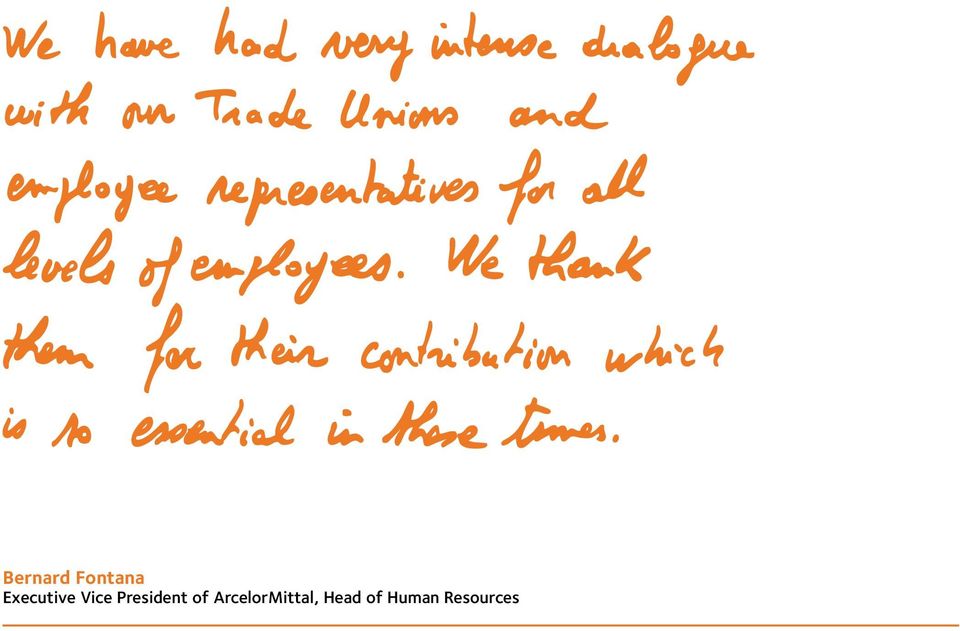
14 Bernard Fontana Executive Vice President of ArcelorMittal, Head of Human Resources
15

16 Highlights 2009 Highlights In January 2009, ArcelorMittal began trading on a single order book in Paris, Amsterdam and Brussels, under the symbol MT. ArcelorMittal remains a member of key NYSE-Euronext indices, including the CAC40 and the AEX. 1 1 For information about additional exchanges where ArcelorMittal is listed, please refer to the Market Information section in this Annual Report.

17 2009 Highlights 15 January Transaction with Soteg ArcelorMittal contributed its 76.9% stake in Saar Ferngas AG to Luxembourg-based utility Soteg, in which it held a minority ownership stake. Upon completion, ArcelorMittal s stake in Soteg increased from 20% to 26.2%. ArcelorMittal then sold 2.48% of Soteg to the Government of Luxembourg and SNCI ( Société Nationale de Crédit et d Investissement ), a Luxembourg governmentcontrolled investment. ArcelorMittal retains a 25.3% stake in Soteg, renamed Enovos. April European Works Council talks ArcelorMittal met with its European Works Council to provide an update on the temporary suspension of production at sites in Europe. In light of the ongoing exceptional economic environment, it was necessary to continue to suspend and optimize production to ensure the Company was well adapted to the market reality. All production suspensions were temporary and reviewed on a regular basis. May Agreement with Czech Government ArcelorMittal and the Czech Government agreed to resolve all pending arbitration and litigation regarding the privatization of Nova Hut and Vítkovice Steel. ArcelorMittal agreed to an amicable settlement of all pending litigation and arbitration cases against the Czech Government and its related entities. In addition, ArcelorMittal increased its stake in ArcelorMittal Ostrava to approximately 83%. As a part of the overall settlement agreement, ArcelorMittal Ostrava concluded a long-term supply agreement for hot metal with Evraz Vítkovice Steel. October Disposal ArcelorMittal signed a definitive agreement to divest its minority interest in Wabush Mines, Canada, pursuant to which it will receive $34.28 million for its 28.6% stake. After the disposal, ArcelorMittal continued to have significant mining operations and resources in Canada including ArcelorMittal Mines Canada. November Increase of stake ArcelorMittal acquired an additional 13.9% stake in ArcelorMittal Ostrava, increasing its stake to approximately 96.4%. The transaction was completed in January December International Volunteer Work Day ArcelorMittal held its second annual International Volunteer Work Day organized by the ArcelorMittal Foundation. It consisted of a set of actions implemented by the Group s local units to encourage employees to invest time and expertise for the benefit of local communities. Recent Developments Increase of stake; joint venture and ArcelorMittal Foundation Following the closing of a tender offer on January 7, 2010, ArcelorMittal acquired a 28.8% stake in Uttam Galva Steels Limited ( Uttam Galva ), a leading producer of cold rolled steel, galvanized products and color coated coils and sheets based in Western India that is listed on the major stock exchanges of India. The Company expects to purchase an additional 4.9% from the Promoter R.K. Miglani family in due course. ArcelorMittal entered into initial discussions with BHP Billiton to potentially combine their respective iron ore mining and infrastructure interests in Liberia and Guinea within a joint venture. ArcelorMittal, through the ArcelorMittal Foundation, donated $1 million to help the relief efforts in Port-au-Prince, Haiti, following the earthquake that struck the island on January 12, 2010.

18 16 Board of Directors Board of Directors ArcelorMittal continues to place a strong emphasis on corporate governance. ArcelorMittal has eight independent directors on its 11-member Board of Directors. ArcelorMittal s Audit Committee and Appointments, Remuneration and Corporate Governance Committee are each comprised of three independent directors and half of the members of ArcelorMittal s Risk Management Committee are required to be independent. On May 12, 2009, the expirations of the mandates of Sergio Silva de Freitas, Michel Angel Marti and Jean-Pierre Hansen were accepted by the annual general meeting. Narayanan Vaghul, Wilbur L. Ross and François Pinault were re-elected as members of the Board of Directors. After the annual general meeting held on May 12, 2009, Ignacio Fernandez Toxo resigned from the Board of Directors. On September 1, 2009, Malay Mukherjee resigned from the Board of Directors. Georges Schmit resigned from the Board of Directors effective December 31, In replacement of Mr. Schmit, the Board appointed Jeannot Krecké as an interim board member starting January 1, Mr. Krecké s full appointment to the Board of Directors will be proposed to the shareholders at the Company s annual general meeting on May 11, Like Mr. Schmit, Mr. Krecké will serve on ArcelorMittal s Board of Directors as a shareholder representative.

19 Board of Directors 17 Lakshmi N. Mittal Lewis B. Kaden Vanisha Mittal Bhatia Lakshmi N. Mittal, 59, is the Chairman and CEO of ArcelorMittal. Mr. Mittal founded Mittal Steel Company (formerly the LNM Group) in 1976 and guided its strategic development, culminating in the merger with Arcelor, agreed in 2006, to found the world s largest steelmaker. Since the merger, Mr. Mittal has led a successful integration, establishing ArcelorMittal as one of the world s foremost industrial companies. He is widely recognized for the leading role he has played in restructuring the steel industry towards a more consolidated and globalized model. Mr. Mittal is an active philanthropist and a member of various trusts and boards, including the boards of directors of Goldman Sachs, EADS and ICICI Bank Limited. He is also a member of the Foreign Investment Council in Kazakhstan, the International Investment Council in South Africa, the Investors Council to the Cabinet of Ministers of Ukraine, the World Economic Forum s International Business Council, the World Steel Association s Executive Committee and the Presidential International Advisory Board of Mozambique. He also sits on the Advisory Board of the Kellogg School of Management in the United States. Mr. Mittal began his career working in the family s steelmaking business in India, and has over 30 years of experience working in steel and related industries. In addition to forcing the pace of industry consolidation, he has also championed the development of integrated mini-mills and the use of DRI as a scrap substitute for steelmaking. Following the transaction combining Ispat International and LNM Holdings to form Mittal Steel in December 2004, together with the simultaneous announcement of the acquisition of International Steel Group in the United States to form the world s then-leading steel producer, Mr. Mittal was awarded Fortune magazine s European Businessman of the Year In 1996, Mr. Mittal was awarded Steelmaker of the Year by New Steel in the United States and the Willy Korf Steel Vision Award by World Steel Dynamics in 1998 for outstanding vision, entrepreneurship, leadership and success in global steel development. Following the creation of ArcelorMittal, Mr. Mittal was awarded Business Person of 2006 by the Sunday Times, International Newsmaker of the Year 2006 by Time Magazine and Person of the Year 2006 by the Financial Times for his outstanding business achievements. In January 2007, Mr. Mittal was presented with a fellowship from King s College London, the college s highest award. He also received the 2007 Dwight D Eisenhower Global Leadership Award, the Grand Cross of Civil Merit from Spain and was named AIST Steelmaker of the Year. In January 2008, Mr. Mittal was awarded the Padma Vibhushan, India s second highest civilian honor, by the President of India. In September 2008, Mr. Mittal was chosen for the third Forbes Lifetime Achievement Award, which honors heroes of entrepreneurial capitalism and free enterprise. Mr. Mittal was born in Sadulpur in Rajasthan, India on June 15, He graduated from St Xavier s College in Kolkata where he received a Bachelor of Commerce degree. Mr. Mittal is married to Usha Mittal, and has a son, Aditya Mittal and a daughter, Vanisha Mittal Bhatia. Lewis B. Kaden, 67, is the Lead Independent Director of ArcelorMittal. He has approximately 40 years of experience in corporate governance, financial services, dispute resolution and economic policy. He is currently Vice Chairman of Citigroup. Prior to that, he was a partner of the law firm Davis Polk & Wardwell, and served as Counsel to the Governor of New Jersey, as a Professor of Law at Columbia University and as director of Columbia University s Center for Law and Economic Studies. He has served as a director of Bethlehem Steel Corporation for ten years and is currently Chairman of the Board of Directors of the Markle Foundation. He is a member of the Council on Foreign Relations and has been a moderator of the Business-Labor Dialogue. Mr. Kaden is a magna cum laude graduate of Harvard College and of Harvard Law School. He was the John Harvard Scholar at Emmanuel College, Cambridge University. Mr. Kaden s principal duties and responsibilities as Lead Independent Director are as follows:

20 18 Board of Directors Narayanan Vaghul Wilbur L. Ross, Jr François Pinault José Ramón Álvarez Rendueles Co-ordination of activities of the other Independent Directors; Liaison between the Chairman and the other Independent Directors; Calling meetings of the Independent Directors when necessary and appropriate; and Such other duties as are assigned from time to time by the Board of Directors. Vanisha Mittal Bhatia, 29, was appointed as a member of the LNM Holdings Board of Directors in June Mrs. Vanisha Mittal Bhatia was appointed to Mittal Steel s Board of Directors in December She has a Bachelor of Arts degree in Business Administration from the European Business School and has completed corporate internships at Mittal Shipping Ltd., Mittal Steel Hamburg GmbH and an Internet-based venture capital fund. She is the daughter of Mr. Lakshmi N. Mittal. Narayanan Vaghul, 73, has over 50 years of experience in the financial sector. He was the Chairman of ICICI Bank Limited between 2002 and April Previously, he served as the Chairman of the Industrial Credit and Investment Corporation of India, a long-term credit development bank for 17 years and, prior to that, served as Chairman of the Bank of India and Executive Director of the Central Bank of India. He was chosen as Businessman of the Year in 1992 by Business India and has served as a consultant to the World Bank, the International Finance Corporation and the Asian Development Bank. Mr. Vaghul was also a visiting Professor at the Stern Business School at New York University. Mr. Vaghul is Chairman of the Indian Institute of Finance Management & Research and is also a Board member of various other companies, including Wipro, Mahindra & Mahindra, Nicholas Piramal India, Apollo Hospitals and Himatsingka Seide. Narayanan Vaghul was awarded the Padma Bhushan, the third highest civilian honor in India. The award will be formally conferred in April 2010 by the President of India. Wilbur L. Ross, Jr., 72, has served as the Chairman of the ISG Board of Directors since ISG s inception. Mr. Ross is the Chairman and Chief Executive Officer of WL Ross & Co. LLC, a merchant banking firm, a position that he has held since April Mr. Ross is also the Chairman and Chief Executive Officer of WLR Recovery Fund L.P., WLR Recovery Fund II L.P., Asia Recovery Fund, Asia Recovery Fund Co-Investment, Nippon Investment Partners and Absolute Recovery Hedge Fund. Mr. Ross is also Chairman of Invesco Private Capital, Ohizumi Manufacturing Company in Japan, International Textile Group, International Coal Group and of American Home Mortgage Servicing Inc. Mr. Ross is a Board member of the Turnaround Management Association, Nikko Electric in Japan, Clarent Hospital Corp. and International Automotive Components. He also serves as a Director to Compagnie Européenne de Wagons SARL (Luxembourg), Wagon PLC (UK), the Japan Society, the Whitney Museum of American Art and the Yale School of Management. Previously, Mr. Ross served as the Executive Managing Director at Rothschild, the investment banking firm, from October 1974 to March 2000 and as Chairman of the Smithsonian Institution National Board. François Pinault, 73, set up his first company in 1963, in the timber business. In 1988, the Pinault Group was listed on the Paris stock exchange. Renamed PPR, the company founded by François Pinault is today led by his son François Henri Pinault, has two major activities: Retail business with CFAO, a leading distributor of household goods, La Redoute, a leader in mail order trading, La FNAC, a leading retailer of cultural products in Europe, and Puma, a leader in sports products; Luxury goods business with Gucci Group, the second biggest luxury group in the world with famous brands such as Gucci, Yves Saint-Laurent, Bottega Veneta, Sergio Rossi, Boucheron, Stella McCartney, Alexander McQueen, Bedat & Co and Balenciaga.

21 Board of Directors 19 Jeannot Krecké John O. Castegnaro Antoine Spillmann H.R.H. Prince Guillaume de Luxembourg At the same time, François Pinault set up a separate structure in order to invest in companies with strong growth potential, but in sectors distinct from that of PPR. Founded in 1992 and fully controlled by François Pinault and his family, Artemis controls the famous French vineyard Chateau-Latour, the news magazine Le Point, the auction house Christie s, as well as part of the share capital of Vinci. François Pinault also owns the Rennes Football Club and the Marigny Theatre. As one of the largest collectors of contemporary art, François Pinault acquired the Palazzo Grassi in Venice in May 2005 to display its art collection and to organize cultural events. He also acquired La Punta Della Dogana in Venice to set up a contemporary art center. His collection is also displayed outside Venice. José Ramón Álvarez Rendueles, 69, has extensive experience in the financial, economic and industrial sectors. He is a former Governor of the Bank of Spain and President of the Bank Zaragozano. He is the President of the Board of Directors of ArcelorMittal España, Peugeot España and Sanitas. He is also a retired full professor of public finance at the Universidad Autónoma de Madrid and a Director of Gestevisión Telecinco S.A., and Generali España. Jeannot Krecké, 59, started his university studies at the Université Libre de Bruxelles in 1969, from which he obtained a degree in physical and sports education. He decided in 1983 to change professional direction. His interests led him to retrain in economics, accounting and taxation. Following the Luxembourg legislative elections of June 13, 2004, Jeannot Krecké was appointed Minister of the Economy and Foreign Trade as well as Minister of Sports on July 31, Upon the return of the coalition government formed by the Christian Social Party (CSV) and the Luxembourg Socialist Workers Party (LSAP) as a result of the legislative elections of June 7, 2009, Jeannot Krecké retained the portfolio of Minister of the Economy and Foreign Trade on July 23, From July 2004, Jeannot Krecké represented the Luxembourg government on the Council of Ministers of the European Union in the Internal Market and Industry sections of its Competitiveness configuration as well as on the Economic and Financial Affairs Council and in the Energy section of its Transport, Telecommunications and Energy configuration. He was also a member of the Eurogroup from July 2004 to June John O. Castegnaro, 65, serves as a representative of the employees of ArcelorMittal. He is a member of the Luxembourg Parliament and Honorary Chairman of the Onhofhängege Gewerkschaftsbond Lëtzebuerg (OGB-L) trade union. Antoine Spillmann, 46, worked for leading investment banks in London from 1986 to He is an asset manager and executive partner at the firm Bruellan Wealth Management, an independent asset management company based in Geneva. Mr. Spillmann studied in Switzerland and London and holds degrees from the London Business School in Investment Management and Corporate Finance. H.R.H. Prince Guillaume de Luxembourg, 46, worked for six months at the International Monetary Fund in Washington, DC, and spent two years working for the Commission of European Communities in Brussels. He studied at the University of Oxford in the United Kingdom, and Georgetown University in Washington, DC, from which he graduated in 1987.
22 20 Senior Management Senior Management Group Management Board The strategic direction of the business is the responsibility of the GMB under the supervision of the Board of Directors. The GMB members are appointed by the Board of Directors and the GMB is headed by Lakshmi N. Mittal as Chief Executive Officer. On January 1, 2010, Peter Kukielski joined the GMB as Head of Mining, bringing a wealth of strategy, operations, project development and international experience to the Company. The senior management team continues to enjoy the relevant talent and expertise it needs to continue to deliver the best possible performance to all stakeholders.
23 Senior Management 21 Lakshmi N. Mittal Aditya Mittal Michel Wurth Gonzalo Urquijo Aditya Mittal, CFO, Responsible for Flat Americas, M&A, Investor Relations, Strategy and Communications Aditya Mittal, 33, is Chief Financial Officer of ArcelorMittal with additional responsibility for M&A Business & Project Development, Flat Americas, Strategy, Investors Relations and Communications. Prior to the merger to create ArcelorMittal, Aditya Mittal held the position of President and CFO of Mittal Steel Company from October 2004 to He joined Mittal Steel in January 1997 and has held various finance and management roles within the company. In 1999, he was appointed Head of Mergers and Acquisitions for Mittal Steel. In this role, he led the company s acquisition strategy, resulting in Mittal Steel s expansion into Central Europe, Africa and the United States. Besides the M&A responsibilities, Aditya Mittal was involved in post-integration, turnaround and improvement strategies. Michel Wurth, Responsible for Flat Europe, Steel Solutions and Services, Products Development and R&D, Global Customers Michel Wurth, 55, was previously Vice President of the Group Management Board of Arcelor and Deputy CEO, with responsibility for Flat Carbon Steel Europe and Auto, Flat Carbon Steel Brazil, Coordination Brazil, Coordination Heavy Plate, R&D, NSC Alliance. The merger of Aceralia, Arbed and Usinor leading to the creation of Arcelor in 2002 led to Michel Wurth s appointment as Senior Executive Vice President and CFO of Arcelor, with responsibility over Finance and Management by Objectives. Michel Wurth joined Arbed in 1979 and held a variety of functions including Secretary of the Board of Directors, head of the Arbed subsidiary Novar and Corporate Secretary, before joining the Arbed Group Management Board and becoming its Chief Financial Officer in He was named Executive Vice President in Michel Wurth holds a law degree from the University of Grenoble, a degree in Political Science from the Institut d Études Politiques de Grenoble and a Master of Economics degree from the London School of Economics. Gonzalo Urquijo, Responsible for Long Products, China, Stainless, Tubular Products, Corporate Responsibility: ArcelorMittal Foundation, Investment Allocation Committee (IAC) Chairman Gonzalo Urquijo, 48, previously member of the Group Management Board and Senior Executive Vice President and Chief Financial Officer of Arcelor, held the following responsibilities: Finance, Purchasing, IT, Legal Affairs, Investor Relations, Arcelor Steel Solutions and Services, and other activities. Gonzalo Urquijo also held several other positions within Arcelor, including Deputy Senior Executive Vice President and Head of the functional directorates of distribution. Until the creation of Arcelor in 2002, when he became Executive Vice President of the Operational Unit South of the Flat Carbon Steel sector, Mr. Urquijo was CFO of Aceralia. Between 1984 and 1992, he held a variety of positions at Citibank and Crédit Agricole before joining Aristrain in 1992 as CFO and later Co-CEO. Gonzalo Urquijo is a graduate in Economics and Political Science of Yale University and holds an MBA from the Instituto de Empresa in Madrid.
24 22 Senior Management Sudhir Maheshwari Christophe Cornier Davinder Chugh Peter Kukielski Sudhir Maheshwari, Responsible for Corporate Finance, M&A and Business Development including India, and Risk Management; Alternate Chairman of the Corporate Finance and Tax Committee and Chairman of the Risk Management Committee (reporting to CFO) Mr. Maheshwari, 46, was previously a Member of the Management Committee of ArcelorMittal, Responsible for Finance and M&A. Prior to this, he was Managing Director, Business Development and Treasury at Mittal Steel from January 2005 until its merger with Arcelor in 2006 and Chief Financial Officer of LNM Holdings N.V. from January 2002 until its merger with Ispat International in December Mr. Maheshwari has over 23 years of experience in the steel and related industries. He has played an integral and leading role in all acquisitions in recent years including the ArcelorMittal merger and turnaround and integration thereof. He also plays a key leading role in various corporate finance, funding and capital market projects, including the initial public offering in 1997 and the various banking and public market financing transactions since then. Over a 21-year career with ArcelorMittal, he also held the positions of Chief Financial Officer at Mittal Steel Europe S.A., Mittal Steel Germany and Mittal Steel Point Lisas, and Director of Finance and M&A at Mittal Steel. Mr Maheshwari also serves on the Board of various subsidiaries of ArcelorMittal. Mr. Maheshwari is an honors graduate in accounting and commerce from St. Xavier s College, Calcutta and a fellow of The Institute of Chartered Accountants and The Institute of Company Secretaries in India. This led to Mittal Steel emerging as the world s largest and most global steel producer, growing its steelmaking capacities fourfold. As CFO of Mittal Steel, he also initiated and led Mittal Steel s offer for Arcelor to create the first 100 million tonne plus steel company. In 2008, Aditya Mittal was awarded European Business Leader of the Future by CNBC Europe. In 2009, he was also ranked 4th in the 40-under-40 list of Forbes magazine. He is a member of the World Economic Forum s Young Global Leaders Forum, the Young President s Organization, a Board Member at the Wharton School, a Board Member at Bennett, Coleman & Co., a Board Member at PPR and a member of Citigroup s International Advisory Board. Aditya Mittal holds a Bachelor s degree of Science in Economics with concentrations in Strategic Management and Corporate Finance from the Wharton School in Pennsylvania. Aditya Mittal is the son of Mr. Lakshmi N. Mittal. Christophe Cornier, Responsible for Asia, Africa, Technology and Projects Christophe Cornier, 57, was previously a Member of the Management Committee of ArcelorMittal, Responsible for Flat Carbon Western Europe. Prior to that, Christophe Cornier was responsible for Arcelor s flat products activities in Europe and for its worldwide automotive sector since December 2005, when he was appointed a member of the Arcelor s Management Committee. In June 2005, he was appointed head of Arcelor s Client Value Team. Upon the creation of Arcelor in 2002, he was named Executive Vice-President of FCS Commercial Auto. Before that, he was CEO of Sollac Mediterranée. In 1998, he was appointed CEO of La Magona, after joining Sollac Packaging as Managing Director in In 1985 he joined Usinor, where he was Business Development Director and Chief Controller of Sollac. He began his career with the French Ministry of Industry, which he left as a Deputy Director. Mr. Cornier is a graduate of the École Polytechnique and the École des Mines in Paris.
25 Senior Management 23 Davinder Chugh, Responsible for Shared Services (reporting to CEO), IAC Member Davinder Chugh, 53, has over 30 years of experience in the steel industry in general management, materials purchasing, marketing, logistics, warehousing and shipping. Davinder Chugh was previously a Senior Executive Vice President of ArcelorMittal responsible for Shared Services until Before becoming a Senior Executive Vice President of ArcelorMittal, he served as the CEO of Mittal Steel South Africa until Mr. Chugh also worked in South Africa from 2002 after the acquisition of Mittal Steel South Africa (ISCOR) and was involved in the turnaround and consolidation of the South African operations of ArcelorMittal. He also served as Director of Commercial and Marketing at Mittal Steel South Africa, among other positions. Mr. Chugh was Vice President of Purchasing in Mittal Steel Europe until 2002, where he consolidated procurement and logistics across plants in Europe. Prior to this, he held several senior positions at the Steel Authority India Limited in New Delhi, India. He holds degrees in science and law and has a Master of Business Administration. Peter Kukielski, Senior Executive Vice President, Head of Mining On December 15, 2008, Peter Kukielski, 53, was appointed Senior Executive Vice President and Head of Mining of ArcelorMittal. Mr. Kukielski will be responsible for the Company s mining business and for driving its development. Mr. Kukielski was most recently Executive Vice President and Chief Operating Officer at Teck Cominco Limited. Prior to joining Teck Cominco, he was Chief Operating Officer of Falconbridge Limited before which he held senior engineering and project management positions with BHP Billiton and Fluor Corporation. Mr. Kukielski holds a Bachelor of Science degree in civil engineering from the University of Rhode Island and a Master of Science degree in civil engineering from Stanford University. Effective as of January 1, 2010, Peter Kukielski was appointed member of the Group Management Board. Management Committee Name Age 1 Position Bhikam Agarwal 57 Executive Vice President, Head of Finance Vijay Bhatnagar 62 Executive Vice President, CEO India Philippe Darmayan 57 Executive Vice President, CEO Steel Solutions and Services Phil du Toit 57 Executive Vice President, Head of Mining Projects and Exploration Bernard Fontana 48 Executive Vice President, Head of Human Resources Jean-Yves Gilet 53 Executive Vice President, CEO Stainless Pierre Gugliermina 58 Executive Vice President, Chief Technology Officer Robrecht Himpe 51 Executive Vice President, CEO Flat Europe Gerson Alves Menezes 60 Executive Vice President, CEO Long Carbon Americas (LCA) Michael Pfitzner 60 Executive Vice President, Head of Marketing and Commercial Coordination Arnaud Poupart-Lafarge 44 Executive Vice President, CEO Africa and Commonwealth of Independent States (CIS) Gerhard Renz 62 Executive Vice President, CEO Long Europe Michael Rippey 52 Executive Vice President, CEO USA Lou Schorsch 60 Executive Vice President, CEO Flat Americas Bill Scotting 51 Executive Vice President, Head of Strategy 1 Age as of December 31, 2009
26 24 Business Strategy Business Strategy ArcelorMittal s success has been built upon a consistent strategy that emphasizes size and scale, vertical integration, product diversity, continuous growth in higher value products and a strong customer focus. The Group intends to continue to be the global leader in the steel industry, in particular through its three-dimensional strategy for sustainability and growth.
27 Business Strategy 25 ArcelorMittal has unique geographical and product diversification, coupled with upstream and downstream integration that reduces exposure to risk and cyclicality. This strategy can be broken down into its three major elements: Geography: ArcelorMittal is the largest producer of steel in Europe, North and South America, Africa, the second largest steel producer in the CIS region, and has a growing presence in Asia, particularly in China. ArcelorMittal has steelmaking operations in 20 countries on four continents, including 65 integrated, mini-mill and integrated mini-mill steelmaking facilities which provide a high degree of geographic diversification. Approximately 35% of its steel is produced in the Americas, approximately 47% is produced in Europe and approximately 18% is produced in other countries, such as Kazakhstan, South Africa and the Ukraine. ArcelorMittal is able to improve management and spread its risk by operating in six segments (Flat Carbon Americas, Flat Carbon Europe, Long Carbon Americas and Europe, AACIS, Stainless Steel and Steel Solutions and Services), reflecting its geographic and product diversity. Worldwide steel demand in recent years has been driven by growth in developing economies, in particular in the BRICET 1 countries. The Company s expansion strategy in recent years has given it a leading position in Africa, Central and Eastern Europe, South America and Central Asia. The Company is also building its presence in China and India and recently made its first strategic investment in India in Uttam Galva. Products: As a global steel producer, ArcelorMittal is able to meet the needs of diverse markets. Steel consumption and product requirements are different in mature economy markets and developing economy markets. Steel consumption in mature economies is weighted towards flat products and a higher value-added mix, while developing markets utilize a higher proportion of long products and commodity grades. As these economies develop, local customers will require increasingly advanced steel products as market needs evolve. To meet these diverse needs, ArcelorMittal maintains a high degree of product diversification and seeks opportunities to increase the proportion of its product mix consisting of higher value-added products. The Company produces a broad range of high-quality finished, semi-finished carbon steel products and stainless steel products. Worldwide steel demand in recent years has been driven by growth in developing economies, in particular in the BRICET 1 countries. Value chain: ArcelorMittal has access to high-quality and low-cost raw materials through its captive sources and long-term contracts. ArcelorMittal plans to continue to develop its upstream and downstream integration in the medium-term, following a return to a more favorable market environment. Accordingly, the Company intends in the medium term to increase selectively its access to and ownership of low-cost raw material supplies, particularly in locations adjacent to or accessible from its steel plant operations. Downstream integration is a key element of ArcelorMittal s strategy to build a global customer franchise. In high-value products, downstream integration allows steel companies to be closer to the customer and capture a greater share of value-added activities. As its key customers globalize, ArcelorMittal intends to invest in value-added downstream operations, such as steel service centers and building and construction support services for the construction industry. In addition, the Company intends to continue to develop its distribution network in selected geographic regions. ArcelorMittal believes that these downstream and distribution activities should allow it to benefit from better market intelligence and better manage inventories in the supply chain to reduce volatility and improve working capital management. Furthermore, ArcelorMittal will continue to expand its production of value-added products in developing markets, leveraging off its experience in developed markets. Growth Prospects Notwithstanding the difficult market conditions of 2008 and 2009, ArcelorMittal s management believes that there will be strong global steel demand growth in the medium to long term. The Company will continue to invest opportunistically in expanding the production capacity of its existing facilities depending on market conditions and projected global and regional demand trends. Mergers and acquisitions have historically been a key pillar of ArcelorMittal s strategy to which it brings unique experience, particularly in terms of integration. Instead of creating new capacity, mergers and acquisitions increase industry consolidation and create synergies. ArcelorMittal has also placed strong emphasis on growth in emerging economies through greenfield developments. In light of the difficult economic and market conditions prevailing in late 2008 and 2009, ArcelorMittal curtailed mergers and acquisitions and greenfield investment activity. To the extent market conditions continue to improve, however, the Company gradually expects to resume mergers and acquisitions and other investment activity in order to take advantage of selected growth opportunities, mainly in emerging markets. In addition the Company remains focused on pursuing its greenfield growth opportunities. 1 BRICET refers to the countries of Brazil, Russia, India, China, Eastern Europe and Turkey.
28 Nicola Davidson Vice President of ArcelorMittal, Head of Corporate Communications
29
30 28 Corporate Responsibility Corporate Responsibility ArcelorMittal believes the sustainability of its business and the creation of long-term shareholder value go hand-in-hand with the wellbeing of its people and the communities in which it operates. The Group s Corporate Responsibility (CR) approach plays an important role in helping it address key issues both local and global affecting its operations. Key impact areas are addressed through its dedicated CR strategy. By operating in a responsible and transparent manner and establishing good relationships with stakeholders, ArcelorMittal is better able to attract and retain top talent, manage risk and enhance value creation. ArcelorMittal aims to adhere to best-practice guidelines in its environmental, social and governance reporting. While the following pages provide an outline of the Group s CR strategy and performance, more detailed information and analysis is available in a separate CR report published in tandem with this Annual Report. This is available at CR Governance The Board of Directors oversees CR across the Company. Reports covering disclosure, environment, Health and Safety, community and employee engagement, and ArcelorMittal Foundation investments were submitted at each of its meetings during The Group Management Board representative for CR is Gonzalo Urquijo. Matters of specific relevance to the Group, such as community engagement, human rights and local CR governance, as part of summary CR reports, were discussed at least every quarter at the Group Management Board meetings. In parallel, specific presentations were made on among other subjects: Health and Safety and environment. Key risks and mitigating actions are detailed in subsequent sections of this chapter. At Group level, the corporate CR team is supported by the CR Coordination Group which acts as an adviser; reviewing standards, examining possible risks, monitoring the implementation of the CR strategy, and guiding communications. It consists of senior management from other corporate areas, including Risk, Internal Assurance, Company Secretary, Communications and Legal. The CR Coordination Group meets periodically through formal meetings and workshops. At local level, the Group is in the process of establishing a participatory CR governance structure to promote effective community relations and CR management. This is supported by roles and accountability descriptions for CEOs/plant managers and CR Coordinators at all levels within the Group. CR Strategy ArcelorMittal s CR strategy is structured around four focus areas that reflect the key priorities of its business and its stakeholders: Investing in our people It is a core tenet of Group policy that each and every person working for ArcelorMittal feels valued. Making steel more sustainable The Group is focused on achieving a continuous improvement in environmental performance through the development of cleaner processes and greener products. Enriching our communities ArcelorMittal plays an important role in all the communities where it operates. Transparent governance The Group s business strategy, operations and everyday practices are underpinned by transparent corporate governance. The four CR strategy areas are measured through 14 measurable Key Performance Indicators (KPIs). These are described in more detail in the stand-alone CR report.
31 Corporate Responsibility 29 Investing in our People Health and Safety: The Journey to Zero Whatever the economic backdrop, ArcelorMittal s first priority is to ensure the highest standards of Health and Safety. The Group s Journey to Zero Health and Safety improvement process is delivering concrete results helping ArcelorMittal realize its goal of becoming one of the safest steel companies in the world. Journey to Zero At ArcelorMittal, Health and Safety is the top priority. The Group s Health and Safety policy aims at reducing the frequency of accidents and the occurrence of fatalities on a continuing basis, and underlines the commitment ArcelorMittal has made to the wellbeing and safety of all employees both on and off the job. Journey to Zero, ArcelorMittal s Health and Safety improvement process launched in September 2008, is now the platform for all measures aimed at improving Health and Safety in the Group. The focus is on preventative activities and improved standards through the effective implementation of best practices including hazard identification and risk analysis, accident/incident investigation, critical task analysis, follow-up on performance indicators, system review and much more. Performance In 2009, the Group s Lost Time Injury Frequency Rate improved again falling to 1.9 per million hours worked. That compares with 2.5 in 2008, for both steel and mining. A 20% reduction is again targeted for To leverage best practice and improve the Health and Safety performance around the Group, 12 top priority sites have been identified, for which a specific approach has been defined to stimulate progress. Benchmarking is of major importance for the Group since it will help the sites to make faster progress on their Journey to Zero. Benchmarking will be supported by an appropriate multilingual IS/IT tool, of which a first version became available in December It will be fully ready and deployed by April Global Joint Health and Safety Agreement ArcelorMittal signed a Global Joint Health and Safety Agreement, the first of its kind, with its labor unions in June In 2009, meetings of the Joint Global Health and Safety Committee were held in Lázaro Cárdenas, in Mexico, Temirtau, in Kazakhstan (a follow-up visit), Ostrava, in Czech Republic, and Galati, in Romania. The Committee also followed up on all actions undertaken as a consequence of visits made since the start of this cooperation. A questionnaire was launched and evaluated on how the sites perceive the Joint Health and Safety Committees and the advantages they can draw from the process. The results were very positive. Health and Safety Day Despite the economic crisis, an enormous effort was made across the Group to maintain the momentum of previous Health and Safety Days. As in prior years, the Group-wide Health and Safety Day was observed in all of ArcelorMittal s worldwide operations. It is an occasion to involve all staff in discussing safety improvements, new targets and associated safety programs at Group as well as plant level. The date April 28 was chosen to coincide with the International Labor Organization s World Day for Safety and Health at Work. Since Leading by Example is essential, the theme for Health and Safety Day was Leading the Journey integrating Leading by Example and Journey to Zero. Extra emphasis was placed on health and the sharing of best practices within the Group-wide health network. The 2010 Health and Safety Day will again take place on April 28 and will reinforce the Leading by Example theme, as well as health topics. Achieving a quick reduction in fatalities Conscious of the Company s responsibility to do all it can to avoid fatalities, new initiatives were launched in 2009 to speed up the progress on fatality prevention. Implementation of the Fatality Prevention Standards of all sites is now being audited. This approach has been especially adopted for the top priority sites while other sites are required to undertake self-assessments based on questionnaires used Group-wide. The process involves the implementation of appropriate action plans by the sites to close any gap between the standards and reality, the dissemination of lessons learned from fatalities in a closed loop approach and a detailed investigation of other serious occurrences. A database for the follow-up has been created. Lost Time Injury Frequency Rate Segment Flat Carbon Americas Flat Carbon Europe Long Carbon Americas and Europe AACIS Stainless Steel Steel Solutions and Services Total Steel Total Mines TOTAL (Steel and Mines)
32 30 Corporate Responsibility Investing in our People ArcelorMittal the health of as a key elem success of its Health initiatives: Paying more attention to health ArcelorMittal views the health of its workforce as a key element in the success of its operations. Maintaining good health is critical to the Company s Health and Safety record. In this respect a major effort was made to develop a check list for all sites to deal with the H1N1 Influenza. The network of ArcelorMittal medical specialists collaborating globally with the Group was expanded in 2009, leading to the creation of Communities of Practice. This will permit the Group to mount a stronger campaign of preventative health measures in 2010, targeting such problems as asbestos and fibers, noise, harmful particulates, radiation, gasses, stress, ergonomics and respiratory protection. Other, more general areas to be targeted will include vaccinations, travel, malaria, HIV, addiction and stress management (some of which are non-occupational). Product Safety initiatives: REACH and Product Stewardship ArcelorMittal has continued to prepare the registration of all relevant substances in conformity with the EU s REACH legislation, concerning the registration, evaluation, authorization and restriction of chemicals. For some it is assuming the role of lead registrant and taking an active role with others. Registration will be completed by the end of November 2010.
33 Corporate Responsibility 31 views its workforce ent in the operations. The Product Stewardship team has confirmed that in 2009, all required certificates of products and by-products have been provided to customers, supporting their selling. This approach leads to cooperation with external partners and R&D whenever required or appropriate, and will continue throughout 2010.
34 32 Corporate Responsibility Investing in our People Human Resources The ArcelorMittal Human Resources (HR) professionals help the Company leadership attract, develop and retain tomorrow s leaders, enable employees at all levels to manage their performance, realize their potential and build and maintain good relations and social dialogue with employees and their representatives. In 2009, they played a key role in developing the necessary cost adaptation measures in response to the economic crisis. Dialogue with trade unions and employees Efforts were stepped up in 2009 to keep employees informed about the impact of the economic crisis on the business and to outline the measures taken to overcome the global downturn and to position the Company for future growth. The vast majority of ArcelorMittal employees are represented by trade unions. The Group is party to collective bargaining agreements with many employee organizations as part of its commitment to open dialogue. Social dialogue structure at all levels in the Company facilitates regular, constructive discussions between management and employee representatives. An intense social dialogue has taken place while necessary cost adaptation measures were designed and deployed. The Select Committee of the European Works Council met on a monthly basis in order to be continuously informed of the situation of the Company. To further enhance dialogue, ArcelorMittal signed an anticipation of change agreement with the European Metalworkers Federation. The agreement aims to enhance and support sustainability and competitiveness of ArcelorMittal operations in Europe specifically. Following the signing of a landmark Joint Global Health and Safety (JG H&S) Agreement with all of its trade unions a JG H&S Committee comprising both management and union representatives has been established and meets quarterly. A Joint Health and Safety Committee in every plant now meet at least monthly. The process is monitored by the JG H&S Committee. Workforce plans, skills requirement identification and training The growth plans and the performance continuous improvement programs of the Company require the participation and the development of numerous performers and talents all over the world. Through the Global Executive Development Program (GEDP), ArcelorMittal aligns the performance objectives of employees with the strategic goals of the Company and regularly assesses its managers, providing them with feedback and coaching and supporting their development needs according to the employees aspirations, the Company values and core competencies. Appointments to new challenging jobs and participation in training programs are confirmed in Career Committees that cover all units. In 2009, ArcelorMittal University delivered more than 40,000 days of training to ArcelorMittal managers. Since September 2008, ArcelorMittal has specifically followed 1,096 employees indentified as talents, providing them with development opportunities to participate to internal forums on strategy, finance, human resources, as well as contributing to key Company projects. In ArcelorMittal s plants, workforce plans are deployed at all levels in order to identify the future skill gaps and to train ArcelorMittal employees accordingly. Workforce plans for the management population are consolidated to assess future scarce categories for which specific resourcing plans are then developed. In 2009, all ArcelorMittal major units updated their workforce plans. Diversity & Inclusion Policy ArcelorMittal strives to build a modern and flexible work environment which unleashes the diversity, talent, and originality of its workforce. The Company s commitment towards reaching this goal is embedded in its Diversity & Inclusion policy that was launched in April JobMarketOnline (JMO) JobMarketOnline, the Company s web-based e-resourcing solution, allows for the managing of internal and external resourcing across businesses, functions and within countries. The internal JMO is available in ten languages. The usage of JMO, which recorded over 22,000 internal unique visitors in 2009, was considerably boosted with the launch of a monthly e-newsletter that promotes a selection of vacancies. Business Leaders Program This program targets external recruitment of MBAs or other functional Masters degrees with proven managerial experience and gives them the opportunity to develop into the Group s future leaders. By the end of 2009, there were 68 individuals on the program and six had graduated after completing two assignments in developed and emerging markets or by becoming a senior leader within the organization. Group Engineers Program (GEP) The GEP was developed in order to attract recently graduated, talented and mobile engineers. Its aim is to create a pool of internationally mobile engineers with strong potential for growth and the ability to assume leading positions in the future. In 2009, 133 Group Engineers continued the program of which 109 completed a one-year training and development period. International mobility International mobility is a key lever for the career development of employees and a key competitive advantage for ArcelorMittal. Some 220 mobility plans were finalized in 2009.
35 Corporate Responsibility 33 The purpose of the Steel and Mining Academy is to disseminate an understanding and mastery of steelmaking and related activities. Training and Development: ArcelorMittal University ArcelorMittal University plays a lead role in the training and development of Group employees. In 2009, the University changed the way it delivered much of its training under the motto Grow with us. Training employees is essential for ArcelorMittal. As a consequence, to maintain high levels of training in light of the economic environment in 2009 and cost-saving efforts, a number of the University s programs moved online allowing employees to learn anywhere, anytime at their own pace. Synchronized distance learning was introduced, making use of virtual classrooms for scattered target groups such as communities of subject experts based in different locations. In 2009, about 10,000 employees spent 278,000 hours learning with online programs. The number of users of the Online English and the Online Campus programs increased during 2009, showing the success of these learning tools. However, local classroom training remains the most cost-effective solution for larger groups and consequently ArcelorMittal University has rolled out its corporate programs for local delivery. Among the new initiatives were Lunch & Learn local sessions on key topics for the Company and ULearn, a biweekly e-magazine featuring articles, podcasts and white papers. The Leadership Academy introduced a specially designed program called Recognizing Potential. Launched with 700 participants from more than 40 countries, the program combined e-learning, virtual conferences and optional project work. A new program of Talent Pipeline training will recommence in spring The Management Academy offers a range of programs to improve and enhance personal and team effectiveness, business acumen and interpersonal skills, thus giving opportunity to every employee to enhance leadership and management capabilities. They were similarly delivered through online modules in Training and specific tools on team effectiveness and cross-cultural awareness will be developed in Functional Academies have been set up to offer learning, development, skill and competency enhancing training opportunities. They target each specific functional population, including, in 2009, Steel and Mining, Human Resources, Purchasing, Internal Assurance, IT, Sales and Marketing, Finance and R&D. Steel and Mining Academy The purpose of the Steel and Mining Academy is to disseminate an understanding and mastery of steelmaking and related activities. The academy now operates the University s longstanding programs such as Steel for Steel People and Understanding Steel, for which there was increased participation in New programs were created in sintering and wire drawing and modules on metallurgy, blast furnaces and cold rolling were developed at the request of different plants. In all, more than 1,100 people took part in the academy s programs, an increase of more than 20% on the previous year. The Mining Academy, initiated in 2009, will provide a similar offer for the mining activities in New Group programs The Project Leaders Program aims to create project management experts within the Company who understand the ArcelorMittal way of managing projects and who can be quickly deployed to manage existing brownfield and upcoming greenfield projects. A total of 128 participants were nominated for the one-year program. A new 18-month program focused on talents with a strong financial background and interested by key financial roles in CIS countries was initiated. The program, titled CIS-Finance Future Leaders Program commenced with 22 participants from CIS countries (Ukraine and Kazakhstan), who are interested in transitioning into local leadership positions in finance. In 2010, ArcelorMittal University will continue to support the strengthening of ArcelorMittal s leadership and management skills. Training is a priority for the whole Company, especially after reshuffling teams in The Climate Survey circulated throughout the Company acknowledged the employees desire for a continuous learning environment. Programs are designed to facilitate the development of skilled people that will lead ArcelorMittal into the future. As a result, training will be promoted further through the Functional Academies and specific programs such as Project Leaders Program and Future Leaders Program. The 2010 programs combine online, distance and classroom training, thus providing an efficient and cost effective learning solution, which proved successful in 2009.
36 34 Corporate Responsibility Making Steel more Sustainable Confronting climate change ArcelorMittal recognizes its responsibility towards helping reduce greenhouse gas emissions. Steelmaking is a carbon-intensive process. However, the steel industry in Europe has already taken considerable strides to reduce its carbon footprint, having more than halved its emissions in the past 30 years. Achieving further reductions is a major challenge.
37 Corporate Responsibility 35 However, the Group is responding to that challenge with a variety of initiatives. Some will bear fruit over the medium term; others are essentially long term in nature. ArcelorMittal is committed to making a progressive reduction in the amount of CO2 emitted in the steelmaking process over the next decade. The Group has set a target of reducing emissions by 170kg per tonne of steel produced by That is equivalent to an 8% reduction in specific emissions. The target will be achieved through a combination of process improvements and increased energy efficiency. It is defined for the 2007 perimeter of industrial activities applying a rigorous accounting method taking into account all the emissions including upstream and plant emissions. The target excludes the specific use of scrap or direct reduced iron (DRI) as a means to lower the carbon emission. While many of the Group s plants in Europe, North America and South America are close to the technical limits of what can be achieved in emissions reduction, there is still work to be done to bring other plants up to the standards of the best. To that end, the Group has put in place a benchmarking system that highlights where improvements can still be made. Detailed action plans have been drawn up that set realistic targets for improved efficiency and reduced energy usage. As part of the process, 2009 saw an acceleration in the sharing of best practice around the world. Recycling is an important part in combating climate change. Each year, more than 25 million tonnes of products are recovered and recycled, saving around 36 million tonnes of CO2. At the same time, ArcelorMittal has stepped up the recycling of steelmaking residues. For instance, at the former steelmaking site at Isbergues, northern France, residues from other French and Belgian plants are being reprocessed into ferro-alloys iron, road-building slag and zinc oxide dust, from which other producers extract zinc. Due to the global economic crisis, the production levels of the Group were drastically reduced as compared with previous years. At the same time the emissions of green house gases decreased accordingly. Therefore, the emissions will increase again when the economic activity picks up. In the meantime, however, plans and actions are being executed to improve the carbon efficiency of the operations in line with the commitment for As part of its longer-term approach, ArcelorMittal is working to develop breakthrough technologies. As a key member of the EU Ultra Low CO2 Steelmaking project (ULCOS), the Group is developing a technology that combines CO2 capture through top gas recycling and a possible storage later on. A demonstration project including a small blast furnace at ArcelorMittal Eisenhüttenstadt in Germany and a full scale blast furnace at the Florange plant in France is now being studied by a consortium consisting of most European steelmakers. By using pure oxygen instead of air and recycling gas at the top of the blast furnace, ArcelorMittal expects to achieve a 25% reduction in the amount of carbon used. Around half of the CO2 emitted will then be captured and stored. The technology has the potential to transform the steel industry s carbon footprint. For more information, please see ArcelorMittal receives second consecutive ENERGY STAR honor On March 2, 2009, ArcelorMittal was selected for the second consecutive year as an ENERGY STAR Partner of the Year for its excellent energy management. ArcelorMittal continues to be the only steel company to achieve this respected distinction granted by the US Environmental Protection Agency and the US Department of Energy. Since 2006, ArcelorMittal s US facilities have focused on improving energy efficiency and reducing costs all while increasing productivity. To accomplish these goals, the Company launched an Energy Reduction Initiative that, over the past three years, has helped it reach a 4.1% improvement in energy intensity. This is equivalent to $131 million of annualized savings. Over the past two years, ArcelorMittal s US facilities have achieved energy savings by reducing use of natural gas, fuel oil and purchased electricity. ArcelorMittal USA has also worked hard to spread the word about energy conservation to its employees, families, suppliers, end users and the general public.
38 36 Corporate Responsibility Making Steel more Sustainable Environment The Group constantly invests to develop new processes and more sustainable practices, while working in partnership with its customers to help them develop more sustainable and more energy-efficient products. ArcelorMittal monitors air, water, energy and waste data from all of its facilities and continuously reviews all its environmental impact worldwide. By the end of 2009, 93% of all main production sites had achieved certification to ISO ISO is the internationally recognized standard for environmental management systems. Between 2008 and 2009, the plants achieving certification increased from 142 to 168. Group-wide environmental and energy policies, together with the Company s energy management system, cover every aspect of energy purchase and usage. In 2009, new energy management objectives were set for every plant. They target an average energy saving of 5% by 2013 and are supported by a list of best operational practices and technology standards. Innovations targeted at reducing environmental impact Major advances are already being made. In 2009, ArcelorMittal Kryviy Rih in Ukraine won three prizes in a national energy efficiency competition having implemented 179 different energy saving measures over the previous year. These resulted in savings of 19,000 tonnes of equivalent fuel and more than 15,000 kwh of energy. ArcelorMittal also works to reduce water consumption and is targeting high-priority sites in areas where there are water shortages. The challenge is to employ water re-use techniques from the Group s top-performing plants. Eight sites in Brazil, Spain and South Africa currently generate zero effluent. Reduction of by-products, such as dust, nitrous oxide, sulfur dioxide and volatile organic compounds, are another environmental area of the Company s focus. In Ostrava, in Czech Republic, modernization of sinter plants North and South is expected to reduce dust emissions by 70% and SO2 emissions by 60%; the ongoing project will cost $80 million. In Galati, Romania, the installation of de-dusting equipment, completed in May 2009 at a cost of $20 million, has led to a 95% reduction in dust emissions beyond EU norms. In the quest for ever more sustainable products, a dedicated environment, life-cycle and materials team quantifies the end-to-end impact of the Group s steel products, including the evaluation and validation of new products in partnership with the Research and Development team. It applies the techniques conforming to the ISO life-cycle analysis standard. ArcelorMittal has led in the development of stronger steels that enable its customers to create lighter and more energy-efficient products or reduce the environmental impact of their own activities. Its advanced high-strength steels can reduce the weight of industrial gas cylinders by 30% and the weight of automotive parts by 30%. The Group s S-in motion project, due for deployment in mid-2010, uses the Group s expertise in Advanced High Strength Steels (AHSS) to produce new materials and propose solutions that will reduce the weight of a typical automotive component by a further 20%, while maintaining safety and performance. In the construction market, the Group s high-strength HISTAR steel offers an unprecedented combination of strength, safety and weldability, reducing the weight of steel columns by 32%, which in turn can reduce the CO2 produced in the construction process by as much as 30%. The Group s range of solar panel solutions, relaunched under the amhelios TM name, was extended in Over a 30-year lifetime, amhelios TM can save 75 tonnes of CO2 in typical Western European weather and up to 400 tonnes in other locations. Research and Development In the difficult climate in 2009, Research and Development has shown great flexibility and determination at the same time. With15 major research centers, R&D spending in 2009 amounted to $253 million. While the focus shifted to projects capable of speedy value creation, expenditure on breakthrough research was unchanged and new areas such as mining and mineral processing started generating a high return on investment. One of the lessons of 2009 is that technological differentiation is crucial to sustainability. The ability to offer a range of products that is clearly differentiated in terms of quality and functionality, and to do so at the lowest possible cost, is especially important at a time of economic contraction. R&D has played a key role in minimizing the impact of the economic crisis by deploying new products and solutions that help customers maintain their long-term competitiveness, by providing increased technical assistance to plants worldwide and by supporting production stoppages and contributing to the fast re-start of the Group s blast furnaces and coke ovens. Automotive R&D s five-year development plan recognizes four key factors that are driving the evolution of the automotive market: globalization that combines worldwide vehicle design with regional production, increased passenger safety, reduction in CO2 emissions, and a shift to low-cost cars. ArcelorMittal continues to reinforce its relationship with customers at the early stage of vehicle conception. Through worldwide projects that bring together its European and US automotive research centers, the Group aims to meet auto manufacturers need for identical or equivalent product delivered worldwide in a timely fashion. ArcelorMittal continues to launch new Advanced High Strength Steels (AHSS) to satisfy the demand for increased safety together with weight reduction. Primarily, the offer of coated products for hot stamping has been extended. Last year also saw the further development of the Group s new coating product offer with the roll out of products with enhanced paint appearance for outer panels and coatings, delivering better and cheaper corrosion resistance.
39 Corporate Responsibility 37 In the area of steel solutions for vehicle design, the Group has reinforced its catalogue of lightweight steel design solutions. ArcelorMittal is working as well on the S-in motion project which will deliver in 2010 up-to-date and efficient ideas for optimizing weight and costs for key modules of the vehicle. Appliances Last year saw the implementation of a global R&D project organization to service customers with a worldwide footprint. A number of new products were brought to fruition for launch in They included innovation in the field of steels for enameling and several new products in the surface and coatings area. A new coating offer for improved energy efficiency is proposed for development in Packaging The major development in 2009 was a new Easy Open End offer, designed to reduce the weight of the ends of cans. It will be launched commercially in Construction The Group is recognized as a world leader in structural products and has played a major role in some of the world s most remarkable constructions including the Burj Khalifa Tower in Dubai, the tallest building in the world. R&D focuses on reinforcing the appeal of the Group s products and solutions in a variety of ways, especially in comparison to the design of other materials or to competing suppliers. Recent examples include new Weathering Steel grades for bridges and a corrosionresistant steel grade for improved corrosion resistance for sheet piles. In the area of improved surface performance, examples include Granite Diamond, a stone-look organic coating, Hairclyn and Granite Forever, easy-to-clean coated steels for outdoor applications. R&D also develops solutions that combine steel with complementary materials to deliver improved thermal, acoustic, mechanical or aesthetic performance. The recently launched Granite Comfort range of Infrared-reflective paints improves energy efficiency by reducing the solar heat input. Harvesting renewable energies is a strong societal driver which is reflected within R&D by the launching of the Ekinox photovoltaic roof and co-engineering actions for wind turbines. ArcelorMittal Piracicaba develops eco-brick solution in Brazil ArcelorMittal Piracicaba, in partnership with the University of the State of São Paulo, São Carlos unit, has finished developing a new technology to produce construction bricks, replacing the mix of sand and crushed rock commonly used. The bricks are produced using steel mill slag, a by-product from steelmaking that has historically been considered a waste product. The new bricks reduce the need for natural resources, such as sand and rock, that have to be extracted from the local environment. Process Process R&D focused on raw material substitution through the increased use of internal resources and support for blast furnace and coke oven stoppages and re-starts. In addition, R&D contributed by improving rebar corrosion at Kryviy Rih and accelerated the implementation of a number of plant-specific solutions. R&D activity was initiated in two areas associated with ArcelorMittal s mining operations. The first was the characterization of mineral deposits to assess the qualities of the iron and coal from existing and prospective ArcelorMittal mines. The second area, based on the characterization data, was laboratory work to advise on optimization of the beneficiation route, the energy consumption involved and the possible upgrading of currently discarded ores. Studies were performed for both the Group s existing operations and those reserves under development. ULCOS During the year, the work on the ULCOS project aiming at developing new steel production technologies with low CO2 emissions progressed well. The EU-backed ULCOS 1 project will finish at the end of Plans for further developments of the most promising technologies are also advancing. Stainless, alloyed steels, specialties and tubular products R&D has mainly focused on synergies between the different market segments and the development of new grades with reduced alloying elements without compromising service properties. Part of ArcelorMittal s commitment to making steel more sustainable is to find innovative ways to manage its residues. Not only will this result in cost savings to the Company, but it will also improve the environment by reducing the amount of waste we produce. The efficacy of this new brick-making technology was proven by the construction of an experimental model house using bricks created from slag. The house was finished in July 2009 and the environmental viability of these bricks is being assessed by the São Paulo State Organ for Environmental Sanitation. This has resulted for example in the development of: Lean alloyed high strength steels in U.S., European and Algerian production mills; A new duplex stainless steel offer in the Group s European and Brazilian facilities for the most severe corrosion resistance applications; New stainless ferritic grades without Nickel, designed to replace the more expensive austenitics; A new mold steel family for plastic injection applications as dashboards for car industry; New tenasteel grade designed to improve the punching conditions of high strength steels. The second major R&D contribution has been in the development of new products and solutions in the area of green energies. This includes the strong involvement in the development of new designs for photovoltaic and thermal solar panels, as well as new electrical steels with low losses and high magnetic properties for the next generation of electrical vehicles and transformers. The future In 2010, the scope of the Group s Process R&D activities will be extended to commit more resources to areas such as coke and coal, refractories, environmental issues, by-products and water conservation. There will also be a new focus on pipes and tubes. Most exciting of all, the year is expected to mark the industrialization of a number of breakthrough products with important implications for the Group s future competitiveness.
40 38 Corporate Responsibility Enriching our Communities Community Engagement Standard ArcelorMittal plays an important role in all the communities where it operates. Many of the Group s plants are located in developing countries that are facing economic and social challenges. This makes it even more important to encourage economic growth and foster the development of strong and sustainable local communities. The Group does this by working in active partnership with local organizations in an open and transparent manner that is sensitive to local issues and priorities. ArcelorMittal recognizes that what it does has an impact on others. The Group needs to understand exactly what these impacts are and manage them proactively, taking people s rights and priorities into account. ArcelorMittal has started to invest significant time and resources in improving and growing our community engagement programs. There is a mandatory community engagement standard in place that all major industrial sites have to follow. This is supported by a detailed manual and an online training course that offers practical guidance about setting up and running community engagement activities. In 2009, ArcelorMittal engaged in a wide range of different projects aimed at education and skills development, employment, healthcare, infrastructure and a variety of social issues. Further details are available in the Group s CR Report. ArcelorMittal Foundation Established in 2007, the ArcelorMittal Foundation is a non-profit organization, with the mission to promote ArcelorMittal s commitment to the local communities where the Group operates and to contribute to their development in a sustainable manner. Working with the local business units, its priority areas are education, health and social promotion. The Foundation engages in initiatives that maximize long-term economic growth and foster entrepreneurship, while respecting the needs of local people. Preference is given to projects that can quickly become self-sustainable since these tend to benefit the maximum number of people. The Foundation operates in 27 countries and it also acts as a worldwide organization investing in global programs to support humanitarian initiatives. In 2009, it supported more than 550 projects with a monetary value of $31.3 million, reaching 8.86 million direct beneficiaries. The Foundation s initiatives are aligned with the United Nation s eight Millennium Development Goals. International Volunteer Work Day Friday, December 4, 2009 marked the Group s second International Volunteer Work Day, organized by the ArcelorMittal Foundation. More than 8,500 employees gave a part of their day to contributing to their local community. Highlights of the day included: In France, employees of ArcelorMittal Atlantique reaffirmed their commitment to the French bone marrow registry and took part in a swim-a-thon to raise money for the French Association against Myopathies. In Kazakhstan, employees painted and repaired the apartments of World War II veterans and opened the youth club at a school for orphaned children. In Brazil, employees from Timóteo joined those from 50 other organizations in an educational and healthcare event that attracted 3,000 local residents. One of the objectives of the event was to collect food supplies and more than 1,600 basic food kits were provided. Preparing India s green leaders ArcelorMittal has committed significant donations over four years to work with the Indian NGO, the Centre for Environment Education (CEE), in a two-phase campaign aimed at spreading environmental awareness among the nation s schoolchildren. In the first phase, conducted over 18 months, children were invited to vote for an Environment Ambassador of India. More than 200,000 children took part, voting for their teachers, environmentalists and celebrities in a poll called CO2: Pick Right. The poll was conducted in 15 different languages. The children chose Dr APJ Abdul Kalam, a former President of India and a highly respected scientist and engineer, who will now become a spokesperson on climate change and other environmental issues. In the second phase of the campaign, the CEE, supported by ArcelorMittal, will work to spread awareness of environmental issues among 20 million children from 200,000 schools and prepare them as Green Leaders. This phase will run through to 2012.
41 Corporate Responsibility 39 Xinhuamen Primary School In the Sichuan earthquake in 2008, Xinhuamen Primary School in China s Gansu Province suffered irreparable damage and had to be demolished. The ArcelorMittal Foundation subsequently made a significant donation to help with its reconstruction, using a steel design to offer a high degree of earthquake resistance. The building also boasts a number of green features which students can see at work as part of their environmental education. These include a solar collector for hot water, a rainwater collection system for irrigation and a green roof which reduces the temperature within the building and increases the durability of the roof.
42
43 Lakshmi N. Mittal Chairman and CEO
44 42 Global Presence Global Presence ArcelorMittal is the largest producer of steel in Europe, North and South America, Africa, the second largest steel producer in the CIS region, and has a growing presence in Asia, particularly in China. ArcelorMittal has steelmaking operations in 20 countries on four continents, including 65 integrated, mini-mill and integrated mini-mill steelmaking facilities which provide a high degree of geographic diversification.
45 Global Presence 43 Fire Lake; Mont-Wright, Québec Hibbing (JV); Minorca; Virginia, Minnesota Burns Harbor; East Chicago; Gary, Indiana Chicago, Illinois Riverdale, Illinois Contrecoeur; Coteau du Lac; La Prairie; Longueuil; Montreal, Québec Ferndale, Michigan (JV) Cleveland; Pioneer; Richfield, Ohio London; Woodstock, Ontario Brampton; Concord; Hamilton; Stoney Creek (JV); Windsor (JV), Ontario Vinton, Texas Sonora Gallatin (JV); Ghent (JV), Kentucky Pine Bluff, Arkansas Birmingham; Mobile (JV), Alabama Jackson (JV), Mississippi Monterrey New Carlisle (JV), Indiana LaPlace, Louisiana Marion; Shelby, Ohio Columbus; Obetz, Ohio Harriman, Tennesse Warren, Ohio Parsippany, New Jersey Coatesville; Steelton; Conshohocken, Pennsylvania Monessen, Pennsylvania McDowell; Princeton; Weirton, West Virginia Piedmont, North Carolina Georgetown, South Carolina Orlando, Florida (JV) Celaya; Silao, Guanajuato Lázaro Cárdenas Mexico City; Peña; Tultitlán, Estado de México Córdoba, Veracruz Point Lisas Caldera; Escazit; Guapiles; Tibas Barquisimeto; Caracas; Unicon Matanzas Americas Approximately 35% of ArcelorMittal steel is produced in the Americas. Feira de Santana Map incorporates steel production sites (including Wire Drawing and Tubular products) and mines. João Monlevade; Timóteo Belo Horizonte; Contagem; Sabará; Vespasiano Itaúna Cariacica; Serra Piracicaba; Sumaré Hortolândia; Ribeirão Pires; São Paulo São Francisco do Sul Juiz de Fora Córdoba; Heredia Navarro; Rosario Villa Mercedes San Nicolás; Villa Constitución Montevideo La Tablada
46 44 Global Presence Tallinn Sheffield Hamburg Warsaw Charleroi; Châtelet; Fontaine; La Praye Gent Hautmont Dunkerque; Mardyck Desvres Epone; Isbergues Ancerville; Montataire; Vitry le François; Vitry-sur-Seine Mouzon Amilly; Chevillon; Manois; Marnaval; Sainte-Colombe Basse-Indre Asturias (Avilés & Gijón); Langreo Bergara; Olaberría; Zumárraga Basauri; Etxebarri; Sestao Périgueux Imphy Le Creusot Saint-Chély d Apcher Lesaka; Berrioplano Zaragoza Commercy Bremen Duisburg Geel; Genk Liège Pont de Roide Revigny Gueugnon Bourg-en-Bresse; Châteauneuf; Firminy; Saint-Chamond Fos-sur-Mer Zdzieszowice Szengotthárd Eisenhüttenstadt Belval; Bettembourg; Bissen; Differdange; Dommeldange; Dudelange; Rodange; Schifflange Florange; Gandrange Piombino; Verderio Gardanne Usti Nad Labem Prijedor Chorzów; Dąbrowa Górnicza; Sosnowiec; Świętochłowice Kraków Frýdek Místek; Karvina; Ostrava Hunedoara Zenica Skopje Roman Iasi Galati Kryviy Rih Toledo Madrid Sagunto Avellino Europe About 47% of ArcelorMittal steel is produced in Europe. Map incorporates steel production sites (including Wire Drawing and Tubular products) and mines.
47 Global Presence 45 Gemlik Annaba Jorf el Lasfar Nador Ouenza Boukhadra Yekepa Buchanan Africa About 14% of ArcelorMittal steel is produced in Africa. Thabazimbi Map incorporates steel production sites (including Wire Drawing and Tubular products) and mines. Pretoria Vanderbijlpark; Vereeniging Newcastle Saldanha
48 46 Global Presence Lisakovsk Stepnyak Temirtau Karazhal Abay; Karaganda; Saran; Shakhtinsk Karkaralinsk Aktau Hebei (JV) Rongcheng (JV) Jubail (JV) Hunan (JV) Asia About 4% of ArcelorMittal steel is produced in Asia. Map incorporates steel production sites (including Wire Drawing and Tubular products) and mines.
49 Global Presence 47 The Company gradually expects to resume mergers and acquisitions and other investment activity in order to take advantage of selected growth opportunities, mainly in emerging markets. In addition the Company remains focused on pursuing its greenfield growth opportunities.
50 48 Operational Review Operational Review ArcelorMittal reports its operations in six segments: Flat Carbon Americas, Flat Carbon Europe, Long Carbon Americas and Europe, Asia, Africa and CIS (AACIS), Stainless Steel and Steel Solutions and Services. The information in this section relates to the year ended December 31, 2009, compared to the year ended December 31, 2008.
51 Operational Review 49
52 50 Operational Review Sales for the Year Steel Shipments for the Year ended December 31 1 ended December 31 1 Changes in Steel Average Steel Sales Shipments Selling Price Segment (in $ millions) (in $ millions) (thousands of MT) (thousands of MT) (%) (%) (%) Flat Carbon Americas 27,031 13,340 25,810 16,121 (51) (38) (24) Flat Carbon Europe 38,300 19,981 33,512 21,797 (48) (35) (22) Long Carbon Americas and Europe 32,268 16,767 27,115 19,937 (48) (26) (30) AACIS 13,133 7,627 13,296 11,769 (42) (11) (37) Stainless Steel 8,341 4,234 1,958 1,447 (49) (26) (31) Steel Solutions and Services 2 23,126 13,524 19,143 16,794 (42) (12) (34) Total 124,936 65, ,691 71,071 (48) (30) (27) Sales, Steel Shipments and Average Steel Selling Prices The table above provides a summary of ArcelorMittal s sales by reportable segment for the year ended December 31, 2009 as compared to the year ended December 31, ArcelorMittal had sales of $65.1 billion for the year ended December 31, 2009, representing a decrease of 48% from sales of $124.9 billion for the year ended December 31, 2008 primarily due to decreases in average steel selling prices and lower shipments resulting from the global economic crisis. 1 Amounts are prior to intra-company eliminations and include non-steel sales. 2 Steel Solutions and Services shipments are eliminated in consolidation as they primarily represent shipments originating from other ArcelorMittal operating subsidiaries. The fall in sales was felt most acutely during the first half of Sales in the first half of 2009 were $30.3 billion, down 55% from the same period in 2008, while sales in the second half of the year were $34.8 billion, down 39% from the same period in ArcelorMittal had steel shipments of 71.1 million tonnes for the year ended December 31, 2009, representing a 30% decrease from steel shipments of million tonnes for the year ended December 31, Average steel selling price for the year ended December 31, 2009 decreased 27% compared to the year ended December 31, Steel shipments and average steel selling price were lower in all segments, reflecting the reduction in demand due to the global economic crisis. Shipment volumes started to recover in the second half of the year but average steel selling prices, while gradually increasing, remained low as compared to the second half of 2008 due to the gradual and uncertain nature of the economic recovery, high selling prices that had prevailed through the third quarter of 2008 and a time lag effect resulting from pricing terms in certain sales contracts. Shipments were 32.9 million tonnes in the first half of 2009, down 44% from the same period in 2008, while shipments in the second half of the year were 38.1 million tonnes, down 11% from the same period in Average steel selling price in the first half of 2009 was down 23% from the same period in 2008, while average steel selling price in the second half of the year was down 32% from the same period in Flat Carbon Americas Sales in the Flat Carbon Americas segment were $13.3 billion for the year ended December 31, 2009, representing 20% of the Company s total consolidated sales for 2009, a decrease of 51% as compared to $27.0 billion, or 22% of total consolidated sales, for the year ended December 31, Sales fell primarily due to a 38% fall in steel shipments and a 24% fall in average steel selling prices. The fall in sales in this segment was felt most acutely during the first half of the year. Sales in the first half of 2009 were $6.0 billion, down 57% from the same period in 2008, while sales in the second half of the year were $7.4 billion, down 44% from the same period in Total steel shipments were 16.1 million tonnes for the year ended December 31, 2009, a decrease of 38% from shipments for the year ended December 31, Shipments were 7.1 million tonnes in the first half of 2009, down 53% from the same period in 2008, while shipments in the second half of the year were 9.0 million tonnes, down 17% from the same period in Average steel selling price decreased 24% for the year ended December 31, 2009 as compared to the year ended December 31, Average steel selling price in the first half of 2009 was down 13% from the same period in 2008, while average steel selling price in the second half of the year was down 36% from the same period in 2008.
53 Operational Review 51 Flat Carbon Europe Sales in the Flat Carbon Europe segment were $20.0 billion for the year ended December 31, 2009, representing 31% of the Company s total consolidated sales for 2009, a decrease of 48% as compared to $38.3 billion, or 31% of the total consolidated sales, for the year ended December 31, The decrease was primarily due to a 35% fall in steel shipments and a 22% decrease in average steel selling price. The fall in sales in this segment was felt most acutely during the first half of the year. Sales in the first half of 2009 were $9.2 billion, down 57% from the same period in 2008, while sales in the second half of the year were $10.8 billion, down 37% from the same period in Total steel shipments reached 21.8 million tonnes for the year ended December 31, 2009, a decline of 35% from steel shipments for the year ended December 31, Shipments were 9.8 million tonnes in the first half of 2009, down 49% from the same period in 2008, while shipments in the second half of the year were 12.0 million tonnes, down 16% from the same period in Average steel selling price fell 22% for the year ended December 31, 2009 as compared to the year ended December 31, Average steel selling price in the first half of 2009 was down 18% from the same period in 2008, while average steel selling price in the second half of the year was down 26% from the same period in Long Carbon Americas and Europe In the Long Carbon Americas and Europe segment, sales were $16.8 billion for the year ended December 31, 2009, representing 26% of the Company s total consolidated sales for 2009, a decrease of 48% from sales of $32.3 billion, or 26% of the total consolidated sales, for the year ended December 31, The decrease was primarily due to a 26% fall in steel shipments and a 30% decrease in average steel selling price. The fall in sales in this segment was felt most acutely during the first half of the year. Sales in the first half of 2009 were $7.9 billion, down 55% from the same period in 2008, while sales in the second half of the year were $8.9 billion, down 39% from the same period in Total steel shipments were 19.9 million tonnes for the year ended December 31, 2009, a decrease of 26% from steel shipments for the year ended December 31, Shipments were 9.7 million tonnes in the first half of 2009, down 39% from the same period in 2008, while shipments in the second half of the year were 10.3 million tonnes, down 9% from the same period in Average steel selling price decreased 30% for the year ended December 31, 2009 as compared to the year ended December 31, Average steel selling price in the first half of 2009 was down 25% from the same period in 2008, while average steel selling price in the second half of the year was down 35% from the same period in AACIS In the AACIS segment, sales were $7.6 billion for the year ended December 31, 2009, representing 12% of the Company s total consolidated sales in 2009, a decrease of 42% over sales of $13.1 billion, or 11% of total consolidated sales, for the year ended December 31, The decrease was due to an 11% fall in steel shipments and, especially, a 37% decrease in average steel selling price. The fall in sales in this segment was felt most acutely during the first half of the year. Sales in the first half of 2009 were $3.4 billion, down 51% from the same period in 2008, while sales in the second half of the year were $4.3 billion, down 32% from the same period in Total steel shipments reached 11.8 million tonnes for the year ended December 31, 2009, a decrease of 11% from steel shipments for the year ended December 31, Shipments were 5.7 million tonnes in the first half of 2009, down 27% from the same period in 2008, while shipments in the second half of the year were 6.1 million tonnes, up 11% from the same period in 2008, mainly reflecting the sharp decline that had occurred in the CIS region starting in the second half of Average steel selling price decreased 37% for the year ended December 31, 2009, as compared to the year ended December 31, Average steel selling price in the first half of 2009 was down 35% from the same period in 2008, while average steel selling price in the second half of the year was down 41% from the same period in Stainless Steel Sales in the Stainless Steel segment were $4.2 billion for the year ended December 31, 2009, representing 7% of the Company s total consolidated sales in 2009, a decrease of 49% over sales of $8.3 billion, or 7% of total consolidated sales, for the year ended December 31, This decrease was primarily due to a 26% fall in shipments and 31% fall in average steel selling price. The fall in sales in this segment was felt most acutely during the first half of the year. Sales in the first half of 2009 were $1.9 billion, down 61% from the same period in 2008, while sales in the second half of the year were $2.3 billion, down 31% from the same period in Total steel shipments reached 1.4 million tonnes for the year ended December 31, 2009, a decrease of 26% from steel shipments for the year ended December 31, Shipments were 0.7 million tonnes in the first half of 2009, down 39% from the same period in 2008, while shipments in the second half of the year were 0.8 million tonnes, down 10% from the same period in Average steel selling price decreased 31% for the year ended December 31, 2009 as compared to the year ended December 31, Average steel selling price in the first half of 2009 was down 37% from the same period in 2008, while average steel selling price in the second half of the year was down 22% from the same period in Steel Solutions and Services In the Steel Solutions and Services segment, sales were $13.5 billion for the year ended December 31, 2009, representing 21% of the Company s total consolidated sales for 2009, a decrease of 42% over sales of $23.1 billion, or 19% of the total consolidated sales, for the year ended December 31, This decrease was primarily due to a 12% fall in shipments and 34% fall in average steel selling price. The fall in sales in this segment was felt most acutely during the first half of the year. Sales in the first half of 2009 were $6.8 billion, down 47% from the same period in 2008, while sales in the second half of the year were $6.7, down 35% from the same period in Total steel shipments reached 16.8 million tonnes for the year ended December 31, 2009, a decrease of 12% from steel shipments for the year ended December 31, Shipments were 8.4 million tonnes in the first half of 2009, down 25% from the same period in 2008, while shipments in the second half of the year were 8.4 million tonnes, up 5% from the same period in Average steel selling price fell 34% for the year ended December 31, 2009 as compared to the year ended December 31, Average steel selling price in the first half of 2009 was down 30% from the same period in 2008, while average steel selling price in the second half of the year was down 38% from the same period in 2008.
54 52 Operational Review Operating Income Year ended December 31, Operating Margin Segments 1 (in $ millions) (in $ millions) (%) (%) Flat Carbon Americas 2,638 (757) 10 (6) Flat Carbon Europe 2,773 (540) 7 (3) Long Carbon Americas and Europe 4,154 (29) 13 AACIS 3, Stainless Steel 383 (172) 5 (4) Steel Solutions and Services 181 (286) 1 (2) Operating Income The table above provides a summary of the operating income and operating margin of ArcelorMittal for the year ended December 31, 2009, as compared with the operating income and operating margin for the year ended December 31, ArcelorMittal s operating loss for the year ended December 31, 2009 amounted to $1.7 billion, compared to operating income of $12.3 billion for the year ended December 31, The overall operating loss and the sharp deterioration across each segment were due to lower sales, lower average steel selling prices and lower shipment volumes as described above which reflected the impact of the global economic crisis. 1 Amounts are prior to intra-company eliminations and include non-steel sales. 2 As required by IFRS, the 2008 information has been adjusted retrospectively for the finalization in 2009 of the allocation of purchase price of acquisitions made in 2008 (see Note 3 to ArcelorMittal s consolidated financial statements). Operating losses of $2.7 billion were recorded during the first half of the year, and were partially offset by operating income during the second half of the year of $989 million. Contributing substantially to the operating loss were $2.4 billion of pre-tax expenses that ArcelorMittal recorded in the first half of the year, also resulting from the ongoing weak steel market conditions. These consisted of write-downs of inventory (approximately $2.1 billion) and provisions for workforce reductions, including voluntary separation programs (approximately $0.3 billion). Further details of these expenses are set out below: Write-downs of inventory. On each reporting date, inventories are measured and valued at the lower of cost and net realizable value. Due to the rapid and sharp decline in demand for, and prices of, steel products, the net realizable value of certain inventories of finished steel products, works-in-process and raw materials, in particular iron ore and coking coal, (assuming the processing of these raw materials or works-in-process into steel products) were lower than their cost, resulting in write-downs. See Note 6 to ArcelorMittal s consolidated financial statements. Provision for onerous raw material supply contracts. ArcelorMittal sources a portion of its raw materials requirements under contracts whereby it has a firm commitment to purchase specified quantities at a set price over a set period. Due to the ongoing decline in steel selling prices in the first half of 2009, the Company recorded provisions with respect to raw materials sourced under these contracts because the net realizable value of such raw materials (assuming their processing into steel products at year-end) was expected to be lower than their cost and to result in write-downs. See Note 19 to ArcelorMittal s consolidated financial statements. Provision for workforce reduction (including voluntary separation programs). This provision taken in the first quarter of 2009 relates to costs (including severance costs) expected to be incurred in connection with the voluntary separation programs that ArcelorMittal implemented in response to the economic crisis and the sharp drop in steel demand. The provision was in addition to a $0.9 billion provision for workforce reduction recorded at the end of 2008, and relates to an expansion of the voluntary separation program that was announced during the first quarter of See Note 19 to ArcelorMittal s consolidated financial statements.
55 Operational Review 53 Operating income for the year ended December 31, 2009 was also reduced by impairment expenses amounting to $564 million consisting primarily of $237 million on various idled assets (including $92 million relating to an impairment on coke oven assets of ArcelorMittal Galati and $65 million at ArcelorMittal Las Truchas), $122 million impairment on various tubular product operations (primarily $65 million in ArcelorMittal Roman), $172 million on other impairments (including $117 million at ArcelorMittal Construction France). In determining these expenses, the Company analyzed the recoverable amount of these facilities based on their value in use and determined that the recoverable amount from these facilities was less than their carrying amount. These impairment losses compared to impairment losses for the twelve months ended December 31, 2008 of $1.1 billion, consisting of asset impairments of $499 million, goodwill impairment of $131 million and reduction of goodwill of $429 million. Conversely, operating income increased by $979 million in 2009 due to the recycling in the statement of operations of a gain recorded to equity at year-end 2008 in connection with the unwind of a U.S. dollar denominated raw material purchases hedged transaction until In addition, during the fourth quarter of 2009 the Company recorded an exceptional gain of $0.4 billion relating to the write-back of a litigation provision previously recorded in the fourth quarter of 2008, following the Paris Court of Appeals decision to reduce the fine imposed on certain French distribution subsidiaries of ArcelorMittal by the French Competition Authority from 302 million ($441 million) to 42 million ($61 million). Operating income in the fourth quarter of 2009 also included a gain of $108 million recorded on the sale of carbon dioxide credits purchased since Flat Carbon Americas Operating loss for the Flat Carbon Americas segment amounted to $0.8 billion for the year ended December 31, 2009, compared to operating income of $2.6 billion for the year ended December 31, This operating loss reflected lower sales, steel shipments and selling prices resulting from the global economic crisis, and also included charges of $0.7 billion related to writedowns of inventory, provision for workforce reductions and provisions for onerous raw material supply contracts. The operating loss for the segment amounted to $1.0 billion for the first half of the year, and was partially offset by operating income during the second half of the year of $0.3 billion, reflecting the gradual improvement in market conditions. Flat Carbon Europe Operating loss for the Flat Carbon Europe segment for the year ended December 31, 2009 was $0.5 billion compared to operating income of $2.8 billion for the year ended December 31, This operating loss reflected the lower sales, steel shipments and selling prices resulting from the global economic crisis, and also included expenses of $0.9 billion related to write-downs of inventory and provision for workforce reductions. Operating results were also affected by impairment expenses of $0.1 billion primarily related to the impairment of coke oven assets at ArcelorMittal Galati. The operating loss for the segment amounted to $0.6 billion for the first half of the year, and was partially offset by operating income during the second of the year of $0.1 billion reflecting the gradual improvement in market conditions. Operating income in the fourth quarter of 2009 also included a gain of $108 million recorded on the sale of carbon dioxide credits bought in 2007 and Long Carbon Americas and Europe Operating loss for the Long Carbon Americas and Europe segment for the year ended December 31, 2009 was $29 million compared to operating income of $4.2 billion for the year ended December 31, This operating loss reflected the lower sales, steel shipments and selling prices resulting from the deteriorating global economy, and also included charges of $0.3 billion related to write-downs of inventory and provision for workforce reductions. Operating income was affected by impairment expenses of $0.3 billion for asset impairments in the segment s tubular business and idled assets (including $0.1 billion at ArcelorMittal Roman and ArcelorMittal Las Truchas). The operating loss for the segment amounted to $0.2 billion for the first half of the year, and was partially offset by operating income during the second of the year of $0.2 billion, reflecting the gradual improvement in market conditions. AACIS Operating income for the AACIS segment for the year ended December 31, 2009 was $0.3 billion, compared to operating income of $3.1 billion for the year ended December 31, This sharply lower operating income reflected the lower sales, steel shipments and selling prices resulting from the global economic crisis, and also included charges of $0.2 billion primarily related to write-downs of inventory. The operating income for the segment amounted to $2 million for the first half of the year, and improved during the second half of the year to $0.2 billion, reflecting the gradual improvement in market conditions. Stainless Steel Operating loss for the Stainless Steel segment for the year ended December 31, 2009 was $0.2 billion, compared to operating income of $0.4 billion for the year ended December 31, This operating loss reflected the lower sales, steel shipments and selling prices resulting from the global economic crisis, and also included charges of $0.1 billion primarily related to write-downs of inventory. The operating loss for the segment amounted to $0.2 billion for the first half of the year, and was partially offset by operating income during the second half of the year of $0.1 billion, reflecting the gradual improvement in market conditions.
56 54 Operational Review Notwithstanding the difficult market conditions of 2008 and 2009, ArcelorMittal s management believes that there will be strong global steel demand growth in the medium to long term. The Company
57 Operational Review 55 will continue to invest opportunistically in expanding the production capacity of its existing facilities depending on market conditions and projected global and regional demand trends.
58 56 Operational Review Steel Solutions and Services Operating loss for the Steel Solutions and Services segment for the year ended December 31, 2009 was $0.3 billion, compared to operating income of $0.2 billion for the year ended December 31, The operating loss reflected the lower sales, steel shipments and selling prices resulting from the global economic crisis, and also included charges of $0.2 billion primarily related to write-downs of inventory. Operating income was affected by impairment expenses of $0.1 billion at ArcelorMittal Construction France for the year ended December 31, The operating loss for the segment amounted to $0.5 billion for the first half of the year, and was partially offset by operating income during the second half of the year of $0.2 billion, reflecting the gradual improvement in market conditions and an exceptional gain of $0.4 billion relating to the write-back of a litigation provision recorded in the fourth quarter of Income from Investment in Associates and Joint Ventures ArcelorMittal recorded income of $0.1 billion from investments accounted for using the equity method for the year ended December 31, 2009, as compared with income from equity method investments of $1.7 billion for the twelve months ended December 31, The decrease was due to lower income from the Company s investments due to the global economic crisis, as well as the gain recorded in 2008 from the sale of a stake in DHS. Financing Costs Net financing costs include net interest expense, revaluation of financial instruments, net foreign exchange income/expense (i.e., the net effects of transactions in a foreign currency other than the functional currency of a subsidiary) and other financing costs. Net financing costs were 20% higher for the year ended December 31, 2009, at $2.8 billion, as compared with $2.4 billion for the year ended December 31, Net interest expense (interest expense less interest income) was flat at $1.5 billion for the year ended December 31, 2009 as compared to the year ended December 31, Interest expense decreased to $1.7 billion for the year ended December 31, 2009, compared to interest expense of $2.0 billion for the year ended December 31, 2008, due to a decrease in gross debt, partially offset by higher interest rates on its 2009 bond issuances. Interest income for the year ended December 31, 2009 decreased to $0.2 billion compared to interest income of $0.5 billion for the year ended December 31, 2008, due to a decrease in interest rates as well as an overall lower cash balance during the year. Foreign exchange and other net financing costs (which include bank fees, interest on pensions and impairments of financial instruments) for the year ended December 31, 2009 amounted to costs of $0.4 billion, as compared to costs of $0.6 billion for the year ended December 31, Other financing costs for the year ended December 31, 2009 also included a loss of $0.9 billion as a result of markto-market adjustments on the conversion options embedded in its convertible bonds issued in the second quarter of On April 1, 2009 and May 6, 2009, the Company issued approximately $2.5 billion of bonds (approximately $1.7 billion denominated in euro and balance $0.8 billion denominated in U.S. dollars) which are convertible into shares at the option of the bondholders. Under the terms of the bonds the Company has the option to settle the bonds for shares or for an amount equivalent to the cash value of the shares at the date of the settlement. The Company has determined that the convertible bonds are hybrid instruments as defined by IFRS as the conversion option gives the bondholder the right to put the bond back to the Company. In addition, the Company identified certain components of the contract to be embedded derivatives in accordance with IAS 39. Therefore, the Company separated the embedded derivatives and recorded their fair value at inception ($597 million) as liabilities (out of the net financial debt). At each reporting period, changes in the fair value of the embedded derivatives are recorded to the statement of operations. As from October 28, 2009 noteholders of the ArcelorMittal $800 million convertible bonds due 2014 were notified that ArcelorMittal has decided to irrevocably waive the option to deliver the cash value of the shares upon conversion. As a result of this waiver, the embedded derivative recorded as a liability in the amount of $279 million was transferred to equity and hence will no longer affect the statement of operations going forward. Losses related to the fair value of derivative instruments for the year ended December 31, 2009 amounted to $28 million, as compared with loss of $177 million for the year ended December 31, See Note 17 to ArcelorMittal s consolidated financial statements. Income Tax ArcelorMittal recorded a consolidated income tax benefit of $4.5 billion for the year ended December 31, 2009, compared to a consolidated income tax expense of $1.1 billion for the year ended December 31, The income tax benefit for the year is primarily due to ArcelorMittal s 2009 loss as compared with 2008 profit, and its geographical mix. For additional information related to ArcelorMittal s income taxes, see Note 18 to ArcelorMittal s consolidated financial statements. Non-Controlling Interest Loss from non-controlling interest (referred to in previous years as Minority Interest ) was $43 million for the year ended December 31, 2009, as compared with a profit of $1 billion for the year ended December 31, The decrease relates to lower income in subsidiaries with non-controlling interest due to the global economic crisis. Net Income Attributable to Equity Holders of the Parent ArcelorMittal s net income attributable to equity holders of the parent for the year ended December 31, 2009 decreased to $0.1 billion from a net income of $9.4 billion for the year ended December 31, 2008, for the reasons discussed above.
59 ArcelorMittal remains optimistic about the industry s medium-term growth prospects, and is reinitiating cautiously some projects to capture growth in key emerging markets as deleveraging is completed. ArcelorMittal Annual Report 2009 Operational Review 57
60 58 Liquidity Liquidity ArcelorMittal s principal sources of liquidity are cash generated from its operations, its credit facilities at the corporate level and various working capital credit lines at its operating subsidiaries. In management s opinion, ArcelorMittal s credit facilities are adequate for its present requirements. Because ArcelorMittal is a holding company, it is dependent upon the earnings and cash flows of, and dividends and distributions from, its operating subsidiaries to pay expenses and meet its debt service obligations. Some of these operating subsidiaries have debt outstanding or are subject to acquisition agreements that impose restrictions or prohibitions on such operating subsidiaries ability to pay dividends. As of December 31, 2009, ArcelorMittal s cash and cash equivalents, including restricted cash and short-term investments, amounted to $6.0 billion, as compared to $7.6 billion as of December 31, In addition, ArcelorMittal had available borrowing capacity of $11.2 billion under its existing credit facilities as of December 31, 2009, as compared to $5.8 billion as of December 31, ArcelorMittal also has a 3.0 billion (approximately $4.3 billion) commercial paper program (of which approximately $1.5 billion was outstanding as of December 31, 2009) and its policy has been to maintain availability under its credit facilities as back-up for its commercial paper program. As of December 31, 2009, ArcelorMittal s total debt, which includes long-term debt and short-term debt was $24.8 billion (compared to $34.1 billion as of December 31, 2008). Net debt (defined as long-term debt plus short-term debt less cash and cash equivalents and restricted cash) was $18.8 billion as of December 31, 2009, down from $26.5 billion at December 31, Most of the external debt is borrowed by the parent company on an unsecured basis and bears interest at varying levels based on a combination of fixed and variable interest rates. Gearing (defined as net debt divided by total equity) at December 31, 2009 was 29% as compared to 45% at December 31, Total debt and net debt decreased year-on-year primarily due to various debt reduction measures taken by the Company in 2009, including reduced costs and dividends, increased cash generation from working capital, and issuances of equity and convertible bonds (part of the latter being accounted for as derivatives or non-controlling interest rather than debt). ArcelorMittal s principal financing facilities, which are the 17 billion (approximately $25 billion) comprising 12 billion term loan facility (as of December 31, 2009, 2.4 billion outstanding) and a 5 billion revolving credit facility initially entered into on November 30, 2006 and subsequently amended and restated (the 17 Billion Facility ), the $4 billion revolving credit facility initially entered into on May 13, 2008 and subsequently amended (the $4 Billion Facility ), and the $800 million committed multi-currency letter of credit facility initially entered into on December 30, 2005 and subsequently amended (the Letter of Credit Facility ), contain restrictive covenants. Among other things, these covenants limit encumbrances on the assets of ArcelorMittal and its subsidiaries, the ability of ArcelorMittal s subsidiaries to incur debt and the ability of ArcelorMittal and its subsidiaries to dispose of assets in certain circumstances. These agreements also require compliance with financial covenants, as summarized below. The 17 Billion Facility, the $4 Billion Facility and the Letter of Credit Facility, as well as certain other smaller facilities, have the following financial covenant: the Company must ensure that the ratio of Consolidated Total Net Borrowings (consolidated total borrowings less consolidated cash and cash equivalents) to Consolidated EBITDA (the consolidated net pre-taxation profits of the ArcelorMittal group for a Measurement Period, subject to certain adjustments as set out in the facilities) does not, at the end of each Measurement Period (each period of 12 months ending on the last day of a financial half-year or a financial year of the Company), exceed a certain ratio, initially agreed to be 3.5 to one. The Company refers to this ratio as the Leverage Ratio. As of December 31, 2009, the Leverage Ratio stood at approximately 3.2 to one, up from 1.7 to one as of June 30, 2009, and 1.1 to one as of December 31, In August 2009, the Company signed agreements with its creditors under the 17 Billion Facility and the 4 Billion Facility to amend the Leverage Ratio from 3.5to one as originally provided, to 4.5 to one as of December 31, 2009, to 4.0 to one as of June 30, 2010, and reverting to 3.5 to one as of December 31, Although the Company incurred fees in connection with the covenant amendment, the Company s ongoing borrowing costs under the facilities will not increase unless its Leverage Ratio becomes greater than 3.5 to one for a Measurement Period that is subject to the amendment. Since the Leverage Ratio remained below 3.5 to one as of December 31, 2009, this will not apply unless the Leverage Ratio rises above 3.5 to one as of the Measurement Period ending on June 30, In such a case, the Company will also be subject to certain additional non-financial restrictive covenants, including in relation to restrictions on dividends and share reductions, acquisitions, capital expenditure and the giving of loans and guarantees. By the end of 2009, the Company had reached similar agreements to amend each of its smaller facilities that are subject to this covenant, or in certain cases simply prepaid such smaller facilities. In December 2009, the Company also amended the Letter of Credit Facility to replace the interest coverage ratio covenant that previously applied under that facility with the same Leverage Ratio covenant as described above.
61 ArcelorMittal s principal sources of liquidity are cash generated from its operations, its credit facilities at the corporate level and various working capital credit lines at its operating subsidiaries. ArcelorMittal Annual Report 2009 Liquidity 59
62 60 Liquidity The Company prepaid a total of $3.4 billion of debt in the third quarter of 2009 in respect of debt due in the fourth quarter of 2009 and the first half of 2010, and cancelled a $3.2 billion term and revolving facility entered into in Non-compliance with the covenants in the facilities described above would entitle the lenders under such facilities to accelerate ArcelorMittal s repayment obligations. ArcelorMittal raised approximately $13.1 billion in 2009 through several capital markets transactions described below, the proceeds of which have been used principally to refinance maturing debt and reduce overall indebtedness. The following table summarizes the repayment schedule of ArcelorMittal s outstanding indebtedness, which includes short-term and long-term debt, as of December 31, 2009 (after giving effect to the Forward Start facility). Repayments amount per year (in billions of $) Type of Indebtedness >2014 Total Term loan repayments Under 12bn syndicated credit facility Convertible Bonds Bonds Subtotal Long-term revolving credit lines 5bn syndicated credit facility $4bn syndicated credit facility Commercial paper Other loans Total Debt The following table summarizes the amount of credit available as of December 31, 2009 under ArcelorMittal s principal credit facilities: Credit lines available (in billions of $) Initial Facility Amount Drawn Available 5bn syndicated credit facility 3 $7.2 $0.0 $7.2 $4bn syndicated credit facility Total committed lines $11.2 $0.0 $ On April 1, 2009 and May 6, 2009, the Company issued approximately $2.5 billion of convertible bonds which are convertible into shares at the option of the bondholders. Under the terms of the bonds, the Company has the option to settle the bonds for shares or for an amount equivalent to the cash value of the shares at the date of the settlement. The Company has determined that the convertible bonds are hybrid instruments as defined by IFRS as the conversion option gives the bondholder the right to put the bond back to the Company. In addition, the Company identified certain components of the contract to be embedded derivatives in accordance with IAS 39. Therefore, the Company separated the embedded derivatives and recorded their fair value at inception ($597 million) as liabilities (out of the net financial debt). At each reporting period, changes in the fair value of the embedded derivatives are recorded to the statement of operations. Holders of the ArcelorMittal U.S. dollar-denominated convertible bonds due 2014 were notified that ArcelorMittal has decided to irrevocably waive the option to deliver the cash value of the shares upon conversion as from October 28, On December 28, 2009, the Company issued a (privately placed) mandatorily convertible bond amounting to $750 million. The bond is convertible into preferred shares of a wholly-owned Luxembourg subsidiary. The Company determined that the bond met the definition of a compound financial instrument in accordance with IFRS. As such, the Company determined the fair value of the financial liability component of the bond was $55 million on the date of issuance. As of December 31, 2009, $55 million is included in debt and carried at amortized cost. The value of the equity component of $695 million ($684 million net of tax and fees) was determined based on the difference of the cash proceeds received from the issuance of the bond and the fair value of the financial liability component on the date of issuance. 2 Commercial paper is expected to continue to be rolled over in the normal course of business. 3 Euro denominated loans converted at the euro: $ exchange rate of as at December 31, 2009.
63 Liquidity 61 In August 2009, Forward Start commitments of $3.175 billion were reinstated in connection with $4 Billion Revolving Credit Facility, effectively extending its maturity (to the extent of $3.175 billion) to In 2007 and 2008, ArcelorMittal Finance had entered into bilateral credit facilities totaling 800 million ($1.2 billion). During the year ended December 31, 2008, all of these facilities were transferred to ArcelorMittal. These credit facilities were canceled in the third quarter of In 2009, ArcelorMittal completed several capital markets transactions, the proceeds of which, totaling approximately $13.1 billion were principally used to refinance existing indebtedness. The transactions consisted of: an offering of 1.25 billion (approximately $1.6 billion) of 7.25% bonds convertible into and/or exchangeable for new or existing ArcelorMittal shares (OCEANE) due 2014 which closed on April 1, 2009; an offering of 140,882,634 common shares for $3.2 billion which closed on May 6, 2009 (described in further detail below); an offering of 5% convertible notes due 2014 for $800 million that was made and closed simultaneously with the offering of common shares; an offering of two series of U.S. dollar denominated notes (9% Notes due 2015 and 9.85% Notes due 2019) totaling $2.25 billion which closed on May 20, 2009; an offering of two series of euro-denominated notes (8.25% Notes due 2013 and 9.375% Notes due 2016) totaling 2.5 billion ($ 3.5 billion) which closed on June 3, 2009; an offering of $1 billion of U.S. dollar denominated 7% notes due 2039 which closed on October 1, 2009; and a private placement of a $750 million, 17-month mandatorily convertible bond by a wholly-owned Luxembourg subsidiary of the Company to a Luxembourg affiliate of Calyon, with the proceeds invested in notes linked to shares of Erdemir of Turkey and Macarthur Coal Limited of Australia, both of which are publicly-listed companies in which ArcelorMittal holds a minority stake. In ArcelorMittal s consolidated financial statements for the year ended December 31, 2009, the mandatorily convertible bond was recorded as non-controlling interest of $695 million ($684 million net of fees and tax) and $55 million as debt. The offering of 140,882,634 common shares was priced at (or $22.77) per share. Ispat International Investments, S.L. ( Ispat ), a holding company beneficially owned by Mr. Lakshmi N. Mittal and Mrs. Usha Mittal, subscribed for 14,088,263 common shares (or 10%) in the offering on a deferred-delivery basis. The offering was settled by the Company on May 6, 2009 (except with respect to Ispat) with 98 million common shares borrowed from Ispat pursuant to a share lending agreement, with the remainder settled using shares held in treasury. The Company returned the borrowed shares to, and delivered the shares subscribed by Ispat on June 22, 2009, pursuant to the issuance by the Company of 112,088,263 shares following shareholder approval at an extraordinary general meeting held on June 17, 2009 of a resolution broadening the authorization of the Board of Directors to increase the Company s share capital. The Company lengthened its overall debt maturity profile in 2009 as a result of debt repayments made with proceeds from the Company s capital markets transactions. These actions had the effect of significantly reducing near-term refinancing requirements and have increased the average debt maturity of the Company to 4.8 years as of December 31, 2009, as compared to 2.6 years as of December 31, As of December 31, 2009, the balance of indebtedness scheduled to mature within three years was $9.9 billion in the aggregate, reduced from a total of $20.4 billion as of December Notwithstanding the reduction in total debt, ArcelorMittal s financing costs have increased as a result of its 2009 bond issuances. In September 2009, the Company also established new targets for maintaining its gearing and leverage going forward, establishing a target range for gearing of between 25% to 40%, and also setting goals for leverage levels (which it measures by dividing net debt by EBITDA based on a yearly average EBITDA from January 1, 2004) of between 0.5x to 1.8x. Further information regarding ArcelorMittal s outstanding long-term indebtedness as of December 31, 2009 is set forth in Note 14 to ArcelorMittal s consolidated financial statements. Credit Ratings ArcelorMittal s long-term corporate credit rating is currently BBB according to Standard & Poor s Rating Services and Fitch Ratings, and Baa3 according to Moody s Investors Service. On May 20, 2009, Fitch Ratings and Moody s both lowered their ratings for ArcelorMittal by one notch, from BBB+ to BBB, and Baa2 to Baa3, respectively, and assigned a stable outlook. On June 5, 2009, Standard & Poor s lowered its rating for ArcelorMittal from BBB+ to BBB and assigned a negative outlook, subject to continuing review in light of the very difficult economic climate. On July 31, 2009, Fitch Rating revised its outlook from stable to negative.
64 62 Market Information Market Information ArcelorMittal is listed on the stock exchanges of New York, Amsterdam, Paris, Brussels and Luxembourg (MT) and on the Spanish stock exchanges of Barcelona, Bilbao, Madrid and Valencia (MTS). ArcelorMittal, with its diversified business model, strong cash-flow and cost leadership position, is well placed to weather the current challenging economic environment and has the ambition to develop and balance its shareholder base on the major listed markets and to attract new investors. ArcelorMittal remains optimistic about the industry s medium-term growth prospects, and is reinitiating cautiously some projects to capture growth in key emerging markets as deleveraging is completed. Share price performance As a result of the Group s strong initiatives to react to the crisis and the end of the destocking in the different regions of the world, the price of the ArcelorMittal share increased by 86% in 2009 and by 33% since the creation of the Group. Compared to the highest share price in early June 2008, the ArcelorMittal share price decreased by approximately 56% and reflects the economic environment which remains challenging. Indexes ArcelorMittal is member of more than 120 indices including the following leading indices: DJ STOXX 50, DJ EURO STOXX 50, CAC40, AEX, FTSE Eurotop 100, MSCI Pan-Euro, DJ Stoxx 600, S&P Europe 500, Bloomberg World Index and NYSE Composite Index. Recognized for its commitment to Sustainable Development, the Group is also a member of the FTSE4Good index. Dividend Considering the exceptional global economic conditions, ArcelorMittal s Board of Directors has recommended to maintain the annual dividend per share at $0.75 for 2010, subject to the approval of the annual general meeting of shareholders on May 11, Once market conditions have normalized, the Board of Directors will review the dividend policy. The dividend payments will occur on a quarterly basis for the full year 2010 (see financial calendar). Dividends are announced in $ and paid in $ for shares listed on the New York Stock Exchange and paid in euros for shares listed on the European stock exchanges (The Netherlands, France, Spain, Luxembourg and Belgium). Investor Relations By implementing high standards of financial information disclosure and providing clear, regular, transparent and even-handed information to all its shareholders, ArcelorMittal aims to be the first choice for investors in the sector. To meet this objective and provide information to fit the needs of all parties, ArcelorMittal has decided to implement an active and broad communications policy: road shows with the financial community, conference calls, plant visits, meetings with individual investors, a virtual meeting and conference center on Second Life and a website featuring management comments on quarterly, half-year and full-year results. Individual Investors ArcelorMittal s senior management plans to meet individual investors and shareholder associations in road shows throughout In order to improve the communication and debate with its individual investors, ArcelorMittal has opened a virtual meeting and conference center on Second Life. The ArcelorMittal virtual meeting and conference center enables investors to have access to Group documentation, corporate videos, discuss in real time with Company representatives or other shareholders present on the location or leave questions in the dedicated question box. This is also the optimal location to arrange interactive Group presentations and courses. A dedicated toll free number for individual investors is available at Requests for information or meetings on the virtual meeting and conference center may also be sent to: [email protected]
65 Market Information 63 ArcelorMittal share price performance since creation Base 100 at 1st August 2006 (US$) ArcelorMittal Global Metals & Mining Index /08/06 20/10/06 08/01/07 29/03/07 17/06/07 05/09/07 24/11/07 12/02/08 02/05/08 21/07/08 09/10/08 28/12/08 18/03/09 06/06/09 25/08/09 13/11/09 31/12/09 Analysts and Investors As the world s leading steel Company and major investment vehicle in the steel sector, ArcelorMittal constantly seeks to develop relationships with financial analysts and international investors. Depending on their geographical location, investors may use the following s: [email protected] [email protected] Socially Responsible Investors The Investor Relations team is also a privileged source of information the growing Socially Responsible Investment community. The team organizes special events on ArcelorMittal s Corporate Responsibility strategy and answers all requests for information sent to the Group ([email protected]). Credit and Fixed Income Investors Credit, Fixed Income Investors and rating agency are followed by a dedicated team from Investor Relations ([email protected]). Financial Calendar Financial Results* February 10, 2010 Results for 4th quarter 2009 and 12 months 2009 April 29, 2010 Results for 1st quarter 2010 July 28, 2010 Results for 2nd quarter 2010 and 6 months 2010 October 26, 2010 Results for 3rd quarter 2010 and 9 months 2010 * Earnings results are issued before the opening of the stock exchanges on which ArcelorMittal is listed. Dividend payment March 15, 2010 June 14, 2010 September 13, 2010 December 15, 2010 ** Subject to shareholder approval. Shareholder and investor meetings March 24 and 26, 2010 May 11, 2010 June 16, 2010 September 15, st quarterly payment of base dividend (interim dividend) 2nd quarterly payment of base dividend** 3rd quarterly payment of base dividend** 4th quarterly payment of base dividend** Plant tour with analysts and institutional investors Annual shareholder meeting in Luxembourg Individual investor event Investor Day with Group Management Board members To subscribe to ArcelorMittal releases and results, please visit the subscription form section under Investors & Shareholders Contacts on
66 Robrecht Himpe Executive Vice President of ArcelorMittal, CEO Flat Europe
67
68 66 Corporate Governance Corporate Governance Board of Directors, Group Management Board and Management Committee ArcelorMittal is governed by a Board of Directors and a Group Management Board. The Group Management Board is assisted by a Management Committee. A number of corporate governance provisions in the Articles of Association of ArcelorMittal reflect provisions of the Memorandum of Understanding signed on June 25, 2006 (prior to Mittal Steel s acquisition of Arcelor), amended in April 2008, and which partly expired on August 1, 2009 (the MoU ). Board of Directors The Board of Directors is in charge of the overall management of ArcelorMittal. It is responsible for the performance of all acts of administration necessary or useful in furtherance of the corporate purpose of ArcelorMittal, except for matters expressly reserved by Luxembourg law or the Articles of Association to the general meeting of shareholders. The Articles of Association provide that the Board of Directors is composed of a minimum of three and a maximum of 18 members, all of whom, except the Chief Executive Officer, must be non-executive directors. None of the members of the Board of Directors, except for the Chief Executive Officer, may hold an executive position or executive mandate within ArcelorMittal or any entity controlled by ArcelorMittal. Mr. Lakshmi N. Mittal was elected Chairman of the Board of Directors on May 13, Mr. Mittal is also ArcelorMittal s Chief Executive Officer. As of date hereof, the Board of Directors is comprised of 11 members in total: 10 non-executive directors and one executive director. The Chief Executive Officer of ArcelorMittal is the sole executive director. Eight of the 11 members of the Board of Directors are independent. A director is considered independent if (a) he or she is independent within the meaning of the Listed Company Manual of the New York Stock Exchange, as amended from time to time, or any successor manual or provisions, subject to the exemptions available for foreign private issuers (the NYSE standards ), (b) he or she is unaffiliated with any shareholder owning or controlling more than two percent of the total issued share capital of ArcelorMittal, and (c) the Board of Directors makes an affirmative determination to this effect. For these purposes, a person is deemed affiliated to a shareholder if he or she is an executive officer, a director who also is an employee, a general partner, a managing member or a controlling shareholder of such shareholder. There is no requirement in the Articles of Association that directors be shareholders of the Company. The Articles of Association provide that directors are elected and removed by the general meeting of shareholders by a simple majority of votes cast. No shareholder has any specific right to nominate, elect or remove directors. Directors are elected by the general meeting of shareholders for three-year terms. In the event that a vacancy arises on the Board of Directors for any reason, the remaining members of the Board of Directors may, by a simple majority elect a new director to temporarily fulfill the duties attaching to the vacant post until the next general meeting of the shareholders. None of the members of the Board of Directors, including the executive director, have entered into service contracts with ArcelorMittal or any of its subsidiaries that provide for benefits upon the termination of their mandate. Operation of the Board of Directors General Luxembourg law permits the Board of Directors to engage the services of external experts or advisers, as well as to take all actions necessary or useful to implement the Company s corporate purpose. Meetings The Board of Directors meets when convened by the Chairman of the Board or two members of the Board of Directors. The Board of Directors holds physical meetings at least on a quarterly basis as five regular meetings are scheduled per year. The Board of Directors holds additional meetings if and when circumstances require, in person or by teleconference. The Board of Directors held seven meetings in The average attendance rate of the directors at the Board of Directors meetings held in 2009 was 86%. In order for a meeting of the Board of Directors to be validly held, a majority of the directors must be present or represented, including at least the Chairman and a majority of the independent directors. In the absence of the Chairman, the Board of Directors will appoint by majority vote a chairman pro tempore for the meeting in question. The Chairman may decide not to participate in a Board of Directors meeting, provided he has given a proxy to one of the directors who will be present at the meeting. For any meeting of the Board of Directors, a director may designate another director to represent him or her and vote in his or her name, provided that the director so designated may not represent more than one of his or her colleagues at any time. Votes Each director has one vote and none of the directors, including the Chairman, has a casting vote. Decisions of the Board of Directors are made by a majority of the directors present and represented at a validly constituted meeting. Lead Independent Director In April 2008, the Board of Directors created the role of Lead Independent Director. The Lead Independent Director replaces the President of the Board of Directors as previously provided by the MoU and his or her function is to: co-ordinate the activities of the independent directors; liaise between the Chairman of the Board of Directors and the independent directors; call meetings of the independent directors when necessary and appropriate; and perform such other duties as may be assigned to him or her by the Board of Directors from time to time. Mr. Lewis B. Kaden was elected by the Board of Directors as ArcelorMittal s first Lead Independent Director in April The agenda of the meeting of the Board of Directors is agreed by the Chairman of the Board of Directors and the Lead Independent Director. Board of Directors Self-Evaluation and Continuing Education Program The Board of Directors decided in 2008 to conduct an annual self-evaluation of its functioning in order to identify potential areas for improvement. The first self-evaluation process was carried out in early The self-evaluation process was implemented through a questionnaire addressed to each director and a different questionnaire addressed to each member of the Board s Committees. The process is coordinated by the Company Secretary under the supervision of the Chairman and the Lead Independent Director. Its findings are examined by the Appointments, Remuneration and Corporate Governance Committee and presented with recommendations to the Board of Directors for implementation. The second self-evaluation began in December 2009 and is currently in progress.
69 Corporate Governance 67 The Board of Directors believes that its members have the appropriate range of skills, knowledge and experience necessary to enable them to effectively govern the Company s business. To further bolster these skills, the Board of Directors launched in 2009 a continuous education program for its members. The topics to be addressed through the program include areas of importance for the future growth and development of the Company (e.g., strategy, marketing, human resources, industrial development, corporate governance, legal and regulatory). Additional topics may be added at the request of the members of the Board of Directors. The education program usually consists of an introduction by recognized experts in the relevant fields, who may be practitioners or academics, followed by a facilitated discussion between the presenter and the Board of Directors. The members of the Board of Directors also have the opportunity to participate in specific programs designed for directors of publicly listed companies at reputable academic institutions and business schools. The Board of Directors has a yearly budget dedicated to the continuing education program. Separate Meetings of Independent Directors The independent members of the Board of Directors may schedule meetings outside the presence of non-independent directors. Five meetings of the independent directors outside the presence of management and non-independent directors were held in Board of Directors Committees The Board of Directors has three committees: the Audit Committee, the Appointments, Remuneration and Corporate Governance Committee and the Risk Management Committee. The creation of the Risk Management Committee was announced on June 5, Audit Committee The Audit Committee must be composed solely of independent members of the Board of Directors. The members are appointed by the Board of Directors each year after the annual general meeting. The members must be independent as defined in Rule 10A-3 of the U.S. Securities Exchange Act of 1934, as amended. The Audit Committee makes decisions by a simple majority with no member having a casting vote. The primary function of the Audit Committee is to assist the Board of Directors in fulfilling its oversight responsibilities by reviewing: the financial reports and other financial information provided by ArcelorMittal to any governmental body or the public; ArcelorMittal s system of internal control regarding finance, accounting, legal compliance and ethics that the Board of Directors and senior management have established; and ArcelorMittal s auditing, accounting and financial reporting processes generally. The Audit Committee s primary duties and responsibilities are to: be an independent and objective party to monitor ArcelorMittal s financial reporting process and internal controls system; review and appraise the audit efforts of ArcelorMittal s independent auditors and internal auditing department; provide an open avenue of communication among the independent auditors, senior management, the internal audit department and the Board of Directors; approve the appointment and fees of the independent auditors; and monitor the independence of the independent auditors. The four members of the Audit Committee are Messrs. Narayanan Vaghul, José Ramón Álvarez Rendueles, Wilbur L. Ross and Antoine Spillmann, each of whom is an independent director according to the NYSE standards and the 10 Principles of Corporate Governance of the Luxembourg Stock Exchange. The Chairman of the Audit Committee is Mr. Vaghul, who has significant experience and financial expertise. Mr. Vaghul was until April 2009 the non-executive chairman of ICICI Bank Ltd., a major Indian commercial bank also listed on the NYSE. He is also a former chairman of the Mumbai (Bombay) Stock Exchange. Mr. Álvarez Rendueles, a former Governor of the Banco de España, former President of the Banco Zaragozano and former chairman of Aceralia (which after a three-way merger in 2002 became part of Arcelor) also has significant experience and financial expertise. Mr. Ross was the Chairman of International Steel Group (ISG) from its creation until its acquisition by ArcelorMittal in He is the Chairman of a number of international companies including the International Auto Components Group and is the Chairman and Chief Executive Officer of private equity firm WL Ross & Co. LLC. As such, he has acquired significant experience in the steel industry and in the management of international companies in various economic sectors. Mr. Spillmann also has significant financial expertise, having worked for several major banks, mainly in the United Kingdom, and is currently an executive partner at Bruellan, an asset management firm in Geneva, Switzerland. The Committee may also seek the advice of outside experts. According to its charter, the Audit Committee is required to meet at least four times a year. During 2009, the Audit Committee met seven times. The average attendance rate of the directors at the Audit Committee meetings held in 2009 was 75%. Appointments, Remuneration and Corporate Governance Committee The Appointments, Remuneration and Corporate Governance Committee (the ARCG Committee ) is comprised of three directors, each of whom is independent under the NYSE standards and the 10 Principles of Corporate Governance of the Luxembourg Stock Exchange. The members are appointed by the Board of Directors each year after the annual general meeting of shareholders. The ARCG Committee makes decisions by a simple majority with no member having a casting vote. The Board of Directors has established the ARCG Committee to: determine, on its behalf and on behalf of the shareholders within agreed terms of reference ArcelorMittal s compensation framework, including the stock options for the Chief Executive Officer, the Chief Financial Officer, the members of the Group Management Board and the members of the Management Committee; consider any candidate for appointment or reappointment to the Board of Directors at the request of the Board of Directors and provide advice and recommendations to it regarding the same; evaluate the functioning of the Board of Directors and monitor Directors self-assessment process; and develop, monitor and review corporate governance principles applicable to ArcelorMittal. The ARCG Committee s principal criteria in determining the compensation of executives is to encourage and reward performance that will lead to long-term enhancement of shareholder value. The ARCG Committee may seek the advice of outside experts. The three members of the ARCG Committee are Lewis B. Kaden, HRH Prince Guillaume of Luxembourg and Narayanan Vaghul, each of whom is independent in accordance with the NYSE standards and the 10 Principles of Corporate Governance of the Luxembourg Stock Exchange. The Chairman of the ARCG Committee is Mr. Kaden. The ARCG Committee is required to meet at least twice a year. During 2009, this committee met five times. The average attendance rate at the ARCG Committee meetings held in 2009 was 77%.
70 68 Corporate Governance Risk Management Committee As announced on June 5, 2009, the Board of Directors created a Risk Management Committee to assist it with risk management, in line with recent developments in corporate governance best practices and in parallel with the creation of a Group Risk Management Committee ( GRMC ) at the executive level. The members are appointed by the Board of Directors each year after the annual general meeting of shareholders. The Risk Management Committee must be comprised of at least two members. At its creation, the Risk Management Committee had two members, Antoine Spillmann and Georges Schmit. Sudhir Maheshwari, a member of the Group Management Board who chairs the GRMC, is an invitee to the meetings of the Risk Management Committee. At least half of the members of the Risk Management Committee must be independent under the NYSE standards and the 10 Principles of Corporate Governance of the Luxembourg Stock Exchange. Mr. Schmit resigned from the Board of Directors effective December 31, His replacement on the Risk Management Committee is Jeannot Krecké, effective February 10, The Risk Management Committee met for the first time on July 28, 2009 and had a total of two meetings in According to its charter, it is required to meet at least four times per year on a quarterly basis or more frequently if circumstances so require. The average attendance rate at the Risk Management Committee meetings held in 2009 was 100%. The members of the Risk Management Committee may decide to appoint a Chairman by majority vote. Mr. Spillmann was designated as Chairman. The Chairman of the GRMC will be an invitee to the Risk Management Committee and, in addition, it may invite any other member of the GRMC or any other expert from within the ArcelorMittal group to participate in a meeting. The Risk Management Committee may also seek the advice of outside experts. Decisions and recommendations of the Risk Management Committee are adopted at a simple majority. In case of deadlock, any Committee member may bring the matter before the Board of Directors. The Chairman or, in the absence of the Chairman, any other member of the Risk Management Committee, will report to the Board of Directors at each of the latter s quarterly meetings or more frequently if circumstances so require. The Risk Management Committee will conduct an annual self-evaluation of its own performance, its interaction with the GRMC and the Board of Directors as well as of its effectiveness and compliance with its charter. The purpose of the Risk Management Committee is to support the Board of Directors in fulfilling its corporate governance and oversight responsibilities by assisting with the monitoring and review of the risk management framework and process of ArcelorMittal. Its main responsibilities and duties are to assist the Board of Directors by developing recommendations regarding the following matters: The oversight, development and implementation of a risk identification and management process and the review and reporting on the same in a consistent manner throughout the ArcelorMittal Group; The review of the effectiveness of the Group-wide risk management framework, policies and process at Corporate, Segment and Business Unit levels, and the proposing of improvements, with the aim of ensuring that the Group s management is supported by an effective risk management system; The promotion of constructive and open exchanges on risk identification and management among senior management (through the GRMC), the Board of Directors, the Internal Assurance department, the Legal Department and other relevant departments within the ArcelorMittal Group; The review of proposals for assessing, defining and reviewing the risk appetite/ tolerance level of the Group and ensuring that appropriate risk limits/tolerance levels are in place, with the aim of helping to define the Group s risk management strategy; The review of the Group s internal and external audit plans to ensure that they include a review of the major risks facing the ArcelorMittal Group; and Making recommendations within the scope of its charter to ArcelorMittal s senior management and to the Board of Directors about senior management s proposals concerning risk management. Group Management Board The Group Management Board is entrusted with the day-to-day management of ArcelorMittal. Mr. Lakshmi N. Mittal, the Chief Executive Officer, is the Chairman of the Group Management Board. The members of the Group Management Board are appointed and dismissed by the Board of Directors. As the Group Management Board is not a corporate body created by Luxembourg law or ArcelorMittal s Articles of Association, the Group Management Board may exercise only the authority granted to it by the Board of Directors. In establishing ArcelorMittal s strategic direction and corporate policies, Mr. Lakshmi N. Mittal is supported by members of ArcelorMittal s senior management, who have substantial professional and worldwide steel industry experience. Some of the members of ArcelorMittal s senior management team are also members of the Group Management Board. Management Committee The Group Management Board is assisted by a Management Committee comprised of the members of the Group Management Board and 15 other senior executive officers. The Management Committee discusses and prepares Group decisions on matters of Group-wide importance, integrates the geographical dimension of the Group, ensures in-depth discussions with ArcelorMittal s operational and resources leaders, and shares information about the situation of the Group and its markets. Succession Planning Succession management at ArcelorMittal is a systematic and deliberate process for identifying and preparing employees with potential to fill key organizational positions should the current incumbent s term expire. This process applies to all ArcelorMittal executives up to and including the Group Management Board. Succession management aims to ensure the continued effective performance of the organization by providing for the availability of experienced and capable employees who are prepared to assume these roles as they become available. For each position, candidates are identified based on performance and potential and their years to readiness and development needs are discussed and confirmed. Regular reviews of succession plans are conducted to ensure that they are accurate and up to date. Succession management is a necessary process to reduce risk, create a pipeline of future leaders, ensure smooth business continuity and improve
71 Corporate Governance 69 employee motivation. Although ArcelorMittal s predecessor companies each had certain succession planning processes in place, the process has been reinforced, widened and made more systematic since Other Corporate Governance Practices ArcelorMittal is committed to adopt best practice standards in terms of corporate governance in its dealings with shareholders and aims to ensure good corporate governance by applying rules on transparency, quality of reporting and the balance of powers. ArcelorMittal continually monitors U.S., European Union and Luxembourg legal requirements and best practices in order to make adjustments to its corporate governance controls and procedures when necessary. ArcelorMittal complies with the Ten Principles of Corporate Governance of the Luxembourg Stock Exchange in all respects except for the recommendation to separate the posts of chairman of the Board of Directors and chief executive officer. The nomination of the same person for both positions was approved in 2007 by the shareholders (with the Significant Shareholder abstaining) of Mittal Steel Company N.V., which was at that time the parent company of the combined ArcelorMittal Group. Ethics and Conflict of Interest Ethics and conflicts of interest are governed by ArcelorMittal s Code of Business Conduct, which establishes the standards for ethical behavior that are to be followed by all employees and directors of ArcelorMittal in the exercise of their duties. They must always act in the best interests of ArcelorMittal and must avoid any situation in which their personal interests conflict, or could conflict, with their obligations to ArcelorMittal. As employees, they must not acquire any financial or other interest in any business or participate in any activity that could deprive ArcelorMittal of the time or the attention needed to devote to the performance their duties. Any behavior that deviates from the Code of Business Conduct is to be reported to the employee s supervisor, a member of the management, the head of the legal department or the head of the internal assurance department. Code of Business Conduct training is offered throughout ArcelorMittal. All new employees of ArcelorMittal must acknowledge the Code of Business Conduct in writing upon joining and are periodically trained about the Code of Business Conduct in each location where ArcelorMittal has operations. The Code of Business Conduct is available in the Corporate Governance Code of Business Conduct section of ArcelorMittal s website at Process for Handling Complaints on Accounting Matters As part of the procedures of the Board of Directors for handling complaints or concerns about accounting, internal controls and auditing issues, ArcelorMittal s Anti-Fraud Policy and Code of Business Conduct encourages all employees to bring such issues to the Audit Committee s attention on a confidential basis. In accordance with ArcelorMittal s Anti-Fraud and Whistleblower Policy, concerns with regard to possible fraud or irregularities in accounting, auditing or banking matters or bribery within ArcelorMittal or any of its subsidiaries or other controlled entities may also be communicated through the Corporate Governance Whistleblower section of the ArcelorMittal website at where ArcelorMittal s Anti-Fraud Policy and Code of Business Conduct are also available in each of the main working languages used within the Group. During 2009, 126 total complaints were referred to the Company s Internal Assurance team (described below). Following review, none of these complaints was found to be significant. Internal Assurance ArcelorMittal has an Internal Assurance function that, through its Head of Internal Assurance, reports to the Audit Committee. The function is staffed by full-time professional staff located within each of the principal operating subsidiaries and at the corporate level. Recommendations and matters relating to internal control and processes are made by the Internal Assurance function and their implementation is regularly reviewed by the Audit Committee. Independent Auditors The appointment and determination of fees of the independent auditors is the direct responsibility of the Audit Committee. The Audit Committee is further responsible for obtaining, at least once each year, a written statement from the independent auditors that their independence has not been impaired. The Audit Committee has also obtained a confirmation from ArcelorMittal s principal independent auditors to the effect that none of its former employees are in a position within ArcelorMittal that may impair the principal auditors independence. Measures to Prevent Insider Dealing and Market Manipulation The Board of Directors of ArcelorMittal has adopted Insider Dealing Regulations ( IDR ), which are updated when necessary and in relation to which training is conducted throughout the Group. The IDR s most recent version is available on ArcelorMittal s website, under Investors & Shareholders Corporate Governance Insider Dealing Regulations. The IDR apply to the worldwide operations of ArcelorMittal. The Company Secretary of ArcelorMittal is the IDR compliance officer and answers questions that members of senior management, the Board of Directors, or employees may have about the IDR s interpretation. ArcelorMittal maintains a list of insiders as required by the Luxembourg market manipulation (abus de marché) law of May 9, The compliance officer may assist senior executives and directors with the filing of notices required by Luxembourg law to be filed with the Luxembourg financial regulator, the CSSF (Commission de Surveillance du Secteur Financier). Furthermore, the compliance officer has the power to conduct investigations in connection with the application and enforcement of the IDR, in which any employee or member of senior management or of the Board of Directors is required to cooperate. Selected new employees of ArcelorMittal are required to participate in a training course about the IDR upon joining ArcelorMittal and every three years thereafter. The individuals who must participate in the IDR training include the members of senior management, employees who work in finance, legal, sales, mergers and acquisitions and other areas that the Company may determine from time to time. In addition, ArcelorMittal s Code of Business Conduct contains a section on Trading in the Securities of the Company that emphasizes the prohibition to trade on the basis of inside information.
72 70 Corporate Governance Compensation Board of Directors The total annual compensation of the members of ArcelorMittal s Board of Directors paid in 2008 and 2009 was as follows: Year ended Year ended December 31, December 31, (Amounts in $ thousands except option information) Base salary and/or directors fees $5,569 $4,290 Short-term performance-related bonus 2,200 2,115 Long-term incentives (number of options) 60,000 60,000 The annual compensation paid to the members of ArcelorMittal s Board of Directors for services in all capacities in 2008 and 2009 was as follows: Short-term Short-term Long-term Long-term Performance Performance Number Number (Amounts in $ thousands except option information) Related Related of Options of Options Lakshmi N. Mittal $1,916 $1,492 $2,200 $2,115 60,000 60,000 Vanisha Mittal Bhatia Narayanan Vaghul Malay Mukherjee Wilbur L. Ross, Jr Lewis B. Kaden François Pinault Joseph Kinsch José Ramón Álvarez Rendueles Sergio Silva de Freitas Georges Schmit Edmond Pachura Michel Angel Marti Manuel Fernández López Jean-Pierre Hansen John Castegnaro Antoine Spillmann HRH Prince Guillaume de Luxembourg Romain Zaleski Ignacio Fernández Toxo Total 5,569 4,290 2,200 2,115 60,000 60,000 1 Represents actual payments made to directors in a calendar year. Compensation with respect to 2007 (paid after shareholder approval at the annual general meeting held on May 13, 2008), and attendance fees for 2007 amounting to approximately $0.4 million (paid in February 2008) are included in the 2008 column. Compensation with respect to 2008 (paid after shareholder approval at the annual general meeting held on May 12, 2009) and attendance fees for 2008 amounting to approximately $0.4 million (paid in February 2009) are included in the 2009 column. Compensation and attendance fees with respect to 2009 will be paid in 2010 and are not included in the 2009 column. 2 Mr. Mukherjee was elected to ArcelorMittal s Board of Directors on May 13, 2008, prior to which he was a Member of the Group Management Board, responsible for Asia, Africa, Mining and CIS. Mr. Mukherjee was compensated as a member of senior management in 2008 until his appointment to the Board, and as a Director thereafter. The table above relates solely to compensation received by Mr. Mukherjee while a Director. Mr. Mukherjee resigned effective as of September 1, The mandate of Mr. Kinsch ended on May 13, The mandate of Mr. Silva de Freitas ended on May 12, Mr. Schmit resigned effective as of December 31, The mandate of Mr. Pachura ended on May 13, The mandate of Mr. Marti ended on May 12, Mr. Fernández López resigned on May 13, The mandate of Mr. Hansen ended on May 12, Mr. Spillmann was elected to ArcelorMittal s Board of Directors on May 13, 2008, replacing Corporación JMAC. Mr. Spillmann had been the representative of Corporación JMAC on the Board before May 13, Compensation received by Mr. Spillmann both as a representative of Corporación JMAC and as a Director in his own right is included in this table. 11 Mr. Zaleski resigned on March 5, Mr. Fernández Toxo was elected to ArcelorMittal s Board of Directors on May 13, Mr. Fernández Toxo resigned effective as of May 12, 2009.
73 Corporate Governance 71 On February 10, 2009, the Board of Directors decided that it would propose to the next annual general meeting of shareholders to reduce the annual compensation of board members (including that of the Chairman and Chief Executive Officer) by 15% as compared to the previous year as an additional measure in light of prevailing difficult conditions in the steel industry and to show leadership and solidarity with the Company s employees affected by redundancies and temporary lay-offs. The proposal was approved by the annual general meeting held on May 12, As of December 31, 2008 and 2009, ArcelorMittal did not have outstanding any loans or advances to members of its Board of Directors and, as of December 31, 2009, ArcelorMittal had not given any guarantees for the benefit of any member of its Board of Directors. The following table provides a summary of the options outstanding and the exercise price of the options granted to ArcelorMittal s Board of Directors as of December 31, 2009 (in 2001, 2003 and 2004, no options were granted to members of ArcelorMittal s Board of Directors): Weighted Average Granted Granted Granted Granted Granted Granted Granted Exercise in 2000 in 2002 in 2005 in 2006 in 2007 in 2008 in 2009 Total Price Lakshmi N. Mittal 80,000 80, , ,000 60,000 60,000 60, ,000 $33.75 Vanisha Mittal Bhatia Narayanan Vaghul Malay Mukherjee 13 Wilbur L. Ross Lewis B. Kaden François Pinault José Ramón Álvarez Rendueles Sergio Silva de Freitas 14 Georges Schmit 15 Michel Angel Marti 16 Jean-Pierre Hansen 17 John Castegnaro Antoine Spillmann HRH Prince Guillaume de Luxembourg Ignacio Fernández Toxo 18 Total 80,000 80, , ,000 60,000 60,000 60, ,000 Exercise price $8.57 $2.26 $28.75 $33.76 $64.30 $82.57 $38.30 $33.75 Term (in years) Expiration date Jun. 1, Apr. 5, Aug. 23, Sep. 1, Aug. 2, Aug. 5, Aug. 4, Senior Management The total compensation paid in 2009 to members of ArcelorMittal s senior management (including Lakshmi N. Mittal in his capacity as CEO) was $15.4 million in base salary (including various allowances paid in cash) and $18.1 million in short-term performance related variable pay, which included a bonus linked to 2008 results and the first part of a bonus linked to 2009 results that was paid partly with cash and partly with share-based compensation. As of December 31, 2009, approximately $1.2 million was accrued by ArcelorMittal to provide pension benefits to its senior management. In connection with the Board of Directors decision in February 2009 to reduce its compensation in light of conditions in the steel market, Group Management Board members voluntarily decided to reduce their salary by 12%, and the members of the Management Committee voluntarily decided to reduce their salary by 10%, as compared to the previous year. No loans or advances to ArcelorMittal s senior management were made during 2009 and no such loans or advances were outstanding as of December 31, Mr. Mukherjee was elected to ArcelorMittal s Board of Directors on May 13, 2008, prior to which point he was a member of the Group Management Board responsible for Asia, Africa, Mining and CIS. Mr. Mukherjee was compensated as a member of senior management in 2007 and in 2008 until his appointment to the Board of Directors on May 13, 2008, and as a director since then. Mr. Mukherjee resigned from the Board of Directors effective as of September 1, The mandate of Mr. Silva de Freitas ended on May 12, Mr. Schmit resigned effective as of December 31, The mandate of Mr. Marti ended on May 12, The mandate of Mr. Hansen ended on May 12, Mr. Fernández Toxo resigned effective as of May 12, 2009.
74 72 Corporate Governance Board of Directors and Senior Management Compensation Policy Philosophy The ArcelorMittal Compensation Policy for executives is based on the following principles: Provide total compensation competitive with executive compensation levels of industrial companies of a similar size and scope; Promote internal equity and market median base pay levels for our executives, combined with pay for performance ; Motivate managers towards the achievement of Group-wide and personal goals, including efficiency and growth; and Retain individuals who consistently perform at expected levels and contribute to the success of the organization. Governance Principles The Appointments, Remuneration and Corporate Governance Committee of ArcelorMittal draws up proposals annually for the Board of Directors on ArcelorMittal s executive compensation. The Committee also prepares proposals on the fees to be paid annually to the members of the Board of Directors. Such proposals relating to executive compensation comprise the following elements: Fixed annual salary; Short-term incentives, e.g., performance-related bonus; and Long-term incentives, e.g., stock options. They apply to the following group of senior executives: the Chief Executive Officer; the members of the Group Management Board; and the members of the Management Committee. Decisions on short- and long-term incentive plans may apply to a larger group of employees. The Appointments, Remuneration and Corporate Governance Committee receives updates about the application of these plans on a regular basis. Fixed Annual Salary The size of the fixed annual salary is targeted to the median salary level of the peer group of companies, i.e., industrial companies of a similar size and scope. The base salary levels are reviewed annually to ensure that ArcelorMittal remains competitive. Short-Term Incentives: Performance-Related Bonus ArcelorMittal has a discretionary bonus plan. The performance of the ArcelorMittal Group as a whole, the performance of the relevant business units, the achievement of specific objectives and the individual s overall performance and potential determine the outcome of the bonus calculation. This bonus plan, called the Global Performance Bonus Plan, is applicable to more than 2,000 executives and managers worldwide. The bonus is calculated as a percentage of the individual s base salary. Different percentage ranges are used depending on the hierarchical level of the individual. Performance-related bonuses are paid only if certain minimum performance thresholds are exceeded by the ArcelorMittal Group as a whole and/or the relevant business segment. In 2009, the Global Performance Bonus was divided into two parts, with 30% related to the Company s objectives during the first six months of the year in order to focus management on the short-term and rapid actions required in response to the economic crisis. Wherever possible, 40% of the 2008 Global Performance Bonus and 2009 Global Performance Bonus were paid in shares as per the resolution approved by the annual general meeting of May 12, Long-Term Incentives: Stock Options The Chief Executive Officer, the Group Management Board members and the Management Committee members benefit from the Global Stock Option Plan. This plan also applies to a larger group of employees. The overall cap on options available for grants during a year is approved by the shareholders at the annual general meeting. Other Benefits In addition to the main compensation elements described above, other benefits may be provided to executives, such as company cars and contributions to pension plans and insurance policies. Stock Option Plan In 1999, the Company established the ArcelorMittal Global Stock Option Plan, known as ArcelorMittalShares with a duration of 10 years. As the initial plan reached expiration, a new ArcelorMittal Global Stock Option Plan was adopted by the annual general meeting shareholders on May 12, 2009 and took effect as of May 15, Under the terms of this new stock option plan, ArcelorMittal may grant options to purchase common stock to senior management of ArcelorMittal and its associates for up to 100,000,000 shares of common stock. The exercise price of each option equals not less than the fair market value of ArcelorMittal stock on the grant date, with a maximum term of 10 years. Options are granted at the discretion of ArcelorMittal s Appointments, Remuneration and Corporate Governance Committee, or its delegate. The options vest either ratably upon each of the first three anniversaries of the grant date, or, in total, upon the death, disability or retirement of the participant. On August 5, November 10 and December 15, 2008, ArcelorMittal granted 7,255,950, 20,585 and 48,000 options, respectively, under the ArcelorMittalShares plan to a group of key employees at an exercise price of $82.57, $22.25 and $23.75, respectively. The options expire on August 5, November 10 and December 15, 2018, respectively. On August 4, 2009, ArcelorMittal granted 6,128,900 options under the new ArcelorMittal Global Stock Option Plan to a group of key employees at an exercise price of $ The options expire on August 4, The Company determines the fair value of the options at the date of grant using the Black-Scholes option pricing model. The fair values for options and other share-based compensation are recorded as expenses in the consolidated statement of operations over the relevant vesting or service periods, adjusted to reflect actual and expected levels of vesting. The fair value of each option grant to purchase ArcelorMittal common shares is estimated on the date of the grant using the Black-Scholes option pricing model with the following weighted average assumptions (based on the year of the grant):
75 Corporate Governance Exercise Price $ $38.30 Dividend yield 1.82% 6.74% 1.96% Expected annualized volatility 45% 57% 62% Discount rate bond equivalent yield 4.02% 2.52% 3.69% Weighted average share price $ $38.30 Expected life in years 6 6 Fair value of options (per share) $34 9 $20 The expected life of the options is estimated by observing general option holder behavior and actual historical lives of ArcelorMittal stock option plans. In addition, the expected annualized volatility has been set by reference to the implied volatility of options available on ArcelorMittal shares in the open market, as well as historical patterns of volatility. The compensation expense recognized for stock option plans was $228 million and $176 million for the years ended December 31, 2008, and 2009, respectively. Option activity with respect to ArcelorMittalShares is summarized below as of and for the years ended December 31, 2008, and 2009: Range of Weighted Average Number Exercise Prices Exercise Price of Options (per option) (per option) Outstanding, December 31, ,579,438 $ $46.15 Granted 7,324, Exercised (954,844) Canceled (347,034) Forfeitures (43,629) Outstanding, December 31, ,558, Granted 6,128, Exercised (456,251) Canceled (539,023) Forfeitures (644,712) Outstanding, December 31, ,047, Exercisable, December 31, ,777, Exercisable, December 31, ,011, Exercisable, December 31, ,595, The following table summarizes certain information regarding total stock options of the Company outstanding as of December 31, 2009: Options Outstanding Weighted average contractual life Options exercisable (number of Exercise Prices (per option) Number of options (in years) options) ,831, ,379, , , ,244, ,571, ,394, ,394, ,121, , ,425, ,425, ,552, ,552, , , , , , , , , , , , ,178 $ ,047, ,777,703
76 74 Corporate Governance Share Ownership As of December 31, 2009, the aggregate beneficial share ownership of ArcelorMittal directors and senior management (31 individuals) totaled 1,887,008 ArcelorMittal shares (excluding shares owned by ArcelorMittal s Significant shareholder and including options to acquire 1,013,386 ArcelorMittal common shares that are exercisable within 60 days of December 31, 2009), representing 0.12% of the total issued share capital of ArcelorMittal. Excluding options to acquire ArcelorMittal common shares, these 31 individuals beneficially own 873,622 ArcelorMittal common shares. Other than the Significant shareholder, each director and member of senior management beneficially owns less than 1% of ArcelorMittal s shares. The percentage of total common shares (including treasury stock) in the possession of the Significant shareholder decreased from 44.79% prior to November 13, 2007 to 43.05% after that date as a result of the second step of the merger of Mittal Steel and Arcelor. In 2009 the percentage of total common shares (including treasury stock) in the possession of the Significant shareholder decreased further to 40.84% as a result of the offering of 140,882,634 shares, of which the Significant shareholder acquired 10%. To close this offering, 112,088,263 new shares were offered and 28,794,371 shares were taken from treasury. In 2008, the number of ArcelorMittal options granted to directors and then-senior management (including the Significant shareholder) was 693,000 at an exercise price of $ In 2009, the number of ArcelorMittal options granted to directors and senior management (including the Significant shareholder) was 761,500 at an exercise price of $ The Mittal Steel and ArcelorMittal options vest either ratably upon each of the first three anniversaries of the grant date (or in total upon the death, disability or retirement of the grantee) and expire ten years after the grant date. In 2001, 2003 and 2004, no options were granted to members of Mittal Steel s senior management. In accordance with the Luxembourg Stock Exchange s Ten Principles of Corporate Governance, independent non-executive members of ArcelorMittal s Board of Directors do not receive share options. Employee Share Purchase Plan (ESPP) At the Annual General Shareholders meeting held on May 12, 2009, the shareholders adopted an Employee Share Purchase Plan as part of a global employee engagement and participation policy. As with the previous Employee Share Purchase Plan implemented in 2008, the plan s goal was to strengthen the link between the Group and its employees and to align the interests of ArcelorMittal employees and shareholders. The main features of the plan, which was implemented in November 2009, were the following: The plan was offered to 204,072 employees in 22 jurisdictions. ArcelorMittal offered a maximum total number of 2,500,000 shares (0.2% of the current issued shares on a fully diluted basis). A total of 392,282 shares were subscribed, 1,300 of which were subscribed by Members of the Group Management Board and the Management Committee of the Company. The subscription price was $36.56 before discounts. The subscription ran from November 10, 2009 until November 19, 2009 and was settled with treasury shares on January 21, Pursuant to the plan, eligible employees could apply to purchase a number of shares not exceeding that number of whole shares equal to the lower of (1) 200 shares and (2) the number of whole shares that may be purchased for $15,000 (rounded down to the nearest whole number of shares). The purchase price was equal to the average of the opening and the closing prices of the ArcelorMittal shares trading on the NYSE on the exchange day immediately preceding the opening of the subscription period, which is referred to as the reference price, less a discount equal to: (a) 15% of the reference price for a purchase order not exceeding the lower of (1) 100 shares, and (2) the number of shares (rounded down to the nearest whole number) corresponding to an investment of $7,500 (the first cap); and thereafter;
77 Corporate Governance 75 (b) 10% of the reference price for any additional acquisition of shares up to a number of shares (including those in the first cap) not exceeding the lower of (x) 200 shares, and (y) the number of shares (rounded down to the nearest whole number) corresponding to an investment of $15,000 (the second cap). All shares purchased under the ESPP are currently held in custody for the benefit of the employees in global accounts opened by BNP Paribas Securities Services, except for shares purchased by Canadian and U.S. employees, which are held in custody in one global account maintained by Mellon Investors LLC Services. Shares purchased under the plan are subject to a three-year lock-up period as from the settlement date, except for the following early exit events: permanent disability of the employee, termination of the employee s employment or death of the employee. At the end of this lock-up period, the employees will have a choice either to sell their shares (subject to compliance with ArcelorMittal s insider dealing regulations) or keep their shares and have them delivered to their personal securities account or make no election, in which case shares will be automatically sold. Shares may be sold or released within the lock-up period in the case of early exit events. During this period, and subject to the early exit events, dividends paid on shares are held for the employee s account and accrue interest. Employee shareholders are entitled to any dividends paid by ArcelorMittal after the settlement date and they are entitled to vote their shares. The following table summarizes outstanding share options, as of December 31, 2009, granted to the members of senior management of ArcelorMittal (or its predecessor company Mittal Steel, depending on the year): Average Year of Year of Year of Year of Year of Year of Year of weighted Grant Grant Grant Grant Grant Grant Grant Exercise Total* price* Senior Managers** (including Significant shareholder) 87, , , , , , ,500 2,891,886 Exercise price $8.57 $2.26 $28.75 $33.76 $64.30 $82.57 $38.30 $59.39 Term (in years) Expiration date Jun. 1, Apr. 5, Aug. 23, Sep. 1, Aug. 2, Aug. 5, Aug. 4, * The options granted by Arcelor (noted above) have been included in the total number of options and the average weighted exercise price (at a conversion rate of 1 euro = U.S. dollars) and 32,000 options granted on December 15, 2008 at an exercise price of $ ** Includes options granted to Mr. Malay Mukherjee, all of which were received in his capacity as a member of senior management. Mr. Mukherjee was elected to ArcelorMittal s Board of Directors on May 13, 2008, prior to which point he was a Member of the Group Management Board, responsible for Asia, Africa, Mining and CIS, and resigned from ArcelorMittal s Board of Directors effective as of September 1, 2009.
78 76 Share Capital and Voting Rights Share Capital and Voting Rights Share Capital As of December 31, 2009, the authorized share capital of ArcelorMittal consisted of 1,617,000,000 common shares without nominal value. At December 31, 2009, 1,560,914,610 common shares, compared to 1,448,826,347 common shares at December 31, 2008, were issued and 1,509,541,518 common shares, compared to 1,366,002,278 common shares at December 31, 2008, were outstanding. The following table sets forth information as of December 31, 2009 with respect to the beneficial ownership of ArcelorMittal common shares by each person who is known to be the beneficial owner of more than 5% of the shares and all directors and senior management as a group. ArcelorMittal Common Shares 1 Number % Significant shareholder 2 637,944, Treasury Stock 3 49,919, Other public shareholders 873,050, Total 1,560,914, Directors and Senior Management 4,5 1,887,
79 Share Capital and Voting Rights 77 The ArcelorMittal common shares may be held in registered form only. Registered shares may consist of (1) shares traded on the NYSE, or New York Shares, which are registered in a register kept by or on behalf of ArcelorMittal by its New York transfer agent, or (2) shares traded on Euronext Amsterdam by NYSE Euronext, Euronext Brussels by NYSE Euronext, Euronext Paris by NYSE Euronext, the regulated market of the Luxembourg Stock Exchange and the Spanish Stock Exchanges (Madrid, Bilbao, Valencia and Barcelona), which are registered in ArcelorMittal s shareholders register, or ArcelorMittal European Register Shares, which are registered in a local shareholder register kept by or on behalf of ArcelorMittal by BNP Paribas Securities Services in Amsterdam, or directly on ArcelorMittal s Luxembourg shareholder register without being held on ArcelorMittal s local Dutch shareholder register. Under Luxembourg law, the ownership of registered shares is evidenced by the inscription of the name of the shareholder, the number of shares held by such shareholder and the amount paid up on each share in the shareholder register of ArcelorMittal. At December 31, 2009, there were 2,824 shareholders other than the Significant shareholder holding an aggregate of 41,662,061 ArcelorMittal common shares registered in ArcelorMittal s shareholder register, representing approximately 3% of the common shares issued (including treasury shares). At December 31, 2009, there were 160 U.S. shareholders holding an aggregate of 49,348,870 New York Shares, representing approximately 3.17% of the common shares issued (including treasury shares). ArcelorMittal s knowledge of the number of New York Shares held by U.S. holders is based solely on the records of its New York transfer agent regarding registered ArcelorMittal common shares. At December 31, 2009, there were 832,885,242 ArcelorMittal common shares being held through the Euroclear/Iberclear clearing system in The Netherlands, France, Luxembourg and Spain. Voting Rights As of December 31, 2009, ArcelorMittal s Significant shareholder owned directly and indirectly through holding companies 637,504,863 ArcelorMittal common shares, representing approximately 40.84% of the combined voting interest in ArcelorMittal. In the merger between ArcelorMittal and Arcelor, 31,619,094 ArcelorMittal shares were issued on November 13, After closing of the third offer period for Arcelor shares on November 17, 2006, a total of 679,416,607 shares had been issued to the shareholders of Arcelor since July 31, 2006, as partial payment for Arcelor (the other part was paid in cash). Prior to closing of the third offer period for Arcelor shares on November 17, 2006, Mittal Steel s Significant shareholder owned directly and indirectly through holding companies 165,794,790 Mittal Steel class A common shares (approximately 67% of the issued and outstanding class (except for class A common shares held in treasury)) and 457,490,210 Mittal Steel class B common shares (100% of the issued and outstanding class), representing approximately 98% of the combined voting interest in Mittal Steel. Upon completion of the merger with ISG on April 15, 2005, 60,891,883 shares were issued to the former shareholders of ISG as partial payment for ISG (the other part was paid in cash). Prior to the merger with ISG, Mittal Steel s Significant shareholder owned directly and indirectly through holding companies 165,794,790 Mittal Steel class A common shares (approximately 89.5% of the issued and outstanding class (except for class A common shares held in treasury)) and 457,490,210 Mittal Steel class B common shares (100% of the issued and outstanding class), representing approximately 99.6% of the combined voting interest in Mittal Steel. On completion of the acquisition of LNM Holdings on December 17, 2004, 139,659,790 Mittal Steel class A common shares and 385,340,210 Mittal Steel class B common shares were issued to an intermediate holding company owned by the Significant shareholder. Prior to the completion of the acquisition of LNM Holdings, the Significant shareholder owned 26,135,000 Mittal Steel class A common shares (approximately 57.5% of the then issued and outstanding class (save for class A common shares held in treasury)) and 72,150,000 Mittal Steel class B common shares (100% of the then issued and outstanding class), representing approximately 97.5% of the combined voting interest in Mittal Steel. 1 For purposes of this table, a person or group of persons is deemed to have beneficial ownership of any ArcelorMittal common shares as of a given date on which such person or group of persons has the right to acquire such shares within 60 days after December 31, 2009 upon exercise of vested portions of stock options. The first-third of the stock options granted on August 5, 2008 and the firstand second-thirds of the stock options granted on August 2, 2007 vested on August 5, 2009, and August 2, 2009, respectively, and all stock options of the previous grants have vested. None of the stock options granted on August 4, 2009 has vested; the first-third of such options, however, will vest on August 4, Mr. Lakshmi Mittal and his wife, Mrs. Usha Mittal, have direct ownership of ArcelorMittal common shares and indirect ownership of holding companies that own ArcelorMittal common shares. Ispat International Investments S.L. is the owner of 112,338,263 ArcelorMittal common shares. Mittal Investments S.à r.l., a limited liability company organized under the laws of Luxembourg, is the owner of 525,000,000 ArcelorMittal common shares. Mr. Mittal is the direct owner of 141,600 ArcelorMittal common shares and holds options to acquire an additional 540,000 ArcelorMittal common shares, of which 420,000 are, for the purposes of this table, deemed to be beneficially owned by Mr. Mittal due to the fact that those options are exercisable within 60 days. Mrs. Mittal is the direct owner of 25,000 ArcelorMittal common shares and holds options to acquire an additional 20,000 ArcelorMittal common shares, of which all 20,000 options are, for the purposes of this table, deemed to be beneficially owned by Mrs. Mittal due to the fact that those options are exercisable within 60 days. Mr. Mittal and Mrs. Mittal share equally beneficial ownership of 100% of Ispat International Investments S.L. and share equally beneficial ownership of 100% of Mittal Investments S.à r.l. Accordingly, Mr. Mittal is the beneficial owner of 637,899,863 ArcelorMittal common shares and Mrs. Mittal is the beneficial owner of 637,383,263 common shares. Excluding options, Mr. Lakshmi Mittal and Mrs. Usha Mittal together, directly and indirectly through intermediate holding companies, own 637,504,863 ArcelorMittal common shares. 3 Represents ArcelorMittal common shares repurchased pursuant to share repurchase programs in prior years and fractional shares returned in various transactions and excludes (1) 28,794,371 treasury shares to settle the common stock offering on May 6, 2009; (2) 801,890 shares awarded to senior management as bonus shares in respect of 2008 and 123,766 shares awarded to senior management as bonus shares in respect of 2009; (3) 1,119,165 shares contributed to the ArcelorMittal USA Pension Trust; (4) shares used to settle purchases under the ESPP offering that closed on January 21, 2010; (5) 456,251 options that were exercised, during the January 1, 2009 December 31, 2009 period and (6) 1,013,386 stock options that can be exercised by directors and senior management (other than the Significant shareholder), and 440,000 stock options that can be exercised by the Significant shareholder, in each case within 60 days of December 31, Holders of these stock options are deemed to beneficially own ArcelorMittal common shares for the purposes of this table due to the fact that such options are exercisable within 60 days. 4 Excludes shares beneficially owned by the Significant shareholder. 5 These 1,887,008 ArcelorMittal common shares are included in shares owned by the public shareholders indicated above.
80 78 Group Structure Group Structure ArcelorMittal Flat Carbon Americas Flat Carbon Europe Long Carbon Americas and Europe ArcelorMittal Brasil ArcelorMittal Mines Canada ArcelorMittal Atlantique & Lorraine ArcelorMittal Belgium Acindar ArcelorMittal Belval & Differdange ArcelorMittal Lázaro Cárdenas ArcelorMittal Dofasco ArcelorMittal España ArcelorMittal Flat Carbon Europe ArcelorMittal Brasil ArcelorMittal Hamburg ArcelorMittal USA ArcelorMittal Galati ArcelorMittal Poland ArcelorMittal Hochfeld ArcelorMittal Las Truchas Industeel Belgium Industeel France ArcelorMittal Madrid ArcelorMittal Montreal ArcelorMittal Gipuzkoa, S.L. ArcelorMittal Ostrava ArcelorMittal Point Lisas ArcelorMittal Poland ArcelorMittal Ruhrort Sonasid
81 Group Structure 79 AACIS Stainless Steel Steel Solutions and Services ArcelorMittal Kryviy Rih ArcelorMittal South Africa ArcelorMittal Inox Brasil ArcelorMittal Stainless Belgium ArcelorMittal International Luxembourg ArcelorMittal Temirtau ArcelorMittal S.A. is a holding company with no business operations of its own. All of its significant operating subsidiaries are indirectly owned by ArcelorMittal through intermediate holding companies. The following chart represents the current operational structure of the Company, including its significant operating subsidiaries, and not its legal or ownership structure. For a list of ArcelorMittal s significant operating subsidiaries by reportable segment, please refer to Note 13 to the consolidated financial statements.
82 80 Additional Information about ArcelorMittal Additional Information about ArcelorMittal ArcelorMittal as Parent Company ArcelorMittal, a société anonyme incorporated under the laws of Luxembourg, is the parent company of the Group and is expected to continue this role over the coming years. The Company has no branch offices and generated a loss of $507 million in Group Companies Listed on the Luxembourg Stock Exchange ArcelorMittal s securities are traded on several exchanges, including the Luxembourg Stock Exchange, and its primary stock exchange regulator is the Luxembourg CSSF (Commission de Surveillance du Secteur Financier). ArcelorMittal s CSSF issuer number is E In addition to ArcelorMittal, the securities of two other ArcelorMittal Group companies are listed on the Luxembourg Stock Exchange. ArcelorMittal Finance S.C.A. is a société en commandite par actions with registered office address at 19, avenue de la Liberté, L-2930 Luxembourg, Grand-Duchy of Luxembourg, registered with the Registre du Commerce et des Sociétés Luxembourg under number B ArcelorMittal Finance is indirectly 100% owned by ArcelorMittal. ArcelorMittal Finance was, until June 18, 2008, the principal finance vehicle of the Group and, in this connection, it issued a number of bonds listed on the Luxembourg Stock Exchange. ArcelorMittal Finance s CSSF issuer number is E ArcelorMittal Rodange & Schifflange S.A. is a société anonyme with registered office address at 2, rue de l Industrie, L Rodange, Grand-Duchy of Luxembourg, registered with the Registre du Commerce et des Sociétés Luxembourg under number B The share capital of ArcelorMittal Rodange & Schifflange is approximately 78.63% owned indirectly by ArcelorMittal and its shares are listed on the Luxembourg Stock Exchange. Its CSSF issuer number is E Minority Shareholders Litigation On January 8, 2008, ArcelorMittal received a writ of summons on behalf of four hedge fund shareholders of Arcelor to appear before the civil court of Luxembourg. The summons was also served on all natural persons sitting on the Board of Directors of ArcelorMittal at the time of the merger and on the Significant shareholder. The claimants request, among other things (1) the cancellation and the amendment of the corporate decisions relating to the second-step merger in order to reflect an exchange ratio of 11 ArcelorMittal (the entity resulting from the first-step merger) shares for seven Arcelor shares (ignoring the impact of the share capital restructuring of Arcelor) accompanied by the allocation by the Significant shareholder or the Company of additional shares to the claimants to reflect this revised ratio, and alternatively (2) the payment of damages by the defendants (jointly and severally or severally, at the court s discretion), in an amount of 180 million. ArcelorMittal submitted its brief in response on October 16, 2008, challenging the validity, the admissibility and the merits of the claims. The claimants filed their conclusions on January 5, Hearing and judgment in the first instance are not expected before the end of 2010.
83 Photography: ArcelorMittal Photo Library; ArcelorMittal University; Liu Chao from Sohu; istockphoto; wide.lu. Designed and produced by (United Kingdom). Printed by Royle Print, London. Copyright 2010 ArcelorMittal.
84 Published in April To receive a copy of the Annual Report, please contact: ArcelorMittal Luxembourg: 19, Avenue de la Liberté L-2930 Luxembourg Grand-Duchy of Luxembourg T: London: 7th Floor, Berkeley Square House Berkeley Square London W1J 6DA United Kingdom
85 Annual Report 2009 Financial Information
86 Financial Information 2009 Contents 01 Chief Executive Officer and Chief Financial Officer s Responsibility Statement Consolidated Financial Statements Annual Accounts 100 Proposed Allocation of Results for 2009 Management Report 2009 Contents 01 Our Philosophy 02 Financial Highlights 04 Message from the Chairman and CEO 08 Questions for the Group Management Board Highlights 16 Board of Directors 20 Senior Management 24 Business Strategy 28 Corporate Responsibility 42 Global Presence 48 Operational Review 58 Liquidity 62 Market Information 66 Corporate Governance 76 Share Capital and Voting Rights 78 Group Structure 80 Additional Information about ArcelorMittal Disclaimer In this Annual Report, ArcelorMittal has made, and will continue to make, forward-looking statements with respect to, amongst other things, its financial position, business strategy, projected costs, projected savings, and the plans and objectives of its management. Such statements are identified by the use of forward-looking words or phrases such as anticipates, intends, expects, plans, believes, or estimates, or words or phrases with similar meaning. The actual results may differ materially from those implied by such forward-looking statements on account of known and unknown risks and uncertainties, including, without limitation, the risks described in this Annual Report. ArcelorMittal does not make any representation, warranty or prediction that the results anticipated by such forward-looking statements will be achieved. Such forward-looking statements represent, in each case, only one of many possible scenarios and should not be viewed as the most likely or standard scenario. ArcelorMittal undertakes no obligation to publicly update its forward-looking statements, whether as a result of new information, future events or otherwise. Unless indicated otherwise, or the context otherwise requires, references herein to ArcelorMittal, the Group and the Company or similar terms are to ArcelorMittal, société anonyme, having its registered office at 19, avenue de la Liberté, L-2930 Luxembourg, Grand Duchy of Luxembourg, and, where the context requires, its consolidated subsidiaries.
87 Chief Executive Officer and Chief Financial Officer s Responsibility Statement 01 Chief Executive Officer and Chief Financial Officer s Responsibility Statement We confirm to the best of our knowledge that: 1. the consolidated financial statements of ArcelorMittal presented in this Annual Report and established in conformity with International Financial Reporting Standards as adopted in the European Union give a true and fair view of the assets, liabilities, financial position and profit of ArcelorMittal and the undertakings included within the consolidation taken as a whole; and 2. the management report includes a fair review of the development and performance of the business and position of ArcelorMittal and the undertakings included within the consolidation taken as a whole, together with a description of the principal risks and uncertainties they face. By order of the Board of Directors Chief Executive Officer Lakshmi N. Mittal February 19, 2010 Chief Financial Officer Aditya Mittal February 19, 2010
88 02 Consolidated Financial Statements Consolidated Statements of Financial Position ArcelorMittal and Subsidiaries (millions of U.S. dollars, except share and per share data) Assets December 31, December 31, 2008* 2009 Current assets: Cash and cash equivalents 7,576 5,919 Restricted cash Assets held for sale (note 4) Trade accounts receivable and other (note 5) 6,737 5,750 Inventories (note 6) 24,754 16,835 Prepaid expenses and other current assets (note 7) 4,430 4,212 Total current assets 44,418 32,807 Non-current assets: Goodwill and intangible assets (note 8) 16,636 17,034 Property, plant and equipment (note 9) 60,251 60,385 Investments in associates and joint ventures (note 10) 8,512 9,628 Other investments (note 11) Deferred tax assets (note 18) 805 4,838 Other assets (note 12) 2,096 2,581 Total non-current assets 88,737 94,890 Total assets 133, ,697 Liabilities and equity December 31, December 31, 2008* 2009 Current liabilities: Short-term debt and current portion of long-term debt (note 14) 8,409 4,135 Trade accounts payable and other 10,501 10,676 Short-term provisions (note 19) 3,292 1,433 Liabilities held for sale (note 4) Accrued expenses and other liabilities (note 20) 7,236 6,961 Income tax liabilities (note 18) Total current liabilities 30,583 23,530 Non-current liabilities: Long-term debt, net of current portion (note 14) 25,667 20,677 Deferred tax liabilities (note 18) 6,394 5,144 Deferred employee benefits (note 22) 7,111 7,583 Long-term provisions (note 19) 2,343 2,121 Other long-term obligations 1,740 3,244 Total non-current liabilities 43,255 38,769 Total liabilities 73,838 62,299 Commitments and contingencies (note 21 and note 23) Equity (note 16): Common shares (no par value, 1,617,000,000 and 1,617,000,000 shares authorized, 1,448,826,347 and 1,560,914,610 shares issued, and 1,366,002,278 and 1,509,541,518 shares outstanding at December 31, 2008 and 2009, respectively) 9,269 9,950 Treasury shares (82,824,069 and 51,373,092 common shares at December 31, 2008 and 2009, respectively, at cost) (5,800) (2,823) Additional paid-in capital 20,575 20,808 Retained earnings 30,470 29,738 Reserves 744 3,372 Equity attributable to the equity holders of the parent 55,258 61,045 Non-controlling interests 4,059 4,353 Total equity 59,317 65,398 Total liabilities and equity 133, ,697 * As required by International Financial Reporting Standards (IFRS), the 2008 information has been adjusted retrospectively for the finalization in 2009 of the allocation of purchase price of acquisitions made in 2008 (see note 3). The accompanying notes are an integral part of these consolidated financial statements.
89 Consolidated Financial Statements 03 Consolidated Statements of Operations ArcelorMittal and Subsidiaries (millions of U.S. dollars, except share and per share data) Year Ended Year Ended December 31, December 31, 2008* 2009 Sales (including 6,411 and 3,170 of sales to related parties for 2008 and 2009, respectively) 124,936 65,110 Cost of sales (including depreciation and impairment of 6,104 and 5,458 and 2,391 and 1,945 of purchases from related parties for 2008 and 2009 respectively) 106,021 62,913 Gross margin 18,915 2,197 Selling, general and administrative 6,590 3,875 Operating income (loss) 12,325 (1,678) Income from investments in associates and joint ventures 1, Financing costs net (note 17) (2,352) (2,817) Income (loss) before taxes 11,626 (4,437) Income tax expense (benefit) (note 18) 1,128 (4,512) Net income (including non-controlling interests) 10, Net income attributable to: Equity holders of the parent 9, Non-controlling interests 1,032 (43) Net income (including non-controlling interests) 10, Year Ended Year Ended December 31, December 31, 2008* 2009 Earnings per common share (in U.S. dollars) Basic common shares Diluted common shares Weighted average common shares outstanding (in millions) (note 16) Basic common shares 1,383 1,445 Diluted common shares 1 1,386 1,446 1 Diluted common shares relate to the effect of stock options (note 16). * As required by IFRS, the 2008 information has been adjusted retrospectively for the finalization in 2009 of the allocation of purchase price of acquisitions made in 2008 (see note 3). The accompanying notes are an integral part of these consolidated financial statements.
90 04 Consolidated Financial Statements Consolidated Statements of Comprehensive Income ArcelorMittal and Subsidiaries (millions of U.S. dollars, except share and per share data) Year Ended Year Ended December 31, December 31, 2008* 2009 Net income (including non-controlling interests) 10, Available-for-sale investments: Gain (loss) arising during the period (net of tax benefit (expense) of 9 and (3) for 2008 and 2009, respectively) (207) 22 Reclassification adjustments for (gain) loss included in the statement of operations (net of tax expense of nil and nil for 2008 and 2009, respectively) 123 (8) (84) 14 Derivative financial instruments: (Loss) gain arising during the period (net of tax expense of 672 and 34 for 2008 and 2009, respectively) 1, Reclassification adjustments for (gain) loss included in the statement of operations (net of tax expense (benefit) of (196) and 208 for 2008 and 2009, respectively) 403 (590) 1,839 (531) Exchange differences arising on translation of foreign operations (net of tax expense of 12 and 352 for 2008 and 2009, respectively) (5,980) 3,100 Share of other comprehensive income (loss) related to associates and joint ventures (768) 473 Total other comprehensive income (loss) (4,993) 3,056 Total other comprehensive income (loss) attributable to: Equity holders of the parent (4,363) 2,628 Non-controlling interests (630) 428 (4,993) 3,056 Total comprehensive income 5,505 3,131 Total comprehensive income attributable to: Equity holders of the parent 5,103 2,746 Non-controlling interests Total comprehensive income 5,505 3,131 * As required by IFRS, the 2008 information has been adjusted retrospectively for the finalization in 2009 of the allocation of purchase price of acquisitions made in 2008 (see note 3). The accompanying notes are an integral part of these consolidated financial statements.
91 Consolidated Financial Statements 05 Consolidated Statements of Changes in Equity ArcelorMittal and Subsidiaries (millions of U.S. dollars, except share and per share data) Unrealized Unrealized Equity Gains Gains attributable Foreign (Losses) on (Losses) on to the Additional Currency Derivative Available equity Non- Share Treasury Paid-in Retained Translation Financial for Sale holders of controlling Total Shares 1 capital Shares Capital Earnings Adjustments Instruments Securities the parent interests Equity Balance at December 31, ,422 9,269 (1,552) 20,309 23,552 4,656 (356) ,685 4,850 61,535 Net income 9,466 9,466 1,032 10,498 Other comprehensive income (loss) (6,129) 1,844 (78) (4,363) (630) (4,993) Total comprehensive income (loss) 9,466 (6,129) 1,844 (78) 5, ,505 Recognition of share based payments Treasury shares (note 16) (58) (4,310) (71) (4,381) (4,381) Dividend (1.50 per share) (2,068) (2,068) (508) (2,576) Acquisition of non-controlling interests (note 3) (1,297) (1,297) Dilution of interest in consolidated subsidiary and others (480) (480) Balance at December 31, 2008* 1,366 9,269 (5,800) 20,575 30,470 (1,473) 1, ,258 4,059 59,317 Net income (43) 75 Other comprehensive income (loss) 3,115 (535) 48 2, ,056 Total comprehensive income (loss) 118 3,115 (535) 48 2, ,131 Recognition of share based payments 2 44 (27) Treasury shares (note 16) 1 43 (4) Dividend (0.75 per share) (1,084) (1,084) (254) (1,338) Offering of common shares , ,835 3,835 Acquisition of non-controlling interests (note 3) (353) (353) Cancellation of cash settlement option on 800 convertible senior notes (note 14) Issuance of bonds mandatorily convertible in shares of subsidiaries Other movements (168) (132) Balance at December 31, ,510 9,950 (2,823) 20,808 29,738 1, ,045 4,353 65,398 Reserves 1 Excludes treasury shares 2 Includes the issuance of 29 million treasury shares * As required by IFRS, the 2008 information has been adjusted retrospectively for the finalization in 2009 of the allocation of purchase price of acquisitions made in 2008 (see note 3). The accompanying notes are an integral part of these consolidated financial statements.
92 06 Consolidated Financial Statements Consolidated Statements of Cash Flows ArcelorMittal and Subsidiaries (millions of U.S. dollars, except share and per share data) Year Ended Year Ended December 31, December 31, 2008* 2009 Operating activities: Net income 10, Adjustments to reconcile net income to net cash provided by operations and payments: Depreciation 5,045 4,894 Impairment 1, Interest expense 2,044 1,696 Income tax expense (benefit) 1,128 (4,512) Write-downs of inventories to net realizable value and expense related to onerous supply contracts** 3,451 2,730 Labor agreements and separation plans 2, Litigation provisions 595 (445) Recycling of deferred gain on raw material hedges (979) Change in fair value of conversion options on Convertible Bonds 897 Unrealized foreign exchange effects, provisions and other non-cash operating expenses (net) (571) (1,202) Changes in operating assets, liabilities and provisions net of effects from acquisitions: Trade accounts receivable 2,139 1,578 Inventories (7,724) 5,356 Interest paid and received (1,943) (1,443) Taxes paid (2,724) (357) Trade accounts payable (2,485) (360) Cash received from settlement of hedges not recognized in the statement of operations 2,509 Cash paid for separation plans (685) Other working capital and provisions movements (946) (809) Net cash provided by operating activities 14,652 7,278 Investing activities: Purchase of property, plant and equipment (5,531) (2,792) Acquisition of net assets of subsidiaries and non-controlling interests, net of cash acquired of 103 and 15 respectively (6,201) (120) Investments in associates and joint ventures accounted for under equity method (3,114) (33) Disposals of financial assets*** 2, Other investing activities (net) Net cash used in investing activities (12,428) (2,784) Financing activities: Offering of common shares 3,153 Proceeds from mandatorily convertible bonds 750 Proceeds from short-term debt 7,121 1,727 Proceeds from long-term debt, net of debt issuance costs 14,599 9,558 Payments of short-term debt (11,720) (10,446) Payments of long-term debt (5,127) (9,433) Purchase of treasury shares (4,440) Sale of treasury shares for stock option exercises Dividends paid (includes 508 and 254 of dividends paid to non-controlling shareholders in 2008 and 2009, respectively) (2,576) (1,338) Other financing activities (net) (57) (330) Net cash used in financing activities (2,132) (6,347) Effect of exchange rate changes on cash (376) 196 Net increase (decrease) in cash and cash equivalents (284) (1,657) Cash and cash equivalents: At the beginning of the year 7,860 7,576 At the end of the year 7,576 5,919 * As required by IFRS, the 2008 information has been adjusted retrospectively for the finalization in 2009 of the allocation of purchase price of acquisitions made in 2008 (see note 3). ** Refer to Note 6 for more information on inventory write-downs and note 19 for more information on onerous contracts. *** Refer to Note 4, 10 and 11 for more information on disposals of investments. The accompanying notes are an integral part of these consolidated financial statements.
93 Consolidated Financial Statements 07 Notes to the Consolidated Financial Statements ArcelorMittal and Subsidiaries (millions of U.S. dollars, except share and per share data) Note 1: Nature of Business, Basis of Presentation and Consolidation Nature of business ArcelorMittal ( ArcelorMittal, or Mittal Steel, or the Company ), together with its subsidiaries, is a manufacturer of steel and steel related products. ArcelorMittal owns and operates manufacturing facilities in Europe, North and South America, Asia and Africa. These manufacturing facilities, each of which includes its respective subsidiaries, are referred to in these consolidated financial statements as the Operating Subsidiaries. These consolidated financial statements were authorized for issuance on February 9, 2010 by the Company s Board of Directors. Basis of presentation The consolidated financial statements have been prepared on a historical cost basis, except for available for sale financial assets and derivative financial instruments, which are measured at fair value, and inventories which are measured at the lower of net realizable value or cost. The consolidated financial statements have been prepared in accordance with International Financial Reporting Standards ( IFRS ) as issued by the International Accounting Standards Board ( IASB ) and as adopted by the European Union (the EU ), and are presented in U.S. dollars with all amounts rounded to the nearest million, except for share and per share data. Adoption of new IFRS standards, amendments and interpretations applicable in 2009 The following new standards, amended standards or interpretations were adopted by the Company on January 1, The effects from the adoption of these standards, revisions or interpretations were not material to the consolidated financial statements. Amendments to IFRS 2, Share-based Payment IFRS 8, Operating Segments International Accounting Standard ( IAS ) 1 (revised), Presentation of Financial Statements Amendments to IAS 7, Statement of Cash Flows Amendments to IAS 16, Property, Plant and Equipment Amendments to IAS 19, Employee Benefits Amendments to IAS 20, Accounting for Government Grants and Disclosure of Government Assistance Amendments to IAS 23, Borrowing Costs Amendments to IAS 27 (revised), Consolidated and Separate Financial Statements Amendments to IAS 28, Investments in Associates Amendments to IAS 29, Reporting in Hyperinflationary Economies Amendments to IAS 31, Interests in Joint Ventures Amendments to IAS 32, Financial Instruments: Presentation Amendments to IAS 36, Impairment of Assets Amendments to IAS 38, Intangible Assets Amendments to IAS 39, Financial Instruments: Recognition and Measurement Amendments to IAS 40, Investment Property International Financial Reporting Interpretations Committee ( IFRIC ) 13, Customer Loyalty Programs IFRIC 15, Agreements for the Construction of Real Estate IFRIC 16, Hedges of a Net Investment in a Foreign Operation IFRIC 18, Transfers of Assets from Customers (adopted for transfers of assets from customers received on or after July 1, 2009) The following new and revised standards have been adopted in the current period and have affected the presentation of these consolidated financial statements. Amendments to IFRS 7, Financial Instruments: Disclosures The amendments to IFRS 7 require disclosure of financial assets and liabilities in a three-level hierarchy based upon the input data required by an entity to arrive at an asset or liability s fair value. Expanded liquidity risk disclosures are also required. The Company has applied these requirements in note 15. IAS 1 (revised), Presentation of Financial Statements IAS 1 introduced terminology changes including revised titles for the consolidated financial statements and change in the format and content of the consolidated financial statements. In addition to terminology changes, a consolidated statement of comprehensive income is now part of the consolidated financial statements as required by the revision of IAS 1. New IFRS standards and interpretations applicable from 2010 onward Unless otherwise indicated below, the Company is still in the process of assessing whether there will be any significant changes to its consolidated financial statements upon adoption of these new standards, interpretations, or amendments. The Company does not plan to early adopt any of these new standards, interpretations, or amendments.
94 08 Consolidated Financial Statements Notes to the Consolidated Financial Statements continued ArcelorMittal and Subsidiaries (millions of U.S. dollars, except share and per share data) IFRS 1 (revised), First Time Adoption of International Financial Reporting Standards and IAS 27 (revised), Consolidated and Separate Financial Statements In May 2008, the IASB issued revisions to IFRS 1, First Time Adoption of International Financial Reporting Standards and IAS 27, Consolidated and Separate Financial Statements. The revisions allow first-time adopters to use a deemed cost of either fair value or the carrying amount under a previous accounting practice to measure the initial cost of investments in subsidiaries, jointly controlled entities and associates in the separate financial statements. The amendments also remove the definition of the cost method from IAS 27 and replace it with a requirement to present dividends as income in the separate financial statements of the investor. The revisions of IFRS 1 are effective for annual periods beginning on or after July 1, 2009 but are not applicable to the Company as it has previously adopted IFRS. The revisions of IAS 27 are effective for annual periods beginning on or after July 1, 2009 but are not expected to have a significant impact on its consolidated financial statements. IFRS 2 (revised), Share-based Payment In June 2009, the IASB issued amendments to IFRS 2, Share-based Payment. These amendments clarify the scope of IFRS 2, as well as the accounting for cash-settled (by the parent) share-based payment transactions in the separate or individual financial statements of a subsidiary receiving the goods or services when another subsidiary or shareholder has the obligation to settle the award. The revisions to IFRS 2 are effective for annual periods beginning on or after January 1, The Company does not expect that the amendments will have a significant impact on its consolidated financial statements. The amendments to IFRS 2 have not yet been endorsed by the EU. IFRS 3 (revised), Business Combinations and IAS 27 (revised), Consolidated and Separate Financial Statements In January 2008, the IASB issued revisions to IFRS 3, Business Combinations and IAS 27, Consolidated and Separate Financial Statements which are effective for any transactions with acquisition dates that are on or after the beginning of the first annual reporting period beginning on or after July 1, Among other changes, the revisions will require the acquirer to expense direct acquisition costs as incurred; to revalue to fair value any pre-existing ownership in an acquired company at the date on which the Company takes control, and record the resulting gain or loss in net income; to record in net income adjustments to contingent consideration which occur after completion of the purchase price allocation; to record directly in equity the effect of transactions after taking control of the acquiree which increase or decrease the Company s interest but do not affect control; to revalue upon divesting control any retained shareholding in the divested company at fair value and record the resulting gain or loss in net income; and to attribute to non-controlling shareholders their share of any deficit in the equity of a non wholly-owned subsidiary. The Company does not currently expect that the application of IFRS 3 (revised) and IAS 27 (revised) will have a significant impact on its financial statements, but will evaluate the impact for each business combination that occurs. IFRS 5 (revised), Non-current Assets Held for Sale and Discontinued Operations In May 2008, the IASB issued revisions to IFRS 5, Non-current Assets Held for Sale and Discontinued Operations which are effective for annual periods beginning on or after July 1, The amendment clarifies that all of a subsidiary s assets and liabilities should be classified as held for sale if a partial disposal sale plan will result in loss of control. Relevant disclosure should also be made for this subsidiary if the definition of a discontinued operation is met. The Company does not expect that the amendment will have a significant impact on its consolidated financial statements. IFRS 9, Financial Instruments In November 2009, the IASB issued IFRS 9, Financial Instruments as the first step in its project to replace IAS 39, Financial Instruments: Recognition and Measurement. IFRS 9 introduces new requirements for classifying and measuring financial instruments, including: The replacement of the multiple classification and measurement models in IAS 39, Financial Instruments: Recognition and Measurement with a single model that has only two classification categories: amortized cost and fair value The replacement of the requirement to separate embedded derivatives from financial asset hosts with a requirement to classify a hybrid contract in its entirety at either amortized cost or fair value The replacement of the cost exemption for unquoted equities and derivatives on unquoted equities with guidance on when cost may be an appropriate estimate of fair value. This standard is effective for annual periods beginning on or after January 1, 2013, with earlier adoption permitted. IFRS 9 has not yet been endorsed by the EU. IAS 24, Related Party Disclosures In November 2009, the IASB amended IAS 24, Related Party Disclosures for annual periods beginning on or after January 1, 2011, with earlier application permitted. The revisions simplify the disclosure requirements for governmentrelated entities and clarify the definition of a related party. The amendments to IAS 24 have not yet been endorsed by the EU.
95 Consolidated Financial Statements 09 IAS 28, Investments in Associates In January 2008, the IASB amended IAS 28, Investments in Associates for annual periods beginning on or after July 1, The amendment states that an investment in associate should be treated as a single asset for the purposes of impairment testing and impairment losses should not be allocated to specific assets included within the investment, such as goodwill. Reversals of impairment should be recorded as an adjustment to the investment balance to the extent that the recoverable amount of the associate increases. In addition, only certain disclosures required by IAS 28 must be made when an investment in associate is accounted for in accordance with IAS 39, Financial Instruments: Recognition and Measurement. The Company does not believe there will be any significant changes to its consolidated financial statements upon adoption of the amended standard. IAS 32, Financial Instruments Presentation In October 2009, the IASB amended IAS 32, Financial Instruments: Presentation for annual periods beginning on or after February 1, The amendment addresses the accounting for rights issues that are denominated in a currency other than the functional currency of the issuer. The amendment requires that, provided certain conditions are met, such rights issues should be treated as equity regardless of the currency in which the exercise price is denominated. There will be no changes to the Company s financial statements upon adoption of the amended standard. IAS 39, Financial Instruments: Recognition and Measurement In July 2008, the IASB amended IAS 39, Financial Instruments: Recognition and Measurement for annual periods on or after July 1, The amendments provide clarification on two aspects of hedge accounting: identifying inflation as a hedged item and hedging with options. Inflation qualifies as a hedged item only if changes in inflation are a contractually specified portion of cash flows of a recognized financial instrument. IAS 39 permits an entity to designate purchased options as a hedging instrument in a hedge of a financial or non-financial item. The amendments make clear that the intrinsic value, not the time value, of an option reflects a one-sided risk and, therefore, an option designated in its entirety cannot be perfectly effective. The Company does not believe there will be any significant changes to its consolidated financial statements upon adoption of the amended standard. Amendments to IFRIC 9, Reassessment of Embedded Derivatives and IAS 39, Financial Instruments: Recognition and Measurement In March 2009, the IASB amended IFRIC 9, Reassessment of Embedded Derivatives and IAS 39, Financial Instruments: Recognition and Measurement for annual periods beginning on or after June 30, These amendments to IFRIC 9 and IAS 39 clarify that on reclassification of a financial asset out of the fair value through profit or loss category, all embedded derivatives have to be assessed and, if necessary, separately accounted for in the consolidated financial statements. Amendments to IFRIC 14, IAS 19 The Limit on a Defined Benefit Asset, Minimum Funding Requirements and their Interaction In November 2009, the IASB amended IFRIC 14, IAS 19 The Limit on a Defined Benefit Asset, Minimum Funding Requirements and their Interaction. The amendments apply in limited circumstances: when an entity is subject to minimum funding requirements and makes an early payment of contributions to cover those requirements. The amendments permit such an entity to treat the benefit of such an early payment as an asset. The amendments are effective for annual periods beginning on or after January 1, 2011, with earlier application permitted. The amendments must be applied retrospectively to the earliest comparative period presented. The amendments to IFRIC 14 have not yet been endorsed by the EU. IFRIC 17, Distributions of Non-cash Assets to Owners In November 2008, the IFRIC issued IFRIC 17, Distributions of Non-cash Assets to Owners. The interpretation clarifies that a dividend payable should be recognized when the dividend is appropriately authorized and is no longer at the discretion of the entity. The dividend payable should be measured at the fair value of the net assets to be distributed. The entity should recognize the difference between the dividend paid and the carrying amount of the net assets distributed in profit or loss and the entity needs to provide additional disclosures if the net assets that are being held for distribution to owners meet the definition of a discontinued operation. This interpretation applies prospectively to pro rata distributions of non-cash assets except for common control transactions and is effective for annual periods beginning on or after July 1, Earlier application is permitted. IFRIC 19, Extinguishing Financial Liabilities with Equity Instruments In November 2009, the IFRIC issued IFRIC 19, Extinguishing Financial Liabilities with Equity Instruments. The interpretation clarifies the requirements of IFRS when an entity renegotiates the terms of a financial liability with its creditor and the creditor agrees to accept the entity s shares or other equity instruments to settle the financial liability fully or partially. The interpretation is effective for annual periods beginning on or after July 1, 2010 with earlier application permitted. IFRIC 19 has not yet been endorsed by the EU. Amendments to IFRS 2, Share-based Payment The amendments to IFRS 2 are effective for annual periods beginning on or after July 1, The amendments confirm that contributions of a business on formation of a joint venture and common control transactions are excluded from the scope of IFRS 2. The amendments to IFRS 2 have not yet been endorsed by the EU. Amendments to IFRS 5, Non-current Assets Held for Sale and Discontinued Operations The amendments to IFRS 5 are effective for annual periods beginning on or after January 1, The revisions clarify that the disclosure requirements in standards other than IFRS 5 generally do not apply to non-current assets classified as held for sale and discontinued operations. The Company does not believe there will be any significant changes to its consolidated financial statements upon adoption of the amended standard. The amendments to IFRS 5 have not yet been endorsed by the EU. Amendments to IFRS 8, Operating Segments The amendments to IFRS 8 are effective for annual periods beginning on or after January 1, The amendments clarify that an entity is required to disclose a measure of segment assets only if that measure is regularly reported to the chief operating decision maker. The Company does not believe there will be any significant changes to its consolidated financial statements upon adoption of the amended standard. The amendments to IFRS 8 have not yet been endorsed by the EU.
96 10 Consolidated Financial Statements Notes to the Consolidated Financial Statements continued ArcelorMittal and Subsidiaries (millions of U.S. dollars, except share and per share data) Amendments to IAS 1, Presentation of Financial Statements The amendments to IAS 1 are effective for annual periods beginning on or after January 1, 2010 and clarify that the potential settlement of a liability by the issue of equity is not relevant to its classification as current or non-current. By amending the definition of current liability, the amendment permits a liability to be classified as non-current notwithstanding the fact that the entity could be required by the counterparty to settle in shares at any time. The amendments to IAS 1 have not yet been endorsed by the EU. Amendments to IAS 7, Statement of Cash Flows The amendments to IAS 7 are effective for annual periods beginning on or after January 1, 2010 and specify that only expenditures that result in a recognized asset in the statement of financial position can be classified as investing activities in the statement of cash flows. Consequently, cash flows related to development costs that do not meet the criteria in IAS 38, Intangible Assets must be classified as operating activities in the statement of cash flows. The amendments to IAS 7 have not yet been endorsed by the EU. Amendments to IAS 17, Leases Prior to the amendments, IAS 17 generally required leases of land with an indefinite useful life to be classified as operating leases. Following the amendments, leases of land are classified as either finance or operating in accordance with the general principles of IAS 17. These amendments are to be applied retrospectively to unexpired leases as of the effective date if the necessary information was available at the inception of the lease. Otherwise, the amended standard will be applied based on the facts and circumstances existing on the effective date and entities will recognize assets and liabilities related to land leases newly classified as finance leases at their fair values on that date; any difference between those fair values will be recognized in retained earnings. The amendments to IAS 17 are effective for annual periods beginning on or after January 1, The amendments to IAS 17 have not yet been endorsed by the EU. Amendments to IAS 36, Impairment of Assets The amendments to IAS 36 are effective for annual periods beginning on or after January 1, 2010 and clarify that the largest cashgenerating unit (or group of units) to which goodwill should be allocated for the purposes of impairment testing is an operating segment as defined by paragraph 5 of IFRS 8, Operating Segments. The adoption of these amendments will not have an impact on the Company s consolidated financial statements. The amendments to IAS 36 have not yet been endorsed by the EU. Amendments to IAS 38, Intangible Assets The amendments to IAS 38 are effective for annual periods beginning on or after July 1, 2009 and clarify the requirements under IFRS 3 (revised), Business Combinations regarding accounting for intangible assets acquired in a business combination. Further amendments to IAS 38 are effective for annual periods beginning on or after January 1, 2010 and clarify the description of valuation techniques commonly used by entities when measuring the fair value of intangible assets acquired in a business combination that are not traded in active markets. The amendments to IAS 38 have not yet been endorsed by the EU. Amendments to IAS 39, Financial Instruments: Recognition and Measurement The amendments to IAS 39 are effective for annual periods beginning on or after January 1, 2010 and clarify that loan prepayment options, the exercise price of which compensates the lender for loss of interest by reducing the economic loss from reinvestment risk, should be considered closely related to the host debt contract. There were also amendments to IAS 39 to clarify that the scope exemption only applies to binding (forward) contracts between and acquirer and a vendor in a business combination to buy an acquiree at a future date, the term of the forward contract should not exceed a reasonable period normally necessary to obtain any required approvals and to complete the transaction, and the exemption should not be applied to option contracts (whether or not currently exercisable) that on exercise will result in control of an entity, nor by analogy to investments in associates and similar transactions. Further amendments to IAS 39 clarify when to recognize gains or losses on hedging instruments as a reclassification adjustment in a cash flow hedge of a forecast transaction that results subsequently in the recognition of a financial instrument. The amendment clarifies that gains or losses should be reclassified from equity to profit or loss in the period in which the hedged forecast cash flow affects profit or loss. The amendments to IAS 39 have not yet been endorsed by the EU. Amendments to IFRIC 9, Reassessment of Embedded Derivatives The amendment to IFRIC 9 is effective for annual periods beginning on or after July 1, 2009 and excludes embedded derivatives in contracts acquired in business combination or in combinations of entities under common control or in the formation of joint ventures from the scope of this interpretation. The amendments to IFRIC 9 have not yet been endorsed by the EU. Amendments to IFRIC 16, Hedges of a Net Investment in a Foreign Operation The amendment to IFRIC 16 is effective for annual periods beginning on or after July 1, 2009 and permits entities to designate an instrument that is held by a foreign operation as a hedge of the net investment in that foreign operation. The amendments to IFRIC 16 have not yet been endorsed by the EU.
97 Consolidated Financial Statements 11 Basis of consolidation The consolidated financial statements include the accounts of the Company, its Operating Subsidiaries, and its respective interest in associated companies and jointly controlled entities. Subsidiaries are consolidated from the date of acquisition which is considered to be the date the Company obtains control until the date control ceases. Control is defined as the power to govern the financial and operating policies of an entity, so as to obtain benefits derived from its activities. Control is presumed to exist when the Company holds more than half of the voting rights. Associated companies are those companies over which the Company has the ability to exercise significant influence on the financial and operating policy decisions which are not Operating Subsidiaries. Generally, significant influence is presumed to exist when the Company holds more than 20% of the voting rights. In addition, jointly controlled entities are companies over whose activities the Company has joint control under a contractual agreement. The consolidated financial statements include the Company s share of the total recognized gains and losses of associates and jointly controlled entities on an equity accounted basis from the date that significant influence commences until the date significant influence ceases, adjusted for any impairment loss. Adjustments to the carrying amount may also be necessary for changes in the Company s proportionate interest in the investee arising from changes in the investee s equity that have not been recognized in the investee s profit or loss. The Company s share of those changes is recognized directly in equity. Other investments are classified as available for sale and are stated at fair value when their fair value can be reliably measured. When fair value cannot be measured reliably, the investments are carried at cost less impairment. Intra-company balances and transactions, including income, expenses and dividends, are eliminated in the preparation of the consolidated financial statements. Gains and losses resulting from intra-company transactions that are recognized in assets are eliminated. Non-controlling interests represent the portion of profit or loss and net assets not held by the Company and are presented separately in the statement of operations and within equity in the consolidated statement of financial position. Note 2: Summary of Significant Accounting Policies Translation of financial statements denominated in foreign currency The functional currency of each of the major Operating Subsidiaries is the local currency, except for ArcelorMittal SA, OJSC ArcelorMittal Kryviy Rih, ArcelorMittal Lázaro Cárdenas S.A. de C.V., ArcelorMittal Brasil, ArcelorMittal Galati S.A., ArcelorMittal Canada Inc., ArcelorMittal Mines Canada Inc. and ArcelorMittal Temirtau, whose functional currency is the U.S. dollar. Transactions in currencies other than the functional currency of a subsidiary are recorded at the rates of exchange prevailing at the date of the transaction. Monetary assets and liabilities in currencies other than the functional currency are remeasured at the rates of exchange prevailing at the statement of financial position date and the related transaction gains and losses are reported in the consolidated statement of operations. Upon consolidation, the results of operations of ArcelorMittal s subsidiaries and associates whose functional currency is other than the U.S. dollar are translated into U.S. dollars at the monthly average exchange rates and assets and liabilities are translated at the year-end exchange rates. Translation adjustments are recognized directly in other comprehensive income and are included in net earnings only upon sale or liquidation of the underlying foreign subsidiary or associate. Business combinations Acquisitions of subsidiaries and businesses are accounted for using the purchase method. The cost of the acquisition is measured at the aggregate of the fair values (at the date of exchange) of assets given, liabilities incurred or assumed, and equity instruments issued by ArcelorMittal in exchange for control of the acquiree, plus any costs directly attributable to the business combination. The acquiree s identifiable assets (including previously unrecognized intangible assets), liabilities and contingent liabilities are recognized at their fair values at the acquisition date. The interest of non-controlling shareholders in the acquiree is initially measured at the non-controlling shareholder s proportion of the net fair value of the assets, liabilities and contingent liabilities recognized. When an acquisition is achieved in stages, each significant transaction is considered individually for the purpose of the determination of the fair value of the identifiable assets, liabilities and contingent liabilities acquired and hence for the goodwill associated with the acquisition. The fair values of the identifiable assets and liabilities acquired can vary at the date of each transaction. Interests previously held in that entity are re-valued on the basis of the fair values of the identifiable assets and liabilities at the date of each subsequent transaction until control is obtained. The excess of the cost over the fair value of the net assets acquired is recorded as goodwill or as a gain in the statement of operations when the fair value of the asset acquired exceeds the cost. Subsequent purchases, after the Company has obtained control, are treated as the acquisitions of shares from non-controlling shareholders: the identifiable assets and liabilities of the entity are not subject to a further revaluation and the positive or negative difference between the cost of such subsequent acquisitions and the net value of the additional proportion of the company acquired is recorded as goodwill or directly as a gain in the statement of operations when the difference is negative. Cash and cash equivalents Cash and cash equivalents consist of cash and short-term highly liquid investments that are readily convertible to cash with original maturities of three months or less at the time of purchase and are carried at cost plus accrued interest, which approximates fair value. Restricted cash Restricted cash represents cash and cash equivalents not readily available to the Company, mainly related to insurance deposits, various other deposits or required balance obligations related to letters of credit and credit arrangements, and escrow accounts created as a result of acquisitions. Changes in restricted cash are included within other investing activities (net) in the statement of cash flows.
98 12 Consolidated Financial Statements Notes to the Consolidated Financial Statements continued ArcelorMittal and Subsidiaries (millions of U.S. dollars, except share and per share data) Trade accounts receivable Trade accounts receivable are initially recorded at their fair value and do not carry any interest. ArcelorMittal maintains an allowance for doubtful accounts at an amount that it considers to be a sufficient estimate of losses resulting from the inability of its customers to make required payments. An allowance is recorded and charged to expense when an account is deemed to be uncollectible. In judging the adequacy of the allowance for doubtful accounts, ArcelorMittal considers multiple factors including historical bad debt experience, the current economic environment and the aging of the receivables. Recoveries of trade receivables previously reserved in the allowance for doubtful accounts are recorded as gains in the statement of operations. ArcelorMittal s policy is to provide for all receivables over 180 days because historical experience is such that receivables that are past due beyond 180 days are generally not recoverable. Trade receivables between 60 days and 180 days are provided for based on estimated irrecoverable amounts from the sale of goods and/or services, determined by reference to past default experience. Inventories Inventories are carried at the lower of cost and net realizable value. Cost is determined using the first-in, first-out ( FIFO ) method or average cost method. Costs of production in process and finished goods include the purchase costs of raw materials and conversion costs such as direct labor and an allocation of fixed and variable production overheads. Raw materials and spare parts are valued at cost inclusive of freight and shipping and handling costs. Net realizable value represents the estimated selling price at which the inventories can be realized in the normal course of business after allowing for the cost of conversion from their existing state to a finished condition and for the cost of marketing, selling, and distribution. Costs incurred when production levels are abnormally low are partially capitalized as inventories and partially recorded as a component of cost of sales in the statement of operations. Goodwill and negative goodwill Goodwill arising on an acquisition is recognized as an asset and initially measured at cost, being the excess of the cost of the business combination over ArcelorMittal s interest in the net fair value of the identifiable assets, liabilities and contingent liabilities recognized. Goodwill is allocated to the cashgenerating units expected to benefit from the synergies of the combination for the purpose of impairment testing. The allocation is made to those groups of cash-generating units that are expected to benefit from the business combination in which the goodwill arose. Goodwill is reviewed at the groups of cash-generating units level for impairment annually or whenever changes in circumstances indicate that the carrying amount may not be recoverable. The recoverable amounts of the groups of cash-generating units are determined from the higher of fair value less cost to sell or value in use calculations, as described in the impairment of tangible and intangible assets. The key assumptions for the value in use calculations are those regarding the discount rates, growth rates and expected changes to selling prices, shipments and direct costs during the period. Management estimates discount rates using pre-tax rates that reflect current market rates for investments of similar risk. The growth rates are based on the Company s growth forecasts which are in line with industry trends. Changes in selling prices, shipments and direct costs are based on historical experience and expectations of future changes in the market. Cash flow forecasts are derived from the most recent financial forecasts for the next five years. Beyond the specifically forecasted period, the Company extrapolates cash flows for the remaining years based on an estimated growth rate. This rate does not exceed the average long-term growth rate for the relevant markets. Once recognized, impairment losses recognized for goodwill are not reversed. ArcelorMittal has historically purchased certain steel assets involved in various privatization programs in former government controlled economies. Businesses with these characteristics typically have been purchased for an amount that does not exceed net asset fair value, thus producing negative goodwill for accounting purposes. In a business combination in which the fair value of the identifiable net assets acquired exceeds the cost of the acquired business, the Company reassesses the fair value of the assets acquired. If, after reassessment, ArcelorMittal s interest in the net fair value of the acquiree s identifiable assets, liabilities and contingent liabilities exceeds the cost of the business combination, the excess (negative goodwill) is recognized immediately in the statement of operations. Intangible assets Intangible assets are recognized only when it is probable that the expected future economic benefits attributable to the assets will accrue to the Company and the cost can be reliably measured. Intangible assets acquired separately by ArcelorMittal are initially recorded at cost and those acquired in a business combination are recorded at fair value. These primarily include the cost of technology and licenses purchased from third parties. Intangible assets are amortized on a straight-line basis over their estimated economic useful lives which typically are not to exceed five years.
99 Consolidated Financial Statements 13 Costs incurred on internally developed products are recognized as intangible assets from the date that all of the following conditions are met: (i) completion of the development is considered technically feasible and commercially viable; (ii) it is the intention and ability of the Company to complete the intangible asset and use or sell it; (iii) it is probable that the intangible asset will generate future economic benefits; (iv) adequate technical, financial, and other resources to complete the development and to use or sell the intangible asset are available; and (v) it is possible to reliably measure the expenditure attributable to the intangible asset during its development. The intangible asset capitalized includes the cost of materials, direct labor costs and an appropriate proportion of overheads incurred during its development. Capitalized development expenditures are stated at cost less accumulated amortization and impairment losses. Other development expenditures that do not meet the conditions for recognition as an asset are recognized as an expense as part of operating income in the statement of operations in the period in which it is incurred. Property, plant and equipment Property, plant and equipment is recorded at cost less accumulated depreciation and impairment. Cost includes professional fees and, for assets constructed by the Company, any related works to the extent that these are directly attributable to the acquisition or construction of the asset. Property, plant and equipment except land are depreciated using the straight line method over the useful lives of the related assets which are presented in the table below. Asset Category Land Buildings Steel plant equipment Auxiliary facilities Other facilities Useful Life Range Not depreciated 10 to 50 years 15 to 30 years 15 to 30 years 5 to 20 years Major improvements, which add to productive capacity or extend the life of an asset, are capitalized, while repairs and maintenance are charged to expense as incurred. Where a tangible fixed asset comprises major components having different useful lives, these components are accounted for as separate items. Property, plant and equipment used in mining activities is depreciated over its useful life or over the remaining life of the mine if shorter and if there is no alternative use possible. For the majority of assets used in mining activities, the economic benefits from the asset are consumed in a pattern which is linked to the production level and accordingly, assets used in mining activities are depreciated on a unit of production basis. Property, plant and equipment under construction is recorded as construction in progress until they are ready for their intended use; thereafter they are transferred to the related category of property, plant and equipment and depreciated over their estimated useful lives. Interest incurred during construction is capitalized. Gains and losses on retirement or disposal of assets are reflected in the statement of operations. Property, plant and equipment acquired by way of finance leases is stated at an amount equal to the lower of the fair value and the present value of the minimum lease payments at the inception of the lease. Each lease payment is allocated between the finance charges and a reduction of the lease liability. The interest element of the finance cost is charged to the statement of operations over the lease period so as to achieve a constant rate of interest on the remaining balance of the liability. Investment in associates, joint ventures and other entities Investments in associates and joint ventures, in which ArcelorMittal has the ability to exercise significant influence, are accounted for under the equity method. The investment is carried at the cost at the date of acquisition, adjusted for ArcelorMittal s equity in undistributed earnings or losses since acquisition, less dividends received and impairment. Any excess of the cost of the acquisition over the Company s share of the net fair value of the identifiable assets, liabilities, and contingent liabilities of the associate or joint venture recognized at the date of acquisition is recognized as goodwill. The goodwill is included in the carrying amount of the investment and is evaluated for impairment as part of the investment. ArcelorMittal reviews all of its investments in associates and joint ventures at each reporting date to determine whether there is an indicator that the investment may be impaired. If objective evidence indicates that the investment is impaired, ArcelorMittal calculates the amount of the impairment of the investments as being the difference between the higher of the fair value less costs to sell or its value in use and its carrying value. The amount of any impairment is included in the overall income from investments in associated companies in the statement of operations. Investments in other entities, over which the Company and/or its Operating Subsidiaries do not have the ability to exercise significant influence and have a readily determinable fair value, are accounted for at fair value with any resulting gain or loss included in equity. To the extent that these investments do not have a readily determinable fair value, they are accounted for under the cost method. Assets held for sale Non-current assets, and disposal groups, are classified as held for sale and are measured at the lower of carrying amount and fair value less costs to sell. Assets and disposal groups are classified as held for sale if their carrying amount will be recovered through a sale transaction rather than through continuing use. This condition is regarded as met only when the sale is highly probable and the asset, or disposal group, is available for immediate sale in its present condition and is marketed for sale at a price that is reasonable in relation to its current fair value. Assets held for sale are presented separately on the statement of financial position and are not depreciated. Deferred employee benefits Defined contribution plans are those plans where ArcelorMittal pays fixed contributions to an external life insurance or pension fund for certain categories of employees. Contributions are paid in return for services rendered by the employees during the period. They are expensed as they are incurred in line with the treatment of wages and salaries. No provisions are established in respect of defined contribution plans, as they do not generate future commitments for ArcelorMittal.
100 14 Consolidated Financial Statements Notes to the Consolidated Financial Statements continued ArcelorMittal and Subsidiaries (millions of U.S. dollars, except share and per share data) Defined benefit plans are those plans that provide guaranteed benefits to certain categories of employees, either by way of contractual obligations or through a collective agreement. For defined benefit plans, the cost of providing benefits is determined using the Projected Unit Credit Method, with actuarial valuations being carried out at each statement of financial position date. Actuarial gains and losses that exceed ten per cent of the greater of the present value of the Company s defined benefit obligation and the fair value of plan assets at the end of the prior year are amortized over the expected average remaining working lives of the participating employees. Past service cost is recognized immediately to the extent that the benefits are already vested, and otherwise is amortized on a straight-line basis over the average period until the benefits become vested. The retirement benefit obligation recognized in the statement of financial position represents the present value of the defined benefit obligation as adjusted for unrecognized actuarial gains and losses and unrecognized past service cost, and as reduced by the fair value of plan assets. Any asset resulting from this calculation is limited to unrecognized actuarial losses and past service cost, plus the present value of available refunds and reductions in future contributions to the plan. Voluntary retirement plans primarily correspond to the practical implementation of social plans or are linked to collective agreements signed with certain categories of employees. Early retirement plans are those plans that primarily correspond to terminating an employee s contract before the normal retirement date. Early retirement plans are considered effective when the affected employees have formally been informed and when liabilities have been determined using an appropriate actuarial calculation. Liabilities relating to the early retirement plans are calculated annually on the basis of the effective number of employees likely to take early retirement and are discounted using an interest rate which corresponds to that of highly-rated bonds that have maturity dates similar to the terms of the Company s early retirement obligations. Termination benefits are provided in connection with voluntary separation plans. The Company recognizes a liability and expense when it has a detailed formal plan which is without realistic possibility of withdrawal and the plan has been communicated to employees or their representatives. Other long-term employee benefits include various plans that depend on the length of service, such as long service and sabbatical awards, disability benefits and long-term compensated absences such as sick leave. The amount recognized as a liability is the present value of benefit obligations at the statement of financial position date, and all changes in the provision (including actuarial gains and losses or past service costs) are recognized in the statement of operations. Provisions and accruals ArcelorMittal recognizes provisions for liabilities and probable losses that have been incurred when it has a present legal or constructive obligation as a result of past events and it is probable that the Company will be required to settle the obligation and a reliable estimate of the amount of the obligation can be made. If the effect of the time value of money is material, provisions are discounted using a current pre-tax rate that reflects, where appropriate, the risks specific to the liability. Where discounting is used, the increase in the provision due to the passage of time is recognized as a financing cost. Provisions for onerous contracts are recorded in the statement of operations when it becomes known that the unavoidable costs of meeting the obligations under the contract exceed the economic benefits expected to be received. Provisions for restructuring relate to the estimated costs of initiated reorganizations that have been approved by the Group Management Board, and which involve the realignment of certain parts of the industrial and commercial organization. When such reorganizations require discontinuance and/or closure of lines or activities, the anticipated costs of closure or discontinuance are included in restructuring provisions. A liability is recognized for those costs only when the Company has a detailed formal plan for the restructuring and has raised a valid expectation with those affected that it will carry out the restructuring by starting to implement that plan or announcing its main features to those affected by it. Environmental costs Environmental costs that relate to current operations are expensed or capitalized as appropriate. Environmental costs that relate to an existing condition caused by past operations, and which do not contribute to current or future revenue generation or cost reduction, are expensed. Liabilities are recorded when environmental assessments and/or remedial efforts are probable and the cost can be reasonably estimated based on ongoing engineering studies, discussions with the environmental authorities and other assumptions relevant to the nature and extent of the remediation that may be required. The ultimate cost to ArcelorMittal is dependent upon factors beyond its control such as the scope and methodology of the remedial action requirements to be established by environmental and public health authorities, new laws or government regulations, rapidly changing technology and the outcome of any potential related litigation. Environmental liabilities are discounted if the aggregate amount of the obligation and the amount and timing of the cash payments are fixed or reliably determinable.
101 Consolidated Financial Statements 15 Asset retirement obligations ArcelorMittal records asset retirement obligations ( ARO ) initially at the fair value of the legal liability in the period in which it is incurred and capitalizes the ARO by increasing the carrying amount of the related non-current asset. The fair value of the obligation is determined as the discounted value of the expected future cash flows. The liability is accreted to its present value each period and the capitalized cost is depreciated in accordance with the Company s depreciation policies for property, plant and equipment. Income taxes The tax currently payable is based on taxable profit for the year. Taxable profit differs from profit as reported in the consolidated statement of operations because it excludes items of income or expense that are taxable or deductible in other years and it further excludes items that are never taxable or deductible. The Company s liability for current tax is calculated using tax rates that have been enacted or substantively enacted by the statement of financial position date. Deferred tax is recognized on differences between the carrying amounts of assets and liabilities in the financial statements and the corresponding tax basis used in the computation of taxable profit, and is accounted for using the statement of financial position liability method. Deferred tax liabilities are generally recognized for all taxable temporary differences, and deferred tax assets are generally recognized for all deductible temporary differences to the extent that it is probable that taxable profits will be available against which those deductible temporary differences can be utilized. Such assets and liabilities are not recognized if the taxable temporary difference arises from the initial recognition of goodwill or if the differences arise from the initial recognition (other than in a business combination) of other assets and liabilities in a transaction that affects neither the taxable profit nor the accounting profit. Deferred tax liabilities are recognized for taxable temporary differences associated with investments in subsidiaries and associates, and interests in joint ventures, except where the Company is able to control the reversal of the temporary difference and it is probable that the temporary difference will not reverse in the foreseeable future. Deferred tax assets arising from deductible temporary differences associated with such investments and interests are only recognized to the extent that it is probable that there will be sufficient taxable profits against which to utilize the benefits of the temporary differences and they are expected to reverse in the foreseeable future. Deferred tax assets and liabilities are measured at the tax rates that are expected to apply in the period in which the liability is settled or the asset realized, based on tax rates (and tax laws) that have been enacted or substantively enacted by the statement of financial position date. The measurement of deferred tax liabilities and assets reflects the tax consequences that would follow from the manner in which the Company expects, at the reporting date, to recover or settle the carrying amount of its assets and liabilities. The carrying amount of deferred tax assets is reviewed at each statement of financial position date and reduced to the extent that it is no longer probable that sufficient taxable profits will be available to allow all or part of the asset to be recovered. Deferred tax assets and liabilities are offset when there is a legally enforceable right to set off current tax assets against current tax liabilities and when they relate to income taxes levied by the same taxation authority and the Company intends to settle its current tax assets and liabilities on a net basis. Financial instruments Derivative financial instruments See critical accounting judgments. Non-derivative financial instruments Non-derivative financial instruments include cash and cash equivalents, trade and other receivables, investments in equity securities, trade and other payables and debt and other liabilities. These instruments are recognized initially at fair value when the Company becomes a party to the contractual provisions of the instrument. They are derecognized if the Company s contractual rights to the cash flows from the financial instruments expire or if the Company transfers the financial instruments to another party without retaining control or substantially all risks and rewards of the instruments. The Company classifies its investments in equity securities that have readily determinable fair values as available-for-sale which are recorded at fair value. Unrealized holding gains and losses, net of the related tax effect, on available-for-sale equity securities are reported as a separate component of equity until realized. Realized gains and losses from the sale of available-for-sale securities are determined on a first-in, first-out basis. Investments in privately held companies that are not considered equity method investments are carried at cost. Debt and liabilities, other than provisions, are stated at amortized cost. However, loans that are hedged under a fair value hedge are re-measured for the changes in the fair value that are attributable to the risk that is being hedged. Impairment of financial assets A financial asset is considered to be impaired if objective evidence indicates that one or more events have had a negative effect on the estimated future cash flows of that asset. Estimated future cash flows are determined using various assumptions and techniques, including comparisons to published prices in an active market and discounted cash flow projections using projected growth rates, weighted average cost of capital, and inflation rates. In the case of available-for-sale securities, a significant or prolonged decline in the fair value of the security below its cost is considered an indicator that the securities are impaired. If any such evidence exists for available-for-sale financial assets, the cumulative loss measured as the difference between the acquisition cost and the current fair value less any impairment loss on that financial asset previously recognized in the statement of operations is removed from equity and recognized in the statement of operations. If objective evidence indicates that cost-method investments need to be tested for impairment, calculations are based on information derived from business plans and other information available for estimating their value in use. Any impairment loss is charged to the statement of operations. An impairment loss related to financial assets is reversed if and to the extent there has been a change in the estimates used to determine the recoverable amount. The loss is reversed only to the extent that the asset s carrying amount does not exceed the carrying amount that would have been determined if no impairment loss had been recognized. Reversals of impairment are recognized in net income except for reversals of impairment of available-for-sale equity securities, which are recognized in equity.
102 16 Consolidated Financial Statements Notes to the Consolidated Financial Statements continued ArcelorMittal and Subsidiaries (millions of U.S. dollars, except share and per share data) Emission rights ArcelorMittal s industrial sites which are regulated by the European Directive 2003/87/EC of October 13, 2003 on carbon dioxide ( CO2 ) emission rights, effective as of January 1, 2005, are located primarily in Germany, Belgium, Spain, France, Poland, Romania, Czech Republic and Luxembourg. The emission rights allocated to the Company on a no-charge basis pursuant to the annual national allocation plan are recorded on the statement of financial position at nil value and purchased emission rights are recorded at cost. Gains and losses from the sale of excess allowances are recognized in the statement of operations. If at the statement of financial position date the Company is short of emission rights, it will record a provision through the statement of operations. Revenue recognition Revenue is measured at the fair value of the consideration received or receivable. Revenue is reduced for estimated customer returns and other similar allowances. Revenue from the sale of goods is recognized when the Company has transferred to the buyer the significant risks and rewards of ownership of the goods, no longer retains control over the goods sold, the amount of revenue can be measured reliably, it is probable that the economic benefits associated with the transaction will flow to the Company, and the costs incurred or to be incurred in respect of the transaction can be measured reliably. Shipping and handling costs ArcelorMittal records amounts billed to a customer in a sale transaction for shipping and handling costs as sales and the related shipping and handling costs incurred as cost of sales. Financing costs Financing costs include interest income and expense, amortization of discounts or premiums on borrowings, amortization of costs incurred in connection with the arrangement of borrowings and net gain or loss from foreign exchange on translation of long-term debt, net of unrealized gains and losses on foreign exchange contracts. Earnings per common share Basic earnings per common share is computed by dividing net income by the weighted average number of common shares outstanding during the year. Diluted earnings per share is computed by dividing income available to equity holders and assumed conversion by the weighted average number of common shares and potential common shares from outstanding stock options as well as potential common shares from the conversion of certain convertible bonds whenever the conversion results in a dilutive effect. Potential common shares are calculated using the treasury stock method and represent incremental shares issuable upon exercise of the Company s outstanding stock options. Stock option plan/ share-based payments ArcelorMittal issues equity-settled share-based payments to certain employees. Equity-settled share-based payments are measured at fair value (excluding the effect of non market-based vesting conditions) at the date of grant. The fair value determined at the grant date of the equity-settled share-based payments is expensed on a graded vesting basis over the vesting period, based on the Company s estimate of the shares that will eventually vest and adjusted for the effect of non market-based vesting conditions. Fair value is measured using the Black- Scholes pricing model. The expected life used in the model has been adjusted, based on management s best estimate, for the effects of non-transferability, exercise restrictions and behavioral considerations. Segment reporting ArcelorMittal reports its operations in six segments: Flat Carbon Americas, Flat Carbon Europe, Long Carbon Americas and Europe, Asia, Africa and Commonwealth of Independent States ( AACIS ), Stainless Steel and ArcelorMittal Steel Solutions and Services ( Steel Solutions and Services ). Operating segments are components of the Company that engage in business activities from which they may earn revenues and incur expenses (including revenues and expenses relating to transactions with other components of the Company), for which discrete financial information is available and whose operating results are evaluated regularly by the chief operating decision maker to make decisions about resources to be allocated to the segment and assess its performance. ArcelorMittal s chief operating decision maker is the Group Management Board. Operating segments are aggregated when they have similar economic characteristics on the basis of the nature of products and services, production processes, the type of customers and the methods used to distribute products or provide services. Long Carbon Americas, Long Carbon Europe, and Tubular Products have been combined for reporting purposes. These operating segments include attributable goodwill, intangible assets, property, plant and equipment, and equity method investments. They do not include cash and short-term deposits, short-term investments, tax assets, and other current financial assets. Attributable liabilities are also those resulting from the normal activities of the segment, excluding tax liabilities and indebtedness but including post retirement obligations where directly attributable to the segment. Financing items are managed centrally for the Company as a whole and so are not directly attributable to individual operating segments. Geographical information is separately disclosed and represents ArcelorMittal s most significant regional markets. Attributed assets are operational assets employed in each region and include items such as pension balances that are specific to a country. They do not include attributed goodwill, deferred tax assets, other investments or receivables and other non-current financial assets. Attributed liabilities are those arising within each region, excluding indebtedness. Financing items are managed centrally for the Company as a whole and so are not directly attributable to individual geographical areas.
103 Consolidated Financial Statements 17 Critical accounting judgments The critical accounting judgments and significant assumptions made by management in the preparation of these financial statements are provided below. Purchase Accounting Accounting for acquisitions requires ArcelorMittal to allocate the cost of the enterprise to the specific assets acquired and liabilities assumed based on their estimated fair values at the date of the acquisition. In connection with each of its acquisitions, the Company undertakes a process to identify all assets and liabilities acquired, including acquired intangible assets. The judgments made in identifying all acquired assets, determining the estimated fair value assigned to each class of assets acquired and liabilities assumed, as well as asset lives, can materially impact results of operations. Estimated fair values are based on information available near the acquisition date and on expectations and assumptions that have been deemed reasonable by management. There are several methods that can be used to determine the fair value of assets acquired and liabilities assumed. For intangible assets, the Company typically uses the income method. This method is based on the forecast of the expected future cash flows adjusted to present value by applying an appropriate discount rate that reflects the risk factors associated with the cash flow streams. Some of the more significant estimates and assumptions inherent in the income method or other methods include: the amount and timing of projected future cash flows; the discount rate selected to measure the risks inherent in the future cash flows (weighted average cost of capital); the assessment of the asset s life cycle and the competitive trends impacting the asset, including consideration of any technical, legal, regulatory, or economic barriers to entry. The most common purchase accounting adjustments relate to the following assets and liabilities: The fair value of identifiable intangible assets (generally, patents, customer relationships and favorable and unfavorable contracts) is estimated as described above. Property, plant and equipment is recorded at market value, or, if market value is not available, depreciated replacement cost. The fair value of pension and other post-employment benefits is determined separately for each plan using actuarial assumptions valid as of the acquisition date relating to the population of employees involved and the fair value of plan assets. Inventories are estimated based on expected selling prices at the date of acquisition reduced by an estimate of selling expenses and a normal profit margin. Adjustments to deferred tax assets and liabilities of the acquiree are recorded to reflect purchase price adjustments, other than goodwill. Determining the estimated useful lives of tangible and intangible assets acquired requires judgment, as different types of assets will have different useful lives and certain intangible assets may be considered to have indefinite useful lives. If the fair value of the net assets acquired exceeds their acquisition cost, the excess is recognized directly as a gain in the statement of operations. Deferred Tax Assets ArcelorMittal records deferred tax assets and liabilities based on the differences between the carrying amount of assets and liabilities in the financial statements and the corresponding tax bases. Deferred tax assets are also recognized for the estimated future effects of tax losses carried forward. ArcelorMittal reviews the deferred tax assets in the different jurisdictions in which it operates periodically to assess the possibility of realizing such assets based on projected taxable profit, the expected timing of the reversals of existing temporary differences, the carry forward period of temporary differences and tax losses carried forward and the implementation of tax-planning strategies. Note 18 describes the total deferred tax assets recognized in the consolidated statement of financial positions and the estimated future taxable income required to utilize the recognized deferred tax assets. Provisions for Pensions and Other Post Employment Benefits ArcelorMittal s Operating Subsidiaries have different types of pension plans for their employees. Also, some of the Operating Subsidiaries offer other post-employment benefits, principally post-employment medical care. The expense associated with these pension plans and post-employment benefits, as well as the carrying amount of the related liability/asset on the statement of financial position is based on a number of assumptions and factors such as discount rates, expected rate of compensation increase, expected return on plan assets, healthcare cost trend rates, mortality rates, and retirement rates. Discount rates. The discount rate is based on several high-quality corporate bond indexes in the appropriate jurisdictions (rated AA or higher by a recognized rating agency). Nominal interest rates vary worldwide due to exchange rates and local inflation rates. Rate of compensation increase. The rate of compensation increase reflects actual experience and the Company s long-term outlook, including contractually agreed upon wage rate increases for represented hourly employees. Expected return on plan assets. The expected return on plan assets is derived from detailed periodic studies, which include a review of asset allocation strategies, anticipated long-term performance of individual asset classes, risks (standard deviations), and correlations of returns among the asset classes that comprise the plans asset mix. Healthcare cost trend rate. The healthcare cost trend rate is based on historical retiree cost data, near-term healthcare outlook, including appropriate cost control measures implemented by the Company, and industry benchmarks and surveys. Mortality and retirement rates. Mortality and retirement rates are based on actual and projected plan experience.
104 18 Consolidated Financial Statements Notes to the Consolidated Financial Statements continued ArcelorMittal and Subsidiaries (millions of U.S. dollars, except share and per share data) In accordance with IFRS, actuarial gains or losses resulting from experience and changes in assumptions are recognized in ArcelorMittal s statement of operations only if the net cumulative unrecognized actuarial gains and losses at the end of the previous reporting period exceeded the greater of 10% of the present value of the defined benefit obligation at that date and 10% of the fair value of any plan asset at that date. The fraction exceeding 10% is then recognized over the expected average remaining working lives of the employees participating in the plans. Note 22 details the net liabilities of pension plans and other post-employment benefits including a sensitivity analysis illustrating the effects of changes in assumptions. Environmental and Other Contingencies ArcelorMittal is subject to changing and increasingly stringent environmental laws and regulations concerning air emissions, water discharges and waste disposal, as well as certain remediation activities that involve the clean-up of soil and groundwater. ArcelorMittal is currently engaged in the investigation and remediation of environmental contamination at a number of its facilities. Most of these are legacy obligations arising from acquisitions. ArcelorMittal recognizes a liability for environmental remediation when it is more likely than not that such remediation will be required and the amount can be estimated. The estimates of loss contingencies for environmental matters and other contingencies are based on various judgments and assumptions including the likelihood, nature, magnitude and timing of assessment, remediation and/or monitoring activities and the probable cost of these activities. In some cases, judgments and assumptions are made relating to the obligation or willingness and ability of third parties to bear a proportionate or allocated share of cost of these activities, including third parties who sold assets to ArcelorMittal or purchased assets from it subject to environmental liabilities. ArcelorMittal also considers, among other things, the activity to date at particular sites, information obtained through consultation with applicable regulatory authorities and third-party consultants and contractors and its historical experience with other circumstances judged to be comparable. Due to the numerous variables associated with these judgments and assumptions, and the effects of changes in governmental regulation and environmental technologies, both the precision and reliability of the resulting estimates of the related contingencies are subject to substantial uncertainties. As estimated costs to remediate change, the Company will reduce or increase the recorded liabilities through credits or charges in the statement of operations. ArcelorMittal does not expect these environmental issues to affect the utilization of its plants, now or in the future. Impairment of Tangible and Intangible Assets, including Goodwill At each reporting date, ArcelorMittal reviews the carrying amounts of its tangible and intangible assets (excluding goodwill) to determine whether there is any indication that the carrying amount of those assets may not be recoverable through continuing use. If any such indication exists, the recoverable amount of the asset is reviewed in order to determine the amount of the impairment, if any. The recoverable amount is the higher of its net selling price (fair value reduced by selling costs) and its value in use. In assessing its value in use, the estimated future cash flows are discounted to their present value using a pre-tax discount rate that reflects current market assessments of the time value of money and the risks specific to the asset. For an asset that does not generate cash inflows largely independent of those from other assets, the recoverable amount is determined for the cash-generating unit to which the asset belongs. The cashgenerating unit is the smallest identifiable group of assets corresponding to operating units that generate cash inflows. If the recoverable amount of an asset (or cash generating unit) is estimated to be less than its carrying amount, an impairment loss is recognized. An impairment loss is recognized as an expense immediately as part of operating income in the statement of operations. An impairment loss recognized in prior years is reversed if, and only if, there has been a change in the estimates used to determine the asset s recoverable amount since the last impairment loss was recognized. However, the increased carrying amount of an asset due to a reversal of an impairment loss will not exceed the carrying amount that would have been determined (net of amortization or depreciation) had no impairment loss been recognized for the asset in prior years. A reversal of an impairment loss is recognized immediately as part of operating income in the statement of operations. Goodwill is reviewed at the group of cash-generating units level for impairment annually, as of November 30, or whenever changes in circumstances indicate that the carrying amount may not be recoverable. The recoverable amounts of the groups of cash-generating units are determined from the higher of its net selling price (fair value reduced by selling costs) or its value in use calculations, as described above. The key assumptions for the value in use calculations are those regarding the discount rates, growth rates and expected changes to selling prices and direct costs during the period. Management estimates discount rates using pre-tax rates that reflect current market rates for investments of similar risk. The growth rates are based on industry growth forecasts. Changes in selling prices and direct costs are based on historical experience and expectations of future changes in the market. Cash flow forecasts are derived from the most recent financial budgets for the next five years. Beyond the specifically forecasted period, the Company extrapolates cash flows for the remaining years based on an estimated growth rate. This rate does not exceed the average long-term growth rate for the relevant markets. Once recognized, impairment losses recognized for goodwill are not reversed.
105 Consolidated Financial Statements 19 Derivative financial instruments The Company enters into derivative financial instruments principally to manage its exposure to fluctuation in interest rates, exchange rates, prices of raw materials, energy and emission rights allowances. Derivative financial instruments are classified as current assets or liabilities based on their maturity dates and are accounted for at trade date. Embedded derivatives are separated from the host contract and accounted for separately if required by IAS 39, Financial Instruments: Recognition and Measurement. The Company measures all derivative financial instruments based on fair values derived from market prices of the instruments or from option pricing models, as appropriate. Gains or losses arising from changes in fair value of derivatives are recognized in the statement of operations, except for derivatives that are highly effective and qualify for cash flow or net investment hedge accounting. Changes in the fair value of a derivative that is highly effective and that is designated and qualifies as a fair value hedge, along with the gain or loss on the hedged asset, liability, or unrecognized firm commitment of the hedged item that is attributable to the hedged risk, are recorded in the statement of operations. Changes in the fair value of a derivative that is highly effective and that is designated and qualifies as a cash flow hedge are recorded in equity. Amounts deferred in equity are recorded in the statement of operations in the periods when the hedged item is recognized in the statement of operations and within the same line item. The Company formally assesses, both at the hedge s inception and on an ongoing basis, whether the derivatives that are used in hedging transactions are highly effective in offsetting changes in fair values or cash flows of hedged items. When a hedging instrument is sold, terminated, expires or is exercised the cumulated unrealized gain or loss on the hedging instrument is maintained in equity until the forecasted transaction occurs. If the hedged transaction is no longer probable, the cumulative unrealized gain or loss, which had been recognized in equity, is reported immediately in the statement of operations. Foreign currency differences arising on the retranslation of a financial liability designated as a hedge of a net investment in a foreign operation are recognized directly as a separate component of equity, to the extent that the hedge is effective. To the extent that the hedge is ineffective, such differences are recognized in the statement of operations. Use of estimates The preparation of financial statements in conformity with IFRS recognition and measurement principles and, in particular, making the aforementioned critical accounting judgments require the use of estimates and assumptions that affect the reported amounts of assets, liabilities, revenues and expenses. Management reviews its estimates on an ongoing basis using currently available information. Changes in facts and circumstances may result in revised estimates, and actual results could differ from those estimates. Note 3: Acquisitions Acquisitions have been accounted for using the purchase method of accounting and, accordingly, the assets acquired and liabilities assumed have been recorded at their estimated fair values as of the date of acquisition. Significant acquisitions made during the years ended December 31, 2008 and 2009 include: Unicon On April 4, 2008, the Company completed the acquisition of Industrias Unicon ( Unicon ), Venezuela s leading manufacturer of welded steel pipes for a total consideration of 350 (336 net of 14 of cash acquired). The Company completed the purchase price allocation in Intangible assets were recognized for a total amount of 130 with respect to the valuation of trade mark and customer relationships. The acquisition of Unicon resulted in the consolidation of total assets of 591 and total liabilities of 413. The final goodwill amounted to 158. Russian coal mines On April 10, 2008, the Company completed the acquisition from Severstal of three coal mines (Berezovskaya, Pervomayskaya and Anzherskoye) and associated assets located in the Kemerovo region in Russia for a total consideration of 720 (715 net of 5 of cash acquired) consisting of 272 for the shares and 448 related to a debt repayment. The Company completed the purchase price allocation in The fair value of the mining reserves was stated at 365 and goodwill amounted to 169. The acquisition of the Russian coal mines resulted in the consolidation of total assets of 887 and total liabilities of 789. The operating subsidiary has been subsequently renamed ArcelorMittal Northern Kuzbass. Bayou Steel On July 31, 2008, ArcelorMittal completed the acquisition of Bayou Steel, LLC, a producer of structural steel products with facilities in LaPlace, Louisiana and Harriman, Tennessee (USA) for a total consideration of 509 (504 net of 5 of cash acquired). The Company completed the purchase price allocation in The acquisition of Bayou Steel resulted in the consolidation of total assets of 494 and total liabilities of 153. The final goodwill amounted to 163. The operating subsidiary has been subsequently renamed ArcelorMittal LaPlace. Mid Vol and Concept On June 30, 2008, the Company completed the acquisition of Mid Vol Coal Group for a total consideration of 491 (453 net of 38 of cash acquired). On August 18, 2008, ArcelorMittal finalized the acquisition of Concept Group for a total consideration of 166 (152 net of 14 of cash acquired). These acquisitions operate coal mines in the states of West Virginia and Virginia (USA). The Company completed the purchase price allocation in The fair value of the mining reserves was 474 for Mid Vol and 177 for Concept. The acquired liabilities included 551 assigned to unfavorable selling contracts that are being amortized over the term of the associated contracts ranging from four months to two years. The acquisition of Mid Vol and Concept resulted in the consolidation of total assets of 1,061 and total liabilities of 655. The goodwill was 145 for Mid Vol and 54 for Concept. The operating subsidiary was subsequently renamed ArcelorMittal Princeton.
106 20 Consolidated Financial Statements Notes to the Consolidated Financial Statements continued ArcelorMittal and Subsidiaries (millions of U.S. dollars, except share and per share data) London Mining On August 20, 2008, the Company acquired London Mining South America Limited, an iron ore mine located in the Serra Azul region in Brazil for a total consideration of 818 (813 net of 5 of cash acquired) consisting of 772 for the shares and 46 related to a debt repayment. Following the finalization of the allocation of the purchase price in 2009, the mining reserve was stated at 319 and goodwill amounted to 441. The acquisition of London Mining resulted in the consolidation of total assets of 405 and total liabilities of 79. The operating subsidiary was subsequently renamed ArcelorMittal Serra Azul. Koppers Monessen On October 1, 2008, the Company completed the acquisition of Koppers Monessen Partners LP, a coke plant located in Monessen, Pennsylvania (USA) for a total consideration of 170 (169 net of 1 of cash acquired). The Company completed the purchase price allocation in The acquisition of Koppers Monessen resulted in the consolidation of total assets of 152 and total liabilities of 137. The resulting final goodwill amounted to 154. The acquired assets included 61 assigned to favorable coal purchase contracts and the acquired liabilities included 125 assigned to unfavorable coal supply contracts. As the unfavorable coal supply contracts were supplying the Company itself, a gain of 125 was recognized after the acquisition as a result of the settlement of pre-existing relationship between the acquirer and the acquiree. DSTC FZCO On January 31, 2009, ArcelorMittal completed the acquisition of 60% of DSTC FZCO, a newly incorporated company located in the Dubai free zone which will acquire the main business of Dubai Steel Trading Company LLC, a steel distributor in the United Arab Emirates, for a total consideration of 67. An option for an additional 10% stake can be exercised between September 1, 2010 and January 31, The allocation of the total purchase price was preliminary as of December 31, The preliminary goodwill amounted to 50. The net result consolidated since the acquisition date amounts to 1. Noble BV On May 8, 2009, ArcelorMittal signed a definitive purchase agreement with Noble European Holdings B.V. s ( Noble BV ) parent Noble International, Ltd., which filed for reorganization under the bankruptcy laws of the United States on April 15, Following the approval from the European Commission on July 8, 2009, the Company completed on July 17, 2009, the acquisition of all the issued and outstanding shares of Noble BV, a Dutch private limited liability company engaged in laser welded blanks operations primarily in Europe. Total consideration paid was 2 and cash acquired was 15. Total debt assumed amounted to 80. The purchase was made under section 363 of Chapter 11 of the United States Bankruptcy Code by authorization of the United States Bankruptcy Court for the Eastern District of Michigan. The allocation of the total purchase price was preliminary as of December 31, The net result consolidated since the acquisition date amounts to (8). Acquisitions of non-controlling interests The Company acquired significant noncontrolling interests in 2008 and ArcelorMittal Kryviy Rih The Company s ownership in ArcelorMittal Kryviy Rih increased from 95.02% in 2008 to 95.13% in In 2009, the reduction in non-controlling interests was 6 and the resulting goodwill amounted to 1. In 2008, the reduction in non-controlling interests was 18 and the resulting goodwill amounted to 38. ArcelorMittal Inox Brasil On April 4, 2008 the Company completed the delisting offer to acquire all of the remaining outstanding shares of ArcelorMittal Inox Brasil. Following the squeeze out, the Company s stake increased from 57.4% to 100% for a total consideration of 1,757. The transaction resulted in a reduction of non-controlling interests of 863 and goodwill of 894. Acindar On November 20, 2008 the Company completed the delisting offer to acquire all of the remaining outstanding shares of Acindar Industria Argentina de Aceros S.A. Following the squeeze out, the Company acquired a 35% stake for a total consideration of 564. The transaction resulted in a reduction of non-controlling interests of 321 and goodwill of 243. ArcelorMittal Ostrava In July 2009, the Company increased its stake in ArcelorMittal Ostrava to 82.55% through the acquisition from the Czech Government of a 10.97% stake represented by 1,359,083 shares. The total acquisition price was 375, of which 55 was paid at closing of the agreement with the remaining 320 to be paid in six annual installments. The resulting negative goodwill amounted to 82. On October 30, 2009, ArcelorMittal signed an agreement to acquire an additional 13.88% in ArcelorMittal Ostrava from a subsidiary of PPF Group N.V. The consideration to be paid amounts to 371 and the transaction was completed in January 2010 upon settlement of the purchase price.
107 Consolidated Financial Statements 21 Summary of significant acquisitions The tables below summarize the estimated fair value of the assets acquired and liabilities assumed for significant acquisitions and the acquisition of non-controlling interests: Acquisition Acquisition Russian of non- of noncoal Mid Vol & London Koppers Bayou controlling controlling mines 1 Concept 1 Unicon 1 Mining 1 Monessen 1 Steel 1 interests Others DSTC 2 Noble 2 interests Current assets Property, plant and equipment Other assets Total assets acquired 887 1, Current liabilities Long-term debt Other long-term liabilities Deferred tax liabilities Non-controlling interests 6 1, Total liabilities assumed , Total net assets , (13) 353 Non-controlling interests Net assets acquired , (13) 353 Fair value of shares issued Cash paid, net , (13) 66 Debt repayment (448) (46) (117) Debt outstanding on acquisition Equity investment Purchase price, net , (13) 273 Revaluation of interests previously held Goodwill , Negative goodwill (17) (12) (82) 1 During 2009, the Company finalized the purchase price allocation for Russian Mines, Mid Vol and Concept, Unicon, London Mining, Koppers Monessen and Bayou Steel information has been adjusted retrospectively as required by IFRS. 2 Based on a preliminary purchase price allocation, which is subject to change. The total purchase price for the significant acquisitions consists of the following: Russian coal Mid Vol & London Koppers Bayou mines Concept Unicon Mining Monessen Steel Cash paid to stockholders, gross Transaction related fees Total purchase price Debt repayment (448) (46) Cash acquired (5) (52) (14) (5) (1) (5) Equity investments acquired Total purchase price, net
108 22 Consolidated Financial Statements Notes to the Consolidated Financial Statements continued ArcelorMittal and Subsidiaries (millions of U.S. dollars, except share and per share data) The table below summarizes the finalization in 2009 of the purchase price allocation for acquisitions made in 2008: Preliminary allocation Adjustments allocation Current assets 1, ,061 Property, plant & equipment 3,183 (612) 2,571 Other assets Total assets acquired 4,792 (499) 4,293 Current liabilities 1,074 (48) 1,026 Long-term loan Other long-term liabilities Deferred tax liabilities 270 (2) 268 Non-controlling interests Total liabilities assumed 2, ,636 Total net assets acquired 2,289 (632) 1,657 Purchase price, net 3,047 (29) 3,018 Goodwill ,361 1 Final 1 Includes negative goodwill of 12 As a result of the finalization of the purchase price allocation for acquisitions made in 2008, net income for the year ended December 31, 2008 was increased by 59. The preliminary fair value adjustments for acquisitions made in 2009 are as follows: Historical Preliminary Preliminary IFRS fair value allocation of information adjustments purchase price Current assets 171 (24) 147 Property, plant and equipment 122 (16) 106 Other assets Total assets acquired 307 (28) 279 Current liabilities Long-term debt Other long-term liabilities Deferred tax liabilities Non-controlling interests 20 (10) 10 Total liabilities assumed Total net assets acquired 62 (58) 4 Purchase price, net Goodwill (8) 58 50
109 Consolidated Financial Statements 23 Pro Forma Results The following pro forma financial information presents the results of operations of ArcelorMittal for 2008 as if all acquisitions had occurred as of the beginning of the periods presented. The pro forma financial information is not necessarily indicative of what consolidated results of operations would have been had the acquisitions been completed at the dates indicated. In addition, the pro forma financial information does not purport to project the future results of operations of the combined company. Pro forma information was not presented for 2009 as the impact is not material. Unaudited Pro Forma for the year ended December 31, 2008* Sales 125,614 Net income 9,468 Per share amounts Basic earnings per common share 6.85 Diluted earnings per common share 6.83 * As required by IFRS, the 2008 information has been adjusted retrospectively for the finalization in 2009 of the allocation of purchase price of acquisitions made in 2008 (see above). Note 4: Assets and Liabilities Held For Sale On August 30, 2007 the Company acquired a 76.9% stake in the German gas distribution company Saar Ferngas AG ( Saar Ferngas ) for total consideration of 542. Following the contribution of the total stake in Saar Ferngas of 540 on January 23, 2009 to an ArcelorMittal associated company Soteg, the stake held by ArcelorMittal in Soteg, a Luxembourg gas and electricity producer and distributor, increased from 20% to 26.15%. This was a non-cash investing activity. On February 16, 2009, ArcelorMittal sold 2.48% of Soteg to the Government of Luxembourg and Société Nationale de Crédit et d Investissement ( SNCI ), a Luxembourg government controlled investment company for proceeds of 58 and a gain of 3. On October 9, 2009, the Company signed an agreement to divest its 28.6% stake in Wabush mines in Canada for a total consideration of 38. The transaction was completed on February 1, December 31, December 31, Assets classified as held for sale: Property, plant and equipment 417 Trade accounts receivable and other 201 Other assets Total December 31, December 31, Liabilities classified as held for sale: Trade accounts payable and other Other liabilities Total
110 24 Consolidated Financial Statements Notes to the Consolidated Financial Statements continued ArcelorMittal and Subsidiaries (millions of U.S. dollars, except share and per share data) Note 5: Trade Accounts Receivable and Other Total trade accounts receivable (net of allowances) held by ArcelorMittal amounted to 6,737 and 5,750 at December 31, 2008, and 2009, respectively. Before accepting any new customer, ArcelorMittal uses an internally developed credit scoring system to assess the potential customer s credit quality and to define credit limits by customer. For all significant customers the credit terms must be approved by the credit committees of each individual segment. Limits and scoring attributed to customers are reviewed periodically. There are no customers who represent more than 5% of the total balance of trade accounts receivable. Included in ArcelorMittal s trade accounts receivable balance are debtors with a carrying amount of 5,125 and 4,459 as of December 31, 2008 and 2009, respectively, which were not past due at the reporting date. The trade accounts receivable balances are as follows as of December 31, 2008 and 2009: Gross amount 7,108 6,132 Allowance for doubtful accounts (371) (382) Total 6,737 5,750 Exposure to credit risk by reportable segment The maximum exposure to credit risk for trade accounts receivable at December 31 by reportable segment is: Flat Carbon Americas Flat Carbon Europe 1, Long Carbon Americas and Europe 1,777 1,740 Steel Solutions and Services 1,914 1,412 AACIS Stainless Steel Other activities Total 6,737 5,750 Exposure to credit risk by geography The maximum exposure to credit risk for trade accounts receivable at December 31 by geographical area is: Europe 4,280 3,318 North America South America 884 1,015 Africa and Asia Middle East Total 6,737 5,750
111 Consolidated Financial Statements 25 Aging of trade accounts receivable The aging of trade accounts receivable as of December 31 is as follows: Gross Allowance Gross Allowance Not past due 5,125 (50) 4,459 (61) Past due 0-30 days 1,159 (50) 862 (13) Past due days 552 (181) 376 (25) More than 120 days 272 (90) 435 (283) Total 7,108 (371) 6,132 (382) The movement in the allowance for doubtful accounts in respect of trade accounts receivable during the year is as follows: Balance as of Deductions/ Balance as of December 31, 2007 Additions Releases Others December 31, (81) (33) 371 Balance as of Deductions/ Balance as of December 31, 2008 Additions Releases Others December 31, (73) The Company has established sales without recourse of trade accounts receivable programs with financial institutions, referred to as True Sale of Receivables ( TSR ). Through the TSR programs, Operating Subsidiaries surrender control, risks and the benefits associated with the accounts receivable sold; therefore, the amount of receivables sold is recorded as a sale of financial assets and the balances are removed from the statement of financial position at the moment of sale. Expenses incurred under the TSR programs are recognized in the statement of operations and amounted to 228 and 110 in 2008 and 2009, respectively. Note 6: Inventories Inventory, net of allowance for slow-moving inventory, excess of cost over net realizable value and obsolescence of 3,519 and 1,540 as of December 31, 2008 and 2009, respectively, is comprised of the following: December 31, December 31, 2008* 2009 Finished products 7,788 5,391 Production in process 4,501 3,513 Raw materials 9,784 5,921 Manufacturing supplies, spare parts and other 2,681 2,010 Total 24,754 16,835 The amount of inventory pledged as collateral was 352 and 116 as of December 31, 2008 and 2009, respectively. * As required by IFRS, the 2008 information has been adjusted retrospectively for the finalization in 2009 of the allocation of purchase price of acquisitions made in 2008 (see note 3).
112 26 Consolidated Financial Statements Notes to the Consolidated Financial Statements continued ArcelorMittal and Subsidiaries (millions of U.S. dollars, except share and per share data) The movement in the allowance for obsolescence is as follows: Balance as of Deductions/ Balance as of December 31, 2007 Additions Consumption Others December 31, ,049 (303) (26) 3,519 Balance as of Deductions/ Balance as of December 31, 2008 Additions Consumption Others December 31, ,519 2,374 (4,405) 52 1,540 The cost of inventories recognized as an expense during the period was 42,433 and 31,369 in 2008 and 2009, respectively. Due to the sharp decline in the market prices of raw materials and steel demand in the last quarter of 2008 and in the beginning of 2009, the Company wrote down its inventory to its net realizable value. The amount of write-down of inventories to net realizable value recognized as an expense was 3,049 and 2,374 in 2008 and 2009, respectively, and was reduced by 303 and 4,405 in 2008 and 2009, respectively, due to normal inventory consumption. Note 7: Prepaid Expenses and Other Current Assets Other current assets consist of advance payments to taxing and other public authorities (including value-added tax ( VAT ), advances to employees, prepayments, accrued interest, dividends receivable and other miscellaneous receivables. December 31, December 31, 2008* 2009 VAT recoverable 1,758 1,298 Income tax receivable Revaluation of derivative financial instruments Other 1,515 1,196 Total 4,430 4,212 * As required by IFRS, the 2008 information has been adjusted retrospectively for the finalization in 2009 of the allocation of purchase price of acquisitions made in 2008 (see note 3).
113 Consolidated Financial Statements 27 Note 8: Goodwill and Intangible Assets Goodwill and intangible assets are summarized as follows: Concessions Goodwill on patents Favorable acquisition and licenses contracts Other Total Cost At December 31, , ,023 1,883 16,541 Acquisitions* 2, ,894 Disposals (66) (270) (336) Adjustment on allocation of purchase price (194) 65 (129) Foreign exchange differences* (586) (85) (35) (143) (849) Transfers and other movements* At December 31, 2008* 15, ,128 1,819 18,895 Acquisitions Disposals (116) (12) (59) (1) (188) Foreign exchange differences Transfers and other movements (23) At December 31, ,555 1,063 1,067 2,013 19,698 Accumulated amortization and impairment losses At December 31, ,510 Disposals (63) (268) (331) Impairment and reduction of goodwill Amortization charge* Foreign exchange differences (26) (62) (30) (27) (145) Transfers and other movements (6) 71 At December 31, 2008* ,259 Disposals (116) (9) (59) (1) (185) Amortization charge Foreign exchange differences Transfers and other movements (5) 40 (10) 2 27 At December 31, , ,664 Carrying amount At December 31, 2008* 14, ,544 16,636 At December 31, , ,461 17,034 * As required by IFRS, the 2008 information has been adjusted retrospectively for the finalization in 2009 of the allocation of purchase price of acquisitions made in 2008 (see note 3).
114 28 Consolidated Financial Statements Notes to the Consolidated Financial Statements continued ArcelorMittal and Subsidiaries (millions of U.S. dollars, except share and per share data) Goodwill acquired in business combinations and acquisitions of non-controlling interests are as follows: Acquisitions Exchange rate Net value (including differences Impairment Adjustment on Net value December 31, non-controlling and other and other allocation of December 31, 2007 interests) movements reductions purchase price 2008 Flat Carbon Europe 2, (183) (248) 3,005 Flat Carbon Americas 3, (17) 4,077 Long Carbon Europe 1,252 (13) (2) 1,237 Long Carbon Americas 1, (292) (131) 1,752 Tubular Products AACIS 1, (95) 1,512 Stainless (280) (63) 1,485 Steel Solutions and Services (82) (1) 950 Others 17 3 (20) Total 12,663 2,673 (406) (560) (194) 14,176 Acquisitions Exchange rate Net value (including differences Impairment Adjustment on Net value December 31, non-controlling and other and other allocation of December 31, 2008 interests) movements reductions purchase price 2009 Flat Carbon Europe 3, ,195 Flat Carbon Americas 4, ,079 Long Carbon Europe 1, ,280 Long Carbon Americas 1, ,759 Tubular Products AACIS 1, ,518 Stainless 1, ,788 Steel Solutions and Services ,051 Others Total 14, ,828 1 Subject to change upon finalization of purchase price allocation The allocation by segment and operating unit has been aligned with the group of cash-generating units ( GCGU ) defined for impairment testing purposes and presented in the table above. This represents the lowest level at which goodwill is monitored for internal management purposes and in all cases is at or below the Company s operating segment. Goodwill is tested at the GCGU level for impairment annually, as of November 30, or whenever changes in circumstances indicate that the carrying amount may not be recoverable. The recoverable amounts of the GCGUs are determined based on their value in use. The Company determined to calculate value in use for purposes of its impairment testing and, accordingly, did not determine the fair value of the GCGUs as the carrying value of the GCGUs was lower than their value in use. The key assumptions for the value in use calculations are primarily the discount rates, growth rates and expected changes to average selling prices, shipments and direct costs during the period. The value in use of each GCGU was determined by estimating cash flows for a period of five years. Assumptions for average selling prices and shipments are based on historical experience and expectations of future changes in the market. Cash flow forecasts are derived from the most recent financial plans approved by management. Beyond the specifically forecasted period of five years, the Company extrapolates cash flows for the remaining years based on an estimated constant growth rate of 2%. This rate does not exceed the average long-term growth rate for the relevant markets.
115 Consolidated Financial Statements 29 Management estimates discount rates using pre-tax rates that reflect current market rates for investments of similar risk. The rate for each GCGU was estimated from the weighted average cost of capital of producers which operate a portfolio of assets similar to those of the Company s assets. Steel Flat Flat Long Long Solutions Carbon Carbon Carbon Carbon Tubular Stainless and Europe Americas Europe Americas Products AACIS Steel Services GCGU weighted average pre-tax discount rate used in 2008 (in %) GCGU weighted average pre-tax discount rate used in 2009 (in %) When estimating average selling price, the Company used a range of assumptions between $540 per tonne and $820 per tonne increased by a range on average of 3% over the next four years depending on the markets in which each GCGU is operating. Regarding Stainless Steel activities, the Company used a range (Stainless Base Price 304 Germany) of 1,294 in 2010 to 1,300 per tonne in 2014 with a maximum of 1,356 in As a result of the significance of the global economic slowdown, its impact on the Company and the expected pace of recovery, the value in use calculated for all GCGU in 2009 has decreased from that determined in However, the results of the Company s goodwill impairment test as of November 30, 2009 for each GCGU did not result in an impairment of goodwill as the value in use exceeded, in each case, the carrying value of the GCGU. In validating the value in use determined for the GCGU, key assumptions used in the discounted cash-flow model (such as discount rates, average selling prices, shipments and terminal growth rate) were sensitized to test the resilience of value in use. Management believes that reasonably possible changes in key assumptions would cause an impairment loss to be recognized in respect of AACIS and Stainless Steel. AACIS produces a combination of flat and long products and tubular products. Its facilities are located in Asia, Africa and Commonwealth of Independent States. Stainless Steel produces flat and long stainless steel and alloy products from its plants in Europe and South America. The following changes in key assumptions in projected earnings in every year of the initial five-year period, assuming unchanged values for the other assumptions, would cause the recoverable amount to equal the respective carrying value. AACIS Stainless Steel Excess of recoverable amount over carrying amount Increase in pre-tax discount rate (change in basis points) 2 32 Decrease in average selling price (change in %) Decrease in raw material margin (change in %) Decrease in shipments (change in %) Decrease in terminal growth rate used for the years beyond the five-year plan (change in basis points) As required by IFRS, the amount for AACIS considers the imputed goodwill related to non-controlling interests primarily in South Africa. 2 The Company determined that the relevant key assumption for Stainless Steel was raw material margin rather than average selling price. During 2008, the Company recorded a reduction of goodwill of 429 and an impairment of goodwill of 131. The reduction of goodwill is due to the recognition of deferred tax assets on acquired net operating losses not previously recognized in purchase accounting because they did not satisfy the criteria for separate recognition when the business combination was initially accounted for. These amounts have been included within cost of sales in the statement of operations. The impairment of goodwill recorded in 2008 included primarily the write-of in full of the goodwill associated with Noble International Ltd. of 116 and a partial write-down of the goodwill associated with ArcelorMittal Skopje (15). These two subsidiaries represent the only subsidiaries for which goodwill has been allocated and are internally monitored for goodwill impairment at the individual cash-generating unit ( CGU ). The recognition of these impairment losses resulted from a decline in the specific economic conditions faced by these two subsidiaries.
116 30 Consolidated Financial Statements Notes to the Consolidated Financial Statements continued ArcelorMittal and Subsidiaries (millions of U.S. dollars, except share and per share data) At December 31, 2008 and 2009, the Company had 16,636 and 17,034 of intangible assets, of which 14,176 and 14,828 represented goodwill, respectively. Other intangible assets of 1,544 and 1,461 as of December 31, 2008 and 2009, respectively, were comprised primarily of customer relationships, trademarks and technology, and have definite useful lives. Research and development costs not meeting the criteria for capitalization are expensed and included in selling, general and administrative expenses within the statement of operations. These costs amounted to 295 and 253 in the years ended December 31, 2008, and 2009, respectively. Note 9: Property, Plant and Equipment Property, plant and equipment are summarized as follows: Land, buildings and Machinery and Construction improvements equipment in progress Total Cost At December 31, ,170 55,100 3,779 78,049 Additions 350 1,771 3,410 5,531 Acquisitions through business combinations 1, ,571 Foreign exchange differences (2,308) (6,412) (321) (9,041) Disposals (150) (873) (39) (1,062) Other movements 412 3,158 (2,875) 695 At December 31, 2008* 19,219 53,491 4,033 76,743 Additions ,656 2,562 Acquisitions through business combinations Foreign exchange differences 1,142 3, ,076 Disposals (116) (729) (104) (949) Other movements 413 2,257 (2,304) 366 At December 31, ,835 59,620 3,449 83,904 Accumulated depreciation and impairment At December 31, ,252 12, ,055 Depreciation charge for the year* 702 4, ,724 Impairment Disposals (73) (773) (846) Foreign exchange differences (854) (3,598) (12) (4,464) Other movements (6) 524 At December 31, 2008* 3,174 13, ,492 Depreciation charge for the year 677 3,895 4,572 Impairment Disposals (59) (681) (42) (782) Foreign exchange differences 460 2,173 (1) 2,632 Other movements 95 (42) (12) 41 At December 31, ,417 18, ,519 Carrying amount At December 31, 2008* 16,045 40,217 3,989 60,251 At December 31, ,418 40,634 3,333 60,385 * As required by IFRS, the 2008 information has been adjusted retrospectively for the finalization of the allocation of purchase price of acquisitions made in 2008 (see note 3). Other movements represent mostly transfers between the categories and changes in the consolidation scope.
117 Consolidated Financial Statements 31 During the year ended December 31, 2009 and in conjunction with its testing of goodwill for impairment, the Company analyzed the recoverable amount of its property, plant, and equipment. Property, plant, and equipment was tested at the CGU level, which was comprised of an Operating Subsidiary or a group of Operating Subsidiaries. The recoverable amounts of the CGUs are determined based on value in use calculation and follow similar assumptions as those used for the test on impairment for goodwill. Management estimates discount rates using pre-tax rates that reflect current market rates for investments of similar risk. The rate for each CGU was estimated from the weighted average cost of capital of producers which operate a portfolio of assets similar to those of the Company s assets. The impairment loss recorded in 2008 of 499 was recognized as an expense as part of operating income (loss) in the statement of operations and consisted primarily of the disposal of the Sparrows Point plant in the United States (200) and asset impairments at various ArcelorMittal USA sites (74), Gandrange, France (60) and Zumarraga, Spain (54), as these assets were considered idled based on management decisions and strategic planning and due to the economic downturn at the end of The facilities in the US were included in the reportable segment Flat Carbon Americas and the others in the reportable segment Long Carbon Americas & Europe. In connection with management s annual test for impairment of goodwill as of November 30, 2009, property, plant and equipment was also tested for impairment at that date. Management concluded that the value in use of certain of the Company s property, plant, and equipment was less than its carrying amount due primarily to the economic downturn in 2008 which continued to have an impact on Accordingly, an impairment loss of 564 was recognized as an expense as part of operating income (loss) in the statement of operations for the year ended December 31, Management does not expect this trend to continue. This impairment consisted primarily of the following: 237 of various idle assets (including 92 at ArcelorMittal Galati (coke oven batteries) and 65 at ArcelorMittal Las Truchas (primarily an electric arc furnace, rolling mill, oxygen furnace and wire rod mill) 122 of various tubular product operations (primarily 65 at ArcelorMittal Tubular Products Roman, using a pre-tax discount rate of 16.9% in 2009 (14.9% in 2008) 172 of other impairments (primarily 117 at ArcelorMittal Construction in France, using a pre-tax discount rate of 14.3% in 2009 (12.5% in 2008) ArcelorMittal Galati, ArcelorMittal Tubular Products Roman and ArcelorMittal Construction were included in the Flat Carbon Europe, Long Carbon Americas & Europe and Steel Solutions and Services reportable segments, respectively. The carrying amount of property, plant and equipment includes 361 and 499 of capital leases as of December 31, 2008 and 2009, respectively. The carrying amount of these capital leases is included in machinery and equipment. The Company has pledged 580 and 750 in property, plant and equipment as of December 31, 2008 and 2009, respectively, to secure banking facilities granted to the Company. These facilities are further disclosed in note 14.
118 32 Consolidated Financial Statements Notes to the Consolidated Financial Statements continued ArcelorMittal and Subsidiaries (millions of U.S. dollars, except share and per share data) Note 10: Investments In Associates and Joint Ventures The Company had the following investments in associates and joint ventures: Ownership Net asset Net asset % at value at value at December 31, December 31, December 31, Investee Location Eregli Demir Ve Celik Fab.T.AS 1 Turkey 25.78% 1,633 1,524 DHS Group Germany 33.43% 1,262 1,320 China Oriental Group Company Ltd 2 China 47.03% 1,187 1,241 Hunan Valin 3 China 33.02% Macarthur Coal 4 Australia 16.60% Enovos 5 Luxembourg 25.29% Gestamp Spain 35% Kalagadi Manganese (Propriety) Limited South Africa 50% Gonvarri Industrial Consolidated Spain 35% Other 1,951 2,137 Total 8,512 9,628 1 As of December 31, 2008 and 2009, the investment had a market value of 766 and 1,203, respectively. 2 On November 8, 2007, ArcelorMittal purchased approximately 820,000,000 China Oriental shares for a total consideration of 644 (HK$ 5.02 billion), or a 28.02% equity interest. On December 13, 2007, the Company entered into a shareholder s agreement which enabled it to become the majority shareholder of China Oriental and to raise eventually its equity stake in China Oriental to 73.13%. At the time of the close of its tender offer on February 4, 2008 ArcelorMittal had reached a 47% shareholding in China Oriental. Given the 45.4% shareholding by the founding shareholders, this left a free float of 7.6% against a minimum Hong Kong Stock Exchange ( HKSE ) listing requirement of 25%. The measures to restore the minimum free float have been achieved by means of sale of 17.4% stake to ING Bank N.V. ( ING ) and Deutsche Bank Aktiengesellschaft ( Deutsche Bank ) together with put option agreements. The Company has not derecognized the 17.4% stake as it retained the significant risk and rewards of the investment. As of December 31, 2009, the investment had a market value of 563 (228 in 2008). 3 As of December 31, 2008 and 2009, the investment had a market value of 604 and 1,017, respectively. 4 On May 21, 2008, ArcelorMittal acquired a 14.9% stake in Macarthur Coal Limited. On July 10, 2008, the Company has increased its stake from 14.9% to 19.9%, following the acquisition of 10,607,830 shares from Talbot Group Holdings. The total acquisition price in Macarthur Coal is 812. In the second quarter of 2009, ArcelorMittal did not subscribe to a capital increase in Macarthur Coal Limited and the stake decreased to 16.6%. As of December 31, 2009, the investment had a market value of 427 (87 in 2008). Through review of its ownership interest, the Company concluded it has significant influence over Macarthur Coal due to the existence of significant coal supply contracts between the Company and Macarthur Coal and therefore accounts for its investment in Macarthur Coal under the equity method. 5 On January 23, 2009, the Company contributed its 76.9% stake in Saar Ferngas AG to an associated company, Soteg. Following this transaction, ArcelorMittal s stake in Soteg increased from 20% to 26.15%. On February 16, 2009, the Company sold 2.48% of Soteg to the Luxembourg state and SNCI for proceeds of 58 and a gain of 3. In September 2009, the internal restructuring of Enovos (previously called Soteg) was completed with the cancellation of 58,000 treasury shares held by Saar Ferngas and Cegedel in Soteg. The resulting stake held by ArcelorMittal was 25.29%, after internal reorganization. Summarized financial information, in the aggregate, for associates and joint ventures is as follows: December 31, December 31, Condensed statement of operations Gross revenue 45,101 33,274 Net income 3, Condensed statement of financial position Total assets 40,671 44,507 Total liabilities 21,181 24,268 The Company assessed the recoverability of its investments accounted for using the equity method. In determining the value in use of its investments, the Company estimated its share in the present value of the projected future cash flows expected to be generated by operations of associates and joint ventures. Based on this analysis, the Company concluded that no impairment was required.
119 Consolidated Financial Statements 33 Note 11: Other Investments The Company holds the following other investments: December 31, December 31, Available-for-sale securities (at fair value) Investments accounted for at cost Total The change in fair value of available-for-sale securities for the period was recorded directly in equity as an unrealized result of (78) and 48 for the years ended December 31, 2008, and 2009, respectively, net of income tax and non-controlling interests. An impairment expense of 109 was recognized in 2008 because the Company determined that the market value decline for certain of its available-for-sale securities was either significant or prolonged. Note 12: Other Assets Other long-term receivables consist mainly of assets related to derivative financial instruments, value-added tax ( VAT ) receivable, loans, cash guarantees and deposits. On April 30, 2008, in order to restore the public float of China Oriental on the HKSE, the Company entered into a sale and purchase agreement with ING and Deutsche Bank for the sale of 509,780,740 shares representing approximately 17.40% of the issued share capital of China Oriental. The transaction also includes put option agreements entered into with both banks. The consideration for the disposal of the shares was paid to Deutsche Bank and ING as collateral to secure the obligations of the Company under the put agreements. December 31, December 31, 2008* 2009 Revaluation of derivative financial instruments Assets in pension funds Long-term VAT receivables Collateral related to the put agreement on China Oriental Other financial assets Total 2,096 2,581 * As required by IFRS, the 2008 information has been adjusted retrospectively for the finalization in 2009 of the allocation of purchase price of acquisitions made in 2008 (see note 3).
120 34 Consolidated Financial Statements Notes to the Consolidated Financial Statements continued ArcelorMittal and Subsidiaries (millions of U.S. dollars, except share and per share data) Note 13: Balances and Transactions with Related Parties Transactions with related parties, including associates and joint ventures of the Company, were as follows: Sales Trade accounts receivable Year ended Year ended Year ended Year ended December 31, December 31, December 31, December 31, Transactions Macsteel Int l Holding & Subsidiaries I/N Kote Coils Lamiere Nastri (CLN) SPA Gonvarri Brasil SA Gonvarri Industrial SA Borcelik Celik Sanayii Ticaret AS Polski Koks Noble B.V.* 91 Berg Steel Pipe Corp Gouvauto SA Gestamp Servicios Bamesa Celik Servis Sanayii Ticaret AS ArcelorMittal Gonvarri SSC Slovakia Rogesa GmbH Stalprofil S.A Hierras Aplanaciones SA Gonvarri Productos Siderurgicos SA Westfälische Drahtindustrie Florin Centrum Noury SA WDI Arcelor SSC Sverige AB Alcat SP Consolidated Wire Industries Limited GTC Laminés Marchands Européens SA Zaklad Przetworstwa Condesa Favril Sa Noble International Ltd* Glacier Trading Centre FZE Other Total 6,411 3, * During 2008, the Company granted a convertible subordinated loan to Noble International Ltd of 50. This loan was fully impaired at December 31, 2008 (see note 3). It also granted a subordinated loan of 35 to Noble B.V., the subsidiary of Noble International Ltd. This loan is no longer considered to be a related party transaction following the acquisition of Noble B.V. on July 17, 2009 (see note 3).
121 Consolidated Financial Statements 35 Purchases of raw materials and others Trade accounts payable Year ended Year ended Year ended Year ended December 31, December 31, December 31, December 31, Transactions E.I.M.P Polski Koks Borcelik Celik Sanayiii Ticaret AS Forges et Acieries de Dillingen Noble B.V. 144 Baycoat LP 86 7 I/N Tek (Tolling charges) ArcelorMittal Gonvarri SSC Slovakia Peña Colorada Belgian BunkeringConcidar Trading NV Enovos Macarthur Coal LTD Eko Recycling GmbH ATIC Services SOMEF Cia Hispano Brasileira de Pelotizaçao SA Noble International Ltd ArcelorMittal Insurance Consultants SA 51 9 Dillinger Hütte Saarstahl AG 8 1 Other Total 2,391 1, Transactions between the Company and its subsidiaries, which are related parties of the Company, have been eliminated in consolidation and are not disclosed in this note. Refer to note 25 for disclosure of transactions with key management personnel. The above mentioned transactions between ArcelorMittal and the respective entities were conducted on an arms length basis.
122 36 Consolidated Financial Statements Notes to the Consolidated Financial Statements continued ArcelorMittal and Subsidiaries (millions of U.S. dollars, except share and per share data) The principal subsidiaries of the Company in 2009 were as follows: Name of Subsidiary Abbreviation Country Flat Carbon Americas ArcelorMittal Dofasco Inc. Dofasco Canada ArcelorMittal Lázaro Cárdenas S.A. de C.V. ArcelorMittal Lázaro Cárdenas Mexico ArcelorMittal USA Inc. ArcelorMittal USA USA ArcelorMittal Mines Canada Inc ArcelorMittal Mines Canada Canada ArcelorMittal Brasil S.A. ArcelorMittal Brasil Brazil Flat Carbon Europe ArcelorMittal Atlantique et Lorraine SAS ArcelorMittal Atlantique et Lorraine France ArcelorMittal Belgium N.V. ArcelorMittal Belgium Belgium ArcelorMittal España S.A. ArcelorMittal España Spain ArcelorMittal Flat Carbon Europe SA AMFCE Luxembourg ArcelorMittal Galati S.A. ArcelorMittal Galati Romania ArcelorMittal Poland S.A. ArcelorMittal Poland Poland Industeel Belgium S.A. Industeel Belgium Belgium Industeel France S.A. Industeel France France Long Carbon Americas and Europe Acindar Industria Argentina de Aceros S.A. Acindar Argentina ArcelorMittal Belval & Differdange SA ArcelorMittal Belval & Differdange Luxembourg ArcelorMittal Brasil S.A. ArcelorMittal Brasil Brazil ArcelorMittal Hamburg GmbH ArcelorMittal Hamburg Germany ArcelorMittal Hochfeld GmbH ArcelorMittal Hochfeld Germany ArcelorMittal Las Truchas, S.A. de C.V. Sicartsa Mexico ArcelorMittal Madrid S.L. ArcelorMittal Madrid Spain ArcelorMittal Montreal Inc ArcelorMittal Montreal Canada ArcelorMittal Gipuzkoa S.L. ArcelorMittal Gipuzkoa Spain ArcelorMittal Ostrava a.s. ArcelorMittal Ostrava Czech Republic ArcelorMittal Point Lisas Ltd. ArcelorMittal Point Lisas Trinidad and Tobago ArcelorMittal Poland S.A. ArcelorMittal Poland Poland ArcelorMittal Ruhrort GmbH ArcelorMittal Ruhrort Germany Société Nationale de Sidérurgie S.A. Sonasid Morocco AACIS ArcelorMittal South Africa Ltd. ArcelorMittal South Africa South Africa JSC ArcelorMittal Temirtau ArcelorMittal Temirtau Kazakhstan OJSC ArcelorMittal Kryviy Rih ArcelorMittal Kryviy Rih Ukraine Stainless Steel ArcelorMittal Inox Brasil S.A. Acesita or ArcelorMittal Inox Brasil Brazil ArcelorMittal Stainless Belgium AMSB Belgium Steel Solutions and Services ArcelorMittal International Luxembourg SA ArcelorMittal International Luxembourg
123 Consolidated Financial Statements 37 Note 14: Short-Term and Long-Term Debt Short-term debt, including the current portion of long-term debt, consisted of the following: December 31, December 31, Short-term bank loans and other credit facilities 4,564 2,744 Current portion of long-term debt 3,777 1,297 Revaluation of interest rate hedge instruments (note 15) 3 Lease obligations Total 8,409 4,135 Short-term debt includes short-term loans, overdrafts and commercial paper. Commercial paper The Company has a commercial paper program enabling borrowings of up to 3,000 (4,322). As of December 31, 2009, the outstanding amount was 1,474. Bonds During 2003, ArcelorMittal Finance issued 600 million unsecured and unsubordinated fixed rate notes, in two tranches of 500 million on September 24 and 100 million on December 4. The notes bear interest at 5.125% per annum. The loans are due on September 24, The loans are included in the current portion of long-term debt line in the table above. Other loans In 2007, the acquisition of Rozak included the assumption of 267 in principal amount of borrowings maturing between 2008 and 2010 and bearing interest at fixed interest rates between 4.5% and 8.37%. The loans are included in the current portion of long-term debt line in the table above. In 2007, the acquisition of Rongcheng included the assumption of 66 in principal amount of borrowings maturing between 2008 and 2010 of which 40% bears interest at fixed rates and 60% bears variable interest at rates based on 6 months LIBOR. The loans are included in the current portion of long-term debt line in the table above.
124 38 Consolidated Financial Statements Notes to the Consolidated Financial Statements continued ArcelorMittal and Subsidiaries (millions of U.S. dollars, except share and per share data) Long-term debt is comprised of the following as of December 31: Year of Type of Interest maturity Interest rate Corporate 12 billion term loan 2011 Floating 0.85%-1.36% 9,836 3,493 5 billion revolving credit facility 2012 Floating 6,453 $4 billion credit facility Floating $3.2 billion credit facility Floating 3, billion unsecured bonds 2013 Fixed 8.25% 2, billion unsecured bonds 2016 Fixed 9.38% 1,426 $1.5 billion unsecured bonds 2013 Fixed 5.38% 1,500 1,500 $1.0 billion unsecured bonds 2039 Fixed 7.00% 943 $1.5 billion unsecured bonds 2018 Fixed 6.13% 1,500 1,500 $0.75 billion unsecured notes 2015 Fixed 9.00% 740 $1.5 billion unsecured notes 2019 Fixed 9.85% 1, billion convertible bonds 2014 Fixed 7.25% 1,369 $800 convertible senior notes 2014 Fixed 5.00% billion unsecured notes 2014 Fixed 5.50% billion unsecured bonds 2014 Fixed 4.63% billion unsecured bonds 2010 Fixed 5.13% billion unsecured bonds 2009 Fixed 139 EBRD loans Floating 1.30%-1.59% Other loans Floating rates Floating 1.0%-4.50% 1,385 1,486 Other loans Fixed rates Fixed 3.83%-6.4% Total Corporate 26,692 19,321 Americas 800 senior secured notes 2014 Fixed 9.75% senior unsecured notes 2014 Fixed 6.50% Other loans Fixed/Floating 0.75%-21.74% 1,461 1,131 Total Americas 2,381 2,051 Europe, Asia & Africa Other loans Fixed/Floating 0.8%-16% Total Europe, Asia & Africa Total 29,228 21,577 Less current portion of long-term debt 3,777 1,297 Total long-term debt (excluding lease obligations) 25,451 20,280 Lease obligations Total long-term debt, net of current portion 25,667 20,677 1 Rates applicable to balances outstanding at December 31, Net of current portion of 65 and 94 in 2008 and 2009, respectively.
125 Consolidated Financial Statements 39 Corporate 17 billion credit facility On November 30, 2006, the Company entered into a 17 billion credit agreement, comprised of a 12 billion term loan facility and a 5 billion revolving credit facility, with a group of lenders to refinance certain of the Company s existing credit facilities. The maturity of the 5 billion revolving credit facility is November 30, Out of the outstanding amount of 2.4 billion under the 12 billion term loan, 1.2 billion is due in May 2011 and 1.2 billion is due in November The 5 billion revolving credit facility remains unutilized as of December 31, 2009, as the outstanding loan balances under the facility were repaid during the second quarter of 2009 with proceeds from the Company s debt, convertible debt and equity issuances (described below). During the year ended December 31, 2009, the Company repaid 4.8 billion of the outstanding amount under the 12 billion term loan facility. $4 billion credit facility On May 13, 2008 ArcelorMittal entered into a $4 billion revolving credit facility which may be utilized for general corporate purposes. ArcelorMittal has to date not utilized this facility and it remains fully available. Approximately one-third of the facility matures in May 2010 and approximately two-thirds matures in May A Forward Start facility of 3,175 has been reinstated in connection with this facility, effectively extending its maturity (to the extent of 3,175) to $3.2 billion credit facility On April 7, 2005, the Company and certain subsidiaries entered into a five-year $3.2 billion credit facility (consisting of a $1.7 billion term loan facility and a $1.5 billion revolving credit facility) with a consortium of banks. This credit facility was cancelled during the third quarter of Convertible Bonds On April 1, 2009, the Company issued 1.25 billion (1,662) of unsecured and unsubordinated convertible bonds due April 1, 2014 (the 1.25 billion convertible bonds ). These bonds bear interest at 7.25% per annum payable semi-annually on April 1 and October 1 of each year commencing on October 1, On May 6, 2009, ArcelorMittal issued 800 of unsecured and unsubordinated convertible senior notes (the 800 convertible senior notes ) due May 15, These notes bear interest at 5.00% per annum payable semi-annually on May 15 and November 15 of each year commencing on November 15, The 1.25 billion convertible bonds and the 800 convertible senior notes are collectively referred to herein as the Convertible Bonds. The 1.25 billion convertible bonds may be converted by the bondholders from May 11, 2009 until the end of the seventh business day preceding maturity. The 800 convertible senior notes may be converted by the noteholders from May 6, 2009 until the end of the seventh business day preceding maturity. At inception, the Company had the option to settle the Convertible Bonds for common shares or the cash value of the common shares at the date of settlement as defined in the Convertible Bonds documentation. The Company determined that the agreements related to the Convertible Bonds were hybrid instruments as the conversion option gave the holders the right to put the Convertible Bonds back to the Company in exchange for common shares or the cash equivalent of the common shares of the Company based upon the Company s share price at the date of settlement. In addition, the Company identified certain components of the agreements to be embedded derivatives. On October 28, 2009, the Company announced that it had decided to irrevocably waive the option to settle the 800 convertible senior notes in cash for the cash value of the common shares at the date of settlement. At the inception of the Convertible Bonds, the Company determined the fair value of the embedded derivatives using the binomial option valuation methodology and recorded the amounts as financial liabilities in other long-term obligations of 408 and 189 for the 1.25 billion convertible bonds and the 800 convertible senior notes, respectively. As a result of the waiver of the option to settle the 800 convertible senior notes in cash for the cash value of the common shares at the date of settlement, the Company determined that the conversion option was an equity instrument. As a consequence, its fair value of 279 (198 net of tax) at the date of the waiver was transferred to equity.
126 40 Consolidated Financial Statements Notes to the Consolidated Financial Statements continued ArcelorMittal and Subsidiaries (millions of U.S. dollars, except share and per share data) As of December 31, 2009, the fair value of the embedded derivative for the 1.25 billion convertible bonds was 1,249. The change in fair value of 897 related to the Convertible Bonds was a non-cash activity and was recorded in the statement of operations for the year ended December 31, 2009 as financing costs. Assumptions used in the fair value determination at inception and as of December 31, 2009 were as follows: 1.25 billion convertible bonds 800 convertible senior notes December 31, October 28, At inception 2009 At inception 2009* Spot value of shares $27.56 $34.15 Quote of convertible bonds $ $ Credit spread (basis points) 1, Dividend per quarter $ $ * Date of the waiver of the cash option as described above. The Convertible Bonds did not have a dilutive impact on earnings per share for the year ended December 31, On December 28, 2009, the Company issued through a wholly-owned subsidiary an unsecured and unsubordinated 750 bond mandatorily convertible into preferred shares of such subsidiary. The bond was placed privately with a Luxembourg affiliate of Calyon and is not listed. The bond matures on May 25, The Company has the option to call the mandatorily convertible bond from May 3, 2010 until ten business days before the maturity date. The subsidiary invested the proceeds of the bond issuance and an equity contribution by the Company in notes issued by subsidiaries of the Company linked to shares of Eregli Demir Ve Celik Fab. T.A.S. ( Erdemir ) of Turkey and Macarthur Coal Limited of Australia, both of which are publicly-listed companies in which such subsidiaries hold a minority stake. The subsidiary may also, in agreement with Calyon, invest in other financial instruments. This bond bears a floating interest based on three months Libor plus a margin payable on each February 25, May 25, August 25 and November 25. The Company determined the bond met the definition of a compound financial instrument in accordance with IFRS. As such the Company determined the fair value of the financial liability component of the bond was 55 on the date of issuance. As of December 31, 2009, 55 is included in long-term debt and carried at amortized cost. The financial liability component is presented in the other loans at floating rates in the above table. The value of the equity component of 695 (684 net of tax and fees) was determined based upon the difference of the cash proceeds received from the issuance of the bond and the fair value of the financial liability component on the date of issuance and is included in equity as non-controlling interests.
127 Consolidated Financial Statements 41 Bonds On July 15, 2004, ArcelorMittal Finance issued 100 million principal amount of unsecured and unsubordinated fixed rated notes bearing interest at 5.50% per annum (issued at %) due July 15, On November 7, 2004, ArcelorMittal Finance issued 500 million principal amount of unsecured and unsubordinated fixed rated bonds bearing interest at 4.625% per annum (issued at %) due November 7, On December 10, 2004, ArcelorMittal Finance issued 100 million principal amount of unsecured and unsubordinated fixed rated bonds bearing interest at 3.395% per annum (issued at %) due December 10, On December 10, 2009 the bonds were repaid. On May 27, 2008, the Company issued 3,000 principal amount of unsecured and unsubordinated fixed rated bonds in two tranches. The first tranche of 1,500 bears interest at 5.375% (issued at %) due June 2013 and the second tranche of 1,500 bears interest at 6.125% (issued at %) due June On May 20, 2009, the Company issued unsecured and unsubordinated notes in two tranches for an aggregate principal amount of 2,250 consisting of 750 (issued at %) bearing interest at 9% per annum maturing February 15, 2015 and 1,500 (issued at %) bearing interest at 9.85% per annum maturing June 1, On June 3, 2009, the Company issued unsecured and unsubordinated bonds in two tranches for an aggregate principal amount of 2.5 billion (3,560) consisting of 1.5 billion (issued at %) bearing interest at 8.25% per annum maturing June 3, 2013 and 1 billion (issued at %) bearing interest at 9.375% per annum maturing June 3, On October 1, 2009, the Company issued unsecured and unsubordinated notes for an aggregate principal amount of 1,000 (issued at %) bearing interest at 7% per annum maturing October 15, Bonds and notes denominated in Euro (excluding convertible bonds) amounted to 3.7 billion as of December 31, Bonds and notes denominated in U.S. dollars (excluding convertible bonds) amounted to 7,173 as of December 31, European Bank for Reconstruction and Development ( EBRD ) Loans The Company entered into five separate agreements with the EBRD for on-lending to the following subsidiaries on the following dates: ArcelorMittal Galati on November 18, 2002, ArcelorMittal Kryviy Rih on April 4, 2006, ArcelorMittal Temirtau on June 15, 2007, ArcelorMittal Skopje and ArcelorMittal Zenica on November 10, The last installment under these agreements is due in January The outstanding amount in total as of December 31, 2008 and 2009 was 304 and 238, respectively. The agreement related to ArcelorMittal Galati was fully repaid on November 23, Other facilities On July 24, 2007, ArcelorMittal Finance, together with a subsidiary, signed a five year 500 million loan due In 2007 and 2008, ArcelorMittal Finance entered into certain bilateral credit facilities totaling 950 million. During the year ended December 31, 2008, all these credit facilities were transferred to ArcelorMittal. During the year ended December 31, 2009, these bilateral credit facilities matured or were cancelled. Forward Start facilities During the first half of 2009, ArcelorMittal entered into facilities totaling approximately 6,000 referred to as Forward Start facilities, in order to extend the maturity of various facilities. A Forward Start facility provides a borrower with a committed facility to refinance an existing facility upon its maturity, and therefore certainty as to the availability of funds for that refinancing. In conjunction with the Company s bonds, convertible bonds and equity issuances in the second quarter of 2009, the commitments under these Forward Start facilities were ratably cancelled, as provided for in the facility. Subsequently, a 3,175 Forward Start facility was reinstated, extending the maturity of part of the $4 billion credit facility (to the extent of 3,175) until Americas Senior Secured Notes On March 25, 2004, Ispat Inland ULC issued Senior Secured Notes with an aggregate principal amount of 800 of which 150 were floating rate notes bearing interest at LIBOR plus 6.75% due April 1, 2010 and 650 were fixed rate notes bearing interest at 9.75% (issued at % to yield 9.875%) due April 1, 2014 (the Senior Secured Notes ). On December 28, 2007, ArcelorMittal Financial Services LLC, a newly formed limited liability company organized under the laws of Delaware, became the Issuer of the Senior Secured Notes, and was substituted for Ispat Inland ULC (the initial issuer of the Senior Secured Notes) for all purposes under the Indenture and Pledge Agreement. On June 13, 2008, ArcelorMittal USA Partnership, a general partnership under the laws of Delaware, became the Issuer of the Senior Secured Notes and was substituted for ArcelorMittal Financial Services LLC for all purposes under the Indenture and Pledge Agreement. 423 (420 net of discount) was outstanding as of December 31, 2008 and 2009.
128 42 Consolidated Financial Statements Notes to the Consolidated Financial Statements continued ArcelorMittal and Subsidiaries (millions of U.S. dollars, except share and per share data) The Senior Secured Notes are secured by a pledge of 423 of ArcelorMittal USA s First Mortgage Bonds and by a second position lien on the inventory of ArcelorMittal USA. As further credit enhancement, the Senior Secured Notes are fully and unconditionally guaranteed by ArcelorMittal USA, certain of its subsidiaries, ArcelorMittal and certain other subsidiaries. The terms of the Senior Secured Notes place certain limitations on the ability of ArcelorMittal USA and its subsidiaries to incur additional indebtedness, pay dividends or make other distributions and various other activities. The indenture also contains covenants that are applicable to ArcelorMittal. These limitations are subject to a number of exceptions and qualifications. The Senior Secured Notes became investment grade rated as of January 19, As a result, many of the above limitations were suspended, including restrictions on paying dividends or making other distributions to shareholders. Senior Unsecured Notes On April 14, 2004, ArcelorMittal USA issued 600 of senior, unsecured debt securities due in The debt securities bear interest at a rate of 6.5% per annum and were issued at a discount of 5, which is amortized as interest expense over the life of the senior unsecured notes. On July 22, 2005, ArcelorMittal USA repurchased 100 of unsecured notes leaving an outstanding balance of 500. These bonds are fully and unconditionally guaranteed by certain wholly-owned subsidiaries of ArcelorMittal USA and, as of March 9, 2007, by ArcelorMittal. Other loans The other loans relate mainly to loans contracted by ArcelorMittal Inox Brasil SA, ArcelorMittal Brasil and Vega do Sul with different counterparties. On April 24, 2008 ArcelorMittal Brasil entered into a BRL 600 million loan agreement due 2010 and bearing a floating interest rate. In 2008, the acquisition of Industrias Unicon included the assumption of a 232 principal amount of loan maturing between 2009 and 2012 of which 17% bearing fixed rates and 83% bearing floating interest rates. Other Certain debt agreements of the Company or its subsidiaries contain certain restrictive covenants. Among other things, these covenants limit encumbrances on the assets of ArcelorMittal and its subsidiaries, the ability of ArcelorMittal s subsidiaries to incur debt and ArcelorMittal s ability to dispose of assets in certain circumstances. Certain of these agreements also require compliance with financial maintenance tests, including financial ratios and minimum levels of net worth. The Company s principal credit facilities also include the following financial covenant: the Company must ensure that the ratio of Consolidated Total Net Borrowings (consolidated total borrowings less consolidated cash and cash equivalents) to Consolidated EBITDA (the consolidated net pre-taxation profits of the Company for a Measurement Period, subject to certain adjustments as defined in the facilities) does not, at the end of each Measurement Period (each period of 12 months ending on the last day of a financial half-year or a financial year of the Company), exceed a certain ratio. In 2009, the Company signed agreements with its lenders to amend this ratio (where applicable), referred to as its Leverage Ratio, from 3.5 to one as originally provided, to 4.5 to one as of December 31, 2009, to 4.0 to one as of June 30, 2010, and reverting to 3.5 to one as of December 31, The Company also agreed to the imposition of certain additional temporary restrictive covenants on its activities if the Leverage Ratio exceeds 3.5 to one for any Measurement Period. These include restrictions on dividends and share reductions, acquisitions, capital expenditure and the giving of loans and guarantees. Limitations arising from the restrictive and financial covenants described above could limit the Company s ability to distribute dividends, make capital expenditures or engage in strategic acquisitions or investments. Failure to comply with any covenant would enable the lenders to accelerate the Company s repayment obligations. Moreover, the Company s debt facilities have provisions whereby certain events relating to other borrowers within the Company s subsidiaries could, under certain circumstances, lead to acceleration of debt repayment under such credit facilities. Any invocation of these cross-acceleration or cross-default clauses could cause some or all of the other debt to accelerate. The Company was in compliance with the financial covenants contained within the amended agreements related to all of its borrowings as of December 31, 2009.
129 Consolidated Financial Statements 43 Scheduled maturities of long-term debt including lease obligations as of December 31, 2009 are as follows: , , , , ,965 Subsequent years 6,811 Total 22,068 The following table presents the structure of the Company s net debt in original currencies: In USD equivalent as of December 31, 2009 Total Other USD EUR USD BRL PLN CAD (in USD) Short-term debt and current portion of long-term debt 4,135 2, Long-term debt 20,677 10,181 9, Cash 6,009 2,912 2, As a part of the Company s overall risk and cash management strategies, several loan agreements have been swapped from their original currencies to other foreign currencies. At the reporting date the carrying amount and fair value of the Company s interest-bearing financial instruments is: December 31, 2008 December 31, 2009 Carrying Fair Carrying Fair Amount Value Amount Value Instruments payable bearing interest at fixed rates 6,914 5,150 15,596 16,938 Instruments payable bearing interest at variable rates 22,595 17,709 6,472 6,069 Note 15: Financial Instruments and Credit Risk The Company enters into derivative financial instruments to manage its exposure to fluctuations in interest rates, exchange rates and the price of raw materials, energy and emission rights allowances arising from operating, financing and investment activities. Fair values versus carrying amounts The estimated fair values of certain financial instruments have been determined using available market information or other valuation methodologies that require considerable judgment in interpreting market data and developing estimates. Cash and cash equivalents, restricted cash, short-term investments and trade receivables are included in the Loans and receivables category, which is measured at amortized cost. Other current assets include derivative instruments of 560 and 1,250 as of December 31, 2008 and 2009, respectively, which are classified as Financial assets at fair value through profit or loss. Other investments are classified as Available-for-sale with gains or losses arising from changes in fair value recognized in equity. Other assets are classified as Financial assets at fair value through profit or loss. Except for derivative financial instruments, amounting to 1,473 and 1,375 as of December 31, 2008 and 2009, respectively, which are classified as Financial liabilities at fair value through profit or loss, financial liabilities are classified as Financial liabilities measured at amortized cost. The Company s short and long-term debt consists of debt instruments which bear interest at fixed rates and variable rates tied to market indicators. The fair value of the Company s variable rate debt approximates its carrying amount given its floating interest rates. The fair value of fixed rate debt is based on estimated future cash flows, which are discounted using current market rates for debt with similar remaining maturities and credit spreads. The following table summarizes the bases used to measure certain assets and liabilities at their fair value. Assets and liabilities carried at fair value have been classified into three levels based upon a fair value hierarchy that reflects the significance of the inputs used in making the measurements.
130 44 Consolidated Financial Statements Notes to the Consolidated Financial Statements continued ArcelorMittal and Subsidiaries (millions of U.S. dollars, except share and per share data) The levels are as follows: Level 1: Quoted prices in active markets for identical assets or liabilities; Level 2: Significant inputs other than within Level 1 that are observable for the asset or liability, either directly (i.e. as prices) or indirectly (i.e. derived from prices); Level 3: Inputs for the assets or liabilities that are not based on observable market data and require management assumptions or inputs from unobservable markets. Level 1 Level 2 Level 3 Total Assets at fair value: Available-for-sale financial assets Derivative financial assets 1,250 1,250 Total assets at fair value 74 1,250 1,324 Liabilities at fair value Derivative financial liabilities 1,375 1,249 2,624 Total liabilities at fair value 1,375 1,249 2,624 Available for sale financial assets classified as Level 1 refer to listed securities quoted in active markets. The total fair value is either the price of the most recent trade at the time of the market close or the official close price as defined by the exchange on which the asset is most actively traded on the last trading day of the period, multiplied by the number of units held without consideration of transaction costs. Derivative financial assets and liabilities classified as Level 2 refer to instruments to hedge fluctuations in interest rates, foreign exchange rates, raw materials (base metal), freight, energy and emission rights. The total fair value is based on the price a dealer would pay or receive for the security or similar securities, adjusted for any terms specific to that asset or liability. Market inputs are obtained from well established and recognized vendors of market data and the fair value is calculated using standard industry models based on significant observable market inputs such as foreign exchange rates, commodity prices, swap rates and interest rates. Derivative financial liabilities classified as level 3 refer to the conversion option in the 1.25 billion convertible bonds (see note 14). The fair value is derived through the use of a binominal model. The following table summarizes the reconciliation of the fair value of the conversion option classified as Level 3 with respect to the 1.25 billion convertible bonds and the 800 convertible senior notes for the year ended December 31, 2009 respectively until the waiver of the cash settlement option: Fair value of conversion option Fair value of conversion option 1.25 billion convertible bonds December At inception 31, ,249 Fair value of conversion option 800 convertible senior notes October At inception 28, 2009* * Date of the waiver of the cash option as described in note 14.
131 Consolidated Financial Statements 45 Portfolio of Derivatives The Company manages the counter-party risk associated with its instruments by centralizing its commitments and by applying procedures which specify, for each type of transaction and underlying, risk limits and/or the characteristics of the counter-party. The Company does not generally grant to or require from its counter-parties guarantees over the risks incurred. Allowing for exceptions, the Company s counter-parties are part of its financial partners and the related market transactions are governed by framework agreements (mainly of the International Swaps and Derivatives Association agreements which allow netting in case of counter-party default). The portfolio associated with derivative financial instruments as of December 31, 2008 is as follows: Notional Fair Average Notional Fair Average Amount Value Rate* Amount Value Rate* Interest rate swaps fixed rate borrowings/loans 1, % 264 (3) 5.37% Other interest rate instrument 135 Total interest rate instruments 42 (3) Foreign exchange rate instruments Forward purchase of contracts 3, ,117 (530) Forward sale of contracts 6, ,407 (186) Exchange option purchases 1, Exchange options sales 1,941 (33) Total foreign exchange rate instruments 412 (749) Raw materials (base metal), freight, energy, emission rights Term contracts sales (79) Term contracts purchases ,342 (540) Swaps using raw materials pricing index (15) Options sales/purchases (87) Total raw materials (base metal), freight, energy, emission rights 106 (721) Total 560 (1,473) Assets Liabilities * The average rate is determined for fixed rate instruments on the basis of the U.S. dollar and foreign currency rates and for the variable rate instruments generally on the basis of Euribor or Libor. The portfolio associated with derivative financial instruments as of December 31, 2009 is as follows: Notional Fair Average Notional Fair Average Amount Value Rate* Amount Value Rate* Interest rate swaps fixed rate borrowings/loans 1, % 288 (9) 3.36% Other interest rate instrument Total interest rate instruments 33 (9) Foreign exchange rate instruments Forward purchase of contracts 5, ,145 (957) Forward sale of contracts 11, ,776 (276) Exchange option purchases 1, Exchange options sales 1,369 (7) Total foreign exchange rate instruments 1,096 (1,240) Raw materials (base metal), freight, energy, emission rights Term contracts sales (24) Term contracts purchases (102) Swaps using raw materials pricing index 10 Options sales/purchases 4 4 Total raw materials (base metal), freight, energy, emission rights 121 (126) Total 1,250 (1,375) Assets Liabilities * The average rate is determined for fixed rate instruments on the basis of the U.S. dollar and foreign currency rates and for the variable rate instruments generally on the basis of Euribor or Libor.
132 46 Consolidated Financial Statements Notes to the Consolidated Financial Statements continued ArcelorMittal and Subsidiaries (millions of U.S. dollars, except share and per share data) Interest rate risk The Company utilizes certain instruments to manage interest rate risks. Interest rate instruments allow the Company to borrow long-term at fixed or variable rates, and to swap the rate of this debt either at inception or during the lifetime of the loan. The Company and its counter-party exchange, at predefined intervals, the difference between the agreed fixed rate and the variable rate, calculated on the basis of the notional amount of the swap. Similarly, swaps may be used for the exchange of variable rates against other variable rates. Interest rate derivatives used by the Company to manage changes in the value of fixed rate loans qualify as fair value hedges. Exchange rate risk The Company is exposed to changes in values arising from foreign exchange rate fluctuations generated by its operating activities. Because of a substantial portion of ArcelorMittal s assets, liabilities, sales and earnings are denominated in currencies other than the U.S. dollar (its reporting currency), ArcelorMittal has an exposure to fluctuations in the values of these currencies relative to the U.S. dollar. These currency fluctuations, especially the fluctuation of the value of the U.S. dollar relative to the euro, the Canadian dollar, Brazilian real and South African rand, as well as fluctuations in the other countries currencies in which ArcelorMittal has significant operations and/or sales, could have a material impact on its results of operations. ArcelorMittal faces transaction risk, where its businesses generate sales in one currency but incur costs relating to that revenue in a different currency. For example, ArcelorMittal s non-u.s. subsidiaries may purchase raw materials, including iron ore and coking coal, in U.S. dollars, but may sell finished steel products in other currencies. Consequently, an appreciation of the U.S. dollar will increase the cost of raw materials; thereby impacting negatively on the Company s operating margins. Following its Treasury and Financial Risk Management Policy, the Company hedges its net exposure to exchange rates through forwards, options and swaps. ArcelorMittal faces translation risk, which arises when ArcelorMittal translates the statement of operations of its subsidiaries, its corporate net debt and other items denominated in currencies other than the U.S. dollars, for inclusion in the ArcelorMittal Consolidated Financial Statements. The Company also uses the derivative instruments, described above, at the corporate level to hedge debt recorded in foreign currency other than the functional currency or the balance sheet risk incurred on certain monetary assets denominated in a foreign currency other than the functional currency. Liquidity Risk ArcelorMittal s principal sources of liquidity are cash generated from its operations, its credit lines at the corporate level and various working capital credit lines at its operating subsidiaries. The Company actively manages its liquidity. Following the Treasury and Financial Risk Management Policy, the levels of cash, credit lines and debt are closely monitored and appropriate actions are taken in order to comply with the covenant ratios, leverage, fixed and floating ratios, maturity profile and currency mix.
133 Consolidated Financial Statements 47 The following are the contractual maturities of financial liabilities, including estimated interest payments and excluding the impact of netting agreements: December 31, 2008 Carrying Contractual Less than More than amount Cash Flows 1 Year Years Years 5 Years Non-derivative financial liabilities Bonds/notes over 100 (5,730) (7,722) (477) (1,458) (3,966) (1,821) Loans over 100 (25,011) (29,391) (9,675) (11,318) (8,060) (338) Trade and other payables (10,501) (10,501) (10,501) Other non-derivative financial liabilities (3,335) (3,582) (1,866) (876) (651) (189) Total (44,577) (51,196) (22,519) (13,652) (12,677) (2,348) Derivative financial liabilities Interest rate instruments (3) (3) (3) Foreign exchange contracts (749) (749) (461) (97) (191) Other commodities contracts (721) (721) (654) (36) (31) Total (1,473) (1,473) (1,118) (133) (222) December 31, 2009 Carrying Contractual Less than More than amount Cash Flows 1 Year Years Years 5 Years Non-derivative financial liabilities Convertible Bonds (2,041) (4,253) (204) (937) (3,112) Other bonds (12,363) (19,517) (1,782) (873) (7,792) (9,070) Loans over 100 (6,918) (7,270) (1,701) (3,851) (1,412) (306) Trade and other payables (10,676) (10,676) (10,676) Other non-derivative financial liabilities (3,490) (4,040) (1,848) (1,143) (453) (596) Financial guarantees (3,307) (3,307) (1,536) (283) (546) (942) Total (38,795) (49,063) (17,747) (7,087) (13,315) (10,914) Derivative financial liabilities Interest rate instruments (9) (9) (9) Foreign exchange contracts (1,240) (1,240) (825) (407) (8) Other commodities contracts (126) (126) (80) (22) (24) Total (1,375) (1,375) (905) (429) (41)
134 48 Consolidated Financial Statements Notes to the Consolidated Financial Statements continued ArcelorMittal and Subsidiaries (millions of U.S. dollars, except share and per share data) Cash flow hedges The following table presents the periods in which cash flows hedges are expected to mature: (liabilities) December 31, 2008 (outflows)/inflows Carrying 3 months More than amount and less 3-6 months 6-12 months 1-2 Years 2 years Forward exchange contracts Commodities (310) (156) (24) (83) (47) Emission rights (127) (33) (1) (20) (20) (53) Total (421) (174) (25) (102) (67) (53) (liabilities) December 31, 2009 (outflows)/inflows Carrying 3 months More than amount and less 3-6 months 6-12 months 1-2 Years 2 years Commodities (2) (6) 1 3 Emission rights (48) (14) (13) (21) Total (50) (6) 1 (11) (13) (21) The following table presents the periods in which cash flows hedges are expected to impact the statement of operations: (liabilities) December 31, 2008 (expense)/income Carrying 3 months More than amount and less 3-6 months 6-12 months 1-2 Years 2 years Forward exchange contracts Commodities (310) (15) (160) (113) (22) Emission rights (127) (33) (1) (20) (20) (53) Total (421) (34) (160) (132) (42) (53) (liabilities) December 31, 2009 (expense)/income Carrying 3 months More than amount and less 3-6 months 6-12 months 1-2 Years 2 years Commodities (2) (7) 4 1 Emission rights (48) (14) (13) (21) Total (50) (7) (10) (12) (21)
135 Consolidated Financial Statements 49 Several forward exchange and options contracts related to the purchase of raw materials denominated in U.S. dollars were unwound during As of December 31, 2008 the effective portion recorded in equity was 2,678, excluding deferred tax expense of 777. The effective portion represents a deferred gain that will be recycled to the statement of operations when the converted raw materials are sold. In 2008, prior to unwinding the contracts the ineffective portion of 349 was recorded as operating income. During 2009, 979 was recycled to cost of sales related to the sale of inventory in 2009 and changes in the estimated future raw material purchases expected to occur. Including the effects of foreign currency fluctuations, the deferred gain was 1,736, excluding deferred tax expense of 503, as of December 31, The deferred gain is expected to be recycled to the statement of operations as follows: Year Total 1,736 Amount Raw materials, freight, energy risks and emission rights The Company uses financial instruments such as forward purchases or sales, options and swaps for certain commodities in order to manage the volatility of prices of certain raw materials, freight and energy. The Company is exposed to risks in fluctuations in prices of raw materials (including base metals such as zinc, nickel, aluminum, tin and copper) freight and energy, both through the purchase of raw materials and through sales contracts. Fair values of raw material freight, energy and emission rights instruments are as follows: At December 31, At December 31, Base metals (150) 32 Freight (66) 4 Energy (oil, gas, electricity) (366) 7 Emission rights (33) (48) Total (615) (5) Assets associated with raw material, energy, freight and emission rights Liabilities associated with raw material, energy, freight and emission rights (721) (126) Total (615) (5) ArcelorMittal, consumes large amounts of raw materials (the prices of which are related to the London Metals Exchange price index), ocean freight (the price of which is related to a Baltic Exchange Index), and energy (the prices of which are related to the New York Mercantile Exchange index, the Intercontinental Exchange index and the Powernext index). As a general matter, ArcelorMittal is exposed to price volatility with respect to its purchases in the spot market and under its long-term supply contract. In accordance with its risk management policy, ArcelorMittal hedges a part of its risk exposure to its raw materials procurements. The fair value of raw material freight, energy and emission rights derivatives liabilities decreased from (721) to (126) as hedges matured during Emission rights Pursuant to the application of the European Directive 2003/87/EC of October 13, 2003, establishing a scheme for emission allowance trading, the Company enters into certain types of derivatives (cash purchase and sale, forward transactions and options) in order to implement its management policy for associated risks. As of December 31, 2008 and 2009, the Company had a net notional position of 171 with a net fair value of (32) and a net notional position of 162 with a net fair value of (47), respectively.
136 50 Consolidated Financial Statements Notes to the Consolidated Financial Statements continued ArcelorMittal and Subsidiaries (millions of U.S. dollars, except share and per share data) Credit risk The Company s treasury department monitors various market data regarding the credit standings and overall reliability of the financial institutions for all countries where the Company s subsidiaries operate. The choice of the financial institution for the financial transactions must be approved by the treasury department. Credit risk related to customers, customer credit terms and receivables is discussed in note 5. Sensitivity analysis Foreign currency sensitivity The following table details the Company s sensitivity as it relates to derivative financial instruments to a 10% strengthening and a 10% weakening in the U.S. dollar against the other currencies to which the Company is exposed. The sensitivity analysis does not include non-derivative foreign currency-denominated monetary items. A positive number indicates an increase in profit or loss and other equity where a negative number indicates a decrease in profit or loss and other equity. December 31, 2008 December 31, 2009 Income Other Equity Income Other Equity 10% strengthening in U.S. dollar (288) 120 (655) 10% weakening in U.S. dollar 288 (120) 655 Cash flow sensitivity analysis for variable rate instruments The following table details the Company s sensitivity as it relates to variable interest rate instruments. A change of 100 basis points ( bp ) in interest rates during the period would have increased (decreased) profit or loss by the amounts shown below. This analysis assumes that all other variables, in particular foreign currency rates, remain constant. December 31, 2008 Interest Rate Cash Flow Rate Swaps/Forward Sensitivity Instrument Rate Agreements (net) 100 bp increase (153) (19) (172) 100 bp decrease December 31, 2009 Interest Rate Cash Flow Rate Swaps/Forward Sensitivity Instrument Rate Agreements (net) 100 bp increase (29) (11) (40) 100 bp decrease
137 Consolidated Financial Statements 51 Base metals, energy, freight, emissions rights The following table details the Company s sensitivity to a 10% increase and decrease in the price of the relevant base metals, energy, freight, and emissions rights. The sensitivity analysis includes only outstanding, un-matured base metal derivative instruments both held for trading at fair value through statement of operations and those designated in hedge accounting relationships. December 31, 2008 December 31, 2009 Other Other Equity Cash Equity Cash Flow Hedging Flow Hedging Income Value Income Value +10% in prices Base Metals Freights 2 (3) Emission rights 12 8 Energy % in prices Base Metals (18) (9) (13) (10) Freights (2) 3 Emission rights (12) (8) Energy (12) (21) (7) (2) Note 16: Equity On August 28, 2007, at the Extraordinary General Meeting of Mittal Steel the shareholders approved the merger of Mittal Steel into the former ArcelorMittal, a wholly-owned subsidiary of Mittal Steel. This merger was effective on September 3, 2007 and was the first step in the two-step merger process between Mittal Steel and Arcelor. Holders of Mittal Steel shares automatically received one newly issued share of the former ArcelorMittal for every one Mittal Steel share on the basis of their respective holdings. The Mittal Steel Class A common shares and the Mittal Steel Class B common shares have disappeared in this merger. On November 5, 2007, at the Extraordinary General Meeting of ArcelorMittal and Arcelor, shareholders approved the merger of former ArcelorMittal into Arcelor effective on November 13, In this second step in the two-step merger process, a holder of the former ArcelorMittal shares received one newly issued Arcelor share for every one former ArcelorMittal share (the Exchange Ratio ). This Exchange Ratio followed the completion of a share capital restructuring of Arcelor pursuant to which each seven pre-capital restructuring shares of Arcelor were exchanged for eight post-capital restructuring shares of Arcelor. After the second step merger Arcelor was renamed ArcelorMittal. In addition, new share capital was approved of 6.4 billion represented by 1,470 million shares without nominal value for a period ending on November 5, At the Extraordinary General Meeting held on May 13, 2008, the shareholders approved an increase of the authorized share capital of ArcelorMittal by 644 million represented by 147 million shares, or approximately 10% of ArcelorMittal s outstanding capital. The new total authorized share capital was 7.1 billion represented by 1,617 million shares without nominal value.
138 52 Consolidated Financial Statements Notes to the Consolidated Financial Statements continued ArcelorMittal and Subsidiaries (millions of U.S. dollars, except share and per share data) On April 29, 2009, the Company announced an offering of approximately 141 million common shares which was closed on May 6, 2009 (the Offering ). Pending shareholder approval for authorization to increase issued share capital, the Company entered into a Share Lending Agreement dated April 29, 2009 (the Agreement ), with Ispat International Investments S.L. ( Ispat ), a company controlled by Mr. Lakshmi and Mrs. Usha Mittal, under which the Company borrowed 98 million shares. The 98 million borrowed shares were accounted for as treasury shares and then issued, along with 29 million other treasury shares, to fulfill all subscriptions to the Offering other than the 14 million shares subscribed by Ispat. On June 17, 2009, at an Extraordinary General Meeting, the shareholders approved an authorization for the Board of Directors to increase the issued share capital of the Company by a maximum of 168,173,653 shares during a period of five years. On June 22, 2009, the Company issued and returned the 98 million borrowed shares to Ispat and issued to Ispat the 14 million subscribed by it in the Offering. The proceeds from the Offering, net of transaction costs, were 3.2 billion. Under the terms of the Agreement, the Company paid a share lending fee to Ispat of 2.4. As a result of the Offering, the Company realized a loss on the sale of its treasury shares for tax purposes and reversed the deferred tax liability of 682, which was previously recognized in The deferred tax liability related to the potential future recapture of an impairment expense on treasury shares (see note 18). Following the capital increase, the issued corporate share capital amounted to 6,837 million (9,950) represented by approximately 1,561 million shares, of which approximately 1,510 million shares were outstanding as of December 31, The authorized share capital of 7,082 million is represented by 1,617 million shares, without nominal value, for a period ending on July 14, On December 28, 2009, the Company issued through a wholly-owned subsidiary an unsecured and unsubordinated 750 million bond mandatorily convertible into preferred shares of such subsidiary. The bond was placed privately with a Luxembourg affiliate of Calyon and is not listed. The bond matures on May 25, The Company has the option to call the mandatorily convertible bond from May 3, 2010 until 10 business days before conversion. The subsidiary invested the proceeds of the bond issuance and an equity contribution by the Company in notes issued by subsidiaries of the Company linked to shares of Erdemir of Turkey and Macarthur Coal Limited of Australia, both of which are publicly listed companies in which such subsidiaries hold a minority stake. In the Company s consolidated financial statements for the year ended December 31, 2009, the mandatory convertible bond is recorded as non-controlling interests of 684 and debt of 55. (See note 14). Employee Share Purchase Plan At the Annual General Shareholders meeting held on May 12, 2009 the shareholders of ArcelorMittal adopted an Employee Share Purchase Plan ( ESPP ) as part of a global employee engagement and participation policy. Similar to the previous ESPP implemented in 2008 and authorized at the Annual General Shareholders meeting of May 13, 2008, the plan s goal is to strengthen the link between the Company and its employees and to align the interests of ArcelorMittal employees and shareholders. The main features of the 2009 and 2008 plans are the following: In 2009, the plan was offered to 204,072 employees in 22 jurisdictions. ArcelorMittal offered a maximum total number of 2,500,000 treasury shares (0.2% of the current issued shares on a fully diluted basis). A total of 392,282 shares were subscribed (of which 1,300 shares by Members of the Group Management Board and the Management Committee of the Company). The subscription price was $36.56 before discounts. The subscription period ran from November 10, 2009 until November 19, 2009 and was settled with treasury shares on January 21, In 2008, the plan was offered to 216,311 employees in 22 jurisdictions. The Company offered a maximum total number of 2,500,000 treasury shares (0.2% of issued shares). A total of 955,820 shares were subscribed, which are held in treasury for the employees. The implementation of the plan was split into two tranches (in September and November 2008). The subscription price for the first tranche was $57.05 and $21.71 for the second tranche, before discounts. Pursuant to the plans, eligible employees could apply to purchase a number of shares not exceeding that number of whole shares equal to the lower of (i) 200 shares and (ii) the number of whole shares that may be purchased for fifteen thousand U.S. dollars (rounded down to the neared whole number of shares). For both 2009 and 2008 plans, the purchase price is equal to the average of the opening and the closing prices of the Company shares trading on the New York Stock Exchange on the exchange day immediately preceding the opening of the relevant subscription period, which is referred to as the reference price, less a discount equal to: a) 15% of the reference price for a purchase order not exceeding the lower of (i) 100 shares, and (ii) the immediately lower whole number of shares corresponding to an investment of seven thousand five hundred U.S. dollars, and thereafter; b) 10% of the reference price for any additional acquisition of shares up to a number of shares (including those in the first cap) not exceeding the lower of (i) 200 shares, and (ii) the immediately lower whole number of shares corresponding to an investment of fifteen thousand U.S. dollars. All shares purchased under the ESPP are currently held in custody for the benefit of the employees in global accounts opened by BNP Paribas Securities Services, except for shares purchased by Canadian and U.S. employees, which are held in custody in one global account by Mellon Investors LLC Services.
139 Consolidated Financial Statements 53 Shares purchased under the plans are subject to a three-year lock-up period, except for the following exceptions: permanent disability of the employee, termination of the employee s employment with the Company or death of the employee. At the end of this lock-up period, the employees will have a choice either to sell their shares, subject to compliance with the Company s insider dealing regulations, or keep their shares and have them delivered to their personal securities account or make no election, in which case shares will be automatically sold. Shares may be sold or released within the lock-up period in the case of early exit events. During this period, and subject to the early exit events, dividends paid on shares are held for the employee s account and accrue interest. Employee shareholders are entitled to any dividends paid by thencompany after the settlement date and they are entitled to vote their shares. Dividends Calculations to determine the amounts available for dividends are based on ArcelorMittal s Luxembourg statutory accounts which are based on generally accepted accounting principles and in accordance with the laws and regulations in force in the Grand-Duchy of Luxembourg, rather than its consolidated accounts which are based on IFRS. ArcelorMittal has no significant manufacturing operations of its own. Accordingly, it can only pay dividends or distributions to the extent it is entitled to receive cash dividend distributions from its subsidiaries recognized gains, from the sale of its assets or records share premium from the issuance of (new) common shares. Dividends are declared in U.S. dollars and are payable in either U.S. dollars or in Euros. On November 14, 2007, ArcelorMittal announced its Board of Directors had recommended increasing the Company s base dividend by 20 cents from $1.30 to $1.50 per share. The policy reconfirms a mechanism that will allow ArcelorMittal to return 30% of net income to shareholders through an annual base dividend, supplemented by additional share buy-backs. Based on the annual net income attributable to equity holders of the parent for the year ended December 31, 2007 of 10,368, ArcelorMittal would return a total of 3,068 to shareholders by paying a cash dividend of 2,068 and implementing a 1,000 share buy-back. This distribution policy was implemented as of January 1, The dividend for 2008 amounted to 2,068 ($1.50 per share) and was paid quarterly ($0.375 cents per share) on March 17, 2008, June 16, 2008, September 15, 2008 and December 15, In light of the adverse economic and market conditions, ArcelorMittal s Board of Directors recommended on February 10, 2009, to reduce the annual dividend in 2009 to $0.75 per share (with quarterly dividend payment of $0.1875). The reduced dividend was approved by the annual general meeting of shareholders on May 12, The new quarterly dividend payments took place on March 16, 2009 (an interim dividend), June 15, 2009, September 14, 2009 and December 14, The Company has suspended its previously announced policy to return 30% of net income to shareholders through an annual base dividend supplemented by share buy-backs. On October 27, 2009, the Board of Directors recommended to maintain the Company s dividend at $0.75 per share for the full year of 2010 with quarterly dividend payments of $ to occur on March 15, 2010, June 14, 2010, September 13, 2010 and December 15, 2010, taking into account that the first quarterly dividend payment to be paid on March 15, 2010 will be an interim dividend. Treasury shares On November 5, 2007, ArcelorMittal announced the start of a 1.0 billion share buy-back program valid for a period of 18 months or until the date of its renewal by a resolution of the general meeting of shareholders if such renewal date is prior to such period. This program was completed on February 19, 2008 with the acquisition of 14.6 million shares from Carlo Tassara International S.A. ( Carlo Tassara ) at a price of ($68.70) per share for a total amount of 680 million (1,003). Carlo Tassara is controlled by the Zygmunt Lubicz-Zaleski Foundation. Mr. Romain Zaleski was a member of the ArcelorMittal Board of Directors at the time of this transaction. On December 12, 2007, ArcelorMittal announced the start of a share buy-back program for up to 44 million shares. This program has a two year term, and shares bought under this program may be used in potential future corporate opportunities or for cancellation. The Company acquired approximately 130,000 shares under this program through December 31, 2007, for a total amount of 9 at an average price of $70.38 per share. During 2008, ArcelorMittal acquired approximately 43.8 million shares under the 44 million share buy-back program for a total amount of 3,440 at an average price of $78.58 per share. Of this amount, 10.4 million shares were acquired on February 19, 2008 from Carlo Tassara at a price of ($68.70) per share. In total, 25 million shares were acquired from Carlo Tassara. As of December 31, 2008, ArcelorMittal had acquired approximately 43.9 million shares under the 44 million share buy-back program for a total amount of 3,449 at an average price of $78.56 per share. On April 28, 2009, ArcelorMittal formally announced the termination of the share buy-back programs under which shares were repurchased until September 5, As of December 31, 2009, ArcelorMittal owned 51,373,092 treasury shares The decrease in the number of treasury shares since December 31, 2008 is primarily related to the Offering previously described for 28,794,371 shares, to the transfer to ArcelorMittal USA of 1,119,165 shares in order to meet their pension fund requirements (see note 22) and to the exercise of stock options during the period for 456,251 shares (as described below).
140 54 Consolidated Financial Statements Notes to the Consolidated Financial Statements continued ArcelorMittal and Subsidiaries (millions of U.S. dollars, except share and per share data) Earnings per common share The following table provides the numerator and a reconciliation of the denominators used in calculating basic and diluted earnings per common share for the years ended December 31, 2008 and 2009: Year Ended Year Ended December 31, December 31, 2008* 2009 Net income attributable to equity holders of the parent 9, Weighted average common shares outstanding (in millions) for the purposes of basic earnings per share 1,383 1,445 Incremental shares from assumed conversion of stock options (in millions) 3 1 Weighted average common shares assuming conversions (in millions) used in the calculation of diluted earnings per share 1,386 1,446 * As required by IFRS, the 2008 information has been adjusted retrospectively for the finalization in 2009 of the allocation of purchase price of acquisitions made in 2008 (see note 3). For the purpose of calculating earnings per common share, diluted weighted average common shares outstanding excludes 9 million and 26 million potential common shares from stock options outstanding for the years ended December 31, 2008 and 2009, respectively, because such stock options are anti-dilutive. Diluted weighted average common shares outstanding also excludes nil and 64 million potential common shares from the Convertible Bonds described in note 14 for the years ended December 31, 2008 and 2009 because the potential common shares are anti-dilutive. Share Retention Agreements ArcelorMittal Temirtau has entered into share retention agreements with the EBRD and the International Finance Corporation ( IFC ). Until the date on which the EBRD and IFC loans have been repaid in full, ArcelorMittal Temirtau s holding company or its nominee shall not, unless EBRD and IFC otherwise agree in writing, transfer, assign, pledge, dispose or encumber 67% of its share holding in ArcelorMittal Temirtau. The Company has pledged 38.6% of its shareholding in ArcelorMittal Galati to AVAS (the governmental body in Romania responsible for privatization) in relation to the Company s ten-year capital expenditure commitment at ArcelorMittal Galati which commenced November The Company has entered into a share pledge agreement with AVAS for 100% of its shareholding in ArcelorMittal Tubular Products Roman s share capital with respect to its investment commitment from 2003 to February 1, The Company has also entered into a share pledge agreement with AVAS for 58% of its shareholding in ArcelorMittal Hunedoara s share capital towards its capital expenditure commitments for five years commencing April This share pledge agreement is still effective on December 31, 2009, as the Company did not receive written confirmation from AVAS on due fulfillment of the investment obligations undertaken for the five investment years. Stock Option Plans In 1999, the Company established the ArcelorMittal Global Stock Option Plan, known as ArcelorMittalShares with duration of ten years. As the initial plan reached expiration, a new ArcelorMittal Global Stock Option Plan was adopted by the Annual General Meeting shareholders on May 12, 2009 and took effect as of May 15, Under the terms of this new stock option plan, ArcelorMittal may grant options to purchase common stock to senior management of ArcelorMittal and its associates for up to 100,000,000 shares of common stock. The exercise price of each option equals not less than the fair market value of ArcelorMittal stock on the grant date, with a maximum term of 10 years. Options are granted at the discretion of ArcelorMittal s Appointments, Remuneration and Corporate Governance Committee, or its delegate. The options vest either ratably upon each of the first three anniversaries of the grant date, or, in total, upon the death, disability or retirement of the participant. On August 5, November 10 and December 15, 2008, ArcelorMittal granted 7,255,950, 20,585 and 48,000 options, respectively, under the ArcelorMittalShares plan to a group of key employees at an exercise price of $82.57, $22.25 and $23.75, respectively. The options expire on August 5, November 10 and December 15, 2018, respectively.
141 Consolidated Financial Statements 55 On August 4, 2009, ArcelorMittal granted 6,128,900 options under the new ArcelorMittal Global Stock Option Plan to a group of key employees at an exercise price of $ The options expire on August 4, The Company determines the fair value of the options at the date of grant using the Black-Scholes model. The fair values for options and other share-based compensation is recorded as an expense in the consolidated statement of operations over the relevant vesting or service periods, adjusted to reflect actual and expected levels of vesting. The fair value of each option grant to purchase ArcelorMittal common shares is estimated on the date of grant using the Black-Scholes option pricing model with the following weighted average assumptions (based on year of grant): Year of grant Year of grant Exercise price per share $ $38.30 Dividend yield 1.82%-6.74% 1.96% Expected annualized volatility 45%-57% 62% Discount rate bond equivalent yield 4.02%-2.52% 3.69% Weighted average share price $ $38.30 Expected life in years 6 6 Fair value of options (per share) $34-9 $20 The expected life of the options is estimated by observing general option holder behavior and actual historical lives of ArcelorMittal stock option plans. In addition, the expected annualized volatility has been set by reference to the implied volatility of options available on ArcelorMittal shares in the open market, as well as, historical patterns of volatility. The compensation expense recognized for stock option plans was 228 and 176 for each of the years ended December 31, 2008, and 2009, respectively. Option activity with respect to ArcelorMittalShares is summarized below as of and for each of the years ended December 31, 2008, and 2009: Range of Weighted Average Number of Exercise Prices Exercise Price Options (per option) (per option) Outstanding, December 31, ,579, Granted 7,324, Exercised (954,844) Cancelled (347,034) Forfeitures (43,629) Outstanding, December 31, ,558, Granted 6,128, Exercised (456,251) Cancelled (539,023) Forfeitures (644,712) Outstanding, December 31, ,047, Exercisable, December 31, ,777, Exercisable, December 31, ,011,
142 56 Consolidated Financial Statements Notes to the Consolidated Financial Statements continued ArcelorMittal and Subsidiaries (millions of U.S. dollars, except share and per share data) The following table summarizes information about total stock options of the Company outstanding as of December 31, 2009: Options Outstanding Weighted average Options exercisable Number of contractual life (number Exercise Prices (per option) Options (in years) of options) ,831, ,379, , , ,244, ,571, ,394, ,394, ,121, , ,425, ,425, ,552, ,552, , , , , , , , , , , , ,178 $ ,047, ,777,703 Note 17: Financial Income and Expense Financial income and expense recognized in the years ended December 31, 2008 and 2009 is as follows: 2008* 2009 Recognized in the statement of operations Interest expense (2,044) (1,696) Interest income Fair value adjustment on Convertible Bonds (897) Net gain (loss) on derivative instruments (177) (28) Net foreign exchange result and others (628) (386) Total (2,352) (2,817) Recognized in equity (Company share) Net change in fair value of available-for-sale financial assets (78) 48 Effective portion of changes in fair value of cash flow hedge 1,844 (535) Foreign currency translation differences for foreign operations (6,129) 3,115 Total (4,363) 2,628 * As required IFRS, the 2008 information has been adjusted retrospectively for the finalization in 2009 of the allocation of purchase price of acquisitions made in 2008 (see note 3). Net foreign exchange result and others include the net foreign exchange impact, bank fees, interest on defined benefit obligations and impairments of financial instruments. Bank fees, interests on defined benefit obligations and amounts related to taxes have been reclassified from interest expense to others to conform to current year presentation.
143 Consolidated Financial Statements 57 Note 18: Income Tax Income tax expense (benefit) The breakdown of the income tax expense (benefit) for each of the years ended December 31, 2008 and 2009, respectively, is summarized as follows: Year ended Year ended December 31, December 31, 2008* 2009 Total current income tax expense 2, Total deferred tax expense (benefit) (1,366) (4,866) Total income tax expense (benefit) 1,128 (4,512) * As required by IFRS, the 2008 information has been adjusted retrospectively for the finalization in 2009 of the allocation of purchase price of acquisitions made in 2008 (see note 3). The following table reconciles the income tax expense (benefit) to the statutory tax expense (benefit) as calculated: Year ended Year ended December 31, December 31, 2008* 2009 Net income: 9, Non-controlling interests 1,032 (43) Income from investments in associates and joint ventures (1,653) (58) Income tax expense (benefit) 1,128 (4,512) Income (loss) before tax and income from investments in associates and joint ventures: 9,973 (4,495) Tax expense (benefit) at the domestic rates applicable to profits (losses) in the countries 1,429 (2,975) Permanent items (544) (1,325) Benefit arising from interest in partnership (21) (19) Rate changes (151) (13) Net change in measurement of deferred tax assets (410) 230 Benefit of tax holiday (7) 72 Effects of foreign currency translation 728 (521) Tax deduction Tax credits (95) (296) Other taxes Others Income tax expense (benefit) 1,128 (4,512) * As required by IFRS, the 2008 information has been adjusted retrospectively for the finalization in 2009 of the allocation of purchase price of acquisitions made in 2008 (see note 3).
144 58 Consolidated Financial Statements Notes to the Consolidated Financial Statements continued ArcelorMittal and Subsidiaries (millions of U.S. dollars, except share and per share data) The 2008 permanent items of (544) result from deemed deductions on taxable income of (979), tax expense relating to interest recaptures of 184, tax expense of 177 relating to non-deductible provisions and tax expense of 74 relating to other permanent items. The 2009 permanent items of (1,325) result from deemed deductions on taxable income of (1,149), tax profit of (131) relating to tax exempt reversal on provision for litigation, tax profit of (99) relating to tax deductible capital loss on sale of shares and tax expense of 54 relating to other permanent items. The 2008 tax benefit from rate changes of (151) mainly results from the decrease of corporate income tax rates in Kazakhstan, Luxembourg, South-Africa and Russia. The 2008 net change in measurement of deferred tax assets of (410) primarily consists of a net tax benefit of 295 for recognition of acquired deferred tax assets and other net tax benefit of 115, mainly relating to recognized deferred tax assets for not acquired deferred tax assets, partly offset by non-recognition of deferred tax assets for losses of the year. The 2009 net change in measurement of deferred tax assets of 230 primarily consists of tax expense of 467 due to not recognizing certain deferred tax assets in 2009 offset by additional recognition of deferred tax assets for losses of previous years of (161) and other items of (76). Certain agreements, for example, tax holidays, relating to acquisitions and capital investments undertaken by the Company, provide reduced tax rates, fixed amounts of tax as in Kazakhstan (expiring in 2009), or, in some cases exemption from income tax as in Algeria (expiring in 2014). The effects of foreign currency translation of 728 and 521 at December 31, 2008 and 2009, respectively, pertain to certain entities with the US dollar as functional currency and the local currency for tax purposes. The tax credits of 95 and 296 in 2008 and 2009 respectively are mainly attributable to our operating subsidiaries in Spain. They relate to credits claimed on research and development, credits on investment and to tax sparing credits. Other taxes include withholding taxes on dividends, services, royalties and interests. It also includes Secondary Taxation on Companies ( STC ), which is a tax levied on dividends declared by South African companies. STC is not included in the computation of current or deferred tax as these amounts are calculated at the statutory company tax rate on undistributed earnings. On declaration of a dividend, the South African Operating Subsidiary includes the STC tax in its computation of the income tax expense. If the South African Operating Subsidiary distributed all of its undistributed retained earnings of 2,978 and 2,956 in 2008 and 2009, respectively, it would be subject to additional taxes of 271 and 269, respectively. STC on dividends declared in 2008 and 2009 were 31 and 17, respectively. Others of 119 in 2009 mainly consists of a tax provision of 40 for the restructuring of a US subsidiary, tax expense of 51 due to recognition of a flat tax effect in Mexico and tax expense of 28 due to prior period taxes. The net deferred tax benefit (expense) recorded directly to equity was (789) and 406 as of December 31, 2008 and 2009, respectively. The net current tax benefit (expense) recorded directly to equity was (67) and 18 as of December 31, 2008 and 2009, respectively.
145 Consolidated Financial Statements 59 Income tax recognized directly in equity Current tax Recognized in other comprehensive income on: Foreign currency translation adjustments (67) 18 (67) 18 Deferred tax Recognized in other comprehensive income on: Unrealized gain (loss) on available-for-sale securities 9 (3) Unrealized gain (loss) on derivative financial instruments (868) 174 Foreign currency translation adjustments 55 (370) Recognized in additional paid-in capital on: Movements on treasury shares Recognized in retained earnings on: Cancellation of cash settlement option on 800 convertible senior notes (81) Recognized in non-controlling interests on: Issuance of bonds mandatorily convertible in shares of subsidiaries 4 (789) 406 In 2008, the Company recognized an impairment expense for tax purposes as the market value of its treasury shares was lower than the recorded value. The impairment expense resulted in the recognition of a deferred tax asset as the Company had tax loss carryforwards in Luxembourg. In addition, the Company recognized a deferred tax liability for the potential future recapture of the recognized impairment expense. In accordance with IFRS, the corresponding tax benefit and expenses, netting to zero, was recognized in the consolidated statements of changes in equity. As a result of the Offering, the Company realized a loss on the sale of shares for tax purposes and reversed 682 of the deferred tax liability previously recognized. The origin of deferred tax assets and liabilities is as follows: Assets Assets Liabilities Liabilities Net Net 2008* * * 2009 Intangible assets (1,195) (1,104) (1,016) (937) Property, plant and equipment (9,712) (9,293) (9,475) (9,016) Inventories (470) (425) 95 (4) Available-for-sale financial assets (14) (12) (14) (12) Financial instruments (67) (92) Other assets (1,533) (665) (1,435) (407) Provisions 2,755 2,806 (574) (1,008) 2,181 1,798 Other liabilities (343) (677) 518 (222) Tax losses carried forward 3,164 7,468 3,164 7,468 Tax credits Untaxed reserves (41) (42) (41) (42) Deferred tax assets/(liabilities) 8,360 13,012 (13,949) (13,318) (5,589) (306) Deferred tax assets 805 4,838 Deferred tax liabilities (6,394) (5,144) * As required by IFRS, the 2008 information has been adjusted retrospectively for the finalization in 2009 of the allocation of purchase price of acquisitions made in 2008 (see note 3).
146 60 Consolidated Financial Statements Notes to the Consolidated Financial Statements continued ArcelorMittal and Subsidiaries (millions of U.S. dollars, except share and per share data) Deferred tax assets not recognized by the Company as of December 31, 2008* were as follows: Total deferred Recognized Unrecognized Gross tax deferred tax deferred amount assets assets tax assets Tax losses carried forward 11,370 3,557 3, Tax credits and other tax benefits Other temporary differences 15,928 5,017 4, Total 9,293 8, * As required by IFRS, the 2008 information has been adjusted retrospectively for the finalization in 2009 of the allocation of purchase price of acquisitions made in 2008 (see note 3). Deferred tax assets not recognized by the Company as of December 31, 2009 were as follows: Total deferred Recognized Unrecognized Gross tax deferred tax deferred amount assets assets tax assets Tax losses carried forward 27,315 8,220 7, Tax credits and other tax benefits 1, Other temporary differences 15,845 4,966 4, Total 14,030 13,012 1,018 ArcelorMittal had unrecognized deferred tax assets relating to tax loss carry forwards and other temporary differences, amounting to 933 and 1,018 as of December 31, 2008 and 2009, respectively. As of December 31, 2009, most of the deferred tax assets not recognized relate to tax loss carry forwards attributable to various subsidiaries located in different jurisdictions (primarily Belgium, Brazil, Luxembourg, Mexico and the United States) with different statutory tax rates. Therefore, the amount of the total deferred tax assets is the aggregate amount of the various deferred tax assets recognized and unrecognized at the various subsidiaries and not the result of a computation with a given blended rate. The majority of unrecognized tax losses have an expiration date. In addition, the utilization of tax loss carry forwards is restricted to the taxable income of the subsidiary or tax consolidated group to which it belongs. At December 31, 2009, based upon the level of historical taxable income and projections for future taxable income over the periods in which the deductible temporary differences are anticipated to reverse, management believes it is probable that ArcelorMittal will realize the benefits of the total deferred tax assets of 4,838 recognized. The amount of future taxable income required to be generated by ArcelorMittal s subsidiaries to utilize the total deferred tax assets is approximately 16,409. Historically, the Company has been able to generate taxable income in sufficient amounts and believes that it will generate sufficient levels of taxable income in upcoming years to permit the Company to utilize tax benefits associated with tax loss carry forwards and other deferred tax assets that have been recognized in its consolidated financial statements. However, the amount of the deferred tax asset considered realizable could be adjusted in the future if estimates of taxable income are revised. In 2007, ArcelorMittal has recorded approximately 35 of deferred income tax liabilities on the undistributed earnings of its foreign subsidiaries for income taxes due if these earnings would be distributed. There was no material change to these liabilities as of December 31, 2008 and December 31, Investments in our subsidiaries are not expected to reverse in the foreseeable future and therefore capital gains are not anticipated. The aggregate amount of deferred tax liabilities relating to investments in subsidiaries, branches and associates and investments that is not recognized is approximately 471.
147 Consolidated Financial Statements 61 Tax loss carry forwards At December 31, 2009, the Company had total estimated net tax loss carry forwards of 27,315. Such amount includes net operating losses of 5,914 primarily related to subsidiaries in Canada, Mexico, Poland, Romania, Spain, Russia and the United States, which expire as follows: Year expiring , ,621 Total 5,914 The remaining tax loss carry forwards of 21,401 are indefinite and primarily attributable to the Company s operations in Belgium, Brazil, France, Germany, Luxembourg and Trinidad and Tobago. Tax loss carry forwards are denominated in the currency of the countries in which the respective subsidiaries are located and operate. Fluctuations in currency exchange rates could reduce the U.S. dollar equivalent value of these tax loss carry forwards in future years. Amount Note 19: Provisions The movements by provision were as follows: Deductions Effects of Foreign Balance at Payments Exchange Balance at December 31, and other and other December 31, 2007 Additions releases Acquisitions movements 2008 Environmental (see note 23) (146) (99) 769 Asset retirement obligations (3) Restructuring (117) 8 (105) 566 Voluntary separation plans (10) 935 Litigation (see note 23) 1, (252) 66 (83) 1,601 Commercial agreements and onerous contracts (29) 12 (5) 855 Other (519) ,600 3,214 (1,066) 173 (286) 5,635 Short-term provisions 1,144 3,292 Long-term provisions 2,456 2,343 3,600 5,635 1 Voluntary separation plans were announced at the end of 2008 by the Group Management Board and were largely completed in As of December 2009, the outstanding provision relates to remaining plans primarily in France, Romania, USA, Poland, Bosnia, Ukraine, Belgium, Czech Republic, Argentina, Kazakhstan, Germany and Spain. 2 Other includes provisions for technical warranties, guarantees as well as other disputes.
148 62 Consolidated Financial Statements Notes to the Consolidated Financial Statements continued ArcelorMittal and Subsidiaries (millions of U.S. dollars, except share and per share data) Deductions Effects of Foreign Balance at Payments Exchange Balance at December 31, and other and other December 31, 2008 Additions releases Acquisitions movements 2009 Environmental (see note 23) (131) Asset retirement obligations (2) Restructuring (131) 1 (183) 331 Voluntary separation plans (685) (218) 312 Litigation (see note 23) 1, (803) ,221 Commercial agreements and onerous contracts (1,150) (2) 174 Other (321) 3 (142) 437 5,635 1,512 (3,223) 6 (376) 3,554 Short-term provisions 3,292 1,433 Long-term provisions 2,343 2,121 5,635 3,554 1 Voluntary separation plans were announced at the end of 2008 by the Group Management Board and were largely completed in As of December 2009, the outstanding provision relates to remaining plans primarily in France, Romania, USA, Poland, Bosnia, Ukraine, Belgium, Czech Republic, Argentina, Kazakhstan, Germany and Spain. 2 Other includes provisions for technical warranties, guarantees as well as other disputes. There are uncertainties regarding the timing of the provisions which are planned to be used in a period of one to four years except for the environmental provisions which are planned to be used for up to 20 years. Note 20: Accrued Expenses and Other Liabilities Accrued expenses were comprised of the following as of December 31: 2008* 2009 Accrued payroll and employee related expenses 1,949 1,949 Other payables 1,942 1,810 Other creditors 1,143 1,349 Revaluation of derivative instruments 1, Other amounts due to public authorities Unearned revenue and accrued payables Total 7,236 6,961 * As required by IFRS, the 2008 information has been adjusted retrospectively for the finalization in 2009 of the allocation of purchase price of acquisitions made in 2008 (see note 3).
149 Consolidated Financial Statements 63 Note 21: Commitments The Company s commitments consist of three main categories: non-cancellable operating leases, various purchase and capital expenditure commitments, pledges, guarantees and other collateral instruments given to secure financial debt and credit lines. Operating leases The Company leases various facilities, land and equipment under non-cancellable lease arrangements. Future payments required under operating leases that have initial or remaining non-cancellable terms as of December 31, 2009 according to maturity periods are as follows: Less than 1 year years years 120 More than 5 years 141 Total 521 The operating leases are mainly related to land, properties, warehouses, machineries and technical equipment. Commitments given December 31. December Purchase commitments 29,724 26,229 Capital expenditure commitments 2,233 1,515 Guarantees, pledges and other collateral 4,796 4,944 Other commitments 5,759 5,895 Total 42,512 38,583 Purchase commitments Purchase commitments consist primarily of major agreements for procuring iron ore, coking coal, coke and hot metal. The Company also has a number of agreements for electricity, industrial and natural gas, as well as freight contracts. Guarantees, property and other collateral Property pledges and guarantees mainly relate to mortgages entered into by the Company s Operating Subsidiaries and guarantees issued related to external debt financing. Guarantees consist of guarantees of financial loans and credit lines granted to non-consolidated subsidiaries and investments and joint ventures accounted for under the equity method, first demand and documentary guarantees, as well as guarantees provided to state authorities such as customs. Other collateral and guarantees include documentary credits, letters of credit and sureties. Other commitments given Other commitments given comprise commitments incurred for the long-term use of goods belonging to a third party, commitments incurred under operating leases and credit lines confirmed to customers but not drawn, and commitments relating to grants.
150 64 Consolidated Financial Statements Notes to the Consolidated Financial Statements continued ArcelorMittal and Subsidiaries (millions of U.S. dollars, except share and per share data) Commitments received December 31. December Endorsements and guarantees received from non-consolidated companies 921 1,033 Other commitments received 7,037 13,647 Total 7,958 14,680 Other commitments received Other commitments received includes commitments deriving from bills, sureties and guarantees provided by third parties. It also includes the unutilized and available portions of the Company s 5 billion revolving credit facility and $4 billion credit facility (see note 14). Multi-currency Letter of Credit Facility: On December 30, 2005 the Company entered into a multi-currency revolving letter of credit facility in an aggregate amount equal to 800 with a consortium of lenders. The amount available under this facility was 418 as of December 31, This facility is used by the Company and its subsidiaries for the issuance of letters of credit and guarantees. The terms of the letter of credit and guarantees contain certain restrictions as to duration. On December 16, 2009 the financial covenant has been aligned to the financial covenant included in the 17 billion credit facility and the $4 billion credit facility. Other guarantee credit and letter of credit facilities: In 2004, 2005 and 2006 the Company entered guarantee credit facilities currently totaling 220 million (317).
151 Consolidated Financial Statements 65 Note 22: Deferred Employee Benefits ArcelorMittal s Operating Subsidiaries have different types of pension plans for their employees. Also, some of the Operating Subsidiaries offer other post-employment benefits, principally healthcare. The expense associated with these pension plans and employee benefits, as well as the carrying amount of the related liability/asset on the statements of financial position are based on a number of assumptions and factors such as the discount rate, expected compensation increases, expected return on plan assets, future healthcare cost trends and market value of the underlying assets. Actual results that differ from these assumptions are accumulated and amortized over future periods and, therefore, will affect the statement of operations and the recorded obligation in future periods. The total accumulated unrecognized actuarial loss amounted to 1,678 for pensions and 401 for other post retirement benefits as of December 31, On August 30, 2008 ArcelorMittal USA reached a labor agreement with the United Steelworkers of America (the USW ) for most of its steel plants and iron ore operations in the US. The USW ratified this agreement on October 21, The agreement increased wages, provided a signing bonus of six thousand dollars per employee, increased the pension multiplier for certain employees, increased payments into Steelworkers pension trust, provided for a lump sum payment upon retirement for certain employees, and reduced the premium retirees must pay for healthcare. The most significant change to this agreement is the change in the funding principles of a Voluntary Employee Benefit Association ( VEBA ) for retiree healthcare. Previously this fund was accounted for as a profit-sharing arrangement. The change in the contractual obligation led to the recognition in 2008 of a liability and other post-employment expense of 1,424 for those obligations had previously vested. The cash outflow related to these benefits is a requirement to fund 25 per quarter into the VEBA for the first four years plus a cash payment of 90 in 2008 for profits earned prior to signing the contract. The impact of those changes is discussed further in the post-employment benefits section of this note. The Company agreed in 2008 to transfer to ArcelorMittal USA a number of shares held in treasury equal to 130, subject to certain adjustments, in several tranches until the end of 2010 to provide a means for ArcelorMittal USA to meet its cash funding requirements to the ArcelorMittal USA Pension Trust. The first tranche, consisting of 1,121,995 treasury shares, was transferred on December 29, 2008 for consideration of $23.72 per share, the New York Stock Exchange opening price on December 23, The second tranche, consisting of 119,070 treasury shares, was transferred on June 29, 2009 for consideration of $32.75 per share, the New York Stock Exchange opening price on June 26, The third tranche, consisting of 1,000,095 treasury shares, was transferred on September 15, 2009, for consideration of $39.00 per share, the New York Stock Exchange opening price on September 14, Pension Plans A summary of the significant defined benefit pension plans is as follows: U.S. ArcelorMittal USA s Pension Plan and Pension Trust is a non-contributory defined benefit plan covering approximately 24% of its employees. Benefits for most non-represented employees who receive pension benefits are determined under a Cash Balance formula as an account balance which grows as a result of interest credits and of allocations based on a percentage of pay. Benefits for other non-represented salaried employees who receive pension benefits are determined as a monthly benefit at retirement depending on final pay and service. Benefits for wage and salaried employees represented by a union are determined as a monthly benefit at retirement based on fixed rate and service. Canada The primary pension plans are those of ArcelorMittal Dofasco and ArcelorMittal Mines Canada. The ArcelorMittal Dofasco pension plan is a hybrid plan providing the benefits of both a defined benefit and defined contribution pension plan. The defined contribution component is financed by both employer and employee contributions. The employer also contributes a percentage of profits in the defined contribution plan. The ArcelorMittal Mines Canada defined benefit plan provides salary related benefit for non-union employees and a flat dollar pension depending on an employee s length of service. This plan was closed for new hires on December 31, 2009, and replaced by a defined contribution pension plan with contributions related to age and services. The ArcelorMittal Mines Canada hourly workers defined benefit plan is a unionized plan and is still open to new hires. Brazil The primary defined benefit plans, financed through trust funds, have been closed to new entrants. Brazilian entities have all established defined contribution plans that are financed by employer and employee contributions. Europe Certain European Operating Subsidiaries maintain primarily unfunded defined benefit pension plans for a certain number of employees. Benefits are based on such employees length of service and applicable pension table under the terms of individual agreements. Some of these unfunded plans have been closed to new entrants and replaced by defined contributions pension plans for active members financed by employer and employee contributions. South Africa There are two primary defined benefit pension plans. These plans are closed to new entrants. The assets are held in pension funds under the control of the trustees and both funds are wholly funded for qualifying employees. South African entities have also implemented defined contributions pension plans that are financed by employers and employees contributions. Other A limited number of funded defined benefit plans are in place in countries where funding of multi-employer pension plans is mandatory.
152 66 Consolidated Financial Statements Notes to the Consolidated Financial Statements continued ArcelorMittal and Subsidiaries (millions of U.S. dollars, except share and per share data) Plan Assets The weighted-average asset allocations for the funded defined benefit pension plans by asset category were as follows: December 31, 2008 U.S. Canada Brazil Europe South Africa Others Equity Securities 45% 55% 7% 13% 34% 39% Fixed Income (including cash) 35% 40% 91% 69% 52% 56% Real Estate 7% Other 13% 5% 2% 18% 14% 5% Total 100% 100% 100% 100% 100% 100% December 31, 2009 U.S. Canada Brazil Europe South Africa Others Equity Securities 55% 57% 9% 10% 34% 28% Fixed Income (including cash) 25% 41% 89% 79% 48% 72% Real Estate 4% 1% 1% Other 16% 2% 2% 10% 17% Total 100% 100% 100% 100% 100% 100% These assets do not include any direct investment in ArcelorMittal or in property or other assets occupied or used by ArcelorMittal except for the transaction explained previously. This does not exclude ArcelorMittal shares included in mutual fund investments. The invested assets produced an actual return of (1,128) and 950 in 2008 and 2009, respectively. The Finance and Retirement Committees of the Board of Directors for the respective Operating Subsidiaries have general supervisory authority over the respective trust funds. These committees have established the following asset allocation targets. These targets are considered benchmarks and are not mandatory. December 31, 2009 U.S. Canada Brazil Europe South Africa Others Equity Securities 63% 60% 15% 15% 35% 50% Fixed Income (including cash) 23% 40% 85% 77% 55% 50% Real Estate 5% 2% Other 9% 6% 10% Total 100% 100% 100% 100% 100% 100%
153 Consolidated Financial Statements 67 The following tables detail the reconciliation of defined benefit obligation, plan assets and statement of financial position. Year December 31, 2008 Total U.S. Canada Brazil Europe South Africa Other Change in benefit obligation Benefit obligation at beginning of the period 10,512 3,078 3, ,486 1, Service cost Interest cost Plan amendments Plan participants contribution Acquisition Curtailments and settlements 12 (1) (1) (12) 26 Actuarial (gain) loss (141) 50 (248) (15) (7) Benefits paid (760) (225) (167) (37) (194) (92) (45) Foreign currency exchange rate differences and other movements (1,258) (577) (171) (182) (288) (40) Benefit obligation at end of the period 9,359 3,281 2, , Change in plan assets Fair value of plan assets at beginning of the period 8,091 2,627 2, , Expected return on plan assets Actuarial loss (1,712) (915) (631) (24) (24) (103) (15) Employer contribution Plan participants contribution Settlements (11) (11) Benefits paid (589) (224) (166) (37) (64) (92) (6) Foreign currency exchange rate differences and other movements (1,039) (477) (184) (40) (338) Fair value of plan assets at end of the period 5,788 1,916 1, (Unfunded) funded status of the plans (3,571) (1,365) (489) 39 (1,750) 83 (89) of which net present value of funded obligation (2,170) (1,323) (477) 39 (506) of which present value of unfunded obligation (1,401) (42) (12) (1,244) (103) Unrecognized net actuarial loss 1,969 1, Unrecognized past service cost Prepaid due to unrecoverable surpluses (155) (69) (3) (83) Net amount recognized (1,728) 363 (310) 14 (1,730) (65) Net assets related to funded obligations Recognized liabilities (2,219) (43) (359) (3) (1,730) (84)
154 68 Consolidated Financial Statements Notes to the Consolidated Financial Statements continued ArcelorMittal and Subsidiaries (millions of U.S. dollars, except share and per share data) Year December 31, 2009 Total U.S. Canada Brazil Europe South Africa Other Change in benefit obligation Benefit obligation at beginning of the period 9,359 3,281 2, , Service cost Interest cost Plan amendments Plan participants contribution Acquisition 3 3 Curtailments and settlements (24) (10) (9) (5) Actuarial (gain) loss (4) 3 Benefits paid (769) (247) (174) (43) (188) (90) (27) Foreign currency exchange rate differences and other movements Benefit obligation at end of the period 10,612 3,270 2, , Change in plan assets Fair value of plan assets at beginning of the period 5,788 1,916 1, Expected return on plan assets Actuarial gain (loss) (4) (1) Employer contribution Plan participants contribution Settlements (3) (9) 6 Benefits paid (613) (244) (173) (43) (55) (90) (8) Foreign currency exchange rate differences and other movements Fair value of plan assets at end of the period 7,195 2,141 2, , (Unfunded) funded status of the plans (3,417) (1,129) (492) 86 (1,900) 111 (93) of which net present value of funded obligation (1,883) (1,095) (477) 86 (519) of which present value of unfunded obligation (1,534) (34) (15) (1,381) (104) Unrecognized net actuarial loss 1,678 1, Unrecognized past service cost Prepaid due to unrecoverable surpluses (221) (3) (104) (3) (111) Net amount recognized (1,957) 115 (244) 12 (1,775) (65) Net assets related to funded obligations Recognized liabilities (2,251) (79) (309) (5) (1,775) (83) Asset Ceiling The amount not recognized in the fair value of plan assets due to the asset ceiling was 155 and 221 at December 31, 2008 and 2009, respectively.
155 Consolidated Financial Statements 69 The following tables detail the components of net periodic pension cost: Year December 31, 2008 Total U.S. Canada Brazil Europe South Africa Other Net periodic pension cost (benefit) Service cost Interest cost Expected return on plan assets (584) (215) (182) (82) (25) (69) (11) Charges due to unrecoverable surpluses (8) (11) 3 Curtailments and settlements 25 (1) 26 Amortization of unrecognized past service cost Amortization of unrecognized actuarial (gain) loss (6) Total (1) Year Ended December 31, 2009 Total U.S. Canada Brazil Europe South Africa Other Net periodic pension cost Service cost Interest cost Expected return on plan assets (479) (156) (140) (79) (23) (71) (10) Charges due to unrecoverable surpluses Curtailments and settlements (13) 1 (11) (3) Amortization of unrecognized past service cost Amortization of unrecognized actuarial loss Total Other post-employment benefits ArcelorMittal s principal Operating Subsidiaries in the U.S., Canada and Europe, among certain others, provide other post-employment benefits ( OPEB ), including medical benefits and life insurance benefits, to retirees. Substantially all union-represented ArcelorMittal USA employees are covered under post-employment life insurance and medical benefit plans that require deductible and co-insurance payments from retirees. The post-employment life insurance benefit formula used in the determination of post-employment benefit cost is primarily based on applicable annual earnings at retirement for salaried employees and specific amounts for hourly employees. ArcelorMittal USA does not pre-fund most of these post-employment benefits. In connection with the current labor agreement between ArcelorMittal USA and the USW, the Company agreed to changes to an existing Voluntary Employee Benefit Association ( VEBA ). The VEBA provided limited healthcare benefits to the retirees of certain companies whose assets were acquired (referred to as Legacy Retirees). Contributions into the trust were calculated based on quarterly operating income and on certain overtime hours worked. Benefits paid were based on the availability of funds in the VEBA. Under the current agreement ArcelorMittal USA agreed to contribute a fixed amount of 25 per quarter and to develop a program of benefits for the Legacy Retirees. Agreements with the USW capped ArcelorMittal USA s share of healthcare costs for ArcelorMittal USA retirees at 2008 levels for years 2010 and beyond. The VEBA will be responsible for reimbursing ArcelorMittal USA for any costs in excess of the cap for retirees of ArcelorMittal USA. Because the current labor agreement specifies the level of benefits to be provided and ArcelorMittal USA is the only source of funding, the obligation meets the definition of a defined benefit plan. Accordingly, ArcelorMittal USA recognized a liability of 571 for the actuarial determined amount of benefits expected to be paid to the Legacy Retirees net of the existing assets in the VEBA trust in Since these individuals have all retired, the expense was recognized immediately in ArcelorMittal USA also determined that removing the cap on future healthcare costs increased the defined benefit obligation by 1,061 of which 853 was vested and recognized immediately in The remaining balance will be recognized evenly over the average period of estimated future service life until the benefits become vested. The Company has significant assets mostly in the aforementioned VEBA post employment benefit plans. These assets consist of 99% in fixed income and 1% in cash. The total fair value of the assets in VEBA trust was 531 as of December 31, 2009.
156 70 Consolidated Financial Statements Notes to the Consolidated Financial Statements continued ArcelorMittal and Subsidiaries (millions of U.S. dollars, except share and per share data) Summary of changes in the other post employment benefit obligation and the change in plan assets: Year December 31, 2008 Total U.S. Canada Brazil Europe Other Change in post-employment benefit obligation Benefit obligation at beginning of period 2,805 1, Service cost Interest cost Plan amendment 1,695 1, Actuarial loss (gain) (155) (18) 18 Benefits paid (250) (135) (36) (1) (78) Curtailments and settlements 4 4 Divestitures (47) (47) Foreign currency exchange rate changes and other movements (189) (1) 112 (35) Benefits obligation at end of period 5,254 3, Fair value of assets Unfunded (net) status of the plans (4,619) (3,238) (667) (5) (591) (118) of which net present value of funded obligation (774) (742) (32) of which present value of unfunded obligation (3,845) (2,496) (667) (5) (559) (118) Unrecognized net actuarial loss (gain) (223) (35) 17 Unrecognized past service cost (benefit) (1) 3 Net amount recognized (3,966) (2,346) (891) (5) (623) (101) 1 Includes the existing VEBA trust assets. Year December 31, 2009 Total U.S. Canada Brazil Europe Other Change in post-employment benefit obligation Benefit obligation at beginning of period 5,254 3, Service cost Interest cost Plan amendment Actuarial loss (gain) (17) (1) 32 (6) Benefits paid (327) (203) (36) (68) (20) Curtailments and settlements (70) (70) Divestitures (4) (4) Foreign currency exchange rate changes and other movements Benefits obligation at end of period 5,416 3, Fair value of assets Unfunded (net) status of the plans (4,839) (3,404) (778) (5) (546) (106) of which net present value of funded obligation (747) (715) (32) of which present value of unfunded obligation (4,092) (2,689) (778) (5) (514) (106) Unrecognized net actuarial loss (gain) (259) (20) 10 Unrecognized past service cost Net amount recognized (4,307) (2,605) (1,037) (5) (564) (96)
157 Consolidated Financial Statements 71 The following tables detail the components of net periodic other post-employment cost: Year December 31, 2008 Total U.S. Canada Brazil Europe Other Components of net periodic OPEB cost Service cost Interest cost Expected return on plan assets (16) (15) (1) Curtailments and settlements 6 6 Amortization of unrecognized past service cost 1,504 1, Amortization of unrecognized actuarial (gain) loss 6 12 (15) 9 Total 1,766 1, Year December 31, 2009 Total U.S. Canada Brazil Europe Other Components of net periodic OPEB cost (benefit) Service cost Interest cost Expected return on plan assets (39) (38) (1) Curtailments and settlements (70) (70) Amortization of unrecognized past service cost Amortization of unrecognized actuarial (gain) loss (16) (1) 19 1 Total (1) Weighted-average assumptions used to determine benefit obligations at December 31: Pension Plans Other Post-employment Benefits Discount rate 5.42%-10.77% 4.97%-15% 4.25%-10.77% 4.5%-10.77% Rate of compensation increase 2.50%-9.2% 1.71%-14% 1.5%-7.12% 2%-7.12% Expected long-term rate of return on plan assets 3.47%-11.72% 3.52%-11.26% 4.5%-6.11% 4.5%-6.12% Healthcare Cost Trend Rate December 31, December 31, Healthcare cost trend rate assumed 3%-5.71% 3%-5.4% Cash Contributions In 2010, the Company expects its cash contributions to amount to 546 for pension plans, 203 for other post employment benefits plans and 149 for the defined contribution plans. Cash contributions to the defined contribution plans, sponsored by the Company, were 207 in 2009.
158 72 Consolidated Financial Statements Notes to the Consolidated Financial Statements continued ArcelorMittal and Subsidiaries (millions of U.S. dollars, except share and per share data) Statement of Financial Position Together with plans and obligations that do not constitute pension or other post-employment benefits, the total deferred employee benefits are as follows: December 31, December 31, Pension plan benefits 2,219 2,251 Other post-employment benefits 3,966 4,307 Early retirement benefits Other long-term employee benefits Total 7,111 7,583 Sensitivity analysis The following information illustrates the sensitivity to a change in certain assumptions related to ArcelorMittal s pension plans (as of December 31, 2009, the defined benefit obligation ( DBO ) for pension plans was 10,612): Effect on 2010 Pre-Tax Pension Expense (sum of service cost December 31, Change in assumption and interest cost) 2009 DBO 100 basis point decrease in discount rate (11) 1, basis point increase in discount rate 8 (948) 100 basis point decrease in rate of compensation (33) (255) 100 basis point increase in rate of compensation basis point decrease in expected return on plan assets (67) 100 basis point increase in expected return on plan assets 67 Effect of The following table illustrates the sensitivity to a change in the discount rate assumption related to ArcelorMittal s OPEB plans (as of December 31, 2009 the DBO for post-employment benefit plans was 5,416): Effect on 2010 Pre-Tax OPED Expense (sum of service cost December 31, Change in assumption and interest cost) 2009 DBO 100 basis point decrease in discount rate (10) basis point increase in discount rate 8 (532) 100 basis point decrease in healthcare cost trend rate (39) (504) 100 basis point increase in healthcare cost trend rate The above sensitivities reflect the effect of changing one assumption at a time. Actual economic factors and conditions often affect multiple assumptions simultaneously, and the effects of changes in key assumptions are not necessarily linear. Effect of
159 Consolidated Financial Statements 73 Experience adjustments The two year history of the present value of the defined benefit obligations, the fair value of the plan assets and the surplus or the deficit in the pension plans is as follows: At December 31, At December 31, Present value of the defined benefit obligations (9,359) (10,612) Fair value of the plan assets 5,788 7,195 Deficit (3,571) (3,417) Experience adjustments: (increase)/decrease plan liabilities (122) (161) Experience adjustments: increase/(decrease) plan assets (1,712) 471 This table illustrates the present value of the defined benefit obligations, the fair value of the plan assets and the surplus or the deficit for the OPEB plans: At December 31, At December 31, Present value of the defined benefit obligation (5,254) (5,416) Fair value of the plan assets Deficit (4,619) (4,839) Experience adjustments: (increase)/decrease in plan liabilities (142) 14 Experience adjustments: increase/(decrease) in plan assets (19) 11 Note 23: Contingencies ArcelorMittal may be involved in litigation, arbitration or other legal proceedings. Provisions related to legal and arbitral proceedings are recorded in accordance with the principles described in note 2. Most of these claims involve highly complex issues, actual damages and other matters. Often these issues are subject to substantial uncertainties and, therefore, the probability of loss and an estimation of damages are difficult to ascertain. Consequently, for a large number of these claims, the Company is unable to make a reasonable estimate of the expected financial effect that will result from ultimate resolution of the proceeding. In those cases, the Company has disclosed information with respect to the nature of the contingency. The Company has not accrued a reserve for the potential outcome of these cases. In the cases in which quantifiable fines and penalties have been assessed, the Company has indicated the amount of such fine or penalty or the amount of provision accrued that is the estimate of the probable loss. In a limited number of ongoing cases, the Company is able to make a reasonable estimate of the expected loss or range of possible loss and have accrued a provision for such loss, but believe that publication of this information on a case-by-case basis would seriously prejudice the Company s position in the ongoing legal proceedings or in any related settlement discussions. Accordingly, in these cases, the Company has disclosed information with respect to the nature of the contingency, but has not disclosed our estimate of the range of potential loss. These assessments can involve a series of complex judgments about future events and can rely heavily on estimates and assumptions. These assessments are based on estimates and assumptions that have been deemed reasonable by management. The Company believes that the aggregate provisions recorded for the above matters are adequate based upon currently available information. However, given the inherent uncertainties related to these cases and in estimating contingent liabilities, the Company could, in the future, incur judgments that could have a material adverse effect on its results of operations in any particular period.
160 74 Consolidated Financial Statements Notes to the Consolidated Financial Statements continued ArcelorMittal and Subsidiaries (millions of U.S. dollars, except share and per share data) Environmental Liabilities ArcelorMittal s operations are subject to a broad range of laws and regulations relating to the protection of human health and the environment at its multiple locations and operating subsidiaries. As of December 31, 2009, ArcelorMittal had established reserves of 743 for environmental remedial activities and liabilities, including 348 in provisions relating to Europe, 219 in provisions relating to the United States, 151 in provisions relating to South Africa and 17 in provisions relating to Canada. ArcelorMittal and the previous owners of its facilities have expended substantial amounts to achieve or maintain ongoing compliance with applicable environmental laws and regulations. ArcelorMittal expects to continue recording provisions in this respect in the future. United States ArcelorMittal USA s environmental provisions of 210 are mainly related to investigation, monitoring and remediation of soil and groundwater investigation at its current and former facilities and to removal and disposal of PCBs and asbestos-containing material. The environmental provisions include one to address ArcelorMittal USA s potential liability at two Superfund sites. ArcelorMittal USA s largest environmental provisions relate to investigation and remediation at Indiana Harbor (East), Lackawanna, and its closed mining operations in southwestern Pennsylvania. In 1990, ArcelorMittal USA s Indiana Harbor (East) facility was party to a lawsuit filed by the U.S. Environmental Protection Agency (the EPA ) under the U.S. Resource Conservation and Recovery Act ( RCRA ). In 1993, ArcelorMittal Indiana Harbor (East) entered into a Consent Decree, which, among other things, requires facility-wide RCRA Corrective Action and sediment assessment and remediation in the adjacent Indiana Harbor Ship Canal. ArcelorMittal USA s provisions for environmental liabilities include approximately 11 for RCRA Corrective Action, and 25 for sediment assessment and remediation at this site. Remediation ultimately may be necessary for other contamination that may be present at Indiana Harbor (East), but the potential costs of any such remediation cannot yet be reasonably estimated. ArcelorMittal USA s properties in Lackawanna, New York are subject to an Administrative Order on Consent with the EPA requiring facility-wide RCRA Corrective Action. The Administrative Order, entered into in 1990 by the former owner, Bethlehem Steel, requires the Company to perform a Remedial Facilities Investigation ( RFI ) and a Corrective Measures Study, to implement appropriate interim and final remedial measures, and to perform required post-remedial closure activities. In 2006, the New York State Department of Environmental Conservation and the EPA conditionally approved the RFI. ArcelorMittal USA has executed Orders on Consent to perform certain interim corrective measures while advancing the Corrective Measures Study. These include installation and operation of a ground water treatment system and dredging of a local waterway known as Smokes Creek. The Company executed a Corrective Measure Order on Consent in 2009 for other site remediation activities. ArcelorMittal USA s provisions for environmental liabilities include approximately 47 for anticipated remediation and post remediation activities at this site. The reserved amount is based on the extent of soil and groundwater contamination identified by the RFI and the remedial measures likely to be required, including excavation and consolidation of containments in an on-site landfill and continuation of groundwater pump and treatment systems. ArcelorMittal USA is required to prevent acid mine drainage from discharging to surface waters at closed mining operations in southwestern Pennsylvania. In 2003, ArcelorMittal USA entered into a Consent Order and Agreement with the Pennsylvania Department of Environmental Protection (the PaDEP ) requiring submission of an operational improvement plan to improve treatment facility operations and lower long-term wastewater treatment costs. The Consent Order and Agreement also required ArcelorMittal USA to propose a long-term financial assurance mechanism. In 2004, ArcelorMittal USA entered into a revised Consent Order and Agreement outlining a schedule for implementation of capital improvements and requiring the establishment of a treatment trust that the PaDEP has estimated to be the net present value of all future treatment cost. ArcelorMittal USA has been funding the treatment trust and has a period of up to ten years to reach the current target value of approximately 29. After the treatment trust is fully funded, the treatment trust will then be used to fund the continuing cost of treatment of acid mine drainage. Although remote, ArcelorMittal USA could be required to make up any deficiency in the treatment trust in the future. ArcelorMittal USA s provisions for environmental liabilities include approximately 28 for this matter.
161 Consolidated Financial Statements 75 On August 8, 2006, the U.S. EPA Region V issued ArcelorMittal USA s Burns Harbor, Indiana facility a Notice of Violation ( NOV ) alleging that in early 1994 the facility (then owned by Bethlehem Steel, from whom the assets were acquired out of bankruptcy) commenced a major modification of its #2 Coke Battery without obtaining a Prevention of Significant Deterioration ( PSD ) permit and has continued to operate without the appropriate PSD permit. ArcelorMittal USA has discussed the allegations with the EPA, but to date there have been no further formal proceedings. The U.S. EPA Region V also has conducted a series of inspections and submitted information requests under the U.S. Clean Air Act relating to the Burns Harbor facility and several other ArcelorMittal facilities located in Indiana and Ohio. ArcelorMittal has held discussions with the EPA and state environmental agencies regarding their concerns. During such discussions, in addition to the matters raised in the NOV, EPA alleged that ArcelorMittal s Burns Harbor, Indiana Harbor and Cleveland facilities were non-compliant with certain requirements of the U.S. Clean Air Act. Some of EPA s allegations relate to recent compliance performance and some relate to acts by former facility owners that occurred years ago. Preliminary analysis by counsel indicates that the allegations related to the acts of former owners appear to be unsound and that the current operations at the Burns Harbor, Indiana Harbor and Cleveland facilities achieve high rates of compliance with existing or, where applicable, anticipated permits and regulations under the U.S. Clean Air Act. Further discussions with EPA and affected state environmental agencies are planned with regard to EPA s expressed concerns. Europe Provisions total 348 and are mainly related to investigation and remediation of environmental contamination at current and former operating sites in France (119), Luxembourg (99) and Belgium (97). This remediation work relates to various elements such as decontamination of water discharges, waste disposal, cleaning water ponds and certain remediation activities that involve the clean-up of soil and groundwater. These reserves are also related to human health protection measures such as fire prevention and additional contamination prevention measures to comply with local health and safety regulations. France In France, there is an environmental provision of 119, principally relating to the remediation of former coke plant sites and the capping and monitoring of landfills or basins previously used for residues and secondary materials. The remediation of the coke plants concerns mainly the Thionville, Moyeuvre Grande, Homecourt and Hagondange sites and is related to treatment of soil and groundwater. Douchy s basins will be covered and closed and major treatments will be carried out with respect to the Charleville, Mézières and Biache basins. The Besseges site, an old wiredrawing factory in south of France, also requires significant environmental remediation such as soil and groundwater treatment and remediation of waste equipment. ArcelorMittal Atlantique et Lorraine has an environmental provision that principally relates to the remediation and the improvement of storage of secondary materials and disposal of waste at different ponds and landfills and an action plan for removing asbestos from the installations. Most of the provision relates to the stocking areas at the Dunkirk site that will need to be restored to comply with local law. The environmental provisions also include treatment of slag dumps at Florange and Dunkirk sites as well as removal and disposal of PCBs and asbestos-containing material at the Dunkirk, Montataire and Mardyck sites. The Stainless France environmental provision relates to the demolition and clean-up of the Ardoise plant following the end of activity at this site. For the Isbergues site, the provision is related to environmental risks (PCB and asbestos removal) and demolition and clean-up for adaptation of the activity. A provision at Gueugnon plant is related to environmental risks such as soil remediation, PCB removal and asbestos removal. Luxembourg In Luxembourg, there is an environmental provision of 99, which relates to the post-closure monitoring and remediation of former landfill and mining sites. ArcelorMittal Belval and Differdange has a provision to clean pond water in Differdange in order to meet the requirements of the Luxembourg Environment Administration (Administration de l Environnement) regarding discharge in the Chiers River and maintaining sufficient cold water reserves to permit the production of degassed steel in warmer months. The cleaning started in 2006 and is expected to complete in In 2007, ArcelorMittal Luxembourg sold the former Ehlerange slag deposit (93 hectares) to the State of Luxembourg. ArcelorMittal Luxembourg is contractually obligated to clean the site and move approximately 530,000 cubic meters of material to other sites. ArcelorMittal Luxembourg also has a provision to secure, stabilize and conduct waterproofing treatment on mining galleries and entrances and various dumps in Monderçange, Dudelange, Differdange and Dommeldange. Soil and groundwater treatment needs to be performed in Terre-Rouge within the next two years, to eliminate the sludge and clean the soil to accommodate the expansion of the city of Esch-sur-Alzette. Belgium In Belgium, there is an environmental provision of 97, of which the most significant elements are legal obligations linked to the dismantling of steelmaking installations and soil treatment. Soil treatment is mainly related to cleaning of the groundwater underneath the Coking Plant at the AM Gent site and cleaning of the soil at the Cockerill Sambre site. The provisions also concern the removal of transformers and the disposal of waste that cannot be recycled internally on the AM Gent site and the removal and disposal of PCBs and asbestos-containing material. South Africa ArcelorMittal South Africa has environmental provisions of approximately 151 to be used over 20 years, mainly relating to environmental remediation obligations that represent the present value of the costs of remedial action to clean and secure a site. These actions are primarily attributable to historical or legacy waste disposal activities. With subsequent changes in national environmental legislation, the unit has a legal obligation to remediate these facilities. Approximately 48 relates to the decommissioned Pretoria Works site. This site is in a state of partial decommissioning and rehabilitation with one coke battery and a rolling facility still in operation. ArcelorMittal South Africa is in the process of transforming this old plant into an industrial hub for light industry, a process that commenced in the late 1990s. Particular effort is directed to landfill sites. Remediation actions for these sites are long-term in nature due to a complex legal process that needs to be followed. The Vanderbijlpark Works site, the main flat carbon steel operation of the South Africa unit, has been in operation for more than 66 years, and thus contains a number of legacy facilities and areas requiring retirement and remediation. Approximately 57 of the obligation is allocated to this site.
162 76 Consolidated Financial Statements Notes to the Consolidated Financial Statements continued ArcelorMittal and Subsidiaries (millions of U.S. dollars, except share and per share data) The ground and surface water allocation largely represent the cost of investigatory work. Consequently, the percentage allocation is expected to increase once the investigatory work is complete and final remediation actions are devised. Newcastle Works site is the main long carbon steel operation of the South Africa unit has been in operation for more than 30 years. Approximately 35 of the obligation is allocated to this site. As with all operating sites of the South African unit the above retirement and remediation actions dovetail with numerous large capital expenditure projects dedicated to environmental management. In the case of the Newcastle site, such dovetailing is currently particularly prevalent with regards to water treatment. The remainder of the obligation of approximately 11 relates to the Vereeniging and Saldanha site. Asset Retirement Obligations ( AROs ) AROs arise from legal requirements and represent management s best estimate of the present value of the costs that will be required to retire plant and equipment. As of December 31, 2009, ArcelorMittal had established reserves for asset retirement obligations of 35 in provisions relating to Canada and 27 in provisions relating to South Africa. Most of the AROs relate to ancillary plants and equipment that will be retired as part of the closure of the facilities subject to remediation obligations. The AROs in Canada are legal obligations for site restoration and dismantling of the facilities near the mining site in Mont-Wright and at the facility of Port-Cartier in Quebec, upon closure of the mine pursuant to the restoring plan of the mine. The AROs of approximately 27 for utilization over 18 years in South Africa are spread evenly between the Pretoria and Vanderbijlpark sites, and relates to the closure and clean-up of the plant associated with decommissioned tank farms, tar plants, chemical stores, railway lines, pipelines and defunct infrastructure. Environmental Remediation Obligations ( EROs ) EROs arise from legal requirements and represent management s best estimate of the present value of the costs that will be required to restore a site at the end of its useful life. As of December 31, 2009, ArcelorMittal had established reserves for environmental remediation obligations of 130 in provisions relating to Ukraine and 96 in provisions relating to Russia. The EROs in Ukraine are legal obligations for site rehabilitation at the iron ore mining site in Kryviy Rih, upon closure of the mine pursuant to the restoration plan of the mine. The EROs in Russia are related to rehabilitation of three coal mines upon closure of the mines pursuant to the mining plan. It is mainly related to quality control of water pumped out of mines and monitoring of gas drainage bore-holes, soil and air. Legal Claims ArcelorMittal is a party to various legal actions. The principal legal actions are disclosed below. Tax Claims ArcelorMittal is a party to various tax claims. As of December 31, 2009, ArcelorMittal has established reserves in the aggregate of approximately 9 for the claims disclosed below. Brazil The Brazilian Federal Revenue Service has claimed that ArcelorMittal Brasil owes 138 for IPI (Manufactured Goods Tax) concerning (1) its use of tax credits on the purchase of raw materials that were non-taxable, exempt from tax or subject to a 0% tax rate and (2) the disallowance of IPI credits recorded five to ten years after the relevant acquisition. On March 31, 2009, ArcelorMittal Brasil agreed to participate in a Federal Revenue program settling a number of these disputes. On November 30, 2009, ArcelorMittal Brasil paid the full amount due under the program (i.e., 60) with 13 in cash and the remainder by utilization of tax loss carryforwards, closing this case. In 2003, the Brazilian Federal Revenue Service granted ArcelorMittal Brasil (through its predecessor company, then known as CST) a tax benefit for certain investments. ArcelorMittal Brasil had received certificates from SUDENE, the former Agency for the Development of the Northeast Region of Brazil, confirming ArcelorMittal Brasil s entitlement to this benefit. In September 2004, ArcelorMittal Brasil was notified of the annulment of these certificates. ArcelorMittal Brasil has pursued its right to this tax benefit though the courts against both ADENE, the successor to SUDENE, and against the Brazilian Federal Revenue Service. The Brazilian Federal Revenue Service issued a tax assessment in this regard for 451 in December Taking into account interest and currency fluctuations, this amount totaled 690 at December 31, In December 2008, the administrative tribunal of first instance upheld the amount of the assessment, ArcelorMittal Brasil is appealing to the administrative tribunal of second instance. The Brazilian Social Security Administration has claimed that ArcelorMittal Brasil owes certain amounts for social contributions in respect of amounts paid by ArcelorMittal Brasil to employees under its profit sharing scheme for the period. In December 2007, it issued a further 11 tax assessments to ArcelorMittal Brasil in respect of the same subject matter, bringing the total amount claimed to 112. On November 30, 2009, ArcelorMittal adhered to a Federal Revenue program pursuant to which it was required to pay 56 of which 40 is payable in 30 monthly installments and the remainder by utilization of tax loss carryforwards, closing this case.
163 Consolidated Financial Statements 77 Spain Spanish tax authorities have claimed that amortization recorded by the former Siderúrgica del Mediterraneo, S.A. (currently ArcelorMittal Segunto S.L.) in 1995, 1996 and 1997 is non-deductible for corporation tax purposes. Spanish tax authorities seek payment of 61, including the amount of tax, interest and penalties. A first instance judgment dated April 30, 2009 cancelled any liability for 1995 and 1996 and penalties for all three years. The tax liability of ArcelorMittal for 1997 was assessed at 8 (including interest). Both parties are appealing the decision. Competition/Antitrust Claims ArcelorMittal is a party to various competition/antitrust claims. As of December 31, 2009, ArcelorMittal has established reserves of approximately 235 in the aggregate for the claims disclosed below: United States On September 12, 2008, Standard Iron Works filed a purported class action complaint in U.S. District Court in the Northern District of Illinois against ArcelorMittal, ArcelorMittal USA Inc., and other steel manufacturers, alleging that the defendants had conspired since 2005 to restrict the output of steel products in order to fix, raise, stabilize and maintain prices at artificially high levels in violation of U.S. antitrust law. Since the filing of the Standard Iron Works lawsuit, other similar lawsuits have been filed in the same court and have been consolidated with the Standard Iron Works lawsuit. In January 2009, ArcelorMittal and the other defendants filed a motion to dismiss the claims. On June 12, 2009, the court denied the motion to dismiss. It is too early in the proceedings for ArcelorMittal to determine the amount of its potential liability, if any. ArcelorMittal considers the allegations against it to be entirely unfounded. Brazil In September 2000, two construction companies filed a complaint with the Brazilian Economic Law Department against three long steel producers, including ArcelorMittal Brasil. The complaint alleged that these producers colluded to raise prices in the Brazilian rebar market, thereby violating applicable antitrust laws. In September 2005, the Brazilian Antitrust Council (CADE) issued a decision against ArcelorMittal Brasil that resulted in ArcelorMittal Brasil s having to pay a penalty of 62. ArcelorMittal Brasil has appealed the decision to the Brazilian Federal Court. In September 2006, ArcelorMittal Brasil offered a letter guarantee and obtained an injunction to suspend enforcement of this decision pending the court s judgment. There is also a related class action commenced by the Federal Public Prosecutor of the state of Minas Gerais against ArcelorMittal Brasil for damages based on the alleged violations investigated by CADE. Europe In late 2002, three subsidiaries of ArcelorMittal (Tréfileurope, Tréfileurope Italia S.r.l. and Fontainunion S.A.) now known as ArcelorMittal Wire France, ArcelorMittal Verderio and ArcelorMittal Fontaine and two former subsidiaries of ArcelorMittal España (Emesa and Galycas), along with other European manufacturers of pre-stressed wire and strands steel products, received notice that the European Commission was conducting an investigation into possible anti-competitive practices by these companies. In 2004, Emesa and Galycas were sold. ArcelorMittal and its subsidiaries are cooperating fully with the European Commission in this investigation. On October 2, 2008, the European Commission sent a Statement of Objections to (1) ArcelorMittal Wire France, ArcelorMittal Verderio and ArcelorMittal Fontaine for their involvement in the alleged practices under investigation; and (2) ArcelorMittal France (as successor of Usinor), ArcelorMittal Espana and ArcelorMittal (as legal successor to Mittal Steel) in their capacity as former or current parent companies of the current and former subsidiaries involved in the investigation. The Statement of Objections does not indicate the amount of the fine that the European Commission intends to impose on any of the companies. A response to the Statement of Objections was submitted in December 2008 and a hearing took place in February The European Commission can impose fines for breaches of EU competition law of up to a maximum of 10% of the worldwide annual revenues of the relevant entity in the business year preceding the Commission s decision. The amount of the fine is influenced by, inter alia, the relevant entity s direct or indirect involvement in the alleged anti-competitive practices. ArcelorMittal is currently unable to assess the amount of any fines that will result. ArcelorMittal is contractually required to indemnify the present owner of Emesa and Galycas if a fine is imposed on it relating to any matters that occurred while these entities were owned by Arcelor. On April 23, 2007, ArcelorMittal received a decision of the Financial Directorate in Ostrava, Czech Republic, which ordered ArcelorMittal Ostrava to pay approximately 120 for allegedly abusing its economic position and, as a result, acquiring unjustified profits in respect of prices of blast furnace coke produced by ArcelorMittal Ostrava and delivered in The Financial Directorate subsequently ordered ArcelorMittal Ostrava to pay an additional fine of 28 for the period from January to March After its previous decision in October 2006 was cancelled by the Czech Ministry of Finance, the matter was returned to the Financial Directorate in Ostrava for reexamination. ArcelorMittal Ostrava received notice on June 14, 2007 that the Ministry of Finance had upheld the Financial Directorate of Ostrava s decision. ArcelorMittal Ostrava filed a petition against the decision with the Municipal Court of Prague on June 29, Filing the petition had the effect of suspending payment of the fines. In 2004, the French competition authorities (La Direction Générale de la Consommation et de la Repression des Fraudes) commenced an investigation into alleged anti-competitive practices in the steel distribution sector in France, including by Arcelor Négoce Distribution, a subsidiary of Arcelor. The case was then referred to the French Competition Council (Conseil de la Concurrence), which conducted an investigation. On March 5, 2008, a Statement of Objections was issued to three subsidiaries of ArcelorMittal (PUM Service d Acier, Arcelor Profil and AMD Sud/Ouest). On December 16, 2008, the French Competition Council imposed fines of 575 million, of which 302 million was apportioned to subsidiaries of ArcelorMittal. In its decision, the French Competition Council concluded that these companies had agreed to fix prices and allocate markets and customers from the period of 1999 to 2004 through regular meetings and exchanges of information. ArcelorMittal appealed the amount of the fine in January 2009 and in January 2010, the Paris Court of Appeals reduced it from 575 million to 74 million (of which 42 million is payable by ArcelorMittal). This decision is subject to appeal.
164 78 Consolidated Financial Statements Notes to the Consolidated Financial Statements continued ArcelorMittal and Subsidiaries (millions of U.S. dollars, except share and per share data) South Africa ArcelorMittal South Africa was involved in a dispute with Harmony Gold Mining Company Limited and Durban Roodeport Deep Limited in which the latter companies alleged that ArcelorMittal South Africa was in violation of the Competition Act. In 2007, the Competition Tribunal ruled in favor of the plaintiffs and imposed a penalty on ArcelorMittal South Africa of approximately 97 and behavioral remedies. On May 29, 2009, the Competition Appeal Court ordered both decisions of the Competition Tribunal of 2007 to be set aside, both on the merits and on the remedies thereof, and referred the matter back to the Competition Tribunal. On September 14, 2009, the plaintiffs withdrew their complaint before the Competition Tribunal against ArcelorMittal South Africa following a settlement between the parties, which did not include any admission of liability or wrongdoing by ArcelorMittal South Africa. In February 2007, the complaint previously filed with the South African Competition Commission by Barnes Fencing, a South African producer of galvanized wire, alleging that ArcelorMittal South Africa, as a dominant firm, discriminated in pricing its low carbon wire rod, was referred to the Competition Tribunal. The claimant seeks, among other sanctions, a penalty of 10% of ArcelorMittal South Africa s sales for 2006 in respect of low carbon wire rod and an order that ArcelorMittal South Africa cease its pricing discrimination. In March 2008, the Competition Tribunal accepted the claimants application for leave to intervene, prohibiting, however, the claimant from seeking as relief the imposition of an administrative penalty. ArcelorMittal is unable to assess the outcome of this proceeding or the amount of ArcelorMittal South Africa s potential liability, if any. On September 1, 2009, the South African Competition Commission referred a complaint against four producers of long carbon steel in South Africa, including ArcelorMittal South Africa, and the South African Iron and Steel Institute to the Competition Tribunal. The complaint referral followed an investigation into alleged collusion among the producers initiated in April 2008, on-site inspections conducted at the premises of some of the producers and a leniency application by Scaw South Africa, one of the producers under investigation. The Competition Commission recommended that the Competition Tribunal impose an administrative penalty against ArcelorMittal South Africa, Cape Gate and Cape Town Iron Steel Works in the amount of 10% of their annual revenues in South Africa and exports from South Africa for The referral and the allegations are currently being analyzed and it is too early for ArcelorMittal to assess the potential outcome of the procedure, including the financial impact. Other Legal Claims ArcelorMittal is a party to various other legal claims. As of December 31, 2009, ArcelorMittal has established reserves of approximately 65 in the aggregate for the claims disclosed below. United States In July 2004, the Illinois Environmental Protection Agency (the IEPA ) notified Indiana Harbor (East) that it had identified that facility as a potentially responsible party in connection with alleged contamination relating to Hillside Mining Co. ( Hillside ), a company that Indiana Harbor (East) acquired in 1943, operated until the late 1940s and whose assets it sold in the early 1950s, in conjunction with the corporate dissolution of that company. The IEPA has required other potentially responsible parties to conduct an investigation of certain areas of potential contamination and it is likely that ArcelorMittal USA may be required to participate at some level in the future. ArcelorMittal USA intends to defend itself fully in this matter. As of December 31, 2009, ArcelorMittal was not able to reasonably estimate the amount of liabilities relating to this matter, if any. Brazil Companhia Vale do Rio Doce ( Vale ) has commenced arbitral proceedings against ArcelorMittal España in Brazil, claiming damages arising from allegedly defective rails supplied by ArcelorMittal España to Vale for the Carajas railway in Brazil, which Vale alleges caused a derailment on the railway line. Vale quantifies its claim as 64. Initial submissions were filed by the parties on November 26, 2009 and rebuttals were filed on January 29, ArcelorMittal España intends to defend itself fully in this matter.
165 Consolidated Financial Statements 79 Canada In 2008, two complaints filed by Canadian Natural Resources Limited ( CNRL ) in Calgary, Alberta against ArcelorMittal, ArcelorMittal USA Inc, Mittal Steel North America Inc. and ArcelorMittal Tubular Products Roman S.A were filed. CNRL alleges negligence in both complaints, seeking damages of 50 and 22, respectively. The plaintiff alleges that it purchased a defective pipe manufactured by ArcelorMittal Tubular Products Roman and sold by ArcelorMittal Tubular Products Roman and Mittal Steel North America Inc. In May 2009, in agreement with CNRL, ArcelorMittal and ArcelorMittal USA were dismissed from the cases without prejudice to CNRL s right to reinstate the parties later if justified. ArcelorMittal is unable to reasonably estimate the amount of Mittal Steel North America Inc. s and ArcelorMittal Tubular Products Roman s liabilities relating to this matter, if any. Mexico Sicartsa is involved in a dispute with Ejido Santa Maria of the Municipality of La Union Guerrero over the payment of materials and related damages under a joint venture agreement between the parties. In October 2006, the Agrarian Unity Tribunal entered a judgment ordering Sicartsa to pay the plaintiff damages of 54. In April 2007, upon appeal by Sicartsa, a higher court set aside the judgment and ordered further expert evidence relating to the matters in dispute. The accounting expert appointed by the Agrarian Unity Tribunal filed its report on September 5, 2008 stating that the amount to be paid to Ejido Santa Maria is approximately seven hundred fifty US dollars. In June 2009, the court ruled that ArcelorMittal should pay five hundred seventy-one US dollars. The claimant has appealed this decision. France In May 2008, the liquidator of SAFET brought an action in the Commercial Court of Nanterre against the Directors of SAFET, including ArcelorMittal Packaging, alleging that the Directors are liable for all of SAFET s debts amounting to 52 due to their default in the management of SAFET s business. ArcelorMittal and the other directors are vigorously defending the action. It is too early in the proceedings for ArcelorMittal to determine the amount of its liability, if any. However, ArcelorMittal considers the allegations against it to be entirely unfounded. Various retired or present employees of certain French subsidiaries of the former Arcelor have initiated lawsuits to obtain compensation for asbestos exposure in excess of the amounts paid by French social security ( Social Security ). Asbestos claims in France initially are made by way of a declaration of a work-related illness by the claimant to the Social Security authorities resulting in an investigation and a level of compensation paid by Social Security. Once the Social Security authorities recognize the work-related illness, the claimant, depending on the circumstances, can also file an action for inexcusable negligence (faute inexcusable) to obtain additional compensation from the company before a special tribunal. Where procedural errors are made by Social Security, it is required to assume full payment of damages awarded to the claimants. Due to fewer procedural errors and, consequently, fewer rejected cases, ArcelorMittal was required to pay some amounts in damages in The number of claims outstanding for asbestos exposure at December 31, 2009 was 402, as compared to 431 at December 31, The range of amounts claimed for the year ended December 31, 2009 was 7,500 to 865,000 (approximately ten thousand US dollars to one million one hundred fifty thousand US dollars). The aggregate costs and settlements for the year ended December 31, 2009 were 3.5, of which 0.4 represents legal fees and 3 represents damages paid to the claimant. The aggregate costs and settlements for the year ended December 31, 2008 were approximately five hundred ten thousand US dollars and zero, respectively. in number of cases Claims unresolved at beginning of period Claims filed Claims settled, dismissed or otherwise resolved (81) 1 (105) Claims unresolved at December After purchase of a new company, sale of a subsidiary and further verification.
166 80 Consolidated Financial Statements Notes to the Consolidated Financial Statements continued ArcelorMittal and Subsidiaries (millions of U.S. dollars, except share and per share data) Minority Shareholder Claims Regarding the Exchange Ratio in the Second-Step Merger of ArcelorMittal into Arcelor Several former minority shareholders of Arcelor or their representatives have brought legal proceedings relating to the exchange ratio in the second-step merger between ArcelorMittal and Arcelor. In proceedings that remain ongoing following the completion of the merger process that are summarized below, the claimants make the following principal allegations: The exchange ratio in the second-step merger should have been the same as that of the secondary exchange offer component of Mittal Steel s June 2006 tender offer for Arcelor (i.e., 11 Mittal Steel shares for seven Arcelor shares), and investors had a legitimate expectation that this would be the case based on Mittal Steel s and Arcelor s disclosure and public statements; The exchange ratio applied in the second-step merger was unfair to minority shareholders of Arcelor, particularly in light of developments between the June 2006 tender offer and the merger of Mittal Steel into Arcelor; Mittal Steel s disclosure regarding the merger of Mittal Steel into Arcelor and specifically the exchange ratio (in the second-step merger) was late, insufficient and misleading; The two-step process was detrimental to interests of Arcelor minority shareholders; and The second-step merger did not comply with certain provisions of Luxembourg company law. ArcelorMittal believes that the allegations made and claims brought by the minority shareholders regarding the exchange ratio applied in the second step merger and the merger process as a whole are without merit and that such exchange ratio and process complied with the requirements of applicable law, were consistent with previous guidance on the principles that would be used to determine the exchange ratio in the second-step merger and that the merger exchange ratio was relevant and reasonable to shareholders of both merged entities. The following summarizes the current status of proceedings brought by minority shareholders in this regard: In June and July 2007, two hedge funds that were shareholders of Arcelor wrote to the Netherlands Authority for the Financial Markets (the Stichting Autoriteit Financiële Markten, or the AFM ), the Dutch securities regulator, requesting it to take various measures against Mittal Steel relating in particular to disclosure regarding the proposed exchange ratio, and making in substance the allegations summarized above. On August 17, 2007 the AFM rejected the claimants demands. On September 20, 2007, the claimants filed formal objections with the AFM against the decision of August 17, 2007, asking the AFM to overturn its decision on the same grounds as those presented in support of their initial request. On February 4, 2008, the AFM confirmed its decision of August 17, On March 13, 2008, the claimants lodged an appeal against the AFM s decision with the Rotterdam Administrative Court. By judgment dated December 10, 2008, the Court nullified the AFM s decision of February 4, 2008, on the grounds that the AFM s limited investigation was an insufficient basis for its decision, and requiring it to conduct a further investigation and issue a new decision. The AFM and ArcelorMittal are both appealing the court s ruling. On October 18, 2007 and November 19, 2007, ArcelorMittal (the entity resulting from the first-step merger) and Arcelor were notified of an appeal by three former hedge fund shareholders of Arcelor before the administrative court of Luxembourg against the March 2, 2007 decision of the CSSF exempting the significant shareholder from the obligation (under the Luxembourg law implementing the European Takeover Directive) under specified circumstances to launch a tender offer for all Arcelor shares outstanding after the merger. The CSSF had based its grant of an exemption on the fact that the merger would not result either in an acquisition of shares or in a change of the ultimate control of the company. The hearing took place on July 7, In its decision of August 26, 2009, the court rejected the appeal. The decision is final and no longer appealable.
167 Consolidated Financial Statements 81 On January 8, 2008, ArcelorMittal received a writ of summons on behalf of four hedge fund shareholders of Arcelor to appear before the civil court of Luxembourg. The summons was also served on all natural persons sitting on the Board of Directors of ArcelorMittal at the time of the merger and on the significant shareholder. The claimants request, among other things (1) the cancellation and the amendment of the corporate decisions relating to the second-step merger in order to reflect an exchange ratio of 11 ArcelorMittal (the entity resulting from the first step merger) shares for seven Arcelor shares (ignoring the impact of the share capital restructuring of Arcelor) accompanied by the allocation by the significant shareholder or the company of additional shares to the claimants to reflect this revised ratio, and alternatively, (2) the payment of damages by the defendants (jointly and severally or severally, at the court s discretion), in an amount of 180 million. ArcelorMittal submitted its brief in response on October 16, 2008, challenging the validity, the admissibility and the merits of the claims. The claimants filed their conclusions on January 5, Hearing and judgment in the first instance are not expected before the end of Note 24: Segment and Geographic Information ArcelorMittal has a high degree } of geographic diversification relative to other steel companies. During 2009, ArcelorMittal shipped its products to customers in approximately 177 countries, with its largest markets in the Flat Carbon Europe, Flat Carbon Americas and Long Carbon Americas and Europe segments. ArcelorMittal conducts its business through its Operating Subsidiaries. Many of these operations are strategically located with access to on-site deep water port facilities, which allow for cost-efficient import of raw materials and export of steel products. As of December 31, 2009, ArcelorMittal employed approximately 282,000 persons. The Company adopted IFRS 8, Operating Segments on January 1, As the Company previously defined its operating segments in alignment with the Group Management Board s responsibilities, the adoption of IFRS 8 did not impact the Company s segment presentation. An operating segment is a component of the Company: that is engaged in business activities from which it earns revenues and incurs expenses (including revenues and expenses relating to transactions with other components of the Company); whose operating results are regularly reviewed by the Company s chief operating decision-makers to make decisions about resources to be allocated to the segment and to assess its performance; and for which discrete financial information is available. Reportable segments ArcelorMittal reports its operations in six segments: Flat Carbon Americas, Flat Carbon Europe, Long Carbon Americas and Europe, AACIS, Stainless Steel and Steel Solutions and Services. Flat Carbon Americas represents the flat facilities of the Company located on the American Continent (Canada, Brazil, Mexico, United States). Flat Carbon Americas produces slabs, hot-rolled coil, cold-rolled coil, coated steel and plate. These products are sold primarily to customers in the following industries: distribution and processing, automotive, pipe and tubes, construction, packaging, and appliances; Flat Carbon Europe is the largest flat steel producer in Europe, with operations that range from Spain in the west to Romania in the east, and covering the flat carbon steel product portfolio in all major countries and markets. Flat Carbon Europe produces hot-rolled coil, coldrolled coil, coated products, tinplate, plate and slab. These products are sold primarily to customers in the automotive, general industry and packaging industries; Long Carbon Americas and Europe operates in Europe and America. Production consists of sections, wire rod, rebar, billets, blooms and wire drawing, and tubular products; AACIS produces a combination of flat and long products and tubular products. Its facilities are located in Asia, Africa and Commonwealth of Independent States; Stainless Steel produces flat and long stainless steel and alloy products from its plants in Europe and South America; and ArcelorMittal Steel Solutions and Services is primarily an in-house trading and distribution arm of ArcelorMittal. It also provides value-added and customized steel solutions through further steel processing to meet specific customer requirements.
168 82 Consolidated Financial Statements Notes to the Consolidated Financial Statements continued ArcelorMittal and Subsidiaries (millions of U.S. dollars, except share and per share data) The following table summarizes certain financial data relating to ArcelorMittal s operations in its different reportable segments. Long Flat Flat Carbon Asia & Carbon Carbon Americas Africa Stainless Steel Solutions Others/ Americas Europe & Europe & CIS Steel and Services Eliminations* Total Year ended December 31, 2008*** Sales to external customers 24,687 31,402 27,812 9,218 7,978 21,061 2, ,936 Intersegment sales** 2,344 6,898 4,456 3, ,065 (20,041) Operating income 2,638 2,773 4,154 3, (949) 12,325 Depreciation 937 1,648 1, ,045 Impairment ,059 Capital expenditures 1,082 1,443 1, ,531 Total assets 22,474 35,083 19,837 8,533 7,447 6,546 33, ,155 Total liabilities 7,375 11,853 6,571 2,222 1,738 3,842 40,237 73,838 Year ended December 31, 2009 Sales to external customers 11,608 16,284 14,836 5,349 4,077 12, ,110 Intersegment sales** 1,732 3,697 1,931 2, ,142 (10,937) Operating income (loss) (757) (540) (29) 265 (172) (286) (159) (1,678) Depreciation 1,129 1,417 1, ,894 Impairment (10) 564 Capital expenditures ,792 Total assets 17,571 29,627 25,778 7,648 3,772 4,845 38, ,697 Total liabilities 8,687 10,026 6,083 1,727 1,466 3,075 31,235 62,299 * Others/Eliminations includes all other operations than mentioned above, together with inter-segment elimination, and/or non-operational items which are not segmented. ** Transactions between segments are conducted on the same basis of accounting as transactions with third parties. *** As required by IFRS, the 2008 information has been adjusted retrospectively for the finalization in 2009 of the allocation of purchase price of acquisitions made in 2008 (see note 3). The reconciliation from operating income (loss) to net income is as follows: Year Ended Year Ended December 31, December 31, 2008* 2009 Operating income (loss) 12,325 (1,678) Income from investments in associates and joint ventures 1, Financing costs net (2,352) (2,817) Income (loss) before taxes 11,626 (4,437) Income tax expense (benefit) 1,128 (4,512) Net income (including non-controlling interests) 10, * As required by IFRS, the 2008 information has been adjusted retrospectively for the finalization in 2009 of the allocation of purchase price of acquisitions made in 2008 (see note 3).
169 Consolidated Financial Statements 83 Geographical information Sales (by destination) Year Ended Year Ended December 31, December Americas United States 20,200 9,444 Brazil 9,759 4,809 Canada 4,505 2,070 Argentina 1, Others 4,989 2,815 Total Americas 40,938 20,013 Europe Germany 14,185 6,500 France 9,578 5,288 Spain 8,441 4,006 Poland 5,113 2,444 Italy 5,782 2,337 United Kingdom 2,605 1,742 Turkey 3,001 1,693 Belgium 2,574 1,231 Czech Republic 2,492 1,052 Romania 1, Others 12,247 6,736 Total Europe 67,365 33,662 Asia & Africa South Africa 5,163 2,514 Others 11,470 8,921 Total Asia & Africa 16,633 11,435 Total 124,936 65,110
170 84 Consolidated Financial Statements Notes to the Consolidated Financial Statements continued ArcelorMittal and Subsidiaries (millions of U.S. dollars, except share and per share data) Capital expenditures and assets* per significant country Capital expenditures Total assets Non-current assets For the year ended For the year ended As of December 31, As of December 31, As of December 31, As of December 31, December 31, 2008 December 31, ** ** 2009 Americas Brazil ,358 12,165 8,729 9,081 United States ,918 9,511 6,471 6,279 Canada ,598 5,753 4,151 4,281 Mexico ,561 2,120 1,698 1,614 Others ,412 1,921 1,433 1,085 Total Americas 1, ,847 31,470 22,482 22,340 Europe France ,506 15,658 7,624 7,540 Luxembourg ,822 5,041 2,689 2,716 Belgium ,700 7,460 5,470 5,414 Spain ,874 6,081 4,591 4,520 Ukraine ,446 5,295 4,611 4,514 Poland ,801 4,294 3,171 3,207 Germany ,685 5,465 3,681 3,665 Czech Republic ,518 1,604 1, Romania ,940 1, Italy , Others ,675 3,281 1,481 1,788 Total Europe 2,887 1,539 64,159 56,265 35,613 35,462 Asia & Africa South Africa ,753 3,808 1,703 2,152 Kazakhstan ,493 2,242 1,754 1,734 Liberia Others ,578 2, Total Africa & Asia ,123 8,296 4,616 4,790 Unallocated assets 26,026 31,666 26,026 32,298 Total 5,531 2, , ,697 88,737 94,890 * Assets are operational assets, which include intangible assets and property, plant and equipment, as well as current assets used in the operating activities. They do not include goodwill, deferred tax assets, other investments or receivables and other non-current financial assets. Such assets are shown under the caption Unallocated assets. ** As required by IFRS, the 2008 information has been adjusted retrospectively for the finalization in 2009 of the allocation of purchase price of acquisitions made in 2008 (see note 3). Note 25: Employees and Key Management Personnel The total annual compensation of ArcelorMittal s employees paid in 2008, and 2009 was as follows: Year Ended Year Ended December 31, December 31, Employee Information Wages and salaries 12,593 9,759 Pension cost 2, Total 14,673 10,352
171 Consolidated Financial Statements 85 The total annual compensation of ArcelorMittal s key management personnel, including its Board of Directors, paid in 2008, and 2009 was as follows: Year Ended Year Ended December 31, December 31, Base salary and/or directors fees Short-term performance-related bonus Post-employment benefits 1 1 Share based compensation The fair value of the stock options granted to the ArcelorMittal s key management personnel is recorded as an expense in the consolidated statement of operations over the relevant vesting periods. The Company determines the fair value of the options at the date of the grant using the Black-Scholes model. As of December 31, 2008 and 2009, ArcelorMittal did not have outstanding any loans or advances to members of its Board of Directors or key management personnel, and, as of December 31, 2008 and 2009, ArcelorMittal had not given any guarantees for the benefit of any member of its Board of Directors or key management personnel. Note 26: Subsequent Events On January 19, 2010, the Company announced it had entered into initial discussions with BHP Billiton to potentially combine its respective iron ore mining and infrastructure interests in Liberia and Guinea within a joint venture. In January 2010, the Company completed the acquisition of an additional 13.88% in ArcelorMittal Ostrava from a subsidiary of PPF Group N.V. for a total consideration amounting to 371. Following the closure of the tender offer on January 7, 2010, the Company acquired a 28.8% stake in Uttam Galva Steels Limited, a leading producer of cold rolled steel, galvanized products (including plain and corrugated) and color coated coils and sheets based in Western India that is listed on the major stock exchanges of India.
172 86 Auditors Report on the Consolidated Financial Statements Auditors Report on the Consolidated Financial Statements Report of the Reviseur D entreprises To the shareholders of ArcelorMittal, Société Anonyme 19, avenue de la Liberté L-2930 Luxembourg Report on the consolidated financial statements Following our appointment by the General Meetings of the Shareholders held on May 12, 2009, we have audited the accompanying consolidated financial statements of ArcelorMittal and its subsidiaries, which comprise the consolidated statement of financial position as at December 31, 2009, and the consolidated statements of operations, comprehensive income, changes in equity, and cash flows for the year then ended, and a summary of significant accounting policies and other explanatory notes. Board of directors responsibility for the consolidated financial statements The board of directors is responsible for the preparation and fair presentation of these consolidated financial statements in accordance with International Financial Reporting Standards as adopted by the European Union. This responsibility includes: designing, implementing and maintaining internal control relevant to the preparation and fair presentation of consolidated financial statements that are free from material misstatement, whether due to fraud or error; selecting and applying appropriate accounting policies; and making accounting estimates that are reasonable in the circumstances. Responsibility of the réviseur d entreprises Our responsibility is to express an opinion on these consolidated financial statements based on our audit. We conducted our audit in accordance with International Standards on Auditing as adopted by the Institut des réviseurs d entreprises. Those standards require that we comply with ethical requirements and plan and perform the audit to obtain reasonable assurance whether the consolidated financial statements are free from material misstatement. An audit involves performing procedures to obtain audit evidence about the amounts and disclosures in the consolidated financial statements. The procedures selected depend on the judgment of the réviseur d entreprises, including the assessment of the risks of material misstatement of the consolidated financial statements, whether due to fraud or error. In making those risk assessments, the réviseur d entreprises considers internal control relevant to the entity s preparation and fair presentation of the consolidated financial statements in order to design audit procedures that are appropriate in the circumstances, but not for the purpose of expressing an opinion on the effectiveness of the entity s internal control. An audit also includes evaluating the appropriateness of accounting policies used and the reasonableness of accounting estimates made by the board of directors, as well as evaluating the overall presentation of the consolidated financial statements. We believe that the audit evidence we have obtained is sufficient and appropriate to provide a basis for our audit opinion. Opinion In our opinion, the consolidated financial statements give a true and fair view of the consolidated financial position of ArcelorMittal as of December 31, 2009, and of its consolidated financial performance and its consolidated cash flows for the year then ended in accordance with International Financial Reporting Standards as adopted by the European Union. Report on other legal and regulatory requirements The management report, which is the responsibility of the board of directors, is consistent with the consolidated financial statements. Deloitte S.A. Réviseur d entreprises Eric van de Kerkhove Partner February 19, , rue de Neudorf L-2220 Luxembourg
173 Annual Accounts 87 Balance Sheet ArcelorMittal, Société Anonyme (expressed in millions of U.S. dollars) December 31, December 31, Assets C. Fixed assets 72,251 72,347 I. Intangible assets Note Concessions, patents, licences, trademarks and similar rights and assets II. Tangible assets Note Land and buildings Other fixtures and fittings, tools and equipment Payment on account and tangible assets in course of construction 1 15 III. Financial assets Note 5 72,139 72, Shares in affiliated undertakings 67,125 68, Loans to affiliated undertakings 3,972 2, Participating interests 985 1, Securities held as fixed assets Other loans 10 6 D. Current assets 20,453 10,954 II. Debtors becoming due in one year or less 19,710 9, Trade debtors 5 2. Amounts owed by affiliated undertakings Note 6 19,694 9, Other debtors III. Transferable securities Note , Treasury shares (23,054,885 own shares with an accounting par value of USD 6.37) 742 1,298 IV. Cash at bank, cash in postal cheque accounts, cheques and cash in hand 1 15 E. Prepayments and accrued income Total assets 92,891 83,350 The accompanying notes are an integral part of these annual accounts.
174 88 Annual Accounts Balance Sheet continued ArcelorMittal, Société Anonyme (expressed in millions of U.S. dollars) December 31, December 31, Liabilities A. Capital and reserves Note 8 57,875 56,939 I. Subscribed capital 9,950 9,269 II. Share premium account 19,682 17,811 IV. Reserves 1,669 2, Legal reserve Reserve for treasury shares 742 1,298 V. Profit brought forward 27,081 8,645 VI. Profit/(Loss) for the financial year (507) 19,094 B. Provisions for liabilities and charges Provisions for pensions and similar obligations Other provisions Note 9 33 C. Liabilities Note 10 35,011 26,372 1.a Convertible debenture loans Note 11 2,639 Becoming due in one year or less 38 Becoming due in more than one year 2,601 1.b Non convertible debenture loans Note 12 10,191 3,089 Becoming due in one year or less 250 Becoming due in more than one year 9,941 3, Amounts owed to credit institutions Note 13 5,408 20,944 Becoming due in one year or less 1,625 6,144 Becoming due in more than one year 3,783 14, Trade payables becoming due in one year or less Amounts owed to affiliated undertakings Note 14 16,687 2,087 Becoming due in one year or less 16,658 2,057 Becoming due in more than one year Tax and social security liabilities becoming due in one year or less Other liabilities becoming due in one year or less Total liabilities 92,891 83,350 The accompanying notes are an integral part of these annual accounts.
175 Annual Accounts 89 Profit and Loss Account ArcelorMittal, Société Anonyme (expressed in millions of U.S. dollars) Year ended Year ended December 31, December 31, A. Expenses 3. Staff costs a) Wages and salaries b) Social security costs attributable to wages and salaries 8 8 c) Supplementary pensions d) Other social security costs a) Value adjustments in respect of formation expenses and tangible and intangible fixed assets Note Other operating expenses Note Value adjustments in respect of financial assets and of transferable securities held as current assets Note 5, , Interest payable and similar expenses Note 16 3,799 1,078 a) In respect of affiliated undertakings b) Other interest payable and expenses 3, Profit/(Loss) for the financial year (507) 19,094 Total expenses 3,716 23,252 Year ended Year ended December 31, December 31, B. Income 4. Other operating income Income from participating interests Note ,701 a) Derived from affiliated undertakings 54 18, Income from other transferable securities and from loans forming part of the fixed assets 2, a) Derived from affiliated undertakings b) Other income Note 7 2, Other interest receivable and similar income Note ,452 a) Derived from affiliated undertakings b) Other interest receivable and similar income 598 3,376 Total income 3,716 23,252 The accompanying notes are an integral part of these annual accounts.
176 90 Annual Accounts Notes to the Annual Accounts ArcelorMittal, Société Anonyme (expressed in millions of U.S. dollars, unless otherwise stated) Note 1: General ArcelorMittal ( the Company ) was incorporated as a Société Anonyme under Luxembourg law on June 8, 2001 for an unlimited period. The Company has its registered office in 19 avenue de la Liberté, Luxembourg City and is registered at the Register of Trade and Commerce of Luxembourg under the number B The financial year of the Company starts on January 1 and ends on December 31 each year. The Company s corporate goal is the manufacturing, processing and marketing of steel products and all other metallurgical products; and any other activity directly or indirectly related thereto. The Company realizes its corporate goal either directly or through the creation of companies or the acquisition and holding of interests in companies, partnership, associations, consortia and joint-ventures. In conformity with the requirements of Luxembourg laws and regulations, the Company publishes consolidated financial statements in accordance with International Financial Reporting Standards as adopted by the European Union. Note 2: Summary of Significant Accounting Principles General principles These annual accounts corresponding to the standalone financial statements of the parent company, ArcelorMittal, have been prepared in accordance with generally accepted accounting principles and in accordance with the laws and regulations in force in the Grand-Duchy of Luxembourg. Main valuation rules Translation of currencies The Company maintains its accounting records in United States Dollars ( USD ) and the annual accounts are prepared in this currency. Unless otherwise stated, all amounts in the annual accounts are stated in millions of USD. The following principles are applied to items denominated in a currency other than the USD: Fixed assets and creditors due after more than one year are translated at historical exchange rates or the current rate if unrealized exchange losses exist. Differences in the exchange rates leading to an unrealized loss are recorded in the profit and loss for the year. A reversal of the unrealized loss is recorded to the extent the factors, which caused its initial recording, have ceased to exist. Foreign currency swaps are accounted for at the current rate and unrealized foreign exchange gains and losses are recognized so as to offset unrealized foreign exchange gains and losses with respect to hedged debenture loans and amounts owed to credit institutions. Other balance sheet items are translated at the year-end exchange rate and related exchange differences are recorded in the profit and loss for the year. Profit and loss items are translated at the exchange rate prevailing at the transaction date. Off balance sheet commitments are disclosed based upon the historical exchange rate. Financial assets Shares in affiliated undertakings, associates and participating interests are recorded at acquisition cost including related acquisition costs. At the end of each accounting period, shares in affiliated undertakings are subject to an impairment review. Where a permanent diminution in value is identified, this diminution is recorded in the profit and loss account as a value adjustment. A reversal of the value adjustment is recorded to the extent the factors, which caused its initial recording, have ceased to exist. Loans to affiliated undertakings and other loans are recorded in the balance sheet at their nominal value. At the end of each accounting period value adjustments are recorded on loans which appear to be partly or wholly irrecoverable. Debtors Debtors are recorded in the balance sheet at their nominal value. At the end of each accounting period value adjustments are recorded on debtors, which appear to be partly or wholly irrecoverable. Transferable securities Transferable securities are valued at the lower of cost or market value. A value adjustment is recorded when the market price is lower than the acquisition price. A reversal of the value adjustment is recorded to the extent the factors, which caused its initial recording, have ceased to exist. Provisions for liabilities and charges Provisions for liabilities and charges are recorded to cover all foreseeable liabilities and charges for which there is a legal or constructive obligation as a result of past events as of the balance sheet date. Provisions relating to previous periods are regularly reviewed and released if the reasons for which the provisions were recorded have ceased to apply. Liabilities Liabilities are recorded in the balance sheet at their nominal value.
177 Annual Accounts 91 Note 3: Intangible Assets Concessions, patents, licences, trademarks and similar rights and assets Acquisition cost Opening balance 64 Additions 2 Closing balance 66 Value adjustment Opening balance (1) Charge for the year (1) Closing balance (2) Net book value Opening balance 63 Closing balance 64 Note 4: Tangible Assets Payment on account Other fixtures, and tangible fittings tools assets under Land and buildings and equipment construction Total Acquisition cost Opening balance Additions Transfers 14 (14) Disposals (8) (8) (16) Closing balance Value adjustment Opening balance (6) (9) (15) Charge for the year (2) (1) (3) Disposals Closing balance (7) (3) (10) Net book value Opening balance Closing balance Note 5: Financial Assets Shares in Loans to Securities affiliated affiliated Participating held as undertakings undertakings interests fixed assets Other loans Total Acquisition cost Opening balance 68,645 2,528 1, ,435 Additions , ,022 Disposals (2,081) (6) (2,087) Transfer to current assets (16,919) (16,919) Foreign exchange differences (38) (38) Closing balance 67,125 4,022 1, ,413 Value adjustments Opening balance (194) (194) Charge for the year (50) (30) (80) Closing balance (50) (224) (274) Net book value Opening balance 68,645 2,528 1, ,241 Closing balance 67,125 3, ,139
178 92 Annual Accounts Notes to the Annual Accounts continued ArcelorMittal, Société Anonyme (expressed in millions of U.S. dollars, unless otherwise stated) Shares in affiliated undertakings Capital and reserves Percentage of Result (including result Name and registered office Carrying amount Capital held % for 2009* for 2009)* AMO Holding Switzerland A.G. Zug (Switzerland) 26, ,286 ArcelorMittal Cyprus Holding Limited, Nicosia (Cyprus) 18, ,023 ArcelorMittal Finance and Services Belgium S.A., Brussels (Belgium) 12, ,949 50,185 AM Global Holding S.à.r.l., Luxembourg (Luxembourg) 6, (1,073) 5,034 ArcelorMittal Investment S.A., Luxembourg (Luxembourg) 3, (889) 9,075 Hera Ermac S.A., Luxembourg (Luxembourg) ArcelorMittal Canada Holdings Inc., Contrecoeur (Canada) ** 273 3,100 Other 103 Total 67,125 * In accordance with unaudited IFRS reporting packages ** % of voting rights Participating interests Capital and reserves Percentage of Result (including result Name and registered office Carrying amount Capital held % for 2009* for 2009)* Hunan Valin Steel Co., Ltd., Changsha (China) ,220 Kalagadi Manganese (Pty) Ltd. Rivonia (South Africa) (33) 172 Total 985 * In accordance with unaudited IFRS reporting packages Description of main changes During the year, the Company has granted a facility of 2,300 to ArcelorMittal USA Holdings Inc. maturing on June 18, Total borrowings under the facility as at December 31, 2009 were 1,982. On February 27, 2009, ArcelorMittal Finance S.C.A. transferred to the Company a loan to AMO Group Finance (Dubai) Ltd. amounting to EUR 12,739 (16,283). This loan was transferred to current assets on December 16, 2009 following the rescheduling of the maturity of the loan (see note 6). As part of the legal reorganization in Canada in May 2009, Canada Inc. reduced its outstanding capital through a cash disbursement and the remaining investment held by the Company was contributed to ArcelorMittal Canada Holdings Inc. Contrecoeur (Canada) in exchange of new shares in this company representing 1.18% of the capital and % of the voting rights. As of May 28, 2009, Canada Inc. merged into ArcelorMittal Canada Holdings Inc. On December 28, 2009, the Company made an equity contribution amounting to 420 in Hera Ermac S.A., a wholly-owned Luxembourg affiliate, which also placed with an affiliate of Calyon an unsecured and unsubordinated 750 bond mandatorily convertible into preferred shares of such subsidiary. The total proceeds were invested in notes issued by affiliates of the Company and linked to shares of the listed related parties Erdemir (Turkey) and Mac Arthur Coal Ltd. (Australia) (note 19). The Company has the option to call the mandatorily convertible bond from May 3, 2010 until ten business days before the maturity date. Note 6: Amounts Owed by Affiliated Undertakings Amounts owed by affiliated undertakings have increased by 10,068 over the year under review. This change is primarily a consequence of the following elements: 1) The transfer to current assets of the loan to AMO Group Finance (Dubai) Ltd. amounting to EUR 12,739 (18,352 as of December 31, 2009). The interest rate on the loan is EURIBOR + margin of 1.1% per annum. The initial maturity date for the loan as per the agreement was three years following the drawdown date of January 18, On December 16, 2009, the maturity was amended to December 20, 2010 by virtue of an addendum to the original agreement. 2) The cash-pooling accounts held with ArcelorMittal Treasury S.N.C. which have decreased by 6,308 over the year as a result of the funding of the loan mentioned above. 3) The decrease by 1,422 of amounts receivable from other Group companies with respect to the tax consolidation (note 18).
179 Annual Accounts 93 Note 7: Transferable Securities Treasury shares Acquisition cost Opening balance 3,759 Additions 2,231 Disposals (5,248) Closing balance 742 Value adjustments Opening balance (2,461) Charge for the year Utilization 1,289 Reversal 1,172 Closing balance Net book value Opening balance 1,298 Closing balance 742 As of December 31, 2009, the Company holds 23,054,885 (2008: 54,490,240) of treasury shares (shares owned by the Company). On April 29, 2009, the Company announced an offering of 140,882,634 common shares which was closed on May 6, 2009 (the Offering ). Pending shareholder approval for authorization to increase issued share capital, the Company entered into a Share Lending Agreement dated April 29, 2009 (the Agreement ), with Ispat International Investments S.L. ( Ispat ), a company controlled by Mr Lakshmi and Mrs Usha Mittal, under which the Company borrowed 98,000,000 shares. The 98,000,000 borrowed shares were accounted for as treasury shares and then issued, along with 28,794,371 other treasury shares, to fulfill all subscriptions to the Offering other than the 14,088,263 shares subscribed by Ispat. As a result of the Offering, the sale of treasury shares utilized 1,282 of the value adjustment recognized as of December 31, Under the terms of the Agreement, the Company paid a share lending fee of 2. Other transactions on treasury shares resulted in an additional utilization of the value adjustment for 7. The remaining value adjustment recognized in 2008 and amounting to 1,172 was reversed in 2009 as a result of the increase of the market value of the treasury shares above the aggregate cost (note 16). Note 8: Capital and Reserves Share Reserve Profit Number of Subscribed premium Legal for treasury brought Profit/(Loss) shares capital account reserve shares forward for the year Total Balance as at January 1, ,448,826,347 9,269 17, ,298 8,645 19,094 56,939 Allocation of net result ,989 (19,094) Profit/(Loss) for the year (507) (507) Director s fees (3) (3) Dividends paid* (1,106) (1,106) Capital increase 112,088, ,871 2,552 Reserve for treasury shares (556) 556 Balance as at December 31, ,560,914,610 9,950 19, ,081 (507) 57,875 * Equivalent to the 2008 Dividend of 1,086; net of dividends on treasury shares.
180 94 Annual Accounts Notes to the Annual Accounts continued ArcelorMittal, Société Anonyme (expressed in millions of U.S. dollars, unless otherwise stated) 8.1: Share capital and share premium account At December 31, 2009 the subscribed capital comprises 1,560,914,610 ordinary shares, fully paid up and amounting to EUR 6,836,805,992 (9,950). At December 31, 2008 the subscribed capital comprised 1,448,826,347 ordinary shares, fully paid up and amounting to EUR 6,345,859,400 (9,269). The ordinary shares do not have a nominal value. On June 17, 2009, at an Extraordinary General Meeting, the shareholders approved an authorization for the Board of Directors to increase the issued share capital of the Company by a maximum of 168,173,653 shares during a period of five years. On June 22, 2009, the Company issued 112,088,263 shares to Ispat as a return of the 98,000,000 borrowed shares and delivery of the 14,088,263 shares subscribed under the Offering for a total amount of EUR 1,907,281,883 of which EUR 490,946,592 (681) allocated to subscribed capital and EUR 1,416,335,291 (1,871) allocated to share premium. To the knowledge of the Board, the shareholding may be specified as follows: December 31, 2009 Mittal Investments S.à r.l % Ispat International Investment S.L. 7.20% Other shareholders* 59.17% Total % * Including treasury shares and shares held by affiliated undertakings. 8.2: Legal reserve In accordance with Luxembourg Company law, the Company is required to transfer a minimum of 5% of its net profits for each financial year to a legal reserve. This requirement ceases to be necessary once the balance of the legal reserve reaches 10% of the subscribed capital. The legal reserve is not available for distribution to the shareholders. 8.3: Reserve for treasury shares The Board of Directors shall request the upcoming General Meeting of Shareholders to approve the release of 556 from the reserve for treasury shares equivalent to the carrying value (note 7) of its treasury shares in accordance with Luxembourg Company Law. In anticipation of such an approval this has been already reflected in the annual accounts. Note 9: Other Provisions The Company is jointly and severally liable for the following entities: ArcelorMittal Finance S.C.A. (Luxembourg) ArcelorMittal Treasury S.N.C. (France) The provision equivalent to 22 recognized in 2008 in connection with ArcelorMittal Finance S.C.A. was utilized in 2009.
181 Annual Accounts 95 Note 10: Maturity of Liabilities December 31, 2009 December 31, 2008 From 1 5 years From 1 5 years Up to 1 year to 5 years or more Total Up to 1 year to 5 years or more Total Convertible debenture loans 38 2,601 2,639 Non convertible debenture loans 250 3,661 6,280 10,191 1,500 1,589 3,089 Amounts owed to credit institutions 1,625 3, ,408 6,144 14,800 20,944 Trade payables Amounts owed to affiliated undertakings 16, ,687 2, ,087 Tax and social security liabilities a) Tax b) Social security 3 3 Other liabilities ,657 10,004 6,350 35,011 8,453 16,330 1,589 26,372 Note 11: Convertible Debenture Loans On April 1, 2009, the Company issued EUR1.25 billion (1,662) of unsecured and unsubordinated convertible bonds due April 1, These bonds bear interest at 7.25% per annum payable semi-annually on each April 1 and October 1 of each year commencing on October 1, As of December 31, 2009, the amount was 1,801. On May 6, 2009, ArcelorMittal issued 800 of unsecured and unsubordinated convertible senior notes due May 15, These notes bear interest at 5.00% per annum payable semi-annually on each May 15 and November 15 of each year commencing on November 15, At inception, the Company had the option to settle the convertible debentures for common shares or the cash value of the common shares upon exercise of the conversion option by the bondholders, as defined in the debentures. On October 28, 2009, the Company announced that it had decided to irrevocably waive the option to settle the 800 convertible senior notes in cash for the cash value of the common shares at the date of the settlement. The EUR 1.25 billion convertible bonds may be converted by the bondholders from May 11, 2009 until the end of the seventh business day preceding maturity. The 800 convertible senior notes may be converted by the bondholders from May 6, 2009 until the end of the seventh business day preceding maturity. Note 12: Non Convertible Debenture Loans On May 27, 2008, ArcelorMittal issued secured, redeemable and non convertible debentures in the form of 5 year and 10 year bonds, with an aggregate principal amount of 3,000 split equally between the 5 year and the 10 year issue. The bonds will bear interest at a rate of 5.375% for the 5 year issue and 6.125% for the 10 year issue and will mature on June 1, 2013 and June 1, 2018, respectively. On May 20, 2009, the Company issued unsecured and unsubordinated notes in two tranches for an aggregate principal amount of 2,250 consisting of 750 (issued at %) maturing February 15, 2015 and 1,500 (issued at %) maturing June 1, These notes bear interest at 9.00% per annum payable semi-annually on August 16 and February 16 of each year commencing on August 17, 2009 and 9.85% per annum payable semi-annually on December 1 and June 1 of each year commencing on December 1, 2009, respectively. On June 3, 2009, the Company issued unsecured and unsubordinated bonds in two tranches for an aggregate principal amount of EUR 2.5 billion (3,560) consisting of EUR 1.5 billion (issued at %) maturing June 3, 2013 and EUR 1 billion (issued at %) maturing June 3, These notes bear interest at 8.25% per annum and 9.375% per annum, respectively payable annually on June 3 of each year commencing on June 3, As of December 31, 2009, the amount was 3,602. On October 1, 2009, the Company issued unsecured and unsubordinated notes for an aggregate principal amount of 1,000 issued at % maturing October 15, These notes bear interest at 7.0% per semi-annum payable annually on April 15 and October 15 of each year commencing on April 15, 2010.
182 96 Annual Accounts Notes to the Annual Accounts continued ArcelorMittal, Société Anonyme (expressed in millions of U.S. dollars, unless otherwise stated) Note 13: Amounts Owed to Credit Institutions On April 7, 2005, Mittal Steel, prior to the merger with the Company, and certain subsidiaries signed a five-year 3,200 credit facility with a consortium of banks. This facility bears interest at a variable rate. On September 5, 2008, the total outstanding amount under this credit facility was transferred from ArcelorMittal Finance S.C.A. to the Company. In 2009 the total outstanding amount of 1,500 was repaid and the 2005 Credit Facility was cancelled. On November 30, 2006, the Company and ArcelorMittal Finance S.C.A. entered into a EUR 17 billion credit agreement, comprised of a EUR 12 billion term loan facility and a EUR 5 billion revolving credit facility, with a group of lenders to refinance certain of the Company s existing credit facilities. The maturity of the EUR 5 billion revolving credit facility is November 30, These facilities bear interest at a variable rate. On October 31, 2008, the total outstanding amount under this credit facility was transferred from ArcelorMittal Finance S.C.A. to the Company. Out of the outstanding amount of EUR 2.4 billion under the EUR 12 billion term loan, EUR 1.2 billion is due in May 2011 and EUR 1.2 billion is due in November The EUR 5 billion revolving credit facility remains unutilized as of December 31, 2009 as the outstanding loan balances under the facility were repaid during the second quarter of 2009 with proceeds from the Company s debt, convertible debt and equity issuances. During the year ended December 31, 2009, the Company repaid EUR 4.8 billion of the outstanding amount under the EUR 12 billion term loan facility. The outstanding amount under this contract as of December 31, 2009 was 3,493 (2008: 16,289). The Company runs a commercial paper program enabling borrowing of up to EUR 3 billion. The balance outstanding under this program as of December 31, 2009 amounts to 1,474 (2008: 2,433). Note 14: Amounts Owed to Affiliated Undertakings The increase in amounts owed to affiliated undertakings by 14,600 in 2009 includes mainly the funding through cash pooling of the loan to AMO Group Finance (Dubai) Ltd. amounting to EUR 12,739 (18,352 as of December 31, 2009) and which was transferred from ArcelorMittal Finance S.C.A. to the Company (notes 5 and 6). Note 15: Other Operating Expenses Other operating expenses correspond to expenses incurred to operate the Company net of recharged service fees. Note 16: Interest Receivable/Payable and Similar Income/(Expenses) Year ended Year ended Year ended Year ended December 31, December 31, December 31, December 31, expenses income expenses income Interests in respect of affiliated undertakings (128) 382 (653) 76 Interests in respect of credit institutions (366) 1 (206) Interests in respect of bonds (628) (105) Fees (378) 2 (114) 116 Loss on disposal of treasury shares (2,299) Effects of foreign exchange 583 1,469 Amounts received in connection with tax consolidation (note 18) 12 1,772 Other 19 Total similar income (expenses) (3,671) 598 (425) 3,376 Total interest and similar income (expenses) (3,799) 980 (1,078) 3,452 The loss on disposal of treasury shares is mainly related to the borrowing of 98,000,000 shares accounted for as treasury shares and then issued, along with the disposal of 28,794,371 other treasury shares (note 7). Interests in respect of bonds increased as a result of the issuance of convertible and non convertible debenture loans during the year. Effects on foreign exchange are mainly due to gains related to cash-pooling balances denominated in Euros.
183 Annual Accounts 97 Note 17: Income from Participating Interests Year ended Year ended December 31, December 31, Dividends received ,639 Profit on disposal of financial assets ,062 Others Total 54 18,701 1 This amount included in 2008 a dividend-in-kind of 3,563 received from ArcelorMittal Investment S.A. in connection with a legal reorganization. 2 This amount included in 2008 profits of 14,692 related to the disposal of the Company s investment in ArcelorMittal Belgium Holding S.A. in connection with a legal reorganization. Note 18: Income Tax The Company is the head of a tax consolidation and is fully liable for the overall tax liability. Each of the entities included in the tax consolidation is charged with the amount of tax that relates to its individual taxable profit. As a consequence of the net tax losses within the tax consolidation, no income tax is payable in respect of 2009 (2008: nil). The amount charged to affiliated undertakings amounts to 12 (2008:1,772). Note 19: Commitments and Contingencies Commitments given Year ended Year ended December 31, December 31, Guarantees on debts Other commitments 2 1,870 1,134 Foreign exchange derivative instruments 3 22,831 4,989 Total 25,624 7,062 1 Excluding the debt of ArcelorMittal Finance S.C.A. for which the Company is jointly and severally liable (2,924 and 3,075 for 2009 and 2008 respectively). 2 Other commitments comprise amounts committed with regard to credit lines and guarantees given on behalf of Group companies. 3 Foreign exchange derivative instruments mainly consist of EUR/USD currency swaps whose maturity is comprised between January 2010 and November As of December 31, 2009, a loss amounting to 246 (2008: -87) has been recognized as effects on foreign exchange on these instruments. With respect to the notes linked to shares of the listed related parties Erdemir (Turkey) and Macarthur Coal Ltd. (Australia) and issued by its affiliates ArcelorMittal Netherlands BV, Arcelor Investment Services S.A. and Expert Placement Services Ltd. (note 5), the Company warrants to own directly or indirectly the entire legal and beneficial interest in the share capital of such companies for so long as any notes remain outstanding. ArcelorMittal also undertakes to provide any funding which would be necessary to these affiliates to meet their obligations with respect to the notes. Available lines of credit The Company has available lines of credit for an aggregate amount of 11,240 as of December 31, 2009 (2008: 5,829). Contingencies On January 8, 2008, ArcelorMittal received a writ of summons on behalf of four hedge fund shareholders of Arcelor to appear before the civil court of Luxembourg. The summons was also served on all natural persons sitting on the Board of Directors of ArcelorMittal at the time of the merger and on the Significant shareholder. The claimants request, among other things (1) the cancellation and the amendment of the corporate decisions relating to the second-step merger in order to reflect an exchange ratio of 11 ArcelorMittal (the entity resulting from the first step merger) shares for seven Arcelor shares (ignoring the impact of the share capital restructuring of Arcelor) accompanied by the allocation by the Significant shareholder or the company of additional shares to the claimants to reflect this revised ratio, and alternatively, (2) the payment of damages by the defendants (jointly and severally or severally, at the court s discretion), in an amount of EUR 180 million. ArcelorMittal submitted its brief in response on October 16, 2008, challenging the validity, the admissibility and the merits of the claims. The Claimants filed their conclusions on January 5, Hearing and judgment in the first instance are not expected before the end of 2010.
184 98 Annual Accounts Notes to the Annual Accounts continued ArcelorMittal, Société Anonyme (expressed in millions of U.S. dollars, unless otherwise stated) Note 20: Staff Average number of staff Year ended Year ended December 31, December Employees Workers Total Note 21: Directors Remuneration Members of the Board of Directors are entitled to a total remuneration of 6.4 for the year 2009 (2008: 7.8). Note 22: Stock Option Plan On August 4, 2009 ArcelorMittal granted 6,128,900 options to a group of key employees at an exercise price of The options expire on August 4, Allocated share options at December 31, 2009 are as follows: Number of shares Exercise price Maturity Plan 2000 (legacy Mittal Steel) 150, June 1, 2010 Plan 2002 (legacy Mittal Steel) 204, April 5, 2012 Plan , June 30, 2011 Plan 2005 (legacy Mittal Steel) 1,552, August 23, 2015 Plan , June 30, 2012 Plan 2006 (legacy Mittal Steel) 2,425, September 1, 2016 Plan ,394, June 30, 2013 Plan August ,244, August 2, 2017 Plan December , December 11, 2017 Plan August ,831, August 5, 2018 Plan November , November 10, 2018 Plan December , December 15, 2018 Plan August ,121, August 4, 2019 The movements in the number of outstanding share options during the year are as follows: Number of shares options Options outstanding at the beginning of the year 19,558,466 13,579,438 Options granted during the year 6,128,900 7,324,535 Options forfeited during the year (644,712) (43,629) Options exercised during the year (456,251) (954,844) Options expired during the year (539,023) (347,034) Options outstanding at the end of the year 24,047,380 19,558,466
185 Annual Accounts 99 Auditors Report on the Annual Accounts Report of the Reviseur D entreprises To the shareholders of ArcelorMittal, Société Anonyme 19, avenue de la Liberté L-2930 Luxembourg Report on the annual accounts Following our appointment by the General Meeting of the Shareholders held on May 12, 2009, we have audited the accompanying annual accounts of ArcelorMittal, which comprise the balance sheet as at December 31, 2009 and the profit and loss account for the year then ended, and a summary of significant accounting policies and other explanatory notes. Board of directors responsibility for the annual accounts The board of directors is responsible for the preparation and fair presentation of these annual accounts in accordance with the Luxembourg legal and regulatory requirements relating to the preparation of the annual accounts. This responsibility includes: designing, implementing and maintaining internal control relevant to the preparation and fair presentation of annual accounts that are free from material misstatement, whether due to fraud or error; selecting and applying appropriate accounting policies; and making accounting estimates that are reasonable in the circumstances. Responsibility of the réviseur d entreprises Our responsibility is to express an opinion on these annual accounts based on our audit. We conducted our audit in accordance with International Standards on Auditing as adopted by the Institut des réviseurs d entreprises. Those standards require that we comply with ethical requirements and plan and perform the audit to obtain reasonable assurance whether the annual accounts are free from material misstatement. An audit involves performing procedures to obtain audit evidence about the amounts and disclosures in the annual accounts. The procedures selected depend on the judgement of the réviseur d entreprises, including the assessment of the risks of material misstatement of the annual accounts, whether due to fraud or error. In making those risk assessments, the réviseur d entreprises considers internal control relevant to the entity s preparation and fair presentation of the annual accounts in order to design audit procedures that are appropriate in the circumstances, but not for the purpose of expressing an opinion on the effectiveness of the entity s internal control. An audit also includes evaluating the appropriateness of accounting policies used and the reasonableness of accounting estimates made by the board of directors, as well as evaluating the overall presentation of the annual accounts. We believe that the audit evidence we have obtained is sufficient and appropriate to provide a basis for our audit opinion. Opinion In our opinion, the annual accounts give a true and fair view of the financial position of ArcelorMittal as of December 31, 2009 and of the results of its operations for the year then ended in accordance with the Luxembourg legal and regulatory requirements relating to the preparation of the annual accounts. Report on other legal and regulatory requirements The management report, which is the responsibility of the board of directors, is consistent with the annual accounts. Deloitte S.A. Réviseur d entreprises Eric van de Kerkhove Partner February 19, , rue de Neudorf L-2220 Luxembourg
186 100 Annual Accounts Proposed Allocation of Results for 2009 Proposed allocation of results and determination of dividend: In U.S. dollars Loss for the year (507,141,204) Profit brought forward (Report à nouveau) 26,525,260,379 Results to be allocated and distributed 26,018,119,175 Release of reserve for treasury shares (555,778,723) Allocation to the legal reserve Directors fees, compensation and attendance fees 2,564,923 Dividend of 0.75 (gross) per share for the 2009 financial year* 1,132,156,138 Profit carried forward 25,439,176,837 * On the basis of 1,509,541,518 in issue at December 31, 2009 net of treasury shares. Dividends are paid quarterly, resulting in a total annualized cash dividend per share of $0.75.
187 Photography: istockphoto. Designed and produced by (United Kingdom). Printed by Royle Print, London. Copyright 2010 ArcelorMittal.
188 Published in April To receive a copy of the Annual Report, please contact: ArcelorMittal Luxembourg: 19, Avenue de la Liberté L-2930 Luxembourg Grand-Duchy of Luxembourg T: London: 7th Floor, Berkeley Square House Berkeley Square London W1J 6DA United Kingdom
Full year and fourth quarter 2014 results 1
 Full year and fourth quarter results 1 Luxembourg, February 12, 2015 Highlights Health and Safety frequency rate 2 of 1.1x in compared to 1.3x in 2013. Shipments of 1,813 thousand tonnes in full year,
41 T Korea, Rep. 52.3. 42 T Netherlands 51.4. 43 T Japan 51.1. 44 E Bulgaria 51.1. 45 T Argentina 50.8. 46 T Czech Republic 50.4. 47 T Greece 50.
 Overall Results Climate Change Performance Index 2012 Table 1 Rank Country Score** Partial Score Tendency Trend Level Policy 1* Rank Country Score** Partial Score Tendency Trend Level Policy 21 - Egypt***
Fourth Quarter 2015. Questions and Answers
 Fourth Quarter 2015 Questions and Answers Forward-Looking Statements This document may contain forward-looking information and statements about ArcelorMittal and its subsidiaries. These statements include
Ternium Announces First Quarter 2015 Results
 Sebastián Martí Ternium - Investor Relations +1 (866) 890 0443 +54 (11) 4018 2389 www.ternium.com Ternium Announces First Quarter 2015 Results Luxembourg, April 29, 2015 Ternium S.A. (NYSE: TX) today announced
The Community Innovation Survey 2010 (CIS 2010)
 The Community Innovation Survey 2010 (CIS 2010) THE HARMONISED SURVEY QUESTIONNAIRE The Community Innovation Survey 2010 FINAL VERSION July 9, 2010 This survey collects information on your enterprise s
Second quarter 2015 results 1
 Second quarter results 1 Luxembourg, July 29, Highlights Health and Safety frequency rate 2 of 0.8x in Q2 compared to 1.3x in Q1. Shipments of 486 thousand tonnes in Q2 compared to 469 thousand tonnes
First quarter 2015 results 1
 First quarter results 1 Luxembourg, May 5, Highlights Health and Safety frequency rate 2 of 1.3x in Q1 compared to 1.8x in Q4. Shipments of 469 thousand tonnes in Q1 compared to shipments of 439 thousand
The investment fund statistics
 The investment fund statistics Narodowy Bank Polski (NBP) publishes data reported by investment funds which have been defined in Art. 3 section 1 of the Act of 27 May 2004 on investment funds (Journal
EXECUTIVE SEARCH, INTERIM MANAGEMENT, NON-EXECUTIVE DIRECTORS & CONSULTING
 EXECUTIVE SEARCH, INTERIM MANAGEMENT, NON-EXECUTIVE DIRECTORS & CONSULTING division one FACTS & FIGURES With offices in Stuttgart, Munich and Dusseldorf along with our 43 ENEX partner offices all over
Willis makes firm offer to buy Gras Savoye at year-end 2015, to expand its fully integrated multinational offering to clients
 News Release Contact: Media: Investors: Paul Platt (Willis) +44 20 3124 7659 [email protected] Céline Meslier (Gras Savoye) +33 (0)1 41 3 55 02 [email protected] Peter Poillon +1 212 915
Deutsche Bank UK Banks Conference 07 April 2011 Chris Lucas, Group Finance Director
 Deutsche Bank UK Banks Conference 07 April 2011 Chris Lucas, Group Finance Director Slide: Name Slide Thanks very much, it s a great pleasure to be here today and I d like to thank our hosts Deutsche Bank
Cytec Announces First Quarter 2010 Results. As-Adjusted EPS of $0.66, Significantly Above Prior Year As-Adjusted EPS of $0.06
 cytec News & Information Cytec Industries Inc. Five Garret Mountain Plaza Woodland Park, New Jersey 07424 www.cytec.com Contact: Jodi Allen (Investor Relations) (973) 357-3283 Release Date: Immediate Cytec
Financial Information
 Financial Information Solid results with in all key financial metrics of 23.6 bn, up 0.4% like-for like Adjusted EBITA margin up 0.3 pt on organic basis Net profit up +4% to 1.9 bn Record Free Cash Flow
MALTA TRADING COMPANIES IN MALTA
 MALTA TRADING COMPANIES IN MALTA Trading companies in Malta 1. An effective jurisdiction for international trading operations 410.000 MALTA GMT +1 Located in the heart of the Mediterranean, Malta has always
Global Investment Trends Survey May 2015. A study into global investment trends and saver intentions in 2015
 May 2015 A study into global investment trends and saver intentions in 2015 Global highlights Schroders at a glance Schroders at a glance At Schroders, asset management is our only business and our goals
DSV Air & Sea, Inc. Aerospace Sector. DSV Air & Sea, Inc. Aerospace
 DSV Air & Sea, Inc. Aerospace Sector DSV Air & Sea, Inc. Aerospace Introduction to DSV DSV is a global supplier of transport and logistics services. We have offices in more than 70 countries and an international
Standard Chartered today releases its Interim Management Statement for the third quarter of 2015.
 Standard Chartered PLC Interim Management Statement 3 November 2015 Standard Chartered today releases its Interim Management Statement for the third quarter of 2015. Bill Winters, Group Chief Executive,
Focus on fleet customers SAF-HOLLAND 1st half-year results 2014
 Focus on fleet customers SAF-HOLLAND 1st half-year results 214 Detlef Borghardt, CEO Wilfried Trepels, CFO August 7, 214 Executive Summary 1 Increase in group sales by 1.7% to 482.mn (previous year: 435.6)
FOSSIL GROUP, INC. REPORTS FOURTH QUARTER AND FISCAL YEAR 2014 RESULTS; Fourth Quarter Net Sales of $1.065 Billion; Diluted EPS Increases 12% to $3.
 FOSSIL GROUP, INC. REPORTS FOURTH QUARTER AND FISCAL YEAR 2014 RESULTS; Fourth Quarter Net Sales of $1.065 Billion; Diluted EPS Increases 12% to $3.00 Fiscal Year 2014 Net Sales Increase 8% to $3.510 Billion;
Ownership transfer Critical Tax Issues. Johan Fall, Anders Ydstedt March, 2010
 Ownership transfer Critical Tax Issues Johan Fall, Anders Ydstedt March, 2010 Ownership transfer Critical Tax Issues 1 Ownership transfer Critical Tax Issues INTRODUCTION In tough economic times family
NEWS RELEASE 16 July 2008. Wolseley plc Pre-Close Period Trading Statement for the eleven months ended 30 June 2008
 NEWS RELEASE 16 July 2008 Wolseley plc Pre-Close Period Trading Statement for the eleven months ended 30 June 2008 Wolseley plc, the world s largest specialist trade distributor of plumbing and heating
The Elefants a Selection of some very special Top Indian Companies and their Backgrounds
 The Elefants a Selection of some very special Top Indian Companies and their Backgrounds by Gisela Seggebruch TATA Group www.tata.com.the company that presented the Tata Nano - the cheapest car in the
WELCOME! Introduction. Celebrating. &PrimeRevenue. PrimeRevenue Hong Kong. 2012 PrimeRevenue, Inc.
 WELCOME! Introduction Celebrating Ethe Factor Network establishment of &PrimeRevenue PrimeRevenue Hong Kong 2012 PrimeRevenue, Inc. Global Reach Today, we transact business in 50 countries Our platform
Executive MBA Incoming Students 2013
 Executive MBA Incoming Students 2013 Talent and Diversity Snapshot Nationalities Students of 59 different nationalities Cameroon China Mexico Norway Switzerland France Georgia Mali Finland Australia U.S.
Biomass Pellet Prices Drivers and Outlook What is the worst that can happen?
 Biomass Pellet Prices Drivers and Outlook What is the worst that can happen? European Biomass Power Generation 1st October 2012 Cormac O Carroll Director, London Office Pöyry Management Consulting (UK)
U.S. Trade Overview, 2013
 U.S. Trade Overview, 213 Stephanie Han & Natalie Soroka Trade and Economic Analysis Industry and Analysis Department of Commerce International Trade Administration October 214 Trade: A Vital Part of the
ATOSS Software AG Excellence in Workforce Management. 1 Christof Leiber, Member of the Board, ATOSS Software AG
 ATOSS Software AG Excellence in Workforce Management 1 Christof Leiber, Member of the Board, ATOSS Software AG 01 Business model and developments 2006 2014 and first half of 2015 02 ATOSS growth strategy
TRADING STATEMENT FINANCIAL YEAR 2014/15
 METRO GROUP TRADING STATEMENT FINANCIAL YEAR 2014/15 P. 1 TRADING STATEMENT FINANCIAL YEAR 2014/15 METRO GROUP achieves sales target and confirms EBIT guidance Like-for-like sales growth of 1.5% in financial
The rise of the cross-border transaction. Grant Thornton International Business Report 2013
 The rise of the cross-border transaction Grant Thornton International Business Report 2013 Foreword MIKE HUGHES GLOBAL SERVICE LINE LEADER MERGERS & ACQUISITIONS GRANT THORNTON INTERNATIONAL LTD When reflecting
Size and Development of the Shadow Economy of 31 European and 5 other OECD Countries from 2003 to 2015: Different Developments
 January 20, 2015 ShadEcEurope31_January2015.doc Size and Development of the Shadow Economy of 31 European and 5 other OECD Countries from 2003 to 2015: Different Developments by Friedrich Schneider *)
Consolidated Financial Results for the First Two Quarters of the Fiscal Year Ending March 31, 2016 (Japan GAAP)
 Consolidated Financial Results for the First Two Quarters of the Fiscal Year Ending March 31, 2016 (Japan GAAP) Name of Listed Company: Yokogawa Electric Corporation (the Company herein) Stock Exchanges
EVRAZ H1 2013 results Transcript of the conference call. Management Presentation. Corporate Participants
 EVRAZ H1 2013 results Transcript of the conference call Corporate Participants Alexander Frolov Giacomo Baizini Pavel Tatyanin Management Presentation Operator Thank you for standing by and welcome to
ATOSS Software AG Excellence in Workforce Management Presentation January 30, 2015. 1 Christof Leiber, Member of the Board, ATOSS Software AG
 ATOSS Software AG Excellence in Workforce Management Presentation January 30, 2015 1 Christof Leiber, Member of the Board, ATOSS Software AG 01 Business model and developments 2006 2014 02 ATOSS growth
The Tax Burden of Typical Workers in the EU 27 2013 Edition
 (Cover page) The Tax Burden of Typical Workers in the EU 27 2013 Edition James Rogers & Cécile Philippe May 2013 Data provided by NEW DIRECTION Page 1 of 16 The Tax Burden of Typical Workers in the EU
H & M Hennes & Mauritz AB
 Nine-month report (1 Dec - 31 August ) H & M Hennes & Mauritz AB Nine-month report Nine-months (1 December 31 August ) The H&M Group s sales including VAT increased in local currencies by 15 percent during
FOR IMMEDIATE RELEASE
 FOR IMMEDIATE RELEASE O-I REPORTS FULL YEAR AND FOURTH QUARTER 2014 RESULTS O-I generates second highest free cash flow in the Company s history PERRYSBURG, Ohio (February 2, 2015) Owens-Illinois, Inc.
How To Improve Profits At Bmoi
 Bank of America Merrill Lynch Banking and Insurance CEO Conference London, 29 September 2009 Good morning. I d like to thank Bank of America Merrill Lynch for letting us speak this morning. Before I talk
Automotive Suppliers Survey
 The outlook for 2014 remains optimistic. The key to success will be innovation and R&D, the key to survive will be skilled labour. Automotive Suppliers Survey Slovakia, 2014 Consultancy firm PwC in cooperation
Definition of Public Interest Entities (PIEs) in Europe
 Definition of Public Interest Entities (PIEs) in Europe FEE Survey October 2014 This document has been prepared by FEE to the best of its knowledge and ability to ensure that it is accurate and complete.
FOSSIL GROUP, INC. REPORTS THIRD QUARTER 2014 RESULTS. Third Quarter Net Sales Increase 10% to $894 Million; Diluted EPS Increases 24% to $1.
 FOSSIL GROUP, INC. REPORTS THIRD QUARTER RESULTS Third Quarter Net Sales Increase 10% to $894 Million; Diluted EPS Increases 24% to $1.96 Updates Full Year Guidance and Provides Fourth Quarter Guidance
IMMIGRATION TO AND EMIGRATION FROM GERMANY IN THE LAST FEW YEARS
 IMMIGRATION TO AND EMIGRATION FROM GERMANY IN THE LAST FEW YEARS Bernd Geiss* Germany, Destination for Migrants Germany is in the middle of Europe and has common borders with nine countries. Therefore,
Consumer Credit Worldwide at year end 2012
 Consumer Credit Worldwide at year end 2012 Introduction For the fifth consecutive year, Crédit Agricole Consumer Finance has published the Consumer Credit Overview, its yearly report on the international
European SME Export Report - FRANCE Export / import trends and behaviours of SMEs in France
 SOUS EMBARGO JUSQU AU 8 JUILLET A 8H00 European SME Export Report - FRANCE Export / import trends and behaviours of SMEs in France July 2015 European SME Export Report Small and medium-sized enterprises
INNOBAROMETER 2015 - THE INNOVATION TRENDS AT EU ENTERPRISES
 Eurobarometer INNOBAROMETER 2015 - THE INNOVATION TRENDS AT EU ENTERPRISES REPORT Fieldwork: February 2015 Publication: September 2015 This survey has been requested by the European Commission, Directorate-General
International Financial Reporting Standards
 International Financial Reporting Standards Of Growing Importance for U.S. Companies Assurance Services there is no longer a choice Three factors may influence your need to consider IFRS. First, many organizations
SUPPLY, DEMAND, ENERGY AND LOCATION: THE FOUR PILLARS TO SUCCESS
 SUPPLY, DEMAND, ENERGY AND LOCATION: THE FOUR PILLARS TO SUCCESS DC RADAR The second edition of the Arcadis European Data Centre Radar, produced in conjunction with ixconsulting, is based upon extensive
Fleet Logistics and TÜV SÜD in strategic partnership
 Press release Fleet Logistics and TÜV SÜD in strategic partnership to create major international fleet business Leading pan European fleet management specialist, Fleet Logistics, has announced a strategic
The Tax Burden of Typical Workers in the EU 28 2014 Edition. James Rogers & Cécile Philippe May 2014. (Cover page) Data provided by
 (Cover page) The Tax Burden of Typical Workers in the EU 28 2014 Edition NEW DIRECTION Page 1 of 17 James Rogers & Cécile Philippe May 2014 New Direction aims to help shift the EU onto a different course
How To Profit From Trailer Production
 Design the future Second quarter results 215 Detlef Borghardt, CEO Wilfried Trepels, CFO August 6, 215 Agenda 1 Market Development 3 2 Financial information 5 3 Outlook 17 2 Truck and trailer market development
Consolidated Financial Results for the First Three Quarters of the Fiscal Year Ending March 31, 2016 (Japan GAAP)
 Consolidated Financial Results for the First Three Quarters of the Fiscal Year Ending March 31, 2016 (Japan GAAP) Name of Listed Company: Yokogawa Electric Corporation (the Company herein) Stock Exchanges
PRESS RELEASE. Revenue as of March 31, 2011. Sharp growth in Bureau Veritas Q1 2011 revenue Revenue up 23% to 775 million Organic growth of 6.
 1 PRESS RELEASE Neuilly-sur-Seine, France, May 4, 2011 Sharp growth in Bureau Veritas Q1 2011 revenue Revenue up 23% to 775 million Organic growth of 6.5% Frank Piedelièvre, Chairman and Chief Executive
Pendulum Business Loan Brokers L.L.C. U.S. State Market Area
 Pendulum Business Loan Brokers L.L.C. U.S. State Market Area Mission Statement Hiram R. Davis, the founder of Sweetwater Pipeline Company, has developed a Business Model to for our Merger & Acquisition
Electricity and natural gas price statistics 1
 Electricity and natural gas price statistics 1 Source: Statistics Explained (http://epp.eurostat.ec.europa.eu/statistics_explained/) - 21/11/2011-09:11:44 Electricity and natural gas price statistics Data
COMMUNICATION FROM THE COMMISSION
 EUROPEAN COMMISSION Brussels, 17.9.2014 C(2014) 6767 final COMMUNICATION FROM THE COMMISSION Updating of data used to calculate lump sum and penalty payments to be proposed by the Commission to the Court
Bank of America Merrill Lynch Banking & Insurance CEO Conference Bob Diamond
 4 October 2011 Bank of America Merrill Lynch Banking & Insurance CEO Conference Bob Diamond Thank you and good morning. It s a pleasure to be here and I d like to thank our hosts for the opportunity to
FRANCE GERMANY SPAIN USA CANADA SINGAPORE
 Summary Track Record Introduction to Inovalis Business Model Inovalis Team 2 I N T RO D U C T I O N T O Introduction 1998 Inovalis was established in 1998 in Paris by three Associates who are still managing
THE EVOLUTION AND THE FUTURE ROLE OF THE BRANCH IN DISTRIBUTION OF THE BANKING PRODUCTS AND SERVICES
 Annals of the University of Petroşani, Economics, 11(3), 2011, 15-22 15 THE EVOLUTION AND THE FUTURE ROLE OF THE BRANCH IN DISTRIBUTION OF THE BANKING PRODUCTS AND SERVICES CĂTĂLIN NICOLAE BULGĂREA * ABSTRACT:
FRANKLIN ELECTRIC REPORTS RECORD SECOND QUARTER 2013 SALES AND EARNINGS
 For Immediate Release For Further Information Refer to: John J. Haines 260-824-2900 FRANKLIN ELECTRIC REPORTS RECORD SECOND QUARTER 2013 SALES AND EARNINGS Bluffton, Indiana July 30, 2013 - Franklin Electric
Assicurazioni Generali Group. Sal Oppenheim 2006 3 rd European Financials Conference
 Assicurazioni Generali Group Sal Oppenheim 2006 3 rd European Financials Conference Mel Carvill - Deputy General Manager, Head of Enterprise Risk Management, Strategic Planning and Corporate Finance March
Brochure More information from http://www.researchandmarkets.com/reports/1339929/
 Brochure More information from http://www.researchandmarkets.com/reports/1339929/ The 2011 World Forecasts of Machine Tools That Remove Material by Laser or Light, Photon, Ultrasonic, Electro-Discharge,
SUPPLY, DEMAND, ENERGY AND LOCATION: THE FOUR PILLARS TO SUCCESS
 SUPPLY, DEMAND, ENERGY AND LOCATION: THE FOUR PILLARS TO SUCCESS DC RADAR The second edition of the Arcadis European Data Centre Radar, produced in conjunction with ixconsulting, is based upon extensive
NOT FOR RELEASE, PUBLICATION OR DISTRIBUTION IN OR INTO THE UNITED STATES OF AMERICA, AUSTRALIA, CANADA, THE REPUBLIC OF IRELAND OR JAPAN
 17 December 2008 NOT FOR RELEASE, PUBLICATION OR DISTRIBUTION IN OR INTO THE UNITED STATES OF AMERICA, AUSTRALIA, CANADA, THE REPUBLIC OF IRELAND OR JAPAN POWERFLUTE OYJ ACQUISITION AND PLACING Introduction
N E W S R E L E A S E INTERIM MANAGEMENT STATEMENT
 N E W S R E L E A S E 19 November 2015 INTERIM MANAGEMENT STATEMENT CRH plc, the international building materials group, issues the following Interim Management Statement in accordance with the reporting
What Proportion of National Wealth Is Spent on Education?
 Indicator What Proportion of National Wealth Is Spent on Education? In 2008, OECD countries spent 6.1% of their collective GDP on al institutions and this proportion exceeds 7.0% in Chile, Denmark, Iceland,
Verdict Financial: Wealth Management. Data Collection and Forecasting Methodologies
 Verdict Financial: Wealth Management Data Collection and Forecasting Methodologies April 2014 Contents Global Wealth Markets Methodology Methodology Methodology 2 Global Wealth Markets Section 1: Global
Perrigo Company Acquisition of Elan Corporation plc Exchange of Perrigo common shares Frequently Asked Questions & Answers
 Perrigo Company Acquisition of Elan Corporation plc Exchange of Perrigo common shares Frequently Asked Questions & Answers On November 18, 2013, Perrigo Company ( Perrigo ) announced that its shareholders
First quarter ended March 31, 2013 Sales at $422 million and adjusted earnings at $7 million
 170 INDUSTRIEL BLVD. BOUCHERVILLE (QUÉBEC) CANADA, J4B 2X3 TEL: (450) 641-2440 FAX: (450) 449-4908 PRESS RELEASE First quarter ended March 31, 2013 Sales at $422 million and adjusted earnings at $7 million
Aalberts Industries realises strong growth in revenue (15%) and earnings per share (24%)
 date 23 February 2012 more information e-mail Jan Aalberts / John Eijgendaal [email protected] phone +31 (0)343 565 080 Press Release Aalberts Industries realises strong growth in revenue (15%) and earnings
Finland must take a leap towards new innovations
 Finland must take a leap towards new innovations Innovation Policy Guidelines up to 2015 Summary Finland must take a leap towards new innovations Innovation Policy Guidelines up to 2015 Summary 3 Foreword
ERASMUS FOR YOUNG ENTREPRENEURS : A NEW EXCHANGE PROGRAMME
 PRESS DOSSIER INDEX PRESS DOSSIER...1 INDEX...2 ERASMUS FOR YOUNG ENTREPRENEURS : A NEW EXCHANGE PROGRAMME...3 WHO CAN PARTICIPATE?...5 WHAT BENEFITS AND FOR WHOM?...6 HOW DOES IT WORK? STRUCTURE AND IMPLEMENTATION...7
THIRD QUARTER 2015 RECORD RESULTS REPORTED BY AMPHENOL CORPORATION
 Amphenol News Release World Headquarters 358 Hall Avenue P. O. Box 5030 Wallingford, CT 06492-7530 Telephone (203) 265-8900 FOR IMMEDIATE RELEASE For Further Information: Craig A. Lampo Senior Vice President
TRANSCOM REPORTS FINANCIAL RESULTS FOR THE FIRST QUARTER ENDED 31 st MARCH 2008
 FOR IMMEDIATE RELEASE 21 st April TRANSCOM REPORTS FINANCIAL RESULTS FOR THE FIRST QUARTER ENDED 31 st MARCH Luxembourg, 21 st April Transcom WorldWide S.A. ( Transcom or the Company ) (Nordic Exchange:
PRESS RELEASE DANIELI GROUP
 DANIELI & C. OFFICINE MECCANICHE S.p.A. Buttrio (UD) via Nazionale n. 41 Fully paid-up share capital of euro 81,304,566 Registration Number with the Register of Companies of Udine, tax number and VAT registration
For Discussion Purposes Only. Direct Metals Recycling Financing Opportunity. (Note: All figures contained herein are in US dollars)
 For Discussion Purposes Only Direct Metals Recycling Financing Opportunity (Note: All figures contained herein are in US dollars) June 2015 Cautionary Statement This Confidential Information Memorandum
Second Quarter and First Half 2015 Trading Update
 Second Quarter and First Half 2015 Trading Update Trading Performance Year-on-Year Gross Profit Reported ( m) Constant 2015 2014 % % Q2 145.3 137.1 +6.0% +10.6% H1 281.0 263.7 +6.6% +10.8% Q2 Gross Profit
Full year and fourth quarter 2011 February 6, 2012. Aperam 1
 Full year and fourth quarter 2011 February 6, 2012 Aperam 1 Disclaimer Forward-Looking Statements This document may contain forward-looking information and statements about Aperam and its subsidiaries.
ADP REPORTS FOURTH QUARTER AND FISCAL 2011 RESULTS; PROVIDES FISCAL 2012 GUIDANCE
 FOR IMMEDIATE RELEASE ADP REPORTS FOURTH QUARTER AND FISCAL 2011 RESULTS; PROVIDES FISCAL 2012 GUIDANCE For the Year, Revenues Rise 11%, 6% Organic; EPS from Continuing Operations up 6% (excluding certain
Media Contact: Mike Conway Director, Corporate Communications Sherwin-Williams Direct: 216.515.4393 Pager: 216.422.3751 mike.conway@sherwin.
 The Sherwin-Williams Company Reports First Quarter 2012 Financial Results Consolidated net sales increased 15.1% to a record $2.14 billion Diluted net income per common share increased 50.8% to a record
99/2015-9 June 2015. EU28, euro area and United States GDP growth rates % change over the previous quarter
 2005Q1 2005Q2 2005Q3 2005Q4 2006Q1 2006Q2 2006Q3 2006Q4 2007Q1 2007Q2 2007Q3 2007Q4 2008Q1 2008Q2 2008Q3 2008Q4 2009Q1 2009Q2 2009Q3 2009Q4 2010Q1 2010Q2 2010Q3 2010Q4 2011Q1 2011Q2 2011Q3 2011Q4 2012Q1
Case No COMP/M.4987 - IBM / COGNOS. REGULATION (EC) No 139/2004 MERGER PROCEDURE. Article 6(1)(b) NON-OPPOSITION Date: 24/01/2008
 EN Case No COMP/M.4987 - IBM / COGNOS Only the English text is available and authentic. REGULATION (EC) No 139/2004 MERGER PROCEDURE Article 6(1)(b) NON-OPPOSITION Date: 24/01/2008 In electronic form on
FINANCIAL RESULTS FOR THE THREE MONTH ENDED JUNE 2013
 FINANCIAL RESULTS FOR THE THREE MONTH ENDED JUNE 2013 Based on US GAAP Mitsubishi Corporation 2-3-1 Marunouchi, Chiyoda-ku, Tokyo, JAPAN 100-8086 http://www.mitsubishicorp.com/ Mitsubishi Corporation and
Company Presentation VTG AG Connecting worlds. Analyst Conference April 14, 2015
 Company Presentation VTG AG Connecting worlds Analyst Conference April 14, 2015 Table of content 1 Highlights 2014 2 Performance & Financials 2014 3 Update on Strategy 4 Outlook 2015 5 Appendix 1 Executive
INVITATION EXCLUSIVE INTRODUCTION
 INVITATION EXCLUSIVE INTRODUCTION eurobrandforum 21 January 2014, Bucharest Austrian Embassy Romania Commercial Section Speaker KommR DI Dr. Gerhard Hrebicek, MBA President European Brand Institute Mag.
White paper. Engineer to Order Manufacturing
 White paper Selecting ERP for Engineer to Order Manufacturing content Are you getting the real deal?... 3 Conclusion... 4 About IFS... 5 Selecting ERP for Engineer to Order Manufacturing By Peter Gross
DOING BUSINESS THROUGH MALTA - AN OVERVIEW
 A. WHY MALTA 2 B. THE MALTESE COMPANY 2 C. MALTA TAX REFUNDS - LOWEST TAX IN THE EU 3 D. MALTESE TRADING STRUCTURE - 5% EFFECTIVE TAXATION Benefits and Uses of the Maltese Trading Company Basic Trading