
ELEMENTARY GUIDELINES REGARDING THE ALLOCATION OF INSTRUCTIONAL TIME
|
|
|
- Gwen Mills
- 9 years ago
- Views:
Transcription
1 ELEMENTARY GUIDELINES REGARDING THE ALLOCATION OF INSTRUCTIONAL TIME A reference for school administrators planning and scheduling reportable subjects in the Ontario curriculum.

2 GUIDING STATEMENT The purpose of this document is to provide a reference for school administrators as to the planning and scheduling of reportable subjects in the Ontario curriculum. This guide is intended to honour the integrity of educators commitment to purposeful and integrated educational practices. The next several pages will provide a graphic capturing the rudimentary elements of the key subjects, a list of considerations to support the ideals represented in the graphic, and samples that illustrate how a comprehensive timetable may be fashioned considering a balanced approach to integrated educational planning and decision-making. The principal s successful creation of a balanced timetable supports the whole child in that it allows for students to have a multitude of ways to demonstrate their learning. Asking school administrators to reconsider the ways that subjects and groups of subjects are prioritized within a timetable encourages a creative way to realize Ministry of Education expectations, the teacher s vision for subject integration, and the specific ways students can show what they have learned. A close monitoring of the allocated minutes permits administrators to accommodate for specific needs within the building and allows for student interest to be captured. SUPPORTING SUBJECT-SPECIFIC MINISTRY OF EDUCATION STATEMENTS Below are selected statements from various educational documents that reflect how a balanced timetable in school supports the priorities within the curriculum such as critical-thinking and problemsolving, individual choice in learning strategies, and suiting an individual s strengths and needs. Critical-literacy skills give students the tools they need to think more deeply about the texts they meet and the texts they create. They challenge the learner to look beyond the literal message, to read between the lines, to observe what is present and what is missing, and to reflect on the context and the way the author constructed the text to influence the reader. Critical literacy goes beyond conventional critical thinking, because it focuses on questions about fairness, equity, and social justice. (Literacy for Learning, Expert Panel Grades 4-6, p. 9) Mathematics is a fundamental human activity a way of making sense of the world. Children possess a natural curiosity and interest in mathematics, and come to school with an understanding of mathematical concepts and problem-solving strategies that they have discovered through explorations of the world around them. (Ginsburg, 2002, Little children, big mathematics: Learning and teaching in the pre-school...from Teaching and Learning Mathematics, Expert panel Grades 4-6) The arts can play a key role in shaping students views about life and learning. Since the arts exist in a broad social and historical context, teachers can show students that all of the arts are affected by the values and choices of individuals, and in turn have a significant impact on society To support student learning, principals ensure that the Ontario curriculum is being properly implemented in all classrooms through the use of a variety of instructional approaches, and that appropriate time, facilities, and resources are made available for teachers to allow all students to participate in all four strands of the arts program. (Ministry of Education, The Arts, p.8) A school for the twenty-first century recognizes that, today and in the future, students need to be critically literate in order to synthesize information, make informed decisions, communicate effectively, and thrive in an ever-changing global community. It is important that students be connected to the curriculum, that they see themselves in what is taught, how it is taught, and how it applies to the world ELEMENTARY GUIDELINES REGARDING THE ALLOCATION OF INSTRUCTIONAL TIME PAGE 2

3 at large. The curriculum recognizes that the needs of learners are diverse and helps all learners develop the knowledge, skills, and perspectives they need to become informed, productive, caring, responsible, and active citizens in their own communities and in the world. (Ministry of Education, Social Studies 1-6 & History and Geography, p.3) SUBJECT AREAS AND TIME ALLOCATIONS The illustration below includes each of the reportable subject areas and indicates the span of minutes that allow for a complete and yet integrated school timetable. Principals should be mindful that th e eventual goal is an integrated and flexible timetable that allows for subject connectedness and innovation resulting in a total of 1,500 instructional minutes each five-day cycle. ELEMENTARY GUIDELINES REGARDING THE ALLOCATION OF INSTRUCTIONAL TIME PAGE 3

4 LIST OF CONSIDERATIONS/EXPECTATIONS The integration of subjects is essential to the successful implementation of curriculum in the elementary panel. The graphic on the previous page and the corresponding percentages provides a current and flexible method to assist in the expectation-based planning of the overall and specific Ministry expectations in schools. Below are several ideas that will assist administrators in crafting a balanced timetable that is intended to meet the needs of all students in a comprehensive and meaningful way. UNINTERRUPTED LITERACY & NUMERACY BLOCKS Literacy learning blocks are minutes in length and should reflect a comprehensive approach including modeled, shared, guided and independent instruction on a consistent basis. From grades 4 to 8, the 200 minutes of French can be considered part of instructional time towards fulfilling the Language standard number of minutes. Numeracy/Mathematics Blocks are to be no less than 300 minutes per five-day cycle. TIMETABLE GAP ANALYSIS Consideration of a Gap Analysis by school administrators allows for a more comprehensive approach. A Gap Analysis might include some of the following: Are the required blocks of time allocated to daily literacy and numeracy? Are the non-reportable subjects (e.g. Computers, Library) integrated into reportable subject areas? Are the arts not only taught as specific disciplines, but also integrated into other subjects to ensure full student engagement is achieved? Are the mandatory French Languages requirements being met and recorded in OSRs? Is the teacher-librarian involved meaningfully in supporting key subject concepts? How is Library preparation time being used to support specific subject content or big ideas? [Source: Many of the timetable materials above are from Thames Valley District School Board Time Allocation document.] CONSIDERATIONS OF TIMETABLING PREPARATION PERIODS Reduce the amount of energy that goes to computer preparation as our new vision for 21st Century Learning is to have the technology enhance student learning in the place where teacher and students are interacting. Number of minutes in a period (e.g., 30, 40, 50) As instructional leaders, principals embed direct involvement in instruction in their daily work through teamwork with all staff focused on improved school and classroom practices. As leaders who are committed to equity of outcome, they help to create inclusive and instructionally effective learning environments that increase the likelihood that all students will be successful learners. (The Ontario Leadership Framework 2012: A school and system leader s guide to putting Ontario s leadership framework into action, p.7) ELEMENTARY GUIDELINES REGARDING THE ALLOCATION OF INSTRUCTIONAL TIME PAGE 4
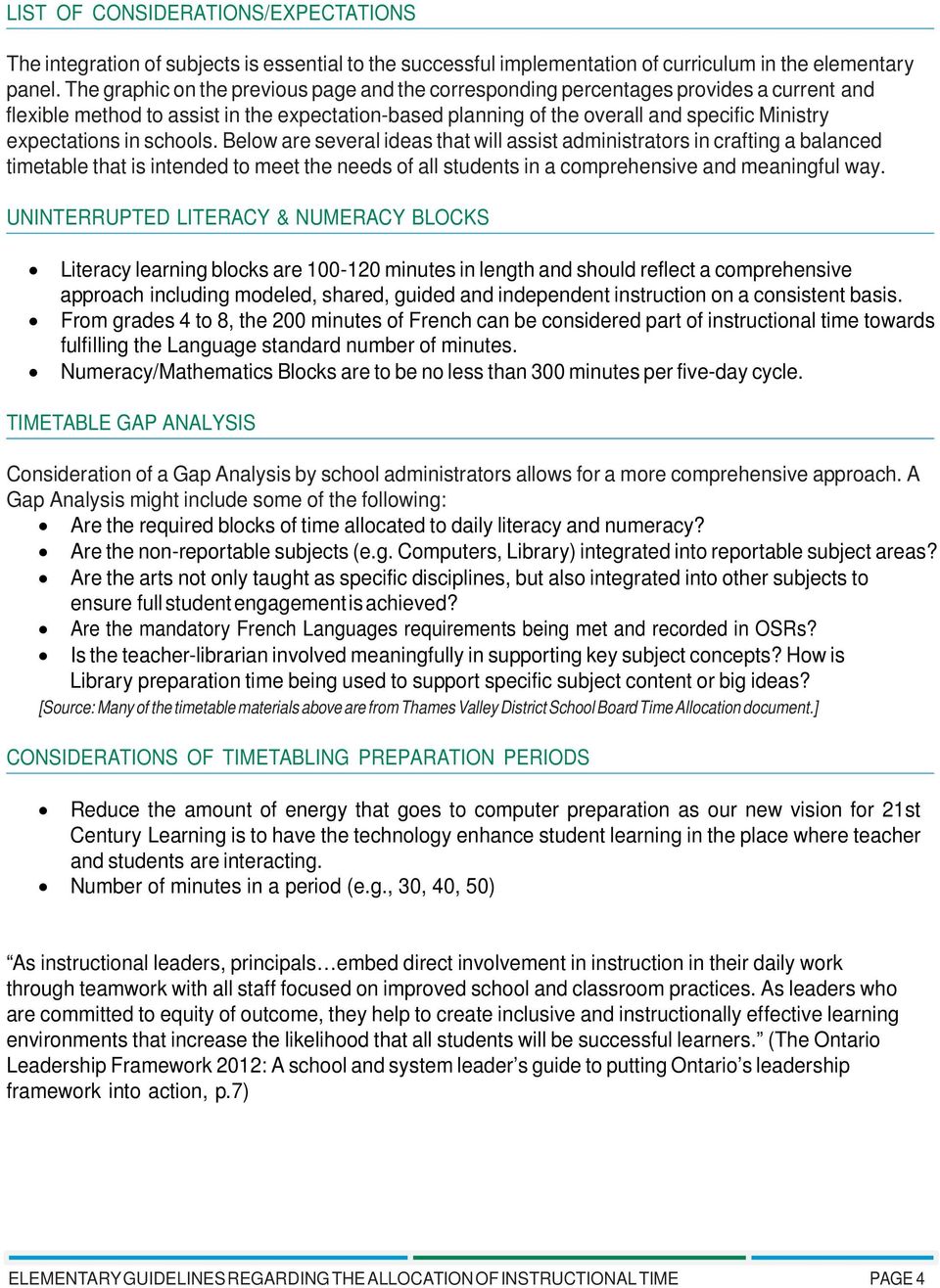
5 Considerations for Literacy Integration of all literacy strands should occur in all subject areas. Content area resources should be used for teaching in various subjects (e.g. Analysis of nonfiction texts in Social Studies and History/Geography). Drama is encouraged to be used in the Literacy Block as a vehicle to introduce, scaffold and /or solidify important literacy concepts. Considerations for Mathematics Students should have a minimum of one scheduled math period each in a five-day cycle. In order to fulfill the required 300 minutes for each five-day cycle, other days will require at least one period more. It is encouraged that longer math periods provide for enhanced conceptual development and retention. Math occurring each day is preferable, but four days a week for longer periods is also beneficial. If timetabling occurs in which there is a grouping of subjects (Math, Science, etc.), increased flexibility will allow for a teacher s discretion during times where students show they are struggling with particular concepts. Considerations for Science and Technology and Social Studies, History and Geography The use of technology should be incorporated into content areas, making for more engaging, relevant and rich tasks. Key Literacy and Numeracy concepts should be taught in a comprehensive Science classroom. Social Studies and History/Geography should be given ample time to cover subject-specific content material, but integration into Literacy Blocks will allow for a more connected learning situation for students. Consideration for the Arts The Arts refers to four subjects: Dance, Drama, Music and Visual Arts. Timetables need to reflect that all four strands are being taught in the school year. 300 minutes allows for the following 50-minute periods (see templates at the end of this document for other timetabling scenarios): two 50-minute periods for Visual Arts, two 50-minute periods for Music, and one 50-minute period for Dance, one 50-minute period for Drama. (Source: Artseco instructional practice and time allocation document) Considerations for Health & Physical Education and DPA 30 per cent of instructional time should be allocated for Health Education. Incorporate Literacy and Numeracy skills into Physical Education and Health programs to allow for a more hands-on approach to these two main core subject areas. On the days that students do not have Physical Education, 20 minutes of DPA must be on the timetable. If the students have Dance, this is an appropriate way to incorporate another 20-minute block for DPA. [Source: Many of the notes above are extracted from text in timetabling materials of the District School Board of Niagara and Thames Valley District School Board.] ELEMENTARY GUIDELINES REGARDING THE ALLOCATION OF INSTRUCTIONAL TIME PAGE 5
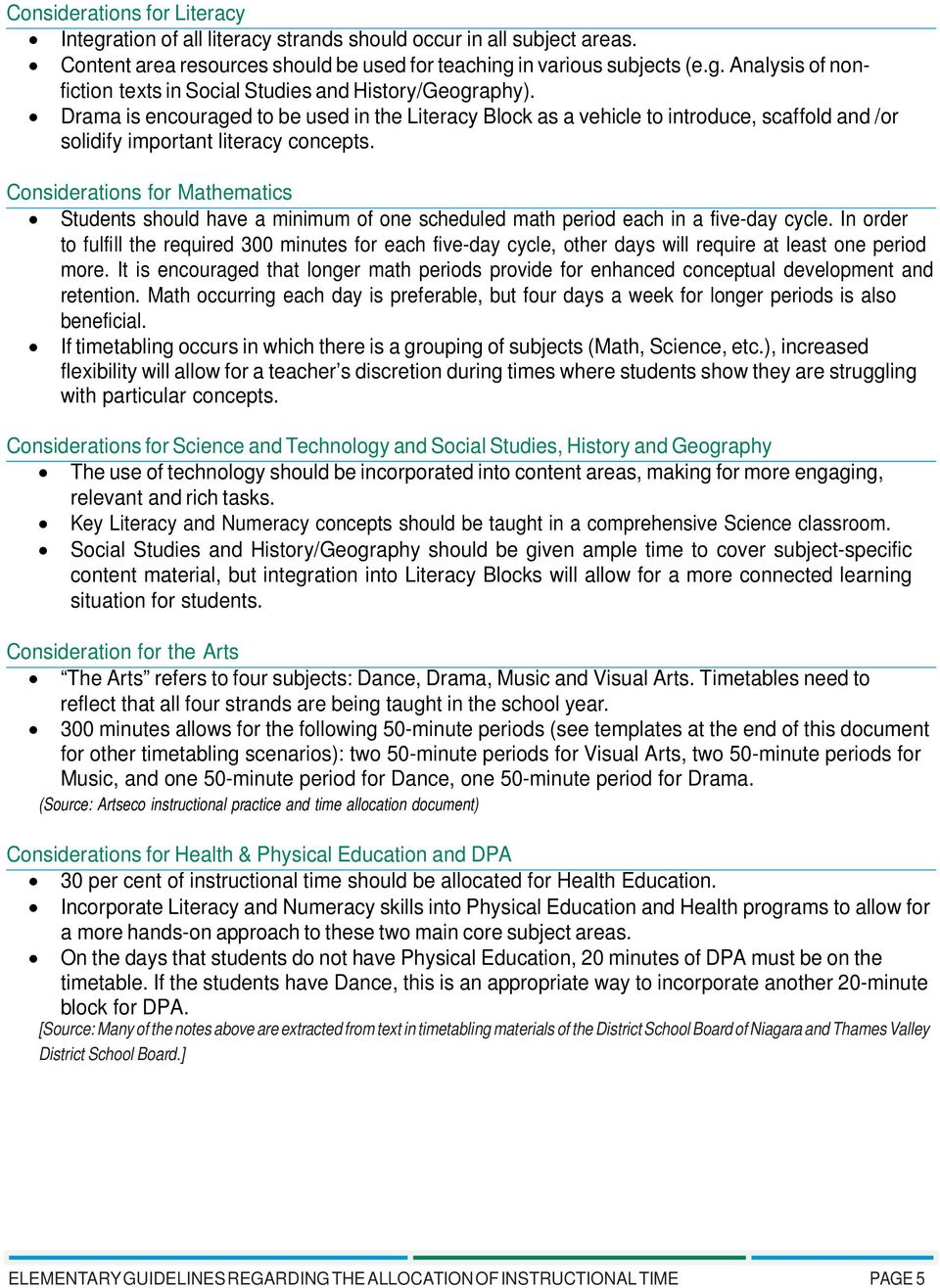
6 PRIMARY TIMETABLE SAMPLES Primary Timetable 1 Balanced Day; Three Instructional blocks of 100 minutes each MINUTES DAY ONE DAY TWO DAY THREE DAY FOUR DAY FIVE Daily Literacy Block addresses literacy-based curriculum expectations in Language, Social Studies, Science and Health, and integrates those subjects with Dance, Drama, Music, and Visual Arts 60 min. Math Math Math Math Math 40 min. Science & Tech Social Studies Science & Tech Social Studies Sci.&Tech / Soc. St. (alter native cycles) 50 min. Phys Ed Arts Arts Literacy Arts 50 min. Literacy Arts FLEX Phys Ed FLEX Primary Timetable Traditional Day 150 minutes (am) and 150 minutes (pm) w. recess Daily Liter acy Block addresses liter acy-based cur r iculum expectations in Language, Social Studies, Science and Health, and integr ates those subjects with Dance, Dr ama, Music, and Visual Ar ts 50 min. Math Math Math Math Math Lunch Phys Ed 30 Arts 40 Social Studies 40 Social Studies 60 Arts 60 Arts 40 FLEX 30 Arts 60 FLEX 30 FLEX 40 Phys Ed 40 Phys Ed min. Science & Tech Literacy/Language Science & Tech Math Literacy/Language ELEMENTARY GUIDELINES REGARDING THE ALLOCATION OF INSTRUCTIONAL TIME PAGE 6
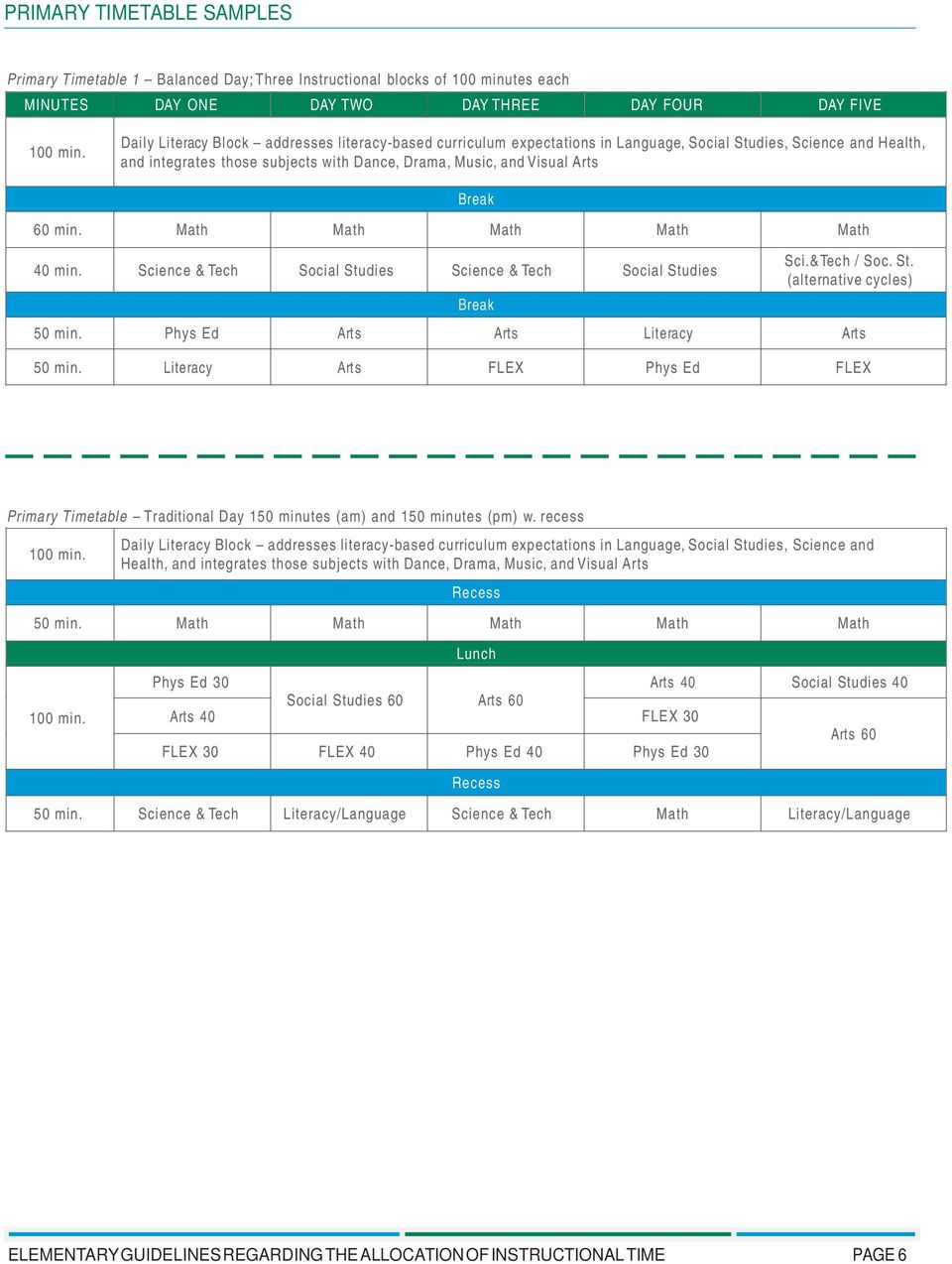
7 JUNIOR TIMETABLE SAMPLES Junior Timetable 1 Balanced Day; Three instr uctional blocks of 100 minutes each MINUTES DAY ONE DAY TWO DAY THREE DAY FOUR DAY FIVE Daily Liter acy Block addresses liter acy-based cur r iculum expectations in Language, Social Studies, Science and Health, and integr ates those subjects with Dance, Dr ama, Music, and Visual Ar ts 60 min. Math Math Math Math Math 40 min. French French French French French 50 min. Science & Tech Phys Ed Arts Arts Social Studies 50 min. Arts Social Studies Arts Science & Tech Phys Ed Junior Timetable Tr aditional Day; 150 minutes (am) and 150 minutes (pm) w. recess Daily Liter acy Block addresses liter acy-based cur r iculum expectations in Language, Social Studies, Science and Health, and integr ates those subjects with Dance, Dr ama, Music, and Visual Ar ts 50 min. Math Math Math Math Math Arts 60 Lunch French 30 French 40 Arts 30 Arts 50 Phys Ed 40 Arts 30 Phys Ed 30 French 40 Arts 30 French 50 Phys Ed 30 French min. Science & Tech Social Studies Science & Tech Math Social Studies ELEMENTARY GUIDELINES REGARDING THE ALLOCATION OF INSTRUCTIONAL TIME PAGE 7
8 INTERMEDIATE TIMETABLE SAMPLES Inter mediate Timetable 1 Balanced Day; Three instr uctional blocks of 100 minutes each MINUTES DAY ONE DAY TWO DAY THREE DAY FOUR DAY FIVE Daily Liter acy Block addresses liter acy-based cur r iculum expectations in Language, Social Studies, Science, Health and Guidance, and integr ates those subjects with Dance, Dr ama, Music, Visual Ar ts 60 min. Math Math Math Math Math 40 min. French French French French French 50 min. Science & Tech Phys Ed Arts Arts History or Geography 50 min. Arts History or Geography Arts Science & Tech Phys Ed Grade 7-8 Timetable Traditional Day; 150 minutes (am) and 150 minutes (pm) w. recess Daily Literacy Block addresses liter acy-based cur riculum expectations in Language, Social Studies, Science, Health and Guidance, and integrates those subjects with Dance, Drama, Music, Visual Arts 50 min. Math Social Studies Math Math Math Arts 60 Lunch French 30 French 40 Arts 30 Science & Tech 50 Phys Ed 40 Arts 30 Phys Ed 30 French 40 Arts 30 French 50 Phys Ed 30 French min. Science & Tech Math Arts Math Social Studies ELEMENTARY GUIDELINES REGARDING THE ALLOCATION OF INSTRUCTIONAL TIME PAGE 8

How To Teach Your Children To Read
 AVON MAITLAND DISTRICT SCHOOL BOARD ADMINISTRATIVE PROCEDURE NO. 202 SUBJECT: Legal References: SCHOOL DAY AND SUBJECT TIME - ELEMENTARY Education Act: Section 170 Duties and Powers of Boards; Section
21 st Century Learner: Schools for the Future
 21 st Century Learner: Schools for the Future October 2010 Article As a school district, we recognize the importance of our role in ensuring the best education for our students. We appreciate that the
Standard Two: Knowledge of Mathematics: The teacher shall be knowledgeable about mathematics and mathematics instruction.
 Performance-Based Standards for Colorado Teachers The following shall serve as standards for the licensing of all teacher education candidates in Colorado and reflect the knowledge and skills required
Mathematics Policy. National Curriculum Statement on Maths:
 Mathematics Policy National Curriculum Statement on Maths: Mathematics is a creative and highly inter-connected discipline that has been developed over centuries, providing the solution to some of history
Lesotho new Integrated Curriculum for primary schools in Lesotho
 Lesotho new Integrated Curriculum for primary schools in Lesotho The Ministry of Education and Training (MoET) has introduced a new integrated primary school curriculum, designed to respond to the changing
North Carolina TEACHER. evaluation process. Public Schools of North Carolina State Board of Education Department of Public Instruction
 North Carolina TEACHER evaluation process Public Schools of North Carolina State Board of Education Department of Public Instruction Rubric for Evaluating North Carolina Teachers ( This form should be
Self Assessment Tool for Principals and Vice-Principals
 The Institute for Education Leadership (IEL) brings together representatives from the principals' associations, the supervisory officers' associations, councils of directors of education and the Ministry
LITERACY. Paying Attention to. Six Foundational Principles for Improvement in Literacy, K 12
 K 12 Paying Attention to LITERACY Six Foundational Principles for Improvement in Literacy, K 12 Focus on literacy. Build an understanding of effective literacy instruction. Design a responsive literacy
Comprehensive Reading Plan K-12 A Supplement to the North Carolina Literacy Plan. North Carolina Department of Public Instruction 2013-2014
 Comprehensive Reading Plan K-12 A Supplement to the North Carolina Literacy Plan North Carolina Department of Public Instruction 2013-2014 1 TABLE OF CONTENTS INTRODUCTION PAGE 3 NCDPI PAGE 4 STANDARDS-BASED
KEY SKILLS OF JUNIOR CYCLE
 KEY SKILLS OF JUNIOR CYCLE Key skills of junior cycle Learners need a wide range of skills to help them face the many challenges presented to them in today s world. They develop specific skills in their
Citizenship education in Northern Ireland, Wales, Scotland and England
 Citizenship education in Northern Ireland, Wales, Scotland and England Northern Ireland The Northern Ireland curriculum is described as six Areas of Learning at key stages 1 and 2: Language and Literacy
QUALIFICATIONS FOR TEACHING POSITIONS IN BURNABY
 QUALIFICATIONS FOR TEACHING POSITIONS IN BURNABY Since 1986-06-01, teachers offered new contracts have been required to possess the necessary qualifications, as stated in writing by the Board, for a teaching
R e p o r t i n g S t u d e n t L e a r n i n g. Guidelines for Effective Teacher-Parent-Student Communication
 R e p o r t i n g S t u d e n t L e a r n i n g Guidelines for Effective Teacher-Parent-Student Communication 2 0 1 0 Contents ParT 1: The Importance of Effective Teacher-Parent-Student 2 Communication
Everyone Wins: Differentiation in the School Library Submitted by Carol Koechlin and Sandi Zwaan
 Everyone Wins: Differentiation in the School Library Submitted by Carol Koechlin and Sandi Zwaan During the course of an average day teacher-librarians touch the lives of hundreds of students, teachers,
Pre-service Performance Assessment Professional Standards for Teachers: See 603 CMR 7.08
 Please use this assessment in conjunction with the for Teachers guidelines: the rating scale; evaluation questions relating to the standards; and the license-specific questions per standard (b)2c. Candidates
Expeditionary Learning at King Middle School. June 18, 2009
 June 18, 2009 King Middle School Expeditionary Learning Planning Group 2009 Planning Steps, June 18, 2009 1. Develop a compelling topic: that targets the content and skills that students need to know at
21ST CENTURY STUDENT OUTCOMES:
 Revised Framework for 21st Century Learning The Partnership for 21st Century Skills has developed a unified, collective vision for 21st century learning that can be used to strengthen American education.
Primrose Hill Primary School Literacy Policy: A baseline for outstanding practice
 .. Primrose Hill Primary School Literacy Policy: A baseline for outstanding practice January 2012 Review date: January 2013 KEY PRINCIPLES Teaching at Primrose Hill is Learning Centred, meaning that each
EARLY EDUCATION. ADMPS 1001 SOCIAL FOUNDATIONS OF EDUCATION 3 cr. I&L 0020 DIRECTED TUTORING 1-3 cr.
 EARLY EDUCATION ADMPS 1001 SOCIAL FOUNDATIONS OF EDUCATION 3 cr. This course is a broad-based overview of education addressing education issues and policies in the United States. An interdisciplinary approach
The Elementary Education Program Brandeis University Waltham, MA 02454
 The Elementary Education Program Brandeis University Waltham, MA 02454 The Brandeis Education Program seeks to prepare teachers with a strong liberal arts background who possess the knowledge, point of
Program Overview. This guide discusses Language Central for Math s program components, instructional design, and lesson features.
 Program Overview Introduction This guide discusses Language Central for Math s program components, instructional design, and lesson features. What is Language Central for Math? Program Components Language
North Carolina School Library Media Coordinators Standards
 North Carolina School Library Media Coordinators Standards Every public school student will graduate from high school, globally competitive for work and postsecondary education and prepared for life in
ILLINOIS CERTIFICATION TESTING SYSTEM
 ILLINOIS CERTIFICATION TESTING SYSTEM FIELD 188: ASSESSMENT OF PROFESSIONAL TEACHING (PK 12) June 2011 ILLINOIS CERTIFICATION TESTING SYSTEM FIELD 188: ASSESSMENT OF PROFESSIONAL TEACHING (PK 12) June
COMPLETING THE ONTARIO PROVINCIAL REPORT CARD
 Information and Technology Services Maplewood Admin Elementary COMPLETING THE ONTARIO PROVINCIAL REPORT CARD Student Achievement is reported to the Ministry through your school s OnSIS submissions. Errors
Colorado Professional Teaching Standards
 Colorado Professional Teaching Standards Standard I: Teachers demonstrate knowledge of the content they teach a. Teachers provide instruction that is aligned with the Colorado Academic Standards and their
If students are to succeed
 Preparing to Implement the Citywide Instructional Expectations: Ensuring curricula that are appropriate in all subjects Exploring Expectations for content-area teachers In this session, participants will
COURSE SELECTION 2013-14
 COURSE SELECTION 2013-14 Today we will learn about: Course Recommendations Course Selection Dates Course Selection Process Elective choices Ask questions Step-by-Step Tip Sheets Pink=current 9 th graders
Individual Education Plan (IEP)
 Individual Education Plan (IEP) THIS IEP CONTAINS AC MOD ALT REASON FOR DEVELOPING THE IEP Student identified as exceptional by IPRC Student not formally identified but requires special education program/services,
PROGRAM AND DIPLOMA REQUIREMENTS
 PROGRAM AND DIPLOMA REQUIREMENTS 1999 Ministry of Education and Training Contents 1 Preface 5 2 Introduction 6 3 Diploma Requirements and Related Procedures 8 3.1 The Requirements for the Ontario Secondary
Washington Teachers Union Local 6, AFT, AFL-CIO DC Candidate Questionnaire, April 2016 LEON T. ANDREWS JR RESPONSE
 Washington Teachers Union Local 6, AFT, AFL-CIO DC Candidate Questionnaire, April 2016 LEON T. ANDREWS JR RESPONSE Please return to: [email protected] by 5pm on April 12, 2016 1. Reclaiming the Promise
o Ivy Tech ECED 100 Introduction to Early Childhood Education ECED 101 Health, Safety and Nutrition ECED 103 Curriculum in Early Childhood Classroom
 Indiana Department of Education Academic Course Framework EARLY CHILDHOOD EDUCATION I Early Childhood Education I prepares students for employment in early childhood education and related careers that
Bachelor of Bachelor of Education (Honours)
 Bachelor of Bachelor of Education (Honours) Detailed Course Requirements The 2016 Monash University Handbook will be available from October 2015. This document contains interim 2016 course requirements
North Carolina Professional Teaching Standards
 North Carolina Professional Teaching Standards For every student in North Carolina, a knowledgeable, skilled compassionate teacher...a star in every classroom. As Approved by the State Board of Education
QUESTIONS AND ANSWERS MassCore Updated October 16, 2015
 GENERAL QUESTIONS 1. What is? is a recommended, rigorous course of study based on standards in Massachusetts s curriculum frameworks that aligns high school coursework with college and career expectations.
Apprenticeship. Have you ever thought how. Teaching Adults to Read. with Reading CTE AND LITERACY BY MICHELE BENJAMIN LESMEISTER
 Teaching Adults to Read with Reading Apprenticeship PHOTO BY ISTOCK.COM BY MICHELE BENJAMIN LESMEISTER Have you ever thought how one goes about teaching reading to an adult? The complexity of this task
2015-2016 Instructional Management Plan
 Greenwood Public School District Dr. Montrell Greene, Superintendent Dr. June Leigh, Director of Curriculum 2015-2016 Instructional Management Plan Greenwood Public School District Academic Education Department
B.A. in Education Specialization: Early Childhood Education (P-3) Student Handbook
 B.A. in Education Specialization: Early Childhood Education (P-3) Student Handbook Rowan University College of Education Teacher Education Department 1 Table of Contents Program Description 3 ECED Program
International Certificate
 final summative project Once the three modules are complete, the student will submit their evidence of completion in the form of portfolios, report cards, class assignments and other formal documentation.
School Development Planning Curriculum Review at Junior Cycle
 School Development Planning Curriculum Review at Junior Cycle SDPI Contents Introduction...2 Section 1...5 Section 2...11 Section 3...14 Section 4...17 Section 5...20 Appendix 1...22 Appendix 2...27 Appendix
Top 5 Ways to Successfully Integrate Technology in the Classroom. powered by
 Top 5 Ways to Successfully Integrate Technology in the Classroom Top 5 Ways to Successfully Integrate Technology in the Classroom Technology is revolutionizing how the world works and how students across
CURRICULUM MAP. Elementary and Early Childhood Program: Alignment of Student Learning Outcomes, Standards, and Assessments
 CURRICULUM MAP Elementary and Early Childhood Program: Alignment of Student Learning Outcomes, Standards, and Assessments ACEI = Association for Childhood Education International Standards (see below for
What is the PYP Perspective on Assessment?
 What is the PYP Perspective on Assessment? Assessment is the gathering and analysis of information about student performance. It identifies what students know, understand, can do and feel at different
enrich your curriculum
 What a great experience for the children, a day they ll remember for a long time. Laura Beighton, Avenue Primary School enrich your curriculum Studio Film School provides specialist filmmaking, animation
QUALIFICATION REFORM: A GUIDE TO WHAT IS HAPPENING AROUND THE UK
 QUALIFICATION REFORM: A GUIDE TO WHAT IS HAPPENING AROUND THE UK Issue: v1 February 2015 CONTENTS Introduction... 3 Qualification reform statements... 4 England... 5 A levels in England... 5 Science practical...
Ministry of Education REVISED. The Ontario Curriculum Grades 1-8. Language
 Ministry of Education REVISED The Ontario Curriculum Grades 1-8 Language 2006 CONTENTS INTRODUCTION 3 The Importance of Literacy, Language, and the Language Curriculum................ 3 Principles Underlying
v. 2014 w/out cert info KY Valid Course List
 KY Valid Course List Kentucky Uniform Academic Course Codes 704 KAR 3:540 states the following: Section 1. (1) Local districts and schools shall use uniform academic course codes, listed and described
Preparing for the Provincial Grade 9 EQAO Math Assessment A Resource Guide for Students and Parents
 Preparing for the Provincial Grade 9 EQAO Math Assessment A Resource Guide for Students and Parents What is EQAO? EQAO stands for the Education Quality and Accountability Office. It is an independent provincial
Alignment of the Hawaii Preschool Content Standards With HighScope s Preschool Child Observation Record (COR), 2nd edition
 Alignment of the Hawaii Preschool Content Standards With HighScope s Preschool Child Observation Record (COR), 2nd edition The following chart shows how items from the Hawaii Preschool Content Standards
Key Principles for ELL Instruction (v6)
 Key Principles for ELL Instruction (v6) The Common Core State Standards (CCSS) in English Language Arts and Mathematics as well as the soon-to-be released Next Generation Science Standards (NGSS) require
CHOOSING COURSES 2015-2016
 DMCI MARKETPLACE EVENING PRESENTATION CHOOSING COURSES 2015-2016 TUESDAY, FEB. 17 6:00 8:00 pm Ontario Secondary School Diploma 30 credits 18 compulsory credits 12 elective credits 40 hours community involvement
WYVERN TECHNOLOGY COLLEGE POLICY NUMBER 7 CURRICULUM POLICY
 PAGE 1 OF 8 WYVERN TECHNOLOGY COLLEGE POLICY NUMBER 7 CURRICULUM POLICY PURPOSE The purpose of this policy is to provide the framework within which Wyvern Technology College will carry out its responsibility
NW COLORADO BOCES ALTERNATIVE LICENSURE PROGRAM
 NW COLORADO BOCES ALTERNATIVE LICENSURE PROGRAM 1 *For specific online course requirements, please refer to the attached course handout entitled Comprehensive Online Teacher Induction Program and Alternative
Position Statement on English Language Arts Education Connecticut State Board of Education December 3, 2008
 Position Statement on English Language Arts Education Connecticut State Board of Education December 3, 2008 The Connecticut State Board of Education believes a high-quality, comprehensive prekindergarten-12
The arts music, dance, theatre, and visual art uniquely provide the physical and mental challenges; the experience of selfexpression,
 the Mapping Arts of Future Education Recommendations for policy makers, K-12 educators, higher education, artists, and citizens, based on the Status of Arts Education Survey of Mississippi s K-12 Schools
Parent and Family Engagement Provisions in the Every Student Succeeds Act
 The Every Student Succeeds Act (ESSA) serves as the latest reauthorization of the Elementary and Secondary Education Act of 1965 (ESEA) which was last reauthorized in 2002 as the No Child Left Behind Act
Meganmarie Pinkerton. Importance of Art in Education. Art 205
 Pinkerton 0 Meganmarie Pinkerton Importance of Art in Education Art 205 30 November 2004 Pinkerton 1 I believe art education in music, theater, dance, and the visual arts, is one of the most creative ways
Introduction 1. 1. Fundamental Principles 5. 2. Learning Skills and Work Habits in Grades 1 to 12 9. 3. Performance Standards The Achievement Chart 15
 CONTENTS Introduction 1 1. Fundamental Principles 5 2. Learning Skills and Work Habits in Grades 1 to 12 9 3. Performance Standards The Achievement Chart 15 4. Assessment for Learning and as Learning 27
Elementary Math Methods Syllabus
 Elementary Math Methods Syllabus Course Description This course is designed to support both new and experienced elementary math educators in refining and focusing their instructional skills. Close examination
Promising Practices and Implementation Tools
 Promising Practices and Implementation Tools 1. Names & Positions: Kathleen Smith - Superintendent of Schools Elizabeth Barry- Executive Director, Learning and Teaching, PreK-8 Ethan Cancell - Associate
1 REVISOR 8710.4925. C. show verification of completing a Board of Teaching preparation program
 1 REVISOR 8710.4925 8710.4925 READING LEADER. Subpart 1. Scope of practice. A reading leader is authorized to facilitate and provide site-based or districtwide leadership for kindergarten through grade
BACHELOR OF EDUCATION AS A SECOND DEGREE
 FACULTY OF EDUCATION UNDERGRADUATE PROGRAMS Rev. FEBRUARY 2015 PLEASE NOTE: FOR STUDENTS BEGINNING PDP SEPTEMBER 2015/JANUARY 2016 AND COMPLETING THEIR EDUC 404 ACADEMIC COURSEWORK DURING SUMMER 2016 BACHELOR
BTT1O/BTT2O. Peel Secondary Schools Course Outline 2011. Course Units with Learning Goals / Overall Expectations. Course Outline / Strands
 LORNE PARK SECONDARY Grade 9/10 BUSINESS BTT1O/BTT2O Information and Communication Technology in Business, Grade 9 or 10, Open Course Outline / Strands This course introduces students to information and
Additional Qualification Course Guideline. Primary Education Specialist
 Additional Qualification Course Guideline Primary Education Specialist Schedule D Regulation 184/97 Teachers Qualifications Standards of Practice and Education April 2003 Ce document est disponible en
A Guide to Effective Instruction in Mathematics Kindergarten to Grade 6
 A Guide to Effective Instruction in Mathematics Kindergarten to Grade 6 A Resource in Five Volumes from the Ministry of Education Volume One Foundations of Mathematics Instruction Every effort has been
Sneyd Green Primary School Mathematics Policy Together we make a difference.
 Sneyd Green Primary School Mathematics Policy Together we make a difference. Leader name - Mr J.Hyder Date 04/12/14 Aims and objectives Mathematics teaches us how to make sense of the world around us through
The Primary Curriculum in Schools
 The Primary Curriculum in Schools Insights from the Curriculum Implementation Evaluation and the Primary Curriculum Review English Visual Arts Mathematics 1 Introduction During the 2003/2004 school year,
2 0 0 8 R E V I S E D The Ontario Curriculum Grades 10 to 12. Computer Studies
 2 0 0 8 R E V I S E D The Ontario Curriculum Grades 10 to 12 Computer Studies CONTENTS INTRODUCTION 3 Secondary Schools for the Twenty-first Century... 3 The Importance of Computer Studies in the Curriculum...
Planning Commentary Respond to the prompts below (no more than 9 single-spaced pages, including prompts).
 Planning Commentary Respond to the prompts below (no more than 9 single-spaced pages, including prompts). 1. Central Focus a. Describe the central focus and purpose for the content you will teach in this
EARLY CHILDHOOD EDUCATION CENTER
 The Isadore Joshowitz EARLY CHILDHOOD EDUCATION CENTER HILLEL ACADEMY OF PITTSBURGH The Isadore Joshowitz Early Childhood Center at Hillel Academy of Pittsburgh is a warm, nurturing, and inclusive environment
ELEMENTARY PROGRESS REPORT CARD (Business requirements and rationale)
 ELEMENTARY PROGRESS REPORT CARD (Business requirements and rationale) There are two main versions of the Elementary Progress Report Card: Grades 1 to 6 Grades 7 and 8 There is also a version of each for
How To Become A Teacher
 THE SCHOOL OF EDUCATION The School of Education of University of the Cumberlands continually strives to keep pace with current trends and development in teacher training to meet the needs of prospective
MIDDLE SCHOOL. Family guide for 2016-17 school year
 MIDDLE SCHOOL Family guide for 2016-17 school year 1 UNIQUE SCHOOLS FOR STUDENTS IN GRADES 6-8 Middle school students are inquisitive, unique and social individuals. They are figuring out who they are
The Writing Process: A Scaffolding Approach
 The Writing Process: A Scaffolding Approach Differentiating writing instruction for a population of diverse learners may sound difficult; but, it does not have to be. Scaffolding is one process that allows
Professional Development: ONLINE ANYTIME classes
 What is an ONLINE ANYTIME class? An ONLINE ANYTIME class is a one semester hour class offered for graduate level credit through the University of Cincinnati. You may begin the class at any time, but it
Gullo, D. F. (Ed.). (2006). K Today: Teaching and learning in the kindergarten year. Washington, D. C.: NAEYC.
 Appalachian State University Department of Family and Consumer Sciences FCS 4680 Curriculum & Instruction for Kindergarten Children Hickory Cohort-- Fall 2012 Instructor: Rhonda Russell M.A. Days/Time:
Office of the Superintendent of Schools MONTGOMERY COUNTY PUBLIC SCHOOLS Rockville, Maryland. May 30, 2013
 DISCUSSION 5.0 Office of the Superintendent of Schools MONTGOMERY COUNTY PUBLIC SCHOOLS Rockville, Maryland May 30, 2013 MEMORANDUM To: From: Subject: Members of the Board of Education Joshua P. Starr,
6-8 Technology Education Program Evaluation. Board of Education Program Report December 10, 2013
 6-8 Technology Education Program Evaluation Board of Education Program Report December 10, 2013 2 Grades 5-8 Part 100 Requirements Technology education means a program of instruction designed to assist
General Guidelines of Grade 1-9 Curriculum of Elementary and Junior High School Education.
 General Guidelines of Grade 1-9 Curriculum of Elementary and Junior High School. 1 Grade 1-9 Curriculum Guidelines 1 Preface In keeping with the 21st century and the global trends of educational reform,
Ministry of Education. The Ontario Curriculum Grades 11 and 12 REVISED. Mathematics
 Ministry of Education The Ontario Curriculum Grades 11 and 1 REVISED Mathematics 007 CONTENTS INTRODUCTION 3 Secondary Schools for the Twenty-first Century............................................
Dr. Candice McQueen, Dean, College of Education 168 LIPSCOMB UNIVERSITY 2009-10
 Dr. Candice McQueen, Dean, College of Education 168 LIPSCOMB UNIVERSITY 2009-10 Department of Education Junior High, Associate Professor and Academic Chair Charles A. Beaman, Visiting Professor Keith Nikolaus,
NEW YORK STATE TEACHER CERTIFICATION EXAMINATIONS
 NEW YORK STATE TEACHER CERTIFICATION EXAMINATIONS TEST DESIGN AND FRAMEWORK September 2014 Authorized for Distribution by the New York State Education Department This test design and framework document
ILLINOIS PROFESSIONAL TEACHING STANDARDS (2013)
 ILLINOIS PROFESSIONAL TEACHING STANDARDS (2013) Standard 1 - Teaching Diverse Students The competent teacher understands the diverse characteristics and abilities of each student and how individuals develop
Copyright 2013 CTB/McGraw-Hill LLC. 1
 TerraNova, Third Edition Science and Social Studies Joan Buzick DRC/CTB Assessment Consultant Organizing for Assessment Success Today s Webinar Objectives Why test Science and Social Studies with TerraNova3
Writing Learning Objectives that Engage Future Engineers: Hands-on & Minds-on Learning Activities
 Writing Learning Objectives that Engage Future Engineers: Hands-on & Minds-on Learning Activities S. K. Barnes 1 Associate Professor James Madison University Harrisonburg, VA USA [email protected] Keywords:
CALIFORNIA S TEACHING PERFORMANCE EXPECTATIONS (TPE)
 CALIFORNIA S TEACHING PERFORMANCE EXPECTATIONS (TPE) The Teaching Performance Expectations describe the set of knowledge, skills, and abilities that California expects of each candidate for a Multiple
YOUNG FIVES PROGRAM 2009-2012 THREE-YEAR SINGLE PLAN FOR STUDENT ACHIEVEMENT. Palo Alto Unified School District
 YOUNG FIVES PROGRAM THREE-YEAR SINGLE PLAN FOR STUDENT ACHIEVEMENT 2009-2012 Palo Alto Unified School District DISTRICT GOAL: Create an exceptional learning environment that engages, challenges, and supports
Art & Music Five Year Plan. Program Review, Research & Recommendations Chris McCullough, Supervisor Fine & Applied Arts June, 2012
 Art & Music Five Year Plan Program Review, Research & Recommendations Chris McCullough, Supervisor Fine & Applied Arts June, 2012 RPS Arts Mission Statement We regard the arts as basic to the education
EDEC 455 Creative Expression and Play in Early Childhood 1
 EDEC 455 Creative Expression and Play in Early Childhood 1 EDEC 455 002 (3 credits) 11412 CREATIVE EXPRESSION AND PLAY IN EARLY CHILDHOOD Fall Semester 2009 Monday and Wednesday 8:30 9:45 am McKee 0253
2014 www.into-exchange.com
 Prospectus 2013-2014 CHRISTLETON HIGH SCHOOL Christleton High School Christleton is a school where everybody learns. Students are expected to arrive each day well organised practice and seek feedback
Nurturing Early Learners
 Nurturing Early Learners A Curriculum Framework for Kindergartens in Singapore A Guide for Parents A Strong Start for Every Child 1 A Strong Start for Every Child A Word to Parents Parents know that the
GT Humanities I & II in Frisco ISD Information and FAQs
 GT Humanities I & II in Frisco ISD Information and FAQs GT Humanities I will be offered in Frisco ISD beginning in the 2015-2016 school year and will begin with 9 th graders who are identified as gifted