
LEADING SUSTAINABILITY
|
|
|
- Phebe Watson
- 10 years ago
- Views:
Transcription
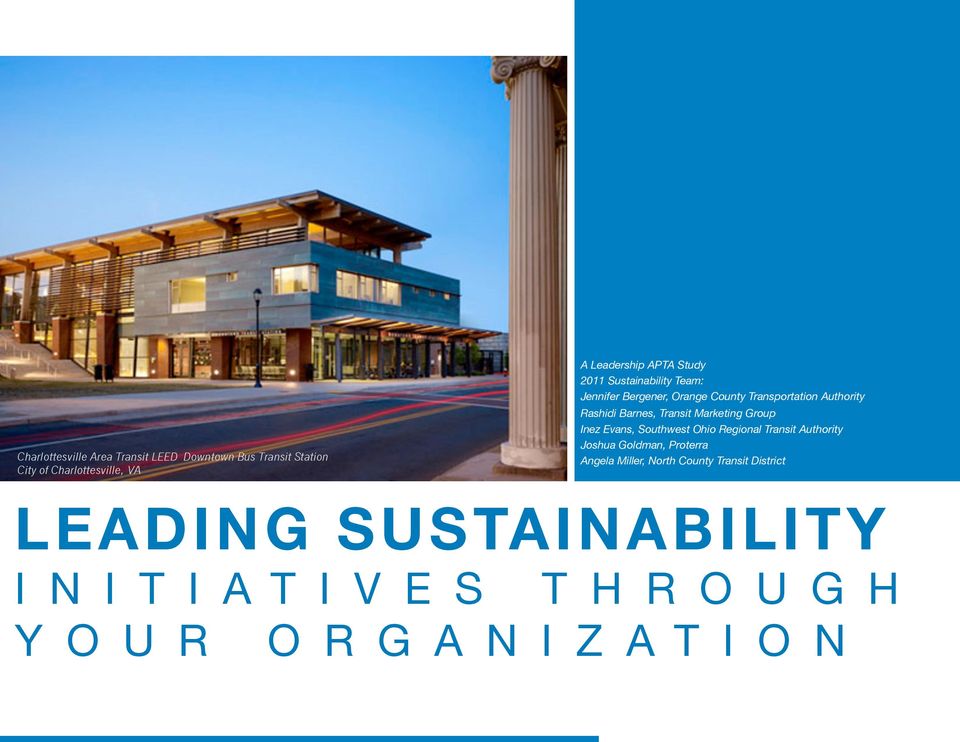
1 Charlottesville Area Transit LEED Downtown Bus Transit Station City of Charlottesville, VA A Leadership APTA Study 2011 Sustainability Team: Jennifer Bergener, Orange County Transportation Authority Rashidi Barnes, Transit Marketing Group Inez Evans, Southwest Ohio Regional Transit Authority Joshua Goldman, Proterra Angela Miller, North County Transit District LEADING SUSTAINABILITY I N I T I A T I V E S T H R O U G H Y O U R O R G A N I Z A T I O N
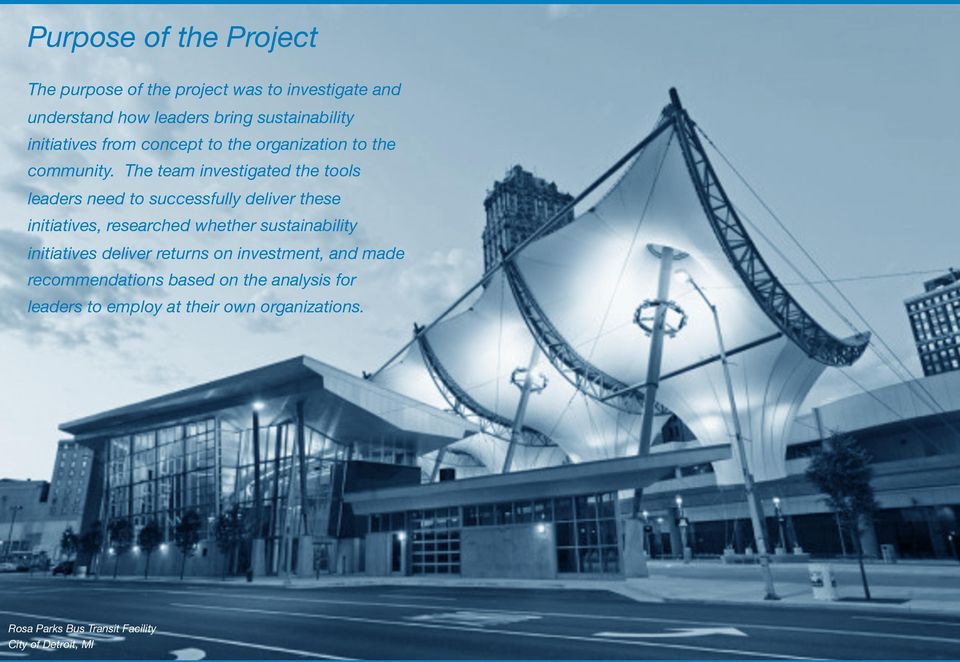
2 Purpose of the Project The purpose of the project was to investigate and understand how leaders bring sustainability initiatives from concept to the organization to the community. The team investigated the tools leaders need to successfully deliver these initiatives, researched whether sustainability initiatives deliver returns on investment, and made recommendations based on the analysis for leaders to employ at their own organizations. Rosa Parks Bus Transit Facility City of Detroit, MI
3 INTRODUCTION Sustainability as a concept has gained significant momentum over the past several years. The movement towards sustainability has emerged as a result of growing concerns about the unintended consequences of rapid population growth and consumption of natural resources. Sustainable programs have the ability to reap both direct and indirect benefits, but often face hurdles due to perception of what a sustainability program includes, lack of funding and dedicated resources, and no champions for the programs. However, even in these trying economic times, these hurdles can be overcome and result in a tangible savings. The goal of this research is to help leaders champion sustainability initiatives through their organizations by providing tools and case studies to articulate the business value of these programs. The project team took a sustainable approach by building on the work of others: we recycled research. It was important to understand what information was already readily available, how had leaders either successfully (or not so successfully) brought sustainability initiatives to fruition within their organizations, and what were the tools necessary to do so. To that end, the team interviewed a wide range of agencies from small bus only operators like The Bus in Honolulu, to large scale, dense metropolitan agencies that operate multiple modes, like New York Metropolitan Transportation Authority. Focus of the Study The team interviewed leaders at all levels of organizations - from the CEO and board members, to planners, to middle managers to staff. The messages from these leaders were clear: To succeed in making sustainability a focus for their organization, leaders need to articulate the business value of the initiative to the organization. In the challenging economic climate, leaders must find a triple bottom line - projects and initiatives that not only provide return on their sustainability metrics, but also improve or enhance customer service, and provide an economic return on investment. Leaders of sustainability initiatives can be at any level of an organization, not just at the highest levels. Sustainability is a natural mission for the public transit industry. In several cases, the team attempted to find organizations that believed sustainability initiatives were not core to the business in order to determine how a leader would build an initiative from the ground up. Instead, the team found that even in the most unlikely places, sustainability initiatives were thriving in spite of the economic climate, or even where senior leaders believed their organization could not afford the luxury of sustainability. Page 3
4 maintain vehicles and facilities, while others reached out to board members to engage municipal partners to fund Leadership in Energy and Environmental Design (LEED) facilities and Transit-Oriented Development (TOD). Some leaders creatively funded their initiatives through non-traditional sources like utility rebates or competitive, non-transit grant opportunities. By working with a broader team, leaders were able to win support for their initiatives by engaging them in its inception. Results of the Study Engaging the Organization The most successful transit sustainability leaders engaged their organizations in programs, from creating teams internally to define the program, to incentivizing staff to implement the programs, to internal challenges to see which teams could be more sustainable. By engaging their organizations, the leaders could broaden the impact of their initiative. For example, some leaders worked with their maintenance teams to change the cleansers used to This study uncovered surprising results: sustainability has been more broadly adopted in the industry as a core mission value and has brought tangible economic benefit - even during very challenging economic times - to those who have invested. Many leaders have creatively funded initiatives outside of the normal transit mechanisms, and when these leaders became very innovative interesting projects that overcame hurdles resulted. This paper, written as part of the American Public Transportation Association s (APTA) 2011Leadership Program, details the results of the study, provides several case studies derived during the analysis, and presents business cases and other tools to help transit Leaders implement sustainability initiatives in their organizations. Page 4
5 TABLE OF CONTENTS Introduction... 3 What is Sustainability... 6 Sustainability - The Leaders Hurdles Leaders Must Overcome Tools Leaders Need Financing Sustainability Initiatives Thinking Outside the Box Conclusions Case Studies Sound Transit San Francisco Municipal Transportation Authority New Flyer Knoxville Area Transit Southeastern Pennsylvania Transportation Authority New York Metropolitan Transportation Authority Greater Cleveland Regional Transportation Authority Santa Clara Valley Transportation Authority Veolia Transportation... 36

6 What is Sustainability? Employing practices in design and capital construction, including recycled materials, and solar and other renewable energy sources to make facilities green Employing practices in operations and maintenance such as reducing hazardous waste, increasing fuel efficiency, creating more efficient lighting and using energy-efficient propulsion systems. Employing community-based strategies to encourage transitoriented development, increasing ridership, and ensuring equitable access New York Sustainable Streets Initiative Page 6

7 WHAT IS SUSTAINABILITY? If you were to ask five different people what sustainability means, you would undoubtedly get five different answers that range from recycling papers, to economic viability, to using goats as livable lawn mowers in open space. The definition of sustainability has morphed over time depending on the application. In 1983, the World Commission on Environmental Development defined sustainability as Sustainable development meets the needs of the present without compromising future generations ability to meet their own Wikipedia defines it as: the potential for long-term maintenance of well being, which has environmental, economic and social dimensions The American Public Transportation Association (APTA) specifically defines it for transit as: practices that make good business sense and good environmental sense, balancing economic, social and environmental needs. These are but three of the countless definitions of sustainability. The underlying message in all of them is the same: sustainability is a method of harvesting or using a resource so that the resource is not depleted or permanently damaged. Definitions of Sustainability To clearly define sustainability, it is important to understand what sustainability is at its core: Economy, Ecology and Equality, or the Triple E or Triple Bottom Line. A true sustainability program encompasses all three of these elements. Economy, or the economic pillar, focuses on economic viability. This includes both financial vitality of an organization, focusing on both long and short term, return on Page 7
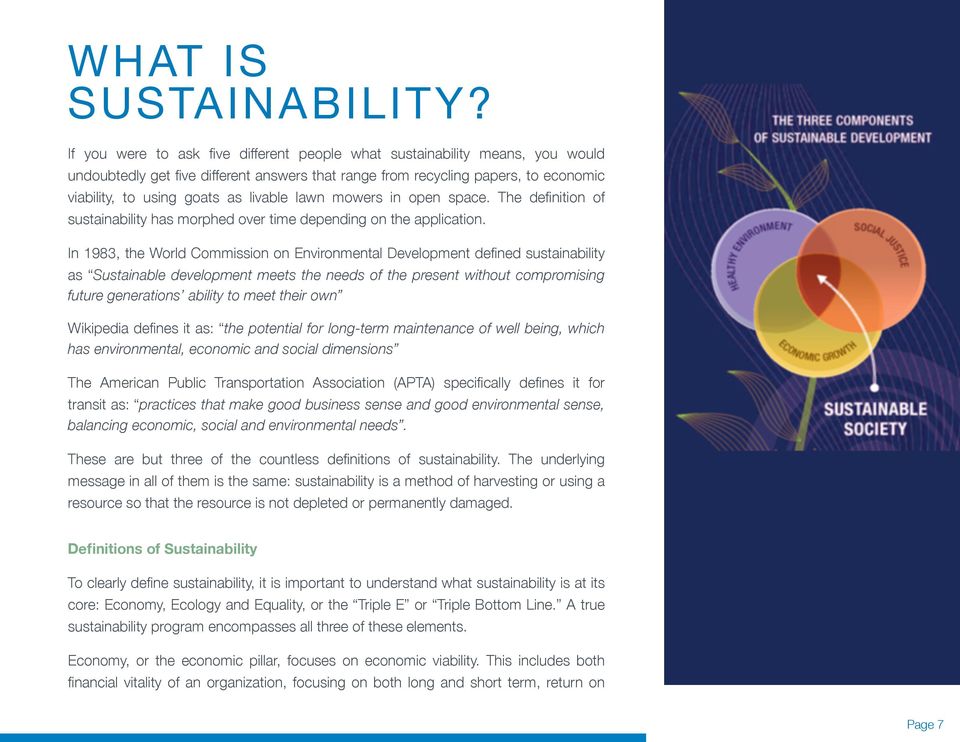
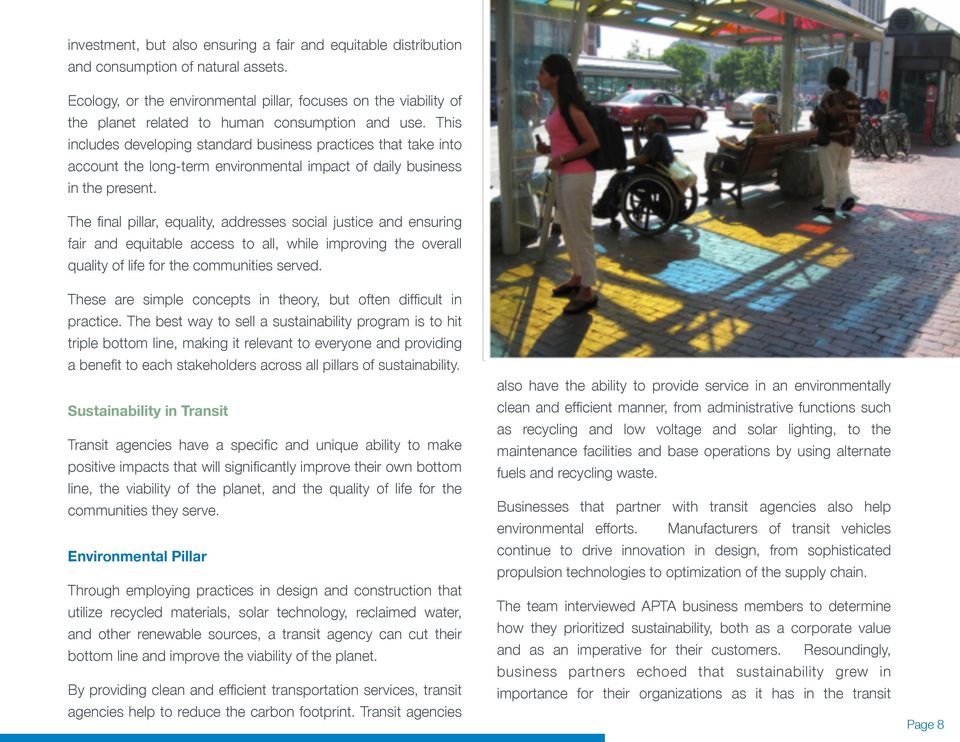
8 investment, but also ensuring a fair and equitable distribution and consumption of natural assets. Ecology, or the environmental pillar, focuses on the viability of the planet related to human consumption and use. This includes developing standard business practices that take into account the long-term environmental impact of daily business in the present. The final pillar, equality, addresses social justice and ensuring fair and equitable access to all, while improving the overall quality of life for the communities served. These are simple concepts in theory, but often difficult in practice. The best way to sell a sustainability program is to hit triple bottom line, making it relevant to everyone and providing a benefit to each stakeholders across all pillars of sustainability. Sustainability in Transit Transit agencies have a specific and unique ability to make positive impacts that will significantly improve their own bottom line, the viability of the planet, and the quality of life for the communities they serve. Environmental Pillar Through employing practices in design and construction that utilize recycled materials, solar technology, reclaimed water, and other renewable sources, a transit agency can cut their bottom line and improve the viability of the planet. By providing clean and efficient transportation services, transit agencies help to reduce the carbon footprint. Transit agencies also have the ability to provide service in an environmentally clean and efficient manner, from administrative functions such as recycling and low voltage and solar lighting, to the maintenance facilities and base operations by using alternate fuels and recycling waste. Businesses that partner with transit agencies also help environmental efforts. Manufacturers of transit vehicles continue to drive innovation in design, from sophisticated propulsion technologies to optimization of the supply chain. The team interviewed APTA business members to determine how they prioritized sustainability, both as a corporate value and as an imperative for their customers. Resoundingly, business partners echoed that sustainability grew in importance for their organizations as it has in the transit Page 8
9 East Valley Bus Maintenance Facility, Tempe, AZ industry, and that sustainability requirements posed by their customers are driving significant innovation in their business practices and product design. From hybrid engines, to electrification of control systems, to fuel cells, aerodynamics, composite bodies, and fuel efficiency -- business partners are pushing the envelope on environmental and efficiency gains in their products. The environmental pillar is a natural fit for transit. Research shows that public transit is inherently a better carbon and greenhouse gas emission bargain for customers by actually offsetting more emissions than generated by the vehicles. So not only can transit contribute to the environmental pillar through operational procedures, but also encouraging more transit ridership can deliver significant sustainability results to the community. Economic Pillar Transit agencies can also implement community based strategies that encourage their communities towards TOD. This will in turn increase ridership and revenues, and improve on the economic pillar. Enhancing maintenance processes to encourage waste reduction also decreases the amount of resources consumed and therefore delivers an economic return. Improvements in energy efficiency reduces costs by requiring less energy to accomplish the same business value. Implementing alternative energy and fueling strategies helps transit agencies and business partners to diversify their risk on fuel pricing changes, and reduces operating costs. Social Pillar The final pillar, equality, addresses social justice and ensuring fair and equitable access to all, while improving the overall quality of life for the communities served. Again, transit has a natural role to play in delivering value on the social pillar by ensuring access to services for all members of the community and delivering more livable, and healthier communities. From paratransit to transit-oriented development, transit agencies inherently provide social value to their communities. Transit agencies and business partners also focus on workplace social initiatives that ensure the health and safety of workers by creating workspaces that use fewer chemicals and provide a healthier work experience, programs that enhance skill sets and foster stable livelihoods, transportation that has been proven to provide a healthier lifestyle, and by encouraging employees to become active volunteers and partners in their communities. Page 9

10 SU STA INABI LIT Y T HE LEADE RS Anyone can lead a transit sustainability program: it is only important to have a leader. It is incumbent on leaders to receive information and initiatives both internally and externally that in turn empower all to collectively sustain the mission. Community Other Governmental Agencies Staff CEO Board Businesses Non-Profits Through the team s research, one point became abundantly clear: without a champion the program will never succeed. This champion can be anyone within the organization that has been empowered to move the program forward. Ideally, a S US TAI NA BIL IT Y LE AD ERS HIP PR OF ILE : D AN A HU NA, O A HU T RAN SI T One of the more interesting interviews conducted by the team was with Mr. Dan Ahuna, Superintendent of Maintenance for Oahu s The Bus. Mr. Ahuna is a clear example of a sustainability champion without the formal title. While Oahu does not have a defined sustainability plan, Mr. Ahuna was quick to point out that the maintenance team has switched from mineral-based to water-based solvents - a shift that resulted in cost savings to match the environmental benefits. They also invested in solar panels that generated power and xeriscaping that saved water, and they are investigating waterless urinals and biodiesel as a fuel. T h e B u s a n d M r. A h u n a e x e m p l i f y organizations that have an unheralded sustainability champion who makes changes behind the scenes without taking credit or publicity. Page 10

11 Profile of the Leader The team s research showed that there was no one type of leader in transit sustainability initiatives. They came from all parts of the organization: board members, CEOs, facility managers, planners, community advocates, marketing managers, and maintenance staff. The leaders did have a common set of factors that led to their success: All leaders believed that transit s primary mission was to get more people out of individual cars and on to services sustainability program should start from the top down, but this is not always the case. The program should include include buy in from the agency s governing body. Often times this will be an education for both the governing body as well as the program leader, whereby each learns the basics and necessities of the program. The leader will need to sell the program, including the business case, to garner that top level support necessary to ensure program success. Both Sound Transit and San Francisco Municipal Transportation Agency are prime examples of this (please see case studies on next page). All leaders were able to clearly articulate a business value to their organization of their sustainability initiative All leaders believed in the economic value of sustainability in spite of the financial troubles of their organizations All of the leaders saw how sustainability initiatives led to innovation in their organization These results are not surprising. In reviewing several studies by the Harvard Business Review and the Sloan School of Business Management, sustainability initiatives, even during the recession, have driven innovation and revenue generation for private industry. Page 11

12 Strong Board Sustainability Directives C A S E S T U D Y SOUND TRANSIT Amy Shaztkin, sustainability manager for Sound Transit conveys, "Sound Transit is proud to play a leading role within the transit industry in identifying numerous ways our operations, planning, engineering and construction efforts can further help protect our natural resources. An executive order was initiated in 2007 establishing the sustainability initiative for the organization. Sound Transit defined sustainability as making the planet a better place by creating and maintaining a healthy environment, community, and economy. Sustainability is defined or categorized in three ways: people, planet, and prosperity. The interconnection drives the sustainability initiatives for the organization. People. Connecting the region with transit services, improves quality of life by offering more transportation options. Planet. Choosing transit over cars, residents significantly reduce air and water pollution from fossil fuels and conserving resources for future generations. Prosperity. Investment in the community, leverages private sector activity creating jobs and leads to economic growth; by connecting more people with more places conveniently and affordably, helps many residents hold on to their hard-earned incomes. A key component of Sound Transit s sustainability initiative was the implementation of the Sustainability Management System (ESMS). Sound Transit is one a few agencies to achieve certification to the international ISO standard. Following the ISO plan, Sound Transit has established objectives and process, implement process, and make the necessary process improvement changes. Page 12

13 Sustainability Initiative Saves Money Sound Transit has set and met over 100 sustainability targets between 2007 and Accomplishments have been seen in the design of facilities. Sound Transit has worked to honor the sustainability commitment to the planet. For example, during the building of the University Link light rail, 78% of the materials from the demolition were recycled or salvaged, reducing waste in the land fill. Since the sustainability commitment was put in place, Sound Transit has saved commuters 14 million hours of driving time and over nine million gallons of fuel. Sound Transit has saved over 250,000 gallons of fuel or $800,000 through reduction initiatives. Long Term Recently Ms. Shatzkin has worked on the 20 year target plan for the organization. The success of the plan is due to a strong executive team and good board direction. The plan focuses on resource conservation, resulting in financial savings in water, energy and waste management. The organization will also re-think how investment have been made, A total cost of ownership approach will be taken to ensure on going costs are incorporated when considering capital investments. Leadership in Sustainability Unlike many of the other transit agencies interviewed, Sound Transit has a dedicated sustainability manager. Amy Shatzkin ensures staff is educated on their ESMS program. The use of a Green Team approach to empower the agency, coupled with the executive leadership, has been our success, says Ms. Shatzkin. Education of the staff has l e d t o a ro b u s t re c y c l i n g a n d composting program. Partnership with elected officials which are engaged in the sustainability mission of the organization is a goal of the executive team. As the sustainability manager, Ms. Shatzkin sees the sustainability plan as n o t d o i n g s o m e t h i n g n e w, b u t emphasizing how their base mission applies. Amy Shatzkin Corporate Profile: Sound Transit Size: Mid-Sized Type of Organization: Transit Agency Dedicated Sustainability Staff?: Yes Published Sustainability Plan: Yes Focus of Sustainability Efforts: People, Planet, Prosperity: Seek to promote pedestrian, bicycle, and rideshare access to transit systems is improved, deploy the most fuel efficient vehicles, 100 percent of waste diverted from landfills, and ensure operational efficiency and financial savings are maximized by fully evaluating economic environmental and social cost. Page 13

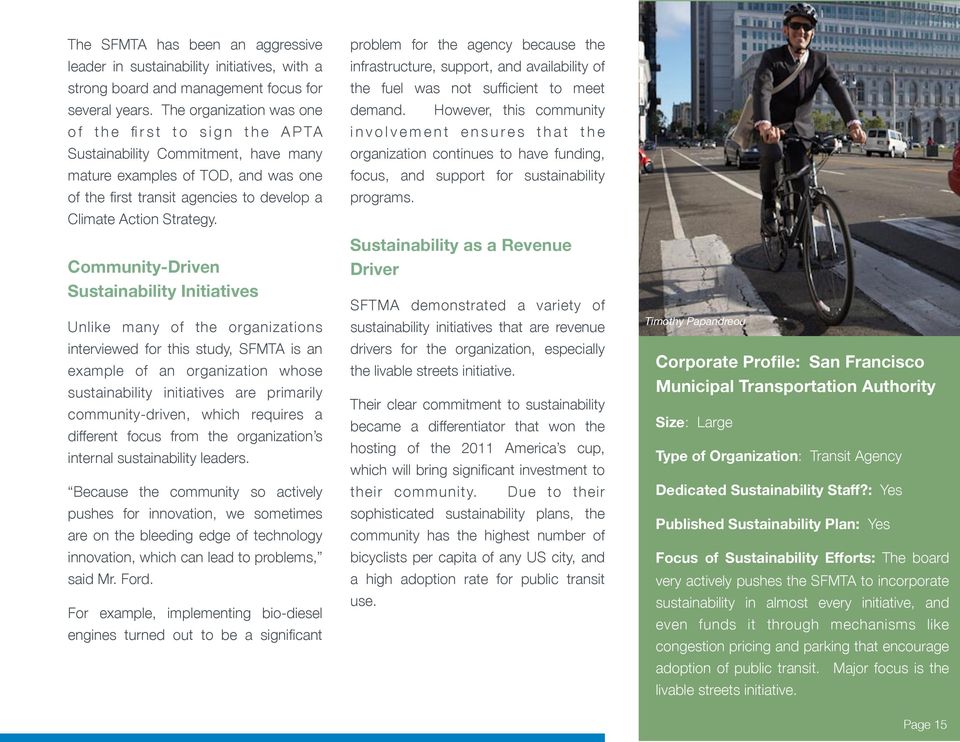
14 CASE S T U D Y Community-Driven Sustainability Focus SAN FRANCISCO MUNICIPAL TRANSPORTATION AUTHORITY There is an existing culture within the San Francisco Municipal Transportation Authority (SFMTA) of sustainability. Not only does the SFMTA board push the agency to be aggressive in their sustainability efforts, the board often votes to fund such programs with increased congestion or parking fees to encourage public transit use in the community. SFMTA s planning and directives do not begin with how much does it cost ; instead, their focus is largely how do you make it sustainable and if it is a non self-sustaining mode, how can it be supplemented by other non-sustainable transportation (i.e. parking tickets) to encourage mode shift. Nathaniel Ford, former CEO of SFMTA, states that you have to be able to Photo courtesy SF Streets Blog somehow quantify the non-quantifiable sustainability benefits--how do you put a price on health, on consumption, on quality of life? The SFMTA believes their services are a significant contributor to a healthier population in their community, and their development plans reflect a commitment to walkability and bikability. Timothy Papandreou, Deputy Director of Transportation Planning for Sustainable Streets, helps focus the agency s efforts around facilitating all types of sustainable transportation - including walking and bicycling the last transit mile. Page 14
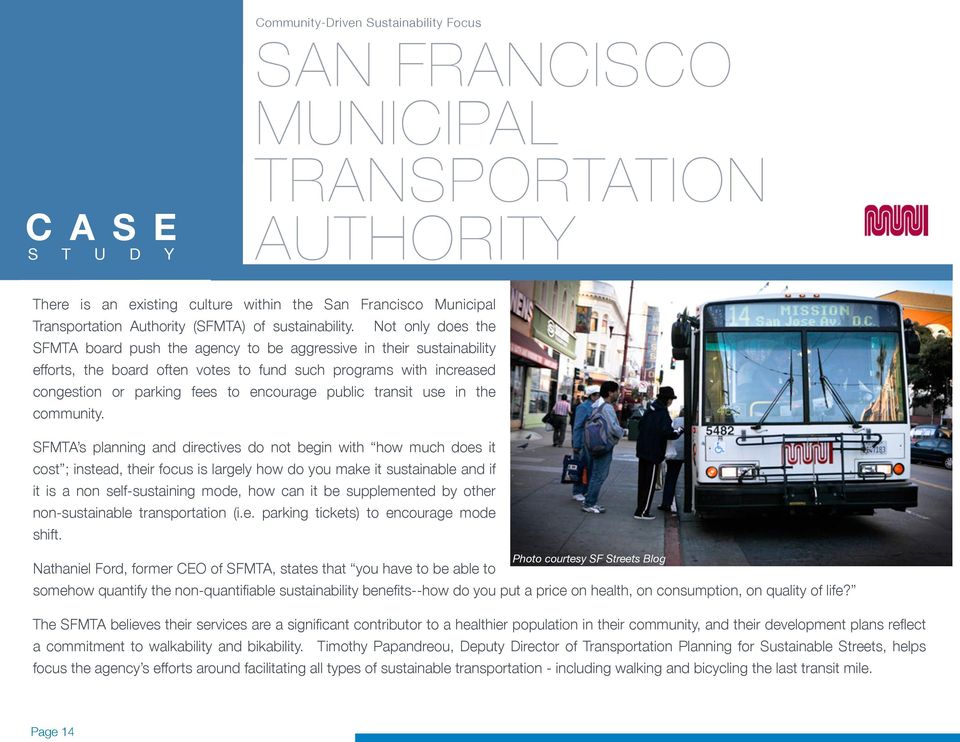
15 The SFMTA has been an aggressive leader in sustainability initiatives, with a strong board and management focus for several years. The organization was one o f t h e fi r s t t o s i g n t h e A P TA Sustainability Commitment, have many mature examples of TOD, and was one of the first transit agencies to develop a Climate Action Strategy. Community-Driven Sustainability Initiatives Unlike many of the organizations interviewed for this study, SFMTA is an example of an organization whose sustainability initiatives are primarily community-driven, which requires a different focus from the organization s internal sustainability leaders. Because the community so actively pushes for innovation, we sometimes are on the bleeding edge of technology innovation, which can lead to problems, said Mr. Ford. For example, implementing bio-diesel engines turned out to be a significant problem for the agency because the infrastructure, support, and availability of the fuel was not sufficient to meet demand. However, this community i n v o l v e m e n t e n s u r e s t h a t t h e organization continues to have funding, focus, and support for sustainability programs. Sustainability as a Revenue Driver SFTMA demonstrated a variety of sustainability initiatives that are revenue drivers for the organization, especially the livable streets initiative. Their clear commitment to sustainability became a differentiator that won the hosting of the 2011 America s cup, which will bring significant investment to their community. Due to their sophisticated sustainability plans, the community has the highest number of bicyclists per capita of any US city, and a high adoption rate for public transit use. Timothy Papandreou Corporate Profile: San Francisco Municipal Transportation Authority Size: Large Type of Organization: Transit Agency Dedicated Sustainability Staff?: Yes Published Sustainability Plan: Yes Focus of Sustainability Efforts: The board very actively pushes the SFMTA to incorporate sustainability in almost every initiative, and even funds it through mechanisms like congestion pricing and parking that encourage adoption of public transit. Major focus is the livable streets initiative. Page 15
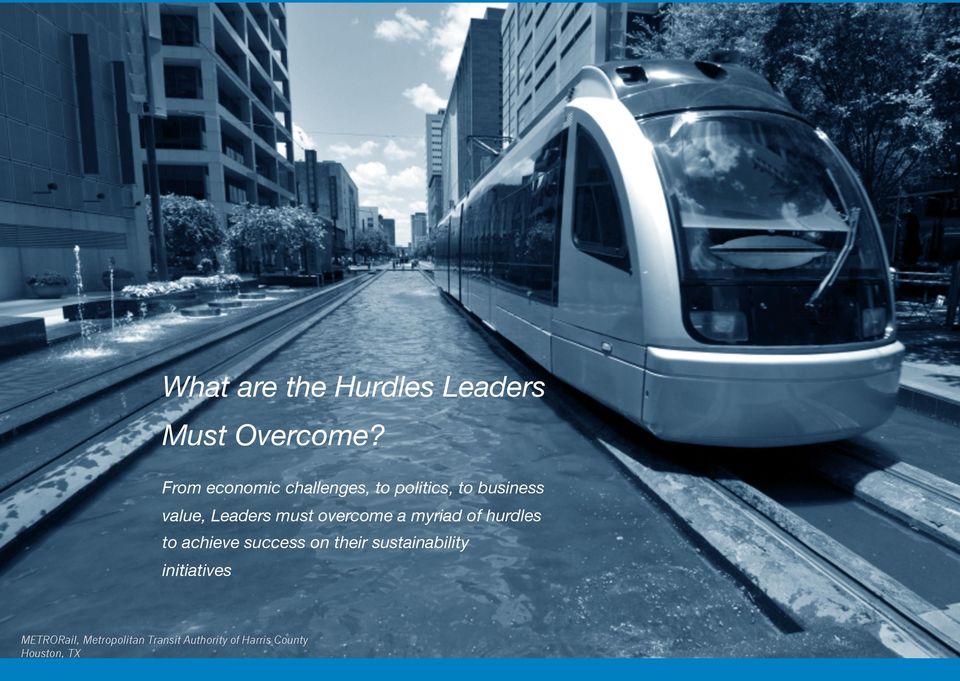
16 What are the Hurdles Leaders Must Overcome? From economic challenges, to politics, to business value, Leaders must overcome a myriad of hurdles to achieve success on their sustainability initiatives. METRORail, Metropolitan Transit Authority of Harris County Houston, TX
17 LA Metro El Monte Transit Center Design Leaders were also able to find hope in one-time, competitive grant opportunities that allowed them to fund improvements that delivered returns-on-investment. Leaders indicated they were successful in furthering their sustainability initiatives when they could articulate a bottom line that was both sustainability and customer service or ridership improvement. For example, LA Metro committed to build a LEED facility for the El Monte station that will service a high volume of riders, generate power through solar investment, reduce power consumption through daylighting, and be funded with discretionary grant funds. Long-term vs. Short-term HURDLES LEADERS FACE During the interviews, leaders were challenged to articulate the myriad hurdles they faced and their methods for overcoming them. Resoundingly, the biggest challenge for all leaders -- whether transit agencies or business partners -- was to continue to drive sustainability while facing such dire economic challenges at their organizations. Leaders typically overcame this challenge by focusing on sustainability initiatives that brought operating cost savings, either through energy efficiencies, consumables reductions, or other operational enhancements. One of the hardest hurdles for leaders to overcome is longterm vs. short-term thinking. For example, constructing a maintenance facility that is LEED-certified and employs advanced technologies requires inherently more capital investment initially, with long-term savings needing a 15 year or longer payback period. Prioritizing the long-term can be difficult for leaders who are frequently accountable to boards with a 2 or 4-year term and focus. Staffing Levels Leaders also face issues finding adequate human resources to further their sustainability initiatives, especially when balancing the needs in tough financial times. Keeping staff devoted purely to sustainability needs seems a luxury when layoffs have plagued many organizations, which means that staff are often responsible for other positions in addition to their sustainability duties. Page 17

18 Politics and Partisanship Perhaps the most difficult challenge the interviewed leaders faced was politics and partisanship about sustainability. Many observed that the word sustainability has itself become political, thereby making supporting a sustainability initiative political. SFMTA TransBay Transit Center The most cited way for leaders to overcome these hurdles was to clearly articulate a business case for their initiatives, even if the value was intangible benefit instead of fast economic return on investment. THE BUSINESS CASE The team s research investigated whether companies and agencies believe there exists a business case for sustainability, and the overwhelming conclusion is that there is significant cost savings, revenue enhancement, competitive advantage, and business value to organizations. There are both direct and indirect benefits to implementing programs. Sustainability programs can lead to lower annual operating costs and optimization of life-cycle costs, thereby increasing an agency s bottom line. These programs can also lead to a much improved public image, touching on that social pillar, and leading to increased ridership and greater support for the agencies programs at large. Research further shows that sustainability programs can lead to significant indirect cost benefits such as a reduced turnover rate and lower absenteeism. As an example of the business value of sustainability, the New Flyer corporation believes that sustainability not only saves them operating costs, but has become a competitive advantage for their organization (please see case study on the following page). Page 18

19 CASE S T U D Y Sustainability as Competitive Advantage NEW FLYER Amy Miller, New Flyer s Director of M a r k e t i n g, b e l i e v e s t h a t t h e company s sustainability initiative gives New Flyer a competitive edge. Our customers are starting to include sustainability as part of the p ro c u re m e n t p ro c e s s, w h i c h encouraged us to think about our business differently. New Flyer created a sustainability plan based on three basic tenants: Better Product. Better Workplace. Better World. Their initial focus was on the design of the vehicles they manufacture for the transit industry. Their efforts resulted in vehicles that are lighter, more fuel efficient, and yet still cost-effective for their customers. Sustainability Initiative Saves Costs New Flyer also looked at all aspects of their manufacturing processes as part of their Better Product focus. From start-to-finish, the company changed their manufacturing processes to squeeze out the waste, better utilize space, and require less raw material. They modified their materials and paints to use those that have low volatile organic compounds, tuned their supply chain to have deliveries without supplier packaging, and automated processes and procedures to be electronic instead of through paper transactions. Page 19

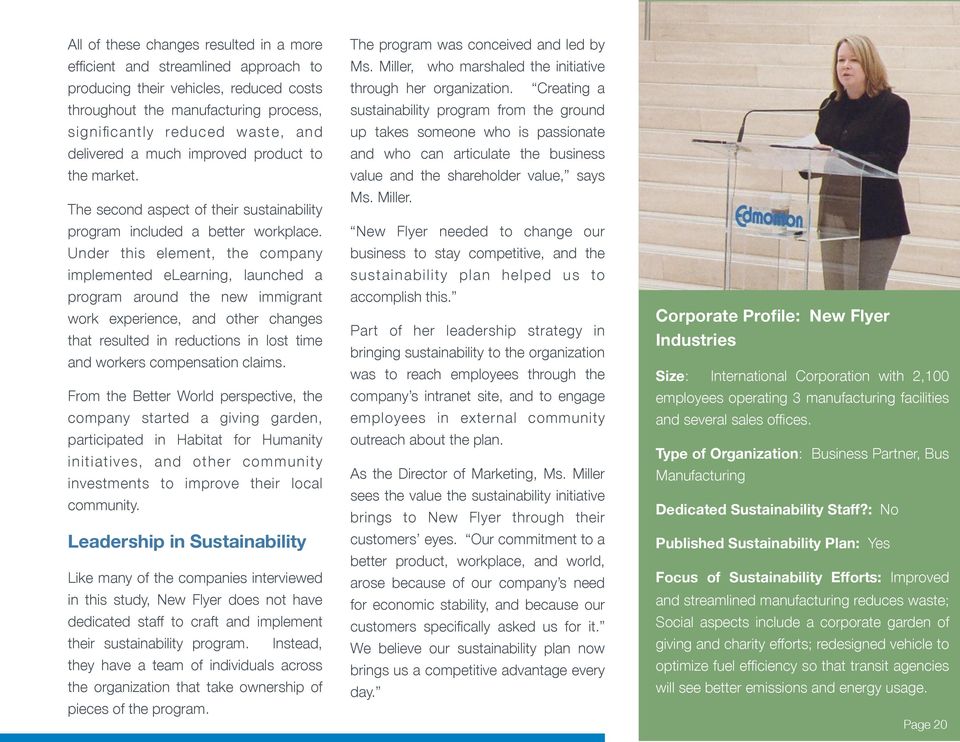
20 All of these changes resulted in a more efficient and streamlined approach to producing their vehicles, reduced costs throughout the manufacturing process, significantly reduced waste, and delivered a much improved product to the market. The second aspect of their sustainability program included a better workplace. Under this element, the company implemented elearning, launched a program around the new immigrant work experience, and other changes that resulted in reductions in lost time and workers compensation claims. From the Better World perspective, the company started a giving garden, participated in Habitat for Humanity initiatives, and other community investments to improve their local community. Leadership in Sustainability Like many of the companies interviewed in this study, New Flyer does not have dedicated staff to craft and implement their sustainability program. Instead, they have a team of individuals across the organization that take ownership of pieces of the program. The program was conceived and led by Ms. Miller, who marshaled the initiative through her organization. Creating a sustainability program from the ground up takes someone who is passionate and who can articulate the business value and the shareholder value, says Ms. Miller. New Flyer needed to change our business to stay competitive, and the sustainability plan helped us to accomplish this. Part of her leadership strategy in bringing sustainability to the organization was to reach employees through the company s intranet site, and to engage employees in external community outreach about the plan. As the Director of Marketing, Ms. Miller sees the value the sustainability initiative brings to New Flyer through their customers eyes. Our commitment to a better product, workplace, and world, arose because of our company s need for economic stability, and because our customers specifically asked us for it. We believe our sustainability plan now brings us a competitive advantage every day. Corporate Profile: New Flyer Industries Size: International Corporation with 2,100 employees operating 3 manufacturing facilities and several sales offices. Type of Organization: Business Partner, Bus Manufacturing Dedicated Sustainability Staff?: No Published Sustainability Plan: Yes Focus of Sustainability Efforts: Improved and streamlined manufacturing reduces waste; Social aspects include a corporate garden of giving and charity efforts; redesigned vehicle to optimize fuel efficiency so that transit agencies will see better emissions and energy usage. Page 20
21 CASE S T U D Y Starting small brings success KNOXVILLE AREA TRANSIT Public transit is Knoxville began in the late 1870 s. At that time streetcars where pulled by horse. By 1910 Knoxville had 42 miles of track used by electric streetcars and caring 11 million passengers annually ( Fast forward to the twenty-first century, now KAT s carries over 3 million passengers with a service area of over 100 miles. Between 1999 and 2009 the population of the Knoxville area increase by over 100 thousand people and with that increase the emphases on balancing social and environmental needs has increased. Mr. Cliff Reynolds, recognizes the local growth and has helped to redirect KAT s organizational philosophy to reflect the natural progression to a more sustainable plan. Although there is not a formulated plan in use, which focuses on sustainability at KAT, forethought was put into place through a host of new sustainable initiatives, with the first being the construction of a new LEED-certified facility. With every new sustainable venture, whether it is the new LEED-certified facility or a local agreement with a solar energy company, the hope is to garner long-term savings financially. However, prioritizing the environmental cost is also important when considering sustainability programs. Ultimately, KAT has an internal goal to do what they can to increase the overall quality of life through sustainable initiatives. During the planning process for the new facility, the idea of reaching a LEED certificate was introduced. At the time what people needed to understand what it meant and required to pursue LEED certification, especially with upfront construction costs being much higher. Upper management proceeded to make a concerted effort to explain to employees and their community, the benefit of creating a sustainable structure that would ultimately affect the overall quality life of the employees and the surrounding community. The awareness campaign was a success, the board, employees and the community all bought into the value of becoming LEED certified. Page 21
22 T h i s fi r s t s t e p t o w a rd f o c u s i n g o n environmental stewardship gave birth to projects like the renovation of an older facility replaced lighting, climate control, and implementation of other small measures, which have all had a positive effect on KAT s operations as well as overall operating costs. There have also been recent projects that introduced the use of solar panels and thermal heating, deployment of an emission reduction campaign as well as an internal recycling campaign. Overall all of these programs have shown that the initial costs are big, but as KAT s reports, they have seen ongoing economic savings as a result of these programs. With no dedicated budgetary line items focusing on the sustainable programs, KAT s took the approach of tying to reduce overall costs by introducing programs that would not only provide financial relief but also promote sustainable stewardship. Hence, internal buy in was critical. Getting people to changing their ways understanding that things will be different. This is a challenge but education was the important piece that helped us get over the hump - Cliff Reynolds Since there is not a dedicated staff for overseeing and promoting KAT s sustainable initiatives, the transit agency leaned on the city of Knoxville s Public Building Authority (PBA) for support. The PBA has the resources that KAT s could tap into, which ultimately helped to build a partnership between the two public agencies. As mentioned before, the City of Knoxville has a sustainability plan but before the partnership between KAT and PBA, the citywide plan had not included public transit. Now through this joint venture, PBA maintains the new facilities for KAT s as well as provides education to the KAT employees and surrounding community, ultimately becoming an intricate part of the City of Knoxville s overall goal of creating a sustainable society. Through this symbiotic relationship with PBA, KAT s now has the flexibility to move forward with future plans for public transit. Like most public agencies across the country that see their operating budgets shrinking, KAT s was able to reduce the overall costs for their new facility (over the life of the structure) as well as meet the needs of the present without compromising the needs of future generations. This was all done through an intercity agency partnership with PBA, who agreed to take on majority of the responsibility, which in the end helped KAT s control increase costs to the current budget as well as divert man hours to the management of these new programs. With education and the willingness to strive towards building a sustainable society, KAT was able to help move their organization and local community towards balancing economic, social and environmental needs. Agency Profile: Knoxville Area Transit Size: Small Type of Organization: Transit Agency Dedicated Sustainability Staff?: No Published Sustainability Plan: No Sustainability Leadership Profile: Informal, Champion in Facilities area Focus of Sustainability Efforts: Leveraging work with their local municipal partners to improve projects that were already underway, for example renovations and construction using LEED principals.. Page 22
23 CASE S T U D Y Sustainability as Agency s Strategic Financial and Operations Plan SOUTHEASTERN PENNSYLVANIA TRANSPORTATION AUTHORITY Joseph Casey, General Manager and CEO of the Southeastern Pennsylvania Transportation Authority (SEPTA), believes that sustainability is a smart thing to do, it s good for the environment, but you also save money. SEPTA drove into sustainability with a significant initiative over the last 8 years, first with the acquisition of hybrid buses in 2003 as a fuel saving project, and culminating in the agency s first board-adopted sustainability plan in January SEPTA began with the mission to reduce energy use and improve efficiencies. Mr. Casey noted that when undertaking these programs, sometimes you gain additional revenue, other times you gain efficiencies, especially on disposable items. Everything we do [on sustainability] has a positive cost effect. Photo courtesy SF Streets Blog SEPTA views their sustainability plan as the economic, strategic, and financial foundation of the organization. They have outlined several goals for their plan dubbed SEP-tainable, and tied them directly to their corporate strategic plan, including: reducing greenhouse gas emissions, improving energy use, reducing waste, improving access to local food, developing a highly-skilled workforce, and supporting regional business equity. Even though the original plan focused on the reduction of waste and inefficiency, it matured significantly to incorporate the social elements that tied specifically to their agency s primary mission: to provide equitable and dependable transit for their community. They have Page 23
24 achieved success on the plan by aligning to their strengths as an organization, and by working closely with their local community to partner to meet the strategic goals. Sustainable ROI Of critical importance in their plan, the organization has specifically redefined their approach to Return on Investment. They created an approach called the Sustainable ROI model that also accounts for sustainability benefits as part of the ROI calculation. For example, their investment in earlyadoption of hybrid vehicles may not have met their financial goals, but they did significantly improve greenhouse gas emissions and had a significant positive reception from their community, netting in a positive Sustainable ROI. This approach facilitated other innovative sustainability projects such as the installation of a regenerative braking energy storage solution as a prototype at one of their stations. If the project proves successful, it could be expanded to all 38 stations. Sustainability as a Core Value SEPTA s outside of the box thinking on S u s t a i n a b l e R O I h a s l e a d t h e organization to embrace their role as a leader in sustainability for their community beyond the traditional explanation of transit as a more efficient and greener transit mode. States Erik Johanson, Strategy and Sustainability Planner, Sustainability is a key component of our comprehensive corporate strategy, its our regional responsibility, and it is central to everything we do. This thinking has paid off in awards and accolades, from a US EPA Energy Star Designation, to a NRDC Smarter Cities award and a GDUSA 2011 Web Design Award for their Sustainability website. SEPTA s senior leadership embraces sustainability as the key to their agency s future. According to Mr. Casey, SEPTA cannot afford to sit back and wait for the federal government to fix the economic conditions. We must overcome our budget shortfalls through mitigating environmental impacts, building a versatile workforce, and ensuring fiscal stability. Corporate Profile: SEPTA Transportation Size: Very Large - 6th largest in US Type of Organization: Transit Authority Dedicated Sustainability Staff?: Yes Published Sustainability Plan: Yes Focus of Sustainability Efforts: defined a sustainability plan that was integrated with the agency s overall strategic vision. Created a new Sustainable ROI that allows for broader definition of cost/benefit analysis. Everything we do in sustainability has a positive cost effect. Page 24
25 What tools do leaders need to successfully drive sustainability? Successful transit leaders use a variety of tools to help foster their programs - from the business case, to community outreach, to creative funding sources. LEED Bus Maintenance Facility, Tempe, AZ Photo Courtesy RNL Design
26 means of accountability. A sustainable transportation system will have accountability in the planning process. Performance measurements and feedback loops will enable planners to learn from past experiences and understand fully the ramifications of decisions on the components of sustainability. (TRB document) This holistic concept is what creating a sustainable society stems from. The practice of thinking outside the box to meet today s needs has been proven to be successful within organizations small to large. FINANCING SUSTAINABILITY INITIATIVES Implementing sustainability programs should only occur when the outcome is a cost neutral or a savings to the organization. With public transit budgets across the country becoming anemic, there is no time better than the present to develop programs and or initiatives that will not only meet the current transportation needs, but also allow for future expansion. Furthermore, conservation of resources can be an offset to financial shortfalls. Funding should never be provided without some VTA is a great example of thinking outside of the box to conserve financial resources. Their deployment goats as a cost-effective and environmentally-friendly landscape management strategy has proven successful. Through a local partnership with a goat herder, VTA agreed to allow for natural grazing of their land, while reducing their overall costs for landscaping at this particular facility. Although this initiative might seem simple, it supports VTA s overall goal of proactively reducing the consumption of natural resources, while reducing the overall cost for landscaping. This particular program has also been praised by the local media which ultimately will help garner support for future endeavors. Whether its installing recycling receptacles, waterless urinals, solar panels, or reducing costs for irrigation, cost cutting measures can be applied at any level, all while taking into consideration of creating a sustainable culture. Page 26
27 Transportation investments have a wide range of effects on the economy, the environment, and our culture. A b ro a d t r a n s p o r t a t i o n p l a n n i n g perspective should be implemented to enable planners to address more fully u n s u s t a i n a b l e e ff e c t s s u c h a s congestions climate change and air p o l l u t i o n. ( T R B d o c u m e n t ) Consideration of the triple bottom-line allows for transportation planners to apply equal weight during analysis of managing the before mentioned unsustainable factors. With the full range of consideration applied to the planning process, innovative solutions are bred to meet today s needs while enabling future growth. The Federal Tr a n s p o r t a t i o n A d m i n i s t r a t i o n recognizes the need to promote transportation innovation. Transit Investments in Greenhouse Gas Emissions Reductions The TIGGER Program works directly with public transportation agencies to implement new strategies for reducing greenhouse gas emissions and/or reduce energy use within transit operations. Transportation Investment Generating Economic Recovery Program (TIGER) TIGER, which fosters innovative, multim o d a l a n d m u l t i - j u r i s d i c t i o n a l transportation projects that promise significant economic and environmental benefits to an entire metropolitan area, a region, or the nation. Metropolitan & Statewide Planning (5303, 5304, 5305) Protect and enhance the environment, promote energy conservation, improve the quality of life, and promote consistency between transportation improvements and State and local planned growth and economic development patterns. At the New York City MTA (NTCMTA), a joint power agreement with the New York Power Authority, has given NYCMTA the ability to overall reduce the cost for electricity. The New York Power Authority financed the upfront costs to update NYCMTA s electric infrastructure. The savings in electricity that NYCMTA gained is then returned to the power authority to pay off the upfront costs. This is a very practical way for small to large transit authorities to address today s financial restraints, update current infrastructure as well as build for the future. Accomplishing the goal of creating a sustainable society requires a holistic approach. A culture that not only sees sustainability as desirable but also accepts the inclusion of sustainable concepts in the transportation planning p r o c e s s ( T R B D o c u m e n t ) Investments in transportation are key factors in creating an inclusive sustainable environment within a public transportation organization. Reliable transportation funding breeds cultural acceptance not only internally but also by the community it serves. In the end, legislators and policy makers must also realize that a dependable funding source is needed to meet the needs of today without compromising future generation s ability to meet their needs. Without the financial support, changing the culture within a public organization will become hard fought. Page 27
28 CASE S T U D Y Finding projects that give the Triple Bottom Line NEW YORK METROPOLITAN TRANSIT AUTHORITY The New York Metropolitan Transportation Authority (NYMTA) is a public benefit corporation chartered by New York State. NYMTA is responsible for the agencies that run several different modes, including New York City Transit, Long Island Rail Road, Long Island Bus, Metro-North Railroad, Bridges and Tunnels, MTA Bus and Capital Construction. In total, the MTA is responsible for providing services over 5000 square miles. NYMTA is the largest mass transportation agency in America. NYMTA has a well established Sustainability program that encompasses all of the agency s modes and areas of responsibility. The sustainability program has a long term goal to draw 80 percent of their total operating energy from clean, renewable energy sources by 2050, while at the same time continuing to expand regional access. It further states that the MTA transit system must reach and absorb two-thirds of the New York Photo courtesy Via Architecture metropolitan area s projected growth of 4 million people between the present and 2030 in order to achieve sustainability. These are significant goals and by all many measures, the MTA is on a path to achieve them. The team interviewed Ernest Tollerson, Director of Sustainability and Compliance, who shared the genesis and status of the MTA s sustainability program. MTA has both dedicated staff and a dedicated budget for sustainability initiatives. Sustainability is not just about the obvious, Mr. Page 28
29 Tollerson shared, Sustainability is about continuous improvement. This is evident in the MTA s Sustainability Program and their 2011 Annual Report on Sustainability. The Agency s 2011 Sustainability Report highlights the Select Bus Service (SBS), an initiative that has radically increased the impact of their bus fleet. Over the years, the MTA boosted the capacity and efficiency of its hybrid-electric and CNG fleets. This however was not providing the full impact the MTA had hoped for, thus the SBS initiative was borne. Using dedicated lanes, express stops, traffic signal prioritization and offboard fare collection on one of the SBS routes, Fordham Road, quickly increased travel speed by 20 percent and ridership by 10 percent. This resulted in cost savings, environmental benefit and better service for riders, hitting that triple bottom line or the triple E. The Chief Executive Officer of the MTA (at the time of the study), Jay Walder, refers to initiatives like the SBS a sustainability trifecta. He has instilled that in order for a sustainability program to be successful, it must encompass all three elements of the pillar. The MTA recognizes the difficult economic times and seeks opportunities to secure grants to fund their sustainability initiatives and have been successful in two rounds of TIGER funds. One of those grant opportunities has provided funding to install wireless control points that allow for the heating of the third rail on the subway system. These switches were previously thrown by hand and were often left on for longer periods of time than necessary. By installing these wireless switches the heating system can be turned off and on as necessary, thereby minimizing energy consumption and providing for more reliable service. The SBS and wireless third rail heating are but two of the number of sustainable initiatives that MTA has implemented. MTA as the single largest mass transit provider in America is making a significant effort to provide more sustainable systems. Ernest Tollerson Corporate Profile: New York Metropolitan Transportation Authority Size: Very Large - largest in US Type of Organization: Transit Agency Dedicated Sustainability Staff?: Yes Published Sustainability Plan: Yes Focus of Sustainability Efforts: Delivering projects that adhere to the CEO s mission of achieving the sustainability trifecta : environmental benefit, better service for riders, and cost savings. Innovative partnerships with private sector firms. Page 29
30 CEO Leads APTA-Based Sustainability Initiatives C A S E S T U D Y GREATER CLEVELAND RTA The Greater Cleveland Regional Transit Authority (RTA) is building a stronger company for a sustainable future. We are moving toward reducing our environmental footprint. RTA is focusing on a triple bottom line: People (social) Planet (environmental) and Profit (economical), striving to provide the most efficient and sustainable public transportation system for our customers, stakeholders, employees and the public in respect to preserving the environment. Joseph Calabrese, Chief Executive Officer and General Manager, believes that sustainability is part of our mission and it is what we do everyday in proving public transportation. The most sustainable thing RTA can do is to get people out of their cars. Danielle Willis, Sustainability Planning Coordinator, believes that the success of their plan began with their work with employees. We surveyed the employees to determine what they already knew about sustainability and what they thought we were already doing or should do to be successful. We built and internal team that defined criteria, and having their buy-in from the beginning was important for the program. The RTA defined sustainability criteria includes : Fulfills the mission; Lead by example; Believe it in morally; and Save money and resources. The RTA management team defines true sustainability as promoting long range thinking and saving money. As a result of RTA s signing of the APTA Sustainability commitment, now when the agency talks about conservation and preservation the agency thinks in long range goals. RTA credits the success of the organizations success to the APTA sustainability program. Page 30
31 Communication Approximately 99% of the program is promoted internally. Very little is done to promote externally. The executive team is charged from the top down as to the importance of the program and the need to adopt sustainability initiatives. The organization has weekly meeting and quarterly meeting to talk about the programs and the results achieved. Additionally, the organization brings in guest speakers to speak on a variety of topics such as zero waste initiatives. Visual initiatives internally to get the word out have been very effective. Working hand and hand with employees to help them to understand that they are apart of the program. The visuals have been part of that success. The organization performed internal surveys to gauge the employees understanding or awareness of what sustainability meant. Benefits of the Program The organization has been able to get grants in the area of energy to retrofit a number of the control systems and lighting systems giving employees a better working environment and saved the organization money. The employees have seen a direct pay off of the program. Leadership Leadership has focused on employee participation and maintaining visibility. Knowledge has helped to maintain sustainability in the forefront of the teams mind in order to drive the message of how sustainability will benefit the organization, but more importantly the employee. Initiatives were separated from agency wide goals that can be accomplished quickly and for little to no money. Divisional goals are defined as the special projects that were developed. The leadership focuses on the three pillars social, environmental, and economical: the triple bottom line. Projects are p r i o r i t i z e d b a s e d o n w h a t t h e organization can manage.: if we can measure it, we can manage it. Joseph Calabrese Corporate Profile: Greater Cleveland Regional Transit Authority Size: mid-sized Type of Organization: Transit Agency Dedicated Sustainability Staff?: Yes Published Sustainability Plan: Yes Focus of Sustainability Efforts: Continued refinement of the 10 year carbon management plan calling for a 20% reduction in carbon emissions by Reduction in energy consumption through a $2.25 million grant award under the TIGGER program. Page 31
32 What happens when Sustainability Leaders Think Outside the Box? Successful Transit Sustainability Leaders demonstrated significant creativity in overcoming their challenges.
33 Goat Mowers The Santa Clara Valley Transportation Authority solved the problem of maintaining large open spaces by deploying goats as a cost-effective and environmentally-friendly landscape management strategy. The goats, provided by a local farmer, keep the grasses at a manageable level while providing an excellent natural fertilizer and reducing emissions from gaspowered mowers. Zero-Emission Special Events The SFMTA has articulated the value of their services by making pitches to special event organizations to host zeroemission events. The organization recently had a successful bid for the Americas Cup through this program. WHEN LEADERS THINK OUTSIDE THE BOX Landfill Gas Powered Vehicles King County Metro Transit created a program where all solid waste generated by county was sent to a treatment facility, then converted to biodiesel and reused by the transit agency to power biodiesel buses. Some of the most interesting feedback from sustainability leaders came not about the financial windfall from projects, but about the projects that were far outside the box. From green roofs, to landfill-powered facilities, to goat mowers, thinking outside of the box delivered not only business value, but often also brought significant positive press and community engagement. 33
34 CASE S T U D Y Innovative and Cooperative Thinking Brings Change SANTA CLARA VALLEY TRANSPORTATION AUTHORITY The Santa Clara Valley Transportation Authority (VTA) has Senior Leadership and dedicated resources -- both employee and financial -- to further their sustainable goals. Strong from the beginning In 2007, the VTA board and General Manager set aside $3M at $500k per year to develop and manage an industry-leading sustainability program. This program funded personnel to evaluate all aspects of VTA s business and help them achieve the following objectives: joining the Bay Area Green Business Program; complying with all applicable environmental regulations and striving to exceed compliance; conserving energy, water and other natural resources; developing and implementing practices that prevent pollution and waste; and acting as an environmentally responsible business within the community. Return on Investment VTA has been able to demonstrate a return on investment. Their most recent calculation showed their less-than-$3m investment has saved them about $1M per year with a less than 3 year payback. Due to hard times, VTA has had to cut back their budget to $550k per year which covers staff time and some improvements. They have been able to leverage other external resources. For instance, Pacific Gas and Electric Page 34
35 have provided a free, exhaustive audit of their energy use which helped show low cost and higher cost energy efficiency improvement opportunities. VTA has a l s o b e a b l e t o a t t r a c t l o c a l entrepreneurial business to share with V T A i n a d v a n c e d p r o d u c t demonstration, such as their first 3 Gillig / Ballard fuel cell buses, and more recently their large solar generation plant. They can t necessarily show that saving large resources such as water, will necessarily show a quick return on investment, and as such prioritization in recent times is typically more on the electricity side. Getting Team Buy-In It all started with the GM dedicating budget resources to sustainability, which did a great deal to increase their program in recent years. They then have a sustainability brainstorming team of p e o p l e f ro m o p e r a t i o n s, construction, risk management, finance, and maintenance who get together every month to discuss results and future plans. Through such successes VTA has received great buy in from team leaders such as their Operation Chief and Deputy Directors. They have been able to then leverage these group leaders to drive sustainability throughout their cross functional organization. Thinking Outside of the Box One of the most unique aspects of VTA s sustainability mission came in their landscaping needs at their Zerega Division. When tackled with need to mow the grass, they were able to find a local sheep / goat herder who brings his flock under the freeway to VTA s yard where the sheep or goats will graze the fields in their entryway to the division. Not only has this cut down on costs of mowing the grass, but it has provided some PR appeal giving local attention into VTA s sustainability. More i m p o r t a n t l y a l l e m p l o y e e s a n d contractors who arrive at the Zerega Division get a bold reminder upon entrance that VTA puts sustainability in the forefront. Corporate Profile: Santa Clara Valley Transportation Authority Size: mid-sized Type of Organization: Transit Agency Dedicated Sustainability Staff?: Yes Published Sustainability Plan: Yes Focus of Sustainability Efforts: Improve system ridership, productivity and efficiency, improve farebox recovery, improve transit's role as a viable mode, use transit investments and resources more effectively. Page 35
36 CASE S T U D Y Providing Services that Help Customers be More Sustainable VEOLIA TRANSPORTATION Veolia Transportation operates outsourced transit services for over 70 locations. Their approach to sustainability is engrained in the company. Owned by the French Veolia Environment headquartered in Paris, the US branch of Veolia Transportation views sustainability as a core mission and value. Overall, Veolia has over 300,000 employees, with nearly 16,000 US employees at Veolia Transportation. For its large size, Veolia Transportation has only 2 employees dedicated specifically to the sustainability mission; however, the program is tightly integrated with all of the services the organization provides as an operator and maintainer. The primary focus of the sustainability plan is the Environmental Management System and ISO 9000 and program. This program provides a consistent methodology for achieving efficiencies in fuel consumption, idle reduction, and maintenance procedures that provide savings and emissions reductions for their customers. The company has fostered a green culture throughout the organization, from their sustainable mobility initiative, to their organization s commitment as the first transportation company to sign the California Climate Action Registry. Veolia Transportation is one of the only outsource service providers to collect and publish comprehensive greenhouse gas emission and carbon footprint metrics from all of their operations throughout the United States. As a private transportation business partner, Veolia Transportation focuses on delivering value not only for their sustainability initiatives, but also for their customers. Corporate Profile: Veolia Transportation Size: Very Large Type of Organization: Business Partner - Services Dedicated Sustainability Staff?: Yes Published Sustainability Plan: Yes Focus of Sustainability Efforts: Modifying service and maintenance procedures to ensure both ISO and Environmental Management System compliance and efficiency gains. Page 36
37 CONCLUSIONS The 2011 Leadership APTA Sustainability Team interviewed over 20 entities and reviewed a myriad of industry and analyst reports to compile this assessment. The conclusions for the report are clear: Leaders of transit sustainability initiatives can be successful from all levels and roles in an organization with the right set of tools. Programs take all shapes and sizes - from simply replacing the materials used in maintenance shops, to alternative energy initiatives, manufacturing and design changes, propulsion technologies, energy storage devices, transit oriented development, bicycling initiatives, access to local food, community gardens, and entire corporate strategic plans tied to sustainability metrics. Sustainability programs are possible. There is a business case to be made and a good story to be told about the benefits of both small and large sustainability programs for transit agencies. There is never a one size fits all approach to implementing a sustainability program, but there is a program for each agency. The program must be tailored to meet each agencies unique needs. And Leaders must request, listen, and empower. Leaders of these sustainability initiatives have many hurdles to overcome, especially in fiscally-challenging times. But the lesson of this analysis is clear - sustainability has a tangible business value to transit, even when money is tight. Page 37
Creating Sustainable Workplaces and Organizations
 Creating Sustainable Workplaces and Organizations Alachua County Manager s Office 12 SE 1st Street Gainesville, FL 32601 352-374-5240 http://www.alachuacounty.us Table of Contents What is Sustainability?
MANAGEMENT PLAN. Fiscal Year 2015-2016
 MANAGEMENT PLAN Fiscal Year 2015-2016 May 6, 2015 Table of Contents I. Executive Summary... 2 Omnitrans Vision... 5 Omnitrans Mission Statement... 5 II. Strategic Initiatives... 5 Implementation... 6 Strategic
Letter from the Chairman 2 Recycling 5 RecycleBank 7 Composting 9 Renewable Energy 11 Alternative Fuel Vehicles 13 Fleet Optimization 15 Communities
 S U S TA I N A B I L I T Y I N I T I AT I V E S WA S T E C O N N E C T I O N S, INC. C O N T E N TS Letter from the Chairman 2 Recycling 5 RecycleBank 7 Composting 9 Renewable Energy 11 Alternative Fuel
EKU Sustainability Strategic Plan 12/3/2015
 What is Sustainability? Sustainability implies a cross-generational commitment to environmental stewardship and its economic, political and social dimensions. It is a practical approach toward making decisions
ELECTRIC VEHICLES: THE PORTLAND WAY
 ELECTRIC VEHICLES: THE PORTLAND WAY THE PORTLAND STRATEGY AT A GLANCE 1. Adopt and update policies to facilitate the transition to the use of electric vehicles (EVs) in Portland: a. Streamline electrical
BOND DEVELOPMENT GUIDING PRINCIPLES AND PROCESS
 BOND DEVELOPMENT GUIDING PRINCIPLES AND PROCESS OVERVIEW A Vision for Austin s Future As it approaches its 200th anniversary, Austin is a beacon of sustainability, social equity and economic opportunity;
Greening Our Indian Business for Sustainability
 Greening Our Indian Business for Sustainability Maulik K. Rathod 1, Mayank R. Rai 2 1 (Rai University, Dholka, Ahmedabad, Gujarat India.) 2 (Anand Law College, Anand, Gujarat India.) Abstract: Modern Corporates
MILWAUKEE. Plan. comprehensive DEPARTMENT OF CITY DEVELOPMENT MARCH, 2010 EXECUTIVE SUMMARY
 MILWAUKEE Plan DEPARTMENT OF CITY DEVELOPMENT MARCH, 2010 comprehensive CITYWIDE POLICY PLAN EXECUTIVE SUMMARY INTRODUCTION AND OVERVIEW I. OVERVIEW OF COMPREHENSIVE SMART GROWTH PLAN SERIES The series
Pima County. Sustainable Action Plan for County Operations
 Pima County Sustainable Action Plan for County Operations Five Year Summary of Accomplishments 2008 2013 Success Highlights Since 2008, the Sustainable Action Plan for County Operations has been successfully
Leveraging Sustainability through Employee Engagement for a Competitive Future. Danielle Willis. Cleveland, OH
 Leveraging Sustainability through Employee Engagement for a Competitive Future Danielle Willis Greater Cleveland Regional Transit Authority Planning Team Ldr./Sustainability Coordinator Cleveland, OH Presentation
How Companies Are Investing in Sustainability
 March 23, 2009 How Companies Are Investing in Sustainability By Brandi McManus http://www.greenbiz.com/feature/2009/03/23/investing sustainability Long term sustainable growth is important to building
AB Volvo, 405 08 Göteborg, Sweden. Ref No 953810003, August 2009. The Volvo Way
 AB Volvo, 405 08 Göteborg, Sweden Ref No 953810003, August 2009 The Volvo Way index Preface Our mission Customers first Customer focus Clear objectives Quality, safety, environmental care Continuous improvements
SUSTAINABILITY CHARTER. May 2012. 1 R&CA Sustainability Charter V1
 SUSTAINABILITY CHARTER May 2012 1 R&CA Sustainability Charter V1 Introduction By their very nature, restaurant and catering businesses are significant users of energy, water and raw materials. Cooking
Operating Sustainable Facilities
 Operating Sustainable Facilities Introduction... 1 Chapter 1: Energy Topic 1: Energy and Sustainable Facilities... 8 Topic 2: Energy Metrics... 11 Topic 3: Sustainable Facility Energy Initiatives... 20
ENVIRONMENTAL, ENERGY AND TRANSPORTATION MANAGEMENT
 Court Services and Offender Supervision Agency for the District of Columbia POLICY STATEMENT ENVIRONMENTAL, ENERGY AND TRANSPORTATION MANAGEMENT I. COVERAGE This Policy Statement and its appended procedures
GREENING MAIN STREET: Resources from the National Trust for Historic Preservation
 GREENING MAIN STREET: Resources from the National Trust for Historic Preservation Online Tools Sustainability Issue Page Link to a variety of new resources that are continually being updated, from historic
Empowering Local Clean Energy Action FEDERAL POLICY AGENDA FOR 2011
 Empowering Local Clean Energy Action FEDERAL POLICY AGENDA FOR 2011 L ocal government leadership is essential for America to achieve energy independence, renew economic prosperity and protect the environment.
Multiple sources of energy will be available, giving the consumer choices. A Higher Percentage of Energy will come from renewable energy sources
 Editor s comments: Numbers in parentheses indicate the number of duplicate or extremely similar comments made. The headings are editor s best attempt to draft vision statements reflecting the participants
Sustainable Development Strategy
 Sustainable Development Strategy Our vision and strategy: A railway fit for the future 2013 2024 Document Ref: SBPT204 Version 0.71 Executive summary Network Rail exists to generate outstanding value for
San Antonio College. Energy Systems Laboratory TEXAS ENGINEERING EXPERIMENT STATION TEXAS A&M UNIVERSITY SYSTEM
 CLIMATE ACTION PLAN 2011 For: San Antonio College 1300 San Pedro Ave., San Antonio, TX 78212. (210) 486-0000 Prepared by: Energy Systems Laboratory TEXAS ENGINEERING EXPERIMENT STATION TEXAS A&M UNIVERSITY
Chicago Climate Action Plan Update
 Chicago Climate Action Plan First Two Years ACCO Climate Change Leadership Summit November 9, 2010 City of Chicago Richard M. Daley, Mayor Chicago Climate Action Plan Update FIVE STRATEGIES Recognition
Marketing Plan Development 101: The Importance of Developing a Marketing Plan for Public Transit Agencies & Commuter Assistance Programs
 Marketing Plan Development 101: The Importance of Developing a Marketing Plan for Public Transit Agencies & Commuter Assistance Programs Mark Glein, PhD, Marketing Florida State University Marketing Plan
Growing the Green Economy
 Growing the Green Economy Labour Green Economy Paper.indd 1 05/02/2016 17:44 Our Plan Establish a green infrastructure fund worth 1bn. We recognise the need to fund immediate action on climate change.
COPYRIGHT MATERIAL. Geof Syphers, PE, LEED AP BD+C Codding Enterprises 2010
 COPYRIGHT MATERIAL This presentation is protected by US and International Copyright laws. Reproduction, distribution, display and use of the presentation without written permission of the author is prohibited.
Mission Statement: To enhance and sustain the spirit of the Vail Valley by providing leadership in educational, athletic and cultural endeavors.
 Mission Statement and Business Code of Conduct The Vail Valley Foundation MISSION, VALUES, CODE OF CONDUCT Mission Statement: To enhance and sustain the spirit of the Vail Valley by providing leadership
Implementing Instructions - Sustainable Locations for Federal Facilities
 Implementing Instructions - Sustainable Locations for Federal Facilities Page 1 Background On October 5, 2009, President Obama signed Executive Order (E.O.) 13514, Federal Leadership in Environmental,
Seattle Comprehensive Plan: Toward a Sustainable Seattle Evaluation
 Plan Analysis for UAP 5794 Sustainability Planning Lab Seattle Comprehensive Plan: Toward a Sustainable Seattle Evaluation Kaitlen Scanlon March 26, 2011 Table of Contents City Context Information... 2
As state employees, we must balance safety, cost effectiveness, and efficiency with the fiscal and environmental health of our state.
 To: DAS Fleet Customers RE: Fleet Customer Survey Results and Action Plan Thank you for participating in the DAS Customer Service Survey. The results of the DAS survey are available at http://www.oregon.gov/das/directors_survey.shtml.
Greenhouse gas abatement potential in Israel
 Greenhouse gas abatement potential in Israel Israel s GHG abatement cost curve Translated executive summary, November 2009 1 Executive Summary Background At the December 2009 UNFCCC Conference in Copenhagen,
Call to Action on Smart Sustainable Cities
 Call to Action on Smart Sustainable Cities 1. Introduction Achieving sustainable urbanization, along with the preservation of our planet, has been recognized as one of the major challenges of our society
Prepared by the Commission on Environment & Energy
 Policy statement Energy efficiency: a world business perspective Prepared by the Commission on Environment & Energy Key messages Energy efficiency is a fundamental element in progress towards a sustainable
Policy GRN-1.1.2. The City will adopt a Go Green Initiative to implement strategies to reduce greenhouse gas emissions within the City s borders.
 Vision Statement: Provide goals, objectives, and policies that preserve, improve, and promote responsible use and protect the City s natural and built environment. Goals, Objectives and Policies: Goal
Sustainability + Resilience
 Sustainability + Resilience Fredericton s Journey By Tina Tapley The City of Fredericton, New Brunswick, has managed to not only see its way successfully through the economic turbulence of the last seven
2013-2015. Milwaukee Metropolitan Sewerage District STRATEGIC PLAN
 Milwaukee Metropolitan Sewerage District STRATEGIC PLAN 2013-2015 The Strategic Plan identifies the District s strengths, weaknesses, opportunities, and threats, and provides direction and focus to help
Link Sustainability to Corporate Strategy Using the Balanced Scorecard
 Link Sustainability to Corporate Strategy Using the Balanced Scorecard People and their managers are working so hard to be sure things are done right, that they hardly have time to decide if they are doing
Empowering Sustainability in Logistics
 Empowering Sustainability in Logistics Building a Responsible Partnership for a Green Supply Chain Sustainability is now part of the supply chain lexicon or should be If mismanaged, supply chain decisions
Council Strategic Plan 2015-2018. squamish.ca
 Council Strategic Plan 2015-2018 squamish.ca 2 Summary Our Council began their 2014 2018 term with a strategic planning exercise. The exercise identified a number of areas of focus for Council and directed
Green Growth Platform questionnaire Answers submitted by Rahm Emanuel. Chicago s Climate Change Solutions and Clean Energy Future
 Green Growth Platform questionnaire Answers submitted by Rahm Emanuel Chicago s Climate Change Solutions and Clean Energy Future 1. Fisk and Crawford Coal Plants -- Clean Up or Shut Down: Will you strongly
Corporate Carbon Neutral Plan
 This Carbon Neutral Plan will guide the District of 100 Mile House decision making process in terms of reducing corporate energy consumption and greenhouse gas emissions and in achieving carbon neutrality.
The Balanced Scorecard and Corporate Social Responsibility: Aligning Values for Profit
 Balanced Scorecard and CSR -------------------------------------------------------------- This story was printed from News, located at http://www.greenbiz.com/news/. --------------------------------------------------------------
Multi-year Expert Meeting on Transport, Trade Logistics and Trade Facilitation
 Multi-year Expert Meeting on Transport, Trade Logistics and Trade Facilitation Sustainable Freight Transport Systems: Opportunities for Developing Countries 14-16 October 2015 EGYPT'S POLICIES FOR SUSTAINABLE
Commuter Choice Certificate Program
 Commuter Choice Certificate Program Current course offerings (subject to change) Core 1 Commuter Choice Toolbox Required Courses Rideshare Options Audience: This 2 credit required course is targeted to
Chapter 9: Transportation
 Chapter 9: Transportation What is this chapter about? The goals and policies in this chapter convey the City s intent to: Create a coordinated, efficient, and more affordable multimodal transportation
Attachment 1. Principles, Priorities, and Actions for Economic Renewal and Development for the City of Seattle
 Attachment 1 Principles, Priorities, and Actions for Economic Renewal and Development for the City of Seattle Quality of Life A livable city requires that we retain and improve the character of Seattle,
PAINTER EXECUTIVE SEARCH
 PAINTER EXECUTIVE SEARCH Position Description Painter Executive Search is supporting the in a search for an experienced to lead a broad regional coalition of Bay Area land conservation agencies and organizations
COUNTY OF LAMBTON OFFICIAL PLAN UPDATE BACKGROUND REPORT NO.
 COUNTY OF LAMBTON OFFICIAL PLAN UPDATE BACKGROUND REPORT NO. 6 RENEWABLE ENERGY Image Source: (Word Clip Art Stock Photo, 2011) Date: May, 2015 BACKGROUND PLANNING AND DEVELOPMENT SERVICES DEPARTMENT 789
Greenlighting Efficiency: 7 Easy Steps to Reduce the Environmental Impact of Today s Supply Chains
 Greenlighting Efficiency: 7 Easy Steps to Reduce the Environmental Impact of Today s Supply Chains With increased international attention focused on the environmental impact of manufacturing and transportation,
Business Plan: Fleet Services
 Business Plan: Fleet Services How does this service contribute to the results identified in the City of London Strategic Plan? A Strong Economy A Green and Growing City Fleet Services owns and manages
GREEN ENGINEERING TECHNOLOGIES (PVT) LTD.
 GREEN ENGINEERING TECHNOLOGIES (PVT) LTD. At Green Engineering Technologies (PVT) Ltd, we are making the world a cleaner, safer place and also it is our primary concern and the business. We are committed
City of Toronto STRATEGIC ACTIONS 2013-2018
 City of Toronto STRATEGIC ACTIONS 2013-2018 Contents Message from the City Manager 2 Council s Strategic Plan 3 Developing Strategic Actions 6 Strategic Actions 2013-2018 7 City Building 8 Economic Vitality
IT for Green: Impacting the Triple Bottom Line - People, Planet, and Profits. Webcast May 21, 2008
 IT for Green: Impacting the Triple Bottom Line - People, Planet, and Profits Webcast May 21, 2008 Webcast Logistics Audio lines are muted until Q&A session Submit your questions via the Live Meeting Chat
Designing and Implementing Your Communication s Dashboard: Lessons Learned
 Designing and Implementing Your Communication s Dashboard: Lessons Learned By Katie Delahaye Paine President, Paine & Partners Contact Information: Katie Delahaye Paine CEO KDPaine & Partners Durham, NH
Examples of Transportation Plan Goals, Objectives and Performance Measures
 Examples of Transportation Plan Goals, Objectives and Performance Measures The next step in the Long Range Transportation Plan (LRTP) process is to develop goals, objectives, and performance measures.
IMAGINE FLINT MASTER PLAN FOR A SUSTAINABLE FLINT Goals and Objectives
 IMAGINE FLINT MASTER PLAN FOR A SUSTAINABLE FLINT Goals and Objectives Adopted October 28, 2013 The City of Flint s Imagine Flint Master Plan for a Sustainable Flint is a blueprint for the future, guiding
Brevard Clean Energy Strategy for Economic Development
 Brevard Clean Energy Strategy for Economic Development February 26, 2014 The following Strategy statement has been developed as part of the Brevard Innovation initiative. Its purpose is to foster clean
Greening Fleets. A roadmap to lower costs and cleaner corporate fleets
 Greening Fleets A roadmap to lower costs and cleaner corporate fleets Rising energy costs and climate change are dual challenges facing businesses today. These challenges are particularly salient for corporate
How school facilities managers and business officials are reducing operating costs and saving money
 Energy-Smart Building Choices How school facilities managers and business officials are reducing operating costs and saving money Smart Energy Choices Free Up Dollars for Capital Improvements Operating
Center for Sustainable Business Growth
 Center for Sustainable Business Growth Progress Report; December 2014 Bridgeport Eco-Technology Park The south and west ends of Bridgeport, where the Eco-Technology Park resides, have been the home of
unprecedented opportunity MOFFET T TOW ERS unparalleled visibility
 unprecedented opportunity MOFFET T TOW ERS unparalleled visibility INNOVATION THRIVES HERE Moffett Towers is an extraordinary new office and R&D campus in the heart of Silicon Valley. It is unquestionably
SUSTAINABILITY & THE TRIPLE BOTTOM LINE IMPACT: HOW TO BEGIN
 2013 Zedare Consulting 2013 Zedare Consulting SUSTAINABILITY & THE TRIPLE BOTTOM LINE IMPACT: HOW TO BEGIN Veda Ferlazzo Clark Zedare Consulting www.zedare.com [email protected] 617-428-3808 This whitepaper
2010 Salida Community Priorities Survey Summary Results
 SURVEY BACKGROUND The 2010 Salida Community Priorities Survey was distributed in September in an effort to obtain feedback about the level of support for various priorities identified in the draft Comprehensive
Chair Tom Galloway and Members of the Administration and Finance Committee UPDATE - CORPORATE ENVIRONMENTAL SUSTAINABILITY STRATEGY
 REGION OF WATERLOO CORPORATE RESOURCES Facilities Management & Fleet Services TO: Chair Tom Galloway and Members of the Administration and Finance Committee DATE: May 13, 2008 FILE CODE: A26-50(A) SUBJECT:
Sustainable Development Strategy 2011-2014 Responsibility. Innovation. Commitment.
 Canada Revenue Agency Sustainable Development Strategy 2011-2014 Responsibility. Innovation. Commitment. RC4087(E) Rev. 11 xxxx Message from the Commissioner The Government of Canada tabled its first Federal
Recommendations on Proposed Comprehensive Plan Amendments
 October 30, 2015 Diane Sugimura Director City of Seattle Department of Planning and Development 700 Fifth Avenue, Suite 2000 P.O. Box 34019 Seattle, WA 98124-4019 Via e-mail Re: Recommendations on Proposed
Climate Action Revenue Incentive (CARIP) Public Report for 2013
 March 6, 2013 Climate Revenue Incentive Plan (CARIP) Public Report Climate Revenue Incentive (CARIP) Public Report for 2013 City of Quesnel Reported by: Tanya Turner [email protected] Contents General
Good for Harvard, good for the world: Why HMC embraced ESG with a passion
 By Simon Hoyle Fiduciary Investors Symposium Harvard, Harvard University www.top1000funds.com October 28, 2014 Good for Harvard, good for the world: Why HMC embraced ESG with a passion Harvard Management
CLEAN GREEN & SUSTAINABLE NS1439215
 CLEAN GREEN & SUSTAINABLE NS1439215 1 Contents 2 Introduction Strategic Alignment 1 - Energy Efficiency 2 - Water Management 3 - Fleet and Plant Management 4 - Carbon Offsets 5 - Waste Management Everything
7.0 Transportation Management
 7.0 Transportation Management I. Introduction The Kansas City region has invested considerable effort and resources in the design and implementation of its regional multimodal transportation system. As
WEST YORKSHIRE BUS STRATEGY
 WEST YORKSHIRE BUS STRATEGY Phase 1 Consultation on Vision and Principles Introduction and Purpose There is a statutory requirement for the West Yorkshire Combined Authority (WYCA) to produce a Local Transport
Cox Conserves is a very important part of the culture. It is what you do rather than what you say.
 COX ENTERPRISES HAS A LONG-STANDING HISTORY OF FINDING WAYS TO LESSEN ITS IMPACT ON THE ENVIRONMENT. THE COMPANY WAS ONE OF THE FIRST MEDIA COMPANIES TO ADOPT PUBLISHING ON RECYCLED NEWSPRINT IN THE 1970
NECAQ Sustainability Program The Business Case
 NECAQ Sustainability Program The Business Case Key messages Energy efficiency is a fundamental element in the progression towards a future low-carbon economy. Actions to increase energy efficiency can
Becoming America s greenest big city
 40,000 That s how many LED Siemens technicians installed in Houston s traffic lights to replace the old incandescent light bulbs in just over one year. This modern technology lowers electricity consumption,
GE Capital. Drive Lightly and Reduce Your Fleet s Carbon Footprint. Fleet Manager Guide
 GE Capital Drive Lightly and Reduce Your Fleet s Carbon Footprint Fleet Manager Guide Corporate Environmental Responsibility In today s business climate it is important for companies to be aware of their
Understanding and Linking Sustainability for Healthcare
 White Paper Understanding and Linking Sustainability for Healthcare Richard W. Smith Director, Healthcare Johnson Controls, Inc. Abstract Sustainability means different things to different people. This
As the leader of our company, I am personally committed to these principles and pledge that we will make every effort to meet them.
 sustainability policy company commitment Arcadia Chair Company is committed to sustainable work environments and business practices based on sound economics, environmental protection, social responsibility
City of Minneapolis 2016 Budget. Strategic Planning
 City of Minneapolis 2016 Budget Strategic Planning City Vision and Values... C2 City Goals and Strategic Directions... C3 Annual Budget Process... C4 Integrating Key Processes for Budget... C7 Results
QUALITY MANUAL CUSTOMERS ARE AT THE CENTER OF EVERYTHING WE DO
 QUALITY MANUAL CUSTOMERS ARE AT THE CENTER OF EVERYTHING WE DO MOTOROLA SOLUTIONS ENSURES CUSTOMER-CENTRIC SOLUTIONS, DEPENDABLE PRODUCTS AND SERVICES, ON-TIME DELIVERY, AND RELIABLE SUPPORT CUSTOMER-CENTRIC