
FIRST SOCIAL GAME AND IMPLICIT USER INFORMATION TECHNIQUES Persuasive games for water efficiency
|
|
|
- Bryce Blankenship
- 10 years ago
- Views:
Transcription
1 FIRST SOCIAL GAME AND IMPLICIT USER INFORMATION TECHNIQUES Persuasive games for water efficiency SmartH2O Project FP7-ICT Deliverable D4.1 WP4 Deliverable Version Dec 2014 Document. ref.: D41.POLIMI.WP4.V1.7
2 Programme Name:... ICT Project Number: Project Title:... SmartH2O Partners:... Coordinator: SUPSI Contractors: POLIMI, UoM, SETMOB, EIPCM, TWUL, SES, MOONSUB Document Number:... smarth2o. D4.1.POLIMI.WP4.V1.4 Work-Package:... WP4 Deliverable Type:... Document Contractual Date of Delivery: December 2014 Actual Date of Delivery: December 2014 Title of Document:... First Social Game and Implicit User Information Techniques Author(s):... Piero Fraternali, Luca Galli, Giorgia Baroffio, Chiara Pasini, Luigi Caldararu, Fausto Dassenno, Giuseppe Pasceri, Spartaco Albertarelli, Isabel Micheel, Jasminko Novak, Andrea Emilio Rizzoli Approval of this report... Submitted for approval Summary of this report:... This report is the accompanying document of the first release of a proof of concept for a social game promoting water awareness(drop!). History:... Keyword List: Availability... exploitation, business planning, asset, utility, water, game, gamification This report is public This work is licensed under a Creative Commons Attribution-NonCommercial- ShareAlike 3.0 Unported License. This work is partially funded by the EU under grant ICT-FP SmartH2O First social game D4.1 Version 1.7
3 Disclaimer This document contains confidential information in the form of the SmartH2O project findings, work and products and its use is strictly regulated by the SmartH2O Consortium Agreement and by Contract no. FP7- ICT Neither the SmartH2O Consortium nor any of its officers, employees or agents shall be responsible or liable in negligence or otherwise howsoever in respect of any inaccuracy or omission herein. The research leading to these results has received funding from the European Union Seventh Framework Programme (FP7-ICT ) under grant agreement n The contents of this document are the sole responsibility of the SmartH2O consortium and can in no way be taken to reflect the views of the European Union. SmartH2O First social game D4.1 Version 1.7
4 Table of Contents 1. INTRODUCTION 2 2. SOCIAL GAMES FOR SUSTAINABILITY 5 3. THE SOCIAL GAME CONTINUUM 9 4. THE GAME PLATFORM ARCHITECTURE THE DROP! GAME CONCEPTS THE DROP! BOARD GAME The press your luck game mechanics The Drop! press your luck board game Engagement, persuasive and educational value of the game THE DROP!THEQUESTION DIGITAL GAME The trivia game concept The Drop!TheQuestion game concept Examples of the interface Engagement, persuasive and educational value of the game THE DROP!ON DIGITAL GAME The Match-Three game concept The Drop!On Match Three game concept Examples of the interface Engagement, persuasive and educational value of the game PRELIMINARY SOCIAL GAME CONCEPT TESTING TESTING WITH KIDS AND PARENTS FOCUS GROUPS TESTING WITH SCHOOLS TESTING WITH STAKEHOLDERS (CONFIDENTIAL, TO BE ANONYMISED IN PUBLIC VERSION OF THE DELIVERABLE) CONCLUSIONS AND FUTURE WORK APPENDIX: INITIAL SET OF QUESTIONS FOR THE DROP!THEQUESTION GAME 9. REFERENCES SmartH2O First social game D4.1 Version 1.7
5 Executive Summary This document is the Deliverable D41, FIRST SOCIAL GAME AND IMPLICIT USER INFORMATION TECHNIQUES, which, according to the DoW has the following goals. D4.1) First social game and implicit user information techniques: This deliverable contains: review of the main social gaming paradigms with focus on urban applications (e.g., smart energy grid); review of persuasive games techniques for raising awareness. First version of the social game prototyped on the client platforms of choice; prototype of the back end of the social game implementing the selected implicit user information data model, adapted to urban water consumers on the basis of the information collected in WP2. Testing of the game concept: preliminary testing of the game with panels of end users and collection of feedback. The present document reports the preliminary achievements of the design of social games for water awareness, an activity mostly performed in WP4. This work package aims at exploiting the emergence of social media and serious, persuasive games as data sources and tools for water usage monitoring, demand prediction, and behaviour change promotion. The main R&D challenge is exploiting the social web and digital games for improving the usage of water. In the first 9 months of the project, SmartH2O partners have focused on understanding the background and past work on social game design for sustainability, setting the game design goals and global engagement strategy, designing a holistic approach to user engagement through games, personal circles, and extended social networks, and testing the game design concepts with users and families, experts and stakeholders to calibrate the strategy. Section 1 introduces the content of the deliverable, which is a prototype of the initial social game concepts (called Drop!) and of its accompanying document (this document). Section 2 briefly surveys the best know results in the application of social and digital game to water sustainability. Section 3 highlights the main ingredients of the original holistic engagement strategy advocated by SmartH2O, and puts the software proof of concept, created in this deliverable, in the broader perspective of a continuum of tools for promoting durable user engagement and awareness. Section 4 recalls briefly the high level architecture supporting the holistic game strategy described in Section 3. It mainly points to deliverable D6.2 PLATFORM AND ARCHITECTURE DESIGN for further details. Section 5 presents a preliminary overview of the design of the Drop! family of board and digital games, which is the incarnation of the holistic engagement strategy envisioned in SmarthH2O. Section 6 reports the initial feedback collected from users, experts, and stakeholders on the SmartH2O holistic engagement strategy and game concepts. Finally Section 7 outlines the forthcoming activities that will be done in WP4. An Appendix lists the initial set of questions and true/false answers that have been collected from water scientists, in order to start populating the database of the Drop!TheQuestion (provisional name) digital game. SmartH2O- First social game Page 1 D4.1 Version 1.7
6 1. Introduction The document is the accompanying documentation of D4.1, FIRST SOCIAL GAME AND IMPLICIT USER INFORMATION TECHNIQUES, which is a software prototype and proof-ofconcept of the social gaming approach of SmartH2O. The essential goal of the initial design stage of the social gaming approach of SmartH2O is the achievement of a durable effect on water consumers behaviour, both in terms of knowledge of the implications of water production and consumption and in their actual daily practices. To achieve such an objective, the essential challenge is to engage and retain, by means of a continuum of stimuli that may target the individual consumer and its closest circles, be them the family, the friends, colleagues, or people living in the same neighbourhood. To counteract the well know phenomenon of decreasing engagement [Pereira2013], it is important not only to hook the attention of users, but also to turn the engagement into a part of the user s life, into a habit. A source of inspiration for the holistic engagement strategy described in this deliverable is the model advocated by Nir Eyal in the book Hooked: how to build habit-forming products [Eyal2014]. According to the so called Hooked model of engagement, pictorially illustrated in Figure 1, what distinguishes an action from a habit is that to take an action one needs the will to do so after receiving some trigger; instead, a habit is something that happens automatically almost without any effort. In order to create habits, e.g., daily habits for sustainable water consumption, the Hooked model advocates the recognition and exploitation of three clearly identifiable phases in the engagement of users: the Trigger phase, the Action Phase, The Reward Phase and the Investment Phase. Figure 1: The Hooked model of [Eyal2014]. In order to start any action we need a trigger that gives us the spark to do something. SmartH2O- First social game Page 2 D4.1 Version 1.7

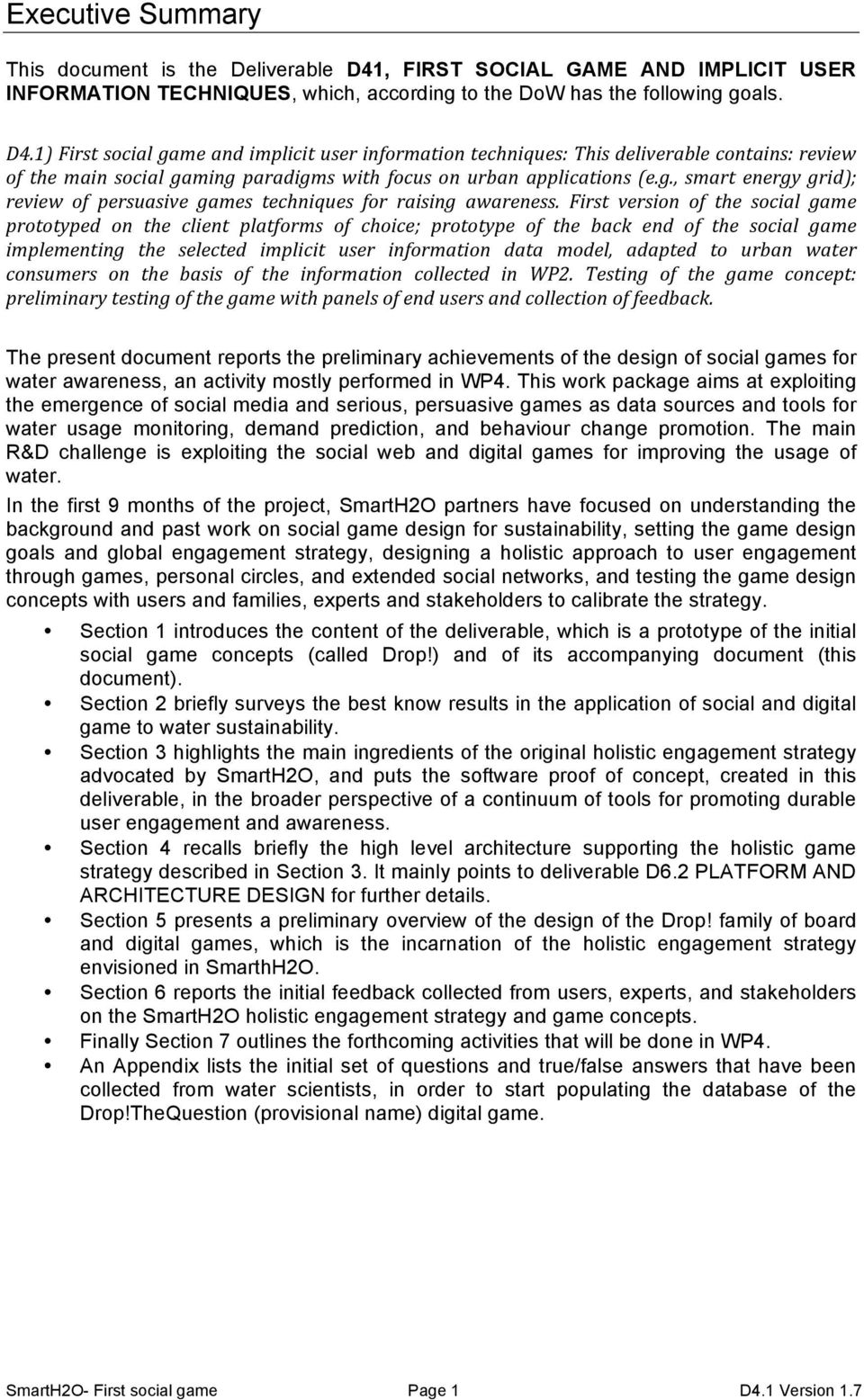
7 Triggers can be distinguished in two main classes: Internal, such as the wish to kill some spare time in an entertaining way, e.g., playing a game. External, such as the invitation of a friend or of family member to play. The triggers can be regarded as stimuli, and the action is the response that eases the hitch caused by the stimulus. The reward is the next step in the hook system. This is the phase in which the user gets compensated for the action and enters a state where he is free from any need and ready for the next trigger. The reward must be designed in a very careful way to be variable, depending on the status of the user and on the trigger and action that must be rewarded; it should be sufficient to fulfill the user s need, but not excessive, to avoid spoiling the user s wish to repeat the engagement cycle. As the Italians say: a good meal is the one that makes you leave the table with still some appetite. How to balance and design the reward is one of the most important design decisions in the hooked system. The investment phase is the most important one, which may induce the user in repeating the Hooked cycle. This is the phase in which the user invests effort and time in keeping the attention ready for the next stimulus. The investment is the variable phase that stands in between the reward and the trigger for the next hook cycle. To create habits, an application needs to start the hook cycle as many times as possible, until what previously required an external trigger becomes something that happens automatically. If an engagement strategy succeeds in creating habits in the users, it can change the lifestyle of people and make the effects of the engagement durable in time. For example, if a game play of a persuasive tool succeeds in making the mental connection between an action and its reward automatic (e.g., automatically thinking of waiting until the dishwasher is full before using it, to reduce energy and water consumption and be rewarded for such a saving), then the induced sustainable behavior may become a habit and endure the test of time. The design of the engagement cycle must also consider the likelihood that the trigger actually sparks the action, which is necessary for repetitions to take place frequently and actions become habits. As advocated by the behavioral model of B.J. Fogg [Fogg2003], summarized in the equation B=mat, for a specific behavior to happen a proper mixture of: Motivation, Ability, and the Trigger should be designed. If the motivation is high but the required ability is high as well, meaning that the action is hard to perform, chances that the hook cycle will start decrease. This means that a very important phase for the hook model is the design of applications that minimize the effort for users to respond to triggers. The abovementioned behavioral modeling clues are at the base of the initial design of the SmartH2O holistic engagement strategy and social gaming tools, described in the next section. SmartH2O- First social game Page 3 D4.1 Version 1.7

8 Figure 2: Fogg s B=mat equation [Fogg2003]. In SmartH2O we have therefore included the following features: A well balanced and rich set of triggers, both internal (wish to be entertained, sensibility towards ecological problems) and external (inputs from the family, competition with the neighborhood, inputs from the water utility). A balanced set of actions, starting from zero-effort actions such as playing a board game with the family in the leisure time, to increasingly more demanding actions, such as responding to questions and providing data. A variable reward system, which will gratify the user in multiple, yet connected ways, always leaving her/him with some appetite for more. A variable investment system, which may cater for a broad range of users with different attitudes, from the ecologist, to the school kid, to the housewife, to the pater familias, delivering the right challenge to each type of user. SmartH2O- First social game Page 4 D4.1 Version 1.7
9 2. Social games for sustainability Despite some successful studies, e.g., Makki et al. [Makki2013], changing user s behavior via software is not an easy task, due to fundamental questions such as how to design an effective application to achieve the desired results [Grace2010] and how to maintain behavioural changes in the long-term [Pereira2013]. As an example, the response- relax effect is often observed: after the change induced by the initial exposure to the persuasive technology, the attention paid to the feedback reduces and users revert to their previous behaviours. Computer games have recently been advocated as a promising tool for computer- mediated behavioural change. They create an immersive environment [Thompson2010] that can attract also kids and teenagers to serious topics [Gustafsson2009a] and manifest a high persuasive potential. As [Bogost2007] argues, games effectively exploit the procedural representation approach, i.e., a form of symbolic expression that uses processes rather than language to convey how things work. In well-designed games, players can combine the processes embodied in the game and create new interactions beyond those considered by the game designers. This paradigm introduces new ways to persuade the player, which match well with the rhetoric concepts exposed by [Fogg2003]) (triggers, motivation and ability) as the traditional means for persuasion through technology. An analysis of the state of the art in persuasive games, as described in the recent literature (between 2009 and 2013), reveals 95 contributions in environment and sustainability games; some of these works focus on power conservation [DouSrin2010; Gamberini2011; Gustafsson2009a, b], environmental awareness [Bogost et al., 2011; Mendes2012; LinderJu,2012], fossil energy use [Ecker2011] and water [Hirsch2010]. Table 1 compares the persuasive games specific for water management along their main distinctive features. Technology Water wars N/A Atoll Game VisualWorks The Basin Challenge / Catchment detox and CORMAS Roles Stakeholders Platform Family Policymakers providers, water Feedback Message boards agency N/A Mechanics Issues Turn based Policies, RPG computer assisted variable water variable conditions, water scarcity, conditions policies Players Multiplayer with Up to 16 chat players Focus Target Platform Data collection Interaction among inhabitants New Mexico residents Web and mobile Interviews Land/water allocation conflicts Tarawa atoll people and policymakers PC supported board game Semiautomatic software FloodSim Flash Flash Unity Messages in game and leader board Flood policy strategist Messages in game Acqua Republica Mayor Messages in game Turn based Turn based Turn based variable water conditions, scarcity, policies floods 1-2 players 1 1 Manage a river catchment Teenage students Raising awareness on flooding policy UK residents variable water conditions, policies conflicts and tradeoffs in a river Everyone basin Web Web Web (portable) N/A N/A Numerical models (Mike Basin) Table 1. Summary of water games features. Games analysed: Water wars [Hirsch2010], Atoll Game [Dray2005], Catchment Detox [ABC2014] FloodSim [Rebolledo 2009] and Acqua Republica [DHI2014]. SmartH2O- First social game Page 5 D4.1 Version 1.7
![to maintain behavioural changes in the long-term [Pereira2013].](/docs-images/44/1868824/images/page_9.jpg "As an example, the response- relax effect is often observed: after the change induced by the initial exposure to the persuasive technology, the attention paid to the feedback reduces and users revert")
10 More generally, the SmartH2O applications and games aim at taking a positive approach towards facilitating sustainable water consumption behavior by applying game mechanisms and leveraging social factors. The effectiveness of this approach is in fact reflected in recent studies in the literature. Considering findings of these studies therefore can and should inform the development of the SmartH2O applications and games, including e.g. conceptual frameworks or the effectiveness of specific mechanisms and outputs. The following section thus takes a more in-depth look at a selection of relevant studies, highlighting key aspects in the context of the SmartH2O project. Two recent studies on eco action games have analyzed the entertainment value and effectiveness of games that aim at facilitating behavioral change towards a more sustainable lifestyle with more traditional gaming techniques: The first study considers behavior change across different environmental aspects [Owen2013], while the second focuses on water saving actions [Owen2014]. In both cases, the aim has been to facilitate a positive, interactive, optimistic approach of fun & games to appeal to different age groups and sectors, rather than one of doom & gloom. The latter describes such practices that remind consumers of their own bad actions and the negative effects they have on the environment, expecting them to give up their current lifestyle in favor of a more sustainable one. According to the 2013 report, this method has been unsuccessful and requires new, less pessimistic but more encouraging approaches, e.g. through games [Owen2013]. This reflects and underlines the objectives of the SmartH2O project approach towards designing games to raise social awareness of more sustainable water consumption. Owen [2013] have constructed a framework of four main objectives to develop and test the effect of games towards more sustainable behavior, termed the 4Es theory of positive engagement. The four Es stand for Entertain, Engage, Educate, Engender, the latter referring to whether actions have actually been taken as a consequence of the methods applied). The framework will be considered both for the design of the SmartH2O games and their evaluation. One of the ways to achieve this is to work closely together with target users and to consider their needs, an approach that has already been initiated in the SmartH2O project by involving users in requirements workshops (see D2.1). Following the 4Es framework, a set of traditional, non-digital eco action games 1 was developed [Owen2013]. The games are based on well-known paradigms like bingo or snakes and ladders, and which were extended into a sustainable context, promoting e.g. more sustainable water related actions, energy efficiency actions, material-based measures or transport actions. Initial responses to those games indicate that using games can be successful to explore environmental issues and encourage take-up of environmentally positive actions [Owen2013]. Consequently, applying well-known game paradigms can prove to be an effective method also for the SmartH2O games. For the 2013 study that considered a variety of areas, it was reported that 86% of participants enjoyed the experience of learning new information about environmental actions while playing the games, 59% of participants stated they had learned new and useful information that they would be taking back to their home and/or work environment and 51% of attendees stated they would be taking actions [Owen2013]. On average, participants who responded to a follow up questionnaire two months after playing the game reported that they had actually newly adopted four of the suggested actions, most of them relating to behavior change (rather than e.g. installing new appliances, which is usually more costly). In the 2013 study, water-saving actions were amongst the most popular ones. In the followup study on water consumption elicited on a water themed eco action playground in 2014, results were also very positive [Owen2014]: 74% of participants said they felt they could take action on water savings at home or school. 69% of participants said they would be taking extra water saving actions. 1 Eco action games: ecoactiongames.org.uk, last seen: 05/12/2014 SmartH2O- First social game Page 6 D4.1 Version 1.7

11 68% of participants said they learnt new information about water saving actions they could adopt. 81% of participants said that they enjoyed learning about water saving actions through playing the games. 72% of participants were surprised at how much water could be saved by the actions. Figure 3 shows players willingness to adopt specific water saving actions [Owen2014]. The compiled list should be considered when designing tasks and game elements in the SmartH2O project. The fact that the actions differ in terms of adoption effort (e.g. wash car with bucket and sponge vs. turn taps off when brushing teeth ) suggests e.g. that organizing them in categories of different levels of adoption effort could be useful in order to better target different consumer types. E.g., consumers who have already adopted some of the basic actions could be suggested more advanced actions, while those who have until now put little thought into their actions can be given simpler tasks to increase the likelihood of adoption. Figure 3 Water saving actions. Source: [Owen2014]. A majority of participants (79%) from the 2013 study also stated that they enjoy various types of non-sporting games and play at least occasionally [Owen 2013], which according to the author could reflect a growing popularity of casual gaming and other online games (for definition of casual games, refer e.g. to Juul [2012]). Conventional board games on the other hand have also become more successful again in recent years: department store chain John Lewis 2 reported a popularity increase of board games by 20% per annum (as cited by Owen [2013]). This shows that games in general are popular and a promising means of entertainment and engagement of water consumers, and that different type of games could be considered for the project, including even more conventional ones like board games. Two other consecutive studies have investigated the effect of pervasive and casual games on the domestic energy engagement among teenagers [Gustafsson2009a; Gustafsson2009b]. The first study was based on the mobile game power agent that was connected to the players smart energy meters and let players compete in teams and learn hands-on how to conserve energy in their homes [Gustafsson2009b]: In Power Agent, the player takes the role of a special agent assigned the task of saving energy in the home. To be able to achieve this goal, he or she must cooperate with 2 John Lewis department stores: last seen 04/12/2014 SmartH2O- First social game Page 7 D4.1 Version 1.7
![Figure 3 shows players willingness to adopt specific water saving actions [Owen2014]. The compiled list should be considered when designing tasks and game elements in the SmartH2O project.](/docs-images/44/1868824/images/page_11.jpg "The fact that the actions differ in terms of adoption effort (e.g.")
12 family members and also combine forces with other peer agents in a team. The team competes with another team of agents located in another town. A successful player persuades everyone in the household to conserve as much electricity as they can during the mission, which, on most days, takes place between and It was shown that such games could be used as a powerful tool in order to both motivate and educate teenagers and their families towards energy conservation in the home [Gustafsson2009b]. The second study considered long-term sustained learning and behavior change [Gustafsson2009a]. For this, a second game was developed called the Power Explorer. It is based on a monster blob that can visit different environments with different modes of interaction, aiming either at saving energy (low key explorative task) or engaging players in using and learning about appliances (real-time player-to-player competition) [Gustafsson2009a]. Results show tentative indications for a persistent post game effect and a statistically significant positive change in the players attitude towards saving energy [ibid.]. Thus, games do have the potential to not only change behaviour in the short term, but potentially cause a long-lasting change in behavior and attitude. Other approaches foster sustainable behaviour by incorporating subtler gamification elements rather than designing actual games, e.g. by rewarding people with virtual trophies, achievements, or other rewards given intrinsic value through peer recognition [Schuller2013]. As one example, the Shower Calendar encourages water saving in the shower in family households by means like goal setting, comparison, competition, and communication [Laschke2011]. It visualizes the amount of water spent per shower for each family member with different coloured dots on a virtual calendar. The Shower calendar was evaluated in a case study focusing on experiences and consumptions, and results indicate that it successfully fosters communication and competition among the participating families. Behavioural change was less consistent, with some individuals being more perceptive to the incentives provided by the calendar than others. However, as this study was carried out with a very small sample, it leaves plenty of room for further investigation of such gamification mechanisms and their effect on behavioural change of water consumption, e.g. by the SmartH2O project. The authors also conclude that change is not achieved by the product itself (as in automation or regulation) but by the people involved [Laschke2011], meaning that such technologies and means can only enable people to change their behaviour rather than changing their behaviour directly. The SmartH2O applications will apply gamification elements as well, as visualized in the first mockups of the gamified water meter customer portal and described in D2.1. In fact, the Shower Calendar aspects that were identified as the key levers to facilitate engagement (goal setting, comparison and competition) have also been identified in the requirements workshop with target users as probably the most critical and effective methods to a gamified approach. In addition, the visualization metaphor from the Shower Calendar will be considered for the development of the visualization model, as it links back to the gamification aspects in a subtle, yet effective way. Summarizing, the further development of the SmartH2O applications and games in WP4 will be strongly informed by the findings of the studies and work presented in this chapter. SmartH2O- First social game Page 8 D4.1 Version 1.7
![and 22.00. It was shown that such games could be used as a powerful tool in order to both motivate and educate teenagers and their families towards energy conservation in the home [Gustafsson2009b].](/docs-images/44/1868824/images/page_12.jpg "The second study considered long-term sustained learning and behavior change [Gustafsson2009a]. For this, a second game was developed called the Power Explorer.")
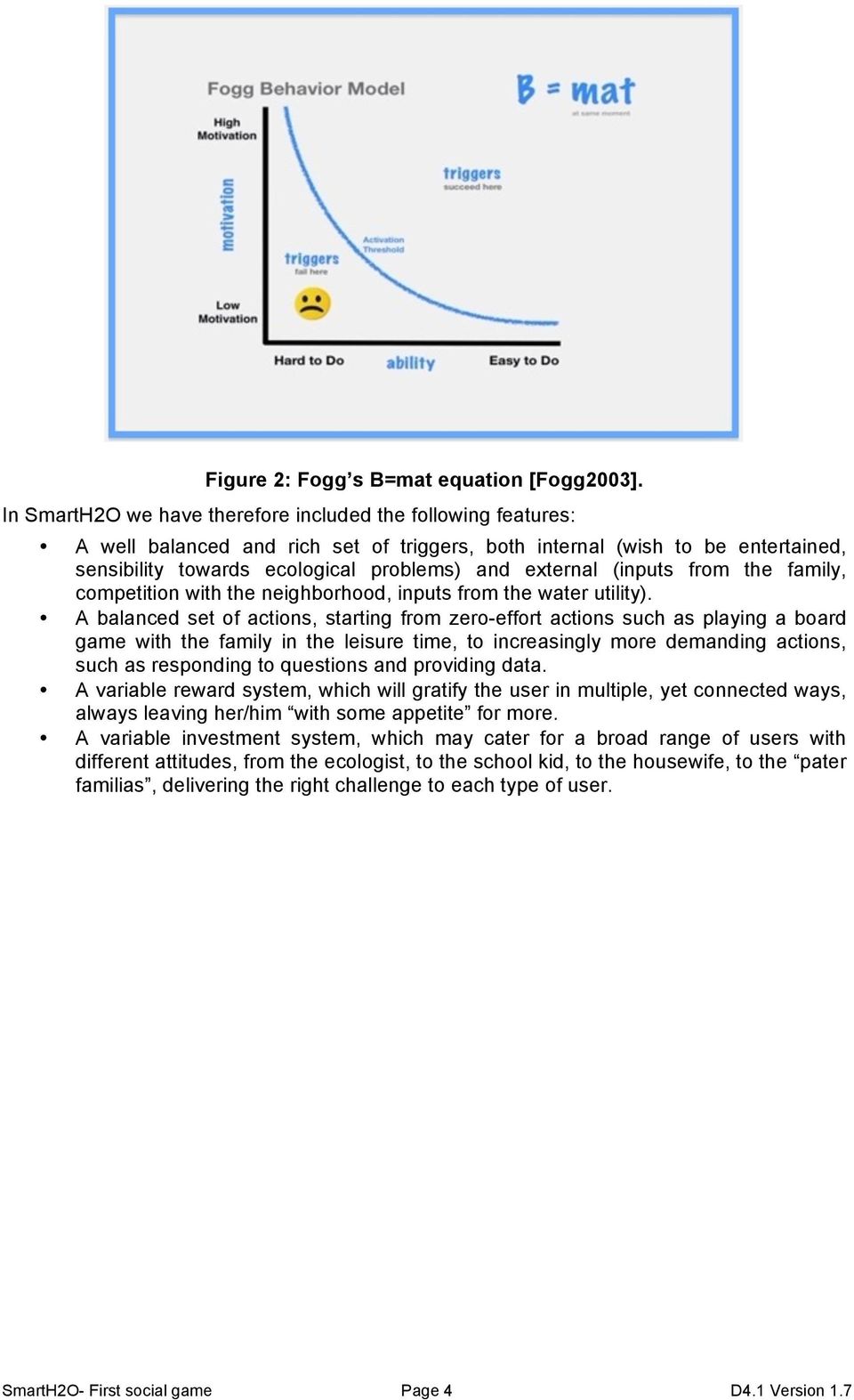
13 3. The social game continuum Achieving a durable impact in the sustainability of the water (as well as energy or other public goods) consumers behaviour is an open challenge. While several studies report success in increasing awareness in different fields, most of them are limited to short periods of time, thus resulting in a reduced knowledge of how householders will behave in the long-term [Pereira2013]. There is a natural tendency to the appearance of the relapse effect, in which users tend - on the progress of time - to regress to the past level of awareness. The study of [Pereira2013] concludes that, although an initial increase on awareness regarding electricity consumption is observed, after one year of deployment of the developed tool it was not possible to see any significant increase or decrease in the household consumption. As a possible solution to the problem, the work of [CugelmanEtAl2011] tries to minimize this problem by suggesting tailored support to aid participants who may lack ability or self-efficacy. The SmartH2O project advocates a holistic engagement strategy, as the key to achieve a durable effect in the promotion of sustainable water consumption behaviour. The key ingredients of the envisioned strategy are depicted in Figure 4, and serve as the basis for the deliverables constructed in WP4. Competition Social ties Tiny habits Entertainment SmartH20 Holistic Engagement strategy Multichannel reinforcement Family bonds Brand loyalty Education Figure 4: the key ingredients of the holistic engagement strategy of SmartH2O. Social ties: the engagement solutions are not only directed to the individual consumers but build on its social circle, e.g., its geographical neighbourhood or friendships. Family bonds: the target of engagement is the whole family, when present, in order to exploit the different attitudes and preferences of each family member (e.g., the enthusiasm and learning attitude of kids). Entertainment: the proposed content and activity should be entertaining. SmartH2O- First social game Page 9 D4.1 Version 1.7
![behave in the long-term [Pereira2013]. There is a natural tendency to the appearance of the relapse effect, in which users tend - on the progress of time - to regress to the past level of awareness.](/docs-images/44/1868824/images/page_13.jpg "The study of [Pereira2013] concludes that, although an initial increase on awareness regarding electricity consumption is observed, after one year of deployment of the developed tool it was not")
14 Competition: a moderate level of competition, between family members, consumers, consumers groups, should be allowed. Education: the engagement activities and content should aim at improving knowledge and awareness. Multichannel reinforcement: the attention level of the engaged people should be constantly maintained by means of multiple tools and communication channels, which reinforce each other and provide a continuous experience. Tiny habits: the engagement content and activities should blend harmoniously with the users life, so to become an (unobtrusive) habit. Brand loyalty: a transparent connection should be established between the provider of the engagement content and activity and the recipients, to cast the positive effect of engagement also on the brand of the provider. The ingredients of the engagement strategy illustrated in Figure 4 are the pillars for the definition of a social game continuum, depicted in Figure 5. Family bonds Entertainment Education Social ties Multichannel reinforcement Tiny habits Competition Brand loyalty Board game Digital social games Gamified business application Figure 5: the social game continuum The idea of the social game continuum is to provide a unique and coherent experience to the user and his/her family, using gaming as the leitmotiv. Board games are a popular family entertainment; they engage the whole family and its close circle and foster communication and cheerfulness. They are especially suitable for kids and children, but can become a powerful tool for sharing values, awareness and knowledge, among all members of the nucleus. Gamified business applications, such as the gamified water bill, are targeted to the household manager; they convey a business purpose in a novel way, and are a powerful tool for brand loyalty and customer engagement. Digital social games, i.e., games for PCs, tablets and mobile phones, also connected with one s social network, are a bridge between the board games and the gamified business applications. They can be activated as an extension of the board game play (see Section 5.1 and 5.2) and support the delivery of educational content or the collection of user s data, which can be fed into the models behind the gamified business applications. Symmetrically, the gamified business application can provide user s behavioural data to the digital social games: for example, the smart metering of the user s consumption can be converted into game points or extra lives, karma, or goods, enriching the digital gaming experience and empowering the gamer. SmartH2O- First social game Page 10 D4.1 Version 1.7
15 Digital social games Gameplay extension Skill levels, scores Household / user data Board game Extra scores Metered consumption data, participation level - - > karma, extra lives, bonuses Gamified business application Figure 6: flow of information among the three tiers of the holistic engagement strategy tools of SmartH2O. SmartH2O- First social game Page 11 D4.1 Version 1.7

16 4. The Game Platform architecture The introduction of a platform for handling Games in the SmartH2O project derives from the need of being able to attract the interests of users which are not strictly linked with water utilities while being able to run even as a standalone component. Different game design approaches and instantiations are being investigated, nonetheless all of them should rely on an infrastructure that provides features and data collection common to all of them. This is the role of the Games Platform, a central component that handles the communication with the main SmartH2O platform and takes care of managing users registration, profiling them, orchestrating and keeping track of game instances and the gameplay sessions of the players. The points and the achievement collected in the digital games should be transferred towards the Gamification Engine, to create a tied link between the two approaches for engaging the users. For these reasons, a dedicated database takes care of storing the users and their details, gameplay session data, point and achievements obtained within the games platform. At the time of writing, the component should support two different game instances: a Quiz Game, called Drop! Quiz, that is the digital extension of the Drop! Boardgame and is used to collect behavioural data from the users; a single player game, called DropOn! that is used to promote sustainable behaviours and as an educational game. Both of them are described in D4.1. For the definition of new content for the proposed games (e.g. badges and achievements for the single player mode), the games platform offers also a Content editor UI that allows non-technical users to enrich the content offered by the applications without the need of modifying the underlying architecture or create new builds. Figure 7: Games Platform architecture. The SmartH2O architecture is illustrated in greater detail in the deliverable D6.2 Platform architecture and design. SmartH2O- First social game Page 12 D4.1 Version 1.7

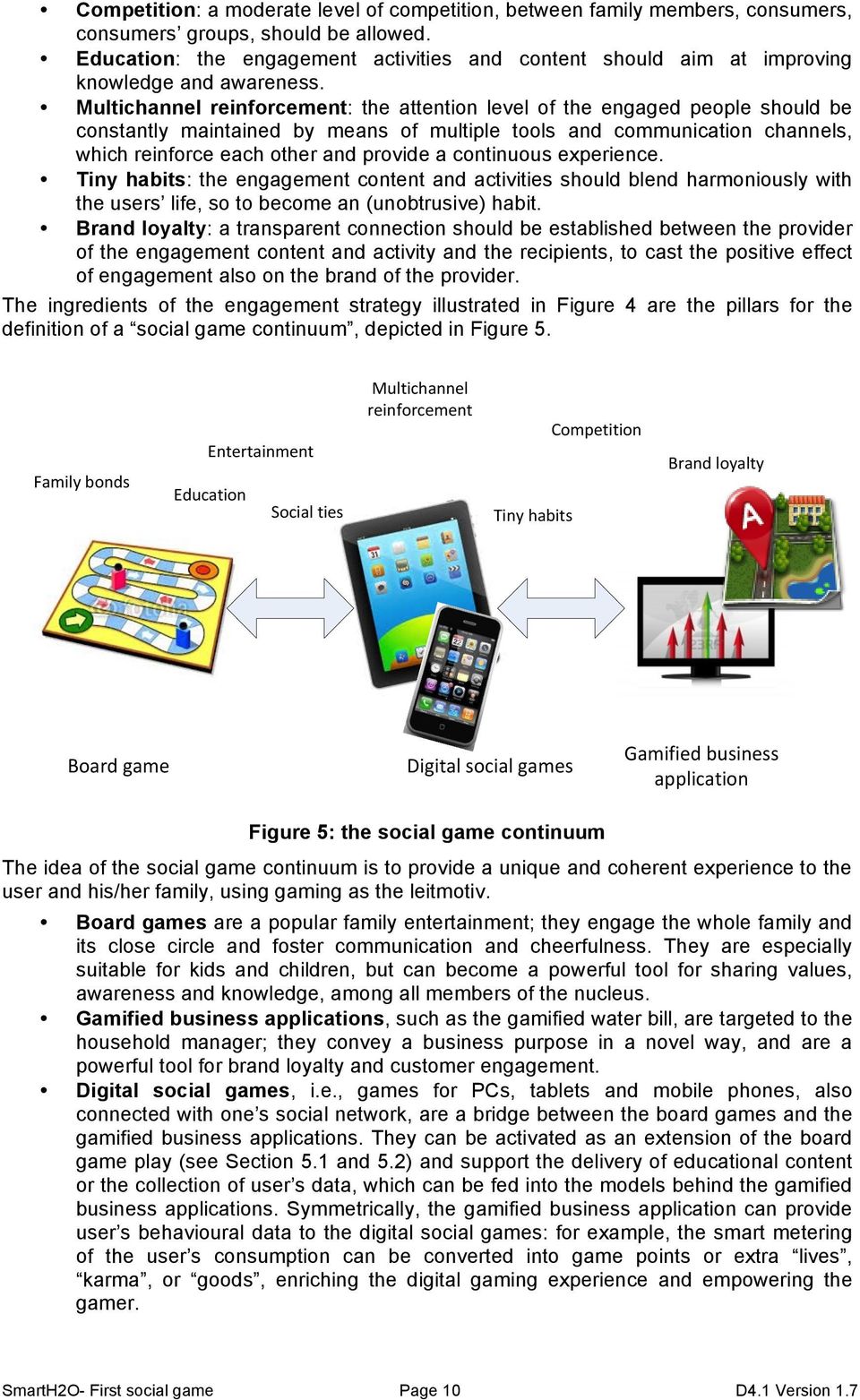
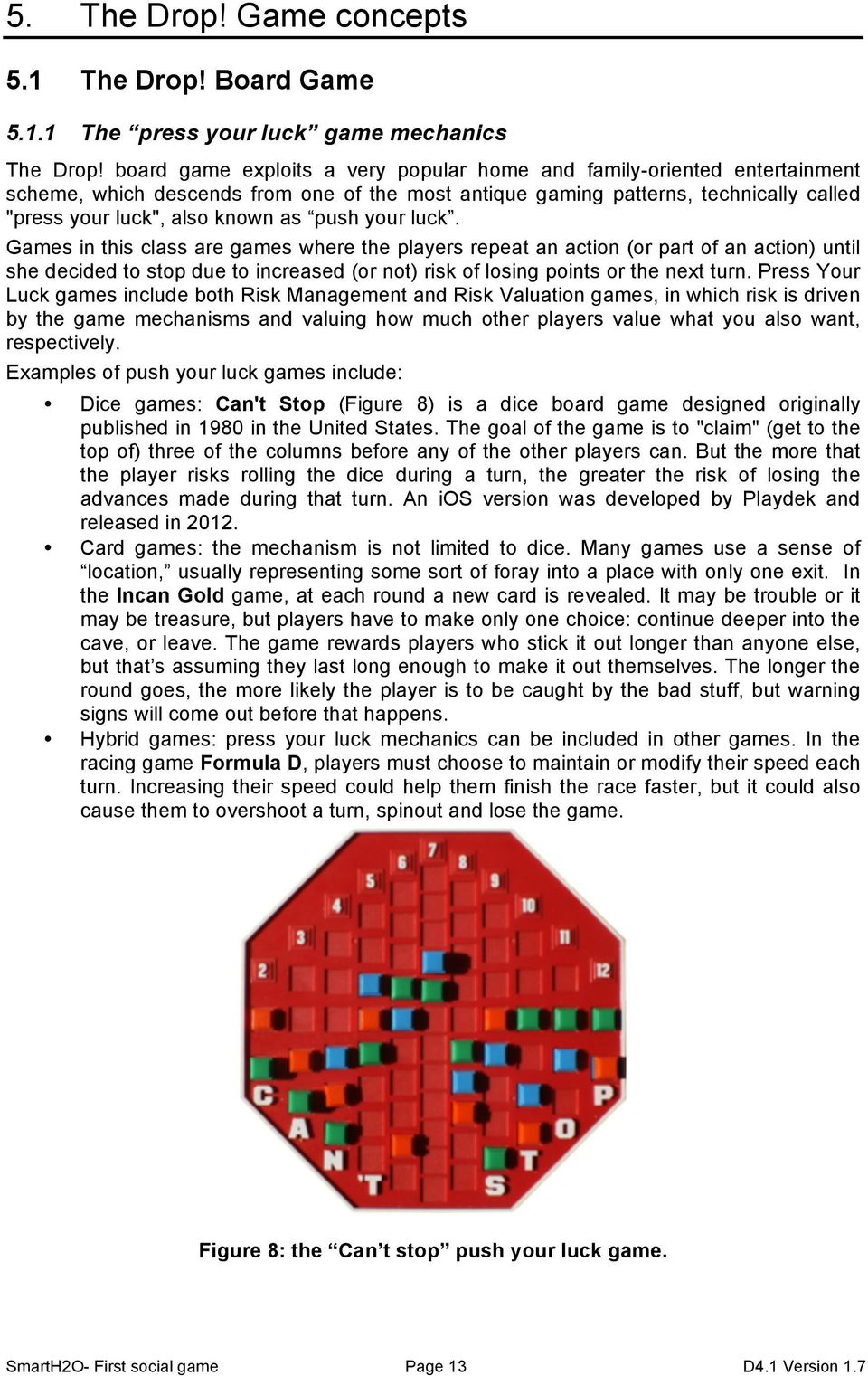
17 5. The Drop! Game concepts 5.1 The Drop! Board Game The press your luck game mechanics The Drop! board game exploits a very popular home and family-oriented entertainment scheme, which descends from one of the most antique gaming patterns, technically called "press your luck", also known as push your luck. Games in this class are games where the players repeat an action (or part of an action) until she decided to stop due to increased (or not) risk of losing points or the next turn. Press Your Luck games include both Risk Management and Risk Valuation games, in which risk is driven by the game mechanisms and valuing how much other players value what you also want, respectively. Examples of push your luck games include: Dice games: Can't Stop (Figure 8) is a dice board game designed originally published in 1980 in the United States. The goal of the game is to "claim" (get to the top of) three of the columns before any of the other players can. But the more that the player risks rolling the dice during a turn, the greater the risk of losing the advances made during that turn. An ios version was developed by Playdek and released in Card games: the mechanism is not limited to dice. Many games use a sense of location, usually representing some sort of foray into a place with only one exit. In the Incan Gold game, at each round a new card is revealed. It may be trouble or it may be treasure, but players have to make only one choice: continue deeper into the cave, or leave. The game rewards players who stick it out longer than anyone else, but that s assuming they last long enough to make it out themselves. The longer the round goes, the more likely the player is to be caught by the bad stuff, but warning signs will come out before that happens. Hybrid games: press your luck mechanics can be included in other games. In the racing game Formula D, players must choose to maintain or modify their speed each turn. Increasing their speed could help them finish the race faster, but it could also cause them to overshoot a turn, spinout and lose the game. Figure 8: the Can t stop push your luck game. SmartH2O- First social game Page 13 D4.1 Version 1.7
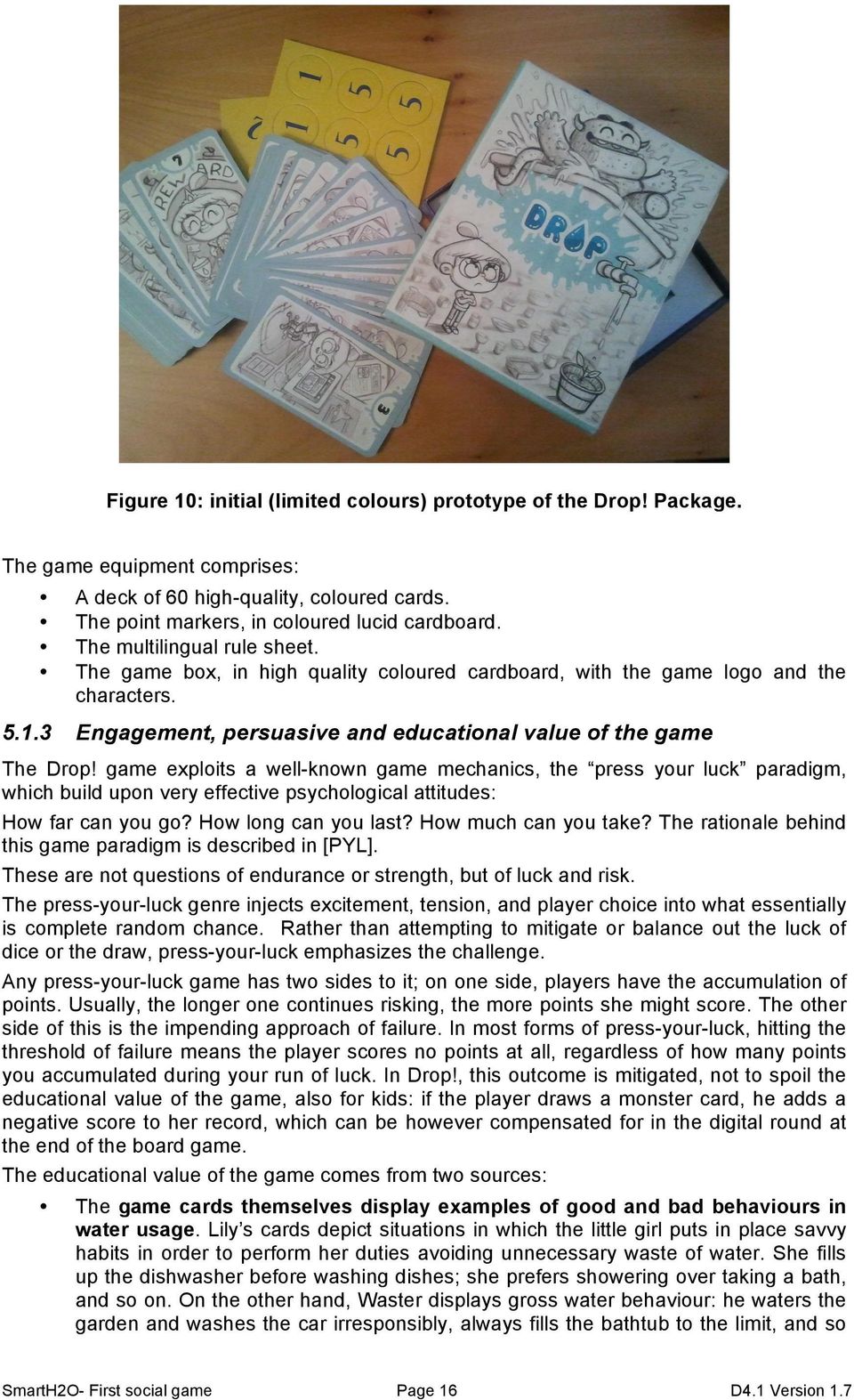
18 5.1.2 The Drop! press your luck board game The Drop! Board game is designed around the basic idea that a game does not need to be educational, to be... educational. Children learn from games, because playing is the natural way they improve their brain skills. Most games, not to say ALL games, are naturally educational, because they have metaphoric meanings that children perfectly understand. In Drop! the metaphor is very simple: Lily, the main character (shown in Figure 9), is a young and very clever girl. She knows exactly how to use water in the proper way, she's much more aware about the water wasting problem than her relatives. But she's also got a monster friend, provisionally called the Waster, hidden in the wardrobe (see Figure 9). He's not evil, it's just a little bungling and, when he comes out of the wardrobe, he tries to do exactly the same things done by Lily, but always in the wrong way. During the game, players do not need to answer questions or prove their knowledge to win, because the game is based on a simple, but not so meaningless, luck system. The cards showing Lily are always good cards and they let the player score positive points, while the monster cards are always bad and give players negative points, unless... At the end of the game, players can transform the negative point monster cards in positive points, by answering a question received through their mobile phone or tablet. The metaphor is very simple: you are not winning because of your knowledge, but because you are teaching the monster to behave. You don't need to know how to win, but thanks to your knowledge you can transform a losing hand in a winning one. Players and Rules The Drop! Game can be played in a group (the suggested number ranges from three to six players). The game equipment consists of a deck of 60 cards, 45 of which have a positive value and 15 are negative, and of point markers for keeping track of the points of each player (see Figure 10). The game rules are as follows: 1. Any of the players shuffles the deck of cards and then the player who starts playing is chosen (usually the youngest). 2. The current player takes the deck of cards and declares how many cards he will be able to draw without hitting a monster card. 3. The player to the left has two options: she can claim the deck and declare a higher number, or challenge the opponent to do what she has just declared. 4. If the next player takes the deck, she has to declare a higher number; the player to her left again will have the opportunity to choose between "quitting or challenging, and so on for all the other players. 5. If a player is challenged, she starts to draw the cards, one at a time and slowly, placing them on the table, so that they become visible to all the other players. 6. If the challenged player manages to draw as many good cards as she has declared without hitting a monster card, she wins the hand; she adds to her score record a value equal to the sum of the distinct values of the drawn cards (summing only one instance per value, so if two cards with value 1, one with value 5, and one with value 6 are drawn, the earned points amount to 12). 7. If the challenged player draws a monster card, she loses the hand. The player keeps the monster in front of her, while the challenger distributes all the good cards drawn to the other players in turn, choosing for herself the higher values. In any case, each player (except the losing one) receives at least one point. 8. The updated points are recorded using the tokens that players keep in front of them. 9. The positive cards are put back into the deck, which is shuffled to start a new hand. The monster cards, instead, remain in front of the player who drew them; at the end of the game they add a negative score of -10 to the owner s score record. 10. The game ends when 8 monsters are drawn (out of the 15 in the deck), or after reaching a maximum score, which varies according to number of players. SmartH2O- First social game Page 14 D4.1 Version 1.7

19 11. At the end of the game, the score of a player can be negative; however, this result can be turned into a positive one, using the app and playing a digital game. Figure 9: examples of Drop! Cards: Lily and the Waster characters. Packaging Figure 10 shows a low-quality prototype of the packaging of the Drop! Board game: The definitive high quality version is in print, and will ready by the beginning of SmartH2O- First social game Page 15 D4.1 Version 1.7
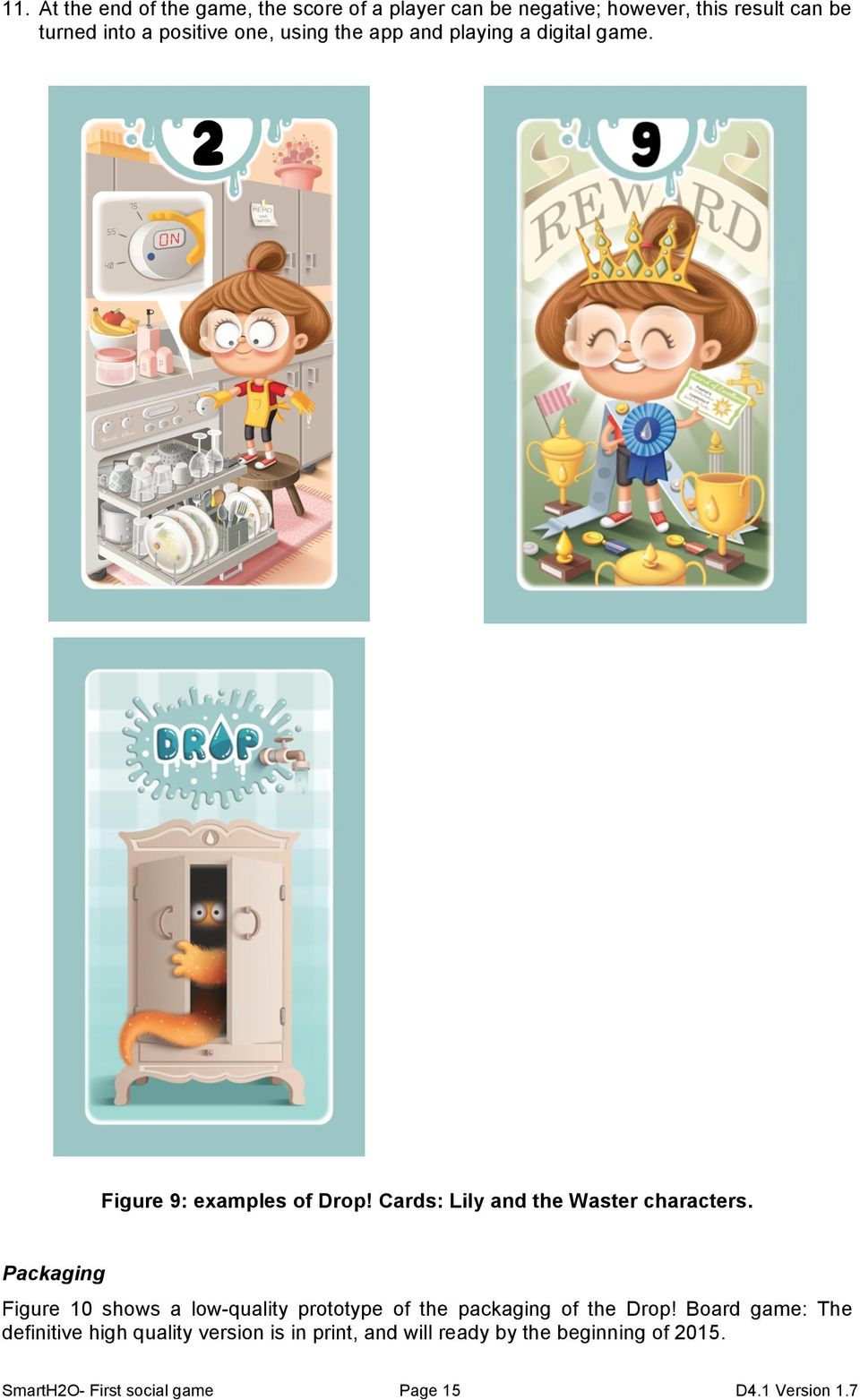
20 Figure 10: initial (limited colours) prototype of the Drop! Package. The game equipment comprises: A deck of 60 high-quality, coloured cards. The point markers, in coloured lucid cardboard. The multilingual rule sheet. The game box, in high quality coloured cardboard, with the game logo and the characters. Engagement, persuasive and educational value of the game The Drop! game exploits a well-known game mechanics, the press your luck paradigm, which build upon very effective psychological attitudes: How far can you go? How long can you last? How much can you take? The rationale behind this game paradigm is described in [PYL]. These are not questions of endurance or strength, but of luck and risk. The press-your-luck genre injects excitement, tension, and player choice into what essentially is complete random chance. Rather than attempting to mitigate or balance out the luck of dice or the draw, press-your-luck emphasizes the challenge. Any press-your-luck game has two sides to it; on one side, players have the accumulation of points. Usually, the longer one continues risking, the more points she might score. The other side of this is the impending approach of failure. In most forms of press-your-luck, hitting the threshold of failure means the player scores no points at all, regardless of how many points you accumulated during your run of luck. In Drop!, this outcome is mitigated, not to spoil the educational value of the game, also for kids: if the player draws a monster card, he adds a negative score to her record, which can be however compensated for in the digital round at the end of the board game. The educational value of the game comes from two sources: The game cards themselves display examples of good and bad behaviours in water usage. Lily s cards depict situations in which the little girl puts in place savvy habits in order to perform her duties avoiding unnecessary waste of water. She fills up the dishwasher before washing dishes; she prefers showering over taking a bath, and so on. On the other hand, Waster displays gross water behaviour: he waters the garden and washes the car irresponsibly, always fills the bathtub to the limit, and so SmartH2O- First social game Page 16 D4.1 Version 1.7
21 on. Both the positive and the negative cards can be the trigger for a family discussion on the value of sparing water, as well as provide useful practical suggestions on the daily use of water. It is possible to envision the production of multiple card decks, which may be collected and thus provide a potentially very large set of educational clues. The final round of the game provides a trigger for the Drop! family of digital games, which contain further educational materials, e.g., in the form of trivia questions, which add up to the value of Drop!. The interaction between the board game and its digital extension is designed so to catch the attention of the player when she in the most attentive and receptive mood: at the end of a losing hand of the board when she pushes her luck in an attempt of subverting the result. 5.2 The Drop!TheQuestion Digital Game The trivia game concept Trivia games are a popular class of multiplayer games without elimination, in which everyone can play along to the end. These games are especially suited for mixed play with adults and children. The most popular example is the Trivial Pursuit board game [TrivialPursuit], in which winning is determined by a player's ability to answer general knowledge and popular culture questions. The game was created in December 1979 in Montreal, Quebec, by Chris Haney, a photo editor for Montreal's The Gazette, and Scott Abbott, a sports editor for The Canadian Press. In North America, the game's popularity peaked in 1984, a year in which over 20 million games were sold. The game is highly customizable, which is one of the factors that determined its success. Dozens of question sets have been released for the game. The question cards are organized into themes; for instance, in the original question set, questions in green deal with science and nature. Some question sets have been designed for younger players, and others for a specific time period or as promotional tie-ins connected to other products, such as Star Wars, Saturday Night Live, and The Lord of the Rings movies. Trivial Pursuit has been also converted into a digital game: a version is available as a video game on Xbox and Playstation 3. The Hasbro company, currently the holder of the game license, offers a variety of board and digital formats, including single and multi-player editions (see Figure 11). SmartH2O- First social game Page 17 D4.1 Version 1.7
22 Figure 11: editions of Trivial Pursuit, from The Drop!TheQuestion game concept The first digital game design concept of the Drop! Family is a simple question game, provisionally called Drop!The Question. The game is designed to be activated on mobile phones and tables, after a round of the Drop! board game or in a standalone manner Examples of the interface The game simply starts by activating the app s icon in the app view of the smart phone or table, as shown in Figure 12. SmartH2O- First social game Page 18 D4.1 Version 1.7
23 Figure 12: launching Drop!TheQuestion from the app view. After the activation, the initial menu shown in Figure 13 appears. SmartH2O- First social game Page 19 D4.1 Version 1.7
24 Figure 13: the start menu of Drop!TheQuestion. From the menu, the user can activate a single player round, set his profile data and game preferences, inspect his current water habits, and scan one of the monster cards he has retained at the end of a game play with the Drop! board game (see Figure 14 and Figure 15). Figure 14: the command for scanning a board game card. SmartH2O- First social game Page 20 D4.1 Version 1.7
25 Figure 15: scanning a monster card with a mobile device. A round of the game entails responding to some water related question, such as the one shown in Figure 16. Figure 16: example of water question challenge. If the user provides the wrong response, the game emits a gentle warning, shown in Figure 17. SmartH2O- First social game Page 21 D4.1 Version 1.7
26 Figure 17: giving a wrong response to a water challenge. If the user provides the correct response, the game cheers her/him up and provides the amount of scores that will be added to his/her digital profile, which can be also spent in the board game play, to revert the leader board of the current round of the game. Figure 18: giving a correct response to a water challenge. SmartH2O- First social game Page 22 D4.1 Version 1.7
27 5.2.4 Engagement, persuasive and educational value of the game The Drop!TheQuestion game exploits a very popular home and family-oriented entertainment scheme, which derives from one of the most consolidate multiplayer game mechanics. The main trigger of the game is twofold: When played in combination with the Drop! Board game, the wish to alter an unfortunate round, by gaining extra points, which may completely subvert the previous result of the game and inject surprise and excitement in the board game. When played in a standalone manner, the desire to challenge oneself with respect to the knowledge about the fundamental water issues. This trigger may be reinforced in school kids by external educational activities, such as follow-up accomplishments of school lessons, visits to Science Museums, water treatment plants, and so on. The reward is of moderate intensity and of both global and local nature; the player will gain points that may be aggregated in his/her global water consumer s profile or exploit the earned points just at the moment of playing, to revert in real time the local board game play situation. The educational content can be of arbitrary richness. The trivia games can be extended at will very easily, just by incrementing the database of questions and answers. In particular, it is possible to envision versions of the game tailored to such aspects as the local geographic context, the utility company, the target audience (e.g., a kids vs an adults version of the game), and more. 5.3 The Drop!On digital game The Match-Three game concept A tile-matching video game is a type of puzzle video game, where the player manipulates tiles in order to make them disappear according to a matching criterion. The most famous example is Tetris (Figure 19). Figure 19 - Tetris tile-matching game In some tile-matching games, the matching criterion is to place a given number of tiles of the same type so that they adjoin each other. That number is often three, and this corresponding subset of tile-matching games is referred to as match-three games. Bejeweled and Candy Crush Saga (Figure 20) are two examples of popular match-three games. SmartH2O- First social game Page 23 D4.1 Version 1.7
28 a) b) Figure 20 - Popular match-three games. A) Bejeweled, B) Candy Crush Saga The Drop!On Match Three game concept Drop!On is a match-three mobile game intended to teach water related concepts to kids on ages 6-9. The water concepts utilized in the game, were chosen according to the Global Water Supply Elementary School Curriculum [GWSESC]. By the end of the experience the player should: Identify 3 states of the water and how water transitions between them. Describe the movement of water within the water cycle. Recognize solar energy as the main driver for the movement of water on earth. The game is single player. This is because the game is designed to provide progressive questions and comprehension on the in game changes on the mechanics. We coupled these advances together with the understanding of intended educational content, so the player needs to master both to proceed in the game. In this way that is no need to introduce one to one competition or even cooperation, because we would like that each player has the experience in his own pace. Also the game is for mobile devices. This kind of device is now popular and established as a profitable media for producing video games. Moreover the mobile devices fit completely the kind of interaction needed in a match-three game (moving pieces from one place to another in a static field). Just tapping and sliding the fingers over the table can give intuitive commands to the game. It is also important to highlight that mobile devices especially tablets are popular in our target audience, of players from 6 to 9 years old. The basic mechanics are the traditional of match-three games. Sequences of at least 3 blocks of the same kind make a chain. When the chain of liquid water blocks explodes the water goes to the reservoir (through the player scores) and new objects are spawned in the field. Nevertheless there are some important features of the game mechanics that needed to be detailed. Game Mechanics There will be a grid with 64 spaces (8x8). When the level starts only a small amount of spaces is filled by blocks. Each block can be moved individually by the player to any free space available in the scenario. The placement, the amount, and the quantity of the blocks will be defined by later balancing. A reference for an initial view of the level is in Figure 21a. SmartH2O- First social game Page 24 D4.1 Version 1.7
29 a) b) Figure 21 - a) Initial level example; b) Basic mechanic interaction diagram The initial mechanics will be presented on a quick in-game tutorial, only available when the player starts a new game (if the player continues a previous game there is no tutorial). The tutorial consists in two mini levels where the player will see instructions on the movement. There is no lose condition on the tutorial and if the player loses (the field got completed. The initial mechanics consists on the 64 spaces field presented with the user with some blocks randomly positioned on it. The user can select one single block and move this block to any accessible empty space. If the movement of the player generates a chain with three or more blocks of the same kind, the chain explodes and the player scores. The player wins, if he reaches the objective (filling the reservoir) and loses if the field got completely filled. The basic interactions with the game can be resumed in a state machine with two states and the output state (see Figure 21 b). Nothing selected: This is the entry state, and the idle state of the game. When in this state the game just waits for interaction acts of the player. When the movement made by the player ends the game, it leads to the end state. When the player clicks in a filled cell the game goes to the something selected state. Something selected: In this state the game calculates a path finding, and display shadowed - see Figure 21 Figure 21 - a) Initial level example; b) Basic mechanic interaction diagramb - all accessible areas of the map, for the block actually selected. In this state if the player clicks in another filled cell the game just put the cursor on the new cell and recalculates the path finding to the new cell. If the player clicks in an inaccessible area nothing happens. When the player clicks in an empty space, the game moves the selected square to that space - using the best path calculated on the path finding - and returns to the nothing selected state. Output state: this stage is reached when the bar is completed. On it a victory message is displayed and the remaining bricks are exploded. On the advance of the game new mechanics will be progressively presented. They consist on modifiers, natural events and the sun power up. Modifiers: The modifiers are special blocks that, once moved, change the type of the adjacent blocks. The modifiers can be hot, or cold. In figure 4 we can see one example of how the hot modifier works. The dark blue blocks (solid water) are transformed on light blue (liquid water). SmartH2O- First social game Page 25 D4.1 Version 1.7
30 a) b) c) d) Figure 22 - Modifiers. A) modifier being moved, b) modifier placed in position, c) modifier about to explode, d) blocks transformed after modifier action Natural Events: Natural events occur in a fixed amount of time and change the scenario by altering the types of the bricks. The natural events are the changes of the water: Evaporation (water becomes vapour), Glaciation (water becomes ice), Condensation (vapour becomes water), and sublimation (vapour turns into ice) and Fusion (Ice becomes water). In Figure 23 a, the natural event glaciation is starting. In Figure 23 b, the field with the light blue blocks (liquid water) transformed in dark blue blocks (ice). a) b) Figure 23 - Natural event glaciation a) the start of the glaciation, b) blocks changed after glaciation. Sun power up: The sun power up will be selected by the player and will alter the types of all blocks in the scenario. In Figure 24 the power up being selected and its result with the dark blue blocks (ice) transformed in light blue (water) and light blue (water) transformed into white blocks (vapor). SmartH2O- First social game Page 26 D4.1 Version 1.7
31 a) b) c) Figure 24 - Sun power up. A) User selecting the power up, b) animation of the power up in progress and c) scenario changed after the power up Examples of the interface Initial screen: The main aspect of the main screen, considering our target audience, is simplicity. Few options (three at maximum) and highlighting the new game one. Visual identity with colors and text fonts that are already used in game and tendency for strengthening the metaphor with the in-game interaction already in the initial screen. In the chosen examples, Cut the Rope has already a scissor and a rope in the main screen and Fruit Ninja asks you to slice the fruit to begin (in the same exact way that you will do in game). SeeFigure 25. Figure 25 - Initial screen references, Cut the Rope and Fruit Ninja. Chapter navigation: Cut the rope and Angry Birds (Figure 26). The big items, with little text information, and light colors are well suited to our audience. Note the rounded shapes of the forms passing a more friendly feeling. Tendency to introduce little animations on the background as the frog appearing on the boxes in Cut the Rope and the birds flying in Angry Birds. Figure 26 - Chapters navigation references, Cut the Rope and Angry Birds. SmartH2O- First social game Page 27 D4.1 Version 1.7
32 Levels screen: The level screen follow the tendency of the chapter screen (e.g. light colors, smooth shapes, animations in background). Here the main reference is Bad Piggies (Figure 27), showing exactly to the player how many levels he needs to finish before completing the chapter, and allowing the player to replay any level to achieve better results. Figure 27: level screen main reference, Bad Piggies. In-game: See Figure 21 on section gameplay, highlighting the friendly faces of the in-game sprites. End of level: The idea of the end of level is recompense the player with victory. Happy sounds and big shinny stars are motivators for enhance the victory feeling on the player. Offer three options for the players, return to level select screen, replay the level or proceed. Highlight the proceed option. Highlight the friendly face of the bird and the happy sounds of angry birds (Figure 28). Figure 28 - End of level main references, both from Angry Birds. End of chapter: The end of each chapter should present a little animation, that strength the relation with the game main plot (collecting water) and present the new challenges of the next chapters Engagement, persuasive and educational value of the game The game designed followed a research on the state of the art of theoretical models for digital learning games development. This research was necessary to decide how to couple appropriately the educational content within the gameplay experience. After the research we decided to base the development of Drop!On on the RETAIN model. The Relevance Embedding Transfer Adaptation Immersion & Naturalization (RETAIN) model correlates instructional methods and learning theories that are most closely aligned with generally accepted game design principles [Gunter08]. Following the guidelines on RETAIN model, Drop!On introduces features hierarchically. This means that new items, power ups and mechanics are presented progressively once the player mastered the previous mechanic. This feature is a common place for keeping the engagement during the whole experience in modern games for every platform. Although, the difference here is that the design is being done to guarantee that the player learns some content - and not only some mechanic - before advancing. SmartH2O- First social game Page 28 D4.1 Version 1.7
33 To guarantee that the user is also learning the educational content and not only the mechanics to proceed we divided the gameplay in chapters. Each chapter has a specific theme, coupled with a related educational content. Every chapter also has a certain number of levels - yet to define - and after finishing a certain number of levels the next chapter becomes available. We will detail every chapter to explicit the coupling between the educational content and the gameplay mechanics. Tutorial Educational content: No educational content, just teaching the mechanic. Make the first levels almost impossible to lose. Description: This chapter is smaller than the others, and obligatorily must be played first. After finishing only two levels the player will see the animation of a new chapter available, which is a positive reward. The main idea - by making it smaller and do not attaching any specific educational content - is to hook the player. Chapter 1 Educational content: Identify 3 states of the water and how water transitions between them Description: The idea here is to present the modifiers, described in the section When the modifier moves it explodes and change the kind of the adjacent bricks depending on the type of the modifier. To guarantee that the educational concept is in focus, the modifiers will be the focus of the gameplay. The game should be balanced in a way that to succeed the user will need to understand the action of the modifiers, thou understanding how the water changes between states. Chapter 2 Educational content: Describe the movement of water within the water cycle Description: Here it is introduced the natural events on the game, detailed in section To guarantee that the concept is in focus, the natural events should be highlighted here. It should be a counter showing the number of rounds for the events to happen, stimulating the planning of the player to the event that will happen. An animation and the name of the natural event should appear, reinforcing the link between the cause (natural event) and the effect (the water changing). Chapter 3 Educational content: Recognize solar energy as the main driver for the movement of water on earth Description: Introduce a power up, which is the sun itself (section 5.3.2). The idea is to require a big amount of water to finish the levels, in a way that the user need to use the power up - at least one time per level - to melt the ice, but taking care to not lose the liquid water. To guarantee that the concept is in focus, the highlight will be in the new effect, the sun power up. The natural effects continue to appear, but with less frequency. The use of the sun should start a visual process that transforms the water states of all blocks in the scenario. The idea with the chapters is giving the progression to the pace of the game. Progression of mechanics but also of the presented educational content. The learned mechanics will always be present, until the end of the game to reinforce the need to reuse the content learned in previous chapters to advance to next chapter. SmartH2O- First social game Page 29 D4.1 Version 1.7
34 6. Preliminary social game concept testing 6.1 Testing with kids and parents focus groups A preliminary activity for testing the acceptance of the holistic engagement strategy of SmartH2O has been conducted with a family. The chosen nucleus consists of: The father employee of a public utility company. The mother, employee of a public administration. Two children: one in elementary school (age 8) and one in intermediate school (age 13). Some of the children s friends (see Figure 29) Figure 29: kids in action during the family focus group. The focus group was given a prototype copy of the board game, a short text with the basic instructions of the game, and an ipad with the Drop!TheQuestion app installed. The mother was briefed shortly about the purpose of the SmartH2O project and the aim of the test. The briefing was kept deliberately short, not to influence the core objective of the test, which was to understand the playability of the board game, the acceptance of the digital extension to the board game via a mobile device, and the pedagogical impact of the trivia digital game. The group was left with the games for an entire week-end, after which they had to provide a short, free format report of the experience with all the observations emerged during the gameplay. The main findings of the test can be summarised as follows: [Mother]: o The board game is easily playable; rules are clear. One doubt regarded the convenience of setting an upper limit on the maximum number of cards a player can bid for. o The rules for redistributing the cards and points at the end of a hand should SmartH2O- First social game Page 30 D4.1 Version 1.7
35 be clarified better. What happens if the cards are few, less than the playe rs? [Intermediate school child] o For teenagers the card game mechanics is too simple; maybe it could be made more attractive with special cards such as wildcards, etc. o The prototype) card graphic design is for kids, not for teenagers. [Elementary school child]: o The role of the various water-related positive and negative situations depicted in the cards is difficult to understand; it should be explained, e.g., by letting the mobile app scan also the positive card and start some storytelling / commentary about each situation after recognizing the card. o It is not clear that a card with more points depicts a scene with a more valuable / sustainable water consumption behaviour. o The language of the questions was a bit too serious (although the present version was in English, translated by the parents, the tone was perceived as too academic or cold and not well adapted to the characters of the game). Overall, the preliminary test showed a good playability by the target group members (kids in the 9-10 age range). However the test also revealed the necessity of optimising the game play for all the family members, including parents and teen-agers. This can be easily done with the digital extension of the board game. Such a functionality will require the mobile app to sign-in one or more users, acquire their essential profile data (e.g., age range and sex) and let the user declare his (virtual) identity when scanning the wasteful card. In this way, it will be possible to send the user the most appropriate game challenge, or fine tune the trivia questions using the language most appropriate to each class of users. 6.2 Testing with schools The preliminary idea of the Drop! Game concept has been presented to the teachers and pupils of an elementary school in Brescia, in an invited lesson on serious games. The discussion led to the original formulation of the multi-channel reinforcement methodology, which later was embodied in the SmartH2O engagement strategy. The results of the conversation are as follows: Pupils declared that they make regular use of digital games, with a preference for simple action games, monsters games, etc. Pupils declared that they also make use of board games, especially in vacation times with the family and friends. Pupils manifested attraction for games that come with objects that can be collected and exchanged, such as play cards, monsters, dolls, etc. Pupils declared that they are used to the connection between real objects and digital applications. The example of Skylander was cited, which is a commercial product offering collectible monsters, a Wii game, and a rich web site with animations, stories, monsters data sheets, etc. Teachers declared a strong interest in the use of games as educational aids. Teachers declared that they are interested in contributing to the SmartH2O game design effort, by supporting students inventing gameplays, storyboards, characters, monsters and heroes, to be considered for incorporation I the SmartH2O games suite. Teachers suggested that the educational content of the sustainability games be connected with the educational program developed in class. They declared that water and energy efficiency are treated in their school programs, as part of an effort to promote active citizenship in the young pupils. Teachers reported that a good source of materials and relationships is the connection with Science Museums. They cited the Science Museum of Brescia, which already offers an educational program on sustainable water use. SmartH2O- First social game Page 31 D4.1 Version 1.7
36 6.3 Testing with stakeholders (confidential, to be anonymised in public version of the deliverable) The holistic engagement strategy has been presented to British Gas, a UK based utility company with 16M users and leader in the deployment of smart energy solutions for the households. A meeting was held Between SmartH2O researchers and British Gas IT specialists on Dec , in Staines (UK), where the headquarters of the company are located. The purpose of the meeting was twofold For SmartH2O to test the validity of the strategy with a company in a different utility subsector, which also has a leadership position in the gamification of customers solutions, in the deployment of smart meters, and in consumption data analysis. For British Gas to learn about the holistic game design concept matured within SmartH2O and explore options for collaboration with the project. The results of the meeting can be summarised as follows: British Gas is seeking tools for proactively engaging consumers in the sustainable consumption of gas. British Gas has already deployed smart meter technology massively, is collecting huge amounts of raw consumption data, is mining such data, and eager to turn the results into value for the company and for the consumers. British Gas has already a mobile app and web portal for users, which conveys the interaction between the company and the stakeholders. British Gas marketing is already designing a traditional gamification extension of the business portal and mobile app, but recognises the need of a more comprehensive strategy to customers engagement, which could ensure a durable effect and position the company as a valuable aid for consumers seeking energy efficiency for their households. British Gas declared a complete agreement about the holistic engagement strategy devised in SmartH2O and considered the multichannel reinforcement and the targeting of the whole family as an improvement with respect to the company s present line of thinking. British Gas informed about an activity, also backed by the UK Government, to promote citizens awareness and specifically about an open innovation program centred on the design of a virtual puppet characters (see Figure 30), which should be the ambassadors and champions of sustainable. Such characters will be probably copyrighted, but available for use under interesting terms for innovative projects and initiatives. SmartH2O declared an interest in sharing the results of the experimentation with the holistic engagement strategy with British, in order to obtain feedback and validate the generality and reusability at large of the envisioned methodology. SmartH2O and British Gas discussed about the notion of a ladder of game concepts, which could start with very simple games, oriented to the kids and mostly delivering entertainment, to more sophisticated ones, such as simulation games, which could target more ambitious goals, such as that of letting the user understand more in deep the patterns of consumption of the house hold and plan mid-to-long term actions to improve the efficiency (e.g., appliance renovation). SmartH2O- First social game Page 32 D4.1 Version 1.7
37 Figure 30: the UK puppet characters promoting energy and gas sustainability. SmartH2O- First social game Page 33 D4.1 Version 1.7
38 7. Conclusions and Future work This deliverable has presented the current status of the work about Future work will mainly address: The definition of the final technology mix for the real implementation of the digital games. The coding and testing of the already identified digital games (Trivia and Drop!On). The enrichment of the educational content of the trivia game. The implementation of the data exchange loop depicted in Figure 6. The production and distribution to users of the Drop! Board game. The internal and external testing of the board game and of the social digital games. SmartH2O- First social game Page 34 D4.1 Version 1.7
39 8. APPENDIX: INITIAL SET OF QUESTIONS FOR THE DROP!THEQUESTION GAME QUESTIONS TRUE FALSE_1 FALSE_2 FALSE_3 Why does water drop take the spherical shape? Because of surface tension of the water The force of attraction between the molecules is higher than gases Beacuse of the gravity force All liquids shape spherical drop Why does water expand when it freezes? The hydrogen bonding gets stronger and the distance between the molecules increases The volume of a liquid always increases when icing. The oxygen percentage increases Because ice contains more water What is water hardness? Concentration of cations, expecially solved calcium and magnesium, in the water The value of ph The specific gravity of water The content of gas in the water Why does water boil at a lower temperature at altitude? Because the pressure exerted upon it from the atmosphere is lower at high altitudes. Because the pressure exerted upon it from the atmosphere is higher at high altitudes. Because the air temperature is colder at high altitudes Because the sun is closer. Why ice water/snow is melted adding salt? Because salt lowers the freezing/melting point of water. Because of friction between salt and ice, heat is produced to melt the ice Because salt breaks water bonds Because salt releases heat Why is water transparent? It doesn't absorb in the wavelength range of visible (sun) light, roughly nm. To be compatible with life on Earth, water has evolved into transparent color Water is a (solvent) liquid with no solutes Because its molecular structure is like the glass one Why is water compatible with life on Earth? Because it is transparent Because it is the most diffuse matter in the world Because it is liquid Because it can easily change its temperature Why water of indoor and white-bottom swimming pools is blue? The red component of the visible spectrum of reflected light is absorbed through a deep column of water Because variuos chemicals give water the blue color Because water is a blue liquid Because the roof is blue and it is reflected by the water Why does pure water have no smell or taste? Because humans don't have smell or taste receptors for it Because it is made up by hydrogen and oxygen which have no smell nor taste. It depends on its temperature at liquid state Because it doesn't contain anything Water is made up of what two elements? One oxygen and two hydrogen atoms that are connected by covalent bonds Two oxygen and two hydrogen atoms that are connected by covalent bonds Two oxygen and one hydrogen atoms that are connected by covalent bonds One carbon and two hydrogen atoms that are connected by covalent bonds What is the daily largest use of the water at home? Personal washing Dishwasher Drinking Gardening What is ph? A scale (0-14) measuring how acidic or basic an aqueous solution is The content of solutes in drinkable water A chemical substance dissolved into wastewater The acidity of wet skin What percentage of human body is composed by water? 66% 50% 90% 30% What percentage of the Earth surface is covered by water? 70% 50% 30% 10% What percentage of the world water is 2,50% 20% 0,50% 50% SmartH2O- First social game Page 35 D4.1 Version 1.7
40 freshwater? What percentage of the world water is available for direct human uses, especially the drinking use? Approximately 0.007% Approximately 1% Approximately 10% Approximately 30% What percent of water in homes is used for drinking purposes on average in Europe? 2% 10% 50% 70% What is the household average consumption of tap water in Europe? What is the average consumption of available water in developing countries? What is your water footprint? How much water is lost by a tap leaking one drop every two seconds? How much water can you save by turning off the tap while teethbrushing? 150 liters per person a day 10 liters per person a day The water you use directly (e.g. from the tap) and indirectly ( taken to produce food, products, energy etc) liters in one year Up to 30 liters per day 100 liters per person a day 30 liters per person a day A daily need of water 600 liters in one year Up to 10 liters per day 50 liters per person a day 100 liters per person a day All the water you can drink at once liters in one year Up to 1 liters per day 20 liters per person a day 200 liters per person a day The footprint left in a water body 50 liters in one year Up to 100 liters per day What is the largest ocean basin on Earth? Pacific Ocean Indian Ocean Atlantic Ocean Arctic Ocean Where is the largest lake by volume in Europe? Russia Italy Finland United Kingdom What is the longest river in Europe? Volga Danube Po Thames How many gallons (or liters) does the average washing machine use per load? 41 (155 liters) 8 (30 liters) 25 (95 liters) 64 (242 liters) How long is the longest European river? 3692 km (2294 mi) 1430 km (889 mi) How much water does an ordinary 5-minutes shower use on 100 liters (26.5 average? 35 liters (9.2 gallons) gallons) How much water does a full bath use on average? How much water can an average familiy save placing a Save-a-Flush device in your toilet? How much water can you save on average using a bowl when washing up instead of a running tap? What is the most efficient way to save water during hand and face washing? 80 liters (21.2 gallons) 7500 liters (2.7 gallons) a year 5 liters (1.3 gallons) each time Putting the plug, closing the tap and rinsing with the still water 100 liters (26.5 gallons) 1000 liters (2.7 gallons) a year 3.8 liters (1 gallons) each time Closing the tap while not using water How many gallons (or liters) are wasted in a average home each year due to leaky household pipes? (41600 liters) 5000 (19000 liters) km (7795 mi) 80 liters (21.2 gallons) 35 liters (9.2 gallons) 350 liters (2.7 gallons) a year 1 liter (0.26 gallons) each time Modulating a small flux of water from the tap 9000 (34000 liters) 346 km (225 mi) 10 liters (2.7 gallons) 10 liters (2.7 gallons) 20 liters (2.7 gallons) a year none Making it super fast 3000 (11400 liters) SmartH2O- First social game Page 36 D4.1 Version 1.7
41 What can we fill up by collecting the wasted water from leaky pipes of a average home in one year? Who are the most common culprits for wasting water by leaky household pipes? Why does water in the pot boil faster with the lid on? In a water molecule, how is the charge distributed? Why do ice cubes float in water? A common backyard swimming pool Toilets & faucets Because the heat doesn't get out to the room by the water convection Positively on the hydrogen side and negatively on the oxygen side Thanks to hydrogen bonding, ice density is lower than water density A bathtub Dishwasher & washing machine Because the pressure increases Positively on the oxygen side and negatively on the hydrogen side Because of their gas content Most of the Earth's freshwater is in Aquifers Lakes A pot 1000 times Boiler & heaters Because the temperature increases Water molecule has an evenly distributed positive charge Every iced substance floats in its own liquid form Man-made reservoirs How many people in the world do not have access to clean water? More than 1 bilion 100 milions 100 thousands What does hydrophobic mean? Not dissolving in water Dissolving in water Fear of water Crops growing soiless, in a mineral nutrient (water) A kind of rice A variety of solutions farming cotton What are hydroponics? What property of water allows it to stick to itself? What is the water hydrogen bond? Cohesion due to hydrogen bonding The linkage between different water molecules, due to positive charge on hydrogen and high electronegativity of oxygen atoms Adhesion due to hydrogen bonding The chemical bond between atoms of the same water molecule Coagulation due to hydrogen bonding The chemical bond between two atoms of hydrogen A small pond Garden hose & sprinkler Because water cannot evaporate Water is nonpolar molecule Because when water ices the oxygen is lost in the atmosphere Oceans Everyone has at least some clean water to drink Growing in the water A particular breed of pony The content of dissolved organic matter A particular chemical agent How can hydrogen be produced by water? Running a low voltage current through the water Burning water Adding chemical agents to water Blowing oxygen into the water In which step of the water cycle does liquid water transform into gas? Evaporation Condensation Fusion Solidification In which step of the water cycle does liquid water transform into ice? Solidification Evaporation Condensation Sublimation In which step of the water cycle does water vapor transform into liquid? Condensation Solidification Evaporation Sublimation In which step of the water cycle does ice water transform into gas? Sublimation Fusion Evaporation Condensation In which step of the water cycle does ice water transform into liquid? Fusion Solidification Sublimation Condensation Which state of water cycle characterize clouds? Solid and/or liquid Gas (vapor) Liquid What is the most important function of water in human body? Regulating the body temperature Making the blood Helping the exchanging between cells There is no water inside clouds Hydrating skin SmartH2O- First social game Page 37 D4.1 Version 1.7
42 What property of water makes it bead up on waxy surfaces? Surface tension Capillary action Universal solvency Hydrophoby Which step in the water purification process allows particles to clump together? Coagulation Disinfection Sedimentation Filtration Which step in the water purification process gets flocs sinking to the bottom? Sedimentation Coagulation Disinfection Filtration Which step in the water purification process removes all the smaller particles? Filtration Sedimentation Coagulation Disinfection Which step in the water purification process ensures tha all the microbes are killed? Disinfection Filtration Sedimentation Coagulation Where does the purification process of dirty water take place? How does water travel from the treatment plant to the consumers? How is water transferred to the consumers from urban pipes? Where should water end after been used in houses and buildings? Where is the final destination of water What does "water pollution" mean? In the water treatment plant Flowing in water supply pipes Exploting the water pressure (given by pumps or gravity) To the wastewater treatment plant, through the sewer system pipes In the water supply pipes Flowing underground and then drawing from wells Using engines under the building Underground after sewage treating? Natural water bodies Urban reservoirs Contamination of water bodies by harmful compounds for living being Into a pond or a reservoir Flowing through artificial streams Using pumps from the building To rivers and then sea, directly Water supply system At the City Hall Flowing through water lines over the building roofs Holding water into a pool on the edge of building Evaporating to the atmosphere Underground Undrinkable water and ecosystems Dirty water Sewage water A measure of chemical, A good taste and a physical, and biological transparent colour The origin place The drinkable What is water quality? water parameters of waters of such a water condition Where and when was (supposed) the first aqueduct built? Mesopotania 2000 BC Greece 700 BC Rome 0 AC Europe 1000 AC What is an aqueduct? A network of artefacts built for water supply across a certain distance A channel of water A tank for water storage A civil engineering to clean water Because the most important living organisms live in oceans Why is water so important to life on Earth? Because life on Earth would have never begun without it Because it controls Earth temperature Because it connects continents Because of the massive Salt is rinsed from rate of evaporation, the scales and Because the sea Why is seawater so transportation from Earth skin of ocean bottom is a mix salty? and biological processes animals of salt and sand When was the "human right to water" officially recognized? What is a water-wheel Converting the energy of Bringing the (e.g. in a watermill) free-flowing or falling water Cleaning the river freshwater into a used for? into useful forms of power water house Fishing Because rain is salty Who invented the first water-wheel? Romans Chineses Egyptians Celts How does a hydroelectric power station work? It produces electrical power through the use of the gravitational force of falling or flowing water It uses the gravitational force of rain It produces electricity advantaging of the sea waves It produces electricity by coal, releasing water SmartH2O- First social game Page 38 D4.1 Version 1.7
43 What is the most widely used form of renewable energy? Hydroelectric power Wind power Solar power How did Egyptians become the most important farmers in ancient times? Realising mud-brick reservoirs and canals to hold water after each annual Nile flood Importing slaves and techniques from conquered kingdoms Sea waves power Draining the Nile water Inventing the water plow What is the water or hydrologic cycle? A physical description of how water moves on, in, and above the Earth The water running among the sky and the earth The process of sea evaporation and raining The power moving the oceans when the moon is close to the earth What is the source of energy for the hydrologic or water cycle? Sun Rain Wind Gravity What is groundwater? The water found underground in the cracks and spaces in soil, sand and rock The water flowing into underground rivers The ancient water found in geological deep tanks The rain water falling on the ground What is tapped into when digging a well looking for water? An underground aquifer An irrigation ditch A sulfur spring Where is the purest water on Earth? Glaciers and ice caps Sulfur springs What turns water on the Earth into vapor in the water cycle? The sun The wind Lakes and ponds The global warming An underground river Rivers and streams The geological movements Which stage is NOT part of the water cycle? Discharge Evaporation Condensation Collection In the water cycle, what is it called when water goes up through plants and is turned into a vapor? Transpiration Condensation Collection Filtration What is the chemical symbol for water? What is acid rain? H 2O 2HO 2 H 2O 2 N 2O Rain that has been made acidic by certain pollutants in the air Rain that has evaporated from seawater A particular rain falling on the Polar Circles The rain falling after a volcanic eruption What is the act of adding water to crops? Irrigation Cultivation Crop dusting Rinsing When clouds get too heavy to hold water, what happens? Where are the oldest storages of water on Earth, in the water cycle? About how much does one gallon (3.8 liters) of water weigh? About how much does one liter (0.26 gallons) of water weigh? What is the volume of 1 liter (0.26 gallons) of water at standard temperature and pressure? What is the scientific term for rain, snow, sleet or hail? What word is used to describe how much water vapor is in the air? The water falls to the Earth Ice caps The clouds expand The water evaporates Clouds change their form Deep aquifers Great lakes Oceans 8 lbs (3.6 kg) 10 lbs (4.5 kg) 1 lbs (0.45 kg) 20 lbs (9 kg) 1 kg (2.2 lbs) 2 kg (4.4 lbs) 0.5 kg (1.1 lbs) 0.1 kg (0.2 lbs) 1 dm 3 (62.5 cu in) 1 m 3 (1.3 cu yd) 1 cm 3 (0.06 cu in) 10 dm 3 (625 cu in) Precipitation Falling Rainfall Atmosphere Humidity Condensation Fog Rain SmartH2O- First social game Page 39 D4.1 Version 1.7
44 What is the movement of water down through the earth's surface and soils? What is the name for an area of land that water flows across or under on its way to a stream, river, or lake? What is it called when water rises higher than the banks of a river or levee? What is the longest river in the world? What common chemical is found in acid rain? What is an artificial lake whose purpose is to collect and store water for human uses? Why is water a good conductor of electricity? What is the capacity of porous materials (e.g sand and gravel) to transmit water? Infiltration Irrigation Irradiation Percolation Watershed (or catchment) Water table Aquifer Slope Flood Water spilling Drainage Shallow Nile Mississipi Niger Volga Sulfur Carbon dioxide Nitrogen Oxygen Reservoir Pond Dam Basin Because of the minerals (metallic solids) and ions already dissolved Because water molecules are polarized Because oxygen atom is a good conductor Because hydrogen carries electrical current Permeability Portability Potability Transmittance SmartH2O- First social game Page 40 D4.1 Version 1.7
45 9. References [ABC2014] Catchment Detox, [Bogost2007] Bogost, I. (2007). Persuasive games: The expressive power of videogames. Mit Press. Centieiro, P., Roma o, T., and Dias, A. E. (2011). A location-based multiplayer mobile game to encourage pro-environmental behaviours. In Proceedings of the 8th International Conference on Advances in Computer Entertainment Technology, page 31. ACM. [CugelmanEtAl2011] Brian Cugelman, Mike Thelwall, Phil Dawes, Online Interventions for Social Marketing Health Behavior Change Campaigns: A Meta- Analysis of Psychological Architectures and Adherence Factors, JMIR, Vol 13, No 1 (2011) [DHI2014] DHI (2014). Acqua republica - Online. [DouSrin2010] Doucet, L. and Srinivasan, V. (2010). Designing entertaining educational games using procedural rhetoric: a case study. In Proceedings of the 5th ACM SIGGRAPH Sympo- sium on Video Games, pages ACM. [Dray2005] Dray, A., Perez, P., LePage, C., D Aquino, P., and White, I. (2005). Companion modelling approach: the atollgame experience in tarawa atoll (republic of kiribati). [Ecker2011] Ecker, R., Holzer, P., Broy, V., and Butz, A. (2011). Ecochallenge: a race for efficiency. In Proceedings of the 13th International Conference on Human Computer Interaction with Mobile Devices and Services, pages ACM. [Eyal2014] Nir Eyal, Ryan Hoover (2014) Hooked: How to Build Habit-Forming Products, [Fogg2003] B. J. Fogg (2003) Persuasive Technology: Using Computers to Change What We Think and Do, [Gamberini2011] Gamberini, L., Corradi, N., Zamboni, L., Perotti, M., Cadenazzi, C., Mandressi, S., Jacucci, G., Tusa, G., Spagnolli, A., Björkskog, C., et al. (2011). Saving is fun: design- ing a persuasive game for power conservation. In Proceedings of the 8th International Conference on Advances in Computer Entertainment Technology, page 16. ACM.[Grace2010] Grace, L. (2010). Creating critical gameplay design. In Proceedings of the 7th international conference on advances in computer entertainment technology, pages ACM. [Gunter08] Glenda A Gunter, Robert F Kenny, and Erik H Vick Taking educational games seriously: using the RETAIN model to design endogenous fantasy into standalone educational games. Educational Technology Research and Development 56, 5-6 (2008), [Gustafsson2009a] Gustafsson, A., Bang, M., and Svahn, M. (2009a). Power explorer: a casual game style for encouraging long term behavior change among teenagers. In Proceedings of the International Conference on Advances in Computer Enterntainment Technology, pages ACM. [Gustafsson2009b] Gustafsson, A., Katzeff, C., and Bang, M. (2009b). Evaluation of a pervasive game for domestic energy engagement among teenagers. Computers in Entertainment (CIE),7(4):54. [GWSESC] Global Water Supply Elementary School Curriculum - [Hirsch2010] Hirsch, T. (2010). Water wars: designing a civic game about water scarcity. In Proceed- ings of the 8th ACM Conference on Designing Interactive Systems, pages ACM. [Juul2012] Juul, J. (2012). A casual revolution: Reinventing video games and their players. The MIT Press. [Laschke2011] Laschke, M., Hassenzahl, M., Diefenbach, S., & Tippkämper, M. SmartH2O- First social game Page 41 D4.1 Version 1.7
46 (2011, May). With a little help from a friend: a shower calendar to save water. In CHI'11 Extended Abstracts on Human Factors in Computing Systems (pp ). ACM. [LinderJu2012] Linder, J. and Ju, W. (2012). Playable character: extending digital games into the real world. In Proceedings of the 2012 ACM annual conference on Human Factors in Computing Systems, pages ACM. [Makki2013] Makki, A. A., Stewart, R. A., Panuwatwanich, K., and Beal, C. (2013). Revealing the determinants of shower water end use consumption: enabling better targeted urban water conservation strategies. Journal of Cleaner Production, 60(0): Special Volume: Water, Women, Waste, Wisdom and Wealth. [Mendes2012] Mendes, M., Angelo, P., Nisi, V., and Correia, N. (2012). Digital art, HCI and environmental awareness evaluating play with fire. In Proceedings of the 7th Nordic Conference on Human-Computer Interaction: Making Sense Through Design, pages ACM. [Owen 2013] Owen, Paula (2013). Eco action games: A report into the analysis of eco action games educational community events. Report. London Leader, Autumn Available at: last seen [Owen2014] Owen, Paula (2014). Eco action games: water saving evaluation report. Report. Eco action games, Autumn Available at: last seen [Pereira2013] Lucas Pereira, Filipe Quintal, Mary Barreto, Nuno J. Nunes, Understanding the Limitations of Eco-feedback: A One-Year Long-Term Study, Human-Computer Interaction and Knowledge Discovery in Complex, Unstructured, Big Data Lecture Notes in Computer Science Volume 7947, 2013, pp [PSFK] PSFK's Gaming for Good, retrieved from [Rebolledo2009] Rebolledo-Mendez, G., Avramides, K., de Freitas, S., and Memarzia, K. (2009). Societal impact of a serious game on raising public awareness: the case of Floodsim. In Proceedings of the 2009 ACM SIGGRAPH Symposium on Video Games, pages ACM. [Schuller2013] Schuller, B. W., Dunwell, I., Weninger, F., & Paletta, L. (2013). Serious Gaming for Behavior Change: The State of Play. IEEE pervasive computing, 12(3), [Thompson2010] Thompson, D., Baranowski, T., Buday, R., Baranowski, J., Thompson, V., Jago, R., and Griffith, M. J. (2010). Serious video games for health: how behavioral science guided the development of a serious video game. Simulation & gaming, 41(4): [TrivialPursuit] [PYL] A Guide to Pressing Your Luck, SmartH2O- First social game Page 42 D4.1 Version 1.7
Resco Mobile CRM Vision
 Resco Mobile CRM Vision Vision for next 3 years & more Table of Contents Mission Statement... 2 Main Areas of Focus... 3 CRM Tool... 3 Communication... 3 Calendaring... 3 Cloud Storage... 3 Customer Apps...
Growing Up With Epilepsy
 Teaching Students with Epilepsy: Children with epilepsy often experience learning issues as a result of their seizures. These may include ongoing problems with motor skills or cognitive functions, as well
Deeper Customer Engagement Through Gamification and Gift Cards
 Deeper Customer Engagement Through Gamification and Gift Cards By: Bret M. Esslinger Solution Consultant Richard D. Combs Solution Consultant 2013 First Data Corporation. All trademarks, service marks
Meeting the requirements of the Care Certificate is a challenge for all employers of health and social care support workers.
 Contents Each game kit contains: 1 x Game Board 1 x 60 second Timer 1 x Dice 53 Yellow & 53 Red Tokens 2 x Player Counters 106 Care Certificate Question Cards Introduction Meeting the requirements of the
[Name of the game] Game Design Document. Created by [Name of the team]:
![[Name of the game] Game Design Document. Created by [Name of the team]:](/thumbs/33/16655894.jpg "[Name of the game] Game Design Document. Created by [Name of the team]:") [Name of the game] Game Design Document Created by [Name of the team]: [Name of each team member] [Company logo] [Company name] [Date] Table of content 1 Overview... 4 1.1 Game abstract... 4 1.2 Objectives
[Name of the game] Game Design Document Created by [Name of the team]: [Name of each team member] [Company logo] [Company name] [Date] Table of content 1 Overview... 4 1.1 Game abstract... 4 1.2 Objectives
TaleBlazer Documentation
 TaleBlazer Documentation HOW TO READ THIS DOCUMENTATION TaleBlazer specific terminology is denoted with italics. Example game functionality which is not intrinsic to the TaleBlazer software is denoted
Promoting Your Location Platform
 Promoting Your Location Platform A Change Management Kit www.esri.com/changekit Publication Date: November 23, 2015 Esri: Promoting Your Location Platform 1 What is the Change Management Kit? The launch
Stock Market. Software User Guide
 Stock Market Software User Guide Contents 1. Welcome... 3 2. GoVenture Stock Market... 4 What is the GoVenture Stock Market Simulation... 4 What Makes GoVenture Stock Market Unique... 4 How GoVenture Differs
Gamifying Software Development Environments Using Cognitive Principles
 Gamifying Software Development Environments Using Cognitive Principles Position Paper Naomi Unkelos-Shpigel, Irit Hadar Information Systems Department, University of Haifa Carmel Mountain 31905, Haifa,
BUILDING LIFETIME VALUE WITH SEGMENTATION
 PRESENTS DATA DRIVEN BRAND MARKETING PART ONE YOUR DEFINITIVE GUIDE TO BUILDING LIFETIME VALUE WITH SEGMENTATION WHAT YOU D KNOW IF WE COULD TALK TO YOU Proving the Value of Marketing 1 2 3 4 5 6 SEE YOUR
Instructional Systems Design
 Analysis and Design of Distance Learning Systems: Instructional Systems Design Contents The Purpose of Design Audience of Design documents Phases of Instructional Design Development of initial Content
How Do You Feel About Water? Students conduct and analyze a survey about attitudes towards water and assess water knowledge
 Students conduct and analyze a survey about attitudes towards water and assess water knowledge Grade Level: 5-8, 3-4 Subjects: Science, math, social studies and language arts Learning Objectives: Students
CX Trends Forecast: A Summary of the Top 10 Disrupters
 CX Trends Forecast: A Summary of the Top 10 Disrupters Driving Results. Consistently What are this year s emerging customer experience trends? Here are the 10 customer experience disrupters that we predict
Relationship Manager (Banking) Assessment Plan
 1. Introduction and Overview Relationship Manager (Banking) Assessment Plan The Relationship Manager (Banking) is an apprenticeship that takes 3-4 years to complete and is at a Level 6. It forms a key
What did I learn from participating in the career fair, and how did my presentation contribute to my classmates knowledge?
 Career Fair Reflection 10 CAREERS The BIG Idea What did I learn from participating in the career fair, and how did my presentation contribute to my classmates knowledge? AGENDA Approx. 45 minutes I. Warm
Thinking about College? A Student Preparation Toolkit
 Thinking about College? A Student Preparation Toolkit Think Differently About College Seeking Success If you are like the millions of other people who are thinking about entering college you are probably
WHAT YOU D KNOW IF WE COULD TALK TO YOU
 PRESENTS DATA DRIVEN BRAND MARKETING PART TWO YOUR DEFINITIVE GUIDE TO FINDING THE CHANNELS THAT DRIVE THE BEST RESPONSE WHAT YOU D KNOW IF WE COULD TALK TO YOU 1. Building Value on Existing Segmentations
Leveraging the engagement of games to change energy behavior
 Leveraging the engagement of games to change energy behavior Byron Reeves, Ph.D. Stanford University Department of Communication Stanford, CA 94305 USA [email protected] James J. Cummings Stanford University
Basics of Web Design, introduction to web site design and web page design skills
 Basics of Web Design, introduction to web site design and web page design skills This section provides basic skills for web site design and designing good usable web pages, through insight insight into
6 A/B Tests You Should Be Running In Your App
 6 A/B Tests You Should Be Running In Your App Introduction Everyone in mobile believes in A/B testing. But if you re wasting your days testing nothing more than various colors or screen layouts: you re
CUSTOMER ENGAGEMENT 2014. Rosetta Consulting s Customer Engagement Survey Part 1: The Marketer s Perspective
 CUSTOMER ENGAGEMENT 2014 Rosetta Consulting s Customer Engagement Survey Part 1: The Marketer s Perspective WELCOME TO THE EMPOWERED AGE Welcome to the first in a series of three white papers on Customer
Leveraging Digital Media to Impact STEM Education
 Leveraging Digital Media to Impact STEM Education Mission: Build partnerships that lead to college and career success for Central Texans while meeting employers' workforce needs Workforce development non-profit
Would You Like To Earn $1000 s With The Click Of A Button?
 Would You Like To Earn $1000 s With The Click Of A Button? (Follow these easy step by step instructions and you will) This Version of the ebook is for all countries other than the USA. If you need the
3D Class: A gamified learning environment.
 3D Class: A gamified learning environment. Eduardo Galembeck * & Rodrigo D. Takase # *,# State University of Campinas (UNICAMP), Institute of Biology Dept. of Biochemestry Figure 1: 3D Class main screen
Ready to Redesign? THE ULTIMATE GUIDE TO WEB DESIGN BEST PRACTICES
 Ready to Redesign? THE ULTIMATE GUIDE TO WEB DESIGN BEST PRACTICES Web Development Your First Online Impression Web development is a complex, multifaceted process with a lot of moving parts. Much like
Design and Development of a Mobile Game - Based Learning Application in Synonyms, Antonyms, and Homonyms
 Design and Development of a Mobile Game - Based Learning Application in Synonyms, Antonyms, and Homonyms Ellenita R. Red [email protected] Kenneth Edward D. Domingo [email protected] Kristian
ActionScript 3 and Game Design
 Lecture 2: ActionScript 3 and Game Design Promise Get you up to speed on Flash Tell you about an interesting experiment Teach basics of game design 2 Outline Updates Flash / ActionScript 3 What is a game?
Download a huge range of popular boardgame rules summaries, reference sheets and player aids at www.headlesshollow.com
 Another boardgame player aid by Download a huge range of popular boardgame rules summaries, reference sheets and player aids at www.headlesshollow.com Universal Head Design That Works www.universalhead.com
Best in Class Referral Programs
 Take your business to the next level Best in Class Referral Programs Lower cost per sale, Higher Retention, Increased Profits Free Sales and Marketing Audit Call 410-977-7355 Best in Class Customer Referral
Using. An excerpt from Smart Technology's getting started manual explaining the basics of the SmartBoard and how to use it.
 Using An excerpt from Smart Technology's getting started manual explaining the basics of the SmartBoard and how to use it. Quick Reference Hardware Basics for Front Projection SMART Board Interactive Whiteboards
GAMES WITH ONE DIE Games where you only use a single die can be plenty exciting indeed. Here are two good examples of this!
 [TACTIC rules for dice games] Here are 21 different dice games, with one, two, three or even more dice. We wish you lots of enjoyment! GAMES WITH ONE DIE Games where you only use a single die can be plenty
Math Games For Skills and Concepts
 Math Games p.1 Math Games For Skills and Concepts Original material 2001-2006, John Golden, GVSU permission granted for educational use Other material copyright: Investigations in Number, Data and Space,
Water Saver Bingo. Objectives:
 Water Saver Bingo Objectives: Materials: Determine the average amount of water used through daily activities. Recognize that large quantities of water can be wasted from a dripping faucet. Describe different
Collaborative Open Market to Place Objects at your Service
 Collaborative Open Market to Place Objects at your Service D6.2.1 Developer SDK First Version D6.2.2 Developer IDE First Version D6.3.1 Cross-platform GUI for end-user Fist Version Project Acronym Project
Choosing an LMS FOR EMPLOYEE TRAINING
 Choosing an LMS FOR EMPLOYEE TRAINING As organizations grow it becomes more challenging to scale your internal learning culture. You must be certain that your staff is trained in the entire organizational
Research on consumer attitude and effectiveness of advertising in computer and video games
 Research on consumer attitude and effectiveness of advertising in computer and video games (Summary) Zhana Belcheva Master program Advertising Management, New Bulgarian University, Bulgaria In a world
Agile Governance. Charlie Rudd SollutionsIQ. Copyright 2011 SolutionsIQ. All rights reserved.
 Agile Governance Charlie Rudd SollutionsIQ Speaker Introduction: Charlie Rudd CEO of SolutionsIQ, an Agile company that provides Agile services including consulting, training, software development and
The game of roulette is played by throwing a small ball onto a rotating wheel with thirty seven numbered sectors.
 LIVE ROULETTE The game of roulette is played by throwing a small ball onto a rotating wheel with thirty seven numbered sectors. The ball stops on one of these sectors. The aim of roulette is to predict
Engage for 90 Overview
 Engage for 90 Overview Engage for 90 Overview Designed to get new recruits Field trained Licensed Hooked on competition Need all levels to Engage! SIX ipad minis awarded EACH WEEK at end of competition
Advertising Effectiveness:
 Advertising Effectiveness: Understanding the Value of a Social Media Impression APRIL 2010 INSIDE: How social networking and consumer engagement have changed how brand marketing works An approach for understanding
Gamification for Enhanced Sales Performance
 Gamification for Enhanced Sales Performance Executive Summary Engaged Enterprise is a new term used to describe today s leading-edge companies that are successfully and actively engaging every aspect of
Advertising Research
 Advertising Research By Jerry W. Thomas A growing share of consumergoods media spending is shifting away from traditional advertising media (television, radio, print, and outdoor). The proliferation of
Digital Messaging Platform. Digital Messaging Platform. AgilityHarmony. Orchestrate more meaningful relationships between you and your customers
 Digital Messaging Platform Digital Messaging Platform AgilityHarmony Orchestrate more meaningful relationships between you and your customers By marketers for marketers Epsilon Agility Harmony brings together
The Secret Formula for Webinar Presentations that Work Every Time
 The Secret Formula for Webinar Presentations that Work Every Time by Gihan Perera www.webinarsmarts.com Sponsored by In an online presentation, your slides aren t visual aids; they ARE the visuals. One
STINGRAY MUSIC MOBILE APP USER GUIDE FOR MTS VERSION 1.0
 STINGRAY MUSIC MOBILE APP USER GUIDE FOR MTS VERSION 1.0 QUICK START GUIDE 1 Download the Stingray Music mobile app from the App Store or Google Play, and then launch it. 2 Sign up for a Stingray Music
Lesson plans Years 5 6
 Lesson plans Years 5 6 These lesson plans have been developed for schools to explore the topic of online bullying with their students. Introduction to the lesson plans Lesson 1: Qualities of respectful
Five Business Uses for Snake Oil The #1 Selling Game
 Overcoming Fear of Speaking in Public Snake Oil Therapy Business Meeting Ice Breaker Human Resources Marketing and Product Development Brainstorming Sales Training 1. Overcoming Fear of Speaking in Public
Vanderbilt University School of Nursing. Running Scopia Videoconferencing from Windows
 Vanderbilt University School of Nursing Running Scopia Videoconferencing from Windows gordonjs 3/4/2011 Table of Contents Contents Installing the Software... 3 Configuring your Audio and Video... 7 Entering
Appendix 10: Improving the customer experience
 Appendix 10: Improving the customer experience Scottish Water is committed to delivering leading customer service to all of our customers. This means we deliver the following activities: We will ensure
Mille Bornes Rules. About the Theme
 Mille Bornes Rules Since 1962, MILLE BORNES has been nothing short of a sensation among card players in the United States. For a while, it even outsold the greatest game of them all, MONOPOLY. Now, Winning
THIS REPORT IS STRICTLY CONFIDENTIAL IT IS NOT TO BE COPIED TO ANY OTHER PERSON. John Piper 2012. Never risk more than you can afford to lose.
 THIS REPORT IS STRICTLY CONFIDENTIAL IT IS NOT TO BE COPIED TO ANY OTHER PERSON John Piper 2012 Risk Disclaimer No responsibility for loss occasioned to any person or corporate body acting or refraining
The Performance & Learning Plan and Year End Performance Evaluation Process Overview: Employee Guide
 The Performance & Learning Plan and Year End Performance Evaluation Process Overview: Employee Guide The Performance & Learning Plan (PLP) and Year End Performance Evaluation (YEP) Processes together form
Guidelines for Effective Email Creative
 Guidelines for Effective Email Creative While the need for quality and effective design has always existed from a marketing standpoint, challenges unique to the email space require a different look at
TRAINING NEEDS ANALYSIS
 TRAINING NEEDS ANALYSIS WHAT IS A NEEDS ANALYSIS? It is a systematic means of determining what training programs are needed. Specifically, when you conduct a needs analysis, you Gather facts about training
Elevate Customer Experience and Engagement in the New Digital World
 Elevate Customer Experience and Engagement in the New Digital World John Chan CRM Solutions Lead, Microsoft Business Solutions Microsoft Asia Customer buying behavior has fundamentally changed therefore,
Recommended Action Members of the Learning, Teaching and Assessment Sub-committee are invited to
 Massive Open Online Courses (MOOCs): London Business School Brand Management: Aligning Business, Brand and Behaviour Purpose Members of the Learning, Teaching and Assessment Sub-committee (LTAS) are invited
UNIQUE SOLUTIONS... ULTIMATE ENTERTAINMENT
 UNIQUE SOLUTIONS... ULTIMATE ENTERTAINMENT Wymac is a company with a proud history and a confident future and we look forward to the opportunity to work with you. MELBOURNE OFFICE Andrew Wyer or John Croughan
Chapter 17. System Adoption
 Chapter 17 System Adoption Systems adoption is one of core IS issues that has been extensively investigated. Every new type of IS renews interest in this topic. In a brief timeline, investigations started
2011 Cell Phone Consumer Attitudes Study
 2011 Cell Phone Consumer Attitudes Study Prepared for: CWTA April 29, 2011 Copyright 2009-2012 Quorus Consulting Group Ltd. Table of Contents Executive Summary 3 Research Objectives and Methodology 9 Detailed
Choosing a Loyalty Program That Is Right for You
 Choosing a Loyalty Program That Is Right for You Loyalty Improvement Series Loyalty programs deliver outstanding financial returns by motivating guests to visit more often and spend more with each visit.
An Unconvered Roulette Secret designed to expose any Casino and make YOU MONEY spin after spin! Even in the LONG Run...
 An Unconvered Roulette Secret designed to expose any Casino and make YOU MONEY spin after spin! Even in the LONG Run... The UNFAIR Casino advantage put BACK into the HANDS of every Roulette player! INTRODUCTION...2
Effective Employee Incentive Programs Bring Out The Best In Your Firm
 Effective Employee Incentive Programs Bring Out The Best In Your Firm By Lisa A. Rozycki 2006 All Rights Reserved An incentive program is a planned activity designed to motivate people to achieve predetermined
Contents. Sample worksheet from www.mathmammoth.com
 Contents Introduction... 4 Warmup: Mental Math 1... 8 Warmup: Mental Math 2... 10 Review: Addition and Subtraction... 12 Review: Multiplication and Division... 15 Balance Problems and Equations... 19 More
Getting Started with Scratch
 Getting Started with Scratch a guide to designing introductory Scratch workshops draft version, september 2009 Overview There s no one way to host a Scratch workshop. Workshops can take on a variety of
6 and up. 2 to 6 players
 INSTRUCTIONS 6 and up 1 2 to 6 players Learning Skills: For 2-6 players ages 6 and up Sharpen your memory and your drawing pencil as you play this fun, fast-paced memory game! Players earn points by sketching
The Quick Guide to Partner
 QUICK GUIDE Optimize Partner Recruitment & On-Boarding The Quick Guide to Partner Recruitment & On-Boarding #channelchoices The Relayware Quick Guide to Partner Recruitment & On-Boarding 2 INTRODUCTION
Sports betting advertising lesson plans
 Sports betting advertising lesson plans This resource will help secondary students to discuss the definition of sport and then critically deconstruct the portrayal of sports betting as a normalised part
Greenify: Fostering Sustainable Communities Via Gamification
 Greenify: Fostering Sustainable Communities Via Gamification Joey J. Lee Assistant Professor [email protected] Eduard Matamoros [email protected] Rafael Kern [email protected] Jenna Marks
IoT Week 2015 Lisbon June 16th 18th
 IoT Week 2015 Lisbon June 16th 18th Towards Large- Scale Internet- of- Things deployments IoT IS LIFE, LIFE IS ART: The role of artistic practices as catalysts of innovation in IoT. of the Roundtable Discussion
alliantenergykids.com
 Standards This lesson addresses the following National Science Education Standards: Physical Science: properties and changes of properties in matter Physical Science: transfer of energy Science in Personal
The Social Media Manual for the Utility Industry - Guidelines & Best Practices
 BEST PRACTICES GUIDELINES The Social Media Manual for the Utility Industry - Guidelines & Best Practices Rachit Chawla, Consultant Solutions, WNS Global Services It happens to be the number 1 activity
The Mobile Marketer s Complete Guide to User Acquisition
 The Mobile Marketer s Complete Guide to User Acquisition Appia Footer 320 Blackwell Street Durham, NC 27701 1.866.254.2483 user acquisition overview and best practices 2 Introduction User acquisition is
UNDERSTANDING YOUR ONLINE FOOTPRINTS: HOW TO PROTECT YOUR PERSONAL INFORMATION ON THE INTERNET
 UNDERSTANDING YOUR ONLINE FOOTPRINTS: HOW TO PROTECT YOUR PERSONAL INFORMATION ON THE INTERNET SPEAKING NOTES FOR GRADES 4 TO 6 PRESENTATION SLIDE (1) Title Slide SLIDE (2) Key Points It can be really
How to Develop a Sporting Habit for Life
 How to Develop a Sporting Habit for Life Final report December 2012 Context Sport England s 2012-17 strategy aims to help people and communities across the country transform our sporting culture, so that
WSI White Paper. Prepared by: Baltej Gill Social Media Strategist, WSI
 Understanding the Buzz Around Social Media WSI White Paper Prepared by: Baltej Gill Social Media Strategist, WSI Introduction You might have heard that social media can help build your brand, promote your
(Refer Slide Time: 01:52)
 Software Engineering Prof. N. L. Sarda Computer Science & Engineering Indian Institute of Technology, Bombay Lecture - 2 Introduction to Software Engineering Challenges, Process Models etc (Part 2) This
Exercise 7.1 What are advertising objectives?
 These exercises look at the topics in the context of a communications mix. We start with an examination of what advertising objectives are (Exercise 7.1). We then look at how to set advertising objectives
2-6 13+ 120 Min. Art.No.: RIO524 Made in Germany Copyright 2015 www.riograndegames.com
 This expansion can only be played with a copy of Power Grid or Power Grid deluxe Art.No.: RIO524 Made in Germany Copyright 2015 www.riograndegames.com 6 55132 00524 1 Warning! Choking hazard - small parts.
The Board Game Development Kit. Joseph Collard. [email protected]
 The Board Game Development Kit Joseph Collard [email protected] Executive Summary Currently, there are many applications that board game developers use when they develop board, card or table top games;
Relax Bingo game rules
 Relax Bingo game rules Version 1.0 Logging in Choosing a bingo game Game types 75 Ball Bingo 75 Ball Variant Bingo 90 Ball Bingo Playing Bingo Buying tickets Bingo gameplay Auto buy Game ID Settings Malfunctions
Customer Service and Communication. Bringing service to the next level
 Customer Service and Communication Bringing service to the next level 1 Park Authority Philosophy & Goals Before focusing on customer service, it is first important to understand and reinforce the Park
Computing & Communications Services
 2010 Computing & Communications Services 2010 / 10 / 04 Final Kent Percival, M.Sc., P.Eng. Defining the Value of the Business Analyst In achieving its vision, key CCS partnerships involve working directly
Mobile Application Development Meets the Mainstream
 Kony Write Once, Run Everywhere Mobile Technology WHITE PAPER August 2012 Mobile Application Development Meets the Mainstream Fragmentation and Chaos Is the New Normal... 3 Content Consumption versus Content