
Core Bioinformatics. Degree Type Year Semester Bioinformàtica/Bioinformatics OB 0 1
|
|
|
- Beverly Cobb
- 9 years ago
- Views:
Transcription
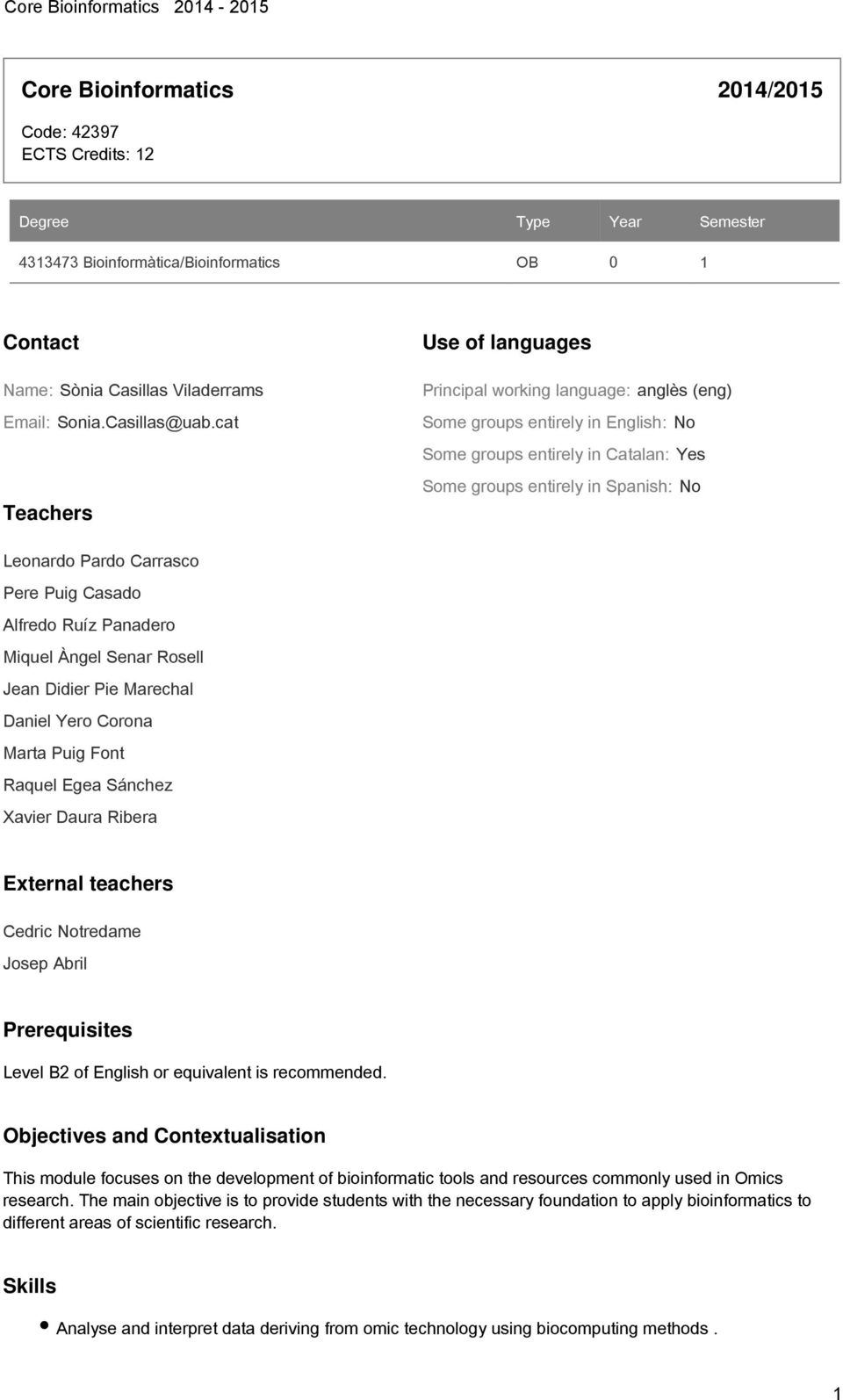
1 Core Bioinformatics 2014/2015 Code: ECTS Credits: 12 Degree Type Year Semester Bioinformàtica/Bioinformatics OB 0 1 Contact Name: Sònia Casillas Viladerrams [email protected] Teachers Use of languages Principal working language: anglès (eng) Some groups entirely in English: No Some groups entirely in Catalan: Yes Some groups entirely in Spanish: No Leonardo Pardo Carrasco Pere Puig Casado Alfredo Ruíz Panadero Miquel Àngel Senar Rosell Jean Didier Pie Marechal Daniel Yero Corona Marta Puig Font Raquel Egea Sánchez Xavier Daura Ribera External teachers Cedric Notredame Josep Abril Prerequisites Level B2 of English or equivalent is recommended. Objectives and Contextualisation This module focuses on the development of bioinformatic tools and resources commonly used in Omics research. The main objective is to provide students with the necessary foundation to apply bioinformatics to different areas of scientific research. Skills Analyse and interpret data deriving from omic technology using biocomputing methods. Design and apply scientific methodology in resolving problems. 1
2 Design and apply scientific methodology in resolving problems. Possess and understand knowledge that provides a basis or opportunity for originality in the development and/or application of ideas, often in a research context. Propose biocomputing solutions for problems deriving from omic research. Propose innovative and creative solutions in the field of study Student should possess the learning skills that enable them to continue studying in a way that is largely student led or independent. Understand the molecular bases and most common standard experimental techniques in omic research (genomics, transcriptomics, proteomics, metabolomics, interactomics, etc.) Use and manage bibliographical information and computer resources in the area of study Use operating systems, programs and tools in common use in biocomputing and be able to manage high performance computing platforms, programming languages and biocomputing analysis. Learning outcomes Create and promote algorithms, calculation and statistical techniques and theories to resolve formal and practical problems deriving from the handling and analysis of biological data. Design and apply scientific methodology in resolving problems. Identify and classify the principle types of biomolecular data obtained from omic technology. Possess and understand knowledge that provides a basis or opportunity for originality in the development and/or application of ideas, often in a research context. Propose innovative and creative solutions in the field of study Student should possess the learning skills that enable them to continue studying in a way that is largely student led or independent. Synthesise and interpret in a logical and reasoned manner the information from the molecular data bases and analyse it using biocomputing tools. Use and manage bibliographical information and computer resources in the area of study Use the main molecular databases, the main standard formats for molecular data and integrate data from different sources Content Session 1. Bioinformatics Formats and Databases Professor Daniel Yero a. Sequence formats Nomenclature. Text editors. FASTA format and its variants. Raw/Plain format. Genbank sequence format. EMBL sequence format. GCG, NBRF/PIR, MSA, PHYLIP, NEXUS. Format conversion. b. Databases Concept. Boolean searches. Wildcards and regular expressions. Identifiers and accession numbers. Classification. NAR databases compilation. GenBank and other NCBI databases. EMBL. DDBJ. Integrated Meta-Databases. Main nucleotide, protein, structure, taxonomy, etc. databases. Sessions 2-4. Statistics and Stochastic Processes for Sequence Analysis Professor Pere Puig a. Probability basics Sets and events. Properties. Conditional probability. Independence. Alphabet and sequences. Probabilistic models. b. The multinomial model Simulating a multinomial sequence. Estimating probabilities. c. The seqinr package d. Markov chain models 2

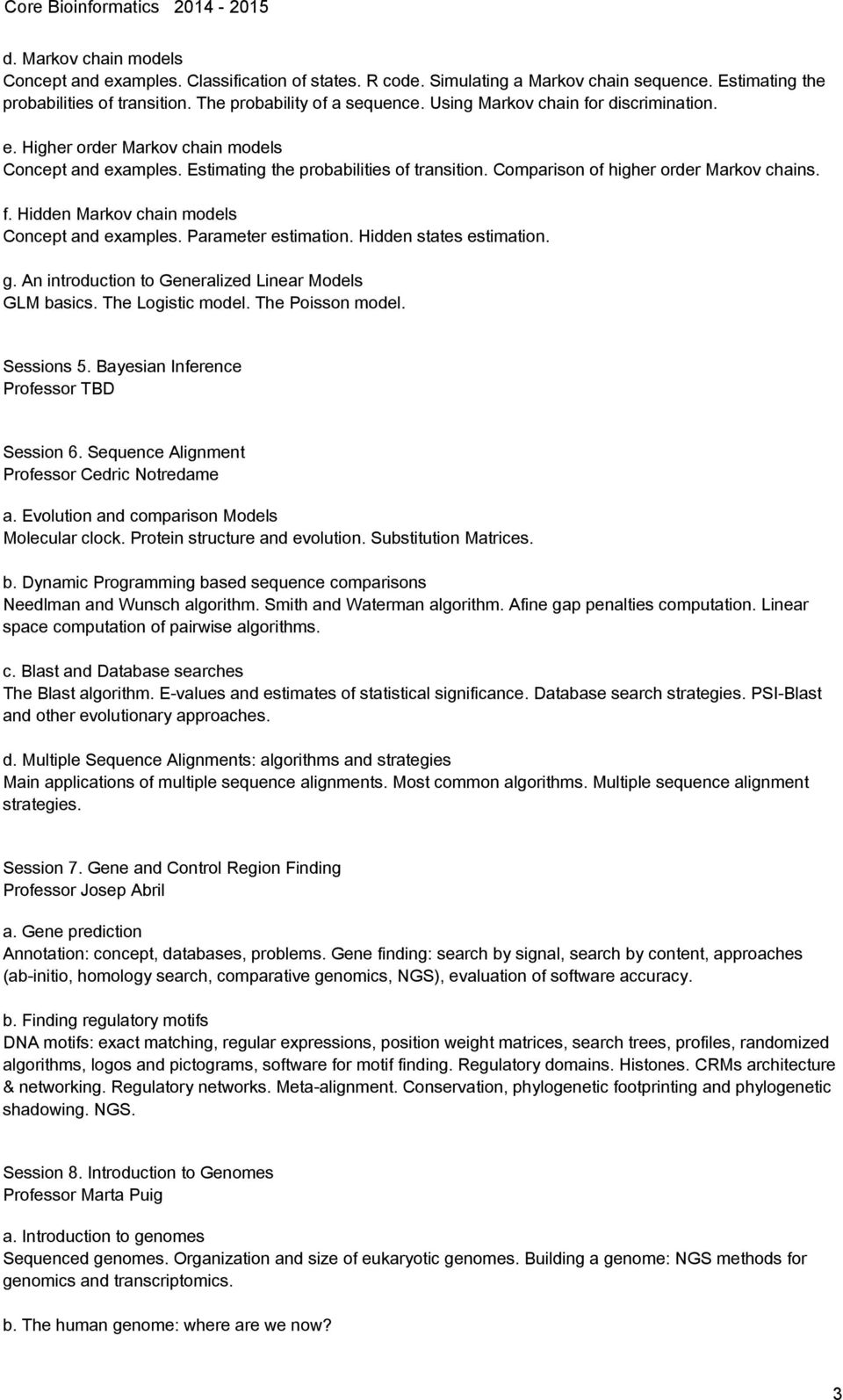
3 d. Markov chain models Concept and examples. Classification of states. R code. Simulating a Markov chain sequence. Estimating the probabilities of transition. The probability of a sequence. Using Markov chain for discrimination. e. Higher order Markov chain models Concept and examples. Estimating the probabilities of transition. Comparison of higher order Markov chains. f. Hidden Markov chain models Concept and examples. Parameter estimation. Hidden states estimation. g. An introduction to Generalized Linear Models GLM basics. The Logistic model. The Poisson model. Sessions 5. Bayesian Inference Professor TBD Session 6. Sequence Alignment Professor Cedric Notredame a. Evolution and comparison Models Molecular clock. Protein structure and evolution. Substitution Matrices. b. Dynamic Programming based sequence comparisons Needlman and Wunsch algorithm. Smith and Waterman algorithm. Afine gap penalties computation. Linear space computation of pairwise algorithms. c. Blast and Database searches The Blast algorithm. E-values and estimates of statistical significance. Database search strategies. PSI-Blast and other evolutionary approaches. d. Multiple Sequence Alignments: algorithms and strategies Main applications of multiple sequence alignments. Most common algorithms. Multiple sequence alignment strategies. Session 7. Gene and Control Region Finding Professor Josep Abril a. Gene prediction Annotation: concept, databases, problems. Gene finding: search by signal, search by content, approaches (ab-initio, homology search, comparative genomics, NGS), evaluation of software accuracy. b. Finding regulatory motifs DNA motifs: exact matching, regular expressions, position weight matrices, search trees, profiles, randomized algorithms, logos and pictograms, software for motif finding. Regulatory domains. Histones. CRMs architecture & networking. Regulatory networks. Meta-alignment. Conservation, phylogenetic footprinting and phylogenetic shadowing. NGS. Session 8. Introduction to Genomes Professor Marta Puig a. Introduction to genomes Sequenced genomes. Organization and size of eukaryotic genomes. Building a genome: NGS methods for genomics and transcriptomics. b. The human genome: where are we now? Current assembly of the human genome. The ENCODE project: functional elements in the human genome. 3
4 Current assembly of the human genome. The ENCODE project: functional elements in the human genome. Repetitive content of the human genome. Session 9. Population Genomics Professor Alfredo Ruiz a. Population genomics under neutrality in a finite population Introduction. Genetic drift. Effective population size. Probability of fixation of neutral mutants. b. Population genomics under selection Natural selection. Probability of fixation of selected mutants. Fitness distribution of new mutants. Rate of evolution. c. Adaptive evolution and population size Session 10. Phylogeny and Molecular Evolution Professor Sebastián Ramos a. Models of sequence evolution DNA sequence. Jukes and Cantor model. More realistic models. Model selection. b. Phylogeny Concept. Species trees versus gene trees. Tree-reconstruction methods: distance methods, maximum parsimony, maximum likelihood, Bayesian inference. Support. Phylogenomics. Building trees with R. Session Structural Bioinformatics Professors Xavier Daura, Leonardo Pardo and Jean-Didier Maréchal a. Structural biology and interactions Biomolecules. Xenobiotics. Proteins, aminoacids and peptide bonds. Four levels of protein structure. Protein folding and stability. DNA structure. Experimental methods for structure determination. b. Structure databases PDB. PyMOL. c. Molecular modeling Models. Potential energy. Quantum and molecular mechanics techniques. Energy minimization. Molecular Dynamics. Homology modeling. d. Docking Concept and applications. Exploring the conformational space. Defining molecular interactions. Scoring functions. Workflows and software. Online resources. Sessions 15. Systems Biology Professor TBD Sessions 16. Web Development Professor Raquel Egea a. Web development Why developing webs as a bioinformatician? Web developing basics: OS, Web servers, databases, programming languages. Apache. HTML, CSS, JavaScript, PHP. b. Self-learning: bibliography and useful online resources Online bioinformatics communities. 4

5 Session Software Engineering Professors Miquel Àngel Senar and Raquel Egea a. Parallelization strategies b. Introduction to workflow managers Concept, origin and design of workflow managers. Workflow patterns. Existing workflow managers. APIs and Web Servers. Galaxy: basics, interface and practical uses. c. Version control system with Git and GitHub d. Cloud computing with Amazon Web Services Methodology The methodology will combine master classes, solving practical problems and real cases, working in the computing lab, performing individual and team work, readings articles related to the thematic blocks, and independent self-study. The virtual platform will be used. Activities Title Hours ECTS Learning outcomes Type: Directed Solving problems in class and work in the biocomputing lab , 2, 3, 4, 5, 6, 7, 8, 9 Theoretical classes , 2, 3, 4, 5, 6, 7, 8, 9 Type: Supervised Performing individual and team works , 2, 3, 4, 5, 6, 7, 8, 9 Type: Autonomous Regular study , 2, 3, 4, 5, 6, 7, 8, 9 Evaluation Work done and presented by the student (student's portfolio) (50%). Individual theoretical and practical test (50%). A final exam will take place at the end of this module. It will consist of one or two short questions by each professor teaching in this module. Evaluation activities Title Weighting Hours ECTS Learning outcomes Individual theoretical and practical test 50% , 2, 3, 4, 5, 6, 7, 8, 9 Student's portfolio 50% 0 0 1, 2, 3, 4, 5, 6, 7, 8, 9 Bibliography 5

6 Updated bibliography will be recommended in each session of this module by the professor, and links will be made available on the Student's Area of the MSc Bioinformatics official website ( 6

Core Bioinformatics. Degree Type Year Semester
 Core Bioinformatics 2015/2016 Code: 42397 ECTS Credits: 12 Degree Type Year Semester 4313473 Bioinformatics OB 0 1 Contact Name: Sònia Casillas Viladerrams Email: [email protected] Teachers Use of
BIO 3350: ELEMENTS OF BIOINFORMATICS PARTIALLY ONLINE SYLLABUS
 BIO 3350: ELEMENTS OF BIOINFORMATICS PARTIALLY ONLINE SYLLABUS NEW YORK CITY COLLEGE OF TECHNOLOGY The City University Of New York School of Arts and Sciences Biological Sciences Department Course title:
BIOINF 525 Winter 2016 Foundations of Bioinformatics and Systems Biology http://tinyurl.com/bioinf525-w16
 Course Director: Dr. Barry Grant (DCM&B, [email protected]) Description: This is a three module course covering (1) Foundations of Bioinformatics, (2) Statistics in Bioinformatics, and (3) Systems
Bio-Informatics Lectures. A Short Introduction
 Bio-Informatics Lectures A Short Introduction The History of Bioinformatics Sanger Sequencing PCR in presence of fluorescent, chain-terminating dideoxynucleotides Massively Parallel Sequencing Massively
RETRIEVING SEQUENCE INFORMATION. Nucleotide sequence databases. Database search. Sequence alignment and comparison
 RETRIEVING SEQUENCE INFORMATION Nucleotide sequence databases Database search Sequence alignment and comparison Biological sequence databases Originally just a storage place for sequences. Currently the
REGULATIONS FOR THE DEGREE OF BACHELOR OF SCIENCE IN BIOINFORMATICS (BSc[BioInf])
![REGULATIONS FOR THE DEGREE OF BACHELOR OF SCIENCE IN BIOINFORMATICS (BSc[BioInf])](/thumbs/29/13177944.jpg "REGULATIONS FOR THE DEGREE OF BACHELOR OF SCIENCE IN BIOINFORMATICS (BSc[BioInf])") 820 REGULATIONS FOR THE DEGREE OF BACHELOR OF SCIENCE IN BIOINFORMATICS (BSc[BioInf]) (See also General Regulations) BMS1 Admission to the Degree To be eligible for admission to the degree of Bachelor
820 REGULATIONS FOR THE DEGREE OF BACHELOR OF SCIENCE IN BIOINFORMATICS (BSc[BioInf]) (See also General Regulations) BMS1 Admission to the Degree To be eligible for admission to the degree of Bachelor
Syllabus of B.Sc. (Bioinformatics) Subject- Bioinformatics (as one subject) B.Sc. I Year Semester I Paper I: Basic of Bioinformatics 85 marks
 Syllabus of B.Sc. (Bioinformatics) Subject- Bioinformatics (as one subject) B.Sc. I Year Semester I Paper I: Basic of Bioinformatics 85 marks Semester II Paper II: Mathematics I 85 marks B.Sc. II Year
Learning outcomes. Knowledge and understanding. Competence and skills
 Syllabus Master s Programme in Statistics and Data Mining 120 ECTS Credits Aim The rapid growth of databases provides scientists and business people with vast new resources. This programme meets the challenges
A Primer of Genome Science THIRD
 A Primer of Genome Science THIRD EDITION GREG GIBSON-SPENCER V. MUSE North Carolina State University Sinauer Associates, Inc. Publishers Sunderland, Massachusetts USA Contents Preface xi 1 Genome Projects:
Pairwise Sequence Alignment
 Pairwise Sequence Alignment [email protected] SS 2013 Outline Pairwise sequence alignment global - Needleman Wunsch Gotoh algorithm local - Smith Waterman algorithm BLAST - heuristics What
PROC. CAIRO INTERNATIONAL BIOMEDICAL ENGINEERING CONFERENCE 2006 1. E-mail: [email protected]
 BIOINFTool: Bioinformatics and sequence data analysis in molecular biology using Matlab Mai S. Mabrouk 1, Marwa Hamdy 2, Marwa Mamdouh 2, Marwa Aboelfotoh 2,Yasser M. Kadah 2 1 Biomedical Engineering Department,
Bioinformatics Grid - Enabled Tools For Biologists.
 Bioinformatics Grid - Enabled Tools For Biologists. What is Grid-Enabled Tools (GET)? As number of data from the genomics and proteomics experiment increases. Problems arise for the current sequence analysis
Guide for Bioinformatics Project Module 3
 Structure- Based Evidence and Multiple Sequence Alignment In this module we will revisit some topics we started to look at while performing our BLAST search and looking at the CDD database in the first
Genome Explorer For Comparative Genome Analysis
 Genome Explorer For Comparative Genome Analysis Jenn Conn 1, Jo L. Dicks 1 and Ian N. Roberts 2 Abstract Genome Explorer brings together the tools required to build and compare phylogenies from both sequence
Data Integration. Lectures 16 & 17. ECS289A, WQ03, Filkov
 Data Integration Lectures 16 & 17 Lectures Outline Goals for Data Integration Homogeneous data integration time series data (Filkov et al. 2002) Heterogeneous data integration microarray + sequence microarray
Module 1. Sequence Formats and Retrieval. Charles Steward
 The Open Door Workshop Module 1 Sequence Formats and Retrieval Charles Steward 1 Aims Acquaint you with different file formats and associated annotations. Introduce different nucleotide and protein databases.
Lecture/Recitation Topic SMA 5303 L1 Sampling and statistical distributions
 SMA 50: Statistical Learning and Data Mining in Bioinformatics (also listed as 5.077: Statistical Learning and Data Mining ()) Spring Term (Feb May 200) Faculty: Professor Roy Welsch Wed 0 Feb 7:00-8:0
Bioinformatics Resources at a Glance
 Bioinformatics Resources at a Glance A Note about FASTA Format There are MANY free bioinformatics tools available online. Bioinformaticists have developed a standard format for nucleotide and protein sequences
BIO 3352: BIOINFORMATICS II HYBRID COURSE SYLLABUS
 BIO 3352: BIOINFORMATICS II HYBRID COURSE SYLLABUS NEW YORK CITY COLLEGE OF TECHNOLOGY The City University Of New York School of Arts and Sciences Biological Sciences Department Course title: Bioinformatics
Introduction to Bioinformatics AS 250.265 Laboratory Assignment 6
 Introduction to Bioinformatics AS 250.265 Laboratory Assignment 6 In the last lab, you learned how to perform basic multiple sequence alignments. While useful in themselves for determining conserved residues
University of Glasgow - Programme Structure Summary C1G5-5100 MSc Bioinformatics, Polyomics and Systems Biology
 University of Glasgow - Programme Structure Summary C1G5-5100 MSc Bioinformatics, Polyomics and Systems Biology Programme Structure - the MSc outcome will require 180 credits total (full-time only) - 60
Sequence Analysis 15: lecture 5. Substitution matrices Multiple sequence alignment
 Sequence Analysis 15: lecture 5 Substitution matrices Multiple sequence alignment A teacher's dilemma To understand... Multiple sequence alignment Substitution matrices Phylogenetic trees You first need
BLAST. Anders Gorm Pedersen & Rasmus Wernersson
 BLAST Anders Gorm Pedersen & Rasmus Wernersson Database searching Using pairwise alignments to search databases for similar sequences Query sequence Database Database searching Most common use of pairwise
Statistics Graduate Courses
 Statistics Graduate Courses STAT 7002--Topics in Statistics-Biological/Physical/Mathematics (cr.arr.).organized study of selected topics. Subjects and earnable credit may vary from semester to semester.
Protein & DNA Sequence Analysis. Bobbie-Jo Webb-Robertson May 3, 2004
 Protein & DNA Sequence Analysis Bobbie-Jo Webb-Robertson May 3, 2004 Sequence Analysis Anything connected to identifying higher biological meaning out of raw sequence data. 2 Genomic & Proteomic Data Sequence
Phylogenetic Trees Made Easy
 Phylogenetic Trees Made Easy A How-To Manual Fourth Edition Barry G. Hall University of Rochester, Emeritus and Bellingham Research Institute Sinauer Associates, Inc. Publishers Sunderland, Massachusetts
Protein Sequence Analysis - Overview -
 Protein Sequence Analysis - Overview - UDEL Workshop Raja Mazumder Research Associate Professor, Department of Biochemistry and Molecular Biology Georgetown University Medical Center Topics Why do protein
Algorithms in Computational Biology (236522) spring 2007 Lecture #1
 Algorithms in Computational Biology (236522) spring 2007 Lecture #1 Lecturer: Shlomo Moran, Taub 639, tel 4363 Office hours: Tuesday 11:00-12:00/by appointment TA: Ilan Gronau, Taub 700, tel 4894 Office
DnaSP, DNA polymorphism analyses by the coalescent and other methods.
 DnaSP, DNA polymorphism analyses by the coalescent and other methods. Author affiliation: Julio Rozas 1, *, Juan C. Sánchez-DelBarrio 2,3, Xavier Messeguer 2 and Ricardo Rozas 1 1 Departament de Genètica,
Service courses for graduate students in degree programs other than the MS or PhD programs in Biostatistics.
 Course Catalog In order to be assured that all prerequisites are met, students must acquire a permission number from the education coordinator prior to enrolling in any Biostatistics course. Courses are
Linear Sequence Analysis. 3-D Structure Analysis
 Linear Sequence Analysis What can you learn from a (single) protein sequence? Calculate it s physical properties Molecular weight (MW), isoelectric point (pi), amino acid content, hydropathy (hydrophilic
REGULATIONS FOR THE DEGREE OF MASTER OF SCIENCE IN COMPUTER SCIENCE (MSc[CompSc])
![REGULATIONS FOR THE DEGREE OF MASTER OF SCIENCE IN COMPUTER SCIENCE (MSc[CompSc])](/thumbs/24/2595933.jpg "REGULATIONS FOR THE DEGREE OF MASTER OF SCIENCE IN COMPUTER SCIENCE (MSc[CompSc])") 244 REGULATIONS FOR THE DEGREE OF MASTER OF SCIENCE IN COMPUTER SCIENCE (MSc[CompSc]) (See also General Regulations) Any publication based on work approved for a higher degree should contain a reference
244 REGULATIONS FOR THE DEGREE OF MASTER OF SCIENCE IN COMPUTER SCIENCE (MSc[CompSc]) (See also General Regulations) Any publication based on work approved for a higher degree should contain a reference
Protein Protein Interaction Networks
 Functional Pattern Mining from Genome Scale Protein Protein Interaction Networks Young-Rae Cho, Ph.D. Assistant Professor Department of Computer Science Baylor University it My Definition of Bioinformatics
Master's projects at ITMO University. Daniil Chivilikhin PhD Student @ ITMO University
 Master's projects at ITMO University Daniil Chivilikhin PhD Student @ ITMO University General information Guidance from our lab's researchers Publishable results 2 Research areas Research at ITMO Evolutionary
Module 10: Bioinformatics
 Module 10: Bioinformatics 1.) Goal: To understand the general approaches for basic in silico (computer) analysis of DNA- and protein sequences. We are going to discuss sequence formatting required prior
Implementation Regulation for the MSc Programme Nanobiology
 Implementation Regulation for the MSc Programme Nanobiology Part of the Course and Exam Regulation of the Master Programme As referred to in Section 2 of the Course and Exam Regulation. Faculty of Medicine
Network Protocol Analysis using Bioinformatics Algorithms
 Network Protocol Analysis using Bioinformatics Algorithms Marshall A. Beddoe [email protected] ABSTRACT Network protocol analysis is currently performed by hand using only intuition and a protocol
Similarity Searches on Sequence Databases: BLAST, FASTA. Lorenza Bordoli Swiss Institute of Bioinformatics EMBnet Course, Basel, October 2003
 Similarity Searches on Sequence Databases: BLAST, FASTA Lorenza Bordoli Swiss Institute of Bioinformatics EMBnet Course, Basel, October 2003 Outline Importance of Similarity Heuristic Sequence Alignment:
Statistics in Applications III. Distribution Theory and Inference
 2.2 Master of Science Degrees The Department of Statistics at FSU offers three different options for an MS degree. 1. The applied statistics degree is for a student preparing for a career as an applied
UF EDGE brings the classroom to you with online, worldwide course delivery!
 What is the University of Florida EDGE Program? EDGE enables engineering professional, military members, and students worldwide to participate in courses, certificates, and degree programs from the UF
Biological Databases and Protein Sequence Analysis
 Biological Databases and Protein Sequence Analysis Introduction M. Madan Babu, Center for Biotechnology, Anna University, Chennai 25, India Bioinformatics is the application of Information technology to
Vad är bioinformatik och varför behöver vi det i vården? a bioinformatician's perspectives
 Vad är bioinformatik och varför behöver vi det i vården? a bioinformatician's perspectives [email protected] 2015-05-21 Functional Bioinformatics, Örebro University Vad är bioinformatik och varför
Bioinformatics: course introduction
 Bioinformatics: course introduction Filip Železný Czech Technical University in Prague Faculty of Electrical Engineering Department of Cybernetics Intelligent Data Analysis lab http://ida.felk.cvut.cz
A Tutorial in Genetic Sequence Classification Tools and Techniques
 A Tutorial in Genetic Sequence Classification Tools and Techniques Jake Drew Data Mining CSE 8331 Southern Methodist University [email protected] www.jakemdrew.com Sequence Characters IUPAC nucleotide
UGENE Quick Start Guide
 Quick Start Guide This document contains a quick introduction to UGENE. For more detailed information, you can find the UGENE User Manual and other special manuals in project website: http://ugene.unipro.ru.
MASTER'S DEGREE PROGRAMME IN BIOINFORMATICS
 MASTER'S DEGREE PROGRAMME IN BIOINFORMATICS PROGRAMME DESCRIPTION The Master's Degree Programme in Bioinformatics offers interdisciplinary knowledge of bioinformatics. Education is given in English, and
T cell Epitope Prediction
 Institute for Immunology and Informatics T cell Epitope Prediction EpiMatrix Eric Gustafson January 6, 2011 Overview Gathering raw data Popular sources Data Management Conservation Analysis Multiple Alignments
Lab 2/Phylogenetics/September 16, 2002 1 PHYLOGENETICS
 Lab 2/Phylogenetics/September 16, 2002 1 Read: Tudge Chapter 2 PHYLOGENETICS Objective of the Lab: To understand how DNA and protein sequence information can be used to make comparisons and assess evolutionary
EMBL-EBI Web Services
 EMBL-EBI Web Services Rodrigo Lopez Head of the External Services Team SME Workshop Piemonte 2011 EBI is an Outstation of the European Molecular Biology Laboratory. Summary Introduction The JDispatcher
Current Motif Discovery Tools and their Limitations
 Current Motif Discovery Tools and their Limitations Philipp Bucher SIB / CIG Workshop 3 October 2006 Trendy Concepts and Hypotheses Transcription regulatory elements act in a context-dependent manner.
Introduction to Bioinformatics 3. DNA editing and contig assembly
 Introduction to Bioinformatics 3. DNA editing and contig assembly Benjamin F. Matthews United States Department of Agriculture Soybean Genomics and Improvement Laboratory Beltsville, MD 20708 [email protected]
PHYML Online: A Web Server for Fast Maximum Likelihood-Based Phylogenetic Inference
 PHYML Online: A Web Server for Fast Maximum Likelihood-Based Phylogenetic Inference Stephane Guindon, F. Le Thiec, Patrice Duroux, Olivier Gascuel To cite this version: Stephane Guindon, F. Le Thiec, Patrice
A Multiple DNA Sequence Translation Tool Incorporating Web Robot and Intelligent Recommendation Techniques
 Proceedings of the 2007 WSEAS International Conference on Computer Engineering and Applications, Gold Coast, Australia, January 17-19, 2007 402 A Multiple DNA Sequence Translation Tool Incorporating Web
SGI. High Throughput Computing (HTC) Wrapper Program for Bioinformatics on SGI ICE and SGI UV Systems. January, 2012. Abstract. Haruna Cofer*, PhD
 White Paper SGI High Throughput Computing (HTC) Wrapper Program for Bioinformatics on SGI ICE and SGI UV Systems Haruna Cofer*, PhD January, 2012 Abstract The SGI High Throughput Computing (HTC) Wrapper
Hidden Markov Models in Bioinformatics. By Máthé Zoltán Kőrösi Zoltán 2006
 Hidden Markov Models in Bioinformatics By Máthé Zoltán Kőrösi Zoltán 2006 Outline Markov Chain HMM (Hidden Markov Model) Hidden Markov Models in Bioinformatics Gene Finding Gene Finding Model Viterbi algorithm
Phylogenetic Analysis using MapReduce Programming Model
 2015 IEEE International Parallel and Distributed Processing Symposium Workshops Phylogenetic Analysis using MapReduce Programming Model Siddesh G M, K G Srinivasa*, Ishank Mishra, Abhinav Anurag, Eklavya
01219211 Software Development Training Camp 1 (0-3) Prerequisite : 01204214 Program development skill enhancement camp, at least 48 person-hours.
 (International Program) 01219141 Object-Oriented Modeling and Programming 3 (3-0) Object concepts, object-oriented design and analysis, object-oriented analysis relating to developing conceptual models
Final Project Report
 CPSC545 by Introduction to Data Mining Prof. Martin Schultz & Prof. Mark Gerstein Student Name: Yu Kor Hugo Lam Student ID : 904907866 Due Date : May 7, 2007 Introduction Final Project Report Pseudogenes
200630 - FBIO - Fundations of Bioinformatics
 Coordinating unit: Teaching unit: Academic year: Degree: ECTS credits: 2015 200 - FME - School of Mathematics and Statistics 1004 - UB - (ENG)Universitat de Barcelona MASTER'S DEGREE IN STATISTICS AND
university of copenhagen Bioinformatics Master Program
 university of copenhagen Bioinformatics Master Program Content The uniqueness of our program.... 3 2-Year Bioinformatics Master Program.... 5 Mandatory Core Bioinformatics Master Program courses and their
Just the Facts: A Basic Introduction to the Science Underlying NCBI Resources
 1 of 8 11/7/2004 11:00 AM National Center for Biotechnology Information About NCBI NCBI at a Glance A Science Primer Human Genome Resources Model Organisms Guide Outreach and Education Databases and Tools
Teaching Bioinformatics to Undergraduates
 Teaching Bioinformatics to Undergraduates http://www.med.nyu.edu/rcr/asm Stuart M. Brown Research Computing, NYU School of Medicine I. What is Bioinformatics? II. Challenges of teaching bioinformatics
Bayesian Phylogeny and Measures of Branch Support
 Bayesian Phylogeny and Measures of Branch Support Bayesian Statistics Imagine we have a bag containing 100 dice of which we know that 90 are fair and 10 are biased. The
An agent-based layered middleware as tool integration
 An agent-based layered middleware as tool integration Flavio Corradini Leonardo Mariani Emanuela Merelli University of L Aquila University of Milano University of Camerino ITALY ITALY ITALY Helsinki FSE/ESEC
THE UNIVERSITY OF MANCHESTER Unit Specification
 1. GENERAL INFORMATION Title Unit code Credit rating 15 Level 7 Contact hours 30 Other Scheduled teaching and learning activities* Pre-requisite units Co-requisite units School responsible Member of staff
Genetomic Promototypes
 Genetomic Promototypes Mirkó Palla and Dana Pe er Department of Mechanical Engineering Clarkson University Potsdam, New York and Department of Genetics Harvard Medical School 77 Avenue Louis Pasteur Boston,
When you install Mascot, it includes a copy of the Swiss-Prot protein database. However, it is almost certain that you and your colleagues will want
 1 When you install Mascot, it includes a copy of the Swiss-Prot protein database. However, it is almost certain that you and your colleagues will want to search other databases as well. There are very
582606 Introduction to bioinformatics
 582606 Introduction to bioinformatics Autumn 2007 Esa Pitkänen Master's Degree Programme in Bioinformatics (MBI) Department of Computer Science, University of Helsinki http://www.cs.helsinki.fi/mbi/courses/07-08/itb/
Lecture 19: Proteins, Primary Struture
 CPS260/BGT204.1 Algorithms in Computational Biology November 04, 2003 Lecture 19: Proteins, Primary Struture Lecturer: Pankaj K. Agarwal Scribe: Qiuhua Liu 19.1 The Building Blocks of Protein [1] Proteins
Databases and platforms for data analysis from NGS of MTB
 Databases and platforms for data analysis from NGS of MTB Derrick Crook MMM Consortium MMM Consortium Linking Clinical record systems and NHS databases Translating next generation sequencing for patient
Sequence homology search tools on the world wide web
 44 Sequence Homology Search Tools Sequence homology search tools on the world wide web Ian Holmes Berkeley Drosophila Genome Project, Berkeley, CA email: [email protected] Introduction Sequence homology
AGILENT S BIOINFORMATICS ANALYSIS SOFTWARE
 ACCELERATING PROGRESS IS IN OUR GENES AGILENT S BIOINFORMATICS ANALYSIS SOFTWARE GENESPRING GENE EXPRESSION (GX) MASS PROFILER PROFESSIONAL (MPP) PATHWAY ARCHITECT (PA) See Deeper. Reach Further. BIOINFORMATICS
How To Get A Masters Degree In Biomedical Informatics
 UNIVERSITY OF COLOMBO POSTGRADUATE INSTITUTE OF MEDICINE OF SRI LANKA Drafted and printed by the Board of Study in Multi Disciplinary Study Courses and the Postgraduate Institute of Medicine, University
Focusing on results not data comprehensive data analysis for targeted next generation sequencing
 Focusing on results not data comprehensive data analysis for targeted next generation sequencing Daniel Swan, Jolyon Holdstock, Angela Matchan, Richard Stark, John Shovelton, Duarte Mohla and Simon Hughes
Doctor of Philosophy in Computer Science
 Doctor of Philosophy in Computer Science Background/Rationale The program aims to develop computer scientists who are armed with methods, tools and techniques from both theoretical and systems aspects
Applied mathematics and mathematical statistics
 Applied mathematics and mathematical statistics The graduate school is organised within the Department of Mathematical Sciences.. Deputy head of department: Aila Särkkä Director of Graduate Studies: Marija
Distributed Data Mining in Discovery Net. Dr. Moustafa Ghanem Department of Computing Imperial College London
 Distributed Data Mining in Discovery Net Dr. Moustafa Ghanem Department of Computing Imperial College London 1. What is Discovery Net 2. Distributed Data Mining for Compute Intensive Tasks 3. Distributed
Using MATLAB: Bioinformatics Toolbox for Life Sciences
 Using MATLAB: Bioinformatics Toolbox for Life Sciences MR. SARAWUT WONGPHAYAK BIOINFORMATICS PROGRAM, SCHOOL OF BIORESOURCES AND TECHNOLOGY, AND SCHOOL OF INFORMATION TECHNOLOGY, KING MONGKUT S UNIVERSITY
COMPARING DNA SEQUENCES TO DETERMINE EVOLUTIONARY RELATIONSHIPS AMONG MOLLUSKS
 COMPARING DNA SEQUENCES TO DETERMINE EVOLUTIONARY RELATIONSHIPS AMONG MOLLUSKS OVERVIEW In the online activity Biodiversity and Evolutionary Trees: An Activity on Biological Classification, you generated
Software review. Vector NTI, a balanced all-in-one sequence analysis suite
 Vector NTI, a balanced all-in-one sequence analysis suite Keywords: sequence analysis, software package, database, virtual cloning, sequence assembly Abstract Vector NTI is a well-balanced desktop application
Global and Discovery Proteomics Lecture Agenda
 Global and Discovery Proteomics Christine A. Jelinek, Ph.D. Johns Hopkins University School of Medicine Department of Pharmacology and Molecular Sciences Middle Atlantic Mass Spectrometry Laboratory Global
Contents. Page 1 of 11
 Programme-specific Section of the Curriculum for the MSc Programme in Bioinformatics at the Faculty of Science, University of Copenhagen 2009 (Rev. 2015) Contents 1 Title, affiliation and language... 2
AP Biology Essential Knowledge Student Diagnostic
 AP Biology Essential Knowledge Student Diagnostic Background The Essential Knowledge statements provided in the AP Biology Curriculum Framework are scientific claims describing phenomenon occurring in
Bioinformatics, Sequences and Genomes
 Bioinformatics, Sequences and Genomes BL4273 Bioinformatics for Biologists Week 1 Daniel Barker, School of Biology, University of St Andrews Email [email protected] BL4273 and 4273π 4273π is a custom
REGULATIONS FOR THE DEGREE OF MASTER OF SCIENCE IN COMPUTER SCIENCE (MSc[CompSc])
![REGULATIONS FOR THE DEGREE OF MASTER OF SCIENCE IN COMPUTER SCIENCE (MSc[CompSc])](/thumbs/33/16674036.jpg "REGULATIONS FOR THE DEGREE OF MASTER OF SCIENCE IN COMPUTER SCIENCE (MSc[CompSc])") 305 REGULATIONS FOR THE DEGREE OF MASTER OF SCIENCE IN COMPUTER SCIENCE (MSc[CompSc]) (See also General Regulations) Any publication based on work approved for a higher degree should contain a reference
305 REGULATIONS FOR THE DEGREE OF MASTER OF SCIENCE IN COMPUTER SCIENCE (MSc[CompSc]) (See also General Regulations) Any publication based on work approved for a higher degree should contain a reference
Heuristics for the Sorting by Length-Weighted Inversions Problem on Signed Permutations
 Heuristics for the Sorting by Length-Weighted Inversions Problem on Signed Permutations AlCoB 2014 First International Conference on Algorithms for Computational Biology Thiago da Silva Arruda Institute
Abdullah Mohammed Abdullah Khamis
 Abdullah Mohammed Abdullah Khamis Jeddah, Saudi Arabia Email: [email protected] Mobile: +966 567243182 Tel: +966 2 6340699 (Yemeni) Research and Professional Objective To Complete my Ph.D. in Pattern