
Visual development in babies and infants
|
|
|
- Penelope Maxwell
- 9 years ago
- Views:
Transcription
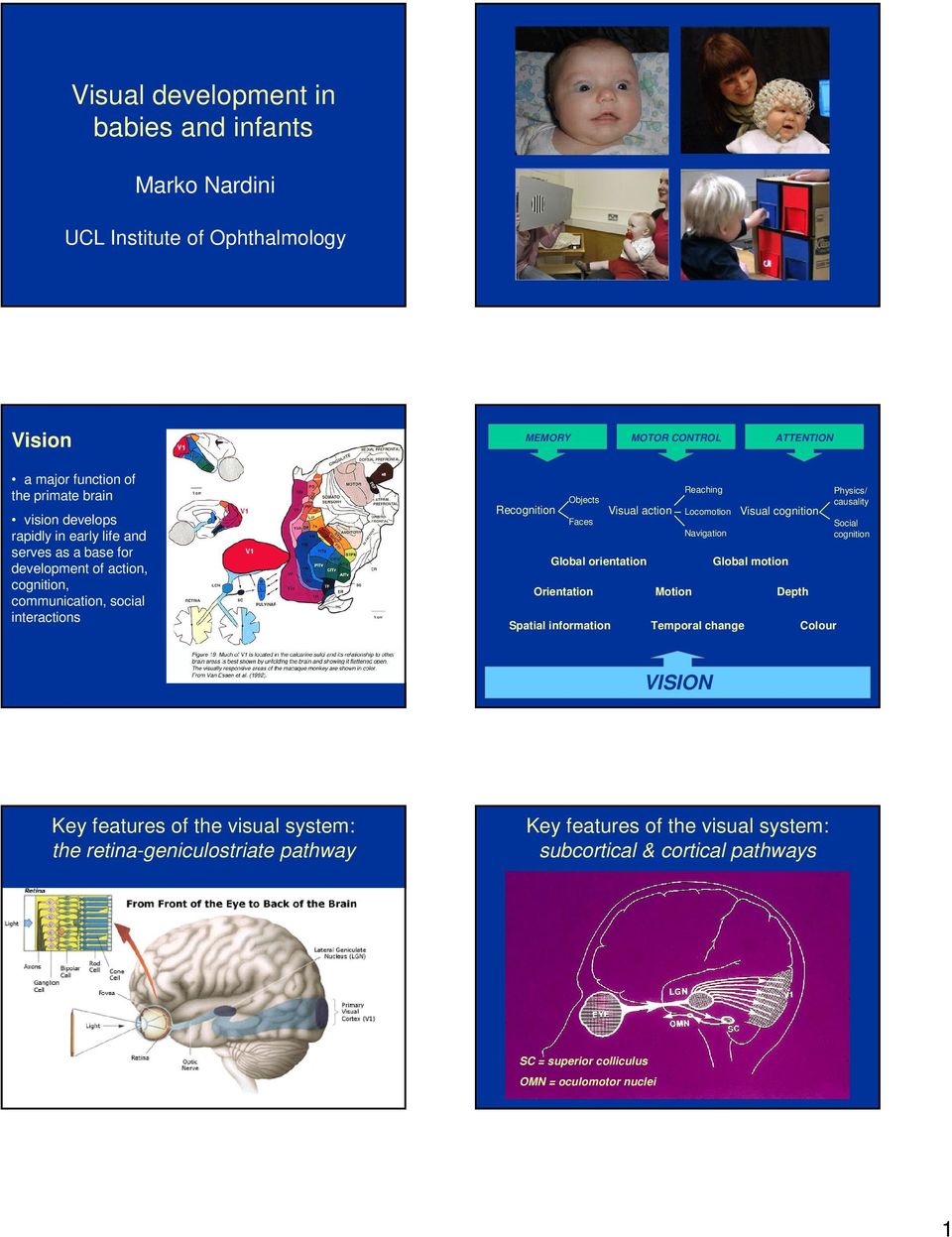
1 Visual development in babies and infants Marko Nardini UCL Institute of Ophthalmology Vision a major function of the primate brain vision develops rapidly in early life and serves as a base for development of action, cognition, communication, social interactions MEMORY MOTOR CONTROL ATTENTION Recognition Objects Faces Visual action Global orientation Reaching Locomotion Navigation Visual cognition Global motion Orientation Motion Depth Spatial information Temporal change Colour Physics/ causality Social cognition VISION Key features of the visual system: the retina-geniculostriate pathway Key features of the visual system: subcortical & cortical pathways SC = superior colliculus OMN = oculomotor nuclei 1
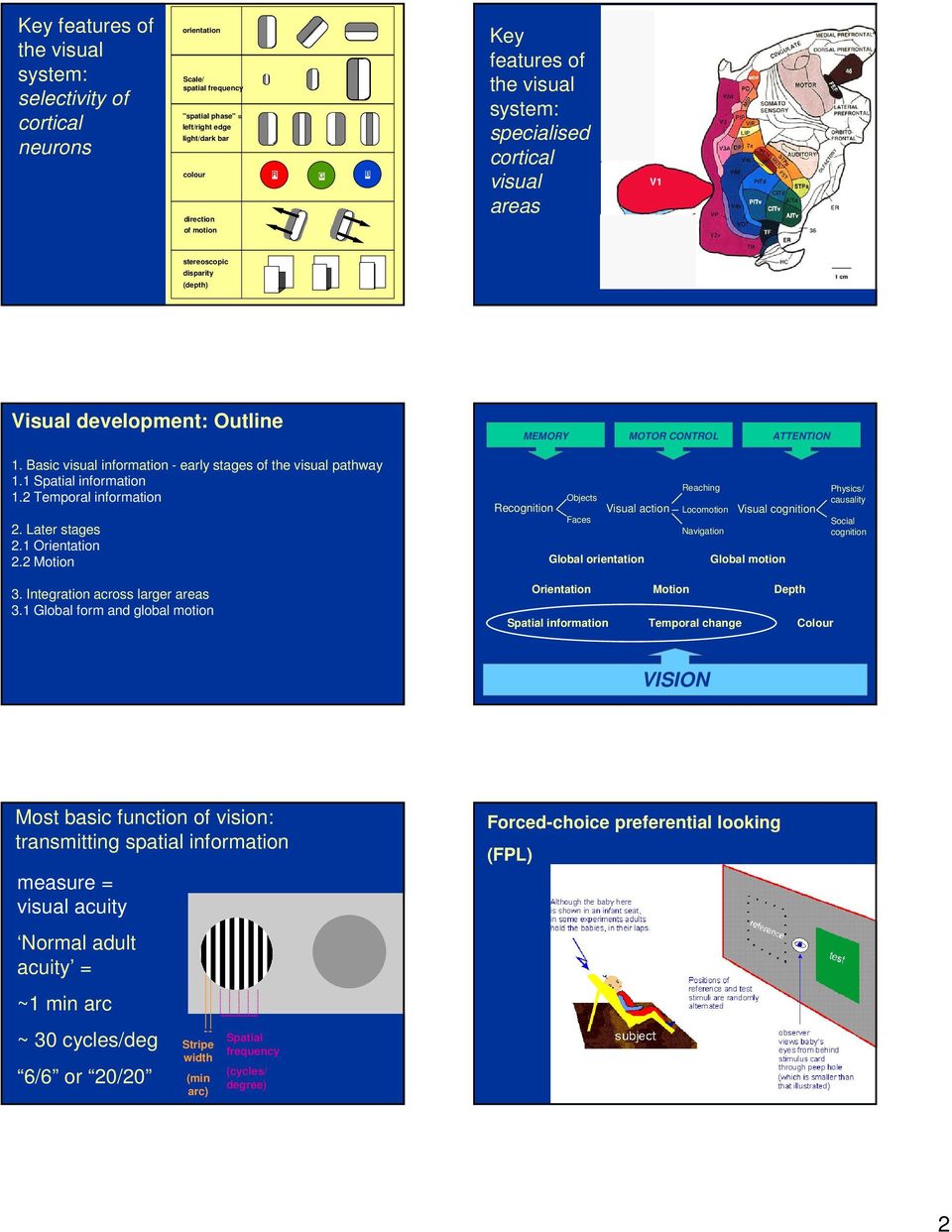
2 Key features of the visual system: selectivity of cortical neurons orientation Scale/ spatial frequency "spatial phase" = left/right edge light/dark bar colour direction R G B Key features of the visual system: specialised cortical visual areas of motion stereoscopic disparity (depth) Visual development: Outline MEMORY MOTOR CONTROL ATTENTION 1. Basic visual information - early stages of the visual pathway 1.1 Spatial information 1.2 Temporal information 2. Later stages 2.1 Orientation 2.2 Motion Objects Recognition Visual action Faces Global orientation Reaching Locomotion Visual cognition Navigation Global motion Physics/ causality Social cognition 3. Integration across larger areas 3.1 Global form and global motion Orientation Motion Depth Spatial information Temporal change Colour VISION Most basic function of vision: transmitting spatial information measure = visual acuity Forced-choice preferential looking (FPL) Normal adult acuity = ~1 min arc ~ 30 cycles/deg 6/6 or 20/20 Stripe width (min arc) Spatial frequency (cycles/ degree) 2


3 Staircase method for acuity threshold Acuity increases with age Teller (1981) human and macaque grating acuity using PL and operant techniques Visual evoked potential (VEP) same as ERP Recording EEG Activity Stimuli Presentations Voltage Amplifier (or VEP) EEG Recorder Phase-reversal (pattern reversal) VEP Phase-reversal (pattern reversal) VEP 3

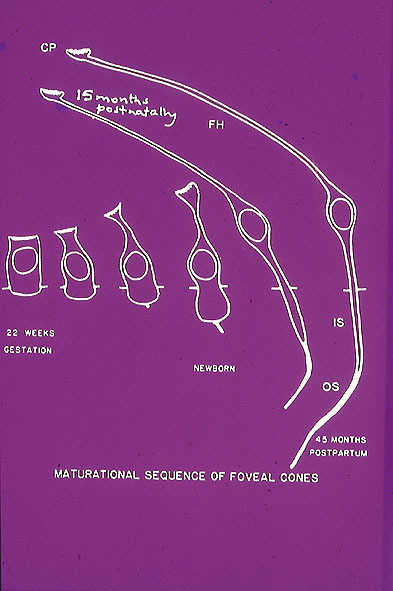
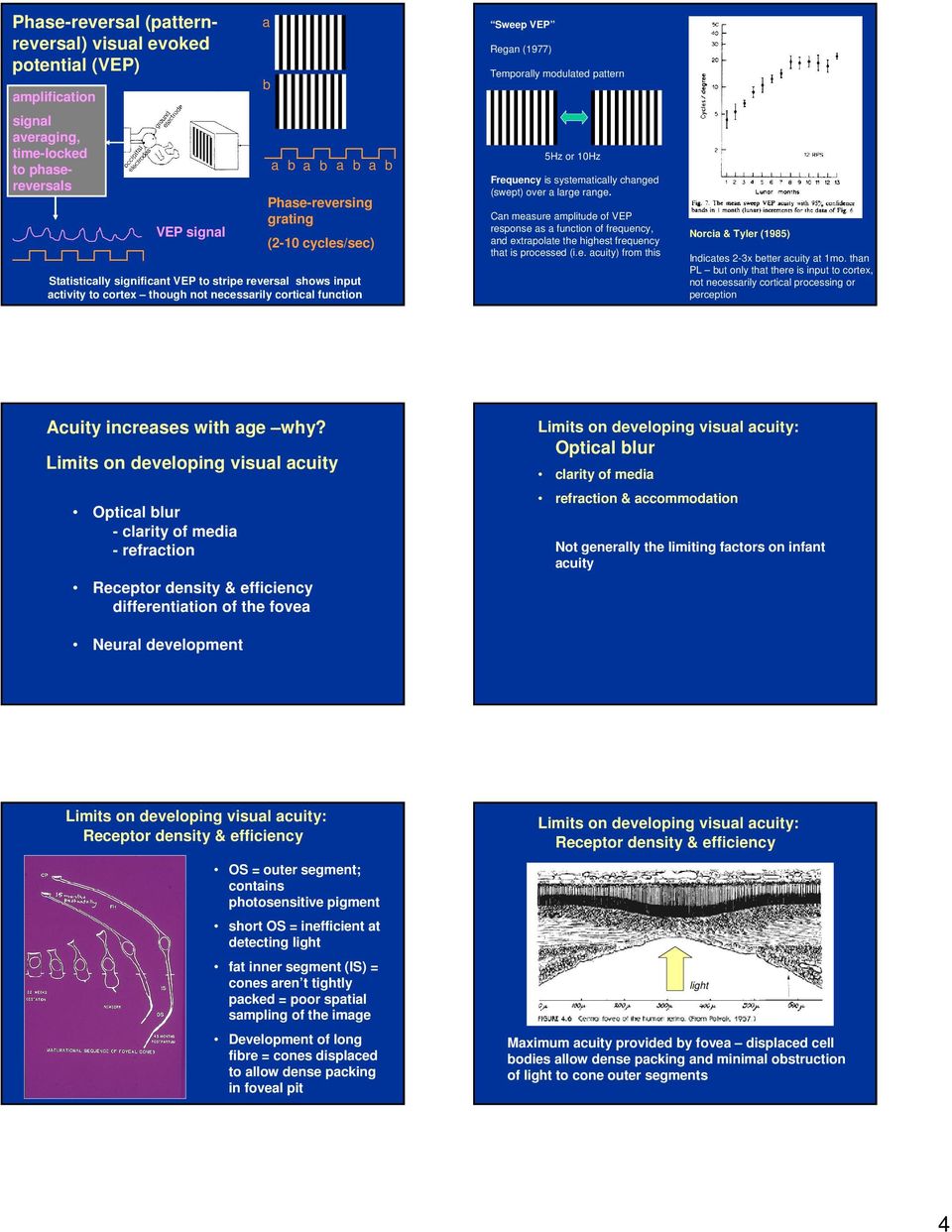
4 Phase-reversal (patternreversal) visual evoked potential (VEP) amplification a b Sweep VEP Regan (1977) Temporally modulated pattern signal averaging, time-locked to phasereversals VEP signal a b a b a b Phase-reversing grating a (2-10 cycles/sec) Statistically significant VEP to stripe reversal shows input activity to cortex though not necessarily cortical function b 5Hz or 10Hz Frequency is systematically changed (swept) over a large range. Can measure amplitude of VEP response as a function of frequency, and extrapolate the highest frequency that is processed (i.e. acuity) from this Norcia & Tyler (1985) Indicates 2-3x better acuity at 1mo. than PL but only that there is input to cortex, not necessarily cortical processing or perception Acuity increases with age why? Limits on developing visual acuity Optical blur - clarity of media - refraction Receptor density & efficiency differentiation of the fovea Limits on developing visual acuity: Optical blur clarity of media refraction & accommodation Not generally the limiting factors on infant acuity Neural development Limits on developing visual acuity: Receptor density & efficiency OS = outer segment; contains photosensitive pigment short OS = inefficient at detecting light fat inner segment (IS) = cones aren t tightly packed = poor spatial sampling of the image Development of long fibre = cones displaced to allow dense packing in foveal pit Limits on developing visual acuity: Receptor density & efficiency (fovea picture) light Maximum acuity provided by fovea displaced cell bodies allow dense packing and minimal obstruction of light to cone outer segments 4
5 photoreceptor density, image sampling & development of acuity Banks & Bennett (1988) Sampling argument combined with poor efficiency due to short outer segments coarse spacing (newborn) pattern under-sampled fine spacing (adult) pattern adequately sampled Calculated in comparison with adult and ideal observer model May account for overall change, but - both adult and infant fall far short of ideal observer little idea of factors - poor account of acuity changes during infancy, especially first 3 months Other, more central, changes are going on Limits on developing visual acuity: Neural development myelination of visual pathways - what are functional consequences? development and distribution of cortical neurons developing connectivity in cortex (and elsewhere) - increasingly complex dendritic and axonal processes Development and distribution of cortical neurons cell proliferation cell migration cell differentiation into different structural types All three processes are complete before birth Although all cells are born before birth, the mass of the brain increases postnatally from 350 g 1350 g (approx x 4) This increase must include myelin fibres and synapses associated with increased connectivity Synapse numbers increase, then decrease (Huttenlocher) Total synapses = volume x synapses/cm 3 Connectivity determines function 5

6 Processes of Processes of (a) growth of dendrites and synaptic terminals (b) selective pruning of connections Synaptic increase is seen everywhere in cortex. What are its implications for visual function? What are all those synapses doing? Connectivity determines receptive field structure and therefore function e.g. Spatial information: Summary Visual acuity shows very rapid development in first few months of life, then slower development towards adult levels by 3-4 years orientation selectivity l.g.n. cells cortical cell Hubel & Wiesel 1960 s model probably too simple intracortical connections are important also! Underlying changes in photoreceptor organization, neural connectivity and myelination Temporal change Changes over time provide a basis for detecting movement in the visual field Change in space (at a single time) basic measure: acuity vs. Behaviourally (pref looking), infants critical fusion frequency was strikingly mature (Regal 1981): 40Hz (75% of adult) at 4 weeks; indistinguishable from adult at 12 weeks. Much more mature than acuity. Makes sense as electroretinograms (ERGs) show newborn cones to respond at up to 75Hz so this is not a constraint. However, EEG measures of flicker information reaching visual cortex show much lower critical frequency. (Apkarian 1993, Morrone et al 1996). Change in time (at a single location) basic measure: critical fusion frequency (CFF) t 1 t 2 t 3 t 4 t 5 t 6 vs. May be that latencies are long and variable due to incomplete myelination, leading to out-of-phase signals in cortex that (1) do not give coherent EEG, but (2) could still drive a behavioural response - see Atkinson & Braddick OVS

7 Review MEMORY MOTOR CONTROL ATTENTION We have seen how sensitivity to spatial and temporal changes in luminance (and wavelength / colour) develops in the first few months of life Recognition Objects Faces Visual action Reaching Locomotion Navigation Visual cognition Physics/ causality Social cognition These provide the building blocks for detecting the orientation, motion and depth of visual patterns This requires increasingly sophisticated neural information processing dependent on cortex (V1) Global orientation Global motion Orientation Motion Depth Spatial information Temporal change Colour VISION ORIENTATION processing Two kinds of subcortical.. LGN is precortical on the route to striate cortex Superior colliculus is part of a distinct subcortical pathway (but also interconnected with cortex) Neither LGN or SC show orientation selectivity independent of cortex cortical neurons and not precortical - show selective sensitivity to : Development of orientation selective cortical neurons orientation-reversal VEP orientation direction of motion binocular disparity (stereopsis) 7
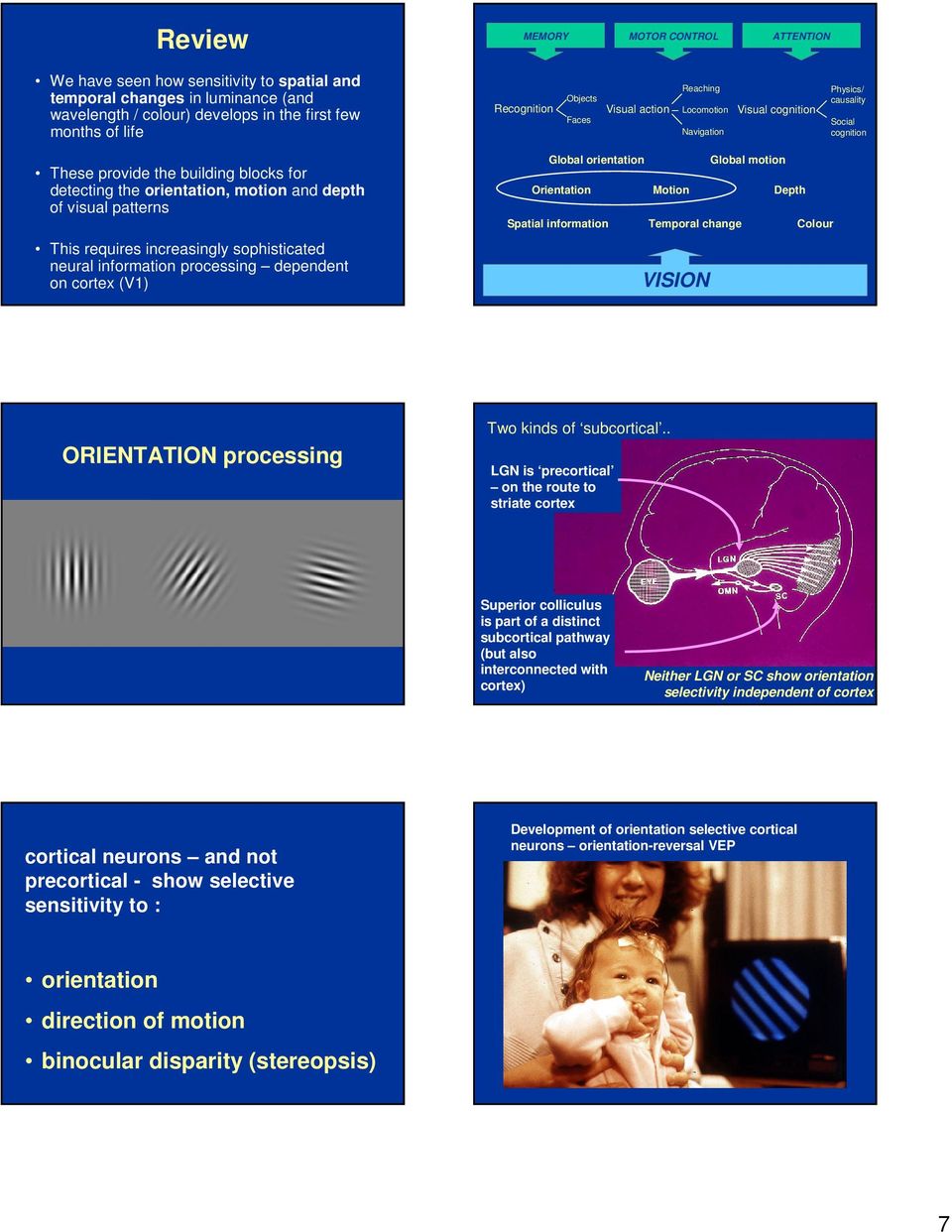
8 Simple orientation-reversal Simple orientation-reversal These locations reverse their contrast on orientation change so a VEP could arise from nonoriented neurons ORIENTATION- REVERSAL SEQUENCE Orientation- and phase-reversal responses in the same infant, recordings one week apart phase shift phase shift orientation reversal phase shift phase shift orientation reversal Braddick et al (1986) Development of orientation-selective VEP Development of cortical selectivity in early infancy Note that different cortical functions all develop postnatally, but don t have a common age of onset 8

9 MOTION processing motion processing a pervasive aspect of vision? Volkmann & Dobson (1976) 2 month infants preferential looking: moving > static stimuli Does this mean that young infants process visual motion? Consider: Infants also show high flicker sensitivity in preferential looking (Regal, 1981) early stages of visual pathway (e.g. retinal ganglion cells) respond to temporal change but not to direction of motion From flicker to direction of motion To determine direction of motion, need to compare - across retinal locations (as for resolving orientation) single location on retina t 1 t 2 t 3 t 4 t 5 t 6 is consistent with - and also across time e.g. Adelson & Bergen spatio-temporal receptive fields 9

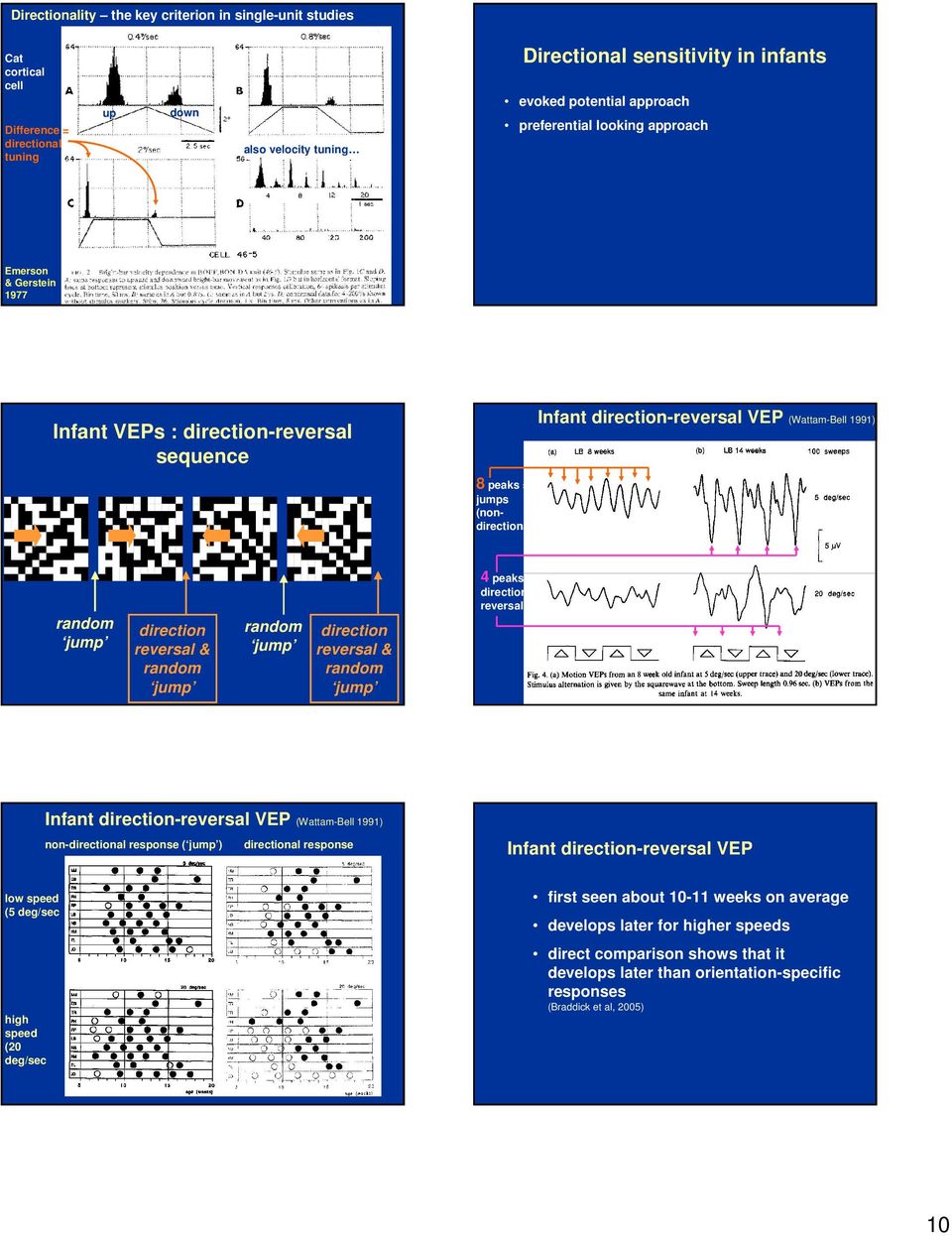
10 Directionality the key criterion in single-unit studies Cat cortical cell Difference = directional tuning up down also velocity tuning Directional sensitivity in infants evoked potential approach preferential looking approach Emerson & Gerstein 1977 Infant VEPs : direction-reversal sequence Infant direction-reversal VEP (Wattam-Bell 1991) 8 peaks = jumps (nondirectional) random jump direction reversal & random jump random jump direction reversal & random jump 4 peaks = direction reversals Infant direction-reversal VEP (Wattam-Bell 1991) non-directional response ( jump ) directional response Infant direction-reversal VEP low speed (5 deg/sec high speed (20 deg/sec first seen about weeks on average develops later for higher speeds direct comparison shows that it develops later than orientation-specific responses (Braddick et al, 2005) 10
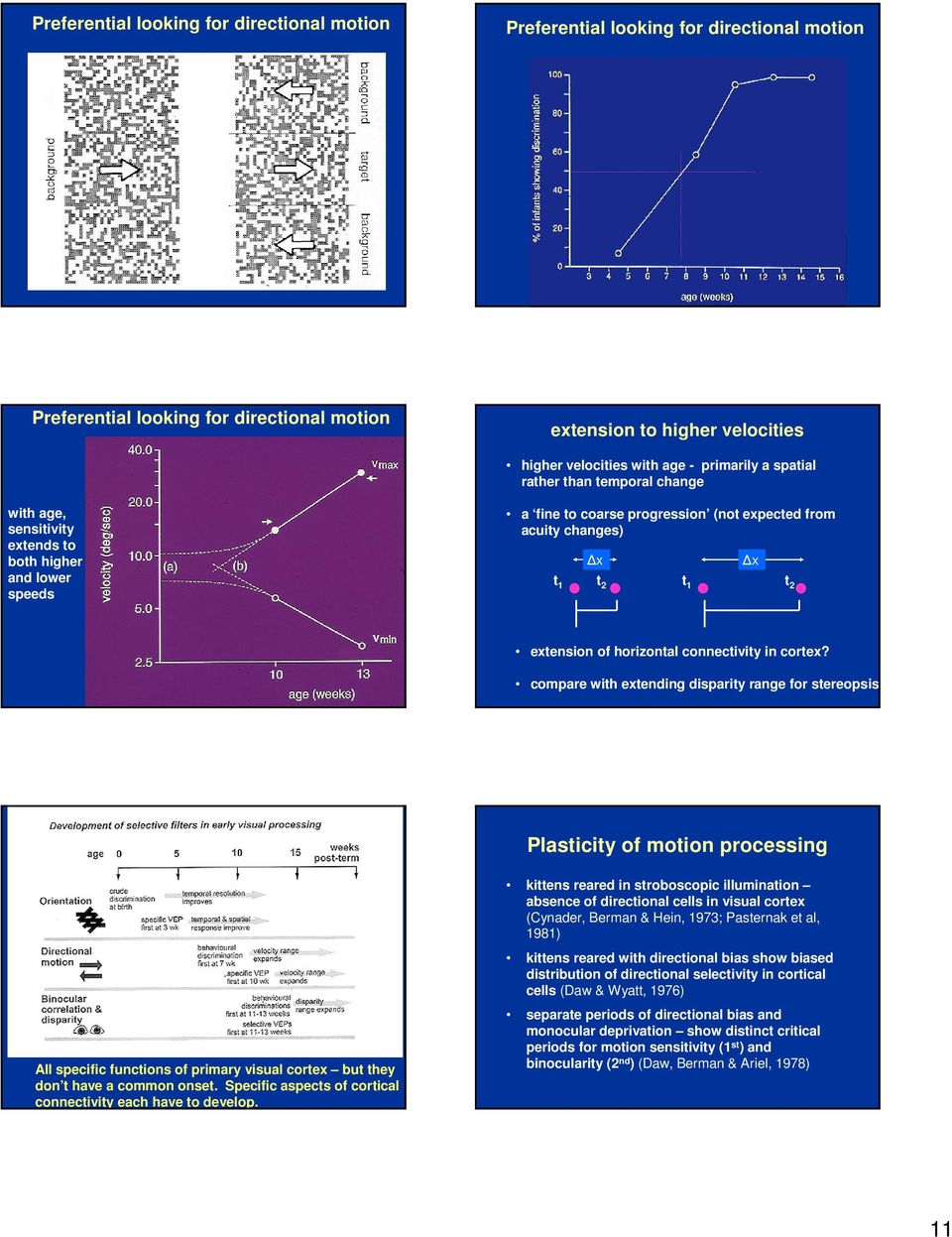
11 Preferential looking for directional motion Preferential looking for directional motion Preferential looking for directional motion extension to higher velocities higher velocities with age - primarily a spatial rather than temporal change with age, sensitivity extends to both higher and lower speeds a fine to coarse progression (not expected from acuity changes) x t 1 t 2 x t 1 t 2 extension of horizontal connectivity in cortex? compare with extending disparity range for stereopsis Plasticity of motion processing kittens reared in stroboscopic illumination absence of directional cells in visual cortex (Cynader, Berman & Hein, 1973; Pasternak et al, 1981) kittens reared with directional bias show biased distribution of directional selectivity in cortical cells (Daw & Wyatt, 1976) All specific functions of primary visual cortex but they don t have a common onset. Specific aspects of cortical connectivity each have to develop. separate periods of directional bias and monocular deprivation show distinct critical periods for motion sensitivity (1 st ) and binocularity (2 nd ) (Daw, Berman & Ariel, 1978) 11
12 uses of visual motion information register trajectory segmentation from relative motion self-motion from optic recognise objects flow & events by dynamic characteristics (e.g. biological 3-D structure motion) from motion Use of motion for perceptual tasks by 3-5 month-old infants 3-D structure from motion distinguish rigid motion from nonrigid deformation group parts of occluded object by common motion discriminate motion-defined forms discriminate biological motion Arterberry & Yonas (1988) E J Gibson et al (1979) Kellman & Spelke (1983) Kaufman-Hayoz et al (1986) Berthenthal et al, 1985 so directional information can be used for sophisticated perceptual analysis, soon after it first becomes available to the infant MEMORY MOTOR CONTROL ATTENTION Recognition Objects Faces Visual action Reaching Locomotion Navigation Visual cognition Physics/ causality Social cognition GLOBAL form and motion processing Global orientation Global motion Orientation Motion Depth Spatial information Temporal change Colour VISION Coherent organization Random organization Similarly with motion Expanding optic flow (moving forwards) Contracting optic flow (moving backwards) To perceive shapes, we need to look for useful changes in orientation over a large area e.g. those indicating a contour. The same local motions are present in both cases, but the global organization is very different To perceive global motion we need to integrate local motions over a large area 12
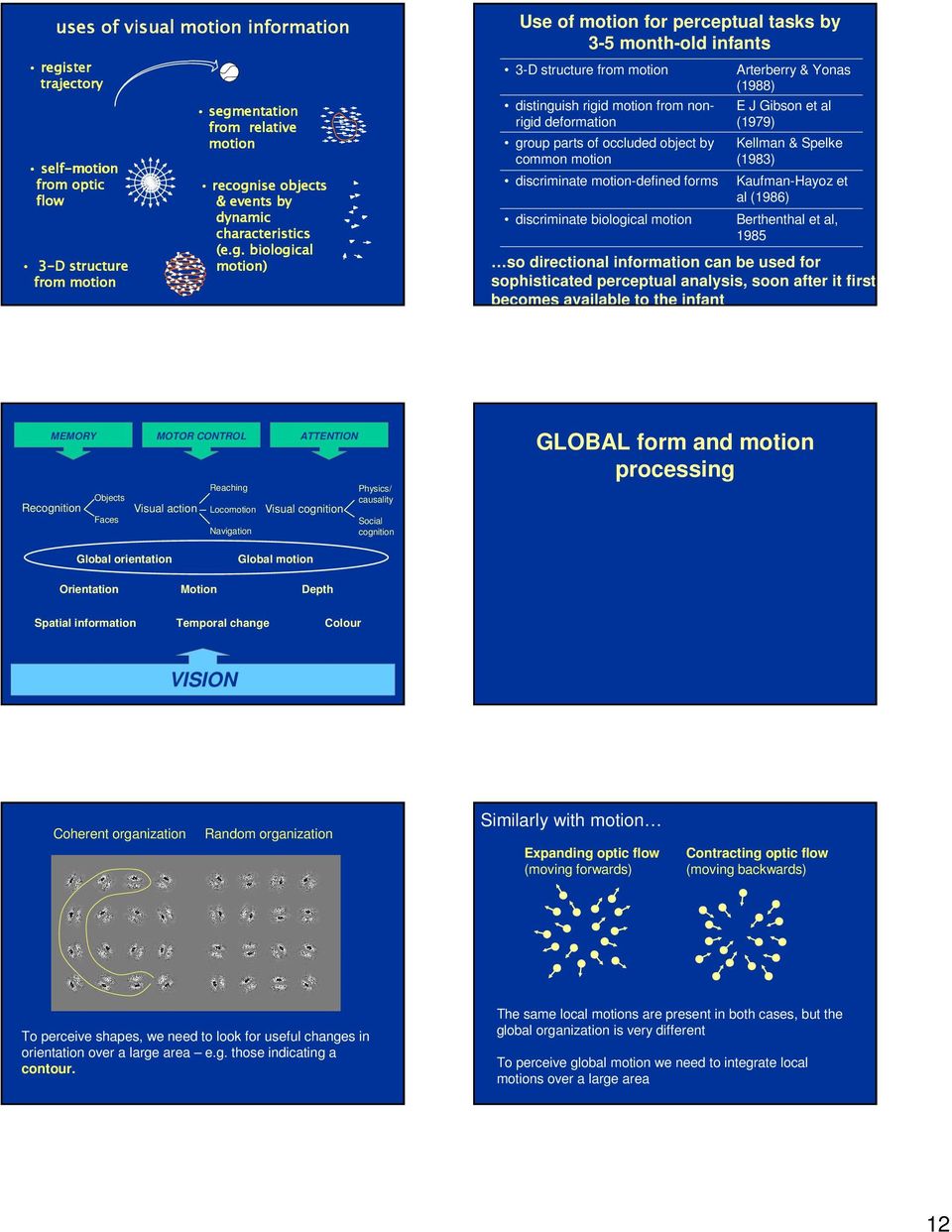
13 macaque V5/MT (dorsal) response to coherence level of random dot motion (Britten et al, J Neurosci, 1992; Vis Neurosci, 1993) Measure of sensitivity to global form or motion: coherence threshold What % of elements needs to be coherently organised in order for the global organisation to be perceived? i.e. macaque V4 (ventral) response to concentric or radial configurations (Gallant Braun & Van Essen, Science, 1993): Lowest % at which global organisation is detected = observer s coherence threshold Form coherence 100% coherence Form coherence 60% coherence Coherence = 100% coherence = 60% motion coherence Development of global form and motion processing 6% 13% Preferential looking and VEP measures: Local form emerges earlier than local motion Evidence for sensitivity to global motion and global form by 4-6 months (Braddick & Atkinson, 2007) Global form thresholds reach adult levels later than global motion (Gunn et al, 2002) 50% 13
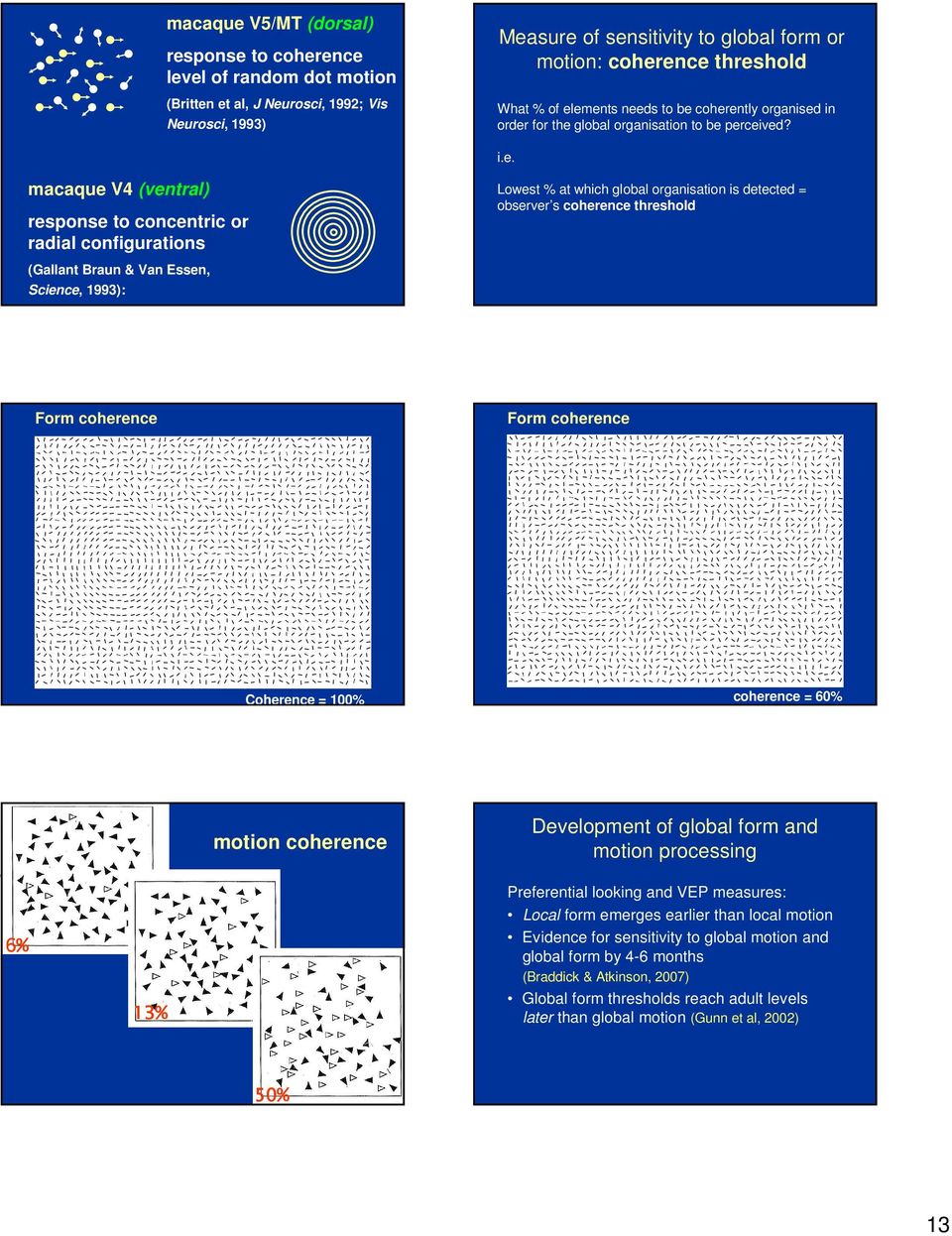
14 Extra-striate visual areas in development of global form and motion processing Wattam-Bell et al (2010) high density ERP recording with global form and motion stimuli in 5-month-olds and adults Like adults, infants show distinct patterns of activity for global form vs. motion However, topography of responses is very different for infants and adults Form stimulus. Motion stimulus is identical, except that line segments represent motion of dots Wattam-Bell et al (2010) Implies major re-organization of extra-striate visual processing in development. Global motion from V5 in infants, but dominated by V3/V3A and V6 in adults? MEMORY MOTOR CONTROL ATTENTION SUMMARY: Recognition Objects Faces Visual action Reaching Locomotion Navigation Visual cognition Physics/ causality Social cognition Visual functions Global orientation Global motion Orientation Motion Depth Spatial information Temporal change Colour VISION SUMMARY: Research methods Forced-choice preferential looking Visual evoked potentials (VEP), aka Event-related potentials (ERP) 14

15 subcortical orienting faces MODEL Atkinson & Braddick BIRTH: limited orienting to single targets 3 MO: integration for attention switching cortical control of eye/head movements CORTICAL SELECTIVE MODULES orientation colour object recognition motion disparity attribute binding and segmentation of objects 5-6 MO: integration of manual action & near visual space ~12 MO: integration of locomotor action, attention control, and near/far visual space visual control of reach/grasp visual control of locomotion SELECTIVE ATTENTION (local/global) KEY DORSAL VENTRAL END Overview: Reading list (p. 1 of 4) Atkinson, J & Braddick, O (in press). Visual development (Chapter 12). In Zelazo, P.D. (Ed.) Oxford Handbook of Developmental Psychology. OUP Specific studies: Teller, DY (1981). The development of visual acuity in human and monkey infants. Trends in Neurosciences 4: Regan, D (1977). Speedy assessment of visual acuity in amblyopia by the evoked potential method. Ophthalmologica 175(3): Norcia, AM & Tyler, CW (1985). Spatial frequency sweep VEP: Visual acuity during the first year of life. Vision Research. 25: Banks, MS & Bennett, PJ (1988). Optical and photoreceptor immaturities limit the spatial and chromatic vision of human neonates. J Opt Soc America A, 12(5): Reading list (p. 2 of 4) Banks MS & Salapatek P.(1978) Acuity and contrast sensitivity in 1-, 2-, and 3- month-old human infants. Invest Ophthalmol Vis Sci. 17: Adams RJ & Courage ML. (1998) Human newborn color vision: measurement with chromatic stimuli varying in excitation purity. J Exp Child Psychol. 68(1): Regal, DM. (1981) Development of critical flicker frequency in human infants. Vision Research 21: Apkarian, P (1993) Temporal frequency responsivity shows multiple maturational phases: state-dependent visual evoked potential luminance flicker fusion from birth to 9 months. Vis Neurosci 10: Morrone MC, Fiorentini A, Burr DC (1996) Development of the temporal properties of visual evoked potentials to luminance and colour contrast in infants. Vision Res 36: Braddick O, Atkinson J (2009) Infants sensitivity to motion and temporal change. Optometry & Vision Science 86(6), Shatz CJ (1996) Emergence of order in visual system development. Journal of Physiology-Paris 90(3-4): Reading list (p. 3 of 4) Braddick, OJ, Atkinson, J, Julesz, B, Kropfl, W, Bodis-Wollner, I, & Raab, E. (1980). Cortical binocularity in infants. Nature 288: Braddick, OJ, & Atkinson J (1983). Some recent findings on the development of human binocularity: A review. Behavioural Brain Research 10: Fox, R, Aslin, RN, Shea, SL, & Dumais, ST (1980). Stereopsis in human infants. Science, 207: Held, R, Birch, EE, & Gwiazda J (1980). Stereoacuity of human infants. Proceedings of the National Academy of Sciences of the USA, 77: Birch, EE, Gwiazda, J, & Held, R (1982). Stereoacuity development for crossed and uncrossed disparities in human infants. Vision Research, 22: Volkmann FC & Dobson, V (1976). Infant responses of ocular fixation to moving visual stimuli. J Exp Child Psychol 22: Adelson EH & Bergen JR (1985). Spatiotemporal energy models for the perception of motion. J. Opt. Soc. Am. A 2(2):

16 Reading list (p. 4 of 4) Emerson RC, Gerstein GL (1977). Simple striate neurons in the cat. II. Mechanisms underlying directional asymmetry and directional selectivity. J Neurophysiol 40: Wattam-Bell J. (1991) The development of motion-specific cortical responses in infants. Vision Res 31: Braddick, O, Birtles, D, Wattam-Bell, J & Atkinson, J (2005). Motion- and orientationspecific cortical responses in infancy. Vision Research 45: Braddick, O, & Atkinson, J (2007). Development of brain mechanisms for visual global processing and object segmentation. In C. von Hofsten & K. Rosander (Eds.), From action to cognition (Progress in Brain Research, Vol. 164) Amsterdam: Elsevier. Gunn, A et al (2002). Dorsal and ventral stream sensitivity in normal development and hemiplegia. Neuroreport 13(6): Wattam-Bell, J et al (2010). Reorganization of Global Form and Motion Processing during Human Visual Development. Current Biology 20(5):

The Visual Cortex 0 http://www.tutis.ca/neuromd/index.htm 20 February 2013
 T he Visual Cortex 0 Chapter contents Contents Chapter 2... 0 T he Visual Cortex... 0 Chapter Contents... 1 Introduction... 2 Optic Chiasm... 2 Where do the eye's ganglion cells project to?... 3 To where
Visual area MT responds to local motion. Visual area MST responds to optic flow. Visual area STS responds to biological motion. Macaque visual areas
 Visual area responds to local motion MST a Visual area MST responds to optic flow MST a Visual area STS responds to biological motion STS Macaque visual areas Flattening the brain What is a visual area?
CHAPTER 6 PRINCIPLES OF NEURAL CIRCUITS.
 CHAPTER 6 PRINCIPLES OF NEURAL CIRCUITS. 6.1. CONNECTIONS AMONG NEURONS Neurons are interconnected with one another to form circuits, much as electronic components are wired together to form a functional
2 Neurons. 4 The Brain: Cortex
 1 Neuroscience 2 Neurons output integration axon cell body, membrane potential Frontal planning control auditory episodes soma motor Temporal Parietal action language objects space vision Occipital inputs
6 Space Perception and Binocular Vision
 Space Perception and Binocular Vision Space Perception and Binocular Vision space perception monocular cues to 3D space binocular vision and stereopsis combining depth cues monocular/pictorial cues cues
Space Perception and Binocular Vision
 Space Perception and Binocular Vision Space Perception Monocular Cues to Three-Dimensional Space Binocular Vision and Stereopsis Combining Depth Cues 9/30/2008 1 Introduction to Space Perception Realism:
Masters research projects. 1. Adapting Granger causality for use on EEG data.
 Masters research projects 1. Adapting Granger causality for use on EEG data. Background. Granger causality is a concept introduced in the field of economy to determine which variables influence, or cause,
Chapter 8: Perceiving Depth and Size
 Chapter 8: Perceiving Depth and Size Cues to Depth Perception Oculomotor - cues based on sensing the position of the eyes and muscle tension 1. Convergence knowing the inward movement of the eyes when
Infant Visual Perception
 CHAPTER 3 Infant Visual Perception PHILIP J. KELLMAN and MARTHA E. ARTERBERRY THEORIES OF PERCEPTUAL DEVELOPMENT 110 The Constructivist View 110 The Ecological View 112 The Contemporary Situation in Perceptual
Video-Based Eye Tracking
 Video-Based Eye Tracking Our Experience with Advanced Stimuli Design for Eye Tracking Software A. RUFA, a G.L. MARIOTTINI, b D. PRATTICHIZZO, b D. ALESSANDRINI, b A. VICINO, b AND A. FEDERICO a a Department
The Information Processing model
 The Information Processing model A model for understanding human cognition. 1 from: Wickens, Lee, Liu, & Becker (2004) An Introduction to Human Factors Engineering. p. 122 Assumptions in the IP model Each
The Physiology of the Senses Lecture 1 - The Eye www.tutis.ca/senses/
 The Physiology of the Senses Lecture 1 - The Eye www.tutis.ca/senses/ Contents Objectives... 2 Introduction... 2 Accommodation... 3 The Iris... 4 The Cells in the Retina... 5 Receptive Fields... 8 The
It s All in the Brain!
 It s All in the Brain! Presented by: Mari Hubig, M.Ed. 0-3 Outreach Coordinator Educational Resource Center on Deafness What is the Brain? The brain is a muscle In order to grow and flourish, the brain
Processing the Image or Can you Believe what you see? Light and Color for Nonscientists PHYS 1230
 Processing the Image or Can you Believe what you see? Light and Color for Nonscientists PHYS 1230 Optical Illusions http://www.michaelbach.de/ot/mot_mib/index.html Vision We construct images unconsciously
Motion processing: the most sensitive detectors differ in temporally localized and extended noise
 ORIGINAL RESEARCH ARTICLE published: 15 May 2014 doi: 10.3389/fpsyg.2014.00426 Motion processing: the most sensitive detectors differ in temporally localized and extended noise Rémy Allard 1,2,3 * and
Anna Martelli Ravenscroft
 Left vs Right processing of & Place in fovea & periphery Psych204b Background: Anna Martelli Ravenscroft Vision depends on multiple regions of the brain, from the specialized photoreceptors of the retina,
Chapter 14: The Cutaneous Senses
 Chapter 14: The Cutaneous Senses Skin - heaviest organ in the body Cutaneous System Epidermis is the outer layer of the skin, which is made up of dead skin cells Dermis is below the epidermis and contains
1 Cornea 6 Macula 2 Lens 7 Vitreous humor 3 Iris 8 Optic disc 4 Conjunctiva 9 Ciliary muscles 5 Sclera 10 Choroid
 Anatomy and Physiology Quiz 1 Sample Question Answers Use the following table to answer Questions 1 2. 1 Cornea 6 Macula 2 Lens 7 Vitreous humor 3 Iris 8 Optic disc 4 Conjunctiva 9 Ciliary muscles 5 Sclera
Next Generation Artificial Vision Systems
 Next Generation Artificial Vision Systems Reverse Engineering the Human Visual System Anil Bharath Maria Petrou Imperial College London ARTECH H O U S E BOSTON LONDON artechhouse.com Contents Preface xiii
GAZE STABILIZATION SYSTEMS Vestibular Ocular Reflex (VOR) Purpose of VOR Chief function is to stabilize gaze during locomotion. Acuity declines if
 GAZE STABILIZATION SYSTEMS Vestibular Ocular Reflex (VOR) Purpose of VOR Chief function is to stabilize gaze during locomotion. Acuity declines if slip exceeds 3-5 deg/sec. Ex: Head bobbing and heel strike
Education and the Brain: A Bridge Too Far John T. Bruer. Key Concept: the Human Brain and Learning
 Education and the Brain: A Bridge Too Far John T. Bruer Key Concept: the Human Brain and Learning John T. Bruer Scholar in cognitivist approaches to human learning and instruction. His argument refers
The Binding Problem Solutions to the spatial binding problem
 The Binding Problem Objects have different features such as color, shape, sound, and smell. Some, such as color and sound, are represented separately from the instant they hit our sensory receptors. Other
THE HUMAN BRAIN. observations and foundations
 THE HUMAN BRAIN observations and foundations brains versus computers a typical brain contains something like 100 billion miniscule cells called neurons estimates go from about 50 billion to as many as
Vision: Receptors. Modes of Perception. Vision: Summary 9/28/2012. How do we perceive our environment? Sensation and Perception Terminology
 How do we perceive our environment? Complex stimuli are broken into individual features, relayed to the CNS, then reassembled as our perception Sensation and Perception Terminology Stimulus: physical agent
Perception. T ake a dream. You are walking through the woods. In a clearing you come upon a marble. Learning Objectives C H A P T ER REVISED PAGES
 SMITMC02_0131825089.QXD 02/17/2006 07:12 PM Page 49 Perception C H A P T ER R2 Learning Objectives 1. What It Means to Perceive 2. How It Works: The Case of Visual Perception 2.1. The Structure of the
Exp. 1 Pathways of sound conduction. Yu Yanqin, PhD Zhejiang University, School of Medicine
 Exp. 1 Pathways of sound conduction Yu Yanqin, PhD Zhejiang University, School of Medicine [Purpose] To learn how to use a tuning fork to generate sound; To understand the function of the auditory organ;
Cortical Visual Impairment An introduction
 Cortical Visual Impairment An introduction This is a general introduction to Cortical Visual Impairment intended for families and support workers who may live with or support children and adults with learning
Problem-Based Group Activities for a Sensation & Perception Course. David S. Kreiner. University of Central Missouri
 -Based Group Activities for a Course David S. Kreiner University of Central Missouri Author contact information: David Kreiner Professor of Psychology University of Central Missouri Lovinger 1111 Warrensburg
Auditory neuroanatomy: the Spanish heritage. Santiago Ramón y Cajal, 1852 1934
 Auditory neuroanatomy: the Spanish heritage Santiago Ramón y Cajal, 1852 1934 Rafael Lorente de Nó, 1902 1990 3 The nervous system is made up of cells. Estimates of the number of cells vary from
How To Understand The Effects Of Saccades On The Visual Cortex In Macaque Monkeys
 Exp Brain Res (1998) 123:341 345 Springer-Verlag 1998 RESEARCH NOTE David A. Leopold Nikos K. Logothetis Microsaccades differentially modulate neural activity in the striate and extrastriate visual cortex
PRIMING OF POP-OUT AND CONSCIOUS PERCEPTION
 PRIMING OF POP-OUT AND CONSCIOUS PERCEPTION Peremen Ziv and Lamy Dominique Department of Psychology, Tel-Aviv University [email protected] [email protected] Abstract Research has demonstrated
Biology Slide 1 of 38
 Biology 1 of 38 2 of 38 35-2 The Nervous System What are the functions of the nervous system? 3 of 38 35-2 The Nervous System 1. Nervous system: a. controls and coordinates functions throughout the body
Chapter 7: The Nervous System
 Chapter 7: The Nervous System Objectives Discuss the general organization of the nervous system Describe the structure & function of a nerve Draw and label the pathways involved in a withdraw reflex Define
The Physiology of the Senses Lecture 11 - Eye Movements www.tutis.ca/senses/
 The Physiology of the Senses Lecture 11 - Eye Movements www.tutis.ca/senses/ Contents Objectives... 2 Introduction... 2 The 5 Types of Eye Movements... 2 The eyes are rotated by 6 extraocular muscles....
WHAT IS CEREBRAL PALSY?
 WHAT IS CEREBRAL PALSY? Cerebral Palsy is a dysfunction in movement resulting from injury to or poor development of the brain prior to birth or in early childhood. Generally speaking, any injury or disease
Moving objects appear to slow down at low contrasts
 Neural Networks 16 (2003) 933 938 www.elsevier.com/locate/neunet 2003 Special issue Moving objects appear to slow down at low contrasts Stuart Anstis* Department of Psychology, University of California,
Visual Attention and Emotional Perception
 Visual Attention and Emotional Perception Luiz Pessoa 1 and Leslie G. Ungerleider 2 (1) Department of Psychology, Brown University, Providence, RI (2) Laboratory of Brain & Cognition, National Institute
Esotropia (Crossed Eye(s))
 Esotropia (Crossed Eye(s)) Esotropia is a type of strabismus or eye misalignment in which the eyes are "crossed," that is, while one eye looks straight ahead, the other eye is turned in toward the nose.
Integration and Coordination of the Human Body. Nervous System
 I. General Info Integration and Coordination of the Human Body A. Both the and system are responsible for maintaining 1. Homeostasis is the process by which organisms keep internal conditions despite changes
Study of the Human Eye Working Principle: An impressive high angular resolution system with simple array detectors
 Study of the Human Eye Working Principle: An impressive high angular resolution system with simple array detectors Diego Betancourt and Carlos del Río Antenna Group, Public University of Navarra, Campus
EFFECTS OF SELECTIVE ATTENTION
 EFFECTS OF SELECTIVE ATTENTION ON SENSORY PROCESSING OF VISUAL MOTION Dissertation zur Erlangung des Doktorgrades der Mathematisch-Naturwissenschaftlichen Fakultäten der Georg-August Universität zu Göttingen
A Guided User Experience Using Subtle Gaze Direction
 A Guided User Experience Using Subtle Gaze Direction Eli Ben-Joseph and Eric Greenstein Stanford University {ebj, ecgreens}@stanford.edu 1 Abstract This paper demonstrates how illumination modulation can
COGNITIVE INFLUENCES ON SENSORY PROCESSING
 COGNITIVE INFLUENCES ON SENSORY PROCESSING OF VISUAL MOTION Dissertation zur Erlangung des Doktorgrades der Mathematisch-Naturwissenschaftlichen Fakultäten der Georg-August Universität zu Göttingen vorgelegt
Overlapping mechanisms of attention and spatial working memory
 Review 119 Overlapping mechanisms of attention and spatial working memory Edward Awh and John Jonides Spatial selective attention and spatial working memory have largely been studied in isolation. Studies
A Model of Visual Masking for Computer Graphics
 A Model of Visual Masking for Computer Graphics James A. Ferwerda, Cornell University Peter Shirley, University of Utah Sumanta N. Pattanaik, Cornell University Donald P. Greenberg, Cornell University
Lecture 2, Human cognition
 Human Cognition An important foundation for the design of interfaces is a basic theory of human cognition The information processing paradigm (in its most simple form). Human Information Processing The
Silicon Models of Visual Cortical Processing
 Silicon Models of Visual Cortical Processing Luke Theogarajan and L. A. Akers Center for Solid State Electronics Research Arizona State University, Tempe, A2-85287-570 E-mail: [email protected] ABSTRACT Receptive
What role does the nucleolus have in cell functioning? Glial cells
 Nervous System Lab The nervous system of vertebrates can be divided into the central nervous system, which consists of the brain and spinal cord, and the peripheral nervous system, which contains nerves,
What is Visualization? Information Visualization An Overview. Information Visualization. Definitions
 What is Visualization? Information Visualization An Overview Jonathan I. Maletic, Ph.D. Computer Science Kent State University Visualize/Visualization: To form a mental image or vision of [some
BRAIN storming Copyright, Poliakoff and Bee, 2000
 by Ellen Poliakoff and Sally Bee Illustrations by Serena Korda BRAIN storming The 1990 s was hailed as the decade of the brain. We ask, what do we really know about the elusive workings of the grey matter
Brain & Mind. Bicester Community College Science Department
 B6 Brain & Mind B6 Key Questions How do animals respond to changes in their environment? How is information passed through the nervous system? What can we learn through conditioning? How do humans develop
Human Perception and Computer Graphics
 Postgraduate Study Report DC-PSR-2004-06 Human Perception and Computer Graphics Martin Čadík Supervisor: Pavel Slavík January 2004 Department of Computer Science and Engineering Faculty of Electrical Engineering
An Introduction to ERP Studies of Attention
 An Introduction to ERP Studies of Attention Logan Trujillo, Ph.D. Post-Doctoral Fellow University of Texas at Austin Cognitive Science Course, Fall 2008 What is Attention? Everyone knows what attention
The brainwave response of optical illusion stimulus
 76 IJCSNS International Journal of Computer Science and Network Security, VOL.11 No.12, December 2011 The brainwave response of optical illusion stimulus Hongsuo Tang Qiping Cao and Zheng Tang2, Graduate
Help maintain homeostasis by capturing stimuli from the external environment and relaying them to the brain for processing.
 The Sense Organs... (page 409) Help maintain homeostasis by capturing stimuli from the external environment and relaying them to the brain for processing. Ex. Eye structure - protected by bony ridges and
Lesson 10. Sports Vision 10-1
 Sports Vision 10-1 Outline Visual skills related to different sports Evaluation of visual skills related to sport Visual training in sport Examples of lighting design in sport Discussion Supplementary
What constitutes good visualization research?
 Visualization Viewpoints Editor: TheresaMarie Rhyne Toward a Perceptual Theory of Flow Visualization Colin Ware University of New Hampshire What constitutes good visualization research? Are researchers
Brain Computer Interfaces (BCI) Communication Training of brain activity
 Brain Computer Interfaces (BCI) Communication Training of brain activity Brain Computer Interfaces (BCI) picture rights: Gerwin Schalk, Wadsworth Center, NY Components of a Brain Computer Interface Applications
Functions of the Brain
 Objectives 0 Participants will be able to identify 4 characteristics of a healthy brain. 0 Participants will be able to state the functions of the brain. 0 Participants will be able to identify 3 types
Clinical Professor of Ophthalmology, John A. Moran Eye Center, University of Utah
 1 NeuroAdaptation Robert M. Kershner, M.D., M.S., F.A.C.S. Clinical Professor of Ophthalmology, John A. Moran Eye Center, University of Utah School of Medicine, Salt Lake City, Utah IK HO Visiting Professor
SPPB. Research lines 18/02/2008. Neurociència cognitiva del llenguatge (i d altres funcions cognitives) Speech Perception Production and Bilingualism
 Neurociència cognitiva del llenguatge (i d altres funcions cognitives) Núria Sebastian Gallés Universitat de Barcelona SPPB Speech Perception, Production and Bilingualism Development Perception Production
The role of context in Müller-Lyer illusion: The case of negative Müller-Lyer illusion
 Review of Psychology, 2013, Vol. 20, No. 1-2, 29-36 UDC 159.9 The role of context in Müller-Lyer illusion: The case of negative Müller-Lyer illusion PAVLE VALERJEV and TANJA GULAN The Müller-Lyer illusion
Cognitive Computational Models for Intelligent Engineering Systems
 Cognitive Computational Models for Intelligent Engineering Systems Ph.D. Dissertation Barna Reskó Supervisor: Péter Baranyi, D.Sc. Co-supervisor: Péter Korondi, D.Sc. Budapest, 2008. Alulírott Reskó Barna
ASSISTANT PROFESSOR OF OPHTHALMOLOGY University of California, San Francisco effective July 1, 2014 Member of Neuroscience Graduate Program
 Felice A. Dunn CONTACT INFORMATION APPOINTMENT EDUCATION Department of Ophthalmology University of California, San Francisco 10 Koret Way Box 0730 San Francisco, CA 94143 email: [email protected] ASSISTANT
18. What is limbic system? A. The inner parts of cerebral hemispheres associated with deep structures and from a complex structure. 19.
 CHAPTER 21 NEURAL CONTROL AND COORDINATION One mark Questions: 1. Name the structural and functional unit of nervous system? A. Neuron. 2. What does central Nervous System consists of? A. Brain and spinal
Brain Maps The Sensory Homunculus
 Brain Maps The Sensory Homunculus Our brains are maps. This mapping results from the way connections in the brain are ordered and arranged. The ordering of neural pathways between different parts of the
PLEASE SCROLL DOWN FOR ARTICLE
 This article was downloaded by:[universite Rene Descartes Paris 5] On: 2 May 28 Access Details: [subscription number 773444237] Publisher: Psychology Press Informa Ltd Registered in England and Wales Registered
Resting membrane potential ~ -70mV - Membrane is polarized
 Resting membrane potential ~ -70mV - Membrane is polarized (ie) Electrical charge on the outside of the membrane is positive while the electrical charge on the inside of the membrane is negative Changes
Myelinization. THOMAS P. NAIDICH, MD FACR Mt. Sinai Medical Center New York, NY USA
 Myelinization THOMAS P. NAIDICH, MD FACR Mt. Sinai Medical Center New York, NY USA ALTERS BRAIN WATER LOCALLY MYELIN CONTAINS: GLYCOLIPIDS PHOSPHOLIPIDS & CHOLESTEROL Maturation of the White Matter Maturation
Tinnitus and the Brain
 Tinnitus and the Brain Dirk De Ridder & Berthold Langguth Moving animals have developed a brain in order to reduce the inherent uncertainty present in an ever changing environment. The auditory system
Cerebral Palsy and Visual Impairment
 CP Factsheet Cerebral Palsy and Visual Impairment Although cerebral palsy mainly causes difficulty with movement, other conditions may also occur. This is because other parts of the brain may also be affected
Automated corneal-reflection eye-tracking in infancy: Methodological. developments and applications to cognition
 Automated corneal-reflection eye-tracking in infancy: Methodological developments and applications to cognition Richard N. Aslin and Bob McMurray University of Rochester This is the introductory article
Improved glare (halos and scattered light) measurement for post-lasik surgery
 Improved glare (halos and scattered light) measurement for post-lasik surgery Stanley Klein, Sam Hoffmann, Adam Hickenbotham, Sabrina Chan, and many more optometry students School of Optometry, Univ. of
It's Great But Not Necessarily About Attention
 It's Great But Not Necessarily About Attention Jochen Braun Institute of Neuroscience University of Plymouth School of Computing Plymouth, Devon PL4 8AA U.K. [email protected] Copyright (c) Jochen
Course # Getting on Base with Learning Based Vision Problems
 Course # 116 Getting on Base with Learning Based Vision Problems Clinical Practice Guideline Getting on Base with Learning Based Vision Problems Leonard J. Press, O.D., FCOVD, FAAO SECO 2012 www.aoa.org/documents/cpg
Rebecca J. Woods Curriculum Vita
 Rebecca J. Woods Curriculum Vita Department of Human Development & Family Science February, 2011 North Dakota State University Office: 701-231-9791 Dept. 2615, P.O. Box 6050 Fax: 701-231-9645 Fargo, ND
Programs for diagnosis and therapy of visual field deficits in vision rehabilitation
 Spatial Vision, vol. 10, No.4, pp. 499-503 (1997) Programs for diagnosis and therapy of visual field deficits in vision rehabilitation Erich Kasten*, Hans Strasburger & Bernhard A. Sabel Institut für Medizinische
fmri and visual brain function
 Brief history of brain imaging fmri and visual brain function 1895 First human X-ray image 1950 First human PET scan - uses traces of radioactive material (carbon, nitrogen, fluorine or oxygen) to map