
OpenBSD. network stack internals
|
|
|
- Gary Gilbert
- 9 years ago
- Views:
Transcription
1 OpenBSD network stack internals by The OpenBSD network stack is under constant development mainly to implement features that are more and more used in todays core networks. Various changes were made over the last few years to allow features like flow tagging, route labels, multipath routing and multiple routing tables. New features like VRF (virtual routing and forwarding), MPLS and L2TP are worked on or planned. This paper tries to cover the design decisions and implementation of these features.

2 Introduction The OpenBSD network stack is based on the original BSD4.4 design that is described in TCP/IP Illustrated, Volume 2[1]. Even though many changes were made since then [1] still gives the best in depth introduction to the BSD based network stacks. It is the number one reference for most part of the network stack. Additionally IPv6 Core Protocols Implementation[2] covers the KAME derived IPv6 network stack implementation and should be considered the reference for anything IPv6 related. Userland Kernel Socket API Network Stack Routing Table Driver Network Figure 1: Building blocks of the network stack The networking code can be split in four major building blocks: the network stack, the API, the routing table and the socket API. The various protocol support are hooked into the network stack on various defined borders. Protocols provide methods which are registered in a protosw structure. By looking up these structures instead of calling the functions directly a more dynamic and easily extensible stack can be built. There is an input and an output path that starts in the drivers and ends in the socket API and vice versa. Every packet passing through the network stack is stored in s and clusters. It is the primary way to allocate packet memory in the network stack but s are also used to store non packet data. Everything routing related is covered by the protocol independent routing table. The routing table covers not only the layer 3 forwarding information but is also used for layer 2 look ups -- e.g. arp or IPv6 network discovery. The calls to the routing table code are scattered all over the network stack. This entanglement of the routing code is probably one of the most problematic parts when making the network stack MP safe. Last but not least the socket API. It is the interface to the userland and a real success story. The BSD socket API is the most common way for applications to interact between remote systems. Almost any operating system implements this API for userland programs. I will not cover the socket API because non of the new features modified the socket API in detail. s Packets are stored in s. s can be chained to build larger consecutive data via m_next or build a chain of independent packets by using the m_nextpkt header. m_data points to the first valid data byte in the which has the amount of m_len bytes stored. There are different types defined to indicate what the is used for. The m_flags are used in various ways. Some flags indicate the structure of the itself (M_EXT, M_PKTHDR, M_CLUSTER) and some indicate the way the packet was received (M_BCAST, M_MCAST, M_ANYCAST6). If M_PKTHDR is set an additional structure m_pkthdr is included in the. The first of a packet includes this m_pkthdr to store all important per packet meta data used by the network stack. The complete length of the chain and the interface a packet was received on are the most important ones. struct m_hdr { struct *mh_next; struct *mh_nextpkt; caddr_t mh_data; u_int mh_len; short mh_type; u_short mh_flags; }; Code Fragment 1: structures struct pkthdr { struct ifnet *rcvif; SLIST_HEAD(packet_tags, m_tag) tags; int len; int csum_flags; struct pkthdr_pf; }; struct m_tag { SLIST_ENTRY(m_tag) u_int16_t u_int16_t }; m_tag_link; m_tag_id; m_tag_len; Mbuf tags are generic packet attributes that can be added to any packet. Mbuf tags are mostly used by the IPsec code and to prevent loops in the network stack when tunnelling interfaces are used. Up until OpenBSD 4.2 pf used the tags to store internal state information (pkthdr_pf). Every packet needs this state information if pf is enabled. Moving this structure from tags directly into the m_pkthdr almost doubled performance. The main reason of this speed up is that the allocation of tags is skipped. Mtag allocation is slow because malloc(9) needs to be used to allocate the dynamic length elements. Information that has to be added to every packet should probably be directly included in the packet header.
![Additionally IPv6 Core Protocols Implementation[2] covers the KAME derived IPv6 network stack implementation and should be considered the reference for anything IPv6 related.](/docs-images/48/18460322/images/page_2.jpg "Userland Kernel Socket API Network Stack Routing Table Driver Network Figure 1: Building blocks of the network stack The networking code can be split in four major building blocks: the network stack,")
3 mtags m_hdr m_next m_hdr calling the pr_input() function of a protosw structure. The inetsw[] array contains the various protosw structures indexed by protocol family. m_tag_id m_tag_len m_tag_id m_tag_len 1st packet 2nd packet m_tag_id m_tag_len m_tag_link m_pkthdr pkthdr_pf m_hdr m_pkthdr pkthdr_pf m_ext Figure 2: structures of two packets, 1st packet is built by an chain of two s (first with internal data second with an external cluster). Network Stack m_data Packets enter the network stack from userland through the socket API or by the network driver receive interrupt function. Packets received by the network card enter one of the layer 2 input functions -- ether_input() is the most commonly used one. This function decodes/pops off the layer 2 header and figures out the proper payload type of the data. In the Ethernet case the ether_type is inspected but first it is checked if it is a multicast or broadcast packet and the corresponding flags are set. Depending on the payload type an input queue is selected, the packet is enqueued and a softnet software interrupt is raised. This interrupt is delayed because IPL_SOFTNET has a lower precedence then IPL_NET used by the driver interrupt routine. So the driver can finish his work and when lowering the system priority level the softnet interrupt handler is called. The softnet handler checks netisr for any set bits and calls the corresponding protocol interrupt handler. Most of the time this is ipintr() or ip6intr() but the bridge, ppp and pppoe code use the softnet handler as well. So the splnet()/splsoftnet() dance has nothing to do with the layer 2/layer 3 border. ipintr() dequeues all packets in the protocol input queue and passes them one after the other to ipv4_input(). ipv4_input() checks the IP header then calls pf_test() to do the input firewalling. Now the destination is checked and if the packet is not for this host it may be forwarded. Local packets are passed to the transport layer. Instead of hardcoding the corresponding handlers into ipv4_input() a more object oriented approach is used by m_nextpkt m_data ext_buf cluster m_ext m_data ext_buf cluster Layer 1 Layer 2 Layer 3 Layer 4 Socket ip_forward IPL_SOFTNET IPL_NET tcp_input udp_input rip_input ipv4_input ipintr looutput revarpinput ieee80211_input pf_test IPsec in_arpinput arpintr ether_input sorwakeup sbappend protosw inetsw[] NETISR sppp_input dequeue from DMA ring driver rx interrupt ip6_input ip6intr rip6_input ip6_forward pppoe_disc_input pppoe_data_input pppoeintr ppp_inproc atm_input fddi_input trunk_input vlan_input bridge_input carp_input Figure 3: Network stack input flow Common input functions are tcp_input(), udp_input() and rip_input() -- rip stands for raw IP and has nothing in common with the RIP routing protocol. These input functions check the payload again and do a pcb lookup. The pcb or protocol control block is the lower half of a socket. If all is fine the packet is appended to the socket receive buffer and any process waiting for data is woken up. Here the processing of a network interrupt ends. A process will later on call the soreceive() function to read out the data in the receive buffer. In the forward path a route lookup happens and the packet is passed on to the output function. Sending out data normally starts in userland by a write() call which ends up in sosend(). The socket code then uses the protosw pr_usrreq() function for every operation defined on a socket. In the sosend() case pr_usrreq() is called with PRU_SEND which will more or less directly call the output function e.g. tcp_output() or udp_output(). These functions encapsulate the data and pass them down to ip_output(). On the way down the output function is called directly (not like on the way up where between the layer 3 and 4 the protosw structure was used). In ip_output() the IP header is prepended and the route decision is done unless the upper layer passed a cached entry. Additionally the outbound firewalling is done by calling pf_test(). The layer 3 functions invoke the layer 2 output function via the ifp->if_output() function. For the Ethernet case, ether_output() will be called. ether_output() prepends the Ethernet header, raises the spl to IPL_NET, puts the packet on the interface

4 output queue, and then calls the ifp->if_start() function. The driver will then put the packet onto the transmit DMA ring where it is sent out to the network. This is just a short fly through the network stack, in the real world the network stack is much more complex due to the complex nature of the protocols and added features. All the control logic of the network stack is left out even though it is probably the most obscure part of it. Layer 1 Layer 2 Layer 3 Layer 4 Socket rip_output ip_forward looutput udp_output ip_output ieee80211_output sosend protosw->pr_usrreq tcp_output pf_test IPsec ifp->if_output driver enqueue on tx DMA ring udp6_output ip6_output rip6_output ip6_forward carp_output ether_output bridge_output arpresolve sppp_output pppoutput nd6_storelladdr atm_output carp_rewrite_lladdr fddi_output IPL_SOFTNET IPL_NET vlan_start ifp->if_start trunk_start bridge_start Figure 4: Network stack output flow With a few tricks it was even possible to have some minimal backward compatibility so that new kernels work with older binaries. AF_INET AF_INET6 rt_label name2id table af2rtafidx[] Figure 5: Overview of the routing tables Routing Labels 0 1 AF_INET ifp rt_tables[] radix_node_head rt_labelid rt_priority AF_INET6 Routing labels were the first OpenBSD specific extension. A routing label is passed to the kernel as an additional sockaddr structure in the routing message and so the impact was quite minimal. But instead of storing a string with the label on every node a per label unique ID is stored in the routing entry. The mapping is done by a name to ID lookup table. Labels can be set by userland and pf can make decisions based on these labels. Routing Table The routing table uses the same patricia trie as described in [1] even though minor extensions were done or are planned. The routing table stores not only layer 3 forwarding information but includes layer 2 information too. Additionally the patricia trie is also used by pf tables. There is a lot of magic in the routing table code and even minor changes may result in unexpected side-effects that often end up in panics. The interaction between layer 3 and layer 2 is a bit obscure and special cases like the arp-proxy are easily forgotten. The result is that routing changes take longer then expected and need to move slowly. Until now only routing labels, multiple routing tables, and multipath routing were implemented plus a major bump of the routing messages was done. The routing messages structure was changed to allow a clean integration of these features. Mainly the routing table ID had to be included into each routing header. Multipath Routing The implementation of multipath routing was initially from KAME but additional changes were necessary to make them usable. Especially the correct behaviour of the routing socket was a challenge. Some userland applications still have issues with correctly tracking multipath routes because the old fact of one route one nexthop is no longer true. nexthop: rn_dupedkey nexthop: addr: 10.1/16 nexthop: Figure 6: rn_dupedkey and multipath routes rn_dupedkey Multipath routing is abusing the possibility of storing the same key multiple times in the routing table. This is allowed because of possible more specific routes with the same network address -- e.g /24 and 10/8. Such identical keys
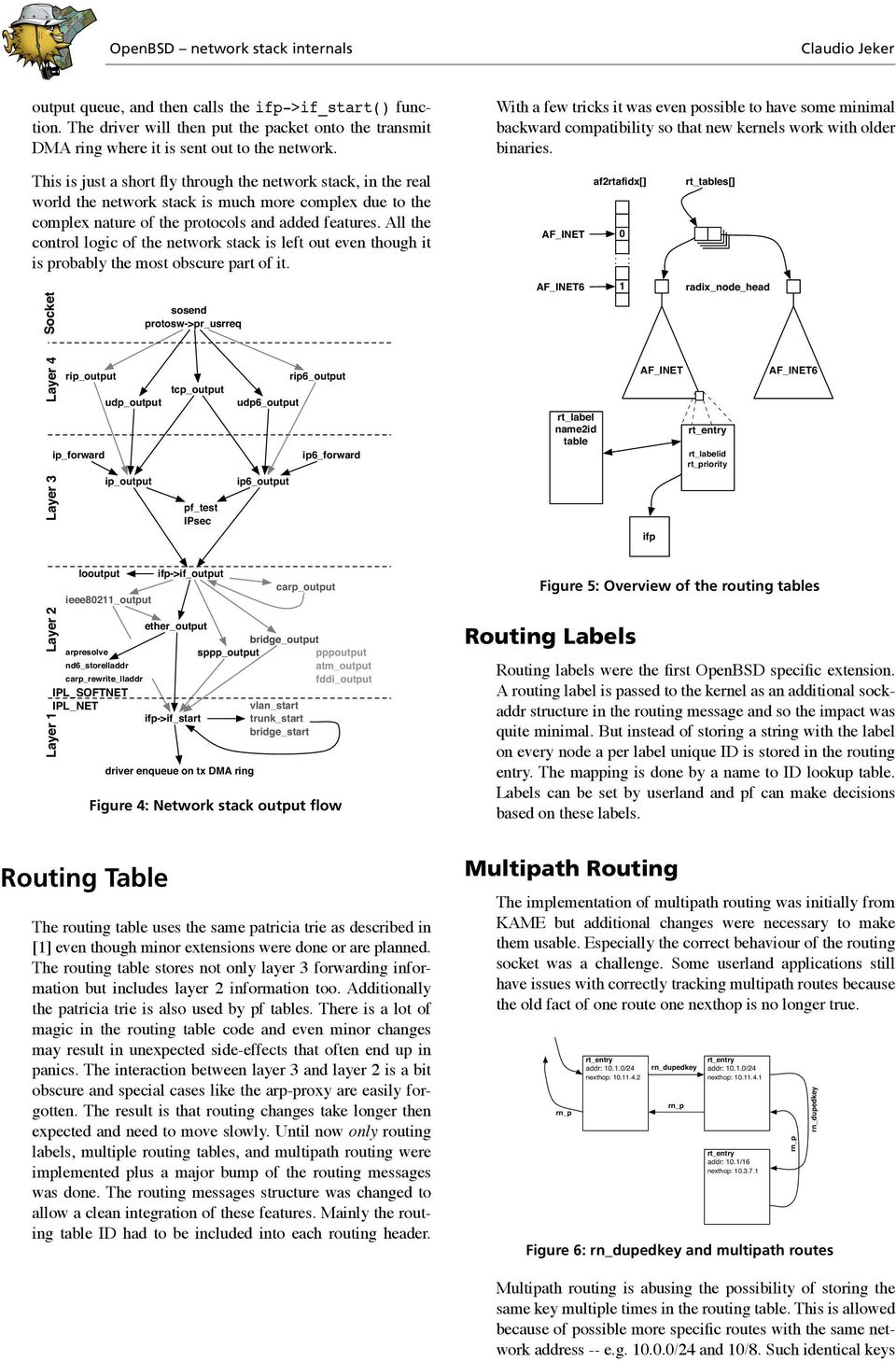
5 are stored in the rn_dupedkey list. This list is ordered by prefix length -- most specific first -- so all multipath routes are consecutive. In the network stack some route look ups had to be exchanged with a multipath capable version. rtalloc_mpath() is the multipath aware route lookup which has an extra attribute -- the source address of the packet. The source and destination address are used to select one of the multiple paths. rtalloc_mpath() uses a hash-threshold mechanism[3] to select one of the equal routes and routes are inserted in the middle of the list of paths. This more complex mechanism to select and insert routes was chosen to keep the impact of route changes small. Special sysctl buttons were added to enable and disable the multipath routing: sysctl net.inet.ip.multipath=1 and/or: sysctl net.inet6.ip6.multipath=1 Without these sysctl values set multipath routing is turned off even if multiple routes are available. Multiple Routing Tables VRF Multiple routing tables are a prerequisite for VRF. The first step in supporting virtual routing and forwarding is to be able to select an alternate routing table in the forwarding path. Every address family has a separate routing table and all routing table heads are stored in an array. With regard to VRF it was considered the best to always create a full set of routing tables instead of creating per address family specific routing tables. If a new routing table is created the radix_node_heads for all address families are created at once, see Figure 5. pf(4) is used to classify the traffic and to select the corresponding forwarding table. At the moment it is only possible to change the default routing table in the IP and IPv6 forwarding path. For link local addressing -- e.g. arp -- the default table is used. The idea behind virtual routing and forwarding is the capability to divide a router into various domains that are independent. It is possible to use the same network in multiple domains without causing a conflict. To support such a setup it is necessary to be able to bind interfaces to a specific routing table or actually building a routing domain out of a routing table and all interfaces which belong together. On packet reception the is marked with the ID of the receiving interface. Changes to the layer 2 code allow the use of alternate routing tables not only for IP forwarding but for arp look ups as well. With this, it is possible to have the same network address configured multiple times but completely independent of each other. To create a system with virtualized routing many changes are needed. This starts with making the link local discovery protocols (arp, rarp, nd,...) aware of the multiple domains. The ICMP code and all other code that replies or tunnels packets needs to ensure that the new packet is processed in the same domain. A special local tunnel interface is needed to pass traffic between domains and pf may need some modifications as well. Finally the socket layer needs a possibility to attach a socket to a specific routing domain. The easiest way to do this is via a getsockopt() call. Unlike the vimage[4] approach for FreeBSD not a full virtualization is done. The main reason behind this different approach is in my opinion primarily the originator and his background. In FreeBSD, vimage was developed by network researchers the idea is to be able to simulate multiple full featured routers on a single box. Therefore vimage goes further then the OpenBSD implementation by having multiple routing sockets, protosw arrays and independent interface lists. In OpenBSD the development is pushed by networking people with an ISP background. The end result is similar but the userland hooks are different. In OpenBSD, userland will have access to all domains at once through one routing socket so that one routing daemon is able to modify multiple tables at once. Routing Priorities With the inclusion of bgpd, ospfd, and ripd the need for userland to easily manage various routing source in the kernel became more apparent. In case of conflicts it is necessary to have a deterministic mediator between the different daemons. E.g. prefixes learned via OSPF should have a higher preference than external BGP routes. Routing suites like xorp and quagga/zebra normally use a separate daemon to merge these various routing sources. This is a single point of failure and unnecessary because the kernel can do this just fine. Similar to commercial routers this can be done by the kernel by adding a priority to each route and giving each routing source one specific priority level. With the introduction of multipath routing it is possible to store a route multiple times in the kernel. Having a cost for each route and sorting the list of equal routes by the cost gets the desired behaviour. Only the routes with the lowest cost are used for routing -- in other words, this is now equal cost multipath routing. nexthop: priority: static [8] nexthop: priority: ospf [16] nexthop: priority: ospf [16] addr: 10.1/16 nexthop: priority: bgp [32] Figure 7: Using rn_dupedkey to implement priorities rn_dupedkey

6 Implementing this simple concept on the other hand released some evil dragons in the current routing code. Until now, the multipath code only had to handle inserts after the head element which is no longer true. The initial result were corrupted routing tables, crashes, a lot of head scratching, and even more debugging. The routing code and especially the radix tree implementation itself is complex, obscure, and a very sensitive part of the networking code. References [1] TCP/IP Illustrated, Volume 2 by Gary R. Wright, W. Richard Stevens [2] IPv6 Core Protocols Implementation by Qing Li, Tatuya Jinmei, Keiichi Shima [3] Analysis of an Equal-Cost Multi-Path Algorithm, RFC 2992, November 2000 [4] The FreeBSD Network Stack Virtualization by Marko Zec
TCP/IP Illustrated, Volume 2 The Implementation
 TCP/IP Illustrated, Volume 2 The Implementation W. Richard Stevens Gary R. Wright ADDISON-WESLEY PUBLISHING COMPANY Reading, Massachusetts Menlo Park, California New York Don Mills, Ontario Wokingham,
Active-Active Firewall Cluster Support in OpenBSD
 Active-Active Firewall Cluster Support in OpenBSD David Gwynne School of Information Technology and Electrical Engineering, University of Queensland Submitted for the degree of Bachelor of Information
Operating Systems Design 16. Networking: Sockets
 Operating Systems Design 16. Networking: Sockets Paul Krzyzanowski [email protected] 1 Sockets IP lets us send data between machines TCP & UDP are transport layer protocols Contain port number to identify
Guide to TCP/IP, Third Edition. Chapter 3: Data Link and Network Layer TCP/IP Protocols
 Guide to TCP/IP, Third Edition Chapter 3: Data Link and Network Layer TCP/IP Protocols Objectives Understand the role that data link protocols, such as SLIP and PPP, play for TCP/IP Distinguish among various
Exam 1 Review Questions
 CSE 473 Introduction to Computer Networks Exam 1 Review Questions Jon Turner 10/2013 1. A user in St. Louis, connected to the internet via a 20 Mb/s (b=bits) connection retrieves a 250 KB (B=bytes) web
Chapter 9. IP Secure
 Chapter 9 IP Secure 1 Network architecture is usually explained as a stack of different layers. Figure 1 explains the OSI (Open System Interconnect) model stack and IP (Internet Protocol) model stack.
VXLAN: Scaling Data Center Capacity. White Paper
 VXLAN: Scaling Data Center Capacity White Paper Virtual Extensible LAN (VXLAN) Overview This document provides an overview of how VXLAN works. It also provides criteria to help determine when and where
Introduction to IP v6
 IP v 1-3: defined and replaced Introduction to IP v6 IP v4 - current version; 20 years old IP v5 - streams protocol IP v6 - replacement for IP v4 During developments it was called IPng - Next Generation
How To Make A Network Secure
 1 2 3 4 -Lower yellow line is graduate student enrollment -Red line is undergradate enrollment -Green line is total enrollment -2008 numbers are projected to be near 20,000 (on-campus) not including distance
CS 457 Lecture 19 Global Internet - BGP. Fall 2011
 CS 457 Lecture 19 Global Internet - BGP Fall 2011 Decision Process Calculate degree of preference for each route in Adj-RIB-In as follows (apply following steps until one route is left): select route with
A Study of the interaction of BGP/OSPF in Zebra/ZebOS/Quagga
 A Study of the interaction of BGP/OSPF in Zebra/ZebOS/Quagga Avinash Ramanath [email protected] ABSTRACT Border Gateway Protocol (BGP) allows an autonomous system to maintain connectivity with
IPV6 流 量 分 析 探 讨 北 京 大 学 计 算 中 心 周 昌 令
 IPV6 流 量 分 析 探 讨 北 京 大 学 计 算 中 心 周 昌 令 1 内 容 流 量 分 析 简 介 IPv6 下 的 新 问 题 和 挑 战 协 议 格 式 变 更 用 户 行 为 特 征 变 更 安 全 问 题 演 化 流 量 导 出 手 段 变 化 设 备 参 考 配 置 流 量 工 具 总 结 2 流 量 分 析 简 介 流 量 分 析 目 标 who, what, where,
Internet Working 5 th lecture. Chair of Communication Systems Department of Applied Sciences University of Freiburg 2004
 5 th lecture Chair of Communication Systems Department of Applied Sciences University of Freiburg 2004 1 43 Last lecture Lecture room hopefully all got the message lecture on tuesday and thursday same
IP - The Internet Protocol
 Orientation IP - The Internet Protocol IP (Internet Protocol) is a Network Layer Protocol. IP s current version is Version 4 (IPv4). It is specified in RFC 891. TCP UDP Transport Layer ICMP IP IGMP Network
Assignment 6: Internetworking Due October 17/18, 2012
 Assignment 6: Internetworking Due October 17/18, 2012 Our topic this week will be the notion of internetworking in general and IP, the Internet Protocol, in particular. IP is the foundation of the Internet
The Lagopus SDN Software Switch. 3.1 SDN and OpenFlow. 3. Cloud Computing Technology
 3. The Lagopus SDN Software Switch Here we explain the capabilities of the new Lagopus software switch in detail, starting with the basics of SDN and OpenFlow. 3.1 SDN and OpenFlow Those engaged in network-related
Network layer: Overview. Network layer functions IP Routing and forwarding
 Network layer: Overview Network layer functions IP Routing and forwarding 1 Network layer functions Transport packet from sending to receiving hosts Network layer protocols in every host, router application
13 Virtual Private Networks 13.1 Point-to-Point Protocol (PPP) 13.2 Layer 2/3/4 VPNs 13.3 Multi-Protocol Label Switching 13.4 IPsec Transport Mode
 13 Virtual Private Networks 13.1 Point-to-Point Protocol (PPP) PPP-based remote access using dial-in PPP encryption control protocol (ECP) PPP extensible authentication protocol (EAP) 13.2 Layer 2/3/4
Internet Protocols Fall 2005. Lectures 7-8 Andreas Terzis
 Internet Protocols Fall 2005 Lectures 7-8 Andreas Terzis Outline Internet Protocol Service Model Fragmentation Addressing Original addressing scheme Subnetting CIDR Forwarding ICMP ARP Address Shortage
Quality of Service in the Internet. QoS Parameters. Keeping the QoS. Traffic Shaping: Leaky Bucket Algorithm
 Quality of Service in the Internet Problem today: IP is packet switched, therefore no guarantees on a transmission is given (throughput, transmission delay, ): the Internet transmits data Best Effort But:
IP Routing Configuring RIP, OSPF, BGP, and PBR
 13 IP Routing Configuring RIP, OSPF, BGP, and PBR Contents Overview..................................................... 13-6 Routing Protocols.......................................... 13-6 Dynamic Routing
Network Layer: Network Layer and IP Protocol
 1 Network Layer: Network Layer and IP Protocol Required reading: Garcia 7.3.3, 8.1, 8.2.1 CSE 3213, Winter 2010 Instructor: N. Vlajic 2 1. Introduction 2. Router Architecture 3. Network Layer Protocols
Address Resolution Protocol (ARP), Reverse ARP, Internet Protocol (IP)
 Tik-110.350 Computer Networks (3 cr) Spring 2000 Address Resolution Protocol (ARP), Reverse ARP, Internet Protocol (IP) Professor Arto Karila Helsinki University of Technology E-mail: [email protected]
Chapter 3. TCP/IP Networks. 3.1 Internet Protocol version 4 (IPv4)
 Chapter 3 TCP/IP Networks 3.1 Internet Protocol version 4 (IPv4) Internet Protocol version 4 is the fourth iteration of the Internet Protocol (IP) and it is the first version of the protocol to be widely
Introducing Basic MPLS Concepts
 Module 1-1 Introducing Basic MPLS Concepts 2004 Cisco Systems, Inc. All rights reserved. 1-1 Drawbacks of Traditional IP Routing Routing protocols are used to distribute Layer 3 routing information. Forwarding
NetFlow Subinterface Support
 NetFlow Subinterface Support Feature History Release Modification 12.2(14)S This feature was introduced. 12.2(15)T This feature was integrated into Cisco IOS Release 12.2 T. This document describes the
Guide to Network Defense and Countermeasures Third Edition. Chapter 2 TCP/IP
 Guide to Network Defense and Countermeasures Third Edition Chapter 2 TCP/IP Objectives Explain the fundamentals of TCP/IP networking Describe IPv4 packet structure and explain packet fragmentation Describe
Course Overview: Learn the essential skills needed to set up, configure, support, and troubleshoot your TCP/IP-based network.
 Course Name: TCP/IP Networking Course Overview: Learn the essential skills needed to set up, configure, support, and troubleshoot your TCP/IP-based network. TCP/IP is the globally accepted group of protocols
MikroTik RouterOS Introduction to MPLS. Prague MUM Czech Republic 2009
 MikroTik RouterOS Introduction to MPLS Prague MUM Czech Republic 2009 Q : W h y h a v e n 't y o u h e a r d a b o u t M P LS b e fo re? A: Probably because of the availability and/or price range Q : W
Mobile IP Network Layer Lesson 02 TCP/IP Suite and IP Protocol
 Mobile IP Network Layer Lesson 02 TCP/IP Suite and IP Protocol 1 TCP/IP protocol suite A suite of protocols for networking for the Internet Transmission control protocol (TCP) or User Datagram protocol
Internet Firewall CSIS 4222. Packet Filtering. Internet Firewall. Examples. Spring 2011 CSIS 4222. net15 1. Routers can implement packet filtering
 Internet Firewall CSIS 4222 A combination of hardware and software that isolates an organization s internal network from the Internet at large Ch 27: Internet Routing Ch 30: Packet filtering & firewalls
Lecture 8. IP Fundamentals
 Lecture 8. Internet Network Layer: IP Fundamentals Outline Layer 3 functionalities Internet Protocol (IP) characteristics IP packet (first look) IP addresses Routing tables: how to use ARP Layer 3 functionalities
How Routers Forward Packets
 Autumn 2010 [email protected] MULTIPROTOCOL LABEL SWITCHING (MPLS) AND MPLS VPNS How Routers Forward Packets Process switching Hardly ever used today Router lookinginside the packet, at the ipaddress,
MP PLS VPN MPLS VPN. Prepared by Eng. Hussein M. Harb
 MP PLS VPN MPLS VPN Prepared by Eng. Hussein M. Harb Agenda MP PLS VPN Why VPN VPN Definition VPN Categories VPN Implementations VPN Models MPLS VPN Types L3 MPLS VPN L2 MPLS VPN Why VPN? VPNs were developed
Lecture Computer Networks
 Prof. Dr. H. P. Großmann mit M. Rabel sowie H. Hutschenreiter und T. Nau Sommersemester 2012 Institut für Organisation und Management von Informationssystemen Thomas Nau, kiz Lecture Computer Networks
IP Addressing A Simplified Tutorial
 Application Note IP Addressing A Simplified Tutorial July 2002 COMPAS ID 92962 Avaya Labs 1 All information in this document is subject to change without notice. Although the information is believed to
Internet Protocol Address
 SFWR 4C03: Computer Networks & Computer Security Jan 17-21, 2005 Lecturer: Kartik Krishnan Lecture 7-9 Internet Protocol Address Addressing is a critical component of the internet abstraction. To give
Table of Contents. Cisco How Does Load Balancing Work?
 Table of Contents How Does Load Balancing Work?...1 Document ID: 5212...1 Introduction...1 Prerequisites...1 Requirements...1 Components Used...1 Conventions...1 Load Balancing...1 Per Destination and
8.2 The Internet Protocol
 TCP/IP Protocol Suite HTTP SMTP DNS RTP Distributed applications Reliable stream service TCP UDP User datagram service Best-effort connectionless packet transfer Network Interface 1 IP Network Interface
Protocol Specification & Design. The Internet and its Protocols. Course Outline (trivia) Introduction to the Subject Teaching Methods
 The Internet and its Protocols Protocol Specification & Design Robert Elz [email protected] [email protected] http://fivedots.coe.psu.ac.th/~kre/ Friday: 13:30-15:00 (Rm: 101)???: xx:x0-xx:x0 (Rm:???)
Internet Packets. Forwarding Datagrams
 Internet Packets Packets at the network layer level are called datagrams They are encapsulated in frames for delivery across physical networks Frames are packets at the data link layer Datagrams are formed
Configuring Dual VPNs with Dual ISP Links Using ECMP Tech Note PAN-OS 7.0
 Configuring Dual VPNs with Dual ISP Links Using ECMP Tech Note PAN-OS 7.0 Revision A 2015, Palo Alto Networks, Inc. www.paloaltonetworks.com Contents Overview... 3 Use Case... 3 Equal Cost MultiPath (ECMP)...
Chapter 3 Configuring Basic IPv6 Connectivity
 Chapter 3 Configuring Basic IPv6 Connectivity This chapter explains how to get a ProCurve Routing Switch that supports IPv6 up and running. To configure basic IPv6 connectivity, you must do the following:
IP Routing Configuring Static Routes
 11 IP Routing Configuring Static Routes Contents Overview..................................................... 11-3 IP Addressing.............................................. 11-3 Networks.................................................
Introduction to LAN/WAN. Network Layer (part II)
 Introduction to LAN/WAN Network Layer (part II) Topics The Network Layer Introduction Routing (5.2) The Internet (5.5) IP, IP addresses ARP (5.5.4) OSPF (5.5.5) BGP (5.5.6) Congestion Control (5.3) Internetworking
Packet Capture. Document Scope. SonicOS Enhanced Packet Capture
 Packet Capture Document Scope This solutions document describes how to configure and use the packet capture feature in SonicOS Enhanced. This document contains the following sections: Feature Overview
DD2491 p2 2011. MPLS/BGP VPNs. Olof Hagsand KTH CSC
 DD2491 p2 2011 MPLS/BGP VPNs Olof Hagsand KTH CSC 1 Literature Practical BGP: Chapter 10 MPLS repetition, see for example http://www.csc.kth.se/utbildning/kth/kurser/dd2490/ipro1-11/lectures/mpls.pdf Reference:
Cisco Which VPN Solution is Right for You?
 Table of Contents Which VPN Solution is Right for You?...1 Introduction...1 Before You Begin...1 Conventions...1 Prerequisites...1 Components Used...1 NAT...2 Generic Routing Encapsulation Tunneling...2
ESSENTIALS. Understanding Ethernet Switches and Routers. April 2011 VOLUME 3 ISSUE 1 A TECHNICAL SUPPLEMENT TO CONTROL NETWORK
 VOLUME 3 ISSUE 1 A TECHNICAL SUPPLEMENT TO CONTROL NETWORK Contemporary Control Systems, Inc. Understanding Ethernet Switches and Routers This extended article was based on a two-part article that was
Chapter 12 Supporting Network Address Translation (NAT)
 [Previous] [Next] Chapter 12 Supporting Network Address Translation (NAT) About This Chapter Network address translation (NAT) is a protocol that allows a network with private addresses to access information
IP Switching: Issues and Alternatives
 IP Switching: Issues and Alternatives Professor of Computer and Information Sciences http://www.cis.ohio-state.edu/~jain/ 6-1 Overview LANE, IPOA, NHRP, MPOA IP Switch Cell Switched Router Tag Switching
Subnetting,Supernetting, VLSM & CIDR
 Subnetting,Supernetting, VLSM & CIDR WHAT - IP Address Unique 32 or 128 bit Binary, used to identify a system on a Network or Internet. Network Portion Host Portion CLASSFULL ADDRESSING IP address space
RARP: Reverse Address Resolution Protocol
 SFWR 4C03: Computer Networks and Computer Security January 19-22 2004 Lecturer: Kartik Krishnan Lectures 7-9 RARP: Reverse Address Resolution Protocol When a system with a local disk is bootstrapped it
Firewall Implementation
 CS425: Computer Networks Firewall Implementation Ankit Kumar Y8088 Akshay Mittal Y8056 Ashish Gupta Y8410 Sayandeep Ghosh Y8465 October 31, 2010 under the guidance of Prof. Dheeraj Sanghi Department of
Modeling and Simulation of Routing Protocols in the Cloud
 220 ICT Innovations 2014 Web Proceedings ISSN 1857-7288 Modeling and Simulation of Routing Protocols in the Cloud Dejan Spasov, Igor Jakimovski Faculty of Computer Science and Engineering Skopje, Macedonia
APPLICATION NOTE 211 MPLS BASICS AND TESTING NEEDS. Label Switching vs. Traditional Routing
 MPLS BASICS AND TESTING NEEDS By Thierno Diallo, Product Specialist Protocol Business Unit The continuing expansion and popularity of the Internet is forcing routers in the core network to support the
GlobalSCAPE DMZ Gateway, v1. User Guide
 GlobalSCAPE DMZ Gateway, v1 User Guide GlobalSCAPE, Inc. (GSB) Address: 4500 Lockhill-Selma Road, Suite 150 San Antonio, TX (USA) 78249 Sales: (210) 308-8267 Sales (Toll Free): (800) 290-5054 Technical
Configuring the Transparent or Routed Firewall
 5 CHAPTER This chapter describes how to set the firewall mode to routed or transparent, as well as how the firewall works in each firewall mode. This chapter also includes information about customizing
Bridgewalling - Using Netfilter in Bridge Mode
 Bridgewalling - Using Netfilter in Bridge Mode Ralf Spenneberg, [email protected] Revision : 1.5 Abstract Firewalling using packet filters is usually performed by a router. The packet filtering software
PRASAD ATHUKURI Sreekavitha engineering info technology,kammam
 Multiprotocol Label Switching Layer 3 Virtual Private Networks with Open ShortestPath First protocol PRASAD ATHUKURI Sreekavitha engineering info technology,kammam Abstract This paper aims at implementing
DYNAMIC MULTIPOINT VPN HUB AND SPOKE INTRODUCTION
 DYNAMIC MULTIPOINT VPN HUB AND SPOKE INTRODUCTION NOVEMBER 2004 1 INTRODUCTION Spoke, Presentation_ID 11/04 2004, Cisco Systems, Inc. All rights reserved. 2 What is Dynamic Multipoint VPN? Dynamic Multipoint
Route Discovery Protocols
 Route Discovery Protocols Columbus, OH 43210 [email protected] http://www.cse.ohio-state.edu/~jain/ 1 Overview Building Routing Tables Routing Information Protocol Version 1 (RIP V1) RIP V2 OSPF
SSVVP SIP School VVoIP Professional Certification
 SSVVP SIP School VVoIP Professional Certification Exam Objectives The SSVVP exam is designed to test your skills and knowledge on the basics of Networking, Voice over IP and Video over IP. Everything that
using routing domains / routing tables in a production network
 using routing domains / routing tables in a production network Peter Hessler [email protected] OpenBSD 27 September, 2014 rtable vs rdomain rtable alternate routing table, usable with the same interfaces
Chapter 13 Internet Protocol (IP)
 Chapter 13 Internet Protocol (IP) Introduction... 13-5 IP Packets... 13-5 Addressing... 13-7 Subnets... 13-8 Assigning an IP Address... 13-9 Multihoming... 13-11 Local Interfaces... 13-11 Address Resolution
QoS Switching. Two Related Areas to Cover (1) Switched IP Forwarding (2) 802.1Q (Virtual LANs) and 802.1p (GARP/Priorities)
 QoS Switching H. T. Kung Division of Engineering and Applied Sciences Harvard University November 4, 1998 1of40 Two Related Areas to Cover (1) Switched IP Forwarding (2) 802.1Q (Virtual LANs) and 802.1p
Chapter 4 Network Layer
 Chapter 4 Network Layer A note on the use of these ppt slides: We re making these slides freely available to all (faculty, students, readers). They re in PowerPoint form so you can add, modify, and delete
Ethernet. Ethernet. Network Devices
 Ethernet Babak Kia Adjunct Professor Boston University College of Engineering ENG SC757 - Advanced Microprocessor Design Ethernet Ethernet is a term used to refer to a diverse set of frame based networking
IPv6 SECURITY. May 2011. The Government of the Hong Kong Special Administrative Region
 IPv6 SECURITY May 2011 The Government of the Hong Kong Special Administrative Region The contents of this document remain the property of, and may not be reproduced in whole or in part without the express
Guideline for setting up a functional VPN
 Guideline for setting up a functional VPN Why do I want a VPN? VPN by definition creates a private, trusted network across an untrusted medium. It allows you to connect offices and people from around the
Network layer" 1DT066! Distributed Information Systems!! Chapter 4" Network Layer!! goals: "
 1DT066! Distributed Information Systems!! Chapter 4" Network Layer!! Network layer" goals: "! understand principles behind layer services:" " layer service models" " forwarding versus routing" " how a
Configuring a Load-Balancing Scheme
 Configuring a Load-Balancing Scheme Finding Feature Information Configuring a Load-Balancing Scheme Last Updated: August 15, 2011 This module contains information about Cisco Express Forwarding and describes
hp ProLiant network adapter teaming
 hp networking june 2003 hp ProLiant network adapter teaming technical white paper table of contents introduction 2 executive summary 2 overview of network addressing 2 layer 2 vs. layer 3 addressing 2
Cisco Configuring Commonly Used IP ACLs
 Table of Contents Configuring Commonly Used IP ACLs...1 Introduction...1 Prerequisites...2 Hardware and Software Versions...3 Configuration Examples...3 Allow a Select Host to Access the Network...3 Allow
2057-15. First Workshop on Open Source and Internet Technology for Scientific Environment: with case studies from Environmental Monitoring
 2057-15 First Workshop on Open Source and Internet Technology for Scientific Environment: with case studies from Environmental Monitoring 7-25 September 2009 TCP/IP Networking Abhaya S. Induruwa Department
Analyzing Capabilities of Commercial and Open-Source Routers to Implement Atomic BGP
 Telfor Journal, Vol. 2, No. 1, 2010. 13 Analyzing Capabilities of Commercial and Open-Source Routers to Implement Atomic BGP Aleksandar Cvjetić and Aleksandra Smiljanić Abstract The paper analyzes implementations
Active-Active Servers and Connection Synchronisation for LVS
 Active-Active Servers and Connection Synchronisation for LVS Simon Horman (Horms) [email protected] VA Linux Systems Japan K.K. www.valinux.co.jp with assistance from NTT Commware Coporation www.nttcom.co.jp
TCP/IP Fundamentals. OSI Seven Layer Model & Seminar Outline
 OSI Seven Layer Model & Seminar Outline TCP/IP Fundamentals This seminar will present TCP/IP communications starting from Layer 2 up to Layer 4 (TCP/IP applications cover Layers 5-7) IP Addresses Data
Internetworking II: VPNs, MPLS, and Traffic Engineering
 Internetworking II: VPNs, MPLS, and Traffic Engineering 3035/GZ01 Networked Systems Kyle Jamieson Lecture 10 Department of Computer Science University College London Taxonomy of communica@on networks Virtual
gianluca.verin verin@libero. @libero.itit Vicenza.linux.it\LinuxCafe 1
 gianluca.verin verin@libero. @libero.itit Vicenza.linux.it\LinuxCafe 1 Agenda IPv6 Basics Connecting to 6Bone Why do we need IPv6? IPv6 Introduction-Transition IPv6 and open source community Future applications
How To Understand Bg
 Table of Contents BGP Case Studies...1 BGP4 Case Studies Section 1...3 Contents...3 Introduction...3 How Does BGP Work?...3 ebgp and ibgp...3 Enabling BGP Routing...4 Forming BGP Neighbors...4 BGP and
Network Simulation Traffic, Paths and Impairment
 Network Simulation Traffic, Paths and Impairment Summary Network simulation software and hardware appliances can emulate networks and network hardware. Wide Area Network (WAN) emulation, by simulating
Transport and Network Layer
 Transport and Network Layer 1 Introduction Responsible for moving messages from end-to-end in a network Closely tied together TCP/IP: most commonly used protocol o Used in Internet o Compatible with a
LAB THREE STATIC ROUTING
 LAB THREE STATIC ROUTING In this lab you will work with four different network topologies. The topology for Parts 1-4 is shown in Figure 3.1. These parts address router configuration on Linux PCs and a
- Multiprotocol Label Switching -
 1 - Multiprotocol Label Switching - Multiprotocol Label Switching Multiprotocol Label Switching (MPLS) is a Layer-2 switching technology. MPLS-enabled routers apply numerical labels to packets, and can
Mobile IP. Bheemarjuna Reddy Tamma IIT Hyderabad. Source: Slides of Charlie Perkins and Geert Heijenk on Mobile IP
 Mobile IP Bheemarjuna Reddy Tamma IIT Hyderabad Source: Slides of Charlie Perkins and Geert Heijenk on Mobile IP IP Refresher Mobile IP Basics 3 parts of Mobile IP: Outline Advertising Care-of Addresses
20. Switched Local Area Networks
 20. Switched Local Area Networks n Addressing in LANs (ARP) n Spanning tree algorithm n Forwarding in switched Ethernet LANs n Virtual LANs n Layer 3 switching n Datacenter networks John DeHart Based on
MPLS for ISPs PPPoE over VPLS. MPLS, VPLS, PPPoE
 MPLS for ISPs PPPoE over VPLS MPLS, VPLS, PPPoE Presenter information Tomas Kirnak Network design Security, wireless Servers Virtualization MikroTik Certified Trainer Atris, Slovakia Established 1991 Complete
Computer Networks. Lecture 3: IP Protocol. Marcin Bieńkowski. Institute of Computer Science University of Wrocław
 Computer Networks Lecture 3: IP Protocol Marcin Bieńkowski Institute of Computer Science University of Wrocław Computer networks (II UWr) Lecture 3 1 / 24 In previous lectures We learned about layer 1
Network packet capture in Linux kernelspace
 Network packet capture in Linux kernelspace An overview of the network stack in the Linux kernel Beraldo Leal [email protected] http://www.ime.usp.br/~beraldo/ Institute of Mathematics and Statistics
MPLS-based Layer 3 VPNs
 MPLS-based Layer 3 VPNs Overall objective The purpose of this lab is to study Layer 3 Virtual Private Networks (L3VPNs) created using MPLS and BGP. A VPN is an extension of a private network that uses
ICTTEN8195B Evaluate and apply network security
 ICTTEN8195B Evaluate and apply network security Release 1 ICTTEN8195B Evaluate and apply network security Modification History Release Release 2 Comments This version first released with ICT10 Integrated
We Are HERE! Subne\ng
 TELE 302 Network Design Lecture 21 Addressing Strategies Source: McCabe 12.1 ~ 12.4 Jeremiah Deng TELE Programme, University of Otago, 2013 We Are HERE! Requirements analysis Flow Analysis Logical Design
Improving DNS performance using Stateless TCP in FreeBSD 9
 Improving DNS performance using Stateless TCP in FreeBSD 9 David Hayes, Mattia Rossi, Grenville Armitage Centre for Advanced Internet Architectures, Technical Report 101022A Swinburne University of Technology
NetFlow/IPFIX Various Thoughts
 NetFlow/IPFIX Various Thoughts Paul Aitken & Benoit Claise 3 rd NMRG Workshop on NetFlow/IPFIX Usage in Network Management, July 2010 1 B #1 Application Visibility Business Case NetFlow (L3/L4) DPI Application
Final Exam. Route Computation: One reason why link state routing is preferable to distance vector style routing.
 UCSD CSE CS 123 Final Exam Computer Networks Directions: Write your name on the exam. Write something for every question. You will get some points if you attempt a solution but nothing for a blank sheet
Internetworking and Internet-1. Global Addresses
 Internetworking and Internet Global Addresses IP servcie model has two parts Datagram (connectionless) packet delivery model Global addressing scheme awaytoidentifyall H in the internetwork Properties