
XenServer Virtual Machine Installation Guide
|
|
|
- Lesley Armstrong
- 9 years ago
- Views:
Transcription
1 XenServer Virtual Machine Installation Guide Published July Edition

2 XenServer Virtual Machine Installation Guide: Release Published July 2009 Copyright 2009 Citrix Systems, Inc. Xen, Citrix, XenServer, XenCenter and logos are either registered trademarks or trademarks of Citrix Systems, Inc. in the United States and/or other countries. Other company or product names are for informational purposes only and may be trademarks of their respective owners. This product contains an embodiment of the following patent pending intellectual property of Citrix Systems, Inc.: 1. United States Non-Provisional Utility Patent Application Serial Number 11/487,945, filed on July 17, 2006, and entitled Using Writeable Page Tables for Memory Address Translation in a Hypervisor Environment. 2. United States Non-Provisional Utility Patent Application Serial Number 11/879,338, filed on July 17, 2007, and entitled Tracking Current Time on Multiprocessor Hosts and Virtual Machines.

3 1. About this document... 1 Overview... 1 How this Guide relates to other documentation Creating VMs... 2 Overview... 2 Virtual memory and disk size limits... 2 XenServer product family virtual device support... 3 Physical to Virtual Conversion (P2V)... 4 General Guidelines for Virtualizing Physical Servers... 5 Cloning an existing VM... 5 Importing an exported VM... 6 Exporting a VM... 6 Importing a VM... 7 VM Block Devices Installing Windows VMs... 8 Making the ISO available to XenServer hosts... 9 Copying ISOs to local storage... 9 Windows paravirtualized drivers Windows Volume Shadow Copy Service (VSS) provider Remote Desktop Preparing to clone a Windows VM Time Handling in Windows VMs Release Notes General Windows Issues Windows 2003 Server Windows 2008 Server Windows XP SP Windows 2000 Server Windows Vista Installing Linux VMs Installing Debian Etch Installing Debian Lenny Apt repositories and Lenny Installing Red Hat, CentOS, and Oracle Linux from vendor media Installing Linux from a network installation server to a VM Physical-to-Virtual Installation of a Linux VM Guest Installation Network Installing the Linux guest agent Preparing to clone a Linux VM Machine Name IP address MAC address Time handling in Linux VMs Configuring VNC for VMs Enabling a graphical console on Red Hat, CentOS, or Oracle Linux VMs Setting up SLES-based VMs for VNC Setting up Debian Etch VMs for VNC Checking runlevels Release Notes Debian Lenny Debian Etch Red Hat Enterprise Linux Red Hat Enterprise Linux Red Hat Enterprise Linux

4 XenServer Virtual Machine Installation Guide iv CentOS CentOS Oracle Enterprise Linux SUSE Enterprise Linux SUSE Enterprise Linux 10 SP SUSE Enterprise Linux Updating VMs Updating Windows operating systems Updating PV drivers for Windows VMs Updating Linux kernels and guest utilities A. Creating ISO images B. Setting Up a Red Hat Installation Server Copying installation media Enable remote access NFS FTP HTTP C. Troubleshooting VM problems VM crashes Controlling Linux VM Crashdump Behaviour Controlling Windows VM Crashdump Behaviour Troubleshooting boot problems on Linux VMs Index... 41

5 Chapter 1. About this document Overview This document is a guide to creating Virtual Machines with XenServer, the platform virtualization solution from Citrix. It describes the various methods of getting VMs up and running on XenServer hosts for each of the supported operating systems. This section summarizes the rest of the guide so that you can find the information you need. The following topics are covered: General information about creating VMs Creating Windows VMs Creating Linux VMs Updating VMs Creating and using ISO images of vendor media for installing VMs Setting up a network repository of vendor media for installing VMs Troubleshooting problems with VMs How this Guide relates to other documentation This document is primarily aimed at system administrators who need to set up deployments of XenServer VMs. Other documentation shipped with this release includes: XenServer Installation Guide provides step-by-step instructions on installing XenServer hosts and the XenCenter management console; XenServer Administrator's Guide describes the tasks involved in configuring a XenServer deployment -- how to set up storage, networking and resource pools, and how to administer XenServer hosts using the xe command line interface (CLI). XenServer Software Development Kit Guide presents an overview of the XenServer SDK -- a selection of code samples that demonstrate how to write applications that interface with XenServer hosts. XenAPI Specification provides a programmer's reference guide to the XenServer API. Release notes provide a list of known issues that affect this release.

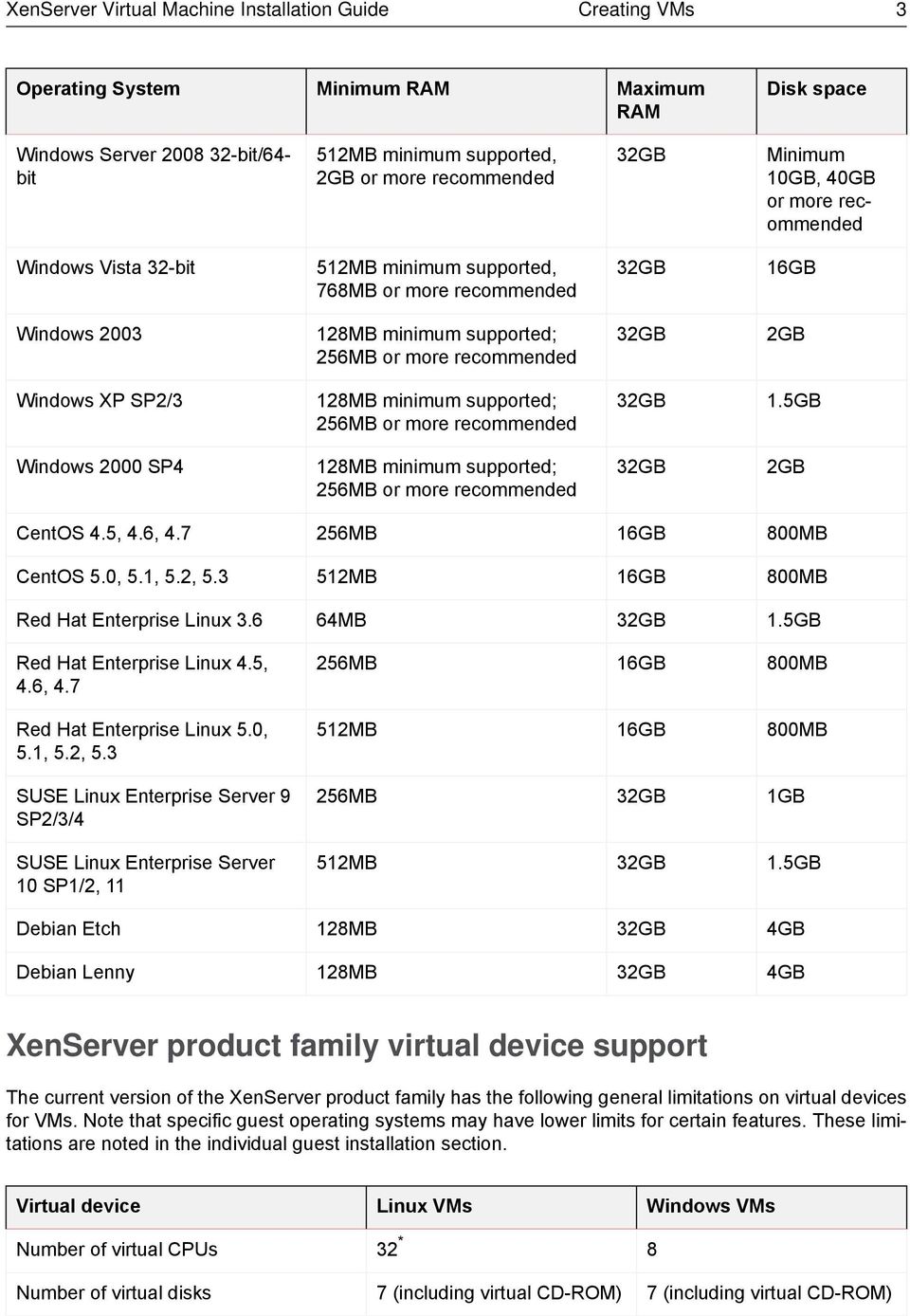
6 Chapter 2. Creating VMs This chapter provides an overview of how VMs are created and lists virtual memory and virtual disk size minimums, describes the differences in virtual device support for the members of the XenServer product family. This chapter also discusses physical to virtual conversion (P2V), cloning templates, and importing previously-exported VMs. Overview VMs are created from templates. A template is a "gold image" that contains all the various configuration settings to instantiate a specific VM. XenServer ships with a base set of templates, which range from generic "raw" VMs that can boot an OS vendor installation CD or run an installation from a network repository to complete pre-configured OS instances. Different operating systems require slightly different settings in order to run at their best. XenServer templates are tuned to maximize operating system performance. The Linux templates create Pure Virtual (PV) guests, as opposed to the HVM guests created by the Windows and Other Install Media templates. Other Install Media template Linux installations are not supported. There are three basic methods by which VMs are created using templates: using a complete pre-configured template. Installing from a CD or an ISO image onto the appropriate template. Installing from vendor media on a network installation server directly onto a template. See Chapter 4, Installing Linux VMs to find out which methods are supported for which Linux flavor operating systems. Windows VMs can be installed from a CD or an ISO image. Creating VMs by installing Windows operating systems onto the appropriate templates is described in Chapter 3, Installing Windows VMs. Creating VMs by installing Linux operating systems onto the appropriate templates is described in Chapter 4, Installing Linux VMs. Additionally, VMs can be created by: performing a physical to virtual (P2V) conversion on an existing physical server. importing an existing, exported VM converting an existing VM to a template These methods are described in this chapter. Virtual memory and disk size limits In general, when installing VMs, be sure to follow the memory and disk space guidelines of the operating system and any relevant applications that you want to run when allocating resources such as memory and disk space. Note that individual versions of the operating systems may also impose their own maximum limits on the amount of memory supported (for example, for licensing reasons).

7 XenServer Virtual Machine Installation Guide Creating VMs 3 Operating System Minimum RAM Maximum RAM Disk space Windows Server bit/64- bit 512MB minimum supported, 2GB or more recommended 32GB Minimum 10GB, 40GB or more recommended Windows Vista 32-bit 512MB minimum supported, 768MB or more recommended 32GB 16GB Windows MB minimum supported; 256MB or more recommended 32GB 2GB Windows XP SP2/3 128MB minimum supported; 256MB or more recommended 32GB 1.5GB Windows 2000 SP4 128MB minimum supported; 256MB or more recommended 32GB 2GB CentOS 4.5, 4.6, MB 16GB 800MB CentOS 5.0, 5.1, 5.2, MB 16GB 800MB Red Hat Enterprise Linux MB 32GB 1.5GB Red Hat Enterprise Linux 4.5, 4.6, 4.7 Red Hat Enterprise Linux 5.0, 5.1, 5.2, 5.3 SUSE Linux Enterprise Server 9 SP2/3/4 SUSE Linux Enterprise Server 10 SP1/2, MB 16GB 800MB 512MB 16GB 800MB 256MB 32GB 1GB 512MB 32GB 1.5GB Debian Etch 128MB 32GB 4GB Debian Lenny 128MB 32GB 4GB XenServer product family virtual device support The current version of the XenServer product family has the following general limitations on virtual devices for VMs. Note that specific guest operating systems may have lower limits for certain features. These limitations are noted in the individual guest installation section. Virtual device Linux VMs Windows VMs Number of virtual CPUs 32 * 8 Number of virtual disks 7 (including virtual CD-ROM) 7 (including virtual CD-ROM)
8 XenServer Virtual Machine Installation Guide Creating VMs 4 Virtual device Linux VMs Windows VMs Number of virtual CD-ROM drives 1 1 Number of virtual NICs 7 7 * A maximum of 8 VCPUs are supported via XenCenter. except for SLES 10 SP1 and RHEL 3.x and 4.x, which support 3. RHEL 5.0/5.1/5.2 support 3, but can support 7 when the kernel is patched with the Citrix Tools for Virtual Machines. The same applies for Oracle and CentOS 5.0/5.1/5.2 Physical to Virtual Conversion (P2V) Physical to Virtual Conversion(P2V) is the process by which an existing operating system on a physical server -- its filesystem, configuration, and so on -- is turned into a virtualized instance of the same operating system and filesystem, transferred, instantiated, and started as a VM on the XenServer host. For existing physical instances of Windows servers, use XenConvert. XenConvert runs on the physical Windows machine and converts it live into a VHD-format disk image or an XVA template suitable for importing into a XenServer host. The physical host does not need to be restarted during this process, and device drivers are automatically modified to make them able to run in a virtual environment. For more information, please refer to the XenConvert documentation for installation and usage guidelines. For existing physical instances of Linux servers P2V conversion is accomplished by booting from the XenServer installation CD and choosing the P2V option. The filesystem is copied across the network onto a XenServer host, where it appears as a normal VM. Citrix recommends that you perform P2V operations during off-peak hours because the process involves transferring a large amount of data, which could impact the performance of other Virtual Machines running on the XenServer host. The P2V tool requires a 64-bit capable CPU by default. If you have an existing Linux instance on an older machine that you want to transfer via P2V, you can boot the CD via the p2v-legacy option at the initial prompt. This does require at least a PAE-enabled machine (Physical Address Extension), so for very old machines you can physically move the hard drive to a PAE-enabled machine and perform the operation from there. To P2V an existing Linux server directly to a XenServer host 1. Reboot the physical server that you want to convert and boot from the XenServer installation CD. If the boot fails, start again and use the p2v-legacy option. 2. After the initial boot messages, the installer does some hardware detection and initialization, then presents a screen asking you to select which keyboard keymap you want to use for the installation. In this and the screens that follow, use Tab or Alt+Tab to move between elements, Space to select, and F12 to move to the next screen. Select the desired keymap and choose OK to proceed. 3. Next, the Welcome to XenServer screen is displayed. Select Convert an existing OS on this machine to a VM (P2V) and click OK to proceed. 4. The Welcome to XenServer P2V screen is displayed. Click OK to proceed, and follow the on-screen prompts. When the P2V process is complete and the new VM is created, you need to create and attach a VIF for it to have external network connectivity. Similarly, extra disks may also be added to take advantage of additional storage capacity available to the XenServer host. Citrix recommends using XenCenter to setup network and storage connections for the new VM. Since the VM has new virtual network hardware, the MAC addresses it sees will also be different. Follow the Linux cloning guidelines (see the section called Preparing to clone a Linux VM ) for customizing the configuration files to make the VM re-run any hardware detection scripts at startup.

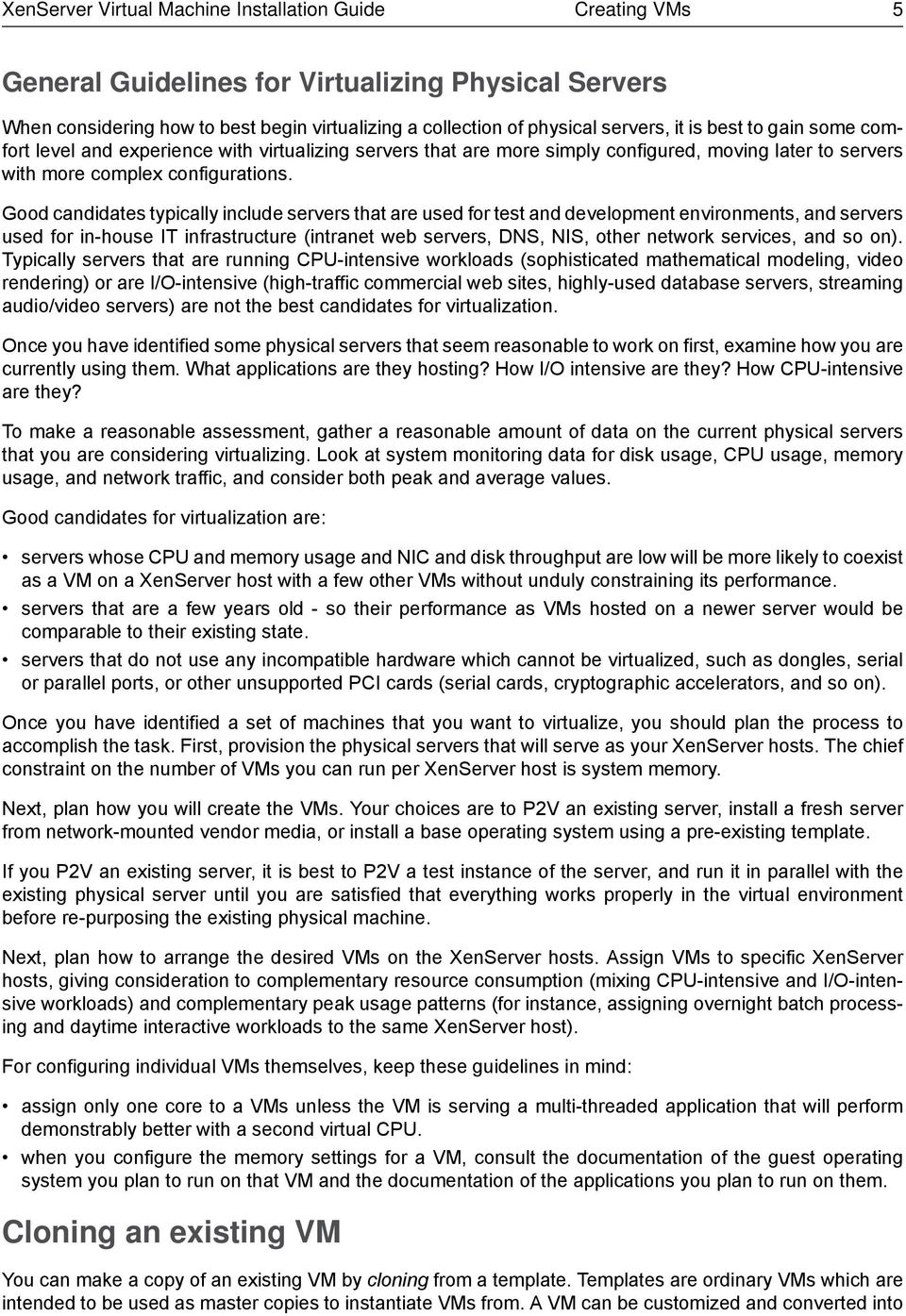
9 XenServer Virtual Machine Installation Guide Creating VMs 5 General Guidelines for Virtualizing Physical Servers When considering how to best begin virtualizing a collection of physical servers, it is best to gain some comfort level and experience with virtualizing servers that are more simply configured, moving later to servers with more complex configurations. Good candidates typically include servers that are used for test and development environments, and servers used for in-house IT infrastructure (intranet web servers, DNS, NIS, other network services, and so on). Typically servers that are running CPU-intensive workloads (sophisticated mathematical modeling, video rendering) or are I/O-intensive (high-traffic commercial web sites, highly-used database servers, streaming audio/video servers) are not the best candidates for virtualization. Once you have identified some physical servers that seem reasonable to work on first, examine how you are currently using them. What applications are they hosting? How I/O intensive are they? How CPU-intensive are they? To make a reasonable assessment, gather a reasonable amount of data on the current physical servers that you are considering virtualizing. Look at system monitoring data for disk usage, CPU usage, memory usage, and network traffic, and consider both peak and average values. Good candidates for virtualization are: servers whose CPU and memory usage and NIC and disk throughput are low will be more likely to coexist as a VM on a XenServer host with a few other VMs without unduly constraining its performance. servers that are a few years old - so their performance as VMs hosted on a newer server would be comparable to their existing state. servers that do not use any incompatible hardware which cannot be virtualized, such as dongles, serial or parallel ports, or other unsupported PCI cards (serial cards, cryptographic accelerators, and so on). Once you have identified a set of machines that you want to virtualize, you should plan the process to accomplish the task. First, provision the physical servers that will serve as your XenServer hosts. The chief constraint on the number of VMs you can run per XenServer host is system memory. Next, plan how you will create the VMs. Your choices are to P2V an existing server, install a fresh server from network-mounted vendor media, or install a base operating system using a pre-existing template. If you P2V an existing server, it is best to P2V a test instance of the server, and run it in parallel with the existing physical server until you are satisfied that everything works properly in the virtual environment before re-purposing the existing physical machine. Next, plan how to arrange the desired VMs on the XenServer hosts. Assign VMs to specific XenServer hosts, giving consideration to complementary resource consumption (mixing CPU-intensive and I/O-intensive workloads) and complementary peak usage patterns (for instance, assigning overnight batch processing and daytime interactive workloads to the same XenServer host). For configuring individual VMs themselves, keep these guidelines in mind: assign only one core to a VMs unless the VM is serving a multi-threaded application that will perform demonstrably better with a second virtual CPU. when you configure the memory settings for a VM, consult the documentation of the guest operating system you plan to run on that VM and the documentation of the applications you plan to run on them. Cloning an existing VM You can make a copy of an existing VM by cloning from a template. Templates are ordinary VMs which are intended to be used as master copies to instantiate VMs from. A VM can be customized and converted into
10 XenServer Virtual Machine Installation Guide Creating VMs 6 a template, but be sure to follow the appropriate preparation procedure for the VM (see the section called Preparing to clone a Windows VM for Windows and the section called Preparing to clone a Linux VM for Linux). Templates cannot be used as normal VMs. XenServer has two mechanisms for cloning VMs: a full copy, or a faster Copy-on-Write (CoW) mode which only writes modified blocks to disk. The CoW mode is only supported for file-backed VMs. CoW is designed to save disk space and allow fast clones, but will slightly slow down normal disk performance. A template can be fast-cloned multiple times without slowdown, but if a template is cloned into a VM and the clone converted back into a template, disk performance can linearly decrease depending on the number of times this has happened. In this event, the vm-copy CLI command can be used to perform a full copy of the disks and restore expected levels of disk performance. Resource pools introduce some complexities around creating custom templates and cloning them. If you create a template on a server in a pool, and all virtual disks of the source VM are on shared storage repositories, the operation of cloning that template will be forwarded to any server in the pool that can see those shared SRs. However, if you create the template from a source VM that has any virtual disks on a local SR, then the clone operation can only execute on the server that can access that SR. Importing an exported VM You can create a VM by importing an existing exported VM. Like cloning, exporting and importing a VM is way to create additional VMs of a certain configuration. You might, for example, have a special-purpose server configuration that you use many times. Once you have set up a VM the way you want it, you can export it, and import it later to create another copy of your specially-configured VM. You can also use export and import to move a VM to a XenServer host that in another resource pool. When importing a VM, you can choose to preserve the MAC address on any virtual network interfaces associated with it. If you choose to generate a new MAC address, be sure to follow the appropriate preparation procedure for the imported VM. See the section called Preparing to clone a Windows VM for Windows and the section called Preparing to clone a Linux VM for Linux. Importing an exported VM may take some time, depending on the size of the VM and the speed and bandwidth of the network connection between the XenServer host and XenCenter. When VMs are imported XenServer re-attaches the VM VIFs to any network that has the same name as the network on the server that the VM was exported from. If no matching network can be found a new private network is created and the VM VIFs are attached to that. Exporting a VM An existing VM can be exported using XenCenter or the CLI. This section describes using the CLI. For details on exporting using XenCenter, see the XenCenter online Help. The following procedure assumes that you have multiple XenServer hosts and that you are administering them using the CLI on a separate machine (that is, a machine that is not one of the XenServer hosts) where you can maintain a library of export files. Citrix recommends not exporting a VM to a XenServer host filesystem. To export a VM using the CLI 1. Shut down the VM that you want to export. 2. Export the VM: xe vm-export -h <hostname> -u <root> -pw <password> vm=<vm_name> \ filename=<pathname_of_file>

11 XenServer Virtual Machine Installation Guide Creating VMs 7 Note Be sure to include the.xva extension when specifying the export filename. If the exported VM does not have this extension and you attempt to import it via XenCenter, it might fail to recognize the file as a valid XVA file. 3. The export process might take some time to complete. When finished, the command prompt returns. Importing a VM An exported VM file can be imported using XenCenter or the CLI. This section describes using the CLI. For details on importing using XenCenter, see the XenCenter online Help. The following procedure assumes that you are administering the XenServer host using the CLI on a separate machine (that is, a machine that is not one of your XenServer hosts) where you maintain a library of export files. To import a VM using the CLI 1. To import the VM to the default SR on the target XenServer host: xe vm-import -h <hostname> -u <root> -pw <password> \ filename=<pathname_of_export_file> You can import the VM to another SR on the target XenServer host by adding the optional sr-uuid parameter: xe vm-import -h <hostname> -u <root> -pw <password> \ filename=<pathname_of_export_file> sr-uuid=<uuid_of_target_sr> You can also preserve the MAC address of the original VM by adding the optional preserve parameter set to true: xe vm-import -h <hostname> -u <root> -pw <password> \ filename=<pathname_of_export_file> preserve=true 2. The import process might take some time to complete. When finished, the command prompt returns the UUID of the newly-imported VM. VM Block Devices In the para-virtualized (PV) Linux case, block devices are passed through as PV devices. XenServer does not attempt to emulate SCSI or IDE, but instead provides a more suitable interface in the virtual environment in the form of xvd* devices. It is also sometimes possible (depending on the OS) to get an sd* device using the same mechanism, where the PV driver inside the VM takes over the SCSI device namespace. This is not desirable so it is best to use xvd* where possible for PV guests (this is the default for Debian and RHEL). For Windows or other fully virtualized guests, XenServer emulates an IDE bus in the form of an hd* device. When using Windows, installing the Citrix Tools for Virtual Machines installs a special PV driver that works in a similar way to Linux, except in a fully virtualized environment.

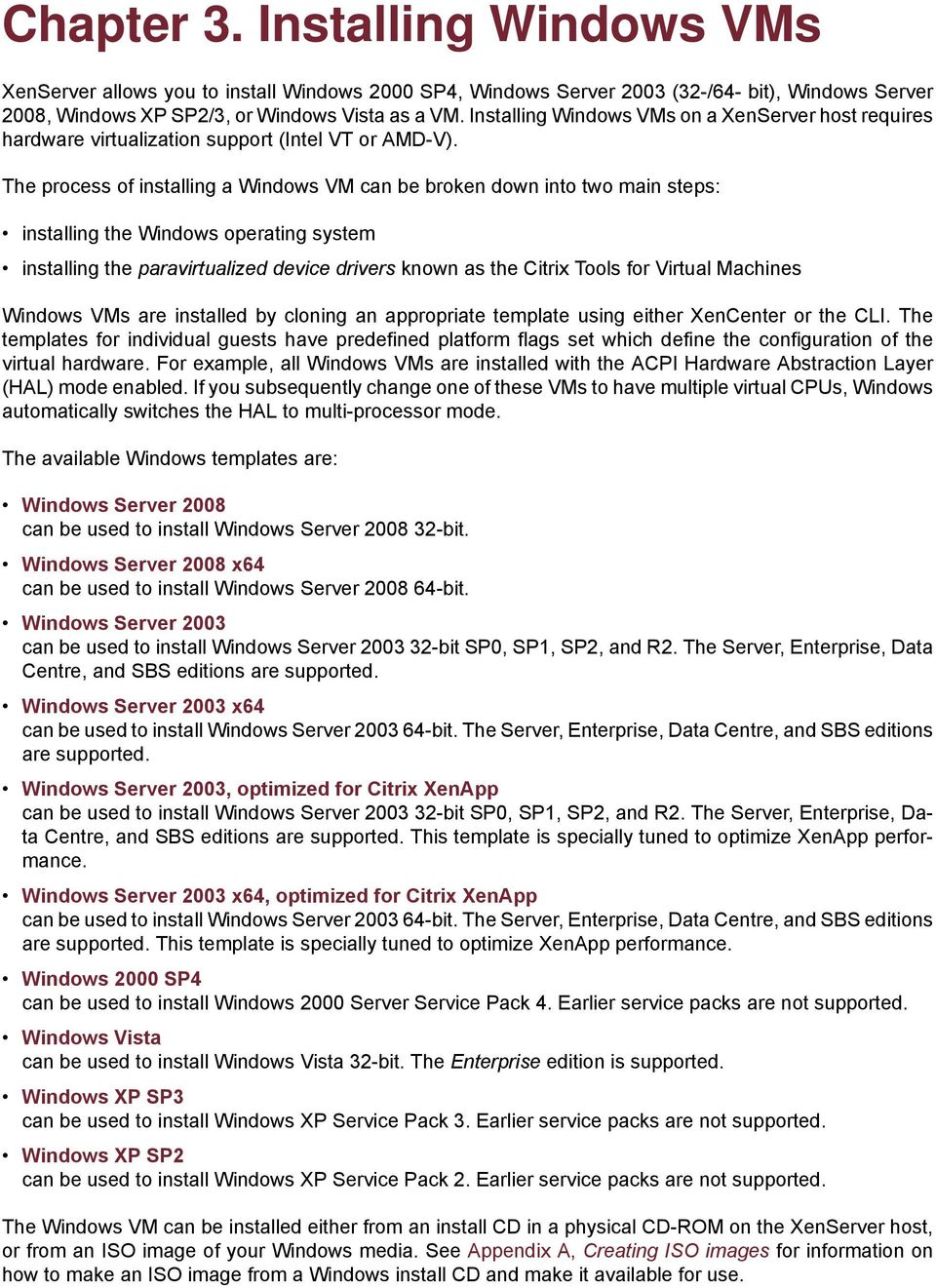
12 Chapter 3. Installing Windows VMs XenServer allows you to install Windows 2000 SP4, Windows Server 2003 (32-/64- bit), Windows Server 2008, Windows XP SP2/3, or Windows Vista as a VM. Installing Windows VMs on a XenServer host requires hardware virtualization support (Intel VT or AMD-V). The process of installing a Windows VM can be broken down into two main steps: installing the Windows operating system installing the paravirtualized device drivers known as the Citrix Tools for Virtual Machines Windows VMs are installed by cloning an appropriate template using either XenCenter or the CLI. The templates for individual guests have predefined platform flags set which define the configuration of the virtual hardware. For example, all Windows VMs are installed with the ACPI Hardware Abstraction Layer (HAL) mode enabled. If you subsequently change one of these VMs to have multiple virtual CPUs, Windows automatically switches the HAL to multi-processor mode. The available Windows templates are: Windows Server 2008 can be used to install Windows Server bit. Windows Server 2008 x64 can be used to install Windows Server bit. Windows Server 2003 can be used to install Windows Server bit SP0, SP1, SP2, and R2. The Server, Enterprise, Data Centre, and SBS editions are supported. Windows Server 2003 x64 can be used to install Windows Server bit. The Server, Enterprise, Data Centre, and SBS editions are supported. Windows Server 2003, optimized for Citrix XenApp can be used to install Windows Server bit SP0, SP1, SP2, and R2. The Server, Enterprise, Data Centre, and SBS editions are supported. This template is specially tuned to optimize XenApp performance. Windows Server 2003 x64, optimized for Citrix XenApp can be used to install Windows Server bit. The Server, Enterprise, Data Centre, and SBS editions are supported. This template is specially tuned to optimize XenApp performance. Windows 2000 SP4 can be used to install Windows 2000 Server Service Pack 4. Earlier service packs are not supported. Windows Vista can be used to install Windows Vista 32-bit. The Enterprise edition is supported. Windows XP SP3 can be used to install Windows XP Service Pack 3. Earlier service packs are not supported. Windows XP SP2 can be used to install Windows XP Service Pack 2. Earlier service packs are not supported. The Windows VM can be installed either from an install CD in a physical CD-ROM on the XenServer host, or from an ISO image of your Windows media. See Appendix A, Creating ISO images for information on how to make an ISO image from a Windows install CD and make it available for use.
13 XenServer Virtual Machine Installation Guide Installing Windows VMs 9 Making the ISO available to XenServer hosts To make an ISO library available to XenServer hosts, create an external NFS or SMB/CIFS share directory. The NFS or SMB/CIFS server must allow root access to the share. For NFS shares, this is accomplished by setting the no_root_squash flag when you create the share entry in /etc/exports on the NFS server. Then either use XenCenter to attach the ISO library, or connect to the host console and run the command: xe-mount-iso-sr host:/volume Additional arguments to the mount command may be passed in, for advanced use. If making a Windows SMB/CIFS share available to the XenServer host, either use XenCenter to make it available, or connect to the host console and run the command: xe-mount-iso-sr unc_path -t smbfs -o username=myname/myworkgroup The unc_path argument should have back-slashes replaces by forward-slashes. -t cifs can be used for CIFS instead of SMB. Examples: xe-mount-iso-sr //server1/myisos -t cifs -o username=johndoe/mydomain xe-mount-iso-sr //server2/iso_share -t smbfs -o username=alice After mounting the share, any ISOs in it should be available by name from the CD pulldown list in XenCenter, or as CD images from the CLI commands. The ISO should be attached to an appropriate Windows template. Copying ISOs to local storage In XenServer 3.2 and earlier, ISOs could be copied directly to the control domain into the /opt/xensource/packages/iso directory. In XenServer hosts, this directory is reserved for use of the builtin ISO images, and is not intended for general use. This directory is considered to be identical across hosts in a resource pool, and CD images may fail to attach if the contents are modified. To use local ISO storage from the control domain 1. Log onto the host console. 2. Create a directory to copy the local ISOs into: mkdir -p /var/opt/xen/iso_import 3. Create an ISO storage repository: xe sr-create name-label=<name> type=iso \ device-config:location=/var/opt/xen/iso_import/<name> \ device-config:legacy_mode=true content-type=iso 4. Copy the ISO images into this directory, taking care not to fill up the control domain filesystem. 5. Verify that the ISO image is available for use by using the xe vdi-list command, or by checking in XenCenter.

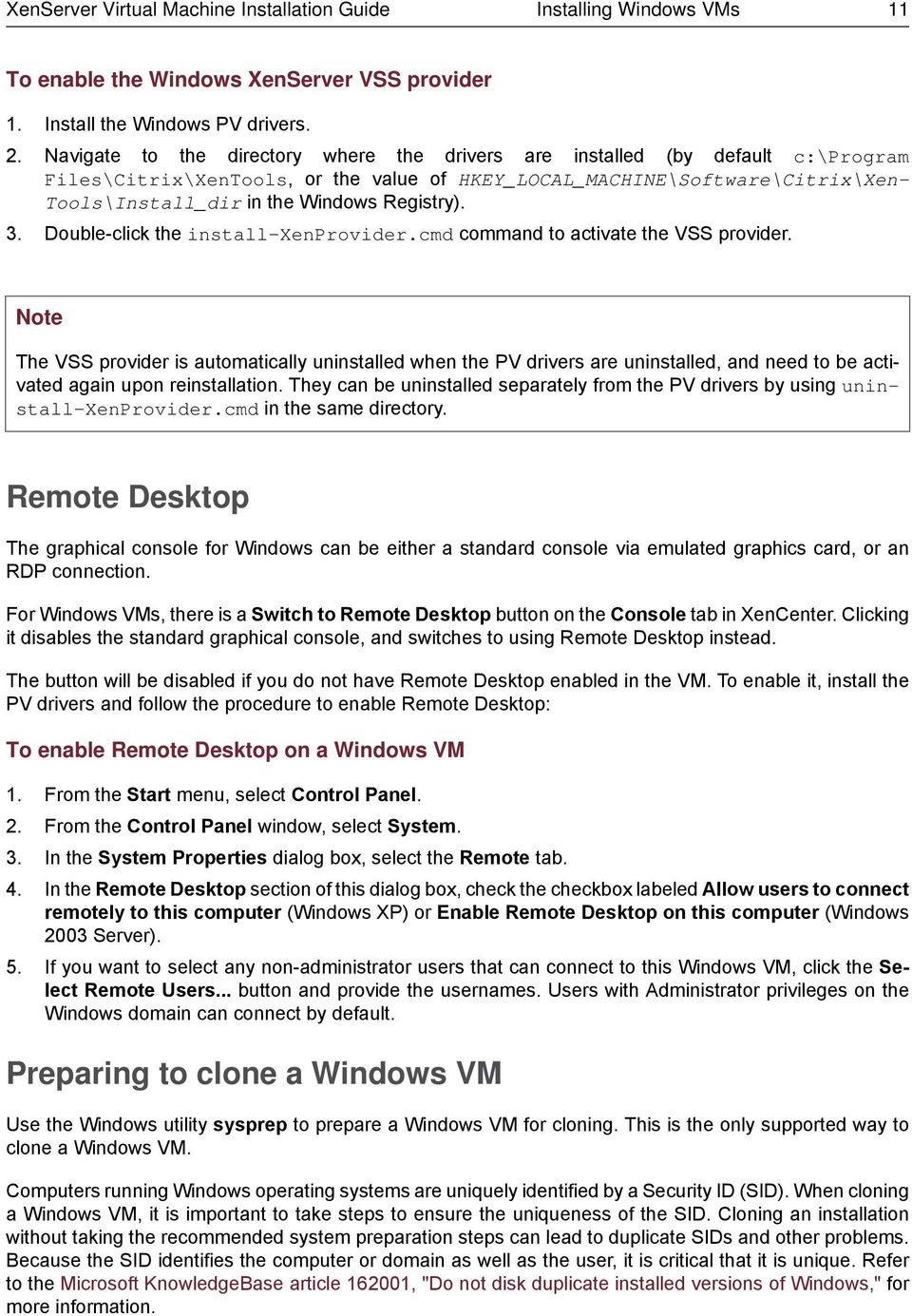
14 XenServer Virtual Machine Installation Guide Installing Windows VMs 10 Warning Be extremely careful with copying ISOs directly onto the control domain filesystem, as it has limited space available. A network share is a much safer mechanism for storing large numbers of ISO images. If the control domain does fill up, unpredictable behavior will result. Windows paravirtualized drivers The Citrix paravirtualized network and SCSI drivers (Citrix Tools for Virtual Machines) provide high performance I/O services without the overhead of traditional device emulation. During the installation of a Windows operating system, XenServer uses traditional device emulation to present a standard IDE controller and a standard network card to the VM. This allows Windows to complete its installation using built-in drivers, but with reduced performance due to the overhead inherent in emulation of the controller drivers. After Windows is installed, install the Citrix high-speed PV drivers. These are on an ISO available to the virtual CD-ROM drive of the Virtual Machine. These drivers replace the emulated devices and provide highspeed transport between Windows and the XenServer product family software. Note While a Windows VM functions without them, performance is significantly hampered unless these drivers are installed. Running Windows VMs without these drivers is not supported. Some features, such as live relocation across physical hosts, will only work with the PV drivers installed and active. Attach the Windows PV drivers ISO to the VM by using the Install Tools menu in XenCenter, or by directly attaching the built-in xs-tools.iso ISO image on the VM using the CLI. Once the ISO is attached, double-click on the xensetup.exe installer executable and follow the on-screen prompts. Note To silently install the Citrix Tools for Virtual Machines and prevent the system from rebooting afterwards, use the /S and /norestart options: <install_dir>/xensetup.exe /S /norestart The Windows PV drivers are installed by default in the C:\Program Files\Citrix\XenTools directory on the VM. The Citrix Tools for Virtual Machines can also be installed on a provisioned Windows machine by running the executable windows-pvdrivers-xensetup.exe, located in the client_install/ directory of the installation CD. Windows Volume Shadow Copy Service (VSS) provider The Windows tools also include a XenServer VSS provider that is used to quiesce the guest filesystem in preparation for a VM snapshot. The VSS provider is installed as part of the PV driver installation, but is not enabled by default.

15 XenServer Virtual Machine Installation Guide Installing Windows VMs 11 To enable the Windows XenServer VSS provider 1. Install the Windows PV drivers. 2. Navigate to the directory where the drivers are installed (by default c:\program Files\Citrix\XenTools, or the value of HKEY_LOCAL_MACHINE\Software\Citrix\Xen- Tools\Install_dir in the Windows Registry). 3. Double-click the install-xenprovider.cmd command to activate the VSS provider. Note The VSS provider is automatically uninstalled when the PV drivers are uninstalled, and need to be activated again upon reinstallation. They can be uninstalled separately from the PV drivers by using uninstall-xenprovider.cmd in the same directory. Remote Desktop The graphical console for Windows can be either a standard console via emulated graphics card, or an RDP connection. For Windows VMs, there is a Switch to Remote Desktop button on the Console tab in XenCenter. Clicking it disables the standard graphical console, and switches to using Remote Desktop instead. The button will be disabled if you do not have Remote Desktop enabled in the VM. To enable it, install the PV drivers and follow the procedure to enable Remote Desktop: To enable Remote Desktop on a Windows VM 1. From the Start menu, select Control Panel. 2. From the Control Panel window, select System. 3. In the System Properties dialog box, select the Remote tab. 4. In the Remote Desktop section of this dialog box, check the checkbox labeled Allow users to connect remotely to this computer (Windows XP) or Enable Remote Desktop on this computer (Windows 2003 Server). 5. If you want to select any non-administrator users that can connect to this Windows VM, click the Select Remote Users... button and provide the usernames. Users with Administrator privileges on the Windows domain can connect by default. Preparing to clone a Windows VM Use the Windows utility sysprep to prepare a Windows VM for cloning. This is the only supported way to clone a Windows VM. Computers running Windows operating systems are uniquely identified by a Security ID (SID). When cloning a Windows VM, it is important to take steps to ensure the uniqueness of the SID. Cloning an installation without taking the recommended system preparation steps can lead to duplicate SIDs and other problems. Because the SID identifies the computer or domain as well as the user, it is critical that it is unique. Refer to the Microsoft KnowledgeBase article , "Do not disk duplicate installed versions of Windows," for more information.
16 XenServer Virtual Machine Installation Guide Installing Windows VMs 12 sysprep modifies the local computer SID to make it unique to each computer. The sysprep binaries are on the Windows product CDs in the \support\tools\deploy.cab file. The steps that you need to take to clone Windows VMs are: Cloning Windows VMs 1. Create, install, and configure the Windows VM as desired. 2. Apply all relevant Service Packs and updates. 3. Install the Citrix Tools for Virtual Machines. 4. Install any applications and perform any other configuration. 5. Copy the contents of \support\tools\deploy.cab from the Windows product CD to a new \sysprep folder in the VM. 6. Run sysprep. This will shut down the VM when it completes. 7. Using XenCenter convert the VM into a template. 8. Clone the newly created template into new VMs as required. 9. When the cloned VM starts, it will get a new SID and name, run a mini-setup to prompt for configuration values as necessary, and finally restart, before being available for use. Note The original, sysprepped VM (the "source" VM) should not be restarted again after the sysprep stage, and should be converted to a template immediately afterwards to prevent this. If the source VM is restarted, sysprep must be run on it again before it can be safely used to make additional clones. For more information on using sysprep, refer to the Microsoft TechNet page Windows System Preparation Tool. Time Handling in Windows VMs For Windows guests, time is initially driven from the control domain clock, and is updated during VM lifecycle operations such as suspend, reboot and so on. Citrix highly recommends running a reliable NTP service in the control domain and all Windows VMs. So if you manually set a VM to be 2 hours ahead of the control domain (e.g. using a time-zone offset within the VM), then it will remember that. If you subsequently change the control domain time (either manually or if it is automatically corrected by NTP), the VM will shift accordingly but maintain the 2 hour offset. Note that changing the control domain time-zone does not affect VM time-zones or offset. It is only the hardware clock setting which is used by XenServer to synchronize the guests. When performing suspend/resume operations or live relocation using XenMotion, it is important to have up-to-date Windows PV drivers installed, as they notify the Windows kernel that a time synchronization is required after resuming (potentially on a different physical host). Release Notes There are many versions and variations of Windows with different levels of support for the features provided by XenServer. This section lists notes and errata for the known differences.
17 XenServer Virtual Machine Installation Guide Installing Windows VMs 13 General Windows Issues When installing Windows VMs, start off with no more than three virtual disks. Once the VM and Citrix Tools for Virtual Machines tools have been installed you can add additional virtual disks. The boot device should always be one of the initial disks so that the VM can successfully boot without the Citrix Tools for Virtual Machines. Multiple VCPUs are exposed as CPU sockets to Windows guests, and are subject to the licensing limitations present in the VM. The number of CPUs present in the guest can be confirmed by checking Device Manager. The number of CPUs actually being used by Windows can be seen in the Task Manager. The disk enumeration order in a Windows guest may differ from the order in which they were initially added. This is because of interaction between the PV drivers and the PnP subsystem in Windows. For example, the first disk may show up as Disk 1, the next disk hotplugged as Disk 0, a subsequent disk as Disk 2, and then upwards in the expected fashion. There is a bug in the VLC player DirectX backend that causes yellow to be replaced by blue when playing video if the Windows display properties are set to 24-bit color. VLC using OpenGL as a backend works correctly, and any other DirectX- or OpenGL-based video player works too. It is not a problem if the guest is set to use 16-bit color rather than 24. The PV Ethernet Adapter reports a speed of 2 Gbps in Windows VMs. This speed is a hardcoded value and is not relevant in a virtual environment because the virtual NIC is connected to a virtual switch. The NIC will actually perform at the same rate as the physical NIC. Windows 2003 Server Windows Server bit does not boot successfully if any virtual disks larger than 2TB (terabytes) in size are attached to the VM. See this article in the Windows Hardware Developer Central website. Windows 2008 Server Quiesced snapshots taken on Windows Server 2008 guests will not be directly bootable. Attach the snapshot disk to an existing Windows Server 2008 VM to access files for restoration purposes. Windows XP SP3 Windows XP does not support disks larger than 2TB (terabytes) in size. See this article in the Windows Hardware Developer Central website. Windows 2000 Server No known issues. Windows Vista Microsoft Vista recommends a root disk of size 20GB or higher. The default size when installing this template is 24GB, which is 4GB greater than the minimum. Consider increasing this.
18 Chapter 4. Installing Linux VMs XenServer supports the installation of many Linux distributions as PV VMs. There are four installation mechanisms: complete distributions provided as built-in templates Physical-to-Virtual (P2V) conversion of an existing native instance (see the section called Physical to Virtual Conversion (P2V) ) using the vendor media in the server's physical DVD/CD drive using the vendor media to perform a network installation. Installing Linux VMs requires the Linux Pack to be installed onto the XenServer host. Warning If you have not installed the Linux Pack, and you are using XenCenter to install VMs, the New VM wizard will show only Windows choices in the list. Do not select Other install media to install a Linux VM. This will not work properly and is not supported. The Other install media template is meant for advanced users who want to attempt to install VMs running unsupported operating systems. XenServer has been tested running only the supported distributions and specific versions covered by the standard supplied templates, and any VMs installed using the Other install media template are not supported. The supported Linux distributions are: Distribution Built-in P2V Vendor Install from CD Vendor Install from network repository Debian Lenny 5.0 X Debian Etch 4.0 X Red Hat Enterprise Linux X Red Hat Enterprise Linux X X Red Hat Enterprise Linux bit Red Hat Enterprise Linux bit X X X X SUSE Linux Enterprise Server 9 SP1/2/3 SUSE Linux Enterprise Server 9 SP4 X X X X

19 XenServer Virtual Machine Installation Guide Installing Linux VMs 15 Distribution Built-in P2V Vendor Install from CD Vendor Install from network repository SUSE Linux Enterprise Server 10 SP1/2 32-bit/64-bit SUSE Linux Enterprise Server bit/64-bit X X X X CentOS 4.5, 4.6 X X CentOS 4.7 X CentOS bit X X CentOS bit X X Oracle Enterprise Linux bit Oracle Enterprise Linux bit X X X X Note Distributions which use the same installation mechanism as Red Hat Enterprise Linux 5 (for example Fedora Core 6) might be successfully installed using the same template. However, distributions not present in the above list are not supported. Installing Debian Etch The template provided with XenServer can be used to directly create a VM running Debian Linux 4.0 (Etch) without the need for vendor installation media and without performing a P2V conversion of an existing physical server. The VMs are instantiated by running the vm-install command on the CLI, or by cloning the template using XenCenter. For example, using the CLI on Linux: xe vm-install template=debian\ Etch\ 4.0 new-name-label=<examplevm> When you first boot the VM you are prompted for a root password, a VNC password (for graphical use), and a hostname. You will need to add a network interface if you installed the VM using the CLI. Installing Debian Lenny Debian Lenny is installed using the standard Debian installer, which supports installation into a PV VM (performance optimized). Use XenCenter or the xe CLI to install Debian Lenny either from a CD, or from a network repository over FTP or HTTP. Information on installing Debian Lenny using XenCenter is available in the XenCenter help to get started, run the New VM wizard. The rest of this section provides information about installing Debian Lenny using the CLI.

20 XenServer Virtual Machine Installation Guide Installing Linux VMs 16 Installing a Debian Lenny VM using the xe CLI 1. Create a VM using the Debian Lenny template. The UUID of the VM is returned: xe vm-install template=debian\ Lenny\ 5.0 new-name-label=<lenny-vm> 2. Specify the installation repository this should be a standard Debian mirror with at least the packages required to install the base system and the additional packages you plan to select during the Debian installer: xe vm-param-set uuid=<uuid> other-config:install-repository=<path_to_repository> An example of a valid repository path is where <xx> is your country code (see the Debian mirror list for a list of these). For multiple installations Citrix recommends using a local mirror or apt proxy to avoid generating excessive network traffic or load on the central repositories. 3. Start the VM; it boots straight into the Debian installer: xe vm-start uuid=<uuid> 4. Follow the Debian Installer procedure to install the VM in the configuration you require. 5. See below for instructions on how to install the guest utilities and how to configure graphical display. Automated installation of Debian Lenny Installation of Debian Lenny uses the standard Debian installer you can use the usual Debian pre-seed mechanism to support automated installation. 1. Create a pre-seed file. Information about pre-seed files is available in the appendices of the Debian user guide. 2. Set the kernel command-line correctly for the VM before starting it. This can be doing when stepping through the VM creation procedure in XenCenter, or by executing an xe CLI command like the following: xe vm-param-set uuid=<uuid> PV-args=<preseed_arguments> Apt repositories and Lenny For infrequent or one-off installations of Lenny, it is reasonable to directly use a Debian mirror. However, if you intend to do several VM installations, we recommend that you use a caching proxy or local mirror. Aptcacher is an implementation of proxy server that will keep a local cache of packages. debmirror is a tool that will create a partial or full mirror of a Debian repository. Either of these tools can be installed into a VM. Installing Red Hat, CentOS, and Oracle Linux from vendor media XenServer supports installation of the following Linux operating systems from vendor media in the XenServer host DVD/CD-ROM drive: Red Hat Enterprise Linux , 32-bit Red Hat Enterprise Linux , 64-bit CentOS CentOS , 32-bit CentOS , 64-bit Oracle Enterprise Linux , 32-bit

21 XenServer Virtual Machine Installation Guide Installing Linux VMs 17 Oracle Enterprise Linux , 64-bit Other Linux operating systems need to be installed from a network installation server. See the section called Installing Linux from a network installation server to a VM. To install a supported Linux VM from vendor media using the CLI 1. Insert the vendor installation CD into the CD drive on the XenServer host. 2. Run the command xe template-list to find the name of the template corresponding to the OS you want to install. 3. Run the command: xe vm-install template="<template_name>" new-name-label=<name_for_vm> This command returns the UUID of the new VM. 4. Get the UUID of the root disk of the new VM: xe vbd-list vm-uuid=<vm_uuid> userdevice=0 params=uuid --minimal 5. Using the UUID returned, set the root disk to not be bootable: xe vbd-param-set uuid=<root_disk_uuid> bootable=false 6. Get the name of the physical CD drive on the XenServer host: xe cd-list The result of this command should give you something like SCSI 0:0:0:0 for the name-label field. 7. Add a virtual CD-ROM to the new VM using the XenServer host CD drive name-label parameter as the cd-name parameter: xe vm-cd-add vm=<vm_name> cd-name="<host_cd_drive_name_label>" device=3 8. Get the UUID of the VBD corresponding to the new virtual CD drive: xe vbd-list vm-uuid=<vm_uuid> type=cd params=uuid --minimal 9. Make the VBD of the virtual CD bootable: xe vbd-param-set uuid=<cd_drive_uuid> bootable=true 10. Set the install repository of the VM to be the CD drive: xe vm-param-set uuid=<vm_uuid> other-config:install-repository=cdrom 11. Start the VM xe vm-start uuid=<vm_uuid> 12. Open a console to the VM with XenCenter or an SSH terminal and follow the steps to perform the OS installation. Note The console in XenCenter supports VNC graphical installation of the Red Hat, Oracle, and CentOS operating systems. Ensure that the virtual machine has enough memory allocated for this to be enabled. If you set the memory allocation to 512MB or higher, you will be prompted to start VNC after the initial text
22 XenServer Virtual Machine Installation Guide Installing Linux VMs 18 screens. Choosing to continue using VNC and setting a password will enable the Switch to Graphical Console button. Installing Linux from a network installation server to a VM The XenServer guest installer allows you to install an operating system from a network-accessible copy of vendor media onto a VM. In preparation for installing from vendor media, you need to make an exploded network repository of your vendor media (not ISO images), exported over NFS, HTTP or FTP accessible to the XenServer host administration interface. See Appendix B, Setting Up a Red Hat Installation Server for information on how to copy a set of installation CDs to a network drive. The network repository must be accessible from the control domain of the XenServer host, normally using the management interface. The URL must point to the base of the CD/DVD image on the network server, and be of the form: HTTP FTP ftp://<server>/<path> NFS nfs://<server>/<path> or nfs://<server>/<path> Note that when using the NFS installation method from XenCenter, the nfs:// style of path should always be used. XenCenter will then modify this into the correct form when passing it to the server automatically. When using the CLI as per the instructions below, the appropriate form must be chosen manually. In the case of SUSE-based distributions this is the nfs://<server>/<path> style, and in the case of Red-Hat based distributions this is nfs:<server>:/<path>. The XenServer New VM wizard provides an additional step for vendor-installable templates which prompts for the repository URL. When using the CLI, install the template as normal using vm-install and then set the other-config:install-repository parameter to the value of the URL. When the VM is subsequently started, it will begin the network installation process. Note When installing a new Linux-based VM, it is important to fully finish the installation and reboot it before performing any other operations on it. This is analogous to not interrupting a Windows installation which would leave you with a non-functional VM. To install a Linux VM from a network-accessible copy of vendor media using the CLI 1. Run the command xe vm-install template=<template> new-name-label=<name_for_vm> \ sr-uuid=<storage_repository_uuid> This command returns the UUID of the new VM. 2. Find the UUID of the network that you want to connect to. For example, if it is the one attached to xenbr0: xe network-list bridge=xenbr0 --minimal
23 XenServer Virtual Machine Installation Guide Installing Linux VMs Create a VIF to connect the new VM to this network: xe vif-create vm-uuid=<vm_uuid> network-uuid=<network_uuid> mac=random device=0 4. Set the install-repository key of the other-config parameter to the path of your network repository. For example, to use as the URL of the vendor media: xe vm-param-set uuid=<vm_uuid> \ other-config:install-repository=< 5. Start the VM xe vm-start uuid=<vm_uuid> 6. Connect to the VM console using XenCenter or VNC and perform the OS installation. Installing RHEL Linux using a Custom Kickstart File 1. In XenCenter, choose the appropriate RHEL template 2. Specify the kickstart file to use as a kernel command-line argument in the new VM wizard, exactly as it would be specified in the PXE config file, for example: ks= 3. On the command line, use vm-param-set to set the PV-args parameter to make use of a Kickstart file xe vm-param-set uuid=<vm_uuid> PV-args=<"ks= ksdevice=eth0"> 4. Set the repository location so XenServer knows where to get the kernel and initrd from for the installer boot: xe vm-param-set uuid=<vm_uuid> other-config:install-repository=< Physical-to-Virtual Installation of a Linux VM Older Linux distributions such as Red Hat Linux Enterprise 3.6 do not support XenServer directly, and are typically legacy installations which benefit from virtualization for the purposes of server consolidation or hardware upgrades. The XenServer P2V feature analyzes existing installations and converts them into VMs. When an installation is converted into a VM using P2V (see the section called Physical to Virtual Conversion (P2V) ), the kernel used is also automatically switched to a XenServer PV kernel. XenServer contains ports of the Red Hat Enterprise Linux 3/4 and SUSE Enterprise Linux 9 kernels to support the native Xen hypervisor interface directly. These kernels are present in the built-in xs-tools.iso image in the default CD list, or can be installed by running the Install XenServer Tools command in the VM menu in XenCenter. Warning While a VM is in the process of being installed via P2V, do not attempt to perform any operations on it. Guest Installation Network During the installation of a VM via P2V, a special network is used to assign a temporary IP address to the VM to enable the installation to proceed. It is possible that the range of IP addresses used might conflict with
24 XenServer Virtual Machine Installation Guide Installing Linux VMs 20 real IP addresses already in use in your network. The default range of IP addresses is to , and the default netmask is To change the guest installer network values 1. Open a console on the XenServer host. 2. Find the guest installer network: xe network-list The command returns the list of networks available to the XenServer host. The to use has the namelabel Guest installer network. 3. Examine the other-config parameters of the guest installer network: xe network-param-list uuid=<guest_installer_network_uuid> The command returns a subset of the guest installer network parameters, including the other-config parameter. If the values are set to the default described above, you will see the line: other-config (MRW): is_guest_installer_network: true; ip_begin: ; \ ip_end: ; netmask: To change the IP address range the guest installer network will use, edit the ip_begin, ip_end, and netmask values as follows: xe network-param-set uuid=<guest_installer_network_uuid> \ other-config:ip_begin=<desired_ip_range_beginning> \ other-config:ip_end=<desired_ip_range_end> \ other-config:netmask=<desired_netmask> Do not change the value of the parameter is_guest_installer_network. Installing the Linux guest agent Although all the supported Linux distributions are natively paravirtualized (and therefore do not need special drivers for full performance), XenServer includes a guest agent which provides additional information about the VM to the host. This additional information includes: Linux distribution name and version (major, minor revision). Kernel version (uname). IP address of each Ethernet interface. Total and free memory within the VM. It is important to install this agent and keep it up-to-date (see Chapter 5, Updating VMs) as you upgrade your XenServer host. To install the guest agent 1. The files required are present on the built-in xs-tools.iso CD image, or alternatively can be installed by using the VM > Install XenServer Tools option in XenCenter.
25 XenServer Virtual Machine Installation Guide Installing Linux VMs Mount the image onto the guest by running the command: mount /dev/xvdd /mnt 3. Execute the installation script as the root user: /mnt/linux/install.sh 4. If the kernel has been upgraded, or the VM was upgraded from a previous version, reboot the VM now. Note CD-ROM drives and ISOs attached to Linux Virtual Machines appear as /dev/xvdd instead of as /dev/ cdrom as you might reasonably expect. This is because they are not true CD-ROM devices, but normal devices. When the CD is ejected by either XenCenter or the CLI, it hot-unplugs the device from the VM and the device disappears. This is different from Windows Virtual Machines, where the CD remains in the VM in an empty state. Preparing to clone a Linux VM When a Linux VM is cloned, some virtual hardware parameters are changed in the new VM. The VM may need to be customized to be made aware of these changes. For instructions for specific supported Linux distributions, see the section called Release Notes. Machine Name A cloned VM is another computer, and like any new computer in a network, it must have a unique name within the network domain it is part of. IP address A cloned VM must have a unique IP address within the network domain it is part of. This is not a problem in general if DHCP is used to assign addresses; when the VM boots the DHCP server will assign it an IP address. If the cloned VM had a static IP address, the clone must be given an unused IP address before being booted. MAC address In some cases, the MAC address of the virtual network interface of a cloned VM is recorded in the network configuration files. After the VM is cloned, the new cloned VM has a different MAC address. Therefore, when started, the network does not come up automatically. Some Linux distributions use udev rules to remember the MAC address of each network interface, and persist a name for that interface. This is intended so that the same physical NIC always maps to the same eth<n> interface, which is particularly useful with removable NICs (like laptops). However, this behavior is problematic in the context of VMs. For example, if you configure two virtual NICs when you install a VM, and then shut it down and remove the first NIC, on reboot XenCenter shows just one NIC, but calls it eth0. Meanwhile the VM is deliberately forcing this to be eth1. The result is that networking does not work.
26 XenServer Virtual Machine Installation Guide Installing Linux VMs 22 If the VM uses persistent names, the best thing to do is to turn these rules off. If for some reason you do not want to turn persistent names off, be aware that you will need to reconfigure networking inside the VM in the usual way, and the information shown in XenCenter will be out of sync with reality. Time handling in Linux VMs By default, the clocks in a Linux VM are synchronized to the clock running on the control domain, and cannot be independently changed. This mode is a convenient default, since only the control domain needs to be running the NTP service to keep accurate time across all VMs. Upon installation of a new Linux VM, make sure you change the time-zone from the default UTC to your local value (see the section called Release Notes for specific distribution instructions). To set individual Linux VMs to maintain independent times 1. From a root prompt on the VM, run the command: echo 1 > /proc/sys/xen/independent_wallclock 2. This can be persisted across reboots by changing the /etc/sysctl.conf configuration file and adding: # Set independent wall clock time xen.independent_wallclock=1 3. As a third alternative, independent_wallclock=1 may also be passed as a boot parameter to the VM. Configuring VNC for VMs With the exception of VMs based on the Debian Etch template, VMs might not be set up to support VNC by default. Before you can connect with the XenCenter graphical console, you need to ensure that the VNC server and an X display manager are installed on the VM and properly configured. This section describes the procedures for configuring VNC on each of the supported Linux operating system distributions to allow proper interactions with the XenCenter graphical console. CentOS-based VMs should use the instructions for the Red Hat-based VMs below, as they use the same base code to provide graphical VNC access. CentOS 4 is based on Red Hat Enterprise Linux 4, and CentOS 5 is based on Red Hat Enterprise Linux 5. Enabling a graphical console on Debian Lenny VMs The graphical console for Debian Lenny virtual machines is provided by a VNC server running inside the VM. In the recommended configuration, this is controlled by a standard display manager so that a login dialog is provided. 1. Install your Lenny guest with the desktop system packages, or install GDM (the display manager) using apt (following standard procedures). 2. Install the Xvnc server using apt-get (or similar): aptitude install vnc4server 3. Set up a VNC password (not having one is a serious security risk) using the vncpasswd command, passing in a filename to write the password information to. For example: vncpasswd /etc/vncpass 4. Modify your gdm.conf file (/etc/gdm/gdm.conf) to configure a VNC server to manage display 0 by extending the [servers] section as follows:
27 XenServer Virtual Machine Installation Guide Installing Linux VMs 23 [servers] 0=VNC [server-vnc] name=vnc command=/usr/bin/xvnc -geometry 800x600 -PasswordFile /etc/vncpass BlacklistTimeout=0 flexible=true 5. Restart GDM, and then wait for the graphical console to be detected by XenCenter: /etc/init.d/gdm restart Note You can check that the VNC server is running using a command like ps ax grep vnc. Enabling a graphical console on Red Hat, CentOS, or Oracle Linux VMs Note Before setting up your Red Hat VMs for VNC, be sure that you have installed the Linux guest agent. See the section called Installing the Linux guest agent for details. To configure VNC on Red Hat VMs, you need to modify the GDM configuration. The GDM configuration is held in a file whose location varies depending on the version of Red Hat Linux you are using. Before modifying it, first determine the location of this configuration file; this file will then be modified in a number of subsequent procedures in this section. Determining the location of your VNC configuration file If you are using Red Hat Linux version 3 or 4 the GDM configuration file is /etc/x11/gdm/gdm.conf. This is a unified configuration file that contains default values as specified by the provider of your version of GDM in addition to your own customized configuration. This type of file is used by default in older versions of GDM, as included in these versions of Red Hat Linux. If you are using Red Hat Linux version 5 the GDM configuration file is /etc/gdm/custom.conf. This is a split configuration file that contains only user-specified values that override the default configuration. This type of file is used by default in newer versions of GDM, as included in these versions of Red Hat Linux. Configuring GDM to use VNC 1. As root on the text CLI in the VM, run the command rpm -q vnc-server gdm. The package names vnc-server and gdm should appear, with their version numbers specified. If these package names are displayed, the appropriate packages are already installed. If you see a message saying that one of the packages is not installed, then you may not have selected the graphical desktop options during installation. You will need to install these packages before you can continue. See
28 XenServer Virtual Machine Installation Guide Installing Linux VMs 24 the appropriate Red Hat Linux x86 Installation Guide for details regarding installing additional software on your VM. 2. Open the GDM configuration file with your preferred text editor and add the following lines to the file: [server-vnc] name=vnc Server command=/usr/bin/xvnc -SecurityTypes None -geometry 1024x768 -depth 16 \ -BlacklistTimeout 0 flexible=true With configuration files on Red Hat Linux 3 and 4, this should be added above the [server-standard] section. With configuration files on Red Hat Linux 5, this should be added into the empty [servers] section. 3. Modify the configuration so that the Xvnc server is used instead of the standard X server: If you are using Red Hat Linux 3 or 4, there will be a line just above that that reads: 0=Standard Modify it to read: 0=VNC If you are using Red Hat Linux 5 or greater, add the above line just below the [servers] section and before the [server-vnc] section. 4. Save and close the file. Restart GDM for your change in configuration to take effect, by running the command /usr/sbin/gdmrestart. Note Red Hat Linux uses runlevel 5 for graphical startup. If your installation is configured to start up in runlevel 3, change this for the display manager to be started (and therefore to get access to a graphical console). See the section called Checking runlevels for further details. Firewall settings The firewall configuration by default does not allow VNC traffic to go through. If you have a firewall between the VM and XenCenter, you need to allow traffic over the port that the VNC connection uses. By default, a VNC server listens for connections from a VNC viewer on TCP port n, where n is the display number (usually just zero). So a VNC server setup for Display-0 will listen on TCP port 5900, Display-1 is TCP-5901, and so on. Consult your firewall documentation to make sure these ports are open. You might want to further customize your firewall configuration if you want to use IP connection tracking or limit the initiation of connections to be from one side only. To customize Red Hat-based VMs firewall to open the VNC port 1. For Red Hat Linux 3, use redhat-config-securitylevel-tui. For Red Hat Linux 4 and 5, use system-config-securitylevel-tui.
29 XenServer Virtual Machine Installation Guide Installing Linux VMs Select Customize and add 5900 to the other ports list. Alternatively, you can disable the firewall until the next reboot by running the command service iptables stop, or permanently by running chkconfig iptables off. This can of course expose additional services to the outside world and reduce the overall security of your VM. VNC screen resolution If, after connecting to a VM with the graphical console, the screen resolution is mismatched (for example, the VM display is too big to comfortably fit in the Graphical Console pane), you can control it by setting the VNC server geometry parameter as follows: 1. Open the GDM configuration file with your preferred text editor. See the section called Determining the location of your VNC configuration file for information about determining the location of this file. 2. Find the [server-vnc] section you added above. 3. Edit the command line to read, for example: command=/usr/bin/xvnc -SecurityTypes None -geometry 800x600 where the value of the geometry parameter can be any valid screen width and height. 4. Save and close the file. Setting up SLES-based VMs for VNC Note Before setting up your SUSE Linux Enterprise Server VMs for VNC, be sure that you have installed the Linux guest agent. See the section called Installing the Linux guest agent for details. SLES has support for enabling Remote Administration as a configuration option in YaST. You can select to enable Remote Administration at install time, available on the Network Services screen of the SLES installer. This allows you to connect an external VNC viewer to your guest to allow you to view the graphical console; the methodology for using the SLES remote administration feature is slightly different than that provided by XenCenter, but it is possible to modify the configuration files in your SUSE Linux VM such that it is integrated with the graphical console feature. Checking for a VNC server Before making configuration changes, verify that you have a VNC server installed. SUSE ships the tightvnc server by default; this is a suitable VNC server, but you can also use the standard RealVNC distribution if you prefer. You can check that you have the tightvnc software installed by running the command: rpm -q tightvnc Enabling Remote Administration If Remote Administration was not enabled during installation of the SLES software, you can enable it as follows:
30 XenServer Virtual Machine Installation Guide Installing Linux VMs Open a text console on the VM and run the YaST utility: yast 2. Use the arrow keys to select Network Services in the left menu, then Tab to the right menu and use the arrow keys to select Remote Administration. Press Enter. 3. In the Remote Administration screen, Tab to the Remote Administration Settings section. Use the arrow keys to select Allow Remote Administration and press Enter to place an X in the checkbox. 4. Tab to the Firewall Settings section. Use the arrow keys to select Open Port in Firewall and press Enter to place an X in the checkbox. 5. Tab to the Finish button and press Enter. 6. A message box is displayed, telling you that you will need to restart the display manager for your settings to take effect. Press Enter to acknowledge the message. 7. The original top-level menu of YaST appears. Tab to the Quit button and press Enter. Modifying the xinetd configuration After enabling Remote Administration, you need to modify a configuration file if you want to allow XenCenter to connect, or else use a third party VNC client. 1. Open the file /etc/xinetd.d/vnc in your preferred text editor. The file contains sections like the following: service vnc1 { socket_type = stream protocol = tcp wait = no user = nobody server = /usr/x11r6/bin/xvnc server_args = :42 -inetd -once -query localhost -geometry 1024x768 -depth 16 type = UNLISTED port = 5901 } 2. Edit the port line to read port = Save and close the file. 4. Restart the display manager and xinetd service with the following commands: /etc/init.d/xinetd restart rcxdm restart SUSE Linux uses runlevel 5 for graphical startup. If your remote desktop does not appear, verify that your VM is configured to start up in runlevel 5. Refer to the section called Checking runlevels for details. Firewall settings By default the firewall configuration does not allow VNC traffic to go through. If you have a firewall between the VM and XenCenter, you need to allow traffic over the port that the VNC connection uses. By default, a VNC server listens for connections from a VNC viewer on TCP port n, where n is the display
31 XenServer Virtual Machine Installation Guide Installing Linux VMs 27 number (usually just zero). So a VNC server setup for Display-0 will listen on TCP port 5900, Display-1 is TCP-5901, etc. Consult your firewall documentation to make sure these ports are open. You might want to further customize your firewall configuration if you want to use IP connection tracking or limit the initiation of connections to be from one side only. To open the VNC port on a SLES-based VMs firewall 1. Open a text console on the VM and run the YaST utility: yast 2. Use the arrow keys to select Security and Users in the left menu, then Tab to the right menu and use the arrow keys to select Firewall. Press Enter. 3. In the Firewall screen, Tab to the Firewall Configuration: Settings section. Use the arrow keys to select the Allowed Services in the left menu. 4. Tab to the Firewall Configuration: Allowed Services fields on the right. Use the arrow keys to select the Advanced... button (near the bottom right, just above the Next button) and press Enter. 5. In the Additional Allowed Ports screen, enter 5900 in the TCP Ports field. Tab to the OK button and press Enter. 6. Tab back to the list of screens on the left side and use the arrow keys to select Start-Up. Tab back to the right and Tab to the Save Settings and Restart Firewall Now button and press Enter. 7. Tab to the Next button and press Enter, then in the Summary screen Tab to the Accept button and press Enter, and finally on the top-level YaST screen Tab to the Quit button and press Enter. 8. Restart the display manager and xinetd service with the following commands: /etc/init.d/xinetd restart rcxdm restart Alternatively, you can disable the firewall until the next reboot by running the rcsusefirewall2 stop command, or permanently by using YaST. This can of course expose additional services to the outside world and reduce the overall security of your VM. VNC screen resolution If, after connecting to a Virtual Machine with the Graphical Console, the screen resolution is mismatched (for example, the VM display is too big to comfortably fit in the Graphical Console pane), you can control it by setting the VNC server geometry parameter as follows: 1. Open the /etc/xinetd.d/vnc file with your preferred text editor and find the service_vnc1 section (corresponding to displayid 1). 2. Edit the geometry argument in the server-args line to the desired display resolution. For example, server_args = :42 -inetd -once -query localhost -geometry 800x600 -depth 16 where the value of the geometry parameter can be any valid screen width and height. 3. Save and close the file. 4. Restart the VNC server: /etc/init.d/xinetd restart rcxdm restart
32 XenServer Virtual Machine Installation Guide Installing Linux VMs 28 Setting up Debian Etch VMs for VNC The built-in Debian Etch template comes pre-configured with VNC set up and ready use. However, the default VNC configuration in Debian does not permit the root administrator to log in by default. To log in through VNC, you can either: Log in to the text console and create a new, unprivileged user by running the adduser command. This is the recommended course of action. At the graphical console login prompt, select Actions, Configure the Login Manager, type in your root password, then select Security, Allow local system administrator login, and finally select Close. If you need to reset the VNC password, run the command: vnc4passwd /etc/vncpass Checking runlevels Red Hat and SUSE Linux VMs use runlevel 5 for graphical startup. This section describes how to verify that your VM is configured to start up in runlevel 5 and how to change it if it is not. 1. Check /etc/inittab to see what the default runlevel is set to. Look for the line that reads: id:n:initdefault: If n is not 5, edit the file to make it so. 2. You can run the command telinit q ; telinit 5 after this change to avoid having to actually reboot to switch runlevels. Release Notes Most modern Linux distributions support Xen paravirtualization directly, but have different installation mechanisms and some kernel limitations. Debian Lenny 5.0 XenServer support for Debian Lenny makes use of support from the distribution to perform an installation into a virtual machine, in a similar manner to the other supported Linux distributions. This provides a more customizable configuration and native support for automation of the installation, and so on. Making use of these features is documented later in this guide. However this does mean that, unlike Debian Etch, some configuration of VNC may have to be done manually if you want a graphical console. Note Network installation support is provided by the distribution so HTTP and FTP installation is supported. Installation from a CD or DVD is also supported. Only 32-bit Debian Lenny is supported due to the upstream limitations. To avoid receiving the message There is no public key available for the following key IDs when running apt-get update, run the following command to download the appropriate key:
33 XenServer Virtual Machine Installation Guide Installing Linux VMs 29 wget -O - \ \ sudo apt-key add - Debian Etch 4.0 XenServer includes a custom Xen kernel for Debian VMs installed via the built-in template to provide full performance optimizations. When a Debian VM is first booted, you are prompted for details such as hostname and root passwords. This prevents a freshly installed Debian guest from rebooting until the requested information is entered. In order to bypass the first-boot scripts and boot non-interactively, you must pass the noninteractive flag to the kernel arguments. After installation, the time-zone in a Debian VM defaults to UTC (see the section called Time handling in Linux VMs ). You can change the local value using the tzconfig command. To prepare a Debian guest for cloning (see the section called MAC address ), Ethernet name persistence must be disabled. For Debian Sarge and Etch VMs, name persistence is controlled through /etc/ udev/rules.d/z45_persistent-net-generator.rules, which is used to generate /etc/udev/ rules.d/z25_persistent-net.rules. To prepare an Etch VM for cloning, remove /etc/udev/ rules.d/z25_persistent-net.rules: rm -f /etc/udev/rules.d/z25_persistent-net.rules Persistence is re-enabled on reboot. To permanently disable persistence, remove /etc/udev/rules.d/ z45_persistent-net-generator.rules. To avoid receiving the message There is no public key available for the following key IDs when running apt-get update, run the following command to download the appropriate key: wget -O - \ \ sudo apt-key add - Red Hat Enterprise Linux 3 XenServer includes a custom port of the RHEL3.8 kernel with native Xen PV VM support. This kernel is installed during the P2V process for RHEL guests. Because the kernel is based on Linux 2.4, the following limitations apply: A maximum of 3 virtual network interfaces is supported. VMs with multiple VCPUs cannot be suspended. To suspend these VMs, reduce the number of VCPUs to 1 while the VM is halted. Before performing a P2V conversion from an existing RHEL3 installation, ensure that the /etc/fstab file in the VM contains an entry for the /boot mount point. This partition contains the files which are changed by the P2V process to give the resulting VM a PV kernel. Red Hat Enterprise Linux 4 XenServer includes the RHEL 4.7 kernel with additional bug fixes and expanded Xen support. This kernel is installed with the Citrix Tools for Virtual Machines installation, but not in the RHEL 4.5/4.6/4.7 default installations.
34 XenServer Virtual Machine Installation Guide Installing Linux VMs 30 The following issues have been reported upstream to Red Hat and are already fixed in the Xen kernel (which can be installed by using the /mnt/linux/install.sh script in the built-in xs-tools.iso CD image): During the resume operation on a suspended VM, allocations can be made that can cause swap activity which cannot be performed because the swap disk is still being reattached. (Red Hat Bugzilla ).) The NetFront driver in the RHEL 4.5 and 4.6 kernel has issues with the iptables firewall due to the use of checksum offloading. To work around this issue, either install the Citrix Tools for Virtual Machines or disable checksum offload on the VIF associated with the device in the control domain of the XenServer host on which your RHEL 4.6 VM runs. First determine the UUID of the VIF, by: xe vif-list vm-name-label=examplevm Then disable checksum offload on the VIF: xe vif-param-set uuid=<vif_uuid> other-config:ethtool-tx=off A maximum of 3 virtual network interfaces is supported. The Xen kernel in versions 4.5, 4.6 and 4.7 can occasionally enter tickless mode when an RCU is pending. When this triggers, it is usually in synchronize_kernel() which means the guest essentially hangs until some external event (such as a SysRQ) releases it (Red Hat Bugzilla ) Occasional kernel crash on boot in queue_work() (Red Hat Bugzilla ) Incorrect network device initialization order can cause kernel panic on boot. (456653) Disks sometimes do not attach correctly on boot (Red Hat Bugzilla ) Live migration can occasionally crash the kernel under low memory conditions (Red Hat Bugzilla ) Guest kernel can occasionally hang due to other XenStore activity (Red Hat Bugzilla ) If you try to install RHEL 4.x on a VM that has more than 2 virtual CPUs (which RHEL 4.x does not support), an error message incorrectly reports the number of CPUs detected. RHEL 4.7 contains a bug which normally prevents it from booting on a host with more than 64GiB of RAM (Red Hat Bugzilla ). For this reason XenServer RHEL 4.7 guests are only allocated RAM addresses in the range below 64GiB by default. This may cause RHEL 4.7 guests to fail to start even if RAM appears to be available, in which case rebooting or shutting down other guests can cause suitable RAM to become available. If all else fails, temporarily shut down other guests until your RHEL 4.7 VM can boot. Once you have succeeded in booting your RHEL 4.7 VM, install the Citrix Tools for Virtual Machines and run the command: xe vm-param-remove uuid=<vm_uuid> param-name=other-config \ param-key=machine-address-size to remove the memory restriction. On some hardware (generally newer systems), the CPU will generate occasional spurious page faults which the OS should ignore. Unfortunately all versions of RHEL 4 fail to ignore the spurious fault and it causes them to crash (Red Hat Bugzilla ). This has been fixed in our kernel. The RHEL 4 VM templates have been set with the suppress-spurious-page-faults parameter. This assures that the installation will continue safely to the point that the standard kernel is replaced with the Citrix-provided kernel. There is a performance impact with this parameter set, so, after the VM installation is complete, at the VM command prompt, run the command:
35 XenServer Virtual Machine Installation Guide Installing Linux VMs 31 xe vm-param-remove uuid=<vm_uuid> other-config: \ param-key=suppress-spurious-page-faults Preparing a RHEL 4.x guest for cloning To prepare a RHEL4 guest for cloning (see the section called MAC address ), edit /etc/sysconfig/network-scripts/ifcfg-eth0 before converting the VM into a template and remove the HWADDR line. Note Red Hat recommends the use of Kickstart to perform automated installations, instead of directly cloning disk images (see Red Hat KB Article 1308). Preparing a RHEL 4.x server for P2V Before performing a P2V conversion from an existing RHEL4 installation, ensure that the /etc/fstab file on the VM contains an entry for the /boot mount point. This partition contains the files which are changed by the P2V process to give the resulting VM a PV kernel. After a successful P2V, some modifications may be needed in older Red Hat Linux 4.x distributions. To get LVM working on xvd* devices, add the following line under the devices { line in /etc/lvm/lvm.conf: types = ["xvd", 16] RHEL Graphical Network Install Support To perform a graphical installation, add VNC to the list of advanced OS boot parameters when creating the VM: graphical utf8 vnc You will be prompted to provide networking configuration for the new VM so that VNC communication can be enabled. The standard graphical installer will then be displayed. Red Hat Enterprise Linux 5 XenServer includes the RHEL 5.3 kernel with additional bug fixes and expanded Xen support. This kernel is installed with the Citrix Tools for Virtual Machines installation, but not in the RHEL 5 default installations. During the resume operation on a suspended VM, allocations can be made that can cause swap activity which cannot be performed because the swap disk is still being reattached. (Red Hat Bugzilla ). After resuming a suspended VM, it might crash with the message kernel BUG at mm/rmap.c:590! (Red Hat Bugzilla ) A maximum of 3 virtual network interfaces is supported in versions below 5.2. For 5.2 and above, 7 virtual network interfaces are supported.
36 XenServer Virtual Machine Installation Guide Installing Linux VMs 32 Random segmentation faults on loading ELF binaries (Red Hat Bugzilla ) Disks sometimes do not attach correctly on boot (Red Hat Bugzilla ). This has been fixed in Red Hat Enterprise Linux 5.1. Soft lockup messages after suspend/resume or live migration (Red Hat Bugzilla ). These messages are harmless, but there may be a period of inactivity in the guest during live migration as a result of the lockup. Network blackout during live relocation for up to a minute (Red Hat Bugzilla ). After migration is complete, the kernel sends a gratuitous ARP to cause ARP caches to be refreshed and minimize network downtime. However, carrier detect is delayed in the kernel and so there is a network blackout until the ARP caches expire or the guest generates an ARP for some other reason. RHEL 5.2 contains a bug which normally prevents it from booting on a host with more than 64GiB of RAM (Red Hat Bugzilla ). For this reason XenServer RHEL 5.2 guests are only allocated RAM addresses in the range below 64GiB by default. This may cause RHEL 5.2 guests to fail to start even if RAM appears to be available, in which case rebooting or shutting down other guests can cause suitable RAM to become available. If all else fails, temporarily shut down other guests until your RHEL 5.2 VM can boot. Once you have succeeded in booting your RHEL 5.2 VM, install the Citrix Tools for Virtual Machines and run the command: xe vm-param-remove uuid=<vm_uuid> param-name=other-config param-key=machine-address-size to remove the memory restriction. When installing the XenServer PV tools you may encounter a warning such as Header V3 DSA signature: NOKEY, key ID Installing the PV tools can cause one or more packages signed by Red Hat to be installed but by default Red Hat do not include the key used to sign their packages in the RPM database. To resolve this you can import the Red Hat release key using: rpm --import /etc/pki/rpm-gpg/rpm-gpg-key-redhat-release before installing the tools. See the section titled New RPM GPG Signing keys in the RHEL release notes (i386, x86_64) for more information on Red Hat release signing keys. When you install the XenServer xe-guest-utilities RPM, an entry is added to the yum configuration, allowing you to pick up kernel updates provided by Citrix when they become available. CentOS 4 Please refer to the section called Red Hat Enterprise Linux 4 for the list of CentOS 4 release notes. Unlike RHEL4, CentOS includes a third-party updates mechanism known as yum. The xe-guest-utilities RPM will install a XenServer entry for yum, allowing you to pick up kernel updates provided by Citrix via the standard update mechanism as they become available. CentOS 5 Please refer to the section called Red Hat Enterprise Linux 5 for the list of CentOS 5 release notes. Oracle Enterprise Linux 5 Please refer to the section called Red Hat Enterprise Linux 5 for the list of Oracle Enterprise Linux 5 release notes.
37 XenServer Virtual Machine Installation Guide Installing Linux VMs 33 SUSE Enterprise Linux 9 XenServer uses a SUSE-provided kernel. (Earlier versions of XenServer included a Citrix-provided version of the SLES9 which had a more mature version of the hypervisor, but which was out of date with SUSE's version, particularly with regard to security updates.) As a result, suspending and resuming a VM, and XenMotion, are not 100% reliable, especially with multiple VCPUs. To prepare a SUSE Linux guest for cloning (see the section called MAC address ), edit /etc/sysconfig/network/config and edit the line: FORCE_PERSISTENT_NAMES=yes to FORCE_PERSISTENT_NAMES=no When you P2V a SLES 9 server, the networking configuration files that were present on the physical server will remain on the VM. You may wish to move these aside, or update them accordingly, when you add virtual interfaces to the VM. SUSE Enterprise Linux 10 SP1 XenServer uses the standard Novell kernel supplied with SLES 10 SP2 as the guest kernel. Any bugs found in this kernel are reported upstream to Novell and listed below: A maximum of 3 virtual network interfaces is supported. Disks sometimes do not attach correctly on boot. (Novell Bugzilla ). SUSE Enterprise Linux 11 XenServer uses the standard Novell kernel supplied with SLES 11 as the guest kernel. Any bugs found in this kernel are reported upstream to Novell and listed below: Live migration of a SLES 11 VM which is under high load may fail with the message An error occurred during the migration process. This is due to a known issue with the SLES 11 kernel which has been reported to Novell. It is expected that a future kernel update from Novell will resolve this issue.
38 Chapter 5. Updating VMs This chapter discusses updating VMs with new Linux kernel revisions, updating Windows operating systems, applying Windows Service Packs, and updates to XenServer PV drivers and VM utilities. Upgrades to VMs are typically required when moving to a new version of XenServer. The following are current issues involving upgrading VMs running on XenServer to this version: XenMotion of Windows VMs is not supported until the PV drivers are upgraded. Suspend/Resume of Windows VMs is not supported until the PV drivers are upgraded. The use of certain anti-virus and firewall applications can crash the Windows VM unless the PV drivers are upgraded. Updating Windows operating systems Warning Before updating Windows operating systems you must uninstall the PV device drivers. If they are present during the attempt to update, the update will fail. Windows installation disks typically provide an upgrade option if you boot them on a server which has an earlier version of Windows already installed. So if, for example, you have a Windows 2000 server, and you wish to update it to Windows 2003, you can insert the Windows 2003 installation CD in the CD drive and run the setup program to update it. You can update the operating system of Windows VMs in a similar way. To uninstall the PV drivers 1. Select Control Panel from the Start menu. 2. In Windows XP, 2000, or 2003, select Add or Remove Programs. In Windows Vista, select Programs, then select Programs and Features. 3. A list of programs installed on the computer is displayed. Scroll down if necessary and select Citrix XenServer Windows PV drivers Add-on. 4. In Windows XP, 2000, or 2003, click the Remove button. In Windows Vista, select Uninstall from the toolbar above the list of programs. This removes the PV drivers add-on. when the operation completes a message is displayed. Click OK to close the message box. Once the operating system update is complete, reinstall the PV drivers just as you would after installing a fresh Windows VM. See the section called Windows paravirtualized drivers for details. Updating PV drivers for Windows VMs The PV drivers are present on the built-in xs-tools.iso available to XenCenter from the Install XenServer Tools command from the VM menu, which attaches the CD image containing the drivers to the VM. You
39 XenServer Virtual Machine Installation Guide Updating VMs 35 can either wait for the auto-run facility, or manually click on the xensetup.exe program. Follow the onscreen prompts to install the new drivers, which will automatically deactivate and upgrade the old drivers. Updating Linux kernels and guest utilities The Linux guest utilities can be updated by re-running the Linux/install.sh script from the built-in xstools.iso CD image (see the section called Installing the Linux guest agent ). From time to time, Citrix also supplies updated Linux kernels for supported distributions. The updates are posted online at: For example, the RHEL 3.x kernel would be at: This is of particular importance for RHEL and CentOS versions prior to 5.3, where you will get the upstream kernel by default, which has certain limitations (see the section called Release Notes ). For yum-enabled distributions (CentOS 4 and 5, RHEL 5), xe-guest-utilities installs a yum configuration file to enable subsequent updates to be done using yum in the standard manner. Note RHEL 4 in particular does not use yum. For Debian, /etc/apt/sources.list is populated to enable updates using apt by default. Note SLES is also supported, but Citrix does not provide an updated kernel.
40 Appendix A. Creating ISO images XenServer can use ISO images of CD-ROM or DVD-ROM disks as installation media and data sources for Windows or Linux VMs. This section describes how to make ISO images from CD/ DVD media. Creating an ISO on a Linux computer 1. Put the CD- or DVD-ROM disk into the drive. The disk should not be mounted. To check, run the command: mount If the disk is mounted, unmount the disk. Refer to your operating system documentation for assistance if required. 2. As root, run the command dd if=/dev/cdrom of=/path/cdimg_filename.iso This will take some time. When the operation is completed successfully, you should see something like: records in records out Your ISO file is ready. On a Windows computer Windows computers do not have an equivalent operating system command to create an ISO. Most CD-burning tools have a means of saving a CD as an ISO file. One simple and free utility is ISO Recorder. It works on Windows XP SP2/SP3, Windows 2000, and Windows Server Once installed, right-click on a CD/DVD drive and select Create image from CD from the context menu.
41 Appendix B. Setting Up a Red Hat Installation Server This chapter explains how to set up a server as an installation server for Red Hat Linux. For a server to act as a Red Hat Linux network installation server, you need space on your server to copy the entire contents of each CD onto your server. This is typically the number of CDs or ISO images multiplied by 650MB. Ensure that the space you intend to use is formatted with your chosen filesystem and is mounted. You can check this space with the command: df -h Copying installation media 1. First create a directory to contain the installation files, for example /install 2. Mount your CD. Refer to your operating system documentation for assistance if needed. This example assumes that it is mounted at /mnt/cdrom: mount /mnt/cdrom 3. Copy the data from the CD to the installation directory: cp -var /mnt/cdrom/redhat /install 4. Unmount the CD: umount /mnt/cdrom 5. Remove the first CD, put in the next one, and repeat for each of the CDs you have. Note Copying the subsequent disks will overwrite some files, but these are generic files such as license.txt that appear on each CD, and this is not a problem. Enable remote access NFS Next, make your installation data available to other machines on the network. You can use NFS, HTTP, or FTP protocols. You can enable all three services on your server or any subset of the three. To install over NFS you must meet certain conditions on the server: The installation directory must be exported
42 XenServer Virtual Machine Installation Guide Setting Up a Red Hat Installation Server 38 To export your installation directory, edit the /etc/exports file and add an entry for /install to it: /install *(ro) Save the edited exports file and make the NFS daemon reread its configuration file: exportfs -r This configures the most basic read-only export to all hosts on our network. If you want to include more advanced options in your export, such as exporting to certain hosts only, or on a certain subnet only, see the man page for the exports file: exports (5). NFS needs to be installed and running To check, type the command: showmount -e hostname Running the showmount command without the hostname parameter will check the local system. If NFS is not active, you will see a message similar to showmount: ServerA: RPC: Program not registered portmap must be running. Run the following command to check this: service portmap status FTP HTTP To enable installation over FTP, you must allow FTP access to the installation directory on the server. This can be either anonymous FTP access or access through a named account with a password. If you want anonymous FTP to point to a different directory, you can use symlinks to point to the installation directory on the server. If you have a web server running and want to enable HTTP access to your installation server, add symlinks from your document root to the installation server directory to grant access. The installation server is now ready to use. Record the server name or IP address and the directory path to the installation directory you created.
43 Appendix C. Troubleshooting VM problems If you experience odd behavior, application crashes, or have other issues, this chapter is meant to help you solve the problem if possible and, failing that, describes where the application logs are located and other information that can help your XenServer Solution Provider and Citrix track and resolve the issue. Troubleshooting of installation issues is covered in the XenServer Installation Guide. Troubleshooting of XenServer host issues is covered in the XenServer Administrator's Guide. Note Citrix recommends that you follow the troubleshooting information in this chapter solely under the guidance of your XenServer Solution Provider or Citrix Support. VM crashes Citrix provides two forms of support: you can get free self-help support on the Support site, or you may purchase our Support Services and directly submit requests by filing an online Support Case. Our free web-based resources include product documentation, a Knowledge Base, and discussion forums. If you are experiencing VM crashes, it is possible that a kernel crash dump can help identify the problem. If the crash is reproducible, follow this procedure to send the crash dumps to Citrix. Controlling Linux VM Crashdump Behaviour For Linux VMs, the crashdump behavior can be controlled through the actions-after-crash parameter. The following are the possible values: Value preserve Description leave the VM in a paused state (for analysis) coredump_and_restart record a core dump, then reboot the VM coredump_and_destroyrecord a core dump, leave VM halted restart destroy no core dump, just reboot VM (this is the default) no coredump, leave VM halted To enable saving of Linux VM crash dumps 1. On the XenServer host, determine the UUID of the desired VM by running the command: xe vm-list name-label=<name> params=uuid --minimal
44 XenServer Virtual Machine Installation Guide Troubleshooting VM problems Change the actions-after-crash value using xe vm-param-set; for example: xe vm-param-set uuid=<vm_uuid> actions-after-crash=coredump_and_restart Controlling Windows VM Crashdump Behaviour For Windows VMs, the core dump behavior cannot be controlled by the actions-after-crash parameter. By default Windows crash dumps are put into %SystemRoot% \Minidump in the Windows VM itself. You can configure the VMs dump level by following the menu path My Computer > Properties > Advanced > Startup and Recovery. Troubleshooting boot problems on Linux VMs There is a utility script named xe-edit-bootloader in the XenServer host control domain which can be used to edit the bootloader configuration of a shutdown Linux VM. This can be used to fix problems which are preventing it from booting. To use this script: 1. Run the command xe vm-list to ensure that the VM in question is shut down (the value of power-state will be halted). 2. You can use the UUID as follows: xe-edit-bootloader -u <linux_vm_uuid> -p <partition_number> or the name-label as follows: xe-edit-bootloader -n <linux_vm_name_label> -p <partition_number> The partition number represents the slice of the disk which has the filesystem. In the case of the default Debian template, this is 1 since it is the first partition. 3. You will be dropped into an editor with the grub.conf file for the specified VM loaded. Make the changes to fix it, and save the file, exit the editor, and start the VM.
45 Index A AMD-V (AMD hardware virtualization), C Cloning VMs, 5, 21 Configuring VNC firewall settings, RHEL, 24 firewall settings, SLES, 26 for Debian VMs, 28 for Red Hat VMs, 23 for SUSE VMs, 25 Converting a VM to a template, 2 Creating an ISO image, 36 Creating VMs converting VM to a template, 2 From pre-configured template, 2 Importing an exported VM, 2 installing OS from a CD or ISO, 2 installing OS from a network repository, 2 overview, physical to virtual conversion (P2V), 2, 2 Windows, 2 D Drivers, Windows paravirtualized, 10 I Importing VMs, 2, 6 Installation server, for installing Red Hat VMs, 37 L Limits, virtual disk space, 2 Linux guest agent, 20 runlevels, 28 N NFS server, mounting ISO from, 9 R Release notes Linux VMs, 28 Windows VMs, 12 Remote Administration, SUSE Linux, 25 S Sysprep, for preparing Windows VM for cloning sysprep, 11 T Template definition of, Linux VMs, 2 pre-configured (Debian), 2 Windows VMs, 2 Time handling, in Linux VMs time handling, in VMs, 22 Troubleshooting Linux VM boot problems, 40 Linux VM general problems, 39 Windows VM general problems, 40 V Virtual devices, limitations on, 3 VMs installing by P2V, 4 non-paravirtualized (Windows), paravirtualized, 15, 15 Paravirtualized, 16, 18 Remote Desktop, 11 W Windows multi-processor HAL, SMB/CIFS share, mounting ISO from, 9 X XenConvert, 4 P P2V, 2 general guidelines for virtualizing physical servers, 5 guest installation network, 19 Linux, 14, 19 p2v-legacy option, 4 Windows, 4 XenConvert, 4 Physical to virtual conversion (see P2V)
Citrix XenServer 5.6 Virtual Machine Installation Guide. Published May 2010 1.0 Edition
 Citrix XenServer 5.6 Virtual Machine Installation Guide Published May 2010 0 Edition Citrix XenServer 5.6 Virtual Machine Installation Guide Copyright 2009 Citrix All Rights Reserved. Version: 5.6 Citrix,
XenServer Virtual Machine Installation Guide
 XenServer Virtual Machine Installation Guide 5.0.0 Published September 2008 1.0 Edition XenServer Virtual Machine Installation Guide: Release 5.0.0 Published September 2008 Copyright 2008 Citrix Systems,
Xen Cloud Platform Virtual Machine Installation Guide
 1 Xen Cloud Platform Virtual Machine Installation Guide Release 0.1 0.1 Published October 2009 0.1 Edition Xen Cloud Platform Virtual Machine Installation Guide Xen Cloud Platform Virtual Machine Installation
XenServer Virtual Machine Installation Guide
 XenServer Virtual Machine Installation Guide 5.0.0 Published April 2009 1.0 Edition XenServer Virtual Machine Installation Guide: Release 5.0.0 Published April 2009 Copyright 2008 Citrix Systems, Inc.
Citrix XenServer 6.0 Virtual Machine Installation Guide. Published Thursday, 15 September 2011 1.0 Edition
 Citrix XenServer 6.0 Virtual Machine Installation Guide Published Thursday, 15 September 2011 1.0 Edition Citrix XenServer 6.0 Virtual Machine Installation Guide Copyright 2011 Citrix Systems. Inc. All
How To Create A Virtual Machine In A Linux Box (Xenserver)
 Citrix XenServer 6.2.0 Virtual Machine User's Guide Published Tuesday, 25 June 2013 1.0 Edition Citrix XenServer 6.2.0 Virtual Machine User's Guide Copyright 2013 Citrix Systems. Inc. All Rights Reserved.
Citrix XenServer 7.0 Virtual Machine User's Guide. Published June 2016 1.0 Edition
 Citrix XenServer 7.0 Virtual Machine User's Guide Published June 2016 1.0 Edition Citrix XenServer 7.0 Virtual Machine User's Guide Copyright 2016 Citrix Systems. Inc. All Rights Reserved. Version: 7.0
Citrix XenServer 6.5 Virtual Machine User's Guide. Published Monday, 20 April 2015 1.0 Edition
 Citrix XenServer 6.5 Virtual Machine User's Guide Published Monday, 20 April 2015 1.0 Edition Citrix XenServer 6.5 Virtual Machine User's Guide Copyright 2015 Citrix Systems. Inc. All Rights Reserved.
Citrix XenServer 5.6 Feature Pack 1 Quick Start Guide. Published Monday, 17 January 2011 1.2 Edition
 Citrix XenServer 5.6 Feature Pack 1 Quick Start Guide Published Monday, 17 January 2011 1.2 Edition Citrix XenServer 5.6 Feature Pack 1 Quick Start Guide Copyright 2011 Citrix Systems. Inc. All Rights
PARALLELS SERVER 4 BARE METAL README
 PARALLELS SERVER 4 BARE METAL README This document provides the first-priority information on Parallels Server 4 Bare Metal and supplements the included documentation. TABLE OF CONTENTS 1 About Parallels
Servervirualisierung mit Citrix XenServer
 Servervirualisierung mit Citrix XenServer Paul Murray, Senior Systems Engineer, MSG EMEA Citrix Systems International GmbH [email protected] Virtualization Wave is Just Beginning Only 6% of x86
Citrix XenServer Product Frequently Asked Questions
 Citrix XenServer Product FAQ Citrix XenServer Product Frequently Asked Questions Version 4.0.1i Citrix XenServer FAQ 4.01i 2 New Features... 3 Hardware Support... 3 Product Limits... 6 Virtual Machine
PARALLELS SERVER BARE METAL 5.0 README
 PARALLELS SERVER BARE METAL 5.0 README 1999-2011 Parallels Holdings, Ltd. and its affiliates. All rights reserved. This document provides the first-priority information on the Parallels Server Bare Metal
Configuring Virtual Blades
 CHAPTER 14 This chapter describes how to configure virtual blades, which are computer emulators that reside in a WAE or WAVE device. A virtual blade allows you to allocate WAE system resources for use
VMTurbo Operations Manager 4.5 Installing and Updating Operations Manager
 VMTurbo Operations Manager 4.5 Installing and Updating Operations Manager VMTurbo, Inc. One Burlington Woods Drive Burlington, MA 01803 USA Phone: (781) 373---3540 www.vmturbo.com Table of Contents Introduction
Quick Start Guide for VMware and Windows 7
 PROPALMS VDI Version 2.1 Quick Start Guide for VMware and Windows 7 Rev. 1.1 Published: JULY-2011 1999-2011 Propalms Ltd. All rights reserved. The information contained in this document represents the
VERSION 2.1. VMware P2V Assistant. User s Manual
 VERSION 2.1 VMware P2V Assistant User s Manual Please note that you will always find the most up-to-date technical documentation on our Web site at http://www.vmware.com/support/. VMware, Inc. 3145 Porter
User Manual. Onsight Management Suite Version 5.1. Another Innovation by Librestream
 User Manual Onsight Management Suite Version 5.1 Another Innovation by Librestream Doc #: 400075-06 May 2012 Information in this document is subject to change without notice. Reproduction in any manner
Core Protection for Virtual Machines 1
 Core Protection for Virtual Machines 1 Comprehensive Threat Protection for Virtual Environments. Installation Guide e Endpoint Security Trend Micro Incorporated reserves the right to make changes to this
The XenServer Product Family:
 The XenServer Product Family: A XenSource TM White Paper Virtualization Choice for Every Server: The Next Generation of Server Virtualization The business case for virtualization is based on an industry-wide
Consolidated Monitoring, Analysis and Automated Remediation For Hybrid IT Infrastructures. Goliath Performance Monitor Installation Guide v11.
 Consolidated Monitoring, Analysis and Automated Remediation For Hybrid IT Infrastructures Goliath Performance Monitor Installation Guide v11.5 (v11.5) Document Date: March 2015 www.goliathtechnologies.com
Installation Guide for Citrix XenServer 5.5
 white paper Installation Guide for Citrix XenServer 5.5 Title: Installation Guide for Citrix XenServer 5.5 Author(s): Xtravirt (Paul Buckle) Target Audience: Technical - Novice Current Revision: 1.0 (Jul
How to Test Out Backup & Replication 6.5 for Hyper-V
 How to Test Out Backup & Replication 6.5 for Hyper-V Mike Resseler May, 2013 2013 Veeam Software. All rights reserved. All trademarks are the property of their respective owners. No part of this publication
Quick Start Guide for Parallels Virtuozzo
 PROPALMS VDI Version 2.1 Quick Start Guide for Parallels Virtuozzo Rev. 1.1 Published: JULY-2011 1999-2011 Propalms Ltd. All rights reserved. The information contained in this document represents the current
Guest Operating System. Installation Guide
 Guest Operating System Installation Guide VMware, Inc. 3145 Porter Drive Palo Alto, CA 94304 www.vmware.com Please note that you will always find the most up-to-date technical documentation on our Web
Getting Started with ESXi Embedded
 ESXi 4.1 Embedded vcenter Server 4.1 This document supports the version of each product listed and supports all subsequent versions until the document is replaced by a new edition. To check for more recent
XenDesktop Implementation Guide
 Consulting Solutions WHITE PAPER Citrix XenDesktop XenDesktop Implementation Guide Pooled Desktops (Local and Remote) www.citrix.com Contents Contents... 2 Overview... 4 Initial Architecture... 5 Installation
Acronis Backup & Recovery 11.5
 Acronis Backup & Recovery 11.5 Installation Guide Applies to the following editions: Advanced Server Virtual Edition Advanced Server SBS Edition Advanced Workstation Server for Linux Server for Windows
STATISTICA VERSION 9 STATISTICA ENTERPRISE INSTALLATION INSTRUCTIONS FOR USE WITH TERMINAL SERVER
 Notes: STATISTICA VERSION 9 STATISTICA ENTERPRISE INSTALLATION INSTRUCTIONS FOR USE WITH TERMINAL SERVER 1. These instructions focus on installation on Windows Terminal Server (WTS), but are applicable
A Highly Versatile Virtual Data Center Ressource Pool Benefits of XenServer to virtualize services in a virtual pool
 A Highly Versatile Virtual Data Center Ressource Pool Benefits of XenServer to virtualize services in a virtual pool Stefan Bujack A Highly Versatile Virtual Data Center Ressource Pool Umeå, 27.05.09 Overview
VMware/Hyper-V Backup Plug-in User Guide
 VMware/Hyper-V Backup Plug-in User Guide COPYRIGHT No part of this publication may be reproduced, stored in a retrieval system, or transmitted in any form or by any means, electronic, mechanical, photocopying,
TANDBERG MANAGEMENT SUITE 10.0
 TANDBERG MANAGEMENT SUITE 10.0 Installation Manual Getting Started D12786 Rev.16 This document is not to be reproduced in whole or in part without permission in writing from: Contents INTRODUCTION 3 REQUIREMENTS
Technical Support Options Product Name:
 Technical Support Options Product Name: Microsoft Virtual Server 2005 R2 Enterprise Customers: Volume Licensed: Web Downloads: Support Info Online: TTY Users: Conditions: For larger organizations requiring
Using VMware Workstation
 VMware Workstation 10 This document supports the version of each product listed and supports all subsequent versions until the document is replaced by a new edition. To check for more recent editions of
Setup and Installation Guide
 Setup and Installation Guide Release 6.2 Rev A July 2013 NOTICE The information contained in this document is subject to change without notice. UNLESS EXPRESSLY SET FORTH IN A WRITTEN AGREEMENT SIGNED
Verax Service Desk Installation Guide for UNIX and Windows
 Verax Service Desk Installation Guide for UNIX and Windows March 2015 Version 1.8.7 and higher Verax Service Desk Installation Guide 2 Contact Information: E-mail: [email protected] Internet: http://www.veraxsystems.com/
VMware Data Recovery. Administrator's Guide EN-000193-00
 Administrator's Guide EN-000193-00 You can find the most up-to-date technical documentation on the VMware Web site at: http://www.vmware.com/support/ The VMware Web site also provides the latest product
Best Practices for VMware ESX Server 2
 Best Practices for VMware ESX Server 2 2 Summary VMware ESX Server can be deployed in many ways. In this document, we recommend specific deployment guidelines. Following these guidelines will maximize
Acronis Backup & Recovery 11
 Acronis Backup & Recovery 11 Update 0 Installation Guide Applies to the following editions: Advanced Server Virtual Edition Advanced Server SBS Edition Advanced Workstation Server for Linux Server for
Acronis Backup & Recovery 10 Server for Linux. Installation Guide
 Acronis Backup & Recovery 10 Server for Linux Installation Guide Table of contents 1 Before installation...3 1.1 Acronis Backup & Recovery 10 components... 3 1.1.1 Agent for Linux... 3 1.1.2 Management
Virtualization Management the ovirt way
 ovirt introduction FOSDEM 2013 Doron Fediuck Red Hat What is ovirt? Large scale, centralized management for server and desktop virtualization Based on leading performance, scalability and security infrastructure
NOC PS manual. Copyright Maxnet 2009 2015 All rights reserved. Page 1/45 NOC-PS Manuel EN version 1.3
 NOC PS manual Copyright Maxnet 2009 2015 All rights reserved Page 1/45 Table of contents Installation...3 System requirements...3 Network setup...5 Installation under Vmware Vsphere...8 Installation under
Imaging Computing Server User Guide
 Imaging Computing Server User Guide PerkinElmer, Viscount Centre II, University of Warwick Science Park, Millburn Hill Road, Coventry, CV4 7HS T +44 (0) 24 7669 2229 F +44 (0) 24 7669 0091 E [email protected]
Installing and Administering VMware vsphere Update Manager
 Installing and Administering VMware vsphere Update Manager Update 1 vsphere Update Manager 5.1 This document supports the version of each product listed and supports all subsequent versions until the document
CITRIX 1Y0-A14 EXAM QUESTIONS & ANSWERS
 CITRIX 1Y0-A14 EXAM QUESTIONS & ANSWERS Number: 1Y0-A14 Passing Score: 800 Time Limit: 90 min File Version: 42.2 http://www.gratisexam.com/ CITRIX 1Y0-A14 EXAM QUESTIONS & ANSWERS Exam Name: Implementing
LOCKSS on LINUX. CentOS6 Installation Manual 08/22/2013
 LOCKSS on LINUX CentOS6 Installation Manual 08/22/2013 1 Table of Contents Overview... 3 LOCKSS Hardware... 5 Installation Checklist... 6 BIOS Settings... 9 Installation... 10 Firewall Configuration...
Backup & Disaster Recovery Appliance User Guide
 Built on the Intel Hybrid Cloud Platform Backup & Disaster Recovery Appliance User Guide Order Number: G68664-001 Rev 1.0 June 22, 2012 Contents Registering the BDR Appliance... 4 Step 1: Register the
A+ Guide to Software: Managing, Maintaining, and Troubleshooting, 5e. Chapter 3 Installing Windows
 : Managing, Maintaining, and Troubleshooting, 5e Chapter 3 Installing Windows Objectives How to plan a Windows installation How to install Windows Vista How to install Windows XP How to install Windows
Getting Started with VMware Fusion. VMware Fusion for Mac OS X
 Getting Started with VMware Fusion VMware Fusion for Mac OS X 2 Getting Started with VMware Fusion Getting Started with VMware Fusion Item: EN-000189-00 You can find the most up-to-date technical documentation
Managing Multi-Hypervisor Environments with vcenter Server
 Managing Multi-Hypervisor Environments with vcenter Server vcenter Server 5.1 vcenter Multi-Hypervisor Manager 1.0 This document supports the version of each product listed and supports all subsequent
Acronis Backup & Recovery 10 Server for Windows. Installation Guide
 Acronis Backup & Recovery 10 Server for Windows Installation Guide Table of Contents 1. Installation of Acronis Backup & Recovery 10... 3 1.1. Acronis Backup & Recovery 10 components... 3 1.1.1. Agent
Acronis Backup & Recovery 10 Server for Linux. Update 5. Installation Guide
 Acronis Backup & Recovery 10 Server for Linux Update 5 Installation Guide Table of contents 1 Before installation...3 1.1 Acronis Backup & Recovery 10 components... 3 1.1.1 Agent for Linux... 3 1.1.2 Management
IBM WebSphere Application Server Version 7.0
 IBM WebSphere Application Server Version 7.0 Centralized Installation Manager for IBM WebSphere Application Server Network Deployment Version 7.0 Note: Before using this information, be sure to read the
Parallels Cloud Server 6.0 Readme
 Parallels Cloud Server 6.0 Readme Copyright 1999-2012 Parallels IP Holdings GmbH and its affiliates. All rights reserved. Contents About This Document... 3 About Parallels Cloud Server 6.0... 3 What's
PHD Virtual Backup for Hyper-V
 PHD Virtual Backup for Hyper-V version 7.0 Installation & Getting Started Guide Document Release Date: December 18, 2013 www.phdvirtual.com PHDVB v7 for Hyper-V Legal Notices PHD Virtual Backup for Hyper-V
XenApp 7.7 Deployment ISO. 5 th January 2016
 5 th January 2016 Document Details Document Name Author DG Version 1.0 Date 5th January 2016 Status Released Document History Date Modification Details 5/01/2016 N/A First Release Contents 1. Introduction...
VERITAS Backup Exec TM 10.0 for Windows Servers
 VERITAS Backup Exec TM 10.0 for Windows Servers Quick Installation Guide N134418 July 2004 Disclaimer The information contained in this publication is subject to change without notice. VERITAS Software
AVG 8.5 Anti-Virus Network Edition
 AVG 8.5 Anti-Virus Network Edition User Manual Document revision 85.2 (23. 4. 2009) Copyright AVG Technologies CZ, s.r.o. All rights reserved. All other trademarks are the property of their respective
Citrix XenServer Design: Designing XenServer Network Configurations
 Citrix XenServer Design: Designing XenServer Network Configurations www.citrix.com Contents About... 5 Audience... 5 Purpose of the Guide... 6 Finding Configuration Instructions... 6 Visual Legend... 7
Installation and Deployment
 Installation and Deployment Help Documentation This document was auto-created from web content and is subject to change at any time. Copyright (c) 2016 SmarterTools Inc. Installation and Deployment SmarterStats
Parallels Cloud Server 6.0
 Parallels Cloud Server 6.0 Readme September 25, 2013 Copyright 1999-2013 Parallels IP Holdings GmbH and its affiliates. All rights reserved. Contents About This Document... 3 About Parallels Cloud Server
Information in this document, including URL and other Internet Web site references, is subject to change without notice. Unless otherwise noted, the
 Information in this document, including URL and other Internet Web site references, is subject to change without notice. Unless otherwise noted, the example companies, organizations, products, domain names,
Nexio Connectus with Nexio G-Scribe
 Nexio Connectus with Nexio G-Scribe 2.1.2 3/20/2014 Edition: A 2.1.2 Publication Information 2014 Imagine Communications. Proprietary and Confidential. Imagine Communications considers this document and
Acronis Backup & Recovery 11.5
 Acronis Backup & Recovery 11.5 Update 2 Installation Guide Applies to the following editions: Advanced Server Server for Windows Virtual Edition Server for Linux Advanced Server SBS Edition Workstation
Vembu BDR v2.0.2. Release Notes. Major features in v2.0.2. Other features in Vembu BDR. Cloud Disaster Recovery Service. VMware UltraBlaze.
 Vembu BDR v2.0.2 Release Notes Vembu BDR v2.0.2 is now publicly released and is available for production deployments with new features and more bug fixes which improves the stability and performance. Also,
Migrating to ESXi: How To
 ILTA Webinar Session Migrating to ESXi: How To Strategies, Procedures & Precautions Server Operations and Security Technology Speaker: Christopher Janoch December 29, 2010 Migrating to ESXi: How To Strategies,
NetIQ Sentinel 7.0.1 Quick Start Guide
 NetIQ Sentinel 7.0.1 Quick Start Guide April 2012 Getting Started Use the following information to get Sentinel installed and running quickly. Meeting System Requirements on page 1 Installing Sentinel
Citrix XenConvert Guide
 Citrix XenConvert Guide XenConvert 2.0 Revision 1 May 21, 2009 Copyright Use of the product documented in this guide is subject to your prior acceptance of the End User License Agreement. Information in
System Administration Training Guide. S100 Installation and Site Management
 System Administration Training Guide S100 Installation and Site Management Table of contents System Requirements for Acumatica ERP 4.2... 5 Learning Objects:... 5 Web Browser... 5 Server Software... 5
IBM Endpoint Manager Version 9.2. Patch Management for SUSE Linux Enterprise User's Guide
 IBM Endpoint Manager Version 9.2 Patch Management for SUSE Linux Enterprise User's Guide IBM Endpoint Manager Version 9.2 Patch Management for SUSE Linux Enterprise User's Guide Note Before using this
Novell SUSE Linux Enterprise Virtual Machine Driver Pack
 SLES 10 Virtual Machine Drivers for Windows on Xen Novell SUSE Linux Enterprise Virtual Machine Driver Pack 10 September 10, 2007 SUSE DRIVERS FOR WINDOWS* ON XEN* www.novell.com Legal Notices Novell,
Acronis Backup & Recovery 11
 Acronis Backup & Recovery 11 Update 0 Installation Guide Applies to the following editions: Advanced Server Virtual Edition Advanced Server SBS Edition Advanced Workstation Server for Linux Server for
Using Virtual PC 7.0 for Mac with GalleryPro
 Using Virtual PC 7.0 for Mac with GalleryPro Installing and Configuring What is Virtual PC for Mac? Virtual PC (VPC) is emulation software that simulates an actual (though virtual) Windows computer running
XenClient Enterprise Synchronizer Installation Guide
 XenClient Enterprise Synchronizer Installation Guide Version 5.1.0 March 26, 2014 Table of Contents About this Guide...3 Hardware, Software and Browser Requirements...3 BIOS Settings...4 Adding Hyper-V
Comparing Free Virtualization Products
 A S P E I T Tr a i n i n g Comparing Free Virtualization Products A WHITE PAPER PREPARED FOR ASPE BY TONY UNGRUHE www.aspe-it.com toll-free: 877-800-5221 Comparing Free Virtualization Products In this
SUSE Linux Enterprise 10 SP2: Virtualization Technology Support
 Technical White Paper LINUX OPERATING SYSTEMS www.novell.com SUSE Linux Enterprise 10 SP2: Virtualization Technology Support Content and modifications. The contents of this document are not part of the
Acronis Backup & Recovery 10 Server for Windows. Installation Guide
 Acronis Backup & Recovery 10 Server for Windows Installation Guide Table of contents 1 Before installation...3 1.1 Acronis Backup & Recovery 10 components... 3 1.1.1 Agent for Windows... 3 1.1.2 Management
Acronis Backup & Recovery 10 Advanced Server SBS Edition. Installation Guide
 Acronis Backup & Recovery 10 Advanced Server SBS Edition Installation Guide Table of Contents 1. Installation of Acronis Backup & Recovery 10... 3 1.1. Acronis Backup & Recovery 10 components... 3 1.1.1.
How to Configure Intel X520 Ethernet Server Adapter Based Virtual Functions on Citrix* XenServer 6.0*
 How to Configure Intel X520 Ethernet Server Adapter Based Virtual Functions on Citrix* XenServer 6.0* Technical Brief v1.0 December 2011 Legal Lines and Disclaimers INFORMATION IN THIS DOCUMENT IS PROVIDED
NI Real-Time Hypervisor for Windows
 QUICK START GUIDE NI Real-Time Hypervisor Version 2.1 The NI Real-Time Hypervisor provides a platform you can use to develop and run LabVIEW and LabVIEW Real-Time applications simultaneously on a single
Citrix XenClient 1.0
 White Paper Citrix XenClient Citrix XenClient 1.0 Proof of Concept Implementation Guide www.citrix.com Contents Introduction... 3 Hardware and Software Requirements... 3 Installation and Configuration...
Cloud.com CloudStack Community Edition 2.1 Beta Installation Guide
 Cloud.com CloudStack Community Edition 2.1 Beta Installation Guide July 2010 1 Specifications are subject to change without notice. The Cloud.com logo, Cloud.com, Hypervisor Attached Storage, HAS, Hypervisor
Synchronizer Installation
 Synchronizer Installation Synchronizer Installation Synchronizer Installation This document provides instructions for installing Synchronizer. Synchronizer performs all the administrative tasks for XenClient
vsphere Web Access Administrator's Guide
 vsphere Web Access Administrator's Guide vsphere Web Access 4.1 ESX 4.1 vcenter Server 4.1 This document supports the version of each product listed and supports all subsequent versions until the document
Getting Started with VMware Fusion
 Getting Started with VMware Fusion VMware Fusion for Mac OS X 2008 2012 EN-000933-00 2 Getting Started with VMware Fusion You can find the most up-to-date technical documentation on the VMware Web site
VMware Horizon FLEX User Guide
 Horizon FLEX 1.1 This document supports the version of each product listed and supports all subsequent versions until the document is replaced by a new edition. To check for more recent editions of this
Metalogix SharePoint Backup. Advanced Installation Guide. Publication Date: August 24, 2015
 Metalogix SharePoint Backup Publication Date: August 24, 2015 All Rights Reserved. This software is protected by copyright law and international treaties. Unauthorized reproduction or distribution of this
Parallels Desktop 4 for Windows and Linux Read Me
 Parallels Desktop 4 for Windows and Linux Read Me Welcome to Parallels Desktop for Windows and Linux build 4.0.6576. This document contains the information you should know to successfully install Parallels
Using PlateSpin PowerConvert to Perform Windows-to-Virtual Conversions into Virtual Iron Servers
 Using PlateSpin PowerConvert to Perform Windows-to-Virtual Conversions into Virtual Iron Servers Introduction PlateSpin PowerConvert can be used to perform physical-to-virtual (P2V) conversions of Windows
WHITE PAPER Citrix XenServer: Virtual Machine Backup. Citrix XenServer. Virtual Machine Backup. www.citrix.com
 WHITE PAPER Citrix XenServer: Virtual Machine Backup Citrix XenServer Virtual Machine Backup www.citrix.com Contents Introduction and Overview...3 Hot Backup Approaches...3 Agent Based Backup...3 Backend
HP Device Manager 4.6
 Technical white paper HP Device Manager 4.6 Installation and Update Guide Table of contents Overview... 3 HPDM Server preparation... 3 FTP server configuration... 3 Windows Firewall settings... 3 Firewall
Citrix XenServer-6.2 Administration Training
 Citrix XenServer-6.2 Administration Training Course Duration : 20Days Class Duration : 3hours per day ( Fast Track Course duration 7days Per day 8 hours ) Classroom Training Fast-Track Training: - Online
VMware vcenter Support Assistant 5.1.1
 VMware vcenter.ga September 25, 2013 GA Last updated: September 24, 2013 Check for additions and updates to these release notes. RELEASE NOTES What s in the Release Notes The release notes cover the following
Deploying IBM Lotus Domino on Red Hat Enterprise Linux 5. Version 1.0
 Deploying IBM Lotus Domino on Red Hat Enterprise Linux 5 Version 1.0 November 2008 Deploying IBM Lotus Domino on Red Hat Enterprise Linux 5 1801 Varsity Drive Raleigh NC 27606-2072 USA Phone: +1 919 754
If you re not using Citrix XenCenter 6.0, your screens may vary. Required Virtual Interface Maps to... mgmt0. virtual network = mgmt0 wan0
 If you re not using Citrix XenCenter 6.0, your screens may vary. VXOA VIRTUAL APPLIANCES Citrix XenServer Hypervisor In-Line Deployment (Bridge Mode) 2012 Silver Peak Systems, Inc. Support Limitations
InventoryControl for use with QuoteWerks Quick Start Guide
 InventoryControl for use with QuoteWerks Quick Start Guide Copyright 2013 Wasp Barcode Technologies 1400 10 th St. Plano, TX 75074 All Rights Reserved STATEMENTS IN THIS DOCUMENT REGARDING THIRD PARTY
October 2011. Gluster Virtual Storage Appliance - 3.2 User Guide
 October 2011 Gluster Virtual Storage Appliance - 3.2 User Guide Table of Contents 1. About the Guide... 4 1.1. Disclaimer... 4 1.2. Audience for this Guide... 4 1.3. User Prerequisites... 4 1.4. Documentation