
How To Study Strategic Sourcing In The Telecommunications Industry
|
|
|
- Angel King
- 5 years ago
- Views:
Transcription
1 Study Strategic Sourcing in the Telecommunications Industry We make ICT strategies work

2 This publication or parts there of may only be reproduced or copied with the prior written permission from Detecon International GmbH. Published by Detecon International GmbH Oberkasseler Straße 2, D Bonn

3 Strategic Sourcing in the Telecommunications Industry Study < Strategic Sourcing in the Telecommunications Industry March 2011
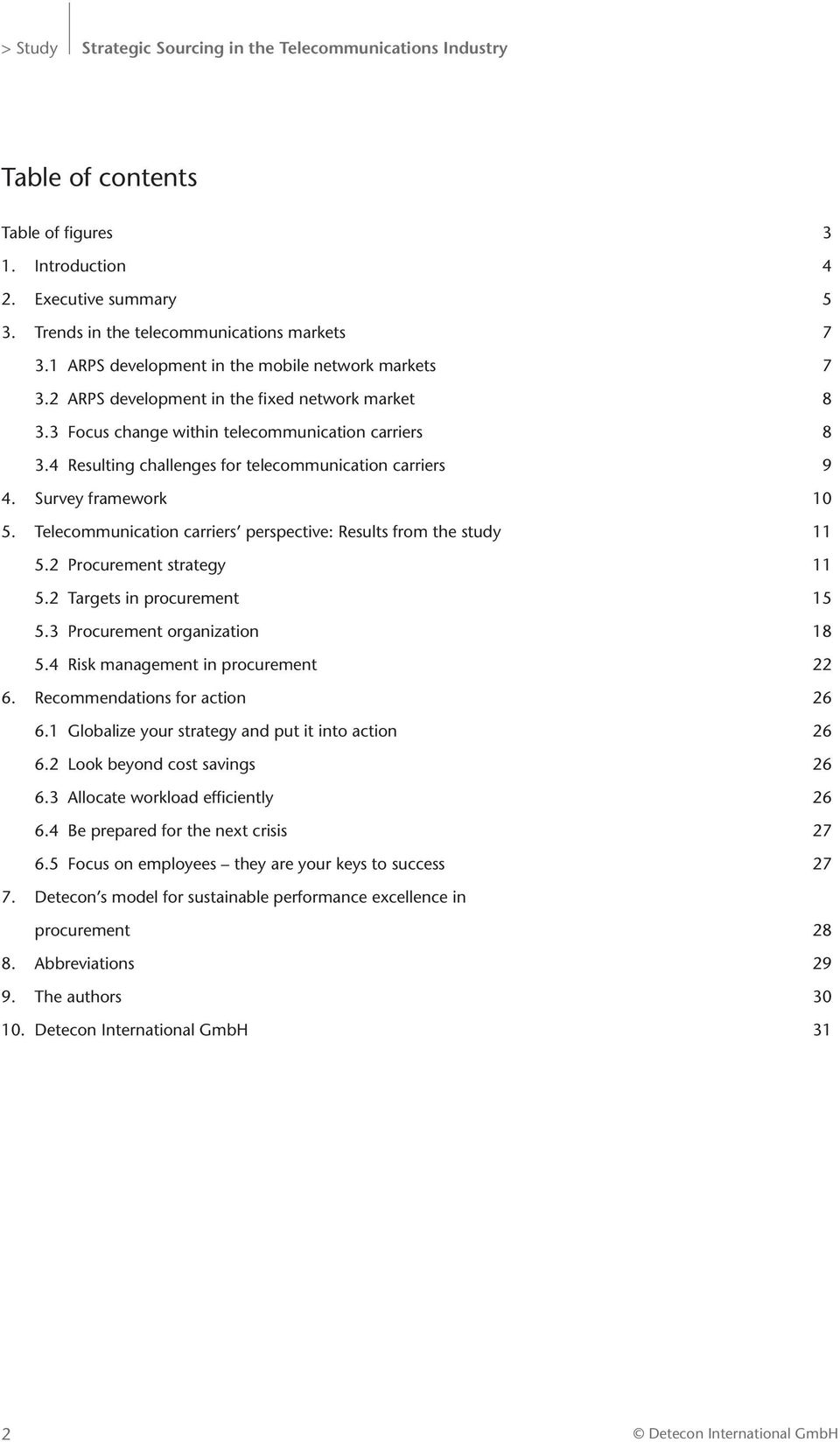
4 > Study Strategic Sourcing in the Telecommunications Industry Table of contents Table of figures 3 1. Introduction 4 2. Executive summary 5 3. Trends in the telecommunications markets ARPS development in the mobile network markets ARPS development in the fixed network market Focus change within telecommunication carriers Resulting challenges for telecommunication carriers 9 4. Survey framework Telecommunication carriers perspective: Results from the study Procurement strategy Targets in procurement Procurement organization Risk management in procurement Recommendations for action Globalize your strategy and put it into action Look beyond cost savings Allocate workload efficiently Be prepared for the next crisis Focus on employees they are your keys to success Detecon s model for sustainable performance excellence in procurement Abbreviations The authors Detecon International GmbH 31 2
5 Strategic Sourcing in the Telecommunications Industry Study < Table of figures Figure 1: ARPS in mobile network markets 7 Figure 2: ARPS in fixed network markets 8 Figure 3: Telecommunication carrier challenges in various market stages 9 Figure 4: Regions where participant s company is active 10 Figure 5: Job function of participants 10 Figure 6: Procurements leverage to the EBIT 12 Figure 7: Procurement strategy maturity 12 Figure 8: Degree of strategy implementation and ability to execute it 13 Figure 9: Procurement and company s strategy alignment 14 Figure 10: The stages of value contribution of procurement 16 Figure 11: Typical task split between operational and strategic procurement 20 Figure 12: Risk management process 22 Figure 13: The future importance of risk management 23 Figure 14: Identification and evaluation of the main risks in procurement 24 Figure 15: Detecon s model for sustainable performance excellence in procurement 28 3

6 > Study Strategic Sourcing in the Telecommunications Industry 1. Introduction For more than three decades Detecon has been investigating and analyzing international telecommunication markets as one of the world s leading management and technology consultancies. At the moment we are observing a strong interest, which is even amplified by last year s global financial crisis, from C-level representatives in procurement management as a key lever for improving financial performance. Special focus is still on how to cut costs. From this, we recognize that strategic sourcing is perceived as a core strategy for the realization of savings and management of supply risks. But the implementation of strategic sourcing only works if a globally integrated and high performance procurement function is in place. While leaders in the manufacturing industry have already implemented high performance global procurement organizations, many telecommunication carriers are lagging behind to a greater or lesser extent. Now the pressure is on their executives to transform their procurement organizations into globally performing business functions. But they do not have to reinvent the wheel. Companies like Volkswagen, Daimler and Siemens, and even leading telecommunication carriers have already accomplished the mission. This was the background for Detecon to conduct a global survey on Strategic Sourcing in the Telecommunications Industry. Our aim was to deepen the understanding for the positioning of the procurement function within telco carriers today and to give indications on improvement potential and possible financial benefits in the future. 4

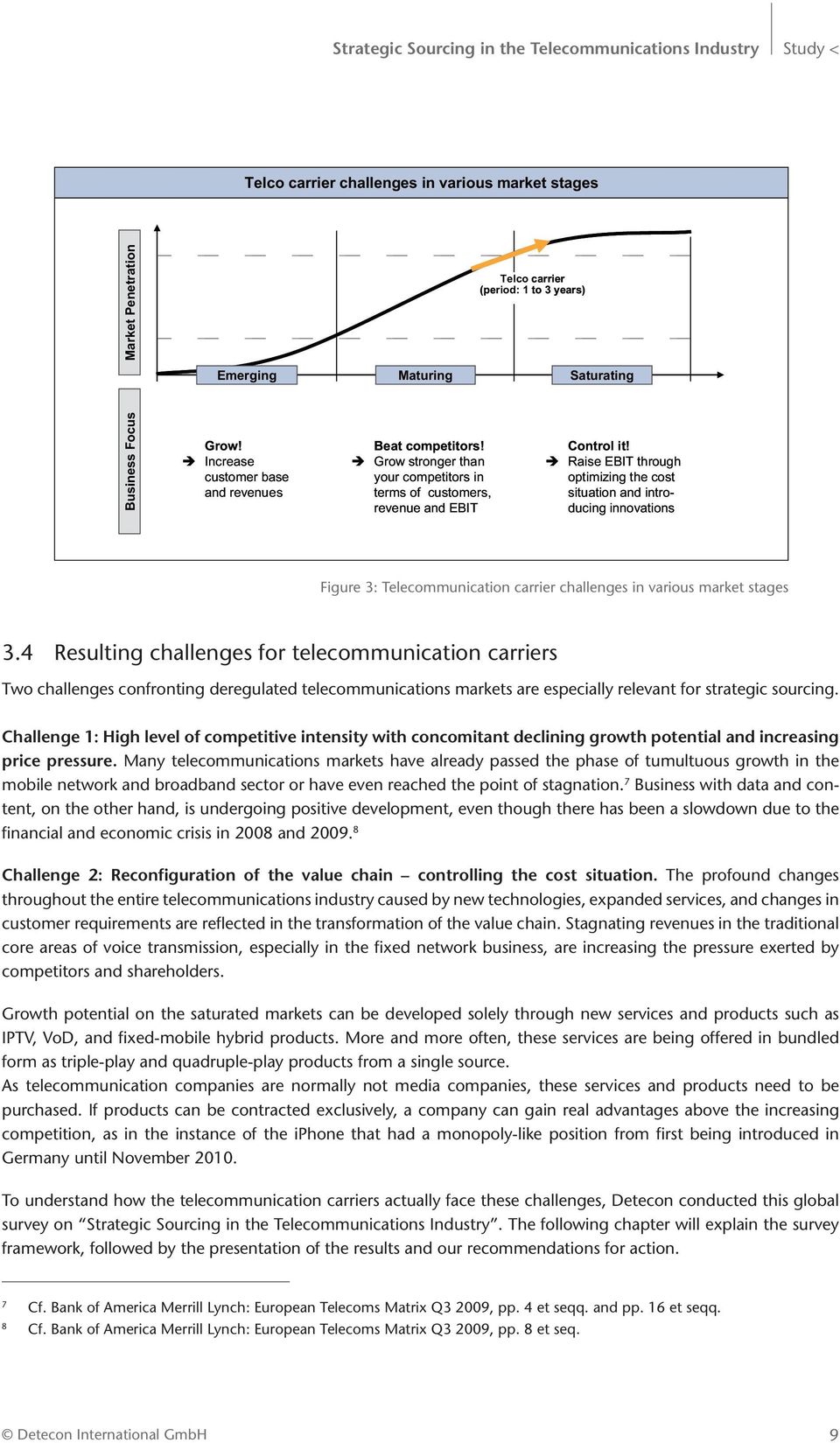
7 Strategic Sourcing in the Telecommunications Industry Study < 2. Executive summary Market driven challenges for carriers are changing. While in the past management focus, especially that of mobile carriers, was typically on growth in terms of customers, revenues and EBIT, the whole industry has moved into a more saturated stage. Today management focus is rather on raising the EBIT through cost optimization and the introduction of innovative products and services. Hand in hand with the importance of procurement, senior managements expectations towards the value contribution of their procurement function are also increasing, for instance when it comes to the creation of innovative products and services together with suppliers. But is telco procurement ready to fulfill these demands? To attain a comprehensive picture with regard to this question Detecon interviewed 48 procurement professionals from telco carriers operating in all continents about their procurement strategies with regard to global operations and integrated risk management. For reference purposes we have attached the questionnaire as annex A of this document. Key findings: Global outlook of procurement strategies The majority of participants stated that their companies have developed an overall procurement strategy as well as category specific procurement strategies and that those strategies are aligned with the internal clients. On the other hand, three fourths of the participants had to admit that those strategies are not applied to their affiliates globally and 40% had to state that their procurement employees do not have the necessary skills and methods to execute them. Accordingly, only 40% think that procurement strategies fully contribute to the company and procurement targets. Conclusion: Telco carriers have recognized the importance and potential of a well managed procurement function but they still have not achieved to implement it properly, especially on a global level. Procurement targets By far the most important target is still the achievement of cost reductions/savings. Improvement of payment terms and reduction of cost per order is weighted with medium importance. Surprisingly, the establishment/ Improvement of risk management is only ranked at a quite low importance. The question of how the importance of targets will change in the future yields more or less the same picture. Conclusion: Telco carriers focus in procurement is still on cost cutting. The importance of other objectives like risk management in procurement is not seen as a key target. This might bear disadvantages or even real business risks for the future. Procurement organization Two thirds of the participants are already working in a category-based procurement organization, while one third are part of a divisional or matrix organization. Nearly half of the participants have separated strategic and operational procurement. The majority of participants told us that their procurement organization is already acting internationally and well integrated. 5

8 > Study Strategic Sourcing in the Telecommunications Industry Only a minority of them have a CPO as part of the management board, 50% of the CPOs report to the CFO, 20% to the COO and the CEO. Only 50% have individual personnel development programs for procurement employees. Conclusion: Telco carriers procurement organizations are still not at a very advanced level. In particular, category-driven organizations and an organizational split between strategic and operational procurement, as are state of the art in other industries nowadays, are still not very common in telco procurement. Together with the relatively weak positioning of CPOs and a lack of personnel development programs for procurement employees, this might be a major reason for the weaknesses stated above. Risk management in procurement More then two thirds of the participants answered that risk management is a minor task for procurement or should be executed by other business functions. They also do not think that this will change in the future, although the majority assumes that risk management will become more important in other areas of business. Conclusion: Telco carriers have recognized the importance of risk management, but we cannot observe a clear direction as to how they involve procurement in the implementation of risk management. Recommendations: CPOs action list Globalize your strategy and put it into action: Results from the study clearly showed that CPOs have realized the necessity to set up their organizations and strategies globally. Those who have not done so yet should start soon. Look beyond cost savings: Since many procurement organizations have already fully utilized the toolkit of traditional sourcing methods, they should prepare themselves to move on: The chance to elevate the importance of procurement by delivering additional value through innovations and efficient risk management on the front border of the company is great and should not be missed. Allocate workload efficiently: Leading CPOs are linking the task of workload allocation with their globalization efforts. To share the workload on a global basis can be a clever solution. Efficiency losses, however, should also be prevented and simple outtasking or outsourcing will not bring much improvement. Be prepared for the next crisis: A mature risk management in procurement that is not understood as a necessary routine task offers great opportunities for additional procurement value-add. Focus on employees they are your keys to success: Leading CPOs are establishing attractive training programs for young talents in order to get their attention, attract them, train them, and keep them. How Detecon can help you Detecon can help you to put this all into reality. We developed our model for Sustainable Performance Excellence in Procurement from a multitude of projects and it offers a wide range of best practices, methodologies, and experiences related to the real challenges of strategic sourcing. 6

9 Strategic Sourcing in the Telecommunications Industry Study < 3. Trends in the telecommunications markets The trends and the dynamic development in the telecommunications market are the starting points for a company s sourcing strategy and they form the framework for action. This particular study takes a look at the B2C telecommunications market, which is currently undergoing far-reaching technological, organizational and competitive changes. At its core, the market is a high-performance market that is, generally speaking, technologically advanced, economically close to saturation, and highly competitive. 1 This becomes especially clear from a look at the average revenue per subscriber (ARPS) in the mobile and fixed network sector. 3.1 ARPS development in the mobile network markets Although the number of mobile network users is slowly reaching a stage of stagnation, the number of new mobile network subscribers continues to rise steadily. Mobile network penetration (number of SIM cards per capita of the population) exceeded 100% several years ago (currently 131% in Europe). 2 Additional growth is expected in this area: in Germany, for example, an average of 1.7 subscriptions per capita of the population 3 in The average revenue per subscriber in mobile networks is declining $60.00 $50.00 $40.00 $50.91 $48.57 $45.23 $46.00 $45.70 $39.96 $38.11 $38.46 $40.37 $39.28 $30.00 $25.50 $23.93 $20.00 $21.08 $19.67 $18.91 $16.13 $15.03 $14.70 $14.49 $14.24 $10.00 $11.64 $10.98 $9.09 $7.81 $8.57 $7.42 $6.64 $6.36 $6.23 $7.01 $0.00 $5.42 $5.47 $5.32 $5.70 $6.04 $5.47 $5.37 $5.75 $6.28 $ A 2005A 2006A 2007A 2008E 2009E 2010E 2011E 2012E 2013E Source: Pyramid Germany Forecast Q4/2008 Prepaid Postpaid Voice Data Figure 1: ARPS in mobile network markets This high level is explained by the fact that many users meanwhile own two or even more cell phones; moreover, there are temporary overlaps of the contract terms when users change providers. Another important reason is the growing pervasiveness of data cards (e.g. in notebooks and netbooks, 3G-sticks or mobile broadband sticks, etc.) and the steady growth of the so-called M2M (machine-to-machine) cards such as those found in motor vehicles or smart meters. 1 This is indicated by an advanced fixed-mobile convergence (FMC) and telco-media convergence (TMC), a large number of competitors, a low price level, and a high degree of mobile network and broadband penetration. 2 Cf. Bank of America Merrill Lynch: European Telecoms Matrix Q3 2009, p. 3008, 3 Cf. Pyramid Germany Forecast Q

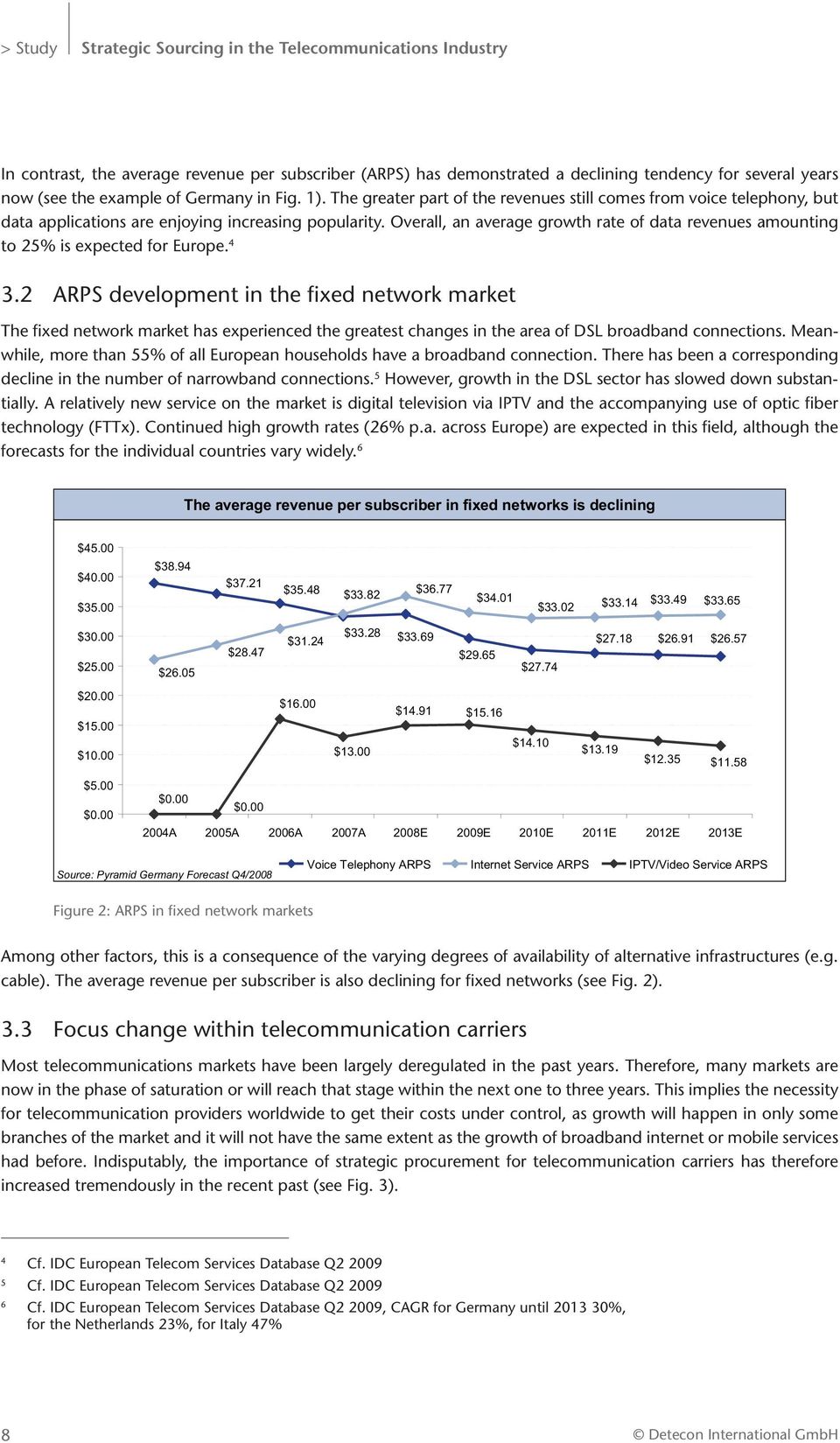
10 > Study Strategic Sourcing in the Telecommunications Industry In contrast, the average revenue per subscriber (ARPS) has demonstrated a declining tendency for several years now (see the example of Germany in Fig. 1). The greater part of the revenues still comes from voice telephony, but data applications are enjoying increasing popularity. Overall, an average growth rate of data revenues amounting to 25% is expected for Europe ARPS development in the fixed network market The fixed network market has experienced the greatest changes in the area of DSL broadband connections. Meanwhile, more than 55% of all European households have a broadband connection. There has been a corresponding decline in the number of narrowband connections. 5 However, growth in the DSL sector has slowed down substantially. A relatively new service on the market is digital television via IPTV and the accompanying use of optic fiber technology (FTTx). Continued high growth rates (26% p.a. across Europe) are expected in this field, although the forecasts for the individual countries vary widely. 6 The average revenue per subscriber in fixed networks is declining $45.00 $40.00 $35.00 $38.94 $37.21 $35.48 $33.82 $36.77 $34.01 $33.02 $33.14 $33.49 $33.65 $30.00 $25.00 $20.00 $15.00 $10.00 $5.00 $0.00 $31.24 $33.28 $33.69 $27.18 $26.91 $26.57 $28.47 $29.65 $26.05 $27.74 $16.00 $14.91 $15.16 $13.00 $14.10 $13.19 $12.35 $11.58 $0.00 $ A 2005A 2006A 2007A 2008E 2009E 2010E 2011E 2012E 2013E Source: Pyramid Germany Forecast Q4/2008 Voice Telephony ARPS Internet Service ARPS IPTV/Video Service ARPS Figure 2: ARPS in fixed network markets Among other factors, this is a consequence of the varying degrees of availability of alternative infrastructures (e.g. cable). The average revenue per subscriber is also declining for fixed networks (see Fig. 2). 3.3 Focus change within telecommunication carriers Most telecommunications markets have been largely deregulated in the past years. Therefore, many markets are now in the phase of saturation or will reach that stage within the next one to three years. This implies the necessity for telecommunication providers worldwide to get their costs under control, as growth will happen in only some branches of the market and it will not have the same extent as the growth of broadband internet or mobile services had before. Indisputably, the importance of strategic procurement for telecommunication carriers has therefore increased tremendously in the recent past (see Fig. 3). 4 Cf. IDC European Telecom Services Database Q Cf. IDC European Telecom Services Database Q Cf. IDC European Telecom Services Database Q2 2009, CAGR for Germany until %, for the Netherlands 23%, for Italy 47% 8
11 Strategic Sourcing in the Telecommunications Industry Study < Telco carrier challenges in various market stages Business Focus Market Penetration Emerging Grow! Increase customer base and revenues Telco carrier (period: 1 to 3 years) Maturing Saturating Beat competitors! Control it! Grow stronger than Raise EBIT through your competitors in optimizing the cost terms of customers, situation and intro- revenue and EBIT ducing innovations Figure 3: Telecommunication carrier challenges in various market stages 3.4 Resulting challenges for telecommunication carriers Two challenges confronting deregulated telecommunications markets are especially relevant for strategic sourcing. Challenge 1: High level of competitive intensity with concomitant declining growth potential and increasing price pressure. Many telecommunications markets have already passed the phase of tumultuous growth in the mobile network and broadband sector or have even reached the point of stagnation. 7 Business with data and content, on the other hand, is undergoing positive development, even though there has been a slowdown due to the financial and economic crisis in 2008 and Challenge 2: Reconfiguration of the value chain controlling the cost situation. The profound changes throughout the entire telecommunications industry caused by new technologies, expanded services, and changes in customer requirements are reflected in the transformation of the value chain. Stagnating revenues in the traditional core areas of voice transmission, especially in the fixed network business, are increasing the pressure exerted by competitors and shareholders. Growth potential on the saturated markets can be developed solely through new services and products such as IPTV, VoD, and fixed-mobile hybrid products. More and more often, these services are being offered in bundled form as triple-play and quadruple-play products from a single source. As telecommunication companies are normally not media companies, these services and products need to be purchased. If products can be contracted exclusively, a company can gain real advantages above the increasing competition, as in the instance of the iphone that had a monopoly-like position from first being introduced in Germany until November To understand how the telecommunication carriers actually face these challenges, Detecon conducted this global survey on Strategic Sourcing in the Telecommunications Industry. The following chapter will explain the survey framework, followed by the presentation of the results and our recommendations for action. 7 Cf. Bank of America Merrill Lynch: European Telecoms Matrix Q3 2009, pp. 4 et seqq. and pp. 16 et seqq. 8 Cf. Bank of America Merrill Lynch: European Telecoms Matrix Q3 2009, pp. 8 et seq. 9
12 > Study Strategic Sourcing in the Telecommunications Industry 4. Survey framework Method and respondents of the study We interviewed 48 procurement employees from different telecommunication carriers for our study using face-toface, online, and telephone interviews. The questionnaire contained 34 questions in total, whereof seven were of a statistical character. Those 48 persons interviewed represented mainly telco carriers that were active in more than one region, as the following graphics shows. Where is your company active (with subsidiaries/daughter companies)? Europe North America South America Australia/Oceania Asia Africa Middle East 0% 20% 40% 60% 80% Figure 4: Regions where participant s company is active 9 Moreover, 54% of the participants worked in top-level procurement functions, and another 31% worked in middle management procurement functions, so the answers represent the opinions and status from procurement leaders point-of-view (see Fig. 5). What is your job function? 3% 12% 54% 31% Procurement support function Procurement employee Middle management procurement Top-level procurement function Figure 5: Job function of participants 9 Multiple answers possible 10

13 Strategic Sourcing in the Telecommunications Industry Study < 5. Telecommunication carriers perspective: Results from the study In this chapter, the responses of the interviewed telecommunication carriers regarding their company s state of procurement, planned changes and upcoming trends in the areas sourcing strategy, targets, organization, and risk management will be reflected and evaluated. 5.2 Procurement strategy Background A procurement strategy is an important element of the continuous circle of strategic sourcing which typically consists of the following steps: Strategy preparation Spend analysis identify what amount of money is used to purchase materials and services needed Supply market analysis find out, which companies can offer the materials and services your company needs and get to know their pricing Strategy definition Procurement strategy develop a strategy where to buy what, considering demand and the supply situation, as well as the company s strategy and targets, while minimizing risks and costs. Target setting agree on adequate procurement targets to work on Strategy execution Tendering tender materials and services needed Negotiation and contracting negotiate with suppliers that suit your procurement strategy and contract them to provide your company with materials and/or services Reporting track results against targets Restart assessment 11

14 > Study Strategic Sourcing in the Telecommunications Industry This implies that all procurement actions should contribute to the procurement and company strategy and its targets. Especially in the telecommunication market procurement and its strategy have recently been boosted in terms of importance: Many CEOs have asked their CPOs to support them in achieving the company s financial targets. Having a closer look to the lever that savings can have, it becomes obvious why this is so: Procurements leverage increases EBIT directly Sales 100 USD Expenses 50 Spend reduction = 10% 45 EBIT 10 EBIT = +50% 15 Year 1 Year 2 Other Cost + expenses Purchase Volume EBIT Figure 6: Procurements leverage to the EBIT Normally one would now expect strategic procurement to already have the highest priority in most companies and to be fully implemented into the whole framework, especially after the financial crisis has cut down revenues and put pressure on results. But is this really what the situation is like? Results from the study Participants were asked if their company has an overall procurement strategy. More than 93% of the participants replied with a positive answer, leaving only 7% that stated not to have an overall strategy. The results of the following question moreover showed that nearly 88% of all participating companies do not only have an overall procurement strategy, but also detailed procurement strategies broken down in each category, for example for network equipment, for IT, for marketing and other indirect spend as well as construction works and devices. We followed up with the question if category strategies were also aligned with internal clients, e.g. with IT Operation or Sales & Marketing. More than 85% answered with yes (see Fig. 7). Does your company have an overall procurement strategy No 7% Does your company have procurement strategy per category? No 13% Are the procurement strategy per category aligned with your internal client? No 15% 93% Yes 88% Yes 85% Yes Figure 7: Procurement strategy maturity Results that amount to > 100% are due to rounding 12

15 Strategic Sourcing in the Telecommunications Industry Study < So for a long time, purchasing has only been the vicarious agent of production, primarily concerned with responding to short-term demands. But as most markets are close to saturation now, the majority of the telecommunication carriers have moved strategic procurement more into focus. Additionally, the direct linkage of savings in procurement and their effect on earnings came into CEO minds, as it became apparent that suppliers influence on delivered services was increasing heavily and indeed impacted companies success. Globalization, on the other hand, brought new opportunities in previously untapped sourcing markets and made procurement fancy and interesting. The potential that could be levered through strategic procurement in so-called low-cost countries grew steadily. As a result, strategic procurement has arrived in the telco industry and recently gained more attention, but is it already fully in charge, integrated into the company s strategy framework and able to execute the strategies? With the aim of clarifying this issue, our next question was if the procurement employees have the necessary skills to execute the defined category strategies. Only 62% of the participants answered in the affirmative. This result came unexpected, as most participants were management level procurement managers and as such were in a position to choose their employees and have them participate in procurement trainings. This shows that qualified procurement employees are still rare and hard to find. This holds even more true with requirements still rising, for example for dual functions like advanced purchasing engineers. These employees have interface functions between technicians and procurement and they have to be able to leverage technical and economical interests. But what surprised most is that in only one of four cases the category strategies are valid and implemented groupwide across all subsidiaries and daughter companies (see Fig. 8). This leaves tremendous room for improvement: Conditions could be adjusted to the lowest total price in the first step, before bundling demands with consistent terms and conditions for even better prices. 100% 75% 38% No Yes 77% 50% 25% 62% 0% 23% Do the procurement strategies per category apply to all your affiliates worldwide? Do the procurement employees have the necessary skills and methods to execute the procurement strategies per category? Figure 8: Degree of strategy implementation and ability to execute it 13

16 > Study Strategic Sourcing in the Telecommunications Industry Our last question regarding the procurement strategy was about its contribution to company targets. Respondents said that in 53% of the companies their category strategies would fully contribute to the company and procurement targets. Another 39% said, they would at least contribute partly to the company and procurement targets, while 8% said there is no clear contribution. Once again, this leaves ample room for improvement. If a carrier decided to become the market leader in terms of marketing, e.g. with regard to quality-of-service and bandwidth offered, that carrier may find it worthwhile to align the marketing strategy with a procurement strategy that aims to achieve annual cost reductions of 15% or more. Clearly, those strategies would interfere in categories like network equipment or IT, while the procurement targets for the purchase of indirect materials and services may remain high with no impact on customer s quality experience. Do these procurement strategies per category contribute to the company s and procurement target? 8% Yes, they contribute fully No, there is no clear contribution They contribute partly 39% 53% Figure 9: Procurement and company s strategy alignment Implications Compared to past years, procurement s importance and its implementation into the whole framework have made some advance. Telecommunication carriers are aware of the strategic significance of a working procurement department. In terms of maturity, procurement organizations in telecommunication carriers have laid the basics and it seems that they are now struggling with questions of company-wide implementation and with getting the right people on board. These problems are typical not only for telecommunication carriers but for any company that is implementing and developing procurement strategies. Various articles have been published about the problems of finding suitable employees for procurement. And these problems may even become worse: On the one hand, requirements are rising with tasks growing increasingly complex and procurement employees needing to involve themselves even more in technical matters. On the other hand, procurement had a negative image in many companies in the past and, contrary to marketing and sales, it was not seen as a core function of most companies. The results can even be observed at universities, where students specialize in marketing and sales, accounting and finance, or HR, but very seldom on logistics and procurement. 14

17 Strategic Sourcing in the Telecommunications Industry Study < Implementing category strategies group-wide could help many companies to leverage their full purchasing power among the group on a short-term notice. Adjusting procurement conditions is a first and easy step forward. Differing terms and conditions in contracts for the same materials and services from the same supplier but in various countries are only in the interest of the supplier, who would not profit from more transparency. But from the point of view of the purchasing company, this is a low-hanging fruit that can be easily reaped, improving financial results immediately. It should nevertheless be added that it requires more effort to fully implement the category strategy. Very often, procurement organizations are rooted in the local organization or company, making it difficult to centrally define the strategy and drill-it down to each unit. It is not unlikely for local organizations to want to keep control over this function and to be able to pursue their own ideas and interests. A clever approach is therefore necessary to arrive at a uniform procurement strategy with regard to the supply market and single suppliers. Group wide bundling organizations can for instance help to solve this problem in an elegant way. 5.2 Targets in procurement Background In economically difficult times characterized by declining sales or shrinking market shares as a result of decreasing consumption, risk management and contributions to improve the bottom line are vital to stabilize the enterprise s economical basis and to ensure survival in highly dynamic markets. Both these goals are the responsibility of the CPO, right at the top of his/her agenda. In order to achieve major contributions from the purchasing department to the company s overall bottom line and business stability, he/she has to overcome some well known challenges. The top four of them are listed below: 1. Position procurement as a valued business partner within the enterprise, delivering transparent benefits to the company s bottom line and creating value for internal customers. 2. Establish powerful performance measures for strategic and operational procurement to identify and realize further improvements in effectiveness and efficiency in procurement processes, organizational structure and supporting IT. Also improve responsiveness to unexpected developments. 3. Achieve major improvements in risk reporting, especially for key suppliers. Safeguarding a constant supply stream from key suppliers within the supply chain is vital for the enterprise s market success. 4. Ensure enduring high performance in procurement by establishing continuous improvement and benchmarking processes. Today telco carriers focus on two dimensions when defining procurement s value contribution: From cost reduction to sustainable value contribution (mainly derived from strategic sourcing function) From efficiency to effectiveness (mainly derived from operational procurement function) 15

18 > Study Strategic Sourcing in the Telecommunications Industry Procurements value contribution One-dimensional cost optimization Cost price Frame contracts Cost optimization proc. department Process cost reduction Usage of eauctions/ catalogues Reduction of capital locked up Cost optimization in the company Evaluation of Total cost of Ownership Process costs company wide Procurement integration into development Initiation of outsourcing projects Value creation in procurement Business enabling through suppliers Supplier integration into development Innovation through supplier competencies Cost reduction EBIT increase Efficiency Effectiveness Figure 10: The stages of value contribution of procurement Best-in-class telecommunication carriers contribute sustainably to the companies profits while performing the nonvalue-contributing activities streamlined and effectively. Results from the study Participants of the study were asked to state the five most important targets for the procurement organization of their company today whereby the target assessment covered a range from highest relevance (=1) to lowest relevance (=5). The most important value drivers were categorized and proposed such as value contribution, processes, organization or supply chain optimization. Participants were also asked to suggest additional targets. Unsurprisingly, nearly 80% of the participants evaluated the target category Value Achieve cost reduction or savings as being of highest or high importance for the procurement organization (score of 1.09 on average out of 5). This is obviously the main target for most procurement organizations in the telecommunication business as well as for most other industrial or service companies. Another important target with respect to value contribution appears to be the improvement of payment terms. With an average score of 2.56 out of 5, the interviewed participants said the improvement of payment terms is of middle towards highest relevance for their respective procurement organization. Process optimization is the next important category regarding procurement s contribution to the overall business targets and has a major impact on procurement efficiency. The participants were asked if the reduction of average cost per order is significant as a procurement objective. With an average score of 2.33 the participants evaluated this target as being highly relevant, ranking it among the top three of the most relevant procurement targets. Furthermore the participants were asked if the increase of efficiencies in procurement is an important target for a procurement organization: this resulted in 2.75 relevance ( high to medium ). 16

19 Strategic Sourcing in the Telecommunications Industry Study < Financial crisis left a severe footprint on supplier markets: corporate insolvencies in Germany were set to surge powerfully in 2009 (+ 19.5%) and 2010 (+ 11.1%), totalling an expected number of 38,900 insolvencies in This definitely has a strong impact on each telecommunication provider s global supplier base: a comprehensive supplier risk management is the instrument of choice. To our surprise the question if the establishment or improvement of risk management was a major target lead only to middle to low relevance (3.75 out of 5) by the participants of our study. It appears that in general risk management is treated quite poorly in the telecommunication business. We looked closer into this subject to attain a more detailed picture. For more results please refer to section 5.4 of this study. Considering the mitigating worldwide financial crisis and projecting the current situation into the future we also wanted to know from the participants how important the following targets can be expected to become in the future: Reorganize and harmonize the procurement organization Exploit the financial crisis and achieve additional cost reductions or savings Be independent from the current financial crisis and improve risk management in procurement Increase the efficiency of operational procurement processes Attract and train skilled employees Increase procurement s sustainability Again, the possible answers ranged from 1 to 5 with 1 meaning very important and 5 meaning not important at all. The exploitation of the financial crisis and the achievement of additional cost reductions or savings was by far the top response: 93% of the participants were of the opinion that this target will be very important or important (average score 1.36), followed by increasing the efficiency of operational procurement processes with a score of Top answer number three related to the mitigating financial crisis and the improvement of risk management in procurement: with an average score of 2.50 this response indicates the growing importance of risk management in procurement. Financial crisis has left a permanent impression. Implications In general, value contribution of procurement in the telecommunication industry has not changed much in the aftermath of financial crisis. The achievement of cost reductions and savings is still the number one target in procurement; other strategic objectives remain secondary. Some telecommunication companies did exploit the financial crisis to achieve additional savings but they lack a systematic and long-term approach. Almost all telecommunication carriers have experienced (also incumbent) suppliers facing financial problems and leaving some suppliers with no choice than insolvency. With no comprehensive supplier risk management in place, telecommunication carriers have to fire fight in the event of imminent loss of strategic suppliers, thus endangering the contribution of procurement to overall business targets. In a double sense this leaves procurement in a fatal deadlock with regards to value contribution: fire fighting consumes a lot of time leaving less time to achieve savings. But there is a bright light at the end of the tunnel: the risks have come into focus now, and the results of the study indicate that telecommunication carriers will use the time well to be prepared for the next financial crisis, whenever it will approach. 17
20 > Study Strategic Sourcing in the Telecommunications Industry 5.3 Procurement organization Background During times of financial crisis, performance-related challenges for CPOs have become even greater and they also differ significantly from those in the past, growth-driven years: Global consolidation and management of a global procurement function Position the procurement function and its value contribution within the enterprise Increase collaboration with other enterprise functions Contribute to the company s bottom line by cost-cutting in procurement Manage mergers/de-merges from procurement s point of view In most enterprises, CPOs have changed the procurement organization over the last years by implementing leadbuyer approaches across their enterprise and by establishing preferred supplier strategies. Automation rates were improved by dedicated IT projects and by implementing common commodity classifications within the procurement units of each business unit. Facing the challenges mentioned above, most CPOs have realized that the achieved improvements in a national organization now will have to be lifted to a global scale in terms of processes, governance models, and IT. Furthermore, the successful establishment of a global procurement organization requires a broader involvement of procurement in the processes and networks of the enterprise at large. Experiences from huge procurement projects in blue-chip companies across several industries have pinpointed a considerable need for action concerning this issue: Organizational structures are often lacking the amount of flexibility and responsiveness necessary for a successful implementation of global sourcing strategies in more and more dynamic supplier markets. To benefit from sourcing opportunities in global markets, agile sourcing officers are needed, with a well-gauged and approved balance of power between regional and central competencies in combination with expert knowledge about individual markets. The procurement organization seldom reflects the overall strategy and mission of the procurement function and is still constrained by traditional structures and hierarchies. Although the position of the procurement function within the enterprise is becoming more and more important due to the increasing share of material cost and purchased services, existing collaboration models for the procurement function are still very limited. With the exception of engineering and production departments the traditional partners of procurement collaboration with other departments is seldom taking place. How is the telecommunication business prepared to face such challenges? 18
21 Strategic Sourcing in the Telecommunications Industry Study < Results from the study The participants of the study were asked about their current procurement organization: is it set up by function/ category, by division, or by a matrix organization? A fraction of 64.3% of the participants replied to have a Functional/category-based procurement organization in place which matches with our expectations, leaving 21.4% of the participants with a divisional set-up and another 14.3% with a matrix organization. The aim of our next question was to project the current status on future developments: Is a reorganization of your procurement organization already being planned? The responses were spread almost evenly over the three potential answers we proposed. No, we already have the best organization in place replied 42.9% of the participants, while 35.7% have plans in the mid-term to reorganize: Yes, reorganization will happen in the next months. This leaves a rest of 21.4% with ideas but imprecise plans to carry out reorganization. One of the key questions with regard to procurement organizations is the split between strategic sourcing and operational procurement as this, amongst others, allows to increase focus on value-adding tasks. With regard to your current procurement organization: Is your organization divided into a strategic procurement department and an operational procurement department? was the question we asked. According to the participants 47.1% have already implemented the split of strategic and operational procurement, whereas 35.3% do not separate strategic and operational functions yet, and another 17.6% of the participants provide no response at all. Interestingly, those telecommunication carriers who do not have the split of strategic and operational procurement organization in place are also not planning to do so. Only 12.5% of those companies have plans to execute the split. Procurement organizations in the Telecommunication industry are well integrated and act internationally: 85.7% of the responding participants replied with a yes to the according question regarding company-wide/transnational activity. Furthermore, procurement organizations in the telecommunication industry are claiming additional responsibilities and tasks on a company-wide basis: 50.0% of the responding interview partners have plans to extend the responsibilities of their procurement department within the next twelve to 18 months. Which relevance does the procurement function have for the entire company? Is the procurement function prominently represented on the board of directors? Telecommunication carriers still need to catch up to best-inclass industries: only 7.1% of the participants responded that the CPO of their company is part of the management board, whereas, especially in the automotive industry, best-in-class companies have their procurement CPOs directly represented on the managing board. According to our query, the vast majority of the CPOs (50.0%) report directly to the CFO, followed by the COO and CEO (21.4% each). This implies that a) the relevance and the strategic role of the procurement function are not sufficiently acknowledged, and b) the focus and target setting of procurement is still the contribution to financial targets. Another interesting aspect with respect to procurement organizations is the set up of procurement staff. We wanted to know from the participants what kind of professional background the current procurement staffs have. 27.8% of the procurement staff members have a technical background, followed by a logistics background (25.6%), and 17.7% with a financial background. 33.9% come from other functions. 19
22 > Study Strategic Sourcing in the Telecommunications Industry We also wanted to know if the participating telecommunication companies offer an individual personnel development program for procurement employees. The answers showed no clear picture at all: exactly one half (50.0%) of the companies have such a development program in place, whereas the other half does not. Furthermore, those companies that have such development programs established were asked what the main focus of the program is. The top answer came with no surprise: 46.7% of the participants stated that the development of negotiation skills was the main focus for their procurement employees. Second top answer was the development of technical skills with 28.3%, followed by the development of social skills (24.0%). Less relevant were the development of procurement-related system know-how and intercultural skills. Implications With regard to procurement organizations, customer projects proved that best-in-class companies are characterized by the following features: Separation of strategic and operational procurement to increase focus on valuable tasks Setup of a global sourcing unit bundling purchasing volume from all subsidiaries worldwide Establishment of interdisciplinary teams in the product development process, including employees from marketing, product development, production, and procurement Focus Value driver Strategic Sourcing Bundling of purchasing volume for each category Establishing of enterprise wide category management Increasing category, supplier and market expertise on global markets Implementation of global key accounts for important suppliers Savings & Value contribution Operational Procurement Increasing process efficiency through streamlined processes and automation Bundling of administrational tasks to further improve efficiency and gain more air time for a closer collaboration with internal customers Continuous improvement of procurement processes and applications Efficiency & Quality Figure 11: Typical task split between operational and strategic procurement In these days the functional set up of the procurement function based on categories (or commodities) is state of the art not only for globally acting businesses. Not all telecommunication providers have established such functional organization but some of them have plans to do so. This is an essential precondition to leverage full purchasing power, for instance to take advantage of volume bundling opportunities or global sourcing opportunities. 20
23 Strategic Sourcing in the Telecommunications Industry Study < A split between strategic and operational procurement tasks only makes sense if the procurement organization acts in a category-based way. Telecommunication providers have not fully established such a split and also do not plan to do so. Today, those companies have not yet laid the foundations to enable such a split and thus to leverage the value contribution of a streamlined procurement organization. As half of our interview partners expect an extension of procurement responsibilities in the future and also act on a global level, thus implying a massive increase of procurement s contribution to business targets, such companies have to fix the basics first. Best-in-class companies have procurement organizations that are directly represented on the managing board with direct access to the decision makers in the business. In the vast majority of telecommunication companies the procurement function is not directly represented on the board of directors, which implies that the relevance and the strategic role of the procurement function are not sufficiently acknowledged in the telecommunication business. Best-in-class enterprises have realized the increasing importance of procurement. Procurement is gaining more responsibility, steering internal and external logistics and contributing with excellent know-how about supplier markets and products in early stages of the product development process. Teamwork in interdisciplinary project teams has replaced traditional administrative procurement activities. CPOs are facing the challenge to strengthen the position of procurement within the enterprise s top management. In order to achieve this, they have to emphasize procurement s increasing share in the overall value creation process. Telecommunication providers have to catch up urgently to close the gap to best-in-class enterprises. Some of them are on the right track but they still have a long way to go. 21
24 > Study Strategic Sourcing in the Telecommunications Industry 5.4 Risk management in procurement Background Increasing customer requirements and global competition keep a constant pressure on companies to optimize the efficiency of their supply chain. Outsourcing, lean manufacturing and other business strategies can help to minimize costs, but may also stretch the supply chain to its breaking point. Managing the trade-off between supply chain efficiencies and increasing supply chain risks becomes a main business challenge to assure future success. Especially the financial crisis has demonstrated the vulnerability of supply chains and made risk management in procurement even more important. The question, of course, is how to manage these growing risks to which today s highly efficient supply chains are vulnerable, particularly when the chain stretches around the world. The answer lies in understanding the dynamic on how risks have changed, in identifying risks that can provoke supply chain disturbances and in taking appropriate measures to prevent them from harming your business. The implementation of a formalized risk management process should be the first step to manage professionally the increasing risks in procurement. The risk management process typically consists of the following five steps in a revolving cycle and is an important element of strategic sourcing: 1. Knowing and recognizing potential risks arising from quality, supply chain, sustainability, and financial risks. 2. Identifying risks actually faced by procurement based on company s business model. 3. Evaluate existing risks by considering the probability and possible amount of damage. 4. Derive and evaluate measures to manage the determined risks. 5. Implement measures and monitor implementation continuously and verify the effect. Risk management process Knowing and Recognizing Risks Identifying Actual Risks Implementing and Monitoring Measures Supplier Risk Management Evaluating Existing Risks Deriving and Evaluating Measures Figure 12: Risk management process Known supply risks like quality defects due to low-cost country sourcing, fluctuating commodity prices, volatile currency exchange rates, and an increasing number of insolvencies point out that risk management should be on the agenda of every procurement organization. But is this the reality in telecommunication businesses? 22
25 Strategic Sourcing in the Telecommunications Industry Study < Results from the study The participants were asked about the current and future importance of risk management in procurement. Surprisingly, only 28% of the participants replied with a positive answer for the current importance of risk management as an essential part of procurement. The remaining 72% of the participants said that risk management in procurement is one of the minor tasks (36%) or should even be executed by other business functions (36%). When questioned on their future expectations about the importance of risk management in procurement, the participants however revealed that gradual change is taking place in their mindsets. The majority of 79% of the participants believe that the importance of risk management will increase, although 57% still think that it is not going to be one of the main tasks of a procurement employee (see Fig. 13). Nevertheless, the assumption that risk management in procurement will play an important role in the future was proved right. The fact that risk management tasks are not regarded as tasks that should take up the main share of the operative workload implies that a fully automated risk management process might be a helpful instrument. What is your opinion about the future importance of risk management (RM) in procurement? 0% 21% 21% RM will become more important and one of the main tasks of the procurement employee RM will become more important than today, though not one of the main tasks of a procurement employee The importance of RM in procurement will not change The importance of RM in procurement will decrease 58% Figure 13: The future importance of risk management To take a closer look at how risk management is implemented, the participants were asked if a formalized risk management process already exists in procurement. The response was a mixed picture. Only 57% stated that a standard process exists in their organization, and 29% of these respondents admitted that it was only performed in isolated instances and not as a continuous task. The remaining 43% of the participants gave the negative answer of having no implemented risk management process. Over and above, 70% of the abstinent companies are not even planning to introduce a risk management process within the next twelve months. Only 29% of the responding companies have a risk management process that is implemented as a continuously revolving cycle and 42% at most are planning to have a real standard risk management process installed in the next twelve months. This is a devastating and astonishing result in regards of practical implementation, especially as the general importance of risk management in procurement is unquestionably acknowledged. In other words, telecommunication carriers have realized the importance of risk management in procurement, and it seems that they are now struggling with the question to what extent and resource employment a risk management process makes sense. This unexpected gap in the implementation process creates enormous potentials for risk management to become an essential success factor and differentiator in the telecommunication industry. 23
26 > Study Strategic Sourcing in the Telecommunications Industry To better understand the practical risk management process, we asked the participants to rank and evaluate the importance of the main risks in procurement. Unsurprisingly, the classical delivery failure and quality risks are commonly rated as most important risks (see Fig. 14). As demonstrated by the Toyota gas pedal scandal, quality risk management is essential to prevent reputation damage. Besides this, especially bankruptcy is a risk that is becoming more and more significant. Unforeseen bankruptcies within the supply base caused by the global recession bring this issue back into the focus of risk management in procurement. Therefore, in order to avoid business disturbances, it has become vital to analyze the financial stability of second-tier suppliers, particularly when several main suppliers rely on one sub-supplier. Another result is that a good share of the participants evaluated compliance risks as very important or most important risks. This adds a new dimension to traditional risk management. If news broke, for instance, that one of your suppliers employed children, this would most probably have a dramatic impact on customer behaviour and would possibly damage the reputation of your own company. These presented risks were identified by our participants as the most dangerous risks in the telecommunication industry and they should therefore be managed closely to prevent harm to your company. 14 What do you think are the most important risks your company should take care of? Quality risks Delivery failure risks Geopolitical risks Compliance- or sustainability risks Currency risks Bankruptcy risks Other risks most important risks very important less importance risks Figure 14: Identification and evaluation of the main risks in procurement After identifying the relevant risks, the next challenges in a risk management process are to develop appropriate counter measures as well as track and control their implementation. Fortunately, 70% of the surveyed companies with a risk management process answered that they develop counter measures and monitor their implementation. This proves that those companies that have recognized the importance of risk management in procurement are working on implementing the full revolving cycle of a professional risk management process. 24
27 Strategic Sourcing in the Telecommunications Industry Study < Implications The supply chain has become more global and complex, presenting greater challenges and risks. A professional risk management process in procurement can offer an improved focus on risks with the benefit of effective risk mitigation. This includes cost avoidances associated with reduced disruptions and reduced recovery time when disturbances are unavoidable. The results of this survey show that the respondents generally share this opinion and expect that risk management will become an important success factor in procurement. Although most of the respondents recognized the importance of risk management, only few companies have implemented a continuous risk management process. Such a gap between acknowledgement and action is typical in a transformation phase, especially if accompanied by major investments that are necessary for implementing a professional process with a highly automated risk management cockpit. In a dynamic environment like the telecommunication industry the spectrum and diversity of risks are growing steadily. To keep an eye on quality issues is still important today, but by no means sufficient to protect your business from harm. Delivery failures as well as bankruptcy and compliance risks can reduce your company s revenue, inflate your costs and cut into your market share. In today s high-risk world a professional risk management is a valuable long-term investment and can strengthen competitive advantage. 25
28 > Study Strategic Sourcing in the Telecommunications Industry 6. Recommendations for action 6.1 Globalize your strategy and put it into action In a globalized business world, where most suppliers have branch offices and factories in many countries, like most of their customers, there is no doubt that procurement organizations need to be set up globally. The same applies to sourcing strategies and their execution if methods and targets such as bundling and best country sourcing shall be implemented and achieved. Results from the study clearly showed that CPOs have realized the necessity to set up their organizations and strategies globally but that they have not done so yet. Though they do not yet have a manual at hand, the majority of them are convinced that they have aligned their teams for entering the process in the near or middle future. 6.2 Look beyond cost savings As procurement has been established as a core function in most companies, cost savings of course were and are the target number one on the to-do list. And we will not see any change here, due to the similar fact that turnover and margin have been and always will be the number one sales targets. As many procurement organizations have mature strategies and already use the full toolkit of traditional sourcing methods, they should prepare themselves to move on: The chance to immerse its importance by delivering additional value through innovations and efficient risk management on the front border of the company is great. 6.3 Allocate workload efficiently Good procurement employees are hard to find, and maybe even harder to keep in your company. They are a rare species that has not been grown and much fostered to in the past, and universities also have no ready-made curricula for teaching procurement as an independent and important subject in its own right. If CPOs have good people on their team, they must make sure to satisfy their employees needs, whatever these might be. While some high flyers may be interested in a fast career path, other solid workers may be looking for life-work balance, delivering good results but with limits in terms of their time afforded. Leading CPOs are linking the task of personnel development and workload allocation with their globalization efforts. To share the workload on a global basis can be a clever solution. Efficiency losses, however, should also be prevented and simple outtasking or outsourcing will not bring much improvement. 26
29 Strategic Sourcing in the Telecommunications Industry Study < 6.4 Be prepared for the next crisis Nobody really was prepared for the last financial crisis and only few have predicted it. Much the same, a new crisis can start every moment without warning and nobody knows when it will happen. Intelligent procurement can help reduce costs and for the company. Unintelligent pocurement, on the other hand, can result in superfluous purchases and spendings. Obviously, procurement can only be an asset if risk management in procurement is not regarded as a necessary routine task, but rather implemented intelligently, as a mature task that will ensure open eyes for risks among those involved. CPOs who work together on good terms with their CFO use the experience of financial departments, e.g. for natural hedging or the direct linkage of suppliers payment performance reports with the order system. 6.5 Focus on employees they are your keys to success Apart from sales and distribution, there are no other departments in a company where a combination of strategic thinking, rhetorical and negotiation skills, as well as the ability to differentiate between important and unimportant matters (e.g. with regard to the relevance of supplier innovations) is called for and crucial for the success of its department. CPOs know that well. They know which abilities a procurement employee should have and also how hard it is to find suitable employees. Good CPOs try to establish attractive training programs for young talents in order to get their attention, attract them, train them, keep them, and develop them. 27
30 > Study Strategic Sourcing in the Telecommunications Industry 7. Detecon s model for sustainable performance excellence in procurement The study Strategic Sourcing in the Telecommunications Industry gives an overview of future procurement strategies, targets, organization, and risk management. Looking at these areas, the study shows the current positioning of the procurement function, identifies major challenges in procurement, and provides an indication for improvement potentials in the telecommunication industry. The industry now faces the following main challenges and has identified them as the most important ones: Top management expects procurement to become a main contributor to cost reductions and to profit increases. In financial and enterprise risk management procurement starts to play a major role. Procurement is at the forefront of dealing with globalization issues. Best cost country sourcing has become a permanent challenge for procurement. Companies compete for procurement professionals in a worldwide battle for talent. There is permanent pressure to save costs: Do more with less! These are the major challenges to be tackled. For the CPO it is therefore most important to know which fields of action he/she has to face and what measures to take. The study gives a first recommendation for action and identifies important action fields in procurement. To fully achieve a sustainable performance excellence in procurement, Detecon uses its following honeycomb model granting a holistic view for the CPO on all relevant fields of action. Procurement Strategy HR Management in Procurement Procurement Intelligence Sustainable Performance Excellence in Procurement Procurement Organization Procurement Processes Procurement Applications Figure 15: Detecon s model for sustainable performance excellence in procurement The Detecon procurement honeycomb visualizes a management philosophy based on the cross-links and interdependencies of the individual cells and points out where to act and what to do. The six cells strategy, organization, processes, intelligence, applications and human resources need to be targeted in order to identify actions and measures. The challenge is to keep all these actions and measures well-balanced, because pushing one and disregarding the other(s) will produce unsatisfying results. CPOs who are among the leaders of the pack have mastered the challenge of identifying their needs and of balancing the honeycomb as a whole. Their departments deliver a sustainable performance excellence, which makes them valued enablers for the competitiveness of their company as a whole. 28
31 Strategic Sourcing in the Telecommunications Industry Study < 8. Abbreviations 3G 3rd generation of mobile communication standards ARPS Average Revenue per Subscriber ARPU Average Revenue per User B2B Business to Business B2C Business to Consumer CAGR Compound Annual Growth Rate CEO Chief Executive Officer CPO Chief Procurement Officer EBIT Earnings before Interest and Taxes EBITDA Earnings before Interest, Taxes, Depreciation and Amortization FMC Fixed Mobile Convergence FTTx Fiber to the x GPS Global Positioning System HSDPA High Speed Downlink Packet Access IMS IP Multimedia Subsystem IP Internet Protocol ISP Internet Service Provider KPI Key Performance Indicator M2M Machine to Machine MoD Music on Demand MP3 MPEG-1 Audio Layer 3 MVNO Mobile Virtual Network Operator Telco Telecommunications Company USP Unique Selling Proposition VDSL Very High Speed Digital Subscriber Line VoD Video on Demand VoIP Voice over IP WLAN Wireless Local Area Network 29
32 > Study Strategic Sourcing in the Telecommunications Industry 9. The authors Christoph Dyllick-Brenzinger works as a Consultant in supply management. After studying economics at the University of Mannheim and completing a half-year internship at the logistic department of Bosch Mexico he joined Detecon International GmbH. His consulting focus is primarily on procurement and sourcing processes. Contact: or [email protected] Michael Hanke is a managing partner at Detecon International GmbH in Bonn, Germany with responsibility for the area of supply management. He studied electrical engineering at the Technical University of Vienna. Hereafter he held responsible management positions in various consultancies and IT service companies. His consulting focus is primarily on clients in the automotive, high-tech and telecommunications industry in the areas of procurement and supply chain management. Contact: or [email protected] Jens Rese works as a Managing Consultant in supply management. After completing commercial vocational training at Siemens AG and earning a degree in business administration at the Academy of Business and Administration Essen, he held various commercial positions at Siemens AG, some of them abroad. His work focused on purchasing. His primary concern as a consultant is on the areas of supply strategy and supplier management. Contact: or [email protected] Oliver Wolschon works as a Senior Consultant in supply management. After studying business administration at the Academy of Business and Administration Essen and the Hogeschool Zeeland (The Netherlands), he held various positions at Siemens AG in strategic purchasing, supply chain management, and other fields in Germany, Mexico, and the USA. The focus of his consulting work is on strategic procurement, in particular on sourcing strategies and spend and supply market analysis. Axel Stinsmeier works as a Junior Consultant in supply management. After studying business administration at the University of Marburg, he worked as a risk manager in the energy sector. His consulting focus is primary on the area of strategic procurement and performance management. Contact: or [email protected] 30
33 Strategic Sourcing in the Telecommunications Industry Study < 10. Detecon International GmbH We make ICT strategies work Detecon is a consulting company which unites classic management consulting with a high level of technology expertise. Our company history is proof. Detecon International is the product of the merger of the management and IT consulting company Diebold, founded in 1954, and the telecommunications consultancy Detecon, founded in Our services focus on consulting and implementation solutions which are derived from the use of information and communications technology (ICT). Clients around the world in virtually all industries profit from our holistic know-how in questions of strategy and organizational design as well as the utilization of state-of-the-art technologies. Detecon s expertise bundles the knowledge from the successful conclusion of management and ICT consulting projects in more than 160 countries. We are represented globally by subsidiaries, affiliates, and project offices. As Detecon is a subsidiary of T-Systems International, the business customer brand of Deutsche Telecom, we as consultants profit from an infrastructure which spans the globe and is maintained by a major international player. 31
34 > Study Strategic Sourcing in the Telecommunications Industry Supply Trends 2010 A management overview about future Procurement strategies, targets, organizations and the influence of the financial crisis. Storyline Strategy While nowadays most companies have a procuement strategy and detailed category strategies, they are still missing alignment: With internal customers as well as the with other subsidiaries and the employees skills. They are not fully able to execute defined strategies so at the end strategies do not always contribute to company and procurement targets. Storyline Targets Financial crisis is changing the focus of procurement activities: Cost reductions will still be the first priority and most companies will exploit the financial crisis to achieve additional savings. But the risks have come into mind now. Active risk management in procurement and sustainable savings / growth are the main targets for procurement organizations in the next months. Storyline Organization Most procurement organizations in Telco are set-up functionally, but they do not act globally yet. As task split between Strategic procurement and Operational procurement is still an issue in most companies, at least 15% percent have installed an CPO in the management board. Because most of the procurement employees have an technical background, trainings in negotiation and procurement systems are in focus of personnel development programs. Storyline Risk management Only few companies have installed a risk management process in procurement. And if so, it is not being performed regularly. A continuous process from risk analysis to the development of measures as well as their tracking and controlling is therefore very important for most companies. One out of two companies plans to install a risk management process in procurement within the next months, to especially manage financial risks - obviously a response to the current financial crisis, but from our point of view a valuable long-term investment. by Detecon Michael Hanke Jens Rese Christoph Dyllick-Brenzinger Oliver Wolschon 32
35 Strategic Sourcing in the Telecommunications Industry Study < Strategy No. Question Scale/Answers 1 Does your company have an overall procurement strategy? Yes No Does your company have procurement strategies per category (e.g. for procurement of hardware, procurement of software, etc.)? If your company does have procurement strategies per category, are they aligned with your internal client (marketing&sales, IT, production, etc.)? If your company does have procurement strategies per category, are they they applied for all your affiliates worldwide? If your company does have procurement strategies per category, do the employees have the necessary skills and methods and are they empowered to execute them? If your company does have procurement strategies per category, do those strategies contribute to the company and procurement targets? Yes No Fully aligned Partly aligned No clear alignment Fully aligned Partly aligned No clear alignment Yes Partly No Fully contribute Partly contribute No clear contribution Procurement strategy: Maturity % 68% 65% 50 40% 22% 21% 0 Procurement strategy Strategy per category Aligned with internal client Executed worldwide Necessary skills Contribute to targets Maturity
36 > Study Strategic Sourcing in the Telecommunications Industry Targets No. Question Scale/Answers With regard to the current situation: What are the 5 most important targets for the procurement organization of your company and how would you rank them (chose & scale from 1-5)? With regard to the targets of your company in the next months: How important will it be to reorganize and harmonize the procurement organization?software, etc.)? With regard to the targets of your company in the next months: How important will it be to exploit the financial crisis and achieve additional cost reductions / savings? IT, production, etc.)? With regard to the targets of your company in the next months: How important will it be to - independent from the current financial crisis - to install / improve risk management in procurement? With regard to the targets of your company in the next months: How important will it be to increase the efficiency of operational procurement processes?are they empowered to execute them? With regard to the targets of your company in the next months: How important will it be to attract and develop highly skilled employees? Value - Achieve cost reductions / savings Value - Generate additional values (e.g. through exclusive sourcing of innovations) Value - Reduce costs of capital employeed Value - Improve payment terms Internal customer - Increase level of satisfaction Processes - Increase efficiencies of procurement process Processes - Reduce costs per processed order Processes - Reduce maverick buying Processes - Consolidate / harmonize landscape of procurement IT-systems Organization - Reorganize procurement organization, e.g. globalization Organization - Attract and develop highly skilled employees Supply chain quality - Impove quality of purchased goods and services Supply chain quality - Optimize / improve delivery times Supply chain quality - Increase procurements sustainability Risk management - Install / improve risk management processes Strategy - Develop / execute category strategies Further: please fill in Scale from 1-5 (1 - Very important, 2 - Important, 3 - Neither important, nor unimportant, 4 - Uninportant, 5 - Very unimportant) Scale from 1-5 Scale from 1-5 Scale from 1-5 Scale from
37 Strategic Sourcing in the Telecommunications Industry Study < Targets 2010: Importance of selected targets Increase sustainability Reorganization 3,2 2,0 I m p o r t a n c e 5 1 3,8 Install / improve risk management in procurement 4,9 Exploit financial crisis 35
38 > Study Strategic Sourcing in the Telecommunications Industry Organization No. Question Scale/Answers With regard to your current procurement organization: Is it organized by functions / categories (procurement Hardware, procurement Software, etc.) or by divisions (procurement business unit A, procurement business unit B, etc.)? With regard to the next months: Is a reorganization of your procurement organization already planned or being thought about? With regard to your current procurement organization: Is your organization divided into a strategic procurement department and an operational procurement department? With regard to the next months: If your organization is not yet split into strategical and operational tasks, is such a split already planned or being thought about? With regard to your current procurement organization: Is your procurement organization setup globally (with global responsibilities and governance) rather than lovally (with local responsibilities within local companies)? With regard to the next months: Is an extension of the responsibilties planned or being thought about? With regard to the management board: Who is responsible for Procurement within the management board? With regard to your current staff: What is their main background? (In which function did they work / what did they study before they joined procurement?) "By function / category By division Matrix organization" "Yes, a reorganization will happen in the next months. We are thinking about a reorganization, but it is not yet planned. No, we already have the best organization in place." "We split tasks with focus on strategical and operational activities. Strategical and operational tasks are being performed by the same department." "Yes, a split will happen in the next months. We are thinking about a split, but it is not yet planned in detail. No, we do not plan to change the way tasks are split. n.a." "Our procurement organization is setup globally. Our procurement organization is setup locally within local companies." "We already planned to extend the area of responsibilites of our procurement department. As our business is so specific per local company, we do not want to extend the area of responsibilities." "CEO (Chief Executive Officer) CFO (Chief Financial Officer) CIO (Chief Information Officer) COO Chief Officer of Operations) CPO (Chief Procurement Officer - is part of the board) no one" "Controlling x% Production y% Logistics z% Financial a% Technical b% Other c%" 21 With regard to staff development: Is a personnel development programm for procurement employees in place? "Yes No" 22 If you do have a personnel development programm for procurement employees in place, what does it focus on? "Development of negotiation skills x% Development of system knowledge (e.g. SAP) y% Development of social skills z% Development of intercultural skills a% Development of technical knowledge b% Further: Please fill in c%" 36
39 Strategic Sourcing in the Telecommunications Industry Study < Who is responsible for procurement within the management board? CPO 17% COO 5% CIO 7% CFO 63% CEO 8% Procurement organization 20% 38% Matrix Divisional Functional 42% 37
40 > Study Strategic Sourcing in the Telecommunications Industry Risk Management No. Question Scale/Answers 23 Is there already a risk management process in place in procurement? "Yes, it is a standard process in our organization and being performed regularly. Yes, it is a standard process but we perform it only if necessary. Risk management in procurement is not a standard process in our organization and not being performed regularly. n.a." 24 If procurement risks are not managed in a separate business process yet, is it planned or considered to introduce such a process within the next months? "Yes No n.a." If risk management in procurement is a standard process in your procurement organization, how often do you conduct a risk analysis? If risk management in procurement is a standard process in your procurement organization, who is responsible for risk management? "Every week Once a month Once per quarter Once every six months Once a year Less then once a year n.a." "Strategic procurement employee Operational procurement employee Both - operational and strategic procurement employees Procurement management Procurement controlling Others n.a." 27 If risk management in procurement is a standard process in your procurement organization, do you develop risk minimizing measures? "Yes, we decide how to cope with each identified risk. No, we do not develop measures for each identified risk. n.a." If risk management in procurement is a standard process in your procurement organization, do you track and monitor the implementation of the measures? What is your opinion about the current importance of risk management in procurement? "Yes, we have a standard process to track and control the success of our measures. No, we do not track and control the success of our measures. The success becomes visible in the next evaluation. n.a." "Risk management in procurement is essential in procurement and one of the main tasks. Risk management shall be performed in procurement, but is not one of the main tasks. Risk management in procurement shall be executed by other business functions, e.g. controlling or procurement risk management. Risk management in procurement is not necessary." 38
41 Strategic Sourcing in the Telecommunications Industry Study < What is your opinion about the future importance of risk management in procurement? What do you think are the most important risks a company should take care of? "Risk management in procurement will become more important and one of the main tasks of a procurement employee. Risk management in procurement will become more important than today, though not one of the main tasks of a procurement employee. The importance of risk management in procurement will not change. The importance of risk management in procurement will decrease." "Project risks (e.g. in projects through penalties) Credit risks (e.g. through insolvency of creditors) Financial risks (e.g. through value decreases of invests) Evironment risks (e.g. through floodings) Quality risks (e.g. from poor quality) Supplier risks (e.g. through poor quality / insolvency) Other (please add)" 32 What is your job function? "Procurement employee Middle management procurement Top management procurement Procurement support function Other function" 33 "Where is your company active (where do you have subsidiaries / daughter companies)? (more than one answer possible)" "Europe Middle East Africa Asia North america South america Australia / Oceania" 34 How many employees does your company have worldwide? "Less than to to More than " 35 What is the total annual turnover of your company (worldwide, including all dauhter companies)? Please fill in 36 What is the total annual purchase volume of your company (worldwide, including all dauhter companies)? Please fill in 39
42 > Study Strategic Sourcing in the Telecommunications Industry Half of all abstinent companies plans to introduce risk management in procurement within the next month % 65% % 35% Does your company manage risks in procurement Within the next months: is it planned to manage risks in procurement? Yes No Risk management in procurement is becoming an essential success factor in procurement Generally unnecessary Responsibility of other function Procurement task Essential for procurement Future importance Current importance 40
43
44 Detecon International GmbH Oberkasseler Straße Bonn Germany [email protected] 03/2011
Shared Services Generating Value for Business
 Shared Services Generating Value for Business Interview with RALF P. THOMAS Siemens AG, Sector Industry This interview explores the customer point of view on Shared Services Organizations (SSOs) and was
The 2013 Supply Chain Agenda
 The 2013 Supply Chain Agenda Time to go beyond the traditional supply chain optimization projects 5 th Edition Prepared and edited by: Erik Koperdraat Kris Dieteren Capgemini Consulting The Netherlands
Competitor or Partner?
 Manfred Schmitz, Patrick Hung Fai Ma Competitor or Partner? Equipment vendors are getting more and more involved into the telecom operators business via Managed Services Vendors are expanding their service
Opinion Paper. Capex Management. In Collaboration with Subex
 Opinion Paper Capex Management In Collaboration with Subex Table of Contents 1 Introduction... 3 2 Aligning CTO and CFO views... 4 3 Capex optimization recommendations and tools... 5 4 The Authors... 9
Procurement must be more than just cost cutting
 Procurement must be more than just cost cutting In today s challenging environment, aggressive cost control has become a common theme in the pharmaceutical industry. It became fashionable later than in
Holger Sommerfeld: Developing a new management approach by combining risk management and controlling as a change management process
 Holger Sommerfeld: Developing a new management approach by combining risk management and controlling as a change management process 0. Reasoning Why? Following the period after Lehman s collapse a lot
Meeting Professionals International (MPI) June 2006, www.mpiweb.org
 1 360º of Teamwork: How Meetings and Travel Professionals Can Build Strategic Synergies to Drive Results A Position Paper from Meeting Professionals International s Global Corporate Circle of Excellence
Drive to the top. The journey, lessons, and standards of global business services. kpmg.com
 Drive to the top The journey, lessons, and standards of global business services kpmg.com The new normal for global enterprises is about doing more with less while at the same time driving the top line
Table of Contents. Excutive Summary
 Presented by: 1 Table of Contents Excutive Summary I. Introduction II. Methodology III. Results of the Graduate Impact Survey IV. Implications and Outlook V. Literature 2 Executive Summary The Graduate
2016 Survey on Leadership Development. Copyright Borderless - http://borderless.net
 2016 Survey on Leadership Development Table of Contents 3 9 Executive Summary About Survey Respondents 15 Leadership Development definition & scope Leadership Development inside organizations 24 36 Leadership
Organizing for Sourcing Excellence Insights for impact on profitability and revenue.
 Organizing for Sourcing Excellence Insights for impact on profitability and revenue. The Transformation of Procurement Strategic decision making opportunities that can have immediate impact on profitability
One Manufacturer : Harmonization Strategies for Global Companies
 Manufacturing the way we see it One Manufacturer : Harmonization Strategies for Global Companies How to Align Enterprise Architecture with Corporate Strategy Recently we have seen many global manufacturers
TO OUR SHAREHOLDERS A MESSAGE FROM THE CEO. shareholders equity ratio and ROE both rose to over 10%.
 TO OUR SHAREHOLDERS A MESSAGE FROM THE CEO During the fiscal year ended March 31, 2004, attained record-high total revenues, income before income taxes, and net income. We also made steady progress in
Touch Points Touch Points Step 1 Spend Areas Step 2 Creating and Developing a Sourcing Team Executive Sponsorship
 Strategic Sourcing: A Step-By-Step Practical Model Robert J. Engel, Vice President-Project Services The Procurement Centre 713-623-0111 Ext. 224; [email protected] 89 th Annual International Supply Management
Don t wait, go hybrid! Hybrid Sourcing Beyond Shared Services The 2014 study of Capgemini Consulting and Capgemini
 Don t wait, go hybrid! Hybrid Sourcing Beyond Shared Services The 2014 study of Capgemini Consulting and Capgemini Preface Hybrid Sourcing is a strategy aiming to source along the perfect mixture of service
The Supply Chain Excellence Study 2015. Long version
 The Supply Chain Excellence Study 2015 Long version Stuttgart, November 2015 Contents Page A. Management summary 3 B. Study objectives and design 8 C. Supply Chain Excellence across industries 12 D. Supply
Achieving High Performance: The Value of Benchmarking
 Achieving High Performance: The Value of Benchmarking Now I have the ammunition to foster change. With benchmarking, change agents have the facts they need to convince executives that a transformation
Retail. White Paper. Driving Strategic Sourcing Effectively with Supply Market Intelligence
 Retail White Paper Driving Strategic Sourcing Effectively with Supply Market Intelligence About the Author Devaraj Chithur Devaraj is part of the Supply Chain group within Tata Consultancy Services (TCS)
Supplier Relationship Management (SRM) Redefining the value of strategic supplier collaboration
 Supplier Relationship Management (SRM) Redefining the value of strategic supplier collaboration As today s integrated supply chains require collaboration at many levels and from various functions, executives
Mitsubishi Electric Announces Consolidated and Non-consolidated Financial Results for Fiscal 2016
 MITSUBISHI ELECTRIC CORPORATION PUBLIC RELATIONS DIVISION 7-3, Marunouchi 2-chome, Chiyoda-ku, Tokyo, 100-8310 Japan FOR IMMEDIATE RELEASE No. 3023 Investor Relations Inquiries Investor Relations Group,
Energy OIL S WILD RIDE DRIVING VALUE FROM THE SUPPLY CHAIN AUTHORS. Keric Morris, Partner Curt Underwood, Partner Bob Peterson, Partner
 Energy OIL S WILD RIDE DRIVING VALUE FROM THE SUPPLY CHAIN AUTHORS Keric Morris, Partner Curt Underwood, Partner Bob Peterson, Partner TAMING THE SUPPLY CHAIN The recent decline in oil prices has begun
Operations Excellence in Professional Services Firms
 Operations Excellence in Professional Services Firms Published by KENNEDY KENNEDY Consulting Research Consulting Research & Advisory & Advisory Sponsored by Table of Contents Introduction... 3 Market Challenges
FNT EXPERT PAPER. // From Cable to Service AUTOR. Data Center Infrastructure Management (DCIM) www.fntsoftware.com
 FNT EXPERT PAPER AUTOR Oliver Lindner Head of Business Line DCIM FNT GmbH // From Cable to Service Data Center Infrastructure Management (DCIM) Data center infrastructure management (DCIM), as understood
How To Manage Tail Spend
 Getting a Grip on Tail Spend by Ralf Mägerle, Kyle Rosenthal, Christian Meyer Sourcing and procurement organizations are under pressure like never before. Not only are they responsible for purchasing at
THE NINTH ANNUAL GLOBAL SURVEY OF SUPPLY CHAIN PROGRESS
 THE NINTH ANNUAL GLOBAL SURVEY OF SUPPLY CHAIN PROGRESS Findings from a survey jointly conducted by CSC, Neeley Business School at TCU, and Supply Chain Management Review (SCMR) THE NINTH ANNUAL GLOBAL
Outsourcing options and approaches for communications service providers. White paper
 Outsourcing options and approaches for communications service providers White paper 02/12 Outsourcing options and approaches for communications service providers Contents 03 Executive summary 04 Service
Supplier Strategies for e-tailing Success A Fresh Look at e-tailing, Online Shopping And the Aftermarket
 A Fresh Look at e-tailing, Online Shopping And the Aftermarket Automotive Aftermarket Suppliers Association November 2015 Delivered by UPS A Fresh Look at e-tailing, Online Shopping and the Aftermarket
M2M for Telecommunications Companies. Strategy Dimensions for Entering the M2M Market
 M2M for Telecommunications Companies Strategy Dimensions for Entering the M2M Market 62 Detecon Management Report blue 1 / 2015 Telecommunications companies find themselves facing the threat of stagnating
10 Fundamental Strategies and Best Practices of Supply Chain Organizations
 10 Fundamental Strategies and Best Practices of Supply Chain Organizations Robert J. Engel, C.P.M. National Director of Client Service Resources Global Professionals - SCM Practice 713-403-1979: [email protected]
Rethinking Key Account Management: adapting and refining your Sales organization s response to the new realities
 Rethinking Key Account Management: adapting and refining your Sales organization s response to the new realities Managing the future Most executives recognize that the real assets of a company are embedded
The emerging cross-industry ICTization changes competition within the wholesale business 2032
 Strategy Christof Gerlach, Dr Werner Knoben, Tim Schellschmidt Everything Flows The emerging cross-industry ICTization changes competition within the wholesale business 2032 The need for cross-industry
The Q1 2010 results conference call 30 April 2010 at 15:00 CET
 The Q1 2010 results conference call 30 April 2010 at 15:00 CET Presenters Ivica Mudrinić T-Hrvatski Telekom President of the Management Board and CEO Jürgen Czapran T-Hrvatski Telekom Member of the Management
Protection notice / Copyright notice
 Infrastructure & Cities (IC) Analyst Call Dr. Roland Busch Member of the Managing Board of Siemens AG CEO of Infrastructure & Cities Sector December 5, 2011 Protection notice / Copyright notice Safe Harbour
Automotive Suppliers Survey
 The outlook for 2014 remains optimistic. The key to success will be innovation and R&D, the key to survive will be skilled labour. Automotive Suppliers Survey Slovakia, 2014 Consultancy firm PwC in cooperation
Cable s Rapid Reinvention
 Achieving Differentiation in a New Competitive Landscape Mark Syp, Group Vice President, Major Cable and Telco Accounts, Maritz abstract The lines are blurred. The cable industry has moved into a new,
FIBER COM CONNECT FIBERCOMCONNECT COMPANY PROFILE
 FIBER COM CONNECT FIBERCOMCONNECT COMPANY PROFILE The property owner can now enjoy the benefit of having a world class telecommunications infrastructure INTRODUCTION TO OUR EXPERTISE Fiber Com Connect
GLOBALIZATION IN MANUFACTURING INDUSTRIES
 GLOBALIZATION IN MANUFACTURING INDUSTRIES ISSUE 3 ENHANCING THE GLOBAL SALES SYSTEM At first glance, machinery and industrial equipment manufacturers appear to have already grown past the issue of globalization
TECHNOLOGY. The Future of Consumer VoIP. Leveraging Internet advances for profitable consumer voice services. Report Price Publication date
 For a clearer market perspective The Future of Consumer VoIP Leveraging Internet advances for profitable consumer voice services Report Price Publication date 1495/ 2160/$2875 June 2010 TECHNOLOGY About
THE NEXT GENERATION OF HR SHARED SERVICES SUBHEADLINE RUNS HERE AND HERE AND HERE AND HERE
 THE NEXT GENERATION OF HR SHARED SERVICES SUBHEADLINE RUNS HERE AND HERE AND HERE AND HERE SAP Executive Insight It s no secret that implementing HR shared services can help organizations generate significant
How To Save Money On Production
 White Paper Procurement Spend Management: Key Elements for Realising Cost Savings in Procurement Spend analysis creates an understanding of the organisation s spend structure and enables decisions and
MANAGED SERVICES IMPACT ON THE TELECOM INDUSTRY
 284 23-3115 Uen MANAGED SERVICES IMPACT ON THE TELECOM INDUSTRY March 2007 White Paper By adopting the Managed Services concept, operators can reduce their costs and increase their competitiveness. Contents
Banking Application Modernization and Portfolio Management
 Banking Application Modernization and Portfolio Management Key Challenges and Success Factors As part of their long-term strategic plans, banks are seeking to capitalize on their legacy applications. Acquired
You steer but I ll shift gears!
 Strategy Stephanie Felgentreff, Jutta Funk Social Media You steer but I ll shift gears! Measuring the success of social media activities The implementation of social media as a communication channel requires
Benefits and Challenges of Sourcing Strategies in the Insurance Industry
 Benefits and Challenges of Sourcing Strategies in the Insurance Industry White Paper Sourcing Strategies In this White Paper What are the Different Sourcing Strategies?...4 European Sourcing Trends in
http://www.chinaccs.com.hk 2014 Interim Results 28 August 2014
 http://www.chinaccs.com.hk 2014 Interim Results 28 August 2014 Management Present MR. LI PING CHAIRMAN MR. SI FURONG PRESIDENT MS. HOU RUI EXECUTIVE VICE PRESIDENT & CFO MR. CHENG HONGYAN EXECUTIVE VICE
Vision for the future: Are you ready for Industry 4.0?
 Expense Reduction Analyst Survey on SMEs Vision for the future: Are you ready for Industry 4.0? Finding sources of funding and securing new business opportunities Content 02 Content and imprint 0 Foreword
Aviation Radar 2013. Mai 2013. European Aviation Radar 2013_final.pptx
 1 Aviation Radar 2013 Airline and airport managers are cautiously positive about the future of European aviation. However, fundamental changes are underway. The industry players might be forced to adapt
FTTx Roll-out: A Commercial Perspective beyond Technology
 Opinion Paper FTTx Roll-out: A Commercial Perspective beyond Technology 2010 / 11 We make ICT strategies work Table of Contents 1 Motivation...3 2 Roll-out Levers...4 2.1 Demand Drivers...4 2.2 Competitive
QSC AG. Company Presentation. Preliminary Results 2013 / Outlook for 2014 Cologne, February 26, 2014
 QSC AG Company Presentation Preliminary Results 2013 / Outlook for 2014 Cologne, February 26, 2014 AGENDA 1. Strategic Development 2013 2. Financial Development 2013 3. Outlook for 2014 4. Questions &
Driving Supplier Performance Improvement:
 Driving Supplier Performance Improvement: Using established HR techniques and on-line tools to enhance supplier performance management. Although supplier performance management can be complex and time
The Company participated in overseas exhibitions. We provide an integrated package of services through all stages of operators value chain.
 20 Annual Report 2013 / China Communications Services Corporation Limited The Group is a leading service provider in the PRC that provides integrated support services in the informatization sector including
Hitachi Smart Transformation Project
 Hitachi Smart Transformation Project Hitachi IR Day 2014 June 12, 2014 Tatsuro Ishizuka Executive Vice President and Executive Officer CTrO Hitachi, Ltd. Hitachi Smart Transformation Project Contents 1.
AberdeenGroup. Procurement in New Product Development: Ensuring Profit from Innovation. Business Value Research Series
 AberdeenGroup Procurement in New Product Development: Ensuring Profit from Innovation Business Value Research Series March 2006 Executive Summary P roduct innovation is a team sport. Product strategists
WHITE PAPER Business Performance Management: Merging Business Optimization with IT Optimization
 Global Headquarters: 5 Speen Street Framingham, MA 01701 USA P.508.872.8200 F.508.935.4015 www.idc.com WHITE PAPER Performance Management: Merging Optimization with IT Optimization Sponsored by: IBM Paul
The Strategic Use of Supplier Price and Cost Analysis
 The Strategic Use of Supplier Price and Cost Analysis Michael E. Smith, Ph.D., C.Q.A. MBA Program Director and Associate Professor of Management & International Business Western Carolina University Lee
Taiwan Life Insurance Report 2011
 一 Business Overview of the Industry ( 一 )Business Overview Taiwan Life Insurance Report 2011 The Taiwan life insurance sector reported TWD 2,198.2 billion in premium income in 2011, down by 4.96% when
Tapping the benefits of business analytics and optimization
 IBM Sales and Distribution Chemicals and Petroleum White Paper Tapping the benefits of business analytics and optimization A rich source of intelligence for the chemicals and petroleum industries 2 Tapping
Companies turning to Trade Credit Insurance in an unpredictable and debt-laden world
 Companies turning to Trade Credit Insurance in an unpredictable and debt-laden world Companies turning to Trade Credit Insurance in an unpredictable and debt-laden world On the heels of a period of financial
Internet of Things in Sweden
 Internet of Things in Sweden telenorconnexion.com Copyright Telenor Connexion 2014. All rights reserved. Sweden at the forefront of IoT We are in the midst of a social revolution with the same critical
Strategic Network Design. Focus Topic Paper. Supply Chain Management Logistics & Distribution. Value Chain Excellence. Strategy to Results.
 CAMELOT management Consultants Innovation Series Supply Chain Management Logistics & Distribution Strategy & Business Model Innovation Organization & Transformation Performance & Growth Supply Chain Management
PRUSAGE. Procurement BPO Services. Prudent and Sage. Advisory ˡ ˡ Automation ˡ ˡ Outsourcing
 PRUSAGE Prudent and Sage Procurement Services 1 Introduction Where 15 years ago, Procurement was still fighting for organizational significance, now in competitive global environment it has risen to critical
Analyst Roundtable. Cologne, December 12, 2013
 QSC AG Analyst Roundtable Cologne, December 12, 2013 AGENDA 1. Operational Update Barbara Stolz CFO 2. Strategic Update Juergen Hermann CEO 3. Presentation of Selected Innovations - QSC-WiFi - QSC-tengo
A Business Case For Quality Certifications And Their Impact On Diverse Suppliers
 A Business Case For Quality Certifications And Their Impact On Diverse Suppliers Do TL 9000 and ISO 9001 Certifications Have An Effect On Top Line Revenue? TL 9000, the global communications quality management
Managing HR on a Global Scale
 Survey Highlights Managing on a Global Scale Findings From Hewitt s 2009 Global Study What does it mean to be a global organization? As companies large small continue to exp their global footprint, the
Capgemini BPO Your Partner in Delivering Value-Adding Solutions
 Capgemini BPO Your Partner in Delivering Value-Adding Solutions Expect more... Commitment We are dedicated to transforming your business operations. Today, more than ever, gaining a competitive advantage
Procurement. Key drivers for modern procurement An SAP Survey Conducted with the Procurement Leaders Network
 Procurement Key drivers for modern procurement An SAP Survey Conducted with the Procurement Leaders Network CONTENT ^ 4 Transforming Procurement 4 Overview 5 About the survey 5 Key findings 6 Streamlining
How To Profit From Fiber In European Business
 Solon Telecoms White Paper PROFITABLE GROWTH IN FIBER: FIVE WINNING STRATEGIES CHRISTIAN TEICHMANN, SVEN MÜLLER, OLIVER THEISS MARCH 2012 Fiber carriers across Europe are ideally positioned to benefit
BUILDING A DEMAND-DRIVEN SUPPLY CHAIN THROUGH INTEGRATED BUSINESS MANAGEMENT FROM EXECUTION TO OPTIMIZATION ADVANCED EXECUTIVE EDUCATION SERIES
 BUILDING A DEMAND-DRIVEN SUPPLY CHAIN THROUGH INTEGRATED BUSINESS MANAGEMENT FROM EXECUTION TO OPTIMIZATION ADVANCED EXECUTIVE EDUCATION SERIES As the world of supply chain revolves more and more around
Telecom Consulting Global Market and Competitive Analysis 2011-2015 Executive Summary April 2012
 Telecom Consulting Global Market and Competitive Analysis 2011-2015 Executive Summary April 2012 Telecom consulting market sizing The 2008-2009 recession has had a global impact in terms of revenue decline,
Measuring performance in credit management
 Measuring performance in credit management Ludo Theunissen Prof. Ghent University Instituut voor Kredietmanagement e-mail: [email protected] Josef Busuttil MBA (Henley); DipM MCIM; FICM Director
Summary Ph.D. thesis Fredo Schotanus Horizontal cooperative purchasing
 Summary Ph.D. thesis Fredo Schotanus Horizontal cooperative purchasing Purchasing in groups is a concept that is becoming increasingly popular in both the private and public sector. Often, the advantages
As Powerful as Water
 As Powerful as Water With enhanced power by accumulating strengths and taking advantageous terrain, water occupies a leading position when it runs from the peak. Strategy of Maintaining a Leading Position
PROFITABLE PURCHASING NEGOTIATION
 PROFITABLE PURCHASING NEGOTIATION New Approaches to Managing Critical Supplier Relationships by Paul Hennessey Executive Vice President Supplier Negotiations: An Opportunity to Improve Profits and Competitiveness
Stakeholder Analysis: The Key to Balanced Performance Measures
 Stakeholder Analysis: The Key to Balanced Performance Measures Robert M. Curtice Vice President, Performance Improvement Associates The Need for Balanced Performance Measures Traditional business performance
SUB-SAHARAN AFRICA ERICSSON MOBILITY REPORT
 SUB-SAHARAN AFRICA ERICSSON MOBILITY REPORT NOVEMBER 2015 Market Overview Key figures: Sub-Saharan Africa 2015 2021 CAGR 2015 2021 Mobile subscriptions (million) 690 1,020 7% Smartphone subscriptions (million)
Productivity Gains for SMBs with OnCloud ERP PestBusters takes 1st mover advantage
 2012 Productivity Gains for SMBs with OnCloud ERP PestBusters takes 1st mover advantage GreeneStep OnCloud ERP enables SMBs to take advantage of an agile business automation and processes integration system
Call Center Optimization. Utility retail competition is about customer satisfaction, and not just retail prices
 Energy, Utilities and Chemicals the way we see it Call Center Optimization Utility retail competition is about customer satisfaction, and not just retail prices Customers critical awareness; emancipation
Solution & Service Portfolio for the Telco Market.
 Telecommunications IP-Based Communications Solution & Service Portfolio for the Telco Market. IP-Based Communications. Business flexibility!" ==Systems=== Solution & Service Portfolio for the Telco Market.
Driving Operations through Better, Faster Decision Making
 Driving Operations through Better, Faster Decision Making Driving Operations through Better, Faster Decision Making Operations faces increasing pressure from all sides. Picky customers know that your competitors
Outsourcing HR: Advantages for Small Businesses
 Outsourcing HR: Advantages for Small Businesses Are you thinking about how to increase operational efficiency of the business or the HR department? Then this e- book is for you! Learn more about outsourcing
CHAPS Market Report 2015
 Market Report 205 Market Report 205 0 Introduction 2 Overview 4. Key Statistics 4.2 Value Breakdowns by Market and Country 4.3 Drivers of CHAPS Use 5.4 CHAPS Forecasts 6 2 CHAPS Markets 7 2. Wholesale
Sponsor of the study: Holistic Customer Experience in the Digital Age
 Sponsor of the study: Holistic Customer Experience in the Digital Age A Trend Study for Germany, France and the UK PAC 2015 Core findings 1 Everybody talks about digitization but few companies have a profound