
A good customer experience
|
|
|
- Bennett Carson
- 9 years ago
- Views:
Transcription
1 LAUNCH PLAN 2012 A good customer experience Hi! It really can be that easy to improve the customer experience. A short greeting that lets customers feel they are being given more attention and perhaps makes customers more likely to ask sales staff for advice on drinks. For Systembolaget, a good customer experience is key. And that doesn t just apply to our stores or our new website; it applies equally to those of us who work with launching new drinks and improving our product range. The customer experience is more than just an encounter between two people; it s the overall impression made on a customer when he or she enters one of our stores or visits our website. Our product range is, of course, an incredibly important part of that experience. The Launch Plan is one of the main tools we have to develop our product range, together with suppliers, and consequently improve the customer experience. The 2012 Plan focuses on two main areas based on issues that we know are important to and in demand by customers. The first of these is responsibility. We want to see a greater selection of products with lower alcohol content, more eco-friendly packaging, organic raw ingredients and Fairtrade labelling. In addition to what is presented in the Launch Plan, Systembolaget will be intensifying work on its alcohol-free range, which is increasing in popularity every year. The other main area is revising the core collection the categories and countries of origin that are bestknown and most popular both among our customers and internationally. This demands that all stores have a range of styles and flavour types that suit all occasions. And we hope that the requests for tenders in this year s Launch Plan represent some steps in the right direction. A new feature of the 2012 Launch Plan is that it provides an estimated volume for all fixed and temporary launches. These volumes should be viewed only as approximate guidelines, e.g. for discussions with producers about available volumes, and not as guaranteed volumes or definite sales forecasts. For wine and spirits these estimates are expressed in terms of the number of cases, while for beer they are expressed in litres. For many of our launches we state the customer segment, so that suppliers are better able to customise their packaging. The head manager for each category is happy to discuss ideas with suppliers about how they can use this information to best meet customer needs. In 2012 we will be reviewing our product range model, which is likely to change the requirements for certain parts of our product range. This edition of the Launch Plan may therefore be subject to certain changes in line with these new requirements. The aim of this process of change, however, is the same as for this Launch Plan to improve the customer experience. Systembolaget s staff are looking forward to 2012 so that, together with our suppliers, we can lay the basis for an even better customer experience.

2 THE WORLD IN WHICH WE OPERATE The world in which we operate Systembolaget monitors its operating environment on a continual basis to ensure that our product range is adapted to meet trends and customer demand. We are not only interested in the latest developments in food and drink; we also pay close attention to overall trends and the driving forces behind these. We distinguish between driving forces and trends, because driving forces are overall changes taking place in society in a number of areas, such as demographics, technology and climate. These forces affect trends, which in turn give rise to changes in consumer behaviour. Climate change and the climate debate are one such example. These are driving forces that have resulted in a doing the right thing trend, which has led to greater demand for organic products and new types of packaging, such as PET bottles. Driving forces Individualism People are increasingly affirming their personal preferences and are unwilling to submit to general or collective patterns. They express their own individual identity in their choice of housing, childcare and schools, etc. 1 Nowhere in the world represents these values as clearly as Sweden. We question and are increasingly critical of authority, and are adopting more of a mebased approach rather than a we-based approach. The needs and demands of the individual are becoming more important than those of the collective, and the quest for self-realisation has become stronger. 2 Demographic changes The number of young people aged will increase substantially over the next four years. Sweden continues to be a country that attracts many immigrants. One in every five Swedes is a first- or second-generation immigrant. 14 per cent of the Swedish population was born in another country. The largest group comprises 173,000 people born in Finland, followed by 117,000 born in Iraq. Furthermore, 390,000 were born in Sweden to two parents born outside the country. The percentage of pensioners in the Swedish population is gradually increasing. The trend in recent 1 The Ridderheim Report Future Food Shopping, World Values Survey, 2009 years suggests that more and more people are living alone and that increasing numbers of the elderly are continuing to live in their own homes. Just over half of all households in Sweden are single-person households and this is now the most common type of household in Sweden. Single-person households are dominated by people aged 65 or more. There are also a relatively large number of younger people represented in the single-person household group. 3 Globalisation We live in an increasingly global economy in which information, capital, goods, services and people move more quickly and easily from one country to another. This trend has also resulted in almost every organisation becoming more dependent on the rest of the world. Pandemics and financial unrest clearly show how quickly a crisis in one place can spread to the rest of the world. Urbanisation The term urbanisation means that people are moving from sparsely populated regions to densely populated areas where large numbers of people already live, reducing the distance to the nearest neighbour. 4 Urbanisation is increasing worldwide. The fastest population growth in Sweden is taking place in large city areas, which have a young population of childbearing age and high levels of immigration. The population is declining most sharply in smaller towns and villages, with large numbers of young people moving out and low immigration levels. 5 Technological development Digitalisation continues to fill our lives with evermore advanced technology. Companies increasingly communicate with their customers online, and direct feedback is becoming increasingly important. Digitalisation is also helping to make people more mobile. Wireless networks and mobile internet mean that there are no limits to mobile partnerships and groupings per cent of the Swedish population aged 16 or Statistics Sweden 6 Företag Framtid newsletter, September 2008 Launch plan

3 THE WORLD IN WHICH WE OPERATE more have access to a computer at home. 83 per cent have access to the internet and 78 per cent of the population have access to broadband. 7 Climate change Global warming is in the process of changing the world s climate the scientific community is virtually unanimous about this. In a vote taken at the World Economic Forum in Davos in 2007, 60 per cent of the delegates stated that climate change is the issue that leaves both companies and politicians most at a loss. 8 The climate change we are now seeing is a result of emissions of greenhouse gases, primarily carbon dioxide, from human activities boosting the natural greenhouse effect. It is feared that this will lead to a sharp rise in the Earth s average temperatures and hence a worldwide change in climate. This could have potentially catastrophic consequences for billions of people and result in the mass extinction of animal and plant species. 9 Trends Health awareness Many European countries are seeing an increased awareness of and debate concerning the downsides to alcohol. As alcohol consumption and alcohol-related disease or injury increases in Europe, the interest in measures designed to reduce these problems is also increasing. People have an increasing tendency to care about their health during an economic downturn, and to not only place greater emphasis on physical and mental well-being, but to invest both time and money in the pursuit of well-being. Sales of health food products in Sweden and the scale of product development in the field are both increasing. What are known as functional drinks are just one example of this trend, as is the acupressure mat that will soon be a feature of every home in Sweden. This health trend is also being reflected in the alcohol industry. Demand for alcohol-free drinks and drinks with lower alcohol content is increasing. Consumers want smaller-format packaging and drinks that contain fewer carbohydrates and less sugar. 7 World Internet Institute, Swedes and the Internet, Conference on climate change and wine, Barcelona February Summary what do these trends mean for our product range? More and more people are taking care of their health, and demand for such things as lowalcohol content items and smaller-size packs is expected to increase. Products in all price classes to match demand in the current economic climate. Products in eco-friendly packaging (e.g. wine in a bag, PET and other cardboard packaging), as CSRrelated issues are becoming more important to people. Organic products and Fairtrade products, as more and more people want to do the right thing. Convenient products, such as ready-mixed drinks and combination packs. Exclusive items and sparkling wine, because the need for luxury in everyday life continues, even during an economic downturn. New countries of origin, grapes and styles, as Swedes are receptive to new products. In an individualistic society like Sweden, people are increasingly looking for unique experiences. Doing the right thing This trend is an expression of people s guilty consciences. Increased awareness of climate change, health and different life situations worldwide are giving rise to the need to do the right thing. One example of this trend is the 75 per cent increase in sales of Fairtrade-labelled products in This increase is primarily due to the fact that there are now more products available for purchase and the improved availability of the products in stores, coupled with the fact that more and more consumers are aware of and choose Fairtrade-labelled products when they shop. 10 Interest in organic products is also growing, and the range of products available is constantly increasing. Sales of organic foods totalled SEK 7.2 billion in 2009, corresponding to an increase of 18 per cent in comparison with The rate of increase was not, however, as high in 2009 as in previous years. The value of the global market for organic products is expected to total SEK 380 billion in Organic products have huge potential and the market will, according to numerous experts, grow by between 20 and 25 per cent per year. 11 Looking for the real thing At a time when the world is being flooded with more and more information and messages, and our sur sales statistics Launch plan
4 THE WORLD IN WHICH WE OPERATE roundings are being filled with brand names and advertising, many people are looking for what feels real. There is a detectable trend worldwide of people wanting to wind down, to get away from the profusion of information and from superficiality. This is another trend that strengthens during an economic downturn, when security and genuineness become increasingly important. The increasing sales and range of locally produced food is one example of this trend. Food stores are increasingly offering meat and milk from the local area. This trend is, to some extent, driven by environmental reasons more and more people want to make climate-friendly purchases but for many, supporting local producers is about choosing what s genuine and real. Other examples of this trend include a variety of labelling systems (e.g. for additive-free products) now seen in grocery stores, and the fact that more and more restaurants are focusing on genuine and natural raw materials. Genuineness is also being expressed in the increasing number of reality TV shows focussing on ordinary people. Focussing on me The ME brand is becoming increasingly important. Consumers image requirements are being met by choosing the attractive or right products with desirable designs, where colour and form go hand in hand with function. Examples of this trend include mueslis that customers can mix for themselves when they buy them, mailshots with personalised offers and storybooks in which you can insert a picture of the child in question, who then becomes the lead character. Increased focus on luxury Rising incomes have seen consumption shift from satisfying basic requirements to the sort of things that add spice to life. Luxury goods consumption falls during a recession, but even when times are hard, there is a need to make what remains that little bit more luxurious. Treating oneself, under these circumstances, might mean cinema tickets instead of a new TV according to the Swedish Film Institute, their visitor numbers rise when times are hard. People also talk about affordable luxury the sort of luxury that everyone can afford. The Lindex clothing company, for example, has taken this concept on board and is using it for part of its collection. Experiences Consumers are increasingly demanding goods and services that offer an experience, preferably a new experience. The price and quality of the product or service are not the only important factors, with added value in the form of activities, stories, meaning, attractiveness or identity creation becoming increasingly important. Examples of this trend include experience gift cards that enable people to give a helicopter ride, a hotel weekend or wine-tasting as a present. Convenience Consumers value their time and want to use it in the best possible way. This time pressure means, for example, that we are eating more and more fast food. Operators in the fast food segment saw a 3.1 per cent increase in net sales in Other examples of this trend are online companies that have quick checkouts for people who don t want to create a user account before buying, and companies who offer subscriptions to ingredients and recipes sent to the customer s home. Our customers We have established a customer segmentation model in order to understand our customers better and further increase their satisfaction. It helps us hone our product range strategies and to formulate our offerings and services in the optimum way. Systembolaget s customer segmentation comprises eight different groups. The segmentation model also includes a group of people who do not drink alcohol at all (have not drunk during the last 12 months), and who comprise 11 per cent of the Swedish market. A so-called consumption index has been established for every customer segment, where 100 is the average for all segments. The consumption index indicates how much alcohol the customer segment consumes, on average, in comparison with the other segments. It should also be noted that the most common consumption occasion for all segments is the weekday evening meal, not a special occasion. The descriptions below show the occasion that distinguishes the segment in question from another. Cautious traditionalists (17%) The cautious traditionalists have a dutiful and traditional character. They seldom drink, and when they do, it is mainly on special occasions, such as public holidays and celebrations. This segment comprises both men and women, with those over 60 and with a below-average income over-represented Launch plan
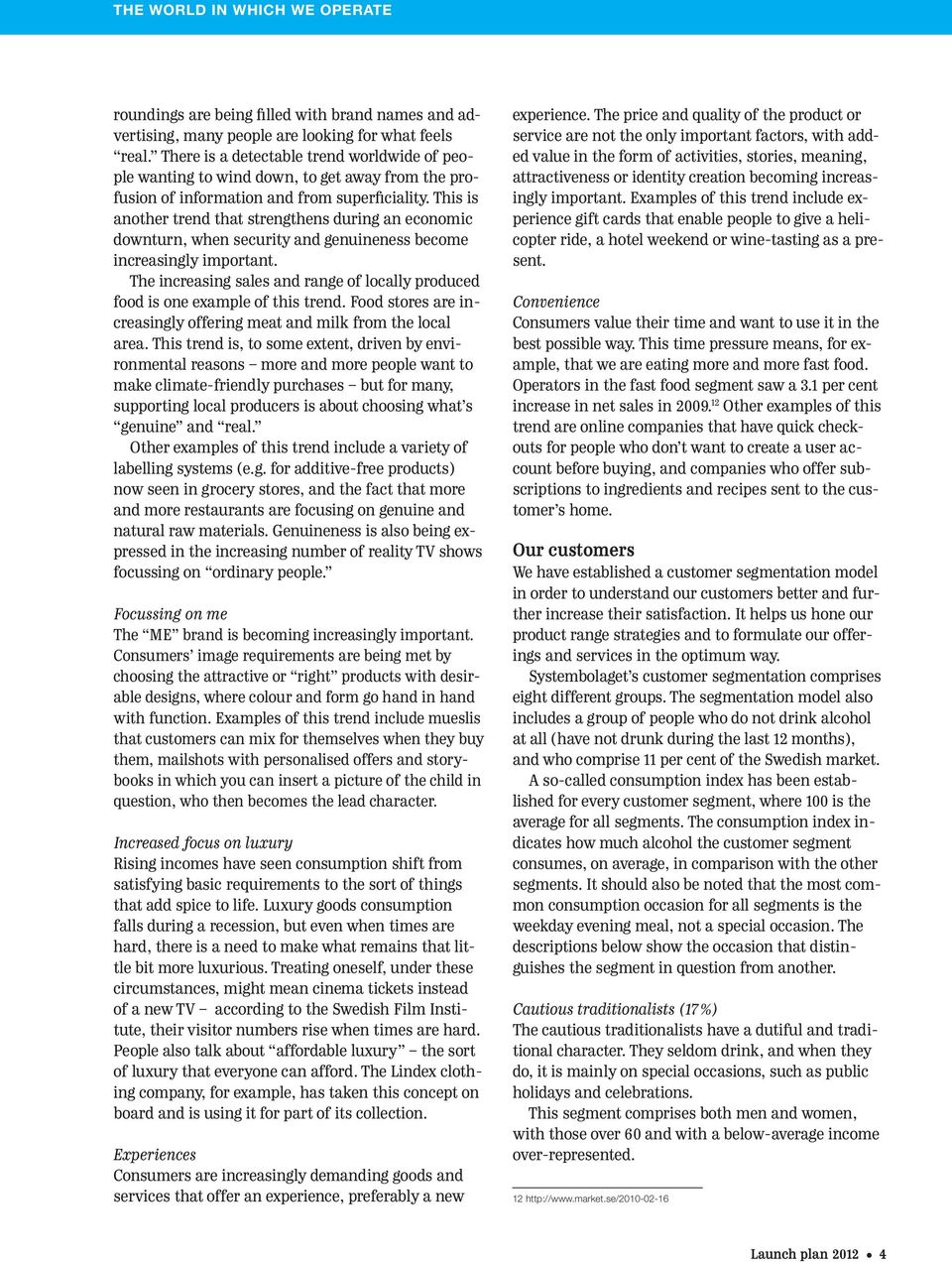
5 THE WORLD IN WHICH WE OPERATE in comparison with the other customer segments, is a desire to try some thing new, or they ve tasted it in a bar, or it was on the New Products shelf. Consumption index: 153 The cautious traditionalists are not particularly inte res ted in alcoholic drinks and do not like trying new products. They have an above-average interest in arts and crafts, books, crossword puzzles and music. They shop at Systembolaget every other month, or less frequently. When they consume alcohol, they prefer to drink wine or beer, but in comparison with other customers segments, are low consumers of cider & mixed drinks. Consumption index: 42 Blokes who yearn to learn (8%) Levels of commitment to alcoholic drinks are high in this customer segment. It mainly comprises men aged between 30 and 60, and is over-represented in big cities. They work full time and have an above-average income. They live with a partner, with or without children, and are interested in motor sports, hunting & fishing, gaming and TV. Beer is a major hobby, and whilst they have their favourites, they like trying new products. They usually consume alcohol during boys nights out, when they mainly drink beer and whisky. They consume twice as much beer as other customer segments, almost the same amount of spirits, and their consumption of wine and of cider & mixed drinks is more or less on a par with that of other customer segments. Their main reasons for consuming alcohol are to treat themselves or to wind down. They shop at Systembolaget every other week or more. They buy new products every time they visit the store, and the main reasons for trying new products, Sophisticated connoisseurs (13%) The sophisticated connoisseurs have an extensive interest in alcohol and are curious about new products and the latest trends in wine. They are sociable and like organised parties. They are keen to show off/demonstrate their knowledge to others around them, and it s important to them that the wine goes with the food. This customer segment comprises both men and women and is over-represented in the 50+ age group. Many have further or university education and they have a high income. Their likes include travelling, reading books and cooking. They consume at dinners with friends more often than the other segments, when they primarily consume wine. The consume more or less the same amount of spirits as the other customer segments, slightly less beer, and half as much cider & mixed drinks. Their main reasons for consu ming alcohol are to create a romantic atmosphere and because it goes with the situation/is traditional. The sophisticated connoisseurs shop once a month or more at Systembolaget. They buy new products every time they visit the store, and the main reasons for trying new products in comparison with other customer segments is that they have read a review, received a recommendation from a friend, and read about the product on the shelf-edge label. Consumption index: 115 Multifaceted connoisseurs (1.4%) The multifaceted connoisseurs are a very small group that we have distinguished from the larger group of Sophisticated Connoisseurs. They differ from that group in that for this group, wine, beer and whisky are a hobby, their main interest. People ask the multifaceted connoisseur for advice, and they have considerable influence over those in their social circle when it comes to alcoholic drinks. The multifaceted connoisseurs are expert all- Launch plan
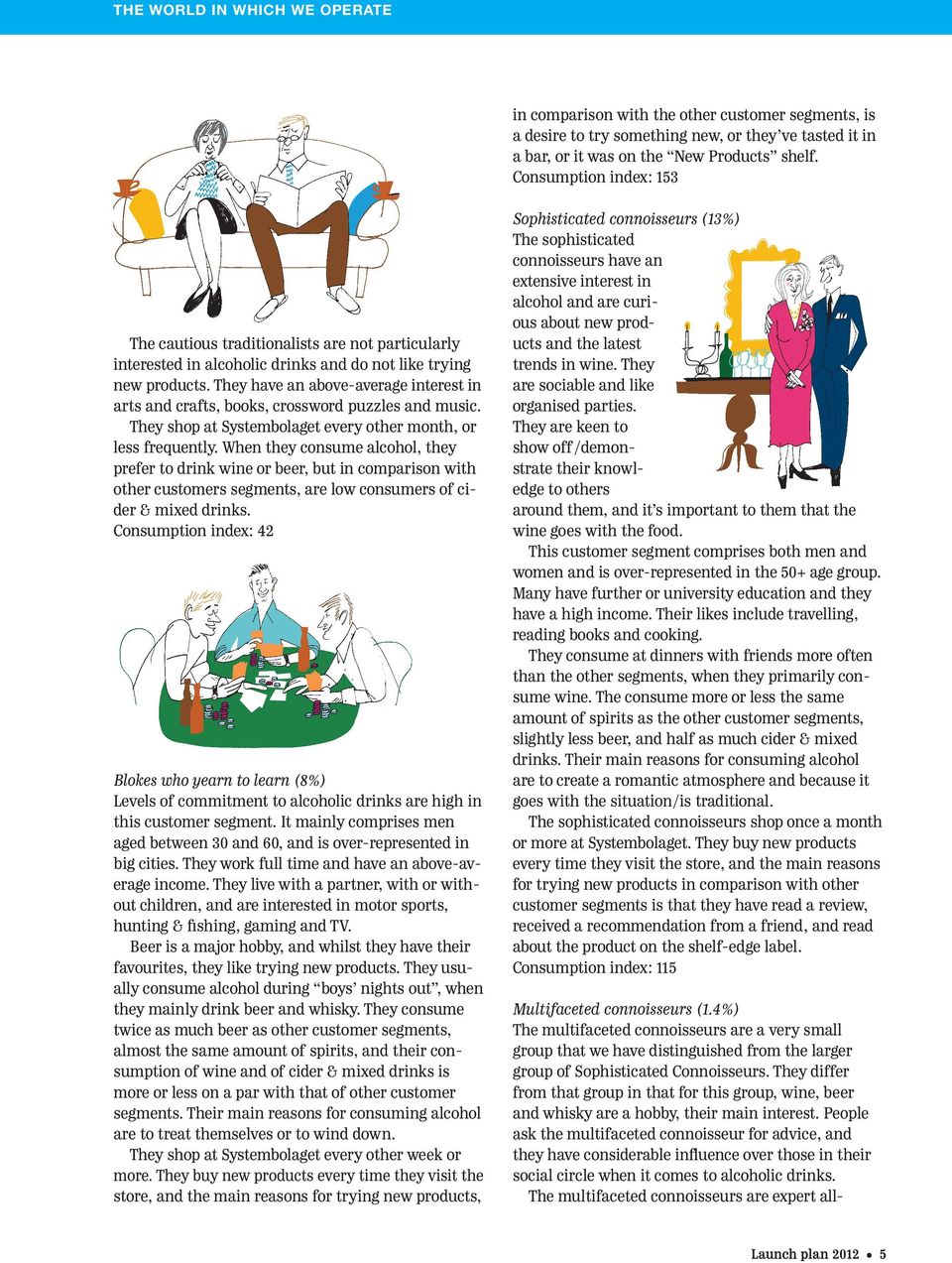
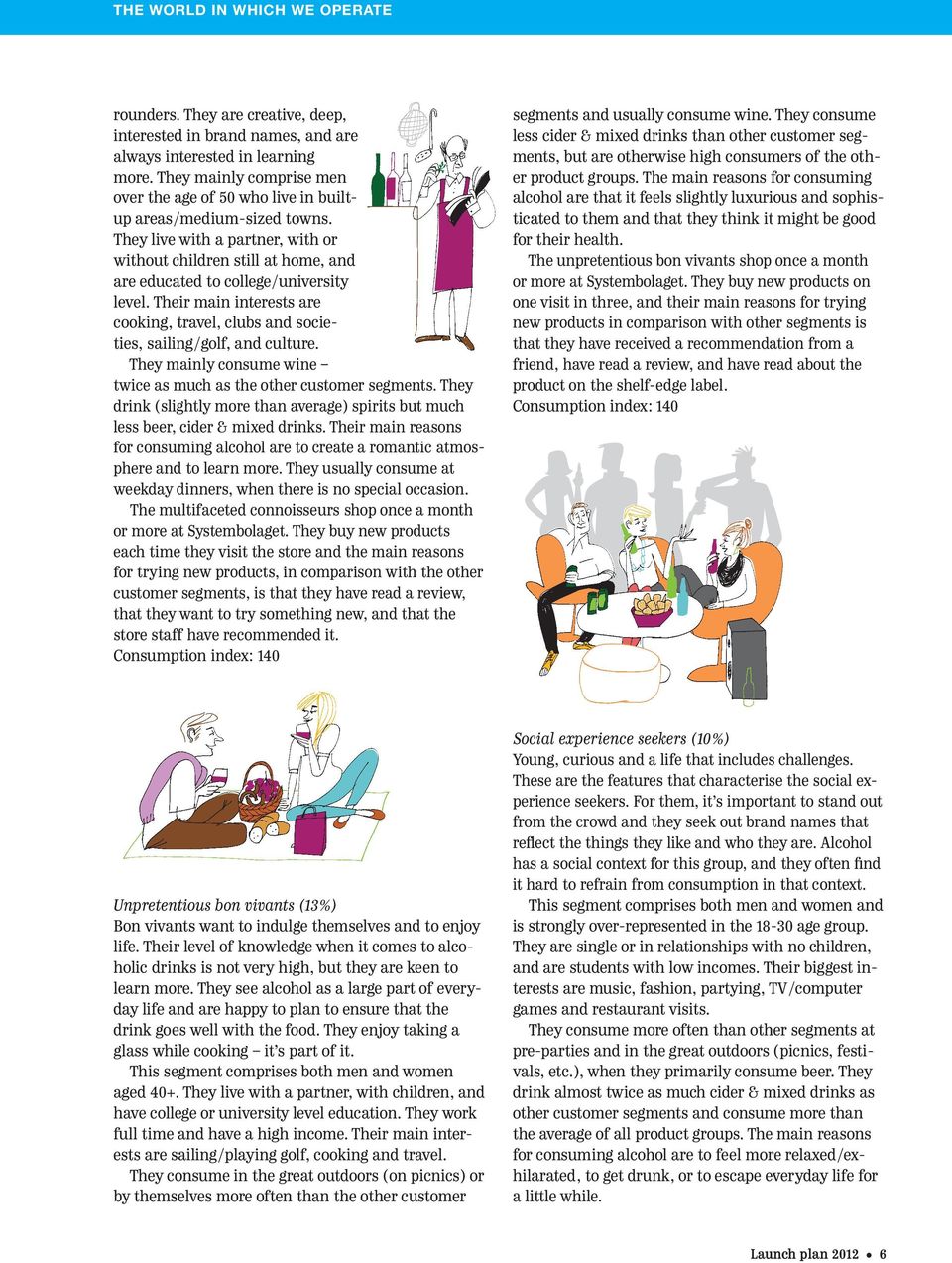
6 THE WORLD IN WHICH WE OPERATE rounders. They are creative, deep, interested in brand names, and are always interested in learning more. They mainly comprise men over the age of 50 who live in builtup areas/medium-sized towns. They live with a partner, with or without children still at home, and are educated to college/university level. Their main interests are cooking, travel, clubs and societies, sailing/golf, and culture. They mainly consume wine twice as much as the other customer segments. They drink (slightly more than average) spirits but much less beer, cider & mixed drinks. Their main reasons for consuming alcohol are to create a romantic atmosphere and to learn more. They usually consume at weekday dinners, when there is no special occasion. The multifaceted connoisseurs shop once a month or more at Systembolaget. They buy new products each time they visit the store and the main reasons for trying new products, in comparison with the other customer segments, is that they have read a review, that they want to try some thing new, and that the store staff have recommended it. Consumption index: 140 segments and usually consume wine. They consume less cider & mixed drinks than other customer segments, but are otherwise high consumers of the other product groups. The main reasons for consuming alcohol are that it feels slightly luxurious and sophisticated to them and that they think it might be good for their health. The unpretentious bon vivants shop once a month or more at Systembolaget. They buy new products on one visit in three, and their main reasons for trying new products in comparison with other segments is that they have received a recommendation from a friend, have read a review, and have read about the product on the shelf-edge label. Consumption index: 140 Unpretentious bon vivants (13%) Bon vivants want to indulge themselves and to enjoy life. Their level of knowledge when it comes to alcoholic drinks is not very high, but they are keen to learn more. They see alcohol as a large part of everyday life and are happy to plan to ensure that the drink goes well with the food. They enjoy taking a glass while cooking it s part of it. This segment comprises both men and women aged 40+. They live with a partner, with children, and have college or university level education. They work full time and have a high income. Their main interests are sailing/playing golf, cooking and travel. They consume in the great outdoors (on picnics) or by themselves more often than the other customer Social experience seekers (10%) Young, curious and a life that includes challenges. These are the features that characterise the social experience seekers. For them, it s important to stand out from the crowd and they seek out brand names that reflect the things they like and who they are. Alcohol has a social context for this group, and they often find it hard to refrain from consumption in that context. This segment comprises both men and women and is strongly over-represented in the age group. They are single or in relationships with no children, and are students with low incomes. Their biggest interests are music, fashion, partying, TV/computer games and restaurant visits. They consume more often than other segments at pre-par ties and in the great outdoors (picnics, festivals, etc.), when they primarily consume beer. They drink almost twice as much cider & mixed drinks as other customer segments and consume more than the average of all product groups. The main reasons for consuming alcohol are to feel more relaxed/exhilarated, to get drunk, or to escape everyday life for a little while. Launch plan
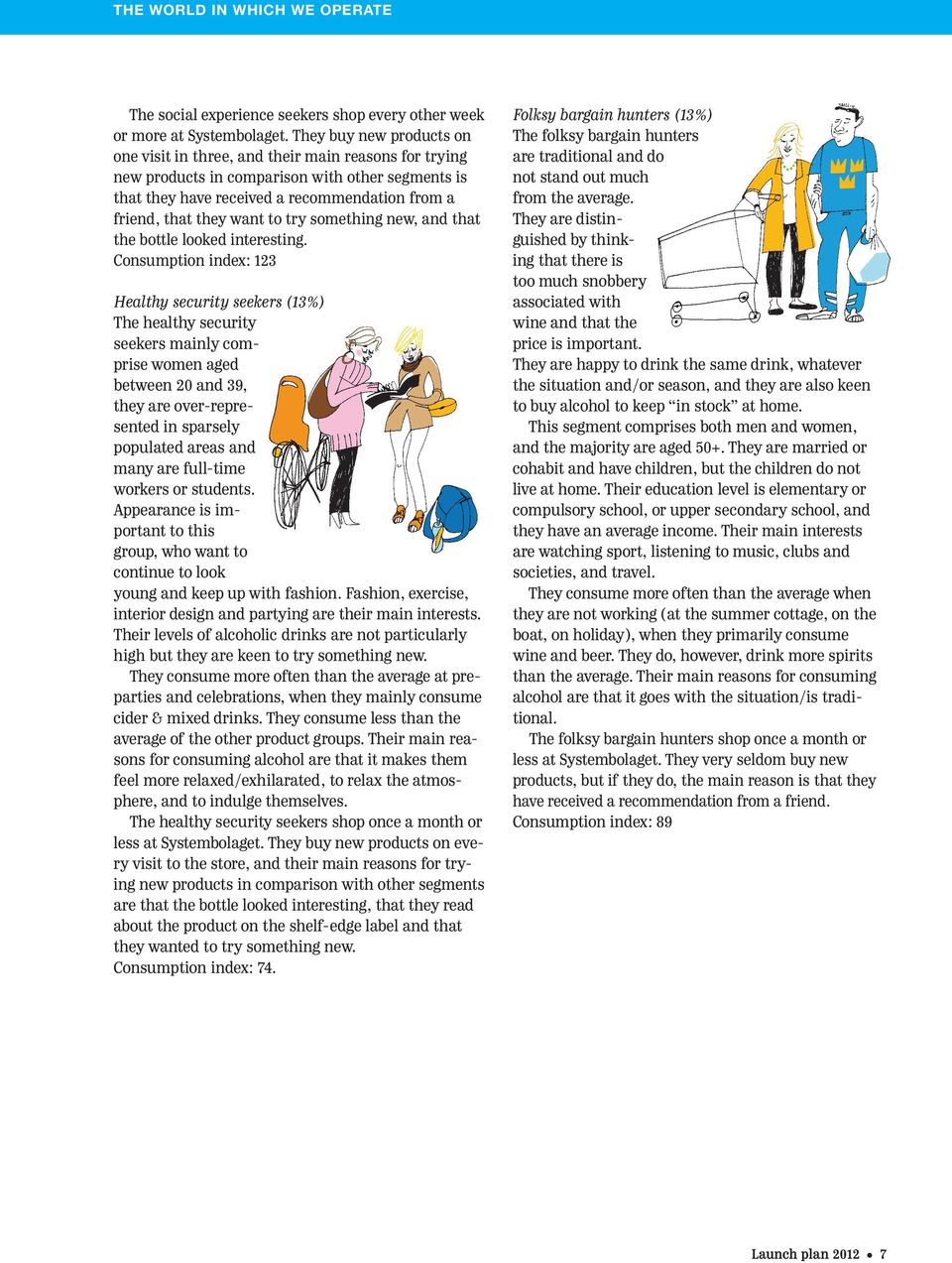
7 THE WORLD IN WHICH WE OPERATE The social experience seekers shop every other week or more at Systembolaget. They buy new products on one visit in three, and their main reasons for trying new products in comparison with other segments is that they have received a recommendation from a friend, that they want to try something new, and that the bottle looked interesting. Consumption index: 123 Healthy security seekers (13%) The healthy security seekers mainly comprise women aged between 20 and 39, they are over-represented in sparsely populated areas and many are full-time workers or students. Appearance is important to this group, who want to continue to look young and keep up with fashion. Fashion, exercise, interior design and partying are their main interests. Their levels of alcoholic drinks are not particularly high but they are keen to try something new. They consume more often than the average at preparties and celebrations, when they mainly consume cider & mixed drinks. They consume less than the average of the other product groups. Their main reasons for consuming alcohol are that it makes them feel more relaxed/exhilarated, to relax the atmosphere, and to indulge themselves. The healthy security seekers shop once a month or less at Systembolaget. They buy new products on every visit to the store, and their main reasons for trying new products in comparison with other segments are that the bottle looked interesting, that they read about the product on the shelf-edge label and that they wanted to try something new. Consumption index: 74. Folksy bargain hunters (13%) The folksy bargain hunters are traditional and do not stand out much from the average. They are distinguished by thinking that there is too much snobbery associated with wine and that the price is important. They are happy to drink the same drink, whatever the situation and/or season, and they are also keen to buy alcohol to keep in stock at home. This segment comprises both men and women, and the majority are aged 50+. They are married or cohabit and have children, but the children do not live at home. Their education level is elementary or compulsory school, or upper secondary school, and they have an average income. Their main interests are watching sport, listening to music, clubs and societies, and travel. They consume more often than the average when they are not working (at the summer cottage, on the boat, on holiday), when they primarily consume wine and beer. They do, however, drink more spirits than the average. Their main reasons for consuming alcohol are that it goes with the situation/is traditional. The folksy bargain hunters shop once a month or less at Systembolaget. They very seldom buy new products, but if they do, the main reason is that they have received a recommendation from a friend. Consumption index: 89 Launch plan
8 THE WORLD IN WHICH WE OPERATE Customer satisfaction index (CSI) Since 2001, Systembolaget has, together with the company CFI Group, conducted a survey of how satisfied our customers are. This survey forms the basis of the CSI (customer satisfaction index). Data collection for the CSI takes place in all stores, and since 1 January 2010 it has taken place every quarter (it previously took place once a year). Customers are surveyed at random in stores by CFI cooperation partner EDB. The questionnaire covers questions about areas such as the product range, selection, social responsibility, staff, the store, etc. CSI 2010 summary Systembolaget s customers have never been happier. The Customer Satisfaction Index, CSI, for 2010 retained the same high level of 78 as the previous year. Support for the retail monopoly also remained at the same level, at 64. Customers perception of Systembolaget s social responsibility is stronger than ever, with the score increasing by one point from 73 to 74. Range and selection The area regarding the quality of the range and selection retained its index rating of 76 for the seventh year in a row. The index figure for how well customers think the range meets their needs decreased by one point from 80 to 79. The red and white wine ranges decreased by one point each and are now rated 79 and 78, respectively. The range of other wines remains at the same level as in 2009 at 76. The spirits range fell by one point to 78, as did the beer index which is now rated 76. Cider and mixed drinks also decreased by one point to 74. Customers are least happy with the choice of new items in the product groups from which they most commonly buy, and Systembolaget s rating in this area is 69. Value for money The index for the value for money quality area remained at 68. The index for price levels in general is 59. When customers are asked to assess the price/ quality ratio of the wines sold by Systembolaget, the index rating was 74, the same level as in The index for beer and spirits was 70 and 66, respectively, which are the same levels as for Launch plan
9 SALES TRENDS Systembolaget s wine sales trends Shift in sales In 2010 Systembolaget sold million litres of wine, corresponding to revenues of SEK 15.3 billion. That is a 3.6 per cent increase in litres on 2009 and a 4.7 per cent increase in terms of revenue generated. This suggests a shift in sales towards slightly more expensive products (the same trend as in 2009). Red wine accounted for the largest percentage of wine sales at 55.2 per cent, while white wine accounted for 31.3 per cent and other wine for 13.5 per cent. Other wine increased its share on the previous year by 1.3 percentage points. Systembolaget s wine sales trends Litres (millions) Litres SEK (millions) South Africa tops the wine sales list with a market share of 19.9 per cent, ahead of Italy and Australia with market shares of 16.5 and 13.6 per cent, respectively. South Africa is also ahead of Italy and Australia when it comes to red wine and also sells most white wine, ahead of Germany, Australia and Italy. Most of the major wine-producing countries noted sales increases compared with Chile and Hungary were the exceptions to this trend, however, seeing falls of 0.8 per cent and 0.4 per cent, respectively. Systembolaget s wine sales market share by country (litres) Italy 16% South Africa 20% South Africa 20% South Africa 16% Italy 16% Italy 16% Australia 15% Australia 14% Australia 14% Spain 14% Spain 12% Spain 13% France 9% France 8% France 8% Chile 7% Chile 7% Chile 7% USA 5% Germany 4% Germany 4% Germany 4% USA 4% USA 4% Argentina 3% Argentina 3% Argentina 4% Hungary 3% Hungary 3% Hungary 3% Portugal 2% Portugal 3% Portugal 3% Other 6% Other 5% Other 6% Bottled wine max. SEK 69 is the category that accounts for the largest volume increase in bottled wine, with an increase of 942,000 litres. Within this segment, red wine SEK 0-59 accounted for the largest increase in volume and per cent. Bottled wine over SEK 100 is the bottled wine category that accounted for the largest percentage sales increase, with a rise of 9.5 per cent. The category bottled wine SEK increased by 1.3 per cent and wine in small and large bottles increased by 3.5 per cent. Sales in the boxed wine category increased by 4.2 per cent or 3.9 million litres. Boxed rosé wine accounted for the largest percentage sales increase, followed closely by boxed white wine 1.5-2l, with an increase of 42.0 and 40.2 per cent, respectively. The largest increase in volume was achieved by white wine in 3-litre boxes priced SEK 0-56, 6l, with an increase of almost 1.7 million litres. Sales of wine in other packaging decreased by 2.3 per cent. Segment trend, wines 2010 Market share 2009 Market share Bottled wine SEK Litres 2009 Litres +/- Red wine SEK % 28% 24% Red wine SEK % 29% 32% White wine SEK % 18% 18% White wine SEK % 16% 17% Rosé wine SEK % 9% 9% Total % 100% 100% Launch plan

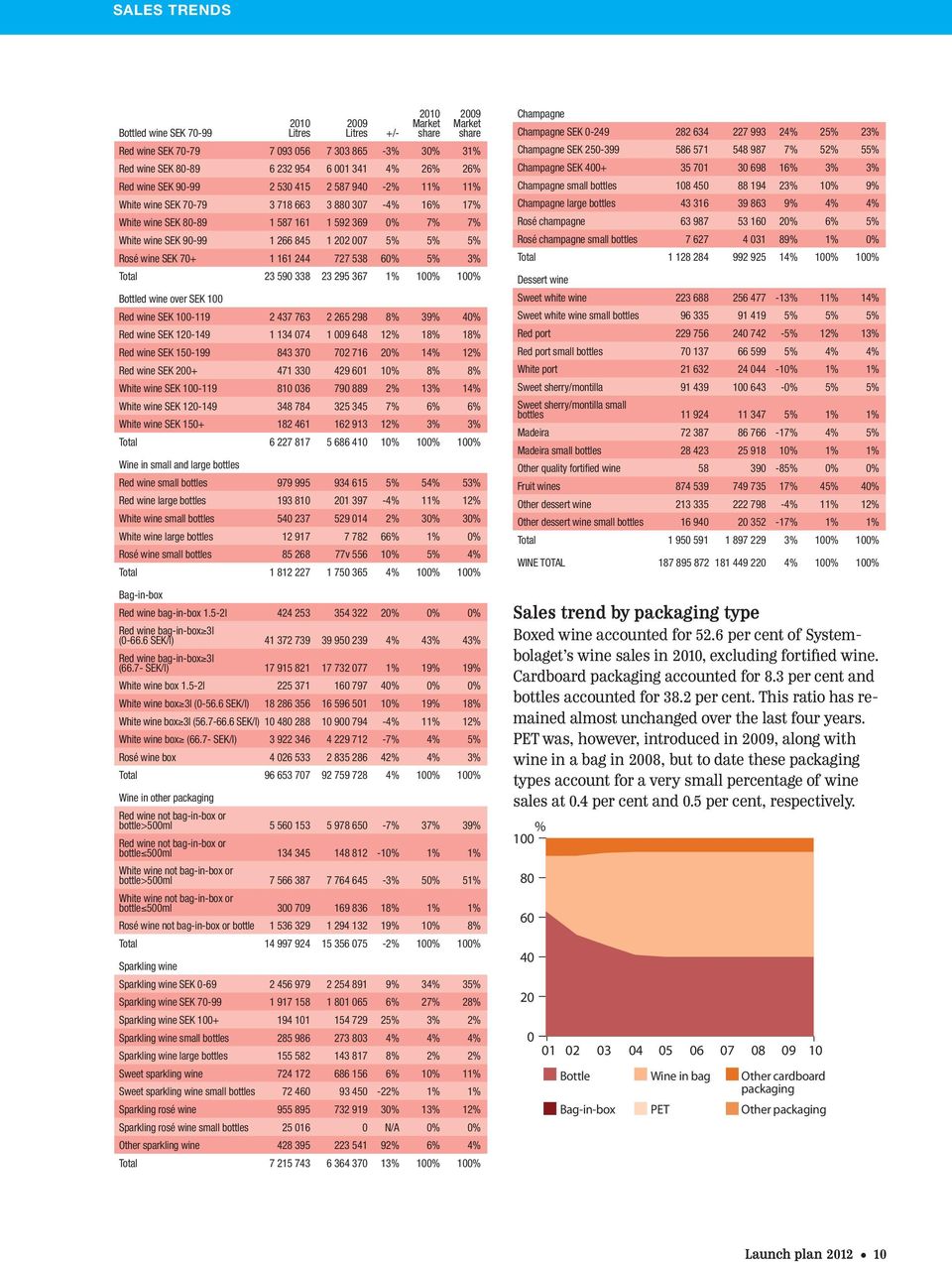
10 SALES TRENDS 2010 Market share 2009 Market share Bottled wine SEK Litres 2009 Litres +/- Red wine SEK % 30% 31% Red wine SEK % 26% 26% Red wine SEK % 11% 11% White wine SEK % 16% 17% White wine SEK % 7% 7% White wine SEK % 5% 5% Rosé wine SEK % 5% 3% Total % 100% 100% Bottled wine over SEK 100 Red wine SEK % 39% 40% Red wine SEK % 18% 18% Red wine SEK % 14% 12% Red wine SEK % 8% 8% White wine SEK % 13% 14% White wine SEK % 6% 6% White wine SEK % 3% 3% Total % 100% 100% Wine in small and large bottles Red wine small bottles % 54% 53% Red wine large bottles % 11% 12% White wine small bottles % 30% 30% White wine large bottles % 1% 0% Rosé wine small bottles v % 5% 4% Total % 100% 100% Bag-in-box Red wine bag-in-box 1.5-2l % 0% 0% Red wine bag-in-box 3l ( SEK/l) % 43% 43% Red wine bag-in-box 3l (66.7- SEK/l) % 19% 19% White wine box 1.5-2l % 0% 0% White wine box 3l ( SEK/l) % 19% 18% White wine box 3l ( SEK/l) % 11% 12% White wine box (66.7- SEK/l) % 4% 5% Rosé wine box % 4% 3% Total % 100% 100% Wine in other packaging Red wine not bag-in-box or bottle>500ml % 37% 39% Red wine not bag-in-box or bottle 500ml % 1% 1% White wine not bag-in-box or bottle>500ml % 50% 51% White wine not bag-in-box or bottle 500ml % 1% 1% Rosé wine not bag-in-box or bottle % 10% 8% Total % 100% 100% Sparkling wine Sparkling wine SEK % 34% 35% Sparkling wine SEK % 27% 28% Sparkling wine SEK % 3% 2% Sparkling wine small bottles % 4% 4% Sparkling wine large bottles % 2% 2% Sweet sparkling wine % 10% 11% Sweet sparkling wine small bottles % 1% 1% Sparkling rosé wine % 13% 12% Sparkling rosé wine small bottles N/A 0% 0% Other sparkling wine % 6% 4% Total % 100% 100% Champagne Champagne SEK % 25% 23% Champagne SEK % 52% 55% Champagne SEK % 3% 3% Champagne small bottles % 10% 9% Champagne large bottles % 4% 4% Rosé champagne % 6% 5% Rosé champagne small bottles % 1% 0% Total % 100% 100% Dessert wine Sweet white wine % 11% 14% Sweet white wine small bottles % 5% 5% Red port % 12% 13% Red port small bottles % 4% 4% White port % 1% 1% Sweet sherry/montilla % 5% 5% Sweet sherry/montilla small bottles % 1% 1% Madeira % 4% 5% Madeira small bottles % 1% 1% Other quality fortified wine % 0% 0% Fruit wines % 45% 40% Other dessert wine % 11% 12% Other dessert wine small bottles % 1% 1% Total % 100% 100% WINE TOTAL % 100% 100% Sales trend by packaging type Boxed wine accounted for 52.6 per cent of Systembolaget s wine sales in 2010, excluding fortified wine. Cardboard packaging accounted for 8.3 per cent and bottles accounted for 38.2 per cent. This ratio has remained almost unchanged over the last four years. PET was, however, introduced in 2009, along with wine in a bag in 2008, but to date these packaging types account for a very small percentage of wine sales at 0.4 per cent and 0.5 per cent, respectively. 100 % Bottle Wine in bag Other cardboard packaging Bag-in-box PET Other packaging Launch plan
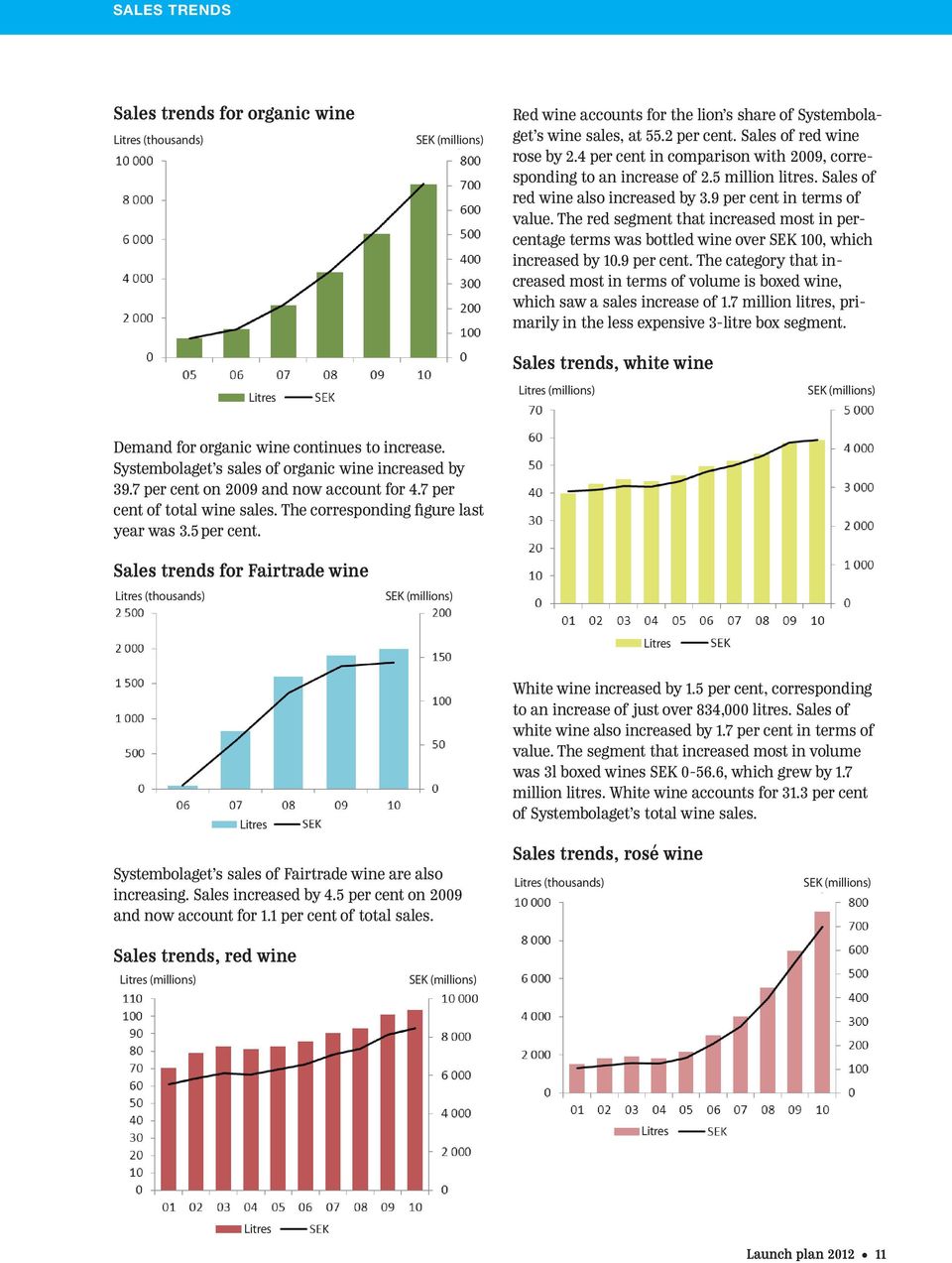
11 SALES TRENDS Sales trends for organic wine Litres (thousands) SEK (millions) Red wine accounts for the lion s share of Systembolaget s wine sales, at 55.2 per cent. Sales of red wine rose by 2.4 per cent in comparison with 2009, corresponding to an increase of 2.5 million litres. Sales of red wine also increased by 3.9 per cent in terms of value. The red segment that increased most in percentage terms was bottled wine over SEK 100, which increased by 10.9 per cent. The category that increased most in terms of volume is boxed wine, which saw a sales increase of 1.7 million litres, primarily in the less expensive 3-litre box segment. Litres Sales trends, white wine Litres (millions) SEK (millions) Demand for organic wine continues to increase. Systembolaget s sales of organic wine increased by 39.7 per cent on 2009 and now account for 4.7 per cent of total wine sales. The corresponding figure last year was 3.5 per cent. Sales trends for Fairtrade wine Litres (thousands) SEK (millions) Litres Litres Systembolaget s sales of Fairtrade wine are also increasing. Sales increased by 4.5 per cent on 2009 and now account for 1.1 per cent of total sales. White wine increased by 1.5 per cent, corresponding to an increase of just over 834,000 litres. Sales of white wine also increased by 1.7 per cent in terms of value. The segment that increased most in volume was 3l boxed wines SEK , which grew by 1.7 million litres. White wine accounts for 31.3 per cent of Systembolaget s total wine sales. Sales trends, rosé wine Litres (thousands) SEK (millions) Sales trends, red wine Litres (millions) SEK (millions) Litres Litres Launch plan
12 SALES TRENDS Rosé wine sales have seen explosive growth in recent years. Rosé wine sales increased by 27.6 per cent compared with 2009, corresponding to an increase of just over 2.1 million litres. Sales of rosé wine increased by 27.5 per cent in terms of value. The segment that increased most in percentage terms was bottled wine over SEK 70, which increased by 59.6 per cent. The segment that increased most in terms of volume was boxed rosé wine, which grew by 1.2 million litres. Litres (millions) SEK (millions) Sales trends, sparkling wine and Champagne Litres (thousands) SEK (millions) Litres Segment trends, spirits 2010 Market share 2009 Market share Apéritif 2010 Litres 2009 Litres +/- Anise % 19% 22% Bitters % 77% 73% Other spirits, segment % 4% 4% Total % 100% 100% Litres Sales of sparkling wine increased in 2010 by 13.3 per cent by volume and 14.1 per cent by value. The corresponding figures for Champagne were 13.8 and 13.9, respectively. The sparkling wine segment that showed the largest percentage increase was other sparkling wine, and by volume it was sparkling rosé. In the Champagne segment, it was rosé Champagne small bottles that accounted for the largest percentage increase, while Champagne SEK accounted for the largest increase by volume. Sales of fortified wine decreased by 3.6 per cent in 2010 compared with 2009, which corresponded to a decrease of 203,000 litres. Systembolaget sales trends for spirits Systembolaget s sales of spirits decreased between 1980 and This was followed by a shift in trend, with sales increasing up to Since then the trend has increased and decreased in alternate years, although sales have increased in terms of value since Sales of spirits decreased by 0.7 per cent by volume and increased by 0.7 per cent in terms of value in 2010 compared with Digestif Cognac % 36% 37% Cognac small bottles % 9% 9% Other brandy % 10% 12% Other brandy small bottles % 6% 6% Calvados % 8% 8% Grappa/marc % 2% 1% Dark rum % 28% 25% Dark rum small bottles % 2% 2% Total % 100% 100% Drinks & cocktails Ready-mixed drinks % 81% 100% Ready-mixed drinks small bottles N/A N/A 19% 0% Total % 100% 100% Spiced distilled spirits Spiced distilled spirits % 76% 78% Spiced distilled spirits small bottles % 24% 22% Total % 100% 100% 2010 Market share 2009 Market share Clear spirits 2010 Litres 2009 Litres +/- Unspiced distilled spirits % 51% 51% Unspiced distilled spirits small bottles % 18% 19% Flavoured vodka % 4% 5% Gin % 14% 14% Gin small bottles % 3% 3% White rum % 3% 2% White rum small bottles % 1% 1% Flavoured rum % 6% 5% Tequila % 1% 1% Total % 100% 100% Launch plan
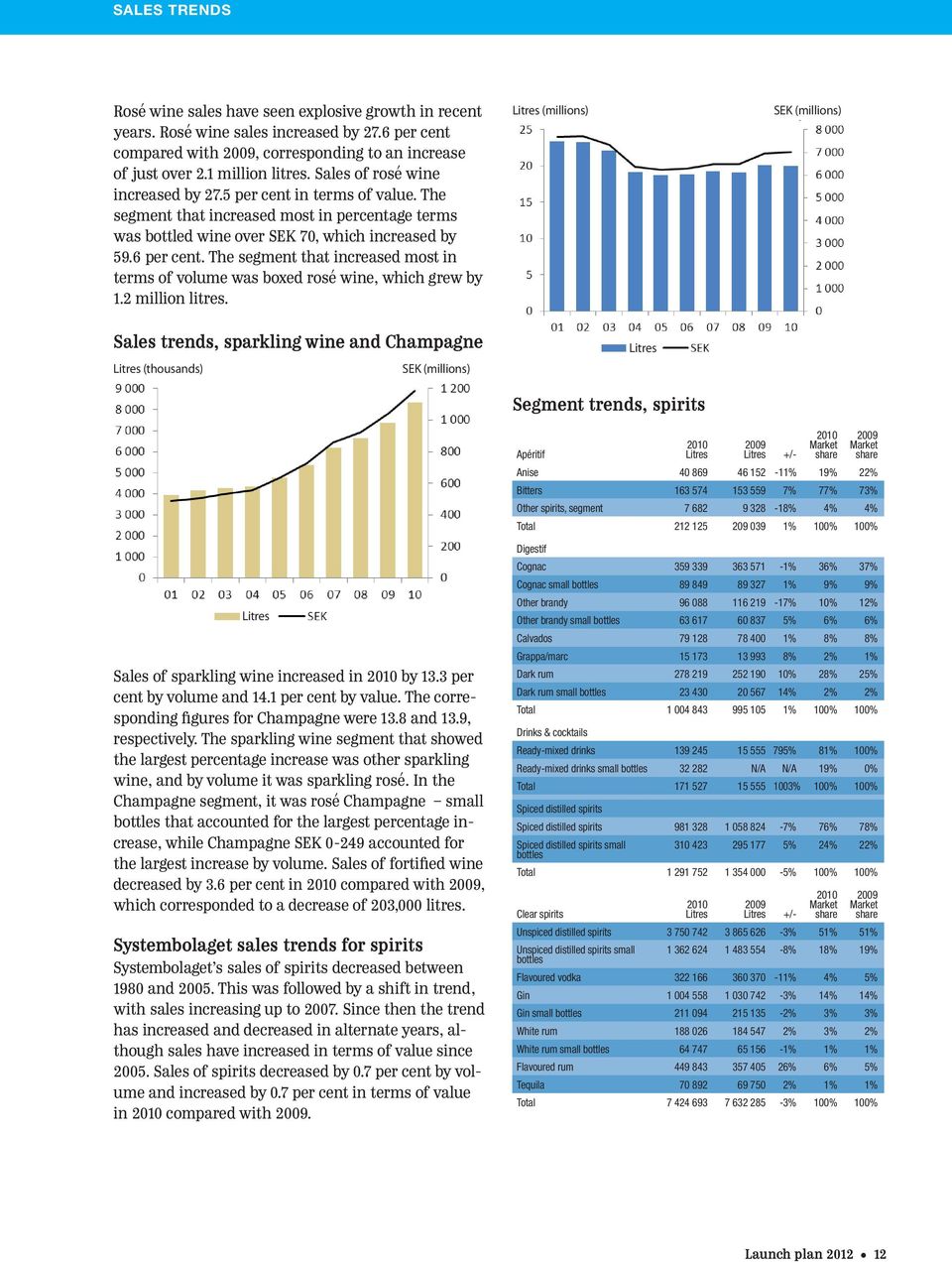
13 SALES TRENDS 2010 Market share 2009 Market share Liqueurs 2010 Litres 2009 Litres +/- Chocolate, coffee and nut liqueurs % 0% 1% Chocolate, coffee and nut liqueurs small bottles % 1% 1% Cream and egg liqueurs % 5% 5% Cream and egg liqueurs small bottles % 2% 2% Fruit and berry liqueurs % 2% 2% Fruit and berry liqueurs small bottles % 4% 4% Swedish punch % 2% 2% Other liqueurs % 5% 4% Other liqueurs small bottles % 6% 5% Total % 100% 100% Whisky Scottish blended whisky % 48% 48% Scottish blended whisky small bottles % 13% 12% Canadian whisky % 19% 20% Canadian whisky small bottles % 7% 7% American whisky % 3% 3% American whisky small bottles % 1% 1% Irish whiskey % 8% 7% Irish whiskey small bottles % 2% 2% Other whisky % 0% 0% Total % 100% 100% Malt whisky Scottish malt whisky 18 years % 83% 85% Scottish malt whisky 18 years small bottles % 7% 6% Scottish malt whisky>18 years % 1% 1% Other malt whisky % 10% 8% Total % 100% 100% SPIRITS TOTAL % 100% 100% Sales trends, organic spirits Litres (thousands) SEK (millions) Systembolaget s sales trends for beer, cider and mixed drinks Beer sales have increased every year for the past ten years, with the exception of 2004 when import quotas were increased. However, sales for 2005 were back at the same level as in 2003 and this increase in sales has continued up until Sales decreased by 0.5 per cent in terms of volume but increased in value by 2.3 per cent in 2010 compared with Systembolaget s sales trends, beer Litres (millions) Litres SEK (millions) The beer lager can category, which is the main category by volume and accounts for 69.9 per cent of beer sales, decreased by 1.5 percent compared with However, the second-largest category, beer lager bottle, saw a 1.1 per cent increase in sales. Sales of special beer increased in 2010, while sales of seasonal beer and beer in other packaging decreased (see the table below). Segment trends, beer 2010 Market share 2009 Market share Beer lager can 2010 Litres 2009 Litres +/- Lager can international (0-5.9%) % 14% 15% Lager can Swedish (0-5.9%) % 66% 64% Lager extra strong can (6.0%+) Dark lager can % 1% 1% Total % 100% 100% Litres Sales of organic spirits increased significantly compared with 2009, rising by 9.1 percent in terms of volume and 7.5 per cent by value. Organic spirits account for 1.9 per cent of total spirit sales. Beer lager bottle Lager bottle international (0-5.9%) % 58% 61% Lager bottle Swedish (0-5.9%) % 29% 28% Lager extra strong bottle (6.0%+) % 11% 9% Dark lager bottle % 3% 2% Total % 100% 100% Launch plan
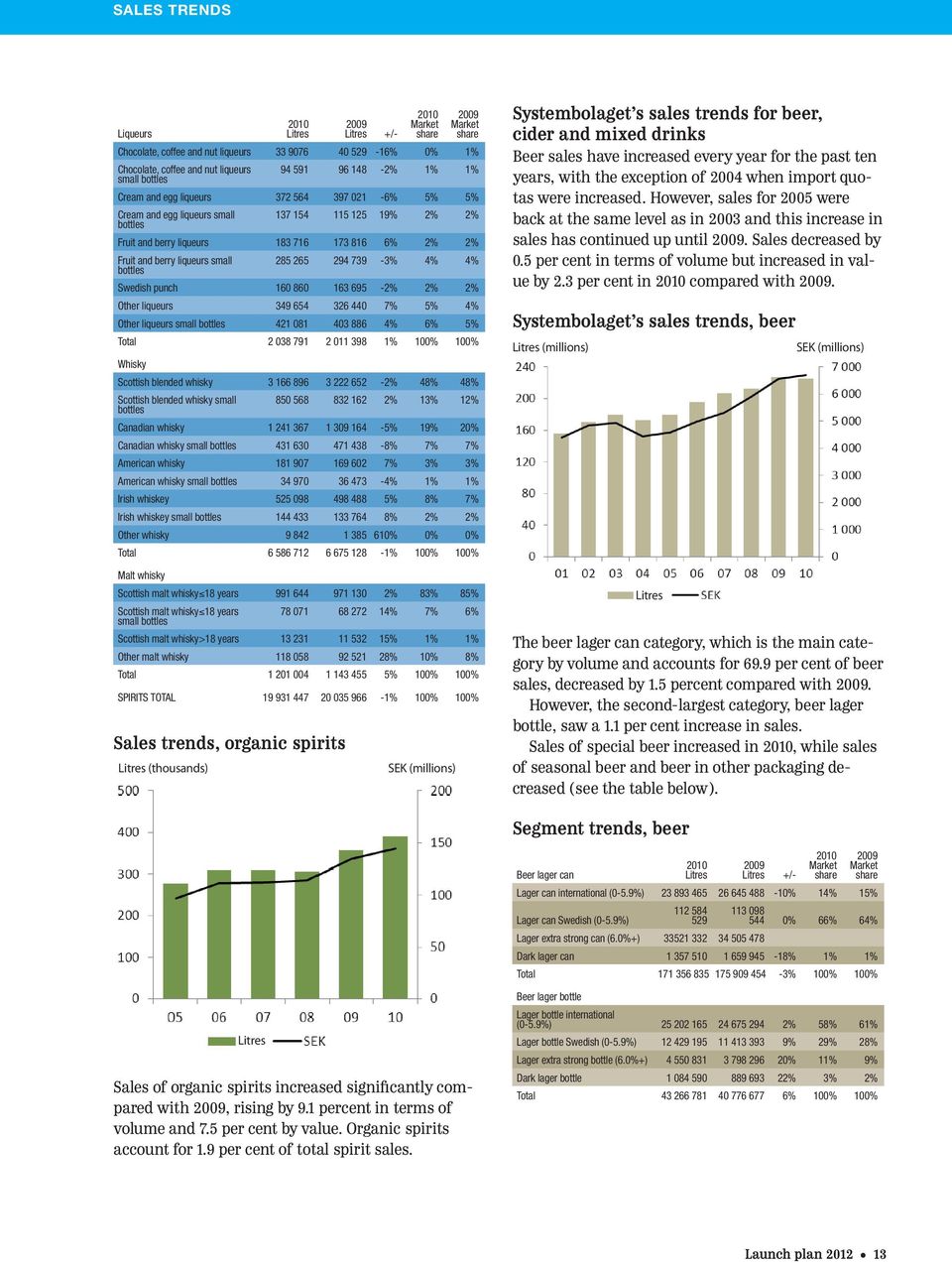
14 SALES TRENDS 2010 Market share 2009 Market share Special beer 2010 Litres 2009 Litres +/- Ale bottle (0-5.9%) % 46% 46% Porter/stout bottle (0-5.9%) % 4% 6% Ale can (0-5.9%) % 9% 9% Porter/stout can (0-5.9%) % 5% 5% Ale extra strong (6.0%+) % 20% 17% Porter/stout extra strong (6.0%+) % 1% 1% Wheat beer bottle/can % 13% 12% Other beer % 3% 3% Total % 100% 100% Total sales of cider and mixed drinks decreased by 0.5 per cent compared with The mediumsweet/sweet cider in bottles and medium-sweet/ sweet cider in cans decreased by 2.8 per cent and 3.8 per cent, respectively. Sales for the other segments increased in Cider and mixed drinks, sales by packaging type Beer other packaging Other lager % 7% 11% Other ale/porter/stout % 0% 0% Total % 100% 100% Seasonal beer Easter % 48% 48% Summer % 13% 12% Oktoberfest % 19% 20% Christmas % 7% 7% Total % 100% 100% BEER TOTAL % 100% 100% Can Bottle Other Beer sales by packaging type Within cider and mixed drinks, the split between cans and bottles is more even than within beer. Sales of cans in 2010 accounted for 50.9 per cent, bottles accounted for 47.8 per cent and PET packaging accounted for 1.2 per cent. The remaining amount in the chart represents sales of barrels. Sales trends, organic beer, cider and mixed drinks Litres (thousands) SEK (millions) Can Bottle Barrel In terms of sales by type of packaging, beer in cans accounts for the largest percentage of sales at 76.6 per cent, while beer in bottles accounts for 22.2 percent, PET packaging accounts for 1.0 per cent and barrels account for 0.2 per cent. Segment trends, cider and mixed drinks 2010 Market share 2009 Market share Cider & mixed drinks 2010 Litres 2009 Litres +/- Dry/semi-dry cider bottle % 3% 3% Dry/semi-dry cider can % 2% 2% Semi-sweet/sweet cider bottle ,% 9% 9% Semi-sweet/sweet cider can ,8% 42% 44% Cider other packaging % 0% 0% Mixed drinks % 43% 42% Total % 100% 100% Litres Sales of organic beer, cider and mixed drinks continued to increase strongly in 2010, growing by 46.8 per cent in terms of volume and by 52.0 per cent by value, and now account for 1.1 per cent of beer sales. The corresponding figure for 2009 was 0.8 per cent. These sales primarily consist of organic beer. Sales of organic cider and mixed drinks were almost non-existent up to Sales in 2010 amounted to 424,000 litres, resulting in a 479 per cent increase on Launch plan

15 SALES TRENDS Systembolaget s alcohol-free sales trends Sales of alcohol-free products have increased over the past nine years, and in 2010 sales grew by 30.8 per cent. Alcohol-free products now account for 0.29 per cent of Systembolaget s total sales. Sales trend, alcohol-free Litres (thousands) SEK (millions) Litres 2009 was the first year that Systembolaget had organically labelled alcohol-free products in its product range. Sales of organic alcohol-free products in 2010 totalled 100,000 litres with a 243 per cent increase compared with Launch plan

16 FIXED LAUNCHES 2012 Fixed launches 2012 The aim of fixed launches is to renew our core product range with items that are available all year round. The fixed range is updated as customers preferences change. It is by updating the fixed range that we meet most customer needs and provide products that primarily appeal to a broad customer group, while there is also room for some more specialised drinks. Interest in ethically produced goods is growing among many consumers. It is therefore increasingly important that consumers can find these types of products in our fixed range. Many of the fixed launches below meet this demand. But future requests for tenders may include additional specified requirements that support Systembolaget s objective to increase the number of organic products, ecofriendly packaging and products produced based on fair trade. Wine Launches 2 April 2012 Segment Module Origin Volume for the year Description Red wine (60-69) BAS France Costières de Nîmes Red wine (60-69) T1 Italy Sangiovese, IGT Marche Red wine (60-69) T1 South Africa Low-alcohol wine, max. 9.5% Red wine (70-79) BAS Argentina Shiraz Red wine (70-79) BAS Spain All Spain, Gran Reserva Red wine (70-79) T1 France Macon Rouge or Bourgogne Passe-Tout-Grains Red wine (70-79) T1 South Africa Grape blend, Shiraz/Cabernet Sauvignon, organic Red wine (70-79) T3 Australia/USA Low-alcohol wine, max. 9.5%. Australia or USA Red wine (70-79) T3 Chile Syrah, sustainable branding Red wine (70-79) T3 Portugal Alentejo Red wine (80-89) T3 Italy Dolcetto Red wine (90-99) T3 Australia Clare Valley, grape blend Cabernet Sauvignon/Merlot/Cabernet Franc Red wine ( ) T1 South Africa Stellenbosch Fair Trade, Grenache/Syrah/Mourvèdre Red wine ( ) T2 France Crozes-Hermitage Red wine ( ) BAS Italy Rosso Conero Riserva Red wine ( ) T3 Italy Vino Nobile di Montepulciano Red wine ( ) T3 Australia McLaren Vale, Shiraz/Viognier Red wine ( ) T3 France Bourgogne, Pinot Noir Red wine ( ) T3 USA Zinfandel SEK 159 Red wine box >= 3l ( SEK/l) BAS Chile Grape blend, full-flavoured style Red wine box >= 3l ( SEK/l) T1 Australia Rhône blend Red wine box >= 3l ( SEK/l) T1 Spain Northern Spain, SEK White wine (0-59) BAS Chile Sauvignon Blanc White wine (0-59) T1 South Africa Grape blend, Chenin Blanc White wine (60-69) BAS France Organic White wine (60-69) BAS USA Chardonnay Subject to changes Launch plan

17 FIXED LAUNCHES 2012 cont. Wine Volume for Segment Module Origin the year Description White wine (60-69) T1 France Muscadet sur lie White wine (60-69) T1 Spain Verdejo White wine (70-79) T2 Chile Gewürztraminer or Pinot Gris White wine (70-79) T3 Australia/USA Low-alcohol wine, max. 9.5%, Australia or USA White wine (80-89) T2 USA Central Coast, Chardonnay White wine (80-89) T3 France Vouvray, semi-dry/semi-sweet White wine (80-89) T3 South Africa Semillon White wine (90-99) T2 Australia Eden or Clare Valley, Riesling White wine (90-99) T2 France Maconnais with village appellation White wine ( ) T2 South Africa Sauvignon Blanc/Semillon, Fair Trade White wine ( ) BAS France Bourgogne with regional appellation White wine ( ) T3 France Alsace Gewürztraminer White wine (150-) T3 New Zealand Sauvignon Blanc White wine box >= 3l ( SEK/l) BAS Australia Grape blend, Gewürztraminer/Riesling White wine box >= 3l ( SEK/l) BAS Chile Grape blend, poss. Fair Trade/organic Rosé (0-69) T1 Portugal Vinho Verde, max. 10% Rosé (70-..) T3 Chile PET, max. SEK 79 Rosé box BAS Italy Toscana, max. SEK 210 Rosé box T1 France litre, premium Sparkling wine (70-99) T2 USA SEK 99 Sparkling rosé BAS Australia SEK 79 Sweet white wine T1 South Africa Full-size bottle, max. SEK 69, not Muscat Sweet white wine, small bottles T3 Germany Beerenauslese Riesling SEK 149 Sake T Half-bottle of sake SEK 50 Launches 1 October 2012 Red wine (0-59) BAS Spain Tempranillo, unoaked Red wine (0-59) T1 Portugal Flavour type: Spicy & Full-bodied Red wine (0-59) T1 Spain Garnacha Red wine (60-69) BAS Italy Salento IGT Red wine (60-69) BAS Australia Shiraz Red wine (70-79) BAS Italy Rosso Conero Red wine (70-79) T1 South Africa Cool-climate style of grape blend Red wine (70-79) T1 USA Cabernet Sauvignon/Merlot/Cabernet Franc, single-grape wine or grape blend Red wine (80-89) BAS France Côtes du Rhône Villages, cru or with name of area Red wine (80-89) T2 Chile Cabernet Franc Red wine (80-89) T2 France Cabernet Sauvignon, grape variety stated Red wine (80-89) T2 Spain Aragon, Garnacha Red wine (80-89) T2 South Africa Grenache, single-grape wine or grape blend Red wine (80-89) T3 Australia Victoria, Pinot Noir Red wine (80-89) T3 Italy Bardolino Classico Superiore Red wine (90-99) T3 Argentina Malbec or Syrah Red wine ( ) BAS Spain Rioja Reserva Red wine ( ) T2 Argentina Fair Trade Red wine ( ) T2 Italy Castel del Monte DOC, Uva di Troia Red wine ( ) T3 France Southern Rhône Cru Red wine ( ) T3 Chile Organic, light-weight bottle Red wine ( ) T3 New Zealand Syrah Red wine ( ) T3 Portugal Douro Red wine ( ) BAS Italy Barolo Red wine ( ) T1 France Bordeaux, Left Bank, Château designation Subject to changes Launch plan
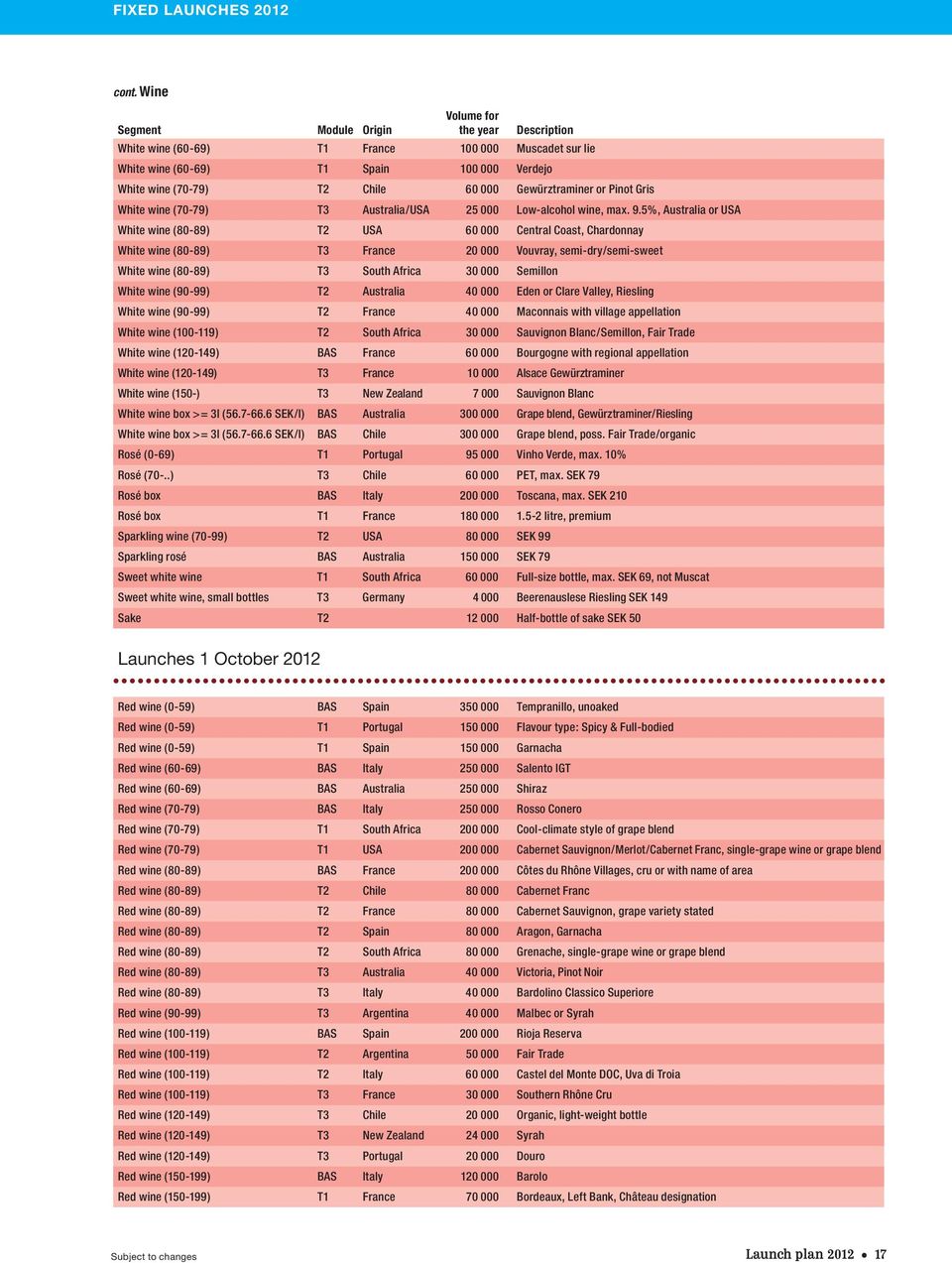
18 FIXED LAUNCHES 2012 cont. Wine Segment Module Origin Volume for the year Description Red wine box >= 3l ( SEK/l) BAS Italy Umbria Red wine box >= 3l ( SEK/l) T1 France Flavour type: Soft & Fruity Red wine box >= 3l ( SEK/l) BAS South Africa Grape blend, Cabernet Sauvignon/Merlot/Shiraz Red wine PET complementary item for bag-in-box White wine (60-69) BAS Germany Dry Riesling White wine (70-79) T1 France Viognier White wine (70-79) T1 Austria Dry Riesling, flute bottle White wine (70-79) T2 Spain Northern Spain, grape blend White wine (80-89) T3 Australia Grape blend, Semillon/Sauvignon Blanc White wine (90-99) T3 Germany Dry Riesling, organic White wine (90-99) T3 Germany Mosel, Riesling Kabinett or Spätlese White wine ( ) T1 France Chablis White wine ( ) T3 Germany Franconian, Silvaner White wine ( ) T3 Austria Riesling White wine bag-in-box 1.5-2l T2 France Well-known French white-wine appellation White wine PET complementary item for bag-in-box Sparkling wine (100-) T2 New Zealand SEK Sparkling wine (70-99) T1 France Crémant de Loire or Alsace Sparkling rosé BAS Italy Max. SEK 59 Champagne ( ) T3 France Sweet Sherry/Montilla, small bottles T3 Spain Pedro Ximenez, half-bottle Other dessert wine, small bottles T3 Italy Sweet Marsala, half-bottle Bottled wine max. SEK 69 The sale of bottled wine max. SEK 69 in 2010 amounted to approximately 28 million litres, which was an increase of 3 per cent on This category accounts for just over 15 per cent of Systembolaget s overall sales of wine and is therefore a key part of our range. Sophisticated Connoisseurs and Social Experience Seekers are the customer groups that appreciate these wines. According to our customer satisfaction surveys, those who purchase wines in this segment are generally very satisfied with the range of products they currently find in our stores. We are planning more launches in this category from many different countries of origin. Red wine SEK 0 59 is the segment that accounts for the largest increase in this category. For 2012 we are planning three launches in this segment; two from Spain and one from Portugal. We are launching a number of products in the red wine SEK and white wine SEK segments in order to expand the offering of different flavour styles, and some of these launches are the result of previous temporary launches that were particularly well received by customers. The rosé wine SEK 0-69 segment continues to grow, although not at the same pace as before. We have in fact seen demand for rosé move to a slightly higher price category for bottles and bag-in-box. However, we want to ensure that we also have a goodvalue offering in the future and are therefore launching a Vinho Verde wine from Portugal. Low-alcohol wines are an area on which we are continuing to focus as we see a clear health-related trend, and this launch will be of a low-alcohol wine. In line with this health-related trend, we are also launching a red wine with low alcohol content from South Africa in the SEK segment, and in order to expand our offering of organic wines in this category we are launching an organic wine in the white wine SEK segment. Bottled wine SEK Multifaceted Connoisseurs, Unpretentious Bon Vivants and Sophisticated Connoisseurs are the main customer groups that purchase this type of wine, but other customer segments are also represented in this broad and varied category. However, the reasons behind purchases vary widely within the group, with some people viewing these wines as providing a touch of luxury, while others consider them wines for more simple occasions. There are consequently significant demands on this segment of wines and new products face considerable expectations. Subject to changes Launch plan

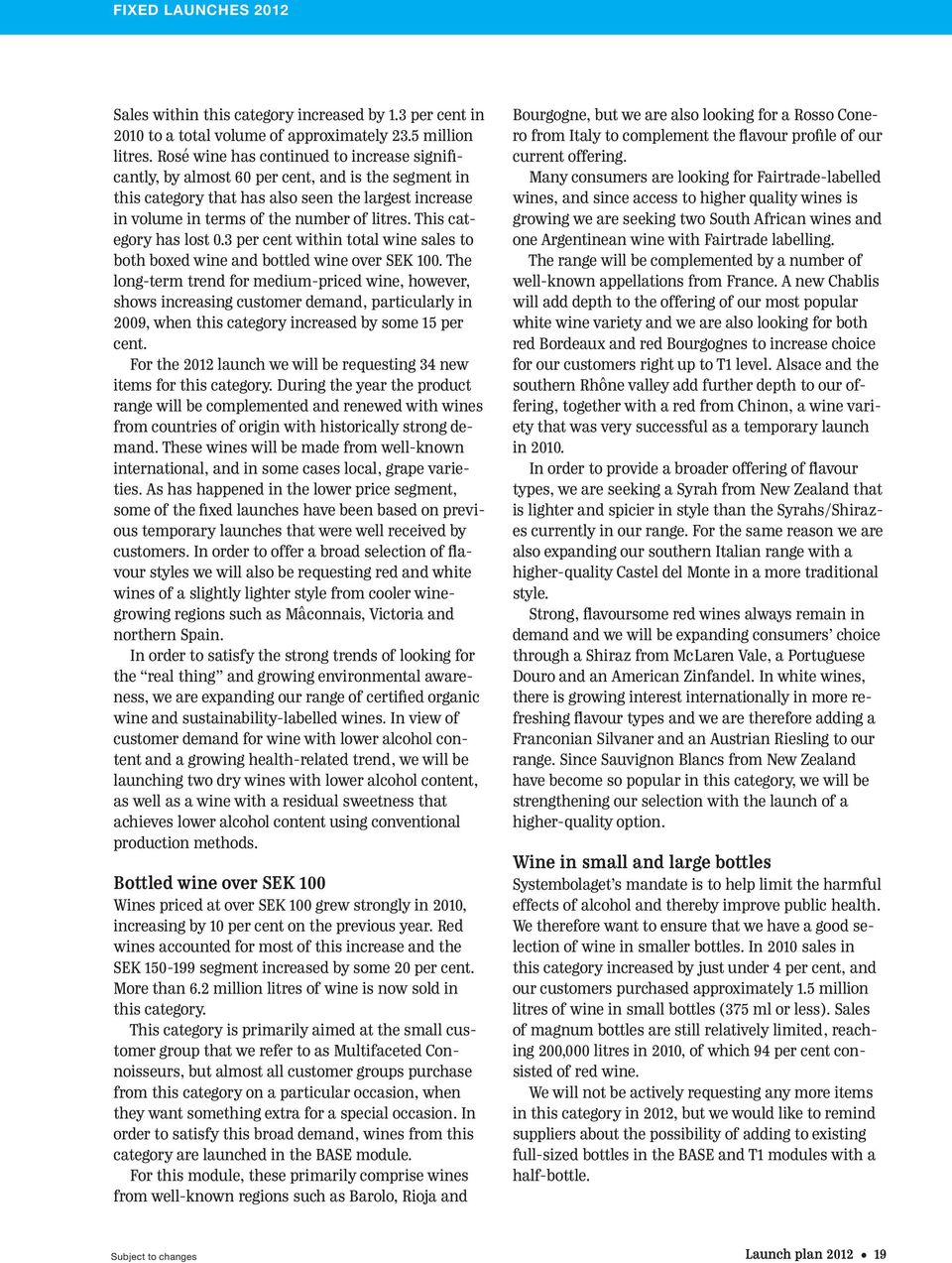
19 FIXED LAUNCHES 2012 Sales within this category increased by 1.3 per cent in 2010 to a total volume of approximately 23.5 million litres. Rosé wine has continued to increase significantly, by almost 60 per cent, and is the segment in this category that has also seen the largest increase in volume in terms of the number of litres. This category has lost 0.3 per cent within total wine sales to both boxed wine and bottled wine over SEK 100. The long-term trend for medium-priced wine, however, shows increasing customer demand, particularly in 2009, when this category increased by some 15 per cent. For the 2012 launch we will be requesting 34 new items for this category. During the year the product range will be complemented and renewed with wines from countries of origin with historically strong demand. These wines will be made from well-known international, and in some cases local, grape varieties. As has happened in the lower price segment, some of the fixed launches have been based on previous temporary launches that were well received by customers. In order to offer a broad selection of flavour styles we will also be requesting red and white wines of a slightly lighter style from cooler winegrowing regions such as Mâconnais, Victoria and northern Spain. In order to satisfy the strong trends of looking for the real thing and growing environmental awareness, we are expanding our range of certified organic wine and sustainability-labelled wines. In view of customer demand for wine with lower alcohol content and a growing health-related trend, we will be launching two dry wines with lower alcohol content, as well as a wine with a residual sweetness that achieves lower alcohol content using conventional production methods. Bottled wine over SEK 100 Wines priced at over SEK 100 grew strongly in 2010, increasing by 10 per cent on the previous year. Red wines accounted for most of this increase and the SEK segment increased by some 20 per cent. More than 6.2 million litres of wine is now sold in this category. This category is primarily aimed at the small customer group that we refer to as Multifaceted Connoisseurs, but almost all customer groups purchase from this category on a particular occasion, when they want something extra for a special occasion. In order to satisfy this broad demand, wines from this category are launched in the BASE module. For this module, these primarily comprise wines from well-known regions such as Barolo, Rioja and Bourgogne, but we are also looking for a Rosso Conero from Italy to complement the flavour profile of our current offering. Many consumers are looking for Fairtrade-labelled wines, and since access to higher quality wines is growing we are seeking two South African wines and one Argentinean wine with Fairtrade labelling. The range will be complemented by a number of well-known appellations from France. A new Chablis will add depth to the offering of our most popular white wine variety and we are also looking for both red Bordeaux and red Bourgognes to increase choice for our customers right up to T1 level. Alsace and the southern Rhône valley add further depth to our offering, together with a red from Chinon, a wine variety that was very successful as a temporary launch in In order to provide a broader offering of flavour types, we are seeking a Syrah from New Zealand that is lighter and spicier in style than the Syrahs/Shirazes currently in our range. For the same reason we are also expanding our southern Italian range with a higher-quality Castel del Monte in a more traditional style. Strong, flavoursome red wines always remain in demand and we will be expanding consumers choice through a Shiraz from McLaren Vale, a Portuguese Douro and an American Zinfandel. In white wines, there is growing interest internationally in more refreshing flavour types and we are therefore adding a Franconian Silvaner and an Austrian Riesling to our range. Since Sauvignon Blancs from New Zealand have become so popular in this category, we will be strengthening our selection with the launch of a higher-quality option. Wine in small and large bottles Systembolaget s mandate is to help limit the harmful effects of alcohol and thereby improve public health. We therefore want to ensure that we have a good selection of wine in smaller bottles. In 2010 sales in this category increased by just under 4 per cent, and our customers purchased approximately 1.5 million litres of wine in small bottles (375 ml or less). Sales of magnum bottles are still relatively limited, reaching 200,000 litres in 2010, of which 94 per cent consisted of red wine. We will not be actively requesting any more items in this category in 2012, but we would like to remind suppliers about the possibility of adding to existing full-sized bottles in the BASE and T1 modules with a half-bottle. Subject to changes Launch plan
20 FIXED LAUNCHES 2012 Bag-in-box wine Boxed wine is still the largest category of wine, with sales of just over 96 million litres in 2010, which was a slight increase on In terms of volume, this category now accounts for 51.4 per cent. Most customer segments buy boxes of wine, but the most committed customers are in the Unpretentious Bon Vivants and Sophisticated Connoisseurs groups. For 2012 we are planning a total of eleven boxes as we see strong interest from customers for new launches in this category, which now seems to have matured and consequently retains a constant market share. All segments in this category are increasing, apart from more expensive boxes of white which have lost out in terms of volume to the lowest price segment, which increased by 1.7 million litres in One exception is smaller boxes, in which both boxes of red and white have increased in volume, by 20 and 40 per cent, respectively. We will therefore address this increasing customer interest by launching a smaller box of white with an established French appellation with a clear premium character aimed at Sophisticated Connoisseurs. Interest in Fairtrade and organic products continues to grow and we would therefore like to inform suppliers that one or more of the boxes of red in the request for tenders may be requested with Fairtrade and/or organic labelling. One of the boxes of white that we will be launching will also be organic or Fairtrade-labelled. We have noted that those customers looking for a less expensive box of red in a soft and fruity style currently lack options. We are therefore launching a French box with these characteristics. We are also expanding our offering of slightly more expensive boxes of red from Spain. Boxes of rosé have increased by some 42 per cent and we are planning to introduce a small box of rosé to expand the selection and a rosé at a higher price position with a new flavour profile. Finally, we are expanding our selection from the more popular origins of Australia and Italy with a box of white from Australia and a red grape blend from Italy. Wine in other packaging In 2011 we are launching four wines in tetra packaging and we note that our tetra packaging customers are the customers that are most satisfied with the product range. In addition, sales in this segment increased by 2.3 per cent. For these reasons we will not be launching any new tetra packaging products in Sparkling wine Sales of sparkling wine continue to increase. The volume of sales amounted to 7.2 million litres, representing an increase of 13 per cent. The most explicit customer group for this segment is Sophisticated Connoisseurs, and customers in this segment are the least satisfied of all wine segments with the product range offered. We are planning five launches in this segment in In terms of volume, sparkling rosé is growing most (up 30 per cent) and we are therefore planning two launches to meet this demand. We will launch a rosé from Australia and a rosé from Italy to complement our existing range. We will be offering New World flavour types that we consider will appeal to the Sophisticated Connoisseurs customer group. We will therefore be launching a sparkling wine priced over SEK 100 from New Zealand and one from the USA. We have also seen clear growth in customer demand for quality sparkling wines from France and will therefore be launching a Crémant de Loire. Champagne In the customer segments Multifaceted Connoisseurs, Sophisticated Connoisseurs and Unpretentious Bon Vivants, which together account for more than half of Champagne and sparkling wine consumption, two out of three people say they buy Champagne every month or more frequently. There are strong indications that Champagne has become a drink that is increasingly consumed in more everyday settings and not just on special occasions. Sales in all segments in this category increased in 2010, but it is in the lower price segment that we are seeing the most significant growth both in percentage terms and in terms of litres sold. In 2012 we will be focussing on adding to the mid-price segment as we launched a number of items priced under SEK 200 relatively recently. Dessert wines We are adding a sweet wine in a full-sized bottle for the first time in a while in order to provide greater choice for the Cautious Traditionalists who purchase from this category. South Africa is our largest country of origin for dry wines and since the country also produces sweet wines we have chosen to source this wine from South Africa to appeal to a broad customer group. For the customer groups of Multifaceted Connoisseurs and Sophisticated Connoisseurs we are launching dessert wines from traditional and focussed origins, with entirely unique flavour profiles. A Pedro Subject to changes Launch plan
21 FIXED LAUNCHES 2012 Ximenez from Spain, a sweet Marsala in a half-bottle and German Beerenauslese will expand our selection in this category in order to provide suitable wines for more settings. Apéritif Sales in the Apéritif category, which comprises both wine- and spirit-based drinks, remained stable on the previous year, although this level was primarily maintained owing to the large bitters segment, which grew by 7 per cent. Sake accounts for a very small part of this category, but it has received a lot of attention in the media. As interest in Japanese food and sake is increasing we are launching a basic halfbottle version. Subject to changes Launch plan
22 FIXED LAUNCHES 2012 Spirits Launches 2 April 2012 Segment Module Origin Volume for the year Description White rum T2 Caribbean Flavoured rum T2 Caribbean ml, max. SEK 239, spiced dark rum Liqueurs T2 Scotland Whisky-based, line extension or distillery designation Scottish malt whisky 18 years old T1 Scotland years, SEK Scottish malt whisky 18 years old T3 Scotland Distillery designation with age information, max. SEK 599 Launches 1 October 2012 Dark rum T3 Caribbean ml, age stated, max. SEK 299 Liqueurs T3 International ml, max. SEK 299, bourbon-based Cognac T2 France VSOP max. SEK 499 Scottish malt whisky 18 years old BAS Scotland Scottish malt whisky 18 years old, T2 Scotland ml, max. SEK 249 small bottles American whiskey T2 USA American whiskey The number of launches in the spirits category in 2012 is lower than in This is partly because demand for newly launched products has been low in many segments, but also because we are analysing sales patterns for certain segments in this category. There is therefore a possibility of some launches in the spirits category in Spiced distilled spirits Spiced distilled spirits is the spirits category that has decreased most, by 4.6 per cent. Despite this, our surveys show that customers are very satisfied with the range offered. No fixed launches are therefore planned in this category next year. Renewal and inspiration will instead be provided through the temporary range. Clear spirits Blokes Who Yearn to Learn are the most represented customer group in the clear spirits category, which together with whisky accounts for the largest share of spirits sales, but which decreased by 3 per cent in Our customer surveys also show that this category has the most satisfied of all our spirits customers. In order to retain this high level of customer satisfaction we are planning to launch a white and a flavoured rum in Liqueurs Liqueurs are consumed to a roughly similar extent across all our customer segments. Overall, liqueur sales increased in 2010 compared with 2009, although this segment shows major differences in sales. Growth in this category is primarily driven by bitters and similar products within the other liqueurs segment. We are also seeing growing demand for smaller-sized bottles (500 and 350 ml) rather than larger bottles. We are also seeing a strong international trend in quality liqueurs made from a higher-quality spirit base, and in order to develop our offering within the liqueurs category we will therefore be requesting two items, both made from a premium dark spirit base. We are particularly targeting the Blokes Who Yearn to Learn group, which is showing a growing interest in these types of products as an alternative to traditional, dry digestifs. Subject to changes Launch plan
23 FIXED LAUNCHES 2012 Digestif Sales in the category of dark rum and spirits made from grape were stable overall in Sales of dark rum grew by a strong 10 per cent, and we see a notable increase in demand both in terms of the share of volume in this segment and in higher price categories. We will continue to expand our selection of smaller-sized bottles with a 500 ml bottle of premium rum with indication of vintage. Sales of cognac and brandy declined in 2010, but in order to ensure depth in the product range for the groups Blokes Who Yearn to Learn, Multifaceted Connoisseurs and Sophisticated Connoisseurs who are the main buyers in this category, we will be launching a Cognac VSOP in the slightly higher price category. Whisky The whisky category is mainly appreciated by the Blokes Who Yearn to Learn group. Sales in this category have declined by 1 per cent, but it is a very large category with sales of approximately 6.5 million litres. Scottish blended whisky is still the largest segment, but this has also decreased. Customers in this category are very satisfied with the existing product range and we will therefore only be launching one product an American rye whiskey that adds a new style to the range. Malt whisky Interest in malt whisky continues to increase in Sweden. 90 per cent of sales volumes in this category consist of whisky from Scotland, but our customers are also showing increasing interest in products from other countries of origin. The other malt whisky segment grew by more than 27 per cent in Blokes Who Yearn to Learn and Multifaceted Connoisseurs are the customer groups who primarily make purchases in this category. In order to offer our customers the chance to try different types of malt whisky without needing to buy a full-sized bottle, we will be expanding our range of smaller bottles with additional 350 ml format items. The average price per bottle sold of malt whisky in 2010 was SEK , which indicates strong demand for more exclusive products. In order to meet customers need for new products, we will be launching two Scottish malt whisky items in fullsized bottles in our fixed range. Subject to changes Launch plan
24 FIXED LAUNCHES 2012 Beer, cider and mixed drinks Launches 2 April 2012 Segment Module Origin Volume for the year Description Lager can international BAS Czech Republic Czech Republic, can, 330 ml Lager bottle international (..-5.9%) T Very pale and light lager Lager bottle Swedish (..5.9%) T1 Sweden ml, organic, max. 4.5% Ale bottle (..5.9%) BAS Sweden ml, organic, max. 4.5% Ale extra strong T3 UK IPA Ale bottle (..5.9%) T3 UK max. 4.5% Ale extra strong T3 USA IPA, organic Wheat beer, bottle/can T Belgium, Denmark, Netherlands, organic Cider and mixed drinks BAS semi-dry semi-sweet, can, 330 ml Launches 1 October 2012 Lager can international BAS Europe Sleek can, light lager, max. 4.9% Lager can international T Sleek can, light lager Lager can Swedish T2 Sweden Premium lager Lager bottle international (..-5.9%) T China, South America, etc., bottle 330 ml Lager bottle Swedish (..5.9%) BAS Sweden PET Lager bottle Swedish (..5.9%) T2 Sweden ml, 4.5-5%, premium lager Dark lager bottle T3 Germany ml or 500 ml Ale can (..-5.9%) T2 USA Craft beer Ale bottle (..5.9%) T2 Sweden Premium ale Porter/stout can (..-5.9%) T3 USA Craft beer Cider and mixed drinks T Mixed drinks with malt base Cider and mixed drinks T Mixed drinks with malt base Beer lager can Sales in the beer lager can category decreased by 3 per cent in This segment mainly appeals to the Blokes Who Yearn to Learn category and this is made up of customers who are generally very satisfied with the range that is currently offered, according to our customer surveys. In order to continue to offer those customers looking for new products an attractive selection, we will be launching cans in the sleek can format, a Czech can and a premium-character can. Beer lager bottle Bottled beer is our second-largest category in terms of volume, with sales of just over 43 million litres in This accounts for 18 per cent of beer by volume and it increased its share of the category by 1.1 percentage points compared with the previous year. All segments in this category are showing rising demand, and we are seeing a clear shift in sales of lager in cans to lager in bottles. It is worth noting that sales of beer in PET packaging have increased significantly in The approximately 2.2 million litres of beer sold in PET packaging now comprise around 5 per cent of sales in this category. In order to reduce our environmental impact we will be expanding our selection of beer in this type of packaging with an extensive launch of Swedish lager in the BASE module. We will also be requesting five new items for this category, primarily in 330 ml bottles. These launches will expand our offering of organic items, but also of beer with slightly lower alcohol content, since we receive lots of requests about this in our stores. We also want to complement the segment for dark lager with an item from Germany, and to offer our customers Subject to changes Launch plan
25 FIXED LAUNCHES 2012 with a new light lager in an international style from China or South America. Special beer The category of beer that has shown by far the highest percentage sales increase is special beer, which grew by 13.4 per cent in Ale accounts for 80 per cent of this sales increase, but wheat beer has also shown strong growth. England is the most popular country of origin for ale, with almost 45 per cent of sales. The second-largest origin is Swedish ale, which grew by more than 40 per cent and Scotland is the third-largest country of origin, with a doubling of sales volumes compared with the previous year. The customer segment that is most interested in this category is Blokes Who Yearn to Learn, whose interest in and knowledge about these products has increased and they are generally slightly less satisfied with the existing range compared with customers who mainly buy other types of beer. For 2012 we are launching nine new items in order to expand our offering of types of beers that are in demand such as ale, India Pale Ale and wheat beer. We will also be requesting American craftbeer in cans, and will be expanding our organic range, as well as our selection of beer with a slightly lower alcohol content. Alcohol-free Systembolaget aims to have a world-class alcoholfree range, and we need to be able to offer tasty alternatives to alcoholic drinks for those who do not want to or cannot drink alcohol. Today s health-related trend, by which we take better care of our health and well-being, means that customers are increasingly asking for alcohol-free products and Systembolaget s alcohol-free sales increased in 2010 by some 30 percent in terms of volume compared with It has become increasingly important to be a considerate host and also offer tasty drinks to guests who are not drinking alcohol. Interest in alcohol-free drinks is therefore growing internationally and more and more high-quality alcohol-free drinks are being produced around the world. Our Launch Plan does not specify what products we will be looking for, but this information will be available on the Leveransen website. Suppliers are also welcome to approach us with proposals for attractive, high-quality products that meet customers drink requirements. Cider and mixed drinks Cider and mixed drinks have declined slightly, by 1 per cent. The mixed drink segment has shown growth of 2 per cent and we are planning a twin launch of a slightly drier character in order to increase choice and renew this category. We are expanding the medium-sweet/sweet cider can segment by offering a new flavour for the Healthy Security Seekers customer group, which is the main purchaser of these drinks. Subject to changes Launch plan
26 TEMPORARY LAUNCHES 2012 Temporary launches 2012 The temporary range complements and adds depth to the fixed range. The temporary range contains products that are of a slightly more unusual character or that are produced in a limited volume and therefore cannot be offered in the fixed range. Unusual countries of origin and new flavour types in the temporary range can be trialled and then included in the fixed range if they are popular with customers. The season determines our focus and we base our choices on culinary dishes and typical occasions for the time of year when we launch these temporary products. This range aims to provide inspiration and knowledge and is launched four times a year. In addition we will also be launching season-related drinks such as seasonal beer, mulled wine and Beaujolais Nouveau. Items are available in the range for a limited time i.e. as long as the season lasts. New for 2012 is our introduction of recurring temporary launches for more expensive wines. These are launches from wine origins that are very popular among our customers, but the volume of which among many producers is not sufficient for the wines to be able to become established in the fixed range. In order to be able to offer these wines throughout the year, we therefore make several purchases of the same tender and launch the wines we have purchased at various times throughout the year. Clear spirits Our temporary range of clear spirits will have some seasonal launches to offer inspiration and new products. As drinks with lower alcohol content remain a priority area for Systembolaget in view of the healthrelated trend, we will be requesting a clear neutral spirit-based drink with a lower alcohol content for the temporary range. Spring Launches on 1 March 2012 Wine Segment Module Origin Volume Description Red wine (0-59) BAS Spain Northern Spain Red wine (60-69) BAS Italy Lambrusco, max. 9.5% Red wine (60-69) T1 Italy Southern Italy, organic Red wine (70-79) BAS Italy Marche or Abruzzerna, organic Red wine (70-79) BAS South Africa Grape blend, Malbec/Mourvèdre Red wine (70-79) T1 France Grignan les Adhémar, Luberon or Ventoux, organic Red wine (70-79) T3 Bulgaria Grape blend, Cabernet Sauvignon/Merlot/Cabernet Franc, N.B. SEK Red wine (80-89) BAS Chile Italian grape varieties Red wine (90-99) T1 France Bordeaux, Petits Chateaux, two launches during the year Red wine (90-99) T1 South Africa Cabernet Franc Red wine (90-99) T3 Israel Syrah Red wine ( ) BAS France Côte de Bordeaux, organic Red wine ( ) T1 Italy Langhe Nebbiolo Red wine ( ) T2 USA North Coast Cabernet Sauvignon Red wine ( ) T3 France Norra Rhone Cru, four launches during the year Red wine ( ) T3 New Zealand Central Otago or Martinborough, Pinot Noir Red wine (200-) T2 France Vosne-Romanée Red wine (200-) T3 Italy Amarone, four launches during the year Subject to changes Launch plan
27 TEMPORARY LAUNCHES 2012 cont. Wine Segment Module Origin Volume Description White wine (60-69) BAS Australia Verdelho White wine (70-79) T1 Chile Riesling. Light-weight glass White wine (80-89) T1 Argentina Mendoza, Chardonnay White wine (90-99) T2 Australia Margaret River, Chardonnay White wine (90-99) T2 France St Bris White wine (90-99) T2 Hungary Furmint White wine (90-99) T3 France Jura, Chardonnay White wine (90-99) T3 Italy Alto Adige, Pinot Bianco/Weissburgunder White wine (90-99) T3 Germany Riesling, older vintage White wine ( ) T2 Spain Rias Baixas White wine ( ) T3 Germany Riesling, semi-dry/semi-sweet White wine (150-) T3 France Chablis Premier Cru, two launches during the year Rosé (70-..) T1 New Zealand Sauvignon Blanc + pigment Sparkling T1 France Clairette de Die, organic, low-alcohol wine White port T2 Portugal Half-bottle, max. SEK 69 Sake T Sake with freshly squeezed juice, half-bottle Spirits Gin/unspiced distilled spirits T2 International Premium Grappa/Marc T3 Italy Grappa, combination pack Other brandy T3 France Armagnac, anniversary product. -72, -82 or -92. Beer, cider and mixed drinks Lager bottle international (..-5.9%) T3 Germany Kellerbier Lager, extra strong, bottle T3 Germany Doppelbock beer Lager bottle Swedish (..5.9%) BAS Sweden Spring lager Lager bottle Swedish (..5.9%) T1 Sweden Spring lager, premium Ale bottle (..5.9%) T1 Sweden Spring ale, 330 ml Ale bottle (..5.9%) T2 Sweden IPA Ale bottle (..5.9%) T3 Germany Kölsch Porter/stout T2 Scandinavia ml Other beer T1 USA/UK Combination pack, different styles of beer Easter Launches on 15 March 2012 Seasonal beer Segment Module Origin Volume Description Easter beer T9 10 to 15 positions Subject to changes Launch plan
28 TEMPORARY LAUNCHES 2012 Summer Launches on 1 June 2012 Wine Segment Module Origin Volume Description Red wine (60-69) T1 South Africa Malbec/Mourvèdre/Tannat Red wine (70-79) BAS Chile Grape blend Red wine (70-79) T1 Greece Grape blend with Syrah Red wine (70-79) T2 North Africa Marroco, Tunisia, Algeria, Egypt Red wine (70-79) T3 Macedonia Vranec (N.B. SEK 70-89) Red wine (70-79) T3 Germany Grape blend, Dornfelder/Cabernet Sauvignon Red wine (80-89) T3 Lebanon Red wine ( ) T1 Spain Priorat Red wine ( ) T2 South Africa Coastal Region, Pinot Noir Red wine ( ) BAS Spain Rioja, modern style Red wine ( ) T2 Australia Grape blend, Cabernet Sauvignon/Merlot/Cabernet Franc Red wine ( ) T3 France Norra Rhone Cru, four launches during the year Red wine (200-) T3 Italy Amarone, four launches during the year White wine (60-69) BAS Chile Pinot Grigio White wine (60-69) BAS Austria Grüner Veltliner, flute bottle White wine (90-99) T2 Spain Rias Baixas, Albariño White wine (90-99) T3 Germany Riesling, older vintage White wine ( ) T3 New Zealand Sauvignon Blanc, organic White wine ( ) T2 Argentina Chardonnay, clear cask character White wine ( ) T3 France Loire, Sauvignon Blanc Rosé (0-69) BAS Spain Prieto Picudo, SEK 59 Rosé (0-69) T1 Hungary Rosé (0-69) T1 Bulgaria Rosé (70-..) BAS Spain Rioja Rosé (70-..) T1 Chile Pinot Noir Rosé (70-..) T1 Italy Veneto Rosé (70-..) T3 Australia Barossa Rosé (70-..) T3 France Sancerre Rosé (70-..) T3 France Provence, organic Rosé box BAS USA White Zin Sparkling rosé BAS Chile Fair Trade, SEK Other sparkling wine BAS Germany Sparkling wine with fruit flavour lychee/cranberry Other sparkling wine T1 Chile/Argentina Max 9.5% with fruit pulp Sweet white wine, small bottles T3 New Zealand Riesling, late harvest Flavoured wine T2 Italy Visciole, 375- el. 500 ml, max. SEK Flavoured wine T Wine flavoured with raspberry, max. 9.5% Spirits Flavoured vodka BAS International Flavoured clear spirits for summer Spiced distilled spirits T2 Nordic region Summer akvavit Fruit and berry liqueurs, small bottles T2 International Combination pack, SEK 179 or 500 ml max. SEK 99 Subject to changes Launch plan
29 TEMPORARY LAUNCHES 2012 Beer, cider and mixed drinks Segment Module Origin Volume Description Lager can Swedish BAS Sweden ml, seasonal flavour Lager bottle Swedish (..5.9%) T1 Sweden Summer lager Lager bottle Swedish (..5.9%) T1 Sweden Flavoured lager, bottle 330 ml Ale bottle (..5.9%) BAS Sweden Summer ale Ale bottle (..5.9%) T2 Belgium Ale, approx. 4% Ale bottle (..5.9%) T2 Scandinavia Summer ale Ale extra strong (6.0%-..) T3 Belgium Tripel Wheat beer T3 Belgium Cider and mixed drinks BAS International Summer, 330 ml can Autumn Launches on 1 September 2012 Wine Segment Module Origin Volume Description Red wine (0-59) T1 Moldavia Cabernet Sauvignon/Merlot Red wine (60-69) BAS Australia Shiraz/Viognier Red wine (60-69) BAS Argentina Grape blend Red wine (60-69) T1 Hungary Pinot Noir Red wine (70-79) BAS Italy Umbria Red wine (70-79) T2 Hungary Egri Bikaver, N.B. SEK Red wine (80-89) BAS Portugal Beiras Red wine (80-89) T1 Spain Toro, N.B. SEK Red wine (80-89) T2 USA Monterey Pinot Noir (N.B. SEK 80-99) Red wine (80-89) T3 Australia Grape blend, unusual varieties Red wine (90-99) T1 Australia Margaret River, Cabernet Sauvignon Red wine (90-99) T1 France Corbières or Minervois Red wine ( ) T1 Argentina Cabernet Sauvignon Red wine ( ) T3 Brazil Touriga Nacional Red wine ( ) BAS Italy Barbaresco Red wine ( ) T2 USA Zinfandel Red wine ( ) T3 France Norra Rhone Cru, four launches during the year Red wine (200-) T3 Italy Amarone, four launches during the year White wine (60-69) BAS Bulgaria Chardonnay White wine (70-79) BAS Austria Grüner Veltliner White wine (80-89) T3 Spain Valdeorras White wine (90-99) BAS France Alsace White wine ( ) T3 Germany Riesling, semi-dry White wine (150-) T2 Germany Nahe, dry Riesling White wine (150-) T3 France Chablis Premier Cru, two launches during the year Wine combination pack T3 International Wine-tasting case, 4 x smaller packs, various grape varieties Sherry T2 Spain Fino half-bottle, max. SEK 69 Sweet fruit wine T2 Europe Mead, sweeter style Sweet fruit wine T3 Europe Fruit wine Subject to changes Launch plan
30 TEMPORARY LAUNCHES 2012 Spirits Segment Module Origin Volume Description Unspiced distilled spirits BAS International Lower alcohol content Tequila/rum T2 International premium Cognac, small bottles T3 France Combination pack, max SEK 399 Scottish malt whisky T2 Scotland Scottish malt whisky T3 Scotland Scottish malt whisky T3 Scotland Scottish malt whisky T3 Scotland Beer, cider and mixed drinks Lager bottle Swedish (..5.9%) BAS Sweden Autumn lager Dark lager bottle BAS Sweden Premium lager Ale bottle (..5.9%) T1 UK Autumn ale Ale extra strong T2 USA IPA Ale extra strong T3 Scandinavia Black IPA Ale bottle (..5.9%) T3 USA Pale Ale Ale extra strong T3 USA Black IPA Oktoberfest Beer T positions Launches on 15 November 2012 Winter Mulled wine launches on 1 November 2012 Wine Segment Module Origin Volume Description Red wine (60-69) BAS Portugal Bairrada Red wine (60-69) T1 Chile Syrah/Malbec Red wine (60-69) T9 France Beaujolais Nouveau, to be launched on 15 November Red wine (70-79) BAS Argentina Patagonia, Cabernet Sauvignon Red wine (70-79) BAS France Carignan Vielles Vignes, N.B. SEK Red wine (70-79) T1 Italy Cannonau di Sardegna DOC Red wine (70-79) T1 USA Merlot, N.B. SEK Red wine (80-89) T1 Argentina Salta Malbec Red wine (80-89) T2 Spain Bierzo Red wine (90-99) BAS Spain Rioja Reserva Red wine (90-99) T1 France Bordeaux, Petits Chateaux Red wine (90-99) T1 Portugal Douro, organic Red wine (90-99) T3 Uruguay Grape blend Red wine ( ) T1 Chile Fair Trade Red wine ( ) T3 Italy Monferrato Rosso DOC Red wine ( ) T2 Argentina Grape blend Red wine ( ) T2 Italy IGT Veronese Red wine ( ) T3 Argentina Uco Valley, Cabernet Sauvignon, 500ml, SEK Red wine ( ) BAS Spain Rioja Gran Reserva Red wine ( ) T3 France Norra Rhone Cru, four launches during the year Red wine (200-) T3 Italy Amarone, four launches during the year White wine (60-69) T1 Portugal Bairrada Subject to changes Launch plan
31 TEMPORARY LAUNCHES 2012 cont. Wine Segment Module Origin Volume Description White wine (70-79) T3 Slovenia Chardonnay, Sauvignon Blanc, Furmint or grape blend, N.B. SEK White wine (80-89) T2 Germany Not Riesling White wine (90-99) T2 Austria Weissburgunder White wine (80-89) T3 South Africa Grenache Blanc White wine (90-99) T2 Australia Hunter Valley White wine ( ) T3 France Alsace, Pinot Gris White wine ( ) T2 Austria Wachau/Kamptal, Grüner Veltliner White wine ( ) T3 Australia Adelaide Hills, Chardonnay Sparkling BAS Hungary SEK Sparkling rosé BAS Austria Organic Champagne ( ) T1 France Champagne ( ) T3 France Sweet white wine, small bottles T2 Austria Burgenland Other dessert wine T3 Portugal Moscatel, Douro Mulled wine BASE- T positions Spirits Spiced distilled spirits T2 Nordic region Christmas akvavit Dark rum T3 Caribbean ml, max. SEK 459 Dark rum T3 Caribbean ml, max. SEK 499 Cognac T2 France Christmas cognac, 500ml XO, max. price SEK 399 Scottish blended whisky BAS International Christmas whisky Scottish malt whisky T1 Scotland Scottish malt whisky T2 Scotland Seasonal beer Christmas beer T9 40 to 45 positions Christmas cider/mixed drinks T9 3 positions Subject to changes Launch plan
32 THE SYSTEMBOLAGET RANGE MODEL AND STRUCTURE The Systembolaget range model and structure Systembolaget employs a product range model to ensure that it can live up to its mandate of offering a broad, brand-neutral, cost-effective and customerorientated product range. The model is based on a number of different modules which are, in turn, divided into different categories and segments. We structure the product range which comprises a fixed and a temporary range with the help of the different modules, with the overall aim of providing a range that is not only as flexible and dynamic as possible, but which also lives up to the requirements placed on us. and October. Fixed launches are made either to supplement the selection or to expose items to competition. New products are available for twelve months, but after nine months these are evaluated for possible placement in the fixed range following the new product trial period. Temporary range The temporary range offers customers variety and novelty value. This range contains products that are temporary availability is either limited in terms of time or volume. The range is allocated to stores centrally. FIXED RANGE Modular Range Supplementary Range TEMPORARY RANGE Temporary Range Season Temporary Range Volume Temporary Range Time Temporary Range Exclusive Temporary Range Time The temporary launches in Temporary Range Time occur four times every year in the form of the Spring (February April), Summer (May August), Autumn (September November) and Winter (December January) launches. Offering the products for an extended but limited period of time enables us to meet our customers expectations, in that they appreciate being able to buy temporary products several times during the period (they find something they like and want to buy it again). Fixed range The fixed range satisfies the demands of the majority of Systembolaget s customers in as much as its composition reflects certainty, continuity and a longterm approach. Systembolaget uses the modular range, from the core BASE module to supplementary modules T1 T3, to ensure that individual stores can achieve this objective. The range is allocated to stores on a brand-neutral basis and is based on consumer demand. The majority of Systembolaget s sales come from this modular range. The fixed range also includes a number of items that stores are not obliged to carry. This is known as the supplementary range, or Supplementary Module T9, and is designed to ensure the breadth and depth of the product range. The fixed range is renewed twice a year, in April Temporary Range Season Temporary Range Season is the name we give to the items that we buy for a very limited period of time and which are strongly linked to a particular festive season. We carry them for the duration of the season and if they are popular with customers, they may return the following year. Examples include Christmas beer and mulled wine. Temporary Range Volume Temporary Range Volume refers to volume-based agreements for items with limited production availability but which we are still keen to offer our customers. Our aim is to identify interesting items that enhance the food and drink experience. We mainly launch these types of items in the run-up to Easter or Christmas, when our customers are looking for slightly more expensive items as part of their festive celebrations. Subject to changes Launch plan
33 THE SYSTEMBOLAGET RANGE MODEL AND STRUCTURE Categories and segments Wine Bottled wine max SEK 69 Red wine (0 59) Red wine (60 69) White wine (0 59) White wine (60 69) Rosé (0 69) Bottled wine SEK Red wine (70 79) Red wine (80 89) Red wine (90 99) White wine (70 79) White wine (80 89) White wine (90 99) Rosé (70..) Bottled wine over SEK 100 Red wine ( ) Red wine ( ) Red wine ( ) Red wine (200..) White wine ( ) White wine ( ) White wine (150..) Wine small/large bottles Red wine small bottles Red wine large bottles White wine small bottles White wine large bottles Rosé small bottles Bag-in-box wine Red wine bag-in-box l Red wine bag-in-box 3 l (SEK 0 66/l) Red wine bag-in-box 3 l (SEK 67../l) White wine bag-in-box l White wine bag-in-box 3 l (SEK 0 56/l) White wine bag-in-box 3 l (SEK 57 66/l) White wine bag-in-box 3 l (SEK 67../l) Rosé bag-in-box Wine in other packaging Red wine not bag-in-box or bottle Red wine not bag-in-box or bottle small packaging White wine not bag-in-box or bottle White wine not bag-in-box or bottle small packaging Rosé not bag-in-box or bottle Sparkling wine Sparkling wine (0 69) Sparkling wine (70 99) Sparkling wine (100..) Sparkling wine small bottles Sparkling wine large bottles Sweet sparkling wine Sweet sparkling wine small bottles Rosé sparkling wine Rosé sparkling wine small bottles Other sparkling wine Champagne Champagne (0 249) Champagne ( ) Champagne (400..) Champagne small bottles Champagne large bottles Rosé Champagne Rosé Champagne small bottles Dessert wine Sweet white wine Sweet white wine small bottles Red port Red port small bottles White port Sweet sherry/montilla Sweet sherry/montilla small bottles Madeira Madeira small bottles Other dessert wine Other dessert wine small bottles Flavoured wine Flavoured wine small bottles Sweet fruit wine Sweet fruit wine small bottles Mulled wine Mulled wine Apéritif Sherry/montilla Sherry/montilla small bottles Vermouth Vermouth small bottles Aperitif Aperitif small bottles Sake Other wine, segment Spirits Drinks & cocktails Ready-mixed drinks Ready-mixed drinks, small packaging Apéritif Anise Apéritif/bitters (spirits) Other spirits, segment Spiced distilled spirits Spiced distilled spirits Spiced distilled spirits, small bottles Clear spirits Distilled spirits Distilled spirits, small bottles Flavoured vodka Gin Gin, small bottles White rum White rum, small bottles Flavoured rum Tequila Liqueurs Chocolate, coffee and nut liqueurs Chocolate, coffee and nut liqueurs, small bottles Cream and egg liqueurs Cream and egg liqueurs, small bottles Fruit and berry liqueurs Fruit and berry liqueurs, small bottles Swedish punch Other liqueurs Other liqueurs, small bottles Digestif Cognac Cognac, small bottles Other brandy Other brandy, small bottles Calvados Grappa/marc Dark rum Dark rum, small bottles Malt whisky Scottish malt whisky 18 years old Scottish malt whisky, small bottles Scottish malt whisky > 18 years old Other malt whisky Whisky Scottish blended whisky Scottish blended whisky small bottles Canadian whisky Canadian whisky, small bottles American whiskey American whiskey, small bottles Irish whiskey Irish whiskey, small bottles Other whisky Beer, cider and mixed drinks Beer lager can Lager can international (.. 5.9%) Lager can Swedish (.. 5.9%) Lager extra strong can (6.0%..) Dark lager can Beer lager bottle Lager bottle international (.. 5.9%) Lager bottle Swedish (.. 5.9%) Lager extra strong bottle (6.0%..) Dark lager bottle Beer other packaging Other lager Other ale/porter/stout Special beer Ale bottle (.. 5.9%) Porter/stout bottle (.. 5.9%) Ale can (.. 5.9%) Porter/stout can (.. 5.9%) Ale extra strong (6.0%..) Porter/stout extra strong (6.0%..) Wheat beer bottle/can Other beer Seasonal beer Easter Oktoberfest Christmas Cider & mixed drinks Dry/medium-dry cider can Medium-sweet/sweet cider can Mixed drinks Dry/medium-dry cider bottle Medium-sweet/sweet cider bottle Cider other packaging Alcohol-free Alcohol-free wine Alcohol-free wine Alcohol-free spirits Alcohol-free spirits Alcohol-free beer Alcohol-free beer Alcohol-free cider Alcohol-free cider Water Water Valid as of 1 January, Subject to changes Launch plan
34 THE SYSTEMBOLAGET RANGE MODEL AND STRUCTURE Temporary Range Exclusive The items in Temporary Range Exclusive are exclusive and their target group comprises customers with a substantial interest in new items. These items typically also have limited availability, a good reputation, are in high demand internationally, and have received extensive coverage in the trade media. These launches take place in few stores since the volumes are extremely small and they are mainly advertised to customers via Systembolaget s website. Tenders for the exclusive range are received and processed by our purchasers on a continual basis. Systembolaget buys in selected exclusive items in very limited volumes. Categories and segments The range is divided into four category groups: wines, spirits, beers and alcohol-free. The groups are, in turn, divided into different subcategories and segments. Items largely regarded by customers as interchangeable are grouped within the same segment. When categorising by segment, Systematization takes into account different price bands, product types, and/or packaging types. There are a total of approximately 150 different segments in the range model (see chart on previous page). Modules The items within a segment are allocated to the different store types with the aid of module positions. The BASE module is carried by all stores, the T1 supplementary module by slightly fewer stores, and so on. The decision as to the precise module or modules that will be carried by a particular store is based on the store s sales, customer structure, the number of stores in the area, and the area s geographical location. Systembolaget has 412 stores. Evaluation Systembolaget updates the range carried by its stores twice every year, on 1st April and 1st October, after an evaluation of the range. The evaluation examines how well the items are selling, Systembolaget s trading margin and the items availability. All items in the fixed range are covered by the evaluation and may be included in the modules. Items within the same segment are compared with one another, with the item gaining the most points receiving the highest distribution within the segment. The current range lasts for six months until the next update. Locally selected range In addition to the centrally allocated range, stores can also elect to carry a number of items a local selection. These items are chosen to complement and extend the store s range in light of local demand. Systembolaget also offers its customers the chance to order items from the fixed range that are not in stock at their local store, with delivery within 48 hours. Different types of store Systembolaget has a nationwide retail network comprising 412 stores and 511 agents. The stores are divided into four types to enable us to comply with the requirement for a balance in terms of availability, service and finance. Our smallest stores Systembolaget s smallest stores are located in rural areas and account for 9 per cent of Systembolaget s net sales. These stores carry items from the BASE module. The range is designed to offer customers a breadth of choice, adapted to suit local demand, but also takes into account the fact that Systembolaget is the only retail outlet. The smallest stores carry a total of approximately 540 items (including the locally selected products and the temporary range). Our second-smallest stores These kinds of store are found in smaller towns or as a complement to another nearby store, and account for 19 per cent of Systembolaget s net sales. This store type carries items from the BASE to T1 modules and the range is designed to offer not only breadth but also a certain depth, providing customers with several alternatives from which to choose. They carry a total of around Breadth with freedom of choice 950 items (including the locally selected products, new launches, and the temporary range). Subject to changes Launch plan
35 THE SYSTEMBOLAGET RANGE MODEL AND STRUCTURE Our second-largest stores These stores are found in medium-sized and large towns and account for 42 per cent of Systembolaget s net sales. They carry a range of items from the BASE to T2 modules designed to offer a choice with both breadth and depth. This store type carries a total of approximately 1,490 items (including the locally selected products, new launches, and the temporary range). Our largest stores Our largest stores are found in cities and major retail centres, and account for 29 per cent of Systembolaget s net sales. They carry the entire fixed range in the BASE, T1, T2 and T3 modules, with the aim of providing customers with a rich diversity of items. This store type carries around 1,900 items (including the locally selected products, new launches and the temporary range). From order requests to store shelves We work continually to develop our product flow and to provide training for all of our store staff. This training focuses on how each store can optimise its work with a particular product from submitting an order request, via warehousing, to giving a product shelf space in store. Our goal is twofold for the customers to experience well-stocked stores and for our store staff to have more time to interact with customers. The stores are aided in this work by a tool that supports the product flow and which ensures that product placement is brand-neutral and that every product not only has sufficient shelf space, but is also positioned correctly. This tool contains information on where the items should be positioned and how much shelf space an item should be given. Instore positioning is determined centrally and helps make it easier for customers to find what they are looking for. Shelf space decisions are based on the store s sales, but also endeavour to ensure that the number of items carried in-store is sufficient to meet the store s sales needs even during the busiest times of the week. Systembolaget has conducted several customer flow measurements in stores that have shown that our customers make use of the entire store area, which is unusual in the retail trade. Consequently, an item is always well-positioned in a Systembolaget store, irrespective of the precise location on the shelves. Available-for-order range and private imports In addition to its regular ranges, Systembolaget has a range of products that are available for order. This range contains items that must be ordered from drinks suppliers warehouses. These products have not been tested by Systembolaget or undergone Systembolaget s tendering process. A private import service is also offered for customers who require help with ordering an item not listed in Systembolaget s regular product range or in the available-for-order range. E-ordering Systembolaget is currently testing an e-ordering system for the available-for-order range in a number of stores around Sweden. All of the products in the available-for-order range can be ordered online at the systembolaget.se website and delivered to the store chosen by the customer. Customers receive a text message when the delivery arrives and pay when they collect the items. The delivery lead-time is approximately 8 working days and customers then have 14 days to collect their orders. After payment and collection customers also have a 14-day cancellation period during which to return the goods. At the time of writing, the plan is for the e-ordering system to be implemented for all stores as of mid Systembolaget hopes, however, that it will be possible to implement the system even earlier than this. The e-ordering service will be expanded in the autumn of 2011 to enable customers to use the systembolaget.se website to order products from all of our temporary ranges for delivery to their store. Locally produced items Systembolaget offers Swedish producers the chance to position locally produced items in their nearest Systembolaget store. By the end of March 2010, 51 producers had positioned 192 items in 45 stores around Sweden. Subject to changes Launch plan
36 FROM STRATEGY TO LAUNCH From strategy to launch Systembolaget aims to develop a cutting-edge offering that helps reduce the harmful effects of alcohol. This offering should make it easier for customers to think about health and environment issues, and should increase the level of customer satisfaction. There are a number of parameters that we need to take into account in our endeavours to create a range that meets Swedes requirements for both breadth and depth in the product range. To this end, we analyse factors such as our operating environment and sales trends and take a closer look at our customers requirements. The analysis is summarised in the form of an annual product range strategy. The product range strategy The product range strategy consists of internal written guidelines and is based on Systembolaget s strategic plan. The product range strategy defines goals and activities for the entire range and is based on the following focus areas: consideration, expertise, inspiration, value for money and efficiency. The strategy is reviewed once a year. The product range strategy stipulates that: Systembolaget should offer a range that is adapted to customer demand and to changes in the world in which we operate. Systembolaget should offer a range that focuses on health, the environment and diversity and which is brand-neutral, quality-assured and profitable. The overall goal of our product range work is to ensure even greater levels of customer satisfaction, and to this end we set goals and guidelines for the various focus areas. Our aims include: continuing to offer our customers a broad and deep range that is also perceived as modern and innovative; offering our customers a range that enhances the food and drink experience; offering customers more products in smaller sizes; expanding our offering of products that have a lower or zero alcohol content; promoting the trend towards a more sustainable drinks production chain this is currently symbolised for our customers by our organic products; offer customers various climate-smart packaging options; introduce more products that fulfil guidelines for ethical production, such as Fairtrade, Wieta, ETI, etc. Product range roles We have divided the range into different roles to ensure that we meet our customers requirements. By analysing the sales of the respective roles in the different types of store, we create a useful tool for distributing the range amongst the stores. Each product role is available in all of our stores, but the precise distribution between them varies depending on the size of the store. The roles are: Profile, Cutting Edge, Volume, Service, Season and Innovation. Product role Volume Category roles and accompanying categories Category role Volume Bottled wine max SEK 69 Bag-in-box Wine in other packaging Sparkling wine Beer lager can Cider & mixed drinks Spiced distilled spirits Clear spirits Whisky Category role Service Drinks & cocktails Dessert wine Apéritif (wine and spirits) Beer in other packaging Category role Innovation Category role Profile Bottled wine SEK Wine in small and large bottles Champagne Beer lager bottle Special beer Liqueurs Digestif Malt whisky Alcohol-free Category role Edge Bottled wine over SEK 100 Category role Season Mulled wine Seasonal beer The categories in the Volume product role represent the majority of Systembolaget s sales, in terms of both volume (number of litres) and value. Most of our customers buy from the volume role, where the quality/price ratio is the most important parameter for them. Systembolaget therefore wishes to offer a wide Volume range that meets this requirement. New products are launched in the fixed and temporary ranges. The fixed range launches create competition and renewal in the existing range, and the temporary ranges complement this. These items are assigned module positions in BASE through to T2. Subject to changes Launch plan
37 FROM STRATEGY TO LAUNCH Product role Profile The categories within the Profile product role should be both broad and deep, and customers should perceive it as both inspirational and responsible. The range should also encourage customers who want to learn more about our products and we are keen, in this respect, to show off the importance of different manufacturing methods, raw materials and countries of origin to the flavour profile of the drinks we sell. New products are launched as part of both the fixed and the temporary range. The fixed range launches complement and rejuvenate the existing range, while the temporary launches provide inspiration. The items are assigned module positions in BASE through to T3. Product role Service The categories within the Service product role ensure that Systembolaget s customers are offered a wide selection of products in relatively low demand. The selection of products in the majority of the service categories is consequently narrow and lacks depth. New products are launched in both the fixed and the temporary range. The fixed launches are primarily intended to create competition in the existing range, while the temporary launches should complement the range already offered to customers. The items are assigned module positions in BASE through to T3. Product role Cutting Edge We offer a Cutting Edge range to satisfy the most demanding customers. The Cutting Edge categories add depth to the range and focus primarily on the most pre-eminent districts and regions in the classic wine-producing countries. The Cutting Edge segments are updated through launches in both the fixed and temporary ranges, with the emphasis on the temporary, exclusive range. The fixed range launches complement and rejuvenate the existing range, while the temporary launches offer customers the opportunity to develop their particular interests. These items are assigned module positions primarily in T2 and T3. The temporary exclusive range in T5-T8 solely comprises products in the Cutting Edge categories. Product role Season The categories within the Season product role are designed to ensure that Systembolaget can offer its customers an up-to-date and seasonally adjusted range of products. Structuring the product range Preconditions Customer requirements Customer satisfaction index Surveys Customer segmentation Other customer surveys Operating environment Trends Product development Politics, economy, retail trade Suppliers, producers, supply and demand within focus areas Sales analysis Sales analysis Laws and directives Operational goals Product range strategy Category action plan Launch proposals Launch plan Request for tender Launch Customer satisfaction Subject to changes Launch plan
38 FROM STRATEGY TO LAUNCH The basis of this range is that there should be no fixed module positioning, but that it should instead focus on temporary launches, which typically add both breadth and depth to the range. Product role Innovation The Innovation product role does not include any existing categories. The role is designed to enable Systembolaget to develop a range that exceeds customer expectations. The rapid introduction of new product types is designed to ensure that Systembolaget is perceived as creative and innovative, which is one of the aims of the Inspiration focus area. All Innovation items are tested for quality and compliance with our basic requirements and to ensure that they are in line with Systembolaget s mandate and product range strategy. Criteria for the role: The flavour type/packaging/characteristics shall not form part of Systembolaget s existing range. None of the existing segments are appropriate for the product type in question. There is a limited range of product types. Category action plans The Category Managers draw up an action plan for each category, based on the product range strategy. The action plan focuses on achieving the goals laid down in the product range strategy and specifies in detail the way in which the category in question is to be run during the year ahead. See this page for more on the category action plans. Launch proposals and launch plans Purchasing staff then draw up launch proposals based on the actions plans, in which the preconditions for their area of responsibility are linked to the category requirements. Each Category Manager puts together the launch proposals in the launch plan, after discussions with the purchasing staff. Request for tender The next step involves sending requests for tender to Systembolaget s suppliers. A request for tender is formulated on the basis of the launch plan and specifies in detail the type of product that Systembolaget is looking for. The request for tender specifies, for example, the segment, price, flavour type and purpose of the launch. Once the submitted tenders have been reviewed, the purchasers request product samples. Systembolaget s sampling room takes charge of the product samples and prepares to test them. The order in which the tasting panel test the samples is always random and samples are always tested blind. The panel evaluates the products quality in relation to the flavour description in the request for tender. The product or products that receive the highest score and have the highest internal priority are bought in and the winning product is launched. Launch Prior to the launch, a testing panel determines the product s characteristics and produces a bouquet and flavour description and the pie charts used in our product catalogues. The characteristics are then published in our new product catalogue, Varunytt, our product range price list, on the systembolaget.se website and on the stores shelf labels. Before the products reach the shelves, they are analysed in Systembolaget s laboratory to ensure that the contents are consistent with the product labels and comply with EU regulations. One week before the launch, the purchasing staff carry out a sensory test to ensure that the product is the same as the one submitted for tender sampling. The strategic launches are then subjected to renewed sensory testing after three and six months. Find out more about Systembolaget s quality assurance work on page 40. Category action plans Once the product range strategy has been established, the Category Managers draw up an action plan for each category. The plan describes in detail the way in which the category in question is to be managed during the year ahead. The analyses conducted by the purchasers for their respective areas of responsibility are vital to the category action plans. Systembolaget has a number of tools at its disposal and the category action plans specify how they are to be used at category level. These tools are: Range classification Segment structure Contribution margin limits Module positions Extra positions Free cataloguing Price Launches Product placement Subject to changes Launch plan
39 FROM STRATEGY TO LAUNCH Range classification shows the range or ranges in which the category will chiefly be placed, e.g. whether the focus is to be on the fixed, temporary or exclusive range. Segment structure describes whether the offering should be broad or narrow, deep or shallow. Contribution margin limits regulate the size of the complementary range in T9. Module positions are the number of places available for the respective segment in the various types of store. Extra positions are used to enable us to offer products with strategically important characteristics but which cannot compete in their respective segments. We have, for example, allocated extra positions for gluten-free products in many categories. Free cataloguing means that an item, or more usually group of items, is free catalogued to ensure they do not impinge on a store s local selection. Price is an important parameter for our customers, which is why Systembolaget offers products in all price categories even if the segments are not broken down into price bands. Vodka, for example, is offered in a range of prices between approx. SEK 180 and approx. SEK 300 in order to satisfy differing customer requirements. Launches are used to complement, create competition within, and update the product range. We define the number of launches for each category and the distribution between the fixed and the temporary ranges. Product placement offers a means for Systembolaget to display the range in a brand-neutral way. The placement is designed to make it easy for customers to find what they are looking for and to support good store management. Subject to changes Launch plan
40 QUALITY ASSURANCE Quality assurance Ensuring that the planning and strategic work results in the right products is of the utmost importance to Systembolaget. It is also vital to the company s credibility and brand-neutrality that the products sold are of the same quality as the winning tender samples. The quality assurance process consequently involves three stages: sensory tests, chemical analysis and label control. Tender sampling This stage of the process involves: Selecting the winning samples through sensory blind testing. Winning samples for the fixed range undergo chemical analysis and the result is used as a reference in the event of any inconsistencies being detected at a later stage in the process. The tender sample is archived. Extra tender samples You must, as the supplier of a winning tender sample for fixed range launches and in order for Systembolaget to consider purchasing your products, be prepared to send in an extra tender sample within four working days of receiving notification of the tender sampling results. This means you must have the extra samples listed below available when submitting your original tender sample: Wine three samples Beer, cider and mixed drinks four samples Spirits one sample Launch sampling This stage of the process involves: Sensory comparison of the supplier s product sample with the tender sample. Chemical analysis to ensure that the sample complies with applicable legislative requirements. Label control: the packaging is checked to ensure its compliance with applicable laws, regulations and the specific requirements stipulated in the request for tender. The launch sample is archived. Sampling when sales begin This stage of the process involves: Taking samples from the products delivered to the stores. The store sample is then subjected to sensory comparison with the tender sample. If an inconsistency is detected, a more in-depth sensory analysis, known as a triangle test, is carried out. If the inconsistency is confirmed by the triangle test, a comparative quality test is carried out. If the inconsistency is judged to be significant, additional product samples from several different stores are tested. If the inconsistency is judged to be significant, a new chemical analysis is carried out to determine whether the store sample matches the tender sample. The sample taken when sales begin is archived. Post-launch control (applies to fixed range products) This stage of the process involves: Taking samples from the stores. Beer is tested three months after sales begin. Quality assurance of launches From supplier From supplier From store From store Sample is archived Sample is archived Sample is archived Sample is archived TENDER SAMPLING LAUNCH SAMPLING SAMPLING WHEN SALES BEGIN POST-LAUNCH CONTROL AFTER 3/6 MONTHS Blind tasting Blind tasting Blind tasting Blind tasting Chemical analysis Chemical analysis Chemical analysis Chemical analysis Chemical sampling Labelling Labelling Triangle test Characteristics Comparative quality test Laboratory analysis The quality of our product launches is evaluated at four separate stages. Subject to changes Launch plan
41 QUALITY ASSURANCE Spirits and bottled wines are tested six month after sales begin. Like beer, bag-in-box products are tested three months after sales begin. These store samples undergo sensory comparison with the sample taken when sales begin. If an inconsistency is detected, a more in-depth sensory analysis, known as a triangle test, is carried out. If the inconsistency is confirmed by the triangle test, a comparative quality test is carried out. If an inconsistency is judged to be significant, additional product samples from several different stores are tested. If the inconsistency is judged to be significant, a new chemical analysis is carried out to determine whether the store sample matches the tender sample when sales begin. Subject to changes Launch plan
42 SYSTEMBOLAGET PROMOTES SUSTAINABILITY Systembolaget promotes sustainability Responsible suppliers Systembolaget s monopoly entails a special responsibility with regard to neutral product selection. But it also gives us a unique opportunity to influence the entire drinks industry to act in a sustainable way. We are seeing an increase in the demand for organic and Fairtrade products, and we will be looking to buy in more products that are manufactured in a sustainable way. This approach enables Systembolaget, in partnership with our suppliers, to help create a more sustainable society. We are engaged in cooperation with the Nordic alcohol monopolies, suppliers and producers in a long-term programme of activities with the aim of ensuring that all of the alcoholic beverages we sell not just our organic and Fairtrade product range are produced and handled in a way that shows consideration for both people and the environment. Five steps in five years The Nordic alcohol monopoly partnership is implementing its programme in stages over time to ensure that both we and our suppliers can lay the proper foundations for developing our operations in a more sustainable way. The ten Global Compact principles, which cover human rights, labour conditions, the environment and anti-corruption, form the basis for this work. The Global Compact is based on the UN Declaration of Human Rights, the ILO conventions, the OECD guidelines and the Rio Declaration. The Nordic partnership is following a common five-year Nordic strategy that has been broken down into five stages. In 2011 we are at the fourth stage. This means that we have established a Code of Conduct, which will be part of our purchasing agreements from In spring 2011 Systematization was accepted as a member of the international CSR company Business Social Compliance Initiative (BSCI) with the aim of benefiting from the knowledge and the tools that this organisation provides. By 2013, when all five stages will have been implemented, our goal is to have established a systematic methodology for creating a sustainable drinks supplier chain. As part of this work, Systembolaget is offering its suppliers Dialogue Agreements Code of Conduct Control Monitoring Prepare control systems Prepare reporting systems Prepare incorporation of the Code of Conduct into purchasing terms and conditions with suppliers Complete Code of Conduct content in dialogue with our suppliers Initiate dialogue with our suppliers on the subject of the Nordic CSR work The CSR platform, including the Code of Conduct, is based on the Nordic CSR partnership training courses and a range of different tools that will support them in their efforts to establish a sustainable drinks supplier chain. Sustainable dialogue Working conditions among vineyard workers in South Africa and Chile have been highlighted by the media in a number of contexts. Systembolaget addresses these types of cases through research and dialogue with suppliers in those countries in question. To learn more about CSR among producers, the Nordic monopolies have conducted visits to South Africa and Southern Europe. During these visits we conducted a dialogue with producers, voluntary organisations, universities, trade union representatives, ambassadors and Fairtrade-organisations, all of whom are working to establish good working conditions. The monopolies do not just represent five customers: they represent five countries, which means that by working in partnership with our suppliers, we can achieve substantial changes when it comes to sustainability. The issues that we noted during our visits primarily relate to pay, accommodation, employee rights, information and education. Code of Conduct Systembolaget s Code of Conduct, which was adopted in January 2011, focuses on the 10 areas below: Compliance with applicable regulations Freedom of association and the right to enter collective agreements Freedom from discrimination Pay Subject to changes Launch plan
43 SYSTEMBOLAGET PROMOTES SUSTAINABILITY Working hours Health and safety at work Prohibition of child labour Prohibition of forced labour and disciplinary measures Environmental and safety issues Company routines and processes An LCA analysis of wine packaging Systembolaget, Vinmonpolet in Norway and four other companies have conducted an LCA study of five different types of wine packaging. LCA stands for Life Cycle Assessment and entails measuring the environmental impact of the packaging throughout its life-cycle from cradle to grave, including raw materials, transportation and recycling. The types of packaging included in the study are glass bottles, PET bottles, boxes, bags (stand-up pouches) and liquid packaging cardboard, with each type of packaging evaluated for several different volumes. This comparative analysis of packaging was performed according to five indicators; global warming, acidification, extraction of non-renewable resources, primary energy and water consumption. This study was completed in August 2010 and showed that bag-in-box, bags and liquid packaging cardboard generally have a lower environmental impact than glass bottles. PET bottles are rated between glass bottles and other packaging. When comparing different volumes of a particular type of packaging, it is generally the case that larger volumes have a lower environmental impact. The greatest environmental impact for all the types of packaging occurs at the manufacturing stage. The findings of this survey, together with other aspects such as customer demand and quality, will be used in Systembolaget s product range work and these aspects will be factored together with Systembolaget s alcohol policy mandate. Subject to changes Launch plan
BiB Consumer Preferences and Issues
 BiB Consumer Preferences and Issues in Sweden Background 1994: Sweden joined the EU. Import and production monopoly of Vin&Sprit ends. 1995: 10 L boxes introduced in the on-trade 1996 25/11: Le Cep Merlot
Wine and drinks lists
 Wine and drinks lists 10 Units covered This chapter covers the following units: Level 1 Prepare and clear areas for drink service (1BS2, 113) Serve drinks (1BS2) Level 2 Principles of beverage product
The Wine and Spirits Market in Asia-Pacific and Worldwide with Prospects Until 2017
 The Wine and Spirits Market in Asia-Pacific and Worldwide with Prospects Until 2017 From the VINEXPO* market study For the 12 th consecutive year, VINEXPO the international wine and spirits exhibition
The Alcoholic Beverage Menu continued
 The Alcoholic Beverage Menu continued Menu Marketing and Management OH 5-1 Alcoholic Beverages Are Part of the Dining Experience Many customers enjoy an alcoholic beverage with their food. Food and alcoholic
Alcohol Units. A brief guide
 Alcohol Units A brief guide 1 2 Alcohol Units A brief guide Units of alcohol explained As typical glass sizes have grown and popular drinks have increased in strength over the years, the old rule of thumb
Contents. 03 Who we are 04 What we do 07 Product 10 Quality 13 Innovation 14 Global reach
 Private Label Contents 03 Who we are 04 What we do 07 Product 10 Quality 13 Innovation 14 Global reach Who we are Welcome to the Private Label division of the Whyte & Mackay Group. The Whyte & Mackay Group,
O4W1602APP780 WSET Diploma Online
 O4W1602APP780 WSET Diploma Online Examinations The examinations attached to your course are as follows: Unit 2 23 January 2016 Tutorial Days 2 3 April 2016 Unit 1 (Case Study) 14 June 2016 10:30 11:45am
Effective at Retail November 1, 2015
 Prepared by LCBO Financial Planning & Analysis LCBO Pricing Examples Spirits Wine Page Whiskey 1 Brandy 2 Spirits 3 Spirits - Licensee 4 Low Alcohol Spirits 5 Table Wines 6 Table Wines at LCBO versus WRS
WELL-KNOWN FLAVORS THE MENU WINTER
 EXCITING WELL-KNOWN FLAVORS CLASSICS THE MENU WINTER IT S FINALLY TIME TO ENJOY THE RIDE THROUGH WINTER WONDERLANDS AND EXPLORE OUR BEER SELECTION, SNACKS, SWEETS AND COCKTAILS AFTER ALL, TIS THE SEASON
Canada s Restaurant Industry Putting jobs and economic growth on the menu
 F A L L 2 0 1 0 Canada s Restaurant Industry Putting jobs and economic growth on the menu OVERVIEW Bringing Canadians to the table On a typical day, Canadians make 17 1 million restaurant visits. They
Bottled Water - Market Overview
 Bottled Water - Market Overview July 2012 Disclaimer The following information is offered in good faith and represents an unqualified interpretation of a range of industry commentary and market data. It
Address by CEO Karl-Johan Persson at H&M s AGM 2015
 Address by CEO Karl-Johan Persson at H&M s AGM 2015 Good afternoon everybody, and a warm welcome to H&M s annual general meeting 2015. I am very pleased to see so many of you here today. As always, lots
UK Wine Market Overview 2013
 UK Wine Market Overview 2013 The UK market continues to follow the trend of recent years whereby wine volume sales continue to fall (down 2% annually) while value continues to rise year on year, up 1%
The wine market: evolution and trends
 The wine market: evolution and trends May 2014 1 Table of contents 1. WINE CONSUMPTION 3 2. TRENDS IN WORLD WINE TRADE IN 20 6 3. TOP WINE EXPORTERS IN 20 7 4. TOP WINE IMPORTERS IN 20 9 5. THE FIVE LARGEST
BALFES: A FOOD HAVEN FROM SHOPPING STORMS NEW SEASONAL MENU IS PERFECT FOR SHOPPERS IN THE CITY
 Press Release 02 November 2015 BALFES: A FOOD HAVEN FROM SHOPPING STORMS NEW SEASONAL MENU IS PERFECT FOR SHOPPERS IN THE CITY Balfes, the chic centrally located all day dining bar and brasserie located
Market insights. A world of beer CONSUMER. bar-expert.co.uk
 A world of beer Market insights WHAT DEMOGRAPHIC, ECONOMIC AND SOCIAL FACTS ARE OF INFLUENCE? WHAT ARE THE LATEST TRENDS IN CONSUMER BEHAVIOUR AND HOW DO THEY DIFFER PER OUTLET PROFILE? READ ALL ABOUT
An Introduction to Whisky English (B1 B2)
 An Introduction to Whisky English (B1 B2) www.celangue.com Barley, water & a whole lot of goodness The words highlighted in red are very important for your whisky vocabulary. If you look at any bottle
Tim Salt. Managing Director, Diageo Australia
 Tim Salt Managing Director, Diageo Australia Tim Salt Managing Director, Diageo Australia Tim Salt Managing Director, Diageo Australia & New Zealand Nationality: Australian (UK born) Role description:
101 IELTS Speaking Part Two Topic cards about sports, hobbies and free time A- Z
 101 IELTS Speaking Part Two Topic cards about sports, hobbies and free time A- Z As the topics of sports, hobbies and free time are easy ones that tie in with IELTS Speaking Part One and students like
Your drinking and you. The facts on alcohol and how to cut down
 Your drinking and you The facts on alcohol and how to cut down Introduction For many of us, drinking with friends and family is one of life s pleasures. But for a lot of people, their drinking can lead
LIST OF CONTENTS AND TABLES
 LIST OF CONTENTS AND TABLES Fruit/vegetable Juice in South Korea - Category analysis... 1 Headlines... 1 Trends... 1 Competitive Landscape... 2 Prospects... 2 Category Data... 3 Table 1 Off-trade Sales
don t let drink sneak up on you how to catch it out and cut back
 don t let drink sneak up on you how to catch it out and cut back A couple of glasses at home. A few after work... Drink can sneak up on us After a long day, many of us like to unwind with a nice glass
OIV s Focus. The sparkling wine market. The sparkling wine market has expanded in recent years, boosted by high global demand.
 OIV s Focus The sparkling wine market The sparkling wine market has expanded in recent years, boosted by high global demand. Production has increased significantly: + 4% in 1 years, while that of still
LIST OF CONTENTS AND TABLES
 LIST OF CONTENTS AND TABLES Sports and Energy Drinks in South Korea - Category analysis... 1 Headlines... 1 Trends... 1 Competitive Landscape... 2 Prospects... 2 Category Data... 3 Table 1 Still vs Carbonated
LIQUOR CONSUMPTION PATTERNS IN SOUTH AFRICA
 LIQUOR CONSUMPTION PATTERNS IN SOUTH AFRICA Article written by Elias Holtzkampf 1. OVERVIEW (2006/07, 2010/11 and 2011/12) Volume = '000L Value = R'000 Table 1 OVERVIEW OF THE ALCOHOLIC BEVERAGE MARKET
A guide to one of life s little joys: Scotch whisky
 A guide to one of life s little joys: Scotch whisky Picture the scene: a few months ago I m at Soho House eating a sandwich with the crusts expertly sliced off, wearing an ill-fitting and un-ironed shirt,
Control and sale of alcoholic beverages, for the year ending March 31, 2012 Released at 8:30 a.m. Eastern time in The Daily, Thursday, April 11, 2013
 Control and sale of alcoholic beverages, for the year ending March 31, 2012 Released at 8:30 a.m. Eastern time in The Daily, Thursday, April 11, 2013 Beer and liquor stores and agencies sold $20.9 billion
Wine Store Survey. Page One. Hello, my name is XXX and I'm researching whether I should open a fine wine store in XXX.
 Wine Store Survey Page One Hello, my name is XXX and I'm researching whether I should open a fine wine store in XXX. It would be great if I could, but I just don't have enough information to make that
INFORMATION ON THE NORDIC ALCOHOL MARKET 2015
 INFORMATION ON THE NORDIC ALCOHOL MARKET 2015 INFORMATION ON THE NORDIC ALCOHOL MARKET 2015 1 Alko Inc. National Institute for Health and Welfare (THL) Authors and Alko Inc. Authors: Lay-out: Johanna Hallberg,
LIST OF CONTENTS AND TABLES
 LIST OF CONTENTS AND TABLES Rtd Coffee in South Korea - Category analysis... 1 Headlines... 1 Trends... 1 Competitive Landscape... 2 Prospects... 2 Category Data... 3 Table 1 Off-trade Sales of : Volume
Getting together. Present simple 1. New Year in Vietnam. Reading: Everybody s birthday. Word focus: Special occasions
 2 A Present simple 1 B Present simple: questions C Communication strategies Showing interest D Interaction Are you a people person? Getting together Present simple 1 Word focus: Special occasions 1 Work
Baked Products in South Africa
 Feedback Baked Products in South Africa Food 2012 Baked Products Product Definitions Products Bread Rolls Speciality Breads Baked Confectionery Definitions This category is divided into white bread, brown
Going Drink for Drink with Captain Morgan
 Going Drink for Drink with Captain Morgan How do Alcoholic Beverage Brands Survive with Increased Competition and Rapidly Changing Consumer Preferences? Sustaining performance in the alcoholic beverage
2. Definitions Alcohol Alcohol Management Plan Alcohol-related harm - Amenity and good order of the locality Authorised customer Authorised visitor
 MACKENZIE, TIMARU AND WAIMATE DISTRICT COUNCILS JOINT LOCAL ALCOHOL POLICY 1. Background This Local Alcohol Policy (LAP) has been developed jointly by the Mackenzie, Timaru and Waimate District Councils.
CAPITAL BEVERAGE PACKAGE $21.95 PER PERSON
 BEVERAGE SERVICES BAR PACKAGES CAPITAL BEVERAGE PACKAGE Full Bar (5 Hours): $21.95 PER PERSON Full Bar ( 2 Hour Cocktail Reception) $14.95 PER PERSON Imported and Domestic Beers, Bottled Water, Call Brand
Consumer Trends Wine, Beer and Spirits in the United States
 International Markets Bureau MARKET INDICATOR REPORT JULY 2010 Consumer Trends Wine, Beer and Spirits in the United States Consumer Trends Wine, Beer and Spirits in the United States EXECUTIVE SUMMARY
Control and sale of alcoholic beverages, for the year ending March 31, 2013 Released at 8:30 a.m. Eastern time in The Daily, Thursday, April 10, 2014
 Control and sale of alcoholic beverages, for the year ending March 31, 2013 Released at 8:30 a.m. Eastern time in The Daily, Thursday, April 10, 2014 Beer and liquor stores and agencies sold $21.4 billion
AQA Level 3 Technical Level Business
 AQA Level 3 Technical Level Business Marketing principles Unit Number: Y/506/6086 Specimen Question Paper Time allowed: 2 hours Instructions Use black ink or black ball-point pen Answer all questions You
U.S. Beverage Alcohol Trends. Mike Ginley Next Level Marketing
 64 U.S. Beverage Alcohol Trends Mike Ginley Next Level Marketing Overview This session will start with a fast paced and information packed review of the trends in total beverage alcohol consumption and
TELLING THE GOOD STORY OF COFFEE SERVICE AND VENDING
 TELLING THE GOOD STORY OF COFFEE SERVICE AND VENDING KEY DEFINITIONS What is a Vending Machine? A Vending Machine is an operational machine located at either a client site or in a public location designed
LIST OF CONTENTS AND TABLES
 LIST OF CONTENTS AND TABLES Bottled Water in South Korea - Category analysis... 1 Headlines... 1 Trends... 1 Competitive Landscape... 2 Prospects... 2 Category Data... 3 Institutional Bottled Water Sales...
ALCOHOLIC DRINKS INDUSTRY GUIDE
 ALCOHOLIC DRINKS INDUSTRY GUIDE Updated 10 th July 2012 Directories Harpers Wine & Spirit Directory 2012 (Harper Trade Journals Ltd, 2012) [(B) DIR 663.1029441] Comprehensive listing of wine and spirit
VisitScotland Food & Drink QA Scheme. Taste Our Best. Criteria/Guidance Notes. Stand Alone Businesses
 VisitScotland Food & Drink QA Scheme Taste Our Best Criteria/Guidance Notes Stand Alone Businesses (Restaurants, Cafes, Tearooms, Takeaways and other similar operational style businesses) The Taste Our
BOX DISTILLERY ÅDALEN SWEDEN NORDIC PASSION FOR THE ART OF WHISKY
 BOX DISTILLERY ÅDALEN SWEDEN NORDIC PASSION FOR THE ART OF WHISKY A POETIC MEETING IN THE WORLD OF WHISKY OUR STORY BEGINS HERE LIKE EVERY GOOD STORY, ours begins in a place far, far away. More precisely
Changing Tastes The UK Soft Drinks Annual Report 2015
 Changing Tastes The UK Soft Drinks Annual Report 2015 Changing tastes The number of consumers switching to low, no and mid calorie drinks in 2014 speaks volumes for industry s efforts to meet changing
2011 Cell Phone Consumer Attitudes Study
 2011 Cell Phone Consumer Attitudes Study Prepared for: CWTA April 29, 2011 Copyright 2009-2012 Quorus Consulting Group Ltd. Table of Contents Executive Summary 3 Research Objectives and Methodology 9 Detailed
Purchase plan 2/2015
 Purchase plan 2/2015 search months January-June 2015 listing months July-November 2015 28.11.2014 CONTENTS General information 3 Purchase plans for 2015 3 Information on sales at Alko 3 Assortment management
Value of production of agricultural products and foodstuffs, wines, aromatised wines and spirits protected by a geographical indication (GI)
 Value of production of agricultural products and foodstuffs, wines, aromatised wines and spirits protected by a geographical indication (GI) TENDER N AGRI 2011 EVAL 04 Leaflet October 2012 The information
HSC Marketing - Teacher s Notes
 HSC Marketing - Teacher s Notes Exercise 1 1. List products and services that Jamberoo provides: Goods Food & Drink Clothes Souvenirs Services Entertainment (Rides& attractions) Education Weddings & Functions
LONDON OLYMPIA 13 15 November 2015
 LONDON OLYMPIA 13 15 November 2015 The BBC Good Food Show London returns to Olympia this November and continues to provide an affluent, urban audience with a fabulous day out. The Show brings together
Manage cancer related fatigue:
 Manage cancer related fatigue: For People Affected by Cancer In this pamphlet: What can I do to manage fatigue? What is cancer related fatigue? What causes cancer related fatigue? How can my health care
COOKERY & WINE SCHOOL
 COOKERY & WINE SCHOOL Welcome Brookes Restaurant C ookery and Wine School is one of Oxford s best kept secrets. Offering a wide range of cookery and wine courses and classes for all abilities and ages,
National Standards Staff Training
 National Standards Staff Training Introduction This National Standard has been written to inform the industry of their obligations under Schedule 3 (Paragraph 6) of the Licensing (Scotland) Act 2005. Training
Alcohol and stroke. How can drinking alcohol increase my risk of stroke? Stroke Helpline: 0303 3033 100 Website: stroke.org.uk
 Stroke Helpline: 0303 3033 100 Website: stroke.org.uk Alcohol and stroke Regularly drinking large amounts of alcohol greatly increases your risk of stroke. This factsheet explains how alcohol can increase
Ideas 4 Paying It Forward In Schools
 Ideas 4 Paying It Forward In Schools Pay it forward in schools (real life examples) Southwestern College (United States) After watching the movie Pay it Forward the class was split up into 10 groups and
www.nextstepaustralia.com Cost of Living in Australia
 www.nextstepaustralia.com Cost of Living in Australia Cost of living This is a rough guide for monthly expenditure based on a family of 4 living in Australia. Please remember there will be variation depending
How To Understand The Canadian Consumer
 THE 5 KEY CANADIAN CONSUMERS GROUPS YOU NEED TO KNOW 1 1 Canada is home to interesting and diverse markets and boasts one of the most dynamic economies in the world. However, even today, there is an oversimplified
2. EXECUTIVE ASSESSMENT
 2. EXECUTIVE ASSESSMENT 8498 EPA CDL Awareness & Support Research Report, Sept 2012 Page 8 of 60 2.1 Key Outcomes Awareness and Support Awareness of the drink container refund scheme is almost universal
The Transformational Toy Manufacturing Industry
 The Transformational Toy Manufacturing Industry The Toy Manufacturing Industry The U.S. toy manufacturing industry is a highly concentrated industry including approximately 700 companies that generate
A STUDY ON INFLUENCE OF ADVERTISEMENT IN CONSUMER BRAND PREFERENCE (Special Reference to Soft Drinks Market in Hosur Town)
 A STUDY ON INFLUENCE OF ADVERTISEMENT IN CONSUMER BRAND PREFERENCE (Special Reference to Soft Drinks Market in Hosur Town) Dr.A. VinayagaMoorthy Professor, Department of Commerce, Periyar University,Salem-11.
IFBA s 2014 Enhanced Global Policy on Marketing Communications to Children Explained
 IFBA s 2014 Enhanced Global Policy on Marketing Communications to Children Explained What is the IFBA Global Policy? The IFBA global policy on marketing to children was first adopted in 2009, and sets
NATIONAL AGENCY FOR FOOD AND DRUG ADMINISTRATION AND CONTROL ACT 1993 (AS AMENDED) Spirit Drinks Regulations 2005. Commencement:
 S. I. of 2005 NATIONAL AGENCY FOR FOOD AND DRUG ADMINISTRATION AND CONTROL ACT 1993 (AS AMENDED) Spirit Drinks Regulations 2005 Commencement: In exercise of the powers conferred on the Governing Council
Older Adults and Alcohol
 Older Adults and Alcohol You can get help From the National Institute on Aging Table of Contents What s inside 1 Get the facts about aging and alcohol 2 You can become more sensitive to alcohol as you
Ferratum Group European Summer Barometer 2015
 page 1 Ferratum Group European Summer Barometer 2015 Summer holiday spending relative to disposable household income European Summer spending SPENDING IN RELATION TO OTHER COUNTRIES ESTONIA 60.2 % 17 %
Preliminary English Test
 Preliminary English Test Placement Test Time allowed: 2 hours QUESTION PAPER DO NOT write on this paper Instructions: Please answer all questions DO NOT USE a dictionary Write all answers on the separate
This presentation has been put together by DDRC Healthcare. It focuses on a basic understanding of alcohol, and some of DDRC s research findings from
 This presentation has been put together by DDRC Healthcare. It focuses on a basic understanding of alcohol, and some of DDRC s research findings from a study, recently conducted by them, which looked at
ALCOHOL. 1300 136 588 ndss.com.au AND TYPE 1 DIABETES
 ALCOHOL AND TYPE 1 DIABETES 1300 136 588 ndss.com.au The National Diabetes Services Scheme (NDSS) is an initiative of the Australian Government administered by Diabetes Australia. Contents Topic Page Introduction
Session of 2015. HOUSE BILL No. 2332. By Committee on Federal and State Affairs 2-12
 Session of 0 HOUSE BILL No. By Committee on Federal and State Affairs - 0 0 AN ACT concerning alcoholic beverages; relating to microbreweries; permitting the manufacture and sale of hard cider and mead;
Global Supply. 17 November 2011
 Global Supply 17 November 2011 David Gosnell President, Global Supply and Procurement Supply goals: Enhancing margin and enabling growth Competitive advantage in cost will deliver gross margin expansion
Better connections: What makes Australians stay with or switch providers? March 2015
 Better connections: What makes Australians stay with or switch providers? March 2015 Contents p2 Methodology p3 Audience segments p4 Executive summary p6 Which companies do Australians commonly interact
Annual Analysis Card Payments
 Annual Analysis Card Payments Cards and Transactions February 2014 With an expected GDP growth of 0.5% and an almost 1% decline in consumption, analysts define 2013 as a year of feeble economic recovery
Report Brochure NORDICS WINE MARKET LANDSCAPES FINLAND, NORWAY AND SWEDEN MARCH 2014. REPORT PRICE: GBP 2,500 or 5 Report Credits
 Report Brochure NORDICS WINE MARKET LANDSCAPES FINLAND, NORWAY AND SWEDEN MARCH 2014 REPORT PRICE: GBP 2,500 or 5 Report Credits Wine Intelligence 2014 CONTENTS Finland Finnish wine market Still light
Pre-paid Beverage Package Pricing
 Pre-paid Beverage Package Pricing All details and pricing are a guide, please re-confirm all details and pricing at time of booking. Cruise Destinations Legend : Mediterranean Summer : Antilles These prices
Easy ways to fundraise with Bake for Heroes
 Bake time for others Whether you have tea and cake with friends or colleagues or host a bake sale at work or in the community, every single slice of cake makes a difference to the support we can give our
Dutch hiking tourism. Terje Rakke/Nordic life - Visitnorway.com
 Dutch hiking tourism Terje Rakke/Nordic life - Visitnorway.com Index Chapter page Executive summary 3 1 Introduction 4 2 The Dutch hiking segment 5 3 Mapping Phase I 6 4 Survey Phase II: Selection and
Topic: Modern British cooking and restaurants; the popularity of celebrity chefs
 Cooking in Britain Today Topic: Modern British cooking and restaurants; the popularity of celebrity chefs Aims: - To learn or revise vocabulary relating to food, restaurants, tastes and textures - To develop
Advertising media - A
 Advertising media - A There is a large variety of media available to advertisers, and therefore advertisers must choose the medium/media which best deliver their message to potential customers in the most
YOUTH AND ALCOHOL SURVEY
 YOUTH AND ALCOHOL SURVEY OVERVIEW Based on a survey conducted by the Business Research Centre for the Alcohol Advisory Council of New Zealand ALAC Occasional Publication: No. 1 ALCOHOL ADVISORY COUNCIL
A Brief Guide to Being a Wine Rep
 A Brief Guide to Being a Wine Rep By The Wine Rep An outsiders view of a wine representative is often one of a free soul, not tied down to an office, free wine on tap, long lunches, golf days and endless
9-1 CASE STUDY. Wine Horizons. Case Study 1
 Case Study 1 CASE STUDY was a medium-sized New York State winery that emphasized sparkling wines. The company was not known to the public as a producer of good-quality domestic champagne because all of
Customer intimacy in the baking industry
 14 Customer intimacy in the baking industry CSM, WORLDWIDE LEADING SUPPLIER OF BAKERY INGREDIENTS, HAS LAUNCHED A STRUCTURAL CHANGE TO ITS EUROPEAN ORGANIZATION. GERARD HOETMER (51), CEO OF CSM TALKED
Customs and tax treatment of gifts received from outside Finland
 www.tulli.fi Customer Bulletin nr 10 Customs and tax treatment of gifts received from outside Finland July 2015 replaces bulletin January 2013 Customs and tax treatment of gifts received from outside Finland
COMPANY HISTORY. The Bitter Truth was established by passionate bartenders Stephan Berg and Alexander Hauck in idyllic Bavaria in 2006.
 COMPANY HISTORY The Bitter Truth was established by passionate bartenders Stephan Berg and Alexander Hauck in idyllic Bavaria in 2006. Their intention was to supply bar aficionados with cocktail bitters
Acquisition of Cabo Wabo Tequila
 Acquisition of Cabo Wabo Tequila Conference call 8 May 2007 Acquisition overview > On 7 May 2007 Campari announced the signing of an agreement to acquire an 80% interest of Cabo Wabo Tequilas, an award-winning
Running a successful golf club
 Running a successful golf club Issue 1 Membership and Customer Relationship Management (CRM): Why profiling is key to retention An ebook by NFS Technology Group www.nfs- hospitality.com How to run a successful
Introduction. Hello. We appreciate you, that you are
 Introduction Hello. We appreciate you, that you are Evan (L) and Chad (R), a sunny fall day on the farm considering us as prospective adoptive parents. We are Evan and Chad. We are excited to grow our
Sponsorship Opportunites 2015
 Sponsorship Opportunites 2015 OTTAWA INTERNATIONAL ANIMATION FESTIVAL SPONSORSHIP AND MARKETING OPPORTUNITIES 2014 What can the OIAF do for you? Promote your company to the animation industry with marketing