
MEAL PROVIDER VOLUNTEER GROUP GUIDELINES
|
|
|
- Hilary Hodge
- 9 years ago
- Views:
Transcription
1 MEAL PROVIDER VOLUNTEER GROUP GUIDELINES Thank you for providing meals to our adult residents and their children living at CHOICES! Meals at CHOICES CHOICES welcomes your contribution of an evening meal for our clients and their families! Volunteer groups may provide meals on a recurring schedule or as a one-time offering Meal Components CHOICES follows the MyPlate Model in providing healthy meals to our clients. Please see the attached information about MyPlate or visit There you will find information about healthy food options as well as appropriate portion sizes and meal prep practices. How many servings should we plan for? Many factors impact the number of individuals who join us for an evening meal, including the number of people temporarily living at CHOICES and their personal schedules. CHOICES houses about 75 individuals, including up to children, infants to teenagers. Menus should reflect options for children as well as options for meatless portions. What is a serving size? Serving sizes can be determined by looking at the nutrition information on the packaging of the foods you are preparing, as well as by referring to the MyPlate Model. Restaurant portions are typically much larger than recommended portion sizes, so please do not use restaurant portions as a reference. Should we provide condiments and drinks? It is not necessary to provide condiments for your meals. Salad dressings, ketchup, mustard, BBQ sauce, etc. can be provided by the kitchen in bulk. Your group can include drinks as part of your meal, but please provide large sized drink mixes that can be prepared at the kitchen rather than individual sized drinks or grocery store prepared beverages (juices, sodas, etc). Can we provide a partial meal? If your group is not able to provide a full meal, we welcome your contribution of main dishes, salads, side dishes, fruit or desserts. Please refer to the MyPlate Model for healthy options. Should we bring disposable plates, cups and utensils for clients to use? The kitchen provides meal plates, bowls, cups and utensils for residents use. Desserts are plated separately and dessert sized disposable plates are appreciated. Are there any food items we should not bring? Please do not bring individually packaged items (drinks, granola bars, condiments) as these items increase the amount waste that the kitchen staff needs to manage. What if we bring too much food? Leftover food can be stored and served later in the week. What if we do not bring enough food? Since our daily shelter census can change day to day, our kitchen staff is prepared to quickly supplement meals should there be a shortage of food.
2 Food Safety Please adhere to the following guidelines to ensure food safety. Please also refer to the website for additional food safety guidelines. Please ask all members of your group who assist in preparation of meals off-site to wear hairnets and gloves as well to ensure food safety. Washing hands frequently will also help in keeping food safe, as your group is preparing, packing and delivering it. Please keep cold food cold to ensure safety during the preparation, packing and delivery process. Cooked items can be cooled and safely reheated in our kitchens. Getting Your Group Involved Preparing a meal for CHOICES can be a fun and impactful group activity! How do we promote this event within our group? Determine the ingredients and quantities that will be needed to prepare your meal and ask members of your group, congregation or business to contribute these items. Turn it into a contest among departments or smaller groups and challenge members to contribute the most items monthly. CHOICES can work with you to create materials to use internally to boost support. How can we stretch a limited budget? Preparing the same meal (or slight variations) each time that you provide will allow you to shop ahead of time or in bulk for ingredients that are on sale and carry unused ingredients over to the next meal that you provide. Shopping warehouse stores (Sam s Club, Costco, GFS) for larger quantities can also help to stretch your budget (GFS requires no membership). The website provides tools for eating healthy on a budget. Frequently Asked Questions When should we arrive? Meals should arrive at the Community Kitchen (245 N. Grant Ave.) between 3:30 and 4:00 p.m. and will be delivered to the CHOICES shelter by LSS staff. Where do we drop off meals? The Community Kitchen (245 N. Grant Ave.) has a loading dock located at the rear of the building. You can pull up to the dock and drop off your meal. How do we record our volunteer hours? The hours that you volunteer for meal preparation off site will be logged into our Volunteer Hub scheduling system by CHOICES staff. What if we have to cancel? Please contact CHOICES at if you need to cancel your meal. Please provide at least 24 hours notice when possible, and if cancelling within 24 hours of your scheduled meal please be sure to speak to staff directly rather than leaving a message Who can we contact with additional meal questions before we provide? Amanda Cooksey, CHOICES Shelter Services Supervisor, can answer your questions about meal planning for CHOICES. She can be reached at [email protected] or Can we bring donations of food to the kitchen to be used at a later date? Donations of bulk sized shelf stable food are greatly appreciated. Please do not bring prepared food from a party or buffet for food safety and storage reasons. Can we donate money to cover the cost of a meal? Donations to CHOICES help to offset kitchen operating costs and control our food budgets. Donations can be made to CHOICES on our website at or by mail to the address below made out to CHOICES:
3 Lutheran Social Services of Central Ohio Development Department 500 W. Wilson Bridge Road, Suite 245 Worthington, OH 43085
4 What s on your plate? Before you eat, think about what and how much food goes on your plate or in your cup or bowl. Over the day, include foods from all food groups: vegetables, fruits, whole grains, low-fat dairy products, and lean protein foods. Dairy Fruits Vegetables Grains Protein Make half your plate fruits and vegetables. Make at least half your grains whole. Switch to skim or 1% milk. Vary your protein food choices. ChooseMyPlate.gov
5 Vegetables Fruits Grains Dairy Eat more red, orange, and dark-green veggies like tomatoes, sweet potatoes, and broccoli in main dishes. Add beans or peas to salads (kidney or chickpeas), soups (split peas or lentils), and side dishes (pinto or baked beans), or serve as a main dish. Fresh, frozen, and canned vegetables all count. Choose reduced sodium or no-salt-added canned veggies. Use fruits as snacks, salads, and desserts. At breakfast, top your cereal with bananas or strawberries; add blueberries to pancakes. Buy fruits that are dried, frozen, and canned (in water or 100% juice), as well as fresh fruits. Select 100% fruit juice when choosing juices. Substitute wholegrain choices for refined-grain breads, bagels, rolls, breakfast cereals, crackers, rice, and pasta. Check the ingredients list on product labels for the words whole or whole grain before the grain ingredient name. Choose products that name a whole grain first on the ingredients list. Choose skim (fatfree) or 1% (low-fat) milk. They have the same amount of calcium and other essential nutrients as whole milk, but less fat and calories. Top fruit salads and baked potatoes with low-fat yogurt. If you are lactose intolerant, try lactose-free milk or fortified soymilk (soy beverage). Protein Foods Eat a variety of foods from the protein food group each week, such as seafood, beans and peas, and nuts as well as lean meats, poultry, and eggs. Twice a week, make seafood the protein on your plate. Choose lean meats and ground beef that are at least 90% lean. Trim or drain fat from meat and remove skin from poultry to cut fat and calories. Cut back on sodium and empty calories from solid fats and added sugars Look out for salt (sodium) in foods you buy. Compare sodium in foods and choose those with a lower number. Drink water instead of sugary drinks. Eat sugary desserts less often. Make foods that are high in solid fats such as cakes, cookies, ice cream, pizza, cheese, sausages, and hot dogs occasional choices, not foods. For a 2,000-calorie daily food plan, you need the amounts below from each food group. To find amounts personalized for you, go to ChooseMyPlate.gov. Limit empty calories to less than 260 per day, based on a 2,000 calorie diet. Eat 2½ cups What counts as a cup? 1 cup of raw or cooked vegetables or vegetable juice; 2 cups of leafy salad greens Eat 2 cups What counts as a cup? 1 cup of raw or cooked fruit or 100% fruit juice; ½ cup dried fruit Eat 6 ounces What counts as an ounce? 1 slice of bread; ½ cup of cooked rice, cereal, or pasta; 1 ounce of ready-toeat cereal Get 3 cups What counts as a cup? 1 cup of milk, yogurt, or fortified soymilk; 1½ ounces natural or 2 ounces processed cheese Eat 5½ ounces What counts as an ounce? 1 ounce of lean meat, poultry, or fish; 1 egg; 1 Tbsp peanut butter; ½ ounce nuts or seeds; ¼ cup beans or peas Be physically active your way Pick activities you like and do each for at least 10 minutes at a time. Every bit adds up, and health benefits increase as you spend more time being active. Children and adolescents: get 60 minutes or more a day. U.S. Department of Agriculture Center for Nutrition Policy and Promotion August 2011 CNPP-25 USDA is an equal opportunity provider and employer. Adults: get 2 hours and 30 minutes or more a week of activity that requires moderate effort, such as brisk walking.
6 Clean: Wash Hands and Surfaces Often Bacteria can be spread throughout the kitchen and get onto hands, cutting boards, utensils, counter tops, and food. Wash your hands with warm water and soap for at least 20 seconds before and after handling food and after using the bathroom or changing diapers. Wash your hands after playing with pets or visiting petting zoos. Wash your cutting boards, dishes, utensils, and counter tops with hot soapy water after preparing each food item and before you go on to the next food. Consider using paper towels to clean up kitchen surfaces. If you use cloth towels wash them often in the hot cycle of your washing machine. Rinse fresh fruits and vegetables under running tap water, including those with skins and rinds that are not eaten. Rub firm-skinned fruits and vegetables under running tap water or scrub with a clean vegetable brush while rinsing with running tap water. Keep books, backpacks, or shopping bags off the kitchen table or counters where food is prepared or served. Separate: Don't Cross Contaminate Cross-contamination is how bacteria can be spread. When handling raw meat, poultry, seafood, and eggs, keep these foods and their juices away from ready-to-eat foods. Always start with a clean scene wash hands with warm water and soap. Wash cutting boards, dishes, countertops, and utensils with hot soapy water. Separate raw meat, poultry, seafood, and eggs from other foods in your grocery shopping cart, grocery bags, and in your refrigerator. Use one cutting board for fresh produce and a separate one for raw meat, poultry, and seafood. Use a food thermometer, which measures the internal temperature of cooked meat, poultry, and egg dishes, to make sure that the food is cooked to a safe internal temperature. Never place cooked food on a plate that previously held raw meat, poultry, seafood, or eggs. Cook: Cook to Proper Temperatures Food is safely cooked when it reaches a high enough internal temperature to kill the harmful bacteria that cause foodborne illness. Use a food thermometer to measure the internal temperature of cooked foods. Use a food thermometer, which measures the internal temperature of cooked meat, poultry, and egg dishes, to make sure that the food is cooked to a safe internal temperature. Cook beef roasts and steaks to a safe minimum internal temperature of 145 F. Cook pork to a minimum of 145 F. All poultry should reach a safe minimum internal temperature of 165 F throughout the bird, as measured with a food thermometer. Cook all ground meat to 160 F. Information from the Centers for Disease Control and Prevention (CDC) links eating undercooked ground beef with a higher risk of illness. Remember, color is not a reliable indicator of doneness. Use a food thermometer to check the internal temperature of your burgers.
7 Cook eggs until the yolk and white are firm, not runny. Don't use recipes in which eggs remain raw or only partially cooked. Casseroles and other dishes containing eggs should be cooked to 160 F. Cook fish to 145 F or until the flesh is opaque and separates easily with a fork. Make sure there are no cold spots in food (where bacteria can survive) when cooking in a microwave oven. For best results, cover food, stir and rotate for even cooking. If there is no turntable, rotate the dish by hand once or twice during cooking. Bring sauces, soups and gravy to a boil when reheating. Heat other leftovers thoroughly to 165 F. Use microwave-safe cookware and plastic wrap when cooking foods in a microwave oven. Chill: Refrigerate Promptly Refrigerate foods quickly because cold temperatures slow the growth of harmful bacteria. Do not over-stuff the refrigerator. Cold air must circulate to help keep food safe. Keeping a constant refrigerator temperature of 40 F or below is one of the most effective ways to reduce the risk of foodborne illness. Use an appliance thermometer to be sure the temperature is consistently 40 F or below. The freezer temperature should be 0 F or below. Refrigerate or freeze meat, poultry, eggs, and other perishables as soon as you get them home from the store. Never let raw meat, poultry, eggs, cooked food, or cut fresh fruits or vegetables sit at room temperature more than two hours before putting them in the refrigerator or freezer (one hour when the temperature is above 90 F). Never defrost food at room temperature. Food must be kept at a safe temperature during thawing. There are three safe ways to defrost food: in the refrigerator, in cold water, and in the microwave using the defrost setting. Food thawed in cold water or in the microwave should be cooked immediately. Always marinate food in the refrigerator. Divide large amounts of leftovers into shallow containers for quicker cooling in the refrigerator. Use or discard refrigerated food on a regular basis. Keeping Cold Lunches Cold Prepare cooked food, such as turkey, ham, chicken, and vegetable or pasta salads, ahead of time to allow for thorough chilling in the refrigerator. Divide large amounts of food into shallow containers for fast chilling and easier use. Keep cooked food refrigerated until time to leave home. To keep lunches cold away from home, include a small frozen gel pack or frozen juice box. Of course, if there's a refrigerator available, store perishable items there upon arrival. Insulated, soft-sided lunch boxes or bags are best for keeping food cold, but metal or plastic lunch boxes and paper bags can also be used. If using paper lunch bags, create layers by double bagging to help insulate the food. Some food is safe without a cold source. Items that don't require refrigeration include whole fruits and vegetables, hard cheese, unopened canned meat and fish, chips, breads, crackers, peanut butter, jelly, mustard, and pickles. Keeping Hot Lunches Hot Use an insulated container to keep food like soup, chili, and stew hot. Fill the container with boiling water, let stand for a few minutes, empty, and then put in the piping hot food. Keep the insulated container closed until lunchtime to keep the food hot 140 F or above. For more information, visit the USDA Food Safety and Inspection Service (FSIS).
A GUIDE TO HELP PLAN, PURCHASE & PREPARE YOUR OWN HEALTHY FOOD. FOOD SENSE HEALTHY MEALS ON A BUDGET
 A GUIDE TO HELP PLAN, PURCHASE & PREPARE YOUR OWN HEALTHY FOOD. FOOD SENSE HEALTHY MEALS ON A BUDGET You ll be surprised at how affordable, delicious & convenient your own meals can be! the Great Plate:
Mealtime Memo. Timesaving Tips for Mealtime
 Mealtime Memo National Food Service Management Institute The University of Mississippi for Child Care No. 6, 2009 Timesaving Tips for Mealtime Family day care home providers have a busy day. It starts
Save Time and Money at the Grocery Store
 Save Time and Money at the Grocery Store Plan a Grocery List Making a list helps you recall items you need and also saves you time. Organize your list according to the layout of the grocery store. For
Making Healthy Food Choices. Section 2: Module 5
 Making Healthy Food Choices Section 2: Module 5 1 Nutrition For Health What is healthy Tips on planning meals Making a shopping list/ Bulk orders Using WIC foods Cook and freeze What foods to choose How
SHOP SMART, STORE SAFE
 SHOP SMART, STORE SAFE Introduction This lesson gives an older adult audience an opportunity to focus on making the most of their food budgets by sharing strategies for healthy shopping on a budget and
Ready, Set, Start Counting!
 Ready, Set, Start Counting! Carbohydrate Counting a Tool to Help Manage Your Blood Glucose When you have diabetes, keeping your blood glucose in a healthy range will help you feel your best today and in
Nutrition Information from My Plate Guidelines
 Nutrition Information from My Plate Guidelines Note: This information was compiled from the website: http://www.choosemyplate.gov/ for participants in the 4-H Food Prep Contest 1/12/16. The information
Eating Well For Less. Document developed by Mapleton Teaching Kitchen 2011 TIPS & RESOURCES FOR COMMUNITY FOOD MENTORS
 Eating Well For Less TIPS & RESOURCES FOR COMMUNITY FOOD MENTORS EATING WELL ON A BUDGET Food takes a big bite from most of our household incomes, but eating nutritious & tasty meals IS possible with skills
Healthy Eating During Pregnancy
 Healthy Eating During Pregnancy Pregnancy is a time of great change. Your body is changing to allow your baby to grow and develop. Good nutrition will help you meet the extra demands of pregnancy while
Eat More, Weigh Less?
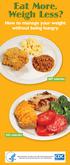 Eat More, Weigh Less? How to manage your weight without being hungry 607 calories 293 calories Department of Health and Human Services Centers for Disease Control and Prevention Can you weigh less without
Healthy Foods for my School
 yum, yum, yum, yum, yum, yum, yum, yum, yum, yum, yum, yum, yum, yum, yum, yum, yum, yum, yum, yum, yum, Healthy Foods for my School Nutrition Standards for Saskatchewan Schools Schools are an ideal place
Healthy Eating for College Students on a Budget
 University of Michigan Health System s Healthy Eating Tip of the Month for August: Healthy Eating for College Students on a Budget Times are tough and money can be tight, especially for the starving college
But what does my body need? (No...it is not just candy and soda!)
 Chapter 35: Page 349 In the last chapter, you learned how important your immune system is to your survival. This week, you are going to learn how to keep your immune system strong and ready to protect
Low Fat Diet after Cardiac Surgery With or Without Chyle Leak
 Low Fat Diet after Cardiac Surgery With or Without Chyle Leak What is chyle? Chyle (sounds like kyle) is a milky white fluid that contains protein, fat, cholesterol, lymphocytes, and electrolytes. It is
Diet for Oral Surgery/Wired Jaw
 Diet for Oral Surgery/Wired Jaw After oral surgery no chewing is allowed for a period of 4-8 weeks. During this time you will need a blenderized or liquid diet. This pamphlet will help you to get adequate
A Guide to Reducing Dietary Sodium Intake
 Salt and High Blood Pressure A Guide to Reducing Dietary Sodium Intake A Look at the DASH eating plan My Plate Basics Sodium is a mineral element most commonly found in salt (sodium chloride) Sodium occurs
Take Control Nutrition Tools for Diabetes. 50/50 plate Portions Servings
 Take Control Nutrition Tools for Diabetes 50/50 plate Portions Servings Eat more Vegetables Especially non starchy vegetables Choosing Foods to manage blood glucose Select a variety of colors and types
Canada s Food Guide Jeopardy
 Canada s Food Guide Jeopardy Drafted: July 2008 Revised: December 2012 Eating Well with Canada s Food Guide Veg & Fruit Grain Products Milk & Alternatives Meat & Alternatives Physical Activity Miscellaneous
Complete a Super Star Chef activity for knife safety.
 Ideas for Objectives and Assessment of Cooking to Save Money Cooking to save money may target participants with little or no cooking skills, who lack a vocabulary of cooking terms, are on a budget or using
DIABETES & HEALTHY EATING
 DIABETES & HEALTHY EATING Food gives you the energy you need for healthy living. Your body changes most of the food you eat into a sugar called glucose. (glucose) Insulin helps your cells get the sugar
MEAL PLANNING FOR MECHANICAL SOFT DIET
 MEAL PLANNING FOR MECHANICAL SOFT DIET Definition of Terms Calories Protein Blenderized Pureed Units of energy. A nutrient used by your body for growth and repair. The best sources are milk, meats, fish,
You can eat healthy on any budget
 You can eat healthy on any budget Is eating healthy food going to cost me more money? Eating healthy meals and snacks does not have to cost you more money. In fact, eating healthy can even save you money.
Provider Guide Many families may find it difficult to pay for or get
 introduction Hello! Provider Guide Many families may find it difficult to pay for or get access to nutritious foods. In such situations, they may find it especially hard to make healthy choices. As a provider
Maintaining Nutrition as We Age
 SS-207-06 For more information, visit the Ohio Department of Aging web site at: http://www.goldenbuckeye.com and Ohio State University Extension s Aging in Ohio web site at: http://www.hec.ohio-state.edu/famlife/aging
Heart Healthy Diet: Tips for Lowering Cholesterol and Fat in Your Diet
 Heart Healthy Diet: Tips for Lowering Cholesterol and Fat in Your Diet Cholesterol Saturated Fats Polyunsaturated and Mono-unsaturated Fats This fat-like substance is needed for good health. However, high
Home Food Safety Myths and Facts for Consumers. The Partnership for Food Safety Education
 10 Home Food Safety Myths and Facts for Consumers The Partnership for Food Safety Education 2014 For more Home Food Safety Mythbusters go to www.fightbac.org Myth #1 Freezing foods kills harmful bacteria
Do children with diabetes need a special diet?
 Do children with diabetes need a special diet? No! The basic nutritional needs of a child or adolescent with diabetes is the same as their peers Healthy eating is important for all children Children with
Eating Low-Fat on a Budget. Shop Smart: Save Money at the Grocery Store
 Eating Low-Fat on a Budget Following a low-fat diet can help lower your risk of heart disease, cancer, diabetes and stroke. Eating low fat usually means eating fewer calories. High calorie intake may lead
Maximizing Nutrition at Minimal Cost
 Maximizing Nutrition at Minimal Cost Outline: Get down to the nutrition basics Identify health issues at hand Understand the challenges & barriers Practical application & solutions Rate Your Plate What
Table of Contents. Introduction... 1. Personal Hygiene... 2. Temperature Control... 5. Cross-contamination... 6. Cleaning and Sanitizing...
 Table of Contents Introduction... 1 Food Handler Certification Program... 1 Personal Hygiene... 2 Temperature Control... 5 Cross-contamination... 6 Cleaning and Sanitizing... 6 Dishwashing... 7 Food Storage...
Duke Center for Metabolic and Weight Loss Surgery Pre-op Nutrition Questionnaire
 Duke Center for Metabolic and Weight Loss Surgery Pre-op Nutrition Questionnaire Name Date How long have you been considering weight loss surgery? Which procedure are you interested in having? Gastric
Healthy Eating After 50
 National Institute on Aging AgePage Healthy Eating After 50 Food just doesn t taste the same anymore. I can t get out to go shopping. I m just not that hungry. Sound familiar? These are a few common reasons
Nutrition Pointers: Fruits and Veggies
 Nutrition Pointers: Fruits and Veggies Eat as many as possible try filling half your plate with fruits and veggies. Fruits and veggies are good for you whether they are fresh or frozen. Go for a wide variety
Meal Planning for a Mushy Soft Diet After Nissen Fundoplication
 Meal Planning for a Mushy Soft Diet After Nissen Fundoplication Name: Date: Dietitian: Telephone: Questions? CALL YOUR DIETITIAN! Patient Food and Nutrition Services University of Michigan Hospital 1500
WEIGHT GAINER S NUTRITION GUIDE
 WEIGHT GAINER S NUTRITION GUIDE Gaining weight takes dedication! You must eat these meals everyday to stay on track. Included in this pack are the meal plan, supplement guide, fast food guide, and NCAA
ChildcareNashville.com
 ChildcareNashville.com childcare nashville/cooks academy We started with 12 child care centers... We have grown to 27 Cooks Academy participants and over 90 Childcare Nashville providers. The following
Tips for Shopping Wisely at the Grocery Store
 Tips for Shopping Wisely at the Grocery Store For successful planning, be sure to keep in mind: u The maximum amount you can spend on food. u The five basic food groups. Plan Ahead Start With A Meal Plan
Nutrition Recommendations and Interventions for Diabetes
 Nutrition Recommendations and Interventions for Diabetes S U P P L E M E N T Medical nutrition therapy (MNT) is important in preventing diabetes, managing existing diabetes, and preventing, or at least
Gaining Weight for Athletes
 Gaining Weight for Athletes Prepared by Jenn Van Ness, ATC June 2008 Gain Weight the Healthy Way To gain one pound, you need to eat approximately 500 more calories a day. Approximately one pound of fat
30 % The Food Guide Pyramid T F A O F T O C A L
 The Food Guide Pyramid L I M I T F A O F 30 % S T O T C A L O R I E United States Center for Home and Department of Nutrition Policy Garden Bulletin Agriculture and Promotion Number 252 What s in this
Meal Planning for a Mushy Soft Diet After Laparoscopic Myotomy
 Meal Planning for a Mushy Soft Diet After Laparoscopic Myotomy Name: Date: Dietitian: Telephone: Why is it necessary to follow this diet? This diet is necessary for individuals who have had some types
Ready, Set, Start Counting!
 Ready, Set, Start Counting! Carbohydrate Counting a Tool to Help Manage Your Blood Glucose When you have diabetes, keeping your blood glucose in a healthy range can help you feel your best today and in
Nutritional Guidelines for Roux-en-Y, Sleeve Gastrectomy and Duodenal Switch. Gastric Restrictive Procedures. Phase III Regular Consistency
 Nutritional Guidelines for Roux-en-Y, Sleeve Gastrectomy and Duodenal Switch Gastric Restrictive Procedures Phase III Regular Consistency The University of Chicago Hospitals Center for the Surgical Treatment
MINTO PREVENTION & REHABILITATION CENTRE CENTRE DE PREVENTION ET DE READAPTATION MINTO. Counting Fat Grams. About This Kit
 MINTO PREVENTION & REHABILITATION CENTRE CENTRE DE PREVENTION ET DE READAPTATION MINTO Counting Fat Grams About This Kit In previous kits you have learned Foods to Choose and Foods to Decrease/Avoid for
Carbohydrate Counting for Patients with Diabetes. Lauren Dorman, MS RD CDE Registered Dietitian & Certified Diabetes Educator
 Carbohydrate Counting for Patients with Diabetes Lauren Dorman, MS RD CDE Registered Dietitian & Certified Diabetes Educator Program Purpose To increase knowledge of carbohydrate counting skills for nurses
Carbohydrate counting a pocket guide
 counting a pocket guide www.bayerdiabetes.ca Contents Starches 3 Vegetables 4 Fruit/Fruit juices 5 Milk/Yoghurt 5 Fast foods 6 Proteins (meat/meat substitutes) 6 Drinks 6 Sweets/Sugary foods 7 Combination
Contact Us. Best Food Forward: Plan, Shop, Cook, Enjoy!
 For more information about the Northern Nutrition Association, please contact us at [email protected] Contact Us Email us at [email protected] Bringing home healthy foods is the first step in healthy eating!
Family Meals: Easy, Tasty, and Healthy
 Family Meals: Easy, Tasty, and Healthy Session Overview: This session is intended to help busy parents plan, shop, and prepare healthy, low-cost meals for their families, learn ways to let their children
Carbohydrate Counting for Pediatric Patients With Type 1 Diabetes. Review Date 4/08 K-0591
 Carbohydrate Counting for Pediatric Patients With Type 1 Diabetes Review Date 4/08 K-0591 Program Purpose To increase knowledge of carbohydrate counting and insulin management skills for those caring for
Where do I begin? Shopping at the. Start with a Plan. Find the Deals
 Shopping at the Grocery by Sarah Muntel, RD Where do I begin? S hopping for groceries can be a daunting task. Many people feel overwhelmed the minute they pull up to the store. For some, the goal is to
The Five Food Groups and Nutrition Facts
 session 4 The Five Food Groups and Nutrition Facts (Note to the presenter: Comments in parentheses are instructions to follow while giving the presentation. Do not read the comments to participants. This
My Diabetic Meal Plan during Pregnancy
 My Diabetic Meal Plan during Pregnancy When you have diabetes and are pregnant, you need to eat small meals and snacks throughout the day to help control your blood sugar. This also helps you get in enough
Registered Trade Mark
 2008 High Energy, High Protein, Low Fiber Guidelines Registered Trade Mark High Energy, High Protein, Low Fibre Guidelines Eating well, even though you may not feel hungry, is an important part of taking
Mealtime Memo. for Child Care
 Mealtime Memo National Food Service Management Institute The University of Mississippi for Child Care No. 10, 2008 Teaching Children about the Food Groups: Meat and Meat Alternates This Mealtime Memo focuses
Healthy Grocery Shopping on a Budget. Tips for smart spending at the grocery store
 Healthy Grocery Shopping on a Budget Tips for smart spending at the grocery store Re c ipe e! In d si Grocery Store Science Eating well does not need to cost a lot of money. Here are some ways to choose
Eating Well While Spending Less
 Eating Well While Spending Less Whether you're a college student on a budget, just starting out as a new couple, coping with a limited income or simply trying to be more frugal with your food dollars,
When you have diabetes be careful about what you eat to help you control your blood sugar.
 PART 5 INTRO TO EATING WITH DIABETES When you have diabetes be careful about what you eat to help you control your blood sugar. Foods are in three main groups: Carbohydrates (Carbs) Higher Carbohydrates
Don t let food make you sick:
 * Although America has some of the safest food in the world, an average of one in six Americans has some type of food borne illness each year. When you are immune suppressed, it is even easier for you
Healthy Grocery Shopping On A Budget
 Healthy Grocery Shopping On A Budget 1 Click Understanding to edit Master Grocery title style Stores Over 50,000 products Strategically placed items and traffic flow Lighting, music, color used strategically
Bariatric Surgery: Step III Diet
 Bariatric Surgery: Step III Diet This diet is blended foods with one new solid food added daily. The portions are very small to help prevent vomiting. Warning: This diet does not have enough calories,
Useful Websites for more information. www.eatwell.gov.uk. www.lovefoodhatewaste.com. www.nutrition.org.uk. www.bda.uk.com
 Useful Websites for more information www.eatwell.gov.uk www.lovefoodhatewaste.com www.nutrition.org.uk www.bda.uk.com Community Development Dietitians 2010 This Leaflet has been awarded: Commendation from
How To Eat Without Getting Sick
 Level 2 Dysphagia Mechanically Altered* This diet consists of foods that are moist, soft-textured and easily formed into a bolus. All foods on Level 1 are. Meats and other select foods may be ground or
Try pancakes, waffles, french toast, bagels, cereal, English muffins, fruit or juice. These foods are all high in carbohydrates.
 Healthy Meals for Swimmers on the Go Notes on BREAKFAST - Start your day off right! Try pancakes, waffles, french toast, bagels, cereal, English muffins, fruit or juice. These foods are all high in carbohydrates.
10 Week Nutrition Plan
 10 Week Nutrition Plan Welcome and thank you for your interest in taking the next step to health! We hope you find this eating plan a starting point to making healthier food choices and a tool to reach
General food hygiene rules
 General food hygiene rules Why food hygiene is important? Good food hygiene is essential to ensure that the food you and your family eats is safe. Poor hygiene procedures in your home can put you at risk.
Will the cholesterol in my diet raise my blood cholesterol?
 Healthy eating for your heart What does heart healthy eating mean to me? Heart healthy eating is an important part of a healthy lifestyle. Heart healthy eating, along with regular physical activity and
How to Increase Volume in Your Meals
 How to Increase Volume in Your Meals By adding certain types of food to your diet and drinking more water, you can actually increase the amount of food you eat, while staying within your fat gram and calorie
1800 Calorie Meal Plan. Jessica Iannotta Department of Nutritional Sciences UMDNJ School of Health Related Professions
 1800 Calorie Meal Plan Meal Portion Food Calories DAY 1 Breakfast 1 cup Hot Oatmeal, cooked, unsweetened 150 1 banana 120 1 Amy s Bean & Rice Burrito 280 (in the frozen foods section of your grocery store
The Basics of Nutrition: Understanding Nutrition Facts, Servings Sizes, & Adequate Portions
 The Basics of Nutrition: Understanding Nutrition Facts, Servings Sizes, & Adequate Portions K AT I E L. H O W E H E A LT H E D U C AT O R D I V I S I O N O F S T U D E N T A F FA I R S U S C U P S TAT
Heart healthy diet: 8 steps to prevent heart disease
 Heart healthy diet: 8 steps to prevent heart disease Changing your eating habits can be tough. Start with these eight strategies to kick start your way toward a heart healthy diet. By Mayo Clinic Staff
MEN'S FITNESS FAT TO FIT CHALLENGE - 1800 CALORIE MEAL PLAN WEEK 1
 Day 1 Tomato & Basil Omelet* (see recipe) 1 large egg 73.5 0.4 6.3 5 2 large egg whites 34.3 0.5 7.2 0.1 1/4 cup chopped tomato 8.1 1.8 0.4 0.1 2 Tbs grated parmesan cheese 43.1 0.4 3.9 2.9 2 Tbs chopped
CHILD AND ADULT CARE FOOD PROGRAM (CACFP) ANNUAL PROVIDER TRAINING
 CHILD AND ADULT CARE FOOD PROGRAM (CACFP) ANNUAL PROVIDER TRAINING What is the purpose of the CACFP? The main goal of the CACFP is to improve the health and nutrition of children. The program achieves
Carbohydrate Counting for Patients With Diabetes. Review Date 4/08 D-0503
 Carbohydrate Counting for Patients With Diabetes Review Date 4/08 D-0503 Program Objectives At the end of the session you will know how to: Define carbohydrate counting Identify the relationship between
Selection and Preparation of Foods Management of the Food Budget*
 Selection and Preparation of Foods Management of the Food Budget* Healthy meals on a limited budget! How can you serve healthy meals on a limited budget? It takes some time and planning, but you and your
Housing & Home Management
 Food Management: Grocery Shopping and Food Preparation In this section, youth will learn how to develop a weekly menu with nutritious meal options, create a grocery shopping list within a budget, save
Participant Group Nutrition Education outline: Get the Skinny on Milk
 Participant Group Nutrition Education outline: Get the Skinny on Milk Lesson Plan adapted from California WIC This group NE outline uses a facilitated discussion format, including a tasting activity. Select
100 Gram Fat Diet for 72 hour Fecal Fat Collection
 100 Gram Fat Diet for 72 hour Fecal Fat Collection The fecal fat test will help find out if you have steatorrhea (that is, excess fat in bowel movements due to the body not being able to absorb fat). To
Nutrition Guidelines for Diabetes
 Nutrition Guidelines for Diabetes Eating healthy foods and keeping a healthy body weight are very important parts of a diabetes treatment plan. A healthy diet and weight helps to keep your blood sugar
DOWN SYNDROME PROGRAM www.massgeneral.org/downsyndrome. Living a Healthier Lifestyle
 DOWN SYNDROME PROGRAM www.massgeneral.org/downsyndrome Living a Healthier Lifestyle DOWN SYNDROME PROGRAM www.massgeneral.org/downsyndrome Living a healthier lifestyle has many benefits, which means it
STANDARD OPERATING PROCEDURE S (SOP S) FOR HAZARDOUS ANALYSIS CRITICAL CONTROL POINT (HACCP) PLANS
 STANDARD OPERATING PROCEDURE S (SOP S) FOR HAZARDOUS ANALYSIS CRITICAL CONTROL POINT (HACCP) PLANS RECEIVING: All food must be from approved sources. Foods must be wholesome and not adulterated. No home-prepared
GUIDELINES FOR CONSISTENCY MODIFICATIONS OF FOODS AND LIQUIDS
 GUIDELINES FOR CONSISTENCY MODIFICATIONS OF FOODS AND LIQUIDS 1. Alterations to the consistency of foods and/ or liquids presented to the individual are made in accordance with the recommendation of an
We want you to have the best results possible while doing our detox. If your goal is weight loss, then eating the right foods and exercising
 Detox Menu Guide We want you to have the best results possible while doing our detox. If your goal is weight loss, then eating the right foods and exercising moderately will help boost your results and
Appendix A Food Sources of Vitamins and Minerals
 Appendix A Food Sources of Vitamins and Minerals Appendix A 229 Appendix A Food Sources of Vitamins and Minerals Vitamin A (Retinol) Food Amount IU* Liver 3 oz 45,400 Crab 2 cup,680 Egg medium 590 Fats
TEMPORARY FOOD FACILITY PERMIT APPLICATION
 COUNTY OF LAKE HEALTH SERVICES DEPARTMENT Division of Environmental Health 922 Bevins Court, Lakeport, CA 95453-9739 Telephone 707/ 263-1164 FAX: 263-1681 TEMPORARY FOOD FACILITY PERMIT APPLICATION Failure
Food safety in non-profit organisations
 Food safety in non-profit organisations April 2015 Food safety in non-profit organisations Published by the State of Queensland (Queensland Health), April 2015 This document is licensed under a Creative
Oatmeal Regular oatmeal does not have enough protein by itself Use Quaker Wt. Control Oatmeal or Kashi Oatmeal made with milk
 Breakfast Eggs (egg beaters or egg whites have all the protein and no fat) Make omelet with your veggies of choice Have with low fat breakfast meat like turkey bacon/sausage, ham or Canadian bacon. Morningstar
DRY BEAN RECIPES. Beans, Beans and More Beans Soup
 DRY BEAN RECIPES Beans, Beans and More Beans Soup ¼ cup each dry Black Beans, Cranberry Beans, Pinto Beans and Light Red Kidney Beans 1 cup dry Navy Beans 6 cups water ½ cup onion, diced 2 cloves garlic,
21-Day Sample Cycle Menu Child and Adult Care Food Program
 The abbreviation to the left of each menu item indicates the meal pattern component supplied. The following abbreviations are used: G/B = Grains/Breads; M/MA = Meat/Meat Alternate; F/V = Fruit/Vegetable;
LARGE GROUP PRESENTATION: PRESENTER S NOTES
 LARGE GROUP PRESENTATION: PRESENTER S NOTES Introduce yourself. Welcome! We are so glad you are here to learn about fruits and vegetables. Icebreaker Handout: Fruit or Vegetable: Parts of Many Words Read
Nutrition and Chronic Kidney Disease
 Nutrition and Chronic Kidney Disease I have been told I have early kidney failure. What does this mean? What can I expect? This means that your kidneys are not doing as good a job as they should to help
Blenderized & Pureed Recipes
 Blenderized & Pureed Recipes While you are having difficulty chewing or swallowing, use these recipes for preparing pureed meals. Use the recipes as a base for developing your own recipes. Be creative!
1. According to the Food Guide Pyramid, how many daily servings do we need of fruits?
 NAME HOUR VIDEO WORKSHEET 1. According to the Food Guide Pyramid, how many daily servings do we need of fruits? 2. How many daily servings do we need of vegetables according to the Food Guide Pyramid?
Healthy eating for breastfeeding mothers
 Healthy eating for breastfeeding mothers Healthy eating is important when you are breastfeeding. Your body has a greater need for most nutrients. Some of the extra energy required for breastfeeding comes
Iowa State University Food Sales or Service Agreement
 Food Sales or Service Agreement (1) Read this agreement and make note of all topics that pertain to your organization s event. (2) Complete pages 1-3 and submit to the at least one week prior to your event.