
Cape plc Annual Report Annual Report
|
|
|
- Leonard Long
- 10 years ago
- Views:
Transcription
1 Cape plc Annual Report 2011 Annual Report

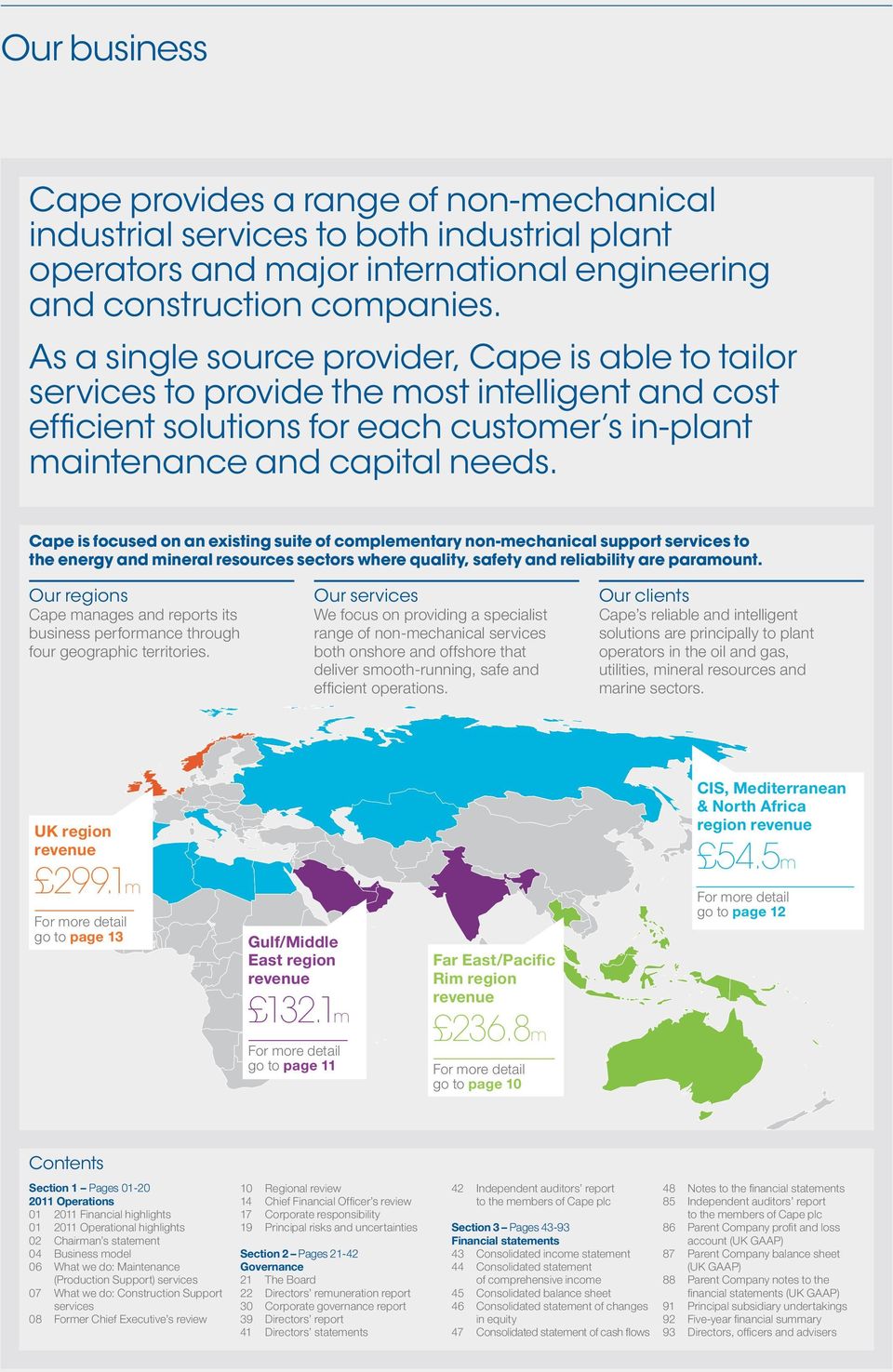
2 Our business Cape provides a range of non-mechanical industrial services to both industrial plant operators and major international engineering and construction companies. As a single source provider, Cape is able to tailor services to provide the most intelligent and cost effi cient solutions for each customer s in-plant maintenance and capital needs. Cape is focused on an existing suite of complementary non-mechanical support services to the energy and mineral resources sectors where quality, safety and reliability are paramount. Our regions Cape manages and reports its business performance through four geographic territories. Our services We focus on providing a specialist range of non-mechanical services both onshore and offshore that deliver smooth-running, safe and effi cient operations. Our clients Cape s reliable and intelligent solutions are principally to plant operators in the oil and gas, utilities, mineral resources and marine sectors. UK region revenue 299.1m For more detail go to page 13 Gulf/Middle East region revenue 132.1m For more detail go to page 11 Far East/Pacific Rim region revenue 236.8m For more detail go to page 10 CIS, Mediterranean & North Africa region revenue 54.5m For more detail go to page 12 Contents Section 1 Pages Operations Financial highlights Operational highlights 02 Chairman s statement 04 Business model 06 What we do: Maintenance (Production Support) services 07 What we do: Construction Support services 08 Former Chief Executive s review 10 Regional review 14 Chief Financial Offi cer s review 17 Corporate responsibility 19 Principal risks and uncertainties Section 2 Pages Governance 21 The Board 22 Directors remuneration report 30 Corporate governance report 39 Directors report 41 Directors statements 42 Independent auditors report to the members of Cape plc Section 3 Pages Financial statements 43 Consolidated income statement 44 Consolidated statement of comprehensive income 45 Consolidated balance sheet 46 Consolidated statement of changes in equity 47 Consolidated statement of cash fl ows 48 Notes to the fi nancial statements 85 Independent auditors report to the members of Cape plc 86 Parent Company profi t and loss account (UK GAAP) 87 Parent Company balance sheet (UK GAAP) 88 Parent Company notes to the fi nancial statements (UK GAAP) 91 Principal subsidiary undertakings 92 Five-year fi nancial summary 93 Directors, offi cers and advisers
3 Cape plc Annual Report Directors, offi cers and advisers Tim Eggar 134 Non-Executive Chairman 2011 Financial highlights Brendan Connolly Acting Chief Executive Record revenues with Richard Bingham strongest growth Chief Financial Offi cer since 2007 David McManus 1234 Non-Executive Director and Senior Independent Director +11.1% Michael Merton 1234 Non-Executive Director Operating profit Jeremy Gorman increased to 75.3m Group Company Secretary (2010: 75.2m) Registered Office 47 Esplanade St Helier Jersey 75.3m JE1 0BD Channel Islands Full year dividend Cape plc is a company incorporated and registered in Jersey increased to 14.0p Registered number (2010: 12.0p) International Headquarters One Temasek Avenue #09-03 Millenia Tower Singapore p 1 Non-Executive 2 Audit Committee 3 Remuneration Committee 4 Nomination Committee 2011 Operational highlights Independent Auditors PricewaterhouseCoopers LLP Chartered Accountants and Statutory Auditors The Atrium 1 Harefi eld Road Uxbridge Group revenue Middlesex UB8 1EX up 11.1% to 722.5m United Kingdom (2010: 650.1m) Solicitors to English Law Lawrence Graham LLP 4 More London Riverside London SE1 2AU United Kingdom Solicitors to Jersey Law Adjusted profit before Carey Olsen tax increased to 69.4m 47 Esplanade (2010: 69.1m) St Helier Jersey 48.3 JE1 0BD 33.7 Channel Islands Bankers Barclays Bank plc Lloyds TSB Bank plc 1 Churchill Place 10 Gresham Street Adjusted diluted earnings London E14 5HP London EC2V 7AE per share increased to 43.8 United Kingdom United Kingdom p (2010: 42.6p) 37.5 HSBC Bank plc 30.0 National Australia Bank Limited 70 Pall Mall 24.1 Level 12 London SW1Y 5EZ 50 St Georges Terrace United Kingdom Perth WA Australia Registrars Capita Registrars (Jersey Limited) 12 Castle Street St Helier Jersey JE2 3RT Channel Islands Operations Governance Financial statements Lost Time Injuries were down 12.3% with an LTI frequency rate of Joint Corporate Brokers Firm order book increased Numis Securities Limited by 9.7% to approx. 940m. The London Stock Exchange Building 10 Paternoster Square London EC4M 7LT United Kingdom m JP Morgan Cazenove 125 London Wall, London EC2Y 5AJ United Kingdom Significant corporate activity throughout the year, including the move from AIM to the London Stock Exchange s main market (and inclusion in the FTSE Financial 250 index Public from Relations September 2011), a refinancing of the Group s bank facility and two bolt-on M: acquisitions. Communications This annual report is printed on FSC certifi ed material. This product is 34th Floor biodegradable, 100% recyclable and elemental chlorine free. Vegetable 1 Ropemaker Street based inks were used during production. London EC2Y 9HT Both the paper mill and printer involved in the production support the growth United Kingdom of responsible forest management and are both accredited to ISO which specifi es a process for continuous environmental improvement. Throughout this document, various non-statutory measures are used and referred Designed to as adjusted. and produced These by are Carnegie defined and Orr +44 reconciled (0) to their statutory equivalents in note 5 on page 60.

4 02 Cape plc Annual Report 2011 Chairman s statement Tim Eggar Chairman These results demonstrate the strength and quality of Cape s business and its growth prospects. The Group is targeting markets with strong fundamental growth drivers and has made significant investments in both hard assets and people in 2011 to ensure we are able to resource these opportunities. Governance Cape is committed to achieving high standards of business integrity, ethics and professionalism across its worldwide operations. The Board The Board is responsible to shareholders for the overall management and performance of the Group. Audit Committee The Audit Committee is responsible for internal control and risk management, financial reporting, internal audit and external audit including auditor independence. Go to page 36 for more information. Remuneration Committee The Remuneration Committee determines the remuneration and conditions of employment of the Executive Directors and senior managers. Go to page 22 for more information. Nomination Committee The Nomination Committee is responsible for monitoring and formally reviewing the performance, composition, balance and expertise of the Board as a whole and appraising the contribution of individual Directors, including a review of their time commitment and attendance records. Go to page 37 for more information. Rigging safety training at Cape s training facility, The Philippines I am pleased to report that Cape delivered a robust performance in Despite the setback of a loss-making one-off rig refurbishment contract previously announced in our IMS of 9 November 2011, these results demonstrate the strength and quality of Cape s business and its growth prospects. Our strong revenue growth in the second half of the year provides evidence of the continuing progress we are making as we realise our vision of becoming the leading specialist provider of our range of essential nonmechanical services. Cape continues to enjoy a well balanced revenue stream with 54% (2010: 56%) of our revenues derived from essential plant maintenance (production support) activities and c.40% derived from construction support services. The fundamental dynamics driving the marketplace for our services are the essential operating expenditure (opex) on maintenance of ageing infrastructure assets, particularly in the UK, as well as committed spend on major energy and resources construction projects in our strategically selected markets internationally. Results Group revenue increased 11.1% to million (2010: million) with adjusted profit before tax increasing to 69.4 million (2010: 69.1 million). The adjusted diluted earnings per share were 43.8p (2010: 42.6p) and basic earnings per share were 40.2p (2010: 42.6p). These results include the full impact of the specific one-off charges and in particular a 4.1 million charge for the loss-making rig refurbishment contract in the UK which was completed in the first week of January We saw strong double digit revenue growth in the second half in three of our four regions. During 2011 we also saw the medium-term LNG opportunity in Australia become more clearly defined with a further five projects achieving FID (Final Investment Decision) in addition to the three already under construction. We have also seen the commencement of several new downstream projects in the Gulf/Middle East and the commencement of our works on the Sonatrach GL3-Z LNG project in Algeria. These developments give us confidence that demand for our construction support services will continue to gain momentum in our chosen markets. Further commentary on these results and the regional performances is contained in the Regional Business Review. Overall our performance in the year demonstrates our proven ability to meet the exacting needs of our blue-chip customers both in terms of operational execution and

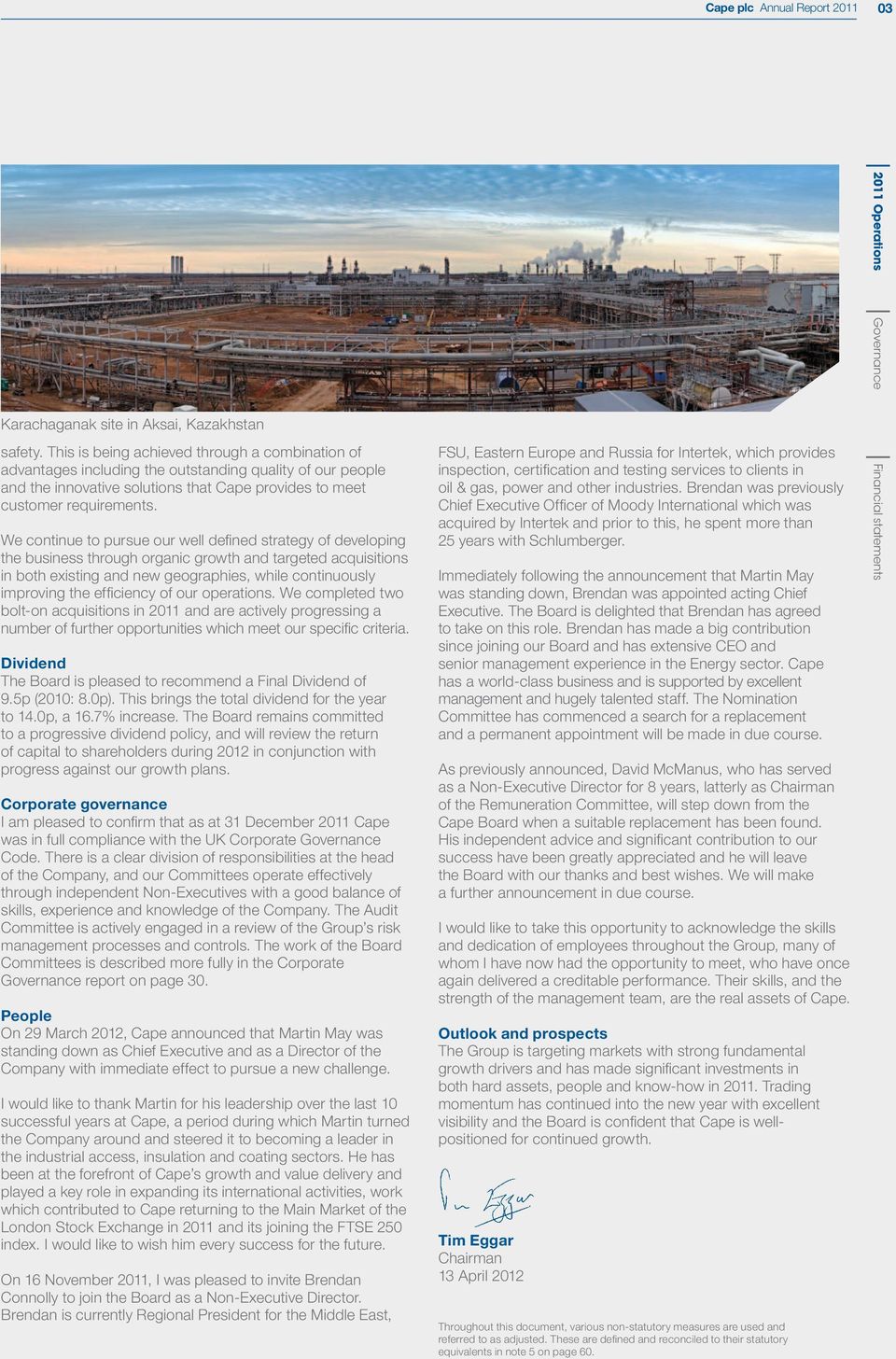
5 Cape plc Annual Report Karachaganak site in Aksai, Kazakhstan safety. This is being achieved through a combination of advantages including the outstanding quality of our people and the innovative solutions that Cape provides to meet customer requirements. We continue to pursue our well defined strategy of developing the business through organic growth and targeted acquisitions in both existing and new geographies, while continuously improving the efficiency of our operations. We completed two bolt-on acquisitions in 2011 and are actively progressing a number of further opportunities which meet our specific criteria. Dividend The Board is pleased to recommend a Final Dividend of 9.5p (2010: 8.0p). This brings the total dividend for the year to 14.0p, a 16.7% increase. The Board remains committed to a progressive dividend policy, and will review the return of capital to shareholders during 2012 in conjunction with progress against our growth plans. Corporate governance I am pleased to confirm that as at 31 December 2011 Cape was in full compliance with the UK Corporate Governance Code. There is a clear division of responsibilities at the head of the Company, and our Committees operate effectively through independent Non-Executives with a good balance of skills, experience and knowledge of the Company. The Audit Committee is actively engaged in a review of the Group s risk management processes and controls. The work of the Board Committees is described more fully in the Corporate Governance report on page 30. People On 29 March 2012, Cape announced that Martin May was standing down as Chief Executive and as a Director of the Company with immediate effect to pursue a new challenge. I would like to thank Martin for his leadership over the last 10 successful years at Cape, a period during which Martin turned the Company around and steered it to becoming a leader in the industrial access, insulation and coating sectors. He has been at the forefront of Cape s growth and value delivery and played a key role in expanding its international activities, work which contributed to Cape returning to the Main Market of the London Stock Exchange in 2011 and its joining the FTSE 250 index. I would like to wish him every success for the future. On 16 November 2011, I was pleased to invite Brendan Connolly to join the Board as a Non-Executive Director. Brendan is currently Regional President for the Middle East, FSU, Eastern Europe and Russia for Intertek, which provides inspection, certification and testing services to clients in oil & gas, power and other industries. Brendan was previously Chief Executive Officer of Moody International which was acquired by Intertek and prior to this, he spent more than 25 years with Schlumberger. Immediately following the announcement that Martin May was standing down, Brendan was appointed acting Chief Executive. The Board is delighted that Brendan has agreed to take on this role. Brendan has made a big contribution since joining our Board and has extensive CEO and senior management experience in the Energy sector. Cape has a world-class business and is supported by excellent management and hugely talented staff. The Nomination Committee has commenced a search for a replacement and a permanent appointment will be made in due course. As previously announced, David McManus, who has served as a Non-Executive Director for 8 years, latterly as Chairman of the Remuneration Committee, will step down from the Cape Board when a suitable replacement has been found. His independent advice and significant contribution to our success have been greatly appreciated and he will leave the Board with our thanks and best wishes. We will make a further announcement in due course. I would like to take this opportunity to acknowledge the skills and dedication of employees throughout the Group, many of whom I have now had the opportunity to meet, who have once again delivered a creditable performance. Their skills, and the strength of the management team, are the real assets of Cape. Outlook and prospects The Group is targeting markets with strong fundamental growth drivers and has made significant investments in both hard assets, people and know-how in Trading momentum has continued into the new year with excellent visibility and the Board is confident that Cape is wellpositioned for continued growth. Tim Eggar Chairman 13 April 2012 Throughout this document, various non-statutory measures are used and referred to as adjusted. These are defined and reconciled to their statutory equivalents in note 5 on page Operations Governance Financial statements
6 04 Cape plc Annual Report 2011 Business model Cape has a low risk business model where the majority of Cape s work is carried out under cost-plus reimbursable contracts where we commit only to working to a pre-agreed schedule of rates and where the customer would usually take on the risk of cost over-runs. We offer a compelling combination of services with exposure to both operating expenditure and capital expenditure trends in the energy and resources sectors. We have leading positions in onshore and offshore maintenance markets. Our services Access Scaffolding enables site operators and other contractors to obtain access to all parts of an industrial plant. This can be for routine maintenance, shutdowns, major projects or new construction. Cape both supplies and erects scaffolding using computer-aided design where appropriate. Increasingly Cape is able to deploy alternative access services such as rope access, system scaffold, tension netting and powered access. Insulation The provision and application of thermal and acoustic insulation for industrial applications. Thermal insulation is provided for temperature maintenance, personnel protection and for the conservation of heat and efficient cryogenic insulation and temperatures down to -160ºC. Cape can provide heat loss calculations and evaluate savings from thermal insulation. Cape also uses infrared equipment to enable it to undertake surveys of thermal insulation efficiency. Specialist Coatings The provision of a complete range of coatings for a variety of structures, including petrochemical plants, refineries and offshore installations. Cape provides surface protection and the application of coatings to prevent corrosion of bare surfaces or those to be insulated and clad. Fire Protection The application of fire protection to a variety of structures in environments ranging from the extreme weather conditions in the North Sea to onshore petrochemical and other installations exposed to fire risk. Refractory Linings The lining of boilers, furnaces, kilns and high temperature petrochemical reactors with materials to withstand temperatures in excess of 1000ºC. Cape offers design, supply and installation services to clients worldwide. Associated Services In response to client needs Cape seeks to maximise the range of industrial services offered. These include industrial cleaning, fabrication of both insulation and sheet metal and, for offshore installations, the provision of an integrated deck facilities management support service including lifting and crane operations. Our client sectors Oil & Gas ExxonMobil facility, Fawley UK Utilities EDF nuclear power station, Heysham UK Mineral resources Alcoa Kwinana refinery, Australia Marine Queen Elizabeth Class Aircraft Carriers, Portsmouth Naval Base UK

7 Cape plc Annual Report Our markets International High growth international markets Our strategy is to invest only where we can generate superior returns for our shareholders. Internationally, we look to invest in markets that offer strong growth prospects with significant exposure to capital expenditure. We have seen rapid growth in our chosen international markets, with positions of scale in two of the three large E&C markets downstream in the Gulf/Middle East and Gas/LNG in the Far East/Pacific Rim. Since 2008 we have seen growth of 30% in oil & gas revenues, about half of Cape s total revenues, and 67% growth in revenue from the minerals and mining sector. Cape provided services on 65 major construction projects in UK Ageing energy infrastructure The stable, mature UK market supports our exposure to both operating expenditure and capital expenditure throughout the life-cycle of clients assets. The maintenance market represents around half (2011: 54%) of Cape s total revenue. Growth is driven by increasingly ageing infrastructure and growing client and regulatory focus on plant safety. Cape has unrivalled breadth and scale in this market. Our compelling bundled service offering reinforces existing high barriers to entry. We expect, over time, construction contracts in high-growth markets to become maintenance contracts, prolonging the returns on our investment in new markets. A stronghold position in the power station sector presence on 23 of the UK s largest 52 stations Operations Governance Financial statements Market drivers Bundled multi-disciplinary services Uncompromising safety proposition Reputation and track record A typical construction project Construction projects are typically multi-year where Cape will support after ground is broken but most critically during the construction completion/pre-commissioning phase. Year 1 Year 2 Year 3 Year 4 Year 5 Year 6 Year 7 Conceptual idea Feasibility & basis of design FEED Final investment decision EPC contract bid period EPC contract award EPC execution Pre-commissioning/commissioning Start-up SIP contracts FEED Front-End Engineering & Design. EPC Engineering, Procurement and Construction. SIP Scaffolding, Insulation, Painting. Critical phase Cape joins the project at the pre-commissioning phase

8 06 Cape plc Annual Report 2011 What we do Maintenance (Production Support) services Cape provides essential support to clients plant maintenance and shutdown programmes. With its unrivalled breadth and scale, Cape s competing bundled service offering delivers to our clients tangible benefits of reduced supplier interface and administration costs, underpinned by rigorous safety procedures. Business environment A majority of Cape s business derives from maintenance and shutdown (production support) activities, at 54% of revenues in 2011 (2010: 56%). Trends and insights We delivered essential maintenance and shutdown support services on 287 industrial assets onshore and offshore in 2011 including 39 power stations, 31 oil & gas processing plants, 12 LNG and GTL plants, 39 petrochemical plants and 66 offshore sites. In the nuclear environment we continue to provide maintenance services at all 8 of the EDF (former British Energy) stations in the UK as well as comprehensive services at both Sellafield and the Winfrith and Harwell research sites. How we deliver Maintaining large-scale production assets requires a service provider that can offer its clients innovative multi-disciplined integrated solutions and enhanced reliability. By applying principles of continuous improvement and innovation, we play a major role in helping our clients businesses and operations maintain and enhance their efficiency. Cape works extensively with clients in the planning stage of their shutdown and outage programmes to maximise efficiency during the process. The resulting peace of mind for clients is one of Cape s key propositions, and this is enhanced further by worldclass safety performance and an international reputation for completing projects on time and within budget. Case studies Sellafield Ltd nuclear power station in Cumbria, UK 2. BAPCO refinery in Awali, Bahrain 3. SABIC facilities in Teesside, UK

9 Cape plc Annual Report Construction Support services Cape provides Construction Support services to major Engineering and Construction (E&C) companies. With an international reputation for the highest safety standards, Cape has the ability to deliver major projects in challenging and remote environments. Business environment Cape s reputation for delivery of major projects in challenging and often remote environments to the highest international safety standards continues to set us apart from the competition. Trends and insights We supported 65 major construction projects in Projects successfully completed during the year include the Saudi Kayan project, the world s largest ethylene plant, where our peak manpower exceeded 1,000, and the Pearl GTL plant in Qatar where our peak manpower reached 500. In Singapore, our workforce on the Exxon Singapore Parallel Trains (SPT) Olefins project reached c.1,600. When the insulation schedule came under pressure at the Pluto LNG project in Western Australia, the EPC contractor was able to turn to Cape to provide additional resource at short notice. How we deliver Cape s involvement often begins as early as the feasibility study, where we provide expert advice and technical support to some of the world s largest and most respected E&C contractors. Drawing on considerable international experience in the delivery of major projects, together with extensive technical resources, we work in partnership with our clients to develop a safe and reliable construction methodology, a detailed programme of work, and an accurate assessment of costs. Clients can expect high-quality standards and projects completed on time and within budget Operations Governance Financial statements Case studies Saudi Kayan project in Jubail Industrial City, Saudi Arabia* 2. Project Aurora ammonium nitrate plant in Queensland, Australia 3. GNL3-Z LNG project in Arzew, Algeria * Reproduced by permission of SABIC.

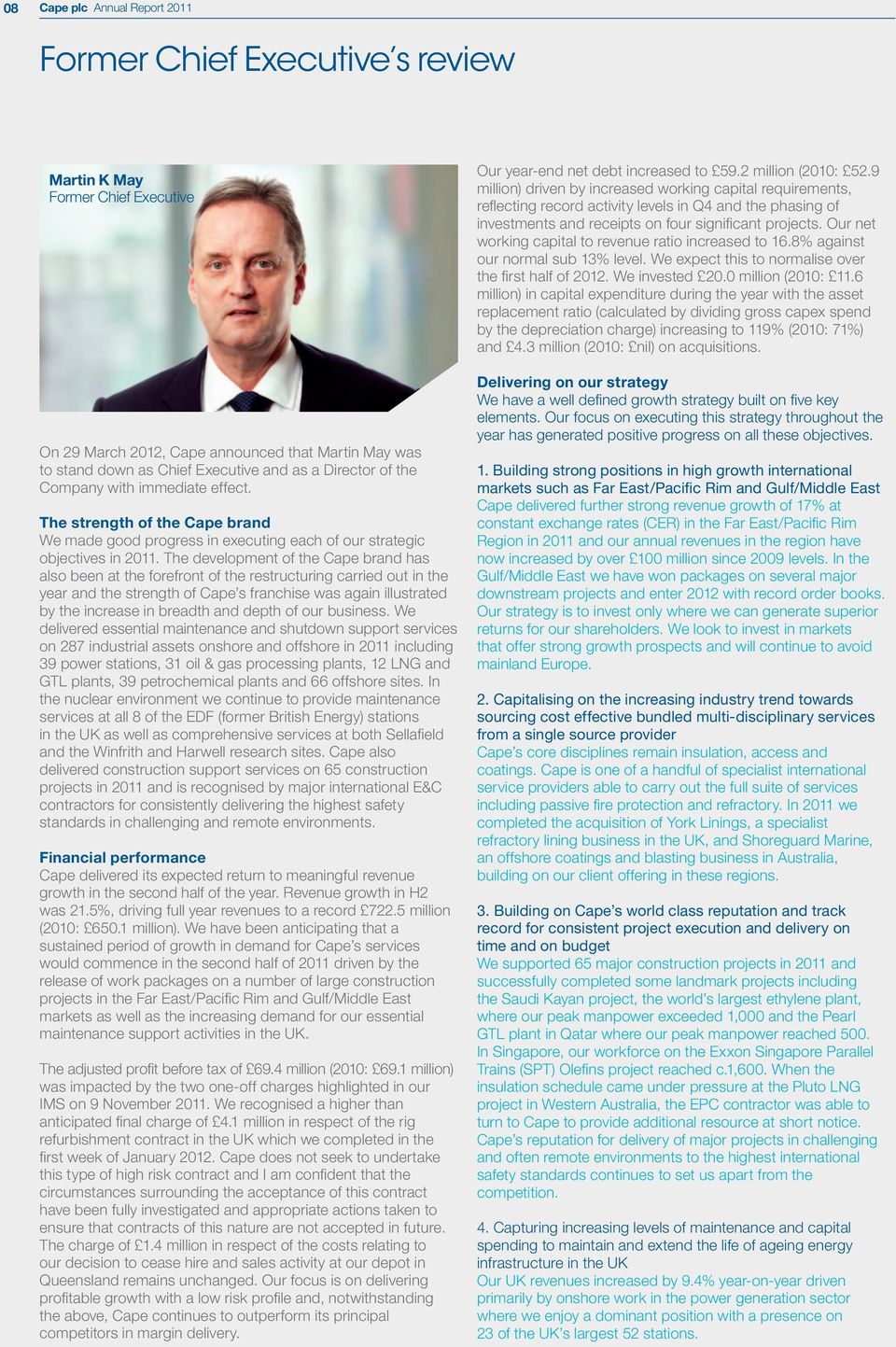
10 08 Cape plc Annual Report 2011 Former Chief Executive s review Martin K May Former Chief Executive On 29 March 2012, Cape announced that Martin May was to stand down as Chief Executive and as a Director of the Company with immediate effect. The strength of the Cape brand We made good progress in executing each of our strategic objectives in The development of the Cape brand has also been at the forefront of the restructuring carried out in the year and the strength of Cape s franchise was again illustrated by the increase in breadth and depth of our business. We delivered essential maintenance and shutdown support services on 287 industrial assets onshore and offshore in 2011 including 39 power stations, 31 oil & gas processing plants, 12 LNG and GTL plants, 39 petrochemical plants and 66 offshore sites. In the nuclear environment we continue to provide maintenance services at all 8 of the EDF (former British Energy) stations in the UK as well as comprehensive services at both Sellafield and the Winfrith and Harwell research sites. Cape also delivered construction support services on 65 construction projects in 2011 and is recognised by major international E&C contractors for consistently delivering the highest safety standards in challenging and remote environments. Financial performance Cape delivered its expected return to meaningful revenue growth in the second half of the year. Revenue growth in H2 was 21.5%, driving full year revenues to a record million (2010: million). We have been anticipating that a sustained period of growth in demand for Cape s services would commence in the second half of 2011 driven by the release of work packages on a number of large construction projects in the Far East/Pacific Rim and Gulf/Middle East markets as well as the increasing demand for our essential maintenance support activities in the UK. The adjusted profit before tax of 69.4 million (2010: 69.1 million) was impacted by the two one-off charges highlighted in our IMS on 9 November We recognised a higher than anticipated final charge of 4.1 million in respect of the rig refurbishment contract in the UK which we completed in the first week of January Cape does not seek to undertake this type of high risk contract and I am confident that the circumstances surrounding the acceptance of this contract have been fully investigated and appropriate actions taken to ensure that contracts of this nature are not accepted in future. The charge of 1.4 million in respect of the costs relating to our decision to cease hire and sales activity at our depot in Queensland remains unchanged. Our focus is on delivering profitable growth with a low risk profile and, notwithstanding the above, Cape continues to outperform its principal competitors in margin delivery. Our year-end net debt increased to 59.2 million (2010: 52.9 million) driven by increased working capital requirements, reflecting record activity levels in Q4 and the phasing of investments and receipts on four significant projects. Our net working capital to revenue ratio increased to 16.8% against our normal sub 13% level. We expect this to normalise over the first half of We invested 20.0 million (2010: 11.6 million) in capital expenditure during the year with the asset replacement ratio (calculated by dividing gross capex spend by the depreciation charge) increasing to 119% (2010: 71%) and 4.3 million (2010: nil) on acquisitions. Delivering on our strategy We have a well defined growth strategy built on five key elements. Our focus on executing this strategy throughout the year has generated positive progress on all these objectives. 1. Building strong positions in high growth international markets such as Far East/Pacific Rim and Gulf/Middle East Cape delivered further strong revenue growth of 17% at constant exchange rates (CER) in the Far East/Pacific Rim Region in 2011 and our annual revenues in the region have now increased by over 100 million since 2009 levels. In the Gulf/Middle East we have won packages on several major downstream projects and enter 2012 with record order books. Our strategy is to invest only where we can generate superior returns for our shareholders. We look to invest in markets that offer strong growth prospects and will continue to avoid mainland Europe. 2. Capitalising on the increasing industry trend towards sourcing cost effective bundled multi-disciplinary services from a single source provider Cape s core disciplines remain insulation, access and coatings. Cape is one of a handful of specialist international service providers able to carry out the full suite of services including passive fire protection and refractory. In 2011 we completed the acquisition of York Linings, a specialist refractory lining business in the UK, and Shoreguard Marine, an offshore coatings and blasting business in Australia, building on our client offering in these regions. 3. Building on Cape s world class reputation and track record for consistent project execution and delivery on time and on budget We supported 65 major construction projects in 2011 and successfully completed some landmark projects including the Saudi Kayan project, the world s largest ethylene plant, where our peak manpower exceeded 1,000 and the Pearl GTL plant in Qatar where our peak manpower reached 500. In Singapore, our workforce on the Exxon Singapore Parallel Trains (SPT) Olefins project reached c.1,600. When the insulation schedule came under pressure at the Pluto LNG project in Western Australia, the EPC contractor was able to turn to Cape to provide additional resource at short notice. Cape s reputation for delivery of major projects in challenging and often remote environments to the highest international safety standards continues to set us apart from the competition. 4. Capturing increasing levels of maintenance and capital spending to maintain and extend the life of ageing energy infrastructure in the UK Our UK revenues increased by 9.4% year-on-year driven primarily by onshore work in the power generation sector where we enjoy a dominant position with a presence on 23 of the UK s largest 52 stations.
11 Cape plc Annual Report Maintaining our uncompromising safety proposition with a strive to provide injury free project execution Cape delivered 55 million man hours in 2011 and our safety performance has again been outstanding with an LTI (Loss Time Injury) Frequency Rate of per 100,000 man hours an improvement of 12.3% on last year s performance. This significant improvement from an already excellent performance last year is a testament to Cape s uncompromising approach to safety and our willingness to take the lead on safety standards. This was again recognised by our clients during the year with numerous awards. We can never be complacent about safety, and we remain committed to continuously improving safety standards. Developing the quality of our asset We implemented our new corporate structure in 2011 with the establishment of our International Headquarters (IHQ) in Singapore. This improves the alignment of our business with our market opportunities. Cape s developed intellectual property and the strength of the Cape brand will normally result in our automatic inclusion on bidder lists. We will often work at an early stage with our clients on insulation specifications for major projects. The consequences of thermal/cryogenic insulation failure are serious and Cape s expertise and quality assurance, developed over the past 30 years, places us at the forefront in the field. With our experience and design capability Cape provides complex scaffolding and access solutions for irregular and challenging structures. For example, in an LNG export terminal, vessels such as a cryogenic heat exchanger, being of welded stainless steel construction and 60 metres high, require complex scaffold design solutions. Cape has the facility to provide design scaffolds and calculations online from its design offices in the UK, Middle East and Australia. Scaffold material and design will generally be based on BS/European standards. Cape Environmental s newly developed Syphonvac IV system for online vessel de-sanding was adopted by both Shell UK at the Gannet and Shearwater platforms and Nexen at their Buzzard platform in the second half of the year. Acquisitions and entry into new territories We completed two bolt-on acquisitions in the year. In April, we announced the acquisition of Shoreguard Marine Pty a specialist marine corrosion protection business in Australia and in August we completed the acquisition of York Linings International Limited, a refractory linings design and installation contractor. Both acquisitions have now been fully integrated into the Group and are performing well. A key component of our growth strategy is the continued acquisition of businesses that increase our market share, add to our intellectual property, broaden our service offering in local markets or will assist us with entering target markets. We have a growing list of opportunities and expect to complete further acquisitions as and when businesses meet our criteria and valuation objectives. We successfully established operational bases in three new territories in Our newly established operations in Papua New Guinea and India both received early contract awards and we expect our operations in Turkmenistan to commence in Following our initial work towards the end of last year we will establish a permanent base in Iraq this year. The size of the onshore opportunity in Iraq for our services is now increasingly being recognised as we start to provide budgetary pricing to our E&C clients active in that country. Our people development programmes are producing positive results We recognise that labour resourcing for major projects will increasingly be a key issue for our business. In April we appointed a Group Head of International Resourcing to head up our drive to attract the best talent available to support our growth strategy. This is already proving successful and as an example we have now mobilised in excess of 500 men for the Kumul, Lihir and Bayu-Undan projects in Papua New Guinea and Timor alone demonstrating our capability to provide skilled labour on a scale our international clients require in the most challenging of locations. Following the hugely successful first phase of our Future Leaders Programme, we commenced a second phase with a further 70 of our key managers participating in our flagship leadership development initiative. Also in September, a further 8 new graduate trainees embarked on a two-year training programme. I am pleased that, with initiatives such as these, Cape was again recognised for its sustained commitment to the development of our people at the Shell sponsored UK Oil and Gas Industry awards held in Aberdeen in November. Forward Order Book In overall terms the Group s Forward Order Book has increased by 9.7% to 940 million (2010: c. 850 million) with some 68% of consensus revenues for 2012 already secured (2010: 63%). The multi-year term nature of our maintenance contracts combined with the long lead-time of large construction projects, where the main demand for our core services takes place towards the end of the construction phase and often during the pre-commissioning phase, means we enjoy good visibility of future sources of revenue across our business. Prospects for the year ahead Our focus in the year ahead will be to build on the value of the Cape international brand and to realise the significant growth opportunities ahead of us in our target markets. Momentum is building in a number of key regions and projects indicating that Cape is entering a sustained period of demand growth for its services. We expect strong organic revenue growth in 2012 supported by the recent growth in the order book, although our operating margin is expected to reduce. In terms of capital expenditure we expect the asset replacement ratio to continue at broadly 100% which will enable the Group to generate strong cash flow in I am confident that we are well placed to continue executing our strategy and delivering growth in shareholder returns in the year ahead. Martin K May Chief Executive 6 March 2012 Throughout this document, various non-statutory measures are used and referred to as adjusted. These are defined and reconciled to their statutory equivalents in note 5 on page Operations Governance Financial statements

12 10 Cape plc Annual Report 2011 Regional review Far East/Pacific Rim region Territory Number of countries: revenue 236.8m Share of Group adjusted EBITA 22.1% Revenue ( m) maintenance Revenue ( m) construction support Revenue ( m) other EBITA margin (%) Onshore construction activities continued to be the main driver for growth, with significant scaffolding and insulation works on Woodside s Pluto LNG project and the Exxon Singapore Parallel Train (SPT) Olefins project. On the Pluto LNG project, Cape continued to provide access services throughout the year and in the final quarter also provided 185 insulators to assist the client with the important completion and pre-commissioning phase of the project. The SPT project continues to be our largest project by manpower in both the region and globally with around 1,600 men on the project at the year end. In addition, Cape provided services on several other major construction projects across the region including: Project Aurora ammonium nitrate plant in Queensland, Australia; Wonthaggi desalinisation plant in Victoria, Australia; and the Goro Nickel refinery in New Caledonia. Cape continued to provide maintenance and shutdown support services at 19 onshore plants across the region. The client portfolio includes Alcoa, BHP, BP, Exxon, Macquarie Generation, Minara and Nyrstar. Offshore, Cape has continued to grow its business, winning contract awards at Kipper Tuna Turrum (off Victoria), the Angel and North Rankin platforms in the North West Shelf and the Kumul Marine Terminal, Papua New Guinea. These awards were in addition to existing maintenance activities at Shell Malampaya and with ConocoPhillips at Bayu-Undan. In April 2011, Cape announced the acquisition of Shoreguard Marine a provider of specialist coatings and anti-corrosion services predominantly to the Royal Australian Navy. This business is based near Perth WA, but gives us the resources to provide the full range of offshore services across the region. The Far East/Pacific Rim region contributed 33% (2010: 29%) of Group revenue and 22% of the Group s adjusted EBITA (2010: 17%). Adjusted EBITA increased by 28% (23% at CER) to 18.9 million (2010: 14.8 million) from increased revenues of million (2010: million). The Far East/Pacific Rim region continues to be our fastest growing region with annual revenues having grown by over 100 million since the million reported in As expected with several major construction projects in progress, revenues from construction support services grew by 37% at CER (39% at actual exchange rates (AER)) to million (2010: million), whilst maintenance and shutdown support revenues were broadly neutral at 68.4 million (2010: 62.2 million). Revenues from the commercial and residential access business in Australia reduced by 4% at CER (6% increase at AER) to 23.0 million (2010: 21.7 million) reflecting the closure of the Queensland hire and sale operations in the second half. As anticipated, our Access Solutions business, which is entirely focused on commercial and residential construction markets in Australia, has continued to be impacted by the difficult regional market conditions. In November 2011, we announced that we had exited from the commercial construction market in Queensland and would recognise a charge of 1.4 million in respect of the closure costs at our hire and sales depot near Brisbane preview Since January 2011, we saw FIDs on five major LNG export projects in Australia (QCLNG, GLNG, APLNG T1, Wheatstone and Ichthys). The increasing demand for construction support services across the region, including module fabrication in South East Asian shipyards and both onshore and offshore work in Australia, is expected to continue to drive growth in the medium term. As previously mentioned the release of certain secured contracts remains slow but even in the absence of such work the region is expected to deliver c.10% revenue growth in Throughout this document, various non-statutory measures are used and referred to as adjusted. These are defined and reconciled to their statutory equivalents in note 5 on page 60.

13 Cape plc Annual Report Gulf/Middle East region Territory Number of countries: revenue 132.1m Share of Group adjusted EBITA 36.2% Revenue ( m) maintenance Revenue ( m) construction support Revenue ( m) other EBITA margin (%) We were delighted to bring two landmark regional projects to a successful conclusion in In Qatar we completed our three-year involvement on the pioneering Shell Pearl GTL plant having expended nearly 3 million man hours over the project life with peak manpower of 500 men. In Saudi Arabia we brought Saudi Kayan, the world s largest ethylene plant, to a successful conclusion in 2011 expending over 3.7 million man hours on the project and with peak manpower of around 1,000. The most active market for E&C bidding activities in the region is the UAE where packages were secured on the ADCO SAS development project, Borouge III, Habshan 5, Ruwais 4th NGL train, IGD project and the Fertil 2 Ammonia/ Urea expansion project. These are all underway and will peak during In Saudi Arabia, significant packages came out for bid on the Jubail Export Refinery Project. We also returned to Iraq in 2011, carrying out asbestos surveys in BP s Rumaila oilfield. Cape last worked in Iraq in 1991, having carried out numerous projects since our first involvement in the country in With the market for onshore E&C work developing in Iraq, we have provided indicative pricing on several projects which could commence in late 2012 or most likely in Maintenance and shutdown support We continue to position ourselves to win recurring maintenance and shutdown work across the region. Cape maintained its maintenance portfolio to 75 sites (2010: 72 sites) with existing relationships across the region with clients including BAPCO, SABIC, SIPCHEM, Saudi Aramco, Qatargas and Rasgas Operations Governance Financial statements The Gulf/Middle East Region generated an adjusted EBITA of 31.0 million (2010: 35.4 million) and contributed 36% of Group adjusted EBITA (2010: 41%). For Cape s services, 2011 was the second successive year of market contraction following the pre-gfc highs seen in 2009, with several major projects coming to completion in The regional market for construction support services is now poised to recommence growth in 2012, with a raft of new downstream onshore project starts. Full year revenues declined by 4.1% (CER: -1.0%) to million (2010: million) with the strong pick up in the second half almost recovering the -17.5% year-on-year revenue reduction seen in the first half. We saw strong performances in Abu Dhabi and Saudi Arabia in the final quarter. Although revenue growth returned in H2, as expected, margins trended down with a second half operating margin reducing to 22.6% (H2 2010: 27.1%). Cape was awarded new term maintenance contracts in Bahrain for the BAPCO refinery, to undertake painting and blasting services, and in Qatar with the renewal of a five-year multi-discipline maintenance contract with Rasgas and QVC. The substantial shutdown work in 2011 occurred on Das Island (ADGAS) and at the Takreer Ruwais refinery in the UAE and at the Rasgas LNG and Dolphin gas processing facilities in Qatar. We also successfully completed the largest ever shutdown in BAPCO Bahrain during the first half of preview We expect the region to return to double digit growth in 2012 driven by project awards in the downstream sector. The region s order book is now 35% higher than at the beginning of 2011 and some 77% of planned 2012 revenues have now been secured (2011: 65%). We continue to expect margins in the region to trend downwards in 2012 due to the competitive environment and the changing E&C contractor landscape. Construction support Some 69% (2010: 65%) of revenues related to construction support activities, with Cape active on 46 (2010: 29) major construction projects in the region including significant works on the Karan Gas and National Chevron Philips (NCP) petrochemical projects in Saudi Arabia. We have also continued on the large project for Oxy/GPS on the PDO facility in the South of Oman at Mukhaizna.

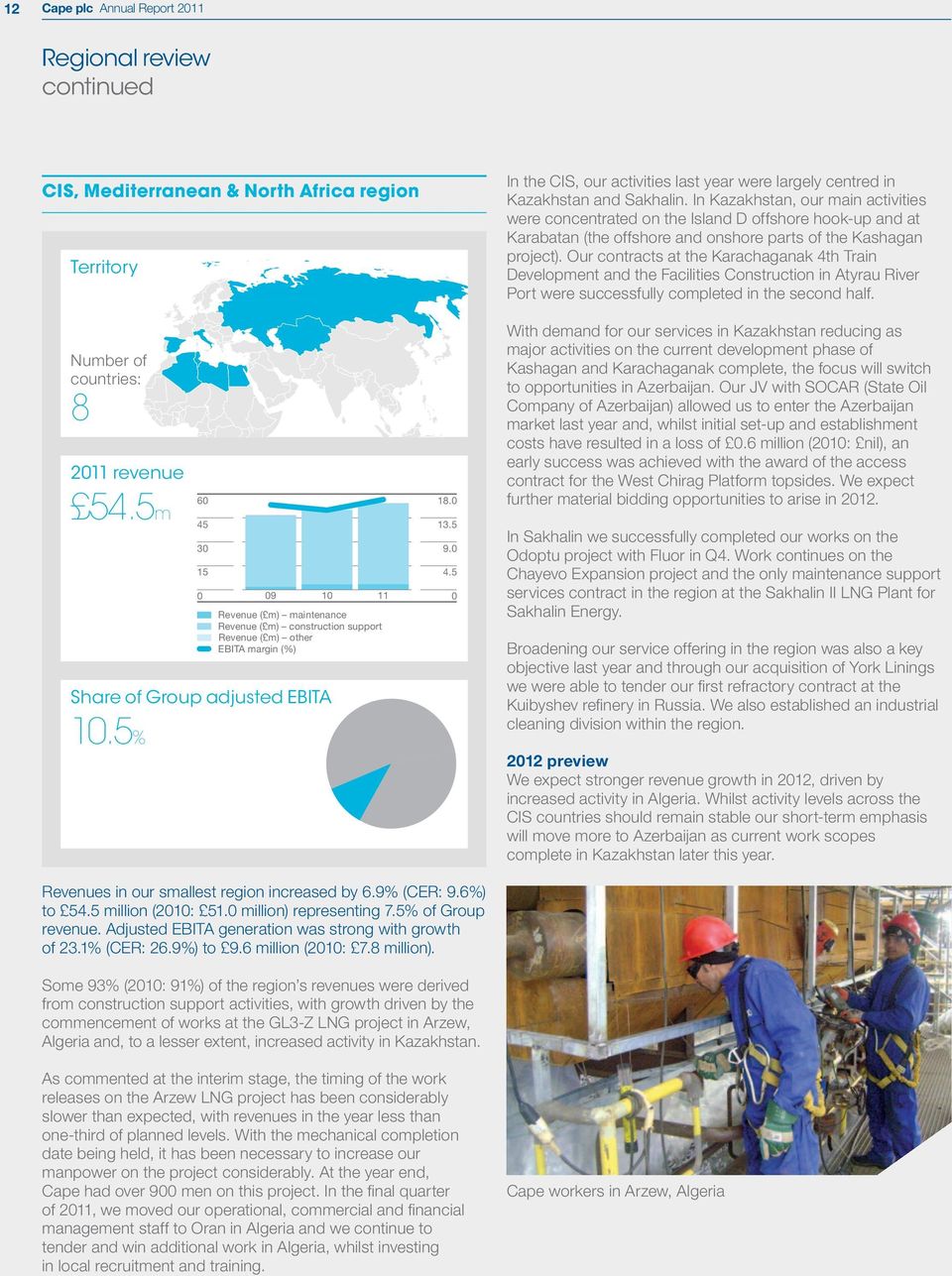
14 12 Cape plc Annual Report 2011 Regional review continued CIS, Mediterranean & North Africa region Territory Number of countries: revenue 54.5m Share of Group adjusted EBITA 10.5% Revenue ( m) maintenance Revenue ( m) construction support Revenue ( m) other EBITA margin (%) In the CIS, our activities last year were largely centred in Kazakhstan and Sakhalin. In Kazakhstan, our main activities were concentrated on the Island D offshore hook-up and at Karabatan (the offshore and onshore parts of the Kashagan project). Our contracts at the Karachaganak 4th Train Development and the Facilities Construction in Atyrau River Port were successfully completed in the second half. With demand for our services in Kazakhstan reducing as major activities on the current development phase of Kashagan and Karachaganak complete, the focus will switch to opportunities in Azerbaijan. Our JV with SOCAR (State Oil Company of Azerbaijan) allowed us to enter the Azerbaijan market last year and, whilst initial set-up and establishment costs have resulted in a loss of 0.6 million (2010: nil), an early success was achieved with the award of the access contract for the West Chirag Platform topsides. We expect further material bidding opportunities to arise in In Sakhalin we successfully completed our works on the Odoptu project with Fluor in Q4. Work continues on the Chayevo Expansion project and the only maintenance support services contract in the region at the Sakhalin II LNG Plant for Sakhalin Energy. Broadening our service offering in the region was also a key objective last year and through our acquisition of York Linings we were able to tender our first refractory contract at the Kuibyshev refinery in Russia. We also established an industrial cleaning division within the region preview We expect stronger revenue growth in 2012, driven by increased activity in Algeria. Whilst activity levels across the CIS countries should remain stable our short-term emphasis will move more to Azerbaijan as current work scopes complete in Kazakhstan later this year. Revenues in our smallest region increased by 6.9% (CER: 9.6%) to 54.5 million (2010: 51.0 million) representing 7.5% of Group revenue. Adjusted EBITA generation was strong with growth of 23.1% (CER: 26.9%) to 9.6 million (2010: 7.8 million). Some 93% (2010: 91%) of the region s revenues were derived from construction support activities, with growth driven by the commencement of works at the GL3-Z LNG project in Arzew, Algeria and, to a lesser extent, increased activity in Kazakhstan. As commented at the interim stage, the timing of the work releases on the Arzew LNG project has been considerably slower than expected, with revenues in the year less than one-third of planned levels. With the mechanical completion date being held, it has been necessary to increase our manpower on the project considerably. At the year end, Cape had over 900 men on this project. In the final quarter of 2011, we moved our operational, commercial and financial management staff to Oran in Algeria and we continue to tender and win additional work in Algeria, whilst investing in local recruitment and training. Cape workers in Arzew, Algeria
15 Cape plc Annual Report UK region Territory Number of countries: revenue 299.1m Revenue ( m) maintenance Revenue ( m) construction support Revenue ( m) other EBITA margin (%) Share of Group adjusted EBITA Margins were in line with last year, preserving good quality returns from the higher mix of shutdown and project activities and continued focus on manpower efficiency, whilst maintaining the highest safety standards. In August 2011, we successfully completed the acquisition of York Linings, which provides refractory installation and maintenance services and complements Cape s existing service offering in the UK. A strong performance in the five months post acquisition contributed EBITA of 1.7 million from revenues of 8.7 million. Revenues are largely derived from one-off project works and significant projects undertaken in 2011 included the furnace and stoves overhaul at the Redcar steel works for SSI and the FCCU (fluidized catalytic cracking unit) outage at the Lindsey Oil Refinery. Offshore revenues reduced by 5% to 93.1 million (2010: 97.6 million) with the operational highlights being the successful commencement of work on: four new BP assets (part of the BP UKCS Federal contract award); the Netherlands Continental Shelf with Total E&P contract; and a number of unmanned platforms for BHP in Liverpool Bay. On 8 September 2011 we were pleased to announce the award of a three-year contract from TOTAL E&P UK for fabric maintenance services at the Alwyn North, Dunbar, Elgin-Franklin and St Fergus assets Operations Governance Financial statements 31.2% We saw margins in the UK Continental Shelf (UKCS) market come under pressure in 2011, with competitors discounting to gain market share. With the corporate activity in the UKCS now behind us, and increasing investment in the UKCS, we see opportunities for growth. The UK region contributed 31.2% of Group adjusted EBITA (2010: 32.6%). Adjusted EBITA decreased by 1.3 million to 26.7 million (2010: 28.0 million) from revenues of million (2010: million). Cape s services in the UK continue to be dominated by plant maintenance or production support activities. The positive impact of the region s strong revenue performance, with growth of 9.4%, was entirely offset by the reduction in the operating margin to 8.9% (2010: 10.2%) resulting from the 4.1 million charge in relation to a one-off rig refurbishment contract which completed in the first week of January Excluding this contract, the region s EBITA margin remained largely unchanged at 10.3%. Onshore revenues increased by 14% to million (2010: million), driven by higher levels of activity in the power generation sector in the second half. Cape has a stronghold in the power generation sector, being present on 23 out of 52 larger power stations (with > 500MW capacity). In 2011 we saw higher levels of outage (shutdown) works from our core clients in this sector, following a slowdown in In addition, we continued with capital upgrade/project work with: SABIC UK at its Teesside plant links and veins remediation works; ConocoPhillips at the Humber oil refinery carrying out access for vessel refurbishment; BAE Systems on the QEC aircraft carrier construction project; and SSI on rejuvenation work at the Redcar steel plant. Environmental services (Cape DBI) revenues remained flat at 26.2 million (2010: 26.1 million), with continued strong demand for our innovative offshore online cleaning solutions from clients including BP, Nexen, Shell and Apache. Significant work was also undertaken at onshore facilities including BP Sullom Voe, Dow Corning at Barry and TATA steel at Port Talbot, although activity levels remained broadly neutral across the petrochemical, refining and heavy industrial sectors. Contract awards and renewals during 2011 included the three-year call-off contract from Shell for offshore platform separator cleaning announced in February and term contracts with Dow Chemicals at Grangemouth, Scotland and Dow Corning at Barry, South Wales preview We expect to see a continued modest increase in activity levels in 2012 over those seen last year. Over 70% of planned 2012 revenues have now been secured (2011: 66%). The power generation sector is expected to generate a modest increase in shutdown and project works in 2012 and, whilst we expect nuclear decommissioning opportunities to become more visible in the second half, they are unlikely to contribute meaningfully until Offshore, a full-year contribution from the Total UK maintenance contract, together with up-manning on our core activities for BP and new development works on the BP Andrew platform, are expected to drive increased activity levels in We will also benefit from a full-year contribution from the York Linings acquisition.

16 14 Cape plc Annual Report 2011 Chief Financial Officer s review Richard Bingham Chief Financial Officer The table below shows adjusted EBITA margin by region before the impact of the restructuring. Gulf/ Far East/ CIS/Med Group after Middle Pacific & North central UK East Rim Africa costs 2011 m m m m m First half 9.4% 24.4% 8.7% 16.3% 11.5% Second half 8.5% 22.6% 7.4% 19.1% 10.3% Total for the year 8.9% 23.5% 8.0% 17.6% 10.9% 2010 First half 9.9% 24.7% 7.7% 15.1% 12.1% Second half 10.6% 27.1% 8.0% 15.5% 12.0% Total for the year 10.2% 25.7% 7.9% 15.3% 12.0% Revenue Revenue increased by 11.1% to a record million in 2011 from million in The increased revenue predominantly reflects organic growth ( 50.6 million), but also includes the benefit of the two acquisitions completed in the year ( 10.5 million) and a positive impact from currency translation ( 11.3 million). Three of Cape s four geographic regions contributed to underlying revenue growth, with only the Gulf/Middle East region reducing by a marginal 1.0% at CER. As previously indicated, a return to revenue growth was anticipated in the second half and, as shown by the table below, the second half revenue performance has been strong, with overall growth of 21.5% to million (2010: million). Gulf/ Far East/ CIS/Med Middle Pacific & North UK East Rim Africa Total 2011 m m m m m First half Second half Total for the year First half Second half Total for the year In 2011, the Group was contracted to work on 287 industrial assets onshore and offshore. Revenue invoiced to the largest customer represented 9% of total revenue (2010: 9%) and the top 10 customers represented 35% of revenue in 2011 (2010: 35%). Adjusted operating profit margins The adjusted operating profit margin reduced to 10.9% (2010: 12.0%). On 15 September 2011 the Group undertook an internal reorganisation as part of its strategy to support growth in our International operations in particular in the Far East/Pacific Rim region. In order to better facilitate this growth, we centralised certain operations and management to form a new International Headquarters (IHQ) with responsibilities which include the management and development of the Group s non-uk intellectual property. As part of these arrangements, IHQ has entered into franchise agreements to support the Group s non-uk trading companies. Consequently, a franchise fee has been charged for the period since 15 September 2011 and reported in the operating profit for each operating segment. The Group s operating margin in the second half reduced to 10.3% driven by the expected softening of margins in the Gulf/Middle East Region, the impact of the one-off problem rig refurbishment contract in the UK region and depot closure costs in Australia (both reported in the Group s IMS of 9 November 2011) and increased central costs. Non-operating other items Results for the year include non-operating other items of 7.5 million (2010: 6.0 million). The total amount has been excluded from the adjusted profits and earnings to show the underlying performance of the business. The non-operating other items in 2011 principally comprise the corporate expenses of 2.0 million (2010: nil) incurred in H1 in relation to the move from AIM to the LSE s main market and the corporate restructuring, together with net finance charges of 4.3 million comprising: the annual 4.0 million (2010: 4.0 million) non-cash charge relating to the unwinding of the discount on the long-term IDC liability following the booking of the provision in 2009; a 1.3 million (2010: nil) charge representing the unamortised facility fees arising from the early cancellation of the Group s 2007 syndicated banking facility; and interest income on the IDC Scheme funds in the period of 1.0 million (2010: 1.0 million). Finance charge The net finance charge (excluding non-operating other items) reduced by 5.6% to 8.5 million (2010: 9.0 million) with interest cover (calculated by dividing adjusted operating profit by the adjusted finance costs) increasing to 9.1 times (2010: 8.6 times). This compares to the minimum of 3.0 times required by the covenant in Cape s unsecured 220 million syndicated credit facility announced in January and with a maturity date of June Taxation The tax charge on profits excluding non-operating other items and joint ventures, of 13.7 million (2010: 14.6 million), represents an average tax rate of 19.5% (2010: 21.1%). The tax rate decrease of 1.6% in the year predominantly reflects a reduction in the UK Corporation Tax rate, Group restructuring and changes in mix of geographic source of profit generation.

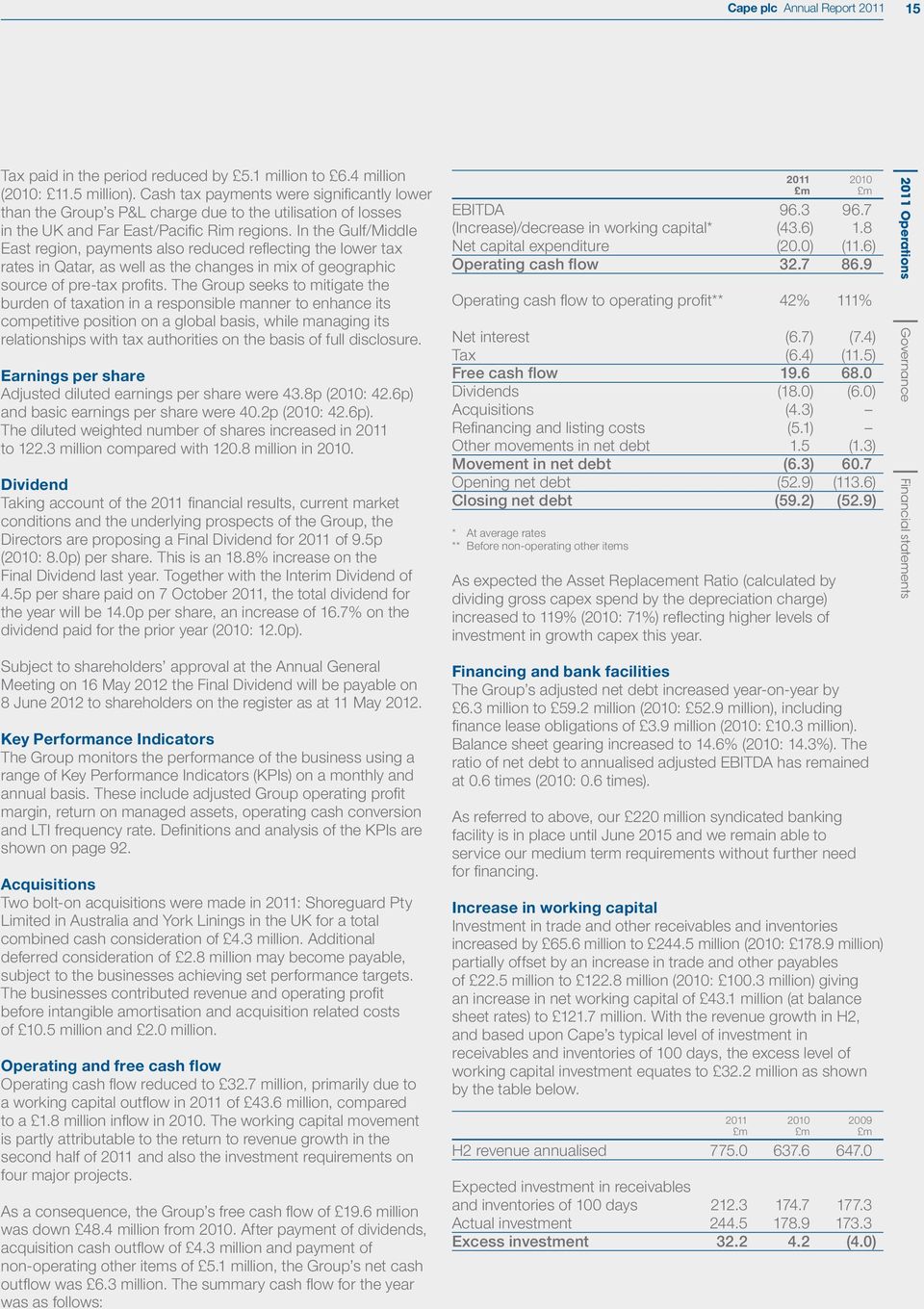
17 Cape plc Annual Report Tax paid in the period reduced by 5.1 million to 6.4 million (2010: 11.5 million). Cash tax payments were significantly lower than the Group s P&L charge due to the utilisation of losses in the UK and Far East/Pacific Rim regions. In the Gulf/Middle East region, payments also reduced reflecting the lower tax rates in Qatar, as well as the changes in mix of geographic source of pre-tax profits. The Group seeks to mitigate the burden of taxation in a responsible manner to enhance its competitive position on a global basis, while managing its relationships with tax authorities on the basis of full disclosure. Earnings per share Adjusted diluted earnings per share were 43.8p (2010: 42.6p) and basic earnings per share were 40.2p (2010: 42.6p). The diluted weighted number of shares increased in 2011 to million compared with million in Dividend Taking account of the 2011 financial results, current market conditions and the underlying prospects of the Group, the Directors are proposing a Final Dividend for 2011 of 9.5p (2010: 8.0p) per share. This is an 18.8% increase on the Final Dividend last year. Together with the Interim Dividend of 4.5p per share paid on 7 October 2011, the total dividend for the year will be 14.0p per share, an increase of 16.7% on the dividend paid for the prior year (2010: 12.0p). Subject to shareholders approval at the Annual General Meeting on 16 May 2012 the Final Dividend will be payable on 8 June 2012 to shareholders on the register as at 11 May Key Performance Indicators The Group monitors the performance of the business using a range of Key Performance Indicators (KPIs) on a monthly and annual basis. These include adjusted Group operating profit margin, return on managed assets, operating cash conversion and LTI frequency rate. Definitions and analysis of the KPIs are shown on page 92. Acquisitions Two bolt-on acquisitions were made in 2011: Shoreguard Pty Limited in Australia and York Linings in the UK for a total combined cash consideration of 4.3 million. Additional deferred consideration of 2.8 million may become payable, subject to the businesses achieving set performance targets. The businesses contributed revenue and operating profit before intangible amortisation and acquisition related costs of 10.5 million and 2.0 million. Operating and free cash flow Operating cash flow reduced to 32.7 million, primarily due to a working capital outflow in 2011 of 43.6 million, compared to a 1.8 million inflow in The working capital movement is partly attributable to the return to revenue growth in the second half of 2011 and also the investment requirements on four major projects. As a consequence, the Group s free cash flow of 19.6 million was down 48.4 million from After payment of dividends, acquisition cash outflow of 4.3 million and payment of non-operating other items of 5.1 million, the Group s net cash outflow was 6.3 million. The summary cash flow for the year was as follows: m m EBITDA (Increase)/decrease in working capital* (43.6) 1.8 Net capital expenditure (20.0) (11.6) Operating cash flow Operating cash flow to operating profit** 42% 111% Net interest (6.7) (7.4) Tax (6.4) (11.5) Free cash flow Dividends (18.0) (6.0) Acquisitions (4.3) Refinancing and listing costs (5.1) Other movements in net debt 1.5 (1.3) Movement in net debt (6.3) 60.7 Opening net debt (52.9) (113.6) Closing net debt (59.2) (52.9) * At average rates ** Before non-operating other items As expected the Asset Replacement Ratio (calculated by dividing gross capex spend by the depreciation charge) increased to 119% (2010: 71%) reflecting higher levels of investment in growth capex this year. Financing and bank facilities The Group s adjusted net debt increased year-on-year by 6.3 million to 59.2 million (2010: 52.9 million), including finance lease obligations of 3.9 million (2010: 10.3 million). Balance sheet gearing increased to 14.6% (2010: 14.3%). The ratio of net debt to annualised adjusted EBITDA has remained at 0.6 times (2010: 0.6 times). As referred to above, our 220 million syndicated banking facility is in place until June 2015 and we remain able to service our medium term requirements without further need for financing. Increase in working capital Investment in trade and other receivables and inventories increased by 65.6 million to million (2010: million) partially offset by an increase in trade and other payables of 22.5 million to million (2010: million) giving an increase in net working capital of 43.1 million (at balance sheet rates) to million. With the revenue growth in H2, and based upon Cape s typical level of investment in receivables and inventories of 100 days, the excess level of working capital investment equates to 32.2 million as shown by the table below m m m H2 revenue annualised Expected investment in receivables and inventories of 100 days Actual investment Excess investment (4.0) 2011 Operations Governance Financial statements
18 16 Cape plc Annual Report 2011 Chief Financial Officer s review continued This excess investment at the year end has principally arisen from Cape s activities on four major projects across the Group where delayed receipts from customers, or initial purchases of materials and set-up costs, have resulted in extended working capital levels. Provision for estimated future asbestos related liabilities and IDC Scheme funds The discounted post-tax provision held increased to 62.4 million (2010: 59.6 million), reflecting the unwinding of the discount of 4.0 million in the year (2010: 4.0 million) and the 2.0 million (2010: 2.2 million) of cash settlements made in the period. The ring-fenced IDC Scheme funds reduced by 1.5 million (2010: 2.2 million reduction), comprising cash settlements and costs paid to claimants of 2.0 million (2010: 2.2 million) with interest income received of 0.5 million (2010: nil). Interest accrued of 0.5 million (2010: 1.0 million) is shown as finance income other items in the income statement. Currencies in 2011 Nearly all operating costs are matched with corresponding revenues of the same currency and as such there is very little transactional currency risk in the Group. Currency translation had a 1% adverse impact on the results for the year, principally due to weakening of the US dollar which was offset by the strengthening of the Australian dollar. In 2011, some 21.4% of revenues were negotiated in US dollar or US dollar-pegged currencies and 24.2% in Australian dollar. The following significant exchange rates applied during the year: Average rate Closing rate US dollar Australian dollar Treasury policies Cape has a centralised Treasury function whose objectives are to monitor and manage the financial risks of the Group and to ensure that sufficient liquidity is available to meet the requirements of the business. Group Treasury is not a profit centre and operates within a framework of policies and procedures. All hedging is carried out centrally and speculative trading is specifically prohibited by Group Treasury policy. Pensions The Defined Benefit Pension Scheme had a net surplus of 16.2 million as at 31 December 2011 (2010: 13.2 million) and continues to be restricted to nil in the accounts under IFRIC 14. Shareholders equity The Group s net shareholders equity at the end of the year was million (2010: million), which has increased as a result of retained earnings and beneficial foreign exchange movements partially offset by the dividend distribution. Impacted by the loss-making contract in the UK and the increased working capital investment and capital expenditure, our key performance metric of Return on Managed Assets (ROMA) reduced to 27.8% ahead of our minimum target level of 25%. Return on Capital Employed (ROCE) also reduced to 17.7% (2010: 19.5%). The underlying ROMA and ROCE excluding the loss making contract were 29.2% and 18.6% respectively. Richard Bingham Chief Financial Officer 13 April 2012 Throughout this document, various non-statutory measures are used and referred to as adjusted. These are defined and reconciled to their statutory equivalents in note 5 on page 60.

19 Cape plc Annual Report Corporate responsibility At Cape, safety is central to our working culture. Health and safety 2011 was another year where health and safety performance continued to deliver improvement across our operations Group health, safety and the environment The level of Lost Time Injury (LTI) performance, the primary international benchmark for measuring safety performance, again demonstrates Cape s commitment to improving performance. The Group achieved a reduction of 12.3% in LTIs compared to the previous year s already record figures, with an LTI frequency rate of per 100,000 hours worked. This represents the fourth consecutive annual fall in accident frequency. This performance again exceeded Cape s internal target and we believe this is world-class within our industry sector. We continue to steer the business towards the ultimate goal of zero injuries/accidents and no harm to the environment. While we believe that we are well on the way to this goal, we continue to examine areas for potential improvements. It is therefore with great sadness that Cape acknowledges the fatality of Mr Tian Danga, a Thai scaffolder who was tragically killed while at work. It is of no comfort that the outcome of the investigation identified no fault attributed to Cape systems or operations. Quality Management System In 2011 we continued to build on our extensive work to develop, extend and improve our health and safety Quality Management System. This system is a key part of Cape s commitment to improve health, safety and environmental performance and ensure the commitment of our workforce to looking after themselves and their fellow workers. These enhancements to our quality system have helped further improve the understanding of Cape s expectations and performance aspirations by our multinational, multicultural, multilingual workforce. Continued expansion of our health, safety, environment and quality external accreditation In 2011, Cape continued to increase the coverage of our health, safety, environment and quality certification across our whole international footprint, increasing the total number of certificates of conformity for ISO 9001 (quality systems), (environmental) and OSHAS (health and safety) to 38. Lost Time Injury rate Lost Time Injury rate Asbestos management and operating licences During the year, Cape continued to offer asbestos removal services to the highest recognised international standards. In all operational areas where asbestos management can only be undertaken under licence from legislative enforcement bodies, Cape continued to be awarded the appropriate approvals. As part of these approval processes Cape s performance was monitored and evaluated by independent experts. In 2011 we continued investing in the most modern equipment and techniques to exceed legislative compliance and deliver exceptional, safe and efficient operations to clients. Health, safety, environmental and welfare KPIs As part of Cape s internal management controls we continued to monitor our overall health, safety, environmental and welfare performance with a range of KPIs. The results of these measures are made available to all levels of management and are reported to every Board meeting. During 2011, Cape met all criteria set regarding appropriate levels of control. All indicators demonstrated performance which exceeded targets, and the Board was not asked to take any corrective actions. Route map towards zero injuries/accidents and no harm to the environment Although Cape believes that its performance is already world-class, we are still not satisfied. We are still only part of the way towards achieving our goal of zero injury/accidents and no harm to the environment. Ensuring that our people are fully trained and competent to undertake their duties is fundamental to supporting our excellent health and safety performance. Therefore, our work in 2011 to achieve this goal included increased levels of behavioural safety training, strengthening supervisor training and improving competence programmes/systems. We have also increased our practical, on-the-ground, trade skills training of our workforce. Health and safety awards Cape s focus on continually improving our health, safety and environmental performance continued to be internationally recognised with a large number of awards, prizes and certifications in Operations Governance Financial statements

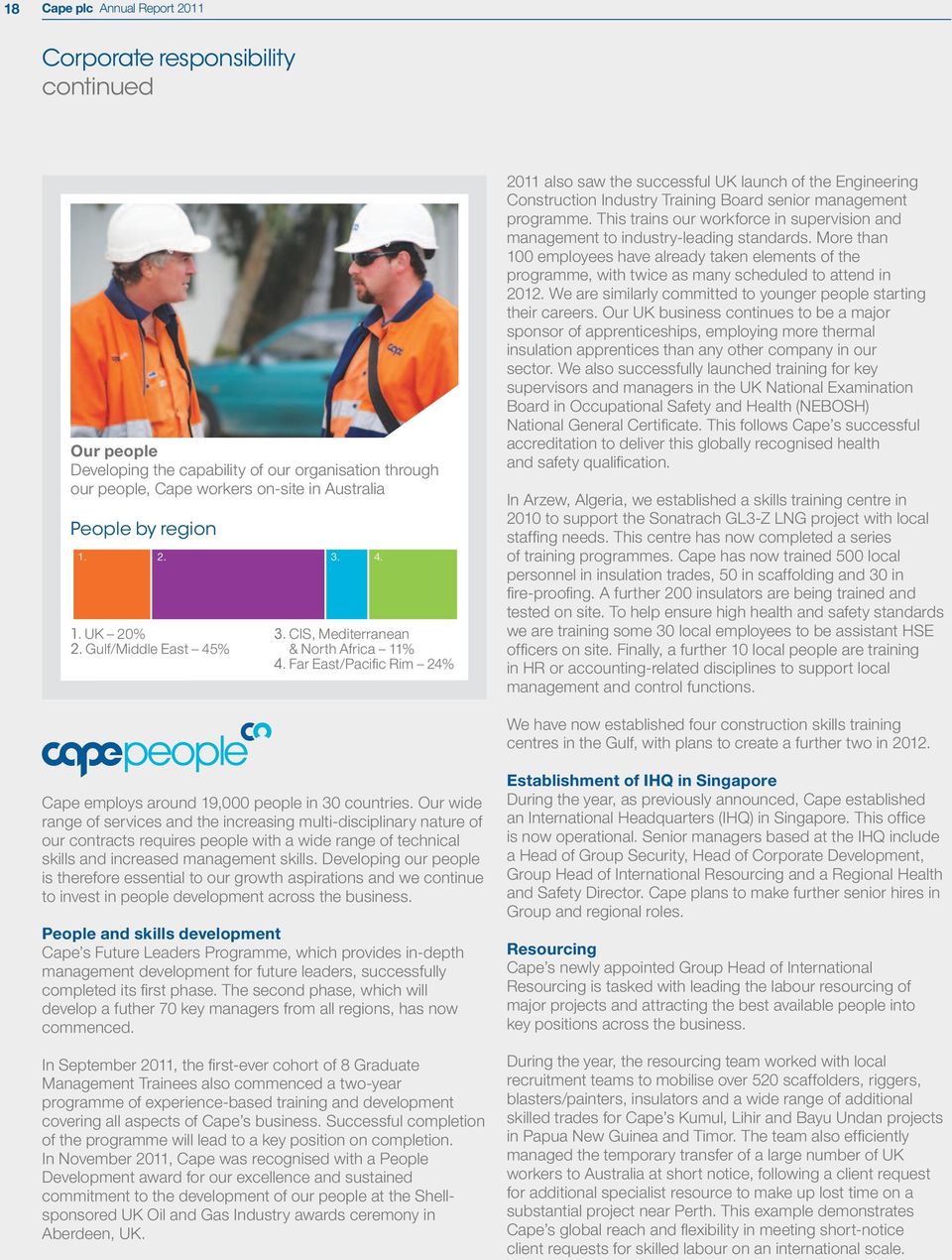
20 18 Cape plc Annual Report 2011 Corporate responsibility continued Our people Developing the capability of our organisation through our people, Cape workers on-site in Australia People by region UK 20% 2. Gulf/Middle East 45% 3. CIS, Mediterranean & North Africa 11% 4. Far East/Pacific Rim 24% also saw the successful UK launch of the Engineering Construction Industry Training Board senior management programme. This trains our workforce in supervision and management to industry-leading standards. More than 100 employees have already taken elements of the programme, with twice as many scheduled to attend in We are similarly committed to younger people starting their careers. Our UK business continues to be a major sponsor of apprenticeships, employing more thermal insulation apprentices than any other company in our sector. We also successfully launched training for key supervisors and managers in the UK National Examination Board in Occupational Safety and Health (NEBOSH) National General Certificate. This follows Cape s successful accreditation to deliver this globally recognised health and safety qualification. In Arzew, Algeria, we established a skills training centre in 2010 to support the Sonatrach GL3-Z LNG project with local staffing needs. This centre has now completed a series of training programmes. Cape has now trained 500 local personnel in insulation trades, 50 in scaffolding and 30 in fire-proofing. A further 200 insulators are being trained and tested on site. To help ensure high health and safety standards we are training some 30 local employees to be assistant HSE officers on site. Finally, a further 10 local people are training in HR or accounting-related disciplines to support local management and control functions. We have now established four construction skills training centres in the Gulf, with plans to create a further two in Cape employs around 19,000 people in 30 countries. Our wide range of services and the increasing multi-disciplinary nature of our contracts requires people with a wide range of technical skills and increased management skills. Developing our people is therefore essential to our growth aspirations and we continue to invest in people development across the business. People and skills development Cape s Future Leaders Programme, which provides in-depth management development for future leaders, successfully completed its first phase. The second phase, which will develop a futher 70 key managers from all regions, has now commenced. In September 2011, the first-ever cohort of 8 Graduate Management Trainees also commenced a two-year programme of experience-based training and development covering all aspects of Cape s business. Successful completion of the programme will lead to a key position on completion. In November 2011, Cape was recognised with a People Development award for our excellence and sustained commitment to the development of our people at the Shellsponsored UK Oil and Gas Industry awards ceremony in Aberdeen, UK. Establishment of IHQ in Singapore During the year, as previously announced, Cape established an International Headquarters (IHQ) in Singapore. This office is now operational. Senior managers based at the IHQ include a Head of Group Security, Head of Corporate Development, Group Head of International Resourcing and a Regional Health and Safety Director. Cape plans to make further senior hires in Group and regional roles. Resourcing Cape s newly appointed Group Head of International Resourcing is tasked with leading the labour resourcing of major projects and attracting the best available people into key positions across the business. During the year, the resourcing team worked with local recruitment teams to mobilise over 520 scaffolders, riggers, blasters/painters, insulators and a wide range of additional skilled trades for Cape s Kumul, Lihir and Bayu Undan projects in Papua New Guinea and Timor. The team also efficiently managed the temporary transfer of a large number of UK workers to Australia at short notice, following a client request for additional specialist resource to make up lost time on a substantial project near Perth. This example demonstrates Cape s global reach and flexibility in meeting short-notice client requests for skilled labour on an international scale.
21 Cape plc Annual Report Principal risks and uncertainties Cape s performance and prospects may be affected by a number of risks and uncertainties that relate to our industry and the environments in which we undertake our operations around the world. We are alive to the issue of risk, and we have systems and procedures in place across the Group to identify, assess and mitigate major business risk. Each region and central function is required to undertake a formal review of risks which could impact its area of business. Identified significant risks and agreed mitigation are formally Risk and potential impact Change Mitigation External Operating activities may be affected by factors outside our control. These include geo-political events, government actions or inactions, climatic conditions, unusual or unexpected geological occurrences, environmental hazards, industrial conditions, technical failures, labour disputes, delays in construction, availability of materials or parts and shipping, import or customs delays. Changes in the political or security environment in existing and new territories may result in Cape, or its clients, losing commercial or legal protections, facing security threats or being less able to control their operations. reviewed on a regular basis and are recorded in an active risks register. We continue to develop our risk management systems and processes to ensure that our responses remain appropriate to the range of risks that we face. No such review of risks and uncertainties can be exhaustive and risks might exist which have not been identified by the Directors. New risks might also emerge, and the likelihood of known risks occurring and the impact they might have upon the Group, may change from time to time. These external factors are normally likely to affect a specific location, customer relationship or a single contract. Cape s business is diverse by geography, number of clients, range of services and exposure to industries or sectors. This portfolio diversification reduces the impact of Cape s overall exposure to individual risks and uncertainties. Cape s policy is to avoid a concentration of activity in markets/regions which it assesses as high risk. Risk is mitigated by a strong senior management presence in each region and particularly where risks are identified, regions operate in close communication with central management. Local legal counsel is regularly engaged to ensure compliance with local legislation and to advise managers on actual or potential changes in legal or regulatory framework. We monitor carefully any changes in political regimes that might impact on our business. We have appointed a Group Head of Security, who is responsible for security coordination in higher risk territories and we have expanded our use of specialist consultancies to advise us and when necessary, provide protection Operations Governance Financial statements As detailed on page 33 in the Corporate governance report we have established policies and procedures to address these risks. Risk and potential impact Competition Losing certain key clients could have an adverse effect on Cape s revenues, particularly where these clients have several contracts with Cape. Change Mitigation Cape s top 10 clients accounted for 35% of Group revenues in 2011 (2010: 35%), with the largest customer accounting for 9% of Group revenues (2010: 9%). Cape has a broad customer base, with circa 110 clients each contributing more than 1 million of annual revenue. Cape seeks to maintain a stable and balanced customer profile. The majority of Cape s clients are either in, or are dependent upon, the energy and natural resources sectors. Cape s earnings therefore depend on stable long-term energy demand particularly for oil, gas and electricity. Cyclical downturns could lead to declines in demand for Cape s services. Cape has developed long-standing relationships with clients, based on service quality, reliability and safety. These relationships are at a variety of levels from sites to senior management. Strong relationships support revenue retention and growth through ongoing contract award and renewal. In most existing markets Cape has a relatively small market share. Most contracts cover a multi-year engagement and are for work of a long-term nature. Cape, therefore, has limited exposure to fluctuations in the spot price of any one energy product, or its short-term demand. Cape is firmly positioned in the downstream energy infrastructure, power generation and later cycle production markets. These markets are less impacted by cyclical downturns than upstream, exploration segments. Cape s wide range of essential services ensures it can serve clients needs through the lifecycle of the production asset, whether related to installation, maintenance or decommissioning.
22 20 Cape plc Annual Report 2011 Principal risks and uncertainties continued Risk and potential impact Operational Many client assets have associated health and safety risks (offshore platform, refineries, and power stations). Failure to maintain the highest Health, Safety and Environmental (HSE) standards on-site could result in injury to our employees or others involved in site operations. Failure to deliver HSE excellence could result in a material loss of clients and/or damage to Cape s reputation and the environment. The loss of key senior management or skilled employees, may adversely affect Cape s business. Cape s ability to successfully operate and grow the business is largely dependent on its ability to attract and retain high-quality personnel. An inability to attract and retain well-qualified and skilled personnel could materially adversely affect Cape s business, operating results or financial condition. Risk and potential impact Financial Failure to achieve satisfactory returns on acquisitions and other investments. Inadequate financial controls leading to loss of assets, loss of financial data or loss of the integrity of data. Other financial risks including foreign exchange and interest rate exposure are described further in note 22 to the Group financial statements. The eventual value of contracts may be lower than expected. Many of Cape s contracts are term maintenance contracts and do not guarantee revenue levels. Lump sum contracts could expose Cape to potential cost overruns. Change Mitigation Cape values its excellent reputation for safety and HSE-related matters around the world. Cape s investment in systems and resources, with around 425 people in full-time HSE roles across the Group, continues to deliver significant reductions in accidents, working days lost and environmental incidents. Occupational health and safety performance continues to be in the upper quartile of comparable companies, with a Lost Time Incident (LTI) frequency rate of per 100,000 hours worked for the Group as a whole. Through both its training centres and on-site training courses, Cape invests a considerable amount in improving staff skills. This helps retain key staff through regular progression, helps reduce skills shortage and improves safety performance. Cape s regionalised organisational structure provides considerable management autonomy and opportunity for senior personnel to develop within the business. The Future Leaders Programme has been introduced for managers who are identified through a succession planning process, with the skills needed to rapidly progress in the organisation. The Cape Management Training Scheme has been introduced to provide a regular pipeline of talent for key management roles across the Group. Annual performance appraisals are conducted to assess executives performance and to discuss career goals. Senior executive remuneration is reviewed against market data provided by specialist remuneration consultants to ensure awards are competitive. Long-term incentive plans are in place to encourage the retention of the key management group. Change Mitigation Cape carries out detailed assessments and reviews of existing and potential acquisition and other investments including external legal and financial diligence, where appropriate. Cape has high quality and experienced finance, acquisitions, internal audit, tax and treasury teams that operate at Group level and across the regions. Cape operates a stringent contract review process with clear authority limits governing the acceptance of contracts. Contract values are often significantly different from initial estimates or from prior year amounts. However, Cape s commercial managers ensure that variations are agreed in advance and changes in scope are captured as revenue. Across many contracts individual increases and reductions tend to offset. Cape s policy is to avoid large lump sum contracts, with the large majority of its contracts being cost reimbursable or at scheduled rates.
23 Cape plc Annual Report The Board Tim Eggar Non-Executive Chairman Brendan Connolly Acting Chief Executive Richard Bingham Chief Financial Officer 2011 Operations Governance Committee membership Chairman of the Nomination Committee and a member of the Remuneration Committee. Background and relevant experience Tim Eggar had a distinguished parliamentary career from 1979 to 1997 which included the key Government appointment of Minister for Energy from 1992 to He has extensive international experience including being Global Head of Integrated Energy Corporate Finance at ABN AMRO, Chief Executive of Monument Oil and Gas, Chairman of Harrison Lovegrove and Chairman of Indago Petroleum. Additional appointments Tim Eggar is currently Chairman of 3 Legs Resources plc, MyCelx Technologies Corporation, the Russo-British Chamber of Commerce and Trent Consulting Ltd. He is also a Non-Executive Director of SoyuzNeftegaz and TAG Energy Solutions Limited, and a member of the Strategic Advisory Board of Braemar Energy Ventures. Committee membership None. Background and relevant experience Brendan Connolly joined Cape as a Non-Executive Director on 16 November 2011 and was appointed acting Chief Executive on 29 March Brendan Connolly is currently Regional President for the Middle East, FSU, Eastern Europe and Russia at Intertek, which provides testing, inspection and certification to clients in all industry sectors. Brendan was previously Chief Executive Officer of Moody International which was acquired by Intertek in May Prior to Moody International, Brendan was the UK Managing Director of the Sema Group and subsequently Atos Origin, an IT integrator, for three years, and previously spent more than 25 years of his career in the oil & gas sector with Schlumberger, in senior International roles over three continents. Additional appointments Brendan Connolly is currently Regional President for the Middle East, FSU, Eastern Europe and Russia for Intertek. Committee membership None. Background and relevant experience Richard Bingham was appointed Chief Financial Officer (CFO) in June With a background in reorganisation and restructuring, he has previously held executive and non-executive roles at several public and privately owned companies as well as that of CFO of a national law firm. Prior to this, Richard Bingham spent several years in professional practice with PricewaterhouseCoopers. Additional appointments Richard Bingham has no external appointments. Financial statements David McManus Non-Executive Director Michael Merton Non-Executive Director Committee membership Chairman of the Remuneration Committee and a member of the Audit and Nomination Committees. Committee membership 2011 onwards Chairman of the Audit Committee and a member of the Remuneration and Nomination Committees. Background and relevant experience David McManus was appointed as a Non-Executive Director in 2004 and served as Non-Executive Chairman between 2006 and He was appointed Senior Independent Director with effect 10 June David McManus was until recently Executive Vice President of Pioneer Natural Resources, a US listed oil & gas company, with responsibility for International Operations. He is a Non-Executive Director of Rockhopper Exploration plc, Flex LNG and Caza Oil & Gas. Prior to these appointments he was also Executive Vice President with BG Group where he was responsible for developing technical and commercial capabilities within the Company and directing assets in the Eastern Hemisphere. Previously David McManus was President of ARCO Europe until ARCO s merger with BP in Background and relevant experience Michael Merton is a Chartered Accountant with significant experience in the international resources industry, having spent the majority of his executive career at Rio Tinto, where he held senior operational roles around the world, including Head of Global Business Services from 2005 to 2009, and was a member of the Executive Committee. Additional appointments Michael Merton is currently a Non-Executive Director of BlackRock Commodities Income Investment Trust plc, a trustee of the Rio Tinto Pension Fund and the HALO Trust, and Chairman of the J Sainsbury Pension Scheme. Additional appointments David McManus is currently a Non-Executive Director of Rockhopper Exploration plc, Flex LNG and Caza Oil & Gas. Information on the appointment dates of the members of Cape s Board is in the Corporate Governance report on page 31.
24 22 Cape plc Annual Report 2011 Directors remuneration report As a Jersey incorporated company whose shares are Premium Listed on the Official List of the London Stock Exchange, Schedule 8 to the Large and Medium Sized Companies and Groups (Accounts and Reports) Regulations 2008 (the Regulations) does not apply to Cape. However, in the interests of best governance practice, the Company has chosen to comply with the disclosure requirements set out in those Regulations. This Report sets out the remuneration policy and principles under which the Directors are remunerated and details the remuneration and share interests of each Director for the year ended 31 December Also set out below is the remuneration policy for the current year and, subject to ongoing review, for subsequent years. The sections and tables of this Report dealing with Directors emoluments and share interests labelled as audited have been audited by the Group s external auditors, PricewaterhouseCoopers LLP. This report has been approved by the Board and the Remuneration Committee (referred to as the Committee in this remuneration report). Group reorganisation Prior to 17 June 2011, the Cape group of companies was wholly owned by Cape plc, a company registered in England and Wales with company number (Old Cape), and the Ordinary Shares were traded on AIM, a market operated by the London Stock Exchange. On 9 May 2011, Old Cape announced details of a change to the corporate structure of the Old Cape Group (the Group). The restructuring proposals put in place a new parent company for the Group, which would be Jersey-incorporated and UK-listed. The proposals were implemented by means of a scheme of arrangement of Old Cape under Part 26 of the Companies Act 2006 (the Scheme). Following approval by shareholders, the Scheme became effective on 17 June 2011 and the Company became the ultimate holding company of the Group. Simultaneously, the Company s Ordinary Shares were admitted to the premium listing segment of the Official List of the UK Listing Authority and to trading on the London Stock Exchange s main market for listed securities. Remuneration Committee The Committee is responsible for making recommendations to the Board on remuneration policy as applied to Cape s Executive Directors and senior executives. The full terms of reference of the Committee are available on the Company s website. Composition of the Committee The members of the Committee, who are considered to be independent based on the criteria included in the UK Corporate Governance Code, are set out below. The following served as members of the Committee of Old Cape throughout the period 1 January 2011 to 17 June 2011, except where otherwise shown: David McManus (Committee Chairman) Tim Eggar appointed 1 May 2011 Michael Merton appointed 1 February 2011 Sean O Connor resigned 30 April 2011 David Robins resigned 2 March 2011 The following served as members of the Committee of New Cape during the period ended 31 December 2011: David McManus appointed 10 June 2011 (Committee Chairman) Tim Eggar appointed 10 June 2011 Michael Merton appointed 10 June 2011 Brendan Connolly appointed 16 November 2011 Brendan Connolly stepped down as a member of the Committee on his appointment as acting Chief Executive on 29 March Role of the Committee The key responsibilities of the Committee are to: determine the broad policy and elements for the remuneration of the Executive Directors; determine all individual elements of the remuneration of those Directors; and select and appoint any remuneration consultants who advise the Committee. Advisors to the Committee The Committee has appointed independent remuneration consultants, New Bridge Street (NBS) to advise on all aspects of senior executive remuneration. NBS has no other connection with the Group other than in the provision of advice on executive and employee remuneration. NBS is a member of the Remuneration Consultants Group and has signed up to its Code of Conduct. The terms of the engagement for NBS are available from the Company Secretary on request. Aon Corporation (the ultimate parent of NBS) provides insurance brokering services to the Group. The Committee is comfortable that this relationship does not impair the independence of its advisors due to the internal controls in place within Aon Corporation and through the Committee s own monitoring of existing cross-relationships. The Committee also seeks advice where appropriate from the Group Human Resources Director to ensure that the remuneration packages of the Executive Directors take due account of pay and conditions in the Group as a whole. The Executive Directors and other senior management may attend Committee meetings at the invitation of the Committee Chairman. However, no Director takes part in any discussion directly concerning their own remuneration. The Company Secretary acts as the secretary to the Committee.
25 Cape plc Annual Report Directors remuneration report continued Remuneration policy for Executive Directors Remuneration policy is based on the following broad principles set by the Committee: to provide a competitive remuneration package to attract, motivate and retain quality individuals; to align remuneration to drive the overall objectives of the business; to align the interests of management with the interests of shareholders; and to set the pay of the Executive Directors with due account taken of: (i) pay and conditions throughout the Group and (ii) corporate governance best practice. The objective of this policy is aligned with the recommendations of the UK Corporate Governance Code as they relate to Directors remuneration. That is to provide a level of remuneration to attract, retain and motivate Directors of the quality required to run the Company successfully, but avoid paying more than is necessary for this purpose. As explained below, a significant proportion of Executive Directors remuneration is structured to link rewards to corporate and individual performance. The Committee ensures that account is taken of environmental, social and governance (ESG) risks when setting remuneration and is comfortable that remuneration packages do not raise any ESG risks by motivating irresponsible behaviour. The Committee is cognisant of its overall responsibility to ensure the remuneration policy operates within a sound risk framework. The Committee will review incentive arrangements regularly to ensure they comply with the risk management systems and that controls are operating effectively. The Committee also ensures that inappropriate operational/ financial risk-taking is neither encouraged nor rewarded through the Company s remuneration policies and that, instead, a sensible balance is struck between fixed and variable pay, short and long-term incentives and cash and equity. The Committee has access to the Audit Committee and its members to discuss any matters of risk assessment as and when required. Activities during 2011 As part of the process for the Company s transfer on 17 June 2011 from AIM to the Official List of the London Stock Exchange, the Company undertook a full review of its executive remuneration structures so as to ensure these structures took due account of market and best practice in addition to incentivising and rewarding the Executive Directors for achieving the Company s strategic goals. These strategic goals were established with the intention of generating outstanding returns for shareholders. When comparing remuneration levels with market practice, the Committee considered pay practices for similar roles in two comparator groups of companies: (i) a group of International Oil Equipment and Services companies and (ii) a group of International Goods and Services companies. Both groups comprised companies of a broadly comparable size. When considering this data, the Committee was mindful of working within a UK best practice framework and of the pay and employment conditions elsewhere in the Group. The main output from this review was that certain changes should be made to the ongoing long-term incentive provision at the Company, and which were approved by shareholders at a General Meeting of the Company held on 25 May In addition, the Committee considered the following items of business during 2011: Executive Directors and senior executives salary levels Review of Non-Executive Directors fees Annual bonus performance measures and targets for 2011 Outturn of bonus for long-term incentive award levels Introduction of share ownership guidelines Introduction of a clawback mechanism to incentive plans. Fixed versus variable remuneration In order to incentivise management whilst aligning their interests with those of the shareholders, a substantial proportion of the Executive Directors pay is performance related. The table below shows the balance between fixed and performance related pay at target and maximum performance levels based on the 2012 remuneration policy as adopted by the Remuneration Committee from the start of the current financial year. Maximum performance assumes achievement of maximum bonus and full vesting of shares under the Cape Performance Share Plan: Performance related versus fixed remuneration Maximum Target 0% 20% 40% 60% 80% 100% Basic salary Annual bonus Long-term incentive plan 2011 operations Governance Financial statements
26 24 Cape plc Annual Report 2011 Directors remuneration report continued Remuneration of Non-Executive Directors The fees of the Chairman and Non-Executive Directors are set by the Board. When setting these fees, due account is taken of fees paid to Non-Executive Directors of similar companies, the time commitment of each Director and any additional responsibilities undertaken, such as acting as Chairman to one of the Board Committees or as Senior Independent Director. For 2011 the basic fee for acting as a Non-Executive Director was 35,000 per annum. A supplementary fee of 5,000 per annum is paid for being a member of a committee and 10,000 per annum is paid for chairing either the Remuneration or Audit Committee. Non-Executive Directors are not eligible to receive pension entitlements or bonuses and may not participate in long-term incentive schemes. Chairman s remuneration Tim Eggar, who was appointed Chairman of Old Cape on 1 May 2011, and of New Cape on 4 May 2011, receives a fee of 150,000 per annum. Further to a letter of variation dated 31 August 2011, Tim Eggar has irrevocably agreed that 25% of the value (before tax) of his agreed fees shall be satisfied by the issue to him of Ordinary Shares of 25p each in the capital of the Company at a subscription price per share equivalent to the volume weighted average price of the Ordinary Shares for the five trading days preceding each quarterly payment date, with the balance to be paid in fees. Elements of Executive remuneration The table below summarises the components of the Executive Directors remuneration. Objective Performance period Policy Basic salary To position at a market competitive Annually Individual pay levels are determined level for similar roles within by reference to the individual s comparable companies performance, experience in post and potential Pension To provide competitive cost-effective Ongoing The policy is to provide market benefits in line with market practice competitive retirement benefits or, and to act as a retention mechanism depending on individual circumstances, and reward long service to provide a cash alternative with which the executive may make their own arrangements. Only basic salary is pensionable Other benefits To provide competitive cost-effective Ongoing Executive Directors receive a car benefits in line with market practice allowance, private medical insurance, health insurance and life assurance Performance related To incentivise delivery of 1 year Bonus payments are based on bonus performance linked to the the achievement of specified Company s business objectives corporate and individual objectives Performance To drive long-term performance 3 years Awards are subject to stretching Share Plan linked to the Company s strategic EPS growth targets objectives, aid retention and align the interests of Executive Directors with shareholders (i) Basic salary The salary of individual Executive Directors is reviewed with effect from 1 January each year. Account is taken of the performance of the individual concerned, together with any change in responsibilities that may have occurred and the rates for similar roles within the appropriate comparator groups. The Committee is also mindful of pay and employment conditions elsewhere in the Group when setting Executive Directors salaries. As of 1 January 2012, the following increases were effected: Chief Executive: 500,200 (increased by 2.5% from 488,000) Chief Financial Officer: 333,125 (increased by 2.5% from 325,000) These increases reflected the calibre of the individuals, their past and ongoing performance and were in line with the salary increases awarded to high performing individuals across the Group as a whole.
27 Cape plc Annual Report (ii) Performance related bonus The maximum potential bonus payable to Executive Directors in respect of the year ended 31 December 2011 was capped at 125% of salary for the Chief Executive and 100% of salary for the Chief Financial Officer. Performance measures, all of which were equally weighted, were based on the achievement of adjusted earnings per share (EPS) targets, cash flow targets and personal objectives. For financial measures, a challenging sliding scale of targets is set around the budgeted level of performance for the year. Performance levels are set at threshold, target and stretch. The target level is established by reference to achieving budget performance while stretch and threshold are generally set at +/- 10% of budget. With regard to personal objectives, the bonus becomes payable based on the Committee s assessment of the extent to which each Executive Director met the range of targets set for them at the start of the year. The bonuses paid to Martin K May and Richard Bingham in respect of the year ended 31 December 2011 were 68% and 49% of 2011 salary respectively, reflecting a year of robust corporate and individual performance. The Committee agreed the above bonus payments, which were based on partial achievement of financial metrics and partial achievement of personal goals established by the Committee. The use of the above targets is seen as supporting the delivery of the Company s strategic goals. In light of this, it is intended that a similar bonus structure including performance measures and the approach to target setting, will be used in Clawback provisions During the year the Committee introduced changes to the incentive provision such that a clawback provision has been introduced into the annual bonus plan, with effect 1 January 2012, that will enable any excess bonus earned in respect of a misstatement of financial results to be reclaimed by the Company at the Committee s discretion. The ability to clawback bonuses will operate for two years following the payment of a bonus in any year operations Governance Financial statements (iii) Long-term incentive arrangements (a) The Cape Performance Share Plan (PSP) The Cape PSP was approved by shareholders at a General Meeting held on 25 May 2011, and replaced the Old Cape PSP which had been approved by shareholders at the Old Cape General Meeting in The Cape PSP currently operates as the Company s sole type of executive long-term incentive arrangement. The Cape PSP introduced certain changes to long-term incentive provision which applied from 25 May 2011 and the principal features of which are set out below. Maximum award Executive Directors are eligible to receive an award of shares up to an equivalent of 175% of their annual basic salary. Under the Old Cape PSP Executive Directors were previously eligible to receive a conditional award of shares up to an equivalent of 100% of their annual basic salary (up to 200% of salary on an exceptional basis). Performance conditions The vesting of awards made under the Old Cape PSP was subject to the achievement of a sliding scale of challenging EPS growth targets in excess of inflation over a fixed three-year period, calculated on an annually compounded basis, commencing with the financial year before that in which the award is made. The targets that applied to awards granted under the Old Cape PSP were as follows: Annual EPS growth Percentage that vests Less than RPI + 3% 0% RPI + 3% 30% RPI + 10% 100% Between performance points 30% 100% pro rata Since awards may be granted at a higher annual quantum under the New Cape PSP, awards at a higher annual quantum will be subject to the following tougher targets at both the threshold and maximum performance levels: Annual EPS growth Percentage that vests Less than RPI + 5% 0% RPI + 5% 30% RPI + 12% 100% Between performance points 30% 100% pro rata The Committee continues to believe that the use of EPS remains an appropriate measure as it is a key indicator of the Company s underlying financial performance, it maintains a clear line of sight for Executives and is an important driver in creating shareholder value. For these reasons the Committee will retain the use of EPS for awards to be made in the current financial year under the Cape PSP. The Committee will seek third party confirmation of the extent to which the EPS growth targets are achieved.
28 26 Cape plc Annual Report 2011 Directors remuneration report continued Awards granted in 2008 became exercisable during The maximum performance target was met and therefore these awards vested in full. The Committee expects that awards granted in 2009 which will become exercisable during 2012 are likely to vest in full based on the audited adjusted earnings per share for the year ended 31 December Dilution The PSP rules provide that no more than 10% of the issued Ordinary Share capital of the Company, from time to time, should be issued or be eligible to be issued when account is taken of all outstanding awards that retain the potential to vest and be satisfied through the issue of new shares under all share incentive schemes operated by the Group in any rolling ten-year period. Currently, there is approximately 2.32% headroom available under this dilution limit. Share ownership requirements During the year, share ownership requirements were introduced to require the Executive Directors to retain half the after tax number of vested shares from future long-term incentive awards until the share ownership guidelines are achieved Guideline Achievement of guideline as at Executive Director (% of salary) 31 December 2011 Martin K May 300% 131% Richard Bingham 100% 98% (b) Employee Incentive Plan Old Cape operated an Employee Incentive Plan (EIP) which allowed the Group to grant options to Executive Directors and senior employees. The contractual life of the options was 10 years from the date of grant. The options became exercisable on the third anniversary from the date of grant, subject to growth in earnings per share over that period exceeding an average 3% compounded annually above the growth in the consumer price index over the same period. The remaining options granted to the Chief Executive under the EIP in 2007 were exercised in full during the year ended 31 December 2011 (see below). (iv) Benefits It is Company policy to provide Executive Directors with a car allowance, private medical, health and income protection insurance, and life assurance amounting to four times basic salary for the Chief Executive and three times basic salary for the Chief Financial Officer. (v) Pensions Under the terms of their service agreement, Executive Directors are either entitled to become members of one of the Group pension schemes or to receive payment of a fixed percentage of salary. Martin K May (Chief Executive until 29 March 2012) was entitled to participate in the Company s defined contribution plan and received 15% of his basic salary, or alternatively to take a salary supplement in lieu of pension contributions amounting to 15% of basic salary. Richard Bingham (Chief Financial Officer) participates in the Company s defined contribution plan and receives 15% of his basic salary. Directors service agreements, notice periods and termination payments Executive Directors The service agreement dates and notice periods for the Executive Directors are as follows: Notice period Notice period Director Contract date from the Company from the Director Martin K May (stood down on 29 March 2012) 12 January months 12 months Richard Bingham 26 October months 12 months Richard Bingham s service agreement which is a rolling agreement, is subject to standard terms in the event of termination. Martin K May s agreement contained a provision (exercisable at the option of the Company) to pay an amount on early termination of employment equal to one year s salary. In the event of a change of control of the Company, Martin K May was entitled to a cash bonus (less income tax and National Insurance) equal to the aggregate amount by which the value of a notional 500,000 Cape Ordinary Shares at the exit price exceeded 2.30 per Cape Ordinary Share. This was a legacy feature of his contractual terms and there is no intention to include this type of provision in any future service agreements. Martin May stood down as Chief Executive and as a Director of the Company on 29 March Brendan Connolly was appointed as acting Chief Executive on 29 March 2012 at a base salary of 350,000 p.a. plus discretionary bonus. The Nomination Committee has commenced a search for a replacement and a permanent appointment will be made in due course.
29 Cape plc Annual Report Non-Executive Directors The Non-Executive Directors do not have service contracts with the Company. Their appointment is subject to annual re-election at the AGM. Non-Executive Directors are typically expected to serve for two three-year terms, although their appointment can be terminated either by them or by the Company on one month s written notice. The Chairman s notice period is also one month. The Company may invite a Non-Executive Director to serve for a further period after the expiry of two three-year terms subject to a particularly rigorous review of performance and taking into account the need for progressive refreshing of the Board. Under the Company s Articles of Association, all Directors are required to stand for re-election by shareholders at least once every three years. However, in line with Provision B.7.1 of the UK Corporate Governance Code, the Board has agreed that all Directors should now be subject to annual re-election. The appointment dates of the Non-Executive Directors in post during the year were as follows: Old Cape New Cape Tim Eggar 1 May 2011, appointed Chairman, resigned 17 June May 2011, appointed Chairman David McManus 3 November 2004, resigned 17 June May 2011 Michael Merton 10 January 2011, resigned 17 June May 2011 Brendan Connolly 16 November 2011* Sean O Connor 1 April 2007, appointed Chairman 11 June 2008, retired 30 April 2011 David Robins 1 September 2006, retired 2 March 2011 * Subsequently appointed acting Chief Executive on 29 March Executive Directors external appointments Board approval is required before any external appointment can be accepted by an Executive Director. Whether the Executive Director is permitted to retain any fees paid for such services or whether such fees are remitted to the Company will be determined on a case by case basis operations Governance Financial statements Directors emoluments (audited) Performance related Total Total Salary/fees bonus Benefits 1 Pension Executive Directors Martin K May ,151.4 Richard Bingham Non-Executive Directors Tim Eggar 100 N/A N/A N/A 100 David McManus 3 60 N/A N/A N/A Michael Merton 4 50 N/A N/A N/A 50 Brendan Connolly 5 6 N/A N/A N/A 6 Sean O Connor N/A N/A N/A David Robins 7 9 N/A N/A N/A Benefits in kind include a company car, private medical insurance, health and income protection insurance and life assurance. 2 Stepped down on 29 March David McManus is Chairman of the Remuneration Committee and a member of the Audit and Nomination Committees. 4 Michael Merton is Chairman of the Audit Committee and a member of the Remuneration and Nomination Committees. 5 Brendan Connolly was a member of the Audit, Remuneration and Nomination Committees during the period ended 31 December Sean O Connor was Chairman of the Board, Chairman of the Nomination Committee and a member of the Remuneration Committee of Old Cape for the period 1 January 2011 to 30 April David Robins was Chairman of the Audit Committee of Old Cape for the period 1 January 2011 to 28 February 2011 and a member of the Remuneration and Nomination Committees of Old Cape for the period 1 January 2011 to 2 March Directors shareholdings (audited) Directors interests and transactions in the Ordinary Shares of the Company The beneficial and non-beneficial interests of the Directors in office as at 31 December 2011 and at 3 April 2012 are shown below: At 31 December 2011 As at or on appointment 3 April 2012 if later Executive Directors Martin K May (stepped down on 29 March 2012) N/A 690,000 Richard Bingham 99,437 99,437 Non-Executive Directors Tim Eggar 21,723 19,593 David McManus 35,000 35,000 Michael Merton 2,000 2,000 Brendan Connolly 2,500 2,500
30 28 Cape plc Annual Report 2011 Directors remuneration report continued Performance Share Awards (audited) Details of the awards made under the Employee Incentive Plan and Performance Share Plan are set out below. Details of the performance conditions that have applied to PSP awards are shown on page 25. Market Market Date price at At 31 During 2011 At 31 price at from which Grant date of December December Option date of exercisable/ Expiry Plan date grant 2010 Granted Exercised Lapsed 2011 price exercise awards vest date Martin K May EIP 22 March 269.5p 200, , p 496.1p 22 March 22 March PSP 28 April 239.8p 190, , p 28 April N/A PSP 30 April 118.0p 703, , April N/A PSP 17 March 240.5p 243, , March N/A PSP 13 April 508.5p 273, , April N/A Richard Bingham PSP 28 April 239.8p 131, , p 28 April N/A PSP 30 April 118.0p 357, , April N/A PSP 17 March 240.5p 123, , March N/A PSP 13 April 508.5p 130, , April N/A Notes: These awards under the EIP and PSP are subject to a three-year EPS performance target, with 30% of awards vesting for annual EPS growth of RPI +3%, rising on a pro rata basis to full vesting for annual EPS growth of RPI +10%. The share price at 31 December 2011 was 328p, with the maximum and minimum share price during the financial year being 591.5p and 295p respectively. Under the rules of the Old Cape Performance Share Plan awards can be structured as conditional awards of shares or as nil or nominal cost options. On 28 February 2012 the Committee agreed that all existing conditional awards granted under that plan be converted to nil cost options, so as to provide participants with greater flexibility to decide when to exercise their award and acquire the shares subject to the award. In the normal course of events, the vested option can be exercised at any time up until the day before the fifth anniversary of the date of grant. Retaining awards as unexercised options was considered to, potentially, provide greater ongoing alignment with shareholders than the immediate transfer of shares to an Executive Director on vesting and places them in the same position as if the award was originally structured as a nil cost option which was within the gift of the plan. On 8 March 2011, Martin K May exercised options over 200,000 Ordinary Shares under the EIP at a price of 269 pence per Ordinary Share and, on 8 and 9 March 2011, sold these shares for personal reasons at an average price of pence per Ordinary Share. Awards made on 28 April 2008 under the Performance Share Plan to Martin K May and Richard Bingham over 190,122 and 131,119 shares, respectively, vested on 28 April 2011, of which Martin K May subsequently sold 190,122 shares, and Richard Bingham sold 68,182 shares. The aggregate gain on Martin K May s EIP options exercised during the year was 454,180.
31 Cape plc Annual Report Total Shareholder Return performance The following graph shows a comparison of Cape plc s Total Shareholder Return against that achieved by the AIM 100 Index and FTSE 350 index. These indices are seen as the most appropriate to represent the Company s relative performance over the last five financial years given the Company s move to the Official List of the London Stock Exchange from AIM during Total Shareholder Return Source: Datastream Value ( ) This graph shows the value, by 31 December 2011, of 100 invested in Cape plc on 31 December 2006 compared with the value of 100 invested in the FTSE 350 Index (excluding investment trusts) and FTSE AIM 100 Index. The other points plotted are the values at intervening financial year-ends operations Governance Financial statements Cape FTSE AIM 100 FTSE 350 (excluding investment trusts) David McManus Non-Executive Director and Chairman of the Remuneration Committee 13 April 2012
32 30 Cape plc Annual Report 2011 Corporate governance report Cape is committed to achieving high standards of business integrity, ethics and professionalism across its worldwide operations. The Board is collectively accountable to the Company s shareholders for good governance to facilitate efficient and effective management in order to deliver shareholder value over the long term, within appropriately established risk parameters. Group reorganisation During the year ending 31 December 2011 the Company s Ordinary Shares were admitted to the premium listing segment of the Official List of the UK Listing Authority and to trading on the London Stock Exchange s main market for listed securities. Further information concerning the reorganisation of the Group during the year is set out in the Directors Report on page 39. As a Jersey-incorporated Company with a premium listing on the London Stock Exchange, Cape is expected to meet the highest standards of regulation and corporate governance. A company with a premium listing is required by the United Kingdom Listing Authority to adopt the UK Corporate Governance Code (the Code), regardless of whether it is incorporated in the UK or elsewhere. During the period 1 January 2011 to 16 June 2011, when Old Cape s shares were traded on AIM, it was not required to comply fully with the Code. However, during that period the Board implemented policies and procedures designed to comply with the Code, as far as reasonably practicable and appropriate for a public company of its size and complexity. This Corporate governance report has therefore been prepared in accordance with the Code and in relation to the Company and the Group for the year ended 31 December The statements set out below describe how the principles identified in the Code have been applied by the Group. Compliance with the UK Corporate Governance Code As explained in the Chairman s statement on page 2, throughout the period from admission to a premium listing on 17 June 2011 to the end of the financial year 31 December 2011 the Board confirms that it has complied with the provisions of the Code and applied the principles of the Code in the same manner. The following matters should be noted. Audit Committee membership Code Provision C.3.1 specifies that companies below the FTSE 350 throughout the year immediately prior to the reporting year should have an Audit Committee of at least two independent Non-Executive Directors. Cape met this provision. Cape became a member of the FTSE 250 index in September Brendan Connolly was appointed as an independent Non-Executive Director and as a further member of the Audit Committee on 16 November 2011, in preparation for the extended requirement for the reporting year ending 31 December Brendan Connolly stepped down from the Company s Audit, Nomination and Remuneration Committees on 29 March 2012 following his appointment as acting Chief Executive in place of Martin K May AGM Confirmation of individual Directors performance Code Provision B.7.2 requires the Board to set out to shareholders in the papers accompanying a resolution to elect a Non-Executive Director why they believe an individual should be elected, and that the Chairman should confirm to shareholders when proposing re-election that, following formal performance evaluation, the individual s performance continues to be effective and to demonstrate commitment to the role. An internal performance review of the Board and its Committees, and the effectiveness and commitment of the Non-Executive Directors had been carried out in November 2010 by the former Chairman of Old Cape. As Tim Eggar and Michael Merton were only appointed to the Board of Old Cape earlier in 2011, they had not undergone such a review at the time of the Company s 2011 AGM held on 28 September The Board has since carried out a formal performance review of all the Non-Executive Directors and appropriate recommendations are being made at the 2012 AGM. The role of the Board The Board is responsible to shareholders for the overall management and performance of the Group and each Director must act in ways which promote the long-term success of the Company for the benefit of its shareholders as a whole. The Board also ensures that an appropriate balance is met between promoting the long-term growth and delivering short-term objectives. The Board is primarily responsible for determining strategic direction, demonstrating leadership and focusing on matters that consistently add value for the shareholders. Its role includes reviewing and monitoring the Company s strategic objectives, budgets and commercial strategy, approval of major acquisitions, disposals and capital expenditure and overseeing the Group s systems of internal control, governance and risk management. It also sets standards for monitoring environmental, health and safety performance.
33 Cape plc Annual Report The Board has a formal schedule of matters specifically reserved for its own decision which specifies key aspects of the Company s affairs which the Board does not delegate. The principal matters reserved to the Board include: authorisation of significant transactions; dividend policy; internal controls and risk management (via the Audit Committee); remuneration policy (via the Remuneration Committee); shareholder circulars and listing particulars; matters relating to share capital and buy back of shares; treasury policy and commitment to new material bank facility agreements, borrowings or bonds; and appointment/removal of Directors and the Company Secretary. The Board has established properly constituted audit, remuneration and nomination committees of the Board with formally delegated duties and responsibilities. The Chairmen of these Committees report regularly to the Board. In addition, the Board receives reports and recommendations from time to time on any matter which it considers significant to the Group. Composition of the Board The following served as Directors of Old Cape throughout the period 1 January 2011 to 17 June 2011 except where otherwise indicated. Appointment dates are also shown: Tim Eggar (Chairman) appointed 1 May 2011 Martin K May (Chief Executive) appointed 11 October 2002 Richard Bingham (Chief Financial Officer) appointed 1 June 2008 David McManus (Non-Executive Director) appointed 3 November 2004 Michael Merton (Non-Executive Director) appointed 10 January 2011 Sean O Connor (former Chairman) resigned 30 April 2011 David Robins (Non-Executive Director and Senior Independent Director) resigned 2 March operations Governance Financial statements The following served as Directors of New Cape throughout the period from incorporation on 19 April 2011 to 31 December 2011 except where otherwise shown: Tim Eggar (Chairman) appointed 4 May 2011 Martin K May (Chief Executive) Richard Bingham (Chief Financial Officer) David McManus (Non-Executive Director and Senior Independent Director) appointed 4 May 2011 Michael Merton (Non-Executive Director) appointed 4 May 2011 Brendan Connolly (Non-Executive Director) appointed 16 November 2011 On 29 March 2012, Martin K May stepped down as Chief Executive and a Director of the Company and Brendan Connolly was appointed acting Chief Executive. Access to appropriate information The Board is supplied with information in a form and quality to enable it to take informed decisions and to discharge its duties effectively. Directors are provided with regular detailed briefings on the Group s business, financial performance, the markets in which it operates, the overall economic and competitive environment and an analysis of the Group s actual performance against budget and the previous year. All Directors are encouraged to challenge and make further enquiries of the Executive Directors or management, as they consider appropriate. The Company Secretary, through the Chairman, is responsible for advising the Board on governance matters, for ensuring that Board procedures are followed and for ensuring good information flows within the Board and the Board Committees. All Directors have access to the advice and services of the Company Secretary, as well as access to external advice, if required, at the expense of the Group. An agreed procedure exists for Directors in the furtherance of their duties to take independent professional advice. No such external advice was sought by any Director during the year. The appointment and removal of the Company Secretary is a matter reserved for the Board as a whole.
34 32 Cape plc Annual Report 2011 Corporate governance report continued Induction, training and development Newly appointed Directors are made aware of their responsibilities and liabilities as a director of a public limited company and are provided with a formal and tailored induction programme by the Company Secretary. This includes the information pack recommended by the Institute of Chartered Secretaries and Administrators, site visits and meetings with senior management including all Board members, the Group Safety Director, the Group Human Resources Director, Director of Audit (Internal) and the Company s auditors and stockbrokers. Non-Executive Directors are encouraged to participate in site visits in the furtherance of their duties. Board balance and independence There is a clear division of responsibilities between the running of the Board and the Executive Directors who are responsible for managing the Group s business. The roles of the Chairman and Chief Executive are separated, with clear written guidance to support the division of responsibilities. The Chairman is primarily responsible for the leadership of the Board, ensuring that all Directors are able to play a full part in its activities. The Chairman is also responsible for ensuring all Board members are aware of the views of its major investors, and for ensuring that the training requirements of each Director are met. The Chief Executive is responsible for all aspects of the operation and management of the Group and its business. His role includes developing, for Board approval, an appropriate business strategy and ensuring that the agreed strategy is implemented in a timely and effective manner. The role of acting Chief Executive is similar in scope. At 31 December 2011, the Board consisted of the Chairman, two Executive Directors and three Non-Executive Directors. The Board regarded each of the three Non-Executive Directors as being fully independent in character and judgement, notwithstanding that David McManus served as Non-Executive Chairman of Old Cape between 10 July 2006 and 11 June The Non-Executive Directors have no cross-directorships or other significant links which could materially interfere with the exercise of their independent judgement. The Chairman was independent at the time of his appointment to that position. The Board is satisfied that no individual or group of Directors has unfettered powers of discretion and that an appropriate balance exists between the Executive and Non-Executive members of the Board. During the year, the Chairman held meetings with the Non-Executive Directors without the Executive Directors being present. Martin K May, stood down as Chief Executive and a Director of the Company on 29 March 2012, on which date Brendan Connolly was appointed as acting Chief Executive and resigned as a member of the Audit, Nomination and Remuneration Committees. From that date, the Board consists of the Chairman, two Executive Directors, and two Non-Executive Directors. Annual re-election of Directors Cape s Articles of Association provide that newly appointed Directors are subject to election by shareholders at the first Annual General Meeting (AGM) following their appointment, and to re-election thereafter at intervals of no more than three years. In compliance with Code provision B.7.1, the Board has adopted a policy of annual re-election of all Board members and all Directors will be subject to election by shareholders at the 2012 AGM. Further to the performance evaluation conducted in respect of the year ended 31 December 2011, the Board considers that the performance of each Director standing for election/ re-election at this year s AGM to be fully satisfactory and that he has demonstrated commitment to the role. The Board therefore fully supports the election/re-election of the Directors and recommends shareholders to vote in favour of these resolutions. The Non-Executive Directors are engaged under letters of appointment which will be on display at the AGM, together with the Executive Directors Service Agreements. The Non-Executive Directors Letters of Appointment are terminable on one month s written notice. The Chief Financial Officer is employed under a service agreement which is terminable on 12 months written notice. Following his appointment as acting Chief Executive on 29 March 2012, Brendan Connolly s existing letter of appointment as a Non-Executive Director remains in place and he entered into a service agreement which is terminable at one month s notice. Biographical details of the Directors are set out on page 21 of the Annual Report and Accounts. Senior Independent Director David Robins was the Senior Independent Director of Old Cape during the period 1 January 2011 to 2 March David McManus was appointed as Senior Independent Director of New Cape on 10 June 2011 with effect from Admission on 17 June The Senior Independent Director is available to shareholders to assist in resolving concerns which contact through the normal channels of Chairman, Chief Executive or Chief Financial Officer have failed to resolve, or for which such contact is inappropriate. No such matters of concern were raised during the year ended 31 December The Senior Independent Director is also required to lead the discussion relating to assessing the effectiveness of the Chairman s performance, and act as a sounding board to the other Non-Executive Directors. The Senior Independent Director should attend sufficient meetings with the Company s major shareholders in order to develop a balanced understanding of the views of its major shareholders and report the outcome of such meetings at subsequent meetings.
35 Cape plc Annual Report Conflicts of interest The Chairman and Non-Executive Directors may serve on the boards of other companies provided they are able to demonstrate satisfactory time commitment to their role as a Director of Cape plc. Directors are required to declare their directorships or other appointments to companies which are not part of the Cape Group and which could give rise to conflicts or potential conflicts of interest. Directors have a duty to avoid a direct or indirect interest which conflicts, or may possibly conflict, with the interests of the Group unless that conflict has been approved by the Board. Conflicts of interest are a standing item on the agenda of all Board meetings. During the year no occasion arose when a Director s appointment or situation gave rise to a conflict of interest. The Board is satisfied that, throughout the year, the Chairman and Non-Executive Directors had the necessary time available to devote to the proper performance of their duties. Board evaluation The 2011 evaluation of the Board, its Committees and individual Directors was carried out internally. The evaluation took the form of individual interviews conducted by the Chairman with each Director, and comprehensive questionnaires which reflected the increasing roles of the Board Committees and provided all Directors with an opportunity to comment on Board and Committee procedures. The results were presented to the Board in January 2012, and recommendations arising from the evaluation are being implemented. A performance evaluation of the Chairman was carried out by the Non-Executive Directors, led by the Senior Independent Director, and taking into account the views of the Executive Directors. Relations with shareholders The Company values the views of all its shareholders and recognises their interests in the Company s strategy and performance. Analysts and the Company s major shareholders are offered meetings with the Chairman, Chief Executive and Chief Financial Officer on a regular basis to develop their understanding of the Company and to enable them to raise any concerns or issues. The Chairman is responsible for ensuring that all Board members are aware of the views of its major investors. During the year ended 31 December 2011, the Chairman or the Senior Independent Director held a number of meetings with institutional shareholders. Non- Executive Directors and the Senior Independent Director are available to meet with major shareholders in order to develop an understanding of their views. The Annual Report is mailed to all shareholders. The Annual Report, together with regular trading updates, significant contract wins and health and safety achievements are published via a Regulatory Information Service and on the Company s website at The Notice of Annual General Meeting is mailed to shareholders at least 20 business days prior to such meeting. All shareholders are encouraged to attend the Company s Annual General Meeting at which the shareholders have an opportunity to ask any questions they may have. The full Board attends this meeting and is available to answer questions from those shareholders present. Internal control The respective responsibilities of the Directors in connection with the Annual Report and Accounts are explained on page 41. The Board is responsible for the Group s system of internal control and for reviewing its effectiveness. This system is designed to reduce rather than eliminate the risk of failure to meet business objectives and can provide only reasonable and not absolute assurance against material misstatement or loss. The Board confirms that there is an ongoing process for identifying, evaluating and managing the significant risks faced by the Group. The process, including related procedures and controls, is kept under regular review by the Board and recommendations for changes are made as appropriate. The Directors have performed an annual assessment of the Group s system of internal control using the Financial Reporting Council s Turnbull Guidance Internal Control Revised Guidance for Directors on the Corporate Governance Code. This assessment included review and discussion of Board papers which summarised the key elements of the Group s overall internal control system, assessed the robustness of those control elements, described how those elements have operated to date, proposed planned improvements to the control environment and explained the reasons for those improvements. In reviewing the supporting Board papers and forming their view as to the effectiveness of the system of internal control, the Directors took into account the nature and quality of regular and annual reporting to them during 2011 and operations Governance Financial statements
36 34 Cape plc Annual Report 2011 Corporate governance report continued Based on their review the Directors have concluded that the Group s overall system of internal control has been effective throughout the period and up to the date of approval of the Annual Report and Accounts. The key features of Cape s system of internal control include: 1. Strategic and business planning the Group produces and agrees objectives and budgets each year, against which the performance of the business is regularly monitored. 2. Investment appraisal major contracts and capital purchases are reviewed in advance by senior management and, when appropriate, approved by the Board. 3. Financial monitoring profitability, cash flow and capital expenditure are closely monitored and key financial information is reported to the Board on a monthly basis, including explanations of variances between actual and budgeted performance. 4. Systems of control procedures and delegated authorities there are clearly defined approval limits for key business decisions acquisitions, disposals, contract approvals, large transactions, capital purchases and operating expenditures. In addition, the integrity of the financial reporting and consolidation processes and the completeness and accuracy of financial information are subject to review by Executive Management, the Audit Committee and the Board. Risk management process The Group in the course of its business can be subject to strategic, financial and compliance risks. The management of these risks is vested in the Board, with the Audit Committee having delegated responsibility for reviewing the adequacy of the risk management system. The principal tools used to assess and manage risk are: Risk registers every 6 months a formal reappraisal of business risk takes place in both the regions and the centre of operations to identify, evaluate and record significant business risks faced by the Group. Each risk in the registers is rated in terms of probability of occurrence and potential impact on the business. Where possible, management identifies mitigating controls, their likely effectiveness and risk ownership. Material changes to the risk registers are reported to the Audit Committee and the Board on a regular basis. Internal audit the internal audit team is responsible for reviewing and testing key business processes and controls, including following up the implementation of management plans and actions and reporting any overdue actions to the Audit Committee. The Director of Internal Audit reports to the Chairman of the Audit Committee. The Internal Audit function operates a risk-based audit approach. The Audit Committee reviews the effectiveness of Internal Audit activities including the scope of work, authority and resources of the internal audit function. The internal audit team also provides objective assurance on risk and controls to senior management, the Audit Committee and the Board. Key controls Regional Financial Controllers certify monthly that within their business, defined key financial controls and other established procedures are operating effectively. Annual Certification Process at the end of each financial year a detailed questionnaire is circulated to the Group s Business Units relating inter alia to the conduct of the business and regulatory compliance. The questionnaire is approved and signed off by the Operational and Financial heads of each Business Unit. Whistleblowing a confidential whistleblowing procedure is in operation which allows employees to raise concerns about possible improprieties in operational or financial conduct. Cape s approach to internal controls and risk management is supported by an oversight structure, which includes both the Audit Committee and the Board. Bribery Act 2010 The Group has established an Anti-Bribery Policy which applies to all Cape entities worldwide, and to all Directors, employees, workers, agents or any other persons acting for, or on behalf of, Cape. The Company will seek to ensure that third parties such as joint venture partners, agents and consultants also commit to the principles and relevant practices referred to in the Policy. The Policy includes a clear statement on Cape s anti-bribery measures and its anti-corruption culture, and contains practical procedures to be followed by all employees, and also provides for due diligence of business partners. Training and monitoring have been extended across the business. Risk appraisal when major business decisions are taken the related risks are assessed in advance. When risks change or materialise, senior management and the Board are alerted to ensure that the Company s response is both prompt and appropriate.
37 Cape plc Annual Report Directors attendance at meetings The Board usually meets formally not less than 8 times a year and, informally, on other occasions. Non-Executive Directors are also available throughout the year and are available to attend Board meetings on an ad hoc basis. Attendance by Directors at meetings of the Board and the Committees during the year ended 31 December 2011 was as follows: Board Audit Remuneration Nomination No. of No. No. of No. No. of No. No. of No. meetings attended meetings attended meetings attended meetings attended Tim Eggar (appointed 1 May 2011) 6 6 7* 7* Martin K May** * 4* 10* 3* 1 1 1* 1* Richard Bingham * 7* 10* 4* 4* 1* David McManus Michael Merton (appointed 10 January 2011) Brendan Connolly (appointed 16 November 2011) Sean O Connor (Retired 30 April 2011) 4 4 3* 1* David Robins (Resigned 2 March 2011) * By invitation only. ** Stood down as a Director on 29 March operations Governance Financial statements Significant commitments of the Chairman On his appointment as Chairman on 1 May 2011, Tim Eggar also held positions as Chairman of 3Legs Resources Plc, Nitol Solar Limited, the Russo-British Chamber of Commerce, and as a Non-Executive Director of TAG Energy Solutions Ltd and SoyuzNeftegaz. Since that date he has also been appointed Chairman of MyCelx Technologies Corporation, and stepped down from the Board of Nitol Solar Limited on 22 March Board committees The Board delegates certain powers to designated committees. Information on the work of the Audit and Nomination Committees is set out below and information on the work of the Remuneration Committee is further explained in the Directors Remuneration Report on page 22. The terms of reference for the principal Board committees can be obtained by contacting the Company Secretary at the Company s registered office address or viewed on the Company s website at The performance and terms of reference of each committee are reviewed annually.
38 36 Cape plc Annual Report 2011 Corporate governance report continued Audit Committee The following served as members of the Audit Committee of Old Cape throughout the period 1 January 2011 to 17 June 2011, except where otherwise shown: Michael Merton appointed as a member 1 February 2011, appointed Committee Chairman 28 February 2011 David McManus David Robins resigned as Committee Chairman 28 February 2011 and as a member 2 March 2011 The following were members of the Audit Committee of New Cape from admission to the Main Market on 17 June 2011 until 31 December 2011 except where indicated: Michael Merton appointed Committee Chairman 10 June 2011 David McManus appointed 10 June 2011 Brendan Connolly appointed 16 November 2011 Brendan Connolly stepped down from the Committee on 29 March 2012 following his appointment as acting Chief Executive in place of Martin K May, who stepped down as a Director on that date. Michael Merton has recent and relevant financial experience and his biography is set out on page 21 of the Annual Report and Accounts. The remit of the Audit Committee is set out in its Terms of Reference and includes responsibility for internal control and risk management, financial reporting, internal audit and external audit including auditor independence. The Audit Committee met 10 times during the year. At the invitation of the Audit Committee, other Group Board Directors, the Company Secretary, the Group Financial Controller, the Director of Internal Audit and the Company s external auditors PricewaterhouseCoopers LLP (PwC) were invited to attend meetings. The Audit Committee also met separately with the external and internal auditors. The Audit Committee undertook the following activities during the year as part of its normal duties: reviewed the interim and annual results and considered any matters raised by management and the external auditors; reviewed and approved the audit plans for the external and internal auditors; monitored the scope, effectiveness, independence and objectivity of the external audit; discussed the results of internal audit reviews, significant findings and management action plans; monitored the introduction of an Anti-Bribery Policy and the implementation of appropriate training procedures throughout the Group; and reviewed reports on the Group s risk management measures and actions. The Company has a policy in place to monitor and maintain the objectivity and independence of the external auditors. The policy requires prior approval of the Audit Committee for non-audit work above a threshold level of 50,000. In addition to the audit related services, PwC provided the following services during the year: tax compliance and advisory services; and support of the Company s application to be admitted to the full list of the London Stock Exchange. Details of the amounts paid to PwC are set out in note 8 to the financial statements. The external auditors have confirmed to the Committee that they remain independent and maintain internal safeguards to ensure their objectivity. The Committee is comfortable that the external auditors remain independent.
39 Cape plc Annual Report Remuneration Committee The Remuneration Committee determines the remuneration and conditions of employment of the Executive Directors and the work of that Committee is described in detail in the Directors Remuneration Report set out on pages 22 to 29. Nomination Committee The following served as members of the Nomination Committee of Old Cape throughout the period 1 January 2011 to 17 June 2011, except where otherwise shown: Tim Eggar Committee Chairman, appointed 1 May 2011 Sean O Connor former Committee Chairman, resigned 30 April 2011 Martin K May resigned 25 May 2011 David McManus Michael Merton appointed 1 February 2011 David Robins resigned 2 March 2011 The following served as members of the Nomination Committee of New Cape from admission to the Main Market on 17 June 2011 until 31 December 2011, except where otherwise shown: Tim Eggar appointed Committee Chairman 10 June 2011 David McManus appointed 10 June 2011 Michael Merton appointed 10 June 2011 Brendan Connolly appointed 16 November 2011 Brendan Connolly stepped down from the Committee on 29 March 2012 following his appointment as acting Chief Executive in place of Martin K May, who stepped down as a Director on that date operations Governance Financial statements The Nomination Committee is primarily responsible for leading the process on Board appointments, responsible for monitoring and formally reviewing the performance, composition, balance and expertise of the Board as a whole and appraising the contribution of individual Directors, including a review of their time commitment and attendance records. The Nomination Committee concluded that all the Non-Executive Directors demonstrated a high level of time commitment and effectiveness during the year under review. Where a Non-Executive Director has served on the Board for more than 6 years, the Nomination Committee conducts a particularly rigorous review of his performance before recommending his reappointment to the Board. During the year, the Nomination Committee was involved in the planned broadening of the Board and in particular with the search for a new Non-Executive Chairman and two new Non-Executive Directors. When appointing new Non-Executive Directors, the Committee seeks candidates who best contribute the balance of skills and range of experience required to support the Company s future success. The Nomination Committee, which provides a formal and transparent procedure for the appointment of new Directors to the Board, consults with specialist recruitment consultants for all Board appointments. Committee members were involved in the assessment and interview of potential candidates for the positions of both a new Non-Executive Chairman and new Non- Executive Directors, as follows. Appointment of Tim Eggar as Chairman During the year, the Nomination Committee appointed specialist recruitment consultants to commence the search for a new Non-Executive Chairman to replace Sean O Connor who wished to retire from the Board. The process identified a number of potential candidates and, after assessment and interview, the Nomination Committee recommended to the Board that Tim Eggar be appointed as Non-Executive Chairman, and as Chairman of the Nomination Committee and a member of the Remuneration Committee, with effect from 1 May 2011.
40 38 Cape plc Annual Report 2011 Corporate governance report continued Appointment of Non-Executive Directors Appointment of Michael Merton During 2010, the Nomination Committee had appointed specialist recruitment consultants to commence the search for a new independent Non-Executive Director to be Chairman of the Audit Committee in place of David Robins, who had indicated his intention to step down from the Board with effect from the publication of the preliminary results on 2 March The process identified a number of potential candidates and, after assessment and interview, the Nomination Committee recommended to the Board that Michael Merton be appointed as an additional Non-Executive Director with effect from 10 January 2011, and as a member of the Audit, Remuneration and Nomination Committees with effect from 1 February 2011, and as Chairman of the Audit Committee with effect from 28 February Appointment of Brendan Connolly During the year, the Nomination Committee appointed specialist recruitment consultants to commence the search for a further independent Non-Executive Director in line with established best practice for a Company whose shares were admitted to the premium listing segment of the Official List of the UK Listing Authority. The process identified a number of potential candidates and, after assessment and interview, the Nomination Committee recommended to the Board that Brendan Connolly be appointed as an additional Non-Executive Director, and as a member of the Audit, Remuneration and Nomination Committees, with effect from 16 November Brendan Connolly stepped down from the Audit, Remuneration and Nomination Committees on 29 March 2012 following his appointment as acting Chief Executive in place of Martin K May, who stepped down as a Director on that date. David McManus As previously announced, David McManus has advised the Board of his intention to step down from the Board in due course, once the Board has identified an appropriate new Non-Executive Director to be appointed as Chairman of the Remuneration Committee. The Nomination Committee has appointed specialist recruitment consultants to commence the search for a new Non-Executive Director to replace David McManus. Biographies of all of the Directors can be found on page 21. These, and the Committees written terms of reference are available on the Company s website. By order of the Board Jeremy Gorman Company Secretary Cape plc 47 Esplanade St Helier Jersey JE1 0BD Channel Islands 13 April 2012
41 Cape plc Annual Report Directors report The Directors have pleasure in submitting their report and audited financial statements of the Group and the Company for the year ended 31 December Business Review and future developments The Directors present a Business Review for the 2011 financial year. This comprises: The Chairman s statement on pages 2 and 3 of the Annual Report. The Former Chief Executive s review on pages 8 and 9 of the Annual Report. The Regional review on pages 10 to 13 of the Annual Report. The Chief Financial Officer s Review on pages 14 to 16 of the Annual Report. The five-year financial summary and key performance indicators on page 92 of the Annual Report; and The discussion of the risks and uncertainties facing the Group set out on pages 19 and 20 of the Annual Report. Incorporation of the Company The Company was incorporated on 19 April 2011 under the Companies (Jersey) Law 1991 with Registered Number Scheme of Arrangement and Admission to the London Stock Exchange Prior to 17 June 2011, the Cape group of companies was wholly owned by Cape plc, a company registered in England and Wales with company number 40203, (Old Cape), and the Ordinary Shares were traded on AIM, a market operated by the London Stock Exchange. On 9 May 2011, Old Cape announced details of a change to the corporate structure of Old Cape Group (the Group). The restructuring proposals (the Proposals) put in place a new parent company for the Group, which is Jersey-incorporated and UK listed. The Proposals were implemented by means of a scheme of arrangement of Old Cape under Part 26 of the Companies Act 2006 (the Scheme), involving a reduction of the capital of Old Cape under section 641 of the Companies Act 2006 (the Reduction of Capital), and were approved by shareholders at a General Meeting of Old Cape held on 25 May The Group had the same business and operations after the date on which the Scheme became effective (the Scheme Effective Date) as the Group had before the Scheme Effective Date. The Proposals did not result in any immediate changes in the day-to-day operations of the business of the Group or its strategy. On 16 June 2011, the High Court sanctioned the Scheme and confirmed the associated Reduction of Capital. Under the terms of the Scheme, all the issued Ordinary Shares of 25 pence each in Old Cape were cancelled in consideration for the issue of the same number of new Ordinary Shares in Old Cape to the Company, and one Ordinary Share of 25 pence each in the Company was allotted to shareholders for each Ordinary Share held by them in Old Cape. On 17 June 2011, the Scheme became effective and the Company became the ultimate holding company of the Group. Simultaneously, the Company s Ordinary Shares were admitted to the premium listing segment of the Official List of the UK Listing Authority and to trading on the London Stock Exchange s main market for listed securities. During the year the Group established an International Headquarters based in Singapore. Principal activities Cape plc is a holding company. The principal activities of its subsidiary undertakings during the year were the provision of essential non-mechanical fabric maintenance and construction support services. The range of services included access systems, insulation, refractory, painting, coatings, blasting, industrial cleaning, training and assessment. Principal subsidiaries and branches Details of the Company s principal subsidiaries are listed on page 91. The Group also has branches located in Azerbaijan, Bahrain, Chile, Kazakhstan, The Netherlands, New Caledonia, Ireland, Trinidad, Tunisia and Turkmenistan. Directors indemnities As permitted by the Articles of Association, the Company has indemnified the Directors and officers in respect of proceedings which may be brought by third parties and the Directors and officers had the benefit of such indemnification throughout the year. Neither the Company s indemnity nor insurance provides cover in the event that a Director or officer is proved to have acted fraudulently or dishonestly. A qualifying indemnity provision has also been made by Old Cape and was in force throughout the financial year for the benefit of the directors of the Company s subsidiaries. This has been replaced by a qualifying indemnity provision made by the Company on 28 February Pre-emption rights and authority to allot The Articles require that any shares issued wholly for cash must be offered to existing shareholders in proportion to their existing shareholding unless authorised to the contrary by a resolution of the shareholders. Purchase of own shares At the Company s Annual General Meeting (AGM) held on 28 September 2011, shareholders approved a resolution to authorise the Company to make one or more market purchases of the issued Ordinary Shares of the Company up to a maximum aggregate number of 11,813,356 Ordinary Shares (representing 10% of the Company s then issued Ordinary Share capital). No shares were purchased under this authority during the year. No purchases have been made pursuant to this authority and a resolution will be put to shareholders to renew this authority for a further year at the 2012 AGM. Ordinary shares of 25 pence The Company s Ordinary Shares represent approximately 100% of its total issued share capital. At a meeting of the Company every member present in person or by proxy shall, have one vote for every Ordinary Share of which they are the holder. Holders of Ordinary Shares are entitled to receive dividends. On a winding-up or other return of capital, holders are entitled to a share in any surplus assets pro rata to the amount paid up on their Ordinary Shares. The Ordinary Shares are not redeemable at the option of either the Company or the holder. There are no restrictions on the transfer of Ordinary Shares operations Governance Financial statements
42 40 Cape plc Annual Report 2011 Directors report continued plc Scheme share of 1 (Scheme Share) The Company has only one Scheme Share in issue. The Scheme Share carries two votes for every vote which the holders of the other classes of shares in issue are entitled to exercise on any resolution proposed during the life of the Scheme to engage in certain activities specified in the Company s Articles of Association. The Scheme Share is held on behalf of the Scheme creditors. The Company will not be permitted to engage in certain activities specified in the Company s Articles of Association without the prior consent of the holder of the Scheme Share. The rights attaching to the Scheme Share are designed to ensure that Scheme assets are only used to settle Scheme claims and ancillary costs. The Scheme Share does not confer any right to receive a distribution or any right to receive a return of surplus capital. The Scheme Shareholder has the right to require the Company to redeem the Scheme Share at par value on or at any time after the termination of the Scheme. Further details are in note 27 on page 78. Treasury shares The Company currently holds no Ordinary Shares in treasury. Dividends The Board is recommending the payment of a Final Dividend of 9.5 pence per Ordinary Share (2010: 8 pence) in respect of the financial year ended 31 December Subject to approval by shareholders at the AGM to be held on 16 May 2012, the Final Dividend of 9.5 pence per Ordinary Share will be paid on 8 June 2012 to shareholders on the register at the record date of 11 May On 7 October 2011 the Company paid an Interim Dividend of 4.5 pence per share (2010: 4 pence), making a total dividend of 14 pence per share (2010: 12 pence) in respect of the financial year ended 31 December Annual General Meeting The AGM of Cape plc is to be held in the United Kingdom. The AGM is to be held at the offices of Lawrence Graham LLP, 4 More London Riverside, London SE1 2AU, United Kingdom at 11.00am (BST) on Wednesday 16 May Further details of the AGM venue together with the details of the resolutions to be proposed are set out in a separate Notice of Meeting which accompanies this Annual Report and Accounts. Property, plant and equipment Details of the movements in property, plant and equipment are given in note 14 to the Group financial statements on page 66. Charitable and political donations During the year the Group made charitable donations of 17,321 (2010: 20,521) towards various local and national causes. There were no political donations (2010: nil). Supplier payment policy The supplier payment policy for Group companies is to agree terms and conditions for business transactions with suppliers. Suppliers are made aware of the Group s terms of payment. Payment is then made subject to these terms and conditions being met. The Company did not have any amounts owed to trade creditors at the end of the year (2010: nil). The Group had 49.6 million of trade payables at the end of the year (2010: 37.0 million) which represented 65 payable days (2010: 55). Treasury policy The Group s policy on treasury and financial risk (see note 22) is set by the Board and is subject to regular reporting and review. The main risks faced by the Group relate to foreign currency risk and liquidity risk. A significant proportion of the Group s business is conducted overseas. The Group is therefore subject to exchange rate risk when translating the results and assets of its overseas subsidiaries into GBP. Where significant transactional exchange rate risks are identified, then appropriate currency contracts are used to hedge these transactions. The Group s committed facilities all carry interest rates based on LIBOR and therefore the Group is exposed to interest rate movements. As at 31 December 2011, 23.1% of the Group borrowings were hedged (2010: 59.6%). Substantial holdings As at 26 March 2012, the Company is aware of the following interests of 3% or more in the issued Ordinary Share capital of the Company: Institution No. of shares % holding M&G Investment Management Ltd 13,085, BlackRock Inc 7,942, J.P. Morgan Asset Management 5,286, Legal & General Investment Mgmt Ltd 3,991, Deutsche Bank 3,606, The Company has not received notification of any other interests held by persons acting together which at 26 March 2012 represented 3% or more of the issued Ordinary Share capital. Going concern After a review of the Group s budget, the Directors consider that the Group has adequate resources to continue in operational existence for the foreseeable future and accordingly consider it appropriate to prepare the financial statements on a going concern basis. Independent auditors The auditors, PricewaterhouseCoopers LLP, have indicated their willingness to continue in office, and a resolution that they be re-appointed will be proposed at the AGM. By order of the Board Jeremy Gorman Company Secretary Cape plc 47 Esplanade St Helier Jersey JE1 0BD Channel Islands 13 April 2012
43 Cape plc Annual Report Directors statements Directors responsibilities The Directors are responsible for preparing the Annual Report and the Group and Parent Company financial statements in accordance with applicable law and regulations. The Directors have chosen to prepare the financial statements in accordance with International Financial Reporting Standards (IFRS). The Directors are also responsible for the preparation of the Directors Remuneration report, which they have chosen to prepare, being under no obligation to do so under Jersey law. The Directors are also responsible for the preparation of the Corporate Governance report under the Listing Rules. Jersey company law requires the Directors to prepare financial statements for each financial period in accordance with any generally accepted accounting principles prescribed for the purposes of the law. Under that law the Directors have prepared the Group financial statements in accordance with International Financial Reporting Standards (IFRSs) as adopted by the European Union, and the Parent Company financial statements in accordance with applicable law and United Kingdom Accounting Standards. The Group and Parent Company financial statements are required by law to give a true and fair view of the state of affairs of the Company and the Group at the period end and the profit or loss of the Company and the Group for the period then ended. In preparing those financial statements, the Directors are required to: select suitable accounting policies and then apply them consistently; make judgements and estimates that are reasonable and prudent; state that the Group financial statements comply with IFRSs as adopted by the European Union, and with regard to the Parent Company financial statements that applicable UK Accounting Standards have been followed, subject to any material departures disclosed and explained in the financial statements; and prepare the Group and Parent Company financial statements on the going concern basis unless it is inappropriate to presume that the Group will continue in business, in which case there should be supporting assumptions or qualifications as necessary. Statement of disclosure of information to auditors Each Director has approved the Annual Report and confirmed that so far as each Director is aware, there is no relevant audit information of which the Company s auditors are unaware. Relevant information is defined as information needed by the Company s auditors in connection with preparing their report. Each Director has taken all the steps (such as making enquiries of other Directors and the auditors and any other steps required by the Director s duty to exercise due care, skill and diligence) that he ought to have taken in his duty as a Director in order to make himself aware of any relevant audit information and to establish that the Company s auditors are aware of that information. Responsibility statement under the Disclosure and Transparency Rules Each of the current Directors, whose names and functions are listed on page 21, confirms that, to the best of his knowledge: the financial statements, prepared in accordance with IFRS as adopted by the EU, give a true and fair view of the assets, liabilities, financial position and profit of the Company and the undertakings included in the consolidation taken as a whole; and the Directors report on pages 39 to 40 and the Regional and Chief Financial Officer s reviews on pages 10 to 16 include a fair review of the development and performance of the business and the position of the Company and the undertakings included in the consolidation taken as a whole, together with a description of the principal risks and uncertainties that they face as set out in the risks and uncertainties review on pages 19 and 20. By order of the Board Richard Bingham Chief Financial Officer 13 April operations Governance Financial statements The Directors are responsible for keeping proper accounting records which are sufficient to show and explain the Company s transactions and as such to disclose with reasonable accuracy at any time the financial position of the Company and the Group and to enable them to ensure that the Group and Parent Company financial statements comply with the law and, as regards the Group financial statements, Article 4 of the IAS Regulation. They are also responsible for safeguarding the assets of the Company and the Group and hence for taking reasonable steps for the prevention and detection of fraud and other irregularities. The Directors are responsible for the maintenance and integrity of the corporate and financial information included on the Company s website. Legislation in Jersey governing the preparation and dissemination of financial statements may differ from legislation in other jurisdictions.
44 42 Cape plc Annual Report 2011 Independent auditors report to the members of Cape plc We have audited the Group financial statements of Cape plc for the year ended 31 December 2011 which comprise the Consolidated income statement, the Consolidated statement of comprehensive income, the Consolidated balance sheet, the Consolidated statement of changes in equity, the Consolidated statement of cash flows and the related notes. The financial reporting framework that has been applied in their preparation is applicable law and International Financial Reporting Standards as adopted by the European Union. Respective responsibilities of Directors and auditors As explained more fully in the Directors Responsibilities Statement set out on page 41, the Directors are responsible for the preparation of the financial statements and for being satisfied that they give a true and fair view. Our responsibility is to audit and express an opinion on the financial statements in accordance with applicable law and International Standards on Auditing (UK and Ireland). Those standards require us to comply with the Auditing Practices Board s Ethical Standards for Auditors. This report, including the opinion, has been prepared for and only for the Company s members as a body in accordance with Article 113A of the Companies (Jersey) Law 1991 and for no other purpose. We do not, in giving this opinion, accept or assume responsibility for any other purpose or to any other person to whom this report is shown or into whose hands it may come save where expressly agreed by our prior consent in writing. Scope of the audit of the financial statements An audit involves obtaining evidence about the amounts and disclosures in the financial statements sufficient to give reasonable assurance that the financial statements are free from material misstatement, whether caused by fraud or error. This includes an assessment of: whether the accounting policies are appropriate to the group s circumstances and have been consistently applied and adequately disclosed; the reasonableness of significant accounting estimates made by the Directors; and the overall presentation of the financial statements. In addition, we read all the financial and nonfinancial information in the Annual Report to identify material inconsistencies with the audited financial statements. If we become aware of any apparent material misstatements or inconsistencies we consider the implications for our report. Opinion on other matter In our opinion: the information given in the Directors report for the financial year for which the Group financial statements are prepared is consistent with the Group financial statements: and the information given in the Corporate governance statement with respect to internal control and risk management systems and about share capital structures is consistent with the financial statements. Matters on which we are required to report by exception We have nothing to report in respect of the following: Under the Companies (Jersey) Law 1991, we are required to report to you if, in our opinion we have not received all the information and explanations we require for our audit. Under the Listing Rules we are required to review: the Directors statement in relation to going concern as set out in the Directors Report on page 39; the part of the Corporate governance statement relating to the Company s compliance with the 9 provisions of the UK Corporate Governance Code specified for our review; and certain elements of the report to shareholders by the Board of Directors remuneration. Other matter We have reported separately on the parent company financial statements of Cape plc for the year ended 31 December Stephen Wootten For and on behalf of PricewaterhouseCoopers LLP Chartered Accountants and Recognised Auditors Uxbridge 13 April 2012 Opinion on financial statements In our opinion the financial statements: give a true and fair view of the state of the Group s affairs as at 31 December 2011 and of the Group s profit and cash flows for the year then ended; have been properly prepared in accordance with International Financial Reporting Standards as adopted by the European Union; and have been properly prepared in accordance with the requirements of the Companies (Jersey) Law 1991.
45 Cape plc Annual Report Consolidated income statement for the year ended 31 December 2011 Year ended 31 December 2011 Year ended 31 December 2010 Before other Other Before other Other items items Total items items Total Notes m m m m m m Continuing operations Revenue Operating profit before other items Amortisation of intangible assets (0.8) (0.8) (2.6) (2.6) Corporate expenses (a) (2.0) (2.0) Industrial disease costs (0.4) (0.4) (0.4) (0.4) Operating profit 4, (3.2) (3.0) 75.2 Share of post tax losses from joint ventures 15 (0.6) (0.6) (0.1) (0.1) Total operating profit 77.9 (3.2) (3.0) 75.1 Finance income (b) Finance costs (c) 9 (8.6) (5.3) (13.9) (9.1) (4.0) (13.1) Profit before tax 69.4 (7.5) (6.0) 63.1 Income tax (expense)/credit 10 (13.7) 1.5 (12.2) (14.6) 3.8 (10.8) Profit from continuing operations 55.7 (6.0) (2.2) 52.3 Discontinued operations Profit from discontinued operations operations Governance Financial statements Profit for the period 55.7 (6.0) (2.2) 52.6 Attributable to: Owners of Cape plc Non-controlling interests Earnings per share for profit attributable to the owners of Cape plc From continuing and discontinued operations Basic p 40.2p 44.2p 42.6p Diluted p 38.8p 42.6p 41.0p (a) Relates wholly to expenses incurred as a result of the return to the full list and corporate restructure. (b) Includes 1.0 million (2010: 1.0 million) of Scheme interest as shown in note 9. (c) Includes 4.0 million (2010: 4.0 million) unwind of discount in respect of IDC provision and 1.3 million (2010: nil) unamortised facility fee as shown in note 9.
46 44 Cape plc Annual Report 2011 Consolidated statement of comprehensive income for the year ended 31 December 2011 Notes m m Profit for the year Other comprehensive income: Currency translation differences Cash flow hedges fair value gains Net investment hedges fair value gains/(losses) 0.1 (0.6) Deferred tax movements 0.9 Actuarial gain recognised in the pension scheme Movement in restriction of retirement benefit asset in accordance with IFRIC (2.7) (2.5) Other comprehensive income for the year, net of tax Total comprehensive income Attributable to: Owners of Cape plc Non-controlling interests
47 Cape plc Annual Report Consolidated balance sheet at 31 December 2011 Notes m m Non-current assets Intangible assets Property, plant and equipment Investments accounted for using equity method Deferred tax asset Current assets Inventories Trade and other receivables Cash IDC (d) Scheme funds (restricted) Cash and cash equivalents Liabilities Current liabilities Borrowings 21 (2.6) (34.4) Derivative financial instruments 22 (2.2) (4.1) Trade and other payables 23 (122.8) (100.3) Current income tax liabilities 24 (17.3) (13.1) (144.9) (151.9) Net current assets operations Governance Financial statements Non-current liabilities Borrowings 21 (126.2) (114.3) Retirement benefit obligations 16 (7.8) (6.6) Deferred tax liabilities 17 (19.7) (16.8) IDC (d) provision 25 (83.2) (81.7) Other provisions 25 (8.2) (5.3) (245.1) (224.7) Net assets Equity attributable to owners of Cape plc Share capital Share premium account Special reserve Other reserves (e) 11.0 (3.0) Translation reserve Retained earnings Total equity attributable to owners of Cape plc Non-controlling interests Total equity (d) IDC refers to the Industrial Disease Claims which are funded using the Scheme cash. (e) Reclassification of share premium of Old Cape due to changes in composition of the entity refer to note 1.2 for details. Approved by the Board of Directors on 13 April Tim Eggar Richard Bingham Chairman Chief Financial Officer The notes and information on pages 48 to 84 form part of these accounts. Cape plc registered number
48 46 Cape plc Annual Report 2011 Consolidated statement of changes in equity at 31 December 2011 Share Share premium Special Retained Translation Other controlling Capital account Reserve* Earnings reserve reserves** Total interests Total m m m m m m m m m At 1 January (3.6) Comprehensive income: Profit for the year Other comprehensive income: Currency translation differences (0.2) 50.7 Cash flow hedges fair value gains in year Net investment hedges fair value losses in year (0.6) (0.6) (0.6) Deferred tax on hedges/options Actuarial gain recognised in the pension scheme Movement in restriction of retirement benefit asset in accordance with IFRIC 14 (2.5) (2.5) (2.5) Total other comprehensive (expense)/income (0.8) (0.2) 50.5 Total comprehensive income for the year ended 31 December Transactions with owners: Cancellation of deferred shares (4.3) 4.3 Dividends (4.7) (4.7) (4.7) Dividend paid to non-controlling interest (1.3) (1.3) Share options proceeds from shares issued value of employee services (4.1) (0.7) (1.3) (2.0) At 31 December (3.0) At 1 January (3.0) Comprehensive income: Profit for the period Other comprehensive income: Currency translation differences Cash flow hedges fair value gains in period Net investment hedges fair value losses in period Deferred tax on hedges/options Actuarial gain recognised in the pension scheme Movement in restriction of retirement benefit asset in accordance with IFRIC 14 (2.7) (2.7) (2.7) Total other comprehensive (expense)/income (0.8) Total comprehensive income for the year ended 31 December Transactions with owners: Dividends (14.7) (14.7) (14.7) Dividend paid to non-controlling interest (3.3) (3.3) Share options proceeds from shares issued value of employee services Reclassification on Group reconstruction*** (607.6) 11.9 Capital reduction*** (607.6) (10.3) (13.2) 11.9 (11.1) (3.3) (14.4) At 31 December * The Special Reserve was created in 2007 by court order upon cancellation of the share premium and retained earnings. The Special Reserve is undistributable and restrictions exist over its use. ** Other reserves relates to hedging reserves held in respect of cash flow and net investment hedges. *** Refer to note 1.2 for details of changes in composition of the entity. Non-
49 Cape plc Annual Report Consolidated statement of cash flows for the year ended 31 December 2011 Notes m m Cash flows from operating activities Cash generated from operations Interest received 0.1 Interest paid (6.7) (8.3) Tax paid (6.4) (11.5) Net cash inflow from operating activities Cash flows from investing activities Proceeds from sale of property, plant and equipment Purchase of property, plant and equipment 14 (20.4) (11.9) Acquisition of subsidiaries 31 (4.3) Net cash used in investing activities (24.3) (11.6) Cash flows from financing activities Net proceeds from issue of Ordinary Shares Corporate expenses (2.0) Movement on revolving facility 30 (3.6) 3.6 Finance lease principal payments (6.8) (6.1) Dividends paid to Company shareholders (14.7) (4.7) Repayment of borrowings 30 (10.0) (34.3) Dividend paid to non-controlling interests (3.3) (1.3) Net cash used in financing activities (38.3) (41.0) 2011 operations Governance Financial statements Exchange (losses)/gains on cash, cash equivalents (0.1) 3.3 Net (decrease)/increase in cash, cash equivalents 30 (26.2) 29.5 Cash, cash equivalents at beginning of year Cash, cash equivalents at end of year
50 48 Cape plc Annual Report 2011 Notes to the financial statements 1. Summary of significant accounting policies The principal accounting policies applied in the preparation of these consolidated financial statements are set out below. These policies have been consistently applied to all the years presented, unless otherwise stated Basis of preparation The consolidated financial statements have been prepared in accordance with the Companies (Jersey) Law 1991, International Financial Reporting Standards (IFRS) and International Financial Reporting Interpretations Committee (IFRIC) interpretations as adopted by the European Union in response to the IAS regulation (EC 1606/2002). The consolidated financial statements have been prepared under the historical cost convention as modified to include revaluation of certain financial assets and financial liabilities (including derivative instruments) at fair value through the profit and loss and held at fair value as described below. The preparation of financial statements in conformity with IFRS requires the use of certain critical accounting estimates. It also requires management to exercise its judgement in the process of applying the Group s accounting policies. The areas involving a higher degree of judgement or complexity, or areas where assumptions and estimates are significant to the consolidated financial statements are disclosed in note 2. The accounts for the Parent Company, Cape plc, have been prepared in accordance with UK Generally Accepted Accounting Practice (GAAP). The Company accounts are presented in separate financial statements on pages 85 to Changes in composition of the entity On 17 June 2011, pursuant to a Scheme of Arrangement under Part 26 of the Companies Act 2006, a new parent company was introduced which is now called Cape plc (the Company). The previous parent company has been renamed as Cape Intermediate Holdings plc (Old Cape). Immediately after the Scheme of Arrangement became effective the Company had the same business and operations as Old Cape. The consolidated assets and liabilities of the Company immediately after the effective date of the Scheme of Arrangement are the same as the consolidated assets and liabilities of Old Cape immediately before. The introduction of a new holding company constitutes a group reconstruction and has been accounted for using merger accounting principles. As a result, the financial statements are shown as if the new group had always been in existence. The statement of changes in equity shows that the net impact of the changes to the composition of the entity is that the share premium of old Cape on 17 June 2011 has been reclassified to other reserves. The details of movements in share capital are shown in note 27. The disclosures required by IAS 24 Related party Transactions of this transaction are also given in note 35. The Company is incorporated in Jersey under the Companies (Jersey) Law 1991 and is headquartered in Singapore Going concern After making enquiries, the Directors have a reasonable expectation that the Group has adequate resources to continue in operational existence for the foreseeable future. The Group therefore continues to adopt the going concern basis in preparing its consolidated financial statements Changes in accounting policies and disclosures (a) New and amended standards adopted by the Group. There is no significant financial impact on this consolidated financial report of the new standards, amendments and interpretations that are in issue and mandatory for the financial year end to 31 December 2011: IAS 24 (revised) Related party disclosures (effective 1 January 2011). Amendments IAS 32 Financial instruments: Presentation on classification of rights issues (effective 1 February 2010). Amendment to IFRS 1, First time adoption on financial instrument disclosures (effective 1 July 2010). Annual improvements 2010 (effective 1 January 2011). Amendment to IFRIC 14, Pre-payments of a Minimum Funding Requirement (effective January 2011). IFRIC 19, Extinguishing financial liabilities with equity instruments (effective 1 July 2010). (b) New standards, amendments and interpretations issued but not effective for the financial year beginning 1 January 2011 and not early adopted. IAS 19, Employee benefits was amended in June An initial assessment of the impact of amendments has indicated no material change to the pension costs charge. IFRS 9, Financial instruments, addresses the classification, measurement and recognition of financial assets and financial liabilities. IFRS 9 was issued in November 2009 and October It replaces the parts of IAS 39 that relate to the classification and measurement of financial instruments. IFRS 9 requires financial assets to be classified into two measurement categories: those measured as at fair value and those measured at amortised cost. The determination is made at initial recognition. The classification depends on the entity s business model for managing its financial instruments and the contractual cash flow characteristics of the instrument. For financial liabilities, the standard retains most of the IAS 39 requirements. The main change is that, in cases where the fair value option is taken for financial liabilities, the part of a fair value change due to an entity s own credit risk is recorded in other comprehensive income rather than the income statement, unless this creates an accounting mismatch. The Group is yet to assess IFRS 9 s full impact and intends to adopt IFRS 9 no later than the accounting period beginning on or after 1 January 2015, subject to endorsement by the EU. IFRS 10, Consolidated financial statements builds on existing principles by identifying the concept of control as the determining factor in whether an entity should be included within the consolidated financial statements of the Parent Company. The standard provides additional guidance to assist in the determination of control where this is difficult to assess. The Group is yet to assess IFRS 10 s full impact and intends to adopt IFRS 10 no later than the accounting period beginning on or after 1 January 2013, subject to endorsement by the EU.
51 Cape plc Annual Report Summary of significant accounting policies (continued) IFRS 12, Disclosures of interests in other entities includes the disclosure requirements for all forms of interests in other entities, including joint arrangements, associates, special purpose vehicles and other off balance sheet vehicles. The Group is yet to assess IFRS 12 s full impact and intends to adopt IFRS 12 no later than the accounting period beginning on or after 1 January 2013, subject to endorsement by the EU. IFRS 13, Fair value measurement, aims to improve consistency and reduce complexity by providing a precise definition of fair value and a single source of fair value measurement and disclosure requirements for use across IFRSs. The requirements, which are largely aligned between IFRSs and US GAAP, do not extend the use of fair value accounting but provide guidance on how it should be applied where its use is already required or permitted by other standards within IFRSs or US GAAP. The Group is yet to assess IFRS13 s full impact, however the Group does not expect it to have a significant impact and intends to adopt IFRS 13 no later than the accounting period beginning on or after 1 January 2013, subject to endorsement by the EU. Amendment to IFRS 7, Financial instruments: Disclosures on derecognition is effective for annual periods beginning on or after 1 July Amendment to IFRS 1, First time adoption on fixed assets and hyperinflation is effective for annual periods beginning on or after 1 July Amendment to IAS 12, Income taxes on deferred tax is effective for annual periods beginning on or after 1 January Amendment to IAS 1, Financial statement presentation regarding other comprehensive income is effective for annual periods beginning on or after 1 July IFRS 11, Joint arrangements is effective for annual periods beginning on or after 1 January revision to IAS 27, Separate financial statements is effective for annual periods beginning on or after 1 January revision to IAS 28, Associates and joint ventures is effective for annual periods beginning on or after 1 January There are no other IFRSs or IFRIC interpretations that are not yet effective that would be expected to have a material impact on the Group. 2. Accounting policies The Group s key accounting policies are set out below. These policies have been prepared on a historic cost basis and under recognition and measurement requirements of IFRS standards in effect that apply to accounting periods beginning on or after 1 January Basis of consolidation (a) A business combination is recognised where separate legal entities or businesses have been brought together within the Group. Subsidiaries are all entities (including special purpose entities) over which the Group has the power to govern the financial and operating policies generally accompanying a shareholding of more than one half of the voting rights. The existence and effect of potential voting rights that are currently exercisable or convertible are considered when assessing whether the Group controls another entity. Subsidiaries are fully consolidated from the date on which control is transferred to the Group. They are de-consolidated from the date that control ceases. The Group uses the acquisition method of accounting to account for business combinations. The consideration transferred for the acquisition of a subsidiary is the fair value of the assets transferred, the liabilities incurred and the equity interests issued by the Group. The consideration transferred includes the fair value of any asset or liability resulting from a contingent consideration arrangement. Acquisition-related costs are expensed as incurred. Identifiable assets acquired and liabilities and contingent liabilities assumed in a business combination are measured initially at their fair values at the acquisition date. On an acquisition-by-acquisition basis, the Group recognises any non-controlling interest in the acquiree either at fair value or at the non-controlling interest s proportionate share of the acquiree s net assets. Investments in subsidiaries are accounted for at cost less impairment. Cost is adjusted to reflect changes in consideration arising from contingent consideration amendments. The excess of the consideration transferred, the amount of any non-controlling interest in the acquiree and the acquisition date fair value of any previous equity interest in the acquiree over the fair value of the Group s share of the identifiable net assets acquired is recorded as goodwill. If this is less than the fair value of the net assets of the subsidiary acquired in the case of a bargain purchase, the difference is recognised directly in the statement of comprehensive income. (b) The Group treats transactions with non-controlling interests as transactions with equity owners of the Group. For purchases from non-controlling interests, the difference between any consideration paid and the relevant share acquired of the carrying value of net assets of the subsidiary is recorded in equity. Gains or losses on disposals to noncontrolling interests are also recorded in equity. When the Group ceases to have control or significant influence, any retained interest in the entity is remeasured to its fair value, with the change in carrying amount recognised in the Income Statement operations Governance Financial statements
52 50 Cape plc Annual Report 2011 Notes to the financial statements continued 2. Accounting policies (continued) The fair value is the initial carrying amount for the purposes of subsequently accounting for the retained interest as an associate, joint venture or financial asset. In addition, any amounts previously recognised in other comprehensive income in respect of that entity are accounted for as if the Group had directly disposed of the related assets or liabilities. This may mean that amounts previously recognised in other comprehensive income are reclassified to the Income Statement. (c) Joint ventures are accounted for using the equity method of accounting and are initially recognised at cost. The Group s investment in the joint venture includes goodwill identified on acquisition, net of any accumulated impairment loss. The Group s share of the joint venture s post-acquisition profits or losses is recognised in the income statement, and its share of post-acquisition movements is recognised in other comprehensive income. The cumulative post-acquisition movements are adjusted against the carrying amount of the investment. When the Group s share of losses in a joint venture equals or exceeds its interest in the joint venture, including any other unsecured receivables, the Group does not recognise further losses, unless it has incurred obligations or made payments on behalf of the joint venture. If the ownership interest in a joint venture is reduced but significant influence is retained, only a proportionate share of the amounts previously recognised in other comprehensive income are reclassified to profit or loss where appropriate. Unrealised gains on transactions between the Group and the joint ventures are eliminated to the extent of the Group s interest in the joint venture. Unrealised losses are also eliminated unless the transaction provides evidence of an impairment of the asset transferred. Dilution gains and losses arising in joint ventures are recognised in the income statement. (d) Inter-company transactions, balances and unrealised gains on transactions between Group companies are eliminated. Unrealised losses are also eliminated. Accounting policies of subsidiaries have been changed where necessary to ensure consistency with the policies adopted by the Group. (e) All subsidiary undertakings have year-end dates of 31 December except Cape Industrial Services Group Limited which prepares accounts to 31 March and last prepared annual accounts to 31 March Foreign currencies (a) Functional and presentational currency Items included in the financial statements of each of the Group s entities are measured using the currency of the primary economic environment in which the entity operates (functional currency). The consolidated financial statements are presented in GB pound, which is the Company s functional and presentation currency. (b) Transactions and balances Foreign currency transactions are translated into the functional currency using exchange rates prevailing at the date of the transactions. Foreign exchange gains and losses resulting from the settlement of such transactions and from the translation at period end exchange rates of monetary assets and liabilities denominated in foreign currencies are recognised in the income statement, except when deferred in equity as qualifying cash flow hedges and qualifying net investment hedges. Foreign exchange gains and losses that relate to borrowings and cash and cash equivalents are presented in the income statement within finance income or cost. All other foreign exchange gains and losses are presented in the income statement within other (losses)/gains net. Changes in the fair value of monetary securities denominated in foreign currency classified as available for sale areanalysed between translation differences resulting from changes in the amortised cost of the security and other changes in the carrying amount of the security. Translation differences related to changes in amortised cost are recognised in profit or loss, and other changes in carrying amount are recognised in other comprehensive income. (c) Group companies The results and financial position of all Group entities that have a functional currency different from the presentation currency are translated into the presentation currency as follows: assets and liabilities for each balance sheet presented are translated at the closing exchange rate at the date of the balance sheet; income and expenses for each income statement are translated at average exchange rates (unless this average is not a reasonable approximation of the cumulative effect of the rates prevailing on the transaction dates, in which case the income and expenses are translated at the rate on the dates of the transaction); and all resulting exchange differences are recognised as a separate component of equity. On consolidation, exchange differences arising from the translation of the net investment in foreign operations, and of borrowings and other currency instruments designated as hedges of such investments, are taken to other comprehensive income. When a foreign operation is partially disposed of or sold, exchange differences that were recognised in equity are recognised in the income statement as part of the gain or loss on sale. Goodwill and fair value adjustments arising on the acquisition of a foreign entity are treated as assets and liabilities of the foreign entity and translated at the closing exchange rate. Goodwill Goodwill represents the excess of the cost of an acquisition over the fair value of the Group s share of the identifiable net assets acquired. Goodwill is tested annually for impairment and carried at cost less accumulated impairment losses. Goodwill is allocated to the appropriate cash generating unit for the purpose of impairment testing. Any impairment is recognised immediately through the income statement and is not subsequently reversed. The allocation is made to those cash generating units or groups of cash generating units that are expected to benefit from the business combination in which the goodwill arose.
53 Cape plc Annual Report Accounting policies (continued) Intangible assets Intangible assets are recognised if it is probable that there will be future economic benefits attributable to the asset, the cost of the asset can be measured reliably, the asset is separately identifiable and there is control over the use of the asset. Intangible assets are measured at cost less accumulated amortisation and impairment. The assets are amortised on a straight line basis over the period over which the Group expects to benefit from these assets, ranging from three to five years. Property, plant and equipment Property, plant and equipment is stated at cost net of accumulated depreciation and any provision for impairment. Cost comprises purchase cost together with any incidental costs of acquisition. Interest is capitalised on qualifying assets as defined by IAS 23R. Certain land and buildings are held at previous revalued amounts less accumulated depreciation as these amounts have been taken as their deemed cost at the date of transition to IFRS in accordance with the exemption under IFRS 1 First-time Adoption of IFRS. Depreciation is provided to write off the cost less the estimated residual value of tangible fixed assets by equal instalments over their estimated useful economic lives with the exception that no depreciation is provided on freehold land. The assets residual values and useful economic lives are reviewed, and adjusted as appropriate, at each balance sheet date. The following rates are applied: freehold buildings 50 years; leasehold land and buildings the shorter of 50 years/the period of the lease; and plant, machinery, and fixtures and fittings 1-10 years. The entity applies the cost model in accounting for investment property. The investment property relates to land held at cost less any provision for impairment. Gains and losses on disposals are determined by comparing the proceeds with the carrying amount and are recognised within other (losses)/gains net, in the income statement. When revalued assets are sold, the amounts included in other reserves are transferred to retained earnings. Impairment of assets (excluding goodwill) The entity assesses at each reporting date whether an asset may be impaired. If any such indication exists, the Group makes an estimate of the asset s recoverable amount. An asset s recoverable amount is the higher of an asset s fair value less costs to sell and its value in use. In assessing value in use, the estimated future cash flows attributable to the asset are discounted to their present value using a pre-tax discount rate that reflects current market assessments of the time value of money and the risks specific to the asset. Where the recoverable amount is estimated to be less than its carrying amount, the carrying amount is reduced to its recoverable amount. An impairment loss is recognised immediately in the income statement. Trade receivables Trade receivables are recognised and carried at fair value and subsequently measured at amortised cost, less any provision for impairment. The amount of the provision is the difference between the asset s carrying amount and the present value of estimated future cash flows. Trade payables Trade payables are recognised initially at fair value and subsequently measured at amortised cost. Leases (a) Finance leases Where assets are financed by leasing agreements that give rights approximating to ownership, the amount representing the outright purchase price is capitalised and the corresponding leasing commitments are shown as obligations to the lessor. The relevant assets are depreciated in accordance with the Group s depreciation policy or over the lease term if shorter. Net finance charges, calculated on the reducing balance method, are included in finance costs. (b) Operating leases Payments made under operating leases, net of any incentives received from the lessor, are charged to the income statement on a straight line basis over the period of the lease. Dividend distribution Dividend distribution to the Company s shareholders is recognised as a liability in the Group s financial statements in the period in which the dividends are approved by the Company s shareholders. Compensation for industrial disease Provision is made for compensation for industrial disease where it is possible to estimate the liability with sufficient reliability. This is in respect of both claims lodged and outstanding at the period end and future potential claims. Benefit is recognised for insurance recoveries for claims provided when they are anticipated with virtual certainty. Provisions Other provisions relate to property held provisions, contingent consideration and National Insurance in respect of share options schemes. There is sufficient uncertainty as to the timing of these obligations to recognise as a provision rather than within creditors. Provisions for liabilities are made where the timing or amount of settlement is uncertain. A provision is recognised when: the Group has a present legal or constructive obligation as a result of past events; it is probable that an outflow of resources will be required to settle the obligation and the amount has been reliably estimated. Provisions are measured at the present value of the expenditures expected to be required to settle the obligation using a pre-tax rate that reflects current market assessments of the time value of money and risks specific to the obligation. The charge incurred in respect of the unwind of the discount is recognised in finance costs in the income statement operations Governance Financial statements
54 52 Cape plc Annual Report 2011 Notes to the financial statements continued 2. Accounting policies (continued) Any contingent consideration is recognised at fair value at the acquisition date. Subsequent changes to the fair value of the contingent consideration that is deemed to be an asset or liability is recognised in accordance with IAS 39 either in profit or loss or as a change to other comprehensive income. Inventories Inventories which include raw materials and work in progress are stated at the lower of cost and net realisable value. Raw materials are valued based on first-in, first-out (FIFO) method. Cost is determined using the FIFO method. The cost of finished goods and work in progress comprises raw materials, direct labour, other direct costs and related production overheads (based on normal operating capacity). Net realisable value is the estimated selling price in the ordinary course of business less selling expenses. Allowance is made for obsolete and slow moving items based on annual usage. Revenue recognition Revenue comprises the fair value of the consideration received or receivable for the sale of goods and services in the ordinary course of the Group s activities. Revenue is shown net of value added tax, returns, rebates and discounts and after eliminating sales within the Group. Revenue recognition in relation to construction contracts is described in the accounting policy for construction contracts. Revenue is recognised in relation to non-construction contracts when the service is rendered and is described in the accounting policy for maintenance contracts. Construction contracts Contracts are undertaken for customers either on a short or long-term basis. For short-term contracts, work done is substantially billed as performed and for long-term contracts, work is carried out on a substantially fixed basis. For shortterm contracts, revenue and profit are recognised according to work executed. Amounts taken to revenue in respect of work done but not billed are included within amounts recoverable on contracts. Costs incurred, including an appropriate allocation of overheads and attributable profits, in respect of long-term contracts are included in work in progress net of progress payments received and provisions for foreseeable losses. Provision is made in full for any losses as soon as they can be foreseen. Any payments on account or provisions for foreseeable losses in excess of contract balances are included in trade and other payables. Revenue and attributable profit on long-term contracts is recognised according to the percentage of estimated total contract value completed or the achievement of contractual milestones provided that the outcome of the contract can be assessed with reasonable certainty. Maintenance contracts Revenues from maintenance contracts are recognised as standalone work packages in the period in which the services are provided based on the agreed contract schedule of rates. The client is regularly billed throughout the period and revenue is recognised as invoiced. Taxation Current tax, including UK corporation tax and foreign tax, is provided at amounts expected to be paid (or recovered) using the tax rates and laws that have been enacted or substantively enacted by the balance sheet date. Deferred income tax is recognised, using the full liability method, on temporary differences arising between the tax bases of assets and liabilities and their carrying amount in the consolidated financial statements. Deferred income tax is determined using tax rates (and laws) that have been enacted, or substantially enacted, by the balance sheet date and are expected to apply when the related deferred tax asset is realised or deferred tax liability is settled. Deferred tax assets are recognised only to the extent that it is probable that future taxable profits will be available against which the temporary differences can be utilised. Deferred income tax is provided on temporary differences arising on investments in subsidiaries and associates, except where the timing of the reversal of the temporary difference is controlled by the Group and it is probable that the temporary difference will not be reversed in the foreseeable future. Other items Other items represent income and expenses relating to non-recurring transactions that are significant, by virtue of their size or nature, and therefore relevant to understanding the Group s financial performance and are shown separately to provide a better indication of the underlying results of the business. Employee benefits The Group operates both defined benefit and defined contribution schemes. A defined contribution scheme is a pension scheme under which the Group pays fixed contributions into a separate entity. The Group has no legal or constructive obligation to pay further contributions if the fund does not hold sufficient assets to pay all employees the benefits relating to employment in the current or prior periods. The pension expense for defined contribution schemes represents contributions payable in the year. A defined benefit scheme is a pension scheme that is not a defined contribution scheme. The liability recognised in the balance sheet in respect of the defined benefit scheme is the present value of the defined benefit obligation at the balance sheet date less the fair value of the plan assets. The defined benefit scheme is closed. The defined benefit obligation is calculated tri-annually by independent actuaries using the projected unit method and this valuation is updated at each balance sheet date. The present value of the defined benefit obligation is determined by discounting the estimated future cash outflows using interest rates of high quality corporate bonds that are denominated in the currency in which the benefits will be paid and that have terms to maturity approximating to the terms of the related pension liability.
55 Cape plc Annual Report Accounting policies (continued) Current and past service costs, finance costs and expected returns on assets are charged to operating profit. Actuarial gains and losses arising from new valuations and from updating the latest actuarial valuation to reflect conditions at the balance sheet date are recognised in full in the statement of comprehensive income. The pension schemes deficits or surpluses (to the extent that any surpluses are considered recoverable) are recognised in full and presented on the face of the balance sheet. Under IFRIC 14 the recoverability of a surplus must be assessed against the minimum funding requirements of the pension scheme. The Group operates gratuity schemes in certain overseas countries. These are accounted for in accordance with IAS 19 and accounting follows the same principles as for a defined benefit scheme. Accounting for derivative financial instruments and hedging activities The Group uses derivative financial instruments such as interest rate swaps to hedge its risks associated with foreign currency and interest rate fluctuations. Derivatives are initially recognised at fair value on the date the contract is entered into and are subsequently remeasured at their fair value. The fair value of interest rate swaps is determined by reference to market values of similar instruments. For the purpose of hedge accounting, hedges are classified as: net investment hedges when hedging the exposure to changes in the value of the Group s interests in the net assets of foreign operations; and cash flow hedges when hedging exposure to variability in cash flows that is either attributable to a particular risk associated with a recognised asset or liability or a highly probable forecast transaction. The Group formally designates and documents the relationship between the hedging instrument and the hedged item at the inception of the transaction, as well as its risk management objectives and strategy for undertaking various hedge transactions. The documentation also includes identification of the hedging instrument, the hedged item or transaction, the nature of the risk being hedged and how the Group will assess the effectiveness of the hedging instruments in offsetting the exposure to changes in the fair value of the hedge or the cash flows attributable to the hedged risk. The Group also documents its assessment, both at inception and on an ongoing basis, of whether the derivatives that are used in the hedging transactions are highly effective in offsetting changes in fair values or cash flows of the hedged items. Any gains or losses arising from changes in the fair value of derivatives that do not qualify for hedge accounting are taken to the income statement. The treatment of gains and losses arising from revaluing derivatives designated as hedging instruments depends on the nature of the hedging relationship, as follows: (a) Net investment hedges For net investment hedges, the gain or loss on the hedging instrument relating to the effective portion of the hedge is recognised directly in equity. The gain or loss relating to the ineffective portion is recognised immediately in the income statement. Gains and losses accumulated in equity are included in the income statement when the foreign operation is partially disposed of or sold. (b) Cash flow hedges For cash flow hedges, the effective portion of the gain or loss on the hedging instrument is recognised directly in equity, while the ineffective portion is recognised in the income statement. Amounts taken to equity are transferred to the income statement when the hedged transaction affects the income statement. If the hedging instrument expires or is sold, terminated or exercised without replacement or rollover, or if its designation as a hedge is revoked, any cumulative gain or loss existing in equity at that time remains in equity and is recognised when the forecast transaction is ultimately recognised in the income statement. When a forecast transaction is no longer expected to occur, the cumulative gain or loss that was reported in equity is immediately transferred to the income statement. Borrowings Borrowings are recognised initially at the amount of the consideration received after deduction of issue costs. Issue costs together with finance costs are charged to the income statement over the term of the borrowings and represent a constant proportion of the balance of capital repayments outstanding. Borrowings are recognised initially at fair value, net of transaction costs incurred. Borrowings are subsequently carried at amortised cost; any difference between the proceeds (net of transaction costs) and the redemption value is recognised in the income statement over the period of the borrowings using the effective interest method. Cumulative preference shares are classified as liabilities. The dividends on these preference shares are recognised in the income statement as interest expense. Borrowings are classified as current liabilities unless the Group has an unconditional right to defer settlement of the liability for at least 12 months after the balance sheet date. Cash and cash equivalents Cash and cash equivalents include cash in hand, deposits held on call with banks, other short-term highly liquid investments with original maturities of three months or less, and bank overdrafts. Bank overdrafts are shown within borrowings in current liabilities on the balance sheet. Restricted cash relating to the Scheme of Arrangement (see notes 20 and 34) is excluded from cash and cash equivalents for the purpose of the Group statement of cash flows operations Governance Financial statements
56 54 Cape plc Annual Report 2011 Notes to the financial statements continued 2. Accounting policies (continued) Financial assets Classification The Group classifies its financial assets in the following categories: at fair value through profit or loss, loans and receivables, and available for sale. The classification depends on the purpose for which the financial assets were acquired. Management determines the classification of its financial assets at initial recognition. (a) Financial assets at fair value through profit or loss Financial assets at fair value through profit or loss are financial assets held for trading. A financial asset is classified in this category if acquired principally for the purpose of selling in the short term. Derivatives are also categorised as held for trading unless they are designated as hedges. Assets in this category are classified as current assets. (b) Loans and receivables Loans and receivables are non-derivative financial assets with fixed or determinable payments that are not quoted in an active market. They are included in current assets, except for maturities greater than 12 months after the balance sheet date. These are classified as non-current assets. The Group s loans and receivables comprise trade and other receivables and cash and cash equivalents in the balance sheet. (c) Available-for-sale financial assets Available-for-sale financial assets are non-derivatives that are either designated in this category or not classified in any of the other categories. They are included in non-current assets unless management intends to dispose of the investment within 12 months of the balance sheet date. Recognition and measurement Regular purchases and sales of financial assets are recognised on the trade-date the date on which the Group commits to purchase or sell the asset. Investments are initially recognised at fair value plus transaction costs for all financial assets not carried at fair value through profit or loss. Financial assets carried at fair value through profit or loss are initially recognised at fair value, and transaction costs are expensed in the income statement. Financial assets are derecognised when the rights to receive cash flows from the investments have expired or have been transferred and the Group has transferred substantially all risks and rewards of ownership. Available for sale financial assets and financial assets at fair value through profit or loss are subsequently carried at fair value. Loans and receivables are carried at amortised cost using the effective interest method. Gains or losses arising from changes in the fair value of the financial assets at fair value through profit or loss category are presented in the income statement within other (losses)/gains net in the period in which they arise. Dividend income from financial assets at fair value through profit or loss is recognised in the income statement as part of other income when the Group s right to receive payments is established. Changes in the fair value of monetary securities denominated in a foreign currency and classified as available for sale are analysed between translation differences resulting from changes in amortised cost of the security and other changes in the carrying amount of the security. The translation differences on monetary securities are recognised in profit or loss; translation differences on non-monetary securities are recognised in equity. Changes in the fair value of monetary and non-monetary securities classified as available for sale are recognised in equity. When securities classified as available for sale are sold or impaired, the accumulated fair value adjustments recognised in equity are included in the income statement as gains and losses from investment securities. Interest on available-for-sale securities calculated using the effective interest method is recognised in the income statement as part of other income. Dividends on available for sale equity instruments are recognised in the income statement as part of other income when the Group s right to receive payments is established. The fair values of quoted investments are based on current bid prices. If the market for a financial asset is not active (and for unlisted securities), the Group establishes fair value by using valuation techniques. These include the use of recent arm s-length transactions, reference to other instruments that are substantially the same, discounted cash flow analysis, and option pricing models, making maximum use of market inputs and relying as little as possible on entity-specific inputs. The Group assesses at each balance sheet date whether there is objective evidence that a financial asset or a group of financial assets is impaired. In the case of equity securities classified as available for sale, a significant or prolonged decline in the fair value of the security below its cost is considered as an indicator that the securities are impaired. If any such evidence exists for available-for-sale financial assets, the cumulative loss measured as the difference between the acquisition cost and the current fair value, less any impairment loss on that financial asset previously recognised in profit or loss is removed from equity and recognised in the income statement. Impairment losses recognised in the income statement on equity instruments are not reversed through the income statement. Share capital Ordinary shares and deferred shares are classified as equity. Incremental costs directly attributable to the issue of new shares or options are shown in equity as a deduction, net of tax, from the proceeds.
57 Cape plc Annual Report Accounting policies (continued) Share based payments The Group issues equity settled share based payments to certain employees which must be measured at fair value and recognised as an expense in the income statement with a corresponding increase in equity. The fair values of these payments are measured at the dates of grant using option pricing models, taking into account the terms and conditions upon which the awards are granted. The fair value is recognised over the period during which employees become unconditionally entitled to the awards subject to the Group s estimate of the number of awards which will lapse, either due to employees leaving the Group prior to vesting or due to non-market based performance conditions not being met. At the end of each reporting period, the Group revises its estimates of the number of options that are expected to vest based on the non-market vesting conditions. It recognises the impact of the revision to original estimates, if any, in the income statement, with a corresponding adjustment to equity. When the options are exercised, the Company issues new shares. Proceeds received on the exercise of share options are credited to share capital and share premium. The social security contributions payable in connection with the grant of the share options is considered an integral part of the grant itself, and the charge will be treated as a cash settled transaction. the financial statements and the reported amounts of revenue during the reporting period. Actual results could differ from these estimates. Information about such judgements and estimations are contained in individual accounting policies. The key judgements and sources of estimation uncertainty that could cause an adjustment to be required to the carrying amount of asset or liabilities within the next accounting period are outlined below: (a) Carrying amount of certain assets and goodwill In reviewing the carrying value of certain assets and goodwill, estimates of future financial performance of the assets and businesses concerned are taken into account. The estimates inherently include assumptions about internal and external factors that, whilst considered reasonable at the date of these accounts, may change in the future from those levels currently expected. The carrying value of goodwill has been considered fully in note 13. (b) Pensions and other post retirement costs The liability in respect of the Group s retirement benefit obligations is dependent on a number of estimates including those relating to mortality, inflation, salary increases and the rate at which liabilities are discounted. Any change in these assumptions would impact the retirement benefit obligation recognised. Further information on the assumptions used is disclosed in note operations Governance Financial statements Segment reporting Operating segments are reported in a manner consistent with the internal reporting provided to the Chief Operating Decision Maker (CODM). The CODM, who is responsible for allocating resources and assessing performance of the operating segments, has been identified as the Group Board. Financial risk factors The Group s activities expose it to a variety of financial risks: market risk (including currency risk, cash flow interest rate risk and fair value interest rate risk), credit risk and liquidity risk. The Group s overall risk management programme focuses on the unpredictability of financial markets and seeks to minimise potential adverse effects on the Group s financial performance. The Group uses derivative financial instruments to hedge certain risk exposures. Risk management is carried out by the Group treasury department under policies approved by the Board of Directors. Group treasury identifies, evaluates and hedges financial risks in close co-operation with the Group s operating units. The Board provides written principles for overall risk management, as well as written policies covering specific areas, such as foreign exchange risk, interest rate risk, credit risk, use of derivative financial instruments and non-derivative financial instruments, and investment of excess liquidity. A summary of the Group s financial risk factors is given on page 74. Critical accounting estimates and judgements The preparation of these financial statements requires management to make judgements and estimates that affect the reported amounts of assets and liabilities at the date of (c) Revenue recognition and assessment of construction contract performance Revenue and profit on long-term construction contracts are usually recognised according to the stage of completion of the contract, which is calculated by reference to the estimated contract revenues and expected costs including provisions. The judgements made in this process are considered to be appropriate; however, a change in these estimates would have an impact on the amount of revenue, costs and profits recognised. (d) Industrial disease claims Provision is made for compensation for industrial disease claims where it is possible to estimate the liability with sufficient reliability. The key critical accounting estimates and assumptions in respect of the provisions for industrial disease are detailed in note 25. Judgement is involved in order to assess the size of the provision and consider the potential impact that current claims and ongoing legal cases both with the Group and relevant third party cases could have on the potential impact of future claims. (e) Deferred tax assets Deferred tax has only been recognised where it is assumed that the deferred tax asset is recoverable. The accumulated losses reported by the Group for tax purposes in various tax jurisdictions have not been recognised as deferred tax assets where the Directors hold the view that it is unlikely that the Group will be able to utilise them in the future. Further information on the assumptions used is disclosed in note 17.
58 56 Cape plc Annual Report 2011 Notes to the financial statements continued 2. Accounting policies (continued) 2.5 Fair value estimation The table below analyses financial instruments carried at fair value, by valuation method. The different levels have been defined as follows: Quoted prices (unadjusted) in active markets for identical assets or liabilities (level 1). Inputs other than quoted prices included within level 1 that are observable for the asset or liability, either directly (that is, as prices) or indirectly (that is, derived from prices) (level 2). Inputs for the asset or liability that are not based on observable market data (that is, unobservable inputs) (level 3). The following table presents the Group s liabilities that are measured at fair value at 31 December 2011: Level 1 Level 2 Level 3 Liabilities Derivatives used for hedging 2.2 Total liabilities 2.2 The following table presents the Group s liabilities that are measured at fair value at 31 December 2010: Level 1 Level 2 Level 3 Liabilities Derivatives used for hedging 4.1 Total liabilities 4.1 In 2011 there were no significant changes in the business or economic circumstances that affect the fair value of the Group s financial liabilities. 2.6 Foreign exchange The Group is exposed to foreign currency risk in two key currencies. The movements in exchange rates for these two currencies are detailed below: Year ended 31 December 2011 Year ended 31 December 2010 Closing Average Closing Average AUD USD Segment information Management has determined the operating segments based on the reports reviewed by the Group Board (Chief Operating Decision Maker) that are used to make strategic decisions. The Board considers the business from a geographic perspective. The profit measure used by the Chief Operating Decision Maker in its review is total operating profit. The segment information for the year ended 31 December 2011 is as follows: United Gulf/Middle CIS, Med Far East/ Central Kingdom East & NA Pacific Rim Costs* Group 2011 m m m m m m Continuing operations Revenue Operating profit/(loss) before other items (1.5) 78.5 Amortisation of intangible assets (0.2) (0.6) (0.8) Corporate expenses (2.0) (2.0) IDC costs (0.4) (0.4) Operating profit/(loss) (3.9) 75.3 Share of post tax loss of joint ventures (0.6) (0.6) Total operating profit/(loss) (3.9) 74.7 Finance income 1.1 Finance costs (13.9) Profit before tax 61.9 Taxation (12.2) Profit from continuing operations 49.7 Attributable to: Owners of Cape plc 47.4 Non-controlling interests * Included in Central Costs is a credit with respect to franchise fees charged to Group companies. Please see adjusted measures (note 5) for adjusted operating profit/(loss) pre franchise fees.
59 Cape plc Annual Report Segment information (continued) There were no significant inter-segment sales. United Gulf/Middle CIS, Med Far East/ Central Kingdom East & NA Pacific Rim Costs Group 2010 m m m m m m Continuing operations Revenue Operating profit/(loss) before other items (7.8) 78.2 Amortisation of intangible assets (0.3) (2.3) (2.6) IDC costs (0.4) (0.4) Operating profit/(loss) (8.2) 75.2 Share of post tax loss of joint ventures (0.1) (0.1) Total operating profit/(loss) (8.2) 75.1 Finance income 1.1 Finance costs (13.1) Profit before tax 63.1 Taxation (10.8) Profit from continuing operations 52.3 Discontinued operations Profit attributable to discontinued operations 0.3 Profit for the year 52.6 Attributable to: Owners of Cape plc 49.5 Non-controlling interests operations Governance Financial statements There were no significant inter-segment sales. Other segment items included in the income statement are as follows: United Gulf/Middle CIS, Med Far East/ Central United Gulf/Middle CIS, Med Far East/ Central Kingdom East & NA Pacific Rim Costs Group Kingdom East & NA Pacific Rim Costs Group m m m m m m m m m m m m Depreciation Amortisation The Group operates in the following geographic areas: Revenue (based on location of the entity) m m Continuing operations: United Kingdom Gulf/Middle East CIS, Med & NA Australia Other Far East/Pacific Rim Total Far East/Pacific Rim Central Total Segment assets consist primarily of property, plant and equipment, investments, intangible assets, inventories and trade and other receivables. Unallocated assets comprise deferred taxation and cash. Segment liabilities comprise operating liabilities. Unallocated liabilities comprise items such as taxation and borrowings including related hedging transactions.
60 58 Cape plc Annual Report 2011 Notes to the financial statements continued 3. Segment information (continued) The segment assets and liabilities at 31 December 2011 and capital expenditure for the year then ended are as follows: United Gulf/ CIS, Med Far East/ Central Kingdom Middle East & NA Pacific Rim Costs Unallocated Group m m m m m m m Assets continuing Assets discontinued Total assets Non-current assets included within total assets are as follows: Continuing Discontinued Total non-current assets Liabilities continuing Liabilities discontinued Total liabilities Capital expenditure property, plant and equipment m m Segment assets/liabilities Unallocated: Deferred tax Current tax 17.3 Cash 69.6 Current borrowings 3.9 Non-current borrowings Derivatives 2.2 Total assets/liabilities The segment assets and liabilities at 31 December 2010 and capital expenditure for the year then ended are as follows: United Gulf/ CIS, Med Far East/ Central Kingdom Middle East & NA Pacific Rim Costs Unallocated Group m m m m m m m Assets continuing Assets discontinued Total assets Non-current assets included within total assets are as follows: Continuing Discontinued Total non-current assets Liabilities continuing Liabilities discontinued Total liabilities Capital expenditure property, plant and equipment Segment assets and liabilities are reconciled to the Group assets and liabilities as follows: m m Segment assets/liabilities Unallocated: Deferred tax Current tax 13.1 Cash 95.8 Current borrowings 34.4 Non-current borrowings Derivatives 4.1 Total assets/liabilities Assets Assets Liabilities Liabilities
61 Cape plc Annual Report Segment information (continued) The Group s non-current assets are in the following geographic areas: Non-current assets (based on location of the assets) Goodwill and intangibles Other m m m m Operations: United Kingdom Gulf/Middle East CIS, Med & NA Australia Other Far East/ Pacific Rim Total Far East/ Pacific Rim Unallocated* Central Total * Unallocated includes financial instruments, deferred tax assets and post employment benefits only. In the Operating Review section of the 2011 Report & Accounts we provide an analysis of revenues between Construction Support Services (being services to E&C companies to support major construction projects) and Maintenance Support Services (being services to plant operators to assist with their maintenance and production support activities). This split in customer base and revenue does not represent an operating segment as multidiscipline services are provided to all customers and as a result, the business is reviewed from a geographic perspective. Revenues in 2011 derived from Construction Support Services were 309 million or 43% of total Group revenues (2010: 247 million or 38% of Group revenues) and revenues derived from Maintenance Support Services were 387 million or 54% of Group revenues (2010: 364 million or 56% of Group revenues) operations Governance Financial statements 4. Operating profit Restated* m m Analysis of operating profit Continuing operations Revenue Cost of sales (600.0) (531.8) Gross profit Operating expenses (44.0) (40.1) Operating profit before other items Amortisation of intangibles (0.8) (2.6) Corporate expenses (2.0) Industrial disease related expenses (0.4) (0.4) Operating profit Cost of sales consists principally of direct labour, materials and other direct costs. Administration costs consist principally of operating and industrial disease related expenses. The following items have also been charged in arriving at operating profit: Notes m m Employee benefit expense Depreciation Operating lease payments plant and equipment Operating lease payments property Auditors remuneration * During the year the Group reconsidered the classification of overheads and has reclassified local and central overheads amounting to 3.6 million in the prior year.
62 60 Cape plc Annual Report 2011 Notes to the financial statements continued 5. Adjusted measures The Company seeks to present a measure of underlying performance which is not impacted by exceptional items or items considered non-operational in nature. These measures are described as adjusted and are used by management to measure and monitor performance. The following other items have been excluded from the adjusted measures: industrial disease related costs, income and restricted cash amortisation of intangible assets acquired in a business combination exceptional items corporate expenses (relate wholly to expenses incurred as a result of the return to the full list and corporate restructure). unamortised facility fee. Year ended Year ended 31 December December 2010 m m Profit before tax IDC costs IDC interest income (1.0) (1.0) IDC unwind of provision Unamortised facility fee 1.3 Corporate expenses 2.0 Amortisation of intangibles Adjusted profit before tax Total operating profit Amortisation of intangibles Corporate expenses 2.0 IDC costs Share of post tax losses from joint ventures Adjusted operating profit Adjusted operating profit margin 10.9% 12.0% Net debt Restricted cash Adjusted net debt (29.1) (21.3) (30.1) (31.6) (59.2) (52.9) Finance cost (13.9) (13.1) IDC unwind of provision Unamortised facility fee 1.3 Adjusted finance cost (8.6) (9.1) United Gulf/Middle CIS, Med Far East/ Central Kingdom East & NA Pacific Rim Costs Group m m m m m m 2011 Segmental profits pre franchise fee Operating profit/(loss) before other items (7.7) 78.5 On 15 September 2011 the Group undertook an internal reorganisation as part of its strategy to support growth in our International operations in particular in the Far East/Pacific Rim Region. In order to better facilitate this growth, we centralised certain operations and management to form a new International Headquarters (IHQ) with responsibilities which include the management and development of the Group s non-uk intellectual property. As part of these arrangements, IHQ has entered into franchise agreements to support the Group s non-uk trading companies. Consequently a franchise fee has been charged for the period since 15 September 2011 and reported in the operating profit for each operating segment.
63 Cape plc Annual Report Adjusted measures (continued) Year ended Year ended 31 December December 2010 m m Return on managed assets (ROMA) Adjusted operating profit Managed assets ROMA% 27.8% 33.6% Managed assets calculated as the sum of property, plant and equipment and working capital. Return on capital employed (ROCE) Adjusted operating profit Capital employed ROCE% 17.7% 19.5% Capital employed calculated as the average of opening and closing shareholders funds excluding net debt. 6. Net foreign exchange gains Exchange adjustments taken through the income statement amount to: m m Cost of sales Employee benefit expense 2011 operations Governance Financial statements Note m m Wages and salaries Social security costs Share options granted and awarded to Directors and employees Pension costs defined contribution plans Pension costs defined benefit plans Other employee benefit costs Average monthly number of employees including Executive Directors 16,247 16,081 The remuneration paid to Directors in the Group is disclosed in note 35 and the Directors remuneration report on page Auditors remuneration Services provided by the Company s auditor and its associates. During the year the Group (including its overseas subsidiaries) obtained the following services from the Company s auditors and its associates: m m Fees payable to the Company s auditors for the audit of the Company s and the consolidated annual accounts Fees payable to the Company s auditors and its associates for other services: The audit of the Company s subsidiaries pursuant to legislation All other services
64 62 Cape plc Annual Report 2011 Notes to the financial statements continued 9. Finance income and costs Note m m Interest income: Short-term bank deposits Interest on Scheme funds Finance income Interest expense: Bank borrowings (8.0) (8.1) Finance leases (0.6) (1.0) Other IDC unwind of provision 25 (4.0) (4.0) Unamortised facility fee (1.3) Finance costs (13.9) (13.1) Net finance costs (12.8) (12.0) 10. Income tax expense m m Current tax UK Overseas Adjustments in respect of prior years (1.1) 2.1 Deferred tax UK Overseas 0.5 (0.3) Adjustments in respect of prior years (0.9) (1.8) Income tax expense The tax charge on the Group s profit before tax differs from the theoretical amount that would arise using the UK standard corporation tax rate applicable to profits of the consolidated entities as follows: m m Profit before tax (pre share of post tax losses from joint ventures) Tax calculated at the standard rate of corporation tax in the UK of 26.5% (2010: 28%) Adjustments in respect of prior year (2.0) 0.3 Adjustments in respect of overseas tax rates (4.8) (7.5) Tax losses not recognised Expenses non-deductible Income not taxable (0.8) (0.8) Double tax relief (0.2) Change in tax rates Tax charge Factors affecting future tax charges As a group involved in worldwide operations, Cape is subject to several factors that may affect future tax charges, principally the levels and mix of profitability in different jurisdictions, tax rates imposed and tax regime reforms. It is the UK Government s intention to enact legislation which will reduce the main rate of UK corporation tax to 22% by These changes are expected to impact the future current tax charges of the Group. The resulting effect on the deferred tax balance has been disclosed in note Discontinued operations Analysis of the result of discontinued operations is as follows: m m Release of historic provision 0.4 Profit before tax on discontinued operations 0.4 Income tax expense (0.1) Profit from discontinued operations 0.3
65 Cape plc Annual Report Earnings per Ordinary Share The basic earnings per share calculation for the year ended 31 December 2011 is based on the profit after tax attributable to ordinary shareholders of 47.4 million (2010: profit of 49.5 million) divided by the weighted average number of ordinary 25 pence shares of 117,884,516 (2010: 116,268,784). The diluted earnings per share calculation for the year ended 31 December 2011 is based on the profit after tax of 47.4 million (2010: 49.5 million) divided by the diluted weighted average number of ordinary 25 pence shares of 122,286,759 (2010: 120,819,330). Share options and awards are considered potentially dilutive as the average share price during the year was above the average exercise prices. Shares Shares Basic weighted average number of shares 117,884, ,268,784 Adjustments: Weighted average number of outstanding share options 4,402,243 4,550,546 Diluted weighted average number of shares 122,286, ,819,330 Earnings EPS Earnings EPS m pence m pence Basic earnings per share Continuing operations Discontinued operations Basic earnings per share operations Governance Financial statements Diluted earnings per share Continuing operations Discontinued operations Diluted earnings per share Adjusted basic earnings per share Earnings from continuing operations Amortisation of intangibles Non recurring costs IDC related costs and interest income Tax effect of adjusting items (1.5) (1.3) (3.8) (3.3) Adjusted basic earnings per share Adjusted diluted earnings per share Earnings from continuing operations Amortisation of intangibles Non recurring costs IDC related costs and interest income Tax effect of adjusting items (1.5) (1.2) (3.8) (3.1) Adjusted diluted earnings per share The adjusted earnings per share calculations have been calculated after excluding the impact of amortisation of intangibles, non-recurring costs (comprising corporate expenses of 2.0 million and unamortised facility fee of 1.3 million), IDC related costs, interest income and the tax impact of these items. Options are dilutive at the profit from continuing operations level and so, in accordance with IAS 33, have been treated as dilutive for the purpose of diluted earnings per share.
66 64 Cape plc Annual Report 2011 Notes to the financial statements continued 13. Intangible assets Total Goodwill Other m m m Cost: At 1 January Additions Exchange adjustments At 31 December Additions Exchange adjustments At 31 December Accumulated amortisation At 1 January Amortisation charge At 31 December Amortisation charge At 31 December Net book amount: At 31 December At 31 December At 1 January Amortisation charges of 0.8 million (2010: 2.6 million) have been charged to the income statement. One individually significant intangible asset remains at year-end. A favourable lease contract which has a carrying value of 0.3 million (2010: 0.9 million) remains at year-end and will be amortised to nil over the next year. Impairment tests for goodwill Goodwill is allocated to the Group s Cash-Generating Units (CGUs). All goodwill relates to Industrial Services. The aggregate carrying amounts of goodwill are allocated by CGU as follows: m m UK Gulf/Middle East Asia CIS Australia The recoverable amount of a CGU is determined based on value-in-use calculations. These calculations use pre-tax cash flow projections based on financial budgets approved by management covering a five year period. Cash flows beyond the five year period are extrapolated using the estimated growth rates stated below. The key assumptions used for value-in-use calculations are: United Gulf/Middle United Gulf/Middle Kingdom East Australia Asia CIS Kingdom East Australia Asia CIS Terminal growth rate 3.0% 2.7% 2.7% 2.7% 2.7% 3.0% 2.7% 2.7% 2.7% 2.7% Average five-year growth rate 7.6% 7.5% 18.9% -2.1%* 2.6% 7.6% 6.5% 17.6% 18.4% 2.3% Discount rate 9.0% 9.7% 11.6% 9.5% 9.6% 11.0% 11.2% 11.7% 11.3% 11.4% Terminal growth rates are based on the long-term growth rates for the countries in which the CGU operates. Management determined growth rates over the next five years based on internal forecasts that were derived from detailed analysis on future prospects combined with the secured order book for the relevant CGU. The discount rates used are pre-tax and reflect specific risks relating to the relevant CGU. * Average five-year growth rate for Asia is negative (-2.1%) due to the budgeted completion of a number of key projects in the region. Following this budgeted decrease, revenue growth for years continues at a four-year average growth rate of 7.7%.
67 Cape plc Annual Report Intangible assets (continued) Key assumptions used in value in use calculations Basis of calculation Review/Comparability Terminal growth rate Long term average GDP growth. Reviewed annually remains in line with external sources Average five-year growth rate Discount rate CGU Budget and plan numbers for next three years. Growth in years four and five held at prudent 5%. Calculated using CAPM approach. Risk free rate (Government gilts) and beta (daily observations over two years) applicable to the CGUs based on external market data. Risk premium is calculated based on a consistent long-term average return on shares and updated for any significant changes at each year end. Growth assumptions reviewed annually for accuracy with actual CGU performance to ensure assumptions remain realistic Australia actual growth to 2011=18% (average five-year rate 18.9%). Reviewed annually all data sourced from external market indices and sources. Sensitivity analysis A sensitivity analysis has been performed on the base case assumptions used for assessing the goodwill. The Directors have concluded that in the case of the UK, Asia, CIS and Gulf/Middle East goodwill there are no reasonably possible changes in key assumptions which would cause the carrying value of goodwill to exceed its value in use. In the case of Cape Australia, it is reasonably possible that a change in key assumptions could occur which would lead the carrying value to exceed the value in use. The recoverable amount exceeds carrying value by million. If the average five-year growth rate assumption used in the model was changed to 8.2% respectively then carrying amount and value in use would be equal operations Governance Financial statements Key assumptions to reasonably possible change CGU Recoverable amount in excess of carrying amount Reasonably possible change leading to nil excess Average five-year growth rate Australia 168.4m Decrease from 18.9% to 8.2%
68 66 Cape plc Annual Report 2011 Notes to the financial statements continued 14. Property, plant and equipment During the year ended 31 December 2011, the Group acquired assets with a cost of 20.8 million (2010: 12.4 million) and received proceeds from asset sales of 0.4 million (2010: 0.3 million) giving net capital expenditure of 20.4 million (2010: 12.1 million). The capital expenditure of 20.4 million (2010: 11.9 million) shown in the cash flow statement represents the actual cash outflow and therefore excludes purchases funded through finance leases of 0.4 million (2010: 0.5 million). Plant, machinery, Land and fixtures and Total buildings fittings Notes m m m Cost: At 1 January Exchange adjustments Additions Disposals (6.1) (0.1) (6.0) At 31 December Exchange adjustments Additions Business aquisitions Disposals (5.9) (5.9) At 31 December Accumulated depreciation: At 1 January Exchange adjustments Charge for the year Disposals (5.7) (5.7) At 31 December Exchange adjustments (1.9) (1.9) Charge for the year Business acquisitions Disposals (5.3) (5.3) At 31 December Net book amount: At 31 December At 31 December At 1 January Depreciation expense of 17.5 million (2010: 17.4 million) has been charged to cost of sales in the income statement. Exchange adjustments relate to the translation of assets held by foreign operations into the presentation currency. Included within land and buildings is an investment property with a value of 2.0 million (2010: 2.0 million). No rent is received from the investment property. The fair value of the investment property has not been disclosed as the fair value is not materially different to cost. The Group leases plant and machinery under finance lease agreements. The leased equipment secures lease obligations (see note 21). At 31 December 2011 the net carrying amount of plant and machinery held under finance lease was 15.7 million (2010: 22.0 million). 15. Investments accounted for using the equity method m m At 1 January Share of loss (0.1) Dividends paid 0.1 At 31 December The Group s share of post-tax losses of joint ventures is 0.6 million (2010: loss of 0.1 million) and dividends paid to joint ventures are nil (2010: contribution from joint ventures 0.1 million). These losses have not reduced the value of the investment as they are currently held at cost.
69 Cape plc Annual Report Investments accounted for using the equity method (continued) Country of Assets Liabilities Revenues Profit/(loss) % Interest incorporation m m m m held Cape Resa Spain % Socar Cape LLC Azerbaijan (0.6) 49% Ship Support Services Limited UK % Cape C.I.S.L Trinidad 51% Orascom Cape Egypt 50% Orascom Cape WLL Bahrain 50% The Group accounts for the investment in Cape C.I.S.L. as a joint venture due to the Group not having control over the financial and operating policies of this entity. 16. Retirement benefit obligations The Group operates a defined benefit scheme and a defined contribution scheme for employees within the UK and provides pensions for employees of overseas companies in accordance with local requirements and practices. The assets of both the defined benefit and defined contribution schemes are held in trustee administered funds. The latest full valuation of the defined benefit scheme was assessed by independent qualified actuaries as at 6 April 2010 using the projected unit method. The valuation showed that the assets of the defined benefit scheme had a market value of million and was 100% funded. Included within the assets balance is an amount of 81.3 million in respect of insurance policies covering pensioner liabilities. The next full valuation will take place as at 6 April Some of the Group s overseas subsidiary undertakings operate leaving indemnity schemes as required by local laws and regulations. These schemes are unfunded. The provision for leaving indemnities is based on the number of years service and the current salary of the employee operations Governance Financial statements The pension expense in the period for the defined contribution pension scheme is 1.0 million (2010: 0.8 million). The expense equalled the Group contributions to the scheme. The Group incurred an expense in the period for non-group operated defined contribution schemes of 7.8 million (2010: 6.1 million). The defined benefit scheme disclosures of the Group in this note also include figures relating to a small scheme held by a subsidiary undertaking. m m Balance sheet assets/(obligations) for: Pension benefit assets Pension benefit liabilities (0.4) (0.4) (0.3) (0.3) Leaving indemnities (7.5) (6.3) (7.8) (6.6) Income statement charge for: Leaving indemnities charged through cost of sales m m Actuarial gain recognised in the statement of other comprehensive income in the year (before tax) Cumulative actuarial losses recognised in the statement of other comprehensive income (before tax) (48.4) (50.3) Pension benefits The amounts recognised in the balance sheet are determined as follows: m m Present value of funded obligations (120.5) (113.1) Fair value of plan assets Restriction of surplus (16.2) (13.5) Net liability in the balance sheet (0.3) (0.3) In accordance with IFRIC 14, the Group must consider the minimum funding requirements of the pension scheme. This has resulted in the recognised surplus on the main scheme being reduced to nil at 31 December 2011 (2010: nil).
70 68 Cape plc Annual Report 2011 Notes to the financial statements continued 16. Retirement benefit obligations (continued) The amounts recognised in the income statement are as follows: m m Current service cost 0.1 Interest cost Expected return on plan assets (6.5) (6.9) Settlements and curtailments (0.1) Total (0.7) (0.5) The actual return on plan assets was 14.9 million (2010: 6.4 million). The movement in the fair value of plan assets over the year is as follows: m m Beginning of year Expected return on plan assets Actuarial gains/(losses) 8.5 (0.3) Employer contributions Benefits paid (5.1) (4.9) End of year The movement in the defined benefit obligation over the year is as follows: m m Beginning of year Current service cost 0.1 Interest cost Actuarial losses/(gains) 6.7 (2.0) Benefits paid (5.1) (4.9) Curtailments (0.1) End of year The principal actuarial assumptions used were as follows: Discount rate 4.90% 5.30% Expected return on plan assets 4.60% 5.27% Future salary increases 4.30% 4.60% Future pension increases 3.30% 3.30% Inflation rate 2.40% 3.60% Mortality rate Assumptions regarding future mortality experience are set based on advice in accordance with published statistics and scheme experience. The average remaining life expectancy in years of a pensioner retiring at age 65 on the balance sheet date is as follows: Male Female The average remaining life expectancy in years of a pensioner retiring at age 65, 20 years after the balance sheet date is as follows: Male Female
71 Cape plc Annual Report Retirement benefit obligations (continued) Pension benefits Plan assets are comprised as follows: 2011 Expected 2010 Expected m return m return Insurance annuities % % Index-linked Gilts % % Bonds % % Equities % % Property % % Cash % % Other % Total/weighted average return % % The expected return on plan assets is determined by considering the expected returns on the assets underlying the current investment policy. Expected yields on fixed interest investments are based on gross redemption yields at the balance sheet date. Expected returns on equity and property investments reflect long-term real rates of return experienced in the respective markets. Expected contributions to defined benefit schemes for the year ended 31 December 2012 are 0.2 million m m m m m Fair value of plan assets Present value of plan liabilities (120.5) (113.1) (113.6) (104.8) (109.5) Surplus Experience adjustments on plan assets 8.4 (0.4) 7.3 (9.7) 1.9 Experience adjustments on plan liabilities (5.4) (3.4) (4.8) 2011 operations Governance Financial statements 17. Deferred income tax Deferred income tax assets and liabilities are offset where there is a legally enforceable right to offset current tax assets against current tax liabilities and when the deferred income taxes relate to the same fiscal authority. The net movement on the deferred income tax account is as follows: Note m m Beginning of year Exchange adjustments 0.2 Income statement (charge)/credit 10 (1.8) 1.8 Tax credited directly to equity 1.2 End of year Deferred tax assets and liabilities are attributable to the following: Assets Liabilities Net m m m m m m Property, plant and equipment (17.8) (16.2) (16.8) (15.7) Intangible assets (0.1) (0.3) (0.1) (0.3) Retirement benefits (0.6) (0.3) (0.6) (0.3) Derivative financial instruments Provisions (1.2) Employee share options Tax losses carried forward (19.7) (16.8)
72 70 Cape plc Annual Report 2011 Notes to the financial statements continued 17. Deferred income tax (continued) The movement in deferred tax assets and liabilities during the year, without taking into consideration the offsetting of balances within the same tax jurisdiction, is as follows: Accelerated capital Tax Share allowances Provisions losses Pension Hedging options Intangibles Total Deferred tax assets/(liabilities) m m m m m m m m At 1 January 2010 (10.8) (0.2) (0.9) 23.2 (Charged)/credited to the income statement (2.8) (0.1) Credited directly to other comphrehensive income Exchange differences (2.1) (0.1) 0.2 At 31 December 2010 (15.7) (0.3) (0.3) 26.4 Deferred tax asset Deferred tax liability (16.2) (0.3) (0.3) (16.8) At 31 December 2010 (15.7) (0.3) (0.3) 26.4 Accelerated capital Tax Share allowances Provisions losses Pension Hedging options Intangibles Total Deferred tax assets/(liabilities) m m m m m m m m At 1 January 2011 (15.7) (0.3) (0.3) 26.4 (Charged)/credited to the income statement (1.0) (5.5) 5.3 (0.2) (0.6) 0.2 (1.8) Credited directly to other comphrehensive income (0.7) 0.7 Exchange differences (0.1) 0.2 (0.1) At 31 December 2011 (16.8) (0.6) (0.1) 24.6 Deferred tax asset Deferred tax liability (17.8) (1.2) (0.6) (0.1) (19.7) At 31 December 2011 (16.8) (0.6) (0.1) 24.6 Deferred taxation has not been provided in the event of the distribution of the unappropriated profits or reserves of certain overseas subsidiary undertakings as the Group does not currently intend to make such distributions. At the balance sheet date, the Group has unused tax losses of 6.3 million (2010: 6.4 million) available for offset against future profits, subject to agreement with the tax authorities. The losses carried forward are in certain entities and can only be utilised against future profits of those entities. No deferred tax asset has been recognised in respect of these losses as there is uncertainty in respect of its future recoverability. In particular, 3.8 million (2010: 3.8 million) of the balance relates to losses arising in the Australian consolidated group which are subject to strict recognition rules. The Group is still determining whether the losses can be recognised and if so, the extent to which they can be recognised. Advance corporation tax written off to date amounts to 1.5 million (2010: 1.8 million) and is available for offset against future United Kingdom corporation tax liabilities subject to certain conditions being met. The future benefit of advance corporation tax has not been accounted for in the provision of deferred taxation as its recoverability is not probable. A number of changes to the UK corporation tax system were announced in the June 2010 Budget Statement. Legislation was passed in the Finance Act 2011 to reduce the main rate of UK corporation tax to 25% as from 1 April The deferred tax balances in these financial statements have therefore been measured at 25%. However, in the March 2012 Budget Statement an additional announcement was made advising that the main rate of corporation tax will be reduced from 26% to 24% from 1 April This change was substantively enacted on 26 March 2012 through the Provisional Collection of Taxes Act 1968 and is expected to be passed through the Finance Act Had the new corporate tax rate been adopted, the deferred tax assets as of 31 December 2011 would reduce by 0.9 million. Further reductions to the main rate are proposed to reduce the main rate of corporation tax by 1% per annum to 22% by 1 April These changes had not been substantively enacted at the balance sheet date, and have therefore not been included in the financial statements.
73 Cape plc Annual Report Inventories m m Materials Finished goods The cost of inventories recognised as an expense has been charged to cost of sales in the income statement and amounted to 61.5 million (2010: 57.4 million). Payments received on account in excess of the value of the work performed on the related contract are included within trade and other payables (see note 23). An amount of 1.1 million of stock provisions has been reversed during the year. 19. Trade and other receivables Note m m Trade receivables Less: provision for impairment of trade receivables (0.9) (2.5) Trade receivables net Amounts recoverable on contracts Receivables from joint ventures Other receivables Prepayments and accrued income operations Governance Financial statements Trade receivables include retentions of 10.3 million (2010: 11.6 million). The fair values of trade and other receivables equals their carrying amount, as the impact of discounting is not material. Receivables from joint ventures are repayable on demand and bear no interest. As of 31 December 2011, trade receivables of 1.1 million (2010: 5.8 million) were partially impaired. The amount of the provision was 0.9 million (2010: 2.5 million). The individually impaired receivables mainly relate to contracts within Australia and Gulf/Middle East. It was assessed that a portion of the receivables is expected to be recovered. The ageing of these receivables is as follows: m m Less than 3 months to 6 months to 12 months Over 12 months The following is an analysis of trade receivables aged between current and past due but not impaired. These relate to a number of customers for whom there is no recent history of default. The ageing analysis of these trade receivables is as follows: m m Current Less than 3 months to 6 months to 12 months Over 12 months
74 72 Cape plc Annual Report 2011 Notes to the financial statements continued 19. Trade and other receivables (continued) The carrying amounts of the Group s trade and other receivables are denominated in the following currencies: m m Australian dollar Bahraini dinar Euro GB pound Indian rupee 1.0 Kazakhstan tenge Kuwaiti dinar Omani rial Papa New Guinea kina 1.7 Philippine peso Qatar riyal Saudi Arabian riyal Singapore dollar Thai baht UAE dirham US dollar Provision for impairment of trade receivables: m m At 1 January Provision for receivables impairment Receivables written off during the year as uncollectable (0.6) (0.4) Unused amounts reversed (1.6) (2.3) At 31 December The creation and release of provision for impaired receivables have been included in cost of sales in the income statement. Amounts charged to the bad debt provision account are generally written off when there is no expectation of recovering additional cash. The other classes within trade and other receivables do not contain impaired assets. The maximum exposure to credit risk at the reporting date is the fair value of each class of receivable mentioned above. The Group does not hold any collateral as security. 20. Cash IDC Scheme funds (restricted) m m Cash IDC Scheme funds (restricted) Cape Claims Services Limited (CCS) is the Scheme company in which Scheme funding is accounted for (note 34). Under the terms of the Scheme, there is a funding agreement between Cape plc and CCS under which Cape plc has provided CCS with initial funding of 40 million. The fund held by CCS of 30.1 million (2010: 31.6 million) is restricted for use primarily in settling the asbestos-related liabilities which are all in the UK.
75 Cape plc Annual Report Borrowings m m Non-current Finance leases Bank loans Cumulative preference shares Current Finance leases Bank loans Total borrowings Bank borrowings The bank loans and overdrafts of million (2010: million) are secured by fixed and floating charges over the assets of the Group. Bank loans are stated net of unamortised issue costs of 3.1 million (2010: 1.3 million). The carrying amounts and fair value of the non-current borrowings are as follows: Carrying amount Fair value m m m m Finance leases Bank loans Cumulative preference shares operations Governance Financial statements The fair value of current borrowings equals their carrying amount, as the impact of discounting is not significant. The fair values are based on cash flows discounted using a rate based on the borrowing rate of 5.65% (2010: 5.45%). The carrying amounts of the Group s borrowings are denominated in the following currencies: m m Australian dollar GB pound US dollar The Group has the following undrawn borrowing facilities: m m Floating rate: Expiring beyond 1 year Repurchase and cancellation of Preference Shares On 25 March 2011, the Company entered into a share purchase agreement (the Agreement) with the registered holder of 250,000 preference shares of 1 each in the capital of Company, being all the preference shares in issue (the Preference Shares), pursuant to which the Company agreed to purchase the Preference Shares for an aggregate amount of 284,200 (the Consideration), following which the Preference Shares would be cancelled. The terms of the Agreement were approved by shareholders at a General Meeting of the Company held on 13 April 2011, and the Preference Shares were cancelled on that date. Finance lease liabilities Finance lease liabilities are payable as follows: Future value of Future value of minimum minimum minimum minimum lease lease lease lease payments Interest payments payments Interest payments m m m m m m Less than 1 year Between 1 and 5 years Present Present
76 74 Cape plc Annual Report 2011 Notes to the financial statements continued 22. Financial instruments Details of financial instruments are set out below. Financial instruments by category Derivatives Other financial Loans and used liabilities at receivables for hedging amortised cost Total 31 December 2011 m m m m Assets as per balance sheet Trade and other receivables (excluding prepayments) Cash and cash equivalents Cash IDC Scheme funds (restricted) Liabilities as per balance sheet Borrowings (excluding finance lease liabilities) (124.9) (124.9) Finance lease liabilities (3.9) (3.9) Derivative financial instruments (2.2) (2.2) Trade and other payables (excluding statutory liabilities) (100.8) (100.8) (2.2) (229.6) (231.8) Financial instruments by category Derivatives Other financial Loans and used liabilities at receivables for hedging amortised cost Total 31 December 2010 m m m m Assets as per balance sheet Trade and other receivables (excluding prepayments) Cash and cash equivalents Cash IDC Scheme funds (restricted) Liabilities as per balance sheet Borrowings (excluding finance lease liabilities) (138.4) (138.4) Finance lease liabilities (10.3) (10.3) Derivative financial instruments (4.1) (4.1) Trade and other payables (excluding statutory liabilities) (83.0) (83.0) (4.1) (231.7) (235.8) Disclosures in respect of the Group s financial risks are set out below. Financial risk management The Group s activities expose it to a variety of financial risks: market risk (including foreign exchange, cash flow interest rate risk and fair value interest rate risk), credit risk and liquidity risk. The Group s overall risk management programme focuses on the unpredictability of financial markets and seeks to minimise potential adverse effects on the Group s financial performance. The Group uses derivative financial instruments to hedge certain risk exposures. Risk management is carried out by the Group treasury department under policies approved by the Board of Directors. Group treasury identifies, evaluates and hedges financial risks in close cooperation with the Group s operating units. The Board provides written principles for overall risk management, as well as written policies covering specific areas, such as foreign exchange risk, interest rate risk, credit risk, use of derivative financial instruments and non-derivative financial instruments, and investment of excess liquidity. (a) Market risk (i) Foreign exchange risk The Group is exposed to foreign exchange risk on sales, purchases, and translation of assets and liabilities that are in a currency other than the functional currency of its operating units. The Group is also exposed to the translation of the functional currencies of its units to GB pound which is the reporting currency of the Group. The Group s policy is to use forward contracts to manage the currency exposure on transactions significant to its operations although forward currency contracts are not entered into until a highly probable forecast transaction is in place. Group management has completed a sensitivity analysis on the exposure of the Group to reasonable movements in the main functional currencies used by the subsidiaries and has concluded that the impact on profit and equity is minimal. At 31 December 2011, if the pound had weakened by 10% against the Australian dollar (AUD) with all other variables held constant, post-tax profit for the year would have been 0.2 million (2010: 0.1 million) higher, mainly as a result of foreign exchange gains/losses on translation of AUD-denominated trade receivables, financial assets at fair value through profit or loss and debt securities classified as available for sale. At 31 December 2011, if the pound had weakened by 10% against the US dollar with all other variables held constant, post-tax profit for the year would have been 1.5 million (2010: 1.3 million) higher, mainly as a result of foreign exchange gains/losses on translation of US dollar-denominated trade receivables, financial assets at fair value through profit or loss, debt securities classified as available for sale and foreign exchange losses/gains on translation of US dollar-denominated borrowings.
77 Cape plc Annual Report Financial instruments (continued) (ii) Cash flow and fair value interest rate risk The Group s interest rate risk arises from the possible changes in interest rates on borrowings drawn under the Group s syndicated debt facility. Borrowings issued at variable rates expose the Group to cash flow interest rate risk. The Group reviews its interest rate exposure, taking into consideration refinancing, renewal of existing positions and alternative financing and hedging. The Group s policy is to manage its interest cost using a mix of fixed and variable rate debt. The Group s cash and bank balances are at floating rates of interest. The Group has entered into transactions to exchange, at specified intervals (primarily quarterly), the difference between fixed contract rates and floating rate interest amounts calculated by reference to the agreed notional amounts. Management perform a sensitivity analysis on the impact of reasonable movements in interest rates on Group profit and equity and consider that once interest rate swaps in place are considered, the impact is limited. (b) Credit risk Credit risk is the risk of financial loss to the Group if a customer or counterparty to a financial instrument fails to meet its contractual obligations, and arises principally from the Group s receivables from customers and deposits with financial institutions. The Group s exposure to credit risk (see note 19 for additional information) is influenced mainly by the individual characteristics of each customer. The Group has an established credit policy under which each new customer is analysed for creditworthiness before the Group s standard payment and delivery terms and conditions are offered. The Group s review includes external ratings, and in some cases bank references. The Group s most significant customer in 2011 accounted for 9% (2010: 9%) of the Group s revenue operations Governance Financial statements (c) Liquidity risk Liquidity risk is the risk that the Group will not be able to meet its financial obligations as they fall due (see note 23 for additional information). The Group s approach to managing liquidity is to ensure that it will always have sufficient liquidity to meet its liabilities when due, under both normal and stressed conditions, without incurring unacceptable losses or damage to the Group s reputation. The Group has estimated its anticipated contractual cash outflows including interest payable in respect of its bank borrowings and finance leases on an undiscounted basis. The principal assumptions are based on conditions prevailing at the balance sheet date. These cash flows can be analysed by maturity as follows: Financial instruments by category Between Between Within 1 and 2 and 1 year 2 years 5 years Total 31 December 2011 m m m m Liabilities as per balance sheet Borrowings (excluding finance lease liabilities) Finance lease liabilities Derivative financial instruments Trade and other payables (excluding statutory liabilities) Financial instruments by category Between Between Within 1 and 2 and 1 year 2 years 5 years Total 31 December 2010 m m m m Liabilities as per balance sheet Borrowings (excluding finance lease liabilities) Finance lease liabilities Derivative financial instruments Trade and other payables (excluding statutory liabilities) (d) Capital management The Group s policy is to maintain a healthy capital base to sustain future growth and maximise shareholder value. In order to maintain or adjust the capital structure the Group may adjust the amount of dividends payable to shareholders, return capital to shareholders, issue new shares or sell assets to reduce debt. The Group defines capital as equity ( million (2010: million)) and adjusted net debt (this adjusted measure is defined in note 5). The Group complied with covenants in place under the unsecured 220 million syndicated credit facility during the year and subsequent to year-end up to the date of signing of this report. During 2011, the Group s capital management strategy, which was unchanged from 2010, included the objective to maintain an adjusted net debt to adjusted EBITDA ratio of up to one times.
78 76 Cape plc Annual Report 2011 Notes to the financial statements continued 22. Financial instruments (continued) Consistent with others in the industry, the Group monitors capital on the basis of adjusted net debt to adjusted EBITDA ratio. m m Ratio of net debt to EBITDA (e) Accounting for derivative financial instruments and hedging activities On inception derivatives are accounted and measured at fair value and subsequently remeasured at fair value. The gain or loss on remeasurement is taken to the income statement except where the derivative is a designated hedging instrument when it is recognised in equity. The accounting treatment of derivatives classified as hedges depends on their designations, which occurs on the date that the derivative contract is committed to. The Group designates derivatives as: a hedge of the income/cost of a highly probable forecasted transaction or commitment ( cash flow hedge ); a hedge of the net investment in a foreign entity ( net investment hedge ); In order to qualify for hedge accounting, the Group documents in advance the relationship between the item being hedged and the hedging instrument and demonstrates the relationship between the hedged item and the hedging instrument, to show that the hedge will be effective on an ongoing basis. Testing the effectiveness of the hedging instrument is performed semi-annually. Gains or losses on cash flow hedges that are regarded as highly effective are recognised in equity. Where the forecast transaction results in a financial asset or liability, the gains or losses previously recognised in equity are reclassified to the income statement in the same period as the asset or liability affects income or expenditure. Where the forecasted transaction or commitment results in a non-financial asset or a liability, then any gains or losses previously deferred in equity are included in the cost of the related asset or liability. If the forecasted transaction or commitment results in future income or expenditure, gains or losses deferred in equity are transferred to the income statement in the same period as the underlying income or expenditure. For the portion of hedges deemed ineffective or transactions that do not qualify for hedge accounting under IAS 39, any change in assets or liabilities is recognised immediately in the income statement. Where a hedge no longer meets the effectiveness criteria, any gains or losses deferred in equity are only transferred to the income statement when the committed or forecasted transaction is recognised in the income statement. However, where the Group applied cash flow hedge accounting for a forecasted or committed transaction that is no longer expected to occur, then the cumulative gain or loss that has been recorded in equity is transferred to the income statement. When a hedging instrument expires or is sold, any cumulative gain or loss existing in equity at that time remains in equity and is recognised when the forecast transaction is ultimately recognised in the income statement. Where the Group hedges net investments in foreign entities through currency borrowings that are regarded as highly effective, the gains or losses on the translation of the borrowings are recognised in equity. If the Group uses derivatives as the hedging instrument, the effective portion of the hedge is recognised in equity with any ineffective portion recognised in the income statement. On disposal of the foreign operation gains and losses accumulated in equity are transferred to the income statement. The fair values of short-term deposits, loans and other borrowings with a maturity of less than one year are assumed to approximate to their book values. In the case of the bank loans and other borrowings due in more than one year, the fair value of financial liabilities for disclosure purposes is estimated by discounting the future contractual cash flows at the current market interest rate available to the Group for similar financial instruments. The fair value of the interest rate swaps (cash flow hedges) are calculated using quoted prices in active markets for identical assets and liabilities. The notional principal amounts of the outstanding interest rate swap contracts at 31 December 2011 were 28.8 million (2010: 78.4 million). At 31 December 2011 the main floating rates were UK LIBOR, US LIBOR and Australian inter bank rate. Interest rate swaps were in place which swapped floating LIBOR amounts for fixed rates. UK LIBOR was swapped for a fixed rate of 5.15% on 22.5 million of the GB pound debt and 6.29% on 6.3 million of the GB pound debt. Assets Liabilities Assets Liabilities m m m m Interest rate swaps cash flow hedges (2.2) (4.1) Total (2.2) (4.1) There was no ineffectiveness to be recorded from net investment in foreign entity hedges.
79 Cape plc Annual Report Financial instruments (continued) Changes in fair value of the interest rate swaps are recognised in other comprehensive income and recycled through the income statement as the cash flows on the interest rate swap are realised. m m Transfer to finance costs in the year Fair value gains for the year (0.7) (3.2) The cumulative balance in the cash flow hedging reserve will be recycled through the income statement over the remaining life of the interest rate swaps. 23. Trade and other payables m m Payments received on account Trade payables Social security and other taxes Other payables Accrued expenses Current income tax liabilities m m UK taxation Overseas taxation operations Governance Financial statements 25. Provisions At Unwind of At 1 January Provisions Provisions provision Provision 31 December 2011 charged released discount utilised 2011 m m m m m m Industrial disease provision (2.5) 83.2 Other provisions (0.4) (0.2) (0.4) 4.0 (2.7) 91.4 Due to the inherent uncertainty regarding the timing of settlement, all provisions have been classed as non-current. Other provisions relate to property held provisions, contingent consideration on acquisitions and National Insurance in respect of share options schemes. There is sufficient uncertainty as to the timing of these obligations to recognise as a provision rather than within creditors. Industrial disease provision There is a history of asbestos claims being lodged against the Cape Group. Where the Group has deemed that it is appropriate to do so, settlement has been made. In order to provide for the long-term financing of future asbestos related claims likely to be made successfully against the Group, in 2006 Cape plc put in place a Scheme of Arrangement, details of which are set out in note 34. The most recent actuarial review was performed in the prior year. Management monitor claims received on an ongoing basis and do not note any factors which would require a change to the assumptions or trigger a full actuarial review in the current year. Due to the nature of this provision there remains uncertainty over the number, nature, timing and validity of future claims which could occur over a period of more than 40 years and the provision will be updated should any material change occur. However, the Directors anticipate that, assuming no material deterioration in the Group s trading performance, the Group will be able to ensure that (i) its subsidiary Cape Claims Services Limited will be sufficiently funded to satisfy all Scheme claims and (ii) the Group will be sufficiently funded to satisfy any UK asbestos-related claims falling outside of the Scheme. The provision in respect of the industrial disease is discounted at 5% (2010: 5%).
80 78 Cape plc Annual Report 2011 Notes to the financial statements continued 26. Commitments (a) Capital commitments Capital expenditure contracted for at the balance sheet date but not yet incurred: m m Property, plant and equipment (b) Operating lease commitments The Group leases various properties, plant and machinery under non-cancellable operating lease agreements. The leases have varying terms, escalation clauses and renewal rights. The lease expenditure charged to the income statement during the year was 4.0 million (2010: 2.9 million) property leases, and 17.6 million (2010: 13.6 million) plant and equipment leases. The future aggregate minimum lease payments under non-cancellable operating leases are due: Plant and Property equipment Property equipment m m m m Within 1 year Later than 1 year and less than 5 years After 5 years Share capital 31 December 31 December 31 December 31 December Issued and fully paid Number m Number m Ordinary shares of 25p each At 1 January Old Cape 116,944, ,029, Exercise of share options 1,044, , At 17 June ,989, Cancellation of Old Cape shares (117,989,740) (29.5) Issue of shares in New Cape 117,989, Exercise of share options 642, At 31 December 118,631, ,944, Deferred shares of 1p each At 1 January Old Cape 431,906, Purchased for cancellation (431,906,031) (4.3) At 31 December plc Scheme share At 1 January Old Cape 1 1 At 17 June Consolidation of Old Cape scheme share (1) Issue of scheme share in New Cape 1 At 31 December On 17 June 2011, pursuant to a Scheme of Arrangement under Part 26 of the Companies Act 2006, a new Jersey incorporated parent company of the Group was introduced called Cape plc (the Company). The previous UK incorporated parent company, formerly known as Cape plc, has been renamed as Cape Intermediate Holdings plc (Old Cape). On the Scheme Record Date of 17 June 2011, all the issued Ordinary Shares of 25 pence each in Old Cape were cancelled in consideration for the issue of the same number of new Ordinary Shares in Old Cape to the Company, and one Ordinary Share of 25 pence each in the Company was allotted to shareholders for each Ordinary Share held by them in Old Cape. Deferred shares The holders held no dividend rights, redemption entitlement or voting rights. On a winding up the holders were entitled to repayment of capital only after Ordinary Shareholders had received 100 for each Ordinary Share. Following approval by shareholders on 20 May 2010, the deferred shares were purchased for an aggregate consideration of 1 and cancelled on 20 August plc Scheme Share The plc Scheme Share is held by the Law Debenture Trust Corporation plc on behalf of the Scheme creditors. Plant and
81 Cape plc Annual Report Share capital (continued) The rights attaching to the share are designed to ensure that Scheme assets are only used to settle Scheme claims and ancillary costs and do not confer any right to receive a distribution or return of surplus capital save that the holder will have the right to require the Company to redeem the share at par value on or at any time after the termination of the Scheme. The share carries two votes for every vote which the holders of the other classes of shares in issue are entitled to exercise on any resolution proposed during the life of the Scheme to engage in certain activities specified in the Company s Articles of Association. The Company will not be permitted to engage in certain activities specified in the Company s Articles of Association without the prior consent of the holder of the share. Share based payments The Group has a savings related share option scheme ( Sharesave plan ) which entitles employees of the Group to buy shares in the Company. Grants of share options under this scheme are offered to employees periodically and the options are usually awarded at a 20% discount to the market price at the date the options are offered to employees. These options must be exercised within six months of the vesting date. The Employee Incentive Plan (EIP) allows the Group to grant options to Directors and senior employees. The EIP carries a nonmarket based performance criteria. The contractual life of the options is 10 years. The options become exercisable on the third anniversary of the date of grant, subject to a growth in earnings per share over that period exceeding an average 3% compounded annually above the growth in the consumer price index over the same period. Exercise of an option is subject to continued employment. The Performance Share Plan (PSP) is the award of Ordinary Shares at no cost to the participant employees or Executive Directors of the Group. Awards are made upon the terms set out in the plan and such other additional terms as the Board shall determine. Vesting of the conditional awards made to date is subject to Cape plc adjusted diluted Earnings Per Share (EPS) meeting the specified performance criteria over a three-year vesting period. The performance criteria is, adjusted diluted EPS growth of the Retail Price Index ( RPI ) plus 3% for the minimum of 30% of the shares awarded to vest, and EPS growth of RPI plus 10% for all of the shares awarded to vest, calculated on an annually compounded basis. The contractual life of the award is three years and is subject to continued employment operations Governance Financial statements Options are valued using the Black-Scholes option pricing model. The fair value per option granted and the assumptions used in the calculation for the current year are as follows: Employee 3-year 5-year Incentive Plan Sharesave plan Sharesave plan Weighted average fair value at measurement date 80.9p 87.5p 110.0p Share price at grant date 269.0p 266.0p 266.0p Exercise price 269.0p 230.0p 230.0p Vesting period 3 years 3 years 5 years Expected option life 3.95 years 3.25 years 5.25 years Risk free interest rate 2.18% 2.18% 2.18% Expected share price volatility 28% 27% 28% The expected share price volatility is based on historic volatility. The expected option life is the average expected period to exercise. The risk free rate of return is the yield on a five-year zero coupon UK Government bond. The assumed dividend yield is zero. The shares issued under the PSP, are deemed to have a fair value equivalent to the share price on the day of grant. Therefore, the shares granted in April 2011 and September 2011 have fair values of pence and pence respectively. The number and weighted average exercise price of the share options under the EIP and Sharesave plan and the share awards under the PSP are as follows: Weighted average Number of Weighted average Number of exercise price share options exercise price share options Employee Incentive Plan pence pence Outstanding at 1 January , ,565,000 Exercised (510,000) (747,500) Forfeited (85,000) Outstanding at 31 December , ,500 Out of the 222,500 outstanding options (2010: 732,500 options), 222,500 options (2010: 732,500) were exercisable. Options exercised in 2011 resulted in nil shares (2010: 5,000 shares) being issued at 1.20 each, 30,000 shares (2010: 492,500) being issued at 1.76 each and 480,000 shares (2010: 250,000) being issued at 2.69 each. The options were exercised on a regular basis during the year. The average share price in 2011 was 4.71 (2010: 2.78).
82 80 Cape plc Annual Report 2011 Notes to the financial statements continued 27. Share capital (continued) Weighted average Number of Weighted average Number of exercise price share options exercise price share options Sharesave Plan pence pence Outstanding at 1 January , ,785 Exercised (442,695) (141,437) Forfeited (21,665) (129,197) Outstanding at 31 December , ,151 Out of the 187,791 outstanding options (2010: 652,151 options), 11,597 options (2010: 39,455) were exercisable. Options exercised in 2011 resulted in 395,849 shares (2010: 38,272 shares) being issued at 1.35 each and 46,846 shares (2010: 103,165) being issued at 2.30 each. Weighted average Number of Weighted average Number of exercise price share options exercise price share options Performance Share Plan pence pence Outstanding at 1 January 4,201,927 3,363,386 Exercised (716,104) (26,977) Granted 921,819 1,046,628 Forfeited (390,692) (181,110) Outstanding at 31 December 4,016,950 4,201,927 Out of the 4,016,950 outstanding PSP awards (2010: 4,201,927 awards) nil shares were exercisable (2010: nil). 716,104 awards vested in 2011 (2010: 26,977) at a weighted average exercise price of nil (2010: nil). Share options and awards outstanding at the end of the year have the following expiry date and exercise prices: Employee Incentive Plan Exercise price per Expiry date share pence 7 July ,000 65,000 1 April , , , ,500 Sharesave plan Exercise price per Expiry date share pence 1 June ,495 1 March ,293 39,455 1 June , , , ,151 Performance Share Plan Exercise price per Expiry date share pence 28 April , September , April ,927,459 2,104, July , , March ,145 1,040, April , September ,903 4,016,950 4,201,927 On 13 April ,916 and on 28 September ,903 (2010: 1,046,628) share awards were awarded to Directors and employees under the PSP which vest after three years subject to performance criteria being met. If the criteria are met, the awards vest at no cost to the employees and Directors. The total charge for the year relating to employee share based payment plans was 1.5 million (2010: 2.2 million), all of which related to equity settled share based payment transactions. 28. Dividends per share An Interim Dividend was paid in 2011 amounting to 4.5 pence per share (2010: 4 pence per share). Interim Dividends are recognised when paid. A Final Dividend in respect of the year ended 31 December 2011, of 9.5 pence per share, is to be proposed at the Annual General Meeting convened for Wednesday 16 May 2012, making a total dividend of 14 pence per share (2010: 12 pence per share) for the year. These financial statements do not reflect this Final Dividend payable.
83 Cape plc Annual Report Cash generated from operations (a) Reconciliation of Group operating profit to net operating cash flow from operating activities m m Cash flows from operating activities Continuing operations Operating profit for the year Depreciation Amortisation of intangibles Corporate expenses 2.0 Share option charge Loss on sale of property, plant and equipment Difference between pension charge and cash contributions (0.9) (0.7) Share of loss of joint ventures (0.6) (0.1) (Increase)/decrease in inventories (1.1) 3.9 (Increase)/decrease in trade and other receivables (61.6) 0.2 Increase/(decrease) in trade and other payables 19.1 (2.3) Bank refinancing fee (3.1) Increase/(decrease) in provisions (excluding deferred tax) 0.1 (0.4) Industrial disease costs paid Cash generated from continuing operations Discontinued operations Profit for the year 0.4 Decrease in provisions (0.4) Cash outflow from discontinued operations Cash generated from operating activities operations Governance Financial statements In the statement of cash flows, proceeds from sale of property, plant and equipment comprise: m m Net book amount Loss on disposal of property, plant and equipment (0.2) (0.1) Proceeds from disposal of property, plant and equipment (b) Analysis of cash flows relating to restricted funds* m m At 1 January Payment of Scheme creditors (2.0) (2.2) Operating costs Interest received 0.5 At 31 December * Restricted funds relate to scheme cash which is used to fund Industrial Disease Claims. 30. Reconciliation of net cash flow to movement in net debt (excluding IDC Scheme funds) (e) m m Net (decrease)/increase in cash and cash equivalents (26.2) 29.5 Repayment of borrowings Movement in obligations under finance leases Additional drawing on revolving facility 3.6 (3.6) Other movements in net debt during the year (0.1) (5.0) Movements in net (debt)/cash during the year (6.3) 60.7 Net debt (excluding IDC Scheme funds) (e) opening (52.9) (113.6) Net debt (excluding IDC Scheme funds) (e) closing (59.2) (52.9) (e) Net debt (excluding IDC Scheme funds) is calculated by deducting current and non-current borrowings from cash and cash equivalents.
84 82 Cape plc Annual Report 2011 Notes to the financial statements continued 31. Business acquisitions During the year ended 31 December 2011 the Group acquired the entire share capital of York Linings Holdings Limited and the trade and assets of Shoreguard Pty Ltd. Summary of acquisition values Shoreguard York Linings Total m m m Total consideration Fair value of assets acquired Goodwill Cash flows relating to acquisitions Purchase consideration Cash flow relating to acquisitions From the date of acquisition to 31 December 2011, the acquisitions contributed 10.5 million to revenue and 2.0 million to profit before tax. If Cape had acquired these businesses at the beginning of the financial year, the acquisitions would have contributed 17.0 million to revenue and 2.1 million to profit before tax. Acquisition related costs of 0.2 million have been charged to administration expenses in the consolidated income statement for the year ended 31 December York Linings Holdings Limited On 29 July 2011, the Group acquired 100% of the share capital of York Linings Holdings Limited, and the wholly owned subsidiary York Linings International Ltd (York Linings), a market leader in the design and installation of refractory linings to large industrial assets both in the United Kingdom and internationally in the Gulf/Middle East and CIS regions. York Linings contributed revenues of 8.7 million and a net profit, after interest, of 1.7 million to the Group for the period from 29 July 2011 to 31 December If the acquisition had occurred on 1 January 2011, York Linings would have contributed revenues of 14.7 million and a net profit, after interest, of 1.8 million. Details of net assets acquired and goodwill are as follows: Fair value m Property, plant and equipment 0.5 Current assets 3.3 Non-current liabilities (1.2) Net assets acquired 2.6 Goodwill on current year acquisitions 2.4 Total consideration Cash paid during year current year acquisitions 4.0 Contingent consideration current year acquisitions 1.0 Total consideration 5.0 Shoreguard Pty Limited On 14 April 2011, the Group acquired the trade and assets of Shoreguard Pty Ltd (Australia) for an initial consideration of 0.3 million and assumed liabilities to the value of 0.4 million. There will be a contingent consideration obligation which will be calculated based on the estimated performance of the business over the first four years of ownership. This has been estimated as 1.8 million. 32. Repayment of borrowings The repayment of borrowings of 10.0 million (2010: 34.3 million) represents a scheduled repayment under the Group s old committed facility, which fell due every March and September. In January 2011 the Group signed a new unsecured 220 million syndicated credit facility which was first utilised in May 2011; no scheduled repayments are required under this new facility. 33. Contingencies The Group has contingent liabilities in respect of guarantees and bonds entered into in the normal course of business, in respect of which no loss is expected.
85 Cape plc Annual Report The Scheme of Arrangement On 14 June 2006, the Scheme became effective and binding upon Cape plc and the following 12 of its wholly-owned subsidiaries: Cape Building Products Limited Cape Calsil Systems Limited Cape Contracts International Limited Cape Durasteel Limited Cape East Limited Cape Industrial Services Limited Cape Industries Limited Cape Insulation Limited Cape Specialist Coatings Limited Predart Limited Somewatch Limited Somewin Limited The detailed terms of the Scheme are set out in the Scheme itself, a copy of which has been filed with the Registrar of Companies, the Articles of Association of Cape plc and Cape Claims Services Limited (CCS) and a number of other ancillary agreements. The effect of the Scheme as a whole can be summarised as follows: (a) While Scheme creditors retain their rights against Scheme companies, and may bring proceedings against Scheme companies for declaratory relief to determine whether they have a claim and, if so, of what amount, their rights, subject as provided in sub-paragraphs (k) and (m) below are only enforceable against CCS under the terms of the Scheme guarantee; (b) CCS was funded in the first instance with a sum of 40 million which represented what was considered to be a sufficient sum to discharge CCS s liabilities to Scheme creditors which became payable over at least 8 years from 1 January 2006; 2011 operations Governance Financial statements (c) Every three years there is an assessment of the projected Scheme claims against Scheme companies payable by CCS over the following 9 years, by reference to which the Funding Requirement, is established; (d) The use of Scheme funds is restricted to the payment of established Scheme claims and Scheme creditor costs; (e) In the event that an assessment reveals a shortfall between the Scheme assets and the Funding Requirement, the Company will top up CCS s funding over the following three years provided that sufficient cash is available, Cape s obligation being limited to 70% of the Group s consolidated adjusted operational cash flow (including, for example, adjustments to take account of acquisitions, an element of capital expenditure and repayment of borrowing facilities); (f) Should the Company not be able to meet its top up obligation in any one year, it will be required to make good the shortfall in the next year, again subject to sufficient cash being available; (g) Alongside the Funding Requirement there is the Scheme Funding Requirement which is assessed every year by reference to projected Scheme claims against Scheme companies payable by CCS over the next 6 years; (h) If at any time the ratio of the Scheme assets to the Scheme Funding Requirement (the Scheme Funding Percentage) falls below 60%, CCS will have the ability to reduce the percentage (the Payment Percentage) of each established claim which it pays to Scheme creditors until such time as the Scheme Funding Percentage is restored to 60%; (i) Cape is permitted to pay dividends provided that at the time of payment (i) the Scheme Funding Percentage in relation to the last preceding financial year was certified to be not less than 110%, (ii) the Directors of Cape certify that they anticipate that the Scheme Funding Percentage for the current and following financial year will be not less than 110% and (iii) the Payment Percentage has not at any time within the previous 40 business days been below 100%. Any distribution which Cape proposes to make to its shareholders may not, without the consent of the Scheme Shareholder, exceed the greater of (i) 50% of the consolidated operating profits of the Group for the last preceding financial year and (ii) the aggregate of any permitted dividends made in the preceding financial year. This restriction therefore places a cap on the amount of dividends that the Company may pay in any one year; (j) There have been established special voting shares (the Scheme Shares) in CCS, Old Cape and Cape plc which are held by an independent third party (the Scheme Shareholder) on trust for Scheme creditors. The Scheme Shares have special rights which are designed to enable the Scheme Shareholder to protect the interests of Scheme creditors;
86 84 Cape plc Annual Report 2011 Notes to the financial statements continued 34. The Scheme of Arrangement (continued) (k) In the case of certain Scheme creditors (Recourse Scheme Creditors), who are those Scheme creditors whose claims are in whole or in part the subject of a contract of insurance (Recourse Scheme Claims) their rights to enforce their Recourse Scheme Claims against a relevant Scheme company will revive in certain circumstances. These circumstances are where the relevant Scheme company is insolvent or where there has been a specified reduction in the Payment Percentage and if the Scheme creditor was able to bring about the insolvency of the relevant Scheme company he would be able to recover greater compensation from the FSCS (Financial Services Compensation Scheme) or, in certain circumstances, from a solvent insurer than is available from CCS at that time under the Scheme. There will be a specified reduction if either (i) the Payment Percentage has been reduced below 100% but above 50% and the Scheme creditor has not been paid in full after 12 months or (ii) the Payment Percentage is reduced to 50% or below; (l) Each Scheme company will agree to hold on trust for any Scheme creditor concerned the proceeds of any policy of insurance (or any compensation received from the FSCS) referable to that Scheme claim; (m) The restriction described in sub-paragraph (a) above will not apply to proceedings to enforce the right to confer under sub-paragraph (l) above; and (n) There are provisions contained in two reimbursement agreements which preserve certain rights of proof by CCS and Cape respectively in any insolvency of Cape or any of the other Scheme companies. 35. Related party transactions The Company has taken advantage of the exemption available under IAS 24 not to disclose any transactions or balances between Group entities that have been eliminated on consolidation (a) Key management compensation Short-term employee benefits 2,056 2,427 Post-employment benefits Share based payments ,088 3,587 (b) Directors Aggregate emoluments 1,662 1,903 Company contributions to defined contribution pension scheme ,784 2,020 Highest paid Director Aggregate emoluments 839 1,066 Defined contribution pension scheme: Contributions in year The key management with Group-wide responsibility are considered to be the Group Directors and the head office Group management team. No Directors (2010: none) accrued benefits under the Group s defined benefit pension scheme. (c) Other related party transactions There have been no material transactions with other related parties during the year. As at the year-end there was a balance of 5.2 million (2010: 0.5 million) owed by joint ventures. 36. Post balance sheet events As announced on 13 March 2012, Cape acquired an 80% equity stake in Hong Kong Fuji Technology Co., Ltd (HFT), for a maximum cash consideration of HKD 58 million ( 4.75 million). HFT is a market leader in the provision of thermal insulation, refractory linings, painting, grit blasting and scaffolding services to the power industry in Hong Kong SAR.
87 Cape plc Annual Report Independent auditors report to the members of Cape plc We have audited the financial statements of Cape plc for the year ended 31 December 2011 which comprise the Parent Company profit and loss account, the Parent Company balance sheet and the related notes. The financial reporting framework that has been applied in their preparation is applicable law and United Kingdom Accounting Standards. Respective responsibilities of Directors and auditors As explained more fully in the Directors Responsibilities Statement set out on page 41, the Directors are responsible for the preparation of the financial statements and for being satisfied that they give a true and fair view. Our responsibility is to audit and express an opinion on the financial statements in accordance with applicable law and International Standards on Auditing (UK and Ireland). Those standards require us to comply with the Auditing Practices Board s Ethical Standards for Auditors. This report, including the opinion, has been prepared for and only for the Company s members as a body in accordance with Article 113A of the Companies (Jersey) Law 1991 and for no other purpose. We do not, in giving this opinion, accept or assume responsibility for any other purpose or to any other person to whom this report is shown or into whose hands it may come save where expressly agreed by our prior consent in writing. Scope of the audit of the financial statements An audit involves obtaining evidence about the amounts and disclosures in the financial statements sufficient to give reasonable assurance that the financial statements are free from material misstatement, whether caused by fraud or error. This includes an assessment of: whether the accounting policies are appropriate to the company s circumstances and have been consistently applied and adequately disclosed; the reasonableness of significant accounting estimates made by the Directors; and the overall presentation of the financial statements. In addition, we read all the financial and nonfinancial information in the Annual Report to identify material inconsistencies with the audited financial statements. If we become aware of any apparent material misstatements or inconsistencies we consider the implications for our report. Opinion on financial statements In our opinion the financial statements: give a true and fair view of the state of the company s affairs as at 31 December 2011; have been properly prepared in accordance with United Kingdom Accounting Standards; and have been properly prepared in accordance with the requirements of the Companies (Jersey) Law Opinion on other matter In our opinion the information given in the Directors report for the financial year for which financial statements are prepared is consistent with the financial statements. Matters on which we are required to report by exception We have nothing to report in respect of the following matters where the Companies (Jersey) Law 1991 requires us to report to you if, in our opinion: proper accounting records have not been kept by the Company; or the financial statements are not in agreement with the accounting records; or we have not received all the information and explanations we require for our audit. Stephen Wootten For and on behalf of PricewaterhouseCoopers LLP Chartered Accountants and Recognised Auditors Uxbridge 13 April operations Governance Financial statements
88 86 Cape plc Annual Report 2011 Parent Company profit and loss account (UK GAAP) for the period from 19 April 2011 to 31 December Note m Administrative expenses (0.2) Operating loss 2 (0.2) Other income Investment income 5.4 Profit before tax 38.4 Tax expense Profit for the period 38.4 The Company has no recognised gains or losses other than those included in the profit and loss account and therefore no separate statement of total recognised gains and losses has been presented.
89 Cape plc Annual Report Parent Company balance sheet (UK GAAP) at 31 December Note m Fixed assets Investments Current assets Debtors Creditors: amounts falling due within one year Other creditors 6 (0.1) (0.1) Net current assets 0.6 Total assets less current liabilities 63.3 Capital and reserves Called up share capital Share premium account Profit and loss account Total shareholders funds 63.3 These accounts were approved by the Board of Directors on 13 April 2012 and were signed on its behalf by: 2011 operations Governance Financial statements Tim Eggar Richard Bingham Chairman Chief Financial Officer The notes and information on pages 88 to 90 form part of these accounts.
90 88 Cape plc Annual Report 2011 Parent Company Notes to the financial statements (UK GAAP) 1. Accounting policies Basis of preparation The financial statements are prepared on the going concern basis under the historical cost convention as modified by the revaluation of derivatives at fair value, and in accordance with the Companies (Jersey) Law 1991 and UK Generally Accepted Accounting Practice (UK GAAP). Although the Company is incorporated and registered in Jersey, the Parent Company financial statements are designed to include disclosures sufficient to comply with those parts of the UK Companies Act 2006 applicable to companies reporting under UK GAAP. The Company s financial statements have been prepared in accordance with accounting principles generally accepted in the United Kingdom and are therefore being presented separately from the consolidated financial statements of Cape plc, which have been prepared in accordance with International Financial Reporting Standards (IFRS) as adopted by the European Union (EU) and International Financial Reporting Interpretations Committee (IFRIC) Interpretations. As permitted by section 408 of the Companies Act 2006 the Company has elected not to present its own profit and loss account for the year. The Company has decided not to prepare a cash flow statement. In accordance with FRS 8 the Company has taken the exemption not to disclose related party transactions with entities that are part of the Cape plc Group. FRS 29 Financial instruments: Disclosures became effective from 1 January As the consolidated financial statements have been prepared in accordance with IFRS 7, the Company is exempt from the disclosure requirements of FRS 29. Other new accounting standards issued by the Accounting Standards Board and effective from 1 January 2011 have had no impact on the accounts of the Company. Dividend income Dividend income is recognised in the income statement as part of other income when the Company s right to receive payments is established. Fixed asset investments Investments are held at cost less impairment. Impairment reviews are performed by Directors when there has been an indication of potential impairment. Deferred income taxation Deferred taxation is recognised in respect of all timing differences that have originated but not reversed at the balance sheet date where transactions or events have occurred at that date that will result in an obligation to pay more, or a right to pay less, tax in the future. Resultant deferred tax assets are recognised only to the extent that it is considered more likely than not that there will be suitable taxable profits from which the underlying timing differences can be deducted, or where there are deferred tax liabilities against which the assets can be recovered. Deferred tax is measured on an undiscounted basis at the tax rates that are expected to apply in the periods in which timing differences reverse, based on tax rates and laws enacted or substantively enacted at the balance sheet date. Share capital Ordinary shares and deferred shares are classified as equity. Incremental costs directly attributable to the issue of new shares or options are shown in equity as a deduction, net of tax, from the proceeds. 2. Employees and Directors Employment costs, including Directors emoluments amounted to 44, Other income Relates to a gain earned as a result of Group restructuring where the Company acquired 100% of Cape Intermediate Holdings plc in exchange for the issue of share capital of 29.5 million. 4. Fixed asset investments Group Companies m Cost: At 19 April 2011 Additions 62.7 At 31 December Net book amount: At 31 December The Directors believe that the carrying value of the investments is supported by their underlying net assets.
91 Cape plc Annual Report Debtors 2011 m Amounts owed by Group undertakings Amounts owed by Group undertakings are unsecured, have no fixed date of repayment and are repayable on demand. 6. Creditors: amounts falling due within one year 2011 m Accruals and deferred income Called up share capital Issued and fully paid Number m Ordinary shares of 25p each At 19 April 2011 Issue of new shares 117,989, Exercise of share options 642, At 31 December 118,631, plc Scheme share At 19 April At 31 December operations Governance Financial statements On 17 June 2011, pursuant to a Scheme of Arrangement under Part 26 of the Companies Act 2006, a new Jersey incorporated parent company of the Group was introduced called Cape plc (the Company). The previous UK incorporated parent company, formerly known as Cape plc, has been renamed as Cape Intermediate Holdings plc (Old Cape). On the Scheme Record Date of 17 June 2011, all the issued Ordinary Shares of 25 pence each in Old Cape were cancelled in consideration for the issue of the same number of new Ordinary Shares in Old Cape to the Company, and one Ordinary Share of 25 pence each in the Company was allotted to shareholders for each Ordinary Share held by them in Old Cape. plc Scheme Share The plc Scheme Share is held by the Law Debenture Trust Corporation plc on behalf of the Scheme creditors. The rights attaching to the share are designed to ensure that Scheme assets are only used to settle Scheme claims and ancillary costs and do not confer any right to receive a distribution or return of surplus capital save that the holder will have the right to require the Company to redeem the share at par value on or at any time after the termination of the Scheme. The share carries two votes for every vote which the holders of the other classes of shares in issue are entitled to exercise on any resolution proposed during the life of the Scheme to engage in certain activities specified in the Company s Articles of Association. The Company will not be permitted to engage in certain activities specified in the Company s Articles of Association without the prior consent of the holder of the share. 8. Capital and reserves Shareholders Called up Share Profit funds share Premium and loss total capital account account m m m m At 19 April 2011 Profit for the financial year Dividends paid (5.3) (5.3) Shares issued under scheme of arrangement Share options: proceeds from shares issued At 31 December
92 90 Cape plc Annual Report 2011 Parent Company Notes to the financial statements (UK GAAP) continued 9. Contingencies The Company has contingent liabilities in respect of Parent Company guarantees and bonds entered into in the normal course of business, in respect of which no loss is expected. 10. Related party transactions In accordance with FRS 8 the Company has taken the exemption not to disclose related party transactions with entities that are part of the Cape plc Group. Details of Directors emoluments are shown in note 34 to the Group financial statements and in the Directors remuneration report on page 22. There have been no material transactions with the Company and other related parties during the year. 11. Dividends An Interim Dividend was paid in 2011 amounting to 4.5 pence per share (2010: 4.0 pence per share). Interim Dividends are recognised when paid. A Final Dividend in respect of the year ended 31 December 2011, of 9.5 pence (2010: 8.0 pence per share), is to be proposed at the Annual General Meeting convened for Wednesday 16 May 2012, making a total dividend of 14.0 pence per share (2010: 12.0 pence per share) for the year. These financial statements do not reflect this Final Dividend payable.
93 Cape plc Annual Report Principal subsidiary undertakings As at 31 December 2011 The Group s principal trading subsidiaries are detailed below: Country of incorporation Ownership Name of subsidiary or joint venture or registration interest % Principal activity UK Cape Industrial Services Limited UK 100 Industrial services excluding industrial cleaning DBI Industrial Services Limited UK 100 Industrial cleaning Gulf/Middle East Cape East WLL* Qatar 49 Industrial services R B Hilton Saudi Arabia Limited Saudi Arabia 100 Industrial services Cape East Limited WLL* UAE 49 Industrial services Far East/Pacific Rim Cape East Philippines Inc Philippines 100 Industrial services Cape East Pte Ltd Singapore 100 Industrial services Cape East (Thailand) Limited Thailand 100 Industrial services Total Corrosion Control Pty Ltd Australia 100 Industrial services PCH Group Limited Australia 100 Industrial services Cape CHS Limited Australia 100 Industrial services * Cape plc is considered to have control of these subsidiaries because of the contractual arrangements in place with the other shareholders. Industrial services includes access systems, insulation, painting, coatings, blasting, industrial cleaning, fire protection, refractory, asbestos removal, training and assessment, and other essential non-mechanical services operations Governance Financial statements Notes: 1. The principal subsidiary undertakings listed are those whose results, in the opinion of the Directors, principally affected the revenue or assets of the Group. The subsidiary undertakings operate principally in the countries in which they are incorporated. 2. There are no subsidiary undertakings that have been excluded from the consolidation. 3. The Group s joint ventures are detailed in note 15 to the Group financial statements..
94 92 Cape plc Annual Report 2011 Our Five-year businessfinancial summary (Unaudited) Cape provides a range of non-mechanical Income statement industrial services to both industrial plant Continuing operations operators and major international engineering and construction companies. As a single source provider, Cape is able to tailor services to provide the most intelligent and cost effi cient solutions for each customer s in-plant maintenance and capital needs. Discontinued operations 0.3 (0.2) (0.7) Profit/(loss) for the year (1.5) Attributable to: Cape is focused on an existing suite of complementary non-mechanical support services to Owners of the Parent (4.1) the energy and mineral resources sectors where quality, safety and reliability are paramount. Non-controlling interest Our regions Our services Our clients Balance Sheet Cape manages and reports its We focus on providing a specialist Cape s reliable and intelligent Non-current assets business performance through range of non-mechanical services solutions are principally to plant Net current assets four geographic territories. both onshore and offshore that operators in the oil and gas, Non-current liabilities (245.1) (224.7) (238.6) (191.2) (189.3) deliver smooth-running, safe and utilities, mineral resources and Net assets effi cient operations. marine sectors. Earnings/(loss) per share Basic 40.2p 42.6p (3.5)p 26.7p 26.0p Diluted 38.8p 41.0p (3.4)p 26.3p 25.5p Adjusted diluted EPS 43.8p 42.6p 37.5p 30.0p 24.1p Growth in adjusted diluted EPS % 2.8% 13.6% 25.0% 24.5% 72.1% CIS, Mediterranean & North Africa UK region region revenue m m m m m revenue Key performance indicators (KPIs) Adjusted operating profit margin (%) m m Return on managed assets (%) For more detail Operating cash conversion (%)* go 95.9 to page For Lost more Time detail Incidents (per 100,000 hours) go Adjusted to page 13 diluted EPS Gulf/Middle 43.8p 42.6p 37.5p 30.0p 24.1p East region Far East/Pacific KPIs: definitions and analysis revenue Rim region Adjusted operating profit margin revenue Defined as Group operating profit 132.1m before other items expressed as a percentage of revenue. The continued improvement in the margin over the last five years represents the change 236.8m in operations, including the exit from the manufacturing activities and increased international operations. For more detail go to page 11 For more detail Return on managed assets go to page 10 Defined as Group operating profit before other items expressed as a percentage of managed assets**. The 2011 return is indicative of the significant investment in the business over the last three years. Contents Operating cash conversion This is defined as cash generated from operating activities divided by adjusted EBITDA. Section 1 Pages Operations Financial highlights Operational highlights 02 Chairman s statement 04 Business model 06 What we do: Maintenance (Production Support) services 07 Adjusted What we do: Construction diluted EPS Support services 08 Former Chief Executive s review 10 Regional review 14 Chief Financial Offi cer s review 17 Corporate responsibility 19 Principal risks and uncertainties Section 2 Pages Governance 21 The Board 22 Directors remuneration report 30 Corporate governance report 39 Directors report 41 Directors statements Year ended Year ended Year ended Year ended Year ended 31 December 31 December 31 December 31 December 31 December m m m m m Revenue Group operating profit before other items Amortisation of intangibles (0.8) (2.6) (2.9) (2.7) (1.0) Corporate expenses (2.0) Industrial disease costs (0.4) (0.4) (74.2) (5.7) (1.6) Exceptional items (4.1) (0.3) Group operating profit/(loss) (6.5) Profit/(loss) before tax (15.6) Profit/(loss) from continuing operations (1.5) Independent auditors report to the members of Cape plc Section 3 Pages Financial statements 43 Consolidated income statement 44 Consolidated statement of comprehensive income 45 Consolidated balance sheet 46 Consolidated statement of changes in equity 47 Consolidated statement of cash fl ows 48 Notes to the fi nancial statements 85 Independent auditors report to the members of Cape plc 86 Parent Company profi t and loss Lost Time Incidents (LTI) Number of incidents per 100,000 man hours worked. Cape considers safety as a key part of the Group strategy and the improvement in the safety record demonstrates the achievements in this area. account (UK GAAP) 87 Parent Company balance sheet (UK GAAP) 88 Parent Company notes to the fi nancial statements (UK GAAP) 91 Principal subsidiary undertakings Adjusted diluted earnings per share is calculated by dividing EBITA, net of tax, by the weighted average number of Ordinary Shares in issue during the year adjusted to assume conversion of all potentially dilutive Ordinary Shares. * Cash conversion has only been considered as a KPI since 2008 (with 2007 comparative disclosed). ** Managed assets are property, plant and equipment, inventories, trade and other receivables and trade and other payables. 92 Five-year fi nancial summary 93 Directors, offi cers and advisers
95 Directors, offi cers and advisers Tim Eggar 134 Non-Executive Chairman Brendan Connolly Acting Chief Executive Richard Bingham Chief Financial Offi cer David McManus 1234 Non-Executive Director and Senior Independent Director Michael Merton 1234 Non-Executive Director Jeremy Gorman Group Company Secretary Registered Office 47 Esplanade St Helier Jersey JE1 0BD Channel Islands Cape plc is a company incorporated and registered in Jersey Registered number International Headquarters One Temasek Avenue #09-03 Millenia Tower Singapore Non-Executive 2 Audit Committee 3 Remuneration Committee 4 Nomination Committee Independent Auditors PricewaterhouseCoopers LLP Chartered Accountants and Statutory Auditors The Atrium 1 Harefi eld Road Uxbridge Middlesex UB8 1EX United Kingdom Solicitors to English Law Lawrence Graham LLP 4 More London Riverside London SE1 2AU United Kingdom Solicitors to Jersey Law Carey Olsen 47 Esplanade St Helier Jersey JE1 0BD Channel Islands Bankers Barclays Bank plc Lloyds TSB Bank plc 1 Churchill Place 10 Gresham Street London E14 5HP London EC2V 7AE United Kingdom United Kingdom HSBC Bank plc National Australia Bank Limited 70 Pall Mall Level 12 London SW1Y 5EZ 50 St Georges Terrace United Kingdom Perth WA 6000 Australia Registrars Capita Registrars (Jersey Limited) 12 Castle Street St Helier Jersey JE2 3RT Channel Islands Joint Corporate Brokers Numis Securities Limited The London Stock Exchange Building 10 Paternoster Square London EC4M 7LT United Kingdom JP Morgan Cazenove 125 London Wall, London EC2Y 5AJ United Kingdom This annual report is printed on FSC certifi ed material. This product is biodegradable, 100% recyclable and elemental chlorine free. Vegetable based inks were used during production. Both the paper mill and printer involved in the production support the growth of responsible forest management and are both accredited to ISO which specifi es a process for continuous environmental improvement. Financial Public Relations M: Communications 34th Floor 1 Ropemaker Street London EC2Y 9HT United Kingdom Designed and produced by Carnegie Orr +44 (0)
96 Group Head Office One Temasek Avenue #09-03 Millenia Tower Singapore
2014 Annual General Meeting. 23 October 2014
 2014 Annual General Meeting 23 October 2014 Disclaimer This presentation has been prepared by SKILLED Group Limited (ASX:SKE). The information contained in this presentation is of a general nature only,
Financial Information
 Financial Information Solid results with in all key financial metrics of 23.6 bn, up 0.4% like-for like Adjusted EBITA margin up 0.3 pt on organic basis Net profit up +4% to 1.9 bn Record Free Cash Flow
The ReThink Group plc ( ReThink Group or the Group ) Unaudited Interim Results. Profits double as strategy delivers continued improved performance
 The ReThink Group plc ( ReThink Group or the Group ) Unaudited Interim Results Profits double as strategy delivers continued improved performance The Group (AIM: RTG), one of the UK s leading recruitment
Analyst & Investor Presentation Interim results to 30 June 2011
 Analyst & Investor Presentation Interim results to 30 June 2011 Ian Temple - Executive Chairman Tim Smeaton - Chief Executive Officer John Glover - Finance Director www.hydrogengroup.com Summary Introduction
Case Study: Sand Removal from 3 Phase Production Separators and Vessels
 Case Study: Sand Removal from 3 Phase Production Separators and Vessels Online De-sanding Syphonvac Sand removed whilst vessel in full production no loss of production Reduces deferral costs Reduces critical
FOR IMMEDIATE RELEASE 17 September 2013 BOND INTERNATIONAL SOFTWARE PLC UNAUDITED INTERIM RESULTS
 FOR IMMEDIATE RELEASE 17 September 2013 BOND INTERNATIONAL SOFTWARE PLC UNAUDITED INTERIM RESULTS Bond International Software Plc ( the Group ), the specialist provider of software for the international
Halma has a very long record of growing its dividend, increasing it by 5% or more for every one of the last 35 years.
 Financial Review Long-term model delivering widespread growth This is another set of record results with widespread growth in all sectors and all regions. High returns were maintained and good cash generation
FRANKLIN ELECTRIC REPORTS RECORD SECOND QUARTER 2013 SALES AND EARNINGS
 For Immediate Release For Further Information Refer to: John J. Haines 260-824-2900 FRANKLIN ELECTRIC REPORTS RECORD SECOND QUARTER 2013 SALES AND EARNINGS Bluffton, Indiana July 30, 2013 - Franklin Electric
Net cash balances at the year-end were 2.87 million (2014: 2.15 million) and total capital expenditure during the year was 626,000 (2014: 386,000).
 Preliminary Announcement for the year ended 30 September 2015 Chairman s Statement The result for the year to 30 September 2015 is a net Profit before Taxation of 1,869,000 (2014: 1,333,000), on Revenues
Results for the six months ended 31 December 2014
 ASX ANNOUNCEMENT 11 February 2015 Financial summary Results for the six months ended 31 December 2014 1H15 % change Sales revenue 1 ($m) 1,001.9 906.3 10.6% EBITDA 2 ($m) 49.3 43.9 12.3% EBITDA 2 margin
K3 BUSINESS TECHNOLOGY GROUP PLC ( K3 or the Group ) Announces. Unaudited Half Yearly Report For the six months to 30 June 2009.
 KBT 2 September K3 BUSINESS TECHNOLOGY GROUP PLC ( K3 or the Group ) Announces Half Yearly Report For the six months Key Points Encouraging results in more difficult trading environment demonstrate resilience
IAG delivers sound underlying improvement in first half
 MEDIA RELEASE 26 FEBRUARY 2009 IAG delivers sound underlying improvement in first half Insurance Australia Group Limited (IAG) today announced an insurance profit of $227 million for the six months ended
Technical & Engineering: OIL & GAS
 Providing Qualified Professionals Be Exceptional About us Recruitment Process Compliance Client Support Payroll Control Our Clients Oil & Gas Industry Contact About us Cordant Technical & Engineering Recruitment
BILFINGER IN THE UNITED KINGDOM
 BILFINGER IN THE UNITED KINGDOM WE MAKE YOUR BUSINESS WORK. 750M TOTAL TURNOVER 9,000 + EMPLOYEES IN THE UK 400M TURNOVER INDUSTRIAL 170M TURNOVER FACILITY MANAGEMENT 180M TURNOVER REAL ESTATE 2,500 +
Significantly improved cash flow from operations of 1.3m (2013: outflow 1.3m)
 Thu, 24th Jul 2014 07:00 RNS Number : 1728N RTC Group PLC 24 July 2014 RTC Group Plc ("RTC", "the Company" or "the Group") Interim results for the six months June 2014 RTC Group Plc,the business services
Growing in challenging markets
 Growing in challenging markets SABIC site visit Wilton and North Tees 26 November 2015 Copyright Cape Group 2015, All rights reserved. Cape is a registered trade mark of the Cape Group of companies. 1
Press Release. FY 2012/13 Alstom achieves a solid commercial and operational performance and free cash flow turns positive
 Press Release 7 May 2013 FY 2012/13 Alstom achieves a solid commercial and operational performance and free cash flow turns positive Between 1 April 2012 and 31 March 2013, Alstom booked 23.8 billion of
*in constant currencies, unless otherwise indicated
 14 July 2015 SECOND QUARTER AND FIRST HALF 2015 TRADING UPDATE Highlights* Group gross profit growth of 10.6%; continued growth in all four regions Ongoing FX headwinds lowered reported Q2 gross profit
EXPERTISE NEEDED EXPERTISE FOUND
 Our global capabilities EXPERTISE NEEDED EXPERTISE FOUND www.nesglobaltalent.com Our global capabilities ManagedServices We offer a range of bespoke managed services, which enable you to outsource part
Financial results for the six months ended 30 June 2007
 13 August 2007 Fleet Place House 2 Fleet Place, Holborn Viaduct London EC4M 7RF Tel: +44 (0)20 7710 5000 Fax: +44 (0)20 7710 5001 www.mcgplc.com Financial results for the six months 2007 Management Consulting
EMPRESARIA GROUP PLC
 5 September EMPRESARIA GROUP PLC Half Yearly Results for the six months ended Empresaria Group plc ( Empresaria or the Group, AIM: EMR), the international specialist staffing group announces its unaudited
HARVEY NASH GROUP PLC ( Harvey Nash or the Group )
 HARVEY NASH GROUP PLC ( Harvey Nash or the Group ) Harvey Nash, the international executive recruitment and IT outsourcing group, announces strong results and an increased dividend for the year ended 31
For personal use only
 Attention ASX Company Announcements Platform Lodgement of Open Briefing ASX ANNOUNCEMENT: 8 February 2012 CEO and CFO on Half Year Results and Outlook Open Briefing with and CFO Martin Brooke Talent2 International
CHAIRMAN S ADDRESS: MR MALCOLM KINNAIRD AC
 ANNUAL GENERAL MEETING Adelaide Brighton Ltd 19 MAY 2010 CHAIRMAN S ADDRESS: MR MALCOLM KINNAIRD AC Adelaide Brighton reported a record net profit after tax of $123.1 million, a 2.0% increase over the
NEWS RELEASE 16 July 2008. Wolseley plc Pre-Close Period Trading Statement for the eleven months ended 30 June 2008
 NEWS RELEASE 16 July 2008 Wolseley plc Pre-Close Period Trading Statement for the eleven months ended 30 June 2008 Wolseley plc, the world s largest specialist trade distributor of plumbing and heating
Monitor Oil PLC (incorporated under the laws of the Cayman Islands) (formerly Monitor Oil Production, Limited) Registered Number: HL-118550 (MONI)
 Monitor Oil PLC (incorporated under the laws of the Cayman Islands) (formerly Monitor Oil Production, Limited) Registered Number: HL-118550 (MONI) For Immediate Release in Europe and North America Monitor
Hydrogen Group Plc UNAUDITED RESULTS FOR THE HALF YEAR ENDED 30 JUNE 2015
 Hydrogen Group Plc 15 September 2015 UNAUDITED RESULTS FOR THE HALF YEAR ENDED 30 JUNE 2015 The Board of Hydrogen Group plc ( Hydrogen or the Group ) (AIM: HYDG) announces its unaudited results for the
ICT strategy and solutions for upstream oil and gas. Supporting exploration and production globally
 ICT strategy and solutions for upstream oil and gas Supporting exploration and production globally We work extensively with the upstream oil and gas industry to shape IT and communications strategy and
CLINICAL COMPUTING PLC 2009 PRELIMINARY RESULTS
 CLINICAL COMPUTING PLC 2009 PRELIMINARY RESULTS Clinical Computing Plc (the Company or the Group ), the international developer of clinical information systems and project and resource management software,
Fairpoint Group plc. Half year results for the six months ended 30 June 2015
 3 September 2015 Fairpoint Group plc Half year results for the six months ended 30 June 2015 Fairpoint Group plc ( Fairpoint or the Group ), one of the UK s leading providers of consumer professional services,
INTERIM RESULTS. For the six months ended 31 December 2014
 INTERIM RESULTS For the six months ended 31 December 1 CONTENTS Page Six Month Key Highlights 3 Overview 4-6 Consolidated Income Statement 7 Consolidated Statement of Comprehensive Income 8 Consolidated
AIB Group (UK) p.l.c. Highlights of 2015 Business and Financial Performance. For the year ended 31 December 2015. Company number: NI018800
 AIB Group (UK) p.l.c. Highlights of 2015 Business and Financial Performance For the year ended 31 December 2015 Company number: NI018800 Contents Page Financial and Business review 1. 2015 Performance
10 th March 2015 Embargoed until 7.00 a.m. InterQuest Group plc ( InterQuest or Group )
 10 th March 2015 Embargoed until 7.00 a.m. InterQuest Group plc ( InterQuest or Group ) The InterQuest Group is a specialist recruitment business operating in high growth areas in the new digital economy
How are companies currently changing their facilities management delivery model...?
 Interserve and Sheffield Hallam University market research 2012 Page 2 www.commercial.interserve.com How are companies currently changing their facilities management delivery model...? we have a strategy
RISK MANAGEMENt AND INtERNAL CONtROL
 RISK MANAGEMENt AND INtERNAL CONtROL Overview 02-09 Internal control the Board meets regularly throughout the year and has adopted a schedule of matters which are required to be brought to it for decision.
Charteris plc Interim Report 2007
 Charteris plc Interim Report 2007 Charteris plc, the business and IT consultancy, announces its interim results for the six months to 31 January 2007. HIGHLIGHTS Trading for the first half in line with
Surface Transforms Plc. ( Surface Transforms or the Company ) Half-year financial results for the six months ended 30 November 2015
 3 February 2016 Surface Transforms Plc. ( Surface Transforms or the Company ) Half-year financial results for the six months 30 November Surface Transforms, (AIM:SCE) manufacturers of carbon fibre reinforced
Support across the value chain. Expertise for Offshore Renewables Projects. rpsgroup.com/downstream
 Downstream Consultancy Support across the value chain Expertise for Offshore Renewables Projects rpsgroup.com/downstream 2 Downstream Consultancy RPS Energy a global energy consultancy n RPS Energy is
PRESS RELEASE. Revenue as of March 31, 2011. Sharp growth in Bureau Veritas Q1 2011 revenue Revenue up 23% to 775 million Organic growth of 6.
 1 PRESS RELEASE Neuilly-sur-Seine, France, May 4, 2011 Sharp growth in Bureau Veritas Q1 2011 revenue Revenue up 23% to 775 million Organic growth of 6.5% Frank Piedelièvre, Chairman and Chief Executive
The Top 10 Oil & Gas Companies
 BUSINESS INSIGHTS The Top 10 Oil & Gas Companies Growth strategies, consolidation and convergence in the leading players New Energy Management Report Distribution of global natural gas reserves North America
APPENDIX 4E ANNUAL REPORT THORN GROUP LIMITED ACN 072 507 147 YEAR ENDED 31 MARCH 2015. Page 1 of 7
 APPENDIX 4E ANNUAL REPORT THORN GROUP LIMITED ACN 072 507 147 YEAR ENDED 31 MARCH 2015 1 Details of the reporting period and the previous corresponding period Current period: 1 April 2014 to 31 March 2015
Capcon Holdings plc. Interim Report 2011. Unaudited interim results for the six months ended 31 March 2011
 Capcon Holdings plc Interim Report 2011 Unaudited interim results for the six months ended 31 March 2011 Capcon Holdings plc ("Capcon" or the "Group"), the AIM listed investigations and risk management
Aspen Group Records Strong 2008 Financial Result
 Aspen Group Limited ABN 50 004 160 927 Aspen Property Trust ARSN 104 807 767 Level 8, Septimus Roe Square 256 Adelaide Terrace, Perth Western Australia, 6000 Telephone: 08 9220 8400 Facsimile: 08 9220
Watpac Limited. 30 June 2013 Full Year Results Presentation. 28 August 2013
 Watpac Limited 30 June 2013 Full Year Results Presentation 28 August 2013 1 Disclaimer This presentation contains summary information about Watpac Limited and its subsidiaries ( Watpac ), and should be
SUB: STANDARD CHARTERED PLC (THE "COMPANY") STOCK EXCHANGE ANNOUNCEMENT
 April 26, 2016 To, Ms. D'souza AVP, Listing Department National Stock Exchange of India Exchange Plaza Bandra Complex Bandra (East) 400 001 Limited SUB: STANDARD CHARTERED PLC (THE "COMPANY") STOCK EXCHANGE
Countplus Limited FY2014 Annual Results
 ASX ANNOUNCEMENT CUP 20 August 2014 Countplus Limited FY2014 Annual Results Net Profit before Tax: $15.25m (up 2%) Earnings per Share: $10.14 cents (up 2%) 2c Interim Quarterly Dividend Declared New direct
Press release. SBM Offshore Q1 Trading Update 16 May 2012. Highlights First Quarter 2012. Post Period Highlights
 Press release SBM Offshore Q1 Trading Update 16 May 2012 Highlights First Quarter 2012 Turnover of US$ 763 million, 12% above Q1 prior year Total order portfolio of US$ 16.7 billion US$ 0.5 billion order
Interim Results 2015 12 March 2015
 Interim Results 2015 12 March 2015 2015 Interim Highlights Adjusted diluted EPS of 5.80c underlying increase of 7.1% Group Revenue Agri-Services Operating Profit Share of Profit of Associates and JV Adjusted
CommBank Accounting Market Pulse. Conducted by Beaton Research + Consulting November 2014
 CommBank Accounting Market Pulse. Conducted by Beaton Research + Consulting November 2014 Contents Increasing confidence underpinned by strong economic outlook 2 Australian economic outlook 3 November
United Group Limited Growth in the Recovery. Richard Leupen, Managing Director & CEO GSJBW 5 th Annual Australasian Investment Forum 2009
 United Group Limited Growth in the Recovery Richard Leupen, Managing Director & CEO GSJBW 5 th Annual Australasian Investment Forum 29 Overview Our Drivers and Strategy Sustainable revenues Balanced recurring
Aalberts Industries increases earnings per share +10%
 Aalberts Industries increases earnings per share +10% Langbroek, 26 February 2015 Highlights o Revenue EUR 2,201 million, increase +8% (organic +3.1%) o Operating profit (EBITA) +10% to EUR 247 million;
FOR IMMEDIATE RELEASE 23 September 2010 UNAUDITED INTERIM RESULTS. Commenting on the results, Group Chief Executive Steve Russell said:
 FOR IMMEDIATE RELEASE 23 September 2010 UNAUDITED INTERIM RESULTS Bond International Software plc ( the Group ), the specialist provider of software for the international recruitment and human resources
Q3 2014 SHAREHOLDERS REPORT. A leading provider of independent commercial real estate consulting and advisory services, software and data solutions.
 A leading provider of independent commercial real estate consulting and advisory services, software and data solutions. Q3 2014 SHAREHOLDERS REPORT THIRD QUARTER REPORT 2014 FOR THE NINE MONTHS ENDED SEPTEMBER
CAPABILITY BROCHURE. FORGACS Marine and Defence Brochure 1
 CAPABILITY BROCHURE FORGACS Marine and Defence Brochure 1 TABLE OF CONTENTS About Us 2 Our Markets and Operating Model 3 Our Values 4 Locations 5 West Coast Facility 6 Proposed Expansion of West Coast
Oil and Gas Mission Dubai - Abu Dhabi - Bahrain (13-22 September 2015):
 Oil and Gas Mission Dubai - Abu Dhabi - Bahrain (13-22 September 2015): The Alberta Government - International and Intergovernmental Relations, in partnership with Edmonton Enterprise and Canada-Arab Business
Interim Report 2002/3
 Interim Report 2002/3 Highlights Financial results Turnover increased by 42% to 111.7m (2001: 78.6m) Profit before tax, goodwill and exceptional item increased by 2% to 15.3m (2001: 15.1m) Earnings per
Our results at a glance
 1Report 15 AkzoNobel I Report for the first quarter 2015 2 AkzoNobel around the world Revenue by destination (44 percent in high growth markets) A North America B Emerging Europe C Mature Europe D Asia
ARCONTECH GROUP PLC (formerly Knowledge Technology Solutions plc) INTERIM REPORT FOR THE SIX MONTHS ENDED 31 DECEMBER 2008
 20 March 2009 ARCONTECH GROUP PLC (formerly Knowledge Technology Solutions plc) INTERIM REPORT FOR THE SIX MONTHS ENDED 31 DECEMBER 2008 Arcontech Group PLC (AIM: ARC)( Arcontech or the Company ), providers
FINANCIAL RESULTS FOR THE THREE MONTH ENDED JUNE 2013
 FINANCIAL RESULTS FOR THE THREE MONTH ENDED JUNE 2013 Based on US GAAP Mitsubishi Corporation 2-3-1 Marunouchi, Chiyoda-ku, Tokyo, JAPAN 100-8086 http://www.mitsubishicorp.com/ Mitsubishi Corporation and
Recommended Acquisition of Networkers International plc Presentation to Analysts & Investors
 Recommended Acquisition of Networkers International plc Presentation to Analysts & Investors 28 January 2015 Disclaimer THIS PRESENTATION IS NOT AN OFFER OR SOLICITATION OF AN OFFER TO BUY OR SELL SECURITIES.
ACADIAN TIMBER CORP. REPORTS FOURTH QUARTER AND YEAR-END RESULTS
 News Release Investors, analysts and other interested parties can access Acadian Timber Corp. s 2015 Fourth Quarter Results conference call via webcast on Thursday, February 11, 2016 at 1:00 p.m. ET at
Project Management Consulting (PMC)
 Project Management Consulting (PMC) World class project delivery service Delegat Winery - Marlborough New Zealand Capability & Experience 1 WorleyParsons New Zealand WorleyParsons is the leading provider
FTI Consulting +44 (0)20 3727 1340 Richard Mountain / Susanne Yule
 13 October 2015 THIRD QUARTER 2015 INTERIM MANAGEMENT STATEMENT Highlights* 10.2% Group gross profit growth, good contributions from all four regions FX lowered gross profit by c. 7m (c. 18m YTD) Double-digit
Press Release. 2014 Q1 key figures Q1 14 Q1 13 Change
 ABB reports four divisions on track, "Step change" program in Power Systems Orders stable on a like-for-like 1 basis, early-cycle trends remain positive Operational EBITDA 2 steady, excluding Power Systems
ANNUAL GENERAL MEETING CHAIRMAN AND CEO ADDRESS
 SLIDE CHAIRMAN S ADDRESS Chairman s Address Allan English ANNUAL GENERAL MEETING CHAIRMAN AND CEO ADDRESS MEDIA/ASX ANNOUNCEMENT October 24, 2013 I am pleased to report that Silver Chef has achieved another
FOSSIL GROUP, INC. REPORTS FOURTH QUARTER AND FISCAL YEAR 2014 RESULTS; Fourth Quarter Net Sales of $1.065 Billion; Diluted EPS Increases 12% to $3.
 FOSSIL GROUP, INC. REPORTS FOURTH QUARTER AND FISCAL YEAR 2014 RESULTS; Fourth Quarter Net Sales of $1.065 Billion; Diluted EPS Increases 12% to $3.00 Fiscal Year 2014 Net Sales Increase 8% to $3.510 Billion;
Brookfield financial Review q2 2010
 Brookfield financial Review q2 2010 Overview Operating cash flow and gains totalled $327 million in the second quarter or $0.53 per share compared to $294 million in the prior year. This brings operating
K3 Business Technology Group plc. Unaudited Half Yearly Report for the six months to 31 December 2014
 K3 Business Technology Group plc Unaudited Half Yearly Report for the six months to 31 December 2014 World World Class Class Software. Software. World World Class Class Service. Service. K3 Business Technology
FREIGHTWAYS LIMITED $241,760 11% $26,307 21% $26,307 21% Interim Dividend Gross amount per share Imputed amount per share 16.6667 cents 4.
 FREIGHTWAYS LIMITED Results for announcement to the market Reporting Period 6 months to 31 December 2014 Previous Reporting Period 6 months to 31 December 2013 Revenue from ordinary activities Profit (loss)
Fairpoint Group plc. Interim Results for the six months ended 30 June 2011
 Fairpoint Group plc Interim Results for the six months ended 30 June 2011 13 September 2011 Fairpoint Group plc ( Fairpoint or the Group ) today announces its interim results for the six months ended 30
AUSGROUP LIMITED (Incorporated in the Republic of Singapore) (Company Registration No. 200413014R)
 AUSGROUP LIMITED (Incorporated in the Republic of Singapore) (Company Registration No. 200413014R) PROPOSED ACQUISITION OF 100% OF THE ISSUED AND PAID UP SHARE CAPITAL OF EZION OFFSHORE LOGISTICS HUB PTE
BOND INTERNATIONAL SOFTWARE PLC INTERIM RESULTS
 FOR IMMEDIATE RELEASE 9 September 2003 BOND INTERNATIONAL SOFTWARE PLC INTERIM RESULTS Bond International Software Plc, the specialist provider of software for the international recruitment and human resources
iomart Group plc Interim Report 6 months ended 30 June 2001
 iomart Group plc Interim Report 6 months ended 30 June 2001 Interim Report 6 months ended 30 June 2001 iomart Group plc ("iomart"), the Glasgow based internet services business, presents its consolidated
JLT Mining. Utilising our expert knowledge of the mining industry and through understanding your individual business, JLT Mining can deliver:
 Mining Jardine Lloyd Thompson is one of the world s largest providers of insurance, reinsurance and employee benefits related advice, brokerage and associated services. JLT s client proposition is built
H1 2015 RESULTS INVESTOR PRESENTATION
 Transforming MLB into a growing solutions led business with higher quality earnings (ASX : MLB) H1 2015 RESULTS INVESTOR PRESENTATION TABLE OF CONTENTS VISION AND STRATEGY H1 2015 FINANCIALS OPERATIONAL
InformatIon Nine-month business update 2012 8 November 2012
 Information Nine-month business update 2012 8 November 2012 Kuoni: higher turnover and improved operating earnings in the first nine months of 2012 Kuoni Group s turnover increased 17.5% to CHF 4476 million
THE NATURAL HISTORY MUSEUM TRADING COMPANY LIMITED
 THE NATURAL HISTORY MUSEUM TRADING COMPANY LIMITED Company No. 2909192 FINANCIAL STATEMENTS FOR THE YEAR ENDED 31ST MARCH 2011 Company Information Directors Mr Oliver Stocken (Chairman) Mr Daniel Alexander
FOR IMMEDIATE RELEASE 28 September 2015 BOND INTERNATIONAL SOFTWARE PLC UNAUDITED INTERIM RESULTS
 FOR IMMEDIATE RELEASE 28 September 2015 BOND INTERNATIONAL SOFTWARE PLC UNAUDITED INTERIM RESULTS Bond International Software Plc ( the Group ), the specialist provider of software for the international
INDUSTRY OVERVIEW SOURCE OF INFORMATION. Report prepared by Euromonitor
 The information that appears in this Industry Overview has been prepared by Euromonitor International Limited and reflects estimates of market conditions based on publicly available sources and trade opinion
Vehicles on hire growth of 2,600 (8.1%) in Spain (2013 reduction of 1,900);
 25 June 2014 NORTHGATE PLC PRELIMINARY RESULTS FOR THE YEAR ENDED 30 APRIL 2014 Results in line with Board s expectations, return to growth in both countries, significant increase in dividend Northgate
1. Details of reporting period Half year ended 31 December 2011. 2.1 Revenue from ordinary activities Down 0.15% to $639.5 million
 21 February 2012 The Manager Company Announcements Office 10th Floor 20 Bond Street SYDNEY NSW 2001 Dear Sir, Results for announcement to the market Watpac Limited 31 December 2011 Appendix 4D 1. Details
2015 Full-Year Results Shareholder Quick Guide
 Full-Year Results Shareholder Quick Guide FULL-YEAR RESULTS SHAREHOLDER QUICK GUIDE Group performance summary Group performance summary We are pleased to provide shareholders with a summary of Wesfarmers
Engineering g Procurement. 02-Feb-2015
 Engineering g Procurement Construction & Operation Capability Presentation About Pyramid E&C Est. 1995, professionally managed Company Over 500 projects executed till date Employs over 600 Engineers and
Unaudited interim financial information 2008
 Unaudited interim financial information 2008 Unifying your world Contents Chief Executive Officer s report 1 Group income statement 5 Group statement of changes in shareholders equity 6 Group balance
Corporate governance statement
 Corporate governance statement Compliance with the UK Corporate Governance Code In the period to 30 March 2013, as detailed below and in the risk and risk management report and the remuneration report
INTERACTIVE DATA CORPORATION REPORTS SECOND-QUARTER RESULTS AND REAFFIRMS 2004 OUTLOOK
 INTERACTIVE DATA CORPORATION REPORTS SECOND-QUARTER RESULTS AND REAFFIRMS 2004 OUTLOOK Second-quarter Revenue Increases 6.7%; Net Income Increases by 7.5% BEDFORD, Mass July 22, 2004 Interactive Data Corporation
Integrated Risk Management Solutions
 Integrated Risk Management Solutions Our services 2 RPS Integrated Risk Management Solutions provides specialist HSE & Risk Management consultancy services to the energy industry and other major hazard
RBC EQUITY PLAN ADMINISTRATION AND TRUSTEE SERVICES
 RBC EQUITY PLAN ADMINISTRATION AND TRUSTEE SERVICES EMPLOYEE EQUITY PLAN ADMINISTRATION AND TRUSTEE SERVICES Equity plans represent a vital part of employee compensation, being designed to recruit, reward