
2008 Business Overview
|
|
|
- Elijah Glenn
- 9 years ago
- Views:
Transcription
1 2008 Business Overview
2 Content 3 History and Development of the Company 5 Business Description Overview 5 Our Business 8 Business Description Central Europe 8 Overview 10 Operations 12 Central Europe West Non-regulated 18 Central Europe West Regulated 24 Business Description Pan-European Gas 24 Overview 24 Operations 25 Up-/Midstream 25 Supply 38 Sales 39 Downstream Shareholdings 41 Competitive Environment 42 Business Description U.K. 42 Overview 42 Operations 43 Market Environment 44 Non-regulated Business 46 Retail 47 Energy Services 47 Regulated Business 48 Other 49 Business Description Nordic 49 Overview 49 Operations 53 Non-regulated Business 57 Regulated Business 60 Business Description U.S. Midwest 60 Overview 60 Operations 60 Market Environment 61 Regulated Business 62 Power Generation 64 Transmission 64 Distribution/Retail 64 Non-regulated Businesses 65 Business Description Energy Trading 65 Overview 65 Operations 66 Optimization 67 Proprietary Trading 67 Risk Management 67 Regulatory Environment 67 Market Environment Business Description New Markets 70 Climate & Renewables 73 Other 73 Russia 78 Italy 84 Spain 89 Regulatory Environment EU/Germany: Electricity and Gas 89 Overview 89 The German Energy Law of The Second Electricity and Gas Directives 91 Revisions of the German Energy Law 93 Further German Legislation 94 European Regulation on Cross-Border Trading 94 Energy Infrastructure and Security of Supply 95 Security of Energy Supply (Gas) 95 Regional Markets 96 New European Energy Policy 98 Regulatory Environment Germany: Electricity and Gas 98 Electricity 99 Gas 102 Regulatory Environment U.K. 102 Electricity 103 Gas 104 Regulatory Environment Nordic 104 Electricity 105 Gas 105 Security of Energy Supply (Gas) 106 Renewable Energy and Electricity Certificates 107 Regulatory Environment U.S. Midwest 107 Retail Electric Rate Regulation 108 Retail Gas Rate Regulation 108 Transmission Developments 109 Energy Polcy Art of 2005 and Repeal of PUHCA 109 Other Regulations 110 Environmental Matters 110 General 110 Germany 112 Europe 113 U.K. 114 Nordic 115 U.S. Midwest 118 Property, Plants and Equipment 118 General 118 Production Facilities 120 Additional Information

3 History and Development of the Company E.ON AG is a stock corporation organized under the laws of the Federal Republic of Germany. It is entered in the Commercial Register (Handelsregister) of the local court of Düsseldorf, Germany, under HRB E.ON s registered office is located at E. ON-Platz 1, D Düsseldorf, Germany, telephone E.ON s agent in the United States is E.ON North America, Inc., 2751 Centerville Road, Wilmington, DE The state of Prussia established VEBA in 1929 when it consolidated state-owned coal mining and energy interests (hence the original name VEBA, Vereinigte Elektrizitäts- und Bergwerks-Aktiengesellschaft ). Ownership of VEBA was transferred from the dissolved Prussian state to the Federal Republic of Germany. VEBA was partially privatized in 1965, leaving the German government with a 40.2 percent share. After several subsequent offerings, privatization was completed in 1987 when the German government offered its remaining 25.5 percent share to the public. During and since the privatization process, VEBA AG evolved into a management holding company, providing strategic leadership and resource allocation for the entire Group. On June 16, 2000, VEBA AG merged with VIAG AG, one of the largest industrial groups in Germany. VEBA AG was subsequently renamed E.ON AG. The merger of VEBA and VIAG was legally implemented by merging VIAG AG into VEBA AG, with VEBA AG continuing as the surviving entity. The newly-merged company then received the new name E.ON AG. VIAG AG was dissolved and its assets and liabilities were transferred to VEBA AG. Simultaneously, each VIAG shareholder, with the exception of VEBA AG, received two shares of the new company in exchange for each five VIAG shares held. Pursuant to this exchange ratio, the former VIAG shareholders (with the exception of VEBA AG) therefore held 33.1 percent of the company immediately after the merger, while the former VEBA shareholders held 66.9 percent. In 2002, E.ON acquired the London- and Coventry-based British utility Powergen. As agreed between E.ON and Powergen, upon satisfaction of all conditions E.ON implemented the transaction under an alternative U.K. legal procedure known as a scheme of arrangement instead of a tender offer. The scheme of arrangement provided for the acquisition of all outstanding Powergen shares by virtue of an order of the English courts following approval of the transaction at a meeting of Powergen shareholders convened by order of the court. Following the receipt of the necessary regulatory approvals, E.ON completed its acquisition of the Powergen Group, which is now wholly owned by E.ON, on July 1, In March 2003, E.ON transferred LG&E Energy (Powergen s former principal U.S. operating subsidiary; now named E.ON U.S.) and its direct parent holding company to a direct subsidiary of E.ON AG. In July 2004, Powergen was renamed E.ON UK. The total purchase price amounted to 7.6 billion (net of 0.2 billion cash acquired), and the assumption of 7.4 billion of debt. Goodwill in the amount of 8.9 billion resulted from the purchase price allocation. A significant deterioration in the market environment for the Powergen Group s U.K. and U.S. operations triggered an impairment analysis as of the acquisition date that resulted in an impairment charge of 2.4 billion, thus reducing the amount of goodwill associated with the transaction to 6.5 billion. For more information on E.ON UK and E.ON U.S., see Business Overview U.K. and U.S. Midwest. 3

4 History and Development of the Company E.ON Ruhrgas is one of the leading non-state-owned gas companies in Europe and the largest gas business in Germany in terms of gas sales. Prior to its acquisition by E.ON, Ruhrgas was owned by a number of holding companies, with indirect stakes dispersed among a number of major industrial and energy companies both within and outside Germany. E.ON completed its acquisition of these stakes in 2003, following a prolonged procedure marked by regulatory and legal challenges to E.ON s aquisition of control over Ruhrgas. The total cost of the transaction to E.ON, including settlement costs and excluding dividends received on Ruhrgas shares owned by E.ON prior to its consolidation, amounted to 10.2 billion. Beginning as of February 1, 2003, E.ON fully consolidated Ruhrgas, which was renamed E.ON Ruhrgas on July 1, In February 2006, we announced our intent to make an offer to acquire all the outstanding ordinary shares and ADSs of Endesa. The offer consisted of an offer to all holders of Endesa ordinary shares and a separate, concurrent offer to all holders of Endesa ordinary shares who are resident in the United States and to all holders of Endesa ADSs, wherever located. In April 2007 following competing bids by Acciona S.A. ( Acciona ) and Enel SpA ( Enel ), we entered into an agreement with Enel/ Acciona to acquire, following any acquisition of Endesa by Enel/Acciona: (1) Enel Viesgo Generación, S.L., Electra de Viesgo Distribución, S.L. and Enel Viesgo Servicios S.L. (together, Viesgo ) in Spain, a 1,500 megawatts ( MW ) generation capacity business and distribution business, from Enel; (2) 1,000 MW of generating capacity in Spain to be transferred from Endesa; (3) new build projects in Spain of 2,000 MW of capacity by 2010; (4) Endesa s 80 percent stake in Endesa Italia, S.p.A., a 7,000 MW generation capacity business and future liquid natural gas regasification capacity; (5) Endesa s stake in SNET in France with 2,500 MW of capacity; and (6) certain assets in Poland and Turkey. The exact purchase price for these assets was determined on the basis of fair values using generally accepted methods. On August 6, 2007, the European Commission approved the acquisition of certain European activities of Endesa ( Endesa Europe ) and Viesgo by us without any conditions. The transaction was closed upon completion of the takeover of Endesa by Enel/Acciona on June 26, 2008, with E.ON acquiring all of the shares in Endesa Europa from Endesa. In December, 2008, E.ON Nordic became the effective sole owner of E.ON Sverige (the remaining minority interest is only 0.05 percent/squeeze out planned by the end of 2009). Before this, E.ON Nordic was the largest shareholder in E.ON Sverige, holding 55.3 percent of the share capital and a 56.6 percent voting interest, while a 44.6 percent interest was held by the Norwegian energy company Statkraft. The joint ownership situation was resolved by means of an asset swap, whereby Statkraft received certain assets and shares in E.ON AG in exchange for its share in E.ON Sverige AB. For more information on this transaction, see Business Overview Nordic. 4

5 Business Description Overview Our Business We are the largest industrial group in Germany, measured on the basis of market capitalization at December 31, For the year ended December 31, 2008, we had sales of 86.7 billion and we have approximately 93,500 employees worldwide. As of December 31, 2008, our core energy business was organized into the following ten market units: Central Europe, Pan- European Gas, U.K., Nordic, U.S. Midwest, Energy Trading, Climate & Renewables, Russia, Italy and Spain. Because of their volumes and significance, the market units Climate & Renewables, Russia, Italy and Spain are combined in the reporting segment New Markets. Central Europe E.ON Energie AG, Munich, Germany ( E.ON Energie ) is the lead company of the Central Europe market unit. E.ON Energie is one of the largest non-state-owned European power companies in terms of electricity sales. E.ON Energie s core business consists of the ownership and operation of power generation facilities and the transmission, distribution and sale of electricity and, to a lesser extent, gas and heat, to interregional, regional and municipal utilities, traders and industrial, commercial and residential customers. The Central Europe market unit owns interests in and operates power stations with a total installed capacity of approximately 38,400 MW, of which Central Europe s attributable share is approximately 28,750 MW (not including mothballed, shutdown and cold reserve plants). In 2008, the Central Europe market unit recorded revenues of 41.1 billion and an adjusted EBIT of 4.7 billion. Pan-European Gas E.ON Ruhrgas AG, Essen, Germany ( E.ON Ruhrgas ) is the lead company of the Pan-European Gas market unit and is responsible for all of E.ON s non-retail gas activities in continental Europe. E.ON Ruhrgas is one of the leading non-state-owned gas companies in Europe and the largest gas company in Germany in terms of gas sales, with billion kilowatt hours ( kwh ) of gas sold in E.ON Ruhrgas principal business is the supply, transmission, storage and sale of natural gas. E.ON Ruhrgas purchases nearly all of its natural gas from producers in six countries: Russia, Norway, the Netherlands, Germany, the United Kingdom and Denmark. E.ON Ruhrgas sells this gas to supraregional and regional distributors, municipal utilities and industrial customers in Germany and increasingly also delivers gas to customers in other European countries. In addition, E.ON Ruhrgas is active in gas transmission within Germany via a network of approximately 11,552 kilometers ( km ) of gas pipelines through its subsidiary E.ON Gastransport GmbH ( E.ON Gastransport ) and operates a number of underground storage facilities through its subsidiary E.ON Gas Storage GmbH ( E.ON Gas Storage or EGS ). E.ON Ruhrgas also holds numerous stakes in German and other European gas companies, as well as a 6.4 percent shareholding in Gazprom, Russia s main natural gas exploration, production, transportation and marketing company. In 2008, the Pan-European Gas market unit recorded revenues of 27.4 billion and adjusted EBIT of 2.6 billion. U.K. E.ON UK plc (formerly Powergen UK plc), Coventry, United Kingdom ( E.ON UK ) is the lead company of the U.K. market unit and is one of the leading electricity and gas companies in the United Kingdom. E.ON UK and its associated companies are actively involved in electricity generation, distribution and retail. As of December 31, 2008, E.ON UK owned or through joint ventures had an attributable interest in 10,330 MW of generation capacity. E.ON UK served approximately 8.1 million electricity and gas customer accounts at December 31, 2008 and its Central Networks business served a further 5.0 million customer connections. In 2008, the U.K. market unit recorded sales of 11.1 billion and an adjusted EBIT of 0.9 billion. Nordic E.ON Nordic AB, Malmö, Sweden ( E.ON Nordic ) is the lead company of the Nordic market unit. E.ON Nordic s principal business, carried out mainly through E.ON Sverige AB, is the generation, distribution and sale of electricity, gas and heat and the treatment of waste, mainly in Sweden. E.ON Sverige is the second-largest Swedish utility (on the basis of electricity sales and production capacity). On December 31, 2008, E.ON Nordic became the effective sole owner of E.ON Sverige (the remaining minority interest is only 0.05 percent/squeeze out planned by the end of 2009). Before this, E.ON Nordic was the largest shareholder in E.ON Sverige, holding 55.3 percent of the share capital and a 56.6 percent voting interest, while a 44.6 percent interest was held by Statkraft. The joint ownership situation was resolved by means of an asset swap, whereby Statkraft received certain assets and shares in E.ON AG in exchange for its share in E.ON Sverige AB. As of December 31, 2008, E.ON Nordic owned, 5
6 Business Description Overview through E.ON Sverige, interests in power stations with a total installed capacity of approximately 17,800 MW, of which its attributable share was approximately 7,200 MW (not including mothballed and shutdown power plants). In 2008, E.ON Nordic recorded sales of 3.9 billion, and adjusted EBIT of 770 million. U.S. Midwest E.ON U.S. LLC, Louisville, USA ( E.ON U.S. ) is the lead company of the U.S. Midwest market unit. E.ON U.S. is a diversified energy services company with businesses in power generation, retail gas and electric utility services, as well as asset-based energy marketing. E.ON U.S. s power generation and retail electricity and gas services are located principally in Kentucky, with small customer bases in Virginia and Tennessee. As of December 31, 2008, E.ON U.S. owned or controlled aggregate generating capacity of approximately 7,500 MW. In 2008, E.ON U.S. served more than one million customers. In 2008, the U.S. Midwest market unit recorded sales of 1,880 million, and adjusted EBIT of 395 million. Energy Trading E.ON Energy Trading AG, Germany ( EET ) is the lead company of the Energy Trading market unit. EET began operations in January 2008, and combines the majority of our European trading activities, including those relating to electricity, gas, coal, oil and CO 2 emission allowances. EET was created with the goal of taking advantage of the opportunities created by the increasing integration of Europe s power and gas markets and those present in global commodity markets. The combination is enabling the Company to seize new opportunities created by the ongoing integration of European energy markets and the aim is to achieve a leading market position in the international energy trading business. E.ON Energy Trading had revenues of 31.8 billion and adjusted EBIT of 645 million in New Markets Until the end of 2008, the results of each of the new market units Climate & Renewables, Russia, Italy and Spain are reported as part of the New Markets segment. In 2008, the New Markets segment recorded sales of 5.5 billion, and adjusted EBIT of 90 million. Climate & Renewables E.ON Climate & Renewables GmbH, Germany ( EC&R ) is the lead company of the Climate & Renewables market unit. EC&R is responsible for managing and expanding our global renewables business and for coordinating climate-protection projects. EC&R has 888 MW of attributable generating capacity in the U.S. and 1,091 MW in Europe. Russia E.ON Russia Power, Russia ( E.ON Russia ) is the lead company of the E.ON Russia market unit. E.ON Russia oversees our power business in Russia. In October 2007, we acquired a majority stake in the Russian power generation company OAO OGK-4 ( OGK-4 ). E.ON now holds 78.3 percent of OGK-4 s capital stock. OGK-4 operates five conventional power stations at different locations with a total installed net capacity of 8,300 MW. Italy E.ON Italia S.p.A., Italy ( E.ON Italia ) is the lead company of the Italy market unit. E.ON Italia manages our power and gas business in Italy, and is active in Italy s wholesale power and gas markets and in natural gas sales. The acquisition of the activities of Endesa in Italy gave us a total of about 5,500 MW of generating capacity in Italy. Spain E.ON España, S.L., Madrid, Spain ( E.ON España ) is the lead company of the Spain market unit, which began operations from July 1, Upon completion of the takeover of Endesa, S.A. ( Endesa ) by Enel S.p.A. ( Enel ) and Acciona, S.A. ( Acciona ) on June 26, 2008, E.ON acquired all of the shares of Electra de Viesgo Distribución S.L. ( Viesgo Distribución ), Enel Viesgo Generación S.L. ( Viesgo Generación ) and Enel Viesgo Servicios S.L. ( Viesgo Servicios ), whose operations are now combined in E.ON España. E.ON España is an integrated power company, which is active in the supply of electricity and energy efficiency services. E.ON España owns and operates power generation facilities, and distributes and sells electricity to industrial, commercial and residential customers in Spain. The Spain market unit owns interests in and operates power stations with a total installed gross capacity of approximately 3,282 MW, all of which is attributable to the market unit. Since its foundation in June 2008, E.ON Distribución has served approximately 660,000 customers with electricity. 6
7 Business Description Overview Corporate Center The Corporate Center consists of E.ON AG itself, those interests owned directly and indirectly by E.ON AG that have not been allocated to any of the other segments. The Corporate Center s results also reflect consolidation effects at the Group level, including the elimination of intersegment sales. The following table sets forth the sales of E.ON s reporting segments (including the Corporate Center) for 2008 and 2007: E.ON Sales in millions % in millions % Central Europe 41, , Pan-European Gas 27, , U.K. 11, , Nordic 1 3, , U.S. Midwest 1 1, , Energy Trading 31, New Markets 5, Corporate Center 1, 2, 3 36, , Total sales 86, , Excludes the sales of certain activities now accounted for as discontinued operations. 2 Includes primarily the parent company and effects from consolidation, as well as the results of certain other interests, as noted above. 3 Excludes intercompany sales. Most of E.ON s operations are in Germany. German operations produced 58.2 percent of E.ON s revenues (measured by location of operation) in 2008 (2007: 59.1 percent). E.ON also has a significant presence outside Germany representing 41.8 percent of revenues by location of operation for 2008 (2007: 40.9 percent). In 2008, approximately 49.3 percent (2007: 53.7 percent) of E.ON s revenues were derived from customers in Germany and 50.7 percent (2007: 46.3 percent) from customers outside Germany. At December 31, 2008, E.ON had 93,538 employees, approximately 38.9 percent of whom were employed in Germany. 7

8 Business Description Central Europe Overview The Central Europe market unit is led by E.ON Energie. E.ON Energie, which is wholly owned by E.ON, is one of the largest nonstate-owned European power companies in terms of electricity sales. E.ON Energie had revenues of 41.1 billion (not including 1.5 billion of energy taxes that were remitted to the tax authorities), 33.3 billion of which was generated from German customers and adjusted EBIT of 4.7 billion in E.ON Energie s core business consists of the ownership and operation of power generation facilities, the transmission and distribution grid and the sale of electricity and, to a lesser extent, gas and heat, in Germany and continental Europe. It is one of the four interregional electric utilities in Germany that are interconnected in the western European power grid. E.ON Energie is embarking on a significant program to build new generating capacity in many of the countries in which it operates: In 2008, construction of the 800 MW natural gas plant at Livorno Ferraris, Italy, was completed. The power plant has started commercial operations and been transferred to the new Italy market unit. Construction is underway on new facilities at Irsching, Germany (a 530 MW advanced natural gas plant to be built in cooperation with Siemens AG, scheduled to begin operations in 2011 and a new 800 MW combined-cycle gas-fired plant, which is scheduled to begin operations in 2009), Datteln, Germany (a 1,100 MW hard coal plant, scheduled to begin commercial operation in 2011) and Maasvlakte, Netherlands (a 1,100 MW hard coal plant, scheduled to begin operations in 2012). Construction was also started on two 400 MW gas-fired combined-cycle power plants in Gönyü, Hungary, and Malzenice, Slovakia, that are expected to start commercial operation at the end of 2011 and beginning of 2010, respectively. Furthermore construction is underway on two new 400 MW gas fired combined cycle units on the power plant site Emile Huchet, France, scheduled to begin commercial operation in In addition, E.ON Energie plans to build new plants at the location of Staudinger, Germany (a 1,100 MW hard coal plant) and in the harbor of Antwerp, Belgium (a 1,100 MW hard coal plant), if all requirements are met. E.ON also plans to build the world s first large coal-fired power plant with a target efficiency of more than 50 percent and a capacity of about 550 MW in Wilhelmshaven, Germany. E.ON Energie s company structure reflects its operations in western and eastern Europe and, in addition, reflects the individual segments of its electricity business: generation, transmission, distribution and sales. The following chart shows the major subsidiaries of the Central Europe market unit as of December 31, 2008, their respective fields of operation and the percentage of each held by E.ON Energie as of that date. 8

9 Business Description Central Europe Major Subsidiaries of the Central Europe Market Unit Holding Company for the Market Unit E.ON Energie AG Leading entity for the management and coordination of the market unit activities Centralized strategic, controlling and service functions Central Europe West Non-regulated Conventional Power Plants E.ON Kraftwerke GmbH (100%) Power generation by conventional power plants District heating Industrial power plants E.ON Benelux Holding B.V. (100%) Power generation by conventional power plants in the Netherlands District heating in the Netherlands Sales of power and gas in the Netherlands Société Nationale d Electricité et de Thermique S.A. (SNET) (65%) 1 Power generation by conventional power plants and some wind turbines in France Sales of power in France Nuclear Power Plants E.ON Kernkraft GmbH (100%) Power generation by nuclear power plants Hydroelectric Power Plants E.ON Wasserkraft GmbH (100%) Power generation by hydroelectric power plants Waste Incineration E.ON Energy from Waste AG, formerly BKB AG, renamed in 2008 (100%) Energy generation from waste incineration Sales of Electricity, Gas and Heat E.ON Vertrieb Deutschland GmbH 2 Providing sales service and management activities for E.ON Energy Sales GmbH and six regional sales companies Sales service and management for E WIE EINFACH Strom & Gas GmbH E.ON Energy Sales GmbH (100%) Supply of electricity and energy services to large industrial customers, as well as to regional and municipal distributors Centralized wholesale functions Six regional sales companies and one regional utility company (E.ON Thüringer Energie AG) across Germany (shareholding percentages range from 53.0 to 100 percent) Sales of electricity, gas, heat and water to retail customers Energy support services E WIE EINFACH Strom & Gas GmbH (100%) Sales of electricity and gas to residential customers and small and medium enterprises across Germany Ruhr Energie GmbH (100%) Customer service and electricity and heat supply to utilities and industrial customers in the Ruhr region E.ON France S.A.S. (52.4%) 3 Sales of electricity and gas in France via subsidiary E.ON Energie S.A.S. Central Europe West Regulated Transmission E.ON Netz GmbH (100%) 4 Operation of high-voltage grids (380 kilovolt 110 kilovolt) System operation, including provision of regulating and balancing power Distribution of Electricity and Gas Six regional utility companies and one regional grid company (TEN Thüringer Energienetze GmbH) across Germany (shareholding percentages range from 53.0 to 100 percent) Distribution of electricity and gas to retail customers Central Europe East E.ON Hungária Energetikai ZRt. (100%) Generation, distribution and sales of electricity and gas in Hungary through its group companies E.ON Czech Holding AG (100%) Generation, distribution and sales of electricity and gas in the Czech Republic through its group companies E.ON România S.R.L. (20.4%) 5 Distribution and sales of electricity and gas in Romania through its group companies E.ON Bulgaria EAD (100%) Distribution and sales of electricity in Bulgaria through its group companies E.ON Slovensko a.s. (100%) Generation, distribution and sales of electricity in Slovakia through its group companies (which are valued under the equity method, given E.ON Slovensko s minority interest in those companies) Other/Services E.ON Engineering GmbH (57%) 6 Provision of consulting and planning services in the energy sector to companies within the Group and third parties Marketing of expertise in the area of conventional and renewable power generation and cogeneration, as well as a pipeline business E.ON Facility Management GmbH (100%) Infrastructure services 1 Owned by E.ON AG, but operated by E.ON Energie. The remaining shares are held by Electricité de France S.A. (EdF) (18.75 percent) and by Charbonnages de France (CdF) (16.25 percent). 2 Six of the seven regional utility companies (excluding E.ON Thüringer Energie AG) own stakes of 10 percent each. 40 percent is directly held by E.ON Energie AG. 3 The remaining 47.6 percent interest is held by E.ON Ruhrgas AG. 4 E.ON Hochspannungsnetz GmbH and Transpower Stromübertragungs GmbH since January Managed by E.ON Energie; total E.ON share: 90.2 percent (69.8 percent held by E.ON Ruhrgas International AG). 6 The remaining 43.0 percent interest is held by E.ON Ruhrgas AG. 9

10 Business Description Central Europe As of January 1, 2008, for financial reporting purposes, the Central Europe market unit comprises four units: Central Europe West Non-regulated, Central Europe West Regulated, Central Europe East and Other/Consolidation. The Central Europe West Non-regulated unit reflects the results of the conventional (including waste incineration), nuclear and hydroelectric generation businesses, the retail electricity business in Germany and the gas retail business in Germany. In addition, Central Europe West Non-regulated also includes the results of E.ON Benelux Holding B.V. ( E.ON Benelux ), which operates power generation, district heating and gas and electricity retail businesses in the Netherlands. The Central Europe West Regulated unit reflects the results of the market unit s businesses responsible for transmission of electricity as well as the regional distribution of power and gas in Germany. The Central Europe East unit primarily includes the results of the companies in Bulgaria, the Czech Republic, Hungary, Romania and Slovakia (with the Slovak activities being valued under the equity method given E.ON Energie s minority interest). Other/Consolidation primarily includes the results of E.ON Energie s generation and retail business in France (primarily SNET, acquired as part of the Endesa Europe transaction and reported as part of the Central Europe market unit), other national and international shareholdings, service companies and E.ON Energie AG, as well as intrasegment consolidation effects. Operations Electricity generated at power stations is delivered to customers through an integrated transmission and distribution system. The principal segments of the electricity industry in the countries in which E.ON Energie operates are: Generation: the production of electricity at power stations; Transmission: the bulk transfer of electricity across an interregional power grid, which consists mainly of overhead transmission lines, substations and some underground cables (at this level there is a market for bulk trading of electricity, through which sales and purchases of electricity are made between generators, regional distributors, and other suppliers of electricity); Distribution: the transfer of electricity from the interregional power grid and its delivery, across local distribution systems, to customers; and Sales: the sale of electricity. E.ON Energie s core business consists of the ownership and operation of power generation facilities and the transmission, distribution and sale of electricity and, to a lesser extent, gas and heat, to interregional, regional and municipal utilities, traders and industrial, commercial and residential customers. The trading operations of Central Europe were reported at E.ON Energy Trading effective January 1, The following table sets forth the sources of E.ON Energie s electric power in kwh in 2008 and 2007: E.ON Energie s Sources of Electric Power Million kwh / % Own production 138, , Purchased power 251, , from power stations in which E.ON Energie has an interest of 50 percent or less 4,475 8, from other suppliers 246, , Total power procured 1 389, , Power used for operating purposes, network losses and pump storage 13,456 13, Total 376, , For 2007, excluding physically-settled electricity trading activities at E.ON Sales & Trading GmbH ( EST ). EST s physically-settled electricity trading activities amounted to 141,797 million kwh in In 2008, E.ON Energie procured a total of billion kwh of electricity, including 13.5 billion kwh used for operating purposes, network losses and pumped storage. E.ON Energie purchased a total of 4.5 billion kwh of power from power stations in which it has an interest of 50 percent or less. In addition, E.ON Energie purchased billion kwh of electricity from other utilities, 11.5 billion kwh of which were from Vattenfall Europe, the eastern German interregional utility, for redistribution by eastern German regional distributors. In addition, E.ON Energie purchased power from local generators in Hungary, the Czech Republic, Bulgaria and Romania totaling 41.8 billion kwh. The increase in purchased power compared to 2007 is mainly related to structural effects arising from the transfer of trading operations to Energy Trading (65.6 billion kwh). 10

11 Business Description Central Europe Electricity accounted for 81.0 percent of E.ON Energie s 2008 sales (2007: 80.0 percent), gas revenues represented 13.3 percent (2007: 13.8 percent), district heating 2.0 percent (2007: 2.0 percent) and other activities 3.7 percent (2007: 4.2 percent). The following table sets forth data on the sales of E.ON Energie s electric power in 2008 and 2007: E.ON Energie s Sales of Power 1 Million kwh / % Sales partners (non-consolidated interregional, regional and municipal utilities) 101, , Energy Trading/other 145,708 80, Industrial and commercial customers 82,065 83, Residential and small commercial customers 46,767 44, Total 376, , For 2007, excluding physically settled electricity trading activities at EST. EST s physically settled electricity trading activities amounted to 141,797 million kwh in The increase in the total sale of power is mainly attributable to structural effects arising from the transfer of trading operations to Energy Trading. The following table sets forth data on the gas sales of E.ON Energie in 2008 and 2007: E.ON Energie s Sales of Gas Million kwh / % Sales partners (non-consolidated interregional, regional and municipal utilities) 27,692 27, Industrial and commercial customers 56,841 59, Residential and small commercial customers 45,661 39, Total 130, , In 2008, gas sales increased by 3.2 percent to billion kwh compared to 2007 (126.2 billion kwh). The increase was mainly related to the newly consolidated activities in France (+10.4 billion kwh) and increased sales at E WIE EINFACH Strom & Gas GmbH ( EWI ) (+3.4 billion kwh) as well as to higher weather-related sales volumes. Structural effects arising from the transfer of activities to the new Italy market unit had a negative impact of 13.0 billion kwh. 11

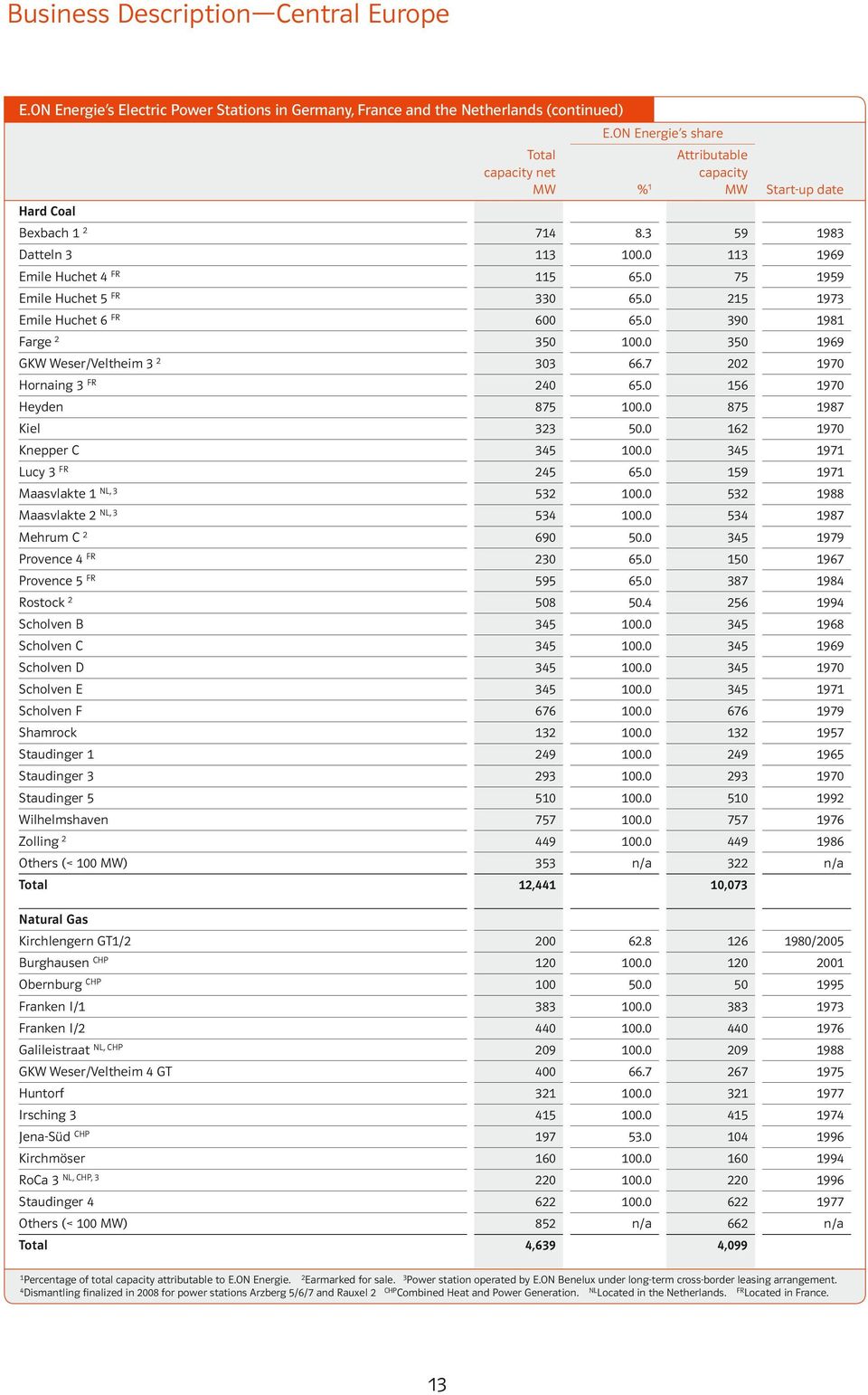
12 Business Description Central Europe Central Europe West Non-regulated Power Generation General In Germany, E.ON Energie owns interests in and operates electric power generation facilities with a total installed capacity of approximately 33,300 MW, its attributable share of which is approximately 24,900 MW (not including mothballed, shutdown or reduced power plants). The German power generation business is subdivided into four units according to fuels used: E.ON Kraftwerke GmbH owns and operates the power stations using fossil fuel energy sources, E.ON Kernkraft owns and operates the nuclear power stations, E.ON Wasserkraft GmbH owns and operates the hydroelectric power plants and E.ON Energy from Waste Aktiengesellschaft ( EEW ) owns and operates the waste incineration plants. In the Netherlands, E.ON Energie operates, through its subsidiary E.ON Benelux, hard coal and natural gas power plants for the supply of electricity to EET and the sale of electricity and heat to bulk customers and utilities. As of December 31, 2008, it had a total installed generation capacity of approximately 1,900 MW. In France, E.ON Energie operates, through E.ON subsidiary SNET, hard coal power plants for the supply of electricity. As of December 31, 2008, it had a total installed generation capacity of approximately 2,350 MW, its attributable share of which is approximately 1,550 MW. Based on the consolidation principles under IFRS, E.ON Energie reports 100 percent of revenues and expenses from majorityowned power plants in its consolidated accounts without any deduction for minority interests. Conversely, 50 percent and minority-owned power plants (at least 20 percent) are accounted for by the equity method. Power generation capacity in jointly owned plants is generally reported based on E.ON s ownership percentage. The following table sets forth E.ON Energie s major electric power generation facilities (including cogeneration plants) in Germany, France and the Netherlands, the total capacity and the capacity attributable to E.ON Energie for each facility as of December 31, 2008, and their start-up dates. E.ON Energie s Electric Power Stations in Germany, France and the Netherlands Total capacity net MW % 1 E.ON Energie s share Attributable capacity MW Start-up date Nuclear Brokdorf 1, , Brunsbüttel Emsland 1, Grafenrheinfeld 1, , Grohnde 1, , Gundremmingen B 2 1, Gundremmingen C 2 1, Isar Isar 2 1, , Krümmel 2 1, Unterweser 2 1, , Total 13,686 8,548 Lignite Buschhaus Lippendorf S Schkopau Others (< 100 MW) 33 n/a 17 n/a Total 2,176 1,315 1 Percentage of total capacity attributable to E.ON Energie. 2 Earmarked for sale. 3 Power station operated by E.ON Benelux under long-term cross-border leasing arrangement. 4 Dismantling finalized in 2008 for power stations Arzberg 5/6/7 and Rauxel 2 CHP Combined Heat and Power Generation. NL Located in the Netherlands. FR Located in France. 12
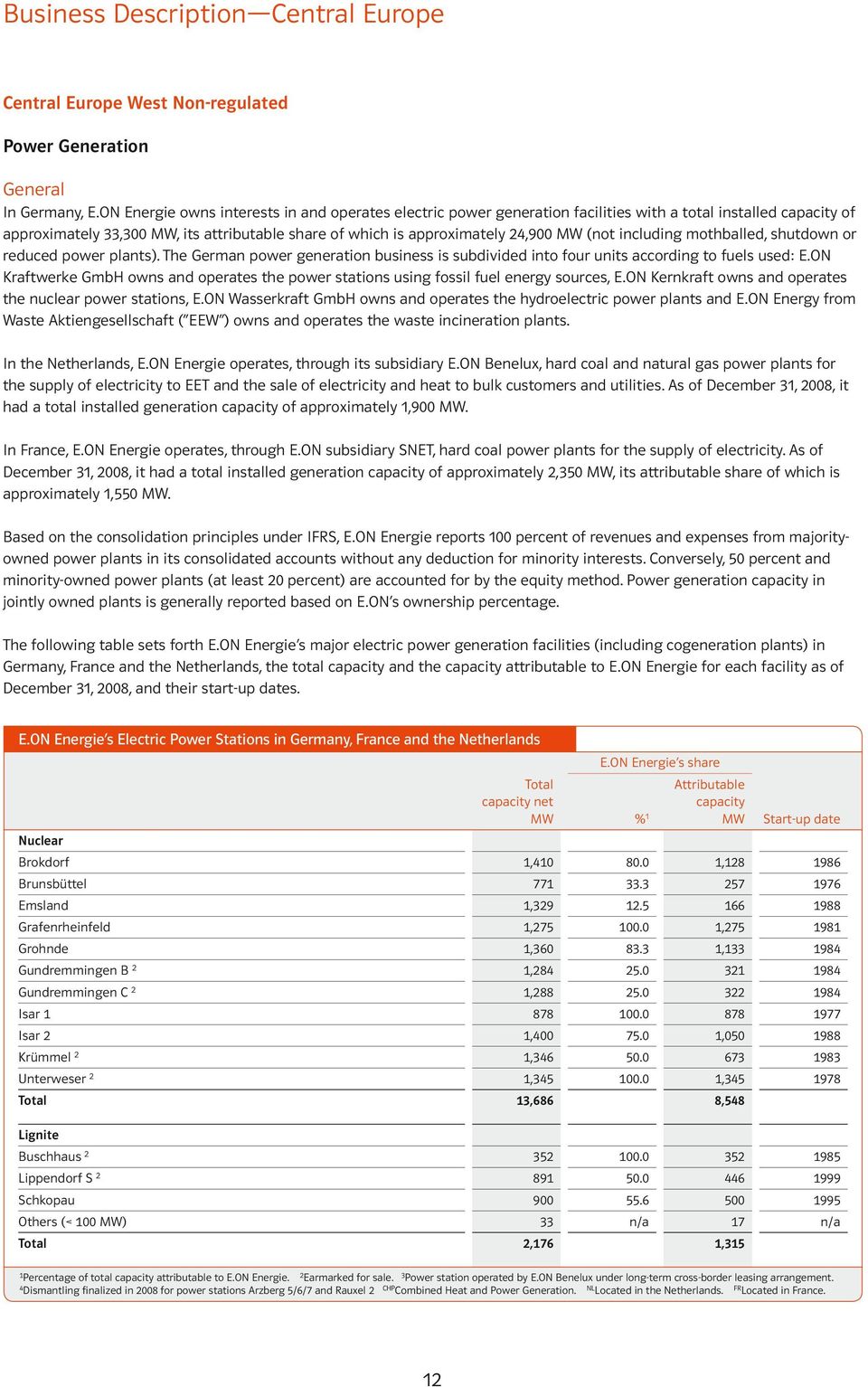
13 Business Description Central Europe E.ON Energie s Electric Power Stations in Germany, France and the Netherlands (continued) Hard Coal Total capacity net MW % 1 E.ON Energie s share Attributable capacity MW Start-up date Bexbach Datteln Emile Huchet 4 FR Emile Huchet 5 FR Emile Huchet 6 FR Farge GKW Weser/Veltheim Hornaing 3 FR Heyden Kiel Knepper C Lucy 3 FR Maasvlakte 1 NL, Maasvlakte 2 NL, Mehrum C Provence 4 FR Provence 5 FR Rostock Scholven B Scholven C Scholven D Scholven E Scholven F Shamrock Staudinger Staudinger Staudinger Wilhelmshaven Zolling Others (< 100 MW) 353 n/a 322 n/a Total 12,441 10,073 Natural Gas Kirchlengern GT1/ /2005 Burghausen CHP Obernburg CHP Franken I/ Franken I/ Galileistraat NL, CHP GKW Weser/Veltheim 4 GT Huntorf Irsching Jena-Süd CHP Kirchmöser RoCa 3 NL, CHP, Staudinger Others (< 100 MW) 852 n/a 662 n/a Total 4,639 4,099 1 Percentage of total capacity attributable to E.ON Energie. 2 Earmarked for sale. 3 Power station operated by E.ON Benelux under long-term cross-border leasing arrangement. 4 Dismantling finalized in 2008 for power stations Arzberg 5/6/7 and Rauxel 2 CHP Combined Heat and Power Generation. NL Located in the Netherlands. FR Located in France. 13
14 Business Description Central Europe E.ON Energie s Electric Power Stations in Germany, France and the Netherlands (continued) Fuel Oil Total capacity net MW % 1 E.ON Energie s share Attributable capacity MW Start-up date Ingolstadt Ingolstadt Others (< 100 MW) 373 n/a 373 n/a Total 1,145 1,145 Hydroelectric Braunau-Simbach Happurg Jochenstein Langenprozelten Walchensee Waldeck Waldeck Others (< 100 MW) 1,789 n/a 1,652 n/a Total 3,064 2,811 Others (waste, wind, biomass et al.) Waste 338 n/a 243 n/a Wind, biomass et al 88 n/a 52 n/a Total Total 37,577 28,286 Mothballed/Shutdown/Reduced Irsching Pleinting Pleinting Staudinger Dismantling 4 Irsching Offleben Scholven G Scholven H Stade Würgassen Total 4,310 3,425 Transferred to Statkraft by December 31, 2008 Emden 4 (Natural gas) Robert Frank 4 (Natural gas) Erzhausen (Hydroelectric) Hydroelectric power plants < 100 MW and Biomas n/a Total 1,226 1,202 Transferred to E.ON Climate & Renewables GmbH in 2008 Wind 302 n/a 210 n/a Total Percentage of total capacity attributable to E.ON Energie. 2 Earmarked for sale. 3 Power station operated by E.ON Benelux under long-term cross-border leasing arrangement. 4 Dismantling finalized in 2008 for power stations Arzberg 5/6/7 and Rauxel 2 CHP Combined Heat and Power Generation. NL Located in the Netherlands. FR Located in France. For information about E.ON Energie s power generation facilities in eastern Europe, see Central Europe East. 14

15 Business Description Central Europe Germany E.ON Energie s German plants generate electricity primarily with nuclear power, bituminous coal (commonly referred to as hard coal ), lignite, gas, fuel oil and water. The existing nuclear and hydroelectric power plants are E.ON Energie s sources of power with the lowest variable costs and, together with lignite-based power plants, are used mainly to cover the base load. Hard coal is utilized mainly for middle load, while the other energy sources are used primarily for peak load. Nuclear Power E.ON Energie operates its German nuclear power plants through E.ON Kernkraft. These nuclear power plants are required to meet applicable German safety standards, which are among the most stringent standards in the world (see Environmental Matters Germany: Electricity ). Operators of nuclear power plants are required under German nuclear law to establish sufficient financial provisions for obligations that arise from the use of nuclear power. In accordance with IAS 37, Provisions, Contingent Liabilities and Contingent Assets ( IAS 37 ) and IFRIC 1, these provisions include: (1) provisions for management of non-contractual obligations based on experts opinions and estimates, and (2) provisions for contractual obligations based on concluded contracts. All nuclear provisions include expenses for management of spent nuclear fuel rods, disposal of contaminated operating waste and the decommissioning of nuclear plants. At year-end 2008, E.ON Energie had provisions in its consolidated accounts for these purposes equal to 8.4 billion for management of non-contractual obligations and 3.7 billion for contractual obligations. In addition to obligations relating to the German nuclear law, E.ON Energie has had to establish provisions for the disposal and dismantling of non-nuclear plant components according to other applicable laws. E.ON Kernkraft purchases uranium and fuel elements for its nuclear power plants from domestic and international suppliers, primarily under long-term contracts. E.ON Energie considers the supply of uranium and fuel elements on the world market to be generally adequate. In May 1995, PreussenElektra, which formed part of E.ON Energie in 2000, decided to shut down its nuclear power plant at Würgassen for economic reasons and, in October 1995, it applied for and received permission from the German authorities to decommission and dismantle the Würgassen plant in accordance with German nuclear energy legislation. E.ON Energie expects the decommissioning of Würgassen, which began in October 1995, to last until approximately In 2000, E.ON Energie also decided to shut down the nuclear power plant Stade. In July 2001, E.ON Kernkraft filed an application with the Lower Saxonian Ministry of Environment to decommission and dismantle Stade and received the relevant approval in September Stade was shut down in November 2003, and E.ON Energie expects its decommissioning to last until approximately As of December 31, 2008, E.ON Energie has established a provision for the decommissioning and the management of spent nuclear fuel rods at Würgassen and Stade totaling 1.3 billion. The current German Nuclear Power Regulations Act (Atomgesetz, or AtG ) took effect in April Among other things, it provides as follows: Nuclear Phase-out: The operators of the nuclear plants have agreed to a specified number of operating kwh for each nuclear plant. This number has been calculated on the basis of 32 years of plant operation using a high load factor. The operators may trade allocated kwh among themselves. This means that if one nuclear plant closes before it has produced the allocated amount of kwh, the remaining kwh may be transferred to another nuclear power plant. Termination of Fuel Reprocessing: The transport of spent fuel elements for reprocessing was allowed until June 30, Following this deadline, the operators must store spent fuel in interim facilities on the premises of the nuclear plants. E.ON has constructed five such interim on-site storage facilities. Two of these, Grafenrheinfeld and Grohnde, went into operation in the first quarter of 2006, while the remaining three interim on-site storage facilities in Brokdorf, Isar and Unterweser went into operation in the first half of

16 Business Description Central Europe As part of the agreement, the German federal government has agreed not to institute any future changes in German tax law which discriminate against nuclear power operations or other measures creating economic disadvantages in comparison with other forms of power generation. The Company considers its provisions with respect to nuclear power operations to be adequate with respect to the costs of implementing the agreement. E.ON Energie has no plans to construct any new nuclear power plants in Germany. Hard Coal In 2008, approximately 30 percent of the hard coal used by E.ON Energie s German operations was mined in Germany. Traditionally, hard coal is mined in Germany under much more difficult conditions than in other countries. Therefore, German coal production costs are substantially above world market levels, and E.ON Energie strongly believes they will continue to remain high. Although electricity producers were in the past required to purchase German coal, they are now free to purchase coal from any source. To encourage the purchase of German coal, the German federal government has been paying direct subsidies to German producers enabling them to offer domestic coal at world market prices, although it is now in the process of reducing such subsidies. Due to high production costs and the reduction in subsidies, the volume of German coal production has shown a relatively steady decline in the past and is expected to continue to decline further. However, E.ON Energie expects that adequate supplies of imported coal for its operations will be available on the world coal market at acceptable prices. Hard coal is generally available from multiple sources, though prices are determined on international commodities markets and are therefore subject to fluctuations. Lignite German lignite, also known as brown coal, has approximately one-third of the heating value of hard coal. E.ON Energie participates in lignite-based energy generation in western Germany through EKW and in eastern Germany through Kraftwerk Schkopau GbR and a portion of one unit of Kraftwerk Lippendorf. Lignite is a readily available domestic fuel source that E.ON Energie obtains from its own reserves or under long-term contracts with German producers. The price of lignite is not generally volatile and is generally determined by reference to published indices in Germany. However, the price can fluctuate based on the underlying price of hard coal in global commodities markets. Gas and Oil In Germany, the price of natural gas is linked to the price of oil and other competing fuels. This mechanism has been enforced in order to reduce the influence of, and dependence on, gas-producing countries. Only about 16 percent of gas demand in Germany is satisfied by German deposits, while about 84 percent is satisfied through imports from foreign producers, primarily from Russia, Norway and the Netherlands. For its gas-fired power plants, E.ON Energie purchases gas from E.ON Ruhrgas and other international suppliers, mainly under short-term contracts. Fuel oil power plants are only used for peak load operations. E.ON Energie purchases its fuel oil from traders or directly from a number of oil companies. As with natural gas, the price of fuel oil depends on the price of crude oil. Water This domestic source of energy is primarily available in southern Germany due to the presence of mountains and rivers. The variable costs of production are extremely low in the case of run-of-river plants and consequently, these plants are used to cover base load requirements. Storage and pump storage facilities are used to meet peak demand and for back-up power purposes. Waste Incineration E.ON Energie also has a waste incineration business, led by EEW. In 2008, incinerated waste volumes totaled approximately 3.4 million metric tons. The waste incineration plants have a total power generation capacity of 338 MW of electricity, of which 243 MW is attributable to E.ON Energie. The Netherlands E.ON Energie s Dutch plants generate electricity primarily with hard coal and natural gas. E.ON Benelux primarily uses imported hard coal and Dutch natural gas in its power plants. France E.ON s French plants generate electricity primarily with hard coal, primarily imported. 16

17 Business Description Central Europe Demand for power tends to be seasonal, rising in the winter months and typically resulting in additional electricity sales by E.ON Energie in the first and fourth quarters. E.ON Energie believes it has adequate sources of power to meet foreseeable increases in demand, whether seasonal or otherwise. In order to benefit from economies of scale associated with large stations, E.ON Energie has built large capacity power station units in conjunction with other utilities where it does not require all of the electricity produced by such plants. In these cases, the purchase price of electricity is determined by the production cost plus a negotiated fee. Although E.ON s power plants are maintained on a regular basis, there is a certain risk of failure for power plants of every fuel type. Depending on the associated generation capacity, the length of the outage and the cost of the required repair measures, the economic damage due to such a failure can vary significantly. In order to meet contractual commitments, electricity which cannot be generated at these plants has to be bought from other generators or has to be generated from more expensive plants. Thus, power plant outages can negatively affect the market unit s financial and operating results. Sales In 2008, E.ON Energie bundled the operations of six of the seven German regional energy companies concerning sales administration (relating to marketing, product development and procurement) in a company managing all sales activities: E.ON Vertrieb Deutschland GmbH ( EVD ). The regional energy companies transferred the relevant parts of their natural gas and power sales business (including the customer contracts) to an affiliated subsidiary (regional sales company, Vertriebsgesellschaft, VG ) in which they have a 100 percent interest. Each regional energy company has its own VG. The sales activities of the VGs are directed by EVD, and the regional energy companies own stakes in EVD to ensure the consideration of regional interests, as well as their involvement in substantial decisions. Additionally, EVD directs the national wholesale sales activities of E.ON Energy Sales GmbH ( EES ) and offers sales services and management for EWI. EES took over the former sales activities of E.ON Sales & Trading GmbH ( EST ); EST s trading activities were transferred to EET, with retroactive effect as of January 1, Responsibility for the long-term portion of these contracts (i.e., those with obligations beyond three years) has remained with E.ON Energie (sales part: EES). E.ON Energie s customers are interregional, regional and municipal utilities, traders, industrial and commercial customers and, through regional sales companies, residential and small commercial customers. A highly competitive environment resulted in a reduction of approximately 520,000 private customers in E.ON Energie s power and gas business with its regional sales companies in In February 2007, E.ON Energie launched the new company EWI, which provided by the end of 2008 power and or gas to approximately 750,000 residential and small business customers throughout Germany. The introduction of EWI has therefore allowed us to keep our overall number of residential customers relatively stable in a highly competitive market. Electricity The following table sets forth the sale of electric power by E.ON Energie s German companies (for 2007, excluding that used in physically settled trading activities), primarily in Germany, in 2008 and 2007: Sale of Power 1 Million kwh / % Non-consolidated interregional, regional and municipal utilities 226, , Industrial and commercial customers 48,003 55, Residential and small commercial customers 28,978 28, Total 1, 2 303, , The increase in the total sale of power mainly reflects reorganization effects. Formerly internal sales volumes to EET are now shown as external. 2 Total sales of power includes sales of EES in European countries other than Germany. The supply contracts under which E.ON Energie s German regional energy companies (all are majority-owned) regularly order their required load for upcoming years correspond to their own supply contracts. Typical supply contracts last for one to three years. Potential alternative sources of electricity include the purchase of electricity from other utilities and auto-generation by municipalities, regional distributors or industrial customers. The contracts of the regional sales companies and E.ON Thüringer Energie with municipal utilities contain varying terms and conditions. Gas E.ON Energie s gas sales volume in Germany amounted to billion kwh in 2008 compared to 93.2 billion kwh in The increase of consumption was mainly due to the colder winter in

18 Business Description Central Europe Heat E.ON Energie is one of the leading suppliers of district heating in Germany. It operates its own district heating networks and supplies several additional networks owned by other companies. E.ON Energie s regional energy companies are also involved in district heat and steam delivery. E.ON Energie s total district heat deliveries in Western Europe increased from 15.2 billion kwh in 2007 to 16.1 billion kwh in 2008, of which 11.2 billion kwh were supplied in Germany. The increase primarily reflected the expansion of this business. Water E.ON s regional water business is conducted through certain of its distribution companies, particularly E.ON Hanse AG, E.ON Avacon AG ( E.ON Avacon ) and E.ON Westfalen Weser AG. Customers Through its companies in which it has majority shareholdings, E.ON Energie serves approximately 7.6 million electricity customers in Germany. E.ON Energie s German operations also supply approximately 1.5 million customers with gas and more than 0.5 million customers with water. The Netherlands In the Netherlands, E.ON Benelux acquired the Dutch power and gas company NRE Energie b.v. ( NRE ) in In 2008, this former company NRE Energie b.v., now known as E.ON Benelux Levering B.V., supplied approximately 1.2 billion kwh of electricity and approximately 3.3 billion kwh of gas to its approximately 0.26 million electricity and/or gas customers in the Netherlands. France E.ON France S.A.S. acts as E.ON Energie AG s local holding company for the gas and electricity sales activities of E.ON Energie S.A.S. and the renewables project development activities of E.ON Energies Renouvelables S.A.S. In 2008, electricity sales comprised 0.5 billion kwh to industrial customers. Gas sales amounted to 10.4 billion kwh supplied to industrial customers. Central Europe West Regulated Transmission In December 2008, E.ON s binding commitment to the European Commission to sell a variety of power-generation activities, as well as its ultrahigh-voltage network in Germany, came into effect. Based on this commitment and on declarations of intent already signed with parties interested in acquiring generating capacity, the total capacity to be sold, along with associated assets and liabilities, is presented as a disposal group. This relates exclusively to the Central Europe market unit. The ultrahighvoltage network has not been reclassified as of December 31, 2008, as the disposal process was not yet initiated. Overall the German power transmission grid of E.ON Energie covers an area of nearly 200,000 km 2. The 380 and 220 kilovolts extra-high-voltage lines have a system length of close to 11,000 km, whereas the high-voltage lines (110 kilovolts) have a system length of over 30,000 km. The grid is interconnected domestically, and with the western European power grid with links to the Netherlands, Austria, Denmark and Eastern Europe and with other power grids in Germany. The system is mainly operated by E.ON Netz. The network of E.ON Netz allows long-distance power transport (380 and 220 kilovolts) at low transmission losses and covers about 40 percent of the surface area of Germany. The ambitious plans for the construction of offshore windfarms in Germany provide new challenges to network operators. Transmission system operators are legally bound to connect those offshore windfarms, the construction of which is expected to have been started by 2011, to the existing transmission system onshore through new powerlines. Transmission system operators will have to build powerlines primarily in the area of the North Sea, starting the construction concurrently with the building of the wind farms. Costs for related investments will initially have to be born by E.ON Netz, but are expected to eventually be distributed among all four transmission system operators and finally be included in network charges. Access to the transmission grid is open to all potential users. E.ON Netz believes that its usage fees and conditions comply with existing German regulations governing grid access. For further information about the impact of recent regulatory developments on E.ON Energie s transmission business and results, see Regulatory Environment. The Baltic Cable links the transmission grid of E.ON Energie to Scandinavia. For details, see Nordic Electricity Distribution. 18

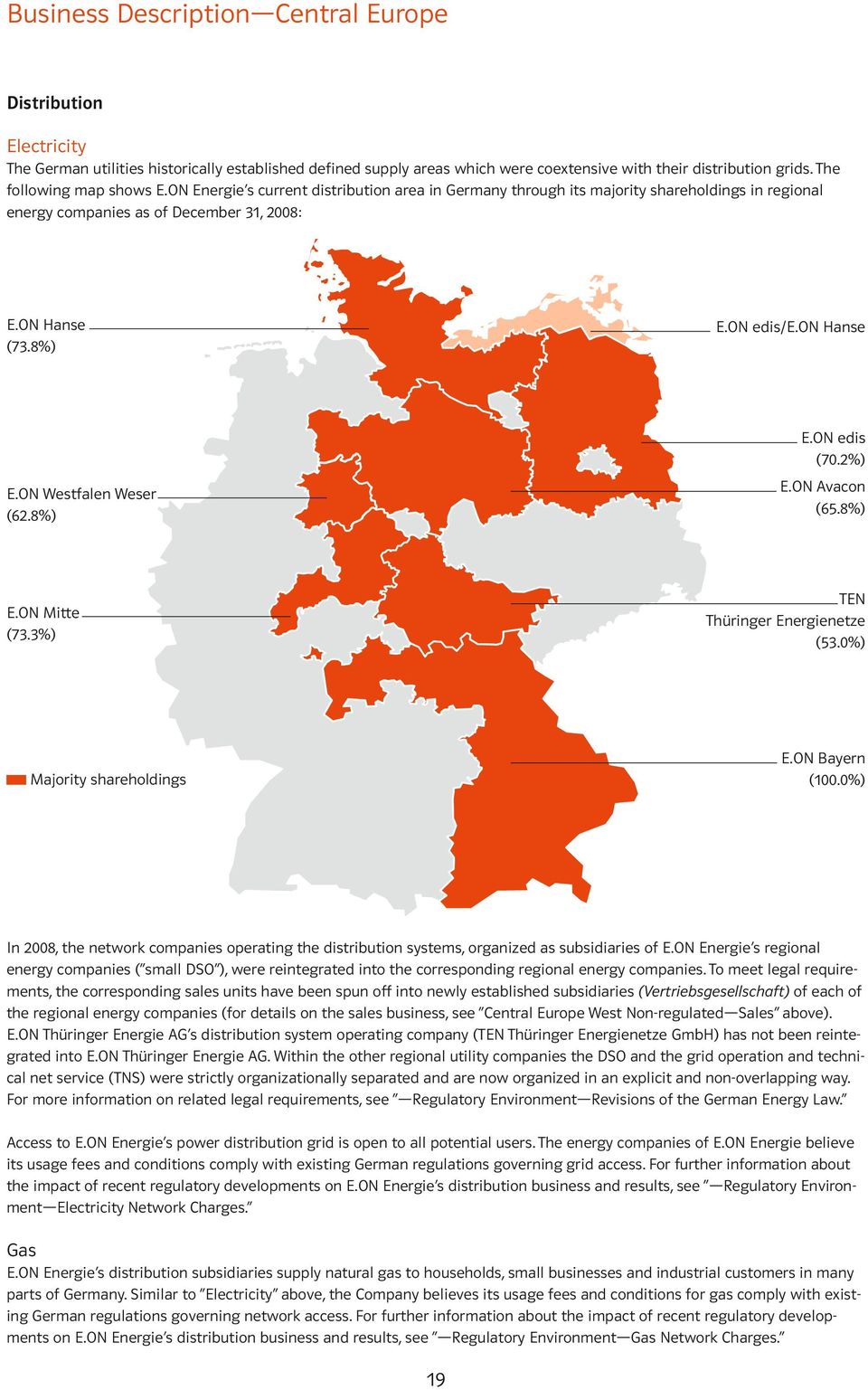
19 Business Description Central Europe Distribution Electricity The German utilities historically established defined supply areas which were coextensive with their distribution grids. The following map shows E.ON Energie s current distribution area in Germany through its majority shareholdings in regional energy companies as of December 31, 2008: E.ON Hanse (73.8%) E.ON edis/e.on Hanse E.ON Westfalen Weser (62.8%) E.ON edis (70.2%) E.ON Avacon (65.8%) E.ON Mitte (73.3%) TEN Thüringer Energienetze (53.0%) Majority shareholdings E.ON Bayern (100.0%) In 2008, the network companies operating the distribution systems, organized as subsidiaries of E.ON Energie s regional energy companies ( small DSO ), were reintegrated into the corresponding regional energy companies. To meet legal requirements, the corresponding sales units have been spun off into newly established subsidiaries (Vertriebsgesellschaft) of each of the regional energy companies (for details on the sales business, see Central Europe West Non-regulated Sales above). E.ON Thüringer Energie AG s distribution system operating company (TEN Thüringer Energienetze GmbH) has not been reintegrated into E.ON Thüringer Energie AG. Within the other regional utility companies the DSO and the grid operation and technical net service (TNS) were strictly organizationally separated and are now organized in an explicit and non-overlapping way. For more information on related legal requirements, see Regulatory Environment Revisions of the German Energy Law. Access to E.ON Energie s power distribution grid is open to all potential users. The energy companies of E.ON Energie believe its usage fees and conditions comply with existing German regulations governing grid access. For further information about the impact of recent regulatory developments on E.ON Energie s distribution business and results, see Regulatory Environment Electricity Network Charges. Gas E.ON Energie s distribution subsidiaries supply natural gas to households, small businesses and industrial customers in many parts of Germany. Similar to Electricity above, the Company believes its usage fees and conditions for gas comply with existing German regulations governing network access. For further information about the impact of recent regulatory developments on E.ON Energie s distribution business and results, see Regulatory Environment Gas Network Charges. 19
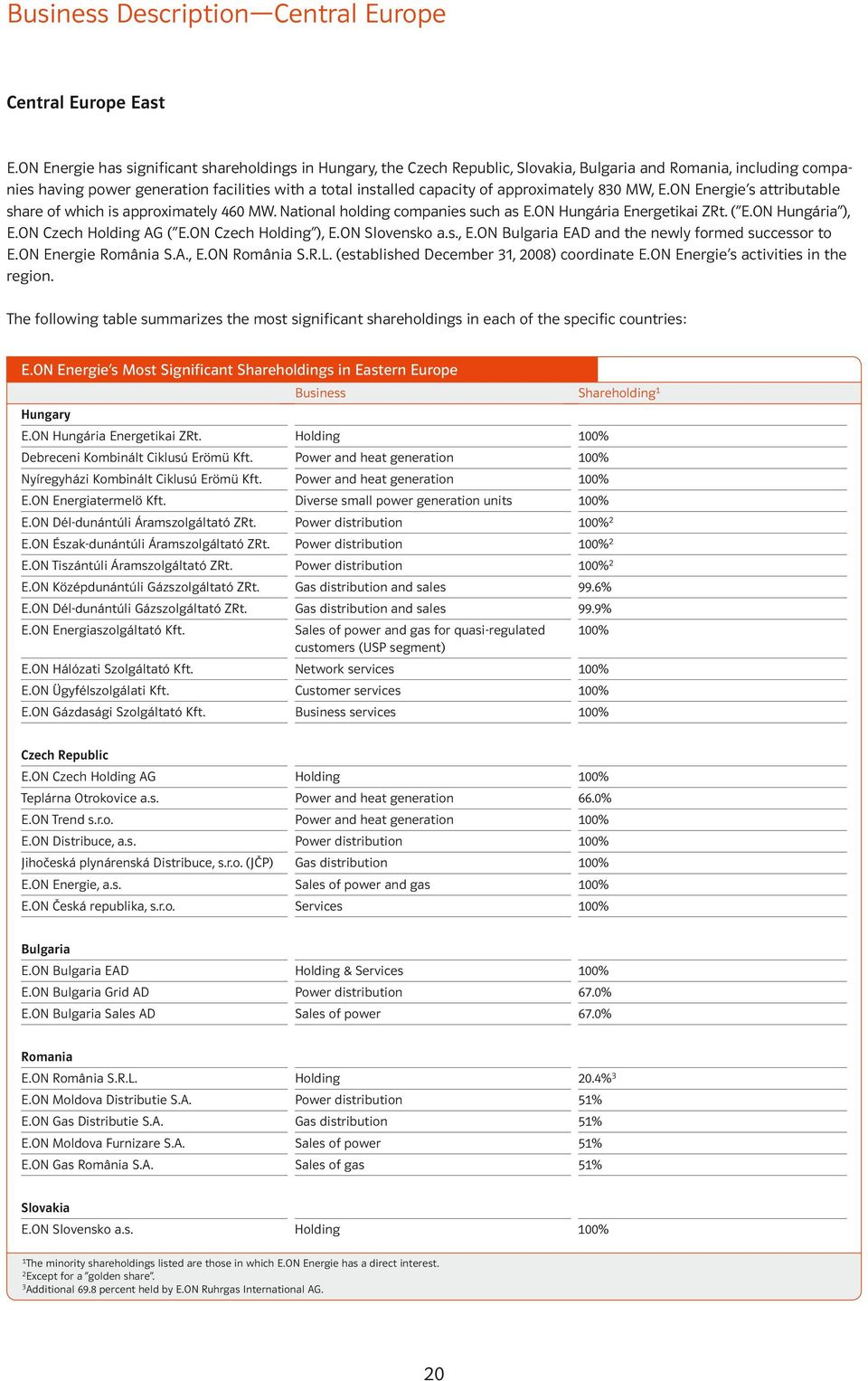
20 Business Description Central Europe Central Europe East E.ON Energie has significant shareholdings in Hungary, the Czech Republic, Slovakia, Bulgaria and Romania, including companies having power generation facilities with a total installed capacity of approximately 830 MW, E.ON Energie s attributable share of which is approximately 460 MW. National holding companies such as E.ON Hungária Energetikai ZRt. ( E.ON Hungária ), E.ON Czech Holding AG ( E.ON Czech Holding ), E.ON Slovensko a.s., E.ON Bulgaria EAD and the newly formed successor to E.ON Energie România S.A., E.ON România S.R.L. (established December 31, 2008) coordinate E.ON Energie s activities in the region. The following table summarizes the most significant shareholdings in each of the specific countries: E.ON Energie s Most Significant Shareholdings in Eastern Europe Business Shareholding 1 Hungary E.ON Hungária Energetikai ZRt. Holding 100% Debreceni Kombinált Ciklusú Erömü Kft. Power and heat generation 100% Nyíregyházi Kombinált Ciklusú Erömü Kft. Power and heat generation 100% E.ON Energiatermelö Kft. Diverse small power generation units 100% E.ON Dél-dunántúli Áramszolgáltató ZRt. Power distribution 100% 2 E.ON Észak-dunántúli Áramszolgáltató ZRt. Power distribution 100% 2 E.ON Tiszántúli Áramszolgáltató ZRt. Power distribution 100% 2 E.ON Középdunántúli Gázszolgáltató ZRt. Gas distribution and sales 99.6% E.ON Dél-dunántúli Gázszolgáltató ZRt. Gas distribution and sales 99.9% E.ON Energiaszolgáltató Kft. Sales of power and gas for quasi-regulated 100% customers (USP segment) E.ON Hálózati Szolgáltató Kft. Network services 100% E.ON Ügyfélszolgálati Kft. Customer services 100% E.ON Gázdasági Szolgáltató Kft. Business services 100% Czech Republic E.ON Czech Holding AG Holding 100% Teplárna Otrokovice a.s. Power and heat generation 66.0% E.ON Trend s.r.o. Power and heat generation 100% E.ON Distribuce, a.s. Power distribution 100% Jihočeská plynárenská Distribuce, s.r.o. (JČP) Gas distribution 100% E.ON Energie, a.s. Sales of power and gas 100% E.ON Česká republika, s.r.o. Services 100% Bulgaria E.ON Bulgaria EAD Holding & Services 100% E.ON Bulgaria Grid AD Power distribution 67.0% E.ON Bulgaria Sales AD Sales of power 67.0% Romania E.ON România S.R.L. Holding 20.4% 3 E.ON Moldova Distributie S.A. Power distribution 51% E.ON Gas Distributie S.A. Gas distribution 51% E.ON Moldova Furnizare S.A. Sales of power 51% E.ON Gas România S.A. Sales of gas 51% Slovakia E.ON Slovensko a.s. Holding 100% 1 The minority shareholdings listed are those in which E.ON Energie has a direct interest. 2 Except for a golden share. 3 Additional 69.8 percent held by E.ON Ruhrgas International AG. 20
21 Business Description Central Europe In Hungary, E.ON Hungária provided 2.5 million end customers with approximately 12.5 billion kwh of electricity in In the gas sector, E.ON Középdunántúli Gázszolgáltató ZRt. ( KÖGÁZ ) and E.ON Dél-dunántúli Gázszolgáltató ZRt. ( DDGÁZ ) provided approximately 0.6 million end customers with approximately 12.2 billion kwh of gas. As of February 1, 2007, E.ON Hungária completed a reorganization to fulfill legal unbundling requirements. Business administration services are in the company E.ON Gázdasági Szolgáltató Kft., while the companies E.ON Ügyfélszolgálati Kft. and E.ON Hálózati Szolgáltató Kft. handle customer services and network services, respectively. As of September 1, 2007, E.ON Hungária put into operation E.ON Energiaszolgáltató Kft. to take care of the universal service provided customers ( USP, a quasi-regulated segment) in the electricity as well as gas segment. Additionally E.ON Hungária s five electricity and gas distributors transferred their retail customers to E.ON Energiaszolgáltató Kft. In 2008, following changes in the relevant legal requirements, the two sales companies Energiakereskedö Kft. and E.ON Energiaszolgáltató Kft. were merged. E.ON Energiaszolgáltató Kft. now covers all sales activities of E.ON Hungária. In the Czech Republic, E.ON Czech Holding provided approximately 1.4 million end customers with approximately 11.7 billion kwh of electricity in Gas sales to its approximately 0.1 million gas end customers amounted to approximately 3.7 billion kwh. As of January 1, 2005, E.ON Energie fulfilled legal unbundling requirements by creating three wholly owned subsidiaries, E.ON Česká republika, s.r.o., E.ON Distribuce, a.s. and E.ON Energie, a.s. In January 2007, E.ON Energie received the remaining 1.0 percent interest of JČP from a squeeze-out. In July 2007, JČP was integrated into the structure of E.ON Energie, a.s. In October 2008, all generation activities under the sole control of E.ON Energie have been concentrated in the newly established 100-percentowned subsidiary E.ON Trend s.r.o. In Bulgaria, E.ON Bulgaria EAD effected annual sales for about 5.3 billion kwh and provided electricity to approximately 1.1 million end customers in As of January 1, 2007, the legal unbundling requirements in Bulgaria were fulfilled through the foundation of E.ON Bulgaria Sales AD, which is now the sales company for the entire territory of northeastern Bulgaria, and E.ON Bulgaria Grid AD, which is the distribution company for the entire territory of northeastern Bulgaria. The sales and distribution businesses of each of the former companies of Elektrorazpredelenie Varna AD ( Varna ) and Elektrorazpredelenie Gorna Oryahovitza AD ( Gorna Oryahovitza ) were integrated into these companies. In Romania, E.ON Energie s sales subsidiary E.ON Moldova Furnizare sold approximately 3.2 billion kwh of electricity to approximately 1.4 million end customers in In September 2005, E.ON Energie acquired a 24.6 percent stake in the Romanian electricity distribution company Electrica Moldova S.A. ( Electrica Moldova ) subsequently renamed E.ON Moldova S.A. ( E.ON Moldova ) and simultaneously increased its stake in the company to 51.0 percent by subscribing to a capital increase. In March, 2007, E.ON Energie România at that time a fully owned subsidiary of E.ON Energie Group and E.ON Energie AG agreed to transfer the shares held by E.ON Energie AG in E.ON Moldova to E.ON Energie România, thus establishing E.ON Energie România as a holding company for the activities of the E.ON Energie Group in Romania (a role it maintained until December 31, 2008). All legal unbundling requirements were fulfilled through business reorganizations in In order to take advantage of economies of scale the two Romanian holding companies for E.ON s gas and electricity activities (E.ON Gaz România Holding S.R.L. and E.ON Energie România S.A.) were merged through absorption effective as of December 31, 2008; with the surviving company being renamed E.ON România S.R.L. E.ON România S.R.L. was consolidated by E.ON Energie AG starting January 1, The current shareholders of E.ON România S.R.L. are E.ON Energie AG with 20.4 percent, E.ON Ruhrgas International AG with 69.8 percent and the European Bank for Reconstruction and Development with 9.8 percent. E.ON România S.R.L. itself holds after the merger 51.0 percent each of E.ON Moldova Furnizare S.A., E.ON Moldova Distributie S.A., E.ON Gas România S.A. and E.ON Gas Distributie S.A. (gas distribution company). Bratislava-based E.ON Slovensko was established in September 2007 with the objective of bundling ownership of all of E.ON Energie s activities in Slovakia. In May 2008, E.ON Energie transferred 40 percent of its shares in Západoslovenská energetika a.s. ( ZSE ), in which E.ON exercises management control, to E.ON Slovensko. ZSE provided electricity to approximately 1.0 million end customers in 2008, effecting sales of 7.9 billion kwh. As of July 2007, ZSE fulfilled legal unbundling requirements by creating two wholly owned subsidiaries: ZSE Distribucia a.s. for power distribution and ZSE Energia a.s. for power retail. 21
22 Business Description Central Europe Other Consulting and Support Services E.ON Engineering GmbH offers internal and external consulting, planning and construction services in the energy sector in fields such as chemical analytics and electrical, mechanical and civil engineering, with a focus on conventional and renewable power generation, cogeneration, use of biomass, pipeline construction, development of energy strategies and CO 2 -emissions reduction. E.ON Facility Management GmbH provides technical, commercial and infrastructural facility management services, mainly for E.ON Energie group companies. Other Minority Shareholdings In the Alpine region, E.ON Energie owns a 21.0 percent equity interest and 20.0 percent voting interest in BKW FMB Energie AG, an integrated Swiss utility that owns important hydroelectric assets, as well as a single nuclear power station and interests in other nuclear power stations. Competitive Environment Since 1998, liberalization of the electricity markets in the EU has greatly altered competition in the German electricity market, which was formerly characterized by numerous strong competitors. Following liberalization, significant consolidation has taken place in the German market, resulting in three mergers of major interregional utilities in recent years: VEBA and VIAG forming E.ON, RWE and Vereinigte Elektrizitätswerke AG forming RWE (both in 2000) and Hamburgische Electricitäts-Werke AG/Bewag Berliner Kraft und Licht Aktiengesellschaft/VEAG Vereinigte Energiewerke Aktiengesellschaft/Lausitzer Braunkohle Aktiengesellschaft forming Vattenfall Europe in In 2008, E.ON, RWE, Vattenfall Europe and the other remaining major interregional utility, EnBW, supplied approximately 70 percent of the total electricity production in Germany. The interregional utilities own the high-voltage transmission lines in their traditional supply areas and are active in all phases of the electricity business. In addition to the interregional utilities, there are about 900 electric utilities in Germany at the state, regional and municipal level, many of which are partly or wholly owned by state or municipal governments. These utilities may be involved in various combinations of the generation, transmission, distribution and supply and trading functions. The liberalization of the electricity market in Germany has also led to new market structures with new market participants. The market for electricity has become more liquid and more competitive, and currently has the highest number of participants in continental Europe. Approximately 200 new market participants have entered the German market since 1998, with more than half of them engaged in electricity trading. The volume of electricity trading rose in 2008 (1,319 billion kwh at the European Energy Exchange s Spot and Futures Market compared with 1,273 billion kwh in 2007; a 4 percent increase). The European Energy Exchange has also become a benchmark for electricity prices in central Europe. Liberalization of the electricity market in Germany caused wholesale and consequently end customer electricity prices to decrease in 1998, with significant declines in some market segments. These declines were largely due to aggressive price setting by new competitors and suppliers, as well as other factors such as significant power plant overcapacity in Germany and Europe and relatively high and increasing price transparency. The rate of price declines began to slow in the second half of 2000, and prices have increased since 2001 but have developed differently in each of the customer segments. According to the German Energy Association, BDEW, in 2008 prices paid by household customers were about 26 percent higher than in the liberalization year 1998, while prices (including electricity tax) paid by industrial customers were about 42 percent higher than in When all applicable taxes are excluded from the comparison, 2008 prices were approximately 0.7 percent lower than those in 1998 for household customers and approximately 17 percent higher for industrial customers. In 2008, wholesale electricity prices in Germany stayed at a high level. Some industrial customers were affected by the high wholesale prices, but others had already locked in lower prices in earlier years. For this reason, the wholesale price increases did not affect the industrial customer segment to the same degree as household customers, who generally paid higher prices in In addition to the effect of higher wholesale market prices, a significant factor in the overall price recovery are new or increased costs faced by electricity companies since the beginning of liberalization. Among these new or increased costs are the electricity tax (introduced in 1998 and subject to annual increases through 2003), duties and additional costs attributable to compliance with new legislation, including the Renewable Energy Source Act and Combined Heat and Power Act, as well as higher costs incurred in procuring balancing power to cover fluctuations in the availability of electricity from renewable resources such as wind. Most distributors have tried to pass these increases through to their customers. Taxes and duties 22
23 Business Description Central Europe accounted for approximately 41 percent of German electricity prices for household customers in 2007, compared with about 25 percent before deregulation in Similarly, electricity taxes and duties increased from 2 percent of German electricity prices for industrial customers in 1998 to approximately 19 percent in E.ON Energie s German regional sales companies announced in November 2008 further electricity price increases for end customers to be effective in February These price changes for end customers result from the wholesale market prices for electricity. The most significant effects in this regard derive from the strong increase in procurement costs owing to the global rise in demand for energy. Subsidies for renewables-based energy are also having an impact on electricity prices, resulting in substantial additional burdens. High environmental and nuclear safety standards, as well as high investments in new power plants, taxes on electricity, the requirements of the Co-Generation Protection Law and the Renewable Energy Law s requirement that regional utilities purchase electricity generated from renewable resources impose a considerable burden on German electricity prices for end customers. E.ON Energie still believes that it will be able to compete effectively in Germany. In addition, E.ON Energie believes that the liberalization of the gas and electricity markets may open new business opportunities. However, E.ON Energie may be unable to compete as effectively as other electricity companies due to the factors described above, as well as due to regulatory changes described in Regulatory Environment. Any of these or other factors could materially and adversely affect E.ON s financial condition and results of operations. Outside Germany, the energy markets in which E.ON Energie operates are also subject to strong competition. In the countries of Eastern Europe where E.ON Energie has operations, the process of full liberalization of the electricity and gas sales markets is being formally realized through European legislation. Most notably, implementation of Directive 2003/54/EC Concerning Common Rules for the Internal Market in Electricity ( Second Electricity Directive ) and Directive 2003/55/EC Concerning Common Rules for the Internal Market in Natural Gas and Repealing Directive 98/30/EC ( Second Gas Directive ) was achieved in 2007; and the EU Council agreed on a Third Package of electricity and gas market directives (which have yet to be finalized or implemented) in December For additional details on these and other regulatory measures applicable to E.ON Energie s operations, see Regulatory Environment and Environmental Matters. Such liberalization measures may alter competition in these electricity and gas markets, which could lead to decreasing end customer prices or to a loss of market shares. E.ON Energie cannot guarantee it will be able to compete successfully in electricity and gas markets where it already is present or in new electricity and gas markets it may enter. 23
24 Business Description Pan-European Gas Overview E.ON Ruhrgas AG is the lead company of the Pan-European Gas market unit and is responsible for all of E.ON s non-retail gas activities in continental Europe. In terms of sales, E.ON Ruhrgas is one of the leading non-state-owned gas companies in Europe and the largest gas company in Germany. E.ON Ruhrgas principal business is the supply, transmission, storage and sale of natural gas. E.ON Ruhrgas also holds numerous stakes in German and other European gas companies, as well as a small shareholding in Gazprom, Russia s main natural gas exploration, production, transportation and marketing company. In 2008, the Pan-European Gas market unit recorded revenues of 27.4 billion and adjusted EBIT of 2.6 billion billion of the Pan-European Gas market unit s 2008 revenues were generated in Germany and 9.7 billion was generated abroad (measured by location of customer). In 2008, E.ON Ruhrgas entered into the following significant transactions: In August 2008, E.ON Ruhrgas became a partner in the LNG terminal in Rotterdam known as Gate (Gas Access to Europe). E.ON Ruhrgas has booked an annual capacity of 3 billion m³ of gas in Rotterdam for a term of 20 years. In addition, E.ON Ruhrgas has acquired a 5 percent stake in the terminal operating company. Gate is a joint venture of two Dutch companies, N.V. Nederlandse Gasunie ( Nederlandse Gasunie ) and Koninklijke Vopak N.V. ( Royal Vopak ), as well as the European gas companies Essent GmbH ( Essent ), DONG Energy A/S ( DONG ), Econgas and E.ON Ruhrgas. In October 2008, E.ON Ruhrgas and Gazprom agreed that E.ON Ruhrgas would acquire a stake of 25 percent minus one share in the Siberian gas field Yuzhno Russkoye. In return, Gazprom is to receive E.ON Ruhrgas s 49 percent stake in the Russian company ZAO Gerosgaz, which holds just under 3 percent of the shares of Gazprom. After the transaction, E.ON Ruhrgas will continue to hold a 3.5 percent stake in Gazprom. Operations Through E.ON Ruhrgas AG and its subsidiaries, E.ON Ruhrgas is primarily engaged in the following segments of the gas industry: Supply: The purchase of natural gas under long-term contracts with foreign and domestic producers, including the Russian gas company Gazprom, the world s largest gas producer in terms of volume, in which E.ON Ruhrgas holds a small shareholding. E.ON Ruhrgas also engages in gas exploration and production activities. Transmission: The transmission of gas within Germany via a network of approximately 11,552 km of pipelines in which E.ON Ruhrgas holds an interest; Storage: The storage of gas in a number of large underground natural gas storage facilities; and Sales: The sale of gas within Germany to supraregional and regional distributors, municipal utilities and industrial customers, as well as sales to a number of customers in other European countries. In addition to its natural gas supply, transmission, storage and sales businesses, E.ON Ruhrgas owns numerous shareholdings in integrated gas companies, gas distribution companies and municipal utilities through its subsidiaries E.ON Ruhrgas International AG ( ERI ) and Thüga Aktiengesellschaft ( Thüga ). ERI holds both majority and minority shareholdings in German and European energy companies, while Thüga holds primarily minority shareholdings in about 90 regional and municipal electricity and gas utilities in Germany. For financial reporting purposes, the Pan-European Gas market unit is divided into three business units: Up-/Midstream, Downstream Shareholdings and Other/Consolidation. The Up-/Midstream business unit reflects the results of the supply, transmission, storage and sales businesses (midstream) and exploration and production activities (upstream). The Downstream Shareholdings business unit reflects the results of ERI and Thüga. Other/Consolidation includes consolidation effects. 24
25 Business Description Pan-European Gas Up-/Midstream The following table provides information about purchases and sales of natural gas and coke oven gas by E.ON Ruhrgas midstream operations for the years 2008 and The difference between gas supplies and gas sales in any given period is due to storage and metering differences and occurs routinely. E.ON Ruhrgas Midstream Operations Purchases and Sales billion kwh % billion kwh % Purchases Imports German sources Total Sales Domestic distributors Domestic municipal utilities Domestic industrial customers Sales abroad Total In the table above, as well as in the descriptions of E.ON Ruhrgas supply and sales businesses, purchase and sales volumes are presented for all periods excluding relatively small amounts of gas that E.ON Ruhrgas does not consider part of its primary business, including volumes handled for third parties. In addition, these gas volumes do not include gas volumes attributable to ERI or Thüga, which are part of the Downstream Shareholdings business unit. The decrease in total sales volume in 2008 was primarily attributable to warmer weather conditions, especially in the first quarter of Supply E.ON Ruhrgas purchases nearly all of its natural gas from producers in six countries: Russia, Norway, the Netherlands, Germany, the United Kingdom and Denmark. In 2008, E.ON Ruhrgas purchased a total of billion kwh of gas, of which approximately 82.1 percent was imported and approximately 17.9 percent was purchased from German producers. E.ON Ruhrgas was the largest gas purchaser in Germany in Of the gas purchased in 2008, E.ON Ruhrgas bought approximately 26.1 percent from Russia and approximately 26.0 percent from Norway, its two largest suppliers. The following table provides information on the amount of gas purchased from each country and its percentage of the total volume of gas purchased by the midstream operations in the years 2008 and 2007: E.ON Ruhrgas Midstream Operations Sources of Gas billion kwh % billion kwh % Germany Russia Norway The Netherlands United Kingdom Denmark Others Total Italy, France, Austria, Hungary, Slovakia and Spain. In the table above, purchase volumes are presented for all periods excluding relatively small amounts of gas that E.ON Ruhrgas does not consider part of its primary supply business, including volumes handled for third parties. In addition, these gas volumes do not include gas volumes attributable to ERI or Thüga. 25
26 Business Description Pan-European Gas As is typical in the gas industry, these purchases were primarily made under long-term supply contracts that E.ON Ruhrgas has with one or more gas producers in each country. Purchases under such contracts provided for nearly all of the gas bought by E.ON Ruhrgas in 2008; the remaining amounts were purchased on international spot markets or pursuant to short-term contracts. E.ON Ruhrgas current long-term contracts with fixed terms (so-called supply -type contracts) have termination dates ranging from 2009 to 2036 (subject in certain cases to automatic extensions unless either party gives notice of termination), while so-called depletion -type contracts terminate upon the exhaustion of economic production from the relevant gas field. As is standard in the gas industry, the price E.ON Ruhrgas pays for gas under these contracts is calculated on the basis of complex formulas incorporating variables based upon current market prices for fuel oil, gas oil, coal and/or other competing fuels, with prices being automatically re-calculated periodically, usually monthly or quarterly. The contracts also generally provide for formal revisions and adjustments of the price or business terms to reflect changes in the market (in many cases expressly including changes in the retail market for natural gas and competing fuels), generally providing that such revisions may only be made once every few years unless the parties agree otherwise. Claims for revision are subject to binding arbitration in the event the parties cannot agree on the necessary adjustments. Certain contracts also provide E.ON Ruhrgas with the possibility of buying specified quantities of gas at prices linked to those on international spot markets. The contracts also require E.ON Ruhrgas to pay for specified minimum quantities of gas even if it does not take delivery of such quantities, a standard gas industry practice known as take or pay. Take-or-pay quantities are generally set at approximately 80 percent of the firm contract quantities. To date, E.ON Ruhrgas has been able to avoid the application of these take-or-pay clauses in nearly all cases. The contracts also include quality and availability provisions (together with related discounts for non-compliance), force majeure provisions and other industry standard terms. E.ON Ruhrgas generally takes delivery of the gas it imports at the point at which the relevant pipeline crosses the German border. In the medium and long term, rising demand for gas in Europe, combined with falling indigenous production in European countries, particularly in the United Kingdom, is expected to lead to a greater reliance on imports by European gas wholesalers. Accordingly, in the near future, gas producers will have to invest, in some cases quite considerably, in expanding their production capacities. In addition, the natural decline in output from older fields will need to be made up by the development of new fields. E.ON Ruhrgas believes that long-term gas purchase contracts will remain crucial to European gas supplies, ensuring a fair balance of risks between producers and importers. E.ON Ruhrgas believes the price adjustment provisions in such contracts ensure sufficient supplies of gas at competitive prices, while the take-or-pay provisions give producers the necessary long-term security for investing. E.ON Ruhrgas supply sources are discussed below on a country-by-country basis. Russia In 2008, E.ON Ruhrgas purchased billion kwh of gas, or 26.1 percent of its total gas purchased, from Russia. Russia is the largest supplier of natural gas to E.ON Ruhrgas, while E.ON Ruhrgas is the second-largest purchaser of gas from Russia. As with most of its gas imports, E.ON Ruhrgas takes ownership of its Russian gas when it reaches the German border. All of E.ON Ruhrgas purchases of Russian natural gas are made pursuant to long-term supply contracts with OOO Gazprom Export, the subsidiary of Gazprom responsible for natural gas exports. E.ON Ruhrgas holds a 3.5 percent direct interest in Gazprom; an additional stake of 2.9 percent in Gazprom is attributable to E.ON Ruhrgas on the basis of contractual arrangements relating to its minority interest in a Russian entity that holds these shares. E.ON Ruhrgas considers its shareholding in Gazprom to be an important element supporting its long-term supply relationship with Gazprom, which is the world s largest gas producer, having produced approximately 560 billion cubic meters ( m 3 ) of gas in E.ON Ruhrgas expects the importance of Russian gas exports for Europe to increase as the indigenous production of important European supply countries decreases. In August 2006, E.ON Ruhrgas and Gazprom Export finalized a series of agreements in Moscow. These agreements, which comprise extensions of existing contracts and a new supply contract, provide for the delivery of an aggregate of approximately 400 billion m 3 of natural gas through E.ON believes that these gas supply contracts represent an important contribution towards safeguarding long-term European gas supplies. Beyond the existing long-term supply relationship in July 2004, E.ON and Gazprom signed a Memorandum of Understanding for a deepened strategic cooperation between the parties, pursuant to which E.ON, Gazprom and BASF AG signed a basic agreement on the construction of the Nord Stream pipeline from Vyborg, Russia to Greifswald, Germany through the Baltic Sea. In February 2008, E.ON and Gazprom signed a Memorandum of Understanding on the joint construction and operation of a gas-turbine electric power plant in the area of Lubmin, Germany. E.ON and Gazprom plan to set up a joint venture on a parity basis to implement the project. In October 2008, E.ON and Gazprom agreed in principle on an asset swap. E.ON shall acquire a 26
27 Business Description Pan-European Gas stake of 25 percent minus one share in the Siberian gas field Yuzhno Russkoye. In return, Gazprom is to receive E.ON Ruhrgas 49 percent stake in the Russian company ZAO Gerosgaz, which holds 2.9 percent of Gazprom s shares. Through the planned power plant project and the asset swap, E.ON and Gazprom are seeking to deepen their strategic cooperation and contribute to securing long-term energy supplies to Europe. Norway In 2008, E.ON Ruhrgas purchased billion kwh, or 26.0 percent of its total gas purchased, from Norwegian sources. E.ON Ruhrgas has supply contracts with a number of major Norwegian and international energy companies (as well as its subsidiary E.ON Ruhrgas Norge AS) that hold concessions for the exploitation of Norwegian gas fields. Some of the contracts are of the depletion type while others are supply -type contracts. E.ON Ruhrgas takes delivery of its Norwegian supplies mainly at the gas import points near Emden along the German North Sea coast. Germany In 2008, E.ON Ruhrgas purchased billion kwh, or 17.9 percent of its total gas purchased, from domestic gas production companies. E.ON Ruhrgas has long-term supply contracts for German natural gas with ExxonMobil Gas Marketing Deutschland GmbH, ExxonMobil Gas Marketing Deutschland GmbH & Co., Shell Erdgas Marketing GmbH & Co. KG (the other 50 percent of the gas trading business of Britta Erdgas und Erdöl GmbH), Gaz de France Produktion Exploration Deutschland GmbH and RWE Supply & Trading GmbH. The majority of the contracts provide E.ON Ruhrgas with significant additional flexibility by providing for the supply of minimum and maximum quantities of gas, rather than a single fixed amount. E.ON Ruhrgas expects the volume of gas it purchases from domestic sources to decline over the coming years due to the depletion of German gas fields. The Netherlands In 2008, E.ON Ruhrgas purchased billion kwh, or 16.9 percent of its total gas purchased, pursuant to a single long-term supply contract with GasTerra B.V. This contract provides E.ON Ruhrgas with a certain degree of flexibility in managing its supply portfolio. E.ON Ruhrgas believes such flexibility is particularly important in this case, as the Dutch gas fields are relatively close to the end consumers in E.ON Ruhrgas markets, making it more economically viable for E.ON Ruhrgas to react to changes in market demand by varying contract quantities. United Kingdom In 2008, E.ON Ruhrgas purchased 41.7 billion kwh, or 6.2 percent of its total gas purchased, from U.K. sources. These quantities were partly purchased from BP Gas Marketing Ltd under a long-term supply contract, partly purchased on the spot short-term market and partly received as equity gas through E.ON Ruhrgas subsidiary E.ON Ruhrgas UK Exploration and Production Limited ( E.ON Ruhrgas UK ), which has interests in U.K. gas fields and infrastructure. See Exploration and Production below for more information on E.ON Ruhrgas UK. In contrast to much of its other imported gas, which E.ON Ruhrgas generally takes ownership of at the German border, E.ON Ruhrgas takes delivery of its purchased U.K. gas supplies partly at Bacton and Easington terminals in the United Kingdom and partly at Zeebrugge terminal in Belgium. Gas from the U.K. gas fields is transported to Belgium through the undersea gas pipeline run by the project company Interconnector (U.K.) Limited ( Interconnector ). Denmark In 2008, E.ON Ruhrgas purchased 25.4 billion kwh, or 3.7 percent of its total gas purchased, from the Danish supplier DONG, with which E.ON Ruhrgas has long-term supply contracts. E.ON Ruhrgas takes delivery of Danish gas at the German-Danish and Swedish-Danish border. 27
28 Business Description Pan-European Gas Liquefied Natural Gas Liquefied natural gas (LNG), which is liquefied in the gas-producing country, transported by tanker and then converted back into gas at the receiving terminal, is an alternative to gas deliveries by pipeline. E.ON Ruhrgas believes that LNG has the potential to become an important element with respect to the security of supply and for diversification of E.ON s gas portfolio. In May 2007, E.ON Ruhrgas agreed to lease annual regasification capacity of approximately 1.7 billion m 3 for the regasification of LNG of Phase III of the Isle of Grain LNG terminal project in the UK. The contract lasts until 2029 and Phase III is due to come onstream in October Synergies are expected to result from supplying E.ON UK s Grain power station, which is being built near the Isle of Grain terminal. In February 2008, E.ON Ruhrgas was choosen as an investor for a new LNG project in Equatorial Guinea in West Africa. E.ON Ruhrgas has a stake of 5 percent in the project, which comprises gas infrastructure (including a pipeline system to feed a liquefaction plant). In addition, as an investor E.ON Ruhrgas expects to have a prominent role in the commercialization of the produced volumes. In January 2009, E.ON Ruhrgas signed a memorandum of understanding with Sonagas - the national oil and gas company of Equatorial Guinea relating to this project. In the second quarter of 2008, E.ON acquired a percent stake in OLT Offshore LNG Toscana S.p.A., known as the OLT project. It is planned that this shareholding will be transferred to E.ON Ruhrgas with effect of January 1, At present the shareholders of OLT are E.ON Europa S.L. (46.79 percent), Iride Mercato S.p.A. (41.71 percent), ASA S.p.A. (5.08 percent; Iride and ASA are part of the same company group), OLT Energy Toscana S.p.A. (3.73 percent) and Golar LNG (2.69 percent). The terminal features a Moss-type LNG carrier, which is to be converted into a floating storage and regasification unit with a permitted annual regasification capacity of 3.75 billion m³ and gross storage capacity of 138,000 m³ of LNG. The carrier was bought in June 2008 and a lump-sum turnkey contract with Saipem for the conversion became effective in March It is envisaged that the terminal will start operations in the second quarter of E.ON Ruhrgas s share of the projected capacity portion is 50 percent or 1.87 billion m³ of the total annual regasification capacity. In August 2008, E.ON Ruhrgas became a partner in the LNG terminal in Rotterdam known as Gate (Gas Access to Europe). The terminal is already under construction and is scheduled to be completed in E.ON Ruhrgas has booked an annual regasification capacity of 3 billion m³ in Rotterdam. The acquisition of a 5 percent stake in the terminal operating company by E.ON Ruhrgas was completed in November Gate is a joint venture of the companies N.V. Nederlandse Gasunie, Royal Vopak, as well as the European gas companies Essent, DONG, Econgas and E.ON Ruhrgas. The DFTG LNG project in Wilhelmshaven was subsequently put on hold with the option to re-establish that project at a later point in time. A consortium comprising E.ON Ruhrgas (31.15 percent), OMV Gas International (25.58 percent), TOTAL (25.58 percent), RWE (16.69 percent) and Geoplin, Croatia set up the Zagreb-based project company Adria LNG d.o.o. to build an LNG terminal in Croatia. Assuming that the project (which is currently in the development phase) goes forward, it is planned that the new terminal will have an initial regasification capacity of some 10 billion m 3 per year, which can be increased to 15 billion m 3 per year. It will be designed for LNG tankers carrying up to 265,000 m 3 of LNG. E.ON Ruhrgas capacity entitlements are planned to be 4 billion m 3 per year in the first phase and around 5 billion m 3 per year in the second phase. Exploration and Production E.ON Ruhrgas is also pursuing exploration opportunities in the U.K., Norway, Algeria and Egypt, having been awarded licenses in each of those countries. The successful completion of the planned asset and share swap with Gazprom will also allow E.ON Ruhrgas to enter the exploration and production sector in Russia by acquiring a 25 percent stake in the Siberian gas field Yuzhno Russkoye. United Kingdom In the United Kingdom, E.ON Ruhrgas operates through its subsidiary E.ON Ruhrgas UK Exploration and Production Limited, which directly and indirectly holds mainly minority interests in a number of gas production fields, exploration blocks and pipelines in the British North Sea ( E.ON Ruhrgas UK group ). In 2008, the E.ON Ruhrgas UK group produced 8.2 billion kwh (768 million m 3 ) of gas, compared with 8.1 billion kwh (751 million m 3 ) of gas in In addition, the E.ON Ruhrgas UK group produced 2.5 million barrels of liquids (oil and condensate) in 2008, compared with 2.9 million barrels in The decrease in liquids production reflects the natural decline of production from the Central North Sea fields. 28
29 Business Description Pan-European Gas In 2008, E.ON Ruhrgas UK was awarded five licenses (including two as operator) within the 25th UK Licencing Round. The following table shows the name of each producing field in which the E.ON Ruhrgas UK group holds an interest, E.ON s ownership interest in the field, and the date each field commenced production: E.ON Ruhrgas UK Group Names of Producing Fields E.ON share in % Start-up date Ravenspurn North July 1990 Caister 40.0 October 1993 Johnston September 1994 Elgin/Franklin 5.2 April 2001 Scoter 12.0 December 2003 Hunter 79.0 January 2006 Glenelg April 2006 Merganser December 2006 Minke June 2007 The E.ON Ruhrgas UK group received its share of production from all of the producing fields in which it owned an interest in Norway E.ON Ruhrgas operates in Norway through its subsidiary E.ON Ruhrgas Norge AS ( E.ON Ruhrgas Norge ). E.ON Ruhrgas Norge owns 30.0 percent of the Njord oil and gas field. In 2008 E.ON Ruhrgas Norge obtained 3.4 million barrels of oil and NGL compared to 2.1 million barrels in In December 2007, the Njord field started producing gas and NGL. The full year gas production in 2008 amounted to about 6.5 billion kwh (592 million m³). At the beginning of 2008, E.ON Ruhrgas Norge was awarded interests in eight licenses (including four as operator) in the Norwegian license round APA In December 2008 E.ON Ruhrgas Norge was awarded an interest in a further two licenses in the APA round Additionally E.ON Ruhrgas Norge succeeded in drilling exploration wells in the Norwegian Sea. Both wells (plus two appraisal sidetracks) drilled in 2008 were successful. In addition, E.ON Ruhrgas Norge farmed-into three exploration licenses during Algeria In December 2008, E.ON Ruhrgas E&P Algerien GmbH was awarded one license in the 7th Algerian license round. The license is the first E.ON-operated E&P project in Northern Africa. The exploration activities are expected to start in Egypt In December 2008, E.ON Ruhrgas Ägypten GmbH received the deed of assignment for the North West Damietta field acquisition signed by the local authorities and by the acquisition partners. The first exploration well is planned for Russia In October 2008, E.ON Ruhrgas and Gazprom signed a participation agreement. As part of this agreement, E.ON Ruhrgas shall acquire a stake of 25 percent minus one share in the Siberian gas field Yuzhno Russkoye. In return, Gazprom is receiving E.ON Ruhrgas 49 percent stake in the Russian company ZAO Gerosgaz, which holds just under 3 percent of the Gazprom shares. In addition E.ON Ruhrgas will partially compensate Gazprom for its financing costs for the Yuzhno Russkoye Company which are to be determined. After the transaction, E.ON Ruhrgas will still hold a 3.5 percent direct stake in Gazprom. The Yuzhno Russkoye field is thought to be one of the largest gas fields in the world. The owner and operator of the field is the Russian company OAO Severneftegazprom, which following completion of the asset swap envisioned by the participation agreement is to be owned by Gazprom (almost 51 percent) and E.ON Ruhrgas and Wintershall (25 percent minus one share each). Production from the field started in 2007 and is currently expected to reach approximately 25 billion m³ of natural gas. 29
30 Business Description Pan-European Gas Transmission and Storage The technical infrastructure originally owned by E.ON Ruhrgas AG in Germany and now operated by E.ON Gastransport GmbH is comprised of pipelines and transport compressor stations (together, the transmission system ), as well as underground gas storage facilities (including storage compressor stations). The transmission system is used to transport the gas that E.ON Ruhrgas and third party customers receive from suppliers at gas import points on the German border or at other supply points within Germany to customers or to storage facilities for later use. The underground storage facilities and the transmission system are monitored and maintained largely by E.ON Gastransport GmbH and E.ON Ruhrgas AG pursuant to service contracts. For more information on German energy law, see Regulatory Environment EU/Germany: General Aspects (Electricity and Gas). For more information on E.ON Gastransport, see E.ON Gastransport below. For more information on E.ON Gas Storage, see E.ON Gas Storage below. E.ON Gastransport GmbH Since 2004, E.ON Ruhrgas regulated natural gas transmission system has been operated by E.ON Gastransport, a wholly owned subsidiary of E.ON Ruhrgas AG, as transmission system operator. The unbundling of these activities was designed to ensure transparent and non-discriminatory management of gas transmission independently of E.ON Ruhrgas trading activities. The principal tasks of E.ON Gastransport include the management and operation of a safe, reliable and efficient gas transport system. In addition, E.ON Gastransport offers gas trading facilities at a virtual trading point. Through August 31, 2008, management of the network has been based on a contractual arrangement (Gebrauchs- und Nutzungsüberlassungsvertrag) between E.ON Gastransport and E.ON Ruhrgas AG. With effect as of September 1, 2008 E.ON Ruhrgas AG transferred all of its interests in the regulated transmission business in Germany (including the ownership of the network and operations related to network access) to E.ON Gastransport GmbH, while retaining its interest in unregulated assets such as the Interconnector and Nordstream pipelines. As a result of this spin-off, E.ON Gastransport GmbH is now the owner of our gas pipeline system in Germany. In addition, E.ON Ruhrgas AG assigned its interests in project companies that own natural gas transmission networks in Germany together with all rights of beneficial use that E.ON Ruhrgas AG possessed in respect of third party transmission systems in Germany to E.ON Gastransport GmbH. As of December 31, 2008, the shares held by E.ON Gastransport GmbH in these project companies are: German Project Companies E.ON Gastransport share in % DEUDAN (DEUDAN-Deutsch/Dänische Erdgastransport-Gesellschaft mbh & Co. Kommanditgesellschaft) 25.0 MEGAL (MEGAL Mittel-Europäische-Gasleitungsgesellschaft mbh & Co. KG) 51.0 METG (Mittelrheinische Erdgastransportleitungsgesellschaft mbh) NETG (Nordrheinische Erdgastransportleitungsgesellschaft mbh & Co. KG) 50.0 NETRA (NETRA GmbH Norddeutsche Erdgas Transversale & Co. KG) 40.6 TENP (Trans Europa Naturgas Pipeline Gesellschaft mbh & Co. KG)
31 Business Description Pan-European Gas The following map shows E.ON Gastransport s transmission system: E.ON Gastransport (and E.ON Gas Storage GmbH) Technical Infrastructure As shown in the map above, E.ON Gastransport s transmission system and the underground storage facilities operated by E.ON Gas Storage GmbH are located primarily in western Germany, the historical center of E.ON Ruhrgas operations. Pipelines As of the end of 2008, E.ON Gastransport owned gas pipelines totaling 6,429 km and co-owned gas pipelines totaling 1,805 km with other companies. In addition, German project companies in which E.ON Gastransport holds an interest owned gas pipelines totaling 3,318 km at the end of
32 Business Description Pan-European Gas The following table provides more information on the ownership of these pipelines as of December 31, 2008: E.ON Ruhrgas AG s Pipelines in Germany Owned by Total (km) E.ON Gastransport 6,429 Co-owned pipelines 1,805 DEUDAN PC 110 EGL PC 67 MEGAL PC 1,092 METG PC 425 NETG PC 285 NETRA PC 341 TENP PC 998 Total in Germany 11,552 PC Project company. Compressor Stations Compressor stations are used to produce the pressure necessary to transport gas through pipelines. E.ON Gastransport owns 9 compressor stations operating for gas transportation purposes (with a total installed capacity of 301 MW), and its project companies own an additional 14 transport compressor stations with a total installed capacity of 560 MW. The following table provides more information about E.ON Gastransport s and its project companies gas compressor stations as of December 31, 2008: Owned or Co-owned Compressor Stations in Germany Owned by Compressor stations Compressor units Total installed capacity MW E.ON Gastransport DEUDAN PC MEGAL PC METG PC NETG PC NETRA PC TENP PC Total in Germany PC Project company. Due to the complexity of the transmission system, together with transmission rights and rights of beneficial use, as well as the number and complexity of factors influencing pipeline utilization, such as temperature, the volume of gas transported and the availability of compressor units, no meaningful data on the utilization of the transmission system is available. E.ON Ruhrgas AG had sufficient pipeline capacity in prior years and booked sufficient pipeline capacity in E.ON Ruhrgas AG believes that a shortage of pipeline capacity is not a material risk in the foreseeable future. Monitoring Transmission system and underground storage monitoring operations are centered at E.ON Gastransport s dispatching facilities in Essen. Among other tasks, the center keeps the technical infrastructure under continual surveillance, handles all reports of disturbances in the system and arranges for the necessary response to any disturbance report. Transmission Business E.ON Gastransport has sole responsibility for the gas transmission business and functions independently of E.ON Ruhrgas sales business, which is a customer of E.ON Gastransport. As the transmission system operator, E.ON Gastransport operates, maintains and develops the transmission system. It handles all major functions needed for an independent gas transmission business: 32
33 Business Description Pan-European Gas transmission management (including commercial transport and hub operations), transportation contracts (including access fees), shipper relations, capacity planning and allocation, controlling and billing. E.ON Gastransport obtains certain support services from E.ON Ruhrgas AG under service agreements. On November 1, 2004, E.ON Gastransport introduced an entry/exit system called ENTRIX for access to the E.ON Ruhrgas AG gas transmission system as a result of an agreement reached with the Competition Directorate-General of the European Commission with respect to a matter that had been pending before the Competition Directorate. ENTRIX enables customers to book entry and exit capacities for the transmission of gas separately, in different amounts and at different times. Booked capacities can be transferred at short notice and combined with capacities of other customers of E.ON Gastransport. In order to comply with requirements of the Energy Law of 2005 (described in Regulatory Environment ), further improvements of the E.ON Gastransport entry/exit system (now called ENTRIX 2) were launched in February 2006, giving customers more flexible services and making it possible to book freely allocable capacities online. The refined, web-based user interface of ENTRIX 2 contains all customer-relevant information on network access. Screen-based communication has been extended and simplified, serving as a user-friendly interface for all requests. A major refinement of ENTRIX 2 is the possibility to freely allocate entry and exit capacities to each other within the four market areas of the E.ON Gastransport transmission network, so that capacities that are separately booked can be interlinked without any further case-by-case examination. An additional significant improvement is the replacement of cubic meters per hour as the standard booking unit with kwh per hour, which makes transmission handling easier for customers. In order to comply with the new gas network access requirements of Germany s Energy Law of 2005, the gas industry negotiated and signed an agreement regarding cooperation between operators of gas supply networks located in Germany which contains principles for the cooperation of the network operators and standard terms and conditions for access to networks. The agreement uses one network access model with different market areas. Within each market area, which each include a number of network subsections, shippers are entitled to choose the following contractual alternatives for gas transportation: 1) transmission over different networks from an entry point to an exit point at the end consumer or 2) transmission from an entry point to an exit point within a network subsection (the so-called city gate alternative). E.ON Gastransport adjusted its entry/exit system in view of the cooperation agreement in October 2006, the date that the new network access model took effect. Following the development of the gas industry cooperation agreement, a single gas trader and a German energy association filed claims against three network operators (including E.ON Hanse) which challenged the use of the city gate alternative. In November 2006, the German energy regulator decided that this contractual alternative does not comply with the Energy Law of 2005, thus necessitating changes to the existing gas network operators cooperation agreement, as well as amendments of E.ON Gastransport s existing transmission contracts. E.ON Gastransport implemented all necessary changes ahead of the October 1, 2007 deadline. For more information, see Regulatory Environment Germany: Gas. In order to fulfill the legal obligation to expand the networks as it may be economically viable and technically feasible, E.ON Gastransport started a transparent open season procedure in January The aim of this open season procedure is to meet customer requirements and expectations concerning the further development of the market area. In the course of the procedure E.ON Gastransport requested its shippers and the operators of downstream networks connected to the E.ON Gastransport pipeline system whether they required additional transmission capacities. During the first period of the procedure (Analysis of Market Requirements) beginning on January 25, 2008 until March 14, 2008, E.ON Gastransport registered the interested parties and requested non-binding capacity requests. From May 19, 2008 until June 13, 2008, the registered parties had to request and commit to a certain capacity and sign capacity contracts (second period). The open season procedure is currently being discussed with the Federal Networks Agency (Bundesnetzagentur BNetzA ). As of October 1, 2008, the gas transmission companies E.ON Gastransport and bayernets GmbH established the first cooperation between market areas in Germany by merging their H-gas markets by incorporating the NetConnect Germany GmbH & Co. KG. NetConnect Germany, based in Ratingen near Düsseldorf, is the company set up to implement market area cooperation. Its business areas are balancing group management, provision and operation of a virtual trading point and introduction of a web-based market area information platform providing, inter alia, billing and control energy data. The new company will thus offer nationwide products across market areas and customer-friendly services for network operators and shippers; bayernets has a stake of 25.1 percent in the company, and E.ON Gastransport 74.9 percent. From the outset, the two companies envisaged the possibility of including further area-wide gas network operators in their cooperation. They already have held talks on this subject with interested parties, with the aim to create an extended joint market area by October 1,
34 Business Description Pan-European Gas Initially, E.ON Gastransport was exempted from regulatory cost controls by virtue of the special provision set forth in Section 3 subsection 2 of the Gas Network Ordinance (Gasnetzentgeltverordnung GasNEV ). The level of transmission fees charged by E.ON Gastransport were determined by a revenue benchmark with reference to European peer companies and pipeline and transport competition in Germany (a so-called market-based model for network charges) pursuant to Section 19 of GasNEV. On September 24, 2008, the BNetzA prohibited future use of this market-based model for network charges due to the rejection of pipe-to-pipe competition in the long-distance gas grid sector, and required E.ON Gastransport to submit a cost-based fee application to the BNetzA. The BNetzA will now carry out a cost review and approve charges for these undertakings that are expected to take effect in summer Subsequently, E.ON Gastransport will be subject to an efficiency benchmark. As from January 1, 2010 E.ON Gastransport will be subject to incentive-based fee regulation. E.ON Gastransport filed a complaint against the rejection of pipe-to-pipe competition to the Regional Appeal Court in Düsseldorf on October 23, However, no assurance can be given that its legal challenge will be successful. In September 2005, E.ON Gastransport received certification for all of its operations under ISO 9001:2000, ISO and OHSAS 18001, and in December 2005 received certification under TSM, all of which were confirmed by a reaudit in E.ON Gas Storage GmbH In 2008, E.ON Ruhrgas AG repositioned its gas storage business in a separate wholly owned subsidiary, E.ON Gas Storage GmbH, based in Essen, which is expected to focus the E.ON Group s gas storage activities throughout Europe. Since mid-august 2008 the underground storage facilities of the E.ON Ruhrgas group have been owned and operated by E.ON Gas Storage as storage system operator. At the same time, E.ON Ruhrgas assigned its interests in project companies that own and/or operate underground storage facilities in Germany to E.ON Gas Storage. As of December 31, 2008, the shares of E.ON Gas Storage in these project companies are: Project Company E.ON Gas Storage share in % EGL (Etzel Gas-Lager GmbH & Co. KG) 74.8 GHG (GHG-Gasspeicher Hannover GmbH) 13.2 The underground storage facilities and the transmission system are monitored and maintained largely by E.ON Ruhrgas AG on the basis of service contracts. E.ON Gas Storage is also managing E.ON s transport and storage activities with regard to carbon capture and storage projects that are intended to allow for the underground storage of carbon dioxide produced during coal-fired power generation. Storage facilities Underground gas storage facilities are generally used to balance gas supplies and heavily fluctuating demand patterns. For example, the amount of gas sent out by E.ON Ruhrgas AG on a cold winter day is roughly three to four times as high as that on a hot summer day, while the flow of gas produced and purchased is much more constant. For this reason, gas is injected into storage facilities during warm weather periods and will be withdrawn in cold weather periods to cope with peak demand. The gas is stored in large underground gas storage facilities, which are located in porous rock formations (depleted gas fields or aquifer horizons) or in salt caverns. Underground gas storage facilities consist of an underground section (cavity or porous rock and wells) and an above-ground part, namely the storage compressor station, used to inject gas into the underground storage facilities. As of the end of 2008, E.ON Gas Storage owned and operated six storage facilities, co-owned another four storage facilities and leased capacity in three storage facilities in Germany, as well as having storage capacity available through two project companies in which it is a shareholder. E.ON Földgáz Storage Srt., a 100 percent subsidiary of E.ON Gas Storage, owns five storage facilities in Hungary. Through these owned, co-owned, leased and project company storage facilities, a working gas storage capacity of approximately 5.6 billion m 3 in Germany and 9.4 billion m 3 throughout Europe was available to E.ON Gas Storage in Due to the number and complexity of factors influencing storage utilization, particularly temperature, E.ON Gas Storage does not consider data on the utilization of gas storage capacity to be meaningful. 34
35 Business Description Pan-European Gas E.ON Gas Storage had sufficient storage capacity available both in 2008 and in prior years and does not consider a shortage of gas storage capacity to be a material risk in the foreseeable future. However, depending on a number of factors such as future gas sent out, E.ON Ruhrgas AG s gas supply and delivery situation and further gas sales potential in European countries other than Germany, E.ON Gas Storage intends to increase working gas capacity by enlarging existing storage facilities, building new facilities and by leasing additional gas storage capacity in the future. E.ON Gas Storage is also pursuing opportunities to build up new storage capacities in Austria. The following map identifies E.ON Gas Storage s storage facilities in Germany and Austria 1 : Krummhörn Etzel EGL Etzel EGS Nüttermoor Hamburg Epe L Epe H Hannover Empelde Berlin Köln Leipzig Dresden Frankfurt Stockstadt Eschenfelden Hähnlein Sandhausen Underground storage facility Stuttgart München Bierwang Breitbrunn Inzenham 7-fields 1 The 7-fields storage facility in Austria is under construction. 35
36 Business Description Pan-European Gas The following table provides more information about E.ON Ruhrgas AG s underground gas storage facilities, as of December 31, 2008: E.ON Ruhrgas AG s Underground Gas Storage Facilities Underground storage facilities Owned by E.ON Gas Storage s share in working capacity GWh E.ON Gas Storage s share in maximum withdrawal rate MWh/h E.ON Gas Storage s share in storage facility or in the project company in % Under Service contract maintained by E.ON Ruhrgas AG Bierwang P E.ON Gas Storage GmbH 1,600 13, Yes Empelde C GHG-Gasspeicher Hannover Gesellschaft mbh PC Epe H-Gas C E.ON Gas Storage GmbH 16,400 20, Yes Epe L-Gas C E.ON Gas Storage GmbH 4,821 11, Yes Eschenfelden P E.ON Gas Storage GmbH/ N-ERGIE AG Yes Etzel 1, 2, C Etzel Gas-Lager GmbH & Co. PC 9,528 11, Hähnlein P E.ON Gas Storage GmbH 890 1, Yes Krummhörn 1, C E.ON Gas Storage GmbH 2,722 3, Yes Sandhausen P E.ON Gas Storage GmbH/ Gasversorgung Süddeutschland GmbH Yes Stockstadt P E.ON Gas Storage GmbH 1,499 1, Yes Breitbrunn P RWE Dea AG/ExxonMobil Gasspeicher Deutschland GmbH 3 /E.ON Gas Storage GmbH 4 11,011 5,772 Leased 3 Yes 4 Inzenham-West P RWE Dea AG 5,500 3,885 Leased Nüttermoor EWE AG 1,300 2,900 Leased Hajdúszaboszló E.ON Földgáz Storage Srt. 15,120 8, Kardoskút E.ON Földgáz Storage Srt. 2,940 1, Maros 1 E.ON Földgáz Storage Srt. 1, Pusztaederics E.ON Földgáz Storage Srt. 3,465 1, Zsana E.ON Földgáz Storage Srt. 16,170 10, Total 95,131 99, C Salt cavern. P Pourous rock. PC Project company. 1 Currently out of service for repairs/adjustments billion m3 is the current working gas capacity available to E.ON Gas Storage. 3 Underground section. 4 Above ground part, particularly the storage compressor station. 36
37 Business Description Pan-European Gas The underground storage facility in Epe is under construction. It currently contains 34 caverns, with the start-up of five further caverns projected by The following table provides more information about E.ON Gas Storage s and its project companies gas compressor stations as of December 31, 2008 E.ON Gas Storage s Compressor Stations Owned by Compressor stations Compressor units Total installed capacity MW EGS EGL PC GHG Hannover PC Total PC Project company. Local Monitoring and Maintenance In 2008, E.ON Ruhrgas AG carried out for itself and under service contracts for E.ON Gastransport and E.ON Gas Storage and some of the project companies they hold an interest in, local monitoring and maintenance services for almost all of E.ON Gastransport s transmission system and most of E.ON Gas Storage s underground storage facilities in Germany. In 2008, E.ON Ruhrgas AG maintained 86 km of its own pipelines, 9,798 km pipelines owned and co-owned by E.ON Gastransport and its project companies, 1,047 km of pipelines owned by third parties and 1,893 km of pipelines owned by companies in which E.ON Ruhrgas AG holds a stake through its subsidiaries ERI and Thüga. In total, E.ON Ruhrgas AG maintained (including providing local monitoring) 12,824 km of pipelines in In 2008, E.ON Ruhrgas AG provided local monitoring and maintenance services under service contracts for the nine transport compressor stations of E.ON Gastransport, 14 transport compressor stations of the project companies, and seven storage compressor stations of E.ON Gas Storage. The current installed capacity of the compressor stations maintained by E.ON Ruhrgas AG totals 945 MW. Management of operations, general maintenance (including local monitoring) and troubleshooting are handled by the E.ON Ruhrgas AG field stations and facilities located along the network. E.ON Ruhrgas AG also deploys mobile units from these stations and facilities to carry out maintenance and repair work. For certain sections of pipelines, primarily those where no field station or facility is located nearby, maintenance (including local monitoring) is performed by third parties under service contracts. E.ON Ruhrgas AG s monitoring and maintenance processes are regularly certified under International Standards Organization ( ISO ) 9001:2000 (quality management), ISO (environmental management), OHSAS 18001, an Occupational Health and Safety Assessment Series for health and safety management systems (work safety management), and TSM, the Technical Safety Management rules of DVGW (The German Technical and Scientific Association for Gas and Water). The DVGW is a self-regulatory body for the gas and water industries, its technical rules serving as a basis for ensuring safety and reliability of German gas and water supplies. Pipeline Joint Ventures In July 2007, Gazprom, E.ON Ruhrgas and Wintershall Aktiengesellschaft ( Wintershall ) signed the Final Shareholders Agreement providing for the construction of the Nord Stream pipeline (formerly the North European Gas Pipeline), which is planned to connect Vyborg on Russia s Baltic coast with Greifswald on the German Baltic coast, thereby providing an additional undersea route for the supply of Russian natural gas to Germany, as compared with the current land routes through Ukraine and Poland. The three joint venture partners have formed the Swiss company Nord Stream AG, in which Gazprom holds a 51.0 percent interest and E.ON Ruhrgas and Wintershall each hold 20 percent stakes. In June 2008, N.V. Nederlandse Gasunie joined the project with a 9 percent stake. It is not expected that the first pipeline could be completed before 2011 at the earliest. The current estimates of E.ON Ruhrgas share of the expected cost of the complete project are in the range of approximately 1.7 billion. Furthermore, E.ON Ruhrgas and Wingas agreed to construct two onshore pipelines for onward transportation of the gas transported via the Nord Stream pipeline. Starting from the landfall of the Nord Stream in Lubmin near Greifswald the so called OPAL (Ostseepipeline-Anbindungsleitung) is planned to end on the German-Czech border near Olbernhau and the so called 37
38 Business Description Pan-European Gas NEL (Norddeutsche Erdgasleitung) is planned to end near Rehden in Lower Saxony. Both pipelines are expected to be built by a joint venture, in which E.ON Ruhrgas AG s respective share is 20 percent (OPAL) and 25 percent (NEL). It is currently planned that OPAL will be ready for commissioning no later than the time at which the Nord Stream pipeline becomes operational. The current estimates of E.ON Ruhrgas share of the expected cost of both pipelines are in the range of approximately 550 million. E.ON Ruhrgas has a percent interest in Interconnector (UK) Ltd., a U.K. project company that owns the Interconnector transmission system, comprising a 235 km undersea gas pipeline from the United Kingdom to Belgium, a transport compressor station at Bacton (four units with a total installed capacity of approximately 116 MW) and a compressor station at Zeebrugge (four units with a total installed capacity of approximately 140 MW). Furthermore, E.ON Ruhrgas owns a 20.0 percent interest in BBL Company V.O.F., which has built a second undersea transmission system between continental Europe and the United Kingdom. This transmission system, comprising a 235 km undersea pipeline and a compressor station at Balgzand (four units with a total installed capacity of approximately 88 MW) links Balgzand in the Netherlands to Bacton in the United Kingdom. It started operation in December E.ON Ruhrgas holds a 45 percent stake in a joint venture together with five Austrian energy companies setting up a study and planning company called Tauerngasleitung Studien- und Planungsgesellschaft to analyze the feasibility of a 260 km pipeline system with a capacity of up to 1.3 million m³/h from upper Austria to Italy with a connection to Germany. Such system could be ready in In 2009, an open season procedure will be launched to evaluate the interest of potential shippers and applications for regulatory relief will be filed. E.ON Ruhrgas estimated investment would be about 900 million. A final decision on the construction of the pipeline system is expected to be taken in In June 2007, E.ON Ruhrgas participated in the creation of a joint venture to plan a new European gas pipeline in Scandinavia. This Skanled pipeline, in which E.ON Ruhrgas has a 15 percent stake, is to transport Norwegian gas to Norway, Sweden and Denmark. The total investment for the pipeline (of which E.ON expects to bear a pro rata share) is estimated at 1,300 million according to an updated design incorporating developments in the markets for the procurement of materials and construction services. A final decision on the construction of the pipeline is to be taken by the end of E.ON Ruhrgas also owns small stakes in pipeline project companies in Switzerland and Austria. Sales Germany E.ON Ruhrgas was the largest distributor of natural gas in Germany in 2008, selling a total volume of billion kwh of gas. E.ON Ruhrgas also sold billion kwh of gas outside of Germany in E.ON Ruhrgas sells gas to supraregional and regional distributors, municipal utilities and industrial customers. Customers are concentrated in the western and southern parts of Germany and the areas around Berlin and Bremen, although E.ON Ruhrgas potentially serves customers throughout Germany. The following table sets forth information on the sale of gas by E.ON Ruhrgas sales business in Germany for the periods presented: E.ON Ruhrgas Sales Business in Germany Sale of gas to billion kwh % billion kwh % Distributors Municipal utilities Industrial customers Total In the table above, sales volumes are presented for all periods excluding relatively minimal amounts of gas that E.ON Ruhrgas does not consider part of its primary sales business, including volumes handled for third parties. In addition, these gas volumes do not include gas volumes attributable to ERI or Thüga. 38
39 Business Description Pan-European Gas The Federal Cartel Office decision of January 2006 required that E.ON Ruhrgas had to amend its gas sales contracts, and E.ON Ruhrgas made all necessary changes ahead of the October 1, 2006 deadline. Since the aforementioned date E.ON Ruhrgas has only been signing one or two-year full-supply contracts with the companies concerned. Price terms in all types of sales contracts are generally pegged to the price of competing fuels, primarily gas oil or heavy fuel oil, and provide for automatic quarterly price adjustments based on fluctuations in underlying fuel prices. In addition, medium- and long-term contracts, with terms of over two years, usually contain clauses which enable the parties to review prices and price formulas at regular intervals (usually every one to four years) and to negotiate adjustments in accordance with changed market conditions. Contracts for industrial customers generally provide for some form of take-or-pay obligation, usually in an amount of 50 to 90 percent of the overall annual contract volume. Contracts with distributors and municipal utilities generally do not include fixed take-or-pay provisions. In 2008, the selling prices of E.ON Ruhrgas generally tracked the level of heating oil prices with a time lag. In the course of the year, heating oil prices rose significantly until July, but then decreased from August onwards. Due to the time lag, gas prices increased throughout the year for most customers. Gas prices in Germany are also affected by applicable taxes on fossil fuels. In Germany, customers in the commercial/residential sector pay gas prices that include at least 0.69 cent/kwh in duties and taxes, while industrial customers pay up to 0.45 cent/ kwh in duties and taxes. International In 2008, E.ON Ruhrgas delivered billion kwh of gas to customers in other European countries, or 25.5 percent of the total volume of gas sold by E.ON Ruhrgas, compared with billion kwh or 25.3 percent in The destinations for E.ON Ruhrgas external sales are the the Benelux countries, United Kingdom, Switzerland, Italy, Austria, France, Denmark, Sweden, Hungary, Poland, Liechtenstein, Slovakia and Spain. The 2.8 percent decrease in international sales in 2008 was largely attributable to lower sales volumes in the Netherlands and U.K. Downstream Shareholdings E.ON Ruhrgas owns numerous shareholdings in integrated gas companies, gas distribution companies and municipal utilities through its subsidiaries ERI and Thüga. ERI holds both majority and minority shareholdings in European and German energy companies, while Thüga holds primarily minority shareholdings in about 90 regional and municipal utilities in Germany. Effective as of January 1, 2008, Thüga sold its wholly owned Italian subsidiary Thüga Italia S.r.l. ( Thüga Italia ), together with all its majority and minority shareholdings in Italy, to E.ON Italia Holding S.r.l. ERI: As of December 31, 2008, ERI s portfolio of shareholdings included stakes in three domestic and 20 foreign companies. In 2008, ERI (including its fully consolidated shareholdings) contributed sales of 5.5 billion (approximately 20 percent of E.ON Ruhrgas total sales, excluding natural gas and electricity taxes) and had sales volumes of billion kwh in 2008 (2007: billion kwh). Germany As of December 31, 2008, ERI held interests in the following regional gas distribution companies in Germany: E.ON Ruhrgas International Shareholdings in Germany Share held Ferngas Nordbayern GmbH % Gas-Union GmbH % Saar Ferngas AG % 1 Interest held via ERI s wholly owned subsidiary RGE Holding GmbH. 2 Saar Ferngas AG was transferred from RGE Holding GmbH to ERI as per December 16, These companies are also customers of E.ON Ruhrgas. Other German gas companies also hold interests in certain of these companies. 39
40 Business Description Pan-European Gas International As of December 31, 2008, ERI held interests in the following companies in countries outside of Germany, primarily in central Europe and the Nordic region: E.ON Ruhrgas International Shareholdings outside Germany Share held Gasnor AS, Norway 14.00% Swedegas AB, Sweden 29.59% Gasum Oy, Finland 20.00% AS Eesti Gaas, Estonia 33.66% JSC Latvijas Gāze, Latvia 47.23% AB Lietuvos Dujos, Lithuania 38.91% Rytu Skirstomieje Tinklai, Lithuania 20.28% Inwestycyjna Spólka Energetyczna Sp. z o.o. (IRB), Poland 50.00% EUROPGAS a.s., Czech Republic % E.ON Földgáz Trade ZRt., Hungary % Panrusgáz ZRt., Hungary 50.00% Colonia-Cluj-Napoca-Energie S.R.L. (CCNE), Romania 33.33% E.ON Ruhrgas Mittel- und Osteuropa GmbH, Germany % Nafta a.s., Slovakia 40.45% S.C. Congaz S.A., Romania 28.59% E.ON Servicii România S.R.L., Romania 50.00% Ekopur d.o.o., Slovenia % SOTEG Société de Transport de Gaz S.A., Luxembourg 20.00% Holdigaz SA, Switzerland 2.21% E.ON România S.R.L., Romania % 1 EUROPGAS a.s. holds 50.0 percent of SPP Bohemia a.s. and percent of Moravské naftové doly a.s. (MND) in the Czech Republic. 2 E.ON Ruhrgas Mittel- und Osteuropa GmbH has an indirect interest of percent in SPP, Slovakia. 3 Ekopur d.o.o. holds 7.09 percent of Geoplin d.o.o. in Slovenia. 4 E.ON Romania S.R.L. holds 51.0 percent in each of the four following Romanian companies: E.ON Gaz România S.A., E.ON Gaz Distributie S.A., E.ON Moldova Furnizare S.A. and E.ON Moldova Distributie S.A. As with its German shareholdings, ERI holds some stakes in companies which are customers of E.ON Ruhrgas. Thüga As of December 31, 2008, Thüga holds primarily minority shareholdings in about 90 regional and municipal utilities in Germany. Effective as of January 1, 2008, Thüga sold its wholly owned Italian subsidiary Thüga Italia S.r.l., together with all its majority and minority shareholdings in Italy, to E.ON Italia Holding S.r.l. and no longer has any international shareholdings. With respect to its minority shareholdings, Thüga is an active shareholder, offering operational competence as well as other services. In 2008, Thüga contributed sales of 0.6 billion (approximately 23.0 percent of E.ON Ruhrgas total sales, excluding natural gas and electricity taxes). Thüga s gas sales volumes decreased by 58.4 percent to 8.7 billion kwh in 2008 from 20.9 billion kwh in 2007, primarily as a result of the sale of the Thüga Italia group to E.ON Italia. 40
41 Business Description Pan-European Gas Germany As of December 31, 2008, Thüga held interests in operating companies which are primarily municipal utilities. The top ten shareholdings in terms of unaudited total sales in 2008 are as follows: Thüga s Major Shareholdings in Germany Share held Stadtwerke Hannover Aktiengesellschaft 24.00% N-ERGIE Aktiengesellschaft 40.81% Mainova Aktiengesellschaft 24.44% DREWAG-Stadtwerke Dresden GmbH 10.00% badenova AG & Co. KG 47.30% Gasag Berliner Gaswerke Aktiengesellschaft 36.85% Erdgas Südbayern GmbH 50.00% Stadtwerke Karlsruhe GmbH 10.00% Stadtwerke Duisburg AG 20.00% HEAG Südhessische Energie AG (HSE) 40.01% Competitive Environment Along with oil and lignite/hard coal, natural gas is one of the three primary sources of energy used in Germany. Gas is currently used for about 22 percent of Germany s energy consumption, and satisfies about a third of the energy demand of the German industrial and commercial/residential sectors. Competing sources of energy include electricity and coal in all sectors, gas oil and district heating in the commercial/residential sector and gas oil and heavy fuel oil in the industrial sector. Natural gas is also used, but on a limited basis, as an energy source for power stations. Since the 1970s, natural gas has made particular gains in the residential space heating market, where it is marketed as a modern and environmentally-friendly energy source for heating homes. At year-end 2008, approximately 49 percent of German homes were heated using gas, making gas the leading energy source for this market. In 2008, gas was chosen as the heating method for the majority of new homes under construction. Although renewable energies are increasingly popular, natural gas was able to defend its leading position in the heating market. Within the German gas market, E.ON Ruhrgas competes with domestic and foreign gas companies, the gas subsidiaries of oil producers and pure trading companies. Major domestic competitors include RWE Energy, Verbundnetz Gas AG and Wingas. Foreign competitors include Gaz de France, Econgas, Essent and Nuon. E.ON Ruhrgas currently enjoys a strong market position, supplying approximately 49 percent of all gas consumed in Germany in Nevertheless, E.ON Ruhrgas considers competition in the German gas market to be vigorous, with both new and established competitors vying for the business of E.ON Ruhrgas direct and indirect customers. E.ON Ruhrgas believes it was able to successfully compete in 2008 by remaining flexible in its contract and price negotiations and by offering attractive terms and services to its established and potential customers. In the future it is expected that the new network access model described above in Transmission and Storage E.ON Gastransport will lead to further intensification of competition. For information about gas price trends in 2008, see Sales above. Outside Germany, the gas markets in which E.ON Ruhrgas operates are also subject to strong competition. 41
42 Business Description U.K. Overview E.ON UK is one of the leading electricity and gas companies in the United Kingdom. It was formed as one of the four successor companies to the former Central Electricity Generating Board as part of the privatization of the electricity industry in the United Kingdom in E.ON UK and its associated companies are actively involved in electricity generation, distribution, and retail. E.ON UK s trading operations were legally transferred to E.ON Energy Trading at the beginning of However, this business was managed and reported by the Energy Trading market unit throughout As of December 31, 2008, E.ON UK owned or through joint ventures had an attributable interest in 10,330 MW of generation capacity, including 359 MW of CHP plants. E.ON UK served approximately 8.1 million electricity and gas customer accounts at December 31, 2008 and its Central Networks business served a further 5.0 million customer connections. The U.K. market unit recorded sales of 11.1 billion in 2008 and adjusted EBIT of 0.9 billion. Operations In the United Kingdom, electricity generated at power stations is delivered to consumers through an integrated transmission and distribution system. For information about the principal segments of the electricity industry, see Central Europe Operations. All electricity transmission in Great Britain is operated by National Grid plc ( National Grid ). E.ON UK operates significant generation and retail gas and electricity businesses. The company served approximately 8.1 million retail customer accounts at December 31, 2008, including approximately 5.2 million electricity customer accounts and 2.9 million gas customer accounts. E.ON UK s Central Networks distribution business served 5.0 million customer connections as of the end of The U.K. market unit comprises the non-regulated business, including generation, retail and energy services, the regulated Distribution business, and other activities, such as certain non-distribution assets and the E.ON UK corporate center. In 2008, electricity accounted for approximately 67 percent of E.ON UK s sales, gas revenues accounted for approximately 29 percent and other activities accounted for 4 percent. The following table sets forth the sources and sales channels of electric power in E.ON UK s operations during each of 2008 and 2007: E.ON UK s Sources and Sales of Electric Power Million kwh / % Sources of Power Own production 40,390 41, Purchased power from power stations in which E.ON UK has an interest of 50 percent or less 1,400 1, Power purchased from Energy Trading/other suppliers 1 51,126 35, Power used for operating purposes, network losses and pump storage Net power supplied 2 92,750 77, Sales of Power Mass market sales (residential customers and small- and medium-sized enterprises) 3 32,494 34, Industrial and commercial sales 18,632 18, Energy Trading/other 4 41,624 25, Net power sold 2 92,750 77, In 2007, this figure reflects external purchases from the market, activity that was transferred to Energy Trading in Accordingly the figure for 2008 represents purchasesfrom Energy Trading needed to satisfy retail customer demand. 2 Excluding proprietary trading volumes in This activity was transferred to Energy Trading in Mass market sales were lower in 2008 due to lower customer numbers and customer behavior. 4 In 2007, this figure reflects external sales to the market, whereas in 2008 it represents the sale to Energy Trading of all power produced by our U.K. generation assets. 42
43 Business Description U.K. The following table sets forth the sources and sales channels of gas in E.ON UK s operations during each of the periods presented: E.ON UK s Sources and Sales of Gas Million kwh / % Sources of Gas Long-term gas supply contracts 1 34,627 39, Gas purchased from Energy Trading/other suppliers 2 131, , Total gas supplied 3 166, , Sales and Consumption of Gas Gas used for own generation 4 53,935 49, Sales to industrial and commercial customers 5 21,695 23, Sales to retail mass market customers 6 56,094 55, Energy Trading/other 1 34,627 78, Total gas used and sold 3 166, , The long-term gas supply contracts remained in the U.K. market unit in 2008, while other activities were transferred to the trading business. 2 In 2007 this figure represented purchases from the market, whereas in 2008 it represents purchases from Energy Trading needed for our own generation and sales to retail customers. 3 Excluding proprietary trading volumes in This activity was transferred to Energy Trading in The increase in gas used for own generation is due to changes in plant economics. New rules governing the generation of fossil-fired power stations came into effect in 2008 (the Large Combustion Plant Directive). This has caused a shift in generation away from coal towards natural gas. 5 During 2008, gas sales to industrial and commercial customers decreased due to price sensitivity and energy efficiency measures. 6 Mass market sales were fairly in line with 2007 levels. Market Environment E.ON UK primarily operates in the electricity generation and the electricity and gas retail energy markets in Great Britain (England, Wales and Scotland) and in the market for electricity distribution in England. Electricity Demand for electricity in the United Kingdom has been relatively stable in recent years. Ordinarily, E.ON UK expects electricity demand in the United Kingdom to grow by an average of approximately 1 percent per annum under normal weather conditions. However, U.K. electricity demand has already begun to reflect declines related to the current economic downturn, which could materially impact our future operations. The principal commercial features of the electricity industry in the United Kingdom in recent years have been increasing competition in supply through a principle of open access to the transmission and distribution systems. Suppliers are free to compete with each other in supplying electricity to consumers anywhere within England, Wales and Scotland. All electricity supply (retail) and distribution activities were separated in Great Britain in 2001, splitting the market into a liberalized supply sector and a regulated network distribution sector. Competition The retail energy market in the United Kingdom is split into six major competitors. Based on data from Datamonitor, our competitor Centrica (previously the monopoly gas supplier branded as British Gas) is currently the market leader in terms of size in both gas and electricity with approximately 16.7 million customer accounts. According to Datamonitor, E.ON UK is now the third-largest energy retailer with approximately 8.1 million accounts. During 2008, Scottish and Southern Electricity consolidated its second place ranking with approximately 9.0 million accounts. The market is characterized by substantial numbers of customers switching suppliers in any given year; approximately half of the customers in Great Britain have now switched either their gas or electricity supplier since market liberalization. Churn levels, which measure the percentage of customers switching suppliers, fell generally from 2002 through 2007 as the market matured, however, one exception to this trend was during 2006 as a consequence of two significant price increases also saw an increase in churn levels as there were two price increases in the year reflecting volatile wholesale prices. This resulted in E.ON UK s annual churn rate increasing from 15.1 percent in 2007 to 16.1 percent in
44 Business Description U.K. Impact of Environmental Measures The ongoing implementation of environmental legislation is expected to have a significant impact on the energy market in the United Kingdom in coming years. In response, E.ON is increasing its production of electricity from renewable sources, as described in more detail under Item 5. Operating and Financial Review and Prospects. Expected Investment Activity below. The U.K. s Renewables Obligation requires electricity retailers to source an increasing amount of the electricity they supply to retail customers from renewable sources. Under the current regime, for the period from April 1, 2008 until March 31, 2009, the renewables obligation is equal to 7.9 percent, rising to a figure of 15.4 percent by 2015/2016. The U.K. government is currently consulting on options to potentially extend targets to a maximum of 20 percent by The requirement applies to all retail sales over a twelve-month period beginning on April 1 of each year, and Renewables Obligation Certificates ( ROCs ) are issued to generators as evidence of qualified sourcing. ROCs are tradeable, and retailers who fail to present Ofgem with ROCs representing the full amount of their renewables obligation are required to make a balancing payment in the amount of any shortfall into a buy-out fund. Receipts from the buy-out fund are re-distributed to holders of ROCs. The application in the United Kingdom of the EU Large Combustion Plant Directive prevents coal- and oil-powered generation facilities that have not been fitted with specified sulphur oxide and oxides of nitrogen and particulate matter reduction measures from operating for more than a total of 20,000 hours starting in Further information on the emissions allowance trading scheme and the Large Combustion Plant Directive is given in Regulatory Environment and Environmental Matters. Non-regulated Business Generation During 2008, E.ON UK s power generation, renewables and energy trading activity (previously grouped together as Energy Wholesale ) were separated to form the Generation business in the U.K., E.ON Climate and Renewables and E.ON Energy Trading, both now operated as pan-european businesses and separate market units. Power Generation E.ON UK focuses on maintaining a low-cost, efficient and flexible electricity generation business in order to compete effectively in the wholesale electricity market. During 2008, E.ON UK owned either wholly, or through joint ventures, power stations in the United Kingdom with an attributable registered generating capacity of 10,380 MW, including 359 MW of CHP plants and 50 MW attributable to a hydroelectric plant. On December 31, 2008 the hydroelectric plant was sold as part of a wider E.ON Group transaction. E.ON UK s share of the generation market in Great Britain remained relatively stable in 2008, at approximately 10 percent. E.ON UK generates electricity from a diverse portfolio of fuel sources. In 2008, approximately 49.4 percent of E.ON UK s electricity output was fuelled by coal and approximately 49.0 percent by gas, of which approximately 5.1 percent was from CHP schemes with the remaining 1.6 percent being generated from hydroelectric and oil-fired plants. E.ON UK is continuing its effort to secure a balanced and diverse portfolio of fuel sources, giving it the flexibility to respond to market conditions and to minimize costs. 44
45 Business Description U.K. The following table sets forth details about E.ON UK s electric power generation facilities in the United Kingdom, including their total capacity, the stake held by E.ON UK in each facility and the capacity attributable to E.ON UK for each facility as of December 31, 2008, as well as their start-up dates: E.ON UK s Electric Power Stations Total capacity net MW % E.ON UK s share Attributable capacity MW Start-up date Hard Coal Ironbridge U Ironbridge U Kingsnorth U Kingsnorth U Kingsnorth U Kingsnorth U Ratcliffe U Ratcliffe U Ratcliffe U Ratcliffe U Total 4,910 4,910 Natural Gas Cottam Development Centre (CDC) Module Connahs Quay U Connahs Quay U Connahs Quay U Connahs Quay U Corby Module Enfield Killingholme Mod Killingholme Mod Merchant CHP various Total 3,707 3,506 Oil Grain U Grain U Total 1,300 1,300 Other Grain Aux GT Grain Aux GT Kingsnorth Aux GT Kingsnorth Aux GT Ratcliffe Aux GT Ratcliffe Aux GT Taylors Lane GT Taylors Lane GT Total CHP schemes various Total capacity 10,531 10,330 1 Biomass material co-fired during Jointly owned by ESB International. 45
46 Business Description U.K. E.ON UK also owns a minority interest in a company that operates a gas-fired power plant in Turkey (see Midlands Electricity Non-Distribution Assets below). E.ON UK is progressing with significant investments to improve its generation capacity. This is partly to replace capacity which will be taken out of production in coming years due to applicable environmental regulations. In 2007, E.ON UK started construction of one of the largest gas-fired CHP stations in the U.K. at the Isle of Grain in Kent. The scheme is expected to generate 1,200 MW of power and export up to 340 MW of heat and is planned to be commissioned in Progress is also being made on regulatory consents for the construction of two new highly efficient coal units at the Kingsnorth power station site in Kent. The two new units would be built next to the existing four units, incorporating super critical boiler technology. Nuclear Following the Government s policy statement at the beginning of 2008 supporting new nuclear plant, E.ON UK is working with E.ON Kernkraft to develop the Group s capabilities to participate in the development, construction and operation of reactors in the U.K. The E.ON Group is Europe s second-largest operator of nuclear plants with ownership of reactors in Germany and Sweden. E.ON UK has purchased land adjacent to an existing nuclear site operated by the Nuclear Decommissioning Authority at Oldbury and executed a connection agreement with National Grid. Investigations are continuing concerning the feasibility of development at this site and its nomination into the Government s Strategic Siting Assessment in 2009, which may result in its inclusion in a nuclear National Policy Statement in On January 14, 2009, RWE and E.ON announced the creation of a joint venture to develop new nuclear power stations in the U.K. The 50:50 joint venture between E.ON UK and RWE npower will have a long-term focus on seeking to secure sites being sold by the NDA (Nuclear Decommissioning Agency) and taking them through the consents process to building and operating new nuclear power stations with a capacity of up to 6,000 MW. CHP E.ON UK also operates large-scale CHP schemes. CHP is an energy-efficient technology which recovers heat from the power generation process and uses it for industrial processes such as steam generation, product drying, fermentation, sterilizing and heating. E.ON UK s total operational CHP electricity capacity at December 31, 2008 was 359 MW. Clients range across a number of sectors, including healthcare, pharmaceuticals, chemicals, paper and oil refining. Energy Trading In 2008, management responsibility for E.ON UK s trading activities was transferred to the new Energy Trading market unit. For information about EET, see Energy Trading. Retail E.ON UK sells electricity, gas and other energy-related products to residential, business and industrial customers throughout Great Britain. As of December 31, 2008, E.ON UK supplied approximately 8.1 million customer accounts, of which 7.5 million were residential customer accounts and 0.6 million were small and medium-sized business and industrial customer accounts. During the year, there was a net increase in the total number of customer accounts of approximately 0.2 million. E.ON UK continues to focus on reducing the costs of its retail business, through efficiency improvements, more economical procurement of services and the utilization of lower-cost sales channels. Residential Customers The residential business had approximately 7.5 million customer accounts as of December 31, Approximately 63 percent of E.ON UK s residential customer accounts are electricity customers and 37 percent are gas customers. Individual retail customers who buy more than one product (i.e., electricity, gas or other energy-related products) are counted as having a separate account for each product, although they may choose to receive a single bill for all E.ON UK-provided services. In the residential customers sector, E.ON UK sold 24.4 billion kwh of electricity and 49.4 billion kwh of gas in 2008, as compared with 24.6 billion kwh of electricity and 48.3 billion kwh of gas in The increased gas volumes reflect both higher customer numbers and colder weather. E.ON UK targets residential customers through national marketing activities such as media advertising (including print, television and radio), targeted direct mail, public relations and online campaigns. The E.ON brand has been used exclusively since December 2007, following the transition from Powergen. E.ON seeks to create significant national brand awareness through high profile sponsorships under its E.ON brand. This includes the sponsorship of the FA Cup, England s most historic soccer competition. 46
47 Business Description U.K. Late 2007 and early 2008 saw an environment of increasing wholesale energy prices, which drove increases in electricity and gas retail prices across the industry, although the magnitude of specific increases varied by supplier. In February, E.ON UK increased average gas and electricity prices for customers by 15 percent and 9.7 percent, respectively. Continued rapid increases in wholesale prices led to further price increases in August of 26 percent for gas and 16 percent for electricity. Approximately one million customers eligible for price protection and/or fixed price products were unaffected by this second price increase. E.ON UK also implemented a package of measures designed to limit the effects of rising wholesale costs on consumers by offering subsidized energy-efficient products including cavity wall and loft insulation to a significant proportion of its customers (some of these initiatives contribute to the U.K. government s Carbon Emission Reduction Targets, which were increased 20 percent during 2008). Other measures to protect vulnerable customers have been taken, including delayed price increases and the commitment to new social tariffs and expenditures. Small and Medium-Sized Business and Industrial and Commercial Customers In this sector, E.ON UK sold 26.7 billion kwh of electricity and 28.4 billion kwh of gas in 2008, as compared with 27.9 billion kwh of electricity and 30.6 billion kwh of gas in E.ON UK s focus in this area remains on acquiring and retaining the most profitable contracts available. Energy Services During September 2008, following a strategic review of its organizational structure driven by external market forces, Energy Services announced a major change program resulting in a headcount reduction of 400. In January 2009, the regulated New Connections activities moved to Central Networks, with the goal of improving the competitiveness of the remaining business. Metering installation, which remains within Energy Services, continues to be an important part of our business as we work with government to achieve a nationwide rollout of smart meters over the next decade. The Home Energy Services and Sustainable Energy Solutions activities will become self-contained end-to-end businesses (instead of being split between Energy Services and Retail at present). Regulated Business Distribution The electricity distribution business in the United Kingdom is effectively a natural monopoly within the area covered by the existing network due to the cost of providing an alternative distribution network. Accordingly, it is highly regulated. However, new distribution licenses are available for network developments, including for those areas already covered by an existing distribution license, and electricity distribution could also face indirect competition from alternative energy sources such as gas. For details on the license system, see Regulatory Environment U.K. Within the UK there are 14 licensed distribution network operators (DNOs), each responsible for a distribution services area. E.ON UK s Central Networks business owns and manages two DNO licenses through Central Networks East plc and Central Networks West plc. The combined service area covers approximately 11,312 square miles, extending from the Welsh border in the West to the Lincolnshire coast in the East and from Chesterfield in the North to the northern outskirts of Bristol in the South, and contains a resident population of about 10 million people. Central Networks distributes electricity to approximately 5.0 million homes and businesses in the combined service area and transports virtually all electricity supplied to consumers in the service area (whether by E.ON UK s retail business or by other suppliers). Separate distribution licenses are issued for the operation of the two networks but the combined business is managed by a centralized management team and uses the same methodology and staff to operate both networks. The following table sets forth the total distribution of electric power by E.ON UK s Central Networks business for each of the periods presented: Distribution of Electric Power by E.ON UK s Central Networks Business Million kwh / % Large non-residential customers 24,835 25, Residential and small non-residential customers 30,801 30, Total 55,636 56,
48 Business Description U.K. Growth in the volume of power distributed remains subdued compared with historic standards and fell by a further 0.7 percent in 2008 despite the leap year having an extra day. The overall reduction was driven by a significant decline in power usage from large non-residential customers, reflecting the sharp contraction in manufacturing output. Distribution charges are billed on the basis of published tariffs, which are set by the company and adhere to Ofgem s strict price control formulas. The current price controls that run from April 2005 until March 2010 were agreed with Ofgem in December The price controls incorporate an allowed rate of return for investing in and operating the network, as well as a five-year performance target. Central Networks is currently negotiating with Ofgem the next set of price controls that covers the period from April 2010 to March Final proposals are due to be published in December Other Midlands Electricity Non-Distribution Assets E.ON UK acquired a number of non-distribution businesses in the Midlands Electricity plc ( Midlands Electricity ) transaction in 2004, including an electrical contracting operation and an electricity and gas metering business in the United Kingdom, as well as minority equity stakes in companies operating electricity generation plants in England, Pakistan and Turkey. Following disposals in 2004 and 2005, the only remaining generation stake is a 31.0 percent interest in Trakya Electric Uretin ve Ticaret A.S., which owns and operates a 478 MW Combined Cycle Gas Turbine ( CCGT ) plant in Turkey. 48
49 Business Description Nordic Overview E.ON Nordic s principal business, carried out mainly through E.ON Sverige, is the generation, distribution and sales of electricity, gas and heat and waste, mainly in Sweden. E.ON Sverige is the second-largest Swedish utility (on the basis of electricity sales and production capacity). On December 31, 2008, E.ON Nordic became the effective sole owner of E.ON Sverige (the remaining minority interest is only 0.05 percent/squeeze out planned by the end of 2009). Before this date, E.ON Nordic was the largest shareholder in E.ON Sverige, holding 55.3 percent of the share capital and a 56.6 percent voting interest., while a 44.6 percent interest was held by Statkraft. The joint ownership situation was resolved by means of an asset swap, whereby Statkraft received a package of Swedish hydroelectric production assets (with an aggregate capacity of approximately 970 MW and average yearly production of 4.1 billion kwh of electricity) and heat assets (with an aggregate capacity of approximately 176 MW, and average yearly production of 0.3 billion kwh of heat). In addition, Statkraft received certain generation assets in Germany and the U.K., an electricity supply contract from E.ON Energy Trading and shares in E.ON AG worth approximately 2.2 billion. Statkraft also entered into a gas storage contract with E.ON Ruhrgas. E.ON Nordic received Statkraft s 44.6 percent share in E.ON Sverige and one hydroelectric power plant in Sweden from Statkraft. The total value of the asset swap with Statkraft was around 4.5 billion. As the transaction closed on December 31, 2008, the full-year financial results of all of the Swedish assets transferred to Statkraft remain in E.ON Sverige AB and the Nordic market unit. E.ON Nordic and its associated companies are actively involved in the ownership and operation of power generation facilities. As of December 31, 2008, E.ON Nordic owned, through E.ON Sverige, interests in power stations with a total installed capacity of approximately 17,800 MW, of which its attributable share was approximately 7,200 MW (not including mothballed and shutdown power plants). In 2008, about 53 percent of the electric power generated by E.ON Nordic through E.ON Sverige was generated at nuclear facilities and about 42 percent at hydroelectric plants. The remaining approximately 5 percent was generated using fuel oil, biomass, natural gas, wind power and waste. E.ON Nordic also supplies gas and is active in the heat and waste business. In 2008, E.ON Nordic had sales of 3.9 billion (excluding 328 million of energy taxes) and adjusted EBIT of 770 million. Electricity contributed approximately 78 percent, heat 10 percent, gas 7 percent and other 5 percent of 2008 sales, net of energy taxes. Other sales are mainly attributable to the waste business. E.ON Nordic is primarily active in Sweden, but also operates to a minor degree in Finland, Denmark, Norway, and Poland. In 2008, E.ON Nordic estimates that it supplied about 20 percent of the electricity consumed by end users in Sweden. Operations In the Nordic region, electricity generated at power stations is delivered to consumers through an integrated transmission and distribution system. For information about the principal segments of the electricity industry, see Central Europe Operations. E.ON Nordic and its associated companies are actively involved in electricity generation, distribution and sales. The trading operations of E.ON Nordic were managed and reported at E.ON Energy Trading AG as of the beginning of 2008; the legal integration of those operations in E.ON Energy Trading AG became effective on October 1,
50 Business Description Nordic The following table sets forth the sources and sales channels of electric power in E.ON Nordic s operations during each of 2008 and 2007: E.ON Nordic s Sources and Sales of Electric Power Million kwh / % Sources of Power Own generation 28,263 30, Purchased power from jointly owned power stations 9,492 9, Power purchased from outside sources 1,758 5, Total power procured 39,513 45, Power used for operating purposes and network losses 1,912 2, Total 37,601 43, Sales of Power Residential customers 6,615 6, Commercial customers 10,627 11, Sales partners 1 7,175 7, Energy Trading/other (net) 13,184 18, Total 37,601 43, Sales partners are co-owners in E.ON Nordic s majority-owned power plants, primarily nuclear power plants, to which E.ON Nordic sells electricity at prices equal to the cost of production. In 2008, E.ON Nordic produced and procured a total of 37.6 billion kwh of electricity, including 1.9 billion kwh used for operating purposes and network losses. E.ON Nordic purchased a total of 9.5 billion kwh of power from power stations in which it has an interest of 50 percent or less. In addition, E.ON Nordic purchased 1.7 billion kwh of electricity from other sources, mainly from Nord Pool. In 2008, E.ON Nordic s own generation volumes decreased by approximately 1.9 billion kwh, primarily as a result of lower reservoir inflow during 2008 compared to Nuclear power production declined by approximately 0.3 billion kwh. As a result of the transfer of its trading activities to Energy Trading E.ON Nordic purchased significantly less power from outside sources ( 3.7 billion kwh). Sales to residential customers and sales partners increased by approximately 0.3 billon kwh in 2008 and sales to commercial customers and Energy Trading/other (net) decreased by approximately 6.1 billion kwh in 2008, mainly due to lower production and low net sales to Energy Trading. E.ON Nordic also operates wholesale and retail gas businesses in Sweden, Denmark and Finland. The following table sets forth the sources and sales channels of gas in E.ON Nordic s operations during each of 2008 and 2007: E.ON Nordic s Sources and Sales of Gas Million kwh / % Sources of Gas Long-term gas supply contracts 6,422 6,796 6 Market purchases Total gas supplied 6,578 6,917 5 Sales and Use of Gas Gas used for own generation 1,505 1,609 6 Sales to industrial and distribution customers 4,741 4,997 5 Sales to residential customers Market sales Total gas used and sold 6,578 6,
51 Business Description Nordic Since September 2005, E.ON Ruhrgas has been the sole supplier of natural gas to E.ON Nordic pursuant to long-term supply contracts between the parties. The agreed framework for the E.ON Ruhrgas contracts is essentially that of a take-or-pay arrangement, though it provides E.ON Nordic with a certain amount of flexibility in relation to the purchase of additional quantities (accounting for the market purchases reflected in the table above) and the deferral of quantities not taken. Market Environment Electricity The electricity market in the Nordic countries has undergone major and far-reaching changes since the mid-1990s. Electricity market reforms have been instituted with the goal of increasing efficiency. Market integration and increased competition were seen as means to attain this objective. Privatization has not been an objective, and consequently the degree of public ownership in the electricity supply industry is essentially unaffected by the electricity market reforms. The first major step in Swedish market reform was taken in 1991, with the decision to separate transmission from generation. Svenska Kraftnät, established to manage the main Swedish kv transmission network, started operating in The networks were opened to new participants, and legislation providing for competition became effective January 1, Today, the key feature of the Nordic electricity market is that there is a strict separation between the natural monopoly and the competitive parts of the industry. Thus, transmission and distribution, which are seen as natural monopolies, are separated from generation, retail sales and trading. The transmission network in Sweden is therefore owned and managed by Svenska Kraftnät, a state agency controlled by the Swedish state, while distribution activities must be carried out by a legal entity separate from those engaged in retail sales (though common ownership is allowed). In order to make competition in generation and retail sales possible in the Nordic area, third-party access to transmission and distribution networks is guaranteed. The prices and quality of transmission and distribution services are subject to regulation by a sector-specific regulator in each country. Moreover, in each country a central transmission system operator is responsible for the stability of the system. Thus, although there is a common spot market and free trade across the national borders, system control remains a national responsibility. Following deregulation, the electricity trading market in the Nordic countries is a liquid and transparent commodity market with trading taking place through the Nordic electricity exchange Nord Pool (covering Sweden, Norway, Finland and Denmark). The participants in Nord Pool include power generators, retail companies, end users, traders and portfolio managers. The electricity exchange markets consist of a physical market (day-ahead for delivery in the next 24-hour period and an intraday market) and a financial market (contracts of up to six years for hedging and trading). Nord Pool also has clearing operations where all financial contracts traded on Nord Pool and most OTC contracts for Nordic power, contracts for differences between price areas, and emissions allowances are cleared. The current volume of electricity traded on the Nord Pool spot market exchange is equal to more than 60 percent of underlying consumption in the Nordic countries and the volume traded on the financial market is about six times the underlying physical consumption in the Nordic countries. The pricing in the Nordic market is therefore efficient, with low transaction costs and high transparency. In addition, the exchange price is used as a reference price for a large portion of bilateral trading contracts. The prices on the spot and forward markets are generally used as the price basis in sales contracts with end customers. The electricity supply system in the Nordic countries is highly dependent on the hydroelectric systems in Norway and Sweden. In a normal year, total hydroelectric generation in the Nordic countries amounts to approximately billion kwh. Hydropower has low variable costs and is highly flexible due to the possibility to regulate the flow of water from the reservoirs. Weak hydrologic balance, meaning less hydropower being produced, entails that more thermal production units with considerable higher marginal costs will have to be put into operation, implying increasing wholesale prices. Although long-term precipitation is relatively stable in the region, wide variations occur in the short term both within individual years and between years. As a result, the price on the Nord Pool electricity spot market can vary widely both within a given year and between years. Since the introduction of the EU emissions trading scheme on January 1, 2005, CO 2 emission certificates have had a significant impact on electricity prices in the Nordic countries. The price of CO 2 emission certificates is set on the European emissions market, through trading on marketplaces such as ECX and Nord Pool and on the European OTC market for CO 2 emission certificates. The price of CO 2 emission certificates declined steadily from 5.6 to 0.2 /ton during
52 Business Description Nordic 2007 started with high hydroelectric production due to more precipitation than normal in the beginning of the year. Throughout the rest of 2007 the hydrological balance stabilized at above-average levels. The overall water inflow amounted to about 220 billion kwh, roughly 10 percent higher than in a normal year. At the end of 2007, reservoir levels were approximately 10 percent above normal. With a production volume of about 87 billion kwh, nuclear production developed at nearly the same level as While 2006 production volumes were negatively affected by precautionary shut downs of nuclear power plants due to the Forsmark 1 incident, production in 2007 was again negatively influenced by unplanned outages of all Swedish power plants, especially Ringhals 1-3 in the beginning of the year. Altogether, the generally good hydrological situation and much lower emission costs resulted in a lower average spot price of 28 /MWh in 2007 compared to 49 /MWh in The spot prices remained rather stable until autumn 2007, when increasing fuel prices led to a sharp rise in the system spot prices, reaching its top at 53 /MWh in the end of November Generation volumes in 2008 were lower than those in 2007 due to less spring-flood than normal, and overall water inflow being lower or much lower than normal during almost every week from the end of May. This resulted in a reservoir level which was approximately 9 percent lower than normal at year-end. The available production from nuclear plants in 2008 was 0.5 billion kwh lower than prior year, with production being negatively affected by extensive inspections and replacements of damaged control rod extensions on Oskarshamn 3 and Forsmark 3. Scheduled annual maintenance on Ringhals 1 was also extended in order to allow for additional maintenance on the cooling system. The impact of these negative effects on Nordic s results was partially offset by higher market-based transfer prices. In 2006, the Swedish parliament decided to prolong the electricity certificate system until 2030 in order to support renewable electrical energy. This system, which was introduced in 2003, is a market-based support system in which the price of electricity certificates is the result of the relation between supply and demand on the electricity certificate market. The aim of the system is to increase the volume of electricity produced from renewable sources by 17 billion kwh by 2016 as compared with the 2002 level. Electricity certificates are granted by the Swedish government to generators of electricity from certain types of renewable sources. For every MWh of electricity produced from such sources the generator is given one certificate that it can sell in addition to the electricity generated. In order to create demand for electricity certificates, it is mandatory for most electricity end users (including residential end users) to purchase a certain number of certificates in proportion to their consumption. This is known as the quota obligation. During 2004, the quota obligation amounted to 8.1 percent of electricity consumed, and has since risen to 10.4 percent in 2005, 12.6 percent in 2006, 15.1 percent in 2007 and 16.3 percent in The quota obligation is scheduled to peak at 17.9 percent in 2010 and thereafter decline to 8.9 percent in 2013 due to the phaseout of some production units from the system. Any applicable end user who fails to meet this quota obligation must instead pay a quota obligation charge to the Swedish government. E.ON Nordic generally has earned a sufficient number of electricity certificates through its own wind power and biomass production, and also has purchasing agreements with a number of small renewable electricity producers. E.ON Nordic s main competitors in the Nordic wholesale market are the Swedish energy company Vattenfall AB ( Vattenfall ), the Finnish utility Fortum and the Norwegian energy company Statkraft. Vattenfall and Fortum are also the main competitors of E.ON Nordic in the Swedish retail market, which is completely deregulated. Natural Gas The Swedish gas pipeline system is constructed along the western coast of Sweden, starting in Dragør, Denmark and ending in Gothenburg, Sweden. Gas represents 20 percent of the total energy supply in this region, while at the national level, it comprises somewhat less than 2 percent of Sweden s total energy supply. In 2008, gas consumption in Sweden amounted to approximately 10 billion kwh. The Swedish gas market is characterized by a small number of companies and a high degree of vertical integration. In the commodity and retail market there are today about five competitors in the Swedish market. The main competitor is DONG Energy. The sales of E.ON Nordic accounts for approximately half of the sold volumes in the market. The other competitors are smaller municipality-owned companies with customers mainly in the geographic area of their municipality. The Finnish pipeline system is constructed in the southern part of Finland, and there is only one supply connection, coming from Russia. Total natural gas consumption volumes in Finland are about 46 billion kwh, of which E.ON Nordic covers 0.6 billion kwh. 52
53 Business Description Nordic District Heating District heating supplies residential buildings, commercial premises, and industry with heat for space heating and residential hot water production. In Sweden, most district heating companies are still owned by municipalities, although the current trend is for large energy groups to acquire municipal companies. E.ON Nordic is actively participating in this privatization process. District heating is not price-controlled. The price of competing alternatives serves, however, as a ceiling for the prices that district heating companies can charge. E.ON Nordic also conducts some heating operations in Denmark, Finland and Poland. Non-regulated Business Power Generation General As of December 31, 2008, E.ON Nordic owned interests in electric power generation facilities, mainly in Sweden, with a total installed capacity of approximately 17,800 MW, of which its attributable share is approximately 7,200 MW (not including mothballed, shutdown or reduced power plants). As noted above, E.ON Nordic transferred a signficant quantity of generating capacity to Statkraft as part of the asset swap for the minority stake in E.ON Sverige that closed at year-end; the relevant facilities are included in the above figures and marked with a footnote in the table below. E.ON Nordic generates electricity primarily at nuclear and hydroelectric plants, with a small percentage generated at other types of power plants. In 2008, approximately 53 percent of E.ON Nordic s electric output was generated by nuclear, 42 percent by hydroelectric, and the remaining 5 percent by other fuels including oil, hard coal, biomass, natural gas, wind and waste. Based on the consolidation principles under IFRS, E.ON Nordic reports 100 percent of revenues and expenses from majorityowned power plants in its consolidated accounts without any deduction for minority interests. Conversely, 50 percent and minority-owned power plants are accounted for by the equity method. Power generation in jointly owned plants is generally reported based on E.ON s ownership percentage. 53
54 Business Description Nordic The following table sets forth E.ON Nordic s major electric power generation facilities (including cogeneration plants), the total capacity, the stake held by E.ON Nordic in each facility and the capacity attributable to E.ON Nordic for each facility as of December 31, 2008, and their start-up dates. E.ON Nordic s Electric Power Stations Total capacity net MW % E.ON Nordic s share Attributable capacity MW Start-up date Nuclear Forsmark Forsmark Forsmark 3 1, Oskarshamn Oskarshamn Oskarshamn 3 1, Ringhals Ringhals Ringhals Ringhals Total 8,994 2,593 Hydroelectric Bålforsen Bergeforsen Bjurfors nedre Blåsjön Degerforsen Edensforsen Edsele Forsse Gulsele Hällby Hammarforsen Harrsele Hjälta Järnvägsforsen Korselbränna Moforsen Olden (Langan) Pengfors Ramsele Rätan Sollefteåforsen Stensjön (Hårkan) Storfinnforsen Trångfors Other (<50 MW installed capacity) 1 1,910 n/a 789 n/a Total 4,267 2,758 54
55 Business Description Nordic E.ON Nordic s Electric Power Stations (continued) Total capacity net MW % E.ON Nordic s share Attributable capacity MW Start-up date Fuel Oil Barsebäck GT Bråvalla Halmstad G Halmstad G Karlshamn G Karlshamn G Karlshamn G Cresundsverket GT Oskarshamn GT Other (<50 MW installed capacity) 77 n/a 41 n/a Total 1,847 1,477 Natural Gas Heleneholm G11, G12 CHP Other Power Plants Abyverket G1, G2, G3 CHP Händelö (Norrköping) CHP Kainuun Voima CHP Other (<1 MW attributable capacity) 2,250 n/a 1 n/a Total 2, Shutdown Barsebäck 1 (Nuclear) Barsebäck 2 (Nuclear) Total 17,811 7,229 1 Transferred as of December 31, 2008 as part of the asset swap with Statkraft. CHP Combined Heat and Power Generation. The construction of a new gas-fired CHP facility in the Swedish city of Malmö was initiated by E.ON Nordic during The new plant is expected to begin commercial operation in mid-2009 and to contribute a total capacity of 440 MW of electricity and 250 MW of heat. In addition, efficiency improvements, which are aimed at increasing generation capacity, are planned for the nuclear reactors in Forsmark, Ringhals and Oskarshamn. The implementation of these efficiency measures was started in Pending receipt of the necessary approvals, E.ON Nordic expects that all major efficiency improvements will be completed by Nuclear Power E.ON Nordic operates three Swedish nuclear power plants (Oskarshamn 1 3), which provided 53 percent of E.ON Nordic s total power output in In addition, E.ON Nordic holds minority participations in all other Swedish nuclear power reactors. E.ON Nordic receives a share of the electrical power produced at these plants according to its respective shareholding. The purchase price for this electricity is determined on the basis of the total costs for each facility and is paid according to the shareholding in each reactor. E.ON Nordic s nuclear power plants are required to meet applicable Swedish safety standards, which are described in Environmental Matters Nordic. In Sweden, nuclear waste is handled by Svensk Kärnbränslehantering AB ( SKB ), which is owned by the domestic nuclear power producers and supervised by various state institutions. Sweden s low and intermediate-level nuclear waste is deposited in the Repository for Radioactive Operational Waste, located at the Forsmark nuclear power plant. Spent nuclear fuel and other high-level nuclear waste are placed in temporary storage at the Central Interim Storage Facility for Spent Nuclear Fuel, situated near the Oskarshamn nuclear power plant. No long-term repository has yet been constructed for spent nuclear fuel, but SKB is planning to build a deep repository for the long-term storage of all spent nuclear fuel. E.ON Nordic expects that a decision will be taken on where the deep repository is to be built at the earliest by 2012, with the first nuclear waste expected to be stored there after
56 Business Description Nordic In 1997, a law concerning the phaseout of nuclear power was passed pursuant to which the government can decide to revoke a license to conduct nuclear operations, but must compensate the owner of the nuclear plants that are phased out. E.ON Nordic s Barsebäck 1 reactor was closed under this law in 1999, while Barsebäck 2 was closed in 2005, with E.ON Nordic receiving compensation in each case. During 2006, the compensation agreement concerning the closure of Barsebäck 2 was fully and finally implemented, with E.ON Sverige s interest in Ringhals AB being increased to percent at no cost to E.ON Nordic. E.ON Nordic currently has no other nuclear power plants that have been explicitly targeted for early phaseout by the Swedish government. However, it is unclear if and to what extent such shutdowns may be required in the future. On January 14, 2009, the Fennovoima project team submitted its application to the Finnish government for a decision-in-principle on the construction of a nuclear power plant. E.ON has a 34.0 percent share in the project which aims to construct a new 1,500 2,500 MW nuclear power plant in Finland. Other shareholders include Power Company SF (made up of regional and local energy companies) and Finnish industrial, retail and service enterprises. In Sweden, the financing system for the handling of high-level nuclear waste as well as the dismantling of nuclear facilities is currently based on a fee charged per generated kwh of electricity. The exact amount is regularly calculated based on assumptions about the expected period of operation for each reactor by the Swedish Radiation Safety Authority and ultimately determined by the Swedish government. Nuclear power operators include this fee in the price of electricity and transfer it to the national Nuclear Waste Fund. The purpose of this fund is to cover all expenses incurred for the safe handling and final disposal of spent nuclear fuel, as well as for dismantling nuclear facilities and disposing of decommissioning waste. For information on changes to this financing system, see Environmental Matters Nordic. Expenses for other low and intermediate-level operational nuclear waste have to be directly covered by the nuclear operators. For this purpose, E.ON Nordic had provisions totaling 9.3 million as of December 31, In Sweden, taxes are levied on the production of nuclear power based on the installed nuclear power capacity. This tax amounted to approximately 7,230 per MW of thermal power in In December 2005, the Swedish parliament approved an 85 percent increase in the nuclear tax effective as of January 2006, at which time the tax increased to approximately 13,400 per MW of thermal power. As a consequence, E.ON Nordic s related tax expense increased by 36 million in In 2007, there was no further increase in nuclear production tax. In December 2007, the Swedish parliament approved a further 24 percent increase in the nuclear tax effective as of January 2008, at which time the tax increased to approximately 15,800 per MW of thermal power. As a consequence, E.ON Nordic s related tax expense increased by 20.5 million in The nuclear production tax for 2009 remains at the same level as for E.ON Nordic purchases fuel elements for nuclear power plants from international suppliers. E.ON Nordic considers the supply of uranium and fuel elements on the world market to be adequate. Hydroelectric Until December 31, 2008, E.ON Nordic operated 115 Swedish hydroelectric plants, which provided approximately 42 percent of E.ON Nordic s total power output in In the asset swap with Statkraft that closed on December 31, 2008, E.ON Nordic disposed of 40 of these plants (representing about one-third of its hydroelectric capacity) and acquired one additional plant. Due to the presence of mountains and rivers, hydroelectric plants are generally located in northern Sweden. Due to natural variances in annual water inflow to the hydro reservoirs, hydroelectric plants can be subject to reduced operations during periods of low precipitation. Notably, during periods of low precipitation market prices for electricity increase, while during periods with high precipitation market prices decrease. Thus, variances in rainfall in the region can have a significant positive or negative effect on the Nordic market unit s financial and operating results. In 2008, the inflow to E.ON Nordic s hydro reservoirs was about 7 percent below normal. Therefore, the production from hydroelectric assets was significantly lower in the year 2008 compared to Hydropower plants in Sweden are subject to real estate taxes. In 2006, the Swedish parliament approved an increase of the real estate tax rate from 0.5 percent to 1.7 percent. As a consequence, E.ON Nordic s real estate tax expense increased by 27 million in In 2007, the Swedish parliament approved a further increase of the real estate tax rate from 1.7 percent to 2.2 percent effective as of January As a consequence, E.ON Nordic s real estate tax expense increased by 13 million in In 2009, the hydropower plant real estate tax rate will remain at the same level as for Other Power Plants Power plants fueled by fuel oil, hard coal, biomass, natural gas and waste provided the remaining 5 percent of E.ON Nordic s total power output in Wind power plants are usually used for electricity base load operations. Oil- and gas-fired plants are only used for peak load operations, when market prices cover the operational cost. The production planning of CHP plants is to a large degree dependent on temperature conditions. Fuel oil, natural gas, hard coal and biomass are generally available from multiple 56
57 Business Description Nordic sources, though prices are determined on international commodities markets and are therefore subject to fluctuations. Waste is purchased under supply contracts with local providers. Since January 1, 2008, all of E.ON Nordic s wind power plants have been managed by the Climate and Renewables market unit. Demand for power tends to be seasonal, rising in the winter months and typically resulting in additional electricity sales by E.ON Nordic in the first and fourth quarters. Although E.ON Nordic s power plants are maintained on a regular basis, there is a risk of failure for power plants of every fuel type. Depending on the associated generation capacity, the length of the outage and the cost of the required repair measures, the economic damage due to such failure can vary significantly. Thus, as with water shortages, power plant outages can negatively affect the market unit s financial and operating results. Retail E.ON Nordic and its associated companies sell electricity, gas and district heating, as well as other energy-related services, to residential and commercial customers, mainly in the southern parts of Sweden. In addition, E.ON Nordic sells a limited amount of electricity, gas and district heating to end customers in Denmark, Finland and Poland. Electricity As of December 31, 2008, E.ON Nordic supplied electricity to approximately 806,000 electricity customer accounts in Sweden and to a minor degree in Denmark. Through its subsidiaries E.ON Suomi Oy, Kainuun Energia Oy and Karhu Voima Oy, E.ON Nordic supplied approximately 78,000 customers in Finland. Although the majority of E.ON Nordic s customer accounts are with residential customers, the majority of its sales volumes are with commercial customers. E.ON Nordic sold a total of 17.2 billion kwh of electricity in 2008, of which 6.6 billion kwh was delivered to residential customers and 10.6 billion kwh was delivered to commercial customers (including municipal distributors). E.ON Nordic s electricity customers are concentrated in the south of Sweden, the areas of Stockholm, Örebro and Norrköping, the Mid-Norrland region, as well as in the eastern and southern parts of Finland. Gas In the Swedish gas market, E.ON Nordic supplied approximately 13,200 customers with gas in 2008; 3.4 billion kwh were delivered to large industrial and (mostly municipal) distribution customers, and 0.2 billion kwh was delivered to residential customers. E.ON Nordic also supplied a small amount of gas in Denmark (0.2 billion kwh) and Finland (0.7 billion kwh) in Heat & Waste E.ON Nordic sells heating, primarily district heating, to approximately 35,000 customers in Sweden, Denmark and Finland. In 2008, sales of district heating amounted to 5.5 billion kwh in Sweden, 0.3 billion kwh in Denmark, and 0.3 billion kwh in Finland. In addition, E.ON Nordic sold a de minimis amount of heat in Poland in E.ON Nordic is also active in the Swedish waste business, mainly through SAKAB Ecoplus AB and SAKAB AB ( SAKAB ). SAKAB s operations focus on recycling and destroying hazardous waste. In addition, SAKAB treats a small portion of household waste and industrial refuse for heat-recovery purposes. In 2008, E.ON Nordic s waste activities had combined sales of approximately 58 million. Waste volumes handled amounted to approximately 533,000 tons. Other Activities E.ON Nordic provides services for distribution networks and other services primarily in Sweden through E.ON Sverige s subsidiary E.ON ES AB (formerly ElektroSandberg AB). Energy Trading In 2008, management responsibility for E.ON Nordic s trading activities was transferred to the new Energy Trading market unit. For information about EET, see Energy Trading. Regulated Business Electricity Distribution E.ON Nordic and its associated companies are actively involved in electricity distribution activities in both Sweden and Finland. 57
58 Business Description Nordic In Sweden, the kv electricity grid is owned and managed by Svenska Kraftnät, a state agency controlled by the Swedish state kv electricity is transmitted through a regional distribution network with a length of around 40,000 km, of which E.ON Nordic owns and manages 8,000 km, located in southern Sweden and around Sundsvall in the north of Sweden. The local distribution networks are managed by about 180 different grid companies, including E.ON Nordic. The length of the total local network for Sweden is about 550,000 km, of which E.ON Nordic owns 116,000 km. Balance control for the whole system is managed by Svenska Kraftnät. In January 2007, Sweden was hit by storm Per. This storm caused significant damage to E.ON s distribution network. In addition, outage compensation to customers had to be paid according to the current regulatory framework. Approximately 300,000 households in Sweden, including approximately 170,000 of E.ON Sverige s customers, were affected by power outages. Some customers, including E.ON Sverige customers, were left without electricity for up to ten days. In total, storm-related costs amounted to 95 million, which were accounted for as non-operating expenses. As a result of a similarly severe storm in 2005, the Swedish government passed new legislation concerning electricity distribution in December Under the new law, the major part of which came into force on January 1, 2006, a customer shall be compensated for power outages that last more than 12 hours, with the compensation payment being equal to at least 12.5 percent and up to 300 percent of the customer s annual network charges, with compensation being based on the length of the outage. With effect from January 1, 2011, the maximum allowable period of time for a power outage is 24 hours. Following this new legislation, E.ON Nordic set a timetable providing for a major part of the ongoing reinvestments in its electricity network to be completed by E.ON Nordic expects that this program will significantly reduce its exposure to weather-related damage in the future. Similar investments already completed as part of Krafttag, the major reinvestment program launched after the 2005 storm to secure and increase the reliability of the local and regional distribution grids, have so far resulted in the number of customers being affected by major disturbances, as well as related compensation payments, being reduced by about 25 percent. The electricity grid in Sweden is linked to the power transmission grids in Norway, Finland and Denmark. In addition, the Baltic Cable links the Swedish transmission grid to the grid of E.ON Netz in Germany. The Baltic Cable is one of the longest (250 km) direct current submarine cables in the world, with a capacity of 600 MW. E.ON Nordic owns one-third of the cable through E.ON Sverige, with the remaining two-thirds owned by the Norwegian company Statkraft. In 2008, E.ON Nordic s distribution network served approximately one million customers, including approximately 597,000 customers in southern Sweden, 326,000 customers in the metropolitan areas of Stockholm/Örebro/Norrköping and 83,000 customers in the Mid-Norrland region. The areas around the cities of Malmö (in southern Sweden), Stockholm, Örebro and Norrköping belong to the more densely populated areas of Sweden, but parts of southern Sweden and Norrland are more rural areas with a lower density. E.ON Nordic also owns and operates local power distribution grids in Finland through Kainuun Energia Oy (approximately 56,400 customers in eastern Finland), with a length of 12,617 km, and Karhu Voima Oy (13 industrial customers in southern Finland), with a length of 14 km. 58
59 Business Description Nordic The following map shows E.ON Nordic s current distribution areas. Kainuun Energia Mid-Norrland Stockholm Mälardalen/Örebro Norrköping Southern Sweden Malmö In Sweden and Finland, electricity customers have separate contracts with a retail supplier and an electricity distributor. For this reason, distribution customers of E.ON Nordic may choose other retail suppliers and E.ON Nordic may sell electricity to customers not covered by its own distribution grids. For information on grid access, see Regulatory Environment Nordic. Gas Transmission, Distribution and Storage The Swedish gas pipeline system is constructed along the western coast of Sweden, starting in Dragør, Denmark and ending in Gothenburg, Sweden. Gas represents approximately 20 percent of total energy supply in the Nordic region, although it comprises less than 2 percent of Sweden s total energy supply. The 320 km national gas transmission pipeline is owned by Swedegas AB, a consortium in which E.ON Ruhrgas International AG holds a 29.6 percent interest. E.ON Nordic owns, operates and maintains a regional high-pressure gas pipeline with a length of 202 km and a low-pressure gas distribution pipeline with a length of 1,700 km. In addition, E.ON Nordic has an underground gas storage facility in Getinge with a working capacity of 8.5 million m 3 and a maximum withdrawal rate of 40,000 m 3 /hour. In 2008, E.ON Nordic transported a total of 5.8 billion kwh of gas through its gas pipeline system. The Swedish natural gas market is currently connected to the Danish natural gas market through one supply route. Sweden s strategic location between two of the largest producers, Russia and Norway, has led to the initiation of several studies and projects with the aim of increasing supplies to or via Sweden. 59
60 Business Description U.S. Midwest Overview E.ON U.S. is a diversified energy services company with businesses in power generation, retail gas and electric utility services, as well as asset-based energy marketing. Asset-based energy marketing involves the off-system sale of excess power generated by physical assets owned or controlled by E.ON U.S. and its affiliates. E.ON U.S. s power generation and retail electricity and gas services are located principally in Kentucky, with small customer bases in Virginia and Tennessee. As of December 31, 2008, E.ON U.S. owned or controlled aggregate generating capacity of approximately 7,500 MW. In 2008, E.ON U.S. served more than one million customers. The U.S. Midwest market unit recorded sales of 1,880 million in 2008 and adjusted EBIT of 395 million. Operations In the areas of the United States in which E.ON U.S. operates, electricity generated at power stations is delivered to consumers through an integrated transmission and distribution system. For information about the principal segments of the electricity industry, see Central Europe Operations. In 2008, E.ON U.S. was actively involved in generation, transmission, distribution, retail and trading in the states in which it had utility operations. E.ON U.S. divides its operations into regulated utility and non-regulated businesses. Utility operations are subject to state regulation that sets rates charged to retail customers. In the regulated utility business, which accounted for approximately 97 percent of E.ON U.S. s revenues in 2008 (83 percent electricity, 17 percent gas), E.ON U.S. operates two wholly owned utility subsidiaries: Louisville Gas and Electric Company ( LG&E ), an electricity and natural gas utility based in Louisville, Kentucky, which serves customers in Louisville and 17 surrounding counties, and Kentucky Utilities Company ( KU ), an electric utility based in Lexington, Kentucky, which serves customers in 77 Kentucky counties, five counties in Virginia and one county in Tennessee. E.ON U.S. s non-regulated business, which accounted for approximately 3 percent of E.ON U.S. s sales in 2008, is comprised of the operations of E.ON U.S. Capital Corp. ( ECC ). Market Environment In the United States, the market environment for electricity companies varies from state to state, depending on the level of deregulation enacted in each jurisdiction. The electric power industry remains highly regulated at the retail level in much of the U.S., including Kentucky, although in some parts of the country, it has become more competitive as a result of price and supply deregulation and other regulatory changes. In approximately one-third of the United States, retail electricity customers can now choose their electricity supplier; however, some states have taken steps to halt deregulation or implement re-regulation, including Virginia. To better support a competitive industry, federal regulators are transforming the manner in which the electric transmission grid is operated. Transmission-owning entities are generally encouraged by federal regulators to transfer individual control over the operation of their transmission systems to regional transmission organizations ( RTOs ). These RTOs are intended to ensure non-discriminatory and open access to the nation s electric transmission system. Depending on the specifics of deregulation in the states in which they operate, U.S. electric utilities have adopted different strategies and structures, sometimes divesting one or more of the generation, transmission, distribution or supply components of their businesses. E.ON U.S. was previously part of MISO. See the further discussion under Transmission below. E.ON U.S. s electric service territories are located in Kentucky, Virginia and Tennessee. At present, due to the absence of customer choice or competitive market requirements in its service territories, none of E.ON U.S. s retail utility operations are subject to customer choice or competitive market conditions. E.ON U.S. s customers are therefore generally required to purchase their electric service from E.ON U.S. s utility subsidiaries at prices approved by state regulators. 60
61 Business Description U.S. Midwest E.ON U.S. s primary retail electric service territories are located in Kentucky, which accounted for approximately 70 percent of E.ON U.S. s total revenues in To date, neither the Kentucky General Assembly nor the Kentucky Public Service Commission ( KPSC ) have adopted or announced a plan or timetable for retail electric industry competition in Kentucky. However, the nature or timing of any new legislative or regulatory actions regarding industry restructuring or the introduction of competition and their impact on LG&E and KU cannot currently be predicted. In April 2007, Virginia enacted legislation which terminated competitive electric service in the state at the end of 2008 and adopted a hybrid model of re-regulation, whereby utility rates are to be reviewed biannually. Due to an existing legislative exemption from the prior competitive choice framework, KU also is exempt from the new model and remains under traditional regulation allowing for periodic applications for recovery of prudently incurred costs in base rates. During 2008, KU s Virginia operations accounted for approximately 4 percent of KU s total revenues and approximately 2 percent of E.ON U.S. s total revenues. E.ON U.S. s very limited Tennessee operations accounted for less than 1 percent of its total revenues in each of 2008 and Seasonal variations in U.S. demand for electricity reflect the summer air-conditioning period as the time of peak load requirements, with a lesser peak during the winter heating period, the latter primarily in regions which do not have extensive gas distribution networks. The peak period of retail gas demand is the winter heating period. Regulated Business LG&E LG&E is a regulated public utility that generates and distributes electricity to approximately 389,000 customers and supplies natural gas to approximately 314,000 customers in Louisville and adjacent areas of Kentucky as of December 31, LG&E s service area covers approximately 700 square miles in 17 counties. LG&E s coal-fired electric generating plants, most of which are equipped with systems to reduce SO 2 emissions, produce a significant amount (98 percent) of LG&E s electricity; the remainder is generated by gas-fired combustion turbines (approximately 1 percent) and by a hydroelectric power plant. Underground natural gas storage fields assist LG&E in providing economical and reliable gas service to customers. As of December 31, 2008, LG&E owned steam and combustion turbine generating facilities with an attributable capacity of 3,083 MW and a 52 MW hydroelectric facility on the Ohio River. KU KU is a regulated public utility engaged in producing, transmitting, distributing and selling electric energy. KU provided electric service to approximately 508,000 customers in 77 counties in central, southeastern and western Kentucky and approximately 30,000 customers in five counties in southwestern Virginia as of December 31, In Virginia, KU operates under the name Old Dominion Power Company. KU also sells wholesale electric energy to 12 municipalities in Kentucky and five customers in Tennessee. KU s coal-fired electric generating plants produce a significant amount (98 percent) of KU s electricity; the remainder is generated by gas-fired combustion turbines (approximately 2 percent) and a hydroelectric facility. As of December 31, 2008, KU owned steam and combustion turbine generating facilities with an attributable capacity of 4,348 MW and a 24 MW hydroelectric facility. 61
62 Business Description U.S. Midwest Power Generation The following table sets forth details of LG&E s and KU s electric power generation facilities, including their total capacity, the stake held by E.ON U.S. in each facility and the capacity attributable to E.ON U.S. for each facility as of December 31, 2008, and their start-up dates. LG&E s and KU s Electric Power Stations Hard Coal Total capacity net MW % E.ON U.S. s share Attributable capacity MW Start-up date Cane Run Cane Run Cane Run E.W. Brown E.W. Brown E.W. Brown Ghent Ghent Ghent Ghent Green River Green River Mill Creek Mill Creek Mill Creek Mill Creek Trimble County 1 1, Tyrone Total 5,395 5,267 Natural Gas Cane Run E.W. Brown E.W. Brown E.W. Brown E.W. Brown E.W. Brown E.W. Brown E.W. Brown E.W. Brown IAC Haefling Haefling Haefling Paddy s Run Paddy s Run Paddy s Run Trimble County Trimble County Trimble County Trimble County Trimble County Trimble County Zorn Total 2,164 2,164 1 Power stations owned by LG&E. 2 Power stations owned by KU. 3 Illinois Municipal Electric Agency owns percent of the plant, and Indiana Municipal Power Agency owns percent. 4 Power stations jointly owned by LG&E and KU. 62
63 Business Description U.S. Midwest LG&E s and KU s Electric Power Stations (continued) Total capacity net MW % E.ON U.S. s share Attributable capacity MW Start-up date Hydroelectric Dix Dam Ohio Falls Total Total 7,635 7,507 Mothballed/Shutdown/Reduced Green River Green River Tyrone Unit Tyrone Unit Total Power stations owned by LG&E. 2 Power stations owned by KU. 3 Illinois Municipal Electric Agency owns percent of the plant, and Indiana Municipal Power Agency owns percent. 4 Power stations jointly owned by LG&E and KU. Fuel Coal-fired steam generating units provided approximately 98 percent of LG&E s and KU s net kwh generation for The remainder of 2008 net generation was produced by natural-gas-fueled combustion turbine peaking units (approximately 1 percent) and hydroelectric plants. E.ON U.S. is currently building a second coal-fired (750 MW) unit at Trimble County which is expected to come on line in E.ON U.S. s interest will be 75.0 percent, with the remaining 25.0 percent owned by Illinois Municipal Electric Agency (12.12 percent) and Indiana Municipal Power Agency (12.88 percent). E.ON U.S. has no nuclear generating units and coal will continue to be the predominant fuel used by E.ON U.S. s subsidiaries for the foreseeable future. LG&E and KU have entered into coal supply agreements with various suppliers for coal deliveries for 2009 and beyond and normally augment their coal supply agreements with spot market purchases. The companies have coal inventory policies which they believe provide adequate protection against most contingencies. Reliability of coal deliveries can be affected from time to time by a number of factors, including fluctuations in demand, coal mine labor issues and other supplier or transporter operating or contractual difficulties. Each of LG&E and KU expects to continue purchasing much of its coal, which has varying sulphur content ranges, from western Kentucky, southern Indiana, southern Illinois, Ohio and West Virginia, with additional KU purchases from eastern Kentucky. In general, the delivered cost of coal has been steadily rising since late LG&E purchases natural gas transportation services from two major, interstate natural gas pipeline companies operating in the area. LG&E also has a portfolio of gas supply arrangements with a number of suppliers in order to meet its firm sales obligations. These gas supply arrangements have various terms and include pricing provisions that are market-responsive. LG&E believes these firm supplies, in tandem with the pipeline transportation services, provide the reliability and flexibility necessary to serve LG&E s gas customers. LG&E operates five underground gas storage fields with a current working gas capacity of 15.1 billion cubic feet. Gas is purchased and injected into storage during the summer season and is then withdrawn to supplement pipeline supplies to meet the gas-system load requirements during the winter heating season. LG&E and KU primarily buy natural gas and oil fuel used for generation on the spot market. LG&E and KU have limited exposure to volatility in the market prices of coal and natural gas, as long as cost pass-through mechanisms, including fuel adjustment clauses and gas supply clauses, exist for retail customers. For a more detailed explanation of these mechanisms, see Regulatory Environment U.S. Midwest. Asset-Based Energy Marketing LG&E and KU conduct energy trading and risk management activities to maximize the value of power sales from physical assets they own. These off-system sales accounted for 3.1 billion kwh of power in Energy trading activities are principally forward financial transactions to hedge price risk and are accounted for on a mark-to-market basis in accordance with IAS
64 Business Description U.S. Midwest Transmission E.ON U.S. s utility subsidiaries LG&E and KU operate 4,934 miles of transmission line. In September 2006, these entities withdrew from MISO, in which they had participated as transmission owning members since 1998 and which commenced commercial operations in February In connection with their withdrawal from MISO, LG&E and KU paid an exit fee of approximately $33 million. During March 2008, LG&E, KU and MISO received Federal Energy Regulatory Commission s ( FERC s ) approval for an agreed-upon recalculation of the exit fee, resulting in receipt of a refund of approximately $2 million during 2008 and estimated potential refunds of approximately $5 million over the following seven years, subject to certain annual adjustments or calculations. Following exit from MISO, LG&E and KU have contractually engaged two independent third parties to perform certain oversight and function control activities formerly performed by MISO relating to their transmission systems, in accordance with applicable FERC regulations. In particular, Southwest Power Pool, Inc. ( SPP ) now functions as the transmission system operator and the Tennessee Valley Authority ( TVA ) now functions as the reliability coordinator, for both LG&E and KU. For additional information about transmission developments, see Regulatory Environment U.S. Midwest. Distribution/Retail The electric retail activities of LG&E and KU are limited to their respective service territories in Kentucky, with a small KU service region in Virginia and service to five customers in Tennessee. In 2008, LG&E s total electric retail sales to residential, commercial and industrial customers were 10.8 billion kwh and its total aggregate electric sales, including off-system sales, were 14.9 billion kwh. In 2008, KU s total electric retail sales to residential, commercial and industrial customers were 17.5 billion kwh and its total aggregate electric sales were 21.5 billion kwh. The following table sets forth LG&E s and KU s sale of electric power for the periods presented: LG&E s and KU s Sale of Electric Power Million kwh Total 2008 Total / % Residential 11,009 11, Commercial and industrial 17,283 17, Municipals 1,971 2, Other retail 3,010 3, Off-system sales 3,142 1, Total 36,415 35, The gas retail activities of LG&E are limited to its service territory in Kentucky. In 2008, LG&E s total retail gas sales were 13.6 billion kwh (2007: 13.1 billion kwh) and its total aggregate gas sales (including off-system sales) were 13.9 billion kwh (2007: 13.6 billion kwh). Non-regulated Businesses ECC ECC is the primary holding company for E.ON U.S. s non-regulated businesses, which now consist primarily of interests in Argentine gas distribution operations which provide natural gas to approximately one million customers in Argentina through two distributors, Distribuidora de Gas del Centro S.A. ( Centro ) and Distribuidora de Gas Cuyana S.A. ( Cuyana ). ECC owns 45.9 percent of Centro, and 14.4 percent of Cuyana. In October 2008, Centro and Cuyana entered into tariff renegotiation agreements which, subject to certain approvals and conditions, are anticipated to eventually provide for interim tariff increases of approximately 23 percent through late 2009 and establish a framework for additional base tariff increases thereafter. These operations continue to be subject to economic and political risks typical of emerging markets. ECC also currently owns the discontinued operations of Western Kentucky Energy Corp. and affiliates ( WKE ). For further details, see Discontinued Operations. 64
65 Business Description Energy Trading Overview At the beginning of 2008, we centralized the management of all our European trading activities in power, gas, coal, oil, and CO 2 emissions trading in the new Energy Trading market unit led by E.ON Energy Trading AG. As a result, Energy Trading is now responsible for all of our European trading activities (except for those of the Italy, Spain and Russia market units) with external partners, as well as for all of the intra-group transactions between Energy Trading and the Central Europe, Pan-European Gas, U.K., and Nordic market units described in more detail below. E.ON Energy Trading had revenues of 31.8 billion and adjusted EBIT of 645 million in In 2008, E.ON carried out a series of integration measures in order to legally merge the trading activities of the Central Europe, Pan-European Gas., and Nordic market units into the Energy Trading market unit. As part of this process, over the course of the first three quarters of 2008, E.ON Energy Trading AG transferred its key account sales operations to E.ON Energy Sales GmbH, which remained in the Central Europe market unit. E.ON Kraftwerke GmbH s international coal trading business was transferred to E.ON Energy Trading AG effective January 1, The trading operations of E.ON Benelux B.V., and the Pan-European Gas and Nordic market units were transferred to E.ON Energy Trading AG effective April 1, 2008, July 1, 2008, and October 1, 2008, respectively. In addition to the legal integration process, we are continuing a process to transform E.ON Energy Trading AG into a European stock corporation (SE) to reflect the international scope of its operations. Operations Energy Trading has managed E.ON s European trading operations centrally since the beginning of 2008, bringing together the Company s risk management and operational activities for transactions in mainly power, gas, coal, oil, and CO 2 emissions. Energy Trading operates across Europe s liquid energy markets and is responsible for managing the E.ON Group s overall commodity position in these markets. It conducts both optimization activities for the relevant market units (including fuel procurement, power and gas portfolio management and sales procurement) and proprietary trading. Transactions between Energy Trading and E.ON s other market units are settled at market-based transfer prices and all proprietary trading is conducted in accordance with E.ON s risk management systems and trading limits. Energy Trading s principal activities include: Purchasing of fuels such as coal, gas and oil for power stations operated by the relevant market units; Dispatching generation and selling the electrical output and ancillary services provided by these E.ON power stations (which Energy Trading acquires directly from the relevant market units at market-based transfer prices); Purchasing gas and electricity as required for the relevant market units portfolio of retail operations; Managing the gross generation position and ensuring market access and risk management for E.ON s retail portfolio; Managing renewable obligations for the electricity portfolios; Purchasing and/or trading of CO 2 emission certificates and other environmental products; Portfolio optimization; Proprietary trading; and Risk management. Unless otherwise specified, each of the volume figures provided in this section include all such purchase, sale and trading activity undertaken by Energy Trading, including transactions with the relevant market units. 65
66 Business Description Energy Trading Optimization Power Trading EET is engaged in asset-based energy trading in power markets to assist E.ON in commercial risk management and the optimization of its gross margin. EET trades power on the spot and forward markets and offers customized and standard products that are traded on a bilateral basis, as well as trading in standard exchange-traded instruments. EET s trading is focused on western Europe, including European power exchanges such as the Nord Pool exchange in Norway, the European Energy Exchange in Leipzig, the Amsterdam Power Exchange in the Netherlands, Powernext in France and Energy Exchange in Austria. Power trading is also conducted in Eastern Europe, mainly in the Czech Republic and Hungary. EET also engages in cross-border trading and risk management processes for optimizing E.ON s international power procurement in Eastern Europe. For all of its trading activities, EET uses a combination of bilateral contracts, forwards, futures, options contracts and swaps traded over-the-counter or on commodity exchanges. EET also undertakes relatively low levels of trading in other commodities, including ROCs, environmental products and weather derivatives. All of EET s energy trading operations are subject to E.ON s risk management policies for energy trading. The total volume of EET s traded electric power in 2008 amounted to billion kwh. Gas Trading EET is engaged in asset-based energy trading in gas markets to assist E.ON in commercial risk management (including the risks inherent in its portfolio of long-term gas contracts) and the optimization of its gross margin. The gas trading activities are concentrated at the national balancing point in the United Kingdom, at the Zeebrugge hub in Belgium, at the Title Transfer Facility in the Netherlands and at the Virtuelle Handelspunkte in Germany, and are mainly handled via brokers participating in open markets and exchanges. The total volume of EET s traded gas in 2008 amounted to billion kwh. CO 2 Emission Certificates Trading EET is also responsible for trading in CO 2 emission certificates. The total volume of EET s traded CO 2 emission certificates in 2008 amounted to million metric tons. For further information on potential changes in the current regulatory framework for CO 2 emissions trading in the EU, see Regulatory Environment EU/Germany: General Aspects (Electricity and Gas) New European Energy Policy. 66
67 Business Description Energy Trading Coal and Oil Trading In order to optimize and manage price risks of E.ON s portfolio of long-term gas supply contracts, EET is engaged in trading both oil and coal (commodities to which gas prices can be linked). Oil and coal trading activities are also undertaken for fuel supply to power stations and hedging purposes. The total volume of EET s traded coal in 2008 amounted to million metric tons. The total volume of EET s traded oil in 2008 amounted to million metric tons. Proprietary Trading EET also engages in a controlled amount of proprietary trading in gas, power, coal, oil and CO 2 emission certificates markets in order to take advantage of market opportunities and maintain the highest levels of market understanding required to support its optimization and risk management activities. All of EET s limited proprietary trading is subject to E.ON s risk management policies for energy trading. Risk Management For information about the Company s risk exposures and the risk management policies and procedures it follows, please refer to Notes 30 and 31 of the Notes to Consolidated Financial Statements. Regulatory Environment Energy trading in the wholesale markets is governed mainly by non-energy specific laws such as competition law and tradingrelated rules such as network codes, rule books of energy exchanges and auction offices. However, there are national laws which govern parts of the trading operations. For details about the regional markets, see Regulatory Envionment EU/Germany: General Aspects (Electricity and Gas) Regional Markets. EET s subsidiary E.ON Portfolio Solution GmbH is licensed according to the German financial regulation and supervised by BaFin. E.ON Portfolio Solution GmbH conducts all business that is regulated by financial regulators in Europe Market Environment 2008 The following section summarizes the principal market trends during 2008 for each of the principal commodities traded by Energy Trading. The global commodity markets were marked by extreme volatility in 2008, and no assurance can be given that any of these trends will characterize trading in 2009 or future years. Power During 2008, the forward power markets in Europe have moved more or less in line with the development of fuel prices. However, depending on regional production mix and transmission capacities the absolute price level differs with Nordic on the lower range and UK on the upper. Due to the fact that the initial boost in fuel prices rapidly changed into a dramatic fall in prices, the price for the German Front year base dropped from its all-time-high of /MWh on July 1 to 55 /MWh at the end of the year. Oil In the first half of 2008, significant global oil demand growth outpaced crude oil supply growth. Oil price subsidies in non-oecd countries have continuously supported economic growth and thus their oil demand while production outages in several key regions have substantially reduced global spare capacity. The devaluation of the US dollar and increasing geopolitical tensions in the Middle East, Nigeria and South America lent further support to Brent crude prices, which reached an all-time high at $146 per barrel mid-year. 67
68 Business Description Energy Trading The subsequent global economic downturn, beginning in the second half of 2008, sharply reduced global oil demand at a much faster pace than OPEC was able to cut production. As a result, the Brent crude price had fallen to $36 per barrel, its lowest level since June 2004 by year-end. Strong gas oil demand from non-oecd countries as a result of their fast growing economic activity caused gas oil and fuel oil prices to reach all-time highs during the first half of 2008 ( 847 per ton and 506 per ton, respectively). The following global financial crisis has led to a significant reduction in demand for refined petroleum products, thereby putting pressure on product prices. By year-end, gas oil and fuel oil prices had fallen to 304 per ton and 149 per ton, respectively. Strong global gas oil demand relative to fuel oil demand and poor global refinery structure brought the spread between gas oil and fuel oil prices to a record high of more than 400 per ton in May The deepening global economic slowdown and increasing investments in refinery upgrades have since put pressure on this spread, which had fallen to 145 by year-end. CO 2 Emission Certificates The EUA December 2009 contract for CO 2 emission certificates started with a price of per ton in 2008, and dipped briefly below per ton in the beginning of February, before rising steadily to peak on the July 1 just below per ton. After this peak, bad news from the financial sector and poor outlooks for the economy led to a general decline in this contract s price. It fell through the end of the year (when it reached a price of just above per ton), with a period of sideways movement in prices from the beginning of August until mid-october. This general trend generally held for all emission contracts in which Energy Trading trades, differences in individual contract prices generally reflect interest rates. CER (Certified Emission Reduction, a credit equivalent to one tonne of CO 2 reduced under the Clean Development Mechanism) contracts for delivery in 2009 have traded with a discount to the EUA December 2009 contract. This discount decreased steadily towards the end of the year because CERs did not decline as much as EUAs. One reason for this has been the lock-in of the EUA-CER spread by compliance buyers, i.e. operators sell a certain amount of EUAs and buy back the same amount of cheaper CERs for the purpose of using these CERs later to support the compliance of their installations with relevant regulations. This additional selling pressure for EUAs accelerated the price decline of this product, whereas the demand for CERs increased because of the realization of the spread. Coal API2 coal prices (coal with incoterm CIF seller pays cost, insurance and freight) delivered in the Amsterdam-Rotterdam area (ARA) fluctuated significantly in the last year, peaking at $220 per ton in early July The coal market was subject to supply shortages for most of 2008 following a triple whammy of bad news in the spring (Australian floods, the worst Chinese winter in 50 years and South African power shortages). Railcar shortages in Russia compounded these issues, as did the high demand for metallurgical coals that diverted certain coal supplies. However, by early March 2009, the CIF price fell to below $60 per ton about one-quarter of the peak, as all energy prices collapsed in the face of recession and the coal market moved from shortage into surplus. Gas Traded at the National Balancing Point (NBP) Spot gas prices generally traded at parity with oil-indexed gas contract prices during the first half of Day-ahead prices increased from around 50 pence per therm at the start of the year to around 62 pence per therm by the end of June as contract prices, which are indexed to oil product prices with a time lag of 3 6 months, exhibited a similar increase. During the first half of 2008, forward price increases even outpaced oil-indexed prices, as a tight LNG market and declining UKCS1 (United Kingdom Continental Shelf, which is the UK s indigenous production located predominantly in the North Sea) production brought fears of tight fundamentals in the winter-ahead gas market. The massive gains in this product were primarily driven by the huge gains in oil, peaking in July at $147. This feeds through to oil-indexed contract prices at a lag of approximately six months which would be felt during the winter of 2008 and An outage of two Norwegian fields (Kvitebjorn and Visund) also spiked up the winter contract. 68
69 Business Description Energy Trading In the second half of the year, prompt prices (i.e., gas for relatively immediately delivery, out to about two months) have been much more volatile. Demand destruction has been massive over this winter due to the recession and despite periods of particularly cold weather, which has led to outturn prices (i.e. day-ahead) being a lot lower than the winter contract. The mixture of bearish sentiment due to demand destruction, a lot of LNG coming to Europe as Asian and US demand dries up, some periods of very cold weather, oil prices collapsing, and Russian/Ukrainian disputes have led to a lot of volatiliy in the second half of 2008 in the prompt markets. In the second half of 2008, gas forward prices have fallen by more than 50 percent as oil prices crashed, production at the Ormen Lange gas field was boosted and U.K. residential demand was eroded by retail price rises. The global economic slowdown has provided a further bearish impetus, as the outlook for industrial gas demand could lead to oversupply in Europe and the global LNG market for some time to come. Freight Dry bulk freight rates are an integral part of the international coal cost chain and represent a significant proportion of the bulk wholesale price of coal. Moreover, in 2008 dry bulk freight rates were demonstrated to be the most volatile of all the the commodity markets with a more than tenfold change in price experienced during the last twelve months as markets rapidly moved from boom to bust. The influence of steel and iron ore demand was a key influence on freight prices in this period. Freight therefore presents significant risks and opportunities for EET s trading activities in both the physical and derivative commodity markets. 69
70 Business Description New Markets Climate & Renewables E.ON Climate & Renewables is the lead company of the Climate & Renewables market unit. Overview Beginning in January 2008, we have bundled our Group-wide activities in the areas of renewable energies and climate protection projects in our new E.ON Climate & Renewables market unit with headquarters in Düsseldorf. E.ON Climate & Renewables is now responsible for the management and development of E.ON s renewable energy business on a global level, except hydropower assets, which continue to be managed by the regional market units. As of December 31, 2008, E.ON Climate & Renewables had an attributable interest in 1,979 MW of generation capacity from renewable resources. We have currently set our main focus on the development of projects in the on- and offshore wind sector, which as of today make up 96 percent of our portfolio. With a total capacity of 888 MW, the United States represent the biggest single market in our operative portfolio. The remaining 1,091 MW of capacity are located in our European markets. Besides our operative assets our renewable energy portfolio consists of approximately 1,400 MW of projects under construction. With scheduled investments of 6 billion in the time period from , we expect to increase our installed renewables capacity to approximately 4,000 MW in 2010 and aim to reach 10,000 MW by In 2008, Climate & Renewables recorded revenues of 439 million and adjusted EBIT of 66 million. Operations Electricity generated at power stations is delivered to consumers through an integrated transmission and distribution system. For information about the principal segments of the electricity industry, see Central Europe Operations. As of year-end 2008, E.ON Climate & Renewables and its associated companies are actively involved in the generation and sales of electricity in ten countries worldwide. The following table sets forth the sources and sales channels of electric power in E.ON Climate & Renewables operations in 2008: E.ON Climate & Renewables Sources and Sales of Electric Power Billion kwh 2008 Sources of Power Own generation 3.2 Power purchased from third parties 1.5 Power used for operating purposes and network losses Total 4.7 Sales of Power Industrial & commercial 1.3 Sales partners 0.2 Market sales 3.2 Total 4.7 In 2008, E.ON Climate & Renewables produced and procured a total of 4.7 billion kwh of electricity. E.ON Climate & Renewables generated 3.2 billion kwh of this total volume from its own generation assets and purchased a total of 1.5 billion kwh of power from third parties, primarily under long-term contracts with counterparties in the U.K. E.ON Climate & Renewables also coordinates E.ON s Group-wide climate-protection projects and is responsible for managing E.ON s Joint Implementation ( JI ) and Clean Development Mechanism ( CDM ) projects, as well as buying certified emissions reductions ( CERs ) and emission reduction units ( ERUs ) directly from projects. 70
71 Business Description New Markets Market Environment The extension of the production of energy from renewable resources is incentivized by dedicated financial support programs for green energy established as part of the regulated framework in most developed countries (including all those in which EC&R is active). The design of these support schemes varies from country to country, but they generally reflect one of the following principles: Feed-in tariffs: the plant operator generating electricity from renewable sources receives a fixed tariff for the duration of the support. This scheme is applied in Germany, France and Portugal, among other countries. Premium system: the renewables plant operator receives a fixed premium in addition to the revenue produced by selling the electricity generated on the market. This scheme is applied in Spain, among other countries. Green Certificate Scheme: the renewables plant operator receives a green certificate that can be sold in an established market for Green Certificates in addition to the revenue produced by selling the electricity generated on the market. Demand for, and the price of, green certificates is generally determined by related quota obligations and the current supply situation. This scheme is applied in the United Kingdom, Sweden, Italy, Poland and Romania, among other countries. Tenders: the revenue derived for producing electricity from renewables resources is determined by a tender process. This scheme is applied for offshore projects in Denmark, among other countries. Tax incentives: Tax incentives can include accelerated depreciation of the investment or an immediate tax credit. In the U.S., plants commissioned by the end of 2012 are currently eligible for a Production Tax Credit. Alternatively, new mechanisms for tax incentives on investments and investment grants have been introduced. For additional details on the regulatory framework relevant to energy produced from renewable resources in the EU, Germany, Sweden and the U.K, see Regulatory Environment and Environmental Matters below. E.ON Climate & Renewables activities also focus on Italy, Spain and the U.S. Italy incentivizes the extension of renewable energy by a Green Certificate Scheme with differentiation between technologies. Spain is one of the biggest renewable markets in Europe. Here, a choice between feedin tariffs or a premium scheme is offered for renewables generators. According to the Royal Decree (RD) 661/2007, the current wind capacity target defined by the government is 22,000 MW. This RD 661 also established that once the target is reached, the subsidy scheme for new projects will be revised. According to the National Energy Commission (CNE), the current wind target is expected to be reached by Climate & Renewables believes that the U.S. is a very large renewables market with potentially high growth rates. Renewables support is based on schemes on federal and state level. Renewables receive a multilayer support: in addition to the electricity sales on the market, plant owners are supported through the federal scheme of Production Tax Credits (PTC) and the schemes of state-level Renewable Portfolio Standards (RPS, similar to quota obligation with Renewable Energy Certificates (REC)). Furthermore, an accelerated depreciation of the assets allows producers additional tax-driven benefits. RPS schemes are different from state to state leading to differing REC prices (e.g. about $6 per MWh in Texas or more than $40 per MWh in New York). The PTC currently yields a tax benefit of approximately $21 per MWh produced (assuming that all relevant conditions are met), but the PTC scheme for wind energy will expire by the end of the year Recently, the new U.S. government has introduced alternative renewables support mechanisms including other tax incentives and investment grants. Power Generation E.ON Climate & Renewables owns interests in electric power generation facilities in the U.S. and various European countries with an attributable generation capacity of 1,979 MW as of December 31, E.ON Climate & Renewables primarily generates electricity at onshore and offshore wind parks, with a small percentage generated from other generation sources. In 2008, approximately 92 percent of E.ON Climate & Renewables electric output was generated from wind power, with the remaining 8 percent being generated from other renewable sources such as biomass and small hydroelectric plants. Based on the consolidation principles under IFRS, E.ON Climate & Renewables reports 100 percent of revenues and expenses from majority-owned power plants in its consolidated accounts with the deduction of minority interests taking place in the year-end results. Conversely, 50 percent and minority-owned power plants are in general accounted for by the equity method. In the case of jointly controlled asset and jointly controlled operations, the accounting is done using the proportionate consolidation method. 71
72 Business Description New Markets The following table sets forth E.ON Climate & Renewables power generation facilities, the total capacity, the stake held by E.ON Climate & Renewables in each facility and the capacity attributable to E.ON Climate & Renewables for each facility as of December 31, 2008, as well as their start-up dates. E.ON Climate & Renewables Power Stations Total capacity net MW % E.ON Climate & Renewables share Attributable capacity MW Start-up date Wind Power Onshore Boquerón E Carcelén E Champion US Forest Creek US Various Land Brandenburg D Various Land Mecklenburg Vorpommern D Panther Creek US Páramo de Poza E Roscoe US Sand Bluff US Various D (< 50 MW) 144 n/a 95 n/a Various E (< 50 MW) 324 n/a 164 n/a Various F (< 50 MW) 48 n/a 28 n/a Various I (< 50 MW) 278 n/a 278 n/a Various P (< 50 MW) 54 n/a 30 n/a Various PL (< 50 MW) 18 n/a 13 n/a Various S (< 50 MW) 21 n/a 21 n/a Various UK (< 50 MW) 148 n/a 137 n/a Various US (< 50 MW) 80 n/a 80 n/a Total 2,242 1,793 Wind Power Offshore Scroby Sands UK Nystedt DK Other (< 50 MW) 4 n/a 4 n/a Total Biomass Various (< 50 MW) 44 n/a 44 n/a Total Biogas Various (< 50 MW) 46 n/a 20 n/a Total Micro-Hydro Various (< 50 MW) 25 n/a 25 n/a Total Total 2,586 1,979 D Germany. DK Denmark. ES pain. F France. I Italy. P Portugal. PL Poland. S Sweden. UK United Kingdom. US United States of America. 72
73 Business Description New Markets Wind Power E.ON Climate & Renewables globally operates more than 70 wind farms with an attributable generation capacity of 1,890 MW, which represents 96 percent of E.ON Climate & Renewables total attributable capacity as of December 31, Our total wind capacity is constituted by 1,793 MW of onshore wind farms in Europe and the USA as well as 97 MW of offshore wind farms in Europe. Our approximately 1,400 MW of wind farm capacity currently under construction comprise the three offshore wind parks Rødsand 2 (207 MW total capacity) in Denmark, Robin Rigg (180 MW total capacity) in Great Britain and Alpha Ventus (60 MW total capacity) in Germany, as well as approximately 800 MWs of onshore projects in the U.S. Biomass EC&R operates power plants fuelled by biomass with an attributable generation capacity of 44 MW as of December 31, Biomass is used in two different ways: combustion of solid biomass like wood or wood pellets or fermentation of energy crops, harvesting for the generation of biogas that can either be used for direct production of power and heat or be converted to biomethane that is fed into the gas grid. Other In addition to its wind and biomass generation facilities, EC&R also operates biogas and micro-hydro assets in its renewable energy portfolio, which in sum make up for an attributable generation capacity of 45 MW as of December 31, Other JI/CDM Under the Kyoto Protocol, emissions trading is supplemented by two other mechanisms that offer industrialized countries considerable flexibility in meeting emission reduction targets: the Clean Development Mechanism (CDM) and Joint Implementation (JI). Within a CDM project, an industrialized country invests in an emission reduction project in a developing country. The resulting emissions reduction is credited to the industrialized country. In JI, an industrialized country invests in an emission reduction project in another industrialized country and, again, receives credit for the emissions reduction. The Climate & Renewables market unit is responsible for E.ON s JI/CDM-related activities, including selecting appropriate projects and coordinating all related processes. Russia Overview E.ON Russia oversees E.ON s power business in Russia. On October 12, 2007, E.ON acquired from the Russian government s energy holding company RAO UES a majority stake in the Russian power-plant company OAO OGK-4 ( OGK-4 ), and has since increased its stake to 78.3 percent. E.ON Russia has been consolidated within the E.ON Group since October, 2007, with the Russia market unit being formed as of the beginning of E.ON Russia s principal business is the generation and wholesale sales of electricity. The company also produces heat; however it does not consider heat supply as a core activity. As of December 31, 2008, E.ON Russia owned and operated five power plants with a total net installed capacity of 8,264 MW, of which its attributable share was 100 percent, in heavily industrialized regions of the Russian Federation: the Urals, Western Siberia, Krasnoyarsk, and Central Russia. In 2008, about 81 percent of the electric power generated by E.ON Russia was generated at natural-gas-fired power plants and about 19 percent at lignite-fired plant. In 2008, E.ON Russia had sales of 1.0 billion and adjusted EBIT of 41 million. Electricity contributed approximately 98 percent and heat 2 percent of 2008 sales. In 2008, E.ON Russia estimates that it provided about 5 percent of the electricity generated in Russia. 73
74 Business Description New Markets Operations In Russia, electricity generated at power stations is delivered to consumers through an integrated transmission and distribution system. E.ON Russia and its associated companies are actively involved in electricity generation and wholesale sales. Electricity transmission in Russia is operated by a federal grid company. Distribution is operated by 11 interregional distribution companies. The following table sets forth the sources and sales channels of electric power in E.ON Russia s operations during 2008 and during the period from its first-time consolidation in the E.ON Group on October 1, 2007, to December 31, 2007: E.ON Russias Sources and Sales of Electric Power Billion kwh / % Sources of Power Own generation Power purchased from outside sources Total power procured Power used for operating purposes and losses Total Sales of Power Regulated electricity sales Non-regulated electricity sales Total For the period from the consolidation of OGK-4 within the E.ON Group on October 1, 2007, to December 31, In 2008, E.ON Russia produced and procured a total of 60.5 billion kwh of electricity, including 2.2 billion kwh used for operating purposes and losses. Regulated electricity sales amounted to 40.5 billon kwh in For additional details on the relevant regulatory framework, see Market Environment below. Heat sales amounted to 2 billion kwh in Market Environment The Russian power sector has undergone significant restructuring since the beginning of the 1990s. A significant step was taken in the year 2000 with the foundation of the Russian stock company Unified Energy Systems (RAO UES) into which the whole Russian energy business (generation, network, retail) was transferred. The main task of the company was the successful realization of the targets and tasks set forth in the governmental decision from July 11, 2001 regarding the reformation of the Russian electricity market. This included mainly its modernization and the building of a competitive and a positive investment environment. In the final stage, the reform has been based on the three key pillars of asset consolidation by business activities, market liberalization and attraction of investment into the industry, which together have served to transform the industry and to accelerate its development. As part of the reform process, starting from 2003, energy companies were re-bundled according to their functional units. The asset re-bundling process involved the breakup of previously vertically integrated utilities and repackaging of the constituent parts into companies devoted to specific business activities (e.g. generation, transmission, distribution and supply) on a manageable economic scale. The aim was to create competitive markets in generation while retaining monopolies in transmission, distribution and dispatching services. In particular, the generating assets controlled by RAO UES were repackaged into 21 new generating companies, of which six were thermal generation OGKs ( wholesale generating companies ), 14 were TGKs ( territorial generating companies ) and one a hydropower OGK. OGK-4 was founded in The majority of the OGKs and TGKs were privatized in 2007 and After this process of privatization, OAO RAO UES was dissolved on July 1, The OGKs and TGKs compete in their common regions, although competition is limited by the degree to which the market remains closed, particularly as regards prices (as described in more detail below). 74
75 Business Description New Markets RAO UES also set up a new investment program for the Russian energy industry. Based on this program, the total installed capacity within the Russian Federation is scheduled to increase by 180,000 MW by As part of this program, OGK-4 plans to build four new power plants with a total capacity of approximately 2,300 MW. However, the realization of OGK-4 s new build program is subject to considerable risks, mainly resulting from the political and market environment. In particular, an allowed rate of return for new build projects has yet to be agreed with the regulator and market developments may not support demand increases of the size originally foreseen when the new build program was launched. E.ON Russia is therefore currently discussing its new build schedule with the System Operator. Nonetheless, OGK-4 is bound via its capacity agreement with the System Operator to commision the new power plants at a certain date. In the event the agreed deadlines are not met, OGK-4 may be subject to penalty payments, which could have a material adverse effect on its financial condition. The Russian electricity market consists of two principal submarkets electricity and capacity, which are treated as separate economic products. Electricity sales represents the transfer of rights to consume electricity to the purchaser and capacity sales represents a standby obligation on the part of the seller to be able to generate up to a certain volume of electricity for the benefit of the buyer regardless of whether or to what extent this obligation is actually called upon. OGK-4 has separate contracts with its customers with respect to each of these submarkets. The electric power business in Russia remains highly regulated. Based on the federal law of March, 26, 2003, prices in the Russian electricity markets with the exception of those charged to households should be fully liberalized by 2011, as illustrated by the table below. Until July 2008, capacity could only be sold at regulated tariffs set by the regulator. After that date prices on the capacity market are to be liberalized over time according to the same schedule as has been established for the electricity market, as illustrated in the table below. Liberalization of the Russian Electricity Market From January 1, 2007 to June 30, 2007 From July 1, 2007 to December 31, 2007 From January 1, 2008 to June 30, 2008 From July 1, 2008 to December 31, 2008 From January 1, 2009 to June 30, 2009 From July 1, 2009 to December 31, 2009 From January 1, 2010 to June 30, 2010 From July 1, 2010 to December 31, 2010 From January 1, % regulated tariffs, 5% day-ahead clearing price 90% regulated tariffs, 10% day-ahead clearing price 85% regulated tariffs, 15% day-ahead clearing price 75% regulated tariffs, 25% day-ahead clearing price 70% regulated tariffs, 30% day-ahead clearing price 50% regulated tariffs, 50% day-ahead clearing price 40% regulated tariffs, 60 % day-ahead clearing price 20% regulated tariffs, 80% day-ahead clearing price 0% regulated tariffs, 100% day-ahead clearing price In addition to the percentage of their output generating companies are allowed to sell at day-ahead clearing prices according to the liberalization schedule set forth above, they are also allowed to sell all output generated in excess of base levels set in 2007 in the day-ahead market at non-regulated prices. The application of this additional liberalization measure allowed OGK-4 to sell approximately 30 percent of the electricity it generated at non-regulated prices in Generation companies contract partners for the regulated market, such as retail companies and big industrial companies, are determined by ATS (Administrator of Trading System). The contract partners have the opportunity to agree contracted volumes at regulated prices up to the limits set by the liberalization program. Volumes not covered by regulated contracts are sold on the day-ahead market and based on bilateral contracts. Contract partners need to be in the same free-flow zone. Due to the country s geographic size, the Russian wholesale electricity market is generally subdivided into seven integrated energy systems ( IES ), which are aggregated into two principal pricing zones. The first pricing zone includes the Central Region IES, Northwest IES, Volga IES, South IES and Ural IES; the second pricing zone consists of Siberia IES. The pricing zones are further segmented into free-flow zones driven by grid limitations. 75
76 Business Description New Markets The following map shows the location of E.ON-owned power plants, as well as the boundaries of the pricing zones. Smolenskaya GRES Smolensk region Yaivinskaya GRES Perm region Surgutskaya GRES-2 Tyumen region Shaturskaya GRES Moscow region Brezovskaya GRES Krasnoyarsk region 76
77 Business Description New Markets Power Generation General E.ON Russia owns interests in electric power generation facilities in the heavily industrialized Russian regions of Urals, Western Siberia, Krasnoyarsk, and Central Russia, with a total net installed capacity of 8,264 MW, of which its attributable share is 100 percent. The following table sets forth E.ON Russia s major electric power generation facilities, the total capacity, the stake held by E.ON Russia in each facility and the capacity attributable to E.ON Russia for each facility as of December 31, 2008, and their start-up dates. E.ON Russia Electric Power Stations Total capacity net MW % E.ON Russia s share Attributable capacity MW Start-up date Natural Gas Shaturskaya II Shaturskaya II Shaturskaya II Shaturskaya II Shaturskaya II Shaturskaya II Smolenskaya Smolenskaya Smolenskaya Surgutskaya Surgutskaya Surgutskaya Surgutskaya Surgutskaya Surgutskaya Yaivinskaya Yaivinskaya Yaivinskaya Yaivinskaya Total 6,852 6,852 Lignite Berezovskaya Berezovskaya Total 1,412 1,412 Total 8,264 8,264 77
78 Business Description New Markets To satisfy E.ON Russia s obligations under its capacity supply agreement, E.ON Russia is building four CCGT units at Surgutskaya (two plants at 0.4 GW each), Shaturskaya (one plant at 0.4 GW) and Yaivinskaya (one plant at 0.4 GW), as well as one steam turbine at Berezovskaya (0.8 GW). As noted above, in light of current developments in the Russian electricity market, OGK-4 is currently in discussion with the Russian authorities about the schedule of its new build program. Nevertheless, all projects are already underway and the first commissioning is expected to take place in mid Gas fired Power Plants Power plants fuelled by natural gas provided 81 percent of E.ON Russia s total power output in The power plants cover base and peak loads; depending on the request of system operator. The supply of gas for E.ON Russia s gas fired power plants is sourced through gas supply contracts with domestic gas producers with a maximum duration through 2012, and through purchases on the spot markets. Lignite Power Plants Power plants fuelled by lignite provided 19 percent of E.ON Russia s total power output in OGK-4 s lignite power plant, Berezovskaja GRES, is situated in an area dominated by hydro-power plants. The load factor of the power plant is therefore dependant on the water level within this region. Lignite is fully provided by the neighboring mine owned by SUEK Siberian Coal Energy Company. Sales Electricity OGK 4 sells electricity on both the regulated and unregulated market sectors. Electricity in the unregulated sector is sold to the day ahead market, to retail companies and big industrial clients. The client structure for the regulated part is set by ATS, as described above under -Market Environment. Regulated electricity sales amounted to 40.5 billion kwh in 2008, non-regulated electricity sales amounted to 17.8 billion kwh in Heat E.ON Russia sells heating, primarily district heating, to approximately 56,500 customers (including households and district heat companies) in Russia in the areas that are covered by our power plants. In 2008, sales of district heating amounted to 2 billion kwh in Russia. Italy Overview E.ON Italia is the lead company of E.ON s Italian market unit. E.ON Italia s operations are organized in various companies in Italy, whose activities cover the entire energy value chain in a complementary way. E.ON Italia is active in the generation of electricity through E.ON Produzione and the distribution of gas and the retail sale of electricity and gas through E.ON Energia. In 2008, E.ON Italia supplied 24.7 billion kwh of electricity and approximately 32.6 billion kwh of gas to 1,000 customers and 642,000 customers, respectively. From the initiation of its operations on January 1, 2008 and including Endesa Italia as of June 30, 2008 through December 31, 2008, the market unit Italy recorded revenues of 3,828 million and an adjusted EBIT of 0 million (after preliminary purchase price allocation-related effects). Until the foundation of the Italy market unit, sales activities of the Central Europe market unit in Italy were conducted through E.ON Italia (electricity) and Dalmine Energie (electricity and gas). Both focused on industrial customers and local utilities. Both companies were transferred to the new market unit on January 1, In 2008, construction of the 75-percent-owned 800 MW natural gas plant Livorno Ferraris was completed. The power plant started commercial operations and was transferred from the Central Europe market unit to the Italy market unit in October. Effective as of January 1, 2008, Thüga sold its wholly owned Italian subsidiary Thüga Italia (together with all its majority and minority shareholdings in Italy) to E.ON Italia. Through its sales company E.ON Vendita and five regional distribution companies, Thüga Italia supplied and distributed natural gas to approximately 642,000 end customers as of the end of December 2008, primarily in the regions of Lombardy, Emilia-Romagna, Veneto, Friuli-Venezia Giulia and Piedmont. As of April 1, 2008 Thüga Italia was merged into E.ON Italia. 78
79 Business Description New Markets Upon completion of the takeover of Endesa by Enel and Acciona on June 26, 2008, E.ON acquired all of the shares of Endesa Europa from Endesa. Among others, Endesa Europa operated power generation capacities of about 7,000 MW through subsidiaries in Italy. The interest in Endesa Italia, since renamed E.ON Produzione, acquired by E.ON through the acquisiton of Endesa Europa represented 80 percent of the outstanding shares. On June 16, 2008, E.ON had reached an agreement with the shareholder of the remaining 20 percent share of Endesa Italia, A2A, to acquire this minority interest, primarily in return for wholly owned power generation facilities in Italy. As a result, Endesa Italia was fully consolidated in the consolidated financial statements effective June 30, 2008, with A2A s 20 percent stake being accounted for as a minority interest. In July 2008, A2A selected two assets representing approximately 1,500 MW in power generation capacity to be exchanged for their 20 percent stake with the balance of any amount determined to be due to be settled in cash or transfer of debt. The legal transfer of the minority interest and of the power generation assets is not expected to be completed until the second half of These capacities were therefore reported as a disposal group from the third quarter of 2008 (at the carrying amount acquired). Operations In Italy, electricity generated at power stations is delivered to consumers through an integrated transmission and distribution system. For information about the principal segments of the electricity industry, see Central Europe Operations. E.ON Italia and its associated companies are actively involved in electricity generation and sales, with E.ON Energia selling both electricity and gas to clients. The following table sets forth the sources and sales channels of electric power in E.ON Italia s operations between January 1, 2008 and December 31, 2008: E.ON Italia s Sources and Sales of Electric Power Million kwh 2008 Sources of Power Own generation 10,769 Purchased power from jointly owned power stations Power purchased from outside sources 13,943 Total power procured 24,712 Power used for operating purposes and network losses Total 24,712 Sales of Power Residential customers Industrial and commercial customers 4,802 Sales partners (primarily municipal distributors) 6,306 Sales to others (pool, OTC) 13,604 Total 24,712 79
80 Business Description New Markets Between January 1, 2008, and December 31, 2008, E.ON Italia produced and procured a total of 24,712 million kwh of electricity, including purchases of 13,943 million kwh of electricity from other sources, mainly from the pool, i.e. the day-ahead (MGP), day-ahead adjustment (MA) and balancing power (MSD) markets as well as the IDEX (year-ahead) trading market created in November E.ON Italia also operates retail gas businesses in Italy. The following table sets forth the sources and sales channels of gas in E.ON Italia s operations between January 1, 2008, and December 31, 2008: E.ON Italia s Sources and Sales of Gas Million kwh 2008 Sources of Gas Long-term gas supply contracts 21,808 Market purchases 20,957 Total gas supplied 42,766 Sale and Use of Gas Gas used for own generation 14,202 Sales to industrial and commercial customers 16,276 Sales to residential customers 7,649 Sales to sales partners 4,528 Market sales 112 Total gas used and sold 42,766 Between January 1, 2008, and December 31, 2008, E.ON Italia procured a total of 42,776 million kwh of gas, including purchases of 20,957 million kwh of gas from the market (primarily at spot prices) and 21,888 million kwh acquired under long-term supply contracts. Market Environment E.ON Italia primarily operates in electricity generation, electricity and gas retail and gas distribution. Electricity Market The Italian electricity market has faced significant changes in the recent years, reducing the influence of the former monopolist Enel, including increases in installed capacity, competition in generation, the establishment of the Italian Power Exchange (IPEX) and the full liberalization of the retail business. Enel was forced to sell a significant part of its installed capacity (around 15,000 MW of capacity divided among 3 GenCos) at the beginning of this decade to Italian and foreign operators via an auction process. In addition, many new-build projects (totalling around 15 GW of capacity) have been developed between 2003 and 2008, increasing competition and improving Italian plants overall efficiency, with gas-fired plants (CCGT) as the dominant technology. New installed capacity and market mechanisms are progressively making the market liquid and providing more transparency on price formation. Distribution and sales unbundling, together with regulated open access to transmission and distribution networks, have allowed suppliers to compete with each other in the retail business and motivated new operators to enter the business, while the distribution sector is regulated and mainly managed by Enel and local municipal companies. The demand growth for electricity in Italy is still above-average, but a decline in momentum is expected as a result of the economic downturn. Electricity Prices The Italian market is characterized by a strong link between fuel price indices and power prices due to the relevant weight of gas-fired power plants in the total installed capacity. Spot power prices were relatively stable during 2008, reflecting both the gas purchase price contractual formula described below (which kept the gas price at a relatively high level) and high prices in the central and southern zones of Italy caused by Italian transmission grid constraints. Spreads (dark, spark or formula spreads) reached their lowest level around July 2008, when the oil price reached its highest levels. Forward prices are decreasing due to gas price reductions and expected weaker demand as a result of the global financial crisis. 80
81 Business Description New Markets Gas Market The Italian gas market has recently been liberalized, even though ENI, the former monopolist, still controls more than 50 percent of the market in terms of gas imported/produced. The National Transportation Grid Italy is strongly dependent on gas imports (87 percent of gas needs), mainly from Algeria, Russia and Libya, with limited access to the LNG market. Several new gas supply assets, including LNG terminals, are expected to become operative in the coming years, with the aim of securing a diversified supply portfolio, reducing risks related to supply stability and increasing capacity available in the market. In the past, gas demand growth has been driven by power generation (32 percent of total demand) and residential and commercial customers (28 percent of total demand). Industrial use is facing a decline due to the increasing weight of services in the Italian economy. Gas distribution is a regulated business with a still large number of local small operators, although ENI still accounts for more than 25 percent of the market. Gas Prices Prices declined during 2008 mainly due to the Italian long position generated by the reduction in consumption as a consequence of the financial crisis. The forward prices went up in the first half of 2008 and then decreased in the second half, following the trend in oil prices. Price transmission from oil to gas in Italy is smoothed by contractual pricing formulas, which generally provide for monthly gas price adjustments based on the previous nine months average oil price. During the winter season , and until through the beginning of 2009, Italian storage capacities have not suffered any gas shortage or risk to reach the strategic level. ENI announced a gas release program from March 2009 to September 2010, with the resulting price realized at auction expected to become a major determinator of the market price for the following year. Competition ENI and Enel still have significant influence on the Italian gas and electricity markets. In the gas market, ENI counts for market shares of about 65 percent and 44 percent market share in import/production and sales, respectively. In the electricity market, the liberalization process started with generation and only recently reached the retail sector; therefore Enel still has an approximate 80 percent market share in sales to households and SOHO (small offices/home offices segment) compared to approximately 31 percent in generation. The markets are characterized by a variety of players including four international operators (ENI, Enel, Edison and E.ON) with a significant presence of current or former municipal utilities, which have been facing strong concentration pressure in recent years, with resultant mergers (including the one that created A2A) significantly increasing their dimension and relative market presence. All the main players operate both in the gas and electricity markets, following a vertical integration strategy, striving to increase their market shares in non-regulated businesses through organic growth and M&A transactions. Non-regulated Business Power Generation General E.ON Italia, through E.ON Produzione, owns interests in electric power generation facilities with a total installed capacity of approximately 7,300 MW, of which its attributable share is 96 percent prior to the transfer to A2A of the units at Monfalcone and at Catanzaro in Calabria (not including mothballed, shutdown or reduced power plants). E.ON Italia generates electricity primarily at hard coal and gas plants, with a small percentage generated at other types of power plants. In 2008, approximately 25 percent of E.ON Italia s electric output was generated by hard coal, 68.4 percent by natural gas and oil, and 6.6 percent by hydroelectric facilities. 81
82 Business Description New Markets The following table sets forth E.ON Italia s major electric power generation facilities (including cogeneration plants), the total capacity, the stake held by E.ON Italia in each facility and the capacity attributable to E.ON Italia for each facility as of December 31, 2008, and their start-up dates. E.ON Italia Electric Power Stations Natural Gas Total capacity net MW % E.ON Italia s share Attributable capacity 1 MW Start-up date Centro Energia Ferrara Centro Energia Teverola Fiume Santo tg Livorno Ferraris Ostiglia Ostiglia Ostiglia Tavazzano Tavazzano Tavazzano Trapani tg Total 4,209 3,894 Coal Fiume Santo Monfalcone Total Oil Fiume Santo Monfalcone Tavazzano Total 1,209 1,209 Hydroelectric Calabria Terni Total 1,006 1,006 Total 7,341 7,026 1 In jointly owned plants power generation is reported based on E.ON Italia s share. 2 To be transferred to A2A in return for A2A s minority stake in E.ON Produzione. Natural Gas and Oil Gas- and oil-fired plants are used for peak load operations, when market prices cover the operational cost. E.ON Italia operates 17 gas- or oil-fired units at 5 power plant sites, which provided approximately 68.4 percent of E.ON Italia s total power output in Coal Coal-fired power plants provided approximately 25 percent of E.ON Italia s total power output in Hydroelectric Hydroelectric plants provided approximately 6.6 percent of E.ON Italia s total power output in Demand for power tends to be seasonal, rising in the winter and summer months and typically resulting in additional electricity sales by E.ON Italia in the first, third and fourth quarters. Nuclear E.ON Italia does not operate any nuclear power plants. 82
83 Business Description New Markets Retail/Sales Electricity As of December 31, 2008, E.ON Italia supplied electricity to approximately 1,000 electricity customer accounts in Italy. Through its subsidiary E.ON Energia, E.ON Italia offers electricity to industrial and commercial customers as well as sales partners. The majority of E.ON Italia s customer accounts are with industrial customers. E.ON Italia sold a total of 11.1 billion kwh of electricity to commercial customers (including municipal distributors) in E.ON Italia s electricity customers are concentrated in the North of Italy although E.ON Italia potentially serves customers throughout Italy. Gas In the Italian gas market, through E.ON Energia, E.ON Italia supplied approximately 642,000 customers with gas in 2008; 7.65 billion kwh were delivered to residential customers and 20.8 billion kwh were delivered to business and industrial customers. Trading/Optimization E.ON Italia seeks to optimize the value of and manage risks associated with its energy portfolio through its subsidiary E.ON Energy Trading S.p.A., which uses financial instruments to hedge the energy portfolio. Traded volumes are included in the supply and sales figures provided above. E.ON Italia plans to transfer this trading/optimization business to the Energy Trading market unit in Regulated Business Gas Distribution E.ON Italia and its associated companies are actively involved in gas distribution activities in more than 300 Italian communities, where the company has a network infrastructure of some 9,500 km to provide service to a base of over 618,000 customers. E.ON Italia operates its distribution business through the following fully owned grid companies: E.ON Rete Laghi S.r.l., E.ON Rete Mediterranea S.r.l., E.ON Rete Orobica S.r.l., E.ON Rete Padana S.r.l. and E.ON Rete Triveneto S.r.l. The following map shows E.ON Italia s current distribution areas. E.ON Rete Orobica E.ON Rete Laghi E.ON Rete Triveneto E.ON Rete Mediterranea E.ON Rete Padana 83
84 Business Description New Markets Spain Overview Upon completion of the takeover of Endesa by Enel and Acciona on June 26, 2008, E.ON acquired all of the shares of Viesgo Distribución, Viesgo Generación and Viesgo Servicios, which it has operated as E.ON España since July 1, E.ON España is an integrated power company which is active in the supply of electricity and energy efficiency services. E.ON España s activities consist of the ownership and operation of power generation facilities, as well as the distribution and sale of electricity to industrial, commercial and residential customers in Spain. The Spain market unit owns interests in and operates power stations with a total installed gross capacity of 3,282 MW, all of which is attributable to the market unit. Through its distribution business, the company served approximately 660,000 customers with electricity as of December 31, From its establishment on July 1, 2008 to December 31, 2008, the Spain market unit recorded revenues of 551 million and an adjusted EBIT of negative 17 million. Operations In Spain, electricity generated at power stations is delivered to consumers through an integrated transmission and distribution system. E.ON España and its associated companies are actively involved in electricity generation, distribution and sales. Electricity is transmitted to purchasers by means of Red Eléctrica de España, S.A.U., which operates the transmission network in Spain. E.ON España s subsidiary, E.ON Distribución S.L. ( E.ON Distribución ) operates an electricity distribution business in the North of Spain and supplied electricity to approximately 660,000 customers as of December 31, In Spain, distributors also act as retailers in the regulated market. As a retailer, E.ON Distribución served approximately 644,000 customers in the regulated market. E.ON Generación S.L. ( E.ON Generación ) owns and operates E.ON España s power generation business and, through its subsidiary E.ON Energía, is active in the wholesale and retail business. The following table sets forth the sources of electric power in E.ON España s operations between its foundation on July 1, 2008, and December 31, 2008: E.ON España s Sources of Power Million kwh 2008 Owned generation 3,865 Purchased power from jointly owned power stations 8 Power purchased from outside sources (including the wholesale market) 2,177 Total power procured 6,050 Power used for operating purposes and network losses (station use, line loss, pumped storage hydro) 646 Total power sales 5,404 From its foundation on July 1, 2008, to December 31, 2008, E.ON España procured a total of 6.1 billion kwh of electricity. The following table sets forth data on the sales of electric power in E.ON España s operations between its foundation on July 1, 2008 and December 31, 2008: E.ON España s Sales of Power Million kwh 2008 Residential customers and small and medium enterprises 1,092 Industrial and commercial customers 635 Market sales 3,677 Total 5,404 84
85 Business Description New Markets Market Environment In 2008, 264 billion kwh of electricity were traded in the wholesale market, which covers almost all of the Spanish system s demand (including pumping generation consumption). The average pool price for the year amounted to per MWh. Energy supplied to customers in the liberalized market represented approximately 43 percent of the total demand of electricity supply, while the remaining 57 percent of electricity was supplied at regulated tariff prices. Besides the wholesale spot market, three forward markets are in operation in Spain: OMIP: a forward market where distribution companies are obliged to buy 10 percent of their demand; CESUR: a regulated forward market where distribution companies buy 60 percent of their demand under a descending clock auction scheme; and Virtual power plant auctions: In order to enhance market competence, Endesa and Iberdrola are obliged to sell part of their capacity through call options at predetermined strike prices established by ascending clock auctions. The following table provides estimated market share data for each of E.ON Espana s main competitors in the Spanish peninsular electricity market (generation and retail business) as of September Estimated Market Share in the Spanish Peninsular Electricity Market Competitor Generation Retail Endesa 33% 43% Iberdrola 27% 15% Unión Fenosa 14% 15% Hidrocantábrico 5% 12% Gas Natural 8% 6% E.ON España 2% 1% Fortia 5% In principle, the Spanish retail power market is liberalized. However, low-voltage consumers (i.e., customers who use electricity lower or equal to 1 kv) can currently still select between supply at regulated tariffs or purchasing energy at the non-regulated market tariffs. The large majority of household and small and medium enterprise clients still opt for regulated tariffs handled through the distribution companies. It is currently expected that a last-resort tariff system will come into force in Low-voltage customers will be transferred to retail companies as a Supplier of Last Resort ( SLR ), while maintaining a system of regulated tariffs. This new regulated tariff will replace the existing ones currently offered by the distribution companies. Once this system is in place, customers will have the option to either stay at the regulated tariff supplied by the SLR or to purchase energy from other retailers at a non-regulated price. Until the creation of the SLR market, distribution companies acquire energy needed to satisfy their regulated customers demand in auctions (CESUR), forward markets (OMIP), regulated renewable energy and in the spot market (OMEL). When the supply-of-last-resort system begins, the distribution companies will no longer purchase energy from those counterparties. It is expected that the retail companies operating as SLRs will continue acquiring energy using these mechanisms. Auction prices will be used to set the regulated tariff of last resort and it is currently expected that the regulated tariffs of last resort will recognize full prices obtained in CESUR auctions and all the additional costs derived from retailing activity. The distribution companies will also receive network fees from the retail companies for the use of their networks in connection with the delivery of SLR electricity. 85
86 Business Description New Markets Power Generation General E.ON España owns interests in and operates power stations with a total installed gross capacity of 3,282 MW, all of which is attributable to the market unit. Its power plants are located in Andalucía, Aragón, Asturias, Cantabria, Castilla la Mancha, Castilla y León and Cataluña. E.ON España generates electricity primarily at hard coal and gas plants, with a relatively small percentage generated at other types of power plants. In 2008, approximately 40.7 percent of E.ON España s electric output was generated by hard coal, 44.7 percent by gas, and 14.6 percent by hydroelectric plants.the following table sets forth E.ON España s major electric power generation facilities (including cogeneration plants), the total capacity, the stake held by E.ON España in each facility and the capacity attributable to E.ON España for each facility as of December 31, 2008, and their start-up dates. E.ON España Electric Power Stations Total capacity net MW % E.ON España s share Attributable capacity MW Start-up date Hard Coal/Lignite Cercs Escucha Los Barrios Puente Nuevo Puertollano Total 1,433 1,433 Hydroelectric Aguayo (pumping) n/a Conventional hydro n/a Total Natural Gas Escatrón Tarragona Total 1,180 1,180 Total 3,282 3,282 Installed net capacity, excluding that used for own consumption, is 3,168 MW. Natural gas consumed in E.ON España s plants is LNG originated in Algeria and Nigeria, and transported to regasification facilities in Spain. These deliveries are based on long-term procurement contracts with E.ON Ruhrgas (pass-through contracts with ENI). E.ON Generación s coal-fired generation uses a mix of domestic and imported coal that is sourced from Russia, South Africa and Colombia. These deliveries are based on medium-term contracts with several Spanish suppliers for domestic coal and with E.ON Energy Trading for imported coal. Demand for power tends to be seasonal, rising in the winter and summer months and typically resulting in higher electricity sales by E.ON España in the first and fourth quarters than in the second and third quarter. 86
87 Business Description New Markets Retail E.ON España supplies electricity to customers in the regulated market through its distribution company E.ON Distribución and to customers in the non-regulated market through its retail company E.ON Energía. Currently in Spain, large and medium-sized customers, who use high-voltage electricity (i.e., greater than 1 kv, mainly industrial customers) are required to acquire their electricity in the non-regulated market. Therefore, only low-voltage (i.e. lower than 1 kv) electricity customers (primarily residential and SME customers), should be supplied at the regulated tariffs offered by E.ON Distribución. However, there are still some customers using high-voltage electricity in the regulated market. These customers are penalized with monthly increases in energy price of 5 percent until they choose the free market. This penalty is collected by the distributors, as it is included in the tariff itself and then paid to the market regulator, the CNE (National Energy Commission). From July 1 to December 31, 2008, E.ON Distribución distributed 2,980 million kwh of electricity through its network to 662,858 end customers. In general, these customers can choose to be supplied by a retailer in the non-regulated market or a distributor in a retail function in the regulated market. Of its total volumes distributed, E.ON Distribución supplied approximately 1,176 million kwh to 644,410 customers as a retailer in the regulated market. In 2008, E.ON Distribución bought its electricity from the following sources: 57 percent at the forward markets, 40 percent at the wholesale spot market and 3 percent from renewable resources. For information about the electricity distribution business, see Electricity Distribution below. From July 1 to December 31, 2008, E.ON Energía sold 551 million kwh of electricity to 7,556 customers all over Spain, mainly to high-voltage customers. 77 percent of E.ON Energía s customers are located in E.ON s distribution area. E.ON Energía received approximately 66 percent of its electricity demand from E.ON España s own production and the remaining 34 percent was purchased from outside sources. The following table shows the number of electricity customers as of December 31, 2008, and the respective consumption for the second half of 2008, for E.ON Energía and E.ON Distribución, respectively: E.ON España s Electricity Customers E.ON Energía non-regulated market E.ON Distribución as retailer in the regulated market customers million kwh customers million kwh High-voltage customers Low-voltage customers SME 4, , Low-voltage customers residential 2, , Total power sales 7, ,410 1,176 Trading E.ON España s energy trading activities focus on electricity trading on the day-ahead market and ancillary services of the Spanish electricity pool (OMEL/REE), but also, to a lesser extent, include other commodities such as natural gas, CO 2 emission certificates and coal, and also transactions on the OTC and OMIP future market. Furthermore, an important amount of the electricity produced is sold via the company s retail business, which serves as a natural hedge for the generation activities. E.ON España uses energy trading to optimize the value of and manage risks associated with its energy portfolio. E.ON España is not active in proprietary trading. After the completion of the transaction, all of E.ON España s energy trading operations are in the process of being fully integrated in E.ON s risk management policies for energy trading. The major part of realized trading volumes is usually contracted in the year prior to realization. 87
88 Business Description New Markets Regulated Business Electricity Distribution The electricity distribution business in Spain is effectively a natural monopoly within the area covered by existing network due to historical reasons. Each distribution company is responsible to develop, maintain and operate the network in its area. The main power distribution companies in Spain are Endesa, Iberdrola, Unión Fenosa, Hidroeléctrica Cantábrico Distribución, E.ON Distribución, and two other smaller distributors Fevasa and Solanar. In addition, there are about 330 other regional companies. The principal distribution areas for each company are: Endesa (Aragón, Andalucía, Cataluña, Extremadura, Baleares, Canarias) Iberdrola (País Vasco, Madrid, Rioja, Navarra, Comunidad Valenciana, Castilla y León, Castilla La Mancha) Unión Fenosa (Galicia, Castilla y León, Castilla La Mancha, Madrid) Hidroeléctrica del Cantábrico (Asturias) E.ON Distribución (Cantabria, Asturias, Castilla y León, Galicia) E.ON España and its associated companies are actively involved in electricity distribution activities in the autonomous communities of Galicia, Asturias, Castilla y León and Cantabria, where the company has a network infrastructure of approximately 30,300 km to provide service to a base of over 660,000 customers. As of December 31, 2008, E.ON España has the following number of customers in the autonomous communities: 381,937 in Cantabria, 84,994 in Asturias, 35,735 in Castilla y León and 299 in Galicia; and via Begasa, in which E.ON España holds a 55 percent participation (the remaining 45 percent interest is owned by Unión Fenosa, the distribution company of the area around Lugo), 159,893 customers in Galicia. E.ON España s grid structure includes several levels of voltage: High-voltage lines of 132 kv, 55 kv and 30 kv to transport energy from the transmission network system (220 kv and higher levels) to high and medium-voltage substations (2,038 km) Regional distribution lines of 20 kv and 12 kv to distribute energy to medium and low-voltage transformers (9,778 km) Local distribution to supply energy to customers (18,484 km) The following map shows E.ON España s current electricity distribution areas. Santander Unión Fenosa E.ON E.ON E.ON Asturias Cantabria Madrid Lugo Palencia Burgos Valladolid 88
89 Regulatory Environment EU/Germany: Electricity and Gas Overview In order to promote competition in the EU energy market, the EU adopted electricity and gas directives (Directive 96/92/EC Concerning Common Rules for the Internal Market in Electricity, or the First Electricity Directive and Directive 98/30/EC Concerning Common Rules for the Internal Market in Natural Gas, or the First Gas Directive ) in 1996 and 1998, respectively. The First Electricity Directive was intended to open access to the internal electricity markets of EU member states. Germany implemented the First Electricity Directive by enacting an Energy Law (Energiewirtschaftsgesetz, or the Energy Law ) that entered into force on April 29, The First Gas Directive was intended to open access to the internal gas markets of EU member states. The Energy Law already included elements of the First Gas Directive, while an amendment to the Energy Law, which came into effect on May 24, 2003, completed the implementation of the First Gas Directive in German law. In June 2003, the EU Energy Council amended the First Electricity Directive and replaced it with a new electricity directive (Directive 2003/54/EC Concerning Common Rules for the Internal Market in Electricity, or the Second Electricity Directive ) and also adopted a second gas directive (Directive 2003/55/EC Concerning Common Rules for the Internal Market in Natural Gas and Repealing Directive 98/30/EC, or the Second Gas Directive ), which replaced the First Gas Directive. Germany implemented these directives by enacting the new Energy Law of 2005 (Zweites Gesetz zur Neuregelung des Energiewirtschafts rechts, or the Energy Law of 2005 ), which came into force on July 13, Corresponding network access and network charges ordinances for electricity and gas came into force on July 29, On September 19, 2007 the European Commission passed the third package of legislative proposals to promote the European Single Market in energy, consisting of a Regulation establishing the EU Agency for the cooperation of National Energy Regulators, an Electricity Directive amending the existing Second Electricity Directive, a Gas Directive amending the existing Second Gas Directive, an Electricity Regulation amending the existing Electricity Regulation 1228/03 and a Gas Regulation amending the existing Gas Regulation 1775/05. On October 10, 2008, the EU Council unanimously reached a political agreement on a package of legislative measures concerning the internal energy market. The Trilogue consultation-process among the European institutions with respect to these programs began in January 2009, and they have not yet entered into force. For further information on these proposals, see New European Energy Policy below. The following paragraphs outline relevant aspects of the Energy Law, the Second Electricity and Gas Directives, and amendments to the Energy Law, as well as other EU-proposed and adopted directives and regulations that affect the German energy industry. E.ON s operations outside of Germany are subject to different national and local regulations in the relevant countries. The complex and transitional nature of many of the regulations applicable to E.ON s businesses both in Germany and abroad make it extremely difficult to predict their economic impact with any degree of certainty. The German Energy Law of 1998 Germany s Energy Law of 1998 implemented the First Electricity Directive. The Energy Law abolished exclusive supply contracts, thereby introducing competition in the supply of electricity to all consumers and provided (in addition to the so-called single-buyer system) for non-discriminatory negotiated third-party access to electricity networks ( ntpa ) for all utilities. The German market was opened for all customers in one step, going far beyond the requirements of the First Electricity Directive and also beyond the steps taken by Germany s neighboring countries. Specifically, in assessing a request for energy transmission, the Energy Law required a transmission company to take into account the extent to which such transmission displaced electricity generated from CHP plants, renewable energy sources and, in eastern Germany, lignite-based power plants and the extent to which it impeded the commercial operation of such power plants. Furthermore, the Energy Law introduced a provision for third-party access into the Law Against Restraints of Competition (Gesetz gegen Wettbewerbsbeschränkungen, or GWB ). In 1998, the first electricity association agreement provided the main basis for an ntpa network access system for electricity in Germany. See Germany: Electricity Electricity Network Access below. 89
90 Regulatory Environment EU/Germany: Electricity and Gas The Energy Law of 1998 also included prior to the adoption of the First Gas Directive certain parts of the First Gas Directive. The Energy Law of 1998 enhanced competition in gas supply to consumers and provided for non-discriminatory ntpa for all utilities. The German gas market was opened for all customers in one step in 1998, in this respect going far beyond the requirements of the First Gas Directive and also beyond the steps taken by Germany s neighboring countries. In 2000, the first gas association agreement provided the main basis for an ntpa network access system for gas in Germany. Technical access rules for household and small commercial customers were introduced in September The Second Electricity and Gas Directives Completion of the Internal Electricity Market/The Second Electricity Directive On June 26, 2003, the EU Energy Council adopted the Second Electricity Directive, which replaced the First Electricity Directive. The Second Electricity Directive required full market opening to competition in each member state by July 1, 2004 for commercial customers and by July 1, 2007 for household customers. The Directive also sets forth general rules for the organization of the EU electricity market, such as the option of the member states to impose certain public service obligations, customer protection measures and provisions for monitoring the security of the EU s electricity supply. The previous framework of negotiated third-party access in Germany is no longer allowed under the Second Electricity Directive. Instead, the Directive requires, at a minimum, that a methodology for calculating network charges be fixed by law or approved by an independent regulatory body, the establishment of which the Second Electricity Directive requires. In addition, the Second Electricity Directive contains provisions requiring the organizational and legal unbundling of transmission and distribution system operators, as well as mandatory electricity labeling for fuel mix, emissions and waste data. The following paragraphs provide more detail on the independent regulatory authority, legal unbundling, electricity labeling and certain of the public service requirements. The Second Electricity Directive (as well as the Second Gas Directive see below) requires the establishment of a regulatory body that is independent of the interests of the electricity and gas industries. According to the Directive, the independent regulator shall be responsible for ensuring non-discriminatory network access, monitoring effective competition and ensuring the efficient functioning of the market. Further, the regulator shall be responsible for fixing or approving the terms and conditions for connection and access to national transmission and distribution networks (or at least the methodologies to calculate such terms), including transmission and distribution charges, and for the provision of balancing services, and shall also have the authority to require transmission and distribution system operators, if necessary, to modify their terms and conditions in order to ensure that they are proportionate and applied in a non-discriminatory manner. In addition, the Second Electricity Directive requires that each transmission and distribution system operator be independent, at least in terms of legal form, organization and decision-making, from other activities not relating to transmission or distribution ( legal unbundling ). This requirement does not imply or result in the requirement to separate the ownership of assets of the transmission network from the vertically integrated undertaking. The Second Electricity Directive enabled member states to postpone the implementation of provisions for legal unbundling of distribution system operations until July 1, 2007, at the latest. Derogations from legal unbundling may also be granted to distribution companies serving less than 100,000 connected customers or small isolated networks. Member states can request an exemption from legal unbundling if they can prove that total and non-discriminatory access to the distribution networks can be achieved by other means. The Second Electricity Directive requires electricity suppliers to specify in or with bills, as well as in promotional materials for end-user customers, the following information: The contribution of each energy source to the overall fuel mix of the supplier over the preceding year; and A reference to where information is publicly available on the environmental impact of the supplier s activities, including the amount of CO 2 and radioactive waste produced. Finally, the Second Electricity Directive requires that household customers and where member states deem it appropriate small companies must be provided with universal service, i.e., the right to be supplied with electricity of a specified quality at reasonable prices. 90
91 Regulatory Environment EU/Germany: Electricity and Gas Completion of the Internal Gas Market/The Second Gas Directive On June 26, 2003, the EU also adopted the Second Gas Directive, which replaced the First Gas Directive. Similar to the Second Electricity Directive, the Second Gas Directive required full opening of each member state s gas market to competition by July 1, 2004 for all non-household customers and by July 1, 2007 for all customers. The Directive also sets forth similar general rules for the organization of the EU gas market. The previous framework of negotiated third-party gas network access in Germany is no longer allowed under the Second Gas Directive. Instead, as with the Second Electricity Directive, the Second Gas Directive requires regulated third-party access and at least a methodology for calculating network charges to be fixed by law or approved by an independent regulatory authority, the establishment of which the Second Electricity Directive mandated. The Directive also requires integrated gas companies to legally unbundle their transmission and distribution system operators from other operations. The Second Electricity and Gas Directives were required to be implemented by each member state by July 1, Revisions of the German Energy Law Prior to the adoption of the Second Gas Directive, the German government amended the Energy Law in May The amended Energy Law (Erstes Gesetz zur Änderung des Gesetzes zur Neuregelung des Energiewirtschaftsrechts) fully completed the implementation of the First Gas Directive into national law. Apart from provisions to facilitate the opening of the gas market, a new section determined the legal basis for non-discriminatory access to gas networks. In addition, the amended Energy Law formally recognized the relevant electricity and gas association agreements (Verbändevereinbarung Strom II+ and Verbändevereinbarung Gas II) as good commercial practice until December 31, Furthermore, this amendment modified the provisions of the GWB concerning the suspensive effect of appeals made against decisions of the Federal Cartel Office, so that decisions issued pursuant to the third-party access provision of the GWB become immediately applicable. In order to implement the Second Electricity and Gas Directives, the German legislature passed the Energy Law of 2005 (Zweites Gesetz zur Neuregelung des Energiewirtschaftsrechts), which came into force on July 13, Corresponding network access and network charge ordinances for electricity and gas came into force on July 29, Under this new legal framework, the German legislature has authorized the Federal Network Agency (Bundesnetzagentur, or the BNetzA, previously called the Regulatory Authority of Telecommunications and Post) to act as the independent regulatory body required by the Second Electricity and Gas Directives, initially with ex-ante supervisory powers. The BNetzA is responsible for fixing or approving or controlling the terms and conditions for connection and access to national transmission and distribution networks, including transmission and distribution charges. The BNetzA (and the state-level regulators) also have the authority to require transmission and distribution system operators, if necessary, to modify their conduct in order to ensure that they act in a non-discriminatory manner. Further revisions of the German energy law might be required after the possible adoption of the Third Market Energy Package (as described below under New European Energy Policy ). The following paragraphs provide more detail on the most significant elements of the Energy Law of 2005 for German utilities: Network Access and Network Charge Regulation The Energy Law of 2005 provides for two phases of regulation. In the starting phase of regulation, the BNetzA and the statelevel regulators had to approve the network charges which were calculated by the utilities using a cost-based rate-of-return model. An exemption from cost calculations has been granted so far for gas transmission networks in case of actual or potential pipeline competitions. However, preparatory work for the introduction of a cost-based regulatory system for gas transmission operators has been carried out. Under the cost-based rate-of-return-model, the BNetzA and the state-level regulators effectively set the network charges for network operators ex-ante. The allowed capital costs for existing investments were derived from a regulated asset base that was partly valued at current cost. For new investments, the allowed capital costs were derived from a regulated asset base valued at historic cost. See also Germany: Electricity Electricity Network Charges and Germany: Gas Gas Network Charges below. 91
92 Regulatory Environment EU/Germany: Electricity and Gas A second phase of regulation envisages a new incentive-based regulation system which has replaced the former cost-based rate-of-return model since January 1, The incentive-based regulation covers electricity network operators as well as gas distribution and regional transmission operators (incentive regulation for long-distance gas transmission operators will start on January 1, 2010). The original BNetzA proposal to the Ministry of Economics in the summer of 2006 was followed by intense political discussion. Due to delay in the legislative process, which only was overcome in November 2007, a second cost-based ex-ante approval scheme of network charges was used for 2008 and the allowed network charges for 2008 became the starting point for the incentive regulation system in Under the incentive regulation system, within 10 years, all network operators will be expected to lower costs to the level of the most efficient network operators. In addition to individual efficiency (or x-) factors, every network operator will be expected to accomplish a general efficiency gain of 1.25 percent in the first fiveyear period (four years for gas) and 1.5 percent in the second such period. The individual x-factors are based upon different benchmarkings. Major expansion investments are to be supported by investment budgets, replacement investments for distribution network operators are to be supported by an additional investment allowance of up to 1 percent of total annual capital costs. In 2008, the BNetzA specified the concrete benchmarking methods for deriving the individual efficiency factors for the network operators. The average efficiency score, as derived by the BNetzA, is 92.2 percent for electricity distribution network operators and 87.3 percent for gas distribution network operators. The average efficiency score for regional gas transmission companies is 92 percent. In July 2008, the BNetzA determined the new allowed rate of return on equity for the first regulatory period of incentive regulation applicable both to electricity and gas networks. BNetzA set these rates at 9.29 percent from 2006 onwards and at 7.56 percent for investments before 2006, with both rates being calculated pre-corporation tax and posttrade tax (using real rates for the pre-2006 investments and nominal rates for the later investments). For electricity, this was a significant increase compared to the prior level, whereas for gas the allowed returns on equity were only slightly changed. Due to the relatively high efficiency scores, the increase in the allowed return on equity for electricity networks, and a general inflation factor of 2.26 percent, the industry currently expects network revenues to rise with the implementation of this system. However, the BNetzA has taken a restrictive position with regard to a number of open issues (including system services and the implementation of the decisions of the Federal Court of Justice from August 2008). As a result, it is not possible to predict the economic effect of the implementation of this system on E.ON with any precision. The Energy Law of 2005 contains an exemption from cost-oriented regulation for gas transmission networks if actual or potential pipeline competition can be proven. In 2006, E.ON Gastransport gave notice to the BNetzA that it would apply market-oriented network charges. However, in 2008 BNetzA decided that all gas network operators applying these market-orientated network charges were to change to cost-orientated network charges: for more information see below Germany Gas: Gas Network Charges. The law also provides for the development of a special entry/exit system for gas network access, whereby network operators have to offer entry and exit capacities for the transmission of gas separately to system users in order to ensure that system users only need one contract for entry capacities and one contract for exit capacities. The gas network operators together with the former Association of the German Gas Industry (Bundesverband der deutschen Gas- und Wasserwirtschaft or BGW now part of the new founded BDEW German Association of Energy and Water Industries) developed an entry/exit model in 2006, offering two variants for gas transportation. Following proceedings instituted by a gas trader and a German energy association, however, the BNetzA determined in a November 2006 decision that one of the variants for gas transportation did not comply with the Energy Law of 2005 and required that the gas network operators change their contracts to comply by October 1, For more information, see Germany: Gas Gas Network Access below. The Federal Ministry of Economics is currently drafting an update of the Gas Network Access Ordinance in order to take into account relevant BNetzA decisions that took effect since the ordinance entered into force. The revised ordinance is planned to enter into force in mid Unbundling of Network Operators The Energy Law of 2005 requires legal as well as operational (organizational), information and accounting unbundling of each transmission and distribution company from the other activities of the utilities that own them. Network operators serving less than 100,000 connected customers are exempt from the legal and operational unbundling obligations. Further unbundling obligations are now under discussion; as discussed below under New European Energy Policy. All of E.ON s German transmission and distribution system operations comply with the legal, operational (organizational), informational and accounting unbundling requirements contained in the Energy Law of
93 Regulatory Environment EU/Germany: Electricity and Gas New Ordinances The exact interpretation of some of these relatively new regulatory rules is still unclear. Therefore, the Company cannot predict all consequences of the new legal framework for its operations or the overall effect of the new law on its future earnings and financial condition. However, the BNetzA has already interpreted some of the new regulatory rules and ordinances to reach a conclusion that is different than that reached by, and in some cases less favorable to, the Company as well as other German network operators. For more information, see Germany: Electricity Electricity Network Charges and Germany: Gas below. In 2006, the following ordinance came into effect under the Energy Law of 2005: Network Connection Ordinance In November 2006, the network connection ordinance came into force. This ordinance increases potential liability for network operators for damages caused by energy supply disturbances by lowering the negligence threshold required for customers to collect damages. Under the ordinance, simple rather than gross negligence is the required threshold, while damages are capped at a maximum of 5,000 per customer. In addition, the following ordinance came into effect in 2007: Power Station Grid Connection Ordinance In June 2007, the German Ministry of Economics issued a power station grid connection ordinance in the same package with its incentive regulation ordinance. The power station grid ordinance addresses regulatory aspects of power station grid connections to the electricity grid, and gives certain preferential treatment to the grid connection of new power stations with respect to capacity bottlenecks. For information regarding the ordinance, which has replaced the Federal Electricity Charge Regulation (Bundestarifordnung Elektrizität, or BTOElt ), see Germany: Electricity Electricity Rate Regulation below. Further German Legislation Law on the Acceleration of Planning Procedures for Infrastructure The Law on the Acceleration of Planning Procedures for Infrastructure (Infrastrukturplanungsbeschleunigungsgesetz) came into force in December Pursuant to this law the costs for the connection of offshore wind power plants will not be paid by the plant operator, but will be borne by all grid users via an apportionment of indirect costs. The additional costs through 2020 are initially distributed among all four transmission system operators in Germany (including E.ON) and will lead to increased grid fees for all grid users. Energy Tax Act On August 1, 2006, the Energy Tax Act (Energiesteuergesetz) came into force. The Energy Tax Act, which is based on and incorporates the old Oil Taxation Law (Mineralölsteuergesetz), is the national implementation of the EU energy taxation directive from October 27, 2003 that requires certain minimal tax rates for different forms of energy. Furthermore, the former taxation of gas as an input in electricity generation has been abolished in order to comply with the EU directive, which stipulates that there be no taxation for inputs for electricity production. Since all proposed tax rates in the EU directive are below the actual German tax rates that apply to E.ON, there is currently no risk for the Company of a higher tax burden. Revisions of the German Competition Law In Germany, an amendment to the GWB was approved by both houses of parliament in November and December 2007, respectively, was published on December 21, 2007 in the Official Law Bulletin (Bundesgesetzblatt) and entered into force on December 22, The law extends the competences of the FCO and tightens the rules concerning the abuse of a dominant position. The amendment, which will expire in 2012, stipulates that entities holding a dominant position in an energy market shall not charge or impose prices or other commercial conditions that are less favorable than those of other entities in comparable markets or charge prices that disproportionately exceed their costs. Moreover, the amendment stipulates a shift in the burden of proof to the affected energy companies in antitrust administrative proceedings (but not in civil/private proceedings). The FCO has established, as of January 1, 2008, a new unit dealing with the implementation of this new section of the GWB, which 93
94 Regulatory Environment EU/Germany: Electricity and Gas has already initiated proceedings against several German utilities, including members of the E.ON Group. E.ON believes the enforcement of this provision will significantly reduce competition in Germany s energy markets. German Energy Law Covering the Wegenutzungsverträge as Basis for Concession Contracts A provision of the German Energy Law (EnWG 46 Wegenutzungsverträge ) regulates the granting of rights of way to utility companies for the installation of grid and network facilities through concession contracts (Konzessionsverträge). These rights of way are transferred to utility companies by the municipalities in return for a license fee. These concession contracts are limited by law to a maximum contract period of 20 years and have to be announced publicly at least two years before the contract expires. A majority of the concession contracts for the gas and electric distribution networks of E.ON Energie s German distribution companies are scheduled to expire by At the same time, competition for such concessions is increasing, in part due to different utility companies, public services and municipalities entering the market. To date, E.ON Energie has generally been successful in securing and extending its concessions. It is the agreed and prioritized aim of the energy companies of E.ON Energie to secure the renewal of all of the existing concessions. However, no assurance can be given as to the outcome of this process, and failure to renew concessions could have an adverse effect on E.ON Energie s operations. Liberalization of the Metering System On October 23, 2008, a new liberalization of the metering system in Germany based on the Messzugangsverordnung (MessZV) came into force. As of January 1, 2010 new or largely renovated buildings in Germany need to be equipped with smart metering facilities. In addition, meter operators are required by law to offer the installation of smart meters to all costumers. The new system also introduces changes in billing practices. Customers are allowed to request monthly, quarterly or semiannual billing, and must be billed at least annually. In addition, the mandatory offer of load-variable tariffs or tariffs that vary with the time of day will be introduced as of December 30, European Regulation on Cross-Border Trading The Second Electricity Directive was accompanied by a new EU regulation on cross-border electricity trading (Regulation (EC) No. 1228/2003 on Conditions for Access to the Network for Cross-Border Exchanges in Electricity, or the Regulation on Cross- Border Electricity Trading ). This regulation required the establishment of a committee of national experts chaired by the European Commission. The committee will adopt guidelines on inter-transmission system operator compensation ( ITC Guidelines ) for electricity transit flows, on the harmonization of national transmission charges and on network congestion management. The applicable guidelines have already been drafted; the congestion management guidelines entered into force at the beginning of December The ITC Guidelines are expected to enter into force in At the EU level, a provisional charge system for cross-border electricity trading came into effect in March The system provides a fund mechanism to cover costs resulting from cross-border trades. Until 2003, money for the fund was raised from two sources: a charge on exports and socialized costs charged to all electricity customers. As of January 1, 2004, a modified cross-border charge system has taken effect. Instead of charging export fees for international electricity flows, transmission system operators must now pay into a fund according to their net physical import and export flows. As before, the distribution of the funds depends on transit volume, so, as a large transit country, Germany continues to be a net receiver of funds. The transitional system will be continued until the end of It is expected that the succeeding system will be based on the above mentioned ITC Guidelines. Energy Infrastructure and Security of Supply In December 2003, the European Commission proposed a legislative package on energy infrastructure and security of supply. In January 2006, the EU adopted Directive 2005/89/EC Concerning Measures to Safeguard Security of Electricity Supply and Infrastructure Investment (the Security of Supply Directive ), which requires EU member states to ensure a high level of security of electricity supply by taking necessary measures to facilitate a stable investment climate. The Security of Supply Directive stipulates that transmission system operators set minimum operational rules and obligations for network security, which then may require approval by the relevant authority. Member states must also prepare, in close cooperation with the transmission system operators, a system adequacy report according to EU reporting requirements. Member states were required to transpose the Security of Supply Directive into national law by February 24, The German Ministry of Economics did not make any amendments as a result, since fundamental rules concerning security of electricity supply are laid down in the German Energy Law of 2005 (including provisions on the operation of energy supply networks and system responsibilities). 94
95 Regulatory Environment EU/Germany: Electricity and Gas In addition, in November 2005 the EU adopted a regulation on conditions for access to gas transmission networks, which covers access to all gas transmission networks in the EU and addresses a number of issues such as access charges (which must reflect the actual costs incurred), third-party access services, capacity allocation mechanisms, congestion management, transparency requirements, balancing and imbalance charges, secondary markets (introducing a use-it-or-lose-it principle), and information and confidentiality provisions. The regulation also requires the establishment of a committee of national experts chaired by the European Commission, which has the authority to revise the rules annexed to the regulation. The regulation came into effect on July 1, 2006, except for provisions concerning amendment of the rules in the regulation annex, which came into effect on January 1, The regulation directly affects E.ON Gastransport, which has to comply with these binding rules in its function as a transmission system operator. Security of Energy Supply (Gas) On April 26, 2004, the EU adopted a directive establishing measures to safeguard the security of the EU s gas supply (Directive 2004/67/EC Concerning Measures to Safeguard Security of Natural Gas Supply, or the Gas Supply Directive ). The Gas Supply Directive establishes a common framework within which member states must define general, transparent and non-discriminatory security of supply policies compatible with the requirements of a competitive internal gas market, and focuses on measures to be taken if severe difficulties arise in the supply of natural gas. In this context, provisions of solidarity between the EU member states and operators of strategic storage facilities are still under discussion at both EU and national level. The key elements of the Gas Supply Directive are: Member states must adopt adequate minimum security of supply standards, and A three-step procedure will take effect in the event of a major supply disruption for a significant period of time. Under the three-step procedure, the gas industry should take measures as a first response to such a disruption, followed by national measures taken by member states. In the event that measures at the national level prove to be inadequate, the Gas Coordination Group, consisting of representatives of member states, the gas industry and relevant consumers under the chairmanship of the European Commission would then decide on necessary measures. The Gas Supply Directive was required to be implemented by each member state by May 19, This directive has been implemented into German law through the Energy Law of Regional Markets Electricity In June 2005, the European Regulator Gas and Electricity Group ( ERGEG ) published a consultation paper on the creation of regional electricity markets and initiated a consultation procedure. The paper identified four action areas: availability of transmission capacity, availability of information, cooperation between network operators and incompatibility of wholesale market arrangements. In its conclusion paper dated February 8, 2006, ERGEG confirmed its intention to pursue the action areas and has therefore set up an Electricity Regional Initiative. The objective of the Regional Initiative is to make concrete improvements in the development of a single electricity market in Europe by first integrating national markets into regional markets. The Regional Initiative brings together regulators, the European Commission, member state governments, companies and other relevant parties to focus on the way in which regional energy markets can develop. For each of seven identified European electricity regions, a regional coordination committee has been set up that coordinates the development of harmonized regional network and market rules. The Regional Initiative is currently focussing on congestion management and transparency of network and market data. Gas After publishing a roadmap for the development of EU gas markets in April 2006, which contained the introduction of three regional gas markets in Europe, the ERGEG drafted a detailed program for the regional market initiative in the summer of 2006 which was discussed in a consultation process during 2007 and The roadmap contains the following measures for the improvement of the current EU gas markets: closer cooperation between national regulatory authorities; strict control of unbundling fulfillment, especially in the case of activities in several member states; ad hoc and transparent publication of non-confidential information; improvement of third-party access at access points; 95
96 Regulatory Environment EU/Germany: Electricity and Gas an improved environment for cross-border trading; and the creation of regional gas markets. As part of the consultation process, workstreams within three designated regional gas markets (North West, South-South East and South) have been identified and the ERGEG continues to pursue the following topics during 2009: Cross-border capacity allocation and congestion management, Transparency; Balancing rules; Interoperability; Investment; and Development of gas hubs. Other issues that are being discussed are the regulatory gaps for cross-border cooperation between regulators. In December 2008, the European energy regulators published their work program for Besides guidelines and best practice approach for storage and LNG facilities, it mainly incorporates the priorities of the regional gas markets. In mid-january 2009, ERGEG launched a public consultation on capacity allocation and congestion management procedures. The principles proposed in the consultation paper by ERGEG could affect E. ON s gas business. New European Energy Policy On January 10, 2007, the European Commission published an energy package containing proposals on how to establish a new energy policy and strategy for a more integrated and competitive EU internal energy market to ensure security of energy supply and to combat climate change. The package of proposals included a series of ambitious targets, which were confirmed by the European Council in March 2007, but do not yet have any legal impact as they have yet to be formally implemented in binding legislation. One EU-wide energy market In its policy and strategy package of January 2007, the European Commission announced its strong preference for ownership unbundling, i.e. the separation of ownership of the electricity and gas transmission networks and the other commercial activities of the utilities. As an alternative that does not require ownership unbundling the Commission proposed the use of an independent system operator (ISO) to operate the electricity and gas transmission networks. Consequently the European Commission on September 19, 2007 published a proposal for a third energy legislative package amending the Second Electricity and Gas Directives as well as the regulations on cross-border electricity trading and on conditions for access to natural gas transmission networks. The draft amendments propose the introduction of ownership unbundling or independent system operators for electricity and gas transmission system operators and the formation of European Networks of Transmission System Operators (ENTSO) formally representing the European electricity/gas transmission system operators. In addition, the powers of national regulators would be harmonized and extended. Further, a new regulation on the cooperation of energy regulators has been proposed by the European Commission which envisages the formation of a new agency for the cooperation of energy regulators that aims at centralizing regulatory decisions to some extent. On October 10, 2008, the European Council unanimously reached a political agreement on the package of legislative measures concerning the internal energy market proposed by the Commission. As mentioned above, the initial Commission proposal contained only two options for effective separation of supply and production activities, on the one hand, and network management activities, on the other: ownership unbundling (meaning that the same company could not simultaneously own a distribution network and produce or supply energy) and the appointment of an Independent System Operator (ISO). However, the Council approved in its political agreement a third solution whereby independent transmission network operators (ITO) would be set up with a view to effective unbundling. This option would enable companies to retain ownership of transmission networks provided that the networks were operated by an independent transmission network operator and that additional assurances were given. This option should be applicable to the two sectors (electricity and gas) in member states where the transmission network belongs to a vertically integrated company on the date of entry into force of the Directive. Furthermore, the Council agreed on a third-country clause, which addresses the question of control of networks by companies of third countries in a non-protectionist manner which ensures that the companies concerned abide by the same rules as those that apply to EU undertakings. The clause lays down criteria for the assessment of investments by companies of third countries, in particular the security of EU supply. The text approved 96
97 Regulatory Environment EU/Germany: Electricity and Gas by the Council establishes a procedure for certification of third-country investors wishing to take control of an energy distribution system or operator and specifies in detail where responsibilities lie and the role of national regulators and the Commission. The current proposed text also envisions the planned extension of regulation into competitive sectors like those of trading and sales through, e.g. regulatory gas release programs. These proposals are currently the subject of the so-called Trilogue consultation processes, with the aim of harmonizing the Council s proposals with the positions of the European Commission. Before the conclusion of the Trilogue procedure (currently expected to occur later in 2009) it is essentially impossible to evaluate the potential impact of any of the three unbundling models (Ownership Unbundling, ISO and ITO), the planned regulatory extension into wholesale and retail markets on E.ON because the three aforementioned institutions involved in the process (the European Commission, the European Parliament and the European Council) have different positions on highly relevant points such as investment obligations, the powers of the supervisory board, permission for the sharing of services between vertically integrated companies and the ITO, consolidation, the cooling-off period for the management of the ITO, and how far-reaching the extension of regulatory powers into the retail and wholesale markets shall be. It is at this time impossible to predict if the Third Option or any of the other proposals will be enacted into law. E.ON also believes that the possible extension of regulation into competitive sectors like trading, sales and retail through measures such as regulatory gas release programs is neither necessary nor advisable. Targets and Objectives for Reducing Greenhouse Gas Emissions and Promoting Renewable Energies In its energy and strategy package of January 2007 the EU Commission stipulated the objective of a 20 percent cut in greenhouse gas emissions compared to 1990 levels by 2020 at the latest. Should other countries initiate similar plans to combat climate change, the European Commission has expressed the possibility of a 30 percent abatement target. For the sectors subjected to emissions trading until 2020 the European Commission aims at a CO 2 reduction of 21 percent compared to In parallel, the EU s objective for energy generated from renewable sources has been set to account for 20 percent of total energy consumption by 2020 and increasing the level of biofuels in transport fuel to 10 percent by Further, the Commission s objective concerning energy efficiency is to save 20 percent of total primary energy consumption by 2020 compared to 1990 levels. Potential methods include a more efficient use of fuels in vehicles for transport, tougher standards and better labeling for appliances, improved energy performance of the EU s existing buildings, and improved efficiency of heat and electricity generation, transmission and distribution. For more information see Environmental matters Europe EU directive on energy end-use efficiency and energy services. On this basis the European Commission proposed the so-called Green Package on January 23, 2008, a legislative package which contains directive proposals for the Emissions Trading Scheme post 2012 and the promotion of renewable energies. For more information, see Environmental Matters Europe. In November 2008, the European Commission proposed a wide-ranging energy package called the Second Strategic Energy Review (SER 2). Through this package the Commission is seeking to establish a new strategy to build up energy solidarity among member states and a new policy on energy networks to stimulate investment in more efficient, low-carbon energy networks. The package includes an Energy Security and Solidarity Action Plan to secure sustainable energy supplies in the EU and a package of energy efficiency proposals, which aim at realizing energy savings in key areas, such as buildings and energyusing products. It is expected that the Commission will define the measures resulting from the SER 2 process by the end of 2009, though it is not yet possible to predict when any such measures would be enacted into law. 97
98 Regulatory Environment Germany: Electricity and Gas Electricity Electricity Network Access The First Electricity Directive was implemented in Germany with a framework for negotiated third-party access to high-, medium- and low-voltage networks agreed by the associations of all German utilities and of industrial customers (Verbändevereinbarung, amended as Verbändevereinbarung II and Verbändevereinbarung II+). Verbändevereinbarung II+ was valid until December 2003 and subsequently utilities continued to act according to its rules until the Energy Law of 2005 came into force. Since July 13, 2005, electricity network access has been regulated according to the Energy Law of Up to the end of 2008, a cost-based rate of-return model was applied for the regulatory periods. From January 1, 2009, the revenue caps are stipulated by the incentive regulation (Anreizregulierungsverordnung, AnreizVO). For further information see Revisions of the German Energy Law above. At the request of the Federal Association of New Energy Suppliers (known by its German abbreviation, bne ) and LichtBlick, BNetzA (the German Federal Network Agency) has instituted regulatory proceedings against Germany s four transmission system operators ( TSOs ), including E.ON Netz. Lichtblick and the bne are demanding that the agency require the four TSOs to jointly net out their balancing zones and to disgorge any additional earnings that have been received by the suppliers of balancing energy. Although E.ON Netz believes that there is no legal basis for these demands, no assurance can be provided as to the outcome of these proceedings. Electricity Network Charges As described in EU/Germany: General Aspects (Electricity and Gas) Revisions of the German Energy Law above, the regulation of electricity network charges started in July 2005, with network charges calculated according to a cost-based rate-ofreturn model. First approval of the network charges by the BNetzA was originally due by May 1, Due to the complexity of the required check of companies cost calculations, approval was delayed by several months and was received by E.ON Energie s subsidiaries between July and October, In 2006, approved network charges averaged a 13.7 percent reduction from E.ON Energie s filed network charges. The approved network charges were applied by the network operators immediately after receipt of the relevant approvals. The BNetzA has announced that it will require network operators to refund to network customers the difference between operators actual network charges and their approved charges for the period between November 1, 2005 (the day after applications for network charges approvals were due) and the relevant approval date in Several German utilities have challenged the BNetzA s decisions in legal proceedings; a ruling of the competent court in a third-party suit brought by Vattenfall Europe Transmission has denied the BNetzA s decision to require refunds. In August 2008, a final decision in the Vattenfall case was delivered by the Federal Court of Justice. In this decision, the Court supported the BNetzA request of refunds for the period between the first application for network charges in 2005 and the first approval in At the same time, the Court ruled in favor of the network operators in certain respects (e.g. the inclusion of construction work in progress into the regulatory equity base and the acceptance of forecasted costs for network losses). To date, the BNetzA has not established any procedure for the required refunds, nor has a date for their payment been set. Current indications are that the BNetzA will seek to require such refunds beginning in It is equally unclear when the potentially positive elements of the court s decision will impact revenue caps. The initial validity of this system of network charges was limited until December 31, 2007, triggering a second round of network charges calculation, which was based upon network operations costs in Approved costs were the basis for the forthcoming system of incentive-based regulation. However, the expected approvals were delayed, with the transmission system operator E.ON Netz being the first network operator to receive approval on February 29, Approved costs have been increased by 4.3 percent compared to the first round of cost regulation. However, E.ON Netz believes that this increase only partly reflected a considerable increase in cost components that are outside of its control (such as network losses). The approval process with respect to the other distribution operators was completed by the end of June In contrast to E.ON Netz result, E.ON Energie s distribution network operators received a reduction of allowed costs of on average 6 percent compared to the results of the first round of network charges. The new network charges have been backdated to January 1, 2008 and are valid until the start of incentive-based regulation. In preparation for the change to incentive regulation scheduled to come into effect in 2009, several applications for an increase of allowed revenues mainly due to investments and increased costs for system services (e.g. network losses) have been filed by the network operators (including members of the E.ON Group). Final decisions with respect to the relevant revenue caps are not expected until later in
99 Regulatory Environment Germany: Electricity and Gas Electricity Rate Regulation During the first half of 2007, mandatory prices (general tariffs) at which local and regional distributors were required to sell electricity to standard-rate and smaller commercial customers were regulated by the economics ministries of most of the German states. The rates were to be set at a level to assure an adequate return on investment on the basis of the costs and earnings of the electricity company. However, E.ON Energie believed that these governmentally-set ceiling rates were not consistent with the governmental commitment to liberalization and competitive markets. The average price charged by utilities for an average standard-rate customer in Germany with an assumed annual consumption of 3,500 kwh was, according to the German Association of the Energy and Water Industry (BDEW), cent per kwh in 2008 (all taxes included), while E.ON Energie charged an average of cent per kwh (weighted average of standard tariffs). The average price quoted by the German Association for Energy Consumption ( VEA ) for industrial customers was cent per kwh, while the average price per kwh charged by E.ON Energie was cent per kwh, as quoted by VEA as of July 1, 2007 (net of tax). Pursuant to the Energy Law of 2005, this system of obligatory electricity rate regulation was abandoned on July 1, Gas Gas Network Access Until the Energy Law of 2005 took effect, E.ON Ruhrgas used the framework for third-party gas network access contained in an agreement between E.ON Ruhrgas and the Competition Directorate-General of the European Commission with respect to a matter that had been pending before the Competition Directorate. The agreement contained, among other commitments by E.ON Ruhrgas with respect to its transmission business such as greater transparency and improved congestion management, an agreement to use an entry/exit system for gas network access. The agreed entry/exit system was introduced by E.ON Gastransport on November 1, For more information, see Business Overview Pan-European Gas Transmission and Storage. As of July 13, 2005, gas network access is regulated according to the Energy Law of 2005, as described in EU/Germany: General Aspects (Electricity and Gas) Revisions of the German Energy Law above. Under the Energy Law of 2005, gas network operators have to offer entry and exit capacities for the transmission of gas separately to system users (entry/exit system). Network access has to be granted without fixing transport routes, which are dependent on the specific transaction. All network operators are obliged to cooperate, in order to ensure that system users need only one contract for entry capacities and one contract for exit capacities, including when gas transportation is carried out via several connected networks. In order to comply with this requirement, E.ON Gastransport adjusted its entry/exit system with the introduction of the ENTRIX 2 system on February 1, In order to comply with this statutory obligation, the gas industry started to implement a network access model at the end of 2005 in consultation with the BNetzA. The BGW and the Association of the Municipalities (Verband der Kommunalen Unternehmen, or VKU ) drafted an agreement regarding cooperation between operators of gas supply networks located in Germany which contains principles for the cooperation of the network operators and standard terms and conditions for access to networks. The agreement uses one network access model with different market areas. Within each market area, which each include a number of network subsections, shippers were entitled to choose the following variants for gas transportation: 1) transmission over different networks from an entry point to an exit point at the end consumer, or 2) transmission from an entry point to an exit point within a network subsection (e.g. to exit via a city gate ). E.ON Gastransport adjusted its entry/ exit system in view of the cooperation agreement in October 2006, the date that the new network access model took effect. Following the development of the gas industry cooperation agreement, a single gas trader (Nuon Deutschland GmbH) and a German energy association (Bundesverband Neuer Energieanbieter, or bne ) filed claims against three network operators (including E.ON Hanse) which challenged the use of the second variant for gas transportation. In November 2006, the BNetzA decided that, according to their assessment, this variant does not comply with the Energy Law of 2005, thus necessitating changes to the existing gas network operators cooperation agreement. The E.ON Group decided to accept this decision after a detailed analysis of the regulator s decision and to implement the necessary changes into the existing cooperation agreement. BGW and VKU have prepared a revised draft of the cooperation agreement with the necessary changes to reflect the decision of the BNetzA. During 2007, the cooperation agreement was accepted by the BNetzA and signed by the respective parties. This cooperation agreement forces transmission system operators nationwide to offer customers only one entry and one exit point in their market area (the two-contract model ), requiring subsequently changes in all transportation and also sales contracts. E.ON Gastransport had, by October 2007, implemented all changes necessary in order to comply with the BNetzA s decision and the revised cooperation agreement. In mid-2008, the cooperation agreement has been revised again in order to take into account in particular the BNetzA s decision on new balancing rules for gas as well as new rules for biogas injection into gas networks. These changes took effect from October 1, 2008 onwards. 99
100 Regulatory Environment Germany: Electricity and Gas Capacity Allocation In order to optimize the use of the networks, the BNetzA has started an evaluation process to assess various forms of congestion management for gas networks. The aim is to make any available capacity available to the market, including, for instance, by new firm short-term capacity products offered by the TSOs. Development of Market Areas The original number of 19 market areas at the beginning of the gas business year 2006/2007 was reduced to 18 by April 1, 2007 and again to 14 at the beginning of the gas business year 2007/2008. In August 2008, the BNetzA opened proceedings against five gas network operators (including E.ON Gastransport) challenging the plan by E.ON Gastransport and the other four operators to merge their five separate low-caloric gas market areas to form two market areas by the time the new gas year started on October 1, That reduction in the number of areas was in fact postponed for technical and administrative reasons. The BNetzA s goal is now to have only a single market area, and while discussions with the operators on this topic are ongoing, it is not currently possible to determine what their outcome will be. Gas Network Charges As described in EU/Germany: General Aspects (Electricity and Gas) Revisions of the German Energy Law above, the regulation of gas network charges started in July 2005, with network charges calculated according to a cost-based rate-of-return model. After a detailed examination of their application documents by the BNetzA, approval was granted to E.ON Energie s distribution network operators between September and November In 2006, approved network charges of E.ON Energie s regional distribution network operators were reduced by approximately ten percent on average, based on a different interpretation of the new law by the BNetzA. In addition, the filed network charges of Ferngas Nordbayern GmbH and Thüga in the Pan-European Gas market unit were reduced by 19.0 and 17.2 percent, respectively. As described above in the case of electricity network charges, the BNetzA has announced that the lower charges should be economically effective from the day after applications were due, in this case February 1, 2006 (and has recently won a court proceeding requiring the future payment of refunds). The network charges were valid until March 31, All network operators except E.ON Gastransport, as described in more detail below were required to file new network charges applications covering the remainder of 2008 by the end of September, 2007, reflecting cost developments between 2004 and As in the case of electricity network charges, the costs approved in this round are to be the basis for the following incentive-based regulation system, which started on January 1, The approvals of network charges for the gas distribution network operators of E.ON Energie for the period of April 1, 2008 to December 31, 2008 were delayed, and only received at the beginning of July Due to fact that the approved network charges for most of the E.ON Energie gas distribution network operators included increases, the new network charges were not given retroactive effect to April by the BNetzA. Overall, the allowed costs of E.ON Energie s gas distribution network operators remained almost constant. As described in Germany: Electricity Electricity Network Charges above, gas distribution network operators prepared for the new incentive-based regulation system by filing applications to adjust allowed revenues for cost increases that took place in the year By the end of the year, all E.ON Energie gas distribution network operators had received approval for the revenue caps that would be applicable in 2009, with the result that network charges will increase by 4 percent on average. The Energy Law of 2005 provides an exemption from the standard cost calculations for gas transmission networks if actual or potential pipeline competition can be proven. In January 2006, E.ON Gastransport gave notice to the BNetzA that it would rely on this provision and apply market-oriented network charges (rather than filing cost-oriented charges for BNetzA approval). As long as BNetzA had not determined whether actual or potential pipeline competition exists, E.ON Gastransport was not required to submit cost-orientated gas transmission network charges for approval to the BNetzA as described above. In September 2008, the BNetzA delivered its first decisions on the so-called pipe-to-pipe competition in the long-distance gas grid sector. The decisions held that the relevant undertakings (including. E.ON Gastransport) are not exposed to pipe-to-pipe competition. As a result, E.ON Gastransport and other effected gas transmission operators had to file cost-orientated network charges to the BNetzA for approval. The BNetzA is currently carrying out a cost review and will approve network charges for these undertakings for the first time. From January 1, 2010 onwards, the companies will be subject to incentive-based regulation. However, at the end of 2010, i.e. two years before the next regulatory period begins, they will have the option of filing a new application for exemption from incentive-based regulation due to pipe-to-pipe competition, which would then be subject to investigation and verification by the BNetzA. 100
101 Regulatory Environment Germany: Gas E.ON Gastransport has not accepted the BNetzA decision and has instituted legal action challenging its implementation. The process is ongoing and expected to take more than one year. It is not possible to predict the result of these proceedings, nor can any assurance be given as to the potential impact of these proceedings and potential changes in the system applicable to E.ON Gastransport on its operations and financial condition. Gas Rates Gas and heat rates are not regulated in Germany, but the GWB does apply. On this law, see EU/Germany: General Aspects (Electricity and Gas) Further German legislation. 101
102 Regulatory Environment U.K. Liberalization of the electricity and gas industries in the United Kingdom largely pre-dated the requirements of the First and Second Electricity and Gas Directives described under EU/Germany: General Aspects (Electricity and Gas) above, but the U.K. regulatory regime is basically consistent with the terms of such directives. E.ON UK is also subject to U.K. and EU legislation on competition. The gas and electricity markets in England, Wales and Scotland are regulated by a single energy regulator, the Gas and Electricity Markets Authority (the Authority ), established in November The Authority is assisted by Ofgem, which is governed by the Authority. The principal objective of the Authority is to protect the interests of consumers of gas and electricity, wherever appropriate, by the promotion of effective competition in the electricity and gas industries. The Authority may grant licenses authorizing the generation, transmission, distribution or supply of electricity and the transportation, shipping or supply of gas. The Energy Act 2004 also gives the Authority power to license the operation of gas and electricity interconnectors. Any such license will incorporate by reference, as appropriate, the standard conditions determined for that type of license, which may be modified by the Authority. The license may also include other conditions that the Authority considers appropriate. License conditions may be modified in accordance with their terms or under the provisions of the Electricity Act 1989 (as amended) or the Gas Act 1986 (as amended), as appropriate. The Authority has power to impose financial penalties on licensees and/or issue enforcement orders for breach of license conditions and other relevant requirements. The Authority also has within its designated areas of responsibility many of the powers of the Office of Fair Trading to apply and enforce the prohibitions in the Competition Act 1998 in relation to anticompetitive agreements or abuse of market dominance, including imposing financial penalties for breach. Since May 1, 2004, following reform of the EU competition law regime, the Authority also has the power to apply Articles 81 and 82 of the EC Treaty, which deal with control of anticompetitive agreements and abuse of market dominance. Within its designated areas, the Authority also exercises, concurrently with the Office of Fair Trading, certain functions under the Enterprise Act 2002 relating to the power to make market investigation references to the Competition Commission. Three bills have become law during the 2007/8 parliamentary session which are intended to support delivery of the government s energy and environmental policy objectives. The Climate Change Act 2008 sets targets for the years 2020 and 2050 for the reduction of greenhouse gas emissions, provides for a system of carbon budgeting for the U.K. economy, and establishes a Committee on Climate Change to advise the government. The Planning Act 2008 introduces a new system for approving major infrastructure of national importance, such as larger power stations and electricity transmission lines, with the objective of streamlining decision-making and avoiding long public inquiries. The Energy Act 2008 contains legislative provisions needed to implement policies set out in the 2007 Energy White Paper and the 2008 White Paper on Nuclear Power. These include provisions for a regulatory framework to enable investment in carbon capture and storage projects, for changes to the Renewables Obligation (a scheme to encourage new renewables generation) to allow support for different technologies, and for operators of new nuclear power stations to accumulate funds to meet the costs of decommissioning and their share of waste management costs. Implementation of these laws will commence in Electricity Unless covered by a license exemption, all electricity generators operating a power station in England, Wales or Scotland are required to have a generation license. The principal generation license within the E.ON UK business is held by E.ON UK. Although generation licenses do not contain direct price controls, they contain conditions which regulate various aspects of generators economic behavior. The distribution licenses held by Central Networks East and Central Networks West (the two companies operating under the brand Central Networks ) authorize the licensees to distribute electricity for the purpose of providing a supply to any premises in Great Britain. They provide for a distribution services area, equating to the former authorized area of the former public electricity suppliers in the East Midlands and West Midlands areas, respectively, in which the licensee has certain specific distribution services obligations. Under the Electricity Act 1989 (as amended), an electricity distributor has a duty, except in certain circumstances, to make a connection between its distribution system and any premises for the purpose of enabling electricity to be conveyed to or from the premises and to make a connection between its distribution system and any distribution system of another authorized distributor, for the purpose of enabling electricity to be conveyed to or from that other system. The license obligations extend to not distorting the competitive market for the provision of connections through the distribution business own connection activities, through an affiliate or through an unrelated third party. Over the last few years a number of U.K. distributors, including both Central Networks companies, have been investigated by Ofgem over concerns that they may have breached this aspect of their licenses or competition law in this regard. On December 11, 2007, Central Networks received notification from Ofgem that it believed both Central Networks East and West had breached their respective licenses and distorted com- 102
103 Regulatory Environment U.K. petition in providing new connections. However, Ofgem accepted that this breach was not commercially driven and did not have an impact on the market. As a consequence, Ofgem decided that it was not appropriate to impose a penalty in this instance. The distribution licenses place price controls on distribution. The current distribution price controls are in effect for a five-year period ending March 2010, and are expected to provide for overall stable prices for the distribution of electricity over that period. In negotiating the next price control, commencing April 2010, Ofgem has already published two consultation papers which show companies seeking higher levels of investment, which Ofgem has signalled will lead to price increases. Ofgem s initial proposals are expected in July 2009 with the final proposals expected in late If Central Networks rejects the final proposals the matter may be referred to the Competition Commission. The price controls are intended to provide companies with sufficient revenues to allow them to finance their operating costs and capital investment. In addition to caps on revenue, the price controls also include targets for network losses and overall quality of network performance based upon the average number and duration of supply outages experienced by consumers. Companies can be either rewarded or penalized for exceeding or failing these targets. The supply license held by E.ON Energy Limited (formerly Powergen Retail Limited) authorizes the licensee to supply electricity to any premises in Great Britain. It provides for a supply services area, equating to the former authorized area of Powergen Energy plc, as the former public electricity supplier in the East Midlands, in which the licensee has certain specific supply services obligations. Ofgem relies on monitoring competition and, where necessary, using its powers under the Competition Act 1998 to tackle abuse. In addition, Ofgem is pursuing a range of measures under its Social Action Plan to help vulnerable and low-income customers. It is also continuing to work with the industry to improve the process for customers when they switch suppliers. The U.K. government indicated in the Energy White Paper published in May 2007 that it would consider introducing legislation requiring suppliers to offer social programs if there continued to be a wide disparity in the voluntary initiatives offered by suppliers. Subsequently, in March 2008 the government agreed with suppliers a commitment to social programs at a level of 2.10 per account in 2008/9 rising to 3.15 per account in 2010/11. Ofgem s assessment of suppliers current programs showed that E.ON UK s program was substantive, costing around 1.8 per account in 2007/8. A separate supply license is held by E.ON UK, which does not extend to supply to domestic premises. E.ON UK also continues to hold a second-tier supply license for Northern Ireland (to which the Utilities Act 2000 generally does not extend). Following the acquisition of the U.K. retail energy business of the TXU Group ( TXU ) in October 2002, E.ON UK also holds a number of additional electricity and gas supply licenses through certain of the companies that were acquired as part of that deal. Under Section 33BC of the Gas Act 1986, Section 41A of the Electricity Act 1989 and Section 103 of the Utilities Act 2000, electricity and gas suppliers are subject to a statutory obligation which requires them to achieve targets for installing energy efficiency measures in the household sector. The previous obligation (known as the Electricity and Gas (Energy Efficiency Obligations) Order 2004) covered the period from April 1, 2005 to March 31, A range of energy efficiency measures qualified for the obligation, with E.ON Energy Limited expecting that about 60 percent of its expenditures would be on home insulation. E.ON Energy Limited met its targets a few months ahead of schedule and at a slightly lower cost than government s forecast of 9 per account per year. The current obligation (the Carbon Emissions Reduction Target) runs from April 2008 to March 2011 and is set at a target that the government forecasts will cost 19 per account per year. In September 2008, the government announced that it intends to increase this target by 20 percent and also introduce a new scheme in the future with a target of around 12.5 percent of the Carbon Emissions Reduction Target. In October 2008 the regulator, Ofgem, published the initial findings of its probe into the energy supply market. Ofgem indicated that it expected higher-cost payment methods which tend to be used by low income customers to be at no greater margin than other payment methods, a requirement which E.ON Energy Limited already met, and that there should be more competitive prices to electricity customers without a gas supply, and unable to take advantage of competitive offers for dual electricity and gas supply. E.ON Energy Limited responded by reducing prices to these customers by 14 per year. In January 2009, Ofgem published draft license conditions to give effect to the proposals. Gas Licenses to ship gas and to supply gas are held by a number of companies in the U.K. market unit. E.ON UK operates gas pipelines that are subject to the Pipelines Act 1962 (as amended), including pipelines at Killingholme, Cottam, Connah s Quay, Enfield and Winnington. This legislation gives third parties rights to apply to the Secretary of State for a direction requiring the pipeline owner to make spare capacity available to the third party. 103
104 Regulatory Environment Nordic The description under EU/Germany: General Aspects (Electricity and Gas) above is applicable to E.ON Sverige AB and its two Finnish subsidiaries, and these companies are also subject to EU and national legislation on competition. Electricity The primary legislation applicable to the electricity industry in Sweden is the Swedish Electricity Act (Ellag (1997:857), or the Electricity Act ) that came into force on January 1, 1998, and the statutes and provisions issued pursuant to the Electricity Act. The Electricity Act promotes competition by creating opportunity for each customer to enter into an agreement with the supplier of the customer s choice. In order to further ensure competition in sales of electricity, the Electricity Act also requires functional unbundling of the generation/sales and the transmission and distribution businesses, as well as legal unbundling of these businesses so that transmission and distribution operations are carried out by separate legal entities. As a consequence, electricity customers in Sweden have separate contracts with a retail supplier and an electricity distributor. In Sweden, retail prices are not regulated. Transmission and distribution of electricity are considered to be natural monopolies and are subject to regulation. The Energy Markets Inspectorate ( EI ), formerly part of the Swedish Energy Agency and since January 1, 2008 an independent authority, grants licenses to erect power lines and carry on distribution operations. As the regulator for the Swedish electricity and gas markets, EI has the authority to supervise the monopoly transmission and distribution businesses in order to protect the interests of customers. EI also oversees third-party access to the networks. It monitors network charges and other terms for the transmission and distribution of electricity and is responsible for setting certain standards with respect to transmission and distribution. In Sweden, the high-voltage transmission grid is owned and operated by Affärsverket svenska kraftnät, the state-owned national grid company. The mid- and low-voltage distribution networks are owned and operated by a large number of both privately and publicly owned companies. A tariff, consisting of an annual capacity charge and an hourly transmission energy charge, applies for access to the national transmission as well as the regional and local distribution networks. Market participants pay for the right to feed in or take out electricity at just one point, which gives the participant access to the entire grid system and enables it to trade with any of the other market participants in the Nordic grid system. EI also monitors quality of supply data for statistical reasons. Changes in the Electricity Act regarding distribution regulation came into force in July The amendments provide that network charges have to be reasonable compared to the distribution companies performance. The concept of performance was initially defined by EI, which annually evaluated a fictitious network for each utility in order to calculate the resources needed in the local network business. The resulting value of the network was then compared to the utility s actual revenues in order to assess the reasonableness of the network charges. For this purpose, EI created a regulation model called the Network Performance Assessment Model ( NPAM ). The NPAM was used for the first time to evaluate network charges for EI initially decided that E.ON Elnät Sverige should reduce its network charges for 2003 by SEK 19.7 million, by repaying customers a portion of the network charges. E.ON Sverige appealed the decision to the relevant administrative court. EI also decided in December 2004 to prolong its inspection of a number of Swedish electricity distribution companies. In mid-december 2008, EI decided, after negotiations, that E.ON Elnät Sverige should reduce its network charges for all its local distribution networks for the years by SEK 7 million by repaying that amount to the customers. According to the decision EI should support approval of E.ON Elnät Sverige s above mentioned appeal regarding the network charges for 2003, which EI also did. The court ruled in mid-january 2009 in favor of E.ON Elnät Sverige. In July 2005, several sections of the Electricity Act were amended in order to comply with the Second Electricity Directive. Among other changes, the amendments require more detailed regulation concerning the calculation of network charges; more information in invoices and in advertising about the composition of energy sources used in producing the delivered electricity; that distribution companies procure the electricity required to cover their net losses in an open, non-discriminatory and market-oriented manner; and that distribution companies establish a supervision plan which states what kind of actions will be taken in order to prevent discriminatory behavior towards other operators in the market. 104
105 Regulatory Environment Nordic As a result of a severe storm that hit Sweden in January 2005, the Swedish government passed new legislation concerning electricity distribution in December Under the new law (SFS 2005: 1110), which was incorporated into the Electricity Act and which mainly came into force on January 1, 2006, a customer shall be compensated for power outages that last more than 12 hours, with the compensation payment being equal to at least 12.5 percent and up to 300 percent of the customer s annual network charges, with compensation being based on the length of the outage. With effect from January 1, 2011, the new legislation also stipulates that the maximum allowable period of time for a power outage is 24 hours. If this time period is exceeded the provisions concerning compensation payment will still be applied and if this occurs frequently, the network operator will risk losing its license to operate the grid area. In December 2007, a governmental commission (the Energy Network Commission) proposed a new regulation pursuant to which the supervisory authority would approve the network companies transmission, distribution and connection charges before they were allowed to take effect. According to the proposal, EI would, prior to a new four-year supervisory period and for each network company, determine the overall revenues that the network company would be allowed to gain from the network tariffs during the coming supervisory period (revenue frame). The revenue frame would be calculated so that it covers reasonable costs for running the network operations and give a reasonable return on the capital needed in order to run the operations (capital base). The basic starting point in the calculation of network companies capital bases would be the companies existing electricity networks, for example in the form of cables, transformer stations, etc, and other assets that are used in network operations. The Commission proposes that the first supervisory period should begin on January 1, The Commission s proposal has not yet led to any regulation but is expected to do so during Gas In order to comply with the requirements of the Second Gas Directive, a new Swedish Natural Gas Act (Naturgaslag (2005:403) or the Natural Gas Act ) was implemented on July 1, From this date, all non-household customers were able to choose their gas supplier. Household customers have also been eligible since July 1, In addition, the Natural Gas Act stipulates legal and functional unbundling of the transmission, distribution, storage and regasification (LNG) businesses from the supply business and requires separate accounting for the transmission, distribution, storage and regasification (LNG) businesses. The law also requires non-discriminatory third-party access to the gas networks based on published charges for eligible customers. Further, distribution and transmission companies must also establish a supervision plan, which states what kind of actions will be taken in order to prevent discriminatory behavior towards other operators in the market. As in the former Natural Gas Act, the new Natural Gas Act contains rules regarding the granting of licenses to build and use natural gas pipelines and natural gas storage, as well as new rules regarding the granting of licenses for LNG facilities. The Natural Gas Act also requires EI to pre-approve the criteria used by network operators to establish network charges valid from EI approved the model (the criteria for network charges) used by E.ON Sverige in November In addition, the Natural Gas Act requires that the revenues from network charges are reasonable compared to costs for capital and operations, and stipulates that the reasonableness of network charges remains subject to inspection by EI ex-post. If EI finds that revenues from network charges are not reasonable, it can obligate the operator to reduce network charges. A first test inspection was launched in the spring of 2007 regarding revenues for the second half of This inspection was finished in December 2007 without any decision being issued. According to EI, the inspection was closed because of the difficulties in getting correct basic data for the second half of 2005 since there was no obligation to have separate accounts for the first half of The first full-year inspection will take place in 2008 regarding revenues for EI started a project in 2008 to establish a regulation model for gas similar to the ex-ante regulation proposed for the electricity networks. According to this model EI will determine the revenue frame for each network company for a four-year supervisory period. It is, according to a report from EI, decided that the model shall be used for the first time for the supervisory period Security of Energy Supply (Gas) The Gas Supply Directive has been implemented in the Swedish Natural Gas Act. The amendments entered into force July 1, 2006 and impose a general obligation on the operators in the natural gas market to plan and take necessary measures to ensure the supply of natural gas. The Natural Gas Act does not contain any detailed regulation on how the operators shall perform their obligation. Instead, the Swedish government has authorized the Swedish Independent System Operator (Affärsverket svenska kraftnät) to determine in more detail which measures shall be taken in this respect. At this time it is unclear which obligations can be imposed on the operators in Sweden. 105
106 Regulatory Environment Nordic Renewable Energy and Electricity Certificates The Swedish energy policy is based on the assumption that Sweden will obtain all its energy from renewable energy sources in the long term. The most important policy instrument in promoting renewable electricity production is the electricity certificate system. The Swedish electricity certificate system has been in operation since May The objective of the system, which is based on the Swedish Act on Electricity Certificates (SFS 2003:113), was initially to increase the volume of electricity produced from renewable energy sources by 10 billion kwh by 2010 as compared with the 2002 level. During 2004, EI gave the Ministry of Sustainable Development recommendations on the electricity certificate system based on an analysis of the system. EI recommended that the electricity certificate system be made permanent and that long-term quota levels be set if necessary investments in renewable energy are to take place. Due in part to this analysis, the Swedish government delivered proposals on an amendment of the Act on Electricity Certificates to the Swedish parliament. The proposed amendment contained suggestions that the Swedish electricity certificate system should be extended until 2030 and that the objective of the system be revised to increase the volume of electricity produced from renewable energy sources by 17 billion kwh by 2016 as compared with the 2002 level. The proposals were adopted by the Swedish parliament in June 2006 and the amendments entered into force on January 1, For more information about the current system, see Business Overview Nordic Market Environment. In February 2008, a governmental commission (the Grid Connection Inquiry) proposed new regulation to promote the development of renewable electricity production. In the current system, plants with a capacity of 1.5 MW or lower are granted a reduction in network tariffs. The proposed new regulation would replace this rule with a cap on the total network charges for renewable energy production at SEK 0.03 per kwh. The inquiry also proposed the establishment of a grid investment fund to partly finance necessary and costly network investments for connecting renewable energy production that fulfil the criteria for being allocated electricity certificates to the network. The fund will be financed by end customers through the network companies in accordance with customers underlying electricity consumption (per kwh). The Inquiry also proposed relaxed routines with regard to concession management for electricity networks and the provision of administrative guidelines for how renewable electricity producers are to agree with network companies when connecting to the grid. Except for an exemption from the network concession requirement prescribed in the Electricity Act for internal networks at electricity production plants, the Commission s proposal has not yet led to regulation. 106
107 Regulatory Environment U.S. Midwest Retail Electric Rate Regulation The KPSC has regulatory jurisdiction over the rates and service of LG&E and KU and over the issuance of certain of their securities. The Virginia State Corporation Commission also has parallel regulatory jurisdiction with respect to certain of KU s operations. The KPSC, in the case of LG&E and KU, and the Virginia State Corporation Commission, in the case of KU, regulate the retail rates and services of LG&E or KU and, via periodic public rate cases and other proceedings, establish rates LG&E and KU may charge customers. Because KU owns and operates a small amount of electric utility property in Tennessee and serves five customers there, KU is also subject to the jurisdiction of the Tennessee Regulatory Authority. LG&E and KU are each public utilities as defined in the Federal Power Act. Each is subject to the jurisdiction of the Department of Energy and the FERC with respect to the matters covered in the Federal Power Act, including the wholesale sale of electric energy in interstate commerce. In addition, the FERC and certain states share jurisdiction over the issuance by public utilities of short-term securities. In September 2008, KU filed an application with the FERC for increases in base electric rates applicable to certain wholesale power arrangements involving 12 Kentucky municipalities. The application requests a change from current fixed rates to a formula-based rate, representing increases of approximately 6 7 percent. The municipalities subsequently intervened in the rate application proceeding. In December 2008, in accordance with permitted practice, the FERC issued an order providing for the effectiveness of such rate increases commencing in May 2009, but subject to potential refunds, where applicable, pending the final outcome of the application proceeding. It is anticipated that during 2009 further data requests, hearings, settlement discussions or a final ruling on the requested rate increases may occur. In July 2008, LG&E and KU filed applications with the KPSC requesting annual increases in base electric rates of approximately $37 million or 2 percent. Certain governmental bodies and industrial and consumer advocacy groups submitted objections in the proceeding and filed requests for rate reductions. In January 2009, LG&E and KU and all intervenors submitted a joint settlement proposal to the KPSC providing for aggregate base electric rate reductions of approximately $21 million annually. However, in connection with the application and effectiveness of the new rates, certain prior LG&E and KU customer surcredit or refund mechanisms relating to prior merger or restructuring transactions will cease, which terminations will amount in increased revenues of approximately $37 million annually. In February 2009, the KPSC issued an order approving the joint settlement and implementing the new rate structures effective as of February 6. See below for information about the associated base gas rate increase proceeding. For information about developments in Virginia regarding re-regulation involving a hybrid model of rate regulation, see Business Overview U.S. Midwest Market Environment. The electric rates of LG&E and KU in Kentucky contain fuel adjustment clauses whereby increases and decreases in the cost of fuel for electric generation are reflected in the rates charged to all retail electric customers. The KPSC requires public hearings at six-month intervals to examine past fuel adjustments, and at two-year intervals to the functioning of the fuel adjustment clauses over the preceeding two years and transfer the then-current fuel adjustment charges or credits to the base charges. At present, the KPSC also requires that electric utilities, including LG&E and KU, publicly file certain documents relating to fuel procurement and the purchase of power and energy from other utilities. In 1992, the Kentucky General Assembly enacted a statute which provides an alternative procedure to increasing base rates by allowing utilities to recover the costs of environmental compliance by means of a surcharge rather than by opening a general rate case. Pursuant to this statute, LG&E s and KU s electric rates in Kentucky contain an environmental cost recovery surcharge which recovers costs incurred by LG&E or KU that are required to comply with the U.S. Clean Air Act Amendments of 1990 and other environmental regulations which apply to coal combustion wastes and by-products from facilities utilized for the production of energy from coal. The magnitude of the surcharge fluctuates with the level of approved environmental compliance costs incurred during each period. At six-month intervals, the KPSC reviews the operation of each utility s environmental surcharge, and, after review, may disallow any surcharges amounts found not to be just and reasonable. In addition, every two years the KPSC further reviews and evaluates the past operation of the surcharge, and, after review, may disallow improper expenses and, to the extent appropriate, incorporate surcharge amounts found to be just and reasonable into the utility s existing base rates. 107
108 Regulatory Environment U.S. Midwest Retail Gas Rate Regulation LG&E s gas rates in Kentucky contain a gas supply charge, whereby increases or decreases in the cost of gas supply are reflected in LG&E s rates, subject to approval of the KPSC. The gas supply charge procedure prescribed by order of the KPSC provides for quarterly rate adjustments to reflect the expected cost of gas supply in the following quarter. In addition, the gas supply charge clause contains a mechanism whereby any over- or under-recoveries of gas supply costs from prior quarters are refunded to or recovered from customers through an adjustment factor. In July 2008, LG&E filed an application with the KPSC requesting an increase in annual base gas rates of approximately $30 million or 4.5 percent. Certain governmental bodies and industrial and consumer advocacy groups intervened in the proceeding, challenging the increases. In January 2009, LG&E and all intervenors submitted a joint settlement proposal to the KPSC providing for aggregate base gas rate increases of approximately $22 million annually. In February 2009, the KPSC issued an order approving the joint settlement and implementing the new rate structures effective as of February 6. Transmission Developments In September 2006, LG&E and KU withdrew from the MISO transmission organization. In LG&E s and KU s view, the costs of MISO membership outweighed the benefits, particularly in light of the financial impact of MISO s implementation of new dayahead and real-time energy markets in April In October 2006, LG&E and KU paid MISO approximately $33 million in satisfaction of a contractual exit fee. During March 2008, LG&E, KU and MISO received FERC s approval for an agreed-upon recalculation of the exit fee, resulting in receipt of a refund of approximately $2 million during 2008 and estimated refunds of approximately $5 million over seven years, subject to certain annual adjustments or calculations involving actual MISO revenues or fees during future years. Orders of the KPSC approving the exit from MISO authorized the establishment of a regulatory asset for the exit fee and a regulatory liability for certain revenues associated with former MISO charges. As part of the February 2009 order approving the joint settlements in the rate cases, the KPSC approved the recovery of the net of these regulatory assets and liabilities. Pursuant to FERC requirements, LG&E and KU have contracted with independent third parties to manage applicable operational aspects of their transmission systems following the MISO exit, including functions relating to reliability coordinator and independent transmission system operator roles. The SPP now functions as the transmission system operator and the TVA now functions as the transmission reliability coordinator, for both LG&E and KU. During 2008, a multi-party FERC proceeding was commenced relating to a component of charges applicable to entities conducting power transactions in MISO called revenue sufficiency guarantee ( RSG ) payments. In January 2008, the FERC approved an RSG methodology which did not have material impact on E.ON U.S., which was subsequently challenged on rehearing by a number of parties, including E.ON U.S. In November 2008, a subsequent FERC order substantially altered the proposed RSG allocation and settlement calculation methodologies for prior and future periods. E.ON U.S. entities have recorded provisions totaling approximately $2 million for costs associated with this revised framework. The current order is subject to rehearing and other post-ruling rights by E.ON U.S. and other parties and pending completion of such proceedings, E.ON U.S. is not able to predict the final amounts relating to completed or upcoming time periods. LG&E, KU and other E.ON U.S. subsidiaries sell excess power pursuant to FERC-granted-cost-based and market-based rate authorities. In connection with recent FERC market-based rate and market power regulatory developments, the E.ON U.S. entities operate certain price or structural restrictions relating to power sales into areas in which they may be deemed to have marketpower. Industry-wide FERC proceedings continue with respect to market-based rate matters, and E.ON U.S. s marketbased rate authority is subject to such future developments. The charges relating to transmission and wholesale power market structures and prices following LG&E s and KU s exit from MISO are not completely estimable and may have variable effects on energy and transmission purchases and sales and on related costs and revenues. Additional changes may have an effect on LG&E s and KU s ability to access the transmission system for wholesale or retail power activities. LG&E and KU believe that, over time, the benefits and savings from their exit of MISO will outweigh the costs and expenses. A number of regional or industry-wide general FERC proceedings regarding transmission market structure changes are in varying stages of development. In the ordinary course of business, LG&E and KU, either directly or via industry groups, participate in many of these proceedings. 108
109 Regulatory Environment U.S. Midwest Energy Policy Act of 2005 and Repeal of PUHCA The Energy Policy Act of 2005 ( EPAct 2005 ) was enacted in August Among other matters, the comprehensive legislation contains provisions mandating improved electric reliability standards and performance; providing certain economic and other incentives relating to transmission, pollution control and renewable generation assets; increasing funding for clean coal generation incentives; repealing PUHCA; and establishing a new Public Utility Holding Company Act of 2005 ( PUHCA 2005 ). PUHCA 2005 reduces or eliminates many prior federal regulatory constraints applicable to public utility holding companies in such areas as mergers and acquisitions, non-energy-related investments, financial and capital structures, utility system integration, affiliate services, and reporting and record-keeping requirements. LG&E and KU currently believe they have the necessary FERC authorizations and approvals to conduct their operations under the EPAct 2005 and PUHCA 2005 as presently conducted, including financing approvals, and, to the extent required, will apply for additional authorizations as applicable. As a result of the EPAct 2005, certain formerly voluntary transmission system reliability standards became mandatory in June 2007 and FERC and various regional regulatory entities were delegated authority to enforce compliance with such standards. Failure to comply with mandatory standards can subject an entity to potentially significant sanctions, including up to $1 million per day fines. During 2008 various internal and external processes relating to compliance with these reliability standards occurred with respect to E.ON U.S. subsidiaries, including internal self-reviews and commencement of routine external audits. LG&E and KU have self-reported certain potential violations of certain standards. LG&E and KU believe themselves to be in material compliance with the mandatory reliability standards and, to date, have reached non-material settlements to resolve situations of potential non-compliance. Other Regulations Integrated resource planning regulations in Kentucky require LG&E, KU and other major utilities to make triennial filings with the KPSC of historical and forecasted information relating to forecasted load, capacity margins and demand-side management techniques. The two utilities filed such integrated resource plans in April 2008, and are awaiting the KPSC report which will close this proceeding. During November 2008, the Governor of Kentucky issued a policy report with certain proposed recommendations for Kentucky s future energy policy, including, among other things, improving energy efficiency, reasonable increases in renewable generation sources, developing natural gas, coal-to-gas and carbon sequestration capablities and considering nuclear power opportunities. Pursuant to Kentucky law, the KPSC has established the service boundaries for LG&E, KU and other utility companies, other than municipal corporations, within which each such supplier has the exclusive right to render retail electric service. 109
110 Environmental Matters General E.ON is subject to numerous national and local environmental laws and regulations concerning its operations, products and other activities in the various jurisdictions in which it operates. Although E.ON believes that its domestic and international production facilities and operations are currently in material compliance with the laws and regulations with respect to environmental matters, such laws and regulations could require E.ON to take future action to remediate the effects on the environment of prior disposal or release of substances or waste. Such laws and regulations could apply to various sites, including power plants, pipelines and gas storage facilities, and waste disposal sites. Such laws and regulations could also require E.ON to install additional controls for certain of its emission sources or undertake changes in its operations in future years. For greater detail on the application of environmental laws and regulations to E.ON s operations, see below. E.ON has established and continues to establish accruals for environmental liabilities where it is probable that a liability will be incurred and the amount of the liability can be reasonably estimated. The provisions made are considered to be sufficient for known requirements. E.ON adjusts accruals as new remediation commitments are made and as information becomes available which changes estimates previously made. The extent and cost of future environmental restoration and remediation programs are inherently difficult to estimate. They depend on the magnitude of any possible contamination, the timing and extent of corrective actions required and E.ON s share of liability relative to that of other responsible parties. Any failure to comply with present or future environmental laws or regulations could result in the imposition of fines, suspension of operations or production or alteration of production processes. Such laws or regulations could also require acquisition of expensive remediation equipment or other expenditures to comply with environmental regulation. Germany During a conference in Meseberg in 2007, the Federal Government announced the main elements of the Integrated Energy and Climate program (Integriertes Energie- und Klimaprogramm, or IEKP ). This program aims at the national implementation of the European decisions taken at the EU level in spring 2007 concerning climate protection, the expansion of renewable energy and energy efficiency. The targets are documented in a package of measures, which were partially implemented in June 2008 and are to be achieved over the period through The IEKP has fundamental consequences for the environmental policy of energy supply companies operating in Germany, including E.ON. The IEKP consists of 29 single legislative measures. The most relevant measures for the energy sector are: Combined Heat and Power Generation To employ fuels more efficiently, the proportion of combined heat and power generation is supposed to be doubled from currently about 12 percent to approximately 25 percent in In order to hit this target, an amendment of the Combined Heat and Power Act (Kraft-Wärme-Kopplungs-Gesetz) has been approved and entered into force on January 1, The amendment of the CHP law aims to incentivize the new construction of combined heat and power generation ( CHP ) plants without any size limits and provides that the bonus for CHP-produced electricity will now be paid with regard to plants entire output, including that of industrial CHP plants. Renewable Energy Sources Act The Federal Government aims to increase the share of renewable energies in the electricity sector from currently 14 percent to percent in 2020 and to achieve a continuous increase thereafter. For that purpose, an amendment of the Renewable Energy Sources Act (Erneuerbare-Energien-Gesetz) has been enacted on October 25, 2008 that among other things changes the system of remuneration for the feed-in to the network of electricity produced from offshore wind parks. The Act came into force on January 1,
111 Environmental Matters Regenerative Heat Act The Federal Government sees a high potential for renewable energy sources in the heat sector in order to support climate protection and the reduction of fossil fuel consumption. The share of renewable energy in heat supply is to be increased from 6.5 percent in 2007 up to 14 percent by For these purposes, the Regenerative Heat Act (Erneuerbare-Energien-Wärmegesetz) had entered into force on January, 1, 2009, and imposes an obligation on the owners of newly constructed buildings to provide heat produced from renewable resources. All owners are subject to this obligation, whether private individuals, the state or businesses. All forms of renewables, or combinations of them, can be used. Those who do not wish to use renewable energies can satisfy their obligations by taking other climate protection measures such as improving the insulation of their buildings, obtaining heat from district heating systems or using heat generated by CHP plants. A funding program worth 500 million has been provided for related financial support for building owners. Main Issues to Draft an Amendment of the Ordinance on Energy Savings In the building sector, energy requirements determined by the Ordinance on Energy Savings (Energieeinsparverordnung) are going to be raised successively (30 percent in 2009, with a post-2012 increase of comparable magnitude). Furthermore the Federal Government included the interdiction of electric night storage heaters and electric heating of buildings post The Cabinet enacted a complete amendment of the Ordinance on Energy Savings on June 18, Support Programs for Energy-efficient Construction and Refurbishment of Buildings and Social Infrastructure The existing CO 2 refurbishment program for buildings (CO 2 -Gebäudesanierungsprogramm) is going to be enhanced and continuously advanced through Moreover the support program is intended to tap the full potential of energy savings in urban structures and social infrastructure. Up to 200 million has been provided to reduce the interest rates of related loans to local authorities. EU Directive 2005/32/EC on the Eco-design of Energy-using Products (EuP) The Directive had been transposed into national law on March 7, 2008 (Energiebetriebene-Produkte-Gesetz EBPG). The EBPG describes the procedures to be used to analyze energy-using products and to define measures for clearly defined groups of products with the aim to reduce their environmental impact. These measures are then defined in implementing measures for individual product categories set in a consultation process by the European Commission and which will be effective without further implementation into national law. So far, implementing measures are under preparation for 19 products groups, mainly related to household appliances. On December 8, 2008, the Regulatory Committee endorsed the draft regulation on domestic lighting, phasing out incandescent bulbs over the period from 2009 to The regulation sets minimum requirements for energy efficiency and functionality for lamps that are typically used in households (incandescent lamps, halogen lamps and compact fluorescent lamps (CFL)). It includes mandatory requirements to indicate mercury content on CFL packaging and reference to a website with information on recycling. Research and Innovation in the Energy Sector The Federal Government strives to support new initiatives focusing on climate protection, energy efficiency, renewable energy sources and storage of CO 2, thus strengthening the technological leadership of German companies on the global market. Allocation of Funds from the Federal Budget The integrated energy and climate policy is also reflected in the federal budget. Approximately 3.3 billion (including up to 400 million from sales of emission certificates and about 700 million from bilateral and multilateral development cooperation) was made available for climate policy during the fiscal year Liberalization of the Metering System Smart Metering The Federal Government agreed on the mandatory installation of smart meters in new buildings or refurbished buildings starting in January Metering system providers will also be required to offer smart metering to every customer from the same date. For further information on the liberalization of the metering system, see Information on the Company Regulatory Environment Further German Legislation. 111
112 Environmental Matters Europe 2007 marked a turning point for the European Union s climate and energy policy. The European Council agreed in March 2007 to set legally binding targets: A reduction of at least 20 percent in greenhouse gases by 2020 rising to 30 percent if there is an international agreement committing other developed countries to comparable emission reductions and a 20 percent share of renewable energies in EU energy consumption by To translate the European Union s political decision into action the European Commission proposed a package of measures (the EU Climate and Energy Package or Green Package ) on January 23, On December 12, 2008 the summit of the EU Council had reached an agreement on the main topics to be covered by these measures. However, the Climate and Energy Package still needs to be formally adopted by the Council in order to enter into force. The final, legally binding wording of the Green Package documents is not expected to be available until later in The Green Package consists of 6 legislative measures: Renewables Directive (Promotion of the use of energy from renewable sources); ETS Directive (Revision of the greenhouse gas emission allowance trading system); Effort Sharing Decision (Shared effort to reduce greenhouse gas emissions); CCS Directive (Geological storage of carbon dioxide); Monitoring and reduction of greenhouse gas emissions from fuels (road transport and inland waterway vessels); Emission performance standards for new passenger cars. It is not possible to predict the final terms of the Green Package or make any prediction as to the possible impact of its implementation on E.ON. The following summary of some of the principal elements of the Green Package is based on the preliminary documents currently available, and it is expected that any final regulations will differ from those preliminary documents in at least some respects: Promotion of Renewable Energies A 20 percent target for the share of renewable energy in the EU s final energy consumption was fixed for the year 2020 with corresponding binding targets for the member states. Today, the share of renewable energy in the EU s final energy consumption is 8.5 percent. An increase of 11.5 percent is needed on average to meet the target of 20 percent in The Commission s proposal is based on a methodology according to which half of the additional effort is to be shared equally between member states. The other half is to be allocated on the basis of GDP per capita. The Commission has not set any sectoral targets except for a minimum requirement of 10 percent for biofuels. However, after the passing of the directive, member states are required to set up national renewables action plans by 2010 that contain their sectoral targets (electricity, heat, transportation) and measures to achieve the targets. Further, the proposed directive aims at removing unnecessary administrative barriers to the growth of renewable energy. New Emission Trading Scheme post-2012 The European Commission has submitted its proposal concerning the energy policy aiming at the reduction of CO 2 emissions. Based on the decision of the EU Council from March 2007, a decrease of greenhouse gas emissions of 20 percent by 2020 compared to the year 1990 is assumed in the proposal. According to the Council compromise, full auctioning for electricity generators shall start in 2011 for the allowances of By December 31, 2010, the Commission shall determine and publish an estimated amount of allowances to be auctioned. By 30 June 2010, the Commission shall adopt a regulation on timing, administration and other aspects of auctioning. According to the currently available legal documents, no free allocation shall be made in respect of any electricity production, except for electricity produced from waste gases and in the countries subject to the transition phase. However, some countries may under certain conditions give a transitional free allocation to electricity producers located in these countries. Furthermore, heating and cooling from district heating and from high efficiency cogeneration will receive free allocation, based on ex ante benchmarks (decreasing from 80% in 2013 to 30% in 2020 and to 0% in 2027). A further shortage of CO 2 rights could have consequences for the energy suppliers strategies. With regard to the energy mix, the price for power from coal could increase in relation to gas and consequently influence investment decisions concerning the construction of new power plants. EU Directive on the Geological Storage of Carbon Dioxide The Directive (Directive 2008/0018 of the European Parliament and of the Council on the geological storage of carbon dioxide and amending Council Directives 85/337/EEC, 96/61/EC, Directives 2000/60/EC, 2001/80/EC, 2004/35/EC, 2006/12/EC and Regulation (EC) No 1013/2006) establishes a legal framework for the environmentally safe geological storage of carbon dioxide to con tribute to the fight against climate change. It also creates the legal framework for the construction and operation by 2015 of up to 12 CCS demonstration projects. 112
113 Environmental Matters EU Directive on Energy End-use Efficiency and Energy Services The Directive (Directive 2006/32/EC of the European Parliament and of the Council of April 5, 2006 on Energy End-Use Efficiency and Energy Services Repealing Council Directive 93/76/EEC) was adopted in February 2006 and was originally required to be implemented into national law by May It provides for indicative targets for member states to reduce overall end energy consumption by 9 percent over a 9-year period (ending in 2016), which would be achieved by boosting energy efficiency measures in the EU. The deadline for member states to propose national action plans on end-user energy efficiency was July The German action plan was submitted in September The EU Commission is currently monitoring all the national action plans and will then deliver further proposals in the field of energy efficiency. The action plan is currently without legal effect and we cannot predict when the Commission will come out with new proposals. U.K. While E.ON UK in the United Kingdom is subject to the same EU environmental legislation as is E.ON Energie (described above under Germany: Electricity ), details of the implementation of that legislation in the United Kingdom differ from those in Germany. E.ON UK is also subject to national legislation in the United Kingdom and international conventions to which the United Kingdom adheres. These obligations relate principally to emissions from generating facilities into the atmosphere, notably of SO 2, NO X and dust. Although historically such legislation has primarily affected coal-fired plants, all fossil-fuelled generation may be impacted in the future. E.ON UK is currently in compliance with all applicable emissions regulations. As an alternative to setting rigid emission limit values, the EU Large Combustion Plant Directive (LCPD) allows each member state to include its existing large combustion plants within a single National Emissions Reduction Plan. The European Commission has agreed to the United Kingdom using a combined approach scheme which would allow individual plants to elect to be subject to emission limit values, be part of the National Emissions Reduction Plan or opt out of the scheme (in which case the plant must shut by the end of 2015 and is limited to 20,000 hours of operation in the period from 2008 to 2015). E.ON UK has decided to opt out the Grain, Kingsnorth and Ironbridge power stations (which it must therefore close by 2015) and to use the emission limit value option for the Ratcliffe power station. The scheme took effect on January 1, The U.K. government has implemented a greenhouse gas emissions allowance trading scheme, as required by the EU s Emissions Trading Directive. For more information on the Emissions Trading Directive, see Regulatory Environment. The second commitment period of the trading scheme commenced on January 1, 2008 and will continue until the end of Installations in the large electricity producer sector, including participating plants operated by E.ON UK, have been allocated certificates according to a set of technology-based benchmarks with the level of free allocation varying in relation to the technology of the plant. In addition, large electricity producers, including E.ON UK, have received a reduced level of free allocation compared to the first period, requiring a greater proportion of allowances to be bought from the market to offset actual emissions. Each of E.ON UK s power stations in the United Kingdom is required to have an Environmental Permit issued by the Environment Agency for England and Wales or the Scottish Environmental Protection Agency. This Permit specifies the levels of acceptable primary emissions to air, water and land from each installation as well as governing secondary impacts such as waste, noise and energy efficiency management. Compliance with these permits is formally assessed periodically by the relevant regulator through a program of Compliance Assessment Plan inspections and E.ON UK s performance in these inspections has been satisfactory during The Environmental Permitting Regime in England and Wales allows for limited trading of emission allowances for sulphur dioxide and oxides of nitrogen. During 2008, E.ON UK purchased additional sulphur dioxide allowances. E.ON UK is also subject to further environmental regulations affecting its business, including packaging waste regulations and oil storage regulations. In order to comply with the applicable packaging waste regulations, E.ON UK has joined an appropriate recycling scheme. The majority of the waste involved is paper. E.ON UK has operated its own environmental management system since On January 1, 1999, E.ON UK achieved corporate certification to ISO 14001, the international standard for environmental management, for its electricity production, gas operations and associated services. The certificate was updated to the revised standard ISO 14001:2004 on November 13, 2006 and is valid for a further three years. 113
114 Environmental Matters Nordic Air Pollution The power and heat production plants of E.ON Nordic s subsidiaries are subject to EU, international and/or national regulations, and are equipped where necessary with pollution removal devices. The production plants are subject to emission limits for air pollutants such as SO X, NO X and dust, and relevant emissions are continuously measured and reported. In Sweden, there are taxes attached to emitting SO X (for coal, oil and peat) and CO 2 (applicable primarily to heat production from coal, oil, natural gas and liquefied petroleum gas). There is also a fee for emitting NO X (applicable to large combustion plants). Emissions trading for carbon dioxide started in the EU on January 1, For details on the Emissions Trading Directive, as well as information on the Swedish electricity certificate system, see Regulatory Environment EU/Germany: General Aspects (Electricity and Gas) New European Energy Policy and Nordic Renewable Energy and Electricity Certificates. The major subsidiaries within E.ON Nordic are operated according to certified environmental management systems (ISO 14001). Nuclear Energy In Sweden, the regulatory framework regarding nuclear power regulations is also governed by the international agreements discussed in Germany: Electricity above. In addition, Swedish nuclear power regulations are governed by Swedish law, mainly the Act on Nuclear Activities (SFS 1984:3), the Nuclear Liability Act (SFS 1968:45) and the Act on Financial Measures for handling of Nuclear Waste from Nuclear Operations (SFS 2006:647). Under Swedish law, the owner of a nuclear power station is obliged to conduct operations in such a manner that the required safety standards are maintained, and is responsible for nuclear waste management and decommissioning of nuclear facilities. A license is required in order to own or operate a nuclear facility, which is granted by the Swedish government on recommendation by the Swedish Radiation Safety Authority, which is a new managing authority, operating since July 1, 2008 with national responsibility within the areas of radiation protection and nuclear safety. The Swedish Radiation Safety Authority took over the responsibility and tasks of the Swedish Radiation Protection Institute and the Swedish Nuclear Power Inspectorate when these ceased to exist on June 30, 2008 According to the Act on Financial Measures for handling of Nuclear Waste from Nuclear Operations (SFS 2006:647), the owner of a nuclear facility in Sweden is under the obligation to pay an amount determined by the Swedish government for each kwh produced in the facility to the Swedish Nuclear Waste Fund. The amounts thus paid, together with any capital gains on the amounts, are to cover the costs for nuclear waste management and the decommissioning of nuclear facilities. In accordance with Swedish law, E.ON Sverige has also given guarantees to governmental authorities to cover possible additional costs related to the disposal of high-level radioactive waste and nuclear power plant decommissioning. The main change in the new Financing Act is that the licensed owner and operator of a nuclear reactor, when the reactor is closed, can be obligated to pay an additional fee (in addition to the fee per kwh produced mentioned above) until all the costs of the final disposal of nuclear waste are covered. For more information about E.ON Nordic s nuclear power operations, see Business Overview Nordic Power Generation. Liability In Sweden, the owner of a nuclear facility is liable for damages caused by accidents in the nuclear facility and accidents caused by nuclear substances on the way to and from the facility. As of December 31, 2008, the liability is limited to 300 million special drawing rights (SDRs) to an amount equal to SEK 3,625 million ( 333 million) per accident, which must be insured according to the Nuclear Liability Act. E.ON Sverige has the necessary insurance for its nuclear power plants. In November 2004, the Swedish government began an inquiry on Swedish nuclear liability. In May 2006, a final report issued by the inquiry proposed unlimited liability for the Proprietor and that Proprietors should be obligated to purchase insurance covering an amount of 700 million per nuclear facility, with an upper limit on obligations to finance the unlimited liability set at 1.2 billion per nuclear facility. If at any given facility one reactor fails, it is not possible to run the remaining reactors. The inquiry has also proposed that the Swedish government within the model of state guarantees enter into a reinsurance agreement with the Nordic Nuclear Insurers as direct insurer to cover any remaining liability. It is still unclear when the inquiry s report will lead to a legislative proposal from the government. 114
115 Environmental Matters U.S. Midwest E.ON U.S. s operations are subject to a number of environmental laws and regulations in each of the jurisdictions in which it operates, governing, among other things, air emissions, wastewater discharges, the use, handling and disposal of hazardous substances and wastes, soil and groundwater contamination and employee health and safety. Clean Air Act Requirements The Clean Air Act ( CAA ) establishes a comprehensive set of programs aimed at protecting and improving air quality in the United States by, among other things, controlling stationary sources of air emissions such as power plants. While the general regulatory framework for these programs is established at the federal level, most of the programs are implemented and administered by the states under the oversight of the U.S. EPA. The key CAA programs relevant to E.ON U.S. s business operations are described below. Ambient Air Quality The CAA requires the EPA to periodically review the available scientific data for six criteria pollutants and establish concentration levels in the ambient air sufficient to protect the public health and welfare with an extra margin for safety. These concentration levels are known as national ambient air quality standards ( NAAQS ). Each state must identify non-attainment areas within its boundaries that fail to comply with the NAAQS and develop a state implementation plan ( SIP ) to bring such nonattainment areas into compliance. If a state fails to develop an adequate plan, the EPA must develop and implement a plan. As the EPA increases the stringency of the NAAQS through its periodic reviews, the attainment status of various areas may change, thereby triggering additional emission reduction obligations under revised SIPs aimed at achieving attainment. In 1997, the EPA established new NAAQS for ozone and fine particulates that required additional reductions in SO 2 and NO X emissions from power plants. In 1998, the EPA issued its final NO X SIP Call rule requiring reductions in NO X emissions of approximately 85 percent from 1990 levels in order to mitigate ozone transport from the midwestern United States to the northeastern United States. To implement the new federal requirements, in 2002 Kentucky amended its SIP to require electric generating units to reduce their NO X emissions to 0.15 pounds weight per million British thermal units ( lb./mmbtu ) on a company-wide basis. In 2005, the EPA issued the Clean Air Interstate Rule ( CAIR ), which requires additional SO 2 emission reductions of 70 percent and NO X emission reductions of 65 percent from 2003 levels. The CAIR provides for a two-phase cap and trade program, with initial reductions of NO X and SO 2 emissions due by 2009 and 2010, respectively, and final reductions due by In 2006, Kentucky proposed to amend its SIP to adopt state requirements similar to those under the federal CAIR. Depending on the level of action determined necessary to bring local non-attainment areas into compliance with the new ozone and fine particulate standards, E.ON U.S. s power plants are potentially subject to additional reductions in SO 2 and NO X emissions. In March 2008, the EPA issued a revised NAAQS for ozone, which contains a more stringent standard than that contained in the previous regulation. At present, E.ON U.S. is unable to determine what, if any, additional requirements may be imposed to achieve compliance with the new ozone standard. In July 2008, a federal appeals court issued a ruling finding deficiencies in the CAIR and vacating it. In December 2008, the Court amended its previous order directing EPA to promulgate a new regulation on remand, but leaving CAIR in place in the interim. Depending upon the course of such matters, the CAIR could be superseded by new or revised NO X or SO 2 regulations with different or more stringent requirements and SIPs which incorporate CAIR requirements could be subject to revision. E.ON U.S. is also reviewing aspects of its compliance plan relating to the CAIR, including scheduled or contracted pollution control construction programs. Finally, as discussed below, the remand of the CAIR results in some uncertainty with respect to certain other EPA or state programs and proceedings and E.ON U.S. s compliance plans relating thereto, due to the interconnection of the CAIR and CAIR-associated steps with such associated programs. At present, E.ON U.S. is not able to predict the outcomes of the legal and regulatory proceedings related to the CAIR and whether such outcomes could have a material effect on the Company s financial or operational conditions. Hazardous Air Pollutants As provided in the 1990 amendments to the CAA, the EPA investigated hazardous air pollutant emissions from electric utilities and submitted a report to Congress identifying mercury emissions from coal-fired power plants as warranting further study. In 2005, the EPA issued the Clean Air Mercury Rule ( CAMR ), establishing mercury standards for new power plants and requiring all states to issue new SIPs including mercury requirements for existing power plants. The EPA issued a model rule which provides for a twophase cap and trade program with initial reductions due by 2010 and final reductions due by The CAMR provides for reduc- 115
116 Environmental Matters tions of 70 percent from 2003 levels. The EPA closely integrated the CAMR and CAIR programs to ensure that the 2010 mercury reduction targets will be achieved as a co-benefit of the controls installed for purposes of compliance with the CAIR. In February 2008, a federal appellate court issued a decision vacating the current CAMR. Certain parties have filed a petition seeking review in the U.S. Supreme Court. Depending on the final outcome of the pending appeal, the CAMR could be superseded by new mercury reduction rules with different or more stringent requirements. Kentucky has subsequently repealed the corresponding state mercury regulations. At present, E.ON U.S. is not able to predict the outcomes of the legal and regulatory proceedings related to the CAMR and whether such outcomes could have a material effect on the Company s financial or operational conditions. Acid Rain Program The 1990 amendments to the CAA imposed a two-phase cap and trade program to reduce SO 2 emissions from power plants that were thought to contribute to acid rain conditions in the northeastern United States. The 1990 amendments also contained requirements for power plants to reduce NO X emissions through the use of available combustion controls. Regional Haze The CAA also includes visibility goals for certain federally designated areas, including national parks, and requires states to submit SIPs that will demonstrate reasonable progress toward preventing future impairment and remedying any existing impairment of visibility in those areas. In 2005, the EPA issued its Clean Air Visibility Rule ( CAVR ), detailing how the CAA s best available retrofit technology ( BART ) requirements will be applied to facilities, including power plants, built between 1962 and 1974 that emit certain levels of visibility impairing pollutants. Under the final rule, since the CAIR will result in more visibility improvement than BART, states are allowed to substitute the CAIR requirements in their regional haze SIPs in lieu of controls that would otherwise be required by BART. The CAVR is also currently being challenged in the federal courts. Additionally, because the regional haze SIPs incorporate certain CAIR requirements, the remand of CAIR could potentially impact regional haze SIPs. Installation of Pollution Controls Many of the programs under the CAA utilize cap and trade mechanisms that require a company to hold sufficient emissions allowances to cover its authorized emissions on a company-wide basis and do not require installation of pollution controls on every generating unit. Under cap and trade programs, companies are free to focus their pollution control efforts on plants where such controls are particularly efficient and utilize the resulting emission allowances for smaller plants where such controls are not cost-effective. LG&E had previously installed flue gas desulphurization equipment on all of its generating units prior to the effective date of the acid rain program, while KU met its acid rain Phase I SO 2 requirements primarily through installation of flue gas desulphurization equipment on Ghent Unit 1. E.ON U.S. s combined strategy for its acid rain Phase II SO 2 requirements, which commenced in 2000, uses accumulated emissions allowances to defer additional capital expenditures and also includes fuel switching or the installation of additional flue gas desulphurization equipment. In order to achieve the NO X emission reductions and associated obligations, E.ON U.S. installed additional NO X controls, including selective catalytic reduction technology, during the 2000 to 2008 time period at a cost of approximately $439 million for LG&E and KU. In 2001, the KPSC granted approval to recover the costs incurred by LG&E and KU for these projects through the environmental cost recovery surcharge mechanism. Such monthly recovery is subject to periodic review by the KPSC. In order to achieve the emissions reductions mandated by the CAIR and CAMR, E.ON U.S. expects to incur additional capital expenditures totaling approximately $718 million, during the 2009 through 2011 time period, for pollution controls including flue gas desulphurization and selective catalytic reduction, and to incur additional operating and maintenance costs in operating such controls. In 2005, the KPSC granted recovery in principal of these costs incurred by LG&E and KU, with approval of specific expenditures to occur via its periodic environmental surcharge rate review mechanisms. E.ON U.S. believes its costs in reducing SO 2, NO X and mercury emissions to be comparable to those of similarly situated utilities with like generation assets. E.ON U.S. s compliance plans are subject to many factors including developments in the emissions allowance and fuels markets, future legislative and regulatory enactments, legal proceedings and advances in clean air technology. E.ON U.S. will continue to monitor these developments to ensure that its environmental obligations are met in the most efficient and costeffective manner. 116
117 Environmental Matters Potential Greenhouse Gas Controls In 2005, the Kyoto Protocol to the United Nations Framework Convention on Climate Change ( Kyoto Protocol ) for reducing greenhouse gas emissions took effect, obligating 37 industrialized countries to undertake substantial reductions in greenhouse gas emissions. The U.S. has not ratified the Kyoto Protocol and there are currently no mandatory greenhouse gas emissions reduction requirements at the federal level. Legislation mandating greenhouse gas reductions has been introduced in the Congress, but no federal legislation has been enacted to date. In the absence of a program at the federal level, various states have adopted their own greenhouse gas emissions reduction programs, including approximately 11 northeastern states and the District of Columbia under the Regional Greenhouse Gas Initiative program and California. Substantial efforts to pass federal greenhouse gas legislation are ongoing. In April 2007, the U.S. Supreme Court ruled that the EPA has the authority to regulate greenhouse gas emissions under the CAA. E.ON U.S. is monitoring ongoing efforts to enact greenhouse gas reduction requirements at the state and federal level and is assessing potential impacts of such programs and strategies to mitigate those impacts. E.ON U.S. is also monitoring relevant regulatory proceedings involving the EPA s advanced notice of proposed rulemaking for regulation of GHGs under the existing authority of the CAA and proposed rules governing carbon sequestration. E.ON U.S. is unable to predict whether mandatory greenhouse gas reduction requirements will ultimately be enacted or to determine the reduction targets and deadlines that would be applicable under such programs. As a company with significant coal-fired generating assets, E.ON U.S. could be substantially impacted by programs requiring mandatory reductions in greenhouse gas emissions, although the precise impact on the operations of E.ON U.S. cannot be determined prior to the enactment of such programs. Brown New Source Review Litigation During 2006, the EPA issued notices alleging that KU had violated certain provisions of the CAA s new source review rules relating to work performed in 1997 on a unit at KU s E.W. Brown generating station and that such unit exceeded heat input values in violation of its air permit. In March 2007, the Department of Justice filed a complaint in federal court in Kentucky alleging the same violations specified in the EPA s prior notices of violations. The complaint seeks civil penalties, including potential per-day fines, remedial measures and injunctive relief. In April 2007, KU filed an answer in the civil suit denying the allegations. In July 2007, the court entered a schedule providing for a July 2009 date for trial. In December 2008, the Company reached a tentative settlement with the government resolving all outstanding claims. The proposed consent decree provides for payment of a $1.4 million civil penalty; funding of $3 million in environmental mitigation projects; surrender of 53,000 excess SO 2 allowances; surrender of excess NO X allowances estimated at 650 allowances annually for eight years; installation of flue gas desulphurization equipment by December 31, 2010; installation of selective catalytic reduction equipment by December 31, 2012; and compliance with specified emission limits and operational restrictions. During February 2009, the proposed consent decree was filed with the Court. After expiration of a public comment period, the judge will consider public comments, if any, prior to entry of the consent decree. Until entry of a final consent decree by the Court, KU cannot determine the overall outcome of this matter. General Environmental Proceedings From time to time, E.ON U.S. appears before the EPA, various state or local regulatory agencies, and state and federal courts regarding matters involving compliance with applicable environmental laws and regulations. Such matters include a notice of violation for alleged noncompliance with the opacity provisions of the CAA at KU s Ghent station; administrative requests for information issued by the EPA under Section 114 of the CAA requesting new source review data regarding certain construction and maintenance activities at units of LG&E s Mill Creek and Trimble County and KU s Ghent generating stations; analysis, monitoring or remediation costs related to PCB concentrations at local operations centers; remediation obligations for former manufactured gas plant sites; liability under the Comprehensive Environmental Response, Compensation and Liability Act for cleanup at various off-site waste sites; ongoing claims regarding alleged particulate emissions from LG&E s Cane Run station; and ongoing claims regarding greenhouse gas emissions from E.ON U.S. generating stations. Based on analysis to date, we are unable to determine whether the resolution of such matters will have a material impact on the operations of E.ON U.S. 117
118 Property, Plants and Equipment Production Facilities Central Europe E.ON Energie produces electricity at jointly and wholly owned power plants. Its power generation facilities have a total installed capacity of approximately 38,400 MW, E.ON Energie s attributable share of which is approximately 28,750 MW (not including mothballed, shutdown and reduced power plants). Electricity is transmitted to purchasers by means of high-voltage transmission lines and underground cables. For further details, see Business Overview Central Europe. E.ON Energie believes that its power plants are in good operating condition and that its machinery and equipment have been well maintained. E.ON Energie s German base-load nuclear power plants operated at approximately 81 percent of available capacity in E.ON Energie believes that average utilization data calculated on the basis of all of its international and German power stations would not reflect differences between base-load and peak-load requirements or differential costs of generation and would therefore dilute the significance of such a measure. Pan-European Gas E.ON Ruhrgas AG, through its subsidiary E.ON Gastransport GmbH owns, co-owns or has interests through project companies in gas pipelines in Germany totaling 11,552 km and in 26 transport compressor stations in Germany with a current installed capacity of 829 MW. E.ON Ruhrgas s subsidiary E.ON Gas Storage owns, co-owns, leases or has interests through project companies in 15 underground gas storage facilities in Germany and Austria, as well as 5 underground storage facilities in Hungary and 2 in the U.K. E.ON Gas Storage s share in the usable working gas storage capacity of these facilities is approximately 5.6 billion m 3 in Germany and 9.4 billion m 3 throughout Europe. For further details, see Business Overview Pan-European Gas Transmission and Storage. E.ON Ruhrgas AG believes that its subsidiaries transmission system (including transport compressor stations) and gas storage facilities (including storage compressor stations) are in good operating condition and that their machinery and equipment have been well maintained. U.K. E.ON UK produces electricity at jointly and wholly owned power plants. Its power generation facilities have a total installed capacity of approximately 10,500 MW, E.ON UK s attributable share of which is approximately 10,300 MW. Electricity is transmitted to purchasers by means of the National Grid transmission network in the United Kingdom. For further details, see Business Overview U.K. E.ON UK believes that its power plants are in good operating condition and that its machinery and equipment have been well maintained. In 2008, E.ON UK s power plants operated at approximately 49 percent of theoretical capacity. This average utilization is calculated for all U.K. power stations and does not reflect differences between base-load and peak-load power stations. Nordic E.ON Nordic produces electricity at jointly and wholly owned power plants. As of December 31, 2008, its power generation facilities have a total installed capacity of approximately 17,800 MW, its attributable share of which is approximately 7,200 MW (not including mothballed and shutdown power plants). In Sweden and Finland, electricity is transmitted to purchasers via kv electricity grids, which are operated by state-owned companies, and through regional and local distribution networks. E.ON Nordic owns and operates regional and local electricity distribution networks in Sweden and Finland through E.ON Sverige. Through E.ON Sverige, E.ON Nordic also owns one-third of the Baltic Cable, an undersea electricity cable linking the Swedish electricity grid to the grid of E.ON Energie in Germany. In Sweden, E.ON Nordic also owns and operates high- and low-pressure gas pipelines through E.ON Sverige. For more information, see Business Overview Nordic. E.ON Nordic believes that its power plants, electricity distribution networks and gas pipelines are in good operating condition and that its machinery and equipment have been well maintained. The Swedish base-load nuclear power plants in which E.ON Nordic holds an interest operated at approximately 80 percent of available capacity in E.ON Nordic believes that average utilization data calculated on the basis of all of its power stations would not reflect differences between base-load and peak-load requirements or differential costs of generation and would therefore dilute the significance of such a measure. 118
119 Property, Plants and Equipment U.S. Midwest E.ON U.S. produces electricity at jointly and wholly owned power plants. Its power generation facilities have a total installed capacity of approximately 7,600 MW, E.ON U.S. s attributable share of which is approximately 7,500 MW (not including mothballed and shutdown power plants). Electricity is transmitted to purchasers by means of E.ON U.S. s transmission network (for which certain functional control is provided by third parties pursuant to FERC regulation) in the United States. For further details, see Business Overview U.S. Midwest. E.ON U.S. believes that its power plants and transmission networks are in good operating condition and that its machinery and equipment have been well maintained. In 2008, E.ON U.S. s power plants operated at approximately 55 percent of theoretical capacity. This average utilization is calculated for all U.S. power stations and does not reflect differences between base-load and peak-load power stations. Climate & Renewables E.ON Climate & Renewables produces electricity at jointly and wholly owned power plants. Its power generation facilities have a total net installed capacity of approximately 2,600 MW, E.ON Climate & Renewables s attributable share of which is approximately 2,000 MW. Electricity generated at power stations is delivered to consumers through an integrated transmission and distribution system. For further details, see Business Overview Climate & Renewables. E.ON Climate & Renewables believes that its power plants and transmission networks are in good operating condition and that its machinery and equipment have been well maintained. Russia OGK-4 produces electricity at wholly owned power plants. Its power generation facilities have a total net installed capacity of approximately 8,264 MW, OGK-4 s attributable share of which is 100 percent. Electricity is transmitted and distributed to purchasers by means of a federal grid company s transmission network and distribution companies in Russia. For further details, see Business Overview Russia. OGK-4 believes that its power plants are in good operating condition and that its machinery and equipment have been well maintained. In 2008, OGK-4 s power plants operated at approximately 75 percent of theoretical capacity. Italy E.ON Italia produces electricity at jointly and wholly owned power plants. Its power generation facilities have a total installed capacity of approximately 7,300 MW, E.ON Italia s attributable share of which is approximately 7,000 MW prior to the transfer of the units at Monfalcone and Catanzaro in Calabria to A2A. Electricity is transmitted to purchasers by means of the national transmission network in Italy. For further details, see Business Overview Italy. E.ON Italia s power plants operated at approximately 46.6 percent of theoretically available capacity, i.e. adjusted for regularly scheduled and other outages. E.ON Italia believes that its power plants are in good operating condition and that its machinery and equipment have been well maintained. Spain E.ON España produces electricity at jointly and wholly owned power plants. Its power generation facilities have a total installed gross capacity of approximately 3,282 MW, E.ON España s attributable share of which is 100 percent. Electricity is transmitted to purchasers by means of Red Eléctrica de España transmission network in Spain. For further details, see Business Overview Spain. E.ON España believes that its power plants are in good operating condition and that its machinery and equipment have been well maintained. In the second half of 2008, E.ON España s power plants operated at approximately 26.9 percent of theoretical capacity. This average utilization is calculated for all Spanish power stations and does not reflect differences between base-load and peak-load power stations. 119
120 Additional Information E.ON AG E.ON-Platz Düsseldorf Germany T F [email protected] Media Relations T [email protected] Investor Relations T [email protected] Creditor Relations T [email protected] This Business Overview contains certain forward-looking statements based on E.ON management's current assumptions and forecasts and other currently available information. Various known and unknown risks, uncertainties, and other factors could lead to material differences between E.ON's actual future results, financial situation, development or performance and the estimates given here. E.ON assumes no liability whatsoever to update these forward-looking statements or to conform them to future events or developments.
Strategy & Key Figures 2008
 Strategy & Key Figures 2008 E.ON AG E.ON Energy Trading E.ON UK E.ON Climate & Renewables E.ON Nordic E.ON Ruhrgas E.ON Russia Power E.ON U.S. E.ON Energie E.ON España E.ON Italia Content 3 4 8 3 6 9
How To Read The Unitholders Of The Kukon Island Power Station
 E.ON s UK Consolidated Segmental Report for the year ended 31 December 2012 Introduction In accordance with the Electricity Generation Licence Condition 16 - Financial Information Reporting, and the Electricity
The River Devoll Project
 EVN Hydropower Development in Albania The River Devoll Project Dr. Michael Laengle, CFO Agenda > EVN Overview and strategy > Albania Electricity market in SEE > The River Devoll project 2 Company profile
Vattenfall Q2 2013 results
 Vattenfall Q2 2013 results Øystein Løseth, CEO and Ingrid Bonde, CFO Conference call for analysts and investors, 23 July 2013 Q2 Highlights Impairment charges on thermal assets and goodwill amounting to
Conference call on the first nine months 2015»
 Conference call on the first nine months» EnBW Energie Baden-Württemberg AG Karlsruhe, 13 November Thomas Kusterer, Chief Financial Officer Ingo Peter Voigt, Senior Vice President, Head of Finance, M&A
CEZ GROUP CONSOLIDATED FINANCIAL STATEMENTS PREPARED IN ACCORDANCE WITH INTERNATIONAL FINANCIAL REPORTING STANDARDS AS OF DECEMBER 31, 2010
 CEZ GROUP CONSOLIDATED FINANCIAL STATEMENTS PREPARED IN ACCORDANCE WITH INTERNATIONAL FINANCIAL REPORTING STANDARDS AS OF DECEMBER 31, 2010 TOGETHER WITH INDEPENDENT AUDITOR S REPORT INDEPENDENT AUDITOR'S
Energy Trading. Jonas Abrahamsson Senior Vice President Trading. E.ON Capital Market Day Nordic Stockholm, July 3, 2006
 Energy Trading Jonas Abrahamsson Senior Vice President Trading E.ON Capital Market Day Nordic Stockholm, July 3, 2006 Agenda The Nordic Power Market The Role of Energy Trading within E.ON Nordic Page 2
The Gas Market - Overview
 The Gas Market - Overview Dr. Burckhard Bergmann, CEO of Ruhrgas AG and Member of the E.ON Board of Management March 11, 2004 1. Gas Market 2. Ruhrgas Business Model 3. Strategy 2 New Market-Unit (MU)-Structure
The Kansai Electric Power Company, Incorporated and Subsidiaries
 The Kansai Electric Power Company, Incorporated and Subsidiaries Consolidated Financial Statements for the Years Ended March 31, 2003 and 2002 and for the Six Months Ended September 30, 2003 and 2002 The
Electricity and natural gas price statistics 1
 Electricity and natural gas price statistics 1 Source: Statistics Explained (http://epp.eurostat.ec.europa.eu/statistics_explained/) - 21/11/2011-09:11:44 Electricity and natural gas price statistics Data
February 2, 2016 Consolidated Financial Results for the Third Quarter of Fiscal Year 2015 (From April 1, 2015 to December 31, 2015) [Japan GAAP]
![February 2, 2016 Consolidated Financial Results for the Third Quarter of Fiscal Year 2015 (From April 1, 2015 to December 31, 2015) [Japan GAAP]](/thumbs/34/17006729.jpg "February 2, 2016 Consolidated Financial Results for the Third Quarter of Fiscal Year 2015 (From April 1, 2015 to December 31, 2015) [Japan GAAP]") February 2, 2016 Consolidated Financial Results for the Third Quarter of Fiscal Year 2015 (From April 1, 2015 to December 31, 2015) [Japan GAAP] Company Name: Idemitsu Kosan Co.,Ltd. (URL http://www.idemitsu.com)
February 2, 2016 Consolidated Financial Results for the Third Quarter of Fiscal Year 2015 (From April 1, 2015 to December 31, 2015) [Japan GAAP] Company Name: Idemitsu Kosan Co.,Ltd. (URL http://www.idemitsu.com)
SUPPLEMENTAL INVESTOR INFORMATION. Fourth Quarter 2012
 SUPPLEMENTAL INVESTOR INFORMATION Fourth Quarter 2012 Kevin Bryant Tony Carreño VP Investor Relations and Strategic Director Investor Relations Planning & Treasurer 816-556-2782 816-654-1763 [email protected]
The energy industry and energy price issues in Slovakia during recent years 1
 The energy industry and energy price issues in Slovakia during recent years 1 Ing. Mikulá Cár, PhD. National Bank of Slovakia The energy industry and energy prices are becoming a subject of political decisions
RWE npower Consolidated Segmental Statement for the year ended 31 December 2012. RWE npower Page 1 of 13
 year ended 31 December 2012 RWE npower Page 1 of 13 1. Background to the Consolidated Segmental Statement ( CSS ) On 21 October 2009 the Office of Gas and Electricity Markets (Ofgem) introduced two licence
EDF ENERGY S CONSOLIDATED SEGMENTAL STATEMENT YEAR ENDED 31 DECEMBER 2013
 This Consolidated Segmental Statement ( CSS ) satisfies Standard Licence Condition 19A of the Gas and Electricity Supply Licences and Standard Licence Condition 16B of the Electricity Generation Licence.
2008 Financial Report
 Sven Annual Report Part II/II 2008 Financial Report Monica Dimitrii Isabelle E.ON Group Financial Highlights in millions 2008 2007 +/- % Electricity sales (billion kwh) 614.6 487.0 +26 Gas sales (billion
ESBI Carbon Solutions. Partnering with Countries to Achieve their Full Carbon Credit Potential
 ESBI Carbon Solutions Partnering with Countries to Achieve their Full Carbon Credit Potential ESB International ESB International (ESBI) is a growing international energy company and one of Europe s leading
2008 Financial Report
 Sven Annual Report Part II/II 2008 Financial Report Monica Dimitrii Isabelle E.ON Group Financial Highlights in millions 2008 2007 +/- % Electricity sales (billion kwh) 614.6 487.0 +26 Gas sales (billion
CEZ GROUP CONSOLIDATED FINANCIAL STATEMENTS PREPARED IN ACCORDANCE WITH INTERNATIONAL FINANCIAL REPORTING STANDARDS AS OF DECEMBER 31, 2015
 CEZ GROUP CONSOLIDATED FINANCIAL STATEMENTS PREPARED IN ACCORDANCE WITH INTERNATIONAL FINANCIAL REPORTING STANDARDS AS OF DECEMBER 31, 2015 PRELIMINARY UNAUDITED ACCOUNTS Prepared as of March 14, 2016
MANAGEMENT S DISCUSSION AND ANALYSIS OF FINANCIAL CONDITION AND RESULTS OF OPERATIONS
 MANAGEMENT S DISCUSSION AND ANALYSIS OF FINANCIAL CONDITION AND RESULTS OF OPERATIONS You should read the following management s discussion in conjunction with our unaudited consolidated interim condensed
The E.ON View on a N-DK Connection
 Energinet.dk Seminar on Norwegian-Danish Gas Connection on 13. September 2010 in Copenhagen Dr. Christoph Merkel, Vice President Sales Northern Europe E.ON Ruhrgas AG Pan-European Gas Market Unit ( PEG)/
The current electricity costs of energy-intensive industries in Germany
 Memo From: Dr. Felix Christian Matthes Energy & Climate Division [email protected] Berlin, 23 June 2013 The current electricity costs of energy-intensive industries in Germany Background The electricity
IS ENERGY IN ESTONIA CHEAP OR EXPENSIVE?
 IS ENERGY IN ESTONIA CHEAP OR EXPENSIVE? Rita Raudjärv, Ljudmilla Kuskova Energy is a resource without which it is hard to imagine life in today's world. People seem to take it for granted that energy
PGE - Polish Energy Group. Nuclear power development in Poland - we need decision today. Organisation of the Polish Power Sector After Consolidation
 Nuclear power development in Poland - we need decision today Hanna Trojanowska Director of International Affairs and New Technologies Department PGE Polska Grupa Energetyczna S.A. Organisation of the Polish
CONSOLIDATED INTERIM FINANCIAL STATEMENTS FOR THE SIX MONTHS ENDED 30 JUNE
 ELITE WORLD S.A. CONSOLIDATED INTERIM FINANCIAL STATEMENTS FOR THE SIX MONTHS ENDED 30 JUNE 2013 ELITE WORLD AT A GLANCE Elite World Share ISIN LU0252519037 Stock exchange symbol E1M Stock exchange Frankfurt
Interim report April-June 2003
 Interim report April-June 2003 Pre-tax profit for the second quarter amounted to SEK -34m, which is a SEK 30m improvement compared to last year (SEK -64m). Software revenue grew by 5% during the second
Financial Results. siemens.com
 s Financial Results Fourth Quarter and Fiscal 2015 siemens.com Key figures (in millions of, except where otherwise stated) Volume Q4 % Change Fiscal Year % Change FY 2015 FY 2014 Actual Comp. 1 2015 2014
Energy Future Holdings Reports First Quarter 2013 Results
 News Release FOR IMMEDIATE RELEASE Energy Future Holdings Reports First Quarter 2013 DALLAS May 2, 2013 Energy Future Holdings Corp. (EFH) today reported consolidated financial results for the first quarter
Conference call First half of fiscal year 2014
 Conference call First half of fiscal year EnBW Energie Baden-Württemberg AG Karlsruhe, 1 August Thomas Kusterer, Chief Financial Officer Ingo Peter Voigt, Senior Vice President, Head of Finance / Investor
Industry-focused management consulting in the changing world of energy. Richard Pinnock Energy Business Group Director
 Industry-focused management consulting in the changing world of energy Richard Pinnock Energy Business Group Director 1 Presentation topics Energy Industry Ongoing structural changes in Europe Energy business
Sale of Fortum s electricity distribution business in Sweden
 Sale of Fortum s electricity distribution business in Sweden Disclaimer This presentation does not constitute an invitation to underwrite, subscribe for, or otherwise acquire or dispose of any Fortum shares.
THIRD QUARTER OF 2004
 THIRD QUARTER OF 2004 The third quarter of 2004 showed a growth in revenues excluding gains for the Telenor Group of 15.9% to NOK 15.6 billion compared to the third quarter of 2003. Profit before taxes
7: The electricity market
 7: The electricity market 94 : Facts 2008 : Energy and Water Resources in Norway The power sector in Norway is regulated by the Energy Act. Market-based power trading is one of the principles incorporated
Business Policy of CEZ Group and ČEZ, a. s.
 Business Policy of CEZ Group and ČEZ, a. s. Contents: Introduction 1. CEZ Group mission and vision 2. Scope of business of CEZ Group 3. Business concept Guiding principles Trade Generation Electricity
Vattenfall three-month Interim Report 2002 January - March
 1 Vattenfall three-month Interim Report 2002 January - March Presentations by Lars G Josefsson, CEO and Matts Ekman, CFO May 15, 2002 2 Highlights Net sales more than doubled to SEK 28.4 billion Return
Biomass Pellet Prices Drivers and Outlook What is the worst that can happen?
 Biomass Pellet Prices Drivers and Outlook What is the worst that can happen? European Biomass Power Generation 1st October 2012 Cormac O Carroll Director, London Office Pöyry Management Consulting (UK)
NRG Energy to Combine with Texas Genco Creating the Leading Competitive Power Generation Company in the United States
 NEWS RELEASE FOR IMMEDIATE RELEASE NRG Energy to Combine with Texas Genco Creating the Leading Competitive Power Generation Company in the United States Transaction Valued at $5.8 Billion PRINCETON, NJ
UNITED STATES SECURITIES AND EXCHANGE COMMISSION WASHINGTON, D.C. 20549 FORM 10-Q
 UNITED STATES SECURITIES AND EXCHANGE COMMISSION WASHINGTON, D.C. 20549 FORM 10-Q (Mark One) QUARTERLY REPORT PURSUANT TO SECTION 13 OR 15(d) OF THE SECURITIES EXCHANGE ACT OF 1934 For the quarterly period
CONSOLIDATED FINANCIAL STATEMENTS
 CONSOLIDATED FINANCIAL STATEMENTS 2010 Consolidated statement of income Note 2010 2009 Revenue 3 9 104 8 529 Other income from operations 45 61 Cost of sales (7 824) (7 508) Gross margin 1 326 1 082 Research
Electricity Rates Forecasting:
 Electricity Rates Forecasting: Muskrat Falls Will Options: Stabilize Rates for Consumers Legal S92A, Good Faith and Regulatory Proceedings in Quebec Department of Natural Resources October 2012 Department
Power Generation Market Concentration in Europe 1996-2004. An Empirical Analysis.
 2005-012-en Power Generation Market Concentration in Europe 1996-2004. An Empirical Analysis. Berlin, September 2005 Dr. Felix Chr. Matthes Sabine Poetzsch Katherina Grashoff Öko-Institut e.v. Berlin Office
Düsseldorf, August 14, 2003. Dr. Wulf H. Bernotat
 E.ON AG Analyst and Investor Conference Düsseldorf, August 14, 2003 Presentation Dr. Wulf H. Bernotat Chairman of the Board of Management and CEO Please check against delivery Page 2 of 54 Good afternoon
Significant reduction in net loss
 press release 12 May 2015 Royal Imtech publishes first quarter 2015 results Significant reduction in net loss Order intake in Q1 at a satisfactorily level of 912 million Revenue 3% down excluding Germany
July September 2013. July September 2014
 Interim Report Interim Report Sales in the quarter increased to SEK 225.1 (216.9) million. In local currencies the decrease was 1.1 per cent. Operating profit for the quarter was SEK 12.9 (5.7) million.
Amadeus Global Travel Distribution, S.A.
 Amadeus Global Travel Distribution, S.A. Consolidated Interim Financial Statements as of June 30, 2002, prepared in accordance with International Accounting Standard 34 and Review Report of Independent
NEW NUCLEAR POWER PLANT UNIT IN FINLAND ACCEPTED BY THE FINNISH PARLIAMENT
 International Conference Nuclear Energy for New Europe 2002 Kranjska Gora, Slovenia, September 9-12, 2002 www.drustvo-js.si/gora2002 NEW NUCLEAR POWER PLANT UNIT IN FINLAND ACCEPTED BY THE FINNISH PARLIAMENT
Slovakia. Key issues. 1. General overview
 Slovakia Key issues Slovakia should enhance the independence of national regulatory authority and ensure its accountability. Slovakia should promote a regulatory framework conducive to investment in and
Transforming RWE. Essen, 01 Dec 2015. Peter Terium Chief Executive Officer. Stephan Lowis Vice President Investor Relations
 Transforming RWE Essen, 01 Dec 2015 Peter Terium Chief Executive Officer Bernhard Günther Chief Financial Officer Stephan Lowis Vice President Investor Relations Forward Looking Statement This presentation
Vattenfall s E-mobility program
 Vattenfall s E-mobility program 23 November 2010 Tommy Lindholm Content Overview of Vattenfall Vattenfall E-mobility program Vattenfall History 1909 Vattenfall founded 1910 Hydro power (Olidan) 1952 Transmission
Security of electricity supply
 Security of electricity supply Definitions, roles & responsibilities and experiences within the EU Thomas Barth Chairman of Energy Policy & Generation Committee EURELECTRIC Outline Security of Supply a
ABENGOA YIELD The sustainable total return company
 Abengoa Yield announces second quarter 2015 results and a quarterly dividend above guidance Strong results for the period: Further Adjusted EBITDA including unconsolidated affiliates increased by 93% y-o-y
EDF Group. 2009 Financial report
 EDF Group 2009 Financial report Financial Report Consolidated financial statements at December 31, 2009 4 Statutory Auditors Report on the consolidated financial statements 132 EDF s summary annual financial
Overview on DHC pricing and regulations in Europe-
 Overview on DHC pricing and regulations in Europe- Challenges and need of development Birgitta Resvik, Corporate Relations Sweden, Vice President, Fortum Our geographical presence today Nr 3 Nr 1 Nr 1
ADAPTATION OF FY2004 FINANCIAL STATEMENTS TO INTERNATIONAL FINANCIAL REPORTING STANDARDS (IFRS) April 5th, 2005
 ADAPTATION OF FY2004 FINANCIAL STATEMENTS TO INTERNATIONAL FINANCIAL REPORTING STANDARDS (IFRS) April 5th, 2005 1 Contents 1.General considerations 2.The effect of applying IFRS on financial statements
INVESTING IN A TRANSITIONING SECTOR
 INVESTING IN A TRANSITIONING SECTOR Eurelectric conference Jon Moore, CEO NEW INVESTMENT IN CLEAN ENERGY 24-14 ($BN) 32% 17% $318bn -7% $294bn 16% -9% $31bn.5% $272bn $268bn 17% 46% 36% $175bn $25bn $26bn
NN Group N.V. 30 June 2015 Condensed consolidated interim financial information
 Interim financial information 5 August NN Group N.V. Condensed consolidated interim financial information Condensed consolidated interim financial information contents Condensed consolidated interim
GDF SUEZ. Introduction. Jean-François Cirelli
 GDF SUEZ Introduction Jean-François Cirelli Content 1. Focus on gas market dynamics 2. Focus on electricity market dynamics 3. Focus on P&L resilience and sensitivities 4. Focus on synergies and performance
EnBW Energie Baden-Württemberg AG Investor Presentation
 EnBW Energie Baden-Württemberg AG Investor Presentation Unicredit European Energy & Utilities Credit Conference 26 November 2013 Energy needs new impetus EnBW - A strong player in the German utilities
Power Generation Portfolio
 Power Generation Portfolio Håkan Bushke Senior Vice President Electricity Production E.ON Capital Market Day Nordic Stockholm, July 3, 2006 Agenda Nordic and the Swedish power situation E.ON Sverige generation
National Report 2015 to the Agency for the Cooperation of Energy Regulators and to the European Commission
 Ref: 1842/601/2015 10.7.2015 National Report 2015 to the Agency for the Cooperation of Energy Regulators and to the European Commission Finland National Report 2015 - Energy Authority, Finland 1 CONTENT
Energy security in the EU through an Energy Union
 Energy security in the EU through an Energy Union Fabio Genoese Madrid, 19 January 2015 Thinking ahead for Europe Centre for European Policy Studies (CEPS) www.ceps.eu Key messages 1. Reduce the fragmentation
Management s Discussion and Analysis
 Management s Discussion and Analysis of Financial Conditions and Results of Operations For the quarter and six months ended June 30, 2012 All figures in US dollars This Interim Management s Discussion
The Energiewende in the Power Sector: State of Affairs 2014
 The Energiewende in the Power Sector: State of Affairs 2014 A Review of the Significant Developments and an Outlook for 2015 BERLIN, 07 JANUARY 2015 The most important developments in 2014 at a glance:
Disclaimer. purposes only. Not for distribution in the United States, Japan, Australia, Italy or Canada.
 8 April 2011 Disclaimer THIS PRESENTATION MAY NOT BE DISTRIBUTED, DIRECTLY OR INDIRECTLY, IN THE UNITED STATES, JAPAN, ITALY, AUSTRALIA, CANADA OR ANY OTHER COUNTRY IN WHICH THE DISTRIBUTION OR DIFFUSION
November 4, 2015 Consolidated Financial Results for the Second Quarter of Fiscal Year 2015 (From April 1, 2015 to September 30, 2015) [Japan GAAP]
![November 4, 2015 Consolidated Financial Results for the Second Quarter of Fiscal Year 2015 (From April 1, 2015 to September 30, 2015) [Japan GAAP]](/thumbs/25/6762882.jpg "November 4, 2015 Consolidated Financial Results for the Second Quarter of Fiscal Year 2015 (From April 1, 2015 to September 30, 2015) [Japan GAAP]") November 4, 2015 Consolidated Financial Results for the Second Quarter of Fiscal Year 2015 (From April 1, 2015 to September 30, 2015) [Japan GAAP] Company Name: Idemitsu Kosan Co., Ltd. (URL http://www.idemitsu.com)
November 4, 2015 Consolidated Financial Results for the Second Quarter of Fiscal Year 2015 (From April 1, 2015 to September 30, 2015) [Japan GAAP] Company Name: Idemitsu Kosan Co., Ltd. (URL http://www.idemitsu.com)
Note 2 SIGNIFICANT ACCOUNTING
 Note 2 SIGNIFICANT ACCOUNTING POLICIES BASIS FOR THE PREPARATION OF THE FINANCIAL STATEMENTS The consolidated financial statements have been prepared in accordance with International Financial Reporting
[email protected] T: + 34 91 784 28 04 F: + 34 91 784 20 64 UPCOMING EVENTS 2007 FIRST HALF RESULTS: JULY 25th, 2007.
 UPCOMING EVENTS 2007 FIRST HALF RESULTS: JULY 25th, 2007. IBERDROLA s Net Electricity Production (provisional) (1) April Year 2007 TOTAL GROUP GWh % Weight Vs 2006 GWh % Weight Vs 2006 Hydro 3,735 12.5%
HARMONIC DRIVE SYSTEMS INC. AND CONSOLIDATED SUBSIDIARIES CONSOLIDATED FINANCIAL STATEMENTS MARCH 31, 2013
 HARMONIC DRIVE SYSTEMS INC. AND CONSOLIDATED SUBSIDIARIES CONSOLIDATED FINANCIAL STATEMENTS MARCH 31, 2013 HARMONIC DRIVE SYSTEMS INC. AND CONSOLIDATED SUBSIDIARIES CONSOLIDATED BALANCE SHEETS ASSETS
Focus on fleet customers SAF-HOLLAND 1st half-year results 2014
 Focus on fleet customers SAF-HOLLAND 1st half-year results 214 Detlef Borghardt, CEO Wilfried Trepels, CFO August 7, 214 Executive Summary 1 Increase in group sales by 1.7% to 482.mn (previous year: 435.6)
Executive Summary. The core energy policy is as follows:
 Executive Summary Energy management must become more sustainable and less dependent on increasingly scarce fossil fuels. Energy is a fundamental element of the economy, and the Netherlands must do more
GE Capital. Second quarter 2012 supplement
 GE Capital Second quarter supplement Results are unaudited. This document contains forward-looking statements that is, statements related to future, not past, events. In this context, forward-looking statements
CEZ GROUP CONSOLIDATED FINANCIAL STATEMENTS PREPARED IN ACCORDANCE WITH INTERNATIONAL FINANCIAL REPORTING STANDARDS AS OF DECEMBER 31, 2011
 CEZ GROUP CONSOLIDATED FINANCIAL STATEMENTS PREPARED IN ACCORDANCE WITH INTERNATIONAL FINANCIAL REPORTING STANDARDS AS OF DECEMBER 31, 2011 TOGETHER WITH INDEPENDENT AUDITOR S REPORT INDEPENDENT AUDITOR'S
Financial Summary. as a % of balance sheet total
 InVision AG Financial Report 6M 2015 Consolidated Interim Financial Statements of InVision AG as of 30 June 2015 in accordance with IFRS and 315a of the German Commercial Code as well as the Group management
INFORMATION NOTE. Electricity Market in Hong Kong
 INFORMATION NOTE Electricity Market in Hong Kong 1. Background 1.1 At a special meeting held on 30 March 2006, the Panel on Economic Services requested the Research and Library Services Division to provide
Price setting in the electricity markets within the EU single market
 PricesettingintheelectricitymarketswithintheEUsingle market AreportbyEASACtotheCommitteeonIndustry,ResearchandEnergyoftheEuropean Parliament February2006 Forfurtherinformation: FionaSteiger EASACSecretariat
The Electricity Supply Bill 1
 Bill no. 234 Folketinget (Danish Parliament) 1998-99 Unauthorised translation 30 June 1999 Submitted on 29 April 1999 by the Minister for Environment and Energy (Svend Auken) Adopted by Folketinget on
Billions of euro 2013 2015 2017 EBITDA ~16.0 ~ 16.0 17-18 Net Ordinary Income ~ 3.0 ~ 3.3 4-5
 Disclosures supplementing the Annual Report for the year ended December 31, 2012 requested by CONSOB pursuant to the provisions of Article 114, paragraph 5, of Legislative Decree 58 of February 24, 1998
TELE2 AB ANNOUNCES SIGNIFICANT CUSTOMER INTAKE DRIVING STRONG OPERATING RESULTS FOR THE 12 MONTHS ENDED DECEMBER 31, 2000
 FOR IMMEDIATE RELEASE Tuesday, February 20, 2001 TELE2 AB ANNOUNCES SIGNIFICANT CUSTOMER INTAKE DRIVING STRONG OPERATING RESULTS FOR THE 12 MONTHS ENDED DECEMBER 31, 2000 53% Annualized increase in Group
MANAGEMENT S DISCUSSION AND ANALYSIS OF FINANCIAL CONDITION AND RESULTS OF OPERATIONS
 MANAGEMENT S DISCUSSION AND ANALYSIS OF FINANCIAL CONDITION AND RESULTS OF OPERATIONS You should read the following management s discussion in conjunction with our unaudited consolidated interim condensed
Examples for financing of biogas projects in Italy
 IEE Project BiogasIN Examples for financing of biogas projects in Italy D.3.2., WP3 - Henning Hahn, Dominik Rutz, Erik Ferber, Franz Kirchmayer - November 2010 Contents 1. Introduction... 3 2. Basics of
Energy Efficiency Indicators for Public Electricity Production from Fossil Fuels
 international energy agency agence internationale de l energie Energy Efficiency Indicators for Public Electricity Production from Fossil Fuels IEA Information paper In Support of the G8 Plan of Action