
EDF Group Financial report
|
|
|
- Darleen Fletcher
- 10 years ago
- Views:
Transcription
1 EDF Group 2009 Financial report
2

3 Financial Report Consolidated financial statements at December 31, Statutory Auditors Report on the consolidated financial statements 132 EDF s summary annual financial statements at December 31, Management Report Report by rhe Chairman of the Board of Directors on Corporate Governance, internal control and risk management procedures and Statutory Auditors Report (p. 258) 238 EDF FINANCIAL REPORT

4 Consolidated financial statements at December 31, 2009 These financial statements will be submitted for approval by the general Shareholders Meeting of May 18, CONSOLIDATED FINANCIAL STATEMENTS
5 CONSOLIDATED FINANCIAL STATEMENTS 5

6 Contents Consolidated Income Statements... 8 Statement of net income and gains and losses recorded directly in equity... 9 Consolidated Balance Sheets Consolidated Cash Flow Statements Changes in consolidated equity Notes to the Consolidated Financial Statements Note 1 Group accounting standards DECLARATION OF CONFORMITY AND GROUP ACCOUNTING POLICIES CHANGES IN ACCOUNTING METHODS AT JANUARY 1, Note 2 Comparability IMPACT ON THE CONSOLIDATED INCOME STATEMENT FOR IMPACT ON THE CONSOLIDATED BALANCE SHEET AT DECEMBER 31, IMPACT ON THE CONSOLIDATED CASH FLOW STATEMENT FOR Note 3 Summary of the principal accounting and valuation methods VALUATION MANAGEMENT JUDGMENT AND ESTIMATES CONSOLIDATION METHODS FINANCIAL STATEMENT PRESENTATION RULES TRANSLATION METHODS RELATED PARTIES SALES INCOME TAXES GOODWILL AND BUSINESS COMBINATIONS OTHER INTANGIBLE ASSETS CONCESSION ASSETS, GENERATION ASSETS AND OTHER PROPERTY, PLANT AND EQUIPMENT CONCESSION AGREEMENTS HYDROCARBON PROSPECTING, EXPLORATION AND GENERATION LEASES IMPAIRMENT OF GOODWILL, INTANGIBLE ASSETS AND PROPERTY, PLANT AND EQUIPMENT FINANCIAL ASSETS AND LIABILITIES INVENTORIES AND WORK-IN-PROCESS TRADE RECEIVABLES CASH AND CASH EQUIVALENTS EQUITY TREASURY SHARES PROVISIONS PROVISIONS FOR EMPLOYEE BENEFITS SPECIAL CONCESSION LIABILITIES INVESTMENT SUBSIDIES ENVIRONMENTAL EXPENSES BASIC AND DILUTED EARNINGS PER SHARE HELD-FOR-SALE ASSETS AND LIABILITIES AND DISCONTINUED OPERATIONS Note 4 Regulatory events in France in HYDROPOWER CONCESSIONS FRENCH LAWS ON URBAN SOLIDARITY AND RENEWAL - TOWN PLANNING AND HABITAT Note 5 Major external growth operations BRITISH ENERGY SPE CONSTELLATION ENERGY NUCLEAR GROUP (CENG) Note 6 Other major events and transactions SIGNIFICANT EVENTS AND TRANSACTIONS IN SIGNIFICANT EVENTS AND TRANSACTIONS IN Note 7 Changes in the scope of consolidation CHANGES IN THE SCOPE OF CONSOLIDATION IN CHANGES IN THE SCOPE OF CONSOLIDATION DURING Note 8 Segment reporting REPORTING BY OPERATING SEGMENT SALES TO EXTERNAL CUSTOMERS, BY PRODUCT AND SERVICE GROUP Note 9 Sales Note 10 Fuel and energy purchases Note 11 Other external expenses Note 12 Contractual obligations and commitments PURCHASE COMMITMENTS ELECTRICITY SUPPLY COMMITMENTS OPERATING CONTRACT COMMITMENTS AND GUARANTEES OPERATING LEASE COMMITMENTS Note 13 Personnel expenses PERSONNEL EXPENSES AVERAGE WORKFORCE Note 14 Taxes other than income taxes Note 15 Other operating income and expenses Note 16 Prolongation of the transition tariff system (TaRTAM) Law of August 4, Note 17 Impairment / reversals Note 18 Other income and expenses Note 19 Financial result COST OF GROSS FINANCIAL INDEBTEDNESS DISCOUNT EXPENSE OTHER FINANCIAL INCOME AND EXPENSES Note 20 Income taxes BREAKDOWN OF TAX LIABILITY RECONCILIATION OF THE THEORETICAL AND EFFECTIVE TAX EXPENSE BREAKDOWN OF DEFERRED TAX ASSETS AND LIABILITIES BY NATURE LOSSES CARRIED FORWARD AND TAX CREDITS TAX RECORDED AGAINST EQUITY Note 21 Goodwill Note 22 Other intangible assets CONSOLIDATED FINANCIAL STATEMENTS

7 Consolidated financial statements Note 23 Property, plant and equipment operated under french public electricity distribution concessions NET VALUE OF PROPERTY, PLANT AND EQUIPMENT OPERATED UNDER FRENCH PUBLIC ELECTRICITY DISTRIBUTION CONCESSIONS MOVEMENTS IN PROPERTY, PLANT AND EQUIPMENT OPERATED UNDER FRENCH PUBLIC ELECTRICITY DISTRIBUTION CONCESSIONS (EXCLUDING ASSETS IN PROGRESS) Note 24 Property, plant and equipment operated under concessions for other activities NET VALUE OF PROPERTY, PLANT AND EQUIPMENT OPERATED UNDER CONCESSIONS FOR OTHER ACTIVITIES MOVEMENTS IN PROPERTY, PLANT AND EQUIPMENT OPERATED UNDER CONCESSIONS FOR OTHER ACTIVITIES (EXCLUDING CONSTRUCTION IN PROGRESS AND FINANCE-LEASED ASSETS) Note 25 Property, plant and equipment used in generation and other tangible assets owned by the Group NET VALUE OF PROPERTY, PLANT AND EQUIPMENT USED IN GENERATION AND OTHER TANGIBLE ASSETS OWNED BY THE GROUP MOVEMENTS IN PROPERTY, PLANT AND EQUIPMENT USED IN GENERATION AND OTHER TANGIBLE ASSETS OWNED BY THE GROUP (EXCLUDING CONSTRUCTION IN PROGRESS AND FINANCE-LEASED ASSETS) FINANCE LEASE OBLIGATIONS Note 26 Investments in companies accounted for under the equity method Note 27 Current and non-current financial assets BREAKDOWN BETWEEN CURRENT AND NON-CURRENT FINANCIAL ASSETS CHANGE IN CURRENT AND NON-CURRENT FINANCIAL ASSETS OTHER THAN DERIVATIVES DETAILS OF FINANCIAL ASSETS FAIR VALUE OF FINANCIAL ASSETS RECORDED AT AMORTIZED COST INVESTMENT COMMITMENTS Note 28 Inventories, including work-in-process Note 29 Trade receivables Note 30 Other receivables Note 31 Cash and cash equivalents Note 32 Held-for-sale assets and liabilities Note 33 Equity SHARE CAPITAL TREASURY SHARES DIVIDENDS BASIC EARNINGS PER SHARE AND DILUTED EARNINGS PER SHARE CAPITAL MANAGEMENT Note 34 Provisions Note 35 Provisions for the back-end nuclear cycle and decommissioning MOVEMENT IN PROVISIONS EDF S PROVISIONS BRITISH ENERGY S NUCLEAR PROVISIONS EnBW S PROVISIONS CENG S PROVISIONS OTHER SUBSIDIARIES Note 36 Provisions for employee benefits CHANGES IN PROVISIONS PROVISIONS FOR POST-EMPLOYMENT BENEFITS PROVISIONS FOR OTHER LONG-TERM EMPLOYEE BENEFITS CHANGES IN THE DISCOUNTED VALUE OF THE OBLIGATION AND FUND ASSETS BREAKDOWN OF THE VALUE OF FUND ASSETS POST-EMPLOYMENT AND OTHER LONG-TERM EMPLOYEE BENEFIT EXPENSES Note 37 Other provisions and contingent liabilities AT DECEMBER 31, AT DECEMBER 31, OTHER PROVISIONS CONTINGENT LIABILITIES Note 38 Specific french public electricity distribution concession liabilities for existing assets and assets to be replaced Note 39 Current and non-current financial liabilities BREAKDOWN BETWEEN CURRENT AND NON-CURRENT FINANCIAL LIABILITIES LOANS AND OTHER FINANCIAL LIABILITIES NET INDEBTEDNESS CHANGES IN NET INDEBTEDNESS GUARANTEES OF BORROWINGS Note 40 Management of financial risks Note 41 Derivatives and hedge accounting FAIR VALUE HEDGES CASH FLOW HEDGES HEDGES OF NET INVESTMENTS IN FOREIGN ENTITIES IMPACT OF HEDGING DERIVATIVES ON EQUITY COMMODITY-RELATED FAIR VALUE HEDGES Note 42 Derivative instruments not recorded as hedges INTEREST RATE DERIVATIVES HELD FOR TRADING CURRENCY DERIVATIVES HELD FOR TRADING COMMODITY DERIVATIVES NOT CLASSIFIED AS HEDGES Note 43 Trade payables Note 44 Other liabilities Note 45 Contribution of joint ventures Note 46 Related parties TRANSACTIONS WITH ENTITIES INCLUDED IN THE SCOPE OF CONSOLIDATION RELATIONS WITH THE FRENCH STATE AND STATE-OWNED ENTITIES MANAGEMENT COMPENSATION Note 47 Environment GREENHOUSE GAS EMISSION RIGHTS ENERGY SAVINGS CERTIFICATES RENEWABLE ENERGY CERTIFICATES Note 48 Subsequent events EDF EnBW Note 49 Scope of consolidation CONSOLIDATED FINANCIAL STATEMENTS 7

8 Consolidated financial statements Consolidated Income Statements (in millions of Euros) Notes 2009 (2) 2008 (1) Sales 9 66,336 63,847 Fuel and energy purchases 10 (26,558) (26,590) Other external expenses 11 (11,231) (10,258) Personnel expenses 13 (11,452) (10,476) Taxes other than income taxes 14 (2,917) (3,171) Other operating income and expenses 15 3,288 2,083 Prolongation of the transition tariff system (TaRTAM) Law of August 4, (1,195) Operating profit before depreciation and amortization 17,466 14,240 Net depreciation and amortization (6,976) (5,714) Net increases in provisions for renewal of property, plant and equipment operated under concession (490) (526) (Impairment) / reversals 17 (66) (115) Other income and expenses Operating profit 10,107 7,910 Cost of gross financial indebtedness 19.1 (2,709) (1,657) Discount expense 19.2 (3,229) (2,797) Other financial income and expenses ,413 1,404 Financial result 19 (4,525) (3,050) Income before taxes of consolidated companies 5,582 4,860 Income taxes 20 (1,614) (1,599) Share in income of companies accounted for under the equity method Group net income 4,088 3,628 Minority interests EDF NET INCOME 3,905 3,484 Earnings per share in Euros : Net earnings per share in Euros Diluted earnings per share in Euros (1) 2008 figures have been adjusted for the impact of application of revised IAS 23, Borrowing costs and changes in presentation of Edison trading revenues. (2) Figures for 2009 include the effects of consolidation of: British Energy from January 5, 2009; Constellation Energy Nuclear Group (CENG) from November 6, 2009; SPE from November 26, CONSOLIDATED FINANCIAL STATEMENTS

9 Consolidated financial statements Statement of net income and gains and losses recorded directly in equity (in millions of Euros) (1) Group net income 4,088 3,628 Changes in the fair value of available-for-sale financial assets (2) 1,257 (3,169) Changes in the fair value of available-for-sale financial assets transferred to income on sale 60 (83) Changes in the fair value of hedging instruments (3) (1,393) (2,104) Changes in the fair value of hedging instruments transferred to income on sale 1, Translation adjustments (4) 390 (1,578) Taxes (228) 1,435 GAINS AND LOSSES RECORDED DIRECTLY IN EQUITY 1,415 (5,141) Net income and gains and losses recorded directly in equity 5,503 (1,513) EDF net income 5,285 (1,590) Minority interests (1) 2008 figures have been adjusted for the impact of application of revised IAS 23, Borrowing costs. (2) These changes essentially concern EDF and EnBW. In 2008, they reflect the effects of the financial market crisis (see note ). (3) These changes correspond to the effects of fair value measurement of hedging instruments. The change at December 31, 2009 essentially results from fair value adjustments to exchange rate hedges totaling (797) million and commodity contracts (412) million (see note 41.4). The change at December 31, 2008 primarily results from the upturn in prices on the energy markets observed at the end of the year, which led to fair value adjustments totaling (3,216) million on coal, electricity and oil product contracts documented as hedges, mainly at EDF, EDF Energy, EnBW, and Edison. It also includes the 857 million effect of hedges of net investments in foreign operations by EDF and EDF International at December 31, (4) The 2009 translation adjustments mainly concern the rise in the pound sterling against the Euro. CONSOLIDATED FINANCIAL STATEMENTS 9

10 Consolidated financial statements Consolidated Balance Sheets ASSETS (in millions of Euros) Notes (2) (1) Goodwill 21 13,526 6,807 Other intangible assets 22 5,455 3,099 Property, plant and equipment operated under French public electricity distribution concessions 23 42,451 41,213 Property, plant and equipment operated under concessions for other activities 24 28,251 26,959 Property, plant and equipment used in generation and other tangible assets owned by the Group 25 58,734 39,403 Investments in companies accounted for under the equity method 26 4,421 2,852 Non-current financial assets 27 24,498 18,103 Deferred tax assets 20 3,099 2,900 Non-current assets 180, ,336 Inventories, including work-in-process 28 12,662 9,290 Trade receivables 29 19,633 19,144 Current financial assets 27 12,450 15,329 Current tax assets Other receivables 30 8,111 8,530 Cash and cash equivalents 31 6,982 5,869 Current assets 60,214 59,154 Assets classified as held for sale 32 1,265 2 TOTAL ASSETS 241, ,492 (1) 2008 figures have been adjusted for the impact of application of revised IAS 23, Borrowing costs. (2) Figures for 2009 include the effects of consolidation of: British Energy from January 5, 2009; Constellation Energy Nuclear Group (CENG) from November 6, 2009; SPE from November 26, CONSOLIDATED FINANCIAL STATEMENTS

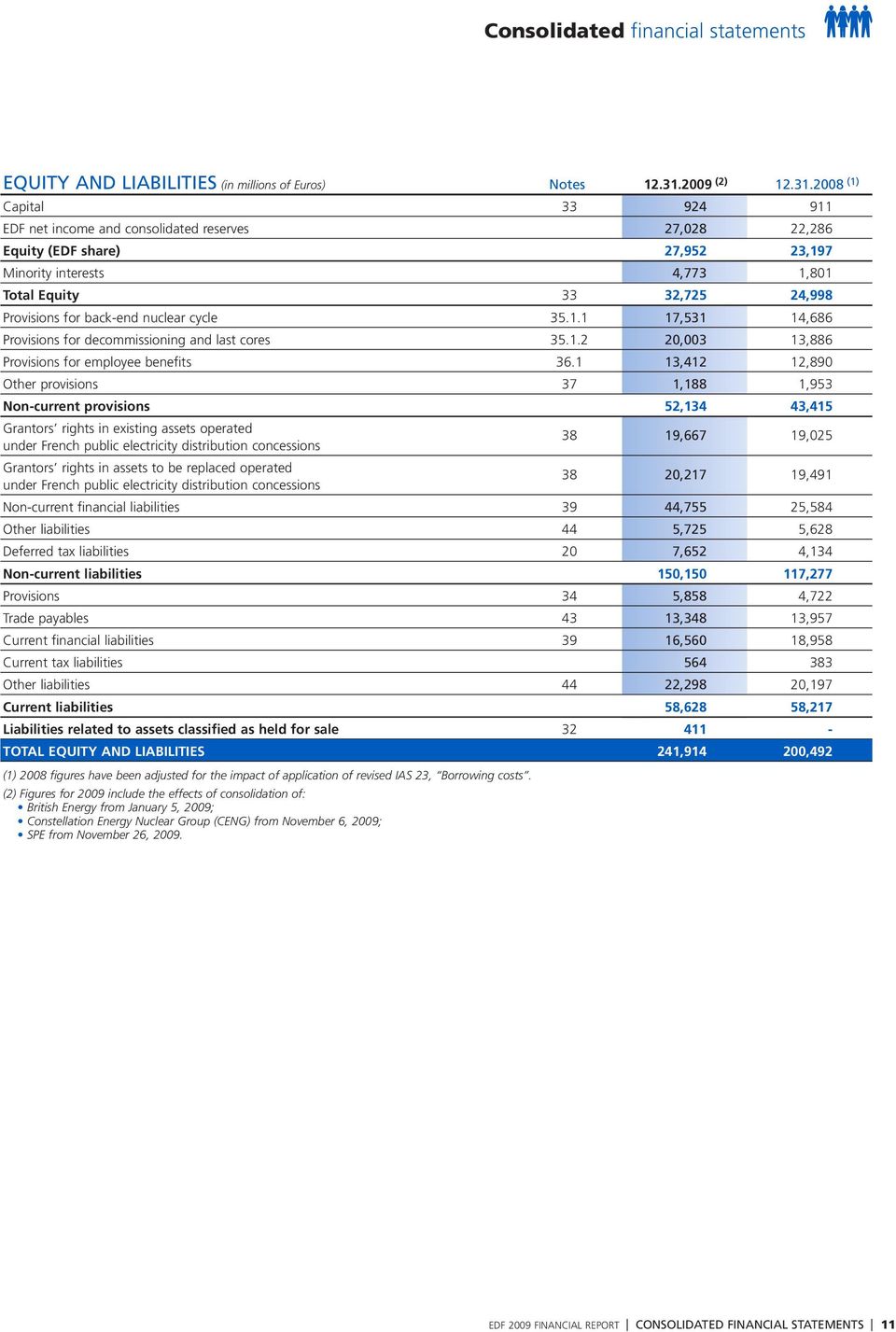
11 Consolidated financial statements EQUITY AND LIABILITIES (in millions of Euros) Notes (2) (1) Capital EDF net income and consolidated reserves 27,028 22,286 Equity (EDF share) 27,952 23,197 Minority interests 4,773 1,801 Total Equity 33 32,725 24,998 Provisions for back-end nuclear cycle ,531 14,686 Provisions for decommissioning and last cores ,003 13,886 Provisions for employee benefits ,412 12,890 Other provisions 37 1,188 1,953 Non-current provisions 52,134 43,415 Grantors rights in existing assets operated under French public electricity distribution concessions Grantors rights in assets to be replaced operated under French public electricity distribution concessions 38 19,667 19, ,217 19,491 Non-current financial liabilities 39 44,755 25,584 Other liabilities 44 5,725 5,628 Deferred tax liabilities 20 7,652 4,134 Non-current liabilities 150, ,277 Provisions 34 5,858 4,722 Trade payables 43 13,348 13,957 Current financial liabilities 39 16,560 18,958 Current tax liabilities Other liabilities 44 22,298 20,197 Current liabilities 58,628 58,217 Liabilities related to assets classified as held for sale TOTAL EQUITY AND LIABILITIES 241, ,492 (1) 2008 figures have been adjusted for the impact of application of revised IAS 23, Borrowing costs. (2) Figures for 2009 include the effects of consolidation of: British Energy from January 5, 2009; Constellation Energy Nuclear Group (CENG) from November 6, 2009; SPE from November 26, CONSOLIDATED FINANCIAL STATEMENTS 11
12 Consolidated financial statements Consolidated Cash Flow Statements (in millions of Euros) Notes 2009 (2) 2008 (1) Operating activities: Income before tax from consolidated companies 5,582 4,860 Impairment Accumulated depreciation and amortization, provisions and change in fair value 7,805 4,674 Financial income and expenses 1,477 1,057 Dividends received from companies accounted for under the equity method Capital gains/losses Change in working capital (3) (569) (245) (983) (211) Net cash flow from operations 13,521 10,360 Net financial expenses disbursed (1,408) (1,068) Income taxes paid (963) (1,720) Cancellation of the decision of the European Commission 1,224 - Net cash flow from operating activities 12,374 7,572 Investing activities: Acquisition / disposal of companies, net of cash (acquired / transferred) (4) 7 (13,160) (281) Purchases of property, plant and equipment and intangible assets 22, 23, 24, 25 (12,370) (9,703) Net proceeds from sale of property, plant and equipment and intangible assets 22, 23, 24, Changes in financial assets (6,895) Net cash flow used in investing activities (24,944) (16,665) Financing activities: Issuance of borrowings 39 30,228 15,717 Repayment of borrowings 39 (15,486) (4,882) Dividends paid by parent company 33.3 (1,228) (2,438) Dividends paid to minority interests (83) (90) Capital increase subscribed by minority interests (5) Increase in special concession liabilities Investment subsidies Treasury shares 12 (180) Net cash flow from financing activities 13,910 8,811 Net increase/(decrease) in cash and cash equivalents 1,340 (282) Cash and cash equivalents - opening balance 5,869 6,035 Effect of currency fluctuations (237) (79) Financial income on cash and cash equivalents Effect of other reclassifications (35) 7 CASH AND CASH EQUIVALENTS CLOSING BALANCE 6,982 5,869 (1) 2008 figures have been adjusted for the impact of application of revised IAS 23, Borrowing costs. (2) Figures for 2009 include the effects of consolidation of: British Energy from January 5, 2009; Constellation Energy Nuclear Group (CENG) from November 6, 2009; SPE from November 26, (3) In 2008, the change in working capital included reclassification of the amount due to AREVA for the La Hague reprocessing plant as a trade payable amounting to 2,300 million. In 2009 it includes a payment of part of this amount ( (605) million). (4) The British Energy purchase offer and subsequent squeeze-out offer resulted in a 10,132 million payment ( 10,827 million). At January 5, 2009, British Energy s cash and cash equivalents amounted to 1,224 million ( 1,308 million). Following acquisition of 49.99% of Constellation Energy Nuclear Group (CENG), an additional contribution of $3,502 million ( 2,508 million) was made on November 6, The other major operations of 2009 were the acquisitions by EnBW of a 26% interest in EWE, Lippendorf and Bexbach for approximately 1.4 billion, acquisition of 51% of SPE for 1,328 million and sale of a 20% share of Lake Acquisitions / British Energy to Centrica for 2,215 million ( 2,470 million). (5) Including EDF Énergies Nouvelles ( 248 million in 2008). 12 CONSOLIDATED FINANCIAL STATEMENTS

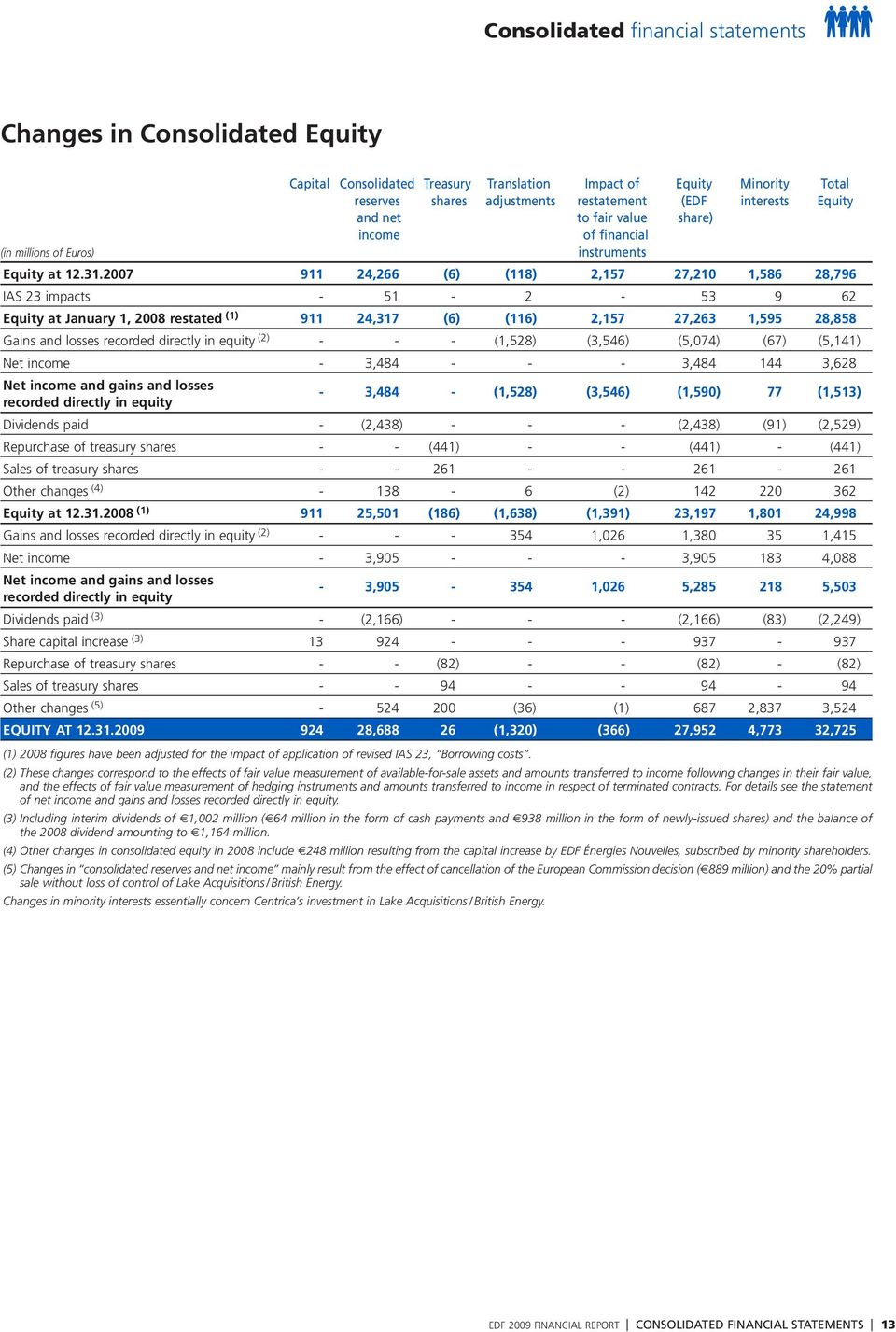
13 Consolidated financial statements Changes in Consolidated Equity Capital Consolidated Treasury Translation Impact of Equity Minority Total reserves shares adjustments restatement (EDF interests Equity and net to fair value share) income of financial (in millions of Euros) instruments Equity at ,266 (6) (118) 2,157 27,210 1,586 28,796 IAS 23 impacts Equity at January 1, 2008 restated (1) ,317 (6) (116) 2,157 27,263 1,595 28,858 Gains and losses recorded directly in equity (2) (1,528) (3,546) (5,074) (67) (5,141) Net income - 3, , ,628 Net income and gains and losses recorded directly in equity - 3,484 - (1,528) (3,546) (1,590) 77 (1,513) Dividends paid - (2,438) (2,438) (91) (2,529) Repurchase of treasury shares - - (441) - - (441) - (441) Sales of treasury shares Other changes (4) (2) Equity at (1) ,501 (186) (1,638) (1,391) 23,197 1,801 24,998 Gains and losses recorded directly in equity (2) ,026 1, ,415 Net income - 3, , ,088 Net income and gains and losses recorded directly in equity - 3, ,026 5, ,503 Dividends paid (3) - (2,166) (2,166) (83) (2,249) Share capital increase (3) Repurchase of treasury shares - - (82) - - (82) - (82) Sales of treasury shares Other changes (5) (36) (1) 687 2,837 3,524 EQUITY AT , (1,320) (366) 27,952 4,773 32,725 (1) 2008 figures have been adjusted for the impact of application of revised IAS 23, Borrowing costs. (2) These changes correspond to the effects of fair value measurement of available-for-sale assets and amounts transferred to income following changes in their fair value, and the effects of fair value measurement of hedging instruments and amounts transferred to income in respect of terminated contracts. For details see the statement of net income and gains and losses recorded directly in equity. (3) Including interim dividends of 1,002 million ( 64 million in the form of cash payments and 938 million in the form of newly-issued shares) and the balance of the 2008 dividend amounting to 1,164 million. (4) Other changes in consolidated equity in 2008 include 248 million resulting from the capital increase by EDF Énergies Nouvelles, subscribed by minority shareholders. (5) Changes in consolidated reserves and net income mainly result from the effect of cancellation of the European Commission decision ( 889 million) and the 20% partial sale without loss of control of Lake Acquisitions / British Energy. Changes in minority interests essentially concern Centrica s investment in Lake Acquisitions / British Energy. CONSOLIDATED FINANCIAL STATEMENTS 13
14 Consolidated financial statements Notes to the consolidated financial statements Électricité de France (EDF or the Company ) is a French société anonyme governed by French Law, and registered in France. The Company s consolidated financial statements include the accounts of the Company and its subsidiaries, and the Group s share in the results of joint ventures and associates (all collectively referred to as the Group ). The Group is an integrated energy company engaged in all aspects of the energy business: generation, transmission, distribution, supply and trading of energies. The Group s consolidated financial statements at December 31, 2009 were prepared under the responsibility of the Board of Directors and approved by the Directors at the Board meeting held on February 10, They will become final after approval at the general shareholders meeting to be held on May 18, Note Group accounting standards Declaration of conformity and group accounting policies Changes in accounting methods at January 1, Declaration of conformity and Group accounting policies Pursuant to European regulation 1606/2002 of July 19, 2002 on the adoption of international accounting standards, the EDF group s consolidated financial statements for the year ended December 31, 2009 are prepared under the international accounting standards published by the IASB and approved by the European Union for application at December 31, These international standards are IAS (International Accounting Standards), IFRS (International Financial Reporting Standards), and interpretations issued by the SIC and IFRIC. The consolidated financial statements for 2009 contain comparative information for the financial year 2008 after restatement for the effect of application IAS 23 (revised), Borrowing costs and changes in the presentation of Edison trading revenues. 14 CONSOLIDATED FINANCIAL STATEMENTS

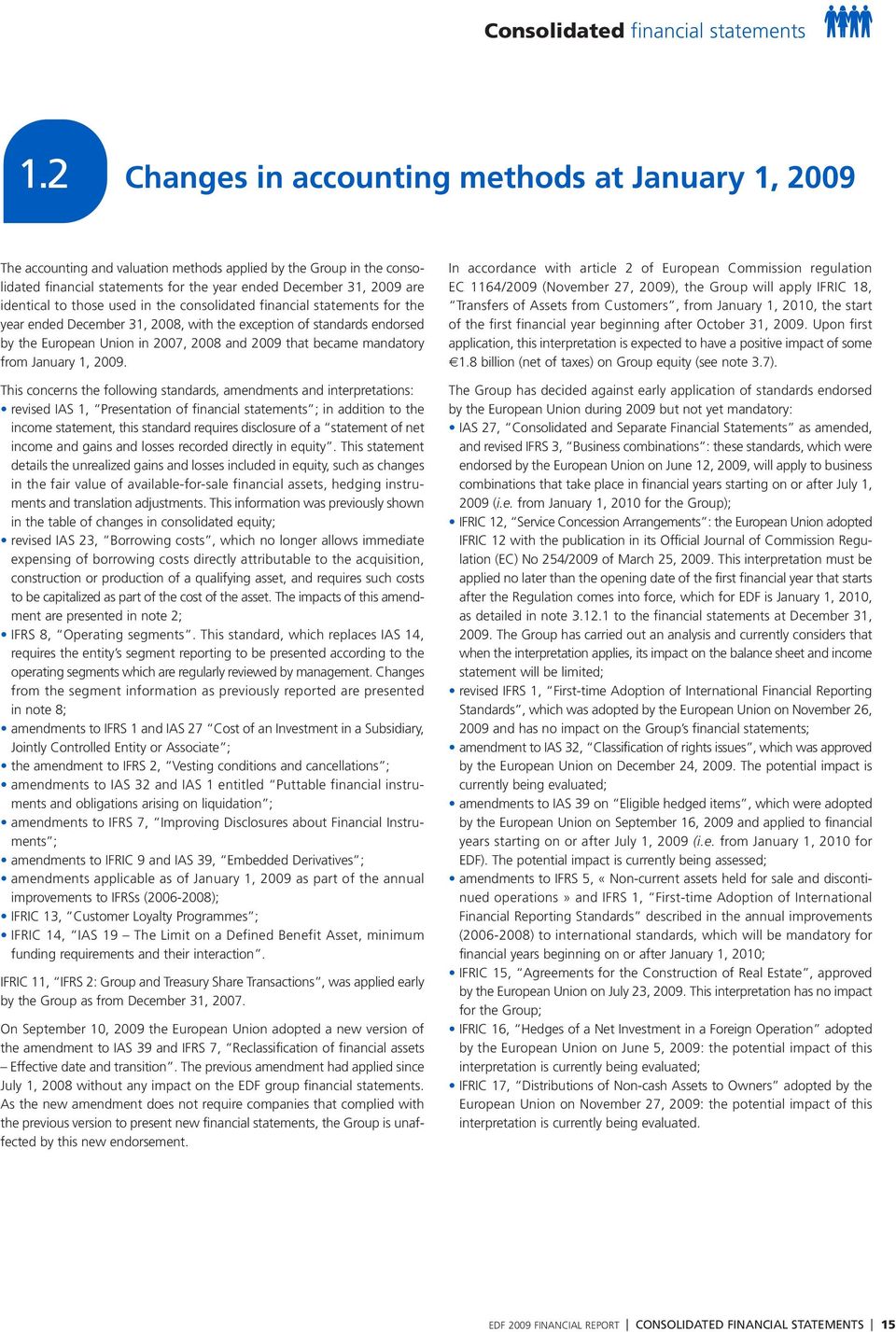
15 Consolidated financial statements 1.2 Changes in accounting methods at January 1, 2009 The accounting and valuation methods applied by the Group in the consolidated financial statements for the year ended December 31, 2009 are identical to those used in the consolidated financial statements for the year ended December 31, 2008, with the exception of standards endorsed by the European Union in 2007, 2008 and 2009 that became mandatory from January 1, This concerns the following standards, amendments and interpretations: revised IAS 1, Presentation of financial statements ; in addition to the income statement, this standard requires disclosure of a statement of net income and gains and losses recorded directly in equity. This statement details the unrealized gains and losses included in equity, such as changes in the fair value of available-for-sale financial assets, hedging instruments and translation adjustments. This information was previously shown in the table of changes in consolidated equity; revised IAS 23, Borrowing costs, which no longer allows immediate expensing of borrowing costs directly attributable to the acquisition, construction or production of a qualifying asset, and requires such costs to be capitalized as part of the cost of the asset. The impacts of this amendment are presented in note 2; IFRS 8, Operating segments. This standard, which replaces IAS 14, requires the entity s segment reporting to be presented according to the operating segments which are regularly reviewed by management. Changes from the segment information as previously reported are presented in note 8; amendments to IFRS 1 and IAS 27 Cost of an Investment in a Subsidiary, Jointly Controlled Entity or Associate ; the amendment to IFRS 2, Vesting conditions and cancellations ; amendments to IAS 32 and IAS 1 entitled Puttable financial instruments and obligations arising on liquidation ; amendments to IFRS 7, Improving Disclosures about Financial Instruments ; amendments to IFRIC 9 and IAS 39, Embedded Derivatives ; amendments applicable as of January 1, 2009 as part of the annual improvements to IFRSs ( ); IFRIC 13, Customer Loyalty Programmes ; IFRIC 14, IAS 19 The Limit on a Defined Benefit Asset, minimum funding requirements and their interaction. IFRIC 11, IFRS 2: Group and Treasury Share Transactions, was applied early by the Group as from December 31, On September 10, 2009 the European Union adopted a new version of the amendment to IAS 39 and IFRS 7, Reclassification of financial assets Effective date and transition. The previous amendment had applied since July 1, 2008 without any impact on the EDF group financial statements. As the new amendment does not require companies that complied with the previous version to present new financial statements, the Group is unaffected by this new endorsement. In accordance with article 2 of European Commission regulation EC 1164/2009 (November 27, 2009), the Group will apply IFRIC 18, Transfers of Assets from Customers, from January 1, 2010, the start of the first financial year beginning after October 31, Upon first application, this interpretation is expected to have a positive impact of some 1.8 billion (net of taxes) on Group equity (see note 3.7). The Group has decided against early application of standards endorsed by the European Union during 2009 but not yet mandatory: IAS 27, Consolidated and Separate Financial Statements as amended, and revised IFRS 3, Business combinations : these standards, which were endorsed by the European Union on June 12, 2009, will apply to business combinations that take place in financial years starting on or after July 1, 2009 (i.e. from January 1, 2010 for the Group); IFRIC 12, Service Concession Arrangements : the European Union adopted IFRIC 12 with the publication in its Official Journal of Commission Regulation (EC) No 254/2009 of March 25, This interpretation must be applied no later than the opening date of the first financial year that starts after the Regulation comes into force, which for EDF is January 1, 2010, as detailed in note to the financial statements at December 31, The Group has carried out an analysis and currently considers that when the interpretation applies, its impact on the balance sheet and income statement will be limited; revised IFRS 1, First-time Adoption of International Financial Reporting Standards, which was adopted by the European Union on November 26, 2009 and has no impact on the Group s financial statements; amendment to IAS 32, Classification of rights issues, which was approved by the European Union on December 24, The potential impact is currently being evaluated; amendments to IAS 39 on Eligible hedged items, which were adopted by the European Union on September 16, 2009 and applied to financial years starting on or after July 1, 2009 (i.e. from January 1, 2010 for EDF). The potential impact is currently being assessed; amendments to IFRS 5, «Non-current assets held for sale and discontinued operations» and IFRS 1, First-time Adoption of International Financial Reporting Standards described in the annual improvements ( ) to international standards, which will be mandatory for financial years beginning on or after January 1, 2010; IFRIC 15, Agreements for the Construction of Real Estate, approved by the European Union on July 23, This interpretation has no impact for the Group; IFRIC 16, Hedges of a Net Investment in a Foreign Operation adopted by the European Union on June 5, 2009: the potential impact of this interpretation is currently being evaluated; IFRIC 17, Distributions of Non-cash Assets to Owners adopted by the European Union on November 27, 2009: the potential impact of this interpretation is currently being evaluated. CONSOLIDATED FINANCIAL STATEMENTS 15
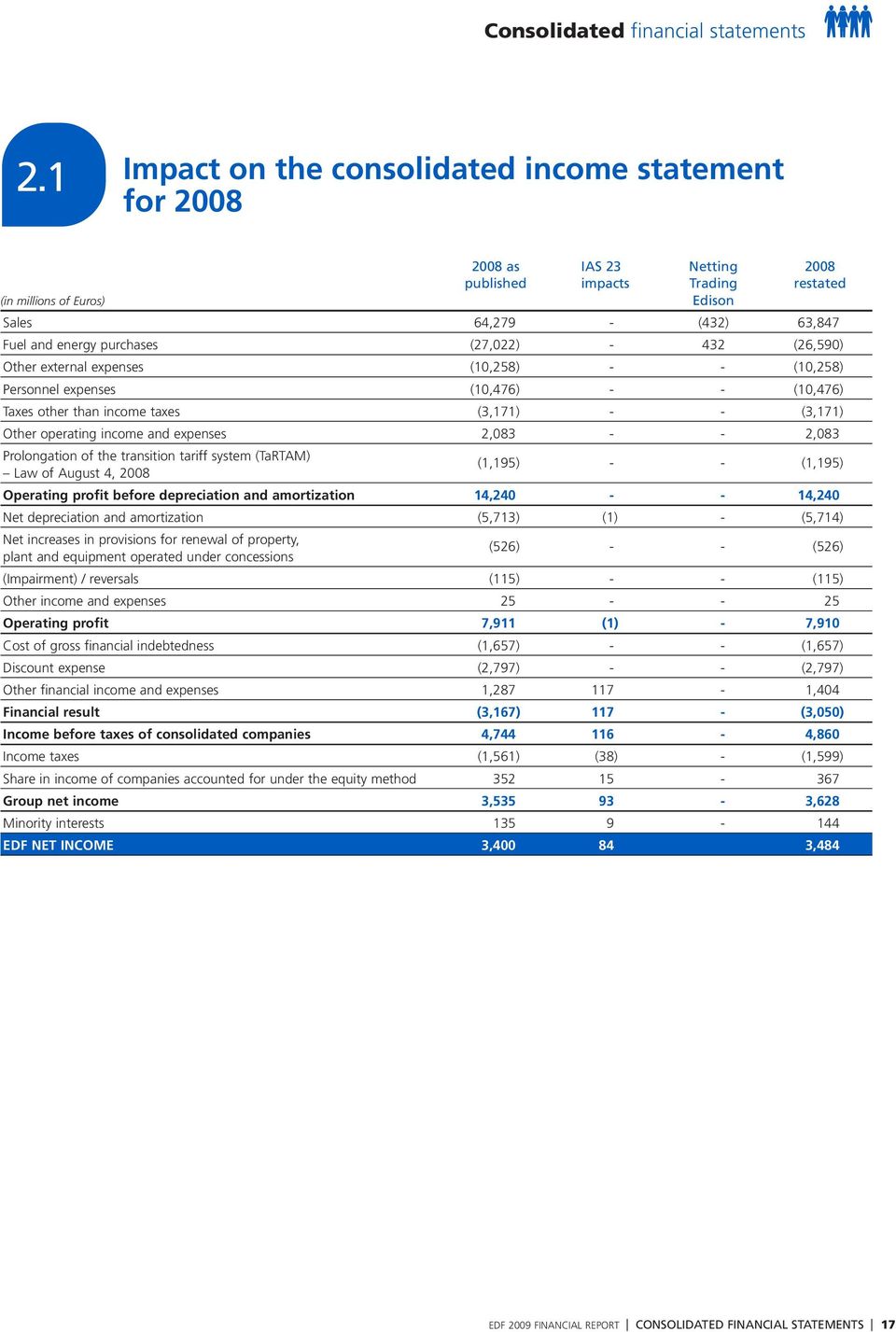
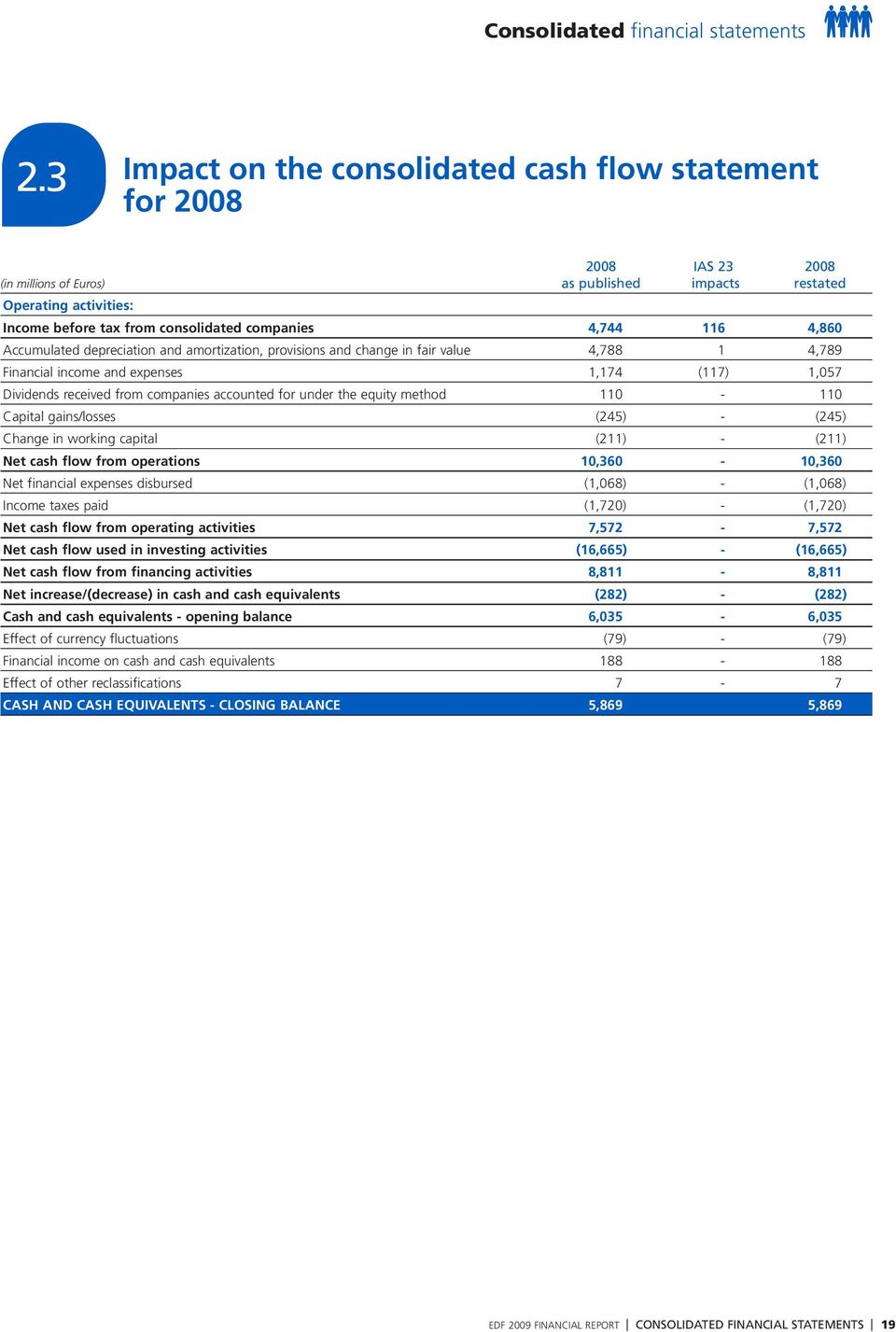
16 Consolidated financial statements Similarly, the Group has not opted for early application of the following standards, amendments and interpretation likely to be approved by the European Union in 2010 at the earliest: revised IAS 24, Related party disclosures ; annual improvements to IFRS ( ); amendments to IFRS 1, Additional exemptions for first-time adopters ; amendment to IFRS 2, Group cash-settled share-based payment transactions ; amendments to IFRIC 14, Prepayments of a minimum funding requirement ; IFRIC 19, Extinguishing financial liabilities with equity instruments. Finally, as part of the ongoing overhaul of IAS 39, the IASB adopted a new standard in November 2009, IFRS 9, Financial instruments (Phase 1, Classification and Measurement). This standard has not yet been adopted by the EU, and in application of current regulations, cannot be applied early for the year ended December 31, The potential impact of all of these standards, amendments and interpretations is still under assessment. Note Comparability Impact on the consolidated income statement for Impact on the consolidated balance sheet at December 31, Impact on the consolidated cash flow statement for Revised IAS 23, Borrowing costs Revised IAS 23, Borrowing costs, came into force on January 1, This standard, which leads to a change in accounting method, requires borrowing costs directly attributable to the acquisition, construction or production of a qualifying asset to be capitalized as part of the costs of that asset. Other borrowing costs continue to be charged to financial expenses over the relevant period. The Group has decided to apply this standard retroactively from January 1, 2005 to ensure consistent accounting treatment for its significant investments, in particular the Flamanville 3 EPR, for which the first expenses were recognized in As a result of this retrospective application, comparative prior year information is presented. The impact on the Group s share of equity is 53 million at January 1, 2008 and 139 million at December 31, The impact at January 1, 2008 principally relates to the France segment ( 27 million, principally for investments in the EPR). Edison s trading activities Edison developed its energy trading business during To comply with Group presentation rules, the corresponding revenues are reported net of purchases from Sales and fuel purchases for 2008 have consequently been restated, leading to a 432 million reduction. 16 CONSOLIDATED FINANCIAL STATEMENTS

17 Consolidated financial statements 2.1 Impact on the consolidated income statement for as IAS 23 Netting 2008 published impacts Trading restated (in millions of Euros) Edison Sales 64,279 - (432) 63,847 Fuel and energy purchases (27,022) (26,590) Other external expenses (10,258) - - (10,258) Personnel expenses (10,476) - - (10,476) Taxes other than income taxes (3,171) - - (3,171) Other operating income and expenses 2, ,083 Prolongation of the transition tariff system (TaRTAM) Law of August 4, 2008 (1,195) - - (1,195) Operating profit before depreciation and amortization 14, ,240 Net depreciation and amortization (5,713) (1) - (5,714) Net increases in provisions for renewal of property, plant and equipment operated under concessions (526) - - (526) (Impairment) / reversals (115) - - (115) Other income and expenses Operating profit 7,911 (1) - 7,910 Cost of gross financial indebtedness (1,657) - - (1,657) Discount expense (2,797) - - (2,797) Other financial income and expenses 1, ,404 Financial result (3,167) (3,050) Income before taxes of consolidated companies 4, ,860 Income taxes (1,561) (38) - (1,599) Share in income of companies accounted for under the equity method Group net income 3, ,628 Minority interests EDF NET INCOME 3, ,484 CONSOLIDATED FINANCIAL STATEMENTS 17
18 Consolidated financial statements 2.2 Impact on the consolidated balance sheet at December 31, 2008 ASSETS IAS 23 impacts as published and trading restated (in millions of Euros) Edison Goodwill 6,807-6,807 Other intangible assets 3, ,099 Property, plant and equipment operated under French public electricity distribution concessions 41,213-41,213 Property, plant and equipment operated under concessions for other activities 26, ,959 Property, plant and equipment used in generation and other tangible assets owned by the Group (1) 39, ,403 Investments in companies accounted for under the equity method 2, ,852 Non-current financial assets 18,103-18,103 Deferred tax assets 2,912 (12) 2,900 Non-current assets 141, ,336 Current assets 59,154-59,154 Assets classified as held for sale 2-2 TOTAL ASSETS 200, ,492 EQUITY AND LIABILITIES IAS 23 impacts as published and trading restated (in millions of Euros) Edison Capital EDF net income and consolidated reserves 22, ,286 Equity (EDF share) 23, ,197 Minority interests 1, ,801 Total Equity 24, ,998 Non-current provisions 43,415-43,415 Grantors rights in existing assets operated under French public electricity distribution concessions Grantors rights in assets to be replaced operated under French public electricity distribution concessions 19,025-19,025 19,491-19,491 Non-current financial liabilities 25,584-25,584 Other liabilities 5,628-5,628 Deferred tax liabilities 4, ,134 Non-current liabilities 117, ,277 Current liabilities 58,217-58,217 Liabilities related to assets classified as held for sale TOTAL EQUITY AND LIABILITIES 200, ,492 (1) Breakdown of the impact of IAS 23: IAS (in millions of Euros) as published impacts restated Property, plant and equipment owned by the Group 33, ,580 Property, plant and equipment in progress 5, ,514 Leased property, plant and equipment PROPERTY, PLANT AND EQUIPMENT USED IN GENERATION AND OTHER TANGIBLE ASSETS OWNED BY THE GROUP 39, , CONSOLIDATED FINANCIAL STATEMENTS

19 Consolidated financial statements 2.3 Impact on the consolidated cash flow statement for IAS (in millions of Euros) as published impacts restated Operating activities: Income before tax from consolidated companies 4, ,860 Accumulated depreciation and amortization, provisions and change in fair value 4, ,789 Financial income and expenses 1,174 (117) 1,057 Dividends received from companies accounted for under the equity method Capital gains/losses (245) - (245) Change in working capital (211) - (211) Net cash flow from operations 10,360-10,360 Net financial expenses disbursed (1,068) - (1,068) Income taxes paid (1,720) - (1,720) Net cash flow from operating activities 7,572-7,572 Net cash flow used in investing activities (16,665) - (16,665) Net cash flow from financing activities 8,811-8,811 Net increase/(decrease) in cash and cash equivalents (282) - (282) Cash and cash equivalents - opening balance 6,035-6,035 Effect of currency fluctuations (79) - (79) Financial income on cash and cash equivalents Effect of other reclassifications 7-7 CASH AND CASH EQUIVALENTS - CLOSING BALANCE 5,869 5,869 CONSOLIDATED FINANCIAL STATEMENTS 19
20 Consolidated financial statements Note Summary of the principal accounting and valuation methods Valuation Management judgment and estimates Consolidation methods Financial statement presentation rules Translation methods Related parties Sales Income taxes Goodwill and business combinations Other intangible assets Concession assets, generation assets and other property, plant and equipment Concession agreements Hydrocarbon prospecting, exploration and generation Leases Impairment of goodwill, intangible assets and property, plant and equipment Financial assets and liabilities Inventories and work-in-process Trade receivables Cash and cash equivalents Equity Treasury shares Provisions Provisions for employee benefits Special concession liabilities Investment subsidies Environmental expenses Basic and diluted earnings per share Held-for-sale assets and liabilities and discontinued operations CONSOLIDATED FINANCIAL STATEMENTS

21 Consolidated financial statements The following accounting methods have been applied consistently through all the periods presented in the consolidated financial statements. 3.1 Valuation The consolidated financial statements are based on historical cost valuation, with the exception of certain financial instruments and available-for-sale financial assets, which by convention are stated at fair value. The methods used to determine the fair value of these instruments are presented in note Management judgment and estimates The preparation of the financial statements requires the use of judgments, best estimates and assumptions in determining the value of assets and liabilities, income and expenses recorded for the period, and positive and negative contingencies at year-end. The figures in future financial statements may differ from current estimates due to changes in these assumptions or economic conditions. The principal sensitive accounting methods involving use of estimates and judgments are described below. Given their importance in the EDF group s financial statements, the impact of any change in assumption in these areas could be significant Nuclear provisions The measurement of provisions for the back-end of the nuclear cycle, decommissioning and last cores is sensitive to assumptions concerning costs, inflation rate, long-term discount rate, and disbursement schedules. A revised estimate is therefore established at each closing date to ensure that the amounts accrued correspond to the best estimate of the costs eventually to be borne by the Group. Any significant differences resulting from these revised estimates could entail changes in the amounts accrued. A change in the discount rate would be considered as a change in estimate in the same way as a change in disbursement schedule or contractor s quote, and the impacts would be recognized as follows: in the corresponding assets if the provision was initially covered by balance sheet assets; in the income statement in all other cases Pensions and other long-term and post-employment benefits The value of pensions and other long-term and post-employment benefit obligations is based on actuarial valuations that are sensitive to assumptions concerning discount rates and wage increase rates, and all the actuarial assumptions used. Sensitivity analyses are presented in note Impairment of goodwill and long-term assets Impairment tests on goodwill and long-term assets are sensitive to the macro-economic and segment assumptions used, and medium-term financial forecasts. The Group therefore revises the underlying estimates and assumptions based on regularly updated information Financial instruments In measuring the fair value of unlisted financial instruments (essentially energy contracts), the Group uses valuation models involving a certain number of assumptions subject to unforeseeable developments. Any change in those assumptions could have a significant impact on the financial statements. Such a change could have a significant impact on the consolidated financial statements. Sensitivity analyses are presented in note CONSOLIDATED FINANCIAL STATEMENTS 21
22 Consolidated financial statements Energy and delivery not yet metered As explained in note 3.7, the quantities of energy delivered but neither measured nor billed are calculated at the reporting date based on consumption statistics and selling price estimates. These statistics and estimates are sensitive to the assumptions used in determining the portion of sales not billed at the closing date Valuation of obligations concerning French public distribution concession assets to be replaced In view of the specific nature of French public electricity distribution concessions, the Group has opted to present its obligation to renew property, plant and equipment in the balance sheet at a value corresponding to the amount of contractual commitments as calculated and disclosed to the grantors in the annual business reports. An alternative approach would be to value the obligations based on the discounted value of future payments necessary for replacement of these assets at the end of their industrial useful life. The impacts this alternative approach would have had on the accounts are shown in note 3.24 for information. Whatever valuation method is used, measurement of the concession liability concerning assets to be replaced is notably subject to uncertainty in terms of cost and disbursement dates Transition tariff system (Tarif réglementé transitoire d ajustement du marché or TaRTAM) To assess the contribution payable by the Group in application of the transition tariff defined in the French laws of December 7, 2006 and August 4, 2008, various assumptions have been used based on the best available information and forecasts, particularly regarding the numbers of customers applying to benefit from this tariff, developments in electricity market prices and the share of the compensation to be financed by the Contribution to the Public Electricity Service (Contribution au service public de l électricité or CSPE) at each reporting date Other Management Judgments The use of estimates and assumptions is also particularly important in measuring the amounts of the Contribution to the Public Electricity Service (CSPE) receivable for the year, and in the recognition of deferred tax assets. Against the economic and financial crisis which continued in 2009 and was mainly characterized by a degree of volatility on the financial markets, the parameters used to prepare estimates are based on macro-economic assumptions appropriate to the very long-term cycle of Group assets. A sustained serious prolongation of this crisis could lead to revision of some of the long-term assumptions used in determining the value of assets and liabilities, and in assessment of positive and negative factors at the reporting date. 3.3 Consolidation methods Subsidiaries are companies in which the Group has exclusive control and are fully consolidated. Exclusive control means the power to govern the enterprise s financial and operating policies either directly or indirectly so as to obtain benefit from its activities. Exclusive control is presumed when EDF directly or indirectly holds more than 50% of the voting rights. Voting rights that are potentially exercisable at the closing date, even by another party, are taken into consideration in determining the level of control over a subsidiary. Joint ventures are companies that the Group jointly controls, and are proportionally consolidated on the basis of the Group s percentage interest. Joint control means sharing control over a company jointly operated by a limited number of partners or shareholders, such that the operating and financial policies result from their mutual agreement. Associates are companies in which the Group exercises significant influence on the financial and operating policies without controlling the company. The Group is considered to exercise significant influence when it holds at least 20% of the consolidated company. Associates are accounted for under the equity method. They are carried in the balance sheet at historical cost adjusted for the share of net assets generated after acquisition, less any impairment. The Group s share in net income for the period is reported under the income statement heading Share in income of companies accounted for under the equity method. The results of companies acquired during the year are recognized in the Group s consolidated income statement from the date on which control is acquired, until control is transferred upon disposal. All significant transactions between consolidated companies and unrealized internal profits are eliminated. A list of subsidiaries, joint ventures and associates is presented in note CONSOLIDATED FINANCIAL STATEMENTS
23 Consolidated financial statements 3.4 Financial statement presentation rules Assets and liabilities of dissimilar natures or functions are disclosed separately. Assets and liabilities contributing to working capital used in the entity s normal operating cycle are classified as current. Other assets and liabilities are classified as current if they mature within one year of the closing date, and non-current if they mature more than one year after the closing date. Commitments by an EDF group entity to purchase minority interests in a fully consolidated entity are reported under current or non-current Other liabilities, with corresponding adjustments to goodwill and minority interests. The income statement presents items by nature. The heading Other income and expenses presented below the operating profit before depreciation and amortization comprises items of an unusual nature or amount. 3.5 Translation methods Reporting currency The Group s financial statements are presented in Euros, which is both the functional and reporting currency of the EDF group. All financial data are rounded up or down to the nearest million Functional currency An entity s functional currency is the currency of the economic environment in which it primarily operates. In most cases, the local currency is the functional currency, but for some entities, a functional currency other than the local currency may be used provided it reflects the currency used in the principal transactions Translation of the financial statements of foreign companies whose functional currency is not the Euro The financial statements of foreign companies whose functional currency is not the Euro are translated as follows: balance sheets are translated into Euros at the closing rate; income statements and cash flows are translated at the average rate for the period; resulting differences are recognized in equity under the heading Translation adjustments. Currency translation differences affecting a monetary item that is an integral part of the Group s net investment in a consolidated foreign company are included in consolidated equity until the disposal or liquidation of the net investment, at which date they are recognized as income or expenses in the income statement, in the same way as other translation adjustments concerning the Company Translation of transactions in foreign currencies In application of IAS 21, transactions expressed in foreign currencies are initially translated and recorded in the functional currency of the entity concerned, using the rate in force at the transaction date. At each reporting date, monetary assets and liabilities expressed in foreign currencies are translated at the closing rate. The resulting foreign exchange differences are taken to the income statement. CONSOLIDATED FINANCIAL STATEMENTS 23
24 Consolidated financial statements 3.6 Related parties Related parties include the French State, companies in which the State holds majority ownership and certain of their subsidiaries, and companies in which EDF exercises joint control or significant influence. They also include members of the Group s management and governance bodies. 3.7 Sales Sales essentially comprise income from the sale of energy and services, which mainly include energy transmission and distribution services, and capacity and interconnection auctions. The Group accounts for sales when: a contract exists; delivery has taken place (or the service has been provided); a quantifiable price has been established or can be determined; and the receivables are likely to be recovered. Delivery takes place when the risks and benefits associated with ownership are transferred to the buyer. Energy delivered but not yet measured or billed is calculated based on consumption statistics and selling price estimates. Sales of goods and revenues on services not completed at the balance sheet date are valued by reference to the stage of completion at that date. Energy trading operations are recognized net of purchases. The financial contributions received from customers upon connection to the electricity network are mostly recorded as deferred income and transferred to sales over a period that depends on the useful life of the assets they contribute to finance, or the estimated term of customer contracts. The Group will apply IFRIC 18 retrospectively from January 1, 2010 (see note 1.2). At that date, the Group entities EDF, ERDF, Électricité de Strasbourg, EDF Energy, Demasz and SSE, for which IFRIC 18 will entail a change of accounting method (discontinuation of deferral) will transfer their existing deferred income to equity. Connection income received from January 1, 2010 will be recorded in revenues for the year. RTE and EnBW will continue to defer such income due to the nature of their services associated with these contributions, and their tariff structure. 3.8 Income taxes Income taxes include the current tax expense (income) and the deferred tax expense (income), calculated under the tax legislation in force in the countries where earnings are taxable. Current and deferred taxes are recorded in the income statement, or in equity if they concern items directly allocated to equity. The current tax expense (income) is the estimated amount of tax due on the taxable income for the period, calculated using the tax rates adopted at the year-end. Deferred taxes result from temporary differences between the book value of assets and liabilities and their tax basis. No deferred taxes are recognized for temporary differences generated by: goodwill which is not tax deductible; the initial recognition of an asset or liability in a transaction which is not a business combination and does not affect the accounting profit or taxable profit (tax loss) at the transaction date; investments in subsidiaries, joint ventures and associates, when the Group controls the timing of reversal of the temporary differences, and it is probable that the temporary differences will not reverse in the foreseeable future. 24 CONSOLIDATED FINANCIAL STATEMENTS
25 Consolidated financial statements Deferred tax assets and liabilities are valued at the expected tax rate for the period in which the asset will be realized or the liability settled, based on tax rates adopted at the year-end. If the tax rate changes, deferred taxes are adjusted to the new rate and the adjustment is recorded in the income statement, unless it relates to an underlying for which changes in value are recorded in equity, for example hedging instruments and available-for-sale financial assets. Deferred taxes are reviewed at each closing date, to take into account changes in tax legislation and the prospects for recovery of deductible temporary differences. Deferred tax assets are only recognized when it is probable that the Group will have sufficient taxable profit to utilize the benefit of the asset in the foreseeable future, or beyond that horizon, if there are deferred tax liabilities with the same maturity. 3.9 Goodwill and business combinations Business combinations are recognized under the purchase method defined in IFRS 3 as published in Purchase cost is the fair value of the assets transferred, liabilities incurred or assumed and equity instruments issued by the purchaser at the acquisition date, plus costs directly attributable to the purchase Determination of goodwill Goodwill corresponds to the difference between the cost of a business combination and the Group s share in the fair value of the identifiable assets, liabilities and contingent liabilities of the company acquired on the date control is transferred. When the difference is negative, it is immediately included in the income statement. The fair values of assets and liabilities and the resulting goodwill are finalized within 12 months of the acquisition. If minority interests are acquired in an associate without full control resulting, the Group continues to carry the assets and liabilities acquired previously at the same value in the consolidated financial statements Measurement and presentation of goodwill Goodwill on acquisition of subsidiaries or joint ventures is disclosed separately in the balance sheet. Impairment on this goodwill is reported under the heading Impairments, in the income statement. Goodwill on acquisition of associates is included in the investment s net book value. Impairment on this goodwill is included under the heading Share in income of companies accounted for under the equity method. After initial recognition, goodwill is carried at cost less any impairment recognized. Goodwill is not amortized, but impairment tests are carried out as soon as there is an indication of possible loss of value, and at least annually, as described in note Other intangible assets Other intangible assets mainly consist of software, patents and similar rights, operating rights, brands and development costs. These assets are amortized on a straight-line basis over their useful lives. Other intangible assets also include purchased greenhouse gas emission rights, which are not amortized Research and Development expenses Research expenses are recognized as expenses in the financial period incurred. Development expenses are recognized as an intangible asset if the Group can demonstrate: the technical feasibility of making the intangible asset ready for commissioning or sale; CONSOLIDATED FINANCIAL STATEMENTS 25
26 Consolidated financial statements its intention to complete the intangible asset and use or sell it; its ability to use or sell the intangible asset; how the intangible asset will generate likely future economic benefits; the availability of the appropriate resources (technical, financial or other) to complete development and use or sell the intangible asset; its ability to provide a reliable estimate of expenses attributable to the intangible asset during its development Greenhouse gas emission rights The Group applies the following treatment to greenhouse gas emission rights: purchased emission rights are recorded as intangible assets at acquisition cost; when they have been granted for nil consideration by the relevant State under the National Allocation Plan, they are not shown in the balance sheet; when a Group entity s actual emissions for the year are higher than the rights allocated by the State less completed transactions on the spot or forward markets for rights still held in respect of that year, a provision is recorded to cover the excess emissions. This provision is equivalent to the acquisition cost up to the amount of rights acquired on the spot or forward markets, and based on market prices for the balance. The provision is cancelled when rights are surrendered to the State. Forward purchases and sales of rights carried out as part of trading activities are recorded in compliance with IAS 39 and stated at fair value at the balance sheet date. Changes in fair value are taken to the income statement Renewable energy certificates When a Group electricity producer or supplier under an obligation to sell a determined quantity of renewable energy is not in a position to meet that obligation at year-end, the Group applies the following accounting treatment: energy savings certificates awarded to the entity are not recognized insofar as they do not exceed the level of the obligation; certificates purchased are included in intangible assets at cost; a provision is established equivalent to the shortfall at the reporting date, proportionally to the period concerned. The value of the provision is based on the acquisition price of certificates already purchased on the spot or forward markets, and the market price or penalty price for the balance. The provision is cancelled when certificates are surrendered to the State. If the entity has no obligation to sell renewable energy, certificates received or purchased for resale are included in inventories Concession assets, generation assets and other property, plant and equipment The Group s property, plant and equipment are reported under three balance sheet headings, as appropriate to the business and contractual circumstances of their use: property, plant and equipment operated under French public electricity distribution concessions; property, plant and equipment operated under concessions for other activities; property, plant and equipment used in generation and other tangible assets owned by the Group Initial measurement Property, plant and equipment are recorded at acquisition or production cost. The cost of facilities developed in-house includes all labor and materials costs, and all other production costs attributable to the construction cost of the asset. The Group capitalizes safety expenses incurred as a result of legal and regulatory obligations sanctioning non-compliance by an administrative ban from operation. The cost of property, plant and equipment also includes decommissioning costs for generation plants, and last core costs for nuclear facilities. These assets are associated with the provisions recorded to cover these obligations. At the date of commissioning, they are measured and recorded in the same way as the corresponding provision (see note 3.22). The following components are thus included in the balance sheet value of property, plant and equipment: the discounted cost of decommissioning the facilities; for nuclear facilities, the discounted cost of last core nuclear fuel, including depreciation of residual reactor fuel that will not be fully irradiated when production shuts down, the cost of nuclear fuel processing and the cost of removing and storing waste from these operations. Strategic safety spare parts for nuclear facilities are treated as property, plant and equipment, and depreciated pro rata with the useful life of the facilities to which they are assigned. When a part of an asset has a different useful life from the overall asset s useful life, it is identified as an asset component. 26 CONSOLIDATED FINANCIAL STATEMENTS
27 Consolidated financial statements This component approach mainly concerns the costs of the regulatory ten-yearly services of nuclear plants, and major scheduled servicing costs which are amortized over a period corresponding to the time elapsing between two services. It also applies to certain parts which have their own specific useful life. Borrowing costs incurred to finance installations are capitalized when they contribute directly to acquisition, construction or production of a qualifying asset (note 2) Depreciation Property, plant and equipment are depreciated on a straight-line basis over their useful life, defined as the period during which the Group expects to draw future economic benefits from their use. The estimated useful lives for the principal facilities are the following: Hydroelectric dams: 75 years Electromechanical equipment used in hydropower plants: 50 years Fossil-fired plants: 30 to 45 years Nuclear power plants: 40 years* Transmission and distribution installations (lines, substations): 20 to 45 years Windfarm and photovoltaic facilities 20 to 25 years 3.12 Concession agreements Accounting treatment The EDF group records public/private agreements in compliance with standards and interpretations IAS 16, IAS 17, IAS 18, IAS 37, IFRS 6 and IFRIC 4 as appropriate to the specific features of those agreements. IFRIC 12, Service concession arrangements was adopted by the European Union on March 25, 2009 and will be applied by the Group from January 1, The Group has carried out an analysis and considers that application of IFRIC 12 will have only a limited impact on its balance sheet and income statement French concessions In France, the Group is the operator for three types of public service concessions: public electricity distribution concessions in which the grantors are local authorities (municipalities or syndicated municipalities); hydropower concessions with the State as grantor; the public transmission network operated under concession from the State PUBLIC ELECTRICITY DISTRIBUTION CONCESSIONS GENERAL BACKGROUND Since the enactment of the French Law of April 8, 1946, EDF has by law been the sole operator for the main public distribution concessions in France. The accounting treatment of concessions is based on the concession agreements, with particular reference to their special clauses. It takes into consideration the possibility that EDF may one day lose its status as the sole authorized State concession operator. These contracts cover terms of between 20 and 30 years, and generally use standard concession rules deriving from the 1992 Framework Contract negotiated with the National Federation of Licensing Authorities (Fédération Nationale des Collectivités Concédantes et Régies FNCCR) and approved by the public authorities. RECOGNITION OF ASSETS AS PROPERTY, PLANT AND EQUIPMENT OPERATED UNDER FRENCH PUBLIC ELECTRICITY DISTRIBUTION CONCESSIONS All assets used by EDF in public electricity distribution concessions in France, whether they are owned by the grantor or the operator, are reported together under a specific line in the balance sheet assets at acquisition cost or their estimated value at the transfer date when supplied by the grantor HYDROPOWER CONCESSIONS Hydropower concessions in France follow standard rules approved by decree. Assets attributed to the hydropower concessions comprise hydropower generation equipment (dams, pipes, turbines, etc.) and, in the case of recentlyrenewed concessions, electricity generation and switching facilities. Assets used in these concessions are recorded under Property, plant and equipment operated under concessions for other activities at acquisition cost. As a result of recent changes in the regulations following removal of the outgoing operator s preferential right when a concession is renewed, the Group has shortened the depreciation periods used for certain assets (see note 4.1) * Subject to regulations applicable in certain countries. CONSOLIDATED FINANCIAL STATEMENTS 27
28 Consolidated financial statements FRENCH PUBLIC TRANSMISSION CONCESSION Following enactment of the French law of February 10, 2000, the public electricity transmission network was operated by an independent entity within EDF. This service was then transferred to a fully-consolidated subsidiary named RTE EDF Transport with effect from January 1, A new set of standard rules for the public transmission concession was approved by decree of December 23, The amendment to the agreement of November 27, 1958 transferring the concession for the French public electricity transmission network to RTE EDF Transport was signed on October 30, The concession terminates on December 31, The assets operated under this concession belong by law to RTE EDF Transport. They are recorded under Property, plant and equipment operated under concessions for other activities Foreign concessions The rules governing concessions outside France depend on the contracts and national legislations concerned. Assets operated under concession outside France are recorded under Property, plant and equipment operated under concessions for other activities, with the exception of prospecting rights and expenses associated with discovery of mineral resources, which are classified as intangible assets. The principal countries concerned are: United Kingdom be sold at fair value. Licenses may be terminated in the event of breach of obligations, subject to 25 years notice. Germany The distribution networks operated under concession by EnBW belong to EnBW for the duration of the concession. In the event that the concession is not renewed, EnBW may transfer the network at fair value or at amortized replacement value. Italy Edison operates hydrocarbon generation sites, gas storage sites, local gas distribution networks and hydropower generating plants under concessions. It owns all the assets except for some items of property, plant and equipment on the hydropower generation sites, such as pipes, which are transferable for nil consideration upon expiry of the concession. Hydropower generation assets which will be returned for nil consideration at the end of the concession are depreciated over the duration of the concession. Hydrocarbon generation sites are recorded in compliance with the rules applicable to the sector (see note 3.13). Assets related to exploration and generation companies and Edison s hydrocarbon concessions are depreciated under the unit of production (UOP) method; expenses associated with discovery of specific mineral resources are amortized over the year. EDF Energy owns public electricity distribution networks. It has a monopoly on the geographical area covered by its license, and the network can 3.13 Hydrocarbon prospecting, exploration and generation The Group applies IFRS 6, Exploration for and Evaluation of Mineral Resources. Exploration costs and costs incurred in connection with geological surveys, exploratory testing, geological and geophysical mapping and exploratory drilling are recognized as intangible assets and fully amortized in the year they are incurred. Development costs related to commercially viable mineral wells and production costs incurred to build facilities to extract and store hydrocarbons are recognized as Property plant and equipment used in generation and other tangible assets owned by the Group or Property, plant and equipment operated under concessions for other activities as appropriate. They are amortized under the UOP ( Unit Of Production ) method. 28 CONSOLIDATED FINANCIAL STATEMENTS
29 Consolidated financial statements 3.14 Leases In the course of its business, the Group uses assets made available under lease contracts. These contracts are analyzed in the light of the situations described and indicators supplied in IAS 17 in order to determine whether they are finance leases or operating leases Finance leases Lease agreements that effectively transfer virtually all the risks and benefits incident to ownership of the leased assets to the Group are classified as finance leases. The main criteria examined in determining whether virtually all the risks and benefits are transferred by an agreement are the following: the ratio of the duration of the lease to the leased assets useful life; total discounted future payments as a ratio of the fair value of the financed asset; whether ownership is transferred at the end of the lease; whether the purchase option is attractive; the features specific to the leased asset. Finance-leased assets are reported under the relevant asset headings, with recognition of a corresponding financial liability: they are depreciated over their useful life, or over the term of the corresponding lease agreement when this is shorter. If the Group performs a sale and leaseback operation resulting in a finance lease agreement, this is recognized in accordance with the principles described above. If the transfer price is higher than the asset s book value, the surplus is deferred and recognized as income progressively over the term of the lease Operating leases Lease agreements that do not qualify as finance leases are classified and recognized as operating leases. Payments made in application of these agreements are included in expenses in the income statement Arrangements containing a lease In compliance with interpretation IFRIC 4, the Group identifies agreements that convey the right to use an asset or group of specific assets to the purchaser although they do not have the legal form of a lease contract, as the purchaser in the arrangement benefits from a substantial share of the asset s production and payment is not dependent on production or market price. Such arrangements are treated as leases, and analyzed with reference to IAS 17 for classification as either finance or operating leases Impairment of goodwill, intangible assets and property, plant and equipment At the year-end and at each interim reporting date, the Group assesses whether there is any indication that any goodwill or asset could have been significantly impaired. If so, an impairment test is carried out as follows: the Group measures any long-term asset impairment by comparing the carrying value of these assets and goodwill, classified into Cash-generating units where necessary, and their recoverable amount. Cash-generating units (CGU) are groups of homogeneous assets that generate identifiable cash flows benefiting from synergies resulting from the acquisition. The Group s Cash-generating units comprise either subgroups or legal entities, broken down where necessary by activity (generation and supply, distribution, transmission, other). Goodwill is allocated to the Cash-generating units (CGU). The recoverable value of these units is the higher of fair value net of dis posal costs, and value in use. Value in use is determined with reference to discounted future net cash flows based on medium-term financial projections. When this recoverable value is lower than the carrying amount in the balance sheet, an amount equal to the difference is booked under the heading Impairment. The loss is allocated first to goodwill, and any surplus to the other assets of the Cash-generating unit concerned; the discount rates used for these purposes are based on the weighted CONSOLIDATED FINANCIAL STATEMENTS 29
30 Consolidated financial statements average cost of capital for each asset or group of assets concerned, determined by economic and geographical area and by business segment where appropriate. The pre-tax discount rate is calculated using an iterative process based on after-tax rates; future cash flows are based on medium-term plan projections over three years and assumptions validated by the Group. Variables that can significantly affect the calculations are: - changes in tariff regulations and market prices, - changes in interest rates and market risk premiums, - market price levels and market share on supplies, and the level of investment, - the useful lives of facilities, and the plan for concession renewal, - the growth rates used beyond the medium-term plans and the terminal values taken into consideration; the fair value net of disposal costs is measured on the basis of multiples observed for the most recent transactions in the relevant sector. Impairment of goodwill is irreversible Financial assets and liabilities Financial assets include available-for-sale assets (non-consolidated investments, dedicated assets, and other investment securities), loans and receivables at amortized cost, including trade receivables, and the positive fair value of financial derivatives. Dedicated assets are financial assets intended to finance the back-end of the nuclear cycle, for which provisions have been accrued (see note and ). These assets are managed separately from the Group s other financial assets and investments in view of their specific objective, and comprise bonds, equities, collective investment funds and reserved funds built up by the Group solely for its own use. Financial liabilities comprise financial borrowings and debts, trade payables, bank credit and the negative fair value of financial derivatives. Financial assets and liabilities are recorded in the balance sheet as current if they mature within one year and non-current if they mature after one year, apart from derivatives held for trading, which are all classified as current. Operating debts and receivables, and cash and cash equivalents, are governed by IAS 39 and reported separately in the balance sheet Classification and valuation methods for financial assets and liabilities Financial instruments are classified as follows under IFRS 7: financial assets and liabilities carried at fair value with changes in fair value included in income; held-to-maturity financial assets; loans and financial receivables; available-for-sale financial assets; trade receivables; cash and cash equivalents; financial debts and operating debts; financial derivatives FINANCIAL ASSETS AND LIABILITIES CARRIED AT FAIR VALUE WITH CHANGES IN FAIR VALUE INCLUDED IN INCOME Financial assets carried at fair value with changes in fair value included in the income statement are classified as such at the inception of the operation. This applies to: assets acquired from the outset with the intention of resale in the short term; or derivatives not classified as hedges (derivatives held for trading); or assets the Group has elected to include in this category under the option allowed by IAS 39. These assets are recorded at the transaction date, at acquisition cost including purchasing expenses. At each subsequent reporting date they are measured at fair value, based on quoted prices available from external sources for listed instruments, or using recognized valuation techniques such as the discounted cash flow method or reference to external sources for other instruments. Changes in fair value other than those concerning commodity contracts are recorded in the income statement under the heading Other financial income and expenses. Dividends and interest received on assets stated at fair value are recorded in the income statement under Other financial income. Changes in the fair value of commodity trading contracts are recorded in the income statement under Sales. Changes in the fair value of other commodity contracts designated as derivatives are classified either as Sales or Fuel and energy purchases depending on the nature of the underlying or the risk hedged. Regarding the fair value option, the Group classifies an asset or liability as at fair value through profit or loss in the three following circumstances: when using fair value eliminates or significantly reduces an inconsistency in the measurement of assets and liabilities ( accounting mismatch ); when the performance of a group of financial assets or financial liabilities is managed on a fair value basis, in accordance with documented strategies and the management reporting system; 30 CONSOLIDATED FINANCIAL STATEMENTS
31 Consolidated financial statements if a contract contains one or more embedded derivatives, then the hybrid instrument may be valued under the fair value option unless: - the embedded derivative does not substantially affect the cash flows of the contract, - the analysis of the host contract and the embedded derivative does not lead to separate measurement of the embedded derivative HELD-TO-MATURITY FINANCIAL ASSETS This category covers fixed-term investments which the Group acquires with the intent and ability to hold to maturity. They are recorded at amortized cost at the transaction date. Interest is calculated at the effective interest rate and recorded in the income statement under the heading Other financial income and expenses LOANS AND FINANCIAL RECEIVABLES Loans and financial receivables are valued and recorded at the transaction date, at amortized cost less any impairment or provision. Interest is calculated at the effective interest rate and recorded in the income statement under the heading Other financial income and expenses AVAILABLE-FOR-SALE FINANCIAL ASSETS Available-for-sale financial assets comprise non-consolidated investments, dedicated assets, reserved funds and investment securities. Dedicated assets held for a long or very long-term horizon are by default classified in this category. Available-for-sale financial assets are recorded at acquisition cost at the transaction date, and adjusted to fair value at the reporting date. Fair value measurement is based on quoted prices and market data available from external sources for instruments listed on an active market, and on the discounted cash flow method for other financial instruments. When a fair value cannot be reliably estimated by other accepted valuation methods such as discounting future cash flows, these instruments are valued at acquisition cost less any accumulated impairment. Unrealized gains or losses on these assets are recorded in equity, unless there is evidence of a realized loss, in which case impairment is recognized in the income statement (see note ). For available-for-sale financial assets represented by debt securities, interest is calculated at the effective interest rate and credited to the income statement under the heading Other financial income and expenses FINANCIAL DEBTS AND OPERATING DEBTS Financial debts are recorded at amortized cost, with separate reporting of embedded derivatives where applicable. Interest is calculated at the effective interest rate and recorded under the heading Cost of gross financial indebtedness over the duration of the financial debt. The fair value of the debt is calculated by discounting future cash flows at market rates DERIVATIVES SCOPE The scope of derivatives applied by the Group corresponds to the principles set out in IAS 39. In particular, forward purchases and sales for physical delivery of energy or commodities are considered to fall outside the scope of application of IAS 39 when the contract concerned is considered to have been entered into as part of the Group s normal business activity. This is demonstrated to be the case when all the following conditions are fulfilled: a physical delivery takes place under all such contracts; the volumes purchased or sold under the contracts correspond to the Group s operating requirements; the contracts cannot be considered as options as defined by the standard. In the specific case of electricity sale contracts, the contract is equivalent to a firm forward sale or can be considered as a capacity sale. The Group thus considers that transactions negotiated with a view to balancing the volumes between electricity purchase and sale commitments are part of its business as an integrated electricity company, and do not therefore come under the scope of IAS 39. In compliance with IAS 39, the Group analyses all its contracts, of both a financial and non-financial nature, to identify the existence of any embedded derivatives. Any component of a contract that affects the cash flows of that contract in the same way as a stand-alone derivative corresponds to the definition of an embedded derivative. If they meet the conditions set out by IAS 39, embedded derivatives are accounted for separately from the host contract at inception date MEASUREMENT AND RECOGNITION Derivatives are initially recorded at fair value, based on quoted prices and market data available from external sources. If no quoted prices are available, the Group may refer to recent comparable transactions or if no such transactions exist base its valuation on internal models that are recognized by market participants, giving priority to information directly derived from observable data, such as over-the-counter listings. Changes in the fair value of these derivatives are recorded in the income statement, unless they are classified as hedges for a cash flow or net investment. Changes in the fair value of such hedging instruments are recorded directly in equity, excluding the ineffective portion of the hedge. In the specific case of financial instruments entered into as part of EDF Trading s business, realized and unrealized gains and losses are reported net under the heading Sales. Financial instruments stated at fair value are classified in the following categories: Level 1 (quoted prices): financial instruments listed on an active market; Level 2 (observable data): financial instruments valued using valuation techniques based on observable parameters; Level 3 (internal model): financial instruments valued using valuation techniques based wholly or partly on non-observable parameters. CONSOLIDATED FINANCIAL STATEMENTS 31
32 Consolidated financial statements FINANCIAL INSTRUMENTS CLASSIFIED AS HEDGES The EDF group uses derivative instruments to hedge its foreign exchange and interest rate risks, as well as risks related to certain commodity contracts. The Group applies the criteria defined by IAS 39 in classifying derivatives as hedges: the instrument must hedge changes in fair value or cash flows attributable to the risk hedged, and the effectiveness of the hedge (i.e. the degree to which changes in the value of the hedging instrument offset changes in the value of the hedged item or future transaction) must be between 80% and 125%; in the case of cash flow hedges, the future transaction being hedged must be highly probable; reliable measurement of the effectiveness of the hedge must be possible; the hedge must be supported by appropriate documentation from its inception. The hedging relationship ends when: a derivative instrument ceases to be an effective hedging instrument; a derivative instrument expires, or is sold, terminated or exercised; the hedged item expires, is sold or redeemed; a future transaction ceases to be considered as highly probable. Only derivative instruments external to the Group qualify for hedge accounting, and gains or losses on internal derivatives are eliminated in the consolidated financial statements. However, in a cash flow hedging relationship initiated via derivatives internal to the Group, hedge accounting is applied if it can be demonstrated that the internal derivatives are matched with similar transactions external to the Group. The Group uses the following categories for hedges: (A) Fair value hedges These instruments hedge the exposure to changes in the fair value of an asset or liability recorded in the balance sheet, or a firm commitment to purchase or sell an asset. Changes in the fair value of the hedged item attributable to the hedged component of that item are recorded in the income statement and offset by corresponding variations in the fair value of the hedging instrument. Only the ineffective portion of the hedge has an impact on income. (B) Cash flow hedges These instruments hedge highly probable future transactions: the variability in cash flows generated by the hedged transaction is offset by changes in the value of the hedging instrument. The effective portion of accumulated changes in the hedge s fair value is recorded in equity, and the ineffective portion (i.e. changes in the fair value of the hedging instrument in excess of changes in the fair value of the hedged item) is recorded in the income statement. When the hedged cash flows materialize, the amounts previously recognized in equity are transferred to the income statement in the same way as for the hedged item. (C) Hedges of a net investment These instruments hedge exposure to the foreign exchange risk related to a net investment in a foreign entity. The effective portion of accumulated changes in the hedge s fair value is recorded in equity until disposal of the net investment, when it is included in the gain or loss on disposal. The ineffective portion (defined in the same way as for cash flow hedges) is recorded directly in the income statement. The Group records the change in fair value resulting from the interest rate effect of derivatives hedging a net investment in a foreign operation in equity in the same way as the change in value resulting from foreign exchange differences Impairment of financial assets At the year-end and at each interim reporting date, the Group assesses whether there is any objective evidence that an asset could have been significantly impaired. If so, the Group estimates the asset s recoverable value and records any necessary impairment as appropriate for the category of asset concerned FINANCIAL ASSETS RECORDED AT AMORTIZED COST Impairment is equal to the difference between the asset s net book value and the discounted value of expected future cash flows, using the original effective interest rate of the financial instrument. The impairment is included in the income statement under the heading Other financial expenses. If the impairment loss decreases in a subsequent period, the amount of the decrease is reversed and transferred to the income statement AVAILABLE-FOR-SALE FINANCIAL ASSETS If there is a large or long-term decrease in the fair value of available-for-sale financial assets, the unrealized loss is reclassified from equity to income. For debt instruments, impairment is only recorded in the income statement when there is evidence of impairment related to the counterparty. If, in a subsequent period, the fair value of an available-for-sale financial asset increases, the increase in value is recorded in equity for equity instruments, while for debt instruments the impairment previously recorded is reversed and transferred to the income statement. Different criteria for impairment apply to different types of available-for-sale financial assets. In particular, the Group applies specific impairment criteria for the portion of the portfolio consisting of dedicated assets held to cover long-term expenses for decommissioning of nuclear plants and the back-end nuclear cycle for EDF, taking into consideration the legal and regulatory obligations attached to the funds, payment schedules and long-term fund management Derecognition of financial assets and liabilities Derecognition is applied for all or part of: a financial asset, when the contractual rights making up the asset expire, or the Group substantially transfers most of the significant risks associated with ownership of the asset; a financial liability, when the liability is extinguished due to cancellation or expiry of the obligation. When a debt is renegotiated with a lender giving rise to substantially different terms, a new liability is recognized Securitization operations When it can be demonstrated that the Group does not control the investment funds resulting from securitization operations, these are excluded from the scope of consolidation. Otherwise, an entry corresponding to the cash inflow is recorded under the heading Other liabilities. 32 CONSOLIDATED FINANCIAL STATEMENTS
33 Consolidated financial statements 3.17 Inventories and work-in-process Inventories are recognized at the lower of acquisition cost or net realizable value, except for inventories resulting from trading activities, which are carried at market value. The cost of inventories is determined by the weighted average unit cost method. Cost includes all direct material costs, labor costs, and a share of indirect production costs Nuclear fuel and materials Inventories of nuclear fuel and materials comprise fissile materials in various stages of production, and fuel in the reactor and stored. The processing cycle for nuclear fuels is longer than one year. The stated value of nuclear fuel and materials and work-in-progress is determined based on direct processing costs including materials, labor and subcontracted services (e.g. fluoration, enrichment, etc.). These items are valued using the weighted average cost method, applied to each component (natural uranium, fluoration, enrichment, production). In keeping with the notion of loaded fuel as defined in the decision of March 21, 2007, in France, the cost of inventories for fuel in reactors but not yet irradiated includes expenses for spent fuel management and longterm radioactive waste management. The corresponding amounts are taken into account in the relevant provisions. Interest expenses incurred in financing inventories of nuclear fuels are charged to expenses for the period. Nuclear materials, whatever their form during the processing cycle, whose useful lives are longer than one year, and nuclear fuel, whether being used in the reactors or stored, are recorded in inventories. The Group does not value the uranium obtained from reprocessed fuel, due to uncertainty over its future use. Nuclear fuel consumption is determined for each component based on forecasts of quantities used per kwh produced. These quantities are valued at weighted average cost of inventories. Inventories are periodically corrected in view of forecast burnt quantities based on neutronic measurements Consumables, materials and spare parts Inventories are valued at weighted average cost including direct and indirect purchasing costs. Provisions concerning spare parts supplied under a maintenance program are based on the turnover of these parts and the useful lives of generation units Renewable energy certificates Renewable energy certificates awarded to or purchased by an entity are included in Other inventories when they are not to be surrendered to the State in execution of a regulatory obligation Trade receivables On initial recognition, trade receivables are stated at the fair value of the consideration received or to be received. A provision is recorded when their carrying amount, based on the probability of recovery assessed according to the type of receivable, is less than their book value. Depending on the nature of the receivable, the risk associated with doubtful receivables is assessed individually or by experience-based statistical methods. Trade receivables also include revenue based on an estimate of power already delivered but neither measured nor billed. A provision is booked to cover the potential risk of subsequent non-recovery. CONSOLIDATED FINANCIAL STATEMENTS 33
34 Consolidated financial statements 3.19 Cash and cash equivalents Cash and cash equivalents comprise very liquid assets and very short-term investments, usually maturing within three months or less of the acquisition date, and with negligible risk of fluctuation in value. Securities held short-term and classified as cash equivalents are recorded at fair value, with changes in fair value included in the heading Financial income on cash and cash equivalents Equity Restatement to fair value of financial instruments The impact of restatement to fair value of financial instruments results from the adjustment to fair value of available-for-sale financial assets and certain hedging instruments Share issue expenses Share issue expenses correspond exclusively to external costs expressly related to the capital increase. They are charged against the issue premium at their net-of-tax value. Other expenses are classified as expenses of the period Treasury shares Treasury shares are shares issued by the consolidating company and held either by that company or by other entities in the consolidated group. They are valued at acquisition cost and deducted from equity until the date of disposal. Income or losses on disposals of treasury shares are directly included in equity and do not affect net income Provisions The Group recognizes provisions if the following three conditions are met: the Group has a present obligation (legal or constructive) towards a third party that arises from a past event prior to the closing date; it is probable that an outflow of resources embodying economic benefits will be required to settle the obligation; the obligation amount can be estimated reliably. In extremely rare cases when disclosing information could cause serious prejudice to the Group, description of a specific obligation, risk or litigation covered by a provision may be excluded from the notes to the financial statements. Provisions are determined based on the Group s estimate of the expected cost necessary to settle the obligation. Estimates are based on management 34 CONSOLIDATED FINANCIAL STATEMENTS
35 Consolidated financial statements data from the information system, assumptions adopted by the Group, and if necessary experience of similar transactions, or in some cases based on independent expert reports or contractor quotes. The various assumptions are reviewed for each closing of the accounts. If it is anticipated that all or part of the expenses covered by a provision will be reimbursed, the reimbursement is recognized under receivables if and only if the Group is virtually certain of receiving it. It may occasionally happen that a provision cannot be booked due to lack of a reliable estimate. In such cases, the obligation is mentioned in the notes as a contingent liability, unless there is little likelihood of an outflow of resources. Provisions mainly cover the following: back-end nuclear cycle expenses: provisions for spent fuel management and long-term radioactive waste management are booked for all fuel currently in use (in France, the provision concerns all fuel in reactors, regardless of the extent of irradiation; it also covers management expenses for radioactive waste resulting from decommissioning of nuclear plants); costs for decommissioning power plants and losses relating to fuel in the reactor when the reactor is shut down (provision for last cores); future losses relating to multi-year agreements for the purchase and sale of energy: - losses on energy purchase agreements are measured by comparing the acquisition cost under the contractual terms with the forecast market price for electricity, - losses on energy sale agreements are measured by comparing the estimated income under the contractual terms with the cost of generating the energy to be supplied. Provisions to cover back-end nuclear cycle expenses, expenses related to the decommissioning of power plants and last cores, and future losses relating to multi-year energy purchase and sale agreements are estimated by applying a forecast long-term inflation index to the projected disbursements, which are then discounted at rates that reflect the best estimate of a longterm rate of return on bond markets. The rate of inflation and the discount rate are based on the economic parameters of the country where the economic entity is located. For France, the Group applies a discount rate determined based on long series data for a sample of bonds, and takes into account the fact that some expenses covered by provisions will be disbursed over periods significantly longer than the duration of instruments generally traded on the financial markets. The discount effect generated at each closing to reflect the passage of time is recorded under Discount expense in financial expenses. The impact of changes in estimates for long-term provisions with associated balance sheet assets, whether due to schedule changes, discount rate changes, new expense estimates or technological developments, is allocated to the relevant assets, with any excess allocated to the underlying asset (power plant). Each one of these parameters, taken singly or together, could have a considerable impact on the estimates over time Provisions for employee benefits EDF group employees are entitled to benefits both during and after their employment, depending on local regulations and certain specific rules such as the statutory regulations for companies governed by the special pension system for the electricity and gas sector (IEG) in France Pension and post-employment benefit obligations When they retire, Group employees benefit from pensions determined under local rules. They may also be entitled to benefits directly paid by the companies, and additional benefits prescribed by the relevant regulations. All the obligations of EDF and the French subsidiaries governed by the Electricity and Gas sector (IEG) regime are described in note Other long-term benefit obligations These benefits concern employees currently in service, and are earned according to local regulations, particularly the statutory regulations for the electricity and gas sector for EDF and French subsidiaries covered by the IEG regime. Details are provided in note Calculation and recognition of employee benefits Obligations under defined-benefit plans are calculated by the projected unit credit method, which determines the present value of entitlements earned by employees at year-end to pensions, post-employment benefits and longterm benefits, taking into consideration each country s specific economic conditions and expected wage increases. CONSOLIDATED FINANCIAL STATEMENTS 35
36 Consolidated financial statements In calculating pensions and other post-employment benefit obligations, this method takes the following factors into consideration: career-end salary levels, with reference to employee seniority, projected salary levels at the time of retirement based on the expected effects of career advancement, and estimated trends in pension levels; retirement age, determined on the basis of relevant factors (such as years of service and number of children); forecast numbers of pensioners, determined based on employee turnover rates and mortality data available in each country; reversion pensions, taking into account both the life expectancy of the employee and his/her spouse and the marriage rate observed for the population of employees in the electricity and gas sector; a discount rate that depends on the geographical zone and the duration of the obligations; in compliance with IAS 19, this rate is determined as the market yield on high-quality corporate bonds or the year-end rate on government bonds with a similar duration to EDF s commitments. The provision takes into account the value of the fund assets that cover the pension obligations, which are deducted from the value of the obligation as determined above. Any actuarial gains or losses on pensions and post-employment benefit obligations in excess of 10% (the corridor ) of the obligations or fund assets, whichever is the higher, are recognized in the income statement progressively over the average residual working life of the Company s employees. Provisions for other long-term benefits directly include actuarial variances, mainly caused by changes in discount rates, and the past service cost, without application of the corridor rule. The expense booked for employee benefit obligations includes: the cost of additional vested benefits, and the financial discount cost of existing benefits; the income corresponding to the expected return on fund assets; the income or expenses resulting from amortization of actuarial gains or losses; the income or expenses related to changes in the benefit systems or introduction of new systems Share-based payments Under existing legislation in France, employees of a French group may benefit from attribution of shares. When the State sells some of the capital of a public company, article 11 of the French privatization law of 1986 and article 26 of the law of August 9, 2004 require a share offer to be reserved for current and retired employees of the Company. The Company being privatized may also set up free share plans. In the light of IFRS 2, these benefits granted to employees and former employees must be treated by the Company as personnel expenses in the same way as additional remuneration, and recognized as such with a corresponding adjustment in equity. Valuation of the benefit granted through a share offer reserved for current and retired employees is based on the difference between the share subscription price and the share price at the grant date, with actuarial valuation of the impact, if any, of the payment terms, the minimum holding period, and the fact that no dividends were received during the vesting period for the free shares. In the case of free shares, the value of the benefit is based on the share price at the grant date, depending on the number of shares granted and the fact that no dividends were received during the vesting period. The expense is spread over the vesting period Special concession liabilities These liabilities relate to public electricity distribution concessions in France. These liabilities represent the contractual obligations specific to the concession rules. Since January 1, 2007, they have been recognized in the liabilities as: rights in existing assets: these correspond to the grantor s right to recover all assets for nil consideration. This right comprises the value in kind of the facilities the net book value of assets operated under concession less any as yet unamortized financing provided by the operator; rights in assets to be replaced: these correspond to the operator s obligation to contribute to the financing of assets due for replacement. These non-financial liabilities comprise: - depreciation recorded on the portion of assets financed by the grantor, - the provision for renewal, exclusively for assets due for renewal before the end of the concession. When assets are replaced, the provision and amortization of the grantor s financing recorded in respect of the replaced item are eliminated and transferred to the rights in existing assets, since they are considered as the grantor s financing for the new asset. Any excess provision is taken to income. During the concession, the grantor s rights in assets to be replaced are thus transferred upon the asset s renewal to become the grantor s rights in existing assets, with no outflow of cash to the benefit of the grantor. In general, the value of special concession liabilities is determined as follows: the grantor s rights in existing assets, representing the share deemed to be held by the grantor in the concession assets, are valued on the basis of the assets recorded in the balance sheet; 36 CONSOLIDATED FINANCIAL STATEMENTS
37 Consolidated financial statements the obligations relating to assets to be replaced are valued on the basis of the estimated value of the relevant assets, measured at each year-end taking into consideration wear and tear on the asset at that date: - based on the difference between the asset s replacement value as assessed at year-end and the historical cost for calculation of the provision for renewal. Annual allocations to the provision are based on this difference, less any existing provisions, with the net amount spread over the residual useful life of the assets. Consequently, the expenses recognized for a given item increase over time, - based on the share of the asset s historical cost financed by the grantor, for amortization of the grantor s financing. The valuation of these liabilities is subject to uncertainty in terms of cost and disbursement dates, among other factors. The Group considers that the obligations related to assets to be replaced are to be valued on the basis of the special clauses contained in the concession agreements. Under this approach, these obligations are stated at the value of the contractual obligations as calculated and reported annually in the reports to the grantors. If no such clauses existed, an alternative approach would be to state contractual obligations at the discounted value of future payments required for replacement of assets operated under concession at the end of their industrial useful life. For information, the Group reports below the impacts of this alternative approach, i.e. the discounting of the future obligation to contribute to financing of assets to be replaced. The principal assumptions used in preparing this simulation are as follows: the basis for calculation of the provision for renewal is the estimated replacement value at the end of the asset s useful life, applying a forecast annual inflation rate of 2%, less the asset s historical value. This amount is based on the wear and tear on the asset and discounted at a rate of 5%, based on an average duration of 8 years; amortization of the grantor s financing is also discounted at the rate of 5%. The following table shows the impacts of this discounting for EDF and ERDF in 2009: Impact on the income statement (in millions of Euros) 2009 Operating profit 670 Financial result (580) Income before taxes 90 Impact on the balance sheet equity (in million of Euros and before taxes) 2009 At opening date 2,240 At closing date 2,330 Valuation of concession liabilities under this method is subject to uncertainty in terms of cost and disbursements, and is also sensitive to changes in inflation and discount rates Investment subsidies Investment subsidies received by Group companies are included in liabilities under the heading Other liabilities and transferred to income as and when the economic benefits of the corresponding assets are utilized Environmental expenses Environmental expenses are identifiable, additional expenses incurred to prevent, reduce or repair damage to the environment that has been or may be caused by the Group as a result of its business. These expenses are recorded under three headings: they are capitalized if they are incurred to prevent or reduce future damage or preserve resources; they are booked as environmental liabilities and as allocations to provisions for environmental risks if they correspond to an obligation that exists at the year-end and it is probable or certain at the reporting date that they will lead to an outflow of resources to the benefit of a third party, with no equivalent or greater benefit expected from that party subsequent to the year-end; they are recognized as expenses if they are operating expenses for the bodies in charge of environmental concerns, environmental supervision, environmental duties and taxes, processing of liquid and gas effluents and non-radioactive waste, or research unrelated to an investment. CONSOLIDATED FINANCIAL STATEMENTS 37
38 Consolidated financial statements 3.27 Basic and diluted earnings per share Earnings per share is calculated by dividing the Group s share of net income by the weighted average number of shares outstanding over the period. This weighted average number of shares outstanding is the number of ordinary shares at the start of the year, adjusted by the number of shares redeemed or issued during the year. This number, and the earnings per share, is adjusted whenever necessary to reflect the impact of translation or exercise of dilutive potential shares (options, subscription warrants and convertible bonds issued, etc.) Held-for-sale assets and liabilities and discontinued operations Assets and liabilities held for sale are disclosed separately from other assets and liabilities in the balance sheet. All income from discontinued operations is disclosed in a single net amount after taxes in the income statement. Note Regulatory events in France in 2009 Hydropower concessions French laws on urban solidarity and renewal town planning and habitat Hydropower concessions Article 7 of French Law of December 30, 2006 on water and aquatic environments removed the outgoing operator s preferential right instituted by the law of October 16, 1919 on the use of hydropower. Article 33 of the French Law of December 30, 2006, amending the 2006 finance law, sets out the principle of an indemnity for the outgoing operator in respect of the unamortized portion of investments made during the second half of the agreement (the final 10 years at least), with the exception of investments required to return the assets in good condition at the end of the concession. 38 CONSOLIDATED FINANCIAL STATEMENTS
39 Consolidated financial statements The implementation decree of September 26, 2008 clarified the terms of indemnification for work carried out prior to its publication during the second half of the concession. As required by this decree, EDF submitted a statement of the relevant expenses to the ministry of Ecology, Energy, Sustainable Development and the Sea, for approval early in 2009, and its claim is currently being processed by the administration. In view of these changes in regulations, additional depreciation has been booked since January 1, 2009 for facilities that are to be returned for nil consideration at the end of the concession but whose useful life extends beyond the concession term. This has led to an additional 14 million expense for French laws on urban solidarity and renewal town planning and habitat The implementation provisions for the sections of the French solidarity and urban renewal law (SRU Solidarité Renouvellement Urbains) and town planning and habitat law (UH Urbanisme et Habitat) concerning connection to the public electricity distribution network introduced a new system applicable from January 1, 2009, with the following main features: definition of connection operations, separating network extension from network connection, with clear identification of the beneficiaries (local authorities in charge of town planning and connected customers); establishment of a single price scale for all connection operations (the price scale was approved by the French energy regulator (CRE Commission de Régulation de l Énergie) on March 27, 2008; direct inclusion of part of the connection price in the delivery tariff, using a reduction rate applicable to the basic price scale (these rates are set in the decision of July 17, 2008); the portion invoiced to beneficiaries is now named contribution and replaces the previous systems of connection fees, participations and assets contributed for no consideration by fitters. Contributions are treated as sales for the period concerned. Note Major external growth operations British Energy SPE Constellation Energy Nuclear Group (CENG) British Energy Takeover of British Energy On January 5, 2009, on completion of the purchase offer made on November 5, 2008 by Lake Acquisitions Ltd, a wholly-owned EDF group subsidiary, the EDF group took control of British Energy. At that date, Lake Acquisitions held or had received valid acceptances for 1,550,102,522 shares in British Energy, representing 96.44% of British Energy s issued share capital. Also on January 5, 2009 British Energy submitted an application to the UK market authorities for the cancellation of listing of British Energy shares. This cancellation took effect on February 3, CONSOLIDATED FINANCIAL STATEMENTS 39
40 Consolidated financial statements On January 12, 2009, Lake Acquisitions announced the posting of compulsory acquisition notices to British Energy shareholders who had not yet accepted the offers. British Energy shareholders had until February 23, 2009 to accept the initial offers, after which their shares were acquired by Lake Acquisitions under the terms of the compulsory acquisition notice. Following completion of these operations, Lake Acquisitions thus holds 1,611,519,535 shares, representing all the share capital of British Energy except for the Special Share held by the UK government Acquisition price The acquisition cost for British Energy including the 26.5% purchased in September 2008 amounts to 12,611 million, the equivalent of 13,476 million based on the exchange rate in force at the date control was acquired (January 5, 2009: 1 = ), comprising: a cash payment of 12,180 million ( 13,016 million); issuance of 389,982,701 CVR-linked Nuclear Power Notes maturing in 2019 under the alternative offer to previous British Energy shareholders, limited to 32.28% of the total number of British Energy shares acquired. The CVR-linked Nuclear Power Note is a right to a conditional payment to be paid each year on January 31, between 2010 and 2019, depending on effective British Energy nuclear output and wholesale electricity prices in the UK. The Group has assessed their fair value at acquisition on the basis of the offer price (74 pence each); Future movements in the value of CVR-linked Nuclear Power Notes will be treated as an adjustment to the acquisition price, which will become final when they reach maturity. Since the Notes were listed at December 31, 2009 the Group based their fair value on their list price of 35 pence each, resulting in a 152 million adjustment to the acquisition price. The first payment made for the CVR-linked Nuclear Power Notes in January 2010 amounted to 44 million; expenses linked to the acquisition: Number Unit value Amount of shares (in pence) (in millions of GBP) British Energy Shares (1) 1,611,519, ,469 Acquisition costs 142 Acquisition price at January 5, ,611 Adjustement in the value of CVR (152) Acquisition price at December 31, ,459 (1) Including 389,982,701 CVR-linked Nuclear Power Notes valued at 289 million at January 5, Financing for the acquisition of British Energy was secured through: a syndicated bank loan of 11 billion subscribed on September 23, Drawings totaling 7,345 million ( 8,186 million) were made on this loan in January 2009; and a private bond placement on January 26, 2009 with Qualified Institutional Buyers in the US and other investors outside the US, governed by Rule 144A of the US Securities and Exchange Commission of $5 billion. Drawings on the syndicated loan were fully repaid during 2009 following refinancing, particularly with the following issues of: two bonds on January 23, 2009 ( 4 billion); two bonds on the Swiss market on March 3, 2009 (CHF 650 million); a bond on June 2, 2009 ( 1.5 billion); a retail bond in France on July 17, 2009 ( 3.3 billion); five bonds in Japan in July 2009 (JPY billion); a bond on September 11, 2009 ( 2.5 billion) Allocation of the acquisition price British Energy s identifiable assets and liabilities and contingent liabilities qualifying for recognition under IFRS 3 (as published in 2004), whether or not they were previously recognized in British Energy s financial statements, were recognized by EDF at fair value at the acquisition date of January 5, These values are based on the initial balance sheet at January 5, In compliance with IFRS 3 (2004), the Group has finalized allocation of the acquisition price and harmonized accounting methods and measurement principles. For details of these bonds, see note CONSOLIDATED FINANCIAL STATEMENTS
41 Consolidated financial statements Items in the initial British Energy balance sheet for the EDF group consolidation After determination of the fair values of assets and liabilities, the finalized initial balance sheet at January 5, 2009 is as follows: In millions of pounds In millions of Euros As published by Fair value Initial balance sheet Initial balance sheet ASSETS British Energy adjustment in EDF consolidation in EDF consolidation (1) Goodwill 321 (321) - - Property, plant and equipment used in generation and other tangible assets owned by the group 1,657 7,128 8,785 9,388 Conversion assets 6,455 (6,455) - - Other intangible assets Financial assets 5,662-5,662 6,050 Inventories 1, ,882 2,011 Trade receivables Cash and cash equivalents 1, ,308 TOTAL ASSETS 17,266 1,568 18,834 20,126 LIABILITIES Nuclear provisions 6, ,770 7,234 Provisions for employee benefits 269 (257) Other provisions 41 1,318 1,359 1,452 Deferred tax liabilities 56 2,133 2,189 2,339 Financial liabilities Trade payables 612 (90) Other liabilities 53 (5) TOTAL LIABILITIES 8,267 3,342 11,609 12,405 NET ASSETS 8,999 (1,774) 7,225 7,721 Consideration at January 5, 2009 (note 5.1.2) 12,611 13,476 Implied Goodwill at January 5, ,386 5,755 Adjustment of the value of the CVR-Linked Nuclear Power Notes (note 5.1.2) GOODWILL AT DECEMBER 31, ,234 (1) At the exchange rate of January 5 ( 1 = ). (152) After adjustment of the value of the CVR-Linked Nuclear Power Notes and changes in the sterling/euro exchange rate, goodwill amounted to 5,894 million at December 31, The main restatements applied in the initial balance sheet concern the following: fair value of power plants and lands: + 7,128 million The fair value of British Energy power plants has been determined using a discounted cash flow (post-tax DCF) valuation technique based on market data and the current operating lifetime of plants. The key assumptions concern: - electricity market prices in the UK, - projected electricity output, ignoring the effect of any extension to current plant lifetimes, - fossil and nuclear fuel costs, - maintenance and investment expenses. The fair value determined in this way is sensitive to these key assumptions. The value of lands was measured on the basis of the most recent auctions performed by the NDA (Nuclear Decommissioning Authority); removal of the conversion asset: (6,455) million The conversion asset in the British Energy financial statements resulted from conversion into shares by the Nuclear Liabilities Fund (NLF) of its right to receive a payment (the cash sweep payment system). This right predated the takeover. As this share in net assets has no value for the EDF group, it does not constitute an identifiable asset at the acquisition date, and consequently is not recognized, but the new fair value of power plants includes the effects of the agreement by the NLF to bear the cost of British Energy s long-term nuclear obligations; commodity contracts Most of these contracts concern purchases or sales of electricity and nuclear fuel. They are measured at fair value under IFRS 3, and the adjustment reflects the difference between market prices at January 5, 2009 and the contract prices. An asset or liability corresponding to the positive or negative fair value of energy contracts at the acquisition date has therefore been recorded and will be extinguish progressively as deliveries take place at the contractual dates. CONSOLIDATED FINANCIAL STATEMENTS 41
42 Consolidated financial statements other adjustments Other adjustments primarily relate to intangible assets related to the British Energy brand, lands held for sale, inventories, borrowings, contingent liabilities associated with litigation, and changes in the provision for employee benefits, adjusted to fair value. deferred taxation The amount corresponds to a deferred tax liability resulting from revaluation of assets, liabilities and contingent liabilities for the purposes of first consolidation of British Energy. The goodwill generated by allocation of the acquisition price at January 5, 2009 amounts to 5,386 million ( 5,755 million). This goodwill primarily relates to the economic benefits stemming from the corporate know-how acquired, prospects for extension of the useful lives of existing power plants, the possibility following acquisition of British Energy of building four new nuclear power plants, and the synergies expected between British Energy and the other EDF group entities appreciated as of today Commitments undertaken by EDF to meet the conditions set by the European Commission The European Commission authorized Lake Acquisitions to acquire British Energy subject to the following conditions: a commitment to divest British Energy s coal-fired power plant at Eggborough and EDF Energy s gas-fired plant at Sutton Bridge. The option to buy Eggborough has been exercised by a banking consortium representing the majority of the plant s bondholders, and ownership should be transferred in late March A capacity tolling agreement was also signed with non-group parties to guarantee delivery of the total output of the Sutton Bridge plant. withdrawal of one of the three group s requests of connection to the high voltage electricity network managed by National Grid at Hinkley Point; sale on the market of electricity volumes ranging from 5 to 10 TWh per year over the period 2012 to 2015; a commitment by EDF to divest a land adjacent to British Energy nuclear plants at either Dungeness or Heysham Centrica-EDF Agreements On November 26, 2009, EDF and Centrica executed two separate agreements concerning a 20% investment by Centrica in EDF s nuclear operations in the UK, and the sale to EDF by Centrica of its 51% holding in SPE. The key terms of the transaction are as follows: Centrica acquired a proportional 20% investment in Lake Acquisitions / British Energy for 2.2 billion, and will have a proportional involvement in the UK s nuclear energy relaunch program to be developed by EDF, through the construction of four new EPR-technology reactors. The agreement also entitles the EDF and Centrica groups to draw electricity that will be generated by existing British Energy plants and the New Nuclear Plants, in proportion to their investment; EDF will supply an additional 18 TWh of electricity to Centrica at market prices, over a 5-year period starting from 2011 (see note 12.2); EDF acquired Centrica s previous holding in SPE in Belgium for 1.3 billion (see note 5.2). The sale of 20% of Lake Acquisitions / British Energy to Centrica had a negative effect of 252 million, which was recorded in equity as the operation concerns minority interests and did not result in any loss of control. 5.2 SPE Takeover of SPE On November 12, 2009, the European Commission approved the acquisition by EDF of Centrica s 100% share in Segebel, which owns 51% of SPE. SPE is the second-largest Belgian electricity producer and also the number two supplier of gas and electricity in Belgium. Approval was given subject to the following conditions: a commitment by EDF to sell one of its two combined cycle gas plant deve - lopment projects in Belgium; a commitment to sell its other combined cycle gas plant project in Belgium in the future if EDF decides not to invest in the project itself. Transfer of ownership of the shares took place on November 26, 2009 and SPE is fully consolidated in the EDF group s financial statements from that date Acquisition value The final acquisition cost for the 51% share in SPE was 1,328 million, which was paid cash in full on November 26, Allocation of the acquisition price The identifiable assets, liabilities and contingent liabilities of SPE qualifying for recognition under IFRS 3 (as published in 2004) are recognized in the initial balance sheet at their fair value at the acquisition date of November 26, In compliance with IFRS 3, these values are provisional and the Group has twelve months to finalize allocation of the acquisition price and harmonize accounting methods and measurement principles. 42 CONSOLIDATED FINANCIAL STATEMENTS
43 Consolidated financial statements Based on the fair value of assets and liabilities, SPE s initial balance sheet at November 26, 2009 is as follows: Initial balance sheet (in millions of Euros) in EDF consolidation Non-current assets 2,434 Current assets 659 Total assets 3,093 Non-current liabilities 903 Current liabilities 1,342 Net assets 848 Consideration 1,328 ESTIMATE GOODWILL 480 The main restatements applied in the initial balance sheet concern the following: power plants and drawing rights: the fair value of SPE s plants and the drawing right on the Chooz B plant has been determined by the discounted cash flow method (post-tax DCF) based on market data at November 26, 2009 and the current useful life of power plants. The main assumptions relate to: - the market price for electricity in Belgium, - projected volumes of electricity output, - the costs of nuclear and fossil fuels, - maintenance expenses and investments. The value determined in this way remains sensitive to the main assumptions used. commodity contracts: these contracts are mainly for gas and electricity purchases and sales. In compliance with IFRS 3, the adjustment reflects the difference in market prices at November 26, 2009 and the contract price. The Group thus records an asset or liability corresponding to the positive or negative value of energy contracts at the acquisition date, which will be extinguish when deliveries take place at the dates specified in the contracts. The effects of contracts previously recorded at EDF and SPE are included in this value; customer contracts: these contracts are measured based on assumptions specific to each customer segment and the nature of the products sold; other adjustments: mainly concern intangible assets related to the Luminus brand; deferred taxes: these result from remeasurement of assets and liabilities detailed above Option to repurchase minority shareholdings in SPE The pact between Segebel and SPE shareholders gives the shareholders an option to sell their shares. The option can be exercised within three months of notification of EDF s transaction with Centrica. The EDF group could be obliged to purchase all or some of the shares belonging to minority shareholders in SPE, as each individual shareholder could exercise his option for all of his shares. In compliance with the Group s accounting methods, the put option held by SPE s minority shareholders is recorded in Other liabilities. As no known offer existed at the year-end, this option has been estimated on the basis of the minority shareholders holdings. 5.3 Constellation Energy Nuclear Group (CENG) History of the operation Once all the required authorizations had been issued by the US Federal and local authorities, EDF, through its wholly-owned subsidiary EDF Inc., and Constellation Energy Group (CEG) finalized EDF s 49.99% investment in CENG on November 6, 2009 as initially agreed in the agreement signed on December 17, 2008, for $4.5 billion. Under the terms of this agreement, the EDF group had strengthened CEG s liquidity position through a $1 billion cash contribution to the CEG group on December 17, 2008 through subscription of non-convertible cumulative preferred stock issued by CEG, bearing interest at 8%. This preferred stock was surrendered to CEG in the form of a credit against the $4.5 billion purchase price for the EDF group s 49.99% interest in CENG. The EDF group also contributed $150 million to the reimbursement of certain transaction costs at the same date. CENG is the entity that operates CEG s nuclear generation activities. Given the governance arrangements at CENG and the fact that operations are jointly controlled by the EDF group and CEG, CENG is proportionally consolidated from the date of first inclusion in the scope of consolidation, November 6, Acquisition price The acquisition price for the 49.99% holding in CENG amounts to $4,652 million, the equivalent of 3,136 million based on the exchange rate at the date of completion of the transaction ($1 = ). CONSOLIDATED FINANCIAL STATEMENTS 43
44 Consolidated financial statements This price comprises: a $939 million ( 633 million) contribution to the capital of CENG made on November 6, 2009; a cash payment of $3,528 million ( 2,378 million) including $1 billion ( 674 million) granted in December 2008 as an advance against the purchase price (see note 5.3.1); $185 million ( 125 million) of expenses related to the acquisition, including contribution to reimbursement of certain transaction expenses as mentioned in note The estimated fair value of future payments to CEG under an arrangement to share the tax savings resulting from the fiscal structure of the operation amounts to $343 million ( 231 million) (see note 5.3.4). Also, certain related acquisition costs resulting from the agreements signed on December 17, 2008 were recorded in expenses for These costs amounted to $169 million ( 121 million) before taxes Allocation of the acquisition price The identifiable assets, liabilities and contingent liabilities of CENG qualifying for recognition under IFRS 3 (as published in 2004) are recognized in the initial balance sheet at their fair value at the acquisition date of November 6, In compliance with IFRS 3, these values are provisional at December 31, 2009 and the Group has twelve months to finalize allocation of the acquisition price and harmonize accounting methods and measurement principles Items in the initial CENG balance sheet for the EDF group consolidation After determination of the fair values of assets and liabilities, the initial CENG balance sheet at November 6, 2009 is as follows: In millions of US dollars In millions of Euros As published Fair value Initial balance sheet in EDF Initial balance sheet in EDF ASSETS by CENG adjustment consolidation at 49.99% consolidation at 49.99% (1) Property, plant and equipment used in generation and other tangible assets owned by the group 1,303 4,352 5,655 3,811 Other intangible assets Non-current financial assets Deferred tax assets Non-current assets 1,907 5,071 6,978 4,703 Inventories, including work in process Trade receivables Other receivables 22 (3) Cash and cash equivalents 112 (110) 2 2 Current assets 489 (44) Assets classified as held for sale TOTAL ASSETS 2,396 5,027 7,423 5,004 LIABILITIES Provisions for decommissioning and for last cores Provisions for employee benefits Non-current provisions Deferred tax liabilities Non-current liabilities Trade payables Other liabilities Current liabilities Liabilities related to assets classified as held for sale TOTAL LIABILITIES 1,121 1,324 2,445 1,648 NET ASSETS 1,275 3,703 4,978 3,356 Consideration 4,652 3,136 Sharing of future tax savings ESTIMATE GOODWILL (1) At the exchange rate of November 6, 2009 ($1 = ). 44 CONSOLIDATED FINANCIAL STATEMENTS
45 Consolidated financial statements The main restatements applied in the initial balance sheet concern the following: fair value of power plants and land ($4,352 million): the fair value of CENG s plants has been determined by the discounted cash flow method (post-tax DCF) based on market data and the current operating licence for each power plant. The main assumptions relate to: - the market price for electricity in the United States, - projected volumes of electricity output, - nuclear fuel costs, - maintenance expenses and investments. The fair value determined in this way is sensitive to the main assumptions used. fair value of long-term electricity sale contracts: this is measured as the present value of the difference between contractualized income and income measured on the basis of market prices at the acquisition date over the residual term of the contracts concerned; fair value of fuel and fuel purchase contracts: this is calculated as the difference between market prices and contract prices for uranium supplies, conversion and enrichment; obligations for nuclear plant decommissioning: these are discounted at a risk-free rate at the date of first consolidation Put options and other commitments undertaken by EDF When the agreement of December 17, 2008 was signed, the EDF group and CEG also entered into a two-year put option that allows CEG to sell EDF certain non-nuclear generation assets for a value of up to $2 billion. This option concerns eleven assets with combined value of over $2 billion and can now be exercised until December 31, Investment in CEG At December 31, 2009, the 8.44% interest in CEG held by the EDF group was valued using the December 31, 2009 stock market price of $35.17 per share, giving a total of 414 million. Further impairment of 232 million was thus recorded at December 31, Note Other major events and transactions Significant events and transactions in Significant events and transactions in Significant events and transactions in Consolidation of the structure of financial indebtedness The EDF group made extensive use of external financing in These issues, essentially undertaken by EDF, RTE EDF Transport, EnBW, EDF Energy and Edison, are part of the policy to finance the investment program and extend the average maturity of Group debt. The Group undertook large-scale bond issue programs during the year, principally in Euros, US dollars, pounds sterling and yen, for a total of 18.9 billion. Details of the main new operations are provided in note One of these operations was a retail bond issue in France on June 17, 2009 which had raised 3,269 million by the time the subscription period closed on July 6, This bond bears interest at the fixed rate of 4.25% and will be fully redeemed at the end of a 5-year period. The operation was settled on July 17, 2009 and the bonds have been listed on Euronext Paris since that date. CONSOLIDATED FINANCIAL STATEMENTS 45
46 Consolidated financial statements Ongoing economic crisis 2009 was marked by a degraded economic environment. Financially, the international equity markets continued to decline until early March, but registered a subsequent upturn in an unsettled environment marked by high volatility. This note provides the references to the various documents, chapters and sections referring to this issue for matters related to the financial markets or commodity and energy markets. The principles applied for classification, measurement and impairment of financial assets and liabilities are presented in note 3.16 to the financial statements. The Group has not opted to reclassify any financial instruments under the amendment to IAS 39 endorsed by the European Commission. A description of the types of financial risk and energy market risks and the Group s management and control framework for those risks can be found in section 1.9 of the Management Report, and note 40 to the financial statements. The sensitivity analysis required by IFRS 7 is contained in the Management Report: Foreign exchange risk: section ; Interest rate risk on financing issued and financial assets: section ; Energy market risks: section 1.9.2; Equity risk on financial assets: section The principal information on financial assets and liabilities are described by theme in the following notes and sections: Liquidity risks: - Maturity of loans and other financial liabilities: note to the financial statements, - Covenants and off balance sheet commitments: note 39.5 to the financial statements, - Off balance sheet investment commitments: note 27.5 to the financial statements, - Off balance sheet commitments: section 1.11 of the Management Report; Foreign exchange risks: - Breakdown of loans by interest rate and currency: note 39.2 to the financial statements; Equity risks (Management Report section ): - Coverage of nuclear obligations: notes and to the financial statements, - Coverage of social obligations: note 36.5 to the financial statements, - Long-term cash management, - Direct investments; Interest rate risks: - Discount rate for nuclear provisions: calculation method and sensitivity: note to the financial statements, - Discount rate used for employee benefits: note 36.4 to the financial statements, - Breakdown of loans by interest rate and currency: note 39.2 to the financial statements; Balance sheet treatment of financial and market risks: - Derivatives and hedge accounting: note 41 to the financial statements, with direct correspondence to the statement of changes in equity, - Derivatives not recorded as hedges: note 42 to the financial statements Alpiq and contribution of the Emosson drawing rights On December 19, 2008, the Swiss energy groups ATEL and EOS announced their intention to merge under the name of Alpiq, with the aim of becoming Switzerland s leading energy operator. Under the terms of an agreement signed on December 18, 2008 by EDF, EOSH and CSM, the consortium of long-standing minority shareholders in ATEL, EDF was to hold a direct 25% share in the new entity, while EOSH and CSM would each hold 31%. In accordance with this agreement, on January 27, 2009: EDF contributed to Alpiq its 50% share in power and energy deriving from its 50% investment in the hydroelectric development at Emosson over the residual term of existing concessions, for the sum of CHF 722 million ( 481 million). EDF received 1,187,511 shares in Alpiq Holding SA in consideration of this contribution in kind; and EDF Alpes Investissements, wholly-owned by EDF International, purchased 554,751 shares in Alpiq from the consortium of Swiss mino - rity shareholders, for CHF 336 million ( 224 million) in cash. The contribution in kind generated a 320 million pre-tax gain in the EDF group consolidated financial statements resulting from the transaction itself and the resulting impairment on the assets of Emosson SA held by EDF. As this income is unusual in both nature and amount, it was included in Other income and expenses (see note 18). These operations are reflected in a 705 million increase in Investments in companies accounted for under the equity method in the consolidated balance sheet (see note 26) and resulted in deconsolidation of Emosson SA EDF-EnBW-E.ON agreements and sale of the investment in Snet On September 30, 2009, EDF, EnBW and E.ON signed an agreement for exchanges of drawing rights and electricity generation assets for more than 1,200 MW between France and Germany. Under the terms of these agreements, in December 30, 2009 EDF, jointly with longstanding 16.25% shareholder Charbonnages de France, transferred its 18.75% investment in Snet to E.ON for the sum of 193 million. On January 1, 2010, EnBW then acquired: drawing rights for 800 MW of nuclear energy in Germany from E.ON s nuclear fleet; E.ON s majority shareholding in the Rostock coal-fired plant with power of 256 MW; drawing rights for 159 MW on the Buschhaus coal-fired plant. In return, E.ON acquired a drawing right to 800 MW of nuclear power in France, deriving from old drawing rights held by EnBW in respect of EDF s nuclear output Cancellation of the European Commission s decision of December 16, 2003 A European Court ruling of December 15, 2009 cancelled the European Commission s decision of December 16, 2003 which had declared that 46 CONSOLIDATED FINANCIAL STATEMENTS
47 Consolidated financial statements EDF s non-payment in 1997 of income taxes on the utilized portion of provisions for renewal of French national grid facilities recorded under grantor s rights should be classified as state aid, and ordered its recovery by the French State. In application of this decision, which is open to appeal until March 1, 2010, on December 30, 2009 the State returned to EDF the sum of 1,224 million, corresponding to the amount paid by EDF to the State in Taking a symmetrical approach to the accounting treatment applied in 2003, the total sum was allocated between an increase in reserves ( 889 million) and financial income ( 335 million) in reimbursement of the interest paid for the period Significant events and transactions in 2008 In addition to the general deterioration of the economic situation and the high volatility observed on the equity and commodity markets, the principal events of 2008 were as follows Consolidation of the financial indebtedness structure Bond issues amounted to 7.5 billion by EDF, 2.25 billion by RTE-EDF Transport and 1.5 billion by EnBW EDF-AREVA agreement for management of spent nuclear fuel On December 19, 2008, EDF and AREVA signed a long-term framework agreement for industrial cooperation (2040), concerning removal of all EDF s spent fuel, the technical and financial conditions of transportation, processing and recycling of the spent fuel ( ), and the amount of the payment for dismantling of AREVA s plant at La Hague. The agreement clarifies the principles for future cooperation between EDF and AREVA based on two reciprocal commitments: AREVA will operate the La Hague plant and the Melox plant until 2040, with the aim of continuous improvement in the industrial and economic performance for the benefit of EDF; EDF will use these facilities until 2040 and during that time will rely on AREVA for transportation of spent fuel. The agreement is a continuation of the longstanding ties between the two companies, which have been based on the following arrangements since EDF s first nuclear power plants were commissioned: collection and transportation of spent fuel from EDF power plants to the La Hague plant; separation of recyclable fuel material from final residues at La Hague and supply of MOX fuel to the Melox plant; conditioning and minimizing the volumes of final residues, by vitrifying long life high-level waste or compacting long-life medium-level waste, for safe interim storage in dedicated installations at La Hague. The full payment to be made by EDF to AREVA for recovering and conditioning of old waste, final shutdown, and dismantling costs for the La Hague plant is fixed in the industrial cooperation agreement of December 19, 2008 at 2.3 billion at January 1, 2008, based on the economic conditions of December 31, As a result of this framework agreement, the amount of the provision for EDF s full payment was reversed and recognized as an operating liability of billion including taxes, after deduction of the advances EDF has already paid to AREVA. The two Groups had undertaken to negotiate the principles of a final contract under this framework agreement by December 31, 2009, parti - cularly concerning the practical conditions for settlement of the liability. An agreement signed on July 6, 2009 set the exact amounts and timing of these payments, with the final installment due by July 1, Other clauses of the framework agreement were still under discussion at the year-end Capital increase by EDF Énergies Nouvelles To finance its development in the field of photovoltaic solar power, the EDF Énergies Nouvelles group increased its capital by a final gross amount of 499,540,592 (including the issue premium). This led to issuance of 15,513,683 new shares with nominal value of 1.60 each, delivered on September 30, 2008 at a price of each. The EDF group and the Mouratoglou group, which together own 75.1% of the capital and voting rights of EDF Énergies Nouvelles, used all their rights in the subscription Partnership agreement with Exeltium Following in-depth discussions, the European Commission confirmed on July 30, 2008 that the industrial partnership agreement between EDF and Exeltium (a consortium of large electricity-intensive customers) met its requirements regarding compliance with competition laws. This agreement covers volumes of some 310 TWh spread over 24 years. Its purpose is to make energy supplies more secure for Exeltium, which will have greater visibility over long-term electricity supply prices in return for sharing risks relating to development and operation of EDF nuclear power plants. The first deliveries of electricity are due to take place as soon as Exeltium has the necessary financing in place. CONSOLIDATED FINANCIAL STATEMENTS 47
48 Consolidated financial statements Germany On July 10, 2008, EnBW s bid to acquire a 26% stake in EWE AG Oldenburg was accepted, for a total of approximately 2 billion. The operation required authorization by the German anti-cartel authorities and was completed in 2009 (note 5.4). The German regulator Federal Network Agency also notified EnBW of a reduction in gas transmission network access fees, leading the Group to recognize an impairment loss of 166 million in respect of EnBW assets at December 31, Note Changes in the scope of consolidation Changes in the scope of consolidation in Changes in the scope of consolidation during Changes in the scope of consolidation in 2009 In addition to the major external growth operations, completion of the takeover of British Energy, followed on November 26, 2009 by the sale of 20% of British Energy to Centrica; acquisition of 51% of SPE; acquisition of 49.99% of CENG; described in detail in note 5, the other main changes in the scope of consolidation concern the following companies: Germany acquisition from E.ON on May 29, 2009 of 100% of Lippendorf GmbH, which owns 50% of the Lippendorf plant, and 100% of Bexbach GmbH, which owns 8.3% of the Bexbach coal-fired plant. The total acquisition price amounts to 907 million (EDF s share: 418 million). This operation was followed on October 1, 2009 by acquisition from STAWAG of a further 16.7% share in the Bexbach power plant for 84 million (EDF s share: 39 million). The goodwill on these transactions amounts to 2 million (EDF s share: 1 million). acquisition on March 31, 2009 of 100% of three windfarm operators at Cuxhaven for 33 million (EDF s share: 15 million); Acquisition Lippendorf Acquisition Bexbach Initial balance and Bexbach from E.ON from STAWAG sheet in EDF (in millions of Euros) consolidation Acquisition cost Total (1) Non-current assets Current assets Non-current liabilities (5) (5) (10) Current liabilities (40) - (40) Net assets (2) Goodwill at EnBW level [(1) - (2)] GOODWILL AT EDF LEVEL (46.07%) CONSOLIDATED FINANCIAL STATEMENTS
49 Consolidated financial statements EWE On July 6, 2009, the German anti-cartel authorities announced their decision to authorize EnBW to acquire a 26% stake in EWE, on condition that EnBW sold its subsidiary GESO or EWE s investment in VNG. The transaction was completed on July 21, 2009 for a total of approximately 2 billion (EDF s share: approximately 1 billion). EWE is included in the EnBW financial statements under the equity method. EWE s principal areas of specialization are gas and electricity supply, gas distribution, telecommunications and information technologies; acquisition on July 31, 2009 of 50% of Borusan in Turkey (joint venture). Italy Edison undertook the following operations: acquisition in January 2009 of the Abu Qir gas concession in Egypt, for 1,011 million (1) (EDF s share: 495 million). The acquisition price is totally allocated to intangible assets; acquisition in March 2009 of a 80% investment in AMG Gas SRL, for 25 million (1) (EDF s share: 12 million); acquisition in March 2009 of 100% of Energiaki Thessaloriki SA (T.Power) through the 50/50 Edison-Hellenic Petroleum joint venture Elpedison BV; control of Société Sistemi di Energia Group in July 2009 through the purchase of an additional batch of shares, raising Edison s investment from 40.57% to 86.12%. Other International purchase in March 2009 from the Polish state of 28.05% of the shares of EC Krakow, raising EDF s holding in EC Krakow from 66.26% to 94.31%; purchase in June 2009 from GDF SUEZ of 20% in SIA by EDF International, resulting in full ownership of SIA and a 25% holding in Estag for 79 million. As the shareholder agreements governing joint control of Estag were made permanent in 2009, from July 2009 the company is proportionally consolidated in the Group s financial statements. purchase in June 2009 of 35% of the shares in Datang Sanmenxia Power Generation Co. Ltd from Sanmenxia Construction Investment Center for 35 million; formation in December 2009 of the joint venture Taishan Nuclear Power Joint Venture Co. Ltd (TNPJVC) to own, construct and operate two EPR-technology nuclear reactors in Taishan. EDF holds 30% of the capital of TNPJVC, with a value of 279 million. Other activities additional investment in EDF Investissement Groupe in June and November 2009, raising the Group s percentage interest from 84.85% to 93.01%; sale by Dalkia International of British subsidiaries during the second halfyear for 50 million, generating a gain of 37 million; application of the equity method to Domofinance from October 1, 2009, following changes in the company s shareholder agreements. 7.2 Changes in the scope of consolidation during 2008 The main changes in the scope of consolidation during 2008 were the following: Italy sale by Edison in April 2008 of seven thermoelectric plants; sale on May 1, 2008 of 51% of Dolomiti Edison Energy, owner of three hydropower plants in the Trento province, and on October 24, 2008 of 60% of Hydros, owner of 7 hydropower plants in Bolzano province. Both these companies remained fully consolidated by Edison; formation of Edison Engineering SA, which is constructing a combined cycle gas plant at Thisvi in Greece. Other international purchase by EDF of shares in EC Wybrzeze (Poland) for 54 million after GDF SUEZ exercised its put option, raising the EDF group s ownership interest from 77.52% to 99.66%. Other activities sale of SOPROLIF completed in February 2008; various external growth operations by Dalkia International, including acquisition of the Praterm Group in Poland; increase in EDF Énergies Nouvelles investment in Fotosolar from 45.83% to 90%; % of the value as booked by Edison. CONSOLIDATED FINANCIAL STATEMENTS 49
50 Consolidated financial statements sale in December 2008 of Clemessy, a company owned by Dalkia Holding, generating a gain of 184 million. The EDF group s share amounts to 63 million and is reported under Investments in companies accounted for under the equity method ; acquisition in October 2008 of 100% of Eagle Energy Partners by EDF Trading for $230 million ( 181 million). The net assets acquired, after fair value adjustments, amount to $238 million ( 184 million). Eagle Energy Partners operates in the US, specializing in natural gas transmission and storage services, and asset optimization services on the wholesale gas and electricity markets. The company was renamed EDF Trading North America in October 2009; acquisition on December 18, 2008 by EDF Production UK, a whollyowned subsidiary of EDF, of 80% of the investments held by ATP Oil and Gas UK in three North Sea gasfields for 265 million; additional investment in the capital of EDF Investissement Groupe through a billion contribution in December 2008 to a capital increase reserved for C3, raising the Group s percentage holding from 66.67% to 84.85%. Note Segment reporting Reporting by operating segment Segment reporting presentation complies with IFRS 8, Operating segments, which replaced IAS 14 from January 1, Segment reporting is determined before inter-segment consolidation adjustments and inter-segment eliminations. Inter-segment transactions take place at market prices. In accordance with IFRS 8, the breakdown used by the EDF group corresponds to the operating segments as regularly reviewed by the Management Committee. The breakdown used by the EDF group for geographical areas is as follows: France, which refers to EDF and its subsidiaries RTE EDF Transport and ERDF, comprising the deregulated activities (mainly Generation and Supply), network activities (Distribution and Transmission) and island activities; United Kingdom, which comprises the entities of the EDF Energy subgroup including British Energy and EDF Development UK Ltd; Germany, which refers to the entities of the EnBW subgroup; Italy, which covers all the entities located in Italy, principally the Edison subgroup, TDE and Fenice; Other international, which covers the other gas and electricity entities located principally in continental Europe including Belgium, but also in the USA, Latin America and Asia, and EDF International; Other activities, which groups together all the Group s other investments, including Électricité de Strasbourg, Dalkia, TIRU, EDF Énergies Nouvelles, EDF Trading and EDF Investissement Groupe. The effects of introducing this new segmentation are limited, and mainly concern reassignment of entities from the former Rest of Europe and Rest of the World segments between the new segments Other International and Other activities. Segment information for 2008 has been restated according to the new segments. 50 CONSOLIDATED FINANCIAL STATEMENTS
51 Consolidated financial statements At December 31, 2009 France United Germany Italy Other Other Eliminations Total (in millions of Euros) Kingdom international activities External sales 34,004 11,036 7,195 4,877 3,437 5,787-66,336 Inter-segment sales 577 (7) (1,304) - TOTAL SALES 34,581 11,029 7,215 4,886 3,580 6,349 (1,304) 66,336 OPERATING PROFIT BEFORE DEPRECIATION AND AMORTIZATION 9,434 3,062 1, ,290-17,466 Operating profit 5,143 1, ,877-10,107 Balance sheet: Intangible assets and property, plant and equipment Investments in companies accounted for under the equity method 84,994 20,631 6,579 5,434 9,611 7, , , , ,421 Goodwill - 7,831 1,387 2, ,496-13,526 Other segment assets (1) 24,479 4,477 2,102 1,335 1,471 6,542-40,406 Assets classified as held for sale ,265 Other non-allocated assets ,405 TOTAL ASSETS 109,491 33,394 12,507 8,816 13,954 16, ,914 Other information: Investments in intangible assets and property, plant and equipment (2) 7,162 2, ,558-12,370 Net depreciation and amortization (4,122) (1,331) (380) (458) (276) (409) - (6,976) Impairment - - (17) (43) (5) (1) - (66) (1) Other segment assets include inventories, trade receivables and other receivables. (2) Investments in intangible assets and property, plant and equipment are equal to assets acquisition in cash flow statement At December 31, 2008 France United Germany Italy Other Other Eliminations Total (in millions of Euros) Kingdom international activities External sales 34,264 8,244 7,467 5,610 3,044 5,218-63,847 Inter-segment sales (1,168) - TOTAL SALES 34,745 8,246 7,509 5,611 3,180 5,724 (1,168) 63,847 OPERATING PROFIT BEFORE DEPRECIATION AND AMORTIZATION 9, , ,758-14,240 Operating profit 4, ,450-7,910 Balance sheet: Intangible assets and property, plant and equipment Investments in companies accounted for under the equity method 81,225 8,982 6,246 4,974 2,792 6, , , ,852 Goodwill - 1,786 1,405 2, ,436-6,807 Other segment assets (1) 23,106 1,654 2,516 1, ,359-36,964 Assets classified as held for sale Other non-allocated assets ,193 TOTAL ASSETS 104,351 12,483 11,017 8,619 4,978 15, ,492 Other information: Investments in intangible assets and property, plant and equipment (2) 5,172 1, ,543-9,703 Net depreciation and amortization (3,923) (444) (382) (453) (208) (304) - (5,714) Impairment (14) - (174) (42) (115) (1) Other segment assets include inventories, trade receivables and other receivables. (2) Investments in intangible assets and property, plant and equipment are equal to assets acquisition in cash flow statement. CONSOLIDATED FINANCIAL STATEMENTS 51
52 Consolidated financial statements 8.2 Sales to external customers, by product and service group The Group s sales are broken down by product and service group as follows: Generation/Supply: energy generation and energy sales to industry, local authorities, small businesses and residential consumers; Distribution: management of the low and medium-voltage public distribution network; Transmission: operation, maintenance and development of the highvoltage and very-high-voltage electricity transmission network; Other: energy services (district heating, thermal energy services, etc.) for industry and local authorities, and new businesses mainly aimed at boosting electricity generation through cogeneration and renewable energy sources (e.g. wind turbines, solar panels, etc.). Generation Distribution Transmission Other Eliminations (1) Total (in millions of Euros) Supply At December 31, 2009 External sales: France 21,729 9,149 4, (1,150) 34,004 Rest of the world 25,902 2, ,509-32,332 TOTAL SALES 47,631 11,433 4,805 3,617 (1,150) 66,336 At December 31, 2008 External sales: France 21,968 9,031 4, (1,086) 34,264 Rest of the world 23,218 1, ,895-29,583 TOTAL SALES 45,186 10,858 4,854 4,035 (1,086) 63,847 (1) Eliminations between regulated activities (Distribution Transmission): (192) for 2009, (66) for 2008; Eliminations between unregulated activities: (26) for 2009, (23) for Note Sales 9 Sales are comprised of: (in millions of Euros) (1) Sales of energy and energy-related services 60,566 57,823 Other sales of goods and services 4,560 4,800 Change in fair value of commodity contracts Trading 1,158 1,213 SALES 66,336 63,847 (1) Edison s trading revenues are now presented net of purchases. Presentation of figures for 2008 has been adjusted accordingly (note 2). Consolidated sales are 3.9% higher than for They include 3,311 million of British Energy sales, as well as negative foreign exchange effects chiefly associated with the movements in average exchange rates between 2008 and 2009 for the pound sterling, the zloty and the forint. 52 CONSOLIDATED FINANCIAL STATEMENTS
53 Consolidated financial statements Note Fuel and energy purchases 10 Fuel and energy purchases comprise: (in millions of Euros) (1) Fuel purchases used - power generation (9,606) (11,537) Energy purchases (14,355) (15,378) Transmission and delivery expenses (2,690) (2,177) Gain/loss on hedging operations (506) 97 (Increase)/decrease in provisions related to nuclear fuels and energy purchases 599 2,405 FUEL AND ENERGY PURCHASES (26,558) (26,590) (1) Edison s trading revenues are now presented net of purchases. Presentation of figures for 2008 has been adjusted accordingly (note 2). Fuel and energy purchases are 32 million or 0.1% lower than for They include the effect of acquisition of British Energy ( (951) million), and foreign exchange effects chiefly associated with fluctuations in the pound sterling and the zloty. Note Other external expenses 11 Other external expenses comprise: (in millions of Euros) (1) External services and other purchases (15,293) (13,321) Change in inventories and capitalized production 3,807 2,961 (Increase)/decrease in provisions on other external expenses OTHER EXTERNAL EXPENSES (11,231) (10,258) The increase in other external expenses includes the effect of first consolidation of British Energy ( (610) million). CONSOLIDATED FINANCIAL STATEMENTS 53
54 Consolidated financial statements Note Contractual obligations and commitments Purchase commitments Electricity supply commitments Operating contract commitments and guarantees Operating lease commitments Purchase commitments In the course of its generation and supply activities, the Group has entered into long-term contracts for purchases of electricity, gas, other energies and commodities, as well as nuclear fuels, for periods of up to 20 years. In almost all cases, these are reciprocal commitments, and the third parties concerned are under an obligation to supply or purchase the quantities specified in the contracts. EDF has also entered into long-term purchase contracts with a certain number of electricity producers, by contributing to the financing of power plants. At December 31, 2009, firm irrevocable purchase commitments mature as follows (in millions of current Euros): Total Maturity Total (in millions of Euros) < 1 year 1-5 years 5-10 years > 10 years Electricity purchases 16,010 4,146 5,076 3,955 2,833 15,061 Gas purchases (1) 10,488 1,659 4,355 2,890 1,584 14,467 Other energy and commodity purchases 4, ,548 1, ,711 Nuclear fuel purchases 21,060 2,448 6,523 6,338 5,751 19,242 FIRM AND IRREVOCABLE PURCHASE COMMITTMENTS (1) Excluding Edison (see note ). 51,578 9,071 17,502 14,652 10,353 53,481 The changes result essentially from changes in the scope of consolidation and the decrease in market prices in Electricity purchases Electricity purchase commitments mainly concern EnBW and EDF, and are mostly for Island Energy Systems (IES), which has made commitments to purchase the electricity generated using bagasse and coal by ERDF, EDF Energy and RTE EDF Transport. In addition to the obligations reported above and under article 10 of the Law of February 10, 2000, in mainland France EDF is obliged, at the producer s request and subject to compliance with certain technical features, to purchase the power produced by co-generation plants and renewable energy generation units (wind turbines and small hydroelectric plants, etc.). The additional costs generated by this obligation are offset, after validation by the CRE, by the Contribution to the Public Electricity Service (Contribution au service public de l électricité or CSPE) introduced by the law of January 3, The purchase obligations covered by the CSPE total 28 TWh for 2009 (26.7 TWh for 2008), including 13 TWh for co-generation (14 TWh for 2008), 8 TWh for wind power (5.1 TWh for 2008) and 4 TWh for hydropower. 54 CONSOLIDATED FINANCIAL STATEMENTS
55 Consolidated financial statements Gas purchases Gas purchase commitments are principally undertaken by EnBW and EDF in connection with the expansion of their gas supply businesses. The decrease in these commitments primarily results from price-indexing effects and termination of the Bert supply contract. Edison has entered into take or pay gas import contracts for final total capacity of 18 billion cubic meters (m 3 ) a year once all contracts are in operation. The contracts already in operation concern imports from Russia, Libya, Algeria, Qatar and Norway, for total supplies of 15.8 billion m 3 per year. A contract for a total volume of 2 billion m 3 per year from Algeria will also come into force in the next few years. The contract with Terminale GNL Adriatico, a gas liquefaction unit in which Edison has a 10% holding and which started operation in October 2009, stipulates the following: the obligation for Edison to retain its investment until July 1, 2011 at the latest; the other shareholders right to buy out Edison s 10% holding in the event Edison ends the supply contract with Rasgas, at a price corresponding to the sum of capital contributions made at the date the purchase option is exercised; Edison is to benefit from approximately 80% of the terminal s regasification capacities for a 25-year period. The Group is involved in independent power plant (IPP) ventures under power purchase agreements (PPA). Gas purchase commitments are mostly related to electric IPPs, covered by electricity purchase agreements received. These agreements include pass-through clauses allowing almost all fluctuations in supply source costs to be passed on to the customer Other energy and commodity purchases Purchase commitments for other energies and commodities mainly concern coal and oil used to operate the fossil-fired plants Nuclear fuel purchases Commitments for purchases of nuclear fuel arise from supply contracts for the nuclear plants intended to cover the EDF group s needs for nuclear fuel and fluoration, enrichment and fuel assembly production services. For EDF, the change over the year results from termination of contracts identified at December 31, 2009 and inclusion of commitments related to British Energy and CENG, and also from revaluation of uranium supply costs Electricity supply commitments EDF has signed several long-term contracts with a number of European electricity operators, undertaking to supply electricity. These contracts are of two types: co-financing agreements for nuclear power plants, either for a specific plant or for a defined group of plants. Companies participating in this financing are entitled to a share of the power generated by the plants concerned, in proportion to their initial contribution; long-term commercial sales contracts, generally covered by the nuclear power plants. When it invested in EnBW in 2001, EDF made a commitment to the European Commission to make some of its generation capacity available to the market for an initial duration of 5 years, in principle until February 7, The purpose of this arrangement was to facilitate competitors access to the French market, to make up for supply difficulties on the emerging French market over the early years. Since February 2006, EDF has had the right to file a documented application to withdraw from this auction procedure, but has chosen not to exercise this right to date. After discussions with the European Commission and upon a proposal by EDF, the Commission authorized certain adjustments to the auction process, primarily by introduction of baseload products for a period of 4 years, on sale since September 2006, although the volume of energy made available annually by EDF is unchanged. In 2009, close to 38 TWh was made available to the market (43 TWh in 2008). The auction procedure is still in operation, on a quarterly basis. On December 22, 2008, the European Commission approved Lake Acquisitions Ltd s takeover of British Energy subject to similar conditions concerning the sale of between 5 and 10 TWh of electricity on the market between 2012 and Also, under agreements concluded by EDF with Centrica in May 2009, EDF will supply an additional 18 TWh of electricity to Centrica at market prices, for a 5-year period starting from 2011 (see note and 5.1.6). Finally, following the dispute between EDF and Direct Energie, the French competition authorities (Conseil de la concurrence) issued a ruling on December 10, 2007 accepting EDF s proposed commitments to tender a significant capacity of electricity (1,500 MW, i.e. approximately 10 TWh per year for 15 years) to alternative suppliers at prices enabling them to compete effectively with EDF s offers on the deregulated mass market. CONSOLIDATED FINANCIAL STATEMENTS 55
56 Consolidated financial statements For the initial 5-year period, , EDF proposed to apply an average baseload supply price of 39.4/MWh in current Euros in 2009 ( 36.8/MWh in 2008) with progressive rises to reach 47.2/MWh in For the second 10-year period, the price has been fixed at a level that covers EDF s development costs for the Flamanville EPR. EDF thus undertook three calls for tender for baseload electricity supply contracts on March 12, 2008, November 19, 2008 and November 18, The contracts concerned cover a total of 500 MW each, for periods of up to fifteen years. All 1,500 MWh available were subscribed in these three tenders Operating contract commitments and guarantees Operating contract performance commitments In the course of its business, the Group provides contract performance guarantees, generally through the intermediary of banks. The Group has also given and received commitments jointly with third parties, maturing as follows at December 31, 2009: Total Maturity Total (in millions of Euros) < 1 year 1-5 years > 5 years Satisfactory performance, completion and bid guarantees 1, ,451 Commitments related to orders for operating items* 4,562 2,360 1, ,172 Commitments related to orders for fixed assets 10,406 5,223 4, ,339 Other operating commitments 3,859 1,204 2, ,802 OPERATING COMMITMENTS GIVEN 20,124 9,407 9,321 1,396 21,764 OPERATING COMMITMENTS RECEIVED 9,165 4,990 3, ,564 *Excluding raw materials and energy. Satisfactory performance, completion and bid guarantees at December 31, 2009 mainly consist of guarantees given by EDF Énergies Nouvelles ( 859 million) in connection with its development projects. The Group has also given other guarantees totaling 437 million, principally by Dalkia International and EDF. Firm commitments on operating orders other than commodity and energy purchases and commitments for purchases of property, plant and equipment amount to 14,968 million (compared to 15,512 million at December 31, 2008). The main such commitments concern: EDF and ERDF ( 7,326 million in 2009, 7,945 million at December 31, 2008): commitments of 4,666 million undertaken upon signature of capital asset orders ( 5,385 million at December 31, 2008), including 1,107 million for construction of the future EPR-type nuclear plant at Flamanville in France ( 1,743 million in 2008); island electricity generation ( 1,161 million): commitments mainly undertaken for nuclear plant construction; RTE EDF Transport 1,137 million, ( 1,019 million at December 31, 2008); EDF Energy ( 1,425 million, 1,187 million at December 31, 2008): commitments for construction of a CCG plant and networks; Edison ( 200 million, 785 million at December 31, 2008); most of the decrease results from acquisition of the Abu Qir gas concession in January 2009 (see note 7.1); EDF Énergies Nouvelles (EEN) ( 2,404 million, 2,169 million at December 31, 2008); EnBW ( 618 million, 875 million at December 31, 2008). Other operating commitments mainly concern: the solidarity commitment undertaken by operators of nuclear power plants in Germany, which would come into force in the event of any one of them being unable to meet its obligations following a nuclear incident. The amount consolidated by the EDF group through EnBW amounts to 1,034 million ( 1,034 million at December 31, 2008); Edison ( 736 million, 613 million in 2008); EDF Trading ( 472 million, 1,688 million in 2008) for bank guarantees provided to various counterparties in the course of its trading business. 56 CONSOLIDATED FINANCIAL STATEMENTS
57 Consolidated financial statements Commitments received mainly concern EDF, and are mostly commitments from insurance companies to cover risks related to construction of the EPRtype nuclear plant. They total 2,843 million at December 31, 2009 and 2008) Partnership agreement between EDF and Enel On November 30, 2007, EDF and Enel signed a strategic partnership agreement, under which Enel bears a 12.5% share of all construction, operation, decommissioning and back-end nuclear cycle expenses for the Flamanville EPR-type nuclear plant, in return for access to 12.5% of the electricity generated by the EPR over its lifetime. The plant s nuclear operator is EDF, which bears full responsibility for its operations. The partnership agreement also gives Enel the option of progressively acquiring the electricity generated by EDF s nuclear plants, up to a total capacity of 1,200 MW. EDF and Enel entered into two industrial agreements in February 2009 for the development of nuclear power, following the agreement of November On August 3, 2009, they formed a 50/50 joint venture named Sviluppo Nucleare Italia SRL to carry out feasibility studies for construction of at least four EPRs in Italy, in compliance with the first agreement between the two groups. The second agreement extends Enel s involvement in France s new nuclear program, including the new EPR at Penly Operating lease commitments The Group is a party to agreements classified as operating leases under IFRIC 4, which account for most of its operating lease commitments as lessor. These agreements mainly concern the Asian IPPs, and also the tolling contract signed by EDF Energy and various partners for the Sutton Bridge plant. The Group is also committed as lessee to irrevocable operating lease contracts for premises, equipment and vehicles used in the course of its business. The corresponding payments are subject to renegotiation at intervals defined in the contracts. EDF, EDF Energy and EDF Trading are the principal entities concerned. At December 31, 2009, the total expenses and commitments for irrevocable lease payments are as follows: Total Maturity Total (in millions of Euros) < 1 year 1-5 years > 5 years Operating lease commitments as lessor 2, , ,662 Operating lease commitments as lessee 2, , ,593 CONSOLIDATED FINANCIAL STATEMENTS 57
58 Consolidated financial statements Note Personnel expenses Personnel expenses Average workforce Personnel expenses Personnel expenses comprise: (in millions of Euros) Wages and salaries (7,670) (6,976) Social contributions (1,527) (1,451) Employee profit sharing (284) (244) Non monetary benefits (344) (365) Other expenses linked to short-term benefits (269) (238) Short-term benefits (10,094) (9,274) Expenses under defined benefit plans (770) (816) Expenses under defined contribution plans (488) (402) Post-employment benefits (1,258) (1,218) Other long-term expenses (95) 24 Termination payments (5) (8) Other personnel expenses (100) 16 PERSONNEL EXPENSES (11,452) (10,476) A free share plan (named ACT 2007) was approved by the General Shareholders Meeting of May 24, As the required performance targets for were achieved, the shares were delivered to beneficiary employees on August 31, Average workforce IEG status 102, ,689 Other 61,264 53,242 TOTAL 164, ,931 Average workforce numbers are reported on a full-time equivalent basis. Personnel corresponding to proportionally consolidated companies included pro rata with the Group s percentage interest represent the equivalent of 28,540 full-time employees at December 31, 2009 (28,204 full-time equivalent employees at December 31, 2008). 58 CONSOLIDATED FINANCIAL STATEMENTS
59 Consolidated financial statements Note Taxes other than income taxes 14 (in millions of Euros) Payroll taxes (208) (201) Energy taxes (898) (953) Other non-income taxes (2,140) (2,021) Net increase to provisions for taxes other than income taxes TAXES OTHER THAN INCOME TAXES (2,917) (3,171) Net increases to provisions for taxes other than income taxes include 329 million reversed from a provision established to cover EDF s share of the expenses relating to future work programs adopted by the Fonds d Amortissement des Charges d Électrification (FACE) (sinking fund for electrification charges). This reversal results from application on August 1, 2009 of the new network access tariff (TURPE 3) which explicitly covers taxes paid by the EDF group for future financing of the FACE. The creation of the Local Economic Contribution (Contribution Économique Territoriale) in the business tax reform introduced by the French Finance Law for 2010 does not affect the 2009 financial statements. This contribution, like business tax, will be recorded under Taxes other than income tax in the consolidated accounts. Note Other operating income and expenses 15 Other operating income and expenses comprise: (in millions of Euros) Operating subsidies 2,758 1,898 Provision for electricity generators contribution to the TaRTAM (1) - (17) Net income on deconsolidation Gains on disposal of property, plant and equipment (70) (46) Net increase in provisions on current assets (185) (111) Net increase in provisions for operating contingencies and losses (2) Other operating income and expenses 182 (54) OTHER OPERATING INCOME AND EXPENSES 3,288 2,083 (1) Transition tariff (Tarif réglementé transitoire d ajustement de marché): the hydro-nuclear tax is presented net of reversals from the relevant provisions. (2) Including reversals of negative fair value on British Energy contracts. CONSOLIDATED FINANCIAL STATEMENTS 59
60 Consolidated financial statements Operating subsidies mainly comprise the subsidy received by EDF in respect of the Contribution to the Public Electricity Service (CSPE) introduced by the French Law of January 3, This contribution is payable by endusers (both eligible and non-eligible) and collected by network operators or electricity suppliers, which then pay it to the State. Since January 1, 2005, the additional costs resulting from the basic necessity tariff (tarif de première nécessité) and the poverty and vulnerability action measures are also included in subsidies. In the financial statements, this compensation results in recognition of income of 2,678 million for 2009 ( 1,876 million for 2008). This increase is due to the decline in market prices for electricity between the two periods. The CSPE income receivable is valued on the basis of the most probable assumptions assessed at December 31, The net increase to provisions for 2009 include 424 million corresponding to reversals of negative fair value on British Energy commodity sales contracts recognized at the acquisition date of January 5, 2009 (see note 5.1). Other operating income and expenses for 2008 include the effects of: non-recurring services by EDF totaling 171 million (income); the administrative court ruling of July 4, 2008 in the litigation between RTE EDF Transport and the SNCF over the rental due for use of the highvoltage electricity network which previously belonged to SNCF. RTE has decided to appeal against this decision and apply for suspended execution (expense); expiry on December 17, 2008 of a index-linked storm-damage insurance policy. Under the terms of this policy, a portion of the premiums paid was recoverable. Since no storm had exceeded the indemnification level during the period covered by the insurance, the reserve was repaid to ERDF and recognized as other operating income of 137 million. Operations of an unusual amount or nature are reported in Other income and expenses (see note 18). Note 16 Prolongation of the transition tariff system (TaRTAM) Law of August 4, 2008 The law of December 7, 2006 introduced a transition tariff (tarif réglementé transitoire d ajustement du marché or TaRTAM). This tariff was automatically applicable in mainland France for two years from the date of initial application for all end-users of electricity, provided they made a formal request to their supplier by July 1, The decision of January 3, 2007 states that this transition tariff is equal to the regulated sales tariff, excluding taxes, plus 10%, 20% or 23% depending on the type of enduser electing to benefit from the transition tariff. Suppliers providing customers with electricity at this tariff at the customer s request, even though they are unable to generate or purchase the electricity supplied at a lower rate, receive compensation for the differential between the cost of the electricity supplied and the income corresponding to supply at the transition tariff. This compensation paid to electricity suppliers is financed by a share of the Contribution to the Public Electricity Service (Contribution au service public de l électricité or CSPE), and a contribution paid by nuclear and hydropower generators who exceed certain generation levels (this includes EDF), up to the limit of 3/MWh (set at 2.6/MWh for 2009). The amount of the electricity generators contribution is calculated such that, taken together with the CSPE, it covers all expenses borne by suppliers. The transition tariff system (tarif réglementé transitoire d ajustement du marché or TaRTAM) was prolonged to June 2010 in application of the law of August 4, 2008 on economic modernization. As a result, an additional provision of 1,263 million was recorded at December 31, 2008 to cover EDF s contribution to electricity supplier compensation in 2009 and As explained in note 3.2.7, this amount was estimated based on the Group s best available information and forecasts, using a series of assumptions that may be subject to unforeseeable developments. It is partially offset ( 68 million) by reinvoicing of charges passed on to partners in the nuclear plants. The same law also extended eligibility for the transition tariff to all final customers, even those who had not yet opted into the system. 60 CONSOLIDATED FINANCIAL STATEMENTS
61 Consolidated financial statements Note Impairment / reversals 17 Details of impairment recognized and reversed are as follows: (in millions of Euros) Impairment on goodwill (4) - Impairment on property, plant and equipment (65) (218) Reversals IMPAIRMENT NET OF REVERSALS (66) (115) The net-of-tax weighted average cost of capital referred to for impairment tests was in the following ranges: 4.7% to 4.9% for regulated activities in the Euro zone (4.7% to 4.9% in 2008); 6.6% to 7% for deregulated activities in the Euro zone (7% to 7.4% in 2008); 6.3% to 8.5% in Europe outside the Euro zone (6.5% to 9.7% in 2008). In general, a growth rate to infinity of 2% is applied to the normalized flows used to determine terminal values. The regulated activities are more sensitive to changes in interest rates, in view of their net-of-tax weighted average cost of capital. The Group has not identified any cases where a probable movement in one of the key assumptions (e.g. electricity prices, weighted average cost of capital) could lead to significant additional impairment of goodwill allocated to the Cash-generating units. Most impairment in 2009 concerns: Edison: (27) million; EnBW: (17) million; Fenice: (16) million. Changes in this item in 2008 mainly concern: reversals of impairment on property, plant and equipment of the Polish companies Ersa (Rybnik) and Kogeneracja ( 87 million) following the long-term improvement in the financial position of these companies with the recovery of electricity prices in Poland; reversals of impairment on turbines located in Brazil due to their disposal; recognition of impairment on Edison s CIP6 power plants; recognition of impairment of (166) million on EnBW s network assets after the reduction in transmission network access fees. CONSOLIDATED FINANCIAL STATEMENTS 61
62 Consolidated financial statements Note Other income and expenses 18 The heading Other income and expenses presented below the operating profit before depreciation and amortization comprises items of an unusual nature or amount. Other income and expenses for 2009 amount to 173 million, mainly corresponding to: the 320 million gain on EDF s contribution to Alpiq of its 50% share in power and energy drawing rights in the Emosson dam (see note 6.1.3); and expenses of (121) million incurred in connection with the CENG transaction (see note 5.3). In 2008, other income and expenses show a net gain of 25 million. The major component is the non-recurring 34 million impact of the IEG pension reform in France. Note Financial result Cost of gross financial indebtedness Discount expense Other financial income and expenses Cost of gross financial indebtedness Details of the components of the cost of gross financial indebtedness are as follows: (in millions of Euros) Interest expenses on financing operations (2,679) (1,684) Change in the fair value of derivatives and hedges of liabilities (9) (6) Transfer to income of changes in the fair value of cash flow hedges (10) 16 Net foreign exchange gain on indebtedness (11) 17 COST OF GROSS FINANCIAL INDEBTEDNESS (2,709) (1,657) The rise in interest expenses on financing operations mainly results from the increase in debt in 2009 associated with the acquisitions of British Energy, CENG and SPE. 62 CONSOLIDATED FINANCIAL STATEMENTS
63 Consolidated financial statements 19.2 Discount expense The discount expense primarily concerns provisions for the back-end nuclear cycle, decommissioning and last cores, and provisions for longterm and post-employment employee benefits. The increase results essentially from the effect of first consolidation of British Energy (379) million. In 2009, it also reflects the change in the discount rate at December 31, 2008 for French companies employee benefit provisions (from 5% to 5.75%). Details of this expense are as follows: (in millions of Euros) Provisions for employee benefits (1,461) (1,228) Provisions for back-end nuclear cycle, decommissioning and last cores (1,599) (1,520) Other provisions (169) (49) DISCOUNT EXPENSE (3,229) (2,797) 19.3 Other financial income and expenses Other financial income and expenses comprise: (in millions of Euros) Financial income on cash and cash equivalents Gains (losses) on available-for-sale financial assets Gains (losses) on other financial assets Changes in financial instruments carried at fair value with changes in fair value included in income 30 (155) Other financial expenses (85) (81) Foreign exchange gain/loss on financial items other than debts (2) (83) Return on hedging assets Capitalized borrowing costs (1) OTHER FINANCIAL INCOME AND EXPENSES 1,413 1,404 (1) 2008 figures have been adjusted for the impact of application of revised IAS 23, Borrowing costs. Gains net of expenses on available-for-sale financial assets include gains on disposals, interest income, and dividends. In 2009, other financial income and expenses principally include: reimbursement by the French state of 335 million of interest following cancellation of the European Commission decision; additional impairment of 232 million on shares in CEG (see note 5.3.6); In 2008, they included impairment of 156 million recognized against shares in CEG. Changes in financial instruments carried at fair value with changes in fair value taken to income primarily related in 2008 to losses on fair value measurement of financial instruments affected by the situation on the financial markets. CONSOLIDATED FINANCIAL STATEMENTS 63
64 Consolidated financial statements Note Income taxes Breakdown of tax liability Reconciliation of the theoretical and effective tax expense Breakdown of deferred tax assets and liabilities by nature Losses carried forward and tax credits Tax recorded against equity Breakdown of tax liability Details are as follows: (in millions of Euros) (1) Current tax expense (1,645) (1,534) Deferred taxes 31 (65) TOTAL (1,614) (1,599) (1) 2008 figures have been adjusted for the impact of application of revised IAS 23, Borrowing costs. In 2009, (745) million of the current tax expense relates to EDF s tax consolidated group, and (900) million to other subsidiaries ( (725) million and (809) million respectively in 2008). Deferred taxes for 2008 include the effect of the phasing out of Industrial Buildings Allowances in the UK under the country s 2008 finance law ( (34) million), and the impacts of additional taxes on energy sector companies in Italy. 64 CONSOLIDATED FINANCIAL STATEMENTS
65 Consolidated financial statements 20.2 Reconciliation of the theoretical and effective tax expense Reconciliation of the theoretical and effective tax rate (in millions of Euros) (1) Income of consolidated companies before tax 5,582 4,860 Goodwill impairment 4 - Income of consolidated companies before tax and goodwill impairment 5,586 4,860 Theoretical tax expense (1,923) (1,673) Differences in tax rate Permanent differences 91 (69) Taxes without basis Net depreciation of deferred tax assets 79 2 Other (43) 33 Actual tax expense (1,614) (1,599) EFFECTIVE TAX RATE 28.89% 32.91% (1) 2008 figures have been adjusted for the impact of application of revised IAS 23, Borrowing costs. The main factors explaining the difference between the French tax rate (34.43%) and the effective rate are: 2009: - optimization of financing for the takeover of British Energy ( 74 million), - a net reversal from provisions on deferred tax assets, essentially for French companies ( 79 million), - the positive impact of differences in tax rates applicable to foreign subsidiaries ( 167 million); 2008: - the adjustment of deferred taxes following changes in tax rules during the year in the UK and Italy ( (118) million), - the positive impact of the French research tax credit reform ( 38 million), - the positive impact of differences in the tax rate applicable to foreign subsidiaries ( 164 million) Change in deferred taxes Deferred Provision Net deferred Deferred Net deferred tax assets on deferred tax assets tax liabilities taxes (in millions of Euros) tax assets Situation at December 31, ,858 (1,249) 1,609 (4,435) (2,826) IAS 23 Impacts (3) - (3) (20) (23) Situation at December 31, 2007 restated 2,855 (1,249) 1,606 (4,455) (2,849) Change in tax basis (1) 1, ,444 (287) 1,157 Change in scope of consolidation 105 (1) 104 (6) 98 Translation adjustments (256) 2 (254) Situation at December 31, ,106 (1,206) 2,900 (4,134) (1,234) Change in tax basis (445) 46 (399) 211 (188) Change in scope of consolidation (3,414) (2,909) Translation adjustments (315) (222) SITUATION AT DECEMBER 31, ,255 (1,156) 3,099 (7,652) (4,553) (1) 2008 figures have been adjusted for the impact of application of revised IAS 23, Borrowing costs. In 2009, the (188) million change in the tax bases has an impact of 31 million on income and (219) million on equity. In 2008, the 1,157 million change in the tax bases has an impact of (65) million on income and 1,435 million on equity. CONSOLIDATED FINANCIAL STATEMENTS 65
66 Consolidated financial statements 20.3 Breakdown of deferred tax assets and liabilities by nature (in millions of Euros) (1) Deferred tax assets: Differences between depreciation recorded for accounting and tax purposes Non-deductible provisions for pensions obligations 3,898 3,863 Other non-deductible provisions Other deductible temporary differences 2,430 2,331 Revaluations, revaluation surplus and elimination of intercompany profit Tax losses and unused tax credits Netting of deferred tax assets and liabilities (4,558) (4,505) Deferred tax assets - gross value 4,255 4,106 Provision on deferred tax assets (1,156) (1,206) Deferred tax assets - net value 3,099 2,900 Deferred tax liabilities: Differences between depreciation recorded for accounting and tax purposes (8,424) (5,304) Other deductible temporary differences (2,525) (2,374) Revaluations, revaluation surplus and elimination of intercompany profit (1,261) (959) Netting of deferred tax assets and liabilities 4,558 4,503 Deferred tax liabilities (7,652) (4,134) NET DEFERRED TAXES (4,553) (1,234) (1) 2008 figures have been adjusted for the impact of application of revised IAS 23, Borrowing costs Losses carried forward and tax credits At December 31, 2009, tax loss carryforwards and unrecorded deferred tax assets represent a potential tax saving of 1,156 million ( 1,206 million at December 31, 2008). Most of this tax saving lies in deferred tax assets related to employee benefits in France Tax recorded against equity The total tax recorded against components of equity during 2009 amounts to 335 million ( 1,435 million in 2008), corresponding principally to: 889 million following cancellation of the decision by the European Commission; 6 million related to changes in the fair value of available-for-sale financial assets and hedging instruments at December 31, 2009; (486) million related to transfers of these items to income (see notes and 41.4). 66 CONSOLIDATED FINANCIAL STATEMENTS
67 Consolidated financial statements Note Goodwill 21 Goodwill on consolidated entities comprises the following: (in millions of Euros) Net book value at opening date 6,807 7,266 Acquisitions 6, Disposals - (8) Impairment (4) (4) Translation adjustments 448 (580) Other movements (249) (5) NET BOOK VALUE AT CLOSING DATE 13,526 6,807 Gross value at closing date 14,364 7,641 Accumulated impairment at closing date (838) (834) The breakdown of goodwill is as follows: United Kingdom Germany Italy Other Other Total (in millions of Euros) international activities AT DECEMBER 31, ,831 1,387 2, ,496 13,526 At December 31, ,786 1,405 2, ,436 6,807 The increase in goodwill in 2009 primarily relates to the external growth operations undertaken: in the UK with the takeover of British Energy for 5,234 million ( 5,894 million); in Belgium in connection with acquisition of 51% of SPE for 480 million; in the US with acquisition of 49.99% of CENG for $17 million ( 11 million). The calculation methods are described in notes 5.1, 5.2 and 5.3 respectively. Goodwill on CENG and SPE is stated at its provisional value at December 31, CONSOLIDATED FINANCIAL STATEMENTS 67
68 Consolidated financial statements Note Other intangible assets At December 31, At December 31, The net value of other intangible assets breaks down as follows: 22.1 At December 31, Acquisitions Disposals Exchange Translation Other (in millions of Euros) adjustments adjustments movements Greenhouse gas emission rights Green Certificates (675) (74) 708 Other intangible assets 4,188 1,153 (216) 53 1,740 (219) 6,699 Gross values 4,740 1,860 (891) 77 1,914 (293) 7,407 Accumulated amortization (1,641) (477) 200 (12) (26) 4 (1,952) NET VALUES 3,099 1,383 (691) 65 1,888 (289) 5, At December 31, IAS 23 Acquisitions Disposals Exchange Translation Other (in millions of Euros) Impact adjustments adjustments movements Greenhouse gas emission rights - Green Certificates (342) (69) Other intangible assets 3, (62) (68) ,188 Gross values 3, ,246 (404) (137) ,740 Accumulated amortization (1,388) - (391) (1) 32 (1,641) NET VALUES 2, (344) (90) , CONSOLIDATED FINANCIAL STATEMENTS
69 Consolidated financial statements Shortfalls in greenhouse gas emission rights are covered by a provision for risk (see note 37.3). EDF s research and development expenses recorded in the income statement total 438 million for the year ended December 31, The increase in other intangible assets includes 495 million of assets related to the Abu Qir gasfields purchased by Edison in January 2009 (see note 7.1). The principal changes in the scope of consolidation concern: British Energy ( 717 million, see note 5.1.4); the Lippendorf and Bexbach plants ( 192 million); SPE and CENG. Note Property, plant and equipment operated under French public electricity distribution concessions Net value of property, plant and equipment operated under French public electricity distribution concessions Movements in property, plant and equipment operated under French public electricity distribution concessions (excluding assets in progress) Net value of property, plant and equipment operated under French public electricity distribution concessions (in millions of Euros) Property, plant and equipment 41,131 40,253 Property, plant and equipment in progress 1, PROPERTY, PLANT AND EQUIPMENT OPERATED UNDER FRENCH PUBLIC ELECTRICITY DISTRIBUTION CONCESSIONS 42,151 41,213 CONSOLIDATED FINANCIAL STATEMENTS 69
70 Consolidated financial statements 23.2 Movements in property, plant and equipment operated under French public electricity distribution concessions (excluding assets in progress) Land & Fossil-fired & Networks Other Total Buildings hydropower installations, plants plant, machinery, (in millions of Euros) equipment & other Gross values at , ,145 2,770 65,986 Increases (1) 46-3, ,493 Decreases (35) - (321) (194) (550) Translation adjustment Changes in the scope of consolidation Other movements 47 (1) Gross values at , ,082 2,805 69,015 Increases (1) , ,250 Decreases (106) - (404) (158) (668) Translation adjustment Changes in the scope of consolidation Other movements (1) 3 Gross values at , ,631 2,887 71,600 Depreciation and impairment at (1,137) (2) (24,149) (2,007) (27,295) Net depreciation (33) - (151) (100) (284) Disposals Translation adjustment Changes in the scope of consolidation Other movements (2) (40) (1) (1,559) (68) (1,668) Depreciation and impairment at (1,175) (3) (25,602) (1,982) (28,762) Net depreciation (33) - (158) (102) (293) Disposals Translation adjustment Changes in the scope of consolidation Other movements (2) (10) (5) (1,604) (65) (1,684) Depreciation and impairment at (1,126) (8) (27,042) (1,993) (30,169) Net values at , ,691 Net values at , ,253 NET VALUES AT , ,431 (1) Increases also include assets contributed for nil consideration. (2) Other movements mainly concern depreciation of assets operated under concession, booked against amortization recorded in the special concession liabilities. 70 CONSOLIDATED FINANCIAL STATEMENTS
71 Consolidated financial statements Note Property, plant and equipment operated under concessions for other activities Net value of property, plant and equipment operated under concessions for other activities Movements in property, plant and equipment operated under concessions for other activities (excluding construction in progress and finance-leased assets) Net value of property, plant and equipment operated under concessions for other activities The net value of property, plant and equipment operated under concessions for other activities breaks down as follows: (in millions of Euros) (1) Property, plant and equipment 26,982 25,996 Property, plant and equipment in progress 1, PROPERTY, PLANT AND EQUIPMENT OPERATED UNDER CONCESSIONS FOR OTHER ACTIVITIES (1) 2008 figures have been adjusted for the impact of application of revised IAS 23, Borrowing costs. 28,251 26,959 CONSOLIDATED FINANCIAL STATEMENTS 71
72 Consolidated financial statements 24.2 Movements in property, plant and equipment operated under concessions for other activities (excluding construction in progress and finance-leased assets) Land & Fossil-fired & Networks Other Total Buildings hydropower installations, plants plant, machinery, (in millions of Euros) equipment & other Gross values at ,750 8,916 30,019 1,972 44,657 Increases , ,320 Decreases (19) (30) (146) (87) (282) Translation adjustment (116) 20 (2,324) (28) (2,448) Changes in the scope of consolidation (1) 4 Other movements (1) 45 (12) 629 (7) 655 Gross values at ,752 9,026 29,930 2,198 44,906 Increases , ,196 Decreases (7) (18) (176) (39) (240) Translation adjustment 33 (9) Changes in the scope of consolidation (178) (39) - (35) (252) Other movements - (3) (576) 9 (570) Gross values at ,693 9,161 31,529 2,273 46,656 Depreciation and impairment at (1,848) (4,479) (10,557) (1,383) (18,267) Net depreciation (82) (230) (891) (88) (1,291) Disposals Translation adjustment 32 (7) 473 (10) 488 Changes in the scope of consolidation Other movements (1) (2) (1) (71) 7 (67) Depreciation and impairment at (1,888) (4,699) (10,930) (1,393) (18,910) Net depreciation (82) (236) (803) (95) (1,216) Disposals Translation adjustment (9) 2 (116) 7 (116) Changes in the scope of consolidation Other movements (3) Depreciation and impairment at (1,904) (4,881) (11,457) (1,432) (19,674) Net values at ,902 4,437 19, ,390 Net values at ,864 4,327 19, ,996 NET VALUES AT ,789 4,280 20, ,982 (1) Including reclassifications amounting to 555 million in the United Kingdom (see note 25.2). The 2009 translation adjustments essentially affected the UK, reflecting the rise in the pound sterling between December 31, 2008 and December 31, Property, plant and equipment operated under concessions other than French public electricity distribution concessions comprises concession facilities mainly located in France (transmission and hydropower), the UK, Germany and Italy. 72 CONSOLIDATED FINANCIAL STATEMENTS
73 Consolidated financial statements Note Property, plant and equipment used in generation and other tangible assets owned by the Group Net value of property, plant and equipment used in generation and other tangible assets owned by the Group Movements in property, plant and equipment used in generation and other tangible assets owned by the Group (excluding construction in progress and finance-leased assets) Finance lease obligations Net value of property, plant and equipment used in generation and other tangible assets owned by the Group The net value of property, plant and equipment used in generation and other tangible assets owned by the Group breaks down as follows: (in millions of Euros) (1) Property, plant and equipment owned by the Group 49,803 33,580 Property, plant and equipment in progress 8,507 5,514 Leased property, plant and equipment PROPERTY, PLANT AND EQUIPMENT USED IN GENERATION AND OTHER TANGIBLE ASSETS OWNED BY THE GROUP (1) 2008 figures have been adjusted for the impact of application of revised IAS 23, Borrowing costs. 58,734 39,403 CONSOLIDATED FINANCIAL STATEMENTS 73
74 Consolidated financial statements 25.2 Movements in property, plant and equipment used in generation and other tangible assets owned by the Group (excluding construction in progress and finance-leased assets) Land & Nuclear Fossil-fired & Networks Other Total Buildings power hydropower installations, plants plants plant, machinery, equipment (in millions of Euros) & other Gross values at ,918 46,136 14,016 2,378 7,205 81,653 IAS 23 Impact Gross values at (1) 11,918 46,136 14,018 2,378 7,217 81,667 Increases ,543 3,580 Decreases (122) (276) (56) (1) (148) (603) Translation adjustment (159) - (665) (30) (370) (1,224) Changes in the scope of consolidation Other movements (2) (35) (671) (19) (617) Gross values at (1) 12,034 46,658 14,176 1,742 8,322 82,932 IAS 23 Impact Gross values at (1) 12,034 46,658 14,177 1,742 8,342 82,953 Increases ,991 4,112 Decreases (92) (352) (93) (42) (216) (795) Translation adjustment Changes in the scope of consolidation ,958 1, ,346 Other movements (144) 47 (83) 29 (109) (260) Gross values at ,752 60,765 16,023 2,287 10, ,307 Depreciation and impairment at (5,784) (29,803) (7,586) (938) (3,687) (47,798) IAS 23 Impact (1) (1) Depreciation and impairment at (1) (5,784) (29,803) (7,586) (938) (3,688) (47,799) Net depreciation (314) (1,214) (515) (125) (454) (2,622) Disposals Translation adjustment (9) Changes in the scope of consolidation (4) - (5) (1) (18) (28) Other movements (2) 9 (6) 7 99 (17) 92 Depreciation and impairment at (1) (5,981) (30,777) (7,786) (968) (3,860) (49,372) IAS 23 Impact (1) (1) Depreciation and impairment at (1) (5,981) (30,777) (7,786) (968) (3,861) (49,373) Net depreciation (309) (1,847) (650) (52) (719) (3,577) Disposals Translation adjustment (6) (1) (52) (1) (62) (122) Changes in the scope of consolidation (25) - (12) (283) (11) (331) Other movements Depreciation and impairment at (6,233) (32,306) (8,389) (1,265) (4,311) (52,504) Net values at (1) 6,134 16,333 6,432 1,440 3,529 33,868 Net values at (1) 6,053 15,881 6, ,481 33,580 NET VALUES AT ,519 28,459 7,634 1,022 6,169 49,803 (1) 2008 figures have been adjusted for the impact of application of revised IAS 23, Borrowing costs. (2) Including reclassifications amounting to 555 million in the United Kingdom (see note 24.2). 74 CONSOLIDATED FINANCIAL STATEMENTS
75 Consolidated financial statements Changes in the scope of consolidation mainly reflect the effects of first consolidation of: British Energy ( 9,388 million); CENG ( 3,811 million). Other movements in 2009 include a change in the consolidation method for the windfarms co-financed by EDF Énergies Nouvelles in the US. In order to comply with the predominant practice in the industry, these facilities are fully consolidated from 2009 (in 2008, proportional consolidation was used). The impact on property, plant and equipment at January 1, 2009 amounts to 94 million. In 2008, following impairment tests the Group recorded net impairment of 115 million on certain items of property, plant and equipment owned by the Group. Most of this impairment concerned EnBW s transmission networks ( (166) million, essentially for gas activities), and it was partly offset by reversals of impairment in Poland ( 87 million) Finance lease obligations The Group is a party to agreements classified as finance leases under IFRIC 4, which account for almost all of its finance lease commitments as lessor. These agreements mainly concern EDF Energy. The Group is also bound by irrevocable finance-lease contracts for premises, equipment and vehicles used in the course of its business. The corresponding payments are subject to renegotiation at intervals defined in the contracts. The main companies concerned are TIRU and Sofilo. At December 31, 2009, the total expenses and commitments for irrevocable finance-lease payments were as follows: Total Maturity Total (in millions of Euros) < 1 year 1-5 years > 5 years Financial lease commitments as lessor Financial lease commitments as lessee CONSOLIDATED FINANCIAL STATEMENTS 75
76 Consolidated financial statements Note 26 Investments in companies accounted for under the equity method Investments in associates are as follows: Principal % voting Share Share Share Share activity (1) rights held of net of net of net of net (in millions of Euros) equity income equity income Alpiq G , Dalkia Holding S EVN D Estag G Taishan G Other investments in associates (2) 1,632 (19) INVESTMENTS IN COMPANIES ACCOUNTED FOR UNDER THE EQUITY METHOD (1) S = services, G = generation, D = distribution. (2) 2008 figures have been adjusted for the impact of application of revised IAS 23, Borrowing costs. 4, , The principal changes in 2009 result from: an increase in EDF s interest in the new entity Alpiq resulting from the operations described in note 6.1.3, which led to a 705 million increase in the share of net equity; acquisition by EnBW of 26% of the EWE group for approximately 1 billion. The share of net income includes impairment of (44) million on EWE shares; the change in consolidation method for Estag, which was accounted for under the equity method in 2008 and has been proportionally conso - lidated since July 2009; consolidation of Taishan in At December 31, 2008, the main published indicators concerning companies accounted for under the equity method were as follows: Total Total Liabilities Sales Net (in millions of Euros) Assets (excluding Equity) income Alpiq 7,115 4,536 8, Dalkia holding (1) 8,410 5,977 7, EVN (2) 6,695 3,568 2, EWE 7,228 5,296 5, (1) Consolidated financial data including Dalkia Investissement and Dalkia International. (2) Data as of September 30, CONSOLIDATED FINANCIAL STATEMENTS
77 Consolidated financial statements Note Current and non-current financial assets Breakdown between current and non-current financial assets 27.2 Change in current and non-current financial 77 assets other than derivatives Details of financial assets Fair value of financial assets recorded at amortized cost Investment commitments Breakdown between current and non-current financial assets Current and non-current financial assets break down as follows: (in millions of Euros) Current Non-current Total Current Non-current Total Financial assets carried at fair value with changes in fair value included in income 4, ,876 4, ,833 Available-for-sale financial assets* 4,987 15,818 20,805 7,925 15,187 23,112 Held-to-maturity investments* Positive fair value of hedging derivatives 1,783 1,112 2,895 2,079 1,626 3,705 Loans and financial receivables* 756 7,092 7, ,255 FINANCIAL ASSETS 12,450 24,498 36,948 15,329 18,103 33,432 *Net of impairment ( 911 million in 2009, 530 million in 2008). Financial assets carried at fair value mainly concern EDF Trading. In 2009, available-for-sale financial assets comprise 11,322 million of acquisitions, 11,931 million of disposals and 1,349 million of changes in fair value resulting from the recovery on the financial markets from the second quarter of the year, which partly neutralized the negative change of (3,235) million recognized in CONSOLIDATED FINANCIAL STATEMENTS 77
78 Consolidated financial statements 27.2 Change in current and non-current financial assets other than derivatives The variation in financial assets is as follows: At December 31, Increases Decreases Changes Change Other (in millions of Euros) in fair value in scope Available-for-sale financial assets 23,112 10,957 (11,918) 1,349 (1,806) (889) 20,805 Held-to-maturity investments (74) - - (1) 524 Loans and financial receivables 1, (131) - 6, ,848 The decrease in available-for-sale financial assets includes the effect of elimination of shares in British Energy held at December 31, 2008 ( 2,261 million) following consolidation of the company. It also reflects the redemption of preferred stock in CEG which were credited against the purchase price of CENG at a value of $1 billion, in accordance with the applicable agreements (see note 5.3). Loans and receivables include 6,399 million representing reimbursements receivable from the NLF and the British government for coverage of long-term nuclear obligations (see note 35.3) At December 31, Increases Decreases Changes Other (in millions of Euros) in fair value Available-for-sale financial assets 20,022 18,858 (12,074) (3,265) (429) 23,112 Held-to-maturity investments (69) - (5) 527 Loans and financial receivables 1,864 1,448 (1,267) - (790) 1, Details of financial assets Financial assets carried at fair value with changes in fair value included in income (in millions of Euros) Derivatives - positive fair value 4,662 4,753 Fair value of derivatives held for trading (1) Financial assets carried at fair value optionnaly with of changes in fair value included in income 11 - FINANCIAL ASSETS CARRIED AT FAIR VALUE WITH CHANGES IN FAIR VALUE INCLUDED IN INCOME 4,876 4,833 (1) Portion classified as liquid assets At December 31, 2009, 5% of derivatives were valued on the basis of prices listed on an active market, 91% were valued by reference to observable data, and 4% using internal models. 78 CONSOLIDATED FINANCIAL STATEMENTS
79 Consolidated financial statements Available-for-sale financial assets (in millions of Euros) Equities* Debt securities Total Equities* Debt securities Total Dedicated assets of EDF 6,321 5,115 11,436 4,163 4,495 8,658 Liquid assets 2,400 2,138 4,538 4,957 1,694 6,651 Strategic investment Other 4, ,417 5,166 2,003 7,169 AVAILABLE-FOR-SALE FINANCIAL ASSETS 13,314 7,491 20,805 14,920 8,192 23,112 * Equities and investment funds. The Strategic investment item corresponds to the shares of Constellation Energy Group (see note 5.3). At December 31, 2009, 34% of the portfolio is valued by reference to prices listed on an active market, and 64% by reference to observable data. Changes in the fair value of available-for-sale financial assets (EDF s share) were recorded in equity over the period as follows: In 2009 Gross changes Taxes related Changes Gross changes Taxes related Changes in fair value to gross changes after taxes in fair value to changes after taxes recorded in fair value in fair value transferred in fair value in fair value in equity (1) recorded recorded to income (2) transferred transferred (in millions of Euros) in equity in equity (1) to income to income (2) Available-for-sale financial assets - equities 1,006 (323) 683 (145) 43 (102) Available for sale financial assets - debts 158 (51) (4) 9 Liquid assets 93 (32) (37) 72 Other (5) 1 (4) (37) 13 (24) AVAILABLE-FOR-SALE FINANCIAL ASSETS (1) + / ( ): increase/decrease in equity (EDF s share). (2) + / ( ): increase/decrease in net income. 1,252 (405) 847 (60) 15 (45) Gross changes in fair value included in equity in 2009 (EDF s share) principally concern: EDF: 1,134 million, including 1,106 million for dedicated assets; EnBW: 106 million. These changes reflect the improvement observed on the financial markets from the second quarter of the year. Impairment of (48) million was recorded by EDF (note ) and (26) million by EnBW. The impact on equity includes the current or deferred tax related to these changes in fair value. CONSOLIDATED FINANCIAL STATEMENTS 79
80 Consolidated financial statements In 2008 Gross changes Taxes related Changes Gross changes Taxes related Changes in fair value to gross changes after taxes in fair value to changes after taxes recorded in fair value in fair value transferred in fair value in fair value in equity (1) recorded recorded to income (2) transferred transferred (in millions of Euros) in equity in equity (1) to income to income (2) Available for sale financial assets - equities Available for sale financial assets - debts (3,235) 919 (2,316) 50 (21) (47) (9) 26 Liquid assets (24) 8 (16) (23) 8 (15) Other (10) 5 (5) 21 (7) 14 AVAILABLE-FOR-SALE FINANCIAL ASSETS (1) + / ( ): increase/decrease in equity (EDF s share). (2) + / ( ): increase/decrease in net income. (3,169) 885 (2,284) 83 (29) 54 Gross changes in fair value included in equity in 2008 (EDF s share) principally concern: EDF: (3,010) million, including (1,786) million for dedicated assets, with the balance of (1,224) million chiefly relating to two investment securities. No significant unrealized losses were identified on these two securities at December 31, 2008; EnBW: (245) million EDF S DEDICATED ASSET PORTFOLIO SPECIFICITY OF THE PORTFOLIO The dedicated asset portfolio is a highly specific means of covering longterm nuclear liabilities. The underlying principle, the way it is built up and the management and governance of the funds themselves are governed by the French law of June 28, 2006 and its implementing provisions on secure financing of nuclear expenses. The law requires the full present cost of long-term nuclear obligations to be covered by 2011 and at all times after that date. This concerns decommissioning of existing plants and storage of all amounts of waste produced (spent fuel and fuel recovered from decommissioning, see note ). These assets are clearly identifiable and managed separately from the company s other financial assets and investments. They are also subject to specific monitoring and control by the Board of Directors and the admi - nistrative authorities PORTFOLIO CONTENTS AND MEASUREMENT EDF s dedicated asset portfolio consists of diversified bond and equity instruments. Certain dedicated assets take the form of government bonds currently held and managed directly by EDF. The rest comprise specialized collective investment funds on leading international markets, managed by independent French or foreign asset management companies selected on the basis of solicited proposals or through a call for bids. They cover various segments of the bond and equity markets, with EDF aiming to achieve the broadest diversification possible, in the form of open-end funds and small numbers of reserved funds established solely for the use of the Group (which does not participate in the fund management). Fair value Fair value (in millions of Euros) Securities Equities-based unit trusts 3,997 2,145 Equities 4,231 2,302 Securities 5,115 4,495 Short-term unit trusts Bonds 5,803 5,092 Total Reserved investment funds 1,368 1,146 Monetary investment funds DEDICATED ASSET PORTFOLIO 11,436 8,658 This portfolio is structured and managed on an index-based approach, following a strategic allocation defined by the Board of Directors and reported to the administrative authorities. The strategic allocation is designed to meet the overall objective of long-term coverage of obligations, and determines the structure and management of the portfolio as a whole. It also takes into consideration, international stock market cycles for which the statistical inversion generally observed between equity market cycles and bond market cycles as well as between geographical 80 CONSOLIDATED FINANCIAL STATEMENTS
81 Consolidated financial statements areas has led the Group to define an overall composite benchmark indicator (50% international equities 50% euro bonds), and continuation of investment until payments become due. As a result for accounting purposes, the portfolio is evaluated as a whole all funds combined, with the cash flows generated treated as a group of financial assets. This ensures consistency with the specificities of the dedicated asset portfolio, in particular the legal association with the liability and the distant timing of significant payments the first important due date is not until 2021, and payments continue until 2117 for the plants currently in operation. At the year-end, dedicated assets are presented in available-for-sale financial assets in the balance sheet, at their liquidation value. In view of the specific financial characteristics of the portfolio of dedicated assets, the Group has exercised judgment in determining whether indicators of impairment appropriate to the structure of the portfolio should be taken into consideration. EDF thus takes a 5-year period as the criterion for recognition of prolonged decline compared to historical value. This period corresponds to the low end of the range of statistical estimates concerning stock markets. Also, based on statistical observations of the asset/liability management model used for this portfolio, EDF considers impairment of dedicated assets to be significant when the value is 40% or more below the portfolio s historical value VALUE OF THE PORTFOLIO OVER THE YEAR The precedent table presents changes in the fair value of the dedicated asset portfolio. The cash allocation to dedicated assets for 2009 amounted to 1,902 million compared to 1,785 million in In view of market conditions, these allocations were suspended from September 2008 and resumed in July 2009 once relative stability had returned to the financial markets. They will be adjusted as necessary to comply with the regulations requiring liabilities to be covered by the portfolio by June Withdrawals of 302 million were made to cover EDF s cash needs equivalent to amounts reversed from provisions for payments in execution of the relevant obligations. Consequently, the fair value of the dedicated asset portfolio at December 31, 2009 amounts to 11,436 million, just above its cost price at that date. This value includes 1,106 million of changes in fair value recorded in equity (see note ) LIQUID ASSETS Liquid assets are financial assets consisting of funds or interest rate instruments with initial maturity of over three months, that are readily convertible into cash regardless of their maturity, and are managed according to a liquidity-oriented policy. EDF s monetary investment funds included in liquid assets amount to 2,400 million ( 4,957 million at December 31, 2008) OTHER SECURITIES At December 31, 2009, other securities mainly include: at EnBW, 1,270 million in available-for-sale assets - debt instruments, including 1,109 million of reserved funds, and 1,093 million in available-for-sale assets - equities, including 591 million of reserved funds; at EDF, shares in AREVA ( 299 million) and Veolia ( 423 million). The decrease in this item over 2009 is essentially attributable to consolidation of British Energy: the shares in British Energy acquired in September 2008 were recognized in the Group s balance sheet at December 31, Fair value of financial assets recorded at amortized cost Fair value Net book Fair value Net book (in millions of Euros) value value Held-to-maturity investments Assets receivable from the NLF 6,399 6, Loans and financial receivables 1,455 1,449 1,255 1,255 FINANCIAL INSTRUMENTS OTHER THAN DERIVATIVES 8,378 8,372 1,782 1,782 Since January 5, 2009, the date of first consolidation of British Energy, this item has included assets receivable from the NLF and the British government. These assets finance British Energy s long-term nuclear obligations (see note ). CONSOLIDATED FINANCIAL STATEMENTS 81
82 Consolidated financial statements 27.5 Investment commitments At December 31, 2009, commitments related to investments are as follows: Total Maturity Total (in millions of Euros) < 1 year 1-5 years > 5 years Investments commitments 4,505 1,976 2, ,783 Other financing commitments given Other financing commitments received Investment commitments The chief commitments executed in 2009 concern: completion of the purchase offer for British Energy by Lake Acquisitions Ltd, which was recorded as a share purchase commitment for 9,875 million ( 10,367 million) (see note 5.1); contribution in January 2009 to Alpiq of the drawing rights to energy generated at the Emosson dam for CHF 722 million ( 481 million) and cash subscription to a CHF 336 million ( 224 million) capital increase by Alpiq (see note 6.1.3); acquisition of 49.99% of CEG s nuclear power generation assets for $4.5 billion. In view of the $1 billion liquidity contribution and various commitments related to the transaction, this caused an equivalent decrease in the Group s commitments; acquisition of 26% of EWE by EnBW for 937 million (EDF s share). Other commitments mainly concern the following operations: Commitment granted to OEW by EDF International relating to EnBW under a shareholder agreement concluded on July 26, 2000: OEW, which jointly controls EnBW with EDF, has a put option on all or some of its Subjected Shares (25% of the capital of EnBW), exercisable at any time until December 31, 2011 at the price of per share. This option is included in the EDF group s off balance sheet commitments at December 31, 2009 at the value of 2,322 million; Various options or agreements entered into by EDF International ( 239 million including 236 million related to Taishan) and EnBW ( 523 million) in respect of shares in various companies in the energy generation industry. Concerning Taishan, in application of the joint venture agreement of November 2009, EDF International, which holds 30% in the capital of the Chinese company Taishan Nuclear Power Joint Venture Company Limited, has made a commitment to the consortium of lenders to finance the project in proportion to its holding up to a limit of 120% of the budget initially approved by the Chinese authorities, and to make every reasonable effort to complete the project; Commitments made by Edev SA in relation to EDF Énergies Nouvelles (EDF EN): In connection with EDF EN s admission to the regulated market on November 28, 2006, a shareholder agreement and a further agree- ment concerning EDF EN were signed on July 17, 2006 between EDF and Edev (hereafter referred to as the EDF group ) and Mr Pâris Mouratoglou and the Luxembourg company SIIF Société Internationale d Investissements Financiers (hereafter referred to as the Mouratoglou group ). An amendment to this agreement was also signed between the two Groups on November 10, The outstanding commitments made under these agreements by the EDF group and the Mouratoglou group applicable at December 31, 2009 are as follows: - Liquidity commitment The EDF group and the Mouratoglou group will refrain from any acquisition of shares that would reduce the publicly traded portion of the capital of EDF EN to below 95% of that portion. This commitment by the EDF group would expire should the Mouratoglou group come to own less than 10% of the capital of EDF EN; - Preferential right In the event that the Mouratoglou group plans to transfer some or all of its shares, the EDF group will benefit from a preferential right to purchase those shares. This right will be exercised differently depending on whether the beneficiary of the intended share transfer is one or more financial institutions (for placement with institutional investors or on the market), or other third parties. If the EDF group does not exercise its preferential right, the Mouratoglou group may proceed with the intended transfer. This preferential right will not apply in certain circumstances defined in the agreement; - Provisions concerning the Mouratoglou group s investment Should the Mouratoglou group s investment fall below 10% of the capital of EDF EN, Edev would grant the Mouratoglou group a put option for three months from the date at which the investment falls below 10%, covering all the Mouratoglou group s residual investment in EDF EN, at a per-share price equal to the average volume-weighted closing price of the EDF EN share over the 60 trading days preceding notification of exercise of the option; this price cannot be more than 10% higher than the share s last closing price before such notification. 82 CONSOLIDATED FINANCIAL STATEMENTS
83 Consolidated financial statements If the Mouratoglou group does not exercise this put option, Edev will have a call option over all shares held by the Mouratoglou group for a three-month period starting upon the expiry of the exercise period for the above put option, at a per-share price identical to the price defined for the put option; this price cannot be more than 10% lower than the share s last closing price before notification. These two options will automatically expire on December 31, 2015; Agreement with Veolia Environnement: Veolia Environnement has granted EDF a call option on all its Dalkia shares in the event that a competitor of EDF takes control over Veolia Environnement. EDF has also granted Veolia Environnement a call option over all its Dalkia shares in the event that the status of EDF should change and a competitor of Veolia Environnement, individually or with other parties, should take control over EDF. If the parties fail to agree on the sale price of the shares, it is to be fixed by an independent expert; In connection with the formation of EDF Investissement Groupe, C3 (a wholly-owned EDF subsidiary) signed unilateral promises with NBI (Natixis Belgique Investissement, a subsidiary of the Natixis group) to buy and sell shares in investments held respectively by NBI and C3. NBI thus allows C3 to purchase NBI s investment at any time based on the company s net asset value until 2030, and to sell its total investment to NBI based on net asset value during the 5 years following formation of the company Other investment commitments These commitments primarily concern investment guarantees provided by EDF Énergies Nouvelles ( 61 million), Dalkia International ( 19 million at December 31, 2009, 26 million at December 31, 2008), EnBW ( 80 million at December 31, 2009, 77 million at December 31, 2008) and EDEV ( 26 million at December 31, 2009, 27 million at December 31, 2008). Through its subsidiaries EDF Énergies Nouvelles and Fenice, the EDF group also received various commitments amounting to a total of 59 million at December 31, 2009 ( 255 million in 2008). Note Inventories, including work-in-process 28 The carrying value of inventories, broken down by nature, is as follows: Nuclear fuel Other fuel Other raw Work-in-process Other Total materials for production inventories inventories (in millions of Euros) of goods and services Gross value 6,549 1, ,506 Provisions (14) (5) (180) (4) (13) (216) Net value at ,535 1, ,290 Gross value 9,070 1,793 1, ,902 Provisions (12) (4) (204) (3) (17) (240) NET VALUE AT ,058 1, ,662 The noticeable increase in nuclear fuel inventories essentially results from consolidation of British Energy and CENG ( 2,279 million). The long-term portion (more than one year) mainly concerns nuclear fuel inventories amounting to 4,765 million ( 4,452 million at December 31, 2008). The value of EDF Trading s inventories stated at market value is 622 million ( 458 million at December 31, 2008). CONSOLIDATED FINANCIAL STATEMENTS 83
84 Consolidated financial statements Note Trade receivables 29 Details of net trade receivables are as follows: (in millions of Euros) Trade receivables, gross value - excluding EDF Trading 17,918 17,433 Trade receivables, gross value - EDF Trading 2,401 2,183 Provisions (686) (472) TRADE RECEIVABLES - NET VALUE 19,633 19,144 Most trade receivables mature within one year. The credit risk on trade receivables is shown below: Gross Provisions Net Gross Provisions Net (in millions of Euros) values values values nalues Trade receivables 20,319 (686) 19,633 19,616 (472) 19,144 Overdue by up to 6 months 1,940 (148) 1,792 1,735 (162) 1,573 Overdue by 6-12 months 318 (86) (60) 176 Overdue by more than 12 months 428 (321) (165) 146 Trade receivables due 2,686 (555) 2,131 2,282 (387) 1,895 Trade receivables not yet due 17,633 (131) 17,502 17,334 (85) 17, CONSOLIDATED FINANCIAL STATEMENTS
85 Consolidated financial statements Note Other receivables 30 Details of other receivables are as follows: Current accounts Prepaid Other Total (in millions of Euros) receivable expenses receivables Gross values at ,688 8,576 Provisions at (6) - (40) (46) Net values at ,648 8,530 Gross values at ,439 8,164 Provisions at (8) - (45) (53) NET VALUES AT ,394 8,111 The majority of other receivables are due within one year. Other receivables mainly comprise amounts due to the French State and public authorities. In 2008, they also included 305 million of loans by Domofinance, a credit institution that provides loans to finance works and installations contributing to energy control. Following changes in shareholder agreements, Domofinance has been accounted for under the equity method since October Note Cash and cash equivalents 31 Cash and cash equivalents comprise cash in hand and at bank and investments in money market instruments. Cash and cash equivalents as stated in the cash flow statements include the following amounts recorded in the balance sheet: (in millions of Euros) Cash 3,569 1,525 Cash equivalents 3,207 4,135 Financial current accounts CASH AND CASH EQUIVALENTS 6,982 5,869 CONSOLIDATED FINANCIAL STATEMENTS 85
86 Consolidated financial statements Note Held-for-sale assets and liabilities 32 Held-for-sale assets and liabilities amount to 1,265 million and 411 million respectively at December 31, They mainly result from the planned disposals of assets ( 772 million) and liabilities ( 323 million) of GESO, a company owned by EnBW, and the Eggborough power plant belonging to British Energy, in line with the commitment by EDF (see note 5.1.5). (in millions of Euros) Non current assets 1,265 2 Current assets - - HELD-FOR-SALE ASSETS 1,265 2 Non current liabilities Current liabilities - - HELD-FOR-SALE LIABILITIES 411 Note Equity Share capital Treasury shares Dividends Basic earnings per share and diluted earnings per share Capital management Share capital Settlement on December 17, 2009 of the interim dividend decided for 2009, payable in the form of new shares at the choice of the beneficiary, led to issuance of 26,695,572 new shares with nominal value of 0.50 each plus an issue premium of This resulted in a 13 million increase in the share capital plus a share issue premium of 925 million. Issuance expenses were charged to this premium. At December 31, 2009, the share capital amounted to 924,433,331, comprising 1,848,866,662 fully subscribed and paid-up shares with nominal value of 0.50 each, owned 84.5% by the French State (84.66% at December 31, 2008), 13.1% by the public (institutional and private investors) and 2.4% by current and retired Group employees. 86 CONSOLIDATED FINANCIAL STATEMENTS
87 Consolidated financial statements 33.2 Treasury shares A share repurchase program authorized by the General Shareholders Meeting of June 9, 2006 was implemented by the Board of Directors, within the limits of 10% of the total number of shares making up the Company s capital. The initial duration of the program is 18 months, renewable by tacit agreement for 12 months. during 2009 for a total of 82 million, and 2,480,559 shares were sold for a total of 94 million. At December 31, 2009, treasury shares deducted from consolidated equity represent 244,412 shares with total value of 9 million. Under the share repurchase program, for which a liquidity contract exists as required by the market regulator AMF, 2,208,559 shares were acquired 33.3 Dividends The General Shareholders Meeting of May 20, 2009 decided to distribute a dividend of 1.28 per share in respect of The balance of 1,164 million was paid out on June 3, 2009, after the interim dividend of 0.64 per share (total 1,164 million) distributed on December 17, 2008 in accordance with the decision of the Board of Directors of November 20, On November 5, 2009 the Board of Directors also decided to pay an interim dividend of 0.55 per share in respect of 2009, in the form of cash or new shares with an issue price of The total value of dividends paid was 1,002 million (see note 33.1) Basic earnings per share and diluted earnings per share The diluted earnings per share is calculated by dividing the Group s share of net income, corrected for dilutive instruments, by the weighted average number of potential shares outstanding over the period after eli mination of treasury shares. The following table shows the reconciliation of the basic and diluted earnings used to calculate earnings per share, and the variation in the weighted average number of shares used in calculating basic and diluted earnings per share: At December 31, 2009, there are no dilutive instruments in the EDF group (1) Net income attributable to ordinary shares 3,905 3,484 Dilutive effect - - Net income used to calculate diluted earnings per share (in millions of Euros) 3,905 3,484 Average weighted number of ordinary shares outstanding at end of period (2) 1,822,533,280 1,823,197,300 EDF s dilutive effect - - Average weighted number of diluted shares outstanding at end of period 1,822,533,280 1,823,197,300 Earnings per share in Euros: NET EARNINGS PER SHARE (in Euros) DILUTED EARNINGS PER SHARE (in Euros) (1) 2008 figures have been adjusted for the impact of application of revised IAS 23, Borrowing costs. (2) In application of IAS 33, the average weighted number of shares outstanding used to calculate earnings per share for 2008 has been adjusted following the December 2009 dividend distribution in the form of shares. CONSOLIDATED FINANCIAL STATEMENTS 87
88 Consolidated financial statements 33.5 Capital management Article 24 of the law of August 9, 2004 requires the State to hold more than 70% of the capital of EDF at all times. Equity has increased since the IPO of November 2005, largely due to the realized profits net of dividends paid out, and after inclusion of changes in the fair value of financial instruments taken to equity. It amounts to 32,725 million at December 31, 2009 compared to its year-end 2008 level of 24,998 million, which reflected the combined effects of the financial crisis, the decline in the pound sterling and the lower commodity prices of late As a result of the increase in net indebtedness due to the high investment program and external growth operations in 2009, the solvency ratio consisting of the net financial debt to capital employed, calculated by reference to the net indebtedness (see note 39.3) and equity including minority interests, has increased from 50% at December 31, 2008 to 56% at December 31, Note Provisions 34 The breakdown between current and non-current provisions is as follows: (in millions of Euros) Notes Current Non-current Total Current Non-current Total Provisions for back-end nuclear cycle ,042 17,531 18, ,686 15,538 Provisions for decommissioning and last cores ,003 20, ,886 14,142 Provisions for employee benefits ,412 14, ,890 13,719 Other provisions ,629 1,188 4,817 2,785 1,953 4,738 PROVISIONS 5,858 52,134 57,992 4,722 43,415 48, CONSOLIDATED FINANCIAL STATEMENTS
89 Consolidated financial statements Note Provisions for the back-end nuclear cycle and decommissioning Movement in provisions EDF s provisions British Energy s nuclear provisions EnBW s provisions CENG s provisions Other subsidiaries 100 Provisions are estimated under the principles presented in notes and Obligations can vary noticeably depending on each country s legislation and regulations, and the technologies and industrial practices used in each company Movement in provisions Provisions for back-end nuclear cycle expenses The movement in provisions for back-end nuclear cycle expenses breaks down as follows: AT DECEMBER 31, Increases Decreases Change Other (in millions of Euros) Utilizations Reversals in scope changes Provisions for spent nuclear fuel management 8, (718) (23) 2, ,147 Provisions for long-term radioactive waste management 6, (141) (33) ,426 PROVISIONS FOR BACK-END NUCLEAR CYCLE 15,538 1,259 (859) (56) 2, ,573 CONSOLIDATED FINANCIAL STATEMENTS 89
90 Consolidated financial statements AT DECEMBER 31, Increases Decreases Other (in millions of Euros) Utilizations Reversals changes Provisions for spent nuclear fuel management Provisions for long-term radioactive waste management PROVISIONS FOR BACK-END NUCLEAR CYCLE 11, (2,974) (18) (174) 8,806 6, (132) (38) 83 6,732 17,455 1,336 (3,106) (56) (91) 15, BREAKDOWN OF PROVISIONS BY COMPANY (in millions of Euros) EDF British Energy EnBW Other Total Note Provisions at , ,538 Increases 1, ,259 Decreases (866) - (49) - (915) Change in scope - 2, ,611 Other changes PROVISIONS AT ,030 2, , Provisions for decommissioning and last cores The change in decommissioning and last core provisions over 2009 and 2008 breaks down as follows: AT DECEMBER 31, Increases Decreases Change Other (in millions of Euros) Utilizations Reversals in scope changes Provisions for decommisioning 12, (269) (5) 4, ,320 Provisions for last cores 1, , ,033 PROVISIONS FOR DECOMMISSIONING 14, (269) (5) 5, ,353 AND LAST CORES 90 CONSOLIDATED FINANCIAL STATEMENTS
91 Consolidated financial statements AT DECEMBER 31, Increases Decreases Other (in millions of Euros) Utilizations Reversals changes Provisions for decommisioning 11, (325) (6) 98 12,445 Provisions for last cores 1, (109) - 1,697 PROVISIONS FOR DECOMMISSIONING AND LAST CORES 13, (325) (115) 98 14, BREAKDOWN OF PROVISIONS BY COMPANY (in millions of Euros) EDF British Energy EnBW CENG Other Total Note Provisions at ,469-1, ,142 Increases Decreases (221) (27) (23) - (3) (274) Change in scope - 4, ,162 Other changes (15) 454 PROVISIONS AT ,958 5,088 1, , EDF s provisions In France, EDF s provisions are calculated in accordance with the instructions of the law of June 28, 2006 and its implementing provisions. In compliance with the regulation on secure financing of nuclear expenses: EDF books provisions to cover all obligations related to the nuclear faci lities it operates; EDF is building up a portfolio of dedicated assets to cover long-term obligations (see note ). The relevant expenses are estimated based on the economic conditions of the year-end. They are then discounted using the rates specified in note and spread over a forecast disbursement schedule. CONSOLIDATED FINANCIAL STATEMENTS 91
92 Consolidated financial statements EDF s provisions for back-end nuclear cycle expenses in France Increases Decreases Other (in millions of Euros) Utilizations Reversals changes Provisions for burnt nuclear fuel management 8, (714) (11) 21 8,686 Provisions for long-term radioactive waste management 6, (119) (22) 5 6,344 PROVISIONS FOR BACK-END NUCLEAR CYCLE 14,711 1,159 (833) (33) 26 15,030 Expenses are estimated based on the economic conditions of the year-end, discounted to present value (see note ) as follows: Costs Amounts Costs Amounts based in provisions based in provisions on economic at present on economic at present conditions value conditions value (in millions of Euros) at end of period at end of period Spent fuel management 13,969 8,686 13,675 8,553 Long term radioactive waste management 22,321 6,344 21,464 6,158 BACK-END NUCLEAR CYCLE EXPENSES 36,290 15,030 35,139 14, PROVISIONS FOR SPENT FUEL MANAGEMENT These provisions cover services in connection with the following: removal of spent fuel from EDF s generation centers, as well as reception, interim storage and processing of spent fuel, including conditioning and storage of the resulting waste; processing expenses exclusively concerning spent fuel that can be recycled in existing facilities, including the portion in reactors but not yet irradiated. Measurement of these expenses follows the principles set forth in the EDF- AREVA framework agreement governing spent fuel management contracts (processing and recycling) for the post-2007 period. This agreement was signed on December 19, 2008 in continuation of past contractual clauses. Negotiations between EDF and AREVA continued until February 5, 2010, when agreement was reached on the principles for application of the framework agreement. These principles should be implemented in the operating contract for shortly. For oxidation and storage of uranium obtained from processed fuel that is not immediately recycled, measurement of expenses is based on EDF s best estimates, taking into account the ongoing negotiations with AREVA and short-term recycling forecasts for these materials. Expenses are calculated based on forecast physical flows at the reporting date. For fuel in reactors but not yet irradiated, provisions are booked against an increase in the value of the fuels included in inventories. EDF s contribution towards decommissioning costs for La Hague reprocessing plant, and its share of the cost of recovering and conditioning old waste, are defined in an agreement signed with AREVA on July 6, 2009 setting the exact amounts and timing of payments and releasing EDF from any further obligation. The last installment is due to be paid by July 1, 2011.The first two installments have been paid and the outstanding payments, amounting to billion including taxes, are recorded in operating liabilities PROVISIONS FOR LONG-TERM RADIOACTIVE WASTE MANAGEMENT This includes future expenses for: removal and storage of radioactive waste resulting from decommissioning of regulated nuclear installations operated by EDF; removal and storage of radioactive waste resulting from spent fuel processing at La Hague; long-term and direct storage of spent fuel that cannot be recycled on an industrial scale in existing installations: plutonium or uranium fuel derived from enriched processing, fuel from Creys Malville and Brennilis; EDF s share of the costs of studies, coverage, shutdown and surveillance of storage centers: - existing centers, for very low-level waste, and low and medium-level waste, - new centers to be opened, for long-life low-level waste and long-life medium and high-level waste. 92 CONSOLIDATED FINANCIAL STATEMENTS
93 Consolidated financial statements The volumes of waste concerned by provisions include packages of existing waste and all waste to be conditioned, resulting from plant decommissioning or spent fuel processing at La Hague (based on all fuel in reactors at December 31, burnt or otherwise). These volumes are regularly reviewed, in keeping with the data declared for the purposes of the national waste inventory undertaken by the French agency for radioactive waste management ANDRA (Agence nationale pour la gestion des déchets radioactifs). For waste resulting from decommissioning of plants in operation, the accounting treatment is identical to the treatment of decommissioning expenses: an asset corresponding to the provision is recognized under the accounting policies described in note For future waste that will result from fuel currently in reactors but not yet irradiated, provisions are booked against an increase in the cost of the fuel included in inventories. The provision for long-life medium and high-level waste is the largest component of the provisions for long-term radioactive waste management. The French Law of June 28, 2006 on the sustainable management of radioactive materials and waste has confirmed EDF s assumption of geological storage. Provisions are based on that assumption. Since 2005, the gross value and disbursement schedules for forecast expenses have been based on a scenario of industrial geological waste storage, following conclusions presented in the first half of 2005 by the task force set up by the French department for Energy and Raw Materials (Direction Générale de l Énergie et des Matières Premières DGEMP, which has since become the French department for Energy and Climate Direction Générale de l Énergie et du Climat or DGEC) comprising members representing the relevant government departments (DGEMP, the State investment agency APE and the Budget Department), ANDRA and the producers of waste (EDF, AREVA, CEA). The approach applied by EDF to the working party s conclusions is reasonable and coherent with information available internationally. Regarding the provision for long-life low-level waste, ANDRA began to seek a storage site in Although the two sites selected for geolo - gical investigation have withdrawn, the DGEC and ANDRA do not at this stage consider that adjustment is required to the schedule for development of the storage site for long-life low-level waste due to open in EDF s provisions for decommissioning and last cores in France (in millions of Euros) Increases Decreases Other changes Utilizations Decommissioning provisions for fossil-fired power plants (45) Decommissioning provisions for nuclear power plants 10, (176) - 10,708 Provisions for last cores 1, ,825 PROVISIONS FOR DECOMMISSIONING AND LAST CORES 12, (221) 6 12,958 Expenses are estimated based on the economic conditions of the year-end, discounted to present value (see note ) as follows: Costs Amounts Costs Amounts based on in provisions based on in provisions economic at present economic at present conditions value conditions value (in millions of Euros) at end of period at end of period Decommissioning provisions for fossil-fired power plants Decommissioning provisions for nuclear power plants ,696 10,708 20,452 10,360 Provisions for last cores 3,732 1,825 3,566 1,675 PROVISIONS FOR DECOMMISSIONING AND LAST CORES 25,022 12,958 24,627 12,469 CONSOLIDATED FINANCIAL STATEMENTS 93
94 Consolidated financial statements DECOMMISSIONING PROVISIONS FOR EDF S FOSSIL-FIRED POWER PLANTS IN FRANCE The expenses related to decommissioning of fossil-fired power plants are determined according to regularly updated studies based on estimated future costs, measured by reference to the charges recorded on past operations and the most recent estimates for plants still in operation. The provision recorded at December 31, 2009 reflects the most recent known contractor quotes and commissioning of new generation assets. For plants still in operation, an asset is recorded against the provision under the principles presented in note DECOMMISSIONING PROVISIONS FOR EDF S NUCLEAR POWER PLANTS IN FRANCE These provisions concern the decommissioning of pressurized water reactor (PWR) nuclear power plants currently in operation and nuclear power plants that have been permanently shut down. They are estimated on the assumption that once decommissioning is complete, the sites will be returned to their original state and the land reused. For plants still in operation: an asset corresponding to the provision is recognized under the accounting policies described in note ; an asset is also recorded in the form of accrued revenues, in order to recognize the share of decommissioning costs to be borne by foreign partners, in proportion to their investment in the PWR plants concerned. (A) For nuclear power plants currently in operation (PWR plants with 900 MW, 1,300 MW and N4 reactors) Provisions are estimated based on a 1991 study by the French Ministry of Trade and Industry, which set an estimated benchmark cost in /MW, confirming the assumptions defined in 1979 by the PEON commission. This estimate was confirmed by further studies carried out in 1999 focusing on a specific site, and a further valuation in In compliance with commitments, in 2009 EDF revalued decommissioning costs for PWR plants in operation through a procedure comprising the following stages: measurement of the decommissioning cost for a PWR plant with four 900 MW units, taking into consideration the most recent developments in regulations, past experience in decommissioning of shut-down plants and recommendations issued by the French Nuclear Safety Authority; a review of the scheduling for decommissioning operations over time; determination of the rules for extrapolation of costs for the entire fleet of PWR plants in operation. International intercomparison supported the results of this study. The figure includes measurement of the provisions for the three regulated nuclear installations (Installations nucléaires de base) attached to the PWR fleet currently in operation, in keeping with commitments made. (B) For permanently shut-down nuclear power plants (UNGG power plants, Creys-Malville, Brennilis and Chooz A) The provision is based on contractor quotes (costs and schedules) updated in 2008, which take into account changes in technical and financial assumptions, experience of decommissioning operations currently in process and an intercomparison study. The expected disbursements are inflated on the basis of the payment schedules established internally, then discounted to present value. Under the agreement signed by EDF and the CEA in December 2008 for decommissioning of the Brennilis and Phénix plants and the treatment of spent fuel from the same plants, EDF has sole responsibility for decommissioning of Brennilis, and is freed from all further obligations for decommissioning of Phénix. Each party remains responsible for long-term waste management in proportion to its initial investment. The full and final payments were made on March 10, PROVISION FOR LAST CORES This provision covers expenses related to the future loss on unused fuel following the final reactor shutdown. It comprises two types of expenses: write-down of the inventory of fuel in the reactor that will not be totally burnt when the reactor is shut down, valued at the last known ave - rage price; the cost of fuel reprocessing and the corresponding waste disposal and storage costs for fuel not yet spent at the time the plant shuts down. These costs are valued in a similar way to provisions for spent fuel management and long-term radioactive waste management. Since this provision relates to an obligation that existed at the commissioning date of the nuclear unit containing the core, all costs are fully covered by provision and an asset associated with the provision is recognized Secure financing of long-term obligations for EDF s nuclear installations DISCOUNT RATE EDF applies a discount rate of 5% in calculating its provisions, together with assumed inflation of 2%, resulting in an effective rate of close to 3%. This revaluation resulted in a figure for decommissioning costs that confirms the amount of the provision booked to date, and validates the benchmark costs used, expressed as /MW. 94 CONSOLIDATED FINANCIAL STATEMENTS
95 Consolidated financial statements Calculation of the discount rate The discount rate is determined based on long series data for a sample of bonds with maturities as close as possible to that of the liability. However, some expenses covered by these provisions will be disbursed over pe - riods significantly longer than the duration of instruments generally traded on the financial markets. The assumption of the nominal rate is currently appropriate for the duration of nuclear commitments, especially in view of the French 2055 treasury bond. As the average return on 50-year French treasury bonds is not currently available over a sufficient duration, the benchmark is the sliding average over 10 years of the return on French treasury bonds over longer time horizons, plus the spread of corporate bonds rated A to AA, which include EDF. The assumed inflation rate used is coherent with the forecasts provided by consensus and expected inflation based on the returns on inflationlinked bonds. Revision of the discount rate The methodology used to determine the discount rate gives priority to long-term trends in rates, in keeping with the long-term horizon for disbursements. The discount rate is therefore revised in response to structural developments in the economy leading to medium- and long-term changes. The discount rate applied complies with the two limits set by the decree of February 23, 2007 and the decision of March 21, It must remain below: a regulatory maximum equal to the arithmetic average over the fortyeight most recent months of the constant 30-year rate (TEC 30 ans), observed on the last date of the period concerned, plus one point, and the expected rate of return on assets covering the liability SENSITIVITY FACTORS IN PROVISIONS FOR THE BACK-END NUCLEAR CYCLE AND PROVISIONS FOR DECOMMISSIONING AND LAST CORES This sensitivity to assumptions concerning costs, inflation rate, long-term discount rate, and disbursement schedules can be estimated through comparison of the gross amount estimated under economic conditions for December of the year concerned with the discounted value of the amount. This approach can be complemented by estimating the impact of a change in the discount rate on the discounted value. In application of article 11 of the decree of February 23, 2007, the following table reports these details for the main components of provisions for the back-end nuclear cycle, decommissioning of nuclear plants and last cores: Amounts in provisions Sensitivity to discount rate at present value (in millions of Euros) % -0.25% +0.25% -0.25% Back-end nuclear cycle Spent fuel management 8,686 8,553 (192) 205 (189) 201 Long term radiactive waste management 6,344 6,158 (391) 445 (378) 430 Decommissioning and last cores Decommissioning provisions for nuclear power plants 10,708 10,360 (542) 575 (539) 574 Provisions for last cores 1,825 1,675 (81) 87 (79) 85 TOTAL 27,563 26,746 (1,206) 1,312 (1,185) 1, DEDICATED ASSETS The law of June 28, 2006 on sustainable management of radioactive materials and waste and the decree of February 23, 2007 require nuclear power operators to apply a plan for constitution of dedicated assets. These regulations require the value of the dedicated asset portfolio (see note ) to be at least equal to the value of provisions within 5 years, i.e. by June CONSOLIDATED FINANCIAL STATEMENTS 95
96 Consolidated financial statements 35.3 British Energy s nuclear provisions Restructuring agreements Financing long-term obligations Amendments signed with the Nuclear Liabilities Fund (NLF - an independent trust set up by the UK Government as part of the restructuring of British Energy) following the EDF group s acquisition of British Energy have a limited impact on the contractual financing commitments made to British Energy by the UK Secretary of State and the NLF under the Restructuring Agreements. These agreements were entered into by British Energy on January 14, 2005 as part of the restructuring led by the UK Government from 2005 in order to stabilize British Energy s financial position. Under the terms of the Restructuring Agreements: the NLF agreed to fund, to the extent of its assets: (i) qualifying contingent and/or latent nuclear liabilities (including liabilities for management of spent fuel from the Sizewell B power station); and (ii) qualifying decommissioning costs for British Energy s existing nuclear power stations; the Secretary of State agreed to fund: (i) qualifying contingent and/or latent nuclear liabilities (including liabilities for the management of spent fuel from the Sizewell B power station) and qualifying decommissioning costs related to British Energy s existing nuclear power stations, to the extent that they exceed the assets of the NLF; and (ii) subject to a cap of 2,185 million (in December 2002 monetary values, adjusted accor - dingly), qualifying known existing liabilities for British Energy s spent fuel (including liabilities for management of spent fuel from plants other than Sizewell B loaded in reactors prior to January 15, 2005); the British Energy group is responsible for funding certain excluded or disqualified liabilities (mainly liabilities incurred in connection with unsafe or careless operation of the power plants). The obligations of British Energy to the NLF and the Secretary of State are guaranteed by the assets of the principal members of British Energy group. British Energy has also undertaken commitments to pay: annual decommissioning contributions for a period limited to the useful lives of the plants that had ceased operations at the date of the restructuring agreements ; the corresponding provision amounts to 205 million at December 31, 2009; 150,000 (indexed to inflation) per tonne of uranium loaded in the Sizewell B reactor after the date of the restructuring agreements. Furthermore, British Energy has entered into a separate contract with the Nuclear Decommissioning Authority (NDA) for management of radioactive waste resulting from operation of power plants other than Sizewell B after January 15, 2005 and bears no responsibility for this waste once it is transferred to the processing site at Sellafeld. The specific financing terms for long-term nuclear obligations are reflected as follows in the EDF group s financial statements: the obligations are reported in liabilities in the form of provisions amounting to 7,748 million at December 31, 2009; in the assets, EDF reports receivables corresponding to the amounts payable under the restructuring agreements by the NLF, for noncontracted obligations or decommissioning obligations, and by the British Government for contracted obligations (or historic liabilities). These receivables are discounted at the same real rate as the obligations they are intended to finance, and amount to 6,399 million at December 31, 2009 (see note 27.4) British Energy s provisions for the back-end nuclear cycle Change Other (in millions of Euros) in scope changes Provisions for spent nuclear fuel management 2, ,209 Provisions for long-term radioactive waste management PROVISIONS FOR BACK-END NUCLEAR CYCLE 2, ,660 Spent fuel from the Sizewell B PWR plant is stored onsite. Spent fuel from other plants is reprocessed at Sellafeld or stored. The British Energy Group s provisions for the back-end nuclear cycle concern obligations for reprocessing and storage of spent fuel and long-term sto rage of radioactive waste, required by the existing regulations in the UK approved by the Nuclear Decommissioning Authority (NDA). Their amount is based on contractual agreements or if this is not possible, on the most recent technical estimates. Costs making up back-end expenses (transportation, temporary storage, reprocessing and long-term storage) are recorded in inventories and transferred to expenses in proportion to the quantities of spent fuel concerned. 96 CONSOLIDATED FINANCIAL STATEMENTS
97 Consolidated financial statements Back-end nuclear Back-end nuclear cycle Contractualized cycle Non contractualized Total (in millions of Euros) spending spending Not updated amounts (current prices) 2,704 3,120 5,824 Updated amounts (real rate 3%) 2, ,808 Amounts in provisions 2, , British Energy s provisions for decommissioning of nuclear plants and last cores Increases Decreases Change Other (in millions of Euros) Utilizations in scope changes Provisions for decommisioning 11 (27) 3, ,938 Provisions for last cores 55-1, ,150 PROVISIONS FOR DECOMMISSIONING AND LAST CORES 66 (27) 4, ,088 Provisions for decommissioning of nuclear plants result from management s best estimates. They cover the full cost of decommissioning and are mea sured on the basis of existing techniques and methods that are most likely to be used for application of current regulations. The last estimates date from 2006 and assume that plants will be decommissioned and the land will ultimately be reused. Decommissioning (in millions of Euros) Not updated amounts (current prices) 11,746 Updated amounts (real rate 3%) 3,733 Amounts in provisions 3,733 The following table only concerns decommissioning obligations, excluding the discounted value of decommissioning contributions payable to the NLF ( 205 million) (see note ). CONSOLIDATED FINANCIAL STATEMENTS 97
98 Consolidated financial statements 35.4 EnBW s provisions EnBW s provisions are based on the obligations prescribed by law and the regulations, or resulting from operating licenses. The discount rate applied is 5.5% EnBW s provisions for the back-end nuclear cycle Increases Decreases Other (in millions of Euros) Utilizations Reversals changes Provisions for spent nuclear fuel management (5) (12) Provisions for long-term radioactive waste management (21) (11) PROVISIONS FOR BACK-END NUCLEAR CYCLE (26) (23) These provisions amount to 879 million at December 31, 2009 ( 827 million at December 31, 2008). Following the ban introduced on July 1, 2005 on transportation of spent fuel to reprocessing plants, spent fuel is no longer reprocessed and nuclear operators are obliged to store it in temporary storage centers built at the plant sites (the atomic agreement of 2000 and the law of 2002). Waste corresponding to spent fuel sent for reprocessing before July 1, 2005 is brought back to Germany for storage. The return of this waste should continue over the next few years. Provisions are estimated on the following bases: on contracts, for spent fuel management: this concerns the cost of decentralized temporary storage near the nuclear plants, centralized temporary storage at the Gorleben and Ahaus sites, the costs of transportation and acquisition costs for containers, and residual fuel reprocessing costs. on estimations, for long-term waste management: this concerns the cost of spent fuel conditioning in preparation for final storage, costs of removal to the final storage site (transportation and acquisition of containers) and the costs of final storage itself. Payments are also made to the federal radioprotection department in application of decrees on the prerequisites for creation and commissioning of the Gorleben and Konrad permanent storage centers Decommissioning provisions for the EnBW Group s nuclear plants Increases Decreases Other (in millions of Euros) Utilizations Reversals changes Provisions for decommisioning 1, (20) (3) 36 1,431 Provisions for last cores (1) 22 PROVISIONS FOR DECOMMISSIONING AND LAST CORES 1, (20) (3) 35 1, CONSOLIDATED FINANCIAL STATEMENTS
99 Consolidated financial statements Decommissioning provisions are estimated on the assumption that decommissioning will take place as soon as possible with no waiting period, and amounts are based on independent expert assessments and cost valuations. They are established as soon as the plants are commissioned, and a corres - ponding asset is recognized in accordance with the accounting principles described in note Provisions cover post-operating and dismantling expenses, the costs of waste, decommissioning, and personnel expenses specific to the company that can be assigned to plant shutdown operations CENG s provisions In the US, obligations for spent fuel management, waste management and plant decommissioning are chiefly governed by the NRC (Nuclear Regulatory Commission), and waste transport obligations are governed by the Department of Transport. Increases Change Other (in millions of Euros) in scope changes Provisions for decommissioning and last cores ENG s provisions for the back-end nuclear cycle Spent fuel is not reprocessed. It is put in temporary storage for future transfer to the US Department of Energy (DOE), which will be responsible for final storage. CENG thus pays a quarterly contribution based on the quantity of electricity produced. No provision has been established for this cost Decommissioning provisions for CENG s nuclear plants CENG is under an obligation to decommission its three nuclear power plants when they cease operations, in compliance with NRC regulations. Estimates of decommissioning costs are calculated for each individual site based on technical studies that are regularly updated. Decommissioning provisions mainly cover internal and external personnel expenses, the cost of materials and equipment, transportation and underground storage, energy costs, real property taxes, contributions paid to the NRC for the decontamination certificate procedures and land rehabilitation expenses in compliance with recommendations Assets covering nuclear obligations The NRC requires a trust fund to be set up plant by plant to finance decommissioning. These trust funds are invested in debt instruments and equities, and are reserved for the relevant nuclear power plant. The company s Investment Committee decides on the general investment strategy, including the allocation between asset categories. Investments comply with a conservative approach. Funds cannot be invested directly in companies that own nuclear power plants. The NRC sets minimum levels for these trust funds, and inspections are carried out every two years. If a shortfall is noted, the NRC may require additional financial guarantees in the form of cash, letters of credit or gua - rantees from the parent company. These covering assets are recorded as held-for-sale assets at fair value (stock market value). CONSOLIDATED FINANCIAL STATEMENTS 99
100 Consolidated financial statements 35.6 Other subsidiaries Obligations associated with the back-end of the nuclear cycle concern SPE s share of nuclear power plants. Decommissioning obligations primarily concern fossil-fired plants in Europe, nuclear plants in Belgium and other industrial facilities. Note Provisions for employee benefits Changes in provisions Provisions for post-employment benefits Provisions for other long-term employee benefits Changes in the discounted value of the obligation and fund assets Breakdown of the value of fund assets Post-employment and other long-term employee benefit expenses Changes in provisions The changes in provisions for employee benefits were as follows in the last two years: At December 31, Increases Decreases Other (in millions of Euros) Utilization Reversals changes Provisions for post-employment benefits 12,703 2,211 (1,933) (6) ,118 Provisions for other long-term benefits 1, (122) (1) 16 1,131 PROVISIONS FOR EMPLOYEE BENEFITS 13,719 2,433 (2,055) (7) , CONSOLIDATED FINANCIAL STATEMENTS
101 Consolidated financial statements France United Kingdom Germany Italy Other Other Total (in millions of Euros) International Activities Provisions at , , ,719 Amounts used at end of period (937) (347) (104) (9) (9) (18) (1,424) Changes in the scope of consolidation Net additions 1, ,795 Translation adjustment Other (2) (41) (2) (3) 2 (1) (47) PROVISIONS AT , , ,249 The change in provisions since December 31, 2008 mainly results from the consolidation of British Energy, CENG and SPE At December 31, Increases Decreases Other (in millions of Euros) Utilizations Reversals changes Provisions for post-employment benefits 12,675 2,117 (1,760) (317) (12) 12,703 Provisions for other long-term benefits 1, (159) - (89) 1,016 PROVISIONS FOR EMPLOYEE BENEFITS 13,763 2,293 (1,919) (317) (101) 13,719 France United Kingdom Germany Italy Other Other Total (in millions of Euros) International Activities Provisions at , , ,763 Amounts used at end of period (1,140) (136) (101) (1) (2) (21) (1,401) Changes in the scope of consolidation Net additions 1, ,458 Translation adjustment - (49) - - (6) (6) (61) Other 3 (50) 1 (3) 5 1 (43) PROVISIONS AT , , , Provisions for post-employment benefits French and foreign subsidiaries not covered by the special IEG system Pension obligations principally relate to British, German and Italian companies are mostly covered by defined-benefit plans. British Energy manages two defined-benefit plans, one that covers most of the Group s employees and another specific plan for employees of the Eggborough plant. For non-french subsidiaries and French subsidiaries not governed by the IEG regime, pension obligations are partly covered by external funds. The present value of these fund assets is 6.2 billion at December 31, 2009 ( 2.4 billion at December 31, 2008). Following the downturn on the financial markets and falling interest rates combined with an antici - pated rise in inflation, the deficit for the EDF Energy and British Energy pension funds, which amounted to 271 million at December 31, 2008, increased during 2009 to 1,795 million at December 31, The next three-year actuarial pension fund review is due to take place in CONSOLIDATED FINANCIAL STATEMENTS 101
102 Consolidated financial statements Unamortized actuarial gains and losses have thus risen significantly in the UK, and this will lead to an increase in the corresponding amortization expense in French subsidiaries covered by the IEG system Pensions The main measures of the financing reform for the special IEG pension system took effect at January 1, Following the financing reform for the special IEG pension system that took place in 2004, provisions recorded for the special pension system correspond to the specific benefits of employees, i.e. benefits not covered by the standard benefit systems. The provision for pensions thus covers: specific benefits of employees in the deregulated or competitive activities; specific benefits earned by employees from January 1, 2005 for the regulated activities (transmission and distribution) (past benefits were financed by the CTA levy (Contribution Tarifaire d Acheminement)); specific benefits of employees benefiting from early retirement before the standard legal retirement age. The valuation also includes CNIEG management expenses payable by EDF for the administration and payment of retired employees pensions by the CNIEG. These provisions amount to 8,970 million at December 31, 2009 ( 8,796 million at December 31, 2008). Other post-employment benefits In addition to pensions, other benefits are granted to employees not currently in active service, as detailed below: (in millions of Euros) Benefits in kind (electricity/gas) 1,176 1,135 Retirement gratuities 8 (3) Bereavement benefit Bonus paid leave Other post-employment PROVISIONS FOR POST-EMPLOYMENT BENEFITS 1,769 1,682 France 1,751 1,665 Rest of Europe Benefits in kind (electricity/gas) Article 28 of the IEG national statutes entitles all employees (active or inactive) to benefits in kind in the form of supplies of electricity or gas at the preferential Employee price. EDF s obligation for supplies of energy to EDF and GDF SUEZ employees corresponds to the probable present value of kwhs supplied to beneficiaries during their retirement, valued on the basis of the unit cost, taking into account the payment received under the energy exchange agreement with GDF SUEZ; Retirement gratuities Retirement gratuities are paid upon retirement to employees due to receive the statutory old-age pension, or to their dependents if the employee dies before reaching retirement. These obligations are almost totally covered by an insurance policy; to the deceased s principal dependants (statutory indemnity equal to two months pension) or to a third party that has paid funeral costs (discretionary indemnity equal to the costs incurred); Bonus pre-retirement paid leave All employees eligible to benefit immediately from the statutory oldage pension and aged at least 55 at their retirement date are entitled to 18 days of bonus paid leave during the last twelve months of their employment; Other benefits Other benefits include end-of-studies bonuses, additional retirement indemnities and pensions for personnel seconded to Group companies. Bereavement benefit The bereavement benefit is paid out upon the death of an inactive or handi - capped employee, in order to provide financial assistance for the expenses incurred at such a time (Article 26-5 of the National Statutes). It is paid 102 CONSOLIDATED FINANCIAL STATEMENTS
103 Consolidated financial statements 36.3 Provisions for other long-term employee benefits Personnel are also granted other long-term benefits. At December 31, 2009, the related obligations total 1,052 million for IEG status employees ( 956 million at December 31, 2008). These benefits include: annuities following industrial accident, work-related illness or invalidity; like their counterparts in the general national system, IEG emplo - yees are entitled to financial support in the event of industrial accident or work-related illness, and invalidity annuities and benefits. The obligation is measured as the probable present value of future benefits payable to current beneficiaries, including any possible reversions; long-service awards; specific benefits for employees who have been in contact with asbestos Changes in the discounted value of the obligation and fund assets The main actuarial assumptions used for provisions for post-employment benefits and long-term employee benefits are summarized below: France United Kingdom Germany Discount rates applied to obligations 5.25% 5.75% 5.70% 6.50% 5.75% 6.00% Expected return on fund assets 5.32% 5.04% 6.30% 5.90% 5.50% 5.00% Pay increase rates 2.00% 2.00% 5.40% 4.58% 3.00% 3.50% In France the discount rate for long-term obligations to employees is determined based on the return on a government bond of comparable duration the 2035 French Treasury bond, which has a duration of 16 years consistent with the duration of employee benefit obligations plus a spread calculated on the leading non-financial companies. The actual return on Group pension fund assets for 2009 is 1,146 million ( (784) million for 2008), reflecting the recovery of the financial markets after 2008 was marked by the financial crisis. the differential between the expected return on fund assets and the actual return registered in the year. For the portfolio of fund assets, in France a 25 base point variation in the expected return on fund assets would result in a 1.4% rise or fall in the expected expense for The impact of a 25-point variation in the discount rate would be a 3.4% variation in the total value of obligations in France. The significant variation in unamortized actuarial variances in France ( 2,197 million) is primarily due to the change in the discount rate (5.25% at December 31, 2009 compared to 5.75% at December 31, 2008) and CONSOLIDATED FINANCIAL STATEMENTS 103
104 Consolidated financial statements Changes in the discounted value of the obligation France United Kingdom Germany Italy Other Other Total (in millions of Euros) International Activities Obligations at ,919 2,531 1, ,646 Current year service cost Interest expenses ,461 Actuarial gains and losses 1,342 2, (1) 14 3,431 Effect of curtailment or settlement of a plan Benefits paid (933) (259) (108) (9) (8) (10) (1,327) Contributions by plan participants Past service cost vested Past service cost not vested Changes in scope of consolidation - 2,738 (6) ,942 Exchange rate Other (3) 61 (1) 58 OBLIGATIONS AT ,771 7,883 1, ,219 Fair value of fund assets (6,388) (5,981) (36) - (85) (125) (12,615) Unrecognized actuarial gains (losses) (456) (1,783) 66-2 (26) (2,197) Unrecognized past service cost (154) (3) (1) (158) NET PROVISIONS RECORDED 11, , ,249 included: Provisions for post-employment benefits 11, , ,249 Pension assets The main factors contributing to the change in obligations result from consolidation of British Energy, CENG and SPE. The total experience adjustment for France represents an actuarial gain of 192 million Change in the discounted value of fund assets France United Kingdom Germany Other Other Total (in millions of Euros) International Activities Fair value of dedicated financial assets as of (5,926) (2,260) (42) - (109) (8,337) Expected return on fund assets (327) (303) (2) (1) (1) (634) Net contributions (605) (325) - (1) - (931) Actuarial gains and losses (138) (372) (1) (1) - (512) Benefits paid through dedicated assets (13) 859 Change rate - (356) - (2) 1 (357) Other - (2,624) 5 (81) (3) (2,703) FAIR VALUE OF DEDICATED FINANCIAL ASSETS AS OF (6,388) (5,981) (36) (85) (125) (12,615) 104 CONSOLIDATED FINANCIAL STATEMENTS
105 Consolidated financial statements 36.5 Breakdown of the value of fund assets For France, this item includes 6,388 million of fund assets at December 31, 2009 ( 5,926 million at December 31, 2008) to cover EDF s long-term employee benefit obligations allocated to retirement gratui - ties (covered 100%) and the specific benefits of the special pension system. They consist of insurance contracts. At December 31, 2009, investments under the contracts in France break down as follows: for retirement gratuities: 47.1% equities, 52.9% bonds and monetary instruments (respectively 41.7% and 56.3% in 2008); for the special pension system: 35% equities, 65% bonds and monetary instruments (respectively 22.7% and 77.3% in 2008). In the UK, investments undertaken to cover employee benefit obligations total 5,981 million: 42.2% equities and 47.8% bonds and monetary instruments, 4.6% real estate property and 5.4% of other investments. The actuarial gains and losses registered for the year mainly concern France and the United Kingdom Post-employment and other long-term employee benefit expenses (in millions of Euros) Current year service cost (585) (584) Interest expense (current value method) (1,461) (1,228) Expected return on fund assets Actuarial gains and losses recorded during the year 173 (29) Effect of curtailment or settlement of a plan 2 2 Cost of past service vested Effects of limit NET CHARGES RELATED TO POST-EMPLOYMENT BENEFITS AND OTHER LONG-TERM BENEFITS - 10 (1,235) (1,163) CONSOLIDATED FINANCIAL STATEMENTS 105
106 Consolidated financial statements Note Other provisions and contingent liabilities At December 31, At December 31, Other provisions Contingent liabilities 107 Details of changes in other provisions are as follows: 37.1 At December 31, 2009 (in millions of Euros) Provisions for contingencies related to investments Increases Decreases Changes Other Utilizations Reversals in scope of changes consolidation (6) Provisions for tax liabilities (10) Provisions for litigation (51) (57) Provisions for onerous contracts (588) (129) 1, ,029 Other 3,645 1,787 (2,432) (401) 229 (106) 2,722 OTHER PROVISIONS 4,738 2,121 (3,087) (587) 1, , At December 31, Increases Decreases Other (in millions of Euros) Utilizations Reversals changes Provisions for contingencies related to investments (3) (3) (12) 154 Provisions for tax liabilities (2) - (4) 203 Provisions for litigation (155) (40) Provisions for onerous contracts (82) (43) (8) 241 Other 2,680 2,605 (1,378) (134) (128) 3,645 OTHER PROVISIONS 3,862 2,854 (1,620) (220) (138) 4, CONSOLIDATED FINANCIAL STATEMENTS
107 Consolidated financial statements 37.3 Other provisions At December 31, 2009, the heading Other includes in particular: a provision of 501 million established following prolongation of the transition tariff system (tarif réglementé transitoire d ajustement du marché TaRTAM) to June 30, 2010 in application of the Law of August 4, 2008 on economic modernization; a provision of 393 million for the contribution to preserve entitlements to unregulated benefits related to agreements signed with the complementary pension organizations ( 383 million at December 31, 2008); provisions of 372 million for greenhouse gas emission rights, based on historical purchase prices ( 397 million at December 31, 2008); provisions of 236 million relating to renewable energy certificates. The heading Provisions for litigation includes a provision relating to a dispute with social security bodies. Provisions for onerous contracts include the fair value of British Energy sales contracts, amounting to 838 million at December 31, Contingent liabilities Tax inspection In 2008 and 2009, EDF s accounts were inspected for the tax years 2004, 2005 and At the end of 2009, the Company was notified of a proposed tax reassessment for the period covered. EDF is contesting most of the corrections notified. In 2008 and 2009, RTE EDF Transport s accounts were inspected for the tax years 2005, 2006 and In the second half of 2009, the Company was notified of a proposed tax reassessment for the period covered. RTE EDF Transport is contesting most of the corrections notified. Labor litigation EDF is party to a number of labor lawsuits with employees, primarily regarding the calculation and implementation of rest periods. EDF estimates that none of these lawsuits, individually, is likely to have a significant impact on its profits and financial position. However, because they concern situations likely to involve a large number of EDF s employees in France, these litigations could present a systemic risk which could have a material, negative impact on the Group s financial results. Edipower Proceedings are continuing in the action brought before the court of Rome by ACEA against several parties, including among others AEM Spa (now named A2A Spa), EDF, Edipower Spa and Edison Spa. ACEA is claiming that the joint level of investment in Edison by EDF and AEM violates the 30% limit applicable to public companies stakes in Edipower, as set by the decree of November 8, It argues that exceeding the 30% limit constitutes unfair competition as defined by the Italian Civil Code, and is detrimental to ACEA. Consequently ACEA is claiming compensation and asking for measures to be taken to put an end to the situation, for example divestment of investments held in excess of the stated level and a ban on receiving energy generated by Edipower above the authorized quantities. CONSOLIDATED FINANCIAL STATEMENTS 107
108 Consolidated financial statements Note 38 Specific French public electricity distribution concession liabilities for existing assets and assets to be replaced The changes in specific concession liabilities for existing assets and assets to be replaced are as follows at December 31, 2009: (in millions of Euros) Change over the period Value in kind of assets 36,663 1,107 37,770 Unamortized financing by the operator (17,638) (465) (18,103) Rights in existing assets - net value 19, ,667 Amortization of financing by the grantor 8, ,887 Provision for renewal 11, ,330 Rights in assets to be replaced 19, ,217 SPECIFIC FRENCH PUBLIC ELECTRICITY DISTRIBUTION CONCESSION LIABILITIES FOR EXISTING ASSETS AND ASSETS TO BE REPLACED 38,516 1,368 39,884 Note Current and non-current financial liabilities Breakdown between current and non-current financial liabilities Loans and other financial liabilities Net indebtedness Changes in net indebtedness Guarantees of borrowings Breakdown between current and non-current financial liabilities Current and non-current financial liabilities break down as follows: (in millions of Euros) Non-current Current Total Non-current Current Total Loans and other financial liabilities 43,941 9,927 53,868 25,416 12,035 37,451 Negative fair value of derivatives held for trading - 3,610 3,610-3,232 3,232 Negative fair value of hedging derivatives 814 3,023 3, ,691 3,859 FINANCIAL LIABILITIES 44,755 16,560 61,315 25,584 18,958 44,542 At December 31, 2009, the fair value of derivatives is determined on the basis of listed prices (1%), observable prices (96%) and internal valuation models (3%). 108 CONSOLIDATED FINANCIAL STATEMENTS
109 Consolidated financial statements 39.2 Loans and other financial liabilities Changes in loans and other financial liabilities Bonds Loans from Other Loans related Accrued Total financial financial to finance interest (in millions of Euros) institutions liabilities leased assets Balances at ,943 4,168 8, ,930 Increases 10,649 2,783 2, ,947 Decreases (1,425) (2,064) (1,989) (61) (41) (5,580) Changes in scope of consolidation 3 23 (116) - - (90) Translation adjustments (874) (13) 24 - (55) (918) Other 194 (38) (84) Balances at ,490 4,859 8, ,451 Increases 18,904 11, ,147 Decreases (2,766) (9,926) (2,929) (73) (44) (15,738) Changes in scope of consolidation ,022 Translation adjustments Other (338) (99) (42) 76 (129) (532) BALANCES AT ,072 6,450 5, ,208 53,868 EDF undertook several major bond issues during 2009: on January 23, 2009, two bond issues in Euros. The first is a 6-year bond totaling 2 billion, with annual coupon of 5.125%. The second is a 12-year bond totaling 2 billion with annual coupon of 6.25%; on January 26, 2009, a $5 billion bond on the US market in the form of a private placement reserved for institutional investors (governed by Rule 144A of the US Securities and Exchange Commission), in three installments: - a 5-year $1.25 billion installment with coupon of 5.50%, - a 10-year $2 billion installment with coupon of 6.50%, - a 30-year $1.75 billion installment with coupon of 6.95%; on March 3, 2009, bond issues on the Swiss market: - one CHF 350 million issue with 3-year maturity and annual coupon of 2%, - one CHF 300 million issue with 8-year maturity and annual coupon of 4%; on June 2, 2009, a 1.5 billion bond issue with 25-year maturity and annual coupon of 6.125% as part of its EMTN program; on July 17, 2009, a 5-year 3.3 billion retail bond issue for private investors in France, bearing interest at the fixed rate of 4.5%; in July 2009, issue of five bonds in Japan totaling JPY billion, with maturities ranging from 2012 to 2016; on September 11, 2009, a 2.5 billion bond issue with 15-year maturity bearing interest at 4.625%; on July 7, 2009, EnBW issued two bonds totaling 1,350 million (EDF s share: 622 million): - one 750 million bond with 6-year maturity and annual coupon of 4.125%, - and a 600 million bond with 30-year maturity and annual coupon of 6.125%; on November 12, 2009, EDF Energy issued three bonds totaling 950 million: million maturing in November 2016 with annual coupon of 5.125%, million maturing in November 2031 with annual coupon of 6.125%, million maturing in November 2036 with annual coupon of 6%. These operations contribute to the financing of the Group s investment strategy and early repayment of the bank loan used in January 2009 for the acquisition of British Energy. Edison also made drawings on credit lines, essentially to finance the investment in the Abu Qir gasfields, and in July 2009 it issued a 700 million bond (EDF s share: 343 million) as part of its EMTN program. CONSOLIDATED FINANCIAL STATEMENTS 109
110 Consolidated financial statements Loans and other financial liabilities of the Group s main entities are as follows: (in millions of Euros) EDF SA and other affiliated subsidiaries (1) 30,756 21,303 EDF Energy (2) 11,943 7,668 EnBW 3,416 2,551 EDF Énergies Nouvelles 3,295 1,916 Edison (3) 2,302 1,572 Others 2,156 2,441 GROSS INDEBTEDNESS 53,868 37,451 (1) ERDF, RTE, PEI, EDF International and EDF Investissement Groupe. (2) Including holding companies. (3) Edison excluding TDE. At December 31, 2009, none of these entities was in default on any borrowing. The Group s principal borrowings at December 31, 2009 are as follows: Entity Issue Maturity Issuance Currency Rate (in millions) Amount Euro MTN EDF 07/ /2010 1,000 EUR 5.8% Bond Edison 02/ / EUR 1-month Euribor Euro MTN EnBW 02/ /2012 1,000 EUR 5.9% Bond TDE 09/ /2012 1,200 EUR 3-month Euribor Euro MTN EDF 11/ /2013 2,000 EUR 5.6% Euro MTN EnBW 11/ / EUR 6.0% Bond EDF 01/ /2014 1,250 USD 5.5% Euro MTN EDF 07/ /2014 3,269 EUR 4.5% Euro MTN EDF 01/ /2015 2,000 EUR 5.1% Bond RTE EDF Transport 06/ /2015 1,250 EUR 4.9% Euro MTN EnBW 07/ / EUR 4.1% Bond RTE EDF Transport 09/ /2016 1,000 EUR 4.1% Euro MTN EDF 10/ /2016 1,100 EUR 5.5% Euro MTN EDF 02/ /2018 1,500 EUR 5.0% Bond RTE EDF Transport 08/ /2018 1,000 EUR 5.1% Euro MTN EnBW 11/ / EUR 6.9% Bond EDF 01/ /2019 2,000 USD 6.5% Euro MTN EDF 05/ /2020 1,200 EUR 5.4% Euro MTN EDF 01/ /2021 2,000 EUR 6.3% Euro MTN EDF 09/ /2024 2,500 EUR 4.6% Euro MTN EDF 02/ / EUR 5.6% Euro MTN EDF 05/ /2034 1,500 GBP 6.1% Bond EDF 01/ /2039 1,750 USD 7.0% 110 CONSOLIDATED FINANCIAL STATEMENTS
111 Consolidated financial statements Maturity of loans and other financial liabilities Bonds Loans from Other Loans related Accrued Total financial financial to finance interest (in millions of Euros) institutions liabilities leased assets Less than one year 2,090 1,872 7, ,035 From one to five years 8,118 1, ,407 More than five years 13,282 1, ,009 Loans and financial liabilities at ,490 4,859 8, ,451 Less than one year 2,046 1,599 5, ,198 9,927 From one to five years 12,244 2, ,667 More than five years 25,782 2, ,274 LOANS AND FINANCIAL LIABILITIES AT ,072 6,450 5, ,208 53, Breakdown of loans by currency Initial Impact Debt structure Initial Impact Debt structure debt of hedging after hedging debt of hedging after hedging (in millions of Euros) structure derivatives (1) derivatives structure derivatives (1) derivatives Euro (EUR) 37,232 (10,356) 26,876 28,326 (3,499) 24,827 American Dollar (USD) 5,081 (32) 5,049 2,273 (692) 1,581 Pound sterling (GBP) 7,386 11,463 18,849 4,152 4,225 8,377 Other 4,169 (1,075) 3,094 2,700 (34) 2,666 LOANS AND FINANCIAL LIABILITIES 53,868 53,868 37,451 37,451 (1) Hedges of liabilities and net assets of foreign subsidiaries, and dollar/sterling swaps classified as economic hedges Breakdown of loans by type of interest rate, before and after swaps Initial Impact Debt Initial Impact Debt debt of structure after debt of structure after (in millions of Euros) structure derivatives derivatives structure derivatives derivatives Fixed rates 44, ,182 29, ,419 Floating rates 9,299 (613) 8,686 7,771 (739) 7,032 LOANS AND FINANCIAL LIABILITIES 53,868 53,868 37,451 37,451 The breakdown of loans and financial liabilities by interest rate includes the impact of all derivatives designated as hedges in accordance with IAS 39. CONSOLIDATED FINANCIAL STATEMENTS 111
112 Consolidated financial statements Credit lines At December 31, 2009, the Group has credit lines with various banks totaling 10,039 million ( 21,388 million at December 31, 2008) Maturity Total Total (in millions of Euros) < 1 year 1-5 years > 5 years Confirmed credit lines 10,039 1,302 8,737-21,388 The decrease since 2008 mainly results from extinguishment of the item corresponding to the 11 billion syndicated loan contracted by EDF for the purchase of British Energy Fair value of loans and other financial liabilities at December 31, Fair Value Net book Fair Value Net book (in millions of Euros) value value LOANS AND FINANCIAL LIABILITIES 57,014 53,868 36,587 37, Net indebtedness Net indebtedness comprises total loans and financial liabilities, less cash and cash equivalents and liquid assets. Liquid assets are financial assets consisting of funds or securities with initial maturity of over three months, that are readily convertible into cash regardless of their maturity and are managed according to a liquidity-oriented policy. (in millions of Euros) Notes Loans and other financial liabilities ,868 37,451 Derivatives used to hedge liabilities 373 (381) Cash and cash equivalents 31 (6,982) (5,869) Liquid assets et (4,735) (1) (6,725) (2) Net financial liabilities from companies disclosed in non-current liabilities related to assets classified as held for sale (28) - NET INDEBTEDNESS 42,496 24,476 (1) Available-for-sale financial assets: 4,538 million, financial assets carried at fair value: 197 million. (2) Available-for-sale financial assets: 6,651 million, financial assets carried at fair value: 74 million. 112 CONSOLIDATED FINANCIAL STATEMENTS
113 Consolidated financial statements 39.4 Changes in net indebtedness (in millions of Euros) Operating profit before depreciation and amortization (EBITDA) 17,466 14,240 Cancellation of non-monetary items included in EBITDA (3,105) (3,699) Change in net working capital (1) (983) (211) Other items Net cash flow from operations 13,521 10,360 Acquisitions of property, plant and equipment and intangible assets net of disposals (12,118) (9,489) Net financial expenses disbursed (1,408) (1,068) Income tax paid (963) (1,720) Cancellation of the decision of the European Commission 1,224 - Free cash flow (1) 256 (1,917) Investments (2) Dividends paid Other items Monetary decrease in net indebtedness, excluding the impact of changes in the scope of consolidation and exchanges rates (16,238) (6,090) (1,311) (2,528) (94) 479 (17,387) (10,056) Effects of change in the scope of consolidation Effects of exchange rate fluctuations (760) 1,473 Other non-monetary changes (326) 238 (Increase) / Decrease in net indebtedness (18,020) (8,207) Net indebtedness at beginning of period 24,476 16,269 NET INDEBTEDNESS AT END OF PERIOD 42,496 24,476 (1) The change in working capital for 2008 includes reclassification of the payment due to AREVA for the La Hague reprocessing plant as an item of trade payables ( 2,300 million). In 2009 it included a corresponding payment of (605) million. Consequently, the free cash flow in this presentation reflects this payment. (2) The main financial investments of 2009 are: - acquisition of the shares of British Energy as part of the purchase offer and subsequent squeeze-out offer for 10,827 million, offset in November 2009 by the sale of 20% of these shares to Centrica for (2,470) million (see note 5.1); - 2,508 million for the acquisition of 49.99% of CENG; - approximately 1.4 billion for the acquisitions of EWE, Lippendorf and Bexbach by EnBW; - 1,328 million for the acquisition of 51% of SPE; million for Edison s investment in the Abu Qir gasfields; - a gross allocation of 1,902 million to dedicated assets. CONSOLIDATED FINANCIAL STATEMENTS 113
114 Consolidated financial statements 39.5 Guarantees of borrowings Guarantees of borrowings by the Group at December 31, 2009 comprise the following: Maturity Total Total (in millions of Euros) < 1 year 1-5 years > 5 years Security interests in real property 2, ,101 1,459 2,166 Guarantees related to borrowings Other financing commitments FINANCING COMMITMENTS GIVEN 3, ,159 1,760 3,159 FINANCING COMMITMENTS RECEIVED* * Excluding credit lines (see note ). Security interests in real property and assets provided as guarantees mainly concern property, plant and equipment and take the form of pledges or mortgages, and shares representing investments in consolidated subsidiaries which own property, plant and equipment. The net book value of current and non-current assets given as guarantees is 2,767 million ( 2,166 million in 2008). Guarantees of borrowings were principally given by EDF and EDF International. The lower level of financing commitments given in 2009 results from expiry of the 431 million interim backstop borrowing facility granted to CEG. Financing commitments received mainly concern EDF, EDF Énergies Nouvelles and Unistar Nuclear Energy. Note Management of financial risks 40 As an operator in the energy sector worldwide, the EDF group is exposed to risks related to interest rates, exchange rates and fluctuations in commo - dity prices. The Group uses derivatives in various hedging strategies to elimi - nate or limit these financial risks, but not for speculative purposes. To that end, the Group has set up a dedicated body responsible for defining the risk management policy and its governing principles, and supervising their correct application. EDF entities and Group subsidiaries, particularly EDF Trading, EDF Energy, EnBW and Edison have adapted these principles as appropriate for management of the risks inherent to their business. Risks related to exchange rate, interest rate and commodity price fluctua - tions create volatility affecting Group results, equity and cash flows. The main derivatives used are forward exchange contracts and currency swaps, interest rate swaps, cross currency swaps and commodity futures, forwards and swaps. The equity risk lies essentially in the portfolio to cover nuclear obligations, and to a lesser degree in long-term investments for EDF s cash management. 114 CONSOLIDATED FINANCIAL STATEMENTS
115 Consolidated financial statements On the energy markets, the Group enters into trading operations on the wholesale electricity, CO 2 and fossil fuel markets, mainly through its subsidiary EDF Trading. EDF Trading s spot and forward transactions mostly involve instruments such as forward contracts (with or without physical delivery), swaps and options. While EDF Trading is responsible for controlling its own exposure to energy market risks, its commitments on the markets are also managed at Group level through a Value at risk (VaR) limit with a Stop-loss limit. The credit risk covers the risk of unpaid trade receivables and the risk of default on contractual obligations by counterparties, and the Group has an appropriate risk management policy based on the four following principles: close monitoring of the Group s counterparties (a daily report on alerts and specific conservative measures for certain counterparties); a methodology to assign exposure limits for each counterparty, related to financial and energy markets; monthly consolidation of exposure to counterparty risk on financial and energy market activities and quarterly consolidation across all activities; introduction of a loss limit for the Group and for each entity, and compliance monitoring by the Corporate Credit Committee. Regarding the risk of customer default, another component of the counterparty risk, a statement of receivables not yet due and overdue is shown in note 29. In the special case of EDF Trading, credit risk is partly covered by bilateral margin agreements and letters of credit. The 2009 Management Report (section 1.9) supplies additional information to complement this note. Note Derivatives and hedge accounting Fair value hedges Cash flow hedges Hedges of net investments in foreign entities Impact of hedging derivatives on equity Commodity-related fair value hedges 119 Hedge accounting is applied in compliance with IAS 39, and concerns interest rate derivatives used to hedge long-term indebtedness, currency derivatives used to hedge net foreign investments and debts in foreign currencies, and currency and commodity derivatives used to hedge future cash flows. The fair value of hedging derivatives reported in the balance sheet breaks down as follows: (in millions of Euros) Notes Positive fair value of hedging derivatives ,895 3,705 Negative fair value of hedging derivatives 39.1 (3,837) (3,859) FAIR VALUE OF HEDGING DERIVATIVES (942) (154) Including Interest rate hedging derivatives (18) (64) Including Foreign currency hedges ,795 Including Cash flow hedge commodity derivatives (1,205) (1,851) Including Commodity-related fair value hedges (34) The fair value of hedging derivatives is determined on the basis of: listed prices: 1%; observable data: 98%; internal valuation models: 1%. CONSOLIDATED FINANCIAL STATEMENTS 115
116 Consolidated financial statements 41.1 Fair value hedges The EDF group hedges the exposure to changes in the fair value of fixed-rate debts. The derivatives used for this hedging are fixed/floating interest rate swaps and cross currency swaps, with changes in fair value recorded in the income statement. Fair value hedges also include currency hedging instruments on certain firm purchase commitments. At December 31, 2009, the ineffective portion of fair value hedges represents a loss of 7 million (loss of 6 million at December 31, 2008), included in the financial result Cash flow hedges The EDF group uses cash flow hedging principally for the following purposes: to hedge its floating-rate debt, using interest-rate swaps (floating/fixed rate); to hedge the exchange rate risk related to debts contracted in foreign currencies, using cross currency swaps; to hedge future cash flows related to expected sales and purchases of electricity, gas, and coal, using futures, forwards and swaps. The EDF group also hedges the currency risk associated with fuel and commodity purchases. At December 31, 2009, the ineffective portion of cash flow hedges represents a gain of 2 million (loss of 5 million at December 31, 2008) Hedges of net investments in foreign entities Hedging of net foreign investments is used for protection against exposure to the exchange rate risk related to net investments in the Group s foreign entities. This risk is hedged at group level either by contracting debts for investments in the same currency, or through the markets, in which case the Group uses currency swaps and forward exchange contracts. 116 CONSOLIDATED FINANCIAL STATEMENTS
117 Consolidated financial statements 41.4 Impact of hedging derivatives on equity Changes in the fair value of hedging derivatives included in equity (EDF s share) over the year are as follows: In 2009 Gross changes Taxes related Changes Ineffectiveness Gross changes Taxes related Changes in fair value to gross after taxes in fair value to changes after taxes recorded changes in fair value transferred in fair value in fair value in equity (1) recorded recorded to income (2) transferred transferred (in millions of Euros) in equity in equity (1) to income to income (2) Derivatives on: Interest rate hedging Exchange rate hedging (797) 261 (536) - (234) 82 (152) Net foreign exchange hedging (181) Commodity hedging (412) 160 (252) 2 (1,095) 389 (706) HEDGING DERIVATIVES (1,387) 663 (724) 2 (1,329) 471 (858) (1) + / ( ): increase/decrease in equity (EDF s share). (2) + / ( ): increase/decrease in net income. The main components of the (252) million negative change, after tax, in the fair value of commodity hedging derivatives are: (488) million on electricity hedging contracts; (20) million on coal hedging contracts; 217 million on oil product hedging contracts. The main components of the amount of (706) million after tax transferred to income in respect of commodity hedges terminated during the year are: (734) million on electricity hedging contracts; 280 million on gas hedging contracts; (142) million on oil product hedging contracts. In 2008 Gross changes Taxes related Changes Ineffectiveness Gross changes Taxes related Changes in fair value to gross after taxes in fair value to changes after taxes recorded changes in fair value transferred in fair value in fair value in equity (1) recorded recorded to income (2) transferred transferred (in millions of Euros) in equity in equity (1) to income to income (2) Derivatives on: Interest rate hedging (90) 20 (70) (2) Exchange rate hedging 362 (106) (62) 21 (41) Net foreign exchange hedging 857 (294) Commodity hedging (3,216) 1,012 (2,204) (3) (296) 90 (206) HEDGING DERIVATIVES (2,087) 632 (1,455) (5) (358) 111 (247) (1) + / ( ): increase/decrease in equity (EDF s share). (2) + / ( ): increase/decrease in net income. CONSOLIDATED FINANCIAL STATEMENTS 117
118 Consolidated financial statements The main components of the 2,204 million negative change, after tax, in the fair value of commodity hedging derivatives are: (1,137) million on electricity hedging; (434) million on coal hedging contracts; (306) million on oil product hedging contracts. The main components of the amount of (206) million after tax transferred to income in respect of commodity hedges terminated during the year are: (339) million on electricity hedging; (111) million on gas hedging; million on coal hedging Interest rate hedging derivatives Interest rate hedging derivatives break down as follows: Notional Notional at at Fair value (in millions of Euros) < 1 year 1-5 years > 5 years Total Total Purchases of forward contracts Purchases of CAP contracts Purchases of options Sales of options Interest rate transactions Fixed rate payer / floating rate receiver 189 1,676 1,013 2,878 1,975 (57) (101) Floating rate payer / fixed rate receiver - 1,160 1,026 2,186 1, Variable / variable (18) Interest rate swaps 189 2,836 2,039 5,064 3,444 (18) (66) Interest rate hedging derivatives 189 3,096 2,047 5,332 3,452 (18) (64) The fair value of interest rate/exchange rate cross-currency swaps comprises the interest rate effect only. The notional value of cross-currency swaps is included both in this note and the note on exchange rate hedging derivatives (41.4.2) Exchange rate hedging derivatives Exchange rate hedging derivatives break down as follows: At December 31, 2009 Notional amount to be Notional amount to be received at given at Fair value (in millions of Euros) < 1 year 1-5 years > 5 years Total < 1 year 1-5 years > 5 years Total Forward exchange transactions 5,431 3,348-8,779 5,120 2,969-8, Swaps 10,247 7,898 5,707 23,852 10,199 7,659 5,567 23, Options FOREIGN CURRENCY HEDGES 15,750 11,246 5,707 32,703 15,393 10,628 5,567 31, The notional value of cross-currency swaps shown in this note is also included in the note on interest rate hedging derivatives (41.4.1). At December 31, 2008 Notional amount to be Notional amount to be received at given at Fair value (in millions of Euros) < 1 year 1-5 years > 5 years Total < 1 year 1-5 years > 5 years Total Forward exchange transactions 4,880 3, ,696 5,879 3, , Swaps 4,546 3,085 2,126 9,757 3,893 2,502 1,469 7,864 1,232 Options FOREIGN CURRENCY HEDGES 9,928 6,828 2,199 18,955 10,274 6,399 1,504 18,177 1,795 The fair value of interest rate/exchange rate cross-currency swaps comprises the exchange rate effect only. 118 CONSOLIDATED FINANCIAL STATEMENTS
119 Consolidated financial statements Commodity-related cash flow hedges Details of commodity-related cash flow hedges are as follows: Units Net Fair Net Fair of measure notionals value notionals value (in millions of Euros) < 1 year From 1 to 5 years > 5 years Total Total Swaps Forwards/futures (585) 35 (748) Power TWh (585) 35 (747) Swaps Forwards/futures ,166 (236) 1,524 (9) Gas Millions of therms ,183 (236) 1,524 (9) Swaps 16,468 10,175-26, ,873 (638) Forwards/futures (11) Oil products Thousands of barrels 16,468 10,175-26, ,350 (649) Swaps (333) 25 (403) Forwards/futures (2) Coal Millions of tonnes (332) 25 (405) Forwards/futures 9,608 3,377-12,985 (145) 17,327 (41) CO 2 Thousands of tonnes 9,608 3,377-12,985 (145) 17,327 (41) CASH FLOW HEDGE COMMODITY DERIVATIVES (1,205) (1,851) 41.5 Commodity-related fair value hedges Details of commodity-related fair value hedges are as follows: (in millions of Euros) Units of measure Net notionals Fair value Net notionals Fair value Swaps 175 (11) - - Gas Millions of therms 175 (11) - - Coal and freight Millions of tonnes (18) 18 (9) (34) FAIR VALUE HEDGING COMMODITY DERIVATIVES 7 (34) CONSOLIDATED FINANCIAL STATEMENTS 119
120 Consolidated financial statements Note Derivative instruments not recorded as hedges Interest rate derivatives held for trading Currency derivatives held for trading Commodity derivatives not classified as hedges 122 Details of the fair value of trading derivatives reported in the balance sheet are as follows: (in millions of Euros) Notes Derivatives - positive fair value ,662 4,753 Derivatives - negative fair value 39.1 (3,610) (3,232) DERIVATIVES - FAIR VALUE 1,052 1,521 Including Interest rate derivatives held for trading Including Currency derivatives held for trading 42.2 (58) 144 Including Non hedging commodity derivatives ,083 1,359 The fair value of derivative instruments held for trading is determined on the basis of: observable data: 95%; internal valuation models: 5% Interest rate derivatives held for trading Interest rate derivatives held for trading break down as follows: Notional Notional at at Fair value (in millions of Euros) < 1 year 1-5 years > 5 years Total Total Purchases of CAP contracts Sales of FLOOR contracts Interest rate transactions Fixed rate payer / floating rate receiver ,476 3,262 1,962 (161) (97) Floating rate payer / fixed rate receiver 2, ,466 4,590 7, Variable / variable (35) Interest rate swaps 3,074 1,883 3,100 8,057 9, INTEREST RATE DERIVATIVES HELD FOR TRADING 3,074 1,883 3,100 8,057 9, CONSOLIDATED FINANCIAL STATEMENTS
121 Consolidated financial statements 42.2 Currency derivatives held for trading Currency derivatives held for trading break down as follows: At December 31, 2009 Notional amount to be Notional amount to be received at given at Fair value (in millions of Euros) < 1 year 1-5 years > 5 years Total < 1 year 1-5 years > 5 years Total Forward transactions 2, ,603 2, ,582 (17) Swaps 2, ,909 2, ,942 (41) CURRENCY DERIVATIVES HELD FOR TRADING 5,470 1, ,512 5,492 1, ,524 (58) At December 31, 2008 Notional amount to be Notional amount to be received at given at Fair value (in millions of Euros) < 1 year 1-5 years > 5 years Total < 1 year 1-5 years > 5 years Total Forward transactions 3, ,829 3, , Swaps 6, ,957 6, , Options (1) CURRENCY DERIVATIVES HELD FOR TRADING 10, ,968 9, , CONSOLIDATED FINANCIAL STATEMENTS 121
122 Consolidated financial statements 42.3 Commodity derivatives not classified as hedges Details of commodity derivatives not classified as hedges are as follows: (in millions of Euros) Units of measure Net notionals Fair value Net notionals Fair value Swaps (2) 651 (2) (19) Options (92) Forwards/futures (27) (539) (20) 152 POWER TWh (11) 271 (9) 41 Swaps 17 (33) - 8 Options 89, , Forwards/futures (1,232) 202 Gas Millions of therms 90, , Swaps (8,653) 52 (13,712) 68 Options (3,156) 1 1,200 8 Forwards/futures 1,585 (21) 1,680 (39) Oil products Thousands of barrels (10,224) 32 (10,832) 37 Swaps (53) (75) (63) 651 Options Forwards/futures Freight 19 (8) Coal Millions of tonnes Swaps (303) (14) - (30) Options Forwards/futures 13, , CO 2 Thousands of tonnes 12, , Swaps - (91) - - Other - (91) - - Embedded commodity derivatives NON HEDGING COMMODITY DERIVATIVES 1,083 1,359 These mainly include contracts included in EDF Trading s portfolio. 122 CONSOLIDATED FINANCIAL STATEMENTS
123 Consolidated financial statements Note Trade payables 43 (in millions of Euros) Trade payables and related accounts excluding EDF Trading 10,694 10,967 Trade payables and related accounts of EDF Trading 2,654 2,990 TRADE PAYABLES 13,348 13,957 Note Other liabilities 44 Details of other liabilities are as follows: (in millions of Euros) Advances received 5,277 4,783 Liabilities related to property, plant and equipment 2,216 2,096 Tax and social charges 6,884 6,671 Deferred income 8,312 8,027 Other 5,334 4,248 OTHER LIABILITIES 28,023 25,825 Non current 5,725 5,628 Current 22,298 20,197 At December 31, 2009, deferred income includes 2,444 million ( 2,317 million at December 31, 2008) of partner advances to EDF under the nuclear plant financing plans, and 2,513 million of connection fees for ERDF and EDF ( 2,529 million at December 31, 2008). The increase in the Other item essentially relates to the put option granted to minority shareholders in SPE (see note 5.2). CONSOLIDATED FINANCIAL STATEMENTS 123
124 Consolidated financial statements Note Contribution of joint ventures 45 The Group holds investments in joint ventures (see note 49). As stated in note 3.3, these investments are proportionally consolidated. The joint ventures contributions to the consolidated balance sheet and income statement are as follows: At December 31, 2009 % owned Current Non Current Current Non current Sales Operating profit Assets Assets liabilities liabilities before depreciation (in millions of Euros) and amortization EnBW 46.07% 4,145 13,247 3,490 9,148 7,195 1,193 Edison 48.96% 1,673 6,942 1,624 2,515 4, CENG 49.99% 404 4, , Other 2,260 6,282 1,904 1,346 2, TOTAL 8,482 31,332 7,645 14,093 14,357 2,327 At December 31, 2008 % owned Current Non Current Current Non current Sales* Operating profit Assets Assets liabilities liabilities before depreciation (in millions of Euros) and amortization EnBW 46.07% 5,289 11,260 4,214 7,903 7,467 1,114 Edison* 48.96% 1,604 6,434 1,725 1,949 5, Other 2,879 5,640 2,443 1,022 2, TOTAL 9,772 23,334 8,382 10,874 15,135 2,262 * Edison trading revenues for 2008 are presented net of purchases. Other mainly concerns Dalkia and EDF Investissement Groupe. 124 CONSOLIDATED FINANCIAL STATEMENTS
125 Consolidated financial statements Note Related parties Transactions with entities included in the scope of consolidation Relations with the French State and State-owned entities Management compensation 127 Details of transactions with related parties are as follows: Proportionally Companies accounted French State and Group Total consolidated companies for under the equity method state-owned entities (in millions of Euros) Sales , , Fuel and energy purchases ,942 3,739 2,890 4,430 Other external purchases Financial assets Other assets ,126 Financial liabilities 149 1, ,083 Other liabilities ,389 2,554 2,757 2, Transactions with entities included in the scope of consolidation EDF has entered into various commercial contracts with its subsidiaries and affiliates. EDF and EnBW, in particular, entered into an agreement in 2001 defining the methods of cooperation between the two companies. Transactions with joint ventures and associates concern sales and purchases of energy. CONSOLIDATED FINANCIAL STATEMENTS 125
126 Consolidated financial statements 46.2 Relations with the French State and State-owned entities Relations with the French State The French State holds 84.5% of the capital of EDF at December 31, 2009, and is thus entitled in the same way as any majority shareholder to control decisions that require approval by the shareholders. In accordance with the legislation applicable to all companies having the French State as their majority shareholder, EDF is subject to certain inspection procedures, in particular economic and financial inspections by the State, audits by the French Court of Auditors (Cour des Comptes) or Parliament, and verifications by the French General Finance Inspectorate (Inspection Générale des Finances). Under an agreement entered into by the French State and the EDF group on July 27, 2001 concerning the monitoring of external investments, procedures exist for prior approval by the French State or notification (advance or otherwise) of the State in respect of certain planned investments, additional investments or disposals by the Group. This agreement also introduced a procedure for monitoring the results of external growth operations. The public service contract between the French State and EDF was signed on October 24, This contract is intended to form the framework for public service missions entrusted by the lawmaker to EDF for an unlimited period, since the Law of August 9, 2004 simply requires a report every three years without stipulating the duration of the contract. The first threeyear report was remitted to the French government during EDF, like other electricity producers, also participates in the multi-annual generation investment program defined by the minister in charge of energy, which sets objectives for the allocation of generation capacity. Finally, the French State intervenes through the regulation of electricity and gas markets, particularly for authorization to build and operate gene - ration facilities, and establishment of sales tariffs for customers that have stayed on the regulated tariffs, transmission and distribution tariffs, and the level of the Contribution to the Public Electricity Service (Contribution au service public de l électricité or CSPE) Relations with GDF SUEZ Since the distribution network management businesses were transferred to subsidiaries ERDF SA, a subsidiary of EDF, has managed electricity distribution since January 1, 2007 and GRDF SA, a subsidiary of GDF SUEZ, has managed gas distribution since January 1, 2008 the agreement defining relations between ERDF SA and GRDF SA in respect of the common operator has replaced the previous agreement between EDF and GDF SUEZ. The common network operator manages the local public service for energy distribution, covering network construction, operation and maintenance, and metering. EDF and GDF SUEZ also have two other common services governed by contracts: the Health and Safety Delegation; the Information Technology and Telecommunications Division (DIT), which is responsible for certain information systems. The GDF SUEZ group has just been named as a partner of EDF in construction of France s second EPR at Penly Relations with public sector entities The Group enters into normal business transactions with public sector entities, mainly for electricity supplies and invoicing for access to the transmission network. Transactions with AREVA concern uranium purchases, uranium enrichment, nuclear fuel purchases, plant maintenance operations and equipment purchases, and transportation, storage, processing and recycling services for spent fuel. On December 19, 2008 EDF and AREVA signed a framework agreement for spent fuel management contracts concerning periods after The Group also holds shares in AREVA, as stated in note CONSOLIDATED FINANCIAL STATEMENTS
127 Consolidated financial statements 46.3 Management compensation The Group s key management personnel are the Chairman of the Board of Directors, the Chief Officers until November 25, 2009, and the external members of the Board of Directors. The total compensation paid by EDF and controlled companies to the Group s key management personnel amounted to 4.5 million for 2009 ( 4.8 million in 2008) and covered short-term benefits (salaries, the variable portion paid in 2009, profit share and benefits in kind) and the corresponding employer contributions until November 25, 2009, plus director s fees over the entire year. Management personnel who belong to the IEG regime also benefit from employee benefits (as defined by IAS 19) attached to that status. The past service cost related to these benefits for 2009 is 0.2 million ( 0.3 million for 2008). Other than the benefits reported above, key management personnel benefit from no other special pension system, starting bonus or severance payment entitlement. They benefited from the free share plan ACT 2007 in the same way as other EDF group employees. Given the terms of attribution and the employee offering, the shares concerned by ACT 2007 have been delivered in Note Environment Greenhouse gas emission rights Energy savings certificates Renewable energy certificates Greenhouse gas emission rights In application of the Kyoto protocol, the EU Directive aiming to reduce greenhouse gas emission levels by attributing emission rights came into effect in 2005, for an initial three-year period which ended on December 31, 2007 and was marked by a reduction in the volumes of rights allocated. The second allocation period runs from 2008 to In the EDF group, the companies subject to this Directive are EDF, EnBW, EDF Energy, British Energy, Edison, Fenice, Dalkia International and Dalkia Investissement, Bert, Demasz, Kogeneracia, Zielonagora, EC Krakow, Ersa, EC Wybrzeze, SPE and EDF Énergies Nouvelles. In 2009, the Group surrendered 94 million tonnes in respect of emissions generated in In 2008, the Group surrendered 91 million tonnes in respect of emissions generated in The Group s total quota allocation for 2009 recorded in the national CONSOLIDATED FINANCIAL STATEMENTS 127
128 Consolidated financial statements registers is 75 million tonnes (67 million tonnes for 2008). The volume of emissions at December 31, 2009 stood at 83 million tonnes (84 million tonnes at December 31, 2008). The provision resulting from over-quota emissions amounts to 372 million and covers the shortfall in rights at the end of 2009 ( 397 million at December 31, 2008). As part of the Clean Development Mechanism defined in the Kyoto protocol, the Group set up a Carbon Fund in late 2006, with the aim of supporting projects to reduce greenhouse gas emissions in emerging countries, and benefiting from carbon emission permits. This fund involves EDF and all the European entities, and is managed by EDF Trading. CER credit purchases through the Carbon Fund amount to 178 million at December 31, 2009 ( 176 million at December 31, 2008) Energy savings certificates In all its subsidiaries, the Group is engaged in a process to control energy consumption through various measures developed by national legislations, in application of European Union Directives. The French Law of July 13, 2005 introduced a system of energy savings certificates. Companies selling electricity, gas, heat or cold to end-users with sales above a certain level are subject to energy savings obligations for a three-year period running till June 30, They fulfill these obligations by making direct or indirect energy savings rewarded by certificates, or by purchasing energy savings certificates. At the end of the three years, the entities concerned must provide evidence of compliance with obligations by surrendering the certificates, or pay a fine to the Treasury. For EDF, the obligation is to save 30 TWh over the first three-year period. By the end of the first period on June 30, 2009, EDF had taken action to obtain their energy savings certificates by the end of the period, and certificates for an amount of 34 TWh had been awarded at that date (23 TWh at December 31, 2008). The French state has not yet published the volume of energy savings to be achieved for the second period Renewable energy certificates In the United Kingdom, Poland and Italy, certificates are awarded when electricity is generated from renewable energy sources, to encourage greater use of renewable energies through a compensation system for generation costs and an obligation for energy suppliers to sell a certain quantity of renewable energy. In practice, the generator or supplier must provide proof that the obligation has been fulfilled or surrender the rene - wable energy certificates gained and/or purchased. Similar systems have been introduced for cogeneration. In 2009, Italy and the United Kingdom reported a deficit in their rene wable energy balance. A provision of 216 million was booked. 128 CONSOLIDATED FINANCIAL STATEMENTS
129 Consolidated financial statements Note Subsequent events EDF EnBW EDF On January 26, 2010, EDF issued a $2,250 million bond for institutional investors on the US market. This bond is governed by Rule 144A of the US Securities and Exchange Commission (SEC), and comprises two tranches: one 10-year installment of $1,400 million, coupon 4.60%; one 30-year installment of $850 million, coupon 5.60% EnBW After obtaining authorization from the German anti-cartel authorities to sell GESO, EnBW announced its decision to select Technischen Werke Dresden (TWD) as the buyer. The rest of the negotiations will now take place exclusively with TWD, with the objective of concluding a sale agreement. EnBW and TWD have agreed not to disclose detailed information on these negotiations. CONSOLIDATED FINANCIAL STATEMENTS 129
130 Consolidated financial statements Note Scope of consolidation 49 The scope of consolidation at December 31, 2009 is as follows: Company Head office % owned % voting Consolidation Business rights method sector FRANCE Électricité de France (1) Parent company G,D,S RTE EDF Transport (1) FC T Électricité Réseau Distribution France (ERDF) (1) FC D PEI Group (1) FC G UNITED KINGDOM EDF Energy (2) FC G,D,S EDF Energy UK Ltd FC S EDF Development Company Ltd FC G GERMANY EnBW (2) PC G,D,S,T ITALY Edison (2) PC G,D,S Transalpina di Energia (TdE) PC S MNTC FC S Wagram FC S Fenice (2) FC G OTHER INTERNATIONAL EDF International (1) France FC S Société d Investissement en Autriche France FC S Estag (2) Austria PC G,S EDF Belgium Belgium FC G Segebel Belgium FC S SPE Belgium FC G Ute Norte Fluminense Brazil FC G Ute Paracambi Brazil FC G Figlec China FC G Shandong Zhonghua Power Company China EM G San Men Xia China EM G Taishan Nuclear Power JV Co China EM G Azito Énergie Ivory Coast PC G EDF Inc USA FC S Unistar Nuclear Energy Inc USA PC G Constellation Energy Nuclear Group (CENG) USA PC G Bert Hungary FC G Demasz (2) Hungary FC D Nam Theun Power Company Laos EM G 130 CONSOLIDATED FINANCIAL STATEMENTS
131 Consolidated financial statements Company Head office % owned % voting Consolidation Business rights method sector Cinergy Holding Company BV Netherlands PC G Finelex BV Netherlands FC G SLOE Centrale Holding BV Netherlands PC G EC Krakow Poland FC G EC Wybrzeze Poland FC G EDF Polska Poland FC S ERSA (Rybnik) Poland FC G Kogeneracja Poland FC G Zielona gora Poland FC G,D SSE Slovakia PC D EDF Alpes Investissements Switzerland FC S ALPIQ Group Switzerland EM G,D,S,T Meco Vietnam FC G OTHER ACTIVITIES EDF Investissement Groupe Belgium PC S Dalkia Holding France EM S Edenkia France EM S Dalkia International France PC S Dalkia Investissement France PC S Richemont (1) France FC G EDF Développement Environnement SA (1) France FC S Société pour le Conditionnement des Déchets et Effluents Industriels (SOCODEI) France FC S Cofiva (1) France FC S Sofinel France FC S Électricité de Strasbourg France FC D Tiru SA Traitement Industriel des Résidus Urbains (2) France FC S Dunkerque LNG France FC S EDF Énergies Nouvelles (EDF EN) (2) France FC G,S Immobilière Wagram Étoile (1) France FC S La Gérance Générale Foncière (1) France FC S Immobilière PB6 France PC S Société Foncière Immobilière et de Location (SOFILO) (1) France FC S EDF Optimal Solutions France FC S Société C2 (1) France FC S Société C3 (1) France FC S EDF Holding SAS (1) France FC S Domofinance France EM S Fahrenheit France FC S Wagram Insurance Company Ireland FC S Océane Ré Luxembourg FC S EDF Trading (2) United Kingdom FC S EDF Production UK Ltd United Kingdom FC G Consolidation methods: FC = full consolidation, PC = proportional consolidation, EM = accounted for under the equity method. Business segments: G = Generation, D = Distribution, S = Services, T = Transmission. (1) Companies fiscally consolidated by EDF under the option initially registered on January 1, (2) Group. CONSOLIDATED FINANCIAL STATEMENTS 131
132 Statutory Auditors Report on the consolidated financial statements 132 CONSOLIDATED FINANCIAL STATEMENTS
133 CONSOLIDATED FINANCIAL STATEMENTS 133
134 Consolidated financial statements Statutory Auditors Report on the consolidated financial statements This is a free translation into English of the Statutory Auditors report on the consolidated financial statements issued in French and is provided solely for the convenience of English speaking readers. This Statutory Auditors report includes information specifically required by French law in such reports, whether modified or not. This information is presented below the audit opinion on the consolidated financial statements and includes an explanatory paragraph discussing the auditor s assessments of certain significant accounting and auditing matters. These assessments were considered for the purpose of issuing an audit opinion on the consolidated financial statements taken as a whole and not to provide separate assurance on individual account balances, transactions, or disclosures. The report also includes information relating to the specific verification of information given in the Group s management report. This report should be read in conjunction with, and is construed in accordance with, French law and professional auditing standards applicable in France. YEAR ENDED DECEMBER 31, 2009 To the Shareholders, Following our appointment as Statutory Auditors by your Annual General Meeting, we hereby report to you, for the year ended December 31, 2009 on: the audit of the accompanying consolidated financial statements of Électricité de France SA; the justification of our assessments; the specific verification required by law. The consolidated financial statements have been approved by the Board of Directors. Our role is to express an opinion on these consolidated financial statements based on our audit. 1. OPINION ON THE CONSOLIDATED FINANCIAL STATEMENTS We conducted our audit in accordance with professional standards applicable in France; those standards require that we plan and perform the audit to obtain reasonable assurance about whether the consolidated financial statements are free of material misstatement. An audit includes examining, using sample testing techniques or other selection methods, evidence supporting the amounts and disclosures in the consolidated financial statements. An audit also includes assessing the accounting policies used and significant accounting estimates made, as well as the overall presentation of the consolidated financial statements. We believe that the audit evidence we have obtained is sufficient and appropriate to provide a basis for our opinion. In our opinion, the consolidated financial statements give a true and fair view of the assets and liabilities, and of the financial position of the Group as of December 31, 2009 and of the results of its operations for the year then ended in accordance with IFRS as adopted by the European Union. Without qualifying our opinion, we draw your attention to the following matters set out in the notes to the consolidated financial statements: the valuation of long-term provisions relating to nuclear electricity production, as described in notes 3.22 and 35 to the consolidated financial statements, results as indicated in note from management s best estimates. This valuation is sensitive to the assumptions made concerning costs, inflation rates, long-term discount rates, and forecast cash outflows. Changes in these parameters could lead to a material revision of the level of provisioning; the approach adopted by EDF to present in the balance sheet its obligation to renew property, plant and equipment used for the French public distribution of electricity, as described in note 3.24, is based on the specific characteristics of concession contracts. The amount of contractual obligations as calculated and disclosed annually to the grantors described in activity reports is used for evaluating the obligation. An alternative approach based on the discounted value of future payments necessary for replacement of these assets at the end of their industrial useful life would result in a different representation of the obligation towards grantors. The impacts this approach would have had on the accounts are shown in note 3.24 for information purposes. Measurement of the concession liability concerning assets to be replaced is notably subject to uncertainty in terms of costs and disbursement dates; the changes in accounting principles described in notes 1.2, 2 and CONSOLIDATED FINANCIAL STATEMENTS
135 Consolidated financial statements 2. JUSTIFICATION OF ASSESSMENTS In accordance with the requirements of article L of the French Commercial Code ( Code de commerce ) relating to the justification of our assessments, we bring to your attention the following matters: ACCOUNTING POLICIES As part of our assessment of the Group accounting principles and methods, we have verified the appropriateness of the disclosures presented in notes 3.4, , 3.12 and 3.24 with respect to the accounting treatments of commitments to purchase minority interests in a fully consolidated company, to greenhouse gas emission quotas and to concessions, areas which are not mandatory or specifically addressed in IFRS as adopted in the European Union as of December 31, MANAGEMENT JUDGMENTS AND ESTIMATES Note 3.2 to the consolidated financial statements describes the main sensitive accounting policies for which management is required to make estimates and exercise judgment. Our procedures consisted, in the context of the difficulty to determine the future economic outlook, in assessing these estimates, the data and assumptions on which they are based, reviewing, on a test basis, the calculations performed by the Company, comparing accounting estimates of prior periods with corresponding actual amounts, reviewing the procedures for approving these estimates by management and finally verifying that the notes to the consolidated financial statements provide appropriate disclosures with respect to the assumptions adopted by the Group. These assessments were made as part of our audit of the consolidated financial statements taken as a whole and contributed to the opinion we formed which is expressed in the first part of this report. 3. SPECIFIC VERIFICATION As required by law we have also verified, in accordance with professional standards applicable in France, the information relating to the Group, given in the management report. We have no matters to report as to its fair presentation and its consistency with the consolidated financial statements. Paris-La Défense and Neuilly-sur-Seine, February 10, 2010 The Statutory Auditors KPMG Audit Department of KPMG S.A. Deloitte & Associés Jean-Luc Decornoy Michel Piette Alain Pons Tristan Guerlain CONSOLIDATED FINANCIAL STATEMENTS 135
136 EDF s summary annual financial statements at December 31, 2009 The information in this report contains the most significant and user-relevant figures only. All the documents, including the full financial statements concerned by the statutory auditors report, are available on request from the Financial Reporting Division (Direction de la Communication Financière) at EDF s head office, avenue de Wagram Paris Cedex ANNUAL FINANCIAL STATEMENTS
137 Contents Income statements Balance sheets Cash flow statements Accounting policies Regulatory events in 2009 with an impact on the financial statements Significant events and transactions in ALPIQ AND CONTRIBUTION OF THE EMOSSON DRAWING RIGHTS BOND ISSUES BRITISH ENERGY INTERIM DIVIDEND AND CHANGE IN THE CAPITAL STRUCTURE ACQUISITION OF CONSTELLATION ENERGY NUCLEAR GROUP ACQUISITION OF SPE AGREEMENTS BETWEEN EDF, ENBW AND E.ON CANCELLATION OF THE EUROPEAN COMMISSION S DECISION OF DECEMBER 16, Variation in cash and cash equivalents reported in the cash flow statement Changes in equity ANNUAL FINANCIAL STATEMENTS 137
138 EDF s summary annual financial statements NB: Most figures in the tables are reported in millions of Euros 138 ANNUAL FINANCIAL STATEMENTS
139 EDF s summary annual financial statements Income statements (in millions of Euros) Sales (1) 38,895 39,003 Change in inventories and work-in-progress Capitalized production Operating subsidies 2,672 1,874 Reversals of provisions, amortization and depreciation 3,711 5,592 Transfers of charges Other operating income 897 1,034 I - TOTAL OPERATING INCOME 46,952 47,967 Purchases and other external expenses 30,156 31,060 Fuel purchases used - power generation 2,820 2,457 Energy purchases 9,821 9,495 Other purchases used 1,107 3,227 Services 16,408 15,881 Taxes other than income taxes 2,899 2,360 Based on salaries and wages Energy-related 1, Other 1,482 1,368 Personnel expenses 5,290 5,095 Salaries and wages 3,265 3,178 Social contributions 2,025 1,917 Depreciation, amortization and provisions 3,673 4,576 Depreciation and amortization on fixed assets 1,861 1,742 Provisions for depreciation on fixed assets Provisions for depreciation on current assets Provisions for risks and expenses 1,606 2,576 Other operating expenses 1,008 1,444 II - TOTAL OPERATING EXPENSES 43,026 44,535 OPERATING PROFIT (I - II) 3,926 3,432 Joint operations III - Profit assigned or loss transferred 1 11 IV - Loss charged or profit transferred 6 2 Financial income Income from investments 715 1,572 Income from other securities and receivables related to fixed assets Interest and similar income 1, Reversals of provisions and transfers of charges 2, Foreign exchange gains 4,223 1,751 Net income on sales of marketable securities V - TOTAL FINANCIAL INCOME 10,341 4,971 Financial amortization and provisions 2,371 4,781 Interest and similar expenses 3,769 1,520 Foreign exchange losses 4,058 1,797 Net charges on sales of marketable securities VI - TOTAL FINANCIAL EXPENSES 10,268 8,128 FINANCIAL RESULT (V - VI) 73 (3,157) PROFIT OR LOSS BEFORE INCOME TAXES AND EXCEPTIONAL ITEMS (I - II + III - IV + V - VI) 3, Exceptional income on capital transactions 1, Reversals of depreciation, amortization and provisions and transfers of charges VII - TOTAL EXCEPTIONAL INCOME 2, Exceptional charges on capital transactions Book values of real estate and financial assets sold Other Exceptional depreciation, amortization and provisions Allocation to tax regulated reserves Depreciation, amortization and provisions VIII - TOTAL EXCEPTIONAL EXPENSES 1, EXCEPTIONAL RESULT (VII-VIII) IX - Income taxes 401 (346) Total income (I + III + V + VII ) 59,603 53,850 Total expenses (II + IV + VI + VIII + IX) 55,023 52,983 NET INCOME 4, (1) Production of goods for export in 2009: 5,364 million; production of services for export in 2009: 257 million. ANNUAL FINANCIAL STATEMENTS 139
140 EDF s summary annual financial statements Balance sheets Note Gross Depreciation Net Net ASSETS (in millions of Euros) values or provisions values values Intangible assets Land Buildings 9,025 5,888 3,137 3,191 Technical installations, plant and machinery, equipment and fixtures 55,564 37,562 18,002 18,222 Other tangible assets Property, plant and equipment owned by EDF 65,706 44,143 21,563 21,832 Land Buildings 8,410 5,184 3,226 3,299 Technical installations, plant and machinery, equipment and fixtures 2,849 1,451 1,398 1,344 Other tangible assets Property, plant and equipment 11,306 6,645 4,661 4,682 Work-in-progress 4,567-4,567 3,078 Advances 1,066-1, Tangible assets in progress 5,633-5,633 3,817 Intangible assets in progress Investments and related receivables 45, ,581 34,737 Investment securities 12, ,224 8,252 Loans and other financial assets 9, ,207 7,428 Investments 67,073 1,061 66,012 50,417 TOTAL I - FIXED ASSETS 151,395 52,079 99,316 82,038 Raw materials 7, ,146 6,804 Other supplies Work-in-progress and other Inventories and work-in-progress 7, ,739 7,297 Advances on orders Trade receivables and related accounts 11, ,038 11,248 Other receivables 6, ,088 5,925 Trade and other receivables 17, ,126 17,173 Marketable securities 4 5, ,261 7,667 Cash instruments 1,185-1, Cash and cash equivalents 4 2,206-2, Prepaid expenses Other current assets 9, ,217 9,464 TOTAL II - CURRENT ASSETS 34, ,555 34,563 Deferred charges (III) Bond redemption premiums (IV) Unrealized foreign exchange losses (V) TOTAL ASSETS (I + II + III + IV + V) 186,764 52, , , ANNUAL FINANCIAL STATEMENTS
141 EDF s summary annual financial statements EQUITY AND LIABILITIES (in millions of Euros) Note Capital Capital-related premiums Share issue premium 7,033 6,110 Merger premium Revaluation surplus Special reserves- Law of December 28, Tax-regulated reserves - Law of December 29, Tax-regulated reserves Legal reserves Retained earnings 5,450 6,913 Profit or loss for the financial year 4, Interim dividend (1,002) (1,166) Investment subsidies Tax-regulated provisions Provisions related to depreciable fixed assets (Law of December 30, 1977) Excess depreciation 6,910 7,089 Equity 5 24,761 21,560 Special concession accounts 1,967 2,038 TOTAL I - EQUITY AND CONCESSION ACCOUNTS 26,728 23,598 Provisions for risks Renewal of facilities operated under concession Back-end nuclear cycle 15,030 14,711 Decommissioning and last cores 12,958 12,469 Employee benefits 9,695 9,518 Other expenses 1,347 2,352 Provisions for expenses 39,249 39,252 TOTAL II - PROVISIONS FOR RISKS AND EXPENSES 39,543 40,030 Bonds and borrowings (1) 32,902 20,552 Advances received on consumption Other debts 1, Financial liabilities (2) 34,375 21,624 Advances and payments on account received 4,281 3,765 Trade payables and related accounts 9,645 10,226 Tax and social security debts payable 5,041 4,999 Debts related to fixed assets and related accounts 1,498 1,448 Other liabilities 8,221 7,056 Operating, investment and other liabilities 24,405 23,729 Cash instruments 1, Deferred income 3,400 3,796 TOTAL III - LIABILITIES (3) 67,775 53,352 Unrealized foreign exchange gains (IV) TOTAL EQUITY AND LIABILITIES (I + II + III + IV) 134, ,197 (1) 22,305 million in Euros and 10,597 million in other currencies. (2) Including 16 million of bank overdrafts. (3) Including 34,145 million of debts due in more than one year. ANNUAL FINANCIAL STATEMENTS 141
142 EDF s summary annual financial statements Cash flow statements (in millions of Euros) Operating activities Profit / (loss) before income tax 4, Amortization, depreciation and provisions (522) 3,294 Capital (gains) / losses (649) (139) Financial (income) and expenses 83 (1,206) Changes in working capital (726) 664 Cash flows from operations 3,167 3,134 Net financial expenses, including dividends received 196 2,142 Income taxes paid 573 (952) Net cash flow from operating activities (A) 3,936 4,324 Investing activities Purchases of property, plant and equipment and intangible assets (3,529) (2,492) Sales of property, plant and equipment and intangible assets Changes in financial assets (10,994) (6,307) Net cash flows used in investing activities (B) (14,468) (8,723) Financing activities Issuance of borrowings and underwriting agreements 25,570 10,324 Repayment of borrowings and underwriting agreements (13,369) (2,264) Dividends paid (1,228) (2,437) Increase in special concession accounts Investment subsidies Net cash flows from financing activities (C) 11,027 5,654 Net increase / (decrease) in cash and cash equivalents (A)+(B)+(C) 495 1,255 Cash and cash equivalents - opening balance* 360 (807) Effect of currency fluctuations 7 (98) Financial income on cash and cash equivalents CASH AND CASH EQUIVALENTS - CLOSING BALANCE* * Cash and cash equivalents opening balance and Cash and cash equivalents closing balance do not include investment funds nor negotiable debt instruments maturing in more than three months. Details of the variation in cash and cash equivalents are presented in Note ANNUAL FINANCIAL STATEMENTS
143 EDF s summary annual financial statements 1 Accounting policies EDF s annual financial statements are prepared in accordance with the accounting principles and methods defined by the French national chart of accounts, as presented by CRC (French accounting committee) regulation of April 29, 1999 with additions in subsequent regulations. 2 Regulatory events in 2009 with an impact on the financial statements Hydropower concessions Article 7 of Law of December 30, 2006 on water and aquatic environments removed the outgoing operator s preferential right instituted by the law of October 16, 1919 on the use of hydropower. Article 33 of the Law of December 30, 2006 amending the France s 2006 Finance Act sets out the principle of an indemnity payable to the outgoing operator in respect of the unamortized portion of investments made by the operator during the second half of the agreement (or a minimum 10-year period), with the exception of investments required to return the assets in good condition at the end of the concession. The implementation decree of September 26, 2008 clarifies the terms of indemnification for work carried out during the second half of the concession and prior to the publication of the decree. As required by this decree, EDF submitted a statement of the relevant expenses to the ministry of Ecology, Energy, Sustainable Development and the Sea, for approval early in 2009, and its claim is currently being processed by the administration. In view of these changes in regulations, additional depreciation has been booked since January 1, 2009 for facilities that are to be returned for nil consideration at the end of the concession but whose useful life extends beyond the concession term. This additional depreciation is recorded in expenses with a corresponding entry under the grantor s rights in the balance sheet liabilities, to complement industrial depreciation of the assets such that the concession operator s share of the net book value is fully depreciated over the residual term of the concession. The liability corresponding to subsidies and assets supplied for nil consideration is now estimated on the basis of the net book value in the balance sheet assets, and amortized over their technical useful life. This additional depreciation generated an additional 15 million expense for 2009, while reversals of subsidies generated exceptional income of 80 million. ANNUAL FINANCIAL STATEMENTS 143
144 EDF s summary annual financial statements 3 Significant events and transactions in Alpiq and contribution of the Emosson drawing rights Bond issues British Energy Interim dividend and change in the capital structure Acquisition of Constellation Energy Nuclear Group Acquisition of SPE Agreements between EDF, EnBW and E.ON Cancellation of the European Commission s decision of December 16, In addition to the events described in note 2, the main events and transactions in 2009 with a definite or potential significant impact on the financial statements are as follows: 3.1 Alpiq and contribution of the Emosson drawing rights On December 19, 2008, the Swiss energy groups Atel and EOSH announced their intention to merge to form an entity named Alpiq Holding SA, with the aim of creating a new energy operator in Switzerland. Under the terms of agreements between EDF, EOSH and CSM (the consortium of long-standing shareholders in Atel Holding), EDF s share in Alpiq Holding SA reached 25% by the end of January In accordance with this agreement, on January 27, 2009 EDF contributed to Alpiq its 50% share in rights to power and energy deriving the Emosson hydroelectric facility over the residual term of existing concessions, for the sum of 722 million Swiss francs ( 481 million, included in exceptional income in 2009). In consideration of this contribution in kind EDF received 1,187,511 shares in Alpiq Holding SA, which it sold to EDF International on February 9, Bond issues EDF issued several long-term bonds in 2009 for French and international institutional investors, with a total value of 13.6 billion. On June 17, 2009 EDF also issued a retail bond for private investors. This bond bears interest at the fixed rate of 4.5% and will be fully redeemed at the end of a 5-year period. 3.3 billion had been raised by the time the subscription period closed on July 6, ANNUAL FINANCIAL STATEMENTS
145 EDF s summary annual financial statements 3.3 British Energy On January 5, 2009 on completion of the purchase offer made on November 2008, Lake Acquisitions Ltd, a wholly-owned EDF subsidiary via EDF International, took control of British Energy. The acquisition was essentially financed initially by a syndicated bank loan subscribed by EDF. Drawings totalling 7,344 million were made on this loan in January After completion of various refinancing operations, EDF had fully repaid the syndicated bank loan, subscribed to a 7,979 million capital increase by EDF International and a 3,087 million capital increase by C3, a whollyowned EDF subsidiary. C3 holds the shares of EDF Investissements Groupe, which carries out financing operations for EDF group subsidiaries. On November 26, 2009, the EDF group and Centrica plc finalized the agreement announced in May 2009 for the acquisition by EDF of Centrica s 51% holding in the Belgian electricity operator SPE-Luminus, and the acquisition by Centrica of 20% of Lake Acquisitions Ltd and a 20% investment in the EDF project company set up to build new nuclear power plants in the United Kingdom. 3.4 Interim dividend and change in the capital structure On November 5, 2009 the Board of Directors decided to pay an interim dividend in respect of 2009, in the form of cash or new shares with an issue price of Settlement on December 17, 2009 of the interim dividend in the form of shares led to a 13 million increase on the share capital following issuance of 26,695,572 new shares with an issue premium of 923 million (net of issuance expenses). 3.5 Acquisition of Constellation Energy Nuclear Group EDF Development Inc., a subsidiary of EDF International, and Constellation Energy Group (CEG), announced on December 17, 2008 that they had reached an agreement under which EDF Development Inc. would acquire a 49.99% interest in Constellation Energy Nuclear Group, an entity managing all CEG s nuclear generation activities, for $4.5 billion. Under the terms of this agreement, EDF Development Inc. strengthened CEG s liquidity position through an immediate $1 billion cash payment in CEG through subscription of non-convertible preferred stock. This contribution was financed by a 851 million loan from EDF to EDF International. Once all the required authorizations had been issued, acquisition of 49.99% of Constellation Energy Nuclear Group was finalized on November 6, The preferred stock, amounting to $1 billion, was surrendered to CEG in the form of a credit against the purchase price. EDF issued a further loan of 2,489 million to EDF International. ANNUAL FINANCIAL STATEMENTS 145
146 EDF s summary annual financial statements 3.6 Acquisition of SPE Following the agreement signed in May 2009 between EDF and Centrica, on November 12, 2009 the European Commission approved the acquisition by EDF Belgium of Centrica s 100% share in Segebel, which owns 51% of SPE, a producer and supplier of electricity and gas in Belgium. The total value of the transaction was 1.3 billion. EDF thus sold EDF Belgium to EDF International for 205 million, made a 815 advance to EDF International and raised the capital of C3 by 510 million. 3.7 Agreements between EDF, EnBW and E.ON On September 30, 2009, EDF, EnBW and E.ON signed agreements for exchanges of drawing rights and electricity generation assets for more than 1,200 MW between France and Germany. Under the terms of these agreements, on December 30, 2009 EDF transferred its 18.75% investment in SNET to E.ON for the sum of 193 million. On January 1, 2010, EnBW then acquired: drawing rights for 800 MW of nuclear energy in Germany from E.ON s nuclear fleet; E.ON s majority shareholding in the Rostock coal-fired plant with power of 256 MW; drawing rights for 159 MW from the Buschhaus coal-fired plant. In return, E.ON acquired a drawing right to 800 MW of nuclear power in France, deriving from existing drawing rights held by EnBW in respect of EDF s nuclear output. 3.8 Cancellation of the European Commission s decision of December 16, 2003 A European Court ruling of December 15, 2009 cancelled the European Commission s decision of December 16, 2003 which had declared that EDF s non-payment in 1997 of income taxes on the utilized portion of provisions for renewal of French national grid facilities recorded under grantor s rights should be classified as State aid, and ordered its recovery by the French State. In application of this decision, which is open to appeal until March 1, 2010, on December 30, 2009 the State returned to EDF the sum of 1,224 million, corresponding to the amount paid by EDF to the State in As the transmission and distribution activities were transferred to subsidiaries in 2005 and 2007 respectively, EDF, RTE EDF Transport and ERDF share the rights to this reimbursement, and EDF will thus pass on the relevant amounts to RTE EDF Transport and ERDF. EDF has therefore recorded a 526 million liability at December 31, 2009, comprising 332 million for RTE EDF Transport and 194 million for ERDF. EDF s own share of the reimbursement was recorded as financial income of 191 million (corresponding to repayment of the interest paid for ) and tax income of 507 million (corresponding to repayment of the principal). 146 ANNUAL FINANCIAL STATEMENTS
147 EDF s summary annual financial statements 4 Variation in cash and cash equivalents reported in the cash flow statement (in millions of Euros) Change Marketable securities 5,271 7,796 (2,525) Cash and cash equivalents 2, ,620 Sub-total in balance sheet assets 7,477 8,382 (905) Euro investment funds (2,232) (5,337) 3,105 Negotiable debt instruments (Euro) maturing after 3 months (1,732) (567) (1,165) Negotiable debt instruments (non Euro) maturing after 3 months (203) - (203) Bonds (215) (366) 151 Marketable securities - treasury shares (3) (168) 165 Accrued interest on marketable securities maturing after 3 months (1) (4) 3 Marketable securities included in financial assets in the cash flow statement (4,386) (6,442) 2,056 Purchases of exchange options classified as cash instruments in the balance sheet - 5 (5) Cash advances to subsidiaries (cash pooling agreements) included in Other operating receivables in the balance sheet - 34 (34) Cash advances from subsidiaries (cash pooling agreements) included in Other operating liabilities in the balance sheet (2,196) (1,619) (577) Cash and cash equivalents, closing balance in the cash flow statement Elimination of the effect of currency fluctuations - - (7) Elimination of net financial income on cash and cash equivalents - - (33) NET VARIATION IN CASH AND CASH EQUIVALENTS IN THE CASH FLOW STATEMENT 495 ANNUAL FINANCIAL STATEMENTS 147
148 EDF s summary annual financial statements 5 Changes in equity Capital Reserves Retained Net Investment Tax- Total and capital and earnings income subsidies regulated equity (in millions of Euros) contributions premiums received provisions At December 31, ,874 3,175 4, ,197 23,138 Allocation of 2007 net income - - 3,659 (3,659) Dividend distribution (1,275) - - (1,273) 2007 net income Interim dividend - - (1,164) (1,164) Other changes - (1) 75-8 (90) (8) At December 31, ,873 5, ,107 21,560 Dividend distribution - - (297) (867) - - (1,164) 2008 net income , ,580 Interim dividend (1,002) (64) Other changes - (2) (180) (151) AT DECEMBER 31, ,796 4,448 4, ,927 24, ANNUAL FINANCIAL STATEMENTS
149 EDF s summary annual financial statements On November 5, 2009 the Board of Directors decided to pay an interim dividend in respect of 2009, payable in form of cash or new shares. Settlement of the dividends payable in form of shares led to issuance of 26,695,572 new shares with nominal value of 0.50 each, giving a total of 13 million, plus an issue premium of 925 million. Issuance expenses were charged to this premium. The 3,201 million variation in equity in 2009 is attributable to the following: (1,164) million for the balance of dividend distributions from 2008 net income as decided at the General Shareholders meeting of May 20, 2009 ( 0.64 per share, paid on June 3, 2009); (64) million for the interim dividend of 0.55 per share paid in cash from 2009 net income on December 17, 2009; 4,580 million of net income for 2009; (151) million in other changes, mainly corresponding to net reversals of (180) million from tax-regulated provisions and 31 million of subsidies received. (1,166) million for 2008 interim dividend distributions as decided at the Board of Directors meeting of November 20, 2008 ( 0.64 per share, paid on December 17, 2008, totalling 1,164 million excluding treasury shares); 867 million of net income for 2008; (8) million in other changes, mainly corresponding to net reversals of (90) million from tax-regulated provisions and the 75 million effect of the change in accounting method for the expense related to the free share plan, under CNC opinion Share capital At December 31, 2009, the share capital amounts to 924,433,331, comprising 1,848,866,662 fully subscribed and paid-up shares with nominal value of 0.50 each, owned 84.5% by the French State, 13.1% by the public (institutional and private investors), and 2.4% by current and retired Group employees, with 244,412 held by EDF as treasury shares. The 1,578 million decline in equity in 2008 was mainly attributable to the following: (1,273) million for the balance of dividend distributions from 2007 net income as decided at the General Shareholders meeting of May 20, 2008 ( 0.70 per share, paid on June 2, 2008); ANNUAL FINANCIAL STATEMENTS 149
150 Management report MANAGEMENT REPORT
151 Contents 1 Financial and legal information KEY FIGURES ECONOMIC ENVIRONMENT AND SIGNIFICANT EVENTS INTRODUCTION TO ANALYSIS OF 2009 RESULTS PRINCIPAL ACCOUNTING METHODS SENSITIVE TO THE USE OF ESTIMATES AND JUDGMENTS SEGMENT REPORTING OF FINANCIAL INFORMATION ANALYSIS OF THE CONSOLIDATED INCOME STATEMENTS FOR 2009 AND BREAKDOWN OF EBIT BY GEOGRAPHICAL AREA NET INDEBTEDNESS, CASH FLOWS AND INVESTMENTS MANAGEMENT AND CONTROL OF MARKET RISKS PROVISIONS OFF BALANCE SHEET COMMITMENTS (COMMITMENTS GIVEN) TRANSACTIONS WITH RELATED PARTIES SUBSEQUENT EVENTS PRINCIPAL RISKS AND UNCERTAINTIES SIGNIFICANT EVENTS RELATED TO LITIGATION IN PROCESS FINANCIAL OUTLOOK FOR RESEARCH AND DEVELOPMENT GENERAL INFORMATION ON EDF S CAPITAL AND GOVERNANCE BODIES Social and environmental information SOCIAL AND ENVIRONMENTAL POLICY ENVIRONMENTAL INFORMATION COMPANY INFORMATION Resolutions proposed to the Mixed Shareholders Meeting on May 20, PRESENTATION OF THE RESOLUTIONS PROPOSED TO THE MIXED SHAREHOLDERS MEETING ON MAY 18, DRAFT RESOLUTIONS TO BE SUBMITTED TO THE MIXED SHAREHOLDERS MEETING ON MAY 18, MANAGEMENT REPORT 151
152 Management report Financial and legal information Key figures Economic Environment and Significant Events Introduction to analysis of 2009 results Principal accounting methods sensitive to the use of estimates and judgments Segment reporting of financial information Analysis of the consolidated income statements for 2009 and Breakdown of EBIT by geographical area Net indebtedness, cash flows and investments Management and control of market risks Provisions Off balance sheet commitments (commitments given) Transactions with related parties Subsequent events Principal risks and uncertainties Significant events related to litigation in process Financial outlook for Research and development General information on EDF s capital and governance bodies MANAGEMENT REPORT
153 Management report 1.1 Key figures The figures presented in this document are taken from the EDF group s consolidated financial statements. Key figures at December 31, 2009 are as follows: EXTRACTS FROM THE CONSOLIDATED INCOME STATEMENTS Years ended December (2) 2008 (1) Variation Variation Organic (in millions of Euros) (%) growth (%) Sales 66,336 63,847 2, Operating profit before depreciation and amortization (EBITDA) 17,466 14,240 (3) 3, Operating profit (EBIT) 10,107 7,910 2, Income before taxes of consolidated companies (4) 5,582 4, Group net income 3,905 3, Net income excluding non-recurring items (5) 3,923 4,392 (469) (6) - (1) 2008 figures have been adjusted for the impact of application of revised IAS 23, Borrowing costs (see notes 1 and 2 to the consolidated financial statements) and changes in presentation for Edison trading revenues. (2) Figures for 2009 include the effects of first consolidation of British Energy from January 5, 2009, Constellation Energy Nuclear Group from November 6, 2009 and SPE from November 26, (3) This amount includes the provision of 1,195 million established following prolongation of the transition tariff system (TaRTAM). Without this provision, 2008 EBITDA would amount to 15,435 million EBITDA (which does not include the provision for prolongation of the TaRTAM system) was 2,031 million or 13.2% higher than 2008 (before including the TaRTAM provision). (4) The income before taxes of consolidated companies corresponds to the EDF group s net income before income taxes, the share in net income of companies accounted for under the equity method, and minority interests. (5) Net income excluding non-recurring items is not defined by IFRS, and is not directly visible in the consolidated income statements. It corresponds to the Group s share of net income excluding non-recurring items, net of tax (see 1.6.9). (6) -9.6% based on constant exchange rates and scope of consolidation. EXTRACTS FROM THE CONSOLIDATED BALANCE SHEETS Years ended December (2) (1) (in millions of Euros) Non-current assets 148, ,481 Inventories and trade receivables 32,295 28,434 Other assets 49,485 41,982 Cash and cash equivalents and other liquid assets 11,717 12,595 TOTAL ASSETS 241, ,492 Equity (EDF share) 27,952 23,197 Minority interests 4,773 1,801 Specific concession liabilities 39,884 38,516 Provisions 57,992 48,137 Loans and other financial liabilities (3) 54,213 37,071 Other liabilities 57,100 51,770 TOTAL EQUITY AND LIABILITIES 241, ,492 (1) 2008 figures have been adjusted for the impact of application of revised IAS 23, Borrowing costs (see notes 1 and 2 to the consolidated financial statements). (2) Figures for 2009 include the effects of first consolidation of British Energy from January 5, 2009, Constellation Energy Nuclear Group from November 6, 2009 and SPE from November 26, (3) Including hedging derivatives and the liabilities of companies held for sale. OPERATING CASH FLOW Years ended December Variation Variation (in millions of Euros) (%) Operating cash flow (1) 12,133 10,083 2, (1) Operating cash flow is not defined by IFRS, and is not directly visible in the consolidated cash flow statements. EDF uses the indicator Operating cash flow to assess the Group s capacity to generate free cash flow. This indicator, also known as Funds From Operations (FFO), is equivalent to net cash flow from operating activities (Cash flow statement) adjusted for the impact of non-recurring items excluding changes in working capital, less net financial expenses disbursed and income taxes paid. MANAGEMENT REPORT 153
154 Management report NET INDEBTEDNESS Years ended December Variation Variation (in millions of Euros) (%) Loans and other financial liabilities 53,868 37,451 16, Derivatives used to hedge liabilities 373 (381) Cash and cash equivalents (6,982) (5,869) (1,113) 19.0 Liquid assets (4,735) (6,725) 1, Net financial indebtedness of companies included in non-current liabilities held for sale (28) - (28) n.s. NET INDEBTEDNESS 42,496 24,476 18, Economic Environment and Significant Events Economic environment The widespread crisis in the international economy since autumn 2008 substantially affected demand for electricity in Europe (which was down by an average 3% in 2009 from 2008 levels), and prices for electricity and natural gas GDP GROWTH (1) After a sharp slowdown in late 2008 that was even more marked in most countries in the first quarter of 2009, business levels in the advanced economies (2) stabilized in the second quarter of 2009 and improved in the third quarter (+0.5%), chiefly due to rescue plans and a return to normal on the financial markets. This recovery was not consistent across all economies, and some countries such as Spain and the United Kingdom are not yet out of recession. The economic climate appeared to continue its general improvement in the fourth quarter. GDP in OECD countries is expected to show a downturn of 3.6% in 2009 after 0.3% growth in 2008 (and +2.4% in 2007). In the Euro zone, a 3.9% decline in GDP is anticipated for 2009 after 0.5% growth in 2008 (and 2.7% growth in 2007). In France, GDP should register a 2.3% decrease for 2009 after 0.3% growth in 2008 (+2.1% in 2007) TRENDS IN MARKET PRICES FOR ELECTRICITY AND THE PRINCIPAL ENERGY SOURCES WHOLESALE ELECTRICITY PRICES Spot prices in France, Germany, the United Kingdom and Italy (3) Spot (next-day delivery) electricity prices in Europe were lower in 2009 than 2008, in line with price trends for fossil fuels and CO 2 emission quotas. In France, average spot electricity prices for 2009 stood at 43/MWh baseload and 58.2/MWh peakload, down by 37.8% for baseload (- 26.1/MWh) and 36.6% for peakload (- 33.6MWh) compared to Consumption in France in 2009 was an average 1.6% (4) lower than in 2008, mainly due to the economic slowdown. Electricity output was below 2008 levels, principally as a result of longer outages for nuclear units following industrial action in the spring, and technical issues at certain units concerning alternators and steam generators. In Germany, 2009 spot prices averaged 38.9/MWh baseload and 51.42/MWh peakload, a decrease of 40.9% (- 26.9/MWh) and 41.9% (- 36.9/MWh) respectively from 2008 levels. This downturn was more pronounced than in France due to the more plentiful supply in Germany. Spot prices (baseload) were lower in Germany than France by an average of 4.2/MWh in 2009 and 3.4/MWh in GDP s decline in the United Kingdom should reach 4.7% (annual average) for 2009 compared to a growth of 0.6% in In Germany, GDP is expected to fall by 4.8% after a 1% rise in The anticipated decrease in Italy s GDP is 4.9%, compared to a 1.0% decline in Source: Note de conjoncture INSEE, December Forecasts are estimates issued by INSEE. 2. Countries belonging to the OECD (Organization for Economic Cooperation and Development). 3. France: Average previous day Powernext price for same-day delivery; Germany: Average previous day EEX price for same-day delivery; United Kingdom: Average previous day Platts OTC price for same-day delivery; Italy: Average previous day GME (PUN) price for same-day delivery. 4. Source: RTE, electricity report MANAGEMENT REPORT
155 Management report In the United Kingdom, the average 2009 spot prices were 41.1/MWh baseload and 50/MWh peakload, approximately 55% lower than in 2008 for both baseload (- 48.9/MWh) and peakload (- 63.7/MWh). This sharper fall than in France and Germany is attributable to the significant downturn in gas prices during Spot prices were also brought down by lower CO 2 emission quota prices and the more restricted impact of constraints under the European Large Combustion Plant Directive (LCPD) as a result of depollution investments in the UK. In Italy, baseload spot prices followed a similar trend, retreating by 25.9% from 2008 levels to an average of 63.7/MWh. This less severe decrease compared to other European countries is principally explained by the more limited fall in gas prices: in Italy, gas contract prices are generally calculated based on sliding averages over a period of up to 6 months. Forward prices in France, Germany, and the United Kingdom (1) After the wide fluctuations in 2008, forward electricity prices were more stable in 2009, registering an average decrease of over 30% between 2008 and They generally followed the same trends as fossil fuel and CO 2 emission quota prices. In France, the average price under the 2010 annual contract was 51.7/MWh baseload and 72.4/MWh peakload, 30.2% lower than in The 2010 annual contract baseload price fell sharply during the first two months of 2009, falling on February 25 to its lowest-ever level of 43.8/MWh, before recovering from March onwards and stabilizing at between 47/MWh and 55/MWh in the second half of the year. In the final two months of 2009 the 2010 annual contract reflected movements in the price of the 1 st quarter 2010 contract, which was affected by fluctuations in market actors expectations regarding the supply-demand balance for the coming winter. In Germany, the 2010 annual contract price followed the same pattern as in France. It stood at 49.2/MWh baseload in 2009, down by 30% from The contract price differential between France and Germany remained stable in the first three quarters of 2009: French prices were higher by an average of 2/MWh. The differential rose significantly at the end of the year to reach 7/MWh in early November, before falling back to 3.5/MWh by December 31. This high volatility reflects the influence of French spot prices on the 2010 annual contract at the end of the year. In Germany, in contrast, forward prices echoed the decline in fossil fuel prices constantly throughout the second half of CO 2 EMISSION QUOTA PRICES (2) The price of CO 2 emission quotas for delivery in December 2010 was 42.2% lower than the previous year, at an average 13.4/t. The economic crisis caused a slowdown in industrial production, resulting in lower CO 2 emissions and a corresponding significant decline in quota prices FOSSIL FUEL PRICES Natural gas Coal Oil (p/th) ($/t) ($/bl) Price at December 31, Price at December 31, Average % change 2009/ Highest in year Lowest in year Average for year Forward prices for coal (3) (Europe API 2 index) dropped by 40.2% in 2009 to an average $83.5/t. This decrease results from a strong rise in stocks, which reached record levels in Europe due to the falling demand for coal since the second half of It also caused a decline in international trade that brought maritime freight prices down. Forward coal prices were less volatile in 2009 than in 2008: they varied between $70/t and $100/t over the whole year. The average price of oil (4) (Brent) for 2009 was $62.7/barrel, down by $35.9/barrel from Two distinct phases were visible in From January to March, prices stagnated around the low point of close to $45/barrel reached after the fall caused by the economic crisis during the second half of There were then signs of a recovery from April in the US and the Asia-Pacific region, and an upturn in prices ensued. Oil prices ended the year at $77.9/barrel. Natural gas (5) prices under the United Kingdom s annual contract averaged 47 p/therm in 2009, down by 36.2% from In contrast to other energy commodity prices which bounced back in the second half-year, natural gas prices followed a downward trend all year, as a result of: lower industrial demand, leading to a build-up of large stocks; higher supply levels as several methane terminals began operations off the British coast. Gas prices for the North British Pool stood at 46.3 p/therm at December 31, In the United Kingdom, the 2009 April Ahead baseload contract price moved in line with gas and CO 2 emission quota prices. It decreased throughout the second half of the year due to falling gas prices, reaching an average 45.7/MWh at December 31, France and Germany: Platts average 2009 annual contract price; UK: Platts average annual contract prices from April 2008 then April 2009 (in the UK, annual contract deliveries take place from April 1 to March 31 following the NETA calendar). There is no forward electricity market in Italy. 2. Average Argus index for the first annual contract of Phase II ( ). 3. Average Argus index for the first annual contract, delivery in Europe (CIF ARA). 4. Brent first reference crude oil barrel, IPE index (front month); USD per barrel. 5. Platts average index, for delivery starting from October of the following year for the UK (NBP); pence per therm. MANAGEMENT REPORT 155
156 Management report FORWARD ELECTRICITY PRICES IN FRANCE, GERMANY AND THE UNITED KINGDOM AND CO 2 EMISSION QUOTA PRICES (PHASE II, ) NATURAL GAS AND BRENT OIL PRICES, /MWh 100 $/bl jan-08 1-feb-08 1-mar-08 1-apr-08 1-may-08 1-june-08 1-july-08 1-aug-08 1-sep-08 1-oct-08 1-nov-08 1-dec-08 1-jan-09 1-feb-09 1-mar-09 1-apr-09 1-may-09 1-june-09 1-july-09 1-aug-09 1-sep-09 1-oct-09 1-nov-09 1-dec-09 1-janv-10 1-jan-08 1-mar-08 1-may-08 1-july-08 1-sep-08 1-nov-08 1-jan-09 1-mar-09 1-may-09 1-july-09 1-sep-09 1-nov-09 1-janv-10 Electricity-annual baseload contract France (Platts) Electricity-annual baseload contract United Kingdom (Platts) Average Electricity-annual baseload contract France (Platts) Electricity-annual baseload contract Germany (Platts) CO 2 -annual contract-phase 2008/2012 in /tco 2 (Argus) /therm Natural Gas-annual contract (NBP) for delivery for the United Kingdom ( /therm) Average Natural Gas-annual contract (NBP) for delivery for the United Kingdom ( /therm) Brent first reference crude oil barrel, IPE index (front month) in $/bl Average Brent first reference crude oil barrel, IPE index (front month) in $/bl 156 MANAGEMENT REPORT
157 Management report ELECTRICITY CONSUMPTION (1) National electricity consumption in France for 2009 totaled TWh, 1.6% lower than for The decline eased off in late 2009: consumption for November and December was higher than in the same months of 2008, when the effects of the economic crisis were already perceptible. Electricity consumption was down by 8.6% from 2008 for large industrial customers, and 3% for small and medium business customers. In contrast, consumption by customers connected to low-voltage supply (residential customers, professional customers, public authorities, public lighting, and various services) was up by 2% (in line with the 3% increase between 2007 and 2008). Peakload consumption in winter continued to show marked growth. Estimated national electricity consumption is expected to have decreased in 2009 by almost 7% in the United Kingdom (approximately 320 TWh), 5.5% in Germany (approximately 518 TWh) and 6.7% in Italy (approximately 290 TWh) ELECTRICITY AND NATURAL GAS SALES TARIFFS In France, electricity sales tariffs were raised on August 15, 2009 by 1.9% for the blue tariff, 4% for the yellow tariff and 5% for the green tariff. The average rise for all these tariffs was thus 2.7% excluding the TaRTAM transition tariff system. In the natural gas business, after a 19.7% price rise on November 1, 2008, EnBW reduced its basic ErdgasPlus gas tariff three times in The total reduction was 22.1% WEATHER CONDITIONS TEMPERATURES TEMPERATURE VARIANCE FROM NORMAL LEVELS, JANUARY TO DECEMBER 2009 (2) Variance from normal ( C) The new network access tariff scales (TURPE 3) adopted by the French government in a decision of June 5, 2009 following a proposal by the regulator CRE came into effect on August 1, This tariff enables ERDF and RTE to finance investments and implement a targeted quality improvement programme at ERDF and a mechanical safety programme at RTE. It also provides an incentive for both companies to raise performance levels and encourage energy efficiency. The new tariffs will apply for 4 years from August 1, 2009, with immediate rises of 2% for transmission network use and 3% for supply network use. The TURPE 3 tariff is indexed to inflation for each year of the period In the United Kingdom, after increasing electricity tariffs by 17% and natural gas tariffs by 22% in July 2008, EDF Energy lowered electricity tariffs for residential customers and small and medium business customers by 8.8% from March 31, For distribution tariffs, on December 23, 2009 EDF Energy agreed to the energy regulator Ofgem s price reduction proposals for the period April 1, 2010 to March 31, The weather was an average 0.3 C milder in France in 2009 than 2008 despite distinctly colder temperatures in January and February (respectively -4.1 C and -2.2 C lower). In the middle of the year 2009 from March to October, average temperatures were more in line with normal seasonal levels. November 2009 was milder than normal (+2.0 C) while the second half of December was colder, but overall, the final quarter was milder than normal seasonal levels (+0.5 C) and the corresponding period of 2008 (+1.4 C). In Germany, following a rise in its basic electricity price by an average 4.9% from July 1, 2008, with guaranteed stability for one year, EnBW increased its EnBW Komfort basic electricity price (applicable to some 1.5 million customers) by 7.5% on July 1, This increase also applies from January 1, 2010 to customers who opted for a special tariff. 1. For countries other than France, estimates are supplied by local EDF subsidiaries. 2. Source: Météo France. Map comparing average temperature to normal levels measured over 30 years ( for Western Europe and for Eastern Europe). MANAGEMENT REPORT 157
158 Management report RAINFALL RAINFALL: JANUARY TO DECEMBER 2009 (1) Variance from normal (%) In France, rainfall was higher than normal over the first five months of 2009, particularly in the Southern Alps and the Pyrenees, and near-normal in the Massif Central and the Northern Alps. Between July and October a significant shortfall in precipitation gradually spread across the country as a whole, especially in September. Rainfall was generally in short supply over the year as a whole and as a result, EDF s hydropower capability was below normal in 2009 (by about 10% compared to past averages) Significant events (2) (3) STRATEGIC DEVELOPMENTS The EDF group carried out several major strategic transactions in 2009: completion of the acquisition of British Energy in the UK and the partnership with Centrica leading to the takeover of SPE in Belgium, acquisition of 49.99% of the nuclear generation and operation assets of Constellation Energy Group (CEG) in the US, and the investment in the new Swiss entity Alpiq. These operations should place the Group among the leaders in the worldwide nuclear renewal. Besides, there has been a substantial increase in operational investments across all of the Group s activities DEVELOPMENT OF NUCLEAR ACTIVITIES WORLDWIDE France Flamanville EPR Work continued during 2009 on construction of the new Flamanville 3 reactor, due to be commissioned in 2012 and to produce its first electricity for sale on the market in Penly (Normandy) EPR project On May 1, 2009, it was announced that the Penly EPR would be constructed by EDF through a company formed for that purpose, and that GDF-Suez will participate in the operation. The capital structure will be as follows: EDF will hold 50% plus one share, and GDF-Suez will hold 33.33% plus one share. GDF-Suez will decide with Total on the potential transfer of some of its investment. EDF will decide whether to involve other electricity operators (principally Enel) in the project through the residual 16.66% of the capital United Kingdom The successful friendly takeover bid in January 2009 for British Energy, UK s leading electricity producer, was a key step forward in the EDF group s development in the UK and nuclear activities worldwide. In connection with this transaction, EDF entered into an agreement with Centrica, under which Centrica acquired a 20% holding in British Energy for 2.3 billion and EDF acquired Centrica s indirect 51% stake in SPE for 1.2 billion ( 1.3 billion). EDF and Centrica set up an 80/20 joint venture for pre-development of a nuclear renewal programme in the UK. The two companies objective is to build and operate four EPR-type nuclear reactors due to be commissioned successively from Exercise by Eggborough plant bondholders of their purchase option On August 25, 2009, a banking consortium that had provided financing for British Energy s acquisition of the Eggborough coal-fired plant in 2000 announced that it would exercise its option to buy the plant in compliance with the Share Option Agreement signed with British Energy in Ownership is due to be transferred on March 31, United States Once all the required authorizations had been issued by the US Federal and Maryland State authorities, EDF (through its wholly-owned subsidiary EDF Inc.) and Constellation Energy Group finalized EDF Inc. s investment in Constellation Energy Nuclear Group LLC (CENG) on November 6, 2009 under the financial terms as initially agreed. CENG owns Constellation Energy Group s nuclear assets in the US. On completion of this operation, the EDF group acquired 49.99% of Constellation Energy Group s nuclear generation and operation assets (representing a total of 3.9 GW) for $4.6 billion ( 3.1 billion), of which 0.7 billion was paid in China In November 2007, EDF and the Chinese electricity producer China Guangdong Nuclear Power Corp. (CGNPC) signed an agreement to enable EDF to become an investor and operator in China, through a 30% holding in a company formed to construct, own and operate two nuclear reactors using EPR technology at Taishan, in the province of Guangdong. After signature in Beijing in August 2008 of the final agreements for the new company s formation, the Taishan Nuclear Power Joint Venture Company (TNPJVC) came into existence on December 21, 2009 after the Chinese authorities had approved the transaction. This company is the tangible expression of EDF s involvement in the project as partner and shareholder. 1. Source: Météo France. Map comparing average rainfall with normal levels over 30 years ( for Western Europe and for Eastern Europe). 2. Significant events related to litigation are described in chapter Developments in the economic environment are described in section MANAGEMENT REPORT
159 Management report The first concrete for the plant s unit 1 was successfully poured in late October Taishan s two nuclear units are scheduled for commissioning in 2013 and Italy EDF and Enel entered into an industrial partnership on February 24, 2009 to develop nuclear power in Italy. Under this partnership, EDF and Enel set up a 50/50 joint venture ( Sviluppo Nucleare Italia SRL ) to carry out feasibility studies for construction of at least 4 EPRs in Italy, and signed an agreement to extend Enel s involvement in France s new nuclear programme, including participation in the construction and operation of the new EPR at Penly directed by EDF AREVA-EDF agreement for spent fuel management (1) On December 19, 2008, EDF and AREVA signed a long-term agreement for industrial cooperation (2040), concerning removal of all EDF s spent fuel, the technical and financial conditions of transportation, processing and recycling of the spent fuel ( ), and the amount of the payment for decommissioning of AREVA s plant at La Hague. The amounts and timing of the installments of this payment were agreed in July 2009, and the agreement is being finalized. Negotiations on the principles for application of other points of the main agreement have been completed on February 5, These principles should be implemented in the operating contract for shortly STRENGTHENING EDF S EUROPEAN POSITIONS United Kingdom Acquisition of the British Energy group In addition to enabling EDF to play a significant role in renewal of nuclear power in the UK (see section above), this acquisition will reinforce the balance between EDF Energy s front-end and back-end activities. Electricity distribution networks As part of its drive to reduce financial indebtedness by at least 5 billion by the end of 2010, EDF announced on October 2, 2009 that it had begun to examine the options for changes in ownership of its British electricity distribution networks Germany EnBW acquires 26% of EWE On July 21, 2009 EnBW purchased 26% of EWE (one of Germany s largest energy operators, based in the north of the country) for the sum of approximately 2 billion (EDF s share: around 1 billion). Reinforcement of the Group s generation capacities in Germany EnBW significantly reinforced its generation capacities in Germany in 2009: in May 2009 EnBW purchased E.ON s 50% share in the Lippendorf coalfired power plant and its 8.3% share in the Bexbach coal-fired power plant; on September 30, 2009, EDF, EnBW and E.ON signed agreements for exchanges of drawing rights and electricity generation assets representing more than 1,200 MW between France and Germany. Under the terms of these agreements, EnBW acquired drawing rights for 800 MW of nuclear energy in Germany from E.ON s nuclear portfolio, a majority shareholding in the Rostock power plant, i.e. a capacity of 256 MW, and a drawing right for 159 MW from E.ON s Buschhaus coal-fired plant. In return, E.ON acquired drawing rights to 800 MW of nuclear power in France based on EnBW s historic drawing rights from EDF s nuclear power output, and EDF (together with longstanding 16.25% shareholder Charbonnages de France) transferred its 18.75% investment in SNET to E.On; on October 1, 2009, EnBW acquired the residual 16.7% (159 MW) of the Bexbach plant from STAWAG, and now owns 100% of the plant s capacity (714 MW). As a result of these transactions, as well as the acquisition of three onshore windfarms in Germany, EnBW increased its generation capacity by almost 1,100 MW in Switzerland Changes in EDF s investment in Alpiq Holding SA (formerly Atel Holding SA), new leader in Switzerland s energy industry In application of the agreements signed in December 2008, by the end of January 2009 EDF held a direct 25% share in the new Swiss energy operator Alpiq Holding SA, formed by the merger between Swiss energy groups Atel and EOS. The total cost of the operation for EDF was CHF 1,058 million (close to 705 million), partly financed by a contribution of energy drawing rights deriving from EDF s 50% share in the Emosson dam, valued at CHF 722 million. The balance was paid in cash Benelux SPE On November 12, 2009, the European Commission approved the acquisition by EDF of Centrica s 100% investment in Segebel, which owns 51% of SPE, the second-largest Belgian electricity producer. This approval was issued at the end of a Phase 1 procedure, subject to commitments by EDF to sell one of its two combined cycle gas (CCG) projects under development in Belgium. The EDF group also undertook to sell its other Belgian combined cycle gas plant project after June 2012, but only if construction has not begun on the first project by then. SPE is fully consolidated in the EDF group s financial statements from the date of acquisition of Segebel by EDF Belgium, i.e. November 26, Drawn up on February 3, MANAGEMENT REPORT 159
160 Management report Industrial commissioning of a CCG plant in the Netherlands EDF and Delta N.V., 50/50 joint owners of a 870 MW CCG plant in the Netherlands, commissioned the plant s two units on October 20 and December 13, Each partner firm is entitled to 50% of electricity output Austria In June 2009 EDF raised its interest in Austrian energy supplier ESTAG from 20% to 25%. ESTAG is now proportionally consolidated in the group s financial statements Developments in the natural gas business The Group continued its strategy to secure gas supplies throughout Edison On January 15, 2009, Edison signed an agreement with the Egyptian government and EGPC for the exploration, production and development rights for the Abu Qir gas fields, thereby increasing its hydrocarbon reserves by 27 billion m 3. The annual natural gas output at Abu Qir is 1.5 billion m 3. On March 31, 2009 Edison announced that new hydrocarbon resources had been discovered at Abu Qir, with the potential to increase production levels by approximately 30% compared to the date of the announcement. Edison also put the Rovigo regasification terminal (Italy) into operation in late August This offshore terminal belongs to Adriatic LNG, in which Edison holds a 10% investment (the other shareholders are Qatar Petroleum 45% and ExxonMobil 45%). Edison holds the rights to 80% of the terminal s regasification capacity and expects to receive 6.4 Gm 3 /year of LNG from RasGas II (Qatar). Partnership with Gazprom On November 27, 2009, EDF and Gazprom signed a memorandum of understanding giving EDF the opportunity to participate in construction of the offshore section of the South Stream gas pipeline. The Memorandum states that EDF s involvement in South Stream will entail conclusion of new long-term natural gas supply contracts, and specifies cooperation opportunities in the electricity sector both in and outside France. On October 20, 2009, the trading subsidiaries of EDF and Gazprom announced that they had signed an agreement for deliveries of natural gas between the US and Europe, covering volumes of 0.5 Gm 3 over the next 5 years REINFORCING RENEWABLE ENERGIES AND ENVIRONMENTALLY-FRIENDLY TECHNOLOGIES EDF Énergies Nouvelles The Group is continuing its development in renewable energies, particularly windpower and photovoltaic solar power, through its subsidiary EDF Énergies Nouvelles (EDF EN), which aims to have net installed capacity of 4,200 MW by the end of 2012, including 500 MW of photovoltaic power. In the field of wind power, EDF EN increased its wind generation capacity by 619 MW during 2009, bringing the total gross windpower capacity to 2,650 MW. Newly commissioned facilities were mainly located in the US (253 MW), France (105 MW), Italy (57 MW), Turkey (45 MW), Greece (38 MW), Mexico (38 MW), the UK (34 MW) and Belgium (30 MW). EDF EN also continued to step up development in photovoltaic solar power, commissioning 60 MWp during the year, primarily in France, Italy and Canada. By the end of 2009, EDF EN s total gross installed capacity was 81 MWp, with a further 139 MWp under construction. To support its solar power development, EDF EN signed a strategic agreement on July 23, 2009 with the world s leading photovoltaic solar panel manufacturer First Solar, for construction of a solar panel factory in France (to produce more than 100 MWp a year). EDF EN will provide half of the financing for building the facility, and will benefit from its entire output for the first ten years of operation, for its own requirements Renault-Nissan and EDF consolidate their cooperation on zero-emission electric vehicles The two partners entered a new stage in development of the electric vehicle due to be put on the road by On June 22, 2009 EDF and Renault signed an agreement on a charging system providing secure communication of data between recharge terminals and vehicles EDF invests in supercritical coal-fired electricity generation technology in China In October 2009 the EDF group acquired a 35% holding in the Datang Sanmenxia Power Generation Company (DSPC) project, a supercritical coalfired power plant with two 600 MW units (Sanmenxia Phase II) at Sanmenxia in Henan province, China, for approximately 35 million EDF and the Russian electricity company INTER RAO sign a framework agreement for energy efficiency In late 2009, EDF and the electricity operator Inter Rao signed a framework agreement under which the two groups will examine the feasibility of asset swaps and cross-investments in energy efficiency projects in Russia BUSINESS IN FRANCE NUCLEAR GENERATION Nuclear generation produced 390 TWh in 2009, 28 TWh or 6.7% less than in 2008 (418 TWh). The 28 TWh variance is explained by: industrial action, which caused longer outages of certain units, particularly in the second half of the year, and output loss due to reduced power levels at units in operation; this accounted for some 17 TWh of the decrease (net of modulation avoided) in nuclear generation over the year as a whole; several unscheduled or extended shutdowns, mostly occurring in the second half of the year and relating to defects in equipment (steam generators, alternators, transformers) already due for replacement, scheduled in some cases for This factor accounted for some 6 TWh of the fall in nuclear power output; shutdown of units at the Blayais plant in France during the first quarter of 2009 after the Klaus cyclone blew vegetation and mud into the Gironde river, and reduced power at the Cruas plant when the cooling system became clogged up in November These events accounted for some 3 TWh of the fall in nuclear power output; 160 MANAGEMENT REPORT
161 Management report the 2008 leap year effect, meaning that 2009 output was automatically one day or approximately 1 TWh lower; and, more frequent use of modulation, which reduced nuclear output by some 1 TWh. Nuclear generation expressed in terms of the Kp coefficient or load factor (1) thus stood at 70.7% in 2009, lower than 2008 (75.3%). This factor is obtained by multiplying the 2009 Kd (availability coefficient) of 78%, down by 1.2 point from 2008, by the 2009 Ku (utilization factor) of 90.6%, down by 4.6 points from STORMS IN SOUTH-WEST FRANCE Several areas of south-west France were hit by exceptionally fierce storms early in 2009, particularly the Klaus cyclone. These storms caused damage estimated at approximately 160 million, essentially affecting the distribution subsidiary ERDF REGULATORY ENVIRONMENT (FRANCE) MARKET DEVELOPMENTS Hydropower concessions Article 7 of the French Law n of December 30, 2006 on water and aquatic environments removed the outgoing operator s preferential right instituted by the law of October 16, 1919 on the use of hydropower. Article 33 of the French Law n of December 30, 2006, amending the 2006 finance law, sets out the principle of an indemnity for the outgoing operator in respect of the unamortized portion of investments made during the second half of the agreement (the final 10 years at least), with the exception of investments required to return the assets in good condition at the end of the concession. The implementation decree n of September 26, 2008 clarified the terms of indemnification for work carried out prior to its publication during the second half of the concession. As required by this decree, EDF submitted a statement of the relevant expenses for approval early in 2009, and its claim is currently being processed by the Ministry of Ecology, Energy, Sustainable Development and the Sea. In view of these changes in regulations, the depreciation schedule has been modified from January 1, 2009 for facilities that are to be returned for nil consideration at the end of the concession and do not qualify for an indemnity. Depreciation for these items has been accelerated over the residual term of the concession when it is shorter than their technical useful life. This has led to an additional 13 million expense for THE CHAMPSAUR COMMISSION; PROPOSED LAW ON THE NEW ORGANIZATION OF THE FRENCH ELECTRICITY MARKET In preparation for changes in the competitive environment on the French energy markets, the French government charged on October 24, 2008 a commission presided by Paul Champsaur to reflect on the tariff framework and desirable legislative and regulatory changes to provide France with a clear, stable framework for the French electricity market that will protect consumer interests and contribute to the opening up of the European electricity market (2). On April 27, 2009, the Champsaur Commission released a report containing a number of proposals to make the electricity market more competitive both upstream and downstream. One of its recommendations was assigning every supplier the right of access to baseload electricity at a regulated price that reflects the economic conditions of the established fleet of nuclear plants, for a volume proportional to its customer portfolio on national territory. A draft law concerning the new organization of the French electricity market is expected to be submitted to the French parliament during FRENCH LAWS ON URBAN SOLIDARITY AND RENEWAL TOWN PLANNING AND HABITAT The implementation provisions for the sections of the French solidarity and urban renewal law (SRU Solidarité Renouvellement Urbains) and town planning and habitat law (UH Urbanisme et Habitat) concerning connection to the public electricity distribution network introduced a new system on January 1, 2009 with the following main features: definition of connection operations, separating network extension from network connection, with clear identification of the beneficiaries (local authorities in charge of town planning and connected customers); establishment of a single price scale for all connection operations (approved by the regulator CRE (Commission de Régulation de l Énergie) on March 27, 2008); direct inclusion of part of the connection price in the delivery tariff, applying a reduction rate (set forth in the decision of July 17, 2008) to the basic price scale; the portion invoiced to beneficiaries is now named contribution and replaces the previous systems of connection fees, participations and assets contributed for no consideration by fitters. Contributions are treated as sales for the period concerned GOVERNANCE APPOINTMENT OF HENRI PROGLIO AS CHAIRMAN AND CEO The directors new terms of office began on November 23, 2009, when the first meeting of the new Board (3) took place. Six directors representing employees were elected on May 19, 2009, six directors were chosen by the shareholders at the General Meeting of November 5, 2009, and the appointment of six directors representing the French government by decision of November 18, 2009 was published in France s Official Gazette (Journal Officiel) on November 19, Upon the nomination proposed by the Board of Directors to the French President on November 23, 2009, Henri Proglio was appointed EDF Chairman and CEO by decree of November 25, 2009 published in the Official Gazette of November 27, He succeeds Pierre Gadonneix. 1. Kp or load factor. This factor is obtained by multiplying two coefficients (Kp = Kd*Ku): the availability factor, Kd (available energy, i.e. the theoretical maximum energy less output losses caused by technical reasons inherent to the plant (scheduled outages, unplanned outages due to damage or for safety reasons and regulatory testing), as a percentage of the theoretical maximum energy; a utilization factor, Ku (the energy generated as a percentage of the energy available). Ku reflects environmental and social constraints, supply of system services, and optimization implemented by EDF (fuel and modulation). For more détails, see section of the 2008 Document de Référence. 2. Mission Letter, October 24, See section MANAGEMENT REPORT 161
162 Management report HUMAN RESOURCES SUPPORT MEASURES FOR THE REFORM OF THE SPECIAL ELECTRICITY AND GAS SECTOR (IEG) PENSION SYSTEM IN FRANCE As part of the IEG pension reform that came into force on July 1, 2008, in accordance with the principles set forth in the French Pension Guideline Document, an agreement was signed on January 29, 2008 defining the main support measures for the changes. Some of these measures were applied as of January 1, 2009 or during the year 2009; they concern: mandatory sector-specific complementary welfare provision, which came into effect on January 1, 2009; the additional pension scheme introduced by the EDF group in application of the sector-specific agreement of February 21, 2008, which also came into effect on January 1, 2009; the group s collective pension fund plan (Plan d Épargne Retraite Collectif PERCO), introduced at EDF on September 21, Negotiations concerning the way the system will take into consideration the specificities of different businesses were completed in late The resulting agreement can be signed until February 28, Negotiations are also under way in the IEG sector for additional healthcare coverage, which should be implemented in In accordance with the Social Agenda for signed with all the unions on July 10, 2008, negotiations during 2009 concerned: Total remuneration: housing support for new employees: the agreement applicable at EDF SA was signed on June 19, 2009, and increases the amount and period of the moving bonus for newly-hired employees; the service pay-cheque (CESU) system set up on February 24, 2009 by EDF and the CMCAS Coordination Committee to help employees with childcare expenses for children aged between 3 months and 3 years. This is exempt from employer social contributions and taxes, up to a limit of 1,830 per employee per year; the additional savings plan contribution: the rules for the additional contribution made by EDF to the Group s savings and pension fund plans are specific to each Group company and defined in the Savings Plan rules or membership agreements. They are amended by collective negotiation in each firm. The agreement signed on July 17, 2009 sets the relevant rules for EDF s payments in connection with and the PERCO pension fund plan; in 2009, an amendment also was made to the Time Savings Account (Compte Épargne Temps CET) agreement of April 2, 2008 to allow rights earned to be converted into monetary form and paid into the PERCO pension fund plan. Flexible working time and quality of life in the workplace: in accordance with the law, negotiations took place in 2009 on the question of employment of older people, leading to implementation of an action plan; negotiations are currently under way at EDF concerning management/executive working hours. These measures are determined in a company agreement and will be put into action in PROFIT SHARE EDF s voluntary profit share agreement was signed on June 13, A supplementary collective profit share bonus was paid in 2009 under the terms of the agreement and in application of article L of the French Labor Code GROUP FINANCING The EDF group raised 18.9 billion on the bond markets during In the course of the year, EDF undertook several bond issues in amounts of 9.9 billion in Euros (EUR), 1.7 billion in pounds sterling (GBP billion), 3.6 billion in US dollars (USD - $5.0 billion), 0.9 billion in yen (JPY billion) and 0.4 billion in Swiss francs (CHF 0.6 billion). In January 2010, the company also issued $2.25 billion of bonds on the US market pursuant by Rule 144A of the US Securities and Exchange Commission (SEC): a $1.4 billion tranche at the fixed rate of 4.6% maturing in 10 years, and a $0.85 billion tranche at the fixed rate of 5.6% maturing in 30 years. These issues contribute to the financing of the Group s investment strategy, and repayment of the 11 billion bank loan subscribed in September 2008 for the acquisition of British Energy. This loan was used in January 2009 and fully repaid in September EnBW also undertook a 1.35 billion bond issue, mainly to finance the acquisition of EWE. Edison raised 700 million on the bond market to fund its development. Finally, on November 12, 2009, EDF Energy Networks (LPN) plc issued a 300 million bond maturing in November 2016, EDF Energy Networks (EPN) plc issued a 350 million bond maturing in November 2036, and EDF Energy Networks (SPN) plc issued a 300 million bond maturing in November Details of these bond issues can be found in note 39 to the consolidated financial statements at December 31, MAIN CHANGES IN THE SCOPE OF CONSOLIDATION The main changes in the scope of consolidation during 2009 are described in note 7 to the consolidated financial statements at December 31, 2009, Changes in the scope of consolidation. 162 MANAGEMENT REPORT
163 Management report 1.3 Introduction to analysis of 2009 results Pursuant to European regulation 1606/2002 of July 19, 2002 on the adoption of international accounting standards, the EDF group s consolidated financial statements for the year ended December 31, 2009 are prepared under the international accounting standards published by the IASB and approved by the European Union for application at December 31, These international standards are IAS (International Accounting Standards), IFRS (International Financial Reporting Standards), and interpretations issued by the SIC and IFRIC. The consolidated financial statements for 2009 contain comparative information for the financial year 2008, which has been restated to reflect the effect of application of revised IAS 23, Borrowing costs, and changes in the presentation of revenues from Edison s trading operations. The accounting and valuation methods applied by the Group (including changes from 2008) are presented in notes 1 and 3 to the consolidated financial statements for the year ended December 31, Principal accounting methods sensitive to the use of estimates and judgments The preparation of the financial statements requires the use of judgments, best estimates and assumptions in determining the value of assets and liabilities, income and expenses recorded for the period, and positive and negative contingencies at year-end. The figures in future financial statements may differ from current estimates due to changes in these assumptions or economic conditions. The principal sensitive accounting methods involving use of estimates and judgments are described in note 3.2 to the consolidated financial statements at December 31, Given their importance in the EDF group s financial statements, the impact of any change in assumption in these areas could be significant. 1.5 Segment reporting of financial information Segment reporting presentation complies with IFRS 8, Operating segments, which replaced IAS 14 from January 1, In accordance with IFRS 8, the breakdown used by the EDF group corresponds to the operating segments as regularly reviewed by the Management Committee. The breakdown used by the EDF group for geographical areas is as follows: France, which refers to EDF and its subsidiaries RTE EDF Transport and ERDF, comprising the deregulated activities (mainly Generation and Supply), network activities (Distribution and Transmission) and island activities; United Kingdom, which comprises the entities of the EDF Energy subgroup including British Energy and EDF Development UK Ltd; Germany, which refers to the entities of the EnBW subgroup; Italy, which covers all the entities located in Italy (the Edison subgroup, TDE and Fenice); Other International, which covers other gas and electricity entities located principally in continental Europe (including Benelux) but also in the USA, Latin America and Asia, and EDF International; Other activities, which groups together all the Group s other investments, including EDF Énergies Nouvelles, EDF Trading, Électricité de Strasbourg, Dalkia, Tiru, and EDF Investissements Groupe. The effects of introducing this new segmentation from January 1, 2009 are limited, and mainly concern reassignment of entities from the former Rest of Europe and Rest of the World segments between the new segments Other International and Other activities. Segment information for 2008 has been restated according to the new segments. Segment information for the EDF group is reported in note 8 to the consolidated financial statements at December 31, MANAGEMENT REPORT 163
164 Management report 1.6 Analysis of the consolidated income statements for 2009 and 2008 Years ended December (2) 2008 (1) (in millions of Euros) Sales 66,336 63,847 Fuel and energy purchases Other external expenses Personnel expenses Taxes other than income taxes (26,558) (26,590) (11,231) (10,258) (11,452) (10,476) (2,917) (3,171) Other operating income and expenses 3,288 2,083 Prolongation of the TaRTAM Law of August 4, (1,195) Operating profit before depreciation and amortization (EBITDA) 17,466 14,240 Net depreciation and amortization (6,976) (5,714) Net increases in provisions for renewal of property, plant and equipment operated under concessions (490) (526) Impairments/Reversals (66) (115) Other income and expenses Operating profit (EBIT) 10,107 7,910 Financial result (4,525) (3,050) Income before taxes of consolidated companies 5,582 4,860 Income taxes (1,614) (1,599) Share in income of companies accounted for under the equity method GROUP NET INCOME 4,088 3,628 Minority interests EDF NET INCOME 3,905 3,484 Earnings per share (in Euros) Diluted earnings per share (in Euros) (1) 2008 figures have been adjusted for the impact of application of revised IAS 23, Borrowing costs and changes in presentation for Edison trading revenues (see notes 1 and 2 to the consolidated financial statements). (2) Figures for 2009 include the effects of consolidation of: British Energy from January 5, 2009; Constellation Energy Nuclear Group from November 6, 2009; SPE from November 26, The Group s net income excluding non-recurring income and taxes amounted to 3,923 million in 2009 ( 4,392 million in 2008). 164 MANAGEMENT REPORT
165 Management report Sales 3.9% rise in consolidated sales; organic degrowth of 0.2% (1) Variation Variation Organic (in millions of Euros) (%) growth (%) France 34,004 34,264 (260) United Kingdom 11,036 8,244 2, Germany 7,195 7,467 (272) Italy 4,877 5,610 (733) Other International 3,437 3, Other activities 5,787 5, Total excluding France 32,332 29,583 2, GROUP SALES 66,336 63,847 2, (1) Adjusted for changes in the presentation of Edison s trading revenues. The EDF group s consolidated sales totaled 66,336 million for 2009, a rise of 3.9% compared to 2008 including negative foreign exchange effects of - 1,170 million or -1.8%. These were essentially attributable to the fall of the pound sterling, and to a lesser extent the Polish and Hungarian currencies, against the Euro. The effects of changes in the scope of consolidation totaled 3,788 million (+5.9%), and were mainly associated with the acquisition of British Energy. Excluding these effects, the organic change in sales (1) stood at -0.2%. In France, sales showed organic decline of 0.8% in The fall in electricity sales volumes (-3.7 percentage points) attributable to the economic slowdown and the relatively low output was partly offset by the positive impact (+2.1 percentage points) of tariff rises in August 2008 and 2009 and expanding natural gas and services activities (+0.8 percentage points). The Group made 51.3% of its sales in France in 2009 compared to 53.7% in Excluding the effects of changes in the scope of consolidation and exchange rates, sales outside France were stable despite the impact of the recession on volumes. Boosted by positive price and tariff effects, sales rose in the UK in 2009 (3.6% organic growth), but the effects of the economic slowdown were particularly visible in Germany (organic degrowth of 4.3%) and above all in Italy (organic decline of 12.5%). The high increase in sales by the Other International segment (organic growth of +10.6%) is principally attributable to Poland, and to a lesser extent Belgium and Brazil. The rise in sales by the Other activities segment (organic growth of 9.9%) mainly results from business growth at EDF Énergies Nouvelles and Dalkia. It also includes adjustments related to hedging instruments. The Group made 48.7% of its sales outside France in 2009 compared to 46.3% in Sales outside France (the United Kingdom, Germany, Italy, and the Other international and Other activities segments) registered a 9.3% increase, including the activities of British Energy. 1. The change in Group business that does not incorporate the positive or negative effects of changes in the scope of consolidation (acquisitions or disposals of subsidiaries), or in exchange rates or accounting methods. MANAGEMENT REPORT 165
166 Management report EBITDA Consolidated EBITDA up by 22.7%, with organic growth of 1.2% Variation Variation Organic (in millions of Euros) (%) growth (%) Sales 66,336 63,847 2, EBITDA 17,466 14,240 3, (1) (1) Excluding the impact of the TaRTAM provision recorded in 2008 ( 1,195 million). Consolidated EBITDA for 2009 amounted to 17,466 million, up by 22.7% from 2008 corresponding to organic growth of 1.2%. This increase was driven by business outside France, particularly in the UK. The effect of changes in the scope of consolidation reflects the first consolidation of British Energy ( 1,728 million), and the acquisitions of Constellation Energy Nuclear Group in the US and SPE in Belgium. Foreign exchange effects totaled million (-1.0%) and result from unfavorable developments in the pound sterling and the Hungarian and Polish currencies against the Euro. Also, in 2008 a 1,195 million provision was booked following prolongation of the TaRTAM transition tariff system, with no equivalent in Excluding the impact in 2008 of prolongation of the TaRTAM transition tariff system, EBITDA for 2009 stands at 17,466 million, 13.2% up from 2008 ( 15,435 million) Variation Variation Organic (in millions of Euros) (%) growth (%) France 9,434 9, United Kingdom 3, , Germany 1,193 1, Italy (110) Other International Other activities 2,290 1, Total excluding France 8,032 5,231 2, GROUP EBITDA 17,466 14,240 3, In France, EBITDA rose by 4.7%. Excluding the effect of prolongation of the TaRTAM, it was down by 9.0%, mainly as a result of lower nuclear power output, and to a lesser extent the storms of January. France contributed 54.0% of consolidated EBITDA in 2009 (63.3% in 2008). Outside France, EBITDA progressed by 53.5% including the effect of consolidation of British Energy in Excluding changes in the scope of consolidation and foreign exchange effects, organic growth of 18.8% was driven by performances in the United Kingdom and central European countries, as well as EnBW s resilient performance in a regional environment affected by a serious economic slowdown. The Group s EBITDA/sales ratio for 2009 stood at 26.3% compared to 22.3% in The rise was most noticeable in the United Kingdom (27.7% in 2009 against 11.4% in 2008) with the impact of the consolidation of British Energy, and to a lesser extent in the Other activities segment (39.6% in 2009 against 33.7% in 2008), largely due to significant expansion by EDF Énergies Nouvelles FUEL AND ENERGY PURCHASES Fuel and energy purchases amounted to 26,558 million in 2009, stable compared to 2008 and showing organic degrowth of 1.5%. In France, fuel and energy purchases increased by 6.5%, mostly due to the higher cost (after hedging) of energy purchases to compensate for electricity losses from the networks, and the increase in purchases associated with expanding natural gas sales. In the United Kingdom, the rise was 219 million or 3.9% (organic degrowth of 3.2%). This was largely attributable to the impact of fair value measurement of hedging derivatives under IAS 39, which was positive in In Germany, there was a 8.8% organic decline in energy purchases, which decreased more than sales due to the favourable effect of the hedging policy. In Italy, the organic change in fuel and energy purchases was -13.9%, in line with the lower sales levels. 166 MANAGEMENT REPORT
167 Management report In the Other International segment, these purchases increased by 6.2% including the effects of changes in the scope of consolidation (acquisition of SPE and change in consolidation method for ESTAG). The organic growth of 8.0% is comparable to the rise in sales. In the Other activities segment, the increase in fuel and energy purchases stood at 3.3%, with organic growth of 1.2% OTHER EXTERNAL EXPENSES Other external expenses amounted to 11,231 million, 973 million (+9.5%) higher than in 2008 reflecting organic growth of 4.1%. This increase is principally attributable to the United Kingdom (+ 494 million) with the first consolidation of British Energy, and France (+ 513 million) due to the cost of network repairs after the storms of January 2009, acceleration of generation plant maintenance, and development of new activities. In Germany and Italy, other external expenses were down by 6.3% and 11.3% respectively. The increase registered by the Other international segment (+42.5%) results chiefly from proportional consolidation of ESTAG since July 1, 2009 (this company was accounted for under the equity method in 2008) PERSONNEL EXPENSES Personnel expenses totaled 11,452 million, 976 million (+9.3%) more than in 2008, corresponding to organic growth of 5.0%. In France, the 4.8% rise reflects changing pay levels for practically stable employee numbers, and greater employee protection associated with the pension reform. It also includes the additional expenses caused by the storms. Outside France, personnel expenses increased by 22.4% including the effect of consolidation of British Energy. Organic growth outside France was 5.7%. Organic growth in personnel expenses was 7.3% in the United Kingdom due to the larger workforce and, to a smaller degree, pay rises. In Germany, the 8.5% organic rise mainly reflects pay rises and an increase in the workforce TAXES OTHER THAN INCOME TAXES Taxes other than income taxes stood at 2,917 million for 2009, down by 254 million (-8.0%) from Most of the decline is concentrated in France (- 196 million) and essentially relates to the reversal of 324 million from the FACE (1) provision for the contribution to electrification work in rural areas after introduction of the TURPE 3 new network access tariffs. In the Other International segment, this decrease also includes the 61 million effect of excise duty reform in Poland since March 1, 2009 (transfer of the tax from generators to distributors) OTHER OPERATING INCOME AND EXPENSES Other operating income and expenses generated income of 3,288 million in 2009, 1,205 million higher than in 2008 ( 2,083 million excluding the provision for the prolongation of the TaRTAM transition tariff). Most of this rise is attributable to France, where it essentially results from the increase in the Contribution to the Public Electricity Service (CSPE Contribution au service public de l électricité) following the decline in spot electricity prices (+ 799 million). In the United Kingdom, other operating income and expenses rose by million, chiefly due to fair value measurement of British Energy s electricity sale contracts EBIT 27.8% INCREASE IN EBIT Variation Variation Organic (in millions of Euros) (%) growth (%) EBITDA 17,466 14,240 3, Net depreciation and amortization (6,976) (5,714) (1,262) Net increases in provisions for renewal of property, plant and equipment operated under concessions (490) (526) Impairment/reversals (66) (115) Other income and expenses n.s. n.s. OPERATING PROFIT (EBIT) 10,107 7,910 2, EBIT totaled 10,107 million for 2009, up by 27.8% from 2008, with organic growth standing at 3.2%. This mainly reflects the increases in EBITDA, Net depreciation and amortization (largely resulting from the first consolidation of British Energy) and Other income and expenses (mainly related to the gain on the transfer to Alpiq of Emosson dam drawing rights). 1. Fond d amortissement des charges d électrification. MANAGEMENT REPORT 167
168 Management report IMPAIRMENT The 49 million improvement in impairment is explained by the fact that there was no equivalent in 2009 to impairment booked in OTHER INCOME AND EXPENSES Other income and expenses resulted in net income of 173 million in 2009, against 25 million in Financial result (1) Variation Variation (in millions of Euros) (%) Cost of gross financial indebtedness (2,709) (1,657) (1,052) 63.5 Discount expense (3,229) (2,797) (432) 15.4 Other financial income and expenses 1,413 1, GROUP TOTAL (4,525) (3,050) (1,475) 48.4 (1) 2008 figures have been adjusted for the impact of application of revised IAS 23, Borrowing costs. The financial result for 2009 was - 4,525 million, - 1,475 million (+48.4%) lower than in 2008, principally due to the following factors: the 1,052 million rise in the cost of gross indebtedness resulting from the higher average gross indebtedness; the 432 million increase in discount expenses, essentially in the United Kingdom as a result of consolidation of British Energy, and to a lesser degree in France (pensions) Income taxes Income taxes amounted to 1,614 million in 2009 compared to 1,599 million in The effective tax rate is 28.9% for 2009, compared to 32.9% for Share in income of companies accounted for under the equity method The Group s share in income of companies accounted for under the equity method was 120 million in 2009, 247 million lower than in This decrease essentially results from non-recurring items in 2008 in the United Kingdom ( 77 million) and at Dalkia ( 63 million) and the changes in the scope of consolidation concerning Germany and Austria Minority interests Minority interests amounted to 183 million in 2009, 39 million more than in This increase mainly results from the expansion of EDF Énergies Nouvelles and the consolidation of SPE Group share of net income The Group share of net income was 3,905 million for 2009, 12.1% higher than in 2008 ( 3,484 million), when it included the effect of prolongation of the TaRTAM transition tariff system Net income excluding non-recurring items The Group s net income excluding non-recurring items (1) stood at 3,923 million in 2009, 469 million (-10.7%) lower than in Based on a constant scope of consolidation and exchange rates, it declined by 9.6% Net indebtedness (2) The Group s net indebtedness rose by 18,020 million, from 24,476 million at December 31, 2008 to 42,496 million at December 31, Group net income excluding non-recurring items. Non-recurring items, net of taxes, in 2009: - 18 million: million of reimbursement by the State following cancellation of the European Commission decision of December 16, 2003, and million of gains and losses on asset disposals, impairment of investments and operating assets, and provisions. Non-recurring items, net of taxes, in 2008: million: million relating to prolongation of the TaRTAM transition tariff system, 23 million relating to pensions in France, and million of gains and losses on asset disposals, impairment of investments and operating assets, and provisions. 2. Net indebtedness comprises total loans and financial liabilities, less cash and cash equivalents and liquid assets. Liquid assets are financial assets comprising funds and interest rate instruments with initial maturity of over three months, that are readily convertible into cash regardless of their maturity and are managed according to a liquidity-oriented policy. 168 MANAGEMENT REPORT
169 Management report 1.7 Breakdown of EBIT by geographical area The EDF group s segment reporting principles are presented in note 8 to the consolidated financial statements at December 31, The breakdown of EBIT by geographical segment is as follows: 2009 France United Germany Italy Other Other Total (in millions of Euros) Kingdom International activities SALES 34,004 11,036 7,195 4,877 3,437 5,787 66,336 Fuel and energy purchases (9,971) (5,786) (4,306) (3,536) (1,971) (988) (26,558) Other external expenses (6,483) (1,379) (1,018) (401) (419) (1,531) (11,231) Personnel expenses (8,174) (1,121) (744) (203) (273) (937) (11,452) Taxes other than income taxes (2,649) (81) (15) (8) (74) (90) (2,917) Other operating income and expenses 2, (14) 49 3,288 OPERATING PROFIT BEFORE DEPRECIATION AND AMORTIZATION (EBITDA) 9,434 3,062 1, ,290 17,466 Net depreciation and amortization (4,123) (1,331) (380) (458) (275) (409) (6,976) Net increases in provisions for renewal of property, plant and equipment (488) (2) (490) operated under concessions Impairment/Reversals - - (17) (43) (5) (1) (66) Other income and expenses 320 (27) - - (119) (1) 173 OPERATING PROFIT (EBIT) 5,143 1, ,877 10, France United Germany Italy Other Other Total (in millions of Euros) Kingdom International activities SALES 34,264 8,244 7,467 5,610 3,044 5,218 63,847 Fuel and energy purchases (9,362) (5,567) (4,682) (4,167) (1,856) (956) (26,590) Other external expenses (5,970) (885) (1,087) (451) (294) (1,571) (10,258) Personnel expenses (7,798) (657) (685) (197) (254) (885) (10,476) Taxes other than income taxes (2,845) (92) (9) (6) (134) (85) (3,171) Other operating income and expenses 1,915 (100) (1) 37 2,083 Prolongation of the TaRTAM system (Law of August 4, 2008) (1,195) (1,195) OPERATING PROFIT BEFORE DEPRECIATION AND AMORTIZATION (EBITDA) 9, , ,758 14,240 Net depreciation and amortization (3,923) (444) (382) (453) (208) (304) (5,714) Net increases in provisions for renewal of property, plant and equipment (519) (7) (526) operated under concessions Impairment/Reversals (14) - (174) (42) (115) Other income and expenses (11) 1 25 OPERATING PROFIT (EBIT) 4, ,450 7,910 MANAGEMENT REPORT 169
170 Management report France Variation Variation Organic (in millions of Euros) (%) growth (%) Sales 34,004 34,264 (260) EBITDA 9,434 9, (1) EBIT 5,143 4, (1) Excluding the effect of the Law of August 4, 2008 (prolongation of the TaRTAM transition tariff system) BREAKDOWN OF FINANCIAL INFORMATION FOR THE FRANCE SEGMENT The following breakdown is used in presenting France s contribution to Group sales and EBITDA: Deregulated activities covering Generation, Supply and Optimization in mainland France, and sales of engineering and consulting services. Regulated activities in mainland France (Transmission and Distribution). Transmission and Distribution are regulated via the network access tariff TURPE (Tarifs d Utilisation des Réseaux Publics d Électricité). Sales for the regulated activities include the delivery cost included in integrated tariffs. Island activities, which covers EDF s Generation and Distribution activities in the island energy systems (IES) MARKET OPENING At December 31, 2009, EDF s share of the electricity market for all final customers was 85.2% (85.5% in 2008). Its market share for natural gas was 3.8% in 2009 (3.8% in 2008) THE SUPPLY-DEMAND BALANCE The volume of power produced by nuclear generation in 2009 was 390 TWh, 28 TWh (6.7%) lower than in 2008 (418 TWh). This 28 TWh difference results from: industrial action, which caused longer outages of certain units, particularly in the second half-year, and output loss due to reduced power levels; this accounted for some 17 TWh of the decrease over the year as a whole. several unscheduled or extended shutdowns, mostly occurring in the second half-year and relating to defects in equipment (steam generators, alternators, transformers) already due for replacement, scheduled in some cases for These events caused a 6 TWh decrease in nuclear power output; shutdown of units at the Blayais plant in France during the first quarter of 2009 after the Klaus cyclone blew vegetation and mud into the Gironde river, and lower power at the Cruas plant when the cooling system became clogged up in November These environmental events reduced nuclear power output by some 3 TWh; the 2008 leap year effect, meaning that 2009 output was automatically one day or approximately 1 TWh lower; and, more frequent use of modulation, which reduced nuclear output by some 1 TWh. Hydropower generation reached 35.1 TWh, 8.0% lower than in 2008 due to the lower hydropower capability, particularly in the second half-year. Fossil-fired generation produced 16 TWh, +1.2% more than in Sales volumes to final customers were down by 7.9 TWh. The fall in demand from large business and industrial customers caused by the economic crisis (-8.3 TWh or -5%) was only partly offset by the rise in volumes due to colder weather in early 2009 (+1.6 TWh) and continued steady growth in demand from residential and service customers. Due to the lower generation levels, the Group was a net purchaser on wholesale markets, especially in the fourth quarter of The balance of net sales on the markets (including through VPP (1) auctions) registered a decrease of 23.5 TWh from With the downward price trends, less use was made of capacity auctions SALES France contributed 34,004 million to Group sales, 0.8% less than for 2008, comprising a positive 0.8 point contribution by natural gas and services, and a negative contribution of 1.6 points by electricity sales. The variation in electricity sales reflects both price effects (+2.1 points) and volume effects (-3.7 points), caused particularly by the lower net sales on the markets following lower nuclear power output as specified above. The positive price effect principally results from the tariff increases of August 16, 2008 and August 15, 2009, counterbalanced by a negative price effect on capacity auctions EBITDA France s contribution to Group EBITDA was 9,434 million, an increase of 4.7% compared to 2008 ( 9,009 million). Excluding the effect of prolongation of the TaRTAM transition tariff system under the Law of August 4, 2008, EBITDA registered organic drop of 9.0% mostly explained by exceptional events: the decline in nuclear power output (-28 TWh or - 1,000 million) and, to a lesser extent, the storms of January (- 160 million). FUEL AND ENERGY PURCHASES Fuel and energy purchases in France amounted to 9,971 million in 2009, up by 609 million (+6.5%) from Most of this increase results from the higher cost of energy purchases to compensate for electricity losses from the networks, and the increase in purchases associated with growth in natural gas sales. 1. Virtual Power Plant. 170 MANAGEMENT REPORT
171 Management report OTHER EXTERNAL EXPENSES AND PERSONNEL EXPENSES Other external expenses amounted to 6,483 million, 8.6% higher than in This increase is principally explained by the cost of network repairs after the storms of January 2009, particularly affecting ERDF. Excluding the impact of storm damage, other external expenses increased by 6.3%, as generation plant and network maintenance was stepped up ( 200 million) and new operations were developed, particularly in services. Personnel expenses totaled 8,174 million, up by 4.8% from As workforce numbers remained practically stable, this reflects changing pay levels and greater employee protection as part of the pension reform. Personnel expenses also include additional expenses caused by the storms. TAXES OTHER THAN INCOME TAXES OTHER OPERATING INCOME AND EXPENSES Other operating income and expenses improved by 792 million. The principal factor is the increase in the Contribution to the Public Electricity Service (Contribution au service public de l électricité CSPE), mostly resulting from changes in the compensation receivable for the additional costs generated by electricity purchase obligations. These additional costs, which are based on the differential between market prices and the effective cost of EDF s purchases from producers covered by the CSPE system, increased with the fall in spot prices in Another contributing factor was the 1,195 million provision established in 2008 for compensation payable to competitors as a result of prolongation of the TaRTAM transition tariff system from July 1, 2009 to June 30, 2010, an item that had no equivalent in These taxes were down by 6.9% ( 196 million), principally as a result of reversal of the FACE provision (+ 324 million), corresponding to the contribution due for electrification of rural zones after introduction of the new TURPE 3 network access tariffs BREAKDOWN OF FINANCIAL INFORMATION FOR THE FRANCE SEGMENT BETWEEN DEREGULATED ACTIVITIES, NETWORK ACTIVITIES AND ISLAND ACTIVITIES The following table shows the variations in sales and EBITDA in France for the deregulated activities, network activities and island activities respectively between 2008 and 2009: Variation Variation Organic (in millions of Euros) (%) growth (%) SALES 34,004 34,264 (260) Deregulated activities 21,811 22,081 (270) Network activities 12,382 12,515 (133) Island activities Eliminations (952) (1,033) n.s. n.s. n.s. EBITDA 9,434 9, Deregulated activities 5,825 4, Network activities 3,378 3,832 (454) Island activities Sales by the network activities registered a slight decrease. The rise in the network tariff and the additional income resulting from weather conditions could not make up for falling sales volumes to industrial customers, and the lower income from interconnections. Sales by the deregulated activities also decreased slightly. The lower level of sales to final customers and net sales on the wholesale markets absorbed the impact of the tariff increases of 2008 and EBITDA for network activities was down by 12%, much more than sales. This decline reflects the rising cost of network losses after compensating purchases and the effect of storm-related costs, particularly for ERDF. Excluding the effect in 2008 of prolongation of the TaRTAM transition tariff under the Law of August 4, 2008, EBITDA for the deregulated activities was down by 7.5%. This reflects the lower nuclear generation levels in particular related to the industrial action since April 2009, the structurally higher generation fleet maintenance costs (partly offset by tariff increases), and positive price effects on the cost of purchase obligations net of the CSPE. EBITDA for the island activities was up by 10% due to the negative effects of adjustment of the CSPE in MANAGEMENT REPORT 171
172 Management report United Kingdom Variation Variation Organic (in millions of Euros) (%) growth (%) Sales 11,036 8,244 2, EBITDA 3, , EBIT 1, , In 2009 the United Kingdom segment includes British Energy s contribution to the consolidated financial statements. EDF Energy now comprises four main divisions, respectively handling network activities, generation and supply activities, British Energy s Existing Nuclear division and development of the Nuclear New Build project in the United Kingdom. The new Energy Sourcing and Customer Supply division is in charge of optimizing EDF Energy s overall exposure to the wholesale markets, and managing sales and marketing. The Existing Nuclear division ensures that the nuclear plants are operated in optimum performance and safety conditions. A Nuclear New Build division has been set up to develop and construct the new EPRs in the UK. The Networks division is unchanged. Finally, the corporate, shared services and support functions of the two original companies have been merged into a single Corporate entity. British Energy s operational results for 2009 were marked by a significant increase in its nuclear power output (54.5 TWh in 2009 compared to 40 TWh in 2008) SALES EDF Energy contributed 11,036 million to consolidated sales in 2009, an increase of 33.9% reflecting organic growth of 3.6% from The effect of the change in scope of consolidation resulting from the acquisition of British Energy was 40.1% ( 3,308 million), and the fall (1) in the pound sterling against the Euro between 2008 and 2009 generated a negative foreign exchange effect of -9.8% (- 810 million). Organic growth in sales for the United Kingdom segment was driven by fossil-fired generation and supply, which benefited from favorable movements in wholesale market prices (particularly a fall in gas prices) and the July 2008 tariff increases for residential customers. The increases of July 2008 (+17% for electricity and +22% for gas) applied throughout the year The electricity tariff cut of -8,8% on March 31, 2009 had only a partial influence on organic growth. Sales in the network activities declined by 2.0% as volumes carried and income from engineering work decreased with the economic slowdown EBITDA EDF Energy s contribution to Group EBITDA stood at 3,062 million for 2009, considerably higher than in Excluding the negative 9.9% foreign exchange effect and the 1,728 million (+183.2%) impact of the first consolidation of British Energy, organic growth in EBITDA for the United Kingdom segment was 484 million or 51.3%. The Unaudited pro forma organic growth in British Energy s business between 2008 and 2009 would be 949 million. The impact on organic growth of fair value measurement on forward sale and purchase contracts, which are derivatives not qualifying as hedges under IAS 39, was strongly positive in 2009 (+ 148 million) although it was markedly negative in 2008 (- 287 million). This mainly results from termination in 2009 of hedges initiated in previous years (+ 142 million). Another more minor factor was the rise in the value of energy contracts at the end of 2009 (unrealised positions: + 6 million). Excluding the impact of IAS 39, organic growth in EBITDA was attributable to the fossil-fired generation and sales, through restored margins on gas supply activities and business with large customers, and optimization of fossil-fired plant output. EBITDA for the regulated activities was stable, reflecting the achievements in productivity EBIT EDF Energy s contribution to Group EBIT was 1,704 million, 3.4 times as much as in 2008, as a result of consolidation of British Energy and the organic growth in EBITDA. 1. Average exchange rate in 2009: 1.124/ 1, average exchange rate in 2008: 1.246/ MANAGEMENT REPORT
173 Management report Germany Variation Variation Organic (in millions of Euros) (%) growth (%) Sales 7,195 7,467 (272) EBITDA 1,193 1, EBIT SALES EnBW s contribution to 2009 Group sales showed a decrease of 3.6% or organic degrowth of 4.3%. It declined in both the electricity and gas businesses. This downturn in sales includes the positive 51 million effect of changes in the scope of consolidation, essentially the increased stakes in the Lippendorf and Bexbach plants. Electricity sales, which were down by 2.7%, were affected by a fall in sales volumes to industrial customers due to the crisis. This was only partly offset by positive price effects, particularly on sales to industrial customers and redistributors. Business on the wholesale markets also registered a decline. Sales by the natural gas activities were down due to lower sales volumes to all customers segments, particularly redistributors, and unfavorable price effects EBITDA EnBW s contribution to Group EBITDA was up by 7.1% from 2008, corresponding to organic growth of +5.9%. The improvement in EBITDA for electricity activities reflected better generation margins achieved through the hedging policy begun in previous years in a more favorable price environment. The change in EBITDA was nonetheless affected by the decline in volumes sold to industrial customers. In the natural gas activities, EBITDA was below its 2008 level as sales dropped due to the economic slowdown EBIT EnBW s contribution to Group EBIT was 796 million, 238 million (42.7%) higher than in This increase mainly reflects the higher EBITDA and the effect of impairment recognized in 2008 which had no equivalent in 2009 ( 174 million) Italy Variation Variation Organic (in millions of Euros) (%) growth (%) Sales 4,877 5,610 (733) EBITDA (110) EBIT (116) SALES Italy (1) contributed 4,877 million to consolidated sales, down by 13.1% corresponding to organic degrowth of 12.5%. Edison registered a 614 million (-12.3%) downturn in sales, particularly in the electricity business. Sales for the hydrocarbon activity increased due to changes in the scope of consolidation (Abu Qir). Electricity activities suffered the negative effect of a significant drop in market prices and reduced sales on the exchanges, principally as a result of the economic crisis. These effects were partly offset by development of sales to final customers and wholesalers (+24.6%). The hydrocarbon activities were affected by an unfavourable price effect associated with the fall in Brent and gas prices. This was counterbalanced by the rise in volumes sold to residential customers due to colder weather in the first quarter of 2009, and successful sales campaigns that led to a 12.4% increase in sales to final customers. Sales by Fenice were down by 119 million (-19.6%), due to the lower levels of business for its main customers, particularly in the automobile industry. The organic change was -16.1%. 1. Edison Group and Fenice. MANAGEMENT REPORT 173
174 Management report EBITDA The Italy segment contributed 801 million to the Group s consolidated EBITDA, down by 12.1% from 2008, or 13.5% based on constant scope and exchange rates. Edison contributed 713 million in 2009 against 807 million in 2008, a decrease of 94 million or -11.6% (13.6% organic degrowth) despite tight control of operating costs. EBITDA for the electricity activities suffered the effect of shrinking volumes and production margins in unfavorable market conditions. It also reflects the progressive expiry of CIP6 plant subsidies. The hydrocarbon activities contribution was relatively stable. Sales to final customers benefited from volume effects and lower sourcing prices, while the exploration and generation activity was negatively affected by lower hydrocarbon prices. Fenice s contribution to consolidated EBITDA amounted to 89 million for 2009, down by 17 million from 2008, in line with the general economic slowdown EBIT Italy s contribution to consolidated EBIT stood at 300 million, down by 116 million in keeping with the decline in EBITDA Other International Variation Variation Organic (in millions of Euros) (%) growth (%) Sales 3,437 3, EBITDA EBIT (112) (28.1) - The Other International segment principally covers other operations in Europe (Benelux including SPE, owned 51% by EDF, and central European countries), Asia (China, Vietnam and Laos), the Norte Fluminense fossil-fired plant in Brazil and nuclear activities in the United States, particularly the business of Constellation Energy Nuclear Group (CENG) (owned 49.99% by EDF) SALES The Other international segment contributed 3,437 million to Group sales, up by 393 million from 2008, with organic growth of 10.6%. This organic sales growth is mainly located in Poland, Belgium and Brazil. In Central Europe, sales registered organic growth of 197 million. The foreign exchange effect was strongly negative in Poland and Hungary. The +19.1% organic growth in Poland mostly resulted from the higher sale price for electricity sold to distributors under annual contracts, and an increase in sales of green certificates due to greater use of biomass. Business in other continental European countries (Belgium, Austria, the Netherlands) includes the activities of SPE from November 26, Excluding the effect of the change in the scope of consolidation, organic growth in this zone was +33.3%, essentially driven by an increase in volumes of electricity and gas sales, and higher prices on the wholesale market in Belgium. The +8.2% organic sales growth in Asia benefited from good performances by Figlec (China) and Meco (Vietnam), and the favourable effect of rising coal prices for Figlec s tariffs, with no impact on EBITDA EBITDA EBITDA for the Other international segment, excluding the effects of changes in the scope of consolidation and exchange rates, saw organic growth of 22.6%. In the central European countries, EBITDA rose by 48 million (+14.2%) despite the unfavorable impact of foreign exchange rates. Excluding foreign exchange effects, growth stands at +26%. Poland achieved 81.9% organic growth in EBITDA thanks to the higher electricity prices in the annual contracts signed with distributors, and the lower level of costs caused by a reduction in CO 2 emissions (lower volumes and more extensive use of biomass). In Hungary, EBITDA showed an organic decline of 24.0%, reflecting Demasz s poorer performance in a context marked by the economic slowdown and lower electricity prices, and the unfavorable impact of the Hungarian currency s fall against the Euro. EBITDA in other continental European countries Belgium rose by 82 million. This increase results from consolidation of SPE and com - missioning of the SLOE CCG plant in the Netherlands. In Asia, EBITDA was up by 0.7%. Brazil registered organic growth of +35.0% thanks to positive price effects on both sales and purchase optimisation, exports to Uruguay and savings on maintenance. In Brazil, organic sales growth amounted to +16.9% 174 MANAGEMENT REPORT
175 Management report EBIT EBIT was down by 28.1% from This essentially reflects the change in EBITDA, the higher depreciation and amortization charges following the acquisitions of CENG and SPE, and reversals from impairment in 2008 that had no equivalent in Other activities Variation Variation Organic (in millions of Euros) (%) growth (%) Sales 5,787 5, EBITDA 2,290 1, EBIT 1,877 1, Other activities comprise, among other entities, EDF Énergies Nouvelles, EDF Trading, Électricité de Strasbourg and the investment in Dalkia SALES The contribution by the Other activities segment to Group sales was 5,787 million, up by 569 million with organic growth of 9.9% since It includes adjustments related to hedging instruments (impact of million in 2009). Sales at EDF Énergies Nouvelles amounted to 1,086 million, an increase of 128 million (+13.4%). The rise was driven by newly-commissioned wind and solar energy generation plants in Europe and the United States, and growth in distributed energies business. EDF Trading s (1) sales were 70 million (-5.8%) lower than in Excluding the effects of changes in the scope of consolidation following acquisition of EDF Trading North America (formerly Eagle Energy Partners), it decreased by 7.7%. This good performance was achieved against lower volatility in commodity prices in EBITDA Other activities contributed 2,290 million to Group EBITDA, 532 million more than in 2008 with organic growth of 25.1%. The organic growth in this segment s EBITDA was principally located at EDF Énergies Nouvelles, which registered an increase of million (+75.4%) boosted by development of its generation business. EDF Trading contributed 907 million to Group EBITDA, a 116 million (-11.3%) decrease from 2008 reflecting the change in margins. Dalkia s EBITDA saw organic growth of 27.8%, benefiting from the rise in sales, especially in central Europe EBIT EBIT for Other activities increased by 427 million from This rise reflects the increase in EBITDA, which was partly offset by higher net depreciation and amortization. Dalkia s contribution to sales decreased by 97 million (-4.2%), mostly as a result of unfavorable foreign exchange effects. Organic growth from 2008 was 2.0%, essentially driven by business in central Europe. 1. EDF Trading sales consist of trading margins. MANAGEMENT REPORT 175
176 Management report 1.8 Net indebtedness, cash flows and investments Net indebtedness comprises total loans and financial liabilities, less cash and cash equivalents and liquid assets. Liquid assets are financial assets consisting of funds or securities with initial maturity of over three months that are readily convertible into cash regardless of their maturity and are managed according to a liquidity-oriented policy. Changes in the Group s net indebtedness were as follows: 2009 (2) 2008 (1) Variation Variation (in millions of Euros) (%) Operating profit before depreciation and amortization (EBITDA) 17,466 14,240 3, Cancellation of non-cash items included in EBITDA (3) (3,105) (1,399) (1,706) Net financial expenses disbursed (1,408) (1,068) (340) Income taxes paid (963) (1,720) 757 Other items (4) Operating cash flow 12,133 10,083 2, Change in working capital (3) (378) (2,511) 2,133 Net operating investments (gross CAPEX less disposals) (12,118) (9,489) (2,629) Non-recurring items (5) 1, ,224 Free cash flow 861 (1,917) 2,778 n.s. Dedicated assets (1,902) (1,785) (117) Net financial investments (14,336) (4,305) (10,031) Dividends paid (6) (1,311) (2,528) 1,217 Other changes (7) (699) 479 (1,178) (Increase) decrease in net indebtedness, excluding the impact of changes in scope of consolidation and exchange rates (17,387) (10,056) (7,331) 73 Effect of change in scope of consolidation Effect of change in exchange rates (760) 1,473 (2,233) Effect of other non-monetary changes (8) (326) 238 (564) (Increase)/Decrease in net indebtedness (18,020) (8,207) (9,813) 120 NET INDEBTEDNESS AT BEGINNING OF PERIOD 24,476 16,269 8, NET INDEBTEDNESS AT END OF PERIOD 42,496 24,476 18, (1) 2008 figures have been adjusted for the impact of application of revised IAS 23, Borrowing costs (see notes 1 and 2 to the consolidated financial statements) and changes in presentation for Edison trading revenues. (2) Figures for 2009 include the effects of first consolidation of British Energy from January 5, 2009, Constellation Energy Nuclear Group from November 6, 2009 and SPE from November 26, (3) 2008: after reclassification of effects of the agreement between AREVA and EDF. (4) Mainly corresponds to dividends received from companies accounted for under the equity method. (5) Payment from the French State after cancellation of the European Commission s decision of December 16, (6) Dividends paid in cash, not including the interim dividend for 2009 ( 938 million) paid in the form of shares. (7) 2009: mainly corresponds to the payment for decommissioning of La Hague under the 2008 EDF-AREVA agreement ( 605 million), 2008: includes minority interests shares in the capital increase at EDF Énergies Nouvelles. (8) Mainly corresponds to changes in fair value and accounting reclassifications affecting components of net indebtedness Net indebtedness The Group s net indebtedness stood at 42,496 million at December 31, 2009, compared to 24,476 million at December 31, The increase over the year thus totaled 18,020 million. The Group generated free cash flow of 861 million. This includes capital expenditure net of disposals of 12,118 million, financed by the cash flow from operations ( 12,133 million) and the million change in working capital. It also includes the exceptional tax reimbursement by the French State following cancellation of the European Commission s decision of December 16, 2003 ( 1,224 million). Allocations to dedicated assets, amounting to 1,902 million, reflect the resumption of allocations since July 1, 2009 (see section , Management of financial risk on EDF s dedicated asset portfolio ). The change in net financial indebtedness also includes the first installment in 2009 of the full and final payment for decommissioning of La Hague following the 2008 EDF/AREVA agreement ( 605 million). 176 MANAGEMENT REPORT
177 Management report This change also reflects completion of major external growth operations, which made a strong contribution to cash flow from operations (approximately 1.2 billion) and were financed by debt (see section 1.8.5). Dividends paid in cash ( 1,311 million) comprise the balance of the 2008 dividends ( 1,164 million), the portion of the interim dividend distributed in late 2009, paid in cash ( 64 million) and dividends paid by Group subsidiaries to their minority shareholders ( 83 million). Total dividends paid out in 2008 amounted to 2,528 million. Foreign exchange effects (particularly the pound sterling s rise against the Euro (1) and changes in the scope of consolidation (primarily consolidation of British Energy s cash and cash equivalents) accounted for 307 million of the increase in the Group s net financial indebtedness Operating cash flow and free cash flow The Operating cash flow for 2009 stood at 12,133 million, 20.3% higher than in 2008 ( 10,083 million). The main factors in this increase are the 22.7% increase in EBITDA between 2008 and 2009 (+ 3,226 million), the increase in non-cash items, principally related to the increase in the TaRTAM provision in 2008 and its reversal in 2009, and a 757 million decrease in income taxes paid, mostly as a result of reimbursement of excess provisional installments paid for Free cash flow stood at 861 million for 2009 compared to 1,917 million in It includes the non-recurring reimbursement of taxes by the French State following cancellation of the European Commission s decision of December 16, 2003 ( 1,224 million) Change in working capital Working capital increased by 378 million in In France and the Other activities it increased by 1,207 million and 985 million respectively, while outside France (United Kingdom, Germany, Italy, Other international) it decreased by 1,814 million. In France, the main explanation for the increase in working capital is the 1,079 million increase in the CSPE receivable and the 462 million rise in inventories, principally nuclear fuels, partly offset by the 538 million decrease in trade receivables net of advances received caused mainly by the growing number of customers paying by monthly direct debit. Outside France, working capital decreased by 1,814 million, mainly as a result of the decrease in trade receivables caused by the economic slowdown in the United Kingdom, Germany and Italy. The Other activities segment registered a 985 million increase in working capital resulting chiefly from transactions on CO 2 emission permits by EDF Trading, and increases in inventories ( 487 million), mainly located at EDF Énergies Nouvelles ( 307 million) where stocks of turbines and work in progress grew as business expanded Operating investments (Gross Capex) Growth of 27.5% compared to 2008 Gross operating investments (gross capital expenditure) for 2009 amounted to 12,370 million, up by 2,667 million (+27.5%) from Changes over the period in the Group s gross capital expenditure were as follows: Variation Variation (in millions of Euros) (%) France: Network activities 3,377 2, France: Deregulated activities 3,312 2,299 1, France: Island activities Total France 7,162 5,172 1, United Kingdom 2,193 1, Germany Italy Other International (99) (20.6) Total International 3,650 2, Total Other activities 1,558 1, OPERATING INVESTMENTS (GROSS CAPEX) 12,370 9,703 2, The pound sterling rose by 7.3% against the Euro: December 31, 2008: / 1; December 31,2009: / 1. MANAGEMENT REPORT 177
178 Management report Capital expenditure increased across all geographic areas except in the Other International segment, but was mostly located in France and the United Kingdom. The increase in capital expenditure in France was 1,990 million (38.5%). It concerned the deregulated activities (+ 1,013 million), the network activities (+ 797 million) and the island activities (+ 180 million). In the deregulated activities, most of the increase concerned investments in generation, up from 2,150 million in 2008 to 3,082 million in This comprises expenditure on construction of the Flamanville EPR, development of fossil-fired generation capacities (repowering at Martigues, the CCG project at Blénod and combustion turbines at Vaires and Montereau), and maintenance programs for fossil-fired, hydropower and nuclear facilities, which have seen significant increases since Investments in the network activities rose by 797 million (+30.9%) from They principally concerned the distribution networks and focused on connection quality and work for safety and the environment, partly in connection with preventive measures against climate risks. Capital expenditure for the Island Energy Systems also rose with the ongoing expansion of new generation facilities (essentially on La Réunion, Guadeloupe and Martinique). In the United Kingdom, gross capital expenditure amounted to 2,193 million for 2009, up by 50.0% from This increase mainly reflects the consolidation of British Energy ( 338 million), but also the initial outlays for the UK s Nuclear New Build program and other investments for construction of the new West Burton fossil-fired plant. In Germany, capital expenditure for 2009 totaled 593 million (EDF s share), up by 4.0% from It chiefly concerned the ongoing construction of the supercritical coal-fired plant at Karlsruhe and investments in offshore windfarms and hydropower. In Italy, capital expenditure for 2009 totaled 483 million (EDF s share), up by 2% from The increase mostly concerns Edison and resulted from development in renewable energies and electricity generation in Greece. In the Other International segment, capital expenditure stood at 381 million, lower than in The decline was mostly concentrated in the central European countries, after the foreign exchange effects and specific investments of Capital expenditure in the Other activities rose slightly (+1%). The higher level of investment at EDF Énergies Nouvelles, which invested 1,267 million in 2009, primarily relates to ongoing development of windfarms and solar and photovoltaic facilities. This rise was countered by a decline in investments for the gas activities (following purchases of North Sea gas fields in 2008) Dedicated assets and net financial investments CONTINUING INCREASE IN DEDICATED ASSETS AND DEVELOPMENT OF INTERNATIONAL NUCLEAR ACTIVITIES In compliance with the French Law of June 28, 2006 on the sustainable management of radioactive materials and waste, EDF is continuing to build up a portfolio of dedicated assets to cover long-term nuclear commitments. Cash allocations to dedicated assets were suspended from September 2008 and resumed in July The cash allocation for 2009 amounted to 1,902 million, paid during the second half-year only. Other net financial investments amounted to 14,336 million, and essentially comprise 14,752 million of acquisitions net of disposals as follows: 17,417 million for external growth, essentially for development of international nuclear operations, mainly with acquisition of the residual capital of British Energy in the UK ( 10,827 million, before the sale to Centrica of 20% of British Energy for 2,470 million), and with completion of the acquisition of 49.99% of Constellation Energy Nuclear Group in the US ( 2,508 million). They also include acquisition of 51% of SPE in Belgium ( 1,328 million), 26% of EWE by EnBW and Edison s investment in the Abu Qir gas fields; 2,665 million of sales of assets, chiefly the 20% share in British Energy transferred to Centrica for 2,470 million Financial ratios Net financial debt /EBITDA FFO/Adjusted economic debt (1) 17.1% 18.9% Net financial debt / financial debt + equity (2) 56.5% 49.5% (1) Operating cash flow less working capital (or FFO) / Adjusted economic debt (including long-term commitments). (2) Net financial debt / (Net financial debt + Equity including minority interests). 178 MANAGEMENT REPORT
179 Management report 1.9 Management and control of market risks Management and control of financial risks This chapter sets forth the Group s policies and principles for management of financial risks (liquidity, interest rate, foreign exchange rate, equity and counterparty risks), defined in the Financial Management Framework and the group counterparty risk management policy introduced by the EDF group. These principles apply only to EDF and operationally controlled subsidiaries (i.e. entities other than Edison, EnBW, Dalkia and CENG) or subsidiaries that do not benefit by law from specific guarantees of independent management (RTE-EDF Transport and EDF Réseau Distribution France-ERDF). In compliance with IFRS 7, the following paragraphs include information on the nature of risks resulting from financial instruments, based on analyses of sensitivities and credit (counterparty) risks. In view of the Group s international development, a dedicated body was set up in 2002 the Financial Risks Control Division (Département Contrôle des Risques Financiers DCRF) to control financial risks at Group level by ensuring correct application of the principles of the Financial Management Framework. This body also has the task of carrying out a second-level check (methodology and organization) of EDF and operationally controlled group subsidiaries, and an operational verification of financing activities at parent company level. The DCRF issues daily monitoring reports of risk indicators relevant to activities in EDF s trading room. Regular internal audits are carried out to ensure controls are effectively applied LIQUIDITY POSITION AND MANAGEMENT OF LIQUIDITY RISKS LIQUIDITY POSITION At December 31, 2009, the Group s liquidities totaled 11,717 million and available credit lines amounted to 10,039 million. The Group also has access to financial resources through short-term issues and bond issue programs. In 2010, the Group s scheduled debt repayments (principal and interest) are forecast at 11,479 million, including 3,954 million for bonds. At December 31, 2009, no Group company was in default on any borrowing. MANAGEMENT OF LIQUIDITY RISKS As part of its policy to manage liquidity, finance its operating investment and external growth program and reinforce long-term debt, the Group undertook bond issues during 2009 (for details see note 6 to the consolidated financial statements at December 31, 2009 Other major events and transactions ). These bonds were issued by EDF SA in respective amounts of 9,950 million (including 3,269 million subscribed by retail investors), $5,000 million, 1,500 million, CHF 650 million and JPY 120,400 million. EDF Energy, EnBW and Edison also issued bonds in 2009 in the amounts of 950 million, 1,350 million and 700 million respectively. The average maturity of consolidated debt was thus increased 7.4 years at December 31, 2009, compared to 5.3 years at December 31, 2008, and EDF SA debt now has average maturity of 8.5 years compared to 5.5 years at December 31, At December 31, 2009, the residual maturities of financial liabilities (including interest payments), are as follows under IAS 39 (values based on exchange and interest rates at December 31, 2009): Long-term Short-term Hedging instruments (1) Guarantees given (in millions of Euros) debt debt Interest rate swaps Currency swaps on borrowings ,052 4,427 (29) ,794 - (72) (87) and later 47,743 - (119) TOTAL 70,589 4,427 (220) * Data on hedging instruments include both assets and liabilities. MANAGEMENT REPORT 179
180 Management report In an environment marked by major liquidity tensions on the financial markets, the EDF group was able to meet its financing needs by conservative liquidity management, and obtained financing on satisfactory terms. Four specific levers are used to manage the Group s liquidity risk: the Group s cash pooling system, which centralizes cash management for controlled subsidiaries with the exception of RTE-EDF Transport. The subsidiaries cash balances are made available to EDF SA in return for interest, so as to optimize the Group s cash management and provide subsidiaries with a system that guarantees them market-equivalent financial terms; centralization of financing for controlled subsidiaries at the level of the Group s cash management department. EDF Energy and EDF Trading now have credit lines with EDF. The investment subsidiary EDF Investissements Groupe set up in partnership with the bank Natixis Belgique Investissements provides medium and long-term financing for EDF group subsidiaries; active management and diversification of financing sources used by the Group: the Group has access to short-term resources on various markets through programs for French commercial paper (billets de trésorerie), US commercial paper and Euro market commercial paper. For EDF, the ceilings for these programs are 6 billion for its French commercial paper, $10 billion for its US commercial paper and 1,5 billion for its Euro market commercial paper. EnBW, RTE-EDF Transport and EDF Energy also have short-term programs for maximum amounts of 2 billion, 1 billion and 1 billion respectively; EDF also has regular access to the bond market through an annually updated EMTN (Euro Medium Term Note) program, registered with the market authorities in France and passported to other EU countries. The current ceiling for this program is 16 billion. EnBW, EDF Energy, RTE-EDF Transport and Edison also have their own EMTN programs, with ceilings of 7 billion, 4 billion, 6 and 2 billion respectively. The table below sets forth the Group s borrowings of more than 750 million or the equivalent value in other currencies by maturity at December 31, 2009: Type of Entity Issue date Maturity Nominal amount Currency Rate borrowing (millions of currency units) (%) Euro MTN EDF 07/ /2010 1,000 EUR 5.8 Bond Edison 02/ / EUR Euribor 1M Euro MTN EnBW 02/ /2012 1,000 EUR 5.9 Bond TDE 09/ /2012 1,200 EUR Euribor 3M Euro MTN EDF 11/ /2013 2,000 EUR 5.6 Euro MTN EnBW 11/ / EUR 6.0 Bond EDF 01/ /2014 1,250 USD 5.5 Euro MTN EDF 07/ /2014 3,269 EUR 4.5 Euro MTN EDF 01/ /2015 2,000 EUR 5.1 Bond RTE 06/ /2015 1,250 EUR 4.9 Euro MTN EnBW 07/ / EUR 4.1 Bond RTE 09/ /2016 1,000 EUR 4.1 Euro MTN EDF 10/ /2016 1,100 EUR 5.5 Euro MTN EDF 02/ /2018 1,500 EUR 5.0 Bond RTE 08/ /2018 1,000 EUR 5.1 Euro MTN EnBW 11/ / EUR 6.9 Bond EDF 01/ /2019 2,000 USD 6.5 Euro MTN EDF 05/ /2020 1,200 EUR 5.4 Euro MTN EDF 01/ /2021 2,000 EUR 6.3 Euro MTN EDF 09/ /2024 2,500 EUR 4.6 Euro MTN EDF 02/ / EUR 5.6 Euro MTN EDF 05/ /2034 1,500 GBP 6.1 Bond EDF 01/ /2039 1,750 USD MANAGEMENT REPORT
181 Management report The entities with syndicated loan facilities at December 31, 2009 are EDF, EnBW, Edison and RTE-EDF Transport: EDF has a syndicated loan facility for 6 billion, valid until March This amount comprises a 2 billion swingline available for same-day drawing. This facility is not conditional on ratios or a given credit rating, and no drawings had been made on this facility at December 31, 2009; EnBW s syndicated loan facility, valid until May 2012, comprises two tranches: one (tranche A) of 1 billion with a one-year term, with an option for renewal and drawing facility upon expiry at the lender s initiative, and another (tranche B) of 58 million valid until October 2010 and 1,442 million valid until May No drawings had been made on this credit facility at December 31, 2009; Edison s syndicated loan for 1.5 billion is valid until April One 150 million drawing was made on it in December 2008 for a one-month period; RTE-EDF Transport s syndicated loan consists of one tranche of 1 billion valid until May 2013, comprising a 300 million swingline. No drawings had been made on this credit facility at December 31, EDF s syndicated loan of 11 billion contracted on October 2, 2008 with a view to financing the acquisition of British Energy was fully repaid during 2009, primarily using the proceeds of EDF s various bond issues in This loan was terminated in September As part of its overall liquidity management, EDF undertook a $2,250 million bond issue on January 26, 2010 comprising one 10-year tranche and one 30-year tranche. EDF also reinforced its bank credit lines in January CREDIT RATINGS The financial ratings agencies Standard & Poor s, Moody s and Fitch Ratings attributed the following long-term and short-term ratings to EDF group entities at December 31, 2009: Company Agency Long-term rating Short-term rating Standard & Poor s A+, stable outlook (1) A-1 EDF Moody s Aa3, stable outlook P-1 Fitch Ratings A+, stable outlook F1 RTE-EDF Transport Standard & Poor s A+, stable outlook (2) A-1 EDF Trading Moody s A3, stable outlook n.a. Standard & Poor s A, on creditwatch (3) A-1 EDF Energy Moody s A3, on the watchlist (3) P-2 Fitch Ratings A-, stable outlook F2 Standard & Poor s BBB+, negative outlook (4) A-2 Edison SpA Moody s Baa2, negative outlook (4) n.a. Fitch Ratings BBB+, negative outlook (4) F2 Standard & Poor s A-, negative outlook (5) A-2 EnBW Moody s A2, stable outlook P-1 Fitch Ratings (6) A, stable outlook F1 n.a.: not applicable. (1) Upgraded from negative to stable outlook on June 30, 2009 following methodological revision of rating for companies linked to the State. (2) Downgraded from AA, stable outlook /A-1+ to A+, stable outlook /A-1 on November 10, 2009 following the impact of the new delivery tariff on RTE-EDF Transport s financial position. (3) On S&P creditwatch since October 2, 2009 and on Moody s watchlist since October 6, 2009 after the announcement that EDF Energy s distribution networks might be sold in the United Kingdom. (4) Downgraded from stable to negative outlook on July 7, 2009 by Moody s, September 29, 2009 by S&P and December 18, 2009 by Fitch Ratings, following the announcement of acquisition of the Abu Qir gasfields and installation of the new Rovigo gas terminal. (5) Downgraded from stable to negative outlook on December 18, 2009 due to uncertainty over EnBW s external growth program. (6) Rated by Fitch Ratings since May MANAGEMENT REPORT 181
182 Management report MANAGEMENT OF FOREIGN EXCHANGE RATE RISK Due to the diversification of its activities and geographical locations, the Group is exposed to the risk of exchange rate fluctuations, which may have an impact on the translation differences affecting balance sheet items, Group financial expenses, equity and net income. To limit exposure to foreign exchange risks, the Group has introduced the following management principles. Local currency financing: to the extent possible given the local financial markets capacities, each entity finances its activities in its own accounting currency. When financing is contracted in other currencies, derivatives may be used to limit foreign exchange risks. Association of assets and liabilities: The net assets of subsidiaries located outside the Euro zone expose the Group to a foreign exchange risk. The foreign exchange risk in the consolidated balance sheet is managed either by matching with liabilities for acquisitions in the same currency, or by market hedging involving use of financial derivatives. Hedging of net assets in foreign currencies complies with risk/return ratio varying from 45% to 95% depending on the currency. If no hedging instruments are available, or if hedging costs are prohibitive, the risk on open foreign exchange positions is monitored by sensitivity calculations. Hedging of operating cash flows in foreign currencies: In general, the operating cash flows of EDF and its subsidiaries are in the relevant local currencies, with the exception of flows related to fuel purchases which are primarily in US dollars, and certain flows related to purchases of equipment, which concern lower amounts. EDF and the main subsidiaries concerned by foreign exchange risks (EDF Energy, EDF Trading, Edison, EnBW, EDF Énergies Nouvelles) hedge firm or highly probable commitments related with these future operating cash flows. After taking into account the financing and foreign exchange risk hedging policy, the Group s gross debt at December 31, 2009 breaks down as follows by currency after hedging as defined by IFRS: 50% in Euros, 35% in pounds sterling and 9% in US dollars. The balance of 6% includes the Swiss franc, the Hungarian forint, the Polish zloty, the Brazilian real and the Japanese yen. Gross debt structure at December 31, 2009, by currency, before and after hedging December 31, 2009 Initial debt Impact of hedging Debt structure % of debt (in millions of Euros) structure instruments (1) after hedges EUR 37,232 (10,356) 26, USD 5,081 (32) 5,049 9 GBP 7,386 11,463 18, Other currencies 4,169 (1,075) 3,094 6 TOTAL DEBT 53,868 53, (1) Hedges of liabilities and net assets of foreign subsidiaries, and USD/GBP swaps designated as economic hedges. The table below presents the impact on equity of an unfavorable variation in exchange rates on the group s gross debt at December 31, Sensitivity to foreign exchange risks remains stable overall compared to Sensitivity of the Group s gross debt to foreign exchange rate risks Debt after hedging Impact of a 10% Debt after a 10% Impact December 31, 2009 instruments unfavorable variation unfavorable variation on equity (in millions of Euros) converted into Euro in exchange rates in exchange rates EUR 26,876-26,876 - USD 5, , GBP 18,849 1,885 20, Other currencies 3, , TOTAL 53,868 2,699 56, Due to the Group s foreign exchange risk hedging policy for liabilities, the income statement for companies controlled by the Group is marginally exposed to foreign exchange rate risks. 182 MANAGEMENT REPORT
183 Management report The table below sets forth the foreign exchange position relating to net non-operating investments in foreign currency of the Group s principal subsidiaries at December 31, Net assets position December 31, 2009 Assets Bonds Derivatives Net position after (in millions of currency units) management (Assets) USD 6,369 1,750 4, CHF (Switzerland) 2,275 2, HUF (Hungary) 90,258-65,374 24,884 PLN (Poland) 2,373-1,079 1,295 GBP (United Kingdom) 13,876 3,049 7,144 3,683 BRL (Brazil) SKK (Slovakia) CNY (China) The assets in the above table are the net assets of the Group s foreign subsidiaries in foreign currencies, adjusted for changes in the fair value of cash flow hedges and available-for-sale financial assets recorded in equity, and changes in the fair value of financial instruments recorded in income. The following table sets forth the risk of foreign exchange loss in equity on the overall net position relating to the net non-operating investments in foreign currencies of the Group s principal subsidiaries at December 31, 2009, assuming unfavorable, uniform exchange rate variations of 10% against the Euro. Net positions are converted at the closing rate and impacts are reported in absolute value. At December 31, 2009, net positions in USD and GBP were higher than in 2008 due to acquisitions of British Energy and 49.99% of Constellation Energy Nuclear Group. Sensitivity of net assets to exchange rate risks Net position Net position after Impact on Net position Net position after Impact on after management, equity of after management, equity of management converted a 10% variation management converted a 10% variation (in millions of Euros) in currency into Euros in exchange rates in currency into Euros in exchange rates USD CHF (Switzerland) HUF (Hungary) 24, , PLN (Poland) 1, GBP (United Kingdom) 3,683 4, BRL (Brazil) SKK (Slovakia) , CNY (China) The foreign exchange risk on available-for-sale securities is mostly concentrated in EDF SA s dedicated asset portfolio, which is discussed in section , Management of financial risk on EDF s dedicated asset portfolio. The foreign exchange risk associated with short-term investments and operating liabilities in foreign currencies was not significant for the Group at December 31, MANAGEMENT OF INTEREST RATE RISK To limit exposure to interest rate risk, the Group (apart from entities it does not control operationally, notably Edison, EnBW and CENG) fixes principles as part of its general risk management policy, designed to limit the risk of change in the value of assets invested or possible increases in financial expenses. EDF therefore uses dynamic allocation to spread exposure between fixed and floating rates according to expected market fluctuations in interest rates. This allocation may involve the use of interest rate derivatives for hedging purposes. The Group s exposure to interest rate fluctuations covers two types of risk: a risk of change in the value of fixed-rate financial assets and liabilities, and a risk of change in the cash flows related to floating-rate financial assets and liabilities. MANAGEMENT REPORT 183
184 Management report The Group s debt after hedging instruments at December 31, 2009 was structured as follows: 84% of debt bore interest at fixed rates and 16% at floating rates. Fixed rate 84% A 1% uniform annual rise in interest rates would generate an approximate 87 million increase in financial expenses at December 31, 2009, based on gross floating-rate debt after hedging under IFRS. The average coupon on Group debt (weighted interest rate on outstanding amounts) was 4.4% in Floating rate 16% The table below sets forth the structure of Group debt and the impact of a 1% variation in interest rates at December 31, The impact of interest rate fluctuations remains stable compared to Group debt structure and sensitivity to interest rates Initial debt Impact of hedging Debt structure Impact of a 1% December 31, 2009 structure instruments after hedges variation in (in millions of Euros) interest rates Fixed rate 44, ,182 - Floating rate 9,299 (613) 8, TOTAL BORROWINGS 53,868 53,868 Interest rate variations on fixed-rate debt have no accounting impact. Concerning financial assets, the table below presents the interest rate risk on floating-rate bonds and negotiable debt securities at EDF SA, and their sensitivity to interest rate risks (impact on net income). As fixed-rate negotiable debt securities and bonds are mainly held as part of the dedicated asset portfolio, a detailed sensitivity analysis is provided in section Sensitivity of floating-rate securities to interest rate risks December 31, 2009 Value Impact on net income Value after a 1% (in millions of Euros) of a 1% variation in interest rates variation in interest rates FLOATING-RATE SECURITIES MANAGEMENT OF EQUITY RISKS The equity risk is concentrated in the following areas: coverage of EDF s nuclear obligations Analysis of the equity risk is presented in section , Management of financial risk on EDF s dedicated asset portfolio ; coverage of employee benefit commitments for EDF, EDF Energy and British Energy Assets covering EDF s employee benefit liabilities are partly invested on the international and European equities markets. Market trends therefore affect the value of these assets, and a downturn in equity prices could lead EDF to recognize actuarial losses above the corridor in income. 35.8% of the assets covering EDF s employee benefit liabilities were invested in equities amounting to 2,207 million at December 31, At December 31, 2009, the two pension funds set up by EDF Energy (EDF Energy Pension Scheme and EDF Energy Group Electricity Supply Pension Scheme) were invested to the extent of 42% in equities, representing an amount of 1,055 million of equities. At December 31, 2009, the British Energy pension funds were invested to the extent of 42% in equities, representing an amount of 1,187 million of equities. 184 MANAGEMENT REPORT
185 Management report CENG fund CENG is exposed to equity risks in the management of its funds established to cover nuclear plant decommissioning and employee benefit obligations; EnBW s reserved funds EnBW is exposed to equity risks in the management of its reserved funds intended to cover its nuclear commitments and employee benefit obligations; EDF s long-term cash management At December 31, 2009, equity-linked investments included in long-term cash management investments by EDF SA totaled 219 million (1.9% of total liquidities), with estimated volatility of 10.0% (annualized volatility of monthly returns observed over three years or over the longest period available). Applying this volatility to the value of equity-correlated longterm cash management assets at the same date, EDF estimates the annual volatility of the equity-correlated portion of cash investments at 22 million; direct investment securities At December 31, 2009, EDF s investment in Veolia Environnement amounted to 423 million, with estimated volatility of 78.8% (annualized volatility of monthly returns observed over three years), At December 31, 2009, EDF s investment in AREVA amounted to 299 million, with estimated volatility of 59.0% (annualized volatility of monthly returns observed over three years) MANAGEMENT OF FINANCIAL RISK ON EDF S DEDICATED ASSET PORTFOLIO The dedicated assets have been built up progressively by EDF SA since 1999 to cover future decommissioning expenses for the nuclear plants currently in operation, and the long-term storage of radioactive waste. This dedicated asset portfolio, for which guiding principles were redefined in the law of June 28, 2006 on sustainable management of radioactive materials and waste, is managed under the supervision of the Board of Directors and its Committees (Nuclear Commitments Monitoring Committee, Audit Committee). The Nuclear Commitments Monitoring Committee (CSEN) is a specialized Committee set up by EDF s Board of Directors when it updated its internal rules on January 25, 2007, in anticipation of the provisions of article 9 of the decree of February 23, A Nuclear Commitment Financial Expertise Committee (CEFEN) exists to assist the company and its governance bodies on questions of association of assets and liabilities and asset management. The members of this Committee are independent of EDF. They are selected for their skills and diversity of experience, particularly in the fields of asset/liability management, economic and financial research, and asset management. Allocations to dedicated assets in 2009 amounted to 1,902 million (see note to the consolidated financial statements at December 31, 2009). In view of market conditions, these allocations were suspended from September 2008 to June 2009 and were resumed progressively in the second half-year of They will be adjusted as necessary for compliance with the regulatory requirement that liabilities should be covered by the portfolio by June Disbursements for decommissioning expenses incurred in 2009 were financed by the dedicated asset portfolio to the extent of 302 million, compared to 266 million in The governance principles set forth the decision-making and control structure for management of dedicated assets. The principles governing the asset portfolio s structure, selection of financial managers, and the legal, accounting and tax structure of the funds are also defined. Strategic asset allocation is based on an asset/liability review carried out to define the most appropriate portfolio model for financing nuclear expenses. A benchmark index is also set for performance monitoring and control of the overall portfolio risk. Strategic allocation is regularly reviewed, in principle every three years unless circumstances require otherwise. Currently, assets are allocated 50% to international equities and 50% to bonds, although exposure may be different for reasons of tactical allocation. This flexibility was used to absorb the shock of the financial crisis, and the equities portion was reduced from early 2007 to mid-2009, then reinforced from the second half-year, and stood at 43% at December 31, The portfolio contains two sub-portfolios, equities and bonds, themselves divided into secondary asset classes or pockets that correspond to specific markets. A third sub-portfolio, cash, is used to prepare and supply the disbursements related to amounts reversed from provisions for plants currently being decommissioned. Tactical asset management is organized around four main themes: supervision of exposure between the two classes, equities and bonds ; choice of exposure by geographical area; marginal investment in alternative vehicles to those used in the strategic allocation; selection of investment funds, aiming for diversification: - by style (growth securities, unlisted securities, high-return securities), - by capitalization (major stocks, medium and small stocks), - by investment process (macroeconomic and sector-based approach, selection of securities on a quantitative basis, etc.), - by investment vehicle (for compliance with maximum investment ratios). The allocation policy established by the Operational Management Committee (1) was developed on the basis of macro-economic prospects for each market and geographical area, and a review of market appreciation in different markets and market segments. 1. A permanent internal Committee for evaluation, consultation and operational decision-making for management of dedicated assets. MANAGEMENT REPORT 185
186 Management report EDF S DEDICATED ASSET PORTFOLIO: CONTENT AND PERFORMANCE At December 31, 2009, the stock market value of the dedicated asset portfolio was 11,441 million ( 8,655 million at December 31, 2008). Portfolio content under the classification from Article 4, decree of February 23, Book value in Stock market Book value in Stock market Categories EDF SA s corporate value EDF SA s corporate value (in millions of Euros) financial statements financial statements 1 Bonds, receivables and other securities issued or guaranteed by an EU member state 3,038 3,375 3,018 3,261 or OECD country, etc. 2 Bonds, negotiable bills, etc. issued by private sector entities ,011 1,025 3 Equities, shares and other securities traded on a recognized market, giving access to the capital of companies whose head office is located in the territory of a EU member state or OECD country 4 Shares or units in funds investing in assets referred to in 1 to 3 6,599 6,708 4,044 4,072 5 Shares or units in funds investing principally in assets other than those referred to in 1 to Real estate shares (shares in unlisted real estate companies) None None None None 7 Deposits with BNP Paribas Securities Services Other payables and receivables (dividends receivable, management fees, currency hedges, etc.) TOTAL DEDICATED ASSETS 10,810 (1) 11,441 (1) 8,308 8,655 (1) In addition to the realizable value reported in note to the December 31, 2009 consolidated financial statements, the portfolio s stock market value also includes foreign exchange hedges. BREAKDOWN BY SUB-PORTFOLIO AND PERFORMANCE IN 2009 The breakdown of EDF s dedicated asset portfolio at December 31, 2009 and 2008 is as follows: Investments in equities 43.2% 33.5% Investments in bonds 56.8% 66.5% The table below shows the performance by sub-portfolio at December 31, 2009 and at December 31, Performance for Performance for 2008 Stock market Portfolio Benchmark Stock market Portfolio Benchmark (in millions of Euros) value index (1) value index Equities sub-portfolio 4, % % 2, % % Bonds sub-portfolio 6, % +4.35% 5, % +9.35% Cash sub-portfolio % +0.73% % +4.00% TOTAL DEDICATED ASSET PORTFOLIO 11, % % 8, % % (1) Benchmark index: MSCI World for the equities sub-portfolio, Citigroup EGBI for the bonds sub-portfolio, 50% MSCI World + 50% Citigroup EGBI for the total portfolio. 186 MANAGEMENT REPORT
187 Management report EDF s dedicated asset portfolio benefited from the recovery on the international equity markets and the relative resilience on the various eurobond and credit markets. Thanks to careful allocation decisions and selection of securities and funds, the two sub-portfolios outperformed their benchmark indexes. In view of the financial crisis, which continued into 2009, a conservative approach was taken and the portfolio remained underexposed to equity risks: this led a slight overall underperformance compared to the composite benchmark index. The dedicated equities portfolio thus registered a gross change of 1,111 million ( 728 million after taxes) in consolidated equity. The distribution of the portfolio between reserved funds and other financial instruments is also presented in note to the consolidated financial statements at December 31, EDF is exposed to equity risks and interest rate risks through its dedicated asset portfolio. The market value of the equities sub-portfolio in EDF s dedicated asset portfolio was 4,939 million at December 31, The volatility of the equities sub-portfolio can be estimated on the basis of the volatility of the benchmark index, the MSCI World index, which at December 31, 2009 was 20.2% based on 52 weekly performances, compared to 31.8% at December 31, Applying this volatility to the value of equity assets at the same date, the Group estimates the annual volatility of the equities portion of dedicated assets at 998 million. This volatility is likely to affect the Group s equity. At the end of december 2009, the sensitivity of the bond sub-portfolio ( 6,501 million) was 4.29%, i.e. a uniform 100 base point rise in interest rates would result in a 279 million decline in market value which would be recorded in consolidated equity. This bond sub-portfolio sensitivity was also 4.29% in MANAGEMENT OF COUNTERPARTY/CREDIT RISK Counterparty risk is defined as the total loss that the EDF group would sustain on its business and market transactions if a counterparty defaulted and failed to perform its contractual obligations. The EDF group has a counterparty risk management policy which applies to the parent company and all operationally controlled subsidiaries. This policy defines the organization of counterparty risk management and monitoring, and reporting procedures and circuits. It involves monthly consolidation of the exposures on financial and energy markets and half-yearly consolidation for all activities. The policy also close supervision of Group counterparties (daily review of alerts, special cautionary measures for certain counterparties). These supervision procedures proved their robustness during the financial crisis, when the Group moved to a more frequent (quarterly) consolidation of all counterparty risks. The table below gives details, by rating, of the EDF group s consolidated exposure at the end of September % of the main counterparties for the Group s business qualify as investment grade, a stable proportion compared to the consolidated risk for December September 30, 2009 AAA AA A BBB BB B CCC/C Not rated Total Percentage of counterparties 7% 27% 50% 4% 1% 0% 0% 11% 100% The exposure to counterparty risk by nature of activity is distributed as follows: September 30, 2009 Purchases Insurance Sales and Cash and IPP Energy purchases Total distribution asset management and trading Percentage of counterparties 5% 43% 7% 37% 2% 6% 100% Exposure in the energy trading activities is concentrated at EDF Trading. Counterparty risk management for this subsidiary has explicit limits for each counterparty according to its financial robustness. A range of means are used to reduce counterparty risk at EDF Trading, primarily position netting agreements, cash-collateral agreements and introduction of guarantees from banks or affiliates. Particularly for counterparties dealing with EDF s trading room, the Financial Risk Control team has drawn up a framework specifying authorization procedures and the methodology for calculation of allocated limits (which must correspond to requirements). The level of exposure can be consulted in real time and is systematically monitored on a daily basis. The suitability of limits is reviewed without delay in the event of an alert or unfavorable development concerning a counterparty. The credit risk related to trade receivables is presented in note 29 to the 2009 consolidated financial statements ( Trade receivables ). MANAGEMENT REPORT 187
188 Management report Management and control of energy market risks FRAMEWORK FOR MANAGEMENT AND CONTROL OF ENERGY MARKET RISKS In conjunction with the opening of the final customer market, development of the wholesale markets and on the international scene, the EDF group is exposed to price variations on the energy market which can have a significant impact on its financial statements. Consequently, the Group has an energy markets risk policy (for electricity, gas, coal, oil products and CO 2 emission quotas) applicable to EDF and operationally controlled subsidiaries. This policy aims to: define the general framework in which the various Group entities carry out their operational activities (energy generation, optimization and distribution), and their interaction with EDF Trading; consolidate the exposure of the various entities and subsidiaries controlled by the Group on the structured energy-related markets; implement a coordinated hedging policy at Group level. At Edison, EnBW and CENG, which are not operationally controlled by EDF, the energy market risk policy and associated control process are reviewed by the companies governance bodies ORGANIZATION OF RISK CONTROL The process for controlling energy market risks for entities operationally controlled by the Group is based on: a governance and market risk exposure measurement system, clearly separating management and risk control responsibilities; an express delegation to each entity, formalized by risk management mandates, establishing risk limits and other information. These mandates enable the TOP4 to set an annual Group risk profile consistent with the financial objectives, and thus direct operational management of energy market risks within the Group, generally over 3-year market horizons; and, a specific control process, given its close interaction with the decisions made within the generation and supply businesses. This process involves Group management and is based on a risk indicator and measurement system incorporating escalation procedures in the event risk limits are exceeded. The Group s exposure to energy market risks through operationally controlled subsidiaries is reported to the COMEX on a monthly basis. The control processes are regularly reappraised and audited OPERATIONAL PRINCIPLES FOR ENERGY MARKET RISK MANAGEMENT AND CONTROL The principles for operational management of energy market risks for operationally controlled entities are based on clearly-defined responsibilities for managing those risks, distinguishing between management of assets (generation and supply) and trading. Managers of generation and supply assets are responsible for implementing a risk management strategy that minimizes the impact of energy market risks on their financial statements (the accounting classifications of these hedges are described in note 38 to the consolidated financial statements). However, a residual risk remains that cannot be hedged on the market due to factors such as insufficient liquidity or market depth, uncertainty over volumes, etc. For operationally controlled entities in the Group, positions on the energy markets are taken predominantly by EDF Trading, the Group s trading entity, which operates on the markets on behalf of other group entities and for the purposes of its own trading activity. As such, EDF Trading is subject to a strict governance and control framework in line with current practices in trading companies. The principles for management of energy market risks presented above are unaffected by the acquisition of British Energy, whose portfolio has been absorbed into EDF Energy. This guarantees that all risks are measured, while the operational principles for the Group s energy market risk management continue to be rolled out to the new EDF Energy subgroup. EDF Trading trades on organized or OTC markets in derivatives such as futures, forwards, swaps and options (regardless of the accounting classification applied at Group level). Its exposure on the energy markets is strictly controlled through daily limit monitoring overseen by the subsidiary s management and by the entity in charge of energy market risk control at Group level. Automatic escalation procedures also exist to inform members of EDF Trading s Board of Directors if risk limits (value at risk limit) or loss limits (stop-loss limits) are breached. Value At Risk (VaR) is a statistical measure of the company s potential maximum loss in market value on a portfolio in the event of unfavorable market movements, over a given time horizon and with a given confidence interval. EDF Trading assesses this VaR using the Monte Carlo method, which refers to historical volatilities and correlations estimated on the basis of market prices observed over the 40 previous trading days. The stop-loss limit stipulates the acceptable risk for the trading business by setting a maximum level of loss over a rolling three-month period. If the limit is exceeded, EDF Trading s Board of Directors takes appropriate action, which may include closing certain positions. In the second half of 2009, EDF Trading s commitment on the markets was subject to a daily VaR limit of 48 million (with a daily confidence interval of 97.5%), and a stop-loss limit of 70 million. These limits were raised from their first-half 2009 level after EDF-Trading North America was included in EDF Trading s control framework. Over the same period VaR fluctuated between 8.6 million and 22.1 million, with an average of 14 million. 188 MANAGEMENT REPORT
189 Management report The table below shows the VaR and stop-loss limits for 2009 and 2008: (in millions of Euros) 2 nd half st half VaR limit (97.5% 1-day) Stop-loss limit Minimum VaR Average VaR Maximum VaR Despite the very high volatility on the markets, the VaR and stop-loss limits were not exceeded in 2009 and EDF Trading s risks remained within the limits of the mandate from EDF at all times. The stop-loss has never been triggered since its introduction. At EnBW (1), risk exposure is measured based on analyses of sensitivity to changes in market prices for each commodity. The table below shows the income statement and equity sensitivity for derivatives reported in the balance sheet at December 31, 2009: (in millions of Euros) Electricity Price variation +25% -25% +25% -25% Impact on income Impact on equity Coal Price variation +30% -30% +45% -45% Impact on income Impact on equity Oil Price variation +40% -40% +40% -40% Impact on income Natural gas Price variation +30% -30% +30% -30% Impact on income Emission certificates Price variation +50% -50% +40% -40% Impact on income At Edison (2), the governance model separates risk management and control from operational trading activities. For operational purposes, Edison calculates its net exposure (3) based on its entire portfolio of assets and contracts (industrial portfolio), apart from those related to trading for the company s own purposes (trading portfolio). To meet obligations under IFRS 7, Edison measures the maximum potential decrease in the fair value of financial contracts hedging the risks on its industrial portfolio using a PaR (with a confidence interval of 97.5%). This risk is estimated at 87.4 million at December 31, 2009 in respect of 2010 (compared to million at December 31, 2008 in respect of 2009). The difference is related to a decrease in the number of financial hedges, and to a lesser extent, a change in the profile of the risk to be hedged (concentration on shorter maturities that were less volatile in 2008). For trading activities, which concern a different portfolio distinct from the industrial portfolio, Edison set a limit of 95% VaR of 2.6 million for 2009, and a stop-loss limit of 26.6 million. At December 31, 2009, VaR stood at 20% of the limit, with an average 29% for the year. Like the industrial portfolio, Edison s trading portfolio was allocated an amount of economic capital (5). This allocation takes account of the risk capital related to the portfolio s VaR and the risk capital estimated through stress tests on any non-liquid structured positions. In 2009, the economic capital limit for trading activities was set at 40.9 million, and it was utilized to the extent of 20% at December 31, 2009, with an average of 36% over the year. For SPE and CENG, convergence of risk management will be examined during For an analysis of the fair value of the Group s commodity hedging derivatives, see note 41.5 to the consolidated financial statements for the year ended December 31, For details of commodity contracts not classified as hedges by the Group, see note 42.3 to the same consolidated financial statements Management of insurable risks The EDF group has an extensive insurance program that is gradually being rolled out to controlled subsidiaries, including the regulated network operator subsidiaries with independent management (RTE EDF Transport and ERDF Électricité Réseau Distribution France). The coverage, exclusions, excesses and limits are specific to each contract. The main insurance programs are: conventional damage policy (Group): EDF is a member of OIL (6). Additional insurance coverage is provided by Wagram Insurance Company (7) (a 100%-owned EDF subsidiary), other insurers and reinsurers; damage insurance for the aerial distribution networks of ERDF and the Island Energy Systems: the arrangements for setting up new aerial distribution network damage insurance for ERDF and EDF s Island Energy Systems are currently under examination; The level of economic capital engaged in the markets, expressed in terms of Profit at Risk (PaR) (4), is then determined using this net exposure. 1. Source: EnBW annual report. 2. Source: Edison annual report. 3. Net exposure is the residual exposure after using all natural hedging options provided by vertical and horizontal integration of the various techniques. 4. Profit at Risk or PaR is a statistical measure of the maximum potential decline, related to unfavourable market movements, in the margin compared to budget for a given time horizon and confidence interval. 5. Economic capital is the capital allocated to deal with market risks. 6. OIL Insurance Limited Mutual Insurance Company. 7. An Irish insurance company wholly-owned by EDF. MANAGEMENT REPORT 189
190 Management report damage insurance for the EDF group s nuclear facilities: in addition to coverage through membership of OIL, property damage related to EDF s nuclear installations in France (including following a nuclear accident) and nuclear decontamination costs have been covered since April 1, 2006 by an insurance policy involving the French nuclear pool and the European Mutual Association for Nuclear Insurance (EMANI), and EnBW benefits from similar coverage. Nuclear damage to British Energy installations is insured by the British pool NRI (1) and EMANI; civil liability insurance specific to nuclear facility operators: EDF s insurance policies meet French legal requirements; EnBW and British Energy also have similar civil liability insurance in compliance with German and British law respectively; general civil liability insurance: this program covers the Group against the possible financial consequences that could arise due to damage or injury (other than nuclear) caused to third parties; civil liability insurance for directors and senior executives: EDF s insurance program covers the Group s directors and chief executive officers. The total value of premiums for all these insurance programs was 96.3 million in 2009, of which 61.1 million was paid by EDF (see chapter of the Document de Référence) Provisions The following table sets forth provisions (current and non-current) at December 31, 2009 and December 31, 2008, and assets set aside to secure financing of long-term obligations related to the EDF group s nuclear facilities: (in millions of Euros) Provisions for spent fuel management 11,147 8,806 Provisions for long-term radioactive waste management 7,426 6,732 Provisions for back-end nuclear cycle 18,573 15,538 Provisions for decommissioning 17,320 12,445 Provisions for last cores 3,033 1,697 Provisions for decommissioning and last cores 20,353 14,142 Provisions for post-employment benefits 13,118 12,703 Provisions for other long-term employee benefits 1,131 1,016 Provisions for employee benefits 14,249 13,719 Other provisions 4,817 4,738 TOTAL PROVISIONS 57,992 48,137 Coverage of long-term obligations for the EDF group s nuclear facilities: (in millions of Euros) EDF: Dedicated assets 11,436 8,658 British Energy: Assets receivable from the NLF and the British government 6,399 - Other companies TOTAL ASSETS PROVIDING SECURE FINANCING FOR LONG-TERM OBLIGATIONS RELATED TO THE EDF GROUP S NUCLEAR FACILITIES (See notes and to the consolidated financial statements at December 31, 2009). 18,267 8, Nuclear Risk Insurers Limited. 190 MANAGEMENT REPORT
191 Management report 1.11 Off balance sheet commitments (commitments given) Contractual obligations The following table presents the contractual obligations identified by the Group at December 31, 2009: 2009 Total Maturity within Maturity between Maturity after (in millions of Euros) one year one and five years five years Long-term debt (1) 53,868 9,927 15,667 28,274 Finance lease commitments as lessee (2) On balance sheet contractual obligations 54,087 9,964 15,779 28,344 Satisfactory performance, completion and bid guarantees 1, Commitments related to orders for operating items (3) 4,562 2,360 1, Commitments related to orders for fixed assets 10,406 5,223 4, Other operating commitments 3,859 1,204 2, Contractual obligations related to performance of operating contracts (4) 20,124 9,407 9,321 1,396 Firm irrevocable purchase commitments (5) 51,578 9,071 17,502 25,005 Operating lease commitments as lessee (6) 2, , Security interest in real property 2, ,101 1,459 Guarantees related to borrowings Other financing commitments Contractual obligations related to financing (7) 3, ,159 1,760 Share and other asset purchase commitments 4,405 1,976 2, Other investment commitments given Contractual obligations related to investments (8) 4,738 2,146 2, Off balance sheet contractual obligations 82,232 21,570 31,901 28,761 TOTAL CONTRACTUAL OBLIGATIONS 136,319 31,534 47,680 57,105 (1) See note to the condensed consolidated financial statements at December 31, (2) See note 25.3 to the condensed consolidated financial statements at December 31, (3) Excluding commodities and energy. (4) See note to the condensed consolidated financial statements at December 31, (5) See note 12.1 to the condensed consolidated financial statements at December 31, (6) See note 12.4 to the condensed consolidated financial statements at December 31, (7) See note 39.5 to the condensed consolidated financial statements at December 31, (8) See note 27.5 to the condensed consolidated financial statements at December 31, The Company is not aware of any significant off-balance sheet commitments at December 31, 2009 other than those reported above. Contractual obligations related to performance of operating contracts amounted to 20,124 million. In the course of its business, the Group provides contract performance guarantees, generally through the intermediary of banks. The Group has also given and received commitments jointly with third parties. Contractual obligations related to performance of operating contracts are presented in note to the 2009 consolidated financial statements. Firm irrevocable purchase commitments (for electricity, natural gas, other energies and commodities and nuclear fuels) amounted to 51,578 million at December 31, In the course of its generation and supply activities, the Group has entered into long-term contracts for purchases of electricity, natural gas, other energies and commodities, and nuclear fuels, involving purchase commitments for periods of up to 20 years. In almost all cases, these are reciprocal commitments, and the third parties concerned are under an obligation to supply or purchase the quantities specified in the contracts. EDF has also entered into long-term purchase contracts with a certain number of electricity producers, by contributing to the financing of power plants. For more details of these commitments, see note 12.1 to the 2009 consolidated financial statements. MANAGEMENT REPORT 191
192 Management report Operating lease commitments as lessee amounted to 2,461 million (see note 12.4 to the 2009 consolidated financial statements). Financing commitments given, totaling 3,331 million, comprise security interests in real property, guarantees related to borrowings and other financing commitments. Contractual obligations related to investments include commitments for acquisition of equity investments and other investment commitments amounting to 4,738 million. For details, see note 27.5 of the notes to the 2009 consolidated financial statements. For details, see note 39.5 of the notes to the 2009 consolidated financial statements Transactions with related parties Transactions with related parties are described in note 46 to the 2009 consolidated financial statements. They consist of transactions with companies included in the scope of consolidation as well as relations with the French State and the companies in which the French State holds investments (GDF SUEZ, AREVA and companies in the public sector). Remuneration of the group s management and key executives is presented in chapter 1.18 below, General information on EDF s capital and governance bodies. Related parties include the French State, companies in which the State holds majority ownership and certain of their subsidiaries, and companies in which EDF exercises joint control or significant influence. They also include members of the Group s management and governance bodies Subsequent events Bond issue on the US market On January 26, 2010, EDF issued a $2,250 million bond for institutional investors on the US market. This bond is governed by Rule 144A of the US Securities and Exchange Commission (SEC), and comprises two tranches: One 10-year tranche of $1,400 million, coupon 4.60%; One 30-year tranche of $850 million, coupon 5.60% EnBW After obtaining authorization from the German anti-cartel authorities to sell GESO, EnBW announced its decision to select Technischen Werke Dresden (TWD) as the buyer. The rest of the negotiations will now take place exclusively with TWD, with the objective of concluding a sale agreement. EnBW and TWD have agreed not to disclose detailed information on these negotiations Principal risks and uncertainties The EDF group policies for risk management and control are described in section 4.1 of the Document de Référence. The principal risks and uncertainties to which the Group considers itself exposed are also described in section 4.2 of the Document de Référence. This presentation describes the major risks and uncertainties affecting the Group. The Group remains subject to the usual risks specific to its business. 192 MANAGEMENT REPORT
193 Management report 1.15 Significant events related to litigation in process This chapter reports on new litigations and those which have seen significant developments since they were described in section 20.5 of the 2008 Document de Référence, its update of May 15, 2009 and section 14 of the Half-year Financial Report at June 30, Readers should refer to those documents for full details of these litigations Labor litigation EDF is party to a number of labor lawsuits, primarily regarding the calculation and implementation of rest periods. EDF estimates that none of these lawsuits, individually, is likely to have a significant impact on its profits and financial position. However, because they concern situations likely to involve a large number of EDF s employees in France, these litigations could present a systemic risk which could have a material, negative impact on the Group s financial results Initiation of proceedings against the EDF group by the European Commission concerning long-term electricity supply contracts On December 23, 2008, EDF and Électricité de Strasbourg received a statement of objections from the European Commission s Directorate General for competition, relating to the long-term electricity supply contracts concluded in France with large industrial electricity consumers. The Commission is concerned that these contracts may prevent customers from switching to other providers, thereby reducing competition on the market, in particular when considering the exclusive nature and duration of the contracts and the share of the market that is tied by them. Under the same contracts, the resale of electricity appears to be restricted. These practices may constitute infringements of the EC Treaty rules on abuse of dominant market positions (Article 82). In particular, these practices may have made it difficult for suppliers to enter and expand in the French electricity markets and may have rendered the wholesale market for electricity less liquid. EDF submitted proposed commitments to address the European Commission s concerns over competition. Among other undertakings, it promised that an average 65% of the volumes of electricity supplied to large industrial customers in France would be put on the market every year. On November 4, 2009, the European Commission began a market test procedure for these proposals, inviting comments from market players. Only after this market test and further discussions with EDF will the Commission decide whether to end the procedure by a decision making these commitments legally binding Cancellation of the European Commission s decision of December 16, 2003 Through a letter dated October 16, 2002, the European Commission initiated proceedings against France, claiming that state aid had been granted to EDF when its balance sheet was restructured on January 1, By a decision of December 16, 2003 the Commission set the amount of aid to be repaid at 889 million (principal). On February 11, 2004, the French State issued a collection note for 1,224 million comprising the principal amount of the aid to be repaid plus interest. EDF paid this amount. On April 27, 2004, EDF filed an appeal with the European Court of First Instance to have the European Commission s decision overturned, and on November 14, 2004, the French State filed a brief in support of EDF s appeal. After a hearing held on November 25, 2008, the court issued a ruling on December 15, 2009 canceling the Commission s decision of December 16, This decision is not suspensive and the State repaid 1,224 million to EDF on December 30, The European Commission has two months to lodge an appeal REE In the early 1990s, EDF and Red Electrica de Espana (REE) concluded contracts for the supply of energy on the French-Spanish interconnection. From their inception, these contracts benefited from priority access to the interconnection, which was subsequently declared contrary to the EU law by the European Court of Justice in a ruling dated June 7, The European Commission ordered the national regulators to cancel the priority rights of access to the interconnection and introduce an auction system for acquisition of those rights. The French regulator CRE complied with this injunction through a decision of December 1, EDF and REE then had to agree terms for drawing energy and acquiring the rights of access to the interconnection so that REE could import electricity into Spain, and reached an agreement starting from June 2006, but were unable to reach an agreement for the early months of REE initiated international arbitration proceedings against EDF and EDF Trading, notified by the International Chamber of Commerce (ICC) on June 13, 2007, claiming compensation for the alleged prejudice. EDF also reported the prejudice caused to EDF by REE during the period. The litigation is restricted to deliveries of the period January- May MANAGEMENT REPORT 193
194 Management report The Arbitration Court s mission statement was signed on January 19, This Court issued a partial ruling on May 29, 2008 that EDF Trading would not be concerned by subsequent stages of the procedure. On October 12, 2009, the Arbitration Court issued a ruling which was the subject of a request for correction filed with the ICC on November 24, The final conclusion of the arbitration proceedings is expected in Alcan Saint-Jean-de-Maurienne On December 31, 1985, EDF, Péchiney (now named Alcan France) and Aluminium Pechiney signed an energy supply contract (2 TWh) principally for the supply of Péchiney s primary aluminium plant at Saint-Jeande-Maurienne. Under the terms of the contract EDF undertook to supply volumes of electricity at a fixed price. The duration of the contract was modified by amendments, and it is due to expire on December 31, 2012 for the Saint Jean de Maurienne site. Following various written requests received from Alcan France to prolong the contract, Alcan France and Aluminium Pechiney served a summons on EDF on August 2, 2007 to appear before the Paris Commercial Court on September 21, 2007 for an initial procedural hearing. After several reports, the court hearing was scheduled for October 26, In its ruling issued on January 18, 2010, the Commercial Court rejected all of Alcan s claims Arcelor EDF and Usinor (now Arcelor) entered into a master agreement for electricity sale on November 30, This master agreement provided that Usinor s sites, when they became eligible, could replace their Existing Agreements by new Sale Agreements concluded under terms set forth in the master agreement. This provision was applied several times when the contractual conditions were fulfilled. Following the group s restructuring, in September 2006 Arcelor requested inclusion of Mittal Steel Gandrange and the Société Métallurgique de Révigny in the arrangement. EDF refused the automatic extension of the master agreement, informing Arcelor that it would only be possible on price conditions to be defined between the parties. Despite several meetings, the parties were unable to reach an agreement and Arcelor, Mittal Steel Gandrange and the Société Métallurgique de Révigny initiated proceedings against EDF on January 29, 2007 on the substance of the case without delay before the Paris Commercial Court of Paris. In its judgment issued on July 4, 2007, the Commercial Court: ordered EDF to sign a supply agreement under the master agreement terms with Mittal Steel Gandrange and the Société Métallurgique de Révigny, from the effective termination date of the agreements with their supplier; ordered EDF to pay damages to the three companies; ordered an expert s report to assess the prejudice suffered by the three companies; fixed the provisional amount payable by Arcelor France at 2,500; and, ordered EDF to pay each of the three companies 25,000 pursuant to article 700 of the French Civil Procedure Code, and ordered immediate enforcement of the decision. EDF appealed against this decision. The Appeal Court rejected its appeal on November 5, 2008 and upheld Arcelor s demands, i.e.: inclusion of Mittal Steel Gandrange and the Société Métallurgique de Révigny in the scope of the master agreement, regardless of the fact that they had previously chosen a different supplier; compensation for the prejudice caused by EDF s refusal to extend the master agreement to cover the sites concerned (based on the expert s report requested by the judges in the first instance). EDF decided not to file an appeal against this ruling by the Paris Appeal Court. On June 23, 2009, the Paris Commercial Court issued its decision on the value of prejudice defined by the expert. The Court followed the expert s conclusions (except for the rate applied for cash financing) and set the prejudice for the two companies at 9,847,913. EDF paid this amount to ArcelorMittal. On December 21, 2007 after ArcelorMittal France took over ArcelorMittal Wire France (AMWF), which itself controls ArcelorMittal Manois (AMM), ArcelorMittal France requested extension of its master agreement with EDF to include six new sites belonging to AMWF and AMM. Mediation procedures failed to settle the dispute, and ArcelorMittal France, AMWF and AMM served a summons dated March 5, 2008 on EDF to appear within a short time before the Paris Commercial Court, where they were suing for inclusion of the sites concerned in the master agreement of November 30, The Paris Commercial Court ruled against EDF on June 29, 2009, and ordered it to: pay damages (in an amount to be determined by an expert); pay the sum of 25,000 to each company bringing the action, in application of article 700 of the Code of Civil Procedure. The parties ultimately chose to end the dispute through a settlement dated December 18, 2009 on which they agreed on the amount of prejudice caused to ArcelorMittal Greenpeace An investigation is in process at Nanterre Court into concealment of invasion of an automated data processing system after the statement made by a computer expert from a non-group agency, who said he had hacked into the computer used by former Greenpeace spokesman Mr Yannick Jadot, at the request of an EDF employee. EDF s application to be associated with the action was refused by the examining magistrate and is currently awaiting a decision by the Court of Appeal. The employee concerned and his superior were formally placed under investigation on March 24 and June 10, 2009 and have been subject to a disciplinary transfer. EDF was placed under investigation on August 26, MANAGEMENT REPORT
195 Management report Legal proceedings concerning EDF s subsidiaries RTE EDF TRANSPORT TRANSFER OF HIGH VOLTAGE LINES TO THE SNCF The French Law n of August 9, 2004 stipulated that the highvoltage lines transferred to the SNCF on January 1, 1983 under the Law of December 30, 1982 on inland transport, as facilities belonging to the public electricity transmission network, were to be transferred for consideration to RTE-EDF Transport within one year of the company s formation. The SNCF and RTE (at the time a department of EDF) had considered a sale of the lines as early as 2002, and worked together on determining the value of this equipment based on objective criteria. However, the valuation process was disrupted due to a difference of opinion which persists to this day. Consequently, in July 2007 RTE-EDF Transport applied to the French Ministry of Economy and the Ministry for Ecology and Sustainable Development and Planning to set up an ad hoc commission under article 10 of the Law n of August 9, 2004, to settle the dispute between the parties. Members of this commission were appointed by decision of the Minister of State made on December 26, 2008 and published on January 18, The Commission issued its decision on July 9, 2009, defining the assets to be transferred and fixing their value at 140 million. The SNCF is contesting the decision, and filed an appeal with the French Council of State on August 20, CONTRIBUTION TO SYSTEM SERVICES Poweo, a company contesting the mandatory contribution to system services set forth in article 15 of the law n of February 10, 2000, is asking for remuneration to follow market rules, and brought the matter before the CORDIS (1) on July 3, The CORDIS ruled in favor of RTE-EDF Transport in a decision notified on October 15, Poweo has lodged an appeal against this decision before the Paris Appeal Court, and a hearing has been scheduled for May 18, EDISON ARBITRATION PROCEEDINGS CONCERNING THE SALE OF AUSIMONT - ENVIRONMENTAL DAMAGE The Public Prosecutor of Pescara, Italy opened a preliminary investigation into a suspected case of water pollution and ecological disaster affecting the river Aterno basin at Bussi sul Turino, which for more than a century has been the site of an industrial complex belonging to Ausimont SpA that was sold to Solvay Solexis SpA in A large quantity of industrial waste was found on a plot of land belonging to Edison adjacent to the complex, and an attachment order was placed on that land. By order of October 4, 2007, the President of the Italian Council of Ministers appointed a special commissioner empowered to undertake urgent identification, safety and rehabilitation measures for the land. The Public Prosecutor of Pescara closed the preliminary investigation and notified certain former directors and managers of Solvay Solexis and Edison that the case would go to court on charges of water poisoning, ecological disaster and fraud to the prejudice of the site s purchaser, Solvay Solexis. In an order of December 15, 2009, the judge heading preliminary investigations decided Montedison would not be prosecuted for fraud against Solvay, but the proceedings on the matters of environmental disaster and poisoning are continuing. The commissioner ordered Edison to prepare a characterization plan of the zone, take urgent measures to make it safe and present proposals for decontamination of the ground and ground water. Edison, which has never used this site for its business, has filed an appeal with the Regional administrative court. ACTION BY THE PUBLIC PROSECUTOR OF ALESSANDRIA In 2009 the Public Prosecutor of the Republic of Alessandria, Italy sent certain managers and former directors of Ausimont Spa (now named Solvay Solexis SpA, a company sold by Montedison to the Solvay group in 2002) notification of the conclusion of investigations (under article 415bis of the Italian Code of Criminal Procedure) into alleged poisoning of water from the spring on the industrial site of Spinetta Marengo and surrounding sites, and the lack of any action for site rehabilitation. PROCEEDINGS INITIATED BY THE HOLDERS OF SAVINGS SHARES AND UBS FOR PREJUDICE CAUSED BY THE MERGER OF EDISON AND ITALENERGIA On August 9, 2002, the representative of holders of savings shares challenged the resolution of Edison s extraordinary meeting of June 27, 2002, which decided on the merger of Edison into Italenergia. He requested that implementation of the resolution be suspended, the resolution be cancelled and that Edison should be held liable for all the prejudice caused by the merger to holders of the savings shares. On October 9, 2002, the Court of Milan rejected the request to suspend the merger. On April 29, 2003, UBS voluntarily joined the action and asked the courts to order Edison to pay damages for the loss in value of Edison shares, and the share exchange ratio that had penalized the shareholders of Edison and therefore those of UBS. The Court-appointed expert filed a report in which he observed that while the valuation criteria used were adequate, there were some flaws in the valuation process (lack of control methods) and instances of incorrect application of the criteria that may have caused prejudice to the savings shareholders. 1. Community Research and Development Information Service. MANAGEMENT REPORT 195
196 Management report In a ruling dated July 16, 2008, the Court of Milan ordered Edison to pay 22.5 million, plus interest and costs. On June 25, 2009 Edison and UBS reached an out-of-court settlement: Edison would pay UBS 29 million and neither party would appeal against the court s decision EnBW THERMOSELECT EnBW has plants in Karlsruhe and Ansbach owned respectively through its subsidiaries Grundstücksverwaltung Rheinhafen GmbH, and Thermische Abfallentsorgung Ansbach GmbH (TAE). The Karlsruhe plant is now closed and the Ansbach plant was never finished. In 2004 TAE declared that it was terminating the service and construction contract for the Ansbach plant signed with Thermoselect SA. As a result, Thermoselect SA sued TAE for damages amounting to some 9 million, subsequently amending its claim in December 2006 to sue TAE for 48 million. The Ansbach regional court ordered Thermoselect to pay 29 million of damages to TAE, and Thermoselect appealed this decision in May Following rejection of its claims by the Nuremberg Regional court of appeal, Thermoselect initiated action before the Germany s Supreme Federal Court in July Also in 2004, EnBW AG terminated its service and construction contract for the Karlsruhe plant signed with Thermoselect SA, which consequently initiated action against EnBW AG before the Karlsruhe regional court. In 2006, Thermoselect SA amended its action and claimed some 580 million in damages against EnBW. The Karlsruhe regional court dismissed its claim in June Following rejection of its claims by the court of appeal, Thermoselect initiated action before Germany s Supreme Federal Court in December SSE In 2002, the Slovakian regulator adopted a resolution setting electricity tariffs applicable for 2003, without waiting for publication of a specific decree. Seven companies challenged this procedure and took the matter before the constitutional court in They won the case in 2006 when the court declared the regulator s resolution invalid. The same companies, considering that the prices for 2003 had therefore not been validly set and that the lower tariffs from 2002 should apply, sued the State for reimbursement. Their case was dismissed, as the court ruled that the only consequence of the regulator s error was unwarranted additional income for electricity suppliers. Following this decision, one corporate customer of SSE began legal action against SSE on September 4, 2009, claiming reimbursement of the sum of 780,905. This amount corresponds to the difference between the amount received by SSE in application of the 2003 tariffs wrongly set by the regulator and the amount it would have received if the 2002 tariffs had applied. Two other customers of SSE also filed similar actions in December 2009, claiming amounts of 2,643,648 and 476,996 respectively Financial outlook for 2010 The beginning of 2010 was characterised by a slight economic recovery in Europe, moderate inflation and strenghtening of the dollar and sterling against the Euro. Additionally, economic policies were marked by increased emphasis on controlling public spending and expectations of gradual monetary policy tightening. Against this backdrop, EDF is expecting electricity demand to stabilise in the Group s principal markets, with prices rising somewhat in France and Germany in particular. Following an exceptionally difficult year in France in 2009, operating performance is expected to demonstrate a rebound in nuclear generation and a reversal of the nuclear availability trend. Business should be more stable in international markets. Consequently, the Group is setting itself the following financial objectives for 2010: generate a substantial rise in EBITDA (1). This growth will mainly come from an organic growth target (at constant scope and exchange rates, excluding the impact of IAS 39 and an end to TaRTAM on 30 June 2010) of between 3% and 5%, and also includes the full-year contribution of CENG and SPE; continue implement the Operational Excellence Program with a confirmed target of 1 billion at the end of 2010; dividend stability compared to 2009; generate substantial operating cash flow in order to finance operating investments, which should remain at a high level (2). They include mainly the continued maintenance investments in France, which are closely linked to the performance of generation facilities and networks in the long term as well as development investments: - in France: continued investment in the Flamanville EPR, and new midmerit and peak generation capacities, - internationally and in other businesses: combined-cycle installation in the United Kingdom, super critical coal plant in Germany, new nuclear power in the United Kingdom, United States and China, new wind and solar capacities at EDF Énergies Nouvelles, etc.; maintain the Group s financial stability with a net debt/ebitda ratio between 2.5 and Group scope as at 31 December Including investment programs of newly acquired companies. 196 MANAGEMENT REPORT
197 Management report 1.17 Research and development Research and development, patents and licences The primary objective of the EDF group s Research and Development (R&D) Division is to contribute to performance improvement in the operational units, and identify and prepare medium and long-term growth engines. In 2009, the Group s total R&D expenses amounted to 438 million, more than a 20% of which were directed into environmental protection: energy efficiency and renewable energies, local impacts of climate change, and other studies concerning environmental issues (biodiversity, water quality, reduction of noise pollution, etc.) EDF s R&D Division employed more than 2,000 members at December 31, R&D, an asset for the Group CONTRIBUTING TO PERFORMANCE IMPROVEMENT IN THE OPERATIONAL UNITS Every year, approximately three quarters of EDF s R&D activities are devoted to projects sponsored by the operational divisions and Group subsidiaries, and therefore respond directly to short-medium term issues relevant to EDF. In the field of nuclear, hydropower and fossil-fired generation, EDF R&D develops instruments and methods to improve operating performance and safely optimize the long term operation of the Group s generation facilities, while also preparing for new environmental demands. In renewable energies, R&D seeks to identify technological breakthroughs with significant competitive value, and helps to bring the most promising technologies into industrial existence to benefit the Group, particularly in fields such as solar and marine energy. For the Group s sales activities, the R&D teams develop techniques for monitoring energy demand and energy efficiency in usage for the various market segments, and participate in preparation of new offers. They also propose tools and methods to develop and improve customers knowledge and relationship managements. In transmission and distribution, EDF R&D provides support with integration of new technologies to enhance performance in the various businesses, and develop technical solutions designed to extend machinery and equipment lifetime, and maximize plant transit capacities. For the Group s upstream/downstream optimization activities, R&D develop and fine-tune tools and models to enhance the Group s generation assets, advance knowledge of how they operate and prepare for changes on the markets. R&D is also being expanded in the United Kingdom, where a new R&D centre was set up in January 2010 with EDF Energy LIGHTING UP THE FUTURE AND PREPARING GROWTH ENGINES With the growing importance of energy issues such as climate change or the increasing rarity of fossil resources, the commitment by EDF R&D to preparing for the future and developing growth engines continued in 2009 along the path the Group has been carving out for several years. These medium and longterm activities for the period take the form of twelve EDF R&D Challenges focusing on five themes expressing the most important research areas in terms of the stakes for the EDF group ( customers, generation, networks, our planet, our optimization ), encompassing all the businesses exercised by the company. More than 500 researchers, a large number of staff in the operational divisions, and French and foreign partners of EDF R&D all contributed to work on these twelve challenges in These priority areas for R&D will be updated in 2010 and the new challenges will be validated by Group management EDF R&D: involved in French, European and worldwide research To carry out its Research and Development programs, EDF R&D concludes partnerships in France, Europe (particularly countries where the Group has establishments) and across the whole world. Thanks to development and organization of EDF R&D partnerships, a total 12 joint research laboratories have been set up with academic research partners, and technical or industrial centers. For each joint research laboratory, a team is formed to tackle a technical scientific question with a view to creating value, expertise and knowledge for all partners. In nuclear activities, EDF has particularly close links with the CEA and AREVA through a tripartite agreement. EDF R&D is also the first non-us partner in the American research institute EPRI (Electric Power Research Institute) which runs joint research programs concentrating particularly on the materials ageing, and intelligent networks. Through this partnership, the Group can cooperate with most of the world s nuclear operators. In 2009, the partnership strategy pursued by EDF R&D led to new partners joining the Materials Ageing Institute (MAI) and the European Centre and Laboratories for Energy Efficiency Research (ECLEER), and EDF became a participant in ERPI s Smartgrid Demonstration Initiative. Cooperation agreements were also signed with Imperial College, London, Hydro Québec and the Massachusetts Institute of Technology, and a Modeling and Simulation Center was set up for high-performance computation with the Manchester University in the United Kingdom Intellectual property policy At December 31, 2009, EDF had a portfolio of 410 patented inventions protected by over 1,200 intellectual property titles in France and other countries. MANAGEMENT REPORT 197
198 Management report 1.18 General information on EDF s capital and governance bodies Changes in the capital At the date of this document, EDF s share capital totals 924,433,331 divided into 1,848,866,662 fully subscribed and paid-up shares with nominal value of 0.5 each. This number includes the 26,695,572 new shares issued in December 2009 to pay the interim dividend in the form of shares. The following table summarizes the authorizations in force at December 31, 2009 granted to the Board of Directors by EDF s shareholders at their meeting of May 20, 2009, principally to increase the capital: Delegations granted to the Board of Directors Maximum nominal amount Duration by the Extraordinary Shareholders Meeting of capital increase of the delegation (1) (in millions of Euros) 1 Delegation of authority to the Board to increase the capital, maintaining the shareholders preferential months subscription right 2 Delegation of authority to the Board to increase the capital, with no preferential 45 (2) 26 months subscription rights for shareholders 3 Delegation of authority to the Board to increase the number of shares to be issued in the event of a capital 15% of the initial issue (2) 26 months increase with or without preferential subscription rights 4 Delegation of authority to the Board to increase the capital by capitalization of reserves, profits, premiums or other 1, months amounts eligible for capitalization 5 Delegation of authority to the Board to increase the capital as a result 45 (2) 26 months of an exchange offer instigated by EDF 6 Delegation of authority to the Board to increase the capital in return for contributions 10% of the company s share capital (2) (3) 26 months in kind (art. L of the commercial code) 7 Delegation of authority to the Board to increase the capital to the benefit of members months of an EDF group savings plan (1) From the date of the Shareholders Meeting of May 20, (2) Up to the nominal overall limit defined in point 1, i.e. 45 million. (3) At the date of the Shareholders Meeting of May 20, MANAGEMENT REPORT
199 Management report The shareholders also authorized the Board of Directors to reduce the share capital in one or several operations, by canceling some or all of the shares previously repurchased under a Company share repurchase program, up to a maximum of 10% of the capital per 24-month period. This authorization is valid for a period of 18 months after the Shareholders Meeting of May 20, At December 31, 2009, the shareholding structure was as follows: French State: 84.48% Institutional and private investors: 13.08% Employees: 2.43% - incl: employee investment fund (1) : 2.10% Treasury shares: 0.01% Total number of shares: 1,848,866, Other capital transactions No EDF share is to be attributed to employees under the employee profit-share plan. average price of share purchases and sales: during 2009, the average purchase price for shares was and the average sale price was 36.02; brokers fees: the standard commission defined in the liquidity contract was 150, for Number of shares registered in the company s name at the year-end, and their value based on purchase price and nominal value: 244,412 shares were registered in the name of the company at December 31, 2009; the value of these shares was 10,018, based on the purchase price and 122,206 based on nominal value; these shares were acquired for the following reasons: repurchase plan under a liquidity contract, acquisition of shares in the MULTI fund and acquisition of shares with no liquidity contract for the purposes of the ACT 2007 employee shareholding plan; these shares represented % of the total share capital at December 31, 2009, distributed by purpose as shown below. Information on transactions by the company on its own shares under a liquidity contract: number of shares purchased and sold during the year: during 2009, EDF purchased 2,208,559 shares and sold 2,480,559 shares in EDF; Purpose Number Price Volume of shares of shares held of shares purchased (% of share capital) (in Euros) Liquidity contract 185,000 7,035, Share purchases for the ACT 2007 plan after distribution of free shares 50,669 2,959, Acquisition of shares in the MULTI fund 8,743 22, No shares were reallocated to other purposes Allocation of net income The dividend distribution policy is defined by the Board of Directors, with reference to the company s results and financial position and the dividend policies of major French and international companies in the same business sector. The following dividends were paid for the previous three years: Year Number Dividend Total dividends paid (after of shares per share deduction of treasury shares) (in Euros) (in Euros) ,822,171, ,113,624, ,822,171, ,330,266, (1) ,822,171, ,328,200, (2) (1) Interim dividend paid in 2007: 1,056,809, (2) Interim dividend paid in 2008: 1,164,067, Actions EDF employee investment fund ( fonds commun de placement d entreprise FCPE) MANAGEMENT REPORT 199
200 Management report 100% of the dividend is eligible for the special 40% tax allowance under paragraph 3-2 of article 158 of the French tax code. The Board of Directors decided that interim dividends of 0.55 per share would be paid from 2009 net income on December 17, After amending article 25 of EDF s bylaws for the purpose, the shareholders decided at the general meeting of November 5, 2009 to offer shareholders a choice between receiving this dividend in the form of cash or shares. 93.6% of beneficiaries opted for payment of the interim dividend in the form of shares. As a result 26,695,572 new shares were issued at each, representing 1.47% of the capital. This operation increased Group equity by 937,815,444. The new shares are effective immediately and carry the same rights as ordinary shares already in circulation. They were admitted to trading on Euronext Paris on December 17, Share price Movements in the EDF share price, which is part of the CAC 40 index, were as follows from its initial listing on November 21, 2005 up to January 29, 2010: EDF SHARE PRICE FROM THE IPO TO JANUARY 29, % 180% 160% 140% 120% 100% 80% 60% 40% 20% 0% -20% -40% +22.0% % % 3, % -80% nov. 21, 05 jan-06 mar-06 may-06 july-06 sep-06 nov-06 jan-07 mar-07 may-07 july-07 sep-07 nov-07 jan-08 mar-08 may-08 july-08 sep-08 nov-08 jan-09 mar-09 may-09 july-09 sep-09 nov-09 jan. 29, 10 EDF Stoxx Utility CAC 40 Over the period January 1, 2009 to January 29, 2010, the EDF share price decreased by 6.0% and the Euro Stoxx Utility index declined by 7.0%, while the CAC 40 rose by 16.2%. At January 29, 2010, the EDF share price at close of business was ( at January 1, 2008). Its lowest closing price during the period was on March 13, 2009, and the highest closing price was on January 9, EDF s market capitalization at January 29, 2009 was 72.2 billion. 200 MANAGEMENT REPORT
201 Management report Scope of consolidation and shareholding thresholds A list of all consolidated companies is included in the notes to the 2009 financial statements Capital structure and voting rights At the date of this document, EDF s share capital consisted of registered or bearer shares which must at all times be held at least 70% by the French State, pursuant to article 24 of the Law of August 9, These shares are freely negotiable subject to the laws and regulations in force and the statements below, and their sale or transfer is not restricted by any statutory provision. To the best of the company s knowledge, there is no restriction approved by a member of the Board of Directors concerning transfer of his shares within a certain time period, except for restrictions resulting from the Company s code of trading ethics. Shares held through investment funds under the EDF group s corporate savings plan invested in EDF shares, or shares acquired from the State in application of privatization laws, are subject to the unavailability or non-transfer rules resulting from the provisions applicable to such operations. Each share entitles the holder to one vote, and at the date of this document, there is no statutory restriction on the exercise of voting rights by shareholders. At the date of this document, to the company s knowledge no shareholder agreement concerning EDF shares had been concluded Corporate governance and organization BOARD OF DIRECTORS The Board of Directors determines the orientation of the company s activities and oversees their implementation. It defines all the major strategic, economic, financial and technological orientations concerning the company, and also examines any other matters related to the company s operation, governing such affairs through its deliberations. In compliance with article 6 of the Law of July 26, 1983 on the democratization of the public sector and the provisions of the decree-law of October 30, 1935, as the French State holds less than 90% of the capital of EDF, the Board of Directors has eighteen members: one third of members are elected by employees and two thirds are appointed by the shareholders after nomination by the Board of Directors, apart from members representing the French government who are appointed by decree. The Directors mandate lasts five years. If a seat on the Board becomes vacant for any reason, the replacement Director is only appointed for the residual period until the entire Board is renewed. The Directors terms of office expired at midnight on November 22, In compliance with the applicable laws and regulations, the new Directors terms of office took effect on November 23, 2009, when the new Board held its first meeting (see section ). Board meetings are also attended by the Head of the French State s Economic and Financial Verification Mission for EDF and the Works Council secretary, who have no voting rights. To carry out its duties, the Board of Directors has set up five Committees of appointed members: the Audit Committee: the ordinance n of December 8, 2008 transposing into French law the EU directive of May 17, 2006 on Statutory Auditors sets out the framework in which audit Committees perform their duties. For EDF, new duties are to be introduced from September 1, This Committee examines and issues an opinion on the Company s financial position, the medium-term plan and budget, the draft of financial statements established by the Finance Director (EDF s corporate accounts consolidated financial statements and the Group s management report), risk monitoring, internal audit and control, the insurance policy, the appointment of Statutory Auditors and their fees, and the financial aspects of any particularly significant external growth or disposal plans; the Nuclear Commitments Monitoring Committee: this Committee monitors changes in nuclear provisions, issues an opinion on questions of governance of dedicated assets, association of assets and liabilities and strategic allocation, and ensures that EDF s dedicated asset management complies with the policy for developing and managing those assets. It can draw on the work of the Nuclear Commitment Financial Expertise Committee, which consists of five independent experts responsible for advising the Company and its governance bodies on the subject; the Strategy Committee: this Committee issues an opinion on EDF s major strategic orientations, particularly the strategic development plan, the industrial and commercial policy, the public service agreement, strategic agreements, alliances and partnerships, the research and development policy, and external or internal growth or divestment projects; the Ethics Committee: this Committee ensures that ethical considerations are taken into account in the work of the Board of Directors and the management of EDF. It examines the annual report, excluding the financial statements (i.e. management report and sustainable development report), the management report by the ethics advisor, the annual report of the mediator, the General Inspector s report on nuclear safety and radiation protection, and the General Inspector s report on hydropower safety. The Ethics Committee draws up an annual report on how the Board of Directors operates; the Appointments and Remuneration Committee: this Committee submits proposals to the Board for appointment of Directors by the shareholders and sends the Minister of Economy and Finance and the Minister of Energy an opinion on the remuneration of the Chairman and CEO for approval; this opinion is also sent to the Board of Directors for deliberation and determination of those remunerations. This Committee examines the remuneration of the Chief Executive Officers, and issues an opinion on the proposed remuneration for each one submitted by the Chairman and CEO. This opinion is sent to the Minister of Economy and Finance and the Minister of Energy for approval and is also presented to the Board of Directors, which after deliberation sets the salary, objectives and other remuneration for the Chief Executive Officers. The Committee also sends the Board of Directors its opinion on the terms of remuneration of the key management personnel (fixed and variable portions, calculation method, indexation), and the amount and distribution of Directors fees. It ensures that succession tables exist for posts on the Executive Committee. The Board of Directors met 12 times in 2009, and the Committees held a total of 26 preparatory meetings. MANAGEMENT REPORT 201
202 Management report The attendance rate at meetings of the Board of Directors was 88.9% on average in Details of each Director s roles and functions held at December 31, in all companies are given below: Directors appointed by the General Shareholders Meeting Henri Proglio Date of birth: June 29, 1949 Chairman and CEO of EDF since November 25, 2009 Chairman of the Board of Directors of Veolia Environnement, Veolia Propreté and Veolia Transport Director of Veolia Environnement North America Operations Member of the Supervisory Board of Veolia Eau Member of the A & B Supervisory Boards of Dalkia Director of CNP Assurances, Dassault Aviation, Natixis Member of the Atomic Energy Committee Director of EDF since September 2004 Philippe Crouzet Date of birth: October 18, 1956 Chairman of the Supervisory Board of Vallourec Director of EDF since November 23, 2009 Mireille Faugère Date of birth: August 12, 1956 Advisor to the Chairman of SNCF Director of EDF since November 23, 2009 Michael Jay Date of birth: June 19, 1946 Crossbench member of the House of Lords, Chairman of the House of Lords Appointments Commission and member of its EU Sub-Committee on foreign, defence and development policy Director of Associated British Foods, Candover Investments, Crédit Agricole SA and Valeo SA Chairman of Merlin Honorary Fellow of Magdalen College, Oxford University Director of EDF since November 23, 2009 Bruno Lafont Date of birth: June 8, 1956 Chairman and CEO of Lafarge Co-Chairman of the Cement Sustainability Initiative at the World Business Council for Sustainable Development (WBCSD) Advisor to the Mayor of Chongping (China) Director of EDF since May 2008 Pierre Mariani Date of birth: April 6, 1956 Delegate Director and Chairman of the Management Committee of Dexia Member of the Boards of Directors of Dexia Banque Belgique, Dexia Crédit Local and Dexia Banque Internationale in Luxembourg Director of EDF since November 23, 2009 Directors representing the French government, appointed by decree Pierre-Marie Abadie Date of birth: July 13, 1969 Director of Energy at the General Division for Energy and Climate of the French Ministry of Ecology, Energy, Sustainable Development and the Sea Government representative at the Agence nationale pour la gestion des déchets radioactifs and Deputy Government representative at AREVA NC Director of EDF since August 2007 Bruno Bézard Date of birth: May 19, 1963 Chief Executive Officer of the Government Shareholding Agency (APE) at the Ministry of the Economy, Industry and Employment Member of the Supervisory Board of AREVA and Grand Port Maritime de Marseille Director of Air France-KLM, France Télécom, La Poste, SNCF and Fonds Stratégique d Investissement Director of EDF since August 2002 Yannick d Escatha Date of birth: March 18, 1948 Chairman of the Centre National d Études Spatiales (CNES) Member of the Academy of Technologies Chairman of the Board of Directors of the University of Technology of Troyes Permanent Representative of the CNES on the Board of Arianespace SA and Arianespace Participation Director of Thales Director of EDF since November 2004 Philippe Josse Date of birth: September 23, 1960 Director of the National Budget for the Ministry of the Budget, Public Accounts, Civil Service and State Reform Director of Air France-KLM and SNCF Director of EDF since April 2006 Pierre Sellal Date of birth: February 13, 1952 Ambassador of France General Secretary of the Ministry of Foreign and European Affairs Member of the Supervisory Board of AREVA Member of the Atomic Energy Committee Director of EDF since April 2009 Philippe Van de Maele Date of birth: December 29, 1961 Chairman and CEO of the Agence de l environnement et de la maîtrise de l énergie (ADEME) Director of CEMAGREF and of the Agence nationale pour la gestion des déchets radioactifs (ANDRA) Director of EDF since November 23, MANAGEMENT REPORT
203 Management report Directors elected by the employees Christine Chabauty Date of birth: July 19, 1971 Commercial in charge for major accounts at EDF s Sales Division Member of an industrial tribunal Director of EDF since November 23, 2009, sponsored by the CGT union Alexandre Grillat Date of birth: December 8, 1971 Advisor to the Deputy CEO of Groupe Électricité de Strasbourg Director of EDF since September 2004, sponsored by the CFE-CGC union and re-appointed in May 2009 Philippe Maissa Date of birth: November 21, 1949 Engineer at EDF s Thermal engineering centre Director of EDF since November 23, 2009, sponsored by the CGT union Philippe Pesteil Date of birth: September 1, 1957 Internal auditor at the General Technical Department of EDF s hydropower generation and engineering division Director of EDF since September 2004, sponsored by the CFDT union and re-appointed in May 2009 Jean-Paul Rignac Date of birth: May 13, 1962 Research engineer at EDF s Research and Development division Director of EDF since November 2007, sponsored by the CGT union and re-appointed in May 2009 Maxime Villota Date of birth: November 25, 1959 Purchase policy coordinator at the Tricastin nuclear electricity plant Director of EDF since December 2006, sponsored by the CGT union and re-appointed in May 2009 Directors whose term of office ended during 2008 Pierre Gadonneix Chairman and CEO of EDF from November 2004 to November 2009 André Aurengo Director of EDF from July 1999 to November 2009 Jacky Chorin Director of EDF from September 2004 to November 2009 Marie-Christine Daguerre Director of EDF from July 1999 to November 2009 Frank E. Dangeard Director of EDF from November 2004 to November 2009 Gérard Errera Director of EDF from December 2007 to March 31, 2009, replaced by Pierre Sellal from April 1, 2009 Daniel Foundoulis Director of EDF from July 1999 to November 2009 Claude Moreau Director of EDF from November 2004 to November 2009 MANAGEMENT REPORT 203
204 Management report MANAGEMENT COMPENSATION The tables below show the compensation and various benefits paid and payable to the Group s directors and chief officers during 2008 and 2009 by EDF and its controlled companies at December 31. Table 1: summary of compensation, stock options and shares attributed to each director and chief officer (in Euros) Pierre Gadonneix, Chairman of the Board of Directors (1) Compensation owed for the year (details in table 2) 728,994 (2) 1,127,511 Henri Proglio, Chairman of the Board of Directors (3) Compensation owed for the year (details in table 2) 153,677 n.a. Daniel Camus, Chief Financial Officer Compensation owed for the year (details in table 2) 603,779 (2) 1,015,513 Dominique Lagarde, Chief Human Resources and Communications Officer Compensation owed for the year (details in table 2) 296,116 (2) 245,236 (4) Yann Laroche, Chief Human Resources and Communications Officer Compensation owed for the year (details in table 2) n.a. 193,634 (5) Jean-Louis Mathias, Chief Operating Officer, Integration and Deregulated Operations in France Compensation owed for the year (details in table 2) 526,445 (2) 781,837 TOTAL 2,309,011 3,363,731 n.a.: not applicable. (1) For the term of office held from January 1, 2009 to November 23, (2) Compensation owned for 2009 does not include the variable portion due for 2009, which had not been determined at the date of publication. It comprises salaries and benefits in kind until November 25, (3) For the term of office held since November 25, (4) For the term of office held from May 20, 2008 to December 31, (5) For the term of office held from January 1, 2008 to May 20, Table 2: summary of compensation and benefits of each director and chief officer Pierre Gadonneix, Due for 2009 (1) Due for 2008 Chairman and CEO (until November 23, 2009) (in Euros) due paid due paid Fixed salary 723, , , ,000 Variable salary not available (2) 361, , ,830 Exceptional salary Directors fees Benefits in kind (3) 5,836 5,836 5,731 5,731 TOTAL 728,994 1,090,774 1,127,511 1,092,561 (1) January 1, 2009 to November 23, (2) Compensation owned for 2009 does not include the variable portion due for 2009, which had not been determined at the date of publication. It comprises salaries and benefits in kind until November 23, (3) Company car and benefits in kind in the form of energy. Following the proposal by the Appointments and Remuneration Committee approved by the Minister of the Economy, Industry and Employment and the Minister for Energy, at its meeting of February 10, 2010 the Board of Directors set the gross annual salary of Henri Proglio, Chairman and Chief Executive Officer, at 1,000,000, plus a variable salary of up to 60% of that amount, 70% for quantitative performance and 30% for qualitative performance, conditional on achievement of objectives to be set for the year 2010 by the Board of Directors for a decision. Furthermore, the Board of Directors also decided to set Henri Proglio s salary for the year ended December 31, 2009 at 101,370 (fixed) and 53,307 (variable). 204 MANAGEMENT REPORT
205 Management report Daniel Camus, Due for 2009 (2) Due for 2008 Chief Financial Officer (in Euros) due paid due paid Fixed salary 597, , , ,000 Variable salary (1) not available (1) 380,745 (1) 237,734 Exceptional salary Directors fees n.a. n.a. n.a. n.a. Benefits in kind (3) 6,204 6,204 6,768 6,768 TOTAL 603,779 1,224,524 1,015, ,502 n.a.: not applicable. (1) Including 345,000 for a three-year bonus paid in 2009 for the period , of which 105,000 related to (2) January 1, 2009 to November 25, (3) Company car. Dominique Lagarde, Due for 2009 (2) Due for 2008 Chief Human Ressources and Communications (from May 20, 2008) (in Euros) due paid due paid Fixed salary 282, , ,110 (1) 171,110 (1) Variable salary not available 66,583 66,583 4,113 Exceptional salary Directors fees n.a. n.a. n.a. n.a. Benefits in kind (3) 13,903 13,903 7,543 7,543 TOTAL 296, , , ,766 n.a.: not applicable. (1) For functions exercised from May 20, 2008 to December 31, (2) January 1, 2009 to November 25, (3) Principally company car, energy, and other benefits in kind associated with IEG statuts. Yann Laroche, Due for 2009 Due for 2008 Chief Human Ressources and Communications Officer (until May 20, 2008) (in Euros) due paid due paid Fixed salary n.a. n.a. 177,450 (1) 177,450 (1) Variable salary n.a. n.a ,215 Exceptional salary n.a. n.a. - - Directors fees n.a. n.a. n.a. n.a. Benefits in kind (2) n.a. n.a. 16,184 16,184 TOTAL n.a. n.a. 193, ,849 n.a.: not applicable. (1) For functions exercised from January 1 st, 2008 to May 20, (2) Principally company car, energy, and other benefits in kind associated with IEG statuts. Jean-Louis Mathias, Due for 2009 (2) Due for 2008 Chief Operating Officer, Integration and Deregulated Operations in France (in Euros) due paid due paid Fixed salary 493, , , ,000 Variable salary not available (1) 226, , ,029 Exceptional salary Directors fees n.a. n.a. n.a. n.a. Benefits in kind (3) 33,282 33,282 36,064 36,064 TOTAL 526, , , ,093 n.a.: not applicable. (1) Due to the procedure applicable, components of variable salary for 2009 had not been determined at the date of publication. (2) January 1, 2009 to November 25, (3) Principally company car, energy, and other benefits in kind associated with IEG statuts. MANAGEMENT REPORT 205
206 Management report No stock subscription or purchase options were awarded or exercised, and no performance-related stock options were awarded or exercised during Other than the amounts reported above, Pierre Gadonneix, Dominique Lagarde, Jean-Louis Mathias, Daniel Camus and Yann Laroche benefit from no special pension scheme and have received no starting bonus. Daniel Camus contract also provides for a contractual severance indemnity equivalent to 2 years pay subject to performance conditions, as detailed in EDF s Document de Référence (chapter 15.1). This indemnity is equal to two years salary calculated as the sum of fixed annual salary plus the average of the three highest years annual variable salary (annual bonus and multi-annual bonus). Table 3: Directors fees paid The table below shows the amount of Directors fees paid to members of the Board of Directors in 2008 and The amounts paid at the end of a given year are amounts due in respect of the first half of that year and the second half of the previous year. (in Euros) Frank E. Dangeard 66,250 39,750 Daniel Foundoulis 44,750 36,750 Pierre Gadonneix 0 0 Bruno Lafont (1) 35,250 2,000 Claude Moreau 42,750 31,750 Henri Proglio (2) 34,000 22,000 Louis Schweitzer (3) 0 16,000 TOTAL 223, ,250 (1) Appointed by the Shareholders Meeting of May 20, 2008 to replace L. Schweitzer. (2) Until his appointment as Chairman of the Board of Directors. (3) Resigned on May 10, The increase in Directors fees between 2008 and 2009 results from the higher number of meetings held by the Board in the second half of 2008 (12 compared to the usual average of 5 or 6) in connection with the acquisitions of British Energy and of nuclear assets of Constellation Energy Group. government and employee representative Directors also receive no Directors fees for their services as Directors. The Board of Directors submits the amount of Directors fees to the General Shareholders Meeting for approval. Directors fees are allocated according to attendance at Board and Committees meetings. In compliance with the law and regulation, the Chairman of the Board of Directors receives no Director s fees, and directors representing the EDF SHARE OWNERSHIP BY DIRECTORS AND CHIEF OFFICERS The following table shows the number of EDF shares held by directors and chief officers at December 31, 2009: Number of shares in EDF PROGLIO Henri (shares held directly) 51 CHABAUTY Christine (shares held through an employee investment fund FCPE) 131 CROUZET Philippe (shares held directly) 200 FAUGÈRE Mireille (shares held directly) 106 GRILLAT Alexandre (shares held through an employee investment fund FCPE) 583 LAFONT Bruno (shares held directly) 150 MAISSA Philippe (shares held directly) 39 MARIANI Pierre (shares held directly) 1 PESTEIL Philippe (shares held through an employee investment fund FCPE) 467 VILLOTA Maxime (shares held through an employee investment fund FCPE) 24 Messrs Abadie, Bezard, D Escatha, Jay, Josse, Rignac, Sellal and Van de Maele hold no shares in EDF at December 31, MANAGEMENT REPORT
207 Management report EXECUTIVE MANAGEMENT Management of the parent company is the responsibility of the Chairman of the Board of Directors, whose full title is Chairman and Chief Executive Officer. Upon the proposal of the Board of Directors, Henri Proglio was appointed Chairman of EDF s Board of Directors by presidential decree of November 25, From February 4, 2010, the members of the EDF group s Executive Committee (COMEX) are: Henri Proglio, Chairman and Chief Executive Officer; Daniel Camus, Group Executive Vice-President in charge of International Activities and Strategy; Pierre Lederer, Group Executive Vice-President in charge of Supply; Hervé Machenaud, Group Executive Vice-President in charge of Generation and Engineering; Jean-Louis Mathias, Group Executive Vice-President in charge of the coordination of French activities and Human Resources; Thomas Piquemal, Group Executive Vice-President in charge of Finance; Bernard Sananès, Group Vice-President, Communication and Public and European Affairs; Alain Tchernonog, Corporate Secretary; Denis Lépée, Secretary of the Executive Committee RULES APPLICABLE TO CHANGES OF BYLAWS Under the French commercial code and article 20-4 of the bylaws, only an extraordinary general shareholders meeting has the power to change the bylaws. However, it is not entitled to increase shareholder commitments, except for operations resulting from reverse share splits carried out under the proper procedures. Subject to the laws applicable to capital increases by capitalization of reserves, profits or issue premiums, the meeting can only validly take decisions if the shareholders present, represented or voting by correspondence own at least one quarter on the first call, and at least one fifth on the second call, of shares carrying voting rights. If this quorum is not met, the second meeting may be postponed to a date no later than two months after the date the meeting was initially called for. Subject to the same requirement, decisions at the extraordinary meeting require a two thirds majority of shareholders present, represented or voting by correspondence. INTERNAL CONTROL The Chairman s 2009 report on internal control, and the Statutory Auditors report, are sent to the Board of Directors at the same time as the management report EDF SA Corporate financial statements at December 31, 2009 (in millions of Euros) Sales excluding taxes 38,895 39,003 Operating profit 3,926 3,432 Profit before exceptional items and tax 3, Net exceptional profit (loss) Net income 4, NET INCOME The 2009 income statement is marked by a significant improvement in net financial income, due to reversals of impairment on financial assets amounting to 1,662 million (provisions on EDF International s investment securities, dedicated assets, foreign exchange losses on the pound sterling) against a 2,067 million increase in impairment in The 750 million increase in exceptional profit in 2009 largely results from the transfer to Alpiq of drawing rights on the Emosson hydropower plant, in exchange for shares in the company for a value of 481 million. Another factor was the European Court ruling of December 15, 2009 canceling the European Commission s decision of December 16, 2003 which had declared that EDF s non-payment in 1997 of income taxes on the utilized portion of provisions for renewal of French national grid facilities recorded under grantor s rights should be classified as state aid, and ordered its recovery by the French State. This led EDF to record 191 million of financial income (corresponding to reimbursement of the interest paid for the period ) and 507 million of tax income (corresponding to the principal) in MANAGEMENT REPORT 207
208 Management report FIVE-YEAR SUMMARY OF EDF RESULTS (EDF SA summary corporate financial statements) Capital at year-end (1) Capital (in millions of Euros) Capital contributions (in millions of Euros) Number of ordinary shares in existence 1,848,866,662 1,822,171,090 1,822,171,090 1,822,171,090 1,822,171,090 Number of priority dividend shares (with no voting rights) in existence Maximum number of future shares to be created By conversion of bonds By exercise of subscription rights Operations and results of the year (in millions of Euros) Sales excluding taxes 38,895 39,003 33,638 32,891 30,849 Earnings before taxes, employee profit sharing, depreciation and provisions 4,531 3,842 5,838 10,269 5,160 Income taxes 402 (346) 835 1, Employee profit share for the year Earnings after taxes, employee profit sharing, depreciation and provisions 4, ,934 6,055 3,532 Earnings distributed - 2,328 (2) 2,330 (2) 2,113 1,439 Interim dividend distributed 1,002 1,164 1, Earnings per share (in Euro per share) Earnings after taxes and employee profit sharing, but before depreciation and provisions Earnings after taxes, employee profit sharing, depreciation and provisions Dividend per share (2) 1.28 (2) Interim dividend per share Personnel Average number of employees over the year 59,837 59,131 58,778 96,856 98,580 Total payroll expense for the year (in millions of Euros) 3,265 3,178 2,940 4,278 4,125 Amounts paid for employee benefits and similar (social security, company benefit schemes, etc.) 2,025 1,917 1,737 2,420 2,827 (in millions of Euros) (1) In 2007, distribution activities were transferred to a subsidiary. (2) Including the interim dividend paid out PAYMENTS TO SUPPLIERS Since December 1, 2008, the EDF group has applied the French law on modernization of the economy and settles supplier invoices within 60 days of the invoice date. Contracts with suppliers and invoice processing applications have been adapted accordingly. 208 MANAGEMENT REPORT
209 Management report Note Social and environmental information Social and environmental policy Environmental information Company information Social and environmental policy Framework for EDF s sustainable development policy The EDF group s environmental and social policy draws on the principles stated in its Agenda 21 (1) and the United Nations Global Compact (2), which the Group joined in The Group has formally defined its action in a sustainable development policy which was updated in 2009 and is designed to address the relevant key issues, guided by EDF s ethical approach. This is reflected in an environmental policy focusing on climate change prevention and protection of biodiversity, a social policy promoting access to energy, promotion of energy eco-efficiency, local responsibility and contributions to energy-related education. The Group s Sustainable Development policy is also being developed through specific commitments: in France, the Public Service Agreement signed with the French government; internationally, the EDF group Corporate Social Responsibility (CSR) agreement signed with employee representatives worldwide on January 24, 2005 provides the framework for formulation of objectives and action plans by signatory Group companies, which are monitored by the CSR dialogue Committee including members of the social partners; in the field of labor relations, EDF introduced a diversity promotion policy in 2006, and signed France s National Diversity Charter in September In October 2006, an agreement for socially responsible subcontracting was signed in connection with the CSR agreement, incorporating criteria of ethics and social responsibility into purchasing Implementation of social and environmental commitments The Group has a Sustainable Development Department whose task is to stimulate, coordinate support and report on action by the operational divisions of EDF and Group companies for sustainable development commitments. The heads of sustainable development in the principal Group companies form a Sustainable Development Committee formed in late 2008, in charge of supervising implementation of Group policy, seeking coherence in the actions taken and respecting the independence of each member entity. The arrangements for implementing and monitoring the CSR agreement are organized around an annual review and a Group-level Dialogue Committee. Before being examined by the Commitments and Shareholdings Committee, major Group projects are reviewed to assess their exposure to the risk that sustainable development commitments may not be fulfilled. Exchange and genuine dialogue with all stakeholders in its business are a key aspect of the sustainable development policy for the Group as a whole and each individual company. For EDF, this is achieved through consultation bodies local to generation facilities and industrial establishments (such as liaison and information Committees at the nuclear power plants) and partnerships with non-governmental organizations. Centrally, in 2008 the Group continued dialogue with panels of independent advisors with relevant experience, specialized in a field related to issues of concern to the Group or representative of the expectations and interests of society in general. The Sustainable Development (SD) Panel is chaired by a non-group member and plays a consultative role for the Group s orientations, providing critical appraisal of the implementation of its sustainable development commitments. 1. A program for action for the 21 st century developed at the 1992 Earth Summit and adopted by countries that signed the Rio de Janeiro declaration of June The EDF group s Agenda 21 is available from its website: 2. An international initiative by the Secretary-General of the United Nations, asking member companies to adopt, promote and implement ten universal principles on human rights, working standards, environmental protection and anti-corruption. MANAGEMENT REPORT 209
210 Management report Sustainable development is also a commitment of transparency to stakeholders, and indicators are reported to the Board of Directors via the sustainable development report available online at The indicators used are based on the criteria defined in the Global Reporting Initiative (1), the NRE (2) law and the Global Compact commitments. The Group is progressively rolling out a process to have the quality of these non-financial indicators verified and certified by the Statutory Auditors. For 2009, the statutory auditors issued a review report equivalent to a moderate assurance (3) opinion for the Group.The Group publishes Sustainable Development reports that are used as a basis for assessment by rating agencies and non-financial analysis departments acting on behalf of investors. Since 2005, EDF has been included in the ASPI index, an ethical index comprising 120 firms assessed on the basis of their sustainable development performance by the French CSR rating agency Vigeo. 2.2 Environmental information Changes in regulations Following the European Commission s presentation of its Climate Package on January 23, 2008 several laws were enacted in 2009 to achieve the three ambitious targets set by the European Union for 2020: a 20% reduction in greenhouse gas emissions, a 20% increase in energy efficiency, and a 20% proportion of renewable energies in energy consumption. These laws, published in the OJEU (4), principally comprise: directive 2009/28/EC on promotion of the use of energy from renewable sources; decision No 406/2009/EC on the effort of Member States to reduce their greenhouse gas emissions; directive 2009/29/EC amending the greenhouse gas emission allowance trading scheme; directive 2009/31/EC on the geological storage of carbon dioxide, which sets out the legal framework for this activity. In France, the Grenelle Environment Round Table process initiated in 2007 made its first entry into legislation with the publication in France s Official Gazette (Journal Officiel) of August 5, 2009 of the law on implementation of the Round Table s decisions, known as Grenelle 1, covering a range of medium to long-term general environmental commitments and objectives (such as reducing greenhouse gases and improving energy efficiency). The orientations and objectives fixed by the legislator will be put into action through the proposed law on the national commitments for the environment, known as Grenelle 2. The law was adopted by the French Senate on October 8, 2009 and is expected to come before parliament during the first quarter of focusing on specific themes. Half of the Group s contribution to profit sharing for EDF employees depends on the degree of achievement of EMS targets. EDF s profit sharing agreement, signed in July 2008, contains 6 clearly-defined criteria for achievement of ethical, environmental and social objectives Environmental research Through its twelve challenges (5), EDF s R&D also helps to address to the major environmental issues, namely: keeping CO 2 emissions as low as possible and helping to make France independent of fossil fuels for its energy needs, by optimizing the operating life of nuclear and hydropower plants, contributing to industrial emergence of renewable energies (solar power, geothermal energy, etc.) and developing efficient, low-carbon energy uses (such as heat pumps); contributing to the safety of the electricity network, by developing research for RTE into increasing transmission line transit capacities and optimizing the fleet of distribution assets; integrating new technologies for better customer service (smart meters, incorporating renewable energy into homes, etc.). For example, in 2009, EDF s R&D developed, patented and tested on an EDF Énergies Nouvelles fleet an innovative surveillance system for predicting damage to windfarm blades. This system assesses in-motion warping through post-processing of video pictures filmed by a camera installed in the nacelle. Monitoring the flexion in comparable wind conditions makes it possible to alert the operator of possible incipient damage Environmental management system The Group s entities use an environmental management system (EMS) with ISO certification, initially awarded in 2002 and renewed in 2008 for a three-year period. The EMS structure and documentation were simplified in 2006 in order to organize the initiatives, their objectives and the corresponding indicators according to the commitments in the Group s environmental policy, led by a Supervisory Board and groups 1. An association for the development of reporting standards. 2. French law on new economic regulation. 3. An intermediate level of certification expressing a conclusion as to the absence of significant error on a selection of indicators. 4. Official Journal of the European Union. 5. See section 1.17 Research and Development. 210 MANAGEMENT REPORT
211 Management report Contributing to the fight against climate change Thanks to the high proportion of nuclear and low-carbon renewable energy (including hydropower) plants in its generation fleet, the EDF group is a low-co 2 /kwh energy producer and firmly intends to remain the leading operator in the combat against climate change and reduction of greenhouse gas emissions. It subscribes to the EU objective of a minimum 20% reduction in emissions between 1990 and 2020, taking into account the diversity of local energy situations. The Group s commitment in its Sustainable Development policy to remain, as a Group, the lowest carbon emitter among European energy utilities is achievable through optimized operation of existing generation facilities and a largescale renewal of the fleet. The Group s strategy also involves helping customers to reduce their own CO 2 emissions by creating and promoting eco-efficient product offers and advice on rational energy use. Also being rolled out are a plan to reduce emissions from EDF s buildings and vehicle fleets, and an employee motivation program to encourage personal commitment to the fight against climate change. Each Group company will adopt its own specific strategy adapted from the Group strategy, as appropriate to its business and the energy environment in which it operates REDUCING CO 2 EMISSIONS IN THE GROUP S INDUSTRIAL FACILITIES, PARTICULARLY GENERATING PLANTS 95% of EDF s electricity generation in France produces no CO 2 emissions, keeping the specific emission rate for 2009 to under 41 g CO 2 /kwh, compared to the average of around 330 g (1) CO 2 /kwh for neighboring European countries. The EDF group s worldwide specific emission rate was g CO 2 /kwh in 2009 (EDF estimate including emissions related to heat generation). EDF has several ways to reduce its greenhouse gas emissions: in the short term, optimization of the generation fleet by improving operating performance, factoring carbon costs into ranking of generation facilities; in the longer term, adapting the generation fleet: renewing plants, protecting hydropower potential, developing renewable energies and downgrading the highest-pollution facilities. One of the Group s strategic objectives is sustainable, profitable development of its involvement in renewable energies in Europe and throughout the world, by industrial control of mature techniques, technological innovation for newly-emerging techniques such as marine energies, and research programs to facilitate integration of renewable energies into the distribution and transmission network. These developments concern generation facilities both centralized and decentralized (assisting customers in on-site energy generation). In 2009, EDF Énergies Nouvelles Réparties (EDF ENR), a subsidiary of EDF (50%) and EDF Énergies Nouvelles (50%) contributed to electricity generation using photovoltaic energy, by fitting customers with solar PV generators. EDF ENR s gross generation capacity on the business customer market crossed the 10 MWp mark. In centralized generation, the Group has continued development through its subsidiary EDF Énergies Nouvelles, which expects to increase installed capacities in renewable energies, either independently or in conjunction with partners, to 4,000 MW by 2012 for all types of power, including 500 MWp of solar PV power. EDF Énergies Nouvelles first ground-mounted photovoltaic projects were developed in the south of France, due to the solar potential offered by the region. The solar farms at Sainte Tulle (5.2 MWp) and Manosque (4.1 MWp) came into operation in In view of the lower purchase costs for solar panels and that fact that purchase tariffs for the electricity produced are set by each individual region, EDF Énergies Nouvelles is seeking customers throughout mainland France. It has submitted a proposal in response to the call for tenders by the French Ministry for Ecology, Energy, Sustainable Development and the Sea to construct one ground-mounted photovoltaic installation in each of the country s 14 northernmost regions. The successful bidder will be announced in early EDF EN also signed a strategic agreement in July 2009 with France Solar for construction of the largest thin layer solar panel factory in France. With annual output of more than 100 MWp a year, the factory will ultimately employ more than 350 people. EDF EN will provide half of the financing for the facility, and will benefit from its entire output for the first ten years of operation, for its own requirements. This agreement marks a key stage in the EDF EN s plans to become a leading operator in photovoltaic solar power, both in France and worldwide PROMOTING ECO-EFFICIENCY AND EFFICIENT USE OF ELECTRICITY TO CUSTOMERS The solutions developed and marketed by EDF incorporate energy efficiency, use of renewable energies in buildings, and incentives for restraint in energy consumption. They are organized around: demand side management (DSM) services: insulation, building renovation; development and intensive integration of new distributed energies into buildings for heat generation (heat pump, solar water-heaters, woodburning stoves and fireplaces); management of the load curve to reduce or defer peakload CO 2 producing consumption; use of smart meters to optimize networks and carry out remote measurement services and actions that can reduce greenhouse gas emissions; options offered to customers to choose green energy producing no CO 2 emissions, or partly carbon-offset offers. In Germany, EnBW is experimenting with two smart grid projects (MeRegio et MeRegioMobil). The MeRegio project concerns regions with low-emission generation facilities, and comprises two major components: an intelligent meter that can inform customers of their electricity consumption; a distribution network that integrates information and communication technologies at transformer substations, for better real-time measurement of the state of the network. 1. Europe 15 in 2007 (source: International Energy Agency, October 2009). MANAGEMENT REPORT 211
212 Management report This project is under development in a pilot area (Göppingen and Freiamt/Ettenheim in the Baden-Württemberg region), with 1,000 participants. In early November 2009, the first 100 customers could see their tariff and the real cost of the electricity displayed, hour by hour but also one and half days in advance. These intelligent networks are reinforcing the flexibility of distribution networks, taking into consideration the increasingly variable customer demand and the increasingly complicated integration of power generated by decentralized plants using renewable energies. Another objective of the MeRegioMobil project is to provide a link between intelligent networks and development of electric vehicles REDUCING CO 2 EMISSIONS FROM OUR BUILDINGS AND BUSINESS TRAVEL In addition to direct emissions by energy facilities, EDF is committed to reducing its diffuse emissions from office buildings, company vehicles and business-related travel, through the DSM program with Group employees (such as the Action Planète awareness raising campaign). Company Commuter Plans have been introduced in most of France and will be gradually rolled out to all Group companies. The targets for reduction of diffuse emissions by the service buildings owned and leased by the Group fall into 5 areas: DSM actions adjusting the way installations are operated; optimization of surface occupation; renewal of owned buildings; use of the best available technology; application of energy performance contracts for all office locations under subcontracted management. One illustration is the renovation of a 1960 EDF building in the Part-Dieu business zone of Lyon, which will be completed in 2010 after two years of work. This project aims to improve energy performances and obtain HQE (1) certification and the BBC (2) label. The new-look building will be a showcase for the Group s expertise in energy efficiency, with high performances achieved through: external insulation; heating and air conditioning by means of a ground water heat pump, associated with a system of radiant ceiling heating in the offices; a double flow ventilation system, which recovers heat from air extracted from the building and uses it to reheat new filtered air drawn from outside; office lighting using standard lamps that detect human presence and automatically adjust light levels; enhancement of external facades using light-emitting diodes (LED); rooftop solar power production covering approximately 100 m ² ; a technical building management system for optimum supervision of installations MOTIVATING EMPLOYEES IN THE FIGHT AGAINST CLIMATE CHANGE The success of the Group s internal Sustainable Development Awards, which received 538 applications for the third annual prizes in 2009, illustrates employee commitment to these themes. Motivation is developed through a range of consciousness-raising campaigns with employees both at home and work, with sustainable development concerns incorporated into profit share incentives ADAPTING TO CLIMATE CHANGE As climate change also has direct impacts on the physical environment in which generation, distribution and transmission are carried out, and on energy demand, the EDF group has a climate change policy expressed through specific action plans. It concerns current and future industrial plants, customer offers, production/consumption optimization, and R&D themes, organized around four aims: evaluating the impact of climate change (currently in operation and predicted) on installations and activities; adapting the installations where relevant to reduce their sensibility to extreme weather conditions; taking future weather and climate into consideration in the design of new facilities; improving resistance to changes and extreme situations that are more difficult to predict Controlling the environmental and health impacts of our activities and facilities, particularly with regard to biodiversity As well as the concern to comply with regulations, EDF s environmental management system contains a commitment for constant improvement of practices and performances in public and environmental protection MANAGING THE DEVELOPMENT AND OPERATION OF NUCLEAR POWER PLANTS IN FRANCE Nuclear energy is one response to the key energy issues of supply security, climate change and control of energy costs, because it can simultaneously meet energy needs and sustainable development concerns. However, the acceptability of nuclear energy varies across the countries in which the group operates, and in addition to its duties as operator to deliver top-quality management, EDF must be prepared to stand alongside the relevant authorities and answer questions raised on the nuclear component of the energy mix. It must also be well aware of all aspects and impacts of nuclear energy from extraction of uranium and matters of mineral resources to concerns over decommissioning and waste management. Plant safety in the course of operation is the top priority for the EDF group. It is taken into consideration from the initial design stage, and is regularly monitored, together with implementation of a personnel motivation policy and large-scale investment programs. Regular nuclear safety inspections are carried out both by external and internal bodies. External inspections of the safety of nuclear facilities in France are carried out by the French nuclear safety authority ASN (3). 1. Haute Qualité Environnementale high environmental quality. 2. Bâtiment Basse Consommation low consumption building 3. Autorité de Sûreté Nucléaire Nuclear Safety Authority (an independent administrative authority). 212 MANAGEMENT REPORT
213 Management report Events are classified on a scale of 1 to 7, with 7 being the most serious (the INES International Nuclear Event Scale). Those of no consequence for nuclear safety are classified as discrepancies or level 0 events. In 2009, one level 2 event was registered: on December 2, 2009 after heavy rain, the water supply to the cooling system for generation unit 1 at Cruas-Maysse became obstructed with vegetation debris. Plant safety was assured at all times and this event had no effects on the environment. The average number of level 1 events in 2009 was 1.2 per reactor, and the average number of unclassified events (level 0) was 9.3 per reactor. Safety results over the last five years are stable overall. RADIOACTIVE EFFLUENTS Management of gas and liquid radioactive discharges by the nuclear plants is governed by strict regulations and the Company s ambition to limit the environmental and health impacts of its installations, reaffirmed in the Group s environmental policy. In terms of radioactive emissions, plant performance depends not only on the efficiency of effluent processing systems, but also on operating practices. The action taken in plant design and operation has brought radioactive gas and liquid discharge to a very low minimum level. From 1990 to 2002, while already well below the regulatory limits, EDF reduced its liquid emissions (excluding tritium and carbon-14) by a factor of 25. Subsequently, liquid emissions were halved between 2002 and Environmental measurements taken by the operator are monitored to confirm that running the installations has no impact. These controls are supplemented by sampling and measurements carried out by external laboratories and universities through radioecological and hydrobiological campaigns, which confirm the lack of impact. Chemical waste campaigns are designed to improve control of effluents, similar to the efforts deployed for radioactive effluents. Special attention is paid to water cooling circuits due to the volumes of discharge involved. Biocides are used to control the spread of micro-organisms in the water contained in these circuits. NUCLEAR WASTE Radioactive waste is listed with its location, and these data are published and regularly updated by the French national agency ANDRA (1). Four industrial principles govern management of this waste: limiting quantities, sorting by nature, stable conditioning, isolation from humans and the environment. Limited quantities of radioactive waste are produced: 1 MWh of nuclear electricity (equivalent to monthly consumption by 2 households) generates some 11g of radioactive waste, 90% of which is short-life waste. In 2009, 1, tonnes of spent nuclear fuel were removed from EDF s generation sites. EDF s current strategy for the nuclear fuel cycle is to process and recycle spent fuel. Given the options available, this means that approximately 850 tonnes of spent fuel from the total fuel consumption of approximately 1,200 tonnes are processed each year. Combined with an improvement in fuel output, this strategy ensures that at existing levels of industrial flexibility, the quantities of spent fuel awaiting reprocessing remain in line with the capacities of storage pools. To ensure that future generations will not have to bear the cost of managing spent fuel and decommissioning nuclear plants, EDF sets aside provisions and is progressively building up dedicated assets to cover these provisions. In 2009, provisions for decommissioning and last cores amounted to 20,352 million, and provisions for the back-end nuclear cycle 18,573 million. The price per kwh thus includes all expenses related to this obligation, i.e. the cost of managing long-life waste and the cost of plant decommissioning and current waste conditioning MANAGING THE IMPACT OF FOSSIL-FIRED POWER STATIONS IN FRANCE The growing proportion of renewable energies in the mix of energy generated in all countries, and the inclusion of nuclear energy where acceptable, should lead to an overall reduction in use of fossil energies (coal, oil and natural gas), and the use of conventional fossil-fired power plants. These energies nonetheless remain important, including in France where nuclear energy and hydropower are predominant. Fossil-fired plants still have an essential role to play in the real-time balance between electricity generation and electricity consumption, and provide the means to respond rapidly to fluctuations in demand and unforeseen peaks in consumption throughout the year and in cold spells. The environmental performances of fossil-fired plants have shown constant improvement in response to the stricter requirements introduced in successive revisions of the applicable regulations. Investment programs incorporate the requirements for improvement of air quality and reduction of atmospheric emissions. They also refer to the regulations on greenhouse gases, taking into consideration security of supply and the cost of fossil fuels. All the measures introduced (installation of flue gas denitrification systems, reinforced dust capture equipment, changes of fuel, optimization of combustion, etc.) have significantly reduced specific emissions and the overall level of sulfur dioxide (SO 2 ), nitrogen oxide (NO x ), and dust produced for the same electricity output quantity, in line with the two deadlines for application of the LCP directive set at January 1, 2008 and January 1, EDF applies a strategy of gradually increasing the performance of nuclear fuel, with the objective of raising the energy output of fuel by increasing the combustion rate and optimizing operating cycles to improve nuclear plant availability, while allowing for shutdown schedules in line with seasonal variance in demand. 1. Agence nationale pour la gestion des déchets radioactifs. MANAGEMENT REPORT 213
214 Management report The renovation and adaptation programs for existing fleets are continuing with new investments, implementing best in class technologies for energy efficiency, combustion and decontamination techniques (supercritical coal in Germany, CCG plants in France, Italy and the United Kingdom). Since the DeNOx (1) plants were commissioned in 2007 and 2008, atmospheric emissions have fallen considerably. Further plant modernization and use of better-quality fuel (oil with very very low sulfur content and solid residues) are contributing to the ongoing reduction in emissions. In 2009, the operating licenses for all fossil-fired plants were renewed in compliance with the EU s IPPC Directive. Other important events were: industrial commissioning of combustion turbines at Vaires-sur-Marne, using the Best Available Techniques for reduction of atmospheric emissions (SOx, NOx, dusts); installation of new depollution equipment (principally a denitrification system) in the most powerful coal-fired plants (Cordemais and Le Havre); incorporation of staging techniques for boiler combustion to reduce NOx quantities of at Bouchain (one unit) and La Maxe (2 units). EDF estimates that these measures have cut NOx emissions by its fossilfired fleet by some 30%-35% since Under the Group s sustainable development policy, volumes of SOx, NOx, and dusts produced by this fleet will be at least halved between 2005 and EDF has also entered into partnerships with industrial entities that reuse its waste, such as the gypsum produced by flue desulfurization, which is used in plaster manufacturing, or the ashes produced by coal combustion, which are used as an additive in concrete and cement for road surface products or filling MANAGING THE IMPACT OF HYDROELECTRIC FACILITIES The EDF group has for many years attached great importance to strengthening its role in water management, developing its knowledge of ecosystems and the way they operate, and reducing the impact of its industrial plants on the environment through guaranteed continuity in the ecological and sedimentary environment. The tenders for renewal of concessions for hydropower development in France have led operators including EDF to define operation methods that can bring further improvements in the balance between energy generation, other uses of water and respect of the environment, particularly through coordinated management using catchment feeding (i.e. coordinated management of hydropower plants along the same waterway). Finally, for plant safety a full check-up of each of the 150 large dams is carried out every ten years, together with a drain-down or a structural inspection using underwater equipment. These operations are carried out under strict control by State departments (DRIRE (2) and STEEG (3) ). In 2009, EDF carried out 16 of these ten-year dam inspections. polluted sites, beginning with the sensitive areas which are placed under supervision to control sources of pollution and develop a management plan, and lastly rehabilitation where relevant in compliance with the future use and regulatory requirements. ASKAREL TRANSFORMERS European directive 96/59/EC of September 16, 1996 requires an inventory of equipment containing PCBs and PCTs (4), together with a national plan for decontamination and the gradual elimination of these substances, which are principally contained in certain electricity transformers and condensers. Decontamination of equipment containing these substances must be completed by December 31, At ERDF, in line with the year s objectives, 15,135 transformers were eliminated in 2009, and 25,000 are to be replaced in The plan estimated the number of askarel transformers at 64,500. CONVENTIONAL INDUSTRIAL WASTE EDF prepares an annual review of management of conventional industrial waste produced by generation and research activities in the previous year. For 2008 (report published in 2009), the actual recycling rate for all conventional industrial waste produced by generation and engineering activities in mainland France (excluding fly ash and gypsum, which are fully recycled) was 68.4% MANAGING EMERGENCIES AND URGENT THREATS TO THE ENVIRONMENT To control the risks of industrial accidents with consequences for the natural environment and/or public health, each Group company identifies potential events with environmental impact, manages the emergencies that may result and carries out the corresponding crisis drill exercises. Emergencies are handled through a centrally-organized procedure involving Group Management, and the necessary information is supplied to the administrative authorities and the media. Intervention processes are regularly reviewed and improved as relevant CONSERVING BIODIVERSITY Ever since its first generation facilities began operation, EDF has been committed to developing knowledge of their impacts and introduction of evasive or compensatory measures such as restoration of major migration channels for fish, with particular investment in research and design for fish ladders CONTROL OF OTHER IMPACTS SOIL POLLUTION The Group s industrial activities can cause soil pollution. EDF addresses these question for all Group real estate assets in four stages: identification of real estate sites completed for EDF, identification of sites potentially affected by pollution, analysis of soil samples from the potentially 1. A system to reduce nitrogen oxide. 2. Direction Régionale de l Industrie, de la Recherche et de l Environnement the regional industry and environment department. 3. Service Technique de l Énergie Électrique et des Grands Barrages, au sein du ministère de l Économie, des Finances et de l Industrie the technical service for electric power and large dams, attached to the French Economy, Finance and Industry Ministry. 4. Polychlorinated biphenyls (PCBs) and polychlorinated terphenyls (PCTs). 214 MANAGEMENT REPORT
215 Management report Given the pace of change in regulations, several actions have been taken across all EDF group entities in favor of unspoiled areas and wild species. With the launch by the Group s Sustainable Development Committee in 2009 of a Biodiversity working party led by EnBW, a methodology has been developed for determining the biodiversity profile of each Group company, and a shared biodiversity management approach has been introduced through a ISO 4001 management system. EDF works in collaboration with NGOs, universities and research laboratories. In 2009, the charity EDF Diversiterre joined the Tara Oceans expedition to advance understanding of marine ecosystems and biodiversity, and discover more about the oceans key roles in carbon lockin and climate change mechanisms. One example of EDF s active involvement relates to the new Dunkirk methane terminal located at Clipon beach, which provides a habitat for several endangered species, including the little tern. The project managers EDF and Dunkirk port authorities have sought from the outset to keep environmental impacts to a minimum: the terminal plans have been adjusted, and nesting islets, wetlands and dune ecosystems have been incorporated. EDF communicates its commitment to biodiversity to the general public, school groups and local government representatives though projects such as its involvement in the 2009 edition of the French event Fête de la nature. 2.3 Company information Corporate social responsibility BACKGROUND AND OBJECTIVES The human resource measures initiated by EDF in continued in 2009: staff were hired and skills were renewed while growing investment in France, and the measures negotiated as part of the pension reform (additional Group pension plan, welfare benefits, etc.) were put into practice. EDF was subject to tensions and industrial action in the spring of 2009 as demands over buying power levels were voiced across France. Social dialogue remained unbroken, and more than 20 agreements were signed in 2009 at different levels (operational divisions in France, subsidiaries and the Group). In particular, the Corporate Social Responsibility Agreement signed in January 2005 was renewed in In 2009, EDF also defined its Human Resources ambition at Group level for the first time. This ambition was presented to the Board of Directors on June 24, 2009, and comprises three priority areas: to develop skills, a key issue for the coming years; to foster long-term employee commitment, with constant concern for health and safety, quality of life in the workplace and recognition of the importance of each individual; to introduce greater diversity and strengthen the Group s shared culture IMPLEMENTATION OF THE CORPORATE SOCIAL RESPONSIBILITY AGREEMENT Extending EDF s CSR agreement signed in 2005, a new agreement was signed with all social partners in January 2009 for a 4-year period. A review of the first CSR agreement, showed that action had complied with commitments undertaken, particularly in anti-discrimination measures, support with industrial restructuring and employee profit sharing. The new agreement strengthens these commitments, especially regarding subcontracting, the fight against climate change and biodiversity. In 2009, in liaison with the management, the Worldwide dialogue Committee examined six themes in greater depth: career paths, advance planning and social support for industrial restructuring, anti-discrimination, subcontractor relations, vulnerable customers and information sharing and social dialogue SOCIAL RESPONSIBILITY POLICY TOWARDS SUPPLIERS AND SUBCONTRACTORS The agreement on socially responsible subcontracting at EDF signed with three unions in October 2006 is one expression of the Group s CSR agreement. For subcontractors and their employees this agreement is a guarantee that their work for EDF will take place in optimum employment, qualification, working and health and safety conditions, and in full knowledge of the risks inherent to the activities exercised. The monitoring Committee for this agreement was set up in 2007 and meets twice yearly, with the participation of signatories and representatives of EDF s various businesses. During the three years of its existence, several types of action have been implemented across all those businesses, for example: improvement of reception and working conditions for subcontractors on the nuclear and fossil-fired generation sites; concerted action with outsourcers in the nuclear business, to increase the sector s attractiveness and develop appropriate training; awarding socially responsible labels for service providers in customer relations centers; a Sustainable Development Charter between EDF and its suppliers. MANAGEMENT REPORT 215
216 Management report Environmental, social and corporate criteria are also incorporated into purchasing strategies (assessment of supplier skills and feedback), starting from the initial development of specifications developed in close collaboration with the business activities using outsourcers. The charter is integrated into the general terms and conditions and must be signed by all suppliers doing business with EDF. This charter sets forth reciprocal commitments including: conduction of sustainable development audits at the premises of suppliers and service providers to ensure these commitments are respected; integration of social responsibility criteria in forming the panel of suppliers and collecting feedback after completion of services; inclusion of modules concerning socially responsible subcontracting in training for purchasers, advisors and actors in the purchasing process. In 2009, a program of 54 sustainable development audits was executed, based on the standards contained in SA 8000 and ISO concerning EDF suppliers established outside France JOBS, SKILLS AND TRAINING Given the large number of employees retiring and the Group s expansion plans, EDF needs to renew its highly skilled staff in several core areas (generation, engineering and distribution). Management of skills is a crucial issue for the group as it operates in such highly technical industries. Training, alongside recruitment and mobility, is an essential factor in renewal of skills, ongoing adaptation to changes in the activities, and career patterns. In nuclear activities for example, the Nuclear Academies program trained more than 1,400 people (new recruits, apprentices and staff in retraining) in 2009 across all the Nuclear Energy Generation Centers. Meanwhile EDF is pursuing its broad redeployment program transferring personnel from degrowth activities (the central functions and tertiary services) to the core activities. EDF and ERDF intensified their efforts to take on more young trainees, with more than 4,000 young people hired on apprenticeship or training contracts, in line with the target set for In parallel, campaigns were undertaken for new recruit mentors (training, leadership, sharing experiences, recognition of their role, etc.). In a very competitive job market, EDF reinforced communication to recently-qualified candidates on the employer brand and the recruitment methods were modernized, with a dedicated website and job offer alerts. EDF also developed closer relations with higher education institutions and universities, attending campus forums and conferences and organizing student tours of generation sites. The campus energies network set up in 2008, made up of 250 EDF staff members in contact with universities and engineering, business and management schools, continued in In October 2009 the third annual Energy Day recruitment fair gave more than 2,000 students and recent graduates from engineering schools and universities the chance to meet and talk to group managers, and find out about jobs and career opportunities in the EDF group EQUAL OPPORTUNITIES AND DIVERSITY Article 5 of the Group s CSR agreement addresses the prevention of discrimination, respect of diversity and promotion of equal opportunities, questions covered in commitments signed by the Chairman in EDF has an anti-discriminatory practice policy which was reviewed with union organizations in 2009: it involves programs to raise awareness in managers, HR directors and employees, action plans for populations likely to be victims of discrimination (e.g. women, disabled people), themed studies and testing of recruitment processes, and a procedure for handling complaints made internally or to France s equal opportunities and diversity body, the HALDE. Since 2008, a diversity day is held annually across the Group to promote diversity and fight all kinds of discrimination, with a large number of special events for all the company s activities, at central and local sites. In France, the age and nationality restrictions on employment with EDF, as set forth in the company s bylaws, were removed by the decree of July 2, Under the new three-year agreement signed by EDF on February 25, 2009 for inclusion of disabled employees, the company reaffirmed its commitment to hire at least 4% of disabled people. 144 disabled employees were hired in 2009 by EDF and ERDF. EDF is also running a voluntary campaign to hire several dozen young disabled people on block release training (41 were recruited in 2009 at EDF and 13 at ERDF). EDF is also continuing its policy of purchasing from the protected sector, with an annual objective of 7 million of purchases for EDF signed a second agreement for gender equality in the workplace on December 21, 2007, with commitments on six themes: long-term change in mentalities, promotion of a gender mix in the workplace and in recruitment, equal career opportunities, equal training opportunities, consideration of working hours and conditions, and the work/life balance. The signatories have undertaken to eliminate pay inequality between men and women as soon as possible, with the final deadline set at December 31, Pay equality between the genders was broadly achieved in 2009 (difference below 1%). The Group is committed to a new movement for older employees. 8% of EDF s workforce is aged 55 and over, and 32% is 50 or over. In compliance with French legislation, negotiations began in the final quarter of As no agreements with the unions existed, an action plan was established and presented to the Central Works Committee in December It will be rolled out in 2010 with the aim of helping employees aged 55 and over to stay in work and improve their working conditions HEALTH AND SAFETY AND QUALITY OF LIFE IN THE WORKPLACE In a period of considerable change for the Group, the Health and Safety Delegation (Délégation Groupe Santé Sécurité DG2S), set up in March 2008, supervises the shared values defined by the Group, assesses the results of action taken and organizes dialogue between entities and the rollout of best practices. 216 MANAGEMENT REPORT
217 Management report EDF s health and safety policy initially drawn up in October 2003 was reviewed and a new version signed in March Changes in the work environment, new forms of jobs and longer working lives have brought out new concerns requiring reorientation of the policy, which results from cross-disciplinary dialogue between the actors concerned (management, experts, doctors, employee representatives). It is underpinned by respect for the individual, a value it places at the core of organizations. In France, late 2008 saw the creation of a genuinely interdisciplinary social dialogue group for health and safety at work, the Conseil national de santé au travail, which met three times in A National observatory of quality of life in the workplace (1) was also set up in It is a forum for dialogue between doctors, managers, social partners and external experts and has held six meetings since it was formed. The Observatory monitors working conditions, commissions studies and issues recommendations. In 2008, it recommended introducing an EVREST (Évolutions et Relations en Santé au Travail) system at EDF, to give the company crossed indicators on health and work. The first data should be available in On the question of industrial accidents, EDF has undertaken wide-scale prevention and training efforts for more than ten years, achieving a very significant reduction in the rate of industrial accidents causing sick leave. With a frequency rate of under 5 (3.4) for the seventh consecutive year, the 2009 results place EDF among Europe s safest electricity operators. OCCUPATIONAL DOSIMETRY The average annual collective dose of all workers, employees of both EDF and outside companies working in the power plants, has been halved in less than 10 years. In 2009, the average collective dose was 0.69 mansieverts (msv) per reactor per year, comparable to the average levels recorded by German, Japanese and US operators for reactors using the same technology (pressurized water). This is close to the 2008 result (0.66 msv) despite the greater volume and duration of maintenance work in 2009 during reactor outages. EDF is continuing its efforts to reduce individual doses from exposure to radioactivity to below the regulatory limit. In 2009, the maximum number of EDF employees and external contractors registering a 12-month individual annual cumulative dose of over 16 msv (but below the legal annual limit of 20 msv) was 10, in January 2009 (14 in 2008, 20 in 2007). This number varies between 2 and 10 persons over a rolling 12-month period, and none of those concerned registered a dose higher than 18 msv. In 2009, the Horus Group company END, which is a service provider to EDF, declared one significant level-2 incident to the Nuclear Safety Authority in compliance with the applicable regulations. The incident occurred at the Flamanville site during an X-ray check. One employee of an external firm hired to check solders was exposed to a dose of 4.8 msv, which is less than one quarter of the annual legal limit. Thanks to his individual protective equipment and a quick reaction by colleagues, the period of exposure was limited. At EDF s request, the firm employing the person concerned has introduced additional safety and training measures for all persons working at EDF. This action plan was presented to EDF and the French nuclear safety authority, which considered it satisfactory SOCIAL DIALOGUE Social dialogue has been developed since 2004 through collective negotiation for social agendas. The 3 rd social agenda for the period , signed in 2008 by the CEO of EDF and all five unions, provides for consultation and negotiation in three areas: new prospects for employees careers; overall remuneration and protection of employees; organization of working hours and quality of life in the workplace for employees. In 2009, more than 20 agreements were signed at group level (the new CSR agreement), at the level of EDF for example (agreement of February 25, 2009 for integration of disabled employees, agreement for a welfare system, additional pension, additional pension savings plan, etc.), and at the level of the different businesses (agreements at the Nuclear Generation Division, the Engineering Division, etc.). Social dialogue has never broken down, even during the industrial action of spring The European Works Committee, set up in 2001, is consulted on the Group s major policies and is particularly informed of the Group s economic, financial and social strategies. The Committee met three times in 2009 to discuss the consolidated financial statements, the consequences of EDF Energy s takeover of British Energy and the impacts of the TREFLE project in Poland. An agreement to form a Group Committee for France was signed on September 1, 2008 with all union organizations. This new framework for dialogue covers all the EDF group s 14 companies (including RTE and ERDF), providing a place for exchange of opinions on the Group s strategy and prospects in France in economic, financial and social matters. This Group Committee met twice in SPECIAL PENSION SYSTEM FOR THE ELECTRICITY AND GAS INDUSTRIES (IEG) IN FRANCE The IEG pension reform came into force on July 1, 2008, and the main support measures for the changes were applied during the year They principally concern: mandatory sector-specific complementary welfare provision (life insurance, education allowance), which came into effect on January 1, 2009; the additional pension scheme introduced by the EDF group in application of the sector-specific agreement of February 21, 2008 (plus an agreement on shift bonuses), which also came into effect on January 1, 2009; the group s collective pension fund plan (Plan d Épargne Retraite Collectif PERCO) for French companies, introduced at EDF on September 21, The financing arrangements for the additional pension and the additional contribution made on employees behalf under the PERCO plan are determined separately for each IEG company. Negotiations concerning the way the system will take into consideration the specificities of different businesses were completed in late The resulting agreement can be signed until the end of February To continue improvement in dosimetry results, the quality of the radioprotection culture must be raised to the same level as the safety culture. 1. Observatoire national de la qualité de vie au travail. MANAGEMENT REPORT 217
218 Management report The EDF group s social policy In 2007 the EDF group defined its social policy, which is an integral part of the Group s sustainable development policy. It is designed to create and enhance ties with all external stakeholders, and optimize and strengthen communication with vulnerable customers and populations. The principles of the policy comply with the UN Global Compact and are taken up in the corporate social responsibility (CSR) agreement. The three main strategies of the social policy are: to facilitate access to energy and eco-efficiency; to develop and sustain links with communities where EDF works; to support education on the major energy issues. In late 2007 and late 2009, EDF illustrated its social policy by releasing two booklets presenting more than 80 social measures for responsible contribution. The next three paragraphs describe some examples focused on three main issues ACCESSIBILITY TO ENERGY AND ENERGY ECO-EFFICIENCY EDF goes beyond its regulatory obligations in its action for vulnerable customers. In France, 8 million people live below the poverty threshold (INSEE 2006), and the charity Fondation Abbé Pierre estimates that 5 million do not have stable access to energy. EDF has a range of measures to help people in this situation: - to facilitate access to energy, EDF participates in mediation bodies providing information and assistance for prevention and resolution of difficulties encountered by local residents. This brings EDF closer to a section of its customer base, offers opportunities to advise customers on energy usage, and facilitates recovery of energy debts. At December 31, 2009, EDF was involved in more than 100 mediation points across France (compared to 84 one year earlier); - in Guyana, EDF is developing electrification and working on network security, particularly for interior communities, whose territories are scattered widely across an inaccessible area without roads, communications, industrial facilities or services. Local diagnoses have been carried out with all stakeholders (including government departments, elected officials, the authorities granting concessions, village chiefs, Ademe French Environment and Energy Management Agency, and the Amazonian natural park). More than 10 non-interconnected sites, home to 3,000 to 5,000 people, will have electricity by In the United Kingdom, EDF Energy is continuing its Energy Assist plan to provide vulnerable customers with tariff reductions, advice on saving energy, and help in identifying the benefits and assistance available to them. In certain developing countries, the Group has operated an energy access program since In rural areas remote from electricity networks, this program creates small energy-related service companies that cater to families and small-scale economic activity (in Morocco, Mali, and South Africa). By the end of 2009, these companies were providing energy services to approximately 325,000 people. Launched in 2002, the program carried out jointly with KES in South Africa uses photovoltaic kits to provide energy services to 45,000 people in KwaZulu-Natal province. The aim defined by KES in 2007 is to serve 250,000 people by 2012, by extending business to the neighboring province of Eastern Cape (13,000 people were connected by the end of 2009). In line with its policy to aid rural electrification, EDF is organizing the transfer of its shares to local partners. EDF has been preparing for this since 2008, by identifying and selecting the South African company Calulo. Calulo meets the requirements of the Black Economic Empowerment initiative and will gradually take over from EDF. Under a similar plan to transfer business to local actors, EDF sold its investments in two companies in Mali (one in late 2008, the other in mid 2009) while continuing to provide support for personnel training and business development DEVELOPING AND SUSTAINING LINKS WITH COMMUNITIES WHERE EDF WORKS The EDF group wishes to contribute to the economic and social development of the areas where it works, with particular focus on helping the unemployed back to work. In France, EDF signed an agreement in November 2008 with the Alsace Regional Council for sustainable development in the region. The Énergie Alsace program covers all the Group s regional entities (Électricité de Strasbourg, the Fessenheim nuclear power plant, the hydropower plants along the Rhine, EDF Sales Division) and focuses action on the following themes: - economic and social (modernization of the Fessenheim nuclear power plant, investment by EDF in the regional development bank SODIV, support for expansion of the green economy, primarily through a specialist micro-credit fund set up jointly with the ADIE (NGO for the right to economic initiative) to provide financing for green companies, raising awareness of sustainable development, introduction of a high school diploma with a special option in nuclear maintenance, and more); - environmental (support for thermal renovation in public and private buildings, for instance renovation of 50 homes to equip them with low-energy heating). In jobseeking support in France, EDF and ERDF aim to offer 1,000 people an opportunity to gain experience and qualifications by EDF also has special programs to train young people, particularly those who have difficulty in entering block release schemes. Its Trait d Union campaign set up by the Sales Division is active in helping young people to gain work and qualifications in customer advice positions. By the end of 2009, 160 young people (11 intakes) had benefited from this system since it began in late % of them had achieved qualifications equivalent to the high school diploma, and 60% had found a permanent job. In France, in Chambéry, the TIRU Group, an EDF subsidiary specializing in recycling of household waste as renewable energy, and fellow company Trialp set up Valespace, providing all-round support to help the most vulnerable people construct a career plan and find work. About 70 people are hired each year as sorting staff. 218 MANAGEMENT REPORT
219 Management report In Poland, in Krakow, EC Krakow has special measures to encourage employment of the disabled (hiring disabled people, adapting premises, purchasing to companies employing people with disabilities, placements for disabled students, etc.). As vectors for entry to the workplace, EDF promotes socially responsible purchasing through its sustainable development policy, but also in its three-year agreement for inclusion of disabled workers (annual objective of 6 million of purchases to companies employing people with disabilities) and in the socially responsible subcontracting agreement. These purchases are contracted with bodies that are major actors in social integration. As part of a plan to increase purchases from the work integration sector (which totaled 2 million in 2008), in line with the national plan for Integration roadmap (Grenelle de l Insertion), EDF is reinforcing relations with stakeholders in the sector. In 2009 it was a partner in the Autumn workshop held by the National Committee for Work Integration firms (CNEI) SUPPORTING EDUCATION ON THE MAJOR ENERGY ISSUES EDF is developing programs to educate people on the major energy issues such as power consumption reduction and respect of the environment. These programs are designed for a range of target audiences (schools, local authority employees, businesses, EDF employees, etc.). In France, EDF has set up the website Énergie Sphère to inform young people and provide a discussion forum on the theme of energy. The site has videos, articles, events and games to find out all about energy: how it is produced and its impact on the environment and climate change. All young users of Énergie Sphère can express their opinion and suggest subjects to be covered. The site contains recommendations for habits and action that will make for more efficient use of energy in everyday life. In the United Kingdom, EDF Energy has created a web portal that contributes to children s education on environmental issues ( This project was supported by the European Eco-schools program and the British NGO Eden Project, and aims to have raised the awareness of 2.5 million children by In Asia, the EDF group has produced a book to teach children about electricity, emphasizing good uses and safety precautions. More than 100,000 copies of the book have been distributed in China, Thailand, Vietnam and Laos in areas where the EDF group is constructing generation facilities The public service in France LEGAL DEFINITION OF PUBLIC SERVICE IN FRANCE The public electricity service is defined in articles 1 and 2 of French law of February 10, 2000 on the modernization and development of the public electricity service. THE PUBLIC SERVICE AGREEMENT (CONTRAT DE SERVICE PUBLIC) A public service agreement between the French State and EDF was signed on October 24, 2005 in application of article 1 of the law of August 9, The agreement defines the respective commitments of EDF and the French state for the period , and sets out the terms of financial compensation for these public service commitments. It will remain in force until a new agreement is signed, as stipulated in its own provisions. A new agreement is currently under negotiation. PURPOSE OF THE PUBLIC SERVICE AGREEMENT This agreement is the framework agreement for the public electricity service mission conferred on EDF and its regulated subsidiaries in the open electricity market in France. MULTIYEAR EVOLUTION OF ELECTRICITY SALES TARIFFS In accordance with article 1 of the law of August 9, 2004, one of the commitments under the public service agreement concerns the multiyear changes in electricity sales tariffs. Under article 4 of the law of February 10, 2000, regulated sales tariffs must cover all costs borne [...] by EDF and non-nationalized distributors. Within this framework, the French government and EDF agreed in the public service agreement on the need to progressively modify the integrated sale tariffs such that the general structure of sale tariffs and the structure specific to certain tariff options reflects the structure of costs. Electricity sales tariffs were raised on August 15, This rise complies with the public service agreement signed by EDF and the French government on October 24, 2005, which guarantees that the rise in electricity tariffs for residential customers will not be higher than inflation for the first 5 years after signature of the agreement. COMMITMENTS OF EDF (EXCLUDING NETWORK OPERATORS) EDF s public service commitments relate to: access to the public electricity service and supply of electricity to customers who have opted to stay with the regulated tariffs. This primarily entails an obligation to: (i) supply electricity to customers who have opted to stay with the regulated tariffs and demand side management. These duties are financed by the integrated tariff, (ii) promote social cohesion. The conditions to receive compensation for costs related to this mission via the financial public contribution CSPE (Contribution au service public de l électricité) and the integrated tariff are defined in the law of February 10, 2000, (iii) provide access to the public service. This is covered by the integrated tariff and the TURPE network access tariff; generation and supply, including an obligation to: (i) implement an energy policy (programming investment over several years and helping reach targets; demand-side management, energy saving certificates, etc.), (ii) continue generating electricity safely while protecting the environment: EDF has provided the resources necessary for these two missions through revenues derived from the integrated tariff or electricity sales prices for electricity supplied to customers that have exercised their right to change suppliers, or on the market; contribution to the safety of the electricity network: EDF has undertaken to enter into agreements with RTE-EDF Transport, primarily covering optimization of work on generation facilities and the availability of resources necessary for network balance. MANAGEMENT REPORT 219
220 Management report COMMITMENTS OF NETWORK OPERATORS The network operators ERDF and RTE have made commitments through the public service agreement concerning management of public networks and the safety of the electricity system. These commitments are financed by the TURPE network access tariff. They mainly concern network safety, quality of supply, safety of third parties and protection of the environment: four areas where the identified expectations of customers and local authorities are particularly high. MONITORING OF THE PUBLIC SERVICE AGREEMENT The public service agreement signed in 2005 between the French government and EDF is reviewed annually by the parties and is also subject to a 3-year review, as stipulated in the agreement itself. A review for the period was drawn up for the government, and EDF establishes an annual review report on its commitments. EDF, ERDF and RTE-EDF Transport are working with the State to prepare a new public service agreement Methodological information on the social and environmental indicators for DATA CONSOLIDATION The quantitative social and environmental data in this report was collected via the EDF group s consolidation reporting software packages. Social and environmental indicators are consolidated under the rules for accounting consolidation, and with reference to relevance criteria for human resources and environmental impact. Companies fully consolidated for accounting purposes are also fully consolidated for production of the social and environmental indicators. Companies proportionally consolidated for accounting purposes are also proportionally consolidated for production of the social and environmental indicators. Companies accounted for under the equity method are not included in the preparation of social and environmental indicators. In addition to these rules, the scope of consolidation for social data only includes companies with a significant workforce (more than 50). For environmental information, the criteria applied are based on subsidiaries industrial activities (generation, distribution and transmission) that are significant in terms of environmental impact. Only companies that have been included in the scope of consolidation for longer than one year and were still in the scope of consolidation at December 31, 2009 were taken into account SOCIAL INDICATORS EDF Since 2007, calculation of the absenteeism rate only includes the following categories of absence: absences for sickness, absences due to workrelated accidents, including on the journey between home and work, and miscellaneous absences (unpaid leave, unexplained absences, etc.). Absences relative to company and union activities, early retirement leave and maternal absences are not included. The absenteeism rate is calculated based on the theoretical number of hours worked. EDF AND ERDF The EDF workforce reported includes a percentage of mixed personnel who work for both EDF and Gaz de France Suez. As in 2008, the 2009 workforce does not include company doctors, people employed under various social measures and apprentices, i.e. a total of 2,972 persons at EDF and 1,567 persons at ERDF at December 31, Staff on long-term leave (> 90 days) are also excluded. Data on the number of days leave for work-related accident at EDF is taken from the SPRINT HR information system or the Ariane Web security system. If the two systems do not show identical figures, the Group uses the least favorable figure. GROUP DATA Current reporting practices take account of certain specificities of the Group, and this generates variances between the 2009 workforce as reported and as recalculated based on 2008 workforce and arrivals/departures: EDF s mixed workforce (the relative percentage shares for EDF/Gaz de France Suez are not taken into account if the employee is transferred); movements internal to the Group; figures relating to changes in the scope of consolidation which are not always taken into consideration in arrivals/departures by Group subsidiaries. In France, the frequency of work-related accidents does not include accidents on the home-work journey. Outside France, such accidents may be taken into account when local legislation considers them as work-related accidents. The number of fatal accidents includes work-related accidents and accidents on the home-work journey, but does not include fatal accidents for subcontractors. For Dalkia International, the number of hours worked taken into account in calculating the frequency rate is based on the full-time workforce of Dalkia International multiplied by 1,700 hours. The number of fatal employee accidents does not include fatal accidents on the journey between home and work. For EDF Energy, the reported hours worked include certain reasons for absence. The social indicators are prepared for this report on the basis of a glossary of definitions drawn up in MANAGEMENT REPORT
221 Management report ENVIRONMENTAL INDICATORS The environmental indicators are prepared for this report on the basis of a set of descriptions and methodologies. These form the EDF group standards applied in All indicators on consumption and emissions relate to the electricity and heat generation process. The accounting data on provisions for decommissioning and last cores, and for the back-end nuclear cycle, are consolidated Group data taken from the Group s consolidated accounts. Indicators on cooling water include water drawn from and returned to rivers, sea and ground water, and may also include water drawn from distribution networks and returned to waste water networks. For nuclear plants located on the coast and fossil-fired plants, the quantities of cooling water drawn/returned are calculated based on the operating time and nominal debit from pumps. EDF Energy s Existing Nuclear division has for the first time calculated its data on cooling water under EDF group principles. These principles use a more restrictive method than the currently-used method based on estimated volumes of sea water. Existing Nuclear intends to comply with EDF group methodology in As in 2009, standardisation of reporting practices for these indicators is an area for improvement over the next year. Data on non-nuclear waste are taken from information available at the year-end concerning the quantities removed and the elimination channels. ERDF excludes wood poles from the reporting, except in unusual cases (e.g. broken poles, specific parts of the poles). ERDF does not monitor the number of wood poles installed and transferred. Concrete poles are also excluded, because the current reporting arrangements cannot provide satisfactory monitoring figures. The quantity of nonnuclear waste recycled or in the process of being recycled by ERDF is underestimated, as it excludes some recycled PCBs not taken into account because of the current reporting arrangements. SO 2 emissions by EDF s fossil-fired plants now cover all phases of production, including plant start-up and shutdown. Except for three units (units 4 and 5 at Cordemais and unit 4 at Le Havre) for which in-chimney measures are used, SO 2 emissions by EDF s fossil-fired plants are calculated based on fuel analyses. The indicator for Very low level radioactive waste from decommissioning comprises: - actual tonnage of waste sent directly to the low level storage center; - the tonnage of waste sent to the Centraco fusion unit, weighted by estimated ratios calculated based on SOCODEI reports released in 2009 but concerning 2008 data. The Low and medium level short-life solid radioactive waste produced by reactors in operation indicator does not include waste resulting from occasional maintenance (vessel lids, steam generators). The volume of waste calculated corresponds to the volume of waste stored at the Aube center (after compacting, incineration and fusion). The volume of waste resulting from reconditioning of waste produced and conditioned in previous years is not included. The High and medium level, long-life solid radioactive waste indicator includes an uncertainty relating to the conditioning ratio (number of packages actually made after processing of one tonne of fuel), which can only be observed after the event as this ratio essentially depends on the blends used to optimize operations. This indicator is an estimate based on ongoing application of current practices for conditioning long-life waste which projects the current conditioning into the near future. Data for the Intermediate level waste reported by Existing Nuclear, EDF Energy s nuclear division, are based on the inventory of radioactive waste in the UK drawn up by the Nuclear Decommissioning Authority. The figure is an estimate of the annual arising volume of waste that will be classified as Intermediate level waste at the end of the sites life. The waste volume is given as a packaged waste volume based on the Nuclear Decommissioning Authority proposed waste package types. All Intermediate Level Waste is stored on power station sites pending a National decision on final disposal. Environmental protection expenses are expenses declared by the various entities of EDF. The definition of environmental protection expenses used by the Group is derived from the CNC recommendation of October 21, 2003 (itself inspired by the European recommendation of May 2001). Environmental protection expenses are identifiable, additional expenses incurred to prevent, reduce or repair damage to the environment that has been or may be caused by the Group as a result of its business. They relate, for example, to: - waste elimination and waste limitation efforts; - anti-pollution measures for the ground, surface water and underground water; - protection of air and climate quality; - reduction of noise emissions; - protection of biodiversity and the landscape; - plant decommissioning; - the amount of these expenses is assessed on their cost excluding taxes, allocated between three main categories: operating expenses (including studies that qualify as operating expenses), not including expenses covered by a provision; investment expenditure (including the related studies); amounts allocated to provisions, including discount expenses. Energy produced from renewable energies reported by EDF EN for its windfarms and solar facilities is the gross output without deduction of auxiliary consumption. MANAGEMENT REPORT 221
222 Management report Performance indicators Unit Scope GRI Ref FINANCE Provisions for decommissioning and last cores million 20,352 14,142 13, Provisions for back-end nuclear cycle million 18,573 15,538 17, Indemnities paid or payable following a court ruling thousand n.c. 1 1 n.c. in an environmental matter ENVIRONMENT (1) FUELS AND RAW MATERIALS Total fuel consumption Nuclear reactor fuel t 1,141 1,282 1, EN 1 Coal (2) Kt 24,261 25,300 5,970, EN 1 Heavy fuel oil (2) Kt 1,798 1,950 1,457, EN 1 Domestic fuel oil (2) Kt , EN 1 Natural gas (2) (3) 10 6 m 3 6,563 9,259 23, EN 1 Industrial gas (2) 10 6 m 3 2,809 5,716 1,292, EN 1 TOTAL CONSUMPTION OF RAW MATERIALS FROM SOURCES OUTSIDE THE COMPANY Water Cooling water drawn 10 9 m EN 8 Cooling water returned 10 9 m EN 21 GRI: Global Reporting Initiative. GC: Global Compact. Scope 1: EDF (Distribution activities were transferred to the subsidiary ERDF in 2008). Scope 2: EDF group. n.c.: Not communicated. (1) Group data for 2009 and 2008 include Edison. (2) Units are Kt for 2009 and 2008 but tonnes for 2007; 10 6 m 3 for 2009 and 2008, but 10 3 m 3 for (3) Data for 2009 and 2008 include Dalkia Investissement. 222 MANAGEMENT REPORT
223 Management report Performance indicators Unit Scope GRI Ref ENVIRONMENT (1) AIR Gas emissions Total CO 2 emissions (including installations Mt EN 16 not subject to quotas) (2) SO 2 emissions Kt EN 20 NOx emissions Kt EN 20 Dust t 8,506 7,644 5, EN 20 CH 4 emissions Kt. CO 2 eq EN 16 N 2 O emissions Kt. CO 2 eq n.c. n.c. 2 n.c. n.c. EN 16 NON-NUCLEAR WASTE Dangerous waste t 21,785 16,212 15, EN 22 Non-dangerous waste t 138,319 82,606 88, EN 22 Non-nuclear industrial waste recycled or removed for use t 117,818 68,228 80, EN 22 Ash produced (3) Kt 3, ,694 n.c EN 22 ENERGY Renewable energies: quantity of electricity and heat generated using renewable energy sources (other than hydro) Direct energy consumption by primary source Internal consumption, pumping electricity GWh 8,600 6,186 4, EN 6 TWh EN 3 Internal consumption, electricity TWh EN 3 MANAGEMENT Environmental protection expenses (4) million 2,477 2,496 2, EN 30 including provisions 1,691 1,775 1,478 Environmental Group-wide ISO management environmental management (ISO 14001) system GRI: Global Reporting Initiative. GC: Global Compact. Scope 1: EDF (Distribution activities were transferred to the subsidiary ERDF in 2008). Scope 2: EDF group. n.c.: Not communicated. (1) Group data for 2009 and 2008 include Edison. (2) Date for 2009 and 2008 include Dalkia International and Dalkia Investissement. (3) The unit is the Kt for 2009 and the tonne for (4) In 2008 and 2009, concerns EDF only. MANAGEMENT REPORT 223
224 Management report Nuclear indicators EDF Unit GRI Ref. Radioactive emissions to water (1) Tritium TBq/tr n.c EN 21 Carbon 14 GBq/tr n.c EN 21 Radioactive emissions to air (1) Carbon 14 TBq/tr n.c EN 20 Tritium TBq/tr n.c EN 20 Nuclear waste Low and medium level short-life solid radioactive waste High and medium level long-life solid radioactive waste m 3 /TWh EN 24 m 3 /TWh EN 24 Transported spent nuclear fuel t 1,102 1,179 1,202 EN 24 Nuclear indicators EDF Energy Unit GRI Ref. (Existing Nuclear division first consolidated in 2009) Radioactive emissions to water Tritium TBq/tr 122 n.a. n.a. EN 21 Radioactive emissions to air Carbon 14 TBq/tr 0.55 n.a. n.a. EN 20 Tritium TBq/tr 1.5 n.a. n.a. EN 20 Waste Uranium sent off site t 147 n.a. n.a. EN 24 Low level waste sent off site m n.a. n.a. EN 24 Medium level waste sent off site m n.a. n.a. EN 24 GRI : Global Reporting Initiative. GC : Global Compact. Scope 1: EDF (Distribution activities were transferred to the subsidiary ERDF in 2008). Scope 2: EDF group. n.c.: Not communicated. n.a.: Not applicable. (1) Radioactive emissions to water and air are reported for the previous year (N-1) and therefore reported for 2008 but not communicated (n.c.) for MANAGEMENT REPORT
225 Management report Group performance indicators Unit Scope GRI Ref SOCIAL WORKFORCE NUMBERS AND BREAKDOWN (AT DEC. 31) (1) EDF + ERDF + RTE No. 105, , ,322 1 LA 1 TOTAL EDF group No. 169, , ,640 2 LA 1 Total executives (as defined by French regulations) No. 36,469 33,543 31,770 2 LA 1 Percentage of women executives % 22.0% 21.2% 20.5% 2 LA 13 Non-executives No. 132, , ,870 2 LA 13 Gender equality: Male staff No. 129, , ,730 2 LA 13 Female staff No. 39,851 38,151 36,910 2 LA 13 Male executives No. 28,444 26,436 25,254 2 LA 13 Female executives No. 8,025 7,108 6,516 2 LA 13 HIRING/DEPARTURES Recruitments No. 12,362 12,533 11,294 2 LA 2 Other new staff (1) No. 10,232 2,092 2,682 2 LA 2 Retirements No. 4,389 4,578 4,320 2 LA 2 Resignations (2) No. 2,529 3,760 3,486 2 LA 2 Redundancies and dismissals No. 1,512 1,901 1,642 2 LA 2 Other departures No. 5,983 3,083 4,572 2 LA 2 WORKING TIME Part-time staff No. 20,145 21,971 23,964 2 LA 1 (1) Workforce variation due to first consolidation or deconsolidation are included in Other new staff and Other departures respectively. In 2009, EDF Energy s consolidation of British Energy led to 6,016 Other new staff. (2) Departures during the trial period are included in Other departures. In 2008 and 2007, 248 and 254 departures during the trial period were classified under Resignations. Unit Scope GRI Ref HEALTH AND SAFETY Fatal accidents No LA 7 Injury frequency rate (1) LA 7 Industrial and work-home journey accidents (causing leave of one day or more) No. 1,268 1,504 1,495 2 LA 7 MANAGEMENT-EMPLOYEE RELATIONS Percentage of employees covered by collective bargaining agreements (2) % 94% 95% 95% 2 LA 4 TRAINING Number of staff benefiting from training (3) No. 104, , ,393 2 LA 10 EMPLOYMENT AND INTEGRATION OF EMPLOYEES WITH DISABILITIES Number of employees with disabilities (4) No. 3,343 3,364 3,260 2 LA 13 GRI : Global Reporting Initiative. GC : Global Compact. Scope 1 : EDF + ERDF + RTE. Scope 2: EDF group. (1) In 2007, excluding EDF Trading and Synergie. (2) In 2007, excluding EDF Trading, Dalkia International and Synergie. (2) In 2009 and 2008, excluding Dalkia International. (3) In 2007, excluding EDF Energy, EDF Trading, Dalkia International and Synergie. (3) In 2008, excluding EDF Energy, EDF Trading and Dalkia International. (3) In 2009, excluding EDF Energy and Dalkia International. (4) In 2009, 2008 and 2007 excluding EDF Energy and EDF Trading. (4) In 2009 the figure collected by Edison does not include the subsidiary Abu Qir, which was consolidated during the year. MANAGEMENT REPORT 225
226 Management report EDF performance indicators (excluding distribution) Unit 2009 GRI Ref. SOCIAL WORKFORCE NUMBERS AND BREAKDOWN (AT DEC. 31) Total EDF staff covered by collective bargaining agreement No. 60,595 LA 1 Other permanent EDF staff not covered by collective bargaining agreement No. 445 LA 1 Other non-permanent EDF staff not covered by collective bargaining agreement No. 399 LA 1 Total EDF staff not covered by collective bargaining agreement No. 844 LA 1 Total EDF No. 61,439 LA 1 Total executives (as defined by French regulations) No. 23,241 LA 1 Percentage of women executives % 23.5% LA 13 Non-executives No. 38,198 LA 13 Technicians and supervisory staff No. 32,214 LA 13 Operatives No. 5,984 LA 13 Gender equality: Male staff No. 43,534 LA 13 Female staff No. 17,905 LA 13 Male executives No. 17,790 LA 13 Female executives No. 5,451 LA 13 HIRING/DEPARTURES Recruitments No. 2,488 LA 2 Integration and rehiring No. 348 LA 2 Other new staff (1) No. 631 LA 2 Retirements No. 1,860 LA 2 Resignations No. 80 LA 2 Redundancies and dismissals No. 10 LA 2 Deaths No. 84 LA 2 Other departures (1) No. 1,082 LA 2 OVERTIME Number of hours of overtime 000s 2,696 OUTSIDE CONTRACTORS Average number of temporary staff (2) WORKING TIME No. (2009) not available (2008) 1,882 Full-time staff No. 51,083 LA 1 Part-time staff No. 10,356 LA 1 Staff on contracts which allow overtime No. 7,140 LA 1 GRI : Global Reporting Initiative. GC : Global Compact. (1) Not including arrivals and departures of seasonal staff on fixed-term contracts. (2) 2009 figure unavailable at the reporting date. LA MANAGEMENT REPORT
227 Management report Unit 2009 GRI Ref. SOCIAL ABSENTEEISM Absenteeism % 3.9% LA 7 Hours of maternity or paternity leave / total working time % 0.8% LA 7 HEALTH AND SAFETY Fatal accidents No. 8 LA 7 Injury frequency rate 3.2 LA 7 Severity rate 0.16 LA 7 Industrial and work-home journey accidents (causing leave of 1 day or more) No. 282 LA 7 WAGES / SOCIAL SECURITY CONTRIBUTIONS / PROFIT SHARE Main salaries (average per month): Executives 4,148 EC 1 Technicians and supervisory staff 2,506 EC 1 Operatives 1,850 EC 1 Personnel expenses million 5,241 EC 1 Average profit share per employee (1) 1,771 EC 1 MANAGEMENT-EMPLOYEE RELATIONS Number of collective bargaining agreements signed (France) No. 23 HR 5 Percentage of employees covered by collective bargaining agreements (2) % 99% LA 4 TRAINING Number of staff benefiting from training No. 51,063 LA 10 Employment and integration of employees with disabilities Number of employees with disabilities No. 1,488 LA 13 Number of employees with disabilities hired No. 107 LA 13 CHARITABLE WORKS Committee budgets (1% requirement) million 179 GRI : Global Reporting Initiative. GC : Global Compact. (1) Including 350 of additional profit share. (2) EDF staff are not covered by a collective bargaining agreement as defined by law, but are covered by the IEG statutes. MANAGEMENT REPORT 227
228 Management report Note 3 Resolutions proposed to the Mixed Shareholders Meeting on May 20, Presentation of the resolutions proposed to the Mixed Shareholders Meeting on May 18, Draft resolutions to be submitted to the Mixed Shareholders Meeting on May 18, Presentation of the resolutions proposed to the Mixed Shareholders Meeting on May 18, 2010 In addition to the ordinary resolutions that are submitted to your approval, we ask that you decide, on an extraordinary basis, the renewal of the financial delegations that had been approved by the Mixed Shareholders Meeting of May 20, Indeed, in July 2009, the French Autorité des marchés financiers (AMF) issued a recommendation regarding the authorizations to increase the share capital with no preferential subscription rights for shareholders. This recommendation compels issuers to split the resolution in two, so as to reflect the legislative changes occurred in early 2009 (ordinance dated January 22, 2009 which modified article L of the French Commercial Code). Ordinary Meeting FIRST AND SECOND RESOLUTIONS: APPROVAL OF THE CORPORATE AND CONSOLIDATED FINANCIAL STATEMENTS FOR THE YEAR ENDED DECEMBER 31, 2009 These two resolutions submit to your approval EDF s corporate financial statements and the EDF group s consolidated financial statements as approved by the Board of Directors at its meeting of February 10, THIRD RESOLUTION: ALLOCATION OF THE NET INCOME FOR THE YEAR ENDED DECEMBER 31, 2009 AND DISTRIBUTION OF DIVIDENDS It is proposed to the shareholders to vote to pay a dividend, amounting to 2,111,514, or 1.15 per share, and to allocate the balance of distributable profit to retained earnings. In view of the interim dividend of 0.55 per share paid out on December 17, 2009, the balance of 0.60 per share will be paid within 30 days of the date of this Shareholders Meeting. FOURTH RESOLUTION: AGREEMENTS GOVERNED BY ARTICLE L OF THE FRENCH COMMERCIAL CODE No new agreement has been submitted to the Board of Directors during fiscal year 2009 and certain prior agreements continue to provide their effects, as mentioned in the special report of the Statutory Auditors. FIFTH RESOLUTION: ADDITIONAL DIRECTORS FEES AWARDED TO THE BOARD OF DIRECTORS FOR 2009 This resolution proposes to set an additional amount of directors fees awarded to the members of the Board of Directors for the year ended December 31, 2009 at 2,250. This additional amount is justified by the substantial number of meetings in 2009 (12 Board meetings and 26 Committee meetings). (The unit cost of the directors fees remains unchanged, the overall increase in the amount of directors fees being only due to an increase in the number of meetings and therefore to a volume effect). SIXTH RESOLUTION: DIRECTORS FEES AWARDED TO THE BOARD OF DIRECTORS This resolution proposes to set the total amount of directors fees awarded to the members of the Board of Directors for 2010 and each subsequent fiscal year at 190,000. For your information, the envelope that you approved for 2009 amounted to 180,000, and eventually proved insufficient compared to the number of meetings held by the Board. The unit cost of the directors fees remains unchanged since the end of The payment of directors fees still depends exclusively on the directors participation to the Board s meetings. The scale was set in late MANAGEMENT REPORT
229 Management report at 2,000 per meeting of the Board, and as for the Committees, 1,250 per Committee meeting for the directors, and 2,000 for Committee chairs. This scale has not changed since. SEVENTH RESOLUTION: AUTHORIZATION FOR THE BOARD OF DIRECTORS TO ENGAGE IN TRANSACTIONS ON THE COMPANY S SHARES It is proposed to the shareholders, in this seventh resolution, to renew the previous authorization and authorize the Board of Directors to introduce a new share repurchase program, over a period of eighteen months, covering no more than 10% of the capital, the maximum allowed by law. The maximum purchase price is set at 90 per share, with a cumulative maximum total purchase of 10% of the capital over the period and a maximum holding at any time of 10% of the capital, reduced to 5% in the event of a merger, demerger or business transfer. The maximum amount of funds dedicated to these operations is 2 billion over the period. Extraordinary meeting We propose to extend the financial delegations given to the Board of Directors, under the same terms as the authorizations passed by the Mixed Shareholders Meeting of May EIGHTH RESOLUTION: DELEGATION OF AUTHORITY TO THE BOARD OF DIRECTORS TO INCREASE THE CAPITAL, MAINTAINING THE SHAREHOLDERS PREFERENTIAL SUBSCRIPTION RIGHT This authorization would grant to the Board of Directors all powers to increase the share capital by a maximum nominal amount of 45 million (i.e. less than 5% of capital) while maintaining the shareholders preferential subscription right, by issuing shares or marketable securities giving access to the share capital of the Company. This delegation is limited in time (26 months) and in its amounts. NINTH AND TENTH RESOLUTIONS: DELEGATION OF AUTHORITY TO THE BOARD OF DIRECTORS TO INCREASE THE CAPITAL, WITH NO PREFERENTIAL SUBSCRIPTION RIGHTS FOR SHAREHOLDERS These authorizations would grant to the Board of Directors all powers to increase the share capital by a maximum nominal amount of 45 million (less than 5% of capital) without maintaining the shareholders preferential subscription right, by means of public offer for the 9 th resolution and by means of offers under Art. L II of the Monetary and Financial Code for the 10 th resolution, by issuing shares or marketable securities giving access to the capital of the Company. ELEVENTH RESOLUTION: AUTHORIZATION FOR THE BOARD OF DIRECTORS TO INCREASE THE NUMBER OF SHARES TO BE ISSUED IN THE EVENT OF A CAPITAL INCREASE, WITH OR WITHOUT PREFERENTIAL SUBSCRIPTION RIGHTS FOR SHAREHOLDERS It is proposed to grant to the Board of Directors all powers to increase the number of shares to be issued when implementing of the three resolutions above, in the event the relevant issuance would be subject to a higher demand than the originally proposed amount, up to a limit of 15% of the initial amount of the issue. TWELFTH RESOLUTION: DELEGATION OF AUTHORITY TO THE BOARD OF DIRECTORS TO INCREASE THE CAPITAL BY CAPITALIZATION OF RESERVES, PROFITS, PREMIUMS OR OTHER AMOUNTS ELIGIBLE FOR CAPITALIZATION It is proposed to the shareholders to delegate to the Board of Directors, for a period of 26 months, the authority to increase the share capital by capitalization of reserves, profits, premiums or other amounts eligible for capitalization, up to a limit of 1 billion. THIRTEENTH RESOLUTION: DELEGATION OF AUTHORITY TO THE BOARD OF DIRECTORS TO INCREASE THE CAPITAL AS A RESULT OF A PUBLIC EXCHANGE OFFER INSTIGATED BY THE COMPANY This delegation would allow the Board of Directors to participate in transactions of external growth, by issuing new shares as payment for securities that would be contributed to the Company, as part of a public tender offer in which the Company would be the initiator. The total nominal value of capital increases undertaken under this resolution would not exceed 45 million. FOURTEENTH RESOLUTION: DELEGATION OF AUTHORITY FOR THE BOARD OF DIRECTORS TO INCREASE THE CAPITAL IN RETURN FOR CONTRIBUTIONS IN KIND TO THE COMPANY It is proposed to grant to the Board of Directors the authority to conduct acquisitions of unlisted companies, financed by new shares or securities issued by the Company in exchange for contributions in kind which may be made to the benefit of the Company, up to a limit of 10% of the share capital. This delegation is limited in time (26 months) and in its amounts. MANAGEMENT REPORT 229
230 Management report FIFTEENTH RESOLUTION: DELEGATION OF AUTHORITY TO THE BOARD OF DIRECTORS TO INCREASE THE CAPITAL TO THE BENEFIT OF MEMBERS OF A SAVINGS PLAN This delegation would allow the Board of Directors, if it so desired, to facilitate the development of employee share ownership across the Group, through capital increases reserved to the employees, in a nominal amount of maximum 10 million (or 20 million shares). SIXTEENTH RESOLUTION: AUTHORIZATION FOR THE BOARD OF DIRECTORS TO REDUCE THE CAPITAL This delegation would allow the Board of Directors, as necessary, to cancel all or part of the shares purchased under the share buyback plan and to reduce the capital accordingly, during a 24-months period, within the legal limit of 10% of the capital. SEVENTEENTH RESOLUTION: POWERS FOR FORMALITIES The Shareholders Meeting grants all powers to the bearer of an original, a copy or an extract of these minutes to carry out all filing and registration formalities required by law. 3.2 Draft resolutions to be submitted to the Mixed Shareholders Meeting on May 18, 2010 ORDINARY MEETING AGENDA: Reports from the Board of Directors. Reports from the Statutory Auditors. Approval of the financial statements for the year ended December 31, Approval of the consolidated financial statements for the year ended December 31, Allocation of net income for the year ended December 31, 2009 as reported in the financial statements and determination of dividends. Agreements governed by article L of the French commercial code. Directors fees. Authorization for the Board of Directors to carry out transactions on the Company s shares. EXTRAORDINARY MEETING AGENDA: Delegation of authority to the Board of Directors to issue shares or marketable securities, maintaining the shareholders preferential subscription right. Delegation of authority to the Board of Directors to issue, by means of public offerings, shares or marketable securities, with no preferential subscription rights for shareholders. Delegation of authority to the Board of Directors to issue, by means of offers referred to in article L II of the French monetary and financial code, shares or marketable securities, with no preferential subscription rights for shareholders. Authorization for the Board of Directors to increase the number of shares to be issued in the event of a capital increase, with or without preferential subscription rights for shareholders. Delegation of authority to the Board of Directors to increase the capital by capitalization of reserves, profits, premiums or other amounts eligible for capitalization. Delegation of authority to the Board of Directors to increase the capital as a result of a public exchange offer instigated by the Company. Authorization for the Board of Directors to increase the capital in return for contributions in kind granted to the Company Delegation of power to the Board of Directors to increase the capital to the benefit of members of savings plan. Authorization for the Board of Directors to reduce the capital. Powers for formalities. Ordinary meeting FIRST RESOLUTION: APPROVAL OF THE FINANCIAL STATEMENTS FOR THE YEAR ENDED DECEMBER 31, 2009 The Shareholders Meeting, deliberating in compliance with the quorum and majority requirements for Ordinary Shareholders Meetings, after examination of the management report from the Board of Directors and the reports of the Statutory Auditors, approves the financial statements for the year ended December 31, 2009 comprising the balance sheet, income statement and appendix, as presented, and the operations reflected in those financial statements and summarized in those reports. It sets the profit for the year at 4,579,555, It is emphasized that the overall sum of expenses and charges concerned by article 223 quater of the French tax code is 1,465,167. SECOND RESOLUTION: APPROVAL OF THE CONSOLIDATED FINANCIAL STATEMENTS FOR THE YEAR ENDED DECEMBER 31, 2009 The Shareholders Meeting, deliberating in compliance with the quorum and majority requirements for Ordinary Shareholders Meetings, after examination of the management report of the Board of Directors and the report of the Statutory Auditors on the consolidated financial statements, approves the consolidated financial statements for the year ended December 31, 2009 comprising the consolidated balance sheet, consolidated income statement and appendix, as presented, and the operations reflected in those financial statements and summarized in those reports. 230 MANAGEMENT REPORT
231 Management report THIRD RESOLUTION: ALLOCATION OF THE NET INCOME FOR THE YEAR ENDED DECEMBER 31, 2009, AS REPORTED IN THE FINANCIAL STATEMENTS, AND DISTRIBUTION OF DIVIDENDS The Shareholders Meeting, deliberating in compliance with the quorum and majority requirements for Ordinary Shareholders Meetings, after examination of the report of the Board of Directors and the report of the Statutory Auditors on the financial statements: (i) notes that the distributable profit, taking into account the positive amount of retained earnings and before deducting the interim dividend described below, amounts to 10,029,629,260.88; (ii) decides to allocate to the legal reserve an amount of 1,334,778.60, bringing it to 10% of the share capital; (iii) decides to allocate to the free reserve an amount of 3,000,000,000; (iv) decides to set the dividend at 1.15 per share; (v) notes that, given that an interim dividend of 0.55 per share was paid on December 17, 2009, the balance of the dividend to be distributed amounts to 0.60 per share; (vi) decides to allocate the balance of the distributable profit to retained earnings. The new shares delivered in payment of the interim dividend referred to above, shall only entitle to the balance of the dividend to be distributed ( 0.60 per share). The total dividend (including the total amount of the interim dividend), based on the number of shares as of December 31, 2009, amounts to a maximum of 2,111,514, given that any shares held by the Company at the date of distribution of the dividend will not confer rights to the dividend. The Shareholders Meeting gives all powers to the Board of Directors to determine, in light of the number of shares held by the Company at the date of the distribution of the dividend, the total amount of the dividend and, consequently, the amount of the balance of distributable profits allocated to retained earnings. The balance of the dividend to be distributed will be paid on June 3, The total dividend is eligible for the special 40% tax allowance under paragraph 3-2 of article 158 of the French tax code, to the benefit of individuals who have their tax domicile in France and are subject to income tax, in application of the legal conditions and limits. Dividends distributed in the past three years were as follows: Year Number Dividend Total dividends Portion of shares per share paid (after deduction eligible of treasury shares) for the tax (in Euros) (in Euros) allowance (1) ,822,171, ,113,624, % ,822,171, ,330,266, % ,822,171, ,328,200, % (1) Special 40% tax allowance under paragraph 3-2 of article 158 of the French tax code. FOURTH RESOLUTION: AGREEMENTS GOVERNED BY ARTICLE L OF THE FRENCH COMMERCIAL CODE The Shareholders Meeting, deliberating in compliance with the quorum and majority requirements for Ordinary Shareholders Meetings, after examination of the special report of the Statutory Auditors on agreements governed by article L of the French commercial code, takes note of the conclusions of the report. FIFTH RESOLUTION: ADDITIONAL DIRECTORS FEES AWARDED TO THE BOARD OF DIRECTORS FOR 2009 The Shareholders Meeting, deliberating in compliance with the quorum and majority requirements for Ordinary Shareholders Meetings, after examination of the report of the Board of Directors, decides to set the amount of additional directors fees awarded to the members of the Board for the year ended December 31, 2009 at 2,250. SIXTH RESOLUTION: DIRECTORS FEES AWARDED TO THE BOARD OF DIRECTORS The Shareholders Meeting, deliberating in compliance with the quorum and majority requirements for Ordinary Shareholders Meetings, after examination of the report of the Board of Directors, decides to set the amount of directors fees awarded to the members of the Board for the current year and future years at 190,000, until a further decision is made by the Shareholders Meeting. SEVENTH RESOLUTION: AUTHORIZATION FOR THE BOARD OF DIRECTORS TO ENGAGE IN TRANSACTIONS ON THE COMPANY S SHARES The Shareholders Meeting, deliberating in compliance with the quorum and majority requirements for Ordinary Shareholders Meetings, after examination of the report of the Board of Directors: terminates, with immediate effect, the unused portion of the authorization to purchase shares in the Company given by the Shareholders Meeting of May 20, 2009 in the seventh resolution; and, authorizes the Board of Directors to purchase shares in the Company with a view to: - remitting shares when rights are exercised attached to marketable securities representing debt instruments giving access by any means, MANAGEMENT REPORT 231
232 Management report immediately or at a later date, to shares in the Company, and carrying out all hedging operations for the obligations of EDF (or one of its subsidiaries) in respect of those marketable securities, - holding shares for future remittal in exchange or payment for any external growth operations, - ensuring the liquidity of EDF s share by an investment service provider through a liquidity contract coherent with the code of ethics recognized by the French market authority, - attributing shares to members of EDF group employees, notably under any share purchase or free share allocation plan benefiting members or former members of personnel in the conditions set forth by the law, particularly articles L and following of the French commercial code or articles L and following of the French labor code (including any transfer of shares covered by these articles of the labor code), and carrying out all hedging operations for these operations, - reducing the Company s capital by canceling all or some of the shares purchased. Purchases of shares in the Company may concern a number of shares such that: the number of shares the Company purchases during the period of a repurchase program must not exceed 10% of shares making up the share capital at the day of this Shareholders Meeting, it being specified that when shares are redeemed to ensure the liquidity of the EDF share under the conditions defined above, the number of shares taken into account for calculating the 10% limit is the number of shares purchased net of the number of shares sold during the term of this authorization; and, the number of shares the Company holds directly or indirectly at any time must not exceed 10% of the shares making up the Company s share capital. Acquisitions or transfers of these shares may be carried out by all means, particularly on a market or over the counter, including via acquisition or transfer of blocks, use of derivative financial instruments or notes or securities giving access to the Company s shares, or by setting up options, at such times that the Board of Directors or the person acting on its authority shall decide. The maximum amount of funds dedicated to execution of this share repurchase program shall be 2 billion. The purchase price shall not exceed 90 per share; however, the Board of Directors may adjust the maximum purchase price in the event of capitalization of premiums, reserves or profits resulting in either a rise in the nominal value of shares or in creation and attribution of free shares, and in the event of a share split or reverse share split, or any other operation affecting equity, to reflect the effect of these operations on the share value. This authorization is granted for a maximum duration of 18 months from the date of this meeting. The Board of Directors shall have all powers to implement this authorization, and may delegate its authority, in order to place all orders in the stock exchange or off-market, allocate or reallocate the shares acquired to the various objectives pursued, under the applicable legal and regulatory conditions, complete all formalities, and in general do everything that is necessary. Extraordinary meeting EIGHTH RESOLUTION: DELEGATION OF AUTHORITY TO THE BOARD OF DIRECTORS TO INCREASE THE CAPITAL, MAINTAINING THE SHAREHOLDERS PREFERENTIAL SUBSCRIPTION RIGHT The Shareholders Meeting, deliberating in compliance with the quorum and majority requirements for Extraordinary Shareholders Meetings, after examination of the report of the Board of Directors and the report of the Statutory Auditors, in accordance with articles L to L and L to L of the French commercial code: terminates, with immediate effect, the unused portion of the delegation of authority given by the Shareholders Meeting of May 20, 2009 in its 8 th resolution; authorizes the Board of Directors to decide to issue, in one or more issuances, while maintaining the shareholders preferential subscription right, (i) shares in the Company,(ii) marketable securities giving access by any means, immediately or at a later date, to shares existing or to be issued in the Company, (iii) marketable securities giving access by any means, immediately or at a later date, to shares existing or to be issued in a company of which the Company directly or indirectly holds more than half of the capital (the Subsidiary ), for subscription in cash or by offsetting against existing debt; also authorizes the Board of Directors to decide to issue marketable securities carrying a right to attribution of Company debt instruments in one or more issuances. The total nominal value of the capital increase, immediately or at a later date, resulting from all issues undertaken under this resolution shall not exceed 45,000,000 (the Ceiling ). It is emphasized that (i) this Ceiling is common to all capital increases undertaken immediately or at a later date under the 8 th, 9 th, 10 th, 11 th, 13 th and 14 th resolutions proposed at this Shareholders Meeting, and the nominal value of such increases shall therefore be deducted from the Ceiling; (ii) the Ceiling does not include shares in the Company that may be issued in connection with adjustments to preserve the rights of holders of marketable securities giving access to the capital of the Company. The marketable securities giving access to the capital of the Company or a Subsidiary issued in this way may consist of debt instruments or be associated with issuance of such instruments, or allow their issuance as intermediary securities. Debt instruments issued under this delegation of authority may take the form of subordinated securities, perpetual or otherwise, issued in Euros or other currencies. Securities issued may carry warrants for attribution, acquisition or subscription of bonds or other marketable securities representative of debt instruments. The nominal value of debt instruments issued shall not exceed 4,500,000,000. It is emphasized that this maximum is common to all debt instruments issued under the 8 th, 9 th, 10 th, 11 th, 13 th and 14 th resolutions proposed at this Shareholders Meeting. The Board of Directors must inform the Shareholders Meeting each year of the transactions undertaken in application of this resolution. 232 MANAGEMENT REPORT
233 Management report Company share subscription warrants may be issued through a subscription offer, but also through free attribution to holders of existing shares and, but also by free award to the holders of existing shares. In the case of free award of autonomous subscription warrants, the Board of Directors may decide that fractional subscription rights will be non transferable and that the corresponding shares will be sold. The Board of Directors may take any and all measures to protect the rights of holders of marketable securities giving access to the capital existing at the day of the capital increase. Shareholders may, in compliance with the law, exercise their preferential subscription right for new shares as of right. The Board of Directors shall also be entitled to award shareholders a subscription right for excess shares, concerning a higher number of shares or marketable securities giving access to the capital than the number they could subscribe as of right, proportionally to the subscription rights held and in any event up to the limit of their share application. If the subscriptions as of right, together where relevant with subscriptions for excess shares, do not absorb the entire issue of securities, the Board of Directors may take one or more of the following steps, in the order of its choice: limit the issue to the quantity of subscriptions received, provided this quantity is at least three quarters of the planned issue; freely allocate all or some of the shares unsubscribed as of right, and where relevant excess unsubscribed shares; offer all or some of the unsubscribed shares to the public. The Shareholders Meeting notes that, to the benefit of holders of the marketable securities giving access to the Company s capital issued under this resolution, this delegation of authority automatically entails a waiver by the shareholders of their preferential subscription right to the shares associated with those newly-issued marketable securities. The Board of Directors shall have all powers to implement this authorization, and in particular to determine the characteristics of the marketable securities to be issued by the Company, to set the issue date, which may be retroactive, and, if applicable, the conditions of their redemption, to suspend, if applicable, the exercise of the right to share allocation attached to the Company s securities according to the applicable laws and regulations, to perform any adjustments designed to take into account the impact of transactions on the capital of the Company, to set the terms and conditions allowing to secure the rights of holders of securities giving access at a later date to the share capital of the Company, to modify the terms and conditions of the securities to be issued under this resolution while such securities remain outstanding in compliance with the applicable formalities, to perform all necessary deductions on the issuance premium and more generally to take all appropriate actions to complete the issuances. The delegation of authority given to the Board of Directors under this resolution is valid for a duration of 26 months from the date of this meeting. NINTH RESOLUTION: DELEGATION OF AUTHORITY TO THE BOARD OF DIRECTORS TO INCREASE THE CAPITAL, WITH NO PREFERENTIAL SUBSCRIPTION RIGHTS FOR SHAREHOLDERS The Shareholders Meeting, deliberating in compliance with the quorum and majority requirements for Extraordinary Shareholders Meetings, after examination of the report of the Board of Directors and the report of the Statutory Auditors, in accordance with articles L to L , L and L , and L to L of the French commercial code: terminates, with immediate effect, the unused portion of the delegation of authority given by the Extraordinary Shareholders Meeting of May 20, 2009 in its 9 th resolution; authorizes the Board of Directors to decide to issue, through public offers, in one or several issuances, with no preferential subscription rights for shareholders, (i) shares of the Company, (ii) marketable securities giving access by any means, immediately or at a later date, to shares existing or to be issued in the Company, (iii) marketable securities giving access by any means, immediately or at a later date, to shares existing or to be issued in a company of which the Company directly or indirectly holds more than half of the capital (the Subsidiary ), for subscription in cash or by offsetting against existing debt; also authorizes the Board of Directors to decide to issue marketable securities carrying a right to attribution of Company debt instruments through. Public offer(s) decided under this resolution may be associated, as part of a single issuance or as separate issuances occurring at the same time, to (an) offer(s) defined in Article L , II, of the French monetary and financial code, decided based on the 10 th resolution proposed at this Shareholders Meeting. The total nominal value of the capital increase, immediately or at a later date, resulting from all issues undertaken under this resolution shall not exceed 45,000,000 (the Ceiling ). It is emphasized that (i) this Ceiling is common to all capital increases undertaken immediately or at a later date under the 8 th, 9 th, 10 th, 11 th, 13 th and 14 th resolutions proposed at this Shareholders Meeting, and the nominal value of such increases shall therefore be deducted from the Ceiling; (ii) the Ceiling does not include shares in the Company that may be issued in connection with adjustments to preserve the rights of holders of marketable securities giving access to the capital of the Company. The marketable securities giving access to the capital of the Company or a Subsidiary issued in this way may consist of debt instruments or be associated with issuance of such instruments, or allow their issuance as intermediary securities. MANAGEMENT REPORT 233
234 Management report Debt instruments issued under this delegation of authority may take the form of subordinated securities, perpetual or otherwise, issued in Euros or other currencies; The total nominal value of all debt instruments issued under this resolution shall not exceed, and shall be deducted from, the Ceiling for debt securities defined in the 8 th resolution proposed at this Shareholders Meeting. The Shareholders Meeting decides to eliminate the shareholders preferential subscription right for shares and marketable securities to be issued based on this resolution, but the Board of Directors shall be entitled to grant to the shareholders a priority subscription right for shares in excess or subscriptions as of right, for a duration to be determined in compliance with applicable laws and regulations, for all or part of the issuance, in accordance with the second paragraph of article L of the French commercial code. This subscription priority would note lead to the creation of negotiable rights. If the subscriptions, including, if necessary, any subscription by shareholders, do not absorb the entire issue of securities, the Board of Directors may limit the issue to the quantity of subscriptions received, provided this quantity is at least three quarters of the planned issue. The Shareholders Meeting notes that, to the benefit of holders of the marketable securities giving access to the Company s capital issued under this resolution, this delegation of authority automatically entails a waiver by the shareholders of their preferential subscription right to the shares concerned by those newly-issued marketable securities. The Shareholders Meeting decides that: the issue price of shares issued directly shall be at least equal to the weighted average of the opening price of the Company s shares for the three trading sessions of the Euronext Paris market preceding the date at which the subscription price for the capital increase is set, less a discount of a maximum of 5% if required, after correction of the average if necessary due to differences in the shares issue dates; the issue price of marketable securities giving access to the capital shall be such that the sum immediately received by the Company, plus any further sum likely to be received if applicable, is no less than the minimum subscription price defined in the above paragraph for each share issued as a result of issuance of these marketable securities. The Board of Directors shall have all powers to implement this authorization, and in particular to determine the characteristics of the marketable securities to be issued by the Company, to set the issue date, which may be retroactive, and, if applicable, the conditions of their redemption, to suspend, if applicable, the exercise of the right to share allocation attached to the Company s securities according to the applicable laws and regulations, to perform any adjustments designed to take into account the impact of transactions on the capital of the Company, to set the terms and conditions allowing to secure the rights of holders of securities giving access at a later date to the share capital of the Company, to modify the terms and conditions of the securities to be issued under this resolution while such securities remain outstanding in compliance with the applicable formalities, to perform all necessary deductions on the issuance premium and more generally to take all appropriate actions to complete the issuances. The delegation of authority given to the Board of Directors under this resolution is valid for a duration of 26 months from the date of this meeting. TENTH RESOLUTION: DELEGATION OF AUTHORITY TO THE BOARD OF DIRECTORS TO ISSUE, BY MEANS OF OFFERS REFERRED TO IN ARTICLE L II OF THE FRENCH MONETARY AND FINANCIAL CODE, SHARES OR MARKETABLE SECURITIES, WITH NO PREFERENTIAL SUBSCRIPTION RIGHTS FOR SHAREHOLDERS The Shareholders Meeting, deliberating in compliance with the quorum and majority requirements for Extraordinary Shareholders Meetings, after examination of the report of the Board of Directors and the report of the Statutory Auditors, in accordance with articles L to L , L and L , and L to L of the French commercial code: authorizes the Board of Directors to decide to issue, by means of offers pursuant to article L II of the French monetary and financial code, in one or more issuances, with no preferential subscription rights for shareholders, (i) shares in the Company, (ii) marketable securities giving access by any means, immediately or at a later date, to shares existing or to be issued in the Company, (iii) marketable securities giving access by any means, immediately or at a later date, to shares existing or to be issued in a company of which the Company directly or indirectly holds more than half of the capital (the Subsidiary ), for subscription in cash or by offsetting against existing debt; also authorizes the Board of Directors to decide to issue marketable securities carrying a right to attribution of Company debt instruments. Public offer(s) decided under this resolution may be associated, as part of a single issuance or as separate issuances occurring at the same time, to (an) offer(s) defined in Article L II, of the French monetary and financial code, decide based on the 10 th resolution proposed at this Shareholders Meeting. The total nominal value of the capital increase, immediately or at a later date, resulting from all issues undertaken pursuant to this resolution shall not exceed 45 million (the Ceiling ) on the one hand, and the legal ceiling (i.e., as of the date of this meeting, 20% of the share capital per year) on the other hand. It is emphasized that (i) this Ceiling is common to all capital increases undertaken immediately or at a later date under the 8 th, 9 th, 10 th, 11 th, 13 th and 14 th resolutions proposed at this Shareholders Meeting, and the nominal value of such increases shall therefore be deducted from the Ceiling; (ii) the Ceiling does not include shares in the Company that may be issued in connection with adjustments to preserve the rights of holders of marketable securities giving access to the capital of the Company. The marketable securities giving access to the share capital of the Company or of a Subsidiary issued in this manner may consist of debt instruments or be associated with the issuance of such instruments, or allow their issuance as intermediary securities. Debt instruments issued under this delegation of authority may take the form of subordinated or unsubordinated securities, perpetual or otherwise, issued in Euros or other currencies. The total nominal value of all debt instruments issued under this resolution shall not exceed, and shall be deducted from, the Ceiling for debt securities set forth in the 8 th resolution proposed at this Shareholders Meeting. 234 MANAGEMENT REPORT
235 Management report The Shareholders Meeting decides to eliminate the shareholders preferential subscription right with respect to the shares and marketable securities to be issued, based on this resolution. If the subscriptions do not absorb the entire issue of securities, the Board of Directors may limit the issue to the amount of subscriptions received, provided this amount is at least three quarters of the planned issue. The Shareholders Meeting notes that, to the benefit of holders of the marketable securities giving access to the Company s capital issued under this resolution, this delegation of authority automatically entails a waiver by the shareholders of their preferential subscription right with respect to the shares to which those newly-issued marketable securities give right. The Shareholders Meeting decides that: the issue price of shares issued directly shall be at least equal to the weighted average of the opening price of the Company s shares for the three trading sessions of the Euronext Paris market preceding the date at which the subscription price for the capital increase is set, less a discount of a maximum of 5% if required, after correction of the average if necessary due to differences in the shares issue dates; the issue price of marketable securities giving access to the capital shall be such that the sum immediately received by the Company, plus any further sum likely to be received if applicable, is no less than the minimum subscription price defined in the above paragraph for each share issued as a result of issuance of these marketable securities. The Board of Directors shall have all powers to implement this authorization, and in particular to determine the characteristics of the marketable securities to be created by the Company, to set the date of holding, which may be retroactive, of the securities to be issued, and if any, the conditions of their redemption, to suspend, if any, the exercise of the right to shares allocation attached to the Company s securities according to the applicable law and regulation, to perform adjustments designed to take into account operations impact on the capital of the Company, to set the modalities according to which the rights of holders of shares giving access at a later date to the capital shall be secured, to modify the modalities of the securities to be issued under this resolution during the lifetime of the securities concerned in compliance with the applicable formalities, to perform all necessary deductions on the issuing premium and more generally to take all appropriate actions. The delegation of authority given to the Board of Directors under this resolution is valid for a duration of 26 months from the date of this meeting. ELEVENTH RESOLUTION: AUTHORIZATION FOR THE BOARD OF DIRECTORS TO INCREASE THE NUMBER OF SHARES TO BE ISSUED IN THE EVENT OF A CAPITAL INCREASE, WITH OR WITHOUT PREFERENTIAL SUBSCRIPTION RIGHTS FOR SHAREHOLDERS The Shareholders Meeting, deliberating in compliance with the quorum and majority requirements for Extraordinary Shareholders Meetings, after examination of the report of the Board of Directors and the report of the Statutory Auditors, in accordance with article L of the French commercial code, authorizes the Board of Directors to decide to increase the number of shares to be issued for each of the issues undertaken in application of the 8 th, 9 th and 10 th resolutions proposed to the Shareholders Meeting, within the periods and limits prescribed by the law and regulations applicable on the date of the issue (currently, within thirty days after subscription is closed, up to a limit of 15% of the initial issue and at the same price as the initial issue), subject to respect of the Ceiling(s) defined in the resolution under which the issue is undertaken. The Shareholders Meeting terminates, with immediate effect, the unused portion of the delegation of authority given by the Extraordinary Shareholders Meeting of May 20, 2009 in its 10 th resolution. The authorization given to the Board of Directors under this resolution is valid for a duration of 26 months from the date of this meeting. TWELFTH RESOLUTION: DELEGATION OF AUTHORITY TO THE BOARD OF DIRECTORS TO INCREASE THE CAPITAL BY CAPITALIZATION OF RESERVES, PROFITS, PREMIUMS OR OTHER AMOUNTS ELIGIBLE FOR CAPITALIZATION The Shareholders Meeting, deliberating in compliance with the quorum and majority requirements for Extraordinary Shareholders Meetings, after examination of the report of the Board of Directors, in accordance with articles L to L and L of the French commercial code: terminates, with immediate effect, the unused portion of the delegation of authority given by the Extraordinary Shareholders Meeting of May 20, 2009 in its 11 th resolution; and, delegates its authority to the Board of Directors to increase the capital, in one or more times, by capitalization of reserves, profits, premiums or other amounts eligible for capitalization, or to do so in conjunction with a capital increase in cash undertaken under the previous resolutions, or in the form of attribution of free shares or an increase in the nominal value of existing shares, or in a combination of the two. The total nominal value of the capital increase, immediately or at a later date, undertaken under this resolution shall not exceed 1,000,000,000. It is emphasized that (i) this ceiling is separate from and independent of the ceilings for capital increases resulting from issues of shares or marketable securities authorized by the 8 th, 9 th, 10 th, 11 th, 13 th and 14 th resolutions proposed at this Shareholders Meeting, and (ii) this ceiling does not include shares in the Company that may be issued in connection with adjustments to preserve the rights of holders of marketable securities giving access to the capital of the Company. The Board of Directors may decide that fractional subscription rights will be non-transferable and that the corresponding shares will be sold; the proceeds of such sale will be allocated to holders of the rights within the period defined by the regulations. The Board of Directors shall have all powers to determine, in particular, the characteristics and conditions of the authorized transactions and in particular to set the amount and nature of the reserves and premiums to be incorporated in the share capital, to set the number of new shares to be issued or the amount by which the nominal value of the existing shares will be increased, to set the date of holding, which may be retroactive, of the securities to be issued or the date at which the increase in the nominal value of the existing shares will be effective, and perform all necessary deductions on the issuance premium and in particular the deduction of expenses in connection with the issuances, and more generally to take all appropriate actions to complete the issuances. The delegation of authority given to the Board of Directors under this resolution is valid for a duration of 26 months from the date of this meeting. MANAGEMENT REPORT 235
236 Management report THIRTEENTH RESOLUTION: DELEGATION OF AUTHORITY TO THE BOARD OF DIRECTORS TO INCREASE THE CAPITAL AS A RESULT OF AN EXCHANGE OFFER INSTIGATED BY THE COMPANY The Shareholders Meeting, deliberating in compliance with the quorum and majority requirements for Extraordinary Shareholders Meetings, after examination of the report of the Board of Directors and the report of the Statutory Auditors, in accordance with articles L , L and L and following of the French commercial code, terminates, with immediate effect, the unused portion of the delegation of authority given by the Extraordinary Shareholders Meeting of May 20, 2009 in its 12 th resolution; and, delegates its authority to the Board of Directors, on the basis and terms defined in the 9 th resolution (except for price related matters set forth in this resolution), to decide to issue shares in the Company or marketable securities giving access to shares in the Company already issued or to be issued, in exchange for securities tendered to a public offer which includes an exchange component (as a principal or subsidiary) instigated by the Company in or outside France, in accordance with local rules, in respect of shares in a company whose shares are admitted to trading on a regulated market as concerned by article L mentioned above, and decides, to the benefit of bearers of the newly-issued securities, to eliminate, if necessary, the shareholders preferential subscription right for those shares and marketable securities; notes that this delegation of authority automatically entails a waiver by the shareholders of their preferential subscription right to shares associated with any marketable securities to be issued under this delegation of authority. The total nominal value of the capital increase, immediately or at a later date, resulting from all issues undertaken under this resolution shall not exceed 45,000,000, and the total nominal value of the capital increases undertaken under this resolution shall be deducted from the Ceiling for the overall nominal value of capital increases set forth in the 9 th resolution proposed at this Shareholders Meeting. This Ceiling does not include shares in the Company that may be issued in connection with adjustments to preserve the rights of holders of marketable securities giving access to the capital of the Company. decides that the total nominal value of the debt instruments issued under this resolution shall not exceed, and shall be deducted from, the ceiling for debt instruments defined in the 8 th resolution proposed at this Shareholders Meeting; decides that the Board of Directors shall have all powers to implement this authorization, and in particular to: - carry out the public offers concerned by this resolution, - set the exchange ratio and the amount of cash payment if applicable, - set the dates and issue conditions, particularly the price and issue date, of shares or where relevant marketable securities giving access to shares in the Company and, where necessary, amend the characteristics of the securities issued under this resolution during the lifetime of the securities concerned in compliance with the applicable formalities, - register in the Contribution premium in the balance sheet liabilities, relative to the rights of all shareholders, the difference between the issue price and nominal price of the new shares, and if necessary deduct from this contribution premium account all expenses incurred in connection for the purpose of the authorized operation, - in general take all appropriate action and enter into any and all agreements. The delegation of authority to the Board of Directors under this resolution is valid for a duration of 26 months from the date of this meeting. FOURTEENTH RESOLUTION: AUTHORIZATION FOR THE BOARD OF DIRECTORS TO INCREASE THE CAPITAL IN RETURN FOR CONTRIBUTIONS IN KIND GRANTED TO THE COMPANY The Shareholders Meeting, deliberating in compliance with the quorum and majority requirements for Extraordinary Shareholders Meetings, after examination of the report of the Board of Directors and the report of the Statutory Auditors, in accordance with article L and articles L and following of the French commercial code: terminates, with immediate effect, the unused portion of the authorization given by the Extraordinary Shareholders Meeting of May 20, 2009 in its 13 th resolution; and, authorizes the Board of Directors to increase the capital by a maximum of 10% of the existing capital (at the date of this meeting), in view of the report of the appraiser (commissaire aux apports), in remuneration of contributions in kind made to the Company, in the form of shares or marketable securities giving access to the capital when the provisions of article L of the French commercial code do not apply. Under this authorization, the Board of Directors will decide after examination of the report(s) of the Statutory Auditors, in accordance with article L of the French commercial code. The total nominal value of the capital increase, immediately or at a later date, resulting from all issues undertaken under this resolution shall not exceed and the total nominal value of the capital increases undertaken under this resolution shall be deducted from the Ceiling for the overall nominal value of capital increases set forth in the 9 th resolution proposed at this Shareholders Meeting. This Ceiling does not include shares in the Company that may be issued in connection with adjustments to preserve the rights of holders of marketable securities giving access to the capital of the Company: decides that the total nominal value of all debt instruments issued under this resolution shall not exceed, and shall be deducted from, the Ceiling for debt securities defined in the 8 th resolution proposed at this Shareholders Meeting; decides, to the benefit of holders of the shares or marketable securities issued in exchange for the contribution in kind, to eliminate the shareholders preferential subscription right to the shares and marketable securities issued in this way; the Meeting records the fact that this delegation of authority automatically entails a waiver by the shareholders of their preferential subscription right to the shares associated with any marketable securities to be issued under this delegation of authority; decides that the Board of Directors shall have all powers to implement this authorization, and in particular to determine the terms and conditions of the authorized operations, including valuing the contribution and where relevant granting special benefits and formally acknowledging execution of the capital increase and amending the bylaws accordingly. 236 MANAGEMENT REPORT
237 Management report The delegation of authority given to the Board of Directors under this resolution is valid for a duration of 26 months from the date of this meeting. FIFTEENTH RESOLUTION: DELEGATION OF POWER TO THE BOARD OF DIRECTORS TO INCREASE THE CAPITAL TO THE BENEFIT OF MEMBERS OF THE EDF GROUP SAVINGS PLAN The Shareholders Meeting, deliberating in compliance with the quorum and majority requirements for Extraordinary Shareholders Meetings, after examination of the report of the Board of Directors and the report of the Statutory Auditors, in accordance with article L , L I and II and L of the French commercial code and articles L and following of the French labor code: terminates, with immediate effect, the unused portion of the authorization given by the Extraordinary Shareholders Meeting of May 20, 2009 in its 14 th resolution; grants the Board of Directors full powers in order to increase the capital of the Company, in one or several issuances, by an issue of shares or marketable securities giving access to the shares in the Company already issued or yet to be issued, reserved for members of company savings plans (or other plan for which article L of the French labor code would allow a capital increase in similar conditions) at the level of the Company or the EDF group, established by the Company or other French or foreign companies consolidated in the accounts of the Company according to Articles L and L of the French labor code; fixes the ceiling of the nominal value of the capital increase, immediately or at a later date, resulting from all issues undertaken under this resolution shall not exceed 10,000,000. This limit does not include shares in the Company that may be issued in connection with adjustments to preserve the rights of holders of marketable securities giving access to the capital of the Company; fixes the discount at 20% relative to the average opening price of the Company s share over the twenty trading sessions of the Euronext Paris market preceding the date of the decision fixing the opening date for subscriptions. However, the Shareholders Meeting expressly authorizes the Board of Directors to reduce or eliminate this reduction if it deems such action appropriate, in view of factors such as locally applicable legal, accounting, tax or social systems; decides that the Board of Directors may, within the limits prescribed by the law and regulations applicable, attribute for no consideration shares already issued or to be issued, or other securities giving access to the Company s capital already issued or to be issued, in conformance with the company s additional contribution for employees, or if need be with the reduction; decides, to the benefit of the beneficiaries mentioned above, to eliminate the shareholders preferential subscription right concerning the shares and marketable securities to be issued under this resolution, and to waive all rights to shares or other securities attributed for no consideration in application of this delegation of authority; decides that the Board of Directors shall have all powers to implement this authorization, and in particular to: - determine the scope, the terms and conditions of operations and set the dates and conditions of the issues to be made under this authorization, - set the opening and closing dates for subscriptions, the issue dates, the methods for payment of the shares and other marketable securities giving access to the Company s capital, - grant extensions for settlement of the shares and, where relevant, other marketable securities giving access to the Company s capital, apply for admission to trading for the newly issued securities in any place it wishes. The delegation of authority given to the Board of Directors under this resolution is valid for a duration of 26 months from the date of this meeting. SIXTEENTH RESOLUTION: AUTHORIZATION FOR THE BOARD OF DIRECTORS TO REDUCE THE CAPITAL The Shareholders Meeting, deliberating in compliance with the quorum and majority requirements for Extraordinary Shareholders Meetings, after examination of the report of the Board of Directors and the report of the Statutory Auditors, in accordance with article L of the French commercial code: terminates, with immediate effect, the unused portion of the authorization given by the Extraordinary Shareholders Meeting of May 20, 2009 in its 15 th resolution; and, authorizes the Board of Directors to reduce the capital by cancellation of all or some of the shares purchased under the Company s share repurchase program, by up to 10% of the existing capital in 24-month periods. This 10% limit applies to the amount of the Company s capital, adjusted if necessary to take into account operations affecting the share capital after the date of this meeting; authorizes the Board of Directors to allocate the difference between the repurchase value and nominal value of cancelled shares to the available premiums and reserves; grants all powers to this end to the Board of Directors, with the possibility of subdelegation as permitted by the law and regulations applicable, to set the terms and conditions and amend the Company s bylaws accordingly, and more generally to take all necessary action. The authorization given to the Board of Directors under this resolution is valid for a duration of 18 months from the date of this meeting. SEVENTEENTH RESOLUTION: POWERS FOR FORMALITIES The Shareholders Meeting grants all powers to the bearer of an original, a copy or an extract of the minutes of this meeting to carry out all legal and administrative formalities, and file and register all information required by the laws in force. MANAGEMENT REPORT 237
238 2009 Report by the Chairman OF THE EDF BOARD OF DIRECTORS on Corporate Governance, internal control and risk management procedures REPORT BY THE CHAIRMAN OF THE EDF BOARD OF DIRECTORS
239 REPORT BY THE CHAIRMAN OF THE EDF BOARD OF DIRECTORS 239
240 2009 Report by the Chairman of the EDF Board of Directors Introduction In application of article L of the French Code of Commerce (Code de Commerce), this report covers: the conditions of governance : preparation and organization of Board of Directors meetings, tasking and functioning of the Board of Directors committees, information and training of Board directors, the corporate governance code, Shareholders Meetings of Électricité de France SA ( EDF or the Company ) ( 1); as well as the internal control and risk management procedures implemented within the EDF group ( 2). For the purposes of this report the EDF group comprises: the EDF company; its subsidiaries in the regulated sector: RTE-EDF Transport and ERDF, respectively responsible for managing the energy transmission and distribution networks, for which the legal and regulatory framework (French law of August 9, 2004, amended by, notably, the law of December 7, 2006) provides for a specific management independence that limits the control over their activities: the regulated subsidiaries ; its other subsidiaries, direct or indirect, that are majority controlled, in France or internationally: the controlled subsidiaries ; its affiliates which are jointly controlled on a financial level, without exclusive operating control (EnBW, Edison, Constellation Energy Nuclear Group, Dalkia International, etc.): the jointly-controlled affiliates ; affiliates in which the Group has direct or indirect minority holdings: the Shareholdings. Note 1: the consolidation scope for the Group s consolidated financial statements is detailed in the notes to the consolidated financial statements ended December 31, Note 2: the information specific to the three subsidiaries RTE-EDF Transport, EDF Énergies Nouvelles and Électricité de Strasbourg is available in the reports established pursuant to article L of the French Code of Commerce produced by these three companies. The practice and terms for exercising control may differ depending on the specific area of activity or the types of entity outlined above, and will be specified as necessary within this report. With respect to the section describing internal control and risk management ( 2), the structure of this report is based on the five chapters of the COSO (1) referencing system, and its contents are in line with the internal control recommendations from the French financial markets authority (Autorité des Marchés Financiers AMF (2) ). The description of the organization of internal control thus comprises the elements relating to the control environment ( 2.1), the risk management strategy ( 2.2), the communication and dissemination of information ( 2.4), and the steering ( 2.5) and control activities ( 2.3), divided into four separate sections which correspond to the four internal control objectives specified in the AMF guidelines: internal control procedures relating to the implementation and optimization of operations ( 2.3.1); internal control procedures relating to the establishment and treatment of accounting and financial information ( 2.3.2); internal control procedures relating to compliance with laws and regulations ( 2.3.3); internal control procedures relating to the implementation of instructions and orientations given by the Group s executive management ( 2.3.4). Finally, in addition to the changes in the internal control procedures outlined in this report, the last section reiterates the major overall orientations relating to the development of internal control within the EDF group ( 3). This report has been produced by a working group coordinated by the Corporate Audit Division, with contributions from experts in Legal Affairs, Corporate Risk Management and Accounting, and from the offices of the Secretary to the Board of Directors and the Chairman and CEO s office. Contributions were also sought from the Ethics and Compliance teams, the Information Systems Division, the Delegation of Board Directors and Companies, the Sustainable Development Division and the Investor Relations Division. The report was approved by the Board of Directors meeting of February 10, 2010, pursuant to article L of the French Code of Commerce. 1. COmmittee of Sponsoring Organizations of the Treadway Commission. 2. Published January 22, REPORT BY THE CHAIRMAN OF THE EDF BOARD OF DIRECTORS
241 2009 Report by the Chairman of the EDF Board of Directors 1 Corporate Governance 1.1 Functioning rules and organization of Board of Directors meetings Composition and powers of the Board of Directors Pursuant to article 6 of the law relating to the democratization of the public sector of July 26, 1983, and the provisions of the amended decree-law of October 30, 1935 the French state holding less than 90% of EDF s share capital the Company s Board of Directors comprises 18 members, of whom one third are elected by the employees and two-thirds are appointed by the Shareholders Meeting having been proposed by the Board of Directors, with the exception of the French state representatives appointed by decree. Their term of office is five years. Until and including November 22, 2009, the Board of Directors comprised: six Directors appointed by the Shareholders Meeting: Mr Pierre Gadonneix, Chairman and CEO, Messrs. Frank Dangeard, Daniel Foundoulis, Bruno Lafont, Claude Moreau and Henri Proglio; six Directors appointed by decree: Messrs. Pierre-Marie Abadie, André Aurengo, Bruno Bézard, Yannick d Escatha, Philippe Josse and Pierre Sellal. The latter was appointed by decree on April 1, 2009, to replace Mr Gérard Errera; six Directors elected by the employees: Mrs Marie-Catherine Daguerre, Messrs. Jacky Chorin, Alexandre Grillat, Philippe Pesteil, Jean-Paul Rignac and Maxime Villota. Since November 23, 2009, the Board has comprised: six Directors appointed by the Shareholders Meeting of November 5, 2009: Mr Henri Proglio, Mrs Mireille Faugère, Messrs. Philippe Crouzet, Michael Jay, Bruno Lafont and Pierre Mariani; six Directors appointed by decree on November 18, 2009: Messrs. Pierre-Marie Abadie, Bruno Bézard, Yannick d Escatha, Philippe Josse, Pierre Sellal and Philippe Van de Maele; six Directors elected by the employees on May 19, 2009: Mrs Christine Chabauty, Messrs. Alexandre Grillat, Philippe Maissa, Philippe Pesteil, Jean-Paul Rignac and Maxime Villota. The Board of Directors determines the orientations of the Company s activities and oversees their implementation. It deliberates on all the strategic, economic, financial or technological orientations concerning the Company as well as matters expressly entrusted to it by law or which it has reserved for itself. Pursuant to internal regulation, the involvement of the Board of Directors is notably required on the following matters: internal and external growth operations or disposals which represent financial exposure for the Company in excess of 200 million. This threshold is reduced to 50 million for acquisitions which are not in line with the Company s strategic objectives; real estate transactions exceeding 200 million; certain financial transactions, when their amount exceeds a predetermined value, subject each year to the Board s exceptional deliberation. In 2009, the Board set the following thresholds: million as the total authorized amount in terms of sureties, endorsements or guarantees. The Chairman and CEO informs the Board of any operations of this type whose unit value is above 100 million, agreed in the name of the Company or by a company controlled by the Company, - 5 billion for the nominal unit value of certain financial transactions; contacts (supplies, works or services with or without financial commitment) involving amounts, including as necessary subsequent endorsements signed during the same year, equal to or exceeding 200 million, or between 100 million and 200 million inclusive if these contracts relate to a new strategic orientation or a new business line for the Group; The mandates exercised by the corporate officers outside the Company are listed in section of the EDF group Management Report. In addition, the following attend Board meetings without the right to vote: the Head of the French State Economic and Financial Control Commission (1) to the Company and the Secretary of the Corporate Works Council. 1. Pursuant to the decree of May 26, 1955, this Commission exercises French State economic and financial control over EDF. It may exercise control procedures with a wide remit. REPORT BY THE CHAIRMAN OF THE EDF BOARD OF DIRECTORS 241
242 2009 Report by the Chairman of the EDF Board of Directors long-term contracts for the purchase or sale of energy, CO 2 emission credits and quotas, by the Company or by a company that it exclusively controls, for annual volumes or amounts in excess of: - 10 TWh for electricity, - 20 TWh for gas (long-term contracts for the purchase or sale of gas above 5 TWh and below 20 TWh are also subject to detailed reporting to the Board of Directors meeting following their signature), million for coal and carbon dioxide; nuclear fuel cycle operations: particularly the strategies relating to the upstream and downstream operations in the nuclear fuel cycle; operations to transfer obligations relating to decommissioning or the downstream of the nuclear fuel cycle. Furthermore, operations integral to the financing of the nuclear commitments must also be referred to the Board Appointment and powers of the Chairman of the Board of Directors and the Chief Officers The Chairman of the Board of Directors assumes the function of Chief Executive Officer and is appointed by decree having been proposed by the Board of Directors to the President of the Republic. Mr Pierre Gadonneix had been appointed Chairman and CEO by decree on February 15, His mandate expired on November 22, Mr Henri Proglio was appointed Chairman and CEO of EDF by decree on November 25, 2009, having been proposed by the Board of Directors during its meeting of November 23, The Chairman and CEO has full powers to commit the Company, subject to those attributed to the Board of Directors (see 1.1.1). Following recommendation by the Chairman and CEO and the majority of members present or represented, the Board of Directors may appoint up to five Chief Executive Officers. The extent of their powers and the duration of their terms of office are conferred on them by the Board of Directors in agreement with the Chairman and CEO. Until November 25, 2009, the Chairman and CEO was assisted by three Chief Executive Officers: Daniel Camus, Chief Financial Officer; Dominique Lagarde, Chief HR and Communications Officer; Jean-Louis Mathias, Chief Operating Officer, Integration and Deregulated Operations in France Activity of the Board of Directors during the 2009 financial year In 2009, the Board of Directors reviewed and authorized, in addition to numerous matters linked to the Company s day-to-day activity, major subjects such as: the agreements with Centrica Group: the acquisition of a 20% minority holding in British Energy by Centrica and cooperation in new nuclear in the United Kingdom; the acquisition by EDF of Centrica s 100% holding in Segebel, a company which owns 51% of SPE (Belgium); the commitment to the process leading to the construction of an EPR reactor at the Penly site (76); the sale of EDF s remaining holding in Snet, within the framework of a generation capacity transaction between E.ON, EDF and EnBW; the legal proceedings between EDF and the European Commission relating to long-term contracts; the changes in the industrial partnership agreement between EDF and the Exeltium consortium signed on July 31, 2008; EDF s positioning for a consortium bid on an EPR project in the United Arab Emirates. In addition, the Board of Directors notably reviewed: projects underway in the nuclear area: the stages in the process to acquire 49.99% of Constellation s (United States) nuclear assets; progress on the Flamanville EPR construction project; the memorandum of understanding between EDF and Gazprom and the launch of the process to evaluate the ownership options for EDF s electricity distribution networks in the United Kingdom; the Group s strategic referencing system as defined in 2007 in order to take into account a number of major events which have taken place since: the execution of a number of acquisition transactions (or projects) (British Energy, 49.99% of Constellation Energy Group s nuclear assets, Segebel/SPE), the impact of the global financial and economic crisis on the Group, and changes in the institutional and regulatory environment (the Climate-Energy Package adopted by the European authorities, legislation resulting from the French National Conference on the Environment (Grenelle de l Environnement), the Champsaur Commission s report on the organization of the French electricity market) Evaluation of the functioning of the Board of Directors The Board of Directors met 12 times during 2009 and 26 Committee meetings were held to prepare for these meetings (see 1.2). The average attendance rate for Board directors at Board meetings was relatively stable in the period (averaging 83.4%), and stood at 88.9% in Consistent with the guidelines on high standards of corporate governance (notably based on the AFEP-MEDEF Corporate Governance Code of December 2008) which recommend that the operations of the Board of Directors be evaluated, the Board s internal regulation stipulates that the Ethics Committee shall undertake an annual evaluation of the functioning of the Board of Directors ( ) and propose areas requiring further consideration. Furthermore, EDF has decided to entrust this evaluation to an external company every three years. The evaluation of the functioning of the Board for 2009 was conducted by a questionnaire, which was first reviewed by the Ethics Committee before being sent to all the Board directors on October 12, The answers were reviewed and analyzed, under the seal of anonymity, by the Secretary to the Board of Directors and were reported in a summary document examined by the Ethics Committee and circulated to the Board of Directors. The results of this evaluation of the Board of Directors operations for 2009 reflected a very positive change over the past five years. A very broad majority of the Board directors considered that the functioning of the Board of Directors is in line with the best corporate governance practices REPORT BY THE CHAIRMAN OF THE EDF BOARD OF DIRECTORS
243 2009 Report by the Chairman of the EDF Board of Directors 1.2 Missions and functioning of the Board of Directors committees In order to carry out its duties, the Board of Directors is supported by a number of specialized committees, tasked with reviewing and preparing specific reports prior to their submission to the full Board. These committees are: the Audit Committee, the Committee for Monitoring Nuclear Commitments, the Strategy Committee, the Ethics Committee and the Appointments and Remuneration Committee. The Board directors who are members of these Committees are appointed by the Board of Directors Audit Committee Ordinance no of December 8, 2008, transposing into French law the European directive of May 17, 2006 on Statutory Auditors, notably prescribes the regulatory framework within which audit committees perform the duties assigned to them. For EDF, these new duties are to be introduced from September 1, The Committee regularly reviews reports from the Statutory Auditors, Executive Management, the Corporate Finance Division, the Senior Vice President, Corporate Audit, who is also responsible for coordinating Internal Control, and the Senior Vice President, Corporate Risk Management. Prior to their submission to the Board, the committee reviews and comments on: the Company s financial situation; the Medium Term Plan and the budget; the draft financial reports established by the Corporate Finance Division (EDF company financial statements and the Group s consolidated financial statements and Management Report); the monitoring of the Company s risks (the Group s risk control strategy, in particular, is regularly examined by this Committee which also reviews, every half year, the Group s risk mapping and the methods for controlling risks); audit and internal control: organization, deployment and evaluation of the internal control procedures, half-year audit programs, the main findings and corrective measures resulting from them, monitoring of their implementation as well as the draft annual report of the Chairman of the Board of Directors on corporate governance, internal control and risk management procedures; the strategy on insurance; the choice of Statutory Auditors and the fees paid to them; the review of the financial aspects of external growth or disposal transactions which are particularly significant in nature (see 1.1.1). Until and including November 22, 2009, this Committee was chaired by Mr Dangeard, a Board director appointed by the Shareholders Meeting and a respected figure from outside the EDF group. The other members were Messrs. Bézard and d Escatha, Board directors representing the French state, and Messrs, Chorin and Villota, Board directors elected by the employees. Since November 23, 2009, the Audit Committee has comprised Mr Mariani, a Board director appointed by the Shareholders Meeting and a respected figure from outside the EDF group, Messrs. Bézard and d Escatha, Board directors representing the French state, and Messrs. Grillat, Pesteil and Villota, Board directors elected by the employees. Mr Mariani was appointed Chairman of the Committee by the Board of Directors during its meeting of January 21, having been proposed by the aforementioned Committee. The Audit Committee met seven times in 2009, including a meeting extended to the full Board of Directors devoted to the 2009 budget and the Medium Term Plan, and a joint meeting with the Strategy Committee, also extended to the full Board, for a status report on the proposed new organization of the French electricity market resulting from the Champsaur Commission s report. The average attendance rate for Board directors was 82.9%. During 2009, in addition to matters which fall within its traditional remit such as the review of the annual and half-year financial statements, the mapping of risks and audits, this Committee reviewed the impact of the economic and financial crisis, the perception by the markets of the EDF group, the counterparty risks strategy, the strategy on insurance, major issues affecting financial stability in France and the financial issues involved in nuclear development in the target countries and those linked to the extension in the lifespan of the French nuclear fleet. It also reviewed the report, by the auditor tasked to this effect, on the external audit realized on the deployment of the internal control policy within the Group Committee for Monitoring Nuclear Commitments The Committee for Monitoring Nuclear Commitments (Comité de suivi des engagements nucléaires CSEN) is tasked with monitoring changes in nuclear provisions, commenting on governance issues relating to the dedicated assets, on the rules for the association of assets and liabilities and on strategic allocation, and ensuring the compliance of the dedicated assets management implemented by EDF in the context of the policy for constituting and managing the dedicated assets. To this end, it may call on the support of the Nuclear Commitments Financial Expertise Committee (Comité d Expertise Financière des Engagements Nucléaires CEFEN) which comprises five independent experts and whose mission is to assist the Company and its governance bodies in such matters. Until and including November 22, 2009, the Committee for Monitoring Nuclear Commitments was chaired by Mr Dangeard, a Board director appointed by the Shareholders Meeting and a respected figure from outside the EDF group. The other members were Messrs. Abadie and d Escatha, Board directors representing the French state and Messrs. Chorin and Villota, Board directors elected by the employees. Since November 23, 2009, this Committee has comprised Mr Crouzet, a Board director appointed by the Shareholders Meeting and a respected figure from outside the Group, Messrs. Abadie and d Escatha, Board directors representing the French state and Messrs. Pesteil and Villota, Board directors elected by the employees. The Chairman of this Committee will be appointed by the Board of Directors in 2010, having been proposed by the Committee. This Committee met three times in 2009, with an average Board director attendance rate of 100%. During 2009, this Committee examined, in particular, the summary report of the work of the Nuclear Commitments Financial Expertise Committee. It monitored the impact of the economic and financial crisis on the manage- REPORT BY THE CHAIRMAN OF THE EDF BOARD OF DIRECTORS 243
244 2009 Report by the Chairman of the EDF Board of Directors ment of the dedicated assets portfolio, examined the scenarios for reversing cash contributions to the dedicated assets which had been suspended in September 2008 due to the economic and financial crisis, studied scenarios for asset transfers to the dedicated asset portfolio and examined the optimum equities-bonds strategic allocation in the current context Strategy Committee The Strategy Committee comments to the Board of Directors on the Company s major strategic orientations and, specifically, the strategic referencing system, the industrial and sales and marketing strategy, the Public Service Agreement, strategic agreements, alliances and partnerships, research and development strategy, and internal and external growth projects or disposals requiring approval from the Board of Directors. Until and including November 22, 2009, the Committee was chaired by Mr Proglio, a Board director appointed by the Shareholders Meeting and a respected figure from outside the EDF group. The other members were Messrs. Abadie, Bézard and Sellal, Board directors representing the French state and Mrs Daguerre, Messrs. Grillat and Pesteil, Board directors elected by the employees. Since November 23, 2009, this Committee has comprised Mr Proglio, Chairman and CEO, Mr Jay, a Board director appointed by the Shareholders Meeting and a respected figure from outside the Group, Messrs. Abadie, Bézard and Sellal, Board directors representing the French state and Messrs. Grillat, Pesteil and Rignac, Board directors elected by the employees. The Chairman of this Committee will be appointed by the Board of Directors in 2010, having been proposed by the Committee. The Strategy Committee met three times in 2009, including one meeting held jointly with the Ethics Committee, which reviewed EDF SA s sustainable development strategy and another meeting with the Audit Committee, extended to the whole Board of Directors, to review the proposed reorganization of the French electricity market. It also reviewed the strategies regarding the upstream and downstream of the nuclear fuel cycle. The average attendance rate of Board directors was 81% Ethics Committee The Ethics Committee ensures that ethical considerations are taken into account in the work of the Board of Directors and in the management of the Company. It reviews the annual report excluding the financial statements (corporate and sustainable development reports), the report from the Ethics and Compliance Advisor, as well as the reports from the Mediator, the Senior Vice President, Nuclear Safety and Radioprotection, the Head of Hydro Safety and the Senior Vice President, Regulated Activities Governance. Furthermore, the Ethics Committee conducts an annual evaluation of the functioning of the Board of Directors and the application of its internal regulation, and suggests areas for further consideration. Until November 22, 2009, the Committee was chaired by Mr Aurengo, a Board director representing the French state. The other members were Messrs. Foundoulis and Moreau, Board directors appointed by the Shareholders Meeting and Messrs. Chorin, Pesteil and Rignac, Board directors elected by the employees. Since November 23, 2009, this Committee has comprised Mrs Faugère, a Board director appointed by the Shareholders Meeting and a respected figure from outside the Group, Mr Van de Maele, a Board director representing the French state and Mrs Chabauty, Messrs. Maissa and Pesteil, Board directors elected by the employees. On December 8, 2009, Mr Grillat was also appointed a member of this Committee. The Chairman of this Committee will be appointed by the Board of Directors in 2010, having been proposed by the Committee. The Ethics Committee met eight times in 2009, with the average attendance rate for Board directors at 100%. During 2009, this Committee examined, in particular, the Group s Human Resources master plan for the period, the worldwide agreement on Group Corporate Social Responsibility, the health in the workplace policy, the implementation of the Swine Flu Pandemic plan, skills renewal in nuclear, the communication strategy as well as the results of the evaluation of Board of Directors operations in respect of 2008 and This Committee also made two trips in 2009: one to Laos jointly with EDF s Medical Advisory Board within the framework of the construction of the hydroelectric facility on the Nam Theun river, the other to the Nogent-sur-Seine (77) nuclear plant within the framework of the ongoing visits organized annually since 2004 in order to understand the issues surrounding EDF s subcontracting policy in nuclear Appointments and Remuneration Committee The Appointments and Remuneration Committee submits proposals to the Board of Directors regarding the appointment of Board directors by the Shareholders Meeting. It submits for approval, to the Minister responsible for the economy and finance and the Minister responsible for energy, its comments on the compensation of the Chairman and CEO regarding the salary, variable portion (including the target criteria as well as its opinion of the results achieved by the Chairman and CEO relative to the objectives set) and his peripheral compensation. It also communicates this opinion to the Board of Directors for deliberation and the setting of this compensation. The Committee examines the compensation of the chief officers and comments on the proposals submitted to it by the Chairman and CEO with regard to the salary, variable portion (including the target criteria as well as its opinion of the results achieved by each chief officer relative to the objectives set) and their peripheral compensation. It submits its proposals and opinion for approval to the Minister responsible for the economy and finance and to the Minister responsible for energy and also communicates this to the Board of Directors. The Board of Directors deliberates and sets the salary, objectives and peripheral compensation of the Chief Executive Officers. The Committee comments to the Board of Directors on the conditions for establishing the compensation of the main senior executives (fixed and variable portion, calculation method and indexing), as well as on the amount and conditions of Board directors fees. It ensures the existence of succession plan charts for Executive Committee positions. Information relating to the compensation of corporate officers including Board directors fees can be found in section of the EDF Management Report. Until and including November 22, 2009, the Committee was chaired by Mr Lafont, a Board director appointed by the Shareholders Meeting and a respected figure from outside the EDF group. The other members were Mr Dangeard, a Board director appointed by the Shareholders Meeting and a respected figure from outside the EDF group and Mr Bézard, a Board director representing the French state. Mr Lafont was appointed Chairman of the Committee by the Board of Directors during its meeting of January 21, having been proposed by the aforementioned Committee REPORT BY THE CHAIRMAN OF THE EDF BOARD OF DIRECTORS
245 2009 Report by the Chairman of the EDF Board of Directors Since November 23, 2009, the Appointments and Remuneration Committee has comprised Messrs. Jay and Lafont, Board directors appointed by the Shareholders Meeting and respected figures from outside the EDF group and Mr Bézard, a Board director representing the French state. The Appointments and Remuneration Committee met five times in The average attendance rate for Board directors was 86.7%. During 2009, the Committee notably reviewed the 2008 bonuses of the Chairman and CEO and the Chief Executive Officers, commented on their compensation in respect of 2009 and set the criteria for calculating the 2009 bonuses. It also reviewed the profiles of the six Board directors, whose proposed appointment was submitted for approval to the Shareholders Meeting of November Information and training for Board directors At each Board of Directors meeting, the Chairman and CEO brings to the attention of board members the main facts and significant events arising in the Company between Board of Directors meetings. The Secretary to the Board of Directors also communicates information to Board directors, which they may supplement by meeting with the main senior executives of the Company and the Group. They communicate requests for specific information to the Secretary to the Board. In addition, the Secretary to the Board of Directors organizes information meetings on complex matters and those of major strategic importance or on subjects requested by Board directors, together with any training from which the latter wish to benefit. 1.4 Corporate Governance Code Having reviewed the AFEP-MEDEF recommendations of October 2008, cited in the Council of Ministers communication of October 7, 2008, on the compensation of corporate officers and at the proposal of the Appointments and Remuneration Committee, the Board of Directors meeting of December 17, 2008, expressed its agreement on these recommendations. The Board considered that these recommendations were consistent with the EDF corporate governance approach that had long been in existence and noted that the recommendations applicable to the Company had already been implemented. Subject to the legislative and regulatory specificities applicable to it, these recommendations are an integral part of the AFEP-MEDEF Corporate Governance Code of December 2008 to which the Company will refer, pursuant to article L of the French Code of Commerce. 1.5 Shareholders Meetings The conditions relating to shareholder participation in the Shareholders Meeting are found in article 20 of the Company s by-laws, and are outlined in section of the EDF Document de Référence. Furthermore, the information foreseen by article L of the French Code of Commerce is published in the Company s annual financial report. REPORT BY THE CHAIRMAN OF THE EDF BOARD OF DIRECTORS 245
246 2009 Report by the Chairman of the EDF Board of Directors 2 EDF group internal control The aim of this document is not to be an exhaustive presentation of all the control procedures existing within the Group s companies; rather it focuses on those related to activities or risks deemed to be significant, as well as on the main long-term procedures in effect in 2009, highlighting any changes and the key initiatives developed during that year. 2.1 Control environment Steering bodies of executive management The operations of the steering bodies until November 22, 2009 were organized to fulfill two major priorities: improve functioning as an integrated Group while respecting the management autonomy of the regulated subsidiaries and involve operating teams in the decision-making process. The Top 4, comprising the Chairman and CEO and the three Chief Executive Officers, was the decision-making body of the executive management. The Executive Committee, the forum for strategic discussion and consultation on all cross-functional and cross-divisional matters, comprised the members of the Top 4, the Senior Executive Vice Presidents, the Corporate Secretary and the CEOs of EDF Energy, EnBW and Edison. A limited number of specific decision-making committees supported the work of the Top 4: the Coordination Committee France, the Commitments and Shareholdings Committee, including an ad hoc form to handle fuels alone (CEP-fuel Committee), the Senior Executive Management Committee, the Nuclear Safety Advisory Board, the Upstream-Downstream Trading Committee and the International Nuclear Board. In addition, ad hoc committees or boards were convened to handle strategic issues of a temporary nature such as, for example, the project to integrate British Energy within the Group. The decision of March 14, 2008 also specified the conditions for governance by EDF of its two subsidiaries in the regulated sector (RTE and ERDF) given the regulatory obligations specific to these activities. A Regulated Assets Committee comprising, notably, the Top 4, the Chairmen of the Supervisory Boards of RTE and ERDF together with the Senior Vice President, Regulated Activities Governance, was created in order to ensure the protection of EDF s interests as an investor in the regulated sector while guaranteeing the management independence of the subsidiaries concerned. The operating governance procedures post-appointment of the new executive management will be defined over the coming weeks and will be the subject of a detailed presentation in the next Chairman s report Internal control policy The roll-out of the internal audit and control policy, signed by the Chairman on March 7, 2006, was pursued in all Group companies, having been adapted for specific circumstances within the entities, and in extending its scope and level of depth throughout This policy, which was designed to provide a reasonable assurance of control over EDF s risks refers to the COSO in that it is based on four complementary principles: management responsibility: each executive is responsible for the implementation and functioning of a procedure enabling them to control their area of responsibility and verify that areas that have been sub-delegated are also controlled; reporting obligation: the senior executives provide an annual account of their internal control procedures via a report outlining and selfassessing the procedure in place; systematic audit: every three years or so, the procedures of each entity are the subject of an independent audit; ongoing progress which is ensured by the link between selfassessment and audit. These four key principles apply to all the Group s entities but with implementation conditions that may vary depending on the entities concerned (size, governance conditions and level of control). Concerning the controlled entities and subsidiaries (excluding the regulated subsidiaries), the application scope corresponds to EDF SA s main branches (which themselves often control several operating units or subsidiaries and affiliates known as the second circle ) and the controlled subsidiaries reporting directly to the executive management (known as the first circle ). Each executive concerned has appointed an Internal Control Coordinator, and the coordination of this network is ensured by the Corporate Audit Division (professional standards, regular meetings, establishment of control and self-assessment referencing systems, background documents shared on the intranet, etc.) REPORT BY THE CHAIRMAN OF THE EDF BOARD OF DIRECTORS
247 2009 Report by the Chairman of the EDF Board of Directors An internal control manual has been established and is offered to each entity to help implement its own internal control procedures. This guide, based on the COSO chapters, characterizes the risk areas concerned, identifies the main aims of internal control to be explored and suggests the best practices to be implemented. It is updated annually in the light of lessons learnt and new control requirements such as, for example, new internal policies. At the end of 2009, each of the 36 entities concerned produced a third annual report on internal control outlining, notably, their internal control procedures, a self-assessment of these procedures, the commitment of the head of the entity as to his or her aims and an account of the measures envisaged to achieve these aims. At the end of 2009, based on these management self-assessments, it appeared that the deployment of the internal audit and control policy had been more than 90% achieved. In line with the commitments made, since 2008, around two-thirds of the internal control systems in the entities have been audited by the Corporate Audit Division, which will pursue this approach in order to audit all the entities concerned in These audits confirmed the satisfactory deployment of the internal audit and control policy principles over the audited scope together with, in virtually all cases, a good level of reliability on the self-assessments, which supports the level of assurance resulting from the self-assessment reports. The areas for improvement identified during these audits are the subject of recommendations formulated by the Corporate Audit Division and action plans established by management. Their implementation is being monitored by the Corporate Audit Division. As of 2007, the functional entities established control objectives relating to the application of major policies within their areas of responsibility. These objectives, approved by the Top 4 in October 2007, have been included in the internal control reference guide and applied by the operating entities pursuant to the internal audit and control policy. These elements are reviewed every year and adjusted as necessary to take into account any changes underway. In 2009, new control objectives were included relating, for example, to energy market risks. Furthermore, any significant suspicion of process malfunctioning or failure in internal control leads to the implementation of a specific audit mission, whether this be within the framework proposed by the Corporate Audit Division or at the request of the management (snap audit) and the implementation of the corresponding action plans. Concerning the other subsidiaries and affiliates of the Group (regulated subsidiaries, jointly-controlled affiliates and significant shareholdings), the Chairman s decision of September 22, 2008, aimed at strengthening the risk control in all the Group s subsidiaries and affiliates via the explicit tasking of Board directors representing EDF within governance bodies, was gradually implemented. This decision aims at ensuring for each subsidiary and affiliate the implementation of risk mapping, a description of the internal audit and control system, regular information on the risk mapping and audit activities (program and main results) together with the verification of the effectiveness and the relevance of each of these systems by an independent audit every three years. This implementation was executed under the overall responsibility of the Corporate Audit and Corporate Risk Management Divisions, each for its own area. It was accompanied by technical support from these two divisions for: the EDF Board directors in the fifteen or so called first circle subsidiaries and affiliates, to help them to implement and steer the approach within the governance bodies; the heads of the branches and divisions to which they report, who are tasked with providing the same level of support to the Board directors of those second circle subsidiaries and affiliates in their area of responsibility, and reporting back on this in their annual self-assessment reports. A range of tools to help Board directors has been established by the Corporate Audit Division: a set of guidelines for the attention of Board directors, specifying the technical elements useful to the effective implementation of the decision of September 22, 2008, mentioned above, a specific terms of reference for conducting the three-yearly external audit of the internal control and risk management procedures required by the internal audit and control policy. Note, more specifically, that the two main jointly-controlled international affiliates (EnBW and Edison) continued the deployment of their own internal control systems consistent with the transposition into their respective national laws of the European directives 2006/43 and 2006/46. Regular discussions took place between the two major affiliates and the Corporate Audit Division aimed at sharing the tools, referencing systems and experience acquired within EDF since 2006, and planning the changes to be implemented with regard to the transposition of the 4 th, 7 th and 8 th European directives. The regulated subsidiaries (RTE and ERDF) also deploy their own internal control procedures and report back on this through their governance bodies. Lastly, an inventory audit of the internal control procedures was carried out following the acquisition of British Energy in order to help with its integration into EDF Energy in terms of risk control and internal control Internal control steering Divisions CORPORATE FINANCE DIVISION The Corporate Finance Division maintains a watching brief on market developments and financial techniques and analyzes the financial risks associated with projects. In 2009, the Chief Financial Officer chaired the Commitments and Shareholdings Committee (see ). Within Corporate Finance, Group Controlling: Management Control is responsible for: steering the forecasting processes of the Group s (1) management cycle (budgets and Medium Term Plans based on the Industrial Project), summarizing the main results and arbitrating between conflicting claims at branch, division and Group level. It acts as an alert, analysis and recommendation mechanism, prior to a decision being taken, by notifying the parties concerned of its analysis of the financial consequences of the operations envisaged or the performance levels proposed; helping operating management to steer performance: the tracking of budget execution (involving re-forecasting four times a year) and operating results is ensured through regular broad-based performance reviews across all branches and divisions and the controlled subsidiaries; acting as Group financial controller, notably by participating in investment monitoring and conducting analysis to ensure economic and financial optimization. 1. The scope of the Group s management cycle is that of the consolidated financial statements and is detailed in the notes to the consolidated financial statements. REPORT BY THE CHAIRMAN OF THE EDF BOARD OF DIRECTORS 247
248 2009 Report by the Chairman of the EDF Board of Directors Management Control is embedded at the level of each management entity. The controllers are members of the Management Committees of the entities to which they belong. In 2009, the Heads of Financial Management in the branches and divisions were appointed and evaluated under the responsibility of the Chief Financial Officer. Accounting is responsible for: defining a consistent framework for the accounting information system which complies with the standards in force and for keeping a watching brief on any changes; controlling the quality of the accounting in specifying the Group s accounting referencing system which enables the appropriate accounting treatment and the correct accounting input from the upstream processes; the annual updating, for EDF, of the internal control referencing systems, assessing the accounting quality implemented by process and organizing feedback on implementation by the entities of the control procedures stipulated in the accounting and financial area (see ). Additionally, concerning the subsidiaries and affiliates, the accounting internal control policies are the responsibility of each legal structure concerned CORPORATE RISK MANAGEMENT DIVISION For many years the EDF group has implemented a strategy for managing its operating, financial and organizational risk. Faced with an evolving context, EDF decided, as of 2003, to establish an overall process for managing and controlling its risks to strengthen the existing procedures, notably by creating the Corporate Risk Management Division. The Corporate Risk Management Division is specifically responsible for: deploying the risk mapping process, either directly for the EDF scope and that of the controlled subsidiaries, or through the governance bodies of the regulated subsidiaries and jointly-controlled affiliates, and establishing and updating the consolidated risk mapping of the Group s major risks (see 2.2); alerting the Chairman and CEO and the corporate management as to emerging risks or those which have not been adequately identified; consolidating and updating the risk control strategy, either directly within the EDF scope and that of the controlled subsidiaries, or through the governance bodies of the regulated subsidiaries and jointly-controlled affiliates (see 2.2), notably by ensuring the comprehensiveness and consistency of the various sector risk control strategies (see ); ensuring the deployment of the energy market risk strategy within the EDF scope and that of the controlled subsidiaries and, more generally, ensuring the control of these energy market risks either directly within the EDF scope and that of the controlled subsidiaries, or through the governance bodies of the regulated subsidiaries and jointly-controlled affiliates (see ); defining, implementing and consolidating a financial risk control strategy (interest and currency exchange rates, liquidity, equities and counterparty) for the EDF scope and that of the controlled subsidiaries and ensuring the control of these financial risks through the governance bodies of the regulated subsidiaries and jointly-controlled affiliates (see ); managing the comprehensiveness and relevance of the risk analysis conducted on projects involving investment and long-term commitments and submitted to corporate management for approval; updating the strategy on crisis management for the EDF scope and that of the controlled subsidiaries, and defining the terms of cooperation with the regulated subsidiaries and, via the branches or divisions to which they report, with the jointly-controlled affiliates during periods of crisis (see 2.2); ensuring the steering of the economic intelligence activities for the Group and, notably, the control of all the suppliers and sensitive contracts within the EDF scope in liaison with Purchasing and the business branches concerned GROUP AUDIT FUNCTION The Group s audit function comprises all the Group s audit resources involved in internal audit at Group, parent company and subsidiary and affiliate level. The Chairman and CEO has entrusted the coordination of this function to the Senior Vice President, Corporate Audit Division. It is organized around the Corporate Audit Division and dedicated operating audit teams: business line audit teams (in the generation and customer areas at EDF) and audit teams specific to each of the main French and international subsidiaries and affiliates (RTE, ERDF, EDF Energy and EDF Trading, EnBW, Edison). The Corporate Audit Division is responsible for controlling the internal control systems of EDF and its controlled subsidiaries, including the auditing of the corresponding dedicated audit teams. The Corporate Audit Division also carries out cross-divisional audits or those of corporate importance for the Group over the same scope and, as necessary, outside this scope while respecting the regulatory and governance constraints (1). Lastly, the Corporate Audit Division ensures the effective implementation of the decision of September 22, 2008, in terms of the audit function of the regulated subsidiaries and jointly-controlled affiliates (see above). The Corporate Audit Division ensures the operating coordination of the entire function (sharing of best practices, initiatives to raise professional standards, upgrading of tools and methods, etc.). QUALIFICATION STANDARDS FOR EDF SA AND THE CONTROLLED SUBSIDIARIES: the Corporate Audit Division applies international standards as defined by The Institute of Internal Auditors and ensures their promotion, as well as control within the accessible scope (see above); the duties, powers and responsibilities of the auditors, as well as the rights and duties of the audited entities, are defined in a charter which was updated on March 7, 2007, to coincide with the adoption of the new internal audit and control policy. This charter reiterates the independence of the audit function and its direct reporting line in to the Chairman and CEO, the missions and commitments of internal audit, the duties and the powers of the auditors and of the audited entities; the Senior Vice President, Corporate Audit, reports directly to the Chairman and CEO; all the auditors in the Corporate Audit Division and the Audit departments of EDF SA and the controlled subsidiaries (excluding the regulated subsidiaries) are trained to use the same methodology, consistent with international standards. They are recruited from EDF s different businesses, as well as from external audit firms. Each auditor is evaluated at the end of each mission and a transfer to audit is considered as a positive career move. A protocol agreement was signed to this effect in March 2006 between the Corporate Audit Division and the Senior Executive Development Division; 1. According to case by case agreements via the governance bodies of the noncontrolled affiliates and regulated subsidiaries REPORT BY THE CHAIRMAN OF THE EDF BOARD OF DIRECTORS
249 2009 Report by the Chairman of the EDF Board of Directors following the implementation of an audit function for the controlled scope, the total number of auditors including the auditors in the business branches (generation, customers, EDF Energy and EDF Trading) and the corporate auditors is 0.95 auditors per 1,000 employees (1) and 1.49 auditors per billion euros of turnover, compared with an industry average of 0.56 auditors for 1,000 employees and 2.46 auditors per billion euros of turnover; the key processes essential to the proper functioning of the Corporate Audit Division over the chain of activities (from the drawing up of audit programs to the monitoring of the implementation of recommendations) are detailed in the form of quality plans which are regularly reviewed. In 2008, an independent evaluation was conducted on the functioning of the operating processes and the quality of the audits conducted by the Corporate Audit Division together with how comprehensively and appropriately the AMF guidelines have been reflected in the definition of and deployment process for the Group s new internal audit and control policy. This evaluation confirmed the relevance of the work undertaken and the resources deployed. It also proposed a number of improvements which are the subject of an action plan currently in the deployment phase. STANDARDS OF FUNCTIONING WITH REGARD TO EDF SA AND THE CONTROLLED SUBSIDIARIES: the Corporate Audit Division coordinates the deployment of the internal control policy and the internal control function, ensures the control of the internal control procedures in the various branches and divisions and controlled subsidiaries and conducts both cross-divisional and corporatelevel audits; the half-year audit program is decided by the Chairman and CEO and then submitted to the Audit Committee, which reports back to the Board of Directors. It is established, taking into account: - the Group s internal control policy (missions to audit the internal control procedures of entities within the controlled scope), - the risks identified in the Group s risk mapping, - the monitoring of the implementation of decisions taken by the executive management, - major projects and the principal corporate processes, - requests from branch or division management, excluding the snap audits requested during the execution of the program, - possible audits of the second line controlled subsidiaries, carried out on behalf of the branches and divisions responsible for them (for example, International Operations and Group Synergies Division), - possible joint audits with EnBW for the scope of this structure, as well as with Veolia Environnement for the Dalkia International scope, and corporate audits conducted within the scope of EDF Energy and EDF Trading. The program of the business line audit teams is coordinated with that of the Corporate Audit Division, which has a pre-emption right for the implementation of business line audits resulting from a risk at corporate level; all audits give rise to recommendations which, after being approved by the audited entities and their management, form the basis for action plans on their part, which are submitted for approval to the Corporate Audit Division. During the year following the audit, the Corporate Audit Division monitors the progress on the implementation of these corrective actions, the audit considered to have reached a satisfactory conclusion only when these measures have been fully implemented. An unsatisfactory conclusion to an audit or one where reservations are expressed triggers an appropriate management alert; a half-year summary report is established by the Corporate Audit Division, recapitulating the main audit findings and the corresponding corrective management action, as well as the results of audit exercises concluded during the period. It also identifies possible recurring or generic problems appearing over the course of several audits conducted during the period which are worthy of the particular attention of the executive management. This report is presented first to the Chairman and CEO, then to the Audit Committee. Once a year, this report also presents a summary of the self-assessments of the various entities on the level of deployment of the internal control policy within the Group (including the implementation of the decision of September 22, 2008, as regards the regulated subsidiaries and jointlycontrolled affiliates) LEGAL AFFAIRS DIVISION In order to remain as close as possible to the decision-making bodies, whether at executive management, branch, division or regional level, the organizational structure of the Legal Affairs Division is based on that of EDF. Legal Affairs is consulted whenever contracts have to be drawn up and the legal risks relating to corporate projects have to be analyzed. It also ensures the centralized monitoring of major litigation. All of its activities enable it to fulfill an alert function and to play a role in avoiding litigation. Further to a decision taken by the Chairman and CEO in May 2007, Legal Affairs is overseeing the deployment of a contract database aimed at centralizing all of EDF s major contractual commitments and those of a number of subsidiaries and affiliates (excluding the regulated subsidiaries and jointlycontrolled affiliates). The operating deployment phase was completed in 2009 as regards EDF and continued in respect of the aforementioned subsidiaries and affiliates Delegations of powers and technical authorizations The Chairman and CEO delegates certain powers granted to him by the Board of Directors to his immediate associates. Since June 2003, the delegations of powers have enabled increased control over procurement, with only the Senior Vice President, Purchasing, able to sign off on purchasing contracts subject to the powers of the Board of Directors in this matter (see 1.1.1). The powers of the nuclear energy operator have been delegated to the Senior Executive Vice President, Generation, who, in turn, delegates to the Senior Vice Presidents in charge of Nuclear Operations and Nuclear Engineering. Each facility head, subject to prior evaluation of the appropriate skills, issues the technical authorizations allowing individuals to work in the facilities (power plants, electricity transmission networks, etc.). These requirements apply to all workers, be they employees of EDF or external service providers. During 2007, Legal Affairs formulated a number of recommendations regarding the existing delegations; the signature process relating to these new delegations was thus initiated in 2007, and pursued in 2008 before being virtually completed in Furthermore, a set of guidelines on the delegation of powers and responsibilities was circulated in November 2008 in order 1. Source benchmark club of internal audit departments: result of the study on internal audit practice in France in 2009 published on December 31, REPORT BY THE CHAIRMAN OF THE EDF BOARD OF DIRECTORS 249
250 2009 Report by the Chairman of the EDF Board of Directors to ensure that the EDF entities were better informed as to the nature, consequences and management rules applying to delegations of power. Given the recent organizational changes, for the delegations of powers are currently being updated. Furthermore, the management process of the delegations of powers was reviewed in 2009 to notably improve their production periods. This project will continue in 2010 with the implementation of a dedicated information system Group ethics and environmental quality GROUP ETHICS Group ethics, based on a decision taken by the Chairman and CEO on March 15, 2007, are supported by a reference document, the Ethics Handbook. Grounded in the Group s five corporate values (respect for individuals, environmental responsibility, striving for excellence, a commitment to the community, the necessity of integrity), it sets out for EDF the principles governing collective action and individual conduct. The document was circulated within all EDF branches and divisions during the 2007 fourth quarter and individual copies are handed to each employee by their line managers to help insure individual and collective buy-in. The appointment of ethics coordinators in each branch and division, then gradually in each unit, to be responsible for helping the executives appointing them to promote the Handbook and encourage respect of the corporate values in the field, strengthens the existing ethics procedure. EDF s corporate values serve as guidelines for the ethical procedures in the subsidiaries and affiliates, for codes of conduct developed in the business lines and certain areas, as well as for fundamental processes such as recruitment (recruitment referencing system), training (employee awareness initiatives), relations with suppliers and subcontractors (supplier charter, employee agreement on subcontracting) and individual and collective performance reviews (individual appraisal, bonus criteria). In 2008, the creation of a Group Sustainable Development Committee comprising the sustainable development executives in the different subsidiaries and affiliates such as EDF Energy, Demasz, the Polish subsidiaries, EnBW and Edison enabled the harmonization of the ethical approaches. The ethical alert procedure, established since 2004 within the EDF scope, recognizes every employee s right, and that of every external partner, to question the company, confidentially but not anonymously, on the manner in which the company respects its ethical commitments, in terms of both its actions and the behavior of its employees. Consultation with the Ethics Advisor takes place, for the most part, through a secure ethical messaging system. Furthermore, since 2008, within the framework of the strengthening of the ethical approach, a free, anonymous toll-free number has been available, enabling each employee to report any work-related difficulties encountered during his or her professional life to external counselors qualified in psychology. A report on the activity of the Ethics Advisor, both in terms of the deployment of the ethics approach and the functioning of the ethical alert procedure, is presented annually to the Ethics Committee of the Board of Directors. In 2010, the report on the ethical approach within EDF and the Group will be included in the corporate social responsibility management review ENVIRONMENTAL QUALITY PROCESS In 2009, the EDF group introduced a Sustainable Development strategy, formalized in a document containing a series of shared commitments which was signed by 15 senior executives from the Group s principal companies. These commitments facilitate consistency between the initiatives of these companies focused on three priorities: climate change and biodiversity; access to energy and proximity to users; contributing to the debate on sustainable development. The implementation of these commitments is coordinated by the Sustainable Development Committee, a Group governance body established in This Committee serves as an Environment Board at Group level, in charge of steering the Environmental Management System in line with the ISO standard. The EDF group has effectively had ISO certification since April 9, In this instance, the certification covers the scope comprising EDF (all its operating entities), a number of French subsidiaries and affiliates (including the regulated subsidiaries RTE-EDF Transport and ERDF) as well as some international subsidiaries and affiliates, including EDF Energy. EnBW and Edison are also ISO certified (but not currently within the Group certification scope). The certification was renewed for the first time in 2005 and a second renewal was announced in 2008 by the independent certification body DNV. The processes implemented within the framework of this certification contribute to strengthening control of the Group s environmental risks Organization and steering of information systems (IS) Contracting ownership responsibilities are fulfilled by each of the branches and divisions for their scope while project implementation responsibilities are shared between these branches and divisions, as a function of their orientations, and the IT and Telecommunications Shared Services Center of the Shared Services Division which plays a role as cross-functional operator for EDF and the subsidiaries, notably the regulated subsidiaries. Overall consistency is managed by the Group Information Systems Division, which coordinates Group Information Systems through common policies, Information System governance being ensured at two levels in the organization: strategic decisions and arbitrages are submitted, depending on their nature and the scope concerned, to one of EDF s decision-making committees (see 2.1.1); other important decisions are taken by a committee of the Heads of Information Systems representing the branches and divisions External controls Like all listed companies, EDF is subject to the scrutiny of the French financial markets authority (Autorité des Marchés Financiers AMF). In that it is majority controlled by the French state, EDF is also subject to control by the French public accounting institution (Cour des Comptes), the State controllers, the Inspectorate of Public Finances, the Commissions for Economic Affairs of the French National Assembly and Senate and the Markets Commission REPORT BY THE CHAIRMAN OF THE EDF BOARD OF DIRECTORS
251 2009 Report by the Chairman of the EDF Board of Directors Pursuant to French law, the Statutory Auditors certify the annual financial statements (EDF parent company and consolidated), carry out a limited review of the Group s summary consolidated half-year financial statements and comment on the annual report from the Chairman of the Board of Directors established pursuant to article L Owing to the nature of its business activities, EDF is also subject to control by the French Energy Regulation Commission (Commission de Régulation de l Énergie CRE) and by the French government department responsible for nuclear safety and radioprotection (Direction Générale de la Sûreté Nucléaire et de la Radioprotection). The findings of these different external review bodies feed into the Group s internal control and audit programs. 2.2 Risk management and control policy The objectives of the risk management and control policy are to: enable the identification and ranking of risks in all areas in order to ensure their increasingly effective control, under the responsibility of the operating management; ensure that senior executives and governance bodies within EDF have an aggregated and regularly updated picture of the major risks and their level of control; contribute to securing the Group s strategic and financial trajectory; meet the expectations of external stakeholders and inform them of the Group s risks and the procedures for managing these risks. As a general rule, the operating and functional entities are responsible for managing the risks which fall within their scope of activity. The Group s risk control policy is implemented either directly for the EDF scope and that of its controlled subsidiaries or via the governance bodies for the regulated subsidiaries and jointly-controlled affiliates. Risk control is ensured by a function which is entirely independent of the risk management functions (supplemented by specific control functions concerning, in particular, financial and energy market risks see ). This function notably ensures a consistent approach to the identification, evaluation and control of risk. According to these principles, each half year, consistent with the reporting schedule for the Group s half-year consolidated financial statements, EDF updates the consolidated risk mapping of its major risks within the EDF scope and that of its controlled and jointlycontrolled subsidiaries and affiliates (with the exception of Dalkia International). This consolidated risk mapping is based on mapping exercises established by each operating or functional entity using a common methodology (typology, identification and evaluation principles, risk control measures, etc.). Each risk identified must be the subject of a clear action plan. Responsibility for the major risks falls to a project leader appointed by the corporate management. The principal risks to which the Group is exposed are outlined in the Risk Factors» chapter of the Document de Référence. The consolidated risk mapping is submitted, each half-year, for approval by the corporate management and presented to the Audit Committee of the EDF Board of Directors. It is also regularly discussed by the executive managements of the main contributing branches and divisions and by those involved in the risk control function. The overall risk mapping process form the basis of a number of other processes: notably the targeting of the internal control process, the establishment of the audit program, the insurance strategy and its implementation, the financial documentation (notably the Risk Factors chapter of the Document de Référence), the analysis of risks involved in projects reviewed by EDF s decision-making bodies (corporate management, Commitments and Shareholdings Committee, CEP-fuel Committee, Upstream-Downstream and Trading Committee, etc.). The risk control process contributes, in particular, to securing the investments and long-term commitments process by monitoring the respect of the methodology principles used for the risk analysis of projects submitted to the Commitments Committees. In addition, EDF has a crisis management policy, the latest version of which was signed off by the Chairman and CEO in June 2005, which applies to the EDF scope and that of the controlled subsidiaries. It consists, notably, of: ensuring the existence of appropriate crisis management procedures, with regard to the risks incurred in each EDF branch, division and controlled subsidiary involved in managing the crisis; defining the procedures for cooperating with the regulated subsidiaries and via the branches or divisions to which they report with the jointlycontrolled affiliates, during crisis periods; verifying the overall consistency. A program of crisis exercises enables the effectiveness of these systems to be regularly stress-tested and to capitalize on the lessons learnt. Finally, the crisis management organization is regularly readjusted to reflect any significant change in internal organization or the external environment, as well as in the light of lessons learnt from any major crisis undergone. REPORT BY THE CHAIRMAN OF THE EDF BOARD OF DIRECTORS 251
252 2009 Report by the Chairman of the EDF Board of Directors 2.3 Group control activities Internal control procedures relating to the implementation and optimization of operations SECTOR STRATEGIES ON RISK CONTROL CONTROL OF ENERGY MARKET RISKS The Chairman and CEO s decision of December 9, 2005, formalizing the strategy on energy market risks, standardizes the management of these risks for the EDF scope and that of the controlled subsidiaries and stipulates all the necessary procedures for its implementation and the control of its application. For the regulated subsidiaries and jointly-controlled affiliates, the energy market risks strategy and the control procedure are reviewed within the framework of the governance bodies of these companies (Board of Directors, Audit Committee). This strategy document specifically outlines: the governance and assessment procedures, clearly separating the risk management and risk control responsibilities and enabling the tracking of exposure within the scope defined above; the risk control procedures involving the EDF executive management whenever risk limits are exceeded. Note that particularly rigorous risk control procedures are in operation at EDF Trading, given the specificity of the business activities and the fast reaction time required; the independence of the function responsible for controlling energy market risks, which has a two-tier organizational structure, with the entities ensuring operating control and the Group Energy Market Risks department within Corporate Risk Management ensuring a second level of control. EDF s Audit Committee comments on the energy market risks strategy and its updating. The executive management approves the mandates for risk management in the entities annually when they are submitted to it along with the budget FINANCIAL RISK CONTROL EDF has established a Financial Risk Control department, responsible for controlling interest rate, currency, cash flow and counterparty risk for EDF and the controlled subsidiaries. This control is exercised through: the verification of the proper application of the financial risk management principles, notably through the regular calculation of risk indicators and the tracking of risk limits; the execution of control missions methodology and organization within the EDF entities and the controlled subsidiaries; the operating control of EDF s trading room which is responsible for treasury management. For these activities, a system of indicators and risk limits, verified daily, is in place to track and control financial risk exposure. The Head of Group Treasury, the Head of the Trading Room and the Head of Financial Risk Control are involved in this and are expected to respond the moment a limit is exceeded. An ad hoc committee performs recurrent checks on limit compliance and decides on any potential changes to specific limits. A report on the implementation of financial risk management strategies is made to the Audit Committee once a year. In order to guarantee the independence of the structure for controlling financial risks vis-à-vis the activities responsible for managing these risks, the Financial Risk Control department was transferred to the Corporate Risk Management Division. This department retains a functional link with the Corporate Finance, Finance and Treasury Division SPECIFIC CONTROLS PROCEDURE FOR APPROVING COMMITMENTS The Commitments and Shareholdings Committee reviews all of the Group s commitments, excluding those of the regulated subsidiaries and jointlycontrolled affiliates, and notably investment projects, disposal projects and long-term and Fuel contracts. It approves, except in exceptional cases, any investment involving sums in excess of 20 million. Since late March 2003, Committee meetings have been systematically preceded by a meeting involving experts at corporate level (Corporate Risk Management, Legal Affairs, Finance, Corporate Audit, etc.) in order to verify the comprehensive scope and the depth of the risk analysis on the projects submitted. This work is based on a methodology referencing system for the analysis of the risks involved in development projects which takes into account the full impact of a project and, particularly, the evaluation of a number of stress scenarios CONTROL OF INFORMATION SYSTEMS (IS) Organization of the internal control of the Information Systems The Information Systems internal control procedure is an integral part of the Group s internal control policy (proposed control objectives to be deployed by the operating entities) and covers the implementation of the function s strategies. These strategies address, in particular, the security of the information systems, the management of information systems projects, the management of information systems risks and respect of the IT and Data protection legislation. The Group s Information Systems and Corporate Audit Divisions jointly launched an assessment to test the robustness of the internal control procedure for EDF s information systems in 2008 which was implemented during 2009: based on the information systems internal control objectives which can be found in the notes to the Group s internal control manual, the 2009 evaluation undertaken by the branches and divisions for the information systems area took into account the action plans resulting from the lessons learnt in 2008: as a reminder, EDF s information systems internal control referencing system is now based on the COBIT external referencing system; the coordination of internal control specific to information systems issues has been implemented by Information Systems since 2009 at two levels within the function s organization: a network of information systems internal control coordinators and the committee of Heads of Information Systems representing the branches and divisions; the action plan for Information Systems internal control integrates the specialized second level of control REPORT BY THE CHAIRMAN OF THE EDF BOARD OF DIRECTORS
253 2009 Report by the Chairman of the EDF Board of Directors Measures with regard to information systems security The EDF group s Information Systems Security Strategy structures the orientations and organization of information system security. For EDF SA and ERDF, the adjustment of these strategies as well as the level of security are monitored monthly by a security committee, chaired by the Group IS Division, and regrouping the Heads of Information Systems Security from all the entities within the EDF scope. This committee reports to the Information Systems Security Committee, a strategic committee created in 2009 comprising the members of the committee of Heads of Information Systems for the branches and divisions and representatives of the Security Division and the Corporate Risk Management Division ADMINISTRATION AND SUPERVISION OF SUBSIDIARIES/AFFILIATES Each subsidiary, affiliate or shareholding (with the exception of the regulated subsidiaries) reports to a senior executive who is a member of the Executive Committee or to his or her delegated representative. This individual is responsible for proposing the Board directors who represent EDF within the governance bodies of these companies, to whom a letter of assignment is addressed outlining their remit and objectives. These assignments are updated each year by the Senior Executive Management Committee. The Delegation of Board Directors and Companies, in place since 2002, specifically monitors: the updating of the mapping of company reporting lines, in the light of decisions taken by the executive management; the tracking of target composition profiles which foresee the assembly of the necessary collective skills, as well as the profiles necessary to represent EDF effectively on the governance bodies of Subsidiary, Affiliate and Shareholding companies, in light of the strategy defined by the EDF senior executives to whom they report; compliance with the appointment process for Board directors, requiring prior management nomination (conformity with the target profile, control of the number of mandates, reporting line approval of the proposed Board director, etc.); the professional standards of new Board directors (induction training seminar for new Board directors with the support of the Corporate University, information via the internet site for the Board director community, on-going vocational training via the Board directors workshops) OTHER CONTROL POLICIES AND STRATEGIES EDF has also defined: a health and safety policy, signed by the Chairman in October 2003; an insurance strategy initially submitted to the Board of Directors on July 1, 2004, at which time the Board took note of the report on EDF s situation and that of the controlled subsidiaries with regard to identified insurable risks and on the cover in place. It approved an action program aimed at raising awareness of the Group s insurable risks, developing the scope of insurance at Group level, improving and optimizing existing cover and taking out new cover. A progress report on the implementation of the action program of July 1, 2004, was presented to the Audit Committee meetings of May 5, 2006, and April 2, 2007, which approved the future development lines. At the end of 2007, EDF commissioned an external consultant to undertake a comparison of the levels, scope and cost of covering EDF s risks with insurance or the transfer to the financial markets with those of other major comparable industrial groups. The conclusions of this study were presented to the Audit Committee meeting of June 25, 2008, along with the updated picture of insurable risks. In 2009, the synergies achieved thanks to the inclusion of British Energy in the Group s controlled scope were presented during the annual status review in the Audit Committee meeting of June Internal control procedures relating to the establishment and treatment of accounting and financial information EDF GROUP CONSOLIDATED FINANCIAL STATEMENTS GROUP ACCOUNTING STANDARDS AND PRINCIPLES The accounting standards used by the EDF group (1) are in line with international accounting standards (IFRS, IAS and interpretations) as approved by the European Union and applicable at December 31, The accounting rules and methods are described in the Group manual on accounting principles and summarized in the notes to the consolidated financial statements PROCEDURE FOR ESTABLISHING AND CONTROLLING THE CONSOLIDATED FINANCIAL STATEMENTS The internal control policy in the accounting area was defined in 2007 by the Accounting Consolidation Department. It reiterates the objectives in terms of the reliability and compliance of the reported accounting information and for the preservation of assets and the prevention and detection of fraud. It concerns the steering of the accounting organization, the upstream processes to populate the accounting databases and the production process for accounting information, account closings and financial communication. The consolidated financial statements are drawn up by the Consolidation Department based on data input locally by each entity (entities of the parent company and subsidiaries and affiliates) and restated in line with Group standards based on a unique chart of accounts. The annual consolidated financial statements are presented to the Audit Committee then closed by the Board of Directors and approved by the Shareholders Meeting. The half-year summary consolidated financial statements are presented to the Audit Committee and the Board of Directors. The closure of each half-year and annual accounting period gives rise to the establishment of a detailed plan of all the deliverables expected from each player involved in the publication of the financial statements and their analysis figuring in the financial statements, the establishment of the Management Report and, for annual account closings, the Document de Référence. Meetings between the branches and divisions within the parent company and the subsidiaries and affiliates prepare for each half-year or annual account closing by planning any changes in treatment and ensuring the reported financial and accounting information is reliable. Performance indicators are used to monitor respect of the deadlines and the quality of the information assembled. A retroactive analysis of the difficulties encountered during the production phase enables a steady improvement in the production process and the analysis of the consolidated financial statements. The use of a financial language shared by Accounting and Financial Control contributes to the consistency of the Group s steering. This common language is one of the ways of ensuring continuity between: actual figures coming from accounting and the figures established in the forecasting phases; external financial communication and internal steering. 1. The scope of the Group s consolidated financial statements is detailed in the appendix to the financial statements.. REPORT BY THE CHAIRMAN OF THE EDF BOARD OF DIRECTORS 253
254 2009 Report by the Chairman of the EDF Board of Directors This common language promotes dialogue and cooperation between these two functions at all levels of the organization and contributes to securing the exchange of information between the players and the quality of the information produced. Performance steering and the management dialogue are based on data produced under Group accounting standards as used for the reporting of the consolidated financial statements INTERNAL CONTROL OVER THE QUALITY OF ACCOUNTING WITHIN THE GROUP The accounting internal control policies in the Group companies are the responsibility of each legal structure concerned EDF PARENT COMPANY FINANCIAL STATEMENTS PRINCIPLES AND ACCOUNTING STANDARDS The EDF parent company financial statements are established in accordance with French law. Accounting options compatible with international standards are prioritized whenever possible. Thanks to a network of coordinators within the branches, the accounting translation of the Group s new activities as well as the impact of the transposition of new accounting standards or regulations is ensured PROCEDURE FOR ESTABLISHING AND CONTROLLING THE FINANCIAL STATEMENTS Since January 1, 2009, EDF SA s transactional accounting (excluding Corporate Finance, Finance and Treasury, the Nuclear Fuel Division and Island Energy Systems) has been entrusted to an Accounting Shared Services Center within the Shared Services Division. The handling of transactional accounting is organized by process. Governance agreements establish the respective responsibilities of the branches, the operating accounting structures and the Accounting Consolidation Department. The quality of accounting production involves, at each management level, annual certification at the close of a financial year, which provides a picture of the accounting quality for the year just past and highlights improvements to be made in the following financial year. In addition, a number of audit missions entering into the scope of the accounting function and management control are included in the Group s audit program. Thus, in 2009, audit missions were carried out on the Investments and property, plant and equipment process, the Payments received process, the Control of inventories and work in progress excluding nuclear fuel and metered energy and the Implementation of the AMF application guide. In addition to the parent company financial statements, pursuant to French law (1), EDF produces unbundled accounts by activity: generation and distribution. These financial statements are established in line with the principles on unbundled accounting and the recommendations made by the French Energy Regulation Commission (CRE). Based on these financial statements, EDF establishes unbundled financial statements for the supply activity based on new criteria (supply to customers having exercised their eligibility benefiting from new sales and marketing offers, supply to customers not having exercised their eligibility maintained on the regulated tariff and gas supply). Following review by the Statutory Auditors, these financial statements were submitted to the French Energy Regulation Commission. The rules for establishing these financial statements must be commented on by the Competition Council prior to any announcement from the French Energy Regulation Commission as to their approval INTERNAL CONTROL ON THE QUALITY OF ACCOUNTING WITHIN THE EDF PARENT COMPANY The accounting internal control procedure is an integral part of the Group s overall internal control framework. In effect, the Group s internal control reference guide has been enriched with control objectives requiring implementation by all the entities concerning the cross-functional processes which are upstream of accounting (sales, procurement, payroll, fixed assets, inventories, treasury, income tax and the production of accounts), as well as control objectives for implementation by the structures responsible for accounting production. This internal control reference guide is supported by a referencing system for the control of accounting quality used within EDF enabling, via broad-based cross-functional processes, the measurement, using performance indicators, of the quality of the accounting information produced. It specifies, in particular, the data to be tested, the recommended sampling methods and the reporting to be provided. These measurement methods help, within the accounting area, to justify the self-assessment implemented by the entities. The control procedures for accounting production aim to check, in particular, the: precision and comprehensiveness of the accounting information; correct valuation of assets and liabilities, notably by the appropriate level of provisions for depreciation and for risks; regular justification of accounting; respect of the separation of financial years; respect of legal obligations; securing of the processes; execution of inventories ; comprehensive taking-into-account of centralization operations. The recommendations of the Guide relating to the application of internal control of accounting and financial information reported by issuers, as defined by the French financial markets authority (Autorité des Marchés Financiers AMF) at the beginning of 2007, have been taken into account in the internal control reference guide and in the internal control procedures of the central structures for establishing the parent company and consolidated financial statements and in the functional structures contributing to reported financial information INTERNAL CONTROL OF 2009 ACCOUNTING Given the increased industrial investment in the electricity generation fleet planned for the 2007 to 2012 period and the changes in standards and organization, the action to improve the reliability of the investment accounting process begun in 2007 was pursued during the 2009 financial year. In 2009, the accounting quality indicator referencing system was reviewed and this work will continue in French law of February 10, 2000, modified by law of August 9, 2004 and law of December 7, REPORT BY THE CHAIRMAN OF THE EDF BOARD OF DIRECTORS
255 2009 Report by the Chairman of the EDF Board of Directors ACTION PLAN FOR INTERNAL CONTROL OF ACCOUNTING Further work on the appropriateness of the internal control of accounting procedures will be pursued in 2010 within the framework of a joint approach involving accounting, management control and internal audit Internal control procedures relating to compliance with laws and regulations The Legal Affairs Division is responsible for keeping track of legislative and regulatory changes and for raising the awareness of any changes likely to have an impact for the Group within the branches and divisions concerned. Pursuant to a joint decision of June 1, 2007, the Legal Affairs and Corporate Audit Divisions adopted an action plan aimed at formalizing the role of Legal Affairs in defining the control objectives prescribed in the different EDF entities in order that their own internal control plans take these into account. These control objectives aim to ensure that these entities: indicate to Legal Affairs the areas of regulation which particularly concern them so that it can execute its monitoring mission in an optimum manner; systematically involve Legal Affairs as early as possible in their strategic plans and the management of major legal risks; ensure that their delegations of power effectively reflect their organization; identify their needs in terms of legal awareness within the fields that concern them, including the cross-functional needs and communicate them to Legal Affairs; ensure that individuals granted delegations of power are aware of their range and the consequences of their delegation REGULATION RELATING TO THE INDUSTRIAL OPERATIONS Numerous control procedures exist in the industrial, and especially nuclear, operations. The regulation in force is specific to each country within which the facilities are located and external controls are organized by the relevant national authorities (the French Nuclear Safety Authority in France, the NEI in the United Kingdom, the Nuclear Regulatory Commission in the United States, etc.). Certain players and departments are worthy of note, particularly for EDF SA: the Senior Vice President, Nuclear Safety and Radioprotection (Inspecteur Général pour la Sûreté Nucléaire et la Radioprotection IGSNR) who, on behalf of the Chairman, ensures that all aspects of safety and radiation protection in the nuclear facilities for which EDF has operating responsibility are fully taken into account and whose annual report is published externally; the Nuclear Inspection, a department reporting directly to the Senior Vice President, Nuclear Operations, whose job is to regularly verify the level of safety in all the different Nuclear Operations entities. The law of June 28, 2006 and its application decree dated February 23, 2007, relating to the securing of the financing of the nuclear charges requires the Company to specify in a report the procedures and systems enabling the identification, evaluation, management and control of risks associated with the evaluation of the nuclear charge and the management of the assets to cover this. The first version of the report was finalized in June 2007 and updated in June 2008 and 2009; this report includes a specific section on internal control. In other areas (such as, for example, the monitoring of pressure vessels and of dams), each entity is responsible for defining and implementing the appropriate control procedures OTHER REGULATIONS Control procedures are also implemented for the application of regulations on working conditions, labor law and employee benefits. The implementation of management systems, particularly with regard to environmental considerations and Health and Safety, has enabled tighter control of the application of regulations and compliance with any regulatory changes to be foreseen Internal control procedures relating to the implementation of instructions and orientations given by the Group s executive management Within the framework of the deployment of the new internal audit and control policy, a diagnostic of internal control by the Group s executive management was conducted by the Corporate Audit Division as of 2006, focused specifically on the effective application of decisions taken by the Group s executive management. This was reflected in the implementation of a procedure for monitoring decisions taken by the Chairman. Since 2007, a formalized decision has specified the procedure for establishing, circulating and controlling the decisions taken by the Chairman and CEO and the chief officers for the Committees they chair. The control of their implementation is, respectively, the responsibility of the Head of the Chairman and CEO s office and the secretaries of the corresponding committees, and may be delegated to the Corporate Audit Division via, in particular, the audits in the annual program. The Corporate Audit Division includes a status report on the implementation of the Chairman s decision in its half-year report. REPORT BY THE CHAIRMAN OF THE EDF BOARD OF DIRECTORS 255
256 2009 Report by the Chairman of the EDF Board of Directors 2.4 Communication and information dissemination In addition to the communication and reporting initiatives outlined within this report, the following specific initiatives are worthy of note: financial communication: Since it was listed for trading in 2005, EDF has established procedures to prevent stock market transgressions. Hence a procedure has been defined to organize the respective roles within the Company with regard to the establishment, approval and dissemination of financial communication. A Disclosure Committee has been created, tasked principally with ensuring the validation and consistency of EDF s different financial communication sources as well as the review and validation of the contents of all financial communication channels. The Investor Relations Division provides secretarial services to this Committee, which comprises representatives from the Finance, Communication and Legal Affairs Divisions. Furthermore, a stock market compliance charter has been established, whose aim is to raise awareness of the obligations in terms of financial communication and particularly to reiterate the insider trading rules and to foresee periods during which senior executives and employees party to insider information may not trade in the Company s shares; the code of conduct: Respect of the codes of conduct for the regulated subsidiaries is verified annually by the French Energy Regulation Commission, which publishes the results in its annual report; awareness of top executives: An executive intranet, EDF Demain, available to EDF senior and top executives enables the information useful to these individuals to be shared, for example decisions taken by the Chairman and CEO, Group referencing systems, information on current projects and language pointers relating to these projects. Furthermore, an annual program of seminars is organized for top executives in order to familiarize them with important projects and major developments within the Group such as, for example, the functioning of the energy markets, price formation and the EDF group s business model; a database of the major policies: The Corporate Audit Division managed a project to harmonize the policies outlined in the internal control reference guide by defining a model policy. This project led to the creation of a database of EDF SA s cross-functional policies», with a series of summary sheets outlining the main content of the model policy gradually being made available to all EDF executives on the executive intranet. 2.5 Activities relating to the steering of Group internal control There are three types of steering activities undertaken by the Corporate Audit Division: three-yearly audits of the control of control systems (mobilizing around 30% of Corporate Audit Division resources), and the other different categories of corporate audits (see ) which take into account the risks, potential significant malfunctions or external recommendations (see 2.1.7); control of the implementation of recommendations arising from these audits through a formalized audit conclusion process (potentially consisting of a new audit if any significant shortfalls have been identified during the initial audit), involving the management reporting lines and internal control coordinators of each entity concerned (see ), the latter being responsible for ensuring the steering of control procedures inside each of the entities within their scope; sharing feedback on lessons learnt and acting as a driver of continuous progress via: - half-year summaries by the Corporate Audit Division that highlight the salient points but also, as need be, the categories of malfunction recurring in several audits conducted during the period, - half-year reviews between the Corporate Audit Division and each management executive during which an analysis of internal control systems is discussed, but which also involve status reports on action plans initiated following previous audits, as well as future audit programs, enabling the link between audits, risk and internal control measures to be reinforced, - qualitative analysis of annual self-assessment reports by the specialized Internal Control team within the Corporate Audit Division, - proactive measures overseen by the Corporate Audit Division in liaison with the operating and functional entities concerned, aimed at eliminating the weak points noted in the deployment of the internal control policy, and identified based on the management self-assessment process, - upgrading of tools and referencing systems such as, for example, the internal control manual, the model for the annual self-assessment reports and the specification of audits of internal control systems following audits conducted during the period, - regular bimonthly meetings of the Group s internal control coordinator network (around 45 individuals) facilitating, in particular, benchmarking and the sharing of best practices, REPORT BY THE CHAIRMAN OF THE EDF BOARD OF DIRECTORS
257 2009 Report by the Chairman of the EDF Board of Directors - regular meetings between the heads of audit teams within the branches (generation, customers, international operations and Group synergies, etc.) enabling, notably, the coordination of audit programs and practices, in line with the referencing system established by the Corporate Audit Division which defines the roles and responsibilities of the business line audit teams, together with the conditions for establishing their audit programs and for raising the professional standards of auditors, - regular meetings between the Heads of Audit within the major jointlycontrolled international affiliates (notably EDF Energy, EDF Trading, EnBW, Edison, Alpiq) in order to share best practices and benchmarks, as well as common work to help the executive managements of these companies strengthen their internal control systems, - a three-yearly external audit of skills and processes implemented by the Corporate Audit Division within the framework of these different missions. 3 The dynamics of change The numerous initiatives implemented over the past few years have enabled the clarification and strengthening of the internal control systems: the implementation of a risk management and control procedure, the ongoing development of our ethics policy, the standardization of the establishment of the consolidated financial statements, the implementation of a new internal control policy across the Group s entire scope which is continuously evolving to effectively fulfill the four key objectives recommended by the AMF (see introduction). Ahead of the recommendations of the «working group» relating to the conditions enabling the «monitoring of the effectiveness of the internal control and risk management procedures, a number of specific projects have been launched in addition to the ongoing improvements outlined in this report, to help the Audit Committee in its new mission of monitoring the effectiveness of the procedures in force. Thus, in addition to the information coming from the self-assessments, which provides a picture of the current level of internal control deployment on one hand, and the results of the audits of these procedures which are a first indicator of the overall effectiveness and control of operating risks within the scope of the audited entity on the other, the following initiatives have been identified and launched: adaptation of the self-assessment methodology based on new performance criteria covering the level of deployment in addition to the existing criteria; extension of the internal control scope to the functional entities (implementation of a second level of control over subjects which are highly technical in nature, internal control of the coordination activities of the cross-functional processes, etc.); definition of traceability rules and archiving procedures for the control activities and results; organization of the inputs to performance indicators such as the inventory of incidents detected or those having been missed by the internal control procedures. This report was produced by a working group coordinated by the Corporate Audit Division, whose members were detailed in the introduction, and has been reviewed by, successively, the Corporate Secretary (January 13, 2010), the Disclosure Committee (January 29, 2010), the Audit Committee (February 9, 2010) before being approved by the Board of Directors (February 10, 2010). Paris, February 10, 2010 Chairman and CEO of EDF Henri Proglio REPORT BY THE CHAIRMAN OF THE EDF BOARD OF DIRECTORS 257
258 2009 Report by the Chairman of the EDF Board of Directors Statutory Auditors Report prepared in accordance with Article L of the French Commercial Code ( Code de commerce ), on the Report prepared by the Chairman of the Board of Directors of Électricité de France SA This is a free translation into English of a report issued in French and is provided solely for the convenience of English-speaking readers. This report should be read in conjunction with, and is construed in accordance with, French law and professional auditing standards applicable in France. YEAR ENDED DECEMBER 31, 2009 To the shareholders, In our capacity as Statutory Auditors of Électricité de France SA, and in accordance with Article L of the French Commercial Code ( Code de commerce ), we hereby report on the Report prepared by the Chairman of your Company in accordance with Article L of the French Commercial Code for the year ended December 31, It is the Chairman s responsibility to prepare, and submit to the Board of Directors for approval, a report on the internal control and risk management procedures implemented by the Company and containing the other disclosures required by Article L particularly in terms of the corporate governance measures. It is our responsibility: to report to you on the information contained in the Chairman s Report in respect of the internal control and risk management procedures relating to the preparation and processing of the accounting and financial information, and to attest that this Report contains the other disclosures required by Article L of the French Commercial Code ( Code de commerce ), it being specified that we are not responsible for verifying the fairness of these disclosures. We conducted our work in accordance with professional standards applicable in France. Information on the internal control and risk management procedures relating to the preparation and processing of accounting and financial information These standards require that we perform the necessary procedures to assess the fairness of the information provided in the Chairman s Report in respect of the internal control and risk management procedures relating to the preparation and processing of the accounting and financial information. These procedures consisted mainly in: obtaining an understanding of the internal control and risk management procedures relating to the preparation and processing of the accounting and financial information on which the information presented in the Chairman s Report is based and existing documentation; obtaining an understanding of the work involved in the preparation of this information and existing documentation; determining if any significant weaknesses in the internal control procedures relating to the preparation and processing of the accounting and financial information that we would have noted in the course of our engagement are properly disclosed in the Chairman s Report. On the basis of our work, we have nothing to report on the information in respect of the Company s internal control and risk management procedures relating to the preparation and processing of accounting and financial information contained in the Report prepared by the Chairman of the Board in accordance with Article L of the French Commercial Code ( Code de commerce ). OTHER DISCLOSURES We hereby attest that the Chairman s Report includes the other disclosures required by Article L of the French Commercial Code ( Code de commerce ). Paris-La Défense and Neuilly-sur-Seine, February 10, 2010 The Statutory Auditors KPMG Audit Department of KPMG S.A. Deloitte & Associés Jean-Luc Decornoy Michel Piette Alain Pons Tristan Guerlain REPORT BY THE CHAIRMAN OF THE EDF BOARD OF DIRECTORS
259 Design and Creation: Copyright Registration : ISSN X Cover Copyrights : EDF Multimedia Library Léa CRESPI Printing : IME 3, rue de l Industrie BP Baume-les-Dames Printed by IME on on 100% PEFC paper from sustainably managed forests. ISO certified production process.
260 EDF group is ISO certified. Corporate Communication and Public and European Affairs Division Financial Division APRIL , avenue de Wagram Paris Cedex 08 France edf.com EDF SA capital stock 924,433, RCS Paris
EDF GROUP FINANCIAL REPORT
 EDF GROUP FINANCIAL REPORT 2012 2012 Financial Report Consolidated financial statements at 31 December 2012 5 Statutory Auditors report on the consolidated financial statements 104 EDF s summary annual
Consolidated financial statements
 Summary of significant accounting policies Basis of preparation DSM s consolidated financial statements have been prepared in accordance with International Financial Reporting Standards (IFRS) as adopted
In addition, Outokumpu has adopted the following amended standards as of January 1, 2009:
 1. Corporate information Outokumpu Oyj is a Finnish public limited liability company organised under the laws of Finland and domiciled in Espoo. The parent company, Outokumpu Oyj, has been listed on the
CONSOLIDATED FINANCIAL STATEMENTS
 CONSOLIDATED FINANCIAL STATEMENTS 2010 Consolidated statement of income Note 2010 2009 Revenue 3 9 104 8 529 Other income from operations 45 61 Cost of sales (7 824) (7 508) Gross margin 1 326 1 082 Research
Note 2 SIGNIFICANT ACCOUNTING
 Note 2 SIGNIFICANT ACCOUNTING POLICIES BASIS FOR THE PREPARATION OF THE FINANCIAL STATEMENTS The consolidated financial statements have been prepared in accordance with International Financial Reporting
Consolidated financial statements 2011
 Consolidated financial statements 2011 Page 1 4.2 Consolidated financial statements 4.2.1 Consolidated income statement ( million) 2011 2010 Sales of goods and services 41,192 37,654 Sales financing revenues
Statutory Financial Statements
 Statutory Financial Statements for the year ended December 31, 2007 by Kardan NV, Amsterdam, the Netherlands Consolidated IFRS Financial Statements Consolidated IFRS Balance Sheet 54 Consolidated IFRS
CEZ GROUP CONSOLIDATED FINANCIAL STATEMENTS PREPARED IN ACCORDANCE WITH INTERNATIONAL FINANCIAL REPORTING STANDARDS AS OF DECEMBER 31, 2010
 CEZ GROUP CONSOLIDATED FINANCIAL STATEMENTS PREPARED IN ACCORDANCE WITH INTERNATIONAL FINANCIAL REPORTING STANDARDS AS OF DECEMBER 31, 2010 TOGETHER WITH INDEPENDENT AUDITOR S REPORT INDEPENDENT AUDITOR'S
Accounting policies for the year ended 31 March 2009
 Accounting policies for the year ended 31 March 2009 A. Basis of preparation of consolidated financial statements under IFRS National Grid s principal activities involve the transmission and distribution
AREVA Consolidated financial statements 2013 1
 This is a free translation into English of the statutory auditors report on the consolidated financial statements issued in French and it is provided solely for the convenience of English-speaking users.
Acal plc. Accounting policies March 2006
 Acal plc Accounting policies March 2006 Basis of preparation The consolidated financial statements of Acal plc and all its subsidiaries have been prepared in accordance with International Financial Reporting
Consolidated financial statements 2014. Zurich Insurance Group Annual Report 2014
 Consolidated financial statements 2014 Annual Report 2014 2 Annual results 2014 Consolidated financial statements Contents Consolidated income statements 3 Consolidated statements of comprehensive income
IFrS. Disclosure checklist. July 2011. kpmg.com/ifrs
 IFrS Disclosure checklist July 2011 kpmg.com/ifrs Contents What s new? 1 1. General presentation 2 1.1 Presentation of financial statements 2 1.2 Changes in equity 12 1.3 Statement of cash flows 13 1.4
Shin Kong Investment Trust Co., Ltd. Financial Statements for the Years Ended December 31, 2014 and 2013 and Independent Auditors Report
 Shin Kong Investment Trust Co., Ltd. Financial Statements for the Years Ended, 2014 and 2013 and Independent Auditors Report INDEPENDENT AUDITORS REPORT The Board of Directors and stockholder Shin Kong
Summary of significant accounting policies
 1 (14) Summary of significant accounting policies The principal accounting policies applied in the preparation of Neste's consolidated financial statements are set out below. These policies have been consistently
Volex Group plc. Transition to International Financial Reporting Standards Supporting document for 2 October 2005 Interim Statement. 1.
 Volex Group plc Transition to International Financial Reporting Standards Supporting document for 2 October 2005 Interim Statement 1. Introduction The consolidated financial statements of Volex Group plc
The statements are presented in pounds sterling and have been prepared under IFRS using the historical cost convention.
 Note 1 to the financial information Basis of accounting ITE Group Plc is a UK listed company and together with its subsidiary operations is hereafter referred to as the Company. The Company is required
MATRIX IT LTD. AND ITS SUBSIDIARIES CONSOLIDATED FINANCIAL STATEMENTS
 CONSOLIDATED FINANCIAL STATEMENTS AS OF DECEMBER 31, 2013 CONSOLIDATED FINANCIAL STATEMENTS AS OF DECEMBER 31, 2013 NIS IN THOUSANDS INDEX Page Auditors' Reports 2-4 Consolidated Statements of Financial
European Bank for Reconstruction and Development
 European Bank for Reconstruction and Development The Municipal Finance Facility Special Fund Annual Financial Report 31 December 2009 European Bank for Reconstruction and Development The Municipal Finance
The Kansai Electric Power Company, Incorporated and Subsidiaries
 The Kansai Electric Power Company, Incorporated and Subsidiaries Consolidated Financial Statements for the Years Ended March 31, 2003 and 2002 and for the Six Months Ended September 30, 2003 and 2002 The
Brussels, March 2014 Summary of significant accounting policies
 Brussels, March 2014 Summary of significant accounting policies Tessenderlo Chemie NV (hereafter referred to as the "company"), the parent company, is domiciled in Belgium. The consolidated financial statements
The consolidated financial statements of
 Our 2014 financial statements The consolidated financial statements of plc and its subsidiaries (the Group) for the year ended 31 December 2014 have been prepared in accordance with International Financial
(Amounts in millions of Canadian dollars except for per share amounts and where otherwise stated. All amounts stated in US dollars are in millions.
 Notes to the Consolidated Financial Statements (Amounts in millions of Canadian dollars except for per share amounts and where otherwise stated. All amounts stated in US dollars are in millions.) 1. Significant
Residual carrying amounts and expected useful lives are reviewed at each reporting date and adjusted if necessary.
 87 Accounting Policies Intangible assets a) Goodwill Goodwill represents the excess of the cost of an acquisition over the fair value of identifiable net assets and liabilities of the acquired company
Condensed Interim Financial Statements of MANITOU GOLD INC. Three months ended March 31, 2011 (Unaudited prepared by management)
 Condensed Interim Financial Statements of MANITOU GOLD INC. (Unaudited prepared by management) NOTICE TO READER The condensed interim balance sheets of Manitou Gold Inc. as at March 31, 2011 and December
CONSOLIDATED FINANCIAL STATEMENTS
 CONSOLIDATED FINANCIAL STATEMENTS Consolidated Statement of Financial Position Consolidated Statement of Income Consolidated Statement of Comprehensive Income Consolidated Statement of Cash Flows Consolidated
SAMPLE MANUFACTURING COMPANY LIMITED CONSOLIDATED FINANCIAL STATEMENTS. Year ended December 31, 2011
 SAMPLE MANUFACTURING COMPANY LIMITED CONSOLIDATED FINANCIAL STATEMENTS Year ended SAMPLE MANUFACTURING COMPANY LIMITED CONSOLIDATED FINANCIAL STATEMENTS For the year ended The information contained in
Annual Report 2009 Financial Information
 Annual Report 2009 Financial Information Financial Information 2009 Contents 01 Chief Executive Officer and Chief Financial Officer s Responsibility Statement 02 2009 Consolidated Financial Statements
SIGNIFICANT GROUP ACCOUNTING POLICIES
 SIGNIFICANT GROUP ACCOUNTING POLICIES Basis of consolidation Subsidiaries Subsidiaries are all entities over which the Group has the sole right to exercise control over the operations and govern the financial
Transition to International Financial Reporting Standards
 Transition to International Financial Reporting Standards Topps Tiles Plc In accordance with IFRS 1, First-time adoption of International Financial Reporting Standards ( IFRS ), Topps Tiles Plc, ( Topps
Consolidated financial statements 2012
 Consolidated financial statements 2012 Page 1 4.2 Consolidated financial statements 4.2.1 Consolidated income statement ( million) 2012 2011 Revenues (note 4) 41,270 42,628 Cost of goods and services sold
Consolidated financial statements
 Consolidated financial statements Year ended December 31, 2009 (in blank) Consolidated Financial Statements 2 CONSOLIDATED INCOME STATEMENT... 6 STATEMENT OF COMPREHENSIVE INCOME... 7 CONSOLIDATED STATEMENT
ČEZ, a. s. FINANCIAL STATEMENTS PREPARED IN ACCORDANCE WITH INTERNATIONAL FINANCIAL REPORTING STANDARDS AS OF DECEMBER 31, 2015
 ČEZ, a. s. FINANCIAL STATEMENTS PREPARED IN ACCORDANCE WITH INTERNATIONAL FINANCIAL REPORTING STANDARDS AS OF DECEMBER 31, 2015 PRELIMINARY UNAUDITED ACCOUNTS Prepared as of March 14, 2016 ČEZ, a. s. BALANCE
Notes to the Consolidated Financial Statements
 Notes to the Consolidated Financial Statements Basic information Vaisala is a global leader in environmental and industrial measurement. Building on over 75 years of experience, Vaisala contributes to
CONSOLIDATED FINANCIAL STATEMENTS OF SUEZ ENVIRONNEMENT COMPANY FOR THE FISCAL YEARS ENDED DECEMBER 31, 2011 AND 2010
 CONSOLIDATED FINANCIAL STATEMENTS OF SUEZ ENVIRONNEMENT COMPANY FOR THE FISCAL YEARS ENDED DECEMBER 31, 2011 AND 2010 CONSOLIDATED STATEMENTS OF FINANCIAL POSITION In millions of euros Note December 31,
BANCO COOPERATIVO ESPAÑOL, S.A. AND SUBSIDIARIES. Consolidated Annual Accounts and Directors Report. 31 December 2010. (With Auditors Report Thereon)
 BANCO COOPERATIVO ESPAÑOL, S.A. AND SUBSIDIARIES Consolidated Annual Accounts and Directors Report 31 December 2010 (With Auditors Report Thereon) (Free translation from the original in Spanish. In the
CEZ GROUP CONSOLIDATED FINANCIAL STATEMENTS PREPARED IN ACCORDANCE WITH INTERNATIONAL FINANCIAL REPORTING STANDARDS AS OF DECEMBER 31, 2015
 CEZ GROUP CONSOLIDATED FINANCIAL STATEMENTS PREPARED IN ACCORDANCE WITH INTERNATIONAL FINANCIAL REPORTING STANDARDS AS OF DECEMBER 31, 2015 PRELIMINARY UNAUDITED ACCOUNTS Prepared as of March 14, 2016
Preliminary Final report
 Appendix 4E Rule 4.3A Preliminary Final report AMCOR LIMITED ABN 62 000 017 372 1. Details of the reporting period and the previous corresponding period Reporting Period: Year Ended Previous Corresponding
Interim report to the shareholders for the six months ended March 31, 2012
 Interim report to the shareholders for the six months ended March 31, 2012 CASTING AND EXTRUSION AUTOMOTIVE SOLUTIONS NOTICE TO READER The attached consolidated financial statements have been prepared
Notes to Consolidated Financial Statements Note 1: Basis of Presentation
 NOTES TO CONSOLIDATED FINANCIAL STATEMENTS to Consolidated Financial Statements Note 1: Basis of Presentation Bank of Montreal ( the bank ) is a public company incorporated in Canada having its registered
Interim Condensed Consolidated Financial Statements NOBLE IRON INC. For the three months ended March 31, 2015 and 2014 (Unaudited)
 Interim Condensed Consolidated Financial Statements NOBLE IRON INC. MANAGEMENT S COMMENTS ON UNAUDITED INTERIM CONDENSED CONSOLIDATED FINANCIAL STATEMENTS NOTICE OF NO AUDITOR REVIEW OF INTERIM FINANCIAL
ANNUAL FINANCIAL RESULTS
 ANNUAL FINANCIAL RESULTS For the year ended 31 July 2013 ANNUAL FINANCIAL RESULTS 2013 FONTERRA CO-OPERATIVE GROUP LIMITED Contents: DIRECTORS STATEMENT... 1 INCOME STATEMENT... 2 STATEMENT OF COMPREHENSIVE
ANALYSIS OF THE CHANGEOVER FROM FRENCH GAAP TO IFRS
 ANALYSIS OF THE CHANGEOVER FROM FRENCH GAAP TO 1 BACKGROUND 2 PRINCIPLES ADOPTED TO PREPARE THE GROUP S FIRST FINANCIAL STATEMENTS IN ACCORDANCE WITH 3 IMPACT ON THE BALANCE SHEET AT 01/01/2004 4 IMPACT
Philippine Financial Reporting Standards (Adopted by SEC as of December 31, 2011)
 Standards (Adopted by SEC as of December 31, 2011) Philippine Financial Reporting Framework for the Preparation and Presentation of Financial Statements Conceptual Framework Phase A: Objectives and qualitative
IFRS. Disclosure checklist. August 2012. kpmg.com/ifrs
 IFRS Disclosure checklist August 2012 kpmg.com/ifrs Contents About this publication 1 What s new? 2 The Checklist 3 1. General presentation 3 1.1 Presentation of financial statements 3 1.2 Changes in equity
Acerinox, S.A. and Subsidiaries. Consolidated Annual Accounts 31 December 2014. Consolidated Directors' Report 2014. (With Auditors Report Thereon)
 Acerinox, S.A. and Subsidiaries Consolidated Annual Accounts 31 December 2014 Consolidated Directors' Report 2014 (With Auditors Report Thereon) (Free translation from the original in Spanish. In the event
WAM ACQUISITION, S.A.
 CONSOLIDATED STATEMENT OF FINANCIAL POSITION FOR THE YEARS ENDED ASSETS 31/12/2009 31/12/2008 31/12/2007 Tangible assets (note 7) Land and buildings 87,200 87,870 90,327 Data processing hardware and software
ANNUAL FINANCIAL RESULTS FOR THE YEAR ENDED 31 JULY 2014 FONTERRA ANNUAL FINANCIAL RESULTS 2014 A
 ANNUAL FINANCIAL RESULTS FOR THE YEAR ENDED 31 JULY 2014 FONTERRA ANNUAL FINANCIAL RESULTS 2014 A CONTENTS DIRECTORS STATEMENT 1 INCOME STATEMENT 2 STATEMENT OF COMPREHENSIVE INCOME 3 STATEMENT OF FINANCIAL
CONSOLIDATED FINANCIAL INFORMATION
 www.legrand.com CONSOLIDATED FINANCIAL INFORMATION AS OF DECEMBER 31, LEGRAND STATUTORY AUDITORS REPORT ON THE CONSOLIDATED FINANCIAL STATEMENTS FOR THE YEAR ENDED DECEMBER 31, PricewaterhouseCoopers Audit
ATS AUTOMATION TOOLING SYSTEMS INC. Annual Audited Consolidated Financial Statements
 Annual Audited Consolidated Financial Statements For the year ended March 31, 2014 MANAGEMENT S RESPONSIBILITY FOR FINANCIAL REPORTING The preparation and presentation of the Company s consolidated financial
BANCO COOPERATIVO ESPAÑOL AND SUBSIDIARIES
 BANCO COOPERATIVO ESPAÑOL AND SUBSIDIARIES Notes to the consolidated annual accounts prepared in accordance with the Spanish Companies Act and Spanish Code of Commerce Consolidated annual accounts authorised
Illustrative financial statements
 IFRS Illustrative financial statements October 2012 kpmg.com/ifrs 1 Contents What s new 2 About this publication 3 Independent auditors report on consolidated financial statements 5 Consolidated financial
FEDERATED CO-OPERATIVES LIMITED CONSOLIDATED STATEMENT OF COMPREHENSIVE INCOME year ended October 31, 2012
 CONSOLIDATED Financial Statements Federated Co-operatives Limited / OCTOBER 31, 2012 In Millions of CAD $ FEDERATED CO-OPERATIVES LIMITED CONSOLIDATED STATEMENT OF COMPREHENSIVE INCOME year ended October
Consolidated Financial Statements Notes to the Consolidated Financial Statements for Fiscal Year 2014
 171 The most important exchange rates applied in the consolidated financial statements developed as follows in relation to the euro: Currency Average rate Closing rate Country 1 EUR = 2014 2013 2014 2013
Summary of certain differences between International Power s and GDF SUEZ s accounting principles
 GDF Suez Energy International Business Areas and the combined entities (together GDF Suez Energy International ) Combined Financial Information reflects the combination of GDF SUEZ Energy North America,
PGE Polska Grupa Energetyczna S.A. Separate Financial Statements for the year 2014
 PGE Polska Grupa Energetyczna S.A. Separate Financial Statements for the year 2014 ended in accordance with IFRS EU (in PLN million) zakończony dnia 31 marca 2014 roku zgodne z MSSF (w tysiącach złotych)
ENGHOUSE SYSTEMS LIMITED
 First Quarter Report January 31, 2012 March 6, 2012 To our Shareholders, First quarter revenue was $30.5 million, compared to $28.6 million in the first quarter last year. Results from operating activities
EXPLANATORY NOTES. 1. Summary of accounting policies
 1. Summary of accounting policies Reporting Entity Taranaki Regional Council is a regional local authority governed by the Local Government Act 2002. The Taranaki Regional Council group (TRC) consists
Acerinox, S.A. and Subsidiaries. Consolidated Annual Accounts 31 December 2013. Consolidated Directors' Report 2013. (With Auditors Report Thereon)
 Acerinox, S.A. and Subsidiaries Consolidated Annual Accounts 31 December 2013 Consolidated Directors' Report 2013 (With Auditors Report Thereon) (Free translation from the original in Spanish. In the event
A&W Food Services of Canada Inc. Consolidated Financial Statements December 30, 2012 and January 1, 2012 (in thousands of dollars)
 A&W Food Services of Canada Inc. Consolidated Financial Statements December 30, and January 1, (in thousands of dollars) February 12, 2013 Independent Auditor s Report To the Shareholders of A&W Food Services
Example Consolidated Financial Statements. International Financial Reporting Standards (IFRS) Illustrative Corporation Group 31 December 2010
 Example Consolidated Financial Statements International Financial Reporting Standards (IFRS) Illustrative Corporation Group 1 Introduction 2010 The preparation of financial statements in accordance with
CONSOLIDATED FINANCIAL STATEMENTS AND NOTES
 CONSOLIDATED FINANCIAL STATEMENTS AND NOTES Consolidated Income Statements p.2 Statements of profit or loss and other comprehensive Income p.3 Statements of financial position p.4 Consolidated Cash Flow
CONSOLIDATED FINANCIAL STATEMENTS
 CONSOLIDATED FINANCIAL STATEMENTS * * * The accompanying notes are part of the consolidated financial statements. Contents Consolidated Income Statement... 3 Consolidated Statement of Comprehensive Income...
KARDAN N.V. AMSTERDAM, THE NETHERLANDS. IFRS Financial Statements. For the year ended December 31, 2007
 KARDAN N.V. AMSTERDAM, THE NETHERLANDS IFRS Financial Statements For the year ended December 31, 2007 CONTENTS Consolidated financial statements Consolidated balance sheet 1-2 Consolidated profit and loss
Jollibee Foods Corporation and Subsidiaries
 Jollibee Foods Corporation and Subsidiaries Consolidated Financial Statements December 31, 2013 and 2012 and Years Ended December 31, 2013, 2012 and 2011 and Independent Auditors Report SyCip Gorres Velayo
Consolidated Financial Statements. FUJIFILM Holdings Corporation and Subsidiaries. March 31, 2015 with Report of Independent Auditors
 Consolidated Financial Statements FUJIFILM Holdings Corporation and Subsidiaries March 31, 2015 with Report of Independent Auditors Consolidated Financial Statements March 31, 2015 Contents Report of Independent
Financials. Ahold Annual Report 2014 63. Financials
 at a glance Financials Annual Report 2014 63 Financials Financial statements 64 Consolidated income statement 65 Consolidated statement of comprehensive income 66 Consolidated balance sheet 67 Consolidated
interim Consolidated financial statements For the nine months ended September 30, 2011 and 2010 (Unaudited)
 interim Consolidated financial statements For the nine months ended September 30, 2011 and 2010 (Unaudited) consolidated financial statements 2 Condensed Interim Consolidated Statements of Operations and
NOTES TO THE FINANCIAL STATEMENTS
 NOTES TO THE FINANCIAL STATEMENTS 1 SIGNIFICANT ACCOUNTING POLICIES (a) Statement of compliance These financial statements have been prepared in accordance with all applicable Hong Kong Financial Reporting
CONSOLIDATED FINANCIAL STATEMENTS AND NOTES
 CONSOLIDATED FINANCIAL STATEMENTS AND NOTES Consolidated Income Statements p.2 Statements of profit or loss and other comprehensive Income p.3 Statements of financial position p.4 Consolidated Cash Flow
Consolidated Statement of Financial Position Sumitomo Corporation and Subsidiaries As of March 31, 2016 and 2015. Millions of U.S.
 Consolidated Statement of Financial Position Sumitomo Corporation and Subsidiaries As of March 31, 2016 and 2015 ASSETS Current assets: Cash and cash equivalents 868,755 895,875 $ 7,757 Time deposits 11,930
Consolidated balance sheet
 83 Consolidated balance sheet December 31 Non-current assets Goodwill 14 675.1 978.4 Other intangible assets 14 317.4 303.8 Property, plant, and equipment 15 530.7 492.0 Investment in associates 16 2.5
Fortis Financial Statements 2006
 Fortis Financial Statements 2006 Fortis Financial Statements 2006 Fortis Consolidated Financial Statements Report of the Board of Directors of Fortis SA/NV and Fortis N.V. Fortis SA/NV Financial Statements
Consolidated Balance Sheets March 31, 2001 and 2000
 Financial Statements SEIKAGAKU CORPORATION AND CONSOLIDATED SUBSIDIARIES Consolidated Balance Sheets March 31, 2001 and 2000 Assets Current assets: Cash and cash equivalents... Short-term investments (Note
Grenville Strategic Royalty Corp (formally Troon Ventures Ltd.) Consolidated Financial Statements For the Year Ended December 31, 2014
 Grenville Strategic Royalty Corp (formally Troon Ventures Ltd.) Consolidated Financial Statements For the Year Ended Contents Independent Auditors Report... 2 Consolidated Statements of Financial Position...
FLUIDRA, S.A. AND SUBSIDIARIES. Consolidated Annual Accounts and Consolidated Directors Report
 FLUIDRA, S.A. AND SUBSIDIARIES Consolidated Annual Accounts and Consolidated Directors Report (Prepared in accordance with International Financial Reporting Standards as adopted by the European Union)
TURKISH BANK A.Ş. CONSOLIDATED FINANCIAL STATEMENTS FOR THE YEAR ENDED 31 DECEMBER 2008
 CONSOLIDATED FINANCIAL STATEMENTS FOR THE YEAR ENDED 31 DECEMBER 2008 To the Board of Directors of Turkish Bank A.Ş. Đstanbul INDEPENDENT AUDITOR S REPORT We have audited the accompanying consolidated
CONSOLIDATED FINANCIAL STATEMENTS OF SUEZ ENVIRONNEMENT COMPANY FOR THE FISCAL YEARS ENDED DECEMBER 31, 2013 AND 2012
 CONSOLIDATED FINANCIAL STATEMENTS OF SUEZ ENVIRONNEMENT COMPANY FOR THE FISCAL YEARS ENDED DECEMBER 31, 2013 AND 2012 FINANCIAL INFORMATION RELATING TO THE COMPANY S ASSETS, FINANCIAL POSITION AND REVENUES
Rabobank Group. Consolidated Financial Statements 2005. prepared in accordance with International Financial Reporting Standards
 Rabobank Group Consolidated Financial Statements 2005 prepared in accordance with International Financial Reporting Standards Rabobank Group Consolidated Financial Statements 2005 This publication, the
QUINSAM CAPITAL CORPORATION INTERIM FINANCIAL STATEMENTS FOR THE THIRD QUARTER ENDED SEPTEMBER 30, 2015 (UNAUDITED AND EXPRESSED IN CANADIAN DOLLARS)
 INTERIM FINANCIAL STATEMENTS FOR THE THIRD QUARTER ENDED SEPTEMBER 30, (UNAUDITED AND EXPRESSED IN CANADIAN DOLLARS) NOTICE TO READER Under National Instrument 51-102, Part 4, subsection 4.3(3) (a), if
Accounting policies. General information. Comparatives for 2011. Summary of significant accounting policies. Changes in accounting policies
 Accounting policies General information This document constitutes the Annual Report and Financial Statements in accordance with UK Listing Rules requirements and the Annual Report on Form 20-F in accordance
ATS AUTOMATION TOOLING SYSTEMS INC.
 Interim Consolidated Financial Statements For the period ended June 29, 2014 (Unaudited) (Condensed) Interim Consolidated Statements of Financial Position (in thousands of Canadian dollars unaudited) June
 Consolidated statement of total comprehensive income For the Years Ended 31 December 2013 and 2012 2013 2012 Note w 000 w 000 Revenue 4 71,514 46,007 Cost of sales 5 (31,273) (21,926) Gross profit 40,241
Expressed in Canadian Dollars - Unaudited
 Hatch Interactive Technologies Corp. (Formerly Tosca Resources Corp.) Consolidated Interim Financial Report For the three and nine month periods ended August 31, 2015 Expressed in Canadian Dollars - Unaudited
Investments and advances... 313,669
 Consolidated Financial Statements of the Company The consolidated balance sheet, statement of income, and statement of equity of the Company are as follows. Please note the Company s consolidated financial
Samsung Life Insurance Co., Ltd. Separate Financial Statements March 31, 2013 and 2012
 Separate Financial Statements Index Page(s) Report of Independent Auditors 1-2 Separate Financial Statements Statements of Financial Position 3 Statements of Comprehensive Income 4 5 Statements of Changes
Contents. Notice to Reader 2
 Condensed Consolidated Financial Statements For the interim six month period ended June 30, 2011 (in ) Contents Notice to Reader 2 Condensed Consolidated Financial Statements Statements of Financial Position
Comparison of IFRSs (Part I) and Canadian GAAP (Part V)
 Comparison of IFRSs (Part I) and Canadian GAAP (Part V) Introduction as of December 31, 2009 This comparison has been prepared by the staff of the Accounting Standards Board (AcSB) and has not been approved
TCS Financial Solutions Australia (Holdings) Pty Limited. ABN 61 003 653 549 Financial Statements for the year ended 31 March 2015
 TCS Financial Solutions Australia (Holdings) Pty Limited ABN 61 003 653 549 Financial Statements for the year ended 31 March 2015 Contents Page Directors' report 3 Statement of profit or loss and other
Investments and advances... 344,499
 Consolidated Financial Statements of the Company The consolidated balance sheet, statement of income, and statement of equity of the Company are as follows. Please note the Company s consolidated financial