
Conversion Guideline Opel Movano [ X62 ]
|
|
|
- Audrey McGee
- 9 years ago
- Views:
Transcription
1 Conversion Guideline Opel Movano [ X62 ] Part 4 - Chapter Edition: August 2013 GME Engineering Special Vehicle Development / Light Commercial Vehicles Rüsselsheim / Germany

2 CONTENTS Conversion Guideline - Part 4 CHAPTER DESCRIPTION: PAGE 101 POSITION OF ELECTRICAL GROUNDS * STARTER BATTERY * ALTERNATOR OUTPUT PIN AND 6 PIN CONNECTOR FOR CONVERSIONS, KPD OPTION CAN BUS INTERFACE MODULE, KC6 OPTION CELL WIRING CONNECTION ELECTRICAL CONNECTIONS V CURRENT DISTRIBUTION ENGINE RUNNING INFORMATION ACCELERATED IDLE, UF3 OPTION PARKING BRAKE INFORMATION POSITION OF WIRING INSTALLATION ABS WIRING INSTALLATION INSTALLATION OF ELECTRICAL COMPONENTS * ENGINE INTERCONNECTIONS UNIT * PASSENGER COMPARTMENT FUSE-RELAY BOX MULTIPLEXED CAN NETWORK LIGHTS AND SIGNALLING LIGHT INFORMATION DAYTIME RUNNING LIGHTS SWITCH INSTALLATION WATT SIDE INDICATORS, UZB OPTION * INSTALLATION OF AN ADDITIONAL BATTERY DRIVER S AUDIBLE SEAT BELT WARNING EXTENDED REAR WIRING, UNF OPTION MODIFIABLE ECU SETTINGS INTERIOR LIGHTING * ELECTRIC PLUG FOR TRAILERHITCH 92 * = This chapter is new or was modified after the last edition of November up-to-date data on body guidelines (online body guidelines).

3 CONTENTS Conversion Guideline - Part 4 CHAPTER DESCRIPTION: PAGE 133 RECONSTRUCTING OPENING PANEL FUNCTIONS REMOTE ENGINE START/ STOP DEACTIVATION OF AIRBAGS AND SEAT BELT PRETENSIONERS CONNECTION TO THE NEGATIVE BATTERY TERMINAL CONNECTION TO THE POSITIVE BATTERY TERMINAL ROUTING AIRBAG AND PRE-TENSIONER WIRING WIRING PRE-FIT FOR TRABUS ADDITIONAL LOCK WITH 3-BUTTON KEY * START/STOP CONDITIONS 130 * = This chapter is new or was modified after the last edition of November up-to-date data on body guidelines (online body guidelines).
4 101 POSITIONS OF ELECTRICAL GROUNDS The vehicle has several electrical and electronic grounds. Before working on the vehicle, refer to chapter 107 Electrical Connections. The electricity sheets of the General Technical Conversion Guide must also be consulted before any modifications are made to the vehicle. An electrical ground, on a welded stud, is recommended for each additional piece of electrical equipment. The tightening torque for the grounding nuts on the M6 studs is 8 Nm ± 15% (use of a calibrated torque wrench is recommended). LOCATION OF THE ELECTRICAL GROUNDS N.B.: Electronic grounds may not be used. up-to-date data on body guidelines (online body guidelines). Data status June

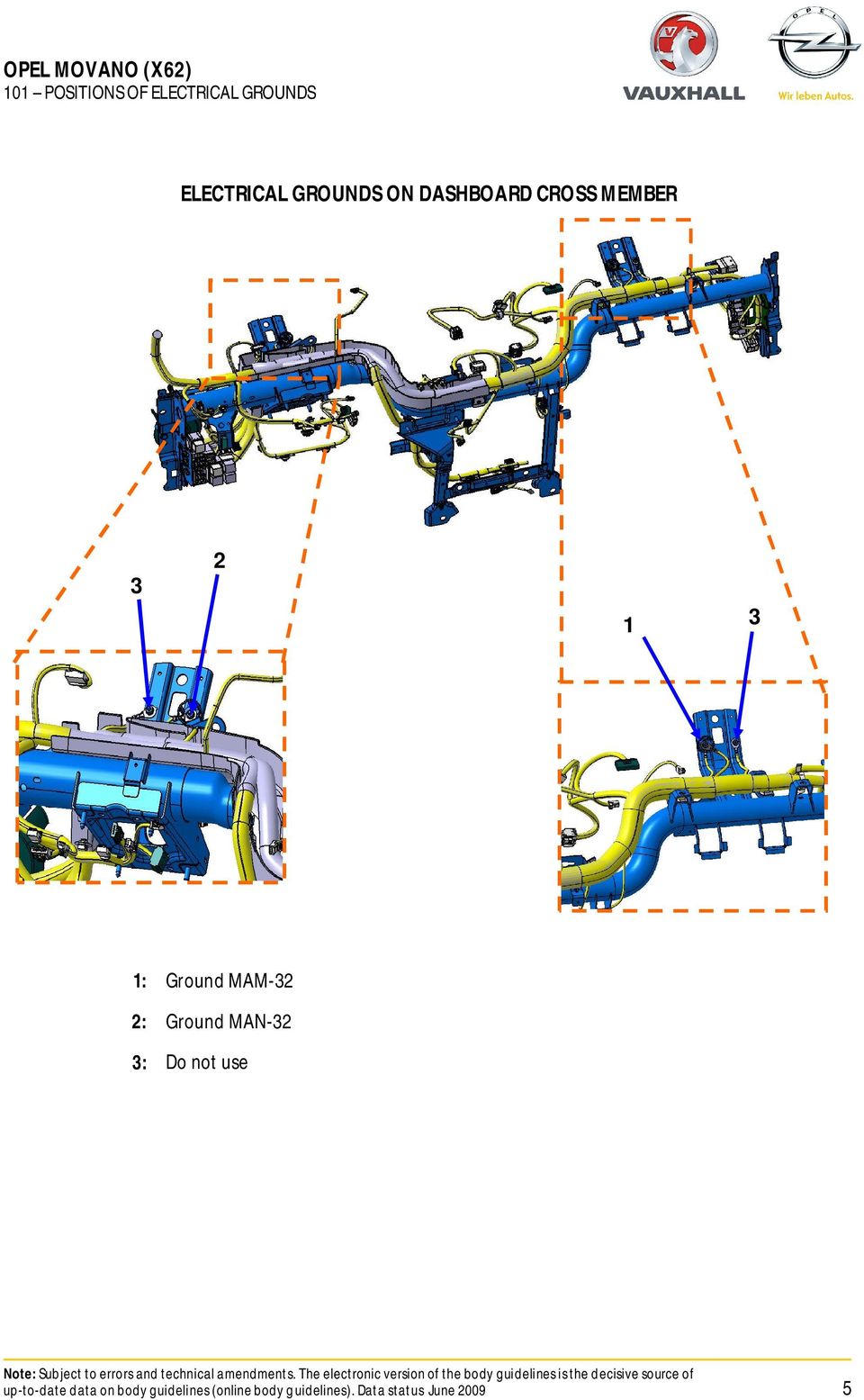
5 101 POSITIONS OF ELECTRICAL GROUNDS ELECTRICAL GROUNDS ON DASHBOARD CROSS MEMBER : Ground MAM-32 2: Ground MAN-32 3: Do not use up-to-date data on body guidelines (online body guidelines). Data status June
6 101 POSITIONS OF ELECTRICAL GROUNDS ELECTRICAL GROUNDS IN THE ENGINE COMPARTMENT : Ground MW-32 2: Ground MAJ-12 3: Ground MAS-32 4: Do not use up-to-date data on body guidelines (online body guidelines). Data status June

7 101 POSITIONS OF ELECTRICAL GROUNDS ELECTRICAL GROUNDS ON THE PANEL VAN EXTREME REAR PILLAR 1 2 1: Ground MGA-7 2: Do not use up-to-date data on body guidelines (online body guidelines). Data status June

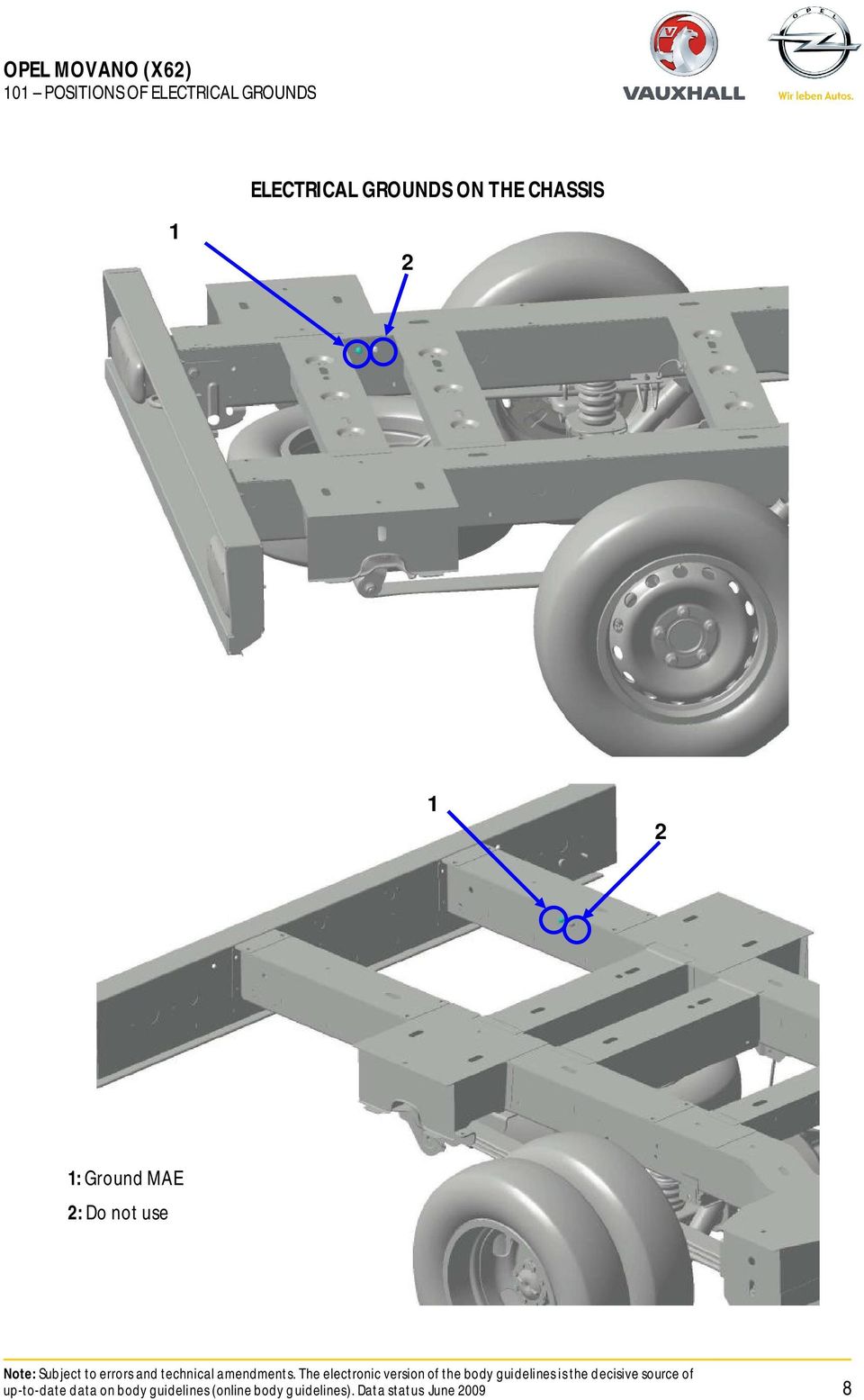
8 101 POSITIONS OF ELECTRICAL GROUNDS ELECTRICAL GROUNDS ON THE CHASSIS : Ground MAE 2: Do not use up-to-date data on body guidelines (online body guidelines). Data status June
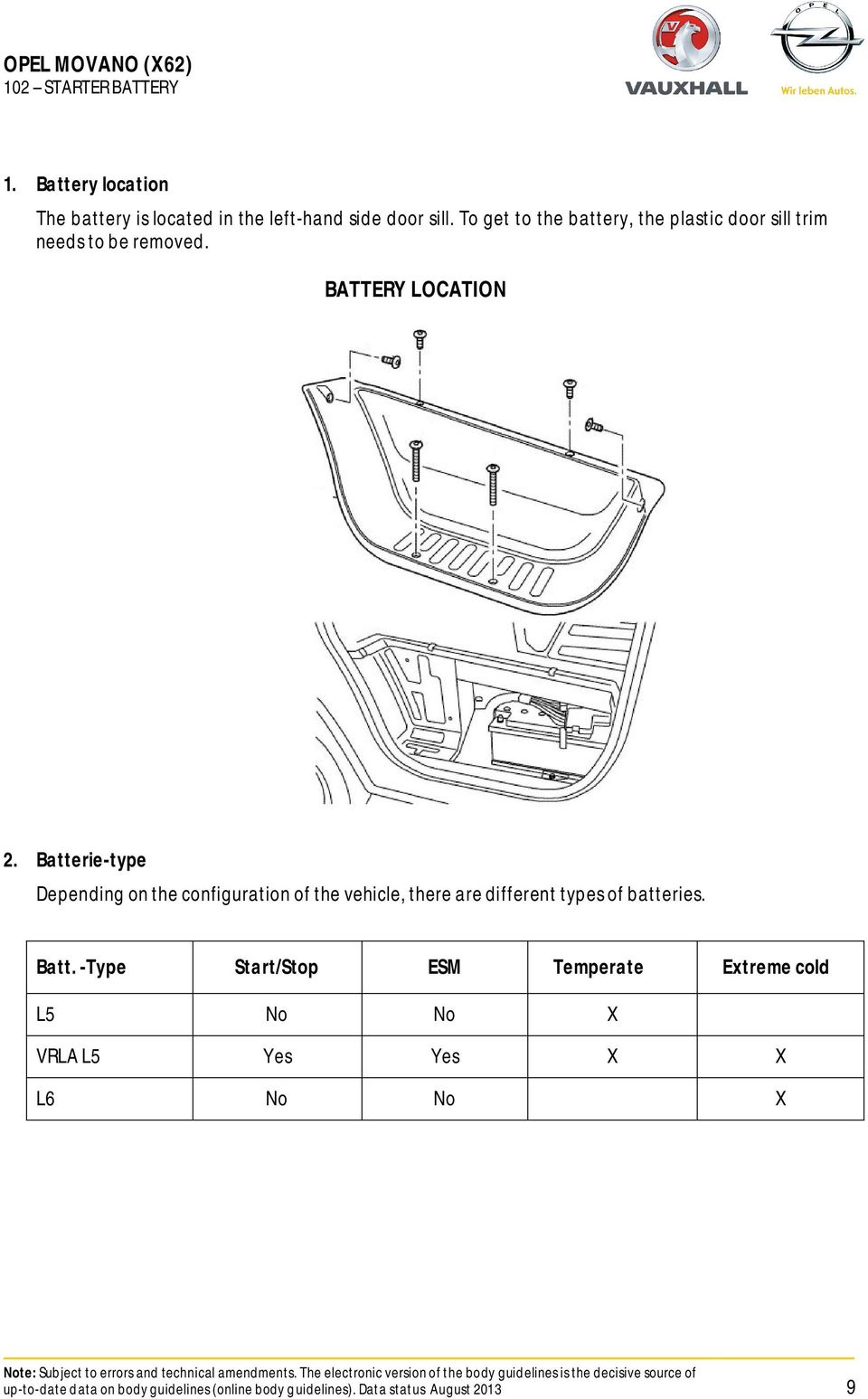
9 102 STARTER BATTERY 1. Battery location The battery is located in the left-hand side door sill. To get to the battery, the plastic door sill trim needs to be removed. BATTERY LOCATION 2. Batterie-type Depending on the configuration of the vehicle, there are different types of batteries. Batt. -Type Start/Stop ESM Temperate Extreme cold L5 No No X VRLA L5 Yes Yes X X L6 No No X up-to-date data on body guidelines (online body guidelines). Data status August
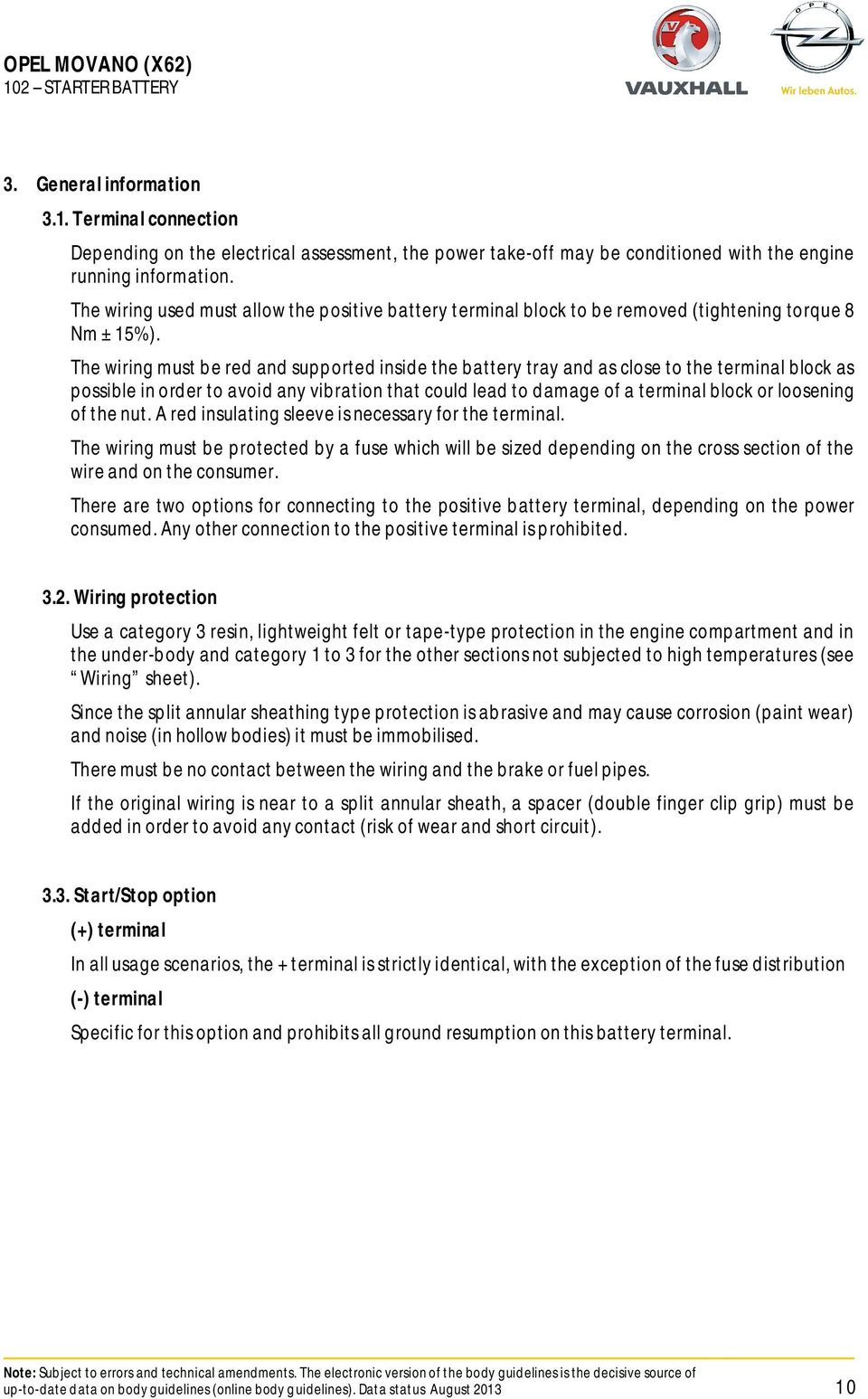
10 102 STARTER BATTERY 3. General information 3.1. Terminal connection Depending on the electrical assessment, the power take-off may be conditioned with the engine running information. The wiring used must allow the positive battery terminal block to be removed (tightening torque 8 Nm ± 15%). The wiring must be red and supported inside the battery tray and as close to the terminal block as possible in order to avoid any vibration that could lead to damage of a terminal block or loosening of the nut. A red insulating sleeve is necessary for the terminal. The wiring must be protected by a fuse which will be sized depending on the cross section of the wire and on the consumer. There are two options for connecting to the positive battery terminal, depending on the power consumed. Any other connection to the positive terminal is prohibited Wiring protection Use a category 3 resin, lightweight felt or tape-type protection in the engine compartment and in the under-body and category 1 to 3 for the other sections not subjected to high temperatures (see Wiring sheet). Since the split annular sheathing type protection is abrasive and may cause corrosion (paint wear) and noise (in hollow bodies) it must be immobilised. There must be no contact between the wiring and the brake or fuel pipes. If the original wiring is near to a split annular sheath, a spacer (double finger clip grip) must be added in order to avoid any contact (risk of wear and short circuit) Start/Stop option (+) terminal In all usage scenarios, the + terminal is strictly identical, with the exception of the fuse distribution (-) terminal Specific for this option and prohibits all ground resumption on this battery terminal. up-to-date data on body guidelines (online body guidelines). Data status August
11 102 STARTER BATTERY 4. Battery terminal types 4.1. Type 1 (first production vehicle) without Start/Stop 4.2. Typ 2 (CO2 step1) without Start/Stop 4.3. Typ 3 (CO2 step1) with Start/Stop up-to-date data on body guidelines (online body guidelines). Data status August

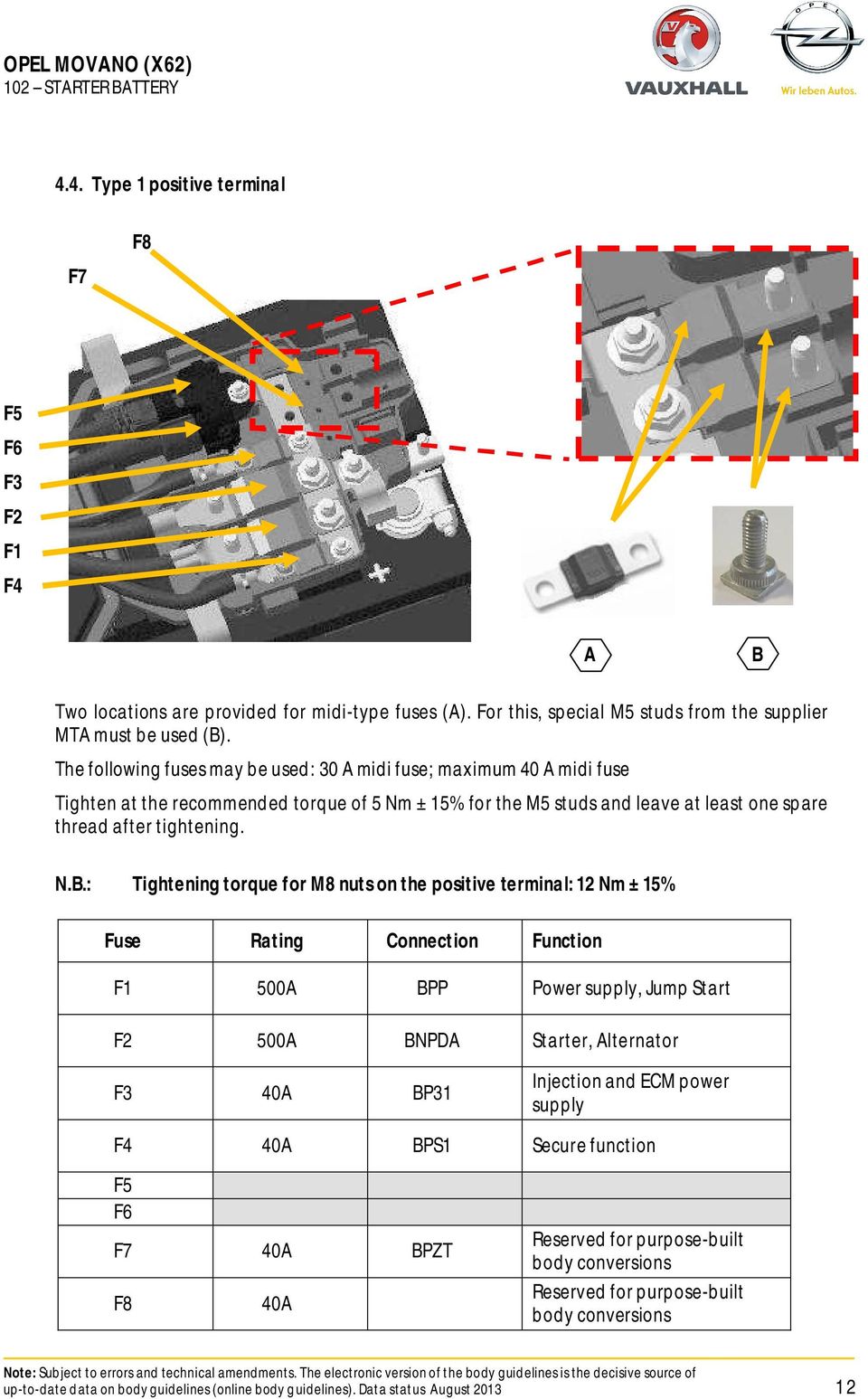
12 102 STARTER BATTERY 4.4. Type 1 positive terminal F7 F8 F5 F6 F3 F2 F1 F4 A B Two locations are provided for midi-type fuses (A). For this, special M5 studs from the supplier MTA must be used (B). The following fuses may be used: 30 A midi fuse; maximum 40 A midi fuse Tighten at the recommended torque of 5 Nm ± 15% for the M5 studs and leave at least one spare thread after tightening. N.B.: Tightening torque for M8 nuts on the positive terminal: 12 Nm ± 15% Fuse Rating Connection Function F1 500A BPP Power supply, Jump Start F2 500A BNPDA Starter, Alternator F3 40A BP31 Injection and ECM power supply F4 40A BPS1 Secure function F5 F6 F7 40A BPZT F8 40A Reserved for purpose-built body conversions Reserved for purpose-built body conversions up-to-date data on body guidelines (online body guidelines). Data status August
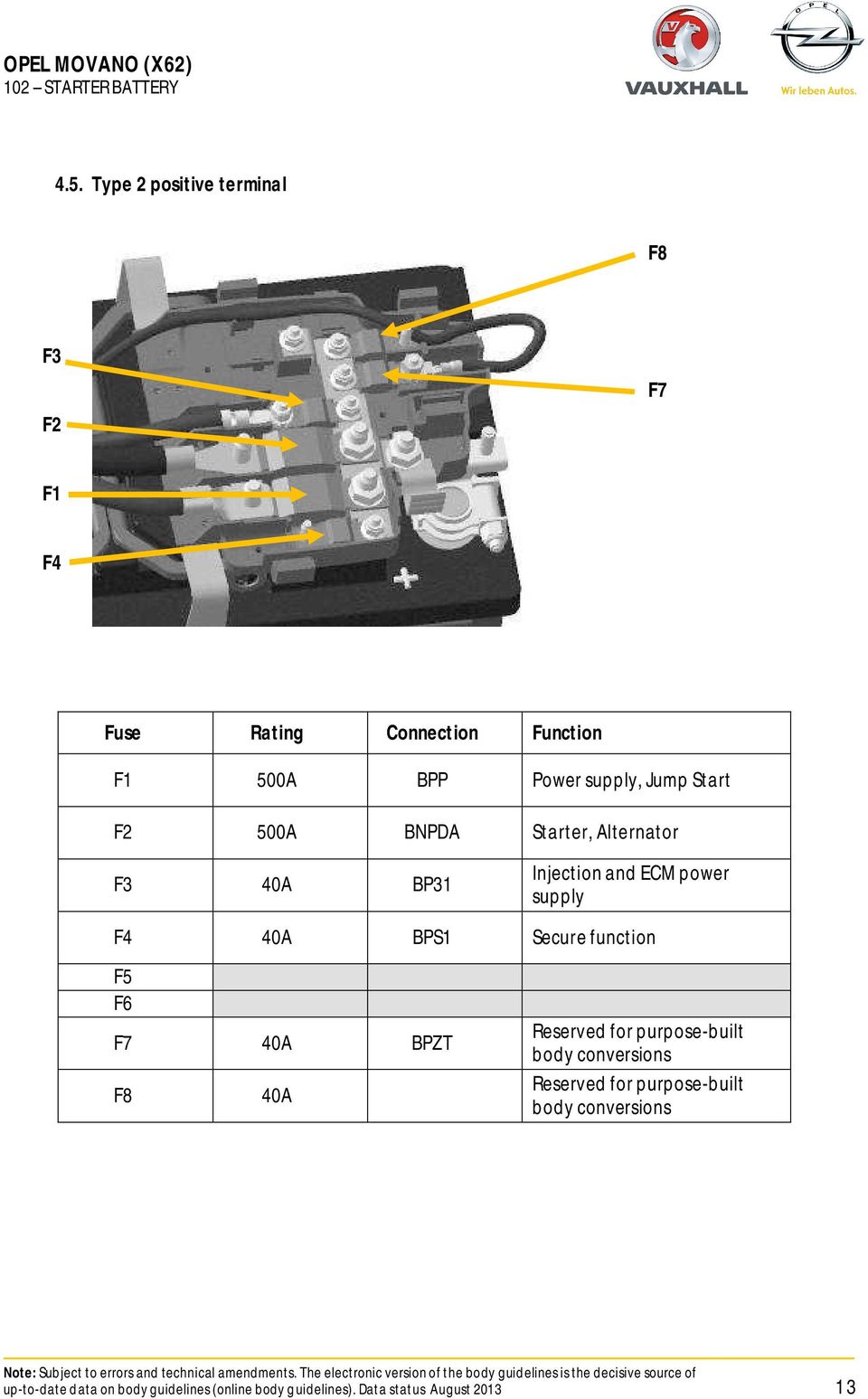
13 102 STARTER BATTERY 4.5. Type 2 positive terminal F8 F3 F7 F2 F1 F4 Fuse Rating Connection Function F1 500A BPP Power supply, Jump Start F2 500A BNPDA Starter, Alternator F3 40A BP31 Injection and ECM power supply F4 40A BPS1 Secure function F5 F6 F7 40A BPZT F8 40A Reserved for purpose-built body conversions Reserved for purpose-built body conversions up-to-date data on body guidelines (online body guidelines). Data status August
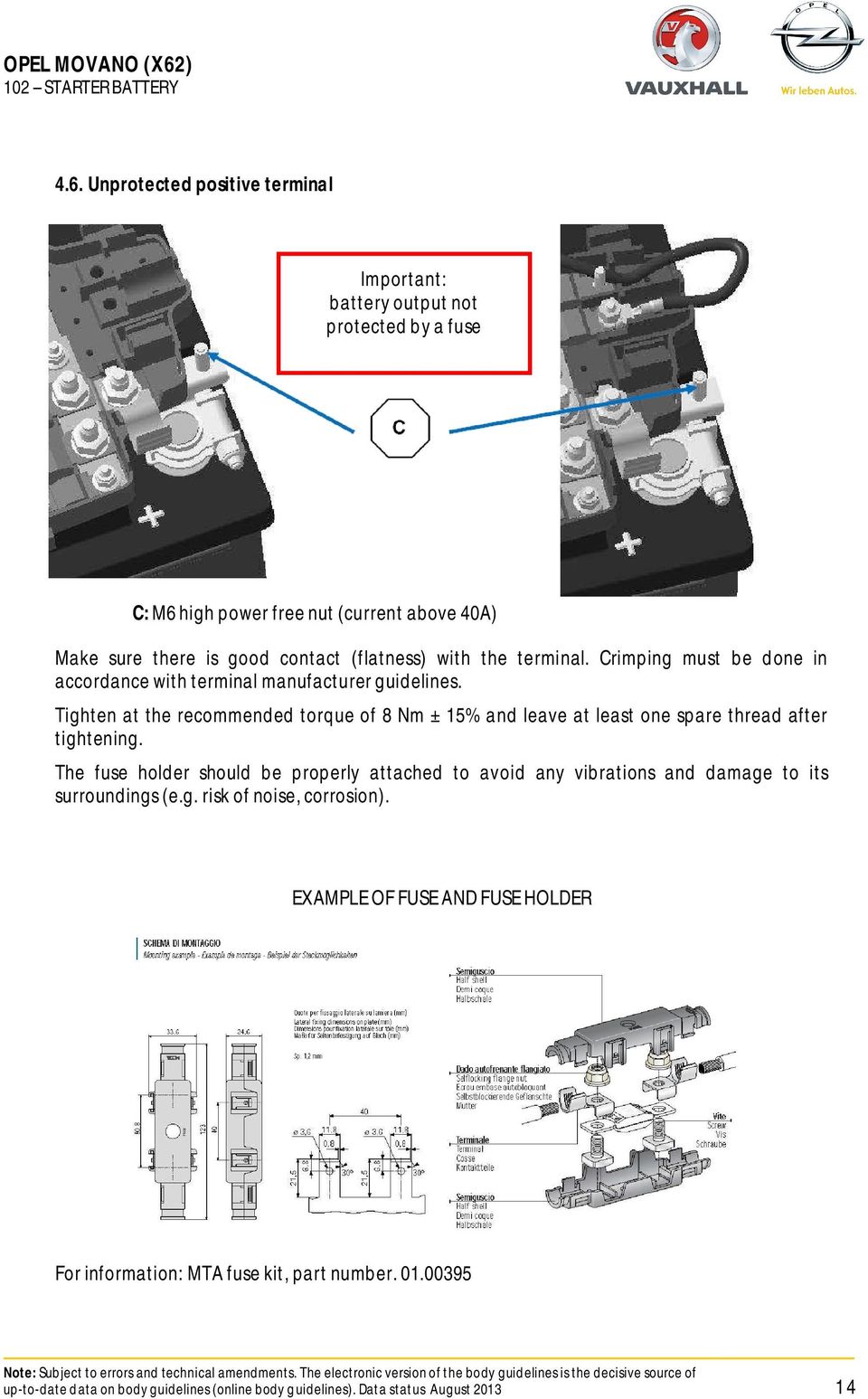
14 102 STARTER BATTERY 4.6. Unprotected positive terminal Important: battery output not protected by a fuse C: M6 high power free nut (current above 40A) Make sure there is good contact (flatness) with the terminal. Crimping must be done in accordance with terminal manufacturer guidelines. Tighten at the recommended torque of 8 Nm ± 15% and leave at least one spare thread after tightening. The fuse holder should be properly attached to avoid any vibrations and damage to its surroundings (e.g. risk of noise, corrosion). EXAMPLE OF FUSE AND FUSE HOLDER For information: MTA fuse kit, part number up-to-date data on body guidelines (online body guidelines). Data status August
15 102 STARTER BATTERY 4.7. Type 1 and 2 negative terminal, without Start/Stop The wiring used must allow the negative battery terminal block to be removed (tightening torque 8 Nm ± 15%). Leave threading of at least one thread free after tightening Type 3 negative terminal, with Start/Stop up-to-date data on body guidelines (online body guidelines). Data status August

16 103 ALTERNATOR OUTPUT Vehicles are available with two alternator power levels: 150A and 185A. These alternators are associated with their battery as described below: 150A alternator with a 95Ah battery. 185A alternator with a 110Ah battery. 1. Alternator usage examples 1.1. Alternator 150A As standard, only for front-wheel drive vehicles without the following options: BUS16P Heated rear screen Seat with heating Heated driver's seat Conversion unit Wiring for conversion Cabin thermal requirement Connection adapter 1.2. Alternator 185A As standard on rear-wheel drive vehicles and some front-wheel versions with the following options: BUS16P Heated rear screen Seat with heating Heated driver's seat Conversion unit Wiring for conversion Cabin thermal requirement Connection adapter N.B.: At after-sales, the 150 A alternator (KG4) can be replaced with a 185 A alternator (KW6). up-to-date data on body guidelines (online body guidelines). Data status August

17 103 ALTERNATOR OUTPUT 2. Alternator according to engine suffix: 2.1. Alternator with 150A Level Engine/suffix Emission control kw Gearbox D1 M9T / 870 Euro 5 74 PF6, BVM6 M9T / 876 Euro 4 92 PF6, BVM6 Front Wheel Drive D2 M9T / 870 Euro 5 92 PF6, BVM6 M9T / 870 Euro 5 92 PF6, BVR6 M9T / 876 Euro 3 92 PA0, BVM6 M9T / 880 Euro PF6, BVM6 D3 M9T / 880 Euro 5 D3 92 PF6, BVM6 M9T / 880 Euro PA0, BVR6 M9T / 880 Euro 5 D3 92 PA0, BVR Alternator with 185A Level D1 Engine/suffix Emission control Noncalibrated Noncalibrated kw Gearbox M9T /690 Euro 5 74 ZF4 M9T /692 Euro 4 74 ZF4 Rear Wheel Drive D2 M9T /690 Euro 5 92 ZF4 M9T /692 Euro 4 92 ZF4 M9T /686 Euro 4 92 ZF4 M9T /698 Euro 5 D3 92 ZF4 M9T /698 Euro ZF4 D3 M9T /694 Euro ZF4 M9T /696 Euro 5 D3 92 ZF4, BVR6 M9T /696 Euro ZF4, BVR6 BVM6 = 6-speed manual BVR6 = 6-speed robotised (MTA) up-to-date data on body guidelines (online body guidelines). Data status August

18 103 ALTERNATOR OUTPUT 3. Available current The tables below show the different electrical currents available (in amps) according to whether a 150A or 185A alternator is used Front-wheel drive vehicle 150A alternator Power train D1 / D2 D3 Version Without AC Without accelerated idle With accelerated idle (rpm) A 39 A 46 A 49 A 56 A AC 17 A 30 A 37 A 40 A 47 A Without AC 30 A 43 A 50 A 53 A 60 A AC 0 A 13 A 20 A 23 A 30 A 3.2. Front-wheel drive vehicle 185A alternator Power train D1 / D2 D3 Without AC AC Without AC AC Version Without accelerated idle With accelerated idle (rpm) DRL 32 A 46 A 57 A 61 A 68 A Without DRL 44 A 58 A 69 A 73 A 80 A DRL 29 A 43 A 54 A 58 A 65 A Without DRL 42 A 56 A 67 A 71 A 78 A DRL 42 A 56 A 67 A 71 A 78 A Without DRL 55 A 69 A 80 A 84 A 91 A DRL 9 A 23 A 34 A 38 A 45 A Without DRL 22 A 36 A 47 A 51 A 58 A DRL: AC: Daytime Running Lights (Automatic operation of lights) Air Conditioning Warning: The value given is the average value available when the engine is running and in the worst-case fuel consumption conditions. The electrical equipment added is given priority over the vehicle s basic additional electric heating (thermoplunger) and may thus jeopardise the vehicle s comfort level. Reminder: Any electrical equipment added must be fused. These fuses must have a value appropriate to the equipment s consumption and the cross section of the wiring. up-to-date data on body guidelines (online body guidelines). Data status August

19 103 ALTERNATOR OUTPUT 4. Power voltage management strategy Various alternator voltage variation management strategies are applied to ensure optimised fuel consumption. Floating management without Start/Stop. ESM with Start/Stop. Important: make sure there is voltage compatibility with the consumers added (including computers) make sure there is voltage compatibility with the coupling of additional batteries (see chapter 126 ADDITIONAL BATTERY) 4.1. On vehicles without Start/Stop The voltage of the electrical network fluctuates between 13.5V and 14.8V during the engine running phases. This voltage management can be inhibited in the Opel network via the clip case 4.2. On vehicles with Start/Stop Under normal conditions, the battery voltage can vary from 12V to 15.6V according to the vehicle battery's charge rate. During the deceleration phase, the voltage delivered by the alternator is 15V Voltage of computers with Start/Stop When the vehicle is started, the voltage can fall to 6.4V. Do not overlook this possibility when adding a computer or computers. BATTERY GAUGE Battery voltage with ESM 100% 91% 83% Deceleration 15V 15V 15V Idling 12V 12V 13,8 à 15,6V Standard voltage When not decelerating or idling 12V 13,8 à 15,6V Standard voltage 13,8 à 15,6V Standard voltage up-to-date data on body guidelines (online body guidelines). Data status August

20 104 2 PIN AND 6 PIN -CONNECTOR FOR CONVERSIONS, OPTION KPD This option is used to provide various electrical supply circuits including engine running information required for any added component using electrical power. This Option contains: One 6-way standby connector in the dashboard area and another in the right-side B pillar permitting the following access: - Information engine running - Activation of accelerated idle - Power supply + 12V offloaded current distribution One 2-way standby connector in the right-hand B pillar permitting the following access: - Power supply + 12V with max. intensity of 40A. 1. Dashboard area connector The 6-way connector is located on the left-hand side near to the panel feed-through ring, the passenger compartment fuse and relay box and the bonnet opening lever. The connector is in the same position for both left-hand and right-hand drive vehicles. It is secured on the dashboard wiring using a link. An excess length is provided for the connection. position of 6-way connector Passenger compartment relay and fuse box up-to-date data on body guidelines (online body guidelines). Data status August

21 104 2 PIN AND 6 PIN -CONNECTOR FOR CONVERSIONS, OPTION KPD ASSIGNMENT OF 6 WAY-CONNECTOR Way number Way 1 (3ADJ) Way 2 (BMT1) Way 3 (SBP4) Way 4 (MAN32) Way 5 Way 6 Assignment Accelerated idle control (wire cross section 0.5 mm²) Engine running information Shared 10 A fuse Power supply + 12 V offloaded current (wire cross section 1 mm²) distribution Ground (wire cross section 1.5 mm² large enough to adapt to the +12V offloaded current distribution) Reserve Reserve The counterpart to this connector is available from the Opel dealer network. CONNECTION KIT N.B.: The permanent accumulated currents of the following 2 ways must not exceed 8 A: - Way 2: "Running Engine" information - Way 3: + 12 V current distribution. (activated from the +ACC (+ accessory) position, 1st notch on the ignition key). These ways are protected by 10 A fuse F28 in the passenger compartment fuse and relay box (BFRH). For more power, ways 2 and 3 need to be relayed. When the engine is off, the energy management system can offload these functions to save enough battery power to start the vehicle. up-to-date data on body guidelines (online body guidelines). Data status August
22 104 2 PIN AND 6 PIN -CONNECTOR FOR CONVERSIONS, OPTION KPD Fuse position for 6-way connector Power fuse F28 is located in the passenger compartment relay/fuse box (see chapter 118). Fuse F28 (10 Ampere) Relay position for the Option KPD The relay box for the KPD option is located in the right-hand side of the dashboard : 20 A Relais + 12 V load shed current distribution power supply 2: 20 A Relais Engine running information 3: 20 A Relais Heated seat up-to-date data on body guidelines (online body guidelines). Data status August
23 104 2 PIN AND 6 PIN -CONNECTOR FOR CONVERSIONS, OPTION KPD 2. The 2 way-connector in the B pillar The connector is located in the right-hand B pillar behind the plastic trim. This connector is identical to that which is described in Chapter 106th for the WRF option. There also the access to the connectors on the B-pillar is described. The maximum permanent current of this power supply must not exceed 40 A. This line is protected by 50A fuse F6 in the engine compartment interconnections unit. Important: This power supply is connected directly to the battery. The vehicle is therefore not protected by the energy management system. Risk of battery draining. 2 1 Way number Way 1 (BP23) Way 2 (MAN32) Assignment +12 V direct battery power supply for maximum consumption of 40 A (wire cross section 7 mm²). 50 A fuse protection. Ground (wire cross section 7 mm² large enough to adapt to the current of the +12V battery). The counterpart to this connector is already fitted to the wiring but it is still necessary to obtain the contacts for this connector. Connector Wire cross section Supplier reference Supplier 3 to 6 mm² P TYCO to 10 mm² P TYCO up-to-date data on body guidelines (online body guidelines). Data status August
24 104 2 PIN AND 6 PIN -CONNECTOR FOR CONVERSIONS, OPTION KPD Location of the 2-way connector fuse For further information see sheet 117-Engine Compartment Interconnections Unit. Fuse F6 (50A) Location of grounds associated with the KPD option The grounds (MAN32-A and MAN32-B) for the 6-way and 2-way connectors are grouped together on a single stud on the right-hand support of the dashboard cross member. MAN32-A MAN32-B GROUNDS up-to-date data on body guidelines (online body guidelines). Data status August
25 104 2 PIN AND 6 PIN -CONNECTOR FOR CONVERSIONS, OPTION KPD 3. Activation of the accelerated idle To activate the accelerated idle speed, way 1 of the 6-way connector must be grounded. EXAMPLE OF CONNECTION (ACCESSORY CONTROL) A + 12V ACC C D E B A: +12 V accessory relay power supply B: Accessory control of the accelerated idle C: Way 1 of the 6-way connector D: Switch E: Relay with a freewheel diode N.B.: The following 20 A relay can be used: (Cartier supplier reference: ) up-to-date data on body guidelines (online body guidelines). Data status August
26 105 CAN BUS- INTERFACE MODULE, KC6 OPTION It is an option for Converters. There is a need for this option mainly on following conversions: Camping-cars, emergency cars, integrated equipments as workshop vans or (nacelle) cranes/aerial platforms, refrigerated or vending vans. The electronic box transforms the CAN information into many signals useful for equipments which needs this information to work in relation with the car status. The CAN-BUS Interfacemodul for Conversion is the only possibility for Converters to use the CAN information properly without interfering with the CAN system. The information read are, for example, vehicle speed, engine status, door status, instant fuel consumption, engine speed, warning signal activation, turn signal activation, etc.. The interface module is available as an option on all versions. This module can be used to recover certain information that is available on the multiplexed network. Attention Before working on the vehicle, refer to chapter 107 Electrical Connections. As all consumers are networked and internally monitored, no modifications should be made to the CAN bus (e.g. breaking, extending or tapping). Any modifications to the length, cross-section or resistance of the wiring harness can lead to failure of safety-relevant components or to impaired comfort. Tampering with and unauthorised installations can cause damage to the vehicle and invalidate the general operating permit. UNIT LOCATION Interface module Connection kit The CAN-BUS Interfacemodul is attached on the right-hand side of the central dashboard console for both left- and right-hand drive vehicles. up-to-date data on body guidelines (online body guidelines). Data status October
27 105 CAN BUS- INTERFACE MODULE, KC6 OPTION To recover the information from the interface module, the connection kit (part number ) needs to be obtained (harness length: 600 mm). CONNECTION KIT For left-hand drive, the connection requires the storage box to be removed. N.B.: To make sure that each wire in the connection kit is correctly assigned, it is advisable to check the electrical continuity of the wiring before connection. The unused wires should be insulated separately using a heat-shrinkable sleeve. General remarks: The KC6 (CAN-BUS Interfacemodul) allows use of the vehicle s electrical information to give correct functioning of conversion, without interfering with the CAN network and preserving the electrical network. The unit transmits the various types of information, as follows: 13 pieces of coded information in CAN format (BUS CAN2) Copying of 13 pieces of CAN vehicle information 8 pieces of binary information 2 pieces of analogue information up-to-date data on body guidelines (online body guidelines). Data status October
28 105 CAN BUS- INTERFACE MODULE, KC6 OPTION Attention: If the vehicle is equipped with a digital tachograph, then pin 12 and pin 24 is not available at the 24-Pin connector (of the CAN-BUS Interfacemodul). All others information are still available. Information available on the unit: Information on the BUS CAN2: Engine speed Driver decision Position of brakes Water temperature Engine turning Position of clutch Vehicle speed Left and right indicators Hazard lights Position of the ignition key Door information (state of openings) Central locking Fuel consumption Binary information: Position of brakes Engine turning Position of clutch Left and right indicators Hazard lights Position of the ignition key Door information Central locking Analogue information: Vehicle and engine speed up-to-date data on body guidelines (online body guidelines). Data status October
29 105 CAN BUS- INTERFACE MODULE, KC6 OPTION Description of unit input and output From these fields present at the entry to the CAN1, the unit can deliver 3 types of output data. 1) on the Bus CAN2 via 2 Fields: ADAP base 1 and ADAP base 2. 2) 8 binary outputs for relay controls 3) 2 PWM outputs (compatible with instrument panel): engine speed and vehicle speed Input signals CAN-H1 CAN-L1 +12V Batt. CAN - Bus «PWM» output Output signals CAN-H2 CAN-L2 Engine RPM out Vehicle speed K-line CAN Interface Binary outputo1 A293- Binary output no2 Binary output no3 Binary output no4 Binary output no5 Binary output no6 Binary Binary output no7 Binary output no8 outputs Binary output no9 Binary output no10 Binary output no11 Binary output no12 Binary output no13 1) CAN2 - bus ADAP field base 1 The CAN BUS Interface takes care of the velocity information of the vehicle's CAN, which means: kbds/s for Movano (X62) kbds/s for Vivaro (X83) The ID oft he CAN BUS Raster are: No Frame Name CAN Output frame information Frame ID (Hex) Period in ms Frame byte size 1 ADAP_Base1 0E ADAP_Base2 0E up-to-date data on body guidelines (online body guidelines). Data status October
30 105 CAN BUS- INTERFACE MODULE, KC6 OPTION Name of Field: ADAP Base 1 Name Size (bits) Engine RPM 16 Driver request 8 Engine coolant Temp 8 Fuel consumption 8 Vehicle speed 16 MSB position LSB position Resulting output data bits Byte no. 1 Bit no. 7 Byte no. 3 Bit no. 7 Byte no. 4 Bit no. 7 Byte no. 5 Bit no. 7 Byte no. 6 Bit no. 7 Byte no. 2 Bit no. 0 Byte no. 3 Bit no. 0 Byte no. 4 Bit no. 0 Byte no. 5 Bit no. 0 Byte no. 7 Bit no. 0 Exact duplicate of input bits Exact duplicate of input bits Exact duplicate of input bits Exact duplicate of input bits Exact duplicate of input bits ADAP field base 2 Name of Field: ADAP Base 2 Description Size (bits) Engine Status 1 Brake Switch Engine Control AC Compressor Authorized Clutch Switch 1 Door Switches 1 Ignition Switch 1 Doors Locked MSB position State of input data Resulting output data bits Byte no. 1 Bit no. 7 Byte no. 1 Bit no. 6 Byte no. 1 Bit no. 5 Byte no. 1 Bit no. 4 Byte no. 1 Bit no. 3 Byte no. 1 Bit no. 2 Octet Nº1 Bit Nº 1 00 Engine stopped 0 01 Engine stopped 0 10 Running engine 1 11 Engine stopped 0 00 Brake not activated 0 01 Brake activated 1 10 Reserved Leave output data in present state 11 Invalid Leave output data in present state Exact duplicate of input bit 00 Clutch not pressed (clutch let in) 0 01 Clutch pressed 1 10 Reserved Leave output data in present state 11 Invalid Leave output data in present state All 5 input bits = 0 0 Anyone of 5 input bits = 1 1 Duplicate MSB of two input bits Exact duplicate of input bit up-to-date data on body guidelines (online body guidelines). Data status October
31 105 CAN BUS- INTERFACE MODULE, KC6 OPTION Name of Field: ADAP Base 2 Description Flashing Indicators (right/ left ) Size (bits) Hazard Light 1 ****fixed to zero**** 7 1 MSB position State of input data Resulting output data bits Byte no. 1 Bit no. 0 Byte no. 2 Bit no. 7 Byte no. 1 Bit no Flashing indicators and hazard lights OFF 01 Flashing indicator ON and hazard lights OFF 10 Flashing indicator ON and hazard lights OFF 11 Hazard lights ON and flashing indicator OFF 00 Flashing indicators and hazard lights OFF 01 Flashing indicator ON and hazard lights OFF 10 Flashing indicator ON and hazard lights OFF 11 Hazard lights ON and flashing indicator OFF LSB Octet Nº2 - Bit Nº 0 **** fixed to zero **** ) Binary outputs (for relay controls) These 8 outputs comply with specification UNI-B (45 ma, 10.5 at 16V) CONFIGURATION OF OUTPUT DATA Binary Output Brake switch - engine control Engine status Clutch switch Flashing indicators Hazard lights Ignition switch Door switches Doors locked N.B. The max. current in unit output = 200mA up-to-date data on body guidelines (online body guidelines). Data status October
32 105 CAN BUS- INTERFACE MODULE, KC6 OPTION GENERIC DIAGRAM OF RELAY CONTROL BY BINARY OUTPUT D B F A C E B A: CAN-BUS Interfacemodul B: Dry contact output for information recovery C: Binary output to be relayed on the Complementary Adaptations Unit. D: The relay s power supply must not be taken directly from the + battery. E: Maximum current of 200 ma F: Relay For example, the following relays may be used: 40 Ampere relay, CARTIER reference = Ampere relay, CARTIER reference = N.B.: It is vital that these relays be fitted with a freewheel diode. 3) Analogue outputs (PWM) These 2 outputs comply with Opel specification UNI-B (45 ma, 10.5 at 16V) up-to-date data on body guidelines (online body guidelines). Data status October
33 105 CAN BUS- INTERFACE MODULE, KC6 OPTION 8-WAY CONNECTOR Pin Track No Type of output Binary 2 Binary 1 Analogue Analogue Binary 11 Binary 13 Binary 8 Binary 7 Binary 6 Binary 5 Binary 12 CAN L Binary 3 Binary 4 Binary 9 Binary 10 CAN H 24-WAY CONNECTOR Description Description (+) Battery K line CAN L1 CAN H1 Ground Ground Ground Ground Brake position Air conditioning operation authorisation Vehicle speed Engine speed Doors information Ignition key position Hazard flashers Flashing indicators CAN L2 Engine running Clutch position Central locking Spare Spare Spare Spare Spare Spare Spare CAN H2 up-to-date data on body guidelines (online body guidelines). Data status October
34 105 CAN BUS- INTERFACE MODULE, KC6 OPTION Dimension: up-to-date data on body guidelines (online body guidelines). Data status October
35 106 CELL WIRING CONNECTION OPTION WRF Before working on the vehicle, refer to the chapter 107 Electrical Connections. This option WRF, which is available for the chassis cab and the platform cab, provides 2 stand-by connectors in the right-hand B pillar behind the plastic trim. These connectors provide engine running information, can be used to recreate the electrical functions of the van in a separate cell and provide power supplies. LOCATION 2-way connector 16-way connector up-to-date data on body guidelines (online body guidelines). Data status September
36 106 CELL WIRING CONNECTION OPTION WRF 2-WAY CONECTOR This connector is strictly identical to the one described in technical data chapter 104-Connector for the KPD option adaptation. The maximum permanent current of this power supply must not exceed 40A. This line is protected by 50A fuse F6 in the engine interconnections unit. ASSIGNMENT OF 2-WAY CONNECTOR WAYS Way number Way 1 (BP23) Way 2 (MAN32) Assignment +12 V direct battery power supply for maximum consumption of 40 A (wire cross section 7 mm²). 50 A fuse protection. Ground (wire cross section 7 mm² large enough to adapt to the current of the +12 V battery). Important: This power supply is connected directly to the battery. The vehicle is therefore not protected by the energy management system. Risk of battery draining. The counterpart to this connector is already fitted to the wiring but it is still necessary to obtain the contacts for this connector. Connector Wire cross section Contact part number Supplier reference Supplier to 6 mm² P TYCO 7 to 10 mm² P TYCO up-to-date data on body guidelines (online body guidelines). Data status September
37 106 CELL WIRING CONNECTION OPTION WRF Location of the 2-way connector fuse for the WRF option For further information see chapter Engine Interconnections Unit. Fuse(F6) 50A MAX FUSE up-to-date data on body guidelines (online body guidelines). Data status September
38 106 CELL WIRING CONNECTION OPTION WRF 16-WAY CONNECTOR ASSIGNMENT OF 16-WAY CONNECTOR N.B.: The width of the contact for ways 1, 8, 9 and 16 is 2.8 mm; the width for the other ways is 1.5 mm. Way number Way 1 (20BK) Way 2 (87T) Way 3 (BPT2) Way 4 (LPG) Way 5 (34D) Way 6 (34B) Way 7 (BMT1) Way 8 (SBP4) Way 9 (142K) Way 10 (65A) Way 11 (13M) Way 12 (LPD) Way 13 (34C) Way 14 (34A) Way 15 Way 16 (20W) Assignment Analogue door closing control signal (wire cross section 2 mm²) Logical boot lock switch information signal (wire cross section 0.35 mm²) Delayed +12 V 2 A power supply for courtesy lights, controlled by the passenger compartment ECU (UCH) (wire cross section 0.5 mm²) 3 A left-hand side light power supply (wire cross section 0.5 mm²) + right-hand rear speaker (wire cross section 1 mm²) - left-hand rear speaker (wire cross section 1 mm²) Engine running information, 10 A fuse shared by ways 7 and 8 (wire cross section 1.5 mm²) +12 V offloaded current distribution power supply, 10 A fuse shared by ways 7 and 8 (wire cross section 1.5 mm²) Analogue door closing control signal (wire cross section 2 mm²) 5 A 3 rd brake light power supply (wire cross section 0.5 mm²) Progressive ground for 2 A courtesy lights, controlled by the passenger compartment ECU (UCH) (wire cross section 0.35 mm²) 3 A right-hand side light power supply (wire cross section 0.5 mm²) - right-hand rear speaker (wire cross section 1 mm²) + left-hand rear speaker (wire cross section 1 mm²) Reserve Analogue door super lock signal (wire cross section 2 mm²) up-to-date data on body guidelines (online body guidelines). Data status September
39 106 CELL WIRING CONNECTION OPTION WRF Important: The signals for ways 1, 2, 9 and 16 can only be used to control standard locking (panel van locks) and are only suitable for 3 locks. For any other use, a relay has to be used. For ways 11 and 13, if a relay is used, a panel switch should be added to replace the 13M link. (See courtesy light sheet). Ways 7 and 8 are protected by a single 10 A fuse (F28). The accumulated currents of the 2 lines must not exceed 8 A. Above 8 A, a relay has to be used. When the engine is off, the energy management system can offload these functions to save enough battery power to start the vehicle. The counterpart to this connector is already fitted to the wiring but it is still necessary to obtain the contacts for this connector. Connector Wire cross section Contact part number Supplier reference Supplier 1,5 : 0.35 to 0.75 mm² CL2S1160 FCI 1,5 : 1 to 2 mm² CL2S2160 FCI ,8 : 0.35 to 0.75 mm² CL3S1160 FCI 2,8 : 1 to 2.5 mm² CL3S2160 FCI 2,8 : 2.5 to 5 mm² CL3S3120 FCI up-to-date data on body guidelines (online body guidelines). Data status September
40 106 CELL WIRING CONNECTION OPTION WRF Locally remove the door entry seal on the "B" pillar side. Lever with a flat tool to unhook the lower section of the trim Retrieve the connector from the joint check that the clips on the interior trim are in place. If necessary, put the clip back into its housing before reassembly. Before final reassembly of the trim and the door seal, up-to-date data on body guidelines (online body guidelines). Data status September
41 107 ELECTRICAL CONNECTIONS 1. General Overview Before carrying out any operations, it is imperative that the battery s negative terminal be disconnected. The negative terminal should only be reconnected after ensuring that all the disconnected elements have been reconnected (especially the steering wheel controls). As the vehicle is multiplexed, any change to the wiring may cause the vehicle to malfunction or to break down. It is therefore strongly advised not to make any changes to the original wiring. Modification of the CAN network wiring is prohibited. If any devices are added, the power consumption requirements must be compared with the authorised values given in the table in the Available currents sheet. Use of electrical options, such as KC6, KPD and KC5, is recommended. Please see the corresponding sheets. The rating of a fuse is a wiring protection value and not an available energy value. It is therefore forbidden to change the fuse ratings. The covering protecting the wires must be preserved and maintain its effectiveness after modification. The electricity pages of the General Technical Conversion Guide must also be consulted before any modifications are made to the vehicle. Failure to follow these recommendations will invalidate the manufacturer s warranty. 2. Electrical power Any electrical power greater than 10 Ah sampled on the main vehicle battery must be sampled with the engine running (unless there is a multi-battery with coupling device architecture). With the engine off, up to 10 Ah may be sampled on the main battery, e.g. 20 A for 30 minutes, 5 A for 2 hours, etc. Comment: The vehicle has an energy management system that alerts the driver if the battery load reaches an abnormal level. Any electrical sampling that is too big with the engine running is likely to result in misunderstandings and customer complaints (Alert message repeatedly displayed on the dashboard). Any electrical power sampled on the vehicle battery must be sampled on the battery terminal block. Please refer to the Connection to battery terminal sheets. All power supplies must be fused. up-to-date data on body guidelines (online body guidelines). Data status June
42 107 ELECTRICAL CONNECTIONS 3. Anti-lock braking system (ABS) Under no circumstances may a power cable be fitted less than 100 mm from any component of the ABS system (ABS unit, ECU, wiring and sensors). In addition, for the anti-lock braking system (ABS) to function correctly, notwithstanding any specific agreement, we advise against servicing the brake contactor on the pedal assembly. The ABS wiring may not be extended. 4. Alternator The connection of the alternator to the vehicle s electrical systems is multiplexed. Any servicing of electrical connections on the alternator will lead to malfunction of the alternator and/or an electronic ECU, which may result in the destruction of these systems and/or cause the vehicle to break down. As a result, any connection on the alternator is prohibited. The alternator communicates with the vehicle s electronic ECUs. Therefore, the alternator cannot be changed unless it is changed for an alternator that is exactly the same as the original. Failure to follow this rule will lead to malfunction of the alternator and/or an electronic ECU, which may result in the destruction of these systems and/or cause the vehicle to break down. up-to-date data on body guidelines (online body guidelines). Data status June
43 V CURRENT DISTRIBUTION Before working on the vehicle, refer to chapter 107 Electrical Connections. The +12 V current distribution power supply is a power supply that can be temporarily unavailable to save the battery. An energy management system constantly checks the battery charge status. Connecting electrical accessories while the engine is off will discharge the battery. Do not exceed the maximum power consumption. Electrical accessories that are connected must comply with the electromagnetic compatibility requirements laid down in DIN VDE This +12 V current distribution power supply is available on the connectors of the KPD and KC5 options but also through the accessory sockets. Please refer to the sheets dealing with the KPD and KC5 options for further information. A +12 V current distribution fused power supply can be obtained by using the accessory sockets (or cigar lighter). Two accessory sockets are available on the dashboard. - Upper accessory socket (10 A fuse F2 and F3 in the passenger compartment fuse and relay box), - Lower accessory socket (10 A fuse F4 in the passenger compartment fuse and relay box), Depending on the version and options, an accessory socket is possible in the panel van s loading area. The socket is located on the left-hand extreme rear pillar. - Rear accessory socket (10 A fuse F4 in the passenger compartment fuse and relay box), Important: This +12 V current distribution supply is temporarily cut off when the starter motor is activated. Do not connect any current-delivering accessories, e.g. electrical charging devices or batteries. up-to-date data on body guidelines (online body guidelines). Data status June
44 V CURRENT DISTRIBUTION LOCATION OF ACCESSORY SOCKETS ON THE DASHBOARD LOCATION OF ACCESSORY SOCKETS ON THE LOAD COMPARTMENT up-to-date data on body guidelines (online body guidelines). Data status June
45 110 ENGINE RUNNING INFORMATION Before working on the vehicle, refer to chapter 107 Electrical Connections. In the event of a lot of electrical power being taken, the electrical assessment may have an adverse effect on the battery charge. The power take-off therefore needs to be conditioned with the engine running information. This information can be accessed inside the vehicle in four different ways depending on the vehicle s equipment level: - for all vehicles using a specific electrical wire, - with the KPD option (adaptation connector) - see corresponding sheet. - with the KC5 option (cell connector adaptation) - see corresponding sheet. - with the KC6 option (conversion unit) - see corresponding sheet. A violet 0.5 mm² idle cable is located underneath the dashboard and can be used to recover the engine running information. This cable can be found behind the passenger compartment fuse and relay box in the KPD connector location. This cable is directly connected to the engine ECU. When the engine is running, it is connected to the ground but otherwise the circuit is open. Care therefore needs to be taken when connecting this cable: - Follow the wiring instructions in the General Technical Conversion Guide. - Never connect a consumer or relay greater than 400 ma to this cable. - Use a relay with a free wheel diode to control the system that has been added. CONNECTION DIAGRAM A +12 V D C B 1 3 A: +12 V circuit distribution power supply B: Engine running information available on the idle cable (connection 48D) C: Additional equipment D: Relay with a free wheel diode E: +12 V battery power supply +12 V E up-to-date data on body guidelines (online body guidelines). Data status June
46 111 ACCELERATED IDLE, UF3 OPTION The accelerated idle function is used to increase the vehicle s idle speed to give more power and/or electrical energy. The standard vehicle idle is 800 rpm. The accelerated idle s default value is 1,000 rpm. This value may be set to between 1,000 and 2,000 rpm in 100 rpm increments. This is done using the Clip diagnostics tool in the Opel dealer network. For an idle value between 1,000 and 1,300 rpm, the vehicle can be running (except for vehicles with a robotized gearbox in which case the vehicle must be stopped). Above this, the vehicle must be stopped. It is also possible to have the accelerated idle function with the KPD option. Please refer to the relevant sheet. N.B.: The accelerated idle function is not possible on a vehicle that does not have the UF3 option or the KPD option. 1. Operation and safety The driver controls operation of the accelerated idle by pressing a button on the dashboard. The accelerated idle is activated approximately 4 seconds after engine start-up, even if the button is on when the engine is started. The function is deactivated if the water temperature warning light or any other warning light highlighting an engine risk comes on. For vehicles with a mechanical gearbox: - Deactivation possible at a vehicle speed of between 0 and 30 km/h (idle between 1,000 and 1,300 rpm). - Deactivation possible at zero vehicle speed (idle greater than 1,300 rpm). - Disengaging the clutch deactivates the accelerated idle. - Above an idle speed of 1,300 rpm, pressing the accelerator pedal deactivates the accelerated idle. For vehicles with a robotized gearbox: - Activation in neutral gear. - Pressing the accelerator pedal deactivates the accelerated idle. - Deactivation for any speed above zero. up-to-date data on body guidelines (online body guidelines). Data status June
47 112 PARKING BRAKE INFORMATION Before working on the vehicle, refer to chapter 107 Electrical Connections. The parking brake information is grounded when the brake is applied. This connection can be accessed on the handbrake. HANDBRAKE 1 1: Handbrake 2: Handbrake cable 3: Handbrake cable (disconnected) up-to-date data on body guidelines (online body guidelines). Data status June
48 112 PARKING BRAKE INFORMATION To recover this information, it must be sent using a relay with a free wheel diode. For example, the following OPEL parts may be used: 40 Amp relay, Cartier Reference: Amp relay, Cartier Reference: CONNECTION DIAGRAM +ACC B A B A: Handbrake information B: Dry contact to recover handbrake information +ACC: accessory power supply, 1 st notch on the ignition key Important: The relay s power supply must not be taken directly from the battery +terminal. up-to-date data on body guidelines (online body guidelines). Data status June
49 113 WIRING INSTALLATION Before working on the vehicle, refer to chapter 107 Electrical Connections. PANEL VAN WIRING LOCATIONS up-to-date data on body guidelines (online body guidelines). Data status June
50 113 WIRING INSTALLATION CHASSIS CAB WIRING LOCATIONS N.B.: N DESCRIPTION 1 Front bumper wiring 2 Door sill light wiring 3 Engine wiring 4 Dashboard wiring 5 Multimedia wiring 6 Front door, sliding door wiring 7 Additional side light wiring 8 Rear pad wear indicator wiring 9 Right and left-hand side swing door wiring 10 Coupling and bumper wiring 11 Under-body wiring 12 Rear wiring 13 Front pad wear indicator wiring Wiring locations for platform cabs are similar to those for chassis cabs. up-to-date data on body guidelines (online body guidelines). Data status June
51 114 ABS WIRING INSTALLATION Additional power cables may not be installed less than 100 mm from any ABS system components (ECU, wiring and sensors), electronic units or ECUs. ROUTING OF WIRING AND BRAKE PIPES (wiring in green, pipes and others in blue) : Central and rear section ABS wiring (in green) 2: Front section ABS wiring (in green) 3: ABS unit and ECU 4: ABS sensors N.B.: Modifications are not permitted to ABS wiring. For more information, see also Chapter 69. up-to-date data on body guidelines (online body guidelines). Data status June
52 115 INSTALLATION OF ELECTRICAL COMPONENTS N DESCRIPTION 1 BFRH (passenger compartment fuse-relay box) 2 BIM (engine interconnections unit) 3 Thermoplunger unit USM (Undercoat Switching Module) 4 Control unit: voltage power supply control 5 Injection computer 6 (option) BVR ECU (robotised gearbox) Front wheel drive 7 ABS/ESP hydraulic unit 8 (option) BVR ECU (robotised gearbox) Rear wheel drive 9 Airbag detection unit 10 (option) Parking assistance computer 11 (bus option) BFRH (passenger compartment fuse-relay box) 12 (option) KC6 (Conversion Unit) 13 UCH (Passenger Compartment Unit) up-to-date data on body guidelines (online body guidelines). Data status June
53 117 ENGINE INTERCONNECTIONS UNIT (BIM) The engine interconnections unit can be found to the left of the engine compartment in front of the shock absorber mounting. This unit contains the power supply fuse board and the protection and switching unit (UPC). LOCATION OF UNIT IN THE ENGINE COMPARTMENT Connections unit cover 2. Protection and switching unit 3. Engine interconnections unit (BIM) up-to-date data on body guidelines (online body guidelines). Data status August
54 117 ENGINE INTERCONNECTIONS UNIT (BIM) 1. BIM unit fuses and relays B A E C D up-to-date data on body guidelines (online body guidelines). Data status August
55 117 ENGINE INTERCONNECTIONS UNIT (BIM) 2.1 Power supply fuse board 1 A F7 F8 F9 F5 F6 F4 F4 F3 Fuse Type Rating Function F1 F2 F3 (Rg) Maxi 50A BUS F4 (Og) Maxi 40A ABS ECU F5 (Rg) Maxi 50A Additional heating relay 1 F6 (Rg) Maxi 50A Purpose-built body conversion / BUS F7 (Mn) Maxi 70A Additional heating relay 2 F8 (Mn) Maxi 70A F9 (Mn) Maxi 70A Rear lights, passenger compartment relay/fuse box, diesel heating resistor, heated rear screen, PTO Passenger compartment relay/fuse box up-to-date data on body guidelines (online body guidelines). Data status August
56 117 ENGINE INTERCONNECTIONS UNIT (BIM) 2.2 Engine fuse box B F5 F6 F7 F8 F1 F2 F4 F3 Fuse Type Rating Function F1 (Bg) Mini 25A UCE Einspritzung F2 (Bu) Mini 15A F3 (Mn) Mini 7,5A F4 (Mn) Mini 7,5A F5 (Bg) Mini 25A F6 (Bg) Mini 25A F7 (Mn) Mini 5A Current sensor F7 (Bg) Mini 25A Cylinder sensor 746-Flowmeter actuator 1105-EGR bypass solenoid valve 1301-Injection air flowmeter 799-Injection cut-out solenoid valve 1890-Exhaust injection solenoid valve 1750-Upstream UEGO sensor 1587-Turbo control solenoid valve 1475-Turbo water pump 369-EGR water pump nd EGR water pump on D32124 Gearbox ECU(RWL/M67), 2 power relays unit(rwl/m67/without KL9) Gearbox ECU (RWL/M67/without KL9) Gearbox ECU (RWL/M67/without KL9) Gearbox ECU (RWL/M67/without KL9) Gearbox ECU (RWL/M67/without KL9) F8 (Mn) Mini 5A Voltage reader up-to-date data on body guidelines (online body guidelines). Data status August
57 117 ENGINE INTERCONNECTIONS UNIT (BIM) 2.3 Relay unit C R2 R4 R5 R6 R7 R1 R3 Relay Type Rating Function R1 (Rs) 336AA 40A R2 (Rs) 762AA 40A R3 (Rs) R4 (Nr) 983AA 335AA 40A R5 (Nr) 337AA 70A R6 (Rs) 234AA 40A R7 (Mr) 783AA 20A 70A Motor fan 1 FWD, RWL Motor fan 2 FWD, RWL/C61, RWL/CA/KL9 Gearbox pump assembly FWD /M67/without KL9 Injection ECU power supply Motor fan 3 FWD Motor fan 4 FWD/CA, C61/702,880 Robotised gearbox reversing lights M67/without KL9 up-to-date data on body guidelines (online body guidelines). Data status August
58 117 ENGINE INTERCONNECTIONS UNIT (BIM) 2.4 Power supply fuse board 2 D F10 F11 F12 F13 F14 F15 F16 F17 Fuse Type Rating Function F10 (Rg) Maxi 50A F10 (Og) Maxi 40A F11 (Og) Maxi 40A F11 (Rg) Maxi 50A F11 (Bu) Maxi 60A Motor fan relay 3, motor fan relays FWD/CA,C61/702,880 Motor fan relay 3, motor fan relays FWD/CA,C61/870,872,876 FWD /C41/702,880 Motor fan speed relays 1 & 2 FWD/CA, C61/870, 872,876, FWD/C41/702,880 Motor fan speed relays 1 & 2 FWD/CA, C61/702,880, RWL/CA, CAEREG Motor fan speed relays 1 & 2 FWD/CHAUF/870,872,876 F12 (Bu) Maxi 60A Water heater interface unit F13 (Bu) Maxi 60A Water heater interface unit F14 (Je) Maxi 70A Diesel spark plug relay unit F15 (Bu) Maxi 60A USM power supply 2010 F16 (Bu) Maxi 60A USM power supply 2010 F17 (Og) Maxi 40A F17 (RG) Maxi 50A Gearbox pump assembly relay FWD/M67/without KL9 Fuse box 2 RWL/M67/without KL9 up-to-date data on body guidelines (online body guidelines). Data status August
59 117 ENGINE INTERCONNECTIONS UNIT (BIM) channel BUS passenger compartment fuse box F6 F7 E R1 F1 F2 F3 F4 F5 Fuse Type Rating Function F1 (Je) Mini 5A Lighting control relay power supply Front and rear central lights F2 (Je) Mini 5A Lighting relay power supply Individual lighting F3 (Bu) Mini 15A 1155 relay power supply (70A + timed load shed accessory relay) F4 (Bg) Mini 25A 1760 relay power supply (70A + BCM battery relay) F5 (Rg) Mini 10A Multimedia display power supply F6 (Rg) Mini 5A Door sill electronic control unit power supply F7 F8 Relay Type Rating Function R1 (Mr) 1683AA 20A up-to-date data on body guidelines (online body guidelines). Data status August
60 117 ENGINE INTERCONNECTIONS UNIT (BIM) 3. Protection and Switching Unit (USM-2010) Warning : These indications are given for information purposes only. Changing a fuse or connecting electrically to a UPC connection is prohibited. F7 F8 F9 F6 F5 F4 F13 F14 F15 F3 F2 F1 F10 F11 F12 up-to-date data on body guidelines (online body guidelines). Data status August
61 117 ENGINE INTERCONNECTIONS UNIT (BIM) Fuse Type Rating Function F1 (Vr) Mini 30A Windscreen wiper F2 (Bg) Mini 25A ABS- power supply F3 F4 (Mn) Maxi 5A Airbag PIS F5 (Mn) Maxi 7,5A F6 F7 (Mn) Maxi 5A Gearbox PIS F8 Passenger compartment PIS (primary ignition supply) F9 (Rg) Mini 10A Air conditioning (compressor) F10 (Je) Mini 20A Fuel pump power supply F11 F12 (Rg) Mini 10A Rear running lights PIS F13 (Mn) Maxi 5A F14 (Je) Mini 20A F15 (Vr) Mini 30A Starter control ECM PIS (injection ECU, heater relay, PTO, accelerated idle) ECU power supply FWD/BV Legend to symbols: FWD = Front wheel drive RWL = Rear wheel drive KL9 = Start/Stop M67 = Robotised gearbox (MTA) C41 = Heater only with Air Recirculation C61 = Electronic Climate Control BFRH = Passenger compartment fuse-relay box PIS = Primary ignition supply PTO = Power Takeoff up-to-date data on body guidelines (online body guidelines). Data status August
62 118 PASSENGER COMPARTMENT FUSE-RELAY BOX (BFRH) Before working on the vehicle, refer to chapter 107 Electrical Connections. This fuse-relay box is located under the dashboard, on the left above the driver s feet (left-hand drive vehicles) or above the passenger s feet (right-hand drive vehicles). 1. LOCATION OF THE PASSENGER COMPARTMENT FUSE-RELAY BOX (BFRH 1) To access it, the access flap must be removed. A B A : Fuse and relay flap B : Passenger compartment fuse-relay box (BFRH) up-to-date data on body guidelines (online body guidelines). Data status August
63 118 PASSENGER COMPARTMENT FUSE-RELAY BOX (BFRH) 2. Details of the passenger compartment fuse-relay box (BFRH 1) * All relays are diode relays. R A R A R A R292 20A R235 40A R703 R A 40A up-to-date data on body guidelines (online body guidelines). Data status August
64 118 PASSENGER COMPARTMENT FUSE-RELAY BOX (BFRH) 2.1. Definition of fuses Fuse Type Rating Function F1 (Rg) Mini 10A F2 (Bu) Mini 15A Control for: air-conditioning, front and rear heated seats, heated seats relay, brake lights relay, radio Accessories socket 1st row cigarette lighter F3 (Rg) Mini 10A 2nd row load shed accessory F4 (Oc) Mini 5A heated electric door mirrors F5 (Oc) Mini 5A Instrument panel, diagnostic socket F6 (Bg) Mini 25A Locking of doors F7 (Bg) Mini 25A Indicators, Rear fog light F8 (Bu) Mini 15A F9 (Bu) Mini 15A Horn F10 (Oc) Mini 5A F11 (Rg) Mini 10A Additional side lights Towbar replacement + battery feed F12 (Oc) Mini 5A Starter (BCM info) F13 (Bu) Mini 15A F14 (Oc) Mini 5A Passenger compartment ECU: ABS/ESP filling, yaw sensor (+)(+) BCM timing battery Ceiling lights, electric mirrors (+)Accessories, brake lights activation relay, brake light switch Passenger compartment ECU accessories (+) feed: ABS ECU, front & rear window relay F15 (Je) Mini 20A Heated left-side rear window F16 (Bg) Mini 25A Heated right-side rear window F17 (Bu) Mini 15A Front & rear windscreen washer pump F18 (Oc) Mini 5A F19 (Bu) Mini 15A Heated seats Transponder ring + passenger compartment ECU F20 (Je) Mini 20A Power take-off control on gearbox up-to-date data on body guidelines (online body guidelines). Data status August
65 118 PASSENGER COMPARTMENT FUSE-RELAY BOX (BFRH) Fuse Type Rating Function F21 (Oc) Mini 5A Hands-free accessories ECU F22 (Rg) Mini 10A F23 (Bg) Mini 25A Diesel heater F24 (Rg) Mini 10A Tachograph Radio, multi-function display, radiotelephone ECU, alarm F25 (Mn) Mini 7,5A Additional left side light F26 (Mn) Mini 7,5A Additional right side light F27 (Oe) Medium 40A Air blower load shed accessory (+) feed F28 (Rg) Medium 10A F29 (Oe) Medium 40A Current distribution relay for 2 purposebuilt body conversions: PRCAMP, KPD Passenger compartment ECU: electric window control relay 2.2. Definition of relay Relay Rating Function 1389 (Nr) 70A Load shed current distribution 1068 (Nr) 70A CTP (Mn) 20A Power take-off 292 (Mn) 20A Additional side lights 235 (Rs) 40A Heated rear screen 703 (Rs) 40A Electric windows 1067 (Rs) 40A CTP1 N.B.: It is necessary to add a supply for the empty fuse locations (reserve). Locations 25 and 26 can be fitted with a diode in place of a fuse. up-to-date data on body guidelines (online body guidelines). Data status August
66 118 PASSENGER COMPARTMENT FUSE-RELAY BOX (BFRH) 3. Location of BFRH 2 This fuse-relay box is located under the dashboard, on the right above the passenger s feet (left-hand drive vehicles) or above the driver s feet (right-hand drive vehicles). It is accessed behind the storage housing to the right of the glovebox. Definition of Relay 1155 Relay Rating Function 1524 (Mn) 20A ESP brake lights 1399 (Mn) 20A Heated seat 1615 (Mn) 20A Engine running relay (Mn) 20A Load shed accessory relay no.2 up-to-date data on body guidelines (online body guidelines). Data status August
67 120 MULTIPLEXED CAN NETWORK (CONTROLLER AREA NETWORK) The multiplexed network enables the ECUs to exchange their data. It complies with the CAN protocol and is connected to the diagnostic socket. Modifications to the multiplexed network are not permitted. CAN ARCHITECTURE Splice - A Splice - B USM 1337 Cockpit ECU 645 TDB 247 Airbag ECU 756 Aircon TBD 319 KC ABR/ESP 118 Inj. ECU 120 Diag. socket 247 Display 653 BIC 1714 Splice - C Cpt ESP 1175 BVA4 119 AML ECU 2883 ENGINE Splice - D Radio 261 CMDE SSVOLANT 1519 MAIN CAN SECONDARY CAN MULTIMEDIA CAN EQX STANDARD EQX OPTION TERMINAL IMPEDANCE N.B.: PRIVATE CAN Control of the multiplexed network is only possible using the Clip diagnostics tool in the OPEL / VAUXHALL network. If one of the ECUs is replaced, configuration needs to be carried out using the Clip diagnostics tool in the OPEL / VAUXHALL network. up-to-date data on body guidelines (online body guidelines). Data status June
68 122 LIGHTS AND SIGNALLING LIGHT INFORMATION Before working on the vehicle, refer to chapter 107 Electrical Connections. 1. Right or left front lamps The information is available directly on the front lamp connectors in the engine compartment. ASSIGNMENT OF CONNECTOR WAYS Way number Way 1 Way 2 Way 3 Way 4 Way 5 Way 6 Way 7 Way 8 Way 9 Way 10 Assignment Dipped beam light Main beam light Side light Indicator Fixed bending light Ground for side light, indicator and fixed bending light Ground for main beam and dipped beam lights Important: Each of these connections must only be used to control one single automotive relay; no power available. up-to-date data on body guidelines (online body guidelines). Data status June
69 122 LIGHTS AND SIGNALLING LIGHT INFORMATION 2. Front fog lamps The information is available on the connection located under the bumper. CONNECTOR POSITION ASSIGNMENT OF CONNECTOR WAYS Way number Way 1 Way 2 Way 3 Assignment Right fog lamp Left fog lamp Ground Important: Each of these connections must only be used to control one single automotive relay; no power available. up-to-date data on body guidelines (online body guidelines). Data status June
70 122 LIGHTS AND SIGNALLING LIGHT INFORMATION 3. Right or left tail lights 3.1. Panel van The information is available directly on the tail light connectors in the loading area. CONNECTOR POSITION ASSIGNMENT OF CONNECTOR WAYS Way number Way 1 Way 2 Way 3 Way 4 Way 5 Way 6 Assignment Turn signal light Side light Brake lamp Ground Fog lamp Reversing lamp N.B.: A consumer with the same power as the trailer bulbs can be connected to each of the connections. up-to-date data on body guidelines (online body guidelines). Data status June
71 122 LIGHTS AND SIGNALLING LIGHT INFORMATION 3.2. Chassis cab, chassis double cab and platform cab The information is available directly on the tail light connectors on the extreme rear cross member. CONNECTOR POSITION ASSIGNMENT OF CONNECTOR WAYS Way number Way 1 Way 2 Way 3 Way 4 Way 5 Way 6 Assignment Ground Side light Reversing lamp Turn signal light Brake lamp Fog lamp N.B.: A consumer with the same power as the trailer bulbs can be connected to each of the connections. up-to-date data on body guidelines (online body guidelines). Data status June
72 122 LIGHTS AND SIGNALLING LIGHT INFORMATION 3.3. Versions with trailer coupling connector All chassis cabs and panel vans with the trailer coupling option ( VR2 option) have this connector. POSITION OF THE CONNECTOR ON PANEL VANS ASSIGNMENT OF CONNECTOR WAYS up-to-date data on body guidelines (online body guidelines). Data status June
73 122 LIGHTS AND SIGNALLING LIGHT INFORMATION Way number Way 1 Assignment Trailer presence information Way 2 Reverse lamp (21 W) Way 3 Left side light (5 W) Way 4 Left turn signal light (21 W) Way 5 Brake lamp (42 W) Way 6 Right turn signal light (21 W) Way 7 Right side light (5 W) Way 8 Way 9 Vehicle fog lamp feedback Ground Way 10 Fog lamp (21 W) Way 1: Detection of a turn signal fault (audible alarm if bulb out). Connect to ground for addition of any consumer on ways 4 and 6. Way 8: Vehicle fog lamp power supply if vehicle pre-fitted with trailer coupling ( VR2 option). Remove pin 8 on the coupling side if consumer added to way WAY 8 CONNECTION DIAGRAM brouillard adaptation 10 brouillard adaptation ok 1: Original connection diagram with VR2 option 2: Connection diagram with VR2 option and addition of a consumer on way 10 Nok Currents available on the trailer coupling connector: - Vehicle with coupling: Each of these connections must only be used to control one single automotive relay; no power available. - Vehicle without coupling: A consumer with the same power as the trailer bulbs can be connected to each of the connections. up-to-date data on body guidelines (online body guidelines). Data status June
74 123 DAYTIME RUNNING LIGHTS Option T3W Daytime running lights increase visibility of the vehicle during daylight. The running lights option automatically switches on the dipped beam lights when the vehicle starts up, depending on legislation in the country where the vehicle is sold. When the ignition is on, the headlights come on and instrument illumination is subdued. The daytime running lights switch off when the ignition is switched off. The running lights function can be activated or deactivated using the Opel diagnostics tool (TECH2) in the Opel dealer network. up-to-date data on body guidelines (online body guidelines). Data status June
75 124 SWITCH INSTALLATION Before working on the vehicle, refer to chapter 107 Electrical Connections. Depending on the version, one or more spaces for switches may be provided on the side part and/or the centre left of the dashboard. B A A: Left side switch support (*) 1: Electric headlamp height adjustment 2: ESP dynamic driving control 3: Parking assistance B: Centre switch support (*/**) 4: Cruise control-speed limiter 5: Snow position for MTA transmission Start/Stop Interrupter 6: Accelerated idle Conduct economic mode (*) Presence and position dependent on version (**) Presence of a storage box, dependent on version up-to-date data on body guidelines (online body guidelines). Data status October
76 WATT SIDE INDICATORS, OPTION UZB The side indicators are located at the bottom of the door mirrors. Vehicles (shorter than 6 metres) are fitted with side indicators with 5 W bulbs as standard in the side mirrors. When the regulations so require, vehicles that are longer than 6 metres must use 16 W bulbs in their side indicators. The "UZB" option meets this requirement. For more information, see also Chapter 36. SIDE INDICATORS Right side indicator Left side indicator SIDE MARKER LAMPS length > 6000 m Important: The indicators are not controlled by a flashing light unit but by the Body Control Unit (UCH). No change from 5 W to 16 W indicators or vice versa may be made without reconfiguring the Body Control Unit. The 5W and 16W side indicators each have a specific configuration in the UCH. It is prohibited to fit indicators with more than 16 W power on the door mirrors. up-to-date data on body guidelines (online body guidelines). Data status September
77 126 INSTALLATION OF AN ADDITIONAL BATTERY The use of a second battery is recommended when adding large electric equipment and particularly when the engine is off. For systems that require secure starting, both batteries must be uncoupled and the additional equipment must exclusively receive their power supply from the secondary battery. 1. The standard starter battery The standard battery is located under the left side of the driver's cab. The covering of the step must remove to get to the battery BATTERY BEHIND LEFT STEPBOARD The battery box is screwed to the floor and can also extend completely down. Before that, the battery should be removed. up-to-date data on body guidelines (online body guidelines). Data status August
78 126 INSTALLATION OF AN ADDITIONAL BATTERY 2. The additional battery A special battery tray should be used according to the size of the battery. It is to be attached under the body. We recommend that you use the mountings of the main battery tray on the left-hand side as your model. The battery will therefore be fitted from underneath the body. For installation of an additional battery, space is provided under the right-hand cab door sill, visible in zone 2 in the drawing below. The right-hand door sill bodywork is different from that of the left-hand sill (see drawing below). VIEW FROM BELOW: DIFFERENCE BETWEEN LEFT AND RIGHT-HAND DOOR SILLS 1 2 Left hand Right hand 1 Location of the original battery in the cab left-hand door sill with the battery bracket (in dark blue) 2 Location of the additional battery in the cab right-hand door sill up-to-date data on body guidelines (online body guidelines). Data status August
79 126 INSTALLATION OF AN ADDITIONAL BATTERY RIGHT HAND DOOR SILL Zone to be cut out from the stamped part for access to the additional battery terminals in the right-hand cab side sill. The side sill panel may be cut out to allow access to the positive and negative terminals. 2 The maximum authorised cut-out must not exceed the limit of the stamped part. The cut-out must be made with the radii in the corners. The door sill cut-out must be sealed (water, air, noise). After cutting out the side sill, the filings or shavings must be vacuumed and a corrosion inhibitor used, referring to the Specific Corrosion Guidelines. 3. Electrical connection It is prohibited to couple the additional battery directly parallel to the main battery. As from week 27/2012, a power management strategy has been used to fluctuate the instrument panel voltage between 13.5V and 14.8V during the engine running phases. This can be inhibited in the Opel network to obtain a voltage level compatible with couplings used in the trade. On vehicles equipped with START/STOP a power management strategy reduces the instrument panel voltage to 12V during the idling and driving phases and supplies 15V during the vehicle deceleration phases. This power management cannot be inhibited, therefore the couplings must be adapted to ensure that the additional battery is charged. For systems that require secure starting, both batteries must be uncoupled and the additional equipment must exclusively receive their power supply from the secondary battery. Such systems are available commercially but must however comply with Opel requirements. up-to-date data on body guidelines (online body guidelines). Data status August
80 126 INSTALLATION OF AN ADDITIONAL BATTERY Battery coupling functional diagram Alternator Battery coupler Additional Secondary consumers Main battery Status Battery indicator Intelligent monitor E.g.: fridges, electric boilers, lighting, tailgates, hydraulic pumps, etc Ground Main functions required The battery s coupling system must perform the following functions: a) Electric energy transfer from the main battery to the auxiliary battery only. b) Coupling if the main battery s load status is higher than 90%: This results in a coupling threshold (main battery voltage): 13.6 V < Coupling threshold < 13.7 V c) Uncoupling of the batteries if the main battery s load status decreases: This results in a uncoupling threshold (main battery voltage): 12.6 V < Uncoupling threshold < 12.8 V d) Limit the transfer current from the main battery to the secondary battery to 50A. e) Have an indicator that displays the coupling status f) Compatible with all the automotive environmental constraints (operating temperature,resistance to automotive fluids, vibrations, used materials, etc.). Mechanical installation constraints The installation of the coupling system must comply with certain rules so as not to interfere with the basic vehicle s integrity: a) The coupling system must not in any way attack the basic vehicle s components by way of its fastening. b) The coupling system must not be fastened to the body of the main battery. Electromagnetic Compatibility Constraints (CEM) The coupling system must comply with the European standard (CE marking) and must bear the marking e. up-to-date data on body guidelines (online body guidelines). Data status August
81 127 DRIVER S SEAT BELT WARNING The vehicle comes with an audible seat belt warning as standard for the driver s seat. If the driver's seat is changed, this feature can be replaced or potentially neutralized. The seat belt stalk has a mechanical contact switch that reads the presence of the seat belt buckle. This contact switch is directly connected to the airbag ECU. The contact connections are on the 6-way connector under the seat. POSITION OF THE DRIVER S SEAT CONNECTOR Way number Way 1 (60DU) Way 2 (60DV) Way 3 (SP8) Way 4 (SP8) Way 5 (MAM) Way 6 (LPG) Assignment Seat belt buckle connection (wire cross section 0.5 mm²) Seat belt buckle connection (wire cross section 0.5 mm²) Protected +12 V circuit distribution supply for heated seat (wire cross section 1 mm²) Protected +12 V circuit distribution supply for heated seat (wire cross section 2 mm²) Ground (wire cross section 0.5 mm²) Protected left-hand side light supply (wire cross section 0.75 mm²) up-to-date data on body guidelines (online body guidelines). Data status June
82 127 DRIVER S SEAT BELT WARNING To activate the audible seat belt warning, a stalk fitted with an opening contact switch should be used, which should be connected to the connector using ways 1 and 2 of the 6-way connector. The presence of the seat belt is detected when the contact switch is open. To deactivate the audible seat belt warning, ways 1 and 2 of the 6-way connector need to be connected by a shunt. Comment: In cases where the audible seat belt warning is deactivated, it is advisable to inform the end customer, for example through the instruction manual and/or with a sticker. up-to-date data on body guidelines (online body guidelines). Data status June
83 128 EXTENDED REAR WIRING, UNF OPTION The UNF option provides special rear wiring that is 650 mm longer, which is necessary for extension of the rear overhang. This excess length is wound on the chassis. The additional length enables extension of the overhang depending on the version: - Platform cab: 1,690 mm - Single wheel chassis cab: 1,500 mm - Twin wheel chassis cab: 950 mm COIL LOCATION ON THE CHASSIS up-to-date data on body guidelines (online body guidelines). Data status June
84 129 MODIFIABLE ECU SETTINGS Some ECU settings can be changed using the diagnostics tool (TECH2) in the Opel dealer network. Prior to any modification, the ECU in question must be fully reconfigured. After modification, the vehicle must still comply with the legislation and standards in force in the country of sale. ECU Modifiable function Settings that can be modified using CLIP Vehicle locking and unlocking Side doors Rear doors Boot opening 2-button key 3-button key (boot = rear doors - PAR) 3-button key (boot = side PL + rear doors PAR) Front left door Absent Present Front right door Absent Present Passenger Compart-ment Control Unit (UCH) Left side door Right side door Rear door(s) Automatic locking of doors after 2 minutes of no activity Deadlocking (internal and external handles inactive) (In line with legislation) Front fog lamp Absent Swing door Sliding door Absent Swing door Sliding door Absent Swing doors Tailgate Active Inactive Present Not present With Without Vehicle light cut-off (In line with legislation/depending on country) Lights go out when the engine stops and when the doors are opened. Lights go out when the engine stops. Rain and light sensor, function presence With Without Automatic headlight illumination and rain sensor. Function active (as standard) Function inactive up-to-date data on body guidelines (online body guidelines). Data status June
85 129 MODIFIABLE ECU SETTINGS ECU Passenger Compartment Control Unit (UCH) Dashboard Modifiable function Rain/light sensor detection threshold: - Northern countries and Great Britain - Other countries (In line with legislation in the country of sale) Emergency Brake Assist with or without warning (In line with legislation) Retrofit alarm Consumption unit (ADAC) (In line with legislation) Odometer unit (In line with legislation) Seat belt unfastened warning Settings that can be modified using CLIP North South No light Light With Without Litres/100 kilometres Miles/Gallon Kilometres/1 litre Kilometres Miles Active Inactive Language (dashboard display) By country Vehicle service range Without Configured Free Overspeed warning signal (In line with legislation/depending on country) Active Inactive Parking assistance Beep volume Tone adjustment None Low Medium High Maximum 800 Hz 1,000 Hz 2,000 Hz Engine Accelerated idle From 1,000 to 2,000 rpm in 100 rpm increments ABS/ESP Brake light illumination if ESP operating (In line with legislation) Active Inactive up-to-date data on body guidelines (online body guidelines). Data status June
86 129 MODIFIABLE ECU SETTINGS ECU Airbags Modifiable function Passenger-side front airbag Side airbag for driver Passenger-side side airbag Driver s front pretensioner Driver s front pretensioner Driver s 2 nd row pretensioner Passenger s 2 nd row pretensioner Settings that can be modified using CLIP Active Inactive Active Inactive Active Inactive Active Inactive Active Inactive Active Inactive Active Inactive For some of the functions, please refer to the relevant sheet. up-to-date data on body guidelines (online body guidelines). Data status June
87 131 INTERIOR LIGHTING Before working on the vehicle, refer to chapter 107 Electrical Connections. 1. Energy recovery conditions The progressive ground on connectors is a delayed analogue signal. Under no circumstances may this signal be relayed. Excess consumption of no more than 2 A (24 W) may be taken from the rear zone and double cab lighting. No excess consumption is feasible for front and right-hand side courtesy lights (sliding side door). Follow the procedure for consumption greater than 2 A. If consumption is greater than 2 A (24 W) for the rear and double cab lighting and on the front or right-hand side lighting: - the delayed power supply should control a relay which will control another power supply. - a specific ground should be used (the progressive ground will no longer be usable). If the open door information is required, a panel switch should be added. N.B.: For wires with a cross section of 0.5 mm², it is possible to bypass these wires by using a crimp adaptor. However, for wires with a cross section of 0.35 mm², use of the crimp adaptor is very delicate and it is strongly recommended to recover this information on the roof connector. up-to-date data on body guidelines (online body guidelines). Data status June
88 131 INTERIOR LIGHTING 2. Location of lighting and connector way assignments DRIVER'S SEAT LIGHTING ASSIGNMENT OF CONNECTOR WAYS Way number Way 1 (BPT2) Way 2 (13L) Way 3 (NAM) Assignment Delayed +12 V power supply (wire cross section 0.5 mm²) Progressive active ground when door opens and digressive when door closes or +APC (wire cross section 0.5 mm²) Ground (wire cross section 0.5 mm²) up-to-date data on body guidelines (online body guidelines). Data status June
89 131 INTERIOR LIGHTING REAR PANEL VAN LIGHTING AND DOUBLE CAB LIGHTING Van Chassis Cab ASSIGNMENT OF CONNECTOR WAYS Way number Way 2 (13M) Way 3 (MG) Way 4 (BPT2) Assignment Progressive active ground when door opens and digressive when door closes or +APC (wire cross section 0.35 mm²) Permanent ground (wire cross section 0.35 mm²) Delayed +12 V power supply (wire cross section 0.35 mm²) up-to-date data on body guidelines (online body guidelines). Data status June
90 131 INTERIOR LIGHTING ROOF CONNECTOR Van Chassis Cab ASSIGNMENT OF CONNECTOR WAYS Way number Way C5 (13M) Way B7 (BPT2) Assignment Progressive active ground when door opens and digressive when door closes or +APC (wire cross section 0.35 mm²) Delayed +12 V power supply (wire cross section 0.35 mm²) up-to-date data on body guidelines (online body guidelines). Data status June
91 131 INTERIOR LIGHTING RIGHT-HAND SIDE DOOR LIGHTING ASSIGNMENT OF CONNECTOR WAYS Way number Way 2 (13M) Way 3 (NAM) Way 4 (BPT2) Assignment Progressive active ground when door opens and digressive when door closes or +APC (wire cross section 0.35 mm²) Permanent ground (wire cross section 0.35 mm²) Delayed +12 V power supply (wire cross section 0.35 mm²) Warning: The wires cannot be retrieved in the connector as there is no double exit. up-to-date data on body guidelines (online body guidelines). Data status June
92 132 ELECTRIC PLUG FOR COUPLING The first-fit electric plug for the coupling and the one available from after-sales are 13-pin type. Assignment of the pins is standardised. The coupling wiring can be connected to the vehicle in three ways. 1. On panel vans with coupling equipment pre-fitted or the VR2 option: special 10-way intermediate connector fitted in the rear left pillar. The trailer coupling wiring is available in the Opel dealer network under part number for vehicles fitted with a rear parking sensor or under part number for vehicles not fitted with a rear parking sensor. 2. On panel vans without coupling equipment pre-fitted or the VR2 option. Pick-offs need to be created at the vehicle s tail light location. Please refer to the Lights Information sheet. 3. On chassis cabs and platform cabs: special 10-way intermediate connector on the rear left of the chassis. The trailer coupling wiring is available in the Opel dealer network under part number R. 1. With electrical pre-fitting for towbar Pre-wiring for the connection of towing equipment is provided if the vehicle is equipped with one of the following options: Deadlocking Keycard - Hands-free access Rear parking sensors Heated rear screen 12v accessories socket up-to-date data on body guidelines (online body guidelines). Data status August
93 132 ELECTRIC PLUG FOR COUPLING 2. Characteristics of the towbar plug The electric plug for the towbar, delivered at first-fit, is a 13-pin plug (see below). This plug is also available at after-sales. Two electrical switches are built into the plug. They are activated according to the opening and closing of the towbar plug cover. ASSIGNMENT OF CONNECTOR TRACKS SW SW1 Way number Way 1 Way 2 Way 3 Way 4 Way 5 Way 6 Way 7 Way 8 Way 9 Way 10 Way 11 Way 12 Way 13 SW1 SW1 Assignment Left turn signal light Rear fog lamp Ground (10 A max) Right turn signal light Right side light Brake lights Left side light Reversing lamp Not wired Not wired Not wired Not wired Not wired (Ground 10 A max) Trailer presence Rear fog lamp disconnection up-to-date data on body guidelines (online body guidelines). Data status August
94 132 ELECTRIC PLUG FOR COUPLING The SW1 switch indicates the presence or absence of the trailer to the vehicle ECUs (see SW1 diagram below). SW1 ELECTRICAL DIAGRAM A UCH 151I B C D 3 A: Passenger Compartment Control Unit (UCH) B: SW1 switch C: Coupling plug, channel3 D: Ground The SW2 switch enables the vehicle ECUs to automatically disconnect the rear fog light (see SW2 diagram below). SW2 ELECTRICAL DIAGRAM 9Q A UCH 9P B C 2 A: Passenger Compartment Control Unit (UCH) B: SW2 switch C: Coupling plug, channel2 N.B: Assignment of the pins is standardised. up-to-date data on body guidelines (online body guidelines). Data status August
95 132 ELECTRIC PLUG FOR COUPLING 3. Wiring and connections The towbar wiring pre-fitting is present in the vehicle with certain options. The wiring differs according to the vehicle type 3.1. Wiring on panel vans Special 10-channel intermediate connector in the left-hand extreme rear pillar Wiring on chassis cabs and platform cabs: Special 10-channel intermediate connector on the rear left of the chassis After-sales wiring After-sales wiring is available for vehicles that are not electrically pre-fitted. Depending on the equipment level, the vehicle type and the USM type, various towbar wiring harnesses are available at after-sales (see table below). Comments: Connecting the coupling plug maintains the service monitoring operation of the vehicle s indicators and also allows the rear parking sensor to be disabled. up-to-date data on body guidelines (online body guidelines). Data status August
96 133 RECONSTRUCTING OPENING PANEL FUNCTIONS 1 Installation or modification of front door panel switches (Front wheel drive version with " Easytronic " automatic robotized gearbox). Before working on the vehicle, refer to chapter 107 Electrical Connections. On front wheel drive vehicles, the presence of an automatic robotized, or "Easytronic", gearbox imposes the presence of a front driver door. A door switch must provide information on whether the door is open or closed to the UCH (cabin central control unit). With regard to the door switch (construction of a front door on a chassis cowl version or modification of the front door on the other versions), the recommendations outlined in this chapter must be complied with. Please note that on mass production vehicles fitted with a front door, the switch is integrated in the latch. Introduction: For front wheel drive versions, an automatic robotized gearbox is composed of the following elements: - Manual gearbox, - Electro-hydraulic gear selection activator, - ECU to manage the transmission modes and gear changes, - Electric pump to generate the hydraulic pressure required by the actuators. To have an immediate service imperceptible to the driver, the hydraulic reserve is placed under pressure before switching on. When the vehicle is at a stop, opening the front driver door activates the electric pump if the reserve pressure is insufficient. A significant amount of safety features, both for the system and users, are also planned. In this context, so that vehicles on chassis cowls can be constructed or for any modification to the mass production switches (latch), the recommendation outlined below must be applied. Switch-related constraints: The door switch on vehicles fitted with an automatic robotized gearbox activates an audible signal to alert the driver under the following conditions: - A gear is engaged and the engine is running and the driver does not have his/her foot on the brake and the door is open. - The risk identified is that the driver leaves the vehicle, therefore releasing the brake whilst a gear is engaged the vehicle therefore starts crawling (it advances at low speed). The absence of an audible signal would therefore hamper safety. This problem concerns transformations which affect the switch function (latch on mass production vehicles) or chassis cowl versions which have no front door on delivery. up-to-date data on body guidelines (online body guidelines). Data status August
97 133 RECONSTRUCTING OPENING PANEL FUNCTIONS Without knowing the type of transformation made, Opel cannot provide detailed mechanical installation recommendations. Nevertheless, the adapter must comply with the following technical recommendations: Switch installation and associated transformation: The door switch information must be associated with the automatic robotized gearbox for the driver door. It must not be associated with the rear cabin doors so as to avoid the activation of the electric pump, causing: - Noise interference, due to the pump during, the numerous openings and closures of the rear doors (incompatible for example with the relaxing use of the camper van). - The battery to discharge which may result in it being impossible to start the vehicle. For camper vans with integral cells which do not have a front door on the driver's side, the automatic robotized gearbox is strongly discouraged. For information, the switches on the front passenger, side and rear doors of chassis vehicles are linked with the UCH but not connected to the automatic robotized gearbox. Adaptor connector Wire information Other door signal UCH (Cabin central control unit) Sensor info sent via CAN and wire (with verification of consistency of the info) Front door switch (integrated in the latch for mass production doors) Attention: Switch open in door open configuration Automatic robotized gearbox ECU - Robotized gearbox - Electric pump The instrument panel buzzer uses the wire door switch information or CAN information (information redundancy, for safety). The electric pump only uses the wire door switch information (as it is the only information available with the power off). up-to-date data on body guidelines (online body guidelines). Data status August
98 133 RECONSTRUCTING OPENING PANEL FUNCTIONS The connection may be made at the adaptor connector (front door latch UCH) located under the instrument panel or on the front door wiring (depending on the characteristics of the transformation). 1 A 2 SideView 1 : Adaptor connector: front door latch UCH 2 : Door switch signal: channel A 4 1 It will be necessary to reconfigure the UCH in the Opel network to indicate the presence of the door to it (using the CLIP diagnostics tool). For information, there are five parameters to signal the presence or absence of doors to the UCH: - Front left door: Absent or present - Front right door: Absent or present - Left side door: sliding door, hinged door or no door - Right side door: sliding door, hinged door or no door - Rear door: Absent or present up-to-date data on body guidelines (online body guidelines). Data status August
99 133 RECONSTRUCTING OPENING PANEL FUNCTIONS Switch characteristics: The switch must be: - Open" in "driver door open" position - Closed" in " door closed" position On mass production vehicles fitted with a front door, the switch is integrated in the latch: Letters localize the channels on the latch connector Figures localize the channels on the harness up-to-date data on body guidelines (online body guidelines). Data status August
100 133 RECONSTRUCTING OPENING PANEL FUNCTIONS Procedure to verify correct operation after transformation: The following procedure is used to check the correct operation of the automatic robotized gearbox and therefore that of the driver door switch assembly. The service must be verified directly using: - Triggering of the buzzer noise. - The electric measurement linked to starting the electric pump. - The buzzer test alone, using both the CAN info and the wire info, is not sufficient to guarantee that the activation of the electric pump on opening the door with the power off will operate correctly. - Verification of the activation of the electric pump. Initial vehicle configuration required: - The vehicle must be maintained in the following condition: Driver door closed and ignition key permanently cut for at least 12 hours, to allow the hydraulic fluid of the gearbox control to drop in pressure, which will ensure the electric pump is put into action during the test. - A battery current measurement instrument must be installed and accessible outside the vehicle to read the current when the driver door is opened (hook-on ammeter or ammeter). up-to-date data on body guidelines (online body guidelines). Data status August
101 133 RECONSTRUCTING OPENING PANEL FUNCTIONS Operator action: - Open the driver door. Check: - During activation of the electric pump (2 to 10 seconds), check that a consumed battery current greater than 17A is obtained (for information, activation of electric pump emits a characteristic noise during operation). Verification of the buzzer operation: Initial vehicle configuration required: Engine running, foot on the brake, first gear engaged and driver door open. Operator action: Take the foot of the brake. Attention, for safety it is recommended that the parking brake be fully engaged, guaranteeing the safety of this test; the parking brake has no impact on the verification. Check: Triggering of the buzzer. Inspection operation traceability: Recourse to the panel switch is a safety essential, as is the inspection of the global operation of the automatic robotized gearbox as described. The successful implementation of these inspections must therefore be recorded in a register or other medium and archived. This is the sole responsibility of the final transformer. up-to-date data on body guidelines (online body guidelines). Data status August
102 133 RECONSTRUCTING OPENING PANEL FUNCTIONS 2 Installation of the front door latch (geometric position) Striker Door latch Striker up-to-date data on body guidelines (online body guidelines). Data status August
103 133 RECONSTRUCTING OPENING PANEL FUNCTIONS Important dimensions to be respected for correct operation of the assembly 14 4,2 25,6 27,5 Striker 8,5 Door latch up-to-date data on body guidelines (online body guidelines). Data status August
104 133 RECONSTRUCTING OPENING PANEL FUNCTIONS 3 Installation of the sliding side or rear door latch Example of latch installation on mass production rear hinged doors 1 Right rear hinged door 2 Door latch 3 Left rear hinged door 4 Striker 2 4 up-to-date data on body guidelines (online body guidelines). Data status August
105 133 RECONSTRUCTING OPENING PANEL FUNCTIONS Important dimensions to be respected for correct operation of the assembly 15,9 25,7 11, ,5 4 2 It may be necessary to reconfigure the UCH in the Opel network to indicate the presence or not of a door to it (using the CLIP diagnostics tool). For information, there are five parameters to signal to the UCH according to the final configuration of the vehicle: - Front left door: Absent or present - Front right door: Absent or present - Left side door: sliding door, hinged door or no door - Right side door: sliding door, hinged door or no door - Rear door: Absent or present up-to-date data on body guidelines (online body guidelines). Data status August
106 135 REMOTE ENGINE START/STOP It is possible to double the engine Start/Stop control. It is the job of the converter to take into account all the aspects associated with safe operation and to ensure: - the quality of the connections. - that the wires added have the same cross sections as the original wires; or even larger if called for by the length of the wires added. - that relays closed at rest are used if the cut-offs in these lines are executed via relays. Please also see the Wiring and Electrical Connections sheets. This installation operation must be done with the battery disconnected. To effect the remote engine stop or start function, the function of the ignition switch on start-up needs to be recreated. POSITION OF THE IGNITION SWITCH up-to-date data on body guidelines (online body guidelines). Data status June
107 135 REMOTE ENGINE START/STOP ASSIGNMENT OF CONNECTOR WAYS 104AA Way number Way 1 (BP12) Assignment Protected 12 V power supply, red wire with cross section 5 mm² Way 2 - Way 3 (D) Way 4 (A) Start-up, beige wire with cross section 5 mm² Primary ignition supply, yellow wire with cross section 5 mm² Way 5 - Way 6 (S) Current distribution power supply, yellow wire with cross section 5 mm² To start the engine (starter solenoid control), activate way 3 with the protected 12 V power supply. Way 4 to be activated to start the engine and to be cut off to stop it. Way 6 to be cut off momentarily during starter activation. LOCATION OF CORRESPONDING FUSES +ser S F21 F9 BP12 + APC A F13 + Dém D F : Engine interconnections unit (BIM) power supply board 2: Passenger compartment fuse-relay box (BFRH) up-to-date data on body guidelines (online body guidelines). Data status June
108 137 DEACTIVATION OF AIRBAGS AND SEAT BELT PRETENSIONERS Depending on the customer s requirements, an airbag or seat belt pretensioner may need to be deactivated. This can be done using the Opel diagnostics tool in the Opel dealer network. An airbag or pretensioner that has been deactivated can be reactivated at any time. After modification, the vehicle must still comply with the legislation and standards in force in the country of sale. The customer must be notified of any modifications. Temporary deactivation of the passenger airbag Front airbag and side airbag systems for the front passenger seat have to be deactivated if a child restraint system is to be fitted on this seat. The belt pretensioners and all driver airbag systems will remain active. The front passenger airbag system can be deactivated via a switch on the side of the instrument panel. With the front passenger door open, press switch in and rotate anticlockwise to the OFF position. Front passenger seat airbags are deactivated and will not inflate in the event of a collision. Control indicator illuminates continuously in the information display. Switsch to deaktivate the passenger airbag Note: Airbags and pretensioners cannot be added after vehicle manufacture. The front airbag system is triggered in the event of a front-end impact of a certain severity. The ignition needs to be switched on. For more information, also see Chapter 32, 141 and the General conversion recommendations up-to-date data on body guidelines (online body guidelines). Data status June
109 139 CONNECTION TO THE NEGATIVE BATTERY TERMINAL Before working on the vehicle, refer to chapter 107 Electrical Connections. 1. General recommendations The wiring used must allow the negative battery terminal block to be removed (tightening torque 8 Nm ± 15%). Tighten at the recommended torque of 8 Nm ± 15%. Leave threading of at least one thread free after tightening. NEGATIVE BATTERY TERMINAL 1 1: Additional wiring (must be black) connected to the negative battery terminal 2. Wiring protection Use a category 3 resin, lightweight felt or tape-type protection in the engine compartment and in the under-body and category 1 to 3 for the other sections not subjected to high temperatures (see electrical chapter of the General Conversion Guide). Since the annular sheathing type protection (Split Annular Sheath) is abrasive and may cause corrosion (paint wear) and noise (in hollow bodies), it must be immobilised. There must be no contact between the wiring and the brake or fuel pipes. If the original wiring is near to an annular sheath, a spacer (double finger clip grip) must be added in order to avoid any contact (risk of wear and short circuit). up-to-date data on body guidelines (online body guidelines). Data status June
110 139 CONNECTION TO THE NEGATIVE BATTERY TERMINAL 3. Wiring duct WIRING PATH IN BATTERY TRAY 1 2 1: Additional wiring 2: Cable duct (diameter 40), grommet to be fitted UNDER-BODY WIRING PATH : Cable duct (diameter 40), grommet to be fitted 2: Brake pipes 3: Additional wiring 4: Under-body electrical wiring up-to-date data on body guidelines (online body guidelines). Data status June
111 140 CONNECTION TO THE POSITIVE BATTERY TERMINAL Before working on the vehicle, refer to chapter 107 Electrical Connections. Depending on the electrical assessment, the power take-off may be conditioned with the engine running information. 1. General recommendations The wiring used must allow the positive battery terminal block to be removed (tightening torque 8 Nm ± 15%). The wiring must be red and supported inside the battery tray and as close to the terminal block as possible in order to avoid any vibration that could lead to damage of a terminal block or loosening of the nut. A red insulating sleeve is necessary for the terminal. The wiring must be protected by a fuse which will be sized depending on the cross section of the wire and on the consumer. There are two options for connecting to the positive battery terminal, depending on the power consumed. Any other connection to the positive terminal is prohibited. POSITIVE BATTERY TERMINAL 1 2 1: Locations provided for midi-type fuses for power supply of less than 40 A 2: M6 stud for power supplies greater than 40 A Note: It is also possible to connect directly to the battery using the 2-way connector located in the B pillar, which is available with the KPD and KC5 options. Please refer to the relevant sheets for more information. up-to-date data on body guidelines (online body guidelines). Data status June
112 140 CONNECTION TO THE POSITIVE BATTERY TERMINAL 2. Connection to M6 stud Make sure there is good contact (flatness) with the terminal. Crimping must be done in accordance with terminal manufacturer guidelines. Tighten at the recommended torque of 8 Nm ± 15% and leave at least one spare thread after tightening. The fuse holder should be properly attached to avoid any vibrations and damage to its surroundings (e.g. risk of noise, corrosion). EXAMPLE OF FUSE AND FUSE HOLDER For information: MTA fuse kit, part number up-to-date data on body guidelines (online body guidelines). Data status June
113 140 CONNECTION TO THE POSITIVE BATTERY TERMINAL 3. Connection using the midi fuse locations Two locations are provided for midi-type fuses. For this, special M5 studs from the supplier MTA must be used. The following fuses may be used: 30 A midi fuse; 40 A midi fuse. Tighten at the recommended torque of 5 Nm ± 15% for the M5 studs and leave at least one spare thread after tightening. POSITIVE BATTERY TERMINAL 1 2 1: Locations provided for midi-type fuses 2: Locations provided for M5 studs EXAMPLE OF: M5 STUD MIDI FUSE N.B.: Tightening torque for M8 nuts on the positive terminal: 12 Nm ± 15% up-to-date data on body guidelines (online body guidelines). Data status June
114 140 CONNECTION TO THE POSITIVE BATTERY TERMINAL 4. Wiring protection Use a category 3 resin, lightweight felt or tape-type protection in the engine compartment and in the under-body and category 1 to 3 for the other sections not subjected to high temperatures (see Wiring sheet). Since the split annular sheathing type protection is abrasive and may cause corrosion (paint wear) and noise (in hollow bodies) it must be immobilised. There must be no contact between the wiring and the brake or fuel pipes. If the original wiring is near to a split annular sheath, a spacer (double finger clip grip) must be added in order to avoid any contact (risk of wear and short circuit). up-to-date data on body guidelines (online body guidelines). Data status June
115 141 ROUTING AIRBAG AND PRE-TENSIONER WIRING No intervention or modification must be made to elements relating to the vehicle's passive safety. The airbag and seatbelt pre-tensioner wire is an integral part of the vehicle's passive safety system units. Particular attention must therefore be paid before any transformation which may affect their integrity and generate a customer effect which potentially affects safety (example: unwanted and/or untimely triggering of the airbags, lack of triggering or delayed triggering in the event of an impact (airbags and pre-tensioners), untimely triggering of the pyrotechnic restraint systems with the vehicle moving or at a stop). The routing for this wiring must be identified on the vehicle. If necessary, before any intervention, install protection on these sensitive units to preserve their integrity under all circumstances. Location of the wiring in question: In blue, the wiring for the sensitive units which make up the vehicle's passive safety system: Left-hand drive version up-to-date data on body guidelines (online body guidelines). Data status June
116 141 ROUTING AIRBAG AND PRE-TENSIONER WIRING In blue, the wiring and sensitive units which make up the vehicle's passive safety system: Right-hand drive version Note: For more information, also see Chapter 32, 137 and the General conversion recommendations up-to-date data on body guidelines (online body guidelines). Data status June
117 149 WIRING PRE-FIT FOR TRABUS Before working on the vehicle, refer to the Electrical Connections sheet. The TRABUS option is used to provide - Two specific power fuses in the engine compartment connections unit (BIM) - A specific fuse box in the engine compartment connections unit (BIM) - An optional fuse/relay box (BFRO) in the right-side dashboard area - Two standby connectors in the dashboard area (centre, below the radio) - A standby connector in the right-side dashboard area - Two standby connectors in the right-side B pillar (lateral area). 1. Engine compartment area connectors Two fuses dedicated to the TRABUS option (F3 and F6) are located in the power fuse strip (777AB). Fuse Box 260BA is specific to the 16-seater BUS version. These fuse boxes are in the engine compartment connections unit (BIM) located in the engine compartment. 777AB F3 F6 260BA up-to-date data on body guidelines (online body guidelines). Data status August
118 149 WIRING PRE-FIT FOR TRABUS POWER SUPPLY PLATE (777AB) Fuse Amperage [A] Connection Function F1 F2 F3 50 BP59 BUS X62 F4 40 BP8 ABS UCE F5 50 BP9 Additional heating relay 1 F6 50 BP23 Purpose-built body conversion / X62 BUS F7 70 BP91 Additional heating relay F8 70 BP11 Rear lights, passenger compartment relay/fuse box, Diesel heater resistor F9 70 BP12 Passenger compartment relay/fuse box 16-Seater BUS FUSE PLATE (260BA) Fuse Amperage [A] Connection F1 5 99K F2 5 99S F3 15 BPS2 Function Lighting control relay power supply (GRUAU) Front and rear lighting Lighting control relay power supply (GRUAU) Individual lighting (X81) Relay 1155 power supply (70A + load shed accessory relay) F4 25 BPS3 Relay 1155 power supply (70A + BCM battery relay) F5 10 AP1W Power supply for multimedia display from GRUAU kits F6 5 BT1 Door sill electronic control unit power supply F7 F8 up-to-date data on body guidelines (online body guidelines). Data status August
119 149 WIRING PRE-FIT FOR TRABUS 2. Right-side dashboard area connectors: The optional relay/fuse box (BFRO) is located on the right-hand side (left- and right-hand drive) It is attached to the right-hand flange of the dashboard beam. Unit A is used to connect the dashboard wiring to child transport interconnection wiring. This connector is on standby and coiled in the right-side dashboard wiring. BFRO A CONNECTOR A - FOR CHILD TRANSPORT INTERCONNECTION Pin Connection Cable [mm²] Function 1 13BP 0,5 Fuse/Interior Lights/Control + timed lighting feed 2 13BQ 0,5 Fuse/Interior Lights/Control - timed lighting feed 3 MAN 0,5 Right-side dashboard cross member electrical earth 4 The counterpart to this connector and the following contacts must be obtained: Connector reference Cable [mm²] Contact supplier reference Supplier ,35 bis 0, TYCO Note: The maximum permanent current of these contacts must not exceed 3A up-to-date data on body guidelines (online body guidelines). Data status August
120 149 WIRING PRE-FIT FOR TRABUS BFRO = Optional Relay/Fuse Box (1016) BUZZER (638AA) 20A (À diode) 20A (À diode) 40A (À diode) A (À diode) 20A (À diode) 70A (À diode) 6 Part Function Connection 1 Sliding door Boot lid Bus heated seat Bus ESP A/C info BCM + battery feed load shed accessory feed A (À diode) 7 3. Right-side dashboard area connectors Unit A is used to connect the dashboard wiring to Instrumentation interconnection wiring. Unit A is used to connect the dashboard wiring to heating interconnection wiring. These two connectors are on standby and coiled in the wiring in the centre of the dashboard above HVAC (Heating Ventilation Air Cooling) A A up-to-date data on body guidelines (online body guidelines). Data status August
121 149 WIRING PRE-FIT FOR TRABUS CONNECTOR A - ALLOCATION OF CHANNELS Pin Connection Cable [mm²] Function 1 38AH 2 + Electric Fan Motor Control feed Speed MT 0.5 Relay 1 Control Motor Running 3 38AJ 1 + Electric Fan Motor Control feed Speed AK 1 + Electric Fan Motor Control feed Speed 3 5 BT timed battery feed 2 6 LPDB Side Light feed Right-side Coupling via Coupling Module 7 MAN 0.5 Right-side dashboard cross member electrical earth 8 99K 1 Front and Rear Central + Interior Lighting Feed 9 AP1D 2 Electric power unit protected + after ignition feed 10 99KA 1 Front and Rear Central - Interior Lighting Feed 11 99SA 1 - Individual lighting feed P 0.5 Door Sill Deployment Light Control 13 62A 0.5 Left-side door striker plate control 14 62B 0.5 Right-side door striker plate control 15 62C 0.5 Left-side door striker plate signal 16 99S 1 + Individual lighting feed The counterpart to this connector and the following contacts must be obtained: Black 16-way spline holder connector, supplier TYCO Pin Cable [mm²] Supplier reference Supplier Except Pin Pin to 0.75 mm² 211CL2S1160 FCI 1 to 2 mm² 211CL2S2160 FCI 0.35 to 0.75 mm² 211CL3S1160 FCI 1 to 2.5 mm² 211CL3S2160 FCI 2.5 to 5 mm² 211CL3S3120 FCI up-to-date data on body guidelines (online body guidelines). Data status August
122 149 WIRING PRE-FIT FOR TRABUS CONNECTOR A - ALLOCATION OF CHANNELS OF Pin Connection Cable [mm²] Function 1 LPD Side Light feed Right-side Coupling via Coupling Module 2 103P 0.5 Right-side headlight actuator control MAN 0.5 Right-side dashboard cross member electrical earth R 0.5 Right-side headlight actuator control N 0.5 Right-side headlight actuator control Q 0.5 Right-side headlight actuator control 3 10 SP8 0.5 Heated seats protected + current distribution 11 BP Protected + battery feed / Passenger compartment fuse 2 / Fuse box 12 MAN 0.5 Dashboard cross member electrical earth The counterpart to this connector and the following contacts must be obtained: Green 12-way spline holder connector, supplier TYCO Pin Cable [mm²] Supplier reference Supplier PIN 1 to to CL2S1160 FCI 1 to 2 211CL2S2160 FCI up-to-date data on body guidelines (online body guidelines). Data status August
123 149 WIRING PRE-FIT FOR TRABUS 4. B-pillar connectors The connectors are located in the right-hand B pillar behind the plastic trim. This connection operation requires the removal of the B pillar trim (see chapter KPD or Opel repair manual) Part Function Connection No. of Pins 1 Power connector B 2 2 Bus pre-fit connector BH-32A 36 3 Power connector B 2 4 Bus pre-fit connector BH-32A 36 5 Wiring-mounted 6 Wiring-mounted up-to-date data on body guidelines (online body guidelines). Data status August
124 149 WIRING PRE-FIT FOR TRABUS ALLOCATION OF CHANNELS OF CONNECTOR B 2 1 Pin Connection Cable [mm²] Function 1 BP V protected + battery feed Passenger compartment 4 2 BP V protected + battery feed Electric door fuse Note: The maximum permanent current of these power supplies must not exceed 40A. These lines are protected by 50A F6 (BP23) and F3 (BP59) fuses in the engine compartment interconnections unit (777). Important: This power supply is connected directly to the battery. The vehicle is therefore not protected by the energy management system. Risk of battery draining. The counterpart to this connector is already fitted to the wiring but it is still necessary to obtain its contacts. Pin 1 and 2 Cable [mm²] Supplier reference Supplier 3 to 6 P TYCO 7 to 10 P TYCO up-to-date data on body guidelines (online body guidelines). Data status August
125 149 WIRING PRE-FIT FOR TRABUS CONNECTOR BH-32A - Pin Connection Cable [mm²] ASSIGNMENT OF CHANNELS Function A1 BT timed battery feed 1 A2 103P 0.5 Right-side headlight actuator control 2 A3 103Q 0.5 Right-side headlight actuator control 3 A4 LPDB Side light feed Right-side coupling via coupling Module A5 38MT 0.5 Relay 1 control motor running A6 5GK 0.5 Selector contact signal 1 A7 62A 0.5 Left-side door striker plate control A8 151R buzzer feed A9 BT2 1 + timed battery feed 2 A10 35N 0.5 Front speaker signal A11 BPT2 0.5 Lighting timed protected + battery feed A12 38AJ 1 + Electric Fan Motor control feed Speed 2 B1 38AH 2 + Electric Fan Motor control feed Speed 1 B2 103R 0.5 Right-side headlight actuator control 4 B3 13BP 0.5 Fuse/Interior Lights/Control + timed lighting feed B4 47F 0.5 Vehicle speed signal B5 SP8 0.5 Protected + current distribution feed / Heated seats B6 62B 0.5 Right-side door striker plate control B7 62C 0.5 Left-side door striker plate signal B8 151S 0.5 Buzzer control B9 34A 1 Left-side rear speaker + feed signal B10 34C 1 Right-side rear speaker + feed signal B11 B12 38AK 1 + Electric Fan Motor control feed Speed 3 C1 AP1W 1 Protected + after ignition feed/semi-active anti-roll ECU C2 103N 0.5 Right-side headlight actuator control 1 C3 13BQ 0.5 Fuse/Interior Lights/Control - timed lighting feed C4 27A handbrake light control feed C5 BP Protected + battery feed / Passenger compartment fuse 2 / Fuse box C6 5GL 0.5 Selector contact signal 2 up-to-date data on body guidelines (online body guidelines). Data status August
126 149 WIRING PRE-FIT FOR TRABUS CONNECTOR BH-32A - Pin Connection Cable [mm²] ASSIGNMENT OF CHANNELS Function C7 133P 0.5 Door sill deployment light control C8 13M Interior lights relayed flange delay switch feed C9 34B 1 - left-side rear speaker feed signal C10 34D 1 + right-side rear speaker feed signal C11 99KA 1 Front and Rear Central - Interior Lighting Feed C12 99SA 1 - Individual lighting feed The counterpart to this connector is already fitted to the wiring but it is still necessary to obtain its contacts. Pin Cable [mm²] Supplier reference Supplier Except Pin 1A 12A B1 B12 C1 C12 Pin 1A 12A B1 B12 C1 C to 0.75 mm² 211CL2S1160 FCI 1 to 2 mm² 211CL2S2160 FCI 0.35 to 0.75 mm² 211CL3S1160 FCI 1 to 2.5 mm² 211CL3S2160 FCI 2.5 to 5 mm² 211CL3S3120 FCI Location of earths associated with the 'TRABUS' option The earths (MAN32-A and MAN32-B) for the 6-way and 2-way connectors are grouped together on a single stud on the right-hand support of the dashboard cross member. MAN32-A MAN32-B up-to-date data on body guidelines (online body guidelines). Data status August
127 150 ADDITIONAL LOCK WITH 3-BUTTON KEY On conversions with an additional opening element in the rear area, it is possible to incorporate an additional electric lock, activated by the Master's original central locking. To do so, the Master must be equipped with the 'SOP03' option (3-button door opening system). It may be necessary to modify the configuration of the remote control. For more information, see chapter MODIFIABLE ECU SETTINGS It is recommended to use a genuine Opel additional electric lock. The electrical information in the 16-way connector (located in the B pillar) is used to supply the additional lock. Location of connector in the B pillar up-to-date data on body guidelines (online body guidelines). Data status August
128 150 ADDITIONAL LOCK WITH 3-BUTTON KEY For a non-opel electric lock, the electrical actuator properties set out in the table below must be complied with. 16-way connector Pin Function 1 Analogue door closing control signal 2 2 Logical boot lock switch information signal Delayed +12 V 2 A power supply for interior lights, controlled by the passenger compartment ECU (UCH) 4 Left lateral side light 3A power supply right-side rear speaker feed left-side rear speaker feed 1 7 'Engine running' information, 10A fuse shared by channels 7 and V load shed current distribution power supply, 10A fuse shared by channels 7 and 8 9 Analogue door opening control signal 2 10 Third stop light 5A power supply Progressive earth for 2A interior lights, controlled by the passenger compartment ECU (UCH) 12 Right lateral side light 3A power supply right-side rear speaker feed left-side rear speaker feed 1 15 Reserve 16 Analogue door deadlocking signal Channels 1, 9 and 16: the signals can only be used to control standard locks and only have sufficient capacity for three locks. For more than three locks, a relay must be used. up-to-date data on body guidelines (online body guidelines). Data status August
129 150 ADDITIONAL LOCK WITH 3-BUTTON KEY Note: The width of the contacts for channels 1, 8, 9 and 16 is 2.8mm; the width for the other pins is 1.5mm. Function Pin Nominal I (A) per engine Peak I (A) per engine I / output (A) U (V) / T ( C) Ref. Rear door unlocking Rear door locking (x3) / (x3) / 23 Locking (x3) / 23 up-to-date data on body guidelines (online body guidelines). Data status August
130 151 START / STOP CONDITIONS The START/STOP option controls the automatic stopping of the engine when the vehicle stops and automatic restarting when a deliberate restart is detected, in order to optimise fuel consumption and pollution. N.B: The START/STOP option can be deactivated temporarily via a switch (the function is automatically reactivated each time the engine is switched on) When an automatic stop occurs, the following pictogram appears on the instrument panel: 1. Operating conditions 1.1. To cause the engine to stop automatically Clutch pedal released AND vehicle in neutral AND speed threshold (~ 4 km/h) OR distance threshold (~25 m) exceeded since the last automatic stop AND no parking manoeuvres (reverse gear not engaged) AND vehicle speed slower than or equal to 3 km/h AND bonnet closed 1.2. For restarting in automatic mode Clutch pedal action AND neutral OR Clutch fully pressed OR START/STOP switch pressed 1.3. For restarting in downgraded or safety mode Outside temperature (below approx. 0 C or above approx. 30 C) Battery not sufficiently charged Vehicle speed > 7 km/h (on a slope) Repeated presses of the brake pedal or need for the braking system Note: For more details, refer to the Vehicle User Manual up-to-date data on body guidelines (online body guidelines). Data status August
131 151 START / STOP CONDITIONS 2. Convertibility conditions recommendations and restrictions 2.1. Recommendations and restrictions It is not recommended to take the START/STOP option for conversions that require constant power (electrical or mechanical) from the vehicle, as this would endanger the conversion START/STOP. Current situation: The START/STOP option is available on 2.3 dci engines (M9T front- and rear-wheel drive, 100hp and 125hp. The START/STOP option is not compatible with the following options: M1F (chapter 63.3), KPD (chapter 104), KC6 (chapter 105), WRF (chapter 106), UF3 (chapter 111), additional heating, additional air conditioning Vehicle servicing Before carrying out any servicing on the vehicle, the battery must be disconnected (to avoid the START/STOP causing the engine to start unexpectedly) Sensors It is prohibited to modify the information issued by the sensors connected to the START/STOP system (particularly for opening elements). It is permitted to take the information from the bonnet sensor for alarms Information controlling engine START/STOP Front and rear opening element sensors Bonnet sensor Battery voltage level (power management) Outside temperature sensor Braking amplifier depression sensor START/STOP activation button Clutch pedal start of travel sensor 2.5. Associated risks Loss of power steering (hydraulics) during the automatic engine stop. Loss of function following excessively frequent stoppages. If the battery is not sufficiently charged, START/STOP cancels itself out. Engine restart after automatic stop with no action to ensure safety (maintaining of the power brake system vacuum level, battery voltage level, etc.). up-to-date data on body guidelines (online body guidelines). Data status August
Wiring diagrams 14 1. Component key for wiring diagrams 1 to 29 Note: Not all the items listed will be fitted to all models
 Wiring diagrams 14 1 Component key for wiring diagrams 1 to 29 Note: Not all the items listed will be fitted to all models No Description 00200 Alternator with built-in regulator 00500 Battery 01001 Starter
Subaru Reference. This reference contains the following information: connector pinouts. connector pinouts
 Subject: Source: 1993 2010 Impreza, WRX, and Sti and 2002 07 Outback Sport ABS wiring diagrams, harness routing, and connector locations and pinouts Subaru service manuals This reference contains the following
5 Mechanisms and accessories
 5 Mechanisms and accessories 51A SIDE OPENING ELEMENT MECHANISMS 52A NON-SIDE OPENING ELEMENT MECHANISMS 54A WINDOWS 55A EXTERIOR PROTECTION 56A EXTERIOR EQUIPMENT 57A INTERIOR EQUIPMENT X79 NOVEMBER 2009
6-years/75,000 miles Comprehensive coverage Subsequent Owner Warranty $100 Deductible
 LINCOLN PREMIER LIMITED WARRANTY 6-years/75,000 miles Comprehensive coverage Subsequent Owner Warranty $100 Deductible Comprehensive Coverage Because Lincoln has always been a brand you can trust and respect,
AUTO TRANS DIAGNOSIS Article Text 1998 Volkswagen Passat This file passed thru Volkswagen Technical Site - http://volkswagen.msk.
 AUTO TRANS DIAGNOSIS Article Text 1998 Volkswagen Passat This file passed thru Volkswagen Technical Site - http://volkswagen.msk.ru ARTICLE BEGINNING 1997-98 AUTOMATIC TRANSMISSIONS Volkswagen Shift Interlock
ELECTRICAL WIRING (R.H. DRIVE VEHICLES)
 C-1 ELECTRICAL WIRING (R.H. DRIVE VEHICLES) CONTENTS GENERAL.......................... 3 WIRING HARNESS CONFIGURATION DIAGRAMS......................... 4 ENGINE COMPARTMENT................ 4 DASH PANEL...........................
Electronic Manual Gearbox
 Service. Self-Study Programme 221 Electronic Manual Gearbox Design and Function Taking the Lupo as the basis, Volkswagen has developed the world's first 3 L car that will also go into volume production.
Transporter Fitting Locations No. 804 / 1
 Page 1 of 10 Transporter Fitting Locations No. 804 / 1 Pin connector assigment of selected connections Overview: 1 - Ignition/starter switch -D- On steering column Connector assigment chapter 2 - Onboard
Electronic Power Control
 Service. Self-Study Programme 210 Electronic Power Control Design and Function With the Electronic Power Control system, the throttle valve is actuated only by an electric motor. This eliminates the need
Signature and ISX CM870 Electronics
 Signature and ISX CM870 Electronics Cummins West Training Center System Description General Information The Signature and ISX CM870 engine control system is an electronically operated fuel control system
1R / 4-BUTTON SERIES
 Button 1 1R / 4-BUTTON SERIES VEHICLE SECURITY SYSTEM Standard Features: Two 4-Button Remote Transmitters Status indicator (LED) Valet / override switch Multi-tone siren Dual stage impact detector Remote
Installing RNS-E SAT NAV for Audi A4
 As one of the major options on the A4 you can get a DVD Satellite Navigation System call the RNS-E. With the help of ebay these sat nav systems are now available to by at a rough cost of 650 plus the cost
2007 W-SERIES (CHEVROLET & GMC) N-SERIES (ISUZU) 250 NPR/W3500, NPR HD/W4500, NQR/W5500, NRR/W5500-HD Diesel Electrical Symbols
 2007 W-SERIES (CHEVROLET & GMC) N-SERIES (ISUZU) 250 NPR/W3500, NPR HD/W4500, NQR/W5500, NRR/W5500-HD Diesel Electrical Symbols Symbol Meaning Symbol Meaning Symbol Meaning Fuse Electronic Parts Coil (Inductor),
INSTRUMENT PANEL. 1995 Volvo 850 DESCRIPTION & OPERATION. 1995-96 ACCESSORIES & EQUIPMENT Volvo Instrument Panels
 INSTRUMENT PANEL 1995 Volvo 850 1995-96 ACCESSORIES & EQUIPMENT Volvo Instrument Panels 850 WARNING: When working around steering column and before performing repairs, disconnect and shield battery ground
KEYLESS ENTRY UPGRADE SECURITY SYSTEM for 2004 TOYOTA HIGHLANDER
 KEYLESS ENTRY UPGRADE SECURITY SYSTEM for 2004 TOYOTA HIGHLANDER DEALER SERVICE AND INSTALLATION MANUAL KIT NO. 00016-30915 Contents PARTS LIST... 2 PARTS ILLUSTRATIONS... 2 VEHICLE PREPARATION... 3 INSTALLING
Hybrid System Overview
 1 Hybrid System Overview January 31, 2004 2 Chevrolet Silverado / GMC Sierra Models: Extended Cab Short Box, 2WD & 4WD Engine: VORTEC 5.3 Liter V-8 Transmission: 4-speed auto transmission Power: 295 hp
TOYOTA ELECTRONIC TRANSMISSION CHECKS & DIAGNOSIS
 Checks and Adjustments The transmission requires regular maintenance intervals if it is to continue to operate without failure. As we discussed in previous sections, transmission fluid loses certain properties
Multi Function, User Configurable Remote Vehicle Security System with 4 Button Replaceable Membrane Remote Transmitter
 MODEL PRO-9744 INSTALLATION MANUAL Multi Function, User Configurable Remote Vehicle Security System with 4 Button Replaceable Membrane Remote Transmitter This System Allows The Transmitter Buttons To Be
i ChatterBox! Motorcycle Security
 i Before you Start the Installation * Please read this manual to become familiar with the requirements necessary to complete the installation. * Use a high quality multi-meter to test all wires before
Electrical Systems - IQAN Digital Control System. IQAN Control System Components... 5.1.3
 Section 5.1 Electrical Systems - IQAN Digital Control System IQAN Control System Components........................... 5.1.3 IQAN Operational Description: At Machine Startup.....................................
The Child Reminder System Installation Manual
 The Child Reminder System Installation Manual Revised June, 2006 Detailed installation information can be found at www.childreminder.com. Get through your installation quickly and easily by calling 1-888-330-6786
TOYOTA ELECTRONIC CONTROL TRANSMISSION
 Electronic Control Transmission (ECT) The Electronic Control Transmission is an automatic transmission which uses modern electronic control technologies to control the transmission. The transmission itself,
Addendum to the Operating Instructions
 Drive Technology \ Drive Automation \ System Integration \ Services Addendum to the Operating Instructions MOVIMOT with AS-Interface and AC Motor DT/DV Unit Replacement MOVIMOT MM..C -> MM..D with MLK3A
Cooling system components, removing and installing
 Engine BHW Cooling system components, removing and installing Page 1 / 24 19-1 Cooling system components, removing and installing Warning! When doing any repair work, especially in the engine compartment,
Air conditioning, electrical testing
 just a test. Air conditioning, electrical testing 01-253 Wire and component test using VAG1598 A test box Special tools and equipment VAG 1598 A test box and VAG 1598/11 adapter cable and VAG 1598/12 VAG1526
Basic manual: Contents ELECTRONICALLY CONTROLLED HYDRAULIC SYSTEMS
 TECHNICAL NOTE Edition Anglaise 77 11 205 445 JUNE 1999 Type 3239A Service 0422 Sub-section JE0 X BOSCH 5.3 ABS WITH SPEED INFORMATION FUNCTION Engine: Gearbox: XXX XXX Basic manual: N.T. 3034A This note
MULTIPLEXED BSI OPERATING PRINCIPLE FOR THE XSARA PICASSO AND XSARA CITROËN UK LTD 221 BATH ROAD SLOUGH SL1 4BA
 CITROËN TECHNICAL TRAINING MULTIPLEXED BSI OPERATING PRINCIPLE FOR THE XSARA PICASSO AND XSARA CITROËN UK LTD 221 BATH ROAD SLOUGH SL1 4BA DEALER PERSONNEL DEVELOPMENT AND TRAINING CITROËN UK LTD. Reproduction
Mercedes-Benz Vito. Specifications
 Mercedes-Benz Vito Specifications Mercedes-Benz Technical Data Panel Van Specification Body Style Rated output (kw @ rpm) Max torque (Nm @ rpm) Injection Fuel consumption 1 (litres/100km) Front axle load
Introduction... 2. Body Specifications... 3. Technical Data... 4. Body... 5. Interior Rear Seats... 6. Center Arm Rest... 7. Child Seat Restraint...
 Table of Contents Subject Page Introduction.......................................... 2 Body Specifications.................................... 3 Technical Data........................................
PROCEDURES FOR SELF DIAGNOSTICS
 PROCEDURES FOR SELF DIAGNOSTICS Baum Tools Unlimited Inc. March 31, 1999 TAU 2.1 READING ACTUAL VALUES 1. Remove the operating console from the TAU 2. At the upper side of the operating consol there is
G PART NUMBER OF CONNECTORS
 A 1 A/C Ambient Temp. Sensor 90980 11070 Buckle SW RH (w/ Power Seat) A/C Condenser Fan Motor (1G FE) 90980 10928 B 9 Buckle SW RH (w/o Power Seat) 90980 11212 A 2 A/C Condenser Fan Motor (2JZ GE) 90980
TSB #: 74 Date: 9/7/2013 HOLDEN VE/WM HVAC & A/C DIAGNOSTIC HINTS
 HOLDEN VE/WM HVAC & A/C DIAGNOSTIC HINTS TSB #: 74 Date: 9/7/2013 Initial Once Read: In this technical bulletin we have listed diagnostic advice relating to the Holden VE/WM HVAC & A/C system. This information
Turbocharger system components, servicing
 21-1 Turbocharger system components, servicing Engine codes: AAZ, 1Z, AHU Observe rules of cleanliness Page 21-10 Turbocharger hoses and lines, connecting Page 21-11 WARNING! Do not re-use any fasteners
HEATER, AIR CONDITIONING AND VENTILATION
 55-1 GROUP 55 HEATER, AIR CONDITIONING AND VENTILATION CONTENTS GENERAL DESCRIPTION 55-2 HEATER AND AIR CONDITIONING SYSTEM 55-4 HEATER CONTROL 55-6 A/C-ECU 55-7 A/C COMPRESSOR 55-9 CONDENSER 55-9 DUCT
INSTALLATION MANUAL INSIDE ENGINE COMPARTMENT ZZT22#R (1ZZ-FE / 3ZZ-FE) / AZT220R (1AZ-FE) FOR EUROPEAN SPEC. AIR CONDITIONING ENGLISH.
 HFC 134a Ozone Friendly Refrigerant ZZT22#R (1ZZ-FE / 3ZZ-FE) / AZT220R (1AZ-FE) FOR EUROPEAN SPEC. AIR CONDITIONING ENGLISH AAAMU-63 INSIDE ENGINE COMPARTMENT INSTALLATION MANUAL 2000 (EUROPE) B.V.. All
REMOVAL AND INSTALLATION
 303-01C-1 REMOVAL AND INSTALLATION Engine Body On Special Tool(s) Adapter For 303-D043 303-D043-02 or equivalent Special Tool(s) 303-01C-1 Turbocharger Lifting Bracket 303-1266 Wrench, Fan Clutch Nut 303-214
INSIDE ENGINE COMPARTMENT TOYOTA AIR CONDITIONING ENGLISH EUROPE,GENERAL,AUSTRALIA
 INSIDE ENGINE COMPARTMENT TOYOTA AIR CONDITIONING ENGLISH EUROPE,GENERAL,AUSTRALIA INTRODUCTION IMPORTANT NOTICE This manual has been designed for technicians who are qualified and educated in the proper
Transporter Current Flow Diagram No. 80 / 1
 Transporter Current Flow Diagram No. 80 / 1 2.5 l/65 kw direct injection turbo diesel, engine code AJT From May 1999 2.5 l/75 kw direct injection turbo diesel, engine codes ACV, AUF 2.5 l/111 kw direct
Figure 2 The fan and shroud also needs to be removed for access to the four a/c compressor bolts and removal of the compressor from the top.
 Here are some pictures to show what s required when replacing the A/C compressor, expansion valve and receiver/drier on a 2001 Volvo V70. Even if you don t replace these A/C parts these pictures can help
Rail 001 112 2 Canvas, folding top 001 101 3 Rear panel 001 102 4 Stip in window, left 001 106 dto. right 001 107
 U 411 1 Rear view mirror, round, metall 13cm Ø 002 045 2 Raised airintake 002 060 3 Side panelling, front, left 002 030 Side panelling, front, right 002 031 4 Panelling left 002 051 dto. right 002 052
Multi-information Display (see MID )
 Driving Position Memory (see Seats ) Power Mirrors (see Mirrors ) Indicators/Gauges (see Instrument Panel ) Multi-information Display (see MID ) HomeLink (see HomeLink ) Navigation System (see Navigation
Electronic Diesel Control EDC 16
 Service. Self-Study Programme 304 Electronic Diesel Control EDC 16 Design and Function The new EDC 16 engine management system from Bosch has its debut in the V10-TDI- and R5-TDI-engines. Increasing demands
VEHICLE SPEED CONTROL SYSTEM
 PL VEHICLE SPEED CONTROL SYSTEM 8H - 1 VEHICLE SPEED CONTROL SYSTEM TABLE OF CONTENTS page DESCRIPTION AND SPEED CONTROL SYSTEM...1 SPEED CONTROL SERVO-PCM OUTPUT....2 SPEED CONTROL SWITCHES PCM INPUT...2
Guide to the... Nissan Leaf. Completely harmless fun with. City Car Club 100% electric
 Guide to the... Nissan Leaf Completely harmless fun with City Car Club 100% electric Contents 1. First arrival at the car 2. Starting the car 3. Basic controls 4. Getting the most from the battery 5. Finished
Vario Tractors - Fault Codes. Faults. all Vario tractors Tractor / General system. EDC / EMR bus fault. Fault in ECU Programming errors in ECU.
 12/1999 f 1/58 Vario Tractors - Codes 0000 000001 Date Version Page Capitel Index Docu-No. FCT_InitPage 0.0.11 A021; A022 Id rief description Description Consequences Link FENDIAS / Note ECU, EDC; ECU,
A/C-HEATER SYSTEM - AUTOMATIC
 A/C-HEATER SYSTEM - AUTOMATIC 1995 Volvo 850 1995-96 Auto. A/C-Heater Systems Volvo 850 * PLEASE READ THIS FIRST * WARNING: To avoid injury from accidental air bag deployment, read and carefully follow
PEUGEOT e-hdi STOP/START TECHNOLOGY MEDIA KIT
 PEUGEOT e-hdi STOP/START TECHNOLOGY MEDIA KIT PEUGEOT e-hdi TECHNOLOGY INTRODUCTION In designing the new generation of Euro 5 HDi engines - a project in which Peugeot has invested more than 1billion the
Fault codes DM1. Industrial engines DC09, DC13, DC16. Marine engines DI09, DI13, DI16 INSTALLATION MANUAL. 03:10 Issue 5.0 en-gb 1
 Fault codes DM1 Industrial engines DC09, DC13, DC16 Marine engines DI09, DI13, DI16 03:10 Issue 5.0 en-gb 1 DM1...3 Abbreviations...3 Fault type identifier...3...4 03:10 Issue 5.0 en-gb 2 DM1 DM1 Fault
INSTRUCTIONS FOR THE INSTALLATION AND OPERATION OF ACTIVATOR II
 INSTRUCTIONS FOR THE INSTALLATION AND OPERATION OF ACTIVATOR II ELECTRONIC TRAILER BRAKE CONTROL 5500 FOR 2, 4, 6 & 8 BRAKE SYSTEMS IMPORTANT: READ AND FOLLOW THESE INSTRUCTIONS CAREFULLY. KEEP THESE INSTRUCTIONS
Note: This information obtained from internet sources and not verified- use at your own risk!!!!
 Cummins Engine Diagnostic Fault Codes for 2003 and later engines (generally for 2004 and later Alpines; see page 13 for earlier engine diagnostic codes): Note: This information obtained from internet sources
Installation instructions, accessories. Alarm, siren. Volvo Car Corporation Gothenburg, Sweden. Instruction No Version Part. No. 30633795 1.
 Instruction No Version Part. No. 30633795 1.0 Alarm, siren Page 1 / 12 Equipment A0000162 A0000161 A0801178 IMG-233902 Page 2 / 12 IMG-213320 Page 3 / 12 INTRODUCTION Read through all of the instructions
Emergency Response. Prepared for Fire Service, Law Enforcement, Emergency Medical, and Professional Towing Personnel by American Honda Motor Co., Inc.
 Emergency Response Guide 2013 Prepared for Fire Service, Law Enforcement, Emergency Medical, and Professional Towing Personnel by American Honda Motor Co., Inc. Introduction This guide has been prepared
Volkswagen B3 Passat Manual Transmission 02A 34 Manual Transmission - Controls, Assembly (Page GR-34) 02A 5-speed. Gearshift cable/lever installing
 34 Manual Transmission - Controls, Assembly (Page GR-34) 02A 5-speed Gearshift cable/lever installing Gearshift housing repairing Gearshift lever repairing lever/relay lever, installing Gearshift mechanism
Workshop Repair Manual
 Workshop Repair Manual N.T. 2863A All types Basic manual: M.R. 302 - M.R. 307 - M.R. 311 - M.R. 312 M.R. 291 - M.R. 293 77 11 196 407 OCTOBER 1997 Edition Anglaise "The repair methods given by the manufacturer
CONTINUOUSLY VARIABLE TRANSMISSION (CVT)
 GROUP 23 CONTINUOUSLY VARIABLE TRANSMISSION (CVT) CONTENTS CVT........................... 23-2 GENERAL INFORMATION............. 23-2 ELECTRONIC CONTROL SYSTEM...... 23-3 EEPROM...........................
P150SC15. Designed for 2015 Ford F150 Super-Cab and Super-Crew vehicles without Sony System. 2015 Stillwater Designs P150SC15-A2-20150813
 P150SC15 Designed for 2015 Ford F150 Super-Cab and Super-Crew vehicles without Sony System Subwoofer Assembly Amplifier Assembly Amplifier Harness 2015 Stillwater Designs P150SC15-A2-20150813 M6 Bolt M6
Schematic - 379 Model Family Electrical P94-6023 C 01
 Schematic - 379 Model Family Electrical P94-6023 C 01 SH NO. TITLE 1) INDEX 2) ARCHITECTURE 85) ENGINE - CUM ISX ( BJ SERVICES ) ( CONTINUED ) 3) LOCATION OF MAJOR COMPONENTS 86) ENGINE ECU POWER 4) LOCATION
Wynn s Extended Care
 Wynn s Extended Care Every car deserves to receive the very best care... especially yours. How Do You Keep Your Reliable Transportation Reliable? Count on Wynn s Because Wynn s has been caring for cars
INSTALLATION GUIDE. Card Reader & Controller with KIM Swipe Reader for Solitaire 850 / 950 / 850L Learnlok PK2930
 INSTALLATION GUIDE Card Reader & Controller with KIM Swipe Reader for Solitaire 850 / 950 / 850L Learnlok PK2930 Card Reader and Controller Model 3.5 with KIM Swipe Reader Table of Contents 1. Features..................................
POWER STEERING GROUP 37A 37A-1 CONTENTS GENERAL INFORMATION... 37A-2 ELECTRICAL POWER STEERING.. 37A-5 STEERING WHEEL... 37A-3
 37A-1 GROUP 37A CONTENTS GENERAL INFORMATION........ 37A-2 STEERING WHEEL.............. 37A-3 STEERING SHAFT AND COLUMN.. 37A-4.. 37A-5 GENERAL INFORMATION............. 37A-5 STEERING GEAR....................
HERZ-Thermal Actuators
 HERZ-Thermal Actuators Data Sheet 7708-7990, Issue 1011 Dimensions in mm 1 7710 00 1 7710 01 1 7711 18 1 7710 80 1 7710 81 1 7711 80 1 7711 81 1 7990 00 1 7980 00 1 7708 11 1 7708 10 1 7708 23 1 7709 01
Fitting Instruction: Daytona 675 Street Triple from VIN 411984, Street Triple R from VIN 411984 A9930222
 English Fitting Instruction: Daytona 675 Street Triple from VIN 98, Street Triple R from VIN 98 A990 Thank you for choosing this Triumph genuine accessory kit. This accessory kit is the product of Triumph's
FUNCTIONS FUNCTIONS PROGRAMMABLE THROUGH THE TRANSMITTER DESCRIPTION
 DESCRIPTION The systems 7463 and 7462 are modular systems which consists of an alarm unit and one audible external siren. These alarm systems can be installed on vehicles with 12V battery with negative
Cooling system components, removing and installing
 Page 1 of 34 19-1 Cooling system components, removing and installing WARNING! The cooling system is pressurized when the engine is warm. When opening the expansion tank, wear gloves and other appropriate
Before installation it is important to know what parts you have and what the capabilities of these parts are.
 INSTALLATION GUIDE Before installation it is important to know what parts you have and what the capabilities of these parts are. The Recon XZT is the smallest and most powerful gauge of its kind. With
PRO PLM Installation Instructions
 PRO PLM Installation Instructions PROFESSIONAL INSTALLATION STRONGLY RECOMMENDED Installation Precautions: Roll down window to avoid locking keys in vehicle during installation Avoid mounting components
INSTALLATION INSTRUCTIONS: Viewline 52 mm
 -5 Safety information The product was developed, manufactured and inspected according to the basic safety requirements of EC Guidelines and state-of-the-art technology. The instrument is designed for use
VEHICLE THEFT/SECURITY SYSTEMS
 DN VEHICLE THEFT/SECURITY SYSTEMS 8Q - 1 VEHICLE THEFT/SECURITY SYSTEMS TABLE OF CONTENTS page GENERAL INFORMATION INTRODUCTION...1 VEHICLE THEFT SECURITY SYSTEM....1 ENABLING...1 ARMING...1 DISARMING...2
WIRING HARNESS FOR AS635P4. BLUE PLUG RED, BLUE, BLACK, WHITE - Plug in dual stage sensor harness
 WIRING HARNESS FOR AS635P4 ANTENNA NOT USED 5 PIN WHITE PLUG 2 PIN WHITE PLUG GREEN - PARKING BRAKE INPUT (-) BLUE - NOT USED 3 PIN BLUE PLUG RED, BLUE, BLACK, WHITE - Plug in dual stage sensor harness
Electronically Controlled Air Suspension (ECAS) for Trucks
 $2.50 Electronically Controlled Air Suspension (ECAS) for Trucks Maintenance Manual No. 36 Issued 7-99 ECAS System for 6 x 2 and 6 x 4 Vehicles with Rear Air Suspensions Service Notes Service Notes This
- power windows - alarm system - electric door mirror control - door warning light - central locking - seat memory
 Door Wiring Harness Plug Connections Binder -, Electrics Vehicle Type: (86) Model Year: 7 (V) Concern: Door wiring harness plug connections X11 / X12. Information: The rubber boot for the door connector
Air Vantage 500 Kubota
 Illustration of Sub Assemblies Illustration of Sub Assemblies Illustration of Sub Assemblies Illustration of Sub Assemblies P-625 P-625 RETURN TO MAIN INDEX PARTS LIST FOR Air Vantage 500 Kubota P-625-A
INSTALLATION MANUAL 3RP / 5RP 4-BUTTON SERIES VEHICLE SECURITY SYSTEMS
 3RP / 5RP 4-BUTTON SERIES VEHICLE SECURITY SYSTEMS INSTALLATION MANUAL Before you begin the installation Read the INSTRUCTIONS! Always use a multi-meter when verifying vehicle wiring. Before mounting the
Parts and Accessories. Installation Instructions.
 Parts and Accessories. Installation Instructions. Rear-view camera retrofit MINI ONE (R 50) MINI COOPER (R 50) MINI COOPER S (R 53) These installation instructions are only valid for cars with SA 609 (navigation
SVC400P/SVC800P. 4/8 Camera Live Tracking Vehicle DVR Installation Manual. Version 1.0
 SVC400P/SVC800P 4/8 Camera Live Tracking Vehicle DVR Installation Manual Version 1.0 1. MAIN FEATURES... 2 2. PRODUCT OVERVIEW... 2 3. DIMENSIONS... 4 4. PACKAGE CONTENTS... 5 5. MOUNTING AND ENVORNMENTAL
2003/2004/2005 TOYOTA COROLLA
 2003/2004/2005 TOYOTA COROLLA KEYLESS ENTRY UPGRADE SECURITY SYSTEM INSTALLATION INSTRUCTIONS KIT NO. 00016-30120 SPECIAL NOTE: Installation Sequences After TMS and Safety mandated preparatory steps have
PUSH BUTTON START INSTALLATION MANUAL
 PUSH BUTTON START INSTALLATION MANUAL ALTHOUGH THIS PRODUCT HAS BEEN THOROUGHLY TESTED KPIERSON TECHNOLOGIES ASSUMES NO RESPONSIBILITY FOR ANY DAMAGE THAT MAY RESULT BY THE INSTALLATION OF THIS PRODUCT.
Instruction book IQAN-MDM. Publ. no. HY17-8328/UK Edition June, 2007
 Instruction book IQAN-MDM Publ. no. HY17-8328/UK Edition June, 2007 Contents 1 Introduction...............................................................3 Safety symbols................................................................
Volkswagen Jetta, Golf, GTI 1999, 2000 Brake System 47 Brakes - Hydraulic Components (Page GR-47)
 47 Brakes - Hydraulic Components (Page GR-47) FS III front brake calipers, servicing Front brake caliper piston, removing and installing FN 3 front brake calipers, servicing Front caliper piston, removing
Security and Remote Start Installation Guide for models: CA 6150 CA 6550
 PROFESSIONAL SERIES Security and Remote Start Installation Guide for models: CA 6150 CA 6550 2009 Audiovox Electronics Corporation. All rights reserved. 1 Table of Contents Before You Begin... 4 Wire Connection
Trailblazer, Envoy, Rainier, Ascender
 6. After removing the trim plate bezel simply remove the four ¼ screws holding the instrument cluster in place. Pull the cluster out and unplug the single wiring harness connection in the back. Trailblazer,
PERFECT FIT SERIES IN-DASH HEAT/ COOL/ DEFROST 1967 CHEVROLET IMPALA
 specializing in AIR CONDITIONING, PARTS AND SYSTEMS for your classic vehicle PERFECT FIT SERIES IN-DASH HEAT/ COOL/ DEFROST 1967 CHEVROLET IMPALA CONTROL & OPERATING INSTRUCTIONS The controls on your new
Cooling system components
 Page 1 / 33 19-1 Cooling system components Caution! When doing any repair work, especially in the engine compartment, pay attention to the following due to clearance issues: Route lines of all types (e.g.
Part Number: 250-1859
 General Applicability 2010 Honda Insight 07- Kia Optima / Forte / Rondo/ 10- Sedona / 12 Soul 10- Hyundai Tucson / Elantra Touring ETC 2012 Accent / Elantra/ Genesis Recommended Tools Safety Tools Gloves,
ANTI-THEFT SYSTEM. 1995 Volvo 850 DESCRIPTION & OPERATION BASIC ALARM. 1995-96 ACCESSORIES & EQUIPMENT Volvo Anti-Theft Systems
 ANTI-THEFT SYSTEM 1995 Volvo 850 1995-96 ACCESSORIES & EQUIPMENT Volvo Anti-Theft Systems 850 DESCRIPTION & OPERATION WARNING: Deactivate air bag system before performing any service operation. For 1995
32:(5#5$7,1* 4833#USP283#+] 4;33#USP293#+] 3ULPH 113 kva, 90 kw 124 kva, 99 kw 6WDQGE\ 114 kva, 91 kw 125 kva, 100 kw
![32:(5#5$7,1* 4833#USP283#+] 4;33#USP293#+] 3ULPH 113 kva, 90 kw 124 kva, 99 kw 6WDQGE\ 114 kva, 91 kw 125 kva, 100 kw](/thumbs/30/14614129.jpg "32:(5#5$7,1* 4833#USP283#+] 4;33#USP293#+] 3ULPH 113 kva, 90 kw 124 kva, 99 kw 6WDQGE\ 114 kva, 91 kw 125 kva, 100 kw") ,1'8675,$/#*(16(7 6HULHV#'9#448 32:(5#5$7,1* 4833#USP283#+] 4;33#USP293#+] 3ULPH 113 kva, 90 kw 124 kva, 99 kw 6WDQGE\ 114 kva, 91 kw 125 kva, 100 kw Generator set consisting of engine and alternator mounted
,1'8675,$/#*(16(7 6HULHV#'9#448 32:(5#5$7,1* 4833#USP283#+] 4;33#USP293#+] 3ULPH 113 kva, 90 kw 124 kva, 99 kw 6WDQGE\ 114 kva, 91 kw 125 kva, 100 kw Generator set consisting of engine and alternator mounted
CONTINUED COVERAGE FOR YOUR NEW, USED, OR CERTIFIED PRE-OWNED BMW.
 BMW EXTENDED SERVICE CONTRACTS FEEL THE RUSH OF ASSURANCE. CONTINUED COVERAGE FOR YOUR NEW, USED, OR CERTIFIED PRE-OWNED BMW. Whether your original 4-year/50,000-mile BMW Warranty is coming to an end,
ENGINE Dinli 904 D1033-011
 ENGINE Dinli 904 D1033-011 ENGINE Model Item Part no Description Specification Quantity 01 E140000-01 E14 ENGINE 450C.C. 1 FENDER SEAT D1033-021 FENDER SEAT Model Item Part no Description Specification
Diagnosing and Understanding Starting Problems on the ZR-1 Marc Haibeck 28-Sep-13
 Diagnosing and Understanding Starting Problems on the ZR-1 Marc Haibeck 28-Sep-13 There are three basic failure conditions: - A VATS security system lockout - A click from the starter solenoid but no engine
Instrument panel. Volkswagen Touareg - Instrument panel. Special tools, testers and auxiliary items required. Release lever T10039
 Volkswagen Touareg - Instrument panel Page 1 / 14 70-1 Instrument panel Tools Special tools, testers and auxiliary items required Release lever T10039 Instrument panel, removing and installing Removing
Extended Protection Plans for New and Pre-Owned Vehicles
 Extended Protection Plans for New and Pre-Owned Vehicles Extended Protection you can count on from Old Republic Insured Automotive Services, Inc. (ORIAS) Your vehicle is a major investment. Next to your
01-3 0000-00 6810-20 AIR CONDITIONING SYSTEM 1. FFH SPECIFICATION AIR CONDITIONING SYSTEM RODIUS 2004.09
 0000-00 01-3 6810-20 1. FFH SPECIFICATION 01-4 0000-00 2. SYSTEM LAYOUT AND COMPONENTS 0000-00 01-5 01-6 0000-00 3. FFH GENERAL INFORMATION The system is to increase the coolant temperature quickly by
1993 WIRING DIAGRAMS Volkswagen Wiring Diagrams. Volkswagen; EuroVan
 Article Text ARTICLE BEGINNING 1993 WIRING DIAGRAMS Volkswagen Wiring Diagrams Volkswagen; EuroVan COMPONENT LOCATION MENU COMPONENT LOCATIONS TABLE ÄÄÄÄÄÄÄÄÄÄÄÄÄÄÄÄÄÄÄÄÄÄÄÄÄÄÄÄÄÄÄÄÄÄÄÄÄÄÄÄÄÄÄÄÄÄÄÄÄÄÄÄÄÄÄÄÄÄÄÄÄÄÄÄÄ
32:(5#5$7,1* 4833#USP283#+] 4;33#USP293#+] 3ULPH 10.4 kva, 8.3 kw 12.9 kva, 10.3 kw 6WDQGE\ 11.3 kva, 9 kw 14.4 kva, 11.5 kw
![32:(5#5$7,1* 4833#USP283#+] 4;33#USP293#+] 3ULPH 10.4 kva, 8.3 kw 12.9 kva, 10.3 kw 6WDQGE\ 11.3 kva, 9 kw 14.4 kva, 11.5 kw](/thumbs/33/15930623.jpg "32:(5#5$7,1* 4833#USP283#+] 4;33#USP293#+] 3ULPH 10.4 kva, 8.3 kw 12.9 kva, 10.3 kw 6WDQGE\ 11.3 kva, 9 kw 14.4 kva, 11.5 kw") ,QGXVWULDO#*HQHUDWRU 32:(5#5$7,1* 4833#USP283#+] 4;33#USP293#+] 3ULPH 10.4 kva, 8.3 kw 12.9 kva, 10.3 kw 6WDQGE\ 11.3 kva, 9 kw 14.4 kva, 11.5 kw Generator set consisting of engine and alternator mounted
,QGXVWULDO#*HQHUDWRU 32:(5#5$7,1* 4833#USP283#+] 4;33#USP293#+] 3ULPH 10.4 kva, 8.3 kw 12.9 kva, 10.3 kw 6WDQGE\ 11.3 kva, 9 kw 14.4 kva, 11.5 kw Generator set consisting of engine and alternator mounted
HVAC SYSTEM (AUTO A/C) (DIAGNOSTICS) AC
 HVAC SYSTEM (AUTO A/C) (DIAGNOSTICS) AC Page. Basic Diagnostic Procedure.... General Description...3 3. Electrical Components Location...6 4. A/C Control Module I/O Signal...8 5. Self-diagnosis...0 6.
Introduction. In this Self-study Programme we will explain to you the design and function of the CAN data bus. SSP 186/01
 Introduction The requirements relating to driving safety, driving comfort, exhaust emissions and fuel economy are are becoming ever more stringent. This entails more intensive information exchange between
S KID S TEER L OADER SK818-5 SK818-5 SK 818-5. NET POWER SAE J1349 34,7 kw. OPERATING WEIGHT 2.910 kg. OPERATING CAPACITY 870 kg
 SK 818-5 SK818-5 SK818-5 S KID S TEER L OADER NET POWER SAE J1349 34,7 kw OPERATING WEIGHT 2.910 kg OPERATING CAPACITY 870 kg S KID STEER L OADER PRESTAZIONI IN SICUREZZA Power, ease-of-use, and simplicity-of-operation
OBD ll Vehicle Communications. OBD2training.com
 OBD ll Vehicle Communications by Steve Caruso This presentation is going review CAN communications and cover 4 case studies of high speed CAN communication error. These types of failures can be applied
INSTALLATION INSTRUCTIONS
 Rear Vision System Tailgate Handle Camera Mirror Display 2004-2014 Ford F-150 and 2008-2015 Ford Super Duty (Kit part numbers 9002-9521) Kit Contents: Mirror Tailgate Handle with camera and harness Interior