
Business Management COURSE OUTLINE
|
|
|
- Bryce Kennedy
- 9 years ago
- Views:
Transcription
1 Management COURSE OUTLINE 1. Course Title: Management 2. CBEDS Title: Management 3. CBEDS Number: Job Titles: Bill & Account Collector Billing & Posting Clerk and Machine Operator Brokerage Clerk Cashier Counter & Rental Clerk Customer Service Representative Data Entry & Information Processing Worker File Clerk Financial Clerk Human Resources Assistant Information & Record Clerk Manager Office & Administrative Support Worker Office Clerk Order Clerk Procurement Clerk Production, Planning and Expediting Clerk Purchasing Managers, Buyers and Purchasing Agent Receptionist Shipping & Receiving Clerk Stock Clerk Sales Representative Sales Service Promoter Shift Supervisor Supervisor Teller 5. Course Description: This competency-based course trains students in business administration & management. This course will provide students with an understanding of the basic theories and principles by which businesses are organized and managed in modern society. They will demonstrate competency by analyzing management functions, principles, and processes that contribute to the achievement of organizational goals. Second semester students will understand the elements of a business plan and its effect on the success of small businesses. This course includes classroom instruction and business simulations. Student Outcomes and Objectives: Students will: 1. Define and explain the major management functions. 2. Compare and contrast a variety of organizational structures. 3. Explain how economic and social changes affect businesses. 4. Describe methods, which an organization can use to effectively manage its personnel policies, practices and resources. 5. Examine the effects of domestic and international business on management practices. 6. Compare and contrast management styles. 7. Describe the planning and problem-solving process. 8. Explain the process that converts resources, such as labor and raw materials into finished goods and services. 9. Discuss the impact of research on business planning and development. 10. Demonstrate competency by preparing, describing and representing a business plan.

2 Integrated throughout the course are career preparation standards, which include basic academic skills, communication, interpersonal skills, problem solving, workplace safety, technology, and employment literacy. Recommended Sequence Introductory Skill Building Advanced Skill Courses Computer Applications Multi Media & Desktop Publishing Computer Foundations Management or Accounting 3, 4 or Co-Op or Retail Co-op Accounting 1 & 2 Entrepreneurship Retail Merchandising 6. : Students receive up to 180 hours of classroom instruction. 7. Prerequisites: Computer Foundations & Accounting 8. Date (of creation/revision): July 2010

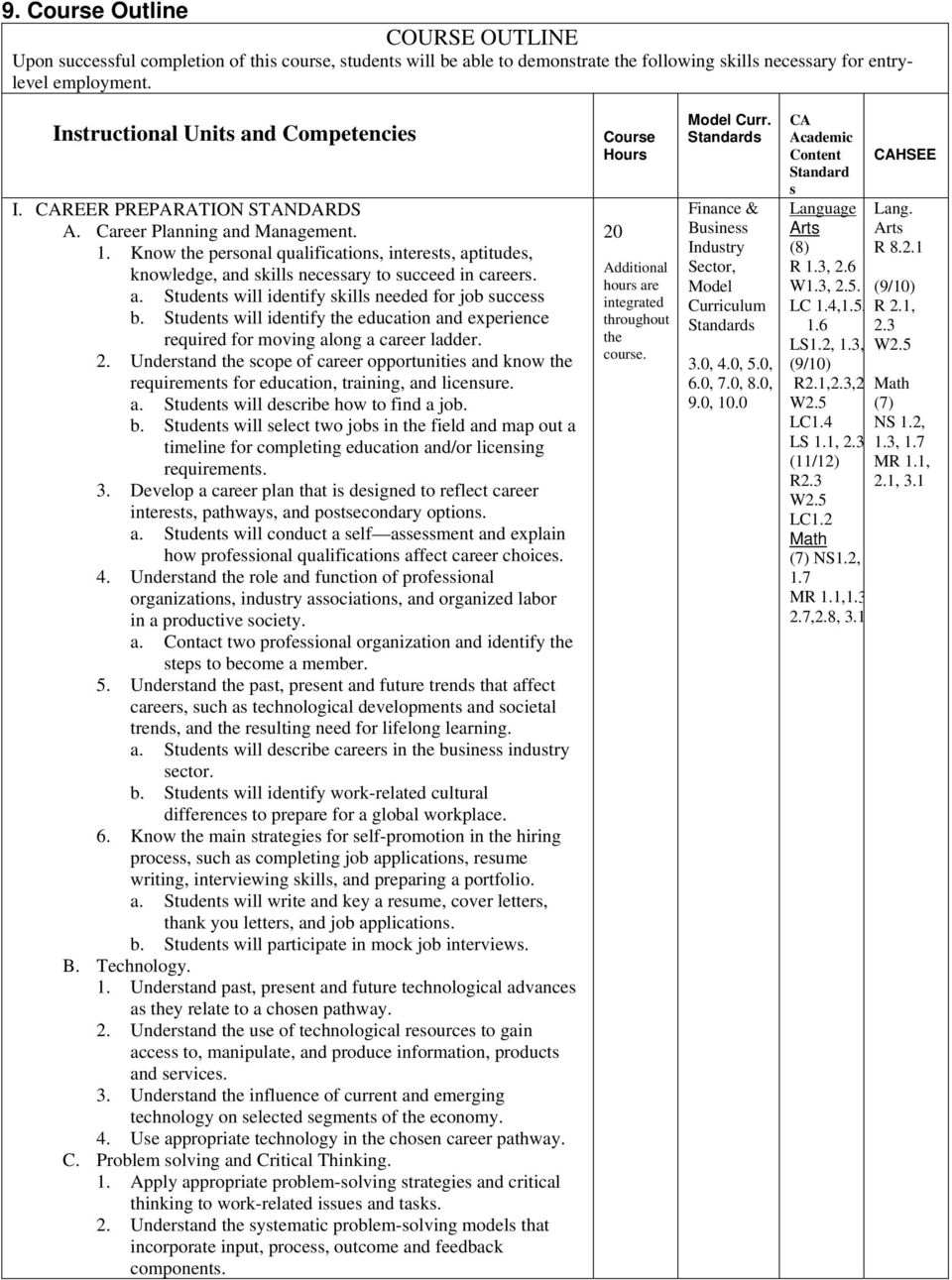
3 9. Course Outline COURSE OUTLINE Upon successful completion of this course, students will be able to demonstrate the following skills necessary for entrylevel employment. Instructional Units and Competencies I. REER PREPARATION STANDARDS A. Career Planning and Management. 1. Know the personal qualifications, interests, aptitudes, knowledge, and skills necessary to succeed in careers. a. Students will identify skills needed for job success b. Students will identify the education and experience required for moving along a career ladder. 2. Understand the scope of career opportunities and know the requirements for education, training, and licensure. a. Students will describe how to find a job. b. Students will select two jobs in the field and map out a timeline for completing education and/or licensing requirements. 3. Develop a career plan that is designed to reflect career interests, pathways, and postsecondary options. a. Students will conduct a self assessment and explain how professional qualifications affect career choices. 4. Understand the role and function of professional organizations, industry associations, and organized labor in a productive society. a. Contact two professional organization and identify the steps to become a member. 5. Understand the past, present and future trends that affect careers, such as technological developments and societal trends, and the resulting need for lifelong learning. a. Students will describe careers in the business industry sector. b. Students will identify work-related cultural differences to prepare for a global workplace. 6. Know the main strategies for self-promotion in the hiring process, such as completing job applications, resume writing, interviewing skills, and preparing a portfolio. a. Students will write and key a resume, cover letters, thank you letters, and job applications. b. Students will participate in mock job interviews. B. Technology. 1. Understand past, present and future technological advances as they relate to a chosen pathway. 2. Understand the use of technological resources to gain access to, manipulate, and produce information, products and services. 3. Understand the influence of current and emerging technology on selected segments of the economy. 4. Use appropriate technology in the chosen career pathway. C. Problem solving and Critical Thinking. 1. Apply appropriate problem-solving strategies and critical thinking to work-related issues and tasks. 2. Understand the systematic problem-solving models that incorporate input, process, outcome and feedback components. Course 20 Additional hours are integrated throughout the course. Finance & Sector, Model Curriculum 3.0, 4.0, 5.0, 6.0, 7.0, 8.0, 9.0, 10.0 Content Standard s Language Arts (8) R 1.3, 2.6 W1.3, 2.5. LC 1.4,1.5, 1.6 LS1.2, 1.3, (9/10) R2.1,2.3,2 W2.5 LC1.4 LS 1.1, 2.3 (11/12) R2.3 W2.5 LC1.2 Math (7) NS1.2, 1.7 MR 1.1, ,2.8, 3.1 Lang. Arts R (9/10) R 2.1, 2.3 W2.5 Math (7) NS 1.2, 1.3, 1.7 MR 1.1, 2.1, 3.1
4 3. Use critical thinking skills to make informed decisions and solve problems. 4. Apply decision-making skills to achieve balance in the multiple roles of personal, home, work and community life. D. Health and Safety. 1. Know policies, procedures, and regulations regarding health and safety in the workplace, including employers and employees responsibilities. 2. Understand critical elements of health and safety practices related to a variety of business environments. E. Responsibility & Flexibility. 1. Understand the qualities and behaviors that constitute a positive and professional work demeanor. 2. Understand the importance of accountability and responsibility in fulfilling personal, community, and workplace roles. 3. Understand the need to adapt to varied roles and responsibilities. 4. Understand that individual actions can affect the larger community. F. Ethics and Legal Responsibilities 1. Know the major local, district, state, and federal regulatory agencies and entities that affect the industry and how they enforce laws and regulations. 2. Understand the concept and application of ethical and legal behavior consistent with workplace standards. a. Contact a business and obtain a copy of their rules for employment. b. Role play difference ethical scenarios. 3. Understand the role of personal integrity and ethical behavior in the workplace. G. Leadership and Teamwork. 1. Understand the characteristics and benefits of teamwork, leadership, citizenship in the school, community, and workplace settings. 2. Understand the ways in which professional associations, such as FBLA and competitive career development activities enhance academic skills, career choices, and contribute to promote employability. 3. Understand how to organize and structure work individually and in teams for effective performance and attainment of goals. 4. Know multiple approaches to conflict resolution and their appropriateness for a variety of situations in the workplace. 5. Understand how to interact with others in ways that demonstrate respect for individual and cultural differences and for the attitudes and feelings of others.

5 Instructional Units and Competencies I. MANAGEMENT FUNCTIONS A. Planning 1. Forecasting 2. Strategic Planning 3. Operational Planning 4. Activity: create sales, production & financial plans B. Leading 1. Motivation 2. Maslow s Hierarchy of Needs 3. Styles & forms 4. Pitfalls C. Organizing 1. Difference between 1st line & senior management 2. Centralized vs. decentralized 3. Line vs. staff 4. Managing in different structures D. Controlling 1. Compare actual with desired performance 2. Tools 3. Tips 4. Activity: create a sales analysis comparing forecast to actual results & draw conclusions E. Projects demonstrating understanding of basic functions of management (small groups) 1. Card House project 2. Pumpkin Decorating project II. ORGANIZATIONAL STRUCTURE A. Organizational Theory B. Line and Staff Relationships C. Form and Function of Organizational Structures D. Classical Organizational Structures E. Team Management III. HUMAN RESOURCE MANAGEMENT A. Classical School B. Behavioral School C. Scientific Management School D. Systems School E. Activities: Maslow s Hierarchy of Needs. 25 Accounting A4.1, 4.4 Financial Management C1.1, Banking & Related B Banking & Related B2.2 ELA 9-10; R; 2.3, 2.5, 2.8 ELA 11-12; (7) NS1.2,.3,.6,.7 (6(P3.5 (7)MR2.1 (10)WA1. 1,.2; (8)R2.1 (10)R2.1,.5; (10)WS1. 2,.9;

6 Instructional Units and Competencies IV. CHANGE THEORY A. Global Competition B. Global Economy C. Technology D. Diversity E. Historical Legislation F. Growing Legislation G. Expectations & Competencies 5. ELA 9-10; W; , 1.9 SS 12; E; SS 12; E; SS 12; E; & V. COMPETITION A. Competition in & Economy B. Economic Principles of a Market Economy C. Controlling Power D. Forms of Ownership 1. Liability 2. Taxation 3. Pros & cons VI. HUMAN RESOURCE DEVELOPMENT & MANAGEMENT A. Define B. Employee Satisfaction C. Recruitment D. Hiring E. Managing Performance F. Training & Development VII. INTERNATIONAL BUSINESS A. International Trade B. Barriers to International Trade C. Activity: International Customs D. Working in a Global Economy E. Cultural Bias F. Hoffstedes Dimensions of Culture G. Other Cultural Differences H. Learning from a Global Environment VIII. COMPETING IN A GLOBAL MARKETPLACE A. Working in a global economy B. Cultural bias C. Hoffstedes dimensions of culture D. Other cultural differences E. Learning from a global environment F. Activity: Doing Internationally: Some Management Tips 5 Accounting A3.1 C1.3 C Banking & Related B Marketing Sales & Service Sector Financial Management C2.4 International C1.3, Marketing Sales & Service Sector C1.2, C2.2

7 Instructional Units and Competencies IX. PRODUCTION & OPERATIONS MANAGEMENT A. Production vs. Manufacturing 1. Types of Manufacturing 2. Improving Manufacturing 3. Quality Manufacturing B. Service es 1. Characteristics of Service 2. Operating Service es C. Labor Resources D. Calculating Productivity X. POLICY & STRATEGY FORMULATION A. Strategy vs. Policy B. SWOT analysis C. Scientific Problem Solving D. Goal vs. Budget E. Schedules, Procedures & XI. MARKETING A. Importance and Nature of Marketing B. Marketing Functions C. Marketing Concept D. Marketing Strategy E. Marketing Mix F. Marketing Plan G. Product Life Cycle H. Types of Consumer Products I. Successful Marketing Strategies J. Product Development and Distribution XII BUSINESS SIMULATION A. Banking & Bookkeeping B. Communication C. Payroll D. Accounts Payable & Receivable E. Shipping & Receiving F. Credit G. Advertising H. Human Resources. 10 Financial Management C1.1, C Entrepreneur ship B Marketing Sales & Service Sector B4.2, B Accounting A2.6 Marketing Sales & Service Sector B1.1 B1.2 B1.4 ELA 9-10; LS; 1.1, 1.3, 1.4, 1.11, 1.12 ELA 9-10; W; 2.5 M 6; SP; 1.1 M 7; NS; 1.2, 1.3

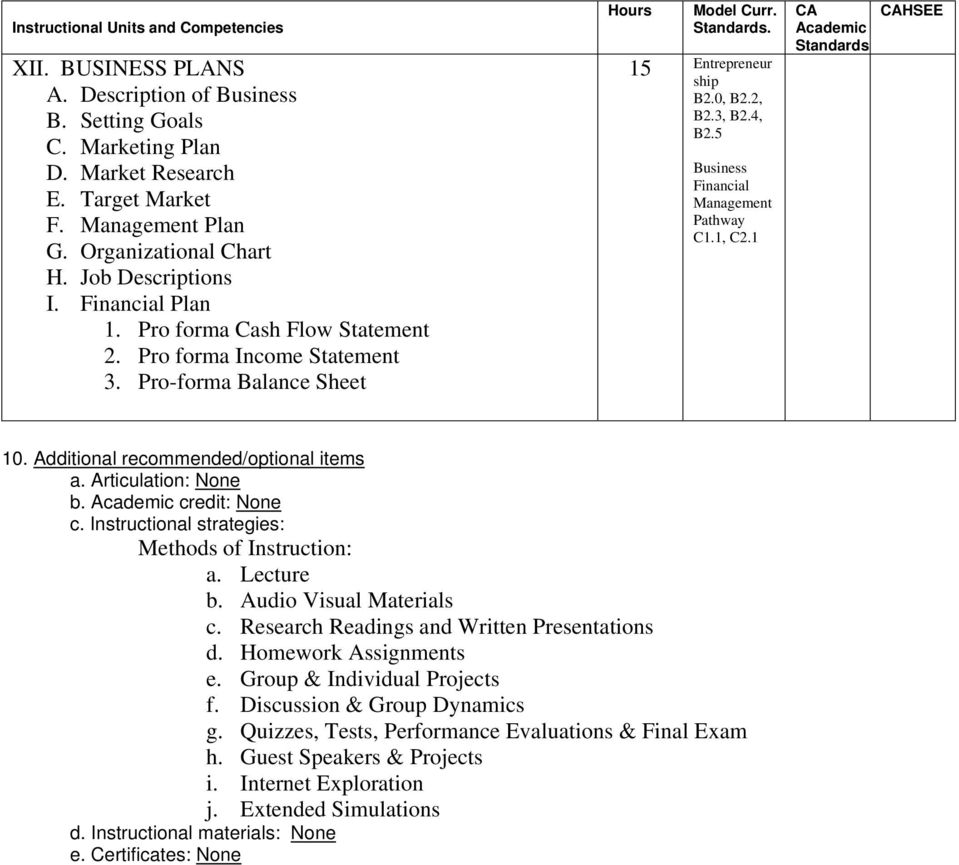
8 Instructional Units and Competencies XII. BUSINESS PLANS A. Description of B. Setting Goals C. Marketing Plan D. Market Research E. Target Market F. Management Plan G. Organizational Chart H. Job Descriptions I. Financial Plan 1. Pro forma Cash Flow Statement 2. Pro forma Income Statement 3. Pro-forma Balance Sheet. 15 Entrepreneur ship B2.0, B2.2, B2.3, B2.4, B2.5 Financial Management C1.1, C Additional recommended/optional items a. Articulation: None b. credit: None c. Instructional strategies: Methods of Instruction: a. Lecture b. Audio Visual Materials c. Research Readings and Written Presentations d. Homework Assignments e. Group & Individual Projects f. Discussion & Group Dynamics g. Quizzes, Tests, Performance Evaluations & Final Exam h. Guest Speakers & Projects i. Internet Exploration j. Extended Simulations d. Instructional materials: None e. Certificates: None
Accounting 1, 2 COURSE OUTLINE
 1, 2 COURSE OUTLINE 1. Course Title: 1, 2 2. CBEDS Title: /computer accounting 3. CBEDS Number: 4600 4. Job Titles: Bill & Account Collectors Billing and Posting Clerks Bookkeeping, & Auditing Clerks Brokerage
Culinary Arts Cooperative Vocational Education COURSE OUTLINE
 Culinary Arts Cooperative Vocational Education COURSE OUTLINE 1. Course Title: Culinary Arts Cooperative Vocational Education 2. CBEDS Title: Food and Hospitality Services 3. CBEDS Number: 4420 4. Job
Event Planning COURSE OUTLINE
 Event Planning COURSE OUTLINE 1. Course Title: Event Planning 2. CBEDS Title: Food and Hospitality Services 3. CBEDS Number: 44 4. Job Titles: Event Planner Wedding Planner Convention Planner Personal
Health Careers Medical Terminology COURSE OUTLINE
 Health Careers Medical Terminology COURSE OUTLINE 1. Course Title: Medical Terminology 2. CBEDS Title: Health Care Information Services Continuing Education 3. CBEDS Number: 4277 4. Job Titles: Medical
Beginning Web Design COURSE OUTLINE
 Beginning Web Design COURSE OUTLINE 1. Course Title: Beginning Web Design 2. CBEDS Title: Other visual communications/graphics course 3. CBEDS Number: 5798 4. Job Titles: Web Design Technicians Desktop
Advanced Medical Careers COURSE OUTLINE
 Advanced Medical Careers COURSE OUTLINE 1. Course Title: Advanced Medical Careers/Sports Medicine 2. CBEDS Title: Other health careers course 3. CBEDS Number: 4298 4. Job Titles: Assistant Clinical Laboratory
Robotics Technology COURSE OUTLINE
 Robotics COURSE OUTLINE 1. Course Title: Robotics 2. CBEDS Title: Robotics 3. CBEDS Number: 5612 4. Job Titles: Instrumentation Technician Fieldbus Software Engineer Controls Engineer Controls Programmer
Agricultural Mechanics COURSE OUTLINE
 Agricultural Mechanics COURSE OUTLINE 1. Course Title: Agricultural Mechanics 2. CBEDS Title: Mechanics and Engineering Technology 3. CBEDS Number: 4030 4. Job Titles: Farm Machine Operator Farm Machine
Baking & Pastry Arts COURSE OUTLINE
 Baking & Pastry Arts COURSE OUTLINE 1. Course Title: Baking & Pastry Arts 2. CBEDS Title: Food and Services 3. CBEDS Number: 4420 4. Job Titles: Food Service Worker Baker Pastry Chef Assistant Pastry Chef
Construction Technology COURSE OUTLINE
 Technology COURSE OUTLINE 1. Course Title: Technology 2. CBEDS Title: Introduction to 3. CBEDS Number: 5501 4. Job Titles: Carpenters Concrete Laborers Managers Drywall installers Electricians Roofers
Advanced Culinary Arts COURSE OUTLINE
 Advanced Culinary Arts COURSE OUTLINE 1. Course Title: Advanced Culinary Arts 2. CBEDS Title: Food and Services 3. CBEDS Number: 4420 4. Job Titles: Food Service Worker Caterer Catering Assistant Baker
Advanced Web Design COURSE OUTLINE
 Advanced Web Design COURSE OUTLINE 1. Course Title: Advanced Web Design 2. CBEDS Title: Other visual communications/graphics course 3. CBEDS Number: 5798 4. Job Titles: Web Design Technicians Desktop Publishers
RIVERSIDE COUNTY OFFICE OF EDUCATION COURSE OUTLINE. Entrepreneurship and Innovation II. CBEDS Number: 4126. Job Title(s):
 RIVERSIDE COUNTY OFFICE OF EDUCATION CO1.rpt COURSE OUTLINE 8/26/2015 10:59:24AM 1 of 8 Course: 12523 RCOE Virtual Enterprise CBEDS Title: Entrepreneurship and Innovation II CBEDS Number: 4126 Job Title(s):
Health and Science Investigations: Year III COURSE OUTLINE
 Health and Science Investigations: Year III COURSE OUTLINE 1. Course Title: Health and Science Investigations: Year III 2. CBEDS Title: Other Health Careers Course 3. CBEDS Number: 4298 4. Job Titles:
Business Education Standards
 Business Education Standards FINAL Approved on January 9, 2004 Copyright 2003 Texas State Board for Educator Certification BUSINESS EDUCATION STANDARDS Standard I. Standard II. Standard III. Standard IV.
Business Subject Matter Requirements. Part I: Content Domains for Subject Matter Understanding and Skill in Business
 Business Subject Matter Requirements Part I: Content Domains for Subject Matter Understanding and Skill in Business Domain 1. Business Management Candidates demonstrate an understanding of the purpose
Digital Film Making COURSE OUTLINE
 Digital Film Making COURSE OUTLINE 1. Course Title: Digital Film Making 2. CBEDS Title: Broadcasting Technology 3. CBEDS Number: 5770 4. Job Titles: Video Photographer Instructional Video Designer Instructional
Career and Financial Management (2003 Curriculum)
 Career and Financial Management (2003 Curriculum) The recently created course tentatively entitled "Career and Financial Management" is a one-half unit requirement that will replace the current Introduction
TAMALPAIS UNION HIGH SCHOOL DISTRICT Larkspur, California. Course of Study. Web Design 1, 2, 3, 4, 5 and 6
 I. INTRODUCTION TAMALPAIS UNION HIGH SCHOOL DISTRICT Larkspur, California Course of Study Web Design 1, 2, 3, 4, 5 and 6 These one-semester courses give students the skills and knowledge necessary to design
Course Descriptions for the Business Essentials Program
 Course Descriptions for the Business Essentials Program Upon completion of one, two, three or four quarters, students will earn Certificates of Completion. All courses listed are required in order to earn
Business Management and Administration Career Cluster Entrepreneurship Course Number: 06.41610
 Business Management and Administration Career Cluster Entrepreneurship Course Number: 06.41610 Course Description: How do you turn an idea into a business? Experience just that in this course! Entrepreneurship
MISSION VALLEY REGIONAL OCCUPATION PROGRAM COMPUTER GRAPHICS DESIGN COURSE OUTINE
 MISSION VALLEY REGIONAL OCCUPATION PROGRAM COMPUTER GRAPHICS DESIGN COURSE OUTINE 1. Course Title: Motion Graphics (Selected Studies) 2. CBEDS Title: Graphic Communications 3. CBEDS Number: 5751 4. Job
Iowa. CONTENT STANDARDS and BENCHMARKS. Business and Administration
 Iowa CONTENT STANDARDS and BENCHMARKS Business and Administration 2001 Business, Information Management, and Marketing Career Pathway Framework Illustration of Program Possibilities Occupational Cluster
Management and Marketing Course Descriptions
 Management and Marketing Course Descriptions Management Course Descriptions HRM 301 Human Resources Management (3-0-3) Covers all activities and processes of the human resources function that include recruitment,
Field 010: Career and Technical Education Business and Information Technology Assessment Blueprint
 Field 010: Career and Technical Education Business and Information Technology Assessment Blueprint Domain I Business Management and Ownership 0001 Business and Human Resources Management (Standard 1) 0002
98 Business, Management, Marketing, and Technology
 98 Business, Management, Marketing, and Technology MI-SG-FLD098-02 TABLE OF CONTENTS PART 1: General Information About the MTTC Program and Test Preparation OVERVIEW OF THE TESTING PROGRAM... 1-1 Contact
CAREER EXPLORATION FIELD STUDY DPC #11913 (10 credits)
 MARINE SCIENCE ACADEMY A. Course Information Grade Level: 9-12. Length of Course: One semester. Type: Elective. Non-tracked. Recommendation for Enrollment: Upper classmen will have preference for enrollment
Marketing, Sales and Service Pathway Courses
 CBEDS Code Course Title Course Hours Primary Pathway Course Sequence Level Suggested Grade Level(s) 4123 Introduction to Marketing, Sales & Service 4133 Sports Marketing Class = 180 CC/CVE = 180 Total
Business Principles. Business, Management & Administration. Keyboarding; Computer Applications (5891/3638/3721)
 Business Principles Primary Career Cluster: Business, Management & Administration Consultant: Course Code(s): 5905/3709 Recommended Prerequisite(s): Credit: ½ to 1 Grade Level: 9-10 Aligned Student Organization(s):
MOUNTAIN VIEW SCHOOL DISTRICT
 MOUNTAIN VIEW SCHOOL DISTRICT COMPUTERIZED ACCOUNTING I Curriculum Content Frameworks 0 Curriculum Content Frameworks COMPUTERIZED ACCOUNTING I Grade Levels: 0,, Course Code: 900 Prerequisite: Tech Prep
Georgia Department of Education
 Marketing Career Cluster Marketing and Entrepreneurship Course Number 08.44100 Course Description: Marketing and Entrepreneurship is the second course in the Marketing and Management Career Pathway. Marketing
Butte County Regional Occupational Program
 Butte County Regional Occupational Program COURSE DESCRIPTION COURSE TITLE CBEDS TITLE CBEDS NO. Digital Photography Commercial Photography 5755 JOB TITLES DOT NO. Photographer 143.457.010 News photographer
Business Management. Business, Management & Administration. Computer Applications (5891/3638/3721)
 Business Management Primary Career Cluster: Business, Management & Administration Consultant: Course Code(s): 5889 Recommended Prerequisite(s): Credit: 1 Grade Level: 10-12 Aligned Student Organization(s):
FDU-Vancouver Bachelor of Science in Business Administration - International Business concentration Course Descriptions
 FDU-Vancouver Bachelor of Science in Business Administration - International Business concentration Course Descriptions ACCT 2021 Intro Financial Accounting An introduction to the concepts underlying an
MARKETING EDUCATION Program of Studies 2015-2016
 MARKETING EDUCATION Program of Studies 2015-2016 Betty J. Hunt, Program Consultant Kentucky Department of Education [email protected] 2015-2016 Marketing Education Page 1 of 45 MARKETING EDUCATION
Indiana Academic Standards for Exploring College & Careers
 A Correlation of To the Exploring College & Careers INTRODUCTION This document demonstrates how meets the Indiana Middle School Academic Standards for. Correlation page references are Student Edition,
Scope and Sequence. Units of Study Knowledge and Skills Student Expectations Resources
 Scope and Sequence Cluster: Course Name: Course Description: Course Requirements: Equipment: Arts, Audio/Video Technology & Communications Practicum in Fashion Design (Two to Three Credits) Careers in
Career Technical Education Business Programs
 The Business programs are designed to prepare students for employment in entry-level positions in office administration and administrative support. The training involves general office duties, computer
MINNESOTA CATALOG 2013-14
 MINNESOTA CATALOG 2013-14 MISSION Rasmussen College is dedicated to serving our communities by recognizing the diverse needs of individuals. We encourage personal and professional development through respect,
Learning Goals Bachelor of Science Degree Hospitality Management Major
 Learning Goals Bachelor of Science Degree Hospitality Management Major What are learning goals? Learning goals are statements that specify what learners will know or be able to do as a result of a learning
BUSINESS-- CAREER/TECH DEPT
 ACCOUNTING 1 - Semester Course Course #: 0201 Elective Grades 10-12 Course Description Accounting 1 is for the students who desire beginning vocational preparation for accounting careers; or, for students
MICHIGAN TEST FOR TEACHER CERTIFICATION (MTTC) TEST OBJECTIVES FIELD 036: MARKETING EDUCATION
 MICHIGAN TEST FOR TEACHER CERTIFICATION (MTTC) TEST OBJECTIVES Subarea Marketing Foundations Marketing Functions Technology, Ethics, and Career Development Approximate Percentage of Questions on Test 40%
TExES Business Education 6 12 (176) Test at a Glance
 TExES Business Education 6 12 (176) Test at a Glance See the test preparation manual for complete information about the test along with sample questions, study tips and preparation resources. Test Name
Video Game Design (3 Teams per state, 2 team members minimum)
 Content Area Standard Strand 21st-Century Life & Careers 9.4 Career and Technical Education: All students who complete a career and technical education program will acquire academic and technical skills
Foundations of Restaurant Management & Culinary Arts (Level One) 2011 Correlated to: Texas TEKS for 130.224. Restaurant Management (High School)
 Subchapter I. Hospitality and Tourism 130.224. Restaurant Management (One-Half to One Credit). (a) General requirements. This course is recommended for students in Grades 10-12. Recommended prerequisite:
PEARSON BTEC LEVEL 5 HND DIPLOMA IN BUSINESS MODULE SYNOPSIS
 PEARSON BTEC LEVEL 5 HND DIPLOMA IN BUSINESS MODULE SYNOPSIS 1. Business Environment The aim of this unit is to provide learners with an understanding of different organisations, the influence of stakeholders
Exploring Careers for the 21 st Century 2011
 A Correlation of Exploring Careers for the 21 st Century 2011 To the Georgia Performance Standards for Career Management Grade 8 FORMAT FOR CORRELATION TO THE GEORGIA PERFORMANCE STANDARDS Subject Area:
California Career Center Alignment with California and National Standards, Guidelines, and Frameworks
 California Career Center Alignment with California and National Standards, Guidelines, and Frameworks California Career Center is aligned with five California and national organizations standards, guidelines,
rasmussen.edu 2013 EDITION FLORIDA CATALOG
 rasmussen.edu 2013 EDITION FLORIDA CATALOG RASMUSSEN COLLEGE florida MISSION Rasmussen College is dedicated to serving our communities by recognizing the diverse needs of individuals. We encourage personal
Accounting Course Descriptions
 Accounting Course Descriptions ACCT 210: Financial Accounting (3) (F, S, SS) As the introductory course for the accounting degree program, the course introduces the basic framework of accounting to all
Computer Apps for Careers (#5000)
 AASD BUSINESS CURRICULUM Computer Apps for Careers (#5000) Description Students will use a variety of software to create personal as well as business documents. The course will emphasize touch-keyboarding
BUS 255 ORGANIZATIONAL BEHAVIOR IN BUSINESS
 COURSE DESCRIPTION: BUS 255 ORGANIZATIONAL BEHAVIOR IN BUSINESS Prerequisites: ENG 090 and RED 09 or DRE 098; or satisfactory score on placement test Corequisites: None This course covers the impact of
Common Course Outline
 Date of Original: September 1988 Date of Revision: October 2007 Effective Date: Fall 2008 Common Course Outline A. Course Prefix, Number, and Title: BUS 1101, Introduction to Business MNTC No B. Semester
2014-2015 ACADEMIC CATALOG ILLINOIS
 2014-2015 ACADEMIC CATALOG ILLINOIS MISSION Rasmussen College is an institution of higher learning dedicated to global enrichment and meeting the evolving needs of our diverse communities. With an emphasis
Business Education Department
 Business Education Department A student interested in Business Education courses should note that a variety of 5-credit sequences are offered. Many students combine subjects from various business, academic,
MASTER SYLLABUS BACHELOR OF BUSINESS (BBA)
 MASTER SYLLABUS BACHELOR OF BUSINESS (BBA) NORTHERN ARIZONA UNIVERSITY DISTANCE LEARNING PROGRAM BBA 310, PRINCIPLES OF MARKETING IN THE GLOBAL ECONOMY I. Catalog Description: An orientation to basic marketing
Accounting ACCOUNTING. 2015-16 Sacramento City 37 College Catalog 37. Degree: A.S. Accounting
 ACCT Degree: A.S. Certificates of Achievement: Clerk Full Charge Bookkeeper Associate in Science Degree The degree is designed for students planning to seek accounting positions in business, industry,
PRINCIPLES OF BUSINESS. Essential Curriculum Course Overview. Total Hours: 125 BUSINESS IN THE GLOBAL ECONOMIC ENVIRONMENT
 PRINCIPLES OF BUSINESS Essential Curriculum Course Overview Total Hours: 125 UNIT 1: BUSINESS IN THE GLOBAL ECONOMIC ENVIRONMENT Hours: 19 01 - Economic Decisions and Systems (4 hours) The student will
Virtual Enterprise International
 Virtual Enterprise International Primary Career Cluster: Consultant: Marketing Anna Ogburn, (615) 253-7442, [email protected] Course Code(s): 5900 Prerequisite(s): Business Management (5889) or Marketing
CHATTANOOGA STATE COMMUNITY COLLEGE CHATTANOOGA, TENNESSEE BUSINESS AND INFORMATION SYSTEMS DIVISIONS. Course Syllabus MG 224 Entrepreneurship
 CHATTANOOGA STATE COMMUNITY COLLEGE CHATTANOOGA, TENNESSEE BUSINESS AND INFORMATION SYSTEMS DIVISIONS Course Syllabus MG 224 Entrepreneurship Instructor: Ed Southeard Class, Credit Hours: 3 / 3 Office/phone:
Learning Targets: Quarter 1, Unit 1, Chapters 1 & 2 Quarter 2, Unit 2, Chapters 3 & 4 Quarter 3, Unit 3, Chapter 5 Unit 4, Chapter 6
 School District of Waukesha Course Syllabus Curriculum Area: Business Education Course Title: Accounting I Prerequisites: None Course Length: Year Course #: 4004 Date Last Revised: June 2009 Stage 1: Desired
Accounting Technology
 Accounting Technology 55 Accounting Technology Location: Library Tower - 3 rd Floor Program Information The Accounting program at Trenholm State provides students with the fundamentals of accounting principles
1. The Application Process
 Criteria for Approving New Mortgage Associate Education Programs and Mortgage Brokerage Education Programs under The Mortgage Brokerages and Mortgage Administrators Act (the Criteria ) The Saskatchewan
Course of Study. Psychology. Warren County Career Center. 3525 North State Route 48 Lebanon, Ohio 45036. Adopted 4-26-06
 Course of Study Psychology Warren County Career Center 3525 North State Route 48 Lebanon, Ohio 45036 Adopted 4-26-06 This document is for the use of the staff at Warren County Career Center. Credit is
Butte County Regional Occupational Program
 Butte County Regional Occupational Program COURSE DESCRIPTION COURSE TITLE: CEBEDS TITLE: Medical & Hospital Careers Hospital/Community Health Services CEBEDS NO: 4298 LENGTH OF COURSE: HOURS: 1 Year/or
CURRICULUM INFORMATION AND PLANNING YOUR COURSE OF STUDY / BABSON MBA EVENING PROGRAM
 The Babson MBA Evening Program curriculum consists of a combination of core courses, signature learning experiences, and elective courses totaling 55 credits. SIGNATURE LEARNING EXPERIENCE The Babson MBA
TISCH CENTER B.S. IN HOTEL AND TOURISM MANAGEMENT COURSE DESCRIPTIONS 2011
 AS OF THE FALL SEMESTER UPDATED APRIL 15, MAJOR CORE Tourism Impacts and Issues TCHT1-DC 1000 A survey of the dimensions, operations, and issues of the global tourism industry. Topics covered include:
16- Master s Degree in Public Health and Public Health Sciences (Majoring Health Management, Planning and Policy)
 16- Master s Degree in Public Health and Public Health Sciences (Majoring Health Management, Planning and Policy) Students should fulfill a total of 38 credit hours: 1- Basic requirements: 10 credit hours.
Salem Community College Course Syllabus. Section I. Course Title: Principles Of Marketing. Course Code: BUS212
 Salem Community College Course Syllabus Section I Course Title: Principles Of Marketing Course Code: BUS212 Lecture Hours: 3 Lab Hours: 0 Credits: 3 Course Description: This course examines the business
Scope and Sequence. Hospitality and Tourism. Cluster:
 Scope and Sequence Cluster: Course Name: Course Description: Course Requirements: Hospitality and Tourism 130.223 Hotel Management (One-Half to One Credit) This course focuses on the knowledge and skills
Robert Wood Johnson University Hospital Jersey Shore University Medical Center
 Rutgers, The State University of New Jersey The Bloustein School of Planning and Public Policy Department of Urban Studies and Community Health Undergraduate Program in Public Health 10:501:230:01 Syllabus
Business Leadership. www.odessa.edu/dept/management. Faculty: Nancy Stewart, chair; Sue Jones, Connie Nichols
 Business Leadership www.odessa.edu/dept/management Faculty: Nancy Stewart, chair; Sue Jones, Connie Nichols The business leadership department philosophy states that everyone should manage all resources,
PELLISSIPPI STATE TECHNICAL COMMUNITY COLLEGE MASTER SYLLABUS DIGITAL GRAPHIC DESIGN I CGT 1100
 PELLISSIPPI STATE TECHNICAL COMMUNITY COLLEGE MASTER SYLLABUS DIGITAL GRAPHIC DESIGN I CGT 1100 Class Hours: 5.0 Credit Hours: 5.0 Laboratory Hours: 0.0 Date Revised: Spring 99 Catalog Course Description:
ASCA National Standards. Developed by: American School Counselor Association
 ASCA National Standards Developed by: American School Counselor Association Guidance and counseling program content standards and student competencies. 7.1. Academic development. The content standards
B130 Business Administration- Finance MTCU code - 60201 Program Learning Outcomes
 B130 Business Administration- Finance MTCU code - 60201 Program Learning Outcomes Synopsis of the Vocational Learning Outcomes* The graduate has reliably demonstrated the ability to 1. co- ordinate the
Business Economics. Business Management & Administration. Candi Norwood, (615) 532-6248 [email protected]
 Business Economics Primary Career Cluster: Consultant: Course Code(s): 5898 Prerequisite(s): Credit: Business Management & Administration Candi Norwood, (615) 532-6248 [email protected] None ½ Grade
Preparing for Career Success in Business, Management and Administration
 Preparing for Career Success in Business, Management and Administration CC9004 Career Clusters Prepare All Students for College, Technical Training and Careers Career Clusters prepare learners of all ages
Demonstrate an ability to utilize generally accepted accounting principles and managerial/cost accounting practices.
 Accounting NAU s Bachelor of Science degree in Accounting is designed to help students prepare for the Certified Public Accountant (CPA) exam and have an exciting career in the financial sector. Currently,
COLLEGE OF BUSINESS AND ECONOMICS
 COLLEGE OF BUSINESS AND ECONOMICS DEAN OF THE COLLEGE OF BUSINESS AND ECONOMICS OFFICE OF THE DEAN MISSION VALUES PROGRAMMATIC ACCREDITATION MAJOR DEGREE PROGRAMS MINORS DISCIPLINES (FIELDS OF STUDY) ACADEMIC
Administrative Management
 Administrative Management Primary Career Cluster: Business, Management & Administration Consultant: Course Code(s): 5895 Recommended Prerequisite(s): Credit: Grade Level: 11-12 Aligned Student Organization(s):
Department of Marketing
 Department of Marketing FACULTY Professors Baer, Hill; Associate Professors Bond (chair), Griffin, Johlke; Assistant Professors Garrett, Iyer, O'Brien; Instructors Choate, Rottier. Marketing is the backbone